PREFACE.
3
The ancients boasted of their SEVEN WONDERS OF THE WORLD. These were
the Pyramids of Egypt, the Colossus of Rhodes, the Aqueducts of Rome,
the Labyrinth on the banks of the Nile, the Pharos of Alexandria, the Walls
of Babylon, and the temple of Diana at Ephesus. But the WONDERS known
to those of the present day, may be counted by hundreds: wonders of
Nature, wonders of Science, wonders of Art, and Miscellaneous wonders;
each department full, to overflowing, of themes of the richest instruction
and deepest interest.
To present some of the most striking of these wonders, in a manner that
shall be acceptable to the man of science and profound research, and at the
same time full of interest to the general reader, and the family at the fireside,
has been the aim of the editor of the following pages. The exaggerated
and marvelous stories which the mischievous fancy of travelers has
too often imposed on the credulity of the weak, as well as the foolish fables
founded in bigotry and superstition, which were too often received as truths
in the dark ages, have been carefully avoided, and, where the narrative permitted,
exposed; and nothing has been brought forward that has not been
confirmed by the concurrent testimony of enlightened travelers, and men
of science, and extended observation. On the subjects in which Nature, in
her various departments, displays her most wondrous magnificence and
beauty; or in those in which Science and Art have sought out their most
4wondrous inventions, and wrought out the most wondrous results, the best
authorities have been carefully consulted. And the endeavor has been, so
to assemble and arrange the multiplied objects of wonder and delight, as to
confer a lasting benefit on the rising generation, and on families, and at the
same time to present a work that shall commend itself to those whose lives
have been wholly devoted to researches among the sublime wonders of
nature, science and art. Believing that the standard of general reading is
constantly rising higher, and that the sphere of intellectual tastes and pursuits
is constantly growing wider, the writer has endeavored to prepare a
volume that shall have more than the interest of fiction, and, at the same
time, the ripe and rich instruction of the book of travels, or the work of
science or descriptive art. The table of contents makes manifest how
extensive the range of the topics presented; while the list of engravings
may show how profusely and richly the enterprise of the publishers has
illustrated a work, which it is hoped may meet with universal acceptance.
J. L. A.
MOUNTAINS. — THE ANDES. — CHIMBORAZO. — COTOPAXI. — PICHINCHA. — MOUNT ETNA. — MOUNT VESUVIUS. — MOUNT HECLA. — THE GEYSERS. — THE SULPHUR MOUNTAIN. — MONT BLANC. — THE GLACIERS, OR ICE MASSES. — THE MER DE GLACE. — VIEW FROM THE BUET. — MONTSERRAT. — THE PEAK OF TENERIFFE. — THE SOUFFRIERE MOUNTAIN. — PETER BOTTE’S MOUNTAIN. — KILAUEA. — THE PEAK OF DERBYSHIRE. — ELDEN HOLE. — PEAK CAVERN. — MAM TOR. — THE EBBING AND FLOWING WELL. — ST. ANNE’S WELL. — THE CRYSTALLIZED CAVERN. — SPEEDWELL LEVEL. — THE HIGH TOR. — CHEE TOR. — THE CUMBERLAND CAVERN. — REYNARD’S HOLE. — THE LOVERS’ LEAP. — THE MOORS. — OTHER ENGLISH CURIOSITIES. — MOUNTAINS OF GREAT BRITAIN. — BEN NEVIS. — SNOWDON. — CADER IDRIS. — PENMAN-MAWR. — SKIDDAW. — WHARNSIDE. — STROMBOLI. — LIPARI. — VULCANO. — THE HIMALAYA MOUNTAINS. BETWEEN INDIA AND THIBET. — GUNGOTREE, THE SOURCE OF THE JUMNA, A BRANCH OF THE GANGES, IN THE HIMALAYA MOUNTAINS. — ASIATIC VOLCANOES. — VOLCANIC MOUNTAINS OF KAMTSCHATKA. — VOLCANIC MOUNTAIN OF ALBAY. — ISLANDS WHICH HAVE RISEN FROM THE SEA.
“And lo! the mountains print the distant sky,
And o’er their airy tops faint clouds are driven,
So softly blending that the cheated eye,
Forgets or which is earth, or which is heaven!”—Fay.
“Mountains and all hills—let them praise the name of the Lord, for his name alone is excellent;
his glory is above the earth and heaven.”—David.
Among the wonders, or uncommon phenomena of the world, may be
classed stupendous mountains. For though compared with the entire
diameter of the earth, the highest elevations on its surface are no more than
the inequalities on the skin of the orange to the orange itself, yet to our eyes
they often appear immensely lofty and sublime. Descriptions of such vast
and striking objects often fail to excite corresponding ideas; so that however
accurate or poetical may be the accounts of this class of the prodigies of
nature, no just notions of their vastness can be conveyed, by any written
or graphical representation. The magnitude of an object must be seenseen to
be duly conceived; and the mountain-wonders of the world will best be
understood and felt by those who have visited Wales, Scotland, Switzerland,
or the mountainous regions of America or Asia.
Some of the loftiest and most extensive mountains in the world, are the
Andes, in South America. These stupendous hills, called by the Spaniards
the Cordilleras, (from the word cord or chain,) i.e. the chains of the
10Andes, stretch north and south near the western coast, from the isthmus
of Darien, through the whole of the continent of South America, to the
straits of Magellan. In the north, there are three chains of separate ridges;
but in advancing from Popayan toward the south, the three chains unite
into a single group, which is continued far beyond the equator. In
Equador, near Quito, the more elevated summits of this group are ranged in
two rows, (as seen in the cut below,) which form a double crest to the
Cordilleras. The extent of the Andes mountains is not less than four thousand
three hundred miles, from one end to the other.
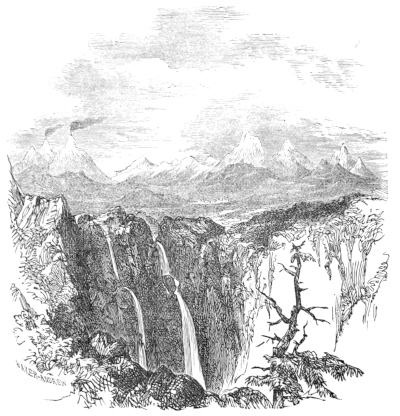
THE CORDILLERAS, OR ANDES, NEAR QUITO.
“Rocks rich in gems, and mountains big with mines,
That on the high equator ridgy rise,
Whence many a bursting stream auriferous plays.”—Thomson.
In this country, the operations of nature appear to have been carried on
on a larger scale, and with a bolder hand, than elsewhere; and in consequence,
the whole is distinguished by a peculiar magnificence. Even the
11plain of Quito, which may be considered as the base of the Andes, is more
elevated above the sea than the summits of many European mountains. In
different places the Andes rise more than one-third higher than the famous
peak of Teneriffe, the highest land in the ancient hemisphere. Their cloud-enveloped
summits, though exposed to the rays of the sun in the torrid zone,
are covered with eternal snows, and below them the storm is seen to burst,
and the exploring traveler hears the thunder roll, and sees the lightnings
dart beneath his feet. Throughout the whole of the range of these extensive
mountains, as far as they have been explored, there is a certain boundary,
above which the snow never melts; which boundary, in the torrid zone, has
been ascertained to be fourteen thousand, six hundred feet, or nearly three
miles above the level of the sea.
The ascent to the plain of Quito, on which stands Chimborazo, Cotopaxi,
Pichincha, &c., is thus described by Don Juan de Ulloa:
“The ruggedness of the road from Taraguaga, leading up the mountain,
is not easily described. The declivity is so great, in some parts, that the
mules can scarcely keep their footing; and, in others, the acclivity is equally
difficult. The trouble of sending people before to mend the road, the pain
arising from the many falls and bruises, and the being constantly wet to the
skin, might be supported; but these inconveniences are augmented by the
sight of such frightful precipices and deep abysses, as excite in the mind
constant terror. The road, in some places, is so steep, and yet so narrow,
that the mules are obliged to slide down without making any use whatever
of their feet. On one side of the rider, in this situation, rises an eminence
of many hundred yards; and, on the other, is an abyss of equal depth; so
that, if he should give the least check to his mule, and destroy the equilibrium,
both must inevitably perish.
“Having traveled nine days in this manner, slowly winding along the
sides of the mountains, we began to find the whole country covered with a
hoar-frost; and a hut, in which we reposed, had ice in it. At length, after
a perilous journey of fifteen days, we arrived upon a plain, at the extremity
of which stands the city of Quito, the capital of one of the most charming
regions in the world. Here, in the center of the torrid zone, the heat is not
only very tolerable, but, in some places, the cold is even painful. Here the
inhabitants enjoy the temperature and advantages of perpetual spring; the
fields being constantly covered with verdure, and enameled with flowers of
the most lively colors. But although this beautiful region is more elevated
than any other country in the world, and it employs so many days of painful
journey in the ascent, it is itself overlooked by tremendous mountains, their
sides being covered with snow, while their summits are flaming with
12volcanoes. These mountains seem piled one upon the other, and to rise,
with great boldness, to an astonishing hight. However, at a determined
point above the surface of the sea, the congelation is found at the same hight
in all the mountains. Those parts which are not subject to a continual
frost, have here and there growing upon them a species of rush, resembling
the broom, but much softer and more flexible. Toward the extremity of the
part where the rush grows, and the cold begins to increase, is found a
vegetable with a round bulbous head. Higher still, the earth is bare of
vegetation, and seems covered with eternal snow. The most remarkable
of the Andes are the mountains of Chimborazo, Cotopaxi, and Pichincha.”
This is the most lofty and majestic peak of the Andes, and has a circular
summit. It is twenty-two thousand feet, or more than four miles high. On
the shores of the ocean, after the long rains of winter, Chimborazo appears
like a cloud in the horizon. It detaches itself from the neighboring summits,
and raises its lofty head over the whole chain of the Andes. Travelers who
have approached the summits of Mont Blanc and Mont Rose, are alone
capable of feeling the effect of such vast, majestic, and solemn scenery.
The bulk of Chimborazo is so enormous, that the part which the eye
embraces at once, near the limit of the snows, is twenty-two thousand, nine
hundred and sixty-eight feet, or four miles and a third in breadth. The
extreme rarity of the strata of air across which the summits of the Andes
are seen, contributes greatly to the splendor of the snow and the magical
effect of its reflection. Under the tropics, at a hight of sixteen thousand,
four hundred feet, or upward of three miles, the azure vault of the heavens
appears of an indigo tint; while, in so pure and transparent an atmosphere,
the outlines of the mountains seem to detach themselves from the sky, and
produce an effect at once sublime, awful, and profoundly impressive.
With the exception of the loftiest of the Himalaya, in Asia, Chimborazo
is the highest known mountain in the world. Humboldt, Bonpland,
and Montufar, were persevering enough to approach within one thousand,
six hundred feet of the summit of this mighty king of mountains. Being
aided in their ascent by a train of volcanic rocks, destitute of snow, they
thus attained the amazing hight of nearly four miles above the level of the
sea; and the former of these naturalists is persuaded that they might have
reached the highest summit, had it not been for the intervention of a great
crevice, or gap, which they were unable to cross. They were, therefore,
obliged to descend, after experiencing great inconveniences and many
unpleasant sensations. For three or four days, even after their return into
13the plain, they were not free from sickness, and an uncomfortable feeling,
owing, as they suppose, to the vast proportion of oxygen in the atmosphere
above. Long before they reached the above surprising hight, they had
been abandoned by their guides, the Indians, who had taken alarm and
were fearful of their lives. So great was the fall of snow on their return,
that they could scarcely recognize each other, and they all suffered dreadfully
from the intenseness of the cold.
A great number of Spaniards formerly perished in crossing the vast and
dangerous deserts which lie on the declivity of Chimborazo; being now,
however, better acquainted with them, such misfortunes seldom occur,
especially as very few take this route, unless there be a prospect of calm
and serene weather.
This mountain is the loftiest of those volcanoes of the Andes which, at
recent epochs, have undergone eruptions. Notwithstanding it lies near
the equator, its summits are covered with perpetual snows. The absolute
hight of Cotopaxi is eighteen thousand, eight hundred and seventy-six
feet, or three miles and a half; consequently it is two thousand, six
hundred and twenty-two feet, or half a mile, higher than Vesuvius
would be, were that mountain placed on the top of the peak of Teneriffe!
Cotopaxi is the most mischievous of the volcanoes in the vicinity of Quito,
and its explosions are the most frequent and disastrous. The masses of
scoriæ, and the pieces of rock, thrown out of this volcano, cover a surface
of several square leagues, and would form, were they heaped together, a
prodigious mountain. In 1738, the flames of Cotopaxi rose three thousand
feet, or upward of half a mile, above the brink of the crater. In 1744,
the roarings of this volcano were heard at the distance of six hundred
miles. On the fourth of April, 1768, the quantity of ashes ejected at the
mouth of Cotopaxi was so great, that it was dark till three in the afternoon.
The explosion which took place in 1803, was preceded by the sudden melting
of the snows which covered the mountain. For twenty years before no
smoke or vapor, that could be perceived, had issued from the crater; but in
a single night the subterraneous fires became so active, that at sunrise the
external walls of the cone, heated to a very considerable temperature,
appeared naked, and of the dark color which is peculiar to vitrified scoriæ.
“At the port of Guyaquil,” observes Humboldt, “fifty-two leagues distant
in a straight line from the crater, we heard, day and night, the noise of this
volcano, like continued discharges of a battery; and we distinguished these
tremendous sounds even on the Pacific ocean.”
14The form of Cotopaxi is the most beautiful and regular of the colossal
summits of the high Andes. It is a perfect cone, which, covered with a
perpetual layer of snow, shines with dazzling splendor at the setting of the
sun, and detaches itself in the most picturesque manner from the azure
vault above. This covering of snow conceals from the eye of the observer
even the smallest inequalities of the soil; no point of rock, no stony mass,
penetrating this coat of ice, or breaking the regularity of the figure of the
cone.
Though celebrated for its great hight, Pichincha is three thousand,
eight hundred and forty-nine feet, or three-fourths of a mile, lower than
the perpendicular elevation of Cotopaxi. It was formerly a volcano; but
the mouth or crater on one of its sides is now covered with sand or
calcined matter, so that at present neither smoke nor ashes issue from it.
When it was ascended by Don George Juan and Don Antonio de Ulloa,
for the purpose of their astronomical observations, they found the cold on
the top of this mountain extremely intense, the wind very violent, and the
fog, or, in other words, the cloud, so thick, that objects at the distance of
six or eight paces were scarcely discernible. On the air becoming clear, by
the clouds descending nearer the earth, in such a manner as to surround
the mountain on all sides to a vast distance, these clouds afforded a lively
representation of the sea, in which the top of the mountain seemed to stand,
like an island in the center.
“With aspect mild, and elevated eye,
Behold him seated on a mount serene,
Above the fogs of sense, and passion’s storm:
All the black cares and tumults of this life,
Like harmless thunders, breaking at his feet.”—Young.
When the clouds descended, the astronomers heard the dreadful noise of
tempests, which discharged themselves from them on the adjacent country.
They saw the lightning issue from the clouds, and heard the thunder roll
far beneath them. While the lower parts were thus involved in tempests
of thunder and rain, they enjoyed a delightful serenity; the wind abated,
the sky cleared, and the enlivening rays of the sun moderated the severity
of the cold. But when the clouds rose, their density rendered respiration
difficult: snow and hail fell continually, and the winds returned with such
violence, that it was impossible to overcome the fear of being blown down
the precipices, or of being buried by the accumulation of ice and snow, or
by the enormous fragments of rocks which rolled around them. Every
15crevice in their hut was stopped, and though the hut was small, was crowded
with inhabitants, and several lamps were constantly burning, the cold was
so great, that each individual was obliged to have a chafing-dish of coals,
and several men were employed every morning in removing the snow which
had fallen during the night. Their feet were swollen, and they became so
tender and sensible, that walking was attended with extreme pain; their
hands also were covered with chilblains, and their lips were so swollen and
chapped, that every motion in speaking brought blood.
“Now under sulphurous Cuma’s sea-bound coast,
And vast Sicilia, lies the shaggy breast
Of snowy Etna, nurse of endless frost,
The pillared prop of heaven, forever pressed:
Forth from whose sulph’rous caverns issuing rise
Pure liquid fountains of tempestuous fire,
Which vail in ruddy mists the noonday skies,
While wrapt in smoke the eddying flames aspire,
Or gleaming through the night with hideous roar,
Far o’er the redd’ning main huge rocky fragments pour.
“But he, Vulcanian monster, to the clouds
The fiercest, hottest inundations throws,
While, with the burthen of incumbent woods,
And Etna’s gloomy cliffs o’erwhelmed he glows.
There on his flinty bed outstretch’d he lies,
Whose pointed rock his tossing carcass wounds;
There with dismay he strikes beholding eyes,
Or frights the distant ear with horrid sounds.”—West.
Mount Etna, one of the most majestic of all the volcanoes, which the
ancients considered as one of the highest mountains in the world, and on
the summit of which they believed that Deucalion and Pyrrha sought
refuge, to save themselves from the universal deluge, is situated on the
plain of Catania, in Sicily.
Its elevation above the level of the sea has been estimated at ten thousand,
nine hundred and sixty-three feet, or upward of two miles. On clear days
it is distinctly seen from Valetta, the capital of Malta, a distance of one
hundred and fifty miles. It is incomparably the largest burning mountain
in Europe. From its sides other mountains arise, which, in different ages,
have been ejected in single masses from its enormous crater. The most
extensive lavas of Vesuvius do not exceed seven miles in length, while those
of Etna extend to fifteen, twenty, and some even to thirty miles. The
crater of Etna is seldom less than a mile in circuit, and sometimes is two or
16three miles; but the circumference of the Vesuvian crater is never more
than half a mile, even when widely distended, in its most destructive conflagrations.
And, lastly, the earthquakes occasioned by these adjacent
volcanoes, their eruptions, their showers of ignited stones, and the destruction
and desolation which they create, are severally proportionate to their
respective dimensions.
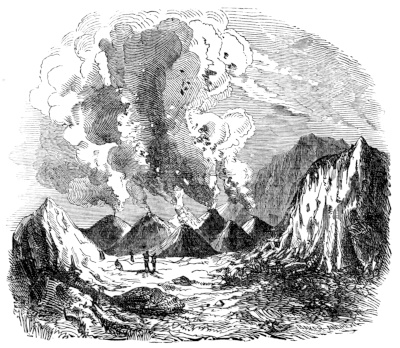
A journey up Etna is considered as an enterprise of importance, as well
from the difficulty of the route, as from the distance, it being thirty miles
from Catania to the summit of the mountain. Its gigantic bulk, its sublime
elevation, and the extensive, varied, and grand prospects which are presented
from its summit, have, however, induced the curious in every age to ascend
and examine it; and not a few have transmitted, through the press, the
observations which they have made during their arduous journey. From
its vast base it rises like a pyramid to the perpendicular hight of two miles,
by an acclivity nearly equal on all sides, forming with the horizon an angle
of about fifteen degrees, which becomes greater on approaching the crater;
but the inclination of the steepest part of the cone nowhere exceeds an
angle of forty-five degrees. This prodigious volcano may be compared to a
forge, which, in proportion to the violence of the fire, to the nature of the
fossil matters on which it acts, and of the gases which urge and set it in
17motion, produces, destroys, and reproduces, a variety of forms; and of this,
as of all active volcanoes, we may say in the language of Young,
“The dread volcano ministers to good;
Its smothered flames might undermine the world
Loud Etnas fulminate in love to man.”
The top of Etna being above the common region of vapors, the heavens,
at this elevation, appear with an unusual splendor. Brydone and his
company observed, as they ascended in the night, that the number of the
stars seemed to be infinitely increased, and the light of each was brighter
than usual. The whiteness of the milky way was like a pure flame which
spread across the heavens; and, with the naked eye, they could observe
clusters of stars which were invisible from below. They likewise noticed
several of those meteors called falling stars, which appeared as much
elevated here as when viewed from the plain beneath.
This single mountain contains an epitome of the different climates
throughout the world, presenting at once all the seasons of the year, and
all the varieties of produce. It is accordingly divided into three distinct
zones or regions, which may be distinguished as the torrid, temperate, and
frigid, but which are known by the names of the cultivated region, the
woody or temperate region, and the frigid or desert region. The former of
these extends through twelve miles of the ascent toward the summit, and
is almost incredibly abundant in pastures and fruit-trees of every description.
It is covered with towns, villages and monasteries; and the number of
inhabitants spread over its surface is estimated at one hundred and twenty
thousand. In ascending to the woody or temperate region, the scene
changes; it is a new climate, a new creation. Below, the heat is suffocating;
but here, the air is mild and fresh. The turf is covered with aromatic
plants; and the gulfs, which formerly ejected torrents of fire, are changed
into woody valleys. Nothing can be more picturesque than this; the
inequality of the soil displaying every moment some variety of scene: here,
the ash and flowering thorns form domes of verdure; and there, the chestnut-trees
grow to an enormous size. The one called castagno de cento cavilli,
according to Brydone and Glover, has a circumference of two hundred and
four feet. Many of the oaks also are of a prodigious size. Mr. Swinburne
measured one which had a circumference of twenty-eight feet. The last,
or desert region, commences more than a mile above the level of the sea.
The lower part is covered with snow in winter only; but on the upper half
of this sterile district the snows continually lie.
18
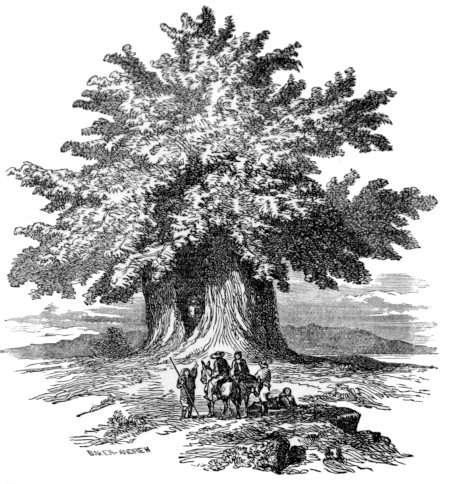
THE “CASTANO DE CENTO CAVILLI,” OR GREAT CHESTNUT TREE OF MOUNT ETNA.
The cone of Etna is, in a right line, about a mile in ascent. The crater
is about a mile and a half in circumference; and from the inner part of
this, a column of smoke constantly rises; while the liquid fiery matter may
be seen rolling, rising and falling within. As to the vastness and beauty of
the prospect from the summit of Etna, all writers agree that it is probably
unsurpassed. M. Houel was there at sunrise, when the horizon was perfectly
clear, and the coast of Calabria, as seen in the distance, appeared to
the eye misty, and undistinguishable from the sea. The sky above was
specked with the light floating clouds that are so often seen in that delightful
climate before the rising of the sun; and in the calm silence all nature
seemed waiting the coming of the orb of day. And very soon the promise
thus given began to be fulfilled. In a short time a fiery radiance appeared
in the east. The fleecy clouds were tinged with purple; the atmosphere
19became strongly illuminated, and, reflecting the rays of the sun, seemed to
be filled with a bright refulgence of flame. Although the heavens were
thus enlightened, the sea still retained its dark azure, and the fields and
forests did not yet reflect the rays of the sun. The gradual rising of this
luminary, however, soon diffused light over the hills which lie below the
peak of Etna. This last stood like an island in the midst of the ocean, with
luminous points multiplying every moment around, and spreading over a
wider extent with the greatest rapidity. It was, he said, as if the world had
been observed suddenly to spring from the night of non-existence.
“Ere the rising sun
Shone o’er the deep, or ’mid the vault of night
The moon her silver lamp suspended; ere
The vales with springs were watered, or with groves
Of oak or pine the ancient hills were crowned;
Then the Great Spirit, whom his works adore,
Within his own deep essence viewed the forms,
The forms eternal of created things:
The radiant sun; the moon’s nocturnal lamp;
The mountains and the streams: the ample stores
Of earth, of heaven, of nature. From the first,
On that full scene his love divine he fixed,
His admiration. Till, in time complete,
What he admired and loved, his vital power
Unfolded into being. Hence the breath
Of life, informing each organic frame;
Hence the green earth, and wild resounding waves;
Hence light and shade, alternate; warmth and cold;
And bright autumnal skies, and vernal showers,
And all the fair variety of things.”—Akenside.
The most sublime object, however, which the summit of Etna presents, is
the immense mass of its own colossal body. Its upper region exhibits rough
and craggy cliffs, rising perpendicularly, fearful to the view, and surrounded
by an assemblage of fugitive clouds, to increase the wild variety of the scene.
Amid the multitude of woods in the middle or temperate region, are
numerous mountains, which, in any other situation, would appear of a
gigantic size, but which, compared to Etna, are mere mole-hills. Lastly,
the eye contemplates with admiration the lower region, the most extensive
of the three, adorned with elegant villas and castles, verdant hills and
flowery fields, and terminated by the extensive coast, where to the south
stands the beautiful city of Catania, to which the waves of the neighboring
sea serve as a mirror.
Etna has been celebrated as a volcano from the remotest antiquity.
20Eruptions are recorded by Diodorus Siculus, as having happened five
hundred years before the Trojan war, or sixteen hundred and ninety-three
years before the Christian era.
“Etna roars with dreadful ruins nigh,
Now hurls a bursting cloud of cinders high,
Involved in smoky whirlwinds to the sky;
With loud displosion to the starry frame,
Shoots fiery globes, and furious floods of flame:
Now from her bellowing caverns burst away
Vast piles of melted rocks in open day.
Her shattered entrails wide the mountain throws,
And deep as hell her flaming center glows.”—Warton.
In 1669, the torrent of burning lava inundated a space fourteen miles in
length, and four in breadth, burying beneath it part of Catania, till at length
it precipitated itself into the sea. For several months before the lava broke
out, the old mouth, or great crater of the summit, was observed to send
forth much smoke and flame, and the top had fallen in, so that the mountain
was much lowered.
Eighteen days before, the sky was very thick and dark, with thunder,
lightning, frequent concussions of the earth, and dreadful subterraneous
bellowings. On the eleventh of March, about sunset, an immense gulf
opened in the mountain, into which when stones were thrown, they could
not be heard to strike the bottom. Ignited rocks, fifteen feet in length,
were hurled to the distance of a mile; while others of a smaller size were
carried three miles. During the night, the red-hot lava burst out of a
vineyard twenty miles below the great crater, and ascended into the air to a
considerable hight. In its course, it destroyed five thousand habitations,
and filled up a lake several fathoms deep. It shortly after reached Catania,
rose over the walls, whence it ran for a considerable length into the sea,
forming a safe and beautiful harbor, which was, however, soon filled up by
a similar torrent of inflamed matter. This is the stream, the hideous
deformity of which, devoid of vegetation, still disfigures the south and
western borders of Catania, and on which part of the noble modern city is
built.
The showers of scoriæ and sand which, after a lapse of two days, followed
this eruption, formed a mountain called Monte Rosso, having a base of
about two miles, and a perpendicular hight of seven hundred and fifty feet.
On the twenty-fifth, the whole mountain, even to the most elevated peak,
was agitated by a tremendous earthquake. The highest crater of Etna,
which was one of the loftiest parts of the mountain, then sunk into the
21volcanic gulf, and in the place which it had occupied, there now appeared
nothing but a wide gulf, more than a mile in extent, from which issued
enormous quantities of smoke, ashes and stones.
In 1809, twelve new craters opened about half-way down the mountain,
and threw out rivers of burning lava, by which several estates were covered
to the depth of thirty or forty feet; and during three or four successive
nights, a very large river of red-hot lava was distinctly seen, in its whole
extent, running down from the mountain.
In 1811, several mouths opened on the eastern side of the mountain:
being nearly in the same line, and at equal distances, they presented to the
view a striking spectacle; torrents of burning matter, discharged with the
greatest force from the interior of the volcano, illuminated the horizon to a
great extent. An immense quantity of matter, which was driven to considerable
distances, was discharged from these apertures, the largest of which
continued for several months to emit torrents of fire. Even at the time
when it had the appearance of being choked, there suddenly issued from it
clouds of ashes, which descended, in the form of rain, on the city of Catania
and its environs, as well as on the fields situated at a very considerable
distance. A roaring, resembling that of a sea in the midst of a tempest,
was heard to proceed from the interior of the mountain; and this sound,
accompanied from time to time by dreadful explosions, resembling thunder,
reëchoed through the valleys, and spread terror on every side.
“The fluid lake that works below,
Bitumen, sulphur, salt, and iron scum,
Heaves up its boiling tide. The lab’ring mount
Is torn with agonizing throes. At once,
Forth from its sides disparted, blazing pours
A mighty river; burning in prone waves,
That glimmer through the night, to yonder plain.
Divided there, a hundred torrent streams,
Each plowing up its bed, roll dreadful on,
Resistless. Villages, and woods, and rocks,
Fall flat before their sweep. The region round,
Where myrtle-walks and groves of golden fruit
Rose fair; where harvest wav’d in all its pride;
And where the vineyard spread its purple store,
Maturing into nectar; now despoiled
Of herb, leaf, fruit and flower, from end to end
Lies buried under fire, a glowing sea!”—Mallet.
This celebrated volcano, which has for so many ages attracted the attention
of mankind, and the desolating eruptions of which have been so often
22and so fatally experienced, is distant, in an eastern direction, about seven
miles from Naples. It rises, insulated, upon a vast and well cultivated
plain, presenting two summits on the same base, in which particular it
resembles Mount Parnassus. One of these, La Somma, is generally agreed
to have been the Vesuvius of Strabo and the ancients; the other, having the
greatest elevation, is the mouth of the volcano, which almost constantly
emits smoke. Its hight above the level of the sea, is thirty-nine hundred
feet, and it may be ascended by three different routes, which are all
very steep and difficult, from the conical form of the mountain, and the
loose ashes which slip from under the feet: still, from the base to the
summit, the distance is not more than three Italian miles. The circumference
of the platform on the top, is five thousand and twenty-four feet, or
nearly a mile. Thence may be seen Portici, Capræa, Ischia, Pausilippo,
and the whole coast of the gulf of Naples, bordered with orange-trees: the
prospect is that of Paradise seen from the infernal regions.
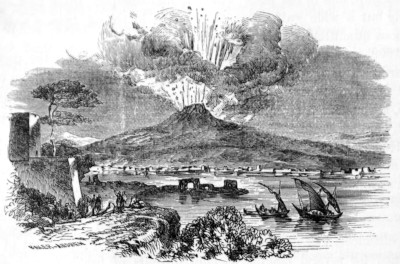
On approaching the mountain, its aspect does not convey any impression
of terror, nor is it gloomy, being cultivated for more than two-thirds of its
hight, and having its brown top alone barren. There all verdure ceases;
yet, when it appears covered with clouds, which sometimes encompass its
middle only, this circumstance rather adds to than detracts from the magnificence
of the spectacle. Upon the lavas which the volcano long ago
ejected, and which, like great furrows, extend into the plain and to the sea,
are built houses, villages and towns. Gardens, vineyards and cultivated
fields surround them; but a sentiment of sorrow, blended with apprehensions
23about the future, arises on the recollection that, beneath a soil so
fruitful and so smiling, lie edifices, gardens and whole towns swallowed up.
Portici rests upon Herculaneum; its environs upon Resina; and at a little
distance is Pompeii, in the streets of which, after more than seventeen
centuries of non-existence, the astonished traveler now walks. After a long
interval of repose, in the first year of the reign of Titus, (the seventy-ninth
of the Christian era,) the volcano suddenly broke out, ejecting thick clouds
of ashes and pumice-stones, beneath which Herculaneum, Stabia and Pompeii
were completely buried. This eruption was fatal to the elder Pliny, the
historian, who fell a victim to his humanity and love of science. Even at
this day, in speaking of Vesuvius, the remembrance of his untimely death
excites a melancholy regret. All the coast to the east of the gulf of Naples
was, on the above occasion, ravaged and destroyed, presenting nothing but
a long succession of ejected matters from Herculaneum to Stabia. The
destruction did not extend to the western part, but stopped at Naples, which
suffered comparatively little.
Thirty-eight eruptions of Vesuvius are recorded in history up to the year
1806. That of 1779, has been described by Sir William Hamilton, as
among the most remarkable, from its extraordinary and terrific appearance.
During the whole of July, the mountain was in a state of considerable
fermentation, subterraneous explosions and rumbling noises being heard,
and quantities of smoke thrown up with great violence, sometimes with red-hot
stones, scoriæ, and ashes. On the fifth of August, the volcano was
greatly agitated, a white sulphurous smoke, apparently four times the hight
and size of the volcano itself, issuing from the crater, at the same time that
vast quantities of stones, &c., were thrown up to the supposed hight of two
thousand feet. The liquid lava, having cleared the rim of the crater, flowed
down the sides of the mountain to the distance of four miles. The air was
darkened by showers of reddish ashes, blended with long filaments of a
vitrified matter resembling glass.
On the seventh, at midnight, a fountain of fire shot up from the crater to
an incredible hight, casting so bright a light, that the smallest objects were
clearly distinguishable at any place within six miles of the volcano. On the
following evening, after a tremendous explosion, which broke the windows
of the houses at Portici, another fountain of liquid fire rose to the surprising
hight of ten thousand feet, (nearly two miles,) while puffs of the blackest
smoke accompanied the red-hot lava, interrupting its splendid brightness
here and there by patches of the darkest hue. The lava was partly directed
by the wind toward Ottaiano, on which so thick a shower of ashes, blended
with vast pieces of scoriæ, fell, that had it been of longer continuance, that
24town would have shared the fate of Pompeii. It took fire in several places;
and had there been much wind, the inhabitants would have been burned in
their houses, it being impossible for them to stir out. To add to the horror
of the scene, incessant volcanic lightning darted through the black cloud
that surrounded them, while the sulphureous smell and heat would scarcely
allow them to draw their breath. In this dreadful state they remained
nearly half an hour. The remaining part of the lava, still red-hot and
liquid, fell on the top of Vesuvius, and covered its whole cone, together with
that of La Somma, and the valley between them, thus forming one complete
body of fire, which could not be less than two miles and a half in breadth,
and casting a heat to the distance of at least six miles around.
The eruption of 1794 is accurately described by the above writer; but
has not an equal degree of interest with the one cited above. We subjoin
a few particulars, among which is a circumstance well deserving notice, as
it leads to an estimate of the degree of heat in volcanoes. Sir William says
that although the town of Torre del Greco was instantly surrounded with
red-hot lava, the inhabitants saved themselves by coming out of the tops of
their houses on the following day. It is evident, observes Mr. Kirwan, that
if this lava had been hot enough to melt even the most fusible stones, these
persons must have been suffocated.
This eruption happened on the fifteenth of June, at ten o’clock at night,
and was announced by a shock of an earthquake, which was distinctly felt
at Naples. At the same moment a fountain of bright fire, attended with a
very black smoke and a loud report, was seen to issue, and rise to a considerable
hight, from about the middle of the cone of Vesuvius. It was
hastily succeeded by other fountains, fifteen of which were counted, all in a
direct line, tending for the space of about a mile and a half downward,
toward the towns of Resina and Torre del Greco. This fiery scene, this
great operation of nature, was accompanied by the loudest thunder, the
incessant reports of which, like those of a numerous heavy artillery, were
attended by a continued hollow murmur, similar to that of the roaring of
the ocean during a violent storm. Another blowing noise resembled that
of the ascent of a large flight of rockets. The houses at Naples were for
several hours in a constant tremor, the doors and windows shaking and
rattling incessantly, and the bells ringing. At this awful moment the sky,
from a bright full moon and starlight, became obscured; the moon seemed
eclipsed, and was soon lost in obscurity. The murmur of the prayers and
lamentations of a numerous population, forming various processions, and
parading the streets, added to the horrors of the scene.
On the following day a new mouth was opened on the opposite side of the
25mountain, facing the town of Ottaiano: from this aperture a considerable
stream of lava issued, and ran with great velocity through a wood, which
it burnt; but it stopped, after having run about three miles in a few hours,
before it reached the vineyards and cultivated lands. The lava which had
flowed from several new mouths on the south side of the mountain, reached
the sea into which it ran, after having overwhelmed, burnt and destroyed
the greater part of Torre del Greco, through the center of which it took its
course. This town contained about eighteen thousand inhabitants, all of
whom escaped, with the exception of about fifteen, who through age or
infirmity, were overwhelmed in their houses by the lava. Its rapid progress
was such, that their goods and effects were entirely abandoned.
It was ascertained some time after, that a considerable part of the crater
had fallen in, so as to have given a great extension to the mouth of Vesuvius,
which was conjectured to be nearly two miles in circumference. This
sinking of the crater was chiefly on the west side, opposite Naples, and, in all
probability, occurred early in the morning of the eighteenth, when a violent
shock of an earthquake was felt at Resina, and other places situated at the
foot of the volcano. The clouds of smoke which issued from the now
widely extended mouth of Vesuvius, were of such a density as to appear to
force their passage with the utmost difficulty. One cloud heaped itself on
another, and, succeeding each other incessantly, they formed in a few hours
such a gigantic and elevated column, of the darkest hue, over the mountain,
as seemed to threaten Naples with immediate destruction, it having at one
time been bent over the city, and appearing to be much too massive and
ponderous to remain long suspended in the air.
From the above time, till 1804, Vesuvius remained in a state of almost
constant tranquillity. Symptoms of a fresh eruption had manifested themselves
for several months, when at length on the night of the eleventh of
August, a deep roaring was heard at the hermitage of Salvador, and the
places adjacent to the mountain, accompanied by shocks of an earthquake,
which were sensibly felt at Resina. On the following morning, at noon, a
thick black smoke rose from the mouth of the crater, which, dilating
prodigiously, covered the whole volcano. In the evening, loud explosions
were heard; and at Naples a column of fire was seen to rise from the
aperture, carrying up stones in a state of complete ignition, which fell
again into the crater. The noise by which these igneous explosions were
accompanied, resembled the roaring of the most dreadful tempest and the
whistling of the most furious winds; while the celerity with which the
substances were ejected was such, that the first emission had not terminated
when it was succeeded by a second. Small monticules were at this time
26formed of a fluid matter, resembling a vitreous paste of a red color, which
flowed from the mouth of the crater; and these became more considerable
in proportion as the matter accumulated.
In this state the eruption continued for several days, the fire being equally
intense, with frequent and dreadful noises. On the twenty-eighth, amid these
fearful symptoms, another aperture, ejecting fire and stones, situated behind
the crater, was seen from Naples. The burning mass of lava which escaped
from the crater on the following day, was distinguished from Torre del
Greco, having the appearance of a vitreous fluid, and advancing toward
the base of the mountain between the south and south-west. It reached the
base on the thirtieth, having flowed from the aperture, in less than twenty-four
hours, a distance of three thousand and fifty-three feet, while its mean
breadth appeared to be about three hundred and fifty, but at the base, eight
hundred and sixty feet. In its course it divided into four branches, and
finally reached a spot called the Guide’s Retreat. Its entire progress to
this point was more than a mile, so that, taking a mean proportion, this
lava flowed at the rate of eightyeighty-six feet an hour.
At the time of this eruption, Kotzebue was at Naples. Vesuvius lay
opposite to his window, and when it was dark he could clearly perceive in
what manner the masses of fire rolled down the mountain. As long as any
glimmering of light remained, that part of the mountain was to be seen on
the declivity of which the lava formed a straight but oblique line. As soon,
however, as it was perfectly dark, and the mountain itself had vanished
from the eye, it seemed as if a comet with a long tail stood in the sky.
The spectacle was awful and grand!
Kotzebue ascended the mountain on the morning succeeding the opening
of a new gulf, and approached the crater as nearly as prudence would allow.
From its center ascended the sulphurous yellow cone which the eruption of
this year had formed: on the other side, a thick smoke perpetually arose
from the abyss opened during the preceding night. The side of the crater
opposite to him, which rose considerably higher than that on which he stood,
afforded a singular aspect; for it was covered with little pillars of smoke,
which burst forth from it, and had some resemblance to extinguished lights.
The air over the crater was actually embodied, and was clearly to be seen
in a tremulous motion. Below, the volcano boiled and roared dreadfully,
like the most violent hurricane; but occasionally a sudden deadly stillness
ensued for some moments, after which the roaring renewed with double
vehemence, and the smoke burst forth in thicker and blacker clouds. It
was, he observes, as if the spirit of the mountain had suddenly tried to
stop the gulf, while the flames indignantly refused to endure the confinement.
27It is remarkable, that the great eruption of 1805, happened on the twelfth
of August, within a day of that of the preceding year. Subterraneous
noises had been previously heard, and a general apprehension of some
violent commotion prevailing, the inhabitants of Torre del Greco and
Annunciada had left their homes, through the apprehension of a shower of
fire and ashes, similar to that which buried Pompeii. The stream of lava
took the same course with that of 1794, described above, one of the arms
following the direction of the great road, and rolling toward the sea. The
stream soon divided again, and spreading itself with an increased celerity,
swept away many houses and the finest plantations. The other branch, at
first, took the direction of Portici, which was threatened; but turning, and
joining the preceding one, formed a sort of islet of boiling lava in the
middle, both ending in the sea, and composing a promontory of volcanic
matters. In the space of twenty minutes the whole extent of ground
which the lava occupied was on fire, offering a terrible yet singular spectacle,
as the burning trees presented the aspect of white flames, in contrast with
those of the volcanic matters, which were red. The lava swept along with
it enormous masses of whatever occurred in its course, and, on its reaching
the sea, nothing was to be seen or heard for a great extent of shore, beside
the boiling and hissing arising from the conflict of the water and fire.
It remains now to introduce a slight notice of the eruption of 1806,
which, without any sensible indication, took place on the evening of the thirty-first
of May, when a bright flame rose from the mountain to the hight of
about six hundred feet, sinking and rising alternately, and affording so clear
a light, that a letter might have been read at the distance of a league
around the mountain. On the following morning, without any earthquake
preceding, as had been customary, the volcano began to eject inflamed
substances from three new mouths, pretty near to each other, and about six
hundred and fifty feet from the summit. The lava took the direction of
Torre del Greco and Annunciada, approaching Portici, on the road leading
from Naples to Pompeii. Throughout the whole of the second of June, a
noise was heard, resembling that of two armies engaged, when the discharges
of artillery and musketry are very brisk. The current of lava now resembled
a wall of glass in a state of fusion, sparks and flashes issuing from it
from time to time, with a powerful detonation. Vines, trees, houses—whatever
objects, in short, it encountered on its way, were instantly overthrown
or destroyed. In one part, where it met with the resistance of a
wall, it formed a cascade of fire. In a few days Portici, Resina, and Torre
del Greco, were covered with ashes thrown out by the volcano; and on the
ninth, the two former places were deluged with a thick black rain, consisting
28of a species of mud filled with sulphurous particles. On the first of July,
the ancient crater had wholly disappeareddisappeared, being filled with ashes and lava,
and a new one was formed in the eastern part of the mountain, about six
hundred feet in depth, and having about the same width at the opening.
Several persons, on the above day, descended about half-way down this new
mouth, and remained half an hour very near the flames, admiring the
spectacle presented by the liquid lava, which bubbled up at the bottom of
the crater, like the fused matter in a glass-house. This eruption continued
until September, made great ravages, and was considered as one of the
most terrible that had occurred in the memory of the inhabitants.
“Still pressing on beneath Tornea’s lake,
And Hecla flaming through a waste of snow,
And farthest Greenland, to the pole itself,
Where, falling gradual, life at length goes out,
The Muse expands her solitary flight;
And hov’ring o’er the wide stupendous scene,
Beholds new scenes beneath another sky.
Throned in his palace of cerulean ice,
Here Winter holds his unrejoicing court,
And through his airy hall the loud misrule
Of driving tempest is forever heard;
Here the grim tyrant meditates his wrath;
Here arms his winds with all-subduing frost,
Molds his fierce hail, and treasures up his snows.”
On proceeding along the southern coast of Iceland, and at an inconsiderable
distance from Skalholt, Mount Hecla, with its three summits, presents
itself to the view. Its hight is five thousand feet, or nearly a mile above
the level of the sea. It is not a promontory, but lies about four miles
inland. It is neither so elevated nor so picturesque as several of the
surrounding Icelandic mountains; but has been more noticed than many
other volcanoes of an equal extent, partly through the frequency of its
eruptions, and partly from its situation, which exposes it to the view of
many ships sailing to Greenland and North America. The surrounding
territory has been so devastated by these eruptions, that it has been deserted.
“Vast regions dreary, bleak and bare!
There on an icy mountain’s hight,
Seen only by the moon’s pale light
Stern Winter rears his giant form,
His robe a mist, his life a storm:
His frown the shiv’ring nations fly,
And, hid for half the year, in smoky caverns lie.”
29
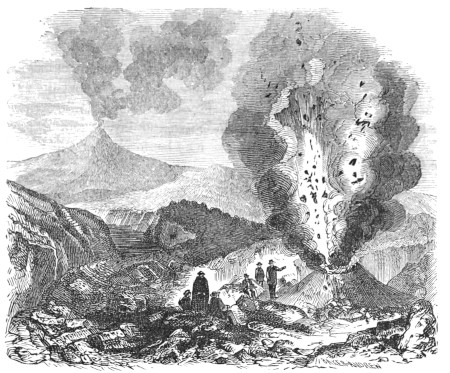
MOUNT HECLA AND THE GEYSERS.
The natives assert that it is impossible to ascend the mountain, on
account of the great number of dangerous bogs, which, according to them,
are constantly emitting sulphurous flames and exhaling smoke; while the
more elevated summit in the center is covered with boiling springs and
large craters, which continually propel fire and smoke. To the south and
west the environs present the most desolating results of frequent eruptions,
the finest part of the territory being covered by torrents of melted stone,
sand, ashes, and other volcanic matter; notwithstanding which, between the
sinuosities of the lava in different parts, some portion of meadows, walls
and broken hedges may be observed. The devastation is still greater on
the north and east sides, which present dreadful traces of the ruin of the
country and its habitations. Neither plants nor grass are to be met with to
the extent of two leagues round the mountain, in consequence of the soil
being covered with stones and lava; and in some parts, where the subterraneous
fire has broken out a second time, or where the matter which was not
entirely consumed has again become ignited, the fire has contributed to
form small red and black hillocks and eminences, from scoriæ, pumice-stones
and ashes. The nearer the mountain the larger are these hillocks,
and there are some of them, the summits of which form a circular hollow,
whence the subterraneous fire ejects the matter. On approaching Hecla
30the ground becomes almost impassable, particularly near the higher branches
of lava thrown from the volcano. Round the latter is a mountain of lava,
consisting of large fused stones, from forty to seventy feet high, and in the
form of a rampart or wall. These stones are detached, and chiefly covered
with moss; while between them are very deep holes, so that the ascent on
the western side requires great circumspection. The rocks are completely
reduced to pumice, dispersed in thin horizontal layers, and fractured in
every direction, from which some idea may be formed of the intensity of
the fire that has acted on them.
“There Winter, armed with terrors here unknown,
Sits absolute on his unshaken throne;
Piles up his stores amidst the frozen waste,
And bids the mountains he has built stand fast;
Beckons the legions of his storms away
From happier scenes to make the land a prey;
Proclaims the soil a conquest he has won,
And scorns to share it with the distant sun.”
Sir Joseph Banks, Dr. Solander, Dr. James Lind, of Edinburgh, and Dr.
Van Troil, a Swede, were the earliest adventurous travelers who ascended
to the summit of Mount Hecla. This was in 1772; and the attempt was
facilitated by a preceding eruption in 1766, which had greatly diminished
the steepness and difficulty of the ascent. On their first landing, they found
a tract of land sixty or seventy miles in extent, entirely ruined by lava,
which appeared to have been in a state of complete liquefaction. To accomplish
their undertaking, they had to travel from three hundred to three
hundred and sixty miles over uninterrupted tracts of lava. In ascending,
they were obliged to quit their horses at the first opening from which the
fire had burst: a spot, which they describe as presenting lofty glazed walls
and high glazed cliffs, differing from anything they had ever seen before.
At another opening above, they fancied they discerned the effects of boiling
water; and not far from thence, the mountain, with the exception of some
bare spots, was covered with snow. The difference of aspect they soon
perceived to be occasioned by the hot vapor ascending from the mountain.
The higher they proceeded, the larger these spots became; and, about two
hundred yards below the summit, a hole about a yard and a half in diameter,
was observed, whence issued so hot a stream, that they could not
measure the degree of heat with a thermometer. The cold now began to
be very intense. Fahrenheit’s thermometer, which at the foot of the mountain
was at fifty-four degrees, fell to twenty-four degrees; while the wind
became so violent, that they were sometimes obliged to lie down, from a
31dread of being blown into the most dreadful precipices. On the summit
itself they experienced, at one and the same time, a high degree of heat and
cold; for, in the air, Fahrenheit’s thermometer constantly stood at twenty-four
degrees, but when placed on the ground, it rose to one hundred and
fifty-three degrees.
Messrs. Olafsen and Povelsen, two naturalists, whose travels in Iceland
were undertaken by order of his Danish majesty, after a fatiguing journey
up several small slopes, which occurred at intervals, and seven of which
they had to pass, at length reached the summit of Mount Hecla at midnight.
It was as light as at noonday, so that they had a view of an immense extent,
but could perceive nothing but ice; neither fissures, streams of water,
boiling springs, smoke, nor fire, were apparent. They surveyed the glaciers
in the eastern part, and in the distance saw the high and square mountain
of Hærdabreid, an ancient volcano, which appeared like a large castle.
Sir G. S. Mackenzie, in his travels in Iceland, ascended Mount Hecla;
and from his account we extract the following interesting particulars.
In proceeding to the southern extremity of the mountain, he descended, by
a dangerous path, into a valley, having a small lake in one corner, and the
opposite extremity bounded by a perpendicular face of rock, resembling, in
its broken and rugged appearance, a stream of lava. While advancing, the
sun suddenly broke through the clouds, and the brilliant reflection of his
beams, from different parts of this supposed lava, as if from a surface of
glass, delighted our traveler by the instantaneous conviction that he had
now attained one of the principal objects connected with the plan of his
expedition to Iceland. He hastened to the spot, and all his wishes were
fully accomplished in the examination of an object which greatly exceeded
the expectations he had formed. On ascending one of the abrupt pinnacles,
which rose out of this extraordinary mass of rock, he beheld a region, the
desolation of which can scarcely be paralleled. Fantastic groups of hills,
craters, and lava, leading the eye to distant snow-crowned “jockuls,”
(inferior mountains,) the mist rising from a waterfall; lakes, embosomed
among bleak mountains; an awful profound silence; lowering clouds; marks
all around of the furious action of the most destructive of elements; all
combined to impress the soul with sensations of dread and wonder. The
longer he and his companions contemplated this scene, the more unable they
were to turn their eyes from it; and a considerable time elapsed before they
could bring themselves to attend to the business which had tempted them
to enter so frightful a district of the country.
Having proceeded a considerable distance along the edge of a stream of
lava, a narrow part of which they crossed, they gained the foot of the south
32end of Mount Hecla. While, in ascending, they had to pass over rugged
lava, they experienced no great difficulty in advancing; but when they
reached the steepest part of the mountain, which was covered with loose
slags, they sometimes lost at one step by the yielding of these, a space which
had been gained by several.
Having passed a number of fissures, by leaping across some, and stepping
along masses of slags which lay over others, they at length reached the
summit of the first peak. The clouds now became so thick, that they began
to despair of being able to proceed any further: it was, indeed, dangerous
even to move; for the peak consists of a very narrow ridge of slags, not
more than two feet broad, having a precipice on each side, several hundred
feet in depth. One of these precipices forms the side of a vast hollow, which
seems to have been one of the craters. At length the sky cleared a little,
and enabled them to discover a ridge below, which seemed to connect the
peak they had ascended with the middle or principal one. They lost no
time in availing themselves of this opportunity, and, by balancing themselves
like rope-dancers, succeeded in passing along a ridge of slags, so narrow
that there was scarcely room for their feet. After a short, but very steep
ascent, they gained the highest part of this celebrated mountain.
Its earliest eruption is said to have happened in 1004, since which time
upward of twenty have occurred. That of 1693 was the most dreadful, and
occasioned terrible devastations, the ashes having been thrown over the
island in every direction, to the distance of more than one hundred miles.
In 1728, a fire broke out among the surrounding lava; and also in that to
the west of the volcano, in 1754, which lasted for three days. There has not
been any eruption of lava since 1766; but for some years after, flames issued
from the volcano.
“Nor stops the restless fluid, mounting still,
Though oft amid th’ irriguous vale of springs;
But to the mountain courted by the sand,
That leads it darkling on in faithful maze,
Far from the parent main, it boils again!
Fresh into day; and all the glittering hill
Is bright with spouting rills.
The crystal treasures of the liquid world,
Through the stirred sands a bubbling passage burst;
And welling out, around the middle steep,
Or from the bottoms of the bosomed hills,
In pure effusion flow.”—Thomson.
33These celebrated fountains, or hot spouting water springs, being nearly
connected with the operations of subterraneous fire, so visible in every part
of Iceland, may be properly introduced after the description of Mount Hecla,
given above.
They are seldom very near the volcanoes, but are dispersed over the whole
country, and are even to be found on the summits of several of the ice
mountains. The largest and most remarkable of these is situated in a large
field, about sixteen miles to the north of Skalholt. At a great distance from
it, on one side, are high mountains covered with ice, and on the other Hecla
is seen rising above the clouds, while opposite to it is a ridge of rocks, at the
foot of which water from time to time rushes forth. At the distance of a
mile and a half, a loud roaring noise is heard, like that of a torrent precipitated
from stupendous rocks, each ejection being accompanied by violent
subterraneous detonations. The depth of the opening from which the water
rushes, has not been ascertained; but some seconds elapse before a stone
thrown in reaches the surface. The Danish traveler, Olafsen, asserts, that
the water rises as high as sixty fathoms: while Van Troil estimates the
highest jet at not more than sixty feet: the latter allows, however, that the
jets may be more elevated, particularly in bad weather. The greatness of
the explosive power is evinced by its not only preventing stones thrown in
from sinking, but even forcing them up to a very great hight, together with
the water, and splitting the pebbles into a thousand pieces. The heat was
found by Van Troil to be two hundred and twelve degrees of Fahrenheit,
the boiling point. The edges of the pipe or basin are covered by a coarse
stalactitic rind, and the water has been found to have a petrifying quality.
The opening is perfectly circular, in diameter nineteen feet, and forms above,
on the surface of the ground, a basin fifty-nine feet in diameter, the edge of
which is nine feet above the orifice or hole.
In speaking of the Geysers, or hot spouting springs, Horrebow observes,
that if you fill a bottle at one of them, the water it contains will boil three or
four times, at the same time with the water in the well. The inhabitants
boil their meat in it, by putting the meat in a vessel of cold water, which
they place in the hot spring.
Sir G. S. Mackenzie, whose travels in Iceland we have already cited,
visited the Geysers at a season favorable to his observations, the latter
end of July. He found the cultivation of the surrounding territory much
higher than might have been inferred from the idea generally entertained
of the barren and unproductive state of Iceland. All the flat ground in that
quarter of the island was swampy, but not so much so as to impede the
progress of the party, who, having passed several hot springs to the eastward
34of Skalholt, and others rising among the low hills they had left to the right,
in proceeding to the great Geyser, came to a farm-house, situated on a rising
ground in the midst of the bogs. Here the people were busily employed in
making hay, a scene which afforded a pleasing change from the dreary
solitude they had quitted. The whole of this extensive district, which abounds
in grass, would, if drained, our traveler observes, prove a very rich pasture
country. Farther on they came to several cottages at the foot of the mountain,
round which they turned, and came in sight of the hill having the
Geysers at one of its sides. This hill, in hight not more than three hundred
feet, is separated from the mountain, toward the west, by a narrow slip of
flat boggy ground, connected with that which extends over the whole valley.
Having crossed this bog, and a small river which ran through it, the party
came to a farm-house at the east end of the hill, and arrived at a spot where
the most wonderful and awful effects of subterraneous heat are exhibited.
On the east side of the hill there are several banks of clay, from some of
which steam rises in different places; and in others there are cavities, in
which water boils briskly. In a few of these cavities, the water being mixed
with clay, is thick and varies in color; but is chiefly red and gray. Below
these banks there is a gentle and uniform slope, composed of matter which,
at some distant period, has been deposited by springs which no longer exist.
The strata or beds thus formed, seemed to have been broken by shocks of
earthquakes, particularly near the great Geyser. Within a space not
exceeding a quarter of a mile, numerous orifices are seen in the old incrustations,
from which boiling water and steam issue, with different degrees of
force. At the northern extremity is situated the great Geyser, sufficiently
distinguishable from the others by every circumstance connected with it.
On approaching this spot, it appeared that a mount had been formed of
irregular, rough-looking depositions, upon the ancient regular strata, the
origin of which had been similar. The slope of the latter has caused the
mount to spread more on the east side; and the recent depositions of the
water may be traced till they coincide with them. The perpendicular hight
of the mount is about seven feet, measured from the highest part of the
surface of the old depositions. From these the matter composing the mount
may be readily distinguished, on the west side, where a disruption has taken
place. On the top of this mount is a basin, which was found to extend
fifty-six feet in one direction, and forty-six in another.
At a quarter before three o’clock in the afternoon, when the party reached
the spot, they found the basin full of hot water, a little of which was
running over. Having satisfied their curiosity at that time, they proceeded
to examine some other places, whence they saw water ascending. Above
35the great Geyser, at a short distance, they came to a large irregular opening,
the beauties of which, the writer observes, it is hardly possible to describe.
The water with which it was filled was as clear as crystal, and perfectly
still, although nearly at the boiling point. Through it they saw white
incrustations, forming a variety of figures and cavities, to a great depth,
and carrying the eye into a vast and dark abyss, over which the crust
supporting them formed a dome of an inconsiderable thickness; a circumstance
which though not of itself agreeable, contributed much to the effects
of this awful scene.
Having pitched their tent at the distance of about one hundred yards
from the Geyser, and so arranged matters that a regular watch might be
kept during the night, Sir G. S. Mackenzie took his station at eleven o’clock,
and his companions lay down to sleep. About ten minutes before twelve
he heard subterraneous discharges, and waked his friends. The water in
the basin was greatly agitated, and flowed over, but there was not any jet.
The same occurred at half past two. At five minutes past four on Saturday
morning, an alarm was given by one of the company. As our traveler lay
next the door of the tent, he instantly drew aside the canvas, when at the
distance of little more than fifty yards, a most extraordinary and magnificent
appearance presented itself. From a place they had not before noticed,
they saw water thrown up, and steam issuing with a tremendous noise.
There was little water; but the force with which the steam escaped, produced
a white column of spray and vapor, at least sixty feet high. They
enjoyed this astonishing and beautiful sight until seven o’clock, when it
gradually disappeared.
The remaining part of the morning was occupied in examining the
environs of the Geysers; and at every step they received some new gratification.
Following the channel which had been formed by the water escaping
from the great basin during the eruptions, they found several beautiful and
delicate petrifactions. The leaves of birch and willow were seen converted
into white stone, and in the most perfect state of preservation, every minute
fiber being entire. Grass and rushes were in the same state, and also masses
of peat. Several of these rare and elegant specimens were brought safely
to Great Britain. On the outside of the mount of the Geyser, the depositions,
owing to the splashing of the water, are rough and have been justly
compared to the heads of cauliflowers. They are of a yellowish brown
color, and are arranged around the mount, somewhat like a circular flight
of steps. The inside of the basin is comparatively smooth: and the matter
forming it is more compact and dense than the exterior crust; when polished
it is not devoid of beauty, being of a gray color, mottled with black
36andand white spots and streaks. The white incrustation formed by the water
of the beautiful cavity before described, had taken a very curious form at
the water’s edge, very much resembling the capital of a Gothic column.
This mountain of Iceland, distant about three miles from the village of
Krisuvik, presents a phenomenon very different from the one which has just
been described, viz., that of a CALDRON OF BOILING MUD. We extract the
following particulars of this singular curiosity from the relation given by
Sir G. S. Mackenzie in his travels in Iceland.
At the foot of the mountain is a small bank, composed chiefly of white
clay and sulphur, from every part of which steam issues. Having ascended
this bank, a ridge presents itself, immediately beneath which is a deep
hollow, whence a profusion of vapor arises, with a confused noise of boiling
and splashing, accompanied by steam escaping from narrow crevices in the
rock. This hollow, as well as the whole side of the mountain opposite,
being covered with sulphur and clay, it was very hazardous to walk over a
soft and steaming surface of such a description. The vapor concealing the
party from each other occasioned much uneasiness; and there was some
hazard of the crust of sulphur breaking, or of the clay sinking beneath
their feet. They were thus several times in danger of being scalded, as
indeed, happened to one of the party, Mr. Bright, who accidentally plunged
one of his legs into the hot clay. When the thermometer was immersed in
it, to the depth of a few inches, it generally rose to within a few degrees of
the boiling point. By stepping cautiously, and avoiding every little hole
from which steam issued, they soon ascertained how far they might venture.
Their good fortune, however, Sir George observes, ought not to tempt any
person to examine this wonderful place, without being provided with two
boards, with which every part of the banks may be traversed in perfect
safety. At the bottom of the hollow, above described, they found the
caldron of mud, which boiled with the utmost vehemence. They
approached within a few yards of it, the wind favoring them in viewing
every part of this singular scene. The mud was in constant agitation, and
often thrown up to the hight of six or eight feet. Near this spot was an
irregular space filled with water, boiling briskly. At the foot of the hill, in
a hollow formed by a bank of clay and sulphur, steam rushed with great
force and noise from among the loose fragments of rock.
In ascending the mountain, our travelers met with a spring of cold water,
which was little to be expected in such a place. At a greater elevation,
37they came to a ridge, composed entirely of sulphur and clay, joining two
summits of the mountain. The smooth crust of sulphur was beautifully
crystallized; and beneath it was a quantity of loose granular sulphur,
which appeared to be collecting and crystallizing, as it was sublimed along
with the steam. On removing the sulphurous crust, steam issued, and
annoyed the party so much, that they could not examine this place to any
depth.
Beneath the ridge, on the farther side of this great bed of sulphur, an
abundance of vapor escaped with a loud noise. Having crossed to the side
of the mountain opposite, they walked to what is called the principal spring.
This was a task of much apparent danger, as the side of the mountain to
the extent of about half a mile, was covered with loose clay, into which the
feet of our travelers sunk at every step. In many places there was a thin
crust, beneath which the clay was wet, and extremely hot. Good fortune
attended them; and without any serious inconvenience, they reached the
object they had in view. A dense column of steam, mixed with a small
portion of water, forced its way impetuously through a crevice in a rock, at
the head of a narrow valley, or break in the mountain. The violence with
which it rushed out was so great, that the noise, thus occasioned, might
often be heard at the distance of several miles. During the night while the
party lay in their tent at Krisuvik, they more than once listened to it with
mingled awe and astonishment. Behind the column of vapor was a dark-colored
rock, which added to the sublimity of the effect.
“It is quite beyond my power,” observes Sir George Mackenzie, “to offer
such a description of this extraordinary place, as would convey adequate
ideas of its wonders, or of its terrors. The sensations of a person, even of
firm nerves, standing on a support which feebly sustains him, over an abyss
where, literally, fire and brimstone are in dreadful and incessant action;
having before his eyes tremendous proofs of what is going on beneath him;
enveloped in thick vapors; his ears stunned with thundering noises—must
be experienced before they can be understood.”
“When mid the lifeless summits proud
Of Alpine cliffs, where to the gelid sky
Snows piled on snows in wint’ry torpor lie,
The rays divine of vernal Phœbus play;
Th’ awakened heaps, in streamlets from on high,
Roused into action, lively leap away,
Glad warbling through the vales, in their new being gay.”—Thomson.
38
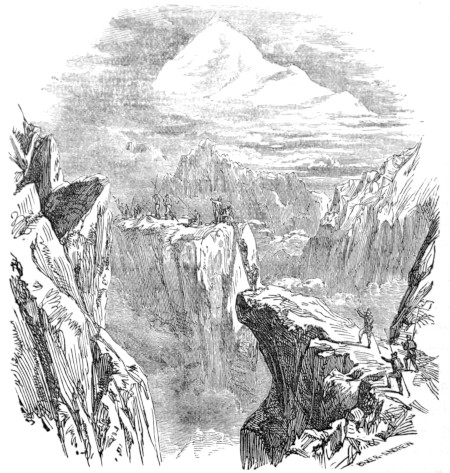
MONT BLANC AND THE GLACIERS.
This mountain, in Switzerland, so named on account of its white aspect,
belongs to the great central chain of the Alps. It is truly gigantic, and is
the most elevated mountain in Europe, rising no less than fifteen thousand,
eight hundred and seventy-two feet, somewhat more than three miles, above
the level of the sea, and fourteen thousand, six hundred and twenty-four
feet above the lake of Geneva, in its vicinity. It is encompassed by
those wonderful collections of snow and ice, called glaciers, two of the
principal of which, are called Mont Dolent and Triolet. The highest part
of Mont Blanc, named the Dromedary, is in the shape of a compressed
hemisphere. From that point it sinks gradually, and presents a kind of
concave surface of snow, in the midst of which is a small pyramid of ice.
It then rises into a second hemisphere, which is named the Middle Dome;
and thence descends into another concave surface, terminating in a point,
which among other names bestowed on it by the Savoyards, is styled “Dome
de Goute,” and may be regarded as the inferior dome.
39The first successful attempt to reach the summit of Mont Blanc was made
in August, 1786, by Doctor Paccard, a physician of Chamouny. He was
led to make the attempt by a guide, named Balma, who, in searching for
crystals, had discovered the only practicable route by which so arduous an
undertaking could be accomplished. The ascent occupied fifteen hours,
and the descent five, under circumstances of the greatest difficulty; the
sight of the doctor, and that of his guide, Balma, being so affected by the
snow and wind, as to render them almost blind, at the same time that the
face of each was excoriated, and the lips exceedingly swelled.
On the first of August of the following year, 1787, the celebrated and
indefatigable naturalist, M. de Saussure, set out on his successful expedition,
accompanied by a servant and eighteen guides, who carried a tent and
mattresses, together with the necessary accommodations and various instruments
of experimental philosophy. The first night they passed under the
tent, on the summit of the mountain of La Cote, four thousand, nine
hundred and eight-six feet above the Priory, a large village in the vale
of Chamouny, the journey thither being exempt from trouble or danger, as
the ascent is always over turf, or on the solid rock; though above this
place it is wholly over ice or snows.
Early next morning they traversed the glacier of La Cote, to gain the
foot of a small chain of rocks, inclosed in the snows of Mont Blanc. The
glacier is both difficult and dangerous, being intersected by wide, deep,
irregular chasms, which frequently can be passed only by three bridges of
snow, which are suspended over the abyss. After reaching the ridge of
rocks, the track winds along a hollow, or valley, filled with snow, which
extends north and south to the foot of the highest summit, and is divided
at intervals by enormous crevices. These show the snow to be disposed in
horizontal beds, each of which answers to a year, and notwithstanding the
width of the fissures, the depth can in no part be measured. At four in
the afternoon, the party reached the second of the three great platforms of
snow they had to traverse, and here they encamped, at the hight of nine
thousand, three hundred and twelve feet above the Priory, or twelve thousand,
seven hundred and sixty-eight feet (nearly two miles and a half) above the
level of the sea.
From the center of this platform, inclosed between the farthest summit
of Mont Blanc on the south, its high steps, or terraces, on the east, and the
Dome de Goute on the west, nothing but snow appears. It is quite pure,
of a dazzling whiteness, and on the high summits presents a singular contrast
with the sky, which in these elevated regions is almost black. Here
no living being is to be seen; no appearance of vegetation: it is the abode
40of cold and silence. “When,” observes M. de Saussure, “I represent to
myself Dr. Paccard and James Balma first arriving, on the decline of day,
in these deserts, without shelter, without assistance, and even without the
certainty that men could live in the places which they proposed to reach,
and still pursuing their career with unshaken intrepidity, it seems impossible
to admire too much their strength of mind and their courage.”
The company departed, at seven the next morning, to traverse the third
and last platform, the slope of which is extremely steep, being in some places
thirty-nine degrees. It terminates in precipices on all sides; and the surface
of the snow was so hard, that those who went foremost were obliged to cut
places for the feet with hatchets. The last slope of all presents no danger;
but the air possesses so high a degree of rarity, that the strength is speedily
exhausted, and on approaching the summit it was found necessary to stop
at every fifteen or sixteen paces to take breath. At eleven they reached the
top of the mountain, where they continued four hours and a half, during
which time M. de Saussure enjoyed, with rapture and astonishment, a view
the most extensive as well as the most rugged and sublime in nature, and
made those observations which have rendered this expedition important to
philosophy.
A light vapor, suspended in the lower regions of the air, concealed from
the sight the lowest and most remote objects, such as the plains of France
and Lombardy; but the whole surrounding assemblage of high summits
appeared with the greatest distinctness.
M. de Saussure descended with his party, and the next morning reached
Chamouny, without the smallest accident. As they had taken the precaution
to wear vails of crape, their faces were not excoriated, nor their sight
debilitated. The cold was not found to be so extremely piercing as it was
described by Dr. Paccard. By experiments made with the hygrometer, on
the summit of the mountain, the air was found to contain a sixth portion
only of the humidity of that of Geneva; and to this dryness of the air, M. de
Saussure imputes the burning thirst which he and his companions experienced.
The balls of the electrometer diverged three lines only, and the
electricity was positive. At times the air seems filled with electricity. A
recent traveler (1854) says, that, in the night, his guide having come out
from the cabin of the Grand Mulets, saw the ridges of the mountain apparently
all on fire. He immediately communicated what he had observed to
his companions, who all rushed to assure themselves of the fact, and then
they saw that through the electricity generated by the tempest, all the rocks
of the Grand Mulets were illuminated. They found the same phenomenon
on their own persons. When they raised their arms, their fingers became
41phosphorescent. M. de Saussure found it required half an hour to make
water boil, while at Geneva fifteen or sixteen minutes sufficed, and twelve
or thirteen at the seaside. None of his party discovered the smallest difference
in the taste or smell of bread, wine, meat, fruits or liquors, as some
travelers have pretended is the case at great hights; but sounds were of
course much weakened, from the want of objects of reflection. Of all the
organs, that of respiration was most affected, the pulse of one of the guides
beating ninety-eight times in a minute, that of the servant one hundred
and twelve, and that of M. de Saussure one hundred and one; while at
Chamouny, the pulsations respectively were forty-nine, sixty, and seventy-two.
A few days afterward, Mr. Beaufoy, an English gentleman, succeeded
in a similar attempt, although it was attended with greater difficulty,
arising from enlargements in the chasms in the ice.
A late traveler, wandering amid the same sublime scenery that has been
described, says:
“Mont Blanc is clearly visible from Geneva, perhaps once in the week, or
about sixty times in the year. When he is visible, a walk to the junction
of the Arve and the Rhone, either by the way of the plains on the Genevan
side, or by the hights on the side toward the south of France, affords a
wonderful combination of sublimity and beauty on the earth and in the
heavens. Those snowy mountain ranges, so white, so pure, so dazzling in the
clear azure depths, do really look as if they belonged to another world; as
if, like the faces of supernatural intelligences, they were looking sadly and
steadfastly on our world, to speak to us of theirs. Some of these mountain
peaks of snow you can see only through the perspective of other mountains,
nearer to you, and covered with verdure, which makes the snowy pyramids
appear so distant, so sharply defined, so high up, so glorious; it is indeed
like the voice of great truths stirring the soul. As your eye follows the
range, they lie in such glittering masses against the horizon, in such grand
repose; they shoot into the sky in bright weather in such infinite clearness,
so pure, so flashing; that they seem never to lose the charm of a sudden and
startling revelation to the mind. Are they not sublime images of the great
truths of God’s own word, that sometimes indeed are vailed with clouds, but
in fair weather do carry us, as in a chariot of fire and with horses of fire,
into eternity, into the presence of God? The atmosphere of our hearts is so
misty and stormy, that we do not see them more than sixty times a year in
their glory: if every Sabbath-day we get a view of them without clouds, we
do well; but when we see them as they are, then we feel their power, then
we are rapt by them from earth, away, away, away, into the depths of
heaven!
42“In some circumstances, when we are climbing the mountains, even the
mists that hang around them do add to the glory of the view; as in the
rising sun, when they are so penetrated with brightness, that they softly
rise over the crags as a robe of misty light, or seem like the motion of sweet
Nature breathing into the atmosphere from her morning altars the incense
of praise. And in the setting sun how often do they hang around the
precipices, glowing with the golden and crimson hues of the west, and
preventing us from clearly defining the forms of the mountains, only to
make them more lovely to our view. So it is sometimes with the very
clouds around God’s word, and the lights and shades upon it. There is an
inscrutability of truth which sometimes increases its power, while we wait
with solemn reverence for the hour when it shall be fully revealed to us;
and our faith, like the setting sun, may clothe celestial mysteries with a soft
and rosy-colored light, which makes them more suitable to our present
existence, than if we saw them in the clear and cloudless atmosphere of a
spiritual noon.
“You have a fine point for viewing Mont Blanc, without going out of the
city, from the ramparts on the west side of Rousseau’s island. Here a
brazen indicator is erected, with the names of the different mountain summits
and ridges, so that by taking sight across the index, you can distinguish
them at once. You will not mistake Mont Blanc, if you see him; but until
you get accustomed to the panorama, you may easily mistake one of his
court for the king, when the monarch himself is not visible.
“A still better point of view you will have at Coppet, ascending toward
the Jura. In proportion as you rise from the borders of the lake, every
part of the landscape becomes more beautiful, though what you wish to gain
is the most commanding view of the mountains, every other object being
secondary. In a bright day, nothing can be more clearly and distinctly
defined than Mont Blanc, with his attendant mighty ranges, cut in dazzling
snowy brightness against the clear blue sky. The sight of those glorious
glittering fields and mountains of ice and snow, produces immediately a
longing to be there among them. They make an impression upon the soul,
of something supernatural, almost divine. Although the whole scene lying
before you is so beautiful, (the lake, the verdant banks, the trees, and the
lower ranges of verdure-covered mountains, constituting in themselves alone
one of the loveliest pictures in the world,) yet the snowy ranges of Mont
Blanc are the grand feature. Those glittering distant peaks are the only
thing in the scene that takes a powerful hold upon the soul; but they do
quite possess it, and tyrannize over it, with an ecstatic thralldom. One is
43never wearied with gazing and wondering at the glory. I will lift up mine
eyes unto the hills, from whence cometh my help!
“Another admirable point, much farther from the lake and the city than
the preceding, and at a greater elevation, is what is called the promenade
of the point Sacconex. A fine engraving of this view is printed on letter-paper
for correspondence; but there is not sufficient distinctness given to
the outlines of Mont Blanc and the other summits of the glittering snowy
range, that seems to float in the heavens like the far-off alabaster walls of
Paradise. No language, nor any engraving, can convey the ravishing
magnificence and splendor, the exciting sublimity and beauty of the scene.
But there are days in which the air around the mountains seems itself of
such a hazy whiteness, that the snow melts into the atmosphere as it were,
and dies away in the heavens like the indistinct outline of a bright but
partially remembered dream. There are other days in which the fleecy
clouds, like vails of light over the faces of angels, do so rest upon and mingle
with the snowy summits, that you can hardly tell where one begins and the
other ends. Sometimes you look upon the clouds thinking they are mountains,
and then again Mont Blanc himself will be revealed in such far-off,
unmoving, glittering grandeur, in such wonderful distinctness, that there is
no mistaking the changeful imitations of his glory for the reality. Sometimes
the clouds and the mountains together are mingled in such a multitudinous
and interminable array of radiances, that it seems like the white-robed
armies of heaven with their floating banners, marching and countermarching
in front of the domes and jeweled battlements of the celestial city. When
the fog scenery (of which I shall give you a description) takes place upon
the earth, and at the same time there are such revelations of the snowy
summits in the heavens, and such goings on of glory among them, and you
get upon the mountain to see them, it is impossible to describe the effect, as
of a vast enchantment, upon the mind.
“The view of Geneva, the lake, and the Jura mountains from Coligny is
much admired; and at sunset, perhaps the world can not offer a more lovely
scene. It was here that Byron took up his abode; a choice which I have
wondered at, for you can not see Mont Blanc from this point, and therefore
the situation is inferior to many others. Ascending the hill farther to the
east, when you come to Col. Tronchin’s beautiful residence, you have
perhaps the finest of all the views of Mont Blanc, in or around Geneva. Go
upon the top of Col. Tronchin’s tower about half an hour before sunset, and
the scene is not unworthy of comparison even with the glory of the sunrise
as witnessed from the summit of the Righi. It is surprising to see how long
Mont Blanc retains the light of day, and how long the snow burns in the
44setting sun, after his orb has sunk from your own view entirely behind the
green range of the Jura. Then after a succession of tints from the crimson
to the cold gray, it being manifest that the sun has left the mountain to a
companionship with the stars alone, you also are ready to depart, the glory
of the scene being over, when suddenly and unaccountably the snowy summits
redden again, as if the sun were returning upon them, the countenance
of Mont Blanc is filled with rosy light, and the cold gray gives place for a
few moments to a deep warm radiant pink, (as if you saw a sudden smile
playing over the features of a sleeping angel,) which at length again dies in
the twilight. This phenomenon is extremely beautiful, but I know not how
to account for it; nor was any one of our party wiser than I; nevertheless,
our ignorance of causes need never diminish, but often increases the pleasure
of beautiful sights.”
“I have said I would give you a description of the ‘fog-scenery.’ In the
autumn, when the fogs prevail, it is often a thick drizzling mist in Geneva,
and nothing visible, while on the mountain tops the air is pure, and the sun
shining. On such a day as this, when the children of the mist tell you that
on the mountains it is fair weather, you must start early for the range nearest
Geneva, on the way to Chamouny, the range of the Grand Saléve, the base
of which is about four miles distant, prepared to spend the day upon the
mountains, and you will witness one of the most singular and beautiful
scenes to be enjoyed in Switzerland.
“The day I set out was so misty, that I took an umbrella, for the fog
gathered and fell like rain, and I more than doubted whether I should see
the sun at all. In the midst of this mist I climbed the rocky zigzag half
hewn out of the face of the mountain, and half natural, and passing the
village that is perched among the high rocks, which might be a refuge for
the conies, began toiling up the last ascent of the mountain, seeing nothing,
feeling nothing, but the thick mist, the vail of which had closed below and
behind me over village, path and precipice, and still continued heavy and
dark above me, so that I thought I never should get out of it. Suddenly my
head rose above the level of the fog into the clear air, and the heavens were
shining, and Mont Blanc, with the whole illimitable range of snowy mountain
tops around him, was throwing back the sun! An ocean of mist, as
smooth as a chalcedony, as soft and white as the down of the eider-duck’s
breast, lay over the whole lower world; and as I rose above it, and ascended
the mountain to its overhanging verge, it seemed an infinite abyss of vapor,
where only the mountain tops were visible, on the Jura range like verdant
wooded islands, on the Mont Blanc range as glittering surges and pyramids
of ice and snow. No language can describe the extraordinary sublimity
45and beauty of the view. A level sea of white mist in every direction, as
far as the eye could extend, with a continent of mighty icebergs on the one
side floating in it, and on the other a forest promontory, with a slight
undulating swell in the bosom of the sea, like the long, smooth undulations
of the ocean in a calm.
“Standing on the overhanging crags, I could hear the chime of bells, the
hum of busy labor, and the lowing of cattle, buried in the mist, and faintly
coming up to you from the fields and villages. Now and then a bird darted
up out of the mist into the clear sun and air, and sailed in playful circles,
and then dived and disappeared again below the surface. By and by the
wind began to agitate the cloudy sea, and more and more of the mountains
became visible. Sometimes you have a bright sunset athwart this sea of
cloud, which then rolls in waves burnished and tipped with fire. When you
go down into the mist again, and leave behind you the beautiful sky, a clear,
bracing atmosphere, the bright sun and the snow-shining mountains, it is
like passing from heaven to earth, from the brightness and serenity of the
one, to the darkness and cares of the other. The whole scene is a leaf in
nature’s book, which but few turn over; but how rich it is in beauty and
glory, and in food for meditation, none can tell but those who have witnessed
it. This is a scene in Cloud-land, which hath its mysteries of beauty, that
defy the skill of the painter and engraver.
“The poet Wordsworth has given two very vivid descriptions of these
mist phenomena, under different aspects from that in which I witnessed
them. The first is contained in his descriptive sketches of a pedestrian tour
among the Alps.
“‘’Tis morn: with gold the verdant mountain glows,
More high, the snowy peaks with hues of rose.
Far stretched beneath the many-tinted hills
A mighty waste of mist the valley fills,
A solemn sea! whose vales and mountains round
Stand motionless, to awful silence bound.
A gulf of gloomy blue, that opens wide
And bottomless, divides the midway tide.
Like leaning masts of stranded ships appear
The pines, that near the coast their summits rear.
Of cabins, woods and lawns a pleasant shore
Bounds calm and clear the chaos still and hoar.
Loud through that midway gulf ascending, sound,
Unnumbered streams with hollow roar profound.
Mount through the nearer mist the chant of birds,
And talking voices, and the low of herds,
The bark of dogs, the drowsy tinkling bell,
And wild-wood mountain lutes of saddest swell.’
46“But this extract is not to be compared for power to the following from
the same poem, describing an Alpine sunset after a day of mist and storm
upon the mountains.
“‘’Tis storm, and hid in mist from hour to hour,
All day the floods a deepening murmur pour.
The sky is vailed, and every cheerful sight,
Dark is the region as with coming night,
But what a sudden burst of overpowering light
Triumphant on the bosom of the storm
Glances the fire-clad eagle’s wheeling form.
Eastward, in long perspective glittering, shine
The wood-crowned cliffs, that o’er the lake recline.
Wide o’er the Alps a hundred streams unfold,
At once to pillars turned, that flame with gold.
Behind his sail the peasant tries to shun
The west, that burns like one dilated sun,
Where in a mighty crucible expire
The mountains, glowing hot, like coals of fire!’
“There was a time during the middle ages, when Chamouny was inhabited
by monks. The reigning lord of the country made a present of the
whole valley to a convent of Benedictine friars, in the eleventh century.
Two English travelers, Messrs. Pococke and Windham, drew attention to
its wonderful scenery in 1741, and now it is a grand highway of summer
travel, visited annually by three or four thousand people. A visit to Mont
Blanc has become a pilgrimage of fashion. Fashion does some good things
in her day; and it is a great thing to have the steps of men directed into
this grand temple of nature, who would otherwise be dawdling the summer
perhaps at immoral watering-places. A man can hardly pass through the
vale of Chamouny, before the awful face of Mont Blanc, and not feel that
he is an immortal being. The great mountain looks with an eye, and speaks
with a voice, that does something to wake the soul out of its slumbers.
“The sublime hymn by Coleridge, in the vale before sunrise, is the concentrated
expression of all the inspiring and heaven-directing influences of
the scenery. The poem is as remarkably distinguished above the whole
range of poetry in our language, for its sublimity, as the mountain itself
among all the great ranges of the Alps. I am determined to quote it in
full, for that and the tour of Mont Blanc ought to go together; and I will
present along with it the German original of the poem in twenty lines,
nearly as translated by Coleridge’s admiring and affectionate relative. I
am not aware that Coleridge himself ever visited the vale of Chamouny;
and if not, then that wonderful hymn to Mont Blanc was the work of
imagination solely, building on the basis of the original lines in German.
47This was a grand and noble foundation, it is true; but the hymn by
Coleridge was a perfect transfiguration of the piece, an inspiration of it
with a higher soul, and an investiture of it with garments that shine like
the sun. It was the greatest work of the poet’s great and powerful imagination,
combined with the deep worshiping sense of spiritual things in his
soul.
“On visiting the scene, one is apt to feel as if he could not have written
it in the vale itself: the details of the picture would have been somewhat
different; and, confined by the reality, one may doubt if even Coleridge’s
genius could have gained that lofty ideal point of observation and conception,
from which he drew the vast and glorious imagery that rose before him.
Not because the poem is more glorious than the reality, for that is impossible;
but because, in painting from the reality, the force and sublimity of his
general conceptions would have been weakened by the attempt at faithfulness
in the detail, and nothing like the impression of the aerial grandeur of the
scene, its despotic unity in the imagination, notwithstanding its variety,
would have been conveyed to the mind.
“Yet there are parts of it which at sunrise or sunset either, the poet
might have written from the very windows of his bedroom, if he had been
there in the dawn and evenings of days of such extraordinary brilliancy
and glory, as marked and filled the atmosphere, during our sojourn in that
blessed region. A glorious region it is, much nearer heaven than our
common world, and carrying a sensitive, rightly constituted mind far up in
spirit toward the gates of heaven, toward God, whose glory is the light of
heaven, and of whose power and majesty the mountains, ice-fields and
glaciers, whether beneath the sun, moon, or stars, are a dim, though grand
and glittering, symbol. ‘Fire and hail, snow and vapor, stormy wind,
fulfilling His word, mountains and all hills, fruitful trees and all cedars,
praise the Lord. He looketh on the earth and it trembleth; He toucheth
the hills, and they smoke.’
“The following is the original German hymn, in what the translator
denominates a very bald English translation, to be compared as a curiosity
with its glorification in Coleridge. It occupies but five stanzas of four lines,
and is entitled, ‘Chamouny at Sunrise. To Klopstock.’ I have here put it
into the metrical form of the original.
“Out of the deep shade of the silent fir-grove,
Trembling I survey thee, mountain-head of eternity,
Dazzling (blinding) summit, from whose vast hight
My dimly perceiving spirit floats into the Everlasting.
48“Who sank the pillar deep in the lap of earth
Which, for past centuries, fast props thy mass up?
Who uptowered, high in the vault of ether,
Mighty and bold, thy beaming countenance?
“Who poured you from on high, out of eternal Winter’s realm,
O jagged streams, downward with thunder-noise?
And who bade aloud, with the Almighty Voice,
‘Here shall rest the stiffening billows?’
“Who marks out there the path for the Morning Star?
Who wreathes with blossoms the skirt of eternal Frost?
To whom, wild Arveiron, in terrible harmonies,
Rolls up the sound of thy tumult of billows?
“Jehovah! Jehovah! crashes in the bursting ice!
Avalanche-thunders roll it in the cleft downward:
Jehovah! it rustles in the bright tree-tops;
It whispers murmuring in the purling silver-brooks.
“This is very grand. Who but a mighty poet, one seeing with ‘the
vision and the faculty divine’—what, but a transfusing, all-conquering
imagination—would have dared the attempt to compose another poem on the
same subject, or to carry this to a greater hight of sublimity, by melting it
down anew, so to speak, and pouring it out into a vaster, more glorious
mold? The more one thinks of it, the more he will see, in the poem so
produced, a proof most remarkable, of the spontaneous, deep-seated, easily
exerted, and almost exhaustless power and originality of Coleridge’s genius.
Now let us peruse, ‘with mute thanks and secret ecstacy,’ his own solemn
and stupendous lines.
HYMN BEFORE SUNRISE, IN THE VALE OF CHAMOUNY.
[Besides the rivers Arve and Arveiron, which have their sources in the foot of Mont Blanc, five
conspicuous torrents rush down its sides; and, within a few paces of the glaciers, the Gentiana Major
grows in immense numbers, with its ‘flowers of loveliest blue.’]
“Hast thou a charm to stay the Morning Star
In his steep course? so long he seems to pause
On thy bald, awful head, O Sovran Blanc?
The Arve and Arveiron at thy base
Rave ceaselessly; but thou, most awful form!
Risest from forth thy silent sea of pines,
How silently! Around thee and above,
Deep is the air, and dark, substantial, black;
An ebon mass: methinks thou piercest it
As with a wedge! But when I look again,
It is thine own calm home, thy crystal shrine,
Thy habitation from Eternity!
49“O dread and silent Mount! I gazed upon thee,
Till thou, still present to the bodily sense,
Didst vanish from my thought: entranced in prayer
I worshiped the Invisible alone.
“Yet, like some sweet, beguiling melody,
So sweet, we know not we are listening to it,
Thou, the meanwhile, wast blending with my thought,
Yea, with my life, and life’s own secret joy,
Till the dilating Soul, enrapt, transfused,
Into the mighty vision passing,—there,
As in her natural form, swelled vast to heaven!
“Awake my Soul! not only passive praise
Thou owest! not alone these swelling tears,
Mute thanks and secret ecstacy! Awake,
Voice of sweet song! Awake, my heart, awake!
Green vales and icy cliffs, all join my hymn.
“Thou first and chief, sole sovran of the vale
Oh, struggling with the darkness all night long,
And all night visited by troops of stars,
Or when they climb the sky, or when they sink!
Companion of the morning star at dawn,
Thyself earth’s rosy star, and of the dawn
Coherald: wake, oh wake, and utter praise!
Who sank thy sunless pillars deep in earth?
Who filled thy countenance with rosy light?
Who made thee parent of perpetual streams?
“And you, ye five wild torrents, fiercely glad!
Who called you forth from night and utter death,
From dark and icy caverns called you forth,
Down those precipitous, black, jagged rocks,
Forever shattered, and the same forever?
Who gave you your invulnerable life,
Your strength, your speed, your fury and your joy,
Unceasing thunder and eternal foam?
And who commanded (and the silence came,)
Here let the billows stiffen and have rest?
“Ye ice-falls! ye that from the mountain’s brow,
Adown enormous ravines slope amain—
Torrents, methinks, that heard a mighty voice,
And stopped at once, amidst their maddest plunge!
Motionless torrents! silent cataracts!
Who made you glorious as the gates of heaven
Beneath the keen full moon? Who bade the sun
Clothe you with rainbows? Who, with living flowers
Of loveliest blue, spread garlands at your feet?
God! let the torrents, like a shout of nations,
50Answer! and let the ice-plains echo, God!
God! sing, ye meadow-streams, with gladsome voice!
Ye pine-groves, with your soft and soul-like sounds!
And they, too, have a voice, yon piles of snow,
And in their perilous fall shall thunder, God!
“Ye living flowers, that skirt the eternal frost!
Ye wild goats sporting round the eagle’s nest!
Ye eagles, playmates of the mountain-storm!
Ye lightnings, the dread arrows of the clouds!
Ye signs and wonders of the elements!
Utter forth God! and fill the hills with praise!
“Thou, too, hoar Mount, with thy sky-pointing peaks,
Oft from whose feet, the avalanche, unheard,
Shoots downward, glittering through the pure serene
Into the depths of clouds, that vail thy breast;
Thou too again, stupendous mountain! thou,
That as I raise my head, awhile bowed low
In adoration, upward from thy base
Slow traveling with dim eyes suffused with tears,
Solemnly seemest, like a vapory cloud,
To rise before me,—Rise, oh ever rise!
Rise, like a cloud of incense, from the earth!
Thou kingly spirit throned among the hills,
Thou dread embassador from Earth to Heaven,
Great Hierarch! tell thou the silent sky,
And tell the stars, and tell yon rising sun,
Earth, with her thousand voices, praises God!
“Thanks to thee, thou noble poet, for giving this glorious voice to Alpine
nature, for so befitting and not unworthy an interpretation of Nature’s own
voice, in words of our own mother-tongue. Thanks to God for his grace
vouchsafed to thee, so that now thou praisest Him amidst the infinite host
of flaming seraphs, before the mount supreme of glory, where all the
empyrean rings with angelic hallelujahs! The creation of such a mind as
Coleridge’s, is only outdone by its redemption through the blood of the
Lamb. Oh, who can tell the rapture of a soul, that could give a voice for
nations to such a mighty burst of praise to God in this world, when its
powers, uplifted in eternity, and dilated with absorbing, unmingled, unutterable
love, shall pour themselves forth in the anthem of redemption, Worthy
is the Lamb that was slain!”
51
The three great glaciers, or ice-mountains, which descend from the flanks
of Mont Blanc, add their ice to that of the Miage, and present a majestic
spectacle, amid the astonishing succession of icy summits, of deep valleys,
and of wide chasms, which have become channels for the innumerable
torrents and cataracts with which these mountains abound. The view which
the glacier of Talafre affords from its center, looking toward the north, is as
extraordinary as beautiful. It rises gradually to the base of a semicircular
girdle, formed of peaks of granite of a great hight, and terminating in sharp
summits, extremely varied in their forms; while the intervals between these
peaks are filled up by ice, which falls into this mass, and this mass of ice is
crowned by masses of snow, rising in festoons between the black and vertical
tables of granite, the steepness of which does not allow them to remain. A
ridge of shattered wrecks divides this glacier lengthwise, and forms its most
elevated part, being eight thousand, five hundred and thirty-eight feet, or
upward of a mile and a half above the level of the sea. This prospect has
nothing in common with what is seen in other parts of the world. The
immense masses of ice, surrounded and surmounted by pyramidal rocks,
still more enormous in magnitude; the contrast between the whiteness of
the snow and the obscure colors of the stones, moistened by the water which
trickles down their sides; the purity of the air; the dazzling light of the
sun, which gives to these objects extraordinary brilliancy; the majestic and
awful silence which reigns in these vast solitudes, a silence which is only
interrupted at intervals by the noise of some great mass of granite, or of ice,
tumbling from the top of the mountain; and the nakedness of these elevated
rocks themselves, on which neither animals, shrubs, nor verdure are to be
seen, combined with the recollection of the fertile country and rich vegetation
which the adjacent valleys at so small a distance present; all tend to
produce a mixed impression of admiration and terror, which tempts the
spectator to believe, that he has been suddenly transported into a world
forgotten by the great Author of nature. One of these glaciers, that of
Triolet, is covered with the wrecks of another ice-mountain, which fell some
years ago, and buried many huts, flocks, and shepherds beneath its ruins.
These glaciers have their foundation in the wonderful Mer de Glace, or
Sea of Ice; shooting up from it their sharp peaks into the frozen air. “To
get the best view of it as a whole,” says a modern Alpine tourist, “you cross
the meadows in the vale of Chamouny, step over the furious Arve, and climb
52the mountain precipices to the hight of two thousand feet, by a rough,
craggy path, sometimes winding amidst a wood of firs, and sometimes
wandering over green grasses. At Montanvert you find yourself on the
extremity of a plateau, so situated, that on one side you may look down
into the dread frozen sea, and on the other, by a few steps, into the lovely
green vale of Chamouny! What astonishing variety and contrast in the
spectacle! Far beneath, a smiling and verdant valley, watered by the Arve,
with hamlets, fields and gardens, the abode of life, sweet children and
flowers; far above, savage and inaccessible crags of ice and granite, and a
cataract of stiffened billows, stretching away beyond sight—the throne of
death and winter.
“From the bosom of the tumbling sea of ice, huge granite needles shoot
into the sky, objects of singular sublimity, one of them rising to the great
hight of thirteen thousand feet, seven thousand above the point where you
are standing. This is more than double the hight of Mount Washington
in our country, and this amazing pinnacle of rock looks like the spire of an
interminable colossal cathedral, with other pinnacles around it. No snow
can cling to the summits of these jagged spires; the lightning does not
splinter them; the tempests rave round them; and at their base, those
eternal drifting ranges of snow are formed, that sweep down into the frozen
sea, and feed the perpetual, immeasurable masses of the glacier. Meanwhile,
the laughing verdure, sprinkled with flowers, plays upon the edges
of the enormous masses of ice, so near, that you may almost touch the ice
with one hand, and with the other pluck the violet. So, oftentimes, the ice
and the verdure are mingled in our earthly pilgrimage; so, sometimes, in
one and the same family, you may see the exquisite refinements and the
coarse repugnancies of human nature. So, in the same house of God, on
the same bench, may sit an angel and a murderer; a villain, like a glacier,
and a man with a heart like a sweet running brook in the sunshine.
“The impetuous arrested cataract seems as if it were plowing the rocky
gorge with its turbulent surges. Indeed, the ridges of rocky fragments
along the edges of the glacier, called moraines, do look precisely as if a
colossal iron plow had torn them from the mountain, and laid them along
in one continuous furrow on the frozen verge. It is a scene of stupendous
sublimity. These mighty granite peaks, hewn and pinnacled into Gothic
towers, and these rugged mountain-walls and buttresses—what a cathedral!
with this cloudless sky, by starlight, for its fretted roof; the chanting wail
of the tempest, and the rushing of the avalanche for its organ. How grand
the thundering sound of the vast masses of ice tumbling from the roof of the
Arve-cavern at the foot of the glacier! Does it not seem, as it sullenly and
53heavily echoes, and rolls up from so immense a distance below, even more
sublime than the thunder of the avalanche above us? We could tell better
if we could have a genuine upper avalanche to compare with it. But what
a stupendous scene! ‘I begin now,’ said my companion, ‘to understand
the origin of the Gothic architecture.’ This was a very natural feeling;
but, after all, it could not have been such a scene, that gave birth to the
great idea of that ‘frozen poetry’ of the middle ages. Far more likely it was
the sounding aisles of the dim woods, with their checkered green light, and
festooned, pointing arches.
“The colossal furrows of rocks and gravel along the edges of the ice at the
shores of the sea, are produced by the action of the frost and the avalanches,
with the march of the glacier against the sides of the mountains. Nothing
can be more singular than these ridges of mountain debris, apparently
plowed up and worked off by the moving of the whole bed of ice down
the valley. Near the shore, the sea is turbid with these rocks and gravel;
but as you go out into the channel, the ice becomes clearer and more glittering,
the crevices and fissures deeper and more dangerous, and all the
phenomena more astonishing. Deep, blue, pellucid founts of ice-cold water
lie in the opening gulfs; and sometimes, putting your ear to the yawning
fissures, you may hear the rippling of the rills below, that from the bosom
of the glacier are hurrying down to constitute the Arve, bursting furiously
forth from the great ice-cavern in the valley.
“This Mer de Glace is an easy and excellent residence for the scientific
study of the glaciers, a subject of very great interest, formerly filled with
mysteries, which the bold and persevering investigations and theories of
some modern naturalists have quite cleared up. The strange movements
of the glaciers, their apparent willful rejection of extraneous bodies and
substances to the surface and the margin, their increase and decrease, long
remained invested with something of the supernatural: they seemed to have
a soul and a life of their own. They look motionless and silent, yet they
are always moving and sounding on, and they have great voices that give
prophetic warning of the weather to the shepherds of the Alps. Scientific
men have set up huts upon the sea, and landmarks on the mountains
opposite, to test the progress of the icy masses, and in this way it was found
that a cabin constructed by Professor Hugi on the glacier of the Aar, had
traveled, between the years 1827 and 1840, a distance of forty-six hundred
feet. It is supposed that the Mer de Glace moves down between four and
five hundred feet annually.
“It is impossible to form a grander image of the rigidity and barrenness,
the coldness and death of winter, than when you stand among the billows
54of one of these frozen seas; and yet it is here that Nature locks up in her
careful bosom the treasures of the Alpine valleys, the sources of rich summer
verdure and vegetable life. They are hoarded up in winter, to be poured
forth beneath the sun, and with the sun in summer. Some of the largest
rivers in Europe take their rise from the glaciers, and give to the Swiss
valleys their most abundant supply of water, in the season when ordinary
streams are dried up. This is a most interesting provision in the economy
of nature, for if the glaciers did not exist, those verdant valleys into which
the summer sun pours with such fervor, would be parched with drought.
So the mountains are parents of perpetual streams, and the glaciers are
reservoirs of plenty.
“The derivation of the German name for glacier, gletscher, is suggested
as coming not from their icy material, but their perpetual motion, from
glitschen, to glide; more probably, however, from the idea of gliding upon
their surface. These glaciers come down from the air, down out of heaven,
a perpetual frozen motion, ever changing and gliding, from the first fall of
snow in the atmosphere, through the state of consolidated grinding blocks
of ice, and then into musical streams that water the valleys. First it is a
powdery, feathery snow, then granulated like hail, and denominated firn,
forming vast beds and sheets around the highest mountain summits, then
frozen into masses, by which time it has traveled down to within seven
thousand feet above the level of the sea, where commences the great ice-ocean
that fills the uninhabitable Alpine valleys, unceasingly freezing,
melting and moving down. It has been estimated by Saussure and others,
that these seas of ice, at their greatest thickness, are six or eight hundred
feet deep. They are traversed by deep fissures, and as they approach the
great precipices, over which they plunge like a cataract into the vales, they
are split in all directions, and heaved up into waves, reefs, peaks, pinnacles
and minarets. Underneath they are traversed by as many galleries and
caverns, through which run the rills and torrents constantly gathering from
the melting masses above. These innumerable streams, gathering in one as
they approach the termination of the glacier, rush out from beneath it,
under a great vault of ice, and thus are born into the breathing world, full-grown
roaring rivers, from night, frost and chaos.
“A peasant has been known to have fallen into an ice-gulf in one of these
seas, near one of the flowing sub-glacial torrents, and following the course
of the stream to the foot of the glacier, he came out alive! The German
naturalist, Hugi, set out to explore the recesses of one of the glaciers through
the bed of a former torrent, and wandered on in its ice-caverns the distance
of a mile. ‘The ice was everywhere eaten away into dome-shaped hollows,
55varying from two to twelve feet in hight, so that the whole mass of the
glacier rested at intervals on pillars, or feet of ice, irregular in size and
shape, which had been left standing. As soon as any of these props gave
way, a portion of the glacier would of course fall in and move on. A dim
twilight, scantily transmitted through the mass of ice above, prevailed in
these caverns of ice, not sufficient to allow one to read, except close to the
fissures, which directly admitted the daylight. The intense blue of the
mass of the ice contrasted remarkably with the pure white of the icy stalactites,
or pendents descending from the roof. The water streamed down
upon him from all sides, so that, after wandering about for two hours, at
times bending and creeping, to get along under the low vault, he returned
to the open air, quite drenched and half-frozen.’
“This sea of ice, which embosoms in its farthest recesses a little living
flower-garden, whither the humble-bees from Chamouny resort for honey, is
also bordered by steep lonely beds of the fragrant rhododendron, or rose
of the Alps. This hardy and beautiful flower grows from a bush larger than
our sweet-fern, with foliage like the leaves of the ivory-plum. It continues
blooming late in the season, and sometimes covers vast declivities on the
mountains at a great hight, where one would hardly suppose it possible for
a handful of earth to cling to the rocky surface. There, amid the snows and
ice of a thousand winters, it pours forth its perfume on the air, though there
be none to inhale the fragrance, or praise the sweetness, save only ‘the
little busy bees,’ that seem dizzy with delight, as they throw themselves
into the bosom of these beds of roses.
“Higher still on the opposite side of this great ice-sea, there are mountain-slopes
of grass at the base of stupendous rocky pinnacles, whither the
shepherds of the Alps drive their herds from Chamouny, for three months’
pasturage. They have no way of getting them there but across the dangerous
glacier; and it is said that the passage is a sort of annual celebration,
when men, women and children go up to Montanvert, to witness and assist
the difficult transportation. When the herds have crossed, one peasant
stays with them for the whole three months of their summer excursion,
living upon bread and cheese, with one cow among the herd to supply him
with milk. When he is not sleeping, he knits stockings, and ruminates as
contentedly as the browsing cattle, his only care being to increase his
store.”
Before we take our leave of Mont Blanc and of the Alps, the peculiarly
brilliant view from the summit of the Buet ought to be noticed. Never,
56says M. Bourrit, did prospect appear so vast. Toward the west, the Rhone
is seen, winding for the space of thirty-six leagues through the rich plains
of the Valais; the parts of the river which the mountains cover with their
shade seeming like threads of silver, and those which the sun illumines like
threads of gold. Beyond the river and its rich plains, the view extends to
the highest mountains of Switzerland, St. Gothard, and the Grisons, all
covered with ice; while on the east, the hights sink suddenly, from some of
the loftiest elevations on the globe, to level plains washed by the sea.
Geneva seems like a spot at one end of the lake, and the lake itself like a
sinuous band, dividing the fields which it waters. Beyond it are discovered
the vast plains of Franche Comte and Burgundy, the mountains of which
diminish by almost imperceptible gradations. Here the eye has neither
power nor extent of sight to embrace the whole of the objects presented to
its view. Amid the fearful aspect of the precipices which descend on every
side, what a contrast between the country decorated with all that is smiling
and gay, and the sublime spectacle of the Alps, their gloomy and aspiring
summits, and, above all, the prodigious hight of Mont Blanc, that enormous
colossus of snow and ice, which parts the clouds, and pierces to the very
heavens! Below this mountain, which bids defiance to time, and whose
eternal ice disregards the dissolving power of the sun, a band of pyramidical
rocks appear, the intervals between them being so many valleys of ice, the
immensity of which appalls the imagination. Their deep chasms may be
distinguished, and the noise of the frequent avalanches (falls of immense
masses of snow) presents to the mind the gloomy ideas of horror, devastation
and ruin. Farther on, other summits of ice prolong this majestic picture.
Among these are the high mountains of the St. Bernard, and those which
border on the Boromean islands.
Perhaps there is not in the old world a theater more instructive, or
more adapted for reflection, than the summit of this mountain. Where,
beside, can be seen such variety and contrast of forms; such results of the
efforts of time; such effects of all the climates, and of all the seasons? At
one glance may be embraced frosts equally intense with those of Lapland,
and the rich and delightful frontiers of Italy; eternal ice, and waving harvests;
all the chilling horrors of winter, and the luxuriant vegetation of
summer; eighty leagues of fertile plains, covered with towns, with vineyards,
with fields and herds, and adjoining to these, a depth of twenty thousand
feet of everlasting ice.
57
“Here, ’midst the changeful scenery, ever new,
Fancy a thousand wond’rous forms descries,
More wildly great than ever pencil drew;
Rocks, torrents, gulfs, and shapes of giant size,
And glittering cliffs on cliffs, and fiery ramparts rise.”—Beattie.
This Spanish mountain, which has been so long celebrated on account of
the singularity of its shape, but chiefly for its convent and its numerous
hermitages, is nine leagues north-west of Barcelona, in the province of
Catalonia. It is in hight only three thousand, three hundred feet above the
level of the sea, but it commands an enchanting prospect of the fine plain
of Barcelona, extending to the sea, as well as of the islands of Majorca and
Minorca, distant one hundred and fifty miles.
Toward Barcelona this mountain presents a bold and rugged front; but
on the west, toward Vacarisas, it is almost perpendicular, notwithstanding
which, a carriage-road winds round to the convent, which is placed in a
sheltered recess among the rocks, at about half the hight of the mountain.
The Llobregat roars at the bottom; and the rock presents perpendicular
walls from the edge of the water: but above the convent, the mountain
divides into two crowns or cones, which form the most prominent features;
while smaller pinnacles, blanched and bare, and split into pillars, pipes, and
other singular shapes, give a most picturesque effect. Here are seen fourteen
or fifteen hermitages, which are scattered over different points of the
mountain, some of them on the very pinnacles of the cones, to which they
seem to grow, while others are placed in cavities hewn out of the loftiest
pyramids. The highest accessible part of the mountain is above the hermitage
of St. Maddelena, the descent from which is between two cones, by a
flight of steps, called Jacob’s ladder, leading into a valley which runs along
the summit of the mountain. The cones are here in the most grotesque
shapes, the southern one being named the Organ, from its resemblance to
a number of pipes.
At the extremity of this valley, which is a perfect shrubbery, and on an
eminence, stands the hermitage of St. Jerome, the highest and most remote
of all; and near it is the loftiest station of the whole mountain, on which is
a little chapel dedicated to the Virgin. From this elevated pinnacle the
prospect is vast and splendid.
Although the elements have wreaked all their fury on these shattered
peaks, yet Nature has not been sparing in her gifts; the spaces between the
58rocks being filled up with close woods, while numerous evergreens, and
other plants, serve to adorn the various chasms, rendering them valuable
depositories of the vegetable kingdom. Few, indeed, are the evergreens of
Europe which may not be found here; and when the mountain was visited
by Mr. Swinburne, the apothecary of the convent had a list of four hundred
and thirty-seven species of plants, and forty of trees, which shoot up spontaneously,
and grace this hoary and venerable pile. There being two springs
only on the mountain, there is a scarcity of water, which is chiefly collected
in cisterns; an inconvenience, however, which is in a great measure
counterbalanced by the absence of wolves, bears, and other wild beasts.
Captain Carlton, an Englishman, who visited Montserrat some years ago,
ascended to the loftiest hermitage, that of St. Jerome, by the means of
spiral steps hewn out in the rock on account of the steep acclivity. This, he
observes, could not, in his time, be well accomplished by a stranger, without
following the footsteps of an old ass, who carried from the convent a daily
supply of food to the hermits. This animal having his two panniers stored
with the provisions divided into portions, climbed without a guide, and
having stopped at each of the cells, where the hermit took the portion
allotted to him, returned back to the convent. He found that one of these
hermits, to beguile the wearisomeness of his solitude, had contrived so
effectually to tame the birds which frequented the groves surrounding his
hermitage, that he could draw them together with a whistle, when they
perched on his head, breast, and shoulders, taking the food from his mouth.
The convent is situated on the eastern side of the mountain, which seems
to have been split by vast torrents of water, or by some violent convulsion
of nature: in this way a platform has been formed in the cleft, sufficiently
ample for the purpose of its construction. It is one of the forty-five religious
houses of the Spanish congregation of the order of St. Benedict. The
monks are bound to supply food and lodging for three days to all pilgrims
who come up to pay their homage to the Virgin; besides which, they entertain
the hermits on Sundays. The latter, who make a vow never to quit
the mountain, take their stations by seniority, the junior hermit being placed
at the greatest distance from the convent, and descending progressively as
the vacancies happen. They are not altogether idle, taking pains to rival
each other in making basket-work and other fanciful productions, which they
display with great affability to their visitors. They assemble every morning
to hear mass and perform divine service, in the parish church of St. Cecilia,
which lies considerably above the convent; and twice a week they confess
and communicate. They wear their beards long, and are clad in brown.
The church of St. Cecilia is a gloomy edifice, the gilding of which is
59much sullied by the smoke of eighty-five silver lamps, of various forms and
sizes, suspended round the cornice of the sanctuary. For the supply of
these with oil, funds have been bequeathed by devotees. The choir is
decorated with wood carvings, curiously wrought, representing the most
prominent passages in the life of Christ.
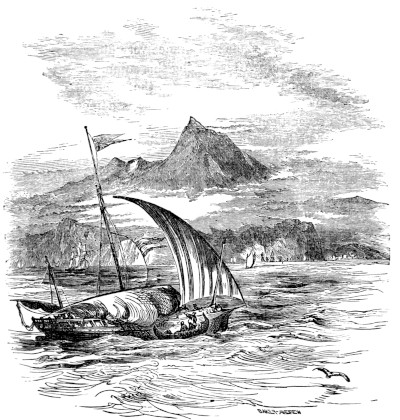
The island of Teneriffe has received its present name from the inhabitants
of the adjacent island Palma, in whose language tener signifies snow, and
iffe, a hill. In extent, wealth, and fertility it exceeds all the other Canary
islands. It continues to rise on all sides from the sea, until it terminates in
the celebrated peak represented in the cut, which is, however, situated
rather in the southern part than in the center of the island. The ascent on
60the north side is more gradual than at the other parts, there being a space
along the shore about three leagues in breadth, bounded on the sides by
high mountains, or rather cliffs; but more inland it rises like a hanging
garden all the way, without any considerable interruption of hills or valleys.
The form of this island is triangular, extending itself into three capes, the
nearest of which is about eighty leagues from the coast of Africa. In the
middle it is divided by a ridge of mountains, which have been compared to
the roof of a church, the peak forming the spire or steeple in the center.
The elevation of the peak of Teneriffe, according to the most accurate
measurement, made by Cordier, is twelve thousand, one hundred and sixty-six
feet, or nearly two miles and one-third above the level of the sea. In
the ascent, the first eminence is called Monte Verde, or the green mountain,
from the high fern with which it is covered, and presents a level plain of
considerable extent. Beyond this is the mountain of pines, which are said
to have formerly grown there in great abundance; but its steep sides are now
craggy and barren, and its whole appearance very different from that of the
eminence described above. After passing this summit, the traveler reaches
a plain, on which the natives have bestowed the name of Mouton de Trigo,
and upon which the peak in reality stands. It is a mountainous platform,
rising more than seven thousand feet, or nearly a mile and a half, above the
level of the sea; and here the currents of lava, hitherto concealed by the
vegetation, begin to appear in all their aridity and confusion, a few lowly
shrubs and creeping plants alone diversifying the surface of a desert, the
most arid and rugged that can be imagined.
A small sandy platform of pumice-stones, bordered by two enormous
currents of vitreous lava, and blocks of the same nature, ranged in a semicircle,
forms what is called the station of the English, on account of the
peak having been so often visited by British travelers. This platform is
ninety-seven hundred and eighty-six feet, or upward of a mile and three-quarters
above the level of the sea; and beyond it the acclivity is very steep,
great masses of scoriæ, extremely rough and sharp, covering the currents
of lava. Toward the summit, nothing but pumice-stone is to be seen. In
fact the peak can only be ascended on the east and south-east sides. As it
is impossible to get round the crater, the traveler’s progress is arrested at
the spot at which he reaches it. Here the two orders of volcanic substances
are to be seen, the modern lavas being thrown up amid the ruins of ejections
much more ancient, the immense masses of which constitute the platform
on which the peak is placed. The shattered sides present a series of thick
beds, almost all plunging toward the sea, composed alternately of ashes,
volcanic sand, pumice-stones, lavas, either compact or porous, and scoriæ.
61An incalculable number of currents, comparatively recent, which have
descended from the peak, or have issued from its flanks, form irregular
furrows, which run along the more ancient masses, and lose themselves in
the sea to the west and north. Among these currents more than eighty
craters are scattered, and augment with their ruins the confusion which
prevails throughout.
The crater can alone be reached by descending down three chasms. Its
sides are absolutely precipitous within, and are most elevated toward the
north. Its form is elliptical; its circumference about twelve hundred feet;
and its depth according to Cordier, one hundred and ten feet. Humboldt,
however, estimates it at not more than from forty to sixty feet. The sides
are, agreeably to the former of these observers, formed of an earth of snowy
whiteness, resulting from the decomposition of the blackest and hardest
vitreous porphyritic lava. All the rest is solid, and the lowest part occupied
by blocks, which have fallen down from the sides. These solid parts are
covered with shining crystals of sulphur, of a rhomboidal and octahedral
figure, some of which are nearly an inch high, and are, perhaps, the finest
specimens of native volcanic sulphur yet known. Vapors issue in abundance
from among these blocks, and from an infinity of fissures which preserve a
very intense heat. These vapors consist solely of sulphur and water, perfectly
insipid. Beside the incrustations of sulphur, opal, in thin plates, is
formed with great celerity. Humboldt regards the peak of Teneriffe as an
enormous basaltic mountain, resting upon a dense secondary calcareous
stone.
Various travelers have asserted, that the cold is intensely keen on the
summit of the peak; that respiration is difficult; and that, particularly,
spirituous liquors lose all their strength; which latter circumstance they
ascribe to the spirit being more or less exposed to the sulphureous fumes
exhaled from the crater. Cordier, and several other accurate observers,
declare, however, that neither the smell nor the strength of liquids appeared,
at this elevation, to be in the least degree impaired; and that volatile alkali,
ether, and spirit of wine, possessed their usual pungency. They add, that
the cold is very supportable; and that neither the aqueous sulphureous
vapors, nor the rarity of the air, render breathing difficult.
We extract the following interesting particulars from Humboldt’s account
of his visit to Teneriffe.
“Toward three in the morning, by the sombrous light of a few fir torches,
we began our expedition for the summit of the Piton. We scaled the
volcano on the north-east, where the declivities are extremely steep; and
came, after two hours’ toil, to a small plain, which on account of its isolated
62situation, bears the name of Alta Vista. It is the station also of the
Neveros, those natives whose occupation it is to collect ice and snow, which
they sell in the neighboring towns. Their mules, better practiced in climbing
mountains than those hired by travelers, reach Alta Vista, and the
Neveros are obliged to transport the snow to this place on their backs.
Above this point the Malpays begins; a term by which is designated here,
as well as in Mexico, Peru, and every other country subject to volcanoes, a
ground destitute of vegetable mold, and covered with fragments of lavas.
“We observed, during the twilight, a phenomenon which is not unusual
on high mountains, but which the position of the volcano we were scaling
rendered very striking. A layer of white and fleecy clouds concealed from
us the sight of the ocean, and the lower region of the island. This layer
did not appear above sixteen hundred yards high; the clouds were so
uniformly spread, and kept so perfect a level, that they wore the appearance
of a vast plain covered with snow. The colossal pyramid of the peak, the
volcanic summits of Lanzerota, of Fortaventura, and the isle of Palma,
were like rocks amidst this vast sea of vapors, and their black tints were in
fine contrast with the whiteness of the clouds.”
By an astronomical observation, made at the above elevation at sunrise, it
was ascertained that the true horizon, that is, a part of the sea, was distant
one hundred and thirty miles. Our traveler proceeds thus:
“We had yet to scale the steepest part of the mountain, the Piton, which
forms the summit. The slope of this small cone, covered with volcanic
ashes, and fragments of pumice-stone, is so steep, that it would have been
almost impossible to reach the top, had we not ascended by an old current
of lava, the wrecks of which have resisted the ravages of time. These
wrecks form a wall of scorious rocks, which stretches itself into the midst
of the loose ashes. We ascended the Piton by grasping these half-decomposed
scoriæ, the sharp edges of which remained often in our hands. We
employed nearly half an hour to scale a hill, the perpendicular hight of
which does not exceed five hundred feet.
“When we gained the summit of the Piton, we were surprised to find
scarcely room enough to seat ourselves conveniently. The west wind blew
with such violence that we could scarcely stand. It was eight in the morning,
and we were frozen with cold, though the thermometer kept a little
above the freezing point.
“The wall, which surrounds the crater like a parapet, is so high, that it
would be impossible to reach the Caldera, if on the eastern side there was
not a breach, which seems to have been the effect of a flowing of very old
lava. We descended through this breach toward the bottom of the tunnel,
63the figure of which is elliptical. The greatest breadth of the mouth
appeared to us to be three hundred feet, the smallest two hundred feet.
“We descended to the bottom of the crater on a train of broken lava,
from the eastern breach of the inclosure. The heat was perceptible only in
a few crevices, which gave vent to aqueous vapors, with a peculiar buzzing
noise. Some of these funnels or Crevices are on the outside of the inclosure,
on the external brink of the parapet that surrounds the crater. We plunged
the thermometer into them, and saw it rise rapidly to sixty-eight and seventy-five
degrees.
“We prolonged in vain our stay on the summit of the peak, to wait the
moment when we might enjoy the view of the whole of the archipelago of
the Fortunate islands. We discovered Palma, Gomera, and the Great
Canary, at our feet. The mountains of Lanzerota, free from vapors at sunrise,
were soon enveloped in thick clouds. On a supposition only of an
ordinary refraction, the eye takes in, in calm weather, from the summit of
the volcano, a surface of the globe of fifty-seven hundred square leagues,
equal to a fourth of the surface of Spain.
“Notwithstanding the heat we felt in our feet on the edge of the crater,
the cone of ashes remains covered with snow during several months in the
winter. It is probable, that under the cap of snow considerable hollows are
found, like those we find under the glaciers of Switzerland, the temperature
of which is constantly less elevated than that of the soil on which they
repose. The cold and violent wind which blew from the time of sunrise,
engaged us to seek shelter at the foot of the Piton. Our hands and faces
were frozen, while our boots were burnt by the soil on which we walked.
We descended in the space of a few minutes the sugar-loaf, which we had
scaled with so much toil; and this rapidity was in part involuntary, for we
often rolled down on the ashes. It was with regret that we quitted this
solitary place, this domain where Nature towers in all her majesty.”
To the above we subjoin the following extract from the account published
in the first volume of the Transactions of the Geological Society, by the
Hon. Mr. Bennet.
At the distance of thirty-four leagues from the island, Mr. Bennet had
a very distinct view of the peak, rising like a cone from the bed of the
ocean. The rocks and strata of Teneriffe, he observes, are wholly volcanic,
the long chain of mountains, which may be termed the central chain, traversing
the island from the foot of the second region of the peak, and sloping
down on the eastern, western and northern sides, to the sea. Toward the
south, or more properly the south-south-west, the mountains are nearly
perpendicular, and though broken into ridges, and occasionally separated by
64deep ravines, that are cut transversely as well as longitudinally, there are
none of those plains, nor that gradual declination of strata, which the south-eastern
and north-western sides of the island exhibit.
Mr. Bennet ascended the peak in the month of September, 1810. We
give the abridged details of this expedition in his own words.
“The road to the city of Orotava, is a gradual and easy slope for three or
four miles, through a highly cultivated country. Leaving the town, after a
steep ascent of about an hour, through a deep ravine, we quitted the cultivated
part, and entered into forests of chestnuts, the trees of which are of a
large size. The form of this forest is oblong; the soil is deep, and formed
of decomposed lava, small ash and pumice. I examined several channels in
the strata, or ravines worn by the rains, and there was no appearance of any
other rock. Leaving this forest, the track passes over a series of green hills,
which we traversed in about two hours, and at last halted to water our
mules at a spot where there is a small spring of bad and brackish water
issuing from a lava rock. The ravine is of considerable depth. The range
of green hills extends a mile or two further, the soil shallowing by degrees,
until at length the trees and shrubs gradually dwindling in size, the Spanish
broom alone covers the ground. Leaving behind us this range of green
hills, the track, still ascending, leads for several hours across a steep and
difficult mass of lava-rock, broken here and there into strange and fantastic
forms, worn into deep ravines, and scantly covered in places by a thin layer
of yellow pumice. As we proceeded on our road, the hills on our left
gradually rose in hight, till the summits were lost in those of the central
chain; while, on our right, we were rapidly gaining an elevation above the
lower range of the peak. We met with several small conical hills, or mouths
of extinct volcanoes, the decomposed lava on the edges of the craters having
a strong red ochreous tint. At length, an immense undulated plain spreads
itself like a fan, on all sides, nearly as far as the eye can reach. This plain
is bounded on the west-south-west and south-south-west, by the regions of
the peak; and on the east and north-east, by a range of steep perpendicular
precipices and mountains, many leagues in circumference, called by the
Spaniards Las Faldas. On this plain, or desert, for we had long left all
show of vegetation, except a few stunted plants of Spanish broom, a sensible
change was felt in the atmosphere; the wind was keen and sharp, and the
climate like that of England in the months of autumn. All here was sad,
silent and solitary. We saw at a distance the fertile plains on the coast,
lying as it were under our feet, and affording a cheerful contrast to the
scenes of desolation with which we were surrounded. We were already
65seven or eight thousand feet above the level of the sea, and had reached the
bottom of the second region of the peak.
“Having reached the end of the plain, we found ourselves at the bottom of
a steep hill, at the foot of which is a mass or current of lava. After a laborious,
not to say hazardous ascent of about an hour, the pumice and ash
gave way, and the mules sinking knee-deep at every step, we arrived at
about five in the afternoon at the other extremity of the stream of lava,
which, descending from the summit of the second region of the peak, divides
at the foot of the cone into two branches, the one running to the north-east,
and the other to the north-west. It was here we were to pass the night; so,
lighting a fire made of dry branches of the Spanish broom, and stretching a
part of a sail over a portion of the rock, we ate our dinner and laid ourselves
down to sleep. I, however, passed the best part of the night by the fire, the
weather being piercingly cold. As I stood by the fire, the view all around
me was wild and terrific; the moon rose about ten at night, and, though in
her third quarter, gave sufficient light to show the waste and wilderness by
which we were surrounded. The peak and the upper regions which we had
yet to ascend, towered awfully above our heads, while below, the mountains
that had appeared of such a hight in the morning, and had cost us a day’s
labor to climb, lay stretched as plains at our feet. From the uncommon
rarity of the atmosphere, the whole vault of heaven appeared studded with
innumerable stars, while the valleys of Orotava were hidden from our view
by a thin vail of light fleecy clouds, that floated far beneath the elevated
spot we had chosen for our resting-place; the solemn stillness of the night
was only interrupted by the crackling of the fire round which we stood, and
by the whistling of the wind, which coming in hollow gusts from the mountain,
resembled the roar of distant cannon.
“Between two and three in the morning, we resumed, on foot, our ascent
of the mountain, the lower part of which we had climbed on horseback the
preceding evening; the ascent, however, became much more rapid and
difficult, our feet sinking deep in the ashes at every step. From the uncommon
sharpness of the acclivity, we were obliged to stop often to take breath:
after several halts, we at last reached the head of the pumice hill. After
resting some short time here, we began to climb the stream of lava, stepping
from mass to mass. The ascent is steep, painful and hazardous; in some
places the stream of lava is heaped up in dykes or embankments; and we
were obliged to clamber over them as one ascends a steep wall.
“We halted several times during the ascent, and at last reached a spot
called La Cueva, one of the numerous caves that are found on the sides of
the mountain; this is the largest of them, and is filled with snow and the
66most delicious water, which was just at the point of congelation. The
descent into it is difficult, it being thirty or forty feet deep. One of our
party let himself down by a rope: he could not see the extent of the cave,
but the guides declared it to be three hundred feet in length, and to contain
thirty or forty feet of water in depth. The roof and sides are composed of
a fine stalactitic lava, similar to that found on Vesuvius, and it is of the
same nature as that which flowed on the surface. We rested here about
half an hour, during which we had an opportunity of observing the rising of
the sun, and that singular and rapid change of night into day, which is the
consequence of an almost entire absence of twilight. As we ascended the
north-east side of the mountain, this view was strikingly beautiful: at first
there appeared a bright streak of red on the horizon, which gradually spread
itself, lighting up the heavens by degrees, and growing brighter and brighter,
till at last the sun burst forth from the bed of the ocean, gilding as it rose
the mountains of Teneriffe, and those of the Great Canary; in a short time
the whole country to the eastward lay spread out as a map. The Great
Canary was easily to be distinguished; and its rugged and mountainous
character, similar to that of the other islands, became visible to the naked
eye. The cold at this time was intense, the wind keen and strong, and the
thermometer sunk to thirty-two degrees. After a short though rapid ascent,
we reached the summit of the second stage of the mountain, passing over a
small plain of white pumice, on which were spread masses of lava, and at
length arrived at the foot of the cone. This division of the mountain forms
what is generally termed the peak of Teneriffe: it represents the present
crater of Vesuvius, with this difference, however, that while the surface of
that mountain is composed of a black cinder or ash, the superfices of this
appear to be a deposit of pumice of a white color, of scoriæ and lava, with
here and there considerable masses that were probably thrown out when the
volcano was in action. Numerous small cavities on the side of the mountain
emitted vapor, with considerable heat. Here begins the only fatiguing part
of the ascent; the steepness of the cone is excessive; at each step our feet
sunk into the ash, and large masses of pumice and lava rolled down from
above; we were all bruised, and our feet and legs were cut, but not materially
hurt: at last we surmounted all difficulties, and seated ourselves on
the highest ridge of the mountain. This uppermost region does not appear
to contain in superficies more than an acre and a half, and is itself a small
crater, the walls of which are the different points on which we sat, and are
plainly visible from below. Within, the lava is in the most rapid state of
decomposition. The surface is hot to the feet, and the guides said it was
dangerous to remain long in one spot: as it was, some of us sunk to our
67knees in the hot deposit of sulphur. Upon striking the ground with the
feet, the sound is hollow, similar to what is produced by the same impulsion
on the craters of Vesuvius and Solfaterra. I estimate the depth of the
crater to be, from the highest ridge to the bottom, about two hundred feet,
forming an easy and gradual descent.
“The view from the summit is stupendous: we could plainly discover the
whole form of the island, and we made out distinctly three or four of the
islands, which, collectively, are called the Canaries; we could not, however,
see Lancerotte or Fuerteventura, though we were told that other travelers
had distinguished them all.
“From this spot, the central chain of mountains that run from south-west
to north-east, is easily to be distinguished. These, with the succession of
fertile and woody valleys, commencing from San Ursula, and ending at
Las Horcas, with the long line of precipitous lava rocks that lay on the right
of our ascent, and which traverse that part of the island running from east
to west, from their point of departure at the Canales, to where they end in
an abrupt headland on the coast, with their forests, and villages, and vineyards,
the port with the shipping in the roads, the town of Orotava, with
its spires glittering as the morning sun burst upon them, afford a cheerful
contrast to the streams of lava, the mounds of ash and pumice, and the
sulphurated rock on which we had taken our seat. The sensation of
extreme hight was in fact one of the most extraordinary I ever felt; and
though I did not find the pain in my chest arising from the rarity of the
atmosphere, by any means so acute as on the mountains of Switzerland, yet
there was a keenness in the air, independent of the cold, that created no
small uneasiness in the lungs. The respiration became short and quick,
and repeated halts were found necessary. The idea also of extreme hight
was to me more determinate and precise than on the mountains of Switzerland;
and though the immediate objects of vision were not so numerous,
yet as the ascent is more rapid, the declivity sharper, and there is here no
mountain like Mont Blanc towering above you, the twelve thousand feet
above the level of the sea appeared considerably more than a similar elevation
above the lake of Geneva. We remained at the summit about three-quarters
of an hour, our ascent having cost us the labor of four hours, as
we left La Estancia at ten minutes before three, and reached the top of the
peak before seven. Our thermometer, which was graduated to the scale of
Fahrenheit, was, during our ascent, as follows: at Orotava, at eight in the
morning, seventy-four degrees; at six in the evening, at La Estancia, fifty
degrees; at one, in the following morning, forty-two degrees; at La Cueva,
at half past four, thirty-two degrees; at the bottom of the cone, thirty-six
68degrees; at the top of the peak, one hour and a half after sunrise, thirty-three
degrees. The descent down the cone is difficult, from its extreme
rapidity, and from the fall of large stones, which loosen themselves from the
beds of pumice. Having at last scrambled to the bottom, we pursued our
march down the other course of the lava, that is to say, down its westerly
side, having ascended its eastern. The ravines and rents in this stream of
lava are deep and formidable; the descent into them is always painful and
troublesome, often dangerous: in some places we let ourselves down from
rock to rock. I can form no opinion why there should be these strange
irregularities in the surface of this lava; in places it resembles what sailors
term the trough of the sea, and I can compare it to nothing but as if the sea
in a storm, had by some force become on a sudden stationary, the waves
retaining their swell. As we again approached La Cueva, we came to a
singular steep valley, the depth of which, from its two sides, can not be less
than one hundred to one hundred and fifty feet, the lava lying in broken
ridges one upon the other, similar to the masses of granite rock that time
and decay have tumbled down from the top of the Alps; and, except from
the scoriæ, or what Milton calls ‘the fiery surge,’ they in no degree bear
the marks of having rolled as a stream of liquid matter.
“We descended the pumice hill with great rapidity, almost at a run, and
arrived at La Estancia in little more than two hours. We then mounted
our mules, and following the track by which we had ascended the preceding
day, we reached, about four o’clock, the country-house from which we had
started.”
The first eruption of which there is any distinct account, occurred on the
twenty-fourth of December, 1704, when twenty-nine shocks of an earthquake
were distinctly felt. On the thirty-first a great light was observed on Manja,
toward the White mountains. Here the earth opened, and two volcanoes
were formed, which threw up such heaps of stones as to raise two considerable
mountains: the combustible matter, which still continued to be thrown
up, kindled above fifty fires in the vicinity. The whole country for three
leagues round was in flames, which were increased by another volcano
opening by at least thirty different vents within the circumference of half a
mile. On the second of February following, another volcano broke out in
the town of Guimar, swallowing up a large church.
A subsequent eruption in 1706 filled up the port of Guarachico. The
lava, in its descent, ran five leagues in six hours; and on this lava, houses
are now built where ships formerly rode at anchor. Neither of these eruptions
was from the crater on the summit of the peak, for that has not
ejected lava for centuries, and it now issues from the flanks only. The last
69eruption was on the ninth of June, 1798, and was very terrible. Three
new mouths opened at the hight of eighty-one hundred and thirty feet, or
upward of a mile and a half above the level of the sea, upon the inclined
slope of the base of the peak toward the south-west. Above this, at the
hight of ten thousand, two hundred and forty feet, or nearly two miles, M.
Cordier found a vast crater nearly four miles and a half in circumference,
which lie ascertained to be very ancient. Its sides are extremely steep, and
it still presents the most frightful picture of the violence of subterraneous
fire. The peak rises from the sides of this monstrous aperture. To the
south-west is the mountain of Cahora, which is said to have become a
volcano in 1797. The other mountains of Teneriffe, which tradition reports
to have been formerly volcanoes, are Monte Roxo, or the red mountain;
several mountains, called the Malpasses, lying to the eastward; and one
(Rejada) in a southern direction. Throughout the whole of the distance
between Monte Roxo and the bay of Adexe, according to Mr. Glass, the
shore is about twenty-five hundred feet, or nearly half a mile in hight, and
perpendicular as a wall. The southern coast has a much superior elevation,
the chain of mountains by which it is bounded being, agreeably to St.
Vincent, eighty-three hundred and twenty feet, or more than a mile and a
half, above the level of the sea.
This volcanic mountain, the dreadful eruption of which we are about to
describe, is the most elevated and most northerly of the lofty chain running
through the West India island of St. Vincent. From the extraordinary
frequency and violence of the earthquakes, which in 1811, are calculated
to have exceeded two hundred, some great movement or eruption was looked
for. In the interim the mountain indicated much disquietude; but the
apprehension was not so immediate as to restrain curiosity, or to prevent
repeated visits to the crater, which had latterly been more numerous than
ever. Even on the twenty-sixth of April, 1812, the day preceding the
eruption, several gentlemen ascended and remained there for some time.
Nothing unusual was then remarked, nor any external difference observed,
except rather a stronger emission of smoke from the interstices of the
conical hill, at the bottom of the crater. To those who have not visited this
romantic and wonderful spot, a slight description of it, as it lately stood, is
previously necessary.
“About two thousand feet from the level of the sea, on the south side of
the mountain, and at rather more than two-thirds of its hight, opens a
70circular chasm, somewhat exceeding half a mile in diameter, and between
four hundred and five hundred feet in depth. Exactly in the center of this
capacious bowl, rose a conical hill about two hundred and sixty or three
hundred feet in hight, and about two hundred in diameter, richly covered
and variegated with shrubs, brushwood and vines, above half-way up, and
the remainder covered over with virgin sulphur to the top. From the
fissures of the cone and interstices of the rocks, a thin white smoke was
constantly emitted, occasionally tinged with a slight bluish flame. The
precipitous sides of this magnificent amphitheater were fringed with various
evergreens and aromatic shrubs, flowers, and many alpine plants. On the
north and south sides of the base of the cone were two pieces of water, one
perfectly pure and tasteless, the other strongly impregnated with sulphur
and alum. This lonely and beautiful spot was rendered more enchanting
by the singularly melodious notes of a bird, an inhabitant of these upper
solitudes, and altogether unknown to the other parts of the island, hence
principally called or supposed to be invisible, though it certainly has been
seen, and is a species of blackbird.
“A century had now elapsed since the last convulsion of the mountain,
or since any other elements had disturbed the serenity of this wilderness,
besides those which are common to the tropical tempest. It apparently
slumbered in primeval solitude and tranquillity, and from the luxuriant
vegetation and growth of the forest, which covered its side from the base
nearly to the summit, seemed to discountenance the fact, and falsify the
records of the ancient volcano. Such was the majestic, peaceful Souffriere,
on April the twenty-seventh; but our imaginary safety was soon to be confounded
by the sudden danger of devastation. Just as the plantation bell
rang at noon on that day, an abrupt and dreadful crash from the mountain,
with a severe concussion of the earth, and tremulous noise in the air,
alarmed all around it. The resurrection of this fiery furnace was proclaimed
in a moment by a vast column of thick, black, ropy smoke, like that of an
immense glass-house, bursting forth at once, and mounting to the sky;
showering down sand, gritty calcined particles of earth and ashes mixed, on
all below. This, driven before the wind toward Wallibou and Morne Ronde,
darkened the air like a cataract of rain, and covered the ridges, woods and
cane-pieces with light gray-colored ashes, resembling snow when slightly
covered by dust. As the eruption increased, this continual shower expanded,
destroying every appearance of vegetation. At night a very considerable
degree of ignition was observed on the lips of the crater; but it is not
asserted that there was as yet any visible ascension of flame. The same
awful scene presented itself on the following day; the fall of ashes and
71calcined pebbles still increasing, and the compact, pitchy column from the
crater rising perpendicularly to an immense hight, with a noise at intervals
like the muttering of distant thunder.
“On Wednesday, the twenty-ninth, all these menacing symptoms of
horror and combustion still gathered more thick and terrific for miles around
the dismal and half-obscured mountain. The prodigious column shot up
with quicker motion, dilating as it rose like a balloon. The sun appeared
in total eclipse, and shed a meridian of twilight over us, that aggravated
the wintry gloom of the scene, now completely powdered over with falling
particles. It was evident that the crisis was yet to come, that the burning
fluid was struggling for a vent, and laboring to throw off the superincumbent
strata and obstructions, which suppressed its torrent. At night, it was manifest
that it had greatly disengaged itself from its burden, by the appearance
of fire flashing above the mouth of the crater.
“On the memorable thirtieth of April, the reflection of the rising sun on
this majestic body of curling vapor was sublime beyond imagination: any
comparison of the Glaciers, or of the Andes, can but feebly convey an idea
of the fleecy whiteness and brilliancy of this awful column of intermingled
and wreathed smoke and clouds. It afterward assumed a more sulphureous
cast, like what are called thunder-clouds, and in the course of the day had
a ferruginous and sanguine appearance, with a much livelier action in the
ascent, and a more extensive dilatation, as if almost freed from every
obstruction. In the afternoon, the noise was incessant, and resembled the
approach of thunder still nearer and nearer, with a vibration that affected
the feelings and hearing: as yet there was no convulsive motion, or sensible
earthquake. The Charaibs settled at Morne Ronde, at the foot of the
Souffriere, abandoned their houses, with their live stock, and everything
they possessed, and fled precipitately toward town. The negroes became
confused, forsook their work, looked up to the mountain, and, as it shook,
trembled, with the dread of what they could neither understand or describe:
the birds fell to the ground, overpowered with showers of ashes, unable to
keep themselves on the wing; the cattle were starving for want of food, as
not a blade of grass or a leaf was now to be found; the sea was much
discolored, but not uncommonly agitated; and it is remarkable, that
throughout the whole of this violent disturbance of the earth, it continued
quite passive, and did not at any time sympathize with the agitation of the
land. About four o’clock in the afternoon, the noise became more alarming,
and just before sunset the clouds reflected a bright copper color, suffused
with fire. Scarcely had the day closed, when the flames burst at length
pyramidically from the crater, through the mass of smoke; the rolling of
72the thunder became more awful and deafening; electric flashes quickly
succeeded, attended with loud claps; and now, indeed, the tumult began.
Those only who have witnessed such a sight, can form any idea of the
magnificence and variety of the lightning and electric flashes; some forked
and zigzag, playing across the perpendicular column from the crater; others
shooting upward from the mouth like rockets of the most dazzling luster;
others like shells, with their trailing fuses, flying in different parabolas, with
the most vivid scintillations, from the dark sanguine column, which now
seemed inflexible, and immovable by the wind. Shortly after seven in the
afternoon, the mighty caldron was seen to simmer, and the ebullition of
lava to break out on the north-west side. This, immediately after boiling
over the orifice, and flowing a short way, was opposed by the acclivity of a
higher point of land, over which it was impelled by the immense tide of
liquefied fire which drove it on, forming the figure V in grand illumination.
Sometimes, when the ebullition slackened, or was insufficient to urge it
over the obstructing hill, it recoiled like a refluent billow, from the rock,
and then again rushed forward, impelled by fresh supplies, and, surmounting
every obstacle, carried rocks and woods together, in its course down the
slope of the mountain, until it precipitated itself down some vast ravine,
concealed from our sight by the intervening ridges of Morne Ronde. Vast
globular bodies of fire were seen projected from the fiery furnace, and,
bursting, fell back into it, or over it upon the surrounding bushes, which
were instantly set in flames. About four hours from the time of the lava’s
boiling over the crater, it reached the sea, as we could observe from the
reflection of the fire and electric flashes attending it. About half past one,
the following morning, another stream of lava was seen descending to the
eastward toward Rabacca. The thundering noise of the mountain, and the
vibration of sound that had been so formidable hitherto, now mingled in the
sudden monotonous roar of the rolling lava, became so terrible, that dismay
was almost turned into despair. At this time the first earthquake was felt;
this was followed by showers of cinders, which fell with the hissing noise of
hail, during two hours.
“At three o’clock, a rolling on the roofs of the houses indicated a fall of
stones, which soon thickened, and at length descended in a rain of intermingled
fire, which threatened at once the fate of Pompeii or Herculaneum.
The crackling coruscations from the crater at this period exceeded all that
had yet passed. The eyes were struck with a momentary blindness, and the
ears stunned with a confusion of sounds. People sought shelter in the
cellars, under rocks, or anywhere, for every place was nearly the same;
and the miserable negroes, flying from their huts, were knocked down, or
73wounded, and many killed in the open air. Several houses were set on fire.
The estates situated in the immediate vicinity, seemed doomed to destruction.
Had the stones which fell been heavy in proportion to their size, not a living
creature could have escaped death: these, having undergone a thorough
fusion, were divested of their natural gravity, and fell almost as light as
pumice, though in some places as large as a man’s head. This dreadful
rain of stones and fire lasted upward of an hour, and was again succeeded
by cinders from three till six o’clock in the morning. Earthquake followed
earthquake, almost momentarily; or rather the whole of this part of the
island was in a state of continued oscillation; not agitated by shocks vertical
or horizontal; but undulated like water shaken in a bowl.
“The break of day, if such it could be called, was truly terrific. Utter
darkness prevailed till eight o’clock, and the birth of May dawned like the
day of judgment: a chaotic gloom enveloped the mountain, and an impenetrable
haze hung over the sea, with black sluggish clouds of a sulphureous
cast. The whole island was covered with cinders, scoriæ, and broken
masses of volcanic matter. It was not until the afternoon, that the muttering
noise of the mountain sunk gradually into a solemn yet suspicious
silence. Such are the particulars of this sublime and tremendous scene,
from its commencement to its catastrophe.”
The singular peak represented in the cut, is in the island of Mauritius,
which lies in the Indian ocean, east of Madagascar. The island is about
one hundred and forty miles in circuit, and produces rice, sugar, cloves,
indigo, and various tropical fruits. It was first settled by the Dutch; but
the French gained possession of it in 1715. In 1810, the English took it,
and it is still held by them. The island seems to have been thrown up from
the sea by volcanic eruptions, as it everywhere bears marks of convulsions
by inward fires. In its central parts are wild craggy mountains, the summits
of which are always covered with snow. And among these is the peak
represented in the cut, which is eighteen hundred feet in hight, and surrounded
by dismal ravines. It is called Peter Botte’s mountain, from a
legend that a man of that name once ascended to the top. The general
belief, however, is, that it was never ascended till the year 1832, when the
top of it was reached by a party under Capt. Lloyd, an English engineer.
The exploit was one of the most hazardous, and the account of it is almost
painful to the reader, from the evident peril of the adventurers.
74
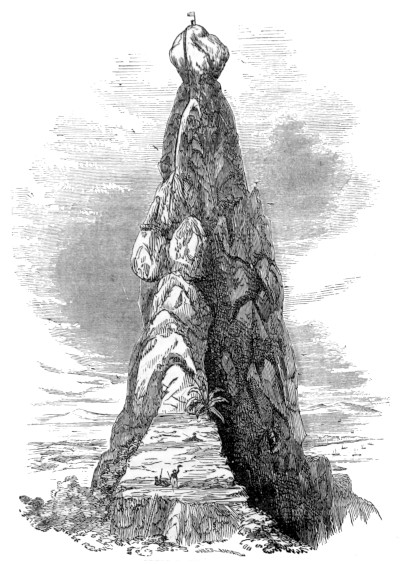
While on the subject of wonderful volcanoes, we must not omit to notice
one that has been called the “Niagara of volcanoes,” and the “king of
volcanoes,” viz., Kilauea, the great volcano of the Sandwich islands, which
is on the island of Hawaii, about thirty miles from Hilo bay. One of the
75missionaries, from whom we have the account, started to visit it on horseback;
but the way being rough and the animal unshod, he severely felt the
inconvenience of the lava, became discouraged, and moved so slowly, that
he was given up, and the missionary and his associate proceeded on foot.
“Toward evening,” he continues, “we reached Olaa, an inland settlement;
and the next day, before noon, had arrived at an elevation of some four
thousand feet, at a distance of twenty miles from Hilo bay.
“Approaching the great crater of Kilauea, we had a fine view of the magnificent
dome of Mauna Loa, stretching on some twenty miles beyond it, and
rising above it to the lofty hight of ten thousand feet. Evidences of existing
volcanic agency multiplied around us; steam, gas and smoke, issued from
the sulphur banks on the north-east and south-east sides of the crater, and
here and there, from deep and extended fissures connected with the fiery
subterranean agency; and as we passed circumspectly along the apparently
depressed plain that surrounds the crater, we observed an immense volume
of smoke and vapor ascending from the midst of it. At the same time, and
from the same source, various unusual sounds, not easily described or
explained, fell with increasing intensity on the ear. Then the angry abyss,
the fabled habitation and throne of Pele, the great idol goddess whom the
Hawaiians formerly worshiped, opened before us.
“Coming near to the rim, I fell upon my hands and knees, awe-struck, and
crept cautiously to the rocky brink; for with all my natural and acquired
courage, I was unwilling at once to walk up to the giddy verge, and look
down upon the noisy, fiery gulf beneath my feet. Shortly, however, I was
able to stand very near, and gaze upon this wonder of the world, which I
wish I could set before my readers, in all its mystery, magnitude and
grandeur. It is not a lofty cone, or mountain-top pointing to the heavens,
but a vast chasm in the earth, five or six times the depth of Niagara falls,
and seven or eight miles in circumference. It is situated on the flank of a
vast mountain, which has been gradually piled up by a similar agency
during the course of ages. Such is the immense extent and depth of
Kilauea, that it would take in, entire, the city of Philadelphia or New York,
and make their loftiest spires, viewed from the rim, appear small and low.
But neither cities nor meadows, nor water nor vegetation, can be found in
this chief of the deep places of the earth, but a lake of lava, some black and
indurated, some fiery and flowing, some cooling as a floating bridge over the
fathomless molten abyss, seven times hotter than Nebuchadnezzar’s hottest
furnace, and some bursting up through this temporary incrustation, rending
it here and there, and forming mounds and cones upon it. The immense
mass, laboring to escape, pressed against the great crater’s sides, which
76consist not of a frail ‘Chinese wall,’ built by human hands to resist human
strength, but an irregularly elliptical wall of basaltic rocks, extending a
thousand feet above the surface of the lava lake, and to unknown depths
below. Six hundred feet below, the verge stretches around horizontally, a
vast amphitheater gallery of black indurated lava, once fluid but now solid,
and on which an army of a hundred thousand men might stand to view the
sublime spectacle beneath, around, and above them.
“While through the eye, the impressions of grandeur, strong at first,
increased till the daylight was gone, the impressions received through the
ear, were peculiar, and by no means inconsiderable. The fiercely whizzing
sound of gas and steam, rushing with varying force through obstructed
apertures in blowing cones, or cooling crusts of lava, and the laboring,
wheezing, struggling, as of a living mountain, breathing fire and smoke and
sulphurous gas from his lurid nostrils, tossing up molten rocks or detached
portions of fluid lava, and breaking up vast indurated masses with varied
detonations, all impressively bade us stand in awe. When we reached the
verge, or whenever we came from a little distance to look over, these strange
sounds increased, as if some intelligent power, with threatening tones and
gestures, indignant at our obtrusiveness, were forbidding us to approach.
The effect of all this on aboriginal visitors, before the true God was made
known to them, may have been to induce or confirm the superstition, that a
deity or family of deities dwelt there, and recognized the movements of
men, and in various ways expressed anger against them. If my native
fellow-travelers had not been cured of their superstition, or had not known
me to be opposed to all idolatry, and particularly to the worship of Pele, the
goddess whom they once supposed dwelt there, they might naturally have
mistaken my almost involuntary prostration, as an act of religious homage
to this discarded Hawaiian deity. But the missionaries had set at naught
the tabus of this deity, and Kapiolani had openly invaded the same, and
descending into this crater had, in a fearless and Christian manner, there
acknowledged Jehovah as the only true God, and proclaimed to her countrymen
that this was but one of the fires which he has kindled and controls.
So that the natives now with me were ready devoutly to acknowledge all
this.
“When seven years before our visit, Messrs. Ellis, Thurston, Bishop and
Goodrich, accompanied by Mr. Harwood, visited this yawning gulf, they said
of it: ‘The bottom was filled with lava, and the south-west and northern
parts of it were one vast flood of liquid fire, in a state of terrific ebullition,
rolling to and fro its fiery surge and flaming billows. Fifty-one craters of
various forms and sizes, rose, like so many conical islands from the surface
77of the burning lake. Twenty-two constantly emitted columns of gray smoke
and pyramids of brilliant flame, and many of them at the same time vomited
from their ignited mouths, streams of fluid lava, which rolled in blazing
torrents down their black, indented sides, into the boiling mass of fire
below.’ The surface of this body of lava is subject to unceasing changes
from year to year; for ‘deep calleth unto deep’ continually, and the fiery
billows of this troubled ocean never rest.
“As night came on we took our station on the north side of the very brink,
where we supposed we should be able most securely and satisfactorily to
watch the action of this awful laboratory during the absence of the light of
the sun. Though the spot where we spread our blanket for a lodgment had
been considered as the safest in the neighborhood, there was room for the
feeling of insecurity which some who had preceded us have thus described.
‘The detachment of one small stone beneath, or a slight agitation of the
earth, would have precipitated us, amid the horrid crash of falling rocks,
into the burning lake.’ Had I thought the danger so imminent, I should
have deemed it prudent to take a position somewhat further off. The mass
which supported us had doubtless been shaken a thousand times, and was
liable every hour to be shaken again; but being in the short curvature of
the crater, like the key-stone of an arch, it could not easily be thrown from
its position by any agitation that would naturally occur while this great
safety-valve is kept open, or the numerous fissures round it, reaching to the
very bowels of the mountain, convey harmlessly from unknown depths, gases
and volumes of steam, generated where water comes in contact with intense
volcanic heat. Our position was about four thousand feet above the level
of the sea, and one thousand above the surface of the lake below us.
“The great extent of the surface of this lava lake; the numerous places in
it where the fiery element was displaying itself; the conical mouths here
and there discharging glowing lava overflowing and spreading its waves
around, or belched out in detached and molten masses that were shot forth
with detonations, perhaps by the force of gases struggling through from
below the surface, while the vast column of vapor and smoke ascended up
toward heaven, and the coruscations of the emitted brilliant lava, illuminating
the clouds that passed over the terrific gulf, all presented by night a
splendid and sublime panorama of volcanic action, probably nowhere
surpassed, if ever equaled, and which to be imagined must be seen. Had
Vulcan employed ten thousand giant Cyclops, each with a steam-engine of
a thousand horse-power, blowing anthracite coal for smelting mountain
minerals, or heaving up and hammering to pieces the everlasting rocks and
78hills, their united efforts would but begin to compare with the work of
Pele here.
“There was enough of mystery connected with the wonderful experiments
going on before our eyes, to give ample employment to fancy and philosophy,
and materially to enhance the sublimity of the fearful scene. For it might
be asked, how can such an immense mass of rocks and earth be kept
incessantly in a state of fusion without fuel or combustion? Or by what
process could such solid masses be fused at all, in accordance with any mode
of generating heat with which we are acquainted? If there be combustion
in the crater adequate to the melting of such vast masses of substances so
hard, rocky and earthy, why is there an accumulation and increase of the
general mass, so that millions of cubic fathoms are, from time to time, added
to the solid contents of the mountain? But if the bowels of the mountain
are supposed to be melted by intense heat in some way generated, could
they be heaved up by the expansion of steam or gas, while an orifice equal
to three or four square miles, like that of Kilauea, or the terminal crater on
the same mountain, is kept open; for steam and gas might be supposed to
pass through the fluid masses and escape, instead of raising them from a
depth, just as steam issues from the bottom of a boiling caldron, without
materially elevating the surface of its contents.
“But if with one class of geologists, we suppose the interior of the earth to
be in a molten and fluid state, as perhaps originally created, and that
Kilauea and other volcanoes are but the openings and safety-valves of that
subterranean, fiery, central ocean of red or white-hot matter, then we have
here no faint illustration of the bold imagery used by the sacred writers,
and of their phraseology, which to some seems hyperbolical and even paradoxical,
as when they speak of the ‘bottomless pit,’ the ‘fire that is not
quenched,’ ‘the lake that burneth with fire and brimstone,’ ‘the smoke
of their torment which ascendeth up forever and ever.’ If such a vast
mass of fiery fluid constitutes the main portion of the interior of the earth,
it is literally ‘bottomless;’ and the opened surface, like that of Kilauea,
may be strictly called a ‘lake of fire;’ and as sulphur and particles of the
sulphuret of iron are present, it may well be called ‘a lake that burns with
fire and brimstone.’
“After gazing at the wonderful and wonderfully sublime scene for some
twenty hours, taking but a little time for repose, we found the sense of fear
subsiding, and curiosity prompting to a closer intercourse with Pele, and a
more familiar acquaintance with her doings and habits. Many who try the
experiment, though at first appalled, are ready after a few hours, to wend
their way down the steep sides of the crater. Thus we descended into the
79immense pit from the north-east side, where it was practicable, first to the
black ledge or amphitheater gallery, and thence to the surface of the lava
lake. This we found extremely irregular, presenting cones, mounds, plains,
vast bridges of lava recently cooled, pits and caverns, and portions of considerable
extent in a movable and agitated state. We walked over lava
which, by some process, had been fractured into immensely large slabs, as
though it had been contracted by cooling, or been heaved up irregularly by
the semi-fluid mass below. In the fissures of this fractured lava, the slabs
or blocks two feet below the surface, were red-hot. A walking-stick thrust
down would be set on fire and flame instantly.
“Passing over many masses of such lava, we ventured toward the more
central part of the lake, and came near to a recent mound which had
probably been raised on the cooling surface, after our arrival the day before.
From the top of it flowed melted lava, which spread itself in waves to a
considerable distance, one side or the other, all around. The masses thrown
out in succession moved sluggishly, and as they flowed down the inclined
plane, a crust was formed over them, which darkened and hardened, and
became stationary, while the stream still moved on below it. The front of
the mass, red-hot, passed along down, widening and expanding itself, and
forcing its way through a net-work, as it were, of irregular filaments of iron,
which the cooling process freely supplied. This motion of a flowing mass,
whether smaller or larger, seen from the rim of the crater by night, gives
the appearance of a fiery surf, or a rolling wave of fire, or the dancing along
of an extended semicircular flame on the surface of the lake. When one
wave has expended itself, or found its level, or otherwise become stationary,
another succeeds and passes over it in like manner, and then another, sent
out as it were, by the pulsations of the earth’s open artery, at the top of the
mound. This shows how a mound, cone, pyramid, or mountain, can be
gradually built of lava, and wide plains covered at its base with the same
material.
“We approached near the border of some of these waves, and reached the
melted lava with a stick two yards long; and thus obtained several specimens
red-hot from the flowing mass. I have since had occasion to be
surprised at the absence of fear in this close contiguity with the terrible
element, where the heat under our feet was as great as our shoes would
bear, and the radiating heat from the moving mass was so intense that I
could face it only a few seconds at a time at a distance of two or three yards.
Yet having carefully observed its movements awhile, I threw a stick of wood
upon the thin crust of a moving wave where I believed it would bear me,
even if it should bend a little, and stood upon it a few moments. In that
80position, thrusting my cane down through the cooling, tough crust, about
half an inch thick, I withdrew it, and forthwith there gushed up of the
melted, flowing lava under my feet, enough to form a globular mass two and
a half or three inches in diameter, which, as it cooled, I broke off and bore
away as spoils from the ancient domain and favorite seat of the great idol
goddess of the Hawaiians. Parts that were in violent action we dared not
approach.
“There is a remarkable variety in the volcanic productions of Hawaii; a
variety as to texture, form and size, from the vast mountain and extended
plain, to the fine-drawn and most delicate vitreous fiber, the rough clinker,
the smooth stream, the basaltic rock, and masses compact and hard as
granite or flint, and the pumice or porous scoriæ, or cinders, which, when
hot, probably formed a scum or foam on the surface of the denser molten
mass. Considerable quantities of capillary glass are produced at Kilauea,
though I am not aware that the article is found elsewhere on the islands.
Its production has been deemed mysterious. In its appearance it resembles
human hair, and among the natives is familiarly called ‘Lauoho o Pele,’
the hair of Pele. It is formed, I presume, by the tossing off of small
detached portions of lava of the consistence of melted glass, from the mouths
of cones, when a fine vitreous thread is drawn out between the moving
portion, and that from which it is detached. The fine-spun product is then
blown about by the wind, both within and around the crater, and is collected
in little locks or tufts.
“Sulphur is seen, but in small quantities, in and around the crater; and at
a little distance from the rim there are yellow banks, on which beautiful
crystals of sulphur may be found. In one place, a pool of pure distilled
water, condensed from the steam that rises from a deep fissure, affords the
thirsty traveler a beverage far better than that of the ordinary distiller.
There is, however, a kind of sulphurous gas produced by the volcano, which
is highly deleterious if breathed often or freely. This is one source of
danger to the visitor, which, while I was down a thousand feet below the
rim, produced a temporary coughing.
“I was, perhaps, too venturesome, but other visitors have been far more so.
As one instance of this, Dr. Judd, having become familiar with the volcanic
power, in his ardor to secure valuable and recent specimens for the United
States exploring expedition, on the visit of Commodore Wilkes and his company
to this crater, descended to the surface of the lake, and then into a
sub-crater in the midst of the larger. While he was busily engaged there
in collecting specimens, a sudden bursting up of a huge volume of fluid lava
from the bottom of the sub-crater, alarmed him, and threatened speedily to
81overwhelm and destroy him. He sprang to escape, but finding the rim
overhanging, he could not scale it where he was; and the flowing mass was
now too near to allow him to return to the place where he had descended;
and its radiating heat was too intense to be faced. Escape without assistance
was utterly hopeless; and the natives of the company who were about
the brink, and from whom such help might have been expected, alarmed for
themselves, were flying for their lives. Dr. Judd, giving himself up for lost,
offered a prayer to heaven, and was about to resign himself to his fate, when
a friendly and resolute Hawaiian, who had been a pupil at the mission
seminary, compassionating the exposed sufferer, faced the approaching fiery
volume, and braving its intense heat, exposed his own life, reached down his
strong hand, and firmly grasped the doctor’s, who thus, at the last available
moment, through their united exertions and the blessing of heaven, escaped
with his life from the horrible pit and a fiery grave! A mighty current
instantly overflowed the place where they had just been standing, and they
were obliged to run for their lives before the molten flood; and being able
to outstrip it, they ascended from the surface of the abyss to the lofty rim,
with heartfelt thanksgivings to their great deliverer.[1] This proves the real
danger of descending too far into the crater of the volcano; and had it
occurred in the days of unbroken superstition, it would doubtless have been
ascribed to the anger of Pele, and tended to increase the number of her
deluded worshipers. But now such a deliverance was justly ascribed to
the kind providence of Jehovah, the knowledge of whose character, as
displayed in the gospel, has introduced the Hawaiian race into a new life.
“Kilauea may be regarded as one of the safety-valves of a bottomless
reservoir of melted earth, below the cooled and cooling crust on which
mountains rise, rivers flow, oceans roll, and cities are multiplied as the
habitations of men. It has been kept open from time immemorial, always
displaying more or less of its active power. The circumambient air which
carries off the caloric, sometimes aided by rain, is incessantly endeavoring
to shut up this valve, or bridge over this orifice of three or four square miles
of the fiery abyss. Sometimes the imperfect bridge of cooling lava is pierced
with fifty or sixty large, rough, conical chimneys, emitting gas, smoke, flame,
and lava; and sometimes the vast bridge is broken up, and all these cones
submerged and probably fused again by the intense heat of the vast fluid
mass supplied fresh from the interior. The mass rises gradually higher and
higher, hundreds of feet, till by its immense pressure against the sides of the
crater, aided, perhaps, by the power of gas or steam, it forces a passage for
82miles through the massive walls, and inundates with its fiery deluge some
portion of the country below, or passing through it, as a river of fire, pours
itself into the sea at the distance of twenty-five miles, thus disturbing with
awful uproar the domains of old Neptune, and enlarging the dominions of
the Hawaiian sovereign.
“The whole island, with its ample and towering mountains, is often shaken
with awful throes, and creation here ‘groaneth and travaileth in pain.’ In
July, 1840, a river of lava flowed out from Kilauea, and passing some miles
under ground, burst out in the district of Puna, and inundated a portion of
the country, sweeping down forests, carrying everything in its way before it,
and as a river a mile wide, falling into the sea, and heating the waters of the
ocean, making war upon its inhabitants, and by the united action of this
volcanic flood and the sea, formed several huge, rough hills of sand and lava
along the shore. And still later than the above date, a similar flood has
been poured from the summit of Mauna Loa, flowing with terrific force for
weeks, and thus elevating a portion of the region between Mauna Loa and
Mauna KeaKea; and so extensive and splendid was this exhibition, that it could
be seen from the missionary station at Hilo, a distance of about forty miles.
“After having spent some thirty hours on this king of all the volcanoes, we
set out to return. And on our journey we passed over several large tracts
of lava of different kinds, some smooth, vitreous and shining, some twisted
and coiled like huge ropes, and some consisting of sharp, irregular, loose,
rugged volcanic masses, of every form and size, from an ounce in weight to
several tuns, thrown, I could not conceive how, into a chaos or field of the
roughest surface, presenting a forbidding area of from one to forty square
miles in extent; and though not precipitous, yet so horrid as to forbid a
path, and to defy the approach of horses and cattle. In the crevices of the
more solid lava are found the ohelo, which somewhat resembles the whortleberry,
nourished by frequent showers and dew. At ten o’clock we halted
for breakfast, and by the time the sun was setting had reached Waimea,
thus completing our excursion to this vast volcano, which is truly one of the
wonders of the world!”
This peak consists of a chain of high mountains in the county of Derby, in
England, and has been long celebrated, as well on account of its mineral
productions, and natural curiosities in general, as of what are called its seven
wonders. Six of these are natural, namely, Poole’s Hole, Elden Hole, the
Peak Cavern, or the Devil’s Hole, Mam Tor, St. Ann’s Well, and the Ebbing
83and Flowing Well. Having described these, we shall add a more recent
discovery, that of the Crystallized Cavern, which possesses an equal interest.
Poole’s Hole, lying about a mile to the westward of Buxton, is a vast
cavern formed by nature in the limestone rock, and was, according to
tradition, the residence of an outlaw, named Poole. The entrance is low
and contracted, and the passage narrow; but this widening, at length, leads
to a lofty and spacious cavern, from the roof of which stalactites or transparent
crystals, formed by the constant dropping of water laden with
calcareous matter, hang in spiral masses. Other portions of these petrifactions
drop and attach themselves to the floor, rising in cones, and become
what are termed stalagmites.
One of the dropping stalactites, of an immense size, called the Flitch of
Bacon, occurs about the middle of the cavern, which here becomes very
narrow, but soon spreads to a greater width, and continues large and lofty
until the visitor reaches another surprisingly large mass of stalactite, to
which the name of Mary Queen of Scots’ Pillar is given, from the tradition
that this unfortunate queen once paid a visit to the cavern, and proceeded
thus far into its recesses. As this pillar can not be passed without some
difficulty, few persons venture beyond it; nor does it seem desirable, as, by
proceeding thus far, a very competent idea of the cavern may be formed.
The path hitherto is along the side, and at some hight from the bottom of
the cavern; but to visit and examine the interior extremity, it becomes
necessary to descend a few yards by very slippery and ill-formed steps. The
path at the bottom is tolerably even and level for about sixty feet, when an
almost perpendicular ascent commences, which leads to the extremity of the
fissure, through the eye of St. Anthony’s Needle, a narrow strait, beyond
which the steepness of the way is only to be surmounted by clambering over
irregular masses of rock. The cavern terminates nearly three hundred feet
beyond the Queen of Scots’ pillar. Toward the end is an aperture through
a projecting rock, behind which a candle is generally placed, when any
person has reached the extremity: when seen at that distance, it appears
like a dim star. The visitor returns along the bottom of the cavern, beneath
a considerable portion of the road by which he entered; and, by thus
changing the path, has an opportunity better to ascertain the hight and
width of the cavern in every part, and to view other accumulated petrifactions,
some of which are of a prodigious size, and of an extraordinary form.
In one part of this passage is a fine spring of transparent water; and a
small stream, which becomes more considerable in rainy seasons, runs
through the whole length of the cavern. Its sound, in passing through this
spacious and lofty concavity, which resembles the interior of a Gothic
84cathedral, has a fine effect. To the right, in a small cavern called Poole’s
chamber, is a curious echo.
The various masses of stalactical matter which are everywhere met with
in this natural excavation, and which reflect innumerable rays from the
lights carried by guides, are distinguished by the names of the objects they
are fancied most to resemble. Thus we have Poole’s saddle, his turtle, and
his woolsack; the lion, the lady’s toilet, the pillion, the bee-hive, &c. It
should be noticed, however, that the forms are constantly varied by the
percolation of the water through the roof and sides of the rock. The
subterraneous passage is nearly a half a mile in length.
Elden Hole is situated on the side of a gentle hill about a mile to the
north-west of the village of Peak Forest. It is a deep chasm in the ground,
surrounded by a wall, of uncemented stones, to prevent accidents. This
fissure or cleft in the rock has been the subject of many exaggerated
descriptions and superstitious reports, having been represented not only as
unfathomable, but as teeming, at a certain depth, with so impure an air,
that it could not be respired without immediate destruction. Mr. Lloyd,
however, who descended it about seventy years ago, has proved the absurdity
of these relations, in a paper, of which the following is a brief abstract,
published in the Philosophical Transactions.
For the first sixty feet, he observes, he descended somewhat obliquely,
the passage then becoming difficult from projecting crags. At the further
depth of thirty feet, the inflection of his rope varied at least eighteen feet
from the perpendicular. The breadth of the chink was here about nine
feet, and the length eighteen; the sides being irregular, moss-grown, and
wet. Within forty-two feet of the bottom, the rock opened on the east, and
he swung till he reached the floor of a cave, one hundred and eighty-six feet
only from the mouth, the light from which was sufficiently strong to permit
the reading of any book. The interior of the chasm he describes as consisting
of two parts, which communicate with each other by a small arched
passage, the one resembling an oven, the other the dome of a glass-house.
On the south side of the latter, was a small opening, about twelve feet in
length, and four feet in hight, lined throughout with a kind of sparkling
stalactite, of a fine deep yellow color, with petrifying drops hanging from
the roof. Tracing the entrance he found a noble column, above ninety feet
high, of the same kind of incrustation. As he proceeded to the north, he
came to a large stone which was covered with the same substance; and
beneath it he found a hole six feet in depth, uniformly lined with it. From
85the edge of this hole sprung up a rocky ascent, sloping, like a buttress,
against the side of the cavern, and consisting of vast, solid, round masses
of the same substance and color. Having climbed this ascent to the hight
of about sixty feet, he obtained some fine pieces of stalactite, which hung
from the craggy sides of the cavern. Descending with some difficulty and
danger, he proceeded in the same direction, and soon came to another pile
of incrustations of a brown color, above which he found a small cavern,
opening into the side of the vault, which he now entered. Here he saw
vast masses of stalactite, hanging like icicles from every part of the roof:
several of these were four and five feet long, and thick as a man’s body.
The sides of the largest cavern were chiefly lined with incrustations of three
kinds, the first of which was a deep yellow stalactite; the second, a thin
coating which resembled a pale stone-color varnish, and reflected the light
of the candle with great splendor; and the third, a rough efflorescence, the
shoot of which resembled a rose flower.
Some more recent visitors have thus stated the result of their observations
and inquiries relative to Elden Hole. They describe the mouth of
this chasm as opening horizontally, in a direction from north to south; its
shape being nearly that of an irregular ellipse, about ninety feet in length,
and twenty-seven in breadth at the widest part. The northern end is fringed
with small trees; and moss and underwood grow out of the crevices on each
side, to the depth of forty or fifty feet. As the fissure recedes from the
surface, it gradually contracts; and at the depth of about seventy feet
inclines considerably to the west, so as to prevent its course from being
further traced. Notwithstanding the obstacles of the bushes and projecting
masses of stone, it was sounded, and its depth found not to exceed two
hundred and two feet, an estimate which corresponds with the assertion of
three miners, who had descended in search of the bodies of individuals who
were missing, and were supposed to have been robbed, murdered, and
thrown into this frightful abyss.
Peak cavern, also called the Devil’s Hole, is one of those magnificent,
sublime, and extraordinary productions of nature, which constantly excite
the wonder and admiration of their beholders. It has accordingly been
considered one of the principal wonders of Derbyshire, and has been
celebrated by several poets. It lies in the vicinity of Castleton, and is
approached by a path at the side of a clear rivulet, leading to the fissure, or
separation of the rock, at the extremity of which the cavern is situated. It
would be difficult to imagine a scene more august than that which presents
86itself to the visitor at its entrance: on each side, the huge gray rocks rise
almost perpendicularly, to the hight of nearly three hundred feet, or about
seven times the hight of a modern house, and meeting each other at right
or cross angles, form a deep gloomy recess. In front, it is overhung by a
vast canopy of rock, assuming the appearance of a depressed arch, and
extending, in width, one hundred and twenty feet, in hight forty-two, and
in receding depth about ninety. After penetrating about ninety feet into
the cavern, the roof becomes lower, and a gentle descent leads, by a
detached rock, to the interior entrance of this tremendous hollow. Here the
light of day, having gradually diminished, wholly disappears; and the
visitor is provided with a torch to illumine his further progress.
The progress now becoming extremely confined, he is obliged to proceed,
in a stooping posture, about twenty yards, when he reaches a spacious opening,
named the Bellhouse, and is thence led to a small lake, called the First
Water, about forty feet in length, but not more than two or three feet in
depth. Over this he is conveyed in a boat to the interior of the cavern,
beneath a massive vault of rock, which in some parts descends to within
eighteen or twenty inches of the water. “We stood some time,” says M.
de St. Fond, “on the brink of this lake; and the light of our dismal torches,
which emitted a black smoke, reflecting our pale images from its bottom,
we almost conceived we saw a troop of specters starting from an abyss to
welcome us. The illusion was extremely striking.”
On landing, the visitor enters a spacious vacuity, two hundred and twenty
feet in length, two hundred feet in breadth, and in some parts one hundred
and twenty feet in hight, opening into the bosom of the rock; but, from the
want of light, neither the distant sides nor the roof of this abyss, can be
seen. In a passage at the inner extremity of this vast cave, the stream
which flows through the whole length of the cavern, spreads into what is
called the Second Water, and near its termination is a projecting pile of
rocks, known by the appellation of Roger Rain’s House, from the incessant
fall of water in large drops through the crevices of the roofs. Beyond this,
opens another tremendous hollow, called the Chancel, where the rocks are
much broken, and the sides covered with stalactical or petrified incrustations.
Here the visitor is surprised by a vocal concert which bursts in discordant
tones from the upper regions of the chasm. “Still,” observes a tourist,
“this being unexpected, and issuing from a quarter where no object can be
seen, in a place where all else is still as death, is calculated to impress
the imagination with solemn ideas, and can seldom be heard without that
emotion of awe and pleasure, astonishment and delight, which is one of the
most interesting feelings of the mind.” At the conclusion of the strain,
87the choristers, who consist of eight or ten women and children, are seen
ranged in the hollow of the rock, about fifty feet above the floor.
The path now leads to a place whimsically called the Devil’s Cellar and
Half-way House, and thence, by three natural and regular arches, to a vast
concavity, which, from its uniform bell-like appearance, is called Great Tom
of Lincoln. When illuminated by a strong light, this concavity has a very
pleasing effect; the symmetrical disposition of the rocks, the stream flowing
beneath, and the spiracles in the roof, forming a very interesting picture.
From this point the vault gradually descends, the passage contracts, and at
length does not leave more than sufficient room for the current of the
stream, which continues to flow through a subterraneous channel of several
miles in extent, as is proved by the small stones brought into it after great
rains, from the distant mines of the Peak Forest.
The entire length of this wonderful cavern is twenty-two hundred and
fifty feet, or nearly half a mile; and its depth, from the surface of the Peak
mountain, about six hundred and twenty feet. A curious effect is produced
by the explosion of a small quantity of gunpowder, wedged into the rock
in the interior of the cavern; for the sound appears to roll along the roof
and sides, like a tremendous and continued peal of thunder. The effect of
the light, on returning from these dark recesses, is particularly impressive;
and the gradual illumination of the rocks, which becomes brighter as the
entrance is approached, is said to exhibit one of the most interesting scenes
that ever employed the pencil of an artist, or fixed the admiration of a
spectator.
Mam Tor or the Shivering Mountain, is a huge precipice facing the east
or south-east, chiefly composed of a peculiar kind of slate, which, although
very hard before it is exposed to the air, very easily crumbles to dust on
such exposure. Hence it is perpetually wasted by the action of the rain
and snow; while the harder and larger masses of stone being thus loosened
and disengaged, necessarily fall from their positions, and this with a rushing
noise which is occasionally so loud as to be heard at Castleton, a distance of
two miles. The valley beneath is overwhelmed with their fragments to the
extent of half a mile. In many partsparts of the precipice, they produce, before
their descent, a cavernous appearance, and even a romantic overhanging
scenery, highly dangerous to be approached. It is affirmed by the most
intelligent of the neighboring inhabitants, that this mountain chiefly wastes
during violent storms of snow and rain; and Mr. Martin, who published an
account of Mam Tor, in the Philosophical Transactions for 1729, affirms
that the decay is not constantly the same. He not only surveyed it closely,
88but ascended the steepest part of the precipice, without tracing any other
shivering in the mountain, beside that which was occasioned by the treading
of his feet in the loose crumbled earth.
In the vicinity of Chapel-en-le-Frith is a steep hill, rising to the hight of
more than a hundred feet, immediately beneath which this natural phenomenon
lies. It is of an irregular form, but nearly approaching to a square,
from two or three feet in depth, and about twenty feet in width.
Its ebbings and flowings are irregular, and dependent on the quantity of
rain which falls in the different seasons of the year; when it begins to rise,
the current can only be perceived by the slow movement of the blades of
grass, or other light bodies floating on the surface; notwithstanding which,
before the expiration of a minute, the water issues with a gurgling noise, in
considerable quantities, from several small apertures on the south and west
sides. The interval of time between the ebbing and flowing is not always
alike: consequently the proportion of water it discharges at different periods,
also varies. In the space of five minutes flowing, the water occasionally
rises to the hight of six inches; and, after remaining a few seconds stationary,
the well assumes its former quiescent state.
The cause of the intermittent flowing of this well may be satisfactorily
explained, on the principle of the action of the siphon, and on the supposition
of a natural one communicating with a cavity in the hill, where the
water may be supposed to accumulate; but for the phenomenon of its ebbing,
no satisfactory reason has been assigned. The opinion of a second siphon,
(which is ingeniously advanced by one tourist,) that begins to act when the
water rises, is inconsistent with the appearance of the well, and therefore
can not be just.
This well, the usual resort of the company who frequent Buxton to drink
the waters, has been classed among the wonders of the peak, on account of
this singularity, that within five feet of the hot spring by which it is supplied,
a cold one arises. This is not, however, the only well of the kind, since
hot and cold springs rise near each other in many parts of England, and in
other countries. The water is conveyed to the well, which is an elegant
classical building, in the Grecian style, from the original spring, by a narrow
passage, so close and well contrived as to prevent it from losing any considerable
portion of its heat, and is received in a white marble bason. It is
not so warm as the Bath water, its temperature being about eighty degrees
of Fahrenheit.
89
The crystallized cavern, the new wonder of the Derbyshire Peak, was
discovered some years ago in the vicinity of the village of Bradwell. We
extract the following particulars of this singular and beautiful natural
excavation, from Hutchinson’s tour in the High Peak.
The entrance is rather terrific than grand; and the descent, for about
thirty paces, very abrupt. The visitor has then to pass along the inclined
way for nearly a quarter of a mile, the opening being so low that it is
impossible to proceed, in particular parts, in an erect posture. The different
crystallizations which now attract his attention on every side, soon make him
forget the irksomeness of the road, and banish every idea of fatigue. New
objects of curiosity crowd one on the other. In a place called the Music
Chamber, the petrifactions take the semblance of the pipes of an organ;
while in other parts, these stalactites are formed into elegant small colonnades,
with as exact a symmetry as if they had been chiseled by the most
skillful artist. Candles judiciously disposed within them, give an idea of
the imaginary palaces of fairies, or of sylphs and genii, who have chosen this
for their magnificent abode.
Still he has seen nothing comparable to what he is now to expect; for,
at the distance of about a hundred paces further, by a rugged descent, he
enters what is called the Grotto of Paradise. This heavenly spot, for it
can not be compared to anything terrestrial, is, of itself, a beautiful crystallized
cavern, about twelve feet high, and in length twenty feet, pointed at the
top, similar to a Gothic arch, with a countless number of large stalactites
hanging from the roof. Candles placed among them give some idea of its
being lighted up with elegant glass chandeliers; while the sides are entirely
incrusted, and brilliant in the extreme. The floor is checkered with black
and white spar. It has, altogether, a most novel and elegant appearance.
This glittering apartment would be left by the visitor with a certain degree
of regret, did he not expect to see it again on his return.
Still continuing a route similar to the one he has passed, in the course
of which his attention is occasionally arrested by the curiosities of the place,
and by the gentle droppings of the water, which scarcely break the solemn
silence of the scene, he at length reaches the Grotto of Calypso, and the
extremity of the cavern, upward of two thousand feet from the entrance.
To see this grotto to advantage, he has to ascend about six feet, into a recess.
There, the beautiful appearance of the different crystallizations, some of them
of an azure cast, and the echoes reverberating from side to side, make him
fancy he has reached the secluded retreat of some mythological deity.
90Returning by the same path for a considerable distance, another cavern,
which branches in a south-west direction from the one already explored,
presents itself. The roads here are still more difficult of access, but the
stalactites are certainly most beautiful. Many of them, more than a yard
in length, are pendent from the roof, and the greater part do not exceed the
dimension of the smallest reed. The top and sides of this cavern are
remarkably smooth, particularly at the part called the Amphitheater. In
general, the stone is of a very dark color, to which the transparent appearances
before mentioned, with each a drop of water hanging at its extremity,
form a fine contrast.
In the Speedwell Level, or Navigation Mine, in the vicinity of Castleton,
art has been combined with the subterraneous wonders of nature. Being
provided with lights, the guide leads the visitor beneath an arched vault, by
a flight of one hundred and six steps, to the sough or level, where a boat is
ready for his reception, and is put in motion by pushing against pegs driven
into the wall for that purpose. After proceeding about one-third of a mile
through various caverns, the level bursts into a tremendous gulf, the roof
and bottom of which are invisible, but across which the navigation has been
carried, by throwing a strong arch over a part of the fissure where the rocks
are least separated. Here, leaving the boat, and ascending a stage erected
above the level, the attention of the visitor is directed to the dark recess of
the abyss beneath his feet; and firm indeed must be his resolution, if he can
contemplate the scene unmoved, and without an involuntary shudder. To
the depth of ninety feet all is vacuity and gloom; but beyond that commences
a pool of Stygian waters, not unaptly named the Bottomless Pit, the
prodigious range of which may in some measure be conceived, by the
circumstance of its having swallowed up more than forty thousand tuns of
rubbish, made in blasting the rock, without any apparent diminution either
of its depth or extent. The guides assert that the former has not been
ascertained; but there is reason to believe that its actual depth in standing
water is about three hundred and twenty feet. There can not, however, be
a doubt but that this abyss has communications with others still more deeply
situated in the bowels of the mountain, and into which the precipitated
rubbish has found a passage. The superfluous water of the level falls
through a water-gate into this profound caldron, with a noise like a rushing
torrent.
This fissure is calculated to be about eight hundred feet beneath the
surface of the mountain; and so great is its reach upward, that rockets of
91sufficient strength to ascend four hundred and fifty feet, have been fired
without rendering the roof visible. The effect of a Bengal light discharged
in this stupendous cavity, is extremely magnificent and interesting.
This is one of the many sublime objects presented by Matlock dale, the
beauties of which will be cursorily described, in proportion as these objects
pass under our review.
In approaching the bath, which is nearly a mile to the south-west of the
village of Matlock, a specimen of the scenery by which this charming vale is
distinguished, presents itself. The entrance is through a rock, which has
been blasted for the purpose of opening a convenient passage; and here a
scene which blends the constituent principles of the picturesque, the beautiful
and the sublime, opens suddenly on the view. Through the middle of a
narrow plain flows the Derwent, overhung by a profusion of luxuriant
beeches and other drooping trees. Toward the east are gently rising
grounds, and on the west the huge mural banks of the vale stretch along,
the white face of the rock of which they are composed occasionally displaying
itself through the woody clothing of their sides and summits. This magnificent
scenery is singularly contrasted by the manufactories and lodging-houses
at the bottom of the vale.
To see this magic spot to the greatest advantage, it should be entered at
its northern extremity, its beauties then succeeding each other in a proper
gradation, and their grandeur and effect being rendered more impressive.
The chief attention is now attracted to the High Tor, a grand and stupendous
rock, which appears like a vast abrupt wall of limestone, and rises
almost perpendicularly from the river, to the hight of upward of three
hundred and fifty feet. The lower part of this majestic feature is shaded
by yew-trees, elms, limes, and underwood of various foliage; but the upper
part, for fifty or sixty yards, presents a rugged front of one broad mass of
perpendicular rock. From its summit the vale is seen in all its grandeur,
diversified by woods of various hues and species. The windings of the
Derwent, the grayish-colored rocks, and the white fronts of the houses,
embosomed amid groves of trees which sprout from every crevice of the
precipices, give variety and animation to a scene of wonderful beauty.
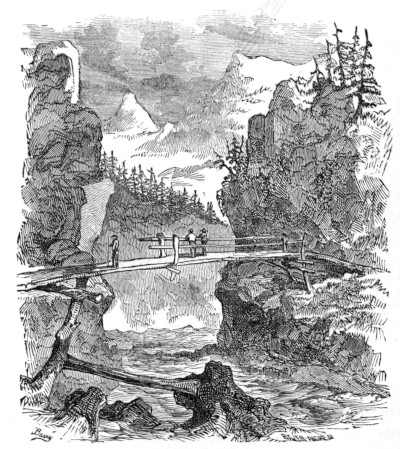
In a romantic and deep hollow, near the little village of Wormhill, the
river Wye flows beneath this stupendous mass of rock, which rises perpendicularly
more than three hundred and sixty feet above its level. The
92channel of the river, which meanders at the base, is confined between huge
rocks of limestone, having such a general correspondence of situation and
form, as to render it probable that they were once united. In some parts
they are partially covered with brushwood, nut-trees and mountain-ash;
while in others, they are totally naked, precipitous and impending. The
chasm runs in a direction so nearly circular, that the sublime Chee Tor, and
its dependent masses of rock, are almost insulated by the river which rolls
at their feet. Its length, as far as it possesses any considerable beauty, is
between five and six hundred yards; a distance which presents several
picturesque and interesting views, the general effect of the fine scenery being
enhanced by the plantations on the neighboring hights, and by a spring
which flows into the river near the bottom of a deep descent, as well as by
a romantic bridge over the river itself, a representation of which may be
seen in the cut above. Not far from here is the well known Masson hill,
celebrated in Darwin’s “Loves of the Plants,” which is so high as to overlook
the country to a vast extent, and compared with which even the High Tor
93seems considerably diminished in grandeur and sublimity; but this effect is
partly compensated by the extent of the prospect, and the variety of objects
it comprehends. The hight of this eminence is about seven hundred and
fifty feet, the path to its summit having been carried, in a winding direction,
through a grove. About half-way in the ascent is an alcove, from which an
extensive view of a great part of Matlock dale may be seen, through a fine
avenue formed for that purpose.
To the west and north-west of the village of Matlock, are three apertures
in the rock, respectively named the Cumberland, Smedley, and Rutland
caverns. The former of these is well deserving of a short notice.
The entrance is partly artificial, to afford a greater facility to the visitor,
who has to descend fifty-four steps. The cavern now opens on him in
solitary grandeur. Huge masses of stone are piled on each other with a
tremendous kind of carelessness, evidently produced by some violent concussion,
though at an unknown period. He is conducted to a long and
wide passage, the roof of which has all the regularity of a finished ceiling,
and is bespangled by spars of various descriptions. From above, from
beneath, and from the sides, the rays of the lights are reflected in every
direction. In an adjacent compartment, rocks are heaped on rocks in
terrible array, and assume a threatening aspect. Next is an apartment
decorated with what, in the language of the country, is called the snow-fossil,
a petrifaction which, both in figure and color, resembles snow, as it is drifted
by the winter storm into the cavities of a rock. Near the extremity of the
cavern are to be seen fishes petrified and fixed in the several strata which
form the surrounding recess. One of these has its back jutting out of the
side of the earth, as if it had been petrified in the act of swimming. In
another branch of the cavern a well has been found of a considerable
depth.
After having proceeded about a mile in Dove dale, the romantic and
sublime beauties of which will be hereafter noticed, by a route constantly
diversified by new fantastic forms, and uncouth combinations of rock, the
visitor is led to a mass of mural rock, bearing the above name, and perforated
by nature into a grand arch, nearly approaching to the shape of the
sharply pointed Gothic style of architecture, about forty-five feet in hight, and
in width twenty. Having passed through this arch, a steep ascent leads to a
natural cavern, called Reynard’s Hall, forty-five feet in length, fifteen in
breadth, and in hight thirty. From the mouth of this cavern the scenery is
94singular, beautiful and impressive. The face of the rock which contains
the arch, rises immediately in front, and would effectually prevent the eye
from ranging beyond its mighty barrier, did not its center open into the
above-mentioned arch, through which is seen a small part of the opposite
side of the dale, consisting of a mass of gloomy wood, from the shade of
which a huge detached rock, solitary, cragged, and pointed, starts out to a
great hight, and forms an object truly sublime. This rock, which has
received the name of Dove Dale Church, is pleasingly contrasted by the
little pastoral river, Dove, and by its verdant turfy banks. A narrow opening
at the extremity of the cavern is supposed to lead to other similar
cavities in the rock; and on the left is a cavern, about forty feet in length,
in breadth fourteen, and in hight twenty-six, called Reynard’s Kitchen, from
the interior of which a pleasing view is presented of the upper part of the
dale, its river and rocks.
After passing Reynard’s Hole, already described, the rocks rise more
abruptly on either side, and appear in shapes more wild and irregular, but
diversified and softened by shrubs.
Dove dale is nearly three miles in length; but from the sinuosity of its
course, and its projecting precipices, the views are limited. Throughout
the whole of this majestic feature of country, the river Dove flows, in the
halcyon days of summer, with soft murmurs, innocently and transparently
over its pebbly bed; but swells into rage during the winter months. Little
tufts of shrubs and underwood form islands in miniature within its bed,
which enlarge and swell the other objects. The scenery of this dale is
distinguished from almost every other in the united kingdoms, by the
rugged, dissimilar, and frequently grotesque and fanciful appearance of the
rocks. To employ the words of a tourist here, “It is, perhaps, on the whole
one of the most pleasing sceneries of the kind anywhere to be met with.
It has something peculiarly characteristic. Its detached, perpendicular rocks
stamp it with an image entirely its own, and for that reason it affords the
greater pleasure. For it is in scenery as in life. We are most struck with
the peculiarity of an original character, provided there be nothing offensiveoffensive
“Where Hamps and Manifold, their cliffs among,
Each in his flinty channel winds along,
With lucid lines the dusky moor divides,
Hurrying to intermix their sister tides,
Where still their silver-bosom’d nymphs abhor
The blood-smear’d mansion of gigantic Thor—
Erst fires volcanic in the marble womb
95Of cloud-wrapp’d Whetton rais’d the massy dome;
Rocks rear’d on rocks, in huge disjointed piles,
Form the tall turrets, and the lengthen’d aisles;
Broad pond’rous piers sustain the roof, and wide
Branch the vast rainbow ribs from side to side.
While from above, descends, in milky streams,
One scanty pencil of illusive beams,
Suspended crags, and gaping gulfs illumes,
And gilds the horrors of the deepen’d glooms.
Here oft the Naiads, as they chanc’d to stray
Near the dread Fane, on Thor’s returning day,
Saw from red altars streams of guiltless blood,
Stain their green reed-beds, and pollute their flood;
Heard dying babes in wicker prisons wail,
And shrieks of matrons thrill the affrighted gale;
While from dark caves infernal echoes mock,
And fiends triumphant shout from every rock!”—Darwin.
This spacious cavern is situated about two miles above Dove dale, near
the village of Whetton; and tradition says the Druids here offered human
sacrifices, inclosed in wicker idols, to Thor, the principal deity of the Saxons
and Danes, in the ages of their idolatrous worship. Beneath is an extensive
and romantic common, where the rivers Hamps and Manifold sink into the
earth, and rise again in Islam gardens. These rivers merit a brief description.
A wooden bridge has been thrown over an abyss in the rock, out of
which the river Manifold bursts with surprising force, after having pursued
a subterraneous course of five miles, from the point where it had engulfed
itself in the earth, called Weston hill. At the further distance of twenty
yards a similar phenomenon occurs; for here another fissure of a rock
presents itself, whence the river Hamps throws its water into day. This
river disappears at Leek-water Houses, a place between Leek and Ashbourn;
thus pursuing a subterraneous course of seven miles, before it again emerges
into light. On their emersion, the temperatures of the two rivers differ two
degrees and a half, the Hamps being the coldest.
The environs of Buxton abound in romantic sites, among the most striking
of which is the dale named the Lovers’ Leap, on account of a vast precipice
which forms one side of a narrow chasm, and from the summit of which a
love-lorn female is said to have precipitated herself into the rocky gulf
below. Each side of this beautiful dell is bounded by elevated rocks, the
proximity of which is such, that for a considerable space there is scarcely
room for the passage of the bubbling current of the Wye. Several of these
rocks are perpendicular, and bare of vegetation; while others are covered
96with ivy, yew and ash-wood, with a craggy steep occasionally starting through
the verdure. A circular road, extending in circumference about three
miles, passes in view of the most romantic part of this dale, and forms a
very agreeable walk or ride from Buxton. At the southern extremity the
scenery assumes a milder character, the hollow taking the name of Mill
dale, from a mill which is turned by the stream. In conjunction with a
rude bridge, a mountainous path, and other rural objects, this forms a very
picturesque view. Another fine scene is presented by a lofty rock, called
Swallow Tor, which soars over a mass of wood, the river at its base foaming
and roaring over broken masses of limestone.
Derbyshire is everywhere fruitful in natural curiosities, among the most
striking of which may be reckoned the moors of Hope parish, inasmuch as
they afford an extraordinary instance of the preservation of human bodies
interred in them. In the year 1674, a grazier and his female servant, in
crossing these moors on their way to Ireland, were lost in the snow, with
which they were covered from January to May, and being then discovered,
the bodies were so offensive that the coroner ordered them to be buried on
the spot. After a lapse of twenty-nine years, when the ground was opened,
they were in no way changed, the color of the skin being fair and natural,
and the flesh as soft as that of persons newly dead. For twenty succeeding
years they were occasionally exposed as a spectacle, but carefully covered
after being viewed. They lay at the depth of about three feet, in a moist
soil or moss. The minister of Hope parish was present in 1716, forty-two
years after the accident, at a particular inspection of these bodies. On the
stockings being drawn off, the man’s legs, which had not been uncovered
before, were quite fair: the flesh, when pressed by the finger, pitted a little;
and the joints played freely, without the least stiffness. Such parts of the
clothing as the avidity of the country people, to possess so great a curiosity,
had spared, were firm and good; and a piece of new serge, worn by the
woman, did not appear to have undergone any sensible change.
Having thus brought to a conclusion our details relative to the wonders
of the peak, and the various and interesting natural curiosities there to be
found, we subjoin a brief notice of several others, which have, in England,
attracted the notice of travelers.
Among the extraordinary caverns to be found in the mountains of the
north of England, may be reckoned Yordas cave, in the vale of Kingsland,
97in Yorkshire, which contains a subterraneous cascade. Whethercot cave,
not far from Ingleton, is divided by an arch of limestones, passing under
which is seen a large cascade falling from a hight of more than sixty feet.
The length of this cave is about one hundred and eighty feet, and the
breadth ninety.
There are also in various parts of England many remarkable springs, of
which some are impregnated either with salt, (as that of Droitwich, in
Worcestershire,) or sulphur, (as the famous well of Wigan, in Lancashire,)
or bituminous matter, (as that at Pitchford, in Shropshire.) Others have a
petrifying quality, as that near Lutterworth, in Leicestershire, and a dropping
well in the West Riding of Yorkshire. And, finally, some ebb and
flow, as that of the peak described above, and Laywell near Torbay, whose
waters rise and fall several times in an hour. To these we may add that
remarkable fountain near Richard’s Castle, in Herefordshire, commonly
called Bone Well, which is generally full of small bones, like those of frogs
or fishes, though often cleared out. At a cliff near Wigan, in Lancashire,
is the famous burning well: the water is cold, neither has it any smell; yet
so strong a vapor of sulphur issues out with the stream, that upon applying
a light to it, the top of the water is covered with a flame, like that of burning
spirits, which lasts several hours, and emits such a heat that meat may
be boiled over it.
The British isles present many mountains of a bold and imposing character:
when contrasted, however, with those which have been already
described, they must be considered as comparatively diminutive.
The loftiest of these mountains is Ben Nevis, in Scotland, its elevation
above the level of the sea being forty-three hundred and eighty feet, or
somewhat more than four-fifths of a mile. It terminates in a point, and
elevates its rugged front far above all the neighboring mountains. It is of
easy ascent; and at the perpendicular hight of fifteen hundred feet, the
vale beneath presents a very agreeable prospect, the vista being beautified
by a diversity of bushes, shrubs, and birch woods, besides many little
verdant spots. The sea and the shore are also seen.
At the summit, the view extends at once across the island, eastward
toward the German sea, and westward to the Atlantic ocean. Nature here
appears on a majestic scale and the vastness of the prospect engages the
98whole attention, at the same time the objects in view are of no common
dimensions. Just over the opening of the sound, at the south-west corner
of Mull, Colonsay rises out of the sea like a shade of mist, at the distance
of more than ninety miles. Shuna and Lismore appear like small spots of
rich verdure, and, though nearly thirty miles distant, seem quite under the
spectator. The low parts of Jura can not be discerned, nor any part of
Isla; far less the coast of Ireland, as has been asserted. Such is, however,
the wide extent of view, that it extends one hundred and seventy miles from
the horizon of the sea at the Murray frith, on the north-east, to the island
of Colonsay, on the south-west.
On the north-east side of Ben Nevis is an almost perpendicular precipice,
certainly not less than fourteen hundred feet in depth; probably more, as it
appears to exceed the third part of the entire hight of the mountain. A
stranger is astonished at the sight of this dreadful rock, which has a quantity
of snow lodged in its bosom throughout the whole year. The sound of a
stone thrown over the cliff to the bottom, can not be heard when it falls, so
that it is impossible to ascertain in that way the hight of the precipice.
This is the loftiest of the Welch mountains, its elevation above the level
of the sea being thirty-seven hundred and twenty feet, or nearly three-quarters
of a mile. It is accessible on one side only, its flanks being in
every other quarter precipitous. Its aspect soon convinces the spectator
that he is not to look to the Alps alone, or to the rocky regions of Altai,
bordering on Siberia, for romantic scenes of wildness, confusion and disorder.
Snowdon presents them in all their rude and native majesty.
In the ascent, a narrow path not more than nine feet in width, leads along
the margin of a frightful precipice of nearly fifteen hundred feet in extent,
so perpendicular that it can not be approached without terror; while to the
north of the summit nearest to the one the most elevated, a semi-amphitheater
of precipitous rocks, also of a great hight, is seen; and, behind this
summit, another semicircle of equal depth and extent. The loftiest summit
here appears to descend in the form of a sharp ridge, and beneath it another
appears, which, on account of its color, is called the Black Rock. From
the upper part of the valley, one of these summits presents a grand, vertical,
and very elevated point.
The bottom of each of the amphitheaters of rocks, thirteen in number, is
occupied by a small lake of a circular form, and very deep. The one known
by the name of Llyn Glass is remarkable for its green hue, derived from its
being impregnated with copper, several mines of which line its borders.
99Than this mountain, nothing in the Alps can be more arid and desert, those
regions alone excepted which are too lofty to admit of vegetation. Here
there is not a tree, not even a shrub; small patches of verdure, which
sheep can scarcely reach, are alone to be seen. Its summit, or highest peak,
is a flat of about eighteen feet only in circumference. Thence may be seen
a part of Ireland, a part of Scotland, Cumberland, Lancashire, Cheshire, all
North Wales, the isle of Man, and the Irish and British seas, with innumerable
lakes; while the whole island of Anglesea is displayed so distinctly,
that, its flat uncultivated plains, bounded by the rich Parys mountain in the
vicinity of Holyhead, may be descried as on a map.
To the south of Dolgellau, Cader Idris towers above the subject mountains,
which seem to retire, to allow its base more room to stand, and to afford to
their sovereign a better display. It stands on a broad rocky base, with a
gradual ascent to its brow, when the peaks elevate themselves in a manner
at once abrupt, picturesque and distinct. The point emphatically named
Cader, appears to the eye below to be little superior in hight to the saddle;
but the third point, or apex, which has a name expressive of its sterility, is
neither equal in hight, nor in beauty, to the other two. On its loftiest peak
a stone pillar has lately been erected, for the purpose of a trigonometrical
survey.
Cader Idris is the commencement of a chain of primitive mountains, and
is computed to be twenty-eight hundred and fifty feet above the green of
Dolgellau, and thirty-five hundred and fifty feet, or nearly three-fourths of a
mile above the level of the sea. It has been conjectured that at some remote
period it was a volcano of immense magnitude.
The tract to the south of Cader Idris, as far as Talylyn and Malwydd, is
peculiarly grand. High and rugged mountains of every possible form, close
in on all sides, while huge masses of rock hang over, or lie scattered in
misshapen fragments by the side of the road. To add to the effect of this
scene, the river Difi forms one continued cataract for five or six miles, overflowing
with the innumerable tributary torrents which precipitate themselves
from the highest summits of the surrounding rocks; while, to crown the
whole, the shady head of Cader Idris towers, the majestic sentinel of the
group.
The county of Caernarvon, in which this mountain is situated, claims
precedency over every other in Wales, for the loftiness of its mountains, and
100the multitude of the eminences, which in a curved and indented chain,
occupy nearly the whole of its extent.
In proceeding from Conway to Bangor, by a route at once picturesque
and romantic, and amid a scenery which varies at every step, Penman-mawr
discloses to the traveler its bulky head. It protrudes itself into the sea, and
exhibits a fine contrast to the fertility which it interrupts, by a rude view of
gray weather-beaten stones and precipices. The passage over the mountain
was formerly terrific; but the road has been latterly widened and secured,
near the verge of the precipice, by a small wall about five feet in hight. It
forms the most sublime terrace in the British isles, winding round the
mountain on the edge of the abrupt cliff; while the vast impending rocks
above, the roaring of the waves at a great distance below, and the frequent
howling of the wind, all unite to fill the mind with solemnity and awe.
This English mountain, which has an elevation of thirty-five hundred and
thirty feet, or nearly three-fourths of a mile above the level of the sea, is
situated in Cumberland. It is more remarkable on account of the scenery
over which it presides, and which exceeds in beauty whatever the imagination
can paint, than for those bold projections and that rugged majesty
which might be expected, but which will be here sought in vain. Except at
such a distance as smooths the embossed work of all these rich fabrics, and
where its double summit makes it a distinguished object to mark and
characterize a scene, it may be considered as a tame and inanimate object.
In some of the maps of Yorkshire, the hight of this mountain is greatly
exaggerated, its elevation above the sea not being more than twenty-five
hundred feet, or nearly half a mile. As it is situated in the midst of a vast
amphitheater of hills, the prospect it affords is diversified with pleasing
objects. On its summit are four or five small lakes, two of which are about
nine hundred feet in length, and nearly the same in breadth. A thin seam
of coal also occurs near the top, and another is said to correspond with it
on the summit of the lofty Colm hill, on the opposite side of Dent dale.
Numerous caves and other natural curiosities abound here, as well as on
Pennigent, about six miles to the eastward of Ingleborough. These latter
mountains do not possess any particular interest.
101
Stromboli is the principal of the cluster of small islands, lying to the north
of Sicily, named the Lipari isles, the whole of which contain volcanoes. At
a distance, its form appears to be that of an exact cone, but on a closer
examination it is found to be a mountain having two summits of different
hights, the sides of which have been torn and shattered by craters. The
most elevated summit, inclining to the south-west, is, agreeably to Spallanzani,
about a mile in hight.
In this volcanic mountain, the effects of a constantly active fire are everywhere
visible, heaping up, destroying, changing, and overturning every
instant what itself has produced, and incessantly varying in its operations.
At the distance of one hundred miles, the flames it emits are visible, whence
it has been aptly denominated the light-house of that part of the Mediterranean
sea.
From the more elevated summit, all the inner part of the burning crater,
and the mode of its eruption, may be seen. It is placed about half-way up,
on the north-west side of the mountain, and has a diameter not exceeding
two hundred and fifty feet. Burning stones are thrown up at regular
intervals of seven or eight minutes, ascending in somewhat diverging rays.
While a portion of them roll down toward the sea, the greater part fall back
into the crater; and these being again cast out by a subsequent eruption,
are thus tossed about until they are broken and reduced to ashes. The
volcano, however, constantly supplies others, and seems inexhaustible in this
species of productions. Spallanzani affirms that, in the more violent eruptions,
the ejected matter rises to the hight of half a mile, or even higher,
many of the ignited stones being thrown above the highest summit of the
mountain.
The erupted stones, which appear black in the day-time, have at night a
deep red color, and sparkle like fire-works. Each explosion is accompanied
by flames or smoke, the latter resembling clouds, in the lower part black, in
the upper white and shining, and separating into globular and irregular
forms. In particularly high winds from the south or south-east, the smoke
spreads over every part of the island. Spallanzani observed this volcano on
a particular night, when the latter of these winds blew with great violence.
The clear sky exhibited the appearance of a beautiful aurora borealis over
that part of the mountain on which the volcano is situated, and which from
time to time became more red and brilliant, in proportion as the ignited
102stones were thrown to a greater hight. The violence of the convulsions
depends on that of the wind.
The present crater has burned for more than a century, without any
apparent change having taken place in its situation. The side from which
the showers of ignited matter fall into the sea, is almost perpendicular, about
half a mile broad at the bottom, and a mile in length, terminating above in
a point. In rolling down, the lava raises the fine sand like a cloud of dust.
While this was observed by Spallanzani, the volcano suddenly made an
eruption. Numerous pieces of lava of a dark red color, and enveloped in
smoke, were ejected from the top of the precipice, and thrown high into the
air. A part of them fell on the declivity, and rolled down, the smaller
preceded by the greater; after a few bounds, dashing into the sea, giving
out a sharp hissing sound. The more minute fragments, from their lightness,
and the hindrance of the sand, rolled slowly down, and striking against
each other, produced nearly the same sound as hail-stones falling on a roof.
In a few minutes another explosion followed, without any sensible noise;
and two minutes after a third eruption took place, with a much louder
explosion than the first, and a far more copious ejection of lava. The
eruptions, which were almost innumerable during the time Spallanzani
remained there, all exhibited the same appearances.
On the night following the one above described, the volcano raged with
still greater violence, and rapidly hurled to a great hight, thousands of red-hot
stones, forming diverging rays in the air. Those which rolled down the
precipice, produced a hail of streaming fire, which illuminated the steep
descent. Independently of these ignited stones, there was in the air which
hovered over the volcano, a vivid light, which was not extinguished when
that was at rest. It was not properly flame, but real light reverberated by
the atmosphere, impregnated by extraneous particles, and more especially
by the ascending smoke. Besides varying in intensity, it appeared constantly
in motion, ascending, descending, dilating and contracting, but
always remaining perpendicular over the mouth of the volcano, which
showed that it was occasioned by the conflagration within the crater. The
detonations in the greater eruptions resembled the roaring of distant
thunder, and in the lesser ones, the explosions of a mine. In the smallest
they were scarcely audible. Each was some seconds later than the ejection.
Near the mouth of the volcano is a small cavern, a projection above which
secures it from the entrance of the ignited stones. From this cavern Spallanzani
was enabled to look down into the very bowels of the volcano. He
describes the edges of the crater as of a circular form, and not more than
three hundred and forty feet in circumference, the internal sides contracting
103as they descend, and assuming the shape of a truncated inverted cone. The
crater itself, to a certain hight, is filled with a liquid red-hot matter, resembling
melted brass. This is the fluid lava, which appears to be agitated by
two distinct motions, the one intestine, whirling and tumultuous, and the
other that by which it is impelled upward. This liquid matter is raised,
sometimes with more, and sometimes with less rapidity, within the crater;
and when it has reached within twenty-five or thirty feet of the upper edge,
a sound is heard not unlike a short clap of thunder, while at the same
moment a portion of the lava, separated into a thousand pieces, is thrown
up with indescribable swiftness, accompanied by a copious eruption of smoke,
ashes and sand. A few moments before the report, the superficies of the
lava is inflated and covered with large bubbles, some of which are several
feet in diameter; on the bursting of these the detonation and fiery shower
take place. After the explosion, the lava within the crater sinks, but soon
rises again as before, and new bubbles appear, which again burst and produce
new explosions. When the lava sinks, it gives little or no sound; but when
it rises, and particularly when it begins to be inflated with bubbles, it is
accompanied by a noise similar, in proportion to the difference of magnitude,
to that of liquor boiling vehemently in a caldron.
This island, which has given name to the whole cluster, is deserving of
notice on account of its celebrated “stoves.” They are the only vestiges of
subterraneous conflagration now remaining, and lie to the west of the city,
on the summit of a mountain of considerable elevation, called Monte della
Stufe, the Mountain of Stoves. They consist of five excavations, in the form
of grottos; but two of them have been abandoned on account of the great
heat, an exposure to which might cause suffocation. Even the stones are
so hot that they can not be touched; but still the heat varies, and experiences
all the vicissitudes of volcanoes. The ground is not penetrated with hot
vapors issuing from several apertures, as has been asserted. Spallanzani,
however, found one from which a thin stream of smoke issued from time to
time, with a strong sulphureous smell, indicating the remains of conflagration
existing beneath.
It is impossible to fix the exact epoch at which the fires of Lipari were
extinguished, or rather the period at which the eruptions ceased, for the
existence of the former may be deduced from the hot springs and stoves.
Dolomieu thinks the last eruptions are as old as the sixth century of the
Christian era, and conjectures that they may have ceased since the fires
104found a new vent in Vulcano, since he does not entertain any doubt but that
the two islands have a subterraneous communication. Of this the inhabitants
of Lipari are so well convinced, that they are in the greatest agitation
when Vulcano does not smoke, and when its passages are obstructed. They
fear shocks and violent eruptions, suspecting even that the fires may again
break out in their island. It is a fact that the earthquakes, which are
very frequent, generally cease when the eruptions of Vulcano commence.
This, which is the last of the Lipari isles, bears in every part the stamp
of fire. It was the superstitious belief of the ancient inhabitants that
Vulcan had here established his forges, there being constant fires during the
night, and a thick smoke throughout the day. It consists of a mountain in
the form of a truncated cone, which is, however, merely a case opening and
exposing to view a second cone within, more exact than the other, and in
which the mouth of the volcano is placed. The latter is thus enveloped on
three sides by the ancient cone, and is open only on that side which is
immediately washed by the sea.
The base of the interior cone is separated from the steep sides of the
ancient crater by a circular valley, which terminates on one side at the
junction of the two mountains, and on the other sinks into the sea. In this
valley, light pumice-stones are blended with fragments of black, vitreous
lava, and buried in ashes perfectly white. The blow of a hammer on these
stones produces a loud hollow sound, which reëchoes in the neighboring
caverns, and proves that the surface is nothing more than the arch of a vault
covering an immense abyss. The sound varies according to the thickness
of the crust, which must have considerable solidity to support the weight of
the new mountain. This, according to Dolomieu, is higher and steeper than
the cone which contains the crater of Etna, and its access still more difficult;
its perpendicular hight, however, is not more than twenty-six hundred and
forty feet, or half a mile. He represents the crater of Vulcano as the most
magnificent he ever saw; and Spallanzani observes that, with the exception
of that of Etna, he does not know of any more capacious and majestic. It
exceeds a mile in circuit, has an oval mouth, and its greatest diameter is
from the south-east to the west, while its depth is not more than a quarter
of a mile. The bottom is flat, and from many places streams of smoke
exhale, emitting a strong sulphureous vapor. This vast cavity is very
regular, and as its entire contents are displayed to the eye, presents one of
the grandest and most imposing spectacles in nature. On large stones being
105rolled down, the mountain reëchoes; and on their reaching the bottom,
they appear to sink in fluid. Indeed, with the aid of a glass, two small
lakes, supposed to be filled with melted sulphur, have been discovered. The
declivity of the interior walls is so great, that, even when there is not any
danger from fire, the descent is next to impossible. After considerable
difficulty, however, this was accomplished by Spallanzani on the south-east
side, the only one accessible. He found the bottom to be somewhat more
than one-third of a mile in circumference, and of an oval form. The
subterraneous noise was here much louder than on the summit, sounding
like an impetuous river foaming beneath, or, rather, like a conflict of agitated
waves meeting and clashing furiously together. The ground was likewise
in some places perforated with apertures, from which hissing sounds issued,
resembling those produced by the bellows of a furnace. It shook when
pressed by the feet; and a large piece of lava, let fall five or six feet, produced
a subterraneous echoing sound, which continued some time, and was
loudest in the center. These circumstances, combined with its burning
heat, and the strong stench of sulphur it emits, prove that the fires of the
volcano are still active.
Its eruptions have been most considerable during the earthquakes which
have desolated Sicily and a greater part of Italy. In the month of March,
1786, after subterraneous thunders and roarings, which were heard over all
the islands, to the great terror of the inhabitants, and were accompanied by
frequent concussions, the crater threw out a prodigious quantity of sand,
mixed with immense volumes of smoke and fire. This eruption continued
fifteen days, and so great was the quantity of sand ejected that the circumjacent
places were entirely covered with it to a considerable hight. The
lava did not flow at the time, at least over the edges of the crater; and
indeed, such a current is not remembered by any living person.
“The great Himalayan snowy range,” says Mr. Fraser, “is only the high
elevated crest of the mountainous tract that divides the plains of Hindoostan
from those of Thibet, or Lesser Tartary. Far as they predominate over,
and precipitously as they rear themselves above the rest, all the hills that
appear in distant ranges, when viewed from the plains, are indeed only the
roots and branches of this great stem; and, however difficult to trace, the
connection can always be detected between each inferior mountain and some
particular member of its great origin.
106“The horizontal depth of this mountainous tract, on that side which
overlooks Hindoostan, is no doubt various; but, from the difficulty of the
country, a traveler performs a journey of many days before he reaches the
foot of the immediate snowy cliffs. The best observations and surveys do
not authorize the allowance of more than an average depth of about sixty
miles from the plains to the commencement of these, in that part of the
country that forms the subject of this narrative. The breadth of the snowy
zone itself in all probability varies still more; for huge masses advance in
some places into the lower districts, and in others the crest recedes in long
ravines, that are the beds of torrents, while behind they are clothed by a
succession of the loftier cliffs. Every account we receive of a passage
through them, (and this is no doubt found most commonly where the belt
is narrowest,) gives a detail of many days’ journey through the deserts of
snow and rocks; and it is to be inferred, that on the north-east side they
advance to, and retreat from the low ground in an equally irregular manner.
Indeed, some accounts would induce the belief, that long ranges, crowned
with snow-clad peaks, project in various places from the great spine, and
include habitable and milder districts; for, in all the routes of which we
have accounts, that proceed, in various directions toward the Trans-Himalayan
countries, hills covered with snow are occasionally mentioned as
occurring, even after the great deserts are passed, and the grazing country
entered. The breadth, then, of this crest of snow-clad rock itself, can not
fairly be estimated at less than from seventy to eighty miles.
“The great snowy belt, although its loftiest crest is broken into numberless
cliffs and ravines, nevertheless presents a barrier perfectly impracticable,
except in those places where hollows that become the beds of rivers have in
some degree intersected it, and facilitated approach to its more remote
recesses, or courageous and attentive perseverance has here and there,
discovered a dangerous and difficult path, by which a possibility exists of
penetrating across the range. Few rivers hold their course wholly through
it: indeed, in the upper part the Sutlej alone has been traced beyond this
rocky barrier; and there is a path along its stream, from different parts of
which roads diverge, that lead in various directions through the mountain.
No reasonable doubt can now exist of the very long and extraordinary
course which this river takes.
“Captain Webb of the Bengal establishment, was at one time employed
on a survey of a province of Kumaoon. On the twenty-first day of June,
his camp was eleven thousand, six hundred and eighty feet above Calcutta.
The surface was covered with very rich vegetation as high as the knee;
there were very extensive beds of strawberries in full flower; and plenty of
107currant-bushes in blossom all around, in a clear spot of rich black mold
soil, surrounded by a noble forest of pine, oak and rhododendron. On the
twenty-second of June he reached the top of Pilgoenta-Churhaee, (or
ascent,) twelve thousand, six hundred and forty-two feet above Calcutta.
He was prevented from distinguishing very distant objects by a dense fog;
but there was not the smallest patch of snow near him; and the surface, a
fat black mold through which the rock peeped, was covered with strawberry
plants, (not yet in flower,) butter-cups, dandelions, and a profusion of other
flowers. The shoulders of the hill above him, about four hundred and fifty
feet more elevated, were covered with the same to the top; and above five
hundred feet below was a forest of pine, rhododendron and birch. There
was some snow seen below in deep hollows, but it dissolves in the course of
the season. These facts led Captain Webb to infer, that the inferior limit
of perpetual congelation on the Himalaya mountains is beyond thirteen
thousand, five hundred feet, at least, above the level of Calcutta: and that
the level of the table-land of Tartary, immediately bordering on their range,
is very far elevated beyond eight thousand feet, the hight at which it has
been estimated.
“On the night of the sixteenth of July, we slept at Bheemkeudar, near
the source of the Coonoo and Bheem streams. There is no wood near this
place, even in the very bottom of the valley, and we had left even the
stunted birch at a considerable distance below; but there was a profusion
of flowers, ferns, thistles, &c., and luxuriant pasturage. Captain Webb’s
limit of wood is at least as high as twelve thousand to twelve thousand,
three hundred feet. I would, therefore, presume the site of Bheemkeudar
to be considerably above that level; say thirteen thousand to thirteen thousand,
three hundred feet, above the level of Calcutta. From thence we
ascended at first rather gradually, and then very rapidly, till we left all
luxuriant vegetation, and entered the region of stripped and scattered and
partially melting snow. From calculating the distance passed, and adverting
to the elevation we had attained, I would presume that this was at least
fifteen hundred feet above Bheemkeudar, or from fourteen thousand, five
hundred, to fifteen thousand feet above Calcutta.
“We proceeded onward, ascending very rapidly, while vegetation decreased
gradually to a mere green moss, with here and there a few snow-flowers
starting through it; snow fast increasing, till at length we entered on what
I presume was the perennial and unmelting snow, entirely beyond the line
of vegetation, where the rock was bare even of lichens: and in this we
ascended, as I think, about eight hundred feet; for, though Bamsooroo Ghat
may not be so far above this line, we continued ascending, even after crossing
108that point, and I would incline to estimate this utmost extent of ascent
at two thousand feet more, or nearly seventeen thousand feet above the level
of Calcutta.
“Whilst proposing to consider the point of sixteen thousand to sixteen
thousand, five hundred feet, as that of inferior congelation, I must observe
that there was no feeling of frost in the air, and the snow was moist, though
hard, chiefly through the influence of a thick mist, which, in fact, amounted
to a very small drizzling rain, which fell around: all which would seem to
indicate, that the true line of congelation had not there been attained; but
we were surrounded by snow which evidently never melted. To a great
depth below it extended all over the hills, very little broken, while on the
valleys from whence the Coonoo and Bheem streams issue, at full two thousand
feet below, it lay covering them and the surrounding mountains in an
unbroken mass, many hundred feet thick. Thus, though it may seem
contradictory, the line of perpetual congelation, in fact seems fixable at even
below the point I have ventured to indicate, and, I presume, might, on these
grounds, be placed somewhere between fifteen and sixteen thousand feet
above the level of Calcutta.
“The result of all the considerations that arise out of the foregoing
remarks is a belief, that the loftiest peaks of the Himalaya range will be
found to fall considerably short of the hight attributed to them by Mr. Colebrooke;
and that their loftiest peaks do not more than range from eighteen
thousand to twenty-two or twenty-three thousand feet above the level of the
sea.
“Having reached the top of an ascent, we looked down upon a very deep
and dark glen, called Palia Gadh, which is the outlet to the waters of one
of the most terrific and gloomy valleys I have ever seen. But it would not
be easy to convey by any description a just idea of the peculiarly rugged
and gloomy wildness of this glen: it looks like the ruins of nature, and
appears, as it is said to be, completely impracticable and impenetrable.
Little is to be seen except dark rock: wood only fringes the lower parts and
the waters’ edge: perhaps the spots and streaks of snow, contrasting with
the general blackness of the scene, highten the appearance of desolation.
No living thing is seen; no motion is visible but that of the waters; no sound
is heard but their roar. Such a spot is suited to engender superstition, and
here it is accordingly found in full growth. Many wild traditions are
preserved, and many extravagant stories related of it.
“The glen above described, is by far the most gloomy, savage scene we
have yet met with. I regret that the weather did not permit a sketch of it
to be attempted. Beyond this we could see nothing in the course of the
109river but rocky banks. The opposite side is particularly precipitous; yet
along its face a road is carried, which is frequented as much as this, and
leads to villages still farther up. By the time we had reached the village,
the clouds which had lowered around and sunk down on the hills, began to
burst with loud thunder and heavy rain. The noise was fearfully reverberated
among the hills; and during the night more than once the sound was
heard of fragments from the brows of the mountains, crashing down to the
depths below with a terrific din. Our quarters were good. I slept in a
temple, neat, clean and secure from the weather.”
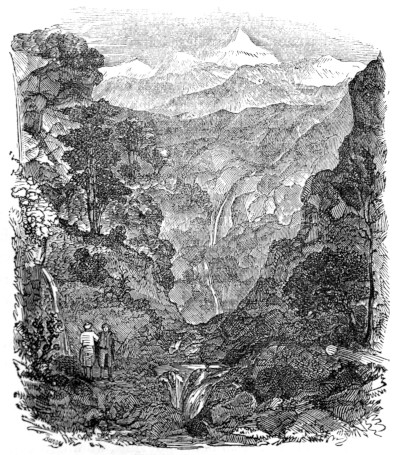
Gungotree, the source of the Jumna, represented in the cut below, the
most sacred branch of the Ganges, ought to hold, and does hold the first
rank among its holy places. Here all is mythological ground. Here
Mahadeo sits enthroned in clouds and mist, amid rocks that defy the
approach of living thing, and snows that make desolation more awful. Gods,
goddesses and saints here continually adore him at mysterious distance, and
110you traverse their familiar haunts. But, although Gungotree be the most
sacred, it is not the most frequented shrine, access to it being far more difficult
than to Buddrinauth; and consequently to this latter, pilgrims flock in
crowds, appalled at the remoteness and danger of the former place of
worship. This may pretty fully account for the superior riches and splendor
of Buddrinauth. Here are temples of considerable extent, priests and
officials in abundance, who preserve an imposing exterior, and an appearance
venerable from power and comparative magnificence, and consequently
procure rich and ample offerings to keep up their comfortable dignity.
The temple of Bhadrinath, is situated on the west bank of the Alackunda,
in a valley four miles long, and one mile in its greatest breadth. The east
bank rises considerably higher than the west bank, and is on a level with
the top of the temple. The position of the sanctuary is considered equidistant
from two lofty mountains, which are designated by the names of the
Nar and the Narayena Purvatas. The former is to the east, the latter to
the west, and completely covered with snow from the summit to the base.
The temple of Bhadri-Nath has more beneficed lands attached to it than
any sacred Hindoo establishment in this part of India. It is said to possess
seven hundred villages in different parts of Gurwhal and Kumaoon: many
of them have been conferred by the government; others have been given in
pledge for loans; and some few, purchased by individuals, have been presented
as religious offerings.
The annual ceremony of carrying the images of their gods to wash in the
sacred stream of the Jumna, is, it appears, one of much solemnity among
the inhabitants of the neighborhood; and the concourse of people that
here assemble, are busily engaged, and continue to be fully occupied in
doing honor to it. They dance to the sound of strange music, and intoxicate
themselves with a sort of vile spirit, brewed from grain and particular
roots, sometimes, it is said, sharpened by pepper. The dance is most grotesque
and savage; a multitude of men taking hands sometimes in a circle,
sometimes in a line, beating time with their feet, bend with one accord, first
nearly to the earth with their faces, then backward, and then sidewise, with
various wild contortions. These, and their uncouth dress of black and gray
blankets, give a peculiar air of brutal ferocity to the assemblage. The men
dance all day, and in the evening they are joined by the women, who mix
indiscriminately with them, and keep up dancing and intoxication till the
night is far advanced. They continue this frantic kind of worship for several
days; and, in truth, it is much in unison with their general manners and
habits, savage and inconsistent. At a place so sacred, the residence of so
many Brahmins, and the resort of so many pilgrims, we might expect to find
111a strict attention to the forms of religion, and a scrupulous observance of the
privations and austerities enjoined by it. So far, however, is this from the
truth, that much is met with, shocking even to those Hindoos who are less
bigoted.
“There were several points to be arranged,” says Mr. Fraser, “before we
could set off for Gungotree, the source of the Jumna. I did not deem it
proper to go unarmed; but agreed that only five men should be accoutered
to attend us, and that I should myself carry my gun. But all these weapons
of war were to be put aside before we got within sight of the holy spot, and
deposited in a cave near it, under a guard. I also pledged myself that no
use should be made of these instruments, nor any life sacrificed for the
purpose of food, either by myself or by any of my people, after leaving the
village, until we returned; moreover, that I would not even carry meat of
any sort, dead or alive, along with me, but eat only rice and bread. As to
the putting off my shoes, they did not even propose it to me, and it could
not have been done; but I volunteered to put them off, when entering into
the precincts of the temple and holier places, which pleased them greatly.
All the Hindoos, including the Ghoorkhas, went from the village barefoot.
“Just at the end of the bridge there is an overhanging rock, under which
worship is performed to Bhyram, and a black stone partly painted red, is the
image of the god; and here not only were prayers and worship performed,
but every one was obliged to bathe and eat bread baked by the Brahmins,
as preparatory to the great and effectual ablutions at the holier Gungotree.
This occupied a considerable time, as the party was numerous: in the mean
time I took a very imperfect sketch of the scene, after which I bathed
myself at the proper place, which is the junction of the two streams, while
the Brahmin prayed over me. Among the ceremonies performed, he made
me hold a tuft of grass while he prayed, which at the conclusion he directed
me to throw into the eddy occasioned by the meeting of the two waters.
“By an unpleasant path we reached a step, or level spot on the first stage
of the mountain, where, in a thick grove of fir-trees, is placed a small temple
to Bhyram, a plain white building, built by order of Umur Sing T’happa,
who gave a sum of money to repair the road, and erect places of worship
here, and at Gungotree. Having paid our respects to Byramjee, we proceeded
along the side of the hill on the right bank, north of the river,
gradually ascending by a path equally difficult and dangerous as the first
part of our ascent, but more fearful, as the precipice to the river, which rolls
below us, increases in hight, and exceedingly toilsome from the nature of
the ground over which it passes, and which consists wholly of sharp fragments
112from the cliffs above, with fallen trunks and broken branches of
trees.
“The path increases in difficulty from the very irregular nature of the
ground, as well as the steepness of the hill face across which it leads,
ascending and descending as the small, though deep water-courses furrow the
mountain side, in loose soil, formed of small fragments fallen from above,
and which slip down, threatening to carry the traveler to the gulf below.
The shapeless blocks of rock now more completely obstruct the way, and
for hundreds of yards, at times, the passenger must clamber over these
masses, heaped as they are one upon another, in monstrous confusion, and
so uncertain and unsteady, that, huge though they are, they shake and move
even under the burden of a man’s weight. So painful indeed is this track,
that it might be conceived as meant to serve as a penance to the unfortunate
pilgrims with bare feet, thus to prepare them for the special and conclusive
act of piety they have in view, as the object of their journey to these extreme
wilds.
“The spot which bears the name of Gungotree, is concealed by the roughness
of the ground, and the masses of fallen rock, so as not to be seen till
the traveler comes close upon it. The temple is situated precisely on the
sacred stone on which Bhagirutte used to worship Mahadeo, and is a small
building of a square shape for about twelve feet high, and rounding in, in the
usual form of pagodas, to the top. It is quite plain, painted white, with red
moldings, and surmounted with the usual melon-shaped ornaments of these
buildings. From the eastern face of the square, which is turned nearly to
the sacred source, there is a small projection covered with a stone roof, in
which is the entrance facing the east, and just opposite this there is a small
pagoda-shaped temple to Bhyramjee. The whole is surrounded by a wall
of unhewn stone and lime, and the space this contains is paved with flat
stones. In this space too, there is a comfortable but small house for the
residence of the Brahmins who come to officiate. Without the inclosure
there are two or three sheds constructed of wood, called dhurum sallahs,
built for the accommodation of pilgrims who resort here; and there are
many caves around formed by overhanging stones, which yield a shelter to
those who can not find accommodation in the sheds.
“The scene in which this holy place is situated, is worthy of the mysterious
sanctity attributed to it, and the reverence with which it is regarded.
We have not here the confined gloominess of Bhyram Gattee: the actual
dread which can not but be inspired by the precipices and torrents, and perils
of the place, here gives way to a sensation of awe, imposing but not embarrassing,
that might be compared to the dark and dangerous pass to the
113center of the ruins of a former world; for, most truly, there is little here that
recalls the recollection of that which we seem to have quitted. The bare
and peaked cliffs which shoot to the skies, yield not in ruggedness or elevation
to any we have seen; their ruins lie in wild chaotic masses at their feet,
and scantier wood imperfectly relieves their nakedness: even the dark pine
more rarely roots itself in the deep chasms which time has worn. Thus on
all sides is the prospect closed, except in front to the eastward; where, from
behind a mass of bare spires, four huge, lofty, snowy peaks arise: these are
the peaks of Roodroo-Himala. There could be no finer finishing, no grander
close to such a scene, as is visible in the engraving.
“We approach it through a labyrinth of enormous shapeless masses of
granite, which during ages have fallen from the cliffs above, that frown over
the very temple, and in all probability will some day themselves descend in
ruins and crush it. Around the inclosure, and among these masses, for
some distance up the mountain, a few fine old pine-trees throw a dark shade
and form a magnificent foreground; while the river runs impetuously in its
shingly bed, and the stifled but fearful sound of the stones which it rolls
along with it, crushing together, mixes with the roar of its waters.
“It is easy to write of rocks and wilds, of torrents and precipices; it is
easy to tell of the awe such scenes inspire: this style and these descriptions
are common and hackneyed. But it is not so simple, to many surely not
very possible, to convey an adequate idea of the stern and rugged majesty
of some scenes; to paint their lonely desertness, or describe the undefinable
sensation of reverence and dread that steals over the mind while contemplating
the death-like, ghastly calm that is shed over them: and when at
such a moment we remember our homes, our friends, our firesides, and all
social intercourse with our fellows, and feel our present solitude, and far
distance from all these dear ties, how vain it is to strive at description!
Surely such a scene is Gungotree. [See cut, page 109.] Nor is it, independently
of the nature of the surrounding scenery, a spot which lightly
calls forth powerful feelings. We were now in the center of the stupendous
Himalaya, the loftiest and perhaps most rugged range of mountains in the
world. We were at the acknowledged source of that noble river, which is
equally an object of veneration and a source of fertility, plenty and opulence
to Hindoostan; and we had now reached the holiest shrine of Hindoo worship
which these holy hills contain. These are surely striking considerations,
combining with the solemn grandeur of the place, to move the feelings
strongly.
“The fortuitous circumstance of being the first European that ever penetrated
to this spot, was no matter of boast, for no great danger had been
114braved, no extraordinary fatigues undergone; the road is now open to any
other who chooses to attempt it; but it was a matter of satisfaction to myself.
The first object of inquiry that naturally occurs to the traveler, after casting
a glance over the general landscape, is the source of the river. Here, as at
Jumnotree, you are told that no mortal has gone, or can go further toward
its extreme origin than this spot; and the difficulty is indeed very apparent.
I made a trial to gain a point about two furlongs beyond the temple, both
for the purpose of observing the course of the river, and of seeing Gungotree
in another point of view. But having with considerable difficulty made my
way over the unsteady fragments for some hundred yards, at the risk of
being precipitated into the stream, I was forced to turn back.
“The source is not more than five miles’ horizontal distance from the
temple, and in a direction south-east, eighty-five degrees nearly; and beyond
this place it is in all probability chiefly supplied by the melting of the great
bosom of snow which terminates the valley, and which lies between the
peaks of the great mountain above mentioned.
“This mountain, which is considered to be the loftiest and greatest of the
snowy range in this quarter, and probably yields to none in the whole
Himalaya, obtains the name of Roodroo Himala, and is held to be the throne
or residence of Mahadeo himself. It is also indiscriminately called Pauch
Purbut, from its five peaks, and Soomeroo Purbot, which is not to be confounded
with the mountain so called near Bunderbouch; and sometimes the
general appellation of Kylas is given, which literally signifies any snowy
hill, but is applied to this mountain by way of preëminence. It has five
principal peaks, called Roodroo Himala, Burrumpooree, Bissenpooree,
Oodgurre Kanta and Soorga Rounee. These form a sort of semicircular
hollow of very considerable extent, filled with eternal snow, from the
gradual dissolution of the lower parts of which the principal part of the
stream is generated: probably there may be smaller hollows beyond the
point to the right above Gungotree, which also supply a portion.
“Within the temple there are three images; one, that of Kali; and the
elevated stone shelf on which they were placed was wet and soiled with the
offerings made; there was a peculiar smell, but I know not whence it proceeded.
The place, as usual, was lighted by a small lamp: no daylight had
admittance. Just below the temple, on the river side, grew three poplar
trees, and a few small larches; above there are the remains of a fine old
silver fir-tree, which overshadows some of the caves and sheds. The whole
people also bathed, and contributed something to the priesthood; and it was
a matter of serious importance, as well as of great joy to every one, that we
had thus happily reached a place of such supereminent sanctity: such,
115indeed, that the act of bathing here is supposed to cleanse from every sin
heretofore committed, and the difficulty of which is so great, that few, except
professional devotees, ever attempt reaching the holy place.
“It is customary that those who have lost their father and mother, or
either of these, shall be shaved at this spot; and it was curious to observe
the whimsical changes produced by the operation, which numbers underwent.
It appears also, that one chief ordinance was the going frequently round the
holy temple; and we particularly observed that those who were noted as
the greatest rogues were most forward in this pious exercise: one man, in
particular, who had been a notorious thief, was unwearied in his perseverance.
“Well, indeed, do they say, that Seeva has made these recesses which he
inhabits, inaccessible to all but those whom true devotion leads to his shrine.
That man must have been indeed strongly impelled by devotion, ambition,
or curiosity, who first explored the way to Gungotree. It were unavailing
to inquire, and perhaps of little use, if known, to which of these motives
we owe the enterprise; but patience, perseverance, and courage, must have
been strongly united with it to lead him safely and successfully through
those awful cliffs, that would bar the way to most men. Another omen of
favor pointed out was, the increase of the river after bathing, as at Jumnotree;
and it is singular enough, that during the time we remained here, I
remarked several increases and decreases of the water, without any obvious
causes; but these may fairly be referred to the effects of sudden changes of
temperature occurring frequently among the hills, and acting on the body
of snow that feeds the river.”
Among the Asiatic burning mountains, a brief account of which we
introduce after the above interesting notice of the grand Himalaya chain,
those of Japan are both remarkable and numerous. On the summit of a
mountain in the province of Figo, is a large cavern, formerly the mouth of
a volcano, but the flame of which has ceased, probably for want of combustible
matter. In the same province, near a religious structure called the
Temple of the Jealous God of Aso, a perpetual flame issues from the top of
a mountain. In the province of Tsickusen is another burning mountain,
where was formerly a coal-pit, which having been set on fire by the carelessness
of the workmen, has been burning ever since. Sometimes a black
smoke, accompanied by a very disagreeable stench, is observed to issue from
the summit of a famous mountain called Fesi, in the province of Seruga.
This mountain is said to be nearly as high as the peak of Teneriffe, but in
116shape and beauty is supposed not to have an equal. Its top is covered with
perpetual snow. Belonging to the Japanese cluster, and not far from
Piranda, is a small rocky island, which has been burning and trembling for
many centuries; and in another small island, opposite to Santzuma, is a
volcano which has been burning at different intervals for many ages.
Captain Gore, when leaving Japan, passed by great quantities of pumice-stone,
several pieces of which were taken up, and found to weigh from one
ounce to three pounds. It was conjectured that these stones had been
thrown into the sea by eruptions at various times, as many of them were
covered by barnacles (small shells) and others were quite bare.
There are three burning mountains of Kamtschatka, which for many
years have thrown out a considerable smoke, but do not often burst into a
flame. One of these is situated in the vicinity of Awatska; and another,
named the volcano of Tolbatchiek, on a neck of land between the river
Kamtschatka and the Tolbatchiek. In the beginning of the year 1739, the
flames issued with such violence from the crater, as to reduce to ashes the
forests on the neighboring mountains. This was succeeded by a cloud of
smoke, which overspread and darkened the whole country, until it was
dissipated by a shower of cinders, which covered the ground to the distance
of thirty miles. The third volcano is on the top of the particular mountain
of Kamtschatka, which is described as by far the highest in the peninsula.
It rises from two rows of hills, somewhat in the form of a sugar-loaf, to a
very great hight. It usually throws out ashes twice or thrice a year, sometimes
in such quantities, that for three hundred versts, (one hundred and
sixty-five English miles,) the earth is covered with them. In the year 1737,
at the latter end of September, a conflagration, which lasted for a week,
was so violent and terrific, that the mountain appeared, to those who were
fishing at sea, like one red-hot rock; and the flames which burst through
several openings, with a dreadful noise, resembled rivers of fire. From the
inside of the mountains were heard thunderings, crackings, and blasts like
those of the strongest bellows, shaking all the neighboring territory. During
the night it was most terrible; but at length the conflagration ended by the
mountain’s casting forth a prodigious quantity of cinders and ashes, among
which were porous stones, and glass of various colors. When Captain
Clarke sailed out of the harbor of St. Peter and St. Paul, in June, 1778, to
the northward, an eruption of the first of these volcanoes was observed. A
rumbling noise, resembling distant hollow thunder, was heard before daylight;
and when the day broke, the decks and sides of the ships were
117covered with a fine dust, resembling emery, nearly an inch thick, the air at
the same time being charged with this substance to such a degree, that
toward the mountain, which is situated to the north of the harbor, the
surrounding objects were not to be distinguished. About twelve o’clock,
and during the afternoon, the explosions became louder, and were followed
by showers of cinders, which were in general about the size of peas, though
many were picked up on the deck larger than a hazel-nut. Along with the
cinders fell several small stones which had not undergone any change from
the action of fire.
The following details of the dreadful eruption of the volcano of Albay,
in the island of Luconia, one of the Philippines, on the first of February,
1814, are from an eye-witness of the dreadful scenes it presented.
“During thirteen years the volcano of Albay had preserved a profound
silence. It was no longer viewed with that distrust and horror with which
volcanoes usually inspire those who inhabit the vicinity. Its extensive and
spacious brow had been converted into highly cultivated and beautiful
gardens. On the first day of January last, no person reflected, in the slightest
degree, upon the damages and losses which so bad a neighbor had once
occasioned. Previously to the former eruptions there had been heard
certain subterraneous sounds, which were presages of them. But upon the
present occasion we remarked nothing, except that on the last day of January
we perceived some slight shocks. In the night the shocks increased. At
two in the morning one was felt more violent than those hitherto experienced.
It was repeated at four, and from that time they were almost
continual until the eruption commenced.
“The day broke, and I scarcely ever remarked in Camarines a more serene
and pleasant morning. I observed, however, that the ridges nearest to the
volcano were covered with mist, which I supposed to be the smoke of some
house that might have been on fire in the night. But at eight o’clock the
volcano began suddenly to emit a thick column of stones, sand, and ashes,
which with the greatest velocity, was elevated into the highest regions of
the atmosphere. At this sight we were filled with the utmost dread, especially
when we observed that in an instant the brow of the volcano was
quite covered. We had never seen a similar eruption, but were convinced
that a river of fire was flowing toward us, and was about to consume us.
The first thing which was done in my village was to secure some things
esteemed sacred, and then we betook ourselves to flight. The swiftness
with which the dreadful tide rolled toward us, did not give us time either
118for reflection or consultation. The frightful noise of the volcano caused
great terror even in the stoutest hearts. We all ran, filled with dismay and
consternation, endeavoring to reach the highest and most distant places, to
preserve ourselves from so imminent a danger. The horizon began to
darken, and our anxieties redoubled. The noise of the volcano continually
increased, the darkness augmented, and we continued our flight. But,
notwithstanding our swiftness, we were overtaken by a heavy shower of huge
stones, by the violence of which many unfortunate persons were in a moment
killed. This cruel circumstance obliged us to make a pause in our career,
and to shelter ourselves under the houses; but the flames and burnt stones
which fell from above, in a short time reduced them to ashes.
“The sky was now completely overcast, and we remained enveloped and
immersed in a thick and palpable darkness. From that moment reflection
was at an end. The mother abandoned her children, the husband his wife,
and the children forgot their parents.
“In the houses we had no longer any shelter. It was necessary to abandon,
or perish with them; yet, to go out uncovered, was to expose one’s self
to a danger not less imminent, because many of the stones were of an
enormous size; and they fell as thick as drops of rain. It was necessary to
defend ourselves as well as we could. Some covered themselves with hides,
others with tables and chairs, and others with boards and tea-trays. Many
took refuge in the trunks of trees, others among the canes and hedges, and
some hid themselves in a cave, where the brow of a mountain protected
them.
“About ten o’clock the heavy stones ceased to fall, and a rain of thick
sand succeeded. At half past one the noise of the volcano began to diminish,
and the horizon to clear a little; and at two it became quite tranquil;
and we now began to perceive the dreadful ravages which the darkness had
hitherto concealed from us. The ground was covered with dead bodies,
part of whom had been killed by the stones, and the others consumed by
the fire. Two hundred perished in the church of Budiao, and thirty-five in
a single house in that village. The joy the living felt at having preserved
themselves, was in many converted into the extremity of sorrow at finding
themselves deprived of their relations and friends. Fathers found their
children dead, husbands their wives, and wives their husbands, in the village
of Budiao, where there were very few who had not lost some of their nearest
connections. In other places we found many persons extended upon the
ground, wounded or bruised in a thousand ways. Some with their legs broken,
some without arms, some with their skulls fractured, and others covered
with wounds. Many died immediately, others on the following days, and
119the rest were abandoned to the most melancholy fate, without physicians,
without medicines, and in want even of necessary food.
“Five populous towns were entirely destroyed by the eruption; more than
twelve hundred of the inhabitants perished amidst the ruins; and twenty
thousand who survived the awful catastrophe, were stripped of their possessions
and reduced to beggary.
“The subsequent appearance of the volcanic mountain was most melancholy
and terrific. Its side, formerly so well cultivated, and which afforded
a prospect the most picturesque, is now become a barren sand. The stones,
sand and ashes, which cover it, in some places exceed the depth of ten and
twelve yards; and on the ground where lately stood the village of Budiao,
there are spots in which the cocoa-trees are almost covered. In the ruined
villages, and through the whole extent of the eruption, the ground remains
buried in the sand to the depth of half a yard, and scarcely a single tree is
left alive. The crater of the volcano has lowered more than one hundred
and twenty feet; and the south side discovers a spacious and horrid mouth,
which is frightful to the view. Three new ones have opened at a considerable
distance from the principal crater, through which also smoke and ashes
are incessantly emitted. In short, the most beautiful villages of Camarines,
and the principal part of that fine province, are deeply covered with barren
sand.”
Besides the convulsions of nature displayed in volcanoes, the most remarkable
particulars of which we have given in our history of mountains, other
operations are carried on below the fathomless depths of the sea, the nature
of which can only be conjectured by the effects produced. Nor is it more
astonishing that inflammable substances should be found beneath the bottom
of the sea, than at similar depths on land, and that there also the impetuous
force of fire should cause the imprisoned air and elastic gases to expand,
and, by its mighty force, should drive the earth at the bottom of the sea
above its surface. These marine volcanoes are perhaps more frequent,
though they do not so often come within the reach of human observation, as
those on land; and stupendous must be the operations carried on, when
matter is thrown up to an extent which the ingenuity of man does not enable
him to reach by fathoming.
Many instances have occurred, as well in ancient as in modern times, of
islands having been formed in the midst of the sea; and their sudden appearance
has constantly been preceded by violent agitations of the surrounding
120waters, accompanied by dreadful noises, and in some instances by fiery
eruptions from the newly formed isles, which are composed of various substances,
frequently intermixed with a considerable quantity of volcanic lava.
Such islands remain for ages barren, but in a long course of time become
abundantly fruitful. It is a matter of curious inquiry, whether springs are
found on such newly created spots, when the convulsions which gave them
birth have subsided; but on this point it would seem that we are not possessed
of any certain information, as it does not appear that they have been
visited by any naturalist with the express view of recording their properties.
Among the writers of antiquity who have transmitted accounts of islands
which have thus started up to the view of the astonished spectator, Seneca
asserts that, in his time, the island of Therasea, in the Egean sea, was seen
to rise in this manner by several mariners, who were sailing near the point
of its ascent. Pliny’s relation is still more extraordinary; for he says that
in the Mediterranean, thirteen islands emerged at once from the sea, the
cause of which he ascribes rather to the retiring of the waters, than to any
subterraneous operation of nature: but he speaks at the same time of the
island of Hiera, in the vicinity of Therasea, as having been formed by subterraneous
explosions, and enumerates several others said to have been
derived from a similar origin, in one of which he says, a great abundance of
fishes were found, of which, however, all who ate, perished soon afterward.
It is to the Grecian archipelago, and the Azores, or Western isles, that
we are to look for the grandest and most surprising instances of this phenomenon.
We will select an example from each of these groups of islands,
beginning with the latter.
In December, 1720, a violent earthquake was felt on the island of Tercera,
one of the Azores. And on the following morning, a new island, which had
sprung up in the night, made its appearance, and a huge column of smoke
was seen rising from it. The pilot of a ship which attempted to approach it,
sounded on one of these newly formed islands, with a line of sixty fathoms,
but could not find a bottom. On the opposite side, the sea was deeply tinged
with various colors, white, blue and green; and was very shallow. This
island was larger on its first appearance than at some distance of time afterward;
it at length sunk beneath the level of the sea, and is now no longer
visible.
What can be more surprising than to see fire, not only force its way out
of the bowels of the earth, but likewise make for itself a passage through the
waters of the sea! What can be more extraordinary, or foreign to our
common notions of things, than to observe the bottom of the sea rise up in a
mountain above its surface, and become so firm an island as to be able to
121resist the violence of the greatest storms! We know that subterraneous
fires, when pent up in a narrow passage, are able to elevate a mass of earth
as large as an island; but that this should be done in so regular and precise
a manner, that the water of the sea should not be able to penetrate and
extinguish those fires; and that, after they should have exhausted themselves,
the mass of earth should not fall down, or sink again with its own
weight, but still remain in a manner suspended over the great arch below;
this seems more surprising than any of the facts which have been related of
Mount Etna, Vesuvius, or any other volcano.
In the first part of the Transactions of the Royal Society for the year
1812, Captain Tillard, of the British navy, has published a very interesting
narrative of a similar phenomenon, which occurred in the same sea near the
Azores. We give this narrative in his own words.
“Approaching the island of St. Michael’s, on Sunday, the twelfth of June,
1811, in his majesty’s sloop Sabrina, under my command, we occasionally
observed, rising in the horizon, two or three columns of smoke, such as
would have been occasioned by an action between two ships, to which cause
we universally attributed its origin. This opinion was, however, in a very
short time changed, from the smoke increasing and ascending in much
larger bodies than could possibly have been produced by such an event; and
having heard an account, prior to our sailing from Lisbon, that in the preceding
January or February, a volcano had burst out within the sea near
St. Michael’s, we immediately concluded that the smoke we saw proceeded
from that cause, and, on our anchoring the next morning in the road of
Ponta del Gada, we found this conjecture correct as to the cause, but not as
to the time; the eruption of January having totally subsided, and the present
one having only burst forth two days prior to our approach, and about three
miles distant from the one before alluded to.
“Desirous of examining as minutely as possible a contention so extraordinary
between two such powerful elements, I set off from the city of Ponta del
Gada on the morning of the fourteenth, in company with Mr. Read, the consul-general
of the Azores, and two other gentlemen. After riding about twenty
miles across the north-west end of the island of St. Michael’s, we came to the
edge of the cliff, whence the volcano burst suddenly upon our view in the
most terrific and awful grandeur. [See cut, page 122.] It was only a short
mile from the base of the cliff, which was nearly perpendicular, and formed
the margin of the sea; this cliff being, as nearly as I could judge, from three
to four hundred feet high. To give you an adequate idea of the scene by
description, is far beyond my powers; but for your satisfaction, I shall
attempt it.
122
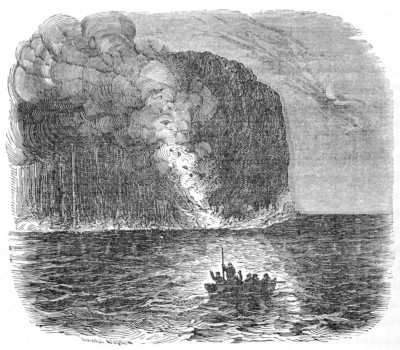
“Imagine an immense body of smoke rising from the sea, the surface of
which was marked by the slippery rippling of the waves, occasioned by the
light and steady breezes incidental to these climates in summer. In a
quiescent state, it had the appearance of a circular cloud revolving on the
water like a horizontal wheel, in various and irregular involutions, expanding
itself gradually on the lee side, when suddenly a column of the blackest
cinders, ashes and stones would shoot up in the form of a spire, at an angle
of from ten to twenty degrees from a perpendicular line, the angle of inclination
being universally to windward; this was rapidly succeeded by a
second, third and fourth shower, each acquiring greater velocity, and overtopping
the other till they had attained an altitude as much above the level
of our eye, as the sea was below it.
“As the impetus with which the columns were severally propelled diminished,
and their ascending motion had nearly ceased, they broke into various
branches resembling a group of pines; these again forming themselves into
festoons of white feathery smoke, in the most fanciful manner imaginable,
intermixed with the finest particles of falling ashes, which at one time
assumed the appearance of innumerable plumes of black and white ostrich
123feathers, surmounting each other, and another, that of the light wavy
branches of a weeping-willow.
“During these bursts, the most vivid flashes of lightning continually
issued from the densest part of the volcano; and the cloud of smoke, now
ascending to an altitude much above the highest point to which the ashes
were projected, rolled off in large masses of fleecy clouds, gradually expanding
themselves before the wind in a direction nearly horizontal, and drawing
up to them a quantity of water-spouts, which formed a most beautiful and
striking addition to the general appearance of the scene.
“That part of the sea where the volcano was situated, was upward of
thirty fathoms deep, and at the time of our viewing it the volcano was only
four days old. Soon after our arrival on the cliff, a peasant observed he
could discern a peak above the water: we looked but could not see it;
however, in less than half an hour it was plainly visible, and before we
quitted the place, which was about three hours from the time of our arrival,
a complete crater was formed above the water, not less than twenty feet high
on the side where the greatest quantity of ashes fell; the diameter of the
crater being apparently about four or five hundred feet.
“The great eruptions were generally attended with a noise like the continued
firing of cannon and musketry intermixed, as also with slight shocks
of earthquakes; several of which having been felt by my companions, but
none by myself, I had become half skeptical, and thought their opinion arose
merely from the force of imagination; but while we were sitting within five
or six yards of the edge of the cliff, partaking of a slight repast which had
been brought with us, and were all busily engaged, one of the most magnificent
bursts took place which we had yet witnessed, accompanied by a
very severe shock of an earthquake. The instantaneous and involuntary
movement of each was to spring upon his feet; and I said, ‘This admits of
no doubt.’ The words had scarcely passed my lips, before we observed a
large portion of the face of the cliff, about fifty yards on our left, falling,
which it did with a violent crash. So soon as our first consternation had a
little subsided, we removed about ten or a dozen yards further from the
edge of the cliff, and finished our dinner.
“On the succeeding day, June fifteenth, having the consul and some other
friends on board, I weighed, and proceeded with the ship toward the volcano,
with the intention of witnessing a night view; but in this expectation we were
greatly disappointed, from the wind freshening, and the weather becoming
thick and hazy, and also from the volcano itself being more quiescent than
it was the preceding day. It seldom emitted any lightning, but occasionally
as much flame as may be seen to issue from the top of a glass-house or
124foundry chimney. On passing directly under the great cloud of smoke,
about three or four miles distant from the volcano, the decks of the ship
were covered with fine black ashes, which fell intermixed with small rain.
We returned the next morning, and late on the evening of the same day I
took leave of St. Michael’s, to complete my cruise.
“On the opening of the volcano clear of the north-west part of the island,
after dark on the sixteenth, we witnessed one or two eruptions that, had the
ship been near enough, would have been awfully grand. It appeared one continued
blaze of lightning; but its distance from the ship, upward of twenty
miles, prevented our seeing it with effect. Returning again toward St.
Michael’s, on the fourth of July, I was obliged, by the state of the wind, to
pass with the ship very close to the island, which was now completely formed
by the volcano, being nearly the hight of Matlock High Tor, about eighty
yards above the sea. At this time it was perfectly tranquil; which circumstance
determined me to land, and explore it more narrowly. I left the ship
in one of the boats, accompanied by some of the officers. As we approached
we perceived that it was still smoking in many parts, and, upon our reaching
the island, found the surf on the beach very high. Rowing round to the
lee-side, with some little difficulty, by the aid of an oar as a pole, I jumped
on shore, and was followed by the other officers. We found a narrow beach
of black ashes, from which the side of the island rose in general too steep to
admit of our ascending; and where we could have clambered up, the mass
of matter was much too hot to allow our proceeding more than a few yards
in the ascent.
“The declivity below the surface of the sea was equally steep, having
seven fathoms of water at scarcely the boat’s length from the shore, and at the
distance of twenty or thirty yards we sounded twenty-five fathoms. From
walking round it in about twelve minutes, I should judge that it was something
less than a mile in circumference; but the most extraordinary part
was the crater, the mouth of which, on the side facing St. Michael’s, was
nearly level with the sea. It was filled with water, at that time boiling, and
was emptying itself into the sea by a small stream about six yards over, and
by which I should suppose it was continually filled again at high water.
This stream, close to the edge of the sea, was so hot, as only to admit the
finger to be dipped suddenly in, and taken out again immediately.
“It appeared evident, by the formation of this part of the island, that the
sea had, during the eruptions, broken into the crater in two places, as the
east side of the small stream was bounded by a precipice; a cliff between
twenty and thirty feet high, forming a peninsula of about the same dimension
in width, and from fifty to sixty feet long, connected with the other
125part of the island by a narrow ridge of cinders and lava, as an isthmus, of
from forty to fifty feet in length, from which the crater rose in the form of
an amphitheater.
“This cliff, at two or three miles’ distance from the island, had the appearance
of a work of art, resembling a small fort or block-house. The top of
this we were determined, if possible, to attain; but the difficulty we had to
encounter in doing so, was considerable: the only way to attempt it was up
the side of the isthmus, which was so steep that the only mode by which we
could effect it, was by fixing the end of an oar at the base, with the assistance
of which we forced ourselves up in nearly a backward direction.
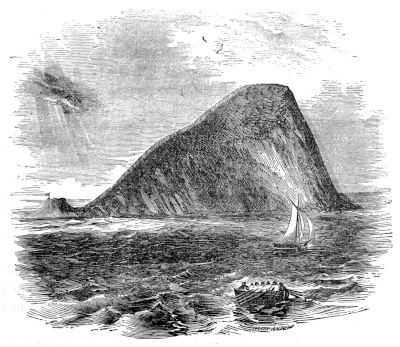
“Having reached the summit of the isthmus, we found another difficulty:
for it was impossible to walk upon it, as the descent on the other side was
immediate, and as steep as the one we had ascended; but by throwing our
legs across it, as would be done on the ridge of a house, and moving ourselves
forward by our hands, we at length reached that part of it where it
gradually widened itself, and formed the summit of the cliff, which we found
to have a perfectly flat surface, of the dimensions before stated. Judging
this to be the most conspicuous situation, we here planted the union, and
left a bottle sealed up, containing a short account of the origin of the island,
and of our having landed upon it, and naming it Sabrina island.
126“Within the crater I found the complete skeleton of a guard-fish, the
bones of which, being perfectly burnt, fell to pieces upon attempting to take
them up; and, by the account of the inhabitants on the coast of St. Michael’s,
great numbers of fish had been destroyed during the early part of the
eruption, as large quantities, probably suffocated or poisoned, were occasionally
found drifted into the small inlets or bays. The island, like other
volcanic productions, is composed principally of porous substances, generally
burnt to complete cinders, with occasional masses of a stone, which I should
suppose to be a mixture of iron and limestone.”
Sabrina island has gradually disappeared, since the month of October,
1811, leaving an extensive shoal. Smoke was discovered still issuing out
of the sea in the month of February, 1812, near the spot where this wonderful
phenomenon appeared.
Having thus spoken of the Azores, we now pass to some similar phenomena
in the Grecian archipelago. Before entering, however, on the details which
are here furnished on this curious and most interesting subject, it may not
be improper to observe, that the island of Acroteri, of great celebrity in
ancient history, appears to have its surface composed of pumice-stone,
incrusted by a surface of fertile earth; and that it is represented by the
ancients as having risen, during a violent earthquake, from the sea. Four
neighboring islands are described as having a similar origin, notwithstanding
the sea is in that part of the archipelago of such a depth as to be unfathomable
by any sounding line.line. These arose at different times: the first long
before the commencement of the Christian era; the second in the first
century; the third in the eighth; and the fourth in 1573.
We now proceed to a phenomenon of a similar nature, belonging to the
same cluster of islands, which being of a more recent date, we are enabled
to enter into all its particulars. They are such as can not fail to interest
and surprise.
On the twenty-second of May, 1707, a severe earthquake was felt at
Stanchio, an island of the archipelago; and on the ensuing morning a party
of seamen, discovering not far off what they believed to be a wreck, rapidly
rowed toward it; but finding rocks and earth instead of the remains of a
ship, hastened back, and spread the news of what they had seen, in Santorini,
another of these islands. However great the apprehensions of the inhabitants
were at the first sight, their surprise soon abated, and in a few days,
seeing no appearance of fire or smoke, some of them ventured to land on
the new island. Their curiosity led them from rock to rock, where they
found a kind of white stone, which yielded to the knife like bread, and
nearly resembled that substance in color and consistence. They also found
127many oysters sticking to the rocks: but while they were employed in
collecting them, the island moved and shook under their feet, on which they
ran with precipitation to their boats. Amid these motions and tremblings
the island increased, not only in hight, but in length and breadth: still
occasionally, while it was raised and extended on the one side, it sunk and
diminished on the other. One person observed a rock to rise out of the sea,
forty or fifty paces from the island, which, having been thus visible for four
days, sunk, and appeared no more: several others appeared and disappeared
alternately, till at length they remained fixed and unmoved. In the mean
time the color of the surrounding sea was changed: at first it was of a light
green, then reddish, and afterward of a pale yellow, accompanied by a
noisome stench, which spread itself over a part of the island of Santorini.
On the sixteenth of July, smoke first appeared, not indeed on the island,
but issuing from a ridge of black stones which suddenly rose about sixty
paces from it, where the depth of the sea was unfathomable. Thus there
were two separate islands, one called the White, and the other the Black
island, from the different appearances they exhibited. This thick smoke was
of a whitish color, like that of a lime-kiln, and was carried by the wind to
Santorini, where it penetrated the houses of the inhabitants.
In the night between the nineteenth and twentieth of July, flames began
to issue with the smoke, to the great terror of the inhabitants of Santorini,
especially of those occupying the castle of Scaro, who were distant about a
mile and a half only from the burning island, which now increased very
fast, large rocks daily springing up, which sometimes added to its length,
and sometimes to its breadth. The smoke, also increased, and there not
being any wind, ascended so high as to be seen at Candia, and other distant
islands. During the night, it resembled a column of five, fifteen, or twenty
feet in hight; and the sea was then covered with a scurf or froth, in some
places reddish, and in others yellowish, from which proceeded such a stench,
that the inhabitants throughout the whole island of Santorini burnt perfumes
in their houses, and made fires in the streets, to prevent infection. This,
indeed, did not last above a day or two; for a strong gale of wind dispersed
the froth, but drove the smoke on the vineyards of Santorini, by which the
grapes were, in one night, parched up and destroyed. This smoke also
caused violent head-aches, attended with retchings.
On the thirty-first of July, the sea smoked and bubbled in two different
places near the island, where the water formed a perfect circle, and looked
like oil when beginning to simmer. This continued above a month, during
which time many fishes were found dead on the shore of Santorini. On the
following night a dull hollow noise was heard, like the distant report of
128several cannon, which was instantly followed by flames of fire, shooting up
to a great hight in the air, where they suddenly disappeared. The next day
the same hollow sound was several times heard, and succeeded by a blackish
smoke, which, notwithstanding a fresh gale blew at the time, rose up to a
prodigious hight, in the form of a column, and would probably in the night
have appeared as if on fire.
On the seventh of August, a different noise was heard, resembling that of
large stones thrown, at very short intervals, into a deep well. This noise,
having lasted for some days, was succeeded by another much louder, so
nearly resembling thunder, as scarcely to be distinguished from three or
four real claps, which were heard at the same time.
On the twenty-first, the fire and smoke were very considerably diminished;
but the next morning they broke out with still greater fury than before.
The smoke was red, and very thick, the heat at the same time being so
intense, that all around the island the sea smoked and bubbled surprisingly.
At night, by the means of a telescope, sixty small openings or funnels, all
emitting a very bright flame, were discovered on the highest part of the
island, conjointly resembling a large furnace; and on the other side of the
great volcano there appeared to be as many.
On the morning of the twenty-third, the island was much higher than on
the preceding day, and its breadth increased by a chain of rocks which had
sprung up in the night nearly fifty feet above the water. The sea was also
again covered with reddish froth, which always appeared when the island
seemed to have received any considerable additions, and occasioned an
intolerable stench, until it was dispersed by the wind and the motion of the
waves.
On the fifth of September, the fire opened another vent at the extremity
of the Black island, from which it issued for several days. During that
time little was discharged from the large furnace; but from this new passage
the astonished spectator beheld the fire dart up three several times to a vast
hight, resembling so many prodigious sky-rockets of a glowing, lively red.
The following night the sub-aqueous fire made a terrible noise, and immediately,
after a thousand sheaves of fire darted into the air, where breaking
and dispersing, they fell like a shower of stars on the island, which appeared
in a blaze, presenting to the amazed spectator at once a most dreadful and
beautiful illumination. To these natural fire-works, succeeded a kind of
meteor, which for some time hung over the castle of Scaro, and which,
having a resemblance to a flaming sword, served to increase the consternation
of the inhabitants of Santorini.
On the ninth of September, the White and Black islands united; after
129which the western end of the island grew daily in bulk. There were now
four openings only which emitted flames; these issued forth with great
impetuosity, sometimes attended with a noise like that of a large organ-pipe,
and sometimes like the howling of wild beasts.
On the twelfth, the subterraneous noise was much augmented, having
never been so frequent or so dreadful as on that and the following day.
The bursts of this subterraneous thunder, like a general discharge of the
artillery of an army, were repeated ten or twelve times within twenty-four
hours, and, immediately after each clap, the large furnace threw up huge
red-hot stones, which fell into the sea at a great distance. These claps were
always followed by a thick smoke, which spread clouds of ashes over the sea
and the neighboring islands.
On the eighteenth of September, an earthquake was felt at Santorini. It
did but little damage, although it considerably enlarged the burning island,
and in several places gave vent to the fire and smoke. The claps were also
more terrible than ever; and, in the midst of a thick smoke, which appeared
like a mountain, large pieces of rock, which afterward fell on the island, or
into the sea, were thrown up with as much noise and force as balls from the
mouth of a cannon. One of the small neighboring islands was covered with
these fiery stones, which being thinly crusted over with sulphur, gave a
bright light, and continued burning until that was consumed.
On the twenty-first, a dreadful clap of subterraneous thunder was followed
by very powerful lightnings, and at the same instant the new island was so
violently shaken, that part of the great furnace fell down, and huge burning
rocks were thrown to the distance of two miles and upward. This seemed
to be the last effort of the volcano, and appeared to have exhausted the combustible
matter, as all was quiet for several days after: but on the twenty-fifth,
the fire broke out again with still greater fury, and among the claps
one was so terrible, that the churches of Santorini were soon filled with
crowds of people, expecting every moment to be their last; and the castle
and town of Scaro suffered such a shock, that the doors and windows of the
houses flew open. The volcano continued to rage during the remaining part
of the year; and in the month of January, 1708, the large furnace, without
one day’s intermission, threw out stones and flames, at least once or twice,
but generally five or six times a day.
On the tenth of February, in the morning, a pretty strong earthquake
was felt at Santorini, which the inhabitants considered as a prelude to
greater commotions in the burning island; nor were they deceived, for soon
after the fire and smoke issued in prodigious quantities. The thunder-like
claps were redoubled, and all was horror and confusion: rocks of an amazing
130size were raised up to a great hight above the water; and the sea raged and
boiled to such a degree as to occasion great consternation. The subterraneous
bellowings were heard without intermission, and sometimes in less than
a quarter of an hour, there were six or seven eruptions from the large
furnace. The noise of repeated claps, the quantity of huge stones which
flew about on every side, the houses at Santorini tottering to their very
foundations, and the fire, which now appeared in open day, surpassed all
that had hitherto happened, and formed a scene terrific and astonishing
beyond description.
The fifteenth of April was rendered memorable by the number and violence
of the bellowings and eruptions, by one of which nearly a hundred
stones were thrown at the same instant into the air, and fell again into the
sea at about two miles distant. From that day until the twenty-second of
May, which may be considered as the anniversary of the birth of the new
island, things continued much in the same state, but afterward the fire and
smoke subsided by degrees, and the subterraneous thunders became less
terrible.
On the fifteenth of July, 1709, the Bishop of Santorini, accompanied by
several friars, hired a boat to take a near view of the island. They made
directly toward it on that side where the sea did not bubble, but where it
smoked very much. Being within the range of this vapor, they felt a close,
suffocating heat, and found the water very hot; on which they directed their
course toward a part of the island at the furthest distance from the large
furnace. The fires, which still continued to burn, and the boiling of the
sea, obliged them to make a great circuit, notwithstanding which they felt
the air about them to be very hot and sultry. Having encompassed the
island, and surveyed it carefully from an adjacent one, they judged it to be
two hundred feet above the sea, about a mile broad, and five miles in circumference;
but, not being thoroughly satisfied, they resolved to make an attempt
at landing, and accordingly rowed toward that part of the island where they
perceived neither fire nor smoke. When, however, they had proceeded to
within the distance of a hundred yards, the great furnace discharged itself
with its usual fury, and the wind blew upon them so dense a smoke, and so
heavy a shower of ashes, that they were obliged to abandon their design.
Having retired somewhat further, they let down their sounding lead, with a
line ninety-five fathoms in length, but it was too short to reach the bottom.
On their return to Santorini, they observed that the heat of the water had
melted the greater part of the pitch employed in calking their boat, which
had now become very leaky.
From that time until the fifteenth of August, the fire, smoke and noises
131continued, but not in so great a degree; and it appears that for several years
after, the island still increased, but that the fire and subterraneous noises
were much abated. The most recent account we have been enabled to
collect, is that of a traveler, who, in 1811, passed this island at some distance.
It appeared to him like a stupendous mass of rock, but was not
inhabited or cultivated. It had then long ceased to burn.
SUBTERRANEAN WONDERS. — THE GROTTA DEL CANE. — GROTTO OF ANTIPAROS. — CAVERNS IN GERMANY AND HUNGARY, CONTAINING FOSSIL BONES. — THE MAMMOTH CAVE. — THE GREAT CAVERN OF GUACHARO. — FINGAL’S CAVE, OR GRAND STAFFA CAVERN. — OTHER GROTTOS AND CAVERNS. — MINES, METALS, GEMS, &C. — DIAMOND MINES. — GOLD AND SILVER MINES. [4] — QUICKSILVER MINES. — IRON MINES. — COPPER MINES. — TIN MINES. — LEAD MINES. — COAL MINES. — SALT MINES. — SALT MINES OF CRACOW. — SALT MINES AND SPRINGS OF CHESHIRE, ENGLAND.
“Give me, ye powers, the wondrous scenes to show,
Concealed in darkness in the caves below.”
Among the various subterranean wonders of the world, which are worthy
of special notice, we would first mention the “Grotta del Cane.” This
name has been given to a small cavern between Naples and Pozzuoli, on this
account, that if a dog be brought into it, and his nose held to the ground, a
difficulty of respiration instantly ensues, and he loses all sensation and even
life, if he be not speedily removed into purer air. There are other grottos
endowed with the same deleterious quality, especially in volcanic countries;
and the pestiferous vapors they exhale, are quickly fatal both to animals and
man, though they do not offer to the eye the slightest indication of their
presence. These vapors are, however, for the greater part temporary; while
that of the Grotta del Cane is perpetual, and seems to have produced its
deadly effects even in the time of Pliny. A man standing erect within, does
not suffer from it, the mephitic vapor rising to a small hight only from the
ground. It may, therefore, be entered without danger.
The smoke of a torch extinguished in this vapor, or gas, sinks downward,
assumes a whitish color, and passes out at the bottom of the door. The
reason of this is, that the fumes which proceed from the torch mix more
readily with the gas than with the atmospherical air. It has been supposed,
that the mischievous effects of the vapor were the result of the air being
deprived of its elasticity; but it has been clearly demonstrated by M. Adolphus
132Murray, that they are solely to be attributed to the existence of
carbonic acid gas.
The person who is the keeper, or guide, at the grotto, and who shows to
strangers the experiment of the dog for a gratuity, takes the animal, when
he is half dead and panting, into the open air, and then proceeds to throw
him into the neighboring lake of Agnano, thus insinuating that this short
immersion in the water is necessary to his complete restoration. This,
however, is a mere trick, to render the experiment more specious, and to
obtain a handsome present from the credulous, the atmospherical air alone
sufficing for that purpose.
The celebrated naturalist, the Abbe Spallanzani, projected a regular series
of experiments on the mephitic vapor of this grotto, from a persuasion that
they would tend to throw a new light on physiology and natural philosophy.
Being, however, prevented from undertaking this, by his duties as a professor,
his friend, the Abbe Breislak, who resided near the spot, engaged in
the task; and the following is an abstract of his learned memoir on this
subject.
It is well known, the abbe observes, that the mephitic vapor occupies the
floor of a small grotto near the lake Agnano, a place highly interesting to
naturalists from the phenomena its environs present, and the hills within
which it is included. This grotto is situated on the south-east side of the
lake, at a little distance from it. Its length is about twelve feet, and its
breadth from four to five. It appears to have been originally a small excavation,
made for the purpose of obtaining pozzuolana, an earth which, being
applied as mortar, becomes a powerful cement. In the sides of the grotto,
among the earthy volcanic matters, are found pieces of lava, of the same
kind with those which are met with scattered near the lake.
The abbe is persuaded that, if new excavations were to be made in the
vicinity of the grotto, at a level with its floor, or a little lower, the same
mephitic vapor would be found; and thinks it would be curious to ascertain
the limits of its extent. It would also be advantageous to physical observations,
if the grotto were to be somewhat enlarged, and its floor reduced to a
level horizontal plane, by sinking it two or three feet, and surrounding it by
a low wall, with steps at the entrance. In its present state it is extremely
inconvenient for experiments, and the inclination of the ground toward the
door causes a great part of the vapor, from the effect of its specific gravity,
to make its way out close to the ground.
When the narrow limits of this place are considered, and the small
quantity of the vapor which has rendered it so celebrated, there can not be
any doubt but that it has undergone considerable changes; since it does not
133appear probable that Pliny refers to the present confined vapor only, when,
in enumerating many places from which a deadly air exhaled, he mentions
the territory of Pozzuoli. The internal fermentations by which it is caused,
are certainly much diminished in the vicinity of the lake Agnano. The water
near its banks is no longer seen to bubble up, from the disengagement of a
gas, as it appears from accounts, not of very remote antiquity, to have done.
The borders of the lake were attentively examined by the abbe, when its
waters were at the highest, and after heavy rains; but he could never discover
a single bubble of air. A number of aquatic insects which sport on
the surface, may at first sight occasion some deception; but a slight observation
soon detects the error. If, therefore, we do not suppose those authors
who have described the ebullition of the water near the banks of the lake
Agnano to have been deceived, it must at least be confessed, that this phenomenon
has now ceased. The quantity of the sulphureous vapors which
rise in the contiguous stoves, called the stoves of St. Germano, must likewise
be greatly diminished from what it anciently was: for, adjoining to the
present stoves, we still find the remains of a spacious ancient fabric, with
tubes of terra cotta inserted in the walls, which, by their direction, show for
what purpose they were intended. It appears certain, that this was a
building in which, by the means of pipes properly disposed, the vapors of the
place were introduced into different rooms for the use of patients. To these
ruins, however, the vapors no longer extend; so that, if this edifice had
remained entire, it could not have been employed for the purpose for which
it was intended. The veins of pyrites which produced the more ancient
conflagrations of the Phlegrean fields, between Naples and Cuma, and which,
in some places, are entirely consumed, approach their total extinction. We
will now proceed to the experiments within the grotto.
The object of the first was to determine the hight of the mephitic vapor at
the center of the grotto, that is, at the intersection of the line of its greatest
length with that of its greatest breadth. The hight varies according to the
different dispositions and temperatures of the atmosphere, the diversity of
winds, and the accidental variations which take place in the internal fermentations
by which the vapor is produced. It may, however, be estimated at a
mean, at nearly nine English inches.
The second set of experiments regarded the degree of heat on entering
into the mephitis: it was slightly sensible in the feet and lower part of the
legs; notwithstanding which, on taking out of the vapor several substances
which had remained in it for a long time, such as stones, leaves, the carcasses
of animals, &c., the abbe found that these were of the same temperature
with the atmospheric air. Feeling in his body a slight degree of heat,
134which he could not perceive in the substances removed from the mephitic
vapor, he was led by comparison to conclude, that the temperature of the
latter was the same with the atmospherical air, agreeably to the principles
of Dr. Crauford. He was, however, mistaken; for in subsequent experiments,
he found a very distinct degree of heat. He was now provided with
a thermometer, his former one having been broken, and, having suspended
it at the aperture of the grotto, three feet above the surface of the vapor,
found the mercury to stand at from sixty-two to sixty-four degrees of Fahrenheit;
but, on placing the ball on the ground so as to immerse it in the vapor,
the mercury rose to eighty, and even eighty-two degrees. That the substances
taken out of the mephitis did not exhibit this diversity of temperature,
was, he thinks, owing to the quantity of humidity with which they are
always loaded, and which produces on their surface a constant evaporation.
He was the more particular in repeating these experiments, because the
naturalists who had, before him, made similar ones in the Grotta del Cane,
had not observed the vapor to produce any effect on the mercury in the
thermometer.
Thirdly. He repeated for his own satisfaction, the usual experiments
made by naturalists, with the tincture of turnsole, lime-water, the crystallizations
of alkalies, the absorption of water, and the acidulous taste communicated
to it; which prove, beyond all doubt, the existence of fixed air, or
carbonic acid gas, in the vapor of the grotto. He ascertained that it was not
formed of fixed air alone, as might have been conjectured; but that the
relative quantities of the different gases which compose its mephitic air, are
as follows: in one hundred parts there are ten of vital air, or oxygen gas;
forty of fixed air, or carbonic acid gas; and fifty of phlogisticated air, or
azotic gas.
Fourthly. The phenomena of magnetism and electricity were investigated
by the abbe in this grotto. With respect to the former, there was not any
new appearance: the magnetic needle, being placed on the ground, and
consequently immersed in the mephitis, rested in the direction of its meridian,
and, at the approach of a magnetized bar, exhibited the usual effects
of attraction and repulsion, in proportion as either pole was presented. As
to the latter, electricity, it was impossible to make the experiments within
the mephitis, not because this kind of air is a conductor of the electric fluid,
as has been imagined, but because the humidity by which it is constantly
accompanied, disperses the electric matter; and this, not being collected in
a conductor, can not be rendered sensible. He attempted several times to
fire inflammable gas, with electric sparks, in the mephitic vapor, by means
of the conductor of the electrophus; but, notwithstanding his utmost
135endeavors to animate the electricity, he could never obtain a single spark,
the non-conductor becoming a conductor the moment it entered into the
mephitis, on account of the humidity which adhered to its surface.
Fifthly. His latest experiments were directed to the theory of the combustion
of bodies. He first endeavored to ascertain whether those spontaneous
inflammations that result from the mixture of concentrated acids with
essential oils, could be obtained within the grotto. He placed on the ground
a small vessel, in such a situation that the mephitis rose six inches above its
edges, employing oil of turpentine, and the vitriolic and nitrous acids: the
same inflammation, accompanied by a lively flame, followed, as would have
taken place in the open atmospheric air. The dense smoke which always
accompanies these inflammations, being attracted by the humidity of the
mephitis, presented its undulations to the eye, and formed a very pleasing
object. As he had put a considerable quantity of acid in the vessel, he
repeatedly poured in a little of the oil, and the flame appeared in the mouth
of the vessel fifteen times successively. The oxygenous principle contained
in the acids, and with which the nitrous acid principally abounds, undoubtedly
contributed to the production and duration of this flame, though
enveloped in an atmosphere inimical to inflammation.
The abbe had, in the district of Latera, observed that in a mephitis of
hydrogenous sulphurated or hepatic gas a slow combustion of phosphorus
took place, with the same resplendence as in the atmospheric air. On the
present occasion, his first experiment, in the mephitis of Agnano, was made
with common phosphoric matches, five of which he broke, holding them to
the ground, and consequently immersed in the mephitis. They produced a
short and transient flame, which became extinguished the moment it was
communicated to the wick of a candle. His second experiment was as
follows: he placed on the ground, within the grotto, a long table, in such a
manner that one extremity was without the mephitis, while the other,
and four-fifths of its length, were immersed in it. Along this table he laid
a train of gunpowder, beginning from the end without the mephitis; and,
at the other end, which was immersed in it to the depth of seven inches, he
placed, adjoining to the gunpowder, a cylinder of phosphorus, eight lines in
length. The gunpowder, without the mephitis, being fired, the combustion
was soon communicated to the other extremity of the train, and to the
phosphorus, which took fire with decrepitation, burned rapidly with a bright
flame, slightly colored with yellow and green, and left on the wood a black
mark, as of charcoal. The combustion lasted nearly two minutes, when the
whole phosphoric matter was consumed.
In succeeding experiments not any alteration was perceptible in the flame,
136or manner of burning, of the lighted phosphorus, either at the moment of
its entrance into the mephitis, or during its continuance in it. When
suddenly withdrawn, it ignited gunpowder equally well. Hence the abbe
deduces, that the mephitic gas of Grotta del Cane, however it may be utterly
unfit for the respiration of animals, and for the inflammation of common
combustible substances, readily allows that of phosphorus, which not only
burns in it, but emits, as usual, luminous sparks.
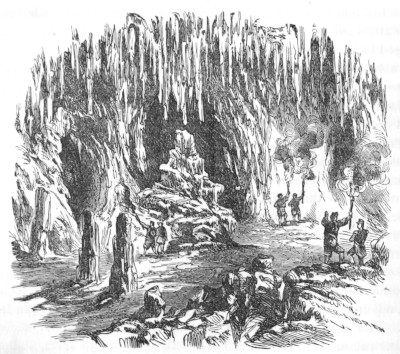
Antiparos, one of the Cyclades, is situated in the Egean sea, or Grecian
archipelago. It is a small island, about sixteen miles in circumference, and
lies two miles to the west of the celebrated Paros, from which circumstance
it derives its name, anti in the Greek language signifying opposite to. Its
singular and most interesting grotto, though so inferior in size to the cavern
in Kentucky of which we shall soon speak, has attracted the attention of an
infinite number of travelers. The entrance to this superb grotto is on the
side of a rock, and is a large arch, formed of craggy stones, overhung with
137brambles and creeping plants, which bestow on it a gloominess at once awful
and agreeable. Having proceeded about thirty paces within it, the traveler
enters a low, narrow alley, surrounded on every side by stones, which, by the
light of torches, glitter like diamonds; the whole being covered and lined
throughout with small crystals, which give by their different reflections, a
variety of colors. At the end of this alley or passage, having a rope tied
round his waist, he is led to the brink of an awful precipice, and is thence
lowered into a deep abyss, the gloom pervading which makes him regret the
“alley of diamonds” he has just quitted. He has not yet, however, reached
the grotto, but is led forward about forty paces, beneath a roof of rugged
rocks, amid a scene of terrible darkness, and at a vast depth from the
surface of the earth, to the brink of another precipice, much deeper and
more awful than the former.
Having descended this precipice, which is not accomplished without
considerable difficulty, the traveler enters a passage, the grandeur and
beauty of which can be but imperfectly described. It is one hundred and
twenty feet in length, about nine feet high, and in width seven, with a bottom
of a fine green glossy marble. The walls and arched roof are as smooth
and polished as if they had been wrought by art, and are composed of a fine
glittering red and white granite, supported at intervals by columns of a
deep blood-red shining porphyry, which, by the reflection of the lights,
presents an appearance inconceivably grand. At the extremity of this
passage is a sloping wall, formed of a single mass of purple marble, studded
with sprigs of rock crystal, which, from the glow of the purple behind,
appear like a continued range of amethysts.
Another slanting passage, filled with petrifactions, representing the figures
of snakes and other animals, and having toward its extremity two pillars of
beautiful yellow marble, which seem to support the roof, leads to the last
precipice, which is descended by means of a ladder. The traveler, who has
descended to the depth of nearly fifteen hundred feet beneath the surface,
now enters the magnificent grotto, to procure a sight of which he has
endured so much fatigue. It is in width three hundred and sixty feet; in
length three hundred and forty; and in most places one hundred and eighty
in hight. By the aid of torch-light, he finds himself beneath an immense
and finely vaulted arch, overspread with icicles of white shining marble,
many of them ten feet in length, and of a proportionate thickness. Among
these are suspended a thousand festoons of leaves and flowers, of the same
substance, but so glittering as to dazzle the sight. The sides are planted
with petrifactions, also of white marble, representing trees; these rise in
rows one above the other, and often inclose the points of the icicles. From
138them also hang festoons, tied as it were one to another, in great abundance;
and in some places rivers of marble seem to wind through them. In short,
these petrifactions, the result of the dripping of water for a long series of
ages, nicely resemble trees and brooks turned to marble. The floor is paved
with crystals of different colors, such as red, blue, green and yellow, projecting
from it, and rendering it rugged and uneven. These are again
interspersed with icicles of white marble, which have apparently fallen from
the roof, and are there fixed. To these the guides fasten their torches; and
the glare of splendor and beauty which results from such an illumination,
may be better conceived than described.
To the above description we subjoin an extract from the one given by Dr.
Clarke, a learned traveler, who visited this celebrated grotto.
“The mode of descent is by ropes, which, on the different declivities, are
either held by the guides, or are joined to a cable which is fastened at the
entrance around a stalactite pillar. In this manner, we were conducted,
first down one declivity, and then down another, until we entered the
spacious chambers of this truly enchanted grotto. The roof, the floor, the
sides, of a whole series of magnificent caverns, were entirely invested with a
dazzling incrustation as white as snow. Columns, some of which were five
and twenty feet in length, pended in fine icicle forms above our heads:
fortunately some of them are so far above the reach of the numerous
travelers, who during many ages, have visited this place, that no one has
been able to injure or remove them. Others extended from the roof to the
floor, with diameters equal to that of the mast of a first-rate ship of the line.
The incrustations of the floor, caused by falling drops from the stalactites
above, had grown up into dendritic and vegetable forms, which first suggested
to Tournefort the strange notion of his having here discovered the vegetation
of stones. Vegetation itself has been considered as a species of
crystallization; and as the process of crystallization is so surprisingly manifested
by several phenomena in this grotto, some analogy may perhaps be
allowed to exist between the plant and the stone; but it can not be said, that
a principle of life existing in the former has been imparted to the latter.
The last chamber into which we descended surprised us more by the grandeur
of its exhibition than any other. Probably there are many other
chambers below this, yet unexplored, for no attempt has been made to
penetrate further: and, if this be true, the new caverns, when opened,
would appear in perfect splendor, unsullied, in any part of them, by the
smoke of torches, or by the hands of intruders.”
139
Among the most remarkable of these caverns are those of Gaylenreuth,
on the confines of Bayreuth. The opening to these, which is about seven
feet and a half high, is at the foot of a rock of limestone of considerable
magnitude, and in its eastern side. Immediately beyond the opening is a
magnificent grotto, of about three hundred feet in circumference, which
has been naturally divided by the form of the roof into four caves. The
first is about twenty-five feet long and wide, and varies in hight from nine to
eighteen feet, the roof being formed into irregular arches. Beyond this is
the second cave, about twenty-eight feet long, and of nearly the same width
and hight with the former.
A low and very rugged passage, the roof of which is formed of projecting
pieces of rocks, leads to the third grotto, the opening into which is a hole
three feet high, and four feet wide. This grotto is more regular in its form,
and is about thirty feet in diameter, and nearly round; its hight is from five
to six feet. It is very richly and fantastically adorned by the varying forms
of its stalactitic hangings. The floor is also covered with a wet and slippery
glazing, in which several teeth and jaws appear to have been fixed.
From this grotto commences the descent to the inferior caverns. Within
only about five or six feet an opening in the floor is seen, which is partly
vaulted over by a projecting piece of rock. The descent is about twenty
feet. This cavern is about thirty feet in hight, about fifteen feet in width,
and nearly circular; the sides, roof and floor, displaying the remains of
animals. The rock itself is thickly beset with teeth and bones, and the
floor is covered with a loose earth, the evident result of animal decomposition,
and in which numerous bones are imbedded.
A gradual descent leads to another grotto, which, with its passage, is forty
feet in length, and twenty feet in hight. Its sides and top are beautifully
adorned with stalactites. Nearly twenty feet further is a frightful gulf, the
opening of which is about fifteen feet in diameter; and, upon descending
about twenty feet, another grotto, about the same diameter with the former,
but forty feet in hight, is seen. Here the bones are dispersed about; and
the floor, which is formed of animal earth, has great numbers of them
imbedded in it. The bones which are here found, seem to be of different
animals; but in this, as well as in the former caverns, perfect and unbroken
bones are very seldom found. Sometimes a tooth is seen projecting from
140the solid rock, through the stalactitic covering, showing that many of these
wonderful remains may here be concealed. A specimen of this kind has
been preserved, and is rendered particularly interesting, by the first molar
tooth of the lower jaw, with its enamel quite perfect, rising through the
stalactitic mass which invests the bone. In this cavern the stalactites begin
to be of a larger size, and of a more columnar form.
Passing on through a narrow opening in the rock, a small cave, seven
feet long, and five feet high, is discovered; another narrow opening leads to
another small cave; from which a sloping descent leads to a cave twenty-five
feet in hight, and about half as much in its diameter, in which is a
truncated columnar stalactite, eight feet in circumference.
A narrow and most difficult passage, twenty feet in length, leads from this
cavern to another, twenty-five feet in hight, which is everywhere beset with
teeth, bones and stalactitic projections. This cavern is suddenly contracted,
so as to form a vestibule of six feet wide, ten long, and nine high, terminating
in an opening close to the floor, only three feet wide and two high,
through which it is necessary to writhe, with the body on the ground. This
leads into a small cave, eight feet high and wide, which is the passage into a
grotto, twenty-eight feet high, and about forty-three feet long and wide.
Here the prodigious quantity of animal earth, the vast number of teeth,
jaws and other bones, and the heavy grouping of the stalactites, produce so
dismal an appearance, as to become a perfect model of a temple for a god
of the dead. Here hundreds of cart-loads of bony remains might be
removed, pockets might be filled with fossil teeth, and animal earth was
found to reach to the utmost depth to which the workmen dug. A piece of
stalactite, being here broken down, was found to contain pieces of bones
within it, the remnants of which were left imbedded in the rock. From
this principal cave is a very narrow passage, terminating in the last cave,
which is about six feet in width, fifteen in hight, and the same in length.
In this cave were no animal remains, and the floor was the naked rock.
Thus far only can these natural sepulchers be traced; but there is every
reason to suppose, that these animal remains are disposed through a greater
part of this rock. Whence this immense quantity of the remains of carnivorous
animals could have been collected, is a question which naturally
arises; but the difficulty of answering it appears to be almost insurmountable.
141
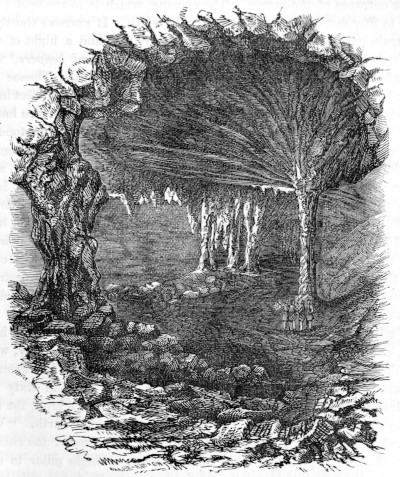
For one of the earliest accounts of this stupendous cavern, which is
unparalleled in the entire history of subterranean wonders, we are indebted
to Dr. Nahum Ward, who published it in a monthly magazine, in October,
1816. It is in what was formerly Warren, but now Edmonson county, in
the state of Kentucky, about ten miles from the great Louisville and Nashville
turnpike. The territory is not mountainous but broken, differing in this
respect from the vicinity of most other caverns of the same general kind.
Not far from the entrance, a hotel is now kept for the accommodation of
142visitors, as the cave is quite a fashionable resort for travelers during the
summer season. Perhaps we shall best gain correct ideas of this wonderful
cavern, which is almost a world in itself, having its own seas, mountains,
lakes, rivers, &c., by reading first the account given by Dr. Ward, and then
that of a visitor who explored it in 1854.
Dr. Ward, provided with guides, two large lamps, a compass and refreshments,
descended a pit forty feet in depth, and one hundred and twenty in
circumference; having a spring of fine water at the bottom, and conducting
to the entrance of the cavern. The opening, which is to the north, is from
forty to fifty feet high, and about thirty in width. It narrows shortly after,
but again expands to a width of thirty or forty feet, and a hight of twenty,
continuing these dimensions for about a mile, to the first hoppers,[2] where a
manufactory of saltpeter had recently been established. Thence to the
second of these hoppers, two miles from the entrance, it is forty feet in width,
and sixty in hight. Throughout nearly the whole of the distance handsome
walls had been made by the manufacturers, of the loose limestone. The
road was hard, and as smooth as a flag pavement. In every passage which
the doctor traversed, the sides of the cavern were perpendicular, and the
arches, which have bid defiance even to earthquakes, were regular. In 1802,
when the heavy shocks of earthquakes came on which were so severely felt
in this part of Kentucky, the workmen stationed at the second hoppers,
heard about five minutes before each shock, a heavy rumbling noise issue
from the cave, like a strong wind. When that ceased, the rocks cracked,
and the whole appeared to be going in a moment to final destruction.
However, no one was injured, although large portions of rock fell in different
parts of the cavern.
In advancing into the cavern, the avenue leads from the second hoppers,
west, one mile; and thence, south-west, to the chief area or city, which is
six miles from the entrance. This avenue, throughout its whole extent from
the above station to the cross-roads, or chief area, is from sixty to one
hundred feet in hight, of a similar width, and nearly on a level, the floor or
bottom being covered with loose limestone and saltpeter earth. “When,”
observes the doctor, “I reached this immense area (called the chief city)
which contains upward of eight acres, without a single pillar to support
the arch, which is entire over the whole, I was struck dumb with astonishment.
Nothing can be more sublime and grand than this place, of which
but a faint idea can be conveyed, covered with one solid arch at least one
hundred feet high, and to all appearance entire.”
143Having entered the area, the doctor perceived five large avenues leading
from it, from sixty to one hundred feet in width, and about forty in hight.
The stone walls are arched, and were from forty to eighty feet perpendicular
in hight before the commencement of the arch.
In exploring these avenues, the precaution was taken to cut arrows, pointing
to the mouth of the cave, on the stones beneath the feet, to prevent any
difficulty in the return. The first which was traversed, took a southerly
direction for more than two miles; when a second was taken, which led
first east, and then north, for more than two miles further. These windings
at length brought the party, by another avenue, to the chief city again, after
having traversed different avenues for more than five miles. Having
reposed for a few moments on slabs of limestone near the center of this
gloomy area, and refreshed themselves and trimmed their lamps, they
departed a second time, through an avenue almost north, parallel with the
one leading from the chief city to the mouth of the cavern; and, having
proceeded upward of two miles, came to the second city. This is covered
with a single arch, nearly two hundred feet high in the center, and is very
similar to the chief city, except in the number of its avenues, which are two
only. They crossed it, over a very considerable rise in the center, and
descended through an avenue which bore to the east, to the distance of
nearly a mile, when they came to a third area, or city, about one hundred
feet square, and fifty in hight, which had a pure and delightful stream of
water issuing from the side of a wall about thirty feet high, and which fell
on a broken surface of stone, and was afterward entirely lost to view.
Having passed a few yards beyond this beautiful sheet of water, so as to
reach the end of the avenue, the party returned about one hundred yards,
and passing over a considerable mass of stone, entered another, but smaller
avenue to the right, which carried them south, through a third, of an
uncommonly black hue, somewhat more than a mile; when they ascended a
very steep hill about sixty yards, which conducted them to within the walls
of the fourth city. It is not inferior to the second, having an arch which
covers at least six acres. In this last avenue, the extremity of which can
not be less than four miles from the chief city, and ten from the mouth of
the cavern, are upward of twenty large piles of saltpeter earth on the one
side, and broken limestone heaped up on the other, evidently the work of
human hands.
From the course of his needle, the doctor expected that this avenue would
have led circuitously to the chief city; but was much disappointed when he
reached the extremity, a few hundred yards’ distance from the fourth city.
In retracing his steps, not having paid a due attention to mark the entrances
144of the different avenues, he was greatly bewildered, and once completely
lost himself for nearly fifteen or twenty minutes. Thus, faint and wearied,
he did not reach the chief area till ten at night; but was still determined
to explore the cavern so long as his light should last. Having entered the
fifth and last avenue from the chief area, and proceeded south-east about
nine hundred yards, he came to the fifth area, the arch of which covers
upward of four acres of level ground, strewed with limestone, and having
fire-beds of an uncommon size, surrounded with brands of cane, interspersed.
Another avenue on the opposite side, led to one of still greater capacity, the
walls or sides of which were more perfect than any that had been noticed,
running almost due south for nearly a mile and a half, and being very level
and straight, with an elegant arch. While the doctor was employed, at
the extremity of this avenue, in sketching a plan of the cave, one of his
guides, who had strayed to a distance, called on him to follow. Leaving the
other guide, he was led to a vertical passage, which opened into a chamber
at least eighteen hundred feet in circumference, and the center of the arch
of which was one hundred and fifty feet in hight.
It was past midnight when he entered this chamber of eternal darkness;
and when he reflected on the different avenues through which he had passed
since he had penetrated the cave at eight in the morning, and now found
himself buried several miles in the dark recesses of this awful cavern—the
grave, perhaps, of thousands of human beings—he felt a shivering horror.
The avenue, or passage, which led from it was as large as any he had
entered; and it is uncertain how far he might have traveled had his lights
not failed him. All those who have any knowledge of this cave, he observes,
conjecture that Green river, a stream navigable several hundred miles, passes
over three of its branches.
After a lapse of nearly an hour, he descended by what is called the
“passage of the chimney,” and joined the other guide. Thence returning
to the chief area or city, where the lamps were trimmed for the last time,
he entered the spacious avenue which led to the second hoppers. Here he
met with various curiosities, such as spars, petrifactions, &c.; and these he
brought away, together with a mummy which was found at the second
hoppers. He reached the mouth of the cave about three in the morning,
nearly exhausted with nineteen hours of constant fatigue. He nearly
fainted on leaving it, and on inhaling the vapid air of the atmosphere, after
having so long breathed the pure air occasioned by the niter of the cave.
His pulse beat stronger when in the cave, but not so quick as when on the
surface.
Here the doctor observes that he has hardly described half the cave, not
145having named the avenues between its mouth and the second hoppers. This
part of his narrative is of equal interest with what has been already given.
He states that there is a passage in the main avenue, upward of nine
hundred feet from the entrance, like that of a trap-door. By sliding aside
a large flat stone, you can descend sixteen or eighteen feet in a very narrow
defile, where the passage comes on a level, and winds about in such a
manner, as to pass under the main passage without having any communication
with it, at length opening into the main cave by two large passages just
beyond the second hoppers. This is called the “glauber-salt room,” from
salts of that kind being found there. Next come the sick room, the bat-room,
and the flint-room, together with a winding avenue, which, branching
off at the second hoppers, runs west and south-west for more than two miles.
It is called the “haunted chamber,” from the echo within: its arch is very
beautifully incrusted with limestone spar; and in many places the columns
of spar are truly elegant, extending from the ceiling to the floor. Near the
center of this arch is a dome, apparently fifty feet high, hung in rich drapery,
festooned in the most fanciful manner for six or eight feet from the hangings,
and in colors the most rich and brilliant. By the reflection of one or two
lights, the columns of spar and the stalactites have a very romantic appearance.
Of this spar, a large elevation, called “Wilkin’s arm-chair,” has
been formed in the center of the avenue and encircled with many smaller
ones. The columns of the spar, fluted and studded with knobs of spar and
stalactites; the drapery of the various colors superbly festooned and hung
in the most graceful manner, these are shown with the greatest brilliancy
by the reflection of the lamps.
In the vicinity of the haunted chamber, the sound of a cataract was heard;
and at the extremity of the avenue was a reservoir of water, very clear and
grateful to the taste, having, apparently, neither inlet nor outlet. Here the
air, as in many other parts of the cave, was pure and delightful. Not far
from the reservoir, an avenue presented itself, within which were several
columns of the most brilliant spar, sixty or seventy feet in hight, and almost
perpendicular, standing in basins of water; which, as well as the columns,
were of surpassing splendor and beauty.
So far we have followed the brief and general account of Dr. Ward.
Turning now to other accounts, we find that the cave extends for miles
under the earth, and that the end of it has never yet been reached by any
explorer. The air is not only pure, but delightful and exhilarating, and
has been highly recommended for diseases of the lungs, so much so, that
quite a number of small houses have been built within to accommodate
consumptive persons, who at times have resided there with benefit. The
146temperature there is uniformly the same, being in both winter and summer,
from fifty-five degrees to fifty-nine degrees Fahrenheit. Combustion is
perfect in all parts of the cave, and decomposition is nowhere observable.
No reptiles, of any description, have ever been seen within it. The loudest
thunder can not be heard a quarter of a mile within, and the only sound is
the roar of the waterfalls, of which there are some seven or eight.
The entire cave, so far as explored, contains two hundred and fifty or
more avenues, nearly fifty domes, twenty-two pits and three rivers. Many
of the avenues contain large and magnificent stalagmite columns, extending
from the floor to the ceiling, and some of very grotesque and fanciful shape.
Graceful stalactites may likewise be seen pendant from the ceilings, as uniform
and regular as if they were cut by the hand of man. The engraving
gives a view of one of those avenues where the stalagmites and stalactites
abound in great profusion. In another part of this avenue, in what is called
the Gothic Chapel, these stalactic formations are still more striking, very
much resembling a monkish cathedral. In the Fairy Grotto, the formations
likewise assume a great many fanciful shapes.
Passing now to the second account of a visit to the cave, to which we have
already alluded, we find the visitor saying, that the cave is every way so
wonderful, that it is impossible to give more than a faint idea of its magnificence
and splendor. “As in exploring the cave,” he continues, “there are
three rivers to cross and a great deal of climbing over rocks and crawling
through narrow places, ladies adopt the Bloomer costume from necessity,
and gentlemen are provided with dresses according to their fancy, so that a
party starting out for a trip through the cave, present a most grotesque and
comical appearance. On arriving at the mouth, the visitor is provided with
a lamp, and makes an abrupt, though comparatively easy descent of some
seventy or eighty feet. Here he enters a dark avenue, about five rods wide,
called the Narrows, and soon finds himself far beyond where daylight ever
shone. At the distance of about six hundred yards from the mouth, this
avenue expands and forms a large circular room, called the Rotunda, or
Great Vestibule. The guide stops here, and ignites a light, a compound of
sulphur, saltpeter and antimony, prepared for illuminating the various points
of special interest through the cave. This forms a most brilliant light, and
reveals a room some two or three hundred feet wide, and forty-seven feet
high. The view revealed by this first illumination is most imposing and
sublime. I told my guide that he was certainly right in his ideas about
describing the cave. As he saw me getting my paper and pencil ready at
the mouth, he began laughing very significantly, and said, ‘Writin ’bout the
cave aint no use, sir. Most everybody that goes in writes, but they gin’ally
147throws it away when they comes out. Writin don’t do no good. If anybody
wants to know ’bout the cave, they must come and see it.’ Although
I had barely commenced my journey through it, I told my guide that I
could heartily subscribe to the whole of his speech on this subject.
“And right here, in the great vestibule, I will stop to say a few words
about my guide. There are four guides to the cave, all of whom are said
to be entirely familiar with it, and to give the most perfect satisfaction to
visitors. At all events, I was entirely satisfied with ‘Alfred,’ with whom I
made four different journeys through the cave, traveling under ground
through various avenues more than fifty miles. Alfred formerly belonged
to Miss Mary Croghan, whose elopement from a boarding-school on Staten
Island about a dozen years ago, with Captain Shinley, created so great a
sensation in New York and elsewhere. After she went to England, she
gave Alfred to some of her relatives, and he belonged to Dr. Croghan at the
time of his death, who was the owner of the cave. By the terms of Dr.
Croghan’s will, Alfred and his wife and children will be free in about
eighteen months. He is now drawing wages for his services, which, with
the liberal presents he receives from visitors, will enable him to make a very
fine start in the world. Alfred has evidently been a great pet, as he learned
to read when very small; and he astonishes visitors by his use of scientific
terms, and his knowledge of chemistry and geology. He has now been a
guide to the cave about sixteen years; has visited it with a great many
scientific men; has most of the standard works on geology, and is altogether
an interesting character. He sees persons from all parts of the union, and
understands all the excitements at the north, from that created by Uncle
Tom’s Cabin, down to the Forrest divorce trial. He was anxious to buy
Uncle Tom’s Cabin, and was told that he had better buy a Bible. So he
paid four dollars and a half for a Bible, and bought Uncle Tom too. I can
not do less than recommend all my friends who may visit the cave, to try
and secure Alfred for a guide.
“Leaving the vestibule and passing the Kentucky cliffs, so called from
their likeness to the cliffs in Kentucky river, we come to what is very appropriately
named the Church and Galleries. At various points upon the route
thus far, we have seen the leaching vats and other remains of the saltpeter
works that were erected in the cave nearly fifty years ago. The manufacture
of saltpeter was carried on quite extensively in the cave for several
years, and the guide says the saltpeter was manufactured here with which
the powder was made which was used in the battle of New Orleans. There
is a very plain cart-path through this part of the cave, and we saw the tracks
of oxen which were made forty-seven years ago. The church is the point in
148the cave where the miners assembled for worship. The rude pulpit or stand
from which the preacher addressed his congregation, still remains. But
besides this there is a natural pulpit and galleries which are easily ascended
by steps in the wall, from which sermons are now frequently preached to
visitors, for whom seats are provided. When illuminated, this church is
more awfully imposing and solemn, than any temple built by human hands.
The cave is more than one hundred feet wide, its massive rocky walls about
fifteen feet high, and stretching away in each direction until lost in the most
impenetrable darkness. For myself, I could not understand how any man
would consent to lift his puny voice where God speaks so impressively. But
there is a difference in tastes, and many, I doubt not, are persuaded against
their own will to gratify the strong desire of the visitors to hear preaching
in the cave. Going on from this point we pass the Grand Arch, a natural
arch sixty-six feet high, and about seventy yards wide, and one hundred and
fifty yards long; and some distance beyond are shown the Giant’s Coffin.
This is a huge rock, so formed that the top of it is a fine representation of a
coffin. The shape is almost precisely that of a modern metallic coffin. This
rock lies exactly east and west, by the compass, and is fifty-seven and a half
feet long.
“Here we left the broad main cave in which we had thus far been traveling,
and which stretched on indefinitely before us, and turned off into a
narrow, circuitous, irregular avenue, and wandered indefinitely. Clambering
over rocks, going down precipitous steeps, passing a great variety of
rooms, lofty domes, intricate labyrinths, pits from seventy-five to one hundred
and seventy-five feet deep, and a great many other points, all appropriately
and often very significantly named, we at length came to Gorin’s Dome, so
called from the name of its discoverer, by far the most imposing I had yet
seen. Coming to the end of a narrow avenue, the guide directed me to look
through an opening in the wall, a kind of window, and our lamps revealed
hights above and depths below, that seemed interminable! He then kindled
one of the lights that I have already described, and placing it upon a board,
thrust it through the opening and told me to look, first below and then
above. The view was utterly indescribable and almost overpowering. The
opening was not more than thirty feet in circumference, and I have already
forgotten the hight and depth as given me by the guide. But I felt for
hours and still feel the tremblings of those emotions that thrilled through
my whole frame as I peered into those abysmal depths, and looked up into
those giddy hights. None but Jehovah could build such a dome.
“I can not undertake to give the details of our route from avenue to
avenue, nor mention the various points of interest that we passed. We were
149at length in a vast open space; the guide took our lamps, and going a short
distance from us, told us to look up, and we at once discovered that we were
in the far-famed Star Chamber. The cave here is some twenty or thirty
yards wide, and about sixty or seventy feet high, and in a dim light the
arch above presents the appearance of the sky in a very starry night. On
looking up you see innumerable stars, and as you gaze for a long time the
sky seems to be very distant, the stars increase in number, and it seems
quite as if you were really looking through an opening in the cave into the
heavens. Our guide Alfred was with Professor Silliman when he examined
this arch by the aid of a Drummond light, to discover the cause of this
appearance, and found that it was crystals embedded in the wall. After we
had satisfied ourselves with viewing this artificial sky, Alfred took all our
lamps and going into a cave below us, by the shadows from his lamps gave
us a representation of clouds passing over the sky, obscuring the stars,
thunder-clouds rolling over and the stars appearing again, and other interesting
illusions. After this he went still deeper in the cave below us, leaving
us in the most pitchy darkness. We were so deep in the bowels of the earth
that the loudest thunder has never been heard there, and the silence and
darkness were awfully impressive. Suddenly we saw in the direction in
which our guide had disappeared, a light like the rising of the moon, which
grew larger and larger, until Alfred emerged through some opening from
the regions below, and appeared in the distance in the same cave in which
we were standing.
“After leaving this chamber, which was more beautiful than any we had
entered, we made our way to the Gothic Gallery. This avenue was unlike
anything we had yet seen. It is some four or five rods wide and three-quarters
of a mile long, the path over which we walked being much more
level than the most of those we had walked over, and much of the wall over
our heads looking almost as smooth as if it had been plastered. In this
avenue we visited the Haunted Chamber, so called from the fact that two
mummies were discovered here many years ago; Vulcan’s Forge, so called
from being very dark, and a formation resembling cinders; and near its end
the Gothic Gallery. This room has a great variety of stalactite and stalagmite
formations, many of which have formed solid massive pillars. As we
approached the Chapel, our guide made us all stay behind, while he went
ahead, taking all our lamps with him; and when we went forward at his
call, we found each of our lamps hung upon some one of these pillars, and
illuminating a room, compared with which Taylor’s saloon on Broadway, or
the most gorgeous saloon New York can boast, is simplicity itself. These
formations are a wonderful curiosity. They are of a very light color, are
150nearly as hard as granite, and are said to be formed by the drippings of lime
water. They are in a great variety of shapes, to which a great many fanciful
names have been given, such as the Pulpit, the Devil’s Arm-Chair, the
Pillars of Hercules, &c.
“I had intended in this letter to speak of the chief points of interest in
what is called the short route through the cave; that is, the portion of the
cave that is visited without crossing either of the rivers. I made two visits
on this side of the rivers, the first time traveling about six miles, and the
second time traveling ten miles and a half. But I am the more willing to
pass by the Bandit’s Hall, Mammoth Dome, Persico Avenue, Crockett’s
Dome, Snowball Arch, Bunyan’s Way, and other places of special interest,
with a mere mention of their names, from the fact that it is so entirely
impossible to describe them. Some of these are but rarely visited, and it
costs no little effort to reach them. But however narrow the fissures in the
rocks through which we squeezed, however steep and slippery the ascent,
however long the distance we had to crawl on our hands and knees, we were
always more than paid for our pains.
“Omitting, then, any detailed account of what is called the short route, I
pass to a notice of the long route, to which most of our time was given. In
taking this we entered the cave as before, passed through the great vestibule,
and on for a mile or two through the main branch, over the same route we
had already traveled. It seems impossible to realize that this is a cave, it is
so high, so wide, so vast. Several of our company remarked this fact. We
seemed rather to be in some deep, dark ravine or mountain gorge, wandering
by the light of our dim lamps, in some night that was utterly rayless
and starless. We at length reached the Bottomless Pit, where we entered
upon a path that was new to us. This pit is a deep, dark, fearful chasm,
and received its name before anything like bottom had been found. It has
now been measured to the depth of one hundred and seventy-five feet, and
there may be fissures in the rock descending indefinitely below. Near this
pit, we passed over an artificial bridge, and entered the Valley of Humility,
through which we made our way, stooping and crawling, until we reached
what is the most comical and laughable point in the cave, which is most
appropriately named the Winding Way, or Fat Man’s Misery. This is an
exceedingly circuitous opening in the rock, about eighteen inches wide, and
between three and four hundred feet long. At the entrance of this way, the
fissure through which we pass is not more than about two feet deep, and the
ceiling above us is so high that we could stand erect without difficulty; but
in advancing, the fissure becomes deeper, the rocks on either hand are higher
and higher, and the ceiling above becomes lower and lower, and it seems to
151be, indeed, not only fat, but tall men’s misery. It is a most laughable sight
to see a party edging their way through this zigzag path; a path that gives
every indication of having been washed and worn by the action of the water
for innumerable years. Our party was a decidedly lean one, so that we did
not, like many others, have the amusement of seeing some one of aldermanic
proportions squeeze and worry his way through. Finally, however, we got
through, and came into a large open space, which our guide called Great
Relief, and a relief it was, sure enough. Passing on, we entered a large,
roomy avenue called River Hall, where we were shown the high-water mark
in the cave; where, in times of freshets, the river rises fifty-seven feet, perpendicularly,
above low-water mark in the cave. We turned aside from this
hall into a large room, to witness a great curiosity called the Bacon Chamber.
Here the formations overhead are such as to make the room look remarkably
like a large smoke-house filled with hams; and near by we were shown a
smooth circular excavation in the wall above us, which was pointed out as
the kettle for boiling these hams, now turned bottom upward. Returning
to the Hall, we went forward, passing several points of interest, until we
came to a pure and beautiful body of water called Lake Lethe, upon which
we embarked in a small boat provided for the purpose. We were now all
on the look-out for the eyeless fish that are found in the waters of the cave,
and were so fortunate as to catch in a small net, first, what was called a
clawfish, having legs like a lobster, but eyeless and apparently bloodless,
being almost precisely the color of potato sprouts that have grown in the
spring in a dark cellar. Afterward we caught a very small fish of the same
color, and having no eyes. Where the eyes should grow, the flesh was
smooth and just like the rest of the body. Whatever our doubts might have
been before, we here had ocular demonstration that the fish in these waters,
which are never illumined except by lamplight, are entirely without sight.
“Leaving Lake Lethe, we entered a most grand and imposing avenue, with
lofty rocky walls towering about two hundred and fifty feet high, called the
Great Walk. This leads to the Echo River, one of the greatest of these
subterranean wonders. We sailed down this river a distance of three-quarters
of a mile, and such a sail! Where on the earth or under the earth,
could another such a sail be taken? The water was cold, clear and pure,
and in color remarkably like the Niagara, as it plunges over the falls. At
many places we could see the bottom, and in others it seemed of very great
depth. It flowed in placid stillness, unrippled by a single breeze, between,
above and beneath walls of massive and eternal rock. Now the channel was
deep, narrow and tortuous, and now it spread out into a broad, pellucid
stream. Now the massive ceiling above us was high, and smooth, and
152beautifully arched; and now it was so rough, broken and low, that we had
to stoop as we sat in our boat, in order to pass under it. We did not pass
rapidly down this stream. None of us were in a hurry. We seemed
scarcely to belong to this driving, go-ahead world. Now a shout echoed
wildly and magnificently through the rocky chambers; and now we sat
entranced while one of our company, a splendid musician, sang some beautiful
song, never as beautiful as now, when it echoed and reëchoed along
these walls, and died away in the darkness that our dim lamps could not
penetrate. This river, too, is most appropriately named. The echoes are
most perfect and beautiful. We experimented in a great variety of ways,
singing alone and in concert, shouting, whistling, clapping our hands, and
finally, the whole company sung Ortonville. But there was one thing more
impressive than all these, and that was silence! We sat in our boat as
quietly as possible, no one speaking or moving for some time; and the stillness
and the darkness by which we were surrounded, were solemn and awful
beyond all description. We were deep in the bowels of the earth, I know
not how many feet below its surface, but so low that no ray of light from the
sun had ever penetrated its depths, and no voice of loudest thunder had ever
waked an echo there. The silence was perfect, save the sound of breathing
which each one tried to suppress, and the throbbing of our hearts that
‘Still like muffled drums were beating,
Funeral marches to the grave.’
“God spoke in that stillness with a voice such as I had never heard before.
I had never before so realized how awfully impressive were darkness and
silence. I had entirely new ideas of the awful solitude of that period when
the ‘earth was without form and void, and darkness was upon the face of
the deep.’
“On getting beyond this river, we entered a region of avenues of incredible
if not of interminable length, which have been discovered within the last
twelve or fifteen years. One of the first of these is called Silliman Avenue,
in honor of Professor Silliman, who has made very thorough explorations of
the cave. This avenue is a mile and a half long, about three rods wide, and
has various interesting features which I have not time to notice. At the
termination of this avenue, the cave widens into a large room, several rods
wide, and some fifty or sixty feet high, which is called Ole Bull’s concert-room,
from the fact that this musician gave a free concert there to the
visitors who were at the cave at the time of his visit.
“Beyond this room, we entered an avenue two miles long, called the Pass
of El Gor. This is an exceedingly rocky and uneven avenue, leading, by a
153most circuitous path up and down great piles of rock, along a most rugged
and desolate way, near deep holes and fissures in the rocks, until at length
we come to a fine sulphur spring called Hebe’s Spring, which we found very
refreshing. Here, through a narrow opening in the rocks, we climb a ladder
eighteen feet high, and find a scene that abundantly compensates for the
rough walk we have taken to reach it. On reaching the top of this ladder,
we find ourselves in Martha’s Vineyard. Here is a vast room, the sides of
which are covered over with a formation resembling grapes. They hang on
the wall above, plump, round and perfect in form, and in the greatest profusion.
They are so solid and hard that it is difficult to break off any of
the clusters, and are said to be formed by the drippings of the water through
the rocks. Near the head of the ladder there is a fine representation of a
vine, of solid rock, running along the wall; and apparently connected with
this vine, there are seemingly cart-loads of these rocky grapes. Our guide
illumined the vineyard with one of his Bengal lights, and the view was
magnificent.
“Going on from this point through Elindo’s Avenue and Washington’s
Hall, we reached another of the remarkable rooms of the cave, called the
Snowball Room. The cave is here about a hundred feet wide, ten or fifteen
feet high, and the ceiling quite even and beautifully arched. Nature has
here played most fantastic tricks. I know of no way so good to describe
this room, as to say that its walls and ceiling overhead look like the end of
some building that a score of school-boys have completely covered over with
snowballs. We examined these formations for some time with our lamps,
and then Alfred gave us the benefit of an illumination. But of its appearance
when thus lighted up, I will attempt no description.
“We were now about seven miles from the mouth of the cave; and with
appetites sharpened by our long walk, we sat down to the dinner which our
host had sent along for us. It was a magnificent dining-saloon in which we
were seated. Taylor’s saloon on Broadway is splendid, and has dazzled and
bewildered multitudes, when they first entered it; but neither Taylor, nor
prince, nor potentate, ever built a room so gorgeous as that in which we
were seated. None but the God who built the skies, and bent and decorated
the arch above us, could build another comparable to it.
“The Snowball Room is at the entrance of an avenue more extensive and
beautiful than any other in the cave. This is called Cleveland’s Cabinet,
and is altogether indescribable. It is about five rods wide and two miles
long! Think of its dimensions a moment! About as long as Broadway
from the Battery to Union Square, and with walls, not of brick, granite and
marble, shaped and graven by art and man’s device, but with walls and
154ceiling above covered all over with the exquisite and beautiful workmanship
of its divine builder.
“We passed slowly through this cabinet, two miles long, the guide conducting
us from point to point of remarkable interest, and all the way along
showing us new and strange developments. We went to Mary’s Bower,
Virginia’s Festoons, Saint Cecelia’s Grotto, Flora’s Garden, where were
roses and lilies, rosettes and wreaths, as perfect as though they had been
chiseled there by the most accomplished sculptor. The formation on the
wall in which these various flowers and other beautiful things are developed,
is gypsum of the most snowy whiteness; and our guide said it was in three
separate layers, and that the forming process was constantly going on, the
inner layers crowding off the outer. The floor was covered with tuns of
these layers, which had been crowded off, and which visitors are at liberty
to carry off as specimens, while they are strictly prohibited from breaking
anything from the walls. But still it is with the utmost difficulty that the
guides can preserve some of the most beautiful views in the cave from the
destruction of vandal visitors. This part of the cave is less beautiful than
formerly, having become a good deal smoked by the lamps of the thousands
of visitors who have examined it. But our guide took us into an avenue
immediately under this, which is but rarely visited, and conducted us to a
most enchanting spot called Egeria’s Grotto. Here the formations were as
pure, and beautiful and white, as if fresh from the hand of their Maker.
Here were formations, not only of the purest white, but of other most
exquisite coloring. We remained a long time in this grotto, examining its
various wonders, and deemed ourselves very fortunate in seeing it, as from
this we could better understand how Cleveland’s Cabinet above us appeared
during the long ages that intervened before it was polluted by the presence
of man. Another beautiful grotto was perfectly brilliant and gorgeous, and
looked as though its rough walls were a solid mass of diamonds. The most
gorgeous and brilliant room ever built in the palace of an earthly monarch,
is tameness itself compared with this diamond grotto.
“Emerging again into Cleveland’s Cabinet, we passed on to its termination,
where we ascended the Rocky Mountains, a vast pile of loose, broken
rocks, one hundred and sixty feet high, which have apparently dropped
down from the cave above, leaving a vast vaulted opening in the cave above,
to indicate the place from which they have fallen. Beyond these mountains,
the cave branches in three directions. We took the branch leading to
Croghan’s Hall, the remotest point in the cave that has yet been visited, and
nine miles from its mouth. On the right of this room there is a deep, awful
pit, into which we threw stones, as we had into many others, and heard
155them roll and bound from rock to rock, down a distance of one hundred and
eighty-five feet. The water from some point below us runs over these rocks,
and flows off, no mortal knows where. This hall contains large, massive
pillars, elaborately carved and ornamented by the Invisible Architect, stalactites
and stalagmites of various beautiful forms, and its walls are festooned
with that rich drapery which no art can imitate, and which only decks the
grottos, bowers and halls of this wonderful cave.
“After refreshing ourselves here from a pleasant spring, we started on our
nine-mile tramp for the mouth of the cave, taking only a hurried glance of
the varied objects of interest as we passed them. We, however, sailed very
leisurely down Echo River, or the Jordan, as it is also called. We again
had solos and choruses, and drank in rich delights from this enchanting sail.
When we reached Lethe, some of our party determined to send their clothes
across in our boat and swim over. They accordingly plunged in very
boldly, but hurried out in the quickest time possible; and the chattering of
teeth, shivering, leaping and running to get warm again, seemed more befitting
a bath in February, than in one of the hottest days in August.
“I had now made four different visits to the cave, traveling, according to
the reckoning of my guide, about fifty-four miles. Very few visitors explore
it as thoroughly, and yet I had not gone over one-third of the space that has
already been explored. The guide says that two hundred and fifty different
avenues are already known, measuring the distance of one hundred and
sixty-five miles. The temperature of the cave is uniformly about fifty-five
degrees, and its bracing, invigorating character may be judged from the fact
that ladies, some of them quite delicate, are constantly taking this ‘long
route,’ traveling a greater number of miles than most men would think of
going on foot above ground.
“We felt but little fatigue from our rough, clambering walk of some
twenty miles, until we emerged from the cave, and came in contact with
outer air. After breathing the air of the cave from eight A. M. till five
P. M., the atmosphere seemed very impure. We could smell every tree, and
plant, and old log; and the air was so sultry and sickening, that we had to
rest awhile at the mouth before starting for the hotel, some fifty rods
distant.
“I have thus attempted to redeem my promise in regard to writing you
from the cave. I had no thought of writing at so great length. If the cave
were possessed of mind and sensibility, I would take off my hat to it, and
feelingly ask its pardon for the great injustice I have done it in these letters.
But as it is, I will only say that I have over and over again assented to the
truthfulness and justice of my guide Alfred’s idea of all descriptions of the
156cave: ‘Writin don’t do no good. If anybody wants to know how the cave
looks, they must come and see it.’ And I can not conceive of any journey
for this purpose so long and toilsome, that those making it would not be
abundantly compensated for their pains, by a view of this wonderful work
of a wonder-working God.”
Still another visitor, writing to a friend in Europe, says of this wonderful
cave, “I had heard and read descriptions of it, long since; but the half, the
quarter, was not told. Its vastness, its lofty arches, its immense reach into
the bosom of the solid earth, fill me with astonishment. It is, like Mont
Blanc, Chimborazo, and the falls of Niagara, one of God’s mightiest works.
Shall I compare it with anything of a similar description, which you have
seen on the other side of the Atlantic? with the grotto of Neptune, or that
of the Sibyl, at Tivoli, or with any of Virgil’s poetic Italian machinery?
No comparison can be instituted. I speak, as you are aware, from personal
knowledge. You, seated on the opposite bank of the Arno, have seen me
clamber up, from the noisy waters below, to the entrance of the far-famed
grotto of Neptune, which I leisurely explored. In point of capaciousness,
that grotto has little more to boast of than the cellar of a large hotel, and,
like that, was, as I think, excavated by human hands. That of the Tiburtine
Sibyl is still more limited in its dimensions. Indeed, every cavern
which I have ever seen, if placed along side of this, would dwindle into
insignificance.”
The same writer says, “I can not refrain from giving you an account of
an incident that happened in this cave last spring. A wedding party went
to the cave to spend the honeymoon. While there, they went to visit those
beautiful portions of the cave which lie beyond the river ‘Jordan.’ In order to
do this, a person has to sail down the river nearly a mile before reaching the
avenue which leads off from the river on the opposite side, for there is no
shore, or landing-place, between the point above on this side, where you
come to the river, and that below on the other; for the river fills the whole
width of one avenue of the cave, and is several feet deep where the side
walls descend into the water. This party had descended the river, visited
the cave beyond, and had again embarked on the water for their return
homeward. After they had ascended the river about half-way, some of the
party, who were in a high glee, got into a romp and overturned the boat.
Their lights were all extinguished, their matches wet, the boat filled with
water and sunk immediately; and there they were, in ‘the blackness of
darkness,’ up to their chins in water. No doubt, they would all have been
lost, had it not been for the guide’s great presence of mind. He charged
them to remain perfectly still; for, if they moved a single step, they might
157get out of their depth in water; and swimming would not avail them, for
they could not see where to swim to. He knew that, if they could bear the
coldness of the water any length of time, they would be safe; for another
guide would be sent from the cave house, to see what had become of them.
And in this perilous condition, up to their mouths in water, in the midst of
darkness ‘more than night,’ four miles under ground, they remained for
upward of five hours; at the end of which time, another guide came to
their relief. Matthew, or Mat, the guide who rescued them, told me that,
when he got to where they were, his fellow-guide, Stephen, (the Columbus
of the cave,) was swimming around the rest of the party, cheering them,
and directing his movements, while swimming, by the sound of their voices,
which were raised, one and all, in prayer and supplication for deliverance!”
In conclusion it may be interesting to state, that Colonel Croghan, to whose
family the Mammoth cave belongs, was a resident of Louisville, Kentucky.
He went to Europe some twenty years ago, and found himself frequently
questioned of the wonders of the Mammoth cave, a place he had never
visited, and of which he had heard but little at home, though living within
ninety miles of it. He went there on his return, and the idea struck him
to purchase it, and make it a family inheritance. In fifteen minutes’
bargaining he bought it for ten thousand dollars, and shortly after he was
offered one hundred thousand dollars for his purchase. In his will he tied
it up in such a way that it must remain in his family for two generations,
thus appending its celebrity to his name. There are nineteen hundred acres
in the estate, though the cave probably runs under the property of a great
number of other land owners. For fear of those who might dig down and
establish an entrance to the cave on their own property, (a man’s farm
extending up to the zenith and down to the nadir,) great vigilance is exercised
to prevent such subterranean surveys and measurements as would enable
one to sink a shaft with any certainty. The cave extends ten or twelve
miles in several directions, and there is probably many a back-woodsman
sitting in his hut within ten miles of the cave, quite unconscious that the
most fashionable ladies and gentlemen of Europe and America are walking
without leave under his potatoes and corn.
Passing from the Mammoth cave in North America, let us next notice the
great cavern of Guacharo in South America, as described in the narrative
of Humboldt, which is abridged in the account that follows.
“In a country where the people are fond of the marvelous, a cavern that
158gives birth to a river, and which is inhabited by thousands of nocturnal
birds, the fat of which is used to dress the food of the inhabitants, is a
ceaseless topic of conversation and discussion. Scarcely has a stranger
arrived at Cumana, when he is told of the stone of Araya for the eyes; of
the laborer of Arenas who suckled his child; and of the cavern of Guacharo,
which is said to be several leagues in length; till he is tired of hearing of
them.
“The Cueva del Guacharo is pierced in the vertical profile of a rock.
The entrance is toward the south, and forms a vault eighty feet broad, and
seventy-two feet high. The rock, that surmounts the grotto, is covered with
trees of gigantic hight. The mammee-tree, and the genipa with large and
shining leaves, raise their branches vertically toward the sky; while those
of the courbaril and the erythrina form, as they extend themselves, a thick
vault of verdure. Plants of the family of pothos with succulent stems,
oxalises, and orchideæ of a singular structure, rise in the driest cliffs of the
rocks; while creeping plants, waving in the winds, are interwoven in festoons
before the opening of the cavern. We distinguished in these festoons a
bignonia of a violet blue, the purple dolichos, and for the first time that
magnificent olandra, the orange flower of which has a fleshy tube more than
four inches long. The entrances of grottos, like the view of cascades,
derive their principal charm from the situation, more or less majestic, in
which they are placed, and which in some sort determines the character of
the landscape. What a contrast between the Cueva of Caripe, and those
caverns of the north crowned with oaks and gloomy larch-trees!
“But this luxury of vegetation embellishes not only the outside of the
vault, it appears even in the vestibule of the grotto. One sees with astonishment
plantain-leaved heliconias eighteen feet high, the praga palm-tree,
and arborescent arums, follow the banks of the river even to those
subterranean places. The vegetation continues in the cave of Caripe, as in
the deep crevices of the Andes, half excluded from the light of day; and
does not disappear, till, advancing into the interior, we reach thirty or forty
paces from the entrance. We measured the way by means of a cord; and
we went on about four hundred and thirty feet, without being obliged to
light our torches.
“Daylight penetrates into this region, because the grotto forms but one
single channel, which keeps the same direction from south-east to north-west.
Where the light begins to fail, are heard from afar the hoarse sounds of the
nocturnal birds, sounds which the natives think belong exclusively to those
subterraneous places. The guacharo is of the size of our fowls, has the
mouth of the goatsuckers and procnias, and the port of those vultures, the
159crooked beak of which is surrounded with stiff silky hairs. It forms a new
genus, very different from the goatsucker by the force of its voice, by the
considerable strength of its beak, containing a double tooth, and by its feet
without the membranes that unite the anterior phalanxes of the claws. In its
manners it has analogies both to the goatsuckers and the alpine crow. The
plumage of the guacharo is of a dark bluish-gray, mixed with small streaks
and specks of black. It is difficult to form an idea of the horrible noise
occasioned by thousands of these birds in the dark part of the cavern, and
which can only be compared to the croaking of our crows, which, in the
pine forests of the north, live in society, and construct their nests upon trees,
the tops of which touch each other. The shrill and piercing cries of the
guacharoes strike upon the vaults of the rocks, and are repeated by the
echo in the depth of the cavern. The Indians showed us the nests of these
birds, by fixing torches to the end of a long pole. These nests were fifty or
sixty feet high above our heads, in holes in the shape of funnels, with which
the roof of the grotto is pierced like a sieve. The noise increased as we
advanced, and the birds were affrighted by the light of the torches of copal.
When this noise ceased around us, we heard at a distance the plaintive cries
of the birds roosting in other ramifications of the cavern. It seemed as if
these bands answered each other alternately.
“The Indians enter into the Cueva del Guacharo once a year, near midsummer,
armed with poles, by means of which they destroy the greater part
of the nests. At this season several thousands of birds are killed; and the
old ones, to defend their brood, hover around the heads of the savage Indians,
uttering terrible cries, which would appall any heart but that of man in
an untutored state.
“We followed, as we continued our progress through the cavern, the
banks of the small river which issued from it, and is from twenty-eight to
thirty feet wide. We walked on the banks, as far as the hills formed of
calcareous incrustations permitted us. When the torrent wound among
very high masses of stalactites, we were often obliged to descend into its
bed, which is only two feet in depth. We learned with surprise, that this
subterraneous rivulet is the origin of the river Caripe, which, at a few
leagues’ distance, after having joined the small river of Santa Maria, is
navigable for canoes. It enters into the river Areo under the name of
Canno de Terezen. We found on the banks of the subterraneous rivulet a
great quantity of palm-tree wood, the remains of trunks, on which the
Indians climb to reach the nests hanging to the roofs of the cavern. The
rings, formed by the vestiges of the old footstalks of the leaves, furnish as
it were the footsteps of a ladder perpendicularly placed.
160“The grotto of Caripe preserves the same direction, the same breadth,
and its primitive hight of sixty or seventy feet, to the distance of fourteen
hundred and fifty-eight feet, accurately measured. I have never seen a
cavern in either continent, of so uniform and regular a construction. We
had great difficulty in persuading the Indians to pass beyond the outer part
of the grotto, the only part which they annually visit to collect the fat.
The whole authority of the priests was necessary, to induce them to advance
as far as the spot where the soil rises abruptly at an inclination of sixty
degrees, and where the torrent forms a small subterraneous cascade.[3] The
natives connect mystic ideas with this cave, inhabited by nocturnal birds;
they believe, that the souls of their ancestors sojourn in the deep recesses of
the cavern. ‘Man,’ say they, ‘should avoid places which are enlightened
neither by the sun nor by the moon.’ To go and join the guacharoes, is to
rejoin their fathers, is to die. The magicians and the poisoners perform
their nocturnal tricks at the entrance of the cavern, to conjure the chief of
the evil spirits.
“At the point where the river forms the subterraneous cascade, a hill
covered with vegetation, which is opposite the opening of the grotto, presents
itself in a very picturesque manner. It appears at the extremity of a straight
passage, two hundred and forty toises in length. The stalactites, which
descend from the vault, and which resemble columns suspended in the air,
display themselves on a back-ground of verdure. The opening of the cavern
appeared singularly contracted, when we saw it about the middle of the day,
illumined by the vivid light reflected at once from the sky, the plants, and
the rocks. The distant light of day formed somewhat of a magical contrast
with the darkness that surrounded us in those vast caverns. We climbed,
not without some difficulty, the small hill, whence the subterraneous rivulet
descends. We saw that the grotto was perceptibly contracted, retaining
only forty feet in its hight; and that it continued stretching to the northeast,
without deviating from its primitive direction, which is parallel to that
of the great valley of Caripe.
“The missionaries, with all their authority, could not prevail on the
Indians to penetrate farther into the cavern. As the vault grew lower, the
cries of the guacharoes became more shrill. We were obliged to yield to
the pusillanimity of our guides, and trace back our steps. We followed the
course of the torrent to go out of the cavern. Before our eyes were dazzled
with the light of day, we saw without the grotto, the water of the river
161sparkling amid the foliage of the trees that concealed it. It was like a
picture placed in the distance, and to which the mouth of the cavern served
as a frame. Having at length reached the entrance, and seated ourselves
on the bank of the rivulet, we rested after our fatigues. We were glad to
be beyond the hoarse cries of the birds, and to leave a place where darkness
does not offer even the charms of silence and tranquillity.”
Staffa, about seven miles north-north-east of Jona, and equidistant westward
from the shores of Mull, about one mile in length, and half a mile in
breadth, is noted for the basaltic pillars which support the major part of the
island, and for the magnificent spectacle afforded by the cave of Fingal, one
of the most splendid works of nature.
Notwithstanding the contiguity of this wonderful island to Mull and
Iona, and the numerous vessels which navigate these seas, it was unknown
to the world in general, and even to most of the neighboring islanders,
until near the close of the last century, when Sir Joseph Banks, then on
his voyage to Iceland, in consequence of information received in the sound
of Iona, from some gentlemen of Mull, was induced to sail thither. It is,
indeed, slightly mentioned by Buchanan; but assuredly it was not equally
dead to fame at the time the Norwegians had sway in these parts, for from
them it derives its name of Staffa.
The basaltic pillars stand in natural colonnades, mostly above fifty feet
high, in the south-western part, upon a firm basis of solid unshapen rock:
above these, the stratum, which reaches to the soil of the island, varies in
thickness, in proportion to the distribution of the surface into hill and
valley. The pillars are of three, four and more sides; but the number of
those with five and six exceeds that of the others; one of seven sides measured
by Sir Joseph, was four feet and five inches in diameter.
On the west side of Staffa is a small bay, the spot where boats usually
land. In this neighborhood occurs the first group of pillars: they are
small, and instead of being placed upright, are recumbent on their sides, and
form a segment of a circle. Further on is a small cave, above which pillars
again are seen, of somewhat larger dimensions, which incline in all directions;
in one place in particular, a small mass of them much resembles the
ribs of a ship. Beyond the cave is the first continued range of pillars, larger
than the former, and opposite to them is a small island called Bhuachaile,
162(pronounced Boo-sha-’lay,) or the Herdsman’s isle, separated from the main
by a channel not many fathoms wide. The whole of this islet is composed
of pillars without any strata above them; they are small, but by much the
neatest formed of any in this quarter.
The first division of this islet, for at high tide it is divided into two parts,
makes a kind of cone, the pillars converging together toward the center.
On the other side the pillars are in general recumbent; and in the front,
next the main, the beautiful manner in which they are joined is visible from
their even extremities: all these have their transverse sections exact, and their
surfaces smooth; but with the larger pillars the reverse is the case, and they
are cracked in all directions.
The main island opposite the Boo-sha-’lay, and thence toward the north-west,
is entirely supported by ranges of pillars, pretty erect, which, although
not apparently tall, from their not being uncovered to the base, are of large
diameter; at their feet is an irregular pavement, made by the upper sides
of such as have been broken off. This extends as far under the water as the
eye can reach.
In proceeding along the shore, the superb cavern of Fingal appears, for
such is the denomination given it by the Highlanders, to whom it is known.
It is supported on each side by ranges of columns, and is roofed by the bottoms
of such as have been broken away. From the interstices of the roof a
yellow stalactitic matter has exuded, which precisely defines the different
angles; and, varying the color, tends to augment the elegance of its appearance.
What adds to the grandeur of the scene, the whole cave is lighted
from without, in such a manner, that the furthest extremity is plainly
distinguished; while the air within, being constantly in motion, owing to
the flux and reflux of the tides, is perfectly dry and wholesome, and entirely
exempt from the damp vapors to which natural caverns are generally subject.
The following are its dimensions:
| |
Feet. |
In. |
| Length of the cave from the rock without, |
371 |
6 |
| Length of the cave from the pitch of the arch, |
250 |
0 |
| Breadth of the cave at the mouth, |
53 |
7 |
| Breadth of the cave at the further end, |
20 |
0 |
| Hight of the arch at the mouth, |
117 |
6 |
| Hight of the arch at the end, |
70 |
0 |
| Hight of an outside pillar, |
39 |
6 |
| Hight of one at the north-west corner, |
54 |
0 |
| Depth of water at the mouth, |
18 |
0 |
| Depth of water at the extremity, |
9 |
0 |
163The cave runs to the rock in the direction, by compass, north-north-east.
The mind can hardly form an idea more magnificent than such a space.
And, indeed, speaking of the general aspect of Staffa, Sir Joseph is led, by
his enthusiasm, to make the following reflections: “Compared to this, what
are the cathedrals or the palaces built by man! mere models or playthings,
imitations as diminutive as his works will always be, when compared to those
of Nature. Where is now the boast of the architect! regularity, the only
part in which he fancied himself to exceed his mistress, Nature, is here found
in her possession, and here it has been left undescribed for ages. Is not this
the school where the art was originally studied? And what has been added
to this by the whole Grecian school? A capital to ornament the column of
Nature, of which they could execute a model only; and for that very capital
they were obliged to a bush of acanthus. How amply does Nature repay
those who study her wonderful works.”
Such were his feelings, and in this way did he moralize, when proceeding
along shore, and treading as it were on another Giant’s Causeway, he arrived
at the mouth of the cave.
To the north-west are found the highest range of pillars. Here they are
bare to their base, and the stratum beneath is visible, as it rises several feet
above the water. The surface of it is rough, with frequent large pieces of
stone sticking in it, as if half immersed. The base, when broken, appears
to be composed of many heterogenous parts, and much resembles lava.
Many of the floating stones are of a similar substance with the pillars, a
coarse kind of basalt, less beautiful than that of the Giant’s Causeway: the
color is a dirty brown. The whole of this stratum dips gradually to the
south-east.
The thickness of the stratum of lava-like matter below the pillars, the
hight of the pillars, and the thickness of the superincumbent stratum, at
three different places westward of the mouth of the cave, beginning with the
corner pillar of the cave, are described as follows by Sir Joseph Banks:
| |
Feet. |
In. |
Feet. |
In. |
Feet. |
In. |
| Stratum below, |
11 |
0 |
17 |
1 |
19 |
8 |
| Hight of pillars, |
54 |
0 |
50 |
0 |
55 |
1 |
| Stratum above, |
61 |
6 |
51 |
1 |
54 |
7 |
The stratum above the columns is uniformly the same, consisting of numberless
small pillars, bending and inclining in all directions, sometimes so
irregularly, that the stones can only be said to have an inclination to assume
a columnar form; in others more regularly; but never breaking into, or
disturbing the stratum of large pillars, whose tops keep everywhere an
uniform line. On the opposite side of the island is a cavern, called Oua-na-scarve,
164or the Cormorant’s cave; here the stratum under the pillars is lifted
up very high, and the pillars are considerably less than at the north-west
side. Beyond, a bay cuts deep into the island, rendering it not more than
a quarter of a mile across. On the sides of this bay, especially beyond a
little valley, which almost divides the island, are two stages of small pillars,
with a stratum between, exactly resembling that above, formed of innumerable
little pillars shaken out of their places, and leaning in all directions.
Beyond this, the pillars totally cease. The rock is of a dark-brown stone,
without regularity, from the bay along the south-east end of the island;
beyond which, a disposition to columnar formation is again manifested,
extending from the west side, but in an irregular manner, to the bending
pillars first described.
There are few countries which have not to boast of a variety of natural
excavations; and these have, from their extent, structure, and the curious
phenomena they exhibit, in the formation of petrifactions, &c., been at all
times objects of popular attention. Among those particularly deserving of
notice are the following.
The volcanic country bordering on Rome, is peculiarly diversified by
natural cavities of great extent and coolness; on which last account it is
related by Seneca, that the Romans were accustomed to erect seats in their
vicinity, to enjoy their refreshing chillness in the summer season. He gives
a particular account of two such grottos belonging to the villa of Vatia;
and it was in a place of this kind that Tiberius was nearly destroyed while
at supper. Its roof suddenly gave way, and buried several of his attendants
in its ruins; which so alarmed the others, that they fled and abandoned the
emperor, with the exception of Sejanus, who, stooping on his hands and
knees, and covering the body of Tiberius with his own, received all the
stones which fell at that part from the roof, insomuch that, although he
himself sustained considerable injury, the emperor escaped unhurt.
The grottos of the Cevennes mountains, in lower Languedoc, are both
numerous and extensive. The principal one is not to be explored without
much precaution, and without a safe guide. The entrance, which is low
and narrow, leads to a spacious amphitheater, the petrifactions hanging from
the roof of which have a most splendid effect by the light of torches. Hence
the visitor has to descend to several chambers, one of which is named the
Chamber of the Winds; another, of Echo; another, of the Cascade; another,
again, of the Statue, &c.; on account of their exhibiting these different phenomena.
165In the grotto of Valori, at a small distance, the different natural
curiosities which are to be found at every step, may be viewed at leisure,
and without apprehension, as the visitor never loses sight of the light at the
entrance, and is, therefore, not under any dread of not returning in safety.
Here he is gratified by a view of the most singular petrifactions, representing
flowers, fruits, bee-hives, and, in short, a variety of objects, in many of
which the resemblance is nearly as accurate as if they had been sculptured.
In a wood, about five leagues from Besançon, in the province of France
called Franche Comte, an opening, formed by two masses of rock, leads to
a cavern more than nine hundred feet beneath the level of the country. It
is in width sixty feet, and eighty feet high at the entrance, and exhibits
inside an oval cavity of one hundred and thirty-five feet in breadth, and one
hundred and sixty-eight in length. To the right of the entrance is a deep
and narrow opening, bordered with festoons of ice, which, distilling in successive
drops on the bottom of the cavern, form a mass of about thirty feet
in diameter. A similar one, but somewhat smaller, produced by the water
which drips in less abundance from the imperceptible fissures in the roof, is
seen on the left. The ground of the cavern is perfectly smooth, and covered
with ice eighteen inches thick; but the top, on the outside, is a dry and
stony soil, covered with trees, and on a level with the rest of the wood. The
cold within this cavern is so great, that, however warm the external atmosphere
may be when it is visited, it is impossible to remain in it for any length
of time.
These natural ice-houses are not unfrequent in France and Italy, and
supply this agreeable luxury at a very cheap rate. Thus, in the same province,
in the vicinity of Vesoul, is a cavern which, in the hot season, when it
is eagerly sought, produces more ice in one day, than can be carried away
in eight. It measures thirty-five feet in length, and in width sixty. The
large masses of ice which hang pendent from the roof, have a very pleasing
effect. When mists are observed in this cavern, they are regarded by the
neighboring peasantry as infallible prognostics of rain; and it is worthy of
observation, that although the water in the interior is always frozen in the
summer, it becomes liquid in the winter season.
A grotto near Douse, also in Franche Comte, forms a similar ice-house,
and is remarkable on account of the various forms of its congelations, which
represent a series of columns, sustaining a curious vault, which appears to
be carved with figures of men, animals, trees, &c.
The caverns of Gibraltar are numerous, and several of them of great
extent. The one more particularly deserving attention is called St. Michael’s
cave, situated on the southern part of the mountain. Its entrance is one
166thousand feet above the level of the sea, and is formed by a rapid slope of
earth, which has fallen in at various periods, and which leads to a spacious
hall, incrusted with spar, and apparently supported in the center by a large
stalactitical pillar. To this succeeds a long series of caves, of difficult
access. The passages leading from the one to the other are over precipices,
which can not be passed without the aid of ropes and scaling-ladders.
Several of these caves are three hundred feet beneath the upper one; but at
this depth the smoke of the torches carried by the guides becomes so disagreeable,
that the visitor is obliged reluctantly to give up the pursuit, and
leave other caves unexplored. In these cavernous recesses, the process and
formation of the stalactites is to be traced, from the flimsy quilt-like cone
suspended from the roof, to the robust trunk of a pillar, three feet in
diameter, which rises from the floor, and seems intended by nature to
support the roof from which it originated.
The variety of forms which this matter takes in its different situations
and directions, renders this subterraneous scenery strikingly grotesque, and
in some places beautifully picturesque. The stalactites of these caves, when
near the surface of the mountain, are of a brownish yellow color; but, in
descending toward the lower caves, they lose the darkness of their color,
which is by degrees shaded off to a pale yellow. Fragments are broken off,
and, when wrought into different forms, and polished, are beautifully streaked
and marbled.
About seven English miles from Adlersberg, in Carniola, is a remarkable
cavern, named St. Magdalen’s cave. The road being covered with stones
and bushes, is very painful; but the great fatigue it occasions is overbalanced
by the satisfaction of seeing so uncommon a cavern. The visitor first descends
into a hole, where the earth appears to have fallen in for ten paces, when he
reaches the entrance, which resembles a fissure caused by an earthquake, in
a huge rock. The torches are here lighted, the cave being extremely dark.
This wonderful natural excavation is divided into several large halls, and
other apartments. The vast number of pillars by which it is ornamented give
it a superb appearance, and are extremely beautiful: they are as white as
snow, and have a semi-transparent luster. The bottom is of the same
materials; insomuch that the visitor may fancy he is walking beneath the
ruins of some stately palace, amid noble pillars and columns, partly mutilated,
and partly entire. Sparry icicles are everywhere seen suspended from
the roof, in some places resembling wax tapers, which, from their radiant
whiteness, appear extremely beautiful. All the inconvenience here arises
from the inequality of the surface, which may make the spectator stumble
while he is contemplating the beauties above and around him.
167In the neighborhood of the village of Szelitze, in Upper Hungary, there
is a very singular excavation. The adjacent country is hilly, and abounds
with woods, the air being cold and penetrating. The entrance into this
cavern, fronting the south, is upward of one hundred feet in hight, and
forty-eight in breadth, consequently sufficiently wide to receive the south
wind, which here generally blows with great violence; but the subterraneous
passages, which consist entirely of solid rock, winding round, stretch still
farther to the south. As far as they have been explored, their hight has
been found to be three hundred feet, and their breadth about one hundred
and fifty. The most inexplicable singularity, however, is, that in the midst
of winter the air in this cavern is warm; and when the heat of the sun
without is scarcely supportable, the cold within is not only very piercing,
but so intense, that the roof is covered with icicles of the size of a large
cask, which, spreading into ramifications, form very grotesque figures.
When the snow melts in spring, the inside of the cave, where its surface is
exposed to the south sun, emits a pellucid water, which congeals instantly
as it drops, and thus forms the above icicles: even the water which falls
from them on the sandy ground, freezes in an instant. It is observed, that
the greater the heat is without, the more intense is the cold within; so that,
in the dog-days, every part of this cavern is covered with ice. In autumn,
when the nights become cold, the ice begins to dissolve, insomuch that, when
the winter sets in, it is no longer to be seen; the cavern then is perfectly
dry, and has a mild and gentle warmth. It is, therefore, not surprising that
swarms of flies, gnats, bats, owls, and even great numbers of foxes and
hares, resort thither, as to their winter retreat, and remain there till the
return of spring.
168
“Through dark retreats pursue the winding ore,
Search nature’s depths, and view the boundless store;
The secret cause in tuneful numbers sing,
How metals first were framed, and whence they spring:
Whether the active sun, with chymic flames,
Through porous earth transmits his genial beams
With heat impregnating the womb of night
The offspring shines with his paternal light:
Or whether, urged by subterraneous flames,
The earth ferments and flows in liquid streams;
Purged from their dross, the nobler parts refine,
Receive new forms, and with new beauty shine:
Or whether by creation first they sprung,
When yet unpoised the world’s great fabric hung:
Metals the bases of the earth were made,
The bars on which its fixed foundation’s laid:
All second causes they disdain to own,
And from the Almighty’s fiat sprung alone.”
The transition from the caverns and caves of the earth, to its MINES, and
the various metals and gems they contain, is both natural and easy; and
having dwelt on the former, we propose next to advert to the latter. By
the word “mines” we understand those excavations, in which metals,
minerals and precious stones are sought and found; and according to the
substances which they yield they are variously spoken of as “gold mines,”
“silver mines,” “lead mines,” &c., &c. The richest and most celebrated
gold and silver mines are those of Mexico and Peru, in South America, and
those lately discovered in California and Australia. Iron mines are more
abundant, or at least more abundantly worked, in Europe than elsewhere,
though the rapid increase of iron mining in the United States gives promise
that our country may in this respect some day rival the old world. Copper
mines have been found chiefly in England, Sweden and Denmark; and of
late years copper has been found to be abundant in the region of our northern
lakes. Lead and tin mines are numerous in England, the latter chiefly
in the county of Cornwall; and lead is also found in abundance in the
United States. Quicksilver mines abound principally in Hungary, Spain,
Friuli, in the Venetian territories, and in Peru. Diamond mines are mainly
in Brazil, and some in the East Indies; and salt mines are in Poland.
To explain the structure of mines, it should be observed that the internal
169parts of the earth, as far as they have been investigated, do not consist of
any one uniform substance, but of various strata, or beds of substances,
extremely different in their appearances, specific gravities and chemical
qualities, one from another. Neither are these strata similar to each other,
either in their nature or appearance, in different countries; insomuch that,
even in the short extent of half a mile, sometimes, the strata will be found
quite different in one from what they are in another place. As little are they
the same either in depth or solidity. Innumerable cracks and fissures are
found in all of them; and these again are so entirely different in size and
shape, that it is impossible to form any inference from what may have been
met with, relative to that which remains to be explored.
In Cornwall, the most common opinion entertained by the miners, is, that
crude and immature minerals nourish and feed the ores with which they
are intermixed in the mines; and that the minerals themselves will, in
process of time, be converted into ores productive of those metals to which
they have the nearest affinity, and with which they are most closely intermingled.
And a distinguished professor, who is familiar alike with geology,
chemistry and mineralogy, after visiting the mining districts of California,
has given it as his opinion, that gold is constantly being formed there, by
some powerful agency of nature which is still and steadily at work. And
as a somewhat kindred view, Mr. Price, in his mineralogy of Cornwall,
thinks it is most reasonable to conclude, that metals were made and planted
in veins, at, or very soon after, the creation of the world; but that, in
common with all other matter, they are subject to a degree of fluctuation,
approaching to, or receding from, their ultimate degree of perfection, either
quicker or slower, as they are of greater or less solid and durable frame and
constitution. He supposes in every metal a peculiar magnetism, and an
approximation of particles of the same specific nature, by which its component
principles are drawn and united together; more particularly the
matters left by the decomposition of the waters passing through the contiguous
earths or strata, and deposited in their proper nidus or receptacle, until,
by the accretion of more or less of its homogeneous particles, the metallic
vein may be denominated either rich or barren.
The word diamond, is supposed to be a corruption of the word adamant,
in allusion to the great hardness of this gem, which is the most valuable of all
the precious stones. Diamonds were originally discovered in Bengal, and
in the island of Borneo; and about the year 1720, were found in Brazil.
They are found of all colors; and those which are colorless, or of some
170decided tint, are most esteemed, though the latter kind are very rare.
Those which are slightly discolored are the least valuable.
The specific gravity of the diamond, is, to that of water, in the proportion
of about three and a half to one. It is the hardest of all known substances,
and can only be cut and polished by its own dust or powder. The art of
splitting or cutting and polishing this gem, though probably of remote
antiquity in Asia, was first introduced into Europe in 1486, by Louis
Berghan, of Bruges, who accidentally discovered that by rubbing two
diamonds together, their surfaces might be rendered smooth. And the fine
powder which is rubbed off by such friction, serves to grind and polish them.
The diamond is of the nature of charcoal, or pure carbon, and is combustible:
under the blow-pipe it burns away in a blue, lambent flame.
The high value attached to diamonds does not depend so much on their
beauty and hardness, as on their great scarcity, and the labor and expense
necessary in procuring them. Hitherto they have been observed only in the
torrid zone; and Brazil is the only part of America in which they have been
found. The historical account of their discovery in that country is as
follows. Near the capital of the territory of Serro do Frio flows the river
Milho Verde, where it was the custom to dig for gold, or rather to extract
it from the alluvial soil. The miners, during their search for gold, found
several diamonds, which they were induced to lay aside in consequence of
their particular shape and great beauty, although they were ignorant of
their intrinsic value.
The diamond works on the river Jigitonhonha are described by Mr. Mawe
as the most important in the Brazilian territory. The river, in depth from
three to nine feet, is intersected by a canal, beneath the head of which it is
stopped by an embankment of several thousand bags of sand, its deeper
parts being laid dry by chain-pumps. The mud is now washed away, and
the cascalhao, or earth which contains the diamonds, dug up, and removed
to a convenient place for washing. The process, which is as follows, is
seen in the cut on the next page. A shed, consisting of upright posts which
support a thatched roof, is erected in the form of a parallelogram, in length
about ninety feet, and in width forty-five. Down the middle of its area a
current of water is conveyed through a canal covered with strong planks,
on which the earth is laid to the thickness of two or three feet. On the
other side of the area is a flooring of planks, from twelve to fifteen feet in
length, imbedded in clay, extending the whole length of the shed, and
having a gentle slope from the canal. This flooring is divided into about
twenty compartments, or troughs, each about three feet wide, by means of
planks placed on their edges; and the upper ends of these troughs communicate
171with the canal, being so formed that water is admitted into them
between two planks about an inch separate from each other. Through this
opening the current falls about six inches into the trough, and may be
directed to any part of it, or stopped at pleasure, by means of a small
quantity of clay. Along the lower ends of the troughs a small channel is
dug, to carry off the water.
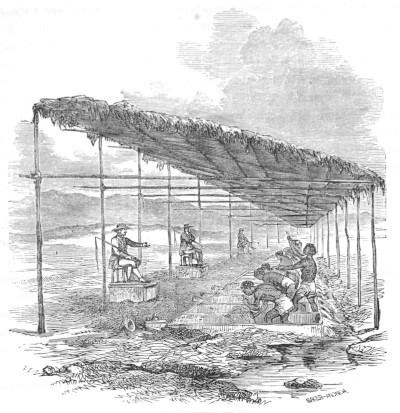
DIAMOND WASHING IN BRAZIL.
On the heap of earth, at equal distances, three high chairs are placed for
the overseers, who are no sooner seated than the negroes enter the troughs,
each provided with a rake of a peculiar form, and having a short handle,
with which he rakes into the trough from fifty to eighty pounds’ weight of
the earth. The water being then allowed to pass in by degrees, the earth is
spread abroad, and continually raked up to the head of the trough, so as to
be kept in constant motion. This operation is continued for a quarter of an
hour, when the water begins to run clearer; and, the earthy particles having
been washed away, the gravel-like matter is raked up to the end of the
172trough. At length the current flowing quite clear, the largest stones are
thrown out, and afterward those of an inferior size; the whole is then
examined with great care for diamonds. When a negro finds one, he
instantly stands upright, and claps his hands; he then extends them, holding
the gem between the fore-finger and the thumb. An overseer receives it
from him, and deposits it in a bowl, suspended from the center of the
structure, and half filled with water. In this vessel all the diamonds found
in the course of the day are deposited, and at the close of the work are taken
out and delivered to the principal overseer, who, after they have been
weighed, registers the particulars in a book kept for that purpose.
When a negro is so fortunate as to find a diamond of the weight of seventeen
carats and a half, the following ceremony takes place: he is crowned
with a wreath of flowers, and carried in procession to the administrator, who
gives him his freedom by paying his owner for it. He also receives a
present of new clothes, and is permitted to work on his own account. For
small stones proportionate premiums are given; while many precautions are
taken to prevent the negroes from stealing the diamonds, with which view
they are frequently changed by the overseers, lest these precious gems should
be concealed in the corners of the troughs. When a negro is suspected of
swallowing a diamond, he is confined in a solitary apartment, and means
taken to bring the gem to light.
In the East Indies, the kingdom of Golconda, extending two hundred and
sixty miles along the bay of Bengal, and having a breadth of two hundred
miles from east to west, abounds in diamond mines. They are chiefly in the
vicinity of the rocky hills and mountains which intersect the country, and
in the whole of which diamonds are supposed to be contained. In several
of the mines they are found scattered in the earth, within two or three
fathoms of the surface, and in others are met with in a mineral substance in
the body of the rocks, forty or fifty fathoms deep. The laborers having dug
five or six feet into the rock, soften the stone by fire, and proceed till they
find the vein, which often runs two or three furlongs under the rock. The
earth being brought out and carefully searched, affords stones of various
shapes, and of a good water. This earth is of a yellowish, and sometimes
of a reddish color, frequently adhering to the diamond with so strong a
crust that the separation becomes difficult.
To find the diamonds, the workmen form a cistern of a kind of clay, with
a small vent on one side, a little above the bottom; in this vent they place
a plug, and throwing into the cistern the earth they have dug, pour in water
to dissolve it. They then break the clods, and stir the wet earth in the
cistern, allowing the lighter part to be carried off in the form of mud, when
173the vent-hole is opened to let out the water. They thus continue washing,
until what remains in the cistern is pretty clean; and then, in the middle
of the day, when the sun shines bright, carefully look over all the sand, at
which practice they are so expert, that the smallest stone can not escape
them. The brightness of the sun being reflected by the diamonds, aids them
in their research, which would be foiled if a cloud were to intervene.
The largest known diamond was found in Brazil, and belongs to the king
of Portugal. It weighs sixteen hundred and eighty carats; and, although
uncut, it is valued at the enormous sum of two hundred and twenty-four
millions sterling, which gives an estimate of nearly eighty pounds sterling
for each carat, the multiplicand of the square of its whole weight being
taken. The one next in magnitude and value, is probably that mentioned
by Tavernier, in possession of the Great Mogul. It was found in Golconda
in 1550; is of the size of half a hen’s egg, and is said to weigh nine hundred
carats. This diamond is the same as the famous “Koh-i-noor,” or
“Mountain of Light,” now belonging to the queen of England, and which
attracted so much attention in the great exhibition at London, in 1851.
The one supposed to be next in value, is that belonging to the crown jewels
of Russia, which weighs seven hundred and seventy-nine carats, and has
been estimated at five millions sterling. But perhaps the most perfect and
beautiful diamond hitherto found, is the one known as the Pitt diamond,
which was brought from India by a gentleman of that name, who sold it to
the Duke of Orleans for one hundred thousand pounds sterling. It was worn
by Bonaparte in the hilt of his sword. It weighs about one hundred and
thirty-six carats, or five hundred and forty-four grains. It ought, however,
to be observed, that these estimates, founded on the magnitude and brilliancy
of the gems, are very different from the prices which the most princely
fortunes can afford to pay for them. The Russian diamond cost about
one hundred and thirty five thousand pounds sterling; and the one called
the Pitt or Regent, although it weighed one hundred and thirty-six carats
only, was, on account of its greater brilliancy, purchased of a Greek merchant,
for one hundred thousand pounds sterling. Several other large
diamonds are preserved in the cabinets of the sovereigns and princes of
Europe.
Why such immense value should be attached to diamonds, in all civilized
countries, and by a kind of common consent, is one of those singular things
that seem inexplicable. That a magnificent house, with a large estate, and
the means of living not only in comfort but splendor, should be set in competition
with, and even deemed inadequate to the purchase of, a transparent
crystallized stone, not half the size of a hen’s egg, seems almost a kind of
174insanity! If for the mere consciousness of possessing a diamond of less than
the weight of an ounce, any private gentleman were to pay four hundred and
fifty thousand dollars in ready money, and an annuity of twenty thousand
dollars besides, he would probably be thought beside himself. And yet not
only was the above sum given, but a patent of nobility into the bargain, by
the empress Catharine, of Russia, for the famous diamond “Nadir Shah.”
In this case, however, though the seller acquired much, the purchaser did
not suffer any personal privation; and in reality, notwithstanding the costliness
and high estimation of diamonds, they are not put in competition with
the substantial comforts and conveniences of life. Among ornaments and
luxuries, however, they unquestionably occupy, and have ever occupied, the
highest rank. Even Fashion, proverbially capricious as she is, has remained
steady in this, one of her earliest attachments, during probably three or four
thousand years. There must be, therefore, in the nature of things, some
adequate reason for this universal consent; which becomes a curious object
of inquiry.
The utility of the diamond, great as it is in some respects, enters for little
or nothing into the calculation of its price; at least all that portion of its
value which constitutes the difference between the cost of an entire diamond
and an equal weight of diamond powder, must be attributed to other
causes.
The beauty of this gem, depending on its unrivaled luster, is, no doubt,
the circumstance which originally brought it into notice, and still continues
to uphold it in the public estimation; and certainly, notwithstanding the
smallness of its bulk, there is not any substance, natural or artificial, which
can sustain any comparison with it in this respect. The vivid and various
refractions of the opal, the refreshing tints of the emerald, the singular and
beautiful light which streams from the six-rayed star of the girasol, the
various colors, combined with high luster, which distinguish the ruby, the
sapphire, and the topaz, beautiful as they are on a near inspection, are
almost entirely lost to a distant beholder; whereas the diamond, without any
essential color of its own, imbibes the pure solar ray, and then reflects it,
either with undiminished intensity, too white and too vivid to be sustained
for more than an instant by the most insensible eye, or decomposed by refraction
into those prismatic colors, which paint the rainbow, and the morning
and evening clouds, combined with a brilliancy which hardly yields to that
of the meridian sun. Other gems, inserted into rings and bracelets, are best
seen by the wearer; and if they attract the notice of the bystanders, divide
their attention, and withdraw those regards which ought to be concentered
on the person, to the merely accessory ornaments. The diamond, on the
175contrary, whether blazing on the crown of state, or diffusing its starry
radiance from the breast of titled merit, or “in courts of feasts and high
solemnities,” wreathing itself with the hair, illustrating the shape and color
of the neck, and entering ambitiously into contest with the lively luster of
those eyes that “rain influence” on all beholders, blends harmoniously with
the general effect, and proclaims to the most distant ring of the surrounding
crowd, the person of the monarch, of the knight, or of the beauty.
Another circumstance tending to enhance the value of the diamond is,
that although small stones are sufficiently abundant to be within the reach
of moderate expenditure, and therefore afford, to all those who are in easy
circumstances an opportunity to acquire a taste for diamonds, yet those of a
larger size are, and ever have been, rather rare; and of those which are
celebrated for their size and beauty, the whole number, at least in Europe,
scarcely amounts to half a dozen, all of them being in possession of sovereign
princes. Hence, the acquisition even of a moderately large diamond, is
what mere money can not always command; and many are the favors, both
political and of other kinds, for which a diamond of a large size, or of
uncommon beauty, may be offered as a compensation, where its commercial
price, in money, neither can be tendered, nor would be received. In many
circumstances also, it is a matter of no small importance for a person to have
a considerable part of his property in the most portable form possible; and
in this respect what is there that can be compared to diamonds, which possess
the portability, without the risk of bills of exchange? It may further
be remarked, in favor of this species of property, that it is but little liable to
fluctuation, and has gone on pretty regularly increasing in value, insomuch
that the price of stones of good quality is considerably higher than it was
some years ago.
The art of cutting and polishing diamonds, has a twofold object; first, to
divide the natural surface of the stone in a symmetrical manner by means
of highly polished polygonal planes, and thus to bring out, to the best
advantage, the wonderful refulgence of this beautiful gem; and, secondly,
by cutting out such flaws as may happen to be near the surface, to remove
those blemishes which materially detract from its beauty, and consequently
from its value. The removal of such flaws is a matter of great importance;
for, owing to the form in which the diamond is cut, and its high degree of
refrangibility, the smallest fault is magnified, and becomes obtrusively
visible to all. For this reason, also, it is by no means an easy matter, at all
times, to ascertain whether a flaw is or is not superficial; and a person with
a correct and well-practiced eye, may often purchase to great advantage,
176stones which appear to be flawed quite through, but which are in fact only
superficially blemished.
Before leaving the subject of diamonds, it may be well to notice some
other valuable stones that are much sought and prized for ornament. One
of these is the oriental ruby. This, in its most esteemed color, is pure
carmine, or a blood-red of considerable intensity, forming, when well polished,
a blaze of the most exquisite and unrivaled tint. It is, however, more
or less pale, and mixed with blue in various proportions; and hence it
occurs rose-red, and reddish-white, crimson, peach-blossom red, and lilac-blue,
the latter variety being named the oriental amethyst. It is a native
of Pegu, and is said to be found in the sand of certain streams near the
capital of the country; and it also occurs, with the sapphire, in the sands
of the rivers of Ceylon. A ruby which is perfect both in color and transparency,
is much less common than a good diamond; and when of the
weight of three or four carats, is even more valuable than a diamond of the
same size. The king of Pegu, and the monarchs of Asia and Siam, monopolize
the finest rubies, in the same way as the sovereigns of India make a
monopoly of diamonds. The finest ruby in the world is in possession of the
first of these kings. Its purity has passed into a proverb, and its worth,
when compared with gold, is inestimable. The dubah of Deccan, also,
possesses a remarkably fine one, which is a full inch in diameter. The
princes of Europe can not boast of any rubies of first-rate magnitude.
The oriental sapphire ranks next in value to the ruby. When it is perfect,
its color is a clear and bright Prussian blue, united to a high degree
of transparency. The astoria or star-stone, is a remarkable variety of this
beautiful gem: it is semi-transparent, with a reddish purple tinge. And
beside these, there are the red sapphire, often called the oriental ruby, and
the yellow sapphire, which is called the oriental topaz. And in addition to
these precious stones, or gems, there are also the emerald, of a beautiful
green color; the topaz, which is of a yellow or light wine-color, and which
by being heated, sometimes becomes rose-red, so as to be passed off as a
ruby; the jasper and chalcedony, which are of various colors; the onyx,
which is a regularly banded agate, much prized for cameos, especially where
the colors are very distinct and different; the cornelian, which is properly a
red or flesh-colored chalcedony, much valued for seal-stones, &c.; and the
blood-stone, or heliotrope, which is deep green, and somewhat translucent,
and variegated by blood-red spots: all of which are much used in the various
departments of jewelry.
We have reserved for this place, a notice of the hot-well at Clifton, England,
which would have been mentioned in connection with the Geysers and other
177hot springs, but from its connection with the beautiful crystals known as
Bristol stones or diamonds, some of which are so hard as to cut glass, and
are exceedingly clear, colorless and brilliant. When set in rings, in their
natural state, these stones often appear of as high a polish and luster, as if
they had been wrought by the most skillful lapidary.
The warm spring, or fountain, in the vicinity of which they are found, is
called the hot-well. It is in the parish of Clifton, and is so copious as to
discharge sixty gallons of water in a minute. It rises forcibly from an opening
in the solid rock, at about twenty-six feet below high-water mark. On
its immediate influx from the rock, the water is much warmer than when it
is pumped up for drinking, for it is raised by pumps some thirty feet. Its
qualities in a medicinal point of view are supposed to be valuable; but it
is not on this point that we propose to dwell, and therefore we pass on to the
rocks in the neighborhood, near which the Bristol stones are found. Just
below the hot-well, there rises a noble range of hills, which are not more
remarkable for their hight, than for their being equally so on both sides the
river, the strata in some places answering on each side for about a mile and
a half in a serpentine course. These constitute one of the greatest natural
curiosities in England. The rock beyond the hot-well, and on the same
side, is named St. Vincent’s, a chapel dedicated to that saint having been
formerly built on its summit. It is in hight three hundred feet, and has a
majestic appearance. It supplies the naturalist with many curious fossils,
the botanist with a variety of scarce plants, the antiquary with the remains
of a Roman camp, and the less curious inquirer with a view of a most
dreadful and surprising precipice.
The rocks in general, when broken up, are of a dusky red, brown or
chocolate colored marble, very hard and close-grained, and which, on being
struck with a hammer, emit a strong sulphureous smell. It will bear a
polish equal to any foreign marble; and, when sawed into slabs and polished,
appears beautifully variegated with veins of white, bluish-gray, or yellow.
It is often employed for chimney-pieces; but it is principally used for making
lime, for which purpose there is no stone in England so well calculated, nor
is there any lime so strong, fine, and white, which excellent qualities occasion
great demand for foreign consumption.
Here, and in the vicinity, laborers are daily employed in blowing up the
rocks with gunpowder, by which process vast fragments are frequently
thrown down, and repeatedly strike the precipice with a dreadful crash,
which, combined with the loud report of the explosion, reëchoed from side
to side by the lofty cliffs, makes a noise resembling thunder, for which it is
frequently mistaken by strangers. It is the opinion of the greater part of
178those who have viewed these rocks, that they were once united, and were
separated by some terrible convulsion of nature. A bridge of one arch,
from rock to rock, over the Avon, has long been in contemplation; but if
the blowing up of these rocks should still be persisted in, the design will be
rendered impracticable. This is the more to be regretted, because stone of
the same quality is to be procured lower down the river.
Now it is in the fissures and cavities of these rocks, that the beautiful
crystals called Bristol stones, or diamonds, already mentioned, are found.
They are clear and brilliant, and being without color, so richly and brilliantly
reflect the light, as to be almost next to the diamond in appearance,
and are often palmed off on the unpracticed for the latter gem. They are
extensively used in many of the plainer kinds of jewelry, and when set over
gold-leaf, or thin paper of delicate tinges, are often made closely to resemble
some of the richest gems known.
The mines of La Plata, so denominated on account of the abundance of
silver they contain, are chiefly situated in the provinces which were formerly
attached to the Spanish viceroyalty of Rio de la Plata; but which, since
the South American states revolted from the mother country, have been
included in the republic of Bolivia, or Upper Peru as it is sometimes called.
With the exception of Mexico, Bolivia is the richest country in silver which
has yet been discovered, and contains innumerable mines both of that metal
and of gold. All its northern provinces teem with mineral opulence; and
those of Laricaja and Carabaya, have been distinguished by the production
of the latter, and still nobler metal, in its virgin state. In consequence,
however, of the recent political convulsions, mining, once the richest source
of revenue, is in a depressed state; many of the mines being filled with
water and totally neglected.
The mountain of Potosi formerly produced weekly about five thousand
marks of silver, that is, from thirty to forty thousand dollars; a surprising
produce, when it is considered that it has been wrought since 1545, at which
time it was accidentally discovered by an Indian, or native, as represented
in the cut. In hunting some goats, he slipped from a slight elevation,
and to save himself caught hold of a shrub, which coming away from the
179ground, laid bare the silver at its root. At the commencement it was still
more abundant, and the metal was dug up in a purer state.
DISCOVERY OF SILVER IN PERU.
The silver was often found in shoots like roots, imbedded in the earth.
Six thousand Indians were sent every eighteen months, from the provinces
of the viceroyalty, to work this mine. The expedition was called mita;
and these Indians, having been enrolled and formed into parties, were
distributed by the governor of Potosi, and received a small daily stipend,
(equal to about thirty-four cents of our currency,) until the period of their
labor was completed. They were thus doomed to a forced service, nothing
less than slavery, so long as it lasted, which the Spaniards have endeavored
to justify by the plea that laborers could not otherwise be procured.
Lumps of pure gold and silver, called papas, from their resemblance to
the potato, were often found in the sands. The poor likewise occupied
themselves in lavaderos, or in washing the sands of the rivers and rivulets,
in order to find particles of the precious metals.
To compensate for the mines rendered useless by the irruption of water,
180or other accidents, rich and new ones were daily discovered. They were
all found in the chains of mountains, commonly in dry and barren spots,
and sometimes in the sides of the quebredas, or astonishing precipitous breaks
in the ridges. However certain this rule might be in the region of Bolivia,
it was contradicted in that of Peru, where, at three leagues’ distance from
the Pacific ocean, not far from Tagna, in the province of Arica, there was
discovered the famous mine of Huantajaya, in a sandy plain at a distance
from the mountains, of such exuberant wealth that the pure metal was cut
out with a chisel. From this mine a large specimen of virgin silver is
preserved in the royal cabinet of natural history at Madrid. It attracted a
considerable population, although neither water nor the common conveniences
for labor could be found there, neither any pasturage for the cattle.
In the mint of Potosi, about six millions of dollars were annually coined;
and the mines of the old viceroyalty of La Plata, taken collectively, are
reckoned to have yielded about sixteen millions.
The mines of Mexico, or what was formerly called New Spain, have been
more celebrated for their riches than those of La Plata, notwithstanding
which they are remarkable for the poverty of the mineral they contain. A
quintal, or sixteen hundred ounces of silver ore, affords, at a medium, not
more than three or four ounces of pure silver, about one-third of what is
yielded by the same quantity of mineral in Saxony. It is not, therefore,
on account of the richness of the ore, but from its abundance and the
facility of working it, that these mines have been so much superior to those
of Europe.
The fact of the small number of persons employed in working them, is not
less contrary to the commonly received opinion on this subject. The mines
of Guanaxuato, infinitely richer than those of Potosi ever were, afforded from
1706 to 1803, nearly forty millions of dollars in gold and silver, or very
nearly five millions of dollars annually, being somewhat less than one-fourth
of the whole quantity of gold and silver from New Spain; notwithstanding
which, these mines, productive as they were, did not employ more than five
thousand workmen of every description. In Mexico, the labor of the mines
was perfectly free, and better paid than any other kind of industry, a miner
earning from five to five dollars and a half weekly, while the wages of the
common laborer did not exceed a dollar and a half. The tenateros, or persons
who carried the ore on their backs, from the spot where it was dug out
of the mine, to that where it was collected in heaps, had a sum equal to
a dollar and ten cents for a day’s work of six hours. Neither slaves,
criminals, nor forced laborers, were employed in the Mexican mines.
In consequence of the clumsy, imperfect and expensive mode of clearing
181them from water, several of the richest of these mines have been overflowed
and abandoned; while the lack of method in the arrangement of the galleries,
and the absence of lateral communications, have added to the risk, and
greatly increased the expense of working them. Labor has not been, as in
the working of the European mines, abridged, nor the transportation of
materials facilitated. When new works were undertaken, a due consideration
was not bestowed on the preliminary arrangements; and they were
always conducted on too large and expensive a scale.
More than three-fourths of the silver obtained from America is extricated
from the ore by means of quicksilver, the loss of which, in the process of
amalgamation, is immense. The quantity that used to be consumed annually
in Mexico alone, was about sixteen thousand quintals; and in the
whole of South America, about twenty-five thousand quintals were yearly
expended, the cost of which there, has been estimated at more than a
million dollars. The greater part of this quicksilver, in later years, was
furnished by the mine of Almaden in Spain, and that of Istria in Carniola,
the celebrated quicksilver mine of Huancavelica in Peru, having greatly
fallen off in its produce since the sixteenth century, when it was highly
flourishing. The prosperity of the silver mines, both in Mexico and Peru,
therefore depended very much on the supplies of quicksilver from Spain,
Germany and Italy; for such was the abundance of the ore in those provinces,
that apparently the only limit to the amount of silver obtained there,
was the want of mercury for amalgamation.
In taking a general view of the riches of the other portions of America,
Humboldt, who has supplied these details, remarks that, in Peru, silver ore
exists in as great abundance as in Mexico, the mines of Lauricocha being
capable of yielding as great a produce as those of Guanaxuato; but that the
art of mining, and the methods of separating the silver from its ore, are still
more defective than in Mexico. Notwithstanding this imperfect system, the
total amount of the precious metals annually furnished by America, was
at one time estimated at upward of forty-two million dollars; the gold
being in proportion to the silver as one to forty-six. From 1492 to 1803,
the quantity of gold and silver extracted from the American mines, was
equal in value to five billion, seven hundred and six million, seven hundred
thousand dollars; of which immense sum, the portion carried to Europe,
including the booty gathered by the conquerors of America, is estimated at
five billion, four hundred and forty-five million dollars, averaging seventeen
million and a half of dollars yearly. The annual importation up to 1803,
being divided into six periods, appears to have constantly augmented, and
in the following progressive ratio. From 1492 to 1500, it did not exceed
182two hundred and fifty thousand dollars. From 1500 to 1545, it amounted
to three millions of dollars. From 1545 to 1600, to eleven millions. From
1600 to 1700, to sixteen millions. From 1700 to 1750, to twenty-two millions
and a half. And, lastly, from 1750 to 1803, to the prodigious sum of
thirty-five million, three hundred thousand dollars.
The first period was that of exchange with the natives, or of mere rapine.
The second was distinguished by the conquest and plunder of Mexico, Peru
and New Granada, and by the opening of the first mines. The third began
with the discovery of the rich mines of Potosi; and in the course of it the
conquest of Chili was completed, and various mines opened in Mexico.
At the commencement of the fourth period, the mines of Potosi began to be
exhausted; but those of Lauricocha were discovered, and the produce of
Mexico rose from two millions to five millions of dollars annually. The
fifth period began with the discovery of gold in Brazil; and the sixth was
distinguished by the prodigious increase of the mines of Mexico, while
those of every other part of America, with the exception of Brazil, were
then constantly improving.
The gold mines of Brazil have been very productive. Those called general,
were about seventy-five leagues from Rio Janeiro, the staple and
principal outlet of the riches of the Brazilian territory. They formerly
yielded to the king, annually, for his right of fifths, at least one hundred and
twelve arobas (weighing twenty-five pounds each) of gold; so that their
yearly produce might then have been estimated at upward of three and a
half millions of dollars, and that of the more distant mines at about one-third
the sum.
The gold drawn from them could not be carried to Rio Janeiro, without
being first brought to the smelting-houses established in each district, where
the right of the crown was received. What belonged to private persons was
remitted in bars, with their weight, number, and an impression of the royal
arms. The gold was then assayed, and its standard imprinted on each bar.
When these bars were carried to the mint, their value was paid to the possessor
in coin, commonly in half-doubloons, each worth eight Spanish
dollars. Upon each of these half-doubloons the king gained a dollar, by the
alloy and right of coinage. The mint of Rio Janeiro was one of the most
beautiful in existence, and furnished with every convenience for working
with the greatest celerity. As the gold came from the mines at the same
time that the fleets came from Portugal, the operations of the mint and the
coinage proceeded with surprising quickness.
In Africa, the kingdom of Mozambique abounds in gold, which is washed
down by the rivers, and forms a chief part of the commerce of the country.
183The kingdoms of Monomotara and Sofala likewise furnish considerable
quantities of gold; and the Portuguese residing in the latter territory, half
a century ago, reported that it yielded annually two millions of metigals,
equal to somewhat more than a million sterling. The merchants exported
from Mecca, and other parts, about the same quantity of gold. The soldiers
were paid in gold dust, in the state in which it was collected; and this was
so pure, and of so fine a yellow, as not to be exceeded, when wrought, by
any other gold beside that of Japan. Gold is likewise found on the island
of Madagascar. The Gold Coast is so denominated from the abundance of
gold found among the sands: it is not, however, so productive as has been
generally supposed, owing to the intense heats, which, in a great measure,
prevent the natives from prosecuting their researches.
In Asia, the island of Japan is most productive of gold, which is found in
several of its provinces, and is, in by far the greater proportion, melted from
its ore. It is also procured by washing the sands, and a small quantity is
likewise found in the ore of copper. The emperor claims a supreme jurisdiction,
not only over the gold mines, but over all the mines of the empire,
which are not allowed to be worked without a license from him. Two-thirds
of their produce belong to him, and the other third is left to the governor of
the province in which the mines are situated. But the richest gold ore, and
that which yields the finest gold, is dug in one of the northern provinces of
the island of Niphon, a dependency of Japan, where the gold mines have, in
past times, been highly productive, though now they have much fallen off.
In the Japanese province of Tsckungo, a rich gold mine, having been filled
with water, was no longer worked: as it was, however, so situated, that by
cutting the rock and making an opening beneath the mine, the water could
be easily drawn off, this was attempted. At the moment of beginning the
operation, so violent a storm of thunder and lightning arose, that the workmen
were obliged to seek shelter elsewhere; and these superstitious people
imagining that the tutelar god and protector of the spot, unwilling to have
the bowels of the earth thus rifled, had raised the storm to make them sensible
of his great displeasure at such an undertaking, desisted from all
further attempts, through the fear of incurring his displeasure, and could
not be induced to go on with it.
Thibet, a mountainous country of India, contains a great abundance of
gold, which is traced in the rivers flowing from that territory into the
Ganges. In Hindoostan there are not any mines of gold; but in the Irnada
district gold is collected in the river which passes Nelambur in the Mangery
Talui, a nair having the exclusive privilege of this collection, for which he
pays a small annual tribute. Silver is in general rare throughout the
184oriental regions, and there is not any indication of this metal in India; but
in Japan there are several silver mines, more particularly in the northern
provinces, and the metal extracted from them is very pure and fine.
Turning to Europe, Dalmatia is said in ancient times to have produced an
abundance of gold. Pliny reports that in the reign of the emperor Nero,
fifty pounds of this precious metal were daily taken from the mines of that
province; and that it was found on the surface of the ground. It is added,
that Vibius, who was sent by Augustus to subdue the Dalmatians, obliged
that hardy and warlike people to work in the mines, and to separate the gold
from the ore.
Bossina, in Sclavonia, contains many mineral mountains, and has rich
mines of gold and silver. The district in which the latter are found, is
named the Srebrarniza, being derived from the word srebr, which signifies
silver in all the Sclavonian dialects. Their produce resembles the native
silver of Potosi, and is found, combined with pure quartz, in small, thin
leaves, resembling moss.
The kingdom of Norway formerly produced gold; but the expense of
working the mines, and procuring the pure ore, being greater than the profit,
these have been neglected. There are, however, silver mines, which are
extremely valuable, and give employment to several thousands of persons.
The principal of these is at Königsberg, and was discovered in 1623, when
the town was immediately built, and peopled with German miners. In
1751, forty-one shafts and twelve veins, were wrought in this mine, and gave
employment to thirty-five hundred officers, artificers and laborers. A view
of one part of this mine is given in the cut on the next page.
The silver ore is not, as was at first imagined, confined to the mountain
between Königsberg and the river Jordal, but extends its veins for several
miles throughout the adjacent districts, in consequence of which new mines
have been undertaken in several places, and prosperously carried on. One
of the richest and most ancient of the mines, named “Old God’s blessing,”
has sometimes, in the space of a week, yielded several hundred pounds’
weight of rich ore. The astonishing depth of this mine, which is not less
than a hundred and eighty fathoms, perpendicularly, fills the mind of the
beholder with amazement; and the circumference at the bottom forms a
clear space of several hundreds of fathoms. Here the sight of thirty or forty
fires, burning on all sides in this gloomy cavern, and continually fed to
soften the stone in the prosecution of the labors, seems, according to the
notions commonly entertained, an apt image of hell; and the swarms of
miners, covered with soot, and bustling about in habits according to their
several employments, may well remind one of so many evil spirits; more
185especially when, at a given signal that the mine is to be sprung in this or
that direction, they exclaim aloud: “Berg-livet, berg-livet!” “Take care
of your lives.”
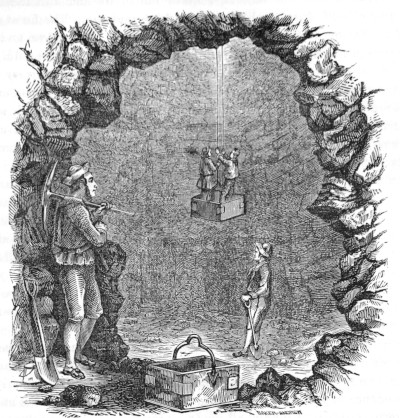
SILVER MINE AT KÖNIGSBERG.
The gold mines of Cremnitz, in Hungary, lie forty miles south of the
Carpathian hills; and twenty miles further to the south are the silver
mines of Shemnitz. These are called mining towns; and the former is the
principal, its rich ores being found in what is styled metallic rock. Its mines
also produce a certain proportion of silver. Hungary is beside enriched by
a mineral peculiar to itself, or one, at least, which has not hitherto been
discovered elsewhere, namely, the opal, a gem preferred to all others by the
oriental nations. The opal mines are situated at Ozerwiniza, where they
are found in a hill consisting of decomposed porphyry, a few fathoms beneath
the surface. Their produce is of various qualities, from the opaque-white,
or semi-opal, to the utmost refulgence of the lively colors by which this
noble gem is distinguished.
186Transylvania and the Bannet, contain numerous and valuable mines,
consisting chiefly of gray gold ore, and white gold ore. The finest gold is
found at Olapian, not far from Zalathna, intermixed with gravel and sand.
The sands of the Rhine, also, in various places contain traces of gold.
The mountains of Spain were, according to ancient writers, very rich in
gold and silver; and accordingly Gibbon calls that kingdom, “the Peru and
Mexico of the old world.” He adds, that “the discovery of the rich western
continent of the Phenicians, and the oppression of the simple natives, who
were compelled to labor in their own mines for the benefit of strangers, form
an exact type of the more recent history of Spanish America.” The Phenicians
were acquainted only with the sea-coasts of Spain; but avarice, as
well as ambition, carried the arms of Rome and Carthage into the heart of
the country, and almost every part of the soil was found pregnant with gold,
silver and copper. A mine near Carthagena, is said to have yielded daily
twenty-five thousand drams of silver, or over thirteen hundred thousand
dollars a year. The provinces of Asturia, Gallicia and Lusitania, yielded
twenty thousand pounds’ weight of gold annually: but rich as these mines
are, the modern Spaniards have chosen rather to import the precious metals
from America, than to seek them at home.
Portugal is in many parts mountainous; and these mountains contain,
beside others, rich ores of silver. But the Portuguese, like the Spaniards,
having been supplied with metals from South America, and particularly with
an abundance of gold and silver from Brazil, have not worked the mines in
their own country. Gems of all kinds, as turkoises and hyacinths, are also
found in these mountains, together with beautifully variegated marbles, and
many curious fossils.
But the richest and most productive gold mines of Europe, at the present
time, are probably those of Russia. It had long been known that gold was
to be found in the Russian dominions; but in 1829, Baron Humboldt, with
two scientific associates, at the request of the emperor of Russia, made a
mineralogical tour to the Ural and Altai mountains. In this journey, they
not only discovered new localities of gold and silver, but from the geological
features of the country suggested that, at certain localities, diamonds would
also probably be found, which accordingly happened. And as the result of
the report they made to the Russian government, mining operations were
commenced on a large scale in these mountains, which have now become
one of the most prolific gold regions in the world. The increase of these
sources of gold, in extent and amount, has been such, that from the value
of about ten thousand dollars in 1836, the amount received in 1843, was
some eighteen millions of dollars; and the supply has since increased
187annually, until at present, 1855, it amounts to about twenty million dollars
a year. Most of this large amount of gold is gathered from washing the
sand and loose earth, and not from deep mines; and as it is every year
becoming greater and greater, it must add immensely to the wealth and
resources of the Russian empire.
But by far the greatest gold-field in the world, has been opened by the
discoveries of the last few years in California. At the close of the late war
with Mexico, the United States acquired, by conquest and purchase, a tract
of country of some five hundred thousand square miles in extent, known as
the Mexican territory of upper California. And from the western portion
of this region, Congress, in 1850, created and admitted into the American
confederacy, the thirty-first state, under the name of California. It is almost
superfluous to say, that California is one of the most important mineral
regions in the world, particularly in its deposits of gold. Vague notions of
the existence of this gold, had from time to time been spread abroad; but it
was not till 1848, that an accident discovered the marvelous fact of its
abundance. In that year, a Mr. Sutter, a native of Switzerland, was settled
near the mouth of the American fork of the Sacramento river, at the head
of navigation, one hundred and fifty miles from its mouth. Here he had
founded New Helvetia, and obtained a grant of thirty miles round. He had
sent some men to the upper part of the American fork, to clear out a mill-race.
The soil was washed down in the process, and some shining scales
laid bare. These proved to be gold, and on investigation, not only the
valley of this stream, but the beds of all the other streams running into the
Sacramento, were found to have a soil full of gold, in minute scales and in
bits, from a grain to many ounces in weight. New “placers,” as the “washings,”
or “dry diggings” are called, have constantly been discovered, and
people have rushed to these hills from all quarters, with pans, tubs, pickaxes,
shovels, hoes, filtering-machines, and energetic sinews, till they have
extracted, by digging, washing, &c., millions on millions of dollars’ worth
of the yellow treasure. Gold is now found over an extent of many hundred
miles, and also on the Gila, and throughout the great central plateau, north
and north-east of it.
In a favorable locality, the lucky finder of a placer will sift out hundreds
of dollars’ worth in a day. Persons with not a shirt to their backs, and
scarcely a whole garment upon them, are seen with bags of gold in their
hands. Prices of everything went up at once to an enormous rate: laborer’s
wages became eight or ten dollars a day; cooks at the diggings, ten
dollars a day; clerks, fifteen hundred dollars to six thousand dollars per
annum, &c., &c. As all the productive industry of the country is now turned
188to gold-digging, and as such vast numbers of consumers are flocking in from
all parts, prices continue to range high for every article of necessity, although
such large quantities of goods have been sent.
GOLD WASHING IN CALIFORNIA.
The gold first discovered was evidently not in its original place, but had
been washed down from higher regions; and when all that is thus spread
through the sands of California shall have been exhausted, if it ever shall
be, there are large bodies of auriferous quartz, which (with greater labor
and expense) will doubtless afford large supplies of gold for generations to
come. The amount of capital invested in quartz-mining, according to the
state census of 1852, was about six millions, and in placer and other mining
operations, about four millions of dollars; and the sum total of these
amounts has been greatly increased since that date. Up to the close of
1851, there had been deposited in the United States mint, $98,407,990 of
California gold; and the deposits of 1852 amounted to $46,528,076,
making a total of $145,000,000. But all this falls far short of the real
189amount produced; as probably quite as much more has been sent to Europe
in the shape of dust or bullion, not to mention the unreported sums which
have been privately taken out of the state. An official estimate states the
production of American gold in 1853, at $109,156,748; and of this sum
nearly the whole is from the mines of California. And this vast amount is
steadily on the increase, in about the proportion of the increase of the
mining population, so that California not only is, but is likely to continue to
be the great gold-field of the world.
Before leaving California, it may not be amiss to add, that the country
abounds in mines of almost every kind, as well as gold. Quicksilver, plaster,
lead, iron, silver, copper, asphaltum and marble, are found in Butte, and
also in Marion county; rich silver mines and coal, in San Louis Obispo;
copious salt springs, in Shasta; bituminous springs, in many places along
the coast; hot sulphur springs, in Santa Barbara; warm soda springs, near
Benicia; and platina is said to be widely distributed in almost every section
where gold has been found. Silver has been discovered in several mines in
the southern district; copper is widely distributed in other sections beside
those above-mentioned; chromium occurs in large quantities in the serpentine
rocks; and diamonds are reported to have been recently found in
several localities.
PLACE WHERE GOLD WAS FIRST DISCOVERED IN AUSTRALIA.
At a date still later than the discovery of gold in California, the same
precious metal was discovered in Australia. The cut on the following page
gives a view of the place where it was first found, in the county of Bathurst,
not far from Sydney in New South Wales. It is worthy of note that we owe
the discovery of gold in Australia to the high state of geological science.
Sir R. Murchison, in his address to the London Geographical Society in
1844, alluded to the possibly auriferous character of the great eastern chain
of Australia, being led thereto by his knowledge of the auriferous chain of
the Ural, and by his examination of Count Strzelecki’s specimens, maps and
sections. Some of Sir R. Murchison’s observations having found their way
to the Australian papers, a Mr. Smith, at that time engaged in some iron
works at Berrima, was induced by them in the year 1849 to search for gold,
and he found it. He sent the gold to the colonial government, and offered
to disclose its locality on payment of five hundred pounds sterling. The
government, however, not putting full faith in the statement, and being,
moreover, unwilling to encourage a gold fever without sufficient reason,
declined to grant the sum, but offered, if Mr. Smith would mention the
locality, and the discovery was found to be valuable, to reward him accordingly.
Very unwisely, as it turned out, Mr. Smith did not accept this offer;
and it remained for Mr. Hargraves, who came with the prestige of his
190California experience, to make the discovery anew, and get the reward from
the English government on their own conditions. The first discovery was
made in the banks of the Summer Hill creek and the Lewis Ponds river,
small streams which run from the northern flank of the Conobalas down to
the Macquarrie. The gold was found in the sand and gravel accumulated,
especially on the inside of the bends of the brook, and at the junction of the
two water-courses, where the stream of each would be often checked by the
other. It was coarse gold, showing its parent site to be at no great distance,
and probably in the quartz veins traversing the metamorphic rocks of the
Conobalas. Mr. Stutchbury, the government geologist, reported on the
truth of the discovery, and shortly afterward found gold in several other
localities, especially on the banks of the Turon, some distance north-east of
the Conobalas. This was a much wider and more open valley than the
Summer Hill creek, and the gold accordingly was much finer, occurring in
small scales and flakes. It was, however, more regularly and equably distributed
191through the soil, so that a man might reckon with the greatest
certainty on the quantity his daily labor would return him. At the head of
the Turon river, among the dark glens and gullies in which it collects its
head-waters, in the flanks of the Blue mountains, the gold got “coarser,”
occurred in large lumps or nuggets, but these were more sparingly scattered.
As already said, the discovery was made by Mr. Hargraves, in May, 1850;
and before the end of June, there were more than twenty thousand persons
at the mines. When it was known in the town of Bathurst, that the discovery
had been made, and that the country, from the mountain ranges,
back to an indefinite extent in the interior, was probably one immense goldfield,
the excitement was intense and universal. A complete phrensy seemed
to seize on the entire population; the business of the town was paralyzed;
and there was a universal rush to the diggings. People of all trades,
callings and pursuits were quickly transformed into miners; and many a
hand which had been trained to kid gloves, or accustomed only to the quill,
became nervous to clutch the pick or crowbar, or to “rock the cradle” at
the newly discovered mines. The roads were literally alive with the crowds
pressing on from every quarter, some armed with pickaxes, others shouldering
crowbars and shovels, and not a few strung round with hand-basins, tin-pots
and cullenders. Scores rushed from their homes, with only a blanket,
and a pick or grubbing-hoe, full of hope that a few days would give them
heaps of the precious metal. Everything at once rose in price, and the
whole face of society was speedily changed in almost every aspect.
The first pieces found were in grains. Soon a piece was picked up weighing
some eleven ounces; and soon after, several lumps weighing together
about three pounds. Gold was speedily discovered in almost every place
where it was looked for; in the beds of the streams, and in veins of quartz,
in grains, in scales, and in lumps of various weights. Some, as might be
expected, were successful, and some comparatively unsuccessful in seeking
it; the great mass of the miners averaging not more than four or five dollars
a day, while in some rare cases a single individual gathered to the value of
a thousand dollars in the same time. Gold was soon discovered in the
Wellington district, and in various other places. One piece was picked up
weighing almost five pounds; and from a single cleft in a rock, a miner
took out eleven pounds’ weight of gold, in separate pieces of various sizes.
A Scotchman gathered fourteen hundred dollars’ worth in four days, and
eight of his associates averaged from thirty to forty dollars’ worth a day.
Apparently there is no end to the supply, at least for years to come; and
all this within forty miles of a town where every comfort, not to say luxury,
can be obtained, with a good post-road all the way to Sydney, and in the
192midst of tracts of the most fertile land, partly occupied, and where food may
be supplied for millions of inhabitants, if needed. An official statement
estimates the supply of Australian gold at sixty million dollars a year; and in
addition to the gold, diamonds and platinum have also been found. Australia
and California are likely to be the great sources of the supply of gold,
compared with which all others will be relatively unimportant.
Before leaving the subject of gold, it may be interesting to the reader to
trace the process of its coinage, which may thus be briefly stated. The
metal, after being received in the deposit-room, is carefully weighed, and a
receipt given. Each deposit is then melted separately in the melting-room,
and molded into bars. These bars next pass through the hands of the
assayer, who with a chisel chips a small fragment from each one. Each chip
is then rolled into a thin ribbon, and filed down until it weighs exactly ten
grains. It is then melted into a little cup made of calcined bone ashes, and
all the base metals, copper, tin, &c., are absorbed by the porous material of
the cup or carried off by oxydation. The gold is then boiled in nitric acid,
which dissolves the silver which it contains, and leaves the gold pure. It is
then weighed, and the amount which it has lost gives the exact proportion
of impurity in the original bar, and a certificate of the amount of coin due
the depositor is made out accordingly. After being assayed, the bars are
melted with a certain proportion of silver, and being poured into a dilution
of nitric acid and water, assume a granulated form. In this state the gold
is thoroughly boiled in nitric acid, and rendered perfectly free from silver or
any other baser metals which may happen to cling to it. It is next melted
with one-ninth its weight of copper, and, thus alloyed, is run into bars, and
delivered to the coiner for coinage. The bars are rolled out in a rolling-mill
until nearly as thin as the coin which is to be made from them. By a
process of annealing they are rendered sufficiently ductile to be drawn
through a longitudinal orifice in a piece of steel, thus reducing the whole to
a regular width and thickness. A cutting-machine next punches small
round pieces from the bar, about the size of the coin. These pieces are
weighed separately by the “adjusters,” and if too heavy are filed down; if too
light they are melted again. The pieces which have been adjusted are run
through a milling-machine, which compresses them to the right diameter
and raises the edge. Two hundred and fifty are milled in a minute by the
machine. They are then again softened by the process of annealing, and
after a thorough cleaning are placed in a tube connecting with the stamping
instrument, and are taken thence one at a time by the machinery, and
stamped between the dies. They are now finished, and, being thrown into
a box, are delivered to the treasurer for circulation. The machinery, of
193course, for all those processes, must be of the nicest kind. When in full
operation, a mint like that of England, or that of the United States at
Philadelphia, can coin millions on millions in a year.
Quicksilver, or mercury, is the only metal which remains liquid at ordinary
temperatures. It is white and very brilliant, as may be seen in common
thermometers. It boils at six hundred and sixty degrees of heat; and
freezes, and assumes a crystalline texture, at forty degrees below zero. It
is extensively used in its various forms in the arts, and also for medicinal
purposes. The thermometer and barometer illustrate some of its uses in its
pure state; the backs of our common mirrors are covered with it, which
gives them their reflecting power; it is used extensively in separating some
of the purer metals from the mixtures with which they are found; and in
some of its forms or combinations, it is the basis of calomel, corrosive sublimate,
vermilion, &c.
Mercury is found in various parts of the world. Among its principal
mines are those of Almaden, near Cordova, in Spain, and of Idria, near
Carniola, in Austria; though it is also found in Peru, California, Italy and
China. Formerly most of the quicksilver came from Germany; but more
recently the largest production is probably in Spain. So extensively is it
used, that in 1831, over three hundred thousand pounds were brought from
the continent into England; and for the fourteen years ending in 1828, the
imports of it into Canton, by the English and Americans, averaged nearly
six hundred and fifty thousand pounds a year, worth some three hundred
and fifty thousand dollars.
Of all the quicksilver mines, those of Idria, mentioned above, are some of
the most interesting, and demand a particular description, as they have been
celebrated in natural history, poetry and romance. The ban of Idria, is a
district of Austria, lying west of Carniola. The town, which is small, is
seated in a deep valley, amid high mountains, on the river of the same
name, and at the bottom of so steep a descent, that its approach is a task of
great difficulty, and sometimes of danger.
The mines were discovered in 1497, before which time that part of the
country was inhabited by a few coopers only, and other artificers in wood,
with which the territory abounds. One evening, a cooper having placed a
new tub under a dropping spring, to try if it would hold water, on returning
the next morning, found it so heavy that he could scarcely move it. He at
194first was led by his superstition to suspect that the tub was bewitched; but
spying, at length, a shining fluid at the bottom, with the nature of which
he was unacquainted, he collected it, and proceeded to an apothecary at
Laubach, who, being an artful man, dismissed him with a small recompense,
requesting that he would not fail to bring him further supplies. From this
small beginning, the product of these mines has steadily increased; and now
might easily be made six hundred tuns per year, though to uphold the price
of the metal, the Austrian government has restricted the annual production
to one hundred and fifty tuns. In 1803, a disastrous fire took place in these
mines, which was extinguished only by drowning all the underground workings.
The mercury, sublimed by the heat in this catastrophe, occasioned
diseases and nervous tremblings in more than nine hundred persons in the
neighborhood.
The subterraneous passages of the great mine are so extensive, that it
would require several hours to pass through them. The greatest perpendicular
depth, computing from the entrance of the shaft, is eight hundred
and forty feet; but as these passages advance horizontally, under a high
mountain, the depth would be much greater if the measure were taken from
the surface. One mode of descending the shaft is by a bucket, but as the
entrance is narrow, the bucket is liable to strike against the sides, or to be
stopped by some obstacle, so that it may be readily overset. A second mode
of descending, which is safer, is by means of a great number of ladders,
placed obliquely, in a kind of zigzag: as the ladders, however, are wet and
narrow, a person must be very cautious how he steps, to prevent his falling.
In the course of the descent, there are several resting-places, which are
extremely welcome to the wearied traveler. In some of the subterraneous
passages, the heat is so intense as to occasion a profuse sweat; and in several
of the shafts the air was formerly so confined, that several miners were suffocated
by an igneous vapor, or gaseous exhalation, called the fire-damp. This
has been prevented by sinking the main shaft deeper. Near to it is a large
wheel, and a hydraulic machine, by which the mine is cleared of water.
To these pernicious and deadly caverns, criminals are occasionally banished
by the Austrian government; and it has sometimes happened that this
punishment has been allotted to persons of considerable rank and family.
The case of Count Alberti is an interesting instance of this kind.
The count, having fought a duel with an Austrian general, against the
emperor’s command, and having left him for dead, was obliged to seek refuge
in one of the forests of Istria, where he was apprehended, and afterward
rescued by a band of robbers who had long infested that quarter. With
these banditti he spent nine months, until, by a close investment of the place
195in which they were concealed, and after a very obstinate resistance, in which
the greater part of them were killed, he was taken and carried to Vienna,
to be broken alive on the wheel. This punishment was, by the intercession
of his friends, changed into that of perpetual confinement and labor in the
mines of Idria; a sentence which, to a noble mind, was worse than death.
To these mines he was accompanied by the countess, his lady, who belonged
to one of the first families in Germany, and who, having tried every means
to procure her husband’s pardon without effect, resolved at length to share
his miseries, as she could not relieve them. They were terminated, however,
through the mediation of the general with whom the duel had been fought,
who as soon as he recovered from his wounds, obtained a pardon for his
unfortunate opponent; and Alberti, on his return to Vienna, was again taken
into favor, and restored to his fortune and rank.
The metal which is called iron, is familiar to all, both for its value and
its various uses. It is capable of being cast in molds of any form; of being
drawn in wires, extended in plates or sheets, of being bent in every direction,
and of being sharpened, hardened, or softened at pleasure. It accommodates
itself to all our wants, desires, and even caprices; it is equally serviceable
to the arts, the sciences, to agriculture, and to war; and the same ore
furnishes the sword, the plowshare, the scythe, the pruning-hook, the needle,
the graver, the spring of the watch or that of the carriage, the chisel, the
chain, the anchor, the compass, the cannon, the bomb, the edge of the finest
knife or razor, and the ponderous trip-hammer of enormous weight. It is a
medicine of much virtue, and the only metal which is always useful, and
tends to no injury to mankind.
The ores of iron are scattered over the entire crust of the globe in beneficent
profusion, and in proportion to the utility of the metal itself: they are
found in every latitude and zone, in every mineral formation, and in every
soil and clime. These ores are nineteen in number, ten of which are worked
to profit by the miner, either for the sake of the iron they contain, for use in
their native state, or for extracting from them some principle or material,
useful in manufactures or the arts.
Native iron, the existence of which was formerly questioned, has been
found in several places: it is, however, far from being common, though it
occurs in several mines. A mass of this description of iron was discovered
in the district of Santiago del Estero, in South America, by a party of
196Indians, in the midst of a widely extended plain. It projected about a foot
above the ground, nearly the whole of its upper surface being visible; and
the news of its having been found in a country where there are not any
mountains, nor even the smallest stone, within the circumference of a hundred
leagues, was considered as truly surprising. Although the journey
was attended with great danger, on account of the want of water, and abundance
of wild beasts in these deserts, several individuals, in the hope of gain,
undertook to visit this mass; and, having accomplished their journey, sent
a specimen of the metal to Lima and Madrid, where it was found to be very
pure soft iron.
As it was reported that this mass was the extremity of an immense vein
of the metal, a metallurgist was sent to examine the spot, and by him it was
found buried in pure clay and ashes. Externally it had the appearance of
very compact iron, but was internally full of cavities, as if the whole had
been formerly in a liquid state. This idea was confirmed by its having, on
its surface, the impression of human feet and hands of a large size, as well
as that of the feet of a description of large birds, very common in South
America. Although these impressions seemed very perfect, it was concluded
either that they were lusus naturæ, or that impressions of this kind were
previously on the ground, and that the liquid mass of iron, in falling on it,
received them. It had the greatest resemblance to a mass of dough; which,
having been stamped with impressions of hands and feet, and marked with
a finger, had afterward been converted into iron.
On digging round the mass, the under surface was found covered with a
coat of scoriæ from four to six inches thick, undoubtedly occasioned by the
moisture of the earth, the upper surface being clean. No appearance of the
formation of iron was observed in the earth, below or round it, for a great
distance. About two leagues to the eastward was a brackish mineral spring,
and a very gentle ascent of from four to six feet in hight, running from
north to south: with this exception, the adjacent territory was a perfect
level. About the spring, as well as near the mass, the earth was very light,
loose, and greatly resembling ashes, even in color. The grass in the vicinity
was very short, small, and extremely unpalatable to the cattle; but that at
a distance was long, and extremely grateful to them. From these concurrent
circumstances it was concluded, that this mass of native iron, which was
estimated to weigh about three hundred quintals, was produced by a volcanic
explosion. It is stated as an undoubted fact, that in one of the forests of
the above district of Santiago del Estero, there exists a mass of pure native
iron, in the shape of a tree with its branches. At a little depth in the earth
are found stones of quartz, of a beautiful red color, which the honey-gatherers,
197the only persons who frequent this rude territory, employ as flints to
light their fires. Several of these were selected on account of their peculiar
beauty, they being spotted and studded, as it were, with gold: one of them,
weighing about an ounce, was ground by the governor of the district, who
extracted from it a dram of gold.
A fibrous kind of native iron has been found at Ebenstock, in Saxony, and
also in Siberia, where one particular mass weighed sixteen hundred pounds.
It resembled forged iron in its composition, and was malleable when cold,
but brittle when red-hot. In Senegal, where it is most common, it is of a
cubical form, and is employed by the natives in the manufacture of different
kinds of vessels. Native meteoric iron, called also nickeliferous, from its
containing nickel, and native steel iron, which has many of the characters
of cast steel, have also been found.
Iron, although one of the imperfect metals, is susceptible of a very high
polish, and more capable than any other metal of having its hardness
increased or diminished by certain chemical processes. It is often manufactured
in such a way as to be one hundred and fifty times, and, as will now
be seen, in some cases, to be even above six hundred and thirty times more
valuable than gold. On weighing several common watch-pendulum springs,
such as are sold for ordinary work by the London artists, at half a crown,
ten of them were found to weigh but one single grain. Hence one pound
avoirdupois, equal to seven thousand grains, contains ten times that number of
these springs, which amount, at half a crown each, to eight thousand, seven
hundred and fifty pounds sterling. Reckoning the troy ounce of gold at four
pounds sterling, and the pound equal to fifty-seven hundred and sixty grains,
at forty-eight pounds sterling, the value of an avoirdupois pound of gold is
over fifty-eight pounds sterling. The above amount of the value of the watch-springs
weighing an avoirdupois pound, being divided by that sum, will give
a ratio of somewhat more than one hundred and fifty to one. But the pendulum-springs
of the best kind of watches sell at half a guinea each; and at
this price the above-mentioned value is increased in the ratio of four and
one-fifth to one; which gives an amount of thirty-six thousand, seven hundred
and fifty pounds sterling. This sum being divided by the value of the
avoirdupois pound of gold, gives a quotient of more than six hundred and
thirty to one.
It is one of the valuable properties of iron, after it is reduced into the
state of steel, that, although it is sufficiently soft when hot, or when gradually
cooled, to be formed without difficulty into various tools and utensils,
still it may be afterward rendered more or less hard, even to an extreme
degree, by simply plunging it, when red-hot, into cold water. This is called
198tempering, the hardness produced being greater in proportion as the steel is
hotter and the water cooler. Hence arises the superiority of this metal for
making mechanics’ instruments or tools, by which all other metals, and even
itself, are filed, drilled and cut. The various degrees of hardness given to
iron, depend on the quantity of ignition it possesses at the moment of being
tempered, which is manifested by the succession of color exhibited on the
surface of the metal, in the progress of its receiving the increasing heat.
These are, the yellowish white, yellow, gold-color, purple, violet, and deep
blue; after the exhibition of which the complete ignition takes place.
These colors proceed from a kind of scorification on the surface of the
heated metal.
The largest iron-works in England are carried on in ColebrookdaleColebrookdale, in
Shropshire. This spot, which is situated between two towering and variegated
hills, covered with wood, possesses peculiar advantages, the ore being
obtained from the adjacent hills, the coals from the vale, and abundance of
limestone from the quarries in the vicinity. The romantic scenery which
nature here exhibits, and the works which are carried on, seem to realize
the ancient fable of the Cyclops. The noise of the forges, mills, &c., with
all their vast machinery, the flames bursting from the furnaces, with the
burning coal, and the smoke of the lime-kilns, are altogether horribly
sublime. To complete the peculiarities of the spot, a bridge, entirely constructed
of iron, is here thrown over the Severn. In one place it has parted,
and a chasm is formed; but such is its firm basis, that the fissure has neither
injured its strength nor utility.
The great superiority of Swedish iron over that of all other countries, for
the manufacture of steel, is well known, and is ascribed to the great purity
of the ore from which the iron is smelted. The British steel-makers have
found it difficult to employ British iron in their processes, it being too brittle
to bear cementation; but attempts have been made at Sheffield, with some
success. Wootz, a species of steel from India, has been successfully used
for nicer kinds of cutlery. One of the most remarkable of the Swedish mines,
if the name can with propriety be applied to it, is Tabern, a mountain of a
considerable size, composed entirely of pure iron ore, and occurring in a large
tract of sand, over which it seems to have been deposited. This mountain
has been wrought for nearly three centuries, notwithstanding which its size
is scarcely diminished.
But the richest iron mine of Sweden is that of Danmora, in the province
of Upland. It is in depth eighty fathoms; occupies a considerable extent
of territory; and its ore is conveyed to the surface of the earth, through
several pits or openings made for that purpose, by means of casks fixed to
199large cables, which are put in motion by horses. The workmen standing on
the edges of these casks, and having their arms clasped round the cable,
descend and ascend with the utmost composure. The water is drawn from
the bottom by a wheel sixty-six feet in diameter, and is afterward conveyed
along an aqueduct nearly a mile and a half in length. At certain distances
from Danmora, are several furnaces, with large and populous villages exclusively
inhabited by the miners.
In Wraxall’s tour through the north of Europe, the mine of Danmora is
described as yielding the finest iron ore in Europe, its produce being exported
to every country, and constituting one of the most important sources of
national wealth and royal revenue. The ore is not dug, as is usual in other
mines, but is torn up by the force of gunpowder, an operation which is
performed every day at noon, and is one of the most awful and tremendous
that can possibly be conceived. “We arrived,” observes the tourist, “at
the mouth of the great mine, which is nearly half an English mile in circumference,
in time to be present at it. Soon after twelve the first explosion
took place, and could not be so aptly compared to anything as to subterraneous
thunder, or rather volleys of artillery discharged under ground. The
stones were thrown up, by the violence of the gunpowder, to a vast hight
above the surface of the ground, and the concussion was so great as to shake
the surrounding earth or rock on every side.
“As soon as the explosion had ceased, I determined to descend into the
mine, to effect which I had to seat myself in a large, deep bucket, capable of
containing three persons, and fastened by chains to a rope. When I found
myself thus suspended between heaven and earth by a rope, and looked down
into the dark and deep abyss beneath me, to which I could see no termination,
I shuddered with apprehension, and half repented my curiosity. This
was, however, only a momentary sensation, and before I had descended a
hundred feet, I looked round on the scene with very tolerable composure.
It was nearly nine minutes before I reached the bottom; and when I set my
foot on the earth, the view of the mine was awful and sublime in the highest
degree. Whether, as I surveyed it, terror or pleasure formed the predominant
feeling, is hard to say. The light of the day was very faintly admitted
into these subterraneous caverns: in many places it was absolutely lost, and
flambeaux were kindled in its stead. Beams of wood were laid across some
parts, from one side of the rock to the other; and on these the miners sat,
employed in boring holes for the admission of gunpowder, with the most
perfect unconcern, although the least dizziness, or even a failure in preserving
their equilibrium, must have made them lose their seat, and have dashed
them against the rugged surface of the rock beneath. The fragments torn
200up by the explosion, previously to my descent, lay in vast heaps on all sides,
and the whole scene was calculated to inspire a gloomy admiration.
“I remained three-quarters of an hour in these frightful and gloomy
caverns, which find employment for not less than thirteen hundred workmen,
and traversed every part of them which was accessible, conducted
by my guides. The weather above was very warm, but here the ice
covered the whole surface of the ground, and I found myself surrounded
with the colds of the most rigorous winter, amid darkness and caves of iron.
In one of these, which ran a considerable way beneath the rock, were eight
wretched beings warming themselves round a charcoal fire, and eating the
little scanty subsistence arising from their miserable occupation. They rose
with surprise at seeing so unexpected a guest among them, and I was not a
little pleased to dry my feet, which were wet with treading on the melted ice,
at their fire.
“Having gratified my curiosity with a view of these subterraneous apartments,
I made the signal for being drawn up, and felt so little terror while
reascending, compared with that of being let down, that I am convinced,
after five or six repetitions, I should have been perfectly indifferent to the
undertaking. So strong is the effect of custom on the human mind, and so
contemptible does danger or horror become when familiarized by repeated
trials!”
Throughout the whole extent of Sweden, the iron mines at present wrought,
employ thousands of persons, and yield annually upward of one hundred
thousand tuns of metal. There are said to be between five and six hundred
mines in the entire country, nearly half of which are situated in the central
provinces: this, however, includes mines of all descriptions, though by far
the most are of iron. The products of all these mines would be vastly
greater than they are, were it not for the multiplied and unreasonable
restrictions of the government.
The iron trade of the United States, and the domestic manufacture of iron,
were spoken of by Mr. Gallatin, in a report to Congress, in 1810, as being
firmly established. He was able to obtain very imperfect information about
it, but it was known that iron ore was plentiful; that numerous forges and
furnaces had been erected, supplying “a sufficient quantity of hollow-ware,
and of castings of every description.” From Russia, about forty-five hundred
tuns of bar iron were imported yearly, and perhaps another forty-five
hundred from Sweden and England. A vague estimate gave fifty thousand
tuns of bar iron as the annual consumption of the union, of which he considered
forty thousand as the product of the republic. Some good iron was
made in Virginia and Pennsylvania, but much inferior iron, carelessly manufactured,
201was brought into market. Of sheet, slit, and hoop iron, about
five hundred and sixty-five tuns were annually imported; about seven thousand
tuns were rolled and slit in the United States. Massachusetts had
thirteen rolling and slitting mills, and the value of cut nails and brads made
within the republic in a year, was estimated at twelve hundred thousand
dollars. Nearly three hundred tuns of cut nails were exported. Agricultural
implements were made at home, and much coarse ironmongery; but
cutlery, fine hardware, and steel work, were brought from Britain. About
forty thousand muskets were yearly made in New England and at Harper’s
Ferry: also balls, shells, and brass and iron cannon, in various places.
There were several iron founderies for machinery castings, and steam-engines
had begun to be made at Philadelphia. Mr. Gallatin valued the iron and
manufactures of iron then annually made at home, at from twelve to fifteen
millions of dollars, and the imports at near four millions, as prices went.
Adam Seybert enumerates the domestic products of 1810, at 53,908 tuns
of pig iron, from 153 furnaces; 24,541 tuns of bar iron from 330 forges;
15,727,914 pounds of nails (partly out of imported iron) from 410 naileries;
and 6,500 tuns of iron were required at 316 trip-hammers and thirty-four
rolling and slitting mills. His estimate of the value of the home manufacture
is $14,364,526. In 1806 or 1807, Chancellor Livingston, then our
minister to France, had to apply repeatedly to the British ministry for permission
to buy in England, and export to New York, the steam-engine which
Fulton put on board his first steamboat on the Hudson. Now, the manufacture
of steam-engines is an important branch of our home industry.
In 1827-8, it was given in evidence before a committee of Congress, that
Pennsylvania had made, during the past year, 21,800 tuns of bar iron, and
47,075 tuns of cast iron; that 3,000 tuns of bar iron were made near Lake
Champlain; that three counties in New Jersey had made 2,050 tuns, and
that in a circle of thirty miles’ diameter, in New York, there were one hundred
and ten forge fires, each of them able to produce twenty-five to thirty-five
tuns yearly. In 1830, a committee of Congress reported on the iron trade,
and from their report and other later sources, we learn that that year 112,866
tuns of bar, and 191,537 of pig iron, worth $13,327,760, employing 29,254
men, who received $8,776,420 in wages, were made. Perhaps the quantity
and number of workmen are overstated. In 1840, with improved machinery,
only 30,497 men produced 484,136 tuns.
Without coal and iron, the United States and Britain never could have
risen to the rank of first-rate powers. In fact, without iron, civilization
must have made very slow progress, as must be evident to any one who will
202take the trouble to try seriously to enumerate the various articles essential
to society, of which iron is an indispensable part.
In 1839-40, according to the official returns, which are imperfect, the
United States produced, with 804 furnaces, 286,903 tuns of cast iron, and
with 795 blomaries, forges and rolling-mills, 187,233 tuns of bar iron.
The capital invested was nearly twenty and a half millions of dollars; the
men employed, miners included, were 30,497, and 1,528,110 tuns of fuel
were employed in these operations. The value of iron and steel, and their
manufactures, imported in 1839-40, as per official returns, was $7,241,407.
The estimated value of the iron made in the United States that year, was
$22,778,635; of which sum $15,585,730 were for labor, including mining,
transportation, coaling, hauling, &c. The persons employed in the iron
manufacture, and their families, were estimated at 213,505, which, at twelve
and a half cents each, per day, for agricultural products consumed, would
give $9,741,166.
In 1845, the product of the union was estimated thus: 540 blast furnaces,
yielding 486,000 tuns of pig iron; 954 blomaries, forges, rolling-mills, &c.
yielding 291,600 tuns of bar, hoop, sheet, boiler, and other wrought iron,
30,000 tuns of blooms and 121,500 tuns of castings; value of the whole nearly
forty-two millions of dollars.
The United States imported of iron, chiefly bar and bolt, rolled, hammered,
or otherwise manufactured, and pig, hoop and sheet, in 1838-9, 115,637
tuns; in 1839-40, 72,769; 1840-1, 112,111; in 1841-2, 107,392; in 1842-3,
38,405.
In 1846-7, we find by the treasury report, that the United States exported
of domestic manufactures, 3,197,135 pounds of nails, worth $168,817, of
which Cuba took 2,317,550 pounds; also other articles of iron and steel to
the value of $998,667, of which $478,681 to Cuba, and $162,020 to British
North America. In that year, among the imports, chiefly from England,
were 549 tuns of steel, value $1,126,458; 55,599 tuns of bar iron; 28,083
tuns of pig; 1,893 tuns of scraps; 6,167,720 pounds of chain cables;
13,410,556 pounds of sheet and hoop; 1,412,332 pounds of anvils; 921,845
pounds of nails; 361,423 pounds of anchors; 975,256 pounds of castings;
170,909 pounds of cast-iron butts; 431,916 pounds of band; 660,133 pounds
of round or square; 347,737 pounds of nail or spike rods.
Official tables show that the imports of manufactures of steel and iron in
1839, were worth $6,507,510; in 1843, $1,012,086; in 1844, $3,313,796; in
1845, $5,077,788; and that in 1839, the value of pig and bar iron and steel
imported was $6,302,539; in 1842 and 1845, nearly four millions each year;
in 1843, $1,091,598; and in 1844, $2,380,027.
203Some idea of the extent of the iron trade inland may be formed from the
quantities carried on the canals. In 1847, there came to the Hudson on the
New York canals, pig iron, 21,608,000 pounds; bloom and bar 26,348,000
pounds; iron ware, 3,014,000 pounds: 340 tuns of iron and iron ware were
cleared on the canals at Buffalo and Oswego; St. Lawrence county, N. Y.,
shipped 515 tuns of pig, a surplus made there; 7,716 tuns of pig iron
reached Buffalo via Lake Erie, and 1,256 kegs of nails; 15,103,565 pounds
of iron and nails arrived at Cleveland via the Ohio canal, and 4,085 tuns
of iron and 12,537 kegs of nails were shipped from Cleveland coastwise.
There were cleared at Portsmouth, Chilicothe, Massillon, and Akron, in
1847, about 5,713 tuns of iron; 5,269,055 pounds of nails were shipped at
Akron. The trade in coal and iron on the western rivers and lakes is
very large.
Iron canal-boats were in common use in Wales thirty years ago: they are
beginning to be made here; also war-steamers. Fences, and even porches to
houses, are often of iron. The pipes for the Croton water in New York
required many thousand tuns. The annual value of 150,000 tuns of iron
ore of Maryland is worth $600,000 at Baltimore. A single foundery in
Tennessee sold, in 1844, of sugar-kettles, $50,000 worth.
Child’s statistics show that in Pennsylvania, in 1847, there were made, at
213 furnaces, 98,395 tuns of cast iron, and at 169 blomaries, forges, &c.,
87,244 tuns of bar iron, 11,522 men being employed, including limestone
miners, and a capital of $7,751,470 invested. In 1846, there were 173,369
tuns manufactured, seven of the furnaces using anthracite coal. Forty
furnaces, in 1847, were in blast, using anthracite, and producing 121,800
tuns of iron, at a reduced price, which price had induced capitalists to put
up extensive rolling-mills. The American Quarterly Register has a list of
nineteen anthracite rolling-mills in Pennsylvania, which make iron rails and
plate, bar and rod, nails, axle and small iron.
The first bar of railroad iron ever manufactured in the United States, was
made in 1841, and now it is said, one hundred thousand tuns could be made
easily; while the annual product of iron from all the furnaces, which are
said to be some three hundred in number, is estimated at over four hundred
thousand tuns.
The yearly manufacture of iron in Great Britain, is now estimated at
nearly three millions of tuns. In 1828, there were in Russia, nineteen
founderies, forges and mines, and in 1804, that country exported to America
over nine million pounds of iron. In 1819, France produced seventy-four
million pounds of iron, and in 1845, this had increased to three hundred and
forty-two millions, or over one hundred and fifty thousand tuns. Of iron
204and steel, and the various manufactures from them, Great Britain exported
in 1845, to the extent of thirty-three millions.
Copper (from cuprum, a corruption of cuprium, from the island of
Cyprus, whence it was formerly brought) was known at a very remote
period; and in the early ages of the world, before iron was extensively in
use, was the chief ingredient in domestic utensils and instruments of war.
It is abundant; and is found both native and in many ores, the most important
of which are the varieties of pyrites, which are sulphurets of copper and
iron. The genus copper includes some thirteen species, and each of these
contains several varieties.
The purest copper obtained in Europe, is the produce of the mines of the
Swedish province of Dalecarlia. The following is a brief description of the
principal of these immense and gloomy caverns, all of which boast a high
antiquity.
The traveler’s curiosity is first attracted by the hydraulic machines which
convey the water to the different quarters, and the power of which is such,
that one of the wheels has a diameter of not less than forty-four feet.
Another wheel, of proportionate magnitude, is employed to raise the ore
from the mine to the surface of the earth, and is admirably constructed.
Regular circles are placed on each side, and round these the chain rises,
taking a larger or smaller circumference, in proportion to the necessary circle
to be made, so as to counterbalance the weight, and consequently the
increased motion of the bucket.
Exteriorly, a vast chasm of a tremendous depth presents itself to the view.
This being the part of the mine which was first opened, either through the
ignorance or neglect of those who had then the management of the works,
the excavations so weakened the foundations of the hill, that the whole fell
in, leaving a most chaotic scene of precipitated rocks, and a gaping gulf
resembling the mouth of a volcano. Great care has been since taken that
no such disaster should again occur. Plans and sections are drawn of all
the galleries, &c.; and where the prosecution of the works in the same
direction might be dangerous, orders are issued for the miners to stop, and
an iron crown is fixed on the spot, as a prohibition ever to proceed further.
The workmen then explore in a different direction, while every subterraneous
excavation is nicely watched.
The traveler passes into the great chasm by a range of wooden steps,
which cross, in a variety of directions, the rough masses of fallen rocks, of
205gravel, and of the ancient machinery. Ere he reaches the entrance of the
cavern, he has to descend nearly two hundred feet, and this being accomplished,
proceeds horizontally to a considerable distance within. He now
loses the pure air of day, and gradually breathes an oppressive vapor, which
rolls toward him, in volumes, from the mouths of a hundred caves leading
into the main passage. He now feels as if he were inhaling the atmosphere
of Tartarus. The Swedish iron mines which have been described, are mere
purgatories when compared with this satanic dwelling. The descent is performed
entirely by steps laid in the winding rock; and, in following the
subterraneous declivity, the traveler reaches the tremendous depths of these
truly Stygian dominions.
The pestilential vapors which environ him with increasing clouds, and the
style of the entrance, remind him of Virgil’s description of the descent of
Eneas to the infernal regions. Here are to be seen the same caverned
portico, the rocky, rough descent, and the steaming sulphur, with all the
deadly stenches of Avernus. The wretched inmates of this gloomy cavern,
appear to him like so many specters, as poetic fiction has described them:
and he is induced by the length of the way, joined to the excessive heat and
its suffocating quality, to fancy that he will be made to pay dearly for his
curiosity. In one part the steam is so excessively hot, as to scorch at the
distance of twelve paces, at the same time that the sulphureous smell is
intolerable. Near this spot a volcanic fire broke out some years ago, in consequence
of which strong walls were constructed, as barriers to its power,
and several contiguous passages, which, had it spread, would have proved
dangerous to the mine, closed up.
The visitor has now to traverse many long and winding galleries, as well
as large vaulted caverns, where the workmen are dispersed on all sides,
employed in hewing vast masses of the rock, and preparing other parts for
explosion. Others wheel the brazen ore toward the black abyss, where the
suspended buckets hang ready to draw it upward. From the effect of such
violent exercise, combined with the heat, they are obliged to work almost
naked. Their groups, occupations, and primitive appearance, scantily
lighted by the trembling rays of torches, form a curious and interesting
scene.
The depth of the mine being at least twelve hundred feet, a full hour is
required to reach to the bottom. The mass of copper lies in the form of an
inverted cone. Five hundred men are employed daily; but females are not
admitted, on account of the deleterious quality of the vapors. This mine
was anciently a state prison, in which criminals, slaves and prisoners of war
toiled out their wretched existence. Near the bottom is a rocky saloon,
206furnished with benches. It is called the Hall of the Senate, on account of
its having been the resting-place of several Swedish kings, who came,
attended by the senators, to examine the works, and here took refreshments.
It was in this mine that the immortal Gustavus Vasa, disguised as a peasant,
labored for his bread, during a long concealment, after having been robbed
by his guide; and his first adherents in the struggle which placed him on
the throne, were from the miners and peasants of Dalecarlia.
In the year 1751, a very rich copper mine was wrought in the county of
Wicklow, Ireland. From this mine ran a stream of blue-colored water, of
so deleterious a nature as to destroy all the fish in the river Arklow, into
which it flowed. One of the workmen, having left an iron shovel in this
stream, found it some days after incrusted with copper. This led one of
the proprietors of the mine to institute a set of experiments, from which he
concluded that the blue water contained an acid holding copper in solution;
that iron had a stronger affinity for the acid than copper; and that the consequence
of this affinity was the precipitation of the copper, and the solution
of the iron, when pieces of that metal were thrown into the blue water.
These ideas induced the miners to dig several pits for the reception of this
water, and to put bars of iron into them. The result was, that they obtained
an abundance of copper, much purer and more valuable than that which
they had procured from the ore itself by smelting.
On the island of Anglesea, near Dulas bay, on the north coast, is Parys
mountain, which contains the most considerable quantity of copper ore
perhaps ever known. The external aspect of the hill is extremely rude, and
it is surrounded by enormous rocks of coarse white quartz. The ore is
lodged in a basin, or hollow, and has on one side a small lake, over the
waves of which, as over those of Avernus, fatal to the feathered tribe, it is
said that birds are never known to pass. The effect of the mineral operations
has been, that the whole of this tract has assumed a wild and savage
appearance. Suffocating fumes of the burning heaps of copper arise in all
parts, and extend their baneful influence for miles around. That the ore
was worked in a very remote period, appears by vestiges of the ancient
operations, which were carried on by trenching, and by heating the rocks
intensely, when water was suddenly poured on them, so as to cause them to
crack or scale. In the year 1768, after a long search, which was so little
profitable that it was on the eve of being abandoned, a large body of copper
ore was found; and this has ever since been worked to great advantage, still
promising a vast supply. The water lodged in the bottom of the bed of ore,
being strongly impregnated with the metal, is drawn up and distributed in
pits, where the same process is employed as in the Wicklow mine. The
207copper thus procured differs little from native copper, and is very highly
prized.
In the Parys mine, eight tuns of gunpowder are annually expended in
blasting the rock. Nature has here been profuse in bestowing her mineral
favors; for, above the copper ore, and not more than two feet beneath the
soil, is a bed of yellowish greasy clay, from three to twelve feet in thickness,
containing lead ore, from a tun of which metal, upward of fifty ounces of
silver are generally obtained.
The copper mines of Cornwall, a view of one of which is given in the cut,
are very numerous, and several of them large and very rich in ore. It is
remarkable that in various parts of this country the earth has produced such
an exuberance of this metal, as to afford it in large massy lumps of malleable
copper, several pieces of which are shown in very curious vegetable forms.
The particular ore named mundic, found in the tin mines, was for many ages
considered of no other use but to nourish that metal while in the mine. In
the reign of Queen Elizabeth, a laudable curiosity tempted several private
individuals to examine into its nature; but the design miscarried, and the
208mundic was thrown, as useless, into the old pits in which the rubbish was
collected. However, about a century ago, this purpose was effected by
degrees; and the copper extracted from the ore now produces, on an average,
upward of twelve thousand tuns, valued at between four and five millions of
dollars, annually, equaling in goodness the best Swedish copper, while the
ore itself yields a proportionate quantity of lapis calaminaris, for the making
of brass.
At Ecton hill, near the river Dove, in Derbyshire, a valuable copper mine
was discovered some years ago, and has since been worked to great advantage.
In its position, situation and inclination, it differs from any mine yet
discovered in Europe, Asia, Africa or America; the wonderful mass of
copper ore not running in regular veins or courses, but sinking perpendicularly
down, widening and swelling out at the bottom in the form of a bell.
The works are four hundred and fifty feet beneath the river Dove, it being
the deepest mine in Great Britain. On the opposite side of Ecton hill is a
valuable lead mine, the veins of which approach very nearly to the copper
mine.
Copper is converted into brass by the agency of calamine, an oxyd of
zinc. It occurs frequently in beds, and in some places exists in great abundance.
The Mendip hills, in Somersetshire, were once celebrated for their
mines of calamine, which are now in a great measure exhausted. It is dug
out of the earth, and being broken into small pieces, is exposed to the action
of a current of water, which washes away the light earthy matter, and leaves
the calamine. The whole is then thrown into deep wooden vessels filled
with water, and agitated for a considerable time. The galena sinks to the
bottom, the calamine is deposited in the center, and the earthy matter lies
on the surface. The calamine, thus separated from its impurities, is ground
to powder, and becomes fit for use.
Hungary abounds in valuable ores and minerals, and is most celebrated
for its vast copper works, at a town called Herrengrund, built on the summit
of a mountain, and exclusively inhabited by miners. Here the process,
noticed above, of apparently converting iron into copper, is pursued with
great success, several hundred weight of iron being thus transmuted every
year. The vitriol, with which the blue water is strongly impregnated, can
not be strictly said to convert the iron into copper, but insinuates into it the
copper particles with which it is saturated; and this seeming transmutation
requires a fortnight or three weeks only: but if the iron be suffered to lie
too long in this vitriolic solution, it becomes at length reduced to powder.
In Japan, copper is the most common of all the metals, and is considered
as the finest and most malleable anywhere to be found. Much of this
209copper is not only of the purest quality, but is blended with a considerable
proportion of gold, which the Japanese separate and refine. The whole is
brought to Saccin, one of the five principal cities of Japan; and it is there
purified, and cast into small cylinders, about a span and a half in length,
and a finger’s breadth in thickness. Brass is there very scarce, and much
dearer than copper, the calamine employed in making it being imported
from Tonquin in flat cakes, and sold at a very high price.
In addition to the copper mines thus described, copper has, within a few
years, been found in the richest abundance in the vicinity of Lake Superior.
The existence of copper there, was, indeed, known as early as 1636; and
the trace of these early discoveries was never entirely lost. But the first
scientific researches were made in 1842, by Dr. Douglas Houghton, who was
acting as geological surveyor for the state of Michigan. According to his
report, native copper exists in two or three different deposits about Lake
Superior, where it is found in the richest abundance, both in veins and in
large masses in the native state. Dr. Jackson also states, that he has seen
one of these masses, twenty feet long, nine feet wide, and from four to six
inches in thickness, and weighing about twenty tuns. He adds, that in a
single year, thirty-three men, of whom only twenty were properly miners,
had taken out forty-three tuns of ore, yielding thirty tuns of pure copper.
Among the masses of copper obtained from these mines as early as 1848,
were four, the weights of which, respectively, were seven thousand and
eighteen, seven thousand four hundred and eighty-four, seven thousand six
hundred and seventy-eight, and fourteen thousand pounds. Since that date
new openings have been made; new mining companies formed, and the
products of the mines very greatly increased: and it may yet be, that these
mines will prove some of the richest and most valuable of the world.
Tin, in its pure state, has nearly the color and luster of silver. In hardness,
it is midway between gold and lead. It was known to the ancients,
who procured it from Spain and Britain, and appears to have been in use in
the time of Moses. It is rather a scarce metal, being found in but few parts
of the world in any considerable quantity. Cornwall is its most productive
source; it also occurs in the mountains between Gallicia and Portugal, and
in those between Saxony and Bohemia. It has, also, been brought from
Malacca, in India, and from Chili and Mexico. There are but two ores of
tin; one of which, the native peroxyd, is the chief source of all the supplies
210of this metal, as the other ore, which is the double sulphuret of tin and copper,
sometimes called bell-metal ore, is extremely rare.
Cornwall has been in all ages, famous for its numerous mines of tin, which
are in general very large, and rich in ore. The tin-works are of different
kinds, dependent on the various forms in which the metal appears. In
many places its ore so nearly resembles common stones, that it can only be
distinguished from them by its superior weight. In other parts, the ore is
a compound of tin and earth, concreted into a substance almost as hard as
stone, of a bluish or grayish color, and to which the mundic, impregnated
with copper, frequently gives a yellowish cast. This ore is always found in
a continued stratum, which the miners call lode; and this, for the greater
part, is found running through the solid substance of the hardest rocks,
beginning in small veins near the surface, perhaps not above half an inch or
an inch wide, and increasing, as they proceed, into large dimensions, branching
out into several ramifications, and bending downward in a direction
which is, generally, nearly east and west. These lodes, or veins, are sometimes
white, very wide, and so thick, that large lumps of the ore are
frequently drawn up of more than twenty pounds’ weight. The lodes of tin
ore are not always contiguous, but sometimes break off so entirely, that they
seem to terminate; but the sagacious miner knows by experience, that, by
digging at a small distance on one side, he will meet with a separated part
of the lode, apparently tallying with the other end, as nicely as if it had been
broken off by some sudden shock of the rock.
The miners of Cornwall follow the lode, or vein, in all its rich and meandering
curves through the bowels of the flinty earth. The waters are sometimes
drained from the mines, by subterraneous passages, formed from the
body of the mountain to the level country. These passages are called adits,
and are occasionally the labor of many years; but when effected, they save
the constant expense of large water-works and fire-engines. From the surface
of the earth the workmen sink a passage to the mine, which they call a
shaft, and place over it a large winch, or, in works of greater magnitude, a
wheel and axle, by which means they draw up large quantities of ore at a
time, in vessels called kibbuls. This ore is thrown into heaps, which great
numbers of poor people are employed in breaking to pieces, and fitting the
ore for the stamping-mills.
A third form in which tin appears is that of crystals; for this metal will,
under proper circumstances, readily crystallize. Hence, in many parts of the
mineral rocks, are found the most perfectly transparent and beautiful crystals
of pure tin. Beside these crystals, in many of the cavernous parts of the
rocks, are found those transparent crystals, called Cornish diamonds, they
211being extremely brilliant when well polished. The form is that of a six-sided
prism pointed on the top, and they are sometimes four or five inches
in length. The value of the tin exported from Great Britain, in 1853, the
greater part of which came from the Cornwall mines, was nearly six million
dollars.
Lead is one of the metals most anciently known, being mentioned in the
books of Moses. It is found in some thirteen species of ore, only one
of which (galena) occurs in masses sufficiently large to make it valuable as
an object of mining and metallurgy. The uses of lead are so familiar that
they need not be mentioned: they are known to all.
Among the most remarkable lead mines of the world, may be mentioned
those of the state of Illinois, including also parts of Iowa and Wisconsin,
which have been, and still are immensely productive, extending over thousands
of acres, and furnishing the mineral in the richest abundance. These
mines were formerly known as the mines of “Upper Louisiana.” They are
now chiefly worked in the vicinity of Galena, a city which has sprung up,
and is almost entirely supported by the trade in lead. So vast is the production
of these mines, that forty million pounds of lead, valued at sixteen
hundred thousand dollars, were shipped from Galena alone, in 1853. The
mineral in one of the earliest opened mines, is said to be of two kinds, the
gravel and fossil. The gravel mineral is found immediately under the soil,
intermixed with gravel, in pieces of solid mineral weighing from one to fifty
pounds. Beneath the gravel is a sand rock, which being broken, crumbles
to a fine sand, and contains mineral nearly of the same quality as that of the
gravel. But the mineral of the first quality is found in a bed of red clay,
under the sand rock, in pieces of from ten to five hundred pounds’ weight,
on the outside of which is a spar, or fossil, of a bright, glittering appearance,
resembling spangles of gold and silver, as solid as the mineral itself, and
of a greater specific gravity. This being taken off, the mineral is solid,
unconnected with any other substance, of a broad grain, and what mineralogists
call potters’ ore. In other mines, in the vicinity of the above, the lead
is found in regular veins, from two to four feet in thickness, containing
about fifty ounces of silver in a tun.
In Great Britain, there are numerous and exceedingly valuable lead mines,
among which may be cited that of Arkingdale, in Yorkshire, and those with
which Shropshire abounds. In the south of Lanarkshire, and in the vicinity
of Wanlock-head, Scotland, are two celebrated lead mines, which yield annually
212above two thousand tuns of metal. The Susannah-vein lead-hills, have
been worked for many years, and have been productive of great wealth. The
above are considered as the richest lead mines of Europe.
Several of the Irish lead mines have yielded a considerable proportion of
silver; and mention is made of one, in the county of Antrim, which afforded,
in thirty pounds of lead, a pound of that metal. Another, less productive
of silver, was found at Ballysadare, near the harbor of Sligo, in Connaught;
and a third in the county of Tipperary, thirty miles from Limerick. The
ores of this last were of two kinds, most usually of a reddish color, hard and
glittering; the other, which was the richest in silver, resembled a blue marl.
The works were destroyed in the Irish insurrections in the reign of Charles
I. The mine, however, is still wrought on account of the lead it contains.
Coal is one of the most valuable of all mineral treasures, and one that is
of the highest service in making the others available to the use and comfort
of man. And hence it has been searched after with unremitting diligence,
and worked with all the lights of science and the resources of art. It is
found in beds or strata, in that group of the secondary rocks which includes
the red sandstone and mountain limestone formations, commonly called the
carboniferous group, or the coal measures. From the peculiarities of their
position, they are often spoken of as coal-basins, and coal-fields.
There are two or three points of some theoretical interest and importance
as to the origin of coal, on which geological authorities are nearly unanimous.
One is, that our present coal is exclusively of vegetable origin, formed apparently
from the destruction of vast forests and immense quantities of leaves
and shrubs; another, that it was formed when the climate of the regions
where it is found was not merely tropical, but ultra-tropical, instead of being
as now, temperate; and a third, that its deposits, though originally regular,
have evidently been since elevated, and often singularly dislocated and contorted
by forces acting from below, and probably of a volcanic nature. Each
of these points will more or less appear in the progress of the following
remarks.
That the coal formations are of vegetable origin, is perfectly evident from
even a slight examination, especially with the microscope. Let a piece of
coal be cut in very thin slices, or plates, and its appearance will be like that
seen in the following cut. The vegetable fossils thus shown are, indeed, very
different from any existing species, unless it be a few which are the productions
only of torrid climates. And while the cut gives the appearance of but
213a single leaf in each specimen, the masses of coal are generally more like
one thick imbedded mass of leaves, not so much crushed together, as overlaying
and mixed with each other. According to Dr. Linley, the coal
vegetation consisted of ferns, in great abundance; of large coniferous trees,
of a species resembling lycopodiacæ, but of most gigantic dimensions; of a
numerous tribe apparently analogous to cactæ, but probably not identical
with them; of palm, and other monocotyledones; and finally, of numerous
vines, plants, &c., the exact nature of which is uncertain. Where leaves
most abound, the coal is said to be of the best quality; though as any one
kind of coal hardens, the impressions of such leaves become gradually less
distinct, until finally they can hardly be traced, even with a powerful magnifier.
A hundred and twenty varieties of these vegetable impressions have
been found in the vicinity of Pottsville, in the course of a few months, each
as distinctly marked as the most delicate tracings of an artist’s pencil; and in
almost any coal formation, there are so many hundreds of different plants,
trees, and flowers, that a single representative of each kind would form a
vast museum. Specimens which exhibit impressions of the bark, limbs, or
trunks of trees, are, of course, correspondingly large and heavy, and could
not easily be sketched in a small engraving, while the variety of leaves and
flowers is so great, that it would be tedious to mention and describe them.
With these few remarks, we proceed to notice first, some of the coal mines
of Great Britain, and then some of our own country. Perhaps there is no
country where coal mines are so rich, so frequent, and so successfully worked
thus far, as those of Great Britain; and it is to this cause that the opulence
of that country has often been chiefly ascribed. It is, in truth, the coal of her
mines, that is the very life of her manufactures, and consequently of her
commerce, every manufacturing town being established in the midst of a
coal country. Of this striking instances are afforded by Bristol, Birmingham,
Wolverhampton, Sheffield, Newcastle, and Glasgow.
214The coals of Whitehaven and Wigan are esteemed the purest; and the
cannel and peacock coals of Lancashire are so beautiful, that they are suspected
by some to have constituted the gagates, or jet, which the ancients
ascribed to Great Britain. In Somersetshire, the Mendip coal mines are
distinguished by their productiveness: they occur there, as indeed in every
other part, in the low country, and are not to be found in the hills. The
beds of coal are not horizontal, but sloping, dipping to the south-east at the
rate of about twenty-two inches per fathom. Hence they would speedily
sink so deep that it would not be possible to work them, were it not that they
are intersected at intervals by perpendicular dikes or veins, of a different
kind of mineral, on the other side of which these beds are found considerably
raised up. They are seven in number, lying at regular distances beneath
each other, and separated by beds of a different kind of substance, the deepest
being placed more than two hundred feet beneath the surface of the
earth.
The town of Newcastle, in Northumberland, has been celebrated during
several centuries for its very extensive trade in coal. It was first made a
borough by William the Conqueror, and the earliest charter for digging coals,
granted to the inhabitants, was in the reign of Henry III., in 1239; but in
1306, the use of coal for fuel was prohibited in London, by royal proclamation,
chiefly because it injured the sale of wood, with which the environs of
the capital were then overspread. This interdict did not, however, continue
long in force; and coals may be considered as having been dug for exportation
at Newcastle for more than four centuries. It has been estimated that
there are twenty-four considerable collieries lying at different distances from
the river, from five to eighteen miles; and that they produced, for an average
of six years, up to the close of 1776, an annual consumption of three hundred
and eighty thousand chaldrons, Newcastle measure, (equal to seven hundred
and seventeen thousand, six hundred and fifteen chaldrons, London measure,)
of which about thirty thousand chaldrons were exported to foreign parts.
The boats employed in the colliery are called keels, and are described as
strong, clumsy, and oval, each carrying about twenty tuns; and of these four
hundred and fifty are kept constantly employed. In the year 1776 an estimate
was made of the shipping employed in the Newcastle coal trade; and
from this estimate it appears, that three thousand, five hundred and eighty-five
ships, were during that year engaged in the coasting trade, and three
hundred and sixty-three in the trade to foreign ports, their joint tunnage
amounting to seven hundred and thirty-eight thousand, two hundred and
fourteen tuns.
As already said, it is a common opinion among geologists, that coal is of
215vegetable origin, and that it has been brought to its present state by the
means of some chemical process, not at this time understood. This opinion
is abundantly supported by the existence of vast depositions of matter, halfway,
as it were, between perfect wood and perfect coal; which, while it obviously
betrays its vegetable nature, has in several respects so near an approximation
to coal, as to have been generally distinguished by the name of coal.
One of the most remarkable of these depositions exists in Devonshire, about
thirteen miles south-west of Exeter, and is well known under the name of
Bovey coal. Its vegetable nature has been ascertained by Mr. Hatchet, in a
set of experiments in which he found both extractive matter and resin, substances
which belong to the vegetable kingdom.
The beds of this coal are seventy feet in thickness, and are interspersed
with beds of clay. On the north side they lie within a foot of the surface,
and dip south at the rate of about twenty inches per fathom. The deepest
beds are the blackest and heaviest, and have the closest resemblance to coal,
while the upper ones strongly resemble wood, and are considered as such by
those who dig them. They are brown, and become extremely friable when
dry, burning with a flame similar to that of wood, and assuming the appearance
of wood which has been rendered soft by some unknown cause, and,
while in that state, has been crushed flat by the weight of the incumbent
earth. This is the case, not only with the Bovey coal, but also with all the
beds of wood-coal which have been hitherto examined in different parts of
Europe.[5]
The coal mines of Whitehaven may be considered as among the most
extraordinary in the known world. They are excavations which have, in
their structure, a considerable resemblance to the gypsum quarries of Paris,
and are of such magnitude and extent, that in one of them alone, a sum
exceeding half a million sterling, was, in the course of a century, expended
by the proprietors. Their principal entrance is by an opening at the bottom
of a hill, through a long passage hewn in the rock, leading to the lowest vein
216of coal. The greater part of this descent is through spacious galleries, which
continually intersect other galleries, all the coal being cut away, with the
exception of large pillars, which, where the mine runs to a considerable
depth, are nine feet in hight, and about thirty-six feet square at the base.
Such is the strength there required to support the ponderous roof.
The mines are sunk to the depth of one hundred and thirty fathoms, and
are extended under the sea to places where there is, above them, sufficient
depth of water for ships of large burden. These are the deepest coal mines
which have hitherto been wrought; and perhaps the miners have not, in any
other part of the globe, penetrated to so great a depth beneath the surface
of the sea, the very deep mines in Hungary, Peru and elsewhere, being
situated in mountainous countries, where the surface of the earth is elevated
to a great hight above the level of the ocean.
In these mines there are three strata of coal, which lie at a considerable
distance one above the other, and are made to communicate by pits; but the
vein is not always continued in the same regularly inclined plane, the miners
frequently meeting with hard rock, by which their further progress is interrupted.
At such places there seem to have been breaks in the earth, from
the surface downward, one portion appearing to have sunk down, while the
adjoining part has preserved its ancient situation. In some of these places
the earth has sunk ten, twenty fathoms, and even more; while in others the
depression has been less than one fathom. These breaks the miners call
dikes, and when they reach one of them, their first care is to discover
whether the strata in the adjoining part are higher or lower than in the part
where they have been working; or, according to their own phrase, whether
the coal be cast down or cast up. In the former case they sink a pit; but
if it be cast up to any considerable hight, they are frequently obliged, with
great labor and expense, to carry forward a level, or long gallery, through
the rock, until they again reach the stratum of coal.
Coal, the chief mineral of Scotland, has been there worked for a succession
of ages. Pope Pius II., in his description of Europe, written about 1450,
mentions that he beheld with wonder black stones given as alms to the poor
of Scotland. This mineral may, however, be traced to the twelfth century;
and a very early account of the Scottish coal mines, explains with great
precision, the manner of working the coal, not neglecting to mention the
subterraneous walls of whin which intersect the strata, particularly a
remarkable one, visible from the river Tyne, where it forms a cataract, and
passes by Prestonpans, to the shore of Fife. The Lothians and Fifeshire,
particularly abound with this useful mineral, which also extends into
Ayrshire; and near Irwin is found a curious variety, named ribbon-coal. A
217singular coal, in veins of mineral, has been found at Castle Leod, in the east
of Ross-shire; and it is conjectured that the largest untouched field of coal
in Europe, exists in a barren tract of country in Lanarkshire.
The process of mining coal is a combination of boring and digging. Shafts
are sunk, levels are driven, and drains are carried off, by the help of picks
or pickaxes, wedges and hammers, the rocks being also sometimes loosened
by blasting with gunpowder. In searching for coal, a shaft is sunk through
the uppermost soft stratum, and the rock is then bored, by striking it continually
with an iron borer terminating in an edge of steel, which is in the
mean time turned partly round; and, at proper intervals, a scoop is let down
to draw up the loose fragments. In this manner a perforation is sometimes
made for more than an hundred fathoms, the borer being lengthened by
pieces screwed on; it is then partly supported by a counterpoise, and worked
by machinery. Should it happen to break, the piece is raised by a rod
furnished with a hollow cone, as an extinguisher, which is driven down on
it. The borer is sometimes furnished with knives, which are made to act on
any part at pleasure, and to scrape off a portion of the surrounding substance,
which is collected in a proper receptacle.
Those who have the direction of deep and extensive coal mines, are obliged,
with great art and care, to keep them ventilated with perpetual currents of
fresh air, which afford the miners a constant supply of that vital fluid, and
expel from the mines damps and other noxious exhalations, together with
such other burnt and foul air, as has become deleterious and unfit for respiration.
In the deserted mines, which are not thus ventilated with currents of
fresh air, large quantities of these damps are frequently collected; and in
such works they often remain for a long time without doing any mischief.
But when, by some accident, they are set on fire, they then produce dreadful
explosions, and, bursting out of the pits with great impetuosity, like the fiery
eruptions from burning mountains, force along with them ponderous bodies
to a great hight in the air.
Various instances have occurred in which the coal has been set on fire by
the fulminating damp, and has continued burning for several months, until
large streams of water were conducted into the mine, so as to inundate the
parts where the conflagration existed. By such fires several collieries have
been entirely destroyed, in the vicinity of Newcastle, and in other parts of
England, as well as in Fifeshire, in Scotland. In some of these places the
fire has continued to burn for ages. To prevent, therefore, as much as possible,
the collieries from being filled with these pernicious damps, it has been
found necessary carefully to search for the crevices in the coal whence they
issue, and, at those places, to confine them within a narrow space, conducting
218them through large pipes into the open air, where, being set on fire, they
consume in perpetual flame as they continually arise out of the earth.
Mr. Spelling, an engineer of the Whitehaven coal mines, having observed
that the fulminating damp could only be kindled by flame, and that it was
not liable to be set on fire by red-hot iron, nor by the sparks produced by
the collision of flint and steel, invented a machine called a steel-mill, in
which a wheel of that metal is turned round with a very rapid motion, and,
by the application of flints, great plenty of sparks are emitted, which afford
the miners such a light as enables them to carry on their work in close
places, where the flame of a candle, or a lamp, would, as has already happened
in various instances, occasion violent explosions. In that dreadful
catastrophe, the explosion of the Felling colliery, the particulars of which
will be hereafter detailed, it will be seen that mills of this description were
employed, in searching for the remains of the victims of the sad disaster;
but this event happened before the invention of Sir Humphrey Davy’s safety-lamp,
a discovery which, while it affords a more certain light, holds out
every security to the miner against accidents which, without such a resource,
might still be superadded to those already recorded, as arising from the flame
of a candle or lamp.
A greater number of mines have, however, been ruined by inundations
than by fires; and here that noble invention, the fire-engine, displays its
beneficial effects. It appears from nice calculations, that it would require
about five hundred and fifty men, or a power equal to that of one hundred
and ten horses, to work the pumps of one of the largest fire-engines, having
a cylinder seventy inches in diameter, now in use, and thrice that number
of men to keep an engine of that size constantly at work. It also appears
that as much water may be raised by such an engine, as can be drawn,
within the same space of time, by twenty-five hundred and twenty men with
rollers and buckets, after the manner long practiced in many mines; or as
much as can be borne on the shoulders of twice that number of men, as is
said to be done in several of the mines of Peru. So great is the power of
the elastic steam of the boiling water in those engines, and of the outward
atmosphere, which, by their alternate actions give force and motion to the
beam, and through it to the pump rods which elevate the water through
tubes, and discharge it from the mine!
Years since there were four fire-engines belonging to the Whitehaven
colliery, which when all at work, discharged from it about twelve hundred
and twenty-eight gallons of water every minute, at thirteen strokes; and at
the same rate, one million, seven hundred and sixty-eight thousand, three
hundred and twenty gallons, upward of seven thousand tuns, every twenty-four
219hours. By these engines nearly twice the above-mentioned quantity
of water might be discharged from mines not more than sixty or seventy
fathoms deep, which depth is rarely exceeded in the Newcastle collieries, or
in any other English collieries, with the exception of the above.
Coal pits have sometimes taken fire by accident, and have continued to
burn for a considerable length of time. About the year 1648, a coal mine
at Benwell, a village near Newcastle-upon-Tyne, was accidentally kindled by
a candle: at first the fire was so feeble, that a reward of half a crown, which
was asked by a person who offered to extinguish it, was refused. It gradually
increased, however, and had continued burning for thirty years, when
the account was drawn up and published in the Philosophical Transactions:
it was not finally extinguished until all the fuel was consumed. Examples
of a similar kind have happened in Scotland and in Germany.
But of all the recorded accidents relative to coal mines, that of Felling
colliery, near Sunderland, a concise narrative of which here follows, was the
most disastrous.
Felling is a manor about a mile and a half east of Gateshead. It contains
several strata of coal, the uppermost of which were extensively wrought in
the beginning of the last century. The stratum called the high-main, was
begun in 1779, and continued to be wrought till the nineteenth of January,
1811, when it was entirely excavated. The present colliery was in the seam
called the low-main. It commenced in October, 1810, and was at full work
in May, 1812. This mine was considered by the workmen as a model of
perfection in the purity of its air, and orderly arrangements; its inclined
plane was saving the daily expense of at least thirteen horses; the concern
wore the features of the greatest possible prosperity, and no accident, except
a trifling explosion of fire-damp, slightly burning two or three workmen, had
occurred. Two shifts, or sets of men, were constantly employed, except on
Sundays. Twenty-five acres of coal had been excavated. The first shift
entered the mine at four o’clock, A. M., and were relieved at their working-posts
by the next at eleven o’clock in the morning. The establishment
employed under ground, consisted of about one hundred and twenty-eight
persons, who, from the eleventh to the twenty-fifth of May, 1812, wrought
six hundred and twenty-four scores of coal, equal to thirteen hundred Newcastle,
or twenty-four hundred and fifty-five London chaldrons.
About half past eleven o’clock, on the morning of the twenty-fifth of May,
1812, the neighboring villages were alarmed by a tremendous explosion in
this colliery. The subterraneous fire broke forth with two heavy discharges
from the low-main, which were almost instantaneously followed by one from
the high-main. A slight trembling, as from an earthquake, was felt for
220about half a mile around the workings; and the noise of the explosion,
though dull, was heard to three or four miles’ distance, and much resembled
an unsteady fire of infantry. Immense quantities of dust and small coal
accompanied these blasts, and rose high into the air, in the form of an
inverted cone. The heaviest part of the ejected matter, such as corves,
pieces of wood, and small coal, fell near the pits; but the dust, borne away
by a strong west wind, fell in a continued shower from the pit to the distance
of a mile and a half. As soon as the explosion was heard, the wives and
children of the workmen ran to the pit; the scene was distressing beyond the
power of description.
Of one hundred and twenty-eight persons in the mine at the time of the
explosion, only thirty-two were brought to daylight: twenty-nine survived
the fatal combustion; the rest were destroyed. Nor from the time of the
explosion till the eighth of July, could any person descend. But after many
unsuccessful attempts to explore the burning mine, it was reclosed, to prevent
the atmospheric air from entering it: this being done, no attempt was
afterward made to explore it, till the morning of the last-mentioned day;
from which time to the nineteenth of September, the heart-rending scene of
mothers and widows examining the putrid bodies of their sons and husbands,
for marks by which to identify them, was almost daily renewed; but very few
of them were known by any personal mark; they were too much mangled
and scorched to retain any of their features. Their clothes, tobacco-boxes,
shoes, &c., were, therefore, the only indexes by which they could be
recognized.
At the crane twenty-one bodies lay in ghastly confusion: some like mummies,
scorched as dry as if they were baked. One wanted its head, another
an arm. The scene was truly frightful. The power of fire was visible upon
them all; but its effects were extremely variable: while some were almost
torn to pieces, there were others who appeared as if they had sunk down overpowered
with sleep. The ventilation concluded on Saturday the nineteenth
of September, when the ninety-first body was dug from under a heap of stones.
At six o’clock in the morning the pit was visited by candle-light, which had
not been used in it for the space of one hundred and seventeen days; and at
eleven o’clock in the morning the tube furnace was lighted. From this time
the colliery has been regularly at work; but the ninety-second body has
never yet been found. All these persons, except four, who were buried in
single graves, were interred in Heworth chapel-yard, in a trench, side by
side, two coffins deep, with a partition of brick and lime between every four
coffins.
Having thus glanced at some of the coal mines of Great Britain, we now
221pass to some of those of the United States. In these coal is found in four
different forms: first, the genuine anthracite, or glance coal, as near Worcester,
Mass., and Newport, R. I.; second, coal destitute of bitumen, commonly
called anthracite, but which is more properly anasphaltic, which is
found at Pottsville, Mauch Chunk, Lackawanna, Wilkesbarre, &c.; third,
bituminous coal, usually found in the slate rock, as at Tioga, Lycoming,
etc.; and fourth, the lignite coal, found along the south shore of the bay of
South Amboy, New Jersey. From the state of Alabama to Pictou, Nova
Scotia, the coal beds can be followed in a north-east direction, for fifteen
hundred miles; and from Richmond, in Virginia, to Rock River, in Illinois,
they are continually crossed at right angles, for about eight hundred miles.
At Richmond, the coal is bituminous; on the Alleghany belt, it is anthracite.
Geologists think that the anthracite was lifted out of its horizontal position
when the great Alleghany belt was upheaved, and that its non-bituminous
quality is owing to the influence of the intense heat that accompanied its
upheaval.
Taylor, in his book on coal, estimates the area of bituminous coal in the
United States, east of the Mississippi river, at one hundred and twenty-four
thousand, seven hundred and thirty-five square miles, and west of the Mississippi,
at eight thousand, three hundred and ninety-seven square miles;
British North America, eighteen thousand square miles bituminous. More
than one-third of the area of Pennsylvania, is more or less marked by coal
formations; one-third of Kentucky, Ohio and Virginia, one-fifth of Indiana,
and three-fourths of Illinois, are occupied by carboniferous strata. Western
Pennsylvania abounds in bituminous coal, and it is found also in several
counties of New York. By the census of 1839-40, we find that the quantity
of bituminous coal produced that year in the United States, was twenty-seven
million, six hundred and three thousand, one hundred and ninety-one
bushels, employing about four thousand men, and a capital of some two
million dollars; and that about four million dollars of capital were invested
in raising anthracite coal, of which some nine hundred thousand tuns (of
about twenty-eight bushels each) were produced by the labors of about three
thousand men. Most of this was from Pennsylvania.
In 1819, the anthracite coal trade had no existence; in 1820, this kind of
coal was first used as fuel, and just three hundred and sixty-five tuns were
sent to market; in 1845, the amount was two million tuns; in 1850, about
three million, five hundred thousand tuns, and the present year (1854)
the amount will probably be between six and seven million tuns. The
demand and supply so steadily and rapidly increase that it is impossible to
estimate the vast extent the business of coal mining is yet to attain.
222Glancing for a moment at other countries, we find that Belgium, in 1845,
had two hundred and twelve mines, employing thirty-eight thousand miners
and five hundred steam-engines, and producing five million tuns; France,
four hundred and forty-nine mines, employing thirty thousand miners, and
producing five million tuns; Prussia, in 1840, seven hundred and fifty-two
mines, employing twenty-four thousand miners, and raising three million,
five hundred thousand tuns; and that Great Britain, in 1846, produced
thirty-five million tuns, valued at forty-five million dollars at the mines.
Austria and Spain, also, have excellent mines, though less productive. And
as a late and interesting discovery, it may be added, that the recent Arctic
expedition sent out from England, found coal in those northern regions, on
the island of Disco, outcropping near the shore. They also, in another
locality not far off, discovered some curious specimens of petrified trees, and
near them extensive quarries of anthracite coal, of good quality. There
appeared to be no limit to the quantity that might be thrown into a boat with
ease, and in the space of three hours they conveyed not less than twelve tuns
to the steamer, three-quarters of a mile distant. It proved, on trial, to be
of good quality, the combustion was perfect, and the coal as economical as
the Welsh.
We will conclude the subject of coal mines, with the statement of a recent
tourist, as to some of the wonders of the Cornish mines in England, as he
saw them in 1854. He says: “Some of the mines are truly grand undertakings.
The’the largest of the Cornish group, employ
upward of three thousand persons. One of the engines pumps water from a
direct depth of sixteen hundred feet, the weight of the pumping apparatus
alone being upward of five hundred tuns; the pumping-rod is one thousand,
seven hundred and forty feet long, and it raises about two million gallons of
water in a week, from a depth equal to five times the hight of St. Paul’s.
These are, indeed, wonders to marvel at! The consolidated and united
mines, both belonging to one company, are stated to have used the following
vast quantities of materials in a year: coals, fifteen thousand, two hundred
and seventy tuns; candles, one hundred and thirty-two thousand, one hundred
and forty-four pounds; gunpowder, eighty-two thousand pounds; leather,
for straps, &c., thirteen thousand, four hundred and ninety-three pounds;
pick and shovel handles, sixteen thousand, six hundred and ninety-eight
dozens. Sir Charles Lemon has estimated, that in the whole of the Cornish
mines, thirteen thousand pounds’ worth of gunpowder is used annually; that
the timber employed in the underground works, equals the growth of one
hundred and forty square miles of Norwegian forest; and that thirty-seven
million tuns of water are raised annually from the mines.”
223
Hence with diffusive salt old Ocean steeps,
His emerald shallows, and his sapphire deeps.
Oft in wide lakes, around their warmer brim,
In hollow pyramids the crystals swim;
Or, fused by earth-born fires, in cubic blocks
Shoot their wide forms, and harden into rocks.—Darwin.
Culinary salt, or, as it is termed in chemistry, muriate of soda, exists
abundantly in a native state, both in a solid form, and dissolved in water.
It occurs, in solution, not only throughout the wide range of the ocean, but
in various springs, rivers and lakes; and is known, in its solid form, as a
peculiar mineral, under the names of rock-salt, fossil salt, and salt-gem. Its
beds are mostly beneath the surface of the ground, but sometimes rise into
hills of considerable elevation. At Cordova, in Spain, a hill, between four
and five hundred feet in hight, is nearly composed of this mineral. But the
most celebrated salt mines are those of Wielicza, in Gallicia, commonly
called the salt mines of Cracow, those of Tyrol, of Castile, (in Spain,) and
of Cheshire, in England. In the province of Lahore, in Hindoostan, is a
hill of rock-salt, of equal magnitude with that near Cordova. The mines
of Iletski, in Russia, yield vast quantities of this substance. It is so plentiful
in the desert of Caramania, and the air so dry, that it is there used as a
material for building. It forms the surface of a large part of the northern
desert of Lybia; and is found in great abundance in the mountains of Peru.
It has a pure saline taste, without any mixture of bitterness; and crystallizes
in cubes when obtained by slow evaporation from its solution. In Germany
the mines of this kind are numerous: one of the largest is that of Hallein,
near Saltzburg, in which the salt is hewn out from subterraneous caverns of a
considerable range, and exhibits almost every diversity of color, as yellow,
red, blue and white; in consequence of which it is dissolved in water, to be
liberated from its impurities, and afterward recrystallized. The salt mines
of Cracow, and those of Cheshire, merit a particular description.
Thus, cavern’d round, in Cracow’s mighty mines,
With crystal walls a gorgeous city shines;
Scoop’d in the briny rock long streets extend
Their hoary course, and glittering domes ascend:
Down their bright steeps, emerging into day,
Impetuous fountains burst their headlong way,
224O’er milk-white vales in ivory channels spread,
And wondering seek their subterraneous bed.
Form’d in pellucid salt, with chisel nice,
The pale lamp glittering through the sculptur’d ice,
With wild reverted eyes fair Lotta stands,
And spreads to heaven, in vain, her glassy hands;
Cold dews condense upon her pearly breast,
And the big tear rolls lucid down her vest.
Far gleaming o’er the town, transparent fanes
Rear their white towers, and wave their golden vanes:
Long lines of lusters pour their trembling rays,
And the bright vault resounds with mingled blaze.—Darwin.
These celebrated excavations are about five miles distant from the city of
Cracow, in a small town named Wielicza, which is entirely undermined, the
cavities reaching to a considerable extent beyond its limits. The length
of the great mine, a view of which is seen on the next page, from east to
west, is six thousand feet; its breadth, from north to south, two thousand;
and its greatest depth eight hundred; but the veins of salt are not limited to
this extent, the depth and length of them, from east to west, being yet unknown,
and their breadth only, hitherto determined. There are at present
ten shafts; and not a single spring has been discovered throughout the extent
of the mine.
In descending to the bottom, the visitor is surprised to find a kind of subterraneous
commonwealth, consisting of many families, who have their
peculiar laws and polity. Here are likewise public roads and carriages,
horses being employed to draw the salt to the mouths of the mine, where it
is taken up by engines. These horses, when once arrived at their destination,
never more see the light of the sun; and many of the people seem buried
alive in this strange abyss, having been born there, and never stirring out;
while others are not denied frequent opportunities of breathing the fresh air
in the fields, and enjoying the surrounding prospects. The subterraneous
passages, or galleries, are very spacious, and in many of them chapels are
hewn out of the rock-salt. In these passages crucifixes are set up, together
with the images of saints, before which a light is kept constantly burning.
The places where the salt is hewn out, and the empty cavities whence it has
been removed, are called chambers, in several of which, where the water has
stagnated, the bottoms and sides are covered with very thick incrustations
of thousands of salt crystals, lying one on the other, and many of them
weighing half a pound and upward. When candles are placed before them,
the numerous rays of light reflected by these crystals emit a surprising
luster.
225
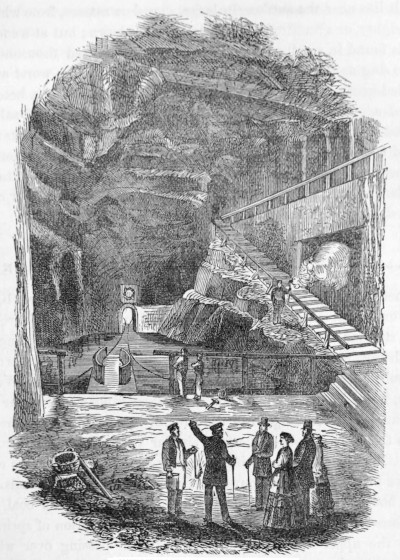
GREAT SALT MINE OF CRACOW.
In several parts of the mine, huge columns of salt are left standing, to
support the rock; and these are very fancifully ornamented. But the most
curious object in the inhabited part, or subterraneous town, is a statue which
is considered by the immured inhabitants as the actual transmutation of
Lot’s wife into a pillar of salt; and in proportion as this statue appears either
dry or moist, the state of the weather above ground is inferred. The windings
in this mine are so numerous and intricate, that the workmen have
frequently lost their way; and several, whose lights have been extinguished,
have thus perished. The number of miners to whom it gives employment, is
computed at between four and five hundred; but the whole amount of the
men employed in it is about seven hundred.
226The salt lies near the surface, in large, shapeless masses, from which blocks
of sixty, eighty, or a hundred feet square, may be hewn; but at a considerable
depth it is found in smaller lumps. About six hundred thousand quintals
of salt are dug annually out of the mines of Cracow. The worst and cheapest
is called green salt, from its greenish color, occasioned by a heterogenous
mixture of a grayish mineral, or clay, and entirely consists of salt crystals
of different dimensions. A finer sort is dug out in large blocks; and the
third kind is the sal gemmæ, or crystal salt, which is found in small pieces
interspersed in the rock, and, when detached from it, breaks into cubes of
rectangular prisms. This is usually sold unprepared. The color of the salt
stone is a dark gray mixed with yellow.
The Cheshire rock-salt, with very few exceptions, has hitherto been ascertained
to exist only in the valleys bordering on the river Weaver and its
tributary streams; in some places manifesting its presence by springs impregnated
with salt, and in others being known by mines actually carried down
into the substance of the salt strata. Between the source of the Weaver and
Nantwich, many brine springs make their appearance; and occur again at
several places, in proceeding down the stream. At Moulton, a mine has been
sunk into the body of rock-salt, and a similar mine is wrought near Middlewich.
At Northwich, brine springs are very abundant; and there also many
mines have been sunk for the purpose of working out the fossil salt. In that
vicinity a body of rock-salt has been met with in searching for coal.
The brines in this district are formed by the penetration of spring or rain
waters to the upper surface of the rock-salt, in passing over which they
acquire such a degree of strength, that one hundred parts have yielded
twenty-seven of pure salt, thus nearly approaching to the perfect saturation
of brine. Their strength is therefore much greater than that of the salt
springs met with in Hungary, Germany and France. The brine having been
pumped out of the pits, is first conveyed into large reservoirs, and afterward
drawn off as it is needed, into pans made of wrought iron. Here heat is
applied in a degree determined by the nature of the salt to be manufactured,
and various additions are made to the brine, with a view either to assist the
crystallization of the salt, or to promote the separation of the earthy particles,
which exist in a very small proportion. The importance of the manufacture
of Cheshire salt will be sufficiently obvious from the statement, that, besides
the salt made for home consumption, the annual amount of which has
exceeded sixteen thousand tuns, the average of the quantity sent yearly to
227Liverpool for exportation, has not been less than one hundred and forty
thousand tuns.
The mine of rock-salt first worked was discovered by accident at Marbury,
near Northwich about a century and a half ago; and this bed had been
wrought for more than a century, when, in the same neighborhood, a second
and inferior stratum was fallen in with, separated from the former by a bed
of indurated clay. This lower stratum was ascertained to possess a very
great degree of purity, and freedom from earthy admixture; on which
account, and from the local advantages of Northwich for exportation, the
fossil salt is worked in the vicinity of that place only. It occurs in two great
strata or beds, lying nearly horizontally, and separated, the superincumbent
from the subjacent stratum, by several layers of indurated clay, or argillaceous
stone. These intervening beds possess, in conjunction, a very uniform
thickness of from thirty to thirty-five feet, and are irregularly penetrated by
veins of fossil salt. There is every reason to believe that the beds of rock-salt
at Northwich, are perfectly distinct from any others in the salt district, and
form what are termed by mineralogists incumbent bodies or masses of mineral.
These enormous masses stretch a mile and a half in a longitudinal direction
from north-east to south-west; but their transverse extent, as measured
by a line at right angles from the former, does not exceed forty-two hundred
feet, somewhat more than three-quarters of a mile. Without this area, the
brine which is met with, is of a very weak and inferior quality, and at a short
distance disappears altogether. The thickness of the upper bed varies from
sixty to ninety feet; and a general estimate made from its level, shows that
its upper surface, which is ninety feet beneath that of the earth, is at least
thirty-six feet beneath the low-water mark of the sea at Liverpool; a fact not
unimportant in determining the nature of the formation of this mineral.
The thickness of the lower bed has not hitherto been ascertained; but the
workings are usually begun at the depth of from sixty to seventy-five feet,
and are carried down for the space of fifteen or eighteen feet, through what
forms the purest portion of the bed. In one of the mines a shaft has been
sunk to a level of forty-two feet still lower, without passing through the body
of rock-salt. There is thus an ascertained thickness of this bed of about a
hundred and twenty feet, and without any direct evidence that it may not
extend to a considerably greater depth.
Although two distinct beds, only, of fossil salt have been met with at
Northwich, it has been ascertained that the same limitations do not exist
throughout the whole of the salt district. At Lawton, near the source of the
river Wheelock, three distinct beds have been found, separated by strata
of indurated clay: one at the depth of one hundred and twenty-six feet, four
228feet in thickness; a second, thirty feet lower, twelve feet in thickness; and a
third, forty-five feet further down, which was sunk into seventy-two feet, without
passing through its substance. The intervening clay, the structure of
which is very peculiar, is called the shaggy metal, and the fresh water which
passes through its pores has the expressive appellation of Roaring Meg.
This epithet will not appear too strong, when it is mentioned that in a mine
in which the section of strata was taken, and where the “shaggy metal” was
found at the depth of about eighty feet, the quantity of water ascertained to
issue from its pores in one minute, was not less than three hundred and sixty
gallons; a circumstance which greatly enhances the difficulty of passing a
shaft down to the body of rock-salt.
In many of these beds of argillaceous stone, a portion of salt, sufficiently
strong to affect the taste, is found to exist; and this saltness increases, as
might be expected, in proportion as the body of rock-salt is approached. In
the strata or layers immediately above the rock, which in all the mines are
perfectly uniform in their appearance and structure, this is particularly
remarkable, notwithstanding there are not, in these strata, any veins of rock-salt
connected with the great mass below. On the contrary, the line between
the clay and rock-salt is drawn with great distinctness in every instance,
without presenting any of those inequalities which would arise from a mutual
penetration of the strata. Not any marine exuviæ, or organic remains, are
found in the strata above the rock-salt; and the almost universal occurrence
of gypsum, in connection with beds of fossil salt, is a fact still more deserving
of observation, because it appears, not only in these mines, but also in the
salt mines of Hungary, Poland and Transylvania; on which account Werner,
in his geognostic system, assigns to the rock-salt and fletz gypsum a conjunct
situation.
The fossil salt extracted from the Northwich mines is of different degrees
of purity, and more or less blended with earthy and metallic substances.
The purer portion of the lower bed yields a rock-salt, which, being principally
exported to the Baltic, obtains the name of Prussian rock. The extent of the
cavity formed by the workings, varies in different mines, the average depth
being about sixteen feet. In some of the pits, where pillars from eighteen
to twenty-four feet square form the supports of the mine, the appearance
of the cavity is singularly striking, and the brilliancy of the effect is greatly
increased when the mine is illuminated by candles fixed to the sides of the
rock. The scene thus formed almost appears to realize the magic palaces
of eastern poets. Some of the pits are worked in aisles or streets, but the
choice here is wholly arbitrary. Among the methods employed in working
out the rock-salt, the operation of blasting is applied to the separation of large
229masses from the body of the rock, and these are afterward broken down by the
mechanical implements in common use. The present number of mines is
eleven or twelve, from which there are raised, on an annual average, fifty or
sixty thousand tuns of rock-salt. The greater part of this quantity is exported
to Ireland and the Baltic, the remainder being employed in the Cheshire district,
in the manufacture of white salt, by solution and subsequent evaporation.
The general situation occupied by the rock-salt in Cheshire is very similar
to that of the Transylvanian and Polish mines, the beds of this mineral being
disposed in small plains, bounded by hills of inconsiderable hight, forming a
kind of basin or hollow, from which there is usually only a narrow egress for
the waters. The situation of the Austrian salt mines near Saltzburg is,
however, very different. The mineral there appears to be disposed in beds
of great thickness, which occur near the summits of limestone hills, at a great
elevation above the adjoining country. This is a singular fact; and if the
hypothesis be allowed that rock-salt is formed from the waters of the sea, it
is necessary to suppose the occurrence on this spot of the most vast and surprising
changes!
Though there are no salt mines in the United States, there are salt springs
in several places. By far the most important and valuable of these, are in
the neighborhood of Syracuse, in the state of New York. The land containing
these springs, is owned by the state, and is leased free of rent, to be used
only for the manufacture of salt. The wells are dug, and the water pumped
up at the expense of the state, and the manufacturer pays a duty of one cent
on each bushel he makes. Some of the wells are sunk to the depth of four
hundred feet. Fine salt is prepared by boiling; and coarse by solar evaporation.
In 1850, the number of salt manufactories in this vicinity was one
hundred and ninety-two; and the quantity of salt produced in 1853,
amounted to more than five million bushels. The salt of this region has
been thoroughly tested, and found to be fully equal to any of foreign manufacture.
PHENOMENA OF THE OCEAN. — SALTNESS OF THE SEA. — CONGELATION OF SEA-WATER. — ICE-ISLANDS. — ICEBERGS. — LUMINOUS POINTS IN THE SEA. — TIDES AND CURRENTS.
230
“They that go down to the sea in ships, that do business in great waters; these see the works of
the Lord, and his wonders in the deep.”—Psalms.
“With wonder mark the moving wilderness of waves,
From pole to pole through boundless space diffused,
Magnificently dreadful! where, at large,
Leviathan, with each inferior name
Of sea-born kinds, ten thousand thousand tribes,
Find endless range for pasture and for sport.
Adoring own
The Hand Almighty, who in channeled bed
Immeasurable sunk, and poured abroad,
Fenced with eternal mounds, the fluid sphere;
With every wind to waft large commerce on.
Join pole to pole, consociate severed worlds,
And link in bonds of intercourse and love
Earth’s universal
family.”family.”—
Mallet.
That huge mass of waters impregnated with salt, which encompasses all
parts of the globe, and by the means of which, in the present improved state
of navigation, an easy intercourse subsists between the most distant nations,
is denominated the ocean, and has three grand divisions assigned to it.
First, that vast expanse of water which lies to the westward of the northern
and southern continents of America, and by which those continents are
divided from Asia. On account of the uniform and temperate gales which
sweep its surface within the tropics, it is named the Pacific ocean; and has
again been distinguished into the northern and southern Pacific, (the equator
being considered as the dividing line,) and the Southern ocean, or South
sea, being consequently that part of the general assemblage of waters
which is contained between the fortieth degree of south latitude and the
south pole. Its general width is estimated at about ten thousand miles.
Secondly, the Atlantic ocean, which divides Europe and Africa from the two
American continents, and has a general width of about three thousand miles;
while the waters which occupy the polar regions are named the Northern
sea. And, lastly, the Indian ocean, which extends from the eastern shores
of Africa along the southern coasts of Asia, and has the same general width
with the preceding one.
Among the chief of those less expansive sheets of water, properly called
seas, may be mentioned the Baltic, the Mediterranean sea, and the Black and
231Red seas. The Caspian sea, being entirely encompassed by land, might,
with more propriety, have been styled a lake; but as its water possesses the
quality of saltness, it is ranked among the seas. It is, notwithstanding,
certain that Lake Superior has a still greater circumference, extending
around its shores at least fourteen hundred miles, while the extent of the
Caspian does not exceed twelve hundred.
Of the origin of this division into different seas, and seas of different depths,
little is known; but it is highly probable that many of the larger excavations
and partitions now met with, have existed, without much change as to their
extent, from the creation. Others have undoubtedly been the result of that
conflict which is perpetually taking place between the elements of land and
water, and which has, for the greater part, given rise to islands, isthmuses
and peninsulas; while subterraneous volcanoes, and the truly surprising and
indefatigable exertions of coral, madrepores, tubipores, and other restless and
multitudinous zoöphytes, have laid, and are daily laying, the foundation of
new islands and continents in the middle of the widest and deepest seas.
The quantity of water in the ocean, not only remains constantly the same,
but, notwithstanding its most violent and incessant motion, continues stable
within certain limits. This, however, can not be inferred from observation;
for, although in the almost infinite variety of disturbances to which
the ocean is liable, from the action of irregular causes, it may appear to
return to its former state of equilibrium, still it may be apprehended that
some extraordinary cause may communicate to it a shock, which, though
inconsiderable at first, may augment continually, and elevate it above
the highest mountains. It is, therefore, interesting to investigate the conditions
which are necessary for the absolute stability of the ocean. This has
been effected by the celebrated Laplace, who has demonstrated that the
equilibrium of the ocean must be stable, if the density be less than the mean
density of the earth, which is known to be the case. He has likewise determined,
by means of his refined analysis, that this stability would cease to
exist, if the mean density of the sea were to exceed that of the earth; so that
the stability of the equilibrium of the ocean, and the excess of the density
of the terrestrial globe above that of the waters which cover it, are reciprocally
connected with each other, and indicate infinite wisdom and contrivance
in such an adjustment.
Of the various phenomena of the sea, that of its saltness is one of the most
obvious. No questions concerning the natural history of our globe have
232been discussed with more attention, or decided with less satisfaction, than
that concerning its primary cause, which had perplexed the philosophers
before the time of Aristotle, and surpassed even the great genius of that
profound inquirer into natural causes. Kircher, after having consulted not
less than thirty-three authors on this subject, could not help remarking, that
the fluctuations of the ocean itself were scarcely more various than the opinions
concerning the origin of its saline impregnation.
This question does not seem capable of admitting an illustration from
experiment; at least, not from any experiments hitherto made for that purpose:
it is, therefore, not surprising, that it remains nearly as problematical
in the present age, as it has been in any of the preceding. Had observations
been made three or four centuries ago, to ascertain the saltness of the sea,
then, at any particular time and place, we might now, by making similar
observations at the same place, in the same season, have been able to know,
whether the saltness, at that particular place, was increasing or decreasing,
or an invariable quantity. This kind and degree of knowledge would have
served as a clue to direct us to a full investigation of this matter in general.
It is to be regretted, however, that observations of this nature have not,
in former days, been made with any degree of precision.
One of the principal opinions maintained on this subject by modern philosophers,
and more particularly supported by Halley, is, that since river-water,
in almost every part of the globe, is impregnated in a greater or less degree
by sea-salt, the sea must have gradually acquired its present quantity of salt
from the long continued influx of rivers. The water which is carried into
the sea by these rivers, is again separated from it by evaporation, and being
dispersed over the atmosphere by winds, soon descends in rain or vapor upon
the surface of the earth, whence it hastens to pour into the bosom of the
ocean the fresh tribute of salt it has collected in its inland progress. Thus
the salt conveyed into the sea not being a volatile substance, nor performing
an incessant circulation, must be a perpetually increasing quantity; and
sufficient time, it is contended, has elapsed since the creation, for the sea to
acquire, from this source, its present quantity of salt.
This opinion has been successfully combated; and it is denied that freshwater
rivers could, in the course of thousands or even millions of years, have
produced saltness in the sea. If this were the case, every sea, or great body
of water, which receives rivers, must have been salt, and have possessed a
degree of saltness in proportion to the quantity of water which these rivers
discharge. But so far is this from being true, that the Palus Mæotis, and
our great American lakes, do not contain salt water, but fresh. It may
indeed be objected, that the quantity of salt which rivers carry along with
233them, and deposit in the sea, must depend on the nature of the soil through
which they flow, which may in some places not contain any salt; and that
this is the reason why the great lakes in America and the Palus Mæotis are
fresh. But to this opinion, which is merely hypothetical, there are insurmountable
objections. It is a curious fact, that the saltness of the sea is
greatest under the equator, and diminishes gradually toward the poles; but
it can not therefore be assumed that the earth contains more salt in the
tropical regions than in the temperate zones, and more in these again than
in the frigid zones. On the other hand, if it be allowed that the sea receives
its saltness from the rivers, it must be equally salt, or nearly so, in every
part of the earth; since, according to a simple and well-known principle in
chemistry, when any substance is dissolved in water with the assistance of
agitation, at whatever part of the water it is introduced, it will be equally
diffused through the whole liquid. Now, though it were true that a greater
quantity of salt should have been introduced into the sea under the equator,
than toward the poles, from the constant agitation occasioned by the wind
and tide, the salt must have soon pervaded the whole mass of water. Neither
is this greater proportion of saltness owing to a superior degree of heat, since
it is an established principle in chemistry, that cold water and hot water
dissolve nearly the same proportion of salt.
The saltness of the sea has also been ascribed to the solution of subterraneous
mines of salt, that are supposed to abound in the bottom of the sea,
and along its shores. But this hypothesis can not be supported. If the sea
were constantly dissolving salt, it would soon become saturated; for it can
not be said that it is deprived of any portion of its salt by evaporation, since
rain-water is fresh. If the sea were to become saturated, neither fishes nor
vegetables could live in it. It may hence be inferred that the saltness of the
sea can not be accounted for by secondary causes, and that it has been salt
since the beginning of time. It is indeed impossible to suppose that the
waters of the sea were at any time fresh since the formation of fishes and
sea-plants; neither will they live in water which is fresh. It may hence be
concluded that the saltness of the sea has, with some few exceptions, perhaps
arising from mines of rock-salt dispersed near its shores, been nearly the
same in all ages. This hypothesis, which is the simplest, and is involved in
the fewest difficulties, best explains the various phenomena dependent on the
saltness of the sea.
Although this saline property may be one of the causes by which the waters
of the sea are preserved from putridity, still it can not be considered as the
principal cause. The ocean has, like rivers, its currents, by which its contents
are circulated round the globe; and these may be said to be the great
234agents which keep it sweet and wholesome. A very enlightened navigator,
Sir John Hawkins, speaks of a calm, in which the sea, having continued for
some time without motion, assumed a very formidable aspect. “Were it
not,” he observes, “for the moving of the sea by the force of winds, tides
and currents, it would corrupt all the world. The experiment of this I saw
in the year 1590, lying with a fleet about the islands of the Azores, almost
six months, the greater part of which time we were becalmed. Upon which,
all the sea became so replenished with various sorts of gellies, and forms of
serpents, adders and snakes, as seemed wonderful; some green, some black,
some yellow, some white, some of divers colors, and many of them had life;
and some there were a yard and a half, and two yards long; which, had I
not seen, I could hardly have believed. And hereof are witnesses all the
companies of the ships which were then present; so that hardly a man could
draw a bucket of water clear of some corruption. In which voyage, toward
the end thereof, many of every ship fell sick, and began to die apace. But
the speedy passage into our country, was a remedy to the diseased, and a
preservative to those who were not touched.”
Although the assertion that salt water never freezes, has been contradicted
by repeated experience, it is still certain that it requires a much greater
degree of cold to produce its congelation, than fresh water. It is, therefore,
one of the greatest blessings which we derive from this element, that when
we find all the stores of nature locked up to us on the land, the sea is, with
few exceptions, ever open to our necessities. It is well known that at particular
seasons, the mouth of the river St. Lawrence, the entrance into the
Baltic sea, &c., are so much frozen over as to be impassable by ships; while
the vast mountains and fields of ice in the polar regions, have for ages past
been insurmountable obstructions to the daring researches of modern navigators.
These exceptions, however, will appear of comparatively trifling
importance to navigation, when the number of ports which are, in almost
every region, open at all seasons of the year, are considered; and this facility
of intercourse would certainly not have been afforded, if sea-water had
admitted of as easy a congelation as that of water not impregnated with
salt.
On the origin of ice in the frozen seas, different opinions have been entertained.
The authority of Capt. Cook and Lord Mulgrave, has been cited by
Bishop Watson, to show that good fresh water may be procured from ice
found in those seas; but he observes that, notwithstanding the testimonies
235of these very able navigators, it may still be doubted whether the ice from
which the water was obtained, had been formed in the sea, and, consequently,
whether sea-water itself would, when frozen, yield fresh water. He thinks
it probable that the ice had either been formed at the mouths of large fresh-water
rivers, and had thence, by tides or torrents been drifted into the sea,
or that it had been broken by its own weight, from the immense cliffs of ice
and frozen snow which, in countries where there are few rivers, are found in
high latitudes to project a great way into the sea. An early navigator,
Fotherbye, in the relation of his voyage toward the south pole, in 1614, considers
snow to be the original cause of the ice found at sea, he himself having
observed it to lie an inch thick on the surface; and Captain Cook, from his
own observation in the South sea, was disposed to think that the vast floats
of ice he met with in the spring, were formed from the congelation of snow.
It is certain that the snow which falls upon the surface of the sea, being in a
solid state, and, bulk for bulk, lighter than sea-water, will not readily combine
with it, but may, by a due degree of cold in the atmosphere, be speedily
converted into a layer of ice. The upper layer of this first surface of ice
being elevated above the surface of the sea, will receive all the fresh water
which falls from the atmosphere in the form of snow, sleet, rain or dew, by
the successive congelation of which, the largest fields of ice may at length
be formed.
It is a matter of little consequence to a navigator, whence the ice which
supplies him with fresh water is produced. Leaving, therefore, these
hypotheses relative to the formation of ice in frozen seas, it should be
observed that the question, whether congealed sea-water will, when thawed,
yield fresh water, has been satisfactorily decided by experiments made with
every suitable attention. A quantity of sea-water having been taken up off
the English coast, was exposed to a freezing atmosphere, and afforded an
ice perfectly free from any taste of salt; and it has likewise been found, that
not only sea-water, but water containing double the proportion of salt commonly
found in our sea-water, and more than is contained in the sea-water
of any climate, may be frozen by the cold prevailing in our atmosphere.
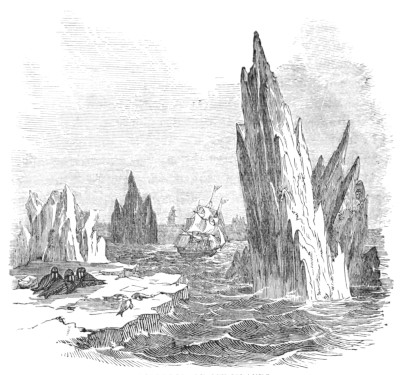
ICEBERGS, OR ICE-ISLANDS.
Ice-islands, or icebergs, as they are commonly called, is the name given
by seamen to the huge, solid masses of ice which abound in the sea near or
within the polar circles, and which often float down nearer to the equator,
till they are gradually dissolved by the increasing warmth of the air and
water. The cut gives a view of them as seen by Dr. Scoresby, who counted
236five hundred of them between latitude sixty-nine degrees and seventy degrees
north, which were from one hundred to two hundred feet high, and from a
few yards to a mile in circumference. Many of these fluctuating islands are
met with on the coasts of Spitzbergen, to the great danger of the vessels
employed in the Greenland fishery. In the midst of these tremendous
masses, navigators have been arrested and frozen to death. In this manner
the brave Sir Hugh Willoughby perished, with all his crew, in 1553; and
in the year 1773, Lord Mulgrave, after every effort which the most accomplished
seaman could make, to reach the termination of his voyage, was
caught in the ice, and nearly experienced the same unhappy fate. The
scene he describes, divested of the horrors attendant on the eventful expectation
of change, was most beautiful and picturesque. Two large ships
becalmed in a vast basin, surrounded on all sides by ice-islands of various
forms; the weather clear; the sun gilding the circumambient ice, which was
smooth, low, even, and covered with snow, except where pools of water, on
a portion of the surface, shot forth new icy crystals, and on the smooth
surface of the comparatively small space of sea in which they were hemmed.
237Such is the picture drawn by our navigator, amid the perils by which lie
was surrounded.
After fruitless attempts to force their way through the fields of ice, the
limits of these became at length so contracted, that the ships were immovably
fixed. The smooth extent of surface was soon lost; the pressure of the
pieces of ice, by the violence of the swell, caused them to pack; and fragment
rose upon fragment, until they were in many places higher than the main-yard.
The movements of the ships were tremendous and involuntary, in
conjunction with the surrounding ice, actuated by the currents. The water
having shoaled to fourteen fathoms, great apprehensions were entertained,
as the grounding of the ice, or of the ships, would have been equally fatal:
the force of the ice might have crushed them to atoms, or have lifted them
out of the water, and have overset them; or, again, have left them suspended
on the summits of the pieces of ice, at a tremendous hight, exposed to the
fury of the winds, or to the risk of being dashed to pieces by the failure of
their frozen dock. An attempt was made to cut a passage through the ice;
but after a perseverance truly worthy of Britons, it proved ineffectual. The
commander, who was at all times master of himself, directed the boats to be
made ready to be hauled over the ice, till they should reach navigable water,
proposing in them to make the voyage to England; but after they had thus
been drawn over the ice, for three progressive days, a wind having sprung
up, the ice separated sufficiently to yield to the pressure of the ships in full
sail. After having labored against the resisting fields of ice, they at length
reached the harbor of Smeerinberg, at the west end of Spitzbergen.
The vast islands of floating ice which abound in the high southern latitudes,
are a proof that they are visited by a much severer degree of cold than equal
latitudes toward the north pole. Captain Cook, in his second voyage, fell
in with one of these islands in latitude fifty degrees, forty minutes, south.
It was about fifty feet high, and half a mile in circuit, being flat on the top,
while its sides, against which the sea broke exceedingly high, rose in a
perpendicular direction. In the afternoon of the same day, the tenth of
December, 1773, he fell in with another large cubical mass of ice, about two
thousand feet in length, four hundred feet in breadth, and in hight two
hundred feet. Mr. Foster, the naturalist of the voyage, remarks that,
according to the experiments of Boyle and Marian, the volume of ice is to
that of sea-water as ten to nine: consequently, by the known rules of hydrostatics,
the volume of ice which rises above the surface of the water, is to
that which sinks below it as one to nine. Supposing, therefore, this mass
of ice to have been of a regular figure, its depth under water must have been
eighteen hundred feet, and its whole hight, twenty hundred feet: estimating
238its length, as above, at twenty hundred feet, and its breadth at four hundred
feet, the entire mass must have contained sixteen hundred millions of cubic
feet of ice.
Two days after, several other ice-islands were seen, some of them nearly
two miles in circuit, and six hundred feet high; and yet such was the force
of the waves, that the sea broke quite over them. They exhibited for a few
moments a view very pleasing to the eye; but a sense of danger soon filled
the mind with horror; for had the ship struck against the weather-side of
one of these islands, when the sea ran high, she must in an instant have been
dashed to pieces. The route to the southward was afterward impeded by
an immense field of low ice, the termination of which could not be seen,
either to the east, west or south. In different parts of this field were
islands, or hills of ice, like those which had before been found floating in
the sea.
At length these ice-islands became as familiar to those on board as the
clouds and the sea. Whenever a strong reflection of white was seen on the
skirts of the sky, near the horizon, then ice was sure to be encountered;
notwithstanding which, that substance itself was not entirely white, but
often tinged, especially near the surface of the sea, with a most beautiful
sapphirine, or rather berylline blue, evidently reflected from the water.
This blue color sometimes appeared twenty or thirty feet above the surface,
and was probably produced by particles of sea-water which had been dashed
against the mass in tempestuous weather, and had penetrated into its interstices.
In the evening, the sun setting just behind one of these masses,
tinged its edges with gold, and reflected on the entire mass a beautiful suffusion
of purple. In the larger masses, were frequently observed shades or
casts of white, lying above each other in strata, sometimes of six inches, and
at other times of a foot in hight. This appearance seemed to confirm the
opinion entertained relative to the increase and accumulation of such huge
masses of ice, by heavy falls of snow at different intervals; for snow being
of various kinds, small-grained, large-grained, in light feathery locks, &c.,
the various degrees of its compactness may account for the different colors
of the strata.
In his third attempt to proceed southward, in January, 1774, Capt. Cook
was led, by the mildest sunshine which was, perhaps, ever experienced in
the frigid zone, to entertain hopes of penetrating as far toward the south
pole as other navigators have done toward the north pole; but on the twenty-sixth
of that month, at four in the morning, his officers discovered a solid
ice-field of immense extent before them, bearing from east to west. A bed
of fragments floated around this field, which was raised several feet above
239the surface of the water. While in this situation, the southern part of the
horizon was illuminated by the rays of light reflected from the ice, to a considerable
hight. Ninety-seven ice-islands were distinctly seen within the
field, besides those on the outside; many of them very large, and looking
like a ridge of mountains, rising one above the other until they were lost in
the clouds. The most elevated and most ragged of these ice-islands, were
surmounted by peaks, and were from two to three hundred feet in hight,
with perpendicular cliffs or sides astonishing to behold. The largest of them
terminated in a peak not unlike the cupola of St. Paul’s.
The outer, or northern edge of this immense field of ice, was composed of
loose or broken ice, closely packed together, so that it was not possible to
find any entrance. Such mountains of ice, Captain Cook was persuaded,
were never seen in the Greenland seas, so that no comparison could be
drawn; and it was the opinion of most of the persons on board, that this ice
extended quite to the pole, from which they were then less than nineteen
degrees; or, perhaps, that it was joined to some land to which it had been
fixed from the earliest time. Our navigator was of opinion that it is to the
south of this parallel that all the ice is formed which is found scattered up
and down to the northward, and afterward broken off by gales of wind, or
other causes, and brought forward by the currents which are always found
to set in that direction in high latitudes. “Should there,” he observes, “be
land to the south behind this ice, it can afford no better retreat for birds, or
any other animals, than the ice itself, with which it must be wholly covered.
I, who was ambitious, not only to go further than any one had been before,
but as far as it was possible for man to go, was not sorry at meeting with
this interruption; as it in some measure relieved us, or at least shortened
the dangers and hardships inseparable from the navigation of the southern
polar regions.”
The approximation of several fields of ice of different magnitudes, produces
a very singular phenomenon. The smaller of these masses are forced
out of the water, and thrown on the larger ones, until at length an aggregate
is formed of a tremendous hight. These accumulated bodies of ice float in
the sea like so many rugged mountains, and are continually increased in
hight by the freezing of the spray of the sea, and the melting and then
freezing of the snow which falls on them. While their growth is thus augmented,
the smaller fields, of a less elevation, are the meadows of the seals,
on which these animals at times frolic by hundreds.
The collision of great fields of ice, in high latitudes, is often attended by a
noise, which, for a time, takes away the sense of hearing anything beside;
and that of the smaller fields, with a grinding of unspeakable horror. The
240water which dashes against the mountainous ice, freezes into an infinite
variety of forms, and presents to the admiring view of the voyager ideal
towns, streets, churches, steeples, and almost every form which imagination
can picture to itself.
After such notices of the ice-islands from the earlier voyagers, it may be
interesting to know how they have appeared to later beholders; and this may
be seen in the following account from the journal of a seaman who was in the
well known “Arctic Expedition,” in 1850-51. Under the date of the thirtieth
of June, 1850, he writes: “Moored to an iceberg; weather calm; sky
cloudless, and ‘beautifully blue;’ surrounded by a vast number of stupendous
bergs, glittering and glistening beneath the refulgent rays of a midday
sun. A great portion of the crew had gone on shore to gather the eggs of the
wild sea-birds that frequent the lonely ice-bound precipices of Baffin’s bay,
while those on board had retired to rest, wearied with the harassing toils
of the preceding day. To me, walking the deck and alone, all nature seemed
hushed in universal repose. Whilst thus contemplating the stillness of the
monotonous scene around me, I observed in the offing a large iceberg, completely
perforated, exhibiting in the distance an arch, or tunnel, apparently
so uniform in its conformation, that I was induced to call two of the seamen
to look at it, at the same time telling them, that I had never read or heard
of any of our arctic voyagers passing through one of these arches, so frequently
seen through large bergs, and that there would be a novelty in doing
so; and if they chose to accompany me, I would get permission to take the
small boat, and endeavor to accomplish the unprecedented feat.
“They readily agreed, and away we went. On nearing the arch, and
ascertaining that there was a sufficiency of water for the boat to pass through,
we rowed slowly and silently under, when there burst upon our view one
of the most magnificent specimens of nature’s handiwork ever exhibited to
mortal eyes; the sublimity and grandeur of which no language can describe,
no imagination conceive. Fancy an immense arch of eighty feet span, fifty
feet high, and upward of one hundred feet in breadth, as correct in its conformation
as if it had been constructed by the most scientific artist, formed
of solid ice, of a beautiful emerald green, its whole expanse of surface
smoother than the most polished alabaster, and you may form some slight
conception of the architectural beauties of this icy temple, the wonderful
workmanship of time and the elements. When we had got about half-way
through the mighty structure, on looking upward, I observed that the berg
was rent the whole breadth of the arch, and in a perpendicular direction to
its summit, showing two vertical sections of irregular surfaces, ‘darkly,
deeply, beautifully blue,’ here and there illuminated by an arctic sun, which
241darted its golden rays between, presenting to the eye a picture of ethereal
grandeur, which no poet could describe, no painter portray. I was so enraptured
with the sight, that for a moment I fancied the ‘blue vault of heaven’
had opened, and that I actually gazed upon the celestial splendor of a world
beyond this. But, alas! in an instant the scene changed, and I awoke as it
were from a delightful dream, to experience all the horrors of a terrible
reality. I observed the fracture rapidly close, then again slowly open. This
stupendous mass of ice, millions of tuns in weight, was afloat, consequently
in motion, and apparently about to lose its equilibrium, capsize, or burst into
fragments.
“Our position was truly awful. My feelings at the moment may be conceived,
but can not be described. I looked downward and around me; the
sight was equally appalling; the very sea seemed agitated. I at last shut
my eyes from a scene so terrible, the men at the oars, as if by instinct, ‘gave
way,’ and our little craft swiftly glided from beneath the gigantic mass.
We then rowed round the berg, keeping at a respectful distance from it, in
order to judge of its magnitude. I supposed it to be about a mile in circumference,
and its highest pinnacle two hundred and fifty feet. Thus ended an
excursion, the bare recollection of which, at this moment, awakens in me a
shudder; nevertheless, I would not have lost the opportunity of witnessing
a scene so awfully sublime, so tragically grand, for thousands of pounds, but
I would not again run such a risk for a world. We passed through the berg
about two P. M., and at ten o’clock the same night, it burst, agitating the
sea for miles around. I may also observe, that the two men who were with
me in the boat, did not observe that the berg was rent until I told them, after
we were out of danger, we having agreed, previously to entering the arch,
not to speak a word to each other, lest echo itself should disturb the fragile
mass.”
As further describing the appearances of icebergs, we give the following
narrative by Mr. Abbott, who himself was a witness of the splendid scenery
he so graphically describes. He says: “The trip of the Baltic, in March,
1854, is likely to be somewhat memorable. We left Sandy Hook, on Sunday
morning, the fifth, and had a propitious and rapid run, until Friday the tenth,
about three o’clock. When in latitude forty-six degrees and longitude forty-eight
degrees, our attention was arrested by some small pieces of broken ice,
floating in every direction around us. The weather was thick and hazy, so
that we could nowhere see the horizon. In the course of an hour or two, the
fog partly disappeared, and we found ourselves nearly half-surrounded by an
immense field of drift-ice, and large numbers of icebergs, extending from
north-east by south to south-west.
242“Our speed was immediately slackened, and the course of the ship changed
to the northward and westward. It soon appeared that we were completely
hemmed in on every side, by immense fields of floating drift, sometimes in
loose and broken masses, sometimes in a compact and immovable jam, and
everywhere studded with vast and towering icebergs, of almost every conceivable
form and size.
“The fog gradually lifted, now in one direction, and now in another, just
sufficient to discover to us, that we were fairly surrounded, and that, to whatever
point of the compass we could turn the eye or the ship, interminable
masses of drift-ice, of uplift, and icebergs, seemed to cover the sea. So sudden
and unexpected was this discovery, that it seemed more like fairy work
than reality. Surprise and astonishment, at the novel and wonderful scene
around us, seemed at first to make us all unconscious of our own critical
situation. Separating from it the idea of danger, it would be difficult to
imagine a scene combining and blending more of the elements of beauty,
grandeur and sublimity. Far as the eye could reach, it was no longer sea
and sky, but ice, ice, ice, floating like an archipelago of a thousand isles,
great and small, of highland and lowland, mountain, peninsula, promontory,
and Gibraltar rock.
“Running in countless directions through these masses, the ocean waves
appeared in narrow but doubly dark currents, forming the most crooked and
irregular passages, of rivulet and river, and endless indentations of inlet and
bay. Through these labyrinthine passages, perpetually opening and closing
by the action of winds and waves, our escape was to be made. Once, in
attempting to force a passage through a long but narrow neck of broken
blocks of ice, which had drifted across our way, the cutwater, bows and
wheels of the ship, were pretty seriously battered.
“All night long the ship was kept running slowly, threading her way
through these little passages of clear water, until four o’clock in the morning,
when she was so pressed on every side, with sheets of ice, crowded and
packed far above the surface of the water, and urged on by the momentum
of vast masses of iceberg, that prudence required to stop the engine and wait
for daylight. The morning brought little cheering prospect. The man at
mast-head reported no clear water, as far as the eye could reach, excepting
in narrow and scarcely navigable patches and veins. The surface of the sea
all around the horizon, seemed an almost unbroken plain of field and mountain
ice. As early as light allowed, the ship was again under way for the
largest space of clear water that could be seen, and continued all day long to
retrace her path to the westward, veering her course, however, through every
point of the compass, to find the intricate passages toward the open sea. The
243wind, fresh from the north-west, came with intense and piercing cold. The
man at the mast-head could not stand its severity more than half an hour.
The masts, shrouds and cordage of the ship, were completely incrusted, and
altogether what with field-ice, drift, and icebergs, snow, rain and hail, gale
and storm, these days in the ice will not soon be forgotten.
“The different aspects of these scenes by day and night furnished an incessant
source of interest. The vast fields of drift, in their varied forms, by
daylight and by moonlight, were picturesque and beautiful in the highest
degree. They ranged in extent from a quarter of a mile, to perhaps ten
miles square. In some cases, the entire field seemed to be composed of small
broken fragments, floating in close proximity to each other, yet yielding
readily to the play of the waves, rising and falling with the swell of the sea.
The superincumbent weight upon the surface of the water, diminished the
elevation of the waves, but the reflected light from its uneven silver surface,
revealed far more distinctly and beautifully, the extent of motion and the
action of the waves. The long swells of the sea stretched away in graceful
curves for miles, resembling more than anything else I can suggest, some
of the rolling prairies of the west, as they must appear in snow, with this
difference, that the swells seemed ‘all alive,’ as if some mighty monsters
of the deep were working their way beneath, perpetually shifting their position,
and vainly endeavoring to lift the load that covers them, to find a breathing
in the open air. In other instances, these vast fields, stretching as far
as the eye could reach over half the visible horizon, were one compact and
apparently motionless mass of solid ice, as fixed as a ‘rock-bound coast.’
“Another form of peculiar interest was that of a wide field, of many miles
in extent, apparently formed by a long succession of ‘uplifts.’ The action
of the waves had gradually forced large blocks of ice beneath one edge, and
the long continuation of this process, had lifted as it would seem, almost the
entire mass, many feet out of water. The outer edge of these uplifts presented
an abrupt and perpendicular wall. In one case, at night, the captain
estimated that he had sailed for ten miles, along such a wall, the hight of the
wheel-house, about forty feet. A very beautiful effect was once produced by
a small mass of this kind. It was several miles distant, and of very considerable
length. As it rolled and pitched, one side, apparently fifteen or twenty
feet high, dipped in the waves, and rising again, lifted an immense volume
of water, which then ran off, in a beautiful and magnificent torrent, over the
rising edge. I watched with my glass for an hour, the graceful evolutions
of this interesting cataract, which is probably still performing, by its regular
rise and fall, a very respectable, but intermittent Niagara, in the middle of the
Atlantic, with all the regularity of a pendulum.
244“The icebergs, themselves, which we saw, were very numerous, and
of almost every conceivable form and size. During our passage through
three hundred miles, the number we observed was variously estimated from
five hundred to one thousand. I counted at one time thirty-six, and at
another forty-five, all of notable magnitude. They sometimes were of most
curious and fantastic shapes. Hill and mountain of every imaginable outline,
castle and tower, turret, and out-jutting and overhanging crags, magnificent
needle forms shooting to the sky, like the spire of Trinity, crouching
lions, and polar bears, trees of ice, and natural bridges, in short, you can
scarcely fancy anything odd, that snow and ice can be made to resemble, that
had not its type around us.
“But, perhaps, the most wonderful of all, was the great ‘plunging iceberg.’
It was a round, oblong mass of ice, estimated by careful comparison with our
wheel-house, to be fifty by seventy-five feet. A side view made it appear
about as large as the front of a large, double, four story dwelling. But it
was as true and perfect an oval, as the most exquisitely beautiful bald head
you have ever seen. It looked exactly like the upper part of a head of some
gigantic being. This, as it floated past us, gradually descended in the waves,
until it sunk beneath the surface. It then rose with a most majestic movement,
lifting the pure white crown, to the hight of fifty feet. It presented
on the whole, one of the grandest sights I ever beheld. It continued thus
sinking and rising till it was out of our sight. It seemed like a creature
of life, paying its respects to our noble ship.”
Analogous to the ice-fields described above, are those large bodies of ice,
perhaps more properly named icebergs, which fill the valleys between the
high mountains in northern latitudes. Among the most remarkable, are
those of the east coast of Spitzbergen. They are seven in number, and lie at
considerable distances from each other, extending through tracts unknown,
in a region totally inaccessible in the internal parts. The most distant
of them exhibits over the sea a front three hundred feet in hight, emulating
the color of the emerald; cataracts of melted snow fall down in various
parts; and black, spiral mountains, streaked with white, bound the sides,
rising crag above crag, as far as the eye can reach in the background. At
times immense fragments break off, and precipitate themselves into the
water with a most alarming dashing. A portion of this vivid green substance
was seen by Lord Mulgrave, in the voyage above referred to, to fall
into the sea; and, notwithstanding it grounded in twenty-four fathoms of
245water, it spired above the surface fifty feet. Similar icebergs are frequent in
all the arctic regions; and to their fall is owing the solid mountainous ice
which infests those seas.
The frost sports wonderfully with these icebergs, and gives them majestic,
as well as other most singular forms. Masses have been seen to assume the
shape of a Gothic church, with arches, windows and doors, and all the rich
drapery of that style of architecture, composed of what the writer of an
Arabian tale would scarcely have ventured to introduce among the marvelous
suggestions of his fancy, crystals of the richest sapphirine blue. Tables with
one or more feet; and often immense flat-roofed temples, like those of Luxor,
on the bank of the Nile, supported by round transparent columns of cerulean
hue, float by the astonished spectator. These icebergs are the creation
of ages, and acquire annually additional hight by falls of snow and rain,
which latter often freezes instantly, and more than repairs the loss occasioned
by the influence of the sun’s heat.
Among the phenomena which have long exercised the sagacity of philosophers,
that of the luminous appearance of the surface of the sea, during the
obscurity of the night, is highly curious. A variety of experiments were
made by a French naturalist at Cayenne, at different seasons, to ascertain its
true cause; and to him it appeared that these luminous points were produced
by motion and friction alone, as he could not, with the help of the best
glasses, perceive any insects floating in the water. But it would seem, from
the experiments and observations of many learned men, that this phenomenon
is produced by various causes, both jointly and separately. It has been
proved by one set of experiments, that the putrefaction of animal substances
produces light and scintillation in the sea. A little white fish placed in seawater
rendered it luminous in the space of twenty-eight hours. On another
hand, it is certain that there is in the sea a prodigious quantity of shining
insects or animalcules, which contribute to this phenomenon. A French
astronomer, M. Dangelet, who returned from Terra Australis in 1774,
brought with him several kinds of worms which shine in water, when it is
set in motion; and M. Rigaud affirms, that the luminous surface of the sea,
from Brest to the Antilles, contains a great quantity of little, round, shining
polypi, of about a quarter of a line in diameter. Other learned men, who
acknowledge the existence of these luminous animals, can not, however, be
persuaded to consider them as the cause of all that light and scintillation
which appear on the surface of the ocean. They imagine that some substance
246of a phosphoric nature, arising from putrefaction, must be admitted as one
of the causes of this phenomenon. By other naturalists it has been ascribed
to the oily and greasy substances with which the sea is impregnated; in
proof of which a kind of fish, resembling the tunny, is cited, as being provided
with an oil which shines with considerable luster.
The Abbe Nollent was convinced, by a series of experiments, that this
phenomenon is caused by small animals, either by their luminous aspect, or
by some liquor or effluvium which they emit. He did not, however, exclude
other causes; and among these, the spawn or fry of fishes is deserving of
attention. M. Dangelet, in sailing into the bay of Antongil, in the island
of Madagascar, observed a prodigious quantity of fry, which covered the
surface of the sea for the extent of more than a mile, and which he at first,
on account of its color, mistook for a bank of sand. This immense accumulation
of spawn or fry exhaled a disagreeable odor; and it should be
remarked that the sea had, for some days before, appeared with uncommon
splendor. The same accurate observer, perceiving the sea remarkably
luminous in the road of the cape of Good Hope, during a perfect calm,
remarked that the oars of the canoes produced a whitish and pearly kind of
luster: when he took in his hand the water, which contained phosphorus, he
discerned in it, for some minutes, globules of light as large as the heads of
pins. On pressing these globules, they appeared to his touch like a soft and
thin pulp; and some days after the sea was covered with entire banks of
small fishes, in innumerable multitudes.
From all these facts it may be deduced, that various causes contribute to
the light and scintillation of the sea; and that the light which the Cayenne
naturalist attributed to agitation and friction, differs from that which is
extended far and near, seeming to cover the whole surface of the ocean, and
producing a very beautiful and striking appearance, particularly in the torrid
zone, and in the summer season.
Alternate tides in sacred order run.—Blackmore.
Among the most wonderful phenomena of nature may be reckoned the
tides of the sea. They were but little understood by the ancients, although
Pliny, Ptolemy and Macrobius, were of opinion that they were influenced by
the sun and moon. The former expressly says, that the cause of the ebb and
flow is in the sun, which attracts the waters of the ocean; and he adds, that
the waters rise in proportion to the proximity of the moon to the earth.
247The phenomena of the tides have been ascribed to the principle of innate
gravitation; but Sir Richard Phillips, in his theory of the system of the
universe, refers them to that general law of motion which he considers as the
primary and proximate cause of all phenomena, operating, in a descending
series, from the rotation of the sun round the fulcrum of the solar system,
to the fall of an apple to the earth. This motion being transferred through
all nature from its source, serves as the efficient cause of every species of
vitality, of every organic arrangement, and of all those accidents of body
heretofore ascribed to attraction.
The waters of the ocean are observed to flow and rise twice a day, in which
motion, or flux, which in the same direction lasts nearly six hours, the sea
gradually swells, and, entering the mouths of rivers, drives back the river-waters
toward their head. After a continued flux of six hours, it seems to
repose for a quarter of an hour, and then begins to ebb, or retire back, for
six hours more; in which time, by the subsidence of the waters, the rivers
resume their usual course. After a quarter of an hour, the sea again flows
and rises as before.
According to the theory of Newton, these phenomena were supposed to be
produced by an imaginary power called attraction. The moon was supposed
to attract the waters by the influence of an occult power inherent in all
matter; just as the earth was supposed to attract the moon, the moon the
earth, and the planets one another. Others, again, ridicule this idea, as
unsustained and visionary, giving in their turn some theory that has no
better argument to sustain it. And it is probable the time is yet future
when we shall have any theory that will fully account for all the phenomena
of the tides. On account of the shallowness of some seas, and the narrowness
of the straits in others, there arises a great diversity in the phenomena,
only to be accounted for by an exact knowledge of the place. For instance,
in the English channel and the German ocean, the tide is found to flow
strongest in those places that are narrowest, the same quantity of water being,
in this case, driven through a smaller passage. It is often seen, therefore,
rushing through a strait with great force, and considerably raised, by its
rapidity, above that part of the ocean through which it runs.
The shallowness and narrowness of many parts of the sea, give rise also to
a peculiarity in the tides of some parts of the world: for in many places, in
the British seas in particular, the greatest swell of the tide is not while the
moon is in its meridian hight, and directly over the place, but some time after
it has declined thence. The sea, in this case, being obstructed, pursues the
moon with what dispatch it can, but does not arrive with all its waters, until
after the moon has ceased to operate. Lastly, from this shallowness of the
248sea, and from its being obstructed by shoals and straits, it happens that the
Mediterranean, the Baltic and the Black sea, have not any sensible tides, to
raise or depress them in a considerable degree.
Among the phenomena of the tides, one of the most singular is the bore,
peculiar to several rivers: it is ascribed to the waters, which were before
expansive, being suddenly pent up, and confined within a narrow space.
This bore or impetuous rush of waters, accompanies the first flowing of the
tide in the Ferret, in Somersetshire, and in the Seine, in France. It is also
one of the peculiarities of the Severn, the most rapid river in England.
One of the greatest known tides is that of the Bristol channel, which sometimes
flows upward of forty feet. At the mouth of the river Indus, the water
rises thirty feet. The tides also are remarkably high on the coasts of Malay,
in the straits of Sunda, in the Red sea, at the mouth of the river St. Lawrence,
along the coasts of China and Japan, at Panama, and in the gulf of
Bengal. The most remarkable tides, however, are those at Batsha, in the
kingdom of Tonquin, in twenty degrees, fifty minutes, north latitude. In
that port, the sea ebbs and flows once only in twenty-four hours, while in all
other places there are two tides within that space. What is still more
extraordinary, twice in each month, when the moon is near the equinoctial,
there is not any tide, the water being for some time quite stagnant. These,
with other anomalies of the tides there, Sir Isaac Newton, with peculiar
sagacity, ascertained to arise from the concurrence of two tides, one from the
South sea, and the other from the Indian ocean. Of each of these two tides
there come successively two every day; two at one time greater, and two at
another which are less. The time between the arrival of the two greater
was considered by him as high tide; that between the two less, as ebb. In
short, with these simple facts in his possession, that great mathematician
solved every appearance, and so established his theory as to silence every
opposer.
Besides the common and periodical tides, a variety of local currents are
met with in different seas, on different parts of the ocean, and for the greater
part at an inconsiderable distance from land. They have been usually
ascribed to particular winds; but their origin is not easy to trace, as they
have been occasionally found beneath the surface of the water, running in a
contrary direction to the stratum above, and can not, therefore, have been
owing to winds or monsoons. These particular currents have been ascribed
to the immense masses of polar ice, which produce a greater degree of cold
in the under than in the upper stratum of waters; and it has been suspected
that there is an under-current of cold water flowing perpetually from the
poles toward the equator, even where the water above flows toward the poles.
249The great disparity of temperature which is frequently found in deep and
superficial soundings of the same space of water, is thus accounted for.
The most extraordinary current of this kind, is that of the gulf of Florida,
usually called the Gulf stream, which sets along the coast of North America
to the northward and eastward, and flows with an uninterrupted rapidity.
It is ascribed to the trade-winds, which, blowing from the eastern quarter
into the great Mexican gulf, cause there an accumulation above the common
level of the sea. The water, therefore, constantly runs out by the channel
where it finds least resistance, that is, through the gulf of Florida, with such
force as to continue a distinct stream to a very great distance. A proof of
its having thus originated is, that the water in the Gulf stream has been found
to have retained a great portion of the heat it had acquired in the torrid
zone.
A very singular upper current often prevails to the westward of Scilly,
and is highly dangerous to ships which approach the British channel. Currents
of this description are, however more frequently met with about the
straits of Gibraltar, and near the West India islands, the coasts of which are
so subject to counter-tides, or extraordinary currents, that it is often dangerous
for boats to land. They proceed to the westward, along the coasts of
Yucatan and Mexico, and running round into the gulf, return into the great
ocean by the straits of Bahama, along the coasts of Florida, in order to pursue,
in the north, the course ordained them by the great Author of nature.
In this course the waters run with an extraordinary rapidity, passing on,
however, by a motion so even and imperceptible, that their speed is not
realized by the spectator. But against the shores and coasts of the various
islands in their way, their progress becomes very manifest, and even dangerous,
interrupting the navigation, and rendering it hardly possible to stem
them in their course.
In addition to these regular currents, there are others, called counter-tides,
which are observable on the sea-coasts and shores. In places where
these flow, the sea rolls and dashes in an extraordinary manner, becoming
furious without any apparent cause, and without being moved by any wind.
The waves rise and open very high, breaking on the shore with such violence,
that it is impossible for vessels to land. These counter-tides have been, by
some, ascribed to the pressure of the heavy black wind-clouds which are
occasionally seen to hang over an island, or over the sea where they occur,
though it is far more probable that in every case they are caused by under-currents
and hidden shoals, by which the ordinary currents are checked and
broken so as to cause the effects described.
Somewhat similar to these, at least in its hidden cause, is the celebrated
250Maelstrom on the coast of Norway, a view of which is given in the cut.
This is caused by the tides, in their violent passage between the Loffoden
islands; and its terrors, though at all times great, are sometimes greatly
increased by the winds. The roar of the sea, when the Maelstrom is in full
action, is said to be terrific. It is stated that not only ships, but even whales,
have been sucked into this vortex, and killed by being dashed against the
hidden rocks. The following description, though imaginary, gives a correct
idea of the destruction of a ship in this whirlpool.
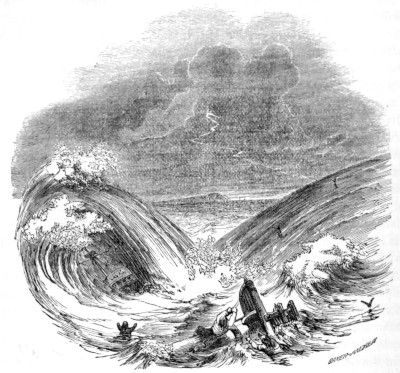
“The breeze, which had been long flagging, now lulled into a calm, and
soon a low continual hum, like that of an army of bees, which seemed to rise
out of the stilled ocean, became audible to every ear. Not a word was
spoken; every one held his breath whilst he listened with an intensity of
eagerness that betokened the awe that was fast filling the heart. ‘It is the
Moskoestrom!’ cried the boatswain. ‘The Moskoestrom!’ echoed the crew.
‘Away, men!’ shouted the mate; ‘down to the hold, bring up the spare
sails, clear the deck, set up a spar for a mast; away, away!’
251“The din of preparation drowned the stern hum of the distant whirlpool:
there was, however, an anxious pause when the new sail was set into the
air; and experienced sailors suffered themselves to be cheated with the hope
that there was still breeze enough to make the good ship answer her helm.
But, alas! the heavy canvas refused to expand its folds, and not a breath
of wind ruffled the dull surface of the sullen waters. They had not another
hope; the sailors looked on one another with blank dismay, and now they
heard, with awful distinctness, the roar of the terrible Maelstrom, and the
frowning rocks of Loffoden were but too plainly visible on the right. It
became evident to all, that the ship, borne along by the tide, was fast drawing
near the dreadful whirlpool. The vessel continued slowly to approach, and
the certainty of unavoidable death became every moment more overpowering
and intense. At first the sailors stood together in a group, gazing gloomily
upon one another; but as the roar of the whirlpool became louder and
louder, and the conviction of inevitable destruction became stronger, they all
dispersed to various parts of the ship. * * *
“It was a beautiful day; the sun shone forth without a cloud to dim his
luster, the waves sparkled beneath his influence, and the white plumage of
a thousand busy sea-birds became more dazzling with his rays. The isle of
Moskoe was close at hand, and looked cheerful and inviting, but the ship
was not to approach nearer to its shores; the stream which bore her along
never suffered any vessel to pause in its career. And now there arose at
some distance ahead of the vessel, a horrible and dismal bellowing. It was
the voice of the leviathan in his agony; and when those on deck who had
still ears for exterior sounds looked forward to ascertain its cause, they
beheld a huge black monster upon the surface of the sea, struggling against
the irresistible stream, and with his immense tail lashing the waters into
foam, as he vainly strove to escape from destruction. They beheld him
borne away by the might of his furious enemy; and they heard his last roar
above the noise of the whirlpool, as he was sucked down into the never
satisfied abyss, and disappeared from their eyes to be torn to atoms; for such
is the fate of everything that seeks the depths of the Maelstrom.
“The ship glides along faster and faster; she begins to toss and roll uneasily
in the angry rapids that boil around her; her race is nearly run. Terrible!
terrible moment! The ship hurries on to her doom with mad impetuosity.
She is in the rapids! she hurries along swift as a flash of fire. She is in the
whirl of water! round, round, round she goes; her inmates catch hold of
her bulwarks and of each other, to steady themselves. And now her bow
sprit is under the waves, and a wild shriek of despair rises into the sky!
The whirlpool, with greedy jaws, has sucked her under.”
252The water of the whirlpool is said to be two hundred and fifty feet deep,
and at ebb its noise is as loud as a cataract. In 1645, it was so violently
agitated by a storm, that in Moskoe the houses were so shaken as to cause
the stones to fall to the ground. Fragments of vessels wrecked in the
Maelstrom are frequently seen on the coast, brought up by the return of the
tide, their edges mashed and jagged as with a saw, which would induce the
belief that the bottom is composed of sharp rocks.
Similar in its cause to the Maelstrom, though on a much inferior scale, is
the current, or whirlpool, called Hurlgate or Hellgate, between the East
river and Long Island sound, near New York. In the narrow channel here,
the tide flows backward and forward with great force; and there being large,
irregular rocks in this channel, the water is thrown into the most violent
agitation. In passing through the place, it is easy to see the waves seeming
to boil as if in a pot. This place is dangerous to vessels, and many have
been wrecked here; though the navigation is now so well understood, that
fewer accidents happen than formerly. The steamboats generally pass in
safety, but still the superb Oregon got upon the rocks here, within a few
years, and came near being lost.
Between Sicily and the main land are the straits of Messina, where the
current is rapid. Ancient mariners deemed this a terrible place; one side
they called Scylla, and the other Charybdis. The poets depicted the sailor
in this rapid, as beset by horrors; for if he escaped Scylla on one side,
Charybdis was ready to dash him in pieces on the other. This idea has
come down to our day, and has even passed into a proverb.
CATARACTS AND CASCADES — FALLS OF NIAGARA. — FALLS OF THE MONTMORENCI. — THE TUCCOA FALL. — FALLS OF THE MISSOURI. — CATSKILL FALLS. — TRENTON FALLS. — WATERFALL OF SOUTH AFRICA. — CATARACTS OF THE NILE. — CATARACT OF THE MENDER.
It has often been remarked that no one is insensible to the beauty of flowing
water. When it glides quietly on in a stream, its character is that of
gentleness, and it suggests only the ideas of calm and tranquil beauty. But
when it expands to a greater width, and its floods are poured forth in an
impetuous tide, then it assumes the aspect of grandeur, and wakens in the
beholder the emotions of sublimity.
The beauty of running water has, indeed, long been celebrated, and the
river has often suggested an image illustrative of human life. Even Pliny,
253who wrote some two thousand years ago, likens a river to the progress of
man. “Its beginnings,” he says, “are insignificant, and its infancy is frivolous;
it plays among the flowers of a meadow, it waters a garden, or turns a
mill. Gathering strength in its growth, it becomes wild and impetuous.
Impatient of the restraint it meets with in the hollows of the mountains, it is
restless and fretful, quick in its turnings, and unsteady in its course. Now
it is a roaring cataract, tearing up and overturning whatever opposes its
progress, and it shoots headlong down a rock; then it becomes a gloomy,
sullen pool, buried in the bottom of a glen. Recovering breath by repose, it
again dashes along, till, tired of uproar and mischief, it quits all that it has
swept along, and leaves the opening of the valley strewed with the rejected
waste. Now, quitting its retirement, it comes abroad into the world, journeying
with more prudence and discretion through cultivated fields, yielding
to circumstances, and winding round what would trouble it to overwhelm or
remove. It passes through the populous cities, and all the busy haunts
of man, tenders its services on every side, and becomes the support and
ornament of the country. Increased by numerous alliances, and advanced
in its course, it becomes grave and stately in its motions, loves peace and
quiet, and in majestic silence rolls on its mighty waters, till it is laid to rest
in the vast abyss.”
Cataracts or falls are formed by the descent of rivers over rocks, from a
higher to a lower level. That of Niagara, is situated on the river Niagara,
between Canada and the United States, which takes its rise in the eastern
extremity of Lake Erie, and, after flowing for thirty-five miles, empties itself
into Lake Ontario. Its breadth is nine hundred feet, and its depth very considerable;
but its current is so exceedingly strong and irregular, and its
channel so frequently interspersed with rocks, that it is navigable for small
boats only. Proceeding lower, the stream widens, and the rocks gradually
recede from the view, and the current though strong, is smooth and regular.
At Fort Chippewa, however, situated one league above the cataracts, the
scene is again changed, and the river so agitated, that a boat would be inevitably
dashed in pieces, were it permitted to pass Fort Niagara, situated on
its bank. So impetuously do the waves break among the rocks, that the
mere sight of them, from the adjacent shore, is sufficient to strike terror in
the spectator. As it approaches the falls, the stream rushes along, with
redoubled fury, until it reaches the edge of the stupendous precipice, when
it tumbles suddenly to the bottom, without meeting with any obstruction in
254its descent. Precisely at this place, the river strikes off to the right, and the
line of cataracts winds obliquely across, instead of extending, in the shortest
direction, from the one bank to the other. It ought to be observed, that the
water does not precipitate itself down the vast abyss in one entire sheet, but,
being separated by islands, forms three distinct, collateral falls.
One of these is called the great or Horseshoe fall, from the similarity of
its form to that of a horseshoe. It is situated on the north-west extremity
of the river, and is most deserving of the attention of the spectator, as probably
seven-eighths of the water passes over it, and as its grandeur is evidently
superior to that of the adjacent cataracts, although its hight may be somewhat
less. As the extent of this fall can be ascertained by the eye only, it is
impossible precisely to describe its limits; but its circumference is generally
computed at eighteen hundred feet, somewhat more than one-third of a mile.
Beyond the intervening island, the width of which may be equal to one
thousand and fifty feet, is the second fall, about fifteen feet wide; and at the
distance of ninety feet, occupied by the second island, is the third fall, the
dimensions of which may be reckoned equal to those of the large island; so
that the entire extent of the precipice, including the intermediate islands, is
four thousand and five feet; a computation which certainly does not exceed
the truth. The quantity of water precipitated from the falls is prodigious,
and it has been estimated, amounts to six hundred and seventy thousand,
two hundred and fifty tuns per minute.
From the eminence entitled the Table rock, the spectator has a fine prospect
of the terrific rapids above the falls, and of the surrounding shores,
embellished with lofty woods. He there sees to advantage the adjacent
Horseshoe fall, and the dread abyss, into which he may look perpendicularly
from the edge of the rock, if his courage be equal to his curiosity. The
immensity of the various objects which here present themselves to the view,
infallibly overwhelms a stranger with astonishment, and several minutes
must elapse before he can possibly collect himself sufficiently to form any just
conception of the awful and magnificent scene before him, which requires
that all its component parts should be separately examined, and which affords
so truly surprising an exhibition, that persons who have resided in its vicinity
for several years, and who have been constantly habituated to its sublimity,
ingenuously acknowledge, at their last visit, that they were never able before
to discover its peculiar grandeur.
From a cliff nearly opposite to one extremity of the third fall, the falls are
seen in a very interesting point of view: the scenery there, it is true, is less
magnificent, but is infinitely more beautiful than from any other station.
For several miles beneath the precipice the river is bounded, on either side,
255by steep and lofty cliffs, composed of earth and rocks, which in most parts
are perpendicular. The descent to the bottom of the falls was formerly
accomplished by two ladders, formed of long pine trees, with notches on their
sides, on which the traveler rested his feet, and passed down amidst a variety
of huge misshapen rocks and pendant trees, seeming to threaten him with
instantaneous destruction. The breadth of the river in this part is about two
furlongs; and toward the right, on the opposite side, the third fall appears in
a very advantageous point of view. About one-half of the Horse-shoe fall is
concealed by the projecting cliff, but its partial prospect is extremely fine.
The bottom of the former of these falls is skirted with a beautiful white foam,
which ascends from the rock in thick volumes, but does not rise into the air
like a cloud of smoke, as is the case with that of the latter fall, although its
spray is so considerable, as to descend like a shower of rain, near the second
ladder, on the opposite side of the river. On its brink, and along the strand,
to the great fall, are to be constantly seen shattered trees and bodies of
animals, which have been carried away by the extreme violence of the
current.
The color of the water of the cataracts, as it descends perpendicularly on
the rocks, is occasionally a dark green, and sometimes a foaming, brilliant
white, displaying a thousand elegant variations, according to the state of the
atmosphere, the hight of the sun, or the force of the wind. A portion of the
spray, resulting from the falls, frequently towers above the hight, and literally
mingles with the clouds: while the remainder, broken in its descent by fragments
of rocks, is in continual agitation. The noise, irregularity, and rapid
descent of the stream, continue about eight miles further; and the river is
not sufficiently calm to admit of navigation, till it reaches Queenstown, on
the west side of the river, and nine miles from the falls.
A late tourist has given us a more recent and fresh view of this wonderful
cataract, which will aid us more fully to understand its various aspects as
taken from different points of observation. “From the bank just below the
‘Clifton House,’ he says, “is perhaps the finest panoramic view of the falls.
The general outline bears a resemblance to the shape of a human ear; the
great Horseshoe fall [which is represented on the right hand of the cut
below] constituting the upper lobe, while Goat island and the American fall
[as seen on the left] represent the remaining portion. The river, whose
general course has been east and west, makes a sharp turn to the right just
at the point where the fall now is. Its breadth is here contracted from three-fourths
of a mile to less than one-fourth. The Horseshoe fall only occupies
the head of the chasm, while the American cataract falls over its side; so
that this fall and a part of the Horseshoe lie directly parallel with the Canada
256shore, and its whole extent can be taken in at a single glance. It is this
oneness of aspect which renders the prospect from this side so much the more
impressive for a first view of Niagara. It gives a strong, sharp outline which
may afterward be filled up at leisure.
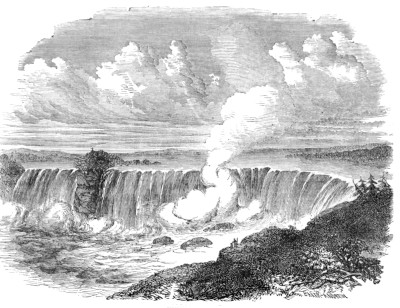
“The most complete view of the Horseshoe fall is that from the bottom
of the cliff, at a point near the ferry landing. If, however, the water is
unusually high, the quiet pool which is ordinarily seen in the foreground,
becomes a fierce and angry rush of waters, foaming above and around the
jagged rocks. If the water is very low, the bed of this pool is entirely dry.
Last year [1852] there were but few days when the whole spot was not overflowed.
The current nearest the Canada shore runs up-stream, as though
seeking an outlet in the direction from which it came. The middle distance
is marked by a line of white foam, beyond which the current runs downstream.
The center of the Horse-shoe fall is directly in front, defined on
the right by the verge of Table Rock, and on the left by the upper extremity
of Goat island. Just below the tower which seems to rise from the midst
257of the waters on the American side, an immense mass of rock is dimly visible,
which became detached from the precipice in February, 1852.
“A very charming glimpse of that portion of the fall directly in front of the
tower, may be caught through a clump of trees which stand a little above
the ferry landing. The limitation of view hightens the effect, when contrasted
with the unlimited prospect of the fall presented from almost every
other point on the Canada side.
“It is no very difficult task for a stout pedestrian to make his way along
under the edge of the precipice from the ferry up to the foot of the fall.
The path winds among huge fragments of rock which have tumbled from
above, and is slippery with the falling spray. You stop to rest upon a huge
rock, where a couple of rough-coated men are fishing. They tell you that it
is named ‘Bass rock,’ and you recognize the propriety of the appellation, as
you observe the finny spoil that has repaid their labor. The water rushes
foaming and eddying around the fragments of rock, sometimes rising in great
swells to the spot on which you stand. Fragments of timber, their ends
rounded and worn like pebbles on a wave-beaten shore, are scattered around:
some groaning and tossing in the water, others stranded high and dry upon
the rocks, where they have been flung by some swell higher than usual.
You are so near the foot of the fall that the descending sheet of water occupies
the entire field of vision: the immense rock which interposes between
Bass rock and the descending water has as yet received no distinctive name.
“The path now begins to ascend the sloping bank, winding around huge
bowlders, and among gay shrubs which the perpetual spray nourishes in
luxuriant greenness, wherever there is a resting-place for a patch of soil.
At last you reach the dilapidated staircase which descends the perpendicular
face of the cliff, and clambering around its base upon a rotten and slimy
plank, you find yourself below the overhanging mass of Table Rock. You
are close at the edge of the falling water, which descends in a mass apparently
as solid as though carved from marble. You now begin to comprehend
the hight of the fall. It makes you dizzy to look up to the upper edge of
the rushing column. You stand just midway between the top and the bottom.
Above you hangs the imminent mass of Table Rock; below, far down
by the wet and jagged rocks, is the seething whirlpool, where the water
writhes and eddies as though frenzied with its fearful leap. Round and
round it goes in solemn gyrations, bearing with it whatever floating object
may have been plunged into its vortex.
“A year ago this very month of August, a young woman walked in the
cool gray morning down to the brink of the cliff and flung herself into the
whirlpool below. So resolute was the leap, that she shot clear of the jagged
258rocks at the base, and plunged sheer into the water beyond. When the
visitors came sauntering down to the fall, her body was seen whirling round
and round in the mad eddies, now submerged for an instant, and then leaping
up, as though imploring aid. A day or two afterward, I was one of a
group to whom a rough-looking man was describing the scene. He told how
he and two others had descended amid the blinding spray close to the foot
of the fall. A rope was then fastened to his body, which was held fast from
above by the others, while he groped his misty way down to the very edge
of the waters, where he waited till they whirled the corpse close inshore.
He then darted a spear with a spring-barb into the body, but the force of the
current tore out the hold, and it drifted away. Again it came within reach,
and again the hold of the spear was too weak to overcome the force of the
current. A third time the body approached, and the spear was darted.
This time it caught among the strong muscles of the thigh, and held, so that
the body was drawn to shore. The narrator was a rough man, roughly clad,
and told his story roughly; but there was in his voice a low thrill of horror
as he told how he was obliged to cut the spear-head out of the flesh with his
knife, before the weapon could be extracted: ‘It was too bad,’ said he; ‘but
it couldn’t be helped.’ And it was with unconscious pathos that he told
how they stripped off their own rough garments, and tenderly covered the
poor maimed and mutilated body before they bore it up the bank. It was a
commentary, wrought out into practice, upon Hood’s immortal ‘Bridge of
Sighs.’
“With the exception of the fall itself, the Canada side presents little of
interest. The brink of the gorge is bare and naked, the trees which once
clothed it having been cut away. The regular drive seems to be up to the
Burning Spring, and thence back by way of Drummondville and Lundy’s
Lane. At the Burning Spring you register your name, pay your fee, and
are introduced into a small apartment, in the floor of which is a spring in
constant ebullition from the escape of an inflammable gas. The flaxen-pated
children of the show-woman place a receiver over the spring, and set fire to
the gas, as it comes out of the jet; they then remove the receiver, and light
the gas as it rises to the surface of the water; and that is all. You take
your departure, looking vastly edified; while the driver thrusts his tongue
into his cheek, as though he were mentally quoting a certain proverb touching
‘a fool and his money.’
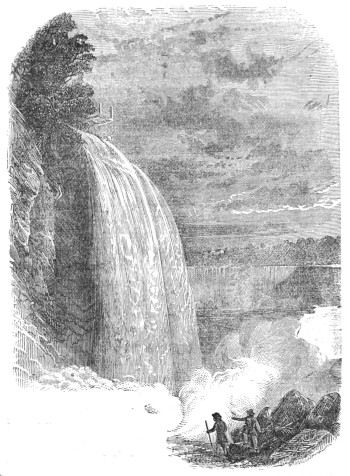
“In the early morning you commit yourself to the little boat in which you
are to be ferried over to the American shore. Your half-felt misgivings are
dissipated as you see the dexterous manner with which the brawny boatman
handles his oars, and takes advantage of the ‘up-eddy’ and ‘down-eddy;’
259and in a few minutes you are landed close at the foot of the American fall.
Half-way up the ferry-stairs is an opening which gives access to a path along
the foot of the perpendicular precipice to the verge of the falling water.
From this point in the early morning, may be gained one of the most picturesque
views of Niagara. Your position gives a fine view of the fall on the
American side, as seen in the cut; the hight of which forms a standard by
which you measure that of the
Horseshoe fall, which stretches
away in the distant perspective.
Completing the ascent of the ferry-stairway,
you reach Prospect point, at its head, from whence the same general
view is gained, from a more elevated point. It is hard to say whether
the view from above or below is the finer. The latter brings more into
notice the hight of the falling column of water, thus gaining an additional
260element of grandeur, while the latter embraces a view of the wooded islands
above the fall, adding greatly to the picturesque effect. The precise point
from which the artist has taken this sketch is not now attainable. It was a
projecting shelf of rock, a few feet below the precipice, which has been cut
away to make room for the terribly unpicturesque, but most convenient
stairway.
“This was apparently the point from which honest Father Hennepin,
who has left us the earliest written account of Niagara, gazed upon that
‘prodigious Cadence of Waters, which falls down after a surprising and
astonishing Manner, insomuch that the Universe can not afford its parallel.’
‘The Waters,’ goes on the quaint narrative, ‘which fall from this horrible
Precipice, do foam and boyle after the most hideous Manner imaginable,
making an outrageous Noise more terrible than that of Thunder.’ The good
Jesuit would seem to have been deeply moved by this ‘dismal Roaring;’ for
in the curious picture which he gives of the falls, he represents the spectators
holding their hands to their ears to shut out the din; and he hints that the
Indians were forced to abandon the neighborhood of the falls, lest they should
become deafened by the uproar. But the good father must have heard the
‘horrid Noise of the Falls,’ as he elsewhere calls it, with the imagination rather
than with the ear. You hardly notice it as you loiter along the brink, except
when some sudden atmospheric change varies its deep and solemn monotone.
The sound is like the continuous and pervading murmur of the wind through
a forest of somber pines. You are not forced to raise your voice in conversing
with a friend by whose side you loiter along the brink of the fall,
toward the bridge which gives you access to the wooded islands that beckon
you on.
“Nothing can exceed the picturesque beauty of the small wooded islands
which stud the rapids upon the American side. Two of rare beauty, known
as Ship and Brig islands, stem the current a little above the bridge which
connects Goat island with the shore. It needs but little effort of the imagination
to fancy them vessels under full press of sail, endeavoring to sheer out
of the current that hurries them inevitably down. The former of these
islands is accessible by a bridge which connects it with Bath island, and is
one of the loveliest spots imaginable. The old cedars, whose gnarled and
contorted trunks overhang the waters, dipping their branches into the current,
seem to cling with desperate clutch to the rocks, as though fearful of
losing their hold and being swept away.
“From the bridge leading to Goat island, the rapids present that same
appearance of plunging from the sky which renders their view from the
Canadian shore so impressive. Goat island—so let it still be called, in spite
261of the foppery which has lately attempted to change its name to Iris island—presents
an aspect almost as wild as it did before it had been rendered
accessible to human foot. Were it not for the path which girdles its entire
circumference, and the rustic seats disposed here and there, one might fancy
that he was the first who had ever sauntered through its grand and stately
woods. The beauty and variety of the trees on this island are wonderful.
There is the maple, greeting the early spring sunshine with its fire-tipped
buds; spreading out in summer its broad dome of dark green leaves in
masses so thick, that beneath them you have no fear of the passing shower;
and in autumn wearing its gorgeous crimson robe like an oriental monarch.
The beech shows its dappled trunk and bright green foliage at every point,
giving perpetual life and vivacity to the scene. The silvery trunks of the
white birch gleam among the underwood. An occasional aspen, with its
ever-quivering leaves, which almost shed a sense of breezy coolness in the
stillest, sultriest day, contrasts finely with the dark evergreens by which it
is relieved. Almost all of our northern fauna have their representatives
here. Even upon the little Ship island, which can be crossed in any direction
in a dozen strides, and which appears to a hasty view but a mass of
twisted and gnarled cedars, there are at least seven distinct species of trees.
Those trees, however, which immediately overhang the falls, have an aspect
peculiar to themselves. They are bent, broken, twisted and contorted, in
every direction. They seem to be starting back in horror from the abyss
before them, and to wind their long finger-like roots around the rocks, in
order to maintain their hold.
“One of these, an aged birch, growing upon the ridge known as the ‘Hog’s
Back,’ affords a resting-place from which to gain one of the finest views of
the American falls. Right in front is the small central fall, and the footbridge
which leads to Luna island, with its trees dwarfed and stunted by the
weight of frozen spray which loads them in the winter. Beyond is the serrated
line of the American fall; while the distance is filled up with the receding
lines of the banks of the river below.
“A few paces—past groups of blithe tourists, past companies of somber
Indian girls in blue blankets and high-crowned hats, with their gay wares
spread out at their feet—brings you to the Biddle staircase, down which you
wind to the foot of the precipice. The path to the left leads along the foot
of the overhanging cliff, up to the verge of the Horseshoe fall, only a portion
of whose circumference is visible from any point on the American shore.
You are here close upon the fragments of rock that fell from just in front
of the tower, in February, 1852, the latest of those changes which are slowly
and almost imperceptibly altering the form and position of the falls. This
262fall of rock was seen by an artist who has given us a faithful picture of its
effects. He was just recovering from an illness, and while sitting in his
room at the Clifton House, on the opposite Canadian shore, he was startled
by a crash, almost like that of an earthquake. Tottering to the window, he
beheld the immense curtain of rock in front of the tower precipitated from
its ancient hold, and lying in huge masses upon the ice below; while a few
streams of water trickled down the brown cliff, where but a moment before
nothing had been seen but a surface of dazzling ice. The water at this
extremity of the fall descends in light feathery forms, contrasting finely with
the solid masses in which it seems to plunge down the center of the sweeping
curve. The tower is perched upon the very brink of the precipice, so close
that the next fall of rock must carry it along with it. The path to the right
from the foot of the staircase, leads to the entrance to the Cave of the Winds,
which lies behind the central fall. It is hard to imagine how this cavern
missed being called the ‘Cave of Æolus,’ by those classicists who have
exhausted ancient mythology for appellations for our American scenery.
But it has escaped this infliction; and the ‘Cave of the Winds,’ it is, and
will be. From the little house close by the entrance, where the requisite
changes of dress are made, you look down into an abyss of cold gray mist,
driven ever and anon like showers of hail into your face, as you grope your
way down the rocky slope. Haste not, pause not. Here is the platform,
half-seen, half-felt amid the blinding spray. Shade of Father Hennepin, this
is truly a ‘dismal roaring’ of wind and water. We are across, and stand
secure on the smooth, shaly bottom of the cave. Look up: what a magnificent
arch is formed by the solid rock on the one side, and the descending
mass of water on the other. Which is the solider and firmer you hardly
know. Yet look again—for it is sunset—and see what we shall see nowhere
else on earth, three rainbows one within another; not half-formed and incomplete,
as is the scheme of our daily life, but filling up the complete circle,
perfect and absolute.
“Upon an isolated rock at the very brink of the cataract stands a round
tower. It is approached by a long, narrow bridge, resting now upon ledges
of solid rock, and now upon loose bowlders. From the balcony upon its
summit, you can lean far over the edge of the precipice, and there catch the
freshness of the cloud of spray that rises evermore from the unseen foot of
the great fall. Or you can climb down the low rock upon which the tower
stands, and gather shells and pebbles from within arm’s length of the verge
of the descent, so gentle, to all appearance, is the current. But be not over-bold.
These waters, apparently so gentle, sweep down with a force beyond
your power to stem. Not many months ago, a man fell from the bridge into
263their smooth flow, and was in the twinkling of an eye swept to the brink
of the descent. Here he lodged against one of those rocks that lie apparently
tottering upon the brow, looking over the fearful descent, with as little power
to retrace his course, as he would have had to reascend the perpendicular
fall. A rope was floated down to him, which he had just strength to fasten
around his body, and he was drawn up from his perilous position.
“It is usual to speak of the Horseshoe fall as Canadian; and our rather
slow neighbors across the river have been wont to plume themselves upon the
possession of the more magnificent part of Niagara; while Young America
has been heard to mutter between his teeth something about ‘annexation,’
on the ground that the lesser nation has no fair claim to the possession
of the major part of the crowning wonder of the continent. But the portion
of Niagara belonging to Canada is hardly worth contending for. The boundary
line between the two countries is the deepest water, which runs far over
toward the Canadian shore. The line passes through the lonely little isle in
the center of the river, which has never been trodden by human foot. Right
through the very center of the Horseshoe fall, where the water is greenest,
cutting the thickest pillar of spray, through the inmost convolution of the
whirlpool, through the calmest part of the quiet reach of water above the
suspension bridge, through the maddest work of the rapids below, goes the
boundary line, leaving to Canada nothing of Niagara except Table Rock,
which yearly threatens to fall, and the half of the great fall: while to America
it gives, together with full one-half of the Horseshoe fall, the varying beauties
of the lesser cataracts, and the whole wealth of the lovely islands which gem
the rapids.
“The general form of the falls is slowly changing from age to age. When
Father Hennepin saw them, a century and three-quarters ago, they presented
little of that curved and indented outline which now forms their most striking
peculiarity. The fall on the western side extended in nearly a straight line
from the head of Goat island to Table Rock, which terminated in a bluff that
turned a portion of the water from its direct course, forming another cataract
which fell to the east. A century later, this projecting rock had disappeared,
but the spot which it had occupied was distinctly traceable. From the character
of the strata through which the water has slowly worn its way back from
the shores of Lake Ontario, we learn what must have been the appearances
of the fall at any period of its history. Thus it can never have overcome the
descent of three hundred and fifty feet at Lewiston at a single leap, but must
have formed at least three cataracts separated by intervening rapids. When
the falls occupied the position of the whirlpool, three miles below their
present site, the descent was evidently greater than at any period before or
264since. But there never can have been a period when their beauty equaled
that which they present at the present age. The immense breadth of the sheet
of falling water, its graceful sweep of curves, and the picturesque islands that
stud the brink, belong solely to our present Niagara. The falls recede at
present, we are told, at the rate of something less than a foot in a year.
Geology is able to predict that when a recession of a mile has taken place,
some five or six thousand years hence, the hight of the fall will be reduced
by a score of feet. Another five thousand years will subtract two score more
of feet. Ten thousand years more, when the fall shall have worn its way
four miles further back, all that constitutes Niagara will have disappeared,
and the whole descent will be accomplished by a series of rapids like those
near the whirlpool.
“It is strange how little of direct human interest is connected with Niagara.
One would have supposed that it would have been a sacred spot with the
Indians; but, with the exception of a few graves on the upper extremity of
Goat island, no special memorial of the aborigines exists here. The falls
have been known to the white race for too short a time to gather around
them legendary associations. One or two points are associated with the
memory of a young Englishman who, something like a score of years ago, set
up as the ‘Hermit of the Falls.’ A picturesque little break in the rapids
between Goat island and one of the rocky islets known as the Three Sisters,
has been named from him the ‘Hermit’s cascade.’ It is a lovely spot, by
the side of which one may lie under the overarching trees, and while away
the noontide hour, lulled into dreamy slumber by the deep voice of the
cataract. This hermit seems hardly worthy of being made the hero of the
falls. Little is told of him except that he was fond of music and of pacing
by night along the margin of the river; that he was alike indisposed for
human society and for clean linen. It is said, indeed, that he was accustomed
to record his musings in Latin, but as no fragments of these were discovered
after his death, we may set the story down as apocryphal. A deeper
tragic interest is attached to a tale, now some three years old, which will be
told you as you stand by the margin of the lesser fall. A party of visitors
stood here, in gay discourse. Among them were a young man and his
affianced bride, and with them a laughing child. The young man, catching
up the child, said sportively to her, ‘Now I shall throw you over;’ when she,
gliding from his hold in affright, half real and half feigned, slipped, and
falling, plunged headlong into the stream; he sprang after, but the current
was stronger than his strength, and swept them both down the smooth slope,
and over the fall. Their bodies, mangled and bruised, were recovered from
the rocks below.
265“The pedestrian can hardly find a pleasanter summer day’s ramble, than
that along the river to Lewiston, descending on the American side, and
returning by the opposite bank. For a mile below the falls, where the channel
is narrowest, the current is so smooth, that one might fancy he was
gazing down into some quiet tarn embosomed in the mountains, were it not
that you catch the white margin of the lower rapids just where the suspension
bridge stretches its slender line from the summits of the opposing cliffs.”
This bridge, a view of which is given in the cut below, is about two and a
half miles below the falls, and spans the river near the head of the rapids,
above the whirlpool. From pier to
pier it is eight hundred feet long, and
in breadth eight feet. It is suspended
on eight wire cables, four on each side,
which pass over towers fifty-four feet
high, built of heavy timber. The present
structure is only the scaffolding for
constructing a larger bridge, intended for the passage of railroad cars. The
towers for the large bridge will be of solid masonry, each eighty feet high.
266Each of the cables is eleven hundred feet long, and composed of seventy-two
strong, No. 10 iron wires, closely wrapped round with small wire three times
boiled in linseed oil, which anneals it, and prevents injury from rust or exposure
to the weather. The cables, after passing over the piers on the banks,
are fast anchored in solid masonry fifty feet back of them. The suspenders,
which form the sides, are composed of eight wires each, and are four and a
half feet apart. The bridge itself is two hundred feet above the water, and
is a wonder alike of enterprise and art.
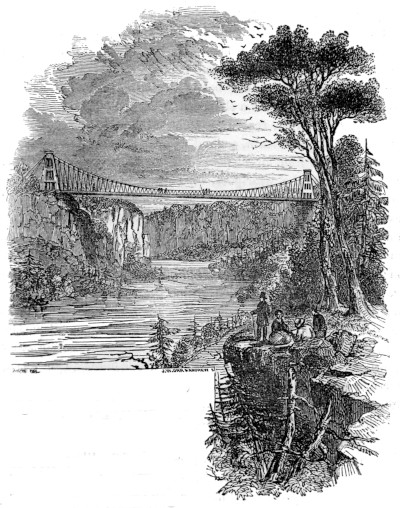
Our tourist proceeds as follows. “In the quiet reach of the water below
this bridge, plies the little steamer, the Maid of the Mist. After passing the
ugly, bustling little village growing up around the American extremity of
the bridge, a path leads through quiet fields and woods along the very verge
of the precipice. Here and there some tree growing upon the brink forms a
safe balustrade over which you lean, and look down upon the green water
dashing furiously through its confined channel far below.
“The whirlpool, three miles below the falls, is an adjunct worthy of
Niagara. The stream makes a sharp bend just where the channel is narrowest
and the descent of the rapids the steepest. At the angle the current has
scooped out an immense basin, around whose whole circumference the water
circles before it can find an outlet. All floating bodies that pass down the
river are drawn into the whirlpool, where they are borne round and round
for days, and weeks sometimes, it is said, before they make their escape. A
practicable path winds down the bank to the water’s edge. The character
of the banks gradually changes as we descend toward the outlet of the river.
The hard limestone overlying the softer rock, and forming the perpendicular
portion of the cliff, becomes thinner; the sloping talus at the foot grows
higher, and the rocks are clothed with a luxurious forest growth. A half
mile below the whirlpool is a deep cleft in the precipitous bank, which is
connected with a wild Indian legend ascribing terrible convulsions of nature,
and even the approach of the fatal white men, to an unauthorized violation
of the privacy of a great demon who once abode here. This was the scene
of a terrible tragedy in the old French wars. A convoy of British soldiers
fell into an ambush of Indians at this point, and were all, with the exception
of two, slain outright or driven over the edge of the chasm. The little
rivulet which flows over the brink, ran red with the blood of the slaughtered,
and thus gained the name, which it still bears, of the Bloody Run.
“Close by the Devil’s Hole, the railroad now in course of construction
from Lewiston to the falls, gains the level of the top of the bank. From this
point downward, it is excavated in the face of the cliff, forming a steep grade
to its bottom. An almost continuous line of shanties, occupied by the laborers
267engaged in the excavation, extends along the very verge of the precipice.
It was curious, as I passed along in the early April days, to see children
whom we should scarcely trust out of the nurse’s arms, sprawling upon the
very verge of the cliff. The laborers are apparently all Irish, and it is noteworthy
to see how much more intelligent is the aspect of the younger than
of the older children. I thought I could distinguish by their mere physical
appearance, those who were born under the freer and happier auspices which
surround them here. At the foot of the cliff the suspension bridge stretches
like a slender thread across the stream, its supporting towers resting on a
ledge above the level of the roadway. No line of guards watches the quiet
frontiers of two great nations. The sole police is a small boy at the gate,
and the only passport demanded is a shilling for toll. You climb the smooth
slope to the summit, where the shattered monument to the noble Brock is
the only memorial of the day when the thrice-won victory was at last
wrenched from the hands of the Americans. A flock of sheep are cropping
the tender herbage; a couple of lambs have found a shady resting-place in
the crumbling archway of the monument. To the right the white village
of Lewiston presents an aspect of bustling activity; while to the left, on the
opposite Canadian shore, Queenstown rests gray and somber. At your feet,
just below the dilapidated memorial of war, the bridge, symbol of union,
binds the two shores: may it never be a pathway for the march of hostile
armies!
“There are two or three things in the way of excursion which must sooner
or later be performed. Some bright afternoon, when the west is all aglow,
as you sit upon Table Rock, watching the clouds of spray momently torn
from the face of the descending column, the guide with the hollow voice,
whose mission is to conduct visitors behind the great sheet, presents himself.
You commit yourself to his guidance, and donning the suit of yellow oil-skin,
follow him down the spiral staircase, along the base of the precipice up to the
verge of the cataract. You shudder, and hesitate to enter the blinding
spray along that winding path, which seems in the dimness like a slender
line drawn upon the face of the rock. The guide whispers a word of encouragement,
deftly insinuating how boldly ‘the lady’ trod its slippery length.
You take courage and advance. You can scarcely breathe, much less see;
but you feel that the torrent is plunging from the immeasurable hight above
into the unfathomable depth below. Somehow, how you hardly know, you
have passed through the thick curtain of blinding spray, and are peering
eagerly into the gray depth beyond. You are on Termination rock, and
further than this mortal foot may never penetrate within the vail. Whichever
way you turn, it is all cold gray mist, shrouding the overhanging rock
268and the overarching water above, and the profound depths below; all mist,
cold gray mist above, below, around, except when you turn your eyes back
along the path by which you entered, where you behold a strip of golden
sky between the grim rock and the edge of the descending flood. Drenched
and dripping, spent and exhausted, as a shipwrecked sailor flung by the surf
upon some inhospitable shore, you follow your guide back along the misty
path, and emerge gladly enough into the clear outer air, into the free
sunshine, and beneath the bright sky. As you doff the heavy oil-skin integuments,
a printed paper is put into your hand, certifying that you ‘have
been under the great sheet of water, the distance of two hundred and forty
feet from the commencement of the falls to the termination of Table Rock,’
verified by the signature of the proprietor of ‘Table Rock House.’ Your
guide looks on you complacently, as though he would assure you that the
great end of life was now attained, and you might take up your ‘Nunc
dimittis.’
“Or you take your place upon the deck of the Maid of the Mist, hard by
the suspension bridge, and are steamed up to the foot of the cataract. The
little steamer answers but poorly to her romantic name. She swings wearily
from her moorings, and goes panting and tugging up the current. Yet she
manages to hold her course, unless the wind blows too strong down-stream,
and slowly wins her way close up to the huge rocks on which the waters of
the American fall are broken and shattered into the thickest of spray. In
that spray a sharp and angry gust of wind tears a sudden rent, and through
it you catch a glimpse of the green crest of the Horseshoe fall, sinking
grandly into the ocean of vapor below. Or better still, if in some calm
moonlight night, you glide, with the boatman, along the foot of the American
fall, keeping just outside of the dark line of shadow, you will find there is
nothing on earth so weird and ghost-like as the spectacle before you. The
column of spray rises from the blackness below, like the specter of some
gigantic tree, and spreads solemnly up into the clear air above.
“The mere summer tourist, however, sees but half the glory of Niagara.
In the winter the great rocks at the foot of the fall are piled up with an
accumulation of frozen spray to the depth of half a hundred feet. By creeping
cautiously up the slippery ascent, you may stand face to face with the
cataract, half-way up its giddy hight. Every shrub on its margin is loaded
with glittering ice. The thick-branched evergreens are bowed beneath its
weight, and bend to the ground like enormous plumes. The face of the
cold gray rock is cased in the frozen element, and ribbed with pillars and
pilasters which flash back the reflection of all the gems in the rays of the
269sun; and when in a clear, unclouded day, that sun shines down in its
splendor, the scene is one of matchless magnificence and glory.”
Thus we have attempted a full description of Niagara; and yet words
seem but feeble to set forth the magnificence and grandeur of the scene as it
rises to the view of the actual beholder. There, in its vast volume and
resistless power, it ever flows on with ceaseless, patient, unwearied tide. At
midnight and noonday, through summer and winter, and seed-time and
harvest, it is still the same. The drought of summer does not sensibly
diminish, or the freshets of spring augment its mighty current. The scorching
sun does not dry it up, and the chains of winter do not bind it. Emblem
of God and of eternity, it rolls on, speaking in calm sublimity of Him who
made it. Nor is sublimity the only characteristic of this greatest of waterfalls.
There are traits of beauty, which seem even to highten the effect of
its grandeur. The rainbow, ever playing in sunshine over its awful front,
and seeming indifferent to the boiling whirlpool beneath; the tide of many-colored
gems, into which the spray often seems converted, as it plunges over
the rocks; the heaps of foam, white as wool, dancing on the billows that
rush away from the foot of the fall; and more than all, an aspect of tranquillity
and of repose, which settles upon the whole scene, when viewed at a
little distance, are all incidents which blend in the majestic picture imprinted
on the memory by this stupendous yet lovely work of nature’s God.
The falls of Niagara have been the frequent theme of poetry, but the
following lines by Brainard are deemed the finest that have been produced
upon the subject.
“The thoughts are strange that crowd into my brain,
While I look upward to thee. It would seem
As if God poured thee from his ‘hollow hand,’
And hung his bow upon thine awful front;
And spoke in that loud voice, which seemed to him
Who dwelt in Patmos for his Saviour’s sake,
‘The sound of many waters;’ and had bade
Thy flood to chronicle the ages back,
And notch His centuries in the eternal rocks!
“Deep calleth unto deep, and what are we,
That hear the question of that voice sublime?
Oh! what are all the notes that ever rung
From war’s vain trumpet, by thy thundering side!
Yea, what is all the riot man can make
In his short life, to thine unceasing roar!
And yet, bold babbler, what art thou to Him,
Who drown’d a world, and heaped the waters far
Above its loftiest mountains?—a light wave,
That breaks and whispers of its Maker’s might!”
270
The Montmorenci empties itself at the distance of about eight miles northeast
of Quebec, into the great river St. Lawrence, to the coast of which it
gradually descends from the elevated mountain on which it has its source.
At a station called La Motte, situated on the northern extremity of a sloping
ground, its waters diffuse themselves into shallow currents, interrupted by
rocks which break them into foam, and accompanied by murmuring sounds
which enliven the solitude and solemn stillness prevailing throughout the
surrounding forests and desolate hills. Further down, its channel is bounded
by precipitous rocks, its breadth becoming extremely contracted, and the
rapidity of its current proportionably augmented. At a place called “the
271natural steps,” there are several beautiful cascades of ten or twelve feet.
These steps, which are extremely regular, have been gradually formed by
the accession of waters the river receives in its progress, at the breaking up
of winter, by the melting of the snows. From the middle of April to the
end of May, its waters roll with increasing hight and rapidity. Being powerfully
impelled in their course, they insinuate themselves between the strata
of the horizontal rock, vast fragments of which are detached by the rushing
violence of the sweeping torrent.
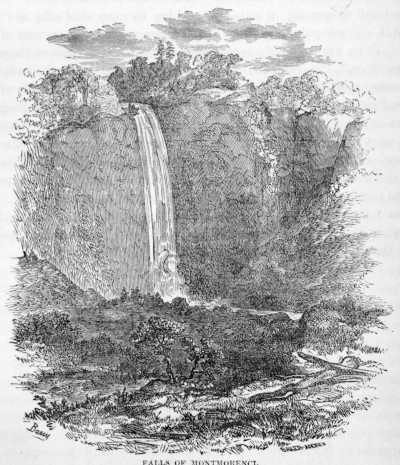
On the eastern side, the bank, which is almost perpendicular, and fifty feet
high, is surmounted by lofty trees. The south-west bank rises beyond the
steps, and terminates in a precipice. On the opposite side, the bank is
regular, and of a singular shape, resembling the ruin of an elevated wall.
The trees by which the banks are inclosed, united with the effect produced
by the foaming currents, and the scattered masses of stone, form a scene
wild and picturesque. The stream now taking a southern direction, is augmented
in its velocity, and forms a grand cascade interrupted by huge rocks.
A quarter of a mile further down a similar effect is produced. After exhibiting
an agreeable variety through its course, the river is precipitated, in an
almost perpendicular direction, over a rock two hundred and fifty feet in
hight. A view of this latter cascade is given in the cut. Wherever it
touches the rock, it falls in white clouds of rolling foam; and, beneath,
where it is propelled with uninterrupted gravitation, it forms numerous
flakes, like wool or cotton, which are gradually protracted in the descent,
until they are received into the boiling profound abyss beneath.
The effect from the summit of the cliff is awfully grand, and truly sublime.
The prodigious depth of the descent of the waters of this surprising fall; the
brightness and volubility of their course; the swiftness of their movement
through the air; and the loud and hollow noise emitted from the basin,
swelling with incessant agitation from the weight of the dashing waters,
forcibly combine to attract the attention, and to impress the mind of the
spectator with sentiments of grandeur and elevation. The clouds of rising
vapor, which assume the prismatic colors, contribute to enliven the scene.
They fly off from the fall in the form of a revolving sphere, emitting with
velocity pointed flakes of spray, which spread in receding, until they are
interrupted by the neighboring banks, or dissolved in the atmosphere.
The breadth of the fall is one hundred feet; and the basin, which is
bounded by steep cliffs, forms an angle of forty-five degrees. When viewed
from the beach, the cataract is seen, with resplendent beauty, to flow down
the gloomy precipice, the summit of which is crowded with woods. The
diffusion of the stream, to the breadth of fifteen hundred feet, and the various
272small cascades produced by the inequalities of its rocky bed, on its way to
the river St. Lawrence, display a very singular and pleasing combination.
This fall, in Franklin county, Georgia, is as yet scarcely known to the best
informed of our geographers, and is notwithstanding one of the most beautiful
that can be conceived. It is much higher than the great fall of Niagara;
and the water is charmingly propelled over a perpendicular rock. When
the stream is full, it passes down the steep in one expansive sheet, magnificent
to behold.
The most prominent features of this great river, which is fed by so
many streams, having their sources in a great variety of soils and climates,
are its wonderful falls, rapids and cascades, the following connected view of
which is abstracted from the very accurate draught and survey made by
Captain Clarke.
This river is nine hundred feet wide at the point where it receives the
waters of Medicine river, which is four hundred and one feet in width.
The united current continues five thousand, four hundred and twelve feet,
somewhat more than a mile, to a small rapid on the north side, from which
it gradually widens to four thousand, two hundred feet, and at the distance
of nine thousand and forty-two feet, (nearly a mile and three-fourths,)
reaches the head of the rapids, narrowing as it approaches them. Here the
hills on the north, which had withdrawn from the bank, closely border the
river, which, for the space of a mile, makes its way over the rocks with a
descent of thirty feet: in this course the current is contracted to sixteen
hundred and forty feet, and, after throwing itself over a small pitch of five
feet, forms a beautiful cascade of twenty-six feet, five inches; this does not,
however, fall quite perpendicularly, being stopped by a part of the rock,
which projects at about one-third of the distance. After descending this fall,
and passing the Cotton-wood island, on which the eagle has fixed its nest, the
river goes on for eight thousand, seven hundred and seventy-eight feet, (more
than a mile and a half,) over rapids and little falls, the estimated descent
of which is thirteen feet six inches, till it is joined by a large fountain boiling
up underneath the rocks near the edge of the river, and falling into it with
a cascade of eight feet. It is of the most perfect clearness, and rather of a
bluish cast; and even after falling into the Missouri it preserves its color for
273half a mile. From this fountain the river descends with increased rapidity
for the distance of thirty-five hundred and thirty-one feet, during which the
estimated descent is five feet: from this, for a distance of twenty-two hundred
and twenty-seven feet, the river descends fourteen feet seven inches,
including a perpendicular fall of six feet seven inches. The river has now
become pressed into a space of fourteen hundred and nineteen feet, and here
forms a grand cataract, by falling over a plain rock, the whole distance across
the river, to the depth of forty-seven feet, eight inches: after recovering itself,
the Missouri then proceeds with an estimated descent of three feet, till at the
distance of sixteen hundred and eighty-three feet it again is precipitated
down the crooked falls, nineteen feet perpendicularly; below this at the
mouth of a deep ravine, is a fall of five feet, after which, for the distance
of sixteen thousand and five feet, (upward of three miles,) the descent is
much more gradual, not being more than ten feet, and then succeeds a handsome
level plain for the space of twenty-nine hundred and thirty-seven feet,
(more than half a mile,) with a computed descent of three feet, making a
bend toward the north. Thence it descends, during seventy-nine hundred
and twenty feet, about eighteen feet and a half, when it makes a perpendicular
fall of two feet, which is fourteen hundred and eighty-five feet beyond
the great cataract, in approaching which it descends thirteen feet, within a
distance of about six hundred feet, and gathering strength from its confined
channel, which is only eight hundred and forty feet wide, rushes over the fall
to the depth of eighty-seven feet and three-quarters of an inch. After raging
among the rocks, and losing itself in foam, it is compressed immediately into
a bed of two hundred and seventy-nine feet in width; it continues for fifty-six
hundred and ten feet to the entrance of a run or deep ravine, where there is
a fall of three feet, which, joined to the decline of the river during that
course, makes the descent six feet. As it goes on, the descent within the
next thirty-nine hundred and sixty feet is only four feet; from this, passing
a run or deep ravine, the descent for sixteen hundred feet is thirteen feet:
within thirty-nine hundred and sixty feet, is a second descent of eighteen
feet; thence twenty-six hundred and forty feet further, is a descent of six
feet; after which, to the mouth of Portage creek, a distance of forty-six
hundred and twenty feet, the descent is ten feet. From this survey and
estimate it results that the river experiences a descent of three hundred and
fifty-two feet in the course of fifteen or sixteen miles, from the commencement
of the rapids, to the mouth of Portage creek, exclusive of almost
impassable rapids which extend for a mile below its entrance.
274
The Catskill, or Kauterskill falls, represented in the cut below, are in the
south-west part of the town of Catskill, about fourteen miles from the village,
and two miles west from Pine Orchard, a celebrated summer resort on the
brow of the Catskill mountain. Two ponds, uniting their outlets, pour the
stream thus formed, by falls and rapids in a deep ravine, to the plain below.
The first fall is a hundred
and eighty feet perpendicular;
and the second,
which is within a short
distance, about eighty feet. Behind
the first fall is an immense
natural amphitheater, into which the visitor can go, and look through the
275water as it falls from above. The view from the ‘Mountain house,’ near
by, is extensive and varied. The landscape, in a clear atmosphere, is visible
for sixty miles.
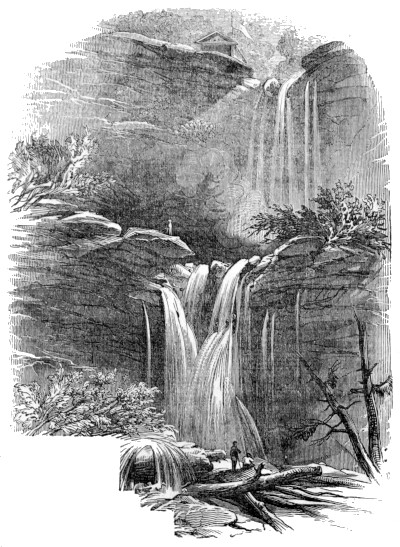
Among the most beautiful and romantic cascades of the United States,
may justly be reckoned Trenton falls, situated about eighteen miles
north-east of Utica, in the state of New York, on West Canada creek. Here,
within a course of two miles, there are six falls, with an aggregate descent
of three hundred and twelve feet. The scenery is the most wild and picturesque
imaginable; the stream flowing through a narrow ravine, between
perpendicular walls of limestone, which in some places are one hundred and
fifty feet high. The pathway of the spectator is mostly along the very margin
of the chasm which forms the channel of the rushing waters, on a ledge,
or shelf, so narrow and perilous, that the head often is giddy from the sight;
and sometimes it is difficult to sustain one’s self. These cascades are more
remarkable for the wildness and variety of scenery, than for the volume
of water they present. The hight of the principal fall is estimated at one
hundred feet.
The great chain of mountains which runs from north to south through the
colony of the Cape of Good Hope, divides into two branches, one of which
stretches south-east, and the other due south. At the extremity of the latter
branch is “the“the waterfall mountain,” in one of the clefts of which a large
stream of water falls from the high rock above, and presents, in the winter
season, when swollen by the rains, a glorious spectacle. To view this fall
to advantage, the traveler has to climb to a considerable hight over the steep
and broken rocks which form one side of the mountain, and, on reaching the
top, sees it on the other side. Its hight is estimated at between eighty and
ninety feet, and its breadth at between thirty and forty. Adequate terms
can not be found to describe the sublimity of this scene, after abundant rains,
when it is in its full beauty. In the vale beneath, the water is collected in a
vast and deep basin, excavated in the stone; and by the side of the stream is
a grotto, which runs within the rock to the depth of between thirty and forty
feet. The arched entrance to this grotto is close to the falling water, when
the stream is full. The rocks about it are thickly grown over with shrubs,
which are then sprinkled by the spray. The European travelers who proceed
276from Cape Town to the interior of South Africa, seldom fail to make a pilgrimage
to this enchanting spot.
This celebrated river, through its long and fertile range of about two thousand
British miles, in winding through abrupt and precipitous countries,
exhibits very considerable cataracts, ten or twelve of which, having a descent
of more than twenty feet, occur, before it reaches the level of Egypt. The
one which, by way of eminence, is called the cataract of the Nile, was visited
by Mr. Bruce, from whose relation the following particulars are extracted.
At the distance of half a mile beneath the cataract, the river is confined
between two rocks, over which a strong bridge of a single arch has been
thrown, and runs into a deep trough, with great roaring, and an impetuous
velocity. On ascending, the cataract presents itself amid groves of beautiful
trees, and exhibits a most magnificent and stupendous sight, such as, Mr.
Bruce observes, ages, added to the greatest length of human life, could not
efface or eradicate from his memory. It struck him with a kind of stupor,
and total oblivion of where he was, as well as of every sublunary concern.
At the time of his visit, the river had been considerably increased by rains,
and fell in one sheet of water, above half an English mile in breadth, and to
the depth of at least forty feet, with a force and noise which were truly terrific,
and which, for a time, stunned him, and made him giddy. A thick
fume, or haze, covered the fall in every part, and hung over the course of the
stream both above and below, marking its track, although the waters were
not seen. The river, although much swollen, preserved its natural clearness,
and fell, partly into a deep pool, or basin, in the solid rock, and partly in
twenty different eddies to the very foot of the precipice. In falling, a portion
of the stream appeared to run back with great fury on the rock, as well as
forward in the line of its course, raising waves, or violent ebullitions, which
chafed against each other.
The cataract which constitutes the source of this river, the Scamander of
the ancients, is thus beautifully described by Doctor Clarke. “Our ascent,
as we drew near to the source of the river, became steep and rocky. Lofty
summits towered above us, in the greatest style of alpine grandeur; the torrent,
in its rugged bed below, all the while foaming on our left. Presently
we entered one of the sublimest natural amphitheaters the eye ever beheld;
277and here the guides desired us to alight. The noise of waters silenced every
other sound. Huge craggy rocks rose perpendicularly, to an immense hight;
whose sides and fissures, to the very clouds, concealing their tops, were covered
with pines. These grew in every possible direction, among a variety
of evergreen shrubs; and enormous plane-trees waved their vast branches
above the torrent. As we approached its deep gulf, we beheld several cascades,
all of foam, pouring impetuously from chasms in the naked face of a
perpendicular rock. It is said the same magnificent cataract continues all
seasons of the year, wholly unaffected by the casualties of rain or melting
snow. Having reached the chasms whence the torrent issues, we found, in
their front, a beautiful natural basin, six or eight feet in depth, serving as a
reservoir for the water during the first moments of its emission. It was so
clear that the minutest object might be discerned at the bottom. The copious
overflowing of this reservoir causes the appearance, to a spectator below,
of different cascades, falling to the depth of about forty feet, but there is only
one source. Behind are the chasms whence the water issues. We entered
one of these, and passed into a cavern. Here the water appeared, rushing
with great force, beneath the rock, toward the basin on the outside. The
whole of the rock about the source was covered with moss; close to the basin
grew hazel and plane trees; above were oaks and pines; and all beyond a
naked and fearful precipice.”
The bold and precipitous country of the Alps offers a variety of waterfalls
and perpendicular torrents which are well deserving of notice; more particularly
those in the vicinity of Mount Rosa, a part of the northern boundary
of Piedmont. The river Oreo, fed by numerous streams from Mount St.
Gothard, Mount Cenis, and several branches of the Apennines, forms, at
Cerosoli, a vertical cascade, estimated at four hundred fathoms, or twenty-four
hundred feet; while the torrent Evanson, descending from another part
of Mount Rosa, exhibits a fall of more than two hundred fathoms, rolling
down pebbles of quartz, veined with the gold which is occasionally traced in
the mountains of Challand. The Cascata del Marmore, or Marble Cascade,
so denominated from the mountain down which the Velcino falls being
almost wholly of marble, lies about three miles from Terni. In proceeding
toward it, the traveler is struck with terror on viewing the precipices, which
are of a romantic hight; but is sufficiently rewarded, when, on reaching the
summit of the mountain, he regards the stupendous cataract, formed by the
river as it rushes from the mountain. Having reached the declivity of its
channel, the waters descend with a rapid course for a short space, and then
fall from a perpendicular hight of three hundred feet, breaking against lateral
rocks, which cause vapors to ascend much higher than the summit of the
278cataract, by which the neighboring valley receives a perpetual fall of rain.
After this descent, the waters rush into the cavities of the rocks, and then
bursting through several openings, at length reach the bed of the river.
The grand cascade of the Anio, near Tivola, flows down the edge of a
steep rock; and at its foot, the water, in a succession of ages, has hollowed
grottos of various shapes and sizes, in a manner so beautifully picturesque,
as to baffle all description. Of these, the grotto of Neptune is the most
celebrated. Near to it are three smaller cascades, which rush murmuring
through the ruins of the villa Mecænas, down the woody steep which forms
the opposite bank of the river, and present the painter with one of the most
picturesque views imaginable, the foreground varying beautifully at every
step he takes.
In Savoy, the Arve flows many miles between high, craggy and inaccessible
rocks, which appear to have been purposely cleft to give its waters a free
passage. The surprising echoes and continual sounds occasioned by its
streams, the trampling of the horses and mules, the hallooing of passengers,
&c., are, in these places, reverberated three, four, and even in some parts
six or seven times, with a noise so deep and wild, as to strike with terror
the traveler who is unaccustomed to them; and the firing of a gun or pistol,
is there more terrible than the loudest claps of thunder. A steep precipice,
with monstrous impending rocks, which seem ready to fall, joined to the
roaring of the river, add largely to the general sublimity. The cataracts of
this river are more or less loud and terrible, in proportion as the waters are
more or less swollen by the melting snows, with which the tops of the mountains
are covered. One in particular, called the Nun of Arpena, falls from
a prodigiously high rock with great noise and violence: its descent is said
to exceed eleven hundred feet.
In Dalmatia, the river Cettina forms a magnificent cascade, called by the
inhabitants Velica Gubavisa, to distinguish it from a less fall a little below.
The waters precipitate themselves from a hight of above one hundred and
fifty feet, forming a deep majestic sound, which is caused by the echo
resounding between the steep and naked marble banks. Many broken fragments
of rocks, which impede the course of the river after its fall, break the
waves, and render them still more lofty and sonorous. By the violence of
the repercussion, their froth flies off in small white particles, and is raised
in successive clouds, which are scattered, by the agitation of the air, over
the valley. When these clouds ascend directly upward, the inhabitants
expect the noxious south-east wind called the sirocco.
The fall of the Staub-Bach, in the valley of Lauterbrannen, is estimated
at nine hundred feet of perpendicular hight; and about a league from Schaffhausen,
279at the village of Lauffen, in Switzerland, is a tremendous cataract
of the Rhine, where that river precipitates itself from a rock said to be
seventy feet in hight, and not less than four hundred and fifty feet broad.
In Sweden, near Gottenburgh, the river Gotha rushes down from a prodigiously
high precipice into a deep pit, with a dreadful noise, and with such
amazing force, that the trees designed for the masts of ships, which are
floated down the river, are usually turned upside down in their fall, and
shattered in pieces. They frequently sink so far under water, as to disappear
for a quarter of an hour, half an hour, and sometimes for three-quarters of
an hour. The pit into which the torrent precipitates them, is of a depth not
to be ascertained, having been sounded with a line of several hundred fathoms,
without the bottom being found.
In addition to the other North American cataracts already described, may
be noticed the Passaic falls, formed by the river Passaic, which discharges
itself into the sea at the northern extremity of the state of New Jersey.
About twenty miles from the mouth of this river, where it has a breadth of
about a hundred and twenty feet, and runs with a very swift current, it
reaches a deep chasm, or cleft, which crosses its channel, and falls about
seventy feet perpendicularly in an entire sheet. One end of the cleft is closed
up, and the water rushes out of the other with incredible rapidity, in an
acute angle to its former direction, and is received into a large basin. It
thence takes a winding course through the rocks, and spreads again into a
very considerable channel. The cleft is from four to twelve feet in breadth,
and is supposed to have been produced by an earthquake. The falls of St.
Anthony, on the river Mississippi, descend from a perpendicular hight of
thirty feet, and are nearly eight hundred feet in width, while the shore on
each side is a level flat, without any intervening rock or precipice.
In England, among the cataracts which merit a brief mention, may be
cited the one in Devonshire, near the spot where the Tamer receives the
small river Lid. The water there falls above a hundred feet: it proceeds
from a mill at some distance, and after a course on a descent of nearly one
hundred feet from the level of the mill, reaches the brink of the precipice,
whence it falls in a most beautiful and picturesque manner, and, striking on
a part of the cliff, rushes from it in a wider cataract to the bottom; where
falling again with great violence, it makes a deep and foaming basin in the
ground. This fine sheet of water causes the surrounding air at the bottom
to be so impregnated with aqueous particles, that those who approach it find
themselves in a mist. In Cumberland there are several cataracts; but these
are exceeded in beauty by a remarkable fall of the Tees, on the western side
of the county of Durham, over which is a bridge suspended by chains, seldom
280passed unless by the adventurous miners. Asgarth force, in Yorkshire, is
likewise a very interesting fall.
In Scotland, the fall of Eyers, near Loch Ness, is a vast cataract, in a
darksome glen of a stupendous depth. The water rushes beneath, through
a narrow gap between two rocks, and thence precipitating itself more than
forty feet lower into the bottom of the chasm, the foam, like a great cloud
of smoke, rises and fills the air. The sides of this glen are stupendous
precipices, blended with trees overhanging the water, through which, after a
short space, the waters discharge themselves into the lake. About half a
mile to the south of this fall, is another which passes through a narrow
chasm, whose sides it has undermined for a considerable distance. Over the
gap is a true alpine bridge, formed of the trunks of trees covered with sods,
from the middle of which is an awful view of the water roaring beneath. In
Perthshire, the river Keith presents a very considerable cataract, the noise
produced by which is so violent as to stun those who approach it. The
western coast of Ross-shire is, however, peculiarly distinguished by these
natural wonders, among which may be cited the grand cataract of the river
Kirkag, and the cascade of Glamma, which latter being situated amid the
constant obscurity of woody hills, is truly sublime.
In Ireland, the noble river Shannon has a prodigious cataract, which, at
about fifty miles from its mouth, prevents it from being longer navigable for
vessels of a large burden.
SPRINGS AND WELLS. — ST. WINIFRED’S WELL. — WIGAN WELL. — DROPPING WELL AT KNARESBOROUGH. — BROSELEY SPRING. — HOT SPRINGS OF ST. MICHAEL. — HOT SPRINGS OF THE TROAD.
Holywell, in Flintshire, is famous for St. Winifred’s well, one of the
finest springs in the world. On account of the sanctity in which it was
holden, it gave name to the town. This well pours out, each minute, twenty-one
tuns of water, which, running to the middle of the town, down the side
of a hill, is made use of by every house as it passes, after which it turns
several mills, and is employed in various manufactures, which greatly
281increase the population of the place and its neighborhood. Over the spring,
where a handsome bath has been erected, is a neat chapel, supported by
pillars, and on the windows are painted the chief events of St. Winifred’s
(or, as it was anciently written, Wenefrede’s) life. About the well grows
moss, which the ignorant and superstitious devotees most stupidly imagine
to be St. Winifred’s hair. This saint is reported to have been a virgin
martyr, who lived in the seventh century, and, as the legend says, was ravished
and beheaded in this place by a pagan tyrant; the spring having
miraculously risen from her blood. Hence this bath was much frequented
by popish pilgrims, out of devotion, as well as by those who came to bathe
in it for medicinal purposes. Mr. Pennant says, “The custom of visiting
this well in pilgrimage, and offering up devotions there, is not yet entirely
laid aside: in the summer a few are to be seen in the water, in deep devotion,
up to their chins for hours, sending up their prayers, or performing a
number of evolutions round the polygonal well.”
It might have been supposed that the present enlightened age would have
been secure against a repetition of impostures of this kind; but Doctor
Milner, a Catholic bishop, of Wolverhampton, took much pains to persuade
the world that an ignorant proselyte, of the name of Winefrid White, was
there cured of various chronic diseases, so late as the year 1804, by a miracle.
Sir Richard Phillips, having, in the Monthly Magazine, referred this pretended
miracle to the known effect of strong faith on ignorant minds, in
any proposed means of cure, was attacked by the Catholic clergy for his
incredulity; but in number three hundred and two, of the Monthly Magazine,
he replies in the following words.
“We have no doubt whatever that Winefrid White was cured by her
journey to Holywell, and by bathing in the wonderful natural spring at that
place; but we are not credulous enough to believe that her cure was effected
by any antagonist properties of the water to the cause of her disease; nor
impious enough so to sport with eternal omnipotence, as to assert that a
capricious suspension of the laws of nature took place for this purpose. On
the contrary, we believe that the poor woman was cured by causes well
known to every medical practitioner, and proved in hundreds of recorded
instances; that is to say, by her faith in the means proposed for her cure,
wrought to the highest pitch by her religion, and by the assurances of those
to whom she was accustomed to defer. We think, nevertheless, that the
publication of this ‘case of Winefrid White,’ savors strongly of religious
empiricism, and is exactly analogous to the ‘cases of cure’ which we every
day see advertised in all the newspapers. We refrain from treating the
subject theologically, yet it appears to us that Matthew xxiv. 24, proves
282that ‘signs and wonders’ are not only no evidence of divine interposition,
but may be used even by ‘false prophets, so as to deceive the very elect.’
The continuance of miraculous powers will be found, we suspect, to depend
on other circumstances than the date of the year. They disappear wherever
the printing-press begins to be freely used, and, by its agency, fixes all the
circumstances that attend them; and they still continue to flourish wherever
the history of the circumstances depends for any period on traditional
evidence. Miracles are, therefore, performed in abundance, even in our
days, among the negroes, the Hottentots, the Caffres, the Tartars, the South
Sea islanders, and the Indians of the two Americas. The last we believe on
record are to be found in the Hon. M. Elphinstone’s published embassy to
Cabul in 1808: he states that the sick were carried after him many days’
journey; and, at page twenty-eight, he says: ‘Some thought we could raise
the dead; and there was a story current, that we had made and animated a
wooden ram at Mooltaun; that we had sold him as a ram; and that it was
not till the purchaser began to eat him, that the material of which he was
made was discovered.’ We forbear to press the subject further.”
About a mile from Wigan, in Lancashire, is a spring, the water of which
burns like oil. On applying a lighted candle to the surface, a large flame
is suddenly produced, and burns vigorously. A dishful of water having been
taken up at the part whence the flame issues, and a lighted candle held to
it, the flame goes out; notwithstanding which the water in this part boils
and rises up like water in a pot on the fire, but does not feel warm on introducing
the hand. What is still more extraordinary, on making a dam, and
preventing the flowing of fresh water to the ignited part, that which was
already there having been drained away, a burning candle being applied to
the surface of the dry earth at the same point where the water before burned,
the fumes take fire, and burn with a resplendent light, the cone of the flame
ascending a foot and a half from the surface of the earth. It is not discolored,
like that of sulphureous bodies, neither has it any manifest smell, nor
do the fumes, in their ascent, betray any sensible heat. The latter unquestionably
consist of inflammable air, or hydrogen gas; and it ought to be
observed that the whole of the country about Wigan, for the compass of
several miles, is underlaid with coal. This phenomenon may therefore be
referred to the same cause which occasioned the dreadful explosion of Felling
colliery; but in the present case, this destructive gas, instead of being pent
283up in the bowels of the earth, accompanies the water in its passage to the
surface.
This dropping well, or petrifying spring, rises at the foot of a limestone
rock, at an inconsiderable distance from the bank of the river Nidd. The
spring, after running about sixty feet, divides, and spreads itself over the
top of the rock, whence it trickles very fast, from thirty or forty places, into
a channel hollowed for the purpose, as seen in the cut, each drop producing
a musical kind of tinkling, probably owing to the concavity of the rock,
which, bending in a circular projection from the bottom to the top, occasions
its brow to overhang about fifteen feet. This rock, which is about thirty
feet in hight, forty-eight in length, and from thirty to fifty in breadth, started,
in the year 1704, from the common bank, and left a chasm, from five to nine
feet wide, over which the water passes by an aqueduct formed for the purpose.
It is clothed with evergreen and other shrubs, which add greatly to
the beauty of this very interesting scene.
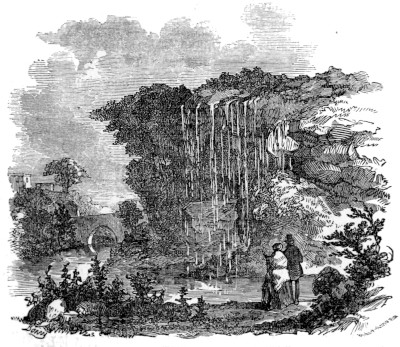
DROPPING WELL AT KNARESBOROUGH.
The water is said to abound with fine particles of a nitrous earth, which
it deposits, but when in a languid motion only, and leaves its incrustations
284on the leaves, moss, &c., which it meets with, in trickling thus slowly through
the cavities of the rock. This spring is estimated to send forth twenty gallons
of water in a minute. Here are to be seen pieces of moss, bird’s nests
with their eggs, and a variety of other objects, some of them very curious
which have been incrusted or petrified by the water.
This celebrated boiling spring, or well, at Broseley, in Shropshire, was
discovered in the month of June, 1711. It was first announced by a terrible
noise in the night, there having been a remarkable thunder-storm. Several
persons who resided in the vicinity having been awakened in their beds by
this loud and rumbling noise, arose, and proceeding to a bog under a small
hill, about two hundred yards from the river Severn, perceived a surprising
commotion and shaking of the earth, and a little boiling up of water through
the grass. They took a spade, and digging up a portion of the earth, the
water immediately flew up to a great hight, and was set on fire by a candle
which was presented to it. To prevent the spring from being destroyed, an
iron cistern has been placed over it, provided with a cover, and a hole in the
center, through which the water may be viewed. If a lighted candle, or any
burning substance, be presented to this aperture, the water instantly takes
fire, and burns like spirit of wine, continuing to do so as long as the air is
kept from it; but on removing the cover of the cistern, it quickly goes out.
The apparent boiling and ascent of the water of this spring, are still more
obviously the result of hydrogen gas, or inflammable air, than in the preceding
instance of Wigan well.
In the eastern part of this island, (one of the Azores,) is a round, deep
valley surrounded by high mountains, in which are many hot springs; but
the most remarkable is that called the Caldeira, situated in the eastern part
of the valley on a small eminence by the side of a river, on which is a basin
about thirty feet in diameter, where the water continually boils with prodigious
fury. A few yards distant from it, is a cavern in the side of a bank,
in which the water boils in a dreadful manner, throwing out a thick, muddy,
unctuous water, several yards from its mouth, with a hideous noise. In the
middle of the river are several places where the water boils with so intense a
heat, that a person can not dip his finger into it without being scalded. On
285its banks are several apertures, out of which the steam rises to a considerable
hight, and is so hot that it can not be approached by the hand. In other
parts, the spectator would be led to suppose that the bellows of a hundred
forges were blowing in concert; while sulphureous streams issue out in a
thousand places. The bushes even, near these spots, are covered with pure
brimstone, condensed from the steam which issues from the ground. In the
small caverns whence the steam issues, many of the inhabitants prepare
their food.
The Troad, a country of Phrygia, in Asia Minor, of which Troy was the
capital, abounds with hot springs; the most interesting one of which is thus
described by Doctor Clarke. It is situated near a place called Bonarbashy,
signifying literally “the head of the springs,” and gushes perpendicularly
out of the earth, rising from the bottom of a marble and granite reservoir,
and throwing up as much water as the famous fountain of Holywell, in
Wales. Its surface seems vehemently boiling; and, during cold weather,
the condensed vapor above it causes the appearance of a cloud of smoke over
the well. While the mercury stood at forty-six degrees in the open air, it
rose, when the thermometer was plunged in the water, to sixty-two degrees.
Notwithstanding the warmth of this spring, fishes were seen sporting in the
reservoir. In every part of the district through which the Mender flows,
from Ida to the Hellespont, are many of these springs, of different degrees
of temperature.
The Geysers have already been described, in treating of Mount Hecla, and
its surprising volcano. In following up the details of the phenomena of
this nature given above, by a brief notice of other bubbling, tepid and boiling
springs, it may not be improper to premise that heat, water and vapors of
various kinds, exist in prodigious quantities beneath the surface of the earth;
and frequently, as has been seen in the phenomena of volcanoes and earthquakes,
burst forth from enormous openings, with tremendous destruction.
It often happens, however, that the openings are small and porous, and that
the vapors ascending through them, are simply combined with water. Hence
that almost infinite variety in the characters of these springs, fountains and
lakes, the waters of which are combined with extraneous substances. In
some cases the clastic gases, or vapors, ascend from specific levity alone, and
are destitute of all taste and odor; insomuch that springs are found which
bubble without boiling, or betraying heat or any other foreign quality. In
other cases they are strongly impregnated with heat; and are then either
tepid or boiling, according to the proportion of extricated caloric they contain.
286Occasionally, whether hot or cold, they are blended with metallic,
sulphureous, saline, and other substances, and hence assume the name of
mineral waters; while, if the substance thus dissolved be combustible, as
naphtha, bitumen, or turpentine, the fountain will often inflame and burn
on the application of a lighted torch.
The water of the noted boiling spring at Peroul, near Montpelier, is
observed to heave and boil up very furiously in small bubbles, which manifestly
proceed from a vapor breaking out of the earth, and rushing through
the water, so as to throw it up with noise, and in many bubbles; for on digging
in the vicinity of the ditch where the spring lies, and pouring fresh
water on the dry spot newly dug, the same boiling is immediately observed.
A similar bubbling of the water is likewise found near Peroul, on the seashore.
In several dry places near the spring, are small ventiducts, passages
or clefts, whence steam issues; and at the mouths of these passages, small
light bodies, such as feathers, pieces of straw, leaves, &c., being placed, are
soon blown away. This vapor, on the application of a lighted candle or
torch, does not flame or take fire, as is the case with that of the boiling
spring at Wigan; so that there are two different sorts of steam, to occasion
these boilings, at the same time that neither of the fountains is medicinal,
or even warm.
Other boiling waters, of a very different temperature, possess, like those
of the hot springs of St. Michael, a sufficient degree of heat to boil eggs, and
to serve for other culinary purposes. Among these may be instanced those
of the Solfatara, near Naples; those on the summit of Mount Zebio, in the
Modenese territory; and those which constitute the source of the imperial
bath at Aix la Chapelle. In Japan, a hot spring is said to burst forth which
constantly maintains the boiling-point, and the water of which retains its
heat much longer than common water. It does not flow regularly, but
during an interval of two hours each day; and the force and violence of the
vapors are then so great, that large stones are ejected, and raised to the
hight of ten or twelve feet, with a noise like that of the explosion of a piece
of artillery.
From the phenomena which have been adduced, it appears that the exhalations
constantly escaping from the vast subterraneous magazines in which
they are prepared, vary greatly in their qualities and effects. Some are cold
and dry, resembling air or wind, as those near Peroul, and in the cavities of
mountains, especially those of Æolus and other hills of Italy, as well as in
particular mines. Others are inflammable, and of a bituminous nature,
though not positively warm, as those of Wigan well. Others are very hot,
sulphureous and saline, more especially those of the natural stoves, sweating-vaults,
287grottos, baths and volcanoes near Naples, Baiæ, Cuma and Pozzuoli,
as also in some of the subterraneous works at Rome. And others, again,
are of an arsenical, or other noxious quality, as those of the Grotta del Cane.
Now, these various streams meeting with, and running through water, must
occasion in it a great variety of phenomena and effects.
It is observed by Doctor Thomson, in his history of the Royal Society,
that the hot spring at Bath, has continued at a temperature higher than that
of the air for a period of not less than two thousand years, although it is so
far distant from any volcano, that, without a very violent and improbable
extension of the agency of volcanic fires, it can not be ascribed to them.
There are various decompositions of mineral bodies, which generate considerable
heat; or, to speak more properly, water is itself the decomposed
substance generating heat by its decomposition. The evolution of azotic gas
is a proof that the heat of the Bath waters is owing to a particular decomposition
which takes place within the bowels of the earth. The greatest heat
of these waters is one hundred and sixteen degrees of Fahrenheit’s scale;
but that of the mineral waters of Carlsbad, in Bohemia, ascends to one
hundred and sixty-five degrees.
There are several curious springs which are worthy of notice in this connection,
though somewhat varying from the class thus far mentioned. One
of these was recently discovered in California, about fifty miles east of San
Felipe, in San Diego county. It was discovered by a party engaged in surveying
the public lands, and consists of a collection of fountains or springs
of soda water, situated in a sandy plain or depression of the surface of the
desert. The spring is in a mound of symmetrical shape, tapering like a
sugar-loaf, in the center of the top of which is a hole, apparently unfathomable,
containing the carbonated beverage fresh from some natural laboratory
below. Some of these mounds are six feet high, and clothed with a green
and luxuriant coat of grass, while others are shaped like an inverted bowl,
and fringed by a growth of cane. The water is described as having the
same sparkling and effervescing quality as that ordinarily sold by apothecaries,
and was drunk with avidity by both the men and animals belonging to
the party discovering it. When impregnated with acid of any kind, it
produced instant effervescence, and in that form was peculiarly refreshing
as a drink.
Another singular spring has also been discovered on the way from the
Great Salt lake, to Los Angelos, through the Cajon pass. The traveler who
gives the account of it says: “We had crossed the great desert without any
accident, and then camped on a stream of deliciously cool water, about
twelve to eighteen inches wide, which distributes itself about half a mile
288lower down in a meadow covered with luxuriant grasses. This camp-ground
is called by the Spaniards, ‘Las Vegas.’ Once more we had plenty of grass
for our fatigued animals, and we determined to rest here for the day.
During our journey we passed a number of deserted wagons, chairs, &c.
An ox-train from Little Salt lake had preceded about ten days; and it was
not difficult to follow their trail, for in the space of one hour I counted the
putrid carcasses of nineteen oxen and horses. What a lesson to those who
venture on such a journey unadvisedly and unprepared! The strong north
wind which blew all day, raised a cloud of dust which almost blinded me,
although I had goggles and a green vail to protect my eyes; however, the
delightful and refreshing water of this oasis soon purified me; and I felt,
having crossed the desert, breakfasted and bathed, much more comfortable,
both mentally and physically. The acacia was the only tree on this stream.
Having remained at this camp all one day, the next morning we were on the
road to Cottonwood springs, some twenty miles distant, where we would
find water and grass, and then commence a journey over another desert
of fifty-five miles. We followed up this little stream for about three miles,
when the road turned a little to the right; but I was anxious to see the head
of the stream, for, from the appearance of the surrounding country, I judged
it to be very near. Several gentlemen and myself continued up the stream,
and after a ride of half a mile, we came to a large spring, thirty-five feet
wide and forty long, surrounded by acacias in full bloom. We approached
through an opening, and found it to contain the clearest and most delicious
water I ever tasted; the bottom appeared to be not more than two feet from
the surface, and to consist of white sand. One of the party prepared himself
for a bath, and soon his body divided the crystal waters. While I was considering
whether I should go in, I heard him calling to me that it was
impossible to sink, the water was so buoyant. I hardly believed it, and, to
be able to speak certainly, I also undressed and jumped in. What was my
delight and astonishment to find that all my efforts to sink were futile. I
raised my body out of the water, and suddenly lowered myself, but I bounded
upward as if I had struck a springing-board; I walked about the water up
to my armpits, just the same as if I had been walking on dry land. The
water instead of being about two feet deep, was over fifteen, the length of
the longest tent-pole we had along. It is impossible for a man to sink over
his head in it; the sand on the banks is very fine and white; the temperature
is seventy-eight degrees of Fahrenheit. I can form no idea as to the
cause of this singular phenomenon. Great Salt lake also possesses this
quality, but this water is perfectly sweet. In the absence of any other name
I have called it Buoyant spring. I have never heard of it as possessing this
289quality, and should like some of the savantssavants to explain the cause of buoyancy.
We lingered in the spring for fifteen minutes, when we dressed and resumed
our ride, highly delighted and gratified by our exploration. I made drawings
of this spot and surrounding mountains.”
Still another singular spring, also in California, was discovered by a Mr.
Dabney, when boring for water in San Jose. The auger penetrated through
a stiff bed of clay fifty-eight feet thick, when a stream of water was struck
which forced itself up the aperture with unprecedented power, and in a
volume greater, it is believed, than all the other artesian streams in the
neighborhood combined. From this well alone flowed a sufficiency of water
to turn a mill. It boiled up with great force, and ran off in a stream four
feet wide and six inches deep. At the mouth the current washed out a hole
of several feet wide and very deep. Serious apprehensions were entertained,
when the stream first burst forth, that it would be impossible to control it.
The water was cold and delightful, and it was estimated that the spring
would be sufficient to supply the whole city plentifully.
Reciprocating fountains, or springs, may be cited among the most curious
phenomena of nature. An irregularity of flow is not uncommon in boiling
springs; but there are other springs which evince a periodical influx and
reflux, almost as regular as the tides of the ocean. These changes, it will
be seen, frequently occur several times in a day, or even in an hour. They
are ascribed to various causes, either subterraneous or superficial; but in
general, springs and lakes of this description, have been ascertained to
communicate with others beneath, through pores or apertures of various
diameters, which serve equally to carry off the waters, and to supply them
afresh. In such cases the flux and reflux of the upper head of water, must
necessarily depend on the state of that beneath; and the causes which
alternately augment and diminish the latter, must produce a similar effect
on the former.
Paderborn spring, in Westphalia, disappears twice in twenty-four hours,
returning constantly, after a lapse of six hours, with a great noise, and so
forcibly as to drive three mills at a short distance from its source. The
inhabitants call it the bolderborn, that is, the boisterous spring. Lay-well
spring, near Torbay, is about six feet in length, five in breadth, and nearly
six inches deep. The flux and reflux, which are very visible, are performed
in about two minutes; when the spring remains at its lowest ebb for the
space of about three minutes. In this way it ebbs and flows twenty times
within the hour. As soon as the water begins to rise, many bubbles ascend
from the bottom; but on its falling, the bubbling instantly ceases. Giggleswick
spring, in the West Riding of Yorkshire, lies at the foot of a hill of
290limestone, named Giggleswick Scar. Its reciprocations are irregular, both
with respect to duration and magnitude, the interval of time between any
two succeeding flows being sometimes greater, and at other times less, insomuch
that a just standard of comparison can not be formed. The rise of
the water, in the stone trough or cistern which receives it, during the time
of the well’s flowing, is equally uncertain, varying from one inch to nine or
ten inches, in the course of a few reciprocations. This spring, like the
preceding one, discharges bubbles of air at the time of its flowing. Near the
lake of Bourget, in Savoy, is a reciprocating spring which rises and falls with
a great noise, but not at stated and regular times. After Easter, its ebbings
and flowings are frequently perceived six times in an hour; but in dry
seasons not more than once or twice. It issues from a rock, and is called
La Fontaine de Merville, the marvelous fountain.
BITUMINOUS AND OTHER LAKES. — PITCH LAKE OF TRINIDAD. — MUD LAKE OF JAVA. — SALT LAKE OF UTAH. — METEORS. — AEROLITES. — AURORA BOREALIS AND AURORA AUSTRALIS. — LUMEN BOREALE, OR STREAMING LIGHTS. — LUMINOUS ARCHES. — IGNES FATUI, OR MOCK FIRES. — SPECTER OF THE BROCKEN. — THE MIRAGE. — FATA MORGANA. — ATMOSPHERICAL REFRACTION. — PARHELIA, OR MOCK SUNS. — LUNAR RAINBOW. — CONCENTRIC RAINBOWS. — THUNDER AND LIGHTNING. — REMARKABLE THUNDER-STORMS. — HAIL-STORMS. — HURRICANES. — THE MONSOONS. — WHIRLWINDS AND WATERSPOUTS. — SOUNDS AND ECHOES.
Near Point la Braye, (Tar point,) the name assigned to it on account of
its characteristic feature, in the island of Trinidad, is a lake which at the first
view appears to be an expanse of still water, but which, on a nearer approach,
is found to be an extensive plain of mineral pitch, with frequent crevices and
chasms filled with water. On its being visited in the autumnal season, the
singularity of the scene was so great, that it required some time for the spectators
to recover themselves from their surprise, so as to examine it minutely.
The surface of the lake was of an ash color, and not polished or smooth, so
as to be slippery, but of such a consistence as to bear any weight. It was
not adhesive, although it received in part the impression of the foot, and
could be trodden without any tremulous motion, several head of cattle
browsing on it in perfect security. In the summer season, however, the
surface is much more yielding, and in a state approaching to fluidity, as is
evidenced by pieces of wood and other substances, thrown upon it, having
been found enveloped in it. Even large branches of trees, which were a foot
291above the level, had, in some way, become enveloped in the bituminous matter.
The interstices, or chasms, are very numerous, ramifying and joining
in every direction; and being filled with water in the wet season, present the
only obstacle to walking over the surface. These cavities are in general
deep in proportion to their width, and many of them unfathomable: the
water they contain is uncontaminated by the pitch, and is the abode of a
variety of fishes. The arrangement of the chasms is very singular, the sides
invariably shelving from the surface, so as nearly to meet at the bottom, and
then bulging out toward each other with a considerable degree of convexity.
Several of them have been known to close up entirely, without leaving any
mark or seam.
The pitch lake of Trinidad contains many islets covered with grass and
shrubs, which are the haunts of birds of the most exquisite plumage. Its
precise extent can not, any more than its depth, be readily ascertained, the
line between it and the neighboring soil not being well defined; but its main
body may be estimated at three miles in circumference. It is bounded on
the north and west sides by the sea, on the south by a rocky eminence, and
on the east by the usual argillaceous soil of the country.
The following details relative to the volcanic springs of boiling mud in
Java are extracted from the Penang Gazette.
Having received an account of a wonderful phenomenon in the plains of
Grobogna, a party set off, from Solo, in September, 1814, to examine it.
On approaching the place, they saw what at first appeared like the surf
breaking over the rocks, with a heavy spray falling to the leeward. Alighting,
they went to the “Bluddugs,” as the Javanese call them, which they
found to be an elevated plain of mud, about two miles in circumference, in
the center of which immense bodies of soft mud were thrown up to the
hight of ten or fifteen feet, in the form of large bubbles, which bursting,
emitted great volumes of dense white smoke. The largest bubbles, of
which there were two, rose and burst some seven or eight times a minute,
throwing up from one to three tuns of mud, the smell of the smoke from
which was very offensive, like the washings of a gun-barrel. It was both
difficult and dangerous to go near the large bubbles, as the surface, except
where it had been hardened by the sun, was all a quagmire. They went,
however, close to a small bubble, (the plain was full of them, of all sizes,)
and observed it for some time. It appeared to heave and swell, and when
the air within had raised it to some hight, it burst, and the mud fell down
292in concentric circles, and then remained quiet till again it was raised, again
to burst; which was at intervals of from one to two minutes. The water
drained from the mud was collected by the Javanese, and being exposed to
the sun deposited crystals of salt.
Next morning the party rode to a place in the forest, to view a salt lake,
a mud hillock, and various boiling pools. The lake was about half a mile
in circumference, of dirty-looking water, boiling up all over in gurgling
eddies; the water being cold, bitter and salt, with an offensive smell. The
mud hillock, which was near, was about fifteen feet high, in the form of a
cone, with a base of eighty, and a top of eight feet diameter. The top was
open, and the interior, which was full of boiling and heaving mud, was
found to be eleven fathoms deep. Every rise of the mud was attended by
a rumbling noise from within; and the mud was more liquid than at the
bluddugs, and unattended by smoke. Near the foot of this hillock was a
small pool of water, like that of the lake, boiling violently; and some two
hundred yards distant, two larger pools or springs of the same general
description, the smell of which was very offensive, and the boiling of which
could be heard at quite a distance, resembling the noise of a small waterfall.
The water both of the bluddugs and of the lake, is used medicinally
by the Javanese, and also, as stated above, for the making of salt, which is
gathered in considerable quantities, and the government income from which
adds not a little to the public revenues. The general cause of the phenomena
here witnessed, is supposed, beyond all question, to be volcanic; the
salt water being thrown up by this agency in a heated state, and thus mingling
with the soil to produce the boiling and heaving mud above described.
Before leaving the subject of lakes, springs, &c., we must not omit to
mention the Great Salt lake of Utah territory, which has been gazed upon
with interest by many an emigrant, passing with his family, as represented
in the following cut, to his far western home. This lake lies in a region
abounding with scenery of unrivaled magnificence and beauty. “Descend
from the mountains,” says a late writer, “where you have the scenery and
climate of Switzerland, to seek the sky of your choice among the many
climates of Italy, and you may find, welling out of the same hills, the freezing
springs of Mexico, and the hot springs of Iceland, both together coursing
their way to the great salt sea in the plain below. The pages of Malte Brun
provide me with a less truthful parallel to it, than those which describe the
happy valley of Rasselas, or the continent of Balnibarbi. In the midst of this
293interesting region, the most remarkable object is the Great Salt lake: which,
in the saltness of its waters, in the circumstance of its having no outlet, and
being fed from another and smaller lake of fresh water, (with which it is
connected by a stream which has appropriately been called the Jordan,)
and in the rugged character of some portions of the surrounding region,
bears a remarkable resemblance to the Dead sea of Palestine. Instead,
however, of lying one thousand feet below, it is more than four thousand feet
above the level of the sea; and its waters, being an almost pure solution of
common salt, are free from the pungent and nauseous taste which characterizes
those of the Dead sea. This lake is about seventy miles long, and thirty
miles wide, and is so intensely salt that no living thing can exist in it; and
by evaporation in hot weather, it leaves on its shores a thick incrustation of
salt.
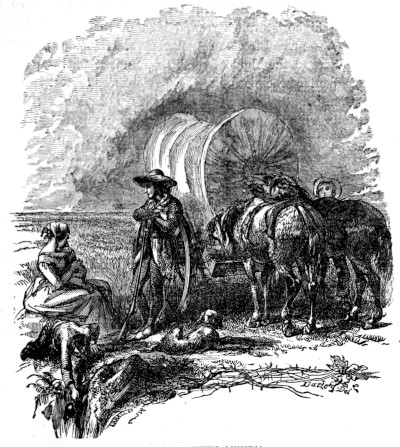
Some twenty-five miles south of this, and connected with it by the river
Jordan, as mentioned above, is Utah lake, a body of fresh water, some thirty-five
294miles in length, which abounds with trout and other fish. And some
seven hundred feet higher still, is Pyramid lake, on the slope of the Sierra
Nevada mountains, so named from a singular pyramidal mount rising from
its transparent waters to the hight of some six hundred feet; and walled in
by almost perpendicular precipices, in some places three thousand feet high.
Some distance from here, too, are the boiling springs, described by Fremont,
the largest basin of which is several hundred feet in circumference, and has
a circular space at one end some fifteen feet in diameter, entirely occupied
with the boiling water. A pole sixteen feet in length, was entirely submerged
on thrusting it down near the center; and the temperature of the water near
the edge was two hundred and six degrees. In this vicinity also, are appearances
similar to the mirages of the great deserts of the old world. In traveling
over the salt deserts of the Fremont basin, his party saw themselves
reflected in the air, probably, as Fremont himself suggests, from the saline
particles floating in the atmosphere, and in some way affecting its refracting
power. The entire region, is one of great wildness and grandeur.
ATMOSPHERICAL PHENOMENA.
From look to look, contagious through the crowd
The panic runs, and into wond’rous shapes
The appearance throws: armies in meet array,
Thronged with aerial spears and steeds of fire;
Till the long lines of full-extended war
In bleeding fight commixt, the sanguine flood
Rolls a broad slaughter o’er the plains of heaven.
As thus they scan the visionary scene,
On all sides swells the superstitious din.
Incontinent; and busy frenzy talks
Of blood and battle; cities overturned,
And late at night in swallowing earthquake sunk,
Or hideous wrapt in fierce ascending flame;
Of sallow famine, inundation, storm;
295Of pestilence, and every great distress;
Empires subversed, when ruling fate has struck
The unalterable hour: even nature’s self
Is deemed to totter on the brink of time.
Not so the man of philosophic eye,
And aspect sage; the waving brightness he
Curious surveys, inquisitive to know
The causes, and materials, yet unfixed,
Of this appearance beautiful and new.—Thomson.
The nature of those splendid phenomena of the heavens which are embraced
under the general term meteors, can not be so well elucidated as
by an extract from the travels of Messrs. Humboldt and Bonpland to the
equinoctial regions of the new continent. The sublime wonders described
by the former of these travelers were witnessed by them at Cumana, a city
of Venezuela, in South America.
“The night of the eleventh of November, 1779, was cool and extremely
beautiful. Toward the morning, from half after two, the most extraordinary
luminous meteors were seen toward the east. M. Bonpland, who had risen
to enjoy the freshness of the air in the gallery, perceived them first. Thousands
of bolides (fire-balls) and falling stars, succeeded each other during
four hours. Their direction was very regular, from north to south. They
filled a space in the sky extending from the true east thirty degrees toward
the north and south. In an amplitude of sixty degrees the meteors were
seen to rise above the horizon at east-north-east, and at east to describe arcs
more or less extended, falling toward the south, after having followed the
direction of the meridian. Some of them attained a hight of forty degrees;
and all exceeded twenty-five or thirty degrees. There was very little wind
in the low regions of the atmosphere, and this blew from the east. No trace
of clouds was to be seen. M. Bonpland relates, that from the beginning of
the phenomenon, there was not a space in the firmament equal in extent to
three diameters of the moon which was not filled at every instant with bolides
and falling stars. The first were fewer in number, but as they were seen
of different sizes, it was impossible to fix the limit between these two classes
of phenomena. All these meteors left luminous traces from five to ten
degrees in length, as often happens in the equinoctial regions. The phosphorescence
of these traces, or luminous bands, lasted seven or eight seconds.
Many of the falling stars had a very distinct nucleus, as large as the disk of
Jupiter, from which darted sparks of vivid light. The bolides seemed to
burst as by explosion; but the largest, those from one degree to one degree
and fifteen minutes in diameter, disappeared without scintillation, leaving
behind them phosphorescent bands (trabes) exceeding in breadth fifteen or
296twenty minutes, or sixtieth parts of a degree. The light of these meteors
was white, and not reddish, which must be attributed, no doubt, to the
absence of vapors, and the extreme transparency of the air. For the same
reason, under the tropics, the stars of the first magnitude have, at their
rising, a light evidently whiter than in Europe.
“Almost all the inhabitants of Cumana were witnesses of this phenomenon,
and did not behold these bolides with indifference; the oldest among them
remembered, that the great earthquakes of 1766 were preceded by similar
phenomena. The fishermen in the suburbs asserted, that the fire-work had
begun at one o’clock; and that, as they returned from fishing in the gulf,
they had already perceived very small falling stars toward the east. They
affirmed at the same time, that igneous meteors were extremely rare on those
coasts after two in the morning.
“The phenomenon ceased by degrees after four o’clock, and the bolides
and falling stars became less frequent; but we still distinguished some toward
the north-east, by their whitish light, and the rapidity of their movement, a
quarter of an hour after sunrise. This circumstance will appear less extraordinary,
when I state that in full daylight, in 1788, the interior of the
houses in the town of Popayan was highly illumined by an aerolite of immense
magnitude. It passed over the town when the sun was shining clearly,
about one o’clock. M. Bonpland and myself, during our second residence
at Cumana, after having observed on the twenty-sixth of September, 1800,
the immersion of the first satellite of Jupiter, succeeded in seeing the planet
distinctly with the naked eye, eighteen minutes after the disk of the sun had
appeared in the horizon. There was a very slight vapor in the east, but
Jupiter appeared on an azure sky. These facts prove the extreme purity
and transparency of the atmosphere under the torrid zone. The mass of
diffused light is so much less, as the vapors are more perfectly dissolved.
The same cause that weakens the diffusion of the solar light, diminishes the
extinction of that which emanates either from a bolis, Jupiter, or the moon,
seen on the second day after her conjunction.
“The researches of M. Chladni having singularly fixed the attention of the
scientific world upon the bolides and falling stars, at my departure from
Europe, we did not neglect during the course of our journey from Caraccas
to the Rio Negro, to inquire everywhere, whether the meteors of the twelfth
of November had been perceived. In the savage country, where the greater
number of the inhabitants sleep out in the air, so extraordinary a phenomenon
could not fail to be remarked, except when concealed by clouds from the
eye of observation. The Capuchin missionary at San Fernando de Apura, a
village situated amid the savannas of the province of Varinas, and the
297Franciscan monks stationed near the cataracts of the Orinoco, and at Maroa,
on the banks of the Rio Negro, had seen numberless falling stars and bolides
illumine the vault of heaven. Maroa is south-west of Cumana, and one
hundred and seventy-four leagues’ distance. All these observers compared
the phenomenon to a beautiful fire-work, which had lasted from three till six
in the morning. Some of the monks had marked the day upon their ritual;
others had noted it by the nearest festivals of the church. Unfortunately,
none of them could recollect the direction of the meteors, or their apparent
hight. From the position of the mountains and thick forest which surround
the missions of the cataracts and the little village of Maroa, I presume that
the bolides were still visible at twenty degrees above the horizon. On my
arrival at the southern extremity of Spanish Guiana, at the little fort of San
Carlos, I found a party of Portuguese, who had gone up the Rio Negro from
the mission of St. Joseph of the Maravitains, and who assured me, that in
that part of Brazil, the phenomenon had been perceived, at least as far as
San Gabriel das Cachoeiras, consequently as far as the equator itself.
“I was powerfully struck at the immense hight which these bolides must
have attained, to have been visible at the same time at Cumana, and on the
frontiers of Brazil, in a line of two hundred and thirty leagues in length.
But what was my astonishment, when at my return to Europe, I learned that
the same phenomenon had been perceived, on an extent of the globe of sixty-four
degrees of latitude, and ninety-one degrees of longitude; at the equator,
in South America, at Labrador, and in Germany! I found accidentally,
during my passage from Philadelphia to Bordeaux, in the memoirs of the
Pennsylvanian society, the corresponding observations of Mr. Ellicott (latitude
thirty degrees, forty-two minutes;) and, upon my return from Naples
to Berlin, I read the account of the Moravian missionaries among the Esquimaux,
in the library of Göttingen. Several philosophers had already discussed
at this period the coincidence of the observation in the north with
those at Cumana, which M. Bonpland and I had published in 1800.
“The following is a succinct enumeration of facts. First, the fiery meteors
were seen in the east, and the east-north-east, to forty degrees of elevation,
from two to six hours at Cumana, (latitude ten degrees, twenty-seven minutes,
fifty-two seconds, longitude sixty-six degrees, thirty minutes;) at Porto
Cabello, (latitude ten degrees, six minutes, fifty-two seconds, longitude sixty-seven
degrees, five minutes;) and on the frontiers of Brazil, near the equator,
in the longitude of seventy degrees west of the meridian of Paris. Secondly,
in French Guiana, (latitude four degrees, fifty-six minutes, longitude fifty-four
degrees, thirty-five minutes,) the northern part of the sky was seen all
on fire. Innumerable falling stars traversed the heavens during an hour
298and a half, and diffused so vivid a light, that those meteors might be compared
to the blazing sheaves shot out from fire-works. Thirdly, Mr. Ellicott,
an astronomer in the United States, having terminated his trigonometric
operations for the rectification of the limits on the Ohio, being, on the twelfth
of November, in the gulf of Florida, in the latitude of twenty-five degrees,
and longitude eighty-one degrees, fifty minutes, saw, in all parts of the sky,
‘as many meteors as stars, moving in all directions: some appeared to fall
perpendicularly; and it was expected every minute that they would drop into
the vessel.’ The same phenomenon was perceived upon the American continent
as far as the latitude of thirty degrees, forty-two minutes. Fourthly,
in Labrador, at Nain (latitude fifty-six degrees, fifty-five minutes) and Hoffenthal
(latitude fifty-eight degrees, four minutes,) and in Greenland, at
Lichtenau (latitude sixty-one degrees, five minutes) and New Herrnhutt,
(latitude sixty-four degrees, fourteen minutes, longitude fifty-two degrees,
twenty minutes,) the Esquimaux were frightened at the enormous quantity
of bolides which fell during twilight toward all points of the firmament, some
of them being a foot broad. Fifthly, in Germany, M. Zeissing, vicar of Itterstadt,
near Weimar, (latitude fifty degrees, fifty-nine minutes, longitude nine
degrees, one minute east,) perceived, on the twelfth of November, between
the hours of six and seven in the morning, when it was half after two at
Cumana, some falling stars, which shed a very white light. Soon after,
toward the south and south-west, luminous rays appeared from four to six
feet long: they were reddish, and resembled the luminous track of a sky-rocket.
During the morning twilight, between the hours of seven and eight,
the south-west part of the sky was seen, from time to time, strongly illuminated
by white lightning, which ran in serpentine lines along the horizon. At
night the cold increased, and the barometer rose.
“The distance from Weimar to the Rio Negro, is eighteen hundred sea
leagues; and from Rio Negro to Herrnhutt, in Greenland, thirteen hundred
leagues. Admitting that the same fiery meteors were seen at points so distant
from each other, we must also admit, that their hight was at least four
hundred and eleven leagues. Near Weimar, the appearance like sky-rockets
was seen in the south and south-east; at Cumana, in the east and in the
east-north-east. We may therefore conclude, that numberless aerolites must
have fallen into the sea, between Africa and South America, to the west of
the Cape Verde islands. But, since the direction of the bolides was not the
same at Labrador and at Cumana, why were they not perceived in the latter
place toward the north, as at Cayenne? I am inclined to think, that the
Chayma Indians of Cumana did not see the same bolides as the Portuguese
in Brazil, and the missionaries in Labrador; but, at the same time, it can
299not be doubted, and this fact appears to me very remarkable, that in the new
world, between the meridians of forty-six degrees and eighty-two degrees,
between the equator and sixty-four degrees north, at the same hour, an
immense number of bolides and falling stars were perceived; and that those
meteors had everywhere the same brilliancy, throughout a space of nine
hundred and twenty-one thousand square leagues.
“The scientific men who have lately made such laborious researches on
falling stars and their parallaxes, consider them as meteors belonging to the
furthest limits of our atmosphere, between the region of the aurora borealis
and that of the lightest clouds. Some have been seen, which had not more
than fourteen thousand toises, or about five leagues of elevation. The highest
do not appear to exceed thirty leagues. They are often more than a
hundred feet in diameter; and their swiftness is such, that they dart, in a few
seconds, over a space of two leagues. Some of these have been measured,
the direction of which was almost perpendicularly upward, or forming an
angle of fifty degrees with the vertical line. This extremely remarkable
circumstance has led to the conclusion, that falling stars are aerolites, which,
after having hovered about a long time in space, take fire on entering accidentally
into our atmosphere, and fall toward the earth.
“Whatever may be the origin of these luminous meteors, it is difficult to
conceive any instantaneous inflammation taking place in a region where
there is less air than in the vacuum of our air-pumps; and where (twenty-five
thousand toises high) the mercury in the barometer would not rise to
twelve-thousandths of a line. We have ascertained the uniform mixture of
atmospheric air to three-thousandths nearly, only to an elevation of three
thousand toises: consequently, not beyond the last stratum of fleecy clouds.
It might be admitted, that, in the first revolutions of the globe, gaseous substances
which yet remain unknown to us, may have risen toward that region,
through which the falling stars pass: but accurate experiments, made upon
mixtures of gases which have not the same specific gravity, prove that we
can not admit a superior stratum of the atmosphere entirely different from
the inferior strata. Gaseous substances mix and penetrate each other with
the least motion; and a uniformity of their mixture would have taken place
in the lapse of ages, unless we suppose in them the effects of a repulsive
action unexampled in those substances which we can subject to our observations.
Further, if we admit the existence of a particular aerial fluid in the
inaccessible region of luminous meteors, falling stars, bolides, and the aurora
borealis, how can we conceive why the whole stratum of those fluids does
not at once take fire, but that the gaseous emanations, like the clouds, occupy
only limited spaces? How can we suppose an electrical explosion without
300some vapors collected together, capable of containing unequal charges of
electricity, in air, the mean temperature of which is, perhaps, twenty-five
degrees below the freezing-point of the centigrade thermometer, and the
rarefaction of which is so considerable, that the compression of the electrical
shock could scarcely disengage any heat? These difficulties would in great
part, be removed, if the direction of the motion of falling stars allowed us to
consider them as bodies with a solid nucleus, as cosmic phenomena (belonging
to space beyond the limits of our atmosphere) and not as telluric
phenomena (belonging to our planet only.)
“Supposing that the meteors of Cumana were only at the usual hight at
which falling stars in general move, the same meteors were seen above the
horizon in places more than three hundred and ten leagues distant from each
other. Now, what an extraordinary disposition to incandescence must have
reigned on the twelfth of November, in the higher regions of the atmosphere,
to have furnished, during four hours, myriads of bolides and falling stars,
visible at the equator, in Greenland, and in Germany.
“Mr. Benzenberg judiciously observes, that the same cause, which renders
the phenomenon more frequent, has also an influence on the largeness of the
meteors, and the intensity of their light. In Europe, the nights when there
are the greatest number of falling stars, are those in which very bright ones
are mixed with very small ones. The periodicalness of the phenomenon
augments the interest which it excites. There are months, in which M.
Brandes has reckoned in our temperate zone, only sixty or eighty falling
stars in one night; and in other months their number has risen to two
thousand. Whenever one is observed, which has the diameter of Sirius or
of Jupiter, we are sure of seeing so brilliant a meteor succeeded by a great
number of smaller meteors. If the falling stars be very frequent during one
night, it is very probable that this frequency will continue during several
weeks. It would seem that, in the higher regions of the atmosphere, near
that extreme limit where the centrifugal force is balanced by gravity, there
exists, at regular periods, a particular disposition for the production of
bolides, falling stars, and the aurora borealis. Does the periodicalness of
this great phenomenon depend upon the state of the atmosphere? or upon
something which the atmosphere receives from without, while the earth
advances in the ecliptic? Of all this we are still as ignorant as men were
in the days of Anaxagoras.
“With respect to the falling stars themselves, it appears to me, from my
own experience, that they are more frequent in the equinoctial regions than
in the temperate zone; more frequent over the continents, and near certain
coasts, than in the middle of the ocean. Do the radiation of the surface of
301the globe, and the electrical charge of the lower regions of the atmosphere,
which varies according to the nature of the soil, and the positions of the
continents and seas, exert their influence as far as those hights, where
eternal winter reigns? The total absence even of the smallest clouds, at
certain seasons, or above some barren plains destitute of vegetation, seems
to prove, that this influence can be felt at least as far as five or six thousand
toises high. A phenomenon analogous to that of the twelfth of November,
was observed thirty years before, on the table-land of the Andes, in a country
studded with volcanoes. At the city of Quito, there was seen, in one part
of the sky, above the volcano of Gayambo, so great a number of falling stars,
that the mountain was thought to be in flames. This singular sight lasted
more than an hour. The people assembled in the plain of Exico, where a
magnificent view presents itself of the highest summit of the Cordilleras.
A procession was already on the point of setting out from the convent of St.
Francis, when it was perceived that the blaze of the horizon was caused by
fiery meteors, which ran along the skies in all directions, at the altitude of
twelve or thirteen degrees.”
The bolides, or fire-balls, and falling stars, so striking an example of which
is given above, are of all sizes, from a small shooting-star of the fifth magnitude,
to a cone or cylinder of two or three miles in diameter. They differ
in consistency as much as in dimensions, and in color as much as in either.
Occasionally, they are a subtile, luminous and pellucid vapor; and sometimes
a compact ball, or globe, as though the materials of which they are
formed, were more condensed and concentrated. Not unfrequently they
have been found to consist of both, and consequently to assume a comet-like
appearance, with a nucleus or compact substance in the center, or toward
the center, and a long, thin, pellucid or luminous main, or tail, sweeping on
each side. They are sometimes of a pale white light; at others, of a deep
igneous crimson; and, occasionally iridescent and vibratory. The rarer
meteors appear frequently to vanish on a sudden, as though abruptly
dissolved or extinguished in the atmospheric medium, their flight being
accompanied by a hissing sound, and their disappearance by an explosion.
The most compact of them, or the nuclei of those which are rarer, have often
descended to the surface of the earth, and with a force sufficient to bury
them many feet under the soil; generally exhibiting marks of imperfect
fusion and considerable heat. The substance is, in these cases, for the
greater part metallic; but the ore of which they consist is not anywhere to
be found, in the same constituent proportions, in the bowels of the earth.
Under this form the projected masses are denominated aerolites, or meteoric
stones.
302It may not be uninteresting to preface a succinct account of the most
surprising of these meteors, by a notice of the hypotheses which have been
imagined concerning them; however justly the learned Humboldt may have
concluded, in the words of the extracts given above, that we are still “as
ignorant on this subject as men were in the days of Anaxagoras.” Sir J.
Pringle contended, with other philosophers, that they are revolving bodies,
or a kind of terrestrial planets. Doctor Halley conjectured them to consist
of combustible vapors, accumulated and formed into concrete bodies on the
outskirts, or extreme regions of the atmosphere, and to be suddenly set on
fire by some unknown cause; an opinion which, with little difference, has
been since entertained by Sir W. Hamilton and Dr. King. Dr. Blagdon
regarded them altogether as electrical phenomena. M. Izarn believed them
to consist of volcanic materials, propelled into the atmosphere in the course
of explosions of great violence. M. Chladni supposed them to be formed of
substances existing exteriorly to the atmosphere of the earth and other
planets, which have never incorporated with them, and are found loose in the
vast ocean of space, being there combined and inflamed by causes unknown
to us. Lastly, another and rather wild hypothesis is, that the whole, or at
least the more compact division of these meteors, are made up of materials
thrown from immense volcanoes in the moon. This hypothesis, which was
started by M. Olbers, in 1795, has been since very plausibly supported by
the celebrated Laplace, but does not apply to the smaller and less substantial
meteors, named shooting-stars. Hence these philosophers derive the latter
phenomena from some other cause, as electricity, or terrestrial exhalations;
and observe, in support of the distinction they find it necessary to make,
that shooting-stars must be of a different nature from fire-balls, since they
sometimes appear to ascend as well as to fall. This observation has been
especially dwelt on by Messrs. Chladni and Benzenberg, both of them favorably
noticed, as accurate observers, by Humboldt.
By far the most plausible and satisfactory theory, however, is one somewhat
like that of Dr. Halley, which may be illustrated thus. If a stick of
wood, after being covered over night in the hot ashes, so as to become in
part or wholly charred, be taken out in the morning, and waved back and
forth in the air, every one has noticed that it will send forth sparks by
hundreds and thousands. Now the more modern theory as to these aerolites,
or falling-stars, is, that they are thrown off from small, opaque, planetary
bodies, revolving in space, which when they come within the atmosphere of
the earth, are heated from their rapid motion through it, and throw off
small heated portions, like the sparks from the waving brand. And this
theory is confirmed by the fact, that, of late years, these meteoric showers
303have been annual, and always at about the same period of the year, as if
the earth was then passing in that part of her orbit where she meets with
the planetary bodies spoken of, and they come in contact with her atmosphere.
In the volumes of the “American Journal of Science,” may be
found abundant facts on this subject, and also the various theories started
to account for the facts.
On the twenty-first of March, 1676, two hours after sunset, an extraordinary
meteor was seen to pass over Italy. At Bononia, its greatest altitude
in the south-south-east, was thirty-eight degrees; and at Sienna, fifty-eight
degrees toward the north-north-east. In its course, which was from east-north-east
to west-south-west, it passed over the Adriatic sea, as if coming
from Dalmatia. It crossed all Italy, being nearly vertical to Rimini and
Savigniano, on the one side, and to Leghorn on the other: its perpendicular
altitude was at least thirty-eight miles. At all the places near its course it
was heard to make a hissing noise as it passed, like that of artificial fireworks.
In passing over Leghorn, it gave a very loud report, like that of a
cannon; immediately after which another sort of sound was heard, like the
rattling of a deeply loaded wagon passing over the stones, which continued
for several seconds. The professor of mathematics at Bononia, calculated
the apparent velocity of this surprising meteor at not less than one hundred
and sixty miles in a minute of time, which is above ten times as swift as the
diurnal rotation of the earth under the equinoctial, and not many times less
than that with which the annual motion of the earth about the sun is performed.
It there appeared larger than the moon in one diameter, and above
half as large again in the other; which, with the given distance of the eye,
made its real smaller diameter above half a mile, and the larger one in
proportion. It is, therefore, not surprising, that so great a body, passing
with such an amazing velocity through the air, however rarefied it may be
in its upper regions, should occasion so loud a hissing noise as to be heard
at such a distance. It finally went off to sea toward Corsica.
Two luminous meteors of great magnitude were noted at Leipsic within
the space of six years. On the twenty-second of May, 1680, about three in
the morning, the first of these was seen, to the great terror of the spectators,
descending in the north, and leaving behind it a long white streak where it
had passed. As the same phenomena was witnessed in the north-north-east at
Haarburg, and also at Hamburg, Lubeck and Stralsund, all of which places
are about a hundred and fifty English miles from Leipsic, it was concluded
that this meteor was exceedingly high above the earth. The second meteor
was still more terrific. On the ninth of July, 1686, at half past one in the
morning, a fire-ball with a tail was observed in eight and a half degrees of
304Aquarius, and four degrees north, which continued nearly stationary for
seven or eight minutes, with a diameter nearly equal to half the moon’s
diameter. At first, its light was so great that the spectators could see to
read by it; after which it gradually disappeared. This phenomenon was
observed at the same time in several other places, more especially at Schlaitza,
a town distant from Dantzic forty English miles toward the south, its altitude
being about six degrees above the southern horizon. At Leipsic it was estimated
to be distant not more than sixty English miles, and to be about
twenty-four miles perpendicular above the horizon, so that it was at least
thirty miles high in the air.
A very extraordinary meteor, which the common people called a flaming
sword, was first seen at Leeds, in Yorkshire, on the eighteenth of May, 1710,
at a quarter after ten at night. Its direction was from south to north: it
was broad at one end, and small at the other; and was described by the
spectators as resembling a trumpet, moving, with the broad end foremost.
The light was so sudden and intense, that they were startled at seeing
their own shadows, when neither sun nor moon shone upon them. This
meteor was, in its course, seen not only in Yorkshire and Lancashire, but
also in the counties of Nottingham and Derby, notwithstanding which, each
of those who observed it, although so many miles distant from each other,
fancied it fell within a few yards of him. In disappearing, it presented
bright sparklings at the small end.
A blazing meteor was, on the nineteenth of March, 1719, seen in every
part of England. In the metropolis, about a quarter after eight at night, a
sudden powerful light was perceived in the west, far exceeding that of the
moon, which then shone very bright. The long stream it gave out appeared
to be branched about the middle; and the meteor, in its course, turned pear-fashioned,
or tapering upward. At the lower end it came at length to be
larger and spherical, although not so large as the full moon. Its color was
whitish, with an eye of blue of a most vivid, dazzling luster, which seemed
in brightness very nearly to resemble, if not to surpass, that of the body of
the sun in a clear day. This brightness obliged the spectator to turn his
eyes several times from it, as well when it was a stream, as when it was pear-fashioned
and a globe. It seemed to move, in about half a minute or less,
about the length of twenty degrees, and to disappear about as much above
the horizon. Where it had passed, it left behind a track of a cloudy or
faint reddish-yellow color, such as red-hot iron or glowing coals have: this
continued more than a minute, seemed to sparkle, and kept its place without
falling. This track was interrupted, or had a chasm toward its upper end,
at about two-thirds of its length. No explosion was heard; but the place
305where the globe of light had been, continued for some time after it was
extinct, of the same reddish-yellow color with the stream, and at first sparks
seemed to issue from it, such as proceed from red-hot iron beaten out on
an anvil.
It was agreed by all the spectators in the capital, that the splendor of this
meteor was little inferior to that of the sun. Within doors the candles did
not give out any light; and in the streets, not only all the stars disappeared,
but the moon, then nine days old, and high near the meridian, the sky being
very clear, was so far effaced as scarcely to be seen: it did not even cast a
shade, where the beams of the meteor were intercepted by the houses; so
that, for a few seconds of time, there was in every respect, a resemblance of
perfect day.
The perpendicular hight of this surprising meteor was estimated at sixty-four
geometrical miles; and it was computed to have run about three
hundred of these miles in a minute. It was seen, not only in every part of
Great Britain and Ireland, but likewise in Holland, in the western parts of
Germany, in France and in Spain, nearly at the same instant of time. The
accounts from Devonshire, Cornwall, and the neighboring counties, were
unanimous in describing the wonderful noise which followed its explosion.
It resembled the report of a large cannon, or rather of a broadside at some
distance, which was soon followed by a rattling noise, as if many small arms
had been promiscuously discharged. This tremendous sound was attended
by an uncommon tremor of the air; and everywhere in those counties, not
only the windows and doors of the houses were sensibly shaken, but, according
to several of the reports, even the houses themselves, beyond the usual
effect of cannon, however near.
On the eleventh of December, 1741, at seven minutes past one in the
afternoon, a globe of fire, somewhat larger than the horizontal full moon,
and as bright as the moon appears at any time when the sun is above the
horizon, was seen at Peckham, in Surrey, in a south-south-east direction,
moving toward the east with a continued equable motion, and leaving behind
it a narrow streak of light, whiter than the globe itself, throughout its whole
course. Toward the end it appeared less than at the beginning of its
motion; and within three or four seconds suddenly vanished. Its apparent
velocity was nearly equal to half the medium velocity of the ordinary
meteors called falling or shooting stars; and its elevation, throughout the
whole of its course, about twenty degrees above the horizon.
On the eighteenth of August, 1783, an uncommon meteor was seen in
several parts of Great Britain, as well as on the continent. Its general
appearance was that of a luminous ball, which, rising in the north-north-east,
306nearly of a globular form, became elliptical, and gradually assumed a tail as
it ascended. In a certain part of its course it underwent a remarkable
change, which might be compared to bursting, and which, it ought to be
observed, has been since frequently noticed in the passage of the aerolites, or
meteoric stones, particular mention of which will be made hereafter. After
this it no longer proceeded as an entire mass, but was apparently divided
into a great number, or cluster of balls, some larger than others, and all
carrying a tail, or leaving a train behind. Under this form, it continued its
course with a nearly equable motion, dropping or casting off sparks, and
yielding a prodigious light, which illumined all objects to a surprising
degree; until, having passed the east, and verging considerably to the southward,
it gradually distended, and was at length lost to the sight. The time
of its appearance was sixteen minutes past nine in the evening, mean time
of the meridian of London, and it continued visible about half a minute.
This beautiful meteor having been seen in Shetland, and in the northern
parts of Scotland, ascending from the north, and rising like the planet Mars,
little doubt was entertained of its course having commenced beyond the
furthest extremity of Great Britain, somewhere over the northern ocean.
Having passed over Essex and the straits of Dover, it probably entered the
continent not far from Dunkirk, where, as well as at Calais and Ostend, it
was thought to be vertical. Still holding on its course to the southward, it
was seen at Brussels, at Paris, and at Nuits in Burgundy; insomuch that
there was sufficient proof of its having traversed thirteen or fourteen degrees
of latitude, describing a track of at least one thousand miles over the surface
of the earth; a length of course far exceeding the extent of what had been
then ascertained of any similar phenomenon.
During the passage of this meteor over Brussels, the moon appeared quite
red, but soon recovered its natural light. The results of several observations
give it an elevation of more than fifty miles above the surface of the
earth, in a region where the air is at least thirty thousand times rarer than
here below. Notwithstanding this great elevation, the fact of a report having
been heard some time after it disappeared, rests on the testimony of too
many witnesses to be controverted. It was compared to the falling of some
heavy body in a room above stairs, or to the discharge of one or more large
cannon at a distance: this report was loudest in Lincolnshire and the adjacent
counties, and also in the eastern parts of Kent.
Supposing the transverse diameter of this meteor to have subtended an
angle of thirty minutes when it passed over the zenith, and that it was fifty
miles high, it must have been almost half a mile across. The tail sometimes
appeared ten or twelve times longer than the body; but most of this was
307train, and the real elongation behind seems seldom to have exceeded twice
or thrice its transverse diameter; it consequently was between one and two
miles in length. Now if the cubical contents be considered, for it appeared
equally round and full in all directions, such an enormous mass must afford
just matter of astonishment, when the extreme velocity with which it moved
is considered. This velocity, agreeably to the observations of Sir William
Herschel and several other astronomers, could not have been less than
twenty miles in a second, exceeding that of sound above ninety times, and
approaching toward that of the earth in her annual orbit. At such a rate it
must have passed over the whole island of Great Britain in less than half a
minute, and would, in the space of less than seven minutes, have traversed
the whole diameter of the earth!
On the fourth of October, of the above year, 1783, two meteors were seen
in England. The first, at three in the morning, on account of the early
hour, was witnessed by but few spectators, who represented it as rising from
the north to a small altitude, and then becoming stationary with a vibratory
motion, and an illumination like daylight: it vanished in a few moments,
leaving a train behind. This sort of tremulous appearance has been noticed
in other meteors, as well as their continuing stationary for some time, either
before they begin to shoot, or after their course is ended. The second of
these meteors appeared at forty-three minutes past six in the evening, and
was much smaller, and also of much shorter duration, than the one seen in
August. It was first observed to the north, like a stream of fire, similar to
that of the common shooting-stars, but large; and having proceeded some
distance under this form, suddenly burst out into that intensely bright bluish
light, peculiar to such meteors, which may be most aptly compared to the
blue lights of India, or to some of the largest electrical sparks. The illumination
was very great; and on that part of its course where it had been
so bright, a dusky red streak or train was left, which remained visible about
a minute, and was thought by some gradually to change its form. Except
this train, the meteor had not any tail, but was nearly of a round body, or,
perhaps, somewhat elliptical. After moving not less than ten degrees in this
bright state, it became suddenly extinct, without any appearance of bursting
or explosion.
These phenomena, otherwise entitled meteoric stones, have been ascertained,
by recent observations, to be connected with the bolides, or fire-balls,
described above. Scoriaceous masses have frequently been either actually
308seen to fall at the time of the disappearance of the latter, or have been found
soon after on the surface of the earth. Most of the stones which have fallen
from the atmosphere, have been preceded by the appearance of luminous
bodies, or meteors. These meteors burst with an explosion, and then the
shower of stones falls to the earth. Sometimes the stones continue luminous
till they sink into the earth; but most commonly their luminousness disappears
at the time of their explosion. These meteors move in a direction
nearly horizontal, and seem to approach the earth before they explode.
The stony bodies, when found immediately after their descent, are always
hot. They commonly bury themselves some depth under ground. Their size
differs, from fragments of a very inconsiderable weight, to masses of several
tuns. They usually approach the spherical form, and are always covered
with a black crust; in many cases they smell strongly of sulphur. The
black crust consists chiefly of oxyd of iron; and from several accurate
analyses of these stones, the following important inferences have been drawn:
that not any other bodies have as yet been discovered on our globe which
contain the same ingredients; and that they have made us acquainted with
a species of pyrites not formerly known, nor anywhere else to be found.
The ancients were not unacquainted with these meteoric stones, a shower
of which is reported by Livy to have fallen at Rome under the consulate
of Tullus Hostilius, and another under that of C. Martius and M. Torquatus.
Pliny relates that a shower of iron (for thus he designates these
stones) fell in Lucania, a year before the defeat of Crassus, and likewise
speaks of a very large stone which fell near the river Negos, in Thrace. In
the chronicle of Count Marcellin, there is an account of three immensely
large stones having fallen in Thrace, in the year 452 before the advent
of Christ.
To proceed to more modern and well authenticated instances of the fall of
aerolites. On the seventh of November, 1492, a little before noon, a dreadful
thunder-clap was heard at Ensisheim, in Alsace, instantly after which a
child saw a huge stone fall on a field newly sown with wheat. On searching,
it was found to have penetrated the earth about three feet, and weighed two
hundred and sixty pounds, making its size equal to a cube of thirteen inches
the side. All the contemporary writers agree in the reality of this phenomenon,
observing that, if such a stone had before existed in a plowed land, it
must have been known to the proprietor. The celebrated astronomer Gassendi
relates an instance of an aerolite descent of which he was himself an
eye-witness. On the twenty-seventh of November, 1627, the sky being clear,
he saw a burning stone fall on Mont Vasir, in the south-east extremity of
France, near Nice. While in the air, it seemed to be about four feet in
309diameter, was inclosed in a luminous circle of colors like a rainbow, and
in its fall produced a sound like the discharge of cannon. It weighed fifty-nine
pounds, was very hard, of a dull metallic color, and had a specific
gravity considerably greater than that of marble. In the year 1672, two
stones fell near Verona, in Italy, the one weighing three hundred, the other
two hundred pounds. This phenomenon was witnessed in the evening, by
three or four hundred persons. The stones fell, with a violent explosion, in
a sloping direction, and in calm weather. They appeared to burn, and
plowed up the ground. Paul Lucas, the traveler, relates that when he was
at Larissa, a town of Greece, near the gulf of Salonica, a stone weighing
seventy-two pounds, fell in the vicinity. It was observed to come from the
northward, with a loud hissing noise, and seemed to be enveloped in a small
cloud, which exploded when the stone fell. It looked like iron dross, and
smelt of sulphur. In September, 1753, several stones fell in the province
of Bresse, to the west of Geneva: one in particular fell at Pont de Vesle, and
another at Liponas, places nine miles distant from each other. The sky was
clear, and the weather warm. A loud noise, and a hissing sound, were
heard at those two places, and for several miles round, on the fall of these
stones, which exactly resembled each other, were of a darkish, dull color,
very ponderous, and manifesting on their surface that they had suffered a
violent degree of heat. The largest weighed about twenty pounds, and
penetrated about six inches into the plowed ground; a circumstance which
renders it highly improbable that they could have existed there before the
explosion. This phenomenon has been described by the astronomer Delalande,
whose strict inquiries on the spot enabled him to testify the truth of
the circumstances he relates. In the year 1768, three stones were presented
to the French Academy of Sciences, which had fallen in different parts of
France; one at Luce, in the Maine; another at Aire, in Artois; and the
third in Cotentin. They were all externally of the same identical appearance;
and on the former of them a particular report was drawn up by
Messrs. Fougeraux, Cadet and Lavoisier. This report states, that on the
eighteenth of September, 1768, between four and five in the afternoon, there
was seen, near the above village of Luce, a cloud in which a short explosion
took place, followed by a hissing noise, but without any flame. The same
sound was heard by several persons about ten miles from Luce; and, on
looking up, they perceived an opaque body describe a curve in the air, and
fall on a piece of green turf near the high road. They immediately ran to
the spot, where they found a kind of stone, half-buried in the earth,
extremely hot, and weighing about seven pounds and a half.
In the particular instance now to be cited, very distinct traces were left to
310show the progress of aerolites through the air. During the explosion of a
meteor near Bordeaux, on the twentieth of August, 1789, a stone, in diameter
about fifteen inches, fell through the roof of a cottage, and killed a
herdsman and some cattle. Part of this stone is now in the Greville
museum, and part in the museum of Bordeaux. On the twenty-fourth of
July, 1790, between nine and ten at night, a shower of stones fell near Agen,
in Guienne, near the south-west angle of France. First a luminous ball of
fire was seen traversing the atmosphere with great rapidity, and leaving
behind it a train of light which lasted about fifty seconds; soon after this a
loud explosion was heard, and sparks were seen to fly off in all directions.
This was soon after followed by the fall of stones, over a considerable extent
of ground, and at various distances from each other. These were all alike
in appearance, but of many different sizes, the greater number weighing
about two ounces, but many a vast deal more. Some fell with a hissing
noise, and entered the ground; but the smaller ones remained on the surface.
The only damage done by this shower of stones was, that they broke the tiles
of several houses, in falling on which they had not the sound of hard and
compact substances, but of matter in a soft, half-melted state. Such as fell
on straws adhered to them, and could not be readily separated; a manifest
proof that they were in a state of fusion.
On the eighteenth of December, 1795, several persons near the house of
Captain Topham, in Yorkshire, heard a loud noise in the air, followed by a
hissing sound, and soon after felt a shock, as if a heavy body had fallen to
the ground at a little distance from them. In reality, one of them saw a
huge stone fall to the earth, at the distance of eight or nine yards from the
place where he stood. When he first observed it, it was seven or eight yards
above the ground; and in its fall it threw up the mold on every side, burying
itself twenty-one inches in the earth. This stone on being dug up, was
found to weigh fifty-six pounds. On the seventeenth of March, 1798, a body,
burning with an intense light, passed over the vicinity of Ville Franche, on
the Saone, near Lyons, accompanied by a hissing sound, and leaving behind
a luminous track. This phenomenon exploded with a great noise, about
twelve hundred feet from the ground, and one of the splinters, still luminous,
having been observed to fall in a neighboring vineyard, was traced. It was
about a foot in diameter, and had penetrated twenty inches into the ground.
On the fourth of July, 1803, a ball of fire struck a public house at East
Norton, in Oxfordshire. The chimney was thrown down, the roof partly
torn off, the windows shattered to atoms, and the dairy, &c., converted into
a heap of rubbish. It was of considerable magnitude, and, on coming in
contact with the house, exploded with great noise, and a very oppressive
311sulphureous smell. Several fragments of stones were found on the spot,
having a surface of a dark color, and varnished, as if in a state of fusion,
with numerous globules of a whitish metal, combining sulphur and nickel.
The indentures on these surfaces render it probable that the ball was soft
when it descended; and it was obviously in a state of fusion, as the grass
was burned where the fragments fell. The motion of the fire-ball, while in
the air, was very rapid, and apparently parallel to the horizon.
The latest remarkable fall of aerolites in Europe, of which there is a
distinct account, was in the vicinity of Laigle, in Normandy, early in the
afternoon of the twenty-sixth of April, 1812. A fiery globe of a very brilliant
splendor, which moved in the air with great rapidity, was followed in a
few seconds by a violent explosion, which lasted five or six minutes, and was
heard to the extent of more than thirty leagues in every direction. Three
or four reports, like those of a cannon, were followed by a discharge resembling
a fire of musketry, after which a dreadful rumbling was heard like
the beating of a drum. The air was calm, and the sky serene, with the
exception of a few clouds, such as are frequently observed. The noise
proceeded from a small cloud of a rectangular form, the largest side being in
a direction from east to west. It appeared motionless all the time the phenomenon
lasted; but the vapor of which it was composed was projected
momentarily from the different sides by the effect of the successive explosions.
This cloud was about half a league to the north-north-east of the town of
Laigle, and was at so great an elevation, that the inhabitants of two hamlets,
a league distant from each other, saw it at the same time over their heads.
In the whole canton over which this cloud hovered, a hissing noise, like that
of a stone discharged from a sling, was heard; and a multitude of meteoric
stones were seen to fall at the same time. The district in which they fell
forms an elliptical extent of about two leagues and a half in length, and
nearly one in breadth; the greatest dimension being in a direction from
south-east to north-west, forming a declination of about twenty-two degrees.
This direction, which the meteor must have followed, is exactly that of the
magnetic meridian; which is a remarkable fact. The number of these
stones was reckoned to exceed three thousand; and the largest of them
weighed nearly twenty pounds. They were friable some days after their fall,
and smelt strongly of sulphur. They subsequently acquired the degree of
hardness common to this kind of stones.
While, in Europe, these phenomena thus strongly confirmed the long
exploded idea of the vulgar, that many of the luminous meteors observed in
the atmosphere, are masses of ignited matter, an account of one of precisely
the same description was received from the East Indies. On the nineteenth
312of December, 1798, at eight in the evening, a large fire-ball, or luminous
meteor, was seen at Benares, and at several places in its vicinity. It was
attended by a loud rumbling noise; and, about the same time, the inhabitants
of Krakhut, fourteen miles from Benares, saw the light, heard what
resembled a loud thunder-clap, and, immediately after, the noise of heavy
bodies falling around them. Next morning the mold in the fields was found
to have been turned up in many spots; and unusual stones of various sizes,
but of the same substances, were picked from the moist soil, generally at a
depth of six inches. One stone fell through the roof of a hut, and buried
itself in the earthen floor.
From these multiplied evidences it is proved that, in various parts of the
world, luminous meteors have been seen moving through the air with
surprising rapidity, in a direction more or less oblique, accompanied with
a noise, commonly like the whizzing of cannon-balls, followed by explosion,
and the fall of hard, stony, or semi-metallic masses in a heated state. The
constant whizzing sound; the fact of stones being found, like each other,
but unlike all others in the vicinity, at the spots toward which the luminous
body, or its fragments, had been seen to move; the scattering or plowing up
of the soil at those spots, always in proportion to the size of the stones; the
concussion of the neighboring ground at the same time; and especially, the
impinging of the stones on bodies somewhat above the earth, or lying loose
on its surface; all these are circumstances perfectly well authenticated in
these reports, proving that such meteors are usually inflamed hard masses,
descending rapidly through the air to the earth.
These splendid meteors are generally considered as the result of a combination
of the two powers of magnetism and electricity. When the light, or
aurora, appears chiefly in the north part of the heavens, it is called the aurora
borealis, or northern lights; and when chiefly in the south part, the aurora
australis, or southern lights. Where the coruscation is more than ordinarily
bright and streaming, which, however, seldom occurs in the north, it is
denominated lumen boreale; and where these streams have assumed a
decided curvature, like that of the rainbow, they are distinguished by the
name of luminous arches.
The aurora is chiefly visible in the winter season, and in cold weather.
It is usually of a reddish color, inclining to yellow, and sends out frequent
coruscations of pale light, which seem to rise from the horizon in a
pyramidal, undulating form, shooting with great velocity up to the zenith. It
313never appears near the equator; but of late years has frequently been seen
toward the south pole. The aurora borealis has appeared at some periods
more frequently than at others. This phenomenon was so rare in England,
or so little regarded, that its appearance was not recorded in the English
annals between a remarkable one observed on the fourteenth of November,
1554, and a very brilliant one on the sixth of March, 1716, and the two
succeeding nights, but which was much strongest on the first night. Hence
it may be inferred, that the state of either the air or earth, or perhaps of both,
is not at all times fitted for its production.
The extent of these appearances is surprisingly great. The very brilliant
one referred to above was visible from the west of Ireland to the confines
of Russia, and the east of Poland, extending over, at the least, thirty degrees
of longitude, and, from about the fiftieth degree of latitude, over almost all
the northern part of Europe. In every place, it exhibited, at the same time,
the same wonderful features. The elevation of these lights is equally
surprising: an aurora borealis which appeared on the sixteenth of December,
1737, was ascertained, by means of thirty computations, to have an average
hight from the earth of one hundred and seventy-five leagues, equal to four
hundred and sixty-four English miles.
Captain Cook, in his first voyage round the world, observed that these
coruscations are frequently visible in southern latitudes. On the sixteenth
of September, 1770, he witnessed an appearance of this kind about ten o’clock
at night, consisting of a dull, reddish light, and extending about twenty
degrees above the horizon. Its extent was very different at different times,
but it was never less than eight or ten points of the compass. Rays of light,
of a brighter color, passed through and without it; and these rays vanished
and were renewed nearly in the same time as those in the aurora borealis,
but had little or no vibration. Its body bore south-south-east from the ship,
and continued, without any diminution of its brightness, till twelve o’clock,
when the observers retired. The ship was at this time within the tropic of
Capricorn.
On the seventeenth of February, 1773, during his second voyage, Captain
Cook speaks of a beautiful phenomenon that was observed in the heavens.
“It consisted of long columns of a clear white light, shooting up from the
horizon to the eastward, almost to the zenith, and spreading gradually over
the whole southern parts of the sky. These columns even sometimes bent
sideways at their upper extremity; and, although in most respects similar
to the northern lights, (the aurora borealis of our hemisphere,) yet differed
from them in being always of a whitish color; whereas ours assume various
tints, especially those of a fiery and purple hue. The stars were sometimes
314hidden by, and sometimes faintly to be seen through the substance of these
southern lights, aurora australis. The sky was generally clear when they
appeared, and the air sharp and cold, the mercury in the thermometer
standing at the freezing-point; the ship being then in fifty-eight degrees
south.” On six different nights of the following month (March) the same
phenomenon was observed.
On the eighth of October, 1726, uncommon streams of light were exhibited
in every part of the heavens, about eight o’clock in the evening. They were
seen throughout England, as well as in the southern parts of Europe. They
were mostly pointed, and of different lengths, assuming the appearance of
flaming spires or pyramids; some again were truncated, and reached but
half-way; while others had their points reaching up to the zenith, or near it,
where they formed a sort of canopy, or thin cloud, sometimes red, sometimes
brownish, sometimes blazing as if on fire, and sometimes emitting streams
all around it. This canopy was manifestly formed by the matter carried up
by the streaming on all parts of the horizon. It sometimes seemed to ascend
with a force, as if impelled by the impetus of some explosive agent below;
and this forcible ascent of the streaming matter gave a motion to the canopy,
and sometimes a gyration, like that of a whirlwind. This was manifestly
caused by the streams striking the outer part of the canopy; but if they
struck the canopy in the center, all was then confusion. The vapors between
the spires, or pyramids, were of a blood-red color, which gave those parts of
the atmosphere the appearance of blazing lances and bloody-colored pillars.
There was also a strange commotion among the streams, as if some large
cloud or other body was moving behind and disturbing them. In the northern
and southern parts the streams were perpendicular to the horizon; but in
the intermediate points they seemed to decline more or less in one way or the
other, or rather to incline toward the meridian. Several persons declared,
that in the time of the streaming, they heard a hissing, and in some places
a crackling noise, like that which is reported to be often heard in earthquakes.
At Naples, on the sixteenth of December, 1737, early in the evening, a
light was observed in the north, as if the air was on fire, and flashing. Its
intenseness gradually increasing, about seven o’clock it spread to the westward.
Its greatest hight was about sixty-five degrees. Its extremities were
unequally jagged and scattered, and followed the course of the westerly
wind; so that for a few hours it spread considerably wider, yet without ever
315extending to the zenith. About eight o’clock, a very regular arch, of a
parabolic figure, was seen to rise gently to two degrees of rectangular
elevation, and to twenty degrees of horizontal amplitude. At ten the
intenseness of the color disappeared; and by midnight not any traces of this
phenomenon were left. It was seen throughout Italy, as the subsequent
accounts will show. At Padua, on the appearance of this extraordinary
meteor, the air was calm, and the barometer remarkably high. At five in
the afternoon a blackish zone, with its upper limb of a sky-color, appeared
near the horizon; and above this zone was another, very luminous, resembling
the dawn pretty far advanced. The highest zone was of a red, fiery color.
A little after six o’clock, the upper parts of these zones emitted an abundance
of red streamings, or rays; their vivid color being occasionally intermixed
with whitish and dark spots. In a few seconds after, there issued from the
west, a red and very bright column, which ascended to the third part of the
heavens, and a little after became curved like a rainbow. At half past eight,
almost instantaneously, the bright zone, from eight degrees west to fifty
degrees east, became more vivid, and rose higher; and above this appeared
another and larger one, of a red, fiery color, with several successive streamings
tending upward, and exceeding sixty degrees of altitude; the western
part having assumed the form of a thin cloud. At midnight these splendid
lights disappeared entirely. At Bononia, this surprising meteor spread to
such an extent as to occupy about one hundred and forty degrees of the
heavens. Its light was so vivid that houses could be distinguished, at eight
in the evening, at a very considerable distance; and these were so reddened,
that many persons thought there was a fire in the neighborhood. At that
time the aurora formed itself into a concave arch toward the horizon; and
in half an hour, at its eastern limit, a pyramid was displayed, of a more
intense color toward the north, from the center of which there shot up
vertically a streak of light, between a white and a yellow color. A very
dark, narrow cloud crossed the whole phenomenon, and terminated in the
pyramid. At the upper part, a very considerable tract of the heavens was
enlightened by a very vivid red light, which was interrupted by several
streaks or columns of a bright yellowish light. These streamings shot up
vertically, and parallel to each other, the narrow cloud seeming to serve
them as a basis. Under the cloud there issued forth two tails of a whitish
light, hanging downward on a basis of a weak red, and seeming to kindle
and dart the light downward. A white streak, which passed across these
two tails, and extended from one end of the phenomenon to the other, in a
position almost parallel to the above-mentioned cloud, gave a splendid effect
to the whole. This surprising and beautiful meteor disappeared a short
316time after nine o’clock; but an abundance of falling stars were afterward
seen in the south.
Similar observations were made at Rome; but in Great Britain, where
this phenomenon was likewise seen, different appearances were displayed.
At Edinburgh, at six in the evening, the sky appeared to be in flames. An
arch of red light reached from the west, over the zenith, to the east, its
northern border being tinged with a color approaching to blue. This aurora
did not first form in the north, as usually happens, and after forming an arch
there, rise toward the zenith; neither did the light shiver, and spread itself,
by sudden jerks, over the hemisphere, as is common, but it gradually and
gently stole along the face of the heavens, till it had covered the whole
hemisphere: this alarmed the vulgar, and was indeed a strange sight. At
Rosehill, in Sussex, it appeared as a strong and very steady light, nearly of
the color of red ocher. It did not dart or flash, but kept a steady course
against the wind, which blew fresh from the south-west. It began in the
north-north-west, in the form of a pillar of light, at a quarter past six in the
evening: in about ten minutes a fourth part of it divided from the rest, and
never joined again. In ten minutes more it described an arch, but did not
join at the top; and at seven o’clock it formed a bow, disappearing soon
after. It was lightest and reddest at the horizon, and gave as much light
as a full moon.
In the month of March, 1774, a very beautiful luminous arch was seen at
Buxton. It was white, inclining to yellow: and its breadth in the crown
was apparently equal to that of the rainbow. As it approached the horizon,
each leg of the arch became gradually broader. It was stationary and free
from any sensible coruscations. Its direction was from north-east to south-west;
and its crown or most elevated part, not far from the zenith. This
phenomenon lasted about half an hour.
The grandest spectacle of this kind which appears to have been seen in
Great Britain, was observed at Leeds, in Yorkshire, on the twelfth of April,
1783, between the hours of nine and ten at night. A broad arch of a bright
pale yellow, and having an apparent breadth of about fifteen degrees, arose
in the heavens, and passed considerably south of the zenith. Such was its
varied density, that it appeared to consist of small columns of light, having a
sensible motion. After about ten minutes, innumerable bright coruscations
shot out at right angles from its northern edge, elongating themselves more
and more till they had nearly reached the northern horizon. As they
317descended, their extremities were tipped with an elegant crimson, such as is
produced by the electric spark in an exhausted tube. After some time this
beautiful northern light ceased to shoot, and, forming a line of bright yellow
clouds, which extended horizontally about the fourth of a circle, its greatest
portion, which darted from this arch toward the north, as well as the cloudlike
and more stationary aurora, became so dense as to hide the stars from
view. The moon was eleven days old, and shone brightly during this scene,
but did not eclipse the splendor of these coruscations. The wind was in the
north, a little inclined to the east. A similar phenomenon was observed at
Leeds on the twenty-sixth of the same month. From a mass or broad
column of light in the west, issued three luminous arches, each of which
made a different angle with the horizon. They had not been viewed many
minutes when they were rendered invisible by a general blaze of aurora
borealis, which possessed the space just before occupied by these arches.
These meteors, denominated by the vulgar, Will-with-a-wisp, and Jack-with-a-lantern,
and at sea or on the coast, mariner’s lights, or St. Helmo’sHelmo’s
fires, are now considered as real exhalations from the earth, produced by
gas, vapor, or some other attenuated substance, emanating from vegetable,
animal or mineral materials, and combined with the matter of light or heat,
or both. Instead of being dense or solid, they are uniformly rare and
subtile; and, instead of originating in the loftiest regions of the atmosphere,
or beyond its range, are generated for the greater part in low, marshy plains
or valleys. To the fearful and superstitious, they are a source of as much
terror as the nobler and sublimer meteors which have just been contemplated;
and it is probable that they have occasionally been the source of real and
extensive damage, when in a state of actual combustion, and that they have
still more frequently seduced a timid and benighted traveler into dangerous
bogs and quagmires.
In Italy, in the Bolognese territory, they are so frequent, in the morassy
grounds, that they are to be seen every night, some of them affording as
much light as a kindled torch, and others not being larger than the flame of
a candle, but all of them so luminous as to shed a luster on the surrounding
objects. They are constantly in motion, but this motion is various and
uncertain. They sometimes rise and at other times sink, sometimes suddenly
disappearing, and appearing again in an instant in some other place. They
usually hover about six feet from the ground, differing both in figure and
size, and spreading out and contracting themselves alternately. Sometimes
318they break to appearance into two parts, soon after uniting again in one
body, and at intervals float like waves, letting fall portions of ignited matter,
like sparks from a fire. They are more frequently observed in winter than
in summer, and cast the strongest light in rainy and moist weather. They
are most friendly to the banks of brooks and rivers, and to morasses; but
they are likewise seen on elevated grounds, where they are, however, of a
comparatively diminutive size.
In the month of March, 1728, a traveler being in a mountainous road,
about ten miles south of Bononia, perceived, as he approached the river
Riovedere, between eight and nine in the evening, a light shining very
brightly on some stones which lay on the banks. It was elevated about two
feet above them; its figure describing a parallelopiped, more than a foot in
length, and about six inches high, its longest side lying parallel to the horizon.
Its light was so strong that he could distinguish by it very plainly a
part of a neighboring hedge, and the water in the river. On a near approach,
it changed from a bright red to a yellowish color, and on drawing still
nearer, became pale; but when the observer reached the spot it vanished.
On his stepping back, he not only saw it again, but found that the further
he receded, the stronger and more luminous it became. This light was
afterward seen several times, both in spring and autumn, precisely at the
same spot, and preserving the same shape.
On the twelfth of December, 1776, several very remarkable ignes fatui
were observed on the road to Bromsgrove, five miles from Birmingham, in
England, a little before daylight. A great many of these lights were playing
in an adjacent field, in different directions; from some of which there suddenly
sprang up bright branches of light, somewhat resembling the explosion
of a rocket, filled with many brilliant stars, if, in the case of the latter, the
discharge be supposed to be upward, or vertical, instead of taking the usual
direction. The hedge, and the trees on each side, were strongly illuminated.
This appearance continued a few seconds only, when the ignes fatui played
as before. The spectator was not sufficiently near to observe whether the
apparent explosions were attended with any report.
In the month of December, 1693, between the twenty-fourth and thirtieth,
a fiery exhalation, without doubt generated in the same way with the meteors
described above, set fire to sixteen ricks of hay, and two barns filled with
corn and hay, at the village of Hartech, in Pembrokeshire. It had frequently
been seen before, proceeding from the sea, and in these instances lasted for a
fortnight or three weeks. It not only fired the hay, but poisoned the grass,
for the extent of a mile, so as to induce a distemper among the cattle. It
was a weak blue flame, easily extinguished, and did not in the least burn
319any of the men who interposed their endeavors to save the hay, although
they ventured, not only close to it, but sometimes into it. All the damage
sustained happened constantly in the night.
Belonging to this class of meteors is the draco volans, a fiery exhalation,
frequent in marshy and cold countries. It is most common in summer;
and, although principally seen playing near the banks of rivers, or in boggy
places, still it sometimes mounts up to a considerable hight in the air, to the
no small terror of the amazed beholders. Its appearance is that of an oblong
(sometimes roundish) fiery body, with a long tail. It is entirely harmless,
frequently sticking to the hands and clothes of the spectators, without doing
them the least injury.
This is one of those curious and interesting atmospheric phenomena, or
deceptions, which proceed from one common cause, an irregularity in the
tenuity of the atmospheric fluid. This fluid is commonly of an homogeneous
or equable tenuity, and consequently suffers the rays of the sun to penetrate
it without any obstruction or change; but is at times irregular, and composed
of parts of bodies of a denser medium than its general texture and constitution.
Under these circumstances, the fluent ray, if it do not enter the
denser medium in a direct or perpendicular line, will be either reflected, or
refracted, or both; and the object surveyed through it, will assume a new,
and, not unfrequently, a grotesque or highly magnified appearance.
The specter of the Brocken is an aerial figure which is sometimes seen
among the Hartz mountains in Hanover. The phenomenon has been witnessed
by various travelers, and among them by M. Haue, from whose
relation the following particulars are extracted. “Having ascended the
Brocken [mountain] for the thirtieth time, I was at length so fortunate as
to have the pleasure of seeing this phenomenon. The sun rose about four
o’clock, and the atmosphere being quite serene toward the east, its rays
could pass without any obstruction over the Heinrichshohe mountain. In
the south-west, however, toward the mountain Achtermannshohe, a brisk
west wind carried before it thin transparent vapors. About a quarter past
four, I looked round, to see whether the atmosphere would permit me to
have a free prospect to the south-west, when I observed, at a very great distance
toward the Achtermannshohe, a human figure of monstrous size! A
violent gust of wind having almost carried away my hat, I clapped my hand
to it; and in moving my hand toward my head, the colossal figure did
the same.
320“The pleasure which I felt at this discovery can hardly be described; for
I had already walked many a weary step in the hope of seeing this shadowy
image, without being able to gratify my curiosity. I immediately made
another movement, by bending my body, and the colossal figure before me
repeated it. I was desirous of doing the same once more, but my colossus
had vanished. I remained in the same position, waiting to see whether it
would return; and in a few minutes it again made its appearance on the
Achtermannshohe. I then called the landlord of the neighboring inn, and
having both taken the position which I had taken alone, we looked toward
the Achtermannshohe, but did not perceive anything. We had not, however,
stood long, when two such colossal figures were formed over the above
eminence, [as represented in the cut,] which repeated their compliments by
bending their bodies as we did, after which they vanished. We retained our
position, kept our eyes fixed on the spot, and in a little time the two figures
again stood before us, and were joined by a third, [that of a traveler who
then came up and joined the party.] Every movement made by us, these
figures imitated; but with this difference, that the phenomenon was sometimes
weak and faint, sometimes strong and well defined.”
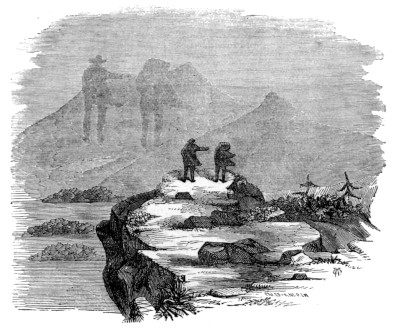
In Clarke’s “Survey of the Lakes,” a phenomenon similar to that of the
specter of the Brocken, is recorded to have been observed in the years 1743
321and 1744, on Souter-Fell, a mountain in Cumberland. It excited much
conversation and alarm at the time, and exposed to great ridicule those who
asserted they had witnessed it. It is, however, too well attested not to
deserve a short notice here, and may be referred to the same causes by which
the above aerial images on the Brocken mountain were produced. The
relation is as follows. Souter-Fell is a mountain about half a mile in hight,
inclosed on the north and west sides by precipitous rocks, but somewhat
more open on the east, and easier of access. At Wilton Hall, within half a
mile of this mountain, on a summer’s evening, in the year 1743, a farmer
and his servant, sitting at the door, saw the figure of a man with a dog,
pursuing some horses along Souter-Fell side, a place so steep that a horse
could scarcely travel on it. They appeared to run at a very great pace, till
they got out of sight at the lower end of the fell. On the following morning
the farmer and his servant ascended the steep side of the mountain, in full
expectation that they should find the man lying dead, being persuaded that
the swiftness with which he ran must have killed him, and imagining also
that they should pick up some of the shoes which they thought the horses
must have lost, in galloping at so furious a rate. They were, however, disappointed
in these expectations, as not the least vestige of either man or
horses could be discovered, not so much, even, as the mark of a horse’s hoof
on the turf.
On the twenty-third of June, of the following year, 1744, about half past
seven in the evening, the same servant, then residing at Blakehills, at an
equal distance from the mountain, being in a field in front of the farm-house,
saw a troop of horsemen riding on Souter-Fell side in pretty close ranks, and
at a brisk pace. Having observed them for some time, he called out his
young master, who before the spot was pointed out to him, discovered the
aerial troopers; and this phenomenon was shortly after witnessed by the
whole of the family. The visionary horsemen appeared to come from the
lowest part of Souter-Fell, and were visible at a place called Knott: they
then moved in regular troops along the side of the fell, till they came opposite
to Blakehills, when they went over the mountain. They thus described
a kind of curvilinear path, and their first as well as their last appearance, was
bounded by the foot of the mountain. Their pace was that of a regular
swift walk, and they were seen for upward of two hours, when darkness
intervened. Several troops were seen in succession, and frequently the last,
or last but one in the troop, would quit his position, gallop to the front, and
then observe the same pace with the others. The same change was visible
to all the spectators; and the sight of this phenomenon was not confined to
Blakehills, but was witnessed by the inhabitants of the cottages within a
322mile. It was attested before a magistrate by the two above-cited individuals
in the month of July, 1745. Twenty-six persons are said in the attestation
to have witnessed the march of these aerial travelers.
It should be remarked that these appearances were observed on the eve of
the rebellion, when troops of horsemen might be privately exercising; and
as the imitative powers of the specter of the Brocken demonstrate that the
actions of human beings are sometimes pictured in the clouds, it seems
highly probable, on a consideration of all the circumstances of this latter
phenomenon on Souter-Fell, that certain thin vapors must have hovered
round the summit of the mountain when the appearances were observed. It
is also probable that these vapors may have been impressed with the shadowy
forms which seem to “imitate humanity,” by a particular operation of the
sun’s rays, united with some singular but unknown refractive combinations
then taking place in the atmosphere.
This very curious phenomenon, which was remarked by M. Monge, one of
the French savans belonging to the institute of Cairo, in the hot and sandy
desert between Alexandria and that city, is described by him as resulting
from an inverted image of the cerulean sky intermixed with the ground
scenery, the neighboring villages appearing to be surrounded with a most
beautiful sheet of water, and to exist, like islands, in its liquid expanse,
tantalizing the eye by an unfaithful representation of what the thirsty
traveler earnestly desires.
Doctor Clarke, in his interesting travels, introduces the following animated
description of this phenomenon. “Here [at the village of Utko] we procured
asses for our party, and, setting out for Rosetta, began to recross the
desert, appearing like an ocean of sand, but flatter and firmer as to its surface,
than before. The Arabs, uttering their harsh, guttural language, ran
chattering by the side of our asses; until some of them calling out ‘Raschid!’
we perceived its domes and turrets, apparently upon the opposite side
of an immense lake or sea, that covered all the intervening space between
us and the city. Not having in my own mind, at the time, any doubt as to
the certainty of its being water, and seeing the tall minarets and buildings
of Rosetta, with all its groves of dates and sycamores, as perfectly reflected
by it as by a mirror, insomuch that even the minutest detail of the architecture
and of the trees might have been thence delineated, I applied to the
Arabs to be informed in what manner we were to pass the water. Our
interpreter, although a Greek, and therefore likely to have been informed of
323such a phenomenon, was as fully convinced as any of us, that we were drawing
near to the water’s edge, and became indignant, when the Arabs maintained,
that within an hour we should reach Rosetta, by crossing the sands in
the direct line we then pursued, and that there was no water. ‘What!’ said
he, giving way to his impatience, ‘do you suppose me an idiot, to be persuaded
contrary to the evidence of my senses?’ The Arabs, smiling, soon
pacified him, and completely astonished the whole party, by desiring us to
look back at the desert we had already passed, where we beheld a precisely
similar appearance. It was, in fact, the mirage, a prodigy to which all of us
were then strangers, although it afterward became more familiar. Yet
upon no future occasion did we ever behold this extraordinary illusion so
marvelously displayed. The view of it afforded us ideas of the horrible
despondency to which travelers must sometimes be exposed, who, in traversing
the interminable desert, destitute of water, and perishing with thirst,
have sometimes this deceitful prospect before their eyes.”
This appearance is often seen, when the sun shines, upon the extensive flat
sand upon the shores of the Bristol channel, in Somersetshire, and probably
on the sea-shore in other parts of England.
“As when a shepherd of the Hebride isles,
Placed far amid the melancholy main,
(Whether it be lone fancy him beguiles,
Or that aerial beings sometimes deign
To stand embodied to our senses plain,)
Sees on the naked hill, or valley low,
The whilst in ocean Phœbus dips his wain,
A vast assemblage moving to and fro;
Then all at once in air dissolves the wondrous show.”—Thomson.
These optical appearances of figures in the sea and air, in the Faro of
Messina, are the great delight of the populace, who, whenever the vision is
displayed, run about the streets shouting for joy, and calling on every one to
partake of the glorious sight. To produce this pleasing deception, many
circumstances must concur which are not known to exist in any other situation.
The spectator must stand with his back to the east, in some elevated
place behind the city, that he may command a view of the whole bay, beyond
which the mountains of Messina rise like a wall, and darken the background
of the picture. The winds must be hushed, the surface of the water quite
smooth, the tide at its hight, and the waters pressed up by currents to a
great elevation in the middle of the channel. All these events coinciding, as
324soon as the sun surmounts the eastern hills behind Reggio, (on the Calabrian
coast opposite,) and rises high enough to form an angle of forty-five degrees
on the water before the city, every object, existing or moving at Reggio, will
be repeated a thousand-fold in this marine mirror, which, by its tremulous
motion, is, as it were, cut into facets. Each image will pass rapidly off in
succession, as the day advances, and the stream carries down the wave on
which it appeared. Thus the parts of this moving picture will vanish in the
twinkling of an eye. Sometimes the air is at this time so impregnated with
vapors, and undisturbed by winds, as to reflect objects in a kind of aerial
screen, rising about thirty feet above the level of the sea. In cloudy, heavy
weather, they are drawn on the surface of the water, bordered with fine
prismatic colors.
Swinburne, in his travels, cites Father Angelucci as having been the first
to describe this phenomenon accurately. His relation is as follows. “On
the fifteenth of August, 1643, as I stood at my window, I was surprised with
a most wonderful and delectable vision. The sea which washes the Sicilian
shore, swelled up, and became, for twelve miles in length, like a chain of
dark mountains; while the waters near our Calabrian coast grew quite
smooth, and in an instant appeared as one polished mirror, reclining against
the aforesaid ridge. On this glass was depicted, in chiar-oscura, a string of
several thousands of pilasters, all equal in altitude, distance and degree of
light and shade. In a moment they lost half their hight, and bent into
arcades, like Roman aqueducts. A long cornice was next formed on the
top, and above it rose castles innumerable, all perfectly alike. These soon
split into towers, which were shortly after lost in colonnades, then in windows,
and at last ended in pines, cypresses, and other trees, even and similar.
This was the Fata Morgana, which, for twenty-six years, I had thought a
mere fable.”fable.”
A surprising instance of atmospherical refraction occurred at Hastings,
England, on the twenty-sixth of July, 1798. W. Latham, Esq., sitting in
his dining-room, situated on the parade, close to the sea-shore, and nearly
fronting the south, about five in the afternoon, had his attention suddenly
drawn by a great number of people running down to the seaside. On
inquiring the reason, he was informed that the coast of France was plainly
to be distinguished by the naked eye. On going down to the shore, he was
surprised to find that, even without the assistance of a telescope, he could
very plainly see the cliffs on the opposite coast; which, at the nearest part,
325are between forty and fifty miles distant, and are not to be discerned, from
that low situation, by the aid of the best glasses. They appeared to be only
a few miles off, and seemed to extend for some leagues along the coast.
Pursuing his walk along the shore to the eastward, close to the water’s edge,
and conversing on the subject with the sailors and fishermen, they could not,
at first, be persuaded of the reality of the appearance; but soon became so
thoroughly convinced, by the cliffs gradually appearing more elevated, and
approaching nearer as it were, that they pointed out and named to him the
different places they had been accustomed to visit, such as, the Bay, the Old
Head or Man, the Windmill, &c., at Boulogne; together with St. Vallery,
and other places on the coast of Picardy. This they afterward confirmed,
when they viewed them, thus refracted, through their telescopes, observing
that the above places appeared as near as if they had been sailing, at a small
distance, into the harbors. From the eastern cliff, which is of a very considerable
hight, a most beautiful scene presented itself to Mr. Latham’s view,
for there he could at once see Dungeness, Dover cliffs, and the French coast,
all along from Calais, Boulogne, &c., to St. Vallery; and, as some of the
fishermen affirmed, as far to the westward even as Dieppe. By the telescope,
the French fishing-boats were plainly to be seen at anchor, and the different
colors of the land on the hights, with the buildings, were perfectly discernible.
This curious phenomenon continued in the highest splendor till half
past eight o’clock, notwithstanding a black cloud for some time totally
obscured the face of the sun, and then vanished gradually. So remarkable
an instance of atmospherical refraction had not been before witnessed by the
oldest inhabitant of Hastings. It was likewise observed at Winchelsea, and
other places along the coast. The day was remarkably hot, without a breath
of wind stirring.
As another instance of this refracting power of the atmosphere, Dr. Vince,
an English philosopher, was once looking through a telescope at a ship,
which was so far off, that he could only see the upper parts of the masts.
The hulk was entirely hidden by the bending of the water, but between himself
and the ship he saw two perfect images of it in the air. These were of
the same form and color as the real ship; but one of them was turned upside
down. And when Captain Scoresby was in the polar sea with his ship, he
was separated by the ice from that of his father for some time, and looked
out for her every day with great anxiety. At length, one evening, to his
utter astonishment, he saw her suspended in the air, in an inverted position,
traced on the horizon in the clearest colors, and with the most distinct and
perfect representation. He sailed in the direction in which he saw this
visionary phenomenon, and actually found his father’s vessel by its indication.
326He was separated from the ship by immense masses of icebergs, and
at such a distance that it was impossible to have seen her in her actual situation,
or to have seen her at all, if her spectrum had not been thus raised
several degrees above the horizon in the air by this most extraordinary
refraction. It is by this bending of the rays of light that the images of
people are often seen at a distance, and sometimes magnified to a gigantic
size. We have given an account of such an appearance in the Hartz mountains,
in Germany.
Another singular instance of the refracting power of the atmosphere, was
witnessed within the present year, (1854,) by Mr. Elliott, the aeronaut, while
ascending in his balloon from Petersburg, Virginia. After he had ascended
about three thousand feet he discharged some five pounds of ballast, when
he shot onward and upward with amazing rapidity till he began to approximate
to the clouds. He then discharged about five pounds more of sand,
the remainder of the bag, when he again darted upward among the clouds,
which were so dense as to wholly exclude all terrestrial objects from his
view, and of course he was lost to all observers below. These discharges were
distinctly seen by persons watching him, and on the first occasion some one
exclaimed that the balloon had burst. While among the clouds, it seemed
to him as if he was in the midst of a large ground-glass globe, some two or
three hundred feet in diameter, against the side of which opposite to the sun,
the shadow of his balloon rested, some five or six times larger than the corporeal
one. About half-way between him and the shadow, which seemed as
if resting on the glass wall, another balloon was seen, of a size between the
shadow and the real one, resting as if in a vacuum, which displayed every
color of the original faithfully. He then saw another Elliott, clad and with
features like himself, and seemingly self-like. He then extended his own
fingers, when he was mimicked by his image; and whether he extended one
finger or more, or whatever he did, this figure duplicated exactly. When
he would cause his balloon to oscillate, this balloon would move exactly like
his. When he threw out more ballast to elevate himself, this figure sank
down instead of rising with him; and when he arose above the clouds into
the rays of the unclouded sun, he left the mimic aeronaut below him.
In the rays of the sun above the clouds he found it so warm as to cause
him to perspire freely, a state of heat never before experienced at this hight,
nearly twenty-four thousand feet, where the air is very rarefied and generally
very chilly. He then opened the valve for the purpose of descending, and
as soon as he had sunk one or two thousand feet, which he ascertained by
barometrical indications, he felt as if he had entered an ice-house, and a cold
chill seized his whole person. Here he again met his mimic aerial voyager,
327whom he kept in company for some time, from philosophical motives.
Whenever he moved sideways, this mum gentleman would move in the same
direction. But when he moved up or down, the duplicate would move in a
directly opposite way; and when he concluded to descend, the image moved
upward until the tricolored flag was out of sight, when he could see the car
and the aeronaut still standing in it as if in a basket attached to nothing.
He continued to look until his head was Robespierred, and finally, piece by
piece, his body, and, at last, his feet and basket, ascended out of his sight.
Mr. Elliott said that he had been up a hundred and one times, but never had
seen anything in the form of an illusion like this before.
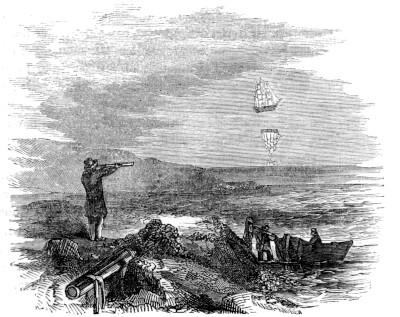
SHIP REFRACTED IN THE AIR.
But one of the most remarkable cases of atmospheric refraction of which
we have any record, is that which occurred at New Haven, Connecticut, in
the early settlement of the colony. The colonists had built a ship, and
freighted her for England with a valuable cargo, with which she sailed from
their harbor in the winter of 1647, having several of their principal men on
board. They were obliged to cut their way through the ice to get out of the
harbor; and the ship, never being heard of afterward, was supposed to have
foundered at sea. No tidings arriving of the ship or of her fate, the colonists
were deeply distressed, and “were very earnest in their prayers, both public
328and private, that God would in some way make manifest to them what had
become of their friends.” In the following June, a violent thunder-storm
arose out of the north-west, after which the atmosphere being very calm and
serene, about an hour before sunset, a ship of the dimensions and form of the
one they had lost, with all her canvas set and flags flying, appeared in the
air, coming up the harbor, her sails filled as though by a fresh gale, and sailing
against the wind, for the space of half an hour.
At length, as she came nearer, her maintop seemed to be blown off, though
left hanging in the shrouds; then, her mizzen-top; then all her masting
seemed blown away by the board; quickly after, her hulk careening, she
overset, and seemed to sink and vanish in the clouds, and as these clouds
passed away, the air where she was seen, was, as before, perfectly clear.
The crowd of spectators could distinguish the appearance of the various
parts of the ship, the principal rigging, and such proportions as made them
satisfied that this was indeed their ship; and Mr. Davenport, the minister,
declared, in public, that God, for the quieting of the hearts of the people,
had given them this extraordinary exhibition and account of what he had
done with their property and friends. But science gives us a more natural
and less miraculous explanation of the matter, in the refracting power of the
air when in certain states; and the probability is, that the ship, thus seen in
the air, was some strange vessel (which they imagined looked like their
own) coming up the harbor before the breeze, and then driven off and
wrecked by the storm, which reached her after it had passed New Haven; or
else that it was, indeed, their own ship, which after being driven about for
months, was now coming back to her port, when she was thus caught in the
tempest and destroyed. And as confirming this view of the matter, it may
be added, in conclusion, that within the present century, it is said, a similar
refraction of a ship in the air, has been witnessed in the same place.
On the fifth of February, 1674, near Marienberg, in Prussia, the sky being
everywhere serene, the sun, which was still some degrees above the horizon,
was seen to lance out very long and reddish rays, forty or fifty degrees
toward the zenith, notwithstanding it shone with great luster. Beneath this
planet, toward the horizon, there hung a somewhat thin small cloud, at the
inferior part of which there appeared a mock sun, of the same apparent size
with the true sun, and of a reddish color. Soon after, the true sun descending
gradually to the horizon, toward the said cloud, the spurious sun beneath
it grew clearer and clearer, in so much that the reddish color in this apparent
329solar disk vanished, and it put on the genuine solar light, in proportion
as it was approached by the genuine disk of the sun. The latter, at length,
passed into the lower counterfeit sun, and thus remained alone. This
phenomenon was considered the more wonderful, as it was perpendicularly
under the sun, instead of being at its side, as parhelia usually are; not to
mention the color, so different from that which is usual in mock suns, nor
the great length of the tail cast up by the genuine sun, of a far more vivid
and splendid light than parhelia commonly exhibit. This appearance was
soon followed by an exceedingly intense frost, which lasted till the twenty-fifth
of March, the whole bay being frozen up from the town of Dantzic to
Hela in the Baltic sea.
On the twenty-eighth of August, 1698, about eight o’clock in the morning,
there was seen at Sudbury, in Suffolk, England, the appearance of three
suns, which were then extremely brilliant. Beneath a dark, watery cloud,
in the east, nearly at its center, the true sun shone with such strong beams,
that the spectators could not look at it; and on each side were the reflections.
Much of the firmament was elsewhere of an azure color. The circles were
not colored like the rainbow, but white; and there was also, at the same
time, higher in the firmament, and toward the south, at a considerable distance
from the other phenomena, the form of a half-moon, but apparently of
double the size, with the horns turned upward. This appearance was,
within, of a fiery red color, imitating that of the rainbow. These phenomena
faded gradually, after having continued about two hours.
Two mock suns, an arc of a rainbow inverted, and a halo, were seen at
Lyndon, in the county of Rutland, on the twenty-second of October, 1621, at
eleven in the morning. There had been an aurora borealis the preceding
night, with the wind at west-south-west. The two parhelia, or mock suns,
were bright and distinct, and in the usual places, namely, in the two intersections
of a strong and large portion of a halo, with an imaginary circle
parallel to the horizon, passing through the true sun. Each parhelion had
its tail of a white color, and in direct opposition to the true sun; that toward
the east being some twenty or twenty-five degrees long, and that toward
the west from ten to twelve degrees, both narrowest at the remote ends.
The mock suns were evidently red toward the sun, but pale or whitish at the
opposite sides, as was the halo also. Still higher in the heavens, was an arc
of a curiously inverted rainbow, about the middle of the distance between
the top of the halo and the vertex. This arc was as distinct in its colors as
the common rainbow, and of the same breadth. The red color was on the
convex, and the blue on the concave of the arc, which seemed to be about
ninety degrees in length, its center being in or near the vertex. On the top
330of the halo was a kind of inverted bright arc. This phenomenon was seen
on the following day, and, again, on the twenty-sixth. On the eleventh of
the preceding month, September, a very splendid and remarkable aurora
borealis, presenting truly unaccountable motions and removals, was witnessed
in Rutlandshire, in Northamptonshire, and at Bath.
This very rare phenomenon was witnessed at Glapwell Hall, in Derbyshire,
England, on the twenty-fifth of December, 1710, about eight in the evening,
with a remarkable and very unusual display of colors. The moon had
passed her full about twenty-four hours, and the evening had been rainy;
but the clouds were dispersed, and the moon then shone quite clear. This
iris lunaris had all the colors of the solar iris, exceedingly beautiful and
distinct, only faint in comparison with those which are seen in the day; as
must necessarily have been the case, both from the different beams by which
it was occasioned, and the disposition of the medium. What most surprised
the observer was the largeness of the arc, which was not so much less than
that of the sun, as the different dimensions of their bodies, and their respective
distances from the earth, seemed to require; but the entireness and
beauty of its colors furnished a charming spectacle.
This extraordinary phenomenon, which is seen at sunrise on the Andes,
in South America, was first witnessed by Ulloa and his companions in the
wild heaths of Pambamarca, and is thus described by him. “At day-break
the whole of the mountain was enveloped in dense clouds, which at sunrise
were dissipated, leaving behind them vapors of so extreme a tenuity, as not
to be distinguishable to the sight. At the side opposite to that where the
sun rose on the mountain, and at the distance of about sixty yards from the
spot where we were standing, the image of each of us was seen represented
as if in a mirror, and three concentric rainbows, the last or most exterior
colors of one of which touched the first of the following one, were centered
on each head. Without the whole of them, and at an inconsiderable
distance, was seen a fourth arc purely white. They were all perpendicular
to the horizon; and in proportion as any one of us moved from one side to
the other, he was accompanied by the phenomenon, which preserved the
same order and disposition. What was, however, most remarkable, was
this, that although six or seven persons were thus standing close together,
331each of us saw the phenomenon as it regarded himself, but did not perceive
it in the others. This, adds Bouguer, is a kind of apotheosis, in which each
of the spectators, seeing his head adorned with a glory formed of three or
four concentric crowns of a very vivid color, each of them presenting varieties
similar to those of the first rainbow, tranquilly enjoys the sensible pleasure
of reflecting that the brilliant garland he can not discover in the others is
destined for himself alone.”
A similar phenomenon is described by Mr. Hagarth, as having been seen
by him in Wales, on the thirteenth of February, 1780. His relation is as
follows. “In ascending, at Rhealt, the mountain which forms the eastern
boundary of the vale of Clwyd, (in Denbighshire,) I observed a rare and
curious phenomenon. In the road above me, I was struck with the peculiar
appearance of a very white, shining cloud, which lay remarkably close to the
ground. The sun was near setting, but shone extremely bright: I walked
up to the cloud, and my shadow was projected into it, its superior part being
surrounded, at some distance, by a circle of various colors, whose center
appeared to be near the situation of the eye, and whose circumference
extended to the shoulders. This circle was complete, except what the
shadow of my body intercepted. It exhibited the most vivid colors, the red
being outermost; and all of them appearing in the same order and proportion
as they are presented to the view by the rainbow. It resembled very
exactly what in pictures is termed a glory, surrounding the heads of saints;
not indeed that it exhibited the luminous radiance that is painted close to
the head, but an arch of concentric colors placed separately and distinctly
from it. As I walked forward, this glory approached or retired, just as the
inequality of the ground shortened or lengthened my shadow. The cloud
being sometimes in a small valley below me, sometimes on the same level, or
on higher ground, the variation of the shadow and glory became extremely
striking and singular. To add to the beauty of the scene, there appeared,
at a considerable distance to the right and left, the arches of a white, shining
bow. These arches were in the form of, and broader than a rainbow; but
were not completely joined into a semicircle above, on account of the
shallowness of the cloud.”
To conceive justly of the nature of thunder and lightning, we have only
to view the effects of a common electrical machine, and its apparatus, in an
apartment. These experiments mimic the great, wonderful and terrific
332phenomena of nature. The stream, or spark, from the machine to the hand,
represents the shaft of lightning from the clouds to the earth; and the
snapping noise of the diminutive spark corresponds with the explosion produced
by the lightning, which we call thunder. In what manner the clouds
become electrified, and, in short, what is the nature of electricity itself, our
present range of experiments so little qualify us to determine, that a century
will perhaps elapse before a philosophical precision can be attained. At
present we only know for certain that the electrical power displays itself
merely on the surface of bodies; and whether it is a fluid per se, a vacuum
restoring itself, or whatever its nature may be, the state of experimental
knowledge does not enable us to determine.
The obvious analogy between lightning and electricity, had long been
suspected, and was placed beyond a doubt by Franklin, who was the first to
conceive the practicability of drawing down lightning from the clouds.
Having found by previous experiments, that the electric fluid is attracted by
points, he apprehended that lightning might likewise possess the same
quality; although the effects of the latter would in that case surpass those
of the former in an astonishing degree. Flashes of lightning, he likewise
observed, are generally seen crooked and waving in the air; and the electric
spark drawn from an irregular body at some distance, when it is drawn by
an irregular body, or through a space in which the best conductors are
disposed in an irregular manner, always exhibits the same appearance.
Lightning strikes the highest and most pointed objects in its way, in
preference to others, as high hills, trees, spires, masts, &c.; and all pointed
conductors receive and throw off the electric fluid more readily than those
which are terminated by flat surfaces. Lightning is observed to take the
best and readiest conductor; and this is also the case with electricity, in the
discharge of the Leyden phial; whence Franklin inferred that, in a thunder-storm,
it would be safer for a person to have his clothes wet than dry.
Lightning burns, dissolves metals, rends some particular bodies, such as the
roots and branches of trees, strikes persons with blindness, destroys animal
life, deprives magnets of their virtue and reverses their poles; and these are
well known properties of electricity. Lightning not only gives polarity to
the magnetic needle, but to all bodies which have any portion of iron in
them, as brick, &c.; and, by observing which way the poles of these bodies
lie, the direction in which the stroke has passed may be known with the
utmost certainty.
In order to demonstrate, by actual experiment, the identity of the electric
fluid with the matter of lightning, Franklin contrived to bring lightning
from the heavens by means of an electrical kite, which he raised on the
333approach of a thunder-storm; and, with the electricity thus obtained, charged
phials, kindled spirits, and performed all other electrical experiments, as
they are usually exhibited by an excited globe or tube. This happened in
1752, a month after the French electricians, pursuing the method which he
had proposed, had verified the same theory; but without any knowledge on
his part of what they had done. On the following year, he further discovered
that the air is sometimes electrified positively, and sometimes negatively;
and that in the course of one thunder-storm, the clouds change from positive
to negative electricity several times. He was not long in perceiving that
this important discovery was capable of being applied to practical use; and
proposed a method, which he soon accomplished, of securing buildings from
being damaged by lightning, by means of conductors, or lightning-rods, the
use of which is now universally known.
From a number of judicious experiments made by him, Signor Beccaria
concluded that the clouds serve as conductors to convey the electric fluid
from those parts of the earth which are overloaded with it, to those where it
is exhausted. The same cause by which a cloud is first raised, from vapors
dispersed in atmosphere, draws to it those which are already formed, and
still continues to form new ones, till the whole collected mass extends so far
as to reach a part of the earth where there is a deficiency of the electric
fluid, and where the electric matter will discharge itself on the earth. A
channel of communication being thus produced, a fresh supply of electric
matter is raised from the overloaded part, which continues to be conveyed
by the medium of the clouds, till the equilibrium of the fluid is restored
between the two places of the earth. He further observes that as the wind
constantly blows from the place where the thunder-cloud proceeds, the
sudden accumulation of such a prodigious quantity of vapors must displace
the air, and repel it on all sides. Indeed, many observations of the descent
of lightning confirm his theory of the mode of its ascent; for it often throws
before it the parts of conducting bodies, and distributes them along the
resisting medium through which it must force its passage; and on this principle
the longest flashes of lightning seem to be produced, by its forcing in
its way part of the vapors in the air. One of the chief reasons why the report
of these flashes is so much protracted, is the vast length of the vacuum made
by the passage of the electric matter; for although the air collapses the
moment after it has passed, and the vibration, on which the sound depends,
commences at the same moment, still, when the flash is directed toward the
person who hears the report, the vibrations excited at the nearer end of the
track will reach his ear much sooner than those from the remote end, and
the sound will, without any echo or repercussion, continue till all the vibrations
334have successively reached him. The rattling noise of the thunder,
which makes it seem as if it passed through arches or were variously broken,
is probably owing to the sound being excited among clouds hanging over
one another, and the agitated air passing irregularly between them.
Among other precautions pointed out by Franklin, he recommends to
those who happen to be in the fields, at the time of a thunder-storm, to place
themselves within a few yards of a tree, but not quite near it. Signor
Beccaria, however, cautions persons not to depend on a higher, or, in all
cases, a better conductor than their own body; since, according to his
repeated observations, the lightning by no means descends in one undivided
track, but bodies of various kinds conduct their share of it at the same time,
in proportion to their quantity and conducting power. The late Earl of
Stanhope, in his principles of electricity, observes that damage may be done
by lightning, not only by the main stroke and lateral explosion, but likewise
by what he calls the returning stroke; that is, by the sudden violent return
of that part of the natural share of electricity of any conducting body, or
any combination of conducting bodies, which had been gradually expelled
from such body or bodies respectively, by the superinduced elastic electrical
pressure of a thunder-cloud’s electrical atmospheres.
Among the awful phenomena of nature, none have excited more terror
than thunder and lightning. It is recorded of several of the profligate
Roman emperors, who had procured themselves to be deified, that when
they heard the thunder, they tremblingly concealed themselves, acknowledging
a divine power greater than their own; a Jupiter thundering in the
heavens.
A few instances in which the effects of these storms have been particularly
characterized, will be both interesting and instructive.
That fermented liquors are apt to be soured and spoiled by thunder, is a
fact well known; but that dried substances should be so acted on, is a still
more remarkable phenomenon, and not so easy of explanation. It happened,
however, some years ago, that in the immense granaries of Dantzic, the
repositories of the corn, of Polish growth, intended for exportation, the wheat
and rye, which were before dry and sweet, were, by the effect of a violent
thunder-storm in the night, rendered clammy and stinking, insomuch that
it required several weeks to sweeten them and render them fit for shipping.
The effects of a thunder-storm on a house and its furniture, at New Forge,
Ireland, on the ninth of August, 1707, were very singular. It was observed
335that the day was, throughout, close, hot and sultry, with scarcely any wind,
until toward evening, when a breeze came on with mizzling rain, which
lasted about an hour. As the air darkened after sunset, several faint flashes
of lightning were seen, and thunder-claps heard, as at a distance; but
between ten and eleven o’clock they became, in their approach, very violent
and terrible, progressively increasing in their intensity, and coming on with
more frequency, until toward midnight. A flash of lightning, and a clap of
thunder, louder and more dreadful than all the rest, came simultaneously,
and shook and inflamed the whole house. The mistress being sensible, at
that instant, of a strong sulphureous smell in her chamber, and feeling a
thick, gross dust fall on her hands and face as she lay in bed, concluded that
part of her house had been thrown down by the thunder, or set on fire by
the lightning. The family being called up, and candles lighted, both the
bed-chamber, and the kitchen beneath it, were found to be filled with smoke
and dust. A looking-glass in the chamber had been broken with such
violence, that not a piece of it was to be found of the size of half a crown:
several of the pieces were stuck in the chamber-door, which was of oak, as
well as on the other side of the room. The edges and corners of some of
the pieces of broken glass were tinged of a light flame color, as if they had
been heated by the fire. On the following morning it was found that the
cornice of the chimney next the bed-chamber had been struck off, and a
breach twenty inches in breadth, made in the wall. At this part there was
seen on the wall a smutted scar or trace, as if left by the smoke of a candle,
which pointed downward to another part of the wall, where a similar breach
was made. Within the chamber, the boards on the back of a large hair
trunk, filled with linen, were forced in, and two-thirds of the linen pierced
or cut through, the cut appearing of a quadrangular figure. Several pieces
of muslin and wearing apparel, which lay on the trunk, were dispersed about
the room, not in any way singed or scorched, notwithstanding the hair on
the back of the trunk, where the breach was made, was singed. In the
kitchen, a cat was found dead, with its legs extended as in a moving posture,
without any other sign of being hurt, except that the fur was singed a little
about the rump.
In the parish of Samford Courtney, near Oakhampton, in Devon, on the
seventh of October, 1811, about three in the afternoon, a sudden darkness
came on. Several persons being in the church-porch, a great fire-ball fell
among them, and threw them down in various directions, but without any
one being hurt. The ringers in the belfry declared that they never knew
the bells go so heavily, and were obliged to desist from ringing. Looking
down from the belfry into the church, they perceived four fire-balls, which
336suddenly burst, and the church was filled with fire and smoke. One of the
congregation received a blow in the neck, which caused him to bleed both at
nose and mouth. He observed the fire and smoke to ascend to the tower,
where a large beam, on which one of the bells was hung, was broken, and
the gudgeon breaking, the bell fell to the floor. One of the pinnacles of the
tower, next the town, was carried away, and several of the stones were found
near a barn, at a considerable distance from the church.
On the fifteenth of December, 1754, a vast body of lightning fell on the
great hulk at Plymouth. It burst out a mile or two to the westward of the
hulk, and rushed toward it with incredible velocity. A portion of the
derrick (a part of the apparatus which served to hoist in and fix the masts
of the men-of-war) was cut out, of a diameter of at least eighteen inches, and
about fifteen feet in length: this particular piece was in three or four places
girt with iron hoops, about two inches broad, and half an inch thick, which
were completely cut in two by the lightning, as if done by the nicest hand
and instrument. The lightning was immediately succeeded by a dreadful
peal of thunder, and that by a most violent shower of hail, the hailstones
being as large as nutmegs, and for the greatest part of the same size and
shape.
Among the many fatal accidents by lightning which have befallen ships,
the following is a remarkable instance. In the year 1746, a Dutch ship lay
in the road of Batavia, and was preparing to depart for Bengal. The afternoon
was calm, and toward evening the sails were loosed, to take advantage
of the wind which then constantly blows from the land. A black cloud gathered
over the hills, and was brought by the wind toward the ship, which it
had no sooner reached, than a clap of thunder burst from it, and the lightning
set fire to the maintopsail: this being very dry, burned with great fury:
and thus the rigging and mast were set on fire. An attempt was immediately
made to cut away the mast, but this was prevented by the falling of the
burnt rigging from the head of the mast. By degrees the fire communicated
to the other masts, and obliged the crew to desert the ship, the hull of which
afterward took fire, and burning down to the powder magazine, the upper
part was blown into the air, and the lower part sunk where the ship was at
anchor.
In crossing the Atlantic, in the month of November, 1749, the crew of an
English ship observed a large ball of blue fire rolling on the water. It came
down on them so fast, that before they could raise the main-tack, they
observed the ball to rise almost perpendicularly, and within a few yards of
the main chains: it went off with an explosion as if hundreds of cannon had
been fired off simultaneously, and left behind it a great smell of brimstone.
337The maintopmast was shattered into a thousand pieces, and splints driven
out of the mainmast which stuck in the main-deck. Five seamen were
knocked down, and one of them greatly burnt, by the explosion. The fireball
was apparently of the size of a large millstone, and came from the
north-east.
The ingenious and indefatigable Professor Richman lost his life on the
sixth of August, 1753, as he was observing, with M. Sokolow, engraver to
the royal academy of St. Petersburgh, the effects of electricity on his
gnomon, during a thunder-storm. It was ascertained that the lightning
was more particularly directed into the professor’s apartment, by the means
of his electrical apparatus, for M. Sokolow distinctly saw a globe of blue fire,
as large as his clenched hand, jump from the rod of the right gnomon,
toward the forehead of Professor Richman, who at that instant was about a
foot distant from the rod, observing the electrical index. The globe of fire
which struck the professor, was attended with a report as loud as that of a
pistol. The nearest metal wire was broken in pieces, and its fragments
thrown on M. Sokolow’s clothes, on which burnt marks of their dimensions
were left. Half of the glass vessel was broken off, and the metallic filings it
contained thrown about the room. Hence it is plain that the force of the
lightning was collected on the right rod, which touched the filings of metal
in the glass vessel. On examining the effects of the lightning in the professor’s
chamber, the door-case was found split half through, and the door torn
off, and thrown into the chamber. The lightning therefore seems to have
continued its course along the chain conducted under the ceiling of the
apartment. In a Latin treatise, published by M. Lomonosow, member of the
royal academy of sciences of St. Petersburgh, several curious particulars are
mentioned relative to this melancholy catastrophe. At the time of his death,
Professor Richman had in his left coat-pocket seventy silver coins, called
rubles, which were not in the least altered by the accident which befell him.
His clock, which stood in the corner, of the next room, between an open
window and the door, was stopped; and the ashes from the hearth thrown
about the apartment. Many persons without doors declared that they
actually saw the lightning shoot from the cloud to the professor’s apparatus
at the top of his house. The author, in speaking of the phenomena of
electricity, observes that he once saw during a storm of thunder and lightning,
brushes of electrical fire, with a hissing noise, communicate between
the iron rod of his apparatus and the sides of his window, and that these
were three feet in length, and a foot in breadth.
Somewhat analogous to these movements of electricity, are those connected
with the electric telegraph during the violent thunder-storms that so often
338take place in the summer season. When such storms are raging, and particularly
when the lightning is abundant and near, not only is the operation
of the telegraph entirely suspended, but sometimes the lightning itself passes
with great violence over the wires, in some cases melting and destroying
them, and in others passing by them as it does by the lightning-rod, and
manifesting its violence chiefly at the point of their termination. In some
instances, the wires have been instantly melted by the electric fluid, and in
others the machinery of the offices injured or destroyed, while at other times
persons have been struck, or dwellings set on fire by its power.
On the seventeenth of July, 1666, a violent storm of hail fell on the English
coast, in Norfolk and Suffolk. At North Yarmouth the hailstones were
comparatively small; but at Snapebridge, one was taken up which measured
a foot in circumference; at Seckford Hall, one which measured nine inches;
and at Melton, one measuring eight inches. At Friston Hall, one of these
hailstones, being put into a balance, weighed two ounces and a half. At
Aldborough, it was affirmed that several of them were as large as turkeys’
eggs. A carter had his head broken by them through a stiff felt hat: in
some places it bled, and in others tumors arose: the horses were so pelted
that they hurried away his cart beyond all command. The hailstones were
white, smooth without, and shining within.
On the twenty-fifth of May, 1686, the city of Lille, in Flanders, was visited
by a tremendous hail-storm. The hailstones weighed from a quarter of a
pound to a pound in weight, and even more. One was observed to contain
in the center a dark brown matter, and being thrown into the fire, gave a
very loud report. Others were transparent, and melted instantly before the
fire. This storm passed over the city and citadel, leaving not a whole glass
in the windows on the windward side. The trees were broken, and some
beaten down, and partridges and hares killed in abundance.
In 1697, a horrid black cloud, attended with frequent lightnings and
thunder, coming with a south-west wind out of Caernarvonshire, in Wales,
and passing near Snowdon, was the precursor of a most tremendous hailstorm.
In the part of Denbighshire bordering on the sea, all the windows
on the weather side were broken by the hailstones discharged from this
cloud, and the poultry and lambs, together with a large mastiff, killed. In
the north part of Flintshire, several persons had their heads broken, and
were grievously bruised in their limbs. The main body of this hail-storm
fell on Lancashire, in a right line from Ormskirk to Blackburn, on the borders
339of Yorkshire. The breadth of the cloud was about two miles, within
which compass it did incredible damage, killing all descriptions of fowl and
small creatures, and scarcely leaving a whole pane of glass in any of the
windows where it passed. What was still worse, it plowed up the earth, and
cut off the blade of the green corn, so as utterly to destroy it, the hailstones
burying themselves in the ground. These hailstones, some of which weighed
five ounces, were of different forms, some round, others semi-spherical; some
smooth, others embossed and crenulated, like the foot of a drinking-glass,
the ice being very transparent and hard; but a snowy kernel was in the
midst of most of them, if not of all. The force of their fall showed that they
descended from a great hight. What was thought to be most extraordinary
in this phenomenon was, that the vapor which disposed the aqueous parts
thus to congeal, should have continued undispersed for so long a tract as
upward of sixty miles, and should, during this extensive passage, have occasioned
so extraordinary a coagulation and congelation of the watery clouds,
as to increase the hailstones to so vast a bulk in so short a space as that of
their fall.
On the fourth of May, 1767, at Hitchin, in Hertfordshire, after a violent
thunder-storm, a black cloud suddenly arose in the south-west, about two
o’clock in the afternoon, the wind then blowing strongly in the east, and
was almost instantly followed by a shower of hail, several of the hailstones
measuring from seven or eight to thirteen or fourteen inches in diameter.
The extremity of the storm fell near Offley, where a young man was killed,
and one of his eyes was beaten out of his head, his body being in every part
covered with bruises. Another person, nearer to Offley, escaped with his
life, but was much bruised. At a nobleman’s seat in the vicinity, seven
thousand squares of glass were broken, and great damage was done to all
the neighboring houses. The large hailstones fell in such immense quantities,
that they tore up the ground, and split many large oaks and other trees,
cutting down extensive fields of rye, and destroying several hundred acres
of wheat, barley, &c. Their figures were various, some being oval, others
round, others pointed, and others again flat.
The ruin and desolation accompanying a hurricane can scarcely be
described. Like fire, its resistless force rapidly consumes everything in its
track. It is generally preceded by an awful stillness of the elements, and a
closeness and mistiness in the atmosphere, which make the sun appear red,
and the stars of more than an ordinary magnitude. But a dreadful reverse
340succeeding, the sky is suddenly overcast and wild; the sea rises at once from
a profound calm into mountains; the wind rages and roars like the noise of
cannon; the rain descends in a deluge; a dismal obscurity envelops the
earth with darkness; and the superior regions appear rent with lightning
and thunder. The earth, on these occasions, often does, and always seems
to tremble, while terror and consternation distract all nature: birds are
carried from the woods into the ocean; and those whose element is the sea,
fly for refuge to the land. The affrighted animals in the fields assemble
together, and are almost suffocated by the impetuosity of the wind, in searching
for shelter, which, when found, serves them only for destruction. The
roofs of houses are carried to vast distances from their walls, which are
beaten to the ground, burying their inmates beneath them. Large trees are
torn up by the roots, and huge branches shivered off, and driven through the
air in every direction, with immense velocity. Every tree and shrub that
withstands the shock, is stripped of its boughs and foliage. Plants and grass
are laid flat to the earth. Luxuriant spring is in a moment changed to
dreary winter. This direful tragedy ended, when it happens in a town, the
devastation is surveyed with accumulated horror: the harbor is covered with
wrecks of boats and vessels; and the shore has not a vestige of its former
state remaining. Mounds of rubbish and rafters in one place; heaps of
earth and trunks of trees in another; deep gullies from torrents of water;
and the dead and dying bodies of men, women and children, half-buried, and
scattered about, where streets but a few hours before were, present to the
miserable survivors a shocking conclusion of a spectacle, often followed by
famine, and, when accompanied by an earthquake, by mortal diseases. Such
is the true and terrific picture of a hurricane in the West Indies, as drawn
by an actual observer.
On the Indian coast, hurricanes are both frequent and disastrous. On the
second of October, 1746, the French squadron, commanded by Le Bourdonnai,
being at anchor in Madras roads, a hurricane came on which in a few
hours destroyed nearly the whole of the fleet, together with twenty other
ships belonging to different nations. One of the French ships foundered in
an instant, and only six of the crew were saved. On the thirtieth of December,
1760, during the siege of Pondicherry, a tremendous hurricane drove
ashore and wrecked three British ships belonging to the besieging squadron:
the crews were saved. On the twentieth of October of the following year,
1761, the British fleet, then lying in Madras roads, had to encounter a
violent hurricane. The men-of-war put to sea, and were thus providentially
saved; but all the vessels which still lay at anchor were lost, and scarcely a
soul on board saved. On the twenty-ninth of October, 1768, another hurricane
341was, on the coast of Coromandel, fatal to the Chatham Indiaman,
which neglected to put to sea.
In the West Indies, a tremendous hurricane on the twenty-first of October,
1817, was particularly severe at the island of St. Lucie. All the vessels in
the port were entirely lost. The government-house was blown down, and
all within its walls, comprising the governor, his lady and child, his staff,
secretaries, servants, &c., amounting to about thirty persons, were buried in
its ruins: not one survived the dreadful accident; and still more horrid to
relate, the barracks of the officers and soldiers were demolished, and all
within them (about two hundred persons) lost. All the estates on the island
were reduced to a heap of ashes. At Dominica, nearly the whole of the
town was inundated, with an immense destruction of property.
In Great Britain, a dreadful hurricane, commonly called the great storm,
set in at ten at night on the twenty-sixth of November, 1703, and raged
violently until seven the next morning. It extended its ravages to every
part of the kingdom. In the capital, upward of two thousand stacks of
chimneys were blown down. The lead on the tops of several churches was
rolled up like skins of parchment. Many houses were leveled with the
ground, and by the fall of the ruins, twenty-one persons were killed, and
more than two hundred wounded. The ships in the Thames broke from
their moorings: four hundred wherries were lost, and many barges sunk,
with a great loss of lives. At sea the destruction was still greater: twelve
ships of war, with upward of eighteen hundred men on board, were totally
lost, together with many merchantmen.
The setting in of the monsoon, or tropical sea-wind, in the East Indies, is
thus described by Forbes in his “Oriental Memoirs.” The scene was at
Baroche, where the British army was encamped. “The shades of evening
approached as we reached the ground, and just as the encampment was
completed, the atmosphere grew suddenly dark, the heat became oppressive,
and an unusual stillness presaged the immediate setting in of the monsoon.
The whole appearance of nature resembled those solemn preludes to earthquakes
and hurricanes in the West Indies, from which the east in general is
providentially free. We were allowed very little time for conjecture; in a
few minutes the heavy clouds burst over us. I had witnessed seventeen
monsoons in India, but this exceeded them all in its awful appearance and
dreadful effects. Encamped in a low situation, on the borders of a lake
formed to collect the surrounding water, we found ourselves in a few hours
342in a liquid plain. The tent-pins giving way, in a loose soil, the tents fell
down, and left the whole army exposed to the contending elements. It
requires a lively imagination to conceive the situation of a hundred thousand
human beings of every description, with more than two hundred thousand
elephants, camels, horses and oxen, suddenly overwhelmed by this dreadful
storm, in a strange country, without any knowledge of high or low ground;
the whole being covered by an immense lake, and surrounded by thick darkness,
which prevented our distinguishing a single object, except such as the
vivid glare of lightning displayed in horrible forms. No language can
describe the wreck of a large encampment thus instantaneously destroyed,
and covered with water, and this amid the cries of old men and helpless
women, terrified by the piercing shrieks of their expiring children, unable
to afford them relief. During this dreadful night, more than two hundred
persons and three thousand cattle perished, and the morning dawn exhibited
a shocking spectacle.”
The south-west monsoon generally sets in very early in certain parts of
India. “At Anjengo,” observes the above author, “it commences with great
severity, and presents an awful spectacle; the inclement weather continues,
with more or less violence, from May to October: during that period, the
tempestuous ocean rolls from a black horizon, literally of ‘darkness visible,’
a series of floating mountains heaving under hoary summits, until they
approach the shore, when their stupendous accumulations flow in successive
surges, and break upon the beach; every ninth wave is observed to be
generally more tremendous than the rest, and threatens to overwhelm the
settlement. The noise of these billows equals that of the loudest cannon,
and, with the thunder and lightning, so frequent in the rainy season, is truly
awful. During the tedious monsoon I passed at Anjengo, I often stood upon
the trembling sand-bank, to contemplate the solemn scene, and derive comfort
from that sublime and omnipotent decree, ‘Hitherto shalt thou come,
but no further; and here shall thy proud waves be stayed!’”
“The dreadful spout
Which shipmen do the hurricano call
Constring’d in mass by the almighty sun.”
Shakspeare (Troilus and Cressida.)
In number three hundred and two of the Monthly Magazine, Sir Richard
Phillips, in describing a waterspout observed by him, points out the connection
between those phenomena and hurricanes, and offers a very philosophical
343explanation of the formation of the former. It happened to him, he observes,
on the twenty-seventh of June, 1817, about seven in the evening, to witness
the formation, operation and extinction of what is called a waterspout. His
attention was drawn to a sudden hurricane which nearly tore up the shrubs
and vegetables in the western gardens, and filled the air with leaves and
small collections of the recently cut grass. Very dark clouds had collected
over the adjacent country, and some stormy rain, accompanied by several
strokes of lightning, followed this hurricane of wind. The violence lasted a
few minutes, and it was evident that a whirlwind agitated a variety of substances
which had been raised into the air. The storm proceeded from west
to east, that is, from Hampstead over Kentish-Town, toward Holloway. In
about five minutes, in the direction of the latter place, a magnificent projection
was visible from the clouds, somewhat like a tunnel, with the smallest
part downward. It descended two-thirds of the distance from the clouds
toward the earth, and evidently consisted of parts of clouds descending in a
vortex, violently agitated like smoke from the chimney of a furnace recently
supplied with fuel. It then shortened, and appeared to be drawn up toward
the stratum of clouds, and finally drew itself into the cloud; but a small
cone, or projecting thread, of varying size and length, continued for ten
minutes. At the time, and for half an hour after, a severe storm of rain
was visibly falling from the ruins of clouds connected with it, the extent
being exactly defined by the breadth of Holloway, Highgate and Hornsey.
About two hours after, it was found that one of the heaviest torrents of rain
remembered by the inhabitants, had fallen around the foot of Highgate hill;
and some persons having seen the projected cloud, an absolute belief existed
that a waterspout had burst at the crossing of the new and old roads. On
proceeding toward London, various accounts agreeing with the superstition
or preconceived notions of the bystanders were given; and at one place it
appeared that some haymakers were stacking hay from a wagon which stood
between two ricks, and that the same whirlwind which passed over Kentish-Town,
had passed over the loaded wagon with an impetus sufficient to carry
it about twenty yards from its station, and to put the men on it and on the
rick, in fear of their lives. Passing the road, it carried with it a stream of
hay, and, nearly unroofing a shed on the other side, filled the air to a great
hight with fragments of hay, leaves and boughs of trees, which resembled a
vast flight of birds. A family in the vicinity beheld the descending cloud,
or waterspout, pass over, and saw its train, which, at the time, they took to
be a flight of birds. They afterward beheld the descending cloud draw
itself upward, and they and other witnesses described it as a vast mass of
smoke working about in agitation; to them it was nearly vertical in a
344northern direction; and to persons a quarter of a mile north, it was nearly
vertical in a southern direction; and all agree that it drew itself up without
rain, and was followed near the earth by the train of light bodies. It
appeared also, on various testimony, to let itself down in a gradual and
hesitating manner, beginning with a sort of knob in the cloud, and then
descending lower, and curling and twisting about till it shortened, and
gradually drew itself into the cloud.
The inferences which Sir Richard draws from what he saw and heard, are
as follows. That the phenomenon called a waterspout is a mere collection of
clouds, of the same rarity as the mass whence they are drawn. That the
descent is a mechanical effect of the whirlwind, which creating a vacuum, or
high degree of rarefaction, extending between the clouds and the earth, the
clouds descend in it by their gravity, or by the pressure of the surrounding
clouds or air. That the convolutions of the descending mass, and the
sensible whirlwind felt at the earth, as well as the appearance of the commencement,
increase and decrease of the mass, all demonstrate the whirl of
the air to be the mechanical cause. That the same vortex, whirl or eddy
of the air, which occasions the clouds to descend, occasions the loose bodies
on the earth to ascend. That, if in this case the lower surface had been
water, the same mechanical power would have raised a body of foam, vapor
and water, toward the clouds. That, as soon as the vortex or whirl exhausts
or dissipates itself, the phenomena terminate by the fall to the lower surface
of the light bodies or water, and by the ascent of the cloud. That when
water constitutes the light body of the lower surface, it is probable that the
aqueous vapor of the cloud, by coalescing with it, may occasion the clouds
to condense, and fall at that point, as through a siphon. That if the
descending cloud be highly electrified, and the vortex pass over a conducting
body, as a church steeple, it is probable it may be condensed by an electrical
concussion, and fall at that spot, discharging whatever has been taken up
from the lower surface, and producing the strange phenomena of showers of
frogs, fish, &c. And, lastly, it appears certain, that the action of the air on
the mass of clouds, pressing toward the mouth of the vortex as to a funnel,
(which, in this case, it exactly represented,) occasioned such a condensation
as to augment the simultaneous fall of rain to a prodigy.
In the month of July, 1800, a waterspout was seen rapidly to approach a
ship navigating between the Lipari islands. It had the appearance of a
viscid fluid, tapering in its descent, and proceeding from the cloud to join
the sea. It moved at the rate of about two miles an hour, with a loud sound
of rain, passing the stern of the ship, and wetting the after part of the
345mainsail. It was thence concluded that waterspouts are not continuous
columns of water, which has been confirmed by subsequent observations.
In November, 1801, about twenty miles from Trieste, in the Adriatic sea,
a waterspout was seen eight miles to the southward: round its lower
extremity was a mist, twelve feet high, nearly of the form of an Ionian
capital, with very large volutes, the spout resting obliquely on its crown.
At some distance from this spout, the sea began to be agitated, and a mist
rose to the hight of about four feet: a projection then descended from the
black cloud which was impending, and met the ascending mist about twenty
feet above the sea, the last ten yards of the distance being described with
great rapidity. A cloud of a light color appeared to ascend in this cloud
like quicksilver in a glass tube. The first spout then snapped at about one-third
of its hight, the inferior part subsiding gradually, and the superior
curling upward. Several other projections from the cloud, appeared with
corresponding agitations of the water below, but not always in spouts vertically
under them: seven spouts in all were formed, and two other projections
reabsorbed. Some of the spouts were not only oblique, but curved, the
ascending cloud moving most rapidly in those which were vertical. They
lasted from three to five minutes, and their dissipation was not attended with
any fall of rain. For some days before the weather had been very rainy,
with a south-east wind, but not any rain had fallen on the day of observation.
In some cases, however, the waterspout at sea, is a continuous column of
water, carried upward from the surface of the waves, and possibly meeting
with water brought down from the clouds and condensed by the force of the
revolving hurricane. Such waterspouts are now and then seen on the ocean,
having an appearance like that represented in the cut on the next page. And
as the wind blows first this way, and then that, they often writhe and bend,
from one point to another, while the sea below, and all around, is agitated and
covered with foam. Woe to that vessel that comes within the reach of one
of these mighty phenomena. It would be crushed and sunk like a leaf on
the waters. The usual defense at sea is to fire a cannon-shot into the
whirling waterspout, which commonly breaks and dispels it, and causes the
water to fall in a tremendous cataract or shower.
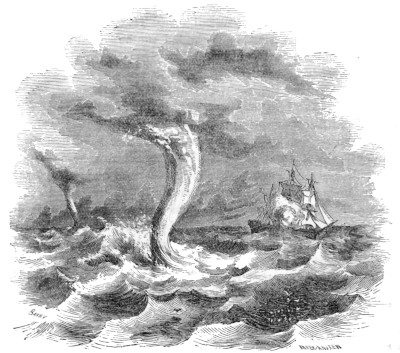
Waterspouts, however, are not confined to the ocean. They are occasionally
witnessed on the great fresh-water lakes of our own country, as they
have been on the inland seas of other parts of the globe. Several of these
remarkable phenomena were seen in 1854, on Lake Ontario, two of which
were visible at Sodus point. They were dense, cone-shaped columns, and
formed a continuous line from the earth to the clouds. One of them, the
largest, which was nearly thirty feet in diameter, was precipitated against the
346bluffs, and broke with a deafening noise upon the rocks below, causing so
great a commotion of the waters that a large quantity of logs and lumber
were torn from their moorings and washed far out into the lake. The
smaller of the two pursued its terrific and onward course as far as the eye
could reach, filling the beholders with wonder and astonishment, and
awakening such a feeling of grandeur and sublimity that they stood almost
mute and statue-like, until the sound of this gigantic column of water died
far away in the distance. A portion of the pier of the light-house was swept
away by the elements, and considerable damage was done to the light-house.
There was a severe storm out on the lake, and several schooners, brigs, &c.,
came scudding in, under bare poles, seeking security from the tempestuous
billows without, upon the placid bosom of the harbor. The velocity and
power of the whirlwind which caused these waterspouts, were very great.
As it passed on westward in its furious course, it is said that in a town in
Ohio, a grove of oak-trees was almost entirely blown down by it. The trunk
of one of these trees, on being measured, was found to be about three feet
in diameter. Assuming, however, that its diameter was but two and a half
347feet, it would require to break it, a force of one hundred and forty-nine
thousand pounds. The surface of the tree exposed to the action of the wind,
was about one thousand square feet, which would give a pressure by the
wind of one hundred and forty-seven pounds to the square foot, or a velocity
of not less than one hundred and seventy-one miles per hour, which is nearly
one-fourth the velocity of a cannon-ball just leaving the cannon. Allowing
the hight of the hurricane or whirlwind to have been sixty feet, the whole
force exerted, at one time, along its track, was equal to more than half the
steam power of the globe!
These corresponding phenomena of whirlwinds have been occasionally
productive of much mischief, as the following brief narratives will show. On
the thirtieth of October, 1669, about six in the evening, the wind being then
westwardly, a formidable whirlwind, scarcely of the breadth of sixty yards,
and which spent itself in about seven minutes, arose at Ashly, in Northamptonshire,
England. Its first assault was on a milkmaid, whose pail and hat
were taken from off her head, and the former carried many scores of yards
from her, where it lay undiscovered for some days. It next stormed a farmyard,
where it blew a wagon body off the axletrees, breaking in pieces the
latter, and the wheels, three of which, thus shattered, were blown over a
wall. Another wagon, which did not, like the former, lie across the passage
of the wind, was driven with great speed against the side of the farm-house.
A branch of an ash-tree, so large that two stout men could scarcely lift it,
was blown over a house without damaging it, although torn from a tree one
hundred yards distant. A slate was carried nearly two hundred yards, and
forced against a window, the iron bar of which it bent. Several houses were
stripped; and in one instance, this powerful gust, or stream of air, forced
open a door, breaking the latch; whence it passed through the entry, and,
forcing open the dairy door, overturned the milk-pans, and blew out three
panes of glass. It next ascended to the chambers, and blew out nine other
panes. Lastly, it blew a gate-post, fixed two feet and a half in the ground,
out of the earth, and carried it many yards into the fields.
On the thirtieth of October, 1731, at one in the morning, a very sudden
and terrific whirlwind, having a breadth of two hundred yards, was experienced
at Cerne-Abbas, in Dorsetshire. From the south-west side of the
town, it passed to the north-east, crossing the center, and unroofing the
houses in its progress. It rooted up trees, broke others in the middle, of at
least a foot square, and carried the tops a considerable distance. A sign-post,
five feet by four, was broken off six feet in the pole, and carried across a
street forty feet in breadth, over a house opposite. The pinnacles and battlements
of one side of the church-tower were thrown down, and the leads
348and timber of the north aisle broken in by their fall. A short time before,
the air was remarkably calm. It was estimated that this sudden and terrible
gust did not last more than two minutes.
About the middle of August, 1741, at ten in the morning, several peasants
being on a heath near Holkham, in Norfolk, perceived, about a quarter of a
mile from them, a wind like a whirlwind approach them gradually, in a
straight line from east to west. It passed through the field where they were
plowing, and tore up the stubble and grass in the plowed ground, for two
miles in length, to the breadth of thirty yards. In reaching an inclosure at
the top of a rising ground, it appeared like a great flash or ball of fire,
emitting smoke, and accompanied by a noise similar to that of carts passing
over a stony ground. Both before and after the wind passed, there was a
strong smell of sulphur; and the noise was heard long after the smoke had
been perceived. This fiery whirlwind moved so slowly forward, that it was
nearly ten minutes in proceeding from the inclosure to a farm-house in the
vicinity, where it did much mischief.
Sound is propagated successively from the sounding body to the places
which are nearest to it, then to those more distant, &c. Every observer
knows that when a gun is fired at a considerable distance from him, he perceives
the flash a certain time before he hears the report; and the same thing
is true with respect to the stroke of a hammer, or of a hatchet, the fall of a
stone, or, in short, any visible action which produces a sound or sounds. In
general, sound travels through the air at the rate of eleven hundred and
forty-two feet in a second, or about thirteen miles in a minute. This is the
case with all kinds of sounds; the softest whisper flying as fast as the loudest
thunder. Sound, like light, after it has been reflected from several places,
may be collected into one point as a focus, where it will be more audible than
in any other part; and on this principle whispering galleries are constructed.
The particulars relative to the celebrated whispering gallery in the dome of
St. Paul’s church, London, will be comprehended in the description of that
noble edifice.
An echo is the reflection of sound striking against a surface adapted to
the purpose, as the side of a house, a brick wall, hill, &c., and returning
back again to the ear, at distinct intervals of time. If a person stand about
sixty-five or seventy feet from such a surfacea surface, and perpendicularly to it, and
speak, the sound will strike against the wall, and be reflected back, so that
he will hear it as it goes to the wall, and again on its return. If a bell
349situated in the same way be struck, and an observer stand between the bell
and the reflecting surface, he will hear the sound going to the wall, and also
on its return. Lastly, if the sound strike the wall obliquely, it will go off
obliquely, so that a person who stands in a direct line between the bell and
the wall will not hear the echo. According to the greater or less distance
from the speaker, a reflecting object will return the echo of several, or of
fewer syllables; for all the syllables must be uttered before the echo of the
first syllable reaches the ear, to prevent the confusion which would otherwise
ensue. In a moderate way of speaking, about three and a half syllables are
pronounced in one second, or seven syllables in two seconds: therefore, when
an echo repeats seven syllables, the reflecting object is eleven hundred and
forty-two feet distant; for sound travels at the rate of eleven hundred and
forty-two feet per second, and the distance from the speaker to the reflecting
object, and again from the latter to the former, is twice eleven hundred and
forty-two feet. When the echo returns fourteen syllables, the reflecting
object must be twenty-two hundred and eighty-four feet distant, and so on.
The most remarkable echo recorded, is at the palace of a nobleman, within
two miles of Milan, in Italy. The building is of some length in front, and
has two wings jutting forward; so that it wants only one side of an oblong
figure. About one hundred paces before the mansion, a small brook glides
gently; and over this brook is a bridge forming a communication between
the mansion and the garden. A pistol having been fired at this spot, fifty-six
reiterations of the report were heard. The first twenty were distinct;
but in proportion as the sound died away, and was answered at a greater
distance, the repetitions were so doubled that they could scarcely be counted,
the principal sound appearing to be saluted in its passage by reports on
either side at the same time. A pistol of a larger caliber having been afterward
discharged, and consequently with a louder report, sixty distinct
reiterations were counted. From this example it follows, that the further
the reflecting surface is, the greater number of syllables the echo will repeat;
but that the sound will be enfeebled nearly in the same proportion, until at
length the syllables can not be distinctly heard. On the other hand, when
the reflecting object is too near, the repetition of the sound reaches the ear,
whilst the perception of the original sound still continues, in which case an
indistinct resounding is heard, as may be observed in empty rooms, passages,
&c. In such places, several reflections from the walls to the hearer, as also
from one wall to the other, and then to the hearer, clash with each other,
and increase the indistinctness of the sound.
BURIED CITIES. — THE YANAR, OR PERPETUAL FIRE. — POMPEII. — THE MUSEUM AT NAPLES. — HERCULANEUM. — POMPEII. — THE MUSEUM. — HERCULANEUM.
350
Before passing on to the buried cities of Herculaneum and Pompeii, it
may be as well to notice a singular phenomenon, supposed by some to be of
volcanic origin, viz., the Yanar, or perpetual fire. Captain Beaufort, of the
British navy, among the interesting details of his survey of Karamania, on
the south coast of Asia Minor, describes this curious phenomenon; and from
his account the following particulars are extracted, as supplementary to and
connected with the details of volcanoes and their effects.
Having perceived during the night a small but steady light among the
hills, he found that this was represented by the inhabitants as a yanar or
volcanic light; and on the following morning curiosity led him to visit the
spot. In the inner corner of a ruined building he came to a wall, so undermined
as to leave an aperture of about three feet in diameter, and shaped
like the mouth of an oven. From this aperture the flame issued, giving out
an intense heat, but without producing any smoke on the wall; and although
several small lumps of caked soot were detached from the neck of the
opening, the walls were scarcely discolored. Trees, brushwood and weeds,
grew close around this little crater; a small stream trickled down the hill
in its vicinity; and the ground did not appear to feel the effect of its heat at
more than a few yards’ distance. No volcanic productions were perceived
near to it; but at a short distance, lower down on the side of the hill, was
another hole or aperture, which had apparently been at some remote period
the vent of a similar flame. It was asserted, however, by the guide, that, in
the memory of the present race of inhabitants, there had been but one such
volcanic opening, and that its size and appearance had been constantly the
same. He added, that it was never accompanied by earthquakes or noises;
and that it did not eject either stones, smoke or noxious vapors; but that
its brilliant and perpetual flame could not be quenched by any quantity of
water. At this flame, he observed, the shepherds were in the habit of cooking
their food. This phenomenon appeared to Captain Beaufort to have
existed for many ages, and he was persuaded that it is the spot to which Pliny
alludes in the following passage: “Mount Chimera, near Phaselis, emits an
351unceasing flame, which burns day and night.” Within a short distance is
the great mountain of Takhtalu, the naked summit of which rises, in an
insulated peak, seventy-eight hundred feet above the level of the sea. In the
month of August a few streaks of snow were discernible on the peak; but
many of the distant mountains of the interior were completely white for
nearly a fourth the way down their sides. It may hence be inferred, that
the elevation of this part of Mount Taurus is not less than ten thousand feet,
which is equal to that of Mount Etna.
Such a striking feature as this stupendous mountain, in a country inhabited
by illiterate and credulous people, can not fail to have been the subject
of numerous tales and traditions. Accordingly, the captain was informed
by the peasants, that there is a perpetual flow of the purest water from the
very apex; and that notwithstanding the snow, which was still lingering in
the chasms, roses blew there all the year round. He was assured by the
agha of Deliktash, that every autumn a midnight groan is heard to issue
from the summit of the mountain, louder than the report of any cannon, but
unaccompanied by fire or smoke. The agha professed his ignorance of the
cause, but on being pressed for his opinion, gravely replied, that he believed
it was an annual summons to the elect, to make the best of their way to
Paradise. However amusing this theory may have been, it may possibly be
true that such explosions take place. The mountain artillery heard by
Lewis and Clarke, among the Rocky mountains, and similar phenomena
which are said to have occurred in South America, seem to lend some
probability to the account. The natives have also a tradition, that when
Moses fled from Egypt, he took up his abode near this mountain, which was
therefore named Moossa-Daghy, or the mountain of Moses. Between this
story, and the Yanar, as it has been described above, may there not have
been some fanciful connection? The site of this volcanic opening is at an
inconsiderable distance from the mountain; and the flame issuing from the
thicket which surrounds it, may have led to some confused association with
the burning bush on Mount Horeb, of which we have the account in the
book of Exodus.
To every traveler through the southern part of Europe, Pompeii and
Herculaneum are, of course, the objects of earliest attention and deepest
interest. The tragic story of these buried towns is now familiar to most
intelligent persons; while the vivid romance of Bulwer makes one feel as if
he had known the inhabitants, and almost as though he had been a witness
of the catastrophe. The story is recorded not more faithfully by the younger
352Pliny, in his celebrated letter to Tacitus, than it is plainly read in the
material evidence, whose unexpected discovery, almost in our own day, has
supplied both to the antiquarian and the geologist, most valued and truthful
evidences; contemporary records, expounding to the antiquary an interesting
chapter of human history, filled with the minutest details of personal interest,
and to the geologist, the close of one and the commencement of another of
those great cycles of change, whose history, strangely connected in this
instance with the vicissitudes of his own race, engrosses his delighted
attention.
A great and rich town, which, after sleeping eighteen centuries in its deep
and dark grave, is again shone on by the sun, and stands among other cities
as much a stranger to them as any one of its former inhabitants would be
among men of the present day, is surely one of the wonders of the world;
and such is Pompeii. The distance from Naples to Pompeii, is little more
than ten English miles. Near the Torre dell’Annunziata, to the left, and
amid hills planted with vineyards, the town itself, which, throwing off its
shroud of ashes, came forth from its grave, breaks on the view. The buildings
are without roofs, which are supposed to have been destroyed by the
lava, or torn off by the hurricane which preceded it. The tracks of the
wheels which anciently rolled over the pavement are still visible. An
elevated path runs by the side of the houses, for foot-passengers; and, to
enable them in rainy weather to pass more commodiously to the opposite
side, large flat stones, three of which take up the width of the road, were
laid at a distance from each other. As the carriages, in order to avoid these
stones, were obliged to use the intermediate spaces, the tracks of the wheels
are there most visible. The whole of the pavement is in good condition: it
consists merely of considerable pieces of lava, which, however, are not cut as
at present into squares, and may have been on that account the more
durable.
The part which was first cleared, is supposed to have been the main street
of Pompeii; but this is much to be doubted, as the houses on both sides,
with the exception of a few, were evidently the habitations of common
citizens, and were small and provided with booths. The street itself likewise
is narrow: two carriages only could go abreast; and it is very uncertain
whether it ran through the whole of the town; for, from the spot where the
moderns discontinued digging, to that where they recommenced, and where
the same street is supposed to have been again found, a wide tract is covered
with vineyards, which may perhaps occupy the places of the most splendid
streets and markets, still concealed underneath.
Among the objects which attract particular attention, is a booth in which
353liquors were sold; the marble table within which, bears the marks of the
cups left by the drinkers. Next to this is a house, the threshold of which
is inlaid with a salutation in black stone, as a token of hospitality. On
entering the habitations, the visitor is struck by the strangeness of their
construction. The middle of the house forms a square, something like the
cross passages of a cloister, often surrounded by pillars: it is cleanly, and
paved with party-colored mosaic, which has an agreeable effect. In the
middle is a cooling well, and on each side a little chamber, about ten or
twelve feet square, but lofty, and painted with a fine red or yellow. The
floor is of mosaic; and the door is made generally to serve as a window,
there being but one apartment which receives light through a thick blue
glass. Many of these rooms are supposed to have been bed-chambers,
because there is an elevated, broad step, on which the bed may have stood,
and because some of the pictures appear most appropriate to a sleeping-room.
Others are supposed to have been dressing-rooms, from the fact that on the
walls a Venus is described decorated by the Graces, added to which, little
flasks and boxes of various descriptions have been found in them. The
larger of these apartments served for dining-rooms, and in some are suitable
accommodations for cold and hot baths.
The manner in which a whole room was heated, is particularly curious.
Against the usual wall a second was erected, standing at a little distance
from the first. For this purpose large square tiles were taken, having, like
modern tiles, a sort of hook, thus keeping the first wall as it were off from
them: a hollow space was thus left all around, from the top to the bottom,
into which pipes were introduced, that carried the warmth into the chamber,
and as it were rendered the whole of the place one stove. The ancients
were also attentive to avoid the vapor or smell from their lamps. In some
houses there is a niche made in the wall for the lamp, with a little chimney
in the form of a funnel, through which the smoke escaped. Opposite to the
house-door the largest room is placed: it is properly a sort of hall, for it has
only three walls, being quite open in the fore part. The side rooms have no
connection with each other, but are divided off in little cells, the door of
each leading to a fountain.
Most of the houses consist of one such square, surrounded by rooms. In
a few, some decayed steps seem to have led to an upper story, which is no
longer in existence. Some habitations, however, probably belonging to the
richer and more fashionable, are far more spacious. In these, a first court
is often connected with a second, and even with a third, by passages: in
other respects their arrangements are similar to those above described.
Many garlands of flowers and vine-branches, and many handsome pictures,
354are still to be seen on the walls. The guides were formerly permitted to
sprinkle these pictures with fresh water, in the presence of travelers, and
thus revive their former splendor for a moment: but this is now strictly
forbidden; and, indeed, not without reason, since the frequent watering
might at length totally rot away the wall.
One of the houses belonged to a statuary, whose workshop is still full of
the vestiges of his art. Another appears to have been inhabited by a
surgeon, whose profession is equally evident from the instruments discovered
in his chamber. A large country-house near the gate, undoubtedly
belonged to a very wealthy man, and would, in fact, still invite inhabitants
within its walls. It is very extensive, stands against a hill, and has many
stories. Its finely decorated rooms are unusually spacious; and it has airy
terraces, from which you look down into a pretty garden, that has been now
again planted with flowers. In the middle of this garden is a large fishpond,
and near that an ascent from which, on two sides, six pillars descend.
The hinder pillars are the highest, the middle somewhat lower, and the front
the lowest: they appear, therefore, rather to have propped a sloping roof,
than to have been destined for an arbor. A covered passage, resting on
pillars, incloses the garden on three sides; it was painted, and probably
served in rainy weather as an agreeable walk. Beneath is a fine arched
cellar, which receives air and light by several openings from without; consequently
its atmosphere is so pure, that in the hottest part of summer it is
always refreshing. A number of amphoræ, or large wine-vessels, are to be
seen here, still leaning against the wall, as the butler left them when he
carried up the last goblet of wine for his master. Had the inhabitants of
Pompeii preserved these vessels with stoppers, wine might still have been
found in them; but as it was, the stream of ashes running in, of course
forced out the wine. More than twenty human skeletons of fugitives, who
thought to save themselves here under ground, but who must have experienced
a tenfold more cruel death than those suffered who were in the open
air, were found in this cellar.
The destiny of the Pompeians must have been dreadful. It was not a
stream of fire that encompassed their abodes: they could then have sought
refuge in flight. Neither did an earthquake swallow them up; sudden
suffocation would then have spared them the pangs of a lingering death.
But a rain of ashes buried them alive BY DEGREES! Hear the delineation
of Pliny: “A darkness suddenly overspread the country; not like the darkness
of a moonless night; but like that of a closed room, in which the light
is of a sudden extinguished. Women screamed, children moaned, men cried.
Here, children were anxiously calling their parents; and there, parents were
355seeking their children, or husbands their wives; all recognized each other
only by their cries. The former lamented their own fate, and the latter that
of those dearest to them. Many wished for death, from the fear of dying.
Many called on the gods for assistance: others despaired of the existence of
the gods, and thought this the last eternal night of the world. Actual
dangers were magnified by unreal terrors. The earth continued to shake,
and men, half-distracted, to reel about, exaggerating their own fears, and
those of others, by terrifying predictions.”
Such is the frightful but true picture which Pliny gives us of the horrors
of those who were, however, far from the extremity of their misery. But
what must have been the feelings of the Pompeians, when the roaring of the
mountain and the quaking of the earth, awaked them from their first sleep?
They also attempted to escape the wrath of the gods; and, seizing the most
valuable things they could lay their hands upon in the darkness and confusion,
endeavored to seek their safety in flight. In this street, and in front
of the house marked with the friendly salutation on its threshold, seven
skeletons were found: the first carried a lamp, and the rest had still between
the bones of their fingers something that they wished to save. On a sudden
they were overtaken by the storm which descended from heaven, and buried
in the grave thus made for them. Before the above mentioned country-house,
was still a male skeleton, standing with a dish in his hand; and, as
he wore on his finger one of those rings which were allowed to be worn by
Roman knights only, he is supposed to have been the master of the house,
who had just opened the back garden gate with the intent of flying, when
the shower overwhelmed him. Several skeletons were found in the very
posture in which they had breathed their last, without having been forced
by the agonies of death to drop the things they had in their hands. This
leads to a conjecture, that the thick mass of ashes must have come down all
at once, in such immense quantities as instantly to cover them. It can not
otherwise be imagined how the fugitives could all have been fixed, as it were
by a charm, in their position; in which manner their destiny was the less
dreadful, seeing that Death suddenly converted them into motionless statues,
and thus was stripped of all the horrors with which the fears of the sufferers
had clothed him in imagination. But what then must have been the
pitiable condition of those who had taken refuge in the buildings and cellars!
Buried in the thickest darkness, they were secluded from everything but
lingering torment; and who can paint to himself without shuddering, a slow
dissolution approaching, amid all the agonies of body and of mind? The
soul recoils from the contemplation of such images.
To proceed now to the public edifices. The temple of Isis is still standing,
356with its Doric pillars, and its walls painted with emblems of the service of
the deity, such as the hippopotamus, cocoa-blossom, ibis, &c. A view of it
is given in the cut. The sacred vessels, lamps and tables of Isis, are still to
be seen. From a little chapel within, a poisonous vapor is said to have
formerly arisen, which the heathen priests may have used for every species
of deception. This vapor is said to have increased after the violent eruption
of Vesuvius; but it has not latterly given out the slightest smell. A small
Grecian temple, of which only two pillars remain, had been probably already
destroyed by an earthquake, which, in the reign of Titus, preceded the
dreadful irruption of the volcano. On the opposite side of this temple there
is still an edifice, called the quarters of the soldiers, because all sorts of arms,
pictures of soldiers, and a skeleton in chains, were found there. By others
it has been considered as the forum of Pompeii.
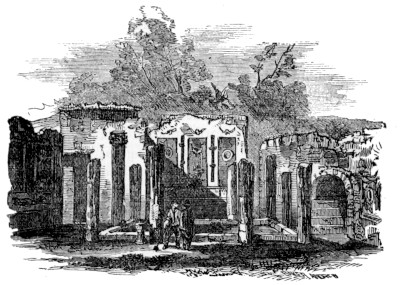
TEMPLE OF ISIS AT POMPEII.
Two theaters, the smaller one particularly, are in an excellent state of
preservation. The structure of this one is such as was usually adopted by
the ancients, and is better arranged than some of modern construction, as it
affords the spectators commodious seats, a free view of the stage, and facility
of hearing. Although sufficiently large to contain two thousand persons,
the plebeians, standing in a broad gallery at the top, were quite as able to
see all that was passing on the stage, as the magistrate in his marble balcony.
In this gallery the arrangements for spreading the sail-cloth over the spectators
are still visible. The stage itself is very broad, as it has no side walls;
357and appears less deep than it really is. A wall runs across it, and cuts off
just as much room as is necessary for the accommodation of the performers.
But this wall has three very broad doors; the middle one is distinguished
by its hight, and the space behind it is still deeper than in front. If these
doors, as may be conjectured, always stood open, the stage was in fact large,
and afforded besides the advantage of being able to display a double scenery:
if, for example, the scene in front was that of a street, there might have been
behind a free prospect into the open field.
The cemetery lies before the gate of the high road. The tomb of the
priestess Mammea is very remarkable: it was erected, according to the
epitaph, by virtue of a decree of the decemvirs. In the midst of little boxes
of stone, in square piles, and on a sort of altar, the family urns were placed
in niches; and without these piles the broken masks are still to be seen.
In front of the cemetery, by the road-side, is a beautiful seat, forming a
semicircle, that will contain twenty or thirty persons. It was probably overshaded
by trees eighteen hundred years ago; under which the women of
Pompeii sat in the cool evenings, while their children played before them,
and viewed the crowds which were passing through the gate.
To the above particulars from the pen of the elegant and lively Kotzebue,
the following details, given by a later and accurate traveler, are subjoined.
The entrance into Pompeii is by a quadrangular court; and this court is
surrounded on every side by a colonnade which supports the roof of a
gallery; and the latter leads to several small apartments, not unlike the
cells of a prison. The columns are of brick, stuccoed over, and painted of a
deep red: they are in hight from ten to twelve feet, are placed at about a
like distance from each other, and are of the Doric order, fluted two-thirds
from the top, and well proportioned. After a variety of conjectures relative
to the purpose to which this building was applied, it has been ascertained
that it was either a barrack for soldiers, (various pieces of armor having
been found in some of the cells,) or the prætorium of the governor, where a
body of military must have been stationed. Adjacent to it stood the theaters,
the forum, and one or two temples, all connected by very neat and well-paved
courts. The smaller of the theaters is to the right, and is called the covered
theater, because it was so constructed, that by the means of canvas awnings,
the spectators were defended from the sun and rain. A door through the
wall leads to the different galleries, and to the open space in the center,
resembling the pit of a modern theater. The interior is beautifully neat;
and with the exception of the spoliation of the marble slabs, removed to the
palace at Naples, with which the whole of the inside, not excepting the seats,
had been covered, it is in excellent preservation. On each side are the seats
358for the magistrates; the orchestra, as in modern theaters, is in front of the
stage; and the latter, with its brick wings, is very shallow. This theater
was calculated to contain about two thousand spectators. From its level a
staircase leads to an eminence on which several public buildings are situated.
The most conspicuous of these is a small temple said to have been dedicated
to Isis, and having a secret passage, perforated in two places, whence the
priests are supposed to have delivered to the deluded multitude the oracles
of that deity.
Within a paved court is an altar, of a round shape, on the one side, and
on the other side a well. A cistern, with four apertures, was placed at a
small distance, to facilitate the procuring of water. In this court, sacrifices
and other holy rites are conjectured to have taken place, various utensils for
sacrifice, such as lamps, tripods, &c., having been found, when the place was
first excavated. One of the tripods is of the most admirable workmanship.
On each of the three legs, a beautiful sphinx, with an unusual head-dress, is
placed, probably in allusion to the hidden meanings of the oracles which
were delivered in the above-mentioned temple. The hoop in which the basin
for the coals was sunk, is elegantly decorated with rams’ heads connected
by garlands of flowers; and within the basin, which is of baked earth, the
very cinders left from the last sacrifice (nearly two thousand years ago) are
seen as fresh as if they had been the remains of yesterday’s fire!
From the above court, you enter on a somewhat larger, with a stone pulpit
in the center and stone seats near the walls. The spot, therefore, was either
the auditory of a philosopher, or the place where the public orators pleaded
in the presence of the people. Everything here is in the highest order and
preservation.
The great amphitheater proudly rears its walls over every other edifice on
the same elevated spot. It is a stupendous structure, and has twenty-four
rows of seats, the circumference of the lowest of which is about seven hundred
and fifty feet. It is estimated to have contained about thirty thousand
spectators. The upper walls are much injured, having partially projected
above ground long before the discovery of Pompeii.
A corn-field leads to the excavated upper end of the high street, which
consists of a narrow road for carts, with foot-pavements on each side. The
middle is paved with large blocks of marble, and the ruts of the wheels proclaim
its antiquity, even at the time of its being overwhelmed. The foot-paths
are elevated about a foot and a half from the level of the carriage-road.
The houses on each side, whether shops or private buildings, have no claim
to external elegance: they consist of a ground-floor only, and, with the
exception of the door, have no opening toward the street. The windows of
359the private houses look into an inner square court, and are in general very
high. The apartments themselves are, with the exception of one in each
house, which probably served as a drawing-room, both low and diminutive.
In point of decoration they are neat, and, in many instances, elegant: the
floors generally consist of figured pavements, either in larger stones of various
colors, regularly cut and systematically disposed, or are formed of a beautiful
mosaic, with a fanciful border, and an animal or figure in the center. The
geometrical lines and figures in the design of the borders, have an endless
variety of the most pleasing shapes, to display the fertile imagination of the
artists. Their tesselated pavements alone must convince us that the ancients
were well skilled in geometry. The ground is usually white, and the ornaments
black; but other colors are often employed with increased effect.
The walls of the apartments are equally (if not still more) deserving attention.
They are painted, either in compartments, exhibiting some mythological
or historical event, or simply colored over with a light ground,
adorned with a border and perhaps an elegant little vignette, in the center
or at equal distances. But few of the historical paintings now exist in Pompeii;
for wherever a wall was found to contain a tolerable picture, it was
removed and deposited in the museum at Naples. To effect this, the greatest
care and ingenuity were required, so as to peel off, by the means of sawing
pieces of wall, twenty and more square feet in extent, without destroying the
picture. This, however, was not a modern invention; for, among the excavated
remains of Stabiæ, the workmen came to an apartment containing
paintings which had been separated by the ancients themselves from a wall,
with the obvious intent of their being introduced in another place. This
was, however, prevented by the ruin of the city; and the paintings, therefore,
were found leaning against the wall of the apartment.
Another excavated portion of Pompeii is likewise part of a street, and,
being perfectly in a line with the one already described, is conjectured to be
a continuation, or rather the extremity of the latter; in which case Pompeii
must have been a city of considerable importance, and its main street nearly
a mile in length. The houses here, as in the other instance, are distributed
into shops and private dwellings, some of the latter of which are distinguished
by the remains of former internal elegance, such as tesselated pavements,
painted walls, &c.: most of them have likewise an interior court, surrounded
by apartments.
360
The museum was formerly at Portici, but was removed to Naples some
years ago and is now called the Musæo Borbonico. The best statues, busts,
vases, and in short, whatever was supposed, from its materials or construction,
to have a superior value, were packed in fifty-two chests, and conveyed
from Portici to Palermo, at the time the court sought refuge in that city,
on the French penetrating into the Neapolitan territory. What still remains,
however, in the museum, has a high intrinsic value; since no one can behold,
without the strongest emotions of admiration, the relics of the most transitory
things, which for nearly eighteen hundred years, have braved the ravages
of time. Here are to be seen bread, corn, dough which was about to be
placed in the oven, soap which had been used for washing, figs, and even
egg-shells perfectly white, and in as good a state as if the cook had broken
them an hour before. Here a kitchen presents itself provided with everything
requisite: trivets and pots stand on the hearth; stew-pans hang on the
wall; skimmers and tongs are placed in the corner; and a metal mortar
rests on the shaft of a pillar. Weights, hammers, scythes, and other utensils
of husbandry, are here blended with helms and arms. Sacrificing bowls and
knives; a number of well shaped glasses; large and small glass bottles;
lamps; vases; decorations for furniture; a piece of cloth; nets; and even
shoe soles; all sorts of female ornaments—necklaces, rings and ear-rings; a
wooden chess-board, reduced, indeed, to a cinder: all these things are more
or less injured by the fire; but still are distinguishable at first sight.
Every apartment of the museum is laid with the most charming antique
floors, which are partly mosaic, from Pompeii, and partly marble, from Herculaneum.
Statues, vases, busts, chandeliers, altars, tables of marble and
bronze, are all in as good a state as if they had just come from the hands of
the artist. The coins which have been collected are very numerous, and fill
several cases. Medallions of marble, containing on each side a bas-relief, are
suspended by fine chains from the ceiling of one of the apartments, and are
within the reach of the hand, so as to be conveniently turned and examined.
Most of the pictures found at Herculaneum, Pompeii and Stabiæ, and now
deposited in the museum, have been sawed from the walls of the edifices they
adorned. These unique relics of ancient art form an extensive gallery of
genuine antique pictures, the only one in the world, and may on that account
alone, be considered as an invaluable treasure. They are placed in a range
of apartments on the ground floor, and are suspended against the walls in
plain frames. Their size varies from a foot square, to whole-length groups,
nearly as large as life. Beside the injury they have sustained by having
361been exposed to the heat of burning cinders, they have been impaired by the
modern varnish which was intended to protect them: it would, therefore, not
be right to subject their coloring to the rigid rules of art; but the grouping
of the Minotaur, of the Telephus, of the sitting Orestes, and of the Bacchus
and Ariadne, is admirable. In their paintings,
as well as in their sculptures, the ancients were
influenced by that love of simplicity which distinguishes
their works from those of the moderns,
and the result is, that in them the chief
merits of composition are combined, unity of
subject, and unity of interest. When, again, it
is considered that the paintings collected in the
museum at Naples were taken from the provincial
towns, it must be inferred, that those which
were admitted in the chief seats of art corresponded
in excellence with the Laocoön and the
Apollo. Such, at least, was the judgment of
the ancients themselves, and their taste is not
to be disputed.
The museum at Naples excels all others in
ancient bronze, a substance which, although
dearer, more difficult to be wrought, more
inviting to the rude grasp of avarice, and less
beautiful than marble, forms the greater proportion
of the statues. The larger of them had
been originally composed of pieces connected
by dove-tail joints; and these promiscuous fragments
have been recompiled into new figures,
as in the instance of the single horse made
from four, in the center of the court-yard of
the museum. Those fragments which had
escaped fusion, were rent, inflated, or bruised,
by the burning lava. In addition to these misfortunes,
they have been made up unhappily;
for the eye of an artist can sometimes detect
two styles of art, evidently different, the large
and the exquisite, soldered together in the same
statue. The figures the most admired are, the
drunken Faun, the sleeping Faun, the sitting
362Mercury, the Amazon adjusting her robe, and an Augustus and a Claudius,
both of heroic size.
The most remarkable objects in the museum at Naples are the manuscripts,
found in two chambers of a house at Herculaneum. Although they
have been so frequently described, they must be seen, to furnish a correct
idea of them. Before they are unrolled, they resemble sticks of charcoal, or
cudgels reduced to the state of a cinder, and partly petrified. Their general
appearance before they are unrolled may be seen on the previous page. In
color they are black and chesnut-brown: and they are unfortunately so
decayed, that under each of them, as they lie in glass cases, a quantity of
dust and detached fragments may be perceived. Their characters are legible
in a certain light only, by a gloss and relief which distinguishes the ink, or
rather black paint, from the tinder. Cut, crushed, crumbled on the edge, and
caked by the sap remaining in the leaves of the papyrus, they require in the
operator great sagacity to meet the variety of injuries they have received;
since, in gluing rashly the more delicate parts, he might reach the heart of a
volume, while working at the outside. At first, it appeared almost impracticable
ever to decipher a syllable of them; but to the industry and talents of
man nothing is impossible, and his curiosity impels him to the most ingenious
inventions.
This city was, together with Pompeii and Stabiæ, involved in the common
ruin occasioned by the dreadful eruption of Vesuvius, in the reign of Titus,
which has already been described in our previous pages.
It was situated on a point of land stretching into the gulf of Naples,
about two miles distant from that city, near where the modern towns of
Portici and Resini, and the royal palace, by which they are separated, now
stand. The neck of land on which it was built, and which has since disappeared,
formed a small harbor. Hence the appellation of Herculis Porticum,
(the small haven of Hercules,) sometimes given to Herculaneum, and
thence in all probability, the modern name of Portici.
The latter being situated immediately above some of the excavations of
Herculaneum, the just fear of endangering its safety, by undermining it, is
given as a principal reason why so little progress has been made in the Herculanean
researches.
The discovery of Herculaneum is thus explained. At an inconsiderable
distance from the royal palace of Portici, and close to the seaside, Prince
363Elbeuf, in the beginning of the last century, inhabited an elegant villa. To
obtain a supply of water a well was dug, in the year 1730, through the deep
crust of lava on which the mansion itself had been reared. The laborers,
after having completely pierced through the lava, which was of considerable
depth, came to a stratum of dry mud. This event precisely agrees with the
tradition relative to Herculaneum, that it was in the first instance overwhelmed
by a stratum of hot mud, which was immediately followed by a wide
stream of lava. Whether this mud was thrown up from Vesuvius, or formed
by torrents of rain, does not appear to have been decided. Within the
stratum the workmen found three female statues, which were sent to Vienna.
It was not until some years after this, that the researches at Herculaneum
were seriously and systematically pursued. By continuing Elbeuf’s well,
the excavators at once came to the theater, and from that spot carried on
their further subterraneous investigation. The condition of Herculaneum
was at that time much more interesting, and more worthy the notice of the
traveler, than it is at present. The object of its excavation having unfortunately
been confined to the discovery of statues, paintings, and other
curiosities, and not carried on with a view to lay open the city, and thus to
ascertain the features of its buildings and streets, most of the latter were
again filled up with rubbish as soon as they were divested of everything
movable. The marble even was torn from the walls of the temples. Herculaneum
may therefore be said to have been overwhelmed a second time by
its modern discoverers; and the appearance it previously presented, can now
only be ascertained from the accounts of those who saw it in a more perfect
state. Agreeably to them, it must at that time have afforded a most interesting
spectacle.
The theater was one of the most perfect specimens of ancient architecture.
It had, from the floor upward, eighteen rows of seats, and above these, three
other rows, which, being covered with a portico, seem to have been intended
for the female part of the audience, to screen them from the rays of the sun.
It was capable of containing between three and four thousand persons.
Nearly the whole of its surface, as well as the arched walls which led to its
seats, was cased with marble. The area, or pit, was floored with thick
squares of giallo antico, a beautiful marble of a yellowish hue. On the top
stood a group of four bronze horses, drawing a car, with a charioteer, all of
exquisite workmanship. The pedestal of white marble is still to be seen in
its place; but the group itself had been crushed and broken in pieces by the
immense weight of lava which fell on it. The fragments having been collected,
might easily have been brought together again, but having been carelessly
thrown into a corner, a part of them were stolen, and another portion
364fused, and converted into busts of their Neapolitan majesties. At length, it
was resolved to make the best use of what remained, that is, to convert the
four horses into one, by taking a fore leg of one of them, a hinder leg of
another, the head of a third, &c., and, where the breach was irremediable, to
cast a new piece. To this contrivance the bronze horse now shown in the
museum of Naples owes its existence; and, considering its patchwork origin,
it still conveys a high idea of the skill of the ancient artist.
In the forum, which was contiguous to the theater, beside a number of
inscriptions, columns, &c., two beautiful equestrian statues of the Balbi
family were found. These were of white marble, and were deposited in the
hall of the left wing of the palace at Portici. Adjoining to the forum stood
the temple of Hercules, an elegant rotunda, the interior of which was decorated
with a variety of paintings, such as Theseus returning from his Cretan
adventure with the Minotaur, Telephus’s birth, Chiron, the centaur,
instructing Achilles, &c. These were carefully separated from the walls,
and are deposited in the museum at Naples.
The most important discovery, however, was that of a villa, at a small
distance from the forum; not only on account of the peculiarity of its plan,
but because the greater number of the works of art were dug out of its
precinct; and more especially because it contained a library consisting of
more than fifteen hundred volumes, which are likewise safely deposited in
the museum, and which, were they legible, would form a great classic
treasure. These have been mentioned in the account of the museum at
Naples, which will be found on a previous page. The villa is conjectured
to have belonged to one of the Balbi family. Although elegant, it was
small, and consisted of a ground-floor only, like those of Pompeii. Beside
a number of small closets round an interior hall, it contained a bathing-room,
curiously fitted up with marble and water-pipes, and a chapel of a diminutive
size, without any window or aperture for daylight, the walls of which were
painted with serpents, and within which a bronze tripod, filled with cinders
and ashes, was found standing on the floor. The apartment which contained
the library was fitted up with wooden presses around the walls, about six
feet in hight: a double row of presses stood insulated in the middle of the
room, so as to admit a free passage on every side. The wood of which the
presses had been made, was burned to a cinder, and gave way at the first
touch; but the volumes, composed of a much more perishable substance, the
Egyptian or Syracusan papyrus, were, although completely carbonized
through the effect of the heat, still so far preserved as to admit of their
removal to a similar set of modern presses, (provided, however, with glass
doors,) in the museum.
365In the middle of the garden belonging to this villa, was a large basin,
having its edges faced with stone, and the two narrow ends rounded off in a
semicircular form. This piece of water was surrounded by beds or parterres
of various shapes; and the garden was on every side inclosed by a covered
walk supported by columns. Of these columns there were sixty-four, ten for
each of the shorter, and twenty-two for each of the longer sides of the quadrangle:
they were made of brick, neatly stuccoed over, exactly similar to
those in the Pompeian barracks. Each pillar supported one end of a wooden
beam, the other extremity of which rested on the garden wall, thus forming
an arbor, in all probability planted with vines around the whole garden.
Under this covered walk, several semicircular recesses, which appear to have
served as bathing-places, were built. The spaces between the pillars were
decorated with marble busts and bronze statues, alternately arranged. This
garden was surrounded by a narrow ditch; and another covered walk, of
a considerable length, led to a circular balcony, or platform, the ascent to
which was by four steps, but which overhung the sea about fifteen feet.
The floor of the balcony consisted of a very beautiful tesselated pavement.
From this charming spot the prospect over the whole bay of Naples, including
the mountains of Sorrento, the island of Capri, and Mount Posilipo, must
have been delightful.
Having thus given the accounts of Kotzebue, and also of an English
tourist, as to Pompeii and Herculaneum, we will now add the narrative of
our distinguished fellow-citizen, Professor Silliman, who passed over the
same ground in 1851. All these views are given, because the subject is one
of so much intrinsic interest, and because some objects are mentioned by
each writer that are not by the others. Professor Silliman says: “We passed
rapidly along through Portici, Resina, and Torre del Greco,[6] which form one
long-continued street, lying over Herculaneum, a large city, whose entombed
remains were far beneath our carriage wheels. Vesuvius was on our left,
quiet and sublime. Clouds vailed its crater from our view, but its venerable
sides were enveloped in the black drapery of its own lava floods. The currents
have often flowed over the road on which we were traveling. Here
and there, the lava had been cut through in the streets, and it protrudes in
366black, rocky masses, upon which many of the houses have been erected.
Lava formed the walls of the houses, and the fences around the fields, and
lava, only lava, was everywhere around us. After a short interval of
cultivated fields, we arrived in Torre del Annunciata, in a street similar to
those we had passed, and surrounded by a country in the highest state of
cultivation, where every foot of the rich volcanic soil is made available.
Farm-houses and villas appeared clustering around the eastern and southern
foot of Vesuvius, and creeping up its sloping sides, so reckless are the people
of past catastrophes, although Herculaneum reposes in its profound grave
at the foot of the mountain, and the great sepulcher of Pompeii, with its
funereal monuments, is in full view before them. They have also been very
recently warned again, by the terrific eruption of February, 1850, which,
bursting out back of Vesuvius, on the east, took an unwonted direction, thus
giving another proof that no situation on or near the mountain is safe; but
still the inhabitants repose in careless security.
“As we drove slowly onward, checking the horses from time to time, in
order to realize the scenes around us, Antonio, from the coach-box, suddenly
exclaimed, ‘There is Pompeii!’ We eagerly looked, and saw a low, green
ridge of land, covered by grass and shrubs. It appeared as an extended
mound, over which the traveler might have driven, as thousands have heedlessly
done in centuries past, unconscious that a city of the dead slumbered
beneath the hoofs of the horses. Only a few minutes elapsed, before standing
erect in the carriage, we discerned the still naked heaps of pumice that
have been thrown out during the excavations; and immediately after, in
breathless silence, we were at the door of the house of Diomede! An elegant
country-house, a Roman villa, just outside of the walls of the city, still
stands, almost eighteen hundred years after the great catastrophe. Its
columns are erect, its walls entire, and its open doors seem to invite the
stranger to enter; but the family are not there, and silence reigns in the
halls of Diomede!
“I never before felt as I did when I entered this deserted house—pensive,
solemn, and in full sympathy with the tragical story. Sentinels still keep
these doors; not the helmeted Roman, who, firm and unmoved, surveyed
the storm of fire but yielded not to fear, preferring to die at his post,[7] but
Neapolitans stationed there by the government to prevent invasion of the
ruins. One there was, a veteran, whose snowy hair, and visage so deeply
marked by time, made us almost feel as if he must have been present when
the volcanic tempest raged, and had, Salathiel-like, come down to our time
367to relate the events of those dreadful days. But a garrulous guide, who
spoke tolerable English, placed himself at the head of our party, and was
our cicerone through an intensely interesting day. We mused for a few
minutes in the vacant rooms of the house of Diomede, walked upon the still
beautiful mosaic pavements and floors, passed through the dormitories, the
triclinium, the impluvium, and the hall for conversation; observed the
water-cistern, and the channels worn in the stone curb by the friction of the
rope, and then descended to the vaults beneath, in which so many members
of the family met their fate. This gallery is strongly arched with brick, and
was used as a wine-cellar, as appears from twenty-five amphoræ still remaining
there, and which were found filled with volcanic matter.
“On the twenty-fourth of August, in the year 79 of our own era, and not
long after midday, Vesuvius broke the repose of untold ages, and resumed,
with tragical energy, his ancient reign of fire, awakening the slumbering
echoes of his power with terrible detonations and fearful earthquakes. A
darkness that might be felt, shrouded in the profoundest gloom the midday
sun, and ashes fell like snow upon the mountain, the plain, the bays of Naples
and Baiæ, and far into the surrounding country. Rain from the condensed
steam of the eruption deluged the whole district; torrents of fluid mud,
formed by the ashes and water, swept over every obstruction, and filled to
overflowing every depression of the surface. The terrified inhabitants, overwhelmed
by superstitious fears, joined the droves of domestic animals, whose
keener instincts had already impelled them to desert a district filled with
sulphureous vapors, and vibrating with ominous and unwonted sounds,
wandering, they knew not where, in search of some place where the frightful
evidences of the wrath of the gods might be avoided.
“But the family of Diomede sought refuge from the falling pumice under
the strong arch of the wine-cellar, strong enough to resist and sustain the
load of falling materials, but not proof against the deluge of volcanic mud,
whose unexpected inundation brought death to the mistress, her children,
and fifteen female slaves. The record of the manner of their death is even
now perfectly legible. The form of the mistress, with her back and head to
the wall, with outstretched arms, is clearly delineated by the difference of
color. Surrounding her are the impressions of the persons of seventeen
others, various in stature, but all standing, save one infant in the arms.
When these silent vaults were excavated, here stood the skeletons of these
unfortunate people, the rich jewels of the mistress and of her daughter
circling the bony fingers and wrists and neck. These we afterward saw in
the museum at Naples, the left shoulder of the mother, as also the skull of
the daughter, whose name, Julia, was engraved upon her bracelet. Equally
368strange and wonderful was it to see the cast of the bosom of this Roman
matron, taken with lifelike precision, in the soft and fluid tufa. Her hand
still grasped the purse, whose contents are also among the wonderful treasures
of the same museum. Beyond the garden and the fish-pond, which are
contiguous to the wine-cellar, there is a gateway where were found two
skeletons, with valuable vessels and money; one hand held a rusted key, and
the other a bag with coin and cameos, and vessels of silver and bronze were
here. These are believed to have been the remains of the master Diomede
and his servant. A wrapper contained eighty pieces of silver money, ten of
gold, and some bronze. It appears highly probable that, having left the
family in a place which was believed to be safe, they were engaged in transporting
valuables to a place of deposit, when they were overtaken by the
same deluge which destroyed their friends.
“The water-line to which the fluid magma rose in this quadrangular
vaulted gallery, is still visible upon the walls, (some twelve to fifteen inches
above the tallest head,) nearly even with several small apertures through
which, as well as through the door, it probably flowed. It is not unlikely
that this inundation was accompanied by torrents of carbonic acid and other
noxious gases, so abundantly exhaled in more modern eruptions of Vesuvius,
by which these refugees from the dangers above ground were perhaps so
suddenly suffocated as to remain unmoved in the positions where they were
found. The sudden death of the elder Pliny, who, his nephew says, was
suffocated by a noxious exhalation upon the same occasion, and at no great
distance from Pompeii, may, with much probability, be ascribed to the same
cause.
“The facts now detailed clearly show that vast torrents of mud must have
passed through the streets of Pompeii, since dry ashes and ejections of lapilli
and pumice, unaided by water, could never have found their way into the
interior of closed amphoræ, nor made perfect molds of the human form, nor
left a level water-line upon the inner walls of close arched passages. The
shower of materials which buried the city, was mainly composed of small
pieces of white pumice and rounded lapilli of various colors, interspersed
with some large projected masses of rock-bombs, such as Vesuvius has often
thrown out in later times. These by their fall broke through the roofs, and
at the places where they struck, depressed the mosaic pavements into a
concave form, as we saw in several of the houses. A darker colored sand
appears to have alternated with the pumice, and often forms a distinct and
thick layer upon it. Numerous such alternations have been made out by
the Neapolitan geologists, and we afterward saw the same order of stratification
distinctly in another part of the town, where fresh excavations were
369going on. The fresh section here showed, that these loose materials fell
much as snow falls in our northern climates when driven by the wind, being
thicker in the angles than in the centers of the houses, and rising in curves
corresponding to the elevations and depressions of the surface.
“The celebrated Appian way passed by the house of Diomede, and through
Pompeii to Stabiæ. The road is now above ground, and is evidently as
perfect as when Pompeii was buried. It is paved with large blocks of the
ancient lava of Mount Somma, which, of course, proves the occurrence of
early eruptions of the volcano, although at an unknown era. Deep ruts are
worn by the wheels in the solid lava, which is as firm as trap, while the
stones are strongly marked by the rust of the iron worn off from the wheel-tires.
The furrows prove that the wheels were not more than four feet
apart. This is proved also by the position of the stepping-stones for crossing
the streets, which were so placed that the wheels passed between them. The
stepping-stones were very large, and two and a half or three feet long, their
longest diameter coinciding with the direction of the street; and they were
laid so near to each other that the passengers could pass quite across the
street from one side-walk to the opposite, without stepping down. There
were side-walks in the principal streets, about three feet wide, and two feet
above the pavement. The streets were paved with the same hard lava rock,
and in many places it was worn into deep hollows by human feet, thus
proving the high antiquity of the city. The street near the barracks is only
thirteen feet wide. We passed through one street in which the pavement
was in very bad order; the ruts were worn irregularly and very deep, the
stones were tilted out of the proper level, and there, as sometimes happens
in modern cities, the street commissioners had evidently not done their
duty.
“The Appian way, near to Pompeii, but outside of the walls and immediately
contiguous to them, is, as at Rome, bordered on both sides by tombs.
and in general they are in good condition, having been preserved during
seventeen centuries equally from injuries by the weather and by wanton
violation. They are of marble, and their Latin inscriptions still commemorate
their tenants. One tomb, constructed in the manner of the columbaria,
is dedicated to the gladiators, and is decorated with bas-reliefs representing
their combats. Near the tombs, and outside of the walls, we saw sheds for
the horses of those who arrived after the gates of the city were closed. No
stables have been discovered in the town, but skeletons of horses were found
at this place, where there was a large tavern.
“Pompeii was first discovered in 1748. It lies about twelve miles south-east
from Naples. The town was extremely compact, and appears to have
370been only three-fourths of a mile long by half a mile wide. The houses were
joined together. Twenty streets, which are only fifteen feet wide, had been
uncovered twenty years since. Although only one-third part of the city has
been cleared of its covering, five or six hours were industriously employed
by us, with our two guides, in visiting the most interesting private dwellings
and the public buildings. We were indeed richly rewarded for our effort.
Here we were, walking in the very streets and on the very pavements on
which the ancient Romans trod; we were surveying the very houses in which
they dwelt: we saw the vestibules, the impluvium (an interior and central
receptacle for the rain-water from the roofs;) their triclinia, or dining-halls;
their colonnades, surrounding an interior open area, in which they walked
and conversed with their families and friends; the fish-ponds, also in an open
area; the private marble baths; the kitchens and other arrangements for
culinary purposes; the gardens in the rear of the houses, the halls and
colonnades opening into the garden; the whole forming a domestic dominion
secure from public inspection. All these arrangements were perfectly intelligible
to us; and as we walked from house to house, it was not difficult to
imagine that we were making calls, and that the people were not at home.
“Everywhere, even in the smaller houses, the floors were adorned with
mosaic; many of the best designs have been sent to Naples, but, including
what is still covered, much more remains in place, and not essentially injured.
When it is considered that no melted lava flowed into Pompeii, but that it
was covered solely by a volcanic shower of comminuted pumice and other
pulverulent materials, which accumulated until the roofs were crushed
inward by the weight, it will be easily understood that the mosaic floors may
have remained for seventeen or eighteen hundred years, substantially uninjured.
The mosaic of Pompeii is uncovered in many places, and when the
dust is brushed away and the surface is wiped with a wet cloth, as was done
for our gratification, all the original brightness and beauty of the figures
shine forth, and in the finest patterns, the execution was in a high degree
tasteful and elegant. At the door of the mansion of the edile Glaucus,
which was one of the largest and best in the city, there was, in the vestibule
and before entering the house, a very startling mosaic figure of a large and
powerful dog, secured by a chain around his neck, but crouching and fierce,
as if about to spring upon the visitor; and immediately before this vigilant
sentinel, you read in large Roman letters, CAVE CANEM—beware of the dog!
The inscription is preserved in the original place where we saw it, but the
dog has been removed to the museum at Naples. It is still a perfect figure
of a Roman dog.
“The frescoes of Pompeii and Herculaneum, have put us in possession of
371very perfect specimens of the skill of the Romans in the art of painting.
The only examples of their pictorial talent previously known, were the comparatively
imperfect decorations in the baths of Titus at Rome. In these
buried cities nearly all the walls of the houses are frescoed, and among these,
have been found many superb specimens of ancient art. Most of the best
have been removed to the museum of Naples, but some of considerable merit
still remain in place, and no doubt further excavations will show numerous
others now unknown. The colors are somewhat faded, but are bright when
wet. The copies in water-colors, sold at Naples, give very perfectly the idea
of these frescoes, but with more brilliancy than is possessed by the original.
Many of these figures are nude, although many are draped. We were particularly
struck with the singularity of some of the figures on the walls,
having shoes very much like our modern ones. As the great object of art is
to present Nature in her forms of greatest purity and grace, these nude
figures can not meet with more objections than their modern representatives.
We saw nothing in Pompeii or Herculaneum, worthy of so much criticism in
point of taste, as may be seen in almost any of the European galleries of
modern painting. Titian’s Loves of the Gods in Blenheim palace, certainly
surpass the ancients in this respect.
“An expected visit of the Duke d’Aumale (son of Louis Philippe, and
allied by marriage to the royal family of Naples) has been made the occasion
of an additional excavation, which is now being carried on by order of the
king. We thought it rare good fortune, that we could stand by and see the
moving of materials which had not been disturbed since the catastrophe.
They are entirely unconsolidated, and are easily moved by the shovel. The
accumulations did not appear to be more than ten feet above the tops of the
houses, but if measured from the level of the streets, they might have been
twenty feet in thickness. In it were distinctly visible the alternation of fine
pumice, coarse pumice, lapilli and dark colored sand, before mentioned.
“We had the pleasure of seeing apartments that had been recently opened,
and of going into several of them. In these, the pictures are fresh, and far
less faded than in those that have been long exposed. In one of these
houses, all the marble figures found around the impluvium, and colonnade,
and fountain, have been allowed to remain intact, as the Romans left them,
when they fled for their lives. Around the fountain in one of these houses,
there were numerous grotesque jets formed of marble, in the shape of miniature
bulls, ducks and dolphins, and associated with them was a Bacchus. A
leaden tube which formerly conveyed water for the fountain, remains in place
as it passed through the wall. We observed, as illustrating the condition of
the art of working this metal among the Romans, that the pipe was not
372drawn nor cast, but was made by folding up a sheet into the tubular form,
and closing the joint by a lap without solder. In this house was a large
vaulted music room, the walls of which are nearly perfect. The object for
which the room was constructed, was sufficiently indicated by figures of
musical instruments, and of persons playing upon them. Columns were in
general use in the better houses, around the included area, in the gardens,
and in other places. In the best dwellings they are of polished marble, in
many they are stuccoed. Some of the Roman houses, in their most perfect
and uninjured condition, must have been very beautiful, although their
accommodations were much more limited than those of modern times. The
rooms, the dormitories especially, were much smaller, and the houses were
low, and rarely rose above two stories. They were so constructed as to admit
of the most perfect domestic seclusion: no eye could scrutinize the family
privacy from the street, or from another house. Various names have been
given to several of the larger and more beautiful houses in Pompeii, sometimes
fanciful, but more frequently from some statue, mosaic, painting, or
other distinctive work of art found in them, referring, as is sometimes supposed,
to the owner. Thus we saw the houses of the Faun, of the Medusa,
of the three Fountains, and those of Pansa, of Glaucus, of Sallust, and of
Cicero. It is doubtful whether Cicero had a house at Pompeii, and still
more doubtful whether the one called by his name had any connection with
him. The three fountains in the house of that name, are decorated with
modern sea-shells, such as now abound in the Mediterranean, and in a style
of patterns still prevalent in Naples. The fountains in the two houses newly
exposed were very elegant, and in perfect condition.
“The forum was large and handsome, and surrounded with double rows
of columns for a covered colonnade. In connection with it, was a temple of
Jupiter, and another opposite to it, of Venus, both decorated with massive
monolithic columns. Half-dressed blocks of marble and portions of columns
lie on the ground in the forum, where they were in process of preparation, to
repair the injuries done to the building by the shocks of an earthquake, before
the destructive eruption. Numerous dislocated and propped walls in the
city bear testimony to the same event, which occurred in the year 63. Connected
with the forum, was the basilica or hall of justice, a structure
adorned with columns, and provided with an elevated tribune for the judges.
Vaulted apartments beneath, were used as a prison, communicating by a
circular opening in the crown of the arch, with the hall above. In this
prison, which we entered, were found three skeletons of prisoners, ironed to
the floor, doubtless waiting their examination at the time of the catastrophe,
which so unexpectedly changed the venue of their trial to another bar!
373Many acres are inclosed by the various structures of the forum, whose very
ruins, with their numerous columns, make a grand appearance. Among the
ruins, are those of a temple to Esculapius, one for Hercules, and another for
Fortune.
“Numerous monuments and inscriptions in Pompeii, indicate the Greek
origin of the original colony, and the Egyptian customs and society which
preceded the Roman dynasty. The temple of Isis still shows its sacrificial
altar, and inscriptions in Egyptian characters cover the columns. Some of
the largest and most beautiful of the silver vessels in the museum at Naples,
were found in this temple. Curiously enough, as we entered these ancient
precincts, in which the serpent was held sacred, a snake, reputed by the
guide as venomous, crossing our path, was made a victim, which we offered
on the altar.
“Beneath a superb portico in the street of the tombs, the skeletons of a
female and several children were discovered; in the street near the temple
of Isis, another skeleton was found at the depth of ten feet, and below it, a
large collection of gold and silver medals in perfect preservation, chiefly of
the reign of Domitian.
“The theaters, whose remains are distinct, are the comic, the tragic, and
the amphitheater. They were lined with polished marble, and were, in every
way, highly finished and elegant. Of the two former, the entire plan and
the greater part of the structure are visible, and most of the seats are in
place.
“The amphitheater was in a remote part of the city, near the eastern wall.
It has undergone so little dilapidation, that it appears almost perfect. We
approached it by ascending the ground until we were quite at the top, and
we then descended by the stone seats, quite to the arena, which, by pacing,
we found to be two hundred and forty feet by one hundred and twenty.
From the arena we looked up over the entire circuit and elevation of the
seats, which are almost perfectly preserved—thanks to the sepulture of seventeen
hundred years. Had this amphitheater been in the midst of Naples, as
the Coliseum was at Rome, it would, no doubt, have fared as ill at the hands
of the architects. It was easy for us now to people it in imagination, with
the thousands of Romans who have so often gazed and applauded from these
seats, while blood, both brute and human, was flowing in the arena where
we were standing. Such may have been the scenes when the tempest of fire
broke forth, for the people of Pompeii are said to have been then engaged in
the amphitheater.
“There are two buildings for public baths, which are well preserved; the
bronze seats and braziers still remain in them. For men, there was a common
374bath, circular and large enough for entire immersion; it is of marble,
and is now in good condition. The dome, or ceiling, has in part fallen in,
but the portion over the bath is preserved. We measured the room and
found it to be sixty feet by twenty. There was another bath for women,
contiguous to this, but at a proper distance. This marble bath is quite perfect,
and the room being entirely arched has been preserved uninjured. It is
most interesting. There is a living fountain at one end, and there was an
arrangement, whose object is even now quite apparent, for warming the
room by hot air or steam. Here, in this ancient ladies’ bath, we dined upon
our stores brought out from Naples. Intruding upon this retreat, once so
sacred, we seated ourselves quite conveniently, on the side of the bath, in a
fine frescoed room of sixty feet by sixteen. This was the most perfect building
that we saw in Pompeii. In this vicinity, there is a living fountain still
abundant, and the river Sarno runs at this moment beneath Pompeii.
Through a wide opening we saw its copious and lively stream still flowing in
its ancient channel, apparently undisturbed by volcanic and earthquake convulsions.
“The walls of Pompeii are still in good condition; they were three miles
in circuit, from eighteen to twenty feet high, and twenty feet thick. Seven
gates have been discovered; the gate of Herculaneum, of Vesuvius, of Capua,
of Nola, of Sarno, of Stabiæ, and of the theaters. The sites of nine towers
have been ascertained. We ascended the wall by stairs of stone, doubtless
coeval with the wall itself: the view was imposing. Vesuvius rose above the
desolated city, looking down upon its naked walls and roofless houses. The
volcanic mound still covers two-thirds of the city, and nothing on its upper
surface tells of what lies below. It were greatly to be desired, that an
enlightened and energetic government, with adequate means, would uncover
the entire city, with its numerous hidden works of art and materials of
history.
“The baker’s shop, with his oven of arched and modern form, the tub of
stone in which he wet his broom, and the hourglass-shaped mills of hard lava
for grinding the grain, we saw all perfect. There were mills of two sizes:
one small, such as could be turned by hand, as when ‘two women were
grinding at the mill,’ and one much larger, and provided with square holes
to receive the ends of levers, requiring, of course, much more force to turn
them, and doubtless worked by men. The shops of the wine and oil merchants
were provided with large amphoræ set in masonry under the counter,
for storing those fluids, and numerous other arrangements for the convenience
of the occupants were visible.
“In one house we saw a small circular window, in which part of the glass
375plate which originally filled it still remains. One other similar glass is said
to have been found, although shutters were in general use for most of the
windows. As there were no windows, as with us, opening upon the street,
and all the doors and windows of the house opened upon private courts and
gardens, there was in this mild and equable climate far less occasion for the
use of glass than might seem at first requisite. That they understood the
manufacture of glass, and how to color it, by the use of the oxyds of cobalt
and copper, is abundantly proved by the remains of this ancient art now in
the Borbonico museum, at Naples.
“One peculiarity in the construction of the Pompeian houses favors the
removal and preservation of the frescoes. The walls upon which the pictures
are painted are not solid, but the frescoed surface is supported by studs of
masonry or iron, at a distance of some four or five inches in front of the
brick walls. Security from dampness is thus obtained, and the task of
removing the valued surface much simplified and facilitated. The declining
sun found us still lingering on the seats of the amphitheater, at the remotest
angle of the city wall, dwelling with delight upon these memorials of the
past, and speculating upon the probability of renewed activity in Vesuvius,
whose quiet blue cone rose over our right shoulders crowned with a soft
cloud of vapor. It was late in the evening of this most interesting day when
we reached the door of our hotel, long after darkness had hidden the landscape.
“The Musæo Borbonico (as it is now called) contains all the most choice
and valued works of art and objects of interest which the excavations at
Herculaneum and Pompeii have brought to light. To this we repaired on
the day following our visit to Pompeii, to follow up our researches into the
details of these most interesting discoveries. Here we saw the golden ornaments
found upon the skeletons in the house of Diomede, as before mentioned,
and many others also. One pair of bracelets weighed a pound each.
As for the workmanship, all that was said of the Etruscan golden ornaments
is substantially true of the Pompeian. The ladies of these cities were certainly
well provided with costly jewelry, both of pure gold and of the same
metal set with precious stones. There was one ribbon of wrought gold.
Ring stones and brooches without number are preserved here, and among
the cameos in agate, are the largest as well as the smallest and most exquisite
of these elaborate works of art ever found. Many of the latter can be appreciated
only when examined under a strong magnifier.
376“Utensils in earthen ware are abundant, but porcelain seems to have been
unknown to the Romans. Blown and molded glass of various forms and
colors, and designed for various uses, is also common. Pickle jars and olive
jars, still retaining their preserved fruits in good condition, were found, and
others contained cosmetics or colors. One elegant vase, of the color of lapis
lazuli, has figures in white enamel cut on its sides, reminding us of the
celebrated Portland vase. The Romans seldom employed iron for culinary
purposes, but almost every vessel of this description was fashioned from
bronze. A very extensive collection is found in this museum, reproducing
nearly all our modern metallic vessels both of utility and ornament. They
are generally elegant in form, and are often ornamented with artistic designs,
especially in the attachment of the spouts, handles, feet or other prominent
parts. They are generally also in a remarkable state of preservation, being
for the most part merely covered by a thin coating of greenish rust, easily
removed. Sometimes, however, they are corroded through and through with
holes. Among the bronze vessels in the collection is one showing that the
Romans were well acquainted with the modern device of a heater to keep
liquids hot in a large vessel. It is quite on the model of the coffee urn of
our day. They also employed, as is evident, steam and hot water to keep
dishes hot; for there is a very pretty affair in bronze, like a shallow pan, to
hold water, set on legs, with a fire beneath, and provided with valves for the
escape of steam.
“Among the objects most frequently found in Pompeii are fishing-nets and
tackle, showing the habits of the people in this particular to be similar to
those of the modern towns of the same coast, although now Pompeii is a mile
from the sea. The iron rings in the walls for fastening vessels were also
found, and prove still more conclusively the accumulations in seventeen
hundred years. Two vases were discovered in Pompeii full of water; in one
it was tasteless and limpid, and in the other brown and alkaline. Among
the things preserved in the buried cities were walnuts, chestnuts, almonds,
dates, dried figs, prunes, corn, oil, peas, lentils, pies and hams. Papyri were
found in large numbers, but the rolls were blackened, as were the timber
and the corn, as vegetables are by inhumation in coal beds. Beside the
pickles, and olives, and roe of fish, already mentioned, we saw in a glass
globe, in this part of the museum, wheat, and barley also, blackened by age
and dampness. The loaves of bread, bearing the baker’s stamp, which were
found in the shop already named, are singularly perfect, showing distinctly
the lines of quartering in which the loaf was designed to be cut.
“The works of art found in Herculaneum are in general much better than
those from Pompeii, and every external sign proves it to have been a town
377of more refinement and wealth than its neighbor. Numerous statues in
bronze and marble have been collected from these cities, and a large hall in
the museum is devoted to their exhibition. Many are mythological, but
busts and statues of the several emperors are also common. One bronze
horse, considerably injured and corroded, has been found, and an admirable
bronze Hercules. The candelabra were numerous and elegant. One we
observed fitted to take apart for the convenience of traveling; its sliding rod
drops into a case or sheath, and the tripod foot folds together as snugly as
the wing of a bird. A very beautiful candelabrum, taken from the house of
Diomede, has a basis formed of a small flat table of bronze standing upon
feet. It is elegantly inlaid with silver in the form of a running vine and of
leaves; some portions have been burnished, to give an idea of its original
beauty. A perpendicular rod rises three feet in hight, and supports a cross
upon which are suspended four lamps. All the parts are preserved; and
were this tasteful candelabrum put in order and burnished, it would be a fine
form for our modern artists to copy, who, indeed, often profit by ancient
models.
“The Roman steelyards had a scale suspended so as to receive the thing
to be weighed, and the weight slid, as with us, upon a graduated beam; in
one the counterpoise is fashioned into an elegant female head. There is a
collection of surgical instruments, some of them very similar to those used at
the present day. Iron probes, iron teeth extractors, elevators for the operation
of trepanning, a cauterizing iron, lancets, catheters, amputating instruments,
spatulas and obstetric forceps. Along with these things are rolls of
the apothecary, ready to be divided into pills. The articles of the toilet are
abundant; pins of ivory in large numbers and great variety for the hair;
combs, curling-tongs, boxes for perfumes and rouge, which is preserved in a
small glass bottle; mirrors of metal, small, but sufficient for a lady’s face,
and reflectors, to be used probably in a position to give seasonable notice of
the approach of a visitor from the vestibule, similar to the arrangement now
common in Holland and Germany. Numerous small objects attracted our
attention, among which were the ivory dice, and tickets of bone or ivory for
admission to the theater, marked and numbered. Musical instruments were
common; among them numerous flutes or flageolets, prepared from bone.
Numerous bronze penates, truly dii minores, often less than a finger’s length
in hight, some partly finished, are to be seen in the museum at Naples.
“There is an apartment here, finished in the style of an ancient Roman
house. This is in the extreme end of one of the long suites of rooms. The
sky-blue panels have each, in the center, a female figure, volant or quiet; the
upper part of the side walls, and of the dome, is divided into compartments,
378which are decorated by colored lines and forms of great beauty, the entire
effect of which is charming. The eye delights to dwell upon them, and
would never be tired, because the beauty, although exquisite, is simple and
tasteful. We saw in the museum, as already mentioned, the helmet and
skull of the Roman sentinel found at his post in the city gate at Pompeii,
with his short sword by his side; there, too, was the complete armor of a
Roman knight with a decorated and crested helmet, with figures embossed
upon the breast-plate, and the coverings of the arms and limbs. We must
not forget the iron stocks for punishment. A bar of iron or bronze of great
weight had metallic projections standing upward, between which the feet were
placed, and secured by a cross pin. It does not appear that the head was
pinioned, as in modern times; but we could well understand how the feet
of the apostles were rendered lame by confinement in the Roman stocks.
“The hall of ancient sculpture, chiefly from Pompeii and Herculaneum,
with some figures from Rome, powerfully attracted our attention. These
sculptures, usually of full size, and sometimes colossal, are very fine.
Excellent, manly forms, and noble, elevated features of men, and of women,
worthy of such companions, with great variety of characteristic attitude, and
in general, in full costume, served to convey to us, as we may believe, a very
perfect idea of the personal appearance of Roman citizens of that age. The
family of Balbus found in Herculaneum, is particularly interesting. It is
composed of the father, a noble figure, the mother, equally impressive, and
sons and daughters worthy of such parentage. Their features are calm and
mild. It is a most interesting group, and in perfect preservation. The
moral and intellectual expression of the figures in these rooms—through a
long series of apartments and a host of figures—is as various as that of living
people.
“It is convenient to introduce here a notice of the Farnesian bull; for this
inimitable piece of sculpture is in this place, although it was not found
interred in Pompeii or Herculaneum, but buried among the ruins of the
baths of Caracalla. A large bull, of perfect and beautiful form, is rearing
upon his hind legs, as if about to bound away in his course; but this he is
prevented from doing, as he is powerfully held by the horns and the nose by
two resolute, athletic young men, one on each side, who have him in such
durance that his massive neck is wrinkled in large folds, as he turns his head
backward in his efforts to escape from their grasp. The cause of the struggle
becomes apparent, when we glance at a fine female form recumbent, and see
that her abundant tresses are interwoven with the strands of a rope which is
noosed around the horns of the bull, and it flashes at once on the mind, that
should the maddened animal escape from his keepers, she will be quickly
379torn in pieces. Her noble sons have, in a critical moment, sprung forward
to her rescue, and are just able to arrest her impending fate. Filial love
proves to be stronger than disapprobation of an imputed fault, for which their
mother was to have been immolated by this horrible death. In such a crisis
we are not careful to balance the moral question: we instinctively applaud
the filial piety, and do not ask for the spirit of Brutus. This wonderful
group was sculptured out of a single block of marble of nine feet eight inches
by thirteen feet, by Appollonius and Tauriscus, two artists in Greece, from
which country it was brought, to grace the baths of Caracalla. It is truly
wonderful that such a ponderous mass, embracing so many figures, could be
brought over seas, from a distant country, to Rome, and again be transported
from that city to Naples, without injury, after being buried for fifteen centuries
in the baths of Caracalla.
“The same eruption which destroyed Pompeii, Stabiæ, Oplontia and Teglanum,
entombed Herculaneum also. Its site was, however, unknown, as
well as that of the other buried towns; and the fatal event is only occasionally
alluded to by the Roman writers. In the year 63, an earthquake had
shattered these cities, a precursor of their coming doom. In 1711, a peasant,
in digging a well, discovered, at twenty feet depth, pieces of colored marble.
In 1713, the digging being continued, they struck down into a temple, and
discovered the statues of Cleopatra and Hercules; and subsequent explorations
disclosed the theater. Our time being very fully occupied with Pompeii
on the day when we were there, we reserved to another opportunity a
visit to Herculaneum. We descended quite conveniently down steps of
stone, and arrived at the pit of the theater, seventy-nine feet below the level
of the main street of Portici, and Torre del Greco. With a guide, we proceeded,
by the light of candles and torches, until we came to this subterranean
theater, which had been filled with volcanic materials. I do not call it
lava, because there is every reason to believe that, like Pompeii, Herculaneum
was buried by pumice, cinders, ashes, lapilli and sand. There has been
much discussion on this subject; but had the buildings of Herculaneum
been inclosed in heated lava, it is obvious that every fresco painting and
marble would have been destroyed, and much more, the numerous papyri
and other substances of an organic character, which have been found there.
Now it happens that the frescoes of Herculaneum, so far as it has been
uncovered, are not only of a higher character in respect of art than those in
Pompeii, but also in better preservation. The solidity of the material
380enveloping Herculaneum is easily understood, when we remember that it has
been for over seventeen hundred years under the enormous pressure of
seventy or eighty feet of superincumbent rock. Since the catastrophe of
August, A. D. 79, numerous flows of molten lava have passed over the site
of Herculaneum; and these successive accumulations have amounted to the
thickness just named. Add the effects of water, dissolving lime and silica,
and infiltrating these materials among the loose pumice, and we see cause
enough to account for the solidification of these loose materials. Moreover,
no sluggish and semi-viscid lava (such as the Vesuvian lavas a short distance
from their outlet always are) could ever have entered all the intricate
passages of the theater and other buildings; while a fluid magma of volcanic
mud would act in the same situation just as it is now found, like plaster of
Paris in a mold.
“When we see with what labor and expense the excavations have been
made in Herculaneum, and how difficult it is to dispose of the materials,
which must be borne a long way through narrow passages like the galleries
of a mine, and raised nearly one hundred feet to the surface, where a populous
town forbids the accumulation of rubbish; we are the more easily
reconciled to the suspension of the labor, and to the throwing of the fragments
into cavities that had been previously excavated, and from which all
interesting matters had been removed.
“Discoveries in Herculaneum have been very numerous, but are so similar
to those made in Pompeii that it is unnecessary to go much into detail
beyond what has been already mentioned. This city being, in fact, contemporary
with Pompeii, we should, of course, expect to find great similarity.
It would seem, however, to have been a grander city, and probably more
populous. It has been computed that the theater would contain ten
thousand people, which would imply a large population. Two temples were
discovered, one of them one hundred and fifty feet by sixty. This contained
a statue of Jupiter. Opposite to this was another building of two hundred
and twenty-eight feet by one hundred and thirty-two, supposed to have been
constructed for the courts of justice. It had a colonnade supporting a
portico; its pavement was of marble, its walls were frescoed, and there were
bronze statues standing between the forty-two columns that supported the
roof.
“The theater is now the only public place that can be seen in Herculaneum,
and the excavations have brought its form very distinctly into view.
Its marble seats and the pit have been so far cleared, that we distinctly comprehend
the design and plan. The galleries of access from the streets, and
some of the rooms that were appendages of the theater, have been opened.
381It appears to have had two principal gates and seven entrances, called vomitories.
Many statues, and mosaics, and frescoes, have been found in Herculaneum,
and some of them, especially the statues, are of surpassing beauty.
We were desirous to see the famed impression of a mask, and by holding a
candle near to it the form could be distinctly seen. The impression is in
concave, and is that of a strongly marked face of an adult; the copy is well
defined, and corresponds perfectly with a molding made by soft aqueous
materials, and not at all to one made by lava.
“The well, by which the light was originally let down upon the theater, of
course attracted our attention. It is now enlarged into a pit of fifteen to
twenty feet in diameter, and narrowed toward the bottom to the size of a
common well; it descends far below the bottom of the theater, and, like other
wells, contains water. A flood of light flows down through this orifice; and
it is cheering to pass from the dark chambers of the theater, to look up again
upon the light of heaven. The subterranean walk, aided by candles, of
which each person carries one, is, however, far from being unpleasant.
Steps are cut in the solid mass, all obstacles are cleared away, and although
we find it cool and damp, it is not gloomy, but in a high degree solemn and
impressive. We are walking in an ancient tomb—the tomb of a buried
city—a city which was large and populous. It was active with pleasure and
business long before our Saviour was on earth, and it was overwhelmed
while some of his apostles were still alive. How different was our situation
here and at Pompeii. In the latter city we walked the streets in open day
and on the common level: here, we were deep down in a stony sepulcher;
the mansions of the departed were all around us, but they were wrapped in
solid rock. The rumbling of the carriages in the streets of another city,
whose busy population was passing nearly one hundred feet above our heads,
was loud and incessant. It was an earthquake from above, and we could
easily understand how the earthquake from below should so readily propagate
its vibrations through many miles, or hundreds of miles, of solid materials.
Among the interesting places heretofore excavated, but now filled again,
were the basilica, the market, the scholæ, a columbarium, and the so-called
villa of Aristides, in which papyrus, bronzes, rare mosaics, and all things
that attested to the wealth and taste of the proprietor, were found. In
excavations made prior to 1728 they found the most splendid house of the
ancients that had ever been seen by modern eyes.
“A great work on Herculaneum was published by royal authority, in the
thirty-eight years intervening between 1754 and 1792, in nine folio volumes,
including the pictures, lamps, bronzes and candelabra; seven hundred and
thirty-eight pictures were named in the catalogue, and the other articles
382were proportionally numerous. The work was presented, by royal munificence,
to the principal public libraries of Europe.
“Both Herculaneum and Pompeii were mentioned with commendation by
Cicero. Both appear to have been favorite residences of the opulent
Romans; both towns were in the first class of provincial cities, and Herculaneum
especially was adorned by many villas. They had all the public
establishments that were usual in Rome. Indeed, the entire circuit, from
Cape Misenum around through the towns and villages of the bay of Baiæ,
and onward through Naples to Herculaneum, and Pompeii, and Stabiæ,
appears to have been within the range of Roman sumptuousness, and a cherished
resort for rural retirement from the eternal city.
“The papyri of Pompeii are generally illegible, being penetrated by the
pulverulent material, which, aided by water, had usurped the place of the
vegetable matter, or assimilated it to coal; a portion of it was found to be
soluble in naphtha. Those buried in Herculaneum were not penetrated by
the enveloping matter; and the inscriptions, although black like tinder,
could still be read, as writing can often be seen upon burnt paper. The
papyri MSS. were generally written in Greek; a few are in Latin. There is
much variety of chirography, and there are many erasures. Tickets were
attached to the bundles, stating the title of the work. In a single villa in
Herculaneum were found sixteen hundred and ninety-six rolls of papyrus,
of the eighteen hundred thus far known. In 1819, four hundred and seven
of the sixteen hundred and ninety-six had been unrolled, of which only
eighty-eight were legible; twenty-four had been sent as presents to foreign
princes; of the remaining twelve hundred and sixty-five, only from eighty to
one hundred and twenty were in a state to promise any success, according to
the chemical method at that time recommended by Sir Humphrey Davy.
The titles of four hundred of those least injured, which have been read,
although new are unimportant, music, rhetoric and cookery being the chief
subjects. There are two volumes of Epicurus on Nature, and there are
other works by that school. The rolls, in their coiled condition, were
scarcely a span long, and two or three inches thick; they were made of pieces
of Egyptian papyrus, glued together; some of the rolls were, when extended,
forty or fifty feet long. The method found most successful for unrolling the
papyri is to suspend them by silk cords in a glass case; and by attaching the
delicate lining membrane of some species of bird to the back, with the aid of
silken cords and regulated weights suspended by pulleys, gravity slowly
unfolds the brittle tissue at a rate of almost inappreciable tardiness. We
were permitted to see this curious process.
“A little further from Vesuvius than Pompeii, but in the same direction,
383was Stabiæ, which was covered at the same time with the other cities. The
town of Castel del Mare is built over a portion of it. A part of Stabiæ was
excavated, but has been covered again, so that at present there is nothing of
it to be seen. Some manuscripts on papyrus were found there, as at Herculaneum,
but very few skeletons have been discovered; it is probable that
most of the inhabitants had time to make their escape. I have elsewhere
alluded to the death of the elder Pliny, which happened here. As commander
of the Roman fleet, he was stationed on the opposite side of the bay,
at Cape Misenum; but the splendid outburst of Vesuvius, then novel,
induced him, prompted by his humanity and by his zeal in natural science,
to cross over with a few attendants; he approached too near, and was constrained
to remain over night. Being corpulent and of an asthmatic habit,
he was suffocated by the deadly gases exhaled in the volcanic tempest, which
proved too much for his peculiar condition, and he died on the spot. The
affecting and beautiful narrative written by his nephew, the younger Pliny,
addressed to the historian Tacitus, is familiar to the readers of Roman
literature, and can never be perused without a deep and painful interest.”
We would merely add, in closing this long but deeply interesting narrative
of the buried cities, that it is supposed that about one-third of the entire city
of Pompeii is now uncovered, including four principal streets, and all the
important buildings of the ancient city. A long street, leading to the Stabian
gate, is now being excavated; and in this street, one of the most remarkable
discoveries has been made of any which have yet occurred; viz., that of the
complete roofing of a house. As already stated, Pompeii, having been
destroyed by falling ashes, and then covered with earth, had suffered the loss
of the roofs of its houses. Indeed, some supposed they had been carried
away by a whirlwind which they imagined must have preceded or attended
the volcanic eruption. The little care used in clearing away the incumbent
matter, had left us in the dark as to the construction of the ancient roofings.
But quite recently, this discovery has been made of a complete roof of a
house, formed of tiles, each about twelve inches square, with coping tiles
running between them; and over the backbone, so to speak, of the construction,
a cement was applied to make the roofing water-tight. So perfect is
this roof, that it might have been constructed yesterday; and it would suit a
modern English or American cottage as well as a Roman dwelling. The
whole is now inclosed in a railing, and for the present will not probably be
removed.
EARTHQUAKES. — EARTHQUAKES OF ANCIENT TIMES. — EARTHQUAKE IN CALABRIA. — THE GREAT EARTHQUAKE OF 1755. — EARTHQUAKES IN SICILY, AND IN THE TWO CALABRIAS. — EARTHQUAKES IN PERU, &c. — EARTHQUAKE IN VENEZUELA.
384
“He looketh on the earth, and it trembleth: he toucheth the hills, and they smoke.”—Psalms.
“Towers, temples, palaces,
Flung from their deep foundations, roof on roof
Crushed horrible, and pile on pile o’erturned,
Fall total.”—Mallet.
“The globe around earth’s hollow surface shakes,
And is the ceiling of her sleeping sons.
O’er devastation we blind revels keep;
Whose buried towns support the dancer’s heel.”—Young.
That fires, to a very great extent, and produced by various causes, exist
at different depths beneath the surface of the earth, must be entirely evident
to those who have perused the accounts of volcanoes in our previous pages;
and recent experiments have shown, that where the substances in which
such fires occur, lie at a considerable depth, and are surmounted by a very
deep and heavy superincumbent pressure, more especially when they contain
large portions of elastic gases, the effect of such fires will be much greater,
and more diversified, than where these circumstances are absent.
Among the most powerful and extraordinary of these effects earthquakes
are to be reckoned. They are unquestionably the most dreadful of the phenomena
of nature, and are not confined to those countries which, from the
influence of climate, their vicinity to volcanic mountains, or any other similar
cause, have been considered as more particularly subject to them, their
effects having oft been felt in North America, although not in so extensive
and calamitous a degree. Their shocks and the eruptions of volcanoes, have
been considered as modifications of the effects of one common cause; and
where the agitation produced by an earthquake extends further than there
is reason to suspect a subterraneous commotion, it is probably propagated
through the earth nearly in the same way that a noise is conveyed through
the air. The different hypotheses which have been imagined on this subject
may be reduced to the following. Some naturalists have ascribed earthquakes
to water, others to fire, and others, again, to air; each of these
powerful agents being supposed to operate in the bowels of the earth, which
385they assert to abound everywhere with huge subterraneous caverns, veins
and canals, some filled with water, others with gaseous exhalations, and
others replete with various substances, such as niter, sulphur, bitumen and
vitriol. Each of these opinions has its advocates, who have written copiously
on the subject.
In a paper published in the “Philosophical Transactions,” Dr. Lister
ascribes earthquakes, as well as thunder and lightning, to the inflammable
breath of the pyrites, a substantial sulphur, capable of spontaneous combustion;
in a word, as Pliny had observed before him, he supposes an earthquake
to be nothing more than subterraneous thunder. Dr. Woodward
thinks, that the subterraneous fire which continually raises the water from
the abyss, or great reservoir, in the center of the earth, for the supply of dew,
rain, springs and rivers, being diverted from its ordinary course by some
accidental obstruction in the pores through which it is used to ascend to the
surface, becomes, by such means, preternaturally assembled in a greater
quantity than usual, in one place, and thus causes a rarefaction and intumescence
of the water of the abyss, throwing it into greater commotions, and
at the same time making the like effort on the earth, which, being expanded
on the surface of the abyss, occasions an earthquake. Mr. Mitchell supposes
these phenomena to be occasioned by subterraneous fires, which, if a large
quantity of water be let loose on them suddenly, may produce a vapor, the
quantity and elastic force of which may fully suffice for the purpose. Again,
M. Amontus, a member of the French Academy of Sciences, endeavors to
prove, that, on the principle of experiments made on the weight and elasticity
of the air, a moderate degree of heat may bring that element into a state
capable of causing earthquakes.
Modern electrical discoveries have thrown much light on this subject. Dr.
Stukely strenuously denies that earthquakes are to be ascribed to subterraneous
winds, fires or vapors, and thinks that there is not any evidence of the
cavernous structure of the earth, which such a hypothesis requires. Subterraneous
vapors he thinks, are altogether inadequate to the effects produced
by earthquakes, more particularly in cases where the shock is of considerable
extent: for a subterraneous power, capable of moving a surface of earth
only thirty miles in diameter, must be lodged at least fifteen or twenty miles
below the surface, and move an inverted cone of solid earth, whose basis is
thirty miles in diameter, and its axis fifteen or twenty miles, which he thinks
absolutely impossible. How much more inconceivable is it, then, that any
such power could have produced the earthquake of 1755, which was felt in
various parts of Europe and Africa, and in the Atlantic ocean; or that which
in Asia Minor, in the seventeenth year of the Christian era, destroyed thirteen
386great cities in one night, and shook a mass of earth three hundred miles
in diameter. To effect this, the moving power, supposing it to have been
internal fire or vapor, must have been lodged two hundred miles beneath the
surface of the earth! Besides, in earthquakes, the effect is instantaneous;
whereas the operation of elastic vapor, and its discharge, must be gradual,
and require a long space of time; and if these be owing to explosions, they
must alter the surface of the country where they happen, destroy the fountains
and springs, and change the course of its rivers, results which are contradicted
by history and observation.
To these and other considerations the doctor adds, that the strokes which
ships receive during an earthquake, must be occasioned by something which
can communicate motion with much greater velocity than any heaving of the
earth under the sea, caused by the elasticity of generated vapors, which
would merely produce a gradual swell, and not such an impulsion of the
water as resembles a violent blow on the bottom of a ship, or its striking on
a rock. Hence he deems the common hypothesis insufficient, and adduces
several reasons to show that earthquakes are in reality electric shocks. To
confirm this opinion, he notices, among other phenomena, either preceding
or attending earthquakes, that the weather is usually dry and warm for some
time before they happen, and that the surface of the ground is thus previously
prepared for that kind of electrical vibration in which they consist; while, at
the same time, in several places where they have occurred, the internal parts,
at a small depth beneath the surface, were moist and boggy. Hence he
infers, that they reach very little beneath the surface. That the southern
regions are more subject to earthquakes than the northern, he thinks is
owing to the greater warmth and dryness of the earth and air, which are
qualities so necessary to electricity. It may here be noticed, that, before the
earthquakes of London, in 1749, all vegetation was remarkably forward;
and it is well known, that electricity quickens vegetation. The frequent and
singular appearance of boreal and austral auroræ, and the variety of meteors
by which earthquakes are preceded, indicate an electrical state of the atmosphere;
and the doctor apprehends that, in this state of the earth and air,
nothing more is necessary to produce these phenomena, than the approach
of a non-electric cloud, and the discharge of its contents, on any part of the
earth, when in a highly electrified state. In the same way as the discharge
from an excited tube occasions a commotion in the human body, so the
shock produced by the discharge between the cloud and many miles in compass
of solid earth, must be an earthquake, and the snap from the contact
the noise attending it.
The theory of M. de St. Lazare differs from the above hypothesis, as to the
387electrical cause. It ascribes the production of earthquakes to the interruption
of the equilibrium between the electrical matter diffused in the atmosphere,
and that which belongs to the mass of our globe, and pervades its
bowels. If the electrical fluid should be superabundant, as may happen
from a variety of causes, its current, by the laws of motion peculiar to fluids,
is carried toward those places where it is in a similar quantity; and thus it
will sometimes pass from the internal parts of the globe into the atmosphere.
This happening, if the equilibrium be reëstablished without difficulty, the
current merely produces the effect of what M. de St. Lazare calls ascending
thunder; but if this reëstablishment be opposed by considerable and multiplied
obstacles, the consequence is then an earthquake, the violence and
extent of which are in exact proportion to the degree of interruption of the
equilibrium, the depth of the electric matter, and the obstacles which are to
be surmounted. If the electric furnace be sufficiently large and deep to
give rise to the formation of a conduit or issue, the production of a volcano
will follow, its successive eruptions being, according to him, nothing more in
reality than electric repulsions of the substances contained in the bowels of
the earth. From this reasoning he endeavors to deduce the practicability
of forming a counter-earthquake, and a counter-volcano, by means of certain
electrical conductors, which he describes, so as to prevent these convulsions
in the bowels of the earth.
The opinion of Signior Beccaria is nearly similar; and from his hypothesis
and that of Dr. Stukely, the celebrated Priestly has endeavored to form one
still more general and more feasible. He supposes the electric fluid to be,
in some mode or other, accumulated on one part of the surface of the earth,
and, on account of the dryness of the season, not to diffuse itself readily: it
may thus, as Beccaria conjectures, force its way into the higher regions of the
air, forming clouds out of the vapors which float in the atmosphere, and may
occasion a sudden shower, which may further promote its progress. The
whole surface being thus unloaded, will, like any other conducting substance,
receive a concussion, either on parting with, or on receiving any quantity of
the electric fluid. The rushing noise will likewise sweep over the whole
extent of the country; and, on this supposition also, the fluid, in its discharge
from the surface of the earth, will naturally follow the course of the
rivers, and will take the advantage of any eminences to facilitate its ascent
into the higher regions of the air.
Such are the arguments in favor of the electrical hypothesis; but, since it
has been supported with so much ability, an ingenious writer, Whitehurst, in
his “Inquiry into the Original State and Formation of the Earth,” contends
that subterraneous fire, and the steam generated from it, are the true and
388real causes of earthquakes. When, he observes, it is considered that the
expansive force of steam is to that of gunpowder as twenty-eight to one, it
may be conceded that this expansive force, and the elasticity of steam, are in
every way capable of producing the stupendous effects attributed to these
phenomena. This is, now, the almost universally received theory as to the
cause of earthquakes, that they originate in the same general causes which
produce volcanoes; that is, from the action of the heat and fires that are
found in the interior of the earth. When these fires find ready vent, they
produce the overflowing volcano; but when shut up and confined, their
force is so great as to shake the solid crust of the globe which covers them.
Among the most striking phenomena of earthquakes, which present a
fearful assemblage of the combined effects of air, earth, fire and water, in a
state of unrestrained contention, may be noticed the following. Before the
percussion a rumbling sound is heard, proceeding either from the air, or
from fire, or, perhaps, from both in conjunction, forcing their way through
the chasms of the earth, and endeavoring to liberate themselves: this, as has
been seen, likewise happens in volcanic eruptions. Secondly, a violent
agitation or heaving of the sea, sometimes preceding, and sometimes following
the shock: this is also a volcanic effect. Thirdly, a spouting up of the
waters to a great hight, a phenomenon which is common to earthquakes and
volcanoes, and which can not be readily accounted for. Fourthly, a rocking
of the earth, and, occasionally, what may be termed a perpendicular
rebounding: this diversity has been supposed by some naturalists to arise
chiefly from the situation of the place, relatively to the subterraneous fire,
which, when immediately beneath, causes the earth to rise, and when at a
distance, to rock. Fifthly, earthquakes are sometimes observed to travel
onward, so as to be felt in different countries at different hours of the same
day. This may be accounted for by the violent shock given to the earth at
one place, and communicated progressively by an undulatory motion, successively
affecting different regions as it passes along, in the same way as the
blow given by a stone thrown into a lake, is not perceived at the shore until
some time after the first concussion. Sixthly, the shock is sometimes instantaneous,
like the explosion of gunpowder, and sometimes tremulous, lasting
for several minutes. The nearer to the observer the place where the shock
is first given, the more instantaneous and simple it appears; while, at a
greater distance, the earth seems to redouble the first blow, with a sort of
vibratory continuation. Lastly, as the waters have in general so great a
share in the production of earthquakes, it is not surprising that they should
generally follow the breaches made by the force of fire, and appear in the
great chasms opened by the earth.
389
The earliest earthquake, worthy of notice, of which we have any record,
was that which in the year 63 so severely injured Herculaneum and Pompeii,
and from the effects of which they had not been restored when they were
overwhelmed by the volcano. Some of the most remarkable earthquakes of
ancient times are described by Pliny. Among the most extensive and
destructive of these, was the one already noticed, by which thirteen cities in
Asia Minor were swallowed up in one night. Another which succeeded,
shook the greater part of Italy. But the most extraordinary one, described
by him, happened during the consulate of Lucius Marcus and Sextus Julius,
in the Roman province of Mutina. He relates, that two mountains felt so
tremendous a shock, that they seemed to approach and retire with a most
dreadful noise. They at the same time, and in the middle of the day, cast
forth fire and smoke, to the dismay of the astonished spectator. By this
shock several towns were destroyed, and all the animals in their vicinity
killed. During the reign of Trajan, the city of Antioch was, together with
a great part of the adjacent country, destroyed by an earthquake; and about
three hundred years after, during the reign of Justinian, it was again
destroyed, with the loss of forty thousand of its inhabitants. Lastly, after an
interval of sixty years, that ill-fated city was a third time overwhelmed, with
a loss of sixty thousand souls. The earthquake which happened at Rhodes,
upward of two hundred years before the Christian era, threw down the
famous colossus, together with the arsenal, and a great part of the walls of
the city. In the year 1182, the greater part of the cities of Syria, and of the
kingdom of Jerusalem, were destroyed by a similar catastrophe; and in
1594, the Italian writers describe an earthquake at Puteoli, which occasioned
the sea to retire two hundred yards from its former bed.
The dreadful earthquake which happened in Calabria, in 1638, is described
by the Jesuit Kircher, who was at that time on his way to Sicily to visit
Mount Etna. In approaching the gulf of Charybdis, it appeared to whirl
round in such a manner as to form a vast hollow, verging to a point in the
center. On looking toward Etna, it was seen to emit large volumes of
smoke, of a mountainous size, which entirely covered the whole island, and
obscured from his view the very shores. This, together with the dreadful
noise, and the sulphurous stench, which was strongly perceptible, filled him
390with apprehensions that a still more dreadful calamity was impending. The
sea was agitated, covered with bubbles, and had altogether a very unusual
appearance. His surprise was still more increased by the serenity of the
weather, there not being a breath of air, nor a cloud, which might be supposed
to put all nature thus in motion. He therefore warned his companions
that an earthquake was approaching, and landed with all possible
diligence at Tropæa, in Calabria.
He had scarcely reached the Jesuits’ college, when his ears were stunned
with a horrid sound, resembling that of an infinite number of chariots driven
fiercely forward, the wheels rattling, and the thongs cracking. The tract
on which he stood seemed to vibrate, as if he had been in the scale of a
balance which still continued to waver. The motion soon becoming more
violent, he was thrown prostrate on the ground. The universal ruin around
him now redoubled his amazement: the crash of falling houses, the tottering
of towers, and the groans of the dying, all contributed to excite emotions of
terror and despair. Danger threatened him wherever he should flee; but,
having remained unhurt amid the general concussion, he resolved to venture
for safety, and reached the shore, almost terrified out of his reason. Here
he found his companions, whose terrors were still greater than his own. He
landed on the following day at Rochetta, where the earth still continued to
be violently agitated. He had, however, scarcely reached the inn at which
he intended to lodge, when he was once more obliged to return to the boat:
in about half an hour the greater part of the town, including the inn, was
overwhelmed, and the inhabitants buried beneath its ruins.
Not finding any safety on land, and exposed, by the smallness of the boat
to a very hazardous passage by sea, he at length landed at Lopizium, a castle
midway between Tropæa and Euphæmia, the city to which he was bound.
Here, wherever he turned his eyes, nothing but scenes of ruin and horror
appeared: towns and castles were leveled to the ground; while Stromboli,
although sixty miles distant, was seen to vomit flames in an unusual manner,
and with a noise which he could distinctly hear. From remote objects his
attention was soon diverted to contiguous danger: the rumbling sound of an
approaching earthquake, with which he was by this time well acquainted,
alarmed him for the consequences. Every instant it grew louder, as if
approaching; and the spot on which he stood shook so dreadfully, that being
unable to stand, he and his companions caught hold of the shrubs which
grew nearest to them, and in that manner supported themselves.
This violent paroxysm having ceased, he now thought of prosecuting his
voyage to Euphæmia, which lay within a short distance. Turning his eyes
toward that city, he could merely perceive a terrific dark cloud, which seemed
391to rest on the place. He was the more surprised at this, as the weather was
remarkably serene. Waiting, therefore, until this cloud had passed away, he
turned to look for the city; but, alas! it was totally sunk, and in its place a
dismal and putrid lake was to be seen. All was a melancholy solitude, a
scene of hideous desolation. Such was the fate of the city of Euphæmia;
and the other devastating effects of this earthquake were so great, that along
the whole coast of that part of Italy, for the space of two hundred miles, the
remains of ruined towns and villages were everywhere to be seen, and the
inhabitants, without dwellings, dispersed over the fields. Kircher at length
terminated his distressful voyage, by reaching Naples, after having escaped a
variety of perils both by sea and land.
This very remarkable and destructive earthquake extended over a tract
of at least four millions of square miles. It appears to have originated
beneath the Atlantic ocean, the waves of which received almost as violent a
concussion as the land. Its effects were even extended to the waters, in many
places where the shocks were not perceptible. It pervaded the greater portions
of the continents of Europe, Africa and America; but its extreme
violence was exercised on the south-western part of the former.
Lisbon, the Portuguese capital, had already suffered greatly from an earthquake
in 1531; and, since the calamity about to be described, has had three
such visitations, in 1761, 1765, and 1772, which were not, however, attended
by equally disastrous consequences. In the present instance it had been
remarked that since the commencement of the year 1750, less rain had fallen
than had been known in the memory of the oldest of the inhabitants, unless
during the spring preceding the calamitous event. The summer had been
unusually cool; and the weather fine and clear for the last forty days. At
length, on the first of November, about forty minutes past nine in the morning,
a most violent shock of an earthquake was felt; its duration did not
exceed six seconds; but so powerful was the concussion, that it overthrew
every church and convent in the city, together with the royal palace, and the
magnificent opera house adjoining to it; in short, no building of any consequence
escaped. About one-fourth of the dwelling-houses were thrown
down; and, at a moderate computation, thirty thousand persons perished.
The sight of the dead bodies, and the shrieks of those who were half-buried
in the ruins, were terrible beyond description; and so great was the consternation,
that the most resolute man durst not stay a moment to extricate
the friend he loved most affectionately, by the removal of the stones
392beneath the weight of which he was crushed. Self-preservation alone was
consulted; and the most probable security was sought, by getting into open
places, and into the middle of the streets. Those who were in the upper
stories of the houses, were in general more fortunate than those who
attempted to escape by the doors, many of the latter being buried beneath
the ruins, with the greater part of the foot-passengers. Those who were in
carriages escaped the best, although the drivers and horses suffered severely.
The number, however, of those who perished in the streets, and in the houses,
was greatly inferior to that of those who were buried beneath the ruins of the
churches; for, as it was a day of solemn festival, these were crowded for the
celebration of the mass. There were very many of these churches; and the
lofty steeples in most instances, fell with the roof, insomuch that few escaped.
The first shock, as has been noticed, was extremely short, but was quickly
succeeded by two others; and the whole, generally described as a single
shock, lasted from five to seven minutes. About two hours after, fires broke
out in three different parts of the city; and this new calamity prevented the
digging out of the immense riches concealed beneath the ruins. From a
perfect calm, a fresh gale immediately after sprang up, and occasioned the
fire to rage with such fury, that in the space of three days the city was nearly
reduced to ashes. Every element seemed to conspire toward its destruction;
for, soon after the shock, which happened near high-water, the tide rose in
an instant forty feet, and at the castle of Belem, which defended the entrance
of the harbor, fifty feet higher than had ever been known. Had it not subsided
as suddenly, the whole city would have been submerged. A large new
quay sunk to an unfathomable depth, with several hundreds of persons, not
one of the bodies of whom was afterward found. Before the sea thus came
rolling in like a mountain, the bar was seen dry from the shore.
The terrors of the surviving inhabitants were great and multiplied. Amid
the general confusion, and through a scarcity of hands, the dead bodies could
not be buried, and it was dreaded that a pestilence would ensue; but from
this apprehension they were relieved by the fire, by which these bodies were
for the greater part consumed. The fears of a famine were more substantial;
since, during the three days succeeding the earthquake, an ounce of bread
was literally worth a pound of gold. Several of the corn magazines having
been, however, fortunately saved from the fire, a scanty supply of bread was
afterward procured. Next came the dread of the pillage and murder of
those who had saved any of their effects; and this happened in several
instances, until examples were made of the delinquents. The great shock
was succeeded about noon by another, when the walls of several houses
which were still standing, were seen to open, from the top to the bottom,
393more than a fourth of a yard, and afterward to close again so exactly as not
to leave any signs of injury. Between the first and the eighth of November
twenty-two shocks were reckoned.
A boat on the river, about a mile distant from Lisbon, was heard by the
passengers to make a noise as if it had run aground, although then in deep
water: they at the same time saw the houses falling on both sides of the
river, in front of which, on the Lisbon side, the greater part of a convent fell,
burying many of its inmates beneath the ruins, while others were precipitated
into the river. The water was covered with dust, blown by a strong northerly
wind; and the sun entirely obscured. On landing, they were driven by
the overflowing of the waters to the high grounds, whence they perceived
the sea, at a mile’s distance, rushing in like a torrent, although against wind
and tide. The bed of the Tagus was in many places raised to its surface;
while ships were driven from their anchors, and jostled together with such
violence that their crews did not know whether they were afloat or aground.
The master of a ship, who had great difficulty in reaching the port of Lisbon,
reported that, being fifty leagues at sea, the shock was there so violent as to
damage the deck of the vessel. He fancied he had mistaken his reckoning,
and struck on a rock.
The following observations, relative to this fatal earthquake, were made at
Colares, about twenty miles from Lisbon, and within two miles of the sea.
On the last day of October, the weather was clear, and remarkably warm for
the season. About four o’clock in the afternoon a fog arose, proceeding
from the sea, and covering the valleys, which was very unusual at that season
of the year. The wind shifted soon after to the east, and the fog returned to
the sea, collecting itself, and becoming exceedingly thick. As the fog retired,
the sea rose with a prodigious roaring. On the first of November, the day
broke with a serene sky, the wind continuing at the east; but about nine
o’clock the sun began to be obscured; and about half an hour after a rumbling
noise was heard, resembling that of chariots, and increasing to such a
degree, that at length it became equal to the explosions of the largest
artillery. Immediately a shock of an earthquake was felt; and this was
succeeded by a second and a third, at the same time that several light flames
of fire, resembling the kindling of charcoal, issued from the mountains.
During these three shocks, the walls of the buildings moved from east to west.
In another spot, where the sea-coast could be descried, a great quantity of
smoke, very thick, but somewhat pale, issued from the hill named the Fojo.
This increased with the fourth shock, at noon, and afterward continued to
issue in a greater or less degree. At the instant the subterraneous rumblings
were heard, the smoke was observed to burst forth at the Fojo; and
394its volume was constantly proportioned to the noise. On visiting the spot
whence it was seen to arise, no sign of fire could be perceived near it. After
the earthquake, several fountains were dried up; while others, after undergoing
great changes, returned to their pristine state. In places where there
had not been any water, springs burst forth, and continued to flow; several
of these spouted to the hight of nearly twenty feet, and threw up sand of
various colors. On the hills, rocks were split, and the earth rent; while
toward the coast several large portions of rock were thrown from the eminences
into the sea.
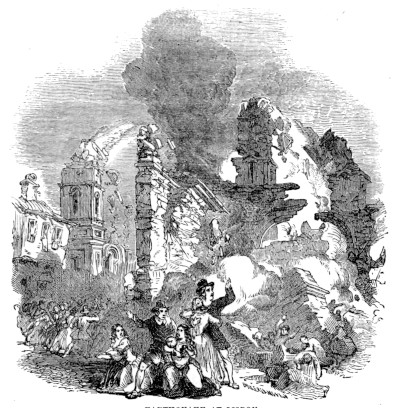
At Oporto, the earthquake was felt with great violence. The river continued
to rise and fall five or six feet, for four hours; the houses of the city
were rocked as if by convulsions, and the earth was seen to heave up. St.
Ubes, twenty miles distant, was entirely swallowed up by the repeated
shocks, and by the vast surf of the sea. And at Cadiz it was so violent,
that, but for the great solidity of the buildings, everything would have
been destroyed. Those who had quitted the houses and churches, seeking
395safety in the open air, had scarcely recovered from their first terror, when
they were plunged into a new alarm. At ten minutes after eleven o’clock, a
wave was seen coming from the sea at the distance of eight miles, and at least
sixty feet higher than usual. It dashed against the west part of the city,
which is very rocky. Although its force was much broken by these rocks, it
at length reached the walls, and beat in the breastwork, which was sixty feet
above the ordinary level of the water, removing pieces of the fabric, of the
weight of eight or ten tuns, to the distance of forty or fifty yards. At half
past eleven came a second wave; and this was followed by four others of
equal magnitude. Others, but smaller, and gradually lessening, continued
at uncertain intervals until the evening. A considerable part of the rampart
was thrown down, and carried by the torrent above fifty paces. Several
persons perished on the causeway leading to the isle of Lesu. The accounts
brought to Cadiz reported that Seville had been much damaged, and that a
similar fate had attended St. Lucar and Cheres. Conel was said to have
been destroyed; and, indeed, with the exception of the provinces of Catalonia,
Aragon and Valencia, the effects of this earthquake were felt throughout
Spain.
At Madrid the shock was very sensibly felt soon after ten in the morning,
and lasted five or six minutes. At first the inhabitants fancied they were
seized with a swimming in the head; and, afterward, that the houses were
falling. In the churches the sensations were the same, and the terror so
great, that the people trod each other under foot in getting out. Those who
were within the towers were still more affrighted, fancying every instant
while the shock lasted, that they were falling to the ground. It was not
sensible to those who were in carriages, and very little so to foot-passengers.
At Gibraltar it was felt about the same time as at Madrid, and began with
a tremulous motion of the earth, which lasted about half a minute. A
violent shock succeeded; and this again was followed by a second tremulous
motion, of the duration of five or six seconds. Another shock, not so violent
as the first, subsided gradually; and the whole lasted about two minutes.
Several of the guns on the batteries were seen to rise, and others to sink,
while the earth had an undulating motion. The greater part of the garrison
and inhabitants were seized with giddiness and sickness: several fell prostrate;
others were stupefied; and many who were walking or riding, became
sick, without being sensible of any motion of the earth. Every fifteen minutes
the sea rose six feet; and then fell so low, that the boats and small
vessels near the shore were left aground, as were also numbers of small fish.
The flux and reflux lasted till next morning, having decreased gradually
from two in the afternoon.
396In Africa, this earthquake was felt almost as severely as it had been in
Europe. A great part of the city of Algiers was destroyed. At Arzilla, a
town belonging to the kingdom of Fez, about ten in the morning, the sea
suddenly rose with such impetuosity, that it lifted up a vessel in the bay, and
impelled it with such force on the land, that it was shattered in pieces; and
a boat was found two musket-shots within land from the sea. At Fez and
Mequinez, great numbers of houses fell down, and a multitude of people
were buried beneath the ruins. At Morocco, similar accidents occurred;
and at Salle also, much damage was done. At Tangier the earthquake
began at ten in the morning, and lasted ten or twelve minutes. At Tetuan
it commenced at the same time, but was of less duration; three of the shocks
were so extremely violent, that it was feared the whole city would be
destroyed.
In the city of Funchal, in the island of Madeira, a shock of this earthquake
was felt at thirty-eight minutes past nine in the morning. It was preceded
by a rumbling noise in the air, like that of empty carriages passing hastily
over a stone pavement. The observer felt the floor beneath him immediately
to be agitated by a tremulous motion, vibrating very quickly. The shock
continued more than a minute; during which space the vibrations, although
continual, were twice very sensibly weakened and increased in force. The
increase after the first remission of the shock was the most intense. During
the whole of its continuance it was accompanied by a noise in the air; and
this lasted some seconds after the motion of the earth had ceased, dying
away like a peal of distant thunder rolling through the air. At three-quarters
past eleven, the sea, which was quite calm, suddenly retired several
paces; when rising with a great swell, and without any noise, it as suddenly
advanced, overflowed the shore, and entered the city. It rose fifteen feet
perpendicularly above high-water mark, although the tide, which there flows
seven feet, was at half-ebb. The water immediately receded; and after
having fluctuated four or five times between high and low water mark, it
subsided, and the sea remained calm as before. In the northern part of the
island the inundation was more violent, the sea there retiring above a hundred
paces at first, and suddenly returning, overflowed the shore, forcing open
doors, breaking down the walls of several magazines and storehouses, and
leaving great quantities of fish ashore and in the streets of the village of
Machico. All this was the effect of one rising of the sea, for it never afterward
flowed high enough to reach the high-water mark. It continued,
however, to fluctuate here much longer before it subsided than at Funchal;
and in some places further to the westward, it was hardly, if at all, perceptible.
397These were the phenomena with which this remarkable earthquake was
attended, in those places where it was most violent. The effects of it, however,
reached to an immense distance; and were perceived chiefly by the
agitations of the waters, or some slight motion of the earth. Its utmost
boundaries to the south are unknown; the barbarousness of the African
nations rendering it impossible to procure any intelligence from them, except
where the effects were dreadful. On the north, however, we are assured,
that it reached as far as Norway and Sweden. In the former kingdom, the
waters of several rivers and lakes were violently agitated. In the latter,
shocks were felt in several provinces, and all the rivers and lakes were
strongly agitated, especially in Dalecarlia. The river Dala suddenly overflowed
its banks, and as suddenly retired. At the same time, a lake at the
distance of a league from it, and with which it had no manner of communication,
bubbled up with great violence. At Fahlun, a town in Dalecarlia,
several strong shocks were felt.
In many places of Germany the effects of this earthquake were very perceptible;
but in Holland, the agitations were still more remarkable. At
Alphen on the Rhine, between Leyden and Woerden, in the afternoon of the
first of November, the waters were agitated to such a violent degree, that
buoys were broken from their chains, large vessels snapped their cables,
small ones were thrown out of the water upon the land, and others lying on
land were set afloat. At Amsterdam, about eleven in the forenoon, the air
being perfectly calm, the waters were suddenly agitated in the canals, so
that several boats broke loose; chandeliers were observed to vibrate in the
churches; but no motion of the earth, or concussion of any building was
observed. At Haerlem, in the forenoon, for nearly four minutes, not only
the waters in the rivers, canals, &c., but also all kinds of fluids in smaller
quantities, as in coolers, tubs, &c., were surprisingly agitated, and dashed
over the sides, though no motion was perceptible in the vessels themselves.
In these small quantities also the fluid apparently ascended prior to its turbulent
motion; and in many places, even the rivers and canals rose one foot
perpendicularly.
The agitation of the waters was also perceived in various parts of Great
Britain and Ireland. At Barlborough, in Derbyshire, between eleven and
twelve in the forenoon, in a boat-house on the west side of a large body of
water, called Pibley Dam, supposed to cover at least thirty acres of land, was
heard a surprising and terrible noise; a large swell of water came in a current
from the south, and rose two feet on the sloped dam-head at the north
end of the water. It then subsided, but returned again immediately, though
with less violence. The water was thus agitated for three-quarters of an
398hour; but the current grew every time weaker and weaker, till at last it
entirely ceased.
At Busbridge, in Surrey, at half an hour after ten in the morning, the
weather being remarkably still, without the least wind, in a canal nearly
seven hundred feet long, and fifty-eight in breadth, with a small spring constantly
running through it, a very unusual noise was heard at the east end,
and the water there observed to be in great agitation. It raised itself in a
heap or ridge in the middle; and this heap extended lengthwise about thirty
yards, rising between two and three feet above the usual level. After this,
the ridge heeled or vibrated toward the north side of the canal, with great
force, and flowed above eight feet over the grass walk on that side. On its
return back into the canal, it again ridged in the middle, and then heeled
with yet greater force to the south side, and flowed over its grass walk.
During this latter motion, the bottom on the north side was left dry for
several feet. This appearance lasted for about a quarter of an hour, after
which the water became smooth and quiet as before. During the whole
time, the sand at the bottom was thrown up and mixed with the water; and
there was a continual noise like that of water turning a mill. At Cobham, in
Surrey, Dunstall, in Suffolk, Earsy Court, in Berkshire, Eatonbridge, Kent,
and many other places, the waters were variously agitated.
At Eyam bridge, in Derbyshire Peak, the overseer of the lead mines,
sitting in his writing-room, about eleven o’clock, felt a sudden shock, which
very sensibly raised him up in his chair, and caused several pieces of plaster
to drop from the sides of the room. The roof was so violently shaken, that
he imagined the engine-shaft had been falling in. Upon this he immediately
ran to see what was the matter, but found everything in perfect safety. At
this time two miners were employed in carting, or drawing along the drifts
of the mines, the ore and other materials to be raised up at the shafts. The
drift in which they were working was about a hundred and twenty yards
deep, and the space from one end to the other fifty yards or upward. The
miner at the end of the drift had just loaded his cart, and was drawing it
along; but he was suddenly surprised by a shock, which so terrified him, that
he immediately quitted his employment, and ran to the west end of the drift
to his partner, who was no less terrified than himself. They durst not
attempt to climb the shaft, lest that should be running in upon them: but
while they were consulting what means they should take for their safety,
they were surprised by a second shock, more violent than the first; which
frightened them so much, that they both ran precipitately to the other end
of the drift. They then went down to another miner, who worked about
twelve yards below them. He told them that the violence of the second
399shock had been so great, that it caused the rocks to grind upon one another.
His account was interrupted by a third shock, which, after an interval of
four or five minutes, was succeeded by a fourth, and, about the same space
of time after, by a fifth; none of which were so violent as the second. They
heard, after every shock, a loud rumbling in the bowels of the earth, which
continued about half a minute, gradually descending, or seeming to remove
to a greater distance.
At Shireburn Castle, Oxfordshire, a little after ten in the morning, a very
strange motion was observed in the water of a moat which encompassed the
building. There was a pretty thick fog, not a breath of air, and the surface
of the water all over the moat was smooth as a looking-glass, except at one
corner, where it flowed into the shore, and retired again successively, in a
surprising manner. How it began to move is uncertain, as it was not then
observed. The flux and reflux, when seen were quite regular. Every flood
began gently, its velocity increasing by degrees, until at length it rushed in
with great impetuosity, till it had attained its full hight. Having remained
for a little time stationary, it then retired, ebbing gently at first, but afterward
sinking away with great swiftness. At every flux the whole body of
water seemed to be violently thrown against the bank; but neither during
the time of the flux, nor that of the reflux, did there appear even the least
wrinkle of a wave on the other parts of the moat. Lord Parker, who had
observed this motion, being desirous to know whether it was universal over
the moat, sent a person to the other corner of it, at the same time that he
himself stood about twenty-five yards from him to examine whether the water
moved there or not. He could not perceive any motion there; but another
person, who went to the north-east corner of the moat, diagonally opposite to
his lordship, found it as considerable there as where he was. His lordship
imagining, that in all probability the water at the corner diagonally opposite
to where he was would sink as that by him rose, ordered the person to signify
by calling out, when the water by him began to sink, and when to rise.
This he did; but to his lordship’s great surprise, immediately after the water
began to rise at his own end, he heard the voice calling that it began to rise
with him also; and in the same manner he heard that it was sinking at that
end, soon after he perceived it to sink by himself. A pond just below was
agitated in a similar manner; but the risings and sinkings happened at
different times from those at the pond where Lord Parker stood.
At White Rock, in Glamorganshire, about two hours’ ebb of tide, and near
a quarter to seven in the evening, a vast quantity of water rushed up with a
great noise, floated two large vessels, the least of them above two hundred
tuns’ burden, broke their moorings, drove them across the river, and nearly
400overset them. The whole rise and fall of this extraordinary body of water
did not last above ten minutes, nor was it felt in any other part of the river,
so that it seemed to have gushed out of the earth at that place.
Similar instances occurred at Loch Lomond and Loch Ness, in Scotland.
At Kinsale, in Ireland, and all along the coast to the westward, many similar
phenomena were observed.
Shocks were also perceived in several parts of France, as at Bayonne,
Bourdeaux and Lyons; and commotions of the waters were observed at
Angoulesme, Belleville, Havre de Grace, &c., but not attended with the
remarkable circumstances above mentioned.
These are the most striking phenomena with which the earthquake of the
first of November, 1755, was attended on the surface of the earth. Those
which happened below ground can not be known but by the changes observed
in springs, &c., which were in many places very remarkable.
At Tangier, all the fountains were dried up, so that there was no water to
be had till night. A very remarkable change was observed in the medicinal
waters of Toplitz, a village in Bohemia, famous for its baths. These waters
were discovered in the year 762; from which time the principal spring had
constantly thrown out hot water in the same quantity, and of the same
quality. On the morning of the earthquake, between eleven and twelve, in
the forenoon, this principal spring cast forth such a quantity of water, that
in the space of half an hour all the baths ran over. About half an hour
before this great increase of the water, the spring flowed turbid and muddy;
then, having stopped entirely for a minute, it broke forth again with prodigious
violence, driving before it a considerable quantity of reddish ocher.
After this, it became clear, and flowed as pure as before. It still continued
to do so, but the water was in greater quantity, and hotter, than before the
earthquake. At Angoulesme, in France, a subterraneous noise, resembling
thunder, was heard; and presently after, the earth opened, and discharged a
torrent of water, mixed with red sand. Most of the springs in the neighborhood
sunk in such a manner, that for some time they were thought to be
quite dry. In Britain, no considerable alteration was observed in the earth,
except that, near the lead mine above-mentioned, in Derbyshire, a cleft was
observed about a foot deep, six inches wide, and one hundred and fifty yards
in length.
At sea the shocks of this earthquake were felt most violently. Off St.
Lucar, the captain of the Nancy frigate felt his ship so violently shaken, that
he thought she had struck the ground; but, heaving the lead, he found she
was in a great depth of water. Captain Clark, from Denia, in north latitude
thirty-six degrees, twenty-four minutes, between nine and ten in the morning,
401had his ship shaken and strained as if she had struck upon a rock, so that
the seams of the deck opened, and the compass was overturned in the
binnacle. Tho master of a vessel bound to the American islands, being in
north latitude twenty-five degrees, west longitude forty degrees, and writing
in his cabin, heard a violent noise as he imagined, in the steerage; and
while he was asking what the matter was, the ship was put into a strange
agitation, and seemed as if she had been suddenly jerked up, and suspended
by a rope fastened to the mast-head. He immediately started up with great
terror and astonishment, and looking out at the cabin-window, saw land, as
he took it to be, at the distance of about a mile. Coming upon the deck, the
land was no more to be seen, but he perceived a violent current cross the
ship’s way to the leeward. In about a minute, this current returned with
great impetuosity; and at a league’s distance, he saw three craggy-pointed
rocks throwing up waters of various colors, resembling fire. This phenomenon,
in about two minutes, ended in a black cloud, which ascended very
heavily. After it had risen above the horizon, no rocks were to be seen;
though the cloud, still ascending, was long visible, the weather being
extremely clear. Between nine and ten in the morning, another ship, forty
leagues west of St. Vincent, was so strongly agitated, that the anchors,
which were lashed, bounced up, and the men were thrown a foot and a half
perpendicularly up from the deck. Immediately after this, the ship sunk in
the water as low as the main-chains. The lead showed a great depth of
water, and the line was tinged of a yellow color, and smelt of sulphur. The
shock lasted about ten minutes; but they felt smaller ones for the space of
twenty-four hours.
These earthquakes began on the fifth of February, 1783, and continued
until the latter end of the May following, doing infinite damage, and exhibiting
at Messina, in the parts of Sicily nearest to the continent, and in the two
Calabrias, a variety of phenomena. The part of the Calabrian provinces most
affected by this heavy calamity, lies between the thirty-eighth and thirty-ninth
degrees of latitude, being the extreme point of the continent; and the
greatest force of the earthquakes was exerted at the foot of the particular
mountains of the Apennines, named Monte Deio, Monte Sacro and Monte
Caulone, extending westward to the Tyrrhene sea. The towns, villages and
farm-houses, nearest to these mountains, whether situated on the hills, or in
the plains, were totally ruined by the first shock, which happened about
402noon; and there the destruction of lives was the greatest. The towns still
more remote, were, however, greatly damaged by the subsequent shocks,
particularly those of the seventh, twenty-sixth and twenty-eighth of February,
and that of the first of March. The earth was in a constant tremor, and its
motions were various, being either vortical, horizontal or oscillatory, that is,
by pulsations or beatings, from the bottom upward. This variety increased
the apprehensions of the unfortunate inhabitants, who momentarily expected
that the earth would open beneath their feet, and swallow them up. The
rains had been continual and violent, often accompanied by lightning and
furious gusts of wind. There were many openings and cracks in the earth;
and several hills had been lowered, while others were quite level. In the
plains, the chasms were so deep, that many roads were rendered impassable.
Huge mountains were severed, and portions of them driven into the valleys,
which were thus filled up. The course of several rivers was changed; and
many springs of water appeared in localities which had before been perfectly
dry.
From the city of Amantea, situated on the coast of the Tyrrhene sea, in
lower Calabria, proceeding along the western coast to Cape Spartivento, in
upper Calabria, and thence along the eastern coast to Cape Alice, a part of
lower Calabria, on the Ionian sea, the towns and villages, amounting to
nearly four hundred, whether on the coast or inland, were either totally
destroyed, or suffered greatly. At Casal Nuovo, the Princess Gerace, and
upward of four thousand of the inhabitants, lost their lives. At Bagnara,
the number of dead amounted to upward of three thousand; and Radicina
and Palmi experienced a similar loss. The total amount of the mortality
occasioned by these earthquakes, in Sicily and the two Calabrias, was, agreeably
to the official returns, thirty-two thousand, three hundred and sixty-seven;
but Sir William Hamilton thought it still greater, and carries his
estimate to forty thousand, including foreigners. On the first shock of the
earthquake, on the fifth of February, the inhabitants of Scylla escaped from
their houses, built on the rock, and, following the example of their prince,
took shelter on the sea-shore. By this shock the sea had been raised and
agitated so violently, that much damage had been done on the point of the
Faro of Messina; but here it acted with still greater violence, for, during the
night, an immense wave, which was falsely represented to have been boiling
hot, and to have scalded many persons on its rising to a great hight, flowed
furiously three miles inland, and swept off in its return two thousand, four
hundred and seventy-three of the inhabitants, with the prince at their head,
who were either at that time on the strand, or in boats near the shore.
The shocks felt since the commencement of these formidable earthquakes,
403amounted to several hundreds; and among the most violent may be reckoned
the one which happened on the twenty-eighth of March. It affected most
of the higher part of upper Calabria, and the inferior part of lower Calabria,
being equally tremendous with the first. Indeed, these shocks were the only
ones sensibly felt in Naples. With relation to the former, two singular phenomena
are recorded. At the distance of about three miles from the ruined
city of Oppido, in upper Calabria, was a hill, having a sandy and clayey soil,
nearly four hundred feet in hight, and nearly nine hundred feet in circumference
at its basis. This hill is said to have been carried to the distance of
about four miles from the spot where it stood, into a plain called Campo di
Bassano. At the same time, the hill on which the city of Oppido stood, and
which extended about three miles, divided into two parts: being situated
between two rivers, its ruins filled up the valley, and stopped their course,
forming two large lakes, which augmented daily. The accounts from Sicily
were of a most alarming nature. The greatest part of the fine city of Messina
was destroyed by the shock of the fifth of February, and what remained was
greatly injured by the subsequent shocks. The quay in the port had sunk
considerably, and was in some places more than a foot beneath the water.
That superb building, the palazzata, which gave the port a more magnificent
appearance than any other in Europe could boast, was entirely thrown down;
and the lazaretto greatly damaged. The citadel suffered little; but the
cathedral was destroyed, and the tower at the point of the entrance of the
harbor much damaged. The wave which had done so much mischief at
Scylla, had passed over the point of land at the Faro, and swept away twenty-four
persons. The accounts from Melazzo, Patti, Terra di Santa Lucia,
Castro Reale, and from the island of Lipari, were very distressing, but the
damage done there by the earthquakes not so considerable as at Messina.
Sir William Hamilton, from the limited boundaries of these earthquakes,
was persuaded that they were caused by some great operation of nature, of a
volcanic kind. To ascertain this, he began his tour by visiting the parts of
the coasts of the two Calabrias which had suffered most from this severe
visitation. He everywhere came to ruined towns and houses, the inhabitants
of which were in sheds, many of them built on such insalubrious spots, that
an epidemic had ensued. These unfortunate people agreed that every shock
they had felt, seemed to come with a rumbling noise from the westward,
beginning usually with the horizontal motion, and ending with the vortical
(or whirling) motion, which last had ruined most of the buildings. It had
also been generally observed, that, before a shock, the clouds seemed to be
fixed and motionless; and that, after a heavy shower of rain, a shock quickly
followed. By the violence of some of the shocks, many persons had been
404thrown down; and several of the peasants described the motion of the earth
as so violent, that the tops of the largest trees almost touched the ground
from side to side. During a shock, the oxen and horses, they said, kept
their legs wide asunder, to prevent being thrown down, and gave evident
signs of being sensible of the approach of each shock. Being thus warned,
the neighing of a horse, the braying of an ass, or the cackling of a goose,
drove them from their temporary huts.
From Monteleone, Sir William descended into the plain, and passed many
towns and villages in a ruined state: the city of Mileto, lying in a bottom,
was totally destroyed, without a house standing. Among the many examples
afforded by these earthquakes, of animals being able to live a long time
without food, was that of two hogs, which had remained buried under a heap
of ruins at Soriano for forty-two days, and were dug out alive. He had
frequent opportunities for observing that the habitations situated on high
grounds, having a soil of a gritty sandstone, somewhat like granite, but
without its consistence, suffered less than those in the plain, the soil of which
is a sandy clay. The latter were universally leveled with the ground.
During the first shock, he was told, a fountain of water, mixed with sand,
had been forced to a considerable hight: prior to this phenomenon, the river
was dry, but it soon returned and overflowed its banks. The other rivers in
the plain underwent the like vicissitudes; to account for which, Sir William
supposes the first impulsion of the earthquake to have come from the bottom
upward; and that such was the fact, the inhabitants attested. The surface
of the plain having suddenly risen, the rivers, which are not deep, would
naturally disappear; and the plain seeking with violence its former level, the
rivers would necessarily return and overflow, at the same time that the
sudden depression of the boggy grounds would as naturally force out the
water which lay hidden beneath the surface.
It had been stated, in the reports made to the government, that two tenements,
named Macini and Vaticano, had, by the effect of the earthquake,
changed their situation. In this fact Sir William agrees, and he accounts
for it in the following manner. They were situated in a valley surrounded
by high grounds, and the surface of the earth which had been removed, had
probably been long undermined by the little rivulets which flow from the
mountains, and which were in full view on the bare spot the tenements had
deserted. He conjectures besides, that, the earthquake having opened some
depositions of rain-water in the clayey hills which surrounded the valley, the
water, mixing with the loose soil, and taking its course suddenly through the
undermined surface, had lifted it up, together with the large olive and mulberry
trees, and a thatched cottage, floating the entire piece of ground, with
405all its vegetation, about a mile down the valley, where he saw it, with most
of the trees erect. These two tenements occupied a space of ground about
a mile in length, and half a mile in breadth. There were in the vicinity
several deep cracks in the earth, not one of which was then more than a foot
in breadth; but Sir William was credibly assured, that, during the earthquake,
one had opened wide, and had swallowed up an ox and nearly a
hundred goats. In this valley he saw hollows, in the form of inverted cones,
from which water and sand had been ejected violently at the time of the
earthquakes, similar to those which had been pointed out to him at Rosarno.
As well at the latter place, as in every ruined town he visited, an interesting
remark was made to him, namely, that the male dead were generally found
under the ruins, in the attitude of struggling against the danger; but that
the attitude of the females was usually with the hands clasped over the head,
as if giving themselves up to despair, unless they had children near them:
in this case they were always found clasping them in their arms, or in some
attitude which indicated their anxious care to protect them. How striking
an instance of maternal tenderness!
Sir William traveled four days in the plain, in the midst of indescribable
misery. Such was the force of the first shock, on the fifth of February, that
the inhabitants of the towns were buried in an instant beneath the ruins of
their houses. Of the population of the town of Polistene, which was badly
situated between two rivers, wont to overflow their banks, twenty-one hundred
individuals perished out of six thousand. It was built near a ravine of great
depth; and, by the violent motion of the earth, two huge portions of the
ground on which a considerable part of the town, consisting of several
hundreds of houses, stood, were detached into the ravine, and nearly across
it, to the distance of about half a mile from their original position. What
was most extraordinary, many of the inhabitants of these houses, who had
taken this singular leap in them, were dug out alive, and several unhurt.
Terra Nuova lost three-fourths of a population of sixteen hundred inhabitants;
and near to this town and to the ravine, many acres of land covered
with trees and corn-fields had been detached and thrown into the latter, often
without having been overturned, insomuch that the trees and crops were
growing as well as if they had been planted there. Other such pieces of
ground were lying in the bottom, in an inclined situation; and others, again,
were quite overturned. Two immense portions of land, having been detached
opposite to each other, filled the valley, and stopped the course of the river,
the waters of which formed a great lake.
Having walked over the ruins of Oppido, Sir William descended into the
ravine, which he carefully examined. Here he saw the wonderful force of
406the earthquake, which had produced exactly the same effects as in the ravine
of Terra Nuova, but on a scale infinitely greater. The enormous masses of
the plain, detached from each side of the ravine, lay in confused heaps, forming
real mountains; and, having stopped the course of two rivers, great lakes
were formed. He occasionally met with a detached piece of the surface of
the plain, many acres in extent, with the large oaks and olive-trees, having
lupines and corn beneath them, growing as well, and in as good order at the
bottom of the ravine, as their companions from which they had been separated,
were in the plain, at least five hundred feet higher, and at the distance
of about three-quarters of a mile. Entire vineyards, which had taken a
similar journey, were in the same order in the bottom. In another part of
the ravine was a mountain, composed of a clayey soil, which was probably a
portion of the plain, detached by an earthquake at some former period: it
was in hight about two hundred and fifty feet, and about four hundred feet
in diameter at its basis. It was well attested, Sir William observes, that this
mountain traveled down the ravine nearly four miles, having been put in
motion by the first shock. The abundance of rain which fell at that time;
the great weight of the newly detached pieces of the plain, which were heaped
up at its back; the nature of its soil; and particularly its situation on a
declivity: these, in his opinion, satisfactorily account for this phenomenon.
The Prince of Cariati showed him two girls, one of the age of about sixteen
years, who had remained eleven days without food under the ruins of a house
in Oppido; and the other, about eleven years of age, who had been under
the same circumstances six days, but in a very confined and distressing
posture.
Sir William describes the port of Messina, and the town, in their half-ruined
state, when viewed by moonlight, as strikingly picturesque. On
landing, he was assured by several fishermen, that, during the earthquake
of the fifth of February, at night the sand near the sea was hot, and that in
many parts they saw fire issue from the earth. This had been often repeated
to him in the Calabrian plain; and the idea he entertained was, that the
exhalations which issued during the violent commotions of the earth, were
full of electric fire, just as the smoke of volcanoes is constantly observed to
be during violent eruptions; for he did not, during any part of his tour, perceive
an indication of volcanic matter having issued from the fissures of the
earth. He was, therefore, convinced that the whole damage had been done
by exhalations and vapors only. In this city, where they had so long an
experience of earthquakes, he was told, that all animals and birds are, in a
greater or less degree, more sensible of an approaching shock of an earthquake
than any human being; but that geese, above all, were the soonest and
407the most alarmed at the approach of a shock: if in the water, they quit it
immediately, and they can not be driven into it for some time after.
The force of the earthquakes, although very violent at Messina, and at
Reggio, on the opposite side of the strait, was not to be compared to that
which was felt in the plain. In the former city the mortality did not exceed
seven hundred, of a population of thirty thousand. A curious circumstance
happened there also, to prove that animals can sustain life for a long time
without food. Two mules belonging to the Duke of Belviso, remained under
a heap of ruins, the one twenty-two, and the other twenty-three days: for
some days after they refused their food, but drank plentifully, and finally
recovered. There were numberless instances of dogs remaining many days
in the same situation; and a hen, belonging to the British vice-consul,
having been closely shut up beneath the ruins of his house, was taken out on
the twenty-second day, and recovered, although at first it showed but little
signs of life: like the mules, it did not eat for some days, but drank freely.
From these instances, and from those above related, of the girls at Oppido,
and the hogs at Soriano, as well as from several others of the same kind, it
may be concluded, that long fasting is always attended with great thirst, and
a total loss of appetite.
A circumstance worth recording, and which was observed throughout the
whole coast of the part of the Calabrian provinces which had been most
affected by the earthquakes, was, that a description of small fishes, named
cicirelli, resembling what in England are called white-bait, but larger, and
which usually lie at the bottom of the sea, buried in the sand, were, from the
commencement of these earthquakes, and for a considerable time after, taken
near the surface, and in such abundance as to become the common food of
the poorer sort of people; whereas, before these events, they were rare, and
reckoned among the greatest delicacies. Fishes in general having been
taken, wherever the effects of the shocks had reached, in much greater
abundance, and with greater facility than before, Sir William conjectures,
either that the bottom of the sea may have been heated by the volcanic fire
beneath it, or that the continual tremor of the earth had driven the fishes out
of their strongholds, in the same way as an angler, when he wants a bait,
obliges the worms to come out of a turf on the river-side, by trampling on it
with his feet, which motion never fails of its effect.
The commandant of the citadel of Messina, assured him, that on the fatal
fifth of February, and the three following days, the sea, at the distance of
about a quarter of a mile from that fortress, rose and boiled in a most extraordinary
manner, and with a horrid and alarming noise, while the water in
the other parts of the Faro was perfectly calm. This appeared to him to
408point out exhalations or eruptions from cracks at the bottom of the sea, which
were probably made during the violence of the earthquakes; and to these
phenomena he ascribes a volcanic origin. He thus attempts to explain the
nature of the formidable wave which was represented as boiling hot, and
which, as has been already noticed, was so fatal to the inhabitants of Scylla.
Sir William concludes by remarking, that the local earthquakes here
described, appear to have been caused by the same kind of matter as that
which gave birth to the Æolian or Lipari isles. He conjectures that an
opening may have been made at the bottom of the sea, most probably between
Stromboli and upper Calabria; for from that quarter, it was agreed by all,
the subterraneous noises seemed to proceed. He adds, that the foundation
of a new island, or volcano, may have been laid, although it may be ages,
which to nature are but moments, before it shall be completed, and appear
above the surface of the sea. Nature is ever active; but her acts are in
general carried on so very slowly, as scarcely to be perceptible to the mortal
view, or recorded in the very short space of what we call history, let it be
ever so ancient. It is probable, also, he observes, that the whole of the
destruction he has described, may have simply proceeded from the exhalations
of confined vapors, generated by the fermentation of such minerals as
produce volcanoes, which would escape where they met with the least resistance,
and would consequently affect the plain in a greater degree than the
high and more solid grounds by which it is surrounded.
Count Francesco Ippolito, in speaking of the last great shock of the
twenty-eighth of March, as it affected the Calabrian territory, is persuaded
that it arose from an internal fire in the bowels of the earth, for it took place
precisely in the mountains which cross the neck of the peninsula formed by
the two rivers, the Lameto and the Corace, the former of which flows into
the gulf of St. Euphemia, and the latter into the Ionian sea. All the phenomena
it displayed, made this evident. Like the other shocks, it came in
a south-west direction: the earth at first undulated, then shook, and finally
rocked to and fro to such a degree, that it was scarcely possible to stand. It
was preceded by a terrible groan from beneath the ground; and this groan,
which was of the same duration with the shock, terminated with a loud noise,
like that of the explosion of a mine. These thunderings accompanied not
only the shock of that night, and of the succeeding day, but likewise all the
others which were afterward felt; at the same time that the earth was continually
shaken, at first every five minutes, and subsequently each quarter
of an hour. During the night, flames were seen to issue from the ground in
the neighborhood of Reggio, toward the sea, to which the explosion extended,
insomuch that many of the peasants ran away through fear. These flames
409issued precisely from a spot where some days before an extraordinary heat
had been perceived. After this great shock there appeared in the air, in a
slanting direction, and toward the cast, a whitish flame, resembling electric
fire: it was seen for the space of two hours.
Several hills were either divided or laid level; and within the surface of
the earth apertures were made, from which a great quantity of water, proceeding
either from subterraneous concentrations, or from the rivers adjacent
to the ground thus broken up, spouted for several hours. From one of these
openings, in the territory of Borgia, and about a mile from the sea, there
issued a large quantity of salt water, which for several days imitated the
motions of the sea. Warm water likewise issued from the apertures made
in the plains of Maida. In all the sandy parts, where the explosion took
place, there were observed, from distance to distance, apertures in the form
of an inverted cone, emitting water, and which seemed to prove the escape
of a flake of electric fire. Amid the various phenomena which either preceded
or followed this particular shock, the following are well deserving of
notice. The water of a well at Maida, which was of an excellent quality,
was affected, just before the shock, with so disgusting a sulphurous flavor,
that it could not even be smelled. On the other hand, at Catanzaro, the
water of a well, which before could not be used, on account of its possessing
a strong smell of calcination, became drinkable. For a long time before the
earth shook, the sea was considerably agitated, so as to terrify the fishermen,
at the same time that there was not a breath of wind. On the side of Italy,
the volcanoes had not emitted any eruptions for a considerable time before;
but in the same way as, during the first great shock, Etna was in flames, so
Stromboli emitted fire during this last.
South America has been at all times very subject to earthquakes; and it is
remarkable, that the city of Lima, the capital of Peru, situated in about
twelve degrees of south latitude, although scarcely ever visited by tempests,
and equally unacquainted with rain as with thunder and lightning, has been
singularly exposed to their fury. They, indeed, happen so frequently there,
that the inhabitants are under continual apprehensions of being, from their
suddenness and violence, buried beneath the ruins of their houses. Still
they have their presages, one of the principal of which is a rumbling noise in
the bowels of the earth, heard about a minute before the shocks are felt, and
seeming to pervade all the subterraneous adjacent parts. This is followed
by the dismal howlings of the dogs, who seem to give notice of the approaching
410danger; while the beasts of burden, in their passage through the streets,
stop suddenly, as it were by a natural instinct, and seek the attitude which
may best secure them from falling. On these portents, the terrified inhabitants
flee from their houses into the streets, forming large assemblies, in the
midst of which cries of children are blended with the lamentations of the
females, whose agonizing prayers to the saints increase the common fear and
confusion. In a word, the entire city exhibits a dreadful scene of consternation
and horror.
Since the establishment of the Spaniards in Peru, the first earthquake in
this capital happened in 1582; but the damage it did was much less considerable
than that of some of those which succeeded. Six years after Lima was
again visited by an earthquake, the results of which were so dreadful, that it
is still solemnly commemorated every year. In 1609, a third convulsion
threw down many houses: and on the twenty-seventh of November, 1630, so
much damage was done by an earthquake, that in acknowledgment of the
city not having been entirely demolished, a festival is also on that day annually
celebrated. On the third of November, 1654, the most stately edifices
in Lima, and a great number of houses, were destroyed by a similar event;
but the inhabitants having had timely presages, withdrew themselves from
their houses, insomuch that few perished. In 1678, another dreadful concussion
took place.
Among the most tremendous earthquakes with which the Peruvian capital
has been visited, may be reckoned that which happened on the twenty-eighth
of October, 1687. The first shock was at four in the morning, when several
of the finest public buildings and houses were destroyed, with the loss of
many lives. This was, however, merely a prelude to what followed; for,
two hours after, a second shock was felt, with such impetuous concussions,
that all was laid in ruins, and every description of property lost. During
this second shock the sea retired considerably, and then returned in mountainous
waves, entirely overwhelming Callao, the seaport of Lima, distant
five miles, as well as the adjacent country, together with the wretched inhabitants.
From that time six other earthquakes were felt at Lima, prior to that
of 1746, which likewise happened on the twenty-eighth of October, at half
past ten at night. The early concussions were so violent, that in somewhat
more than three minutes, the greater part (if not all) of the buildings
in the city, were destroyed, burying under their ruins such of the inhabitants
as had not made sufficient haste into the streets and squares, the only
places of safety. At length the horrible effects of the first shock ceased; but
the tranquillity was of short duration, the concussions swiftly succeeding each
other. The fort of Callao was dilapidated; but what this building suffered
411from the earthquake, was inconsiderable when compared with the dreadful
catastrophe which followed. The sea, as is usual on such occasions, receding
to a considerable distance, returned in mountainous waves, foaming with the
violence of the agitation, and suddenly buried Callao and the neighboring
country in its flood. This, however, was not entirely effected by the first swell
of the waves; for the sea, retiring still further, returned with greater impetuosity,
and covered not only the buildings, but also the lofty walls of the
fortress: so that what had even escaped the first inundation, was totally
overwhelmed by these succeeding mountainous waves. Of twenty-three
ships and vessels of light burden, then in the harbor, nineteen were sunk;
and the four others, among which was a frigate, named the San Firmin, were
carried by the force of the waves to a considerable distance up the country.
This terrible inundation extended, as well as the earthquake, to other parts
of the coast, and several towns underwent the fate of Lima. The number
of persons who perished in that capital, within two days after the earthquake
commenced, on an estimate of the bodies found, amounted to thirteen hundred,
beside the wounded and maimed, many of whom survived their tortures
but a short time.
The earthquake of Jamaica, in 1692, was one of the most dreadful history
has had to record. In the space of two minutes it destroyed the town of Port
Royal, and sunk the houses in a gulf forty fathoms deep. It was attended
with a hollow, rumbling noise, like that of thunder. In less than a minute,
the greater part of the houses, on one side of the streets, were, with their
inhabitants, sunk beneath the water, while those on the other side were
thrown into heaps, the sandy soil on which they were built rising like the
waves of the sea, and suddenly overthrowing them on its subsidence. The
water of the wells was discharged with a most vehement agitation; and the
sea was equally turbulent, bursting its mounds, and deluging whatever came
in its way. The fissures in the earth were in some places so great, that one
of the streets appeared of more than twice its original breadth. In many
places the earth opened and closed again; and this agitation continued for a
considerable time. Several hundreds of these openings were to be seen at
the same moment: in some of them the wretched inhabitants were swallowed
up; while in others, the earth suddenly closing, caught them by the middle,
and thus crushed them to death. Other openings, still more dreadful,
swallowed up entire streets; while others, again, spouted up cataracts of
water, drowning those whom the earthquake had spared. The whole was
attended with a most noisome stench. The thunderings of the distant falling
mountains, the sky overcast with a dusky gloom, and the crash of the falling
buildings, gave unspeakable horror to the scene. This dreadful calamity
412having ceased, the whole island exhibited a scene of desolation. Few of the
houses which had not been swallowed up were left standing; and whatever
grew on the plantations shared in the universal ruin. These cultivated spots
were now converted into large pools of water, which when dried up by the
sun, left so many plains of barren sand. The greater part of the rivers had,
during the earthquake, been choked by the falling in of the detached masses
of mountains; and it was not until some time after, that they made themselves
new channels. The mountains seem to have been more particularly
exposed to the force of the first tremendous shock; and it was conjectured
that the principal seat of the concussion was among them. Such of the
inhabitants as were saved, sought shelter on board the ships in the harbor,
and remained there above two months, the shocks continuing during that
interval with more or less violence every day.
On the twenty-sixth of March, 1812, between four and five in the afternoon,
Venezuela was visited by one of those tremendous earthquakes which
now and then ruin whole provinces. During a minute and fifteen seconds
the earth was convulsed in every direction, and nearly twenty thousand
persons fell victims. The towns of Caraccas, La Guayra, Mayquetia,
Merida and San Felipe, were totally destroyed. Barquisimeto, Valencia, La
Vittoria, and others, suffered considerably. This catastrophe happened on
Holy Thursday, a day when the Romish church peculiarly commemorates
the sufferings of our blessed Redeemer, and at the very hour when the people
were crowding into the churches to attend the processions which are usual
in Roman Catholic countries, and to see the representation of our Saviour
led to the cross. Troops are placed on such occasions at the entrance of the
churches to follow the procession; and many churches, and the principal
barracks at Caraccas, being thrown down, there was a considerable number
of soldiers killed, and many thousand persons crushed under their ruins.
The arms and ammunition destined for the defense of the country were
buried in a similar manner; and what was worse, an unconquerable enemy
to the independence of Venezuela seemed to raise its head from among the
ruins—that religious prejudice which the earthquake inspired. In an era
less remarkable, a mere convulsion of nature would have had no influence
on a new government; but, notwithstanding the prosperity Venezuela then
enjoyed, the seeds of discontent had fallen on one class of the community.
The principles which formed the basis of the new constitution were democratical,
and it had been necessary to deprive the priesthood of some of their
413privileges, which of course created enmity in their minds to the present government.
Immediately after the earthquake, the priests proclaimed, that the
Almighty condemned the revolution: they denounced his wrath on all who
favored it; and a counter-revolution, attended by great bloodshed, was the
unhappy consequence.
CONNECTION OF EARTHQUAKES WITH VOLCANOES. — ISLAND OF JAVA.
The connection of earthquakes with volcanoes has been already noticed;
and a remarkable occurrence of this nature happened in Java. Papandayang
was formerly one of the largest volcanoes in that island; but in the
month of August, 1772, the greatest part of it was, after a short but severe
combustion, swallowed up by a dreadful convulsion of the earth. This event
was preceded by an uncommonly luminous cloud, attended with flashes of
light, by which the mountain was completely enveloped, and which so
terrified the inhabitants dwelling at the foot and on its declivities, that they
betook themselves to flight. Before they could all save themselves, however,
the mountain began to give way, and the greater part of it actually fell in
and disappeared in the earth. At the same time, a tremendous noise was
heard, resembling the discharge of the heaviest cannon; while the immense
quantities of volcanic substances which were thrown out, and spread in every
direction, extended the effects of the explosion through the space of many
miles.
It was estimated that an extent of ground, belonging to the mountain
itself, and to its immediate environs, fifteen miles in length, and six in
breadth, was by this commotion swallowed up in the bowels of the earth.
Six weeks after the catastrophe, persons who were sent to examine the condition
of the surrounding territory, reported, that it was impossible to
approach the mountain, on account of the heat of the substances which
414covered its circumference, and which were piled on each other to the hight
of three feet. It has been reported, that forty villages, partly swallowed up
by the opening of the earth, and partly covered by the substances ejected,
were destroyed on this melancholy occasion, with the loss of nearly three
thousand lives. A proportionate number of cattle was destroyed; and the
greater part of the plantations of cotton, indigo and coffee, in the adjacent
districts, were buried beneath the volcanic matter. The effects of this explosion
were long apparent on the remains of the volcanic mountain.
We here introduce a sketch of several curious and novel details of volcanic
phenomena in Java, on account of their intimate connection with the subterraneous
operations of nature in the production of earthquakes. It may
be considered as supplementary to the detailed account of volcanoes given at
the beginning of this work.
There are in Java thirty-eight large mountains, which, although they
differ from each other in external figure, agree in the general attribute of
volcanoes, by their having a broad base, which gradually verges toward the
summit, in the form of a cone. One of these is named Tankuban-Prahu, on
account of its resembling, at a distance, a boat turned upside down: it
forms a vast truncated cone. Its base extends to a considerable distance,
and it is not only one of the largest mountains in the island, but a most
interesting volcano. Although it has not for many ages had any violent
eruption, as is evident from the progress of vegetation, and from the depth of
black mold which covers its sides, its interior has continued in a state of
uninterrupted activity. Its crater is large, and has, in general, the shape
of a funnel, but with its sides very irregular: the brim, or margin, which
bounds it at the top, has also different degrees of elevation, rising and
descending along the whole course of its circumference. This may be estimated
at a mile and a half; and the perpendicular depth on the south side,
where it is very steep, is at least two hundred and fifty feet: toward the west
it rises considerably higher. The bottom of the crater has a diameter of
nine hundred feet, but is not regular in its form, which depends on the meeting
of the sides below.
Near the center it contains an irregular oval lake, or collection of water,
the greatest diameter of which is nearly three hundred feet. The water
being white, it exhibits the appearance of a lake of milk, boiling with a
perpetual discharge of large bubbles, occasioned by the development of fixed
air. Toward its eastern extremity are the remaining outlets of the subterraneous
fires, consisting of several apertures, from which an uninterrupted
discharge of sulphurous vapors takes place. These vapors rush out with an
incredible force, with violent subterraneous noises, resembling the boiling of
415an immense caldron in the bowels of the mountain. When at the bottom,
the force of the impression made on the spectator by this grand and terrific
scene, is increased by the recollection of the dangers he had to encounter in
the descent; while the extent of the crater, and the remains of the former
explosions, afford an indescribable enjoyment, and fill his mind with the
most awful satisfaction.
The explosions of mud, called by the natives bledeg, are, as we have
already seen, a great curiosity. This volcanic phenomenon is in the center
of a limestone district, and is first discovered, on approaching it from a distance,
by a large volume of smoke, which rises and disappears at intervals
of a few seconds, and resembles the vapors arising from a violent surf. A
dull noise, like that of thunder, is at the same time heard; and on a nearer
approach, when the vision is no longer impeded by the smoke, a large hemispherical
mass is observed, consisting of black earth, mixed with water, about
sixteen feet in diameter, rising up to the hight of twenty or thirty feet in a
perfectly regular manner, and, as it were, pushed up by a force beneath.
This mass suddenly explodes with a dull noise, and scatters, in every
direction, a volume of black mud. After an interval of a few seconds, the
hemispherical body of earth or mud again rises and explodes. In the same
manner this volcanic ebullition goes on without interruption, throwing up a
globular body of mud, and dispersing it with violence through the neighboring
plain. The spot where the ebullition occurs is nearly circular, and
perfectly level, and is entirely covered with the earthy particles, impregnated
with salt water, which are thrown up from below. The circumference may
be estimated at about half a mile. In order to conduct the salt water to the
circumference, small passages, or gutters, are made in the loose muddy
earth, which lead it to the borders, where it is collected in holes, or salt
wells, dug in the ground, for the purpose of evaporation. The mud recently
thrown up, possesses a degree of heat greater than that of the surrounding
atmosphere, and emits a strong, pungent and sulphurous smell. This volcanic
phenomenon is situated near the center of the large plain which interrupts
the series of the more considerable volcanoes, and owes its origin to
the general cause of the numerous volcanic eruptions which occur in the
island of Java.
The tremendous violence with which nature marks the operations of
volcanoes in these regions, will be best exemplified by the following details
of the extraordinary and wide-spreading phenomena which accompanied the
eruption of the Tomboro mountain, in the island of Sumbawa, one of the
Javanese cluster. This eruption, which happened in April, 1815, was sensibly
felt over the whole of the Molucca islands, over Java, and over a considerable
416portion of Celebes, Sumatra and Borneo, to a circumference of a
thousand statute miles from its center, by tremulous motions and loud explosions;
while, within the range of its more immediate activity, embracing a
space of three hundred miles around it, it produced the most astonishing
effects and excited the most alarming apprehensions. On Java, at the distance
of three hundred miles, it seemed to be awfully present. The sky was
overcast at noonday with a cloud of ashes; the sun was enveloped in an
atmosphere, the palpable density of which it was unable to penetrate; showers
of ashes covered the houses, the streets and the fields, to the depth of
several inches; and, amid this darkness, explosions were heard at intervals,
like the report of artillery, or the noise of distant thunder. Every one conceived,
that the effects experienced might be caused by eruptions of some of
the numerous volcanoes on the island; but no one could have conjectured,
that the shower of ashes which darkened the air, and covered the ground of
the eastern district of Java, could have proceeded from a mountain in Sumbawa,
at the distance of several hundred miles.
The first explosions were heard at Java, on the evening of the fifth of
April, and continued until the following day, when the sun became obscured,
and appeared to be enveloped in a fog. The weather was sultry; the atmosphere
close; and the pressure of the latter, added to the general stillness,
seemed to forebode an earthquake. This lasted for several days, the explosions
continuing, but not with so much violence as at first. On the evening
of the tenth, the eruptions, however, were more loud and more frequent;
ashes fell in abundance; the sun was nearly obscured; and in several parts
of the island a tremulous motion of the earth was felt. On the following day,
the explosions were so tremendous as to shake the houses perceptibly in the
more eastern districts.
In the island of Sumbawa itself, there was a great loss of lives, and the
surviving inhabitants were reduced to extreme misery. It appears from the
account of the rajah, who was a spectator of the eruption, that on the evening
of the tenth of April, three distinct columns of flame, all apparently
within the verge of the crater of the Tomboro mountain, burst forth, and,
after ascending separately to a very great hight, united their tops in the air.
The whole of the mountain now appeared like a body of liquid fire, extending
itself in every direction. Stones and ashes were precipitated; and a
whirlwind ensued, which blew down the greater part of the houses in an
adjoining village. It tore up by the roots the largest trees, and carried them
into the air, together with men, horses, cattle, and whatever came within its
influence. The sea rose nearly twelve feet higher than usual, a phenomenon
commonly attendant on earthquakes, overwhelming the plantations of rice,
417and sweeping away houses, with whatever came within its reach. It is
calculated that full twelve thousand individuals perished. The trees and
herbage of every description, along the whole of the north and west sides of
the peninsula, were completely destroyed, with the exception of a high point
of land near the spot where the village of Tomboro stood.
The extreme misery to which the inhabitants of the western part of the
island were reduced, was dreadful to behold. The roads were strewed with
dead bodies; the villages were almost entirely deserted, and the houses
fallen down. The peasants wandered in all directions in search of food;
and the famine became so severe, that one of the daughters of the rajah died
of hunger. To judge of the violence of the eruption, it will suffice to state,
that the cloud of ashes which had been carried with so much celerity as to
produce utter darkness, extended, in the direction of the island of Celebes,
two hundred and seventeen nautical miles from the seat of the volcano; and,
in a direct line toward Java, upward of three hundred geographical miles.
BASALTIC AND ROCKY WONDERS. — THE GIANT’S CAUSEWAY. — BASALTIC COLUMNS.
This vast collection of basaltic pillars is in the vicinity of Ballimony, in
the county of Antrim, Ireland. The principal, or grand causeway, (there
being several less considerable and scattered fragments of a similar nature,)
consists of an irregular arrangement of many hundred thousands of columns,
formed of a black rock, nearly as hard as marble. The greater part of them
are of a pentagonal figure, but so closely and compactly situated on their
sides, though perfectly distinct from top to bottom, that scarcely anything
can be introduced between them. These columns are of an unequal hight
and breadth: several of the most elevated, visible above the surface of the
strand, and at the foot of the impending angular precipice, are of the hight
of about twenty feet, which they do not exceed, at least not any of the principal
arrangement. How deeply they are fixed in the strand, has never yet
been ascertained.
418This grand arrangement extends nearly two hundred yards, as it is visible
at low water; but how far beyond is uncertain: from its declining appearance,
however, at low water, it is probable that it does not reach beneath the
water as far as it is seen above. The breadth of the principal causeway,
which runs out in one continued range of columns, is in general from twenty
to thirty feet: in some parts it may, for a short distance, be nearly forty.
From this account are excluded the broken and scattered pieces of the same
kind of construction, which are detached from the sides of the grand causeway,
as they do not appear to have ever been contiguous to the principal
arrangement, although they have been frequently comprehended in the
width, which has led to such wild and dissimilar representations of this
causeway, in the different accounts that have been given. Its highest part
is the narrowest, at the very spot of the impending cliff, whence the whole
projects; and there, for about the same space in length, its width is not
more than from twelve to fifteen feet. The columns of this narrow part
incline from a perpendicular a little to the westward, and form a slope on
their tops, by the unequal hight of their sides; and in this way a gradual
ascent is made at the foot of the cliff, from the head of one column to the
next above, to the top of the great causeway, which, at the distance of about
eighteen feet from the cliff, obtains a perpendicular position, and lowering
from its general hight, widens to between twenty and thirty feet, being for
nearly three hundred feet always above the water. The tops of the columns
being, throughout this length, nearly of an equal hight, form a grand and
singular parade, which may be walked on, somewhat inclining to the water’s
edge. But from the high-water mark, as it is perpetually washed by the
beating surges at every return of the tide, the platform lowers considerably,
becoming more and more uneven, so as not to be walked on but with the
greatest care. At the distance of a hundred and fifty yards from the cliffs,
it turns a little to the east for the space of twenty or thirty yards, and then
sinks into the sea. The figure of these columns is, with few exceptions,
pentagonal, or composed of five sides; and the spectator must look very
narrowly indeed to find any of a different construction, having three, four
or six sides. What is very extraordinary, and particularly curious is, that
there are not two columns in ten thousand to be found, which either have
their sides equal among themselves, or display a like figure.
The composition of these columns or pillars, is also deserving the attention
of the curious observer. They are not of one solid stone in an upright
position, but composed of several short lengths, nicely joined, not with flat
surfaces, but articulated into each other like a ball and socket, or like the
joints in the vertebræ of some of the larger kinds of fish, the one at the joint
419having a cavity, into which the convex end of the opposite is exactly fitted.
This is not visible unless on disjointing the two stones. The depth of the
concavity or convexity is generally about three or four inches. It is still
further remarkable, that the convexity and correspondent concavity of the
joint, are not conformable to the external angular figure of the column, but
exactly round, and as large as the size or diameter of the column will
admit; consequently, as the angles of these columns are in general very
unequal, the circular edges of the joints are seldom coincident with more
than two or three sides of the pentagonal, and are, from the edge of the
circular part of the joint to the exterior sides and angles, quite plain. It
ought likewise to be noticed as a singular curiosity, that the articulations of
these joints are frequently inverted, in some of them the concavity being
upward, in others the reverse. This occasions that variety and mixture of
concavities and convexities on the tops of the columns, which is observable
throughout the platform of this causeway, without any discoverable design
or regularity with respect to the number of either.
The length of these particular stones, from joint to joint, is various: they
are in general from eighteen inches to two feet long; and for the greater
part, longer toward the bottom of the columns than nearer the top, the
articulation of the joints being there somewhat deeper. The size, or diameter,
likewise of the columns, is as different as their length and figure: in
general they are from fifteen to twenty inches in diameter. Throughout the
whole of this combination there are no traces of uniformity or design, except
in the form of the joint, which is invariably by an articulation of the convex
into the concave of the piece next above or below it: nor are there traces
of a finishing in any part, whether in the hight, length or breadth. If there
be particular instances in which the columns above water have a smooth top,
others near them, of an equal hight, are more or less convex or concave,
which shows them to have been joined to pieces that have been washed away,
or by other means taken off. It can not be doubted but that those parts
which are constantly above water have gradually become more and more
even, at the same time that the remaining surfaces of the joints must necessarily
have been worn smoother, by the constant action of the air, and by the
friction in walking over them, than where the sea, at every tide, beats on the
causeway, continually removing some of the upper stones, and exposing
fresh joints. As all the exterior columns, which have two or three sides
exposed to view, preserve their diameters from top to bottom, it may be
inferred, that such is also the case with the interior columns, the tops of
which alone are visible.
Notwithstanding the general dissimilitude of the columns, relatively to
420their figure and diameter, they are so arranged and combined at all the
points, that a knife can scarcely be introduced between them, either at the
sides or angles. It is most interesting to examine the close contexture and
nice insertion of the infinite variety of forms exhibited on the surface of this
grand parade. From the great dissimilarity of the figures of the columns,
the spectator would be led to believe the causeway a work of human art,
were it not, on the other hand, inconceivable that the genius or invention of
man should construct and combine such an infinite number of columns,
which should have a general apparent likeness, and still be so universally
dissimilar in their figure, as that on the minutest examination, not two in
ten or twenty thousand should be found having their angles and sides equal
among themselves, or those of one column to those of another. As there is
an infinite variety in the configuration of the several parts, so there are no
traces of regularity or design in the outlines of this curious phenomenon:
including the broken or detached pieces of a similar structure, they are
extremely scattered and confused. Whatever may have been their original
state, they do not at present appear to have any connection with the grand
or principal causeway, as to any supposable design or use in its first construction;
and as little design can be inferred from the figure or position of
the several constituent parts.
This singular formation is not confined to the Giant’s Causeway; but to
quite a distance from it, the cliffs exhibit, in many parts, similar columns.
At the depth of ten or twelve feet from the summit of the cape of Bengore,
the rock begins to assume a columnar tendency, and forms a range of massy
pillars of basalt, which stand perpendicular to the horizon, presenting in the
sharp face of the promontory, the appearance of a magnificent gallery or
colonnade, upward of sixty feet in hight. This colonnade is supported on
a solid base of coarse, black, irregular rock, nearly sixty feet thick, abounding
in what are called blebs, (that is, little blisters as it were on the rock,)
and also in air holes; but, though comparatively irregular, it evidently
affects a peculiar figure, tending in many places to run into regular forms,
resembling the shooting of salts and many other substances during a hasty
crystallization. Beneath this great bed of stone, stands a second range of
pillars from forty to fifty feet high, more exactly defined, and emulating in
the neatness of its columns, those of the Giant’s Causeway. This lower
range is upborne by a layer of red ocher stone, which serves as a relief to
show it to greater advantage. The two admirable natural galleries, with the
interjacent masses of irregular rock, form a perpendicular hight of one
hundred and seventy feet, from the base of which the promontory, covered
with rock and grass, slopes down to the sea a considerable space, so as to
421give an additional hight of two hundred feet, making in all nearly four
hundred feet of perpendicular elevation, and presenting a mass, which for
beauty and variety of coloring, for elegance and novelty of arrangement, and
for the extraordinary magnitude of its objects, can not, perhaps, be rivaled
by anything at present known.
The promontory of Fairhead raises its lofty summit more than four hundredhundred
feet above the level of the sea, and forms the eastern termination of
Ballycastle bay. It presents a vast compact mass of rude columnar stones,
the forms of which are extremely gross, many being a hundred and fifty feet
in length. At the base of these gigantic columns lies a wild waste of natural
ruins of an enormous size, which, in the course of successive ages, have been
tumbled down from their foundations by storms, or some more powerful
operations of nature. These massive bodies have occasionally withstood the
shock of their fall, and often lie in groups, and clumps of pillars, resembling
artificial ruins, and forming a very novel and striking landscape.
Many of these pillars lie to the east, in the very bottom of the bay, at the
distance of about one-third of a mile from the causeway. There the earth
has evidently fallen away from them upon the strand, and exhibits a very
curious arrangement of pentagonal columns, in a perpendicular position,
apparently supporting a cliff of different strata of earth, clay, rock, &c., to
the hight of a hundred and fifty feet. Some of these columns are from thirty
to forty feet high, from the top of the sloping bank beneath them; and being
longer in the middle of the arrangement, shortening on either of the sides,
have obtained the appellation of organs, from a rude likeness in this particular
to the exterior or frontal tubes of that instrument. As there are few
broken pieces on the strand, near this assemblage of columns, it is probable
that the outside range, as it now appears, is in reality the original exterior
line toward the sea; but how far these columns extend internally into the
bowels of the incumbent cliff is unknown. The very substance, indeed, of
that part of the cliff which projects to a point, between the two bays on the
east and west of the causeway, seems composed of similar materials; for,
besides the many pieces which are seen on the sides of the cliff, as it winds
to the bottom of the bays, particularly on the eastern side, there is at the
very point of the cliff, and just above the narrow and highest part of the
causeway, a long collection of them, the heads or summits of which just
appearing without the sloping bank, make it evident that they lie in a sleeping
position, and about half-way between the perpendicular and horizontal.
The heads of these columns are likewise of mixed surfaces, convex and
concave; and they evidently appear to have been removed from their original
422upright position, to the inclining or oblique one they have now assumed, by
the sinking or falling of the cliff.
In the country surrounding Padua, in Italy, there are several basaltic
columns, similar to those of the Giant’s Causeway, although less magnificent
in appearance. About seven miles in a southern direction from that city, is
a hill named Monte Rosso, or the Red mount, which presents a natural range
of prismatic columns, of different shapes and sizes, placed in a direction
nearly perpendicular to the horizon, and parallel to each other, nearly
resembling that part of the Giant’s Causeway, called the organs.
At an inconsiderable distance is another basaltine hill, called Il monte del
Diavolo, or the Devil’s hill, along the sides of which prismatic columns are
arranged in an oblique position. This causeway extends along the side of
the vale beneath, with nearly the same arrangement of the columns as is
displayed on the hill. Although the columns of both these hills are of the
simple, or unjointed kind, still they differ very remarkably from each other
in many respects, but principally in their forms, and in the texture and quality
of their parts. Those of the Monte del Diavolo commonly approach a
circular form, as nearly as their angles will allow; which is also observable
in the columns of the Giant’s Causeway and of most other basaltic groups.
On the contrary, those of Monte Rosso assume an oblong or oval figure.
The columns of the former measure, one with the other, nearly a foot in
diameter, varying but little in their size; while those of the latter present a
great variety in their dimensions, the diameter of some of them being nearly
a foot, and that of others scarcely three inches: their common width may be
estimated at six or eight inches. They differ, therefore, very considerably in
size from those of the Giant’s Causeway, some of which measure two feet in
width. The length of the columns of the Monte del Diavolo can not be
ascertained, as they present only their summits to the view: their remaining
parts are deeply buried in the hill, and in some places entirely covered.
Those of Monte Rosso, as far as they are visible, measure from six to eight
or ten feet in hight; an inconsiderable size when compared with the hight
of those of the Giant’s Causeway. The columns of these groups display,
however, all the varieties of prismatic forms, which are observable in those
of the latter, and other similar groups. They are usually of five, six or seven
sides; but the hexagonal form seems chiefly to prevail.
The texture and quality of these columns are not less different than their
forms. Those of the Monte del Diavolo present a smooth surface, and, when
423broken, appear within of a dark iron-gray color, manifesting also a very solid
and uniform texture; in which characters they correspond with the columns
of the Giant’s Causeway, and those of most other basaltic groups. But the
columns of Monte Rosso are in these respects very different, having not only
a very rough (and sometimes knotty) surface, but displaying likewise, when
broken, a variegated color and unequal texture of parts. They are commonly
speckled, more or less distinctly, and resemble an inferior sort of granite, of
which Monte Rosso is itself formed, and which serves as a base to the range
of columns in question. It is, in general, not quite so hard as the alpine and
oriental granites, and is sometimes even friable. This species of granite
abounds in France, where large tracts of it are to be seen in Auvergne,
and the adjoining regions. But it is still more common in Italy, seeing that,
besides Monte Rosso, the bulk of the Euganean hills, of which that is a part,
principally consists of it; and these hills occupy a considerable tract in the
plains of Lombardy. It is also common in the Roman and Tuscan states;
and of this substance the mountain close to Viterbo, on the road to Rome, is
entirely composed. The columns of Monte Rosso appear, therefore, of a
different character from any hitherto described by mineralogists, who mention
those only of an uniform color and texture. But the great singularity
here is, that such a range of prismatic columns should be found, bedded as
it were, in a mass of granite, and composed nearly of the same substance.
An instance of this kind, relative to any other causeway, is not recorded; and
this circumstance seems to render that of Monte Rosso, in one respect at least,
more curious and singular than the celebrated Giant’s Causeway is known
to be, from the regular articulation of its columns. It is certain, that the
basaltic group of Monte Rosso is not only highly curious in itself, but interesting
on account of the great light it throws on the origin of granites in
general.
It is likewise remarkable, that the columns in the two groups of Monte
Rosso and Monte del Diavolo, preserve respectively the same position, nearly
parallel to each other; which is not usually the case in basaltic groups.
For, although the principal aggregate of which the Giant’s Causeway is
formed, stands in a direction perpendicular to the horizon, still other small
detached groups of columns also appear on the eminence above, assuming by
their position different degrees of obliquity. Among the numerous basaltic
hills of Auvergne and the adjoining regions, in France, phenomena which
seem to abound in those provinces more than in any other part of Europe,
and, perhaps, of the known globe, nothing is more common than to see the
columns of the same group lying in all possible directions, as irregularly
almost as the prisms in a mass of common crystal. Nor is this variety of
424position so observable in single columns as in whole masses or ranges of
them, that often present themselves on the same hill, disposed in different
strata or stages, as it were, one above the other, many of them assuming very
different, and even opposite directions. The columns of the Monte del
Diavolo are bedded in a kind of volcanic sand, by which, in many parts of
the hill, they are entirely covered: it is probable, however, that they repose
beneath on a base of basaltic rock of a similar nature. Nothing is more
common, in the provinces of France, above mentioned, than to see insulated
basaltic hills almost exclusively composed of different layers of columns,
which present themselves in stages, one above the other, often without any
other stratum between them, resembling in some measure, if the comparison
can be allowed, a huge pile or stack of cleft wood. Although the columnar
crystallization of Monte Rosso is the only one yet known or described, in a
mass of granite, still other groups of columns have elsewhere been met with,
which are equally of a heterogeneous substance or texture, however they may
otherwise differ from those of Monte Rosso, as well as from the common
basalts.
NATURAL BRIDGES. — NATURAL BRIDGES OF ICONONZO. — NATURAL BRIDGE IN VIRGINIA.
Amid the majestic and varied scenery of the Cordilleras of South America,
that of their valleys most forcibly strikes the imagination of foreign travelers.
The enormous hight of these mountains is not discoverable but at a
considerable distance, and while the spectator is on one of those plains which
extend from the sea-coasts to the foot of the central chain. The flats, or
table-lands, which surround the snow-clad summits of the mountains, are
themselves, for the greater part, of an elevation of from seven to nine thousand
feet, or nearly a mile and three-quarters, above the level of the sea.
This circumstance diminishes, to a certain degree, the impression of greatness
produced by the colossal masses of Chimborazo, Cotopaxi, Pichincha,
&c., when seen from the flats of Riobamba, or from those of Quito. It is
425not, however, with the valleys as with the mountains: deeper and narrower
than those of the Alps and the Pyrenees, the valleys of the Cordilleras present
situations still more wild than these, and more adapted to fill the soul
with admiration and with terror. Fissures and chasms present themselves,
having their bottoms and sides ornamented with a vigorous vegetation, and
of such a depth, that Vesuvius and the Puy-de-Dome might be placed within
several of them, and not show their summits above the edge of the neighboring
mountains. In passing along the back of the Andes, from Pasto to Villa
d’Ibarra, and in descending the Loxa toward the banks of the river Amazon,
the traveler reaches the celebrated fissures of Chota and Cutaco, the former
of which is nearly a mile, and the latter upward of three-quarters of a mile,
in perpendicular depth. To give a more complete idea of the grandeur of
these geological phenomena, it should be observed, that the bottoms of these
fissures are by one-fourth only, less elevated above the level of the sea, than
the passages of St. Gothard and Mount Cenis.
The valley of Icononzo, or of Pandi, is less remarkable for its dimensions,
than for the extraordinary form of its rocks, which appear as if shaped by the
hand of man. Their naked and barren summits form the most picturesque
contrasts with the tufts of trees and herbaceous vegetables which cover the
edges of the fissure. The little torrent which has worked itself a passage
through the valley of Icononzo, bears the name of Rio de la Summa Paz. It
descends from the eastern chain of the Andes, which, with the republic of
New Grenada, separates the basin of the river of Magdelena from the vast
plains of the Meta, Guaviare and Oronoco. This torrent, confined within a
bed almost inaccessible, could not have been crossed without many difficulties,
had not Nature herself formed TWO BRIDGES OF ROCKS, which are justly
regarded in the country as among the objects most worthy of the attention
of travelers. These NATURAL BRIDGES are on the route from Bogota to
Popayan and Quito.
Icononzo is the name of an ancient village of Muyscas Indians, situated on
the south side of the valley, and of which scarcely any vestige now remains,
except a few scattered huts. The nearest inhabited place to this remarkable
spot is the little village of Pandi, or Mercadillo, distant about a mile. The
road from Bogota to Fusagasuga, and thence to Pandi, is one of the most
difficult and least beaten to be met with in the Andes. None but those who
passionately love the beauties of Nature, would fail to prefer the usual road
which leads from the flat of Bogota to the banks of the Magdelena, to the
perilous descent from the Paramo de San-Fortunato, and the mountains of
Fusagasuga, toward the natural bridges of Icononzo.
The deep chasm through which the torrent of Summa Paz precipitates
426itself, occupies the center of the valley of Icononzo. Near the first natural
bridge, it maintains, for a length of nearly four-fifths of a mile, a direction
from east to west. The river forms two fine cascades, the one at the spot
where it enters the chasm on the west of Doa, and the other at that where it
leaves it, in descending toward Melgar. It is possible that this chasm, which
resembles, but on an enormous scale, the gallery of a mine, may have been
the result of an earthquake, and that, at its formation, the compact bed of
quartz, composing the superior stratum of rock, had resisted the force which
tore asunder these mountains. The uninterrupted continuation of this
quartzose bed would thus form the bridge, which affords a passage from one
part of the valley to the other. This surprising natural arch is forty-eight
feet in length, forty in width, and eight feet in thickness at the center. By
experiments carefully made on the fall of bodies, its hight above the level of
the water of the torrent, has been ascertained to be about three hundred and
twenty feet. The depth of the torrent at the mean hight of the water, may
be estimated at twenty feet. The Indians of the valley of Icononzo, for the
security of travelers, have formed a fence of reeds, which extends to the road
leading to this first natural bridge.
At the distance of sixty feet below is another, to which the traveler is conducted
by a path descending along the edge of the chasm. Three enormous
masses of rock have fallen into such positions as enable them reciprocally to
support each other. The one in the center forms the key of the vault, an
accident which may have conveyed to the natives of this spot an idea of
arched masonry, which was unknown to the people of the new world, as well
as to the ancient inhabitants of Egypt. It is uncertain whether these
portions of rock have been projected from a distance, or are merely the
fragments of an arch which has been destroyed on the spot, but which was
originally similar to the upper natural bridge. This last supposition is rendered
probable by an analogous accident, observable in the Coliseum at Rome,
where there are seen, in a wall half-fallen, several stones which were arrested
in their descent, because in falling they happened to form an arch. In the
midst of this second natural bridge is an aperture of about twenty-five feet
in every direction, through which the eye reaches the bottom of the abyss.
The torrent appears to run into a dark cavern, whence a mournful sound
proceeds, formed by the cries of an infinity of nocturnal birds which inhabit
the chasm, and which at first sight may be taken for those bats of a monstrous
size, so well known in the equinoctial regions. They can only be perceived
by the help of lighted brands, thrown into the chasm to illuminate its sides;
and thousands of them may thus be distinguished, skimming along the
surface of the water. Their plumage is uniformly of a brown gray color;
427and M. Humboldt, from whose account these particulars are extracted, was
assured by the Indians, that these hitherto undescribed birds are of the size
of a chicken, with the eyes of an owl, and a curved beak. On account of the
depth of the valley, it was impossible to obtain a near view of them.
The elevation of the bridges of Icononzo, these surprising productions of
nature, above the level of the ocean, is two thousand seven hundred feet,
somewhat more than half a mile. In concluding his description of them,
M. Humboldt has noticed several other natural bridges, among which is that
in Virginia, noticed more particularly below. He considers this, as well as
the bridge of earth, called Rumichaca, which is on the declivity of the
porphyritic mountains of Chumban, in South America; together with the
bridge of Madre de Dios, named Dantcu, near Totonilco, in Mexico; and the
perforated rock near Grandola, in the province of Alemtejo, in Portugal, as
geological phenomena, which have some resemblance to the natural bridges
of Icononzo; but he doubts whether, in any other part of the world, there has
yet been discovered an accidental arrangement so extraordinary as that of
three masses of rock, which, reciprocally sustaining each other, form a
natural arch.
This natural bridge, which has been described by Mr. Jefferson, and
many other writers, is one of the most sublime productions of nature, as well
as one of the great curiosities and wonders of the world. It is situated in
Rockbridge county, in Virginia, on the ascent of a hill which seems to have
been cloven through its length by some mighty convulsion. It consists of a
stupendous arch of limestone, spanning a small stream, called Cedar creek.
Its hight above the stream to the top, is two hundred and fifteen feet; its
average width, eighty feet; itsits extreme length at the top, ninety-three feet;
and its thickness, from the under to the upper side, fifty-five feet. The
chasm over which it passes, is fifty feet wide at the bottom, and ninety feet
at the top. The view from the top is exceedingly grand and impressive;
from below, equally sublime and more interesting, because divested of associations
of fear. The bridge is of important use, forming a road over this
immense chasm, which is not otherwise passable for several miles in either
direction. The top of the bridge is covered with a coat of earth, which
affords growth to many large trees. The residue, with the hill on both sides,
is a solid rock of limestone. The arch, as is seen in the engraving of the
bridge, approaches the semi-elliptical form; though the larger axis of the
ellipsis, which would be the chord of the arch, is many times longer than its
428transverse. Although the sides of this bridge are provided in some parts
with a parapet of rocks, yet few persons have sufficient resolution to stand
on them, and look over into the abyss. The passenger involuntarily falls on
his hands, creeps to the parapet and peeps over it. Looking down from this
hight, for the space of a minute, occasions giddiness and sometimes headache.
But if the view from above be so painful as not long to be borne, that
from beneath is delightful in the extreme. It is impossible for the emotions
arising from the sublime, to be felt in a greater degree than at this spot.
The sensations of the spectator can not be described, when he surveys an
arch at once so beautiful, so elevated, and so light, springing up, as it were,
to heaven!
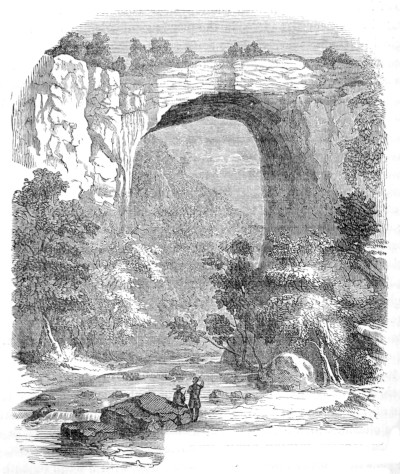
This grand natural bridge, as already
mentioned, is of limestone; and this is so
soft that it may easily be cut with a knife.
In this fact there may be a foundation for the following interesting, though
somewhat overdrawn sketch, from the graphic pen of Elihu Burritt, designed
to illustrate the effect of perseverance and an honorable ambition.
429“The scene opens with a view of the great natural bridge in Virginia.
There are three or four lads standing in the channel below, looking up with
awe to that vast arch of unhewn rocks, which the Almighty bridged over
those everlasting butments ‘when the morning stars sang together.’ The
little piece of sky spanning those measureless piers, is full of stars, although
it is midday. It is almost five hundred feet from where they stand, up
those perpendicular bulwarks of limestone, to the key-rock of that vast arch,
which appears to them only of the size of a man’s hand. The silence of
death is rendered more impressive by the little stream that falls from rock
to rock down the channel. The sun is darkened, and the boys have unconsciously
uncovered their heads, as if standing in the presence-chamber of the
Majesty of the whole earth. At last, this feeling begins to wear away; they
look around, and find that others have been there before them. They see
the names of hundreds cut in the limestone butments. A new feeling comes
over their young hearts, and their knives are in their hands in an instant.
‘What man has done, man can do,’ is their watchword, while they draw
themselves up, and carve their names a foot above those of a hundred full-grown
men who have been there before them. They are all satisfied with
this feat of physical exertion, except one, whose example illustrates perfectly
the forgotten truth, that there is no royal road to intellectual eminence.
This ambitious youth sees a name just above his reach, a name that will be
green in the memory of the world, when those of Alexander, Cæsar, and
Bonaparte, shall rot in oblivion. It was the name of Washington. Before
he marched with Braddock to that fatal field, he had been there, and left his
name a foot above all his predecessors. It was a glorious thought of the
boy, to write his name side by side with that of the great father of his
country. He grasps his knife with a firmer hand; and, clinging to a little
jutting crag, he cuts again into the limestone, about a foot above where he
stands; he then reaches up and cuts another for his hands. ’Tis a dangerous
adventure; but as he puts his feet and hands into those gains, and draws
himself up carefully to his full length, he finds himself a foot above every
name chronicled in that mighty wall. While his companions are regarding
him with concern and admiration, he cuts his name in rude capitals, large
and deep, into that rocky album. His knife is in his hand, and strength in
his sinews, and a new created aspiration in his heart. Again he cuts another
niche, and again he carves his name in larger capitals. This is not enough.
Heedless of the entreaties of his companions, he cuts and climbs again. The
graduations of his ascending scale grow wider apart. He measures his
length at every gain he cuts. The voices of his friends wax weaker and
weaker, till their words are finally lost on his ear. He now for the first time
430casts a look beneath him. Had that glance lasted a moment, that moment
would have been his last. He clings with a convulsive shudder to his little
niche in the rock. An awful abyss awaits his almost certain fall. He is
faint with severe exertion, and trembling from the sudden view of the
dreadful destruction to which he is exposed. His knife is worn half-way to
the haft. He can hear the voices, but not the words, of his terror-stricken
companions below. What a moment! What a meager chance to escape
destruction! There is no retracing his steps. It is impossible to put his
hands into the same niche with his feet, and retain his slender hold a moment.
His companions instantly perceive this new and fearful dilemma, and await
his fall with emotions that ‘freeze their young blood.’ He is too high, too
faint, to ask for his father and mother, his brothers and sisters, to come and
witness or avert his destruction. But one of his companions anticipates his
desire. Swift as the wind, he bounds down the channel, and the situation
of the fated boy is told upon his father’s hearth-stone.
“Minutes of almost eternal length roll on, and there are hundreds standing
in that rocky channel, and hundreds on the bridge above, all holding their
breath, and awaiting the fearful catastrophe. The poor boy hears the hum
of new and numerous voices both above and below. He can just distinguish
the tones of his father, who is shouting with all the energy of despair,
‘William! William! Don’t look down! Your mother, and Henry, and
Harriet are all here, praying for you! Don’t look down! Keep your eye
toward the top!’ The boy didn’t look down. His eye is fixed like a flint
toward heaven, and his young heart on Him who reigns there. He grasps
again his knife. He cuts another niche, and another foot is added to the
hundreds that remove him from the reach of human help from below. How
carefully he uses his wasting blade! How anxiously he selects the softest
places in that vast pier! How he avoids every flinty grain! How he economizes
his physical powers! resting a moment at each gain he cuts. How
every motion is watched from below! There stand his father, mother,
brother, sister, on the very spot where, if he falls, he will not fall alone.
The sun is now half-way down the west. The lad has made fifty additional
niches in that mighty wall, and now finds himself directly under the middle
of that vast arch of rocks, earth and trees. He must cut his way in a new
direction, to get from under this overhanging mountain. The inspiration
of hope is dying in his bosom; its vital heat is fed by the increasing shouts
of hundreds perched upon cliffs and trees, and others who stand with ropes
in their hands on the bridge above, or with ladders below. Fifty gains more
must be cut before the longest rope can reach him. His wasting blade
strikes again into the limestone. The boy is emerging painfully, foot by
431foot, from under that lofty arch. Spliced ropes are ready in the hands of
those who are leaning over the outer edge of the bridge. Two minutes
more, and all will be over. That blade is worn to the last half-inch. The
boy’s head reels; his eyes are starting from their sockets. His last hope is
dying in his heart; his life must hang upon the next gain he cuts. That
niche is his last. At the last faint gash he makes, his knife, his faithful
knife, falls from his little nerveless hand, and, ringing along the precipice,
falls at his mother’s feet. An involuntary groan of despair runs like a
death-knell through the channel below, and all is still as the grave. At the
hight of nearly three hundred feet, the devoted boy lifts his hopeless heart
and closing eyes to commend his soul to God. ’Tis but a moment—there!—one
foot swings off!—he is reeling—trembling—toppling over into eternity!
Hark! a shout falls on his ear from above! The man who is lying with
half his length over the bridge, has caught a glimpse of the boy’s head and
shoulders. Quick as thought, the noosed rope is within reach of the sinking
youth. No one breathes. With a faint, convulsive effort, the swooning boy
drops his arms into the noose. Darkness comes over him, and with the
words, God! and Mother! whispered on his lips just loud enough to be
heard in heaven, the tightening rope lifts him out of his last shallow niche.
Not a lip moves while he is dangling over that fearful abyss; but when a
sturdy Virginian reaches down and draws up the lad, and holds him up in
his arms before the tearful, breathless multitude, such shouting and leaping
and weeping for joy, never greeted the ear of a human being so recovered
from the yawning gulf of eternity.”
We will only add before leaving the subject of natural bridges, that the
one in Virginia is not, as has been generally supposed, the only geological
wonder of the kind in the United States. In Carter county, Kentucky,
there is a natural bridge across the Rockbridge branch of the Cany fork of
Little Sandy. It has a span of one hundred and ninety-five feet, and is
twelve feet wide, twenty feet thick in the middle of the arch, and one hundred
and seven feet above the water. In the county of Walker, in Alabama,
there is another similar natural curiosity, which was discovered in a recent
geological exploration. The span is one hundred and twenty feet, and the
hight nearly seventy feet. This bridge is formed of sandstone, and is very
symmetrical. Large beech and hemlock trees grow on the bridge, and the
surrounding scenery is represented as sublime.
PRECIPICES AND PROMONTORIES. — BESSELY GHAUT. — THE CAPE OF THE WINDS. — THE NORTH CAPE. — PRECIPICES OF SAN ANTONIA.
432
The precipitous pathways which frequently occur in the Indian Apennines,
a chain of mountains extending along the western or Malabar coasts of the
peninsula, are called ghauts; and of these abrupt and perpendicular precipices,
Bessely ghaut is considered as the most romantic. It is admirably
described in the travels of Lord Valentia, from which the following particulars
are extracted.
On entering the defiles of the chain of mountains by which the table-land
of Mysore is separated from the low country of Canara and Malabar, the
scenery becomes extremely wild and romantic. Having reached Purneah
Chuttoor, situated on the summit of this celebrated ghaut, his lordship began
his descent at three in the morning, by a road formed with great labor out
of a bed of loose rock, over which the torrents of the preceding winter had
run with such force, as to wash away all the softer parts, and in several
places to leave single rocks, of four or five feet diameter, standing in the
center of the road, and not more than two feet asunder. He alighted from
his palanquin to admire the sublimity of the scene, and entered a forest of
the largest oriental trees, several of which were one hundred feet in the stem
before a single branch extended itself; notwithstanding which, the descent
was so steep, that he was frequently on a level with their tops, at so small a
distance as to be able to distinguish them, by the gleam of the numerous
torches by which his party was accompanied, but which were insufficient to
enlighten the impenetrable canopy of foliage which for miles concealed the
face of heaven, or the deep gloom of the abyss into which he appeared to
descend. In the day-time the scene could not have been half so awful or
magnificent. The descent was impeded by numerous droves of oxen which
were ascending the ghaut. At break of day an opening, in a winding part
of the road, displayed the lofty mountain the party had descended, covered
with forests nearly to its summit. They passed several rivulets, which at
one spot had united, and formed a small stream. The surrounding vegetation
was richly variegated; and the branches of the loftiest trees covered by
plants of the parasitical tribe. The inhabitants of a small village, in the
433center of this immense forest, were employed in thrashing their grain in a
truly patriarchal manner: on a floor of hard earth the grain was trodden out
by oxen, which, agreeably to the Mosaical law, were unmuzzled.
The fortress of Mankoop, in the Crimea, is of a very extraordinary magnitude,
and may be described as being literally stationed on the clouds. It
covers the summit of a semicircular insulated mountain, which, from its
frightful aspect, its altitude, and craggy perpendicular sides, independently
of every other consideration than as a surprising work of nature, fills the
mind with wonder on entering the defile. In this singular situation, where
there are no visible means of ascent toward the hight, and still less of conveying
the necessary materials for the completion of so astonishing a work,
the Genoese constructed this citadel, perhaps without a parallel in Europe,
the result of their wealth, address and enterprise. Being at a remote distance
from the coast, it is natural to conjecture that it was employed to curb
the hostile spirit of the natives toward the maritime colonial possessions.
The latest possessors of this fortress were Jews, in the cemetery of whose
colony the traveler meets with ruined tombs of marble and stone, lying
beneath the trees he has to pass in his ascent.
The whole of the passage up the mountain is steep and difficult; nor is it
rendered more practicable by the amazing labors of its original possessors,
whose dilapidated works occur almost at every step. On reaching the
summit, caverns and gloomy galleries, perforated in the rock, present on
every side their dark mouths. On the most elevated part of this extraordinary
eminence, is a beautiful plain, covered with fine turf: it is partly
fenced in by the moldering wall of the fortress, but otherwise open to the
surrounding precipices. From this spot the adjacent mountains, valleys,
hills, woods and villages, may be discerned. “While,” observes the traveler
by whom these details are supplied, “with dismay and caution we crept
on our hands and knees to look over the brink of these fearful hights, a
half-clad Tartar, wild as the winds of the north, mounted without a saddle,
and without any other bridle except the twisted stem of a wild vine, on a
colt equally unsubdued, galloped to the very edge of the precipice, where, as
his horse stood prancing on the borders of eternity, he amused himself with
pointing out to us the different places in the vast district which the eye
commanded. We entered one of the excavated chambers, a small square
apartment, which led to another on our right hand; and, on our left, a
narrow passage conducted us to an open balcony, with a parapet in front,
434formed of the rock, on the very face of one of the principal precipices, whence
the depth below might be contemplated with less danger. The vultures
which hovered over the valleys did not appear larger than swallows; and
the tops of the hills, covered by tufted woods, with the villages scattered
amid the rocks and defiles, appeared at so intimidating a depth, that the
blood chilled at the view. At length, being conducted to the north-eastern
point of the crescent, that being the shape of the summit on which the
fortress of Mankoop was built, and descending a few stone steps, neatly
hewn out in the rock, we entered by a square door the cavern, called by the
Tartars, the Cape of the Winds. It has been chiseled, like the rest, out of
the solid stone; but is open on four sides. From the amazing prospect here
commanded of all the surrounding country, it probably served as a post of
military observation. The apertures, or windows, are large arched chasms
in the rock: through these, a most extensive range of scenery over the
distant mountains and rolling clouds, forms a sublime spectacle. There is
nothing in any part of Europe to surpass the tremendous grandeur of the
place. Beneath the cavern is another chamber leading to the several cells
on its different sides: these have all been cut out of the same rock.”
The party, in descending, pursued a route, which, if they had taken in
their ascent, would, our traveler observes, have afforded them a view of the
sublimest scenery imaginable. They now passed beneath an old arched
gateway of the citadel, once its principal entrance. This road flanks the
northern side of the mountain; and the fall into the valley is so bold and
profound, that a single false step would precipitate both horse and rider
headlong to it. By alighting, the danger is avoided; and the terror of the
descent is compensated by the noblest scenery the eye ever beheld. It was
dark before they reached the bottom; and they had some difficulty to regain
the principal road which leads through the defile, owing principally to the
trees which project over all the lanes in the vicinity of Tartar villages, and
so effectually obstruct the passage of persons on horseback, that they are
in continual danger of being thrown. The defile itself is not without danger
in certain seasons of the year, immense masses of limestone detaching themselves
from the rocks above, and carrying all before them in their descent.
Several of these masses, detached from the northern precipices, had crossed
the river at the bottom, and, by the prodigious velocity acquired in their
descent, had actually rolled nearly half-way up the opposite side.
435
This cape forms the most northerly point of the continent of Europe, and
may be regarded as one of the wonders of nature. It is situated within the
arctic circle, in seventy-one degrees, ten minutes, north latitude. It has been
accurately described by a voyager, from whose account the following particulars
are extracted.
In approaching the cape, a little before midnight, its rocks at first appeared
to be nearly of an equal hight, until they terminated in a perpendicular
peak; but, on a nearer view, those within were found to be much higher
than those of the extreme peak, or point. Their general appearance was
highly picturesque. The sea, breaking against this immovable rampart,
which had withstood its fury from the remotest ages, bellowed, and formed a
thick border of white froth. This spectacle, equally beautiful and grand,
was illumined by the midnight sun; and the shade which covered the western
side of the rocks rendered their aspect still more sublime and almost
terrific. The hight of these rocks could not be ascertained; but here everything
was on so grand a scale, that a point of comparison could not be
afforded by any ordinary known objects. On landing, the party discovered a
grotto, formed of rocks, the surface of which had been washed smooth by the
waves, and having within a spring of fresh water. The only accessible spot
in the vicinity was a hill, some hundred paces in circumference, surrounded
by enormous crags. From the summit of this hill, turning toward the sea,
they perceived to the right a prodigious mountain, attached to the cape, and
rearing its sterile mass to the skies. To the left, a neck of land, covered with
less elevated rocks, against which the surges dashed with violence, closed the
bay, and admitted but a limited view of the ocean. To see as far as possible
into the interior, our navigators climbed almost to the summit of the mountain,
where a most singular landscape presented itself to the view. A lake
in the foreground had an elevation of at least ninety feet above the level of
the sea; and on the top of an adjacent, but less lofty mountain, was another
lake. The view was terminated by peaked rocks, checkered by patches of
snow.
At midnight the sun still remained several degrees above the horizon,
and continued to ascend higher and higher till noon, when having again
descended, it passed the north, without dipping below the horizon. This
phenomenon, which is as extraordinary to the inhabitants of the torrid and
temperate zones, as snow is to the inhabitants of the torrid zone, could not
be viewed without a particular interest. Two months of continued daylight,
436during which space the sun never sets, seem to place the traveler in a new
state of existence; while the effect on the inhabitants of these regions is
singular. During the time the sun is perpetually above the horizon, they
rise at ten in the morning, dine at five or six in the evening, and go to bed
at one. But, during the winter season, when, from the beginning of December
until the end of January, the sun never rises, they sleep above half of the
twenty-four hours, and employ the other half in sitting over the fire, all
business being at an end, and a constant darkness prevailing. The cause of
this phenomenon, as it affects the northern and southern regions of the earth,
may be readily understood. The sun always illumines half the earth at once,
and shines on every side ninety degrees from the place where he is vertical.
When he is vertical over the equator, or equidistant from both poles, he
shines as far as each pole; and this happens in spring and autumn. But, as
he declines to the north in summer, he shines beyond the north pole, and all
the countries near that pole turn round in perpetual sunshine: while at the
same time, he leaves the south pole an equal number of degrees, so that those
parts turn round in darkness.
The mountain of San Antonia, on the route from Guyaquil to Quito, is
described by Ulloa as presenting a series of the most fearful precipices. In
crossing this mountain, the declivity was in some parts so great, that the
mules could not have kept their footing, had not the paths been filled with
holes, upward of two feet in depth, in which the mules placed their fore and
hinder feet, occasionally dragging their bellies, and the legs of the rider,
along the ground. Without these holes which serve as steps, the precipice
would not be practicable. Should the creature happen, however, to place
his foot between two of these holes, or to falter in the slightest degree, the
rider would fall, and perish inevitably. To lessen the difficulties and dangers
of these craggy paths, the Indians who go before the travelers, dig small
trenches across.
The descent from the hights was a task of imminent danger. Owing to
the excessive steepness, the water had washed away a greater part of the
holes; while, on the one side were steep eminences, and on the other, the
most frightful abysses. The mules were themselves sensible of the caution
requisite in descending; for, on reaching the top of an eminence, they
stopped, and having placed their fore feet close together, as in a posture
of stopping themselves, they also placed their hinder feet together a little
forward, as if going to lie down. In this attitude, having, as it were, taken
437a survey of the road, they slid down with great swiftness to the bottom. All
the rider had to do, was to keep himself fast in his saddle, without checking
his beast; as the slightest motion would have been sufficient to destroy its
equilibrium, and both would have inevitably perished. The address of the
creatures was truly wonderful, for, in this rapid motion, when they seemed
to have lost all government of themselves, they followed exactly the different
windings of the road, as if they had previously reconnoitered, and settled in
their minds the route they were to follow, and taken every precaution for
their safety, amid so many irregularities. The safety of the rider depended
entirely on their experience and address; but, long as they had been accustomed
to travel these roads, they seemed to feel a degree of horror on reaching
the top of a steep declivity. Without being checked by their rider, they
stopped; and if he inadvertently endeavored to spur them on, they were
immovable until they had placed themselves in a secure posture. They
seemed as if they were actuated by reason; for they not only viewed the road
attentively, but trembled and snorted at the danger; emotions which inspired
the party with the most dreadful apprehensions. The Indians went before,
and, placing themselves along the sides of the mountain, where they held by
the roots of trees, animated the beasts with shouts, until they at last started
down the declivity.
There were some parts where the declivities were not on the side of the
precipices; but the road was so narrow and hollow, and the sides so nearly
perpendicular, that the danger was almost equal. The track being extremely
narrow, with scarcely a sufficient width of the road to admit the mule with
its rider, if the former had fallen, the latter would necessarily have been
crushed, and, for want of room to disengage himself, would have been
mutilated in his limbs, if he had escaped with life. It was truly wonderful
to consider with what exactness these animals, after having overcome the first
emotions of their fear, and when they were going to slide down the declivity,
stretched out their fore-legs, to the end that they might preserve their equilibrium.
The gentle inclination they made with the body, at a proper
distance, in following the several windings of the road, was also a mark of
surprising sagacity; and, lastly, their address in stopping themselves at the
end of the impetuous career, was truly deserving of observation. Greater
prudence and conduct could not have been exhibited by man!
GEOLOGICAL CHANGES OF THE EARTH. — EXTRANEOUS FOSSILS. — FOSSIL CROCODILES. — LARGE FOSSIL ANIMAL OF MAESTRICHT. — FOSSIL REMAINS OF RUMINANTIA. — FOSSIL REMAINS OF ELEPHANTS. — FOSSIL REMAINS OF THE MASTODON. — FOSSIL REMAINS OF THE RHINOCEROS. — FOSSIL REMAINS OF THE SIBERIAN MAMMOTH. — FOSSIL SHELLS. — SUBTERRANEAN FORESTS. — MOORS, MOSSES AND BOGS. — CORAL REEFS AND ISLANDS.
438
There are more things in heaven and earth
Than are dreamt of in our philosophy.—Shakspeare.
The variety of fossil substances, many of them marine productions, which
are found in mountains remote from the sea, are undeniable proofs that the
earth’s surface has undergone considerable changes, some of which indicate
an alteration of climate not easily to be explained. The remains of animals
inhabiting hot countries, and the marine productions of hot climates, which
are frequently found in high northern latitudes, lead to a suspicion that the
earth’s axis was at a very remote period differently inclined from what it is
at present. The tropics now extend twenty-three degrees and a half on each
side the equator; but if they were extended to forty-five degrees, then the
arctic circle and the tropics would coincide, and thence would arise inconceivable
variations in the productions and phenomena of the earth. All this
would form an amusing speculation to a person possessed of a terrestrial
globe, who might tie a thread round it to represent the tropics at forty-five
degrees of elevation.
By the gradual operation of the sea and of rivers, the face of the globe
has, in the course of ages, undergone very material changes. The former
has encroached in particular parts, and retired from others; and the mouths
of large rivers, running through low countries, have often been variously
modified, by a deposition and transfer of the matter washed down from the
land. At Havre, the sea undermines the steep coast; while it recedes at
Dunkirk, where the shore is flat. In Holland the Zuyder Zee was probably
formed, in the middle ages, by continual irruptions of the sea, where only
the small lake Flevo had before existed. The mouths of the Rhine have
been considerably altered, as well in their dimensions as in their directions.
The mud, as it is deposited by large rivers, generally causes a delta, or a
triangular piece of land, to grow out into the sea. Thus the mouth of the
Mississippi is said to have advanced above fifty miles since the discovery of
America. The island called Sandy Hook, at the entrance of the harbor of
New York, was formerly a peninsula attached to the main land. The old
citizens of New Haven, Connecticut, point out places where once boats, and
even small vessels, used to anchor, but which are now at quite a distance
from the water and covered with the dwellings of the inhabitants. Most of
439the large rivers of the United States are more or less changing their banks,
and the places of their channels, from year to year. The sea, within the
space of forty years, has retired more than a mile from Rosetta, in Egypt;
and the mouths of the Arno, and of the Rhone, consist in a great measure
of new land.
The Javanese have a tradition, that in former times the islands of Sumatra,
Java, Bali and Sumbawa, were united, and afterward separated into nine
different parts. They add, that when three thousand rainy seasons shall
have passed away, they will be united. In the Mediterranean, geological
phenomena evince, that the island of Malta, and that of Gozo, its dependency,
now separated by a wide channel, and the intermediate small island of
Cumino, formed, together with the latter, a single island. By the encroachments
of the sea, and the subsidence of some parts of the land, the islands of
Scilly, the aboriginal inhabitants of which carried on a considerable trade in
tin with the Phenicians, Greeks and Romans, are now little more than barren
rocks, with small patches of earth interspersed in the hollows. Strabo
describes the Phenicians as having been so jealous of their lucrative traffic
with these islands, that they ran a vessel purposely on shore, and risked the
lives of the crew, rather than have it made known to the Romans. The
land within which these tin mines were worked, must now be sunk, and
buried beneath the sea. On the shifting of the sands between the islands,
walls and ruins are frequently seen; the difference of level, since these walls
or fences were made, to prevent the encroachments of the sea, being
estimated at sixteen feet. There is little doubt but that there must have
been a subsidence of the land, followed by a sudden inundation. This,
indeed, seems to be confirmed by tradition, there being a strong persuasion
in the western parts of Cornwall, that there formerly existed a large country
between the Land’s-end and the islands of Scilly, now laid many fathoms
under water. Although there are no positive evidences of such an ancient
connection between the main land and these islands, still it is extremely
probable, that the cause of the inundation which destroyed the greater part
of them, may have reached the Cornish shores, there being several proofs of
a subsidence of the land in Mount’s bay. The principal anchoring place,
which was called a lake, is now a haven, or open harbor; and the mount,
from its Cornish name, signifying the gray rock in a wood, must have
formerly stood in a wood, but is now at full tide half a mile in the sea.
Examples of a similar kind, relative to every known country, might be
multiplied. One of the most considerable inundations to be met with in
history, is that which happened in the reign of Henry I. and which overflowed
the estates of Earl Goodwin, forming the banks called the Goodwin or
440Godwin sands. In the year 1546, a similar irruption of the sea destroyed a
hundred thousand persons in the territory of Dort, in the United Provinces,
and a still greater number round Dollart. In Friezland and Zealand more
than three hundred villages were overwhelmed; and their remains are still
visible, on a clear day, at the bottom of the water. The Baltic sea has, by
slow degrees, covered a large part of Pomerania; and, among others, overwhelmed
the famous port of Vineta. The Norwegian sea has formed several
little islands from the main land, and still daily advances on the continent.
The German sea has advanced on the shores of Holland, near Catt, to such
a degree, that the ruins of an ancient citadel of the Romans, formerly built
on that coast, are now under water. The country surrounding the isle of
Ely was, in the time of Bede, about a thousand years ago, one of the most
delightful and highly cultivated spots in Great Britain: it was overwhelmed,
and remained for several centuries under the water, until at length, the sea,
by a caprice similar to the one which had prompted its invasions, abandoned
the earth, but without the latter being able to recover its primitive state, that
of one of the most fertile valleys in the world.
On the other hand, the sea has in many instances, deserted the land; and
by the deposition of its sediment in some places, and the accumulation of its
sands in others, has also formed new lands. In this manner the isle of
Oxney, near Romney marsh, was produced. In France, the town of Aigues
Mortes, which was a seaport in the time of Louis IX., is now removed more
than four miles from the sea. Psalmodi, also in that kingdom, was an island
in the year 815, and is now upward of six miles within the land. In Italy,
a considerable portion of land has been gained at the mouth of the river
Arno; and Ravenna, which once stood by the sea-side, is now between four
and five miles from it. Every part of Holland seems to be a conquest from
the sea, and to have been rescued, in a manner, from its bosom. The industry
of man, however, in the formation of dikes, is here to be brought into
account; for the surface of the earth, in that country, is for the greater part
below the surface of the sea.
Three-fifths of the surface of the globe are covered by the sea, the average
depth of which has been estimated at from five to ten miles. Demonstrative
proofs exist in Great Britain, and in various parts of the world, that great
changes have taken place in the relative positions of the present continents
with the ocean, which, in former ages, rolled its waves over the summits of
our present elevated mountains. To illustrate this subject, and before these
proofs are entered on, in the consideration of the geological phenomena
named extraneous fossils, it will be proper to introduce the pleasing and
truly philosophical view of the successive changes the earth has undergone,
441contained in Sir Richard Phillips’s Morning Walk to Kew. In passing near
the banks of the Thames, Sir Richard was led, in two several places, to
introduce the following observations and reflections on this highly curious
and interesting subject. They apply the principles and facts of geology in a
way in which they may be applied to any river, and indicate how much we
are daily surrounded by the wonders of creation, the process of which, as Sir
Richard observes, is never ceasing. In passing over the alluvial flat of
Barnes common, he introduces the following thoughts, which are given in
very nearly his own language.
“On this common, nature still appears to be in a primeval and unfinished
state. The entire flat from the high ground to the Thames, is evidently a
mere fresh-water formation, of comparatively modern date, created out of the
rocky ruins which the rains, in a series of ages, have washed from the high
grounds, and further augmented by the decay of local vegetation. The
adjacent high lands, being elevated above the action of the fresh water, were
no doubt marine formations, created by the flowing of the sea during the
long period when the earth was last in its perihelion during our summer
months; which was probably thousands of years since. The flat, or freshwater
formation, on which I was walking, still only approaches its completion;
and the desiccated soil has not yet fully defined the boundaries of the
river. At spring-tides, particularly when the line of the moon’s apsides
coincides with the syzygies, or when the ascending node is in the vernal
equinox, or after heavy rains, the river still overflows its banks, and indicates
its originally extended site under ordinary circumstances.
“The state of transition also appears in marshes, bogs and ponds, which,
but for the interference of man, would, many ages ago, have been filled up
with decayed forests and the remains of undisturbed vegetation. Rivers
thus become agents of the never-ceasing creation, and a means of giving
greater equality to the face of the land. The sea as it retired, either
abruptly from some situations, or gradually from others, left dry land, consisting
of downs and swelling hills, disposed in all the variety which would
be consequential on a succession of floods and ebbs during several thousand
years. These downs, acted upon by rain, were mechanically, or in solution,
carried off by the water to the lowest levels, the elevations being thereby
depressed, and the valleys proportionally raised. The low lands became, of
course, the channels through which the rains returned to the sea, and the
successive deposits on their sides, hardened by the wind and sun, have in five
or six thousand years, created such tracts of alluvial soil, as those which
now present themselves in contiguity with most rivers. The soil, thus
assembled and compounded, is similar in its nature to the rocks and hills
442whence it was washed; but, having been so pulverized, and so divided by
solution, it forms the finest medium for the secretion of all vegetable principles,
and hence the banks of the rivers are the favorite residences of man.
Should the channel constantly narrow itself more and more, till it becomes
choked in its course, or at its outlet, then, for a time, lakes would be
formed, which, in like manner, would narrow themselves and disappear.
New channels would then be formed, or the rain would so diffuse itself over
the surface, that the fall and the evaporation would balance each other.
“Such are the unceasing works of creation, constantly taking place on the
exterior surface of the earth; where, though less evident to the senses and
experience of man, matter apparently inert is in as progressive a state of
change, from the operation of unceasing and immutable causes, as in the
visible generations of the animal and vegetable kingdoms. Thus water,
wind and heat, the energies of which never cease to be exerted, are constantly
producing new combinations, changes and creations; which, if they accord
with the harmony of the whole, are fit and ‘good;’ but, if discordant, are
speedily re-organized or extinguished by contrary and opposing powers. In
a word, whatever is, is fit; and whatever is not fit, is not, or soon ceases to
be! Such seems to be the governing principle of Nature, the key of all her
mysteries, the primary law of creation! All things are the proximate effects
of a balance of immutable powers; those powers are results of a primordial
cause; while that cause is inscrutable and incomprehensible to creatures
possessing but a relative being, who live only in time and space, and who feel
and act merely by the impulse of limited senses and powers.”
And, again, the same writer introduces the following apposite remarks on
this very interesting subject.
“As I approached a sequestered mansion-house, and the other buildings
connected with it, I crossed a corner of the meadow toward an angle formed
by a rude inlet of the Thames, which was running smoothly toward the sea,
at the rate of four miles an hour. The tide unites here with the ordinary
current, and running a few miles above this place, exhibits twice a day the
finely reduced edge of that physical balance-wheel, or oscillating fluid-pendulum,
which creates the earth’s centrifugal power, and varies the center of its
forces. In viewing the beautiful process of nature, presented by a majestic
river, we cease to wonder that priestcraft has often succeeded in teaching
nations to consider rivers of divine origin, and as proximate living emblems
of omnipotence. Ignorance, whose constant error is to look only to the last
term of every series of causes, and which charges impiety on all who venture
to ascend one term higher, and atheism on all who dare to explore several
terms, (though every series implies a first term,) would easily be persuaded
443by a crafty priesthood to consider a beneficent river as a tangible branch of
the Godhead. But we now know that the waters which flow down a river,
are but a portion of the rains and snows which, having fallen near its source,
are returning to the ocean, there to rise again and re-perform the same circle
of vapors, clouds, rains and rivers. What a process of fertilization, and how
still more luxuriant would have been this vicinity, if man had not leveled
the trees, and carried away the crops of vegetation. What a place of shelter
would thus have been afforded to tribes of amphibiæ, whose accumulated
remains often surprise geologists, though necessarily consequent on the fall
of crops of vegetation on each other, near undisturbed banks of rivers. Happily,
in Britain, our coal-pits, or mineralized forests, have supplied the place
of our living woods; or man, regardless of the fitness of all the parts to the
perfection of every natural result, might here, as in other long-peopled countries,
ignorantly have thwarted the course of nature by cutting down the
timber, which, acting on the electricity of the clouds, affects their destiny,
and causes them to fall in fertilizing showers. Such has been the fate of all
the countries famous in antiquity. Persia, Syria, Arabia, parts of Turkey,
and the Barbary coast, have been rendered arid deserts by this inadvertency.
The clouds from the Western ocean would long since have passed over
England without disturbance from the conducting power of leaves of trees,
or blades of grass, if our coal-works had not saved our natural conductors;
while the Thames, the agent of so much abundance and of so much wealth,
might, in that case, have become a shallow brook, like the once equally famed
Jordan, Granicus, or Ilyssus.
“I now descended toward a rude space near the river, which appeared to
be in the state in which the occasional overflowings and gradual retrocession
of the river had left it. It was one of those wastes which the lord of the
manor had not yet enabled some industrious cultivator to disguise; and in
large tracts of which Great Britain still exhibits the surface of the earth in
the pristine state in which it was left by the secondary causes that have given
it form. The Thames, doubtless, in a remote age, covered the entire site;
but it is the tendency of rivers to narrow themselves, by promoting prolific
vegetable creations on their consequently increasing and encroaching banks,
though the various degrees of fall produce every variety of currents, and,
consequently, every variety of banks, in their devious course. In due time,
the course of the river becomes choked where a flat succeeds a rapid, and
the detained waters then form lakes in the interior. These lakes likewise
generate encroaching banks, which finally fill up their basins, when new
rivers are formed on higher levels. These in their turn, become interrupted,
and repetitions of the former circle of causes produce one class of those
444elevations of land above the level of the sea, which have so much puzzled
geologists. The only condition which a surface of dry land requires to
increase and raise itself, is the absence of salt water, consequent on which is
an accumulation of vegetable and animal remains. The Thames has not
latterly been allowed to produce its natural effects, because for two thousand
years the banks have been inhabited by man, who unable to appreciate the
general laws by which the phenomena of the earth are produced, has sedulously
kept open the course of the river, and prevented the formation of
interior lakes. The Caspian sea, and all similar inland seas and lakes, were,
for the most part, formed from the choking up of rivers which once constituted
their outlets. If the course of nature be not interrupted by the misdirected
industry of man, the gradual desiccation of all such collections of
water will, in due time, produce land of higher levels on their sites. In like
manner, the great lakes of North America, if the St. Lawrence be not sedulously
kept open, will in the course of ages, be filled up by the gradual
encroachment of their banks, and the raising of their bottoms with strata of
vegetable and animal remains. New rivers would then flow over these
increased elevations, and the ultimate effect would be to raise that part of the
continent of North America several hundred feet above its present level.
Even the very place on which I stand was, according to Webster, once a vast
basin, extending from the Nore to near Reading, but now filled up with
vegetable and animal remains; and the illustrious Cuvier has discovered a
similar basin round the site of Paris. These once were Caspians, created by
the choking and final disappearance of some mighty rivers; they have been
filled up by gradual encroachments, and now the Thames and the Seine flow
over them; but these, if left to themselves, will, in their turn, generate new
lakes or basins, and the successive recurrence of a similar series of causes
will continue to produce similar effects, till interrupted by superior causes.
“This situation was so sequestered, and therefore so favorable to contemplation,
that I could not avoid indulging myself. What, then, are those
superior causes, I exclaimed, which will interrupt this series of natural
operations to which man is indebted for the enchanting visions of hill and
dale, and for the elysium of beauty and plenty in which he finds himself?
Alas! facts prove that all things are transitory, and that change of condition
is the constant and necessary result of that motion which is the chief instrument
of eternal causation, but which, in causing all phenomena, wears out
existing organizations while it is generating new ones. In the motions of the
earth as a planet, doubtless are to be discovered the superior causes which
convert seas into continents, and continents into seas. These sublime
changes are occasioned by the progress of the perihelion point of the earth’s
445orbit through the ecliptic, which passes from extreme northern to extreme
southern declination, and vice versa, every ten thousand, four hundred and
fifty years; and the maxima of the central forces in the perihelion occasion
the waters to accumulate alternately upon either hemisphere. During ten
thousand, four hundred and fifty years, the sea is therefore gradually retiring
and encroaching in both hemispheres: hence all the varieties of marine
appearances and accumulations of marine remains in particular situations;
and hence the successions of layers or strata, one upon another, of marine
and earthly remains. It is evident, from observation of those strata, that
the periodical changes have occurred at least three times; or in other words,
it appears that the site on which I now stand has been three times covered
by the ocean, and three times has afforded an asylum for vegetables and
animals! How sublime, how interesting, how affecting is such a contemplation!
How transitory, therefore, must be the local arrangements of man,
and how puerile the study of the science miscalled antiquities! How foolish
the pride which vaunts itself on splendid buildings and costly mausoleums!
How vain the ostentation of large estates, of extensive boundaries, and of
great empires! All, all will, in due time, be swept away and defaced by the
unsparing ocean; and, if recorded in the frail memorials of human science,
will be spoken of like the lost Atlantis, and remembered only as a philosophical
dream!”
Such are the speculations of Phillips, containing many things highly interesting
and instructive; though, with our advanced knowledge of geology, we
involuntarily smile at his “periods” of “ten thousand, four hundred and
fifty years,” knowing, as we now do, that some of the great changes of which
he speaks must have occupied the long ages of the earth’s chaotic state,
before God, by his word, formed it again to life and order and beauty. The
merest tyro in science now knows, that in the great facts of geology God as
truly speaks by his works, as in the book of revelation he speaks by his word;
and though we are far more liable to misunderstand and misinterpret the
former than the latter, yet rightly understood there is no discrepancy between
the two, but both speak the same language of truth. In the very structure
of the earth itself, we have the evidence of the changes it has passed through.
The wonderful wrecks of a former state of nature, preserved, like ancient
medals or marbles in the ruins of an extinct empire, tell of the progress of
the earth in past ages, and teach us that many of the changes which Phillips
would refer to comparatively modern times, belong to a period far back of
the creation of our first parents, when our planet, though existing, had not
as yet been prepared for the habitation of mankind. We will not, however,
dwell on these points; but merely allude to them, referring our readers to
446any of the elementary treatises on geology, where they may find the full
details of facts, and also the various theories which reconcile these facts with
the statements of the Mosaic history.
The fossil remains of animals not now in existence, entombed and preserved
in solid rocks, present us with durable monuments of the great changes
which our planet has undergone in former ages. We are led to a period
when the waters of the primitive ocean must have covered the summits of
our highest mountains, and are irresistibly compelled to admit one of two
conclusions: either that the sea has retired, and sunk beneath its former level;
or that some power, operating from beneath, has lifted up the islands and
continents, with all their hills and mountains, from the watery abyss to their
present elevation above its surface.
The calcareous, or limestone mountains in Derbyshire, and at Craven, in
Yorkshire, having an elevation of about two thousand feet above the present
level of the sea, contain, in a greater or less abundance, and throughout their
whole extent, fossil remains of zoophytes, shell-fish, and marine animals. No
remains of vegetables have been found in the calcareous mountains of
England; but, in the thick beds of shale and gritstone lying upon them, are
found various vegetable impressions, and above these regular beds of coal,
with strata, containing shells of fresh-water musselsmussels. In the earthy limestone
of the upper strata are sometimes found fossil flat-fish, with the
impression of the scales and bones quite distinct. The mountains of the
Pyrenees are covered in the highest part, at Mont Perdu, with calcareous
rocks, containing impressions of marine animals; and, even where the
impressions are not visible in the limestone, it yields a fetid cadaverous odor,
when dissolved in acids, owing, in all probability, to the animal matters it
contains. Mont Perdu, which rises ten thousand five hundred feet, or about
two miles above the level of the sea, is the highest situation in which any
marine remains have been found in Europe. In the Andes they have been
observed by Humboldt at the hight of fourteen thousand feet, more than two
miles and a half. Lastly, in southern countries, in and under beds of clay-covering
chalk, the bones of the elephant, and of the rhinoceros are frequently
found.
These bones, as they have been brought from different parts of the world,
have been examined with the utmost attention by the sagacious naturalist
Cuvier. He has observed characteristic variations of structure, which prove
that they belong to animals not now existing on our globe: nor have many
447of the various zoöphytes and shell-fish, found in calcareous rocks, been discovered
in our present seas. From these very curious facts he makes the
following deductions.
“These bones are buried, almost everywhere, in nearly similar beds: they
are often blended with some other animals resembling those of the present
day. The beds are generally loose, either sandy or marly; and always
neighboring, more or less, to the surface. It is, then, probable that these
bones have been enveloped by the last, or by one of the last, catastrophes of
this globe. In a great number of places they are accompanied by the accumulated
remains of marine animals; but in some places, which are less
numerous, there are none of these remains: sometimes the sand or marl,
which covers them, contains only fresh-water shells. No well authenticated
account proves that they have been covered by regular beds of stone, filled
with sea-shells; and, consequently, that the sea has remained on them undisturbed,
for a long period. The catastrophe which covered them was, therefore,
a great, but transient, inundation of the sea. This inundation did not
rise above the high mountains; for we find no analogous deposits covering
the bones, nor are the bones themselves there met with, not even in the high
valleys, unless in some of the warmer parts of America. These bones are
neither rolled nor joined in a skeleton, but scattered, and in part fractured.
They have not, then, been brought from afar by inundation, but found by it
in places where it has covered them, as might be expected, if the animals to
which they belonged had dwelt in these places, and had there successively
died. Before this catastrophe, these animals lived, therefore, in the climates
in which we now dig up their bones: it was this catastrophe which destroyed
them there; and, as we no longer find them, it is evident that it has annihilated
those species. The northern parts of the globe, therefore, nourished
formerly, species belonging to the genus elephant, hippopotamus, rhinoceros,
and tapir, as well as to that of the mastodon; genera of which the four first
have no longer any species existing, except in the torrid zone; and the last,
none in any part.”
The researches of Dr. Buckland, connected with the kind of relics of which
we are speaking, have given them additional interest, especially as connected
with certain points of diluvial geology, and with their assemblage in caverns.
In these caverns, the bones are usually found mixed with mud, stones and
fragments; and circumstances seem to show that the animals resided in them
for a great length of time. The celebrated Kirkdale cavern, in Yorkshire,
discovered in 1821, contains the remains of the hyena, tiger, bear, wolf, fox,
weasel, elephant, rhinoceros, hippopotamus, horse, ox, deer, hare, rabbit, rat,
mouse, raven, pigeon, lark, thrush, and a species of duck. From the mode
448in which these remains were strewed over the bottom of the cavern, from the
great proportion of hyenas’ teeth over those of other animals, and from the
manner in which many of the bones were gnawed and fractured, Dr. Buckland
infers that this cavern was the den of hyenas for a long succession of
years; that they brought in as their prey, the animals whose remains are
thus mixed with their own; and that this state of things was suddenly terminated
by an irruption of turbid water into the cave, which buried the
whole in the mud in which they are now intermingled. In other cases, the
bones of other animals have been found, indicating the same general facts as
to the existence of animals now no longer known in the same latitudes.
That every part of the dry land was once covered by the ocean, is a fact on
which all geologists agree; and the discovery, noticed above, of the fossil
remains of many genera of quadrupeds, once existing, but which have now
disappeared from the earth, leads to another fact, not less interesting, and
which is at the same time coincident with the oldest records or traditions of
the human race, namely, that at the period when these great changes took
place, man was not an inhabitant of the planet. These fossil remains, now
about to be particularized, are among the most surprising of nature’s phenomena,
and irresistibly lead to most interesting speculations respecting the
past and future condition of the terrestrial globe.
The fossil remains of crocodiles have been collected in the neighborhood
of Honfleur, on the coast of France, and were found in a bed of hard limestone,
of a bluish gray color, which becomes nearly black when wet, and
which is found along the shore on both sides of the mouth of the Seine, being
in some places covered by the sea, and in others, above its level, even at high
water. Remains of crocodiles have also been found in other parts of France;
as at Angers and Mans. Some of these remains seem to show, that at least
one of the fossil species above noticed is also found in other parts of France
besides Honfleur.
The remains of crocodiles have been also found in different parts of
England; but particularly on the coast of Dorsetshire, and of Yorkshire
near Whitby, in the neighborhood of Bath, and near Newark in Nottinghamshire.
Somersetshire, particularly in the neighborhood of Bath, the cliffs
on the Dorsetshire, or southern coast, and on the Yorkshire, or northern
coast, are the places in this island in which the remains of the animals of this
tribe have been chiefly found. The matrix in which they are found is in
general similar to that which has been already mentioned as containing the
449fossils of Honfleur, a blue limestone, becoming almost black when wet. This
description exactly agrees with the limestone of Charmouth, Lime, &c., in
Dorsetshire, on the opposite coast to that of France on which Honfleur is
situated. At Whitby and Scarborough, where these fossils are also found,
the stone is indeed somewhat darker than in the former places; but no difference
is observable which can be regarded as offering any forcible opposition
to the probability of the original identity of this stratum, which is observed
on the northern coast of France, on the opposite southern English coast, and
at the opposite northern extremity of the island. Some of these remains are
also found in quarries of common coarse gray and whitish limestone.
Instances of this kind of matrix, for these remains, are observable in the
quarries between Bath and Bristol. The Rev. Mr. Hawker, of Woodchester,
in Gloucestershire, formerly had in his possession, perhaps one of the handsomest
specimens of the remains of the crocodile discovered in all England.
It was found by him in the neighborhood of Bath, and contained a great part
of the head and of the trunk of the animal.
The large animal, whose fossil remains are found in the quarries of Maestricht,
has been deservedly a frequent object of admiration; and the beautiful
appearance which its remains possess, in consequence of their excellent state
of preservation, in a matrix which admits of their fair display, has occasioned
every specimen of this fossil to be highly valued. The lower jaw of this
animal, and some other specimens, which were presented by Dr. Peter
Camper to the Royal Society, and which are now in the British museum, are
among the most splendid and interesting fossils in existence. In 1770, the
workmen having discovered part of an enormous head of an animal imbedded
in the solid stone, in one of the subterraneous passages of the mountain, gave
information to M. Hoffman, who, with the most zealous assiduity, labored
until he had disengaged this astonishing fossil from its matrix. But when
this was done, the fruits of his labors were wrested from him by an ecclesiastic,
who claimed it as being proprietor of the land over the spot on which it
was found. Hoffman defended his right in a court of justice; but through
the influence employed against him, he was doomed not only to the loss of
this inestimable fossil, but to the payment of heavy law expenses. But in
time, justice, though tardy, at last arrived; the troops of the French republic
secured this treasure, which was conveyed to the national museum.
The length of the cervical, dorsal and lumbar vertebrae, appears to have
been about nine feet five inches, and that of the vertebræ of the tail about ten
450foot; adding to which the length of the head, which may be reckoned, considering
the loss of the intermaxillary bones, at least at four feet, we may
safely conclude the whole length of the skeleton of the animal to have
approached very nearly to twenty-four feet. The head is a sixth of the
whole length of the animal; a proportion approaching very near to that of
the crocodile, but differing much from that of the monitor, the head of which
animal forms hardly a twelfth part of the whole length. The tail must have
been very strong, and its width, at its extremity, must have rendered it a
most powerful oar, and have enabled the animal to have opposed the most
agitated waters, as has been well remarked by naturalists who have examined
it. From this circumstance, and from the other remains which accompany
those of this animal, there can be no doubt of its having been an inhabitant
of the ocean. Taking all these circumstances into consideration, M. Cuvier
concludes, and certainly on fair, if not indisputable grounds, that this animal
must have formed an intermediate genus between those animals of the lizard
tribe which have an extensive and forked tongue, which include the monitors
and the common lizards, and those which have a short tongue and the
palate armed with teeth, which comprise the iguanas, marbres, and anolis.
This genus, he thinks, could only have been allied to the crocodile by the
general characters of the lizards.
Among the fossils of the British empire, none are more calculated to excite
astonishment than the enormous stags’ horns which have been dug up in
different parts of Ireland. Their dimensions, as given by Dr. Molyneux, are
as follows.
| |
Feet. |
Inch. |
| From the extreme tip of each horn, |
10 |
10 |
| From the tip of the right horn to its root, |
5 |
2 |
| From the tip of one of the inner branches to the tip of the opposite branch, |
3 |
7½ |
| The length of one of the palms, within the branches, |
2 |
5 |
| The breadth of the same palm within the branches, |
1 |
10½ |
| The length of the right brow antler, |
1 |
2 |
A similar pair, found ten feet under ground, in the county of Clare, was
presented to Charles II. and placed in the horn-gallery, Hampton Court; but
was afterward removed into the guard-room of the same palace. At Ballyward,
near Ballyshannon; at Turvey, eight miles from Dublin; and at Portumery,
near the river Shannon, in the county of Galway, similar horns have
451been found. In the common-hall of the Bishop of Armagh’s house, in Dublin,
was a forehead, with two amazingly large beams of a pair of this kind of
horns, which, from the magnitude of the beams, must have much exceeded
in size those of which the dimensions are given above. Dr. Molyneux states,
that in the last twenty years, thirty pair of these horns had been dug up by
accident in the country: the observations, also, of several other persons, prove
the great frequency with which these remains have been found in Ireland.
Various opinions have been entertained respecting this animal and its existing
prototype. This, however, does not appear to have been yet discovered;
and these remains may, therefore, be regarded as having belonged to an
animal now extinct.
Numerous remains of elephants have been found in Italy; and, although
a very considerable number of elephants were brought from Africa into that
country, yet the vast extent through which these remains have been found,
and the great probability that the Italians, particularly the Romans, would
have known enough of the value of ivory, to have prevented them from committing
the tusks to the earth, lead to the belief, that by far the greater
number of these remains which have been dug up, have been deposited here,
not by the hands of man, but by the changes that the surface of this globe
has undergone, at very remote periods. The circumstances, indeed, under
which many of these have been found, afford indubitable proof of this fact.
In France, where it is well known that living elephants have been much
less frequent, at least in times of which we have any record, than either in
Italy or Greece, their fossil remains have been found in a great number of
places, and in situations which prove their deposition at a very remote period.
The whole valley through which the Rhine passes, yields fragments of this
animal, and perhaps more numerously on the side of Germany than on that
of France. Not only in its course, but in the alluvia of the several streams
which empty themselves into it, are these fossil remains also found. Thus
Holland abounds with them, and even the most elevated parts of the Batavian
kingdom are not exempt from them. Germany and Switzerland appear
particularly to abound in these wonderful relics. The greater number found
in these parts, is, perhaps, as is observed by M. Cuvier, not attributable to
their greater abundance, but to the number of well-informed men, capable
of making the necessary researches, and of reporting the interesting facts
they discover. As in the banks of the Rhine, so in those of the Danube,
these fossils abound. In the valley of Altmuhl is a grand deposit of these
452remains. The bones which have been found at Krembs, in Sweden; at
Baden, near Vienna; in Moravia; in different parts of Hungary and of
Transylvania; at the foot of the Hartz; in Hesse; at Hildesheim—all appear
to be referable to this animal. So also are those which are found on the
Elbe, the Oder, and the Vistula. Different parts of the British empire are
not less productive of these remains. In London, Brentford, Harwich, Norwich,
Gloucestershire, Staffordshire, Warwickshire, Salisbury, and, indeed,
in several other parts of Great Britain, different remains of these animals
have been found. When we add to those places which have been already
enumerated, Scandinavia, Norway, Iceland, Russia, Siberia, Tunis, parts of
North America, and Ibarra, in the northern part of Equador, it will appear
that there is hardly a part in the known world, whose subterranean productions
are known to us, in which these animal remains have not been discovered.
M. Cuvier is satisfied, from the actual comparison of several skulls of
the East-Indian and African elephants, that different specific characters exist
in them respectively. In the Indian elephant, the top of the skull is raised
in a kind of double pyramid; but in the African it is nearly rounded. In
the Indian the forehead is concave, and in the African it is rather convex.
Several other differences exist, not necessary to be here particularized, which
seem to be fully sufficient to mark a difference of species. A cursory view is
sufficient to enable us to determine that the ordinary fossil teeth of elephants
are not those of the African species, and it may be further said, that the
greater number of these teeth bear a close resemblance to those of the East-Indian
species, showing, on their masticating surface, bands of an equal
thickness through their whole length, and rudely crenulated. So great,
indeed, is the resemblance, that Pallas, and most other writers, have considered
the fossil elephant as being of the same species with the Asiatic. M.
Cuvier, anxious to discover the degree of accordance of the fossil elephant’s
skeleton with that of the living species, compared the fossil skull, found in
Siberia by Messerschmidt, with those of the African and Asiatic elephants.
The result of his comparison was, that in the fossil species the alveoli of the
tusks are much longer; the zygomatic arch is of a different figure; the post-orbital
apophysis of the frontal bone is longer, more pointed, and more
crooked; and the tubercle of the os lachrymalis is considerably larger, and
more projecting. To these peculiarities of the fossil skull, M. Cuvier thinks,
may be added the parallelism of the molares. Comparing together the bones
of the Asiatic and of the African elephant, he was able to discover some
differences between them, as well as between those and some of the fossil
bones which he possessed. These latter he found, in general, approached
nearest to those of the Asiatic elephant. He concludes with supposing that
453the fossil remains are of a species differing more widely from the Asiatic
elephant than the horse does from the ass, and therefore does not think it
impossible but that it might have existed in a climate that would have
destroyed the elephant of India.
It may, therefore, be assumed as certain, from the observations of M.
Cuvier, that at least one species of elephants has existed, of which none are
now known to be living; and, should the difference of structure which has
been pointed out in some of the fossil teeth, be admitted as sufficient to
designate a difference of species, it may be then said, that there exist the
fossil remains of, at least, two species of elephants, which were different from
those with which we are acquainted. From the preceding observations it
appears, then, that the fossil elephantine remains, notwithstanding their
resemblance in some respects to the bones of the Asiatic elephant, have
belonged to one or more species, different from those which are now known.
This circumstance agrees with the facts of the fossil remains of the tapir and
rhinoceros, which appear to have differed materially from the living animals
of the same genera. The remains of elephants obtained from Essex, Middlesex,
Kent, and other parts of England, confirm the observation of Cuvier,
that these remains are generally found in the looser and more superficial
parts of the earth, and most frequently in the alluvia which fill the bottoms
of the valleys, or which border the beds of rivers. They are generally found
mingled with the bones of other quadrupeds of known genera, such as those
of the rhinoceros, ox, horse, &c., and frequently, also, with the remains of
marine animals.
We now come to the examination of one of the most stupendous animals
known, either in a recent or a fossil state; one which, whether we contemplate
its original mode of existence, or the period at which it lived, can not
but fill our minds with astonishment. The first traces of this animal are
sketched in a letter from Dr. Mather, of Boston, to Dr. Woodward, in 1712,
and are transcribed from a work in manuscript, entitled Biblia Americana.
In this work, teeth and bones of prodigious size, supposed to be human, are
said to have been found near what is now Albany, in the state of New York.
About the year 1740, numerous similar bones were found in Kentucky, on
the Ohio, and were dispersed among the European virtuosi. Many bones of
this animal were found, in 1799, in the state of New York, in a large plain,
bounded on every side by immense mountains, in the vicinity of Newburg,
situated on the Hudson or North river. These remains have also been
454found on the side of the Alleghany mountains, in the interior parts of Pennsylvania
and Carolina, and in New Jersey, not far from Philadelphia. And
quite lately (1854) the tusks of a mastodon, apparently of enormous size,
were discovered protruding from the inclined side of a marshy declivity, a
few miles from the city of Poughkeepsie. Measures were immediately taken
to excavate the place and exhume the skeleton. We are informed that the
work thus far has been remarkably successful, and the condition of the skeleton
such as to promise the security of the most perfect specimen of the mastodon
ever found. The location is extremely favorable. The excavation,
which is prosecuted under the direction of Professor Morse, the discoverer of
the magnetic telegraph, who resides at Poughkeepsie, has succeeded as far as
the head and shoulders of the mammoth. The bones are partially petrified
as far as the exhumation has extended, and this promises the recovery of the
entire skeleton in a more perfect state than any yet discovered. If our
information is correct, and it emanates from an entirely responsible source,
an object of great interest will be added to the science and study of natural
history.
From a careful attendance to every circumstance, M. Cuvier conceives we
have a right to conclude, that this great mastodon, or animal of the Ohio, did
not surpass the elephant in hight, but was a little longer in proportion, its
limbs rather thicker, and its belly smaller. It seems to have very much
resembled the elephant in its tusks, and, indeed, in the whole of its osteology;
and it also appears to have had a trunk. But, notwithstanding its resemblance
to the elephant, in so many particulars, the form and structure of the
grinders are sufficiently different from those of the elephant, to demand its
being placed in a distinct genus. From the later discoveries respecting this
animal, M. Cuvier is also inclined to suppose that its food must have been
similar to that of the hippopotamus and the boar, but preferring the roots and
fleshy parts of vegetables; in the search of which species of food it would, of
course, be led to such soft and marshy spots as it appears to have inhabited.
It does not, however, appear to have been at all formed for swimming, or for
living much in the waters, like the hippopotamus, but rather seems to have
been entirely a terrestrial animal.
There appear to be three living species of rhinoceros: 1. That of India, a
unicorn, with a rugose coat, and with incisors, separated, by a space, from
the grinders. 2. That of the Cape, a bicorn, the skin without rugæ, and
having twenty eight grinders, and no incisors. 3. That of Sumatra, a bicorn,
455the skin but slightly rugose, thus far resembling that of the Cape, but having
incisive teeth, like that of India. The fossil remains of the rhinoceros have
been generally found in the same countries where the remains of elephants
have been found; but they do not appear to have so generally excited attention;
and, perhaps, but few of those who discovered them were able to determine
to what animal they belonged. Thus a tooth of this animal is described
by Grew merely as the tooth of a terrestrial animal; and the remains of this
animal, found in the neighborhood of Canterbury, were supposed to have
belonged to the hippopotamus. The first remains of this species, of which
positive mention is made, were collected in England, in 1668, near Canterbury,
in the course of digging a well. In 1751, a large number of bones of
this kind were disinterred in the chain of the Hartz, and their form caused
them at first to be taken for those of elephants; but the celebrated anatomist,
Meckel, having compared one of the teeth found in this heap with the teeth
of the living rhinoceros he had observed at Paris, proved, in an explicit
manner, and by the same method which has yielded us such knowledge
of lost species, that the bones found in the Hartz were the bones of the
rhinoceros. Thence the path was clearly opened for all the paleontological
researches on this kind of fossil. Twenty years after the discovery made on
the slopes of the Hartz, a much more extraordinary discovery, of which
Siberia was the scene, threw a truly striking light upon the question. A
fossil rhinoceros, not reduced to bones alone, but entire, with its skin, was
found in the month of December, 1771, on the borders of the Wiluji, a river
which flows into the Lena, below Yakoutsk, in Siberia, in the forty-fourth
degree of latitude. What characterized this individual, which was covered
with hair, proves that the species to which it belonged, differing from that of
warm countries, the only one we now know, was created to inhabit cold and
temperate regions. Unfortunately, the skin of this precious animal has not
been preserved. Since that time, constant attempts have been made to discover
the bones of the rhinoceros, in a multitude of countries of northern
Europe and Asia; and M. Cuvier, in his “Researches on Fossil Bones,” has
given minute descriptions of them; but unfortunately, no individual as complete
as that of Wiluji has since been discovered.
It has been demonstrated by Cuvier, that this animal was of a different
species from the mastodon, or American mammoth. Its bones have been
found in the alluvial soil near London, Northampton, Gloucester, Harwich,
Norwich, in Salisbury plain, and in other places in England; they also occur
456in the north of Ireland; and in Sweden, Iceland, Russia, Poland, Germany,
France, Holland, and Hungary, the bones and teeth have been met with in
abundance. Its teeth have also been found in North and South America,
and abundantly in Asiatic Russia. Pallas says, that from the Don to the
Tchutskoiness, there is scarcely a river that does not afford the remains of the
mammoth, and that they are frequently imbedded in alluvial soil, containing
marine productions. The skeletons, a view of one of which is given in the
cut below, are seldom complete; but the following interesting narrative will
show that, in one instance, the animal has been found in an entire state.
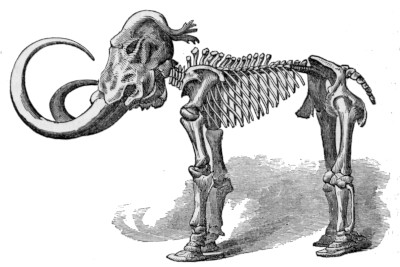
SKELETON OF THE SIBERIAN MAMMOTH.
In the year 1799, a Tungusian fisherman observed a strange shapeless
mass projecting from an ice-bank, near the mouth of a river in the north of
Siberia, the nature of which he did not understand, and which was so high
in the bank as to be beyond his reach. The next year he observed the same
object, which was then rather more disengaged from among the ice, but was
still unable to conceive what it was. Toward the end of the following
summer, 1801, he could distinctly see that it was the frozen carcass of a
huge animal, the entire flank of which, and one of its tusks, had become
disengaged from the ice. In consequence of the ice beginning to melt
earlier, and to a greater degree than usual, in 1803, the fifth year of this
discovery, the enormous carcass became entirely disengaged, and fell down
from the ice-crag on a sand-bank forming part of the coast of the Arctic
457ocean. In the month of March of that year, the Tungusian carried away the
two tusks, which he sold for fifty rubles, about thirty-eight dollars.
Two years afterward this animal still remained on the sand-bank, where it
had fallen from the ice; but its body was then greatly mutilated. The
peasants had taken away considerable quantities of its flesh to feed their
dogs; and the wild animals, particularly the white bears, had also feasted on
the carcass; yet the skeleton remained quite entire, except that one of the
fore legs was gone. The entire spine, the pelvis, one shoulder-blade, and
three legs, were still held together by their ligaments, and by some remains
of the skin; and the other shoulder-blade was found at a short distance.
The head remained, covered by the dried skin, and the pupil of the eyes was
still distinguishable. The brain also remained within the skull, but a good
deal shrunk and dried up; and one of the ears was in excellent preservation,
still retaining a tuft of strong bristly hair. The upper lip was a good deal
eaten away, and the under lip was entirely gone, so that the teeth were distinctly
seen. The animal was a male, and had a long mane on its neck.
The skin was extremely thick and heavy, and as much of it remained
as required the exertions of ten men to carry away, which they did with
considerable difficulty. More than thirty pounds of the hair and bristles of
this animal were gathered from the wet sand-bank, having been trampled
into the sand by the white bears, while devouring the carcass. The hair was
of three distinct kinds: one consisting of stiff black bristles, a foot or more
in length; another of thinner bristles, or coarse flexible hair, of a reddish-brown
color; and the third of coarse reddish-brown wool, which grew among
the roots of the hair. These afford an undeniable proof that this animal had
belonged to a race of elephants inhabiting a cold region, with which we are
unacquainted, and by no means fitted to dwell in the torrid zone. It is also
evident that this enormous animal must have been frozen up by the ice at
the moment of its death.
At whatever elevations these shells may have been found, and however
remote from the parts of the globe now occupied by water, it is certain that
they were once generated in the sea, by which they were deposited. The
Altain chain of primitive mountains in Siberia is flanked on each side by a
chain of hills inclosing marine shells. On a comparison of the forms, contexture
and composition of these shells, as they have been found imbedded
in rocks, not the slightest difference can be detected between several varieties
of them and those which still inhabit the sea. At Touraine, in France, a
458hundred miles from the ocean, and about nine feet beneath the surface, a
bed of fossil shells has been found nine leagues in length, and about twenty
feet in thickness. Such beds are known to exist in every part of Europe;
and in South America, according to Ulloa, they are very frequent.
Great Britain abounds in these fossil productions. In the cliffs of the isle
of Sheppey, bordering on the Thames, several varieties of the crab, and lobsters
nearly whole, have been found in a petrified state. Within the elevated
lands in the vicinity of Reading, in Berkshire, an abundance of oyster-shells
has been found, many of them entire, and having both their valves united.
At Broughton, in Lincolnshire, there are two quarries abounding in fresh-water
shells, which are found in a blue stone, supposed to have been formerly
clay, and to have been gradually indurated. A bed of shells, twelve feet
thick, and lying in a greenish sand, has been found about a mile from Reculver,
in Kent. At Harwich, at the entrance of the river, a sandy cliff, fifty
feet in hight, contains shells, of which there are no less than twenty-eight
varieties. On digging a moorish pasture, in Northamptonshire, many snails
and river shells were found; and these were the more abundant in proportion
as the workmen proceeded to a greater depth. And, lastly, the petrifactions
known by the name of belemnites, have been found in chalk pits, in
different parts of the kingdom: they are usually cylindrical, or conical, and
sometimes contain a hollow nucleus. They are supposed to constitute a
species of nautilus, and very frequently occur in the coarser kinds of marble.
In the year 1708, a breach made by the Thames, at an extraordinary high
tide, inundated the marshes of Dagenham and Havering, in Essex. Such
was the impetuous rush of the water, that a large passage or channel was
torn up, three hundred feet in width, and in some parts twenty feet in
depth. In this way, a great number of trees, that had been buried there
many ages before, were exposed to view. With one exception, that of a
large oak, having the greatest part of its bark, and some of its heads and
roots in a perfect state, these trees bore a greater resemblance to alder than
to any other description of wood. They were black and hard, and their
fibers were extremely tough. No doubt was entertained of their having
grown on the spot where they lay; and they were so numerous, that in many
places they afforded steps to the passengers. They were imbedded in a black
oozy soil, on the surface of which they lay prostrate, with a covering of
grey mold.
In passing along the channel torn up by the water, vast numbers of the
459stumps of these subterraneous trees, remaining in the posture in which they
grew, were to be seen, some with their roots running down, and others
branching and spreading about in the earth, as is observed in growing trees.
That they were the ruins, not of the deluge, but of a later age, has been
inferred from the existence of a bed of shells, which lies across the highway,
on the descent near Stifford bridge, leading to South Okendon. At a
perpendicular depth of twenty feet beneath this bed of shells, and at the
distance of nearly two hundred feet, in the bottom of the valley, runs a
brook which empties itself into the Thames at Purfleet. This brook is
known to ebb and flow with the Thames; and, consequently, if the bed of
shells, as has been conjectured, was deposited in that place by an inundation
of the Thames, it must have been such as to have drowned a vast proportion
of the surrounding country, and have overtopped the trees near the river, in
West Horrock, Dagenham, and the other marshes, overturning them in its
progress. In support of this hypothesis, it should be remarked, that the bed
of earth in which the trees grew, was entire and undisturbed, and consisted
of a spongy, light, oozy soil, filled with the roots of reeds, of a specific
gravity much less than that of the stratum above it.
The levels of Hatfield chase were, in the reign of Charles I., the largest
chase of red deer in England. They contained about one hundred and
eighty thousand acres of land, about one-half of which was yearly inundated;
but being sold to one Vermuiden, a Dutchman, he contrived, at a
great labor and expense, to dischase, drain, and reduce these lands to arable
and pasture grounds not subject to be overflowed. In every part of the
soil, in the bottom of the river Ouse even, and in that of the adventitious
soil of all marsh land, together with the skirts of the Lincolnshire wold,
vast multitudes of the roots and trunks of trees of different sizes are found.
The roots are fixed in the soil, in their natural position, as thick as they
could have grown; and near to them lie the trunks. Many of these trees
appear to have been burned, and others to have been chopped and squared;
and this in such places, and at such depths, as could never have been opened,
since the destruction of the forest, until the time of the drainage. That
this was the work of the Romans, who were the destroyers of all the woods
and forests which are now found underground in the bottoms of moors and
bogs, is evidenced by the coins and utensils, belonging to that nation, which
have been collected, as well in these levels, as in other parts of Great Britain
where these subterraneous forests have been discovered.
460
It having been reported in Lincolnshire, that a large extent of islets of
moor, situated along its coast, and visible only at the lowest ebbs of the tide,
was chiefly composed of decayed trees, Dr. de Serra, accompanied by Sir
Joseph Banks, proceeded, in the month of September, 1796, to examine
their nature and extent. They landed on one of the largest of these islets,
when the ebbs were at the lowest, and found its exposed surface to be about
ninety feet in length, and seventy-five in width. They were enabled to
ascertain, that these islets consist almost entirely of roots, trunks, branches,
and leaves of trees and shrubs, intermixed with leaves of aquatic plants.
The remains of many of the trees were still standing on their roots; but
the trunks of the greater part of them lay scattered on the ground, in every
direction. The bark of the trees and roots appeared in general as fresh as
when they were growing; in that of the birches particularly, many of which
were found, even the thin silvery membranes of the outer skin were discernible.
The timber of all kinds, on the contrary, was decomposed and soft,
in the greater part of the trees; in some it was firm, especially about the
knots. Sound pieces of timber had been often found by the country people.
In general, the trunks, branches and roots of the decayed trees were considerably
flattened; a phenomenon which has been observed in the surtarbrand,
or fossil wood of Iceland, and also in that found near the lake of Thun, in
Switzerland. The soil was chiefly composed of rotten leaves; and, on being
thrown into water, many of these were taken out in a perfect state.
These islets extended about twelve miles in length, and one in breadth,
opposite the shore of Sutton, at which place, on digging a well, a moor of
the same nature was found under ground, at the depth of sixteen feet, and,
consequently, very nearly on the same level with that which constitutes the
islets. On boring in the fields belonging to the Royal Society, in the parish
of Mablethorpe, to ascertain the cause of the subterraneous stratum of
decayed vegetables, a similar moor was found. The appearance of these
decayed vegetables was found exactly to agree with that of the moor which
was thrown up in Blankney fen, and in other parts of the east fen of Lincolnshire,
in making their embankments; barks, like those of the birch-tree,
being there also abundantly found. This moor has been traced as far as
Peterborough, sixty miles south of Sutton. On the north side, the moory
islets extend as far as Grimsby, on the south of the mouth of the Humber:
and it is a remarkable circumstance, that in the large tracts of low land
which lie on the south banks of that river, a little above its mouth, there is
461a subterraneous stratum of decayed trees and shrubs, exactly resembling
those observed at Sutton. At Axholme isle, a similar stratum extends over
a tract of ten miles in length, by five in breadth. The roots there also stand
in the places where they grew; while the trunks lie prostrate, amid the roots
of aquatic plants and reeds. Little doubt can be entertained of the moory
islets of Sutton being a part of this extensive subterraneous stratum, which,
by some inroad of the sea, has been there stripped of its covering of soil.
The identity of the levels; that of the species of trees; the roots of these
affixed, in both, to the soil where they grew; and, above all, the flattened
shape of the trunks, branches, and roots, found in the islets, which can only
be accounted for by the heavy pressure of a superinduced stratum, are sufficient
reasons for this opinion. Such a wide-spread assemblage of vegetable
ruins, lying almost in the same level, and that level generally under the
common mark of low water, naturally gives rise to reflections on the epoch
of this destruction, and the agency by which it was effected.
The original catastrophe which buried this immense forest must have been
of very ancient date; but it is to be suspected, that the inroad of the sea
which uncovered the decayed trees of the islets of Sutton, is comparatively
recent. The state of the leaves, and the timber, and also the tradition of
the country people, concur to strengthen this suspicion. Leaves and other
delicate parts of plants, though they may be long preserved in a subterraneous
situation, can not remain uninjured when exposed to the action of the
waves, and of the air. The inhabitants of Sutton believe that their parish
church once stood on the spot where the islets now are, and was submerged
by the inroads of the sea; that, at very low water, their ancestors could even
discern its ruins; and that their present church was built to supply the place
of that which was washed away. So many concomitant (though weak)
testimonies, render their report to a certain degree deserving of credit, and
lead to a supposition, that some of the stormy inundations of the North sea,
which in these last centuries have washed away such large tracts of land on
its shores, may have carried away a soil resting on clay, and have finally
uncovered the trees of these moory islets.
Bogs and mosses are little more than lakes filled up with vegetable matter,
usually of aquatic origin. They are to be found not only in Ireland and
Scotland, but also in every northern country, more especially when thinly
peopled. It should be remarked, that Ireland abounds in springs, which are
mostly dry in summer; and that grass and weeds grow abundantly about
these spots. In the winter these springs swell and run, softening and
loosening all the earth about them. Now, that sward or surface of the earth
which consists of the roots of grass, being lifted up, and made fuzzy or
462spongy by the water in the winter, is dried in the spring, and does not fall
together, but withers in a tuft. The new grass which springs through it is
again lifted during the following winter; and thus the spring is still more
and more stopped, and the sward grows thicker and thicker, till at length it
makes what is called a quaking bog. In proportion as it rises and becomes
drier, and as the grass roots and other vegetables become more putrid,
together with the mud and slime of the water, it acquires a blackness, and
becomes what is called a turf bog. When the vegetables rot, it is considered
that the saline particles are in general carried away by the water, in which
they are dissolved; but that the oily or sulphureous particles remain and
float on the water; and it is thus that the turf acquires its inflammability.
The highest mountains of Ireland are, as well as the plains, covered with
bogs, because they abound in springs, which, on account of a defective population,
are not cleared; and thus they are overrun with bogs. In that
country mosses also abound; and the particular kind which grows in bogs, is
remarkable on this account, that a congeries of its threads, before it is
decayed, constitutes the substance of the light spongy turf, which thus
becomes so tough as not to yield to the spade. This curious substance, in
the north of Ireland, is called old wives’ tow, and is not unlike flax. The
turf hardens by degrees, but is still stringy when broken, and at length
becomes the red turf employed as fuel.
The production of the quaking bogs is as follows. When a stream or
spring runs through a flat, it becomes filled with weeds in summer, and trees
fall across and dam it up. During the winter season the water stagnates
more and more every year, until the whole flat is covered. A coarse kind
of grass, peculiar to these bogs, springs up in tufts, the roots of which are
consolidated, and which, in a few years, grow to the hight of several feet.
In the winter the grass rots, and falls with its seed on the tufts, thus adding
to their growth the ensuing spring. The tops of flags and grass are sometimes
interwoven on the surface of the water, and gradually becoming
thicker, cover its surface. On this covering herbs grow; and by the interweaving
of their roots, it is rendered so strong as to bear a man. Some of
these bogs sink, where a man stands, to a considerable depth, and rise before
and behind: underneath, the water is clear. Even these in time become red
bogs; but may easily be converted into meadow land, by clearing a trench
for the passage of the water.
Sir Hans Sloane, in his account of the bogs of Ireland, published in the
“Philosophical Transactions,” notices a curious fact, namely, that when the
turf-diggers, after having dug out the earth proper to make turf or peat,
reached the bottom, so as to come to the clayey or other soil, by draining off
463the water, they met with the roots of fir-trees, with their stumps standing
upright, and their branches spread out on every side horizontally. This was
evidently the place of the growth of these trees, the branches of the roots of
which are in some parts matted, as is seen in the roots of trees closely
planted. Large pieces of wood have been found, not only in clay-pits, but
likewise in quarries or stone-pits, in the blocks of stone raised out of their
strata or layers. The black spongy mold employed for peat smells strongly
of bitumen, or petroleum, a great proportion of the oil of which is yielded
by distillation; so that, singular as it may appear, not only oil, but a
material which may be used for candles, may be extracted from these peat-bogs
in large quantities; and it has even been proposed that this business
should be carried on on a large scale, with a view to giving prosperity to the
country. In several parts of Ireland a singular phenomenon has been
observed: on horses trampling with their feet on a space of soft ground, a
sudden appearance of light ensued. On the mold, which agreed in color,
lightness, &c., with peat earth, being examined with a microscope, the light
was found to proceed from an abundance of small, semi-transparent, whitish,
live worms which lay in it.
The commissioners appointed by parliament to inquire into the nature
and extent of the bogs of Ireland, and the practicability of draining them,
represent them as occupying thousands of acres, indeed, many square miles.
Their nature and constituent parts are described by them as consisting of an
accumulation of vegetable matter, settling in successive generations on itself,
and converted by the want of ventilation and motion to a stagnant pool,
which first furnished the elements of life and increase to the plants covering
its surface. The progress of the accumulation may be best conceived by
imagining a basin, or concave reservoir, of a certain extent and depth,
formed of clay, limestone, gravel, &c., through which the water, scantily but
constantly supplied, can not obtain an issue. Undisturbed in this water, a
surface of bog moss grows, decays and putrefies. To this a second generation
succeeds; and this is followed by others, until, at length, the bulk rises
considerably above the level of its bed, forming hillocks of various hights,
shapes and dimensions. The surface of a bog is not level like a lake, but
undulating; and it terminates somewhat abruptly, and almost perpendicularly.
The average hight of the great bogs, above the level of high-water
mark in Dublin harbor, is about two hundred and fifty feet. Many acres of
these bogs have been reclaimed; and the practicability of draining and cultivating
the greater proportion of them has been pointed out in the reports of
the commissioners.
Perthshire, in North Britain, abounds in mosses, the contents of which are
464computed to exceed nine thousand acres. The greatest hight of the moss,
above the clay on which it lies, is fourteen feet and a half. Its surface, when
viewed at a distance, seems wholly covered with heath: but when closely
examined, is found to be composed of small tufts of heath, intermixed with a
variety of moss-plants. Here also are found innumerable trunks of trees,
lying along close to their roots, the latter being still fixed in the clay, as in
the natural state.
The irruption of what is called Solway moss has greatly attracted the
public attention; for, although the cause of it is obvious, still the alteration
it produced on the surface of the earth, was more considerable than any
known in Great Britain, as resulting from a natural cause, since the destruction
of Earl Goodwin’s estate. It happened in the year 1771, after severe
rains which had in many places produced great inundations of the rivers.
The following is a concise description of the spot where this event happened.
Along the side of the river Esk, is a vale, about a mile in breadth, bounded
on the south-east by the river, and on the north-west by a steep bank, about
thirty feet in hight above the level of the vale. From the top of the bank the
ground rises on an easy ascent for about a quarter of a mile, where it is
terminated by the moss, which extends about two miles north and south, and
about a mile and a half east and west, being bounded on the north-west by
the river Sark. It is probable that the solid ground, from the top of the
bank above the vale, was continued in the same direction under the moss,
before its irruption, for a considerable space; for the moss, at the place
where the irruption happened, was inclined toward the sloping ground.
From the edge of the moss there was a gully or hollow, called by the country
people the gap, and said to be thirty yards deep where it entered the vale:
down this hollow ran a small rill of water, which was often dry in summer,
not having any other supply but what filtered from the moss.
The irruption happened, at the head of this gap, on the night of the sixteenth
of November, between the hours of ten and eleven, when all the
neighboring rivers and brooks were prodigiously swollen by the rains. A
large body of the moss was forced, partly by the great fall of rain, and partly
by the springs beneath, into a small beck or burn, which runs within a few
yards of its border to the south-east. By the united pressure of the water
behind it, and of this beck, which was then very high, it was carried down a
narrow glen between two banks about three hundred feet high, into a wide
and spacious plain, over a part of which it spread with great rapidity. The
moss continued for some time to send off considerable quantities of its substance,
which, being borne along by the torrent, on the back of the first great
body, kept it for many hours in perpetual motion, and drove it still further
465on. During the first night, at least four hundred acres of fine arable land
were covered with moss from three to twelve or fifteen feet in depth. Several
houses were destroyed, much corn lost, &c.; but all the inhabitants escaped.
When the waters subsided, the moss also ceased to flow; but two pretty considerable
streams continued to run from the heart of it, and carried away
some pieces of mossy matter to the place where it burst. They then joined
the beck, already mentioned, which with this addition, resumed its former
channel, and with a little assistance from the people of the neighborhood,
made its way to the Esk, through the midst of that body of moss which
obstructed its course. Thus, in a great measure drained, the new moss fell
several feet, and when the fair weather came on at the end of November, it
settled in a firmer and more solid body on the lands it had overrun. By
this inundation about eight hundred acres of arable ground were overflowed
before the moss stopped, and the habitations of twenty-seven families
destroyed.
Tradition has preserved the memory of a similar inundation in another
part of North Britain. At Monteith a moss changed its course in one night,
and covered a great extent of ground. There is also an account in the “Philosophical
Transactions” of a moving moss near Churchtown, in Lancashire,
which greatly alarmed the neighborhood, and was regarded as a miracle.
The moss was observed to rise to a surprising hight, and soon after to sink as
much beneath the level, moving slowly toward the south.
Coral belongs to the class of those surprising productions of nature, which
are named zoöphytes, or plant-animals, on account of their filling up the
intermediate space between the animal and vegetable kingdoms; and in
treating of them this curious substance will be distinctly considered. In the
mean time, the production of coral reefs and islands presents one of those
geological changes, by which the earth’s surface has been modified, and has
received a new accession from the sea.
The common foundation of the clusters of islands discovered by modern
navigators in the Pacific ocean, as well as of those belonging to New South
Wales, is evidently of coral structure, immense reefs of which shoot out in
all directions. There is every reason to believe that the islands which are
occasionally raised by the tremendous agency of subterraneous volcanoes, do
not bear any proportion to those which are perpetually forming, by the silent
but persevering efforts of the sea worms by which coral is produced. Banks
of coral are found at all depths, and at all distances from the shore, entirely
466unconnected with the land, and detached from each other. By a quick progression,
they grow up toward the surface; while the winds, heaping up the
coral from deeper water, rapidly accelerate the formation of these banks into
shoals and islands. They become gradually shallower; and when once the
sea meets with resistance, the coral is quickly thrown up by the force of the
waves breaking against the bank. These coral banks have been seen in all
their stages: some in deep water; others with a few rocks appearing above
the surface, just formed into islands without the least appearance of vegetation;
and, lastly, others covered with soil and weeds.
The loose corals, rolled inward by the billows in large pieces, strike upon
the grounds, and, the reflux being unable to carry them away, become a bar
to the coagulated sand with which they are always intermixed. This sand,
being easiest raised, is lodged at top; and when its accumulated mass is
elevated by violent storms, and no longer within the reach of common waves,
it becomes a resting-place to birds whom the search of prey draws thither.
Their excrement, feathers, &c., augment the soil, and prepare it for the
reception of accidental roots, branches and seeds cast up by the waves, or
brought thither by birds. Thus islands are formed: the leaves and rotten
branches, intermixing with the sand, produce in time a light black mold, in
which trees and shrubs vegetate and thrive. Cocoa-nuts, which continue
long in the sea without losing their vegetative powers, having been thrown
on such islands, produce trees which are particularly adapted to all soils,
whether sandy, rich or rocky. The violence of the waves, within the tropics,
must generally be directed to two points, according to the monsoons. Hence
the islands formed from coral banks must be long and narrow, and lie nearly
in a meridional direction. Even supposing the banks to be round, as they
seldom are when large, the sea meeting most resistance in the middle, must
heave up the matter in greater quantities there, than toward the extremities;
and, by the same rule, the ends will generally be open, or at least lowest.
They will also commonly have soundings there, as the remains of the banks,
not accumulated, will be under water. Where the coral banks are not
exposed to the common monsoon, they will alter their direction, and become
either round, or extended in the parallel, or of irregular forms, according to
accidental circumstances.
Captain Flinders, in his voyage to the South Pacific, gives an account of
an unbroken reef of coral, three hundred and fifty miles long, on the coast
of New Holland; and he states, that between that country and New Guinea,
the coral formations extend through a distance of seven hundred miles,
interrupted by no intervals of more than thirty miles in length. He also
gives us a lively and interesting description of a coral reef on the southern
467coast of New South Wales. On this reef he landed, and the water being
very clear round the edges, a new creation, as it were, but imitative of the
old, was presented to the view. Wheat sheaves, mushrooms, stags’ horns,
cabbage leaves, and a variety of other forms, were glowing under water with
vivid tints of every shade betwixt green, purple, brown and white; equaling
in beauty, and excelling in grandeur, the most favorite parterre of the curious
florist. These were different species of coral and fungus, growing, as it
were, out of the solid rock, and each had its peculiar form and shade of coloring;
but, whilst contemplating the richness of the scene, the destruction with
which it was pregnant could not be forgotten. Different corals in a dead
state, concreted into a solid mass of a dull white color, composed the stone
of the reef. The negro heads were lumps which stood higher than the rest;
and being generally dry, were blackened by the weather; but even in these
the forms of the different corals and some shells were distinguishable. The
edges of the reef, but particularly on the outside where the sea broke, were
the lightest parts; within these were pools and holes containing live corals,
sponges, sea-eggs and cucumbers; and many enormous cockles were scattered
upon different parts of the reef. At low water, these cockles seem most
commonly to lie half open, but frequently close with much noise, and the
water within the shells then spouts up in a stream, three or four feet high:
it is from this noise and the spouting of the water that they are discovered,
for, in other respects, they are scarcely to be distinguished from the coral
rock.
His description of a coral island which he afterward visited on the same
coast, is truly philosophical and throws great light on these surprising productions
of nature.
“This little island, or rather the surrounding reef, which is three or four
miles long, affords shelter from the south-east winds. It is scarcely more
than a mile in circumference, but appears to be increasing both in elevation
and extent. At no very distant period of time, it was one of those banks
produced by the washing up of sand and broken coral, of which most reefs
afford instances, and those of Torres’ strait a great many. These banks are
in different stages of progress: some, like this, are become islands, but not
yet habitable; some are above high-water mark, but destitute of vegetation;
whilst others are overflowed with every returning tide. It seems to me,
that, when the animalcules which form the corals at the bottom of the ocean,
cease to live, their structures adhere to each other, by virtue either of the
glutinous remains within, or of some property in salt water; and the
interstices being gradually filled up with sand and broken pieces of coral
washed by the sea, which also adhere, a mass of rock is at length formed.
468Future races of these animalcules erect their habitations upon the rising bank,
and die in their turn, to increase, but principally to elevate, this monument
of their wonderful labors. The care taken to work perpendicularly in the
early stages, marks a surprising instinct in these diminutive creatures.
Their wall of coral is for the most part in situations where the winds are
constant, and when it reaches the surface, it affords a shelter, to the leeward
of which their infant colonies may be safely sent forth; and to this their
instinctive foresight it seems to be owing, that the windward side of a reef
exposed to the open sea, is generally, if not always, the highest part, and
rises almost perpendicular, sometimes from the depth of two hundred, and
perhaps many more fathoms. To be constantly covered with water, seems
necessary to the existence of the animalcules, for they do not work, except
in holes upon the reef, beyond low-water mark; but the coral sand and other
broken remnants thrown up by the sea adhere to the rock, and form a solid
mass with it, as high as the common tides reach. That elevation surpassed,
the future remnants, being rarely covered, lose their adhesive property; and
remaining in a loose state, form what is usually called a key upon the tops
of the reef. The new bank is not long in being visited by sea-birds; salt
plants take root upon it, and a soil begins to be formed; a cocoa-nut is
thrown on shore; land birds visit it and deposit the seeds of shrubs and
trees; every high tide, and still more every gale, adds something to the
bank; the form of an island is gradually assumed, and last of all comes man
to take possession. This island is well advanced in the above progressive
state; having been many years, probably some ages, above the reach of the
highest spring-tides, or the wash of the surf in the heaviest gales. I distinguished,
however, in the rock which forms its basis, the sand, coral and
shells formerly thrown up, in a more or less perfect state of cohesion; small
pieces of wood, pumice-stone, and other extraneous bodies, which chance
had mixed with the calcareous substances when the cohesion began, were
inclosed in the rock, and, in some cases, were still separable from it without
much force. The upper part of the island is a mixture of the same substances
in a loose state, with a little vegetable soil, and is covered with the
casuarina and a variety of other trees and shrubs, which give food to paroquets,
pigeons, and some other birds; to whose ancestors it is probable the
island was originally indebted for this vegetation.”
WIDE AND INHOSPITABLE DESERTS. — ASIATIC DESERTS. — ARABIAN DESERTS. — AFRICAN DESERTS. — PILGRIMAGE ACROSS THE DESERTS. — SANDS OF THE DESERT.
469
In Africa, as well as Asia, there are immense tracts of land called deserts,
which consist of vast plains composed of loose sand. Large portions of these
are utterly destitute of vegetation, and sometimes, in crossing them, the
traveler sees not a hill or mountain, or human dwelling, or even a tree or
shrub, or blade of grass. All around is a sea of sand; and far as the eye
can reach, it is one scene of lifeless solitude and desolation. These trackless
wastes are traversed by caravans, which are companies of travelers
usually mounted upon camels. Horses travel in these sands with difficulty.
Their feet sink in the soil; they are overcome with heat, and parched with
drought. The camel, on the contrary, has a large, spongy foot, which does
not sink in the sand; he can bear excessive heat, and by a curious contrivance
of nature, is enabled to go without water for five or six days. This
valuable creature is called the ship of the desert, because it enables the
merchants of Asia and Africa to transport their merchandise over the sea of
sand, just as a ship carries goods from one part of the world to another,
across the briny ocean. It seems really as if Providence had provided this
singular animal on purpose to enable mankind to traverse the great deserts
which are spread out upon the eastern continent.
The chief Asiatic deserts are in Persia and Arabia, the former of which
countries contains three of considerable extent and celebrity. The first of
these commences on the east of the Tigris, in latitude thirty-three, and
extends to the north of Shuster. The second reaches from the vicinity of
Korn very nearly to the Zurra, in a line, from east to west, of about four
hundred English miles, and from north to south, of about two hundred and
fifty. In the latter direction it joins the great desert of Kerman, which,
alone, extends over a tract of three hundred and fifty miles. The two may,
therefore, be considered as forming one common desert, stretching north-west
and south-east, over a space of about seven hundred miles; thus intersecting
this wide empire into two nearly equal portions. This vast region is
impregnated with niter and other salts, which taint the neighboring lakes
and rivers, and has, on that account, been denominated the Great Saline
Desert.
470
The sandy deserts of Arabia form one of the most striking objects of that
country. From the hills of Omon, which appear to be a continuation of
those on the other side of the Persian gulf, as far as Mecca, the greater part
of Negad is one prodigious desert, interrupted, toward the frontiers of Hejaz
and Yemen, or Arabia Felix, by Kirge, containing the district of Sursa, and
several oases, or fertile spots. The north-west part of Negad presents almost
a continued desert, and is considered as a prolongation of the one above
mentioned.
The Beled el Haram, or Holy Land of Islam, of which Mecca is the
capital, is comprehended between the Red sea, and an irregular line which,
commencing at Arabog, about sixty miles to the north of Djedda, forms a
bend from the north-east to the south-east, in passing by Yelemlem, two days’
journey to the north-east of Mecca. It thence continues to Karna, nearly
seventy miles to the east of the same place, and twenty-four miles to the
west of Taif, which is without the limit of the Holy Land; after which,
turning to the south-west, it passes by Drataerk, and terminates at Mehherma
upon the coast, at the port named Almarsa Ibrahim, about ninety
miles to the south-east of Djedda.
It therefore appears that the holy land is about one hundred and seventy
miles in length, from the north-west to the south-east, and eighty-four miles
in breadth, from the north-east to the south-west; which space is comprehended
in that part of Arabia known by the name of ElEl Hedjeaz, or the
Land of Pilgrimage, and includes the cities of MedinaMedina and Taif. It has not
any river; and the only water to be found, is that of some inconsiderable
springs, which are not numerous, and the brackish water obtained from the
deep wells. Thus it is a real desert. It is at Mecca and Medina alone, that
cisterns have been wrought to preserve the rain-water; on which account, a
garden is very rarely to be seen throughout this vast territory. The plains
are composed either of sand, or barren earth, entirely abandoned; and, as
the inhabitants do not, in any part of the country, sow any description of
grain, they are supplied with flour, &c., from upper Egypt, Yemen and
India.
The most striking feature of Africa consists of the immense deserts which
pervade its surface, and which are supposed to comprise the one-half of its
whole extent. The chief of these is, by way of eminence, called Sahara, or
471the Desert. It stretches from the shores of the Atlantic, with few interruptions,
to the confines of Egypt, a space of more than forty-five degrees, or
about three thousand miles, by a breadth of twelve degrees, or about nine
hundred miles; its whole extent being two-thirds as large as that of the
United States. It is one prodigious expanse of red sand, and sandstone rock,
of the granulations of which the red sand consists. It is, in truth, an empire
of sand which seems to defy every exertion of human power or industry,
although it is interspersed with various islands, and fertile and cultivated
spots of different sizes, where water collects in springs or pools, around which
vegetation springs up. These places, which present a delightful contrast to
the surrounding sterility, and cheer the eye of the weary traveler, are called
oases. Fezzan, or Fessan, is the chief of those which have been hitherto
explored.
Nearly in the center of the southern line of this sandy ocean, and about
midway between the Mediterranean sea and the coast of Guinea, rise the
walls of Timbuctoo, a city which constitutes the great mart for the commerce
of all the interior of Africa. To maintain this commerce is the
laborious work of the akkabaars, or caravans, which cross this enormous
desert from almost every part of the African coast. The mode in which it
is traversed is highly curious. The caravans consist of several hundred
loaded camels, accompanied by the Arabs who let them out to the merchants
for the transportation of their goods. During their route, they are often
exposed to the attacks of the roving Arabs of Sahara, who generally commit
their depredations on the approach to the confines of the desert. In this
tiresome journey, the caravans do not proceed to the place of their destination,
in a direct line across the trackless desert, but turn occasionally eastward
or westward, according to the situation of the oases of which we have
spoken, which are interspersed in various parts of the Sahara, like islands in
the ocean. These serve as watering-places to the men, as well as to feed,
refresh and replenish the hardy and patient camel. At each of these cultivated
spots, the caravan sojourns several days, and then proceeds on its
journey, until it reaches another spot of the same description. In the intermediate
journeys, the hot winds, denominated shume, or simoom, are often
so violent and penetrating, as considerably, if not entirely, to exhale the
water carried in skins by the camels for the use of the passengers and
drivers. On these occasions, it is affirmed by the Arabs, five hundred
dollars have been frequently given for a draught of water, and that ten or
twenty dollars are often paid, when a partial exhalation has occurred. These
scorching winds are sometimes called the samiel, and are supposed by some,
to be pestilential in their nature.
472In 1805, a caravan proceeding from Timbuctoo to Tafilet, was disappointed
in not finding water at one of the usual watering-places, when, horrible to
relate, the whole of the persons belonging to it, two thousand in number,
besides one thousand eight hundred camels, perished of thirst! Accidents
of this nature, account for the vast quantities of human and other bones
which are found heaped together in various parts of the desert.
The following is the general route of the caravans, in crossing the great
desert. Having left the city of Fez, they proceed at the rate of three miles
and a half an hour, and travel seven hours each day. In the space of
eighteen days they reach Akka, where they remain a month, as this is the
place of rendezvous at which they are formed into one grand accumulated
caravan. In proceeding from Akka to Tagassa, sixteen days are employed;
and here again, the caravan sojourns fifteen days to refresh the camels. It
then directs its course to the oasis and well of Taudeny, which is reached in
seven days; and, after another stay of fifteen days, it proceeds to Arawan, a
watering-place, situated at a like distance. After having sojourned there
fifteen days, it sets out, and reaches Timbuctoo on the sixth day, after having
performed a journey of fifty-four days of actual traveling, and seventy-five
of repose; making, altogether, from Fez to Timbuctoo, one hundred and
twenty-nine days, or four lunar months and nine days. Another caravan
sets out from Wedinoon and Sok Assa, traversing the desert between the
Black mountains of Cape Bojador and Gualata: it touches at Tagassa and
El Garbie, or West Tagassa, where having staid to collect salt, it proceeds
to Timbuctoo. The time occupied by this caravan is five or six months, as
it proceeds as far as Gibbelel-bied, or the White mountains, near Cape Blanco,
through the deserts of Mograffa and Woled Abusebah, to a place named
Agadeen, where it sojourns twenty days.
The caravans which cross the desert, may be compared to fleets of merchant
vessels under convoy; the stata, or convoy of the desert, consisting of
a certain number of Arabs, belonging to the tribe through whose territory
the caravan passes. Thus, in crossing the territory of Woled Abusebah, it
is accompanied by Sebayhees, or people of that country, who, on reaching
the confines of the territory of Woled Deleim, deliver their charge to the
protection of the chiefs of that country. These, again, conduct it to the
confines of the territory of the Mograffa Arabs, under whose care it at length
reaches Timbuctoo. Any assault on the caravan during this journey, is
considered as an insult to the whole tribe to which the convoy belongs; and
for such an outrage they never fail to take ample revenge. Besides these
grand caravans, others cross the desert, on an emergency, without a convoy
or guard. This is, however, a perilous expedition, as they are too often
473plundered near the northern confines of the desert, by two notorious tribes,
named Dikna and Emjot. In the year 1798, a caravan consisting of two
thousand camels, laden with the produce of the Soudan territory, together
with seven hundred slaves, was plundered and dispersed, with great slaughter.
These desperate attacks are conducted in the following manner. The
tribe being assembled, the horses are picketed at the entrance of the tents,
and scouts sent out, to give notice when a caravan is likely to pass. These
scouts being mounted on the fleet horses of the desert, quickly communicate
the intelligence, and the whole tribe mount their horses, taking with them a
sufficient number of female camels, on whose milk they entirely subsist.
Having placed themselves in ambush near an oasis, or watering-place, they
issue thence on the arrival of the caravan, which they plunder without
mercy, leaving the unfortunate merchants entirely destitute.
The food, dress and accommodations of the people who compose the
caravans, are simple and natural. Being prohibited by their religion the use
of wine and intoxicating liquors, and exhorted by its principles to temperance
in all things, they are commonly satisfied with a few nourishing dates,
and a draught of water, traveling for weeks successively without any other
food. At other times, when they undertake a journey of a few weeks across
the desert, a little barley meal, mixed with water, constitutes their only
nourishment. In following up this abstemious mode of life, they never
complain, but solace themselves with the hope of reaching their native
country, singing occasionally during the journey, whenever they approach a
habitation, or when the camels are fatigued. Their songs are usually sung
in trio; and those of the camel-drivers who have musical voices, join in the
chorus. These songs have a surprising effect in renovating the camels;
while the symphony and time maintained by the singers, surpass what any
one would conceive who has not heard them. The day’s journey is terminated
early in the afternoon, when the tents are pitched, prayers said, and
the supper prepared by sunset. The guests now arrange themselves in a
circle, and, the sober meal being terminated, converse till they are overcome
by sleep. At day-break next morning, they again proceed on their
journey.
It might seem that these inhabitants of the desert would lead a miserable
life, and especially that they would often be swallowed up in the terrific sand
storms, which sometimes sweep over these wastes. The sand, being loose
and dry, is borne upward by the whirling tempest, and is seen driving over
the plain, like a terrific thunder-cloud. The experienced traveler sees the
coming danger, and prepares himself for it. He throws himself upon the
ground, and covers his face so as not to be choked with the dust. The
474horses and camels, guided by instinct, also put their noses to the earth to
prevent being suffocated. If the storm is slight, the party escapes; but
sometimes, such immense waves of sand are drifted upon the wind, as to bury
the traveler deeply beneath it, and make it his winding-sheet forever.
Sometimes whole caravans, with their horses and camels, have been in this
manner overwhelmed; thus making the waves of the desert as fatal as the
waves of the sea. Yet, despite the terrors of the desert, the Arabs are a
lively and cheerful race. On their march, they stop at night; and in their
tents, spread beneath the starry canopy, the laugh, the jest and the song go
round. There are among them professed story-tellers, who delight the listeners
with fanciful tales of enchantment, adventure, and love, or perhaps
they repeat, in an animated manner, some fine specimens of Arabic poetry.
Thus it is, that mankind, occupying the gloomiest parts of the earth, have
amusements. As the steel is made to yield its spark, so the Arab finds
pleasure in the desert.
The following very lively description of a pilgrimage across the desert, is
given by Ali Bey, in his travels in Morocco, Tripoli, &c. It is an animated
picture, which portrays in the strongest colors the perils and sufferings
encountered in these enterprises.
“We continued marching on in great haste, for fear of being overtaken by
the four hundred Arabs whom we wished to avoid. For this reason we
never kept the common road, but passed through the middle of the desert,
marching through stony places, over easy hills. This country is entirely
without water; not a tree is to be seen in it, not a rock which can afford a
shelter or shade. A transparent atmosphere; an intense sun, darting its
beams upon our heads; a ground almost white, and commonly of a concave
form, like a burning-glass; slight breezes, scorching like a flame. Such is a
faithful picture of this district, through which we were passing. Every man
we meet in this desert is looked upon as an enemy. Having discovered
about noon a man in arms, on horseback, who kept at a certain distance, my
thirteen Bedouins united the moment they perceived him, and darted like
an arrow to overtake him, uttering loud cries, which they interrupted by
expressions of contempt and derision; as, ‘What are you seeking, my
brother?’ ‘Where are you going, my son?’ As they made these exclamations
they kept playing with their guns above their heads. The discovered
Bedouin profited by his advantage, and fled into the mountains, where it
was impossible to follow him. We met no one else.
475“We had now neither eaten nor drank since the preceding day; our
horses and other beasts were equally destitute; though ever since nine in
the evening we had been traveling rapidly. Shortly after noon we had not
a drop of water remaining, and the men, as well as the poor animals, were
worn out with fatigue. The mules, stumbling every moment, required
assistance to lift them up again, and to support their burden till they rose.
This terrible exertion exhausted the little strength we had left. At two
o’clock in the afternoon a man dropped down stiff, and as if dead, from great
fatigue and thirst. I stopped with three or four of my people to assist him.
The little wet which was left in one of the leathern budgets, was squeezed
out of it, and some drops of water poured into the poor man’s mouth, but
without any effect. I now felt that my own strength was beginning to
forsake me; and becoming very weak, I determined to mount on horseback,
leaving the poor fellow behind. From this moment others of my caravan
began to drop successively, and there was no possibility of giving them any
assistance; they were abandoned to their unhappy destiny, as every one
thought only of saving himself. Several mules with their burdens were left
behind, and I found on my way two of my trunks on the ground, without
knowing what was become of the mules which had been carrying them, the
drivers having forsaken them as well as the care of my effects and of my
instruments.
“I looked upon this loss with the greatest indifference, as if they had not
belonged to me, and pushed on. But my horse began now to tremble under
me, and yet he was the strongest of the whole caravan. We proceeded in
silent despair. When I endeavored to encourage any of the party to increase
his pace, he answered me by looking steadily at me, and by putting his fore-finger
to his mouth to indicate the great thirst by which he was affected. As
I was reproaching our conducting officers for their inattention, which had
occasioned this want of water, they excused themselves by alleging the
mutiny of the oudaias; and besides, added they, ‘Do we not suffer like the
rest?’ Our fate was the more shocking, as every one of us was sensible of
the impossibility of supporting the fatigue to the place where we were to
meet with water again. At last, at about four in the evening, I had my turn
and fell down with thirst and fatigue. Extended without consciousness on
the ground in the middle of the desert, left only with four or five men, one
of whom had dropped at the same moment with myself, and all without any
means of assisting me, because they knew not where to find water, and, if
they had known it, had not strength to fetch it, I should have perished with
them on the spot, if providence, by a kind of miracle, had not preserved us.
“Half an hour had already elapsed since I had fallen senseless to the
476ground, (as I have since been told,) when, at some distance, a considerable
caravan, of more than two thousand souls, was seen advancing. It was
under the direction of a marabout or saint called Sidi Alarbi, who was sent
by the sultan to Ttemsen or Tremecen. Seeing us in this distressed situation,
he ordered some skins of water to be thrown over us. After I had received
several of them over my face and hands, I recovered my senses, opened my
eyes, and looked around me, without being able to discern anybody. At
last, however, I distinguished seven or eight shereefs and faquirs, who gave
me their assistance, and showed me much kindness. I endeavored to speak
to them, but an invincible knot in my throat seemed to hinder me; I could
only make myself understood by signs, and by pointing to my mouth with
my finger. They continued pouring water over my face, arms and hands,
and at last I was able to swallow small mouthfuls. This enabled me to ask,
‘Who are you?’ When they heard me speak, they expressed their joy, and
answered me, ‘Fear nothing; far from being robbers, we are your friends;’
and every one mentioned his name. I began by degrees to recollect their
faces, but was not able to remember their names. They then poured over
me a still greater quantity of water, gave me some to drink, filled some of my
leather bags, and left me in haste, as every minute spent in this place was
precious to them, and could not be repaired.
“This attack of thirst is perceived all of a sudden by an extreme aridity
of the skin; the eyes appear to be bloody; the tongue and mouth, both
inside and outside, are covered with a crust of the thickness of a crown piece;
this crust is of a dark yellow color, of an insipid taste, and of a consistence
like the soft wax from a beehive. A faintness or languor takes away the
power to move; a kind of knot in the throat and diaphragm, attended with
great pain, interrupts respiration. Some wandering tears escape from the
eyes, and at last the sufferer drops down to the earth, and in a few moments
loses all consciousness. These are the symptoms which I remarked in my
unfortunate fellow-travelers, and which I experienced myself. I got with
difficulty on my horse again, and we proceeded on our journey. My
Bedouins and my faithful Salem were gone on different directions to find out
some water, and two hours afterward they returned one after another, carrying
along with them some good or bad water, as they had been able to find
it: every one presented to me part of what he had brought; I was obliged to
taste it, and I drank twenty times, but as soon as I swallowed it my mouth
became as dry as before; at last I was not able either to spit or to speak.
“The greatest part of the soil of the desert consists of pure clay, except
some small traces of a calcareous nature. The whole surface is covered with
a bed of chalky, calcareous stone of a whitish color, smooth, round and loose,
477and of the size of the fist; they are almost all of the same dimension, and
their surface is carious like pieces of old mortar: I look upon this to be a
true volcanic production. This bed is extended with such perfect regularity,
that the whole desert is covered with it; a circumstance which makes pacing
over it very fatiguing to the traveler. No animal is to be seen in this desert,
neither quadrupeds, birds, reptiles, nor insects, nor any plant whatever; and
the traveler who is obliged to pass through it, is surrounded by the silence
of death. It was not till four in the evening that we began to distinguish
some small plants burnt with the sun, and a tree of a thorny nature without
blossom or fruit.”
The passage across the Nubian desert, is, in its general features, the same
as that over the great desert of Sahara. The following narrative is somewhat
abridged from Bayard Taylor’s “Journey to Central Africa.” “My little
caravan consisted of six camels, including that of the guide. We passed the
miserable hamlet of Korosko, turned a corner of the mountain chain into a
narrow, stony valley, and in a few minutes lost sight of the Nile and his belt
of palms. Thenceforward, for many days, the only green thing to be seen
in the wilderness was myself. The first day’s journey lay among rugged
hills, thrown together in confusion, with no apparent system or direction.
They were of jet black sandstone, and resembled immense piles of coke or
anthracite. The small glens and basins inclosed in this chaos, were filled
with glowing yellow sand, which, in many places, streamed down the crevices
of the black rocks, like rivulets of fire. The path was strewn with hollow
globes of hard, black stones, precisely resembling cannon-balls. The guide
gave me one of the size of a rifle bullet, with a seam around the center, as
if cast in a mold. The thermometer showed a temperature of eighty degrees
at two o’clock in the afternoon, but the heat was tempered by a pure fresh
breeze. After eight hours’ travel, I made my first camp, at sunset, in a
little hollow inclosed by the mountains, where a gray jackal, after being
twice shot at, came and looked into the door of the tent.
“I found dromedary-riding not at all difficult. One sits on a very lofty
seat, with his feet crossed over the animal’s shoulders, or resting on his neck.
The body is obliged to rock backward and forward, on account of the long,
swinging gait; and as there is no stay or fulcrum, except a blunt pommel,
around which the legs are crossed, some little power of equilibrium is
necessary. My dromedary was a strong, stately beast, of a light cream color,
and of so even a gait that it would bear the Arab test: that is, one might
drink a cup of coffee while going on a full trot, without spilling a drop. I
found great advantage in the use of the oriental costume. My trowsers
allowed the legs perfect freedom of motion, and I soon learned so many
478different modes of crossing those members that no day was sufficient to
exhaust them. The rising and kneeling of the animal is hazardous at first,
as his long legs double together like a carpenter’s rule, and you are thrown
backward and then forward, and then backward again; but the trick is soon
learned. The soreness and fatigue of which many travelers complain, I
never felt; and I attribute much of it to the Frank dress. I rode from eight
to ten hours a day, read and even dreamed in the saddle, and was at night as
fresh and unwearied as when I mounted in the morning.
“My caravan was accompanied by four Arabs. They owned the burden
camels, which they urged along with the cry of ‘Yoho! Shekh Abd-el
Kader!’ and a shrill barbaric song, the refrain of which was, ‘O prophet of
God, help the camels, and bring us safely to our journey’s end!’ They
were very susceptible to cold, and a temperature of fifty degrees, which we
frequently had in the morning, made them tremble like aspen leaves, and
they were sometimes so benumbed that they could scarcely lead the camels.
They wore long swords, carried in a leathern scabbard over the left shoulder,
and sometimes favored us with a war-dance, which consisted merely in
springing into the air with a brandished sword, and turning round once
before coming down. They were all very devout, retiring a short distance
from the road to say their prayers, at the usual hours, and performing the
prescribed ablutions with sand instead of water. On the second morning,
we passed through a gorge in the black hills, and entered a region called El
Biban, or ‘The Gates.’ Here the mountains, though still grouped in the
same disorder, were more open, and gave room to plains of sand several
miles in length. The narrow openings, through which the road passes from
one plain to another, gave rise to the name. The mountains are higher than
on the Nile, and present the most wonderful configurations: towers, fortresses,
walls, pyramids, temples in ruin, of an inky blackness near at hand,
but tinged of a deep, glowing violet hue in the distance. Toward noon I
saw a mirage, a lake in which the broken peaks were reflected with great
distinctness. One of the Nubians who was with us, pointed out a spot where
he was obliged to climb the rocks, the previous summer, to avoid being
drowned. During the heavy tropical rains which sometimes fall here, the
hundreds of pyramidal hills pour down such floods that the sand can not
immediately drink them up, and the valleys are turned into lakes. The man
described the roaring of the waters, down the clefts of the rocks, as something
terrible. In summer the passage of the desert is much more arduous
than in winter, and many men and camels perish. The road was strewn
with bones and carcasses, and I frequently counted twenty dead camels
within a stone’s throw. The stone-heaps which are seen on all the spurs of
479the hills, as landmarks for caravans, have become useless, since one could
find his way by the bones in the sand. My guide, who was a great believer
in afrites and devils, said that formerly many persons lost the way and perished
from thirst, all of which was the work of evil spirits. Toward noon,
on the third day, we passed the last of the ‘gates,’ and entered the Bahr bela
Ma, (river without water,) a broad plain of burning yellow sand. The
gateway is very imposing, especially on the eastern side, where it is broken
by a valley or gorge of Tartarean blackness. As we passed the last peak, my
guide, who had ridden in advance, dismounted beside what seemed to be a
collection of graves—little ridges of sand, with rough head and foot stones.
He sat by one which he had just made. As I came up he informed me that
all travelers who crossed the Nubian desert, for the first time, are here
expected to pay a toll, or fee to the guide and camel-men. ‘But what if I
do not choose to pay?’ I asked. ‘Then you will immediately perish, and be
buried here. The graves are those of persons who refused to pay.’ As I
had no wish to occupy the beautiful mound he had heaped for me, with the
thigh-bones of a camel at the head and foot, I gave the men a few piasters,
and passed the place. He then plucked up the bones and threw them away,
and restored the sand to its original level.[8]
“The Bahr bela Ma spread out before us, glittering in the hot sun.
About a mile to the eastward lay (apparently) a lake of blue water. Reeds
and water-plants grew on its margin, and its smooth surface reflected the
rugged outline of the hill beyond. The waterless river is about two miles
in breadth, and appears to have been at one time the bed of a large stream.
It crosses all the caravan routes in the desert, and is supposed to extend
from the Nile to the Red sea. It may have been the outlet for the river,
before its waters forced a passage through the primitive chains which cross
its bed at Assouan and Kalabshee. A geological exploration of this part of
Africa could not fail to produce very interesting results. Beyond the Bahr
bela Ma extends the broad central plateau of the desert, fifteen hundred feet
above the sea. It is a vast reach of yellow sand, dotted with low, isolated
hills, which in some places are based on large beds of light-gray sandstone
480of an unusually fine and even grain. Small towers of stone have been
erected on the hills nearest the road, in order to guide the couriers who travel
by night. Near one of them the guide pointed out the grave of a merchant,
who had been murdered there two years previous, by his three slaves. The
latter escaped into the desert, but probably perished, as they were never
heard of afterward. In the smooth, loose sand, I had an opportunity of
reviving my forgotten knowledge of trackography, and soon learned to distinguish
the feet of hyenas, foxes, ostriches, lame camels and other animals.
The guide assured me that there were devils in the desert; but one only
sees them when he travels alone.
“On this plain the mirage, which first appeared in the Biban, presented
itself under a variety of wonderful aspects. Thenceforth, I saw it every
day, for hours together, and tried to deduce some rules from the character
of its phenomena. It appears on all sides, except that directly opposite to
the sun, but rarely before nine in the morning, or after three of the afternoon.
The color of the apparent water is always precisely that of the sky,
and this is a good test to distinguish it from real water, which is invariably
of a deeper hue. It is seen on a gravelly as well as a sandy surface, and
often fills with shining pools the slight depressions in the soil at the bases of
the hills. Where it extends to the horizon there is no apparent line, and it
then becomes an inlet of the sky, as if the walls of heaven were melting
down and flowing in upon the earth. Sometimes a whole mountain chain is
lifted from the horizon and hung in the air, with its reflected image joined
to it, base to base. I frequently saw, during the forenoon, lakes of sparkling
blue water, apparently not a quarter of a mile distant.[9] The waves ripple
in the wind; tall reeds and water-plants grow on the margin, and the desert
rocks behind cast their shadows on the surface. It is impossible to believe
it a delusion. You advance nearer, and suddenly, you know not how, the
lake vanishes. There is a grayish film over the spot, but before you have
decided whether the film is in the air or in your eyes, that too disappears,
and you see only the naked sand. What you took to be reeds and water-plants
probably shows itself as a streak of dark gravel. The most probable
explanation of the mirage which I could think of, was, that it was actually
a reflection of the sky upon a stratum of heated air, next the sand.
481“I found the desert life not only endurable but very agreeable. No matter
how warm it might be at midday, the nights were always fresh and cool, and
the wind blew strong from the north-west, during the greater part of the
time. The temperature varied from fifty or fifty-five degrees at six in the
morning, to eighty or eighty-five degrees at two in the afternoon. The
extremes were forty-seven and a hundred degrees. So great a change of
temperature every day was not so unpleasant as might be supposed. In my
case, Nature seemed to make a special provision in order to keep the balance
right. During the hot hours of the day I never suffered inconvenience from
the heat, but up to eighty-five degrees felt sufficiently cool. I seemed to
absorb the rays of the sun, and as night came on and the temperature of the
air fell, that of my skin rose, till at last I glowed through and through, like
a live coal. It was a peculiar sensation, which I never experienced before,
but was rather pleasant than otherwise. My face, however, which was
alternately exposed to the heat radiated from the sand, and the keen morning
wind, could not accommodate itself to so much contraction and expansion.
The skin cracked and peeled off more than once, and I was obliged
to rub it daily with butter. I mounted my dromedary with a ‘shining
morning face,’ until, from alternate buttering and burning, it attained the
hue and crispness of a well-basted partridge.
“I soon fell into a regular daily routine of travel, which, during all my
later experiences of the desert, never became monotonous. I rose at dawn
every morning, bathed my eyes with a handful of the precious water, and
drank a cup of coffee. After the tent had been struck and the camels laden,
I walked ahead for two hours, often so far in advance that I lost sight and
hearing of the caravan. I found an unspeakable fascination in the sublime
solitude of the desert. I often beheld the sun rise, when, within the wide
ring of the horizon, there was no other living creature to be seen. He came
up in awful glory, and it would have been a natural act, had I cast myself
upon the sand and worshiped him. The sudden change in the coloring of
the landscape, on his appearance, the lighting up of the dull sand into a
warm golden hue, and the tintings of purple and violet on the distant porphyry
hills, was a morning miracle, which I never beheld without awe. The
richness of this coloring made the desert beautiful; it was too brilliant for
desolation. The scenery, so far from depressing, inspired and exhilarated
me. I never felt the sensation of physical health and strength in such perfection,
and was ready to shout from morning till night, from the overflow
of happy spirits. The air is an elixir of life, as sweet and pure and refreshing
as that which the first man breathed, on the morning of creation. You
inhale the unadulterated elements of the atmosphere, for there are no exhalations
482from moist earth, vegetable matter, or the smokes and steams which
arise from the abodes of men, to stain its purity. This air, even more than
its silence and solitude, is the secret of one’s attachment to the desert. It is
a beautiful illustration of the compensating care of that providence which
leaves none of the waste places of the earth without some atoning glory.
Where all the pleasant aspects of nature are wanting; where there is no
green thing, no fount for the thirsty lip, scarcely the shadow of a rock to
shield the wanderer in the blazing noon; God has breathed upon the wilderness
his sweetest and tenderest breath, giving clearness to the eye, strength
to the frame, and the most joyous exhilaration to the spirits.
“Achmet always insisted on my taking a saber as a protection against the
hyenas, but I was never so fortunate as to see more than their tracks, which
crossed the path at every step. I saw occasionally the footprints of ostriches,
but they, as well as the giraffe, are scarce in this desert. Toward noon, we
made a halt in the shadow of a rock, or if no rock was at hand, on the bare
sand, and took our breakfast. One’s daily bread is never sweeter than in
the desert. The rest of the day I jogged along patiently beside the baggage
camels, and at sunset halted for the night. A divan on the sand, and a well-filled
pipe, gave me patience while dinner was preparing, and afterward I
made the necessary entries in my journal. I had no need to court sleep,
after being rocked all day on the dromedary. Until noon of the fourth day
we journeyed over a vast plain of sand, interrupted by low reefs of black
rock. Soon after midday the plain was broken by low ranges of hills, and
we saw in front and to the east of us many blue mountain-chains. Our road
approached one of them, a range, several miles in length, the highest peak
of which reached an altitude of a thousand feet. The sides were precipitous
and formed of vertical strata, but the crests were agglomerations of loose
stones, as if shaken out of some enormous coal-scuttle. The glens and
gorges were black as ink; no speck of any other color relieved the terrible
gloom of this singular group of hills. Their aspect was much more than
sterile: it was infernal. The name given to them by the guide was Djilet e’
Djindee, the meaning of which I could not learn. At their foot I found a
few thorny shrubs, the first sign of vegetation since leaving Korosko. We
encamped half an hour before sunset on a gravelly plain, between two spurs
of the savage hills, in order that our camels might browse on the shrubs, and
they were only too ready to take advantage of the permission. They snapped
off the hard, dry twigs, studded with cruel thorns, and devoured them as if
their tongues were made of cast-iron. We were now in the haunts of the
gazelle and the ostrich, but saw nothing of them.
“On the fifth day we left the plain, and entered a country of broken
483mountain-ranges. In one place the road passed through a long, low hill of
slate rock, by a gap which had been purposely broken. The strata were
vertical, the laminæ varying from one to four inches in thickness, and of as
fine a quality and smooth a surface as I ever saw. A long wady, or valley,
which appeared to be the outlet of some mountain-basin, was crossed by a
double row of stunted doum-palms, marking a water-course made by the
summer rains. Eyoub pointed it out to me, as the half-way station between
Korosko and Abou-Hammed. For two hours longer we threaded the dry
wadys, shut in by black, chaotic hills. It was now noonday, I was very
hungry, and the time allotted by Eyoub for reaching Bir Mûrr-hàt had
passed. He saw my impatience and urged his dromedary into a trot, calling
out to me to follow him. We bent to the west, turned the flank of a high
range, and after half an hour’s steady trotting, reached a side-valley or cul-de-sac,
branching off from the main wady. A herd of loose camels, a few
goats, two black camel’s-hair tents, and half a dozen half-naked Ababdehs,
showed that we had reached the wells. A few shallow pits, dug in the
center of the valley, furnished an abundance of bitter, greenish water, which
the camels drank, but which I could not drink. The wells are called by the
Arabs el morra, ‘the bitter.’ Fortunately, I had two skins of Nile-water
left, which, with care, would last to Abou-Hammed. The water was always
cool and fresh, though in color and taste it resembled a decoction of old
shoes. We left Mûrr-hàt at sunrise, on the morning of the sixth day. I
walked ahead, through the foldings of the black mountains, singing as I
went, from the inspiration of the brilliant sky and the pure air. In an hour
and a half, the pass opened on a broad plain of sand, and I waited for my
caravan, as the day was growing hot. On either side, as we continued our
journey, the blue lakes of the mirage glittered in the sun. Several isolated
pyramids rose above the horizon, far to the east, and a purple mountain-range
in front, apparently two or three hours distant, stretched from east
to west. ‘We will breakfast in the shade of those mountains,’ I said to
Achmet, but breakfast-time came and they seemed no nearer, so I sat down
in the sand and made my meal. Toward noon we met large caravans of
camels, coming from Berber. Some were laden with gum, but the greater
part were without burdens, as they were to be sold in Egypt. In the course
of the day upward of a thousand passed us. The afternoon was intensely
hot, the thermometer standing at one hundred degrees, but I felt little
annoyance from the heat, and used no protection against it. The sand was
deep and the road a weary one for the camels, but the mountains which
seemed so near at hand in the morning were not yet reached. We pushed
forward; the sun went down, and the twilight was over before we encamped
484at their base. The tent was pitched by the light of the crescent moon, which
hung over a pitchy-black peak. I had dinner at the fashionable hour of
seven. Achmet was obliged to make soup of the water of Mûrr-hàt, which
had an abominable taste. I was so drowsy that before my pipe was finished,
I tumbled upon my mattress, and was unconscious until midnight, when I
awoke with the sensation of swimming in a river of lava.
“The tent was struck in the morning starlight, at which time the thermometer
stood at fifty-five degrees. I walked alone through the mountains,
which rose in conical peaks to the hight of near a thousand feet. The path
was rough and stony until I reached the outlet of the pass. On leaving the
mountain, we entered a plain of coarse gravel, abounding with pebbles of
agate and jasper. Another range, which Eyoub called Djebel Dighlee,
appeared in front, and we reached it about noon. The day was again hot,
the mercury rising to ninety-five degrees. It took us nearly an hour to pass
Djebel Dighlee, beyond which the plain stretched away to the Nile, interrupted
here and there by a distant peak. Far in advance of us lay Djebel
Mokràt, the limit of the next day’s journey. From its top, said Eyoub, one
may see the palm-groves along the Nile. We encamped on the open plain,
not far from two black pyramidal hills, in the flush of a superb sunset. The
ground was traversed by broad strata of gray granite, which lay on the surface
in huge bowlders. Our camels here found a few bunches of dry, yellow
grass, which had pierced the gravelly soil. To the south-east was a mountain
called by the Arabs Djebel Nogàra, (the mountain of the Drum,) because,
as Eyoub declared, a devil who had his residence among its rocks, frequently
beat a drum at night, to scare the passing caravans.
“The stars were sparkling freshly and clearly when I rose, on the morning
of the eighth day, and Djebel Mokràt lay like a faint shadow on the
southern horizon. The sun revealed a few isolated peaks to the right and
left, but merely distant isles on the vast, smooth ocean of the desert. It was
a rapture to breathe air of such transcendent purity and sweetness. I
breakfasted on the immense floor, sitting in the sun, and then jogged on all
day, in a heat of ninety degrees, toward Djebel Mokràt, which seemed as far
off as ever. The sun went down, and it was still ahead of us. ‘That is a
Djebel Shaytan,’ I said to Eyoub; ‘or rather, it is no mountain; it is an
afrite.’ ‘O effendi!’ said the old man, ‘don’t speak of afrites here. There
are many in this part of the desert, and if a man travels alone here at night,
one of them walks behind him and forces him to go forward and forward,
until he has lost his path.’ We rode on by the light of the moon and stars;
and two hours after sunset, we killed Djebel Mokràt, as the Arabs say: that
is, turned its corner. The weary camels were let loose among some clumps
485of dry, rustling reeds, and I stretched myself out on the sand, after twelve
hours in the saddle. Our water was nearly exhausted by this time, and the
provisions were reduced to hermits’ fare, bread, rice and dates. I had, however,
the spice of a savage appetite, which was no sooner appeased, than I
fell into a profound sleep. I could not but admire the indomitable pluck of
the little donkeys owned by the Kenoos. These animals not only carried
provisions and water for themselves and their masters, the whole distance,
but the latter rode them the greater part of the way; yet they kept up with
the camels, plying their little legs as ambitiously the last day as the first. I
doubt whether a horse would have accomplished as much under similar
circumstances.
“The next morning we started joyfully, in hope of seeing the Nile; and
even Eyoub, for the first time since leaving Korosko, helped to load the
camels. In an hour we passed the mountain of Mokràt, but the same endless
plain of yellow gravel extended before us to the horizon. Eyoub had
promised that we should reach Abou-Hammed in half a day, and even
pointed out some distant blue mountains in the south, as being beyond the
Nile. Nevertheless, we traveled nearly till noon without any change of
scenery, and no more appearance of river than the abundant streams of the
mirage, on all sides. I drank my last cup of water for breakfast, and then
continued my march in the burning sun, with rather dismal spirits. Finally,
the desert, which had been rising since we left the mountain, began to
descend, and I saw something like round granite bowlders lying on the edge
of the horizon. ‘Effendi, see the doum-trees!’ cried Eyoub. I looked
again: they were doum-palms, and so broad and green that they must certainly
stand near water. Soon we descended into a hollow in the plain,
looking down which I saw to the south a thick grove of trees, and over their
tops the shining surface of the Nile. ‘Ali,’ I called to my sailor-servant,
‘look at that great bahr shaytan!’ The son of the Nile, who had never
before, in all his life, been more than a day out of sight of its current, was
almost beside himself with joy. ‘Wallah, master,’ he cried; ‘that is no
river of the devil: it is the real Nile, the water of Paradise.’ It did my
heart good to see his extravagant delight. ‘If you were to give me five
piasters, master,’ said he, ‘I would not drink the bitter water of Mûrr-hàt.’
The guide made me a salutation, in his dry way, and the two Nubians greeted
me with ‘A great welcome to you, O effendi!’ With every step the valley
unfolded before me; such rich deeps of fanlike foliage, such a glory in the
green of the beans and lupines, such radiance beyond description in the
dance of the sunbeams on the water! The landscape was balm to my
486burning eyes, and the mere sight of the glorious green herbage was a
sensuous delight, in which I rioted for the rest of the day.”
“Now o’er their head the whizzing whirlwinds breathe,
And the live desert pants and heaves beneath;
Tinged by the crimson sun, vast columns rise
Of eddying sands, and war amid the skies,
In red arcades the billowy plain surround,
And stalking turrets dance upon the ground.”—Darwin.
In the pathless desert, high mounds of sand, shifting with every change of
wind, surround the traveler on every side, and conceal from his view all other
objects. There the wind is of a surprising rapidity; and the sand is so
extremely fine, that it forms on the ground waves which resemble those of
the sea. These waves rise up so fast, that in a very few hours a hill of from
twenty to thirty feet high is transported from one place to another. The
shifting of these hills, however, does not take place on a sudden, as is generally
believed, and is not by any means capable of surprising and burying a
caravan while on the march. The mode in which the transposition of the
hills takes place is not difficult of explanation. The wind sweeping the sand
from the surface continually, and that with an astonishing rapidity, the
ground lowers every moment: but the quantity of sand in the air increasing
as quickly by successive waves, can not support itself there, but falls in heaps,
and forms a new hill, leaving the place it before occupied level, and with the
appearance of having been swept.
It is necessary to guard the eyes and mouth against the quantity of sand
which is always flying about in the air; and the traveler has to seek the
right direction, to avoid being lost in the windings made in the middle of
the hills of sand which bound the sight, and which shift from one spot to
another so often, as not to leave anything to be seen besides the sky and
sand, without any mark by which the position can be known. Even the
deepest footstep in the sand of either man or horse disappears the moment
the foot is raised. The immensity, the swiftness, and the everlasting motion
of these waves when the wind is blowing, disturb the sight both of men and
beasts, so that they are almost continually marching as if in the dark. The
camel gives here a proof of his great superiority; his long neck, perpendicularly
erected, removes his head from the ground, and from the thick part
of the waves; his eyes are well defended by thick eye-lids, largely provided
with hair, and which he keeps half shut; the construction of his feet, broad
487and cushion-like, prevents his treading deep into the sand; his long legs
enable him to pass the same space with only half the number of steps of
any other animal, and therefore with less fatigue. These advantages give
him a solid and easy gait, on a ground where all other animals walk with
slow, short, and uncertain steps, and in a tottering manner. Hence the
camel, intended by nature for these journeys, affords a new motive of praise
to the Creator, who in his wisdom has given the camel to the African, as he
has bestowed the reindeer on the Laplander.
Lieutenant Pottinger, in his travels in Beloochistan, a province of India,
gives the following interesting account of those curious phenomena. He
had to pass over a desert of red sand, the particles of which were so light,
that when taken in the hand they were scarcely more than palpable, the
whole being thrown by the winds into an irregular mass of waves, principally
running east and west, and varying in hight from ten to twenty feet.
The greater part of them rose perpendicularly on the opposite side to that
from which the prevailing north-west wind blew, and might readily have
been fancied, at a distance, to resemble a new brick wall. The side facing
the wind sloped off with a gradual declivity toward the base of the next
windward wave, and then again ascended in a straight line, in the same
extraordinary manner as above described, so as to form a hollow or path
between them. Our traveler kept as much in these paths as the direction
he had to take would allow; but it was not without great difficulty and
fatigue that the camels were urged over the waves, when it was requisite to
do so, and more particularly when they had to clamber up the leeward or
perpendicular face of them, in attempting which they were often defeated.
On the oblique or shelving side they ascended pretty well, their broad feet
saving them from sinking deeper than did the travelers themselves; and
the instant they found the top of the wave giving way from their weight,
they most expertly dropped on their knees, and in that posture gently slid
down with the sand, which was luckily so unconnected, that the leading
camel usually caused a sufficient breach for the others to follow on foot.
The night was spent under shelter of one of these sand waves, the surrounding
atmosphere being uncommonly hot and close.
On the following day, in crossing a desert of the same description, the
like impediments occurred; but these were trifling compared with the distress
suffered, not only by our traveler and his people, but also by the
camels, from the floating particles of sand; a phenomenon for which he
confesses himself at a loss to account. When he first observed it, in the
morning, the desert appeared to have, at the distance of half a mile or less,
an elevated and flat surface from six to twelve inches higher than the
488summits of the sand waves. This vapor appeared to recede as he advanced,
and once or twice completely encircled his party, limiting the horizon to a
very confined space, and conveying a most gloomy and unnatural sensation
to the mind of the beholders, who were at the same moment imperceptibly
covered with innumerable atoms of small sand, which getting into the eyes,
mouth and nostrils, caused excessive irritation, attended by an extreme
thirst, which was increased in no small degree by the intense heat of the
sun. This annoyance is supposed by the natives to originate in the solar
beams causing the dust of the desert, as they emphatically call it, to rise
and float through the air; a notion which appears to be in a great measure
correct, this sandy ocean being only visible during the hottest part of the
day. The following simple theory of these moving sands is submitted by
the author. When the violent whirlwinds which prevail in the desert,
terminate in gusts of wind, they usually expand over several square miles
of surface, raging with irresistible force, and bearing upward an immense
body of sand, which descends as the current of air that gave it action dies
away, thus creating the extraordinary appearance in question. If it should
be asked what prevents the sand from subsiding altogether, when it has so
far accomplished this as to rest apparently on the waves, the answer is, that
all the grosser particles do settle, but that the more minute ones become
rarefied to such a degree by the heat produced by the burning sand on the
red soil, that they remain as it were in an undecided and undulating state,
until the returning temperature restores their specific gravity; when, by an
undeviating law of nature, they sink to the earth. This in some measure
coincides with the opinion of the native Brahoes; but, conformably to their
notion, it is evident that the floating sands would be apparent at all periods
of excessive solar influence; which not being the case, it becomes necessary
to find a primary cause for the phenomenon. To remove any suspicion of
his having been deceived in the reality of this floating vapor of sand, he
adds that he has seen this phenomenon, and the shurab, or watery illusion
so frequent in deserts, called by the French mirage, in opposite quarters at
the same moment, each of them being to his sight perfectly distinct. While
the former had a cloudy and dim aspect, the latter was luminous, and could
not be mistaken for water. To corroborate what he has here advanced, he
states that he was afterward joined by a faquir from Kaboul, who informed
him that he had witnessed the moving sands, in passing through the desert
from Seistan, to a much greater degree than has been described; and, what
is scarcely credible, he spoke of having been forced to sit down, in consequence
of the density of the cloud in which he was enveloped.
Our traveler next proceeds to a curious description of the pillars or
489columns of sand formed in the deserts. He experienced a violent tornado,
or gust of wind, which came on so suddenly, that, if he had not been
apprised of its strength by the guide, it might have been disastrous to his
party, in whom it would have been an act of temerity to have endeavored
to sit on the camels during its impetuous fury. Before it began, the sky
was clear, save a few small clouds in the north-west quarter; and the only
warnings it afforded, were the oppressive sultriness of the air, and a vast
number of whirlwinds springing up on all sides. These whirlwinds, he
observes, might perhaps be more correctly expressed by some other name;
but as the wind issued from them he adopts the term. They are vast columns
of sand, which begin by a trifling agitation, with a revolving motion
on the surface of the desert, and gradually ascend and expand, until their
tops are lost to the view. In this manner they move about with every
breath of wind, and are observed, thirty or forty of them at the same time,
of different dimensions, apparently from one to twenty yards in diameter.
Those who have seen a waterspout at sea, may exactly conceive the same
formed of sand on shore. The moment the guide saw the whirlwinds
disperse, which they did as if by magic, and a cloud of dust approaching,
he advised the party to dismount, which they had hardly time to do, and
lodge themselves snugly behind the camels, when a storm burst upon them
with a furious blast of wind, the rain falling in huge drops, and the air
being so completely darkened, that they were unable to discern any object
at the distance of even five yards.
The following is Bruce’s account of this singular phenomenon, which he
represents as one of the most magnificent spectacles imaginable, and by
which he and his companions were at once surprised and terrified. Having
reached the vast expanse of desert which lies to the west and north-west of
Chendi, they saw a number of prodigious pillars of sand at different distances,
at times moving with great celerity, and at others stalking on with
a majestic slowness. At intervals the party thought they should be overwhelmed
by these sand-pillars; and small quantities of sand did actually
more than once reach them. Again, they would retreat so as to be almost
out of sight, their summits reaching the very clouds. There the tops often
separated from the bodies; and these once disjointed, dispersed in the air,
and did not appear more. They were sometimes broken near the middle,
as if struck by a large cannon-shot. About noon they began to advance
with considerable swiftness upon the party, the wind being very strong at
north. Eleven of them ranged alongside, at about the distance of three
miles from them; and at this interval the greatest diameter of the largest
of them appeared to Mr. Bruce to be about ten feet. They retired with a
490wind at south-east, leaving an impression on our traveler’s mind, to which
he could give no name, though assuredly one of its ingredients was fear,
blended with a considerable portion of wonder and surprise. It was in
vain to think of fleeing: the swiftest horse, or fastest sailing ship, would
have been of no use in rescuing him from his danger. The full persuasion
of this riveted him as it were to the spot where he stood, and he allowed
the camels to gain on him so much, that it was with difficulty he could
overtake them. On a subsequent occasion, an assemblage of these moving
pillars of sand, more numerous, but less in size than the former, approached
Mr. Bruce’s party soon after sunrise, and appeared like a thick wood. They
almost darkened the sun, the rays of which, shining through them for
nearly an hour, gave them an appearance of pillars of fire. His people
became desperate, some saying it was the day of judgment, and others, that
the world was on fire.
Dr. Clarke, in his travels in Egypt, thus describes this phenomenon.
“One of those immense columns of sand, mentioned by Bruce, came rapidly
toward us, turning upon its base as upon a pivot: it crossed the Nile so near
us, that the whirlwind by which it was carried, placed our vessel upon its
beam-ends, bearing its large sail quite into the water, and nearly upsetting
the boat. As we were engaged in righting the vessel, the column disappeared.
It is probable that those columns do not fall suddenly upon any
particular spot, so as to be capable of overwhelming an army or a caravan;
but that, as the sand, thus driven, is gradually accumulated, it becomes
gradually dispersed, and the column, diminishing in its progress, at length
disappears. A great quantity of sand is no doubt precipitated, as the effect
which gathers it becomes weaker; but, from witnessing such phenomena
upon a smaller scale, it does not seem likely that the whole body of the sand
is at once abandoned.”
WONDERS OF ART. — THE PYRAMIDS OF EGYPT. — THE TOMBS AT SAKKARA. — THE SPHINX. — RUINS AND PYRAMIDS OF MEROË MEROË . — PYRAMIDS AND RUINS OF MERAWE. — EGYPTIAN TEMPLES AND MONUMENTS. — POMPEY’S PILLAR AND CLEOPATRA’S NEEDLE. — THE CATACOMBS OF ALEXANDRIA. — BATHING IN THE EAST. — EGYPTIAN TEMPLES, MONUMENTS, &C. — THE RUINS OF THEBES. — LUXOR AND ITS TEMPLE. — KARNAK AND ITS RUINS. — THEBES, AS SEEN IN HISTORY. — OTHER RUINS IN EGYPT, &C. — THE TEMPLE OF DENDERA. — THE TEMPLES OF HERMONTIS AND OF ESNEH. — ABYDOS, AND THE TEMPLE OF MEMNON. — THE TEMPLES OF ABOU SIMBEL. — THE RIVER NILE. — THE BARRAGE, OR GREAT DAM OF THE NILE. — THE AFRICAN BIRDS’ NEST. — RUINS OF PALMYRA. — RUINS OF BALBEC. — RUINS OF BABYLON. — BABYLONIAN BRICKS. — LATER DISCOVERIES AT BABYLON. — RUINS OF NINEVEH. — THE RUINS OF PERSEPOLIS. — ROYAL PALACE OF ISPAHAN. — THE TEMPLE OF MECCA.
491
From the natural wonders of the desert, let us next pass to some of the
wonders of art which attract the attention of the traveler in lands that once
were as flourishing and powerful, as now they are degraded and depressed.
Most of these monuments are, indeed, in ruins; but many of them still stand
in all their original grandeur, and all are enduring and faithful witnesses to
the wealth and greatness of nations that have now passed away forever.
The pyramids of Egypt are familiar, by name, to every intelligent reader,
not to say to every child. The largest of these stupendous monuments,
equally famous for their enormous size and their remote antiquity, are those
of Djiza, or (as now spelled) Gizeh, so called from a village of that name,
on the bank of the Nile, some three or four miles above Cairo. The three
which perhaps most attract the attention of travelers, stand near each other,
on the west side of the river, almost opposite Cairo, and not far from the site
of the ancient Memphis. A view of them, and of the celebrated sphinx,
which is spoken of hereafter, is given in the engraving on the next page.
When seen from a distance, peering above the horizon, they display the fine
distinct appearance so often remarked by travelers in the various objects seen
through the clear, transparent atmosphere of the Egyptian climate. M.
Savary, having approached to within three leagues of them, in the nighttime,
while the full moon shone bright upon them, describes them as appearing
to him, under this particular aspect, like two points of rock crowned by
the clouds. On a nearer approach, their sloping and angular forms disguise
their real hight, and lessen it to the eye; independently of which, as whatever
is regular is great or small by comparison, and as these masses of stone
eclipse in magnitude every surrounding object, at the same time that they
are inferior to a mountain, to which alone the imagination can successfully
compare them, a degree of surprise is excited on finding the first impression
produced by a distant view so much diminished in drawing near to them.
On attempting, however, to measure any one of these gigantic works of art
by some known and determinate scale, it resumes its immensity to the mind;
since, on drawing near to the opening, the persons who stand beneath it
appear so small that they can scarcely be taken for men.
492
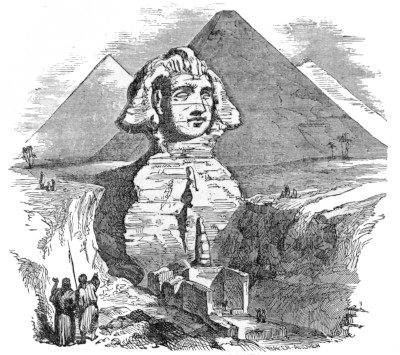
The base of the great pyramid of Cheops, so named after a king of Egypt,
is estimated by Denon at seven hundred and twenty feet, and its hight at
four hundred and forty-eight feet, calculating the base by the mean proportion
of the length of the stones, and the hight by the sum of that of each
of the steps or stages. Its construction required so many years, and
employed such a multitude of laborers, that the expenditure for garlic and
onions alone, for their consumption, is said to have amounted to one thousand
and sixty talents, or more than twelve hundred thousand dollars. Its
interior is thus accurately described by the above traveler.
“The entrance of the first gallery is concealed by the general outer covering
which invests the whole of the pyramid. It is, however, probable, that
the attention of the earlier searchers was by some particular appearance
directed to this spot. This gallery goes toward the center of the edifice, in
a direction sloping downward to the base: it is sixty paces in length; and at
the further end are two large blocks of granite, an obstacle which caused
some uncertainty in the digging. A horizontal passage has been made for
493some distance into the mass of stone; but this undertaking was afterward
abandoned.
“Returning to the extremity of the first gallery, and working upward by
the side of the two granite blocks, you come to the beginning of the first
sloping staircase, which proceeds in an oblique direction upward, for a hundred
and twenty feet. You mount the steep and narrow gallery, helping your
steps by notches cut in the ground, and by resting your hands against the
sides. At the top of this gallery, which is formed of a calcareous stone
cemented with mortar, you find a landing-place about fifteen feet square,
within which, to the right of the entrance, is a perpendicular opening called
the well. This appears, from its irregularity, to have been the result of a
fruitless attempt at a search, and has a diameter of about two feet by
eighteen inches. There were no means of descending it; but by throwing
down a stone, it was ascertained that its perpendicular direction could not
be very considerable. On a level with the landing is a horizontal gallery, a
hundred and seventy feet in length, running directly toward the center of
the pyramid; and at the extremity of this gallery is a small room, called
the queen’s chamber. This is an oblong square of eighteen feet and two
inches, by fifteen feet and eight inches; but the hight is uncertain, the floor
having been turned up by the avidity of the searchers. One of the side walls
has also been worked into, and the rubbish left on the spot. The roof, which
is formed of a fine calcareous stone, very nearly brought together, has the
form of an angle nearly equilateral, but contains neither ornament, hieroglyphic,
nor the smallest trace of a sarcophagus. Whether it was intended
to contain a body, is uncertain; but, in this case, the pyramid must have
been built with a view of containing two bodies, and would not therefore
have been closed at once. If the second tomb was really that of the queen,
the two blocks of granite at the end of the first gallery, must have been
finally reserved to close all the interior chambers of the pyramid.
“Returning again from the queen’s chamber to the landing-place, you
ascend a few feet, and immediately find yourself at the bottom of a large and
magnificent staircase, or rather inclined plane, one hundred and eighty feet
in length, taking a direction upward, and still bearing toward the center of
the edifice. It is six and a half feet in breadth, in which are to be included
two parapets, each nineteen inches in diameter, and pierced every three and
a half feet, by oblong holes twenty-two inches by three. The sarcophagus
must have ascended this passage, and the series of holes must have been
intended to receive a machine of some description, to assist in raising so
heavy a mass as the sarcophagus up so steep an ascent.
“The side walls of this ascending gallery rise perpendicularly for twelve
494feet, and then form a sloping roof of an excessively high pitch, not by a
regular angle, but by eight successive projections, each of them six feet in
hight, rising above the other, and approaching nearer to the corresponding
projection on the opposite side, till the roof is entirely shut in. The hight
of this singularly contrived vault may be estimated at sixty feet from the
part of the floor immediately beneath. The ascent of the staircase is facilitated
by pretty regular but modern footings cut in the floor; and at the top
is a small platform, in which is a thick block of granite, resembling an
immense chest, imbedded in the solid building, and hollowed out so as to
leave alternate projections and retirings, into which are let blocks of the
same material, with corresponding grooves and projections, intended forever
to conceal and protect the entrance to the principal chamber which is behind
them. It must have required immense labor to construct this part of the
edifice, and not less to have broken an opening through; so that the zeal of
superstition has here been opposed to the eagerness of avarice, and the latter
has prevailed. After mining through thirteen feet of solid granite, a door
three feet and three inches square, has been discovered, which is the
entrance to the principal chamber. This is a long square, sixteen feet by
thirty-two, and eighteen in hight. The door is in the angle facing the gallery,
corresponding to the door of the queen’s chamber, below. When it is
said that the tomb is a single piece of granite, half-polished, and without
cement, all that is remarkable in this strange monument, which exhibits
such rigid simplicity in the midst of the utmost magnificence of human
power, will have been described. The only broken part is an attempt at a
search at one of the angles, and two small holes nearly round and breast
high. Such is the interior of this immense edifice, in which the work of
the hand of man appears to rival the gigantic forms of nature.”
To the above account by the accurate Denon, we subjoin the following
pleasing one by the celebrated Dr. Clarke. The impression made by these
monuments, when viewed at a distance, can never, he observes, be obliterated
from his mind.
“By reflecting the sun’s rays, they appeared as white as snow, and of such
surprising magnitude, that nothing we had previously conceived in our
imagination had prepared us for the spectacle we beheld. The sight
instantly convinced us that no power of description, no delineation, can
convey ideas adequate to the effect produced in viewing these stupendous
monuments. The formality of their structure is lost in their prodigious
magnitude: the mind, elevated by wonder, feels at once the force of an
axiom, which, however disputed, experience confirms—that in vastness,
whatsoever be its nature, there dwells sublimity!
495“Having arrived at the bottom of a sandy slope, leading up to the principal
pyramid, a band of Bedouin Arabs, who had assembled to receive us
upon our landing, were much amused by the eagerness excited in our whole
party, to prove who should first set his foot upon the summit of this artificial
mountain. As we drew near its base, the effect of its prodigious magnitude,
and the amazement caused in viewing the enormous masses used in
its construction, affected every one of us; but it was an impression of awe
and fear rather than of pleasure. In the observations of travelers who had
recently preceded us, we had heard the pyramids described as huge objects
which gave no satisfaction to the spectator, on account of their barbarous
shape, and formal appearance: yet to us it appeared hardly possible that
persons susceptible of any feeling of sublimity could behold them unmoved.
With what amazement did we survey the vast surface that was presented to
us, when we arrived at this stupendous monument, which seemed to reach
the clouds? Here and there appeared some Arab guides upon the immense
masses above us, like so many pigmies, waiting to show the way up to the
summit. Now and then we thought we heard voices, and listened; but it
was the wind in powerful gusts, sweeping the immense ranges of stone.
Already some of our party had begun the ascent, and were pausing at the
tremendous depth which they saw below. One of our military companions,
after having surmounted the most difficult part of the undertaking, became
giddy in consequence of looking down from the elevation he had attained;
and being compelled to abandon the project, he hired an Arab to assist him
in effecting his descent. The rest of us, more accustomed to the business
of climbing hights, with many a halt for respiration, and many an exclamation
of wonder, pursued our way toward the summit. The mode of ascent
has been frequently described; and yet, from the questions which are often
proposed to travelers, it does not appear to be generally understood. The
reader may imagine himself to be upon a staircase, every step of which, to
a man of middle stature, is nearly breast high; and the breadth of each step
is equal to its hight; consequently, the footing is secure; and although a
retrospect, in going up, be sometimes fearful to persons unaccustomed to
look down from any considerable elevation, yet there is little danger of
falling. In some places, indeed, where the stones are decayed, caution may
be required; and an Arab guide is always necessary, to avoid a total interruption;
but, upon the whole, the means of ascent are such that almost
every one may accomplish it. Our progress was impeded by other causes.
We carried with us a few instruments; such as our boat-compass, a thermometer,
a telescope, &c.: these could not be trusted in the hands of
Arabs, and they were liable to be broken every instant. At length we
496reached the topmost tier, to the great delight and satisfaction of all the
party. Here we found a platform, thirty-two feet square, consisting of nine
large stones, each of which might weigh about a tun; although they are
much inferior in size to some of the stones used in the construction of this
pyramid.
“The view from the summit of the pyramid amply fulfilled our expectations;
nor do the accounts which have been given of it, as it appears at this
season of the year, (in the month of August,) exaggerate the novelty and
grandeur of the sight. All the region toward Cairo and the delta resembled
a sea covered with innumerable islands. Forests of palm-trees were seen
standing in the water; the inundation spreading over the land where they
stood, so as to give them an appearance of growing in the flood. To the
north, as far as the eye could reach, nothing could be discerned, but a watery
surface thus diversified by plantations and by villages. To the south we saw
the pyramids of Sakkara; and, upon the east of these, smaller monuments of
the same kind, nearer to the Nile. An appearance of ruins might indeed be
traced the whole way from the pyramids of Gizeh to those of Sakkara; as if
they had been once connected, so as to constitute one vast cemetery. Beyond
the pyramids of Sakkara we could perceive the distant mountains of the Said;
and upon an eminence near the Libyan side of the Nile appeared a monastery
of considerable size. Toward the west and south-west, the eye ranged over
the great Libyan desert, extending to the utmost verge of the horizon, without
a single object to interrupt the dreary horror of the landscape, except
dark floating spots, caused by the shadows of passing clouds upon the sand.
“The stones of the platform upon the top, as well as most of the others
used in constructing the decreasing ranges from the base upward, are of soft
limestone. Those employed in the construction of the pyramids, are of the
same nature as the calcareous rock on which they stand, and which was
apparently cut away to form them. Herodotus says, however, that they
were brought from the Arabian side of the Nile.
“The French attempted to open the smallest of the three principal pyramids;
and having effected a very considerable chasm in one of its sides, have
left this mark behind them, as an everlasting testimony of their curiosity and
zeal. The landing of our army in Egypt put a stop to their labor. Had it
not been for this circumstance, the interior of that mysterious monument
would probably be now submitted to the inquiry which has long been an
object among literary men.
“Having collected our party upon a soft platform before the entrance of
the passage leading to the interior, and lighted a number of tapers, we all
descended into the dark mouth of the larger pyramid. The impression made
497upon every one of us, in viewing the entrance, was this: that no set of men
whatever could thus have opened a passage, by uncovering precisely the part
of the pyramid where the entrance was concealed, unless they had been
previously acquainted with its situation; and for these reasons. First, because
its position is almost in the center of one of its planes, instead of being at the
base. Secondly, that not a trace appears of those dilapidations which must
have been the result of any search for a passage to the interior; such as now
distinguish the labors of the French upon the smaller pyramid, which they
attempted to open. The persons who undertook the work, actually opened
the pyramid in the only point, over all its vast surface, where, from the
appearance of the stones inclined to each other above the mouth of the
passage, any admission to the interior seems to have been originally intended.
So marvelously concealed as this was, are we to credit the legendary story
of an Arabian writer, who, discoursing of the wonders of Egypt, attributed
the opening of this pyramid to Almamon, a caliph of Babylon, about nine
hundred and fifty years since?
“Proceeding down this passage, which may be compared to a chimney
about a yard wide, we presently arrived at a very large mass of granite: this
seems to have been placed on purpose to choke up the passage; but a way
has been made round it, by which we were enabled to ascend into a second
channel, sloping, in a contrary direction, toward the mouth of the first.
Having ascended along this channel, to the distance of one hundred and ten
feet, we came to a horizontal passage, leading to a chamber with an angular
roof, in the interior of the pyramid. In this passage we found, upon our
right hand, the mysterious well, which has been so often mentioned. Pliny
makes the depth of it equal to one hundred and twenty-nine feet; but
Greaves, in sounding it with a line, found the plummet rest at the depth of
twenty feet.
“We threw down some stones, and observed that they rested at about the
depth which Greaves has mentioned; but being at length provided with a
stone nearly as large as the mouth of the well, and about fifty pounds in
weight, we let this fall, listening attentively to the result from the spot where
the other stones rested: we were agreeably surprised by hearing, after a
length of time which must have equaled some seconds, a loud and distinct
report, seeming to come from a spacious subterraneous apartment, accompanied
by a splashing noise, as if the stone had been broken in pieces, and
had fallen into a reservoir of water at an amazing depth. Thus does experience
always tend to confirm the accounts left us by the ancients; for this
exactly answers to the description given by Pliny of this well.
“After once more regaining the passage whence these ducts diverge, we
498examined the chamber at the end of it, mentioned by all who have described
the interior of this building. Its roof is angular; that is to say, it is formed
by the inclination of large masses of stone leaning toward each other, like
the appearance presented by those masses which are above the entrance to
the pyramid. Then quitting the passage altogether, we climbed the slippery
and difficult ascent which leads to what is called the principal chamber.
The workmanship, from its perfection, and its immense proportions, is truly
astonishing. All about the spectator, as he proceeds, is full of majesty, and
mystery, and wonder. Presently we entered that ‘glorious roome,’ as it is
justly called by Greaves, where, ‘as within some consecrated oratory, art
may seem to have contended with nature.’ It stands ‘in the very heart and
center of the pyramid, equidistant from all its sides, and almost in the midst
between the basis and the top. The floor, the sides, the roof of it, are all
made of vast and exquisite tables of Thebaick marble.’ So nicely are these
masses fitted to each other upon the sides of the chamber, that, having no
cement between them, it is really impossible to force the blade of a knife
within the joints. This has been often related before; but we actually tried
the experiment, and found it to be true. There are only six ranges of stone
from the floor to the roof, which is twenty feet high; and the length of the
chamber is about twelve yards. It is also about six yards wide. The roof
or ceiling consists of only nine pieces, of stupendous size and length, traversing
the room from side to side, and lying, like enormous beams, across the
top.”
Mr. Salt, the traveler, having paid a later visit to the principal pyramid,
in company with a British officer, ascertained that the short descending
passage at its entrance, which afterward ascends to the two chambers, is
continued in a straight line through the base of the pyramid into the rock on
which it stands. This new passage, a view of which is given in the cut
below, after joining what was formerly called the well, is continued forward
in a horizontal line, and terminates in a well, ten feet in depth, exactly
beneath the apex of the pyramid, and at the depth of one hundred feet
beneath its base. Mr. Salt’s companion likewise discovered an apartment
immediately above the king’s chamber, exactly of the same size, and of the
same fine workmanship, but only four feet in hight.
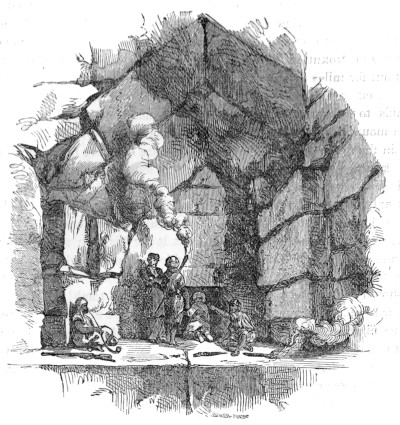
ENTRANCE TO ONE OF THE PYRAMIDS OF GIZEH.
The base of the pyramid of Cephrenes, the next in magnitude, of the
pyramids of Gizeh, to that of Cheops, is estimated at six hundred and fifty-five
feet, and its hight at three hundred and ninety-eight. The pyramid of
Mycerinus has a base of two hundred and eighty feet, and an elevation of
one hundred and sixty-two. But, as well suggested by Thompson, in his
“Egypt Past and Present,” no mere detail of figures and statistics, can
499convey an idea of the size of these vast bodies as they impress us when we
stand before them. “No idea,” he says, “can be given of the great pyramid,
by the statement that it covers an area of nearly five hundred and fifty
thousand square feet, measures seven hundred and fifty feet upon each of
its four sides at the base, and is four hundred and sixty feet in hight, or
that it would fill the whole length of Washington square in New York, and
exceed its breadth by half, and would rise nearly two hundred feet higher
than the spire of Trinity church. The mass of masonry is what impresses
you. Eighty-five million cubic feet of solid masonry, gives you no very
definite idea of the mass of stone here piled together with such mathematical
precision that astronomical calculations could be based upon its angles
and shadows. No, you must see the mass itself, not now smooth and
polished, as when originally completed, but stripped of its outer casing, and
showing tier on tier of huge stones squared and fitted at mathematical
angles, and now forming a series of rude steps, each from two to four feet
500high, extending to the very top. That top is now a platform about thirty
feet square; and the view from its elevation is unparalleled in the world!
Before you is Cairo, with its lofty minarets, and its overhanging citadel, the
mountains of Mokuttam skirting its rear; the green valley of the Nile is
spread out for miles northward and southward; at your feet are the mounds
of sand that cover the ancient Memphis; southward is the whole range of
pyramids to Sakkara; behind you are fragments of other pyramids, the
Libyan mountains, and the wide waste of the great desert. But the present
is lost in the associations of the past. You are standing upon a monument
that is known to have stood within a score of four thousand years; that was
as old as are our associations of Plymouth rock, when Abraham came into
Egypt, and journeyed to Memphis to enjoy the favor of the king. He looked
with wondering eyes upon this self-same monument, and heard the then dim
tradition of the tyrant, who, having built it for his own sepulcher by the
sweat and blood of half a million of his subjects, was compelled to beg of his
friends to bury him privately in some secret place, lest after his death, his
body should be dragged by the people from the hated tomb!”
The pyramids of Sakkara, which are numerous, are interesting on account
of the peculiarities of their structure. The largest of them is of an irregular
form, the line of the terminating angle being sloped like a buttress reversed.
Another, of a middling size, is composed of stages rising one above another.
The smaller ones are greatly decayed; but the whole occupy an extent of two
leagues. This multitude of pyramids scattered over the district of Sakkara,
Denon observes, prove that this territory was the necropolis (city of the
dead) to the south of Memphis, and that the village opposite to this, in which
the pyramids of Gizeh are situated, was another necropolis, which formed the
northern extremity of Memphis. The extent of that ancient city may thus
be measured.
To these interesting accounts of this group of the pyramids, may be subjoined
the graphic sketch of Bayard Taylor, who visited them so recently as
1851. “When we threw open the latticed blinds of our cabin, before sunrise
the next morning, the extraordinary purity of the air gave rise to an amusing
optical delusion on the part of my friend. ‘See that wall!’ said he, pointing
to a space between two white houses; ‘what a brilliant color it is painted,
and how those palms and these white houses are relieved against it!’ He
was obliged to look twice before he perceived that what he had taken for a
wall close at hand, was really the sky, and rested upon a far-off horizon.
Our donkeys were in readiness on the bank, and taking Achmet with us, we
rode off gayly among the mud hovels and under the date-trees of Gizeh, on
our way to the pyramids. The rising sun shone redly upon them, as we
501rode out on the broad harvest land of the Nile. The black unctuous loam
was still too moist from the inundation to be plowed, except in spots, here
and there, but even where the water had scarce evaporated, millions of germs
were pushing their slender blades up to the sunshine. In that prolific soil,
the growth of grain is visible from day to day. The Fellahs were at work on
all sides, preparing for planting, and the ungainly buffaloes drew their long
plows slowly through the soil. Where freshly turned, the earth had a rich,
soft luster, like dark-brown velvet, beside which the fields of young wheat,
beans and lentils, glittered with the most brilliant green. The larks sang in
the air and flocks of white pigeons clustered like blossoms on the tops of the
sycamores. There, in November, it was the freshest and most animating
picture of spring. The direct road to the pyramids was impassable, on
account of the water, and we rode along the top of a dike, intersected by
canals, to the edge of the Libyan desert, a distance of nearly ten miles.
The ruptures in the dike obliged us occasionally to dismount, and at the
last canal, which cuts off the advancing sands from the bounteous plain on
the other side, our donkeys were made to swim, while we were carried across
on the shoulders of two naked Arabs. They had run out in advance to meet
us, hailing us with many English and French phrases, while half a dozen
boys, with earthen bottles which they had just filled from the slimy canal,
crowded after them, insisting, in very good English, that we should drink at
once and take them with us to the pyramids.
“Our donkeys’ hoofs now sank deep in the Libyan sands, and we looked
up to the great stone-piles of Cheops, Cephrenes and Mycerinus, not more
than half a mile distant. Our sunrise view of the pyramids on leaving Gizeh,
was sufficient, had I gone no further; and I approached them, without the
violent emotion which sentimental travelers experience, but with a quiet
feeling of the most perfect satisfaction. The form of the pyramid is so
simple and complete, that nothing is left to the imagination. Those vast,
yellowish-gray masses, whose feet are wrapped in the silent sand, and whose
tops lean against the serene blue heaven, enter the mind and remain in the
memory with no shock of surprise, no stir of unexpected admiration. The
impression they give and leave, is calm, grand and enduring as themselves.
“The sun glared hot on the sand as we toiled up the ascent to the base of
Cheops, whose sharp corners were now broken into zigzags by the layers of
stone. As we dismounted in his shadow, at the foot of the path which leads
up to the entrance, on the northern side, a dozen Arabs beset us. They
belonged to the regular herd who have the pyramids in charge, and are so
renowned for their impudence that it is customary to employ the janissary
of some consulate in Cairo, as a protection. I took three of them and
502commenced the ascent, leaving Achmet and my friend below. Two boys
followed us, with bottles of water. At first, the way seemed hazardous, for
the stones were covered with sand and fragments which had fallen from
above, but after we had mounted twenty courses, the hard, smooth blocks of
granite formed broader and more secure steps. Two Arabs went before, one
holding each of my hands, while the third shoved me up from the rear.
The assistance thus rendered was not slight, for few of the stones are less
than four feet in hight. The water-boys scampered up beside us with the
agility of cats. We stopped a moment to take breath, at a sort of resting-place
half-way up, an opening in the pyramid, communicating with the
uppermost of the interior chambers. I had no sooner sat down on the
nearest stone, than the Arabs stretched themselves at my feet and entertained
me with most absurd mixture of flattery and menace. One, patting the
calves of my legs, cried out, ‘Oh, what fine, strong legs! how fast they came
up: nobody ever went up the pyramid so fast!’ while the others added,
‘Here you must give us backsheesh: everybody gives us a dollar here.’
My only answer was, to get up and begin climbing, and they did not cease
pulling and pushing till they left me breathless on the summit. The whole
ascent did not occupy more than ten minutes.
“The view from Cheops has been often described. I can not say that it
increased my impression of the majesty and grandeur of the pyramid, for
that was already complete. My eyes wandered off from the courses of
granite, broadening away below my feet, to contemplate the glorious green
of the Nile-plain, barred with palm-trees and divided by the gleaming flood
of the ancient river; the minarets of Cairo; the purple walls of the far
Arabian mountains; the pyramid groups of Sakkara and Dashoor, overlooking
disinterred Memphis in the south; and the arid yellow waves of the
Libyan desert, which rolled unbroken to the western sky. The clear, open
heaven above, which seemed to radiate light from its entire concave, clasped
in its embrace and harmonized the different features of this wonderful
landscape. There was too much warmth and brilliance for desolation.
Everything was alive and real; the pyramids were not ruins, and the dead
Pharaohs, the worshipers of Athor and Apis, did not once enter my mind.
“My wild attendants did not long allow me to enjoy the view quietly.
To escape from their importunities for backsheesh I gave them two piasters
in copper coin, which instantly turned their flatteries into the most bitter
complaints. It was insulting to give so little, and they preferred having
none; if I would not give a dollar, I might take the money back. I took it
without more ado, and put it into my pocket. This rather surprised them,
and first one, and then another, came to me and begged to have it again, on
503his own private account. I threw the coins high into the air, and as they
clattered down on the stones, there ensued such a scramble as would have
sent any but Arabs over the edge of the pyramid. We then commenced the
descent, two seizing my hands as before, and dragging me headlong after
them. We went straight down the side, sliding and leaping from stone to
stone without stopping to take breath, and reached the base in five or six
minutes. I was so excited from the previous aggression of the Arabs, that
I neither felt fatigue nor giddiness on the way up and down, and was not
aware how violent had been my exertions. But when I touched the level
sand, all my strength vanished in an instant. A black mist came over my
eyes, and I sank down helpless and nearly insensible. I was scarcely able to
speak, and it was an hour before I could sit upright on my donkey. I felt
the pyramid in all my bones, and for two or three days afterward moved my
joints with as much difficulty as a rheumatic patient.
“In returning, in about an hour and a half we reached the ruined pyramids
of Abousir, where our path turned southward into the desert. After seeing
Cheops and Cephrenes, these pyramids are only interesting on account of
their dilapidated state and the peculiarity of their forms, some of their sides
taking a more obtuse angle at half their hight. They are buried deep in the
sand, which has so drifted toward the plain, that from the broad hollow lying
between them and the group of Sakkara, more than a mile distant, every
sign of vegetation is shut out. Vast, sloping causeways of masonry lead up
to two of them, and a large mound, occupying the space between, suggests
the idea that a temple formerly stood there. The whole of the desert promontory,
which seemed to have been gradually blown out on the plain, from
the hills in the rear, exhibits traces here and there of ruins beneath the
surface. My friend and I, as we walked over the hot sand, before our
panting donkeys, came instinctively to the same conclusion, that a large city
must have once occupied the space between, and to the southward of the two
groups of pyramids. It is not often that amateur antiquarians find such
sudden and triumphant confirmation of their conjectures, as we did.
“On the way, Achmet had told us of a Frenchman who had been all
summer digging in the sand, near Sakkara. After we had crawled into the
subterranean dépôt of mummied ibises, and nearly choked ourselves with
dust in trying to find a pot not broken open; and after one of our donkeymen
went into a human mummy pit and brought out the feet and legs of some
withered old Egyptian, we saw before us the residence of this Frenchman; a
mud hut on a high sand-bank. It was an unfortunate building, for nearly
all the front wall had tumbled down, revealing the contents of his kitchen.
One or two Arabs loitered about, but a large number were employed at the
504end of a long trench which extended to the hills. Before reaching the house
a number of deep pits barred our path, and the loose sand, stirred by our
feet, slid back into the bottom, as if eager to hide the wonders they disclosed.
Pavements, fresh as when first laid; basement-walls of white marble, steps,
doorways, pedestals and fragments of pillars glittered in the sun, which, after
the lapse of more than two thousand years, beheld them again. I slid down
the side of the pit and walked in the streets of Memphis. The pavement of
bitumen, which once covered the stone blocks, apparently to protect them
and deaden the noise of horses and chariots, was entire in many places.
Here a marble sphinx sat at the base of a temple, and stared abstractedly
before her; there a sculptured cornice, with heavy moldings, leaned against
the walls of the chamber into which it had fallen; and over all were scattered
fragments of glazed and painted tiles and sculptured alabaster. The principal
street was narrow, and was apparently occupied by private dwellings,
but at its extremity were the basement-walls of a spacious edifice. All the
pits opened on pavements and walls, so fresh and cleanly cut, that they
seemed rather the foundations of a new city, laid yesterday, than the remains
of one of the oldest capitals of the world.
“We approached the workmen, where we met the discoverer of Memphis,
Mr. Auguste Mariette. On finding we were not Englishmen, (of whose visits
he appeared to be rather shy,) he became very courteous and communicative.
He apologized for the little he had to show us, since on account of the vandalism
of the Arabs, he was obliged to cover up all his discoveries, after
making his drawings and measurements. The Egyptian authorities are
worse than apathetic, for they would not hesitate to burn the sphinxes for
lime, and build barracks for filthy soldiers with the marble blocks. Besides
this, the French influence at Cairo was then entirely overshadowed by that
of England, and although M. Mariette was supported in his labors by the
French academy, and a subscription headed by Louis Napoleon’s name, he
was forced to be content with the simple permission to dig out these remarkable
ruins and describe them. He could neither protect them nor remove
the portable sculptures and inscriptions, and therefore preferred giving them
again into the safe keeping of the sand. Here they will be secure from
injury, until some more fortunate period, when, possibly, the lost Memphis
may be entirely given to the world, as fresh as Pompeii, and far more grand
and imposing.
“I asked M. Mariette what first induced him to dig for Memphis in that
spot, since antiquarians had fixed upon the mounds near Mitrahenny (a
village in the plain below, and about four miles distant,) as the former site
of the city. He said that the tenor of an inscription which he found on one
505of the blocks quarried out of these mounds, induced him to believe that the
principal part of the city lay to the westward, and therefore he commenced
excavating in the nearest sand-hill in that direction. After sinking pits in
various places he struck on an avenue of sphinxes, the clue to all his after
discoveries. Following this, he came upon the remains of a temple, (probably
the Serapeum, or temple of Serapis, mentioned by Strabo,) and afterward
upon streets, colonnades, public and private edifices, and all other signs of a
great city. The number of sphinxes alone, buried under these high sand-drifts,
amounted to two thousand, and he had frequently uncovered twenty
or thirty in a day. He estimated the entire number of statues, inscriptions
and reliefs, at between four and five thousand. The most remarkable discovery
was that of eight colossal statues, which were evidently the product
of Grecian art. During thirteen months of assiduous labor, with but one
assistant, he had made drawings of all these objects and forwarded them to
Paris. In order to be near at hand, he had built an Arab house of unburnt
bricks, the walls of which had just tumbled down for the third time. His
workmen were then engaged in clearing away the sand from the dwelling of
some old Memphian, and he intended spreading his roof over the massive
walls, and making his residence in the exhumed city. The man’s appearance
showed what he had undergone, and gave me an idea of the extraordinary
zeal and patience required to make a successful antiquarian. His face was
as brown as an Arab’s, his eyes severely inflamed, and his hands as rough as
a bricklayer’s. His manner with the native workmen was admirable, and
they labored with a hearty good-will which almost supplied the want of the
needful implements. All they had were straw baskets, which they filled
with a sort of rude shovel, and then handed up to be carried off on the heads
of others.
“Strabo states that Memphis had a circumference of seventeen miles, and
therefore both M. Mariette and the antiquarians are right. The mounds of
Mitrahenny probably mark the eastern portion of the city, while its western
limit extended beyond the pyramids of Sakkara, and included in its suburbs
those of Abousir and Dashoor. The space explored by M. Mariette is about
a mile and a half in length, and somewhat more than half a mile in breadth.
He was then continuing his excavations westward, and had almost reached
the first ridge of the Libyan hills, without finding the termination of the
ruins. The magnitude of his discovery will be best known when his drawings
and descriptions are given to the world. A few months after my visit,
his labors were further rewarded by finding thirteen colossal sarcophagi of
black marble, and he has recently added to his renown by discovering an
entrance to the Sphinx. Yet at that time, the exhumation of the lost Memphis,
506second only in importance to that of Nineveh, was unknown in Europe,
except to a few sarans in Paris, and the first intimation which some of my
friends in Cairo and Alexandria had of it, was my own account of my visit,
in the newspapers they received from America. But M. Mariette is a young
man, and will yet see his name inscribed beside those of Burckhardt, Belzoni
and Layard.
“We had still a long ride before us, and I took leave of Memphis and its
discoverer, promising to revisit him on my return from Khartoum. As we
passed the brick pyramid of Sakkara, which is built in four terraces of equal
hight, the dark, grateful green of the palms and harvest-fields of the Nile
appeared between two sand-hills, a genuine balm to our heated eyes. We
rode through groves of the fragrant mimosa to a broad dike, the windings of
which we were obliged to follow across the plain, as the soil was still wet and
adhesive. It was too late to visit the beautiful pyramids of Dashoor, the first
of which is more than three hundred feet in hight, and from a distance has
almost as grand an effect as those of Gizeh. Our tired donkeys lagged
slowly along to the palm-groves of Mitrahenny, where we saw mounds of
earth, a few blocks of red granite and a colossal statue of Remeses II.,
(Sesostris,) which until now were supposed to be the only remains of
Memphis. The statue lies on its face in a hole filled with water. The
countenance is said to be very beautiful, but I could only see the top of
Sesostris’s back, which bore a faint resemblance to a crocodile. Through
fields of cotton in pod and beans in blossom, we rode to the Nile, dismissed
our donkeys and their attendants, and lay down on some bundles of cornstalks
to wait the arrival of our boat. But there had been a south wind all
day, and we had ridden much faster than our men could tow. We sat till
long after sunset before the stars and stripes, floating from the mizzen of the
Cleopatra, turned the corner below Bedrasheyn. When, at last, we sat at
our cabin-table, weary and hungry, we were ready to confess that the works
of art produced by our cook, were more marvelous and interesting than
Memphis and the pyramids.”
The prediction of Taylor, quoted above, “that M. Mariette, though a
young man, would yet see his name inscribed beside those of Burckhardt,
Belzoni and Layard,” is in a fair way for fulfillment; for the finding of the
wonderful tombs of Sakkara, and their magnificent sarcophagi, is, perhaps,
the greatest discovery which has been made relative to the antiquities of
Egypt, since the days of Belzoni himself. The tomb, a view of the entrance
507to which is given in the cut below, is situated in the desert near Sakkara, to
the north-west of and near the pyramid, about four or five hours’ ride from
Cairo, by way of Toura, where the Nile must be crossed. Monsieur Mariette,
to whose knowledge and research this discovery is due, is employed by the
French government. A passage in Strabo having led him to infer that a line
of sphinxes led to the Serapeum, he commenced his search, under a firman
from the viceroy of Egypt, about two years and a half since, in the moving
sand-hills of Sakkara. He discovered the line of sphinxes, one of which had
been found in 1832, by Signor Marucchi; but they not being in a straight
direction, and turning abruptly at the entrance of the Serapeum, it was with
difficulty they were traced. They were one hundred and forty in number,
and sixteen feet apart. The whole avenue proved eleven hundred and
twenty feet in length. At the termination were eleven Greek statues of
Homer, Pindar, Solon, Lycurgus, Aristotle, and other poets, philosophers,
and lawgivers of Greece. One sphinx, having the name of Apis inscribed
508upon it, was met with under a depth of sixty or seventy feet of sand: stone
peacocks nine feet high, and colossal lions, were also found here. The tomb
of Apis was now sought for, and discovered, after a whole year of labor, on
the twelfth of November, 1851. From the avenue a mastaba, or bench, and
passage two hundred and ninety feet long, leads to a pylon, the entrance of
the great temple. The tomb runs from south to north, and the great gallery
from east to west. This is about five hundred and twenty yards in length,
and from four to five yards wide. The chambers are not formed throughout
the whole length of the gallery, and some passages are altogether without
them. The hieroglyphic inscriptions on the tomb are, in one instance, if not
more, unfinished; and the doors erected at the entrance are too small to
have allowed the passage of the sarcophagi, and must, therefore, have been
built after the latter were introduced. The chambers are not opposite each
other, but arranged alternately, in the usual manner of Egyptian places of
sepulture. The appearance of this long gallery, when lighted up by numerous
candles, receding in dim perspective into gloom—the massive sarcophagi,
of polished granite, each in its chamber, looking tranquillity, is an imposing
sight, as may be seen in the next following cut. They are of enormous size
and weight: one, and that not the largest, has been estimated to weigh,
including the lid, upward of sixty tuns. To have moved these and lowered
them into their receptacles, which are some six feet below the floor of the
gallery, in so confined a space, must have required a considerable amount
of mechanical skill and power. In the walls are holes, apparently for the
introduction of the ends of beams. The chambers may, however, have been
filled with sand, the sarcophagus pushed in and gradually lowered by
abstracting the sand. The under side of one of the sarcophagi is rounded,
and it was kept steady by wooden blocks on each side. When these are
removed it can be rocked by the hand. A groove, about two feet broad and
two or three inches in depth, runs down the middle of the gallery. A
wooden capstan was found near the tombs, and is supposed to have been
used for moving the stones. The entrance is inclined. The tombs are
excavated in a soft friable limestone, containing numerous small veins of
gypsum, about half an inch in thickness. To prevent the roof from falling,
it has been coated with flagstones, cemented to it by a gypseous cement;
but, either by the hand of violence, or that of time, these have been detached,
and have fallen to the ground, encumbering, and partially choking the
galleries and rooms. The mortar, however, still adheres in several places
to the walls, and projects where the joints of the stones have been. In one
chamber is a self-sustained stone arch; another proof, if any were now
necessary, that its construction was known to the ancients. This chamber
509contains a small sarcophagus, in which, probably, were the bones of a young
bull. The bones of bulls have been found in several sarcophagi; but every
one had been opened, and some heaped with stones; an eastern mark of
contempt, probably the work of the Persians. At the entrance were numerous
ex voto offerings of inscribed tablets inserted in small recesses in the
walls. There are also inscriptions, in the Demotic character, on the outer
doorway. In some chambers are large recesses to the right and left of the
tomb, which in one instance contained a large granite tablet with hieroglyphics.
The number of sarcophagi already discovered is twenty-five.
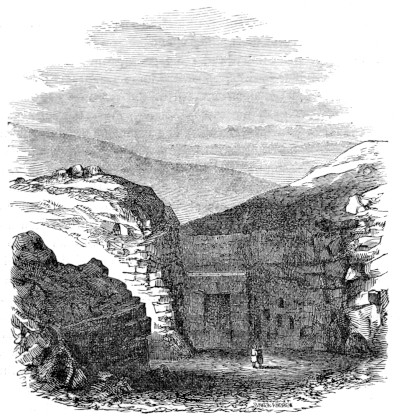
ENTRANCE TO THE TOMBS OF SAKKARA.
These tombs merit the visit of all antiquaries and travelers passing
through Egypt; and M. Mariette’s work describing them is looked for with
anxiety by all savans. To his kindness and courtesy, which, as well as his
hospitality, are well known, the public are indebted for the greater portion
of this information. Near to Sakkara, on the site of Memphis, Hekekyan
Bey has been making excavations connected with the geological investigations
of the Nile valley, instituted at the request of Mr. Leonard Horner
and the Geological Society of London, by the viceroy, who has very recently
received from the English government, through Mr. Murray, a letter of
thanks for his liberal aid to the cause of science.
A view of the great gallery of these tombs, as it appears when lighted up,
is given on the next page.
Before passing to the pyramids and ruins of Meroë in Ethiopia, let us
notice the celebrated Sphinx, which stands near the great pyramids of
Gizeh, and the enormous bulk of which attracts the attention of every
traveler. Of all the monuments of Egypt, this, in many respects, is the
most mysterious and impressive. It is cut out of the solid rock, and by
some is supposed to have been the sepulcher of Amasis. It is more than
sixty feet from the ground to the crown of the head; more than a hundred
feet around the forehead; and nearly one hundred and fifty feet in length.
The nose has been shamefully mutilated. “Though its proportions are
colossal, its outline,” says Denon, “is pure and graceful; the expression
mild, gracious, and tranquil; the character is African; but the mouth, the
lips of which are thick, has a softness and delicacy of execution truly admirable;
it seems real life and flesh. Art must have been at a high pitch
when this monument was executed; for, if the head is deficient in what is
called style, that is, in the straight and bold lines which give expression to
the figures under which the Greeks have designated their deities, yet sufficient
510justice has been rendered to the fine simplicity and character of nature
displayed in this figure.”
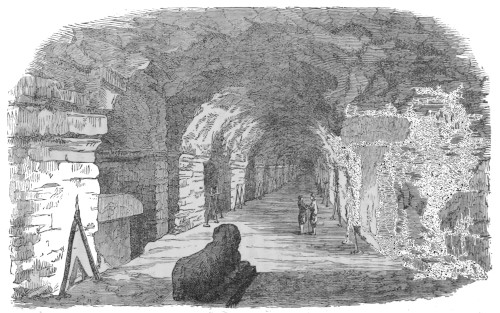
GREAT GALLERY OF THE TOMBS OF SAKKARA.
Thus far the description of Denon. But Taylor, who says of this monument
that “there is nothing like it in the world,” adds, that “those travelers
who pronounce its features to be negro in their character, are certainly very
511hasty in their conclusions. That it is an Egyptian head, is plainly evident,
notwithstanding its mutilation. The type, however, is rather fuller and
broader than is usual in Egyptian statues.” Who reared it, and for what
purpose, and by what mighty enginery, is utterly unknown. But there it
stands, “on the verge of the desert whose sands are heaped around it, and
in advance of the three vast pyramids that form an immovable phalanx as
if to guard it from destruction, looking out in unfathomable silence over
the empty plain where once stood Memphis in the pride of the earlier
Pharaohs, and where Cambyses battered down that pride with the recklessness
of a barbarian invader. Once an altar stood before it, and a dromos
of crouching lions and other figures formed a fit approach to the gigantic
symbol of Egypt deified. But now the sands drift in perpetually to hide all
but the head, whose sublime repose neither the war-club of the Persian, nor
tho fury of the sirocco has ever disturbed.”
Passing up the Nile to its great fork in about latitude seventeen degrees,
we come to the wonderful ruins and pyramids of Meroë, in Ethiopia. “The
discovery of these ruins,” says the well known traveler last quoted, “is of
comparatively recent date; and it is only within a very short time that their
true place and character in Ethiopian history have been satisfactorily established.
Hoskins, Cailliaud and Ferlini were the first to direct the attention
of antiquarians to this quarter, and the later and more complete researches
of Lepsius leave room for little more to be discovered concerning them. It
is remarkable that both Bruce and Burckhardt, who traveled by land from
Berber to Shendy, failed to see the ruins, which must have been visible from
the road they followed. The former, in fact, speaks of the broken pedestals,
carved stones and pottery which are scattered over the plain, and sagely
says, ‘It is impossible to avoid risking a guess that this is the ancient city
of Meroë;’ but he does not mention the groups of pyramids which are so
conspicuous a feature in the landscape. Our path led over a plain covered
with thorny shrubs at first, but afterward hard black gravel, and we had
not gone more than a mile before the raïs pointed out the pyramids of the
ancient Ethiopian city. I knew it only from its mention in history, and had
never read any description of its remains; consequently I was surprised to
see before me, in the vapory morning air, what appeared to be the ruins of
pylæ and porticos, as grand and lofty as those of Karnak. Rising between
us and the mountains, they had an imposing effect, and I approached them
with excited anticipations. As advanced, however, and the morning
512vapors melted away, I found that they derived much of their apparent hight
from the hill upon which they are built, and that, instead of being the shattered
parts of one immense temple, they were a group of separate pyramids,
standing amid the ruins of others which have been completely destroyed.
“We reached them after a walk of about four miles. They stand upon a
narrow, crescent-shaped hill, which rises forty or fifty feet from the plain,
presenting its convex front to the Nile, while toward the east its hollow
curve embraces a small valley lying between it and the mountain range.
Its ridge is crowned with a long line of pyramids, standing so close to each
other that their bases almost meet, but presenting no regular plan or association,
except in the direction of their faces. None of them retains its
apex, and they are all more or less ruined, though two are perfect to within
a few courses of the top. I climbed one of the highest, from which I could
overlook the whole group, as well as another cluster, which crowned the
summit of a low ridge at the foot of the mountains opposite. Of those
among which I stood, there were sixteen, in different degrees of ruin,
besides the shapeless stone-heaps of many more. They are all built of fine
red sandstone, in regular courses of masonry, the spaces of which are not
filled, or cased, as in the Egyptian pyramids, except at the corners, which
are covered with a narrow hem or molding, in order to give a smooth
outline. The stones are about eighteen inches high, and the recession of
each course varies from two to four inches, so that the hight of the structure
is always much greater than the breadth of the base. A peculiarity of these
pyramids is, that the sides are not straight but curved lines, of different
degrees of convexity, and the breadth of the courses of stone is adjusted
with the utmost nicety, so as to produce this form. They are small, compared
with the enormous piles of Gizeh and Dashoor, but singularly graceful
and elegant in appearance. Not one of the group is more than seventy feet
in hight, nor when complete could have exceeded one hundred. All, or
nearly all, have a small chamber attached to the exterior, exactly against
the center of their eastern sides, but no passage leading into the interior;
and from the traces of Dr. Lepsius’s labors, by which I plainly saw that he
had attempted in vain to find an entrance, it is evident that they are merely
solid piles of masonry, and that, if they were intended tombs, the bodies
were deposited in the outer chambers. Some of these chambers are entire,
except the roof, and their walls are profusely sculptured with hieroglyphics,
somewhat blurred and worn down, from the effect of the summer rains.
Their entrances resembled the doorways of temples, on a miniature scale,
and the central stones of two of them were sculptured with the sacred
winged globe. I saw on the jamb of another, a figure of the god Horus.
513The chambers were quite small, and not high enough to allow me to stand
upright. The sculptures have a very different character from those in the
tombs of Thebes, and their resemblance to those of the Ptolemaic period
was evident at the first glance. The only cartouches of monarchs which I
found were so obliterated that I could not identify them; but the figure of
one of the kings, grasping in one hand the hair of a group of captives, while
with the other he lifts a sword to slay them, bears a striking resemblance to
that of Ptolemy Euergetes, on the pylon of the temple at Edfou. Many of
the stones in the vast heaps which lie scattered over the hills, are covered
with sculptures. I found on some the winged globe and scarabeüs, while
others retained the scroll or fillet which usually covers the sloping corners
of a pylon. On the northern part of the hill I found several blocks of limestone,
which exhibited a procession of sculptured figures brilliantly colored.
“The last structure on the southern extremity of the hill, is rather a
tower than a pyramid, consisting of a high base or foundation, upon which
is raised a square building, the corners presenting a very slight slope toward
the top, which is covered with ruins, indicating that there was originally
another and narrower story upon it. When complete, it must have borne
considerable resemblance to the Assyrian towers, the remains of which are
found at Nineveh. On this part of the hill there are many small detached
chambers, all facing the east, and the remains of a large building. Here
Lepsius appears to have expended most of his labors; and the heaps of
stone and rubbish he has left behind him, prevent one from getting a very
clear idea of the original disposition of the buildings. He has quarried one
of the pyramids down to its base, without finding any chamber within or
pit beneath it. My raïs, who was at a loss to comprehend the object of my
visit, spoke of Lepsius as a great Frank astrologer, who had kept hundreds
of the people at work for many days, and at last found in the earth a multitude
of chickens and pigeons, all of solid gold. He then gave the people a
great deal of backsheesh and went away, taking the golden fowls with him.
The most interesting object he has revealed is a vaulted room, about twenty
feet long, which the raïs pointed out as the place where the treasures were
found. It is possible that he here referred to the discoveries made about
twenty years ago by Ferlini, who excavated a great quantity of rings and
other ornaments, Greek and Roman, as well as Ethiopian, which are now in
the museum at Berlin. The ceiling of this vault is on the true principle of
the arch, with a keystone in the center, which circumstance, as well as the
character of the sculptures, would seem to fix the age of the pyramids at a
little more than two thousand years. I took a sketch of this remarkable
cluster of ruins from their northern end, and afterward another from the
514valley below, whence each pyramid appears distinct and separate, no one
covering the other. The raïs and sailors were puzzled what to make of my
inspection of the place, but finally concluded that I hoped to find a few
golden pigeons, which the Frank astrologer had not carried away. I next
visited the eastern group, which consists of ten pyramids, more or less
dilapidated, and the ruined foundations of six or eight more. The largest,
which I ascended, consists of thirty-five courses of stone, and is about fifty-three
feet in hight, eight or ten feet of the apex having been hurled down.
Each side of the apex is seventeen paces, or about forty-two feet long, and
the angle of ascent is consequently much greater than in the pyramids of
Egypt. On the slope of the hill are the substructions of two or three large
buildings, of which sufficient remains to show the disposition of the chambers
and the location of the doorways. Toward the south, near where the
valley inclosed between the two groups opens upon the plain, are the
remains of other pyramids and buildings, and some large, fortress-like ruins
are seen on the summits of the mountains to the east. I would willingly
have visited them, but the wind was blowing fresh, and the raïs was impatient
to get back to his vessel. Many of the stones of the pyramids are
covered with rude attempts at sculpturing camels and horses; no doubt by
the Arabs, for they resemble a school-boy’s first drawings on a slate; straight
sticks for legs, squares for bodies, and triangles for humps.
“Leaving the ruins to the company of the black goats that were browsing
on the dry grass, growing in bunches at their eastern base, I walked to
another group of pyramids, which lay a mile and a half to the south-west,
toward the Nile. As we approached them, a herd of beautiful gray gazelles
started from among the stones and bounded away into the desert. ‘These
were the tents of the poor people,’ said the raïs, pointing to the pyramids;
‘the Frank found no golden pigeons here.’ They were, in fact, smaller and
more dilapidated than the others. Some had plain burial chambers attached
to their eastern sides, but the sculptures were few and insignificant. There
were sixteen in all, more or less ruined. Scattering mounds, abounding
with fragments of bricks and building stones, extended from these ruins
nearly to the river’s bank, a distance of more than two miles; and the
foundations of many other pyramids might be seen among them. The total
number of pyramids in a partial state of preservation, (some being nearly
perfect, while a few retained only two or three of the lower courses,) which
I counted on the site of Meroë, was forty-two. Besides these, I noticed the
traces of forty or fifty others, which had been wholly demolished. The
entire number, however, of which Meroë could boast, in its prime, was one
hundred and ninety-six. The mounds near the river, which cover an extent
515of between one and two miles, point out the site of the city, the capital of
the old hierarchy of Meroë, and the pyramids are no doubt the tombs of its
kings and priests. It is rather singular that the city has been so completely
destroyed, as the principal spoilers of Egypt, the Persians, never penetrated
into Ethiopia, and there is no evidence of the stones having been used to
any extent by the Arabs, as building materials.
“The examination of Meroë has solved the doubtful question of an
Ethiopian civilization anterior to that of Egypt. Hoskins and Cailliaud,
who attributed a great antiquity to the ruins, were misled by the fact,
discovered by Lepsius, that the Ethiopian monarchs adopted as their own,
and placed upon their tombs the nomens of the earlier Pharaohs. It is now
established beyond a doubt, that, so far from being the oldest, these are the
latest remains of Egyptian art; their inferiority displays its decadence, and
not the rude, original type, whence it sprang. Starting from Memphis,
where not only the oldest Egyptian, but the oldest human records yet
discovered, are found, the era of civilization becomes later, as you ascend the
Nile. In Nubia, there are traces of Thothmes and Amunoph III., or about
fifteen centuries before the Christian era; at Napata, the ancient capital of
Ethiopia, we can not get beyond King Tirhaka, eight centuries later; while
at Meroë, there is no evidence which can fix the date of the pyramids earlier
than the first, or at furthest, the second century before Christ. Egypt,
therefore, was not civilized from Ethiopia, but Ethiopia from Egypt. The
sculptures at Meroë also establish the important fact that the ancient
Ethiopians, though of a darker complexion than the Egyptians, (as they are
in fact represented, in Egyptian sculpture,) were, like them, an offshoot of
the great Caucasian race. Whether they were originally emigrants from
northern India and the regions about Cashmere, as the Egyptians are
supposed to have been, or, like the Beni Koreish at a later period, crossed
over from the Arabian peninsula, is not so easily determined. The theory
of Pococke and other scholars, based on the presumed antiquity of Meroë,
that here was the first dawning on African soil of that earliest Indian
civilization, which afterward culminated at Memphis and Thebes, is overthrown
but we have what is of still greater significance, the knowledge that
the highest civilization, in every age of the world, has been developed by the
race to which we belong.
“I walked slowly back to the boat, over the desolate plain, striving to
create from those shapeless piles of ruin the splendor of which they were
once a part. The sun, and the wind, and the mountains, and the Nile, were
what they had ever been; but where the kings and priests of Meroë walked
in the pomp of their triumphal processions, a poor, submissive peasant knelt
516before me with a gourd full of goat’s milk; and if I had asked him when
that plain had been inhabited, he would have answered me, like Chidhar,
the prophet: ‘As thou seest it now, so has it been forever!’”forever!’”
There are other pyramids and ruins in Ethiopia that would be worthy of
extended notice, but that they are so far surpassed in number and magnificence
by those already described. The principal of these are found at
Merawe, the former capital of Darshygeea, to the north-west of Meroë, where
the Nile, flowing south-west, reaches the frontier of Dongola. This Merawe
must not be confounded with Meroë, the ruins of which have just been
described. The identity of the sounds of the names, did, indeed, at first
deceive antiquarians, who supposed the temples and pyramids in this neighborhood
to have belonged to the capital of the old hierarchy of Meroë; but
it is now satisfactorily established that they mark the site of Napata, the
capital of Ethiopia up to the time of the Cæsars. It was the limit of the
celebrated expedition of the Roman soldiers, under Petronius. Djebel
Berkel, at whose base the principal remains are found, is in latitude eighteen
degrees, thirty-five minutes, or thereabouts.
As the traveler already quoted, rose in the morning, to go over to the
mountain and the ruins at its base, “I was,” says he, “enchanted with the
picture which the shores presented. The air was filled with a light, silvery
vapor, (a characteristic of sultry weather in Africa,) softening the deep, rich
color of the landscape. The eastern bank was one bower of palms, standing
motionless, in perfect groups, above the long, sloping banks of beans in
blossom. Such grace and glory, such silence and repose, I thought I had
never before seen in the vegetable world. Opposite, the ruined palaces of
the old Shygheean kings, and the mud and stone hovels of modern Merawe,
rose in picturesque piles above the river bank and below the red sandstone
bluffs of the Nubian desert, which overhung them and poured the sand
through deep rents and fissures upon their very roofs. The mosque, with a
tall, circular minaret, stood embowered in a garden of date-palms, under
one of the highest bluffs. Up the river, which stretched glittering into the
distance, the forest of trees shut out the view of the desert, except Djebel
Berkel, which stood high and grand above them; the morning painting its
surface with red lights and purple shadows. Over the misty horizon of the
river rose a single conical peak, far away. The sky was a pale, sleepy blue,
and all that I saw seemed beautiful dream-pictures, everywhere grace,
beauty, splendor of coloring, steeped in elysian repose. It is impossible to
517describe the glory of that passage across the river. It paid me for all the
hardships of the desert.
“When we touched the other shore and mounted the little donkeys we had
taken across with us, the ideal character of the scene disappeared, but left a
reality picturesque and poetic enough. We rode under a cluster of ruined
stone buildings, one of which occupied considerable space, rising pylon-like,
to the hight of thirty feet. The shekh informed me that it had been
the palace of a Shygheean king, before the Turks got possession of the
country. It was wholly dilapidated, but a few Arab families were living in
the stone dwellings which surround it. These clusters of shattered buildings
extend for more than a mile along the river, and are all now known as
Merawe. Our road led between fields of ripening wheat, rolling in green
billows before the breeze, on one side, and on the other, not more than three
yards distant, the naked sandstone walls of the desert, where a blade of grass
never grew. Over the wheat, along the bank of the Nile, rose a long forest
of palms, so thickly ranged that the eye could scarcely penetrate their dense,
cool shade; while on the other hand the glaring sand-hills showed their
burning shoulders above the bluffs. It was a most violent contrast, and yet,
withal, there was a certain harmony in these opposite features. We now
approached the mountain, which is between three and four miles from the
town. It rises from out the sands of the Nubian desert, to the hight of five
hundred feet, presenting a front completely perpendicular toward the river.
It is inaccessible on all sides except the north, which in one place has an
inclination of forty-five degrees. Its scarred and shattered walls of naked
sandstone stand up stern and sublime in the midst of the hot and languid
landscape. As we approached, a group of pyramids appeared on the brow
of a sand-hill to the left, and I discerned at the base of the mountain several
isolated pillars, the stone-piles of ruined pylons, and other remains of temples.
The first we reached was at the south-eastern corner of the mountain. Amid
heaps of sandstone blocks and disjointed segments of pillars, five columns of
an exceedingly old form still point out the court of a temple, whose adyta
are hewn within the mountain. They are not more than ten feet high and
three in diameter, circular, and without capital or abacus, unless a larger
block, rudely sculptured with the outlines of a Typhon-head, may be considered
as such. The doorway is hurled down and defaced, but the cartouches
of kings may still be traced on the fragments. There are three chambers in
the rock, the walls of which are covered with sculptures, for the most part
representing the Egyptian divinities. The temple was probably dedicated to
Typhon, or the Evil Principle, as one of the columns is still faced with a
caryatid of the short, plump, big-mouthed and bat-eared figure, which elsewhere
518represents him. Over the entrance is the sacred winged globe, and
the ceiling shows the marks of brilliant coloring. The temple is not remarkable
for its architecture, and can only be interesting in an antiquarian point
of view. It bears some resemblance in its general style to the temple-palace
of Goorneh, at Thebes.
“The eastern base of the mountain, which fronts the Nile, is strewn with
hewn blocks, fragments of capitals, immense masses of dark bluish-gray
granite, and other remains, which prove that a large and magnificent temple
once stood there. The excavations made by Lepsius and others have uncovered
the substructions sufficiently to show the general plan of two buildings.
The main temple was at the north-eastern corner of the mountain, under the
highest point of its perpendicular crags. The remains of its small propylons
stand in advance, about two hundred yards from the rock, going toward
which, you climb the mound formed by the ruins of a large pylon, at the
foot of which are two colossal ram-headed sphinxes of blue granite, buried to
their necks in the sand. Beyond this is a portico and pillared court, followed
by other courts and labyrinths of chambers. Several large blocks of granite,
all more or less broken and defaced, lie on the surface or half quarried from
the rubbish. They are very finely polished and contain figures of kings,
evidently arranged in genealogical order, each accompanied with his name.
The shekh had a great deal to tell me of the Franks, who dug up all the
place, and set the people to work at hauling away the lions and rams, which
they carried off in ships. I looked in vain for the celebrated pedestal; it
has probably become the spoil of Lepsius.
“It was now noon, and only the pyramids remained to be seen on that
side of the river. The main group is about a third of a mile from the
mountain, on the ridge of a sand-hill. There are six pyramids, nearly
entire, and the foundations of others. They are almost precisely similar to
those of the real Meroë, each having a small exterior chamber on the eastern
side. Like the latter, they are built of sandstone blocks, only filled at the
corners, which are covered with a hem or molding; the sides of two of them
are convex. On all of them the last eight or ten courses next the top have
been smoothed to follow the slope of the side. It was no doubt intended to
finish them all in this manner. One of them has also the corner molding
rounded, so as to form a scroll, like that on the cornice of many of the
Egyptian temples. They are not more than fifty feet in hight, with very
narrow bases. One of them, indeed, seems to be the connecting link between
the pyramid and the obelisk. Nearer the river is an older pyramid, though
no regular courses of stone are to be seen any longer. These sepulchral
remains, however, are much inferior to those of Meroë. The oldest names
519found at Napata are those of Amenoph III. and Remeses II. (1630 B. C.
and 1400 B. C.) both of whom subjected Nubia to their rule. The remains
of Ethiopian art, however, go no further than King Tirkaka, 730 B. C.—the
Ethiopian monarch, who, in the time of Hezekiah, marched into Palestine
to meet Sennacherib, king of Assyria. Napata, therefore, occupies an intermediate
place in history, between Thebes and Meroë, showing the gradual
southward progress of Egyptian art and civilization. It is a curious fact
that the old religion of Egypt should have been here met face to face, and
overthrown, by Christianity, which, starting in the mountains of Abyssinia,
followed the course of the Nile northward. In the sixth century of our era,
Ethiopia and Nubia were converted to Christianity and remained thus until
the fourteenth century, when they fell beneath the sword of Islam.
“The next morning, the shekh proposed going with me to the remains of
a temple, half an hour distant, on the eastern bank of the river. After
walking a mile and a half over the sands, which have here crowded the
vegetation to the very water’s edge, we came to a broad mound of stones,
broken bricks and pottery, with a foundation wall of heavy limestone blocks,
along the western side. There were traces of doors and niches, and on the
summit of the mound the pedestals of columns similar to those of El Berkel.
From this place commenced a waste of ruins, extending for nearly two miles
toward the north-west, while the breadth, from east to west, was about
equal. For the most part, the buildings were entirely concealed by the
sand, which was filled with fragments of pottery and glass, and with shining
pebbles of jasper, agate and chalcedony. Half a mile further, we struck on
another mound, of greater extent, though the buildings were entirely level
with the earth. The foundations of pillars were abundant, and fragments
of circular limestone blocks lay crumbling to pieces in the rubbish. The
most interesting object was a mutilated figure of blue granite, of which
only a huge pair of wings could be recognized. The shekh said that all the
Frank travelers who came there broke off a piece and carried it away with
them. I did not follow their example. Toward the river were many
remains of crude brick walls, and the ground was strewn with pieces of
excellent hard-burnt bricks. The sand evidently conceals many interesting
objects. I saw in one place, where it had fallen in, the entrance to a chamber,
wholly below the surface. The Arabs were at work in various parts of
the plain, digging up the sand, which they filled in baskets and carried
away on donkeys. The shekh said it contained salt, and was very good to
make wheat grow, whence I inferred that the earth is nitrous. We walked
for an hour or two over the ruins, finding everywhere the evidence that a
large capital had once stood on the spot. The bits of water-jars which we
520picked up were frequently painted and glazed with much skill. The soil
was in many places wholly composed of the debris of the former dwellings.
This was, without doubt, the ancient Napata, of which Djebel Berkel was
only the necropolis. Napata must have been one of the greatest cities of
ancient Africa, after Thebes, Memphis and Carthage. I felt a peculiar
interest in wandering over the site of that half-forgotten capital, whereof
the ancient historians knew little more than we. That so little is said by
them in relation to it is somewhat surprising, notwithstanding its distance
from the Roman frontier.”
Returning from Ethiopia to Egypt, we find not a few of its monuments
and temples worthy of our notice as wonderful testimonies to the art and
wealth of their ancient builders.
Passing out, toward the south, from modern Alexandria, one of the first
objects that greets the eye of the traveler, is Pompey’s pillar, which rears its
stupendous mass of polished granite in solitary grandeur, a monument of
buried empires and of nations that have passed away. Though it now
stands alone, it is supposed to have been but one of the four hundred
stately columns of the Serapeum as it once stood in all its grandeur.
“This pillar,” says Thompson, “is the one solitary monument of the old
city upon its southern front, and answers to the one standing obelisk that is
its solitary monument on the north. Of its origin, history is as silent as the
mummy of Belzoni’s tomb; but there is no doubt that ‘Pompey’s pillar is
really a misnomer;’ for the inscription ‘shows it to have been erected by
Publius, the prefect of Egypt, in honor of Diocletian,’ who subdued a revolt
at Alexandria by capturing the city, A. D. 296. But whether it was then
first hewn from the quarry, or was transported from some decaying temple
up the Nile, the Greek lettering does not inform us. If the latter, (which,
considering the decline of art and the pilfering propensities of the Romans,
is probable,) then this now lonely sentinel, an Egyptian column with a
Greek inscription to a Roman emperor, has witnessed in turn the decay of
Egypt, of Greece, and of Rome, upon the soil where it still disputes with
Time the empire of the past. To the reader of Gibbon, it may seem strange
that a monument should have been reared at Alexandria in honor of a conqueror,
who, during a siege of eight months, wasted the city by the sword
521and by fire, and who, when it finally capitulated and implored his clemency,
caused it to feel ‘the full extent of his severity,’ and destroyed ‘thousands
of its citizens in a promiscuous slaughter.’ The fact may serve to show
the worthlessness of such monuments as testimonials to character, or as
expressions of public esteem. But whatever may be its history or its associations,
one can not look upon this column without a feeling of astonishment
and awe. Outside of the modern city walls and some six hundred yards to
the south of them, away from the present homes of men, but on an eminence
that overlooks the entire city, and in striking contrast with the
meager, attenuated style of its present architecture, stands this stupendous
column of red granite, ninety-nine feet in hight by thirty in circumference,
its shaft an elegant monolith measuring seventy-three feet between the
pedestal and the capital. It marks the site of an ancient stadium, and as
some conjecture, of the gymnasium, which was surrounded with majestic
porticos of granite.”
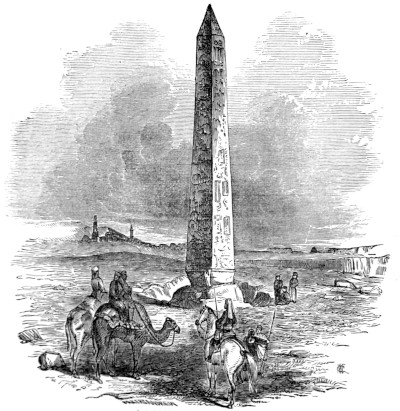
From Pompey’s pillar, to Cleopatra’s needles, is a distance of about a
522mile through the city in a north-easterly direction. “These obelisks,” says
Thompson, “have no more relation to Cleopatra, than the pillar has to
Pompey. Their hieroglyphics, according to Wilkinson and Lepsius, date
back as far as the exodus from Egypt; and they were brought to Alexandria
from the city of Heliopolis, or On, about a hundred miles to the south.
Each ‘needle’ is a solid block of red granite, about seventy feet high, and
nearly eight feet in diameter at the base. How such huge blocks were cut
from the quarry, transported hundreds of miles, and erected upon their
pedestals, is a mystery not solved by anything yet discovered of ancient
mechanic arts. Only one of the obelisks is standing. The other was taken
down to be transported to England, but now lies half buried in the mud
and sand. On one side of the standing obelisk the hieroglyphics are distinctly
legible, but on the northern or seaward side they are much defaced
by the action of the weather. It stands upon the edge of the great harbor,
in a line with the rock of Pharos that forms the extreme northern point of
the horseshoe port.
“Besides the pillar and the needles nothing remains to testify the former
splendor of Alexandria; a capital that once vied with Rome, containing a
population equal to that of New York, (three hundred thousand freemen
and as many slaves,) and that so late as the seventh century, according to
the testimony of Amrou, its Saracenic conqueror, contained ‘four thousand
palaces, four thousand baths, four hundred theaters, twelve thousand shops
for the sale of vegetables, and forty thousand tributary Jews.’ A few ruins
are pointed out, but these are fast disappearing with the ravages of time.
Its name is the only memorial of its founder; and the long range of catacombs
along the shore to the west of the city, the sole vestige of its ancient
population. So rapid was the growth of the city, that at the commencement
of the Christian era, it was ‘second only to Rome itself,’ and ‘comprehended
a circumference of fifteen miles’ within its walls. It was a great seat of
commerce. ‘Idleness was unknown. Either sex, and every age, was
engaged in the pursuits of industry;’ the blowing of glass, the weaving of
linen, manufacturing the papyrus, or conducting the lucrative trade of the
port. Alexander, fresh from the conquest of Tyre, boasted that he would
here build an emporium of commerce surpassing that which he had ruined,
and thus would recreate in his own image the world he had destroyed.
The site of Alexandria, more felicitous than that of Tyre, promised to
realize his ambitious dream. Its gates ‘looked out on the gilded barges of
the Nile, on fleets at sea under full sail, on a harbor that sheltered navies,
and a light-house that was the mariner’s star, and the wonder of the world.’
But neither the felicity of its location, nor the enterprise of its Ptolemaic
523rulers, nor the wealth of its commerce, nor the learning that gathered to its
schools the students of art, of philosophy, of medicine, of science, and of
religion, could withstand the march of empire from Asia to Europe, nor the
laws of trade that followed in its track.”
The present population of Alexandria is less than a hundred thousand; a
mixture of all the oriental races, with many Europeans and Jews. In
passing through its narrow and dirty streets, now occupied with a motley
and poverty-stricken populace; in traversing the villages of hovels within its
walls, where the Arab lies down with his sheep, his goat, his dog, and his
donkey, all in the mud inclosure of a few feet square, which must be
entered by stooping; and in climbing the huge mounds that are said to
cover the ancient capital, it is difficult to realize that here once dwelt the
hundred thousand Jews, for whom the seventy made their celebrated Greek
version of the Old Testament; that here the eloquent Apollos was born, and
the learned Athanasius conducted his theological controversies; that here
Theodosius, by imperial edict, destroyed the temple of Serapis, and publicly
established Christianity in place of the outcast divinities of the Egyptian
Greeks; that here was a school to which the sages of Greece resorted for
instruction in philosophy, science and letters, and where Jewish rabbins and
Christian apologists vied with Greek dialecticians in the various pursuits of
learning; and that here was a library of seven hundred thousand manuscript
volumes, a British museum or a Smithsonian institute, boasting the originals
or the duplicates of many of the most valuable works of the then current
literature, and which, after the accidental destruction of a part of it in the
insurrection against Julius Cæsar, and the willful destruction of another
portion in the sanguinary religious wars under Theodosius, yet contained
enough of written papyrus to heat for six months the four thousand baths
of the city, under the summary decree of Omar: “If these writings of the
Greeks agree with the book of God, they are useless, and need not be preserved;
if they disagree, they are pernicious, and ought to be destroyed.”
It is difficult amid such surroundings, to realize that here Cæsar and Antony
dallied with the charms of Cleopatra. It is difficult to realize that where
now bigotry, fanaticism and superstition hold sway over an ignorant and
degraded people, were schools of theology, and learned fathers, and astute
controversialists of the early Christian church; that here Christianity
triumphed over paganism in popular tumults backed by imperial decrees;
that here Mark preached the gospel of the kingdom where the Ethiopian
eunuch had preceded him with the tidings of the great salvation. And yet
that old Alexandria, which began to be in the fourth century before Christ,
and of all whose palaces and temples and monuments only two columns are
524now standing, was the youngest of Egyptian cities, and was built by the
conqueror of Egypt when Thebes, and Memphis, and the university city of
Heliopolis, were already in their decline. Such is the antiquity that meets
us at the threshold of the land of the Nile.
In connection with Alexandria, it is in place to speak of its cryptæ or
catacombs, a range of primeval sepulchers, on which a prodigious amount
of labor must have been bestowed. They are situated about half a league
along the shore, to the westward of the modern city; and their intricacy is
such, that formerly the guides would not enter them without a clew of
thread, which they unwound as they went in, so that by following it on their
return, they might secure their safe retreat. Dr. Clarke is very particular
in his description of these subterranean abodes of the dead; and from his
interesting narrative the following particulars have been gathered.
The original entrance to them is now closed, and is externally concealed
from observation. The only place by which admittance to the interior is
practicable, is a small aperture made through the soft and sandy rock, barely
large enough to admit a person upon his hands and knees. Here, sometimes,
the traveler has encountered jackals, escaping from the interior when
alarmed by any person approaching; on which account, a gun or pistol used
often to be discharged before entering, to prevent any sally of this kind.
“Having passed this aperture,” says Dr. Clarke, “with lighted tapers, we
arrived, by gradual descent, in a square chamber, almost filled with earth: to
the right and left of this are smaller apartments, chiseled in the rock; each
of these contains on either side of it, except that of the entrance, a soros for
the reception of a mummy; but, owing to the accumulation of sand in all
of them, this part of the catacombs can not be examined without great
difficulty. Leaving the first chamber, we found a second of still larger
dimensions, having four cryptæ with soroi, two on either side, and a fifth at
its extremity toward the south-east. From hence, penetrating toward the
west, we passed through another forced aperture, which conducted us into a
square chamber, without any receptacles for dead bodies; thence, pursuing
a south-western course, we persevered in effecting a passage, over heaps of
sand, from one chamber to another, admiring everywhere the same extraordinary
effects of labor and ingenuity, until we found ourselves bewildered
with so many passages, that our clew of thread became of more importance
than we at first believed it would prove to be. At last we reached the
stately antechamber of the principal sepulcher, which had every appearance
525of being intended for a regal repository. It was of a circular form,
surmounted by a beautiful dome, hewn out of the rock, with exquisite
perfection, and the purest simplicity of workmanship. In a few of the
chambers we observed pilasters, resembling, in their style of architecture,
the Doric, with architraves, as in some of the most ancient sepulchers near
Jerusalem; but they were all integral parts of the solid rock. The dome
covering the circular chamber was without ornament; the entrance to it
being from the north-west. Opposite to this entrance was a handsome
square crypt with three soroi; and to the right and left were other cryptæ,
similarly surrounded with places for the dead. Hereabouts we observed the
remarkable symbol, sculptured in relief, of an orb with extending wings,
evidently intended to represent the subterraneous sun, or sol inferus, as
mentioned by Macrobius. We endeavored to penetrate further toward the
south-west and south, and found that another complete wing of the vast
fabric extended in those directions, but the labor of the research was
excessive.
“The cryptæ upon the south-west side corresponded with those which we
have described toward the north-east. In the middle, between the two, a
long range of chambers extended from the central and circular shrine
toward the north-west; and in this direction appears to have been the principal
and original entrance. Proceeding toward it we came to a large room
in the middle of the fabric, between the supposed Serapeum and the main
outlet, or portal, toward the sea. Here the workmanship was very elaborate;
and to the right and left were chambers, with receptacles ranged
parallel to each other. Further on, in the same direction, is a passage with
galleries and spacious apartments on either side; probably the chambers for
embalming the dead, or those belonging to the priests, who constantly officiated
in the Serapeum. In the front is a kind of vestibulum, or porch; but
it is exceedingly difficult to ascertain precisely the nature of the excavation
toward the main entrance, from the manner in which it is now choked with
earth and rubbish. If this part were laid open, it is possible that something
further would be known as to the design of the undertaking; and, at all
events, one of the most curious of the antiquities of Egypt would then be
exposed to the investigation it merits. Having passed about six hours in
exploring, to the best of our ability, these gloomy mansions, we regained,
by means of our clew, the aperture by which we had entered, and quitted
them forever.”forever.”
526
Before leaving Alexandria, it may be interesting to glance at the process
and luxury of oriental bathing, so often described by travelers in Turkey
and Egypt. The narrative is from Taylor, who, though deceived by his
dragoman as to the excellence of the bath compared with others which he
might have visited, gives us a vivid picture of the process the bather undergoes,
and the full comfort that follows it. He says, “The bath to which he
conducted us, he declared was the finest in Alexandria, the most superb in
all the orient, but it did not at all accord with our ideas of eastern luxury.
Moreover, the bath-keeper was his intimate friend, and would bathe us as
no Christians were ever bathed before. One fact Ibrahim kept to himself,
which was, that his intimate friend and he shared the spoils of our inexperience.
We were conducted to a one-story building, of very unprepossessing
exterior. As we entered the low, vaulted entrance, my ears were saluted
with a dolorous, groaning sound, which I at first conjectured to proceed
from the persons undergoing the operation, but which I afterward ascertained
was made by a wheel turned by a buffalo, employed in raising water
from the well. In a sort of basement hall, smelling of soap-suds, and with
a large tank of dirty water in the center, we were received by the bath-keeper,
who showed us into a room containing three low divans with pillows.
Here we disrobed, and Ibrahim, who had procured a quantity of napkins,
enveloped our heads in turbans and swathed our loins in a simple Adamite
garment. Heavy wooden clogs were attached to our feet, and an animated
bronze statue led the way through gloomy passages, sometimes hot and
steamy, sometimes cold and soapy, and redolent of anything but the spicy
odors of Araby the blest, to a small vaulted chamber, lighted by a few
apertures in the ceiling. The moist heat was almost suffocating; hot water
flowed over the stone floor, and the stone benches we sat upon were somewhat
cooler than kitchen stoves. The bronze individual left us, and very
soon, sweating at every pore, we began to think of the three Hebrews in the
furnace. Our comfort was not increased by the groaning sound which we
still heard, and by seeing, through a hole in the door, five or six naked
figures lying motionless along the edge of a steaming vat, in the outer room.
Presently our statue returned with a pair of coarse hair-gloves on his hands.
He snatched off our turbans, and then, seizing one of my friends by the
shoulder as if he had been a sheep, began a sort of rasping operation upon
his back. This process, varied occasionally by a dash of scalding water, was
extended to each of our three bodies, and we were then suffered to rest
527awhile. A course of soap-suds followed, which was softer and more pleasant
in its effect, except when he took us by the hair, and holding back our
heads, scrubbed our faces most lustily, as if there were no such things as
eyes, noses and mouths. By this time we had reached such a salamandrine
temperature that the final operation of a dozen pailfuls of hot water poured
over the head, was really delightful. After a plunge in a seething tank, we
were led back to our chamber and enveloped in loose muslin robes. Turbans
were bound on our heads and we lay on the divans to recover from the
languor of the bath. The change produced by our new costume was astonishing.
The stout German became a Turkish mollah, the young Smyrniote
a picturesque Persian, and I—I scarcely know what, but, as my friends
assured me, a much better Moslem than Frank. Cups of black coffee and
pipes of inferior tobacco completed the process, and in spite of the lack of
cleanliness and superabundance of fleas, we went forth lighter in body, and
filled with a calm content which nothing seemed able to disturb.”
The ruins of the temple of Hermopolis, or the great city of Mercury,
which were thought wonderful till the later discoveries in Egypt threw them
comparatively in the shade, give some idea of the great range and high
perfection the arts had attained in that country. Many parts of these ruins
have preserved their original position, without having been altered or
deformed by the works of modern times, and have remained untouched for
well nigh four thousand years. They are of freestone, of the fineness of
marble, and have neither cement, nor any other means of union, except the
perfect fitting of the respective parts. The colossal proportions of the
edifice, evince the power the Egyptians possessed to raise such enormous
masses. The portico is one hundred and twenty feet long, and its hight
sixty feet. Not a spring of an arch remains, to throw light on the dimensions
of the whole extent of the temple, or of the nave. The architecture
is still richer than the Doric order of the Greeks. The shafts of the pillars
represent fasciæ, or bundles; and the pedestal, the stem of the lotus.
Under the roof between the two middle columns, are winged globes; and all
the roofs are ornamented with a wreath of painted stars, of an aurora color
on a blue ground.
The temple of Apollinopolis Magna is described by Denon as surpassing
in extent, majesty, magnificence, and high preservation, whatever he had
seen in Egypt, or elsewhere. This building is a long suite of pyramidal
gates, of courts decorated with galleries, of porticos, and of covered naves,
528constructed, not with common stones, but with entire rocks. This superb
edifice is situated on a rising ground, so as to overlook, not only its immediate
vicinity, but the whole valley. On the right is the principal gate,
placed between two huge mounds of buildings, on the walls of which are
three orders of hieroglyphic figures, increasing in their gigantic dimensions,
insomuch that the last have a length of twenty-five feet. The inner court
is decorated with a gallery of columns, bearing two terraces, which come out
at two gates, through which is the passage to the stairs, leading to the platform
of the mounds. Behind the inner portico are several apartments, and
the sanctuary of the temple. A wall of circumvallation is decorated both
within and without with innumerable hieroglyphics, executed in a very
finished and laborious style. This magnificent temple appears to have been
dedicated to the evil genius, the figure of Typhon being represented in
relief on the four sides of the plinth which surmounts each of the capitals.
The entire frieze, and all the paintings within, are descriptive of Isis,
defending herself against the attacks of that monster.
The ruins of the ancient city of Thebes, which Homer has characterized
by the single expression of the city with a hundred gates, are of so immense
an extent as to convince the spectator that fame has not exaggerated its
size. For, as if the diameter of old Egypt was not sufficient to contain it,
its monuments rest on two chains of contiguous mountains, while its tombs
occupy the valleys toward the west, stretching off into the desert. The
large temple on the eastern side is between two and three leagues distant
from Medeenet Abou, where the most western temple is situated; and the
modern village of Karnak is built on a small part of the site of a single
temple, which is half a mile in circumference. Of the remains of this
temple, Denon tells us, that “of the hundred columns of the portico alone,
the smallest are seven feet and a half in diameter, and the largest twelve.
The space occupied by the circumvallation of the temple contains lakes and
mountains. In short, to be enabled to form a competent idea of so much
magnificence, the reader ought to fancy what is before him to be a dream,
as he who views the objects themselves rubs his eyes to know whether he is
awake. The avenue leading from Karnak to Luxor, a space nearly half a
league in extent, contains a constant succession of sphinxes and other
chimerical figures to the right and left, together with fragments of stone
walls, of small columns, and of statues.”
The village of Luxor, Denon describes “as also built on the side of the
529ruins of a temple, not so large as that of Karnak, but in a better state of
preservation, the masses not having as yet fallen through time, and by the
pressure of their own weight. The most colossal parts consist of fourteen
columns of nearly eleven feet in diameter, and of two statues in granite, at
the outer gate, buried up to the middle of the arms, and having in front of
them the two largest and best preserved obelisks known. The French,
when in Egypt, deemed their means insufficient, not to hew out, but merely
to transport these two monuments, which are not more than a fragment of
one of the numerous edifices of the astonishing city of Thebes. They are
of rose-color granite, are still seventy feet above the ground, and to judge
by the depth to which they are supposed to be covered with sand, are
believed to be at least one hundred feet in hight. Their preservation is
perfect, and the hieroglyphics with which they are covered being cut deep,
and in relief at the bottom, show the bold hand of a master, and a beautiful
finish. The chisels which could cut such hard materials must have been of
an admirable temper; and the machines to drag such enormous blocks from
the quarries, to transport them thither, and to set them upright, together
with the time required for the labor, surpass all conception!” In speaking
of the gate of the temple, which is now that of the village of Luxor,
Denon remarks as follows. “Nothing can be more grand, and at the same
time more simple, than the small number of objects of which this entrance
is composed. No city whatever makes so proud a display at its approach as
this wretched village, the population of which consists of two or three
thousand souls, who have taken up their abode on the roofs and beneath the
galleries of this temple, which has, nevertheless, the air of being in a
manner uninhabited.”
The tombs of the kings of Thebes are grottos consisting of a regular
double gallery supported by pillars, behind which is a row of chambers,
often double. In proportion as the hight of these grottos increases, they
become more richly decorated; and the spectator is soon convinced, by the
magnificence both of the paintings and sculptures, and of the subjects they
represent, that he is among the tombs of great men or heroes. Those
which appear to have belonged to the ancient kings, are only distinguished
from the others by the magnificence of the sarcophagi, and the mysterious
solitude of their situation; the others immediately overlooking the great
buildings in the city. The sculpture in all is incomparably more labored
and more highly finished than that of the temples, and displays a high
perfection of the art. The lines of the hieroglyphics have been cut with a
firmness of touch, and a precision, of which marbles offer but few examples;
and the figures have a particular elegance and correctness of contour.
530Small subjects taken from nature are introduced; and in these the groups
of persons are given in perspective; and cut in deep relief, in simple and
natural attitudes. Several of these subjects bear but little analogy to the
spot in which they are immured; for bass-reliefs are seen representing
games, such as rope-dancing, and asses taught to play tricks and rear on
their hind legs, sculptured with all the traits of genuine nature and
simplicity. The plan of these excavations is singular; and many are so
vast and complicated, that they might be mistaken for labyrinths, or
subterraneous temples. After passing the elegant apartments described
above, long and gloomy galleries present themselves, winding backward and
forward in numerous angles, and seeming to occupy a great extent of
ground. They are melancholy, repulsive, and without any decoration; but
open from time to time into other chambers covered with hieroglyphics, and
branch out into narrow paths, leading to deep perpendicular pits. At the
bottom of these pits are other adorned chambers; and lower still a new
series of perpendicular pits and horizontal chambers, until at length, ascending
a long flight of steps, the visitor reaches an open place on a level with
the chambers he first entered.entered.
Thus far we have followed the brief outline given by Denon, and the
earlier travelers. But our ideas of these wonderful ruins will become much
more enlarged, as well as accurate, by perusing the descriptions of more
recent tourists and explorers; such for example as Taylor and Thompson.
The former, before beginning the recital of his visit, gives an outline of the
topography of Thebes. “The course of the Nile,” he says, “is here nearly
north, dividing the site of the ancient city into two almost equal parts. On
approaching it from Kenneh, the mountain of Goorneh which abuts on the
river, marks the commencement of the western division. This mountain, a
range of naked limestone crags, terminating in a pyramidal peak, gradually
recedes to the distance of three miles from the Nile, which it again
approaches further south. Nearly the whole of the curve, which might be
called the western wall of the city, is pierced with tombs, among which are
those of the queens, and the grand priestly vaults of the Assasseef. The
valley of the kings’ tombs lies deep in the heart of the range, seven or eight
miles from the river. After passing the corner of the mountain, the first
ruin on the western bank is that of the temple-palace of Goorneh. More
than a mile further, at the base of the mountain, is the Memnonium, or
temple of Remeses the Great, between which and the Nile the two Memnonian
colossi are seated on the plain. Nearly two miles to the south of
this is the great temple of Medeenet Abou, and the fragments of other edifices
are met with, still further beyond. On the eastern bank, nearly opposite
531Goorneh, stands the temple of Karnak, about half a mile from the river.
Eight miles eastward, at the foot of the Arabian mountains, is the small
temple of Medamot, which, however, does not appear to have been included
in the limits of Thebes. Luxor is directly on the bank of the Nile, a mile
and a half south of Karnak, and the plain extends several miles beyond it,
before reaching the isolated range, whose three conical peaks are the landmarks
of Thebes to voyagers on the river. These distances convey an idea
of the extent of the ancient city, but fail to represent the grand proportions
of the landscape, so well fitted, in its simple and majestic outlines, to inclose
the most wonderful structures the world has ever seen. The green expanse
of the plain; the airy coloring of the mountains; the mild, solemn blue of
the cloudless Egyptian sky: these are a part of Thebes, and inseparable from
the remembrance of its ruins.
“At sunrise we crossed to the western bank and moored our boat opposite
Goorneh. It is advisable to commence with the tombs, and close the
inspection of that side with Medeenet Abou, reserving Karnak, the grandest
of all for the last. The most unimportant objects in Thebes are full of
interest when seen first, whereas Karnak, once seen, fills one’s thoughts to
the exclusion of everything else. There are Arab guides for each bank,
who are quite familiar with all the principal points, and who have a quiet
and unobtrusive way of directing the traveler; and with one of them, we set
off on a stirring gallop for the temple of Goorneh and the valley of the
kings’ tombs, leaving Achmet to follow with our breakfast, and the Arab
boys with their water bottles. The temple of Goorneh was built for the
worship of Amun, the Theban Jupiter, by Osirei and his son, Remeses the
Great, the supposed Sesostris, nearly fourteen hundred years before the
Christian era. It is small, compared with the other ruins, but interesting
from its rude and massive style, a remnant of the early period of Egyptian
architecture. The two pylons in front of it are shattered down, and the
dromos of sphinxes has entirely disappeared. The portico is supported by a
single row of ten columns, which neither resemble each other, nor are
separated by equal spaces. What is most singular, is the fact that notwithstanding
this disproportion, which is also observable in the doorways, the
general effect is harmonious. We tried to fathom the secret of this, and
found no other explanation than in the lowness of the building, and the
rough granite blocks of which it is built. One seeks no proportion in a
natural temple of rock, or a cirque of Druid stones. All that the eye
requires is rude strength, with a certain approach to order. The effect
produced by this temple is of a similar character, barring its historical
interest. Its dimensions are too small to be imposing, and I found, after
532passing it several times, that I valued it more as a feature in the landscape,
than for its own sake.
“The sand and pebbles clattered under the hoofs of our horses, as we
galloped up the gorge of Biban el Molook, the ‘gates of the kings.’ The
sides are perpendicular cliffs of yellow rock, which increased in hight, the
further we advanced, and at last terminated in a sort of basin, shut in by
precipices several hundred feet in hight and broken into fantastic turrets,
gables and pinnacles. The bottom is filled with huge heaps of sand and
broken stones, left from the excavation of the tombs in the solid rock.
There are twenty-one tombs in this valley, more than half of which are of
great extent and richly adorned with paintings and sculptures. Some have
been filled with sand or otherwise injured by the occasional rains which
visit this region, while a few are too small and plain to need visiting. Sir
Gardner Wilkinson has numbered them all in red chalk at the entrances,
which is very convenient to those who use his work on Egypt as a guide.
I visited ten of the principal tombs, to the great delight of the old guide,
who complained that travelers are frequently satisfied with four or five.
The general arrangement is the same in all, but they differ greatly in extent
and in the character of their decoration.
“The first we entered was the celebrated tomb of Remeses I., discovered
by Belzoni. From the narrow entrance, a precipitous staircase, the walls
of which are covered with columns of hieroglyphics, descends to a depth
of forty feet, where it strikes a horizontal passage leading to an oblong
chamber, in which was formerly a deep pit, which Belzoni filled. This pit
protected the entrance to the royal chamber, which was also carefully walled
up. In the grace and freedom of the drawings, and the richness of their
coloring, this tomb surpasses all others. The subjects represented are the
victories of the monarch, while in the sepulchral chamber he is received into
the presence of the gods. The limestone rock is covered with a fine coating
of plaster, on which the figures were first drawn with red chalk, and afterward
carefully finished in colors. The reds, yellows, greens and blues are
very brilliant, but seem to have been employed at random, the gods having
faces sometimes of one color, sometimes of another. In the furthest chamber,
which was left unfinished, the subjects are only sketched in red chalk.
Some of them have the loose and uncertain lines of a pupil’s hand, over
which one sees the bold and rapid corrections of the master. Many of the
figures are remarkable for their strength and freedom of outline. I was
greatly interested in a procession of men, representing the different nations
of the earth. The physical peculiarities of the Persian, the Jew and the
Ethiopian are therein as distinctly marked as at the present day. The
533blacks are perfect counterparts of those I saw daily upon the Nile, and the
noses of the Jews seem newly painted from originals in New York. The
burial-vault, where Belzoni found the alabaster sarcophagus of the monarch,
is a noble hall, thirty feet long by nearly twenty in breadth and hight, with
four massive pillars forming a corridor on one side. In addition to the
light of our torches, the Arabs kindled a large bonfire in the center, which
brought out in strong relief the sepulchral figures on the ceiling, painted in
white on a ground of dark indigo hue. The pillars and walls of the vault
glowed with the vivid variety of their colors, and the general effect was
unspeakably rich and gorgeous. This tomb has already fallen a prey to
worse plunderers than the Medes and Persians. Belzoni carried off the
sarcophagus, Champollion cut away the splendid jambs and architrave of
the entrance to the lower chambers, and Lepsius has finished by splitting
the pillars and appropriating their beautiful paintings for the museum at
Berlin. At one spot, where the latter has totally ruined a fine doorway,
some indignant Frenchman has written in red chalk, ‘Meurtre commis par
Lepsius.’ In all the tombs of Thebes, wherever you see the most flagrant
and shameless spoliations, the guide says, ‘Lepsius.’ Who can blame the
Arabs for wantonly defacing these precious monuments, when such an
example is set them by the vanity of European antiquarians?
“Bruce’s tomb, which extends for four hundred and twenty feet into the
rock, is larger than Belzoni’s, but not so fresh and brilliant. The main
entrance slopes with a very gradual descent, and has on each side a number
of small chambers and niches, apparently for mummies. The illustrations
in these chambers are somewhat defaced, but very curious, on account of
the light which they throw upon the domestic life of the ancient Egyptians.
They represent the slaughtering of oxen, the preparation of fowls for the
table, the kneading and baking of bread and cakes, as well as the implements
and utensils of the kitchen. In other places the field laborers are
employed in leading the water of the Nile into canals, cutting dourra,
threshing and carrying the grain into magazines. One room is filled with
furniture, and the row of chairs around the base of the walls would not be
out of place in the most elegant modern drawing-room. The illustrated
catalogue of the London exhibition contains few richer and more graceful
patterns. In a chamber nearer the royal vault, two old, blind minstrels are
seen, playing the harp in the presence of the king, whence this is sometimes
called the harper’s tomb. The pillars of the grand hall, like those of all
the other tombs we visited, represent the monarch, after death, received into
the presence of the gods, stately figures, with a calm and serious aspect,
and lips, which, like those of the Sphinx, seemed closed upon some awful
534mystery. The absurdity of the coloring does not destroy this effect, and a
blue-faced Isis, whose hard, black eyeball stares from a brilliant white
socket, is not less impressive than the same figure, cut in sandstone or
granite. The delicacy and precision of the hieroglyphics, sculptured in
intaglio, filled me with astonishment. In the tomb of Amunoph III., which
I visited the next day, they resembled the ciphers engraved upon seals in
their exquisite sharpness and regularity. Only the principal tombs, however,
are thus beautified. In others the figures are either simply painted,
or apparently sunken in the plaster, while it was yet fresh, by prepared
patterns. The latter method accounts for the exact resemblance of long
processions of figures, which would otherwise require a most marvelous skill
on the part of the artist. In some unfinished chambers I detected plainly
the traces of these patterns, where the outlines of the figures were blunt,
and the grain of the plaster bent, and not cut. The family likeness in the
faces of the monarchs is also too striking, unfortunately, for us to accept
them all as faithful portraits. They are all apparently of the same age, and
their attributes do not materially differ. This was probably a flattery on
the part of the artists, or the effect of a royal vanity, which required to be
portrayed in the freshness of youth and the full vigor of body and mind.
The first faces I learned to recognize were those of Remeses II., the supposed
Sesostris, and Amunoph III.
“The tomb of Memnon, as it was called by the Romans, is the most
elegant of all, in its proportions, and is as symmetrical as a Grecian temple.
On the walls of the entrance are several inscriptions of Greek tourists, who
visited it in the era of the Ptolemies, and spent their time in carving their
names, like Americans nowadays. The huge granite sarcophagus in which
the monarch’s mummy was deposited, is broken, as are those of the other
tombs, with a single exception. This is the tomb of Osirei I., the grandfather
of Sesostris, and the oldest in the valley. I visited it by crawling
through a hole barely large enough to admit my body, after which I slid on
my back down a passage nearly choked with sand, to another hole, opening
into the burial chamber. Here no impious hand had defaced the walls, but
the figures were as perfect and the coloring as brilliant as when first executed.
In the center stood an immense sarcophagus, of a single block of
red granite, and the massive lid, which had been thrown off, lay beside it.
The dust in the bottom gave out that peculiar mummy odor perceptible in
all the tombs, and in fact long after one has left them, for the clothes become
saturated with it. The guide, delighted with having dragged me into that
chamber, buried deep in the dumb heart of the mountain, said not a word,
and from the awful stillness of the place and the phantasmagoric gleam of
535the wonderful figures on the walls, I could have imagined myself a neophyte,
on the threshold of the Osirian mysteries. We then rode to the western
valley, a still deeper and wider glen, containing tombs of the kings of the
foreign dynasty of Atin-Re. We entered the two principal ones, but found
the paintings rude and insignificant. There are many lateral passages and
chambers, and in some places deep pits, along the edge of which we were
obliged to crawl. In the last tomb a very long and steep staircase descends
into the rock. As we were groping after the guide, I called to my friend to
take care, as there was but a single step, after making a slip. The words
were scarcely out of my mouth before I felt a tremendous thump, followed
by a number of smaller ones, and found myself sitting in a heap of sand, at
the bottom, some twenty or thirty feet below. Fortunately, I came off with
but a few slight bruises.
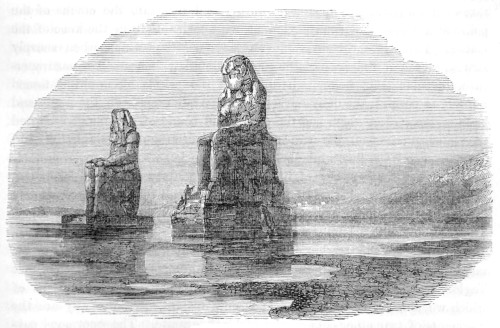
“Returning to the temple of Goorneh, we took a path over the plain,
through fields of wheat, lupines and lentils, to the two colossi, which we had
already seen from a distance. These immense sitting figures, fifty-three feet
above the plain, which has buried their pedestals, overlook the site of vanished
Thebes and assert the grandeur of which they and Karnak are the
most striking remains. They were erected by Amunoph III., and though
the faces are totally disfigured, the full, round, beautiful proportions of the
536colossal arms, shoulders and thighs do not belie the marvelous sweetness of
the features which we still see in his tomb. Except the head of Antinous,
I know of no ancient portrait so beautiful as Amunoph. The long and
luxuriant hair, flowing in a hundred ringlets, the soft grace of the forehead,
the mild serenity of the eye, the fine thin lines of the nostrils, and the
feminine tenderness of the full lips, triumph over the cramped rigidity of
Egyptian sculpture, and charm you with the lightness and harmony of
Greek art. In looking on that head, I can not help thinking that the
subject overpowered the artist, and led him to the threshold of a truer art.
Amunoph, or Memnon, was a poet in soul, and it was meet that his statue
should salute the rising sun with a sound like that of a harp-string.
Modern research has wholly annihilated this beautiful fable. Memnon now
sounds at all hours of the day, and at the command of all travelers who will
pay an Arab five piasters to climb up into his lap. We engaged one, who
threw off his garments, hooked his fingers and toes into the cracks of the
polished granite, and soon hailed us with ‘salaam’ from the knee of the
statue. There is a certain stone on Memnon’s lap, which, when sharply
struck, gives out a clear, metallic ring. Behind it is a small square aperture,
invisible from below, where one of the priests no doubt stationed
himself to perform the daily miracle. Our Arab rapped on the arms and
body of the statue, which had the usual dead sound of stone, and rendered
the musical ring of the sun-smitten block the more striking.” And
Thompson tells us, that while he and his associates sat before it on their
donkeys, they saw “a boy of fifteen, with a solitary rag round his waist,
scrambling up the side of the statue, and presently he was completely
hidden in its lap, just where the sly priest used to hide himself over night.
Then striking with a hammer the hollow, sonorous stone, it emitted a sharp,
clear sound, like the striking of brass,” though it was “not sunrise, but the
middle of a scorching afternoon.” “An avenue of sphinxes,” continues
Taylor, “once led from these colossi to a grand temple, the foundations of
which we found about a quarter of a mile distant. On the way are the
fragments of two other colossi, one of black granite. The enormous substructions
of the temple and the pedestals of its columns, have been
sufficiently excavated to show what a superb edifice has been lost to the
world. A crowd of troublesome Arabs, thrusting upon our attention newly
baked cinerary urns, newly roasted antique wheat, and images of all kinds
fresh from the maker’s hand, disturbed our quiet examination of the ruins,
and in order to escape their importunities, we rode to the Memnonium.
This edifice, the temple-palace of Remeses the Great, is supposed to be the
Memnonium, described by Strabo. It is built on a gentle rise of land at
537the foot of the mountain, and looks eastward to the Nile and Luxor. The
grand stone pylon which stands at the entrance of its former avenue of
sphinxes, has been half leveled by the fury of the Persian conquerors; and
the colossal granite statue of Remeses, in the first court of the temple, now
lies in enormous fragments around its pedestal. Mere dimensions give no
idea of this immense mass, the weight of which, when entire, was nearly
nine hundred tuns. How poor and trifling appear the modern statues
which we call colossal, when measured with this, one of whose toes is a
yard in length; and how futile the appliances of modern art, when directed
to its transportation for a distance of one hundred and fifty miles! The
architrave at each end of the court was upheld by four caryatides, thirty
feet in hight. Though much defaced, they are still standing, but are
dwarfed by the mighty limbs of Remeses. It is difficult to account for the
means by which the colossus was broken. There are no marks of any
instruments which could have forced such a mass asunder, and the only
plausible conjecture I have heard is, that the stone must have been subjected
to an intense heat and afterward to the action of water. The statue,
in its sitting position, must have been nearly sixty feet in hight, and is the
largest in the world, though not so high as the rock-hewn monoliths of
Aboo-Simbel. The Turks and Arabs have cut several mill-stones out of its
head, without any apparent diminution of its size. The Memnonium differs
from the other temples of Egypt in being almost faultless in its symmetry,
even when measured by the strictest rules of art. I know of nothing so
exquisite as the central colonnade of its grand hall—a double row of pillars,
forty-five feet in hight and twenty-three in circumference, crowned with
capitals resembling the bell-shaped blossoms of the lotus. One must see
them to comprehend how this simple form, whose expression is all sweetness
and tenderness in the flower, softens and beautifies the solid majesty of the
shaft. In spite of their colossal proportions, there is nothing massive or
heavy in their aspect. The cup of the capital curves gently outward from
the abacus on which the architrave rests, and seems the natural blossom of
the columnar stem. On either side of this perfect colonnade are four rows
of Osiride pillars, of smaller size, yet the variety of their form and proportions
only enhances the harmony of the whole. This is one of those
enigmas in architecture which puzzle one on his first acquaintance with
Egyptian temples, and which he is often forced blindly to accept as new
laws of art, because his feeling tells him they are true, and his reason can
not satisfactorily demonstrate that they are false.
“We waited till the yellow rays of sunset fell on the capitals of the Memnonium,
and they seemed, like the lotus flowers, to exhale a vapory light,
538before we rode home. All night we wandered in dreams through kingly
vaults, with starry ceilings and illuminated walls; but on looking out of our
windows at dawn, we saw the red saddle-cloths of our horses against the
dark background of the palm grove, as they came down to the boat. No
second nap was possible, after such a sight, and many minutes had not
elapsed before we were tasting the cool morning air in the delight of a race
up and down the shore. Our old guide, however, was on his donkey
betimes, and called us off to our duty. We passed Goorneh, and ascended
the eastern face of the mountain to the tombs of the priests and private
citizens of Thebes. For miles along the mountain side, one sees nothing
but heaps of sand and rubbish, with here and there an Arab hut, built
against the face of a tomb, whose chambers serve as pigeon-houses and stalls
for asses. The earth is filled with fragments of mummies, and the bandages
in which they were wrapped; for even the sanctity of death itself, is here
neither respected by the Arabs nor the Europeans whom they imitate. The
first tomb we entered almost cured us of the desire to visit another. It was
that called the Assasseef, built by a wealthy priest, and it is the largest in
Thebes. Its outer court measures one hundred and three by seventy-six
feet, and its passages extend between eight and nine hundred feet into the
mountain. We groped our way between walls as black as ink, through
long, labyrinthine suites of chambers, breathing a deathlike and oppressive
odor. The stairways seemed to lead into the bowels of the earth, and on
either hand yawned pits of uncertain depth. As we advanced, the ghostly
vaults rumbled with a sound like thunder, and hundreds of noisome bats,
scared by the light, dashed against the walls and dropped at our feet. We
endured this for a little while, but on reaching the entrance to some darker
and deeper mystery, were so surrounded by the animals, who struck their
filthy wings against our faces, that not for ten kings’ tombs would we have
gone a step further. My friend was on the point of vowing never to set his
foot in another tomb, but I persuaded him to wait until we had seen that of
Amunoph. I followed the guide, who enticed me by flattering promises
into a great many snakelike holes, and when he was tired with crawling in
the dust, sent one of our water-carriers in advance, who dragged me in and
out by the heels.
“The temple of Medeenet Abou is almost concealed by the ruins of a
Coptic village, among which it stands, and by which it is partially buried.
The outer court, pylon, and main hall of the smaller temple, rise above the
mounds and overlook the plain of Thebes, but scarcely satisfy the expectation
of the traveler, as he approaches. You first enter an inclosure
surrounded by a low stone wall, and standing in advance of the pylon.
539The rear wall, facing the entrance, contains two single pillars, with bell-shaped
capitals, which rise above it and stand like guards before the
doorway of the pylon. Here was another enigma for us. Who among
modern architects would dare to plant two single pillars before a pyramidal
gateway of solid masonry, and then inclose them in a plain wall, rising to
half their hight? Yet here the symmetry of the shafts is not injured by the
wall in which they stand, nor oppressed by the ponderous bulk of the pylon.
On the contrary, the light columns and spreading capitals, like a tuft of wild
roses hanging from the crevice of a rock, brighten the rude strength of the
masses of stone with a gleam of singular loveliness. What would otherwise
only impress you by its size, now endears itself to you by its beauty. Is
this the effect of chance, or the result of a finer art than that which
flourishes in our day? I will not pretend to determine, but I must confess
that Egypt, in whose ruins I had expected to find only a sort of barbaric
grandeur, has given me a new insight into that vital beauty which is the
soul of true art. We devoted little time to the ruined court and sanctuaries
which follow the pylon, and to the lodges of the main temple, standing
beside them like watch-towers, three stories in hight. The majestic pylon
of the great temple of Remeses III. rose behind them, out of heaps of
pottery and unburnt bricks, and the colossal figure of the monarch in his
car, borne by two horses into the midst of the routed enemy, attracted us
from a distance. We followed the exterior wall of the temple, for its whole
length of more than six hundred feet, reading the sculptured history of his
conquests. The entire outer wall of the temple presents a series of gigantic
cartoons, cut in the blocks of sandstone, of which it is built. Remeses is
always the central figure, distinguished from subjects and foes, no less by
his superior stature, than by the royal emblems which accompany him.
Here we see heralds sounding the trumpet in advance of his car, while his
troops pass in review before him; there, with a lion walking by his side, he
sets out on his work of conquest. His soldiers storm a town, and we see
them climbing the wall with ladders, while a desperate hand-to-hand conflict
is going on below. In another place, he has alighted from his chariot and
stands with his foot on the neck of a slaughtered king. Again, his vessels
attack a hostile navy on the sea. One of the foreign craft becomes
entangled and is capsized, yet while his spearmen hurl their weapons among
the dismayed enemy, the sailors rescue those who are struggling in the flood.
After we have passed through these strange and stirring pictures, we find
the monarch reposing on his throne, while his soldiers deposit before him
the hands of the slaughtered, and his scribes present to him lists of their
numbers, and his generals lead to him long processions of fettered captives.
540Again, he is represented as offering a group of subject kings to Amun, the
Theban Jupiter, who says to him: ‘Go, my cherished and chosen, make war
on foreign nations, besiege their forts and carry off their people to live as
captives.’ On the front wall, he holds in his grasp the hands of a dozen
monarchs, while with the other hand he raises his sword to destroy them.
Their faces express the very extreme of grief and misery, but he is cold and
calm as fate itself. We slid down the piles of sand and entered by a side-door
into the grand hall of the temple. Here, as at Dendera, a surprise
awaited us. We stood on the pavement of a magnificent court, about one
hundred and thirty feet square, around which ran a colonnade of pillars,
eight feet square and forty feet high. On the western side is an inner row
of circular columns, twenty-four feet in circumference, with capitals representing
the papyrus blossom. The entire court, with its walls, pillars and
doorways, is covered with splendid sculptures and traces of paint, and the
ceiling is blue as the noonday sky, and studded with stars. Against each
of the square columns facing the court once stood a colossal caryatid,
upholding the architrave of another colonnade of granite shafts, nearly all
of which have been thrown from their bases and lie shivered on the pavement.
This court opens toward the pylon into another of similar dimensions,
but buried almost to the capitals of its columns in heaps of rubbish.
The character of the temple is totally different from that of every other in
Egypt. Its hight is small in proportion to its great extent, and it therefore
loses the airy lightness of the Memnonium and the impressive grandeur of
Dendera. Its expression is that of a massive magnificence, if I may use
such a doubtful compound: no single epithet suffices to describe it.”
The visit to this temple ended our traveler’s survey of the western division
of Thebes, “two long days of such experience,” he remarks, “as the
contemplation of a lifetime can not exhaust;” and at sunset they crossed
over the Nile, to
The temple of Luxor is imbedded in the modern village, and only the
front of the pylon, facing toward Karnak, and part of the grand central
colonnade, are free from its hovels and their accessories. For this reason,
though of much grander proportions than the Memnonium, its effect is less
agreeable and impressive. “Its plan, however,” says Taylor, “is easily
traced; and having been built by only two monarchs, Remeses the Great
and Amunoph III., or, to use their more familiar titles, Sesostris and Memnon,
it is less bewildering, in a historical point of view, to the unstudied
tourist, than most of the other temples of Egypt. The sanctuary, which
541stands nearest the Nile, is still protected by the ancient stone quay, though
the river has made rapid advances, and threatens finally to undermine
Luxor as it has already undermined the temples of Antæopolis and Antinoë.
I rode into what were once the sacred chambers, but the pillars and sculptures
were covered with filth, and the Arabs had built in, around and upon
them, like the clay nests of the cliff-sparrow. The peristyle of majestic
Osiride pillars, in front of the portico, as well as the portico itself, are buried
to half their depth, and so surrounded by hovels, that to get an idea of their
arrangement you must make the tour of a number of hen-houses and asses’
stalls. The pillars are now employed as drying-posts for the buffalo dung
which the Arabs use as fuel. Proceeding toward the entrance, the next
court, which is tolerably free from incumbrances, contains a colonnade of
two rows of lotus-crowned columns, twenty-eight feet in circumference.
They still uphold their architraves of giant blocks of sandstone, and rising
high above the miserable dwellings of the village, are visible from every part
of the plain of Thebes. The English vice-consul occupies a house between
two of these pillars. He gave us the agreeable news that the consul was
endeavoring to persuade the pasha to have Karnak cleared of its rubbish and
preserved from further spoliation. If I possessed despotic power, (and
I then wished it for the first time,) I should certainly make despotic use
of it, in tearing down some dozens of villages and setting some thousands of
Copts and Fellahs at work in exhuming what their ancestors have mutilated
and buried. The world can not spare these remains. Tear down Roman
ruins if you will; level Cyclopean walls; build bridges with the stones of
Gothic abbeys and feudal fortresses; but lay no hand on the glory and
grandeur of Egypt! We ascended the great pylon of the temple, on the
face of the towers of which the victories of Remeses are sculptured; but his
colossi, solid figures of granite, which sit on either side of the entrance,
have been much defaced. The lonely obelisk, which stands a little in
advance, on the left hand, is more perfect than its Parisian mate. From
this stately entrance, an avenue of colossal sphinxes once extended to the
Ptolemaic pylon of Karnak, a distance of a mile and a half. The sphinxes
have disappeared, and the modern Arab road leads over its site, through
fields of waste grass.”
“And now we galloped forward, through a long procession of camels,
donkeys, and desert Arabs armed with spears, toward Karnak, the greatest
ruin in the world, the crowning triumph of Egyptian power and Egyptian
art. Except a broken stone here and there protruding through the soil, the
542plain is as desolate as if it had never been conscious of a human dwelling;
and only on reaching the vicinity of the mud hamlet of Karnak, can the
traveler realize that he is in Thebes. Here the camel-path drops into a
broad excavated avenue, lined with fragments of sphinxes and shaded by
starveling acacias. As you advance, the sphinxes are better preserved and
remain seated on their pedestals, but they have all been decapitated.
Though of colossal proportions, they are seated so close to each other, that
it must have required nearly two thousand to form the double row to Luxor.
The avenue finally reaches a single pylon, of majestic proportions, built by
one of the Ptolemies, and covered with profuse hieroglyphics. Passing
through this, the sphinxes lead you to another pylon, followed by a pillared
court and a temple built by the later Remesides. This, I thought, while
my friend was measuring the girth of the pillars, is a good beginning for
Karnak, but it is certainly much less than I expect. ‘Tāāl min hennee!’
(come this way!) called the guide, as if reading my mind, and led me up
the heaps of rubbish to the roof and pointed to the north. Ah, there was
Karnak! Had I been blind up to this time, or had the earth suddenly
heaved out of her breast the remains of the glorious temple? From all
parts of the plain of Thebes I had seen it in the distance—a huge propylon,
a shattered portico, and an obelisk, rising above the palms. Whence this
wilderness of ruins, spreading so far as to seem a city rather than a temple;
pylon after pylon, tumbling into enormous cubes of stone, long colonnades,
supporting fragments of Titanic roofs, obelisks of red granite, and endless
walls and avenues, branching out to isolated portals? Yet they stood as
silently amid the accumulated rubbish of nearly four thousand years, and
the sunshine threw its yellow luster as serenely over the despoiled sanctuaries,
as if it had never been otherwise since the world began. Figures are
of no use, in describing a place like this, but since I must use them, I may
say that the length of the ruins before us, from west to east, was twelve
hundred feet, and that the total circumference of Karnak, including its
numerous pylæ, or gateways, is a mile and a half.
“We mounted and rode with fast-beating hearts to the western or main
entrance, facing the Nile. The two towers of the propylon (pyramidal
masses of solid stone) are three hundred and twenty-nine feet in length,
and the one which is least ruined, is nearly one hundred feet in hight. On
each side of the sculptured portal connecting them, is a tablet left by the
French army, recording the geographical position of the principal Egyptian
temples. We passed through, and entered an open court, more than three
hundred feet square, with a corridor of immense pillars on each side, connecting
it with the towers of a second pylon, nearly as gigantic as the first.
543A colonnade of lofty shafts, leading through the center of the court, once
united the two entrances, but they have all been hurled down, and lay as
they fell, in long lines of disjointed blocks, except one, which holds its
solitary lotus-bell against the sky. Two mutilated colossi of red granite
still guard the doorway, whose lintel-stones are forty feet in length. Climbing
over the huge fragments which have fallen from above and almost
blocked up the passage, we looked down into the grand hall of the temple.
I knew the dimensions of this hall, beforehand; I knew the number and
size of the pillars, but I was no more prepared for the reality than those will
be, who may read this account of it and afterward visit Karnak for themselves.
It is the great good luck of travel that many things must be seen
to be known. Nothing could have compensated for the loss of that overwhelming
confusion of awe, astonishment, and delight, which came upon
me like a flood. I looked down an avenue of twelve pillars, six on each
side, each of which was thirty-six feet in circumference and nearly eighty
feet in hight. Crushing as were these ponderous masses of sculptured
stone, the spreading bell of the lotus-blossoms which crowned them, clothed
them with an atmosphere of lightness and grace. In front, over the top of
another pile of colossal blocks, two obelisks rose sharp and clear, with every
emblem legible on their polished sides. On each side of the main aisle are
seven other rows of columns, one hundred and twenty-two in all; each of
which is about fifty feet high and twenty-seven in circumference. They
have the Osiride form, without capitals, and do not range with the central
shafts. In the efforts of the conquerors to overthrow them, two have been
hurled from their places and thrown against the neighboring ones, where
they still lean, as if weary with holding up the roof of massive sandstone.
I walked alone through this hall, trying to bear the weight of its unutterable
majesty and beauty. That I had been so oppressed by Dendera, seemed
a weakness which I was resolved to conquer, and I finally succeeded in
looking on Karnak with a calmness more commensurate with its sublime
repose; but not by daylight. My next visit was at night, at the time of the
full moon. There was a wan haze in the air, and a pale halo around the
moon, on each side of which appeared two faint mock-moons. It was a
ghostly light, and the fresh north wind, coming up the Nile, rustled
solemnly in the palm-trees. We trotted silently to Karnak, and leaped our
horses over the fragments until we reached the foot of the first obelisk.
Here we dismounted and entered the grand hall of pillars. There was no
sound in all the temple, and the guide, who seemed to comprehend my wish,
moved behind me as softly as a shadow, and spoke not a word. It needs
this illumination to comprehend Karnak. The unsightly rubbish has disappeared:
544the rents in the roof are atoned for by the moonlight they admit;
the fragments shivered from the lips of the mighty capitals are only the
crumpled edges of the flower; a maze of shadows hides the desolation of
the courts, but every pillar and obelisk, pylon and propylon is glorified by
the moonlight. The soul of Karnak is soothed and tranquillized. Its halls
look upon you no longer with an aspect of pain and humiliation. Every
stone seems to say: ‘I am not fallen, for I have defied the ages. I am a
part of that grandeur which has never seen its peer, and I shall endure
forever, for the world has need of me.’ I climbed to the roof, and sat
looking down into the hushed and awful colonnades, till I was thoroughly
penetrated with their august and sublime expression. I should probably
have remained all night, an amateur colossus, with my hands on my knees,
had not the silence been disturbed by two arrivals of romantic tourists, an
Englishman and two Frenchmen. We exchanged salutations, and I mounted
my restless mare again, touched her side with the stirrup, and sped back to
Luxor. The guide galloped beside me, occasionally hurling his spear into
the air and catching it as it fell, delighted with my readiness to indulge his
desert whims. I found the captain and sailors all ready and my friend
smoking his pipe on deck. In half an hour we had left Thebes.”
Such is a faint view of these ruins of forty centuries, the remains of
that splendid city, Thebes, in comparison with which New York is but an
infant to the mighty giant! “Yes, proud upstart of this nineteenth
century,” says Thompson, “the so-called Empire city, commercial emporium
of the west, great metropolis of the new world, if thy rivers should
sweep over and bury thee, not all the stone of the Croton reservoir, and the
city hall, and the Astor house, and of a hundred churches forsooth, would
make one pile like Karnak; nor could any of these furnish a single stone
for the lintels of its gates. Yet Karnak, which began to be in that other
nineteenth century before Christ, is not yet a ruin! Its gateways stand;
its grand hall stands, its columns nearly all unbroken, and not one spire of
grass, or tuft of moss, or leaf of ivy, hides its speaking sculptures. Only
the sand has covered them; and when this is removed, they are as fresh as
yesterday.”
“Such is the skeleton of Thebes, as we can reconstruct it of such
materials and from such localities as yet mark its site. But what was
Thebes when, resting upon the Lybian mountains on the west and the
Arabian on the east, with the Nile flowing through its center, it filled a
circuit of twenty-five miles in a plain of twice that area, teeming with
fertility! What was Thebes when she could pour forth twenty thousand
chariots of war, and when the grand triumphal procession of priests, and
545officers of state, and soldiers, and captives, swept through these colossal
avenues to grace the conqueror’s return! What was Thebes when, by the
way of the Red sea, Arabia and the Indies poured all their commerce into
her lap, and the Nile brought her the spoils of Ethiopia and of the great
sea! What was Thebes when she possessed wealth, and mechanic arts, and
physical force, to rear such monuments even in the midst of war, and sometimes
more than one in the reign of a single monarch! What was Thebes,
with all the arts and inventions of civilized life that are sculptured upon the
tombs of her kings to mark the progress of their day; from building arches
and bridges, to glass-blowing and porcelain manufactures, to the making of
umbrellas, fans, chairs, and divans, fine linens, and all the appurtenances of
a modern drawing-room! What was Thebes when all merchants resorted
thither from Persia, from Ethiopia, from Lybia, and the Levant! What was
Thebes when the artists and scholars of infant Greece and Rome went
thither to school! Was not Egypt the mother of nations? Where is the
art of Greece or Rome that was not tutored in Egypt; that has not simply
graced Egyptian forms—nor always this? Where is the philosophy of
Greece or Rome that was not borrowed from Egypt? Even the divine Plato,
who only waited for the true Logos, learned at Egypt’s shrine. Egypt gave
birth to art, gave birth to thought, before Greece and Rome were born.
She was the grand repository of human power; the originator of all great
forms of human development; the originator, the inventor, the great prototype
of the world’s history, here laid up in her hieroglyphic archives. In
all material things, yes, and in all great intellectual forms, in poetry, in art,
in philosophy, in science, and in the religion of nature, this nineteenth
century is but the recipient of the mighty past. Whatever she has of these,
she but inherits through Rome and Greece from their old mother Egypt.
What she has better than these, she has by gift divine, through that Christianity
which purifies, enfranchises, and ennobles man, reforms society, and
makes free the state. If she hold fast by this, she will become resplendent
with a glory that Egypt never knew; but if she slight this, and sell her
birthright for luxury and power, the meanest grave at Thebes would suffice
to bury this nineteenth century with its boasted inventions.“
All the mere ruins of Thebes, however, immense and magnificent as they
are, fail to give us true views of her greatness, till we go back to her origin,
and trace up her history; and this is so graphically done by Thompson, in
his “Egypt, Past and Present,” that we quote from it, what he so appropriately
calls “Dissolving Views: Panorama of Karnak.” “In order,” he
546says, “to a complete view of Thebes, past and present, one should reproduce
its sculptured story, and make it witness for itself. The temple of Karnak,
in its several parts, marks the rise, the growth, the decline, and the fall of
Egypt. This temple had a growth of twenty-five hundred years, from a
small sanctuary to ‘a city of temples.’ Every principal era of the national
history is represented in this stupendous pile; and as we go leisurely around
it, and translate into our own language, or vivify into present actual scenes,
the processions, the battles, the ceremonies, the religious offerings, and the
state displays, sculptured on its walls and columns, and for the most part
still legible, we behold all Egypt move before us as in a panorama, whose
scenes and actors are instinct with life. This animated reproduction of the
sculptures, which I attempted when on the ground, I would hope to convey
to the reader by following in course the histories here written on the stone.
“I stood in Karnak, under the light of the full moon. It was an hour
for silence, and we enjoined this upon each other, and gave ourselves to
solitary musing. The cuckoo, that had wooed us with his note as we
reposed under the great pillars in the sultry noon, had gone to nestle with
his mate; and the myriad birds that by day had fluttered along the
corridors, had hid themselves in the crevices of the capitals. Even the owl
that hooted as we entered, was still. Only the moon was there, threading
the avenues with silver footsteps, and holding her clear light that we might
read the sculptured chronicles of kings. We sat down in the center of the
grand avenue. Twelve majestic pillars, on either hand, towered along its
length, and seemed, as of old, to support an arch of azure studded with
stars. The dismantled towers of the grand entrance, whose bases stand like
pyramids truncated to sustain the firmament, grew more gigantic in the
shadow of the columns, while their once massive gates, uncovered by the
hand of time, seemed only to have lifted up their heads to let the King of
Glory in. In the avenue that crossed beside our seat, (one of twelve,
having each ten columns of huge dimensions,) at either extremity, a column
had fallen crosswise against its neighbor, carrying with it its fragment of the
stone roof, and there it hung almost ethereal in the still moonlight, a symbol
of the struggle between man and time. Under the corridors, darkness
brooded over the fragments of sculptured stone; but beyond the other
portal, the yet perfect obelisk stood in pensive majesty among its fallen
mates, and from its clear, hard face projected in the moonbeams the symbols
of the power that built these halls, and of the worship that sustained them.
The spell of Egypt was complete. For two months I had lived under its
deepening power. At length, in the sepulchers of its kings, and on the
walls and pillars of its temples, I had seen the Egypt of forty centuries
547revived as in a panorama fresh from the artist’s pencil, and had lived in the
Egypt that the Nile then watered, as in the so-called Egypt that it waters
now. And here I had come to bid it farewell, to take a last look at its
grave; and yet the witching moonlight made it live again. The breath of
the south fanning the columns that in their fourth decade of centuries wear
no ivied wreath of age, warmed their still grandeur into life, and with
Memnon’s charm they sang to the moon the great epic of the past. As
I listened, all art, all learning, all religion, all poetry, all history, all empire,
and all time, swept through my wondering soul. Leaving my companions,
I wandered over the fragments of columns and sphinxes and colossi, till,
gaining a mound that half buries the front area of the temple, I clambered
up the steps worn by age in its stupendous wall, and standing in their
foremost tower, looked back on Karnak. But no change of place, nor sight
of fallen columns and decaying walls, could break the spell. I had walked
over the grave of Egypt, I had stumbled against the fragments of its
sepulcher, yet Egypt stood before me.
“First came the second son of Ham, with a long retinue of camels and of
servants, lured southward by the fertile valley of the Nile, till, where the
mountains widen their embrace around the well-watered plain, he pitches
his tent, and founds an infant city. Generations pass, and the son who in
this plain inherits the patriarchal wealth and power, greedy of the patrimony
of his brethren to the north, wages a fratricidal war, and seizing upon all
Mizr or ‘the land of Ham,’ effaces from it the name of his ancestors, and,
investing it with his own, gives Egypt (Copt or Gurt) a name and a power
in the newly divided earth. Other generations pass, and the first king of
Egypt comes with barbaric pomp, from the capital he has founded at the
north, to visit his native Theba, the real ‘head’ or capital, and here offers
to its divinity the rude shrine whose traces linger behind yonder obelisk.
Ages roll on. The swelling Nile pours out increasing fatness on the land.
The earth brings forth by handfuls. Fat-fleshed, well-favored cattle come
up out of the river and feed in the meadow. There is great plenteousness
for man and beast. But with all the plenty there is no waste. In every
city huge granaries are built, and in these the grain is piled, as the sand of
the sea, without measure. There is a strange wisdom near the throne of
Pharaoh. Again, the east wind blows, and the scorching sands of the
Arabian desert are heaped upon the fertile Nile. In the mountains of
Ethiopia there is no rain. The river shrinks away. The plain of Thebes is
dry. The people cry for bread, but the keys of the great storehouses are in
the hand of the ruler of the land. They bring to him their money; they
bring to him their cattle; they sell to him their land: they sell to him their
548very selves for bread. Again, the east wind ceases; the rains fall, the river
rises; the desert retreats; the land revives. And now the great Pharaoh,
whom the counsel of a captive Jew has made possessor of all the treasure
and all the land of Egypt, moved by a religious sentiment but half enlightened,
would make a votive offering to his god. A fleet of barges covers the
bosom of the Nile, which with waving banners and gorgeous emblems and
increasing music, have borne the monarch from his northern to his southern
capital. With solemn pomp the procession of priests and soldiers and chief
officers of state, with the uplifted monarch in the midst, files from the river
to the rude sanctuary of Menes, which the skill of masons and of sculptors
has already surrounded with columns of rich red granite, and chambers of
polished stone, and with colossal statues of the king—the offering he brings
to the divinity, whom he adores as the preserver of the land; and while the
monarch bows before the god, the sound of trumpets, and the fragrance of
incense, and the chanting of the priests, announce to the multitude that
Amun accepts the gift, and will be henceforth worshiped in their temple.
Osirtasen the Great passes away.
“The ages roll. A native Theban usurps the throne of the northern
Pharaohs, and succeeds to the power they had consolidated through the
counsel of the Hebrew, vouchsafed to them through fourscore years. But
Joseph is dead; embalmed and coffined in a royal sarcophagus; and Amosis
the usurper knows him not. Oppression fills the land, and falls most
heavily upon the seed of Joseph. Another Theban Pharaoh mounts the
throne, and to preserve the power that the wisdom of a Hebrew gave,
determines to cut off the issue of the Hebrews from the land. Yet in his
own house, even as a son, in all the learning of his schools, amid all the
splendors of his court, is nurtured a young Hebrew who yet shall desolate
the land that Joseph blessed. But just now this rising terror has fled into
the desert, and the first Thothmes comes in peaceful pomp to offer to the
divinity of Thebes the gigantic obelisks that bear his name. He plants them
yonder in the area before the sanctuary of Osirtasen. The third Thothmes
is on the throne. There is groaning throughout the land of Egypt; there is
deep sorrow in the land of Goshen. The monarch would make his name
immortal by the temples, the palaces, and the monuments he rears in every
city, from the great sea to the cataracts of Nubia. He adorns his native
capital upon its western bank with a new sanctuary added to the temple of
his father, and with another temple inclosed with brick, that bear in
hieroglyphics his own initials; and here at Karnak, he builds behind the
sanctuary, a thousand feet from where I stand, the grand edifice of fifty
columns that surpasses all the royal architecture yet seen in Thebes. In its
549adytum he enshrines a colossal figure of the deified hawk that he worships.
He is the great architect of Egypt, and he will fill the land with the
memorials of his reign. Heliopolis and Noph, Zoan and Sin, attest his
grandeur. But the voice of another God now thunders in his ear. The
exiled Hebrew has returned. The land is filled with plagues, frogs, lice,
flies, blood, murrain, hail, locusts, darkness, death. The king has gone
from Thebes to Zoan, his most northern seat, where these judgments
overtake him. The land of Goshen, that had sweltered under his exactions,
breathes more freely, and he lets the people go. But gathering his chariots
of war in mad haste, he pursues them, and hems them in between the
mountains and the sea. Eager for his prey, he plunges into the channel
God has made for them, and the proud architect of Egypt returns not, even
to occupy the gorgeous tomb he had prepared for himself at Thebes.
“The ages roll on, and a mighty conqueror sits on the throne of Egypt.
With his myriad chariots he sweeps Ethiopia on the south, and Canaan on
the north, and gathering all the forces of the Nile, he shakes Lebanon with
his tread, and scatters the hosts of Syria on the plains of the Euphrates.
And now there is an unwonted stir in Thebes. From all Egypt the priests
and the great men are gathered to greet the conqueror’s return. In the
distance, amid clouds of infantry, is seen the chariot of the king. Bound
to his chariot wheels are the captive princes he has taken in his wars.
Behind him are his son, and the royal scribe who bears the record of his
victories. A long line of captives, bound about the necks with cords, follow
in his train. The cortege moves from temple to temple through the city,
till it reaches that of Karnak. Here, alighting from his chariot, the
monarch enters the temple of Amunre, to present his captives and booty to
the protecting deity of Thebes; then laying his captives on the block, with
a ponderous club he dashes out their brains as a sacrifice to the god, and
amid the acclamations of the people, is borne like a god to his own palace.
And now the conqueror, reposing on his laurels, gives himself to the work
of enriching the capital with new and more splendid edifices for the honor
of its divinities, and the commemoration of his reign. From all Egypt are
summoned the masons and sculptors, the painters and artificers and ‘cunning
workmen;’ and the army that had stormed the hights of Lebanon
now levies from the mountains of the Arabian desert their tribute of limestone
and sandstone and granite of various hues, of syenite and porphyry
and alabaster, to construct these temples, and to adorn these avenues. The
grand hall of Karnak rises in its majestic proportions, a fit approach to the
sanctuary of Amun. Its gates lift up their heads. Its tenfold avenues rear
their massive, lofty, graceful pillars—each a single stone hewn into a
550rounded, swelling shaft, with a wreathed or flowered capital—and with
their roof of solid stone, compose the portico that there in the moonlight,
restored to its original perfection, stands confessed the wonder of the world.
The chisel sculptures on its walls and columns the battle scenes of the king
and his offerings to the god, and the name of Osirei passes into history.
His son succeeds to his victories and to his glory. For, on the far off plains
of Asia, the great Sesostris breaks the power of the Assyrian hosts, and
leads their captive chiefs in chains. Babylon bows to Egypt. There is
another day of exultation in the capital; but the pomp of the returning
Osirei pales before the national ovation to his son. The priests, in their
sacred vestments, go forth to meet him, bearing aloft the figures of his
illustrious ancestors, from Menes to Osirei. The king, alighting from his
chariot, mounts the triumphal car prepared for his reception, whose fiery
steeds are led by liveried grooms. His fan-bearers wave the flabella over
his head, and the priests and the chief men of the nation kneel in homage
at his throne. And now the grand procession forms to enter the city.
Trumpeters herald its approach, and bands of music, with choristers, form
the van. In long line the priests and officers of state precede the monarch,
bearing scepters, arms, and other insignia, and the cushioned steps of the
throne. The statues of his ancestors head the royal column, and after these
is borne a statue of the god upon men’s shoulders under a gilded canopy.
The sacred bull, adorned with garlands, is led by members of the sacerdotal
order. The monarch is attended by his scribes, who exhibit proudly the
scroll of his achievements. Behind his car are dragged the captives, their
chained hands uplifted for mercy, and their cries and lamentations mingling
wildly with the bursts of music and the shouts of the multitude. These
are followed by the spoils of war—oxen, chariots, horses, and sacks of gold;
and beyond, a corps of infantry in close array, flanked by numerous chariots,
bring up the rear. The vast throng sweep from temple to temple, and rend
the air with acclamations. At length the divinity, that had been taken from
its shrine to welcome the victor, is brought before its own adytum. Here
the high-priest offers incense to the monarch, who, in turn, alights from his
throne and burns incense to the god. And now the horrid sacrifice of war
is made to the patron deity. The wretched captives are beaten in the
presence of the king; their right hands are cut off, and being counted by
the scribes, are retained as trophies: their persons are horribly mutilated;
their heads are severed by the sword or mangled by the mace, and the
gorgeous, barbarous scene is closed.
“There is peace in Egypt; and the king builds, on yonder western bank,
the majestic and beautiful Memnonium, covers its walls with the story of
551his victories, and sets before its gate the stupendous statue of himself, the
symbol of the grandeur and the power of Egypt, enthroned in a sublime
and an immortal repose. He builds the vast area of Luxor, with its massive
gates and towers, and before these plants colossal statues of himself and
lofty obelisks, and lines with huge symbolic sculptures the avenue to
Karnak. Here he lays up before the shrine of Amun, as depicted on the
walls, a gorgeous barge overlaid with gold without, and with silver within,
a tribute from the spoils of war. He enriches the walls of the grand hall
by adding to the sculptured story of his father’s reign the battle scenes of
his own, and before the portico constructs this area of a hundred thousand
square feet, surrounded with its covered corridor, and adorned with sphinxes
and a central avenue of tufted columns, and faced with these stupendous
towers. He throws around the whole a massive wall, and Karnak stands
complete in the glory of the great Remeses. Then follows the resplendent
dynasty of all the Osirei and the Remeses, and Egypt culminates to its
meridian splendor. Her schools rise with her temples, and the epic bard of
Scio sings the ‘hundred gates of Thebes,’ while the priests and the philosophers
of young Greece resort to the mother of mythology and of letters,
and Grecian sculptors come to study the forms and creations of the mother
of art. The king of Israel, whose fame for wisdom and for wealth is known
in all the earth, wooes the daughter of the king of Egypt, and she whom
‘the sun had looked upon’ on the confines of Ethiopia, shines in the golden
palace at Jerusalem, ‘beautiful as Tirzeh, and comely as the tents of
Kedar.’
“But again the hosts of Egypt are marshaled for battle; again they
sweep the borders of the north; again is heard the shout of victory; again
Thebes is astir for the conqueror’s return. Now Shishak brings to the
temple of Amun the treasures of the house of Jehovah at Jerusalem; the
golden shields of Solomon, and the treasures of the palace he had built.
Twelve hundred chariots, and sixty thousand horsemen, and footmen
without number, swell the train of the victorious king. Nailing the heads
of his wretched captives to the block of the executioner, he whets his sword
to sacrifice them to the god; and the blood of Israel once more cries to God
from the land of Egypt. From afar the voice of the prophet speaks the
answer of Jehovah to that cry: ‘Behold, I am against Pharaoh king of
Egypt, and will break his arms; and I will cause the sword to fall out of
his hand. Howl ye; woe, woe the day! For the day is near, even the day
of the Lord is near, a cloudy day. The sword shall come upon Egypt; and
the pride of her power shall come down.’ Again a mighty host, sweeping
from the north, hovers upon the plain of Thebes. The idols are moved in
552their temples, the cry of the people is in the streets. But it is not now the
return of her victorious king that stirs the royal city. The great ram from
the plains of Persia, pushing westward and southward, gores Egypt with his
horns, overthrows her temples and her statues, treads Memnon and Remeses
in the dust, drinks up the river and devours the valley. There is sorrow
and groaning in the land of Egypt for a hundred years, when lo! again the
dust of mighty hosts sweeps from the north. The he-goat from the west,
moved with choler at the ram, that drinks up the great rivers, rushes upon
him in the fury of his power, and casts him down and stamps upon him.
The Persian conqueror of Thebes retires before the Macedonian conqueror
of Persia. Greece, though a conqueror, pays homage to Egypt as her
mistress. New cities are built; temples and monuments are restored.
Upon the plain of Thebes, new works of art unite the sculptured records of
the Ptolemies with the broken tablets of the Pharaohs. Karnak itself opens
new portals, and revives its ancient splendor. Again the schools of Egypt
are visited from Greece. And where Homer drank his inspiration, and
Herodotus pored over the hieroglyphics, and the papyrus records, and the
dim traditions of the then old world, Plato comes to ponder the great
mysteries of the soul’s existence, and its relations to the infinite.
“But the doom of Egypt is not yet fulfilled. Her resurrection can not
now come. The gigantic horn that sweeps the stars, trails the young Egypt
of Alexander in the dust. Again she lifts her head and wooes her conqueror
to repose awhile in the lap of luxury. Beauty usurps the dominion
of power; and the golden barge of Cleopatra sweeps up the Nile with silken
sails perfumed with sweetest odors, or moves with silver oars attuned to the
soft melody of lutes. Rome adds her tamer art to the great majesty of
Egypt, and restores yet further what the Persian had destroyed. Yet Egypt
may not rise. A new power enters to possess the land. Under the Roman
name, the religion that had visited the land with Abraham, with Joseph,
and with Moses, comes to enshrine itself in these old temples, emptied of
their gods and broken in their forms. The voice of prayer and praise to
the God of Israel is heard in the temple built by their oppressor, and the
name of the infant whom Egypt sheltered, is spoken with reverence and
adoration in all her holy places. Yonder, in the furthest temple of this
mighty pile, a Christian church assembles; there, in the court of Luxor,
stands another Christian altar, while, across the river, the colonnade of
Medeenet Abou encompasses the lesser columns of a Christian temple built
within its folds. But the spirit of the old temple lingers in its form, and
with it embraces the new. Again the liveried priests march through the
corridors, bearing mysterious symbols, and chanting unknown strains.
553Again the pomp of state is blended with the pomp of worship, and the
pictured saint but plasters over the sculptured deity. The religion and the
empire of Rome are alike effete, and can give no life to Egypt. And now
barbaric hordes from the east pour in upon the land, and sweep these both
away. The sword of the Moslem, hacking the plastered walls, writes there
in blood the forgotten truth, there is one God, though it add thereto the
stupendous lie, that makes the other cardinal of his religion. The wild
man of the desert pitches his tent upon the plain where Mizraim halted
centuries before, or hides himself under the cover of broken tombs and
temples. He hardly moves from his retreat, when the imperious Turk, his
brother Moslem, proclaims himself master of Egypt and Arabia by the will
of God. And now here sits the Arab on this luxurious plain, among these
crumbling giants of the past, startled at his own shadow, without the spirit
to fight either for himself against his tyrant, or for his country in that
tyrant’s service. Here he sits, where Osirei and Remeses and Shishak have
chronicled their names and deeds beside their own gigantic portraits. Here
he sits, where moved in royal state the conqueror of Ethiopia, of Judah, of
Syria, and of Babylon. Here he sits, where the fierce Cambyses dealt his
retribution; where Alexander moved with a pomp that none but he could
boast; where Cæsar followed in the train of mighty men—yet owned the
greater might of woman. Here he sits—‘Il faut descendre,’ said my guide,
who had tortured his Arabic gutturals into a rude French; ‘il faut descendre,’
(it is necessary to go down.) Il faut descendre, repeated I, as I looked
over upon the tombs of the kings, all drear and ghostly in the moonlight;
and looked where Memnon stood, and all was desolate; and looked toward
Luxor, where the moonlight stole faintly through its broken towers; and
turned and looked at Karnak, as the meridian moon now shone upon heaps
of rubbish, and broken columns, and crumbling walls. Il faut descendre,
IT MUST GO DOWN; and, turning to descend, I stumbled over an Arab hovel,
plastered upon the very top of the tower of Sesostris, and heard the yelping
of the dogs from the huts that bury the side temple of the conqueror of
Babylon. The spell was broken; and Egypt was a dream. Riding back,
amid barking dogs and shivering, shrinking Arabs, over the dusty plain to
Luxor, I lay down upon the divan where, two months before, I had
dreamed of Egypt, when, entering the Nile, I felt her resistless spell. But
no dream of Egypt came. Egypt herself had vanished. As a dream when
one awaketh, so, O Lord, when thou awakedst, thou didst despise her
image.”
554
There are in Egypt and the valley of the Nile, numerous other ruins,
relics and monuments of the mighty past, on which it would be most
interesting and instructive to dwell, were they not overshadowed by the
wonderful structures we have been considering. Some of these, however,
ought not to be passed without notice.
The temple of Dendera (formerly Tentyra) is on the western bank of
the Nile, nearly opposite Kenneh. Passing from the latter place, the path
of the traveler leads through a palm grove, where the lofty shafts of the
date and the vaulted foliage of the doum-palm, blend in the most picturesque
groupage, and in contrast with the lace-like texture of the flowering mimosa,
and the cloudy boughs of a kind of gray cypress. Crossing the meadows to
Dendera, leagues of rank grass roll away toward the desert in shining
billows, while the wind wafts the rich and mingled odors of the various
flowers on the traveler’s course. In the midst of this beautiful plain, rise
the earthy mounds of Dendera; and the portico of the temple, almost buried
beneath them, stands like a beacon, marking the boundary of the desert.
“We galloped our animals along the dike,” says a late traveler, “and
dismounted at a small pylon, which stands two or three hundred paces in
front of the temple. The huge jambs of sandstone, covered with sharply cut
hieroglyphics and figures of the Egyptian gods, and surmounted by a single
block, bearing the mysterious winged globe and serpent, detained us but a
moment, and we hurried down what was once the dromos of the temple,
now represented by a double wall of unburnt bricks. The portico, more
than a hundred feet in length, and supported by six columns, united by
screens of masonry, no stone of which, or of the columns themselves, is
unsculptured, is massive and imposing, but struck me as being too depressed
to produce a very grand effect. What was my astonishment, on arriving at
the entrance, to find that I had approached the temple on a level with half
its hight, and that the pavement of the portico was as far below as the
scrolls of its cornice were above me. The six columns I had seen, covered
three other rows, of six each, all adorned with the most elaborate sculpture
and exhibiting traces of the brilliant coloring which they once possessed.
The entire temple, which is in an excellent state of preservation, except
where the hand of the Coptic Christian has defaced its sculptures, was
cleaned out by order of Mohammed Ali, and as all its chambers, as well as
the roof of enormous sandstone blocks, are entire, it is considered one of the
555most complete relics of Egyptian art. I find my pen at fault, when I
attempt to describe the impression produced by the splendid portico. The
twenty-four columns, each of which is sixty feet in hight, and eight feet in
diameter, crowded upon a surface of one hundred feet by seventy, are
oppressive in their grandeur. The dim light, admitted through the half
closed front, which faces the north, spreads a mysterious gloom around these
mighty shafts, crowned with the fourfold visage of Athor, still rebuking the
impious hands that have marred her solemn beauty. On the walls, between
columns of hieroglyphics, and the cartouches of the Cæsars and the
Ptolemies, appear the principal Egyptian deities, the rigid Osiris, the stately
Isis and the hawk-headed Orus. Around the bases of the columns spring
the leaves of the sacred lotus, and the dark-blue ceiling is spangled with
stars, between the wings of the divine emblem. The sculptures are all in
raised relief, and there is no stone in the temple without them. I can not
explain to myself the unusual emotion I felt while contemplating this wonderful
combination of a simple and sublime architectural style with the
utmost elaboration of ornament. My blood pulsed fast and warm on my
first view of the Roman forum, but in Dendera I was so saddened and
oppressed, that I scarcely dared speak for fear of betraying an unmanly
weakness. The portico opens into a hall, supported by six beautiful
columns, of smaller proportions, and lighted by a square aperture in the
solid roof. On either side are chambers connected with dim and lofty
passages, and beyond is the sanctuary and various other apartments, which
receive no light from without. We examined their sculptures by the aid of
torches, and our Arab attendants kindled large fires of dry corn-stalks,
which cast a strong red light on the walls. The temple is devoted to Athor,
the Egyptian Venus, and her image is everywhere seen, receiving the
homage of her worshipers. Even the dark staircase, leading to the roof, up
which we climbed over heaps of sand and rubbish, is decorated throughout
with processions of symbolical figures. The drawing has little of that
grotesque stiffness which I expected to find in Egyptian sculptures, and the
execution is so admirable in its gradations of light and shade, as to resemble,
at a little distance, a monochromatic painting. The antiquarians view these
remains with little interest, as they date from the comparatively recent era
of the Ptolemies, at which time sculpture and architecture were on the
decline. We, who had seen nothing else of the kind, were charmed with
the grace and elegance of this sumptuous mode of decoration. Part of the
temple was built by Cleopatra, whose portrait, with that of her son Cæsarion,
may still be seen on the exterior wall. The face of the colossal figure has
been nearly destroyed, but there is a smaller one, whose soft, voluptuous
556outline is still sufficient evidence of the justness of her renown. The profile
is exquisitely beautiful. The forehead and nose approach the Greek
standard, but the mouth is more roundly and delicately curved, and the
chin and cheek are fuller. Were such an outline made plastic, were the
blank face colored with a pale olive hue, through which should blush a
faint, rosy tinge, lighted with bold black eyes and irradiated with the
lightning of a passionate nature, it would even now ‘move the mighty
hearts of captains and of kings.’ Besides the temple, there are also the
remains of a chapel of Isis, with a pylon, erected by Augustus Cæsar, and a
small temple, nearly whelmed in the sand, supposed to be one of the
mammeisi, or lying-in houses of the goddess Athor, who was honored in this
form, on account of having given birth to the third member of the divine
triad.”
Passing up the Nile, on the same side of it, and nearly opposite Luxor
and Karnak, is the village of Erment, the ancient Hermontis, which is still
graced with a small temple to the goddess Reto. “The group of pillars in
the outer court,” says Taylor, “charmed us by the richness and variety of
their designs. No two capitals are of similar pattern, while in their combinations
of the papyrus, the lotus and the palm-leaf, they harmonize one
with another and as a whole. The abacus, between the capital and the
architrave, is so high as almost to resemble a second shaft. In Karnak and
the Memnonium it is narrow, and lifts the ponderous beam just enough to
prevent its oppressing the lightness of the capital. I was so delighted with
the pillars of Hermontis that I scarcely knew whether to call this peculiarity
a grace or a defect. I have never seen it employed in modern architecture,
and judge therefore that it has either been condemned by our rules or that
our architects have not the skill and daring of the Egyptians. We reached
Esneh the same night, but were obliged to remain all the next day in order
to allow our sailors to bake their bread. We employed the time in visiting
the temple, the only remnant of the ancient Latopolis, and the palace of
Abbas Pasha, on the bank of the Nile. The portico of the temple, half
buried in rubbish, like that of Dendera, which it resembles in design, is
exceedingly beautiful. Each of its twenty-four columns is crowned with a
different capital, so chaste and elegant in their execution that it is impossible
to give any one the preference. The designs are mostly copied from the
doum-palm, the date-palm, and the lotus, but the cane, the vine, and various
water-plants are also introduced. The building dates from the time of the
Ptolemies, and its sculptures are uninteresting. We devoted all our time
557to the study of the capitals, a labyrinth of beauty, in which we were soon
entangled. The governor of Esneh, a most friendly and agreeable Arab,
accompanied us through the temple, and pointed out all the fishes, birds and
crocodiles he could find, to him the most interesting things in it.” The
same day they also visited the rock tombs of El-Kab, the ancient Eleuthyas,
which are among the most curious in Egypt. “There are a large number
of these, but only two are worth visiting, on account of the light which they
throw on the social life of the Egyptians. The owner of the tomb and his
wife, a red man and a yellow woman, are here seen, receiving the delighted
guests. Seats are given them, and each is presented with an aromatic
flower, while the servants in the kitchen hasten to prepare savory dishes.
In other compartments, all the most minute processes of agriculture are
represented with wonderful fidelity. So little change has taken place in
three thousand years, that they would answer, with scarcely a correction, as
illustrations of the Fellah agriculture of modern Egypt.”
The northern part of Nubia abounds in Egyptian remains, such, for
example, as the temples of Dabod, Kalabshee, Dakkeh, Dendoor, Sebooa,
&c., &c.; and the whole valley of the Nile is filled with the ruins of cities
whose names have hardly survived their overthrow. Noticing but two or
three more of these ruins, we will then pass on to other themes.
Abydos was the reputed burial-place of Osiris, one of the most sacred
gods of ancient Egypt. According to Strabo, it formerly held the next rank
to Thebes, and judging from its ruins, Wilkinson thinks it yielded to few
cities in upper Egypt in size and magnificence. Going toward it from
Girgeh, says Thompson, “we came upon a mound of sand and dust, and
broken bricks and pottery, strewed over with bleaching human bones, and
ascending this for several rods, and to an elevation of about sixty feet, we
came out upon the massive blocks of stone that form the roof of the old
temple-palace of Memnon. Here, crawling upon our hands and knees, we
got under the roof far enough to see that it covers two large halls supported
by rows of massive columns, whose capitals are in the form of the lotus bud,
still distinctly preserved. The walls, as far as could be seen, are covered
with sculptures, among which the ibis frequently recurs; there are also
ceremonial processions and battle scenes, such as are usually depicted in
the sculptures of Egyptian temples. No doubt, if this temple should be
excavated, it would be one of the most remarkable monuments in Egypt.
It dates back nearly fourteen hundred years before Christ. The formation
of the roof was peculiar. Large blocks of stone were laid endwise from one
558row of columns to the other, and then an arch was hollowed out of this solid
masonry, still leaving a roof two feet in thickness at its center. The stones
were so nicely adjusted, that they fitted closely without cement. The
ceiling was studded with stars, and with sculptures beautifully colored.
I have not seen in Egypt more exquisite workmanship. Yet the visitor is
doomed to disappointment through the great difficulty of access to the
temple, in consequence of the drifting in of the sand from the desert and the
neighboring mountains. Near by is another temple, also inaccessible, the
temple of Osiris, built by the great Remeses, and enriched with alabaster
walls, some fragments of which may yet be found. The neighboring
mountains are filled with tombs, some of which are nearly four thousand
years old. Everything indicates that here was the site of a great city, a city
of wealth, population and power, enriched with trophies of conquest and
monuments of religion. But these buried temples alone remain, and the
Arabs, who now squat in their rags upon the top of the splendid sanctuary
of Osiris, have given to the place the expressive name of ‘The Buried.’”
Passing up the Nile to about latitude twenty-two degrees, on its west side,
nearly up to the second cataract, we come to the temples of Abou Simbel.
Reaching the bank of the river about midnight, the traveler we have so
often quoted tells us: “As I was awakened from a deep sleep by the shock
of the boat striking the shore, I saw a huge wall of rock before me, against
which six enormous statues leaned as they looked from deep niches cut in
its front. Their solemn faces were touched by the moon, which shone full
on the cliff, and only their feet were wrapped in shadow. The lines of deep-cut
hieroglyphics over the portal of this rocky temple were also filled with
shadow, and painted legibly on the gray, moonlit rock. Below them yawned
the door, a square of complete darkness. A little to the left, over a long
drift of sand that sloped from the summit of the cliff nearly to the water’s
edge, peered the mitered head of a statue of still more colossal proportions.
I gazed on this broad, dim, and wonderful picture for a moment, so awed by
its majesty that I did not ask myself where nor what it was. This is some
grand Egyptian dream, was my first thought, and I closed my eyes for a few
seconds, to see whether it would vanish. But it stood fast and silent as
ever, and I knew it to be Abou Simbel. My servants all slept, and the raïs
and boys noiselessly moored the boat to the shore, and then lay down and
slept also. Still I lay, and the great statues looked solemnly down upon
me, and the moon painted their kingly nomens and banners with yet darker
distinctness on the gray rock. In the morning, I found that we lay at the
559foot of the smaller temple. I quietly waited for my cup of coffee, for the
morning reality was infinitely less grand than my vision of the night.
I then climbed to the door and entered. The interior is not large nor
imposing, after one has seen the temples of Egypt. The exterior, however,
is on such a colossal scale, that, notwithstanding the want of proportion in
the different statues, the effect is very striking. The largest ones are about
thirty-five feet high, and not identical, as are those of the great temple.
One, who stands with one leg advanced, while he holds a sword with the
handle pressed against his breast, is executed with much more spirit than is
usually met with in statues of this period. The sculptures of the interior
are interesting, and being of the time of Remeses the Great, whose history
they illustrate, are executed with much skill and labor. The head of the
goddess Athor, on the face of the columns in the hall, is much less beautiful
than that of the same goddess at Dendera. It is, in fact, almost broad and
distorted enough to represent the genius Typhon.
“The front of the great temple is not parallel to that of the other, nor
does it face the river, which here flows in a north-east course. The line of
the cliff is broken between the two, so that the figures of the great Remeses,
seated on each side of the door, look to the east, the direction of the line of
the face being nearly north. Through the gap in front, the sands have
poured down from the desert behind, almost wholly filling up the space
between the two cliffs; and though since the temple was first opened, in
1817, it has been cleared nearly to the base more than once, the rapid
accumulation of sand has again almost closed the entrance. The southern
colossus is only buried about half-way to the knee, but of the two northern
ones there is little else to be seen except the heads. Obscured as is the
effect of this grand front, it is still without parallel in the world. I had not
thought it possible that in statues of such enormous magnitude there could
be such singular beauty of expression. The face of Remeses, the same in
each, is undoubtedly a portrait, as it resembles the faces of the statues in the
interior, and those of the king in other places. Besides, there is an individuality
in some of the features which is too marked to represent any general
type of the Egyptian head. The fullness of the drooping eyelid, which yet
does not cover the large, oblong Egyptian eye; the nose, at first slightly
inclining to the aquiline, but curving to the round, broad nostrils; the
generous breadth of the calm lips, and the placid, serene expression of the
face, are worthy of the conqueror of Africa and the builder of Karnak and
Medeenet Abou. The statue next the door, on the southern side, has been
shivered to the throne on which it is seated, and the fragments are not to be
seen, except a few which lie upon the knees. The great doorway of the
560temple is so choked up with sand, that I was obliged to creep in on my
knees. The sun by this time had risen exactly to the only point where it
can illumine the interior; and the rays, taking a more yellow hue from the
rock and sand on which they fell, shone down the long drift between the
double row of colossal statues, and lighted up the entrance to the second
hall of the temple. I sat down in the sand, awed and half frightened by the
singular appearance of the place. The sunshine, falling obliquely on the
sands, struck a dim reflection against the sculptured roof, and even lighted
up the furthest recesses of the grand hall sufficiently to show its imposing
dimensions. Eight square pillars, four on either side of the central aisle,
seem to uphold the roof, and on their inner sides, facing each other, are
eight statues of the king. The features of all are preserved, and have something
of the grace and serenity, though not the majesty, of the great statues
outside. They look into each other’s eyes, with an eternal question on their
fixed countenances, but none can give answer. There was something so
stern and strange in these eight faces, that I felt a shudder of fear creep
over me. The strong arms are all crossed on their breasts, and the hands
hold various sacred and regal symbols, conspicuous among which is something
resembling a flail, which one sees often in Egyptian sculpture. I
thought of a marvelous story I once read, in which a genie, armed with a
brazen flail, stands at the entrance of an enchanted castle, crushing with the
stroke of his terrible weapon all who come to seek the treasure within. For
a moment the childish faith in the supernatural was as strong as ever, and I
looked at the gloomy entrance beyond, wishing to enter, but fearing the
stony flails of the terrible Remesi on either hand. The faces were once
partially colored, and the black eyeball, still remaining on the blank eye of
stone, gives them an expression of stupor, of death in life, which accounted
to me for the nervous shock I experienced on entering.
“There is nothing in Egypt which can be likened to the great temple of
Abou-Simbel. Karnak is grander, but its grandeur is human. This belongs
rather to the superhuman fancies of the East—the halls of the Afrites—or
to the realm of the dethroned Titans, of early Greek mythology. This
impression is not diminished, on passing the second hall and corridor, and
entering the adytum, or sacred chamber of the temple. There the granite
altar yet stands in the center, before the undestroyed figures of the gods,
who, seated side by side, calmly await the offerings of their worshipers.
The peculiar individuality of each deity is strikingly shown in these large
statues, and their attitude is much less constrained than in the sitting
statues in the tombs of Thebes. These look as if they could rise, if they
would. The walls are covered with sculptures of them and of the contemplar
561deities, in the grand, bold style of the age of Remeses. Some visitors
had left a supply of dry palm-branches near the entrance, and of these I
made torches, which blazed and crackled fiercely, flaring with a rich red
light on the sculptured and painted walls. There was sufficient to enable
me to examine all the smaller chambers, of which there are eight or nine,
cut laterally into the rock, without any attempt at symmetry of form, or
regularity of arrangement. Several of them have seats running around
three sides, exactly like the divans in modern Egyptian houses. They were
probably designed for the apartments of the priests or servants connected
with the temple. The sculptures on the walls of the grand hall are, after
those of Medeenet Abou, and on the exterior wall of Karnak, the most
interesting I have seen in Egypt. On the end wall, on either side of the
entrance, is a colossal bass-relief, representing Remeses slaying a group of
captive kings, whom he holds by the hair of their heads. There are ten or
twelve in each group, and the features, though they are not colored, exhibit
the same distinction of race as I had previously remarked in Belzoni’s tomb,
at Thebes. There is the negro, the Persian, the Jew, and one other form
of countenance which I could not make out, all imploring with uplifted
hands the mercy of the conqueror. On the southern wall, the distinction
between the negro and the Egyptian is made still more obvious by the
coloring of the figures. In fact, I see no reason whatever to doubt that the
peculiar characteristics of the different races of men were as strongly marked
in the days of Remeses as at present. The sculptures on the side walls of
the temple represent the wars of Remeses, who, as at Medeenet Abou, stands
in a chariot which two horses at full speed whirl into the ranks of the
enemy. The king discharges his arrows against them, and directly in front
of him a charioteer, mortally wounded, is hurled from his overthrown
chariot. The groups are chiseled with great spirit and boldness; the figures
of the king and his horses are full of life. Towering over all, as well by
his superior proportions as by the majesty and courage of his attitude,
Remeses stands erect and motionless amid the shock and jar and riot of
battle. There is no exultation in his face; only the inflexible calmness of
destiny. I spent some time contemplating these grand and remarkable
memorials of the greatest age of Egypt, and left with my feeling for
Egyptian art even stronger than before.”
562
“With annual pomp,
Rich king of floods! o’erflows the swelling Nile!”—Thompson.
Though the river Nile is properly to be classified with the wonders of
nature, rather than with those of art, yet as it is so intimately and constantly
associated with the wonderful ruins that everywhere line its banks, it may
be well to notice it before passing from the wonders of Egypt and of the
regions south of it. This celebrated river, which divides Egypt into two
parts, and passes on south through Nubia, Ethiopia, &c., is formed mainly
by two streams, the Blue Nile and the White Nile. The Blue Nile, the
sources of which were discovered by Bruce, rises near latitude eleven
degrees north, in the mountains of Godjam, on the south-western frontier
of Abyssinia, and flows with a winding course some eight hundred miles to
Khartoum, where it unites with the western branch of the river, thus
forming the main stream. The sources of the White Nile (so called from
the light brown, muddy color of its waters, as the Blue is from the dark
bluish-green of its stream) are as yet undiscovered. Twelve hundred miles
above its junction, and thirty-three hundred above the Mediterranean, it is
still a broad and powerful stream, of whose source even the tribes that dwell
in those far off regions are ignorant. Taylor is confident, that when its
hidden fountains shall at last be reached, and the problem of twenty centuries
solved, the entire length of the Nile will be found to be not less than
four thousand miles, and that it will take rank with the Mississippi and the
Amazon, as one of the three great streams of the world. In some respects,
he says, “there is a striking resemblance between the Nile and the former
river. The Missouri is the true Mississippi, rolling the largest flood, and
giving its color to the mingled streams. So the White Nile, which is broad
and turbid, pollutes the clear blue flood that has usurped his name and
dignity. In spite of what geographers may say, and they are still far from
being united on the subject, the Blue Nile is not the true Nile. There, at
the point of junction, his volume of water is greater, but he is fresh from
the mountains and constantly fed by large, unfailing affluents, while the
White Nile has rolled for more than a thousand miles on nearly a dead
level, through a porous, alluvial soil, in which he loses more water than he
brings with him.” The two rivers meet at right angles, but do not mingle
their waters till they have rolled some eight or ten miles in their common
bed. Both rivers are of about the same breadth at the point of confluence,
but the current of the Blue branch is the strongest. On this account, the
563native boatmen speak of the Blue river as he, and of the White as she.
And it is remarkable that the name Nile, which is never heard in Egypt,
(where the river is called el-bahr, “the sea,”) is retained in Ethiopia, and
there applied to the Blue Nile, probably for the same reason.
The White Nile has been traced up by Dr. Knoblecher and his associates
further than by any one before him. In January, 1850, he passed the
furthest point reached by any previous expedition; and on the sixteenth of
that month reached the village of Logwek, which takes its name from a
solitary granite peak about six hundred feet high, which stands on the left
bank of the Nile. This is in latitude four degrees and ten minutes north,
and is the most southern point which has yet been reached on the White
Nile. Dr. Knoblecher ascended the mountain, which commanded a view of
almost the entire Bari country. Toward the south-west the river wound
out of sight between the mountains Rego and Kidi, near which is the
mountain of Kereg, containing rich iron mines which are worked by the
natives; and to the south, on the very verge of the horizon, rose a long
range of hills, whose forms could not be observed with exactness, owing to
the great distance. Beyond the Logwaya range, which appeared in the east,
dwell the Berri tribes, whose language is distinct from the Baris, and who
are neighbors of the Gallas, that warlike race, whose domain extends from
Abyssinia to the wilds of Mozambique, along the great central plateau of
Uniamesi. The natives of Logwek knew nothing whatever of the country
to the south. The furthest mountain range was probably under the parallel
of latitude three degrees north, so that the White Nile has now been traced
nearly to the equator. At Logwek, it was about six hundred and fifty feet
wide, and from five to eight feet deep, at the time of Dr. Knoblecher’s visit,
which was during the dry season. Such an abundance of water allows us
to estimate with tolerable certainty the distance to its unknown sources,
which must undoubtedly lie beyond the equator. The great snow mountain
of Kilimandjarò, discovered in 1850 by Dr. Krapf, the German missionary,
on his journey inland from Mombas, on the coast of Zanzibar, has been
located by geographers in latitude three degrees south. It is therefore most
probable that the source of the White Nile will be found in the range of
mountains, of which Kilimandjarò is the crowning apex. The geographer
Berghaus, in a long and labored article, endeavors to prove that the Gazelle
river is the true Nile, and makes it rise in the great lake N’Yassi, in latitude
thirteen degrees south. Dr. Knoblecher, however, who examined the Bahr
el-Ghazàl at its mouth, says it is an unimportant stream, with a scarcely
perceptible current. He considers the White Nile as being, beyond all
question, the true river.
564
Following the river on to its mouth, the greater part of lower Egypt is
contained in a triangular island, formed by the Mediterranean sea, and the
two great branches of the Nile, which dividing itself five or six miles from
Old Cairo, flows on the one side to the north-east, falling into the sea at
Damietta; while the other branch runs to the north-west, and enters the sea
at Rosetta. What is called the Delta, resembling the Greek letter of that
name, and constituting a triangle, is thus formed. The water of the Nile is
here, for the most part, thick and muddy, more particularly when the river
is swollen by the heavy rains which constantly fall within the tropics in the
beginning of the summer season, and which are doubtless the principal
cause of its overflowing the low lands of Egypt. A similar phenomenon is
found in the Ganges; and it is the same with all the rivers which have
either their rise or course within the tropics: they annually break their
bounds, and cover the lands for many miles on each side, before they reach
the sea. They likewise leave prolific mud, which, like that of the Nile,
fertilizes the land; beside which, the north winds prevailing about the latter
end of May, drive in the waters from the sea, and keep back those of the
river, in such a manner as considerably to assist the swell. The Egyptians,
and the Copts more especially, are persuaded that the Nile always begins to
rise on the same day of the year; as, indeed, it generally commences about
the same time in June. Its rise was observed for three successive years by
Dr. Pococke, who found it to ascend during the first five days from five to
ten inches; and it thus continued rising till it had attained the hight of nine
feet, when the canal of Cairo was cut. It then rose from three to five
inches only in the day; for, having spread over the land and entered the
canal, although more water might have descended than before, its rise was
less considerable. The other canals were now laid open at stated times, and
those which water the lower grounds the last. These canals are carried
along the highest parts of the country, so that from their elevation the water
may be conveyed to the valleys. So important is this matter of the rise and
fall of the river to the whole country, that a thin column or pillar, called
the Nilometer, has been erected, to mark the elevation or depression of its
waters. A view of it is given in the cut following. It is situated in the
middle of a round tower, on the island of Rhoda, not far from Cairo, in the
middle of the river. In this tower is a marble cistern, through which the
Nile flows; its bottom and the bottom of the river being on the same level.
From the center of this cistern rises a slender pillar, as seen in the
engraving, marked off into twenty divisions of twenty inches each; the
entire space marked on the column being somewhat more than thirty-six
feet. This column is of the greatest interest to the people, as connected
565with their prospects of a harvest; and of the greatest importance to the
government, as enabling it to fix the tribute, or tax, according to the hight
of the inundation. The tower in which it is placed, is lighted by some
eighteen or twenty windows, which form a belt around the base of the
dome; and beneath these, and above the cistern, are rooms or apartments
for those who come to see the hight of the waters, from which rooms a
flight of some thirty stone steps leads to the marble pavement in the center
of which the cistern and Nilometer are placed. As soon as the attendants
566ascertain that the overflow will be such as to fertilize all the land, the large
canals are all opened with great ceremony and rejoicing. And as soon as
the waters retire again from the fields, they are sown with all kinds of grain,
so that in a short space of time the whole face of the country is variegated
with the rich hues of the flowering plants and the ripening grain.
The Nile has one peculiar characteristic. Other rivers being supplied by
rivulets, the ground is lowest near their banks; but as no water flows into
the Nile in its passage throughout Egypt, and as it is necessary that this
river should overflow the land, the country is generally lower at a distance
from, than near to it; and, in most parts, the land has a gradual descent
from the river to the foot of the hills, which terminate the sandy plains most
benefited by the irrigation. Among other remarkable appearances, the
celebrated Bruce notices a very singular one attendant on the inundation
of the Nile. In Abyssinia, the early part of the morning is constantly clear
in that season, with a fine sunshine. About nine, a small cloud, not above
four feet in apparent breadth, appears in the east, whirling violently round
as if on an axis; but having approached nearly to the zenith, it first abates
its motion, and then loses its form, extending itself greatly, and seeming to
call up vapors from all the opposite quarters. The clouds thus formed
having attained nearly the same hight, rush against each other with great
violence, and remind the spectator of Elisha foretelling rain on Mount
Carmel. The air being impelled before the heaviest mass, or swiftest mover,
makes an impression of its form on the collection of clouds opposite; and
the moment it has taken possession of the space made to receive it, the most
violent thunder possible to be conceived follows instantly, attended by rain.
After some hours the sky again clears, with a wind at north; and it
is always disagreeably cold when the thermometer is below sixty-three
degrees.
Dr. Clarke, in his travels, draws the following elegant picture of this most
interesting river.
“Here we were unexpectedly greeted with an astonishing view of the
Nile, the Delta, and the numerous groves in the neighborhood of Rosetta.
The scene is beyond description. The sudden contrast it offers, opposed to
the desert we had traversed, the display of riches and abundance poured
forth by the fertility of this African paradise, with all the local circumstances
of reflection excited by an extensive prospect of the Nile, and of the
plains of Egypt, render it one of the most interesting sights in the world.
The beautiful boats of the Nile, with their large, wide-spreading sails, were
passing up and down the river. Unable to quit the spot, we dismissed our
guides, and remained some time contemplating the delightful picture.
567Afterward, descending on foot, close by the superb mosque of Abu-Mandur,
we continued our walks along the bank of the river, through
gardens richer than imagination can portray, beneath the shade of enormous
overhanging branches of sycamore and fig trees, amid bowers of roses, and
through groves of date, citron, lime and banana trees, to Rosetta.”
We end our sketches of Egypt, and the Nile, by a notice of the barrage,
or great dam, at the northern part of the Delta, just below where the river
divides into the two great streams which empty themselves at Rosetta on the
west, and Damietta on the east. This immense work, which is hardly heard
of out of Egypt, is one of the greatest undertakings of modern times. It
is nothing less than a damming of the Nile, so as to hold back its waters
and keep them in reserve, till, by letting them out, at the proper seasons,
two inundations may be produced each year, and so the crops doubled
throughout the Delta. This great work is not only projected, but far
advanced toward completion. Each branch of the river is to be spanned by
sixty-two arches, besides a central gateway ninety feet in breadth, and
flanked by lofty stone towers. The point of the Delta, between the two
dams, is protected by a curtain of solid masonry, and the abutments which
it joins are fortified by towers sixty or seventy feet in hight. The piers have
curved breakwaters on the upper side, while the opposite parapet of the
arches rises high above them, so that the dam consists of three successive
terraces, and presents itself like a wedge, against the force of such an
immense body of water. The material is brick, faced with stone. When
complete, it is intended to close the side arches during low water, leaving
only the central gateway open. By this means sufficient water will be
gained to fill all the irrigating canals, while a new channel, cut through the
center of the Delta, will render productive a vast tract of fertile land. The
project is a grand one, and the only obstacle to its success is the light,
porous character of the alluvial soil on which the piers are founded. The
undertaking was planned and commenced by M. Linant, and has been
continued by other engineers. “The Egyptian boatmen,” says Taylor,
“have reason to complain of the barrage. The main force of the river is
poured through the narrow space wherein the piers have not yet been sunk,
which can not be passed without a strong north wind. Forty or fifty boats
were lying along the shore, waiting the favorable moment. We obtained
permission from the engineer to attach our boat to a large government
barge, which was to be drawn up by a stationary windlass. As we put off,
the wind freshened, and we were slowly urged against the current to the
568main rapid, and at last reached smoother water, and sailed off gaily for
Cairo.”
Before passing to the ruins of some of the cities of antiquity, we would
here, by way of variety, briefly describe the wonderful and curious nest of
the “sociable weavers,” as they are called, which abound in some parts of
Africa; a view of which is given in the engraving below. Hundreds of
these birds, in one community, join to form a structure of interwoven grass,
containing various apartments, all covered by a sloping roof, which is
extended, from year to year, as the increase of their numbers may require.
A traveler, having examined one of these huge nests, found it to consist
mainly of grass, without any mixture, but so firmly basketed together as to
be impenetrable to the rain, and extending like a canopy over all the particular
nests built by the individual birds. The one he examined contained
no less than three hundred and twenty cells.
Returning from this digression, we now pass to the notice of some of the
ruins of the cities of antiquity; and first to the
569
This noble city of ancient Syria, also called Tadmor, is of uncertain date
and origin, but is thought by some to have been the “Tadmor in the wilderness”
built by Solomon. The first view of the city is exceedingly magnificent,
the snow-white appearance of the innumerable columns and buildings,
contrasting strikingly with the yellow sand of the desert. Its ruins are not to
be compared, as to the size of the gates, columns and temples, with those of
Balbec or Thebes; but they are more remarkable for their vast extent, and
are less encumbered with modern fabrics than most ancient remains. They
consist of temples, palaces, gateways and porticos of Grecian architecture, scattered
over an extent of several miles. One of the most remarkable of them is
the temple of the Sun, the ruins of which extend over a square of more than
two hundred yards. The temple itself, which points north and south, is
thirty-three yards in length and about fourteen in width. At its center, on
the west side, is a magnificent entry, on the remains of which vines and
clusters of grapes are carved in a bold and masterly imitation of nature.
Over the door is a pair of wings, extending the whole breadth. Its north
extremity is adorned with curious fret-work and bass-relief, and in the
center is a dome, or cupola, about ten feet in diameter, of solid stone.
To the north of this is an obelisk of seven large stones, which probably
once supported a statue; and about a quarter of a mile distant are others
similar to it, as if forming originally part of a continued row.
About one hundred paces from the middle obelisk, straight forward, is a
magnificent entry to a piazza, forty feet in breadth and more than half a
mile in length, inclosed with two rows of marble pillars twenty-six feet high,
and eight or nine feet in compass. Of these there still remain one hundred
and twenty-nine; and by a moderate computation, there could not have
been originally less than five hundred and sixty. At the west side of
this piazza are several apertures for gates into the court of the palace,
each of them ornamented with four porphyry pillars, not standing in
a line with those of the wall, but placed by couples in the front of the gate
facing the palace, two on each side. Two of these only remain entire, and
one only standing in its place. They are thirty feet in length, and nine in
circumference. On the east side of the piazza stand a great number of
marble pillars, some perfect, but the greater part mutilated. In one place
eleven of them are ranged in a square, the space they inclose being paved
with broad flat stones, but without any remains of a roof. At a little
distance are the remains of a small temple, also without a roof, and having
its walls much defaced. Before the entry, which faces the south, is a piazza
supported by six pillars, two on each side of the door, and one at each end.
570The pedestals of those in front have been filled with inscriptions, both in
the Greek and Palmyrene languages, which are become totally illegible.
Among these ruins are many sepulchers, ranged on each side of a hollow
way toward the north part of the city, and extending more than a mile;
some being mere heaps of rubbish; others half fallen, exposing their shattered
chambers; while one or two remain almost entire. They are built in
the shape of square towers, from three to four stories in hight, each forming
a sepulchral chamber, with recesses divided into compartments for the
reception of the bodies. Some of the chambers are beautifully ornamented
with Corinthian pilasters and sculptures, almost in perfect preservation,
executed in bold relief; the walls are of white stucco, and the ceilings are
divided into diamond-shaped compartments, delicately ornamented with
white stars on a blue ground; while over the doorways are inscriptions both
in the Greek and Palmyrene languages. The outsides are of common
stone; but the floors and partitions of each story are of marble. A walk
crosses the center of this range of buildings, and the space on each side is
subdivided by thick walls, into six partitions, the space between which is
wide enough to receive the largest corpse. In these niches six or seven are
piled on one another.
Baal-bec, or Balbec, is supposed by many to be the same as Baal-ath, built
by Solomon in Lebanon, as mentioned in the eighth chapter of the second
book of Chronicles. Its magnificent ruins are described by Mr. Bruce as
even surpassing what he had seen at Palmyra. He was particularly struck
by the splendid vestiges of the great temple, supposed to have been dedicated
to the sun. The castle of Balbec, or tower of Lebanon, is described by
Leander, a Carmelite monk, in his interesting travels, as a surprising
monument of antiquity, built according to the tradition of the natives, by
Solomon. His relation is as follows. “Balbec is distant from Damascus,
toward the north, about fifty miles, and on the southern side is watered by
springs and rivulets, brought thither, no doubt, to fill the ditches by which
it was to have been surrounded for defense, but which were not completed.
It is situated on the lofty summit of a hill, in approaching which the façade
of the castle is seen, having two towers at its right angles, between which is
a great portico, resembling the mouth of a vast cave, and provided with very
strong walls. That on the right hand, by which the portico is attached to
the tower, from the west to the north, is composed of four stones only, the
fifth, which was to have completed the fabric, being deficient. The length
571of each of these stones is not less than sixty-two feet, and their breadth and
hight thirteen. They are so artfully brought together, without any cement,
that they appear to be only one solid block. The remainder of the wall to
the left is of hewn stones, well cemented with quick-lime, the smallest of
which are six feet in length, and four feet and six inches in hight: there are
many which are upward of fifteen feet in length, but the hight of all of them
is the same.
“Having entered the cavern by the grand portico, the traveler proceeds
in obscurity to the distance of eighteen paces, when he at length perceives a
ray of light proceeding from the aperture of the door which conducts to the
center. At each of the sides, and within this grand portico, is a flight of
stone steps which leads to the subterraneous prisons. Their aspect is
horrid, and they were formerly dangerous, being frequented by banditti
and robbers, who would plunder, kill, and here bury such wretched travelers
as were imprudently led by their curiosity to penetrate, and risk the
descent without being well escorted. Following the road above, by the
cavern, to the extent of fifty paces, an ample area of a spherical figure
presents itself, surrounded by majestic columns of granite, some of them of
a single piece, and others formed of two pieces, the whole of them of so large
a dimension, that two men can with difficulty girt them. They are of the
Ionic order of architecture, and are placed on bases of the same stone, at
such distances from each other that a coach and six might commodiously
turn between them. They support a flat tower or roof, from which projects
a cornice wrought with figures of matchless workmanship: these rise above
the capitals with so nice an union, that the eye can not distinguish the place
where they are joined. At the present time the greater part of this colonnade
is destroyed, the western part alone remaining perfect and upright.
This fabric has an elevation of five hundred feet, and is four hundred feet in
length. In its exterior, and behind, it is flanked by two other towers
similar to those of the first façade, the whole projecting from the wall, which
within is provided with loop-holes, to keep off the enemy, in case of necessity,
by the means of stones, fire, &c. It also surrounds the colonnade, more
particularly in the part which looks toward the east. At the left flank rises
a temple, which tradition says was the hall of audience of Solomon, in hight
at least eighty feet, and long and large in proportion. Its stones are all
sculptured with bass-reliefs, similar to those which ornament Trajan’s
column at Rome, representing many triumphs and naval engagements.
Several of these bass-reliefs have been defaced by the Saracens, who are
the decided enemies of all sculptures. Without this grand hall is an
avenue of the same size and breadth, where the traveler admires a large
572portal constructed with three stones only, attached to which, in the middle
part, serving as an architrave, is seen, in a garland of laurel interwoven
with flowers, a large eagle admirably sculptured in bass-relief. At the sides
of the portal are placed two columns, in one of which, although formed of a
single stone, is a winding staircase by which to ascend to the architrave: the
passage is however very narrow. There is in the vicinity another temple,
of an octangular shape, with a portico of superb architecture, and having
three windows on the side opposite to the former.”
Three times Leander returned to visit this splendid vestige of antiquity;
and on the last of these occasions, being well escorted, he proceeded to the
distance of about a mile, to the foot of the mountains of Damascus, whence
the stones employed in its construction were brought. He measured the
stone which remained there, and which has already been noticed as having
been intended for the fifth in the construction of the wall: it had been hewn
out on all sides, was lying on the ground, and was simply attached to the
rock at the lower part. Its length and dimensions were such that he could
not conceive how it would have been possible to detach it, and still less with
what machines to move, transport, and raise it to the hight at which other
stones are placed, more especially as the sites, the roads, and the masses of
rock are such, as to exceed in roughness and difficulty whatever the
imagination can picture to itself. In the vicinity of the cave whence the
stones were drawn is a very beautiful sepulcher supported by columns of
porphyry, over which is a dome of the finest symmetry, and of great beauty.
The ruins of Babylon are deeply interesting, not only on account of their
great antiquity, but from the associations connected with them. They have
been visited and described by Mr. Rich, resident for the East India company
at Bagdad; and the result of his researches is given by the Rev. Mr.
Maurice, author of “Indian Antiquities,” and assistant librarian to the
British museum, in his elaborate work entitled “Observations connected
with Astronomy and Ancient History, Sacred and Profane, on the Ruins of
Babylon.”
Babylon was situated in a plain of vast extent, and bisected by the noble
river Euphrates. Over this river was thrown a bridge of massive masonry,
strongly compacted with iron and lead, by which the two sides of the city
were connected; and the embankments on each side, to restrain its current,
were lofty, and formed of the same durable materials as the walls of the
city. The city itself is represented by Herodotus to have been a perfect
573square, inclosed by a wall in circumference four hundred and eighty furlongs.
It is stated to have abounded in houses three or four stories in hight,
and to have been regularly divided into streets, running parallel to each
other, with tranverse avenues occasionally opening to the river. It was
surrounded with a wide and deep trench, the earth dug out of which was
formed into square bricks and baked in a furnace. With these, cemented
together with heated bitumen, intermixed with reeds to bind the viscid mass,
the sides of the trenches were lined; and of the same solid materials the
walls of the vast dimensions above described were formed. At certain
regular distances on them, watch-towers were erected; and below they were
divided and adorned with a hundred immense gates of brass. As you float
down the river from Bagdad, you pass a plain that hears the name of
Dura, which tradition says, is the very place where Nebuchadnezzar set
up the golden image, and commanded all to bow down and worship it: it is
now a wilderness, with here and there a shapeless mound, the remains of
some ancient habitation. And still further down, as you approach the city,
is a tower, some two hundred feet high, on the east bank of the river, with
an ascending way winding round it on the outside, like the spiral of a screw,
as seen in the cut below, reminding the traveler of the common ideal
574pictures of the tower of Babel. It marks the site of the ancient city of
Samarrah, where the Roman army under Jovian rested after marching and
fighting a long summer’s day. It was afterward the capital of the eighth
caliph of the Abbasside dynasty.
In the center of each of the grand divisions of the city itself, a stupendous
public fabric was erected. In one (the eastern side) stood the temple
of Belus, and in the other, (or western division,) in a large or strongly
fortified inclosure, the royal palace, intended, doubtless, for defense as well
as for ornament. The temple of Belus was a square pile, on each side of
the extent of two furlongs. The tower erected in its center was a furlong
in breadth, and as much in hight, the latter of which (taking the furlong at
only five hundred feet) is enormous, being higher, by twenty feet, than the
great pyramid of Memphis. On this tower, as a base, seven other lofty
towers were erected in regular succession; and the whole was crowned,
we are told by Diodorus, with a brazen statue of Belus, forty feet high!
The palace, intended also as a citadel, was erected on an area a mile
and a half square, and was surrounded with three vast circular walls, which,
as we are informed by Diodorus Siculus, were ornamented with sculptured
animals resembling life, richly painted in their natural colors on the bricks
of which they were composed, and afterward burnt in. This may be mentioned
as nearly the earliest specimen of enameling on record. Indeed, it
was scarcely possible for a nation, who were so well practiced in the burning
of bricks even to a vitreous hardness, to have been ignorant of this fine art;
and that they could also engrave upon them, is evident, as we may soon
see, from the characters at this day sculptured upon those that have been
dug up and brought to Europe, many of which are preserved in the British
museum. On the far-famed hanging gardens, and the subterraneous vault
or tunnel constructed by Semiramis, or Nitocris, or the founder of Babylon,
whoever he was, there is no necessity to dilate, as every trace of them,
except what the idle fancy of travelers has surmised, must long since have
disappeared; but such, in its general outline, was the mighty Babylon—Babylon
the great.
Mr. Rich, whose residence at the court of Bagdad, with the powerful
protection of the pacha, afforded him every facility for comprehensive investigation,
describes the whole country between Bagdad and Hella, a distance
of forty-eight miles, as a perfectly flat, and, for the greater part, uncultivated
waste; though it is evident, from the number of canals by which it is
traversed, and the immense ruins that cover its surface, that it must
formerly have been both well peopled and cultivated. About two miles
above Hella, the more prominent ruins commence, among which, at intervals,
575are discovered, in considerable quantities, burnt and unburnt bricks
and bitumen: two vast mounds in particular attract attention from their
size, and these are situated on the eastern bank of the Euphrates. At the
time of his visit, there were scarcely any remains of ruins visible, immediately
opposite on the western bank, but there were some of stupendous
magnitude on that side, about six miles to the south-west of Hella.
The first grand mass of ruins described by Mr. Rich, extends one thousand
one hundred yards in length, and eight hundred in its greatest breadth,
its figure nearly resembling that of a quadrant; its hight is irregular; but
the most elevated part may be about fifty or sixty feet above the level of the
plain, and it has been dug into for the purpose of procuring bricks. On the
north is a valley of five hundred and fifty yards in length, the area of which
is covered with tussocks of rank grass, and crossed by a line of ruins of
very little elevation. To this succeeds the second grand heap of ruins, the
shape of which is nearly a square, seven hundred yards in length and
breadth, and having its south-west angle connected with the north-west
angle of the mounds of Amran, by a ridge of considerable hight, and nearly
one hundred yards in breadth. This he thought the most interesting part
of the ruins of Babylon; every vestige discoverable in it declaring it to have
been composed of buildings far superior to all the rest which had left traces
in the eastern quarter: the bricks were of the finest description; and,
notwithstanding this was the grand storehouse of them, and that the greatest
supplies had been and then were constantly drawn from it, they appeared
still to be abundant. But the operation of extracting the bricks had caused
great confusion, and contributed much to increase the difficulty of deciphering
the original design of this mound, as, in search of them, the workmen
had pierced into it in every direction, hollowing out deep ravines and pits,
and throwing up the rubbish in heaps on the surface. In some places they
had bored into the solid mass, forming winding caverns and subterraneous
passages, which, from their being left without adequate support, sometimes
fell and buried the workmen in the rubbish. In all these excavations, walls
of burnt brick, laid in lime mortar of a very good quality, are seen; and,
in addition to the substances generally strewed on the surfaces of all these
mounds, here are found fragments of alabaster vessels, fine earthenware,
marble, and great quantities of varnished tiles, the glazing and coloring
of which are surprisingly fresh. In a hollow near the southern part, Mr.
Rich found a sepulchral urn of earthenware, which had been broken in
digging, and near it lay some human bones, which pulverized with the
touch.
“Not more than two hundred yards,” he says, “from the northern
576extremity of the above mound is a ravine hollowed out by those who dig
for bricks, in length nearly a hundred yards, and thirty feet wide, by forty
or fifty deep. On one side of it, a few yards of wall remain standing, the
face of which is very clean and perfect, and which appears to have been the
front of some building. The opposite side is so confused a mass of rubbish,
that it would seem as if the ravine had been worked through a solid
building. Under the foundations at the southern end an opening is made,
which discovers a subterraneous passage seven feet in hight, and winding to
the south, floored and walled with large brick, laid in bitumen and covered
over with pieces of sandstone, a yard thick, and several yards long, on which
the whole pressure is so great as to have given a considerable degree of
obliquity to the side walls of the passage. The superstructure is cemented
with bitumen, other parts of the ravine with mortar, and the bricks all have
writing on them. The northern end of the ravine appears to have been
crossed by an extremely thick wall of yellowish brick, cemented with a brilliant
white mortar, which has been broken through in hollowing it out; and
a little to the north is sculptured a lion of colossal dimensions, standing on
a pedestal, of a coarse kind of gray granite, and of rude workmanship;
in the mouth is a circular aperture, into which a man may introduce his
fist.”
The next considerable mass to that of Amran is the Kasr, or palace, as it
is called by the natives, and it is thus described by Mr. Rich.
“It is a very remarkable ruin, which, being uncovered, and in part
detached from the rubbish, is visible from a considerable distance, but so
surprisingly fresh in its appearance, that it was only after a minute inspection
I was satisfied of its being in reality a Babylonian remain. It consists
of several walls and piers, (which face the cardinal points,) eight feet in
thickness, in some places ornamented with niches, and in others, strengthened
by pilasters and buttresses, built of fine burnt brick, (still perfectly
clean and sharp,) laid in lime cement, of such tenacity, that those whose
business it is have given up working, on account of the extreme difficulty
of extracting them whole. The tops of these walls are broken, and may
have been much higher. On the outside, they have in some places been
cleared nearly to the foundations; but the internal spaces, formed by them,
are yet filled with rubbish, in some parts almost to their summit. One part
of the wall has been split into three parts, and overthrown, as if by an
earthquake; some detached walls of the same kind, standing at different
distances, show what remains to have been only a small part of the original
fabric; indeed, it appears that the passage in the ravine, together with the
wall which crosses its upper end, were connected with it. There are some
577hollows underneath, in which several persons have lost their lives; so that
no one will now venture into them, and their entrances have become choked
up with rubbish. Near this ruin is a heap of rubbish, the sides of which
are curiously streaked by the alternation of its materials, the chief part of
which, it is probable, was unburnt brick, of which I found a small quantity
in the neighborhood; but no reeds were discoverable in the interstices.
“A mile to the north of the Kasr, or full five miles distant from Hella,
and nine hundred and fifty yards from the river bank, is the last ruin of this
series, which has been described by Pietro Della Valle, who determines it to
have been the tower of Belus, an opinion adopted by Rennel. The natives
call it Mukallibe, or, according to the vulgar Arab pronunciation of these
parts, Mujelibe, meaning overturned; they sometimes also apply this term to
the mounds of the Kasr. It is of an oblong shape, irregular in its hight
and the measurement of its sides, which face the cardinal points; the
northern side being two hundred yards in length, the southern two hundred
and nineteen, the eastern one hundred and eighty-two, and the western one
hundred and thirty-six; the elevation of the south-east, or highest angle,
one hundred and forty-one feet. The western face, which is the least
elevated, is the most interesting, on account of the appearance of building
it presents. Near the summit of it appears a low wall, with interruptions,
built of unburnt bricks, mixed up with chopped straw or reeds, and
cemented with clay-mortar of great thickness, having between every layer
a layer of reeds; and on the north side are, also, some vestiges of a similar
construction. The south-west angle is crowned by something like a turret,
or lantern: the other angles are in a less perfect state, but may originally
have been ornamented in a similar manner. The western face is lowest and
easiest of ascent, the northern the most difficult. All are worn into furrows
by the weather; and in some places, where several channels of rain have
united together, these furrows are of great depth, and penetrate a considerable
way into the mound. The summit is covered with heaps of rubbish,
in digging into some of which, layers of broken burnt brick, cemented with
mortar, are discovered, and whole bricks, with inscriptions on them, are
here and there found. The whole is covered with innumerable fragments
of pottery, brick, bitumen, pebbles, vitrified brick, or scoria, and even shells,
bits of glass, and mother of pearl.”
Mr. Rich, having now finished his observations on the ruins of the east
bank of the Euphrates, enters upon the examination of what, on the opposite
west bank, have been by some travelers supposed (and their suppositions
have been adopted by Major Rennel) to be the remains of this great city.
Those, however, which Mr. Rich describes, are of the most trifling kind,
578scarcely exceeding one hundred yards in extent, and wholly consisting of
two or three insignificant mounds of earth, overgrown with rank grass.
The country, too, being marshy, he doubts the possibility of there having
been any buildings of considerable magnitude erected in that spot, and,
much less, buildings of the astonishing dimensions of those described by the
classical writers of antiquity. He then opens to our view a new and almost
unexplored remain of ancient grandeur, in the following passage.
“But, although there are not any ruins in the immediate vicinity of the
river, by far the most stupendous and surprising mass of all the remains of
Babylon is situated in the desert about six miles to the south-west of Hella.
It is called by the Arabs Birs Nimrod, by the Jews, Nebuchadnezzar’s
prison. It is a mound of an oblong figure, the total circumference of which
is seven hundred and sixty-two yards. At the eastern side it is cloven by a
deep furrow, and is not more than fifty or sixty feet high; but at the western
it rises in a conical figure to the elevation of one hundred and ninety-eight
feet; and on its summit is a solid pile of brick, thirty-seven feet high by
twenty-eight in breadth, diminishing in thickness to the top, which is broken
and irregular, and rent by a large fissure extending through a third of its
hight. It is perforated by small square holes, disposed in rhomboids. The
fine burnt bricks of which it is built have inscriptions on them; and so
admirable is the cement, which appears to be lime-mortar, that, though the
layers are so close together that it is difficult to discern what substance is
between them, it is nearly impossible to extract one of the bricks whole.
The other parts of the summit of this hill are occupied by immense fragments
of brick-work, of no determinate figure, tumbled together and
converted into solid vitrified masses, as if they had undergone the action
of the fiercest fire, or been blown up with gunpowder, the layers of the
bricks being perfectly discernible; a curious fact, and one for which I am
utterly incapable of accounting. Round the Birs are traces of ruins to a
considerable extent. To the north is the canal which supplies Mesjiid Ali
with water, which was dug at the expense of the Nuwaub Shujahed Doulah,
and called after his country, Hindia. We are informed that, from the
summit of the Birs, in a clear morning, the gilt dome of Mesjiid Ali may
be seen.”
Before passing on to a brief notice of the later discoveries at Babylon, a
word may be said on the subject of the
579
One of the ancient methods of writing, was on stone or brick, of which, as
the earliest example on record, if allowable to be cited, may be adduced that
of the two pillars of Seth, the one of brick and the other of stone, said by
Josephus to have been erected before the deluge, and to have contained the
history of antediluvian arts and sciences. However disputable this account
may be, that of the tables of stone on which the decalogue was written by
the finger of the Deity, and delivered to Moses on Mount Sinai, can admit
of no doubt, no more than can the hieroglyphic characters in the most
ancient periods, engraved on the marbles of Egypt, at present so abundant
in the collections of Europe, and which remain to this day, and will be, for
centuries to come, a lasting proof of the high advance in the engraving art,
as well as in chemical science, of a nation, who, at that early period, could
fabricate instruments to cut them so deep and indelibly on the almost
impenetrable granite.
In countries destitute of stone, like Chaldea, an artificial substance, clay,
intermixed with reeds, and indurated by fire, was made use of for that
purpose. Of this substance, formed into square masses, covered with mystic
characters, the walls and palaces of Babylon were, for the most part, constructed:
and it has been seen in the accounts of travelers who have visited
these ruins, examined the bricks, and observed those reeds intermingled
with their substance, how durable, through a vast succession of ages, those
bricks, with their inscribed characters, have remained. Their real meaning,
or that of the Persepolitan arrow-headed obelistical characters, and the still
more complicated hieroglyphics of Egypt, however partially deciphered by
the labors of the learned, will, perhaps, never be fathomed in its full
extent, by the utmost ingenuity of man.
Of the bitumen with which these Babylonian bricks were cemented
together, and which was plentifully produced in the neighborhood of
Babylon, it may be proper in this place to remark, that it binds stronger
than mortar, and in time becomes harder than the brick itself. It was also
impenetrable to water, as was formerly well known, for both the outside and
the inside of the ark was incrusted with it. Gen. vi. 14. It may be proper
to add here, that the bitumen, to deprive it of its brittleness, and render it
capable of being applied to the brick, must be boiled with a certain proportion
of oil, and that it retains its tenacity longest in a humid situation. Mr.
Rich informs us, that it is “at present principally used for calking boats,
coating cisterns, baths, and other places which usually come in contact with
580water. The fragments of it scattered over the ruins of Babylon are black,
shining and brittle, somewhat resembling pit-coal in substance and appearance.”
It will not be forgotten, that the custom above alluded to, of mixing
straw or reeds with bricks baked in the sun, in order to bind them closer,
and so make them more firm and compact, was also used in Egypt, as may
be inferred from Exodus v. 7, where Pharaoh commands the taskmasters of
the oppressed Israelites “not to give them straw to make bricks,” in order
to multiply their vexations and increase their toil.
Speaking of the Babylonian bricks, and their variety in respect to size,
color, hardness, &c., Mr. Rich tells us, that the general size of the kiln-burnt
brick is thirteen inches square, by three thick; and that some are of about
half these dimensions, and a few of different shapes for particular purposes,
such as rounding corners, &c. They are of different colors: white, with a
yellowish tinge, like what are called fire-brick; red, like our ordinary brick,
which are the coarsest of all; and some blackish, and very hard. The sun-dried
brick are generally the largest, and more or less mixed with chopped
straw, for the obvious purpose of binding them; and some even of the fire-burnt
bricks seem to have been made of the same material. In the palace,
or Kasr, Mr. Rich found far finer specimens of art than the mere brick-work
affords; for in addition to the substances usually strewed on the surfaces of
all these mounds, he saw fragments of alabaster vessels, fine earthen-ware,
marble, and great quantities of varnished tiles, the glazing and coloring of
which was surprisingly fresh. The process from making pottery to molding
figures in clay, was not difficult; but the designs in brass, and the grouping
of figures, must have required much greater skill and labor.
As the traveler approaches very near to Babylon, from the north, the first
great ruin, as we have already said, is the “mound of Babel,” better known
as the Mujelibé, or the “overturned,” a vast mound, from the top of
which rises a solitary mass of brick-work, and beyond which are long undulating
heaps of earth, bricks and pottery. On all sides are fragments of
glass, marble, earthen-ware, and inscribed brick, mingled with that peculiar
nitrous and blanched soil, which, bred from the remains of ancient habitations,
checks or destroys vegetation, and renders the site of Babylon a naked
and hideous waste, fit only for the abode of owls and jackals. Southward
from this spot, for nearly three miles, there is an almost uninterrupted line
of mounds, the ruins of the vast edifices which once formed part of the city.
Mr. Layard commenced his excavations in one of these mounds, finding
581arrow-heads of iron and bronze, glass bottles, colored and ribbed, and of
various forms and sizes, &c., &c., &c. On going deeper, the workmen soon
reached solid piers and walls of brick masonry, many of the bricks bearing
the usual superscription of Nebuchadnezzar; and the remains of similar
buildings were found in various places. But though Mr. Layard’s discoveries
of this kind were numerous, few things were brought to light materially
different from what had been found and described by others before him.
About the year 1850, however, the French government sent out three
gentlemen to make scientific and artistic researches in Media, Mesopotamia,
and Babylon. One, M. Jules Oppert, has just returned to Paris, (1854,)
and it appears, from his report, that he and his colleagues thought it advisable
to begin by confining themselves to the exploration of ancient Babylon.
This task was one of immense difficulty, and it was enhanced by the
excessive heat of the sun, by privations of all kinds, and by the incessant
hostility of the Arabs. After a while M. Oppert’s two colleagues fell ill, so
that all the labors of the expedition devolved on him. He first of all made
excavations of the ruins of the famous suspended gardens of Babylon, which
are now known by the name of the hall of Amran-ibn-Ali; and obtained in
them a number of curious architectural and other objects, which are destined
to be placed in the Louvre at Paris. He next, in obedience to the special
orders of his government, took measures for ascertaining the precise extent
of Babylon, a matter which the reader is aware has always been open to
controversy. He has succeeded in making a series of minute surveys, and
in drawing up detailed plans of the immense city. His opinion is, that even
the largest calculations as to its vast extent are not exaggerated; and he
puts down that extent at the astounding figure of five hundred square
kilometres, French measure, (the square kilometre is eleven hundred and
ninety-six square yards.) This is very nearly eighteen times the size of
Paris. But, of course, he does not say that this enormous area was
occupied, or anything like it: it comprised within the walls huge tracts of
cultivated lands and gardens, for supplying the population with food in the
event of a siege. M. Oppert has discovered the Babylonian and Assyrian
measures, and by means of them has ascertained exactly what part of the
city was inhabited, and what part was in fields and gardens. On the limits
of the town, properly so called, stands at present the flourishing town of
Hillah. This town, situated on the banks of the Euphrates, is built with
bricks from the ruins, and many of the household utensils, and personal
ornaments of its inhabitants, are taken from them also. Beyond this town is
the vast fortress, strengthened by Nebuchadnezzar, and in the midst of it is
the royal palace, itself almost as large as a town. M. Oppert says, that he
582was also able to distinguish the ruins of the famous tower of Babel; they
are most imposing, and stand on a site formerly called Borsippa, or the
tower of languages. The royal town, situated on the two banks of the
Euphrates, covers a space of nearly seven square kilometres, and contains
most interesting ruins. Amongst them are those of the royal palace, the
fortress, and the suspended gardens. In the collection of curiosities which
M. Oppert has brought away with him, is a vase, which he declares to date
from the time of one of the Chaldean sovereigns named Narambel, that is,
somewhere about sixteen hundred years before Christ; also a number of
copies of cuneiform inscriptions which he has every reason to believe that he
will be able to decipher. It may not be out of place, to add, here, that in
the excavations recently made in Persia, it is said that the palace of Shushan
and the tomb of Daniel have probably been found; and also the very pavement
described in Esther i. 6, “of red, and blue, and white, and black marble.”
On the tomb is the sculptured figure of a man bound hand and foot,
with a huge lion in the act of springing upon him to devour him. No
history could speak more graphically the story of Daniel in the lion’s den.
Various other discoveries have also been made, all of which bear out the
statements of the Old Testament history as to the times of the prophet, and
the nation of which he speaks.
Nineveh, famous in the ancient world, as the splendid capital of the
Assyrian empire, had been hidden some two thousand years in its unknown
grave, when a French savant and a wandering English scholar sought out
the seat of that once mighty power, and throwing off its shroud of sand and
ruin, revealed to the astonished world its temples, palaces, and idols, the
representations of the wars of the ancient Assyrians, and their triumphs in
civilization and art. Niebuhr was one of the first to give attention to these
ruins, and especially to stimulate the curiosity and enterprise of others.
And after him Rich, Botta, and others, and especially and above all, Layard,
carried on investigations which have brought to light the wonderful remains
of this long-buried city. The earliest successful excavations were made by
Botta at Khorsabad, in 1843; and by these he was led on to the discovery
of an immense monument worthy to be compared in richness and ornament
to the most sumptuous productions bequeathed us by ancient Egypt. The
first discovery was of the remains of a chamber, which evidently was but
part of a large building buried in the mound, the walls of which were
covered with bass-reliefs. And next, finding a bronze lion, and the heads
583and wings of the winged bulls, M. Botta was satisfied that the whole space
was full of ancient remains. After various difficulties and obstacles, which
were at length overcome, in 1844, he had three hundred laborers at work
making excavations, while an artist copied the bass-reliefs and inscriptions
as fast as they were uncovered. These, with the most remarkable and best
preserved pieces of sculpture, were sent to Paris, where they arrived in 1846,
and where they now form one of the greatest attractions in the noble
museum of the Louvre.
The last and most important, however, of the laborers in the field of
Assyrian antiquities, is Austen Henry Layard, who visited this region in
1840, and again in 1842. In 1845, under the patronage, and through the
assistance of Sir Stratford Canning, he again went to Assyria, and commencing
his excavations, first discovered the long wished for bass-reliefs on
the twenty-eighth of November. Soon afterward he dug up a gigantic
human head, much to the terror of the Arabs, who believed it to be the
head of Nimrod himself. Next, he came upon a rich collection of sculptures,
in an excellent state of preservation, among which were kings, priests,
griffins, eunuchs, symbolic trees, &c., &c. Another discovery was that of a
vaulted chamber, in the center of a wall some fifty feet thick, and fifteen
feet below the surface of the mound, the top of which was as regularly
arched as any modern room could be. Tubular drain-tiles for carrying off
the water that fell from the roofs of buildings, and thin layers of bitumen
under the floors and slabs, to keep them from the dampness of the ground
beneath, were also discovered in various places. The gigantic lions which
M. Botta had seen, were also examined by Mr. Layard; and new chambers,
covered with bass-reliefs of battles, sieges, victories, triumphs, banquetings,
sacrifices, &c., were explored. A large obelisk of black marble was shipped
for England; and from some twenty chambers explored within about four
months, numerous articles were gathered and sent forward to the same
country.
As a specimen of the wonderful sculptures brought to light by the indefatigable
labors of Layard, we may mention the colossal winged bull, represented
in the cut on page 584. The features of the face, the cap on the
head, and the arrangement of the hair and beard, are Persian. The wings
extend over the back. The figure is supposed to represent one of the
Assyrian deities, as the attributes of intelligence, strength, and swiftness,
are typified by the head of a man, the body of a bull, and the wings of an
eagle. Somewhat similar to this was another large sculpture of a colossal
winged lion, on a slab nine feet square. The countenance of this figure is
noble and benevolent in expression; the features being of a true Persian
584type. It wears an egg-shaped cap, with a cord round the base of it. The
hair at the back of the head has seven ranges of curls; the beard being
divided into three ranges of curls, with intervals of wavy hair. The elaborately
sculptured wings extend over the back of the animal to the very
verge of the slab. All the flat surface is covered with what is termed a
cuneiform inscription. Round the loins is a succession of numerous cords,
which are drawn into four separate knots; at the extremities are fringes,
forming as many distinct tassels. The strength of the lion is admirably
delineated in the sculpture, showing that the artist had a complete acquaintance
with the details of its figure and anatomy. Both these huge sculptures
were sent to England, though only with immense labor and expense; and
they are now in the British museum.
COLOSSAL WINGED BULL FROM NINEVEH.
In the brief space which can be allotted to the ruins of Nineveh, it would
be impossible to give more than a glance at all the wonderful discoveries
made there. A mere outline is all that will be attempted, while for the
complete description, the reader is referred to the published volumes of
Layard himself. The platform of Khorsabad, for example, was in somewhat
the shape of the letter T; and the latter, or south-eastern end of this
585was nine hundred and seventy-five feet wide, by four hundred and twenty
deep; and here some of the principal monuments were found. The great
portal to the building, forming the center of the façade, consisted, on each
side, of three colossal bulls, with human heads and eagles’ wings, and a
gigantic figure of a man, each formed of a single block of alabaster.
Passing through this gateway, we come to a court three hundred and forty
by one hundred and fifty-seven feet, the entrance of which is guarded by
symbolic figures which are combinations of the man, the bull, and the eagle,
bearing a general resemblance to those spoken of above. Near by is a
gigantic figure, supposed to be intended for Nimrod himself; and also
another of a winged man, or divinity, with four wings, offering a pine cone
with one hand, and holding a basket in the other. In the different chambers,
are bass-reliefs of the great king and his officers, in their various
appropriate dresses; the sword, the sandals, the bracelets, the ear-rings, and
even the fly-flappers of the attending eunuchs, all being perfectly distinct
as if carved but yesterday. Not far from these, are seen the king’s cup-bearers,
and his grooms leading horses; a representation of the building of
a port, or road, and ships bringing timber and other materials to be used in
the work; and then come sea-monsters and various inhabitants of the deep,
among which are the shell-fish which furnished the famous Tyrian dye. In
another apartment, the gate of which was fastened by a huge wooden lock,
are seen the figures of tribute-bearers from the various conquered nations,
the governors of provinces, &c., bringing their offerings; and in another,
priests, and the eagle-headed divinity, the king himself, and images of baked
clay, of frightful aspect, which seem to have been teraphim or idols of some
kind. In still other apartments, are the symbolic trees; sieges of highly
fortified places, with battering-rams and other instruments of war; manacled
prisoners; bow-men and spear-men; eunuchs engaged, in one place in
weighing spoil, and in another in hewing a prisoner to pieces; the magi,
and philosophers; courts of justice; prisoners bound for trial or punishment;
the king putting out the eyes of a captive; full illustrations of the
pleasures of the table and the chase; the king and his sons engaged in
hunting, and also in shooting at a target; various kinds of birds and
animals; full historical pictures of various events; the burning of forts
and besieged cities; chairs, altars, chariots, horses, tables, vases, &c.: in a
word, almost everything connected with the daily life, or social customs, or
civil history of the people. The king’s court, the historical chamber, the
inner chamber, the divining-chamber, the hall of judgment, the hall of
historical records, the chamber of audience, the presence-chamber, the
banqueting-hall, the retiring-chamber—all these are but a part of the
586names of apartments in this single palace, each of which abounds in the
sculptures and bass-reliefs which are naturally suggested by their respective
titles.
A large number of these wonderful sculptures have been transported to
England, and are now in the British museum. The great winged lion and
bull are there, to fix the attention and excite the wonder of every visitor;
and with these, more than a hundred other sculptures or bass-reliefs representing
scenes like those already described. Many of these are from
Nimroud, where have been found some representations not mentioned
above, such, for example, as various forms of chariots; mummers dancing;
stables, and horses being curried; the interior of the royal kitchen; birds
of prey, picking at the dead and dying on the battle-field; troops crossing
rivers; the siege of Damascus; lion and bull hunts; Parthian bow-men;
the felling of trees; elephants, camels, and monkeys, &c., &c., all in a style
of both art and sculpture quite different from those at Khorsabad, and
apparently less ancient than the latter. And in addition to all these things,
the sculptures relating to costume and dress are quite numerous in many of
the apartments of these ruins. The head-dress, the mode of wearing the
beard and hair, vases, rings, bracelets, umbrellas, bronzes, the arrangement
of funerals, ivory caskets and ornaments, carved heads of various animals,
(used as ornaments,) and many other kinds of curiosities, have been found
in great numbers.
Among the more recent discoveries, made so lately as 1850, Mr. Layard
thinks he has found, in the Nimroud mound, the very throne on which the
reigning monarch of some three thousand years ago sat in his splendid
palace. It is composed of metal and ivory; the former being richly
wrought, and the latter most beautifully carved. It seems to have been
separated from the state apartments by means of a large curtain, the rings
by which this was drawn and undrawn being still preserved. No human
remains have been found, and everything indicates the destruction of the
palace by fire; the throne itself being partially fused, as if by great heat.
Beautifully engraved copper vessels have been found at Nimroud; and in
Nineveh, a large assortment of slabs illustrative of the rule, conquests,
domestic life, and arts of the ancient Assyrians; and apparently there can
be no limit to the number of such discoveries, if they are but prosecuted
for a sufficient length of time, and with a sufficient number of laborers.
In 1852, Mr. Layard was appointed to an important official post at home, by
the British government, so that his personal attention to the researches he
had so long carried on, was of course suspended. But since that date, the
French explorers have been able to examine the whole palace of Khorsabad
587and its dependencies; in doing which, they have obtained proof that the
Assyrians were not ignorant of any of the principles or resources of architecture.
Among their discoveries, is a gate twelve feet high, apparently one
of the entrances to the city; several constructions in marble, beautifully
wrought; the cellar of the palace, with regular rows of wine jars, which
have at the bottom the violet-colored deposit from the evaporated wine, &c.
And in the adjoining mounds and hills within a few leagues of Khorsabad,
they have found monuments, tombs, jewelry, articles of gold and stone,
colossal figures and bass-reliefs, and last, but far from least, a series of full
length portraits of the kings of Assyria! All these discoveries, as soon as
made, are copied by the photographic process, and sent to Paris, so that
ere long, doubtless, all will be able to see how they appear when reproduced
by the skill of the engraver.
The most striking feature, on a first approach to these splendid ruins, is
the staircase and its surrounding walls, and the tall slender columns which
stand out so prominently to view. Two grand flights of stairs, facing each
other, lead to the principal platform. To their right is an immense wall of
the finest masonry, and of the most massive stones; to the left, are other
walls, equally well built, but not so imposing. On arriving at the summit
of the staircase, the first objects which present themselves directly facing the
platform, are four vast portals and two columns. Two portals first, then
the columns, and then two portals again. On the front of each are represented,
in bass-relief, figures of animals, which, for want of a better name,
may be called sphinxes. The two sphinxes on the first portals face outwardly,
i. e., toward the plain and the front of the building. The two
others, on the second portals, face inwardly, i. e., toward the mountain.
From the first, (to the right, on a straight line,) at the distance of fifty-four
paces, is a staircase of thirty steps, the sides of which are ornamented with
bass-reliefs, originally in three rows, but now partly reduced by the accumulation
of earth beneath, and by mutilations above. This staircase leads to
the principal compartment of the whole ruins, which may be called a small
plain, thickly studded with columns, sixteen of which are now erect.
Having crossed this plain, on an eminence are numerous stupendous
remains of frames, both of windows and doors, formed by blocks of marble
of sizes most magnificent. These frames are ranged in a square and indicate
an apartment the most royal that can be conceived. On each side of
the frames are sculptured figures, and the marble still retains a polish
588which, in its original state, must have vied with the finest mirrors. On each
corner of this room are pedestals, of an elevation much more considerable
than the surrounding frames: one is formed of a single block of marble.
The front of this apartment seems to have been to the south-west, for few
marks of masonry are to be seen on that exposure, and the base of that side
is richly sculptured and ornamented. This front opens upon a square platform,
on which no building appears to have been raised. But on the side
opposite to the room just mentioned, there is the same appearance of a
corresponding apartment, although nothing but the bases of some small
columns, and the square of its floor, attest it to have been such. The
interval between these two rooms, (on those angles which are the most
distant from the grand front of the building,) is filled up by the base of a
sculpture, similar to the bases of the two rooms, excepting that the center
of it is occupied by a small flight of steps. Behind, and contiguous to these
ruins, are the remains of another square room, surrounded on all sides by
frames of doors and windows. On the floor are the bases of columns: from
the order in which they appear to have stood, they formed six rows, each
of six columns. A staircase, cut into an immense mass of rock, leads
into the lesser and inclosed plain below. Toward the plain are also three
smaller rooms, or rather one room and the bases of two closets. Everything
on this part of the building indicates rooms of rest or retirement.
In the rear of the whole of these remains, are the beds of aqueducts,
which are cut into the solid rock. They occur in every part of the building,
and are probably, therefore, as extensive in their course, as they are magnificent
in their construction. The great aqueduct is to be discovered
among a confused heap of stones, not far behind the buildings described
above, on that quarter of the palace, and almost adjoining to a ruined staircase.
Its bed in some places is cut ten feet into the rock. This bed leads
east and west; to the eastward its descent is rapid, about twenty-five paces;
it there narrows, but again enlarges, so that a man of common hight may
stand upright in it. It terminates by an abrupt rock.
Proceeding from this toward the mountains, situated in the rear of the
great hall of columns, stand the remains of a magnificent room. Here
are still left walls, frames and porticos, the sides of which are thickly
ornamented with bass-reliefs of a variety of compositions. This hall is a
perfect square. To the right of this, and further to the southward, are
more fragments, the walls and component parts apparently of another room.
To the left of this, and therefore to the northward of the building, are the
remains of a portal, on which are to be traced the features of a sphinx.
Still toward the north, in a separate collection, is the ruin of a column,
589which, from the fragments about it, must have supported a sphinx. In a
recess of the mountain, to the northward, is a portico. Almost in a line
with the center of the hall of columns, on the surface of the mountain, is a
tomb. To the southward of that is another, in like manner on the mountain’s
surface; between both, and just on the point where the ascent from
the plain commences, is a reservoir of water. These, according to Mr.
Morier, in the account of his embassy to Persia, constitute some of the principal
objects among the ruins of Persepolis; and this is confirmed by Sir
Robert Ker Porter, who gives still more copious accounts of these ruins, as
may be seen in the very interesting narrative of his travels.
The palaces of the king are inclosed in a fort of lofty walls, which is
estimated to have a circumference of three miles. The palace of the Chehel
Sitoon, or ‘forty pillars,’ is situated in the middle of an immense square,
which is intersected by various canals, and planted in different directions by
the beautiful chenar tree. In front is an extensive square basin of water,
from the furthest extremity of which the palace is beautiful beyond either
the power of language or the correctness of pencil to delineate. The first
saloon is open toward the garden, is supported by eighteen pillars, all
inlaid with mirrors, and, the glass being in a much greater proportion than
the wood, appears at a distance to be formed of glass only. Each pillar has
a marble base, which is carved into the figures of four lions placed in such
attitudes, that the shaft seems to rest on their four united backs. The
walls, which form its termination behind, are also covered with mirrors
placed in such a variety of symmetrical positions, that the mass of the
structure appears to be of glass, and when new must have glittered with
most magnificent splendor. The ceiling is painted in gold flowers, which
are still fresh and brilliant. Large curtains are suspended on the outside,
which are occasionally lowered to lessen the heat of the sun.
This magnificent temple, to which pilgrims resort from every quarter of
the globe where the religion of Islamism is practiced, is known by the
Mussulmans under the name of El Haram, or the temple of excellence. It
is situated nearly in the middle of the city, which is built in a valley, having
a considerable slope from the north to the south. It is composed of the
house of God, Beit Allah, or as it is called also, La Kaaba; of the well of
590Zemzem, Bir Zemzem; of the Cobba, or place of Abraham, Makham Ibrahim;
of the places of the four orthodox rites, Makam Hhaneffi, Makam
Shaffi, Makam Maleki, and Makam Hhanbeli; of two Cobbas, or chapels,
El-Cobbatain; of an arch, called Babes-selem, (in the same style as a
triumphal arch,) near the place of Abraham; of El-Monbar or the tribune
for the priest; of the wooden staircase, Daureh, which leads to the saloon of
the house of God; of an immense court, surrounded by a triple row of
arches; of two smaller courts, surrounded with elegant piazzas; of nineteen
doors; and of seven towers, or minarets, five of which adhere to the edifice,
and the other two are placed between the neighboring houses out of the
inclosure.
La Kaaba, Beit Allah, or the house of God, is a quadrilateral tower, the
sides and angles of which are unequal, so that its plan forms a true trapezium.
The size of the edifice, and the black cloth which covers it, make
this irregularity disappear, and give to it the figure of a perfect square.
The black stone, Hhajera el Assouad, or heavenly stone, which all true
Mussulmans believe to have been brought thither by the angel Gabriel, is
raised forty-two inches above the surface, and is bordered all round with a
large plate of silver, about a foot broad. The part of the stone that is not
covered by the silver at the angle is almost a semicircle, six inches in hight,
by about eight inches diameter at its base. El Bir Zemzem, or the well of
Zemzem, is situated fifty-one feet distant to the north-east of the black stone.
It is about seven feet and eight inches in diameter, and fifty-six feet deep to
the surface of the water. The brim is of fine white marble, five feet high.
Tradition says that this well was miraculously opened by the angel of the
Lord for Hagar, when she was nearly perishing from thirst in the desert
with her son Ishmael, after having been sent from Abraham’s house. The
Kaaba, and the stones of Ishmael, are situated nearly in the center of the
temple, and occupy the middle of an oval or irregular elliptical surface,
which forms a zone of thirty-nine feet wide round the edifice, upon which
the pilgrims make their tours round the Kaaba. It is paved with fine marble,
and is situated upon the lowest plane of the temple.
THE HOLY LAND. — JACOB’S WELL. — BETHLEHEM. — NAZARETH. — THE HOLY SEPULCHER AT JERUSALEM. — MOUNT TABOR. — THE MOUNT OF OLIVES. — OTHER REVERED SITES. — MOUNT CARMEL. — MOUNT ARARAT.
591
The entire country known as Palestine, or Judea, or the Holy Land, is
full of interest, and associated to our minds with the wonders and miracles
connected with the advent of Christ to our world. Time would fail to
notice all the localities of this country, on which the mind loves to linger;
but a few of them will be alluded to. One of these, a view of which is
given in the cut below, is
This was near to Shechem, one of the most ancient cities of Canaan,
which was the capital of the kingdom of Israel in the time of Jeroboam,
and was associated with some of the most interesting events of patriarchal
times, as well as with the discourse of Christ to the woman of Samaria,
which resulted in the conversion of several of the Samaritans to the true
592faith. “I found this well,” says a late traveler, “in the midst of the ruins
of a magnificent building that once covered and adorned it. Hewn stones,
blocks of marble, and fragments of granite columns, were to be seen amid
the general wreck. The narrow mouth of the well was stopped up with
large loose stones, at which we all tugged until I nearly broke my back; but
one of them defied our utmost endeavors. I kneeled down and peeped into
the arched chamber, from the floor of which the well proper is sunk into the
living rock some hundred feet or more. A little, gray-headed old Arab held
my horse; the younger men stood around and looked on, while I sat down
at the indubitable well of the patriarch, and read: ‘Jesus, therefore, being
wearied with his journey, sat thus on the well: and it was about the sixth
hour. There cometh a woman of Samaria to draw water. Jesus saith unto
her, Give me to drink. (For his disciples had gone away unto the city to
buy meat.) Then saith the woman unto him, How is it that thou, being a
Jew, askest drink of me, who am a woman of Samaria? (for the Jews have
no dealings with the Samaritans.) Jesus answered and said unto her, If
thou knewest the gift of God, and who it is that saith to thee, Give me to
drink, thou wouldst have asked of him, and he would have given thee living
water. The woman saith unto him, Sir, thou hast nothing to draw with,
and the well is deep; from whence, then, hast thou that living water? Art
thou greater than our father Jacob, who gave us the well and drank thereof
himself, and his children, and his cattle? Jesus answered and said unto
her, Whosoever drinketh of this water shall thirst again; but whosoever
drinketh of the water that I shall give him shall never thirst; but the water
that I shall give him shall be in him a well of water springing up into everlasting
life.’ Here I closed the book, and with a gush of unutterable joy,
exclaimed,
‘Spring up, O well, I ever cry, spring up within MY soul!’”
Bethlehem, celebrated throughout the world as the birthplace of the
Redeemer, is situated at the distance of six miles south-west from Jerusalem,
in a fine country, blest with a salubrious air, and abundant fertility.
The water is conveyed in a low aqueduct which formerly passed to Jerusalem.
The fons signatus is a charming spring, yielding a constant supply of
water to three large cisterns, one of which is still in good preservation. At
a small distance from these, a beautiful rivulet called the deliciæ Solomonis,
laves the herbage of the valley, and fertilizes several fine gardens, while the
593circumjacent soil is richly clothed with an elegant assemblage of fig-trees,
vines and olives.
Bethlehem received its name, which signifies the house of bread, from
Abraham; and it was surnamed Ephratah, the fruitful, after Caleb’s wife, to
distinguish it from another Bethlehem, in the tribe of Zebulon. It belonged
to the tribe of Judah, and also went by the name of the city of David, that
monarch having there been born, and tended sheep in his childhood. Elimelech,
Obed, Jesse, and Boaz, were, like David, natives of Bethlehem, and
here must be placed the scene of the admirable eclogue of Ruth. Matthew,
the apostle, was also born in the village of Bethlehem.
The convent now at Bethlehem is connected with the church by a court
inclosed with lofty walls. This court leads by a small side door into the
church. The edifice is certainly of high antiquity, and though often
destroyed and as often repaired, it still retains marks of its Grecian origin.
On the pavement at the foot of the altar, you observe a marble star, which
corresponds, as tradition would have us believe, with the point of the
heavens where the miraculous star that conducted the three kings became
stationary. The Greeks occupy the choir of the Magi, as well as the two
other naves formed by the transform of the cross. These last are empty,
and without altars. Two spiral staircases, each composed of fifteen steps,
open on the sides of the outer church, and conduct to the subterraneous
church situated beneath this choir. At the further extremity of the crypt,
on the east side, is the spot where tradition reports that the Redeemer of
mankind was born. This spot is marked by a white marble, incrusted with
jasper, and surrounded by a circle of silver, having rays resembling those
with which the sun is represented. Around it are inscribed these words:
HIC DE VIRGINE MARIA
JESUS CHRISTUS NATUS EST.
At the distance of seven paces toward the south, after you have passed
the foot of one of the staircases leading to the upper church, you find what
is called “the Manger.” You go down to it by two steps, for it is not upon
a level with the rest of the crypt. It is a low recess, hewn out of the rock.
A block of white marble, raised about a foot above the floor, and hollowed
in the form of a manger, indicates the spot where tradition says our Saviour
was laid upon straw. Two paces further, opposite to the manger, stands an
altar, which, the same tradition would teach, occupies the place where Mary
sat when she presented the Child of Sorrow to the adoration of the Magi.
Nothing can be more pleasing to the view than this subterraneous church.
594It is adorned with pictures of the Italian and Spanish schools. These pictures
represent the mysteries of the place, the Virgin and Child, after
Raphael, the annunciation, the adoration of the wise men, the coming of the
shepherds, and all those miracles of mingled grandeur and innocence. The
ornaments of the manger are of blue satin embroidered with silver. Incense
is continually smoking before the cradle of the Saviour. The grotto of the
Nativity leads to the subterraneous chapel, where tradition places the sepulcher
of the Innocents: “Herod sent forth and slew all the children that
were in Bethlehem, and in all the coasts thereof, from two years old and
under. Then was fulfilled that which was spoken by Jeremiah the prophet,
saying: In Rama was there a voice heard,” &c.
The village of Nazareth is situated in a long valley, surrounded by lofty
hills, between which a road leads to the neighboring plain of Esdraelon, and
to Jerusalem. The convent is situated in the lower part of the village; and
the church belonging to it, a very handsome edifice, is erected over the
grotto, or cave, in which (tradition says) the Virgin Mary took up her residence.
The other objects of interest in Nazareth are, the synagogue, where
Christ is said to have read the Scriptures to the Jews, at present a church;
a precipice without the town, where, they say, the Jews endeavored to cast
Christ down after his speech in the synagogue; and a church called “the
church of the Annunciation,” erected, as they say, on the spot where Mary,
the mother of our Lord, received the divine message. It is the most
magnificent church in the land except that of the Holy Sepulcher at
Jerusalem.
The church of the Holy Sepulcher, a view of which is given on the next
page, is very irregular, owing to the nature and situation of the places
which it was designed to comprehend. It is nearly in the form of a cross,
being one hundred and twenty paces in length, exclusive of the descent to
what is called the place of the discovery of the Holy Cross, and seventy in
breadth. It has three domes, of which that covering the Holy Sepulcher
serves for the nave of the church. It is thirty feet in diameter, and is
covered at the top like the rotunda at Rome. There is not any cupola, the
roof being supported by large rafters, brought from Mount Lebanon. On
entering the church, you come to the “stone of unction,” on which tradition
595says the body of our Lord was anointed with myrrh and aloes, before it was
laid in the sepulcher. Some say, that it is of the same rock as Mount
Calvary; and others assert, that it was brought to this place by Joseph and
Nicodemus, secret disciples of Jesus Christ, who performed this pious office,
and that it is of a greenish color. Be that as it may, on account of the
indiscretion of certain pilgrims, who broke off pieces, it was found necessary
to cover it with white marble, and to surround it with an iron railing, lest
people should walk over it. This stone is eight feet, wanting three inches,
in length, and two feet, wanting one inch, in breadth: and above it, eight
lamps are kept continually burning.
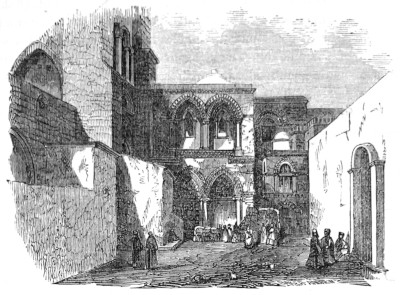
CHURCH OF THE HOLY SEPULCHER.
The Holy Sepulcher, as it is called, is thirty paces from this stone, exactly
in the center of the great dome: it resembles a small closet, hewn out of the
solid rock. The entrance, which faces the east, is only four feet high, and
two feet and a quarter broad. The interior of the sepulcher is nearly
square. It is six feet, wanting an inch, in length, and six feet, wanting two
inches, in breadth, and from the floor to the roof, eight feet and one inch.
There is a solid block of the same stone, which was left in excavating the
other part: this is two feet, four inches and a half high, and occupies half
of the sepulcher, for it is six feet, wanting one inch, in length, and two feet
and five-sixths wide. On this table, tradition says, the body of our Lord was
laid, with the head toward the west, and the feet to the east; but, on account
of the superstitious devotion of the Orientals, who imagine that, if they
596leave their hair upon this stone, God will never forsake them, and also,
because the pilgrims broke off pieces, it has received a covering of white
marble, on which mass is now celebrated. Forty-four lamps are constantly
burning in this sacred place, and three holes have been made in the roof for
the emission of the smoke. The exterior of the sepulcher is also faced
with slabs of marble, and adorned with several columns, having a dome
above.
The Holy Sepulcher is composed of three churches: that of the Holy
Sepulcher, properly so called; that of Calvary; and the church of the Discovery
of the Holy Cross. The first is built in the valley at the foot of
Calvary, on the spot where tradition reports that the body of Christ was
deposited. This church was in the form of a cross, the chapel of the Holy
Sepulcher constituting, in fact, the nave of the edifice. It is circular, like
the Pantheon at Rome, and is lighted only by a dome, beneath which is the
sepulcher. Sixteen marble columns adorn the circumference of this rotunda:
they are connected by seventeen arches, and support an upper gallery, likewise
composed of sixteen columns and seventeen arches, of smaller dimensions
than those of the lower range. Niches, corresponding with the arches,
appear above the frieze of the second gallery, and the dome springs from the
arch of these niches.
The origin of the church of the Holy Sepulcher is of high antiquity.
The author of the “Epitome of the Holy War” asserts, that forty-six years
after the destruction of Jerusalem by Vespasian and Titus, the Christians
obtained permission of Adrian to build, or rather rebuild, a church over the
tomb of their Lord, and to inclose, in the new city, the other places venerated
by the Christians. This church, he adds, was greatly enlarged and
repaired by Helena, the mother of Constantine.
This remarkable mountain, a view of which is given in the cut on the
next page, is on the confines of Zebulon and Naphthali, on the north-east
border of the plain of Esdraelon, about six miles south of Nazareth. It is
graceful and picturesque in its outlines, presenting different appearances as
viewed from different points, which accounts for the diversities in the pictorial
representations we have of it. From the north it has the appearance of
the segment of a sphere, and appears beautifully wooded on the summit,
affording retreats to the animals for whom “the net was spread on Tabor.”
(Hosea v. 1.) From the west it is like a truncated cone, appearing much
steeper and higher, with the southern side almost destitute of trees. But on
597all sides it is a marked and prominent object, as the prophet intimates when
he says, “as Tabor is among the mountains.” (Jeremiah xlvi. 18.) The
view from the summit is truly beautiful. The foundations of ancient buildings,
and the remains of water-tanks, in which cool water is still collected
from the drippings of the rocks, are still to be seen on the top of Tabor. On
this mountain was the encampment of Barak’s army on the eve of its battle
with the hosts of Sisera. (Judges iv. 6, 14.) Tradition indicates this as
the scene of Christ’s transfiguration. This may well be doubted, owing to
the distance of this mountain from Cæsarea Philippi, near which place our
Lord left the nine disciples the day before. Besides, this mountain was at
the time occupied by a fortified town, and thus did not, as well as some
other hights, answer the description of “a high mountain apart,” or solitary.
(Matthew xvii. 1.) No doubt the name of the mountain was concealed by
design, to avoid giving occasion to the superstitious observances of place,
which our Lord foresaw would be practiced, in after ages, by many calling
themselves after his name. The Arab name of Tabor is Jebel-Tur. There
was a Levitical city on Tabor of the same name. (1 Chronicles vi. 77.)
The Tabor mentioned in 1 Samuel x. 3, was not Mount Tabor, but a place
in the vicinity of the territory of Benjamin.
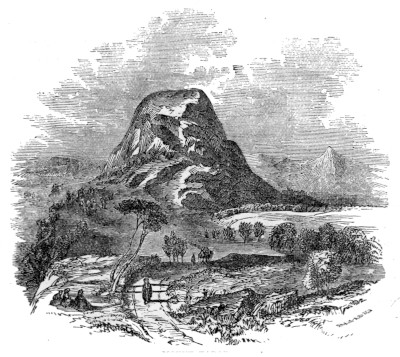
598
The following descriptions of some of the spots in the Holy Land which
excite a more particular interest, are extracted from Dr. Clarke’s very
valuable “Travels in Europe, Asia, and Africa.”
“As we advanced, our journey led through an open campaign country,
until, upon our right, the guides showed us the mount where it is believed
that Christ preached to his disciples that memorable sermon, concentrating
the sum and substance of every Christian virtue. We left our route to visit
this elevated spot; and, having attained the highest point of it, a view was
presented, which, for its grandeur, independently of the interest excited by
the different objects contained in it, has no parallel in the Holy Land. From
this situation we perceived that the plain, over which we had been so long
riding, was itself very elevated. Far beneath appeared other plains, one
lower than the other, and extending to the surface of the sea of Tiberias, or
sea of Galilee. This immense lake, almost equal, in the grandeur of its
appearance, to that of Geneva, spreads its waters over all the lower territory,
extending from the north-east toward the south-west, and then bearing east
of us. Its eastern shores present a sublime scene of mountains, extending
toward the north and south, and seeming to close it in at either extremity,
both toward Chorazin, where the Jordan enters, and the Aulon, or Campus-magnus,
through which it flows to the Dead sea. The cultivated plains
reaching to its borders, which we beheld at an amazing depth below our
view, resembled, by the various hues their different produce exhibited, the
motley pattern of a vast carpet. To the north appeared snowy summits,
towering, beyond a series of intervening mountains, with unspeakable greatness.
We considered them as the summits of Libanus; but the Arabs
belonging to our caravan called the principal eminence Jebel el Sieh, saying
it was near Damascus; probably, therefore, a part of the chain of Libanus.
This summit was so lofty, that the snow entirely covered the upper part of
it; not lying in patches, as I have seen it, during summer, upon the tops of
very elevated mountains, (for instance, upon that of Ben Nevis, in Scotland,)
but investing all the higher part with that perfect white and smooth,
velvet-like appearance which snow exhibits when it is very deep; a striking
spectacle in such a climate, where the beholder, seeking protection from a
burning sun, almost considers the firmament to be on fire.”
599
“As we rode toward the sea of Tiberias, the guides pointed to a sloping
spot from the hights upon our right, whence we had descended, as the place
where the miracle was accomplished by which our Saviour fed the multitude:
it is therefore called the Multiplication of Bread; as the mount above,
where the sermon was preached to his disciples, is called the Mountain of
Beatitudes, from the expressions used in the beginning of that discourse.
The lake now continued in view upon our left. The wind rendered its
surface rough, and called to mind the situation of our Saviour’s disciples,
when, in one of the small vessels which traverse these waters, they were
tossed in a storm, and saw Jesus in the fourth watch of the night, walking
to them upon the waves. Often as this subject has been painted, combining
a number of circumstances adapted for the representation of sublimity, no
artist has been aware of the uncommon grandeur of the scenery, memorable
on account of the transaction. The lake of Genesareth is surrounded by
objects well calculated to highten the solemn impression made by such a
picture; and, independent of the local feelings likely to be excited in its
contemplation, affords one of the most striking prospects in the Holy Land.
Along the borders of this lake may still be seen the remains of those ancient
tombs, hewn by the earliest inhabitants of Galilee, in the rocks which face
the water. Similar works were before noticed among the ruins of Telmessus.
They were deserted in the time of our Saviour, and had become the
resort of wretched men, afflicted by diseases, and made outcasts of society;
for in the account of the cure performed by our Saviour upon a maniac in
the country of the Gadarenes, these tombs are particularly alluded to; and
their existence to this day, (although they have been neither noticed by
priests nor pilgrims, and have escaped the ravages of the empress Helena,
who would undoubtedly have shaped them into churches,) offers strong
internal evidence of the accuracy of the evangelist who has recorded the
transaction: ‘There met him out of the tombs a man with an unclean
spirit, who had his dwelling among the tombs.’”
Mount Carmel is a tall promontory, forming the termination of a range
of hills, in the northern part of Palestine, and toward the sea. It is fifteen
hundred feet high, and is famous for its caverns, which are said to be more
than a thousand in number. Most of them are in the western part of it.
600Here also was the cave of the prophet Elijah. Both Elijah and Elisha used
to resort to this mountain, and here it was that the former opposed the
prophets of Baal with such success. Here it was, too, that this prophet
went up, when he told his servant to look forth toward the sea yet seven
times, and the seventh time he saw a cloud coming from the sea “like a
man’s hand;” when the prophet knew the promised rain was at hand, and
girded up his loins and ran before Ahab’s chariot even to the gates of
Jezreel. (See 1 Kings xviii. 4-46.)
This mountain, which is highly worthy of our notice as the one on which
the ark rested, is, by the general consent of western Asia and of Europe,
decided to be the mountain of Ara Dagh in Armenia; and that this opinion
is correct, would seem plain from the statement of the Bible that Ararat was
in Armenia, taken in connection with the fact, that in all that country there
is no mountain comparable to this. It is in all respects a most noble
mountain, and one of the finest in the world. “When our eyes first beheld
it,” says Kitto, “we had already seen the loftiest and most remarkable
mountains of the old world; but yet the effect of the view of this mountain
was new and surprising. The reason appeared to be this, that most of the
loftiest mountains of the world are but peaks of the uppermost ridge of
mountain chains; but Ararat, though not so high as many of these, is far
more grand and impressive, because it is not merely the summit of a ridge,
but a whole and perfect mountain.” “Nothing,” as Mr. Morier well
remarks, “can be more beautiful than its shape, or more awful than its
hight; all the surrounding mountains sink into insignificance when compared
with it. It is perfect in all its parts; having no hard, rugged features,
and no unnatural prominences; but everything is in harmony, and all combines
to render it one of the sublimest objects of nature.” It rises from the
valley of the river Aras, the ancient Araxes, gradually towering from its
broad base, till it reaches the region of perpetual snow, (which is about one-third
below its summit,) when it becomes more conical and steep, and is
surmounted with a crown of ice which glitters in the sun with peculiar
brightness. And near to this peak, and rising from the same broad base, is
another almost exactly like it, but smaller, which is doubtless the reason
why the sacred text speaks of “the mountains of Ararat,” rather than of a
single mountain. The tallest of the two is seventeen thousand, seven hundred
and fifty, and the lowest thirteen thousand, four hundred and twenty feet
above the level of the sea, which is some three thousand feet lower than the
601plain on which Ararat stands. The top of the mountain, it is said, was
never reached till 1829, when Mr. Parrot, a German, succeeded in climbing
to it, and there found a slightly convex, and almost circular plain, some two
hundred and twenty feet in diameter, declining steeply on all sides; from
which some suppose, that the ark must have rested on the lesser Ararat, as
it would have been difficult for its inmates, including heavy cattle, to have
descended from the higher summit.
WONDERS OF ART RESUMED. — THE MOSQUE OF OMAR. — MOSQUE OF ST. SOPHIA AT CONSTANTINOPLE. — RUINS OF CARTHAGE. — THE PLAIN OF TROY. — ATHENS. — TEMPLES OF ELEPHANTA. — TEMPLES OF SALSETTE. — MAUSOLEUM OF HYDER ALI. — THE TAJE MAHAL. — GREAT WALL OF CHINA. — PORCELAIN TOWER AT NANKIN. — THE SHOEMADOO AT PEGU. — COLOSSAL FIGURE OF JUPITER PLUVIUS, OR THE APENNINE JUPITER. — THE LEANING, OR HANGING TOWER OF PISA, IN TUSCANY. — THE COLISEUM AT ROME. — THE PANTHEON. — ROMAN AMPHITHEATER AT NISMES. — TRAJAN’S PILLAR. — COLUMN OF ANTONINE. — MAISON CARRE, AT NISMES. — THE PONT DU GARD. — ANCIENT AQUEDUCT NEAR ROME. — THE ROMAN FORUM. — THE ARCH OF SEVERUS. — THE ARCH OF TITUS. — THE CAPITOL. — THE MUSEUM OF THE CAPITOL. — ST. PETER’S OF ROME. — THE SOIL OF ROME. — EDDYSTONE LIGHT-HOUSE. — BELL ROCK LIGHT-HOUSE. — STONEHENGE. — ROCKING STONES. — THE ROUND TOWERS OF IRELAND. — ST. PAUL’S CATHEDRAL. — THE FIRST CHURCH IN ENGLAND. — WESTMINSTER ABBEY. — CATHEDRAL OF NOTRE DAME. — STRASBURG CATHEDRAL. — CATHEDRAL OF COLOGNE. — CHURCH OF ST. MARK, AT VENICE. — THE CATHEDRAL OF MILAN. — THE TOWER OF LONDON. — THE BANK OF ENGLAND. — THE MONUMENT. — THE LOUVRE. — THE BRITISH MUSEUM. — MADAME TUSSEAU’S MUSEUM. — THE PALACE OF BLENHEIM. — THE PALACE OF VERSAILLES. — THE PALACE OF ST. CLOUD. — THE CRYSTAL PALACE IN NEW YORK. — THE CRYSTAL PALACE IN LONDON. — THE CAPITOL AT WASHINGTON. — THE SMITHSONIAN INSTITUTE. — THE WASHINGTON MONUMENT. — THE COLUMN OF VENDOME, PARIS. — THE BUNKER HILL MONUMENT. — THE ARC DE TRIOMPHE. — THE COOPER INSTITUTE. — VERGNAIS’S IMPROVED BRIDGE. — RAILROAD BRIDGE AT PORTAGE, NEW YORK. — THE BRITANNIA TUBULAR BRIDGE. — THE SUSPENSION BRIDGE. — GREAT RAILWAY SUSPENSION BRIDGE AT NIAGARA FALLS. — OTHER IMMENSE BRIDGES. — THE HIGH BRIDGE AT HARLEM. — THE BOSTON RESERVOIR. — AQUEDUCT AT THE PEAT FOREST CANAL. — THE THAMES TUNNEL. — RAILROAD TUNNELS. — THE COLOSSUS AT RHODES.
Dr. Clarke, on viewing this mosque, observes, that “the sight was so
grand, that he did not hesitate to pronounce it the most magnificent piece
of architecture in the Turkish empire, and considered it, externally, far
superior to the mosque of St. Sophia, in Constantinople.” By the sides of
the spacious area in which it stands, are certain vaulted remains, which
plainly denote the masonry of the ancients; and he thinks that evidence may
be adduced to prove, that they belonged to the foundations of Solomon’s
temple. He observed also that reticulated stucco, which is commonly
considered as an evidence of Roman work. Phocas believed the whole
space surrounding this building to be the ancient area of the temple; and
Golius, in his notes upon the Astronomy of Alferganes, says that the whole
foundation of the original edifice remained. As to the mosque itself, there
is no building at Jerusalem that can be compared with it, either in beauty
or riches. The lofty Saracenic pomp so nobly displayed in the style of the
building; its numerous arcades; its capacious dome, with all the stately
decorations of the place; its extensive area, paved and variegated with the
choicest marbles; the extreme neatness observed in every avenue toward it;
and, lastly, the sumptuous costume observable in the dresses of all the
eastern devotees, passing to and from the sanctuary, make it altogether one
of the finest sights the Mohammedans have to boast.
602
The dome of this celebrated structure is one hundred and thirteen feet in
diameter, and is built on arches, sustained by vast pillars of marble. The
pavement and staircase are also of marble. There are two rows of galleries
supported by pillars of party-colored marble, and the entire roof is of fine
mosaic work. In this mosque is the superb tomb of the emperor Constantine,
for which the Turks have the highest veneration.
Beside the above, two other mosques attract the particular notice of travelers
who visit the Turkish capital. That of the Valide-Sultan, founded by
the mother of Mohammed IV., is the largest, and is built entirely of marble.
Its proportions are stupendous; and it boasts the finest symmetry. The
mosque of Sultan Solyman is an exact square, with four line towers in the
angles; in the center is a noble cupola, supported by beautiful marble
pillars. Two smaller ones at the extremities are supported in the same
manner. The pavement and gallery surrounding the mosque are of marble;
and under the great cupola is a fountain, adorned with such finely colored
pillars, that they can scarcely be deemed of natural marble. On one side is
the pulpit, of white marble; and on the other the little gallery for the grand
seignior. A fine staircase leads to it; and it is built up with gilt lattices.
At the upper end is a kind of altar, on which the name of God is inscribed:
and before it stand two candlesticks, six feet in hight, with wax candles in
proportion. The pavement is spread with fine carpets, and the mosque
illuminated by a vast number of lamps. The court leading to it is very
spacious, with galleries of marble, supported by green columns, and covered
by twenty-eight leaden cupolas on the sides, with a fine fountain in the
center.
The mosque of Sultan Selim I. at Adrianople, is another surprising monument
of Turkish architecture. It is situated in the center and most
elevated part of the city, so as to make a very noble display. The first
court has four gates, and the innermost three; both being surrounded by
cloisters, with marble pillars of the Ionic order, finely polished, and of very
lively colors: the entire pavement is of white marble, and the roof of the
cloisters is divided into several cupolas or domes, surmounted with gilt balls.
In the midst of each court are fine fountains of white marble; and, before
the grand entrance, is a portico, with green marble pillars, provided with
five gates. The body of the mosque is one prodigious dome, adorned with
lofty towers, whence the imaums, or priests, call the people to prayers. The
ascent to each of these towers is very artfully contrived: there is but one
603door, which leads to three different staircases, going to three different stories
of the tower, in such a manner, that three priests may ascend and descend,
by a spiral progress, without meeting each other. The walls of the interior
are inlaid with porcelain, ornamented with small flowers and other natural
objects, in very lively colors. In the center hangs a vast lamp of gilt silver,
besides which there are at least two thousand smaller ones: the whole, when
lighted, have a very splendid effect.
The remains of the grandeur and magnificence of Carthage, the rival of
Rome, and one of the most commercial cities of the ancient world, are not
so striking as might be expected; and, at a little distance, can scarcely be
distinguished from the ground on which they lie. The vestiges of triumphal
arches, of superb specimens of Grecian architecture, of columns of porphyry
or granite, or of curious entablatures, are no longer discernible: all are
vanished; and thus will it be in future ages with the most renowned cities
now on earth!
To discover these ruins requires some method. Leaving Tunis, the
traveler rides along the shore in an east-north-east direction, and reaches,
in about half an hour, the salt-pits, which extend toward the west, as far as
a fragment of wall, very near to the “great reservoirs.” Passing between
these salt-pits and the sea, jetties are seen running out to a considerable
distance under water. The sea and the jetties are on his right; on his left
he perceives a great quantity of ruins, upon eminences of unequal hight;
and below these ruins a basin of a circular form, and of considerable depth,
which formerly communicated with the sea by means of a canal, traces of
which are still to be seen. This basin appears to have been the “Cothon,”
or inner port of Carthage. The remains of the immense works discernible
in the sea, in this case indicate the site of the outer mole. Some piles of
the dam said to have been constructed by Scipio, for the purpose of blocking
up the port, may be still distinguished. A second inner canal is conjectured
to have been the cut made by the Carthaginians, when they opened a new
passage for their fleet.
The greater part of Carthage was built on three hills. On a spot which
overlooks the eastern shore is the area of a spacious room, with several
smaller ones adjoining: some of them have tesselated pavements; and in all
are found broken pieces of columns of fine marble and porphyry. They are
conjectured to have been summer apartments beneath one of the palaces,
such as the intense heat of the climate must have required. In rowing
604along the shore, the common sewers are still visible, and are but little
impaired by time. With the exception of these, the cisterns have suffered
the least. Besides such as belong to private houses, there are two sets for
the public use of the Tunisians. The largest of these was the grand reservoir,
and received the water of the aqueduct. It lay near the western wall
of the city, and consisted of upward of twenty contiguous cisterns, each
about one hundred feet in length, and thirty in breadth. They form a series
of vaults, communicating with each other, and are bordered throughout
their whole length by a corridor. The smaller reservoir has a greater elevation,
and lies near the Cothon or inner port.
The ruins of the noble aqueduct which conveyed the water into the larger
cisterns, may be traced as far as Zawan and Zungar, at least fifty miles
distant. This must have been a truly magnificent, and at the same time, a
very expensive work. That part of it which extends along the peninsula
was beautifully faced with stone. At Arriana, a village to the north of
Tunis, are several entire arches each seventy feet high, and supported by
piers sixteen feet square. The water-channel is vaulted over, and plastered
with a strong cement. A person of an ordinary hight may walk upright in
it; and at intervals are apertures, left open, as well for the admission of
fresh air, as for the convenience of cleansing it. The water-mark is nearly
three feet high; but it is impossible to determine the quantity daily conveyed
to Carthage by this channel, without knowing the angle of descent, which,
in its present imperfect state, can not be ascertained.
Temples were erected at Zawan and Zungar, over the fountains by which
this aqueduct was supplied. That at Zungar appears to have been of the
Corinthian order, and terminates very beautifully in a dome with three
niches, probably intended for the statues of the divinity of the spring.
According to Homer’s description of the Trojan territory, it combined
certain prominent and remarkable features, not likely to be affected by any
lapse of time. Of this nature was the Hellespont; the island of Tenedos;
the plain itself; the river by whose inundations it was occasionally overflowed;
and the mountain whence that river issued. The following is an
abstract of Dr. Clarke’s accurate account of the vestiges of high antiquity
contained in this truly classic spot.
“We entered an immense plain, in which some Turks were engaged in
hunting wild-boars. Peasants were also employed in plowing a deep and
rich soil of vegetable earth. Proceeding toward the east, and round the
605bay distinctly pointed out by Strabo as the harbor in which the Grecian fleet
was stationed, we arrived at the sepulcher of Ajax, upon the ancient Rhœtean
promontory. The view here afforded of the Hellespont and the plain
of Troy is one of the finest the country affords. From the Aianteum we
passed over a heathy country to Halil Elly, a village near the Thymbrius, in
whose vicinity we had been instructed to seek the remains of a temple once
sacred to the Thymbrean Apollo. The ruins we found were rather the
remains of ten temples than of one. The earth to a very considerable
extent was covered by subverted and broken columns of marble, granite,
and of every order in architecture. Doric, Ionic and Corinthian capitals
lay dispersed in all directions, and some of these were of great beauty. We
observed a bass-relief representing a person on horseback pursued by a
winged figure; also a beautiful representation, sculptured after the same
manner, of Ceres in her car drawn by two scaly serpents.
“At the town or village of Tchiblack, we noticed very considerable
remains of ancient sculpture, but in such a state of disorder and ruin, that
no precise description of them can be given. The most remarkable are upon
the top of a hill called Beyan Mezaley, near the town, in the midst of a
beautiful grove of oak-trees, toward the village of Callifat. Here the ruins
of a Doric temple of white marble lay heaped in the most striking manner,
mixed with broken stelæ, cippi, sarcophagi, cornices and capitals of very
enormous size, entablatures and pillars. All of these have reference to
some peculiar sanctity by which this hill was anciently characterized. We
proceeded hence toward the plain; and no sooner reached it, than a tumulus
of very remarkable size and situation drew our attention, for a short time,
from the main object of our pursuit. This tumulus, of a high conical form
and very regular structure, stands altogether insulated. Of its great
antiquity no doubt can be entertained by persons accustomed to view the
everlasting sepulchers of the ancients. On the southern side of its base is a
long natural mound of limestone: this, beginning to rise close to the artificial
tumulus, extends toward the village of Callifat, in a direction nearly
from north to south across the middle of the plain. It is of such hight that
an army encamped on the eastern side of it, would be concealed from all
observation of persons stationed on the coast, by the mouth of the Mender.
If the poems of Homer, with reference to the plain of Troy, have similarly
associated an artificial tumulus and a natural mound, a conclusion seems
warranted, that these are the objects to which he alludes. This appears to
be the case in the account he has given of the tomb of Ilus and the mound
of the plain. From this tomb we descended into the plain, when our guides
brought us to the western side of it, near its southern termination, to notice
606a tumulus, less considerable than the last described, about three hundred
paces from the mound, almost concealed from observation by being continually
overflowed, upon whose top two small oak-trees were then growing.
“We now came to an elevated spot of ground, surrounded on all sides by
a level plain, watered by the Callifat Osmack, and which there is every
reason to believe the Simoisian. Here we found, not only the traces, but
also the remains of an ancient citadel. Turks were then employed raising
enormous blocks of marble, from foundations surrounding the place; possibly
the identical works constructed by Lysimachus, who fenced New Ilium
with a wall. All the territory within these foundations was covered by
broken pottery, whose fragments were parts of those ancient vases now held
in such high estimation. Many Greek medals had been discovered in consequence
of the excavations made there by the Turks. As these medals,
bearing indisputable legends to designate the people by whom they were
fabricated, have also, in the circumstances of their discovery, a peculiar
connection with the ruins here, they may be considered as indicating, with
tolerable certainty, the situation of the city to which they belonged. These
ruins evidently appear to be the remains of New Ilium; whether we regard
the testimony afforded by their situation, as accordant with the text of
Strabo, or the discovery there made of medals of the city.”
The conclusions relative to Troas, drawn by this learned writer, are as
follows. “That the river Mender is the Scamander of Homer, Strabo, and
Pliny. The amnis navigabilis of Pliny flows into the archipelago, to the
south of Sigeum. That the Aianteum, or tomb of Ajax, still remains,
answering the description given of its situation by ancient authors, and
thereby determining also the exact position of the naval station of the
Greeks. That the Thymbrius is yet recognized, both in its present appellation
Thymbreck, and in its geographical position. That the spacious plain
lying on the north-eastern side of the Mender, and watered by the Callifat
Osmack, is the Simoisian, and that stream the Simois. That the ruins of
Palaio Callifat are those of the Ilium of Strabo. Eastward is the Throsmos,
or mound of the plain. That Udjek Tepe is the tomb of Æsyetes. The
other tombs mentioned by Strabo, as at Sigeum, are all in the situation he
describes. That the springs of Bonarbashy may possibly have been the
‘Doiai Pelai’ of Homer; but they are not sources of the Scamander. They
are, moreover, warm springs. That the source of the Scamander is in Gargarus,
now called Kasdaghy, the highest mountain of all the Idæan chain.
That the altars of Jupiter, mentioned by Homer, and by Eschylus, were on
the hill called Kuchunlu Tepe, at the foot of Gargarus; where the ruins of
the temple now remain. That Palae Scepsis is yet recognized in the appellation
607Esky Skupshu; that Æna is the Ainei of Strabo; and Æne Tepe,
perhaps, the tomb of Æneas. That the extremity of the Adramyttian gulf
inclines round the ridge of Gargarus, toward the north-east; so that the
circumstance of Xerxes having this mountain upon his left, in his march
from Antandrus to Abydus, is thereby explained. And lastly, that Gargarus
affords a view, not only of all the plain of Troy, but of all the district
of Troas, and a very considerable portion of the rest of Asia Minor.”
The approach to this celebrated city by sea, presents a spectacle, which
was viewed by Dr. Clarke and his companions with great transports of joy.
It was no sooner descried, than its lofty edifices, catching the sun’s rays,
rendered the buildings in the Acropolis visible at the distance of fifteen
miles.
“The reflected light gave them a white appearance. The Parthenon
appeared first, above a long chain of hills in the front; presently we saw the
top of Mount Anchesmus, to the left of the temple; the whole being backed
by a lofty mountainous ridge, which we supposed to be Parnes. As we drew
near to the walls, we beheld the vast Cecropian citadel, crowned with temples
that originated in the veneration once paid to the memory of the
illustrious dead, surrounded by objects telling the same theme of sepulchral
grandeur, and now monuments of departed greatness, gradually moldering
in all the solemnity of ruin. So paramount is this funeral character in the
approach to Athens from the Piræeus, that, as we passed the hill of the
Museum, which was, in fact, an ancient cemetery of the Athenians, we
might have imagined ourselves to be among the tombs of Telmessus, from
the number of the sepulchers hewn in the rock, and from the antiquity of
the workmanship, evidently not of later date than anything of the kind in
Asia Minor. In other respects the city exhibits nearly the appearance so
briefly described by Strabo eighteen centuries before our coming; and,
perhaps, it wears a more magnificent aspect, owing to the splendid remains
of Adrian’s temple of Olympian Jove, which did not exist when Athens
was visited by the disciple of Xenarchus. The prodigious columns belonging
to this temple appeared full in view between the citadel and the bed of
the Ilissus: high upon our left rose the Acropolis, in the most impressive
grandeur: an advanced part of the rock upon the western side of it is the
hill of the Areopagus, a view of which is given in the cut on the next page,
where St. Paul preached to the Athenians, and where their most solemn
tribunal was held. Beyond all, appeared the beautiful plain of Athens,
608bounded by Mount Hymettus. We rode toward the craggy rock of the
citadel, passing some tiers of circular arches at the foot of it; these are the
remains of the Odeum of Herodes Atticus, built in memory of his wife
Regilla. Thence continuing to skirt the base of the Acropolis, the road
winding rather toward the north, we saw also, upon our left, scooped in the
solid rock, the circular sweep on which the Athenians were wont to assemble
to hear the plays of Eschylus, and where the theater of Bacchus was afterward
constructed.
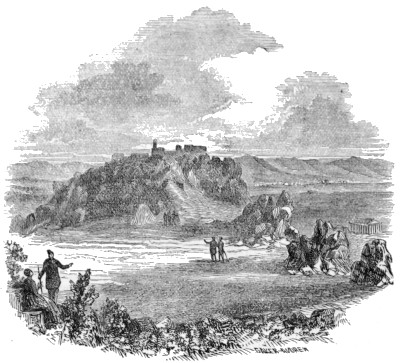
“We proceeded toward the east, to ascend Mount Anchesmus, and to enjoy
in one panoramic survey the glorious prospect presented from its summit,
of all the antiquities and natural beauties in the Athenian plain. We
ascended to the commanding eminence of the mount, once occupied by a
temple of Anchesmian Jupiter. The pagan shrine has, as usual, been succeeded
by a small Christian sanctuary: it is dedicated to St. George. Of
the view from this rock, even Wheeler could not write without emotion.
‘Here,’ said he, ‘a Democritus might sit and laugh at the pomps and vanities
of the world, whose glories so soon vanish; or a Heraclitus weep over
its manifold misfortunes, telling sad stories of the various changes and
609events of fate.’ The prospect embraces every object, excepting only those
upon the south-west side of the castle. The situation of the observer is
north-east of the city; and the reader may suppose him to be looking, in a
contrary direction, toward the Acropolis, which is in the center of this fine
picture; thence regarding the whole circuit of the citadel, from its north-western
side, toward the south and cast, the different parts of it occur in the
following order, although to a spectator they all appear to be comprehended
in one view. The lofty rocks of the Acropolis, crowned with its majestic
temples, the Parthenon, Erectheum, &c., constitute the central object. In
the foreground is displayed the whole of the modern city of Athens, with its
gardens, ruins, mosques, and walls, spreading into the plain beneath the
citadel. On the right, or north-west wing, is the temple of Theseus; and
on the left, or south-west wing, the temple of Jupiter Olympius. Proceeding
from the west to the south and east, the view beyond the citadel displays the
Areopagus, the Pnyx, the Ilissus, the site of the temple of Ceres in Agræ,Agræ,
610the fountain Callirhoe, the Stadium Panthenaium, the site of the Lyceum,
&c. In a parallel circuit, with a more extended radius, are seen the hills
and defile of Daphne, or the Via Sacra, the Piræeus, Munychia and Phalerum,
Salmais, Ægina, the more distant isles, and Hymettus. A similar
circuit, but still more extended, embraces Parnes, the mountains beyond
Elusis and Megara, the Acropolis of Corinth, the Peloponnesian mountains,
and the Ægean and distant islands. And lastly, immediately beneath the
eye, lies the plain of Athens.”
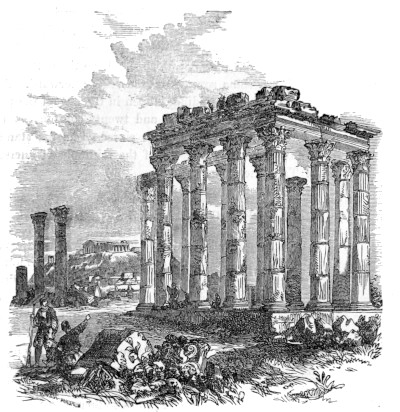
TEMPLE OF JUPITER OLYMPIUS.
Of the many ruins without the city of Athens, the tourist notices with
peculiar interest those of the temple of Jupiter Olympius, as it was the first
conceived and the last executed of all the sacred monuments of Athens.
It was begun by Pisistratus, but was not finished till the time of the Roman
emperor Adrian, which was some seven hundred years afterward. All that
remains of this once magnificent building, is seen in the cut on the previous
page. Originally there were one hundred and twenty columns supporting
this noble temple; but of all these, only some sixteen remain; standing in
their silent and solitary grandeur to testify of the triumphs of ancient art,
and to the power of Time the destroyer.
The island of Elephanta, distant about two leagues from Bombay, has a
circumference of about three miles, and consists of two rocky mountains,
covered with trees and brushwood. Near the landing-place is the figure of
an elephant, as large as life, shaped out of a rock, and supposed to have
given its name to the island. Having ascended the mountain by a narrow
path, the visitor reaches the excavation which has so long excited the attention
of the curious, and afforded such ample scope for the discussion of
antiquarians. With the strongest emotions of surprise and admiration, he
beholds four rows of massive columns cut out of the solid rock, uniform in
their order, and placed at regular distances, so as to form three magnificent
avenues from the principal entrance to the grand idol which terminates the
middle vista; the general effect being hightened by the blueness of the light,
or rather gloom, peculiar to the situation. The central image is composed
of three colossal heads, reaching nearly from the floor to the roof, a hight
of fifteen feet. It represents the triad deity in the Hindoo mythology,
Brama, Vishnu, and Siva, in the characters of the creator, preserver, and
destroyer. The middle face displays regular features, and a mild and
serene character; the towering head-dress is much ornamented, as are those
on each side, which appear in profile, lofty, and richly adorned with jewels.
611The countenance of Vishnu has the same mild aspect as that of Brama; but
the visage of Siva is very different: severity and revenge, characteristic of
his destroying attribute, are strongly depicted; one of the hands embraces a
large cobra de capello; while the others contain fruit, flowers, and blessings
for mankind, among which the lotus and pomegranate are readily distinguishable.
The former of these, the lotus, so often introduced into the
Hindoo mythology, forms a principal object in the sculpture and paintings
of their temples, is the ornament of their sacred lakes, and the most conspicuous
beauty in their flowery sacrifices.
On either side of the Elephanta triad, is a gigantic figure leaning on a
dwarf, an object frequently introduced in these excavations. The giants
guard the triple deity, and separate it from a large recess filled with a
variety of figures, male and female, in different attitudes: they are in
tolerable proportion, but do not express any particular character of countenance:
one conspicuous female, like the Amazons, is single-breasted; the
rest, whether intended for goddesses or mortals, are generally adorned, like
the modern Hindoo women, with bracelets and rings for the ankles; the
men have bracelets only. The intervening space between these figures is
occupied by small aerial beings, hovering about them in infinite variety.
The larger images in these groups are in alto-relievo, and most of the
smaller in basso-relievo, brought sufficiently forward from the rock to
produce a good effect. The sides of the temple are adorned with similar
compositions, placed at regular distances, and terminating the avenues
formed by the colonnades, so that only one group is seen at a time, except
on a near approach; and the regularity and proportion of the whole are
remarkably striking. The figures are in general in graceful attitudes; but
those of herculean stature do not indicate any extraordinary muscular
strength. Among many thousands of them, few of the countenances
express any particular passion, or mark a decided character: they have
generally a sleepy aspect, and bear a greater resemblance to the tame
sculpture of Egypt than to the animated works of the Grecian chisel.
From the right and left avenues of the principal temple are passages to
smaller excavations on each side: that on the right is much decayed, and
very little of the sculpture remains entire. A pool of water penetrates from
it into a dark cavern far under the rock; but whether natural or artificial,
has not been decided. A small corresponding temple on the left side, contains
two baths, one of them elegantly finished: the front is open, and the
roof supported by pillars of a different order from those in the large temple;
the sides are adorned with sculpture, and the roof and cornice painted in
mosaic patterns; some of the colors are still bright. The opposite bath, of
612the same proportions, is less ornamented; and between them is a room
detached from the rock, containing a colossal representation of the lingam,
or symbol of Siva. Several small caves branch out from the grand excavations.
An anecdote is related by Mr. Forbes, in his “Oriental Memoirs,” relative
to these sculptured monuments. He accompanied an eminent English artist
on his first visit to the Elephanta. “After the glare of a tropical sun, during
the walk from the landing-place, it was some time before the eye had accommodated
itself to the gloom of these subterraneous chambers, sufficiently to
discriminate objects in that somber light. We remained for several minutes
without speaking, or looking particularly at each other: at length, when
more familiarized to the cavern, my companion still remaining silent, I
expressed some fear of having been too warm in my description, and that
like most other objects, the reality fell short of the anticipated pleasure.
He soon relieved my anxiety by declaring, that however highly I had raised
his imagination, he was so absorbed in astonishment and delight, on entering
this stupendous scene, as to forget where he was. He had seen the most
striking objects of art in Italy and Greece; but never anything which filled
his mind with such extraordinary sensations.” So enraptured was this artist
with the spot, that after staying until a late hour, he quitted it most reluctantly.
The caves of the isle of Elephanta can not be sufficiently admired,
when the immensity of such an undertaking, the number of artificers
employed, and the extraordinary genius of its projector, are considered, in
a country until lately accounted rude and barbarous by the now enlightened
nations of Europe. Had this work been raised from a foundation, like other
structures, it would have excited the admiration of the curious; but when
the reflection is made, that it is hewn inch by inch in the hard and solid
rock, how great must the astonishment be at the conception and completion
of the enterprise!
The excavations of the island of Salsette, also contiguous to Bombay, are
hewn in the central mountains. The great temple is excavated at some
distance from the summit of a steep mountain, in a commanding situation.
This stupendous work is upward of ninety feet long, thirty-eight wide, and
of a proportionate hight, hewn out of the solid rock, and forming an oblong
square, with a fluted concave roof. The area is divided into three aisles by
regular colonnades, similar to the ancient basilic, a pile of building twice as
long as it was wide, and one of the extremities of which terminated in a
613hemicycle, two rows of columns forming a spacious area in the center, and
leaving a narrow walk between the columns and the wall. In these basilici
the Roman emperors of the east frequently administered justice. This
magnificent excavation at Salsette appears to be on the same plan, although,
doubtless, intended for a place of worship. Toward the termination of the
temple, fronting the entrance, is a circular pile of solid rock, nineteen feet
high, and forty-eight in circumference, most probably a representation of the
lingam, the symbol already alluded to in the description of the temples of
Elephanta. In this temple there are not any images, nor any kind of sculpture,
except on the capitals of the pillars, which are in general finished in a
very masterly style, and are little impaired by time. Several have been left
in an unfinished state; and on the summit of others is something like a bell,
between elephants, horses, lions, and animals of different kinds.
The lofty pillars and concave roof of the principal temple at Salsette
present a much grander appearance than the largest excavation at the
Elephanta, although that is much richer in statues and bass-reliefs. The
portico at Salsette, of the same hight and breadth as the temple, is richly
decorated: on each side a large niche contains a colossal statue, well
executed; and facing the entrance are small single figures, with groups in
various attitudes, all of them in good preservation. The outer front of the
portico, and the area before it, corresponding in grandeur with the interior,
are now injured by time, and the moldering sculpture intermingled with
a variety of rock-plants. On the square pillars at the entrance are long
inscriptions, the characters of which are obsolete, and which modern
ingenuity has not as yet succeeded in deciphering. Further up the mountain,
a flight of steps, hewn in the rock, and continued to the summit, leads,
by various intricate paths, to smaller excavations, most of which consist of
two rooms, a portico and benches, cut in the rock. To each is annexed a
cistern of about three cubic feet, also hewn in the rock, for the preservation
of rain-water. Some of these excavations are larger and better finished
than others; and a few, although inferior in size and decoration, in their
general effect resemble the principal temple.
The whole appearance of this excavated mountain indicates it to have had
a city hewn in its rocky sides, capable of containing many thousand inhabitants.
The largest temple was, doubtless, their principal place of worship;
and the smaller, on the same plan, inferior ones. The rest were appropriated
as dwellings for the inhabitants, differing in size and accommodation
according to their respective ranks in society; or, as it is still more probable,
these habitations were the abode of religious Bramins, and of their pupils,
614when India was the nursery of art and science, and the nations of Europe
were involved in ignorance and barbarism.
This splendid monument of oriental grandeur is situated at the western
extremity of the great garden of Seringapatam, a city of Hindoostan, and
capital of the Mysore territory. It is surrounded by a grove of beautiful
cypress-trees, and was erected by Tippoo Saib in honor of the deceased
sovereign, his father. Beneath tombs of black marble, elevated about
eighteen inches from the ground, lie the bodies of Hyder Ali, his consort,
and Tippoo Saib. They are covered with rich cloths, and have canopies
over them. The whole of this sumptuous edifice is, together with its dome,
supported by brilliantly polished black marble columns. It is surrounded
by a magnificent area, within which the faquirs have cells allotted to them;
and on an elevated platform are the tombs of several faithful servants. The
mosque annexed to it is flanked by two towers. The moulahs stationed
there still publicly read the Koran; and three pagodas are daily distributed
in charity at the mausoleum.
This grand mausoleum, which stands due north and south, on the southern
bank of the river Jumna, was built by command of the emperor Shah
Jehan for the interment of his favorite sultana Momtaz-mehl, or Montazal
Zumani, the “preëminent in the seraglio,” or “paragon of the age,” and at
his death his remains were also here deposited, by order of his son Aurungzebe.
This building, in point of design and execution, is one of the most
extensive, elegant, commodious, and perfect works ever undertaken and
finished by one man. To this celebrated architect Shah Jehan gave the
title of Zerreer-dust, or “jewel-handed,” to distinguish him from all other
artists. It is built entirely of pure white marble, on an immense square
platform of the same material, having a lofty minaret of equal beauty at
every corner. On each side and behind the imperial mausoleum, is a suite
of elegant apartments, also of white marble, highly decorated with colored
stones. The tombs and other principal parts of this vast fabric are inlaid
with wreaths of flowers and foliage in their natural colors, entirely composed
of carnelians, onyxes, verd-antique, lapis lazuli, and a variety of
agates, so admirably finished as to have the appearance of an ivory model
set with jewels. It was commenced in the fifth year of the reign of the
615emperor Shah Jehan, and the whole completed in sixteen years, four
months, and twenty-one days. It cost ninety-eight lacs, or nine million,
eight hundred and fifteen thousand rupees, equal to more than six million
dollars, although the price of labor then was, and still continues to be, very
reasonable in India.
This stupendous wall, a view of which is given in the cut below, extends
across the northern boundary of the Chinese empire, and is deservedly
ranked among the grandest labors of art. It is conducted over the summits
of high mountains, several of which have an elevation of over five thousand
feet, across deep valleys and over wide rivers, by means of arches: in many
616parts it is doubled or trebled, to command important passes; and at the
distance of nearly every hundred yards is a tower or massive bastion. Its
extent is computed at fifteen hundred miles; but in some parts, where less
danger is apprehended, it is not equally strong or complete, and toward the
north-west consists merely of a strong rampart of earth. Near Kookpekoo
it is twenty-five feet in hight, and the top about fifteen feet thick: some of
the towers, which are square, are forty-eight feet high, and about forty feet
in width. In its strongest parts, and for hundreds of miles in extent, this
wall is so thick as to allow six men on horseback to ride upon it. The
structure consists of two parallel walls of solid masonry, filled in between
with earth; the top is paved with stone. The stone employed in the foundations,
angles, &c., is a strong gray granite; but the materials for the most
part consist of bluish bricks, and the mortar is remarkably pure and white.
The amount of materials used in constructing this wall, is immense. In
a lecture on China, given a year or two since in England, Dr. Bowring said
it had been calculated, that if all the bricks, stones and masonry of Great
Britain were gathered together, they would not be able to furnish materials
enough for the wall of China; and that all the buildings in London put
together would not make the towers and turrets which adorn it.
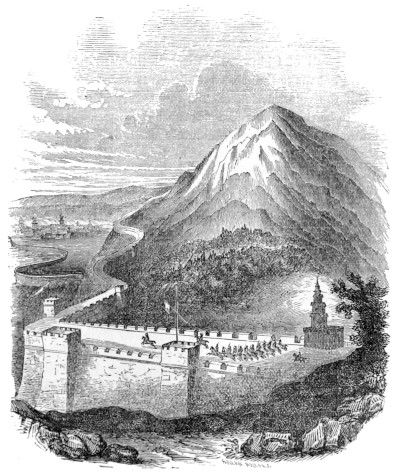
The area of the construction of this great barrier, which has been and
will continue to be the wonder and admiration of ages, is considered by Sir
George Staunton as having been absolutely ascertained; and he asserts that
it has existed for two thousand years. In this assertion he appears to have
followed Du Halde, who informs us that “this prodigious work was constructed
two hundred and fifteen years before the birth of Christ, by order
of the first emperor of the family of Tsin, to protect three large provinces
from the irruptions of the Tartars.” However, in the history of China,
contained in his first volume, he ascribes this erection to the second emperor
of the dynasty of Tsin, named Chi Hoang Ti; and the date immediately
preceding the narrative of this construction is the year 137 before the birth
of Christ. Hence suspicions may arise, not only concerning the epoch when
this work was undertaken, but also as to the purity and precision of the
Chinese annals in general. Mr. Bell, who resided some time in China, and
whose travels are deservedly esteemed for the accuracy of their information,
assures us that this wall was built somewhere about the year 1160, by one
of the emperors, to prevent the frequent incursions of the Monguls, whose
numerous cavalry used to ravage the provinces, and effect their escape
before an army could be assembled to oppose them. Renaudot observes
that this wall is not mentioned by any oriental geographer whose writings
boast a higher antiquity than three hundred years; and it is surprising that
617it should have escaped Marco Paulo, who, admitting that he entered China
by a different route, can hardly be supposed, during his long residence in
the north of China, and in the country of the Monguls, to have remained
ignorant of so stupendous a work. Amid these difficulties, it may be
reasonably conjectured, that similar modes of defense had been adopted in
different ages; and that the ancient rude barrier, having fallen into decay,
was replaced by the present erection, which, even from its state of preservation,
can scarcely aspire to a very remote antiquity.
618
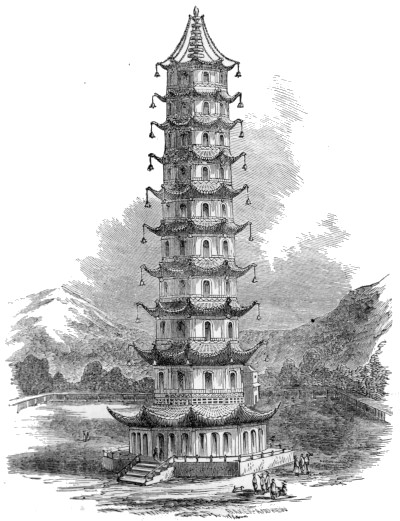
PORCELAIN TOWER AT NANKIN.
This elegant and commodious building, a very correct idea of which may
be formed from the cut on the preceding page, may be regarded as a fine
specimen of the oriental pagodas. The tower is about two hundred feet in
hight, and derives its name from its having a porcelain coating. The Portuguese
were the first to bestow on these superb edifices the title of pagodas,
and to attribute them to devotional purposes. There can be little doubt,
however, that in many instances they have been rather erected as public
memorials or ornaments, like the columns of the Greeks and Romans. Mr.
Ellis, in his “Journal of the Embassy to China,” relates that, in company
with three gentlemen of the embassy, he succeeded in passing completely
through the uninhabited part of the city of Nankin, and in reaching the
gateway visible from the Lion hill. The object of the party was to have
penetrated through the streets to the porcelain tower, apparently distant two
miles. To this, however, the soldiers who accompanied them, and who from
their willingness in allowing them to proceed thus far, were entitled to consideration,
made so many objections, that they were forced to desist, and to
content themselves with proceeding to a temple on a neighboring hill, from
which they had a complete view of the city. From this station the porcelain
tower presented itself as a most magnificent object.
The object in Pegu that most attracts and most merits notice, says Mr.
Symes in his “Embassy to Ava,” is the noble edifice of Shoemadoo, or the
Golden Supreme. This extraordinary pile of buildings is erected on a
double terrace, one raised upon another. The lower and greater terrace is
about ten feet above the natural level of the ground, forming an exact
parallelogram: the upper and lesser terrace is similar in shape, rising about
twenty feet above the lower terrace, or thirty above the level of the country.
Mr. Symes judged a side of the lower terrace to be thirteen hundred and
ninety-one feet; of the upper, six hundred and eighty-four. The walls that
sustained the sides of the terrace, both upper and lower, are in a ruinous
state; they were formerly covered with plaster, wrought into various figures;
the area of the lower is strewed with the fragments of small decayed buildings,
but the upper is kept free from filth, and is in tolerable good order.
There is reason to conclude that this building and the fortress are coeval, as
the earth of which the terraces are composed appears to have been taken
619from the ditch; there being no other excavation in the city, or in its neighborhood,
that could have afforded a tenth part of the quantity.
The terraces are ascended by flights of stone steps, which are now broken
and neglected. On each side are dwellings of the Rhahaans, raised on
timbers four or five feet from the ground: these houses consist only of a
large hall; the wooden pillars that support them are turned with neatness;
the roofs are covered with tiles, and the sides are made of boards; and there
are a number of bare benches in every house, on which the Rhahaans sleep;
but we saw no other furniture.
The Shoemadoo is a pyramidal building composed of brick and mortar,
without excavation or aperture of any sort; octagonal at the base, and spiral
at the top: each side of the base measures one hundred and sixty-two feet;
this immense breadth diminishes abruptly, and a similar building has not
unaptly been compared in shape to a large speaking-trumpet. Six feet from
the ground there is a wide projection that surrounds the base, on the plane
of which are fifty-seven small spires of equal size, and equidistant; one of
them measured twenty-seven feet in hight, and forty in circumference at the
bottom. On a higher ledge there is another row consisting of fifty-three
spires of similar shape and measurement. A great variety of moldings
encircle the building; and ornaments somewhat resembling the fleur de lis
surround the lower part of the spire: circular moldings likewise girt it to a
considerable hight, above which there are ornaments in stucco not unlike
the leaves of a Corinthian capital; and the whole is crowned by a tee, or
umbrella, of open iron-work, from which rises a rod with a gilded pennant.
The tee or umbrella is to be seen on every sacred building that is of a
spiral form. The raising and consecration of this last and indispensable
appendage, is an act of high religious solemnity, and a season of festivity
and relaxation. The king himself bestowed the tee that covers the Shoemadoo.
It was made at the capital; and many of the principal nobility
came down from Ummerapoora to be present at the ceremony of its elevation.
The circumference of the tee is fifty-six feet; it rests on an iron axis
fixed in the building, and is further secured by large chains strongly riveted
to the spire. Round the lower rim of the tee are appended a number of
bells, which, agitated by the wind, make a continual jingling. The tee is
gilt, and it was said to be the intention of the king to gild the whole of the
spire. All the lesser pagodas are ornamented with proportionable umbrellas
of similar workmanship, which are likewise encircled by small bells. The
extreme hight of the edifice, from the level of the country, is three hundred
and sixty-one feet, and above the interior terrace, three hundred and thirty
one feet.
620On the south-east angle of the upper terrace there are two handsome
saloons, or kioums, the roofs of which are composed of different stages,
supported by pillars. Mr. S. judged each to be about sixty feet in length,
and in breadth thirty. The ceiling of one is embellished with gold leaf, and
the pillars are lacquered; the decoration of the other is not yet completed.
They are made entirely of wood; and the carving on the outside is laborious
and minute. Mr. Symes saw several unfinished figures of animals and men
in grotesque attitudes, designed as ornaments for different parts of the building.
Some images of Gaudama, the supreme object of Birman adoration, lay
scattered around. At each angle of the interior and higher terrace, there
is a temple sixty-seven feet high, resembling, in miniature, the great temple:
in front of that, in the south-west corner, are four gigantic representations,
in masonry, of Palloo, or the evil genius, half beast, half human, seated on
their hams, each with a large club on the right shoulder. The pundit who
accompanied Mr. Symes, said that they resembled the Rakuss of the Hindoos.
These are guardians of the temple. Nearly in the center of the east
face of the area are two human figures in stucco, beneath a gilded umbrella.
One, standing, represents a man with a book before him and a pen in his
hand: he is called Thasiamee, the recorder of mortal merits and mortal
misdeeds. The other, a female figure kneeling, is Mahasumdera, the protectress
of the universe, so long as the universe is doomed to last; but when
the time of general dissolution arrives, by her hand the world is to be overwhelmed
and everlastingly destroyed. A small brick building near the
north-east angle contains an upright marble slab, four feet high, and three
feet wide: there was a long legible inscription on it. This, Mr. Symes was
told, was an account of the donations of pilgrims of only a recent date.
Along the whole extent of the north face of the upper terrace, there is a
wooden shed for the convenience of devotees who come from distant parts
of the country. On the north side of the temple are three large bells of
good workmanship, suspended near the ground, between pillars; several
deers’ horns lie strewed around: those who come to pay their devotions first
take up one of the horns, and strike the bell three times, giving an alternate
stroke to the ground: this act is to announce to the spirit of Gaudama the
approach of a suppliant. There are several low benches near the foot of the
temple, on which the person who comes to pray, places his offering, commonly
consisting of boiled rice, a plate of sweetmeats, or cocoa-nut fried in
oil: when it is given, the devotee cares not what becomes of it; the crows
and wild dogs often devour it in presence of the donor, who never attempts
to disturb the animals. Mr. Symes saw several plates of victuals disposed
621of in this manner, and understood it to be the case with all that was
brought.
There are many small temples on the areas of both terraces, which are
neglected, and suffered to fall into decay. Numberless images of Gaudama
lie indiscriminately scattered around. A pious Birman who purchases an
idol, first procures the ceremony of consecration to be performed by the
Rhahaans; he then takes his purchase to whatever sacred building is most
convenient, and there places it in the shelter of a kioum, or on the open
ground before the temple; nor does he ever again seem to have any anxiety
about its preservation, but leaves the divinity to shift for itself. Some of
those idols are made of marble that is found in the neighborhood of the
capital of the Birman dominions, which admits of a very fine polish; many
are formed of wood, and gilded, and a few are of silver; the latter, however,
are not usually exposed and neglected like the others. Silver and gold
are rarely used, except in the composition of household gods. On both the
terraces are a number of white cylindrical flags, raised on bamboo poles;
these flags are peculiar to the Rhahaans, and are considered as emblematical
of purity, and of their sacred function. On the top of the staff there is a
henza or goose, the symbol both of the Birman and Pegu nations.
Statues above the ordinary size, were named by the ancients, colossi, from
a Greek word which signifies “members.” That at Rhodes was the most
famous, executed by Carelus, a pupil of Lysippus. There were several at
Rome; the most considerable was that of Vespasian, in the amphitheater,
that bore the name of Colisæa. Claudius caused a colossal statue of himself
to be raised on a rock exposed to the sea waves, in front of the port of
Ostium. Nero had his person and figure painted on a linen cloth, one
hundred and twenty feet in hight. In the court of the Capitol, and in the
palace Farnesi, &c., are colossi, either entire or mutilated.
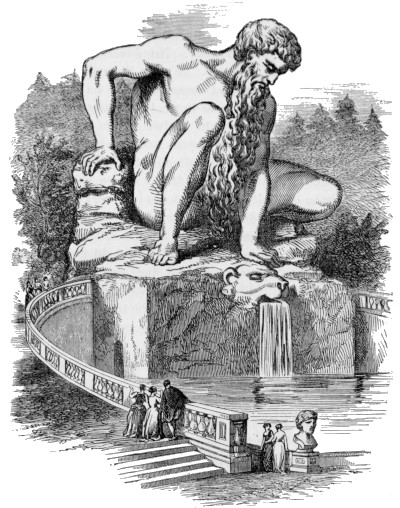
JUPITER PLUVIUS, OR THE APENNINE JUPITER.
The colossal figure of Jupiter Pluvius is found at Pratolino, in Italy.
The space in which it stands is planted round, on all sides, with lofty fir and
beech trees, the trunks of which are hid by a wood of laurel, wherein niches
have been cut for statues. The middle part is a green lawn, and at a little
distance, is a semicircular basin of water, behind which rises the colossal
statue of the Apennine Jupiter. Enchased, as it were, in the groves, it can
only be surveyed in front, and from a point of view marked by the artist, in
the adjoining engraving. Elevated on a base to appearance irregular, and
622of itself lofty, at which the astonished spectator arrives through two balustrades
that run round the basin, this colossus, a view of which is given in
the cut above, looks, at first, like a pyramidal rock, on which the hand of
man might have executed some project analogous to what the statuary
Stasicrates had conceived respecting Mount Athos,[10] and which Alexander
623nobly rejected. But soon he recognizes the genius of a pupil and worthy
rival of Michael Angelo.
It was, in fact, John of Bologna, who, by an inspiration derived from the
ancients, executed their beau ideal of Jupiter Pluvius. This name seems
more suitable to the figure than that of Father Apennine, which has been
assigned to it. The style, in point of magnitude, is of the largest, and the
character of the head is in perfect conformity to the subject. His brows and
front brave the tempest, and seem the region of the hoar-frost; his locks
descend in icicles on his broad shoulders, and the flakes of his immense
beard resemble stalactites; his limbs seem covered with hoar-frost, but with
no alteration in their contour, or in the form of the muscles. To add to the
extraordinary effect, about the head is a kind of crown, formed of little
jetteaux, that drop on the shoulders and trickle down the figure, shedding a
sort of supernatural luster, when irradiated by the sun.
It would be difficult to imagine a composition more picturesque and
perfect in all its proportions. The figure harmonizes with the surrounding
objects, but its real magnitude is best shown by comparison with the groups
promenading about the water, and which in comparison, at a certain distance,
resemble pigmies. A nearer approach exhibits a truly striking
proportion of the limbs. A number of apartments have been fabricated in
the interior, and within the head is a beautiful belvedere, wherein the eyeballs
serve for windows. The extremities are of stone; the trunk is of
bricks overlaid with a mortar or cement that has contracted the hardness of
marble, and which, when fresh, it was easy to model in due forms.
It is related in the life of John of Bologna, that several of his pupils,
unaccustomed to work with the hand, while engaged in this work, forgot
the correct standard of dimensions, both as to the eye and hand, and that
Father Apennine and his enormous muscles made them spoil a number of
statues. The greatest difficulty in the workmanship was to impress on the
mass, the character of monumental durability. The artist has succeeded in
uniting the rules of the statuary with those of construction, in combining
the beauty of the one with the solidity of the other. All the parts refer to
a common center of gravity, and the members are arranged so as to serve
for a scaffolding to the body, without impairing its dignity or magnitude.
The colossal statues of the ancients may have suggested the idea of this
configuration, or as before hinted, the artist may have aimed to represent
the Jupiter Pluvius. However, it seems probable that Poussin, in his
painting of the plains of Sicily, has, from this, formed his Polyphemus,
seated on the summit of a lofty rock. From the beauty of its proportions,
and skill in the execution, all artists who have to work on colossal figures,
624ought to cherish the preservation of this, as an imposing object, that can not
be too profoundly studied.
This celebrated tower, a view of which is given in the cut below, likewise
called the Campanile, on account of its having been erected for the purpose
of containing bells, stands in a square close to the cathedral of Pisa. It is
built entirely of white marble, and is a beautiful cylinder of eight stories,
each adorned with a round of columns, rising one above another. It
625inclines so far on one side from the perpendicular, that dropping a plummet
from the top, which is one hundred and eighty-eight feet in hight, it falls
sixteen feet from the base. Much pains have been taken by connoisseurs to
prove that this was done purposely by the architect; but it is evident that
the inclination has proceeded from another cause, namely, from an accidental
subsidence of the foundation on that side. The pillars are there
considerably sunk; and this is also the case with the very threshold, which
shows that the position of the building is accidental, caused by the settling
of the ground on one side, and not, as some think, by the ambition of the
architect, endeavoring to show how far he could with safety deviate from the
perpendicular, and thus display a novel specimen of his art; for had this
been his design, he would have shortened the pilasters on that side, so as to
exhibit them entire, without the appearance of sinking.
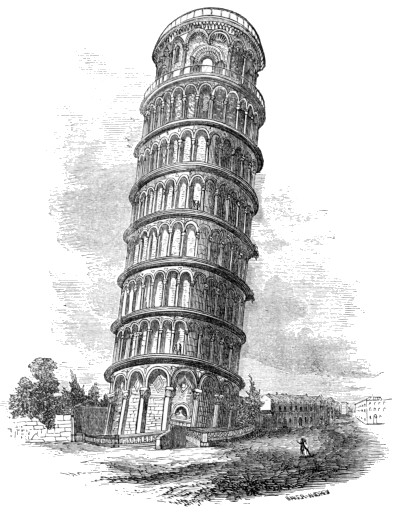
THE LEANING TOWER AT PISA
This tower, from its singular appearance and position, has attracted the
notice of all travelers passing near Pisa, who, of course, fail not to visit it.
We give the impressions of two of these: Professor Silliman, who saw it in
1851; and Mr. Hillard, who was there at a still later date. The former
says, “This structure has excited so much surprise, and been seen with such
deep interest by thousands of travelers for more than six hundred years,
that it is almost universally known, and it is not difficult for one who has
not seen it to form a clear and distinct conception of it. Still, on approaching
the tower, you are strongly impressed by its grandeur and beauty; and
when you ascend it, you obtain an almost overwhelming conception of its
majesty; although it is perfectly safe; and if you do not feel apprehension
that it will fall, you may not be able to keep that idea quite out of your
mind. The hight of the leaning tower is one hundred and seventy-eight
feet, the thickness of the wall ten feet, and the diameter is fifty feet at the
base. It is composed of eight stories, all adorned by columns and arches.
Its form is slightly conical. It is ascended by three hundred and thirty very
easy steps, very well lighted, and it is a pleasant journey to the top. There
are seven bells in this grand belfry; they were rung while we were near,
and the sound is very soft and musical, especially of the great bell, which
weighs twelve thousand pounds, and is placed upon the side of the tower,
opposite to that which overhangs. It was this bell which was formerly used
to give notice of public executions. The leaning of the tower of Pisa was
evidently caused by unequal subsidence of the ground; and it is obvious
that the architect, as the work rose, before the tower was half up, perceived
it, and he endeavored to counteract it as far as possible by balancing his
materials. After a particular hight, the columns are higher on the leaning
side, and, of course, shorter on the other. The builder appeared to be
626aiming to bring the upper part of the tower into a vertical position, although
he did not succeed. It is about thirteen or fourteen feet beyond the vertical;
but the center of gravity still falls within the base; and as the blocks
of stone, being now firmly united by cement, can not slide upon each other,
they, in fact, form one mass. The walls are, moreover, fortified by iron
bars, and it is not probable that anything short of an earthquake can
produce its downfall. I can not think with some, that it requires strong
nerves to ascend the leaning tower of Pisa. We ascended with a perfect
consciousness of security, and it is certain that were it filled in every story
by an armed host, it would not quiver or vibrate. The view from the
summit of the tower is most splendid. The beautiful city is at your feet,
and you are in the midst of it. The Mediterranean is in the horizon, Leghorn
is visible in the distance, the Arno shows its windings, here and there,
and a rich plain in full cultivation reaches far inland to the lofty Apennines,
in the vicinity of Lucca. It is said, that, in clear weather, Corsica may be
discerned. This tower is one of the most beautiful objects in Italy, and one
would never be tired with looking at it or from it; so beautiful is it, that its
leaning becomes a mere incident, interesting indeed, but the tower possesses
commanding attractions independently of this circumstance. We can not
descend from it without remembering that here Galileo made his decisive
experiments upon the law of the descent of falling bodies, and upon the
vibration of the pendulum. His great name is associated with the permanent
glory of his country, and will be honored to the end of time, while his
persecutors are remembered only to be despised and detested.”
Mr. Hillard, the other tourist to whom we have alluded, says, “On a
bright, sunny morning, I first saw the leaning tower of Pisa. This piece
of architectural eccentricity was, and I suppose is, one of the common-places
of geography, and is put into the same educational state-room with the wall
of China, the great tun of Heidelberg, and the natural bridge of Virginia.
I can not recall the time when its name was not familiar to me; and now,
here it was, bodily before me; no vision, no delusion, but a very decided
fact, with a most undeniable inclination on one side; so much so, that a
nervous person would not sleep soundly in the house that stands under its
lee, on a windy night. This singular structure is simply a campanile, or
bell-tower, appurtenant to the cathedral, as is the general custom in Italy.
It is not merely quaint, but beautiful; that is, take away the quaintness,
and the beauty will remain. It is built of white marble, wonderfully fresh
and pure, when we remember that nearly seven centuries have swept over
it. I will not describe it, nor give its dimensions, for these may be found in
every guide-book, and nearly every book of travels; nor will I condense the
627arguments which have been called forth by the question, whether the
inclination be accidental or designed. To one who has been on the spot,
and observed the spongy nature of the soil, as evidenced by the slight subsidence
of the cathedral, there is really no room for argument or doubt.
The ascent is very easy and gradual. The summit is secured by double
rails, and the inclination is less perceptible when on the top than when it is
observed from the ground. There is no peculiar sense of danger to interfere
with the full enjoyment of the beauty of the view, which embraces mountain
and plain, land and sea; a combination at once varied, extensive and picturesque.
This was my first sight of the Mediterranean, whose blue waters
blended in the distant horizon with the blue of the sky. To the eye, it was
but common water reflecting the universal sky; but a man must be very
insensible, not to recognize peculiar elements in his first view of that many-nationed
sea, upon whose shores so much of the poetry and history of the
world has grown.”
On approaching the majestic ruins of this vast amphitheater, the most
stupendous work of the kind antiquity can boast, a sweet and gently moving
astonishment is the first sensation which seizes the beholder; and soon afterward
the grand spectacle swims before him like a cloud. To give an
adequate idea of this sublime building, is a task to which the pen is
unequal: it must be seen to be duly appreciated. It is upward of sixteen
hundred feet in circumference, and of such an elevation that it has been
justly observed by a writer, (Ammiamus,) “the human eye scarcely measures
its hight.” Nearly the one-half of the external circuit still remains, consisting
of four tiers of arcades, adorned with columns of four orders, the
Doric, Ionian, Corinthian, and composite. Its extent, as well as its elevation,
may be estimated by the number of spectators it contained, amounting,
according to some accounts, to eighty thousand, and agreeably to others, to
one hundred thousand.
Thirty thousand captive Jews are said to have been engaged by Vespasian,
whose name it occasionally bears, in the construction of this vast edifice; and
they have not discredited their forefathers, the builders of Solomon’s temple,
by the performance. It was not finished, however, until the reign of his son
Titus, who, on the first day of its being opened, introduced into the arena
not less than five thousand, or, according to Dio Cassius, nine thousand wild
beasts, between whom, and the primitive Christians held captive by the
Romans, combats were fought. At the conclusion of this cruel spectacle
628the whole place was put under water, and two fleets, named the Corcyrian
and the Corinthian, represented a naval engagement. To render the vapor
from such a multitude of persons less noxious, sweet-scented water, and
frequently wine mixed with saffron, was showered down from a grated work
above, on the heads of the spectators.
The Roman emperors who succeeded Titus were careful of the preservation
of this superb edifice: even the voluptuous Heliogabalus caused it to
be repaired after a great fire. The rude Goths, who sacked the city of
Rome, were contented with despoiling it of its internal ornaments, but
respected the structure itself. The Christians, however, through an excess
of zeal, have not been satisfied with allowing it gradually to decay. Pope
Paul II. had as much of it leveled as was necessary to furnish materials for
building the palace of St. Mark, and his pernicious example was imitated by
Cardinal Riario, in the construction of what is now called the Chancery.
Lastly, a portion of it was employed by Pope Paul III. in the erection of the
palace Farnese. Notwithstanding all these dilapidations, there still exists
enough of it to inspire the spectator with awe. Immense masses appear
fastened to and upon one another without any mortar or cement; and these
alone, from their structure, are calculated for a duration of many thousands
of years. Occasionally, where the destroyers have not effectually attained
their object, the half-loosened masses appear to be holden in the air, as if by
some invisible power; for the wide interstices among them leave no other
support than their joints, which seem every moment as if about to yield
unavoidably to the superior force of gravitation. “They will fall;” “they
must fall;” “they are falling;” is, and has been the language of all
beholders during the vast periods through which this stupendous edifice has
thus hung together in the air.
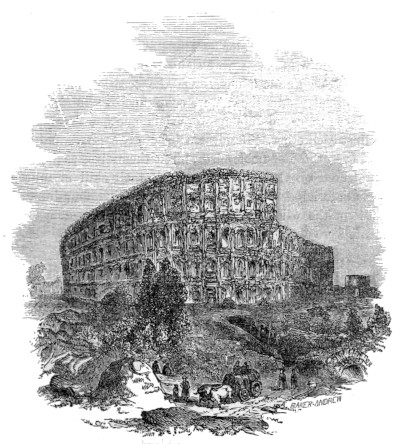
Silliman, speaking of the Coliseum, says, “It is the most magnificent and
imposing monument of ancient Rome. After all the spoliation it has
suffered for many centuries, by which two-thirds of its materials have been
plundered, to build palaces and other structures, it still stands a stupendous
ruin, solemn, awful, and even in desolation beautiful. Its position is very
near to the forum, and we pass to it through the arch of Titus. We felicitate
ourselves that we saw the almost perfect amphitheater at Nismes, as
from that, and even from the less perfect one at Arles, we obtained those
strong and correct impressions, which have enabled us more justly to appreciate
the gigantic ruin, which still towers in venerable majesty, above both
the Rome of the Cæsars, and the Rome of the popes. The Coliseum was
begun A. D. 73, by Vespasian, and finished by Titus, A. D. 80, ten years
after the conquest of Jerusalem. Church tradition states that its architect
629was Gaudentius, a Christian martyr, and that some twelve thousand captive
Jews and Christians were employed in its construction. It is built chiefly
of travertine, although there are large quantities of bricks and tufa in the
structure. Its form is elliptical: there are four stories adorned by columns:
the lower is Doric, thirty feet high: the second is Ionic, thirty-three feet
high; the third, Corinthian, fifty-four feet, and above this, was the frieze
and cornice. The hight of the outer wall was one hundred and fifty-seven
English feet. The longer axis, walls included, was six hundred and twenty
feet; the shorter, five hundred and thirteen; circumference, seventeen hundred
and seventy feet; the arena, two hundred and eighty-seven feet long and
a hundred and eighty feet broad. The superficial area was nearly six acres.
The arches were numbered, externally, from one to eighty. One arch is not
numbered, and this is believed to have been the private entrance of the
emperor. There were, within the amphitheater, four groups of seats,
630corresponding, as at Nismes, to the different orders of people. The seats
could receive eighty-seven thousand persons, or one hundred and ten
thousand, including those who stood. The interior has been very much
despoiled, and the seats are almost ruined; but a staircase has been constructed,
by which we ascended securely to the top of the building, and
enjoyed a grand view, not only by day, but by a full moon. Byron’s
splendid description in Manfred, does it no more than justice.”
The building, as may be seen in the cut on the preceding page, is much
decayed; and it is, also, “deformed by innumerable holes on the outside,
believed to have been produced by the extraction of the dowels of bronze,
which were originally placed in the joints to keep the stones in place. At
the dedication of the amphitheater by Titus, five thousand, or according to
some, nine thousand wild beasts were slaughtered, and the savage exhibition
went on during one hundred days. On the occasion of the triumph of
Trajan over the Dacians, the shows were continued one hundred and twenty-three
days; eleven thousand animals were slain, and one thousand gladiators
matched against each other. Besides malefactors, captives and slaves, freeborn
citizens, even those of noble birth, hired themselves as gladiators; and
women volunteered on the arena, to exhibit their skill in murder. The
barbarous gladiatorial games were continued during four hundred years;
the last show of the wild beasts was under Theodoric, and these brutal
entertainments were abolished by Honorius.”
The Pantheon, says a late tourist, “is the most perfect, as a whole, of all
the structures which have come down to us from ancient Rome. The invasion
of time alone would not have injured it materially, and, notwithstanding
the spoliations of popes and other depredators, it still remains a grand and
beautiful building. It stands in a dirty, disagreeable herb market, and the
accumulations of earth and rubbish have almost entirely covered its lofty
steps, which were seven in number, until its floor is now nearly on a level
with the street. Its dome was covered with gilt bronze, and its portico lined
with the same metal, which was plundered to be cast for the pillars and
other parts of the baldacchino in St. Peter’s. On this occasion, four hundred
and fifty thousand pounds were taken. The emperor Constans II. had
previously, in 657, stripped the roof, and plundered the silver from the
interior of the dome. He destined these things for the ornament of his
imperial palace at Constantinople; but being murdered at Syracuse, on his
return, the plunder was borne to Alexandria. It was, originally, the spoils
631of Egypt after the battle of Actium, and now returned to Egypt again.
The external facings of polished marble, have also been torn off; but
although thus despoiled, the Pantheon is still magnificent, notwithstanding
that the fires have often heated it, the overflowing Tiber has deluged its
floor, and the rains have poured in at the only opening, which is in the
dome. This is a circular hole in the center of the dome, twenty-eight feet
in diameter, and is said to have been once glazed. The rich marble facings
and magnificent columns of the interior, still remain. The beautiful columns
are of polished granite and porphyry. The niches, originally filled
by the statues of the pagan gods, have not been disturbed; but they are
now occupied by saints, and virgins, and other symbols of Catholic worship.
The interior is one vast room, one hundred and forty-three feet in diameter,
exclusive of the walls, which are twenty feet thick, and it is of the same
hight, one hundred and forty-three feet: the dome occupies one-half of the
hight. It is not inaptly illustrated by the rotunda of the Capitol at Washington,
which, although smaller, is of the same form. When in the Roman
Pantheon, you look up to its sky-lighted dome, there is an impression of
simple grandeur which even St. Peter’s does not produce:
“‘Simple, erect, severe, austere, sublime—
Shrine of all saints, and temple of all gods.’
“An inscription on the frieze records that the Pantheon was erected by
Agrippa, B. C. anno 26; and another inscription on the architrave records
its subsequent restoration by Septimius Severus. In 608, Boniface obtained
from the emperor Phocas permission to consecrate the Pantheon as a Christian
church, which, doubtless, saved it from destruction. How much is it
to be regretted that a similar protection had not saved the Coliseum and
other precious works, whose ruins bear testimony to the misdirected zeal of
the Christian church in early ages. The portico is one hundred and ten
feet long and forty-four deep. It contains sixteen Corinthian monolithic
columns of oriental granite, forty six and one-half feet high and five feet in
diameter, with capitals and bases of Greek marble. The pediment still
shows where the figures in bass-relief were attached.
“The magnificent bronze doors are thirty-nine feet high, and the entire
opening is nineteen wide. It is believed that they are the original doors
erected by Agrippa. No doubt they would have been used for the decoration
of St. Peter’s, had not the Pantheon been consecrated as a church.
The interior cornice at the bottom of the dome has been perfectly preserved,
with its rich sculptures. The pavement of the Pantheon is of porphyry,
alternating with other polished stones in geometric figures. Some antiquarians
632have argued that the Pantheon was originally an appendage of the
baths of Agrippa, and that the portico was of subsequent construction, when
the building was converted into a temple. However this may be, it is one
of the most interesting structures of ancient or modern times; and had it
not been most shamefully robbed it would have stood to-day perfect in
beauty as it was when Christ died, and when Paul preached and suffered in
Rome. We bent with deep interest over the grave of Raphael, whose
remains still slumber beneath the pavement of the Pantheon, marked only
by a humble slab of marble level with the floor. It is well known that
until 1833 his place of interment was only matter of conjecture; in that
year, owing to unexpected evidence, the present grave was opened in presence
of the pope and numerous artists. The skull was of a singularly fine
form; and its discovery spoiled the speculations of the phrenologists on
another skull in the academy of St. Luke’s, which had before been supposed
to be that of the great painter.”
Nismes, anciently Nemausis, was formerly a flourishing colony of Romans,
established by Augustus Cæsar, after the battle of Actium. Among its
splendid monuments of antiquity, the amphitheater, being infinitely better
preserved than those of Rome and Verona, is the finest monument of the
kind now extant. It was built in the reign of Antonius Pius, who contributed
a large sum of money toward its erection. It is of an oval figure,
one thousand and eighty feet in circumference, sufficiently capacious to
contain twenty thousand spectators. The architecture is of the Tuscan
order, sixty feet high, composed of two open galleries, built one over
another, consisting each of sixty arcades. The entrance into the arena was
by four great gates, with porticos; and the seats, of which there were
thirty-two rows, sufficient to contain some twenty-five thousand people,
rising one above another, consisted of great blocks of stone, many of which
still remain. Over the north gate, appear two bulls, in alto-relievo,
extremely well executed, emblems which, according to the usage of the
Romans, signified that the amphitheater was erected at the expense of the
people. In other parts are heads, busts, and other sculptures in bass-relief.
This magnificent structure stands in the lower part of the city, and
strikes the spectator with awe and veneration. The external architecture
is almost entire in its whole circuit. It was fortified as a citadel by the
Visigoths, in the beginning of the sixth century: they raised within it a
633castle, two towers of which are still extant, and surrounded it with a broad
and deep moat, which was filled up in the thirteenth century. In all the
subsequent wars to which the city of Nismes was exposed, it served as the
last refuge of the citizens, and sustained a great number of successive
attacks; so that its fine preservation is almost miraculous.
Silliman says of this amphitheater, that it gives a very exact idea of the
Coliseum at Rome, though it is of course smaller. “It is built,” he adds,
“of limestone in immense blocks, laid in courses with perfect regularity and
without mortar. Mortise holes in the center of the upper surface of each
block show that the Romans employed the same means still in use, to raise
and handle large masses of stone. The accuracy of the masonry seems the
more remarkable if we consider the elliptical form of the structure, making
all the vertical joints converge to the foci of the ellipse. In one place we
saw a line of light through a joint of this sort where the wall was at least
four feet thick. The passages, of course, all expand outward also, and thus
admit of a speedy evacuation of the amphitheater through its sixty vomitoriæ.
The dimensions of this ellipse are four hundred and thirty-seven by
three hundred and twenty-two feet. By walking deliberately around the
structure, these dimensions are more readily realized than by a numerical
statement: the circuit is a quarter of a mile. The cornice was decorated
with carving and finished with a frieze; except in the portion corresponding
to nine or ten arches, the capping and cornice are complete around the
entire circuit. In the part where the cornice is deficient, the Saracens,
more than eleven hundred years ago, erected two towers, which were
destroyed by Charles Martel, and fire applied by him disfigured the amphitheater.
As it was all of stone he could not destroy it, but the wood placed
in its arches and corridors burned as in a furnace. He wished to destroy
the building, which had often been used as a fortress in the numerous wars
that followed the downfall of the Roman empire. He succeeded only in
blackening it with smoke which remains to this day. The heat, however,
caused some portions of the limestone to flake off; but very little progress
was made toward the destruction of the amphitheater. The building is
national property, and the French government has restored many of the
arches, laid anew the pavements, and has taken precautions to guard against
further dilapidation. The exterior of the building is, indeed, somewhat
corroded by time, but had war and violence been restrained, this noble
monument of antiquity would have remained, an architectural wonder to
all future ages. Many of the rows of marble seats remain entire, and enable
the observer perfectly to understand the whole arrangement. The emperor
and his household entered by a lower and special corridor, and the vestal
634virgins by a corresponding opening on the opposite side. The senators and
patricians entered higher up, while the plebeians, entering still higher, occupied
the more elevated positions, and the slaves the uppermost of all. The
police also had their appointed place.
“Projecting outward from the cornice at regular intervals were stones,
pierced with holes six inches or more in diameter, through which passed
poles to sustain the awning, the lower ends of the poles being sustained by
corbel stones projecting from the wall below. The amphitheater had no
other covering but the awning, and this, on occasions of the use of the
building for public games, was stretched upon ropes crossing from side to
side of the arena. This covering secured the spectators from sun and rain,
while it permitted free ventilation. The gladiators entered on one side of
the arena and the wild beasts on the other, and probably the same rule prevailed
when gladiator was to contend with gladiator. Here man fought his
fellow-man, or with the fierce wild beast, to pamper the cruel appetite for
blood. Strange feelings of awe and grandeur are excited by seeing the vast
space which was so often filled with human beings, and one’s mind runs
wild with excitement when he sees in imagination, the lion’s eye glancing at
the grating until he was enlarged to spring upon his victim. The weeds
and grass now grow among the seats, and green-sward covers the once
ensanguined arena. The little lizards leap from stone to stone, and their
brief generations are now the sole tenants of these ancient piles.”piles.”
This historical column was erected at Rome by the emperor Trajan to
commemorate his victories over the Dacians, and is considered the masterpiece
of the splendid monuments of art elevated by that emperor in the
Roman capital. Its celebrity is chiefly owing to the beautifully wrought
bass-reliefs, containing about two thousand figures, with which it is ornamented.
It stands in the middle of a square, to form which, a hill, one
hundred and forty feet in hight, was leveled; and was intended, as appears
by the inscription on its base, both as a tomb for the emperor, and to display
the hight of the hill, which had thus with incredible labor, been reduced to
a plane surface. It was erected in the year 114 of the Christian era; and
the emperor Constantine, two centuries and a half afterward, regarded it as
the most magnificent structure by which Rome was even at that time embellished.
This pillar is built of white marble, its base consisting of twelve
stones of enormous size, being raised on a socle, or foot of eight steps; and
within it is a staircase illuminated by forty-four windows. Its hight, equaling
635that of the hill which had been leveled, to give place to the large square
called the Forum Romanum, is one hundred and forty feet, being thirty-five
feet less elevated than the Antonine column.
This grand column is one of the most conspicuous monuments of ancient
Rome. It is near the present post-office, in a busy, populous square—the
Piazza Colonna—in the midst of the modern city. The hight of the column
of Antonine is one hundred and sixty-eight feet; diameter, eleven and one-half;
the pedestal is twenty-five feet and eight inches high. It was erected
by the senate and people of Rome to Marcus Aurelius Antoninus, A. D.
174. Bass-reliefs, as in Trajan’s column, run spirally around the monument,
representing military movements and victories. One of the reliefs
represents Jupiter as dropping rain from his extended arms. This has been
supposed to allude to the effect attributed to the prayers of the Christian
legion from Mytilene, in the army of the emperor, who, at his request,
prayed for rain when there was a great drought. The column is composed
of pieces of white marble, and in the interior are one hundred and ninety
steps lighted by forty-two loopholes. By a strange incongruity, a statue of
St. Paul, ten feet high, has been made to replace the emperor on the top of
the column. This was done by Sixtus V. It is said that the drawn sword
which the apostle holds in his hand proves a conductor to the lightning, and
that the column has been several times injured.
If the amphitheater of Nismes strikes the spectator with an idea of greatness
and sublimity, the Maison Carré enchants him with the most exquisite
beauties of architecture and sculpture. This fine structure, as is evidenced
by the inscription discovered on its front, was built by the inhabitants of
Nismes, in honor of Caius Cæsar, and Lucius Cæsar, grandchildren of
Augustus, by his daughter Julia, the wife of Agrippa. It stands upon a
pediment six feet high, is eighty-two feet long, thirty-five broad, and thirty-seven
in hight, without reckoning the pediment. The body of it is adorned
with twenty columns engaged in the wall; and the peristyle, which is open,
with ten detached pillars that support the entablature. They are all of the
Corinthian order, fluted and embellished with capitals of the most exquisite
sculpture: the frieze and cornice are much admired, and the foliage is
esteemed inimitable. The proportions of the building are so happily
636blended, as to give it an air of majesty and grandeur, which the most indifferent
spectator can not behold without emotion. To enjoy these beauties,
it is not necessary to be a connoisseur in architecture: they are indeed so
exquisite that they may be visited with a fresh appetite for years together.
What renders them still more interesting is, that they are entire, and very
little affected, either by the ravages of time, or the havoc of war. Cardinal
Alberoni declared this elegant structure to be a jewel which deserved a
cover of gold to preserve it from external injuries. An Italian painter, perceiving
a small part of the roof repaired by modern French masonry, tore
his hair, and exclaimed in a rage, “Zounds! what do I see? Harlequin’s
hat on the head of Augustus!” In its general architectural effect, as well
as in all its details of sculpture and ornament, the Maison Carré of Nismes
is ravishingly beautiful, and can not be paralleled by any structure of
ancient or modern times. That which most excites the astonishment of the
admiring spectator, is to see it standing entire, like the effect of enchantment,
after such a succession of ages, subjected as several of them were, to
the ravages of the barbarians who overran the most interesting parts of
Europe.
In the progress of many centuries, the Maison Carré has been used as a
Christian church, and also for many ordinary purposes, some of them of the
lowest character. The fine Corinthian columns of this building have been
much corroded by time, and two that were contiguous, were mutilated in
the flutings to make more room for the passage of a farmer’s cart when the
temple was used as a barn or stable; and, to afford more accommodations,
walls were built up between the columns of the portico. In the eleventh
century it was used as town-house, or hôtel de ville. When attached to the
Augustine convent it was employed as a sepulcher; and in the days of
terror, the revolutionary tribunal held its meetings here. The building is
at present occupied as a museum. It contains many interesting objects,
especially Roman antiquities: the pictures are not remarkable. There is in
it a beautiful mosaic pavement taken up entire from a Roman house. This
temple is supposed to have been only the center of a much larger building,
extending with wings and long colonnades to the right and left, whose foundations
have been discovered.
This celebrated Roman monument is distant about three leagues from the
city of Nismes. Instead of finding it in a ruinous condition, as he might
reasonably have expected, the traveler, on approaching it, is agreeably disappointed
637when he perceives that it looks as fresh as a modern bridge of a few
years’ standing. The climate is either so pure and dry, or the freestone with
which it is built is so hard, that the very angles of the stones remain as
acute as if they had been recently cut. A few of them have, indeed,
dropped out of the arches; but the whole is admirably preserved, and presents
the eye with a piece of architecture, so unaffectedly elegant, so simple,
and, at the same time, so majestic, that it defies the most phlegmatic spectator
to view it without admiration. It was raised in the Augustan age, by
the Roman colony of Nismes, to convey a stream of water between two
mountains, for the use of that city. By means of it the arena of the
amphitheater could be flooded for the naumachiæ. It stands over the river
Gardon, a beautiful pastoral stream, brawling among rocks which form a
number of pretty natural cascades, and overshadowed on each side by trees
and shrubs, which add greatly to the rural beauties of the scene.
This elegant structure consists of three bridges, or tiers of arches, one
above another; the first of six, the second of eleven, and the third of thirty-six
arches. The hight, comprehending the aqueduct on the top, is one
hundred and seventy-four feet and three inches, and the length, between the
two mountains, which it unites, is seven hundred and twenty-three feet.
The order of the architecture is Tuscan; but its symmetry is inconceivable.
By scooping the bases of the pilasters of the second tier of arches, a passage
was made for foot-travelers; but although the ancients far excelled the
moderns in point of beauty and magnificence, they certainly fell short of
them in point of convenience. The inhabitants of Avignon have, in this
particular, improved the Roman work by a new bridge by apposition, constructed
on the same plan with that of the lower tier of arches, of which
indeed it seems to be a part, affording a broad and commodious passage over
the river, to horses and carriages. The aqueduct for the continuance of
which this superb work was raised, conveyed a stream of pure water from
the fountain of Eure, near the city of Uzes, and extended nearly six leagues
in length.
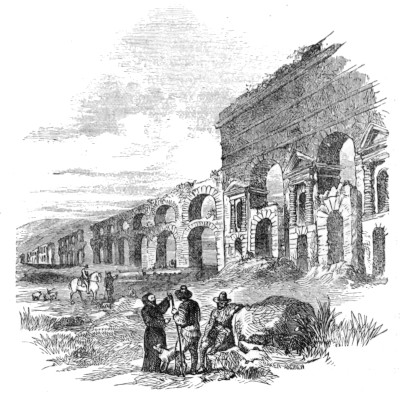
In this connection, we may notice an ancient Roman aqueduct, the arches
of which may still be seen by the tourist as he approaches the “eternal
city;” and a view of which is given in the cut on the next page. It
reminds us, in its general outlines, of the Pont du Gard which has just
been described, except that the latter has three tiers of arches while this has
but two; and the styles of architecture in the two are different. These
638immense structures, carried for miles over valleys and through hills, were
reared by the ancients at the cost of vast expense and labor, that they might
supply themselves with pure water for domestic and public uses. And their
ruins still bear witness to the gigantic scale on which such works were
planned and completed, at an age and among a people that we are accustomed
to think of as far inferior to our own.
There has been much discussion as to the form and extent of the Roman
forum, and as to the use of some of the structures whose ruins are found
within its area. Sometimes the word forum was applied to market-places—forum
boarium, fora venalia, as well as to places where justice was administered,
fora civilia. The great Roman Forum at the foot of the Capitol, and
contiguous to the Palatine hill, was, no doubt, intended by Romulus for the
assemblies of the people. It was adorned with an immense number of
639Grecian statues, among which were twelve gilt statues of the principal gods.
Numerous relics of its former grandeur now fill the campo vaccino—broken
porticos, ruined arches, single columns, and the remains of temples. To
each of these belongs a story of curious antiquarian research. Without
wishing to follow the beaten path of all travelers, it is impossible to pass
these world-renowned memorials of a by-gone age without some brief notice.
One of these is
The arch of Septimius Severus stands in the Forum, on the eastern front
of the Capitol. The soil and rubbish there accumulated was fifteen feet
deep, but the ground was excavated under Napoleon, and the whole of this
fine monument was thus brought into view. It was erected A. D. 205, by
the senate and people of Rome, in honor of the emperor and his sons, on
account of their conquests of the Parthians and Persians. This is recorded
upon the monument, in an inscription which is still perfectly legible. The
monument was constructed entirely of Grecian marble. There is a large
and lofty middle arch, and there are two lateral arches. In one of the
columns is a staircase of fifty steps, leading to the top, on which there was
originally a car drawn by six horses, containing the figures of the emperor
and of his two sons, Geta and Caracalla. Geta was murdered by his
brother, and the inscription which alluded to both was mutilated by Caracalla,
so as to leave out the name of Geta; this obliteration is obvious on
inspection. There are on the panels many figures in high relief, representing
deeds of war, in which the Romans so much delighted.
This, which is one of the most beautiful of the Roman arches, and a view
of which is given in the cut on the next page, was erected to commemorate
the conquest of Jerusalem by Titus. It stands at the eastern end of the
Forum, and the via sacra passes beneath it. It is built of Grecian marble,
and has only a single arch, with fluted columns on each side. On the side
toward the Forum there is a mutilated figure of Victory standing over the
arch. The side toward the Coliseum is the most perfect; and nearly all the
cornice and the antæ are preserved. This arch has a peculiar interest
attached to it, because it illustrates Scripture history. On one of the bass-reliefs,
inside of the arch, a procession are bearing the spoils of the temple—the
golden candlestick and the silver trumpets—the only authentic representations
of those sacred objects, and perfectly corresponding with the
640description given by Josephus. The seven-branched candlestick itself was
lost in the Tiber, and now reposes amidst its yellow sands.
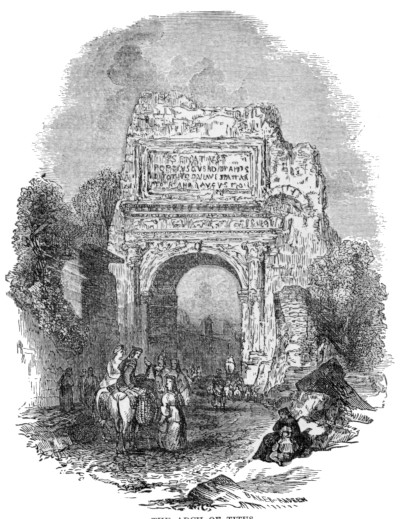
The modern Capitol is erected on the foundation of the ancient. The
huge blocks of peperino stone which underlie the present Capitol rise from
the area of the Forum, far below; and it is quite obvious that the modern
structure is superimposed. The Capitol hill is the highest ground in old
Rome; and the summit of its tower is, as already observed, higher than any
other building in Rome east of the Tiber. We ascend to the present Capitol
from the west, by a series of marble steps. On the right and left, at the top
of the stairs, are antique equestrian and colossal statues of Castor and
641Pollux, mounted upon high pedestals. In the middle of the area, in front
of the Capitol, is the colossal equestrian statue believed to be that of Marcus
Aurelius. It is in bronze, and is a most noble specimen of ancient art.
The emperor is truly imperial, and the horse is admirable; it can not be
exceeded in symmetry and grandeur. This statue, had it not been mistaken
for a statue of Constantine, would have shared the fate of other productions
of pagan art. It was originally gilded, and the gold is still visible upon it
here and there. The head and neck of the horse are copied by modern
sculptors, as being the best specimens of the form of this part of the noble
animal in existence.
This museum is situated in two wings, on the right and left of the Capitoline
hill. They do not form a part of the same structure. It is exceedingly
instructive, as the statues are very numerous; and we can not doubt
that they exhibit faithfully the persons of the ancient Romans, with their
features and costumes. Many of the most distinguished Roman emperors,
poets, historians, and orators, are represented in marble or bronze; Trajan,
Caligula, Hadrian, Nero, Nerva, Julius Cæsar and his murderer Brutus,
Cicero, Virgil, Caracalla, and a multitude more. Some of the statues are
colossal. There are several parts of an immense statue of Nero, which was
designed to be one hundred and fifty feet high, and to rival in altitude the
Coliseum itself. In crime and infamy, he was indeed a colossus. His
countenance has a groveling, animal expression, very strongly marked in a
bust contained in a private museum, where, as if to correspond with the
blackness of his character, he is sculptured in basalt, or black marble.
“We saw in the museum of the Capitol,” says Professor Silliman, “the
original of that bust of Cicero, which represents him as a large man with a
full face and round head, the very reverse of the bust formerly said to be
Cicero’s, and which I saw in 1805 in the Earl of Pembroke’s palace, near
Salisbury, England. That bust made Cicero’s features lean, muscular, and
sharp, with a wart on the right cheek, near the nose. Artists and antiquaries
have no doubt, I believe, of the authenticity of the bust in the Capitol,
which bears his name, and was found in a villa of Mecænas. An excellent
copy of this bust, by our countryman, Crawford, is in the Trumbull gallery
in Yale college, along with copies by the same artist of the busts of Demosthenes
and Homer, the originals of which we saw in the Capitol museum.
In this museum is also to be seen the celebrated Venus of the Capitol, to
which a separate saloon is devoted. The dying Gladiator is in a room with
other noble antique statues. Byron has completely embalmed this figure in
642his memorable description in the fifth canto of Childe Harold’s pilgrimage.
It is probable that the artist himself, could he have read the passage, would
have confessed that it expressed his sentiment even more perfectly than the
marble. Any one who has traversed Italy with Byron in his hand, will
readily appreciate not only the wonderful fidelity of his descriptions, but
that all other language seems poverty-stricken and unmeaning when compared
with the masterly touches by which he has painted the various
monuments of antiquity which adorn his pictured page. For example,
besides the passage just alluded to, we have his tomb of Cecilia Metella, the
Thunder-stricken Nurse of Rome! the Coliseum, the Pantheon, and St.
Peter’s, &c. The original bronze wolf, representing the early nursing of
Romulus and Remus, is in the Capitol museum. The little urchins, also in
bronze, are eagerly drawing from the savage wet-nurse the means of life.
This fable affords not an unapt symbol of the ferocious disposition of Romulus,
who slew his brother, and of most of the Roman people, of whatever
rank, to whom human blood seems to have been a delightful nectar. There
has been much discussion as to the antiquity of this wolf. It appears
probable that this is the image referred to by Cicero; and it bears marks of
having been struck by lightning, according to tradition. There is a large
piece of metal torn out of one of the hind legs of the wolf, and this is stated
by tradition to have happened from a thunder-stroke, (to which, of course,
Byron alludes in his immortal lines,) which fell upon the wolf the moment
when it was announced in the Capitol that Julius Cæsar was dead.”
The piazza of this masterpiece of architecture, a view of which as seen
from the Tiber is given in the cut on the next page, is altogether sublime.
The double colonnade on each side, extending in a semicircular sweep, the
stupendous Egyptian obelisk, the two fountains, the portico, and the admirable
façade of the church, form such an assemblage of magnificent objects,
as can not fail to impress the mind with awe and admiration. The church
appears in the background, and on each side is a row of quadruple arches,
resting on two hundred and eighty-four pillars, and eighty-eight pilasters:
these arches support one hundred and ninety-two statues, twelve feet in
hight. The two noble fountains throw a mass of water to the hight of nine
feet, from which it falls in a very picturesque manner, and adds greatly to
the beauty of the scene. In the center is the fine obelisk.
At the first entrance into St. Peter’s, the effect is not so striking as might
be expected: it enlarges itself, however, insensibly on all sides, and improves
643on the eye every moment. The proportions are so accurately observed, that
each of the parts are seen to an equal advantage, without distinguishing
itself above the rest. It appears neither extremely high, nor long, nor
broad, because a just equality is preserved throughout. Although every
object in this church is admirable, the most astonishing part of it is the
cupola. On ascending to it, the spectator is surprised to find, that the dome
which he sees in the church, is not the same with the one he had examined
without doors, the latter being a kind of case to the other, and the stairs by
which he ascends into the ball lying between the two. Had there been the
outward dome only, it would not have been seen to advantage by those who
are within the church; or had there been the inward one only, it would
scarcely have been seen by those who are without; and had both been one
solid dome of so great a thickness, the pillars would have been too weak to
have supported it.
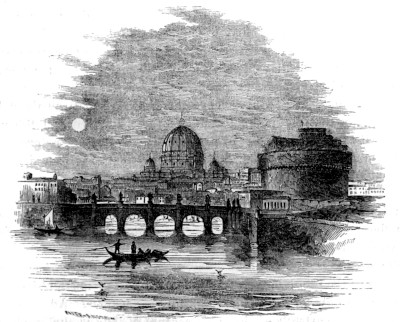
ST. PETER’S AS SEEN FROM THE TIBER.
It is not easy to conceive a more glorious architectural display than the
one which presents itself to the spectator who stands beneath the dome. If
he looks upward, he is astonished at the spacious hollow of the cupola, and
has a vault on every side of him, which makes one of the most beautiful
vistas the eye can possibly have to penetrate. To convey an idea of its
magnitude, it will suffice to say, that the hight of the body of the church,
644from the ground to the upper part of its ceiling, is four hundred and thirty-two
feet, and that sixteen persons may place themselves, without inconvenience,
in the globular top over the dome, which is annually lighted, on
the twenty-ninth of June, by four thousand lamps and two thousand fire-pots,
presenting a most delightful spectacle. The vestibule of St. Peter’s is
grand and beautiful. Over the second entrance is a fine mosaic from Giotto,
executed in the year 1303; and at the corners, to the right and left, are the
equestrian statues of Constantine and Charlemagne. Of the five doors
leading to the church itself, one, called the holy door, is generally shut up
by brick-work, and is only opened at the time of the jubilee. The middle
gate is of bronze, with bass-reliefs.
Of the one hundred and thirty statues with which this church is adorned,
that of St. Peter is the most conspicuous: it is said to have been recast from
a bronze statue of Jupiter Capitolinus. One hundred and twelve lamps are
constantly burning around the tomb of this saint; and the high altar close
to it, on which the pope alone reads mass, is overshadowed by a ceiling,
which exceeds in loftiness that of any palace of Rome. The splendid
sacristy was built by Pius VI. But by far the greatest ornaments of the
interior are the excellent works in mosaic, all copied from the most celebrated
pictures, which are thus guarded from oblivion.
The great and truly awful dome of St. Peter’s is only two feet less in
diameter than that of the Pantheon, being one hundred and thirty-seven
feet; but it exceeds the latter in hight by twenty feet, being one hundred
and fifty-nine feet, besides the lantern, the basis pedestal of the top, the
globular top itself, and the cross above it, which, collectively, measure one
hundred and twenty feet. The roof of the church is ascended by easy
steps; and here the visitor seems to have entered a small town, for he suddenly
finds himself among a number of houses, which either serve as
repositories of implements and materials for repairing the church, or are
inhabited by the workmen. The dome, at the foot of which he now arrives,
appears to be the parish church of this town; and the inferior domes seem
as if intended only for ornaments to fill up the vacuities. Add to this, that
he can not see the streets of Rome, on account of the surrounding high gallery
and its colossal statues, and the singularity of such a scene may be
easily conceived. It is besides said, that a market is occasionally held here
for the aerial inhabitants.
But although the adventurous stranger is now on the roof, he has still a
great hight to ascend before he reaches the summit of the dome. Previously
to his engaging in this enterprise, he is conducted to the inside gallery of
the dome. From this spot the people within the body of the church appear
645like children. The higher he goes, the more uncomfortable he finds himself,
on account of the oblique walls over the narrow staircase; and he is
often compelled to lean with his whole body quite to one side. Several
marble plates are affixed in those walls, containing the names of the distinguished
personages who have had the courage to ascend to the dome, and
even to climb up to the lantern, and the top. The emperor Joseph II. is
twice mentioned; and Paul I. as grand duke. In some parts, where the
stairs are too steep, more commodious steps of wood have been placed. By
these the lantern can be reached with greater facility; and the view which
there waits the visitor, is magnificent beyond description: it is an immense
panorama, bounded by the sea.
Silliman, in his late “Visit to Europe,” adds points of interest with
regard to St. Peter’s not given above, which therefore we quote. “The
interior,” he says, “is beyond description rich and magnificent. It is said
to have cost fifty million dollars. The circumference of each of the four
great pillars which support the dome, is two hundred and thirty-four feet.
The diameter of the dome is one hundred and ninety-five feet; the hight of
the dome to the lantern, is four hundred and five feet; to the top of the
cross, is four hundred and thirty-four feet. The floor is composed entirely
of marble of various colors, and disposed in ornamental forms; indeed, the
whole interior of the church, the columns and pilasters excepted, is faced
with the most beautiful marble, highly polished; while numerous medallions,
exquisite monuments, and splendid mosaic copies of the best pictures,
adorn the interior, and form an integral part of its walls. The roof, or
ceiling, is stuccoed in sunken squares or panels, richly gilt. There is no
part which is not sumptuously decorated. It seems as if ingenuity, art,
taste, talent, and skill, all the resources of wealth, and of Nature herself,
through all her vast storehouse of materials, had been laid under contribution,
to make St. Peter’s the most glorious of the structures reared by man.
With a pure faith, it would be a temple worthy of the God who created all
the materials with which it is built, and who furnished man with all the
faculties, which have enabled him to rear and adorn this unrivaled structure,
a fit abode, like the glorious fane of Jerusalem, for the habitation of the
spiritual influence of Jehovah. St. Peter’s was one hundred and seventy-six
years in building. Indeed, including all its vicissitudes, the period was
three hundred and fifty years, under forty-three popes. It was finally dedicated
by Urban VIII., November eighteenth, 1626. The vases for holding
holy water serve to give an idea of the immensity of the building. They
are supported by cherubs, which, on first entering the church, appear like
children, but on approaching them they are found to be six feet high.
646Another illustration is derived from the mosaic figures of the four evangelists,
with their emblems over the arches. The pen in the hand of St.
Mark is six feet long. Upon the frieze running round the basis of the dome
is this inscription, each letter of which is six feet long, and yet the writing
is only conveniently legible below: Tv es petrvs et svper hanc petram
aedificabo ecclesiam meam et tibi dabo claves regni.”
In leaving the wonders of Rome, and the city itself, we will quote an
interesting extract from Townsend’s “Tour in Italy,” in 1850. “Many
authors,” he says, “have asserted, as their interpretation of some parts of
the Apocalypse, that Rome will be destroyed by fire from heaven, or swallowed
up by earthquakes, or overwhelmed with destruction by volcanoes, as
the visible punishment of the Almighty, for its popery and its crimes. I am
unwilling, having read so many books on the interpretation of the prophecy,
to deduce any argument of this kind from the prophecies which are unfulfilled;
but I behold everywhere—in Rome, near Rome, and through the
whole region from Rome to Naples—the most astounding proofs, not merely
of the possibility, but the probability that the whole region of central Italy
will one day be destroyed by such a catastrophe. The soil of Rome is tufa,
with a volcanic subterranean action still going on. At Naples the boiling
sulphur is to be seen bubbling near the surface of the earth. When I drew
a stick along upon the ground, the sulphurous smoke followed the indentation;
and it would never surprise me to hear of the utter destruction of the
southern peninsula of Italy. The entire country and district is volcanic. It
is saturated with beds of sulphur and the substrata of destruction. It seems
as certainly prepared for the flames as the wood and coal on the hearth are
prepared for the taper which shall kindle the fire to consume them. I again
read the remarks of Dr. Cumming: ‘Rome,’ he believes, ‘is to be overthrown
by judgment; not to be converted by the agency of the gospel, nor
to be exhausted by political assaults. It is literally to be consumed by fire.’
Whether he is correct in regarding such an event as the fulfillment of the
prophecies, and the demonstration of the anger of the Creator against the
incorrigible assumption of an erring and influential church, I know not;
but the divine hand alone seems to me to hold the element of fire in check
by a miracle as great as that which protected the cities of the plain, till the
righteous Lot had made his escape to the mountains.”
647
The Eddystone rocks, on which this celebrated light-house is built, are
situated nearly south-south-west from the middle of Plymouth sound, being
distant from the port of Plymouth nearly fourteen miles, and from the
promontory called Ramshead, about ten miles. They are almost in the line,
but somewhat within it, which joins the Start and the Lizard points; and as
they lie nearly in the direction of vessels coasting up and down the channel,
they were necessarily, before the establishment of a light-house, very dangerous,
and often fatal to ships under such circumstances. Their situation,
likewise, relatively to the bay of Biscay and the Atlantic ocean, is such that
they lie open to the swells of both from all the south-western points of the
compass; which swells are generally allowed by mariners to be very great
and heavy in those seas, and particularly in the bay of Biscay. It is to be
observed, that the soundings of the sea, from the south-west toward the
Eddystone, are from eighty fathoms to forty, and that in every part, until
the rocks are approached, the sea has a depth of at least thirty fathoms;
insomuch that all the heavy seas from the south-west reach them uncontrolled,
and break on them with the utmost fury.
The force and hight of these seas are increased by the fact that the
rocks stretch across the channel, in a direction north and south, to the
length of above one hundred fathoms, and by their lying in a sloping manner
toward the south-west quarter. This striving of the rocks, as it is
technically called, does not cease at low-water, but still goes on progressively;
so that, at fifty fathoms westward, there are twelve fathoms of water;
neither does it terminate at the distance of a mile. From this configuration
it happens, that the seas are swollen to such a degree, in storms and heavy
gales of wind, as to break on the rocks with the utmost violence. It is not
surprising, therefore, that the dangers to which navigators were exposed by
the Eddystone rocks should have made a great commercial nation desirous
to have a light-house erected on them. The wonder is that any one should
have had sufficient resolution to undertake its construction. Such a man
was, however, found in the person of Mr. Henry Winstanley, of Littleburgh,
in Essex, who, being furnished with the necessary powers to carry the
design into execution, entered on his undertaking in 1696, and completed it
in four years. So certain was he of the stability of his structure, that he
declared it to be his wish to be in it “during the greatest storm which ever
blew under the face of the heavens.” In this wish he was but too amply
gratified; for while he was there with his workmen and light-keepers, that
648dreadful storm began, which raged most violently on the night of the
twenty-sixth of November, 1703; and of all the accounts of the kind with
which history has furnished us, no one has exceeded this in Great Britain,
nor has been more injurious or extensive in its devastations. On the following
morning, when the storm was so much abated, that an inquiry could be
made, whether the light-house had suffered from it, nothing was to be seen
standing, with the exception of some of the large irons by which the work
was fixed on the rock; nor were any of the people, nor any of the materials
of the building ever found afterward.
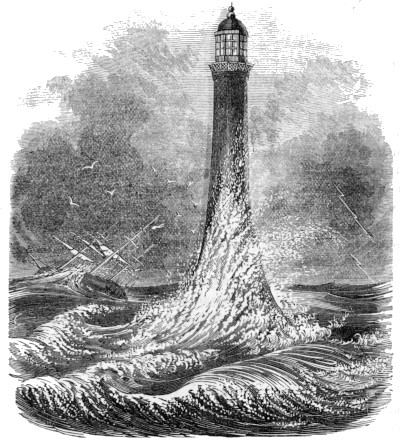
THE EDDYSTONE LIGHT-HOUSE.
In 1709, another light-house was built of wood, on a very different construction,
by Mr. John Rudyerd, then a silk-mercer on Ludgate hill. This
very ingenious structure, after having braved the elements for forty-six
years, was burned to the ground in 1755. On the destruction of this light-house,
that excellent mechanic and engineer, Mr. Smeaton, was selected as
649the fittest person to build another. He found some difficulty in persuading
the proprietors, that a stone building, properly constructed, would be in
every respect preferable to one of wood; but having at length convinced
them, he turned his thoughts to the shape which would be most suitable to
a building so critically situated. Reflecting on the structure of the former
buildings, it seemed to him a material improvement to procure, if possible,
an enlargement of the base, without increasing the size of the waist, or that
part of the building placed between the top of the rock and the top of the
solid work. Hence he thought a greater degree of strength and stiffness
would be gained, accompanied with less resistance to the acting power. On
this occasion, the natural figure of the waist, or bole of a large spreading
oak, occurred to our sagacious engineer.
With these very enlightened views, as to the proper form of the superstructure,
Mr. Smeaton began the work on the second of April, 1757, and
completed it on the fourth of August, 1759. Its appearance, as completed,
may be seen in the cut on the preceding page. The rock, which slopes
toward the south-west, is cut into horizontal steps, into which are dovetailed,
and united by a strong cement, Portland stone and granite. The
whole to the hight of thirty-five feet from the foundation, is a solid body of
stones, engrafted into each other, and united by every means of additional
strength that could be devised. The building has four rooms, one over the
other, and at the top a gallery and lantern. The stone floors are flat above,
but concave beneath, and are kept from pressing against the sides of the
building by a chain let into the walls. It is nearly eighty feet in hight, and
since its completion has been assaulted by the fury of the elements, without
suffering the smallest injury. To trace the progress of so vast an undertaking,
and to show with what skill and judgment this unparalleled
engineer overcame the greatest difficulties, would far exceed the limits
of this work.
The Bell rock, or Inch cape, is situated on the north-east coast of Great
Britain, twelve miles south-west from the town of Arbroath, in Fifeshire,
and thirty miles north-east from St. Abb’s head, in the county of Berwick.
It lies in the direct trace of the firth of Tay, and of a great proportion of
the shipping of the firthfirth of Forth, embracing a very extensive local trade.
This estuary is besides the principal inlet on the northern coast of Britain,
in which the shipping of the German ocean and North sea take refuge when
overtaken by easterly storms. At neap-tides, or at the quadratures of the
650moon, the Bell rock is scarcely uncovered at low-water; but in spring-tides,
when the ebbs are greatest, that part of the rock which is exposed to view
at low-water, measures about four hundred and twenty-seven feet in length,
by two hundred and thirty in breadth; and in this low state of the tides, its
average perpendicular hight above the surface of the sea is about four feet.
Beyond the space included in these measurements, at very low tides, a reef
extends about a thousand feet in a south-west direction, from the higher
part of the rock just described; and on this reef the light-house is erected.
In the erection of a light-house on the Bell rock, independently of its
distance from the main land, a serious difficulty presented itself, arising
from the greater depth of water at which it was necessary to carry on the
operations, than in the case of the Eddystone light-house, described above,
or of any other building of the same kind, ancient or modern, which had
been hitherto undertaken. Its description is as follows.
The Bell rock light-house, which has not improperly been termed the
Scottish Pharos, is a circular building, the foundation stone of which is
nearly on a level with the surface of the sea at low-water of ordinary spring-tides;
and, consequently, at high-water of these tides the building is
immersed to the hight of about fifteen feet. The first two, or lowest
courses of the masonry, are imbedded, or sunk into the rock, and the stones
of all the courses are curiously dovetailed and joined with each other,
forming one connected mass from the center to the circumference. The
successive courses of the work are also attached to each other by joggles of
stone; and, to prevent the stones from being lifted up by the force of the
sea, while the work was in progress, each stone of the solid part of the
building had two holes bored through it, entering six inches into the course
immediately below, into which oaken tree-nails, two inches in diameter, were
driven, after Mr. Smeaton’s plan at the Eddystone light-house. The cement
used at the Bell rock, like that at the latter, was a mixture of pozzuolana,
earth, lime, and sand, in equal parts, by measure.
The stones employed in this surprising structure weigh from two tuns to
half a tun each. The ground course measures forty-two feet in diameter,
and the building diminishes as it rises to the top, where the parapet wall of
the light-room has a diameter of thirteen feet only. It is solid from the
ground course to the hight of thirty feet, where the entry door is placed, the
ascent to which is by a kind of rope-ladder, with wooden steps, hung out at
ebb-tide, and taken into the building again when the water covers the rock;
but strangers to this sort of climbing are taken up in a kind of chair, by a
small movable crane projected from the door, from which a narrow passage
leads to a stone staircase thirteen feet in hight. Here the walls are seven
651feet thick, but they gradually diminish from the top of the staircase to the
parapet wall of the light-room, where they measure one foot only in thickness.
The upper part of the building is divided into six apartments for the
use of the light-house keepers, and for containing the light-house stores.
The lower, or first of these floors, contains the water-tanks, fuel, and other
bulky articles; the second, the oil-cisterns, glass, and other light-room
stores; the third is occupied as a kitchen; the fourth is the bed-room; the
fifth, the library, or stranger’s room; and the upper apartment forms the
light-room. The floors of the several apartments are of stone, and the
communication from the one to the other is effected by wooden ladders,
except in the case of the light-room, where every article being fire-proof, the
steps are made of iron. In each of the three lower apartments are two
windows; but the upper rooms have four windows each. The casements of
the windows are double, and are glazed with plate-glass, having besides an
outer storm-shutter, or dead-light, of timber, to defend the glass from the
waves and spray of the sea. The parapet wall of the light-room is six feet
in hight, and has a door leading out to the balcony, or walk, formed by the
cornice round the upper part of the building, which is surrounded by a cast-iron
rail, curiously wrought like net-work. This rail reposes on batts of
brass, and has a massive coping, or top-rail, of the same metal.
The light-room was, with the whole of its apparatus, framed and prepared
at Edinburgh. It is of an octagonal figure, measuring twelve feet across,
and fifteen feet in hight, formed with cast-iron sashes, or window frames,
glazed with large plates of polished glass, measuring about two feet and six
inches, by two feet and a quarter, and the fourth of an inch in thickness.
It is covered with a dome roof of copper, terminating in a large gilt ball,
with a vent-hole in the top. The light is very powerful, and is readily seen
at the distance of seven leagues, when the atmosphere is clear. It is from
oil, with argand burners, placed in the focus of silver-plated reflectors,
measuring two feet over the lips, the silver surface being hollowed, or
wrought to the parabolic curve. That this splendid light may be the more
easily distinguished from all the other lights on the coast, the reflectors are
ranged on a frame with four faces, or sides, which, by a train of machinery,
is made to revolve on a perpendicular axis once in six minutes. Between
the observer and the reflectors, on two opposite sides of the revolving frame,
shades of red glass are interposed in such a manner, that, during each entire
revolution of the reflectors, two appearances, distinctly differing from each
other, are produced: one is the common bright light familiar to all; but on
the other, or shaded sides, the rays are tinged of a red color. These red
and bright lights, in the course of each revolution, alternate with intervals
652of darkness, and thus in a very beautiful and simple manner, characterize
this light.
As a further warning to the mariner in foggy weather, two large bells,
each weighing about twelve hundred pounds, are tolled day and night by
the same machinery which moves the lights. As these bells, in moderate
weather, may be heard considerably beyond the limits of the rock, vessels,
by this expedient, get warning to put about, and are thereby prevented from
running on the rock in thick and hazy weather, a disaster to which ships
might otherwise be liable, notwithstanding the erection of the light-house.
The establishment consists of a principal light-keeper, with three assistants,
two of whom are constantly at the light-house, while the third is stationed
at a tower erected at Arbroath, where he corresponds by signals with the
light-keepers at the rock. This stupendous undertaking is highly creditable
to Mr. Stevenson, the engineer, and does honor to the age in which it has
been produced. The lights were exhibited, for the first time, on the first of
February, 1811.
This celebrated monument of antiquity, a view of which is given in the
cut on the next page, stands in the middle of a flat area near the summit of
a hill, six miles distant from Salisbury. It is inclosed by a double circular
bank and ditch, nearly thirty feet broad, after crossing which an ascent of
thirty yards leads to the work. The whole fabric, of which the cut exhibits
only a section, was originally composed of two circles and two ovals. The
outer circle is about one hundred and eight feet in diameter, consisting, when
entire, of sixty stones, thirty uprights, and thirty imposts, of which there
now remain twenty-four uprights only, seventeen standing, and seven down,
three feet and a half asunder, and eight imposts. Eleven uprights have
their five imposts on them at the grand entrance: these stones are from
thirteen to twenty feet high. The smaller circle is somewhat more than
eight feet from the inside of the outer one, and consisted of forty smaller
stones, the highest measuring about six feet, nineteen only of which now
remain, and only eleven standing. The walk between these two circles is
three hundred feet in circumference. The adytum, or cell, is an oval
formed of ten stones, from sixteen to twenty-two feet high, in pairs, and
with imposts above thirty feet high, rising in hight as they go round, and
each pair separate, and not connected as the outer pair: the highest eight
feet. Within these, are nineteen other smaller single stones, of which six
only are standing. At the upper end of the adytum is the altar, a large
653slab of blue coarse marble, twenty inches thick, sixteen feet long, and four
broad: it is pressed down by the weight of the vast stones which have fallen
upon it. The whole number of stones, uprights and imposts, comprehending
the altar, is one hundred and forty. The stones, which have been by
some considered artificial, were most probably brought from those called the
gray weathers on Marlborough downs, distant fifteen or sixteen miles; and
if tried with a tool, appear of the same hardness, grain and color, being
generally reddish. The heads of oxen, deer, and other beasts, have been
found in digging in and about Stonehenge; and in the circumjacent barrows,
human bones. From the plain to this structure there are three
entrances, the most considerable of which is from the north-east; and at
each of them were raised, on the outside of the trench, two huge stones,
with two smaller parallel ones within.
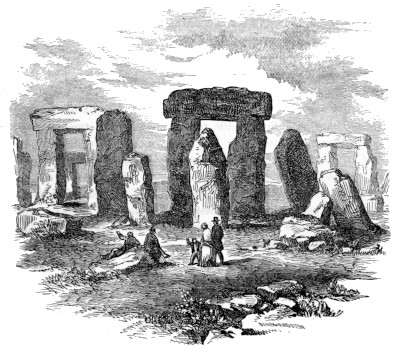
Geoffrey of Monmouth, in his history of the Britons, written in the reign
of King Stephen, represents this monument as having been erected at the
command of Aurelius Ambrosius, the last British king, in memory of four
654hundred and sixty Britons who were murdered by Hengist the Saxon.
Polydore Virgil says that it was erected by the Britons as the sepulchral
monument of Aurelius Ambrosius, and other writers consider it to have
been that of the famous British queen Boadicea. Inigo Jones is of opinion
that it was a Roman temple; and this conclusion he draws from a stone
sixteen feet in length, and four in breadth, placed in an exact position to the
eastward, altar-fashion. By Charlton it is ascribed to the Danes, who were
two years masters of Wiltshire; a tin tablet, on which were some unknown
characters, having been dug up in the vicinity, in the reign of Henry VIII.
This tablet, which is lost, might have given some information respecting its
founders. Its common name, Stonehenge, is Saxon, and signifies a “stone
gallows,” to which the stones, having transverse imposts, bear some resemblance.
It is also called in Welch, choir gour, or the giants’ dance. Mr.
Grose, the antiquary, is of opinion that Doctor Stukely has completely
proved this structure to have been a British temple, in which the Druids
officiated. He supposes it to have been the metropolitan temple of Great
Britain, and translates the words choir gour, “the great choir or temple.”
It was customary with the Druids to place one large stone on another for
a religious memorial; and these they often placed so equably, that even a
breath of wind would sometimes make them vibrate. Of such stones one
remains at this day in the pile of Stonehenge. The ancients distinguished
stones erected with a religious view, by the name of ambrosiæ petræ, amber
stones, the word amber implying whatever is solar and divine. According
to Bryant, Stonehenge is composed of these amber stones; and hence the
next town is denominated Ambresbury.
The rocking stone, or logan, is a stone of a prodigious size, so nicely
poised, that it rocks or shakes with the smallest force. Several of the consecrated
stones mentioned above, were rocking stones; and there was a
wonderful monument of this kind near Penzance in Cornwall, which still
retains the name of main-amber, or the sacred stones. With these stones
the ancients were not unacquainted. Pliny relates that at Harpasa, a town
of Asia, there was a rock of such a wonderful nature, that, if touched with
the finger, it would shake, but could not be moved from its place with the
whole force of the body. Ptolemy Hephistion mentions a stone of this
description near the ocean, which was agitated when struck by the stalk of
the plant asphodel, or day-lily, but could not be removed by a great exertion
of force. Another is cited by Apollonius Rhodius, supposed to have been
655raised in the time of the Argonauts, in the island Tenos, as the monument
of the two-winged sons of Boreas, slain by Hercules; and there are others
in China, and in other countries.
Many rocking stones are to be found in different parts of Great Britain;
some natural, and others artificial, or placed in their position by human art.
That the latter are monuments erected by the Druids, many suppose can not
be doubted; but tradition has not handed down the precise purpose for
which they were intended. In the parish of St. Leven, Cornwall, there is a
promontory called Castle Treryn. On the western side of the middle group,
near the top, lies a very large stone, so evenly poised, that a hand may move
it from one side to the other; yet so fixed on its base, that no lever, or other
mechanical force, can remove it from its present situation. It is called the
logan-stone, and is at such a hight from the ground as to render it incredible
that it was raised to its present position by art. There are, however, other
rocking stones, so shaped and situated, that there can not be any doubt of
their having been erected by human strength. Of this kind the great quoit,
or karn-le hau, in the parish of Tywidnek, in Wales, is considered. It is
thirty-nine feet in circumference, and four feet thick at a medium, and
stands on a single pedestal. In the island of St. Agnes, Scilly, is a remarkable
stone of the same kind. The under rock is ten and a half feet high,
forty-seven feet round the middle, and touches the ground with not more
than half its base. The upper rock rests on one point only, and is so nicely
balanced, that two or three men with a pole can move it. It is eight and a
half feet high, and forty-seven in circumference. On the top is a basinbasin
hollowed out, three feet and eleven inches in diameter at a medium, but
wider at the brim, and three feet in depth. From the globular shape of the
upper stone, it is highly probable that it was rounded by human art, and
perhaps even placed on its pedestal by human strength. In Sithney parish,
near Helston, in Cornwall, stood the famous logan, or rocking stone, commonly
called Men Amber, that is, Men an Bar, or the top stone. It was
eleven feet by six, and four high, and so nicely poised on another stone, that
a little child could move it. It was much visited by travelers; but Shrubsall,
the governor of Pendennis castle, under Cromwell, caused it to be
undermined, by dint of much labor, to the great grief of the country.
There are some marks of the tool on it; and it seems probable, by its triangular
shape, that it was dedicated to Mercury.
656
Every one, almost, has heard of the round towers of Ireland; and yet,
who has been able to explain their origin, or solve the mystery that hangs
over the history of their builders, and the purposes for which they were
erected?
Of these towers, one hundred and seven are known to have existed; but
probably there were many more. Some are still perfect, others are in ruins.
They bear a general resemblance to each other, seeming, therefore, to have
had the same object in view; yet there were many minute points of difference.
Some were but forty feet high; others sixty, eighty, and one a
hundred and twenty feet. The common hight is about eighty or ninety
feet. Most of them were of a cylindrical form, and were covered with a
conical roof. They were generally divided into three stories, with a window
to each. The door of entrance was from six to twenty-four feet from the
ground; but how this was reached is not known. In some cases, they were
built of hewn stone, nicely laid in mortar; in others, the stones are merely
hammered; in others still, they are small and of all shapes, but always
firmly cemented by mortar, nearly as hard as the rock itself.
That these towers are very ancient, is clear from the fact that when Ireland
was first invaded by the English, in the twelfth century, they were then
deemed antiquities, and no one was able to tell their origin or design. Some
have been used as towers and belfries of churches; but these churches were
built in later times, and this use of the towers was, evidently, but an adaptation
of old structures to new purposes. The fact that near them, in most
cases, ancient churches, or their remains, are found, has led to the belief
that they were ecclesiastical structures, erected by the early Christians of
Ireland. This idea is exploded by the circumstance that no such buildings
have ever been known to be erected in any other part of the world, in connection
with the Christian religion; nor is it possible to conjecture for what
object, as part of Christian worship, they could have been designed.
The more prevalent and probable opinion, on the subject, seems to be this:
that they were erected by the Phœnicians or Carthaginians, who are known
to have had settlements in Ireland before the Christian era; or that they
were built by the remote Irish, who bore the name of Scoti, and who were
of Asiatic origin. The object of these buildings, on this supposition, was
the preservation of the sacred fire, kindled in honor of Bel, or Baal, a
heathen divinity of the east, and who is known to have been worshiped in
Ireland. Indeed, to the present day, some of the religious rites of the Irish
657are evidently but the perpetuation of the ceremonies of their ancestors,
turned from their pagan origin and blended with Catholic observances.
This view of the origin and object of the round towers is strongly confirmed
by the fact that in their vicinity are still to be found the well known relics
of ancient paganism, such as the sun-stone, the cromlech, the fire-house, the
spring of sacred water, necessary in mystic rites, &c. To this it may be
added, that in Persia and India, where fire-worship originated, and has had
its most extensive and enduring seat, there are towers of various forms and
sizes, ascribed, in their origin, to this species of idolatry. It is probable,
therefore, that the early settlers of Ireland brought from Asia, their original
country, ideas of religion, which became modified in the course of ages, but
which, still remaining essentially the same, displayed themselves in the
structures which we have described. The fact that Christian churches, or
their remains, are found near these towers in Ireland, does not controvert
the opinion we express, as, in the first place, they are evidently more modern
than the towers themselves, and are of a different style of architecture;
and, moreover, we know that the early Christians often chose, as the seat of
their churches, the very sites on which paganism had reared its structures,
and not unfrequently adapted the structures themselves to the purposes of
Christian worship; a fact which rather confirms than opposes the common
theory as to these towers.
The chief ecclesiastical ornament of London is the cathedral church of St.
Paul, which stands in the center of the metropolis, on an eminence rising
from the valley of the Fleet. The body of the church is in the form of a
cross. Over the space where the lines of that figure intersect each other,
rises a stately dome, from the top of which springs a lantern adorned with
Corinthian columns, and surrounded at its base by a balcony; on the lantern
rests a gilded ball, and on that a cross (gilt also) crowning the ornaments
of the edifice. The length of the church, including the portico, is five
hundred and ten feet; the breadth, two hundred and eighty-two; the hight
to the top of the cross, four hundred and four; the exterior diameter of the
dome, one hundred and forty-five; and the entire circumference of the
building, twenty-two hundred and ninety-two feet. A dwarf stone wall,
supporting a balustrade of cast iron, surrounds the church, and separates a
large area, which is properly the church-yard, from a spacious carriage and
foot-way on the south side, and a foot pavement on the north.
The dimensions of this cathedral are great; but the grandeur of the
658design, and the beauty and elegance of its proportions, more justly rank it
among the noblest edifices of the modern world. It is adorned with three
porticos; one at the principal entrance, facing the west, and running parallel
with the opening of Ludgate street and the other two facing the north and
south, at the extremities of the cross aisle, and corresponding in their architecture.
The western portico combines as much grace and magnificence as
any specimen of the kind in the world. It consists of twelve lofty Corinthian
columns below, and eight composite above, supporting a grand
pediment; the whole resting on an elevated base, the ascent to which is by
a flight of twenty-two square steps of black marble, running the entire
length of the portico. The portico at the northern entrance consists of a
dome, supported by six Corinthian columns, with an ascent of twelve circular
steps, of black marble. The southern portico is similar, except that
the ascent consists of twenty-five steps, the ground on that side being
lower.
The great dome is ornamented with thirty-two columns below, and a
range of pilasters above. At the eastern extremity of the church is a circular
projection, forming a recess within for the communion table. The walls
are wrought in rustic, and strengthened and ornamented by two rows of
coupled pilasters, one above the other, the lower being Corinthian, and the
other composite. The northern and southern sides have an air of uncommon
elegance. The corners of the western front are crowned with turrets
of an airy and light form. To relieve the heavy style of the interior, statues
and monuments have been erected to the memory of great men. The
statues are plain full-length figures, standing on marble pedestals, with
appropriate inscriptions, in honor of such men as Dr. Samuel Johnson,
Howard the philanthropist, Sir William Jones, &c., &c. Several of the
monuments would disgrace the most barbarous age, and ought to be
removed. The tomb of the great Nelson is beneath the pavement immediately
under the dome.
The two turrets on the right and left of the west front are each two
hundred and eight feet in hight. In the one on the southern side is the
great clock, the bell of which, weighing eleven thousand, four hundred and
seventy-four pounds, and being ten feet in diameter, may be heard in the
most distant part of London, when the wind blows toward that quarter.
The entire pavement, up to the altar, is of marble, chiefly consisting of
square slabs, alternately black and white, and is very justly admired. The
floor round the communion table is of the same kind of marble, mingled
with porphyry. The communion table has no other beauty; for, though it
is ornamented with four fluted pilasters, which are very noble in their form,
659they are merely painted and veined with gold, in imitation of lapis lazuli.
Eight Corinthian columns of blue and white marble, of exquisite beauty,
support the organ gallery. The stalls in the choir are beautifully carved,
and the other ornaments are of equal workmanship.
This cathedral was built at the national expense, and cost over thirty-five
hundred thousand dollars. The iron balustrade on the wall surrounding
the space that is properly the church-yard, including its seven iron gates,
weighs two hundred tuns, and cost over fifty thousand dollars. This
immense edifice was reared in thirty-five years, the first stone being laid on
the twenty-first of June, 1675, and the building completed in 1710, exclusive
of some of the decorations, which were not finished till 1723. The
highest stone of the lantern was laid on by Mr. Christopher Wren, son of
the architect, in 1710. It was built by one architect, Sir Christopher Wren;
by one mason, Mr. Strong; and while one prelate, Dr. Henry Compton,
filled the see of London.
The dimensions of St. Paul’s, from east to west, within the walls, are
five hundred and ten feet; from north to south, within the doors of the porticos,
two hundred and eighty-two; the breadth of the west entrance, one
hundred; its circuit, twenty-two hundred and ninety-two; its hight within,
from the center of the floor to the cross, three hundred and forty feet. The
circumference of the dome is four hundred and thirty feet; the diameter of
the ball, six; from the ball to the top of the cross, thirty; and the diameter
of the columns of the porticos, four feet. The hight to the top of the west
pediment, under the figure of St. Paul, is one hundred and twenty feet;
and that of the tower of the west front, two hundred and eighty-seven.
From the bottom of the whispering-gallery are two hundred and eighty
steps; including those to the golden gallery, five hundred and thirty-four,
and to the ball, in all, six hundred and sixteen steps. The weight of the
ball is fifty-six hundred pounds. The weight of the cross is thirty-three
hundred and sixty. The extent of the ground whereon this cathedral
stands, is two acres and sixteen perches. The length of the hour figures,
two feet and two and a half inches; the circumference of the dial is fifty-seven
feet.
The whispering-gallery is a very great curiosity. It is one hundred and
forty yards in circumference. A stone seat runs round the gallery along the
foot of the wall. On the side directly opposite the door by which the visitor
enters, several yards of the seat are covered with matting, on which the
visitor being seated, the man who shows the gallery, whispers, with the
mouth close to the wall, near the door, at the distance of one hundred and
forty feet from the visitor, who hears his words in a loud voice, seemingly at
660his ear. The mere shutting of the door produces a sound to those on the
opposite seat like violent claps of thunder. The effect is not so perfect if
the visitor sits down half-way between the door and the matted seat, and
still less so if he stands near the man who speaks, but on the other side of
the door.
The marble pavement of the church is extremely beautiful, seen from this
gallery. The paintings on the inner side of the dome, by Sir James Thornhill,
are viewed with most advantage here. The ascent to the ball is
attended with some difficulty, and is encountered by few, yet both the ball
and passage to it well deserve the labor. The diameter of the interior of
the ball is nearly six feet, and twelve persons may sit within it.
The prospect from every part of the ascent to the top of St. Paul’s,
wherever an opening presents itself, is extremely curious. The effect is
most complete from the gallery surrounding the foot of the lantern. The
metropolis, from that spot, has a mimic appearance, like the objects in a
fantoccino. The streets, the pavements, the carriages, and foot-passengers,
have the appearance of fairy ground and fairy objects. The spectator, contemplating
the bustle of the diminutive throng below, is moved a little out
of the sphere of his usual sympathy with them; and, as if they were emmets,
asks himself involuntarily, “About what are those little, inconsequential
animals engaged?”
The form of the metropolis, and the adjacent country, is most perfectly
seen from the gallery at the foot of the lantern, on a bright summer day.
The ascent to this gallery is by five hundred and thirty-four steps, of which
two hundred and sixty, nearest the bottom, are extremely easy; those above
difficult, and in some parts dark and unpleasant. In the ascent to this gallery
may be seen the brick cone that supports the lantern, with its ball and
cross; the outer dome being turned on the outside of the cone, and the
inner dome turned on the inside. The entire contrivance to produce the
effect within the church and on the outside, intended by the architect, is
extremely fine, even marvelous. From the pavement of the church, the
interior appears one uninterrupted dome to the upper extremity; but it
consists, in fact, of two parts, the lower and principal dome having a large
circular aperture at its top, through which is seen a small dome, which
appears to be part of the great and lower dome, although entirely separated
from it, being turned also within the cone, though considerably above it.
661
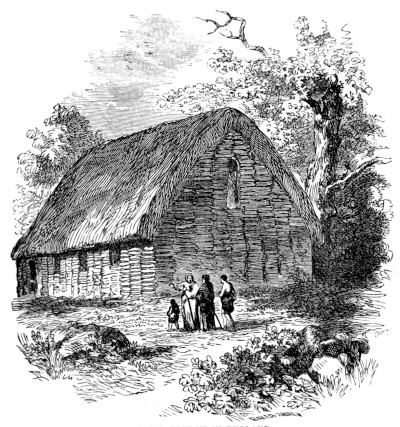
Before passing to speak of Westminster Abbey, which next to St. Paul’s
is the great ecclesiastical edifice of London, it may be interesting to go back
to the earliest church-building in Britain, and notice the kind of edifices in
which our remote ancestors assembled for divine worship. One of these
buildings is represented in the cut below; as to which only a few words of
explanation will be needed. About the close of the sixth century, it is said,
the pope sent Austin, with some forty missionaries, to convert Britain to
popery. Many of the ancient Britons, however, shut themselves up in the
fastnesses of Wales, and refused to be either persuaded or driven to embrace
the new faith which he proclaimed. Still Austin went on with his work,
and the more efficiently to fulfill it, erected rude edifices, in which to gather
the people, to teach them, and train them to the forms of worship. The
662first building erected under his auspices, was at Glastonbury, in the county
of Somerset. The view given of it above is from Somme’s “Britannia
Antiqua Illustrata;” and the following particulars about the building itself
are taken mainly from the “Chronicles of William of Malmesbury.” Its
length was sixty feet, and its breadth twenty-six. Its walls were made of
twigs winded and twisted together, “after the ancient custom that kings’
palaces were used to be built.” “Nay, castles themselves in those daies
were formed of the same materials, and weaved together.” Its roof was of
straw, “or, after the nature of the soil in that place, of hay or rushes.”
The top of the door reached to the roof; it had three windows on the south
side, and one on the east, over the altar, or communion-table. Such was
the rude and humble building in which Austin first preached to those that
he was able to gather to hear the gospel from his lips.
This interesting edifice derives its name of Westminster Abbey from its
situation in the western part of the metropolis, and its original destination
as the church of a monastery. The present church was built by Henry III.
and his successors, with the exception of the two towers at the western
entrance, which are the work of Sir Christopher Wren. The length of the
church is three hundred and sixty feet; the breadth of the nave seventy-two
feet; and the cross aisle one hundred and ninety-five feet. The roof of the
nave and of the cross aisle is supported by two rows of arches, one above
the other, each of the pillars of which is a union of one ponderous round
pillar, and four of similar form, but extremely slender. These aisles being
extremely lofty, and one of the small pillars continued, throughout, from the
base to the roof, produce an effect uncommonly grand and impressive. The
choir is one of the most beautiful in Europe. It is divided from the western
part of the great aisle by a pair of noble iron gates, and is terminated at the
east by an elegant altar of white marble. The altar is inclosed with a very
fine balustrade, and in the center of its floor is a large square of curious
mosaic work, of porphyry, and other stones of various colors. In this choir,
near the altar, is performed the ceremony of crowning the kings and queens
of England.
At the southern extremity of the cross aisle are erected monuments to
the memory of several of the most eminent poets. This interesting spot is
called the poet’s corner; and never could place be named with more propriety;
for here are to be found the names of Chaucer, Spenser, Shakspeare,
Ben Jonson, Milton, Dryden, Butler, Thomson, Gay, Goldsmith, Addison,
663Johnson, &c. Here also, as if this spot was dedicated to all genius of the
highest rank, are the tombs of Handel, Chambers, and Garrick.
The curiosities of Westminster Abbey consist chiefly of its highly interesting
chapels, at the eastern end of the church, with their tombs. Immediately
behind the altar stands a chapel dedicated to Edward the Confessor,
upon an elevated floor, to which there is a flight of steps on the northern
side. The shrine of the Confessor, which stands in the center, was erected
by Henry III., and was curiously ornamented with mosaic work of colored
stones, which have been picked away in every part within reach. Within
the shrine is a chest, containing the ashes of the Confessor. The frieze
representing his history from his birth to his death, put up in the time of
Henry III., is highly curious, and deserves the study and attention of every
lover of antiquity. The tomb of Henry III. is in this chapel: it has been
extremely splendid, but is now mutilated. The table on which lies the
king’s effigy in brass, is supported by four twisted pillars, enameled with gilt.
This tomb, which is a fine specimen of its kind, is almost entire on the side
next the area. It likewise contains the tombs of Edward I. and his queen,
Eleanor; of Edward III. and Queen Philippa; of Richard II. and his queen;
of Margaret, daughter of King Edward IV.; of King Henry V.; and of
Elizabeth, daughter of King Henry VII.
The grand monument of Henry V. is inclosed by an iron gate. The great
arch over the tomb is full of ribs and panels, and the headless figure of
Henry still remains: the head was of solid silver, and was stolen during the
civil wars. There was a chantry directly over the tomb, which had an altarpiece
of fine carved work. The armor of Henry once hung round this
chantry; his helmet yet remains on the bar, and the very saddle which he
rode at the battle of Agincourt, stripped of everything which composed it,
except the wood and iron, hangs on the right.
Contiguous to the eastern extremity of the church, and opening into it,
stands the famous chapel of Henry VII. dedicated to the Virgin Mary, one
of the finest and most highly finished pieces of Gothic architecture in the
world. On its site formerly stood a chapel, dedicated to the Virgin Mary,
and also a tavern, distinguished by the sign of the White Rose. Henry,
resolving to erect a superb mausoleum for himself and his family, pulled
down the old chapel and tavern; and on the eleventh of February, 1503,
the first stone of the present edifice was laid by Abbot Islip, at the command
of the king. It cost seventy thousand dollars, a prodigious sum for that
period, (equal to fourteen hundred thousand dollars of our money;) and
still more so, considering the parsimonious temper of the king. The labor
merely of working the materials will, at a glance, be seen to be immense,
664and almost incredible; and the genius employed both in this structure and
Henry’s tomb, must be mentioned with admiration.
The exterior of this chapel is remarkable for the richness and variety of
its form, occasioned chiefly by fourteen towers, in an elegant proportion to
the body of the edifice, and projecting in different angles from the outermost
wall. It has of late years been repaired and renewed with exquisite taste,
and at great cost. The inside is approached by the area behind the chapels
of Edward the Confessor and Henry V. The floor is elevated above that of
the area, and the ascent is by a flight of marble steps. The entrance is
ornamented with a beautiful Gothic portico of stone, within which are three
large gates of gilt brass, of most curious open workmanship, every panel
being adorned with a rose and a portcullis alternately.
The chapel consists of the nave and two small aisles. The center is
ninety-nine feet in length, sixty-six in breadth, and fifty-four in hight, and
terminates at the east in a curve, having five deep recesses of the same form.
The entrance to these recesses being by open arches, they add greatly to the
relief and beauty of the building. It is probable that they were originally
so many smaller chapels, destined to various uses. The side aisles are in a
just proportion to the center, with which they communicate by four arches,
turned on Gothic pillars. Each of them is relieved by four recesses, a window
running the whole hight of each recess, and being most minute and
curious in its divisions. The upper part of the nave has its four windows
on each side, and ten at the eastern extremity, five above and five below.
The entire roof of the chapel, including the side aisles, and the curve at
the end, is of wrought stone, in the Gothic style, and of most exquisite
beauty.
An altar tomb, erected by Henry, at the cost of fifty thousand dollars, to
receive his last remains, stands in the center of the chapel. It is of basaltic
stone, ornamented with gilt brass, and is surrounded with a magnificent
railing of the same. This monument is by Pietro Torregiano, a Florentine
sculptor, and possesses uncommon merit. Six devices in bass-relief, and
four statues, all of gilt brass, adorn the tomb. It is impossible to conceive
Gothic beauty of a higher degree than the whole of the interior of Henry
the Seventh’s chapel; and it is with regret that the antiquary sees the
stalls of the knights reared against the pillars and arches of the nave,
forming screens that separate the smaller aisles from the body of the chapel,
and diminish the airiness, and interrupt the harmony of the plan. Since
its restoration in 1820, this chapel has formed one of the most beautiful
adjuncts of the abbey, affording one of the most beautiful specimens of its
peculiar style.
665The prospect from the top of one of the western towers, the ascent to
which consists of two hundred and eighty-three steps, is infinitely more
beautiful, though less extensive, than that from St. Paul’s. The many fine
situations and open sites at the west end of the town, and its environs, occasion
the difference. The banqueting-house at Whitehall, St. James’s park,
with the parade and Horse-guards, Carlton house, the gardens of the queen’s
palace, the Green park, the western end of Piccadilly, and Hyde park, with
its river, lie at once under the eye, and compose a most grand and delightful
scene. The bridges of Westminster, Waterloo, and Blackfriars, with the
broad expanse of water between them, the Adelphi and Somerset house on
its banks, St. Paul’s stupendous pile, and the light Gothic steeple of St.
Dunstan’s in the East, are alike embraced with one glance, and happily contrast
with the former prospect. From this tower, the exterior form of St.
Paul’s, when the sun falls upon it, is distinctly seen: and here its exquisite
beauty will be more fully comprehended than in any part of the city, for a
sufficient area to take in the entire outline is not there to be found.
Passing from England to the continent, one of the first church edifices
that attracts attention, both as to its antiquity and grandeur, is the cathedral
of Notre Dame, in Paris. This vast erection of world-wide fame, stands on
an island in the Seine, where was the center of the old city of the Parisii in
the days of Julius Cæsar. It is a cruciform structure, four hundred and
forty-two feet long, one hundred and sixty-two wide, and more than one
hundred feet high to the vaulting of the roof, having all the characteristics
of a vast ancient Gothic cathedral. It was begun in the year 1010, and was
nearly four hundred years in building, not being finished till 1407. At the
west end are two lofty towers, each two hundred and thirty-five feet high,
designed as bases for steeples, which as yet have never been added. The
inside of the church has a very splendid and imposing appearance, owing to
its numerous aisles and chapels; and the west front, with its three large
gates, and circular window, and noble gateway, is worthy of the highest
admiration. In its imposing appearance, no church in Paris will compare
with it.
But by far the most magnificent church edifice in all France, is the cathedral
of Strasburg, a view of which is given in the cut, and which is famous
666all over the world. Till the time of Louis XIV., Strasburg was a free
imperial city; but he seized, and the French have for one hundred and fifty
years held it, as a frontier fortress, and the key to Germany. In the city
there are many objects of interest, one of the most conspicuous of which is a
colossal bronze statue of John Guttenberg, who here first practiced the art
of printing; another is a colossal bronze monument, in honor of General
Kleber; and still another is a beautiful monument to the memory of Marshal
Saxe. But the wonder of the city is the cathedral, the spire of which rises
four hundred and seventy-four feet above the pavement, which is nearly as
high as the great pyramid of Egypt, and one hundred and forty feet higher
than St. Paul’s. Still, owing to the large dimensions of the building, and the
667light and graceful structure of the spire, it does not impress the observer as
being of this extraordinary altitude. The nave of the church is two hundred
and thirty feet high, and the round window at the end is forty-eight feet in
diameter. This wonderful structure was begun nearly eight hundred years
ago. The material is red sandstone, obtained in the vicinity, which has
proved very enduring; the church has therefore suffered very little from
time, and the chiseled and carved material, after so many centuries of exposure
to the weather, retains the sharpness of outline which it had when first
finished.
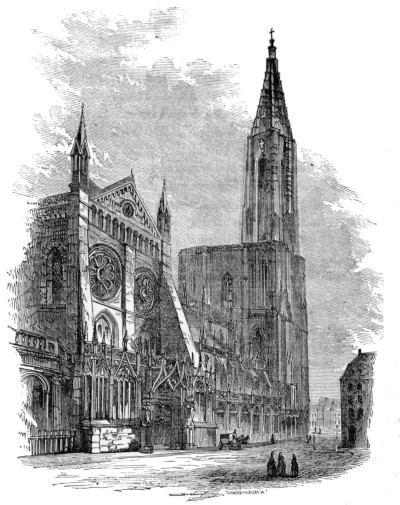
The artist who designed this admirable masterpiece of airy open-work,
was Erwin, of Steinbach: his plans are still preserved in the town. He died
in 1318, when the work was only half finished: it was continued by his son,
and afterward by his daughter Sabina. The tower, begun 1277, was not
completed till 1439, long after their deaths, and four hundred and twenty-four
years after the church was commenced. It was then finished by John
Hültz, of Cologne, who was summoned to Strasburg for this end. Had the
original design been carried into execution, both the towers would have been
raised to the same hight. A doorway, in the south side of the truncated
tower, leads to the summit of the spire. On the platform, about two-thirds
of the way up, is a telegraph, and a station for the watchmen, who are set
to look out for fires. One of them will accompany those who wish to mount
the upper spire, and will unlock the iron gate which closes the passage.
There is no difficulty or danger in the ascent, to a person of ordinary nerve
or steadiness of head; but the stone-work of the steeple is so completely
open, and the pillars which support it are so wide apart, and cut so thin,
that they more nearly resemble a collection of bars of iron or wood; so that
at such a hight one might almost fancy one’s self in a cage, high up, over
the city, rather than in the steeple of a church that has stood firm for ages.
The cathedral, as already said, was intended to have two towers, like
those of the cathedrals of York and Westminster, in England; but as the
expense is enormous, it is probable that the existing tower will remain solitary.
This deficiency gives the building a disfigured appearance, especially
as the unfinished tower, which is square, rises but half-way. Externally,
Strasburg cathedral is distinguished by a light and airy gracefulness, both
of structure and material; the sandstone is cut and carved into a thousand
forms, some of them, especially in the finished tower, extremely delicate and
beautiful. Even the statues and images, which are very numerous, are
chiseled out of sandstone, which has an agreeable color of reddish gray.
There is not an image of marble upon the whole building. The number of
images that cluster around the portal and adhere to its walls is very great:
668they form a host of little beings, in addition to the statues of full size.
Indeed, the profusion of these decorations appears to be extravagant both in
point of taste and economy, and some are quite out of place. In a temple,
a building devoted to religion, it is not easy to understand the propriety of
mounting men on horseback high up in the towers; for such aerial equestrians
are to be seen here, sentinel-like, in positions where saints and angels
would seem more appropriate ornaments. In the interior of this cathedral
there is a simple dignity and grandeur, a holy majesty that is almost overpowering.
The magnificent rows of columns of gigantic dimensions and
altitude, seen in long perspective, exceed in effect all we can well imagine.
The extreme richness of the windows, filled on both sides with stained glass,
commemorating, both historically and allegorically, the events of the Bible,
and the characters and catastrophes of saints and martyrs, fills both the eye
and the mind with delight; and when we turn from gazing to the right and
the left along the extended line of lateral windows, and look upon the vast
circle of gorgeous light which streams down from the great picture luminary
at the end, (a circular window forty-eight feet in diameter, and presenting,
in radiating lines, more than the colors of the rainbow,) we are ready to
exclaim that Art has not fallen short of Nature in beauty, while she excels
her in the permanency of her hues, which have not here been dimmed by
the lapse of centuries; and if no violence is committed on this temple, they
will be equally brilliant after a thousand years more shall have passed
away.
There is in this cathedral a wonderful clock, which has been substituted
for an older one that has been removed. The present clock was constructed
by a man who is still living; it appears to be about fifty feet high, and more
than half that width; it was mute for fifty years, but is now again a living
chronometer. Among its many performances are the following. It tells
the hours, half-hours and quarter-hours, and the bells which make the report
of the flight of time, are struck by automaton figures. A youth strikes the
quarter, a mature man the half-hour, and an old man, as the figure of Time,
the full hour. This clock tells also the times and seasons of ecclesiastical
events, as far as they are associated with astronomical phenomena, and it
gives the phases of the moon and the equation of time. At noon, a cock,
mounted on a pillar, crows thrice, when a procession of the apostles comes
out, and passes in view of the Saviour: among them is Peter, who, shrinking
from the eye of his Lord, shows, by his embarrassed demeanor, that he has
heard the crowing of the cock, and has fully understood its meaning.
Among the movements of its automatons, is that of a beautiful youth, who
turns an hour-glass every fifteen minutes. There is also a celestial orrery,
669that shows the motions of the heavenly bodies with great accuracy and
beauty.
The cathedral of Cologne is at once its ornament and its reproach. It
was begun in 1248 by the elector Conrad, more than six hundred years ago,
but it is not yet finished, although the present Prussian king is expending
vast sums upon it. Since the city has passed under the Prussian dominion,
and more especially since the accession of the present king, important aid
has been obtained from the government. The unfinished towers are rising
year by year; and if the annual supplies that have been granted are continued,
another fifteen years may possibly see it completed. The estimated
expense of finishing it is five million dollars. It is considered as a very fine
specimen of the Gothic architecture. One tower, that on the front, is completed.
This cathedral is exceedingly gorgeous in decorations, combining
all the features that belong to that species of architecture. The choir is
finished, and exceeds in splendid beauty almost everything of the kind which
the traveler will meet with in Europe. It is very rich in stained glass, and
this is true also of the body of the church. Much of the pictured glass is
modern: it is set in the same window with the ancient, and is not inferior
to it in splendor. The cathedral is paved with rude, common stones, doubtless
intended to be temporary only, and to be in due time replaced by marble.
It was originally intended that the towers of this cathedral should be five
hundred feet high. The dimensions on the ground are four hundred feet
by one hundred and eighty. The nave is supported by one hundred columns,
of which the middle ones are forty feet in circumference.
This splendid old church has well been described as “a stupendous pile
of oriental magnificence.” A thousand years do not cover the whole period
of its existence. It is adorned with the columns and gems of the east, and
no wonder, for every Venetian captain of a ship and every traveler of that
nation was required to bring home something to adorn this temple: Greece
and Constantinople, Palestine and all Europe, have contributed to its embellishment.
It is totally unlike almost every other temple. It has round
arches and regular domes, and from every part of them, there look down
upon you, in permanent mosaic of gold and colored stones, and even precious
gems, colossal images of the Saviour, of the virgin mother, of apostles
670and saints, and of multiform beings of religious allegory, so numerous and
various, and so fresh, rich, and gorgeous, that you are quite bewildered, and
involuntarily drop your eyes to the floor, where you are almost equally
dazzled by the precious marbles, and jaspers, and serpentines, and verd-antique,
and red porphyry, disposed in endless variety of most beautiful
patterns, as if it had been the work of a magician artist. You read there
also the instability of human glory in the worn and mutilated condition of
parts of the pavement, and in the waving hollows and upward curves which
prove that its foundations were laid in the sea. You again lift your eyes,
and in the permanent mosaics (for no perishable frescoes or oil paintings are
here) you read in large and distinct historical figures the early Bible history
of our race, and the annals of the patriarchal families. Around the church,
hang rich lamps of silver and gold. Huge candles and lights perpetually
burning, symbolize the immortality of the soul. Passing out of the church,
precious columns are on your right and on your left, columns of marble
and porphyry brought from Constantinople, and Jerusalem, and St. Jean
d’Acre. Lifting your eyes again to the roof, you there see domes, and dome
upon dome; minarets and carvings in arabesque, and other rich forms of
oriental architecture, with images and statues innumerable, standing as sentinels
on all the cornices and angles, and in the niches.
Passing on to the last of the church edifices to be described, we come to
the cathedral of Milan. A good picture is necessary to give even a faint
impression of the richness and harmonious proportions of this wonderful
building; but it is possible, from description, to form a correct conception
of its magnitude, and of its principal parts. Its length is four hundred and
eighty-five feet; breadth, two hundred and fifty-two; breadth across the
transepts, two hundred and eighty-seven feet; hight of the nave, one hundred
and fifty-three feet. The hight from the pavement to the top of the
crown of the Madonna, on the summit of the spire, is three hundred and
fifty-five feet. This cathedral is one of the most stupendous piles ever
erected; but it is not yet finished, although it has been almost five hundred
years in building. Several duomos have been destroyed that once occupied
this place. The first cathedral was destroyed by Attila in the fifth century;
the second was burnt by accident in 1075; and the third was partially ruined
by Frederic Barbarossa. A lofty bell-tower, demolished by him, crushed the
duomo in its fall. The first stone of the present cathedral was laid in
March, 1386, by G. G. Visconti.
671The interior presents a wilderness of columns, some of which are almost
twelve feet in diameter at the base, and more than eight in the shaft. Fifty-two
pillars, of the hight of eighty feet, support the pointed arches on which
the roof rests. The exterior shows equally a wilderness of statues and
pinnacles. Each pinnacle, if placed on the ground, would appear a considerable
spire. The statues already in place number three thousand, and
forty-live hundred are necessary to carry out the plan. Each pinnacle or
minaret is crowned by a statue, and there are many more in the niches,
among the pinnacles, as well as in other situations. In order to become
acquainted with them, you must ascend to the roof, and then you will see
life and meaning in them all; if seen from below, they appear indeed as a
multitude of statues in marble, but without any obvious design. Whatever
the moral may be, it is exhibited at an immense expense of treasure; but,
in Italy, it is a national passion, which has come down to them from the
Romans, to people their ideal world with marble forms, commemorating
those who once lived on earth, or the imaginary beings of allegory and of a
fabulous mythology. In this cathedral, in addition to statues of the size of
life or beyond its dimensions, there are many of inferior magnitude: little
pretty cherubs and imaginative beings are seen, single or in clusters. In all
parts of the building, there are delicate and elaborately wrought carvings in
marble, and even in situations where they can not be seen except by a diligent
explorer. Ascending to the roof of the cathedral, and walking over it,
the traveler will observe that it is composed of massive blocks of marble
accurately adjusted to each other, and although the weight is immense, no
cracks are visible. One moves as freely upon the roof, and with as much
confidence as if a mountain of marble were beneath his feet; and the view
from it is as glorious as it could be from a mountain rearing its lofty head
in place of this structure reared by the art of man!
The Tower of London was anciently a palace occupied by the various
sovereigns of England, till the reign of Queen Elizabeth. It was begun by
William the Conqueror in 1073; and additions were made to it by several
of the later monarchs. The extent within the walls is over twelve acres;
and the exterior circuit of the ditch that surrounds it is over three thousand
feet. A broad and handsome wharf, or gravel terrace, runs along the banks
of the river parallel with the Tower, from which it is separated by the
ditch.
Within the walls of the Tower are several streets; and a variety of buildings,
672the principal of which are, the church, the white tower, the ordnance
office, the record office, the jewel office, the horse armory, the grand storehouse,
the small armory, the houses belonging to the officers of the tower,
barracks for the garrison, &c.
The white tower, which was the original building, is a large square
structure, situated in the center of the fortress. On the top are four watch-towers,
one of which, at present, is used as an observatory. It consists
within of three lofty stories, beneath which are large, commodious vaults.
In the first story are two grand rooms, one of which is a small armory for
the sea-service, and contains various sorts of arms, curiously laid up, which
would serve upward of ten thousand seamen. In the other rooms, in closets
and presses, are abundance of warlike tools and instruments of death. In
the upper stories, are arms and armorers’ tools. The models of all newly
invented engines of destruction, which have been presented to the government,
are preserved in this tower. On the top is a large cistern, filled from
the Thames by a water-engine, to supply the garrison with water. The
grand storehouse, which stands north of the white tower, is a plain building
of brick and stone, three hundred and forty-five feet long and sixty feet
broad. The jewel office is a little to the east of the grand storehouse. It
is a dark and strong stone room. The horse armory is a brick building
eastward of the white tower. The record office is in the Wakefield tower,
opposite the platform. The rolls from the time of King John to the beginning
of the reign of Richard III., are kept here in fifty-six wainscot presses.
They contain the ancient tenures of land in England, the original laws and
statutes, the rights of England to the dominion of the British seas, the forms
of submission of the Scottish kings, and a variety of other records, &c. The
principal entrance to the Tower is on the west. It consists of two gates on
the outside of the ditch; a stone bridge built over the ditch, and a gate
within the ditch. On the right hand, at the west entrance, the menagerie
was formerly kept; but having been superseded by that belonging to the
Zoölogical Society in the Regent’s park, it was broken up a few years ago.
What was called the Spanish armory, contains the trophies of the famous
victory of Queen Elizabeth over the Spanish armada. Among these the
most remarkable are the thumb-screws, intended to be used to extort confession
from the English where their money was hidden. In the same room
are other curiosities; among which is the ax with which the unfortunate
Anne Boleyn was beheaded, to gratify the capricious passions of her husband,
Henry VIII. A representation of Queen Elizabeth in armor, standing by a
cream-colored horse, attended by a page, is also shown in this room. Her
majesty is dressed in the armor she wore at the time she addressed her army
673in the camp of Tilbury, 1588, with a white silk petticoat, ornamented with
pearls and spangles.
The small armory is one of the finest rooms of its kind in Europe. It is
three hundred and forty-five feet in length, and in general it contains complete
stands of arms for no less than one hundred thousand men. They are
disposed in a variety of figures, in a very elegant manner. Among them
is a piece of ordnance from Egypt, sixteen feet long, and seven inches and
a half bore. There are several other curiosities, among which are arms
taken at various periods from rebels; the Highland broad-sword deserves
particular notice. In many respects this room may be considered as one of
the wonders of the modern world. The volunteer armory is in the white
tower, and contains arms, piled in beautiful order, for thirty thousand men,
with pikes, swords, &c., in immense numbers, arranged in stars and other
devices. At the entrance of this room stands a fine figure of Charles
Brandon, Duke of Suffolk in the time of Henry VIII., in bright armor, and
having the very lance he used in his lifetime, which is eighteen feet long.
The sea armory is also in this tower, and contains arms for nearly fifty
thousand sailors and marines. In this room are two elegant pieces of brass
cannon, presented by the city of London to the Earl of Leicester, and various
similar curiosities. Part of the royal train of artillery is kept on the ground-floor,
under the small armory. The room is three hundred and eighty feet
long, fifty feet wide, and twenty-four in hight. The artillery is ranged on
each side, a passage ten feet in breadth being left in the center. In this
room are twenty pillars that support the small armory above, which are
hung round with implements of war, and trophies taken from the enemy.
There are many peculiarly fine pieces of cannon to be seen here: one (of
brass) is said to have cost two hundred pounds in ornamenting. It was
made for Prince Henry, eldest son of James I. Others are extremely curious
for their antiquity. Among them is one of the first invented cannon. It is
formed of bars of iron hammered together, and bound with iron hoops. It
has no carriage, but was moved by six rings, conveniently placed for that
purpose. The horse armory is a noble room, crowded with curiosities. The
armor of John of Gaunt, Duke of Lancaster, and son of Edward III., is seven
feet in hight. The sword and lance are of a proportionable size. A complete
suit of armor, rough from the hammer, made for Henry VIII. when
eighteen years old, is six feet high. The kings of England on horseback, are
shown in armor, from the Conqueror to George II.
The jewel office contains: 1. The imperial crown, with which the kings
of England are crowned. It is of gold, enriched with diamonds, rubies,
emeralds, sapphires and pearls; within is a cap of purple velvet, lined with
674white taffeta, and turned up with three rows of ermine. This is never used
but at coronations, and of course is not often produced. 2. The golden
globe. This is put into the king’s right-hand before he is crowned; and
when he is crowned, he bears it in his left-hand, having the scepter in his
right. 3. The golden scepter and its cross, upon a large amethyst, decorated
with table diamonds. 4. The ancient scepter, covered with jewels and
Gothic enamel work, and surmounted with an onyx dove. This scepter is
believed to be far the most ancient in the collection, and probably is a part
of the original regalia. It was found by the keeper in 1814, exactly at the
time of the general peace. It is estimated at a very high value. 5. St.
Edward’s staff. It is four feet seven inches and a half long, and three
inches and three-quarters round, made of beaten gold. It is borne before
the king in the coronation procession. 6. The gold salt-cellar of state. In
make it is the model of the square white tower, and is of excellent workmanship.
At the coronation it is placed on the king’s table. 7. The sword of
mercy. It has no point. 8. A grand silver font, used for christenings of
the royal family. 9. The crown of state, which is worn by the sovereign at
the meeting of parliament, and other state occasions. It is of extreme
splendor and value, being covered with large-sized precious stones, and on
the top of its cross is a pearl which Charles I. pledged to the Dutch republic
for eighteen thousand pounds. Under the cross is an emerald diamond of a
pale green color, seven inches and a half in circumference, and valued at
one hundred thousand pounds; and in the front is a rock ruby, unpolished,
in its purely natural state, three inches long, and the value of which can not
be estimated. 10. The golden eagle, with which the king is anointed, and
the golden spur. 11. The diadem, worn by the Queens Anne and Mary.
12. The crown of Queen Mary, the cross of King William, and many other
valuable jewels. In this office are all the crown jewels worn by the princes
and princesses at coronations, and abundance of curious old plate. Independently
of several of the jewels which are inestimable, the value of the
precious stones and plate contained in this office, is not less than two millions
sterling. The chapel, situated at the north end of the parade, is not otherwise
attractive, than as it contains a few ancient tombs and monuments.
The building thus entitled is an immense and very extensive stone edifice,
situated a little to the north-west of Cornhill. Until 1825, this edifice exhibited
a great variety of incongruous styles of architecture; but endeavors
have since been made, and with success, to produce more uniformity of
675appearance. On the east side of the principal entrance, is a passage leading
to a spacious apartment called the rotunda, fifty-seven feet in diameter, in
which business in the public funds is transacted; and, branching out of this
apartment, are various offices appropriated to the management of each particular
stock. In each of these, under the several letters of the alphabet,
are arrayed the books in which the amount of every individual’s interest in
such a fund is registered.
The bank of England covers an extent of more than eight acres, and is
completely insulated. Its shape is that of an irregular parallelogram, the
longest side of which measures four hundred and forty feet. Its exterior is
not unsuitable to the nature of the establishment, conveying the idea of
great strength and security. In the interior, a variety of alterations and
improvements have been made to accommodate the vast increase of business
and of the paper money and discounting systems. This has required considerable
enlargements of the offices in every department, and has led, in
the space of thirty or forty years, to the increase of the clerks from two
hundred to about eleven hundred. The capital, or stock, also, of this grand
national establishment, has been considerably and progressively augmented,
until, from twelve hundred thousand pounds, it has risen to eleven million,
six hundred and forty-seven thousand, seven hundred and fifty pounds, or
nearly sixty million dollars. The direction is vested in a governor, deputy-governor,
and twenty-four directors, all elected annually; and thirteen of
the directors, with the governor, form a court for the management of the
business of the institution.
About two hundred yards north of London bridge, is situated one of the
finest pillars in the world, erected by Sir Christopher Wren, in memory of
the great fire, which, in 1666, broke out at a house on this spot, and
destroyed the metropolis from the Tower to Temple Bar. It is a fluted
column of the Doric order; its total hight is two hundred and two feet; the
diameter at the base is fifteen feet; the hight of the column, one hundred
and twenty feet; and the cone at the top, with its urn, forty-two feet. The
hight of the massy pedestal is forty feet. Within the column is a flight of
three hundred and forty-five steps; and from the iron balcony at the top is
a most fascinating prospect of the metropolis and the adjacent country. It
is impossible not to lament the obscure situation of this beautiful monument,
which, in a proper place, would form one of the most striking objects of the
kind that architecture is capable of producing.
676
This splendid palace, which was planned in the reign of Francis I., at the
commencement of the sixteenth century, is a quadrangular edifice, having
a court in the center, and forming a square of about four hundred and sixteen
English feet. The front was built in the reign of Louis XIV., and is
one of the most beautiful monuments of his reign. A spacious gallery,
fourteen hundred and fifty English feet in length, connects this palace with
that of the Tuilleries. Here was displayed, under the title of the Musee
Napoleon, that inestimable collection of paintings, one thousand and thirty
in number, consisting of the chefs-d’œuvre of the great masters of antiquity,
and constituting a treasury of human art and genius, far surpassing every
other similar institution. The ante-room leading to the gallery contained
several exquisite paintings, the fruits of the triumphs of Bonaparte, or
which had been presented to him by the sovereigns who had cultivated his
alliance. This apartment was styled by the Parisians the Nosegay of Bonaparte:
its most costly pictures were from the gallery of the Grand Duke of
Tuscany; and to these were added a selection from those procured at
Venice, Naples, Turin and Bologna.
It would be impossible adequately to describe the first impressions made
on the spectator on his entrance into the gallery, where such a galaxy of
genius and art was offered to his contemplation. It was lined by the finest
productions of the French, Flemish and Italian schools, and divided by a
curious double painting upon slate, placed on a pedestal in the middle of
the room, representing the front and back views of the same figures. From
the Museum the visitor descends into the Salle des Antiques, containing the
finest treasures of Grecian and Roman statuary. His notice is instantly
attracted by the Belvidere Apollo, a statue surpassing, in the opinion of
connoisseurs, all the others in the collection. This matchless statue is thus
described by Sir John Carr, in his work entitled “The Stranger in France.”
“All the divinity of a god beams through this unrivaled perfection of form.
It is impossible to impart the impressions which it inspires: the riveted
beholder is ready to exclaim with Adam, when he first discerns the approach
of Raphael:
“‘Behold what glorious shape
Comes this way moving: seems another morn
Risen on mid-noon; some great behest from heaven.’
“The imagination can not form such an union of grace and strength.
677One of its many transcendent beauties consists in its aerial appearance and
exquisite expression of motion.” The Medicean Venus, from the palace
Pitti, at Florence, also formed a part of this magnificent collection of
statues. The classic Addison, in speaking of this statue, which he saw at
Florence, observes, that it appeared to him much less than life, in consequence
of its being in the company of others of a larger size; but that it is,
notwithstanding, as large as the ordinary size of women, as he concluded
from the measure of the wrist; since, in a figure of such nice proportions,
from the size of any one part it is easy to guess at that of the others. The
fine polish of the marble, communicating to the touch a sensation of fleshy
softness, the delicacy of the shape, air and posture, and the correctness of
design, in this celebrated statue, are not to be expressed.
The Paris museum, and Salle des Antiques, although deprived, at the
termination of the contest with France, of so many chefs-d’œuvre of art,
still contain others which render them highly interesting. The finest productions
of Le Brun, several of them on an immense scale, still remain; as
do likewise the matchless marine paintings by Vernet; the truly sublime
works of Poussin, consisting of the chief of his masterpieces; together with
many choice paintings by Rubens, Wouvermans, De Witte, &c. Many of
the statues remaining in the Salle des Antiques are likewise admirable
specimens of sculpture. In the gallery of the Louvre a very curious collection
of models, representing the fortresses of France and other countries,
was once exhibited; but it was removed, that the paintings might be seen
with greater effect. These models, executed in the reign of Louis XIV.,
and amounting to upward of one hundred and eighty, were wrought with
the greatest accuracy, and so naturally, as to represent the several cities
which they describe, with their streets, houses, squares and churches,
together with the works, moats, bridges and rivers, not neglecting the adjacent
territory, as consisting of plains, mountains, corn-lands, meadows,
gardens, woods, &c. Several of these models were so contrived as to be
taken in pieces, so that the curious observer might be better able to perceive
their admirable construction.
Of this splendid building and gallery, Silliman, in his late tour, says, “A
mere catalogue of the objects in the Louvre, with the most brief description,
would swell to a volume. The building forms part of a vast unfinished
quadrangle, upon the usual plan of ancient castles and palaces. In various
stages of its progress, during many centuries, it has been used both as a
castle and a palace. From its windows, or from the windows of a building
occupying the same place, the infamous Charles IX. fired upon his Protestant
678subjects during the massacre of St. Bartholomew, August twenty-fourth,
1572, crying, with the voice of a fiend, ‘Kill! kill!!’
“The Louvre, as a grand museum of the arts, is indebted chiefly to
Napoleon and Louis Philippe. Even as late as the reign of Louis XVI., the
greater part of the Louvre remained without a roof. The magnificent
bronze gates are due to Napoleon. He and Louis Philippe did more for the
embellishment of Paris than any monarch, except Louis XIV. Had we
seen the Louvre when we were first in Paris, it would have made a much
stronger impression than now; and this remark can be, in a degree,
extended to all its various contents, whether statues, ancient or modern,
antiquities of various ages and nations, Egyptian, Assyrian, Etruscan, Grecian,
Roman, Mexican, or Peruvian, or of whatever name. Exquisite objects,
in curious arts, may be included—cameos, gems, crystal vessels, and ornaments.
Even at this late period of our tour, the Louvre has, however, made
a very strong impression. It is a glorious spectacle: there is no museum
that can compare with it, except that of the Vatican. The British museum
is not a fair subject of comparison with either of these, as its plan and main
objects are different. The Louvre is strictly a museum of the fine arts and
of antiquities. Libraries it has not, nor does it include natural history,
which is so abundantly illustrated at the Garden of Plants, and in the other
excellent institutions in Paris. That hall of the Louvre which is called the
long gallery is thirteen hundred and thirty-two feet in length, over a quarter
of a mile, and forty-two feet wide, all seen in one view. The walls are
entirely covered by pictures, amounting in the aggregate to fourteen hundred
and eight, of which three hundred and eighty are French, five hundred
and forty are Flemish and German, four hundred and eighty are Italian,
and eight are modern copies of ancient pictures. Only the works of
deceased artists are admitted into this museum, which was formed principally
by Napoleon, and enriched with most of the chefs-d’œuvre of Europe.
The greater part of those foreign pictures were claimed and removed by the
allies in 1815; but they are hardly missed; for, even now, this gallery is
one of the finest in the world.
“I have already had occasion to remark that in our tour we have seen a
number of pictures and statues in various cities, particularly in Italy,
which, having traveled to Paris, were restored after the Russian campaign
and the battle of Waterloo. There were, however, so many fine things left
behind in the different galleries from which those pictures had been taken,
that the omission would hardly be noticed there, any more than their
absence from the Louvre is observed now, except by a few scrutinizing
artists and connoisseurs. In despair of making any progress in this vast
679collection, I shall not even attempt to describe any particular pictures, and
thus I must pass by the grandest gallery perhaps in the world, because I
can not do it any justice, and for a still worse reason, because so many galleries
of less importance have been visited first. The room called Salle de
Bijoux is very rich in the rare and costly things which kings are wont to
collect, and which are here so numerous and beautiful that they surpass the
similar collections in the Pitti palace in Florence, but they are inferior in
splendor and magnificence to those we had lately seen at Dresden. There
is here, however, a profusion of gems, diamonds, sapphires, rubies, &c.;
and the vessels fabricated from rock crystal are numerous, large and splendid.
The Egyptian museum is particularly rich in everything which illustrates
the history and manners of that country. The gallery of ancient
statuary, and of modern copies, is so similar to what we have seen in Italy,
that I will not enter into particulars. There is nothing here more surprising
than the stupendous sculptured stones from Nineveh, sent out by M.
Botta, the French consul. They are not so numerous as in the collection
which we saw in the British museum, but there are figures here which surpass
in magnitude any that are there; at least such is my recollection. The
winged bulls, with a lion’s head, and the figures on the reverse of the stone
panels, are of such vast size, that we are astonished that they could have
been transported without injury from the other side of the world. A tall
man is a dwarf by their side.”
This grand national collection of antiquities, books and natural curiosities,
is placed in the noble house formerly belonging to the Duke of Montagu,
in Great Russell street, Bloomsbury. It is a stately edifice, in the
French style of the reign of Louis XIV., and on the plan of the Tuilleries.
The celebrated French architect, Peter Paget, was sent over from Paris, by
Ralph, first Duke of Montagu, expressly to construct this splendid mansion,
which is, perhaps, better calculated for its present purpose than for a private
residence.
The British museum was established by act of parliament, in 1753, in
consequence of the will of Sir Hans Sloane, who left his museum to the
nation, which he declared in his will, cost him upward of fifty thousand
pounds, on condition that parliament should pay twenty thousand pounds to
his executors, and purchase a house sufficiently commodious for it. The
parliament acted with great liberality on this occasion; several other valuable
collections were united to this of Sir Hans Sloane, and the whole establishment
680completed for the sum of eighty-five thousand pounds, which was
raised by the way of a lottery. Parliament afterward added, at various
times, to the Sloanean museum, the Cottonian library; that of Major
Edwards; the Harleian collection of manuscripts; Sir William Hamilton’s
invaluable collection of Greek vases; the Townleian collection of antique
marbles; the manuscripts of the Marquis of Lansdowne; and, lastly, the
celebrated Elgin marbles, which comprise what are considered as the finest
specimens of ancient sculpture. The whole of the important library of
printed books and manuscripts which had been gradually collected by the
kings of England from Henry VIII. to William III., was presented to the
museum by George II.; and George III. bestowed on it a numerous collection
of valuable pamphlets, which had been published in the interval
between 1640 and 1660. His majesty likewise contributed the two finest
mummies in Europe; the sum of eleven hundred and twenty-three pounds,
arising from lottery prizes, which had belonged to his royal predecessor;
and, in 1772, a complete set of the journals of the lords and commons.
To these contributions he afterward added a collection of natural and artificial
curiosities, sent to him, in 1796, by Mr. Menzies, from the north-west
coast of America, and several single books of great value and utility. The
trustees have at various times added Greenwood’s collection of stuffed birds;
Hatchet’s minerals; Halhed’s oriental manuscripts; Tyssen’s collection of
Saxon coins; Doctor Bentley’s classics; and the Greville collection of minerals.
To these may be added numerous donations from several of the
sovereigns of Europe, as well as from learned bodies and private individuals,
including the splendid monuments from Nineveh, and other wonderful
and curious contributions that will be mentioned.
The building itself is a spacious quadrangle of some two thousand feet, or
nearly two-fifths of a mile in circuit, occupying a large part of Great Russel
square; and even now, greatly enlarged as it has been, it is quite inadequate
for the growing demands for space in all departments. The ground-floor
consists of twelve main rooms, and contains the library of printed books.
The first room of the upper story contains modern works of art from all
parts of the world, arranged in cases. In the one in the center are several
beautiful miniatures, among which are those of Sir Thomas More, Charles
I., and Oliver Cromwell, the latter having his watch placed by its side. Two
curious portraits of William III. and Queen Mary, are carved on two
walnut-shells. In the presses are arranged, in geographical order, some fine
specimens of China, and a variety of implements of war from different
quarters of the globe. Here is to be seen the rich collection of curiosities
from the South Pacific ocean, brought by Captain Cook. In the left corner
681is the mourning dress of an Otaheitan lady, in which taste and barbarity are
singularly blended; and opposite, are the rich cloaks and helmets of feathers
from the Sandwich islands. Among these is one, which, in elegance of form,
vies even with the Grecian helmets. In another case are the cava bowls,
and above them battoons, and other weapons of war. The next objects of
attention are the idols of the different islands, presenting in their hideous
rudeness, a singular contrast with many of the works of art formed by the
same people; near these are the drums and other instruments of music,
and a breast-plate from the Friendly islands. The ceiling of this room, or
vestibule, represents the fall of Phæton.
The second room consists of similar objects. The third is devoted to the
Lansdowne collection of manuscripts, which have been handsomely bound
and lettered. In the fourth are the Sloanean and Birchean collections of
manuscripts. The fifth contains part of the Harleian library of manuscripts,
and the sixth, the first part of the same, and additions made since the establishment
of the museum. The seventh is appropriated to the royal and
Cottonian library of manuscripts. On a table, in a glazed frame, is the
original of the Magna Charta, belonging to the Cottonian library. Against
the press, number twenty-one, of the Cottonian collection, is the original of
the articles preparatory to the signing of the great charter, perfect, with the
seal. The magnificent saloon is filled with the Greville collection of minerals,
the finest in the world, admirably arranged, and luminously colored.
The dome of this saloon merits notice. It was painted by La Fosse, and has
been described as the apotheosis of Iris, or birth of Minerva. In the middle
of the window stands a table, composed of a variety of lavas from Mount
Vesuvius, presented by the Earl of Exeter. The eighth room contains a
department of natural history, part of which is the valuable donation of Mr.
Cracherode, disposed in two tables, nearly in the Linnæan order; and a
much more extensive series, arranged according to the Wernerian system.
The principal productions are very valuable, consisting of minerals from
Derbyshire, Siberia, the South seas, volcanic and rock stones from Germany,
&c. One very curious specimen of natural history is pointed out in the fifth
division of the Cracherodean collection, an egg-shaped piece of chalcedony,
containing water, which may be seen by gently shaking the vase. Here,
also, in a glass case, is the famous fossil skeleton from Gaudaloupe, which
has been the object of much interesting controversy among eminent naturalists.
The ninth is appropriated to petrifactions and shells. In the first
division of the cases in the middle of the room, is a valuable univalve shell,
of the species called the paper nautilus, or argonaut shells, remarkable for
the slightness of its fabric, and the elegance of its shape. It is inhabited
682by an animal not unlike a cuttle-fish, which by extending a pair of membranes,
adhering to the top of its longest arms, has the power of sailing on
the surface of the sea. Under the tables are deposited, in this and the next
room, a great number of volumes and parcels, containing collections of dried
plants; which, from the fragile nature of their contents, are shown only on
particular leave. The tenth room is entirely filled with vegetable productions,
zoöphytes, sponges, &c. The contents of the eleventh room are birds,
and arranged as far as convenience would admit, according to the Linnæan
system. Among the curious specimens of ornithology is a humming-bird,
scarcely larger than a bee; also another beautiful little creature called the
harlequin humming-bird, from the variety of its colors. In this room there
is a curious picture, executed many years ago in Holland, of that extremely
rare and curious bird, the dodo, belonging to the tribe gallinæ. In the table
in the middle are preserved the nests of several birds, among the most
curious of which are several hanging nests, chiefly formed by birds of the
oriole tribe; nests of a substance resembling isinglass, which the Chinese
make into a rich soup; scarce feathers, &c. In the second table are deposited
a variety of eggs and nests: among the former may be noticed the eggs
of the ostrich, the cassowary, the crocodile, &c. In the cases between the
windows are several of the rarer quadrupeds; among these the most curious
are, two orang-outangs, in a young state, a long-tailed macauco, ermine, &c.;
in cases under the tables are an armadillo, or porcupine, several young
sloths, and a fine specimen of the two-toed ant-eater. The twelfth room
contains a general and extensive arrangement of fishes, serpents, lizards,
frogs, &c.
The Townley marbles and Egyptian antiquities, are deposited in a very
elegant suite of rooms built purposely for them. The first room is devoted
to a collection of bass-reliefs, in terra cotta, pronounced the finest in Europe.
The second is a beautiful circular room, whence you have a fine view of the
whole suite of apartments, bounded at the end by an exquisitely-wrought
discobolon, or ancient quoit-player. This room is devoted to Greek and
Roman sculptures, among which may be pointed out a fine candelabrum,
with several beautiful busts and statues. The third and fourth rooms are
also filled with Greek and Roman sculptures: in the latter are several fine
bass-reliefs. The fifth contains a collection of Roman sepulchral monuments,
and a beautiful mosaic pavement, discovered in digging the foundations
for a new building at the bank of England. The sixth exhibits a
miscellaneous collection of one hundred grand pieces of Roman and Greek
sculpture. The seventh is devoted to Roman antiquities, and the eighth,
on the left, to Egyptian antiquities, among which are the two mummies
683before mentioned, with their coffins; a manuscript, or papyrus, taken from a
mummy, &c. Among the Egyptian sculptures in the ninth room, is the
celebrated sarcophagus, commonly called the tomb of Alexander the Great,
an engraving and dissertation on which appeared in the Monthly Magazine
for February, 1809. The tenth contains Greek and Roman sculptures of
singular beauty.
Thence returning, and proceeding up stairs, the visitor is conducted to
the eleventh room, containing ancient and modern coins and medals, arranged
in geographical order, those of each country being kept separate. It is not
shown unless by the permission of the trustees, or of the principal librarian.
Not more than two persons are admitted at one time, without the presence
of the principal librarian, or of some other officer. The twelfth room
contains the collection of the late Sir William Hamilton, which has been
removed from the saloon. It principally consists of penates, or household
gods, bronze vessels, utensils, &c., specimens of ancient glass, necklaces,
bullæ, fragments of relievos, and ancient armor, tripods, knives, patent
lamps, seals, weights, sculpture in ivory, bracelets, bits, spurs, ancient paintings
from Herculaneum, Babylonish bricks, and his unrivaled collection of
Greek vases, the greater part of which were found in the sepulchers of
Magna Grecia. The forms of the vases are much varied, and are equally
simple and beautiful. In the thirteenth is deposited the extensive and
valuable collection of prints and drawings, the most important part of which
was bequeathed by the Rev. William Cracherode. The contents of this room
can be seen only by a few persons at a time, by particular permission.
In addition to the various curiosities enumerated above, Professor Silliman
mentions many others which have been contributed to the museum more
recently; and more fully describes some already noticed. “Here,” he says,
“is a rich collection of Etruscan vases, from the cemeteries of the ancient
inhabitants of Italy, who preceded the Roman empire. A part of this collection
was deposited by the Prince de Canino, son of Lucien Bonaparte. The
Maltese are now the only people who fabricate ware like the ancient Etruscan.
Through the kindness of a gentleman attached to the museum, we
were permitted to see the original Portland vase. It is of moderate dimensions.
The material, contrary to my former impression, is glass, and not
earthen-ware. The basis was dark blue, almost black, and in the manner
of the modern Bohemian glass, it appears to have been dipped into a semi-transparent
white enamel, which gave it an exterior coating of that color.
This was then cut away, so as to leave the exquisitely wrought figures of
the human form by which it is adorned. It was successfully imitated by
the late Mr. Wedgwood, in his peculiar porcelain, but it has never been
684surpassed in beauty of model, or in the perfection of its decorations. Mr.
Wedgwood’s copies cost fifty pounds each, which, even with a large subscription,
did not reimburse him. Mr. Webber, the artist, received fifty pounds
for modeling it. The original was discovered in the tomb of Alexander
Severus, who died as early as the year 235, and the Duchess of Portland
paid one thousand guineas for it; hence it was called the Portland vase. It
will appear incredible that any one should be willing to destroy such a gem
of art; still, a few years ago, a man who was believed to be either drunk or
insane, (very probably both,) hurled a stone at it, and shivered the beautiful
antique into fragments. A fac-simile of the vase, as it lay in ruins, is preserved
in a glazed frame in the room. But by great care and skill, the
fragments have been reunited, and cemented together, so that the joinings
can be perceived only by a near approach. The culprit was imprisoned for
two years; and a law being afterward made to fit such cases, (ex post facto,
perhaps,) he is, I believe, not yet liberated, and, certainly, ought not to be,
without satisfactory evidence of a sounder state of mind. In the same room
with the Portland vase is a rich collection of antique ornaments in gold.
They are personal ornaments, Etruscan, Roman, British, Saxon, Norman,
Scotch and Irish. Among them are elegant forms, rings, bracelets, girdles,
tiaras, brooches, &c. They are in appearance as rich and bright as if made
yesterday; and evince that in ages long past, both the value of gold and the
manner of working it were well understood. Some of these things were
found in graves, some in morasses, and, probably, some on battle-fields.
“Here, also, we saw the colossal monuments of stone, disinterred by the
labors of Mr. Layard, and brought from ancient Nineveh. The bull and the
lion, each with the wings of an eagle, and the face of a man, symbolical of
strength, courage, speed and intelligence, are at present in the lower room,
along with the two gigantic figures in human form, each being originally
divided transversely above the waist. It is now intended to reunite them,
when the Nineveh figures receive their final position in the museum. These
stupendous pieces of primeval sculpture fill the observer with astonishment,
both that they could ever have been constructed, and that they should ever
have been extricated from their long-forgotten sepulchers, and transported,
without the slightest injury, from a position far inland, across wide oceans,
to this distant country, which did not begin to emerge from barbarism until
ages after the very site of Nineveh had passed into oblivion. These colossal
forms are so vast in their dimensions, that man, by the side of them, appears
a pigmy; and still they were shaped by human hands, which for thousands
of years have crumbled into dust, while their works remain fresh and perfect
as when first finished by the chisel of the now long-forgotten artist. Our
685polite conductor also accompanied us to a lower room, in which are stored a
great number of the alabaster panels of Nineveh. They are very large, and
are covered by figures in relief, bold and perfect; scenes of war and of peace,
figures of master and servant, of monarch and subject, of warrior and soldier,
and of victor and prisoner. In fact, they are exactly such figures as are
represented in the published volumes of Mr. Layard, the illustrations in
which are in no degree exaggerated, but, on the contrary, the figures are
copied with the most scrupulous exactness. A hall is in preparation for
these precious relics of an age coeval with the dawn of art and civilization,
and of which, as extended to our time, the entire Christian era forms but an
integral part. At first view, it appears very surprising that they have
escaped through thirty or forty centuries without injury; and this is the
more remarkable, as they are composed of so soft a material as alabaster.
It would certainly have been worn and corroded by the hand of time had it
not been protected by the mildness of the climate, and still more by the
position of these sculptures, cut off from the atmosphere, and buried in the
crumbled and dry earth of the buildings when they were destroyed.”
The collection of minerals, &c., Silliman goes on to say, is arranged in
sixty cases in four rooms. And here is the fossil woman of Gaudaloupe, a
skeleton both headless and footless, but having ribs, spine, limbs, &c., so
complete as to show beyond doubt that once it belonged to a living woman;
and with it there were found numerous other human bodies as well as utensils,
rude weapons, &c. Here, too, are the remains of the enormous lizards
of geological antiquity. “The fossil saurians, in the collection of Mr.
Hawkins,” says the writer just quoted, “purchased by the museum, were
skeletons of ichthyosauri, plesiosauri, and other forms of reptilian life.
There is a perfect fossil skeleton of the ichthyosaurus, which I measured.
It is fully twenty feet long; and there is beneath it a series of vertebræ of
another individual, doubly cup-shaped, like the vertebræ of fishes. They
seem to be all present, and must have belonged to an animal still larger than
the one which I have named. The figures of these ancient distinct races are
now familiar in our elementary books, and I shall not enter into any minute
details. Most of the fossil saurians were marine. They appeared soon after
the period of the coal formation, and were continued to that of the chalk.
A miniature lizard has been recently found in the old-red-sandstone.
“The collection in the British museum is appalling. It fills one with
astonishment, as we here contemplate the indubitable remains of an age
gone by, never to return. Still more astonishing are the reptilian remains,
brought to light chiefly by the researches of Dr. Mantell, aided by Dr.
Buckland and other coadjutors. But to Dr. Mantell solely belongs the
686credit of having established the existence of several families of land lizards,
whose magnitude far exceeds that of the marine saurians. The bones of the
iguanodon, of the hylæosaurus, and pelorosaurus, are colossal—equal to
those of the largest elephants, and in some individuals even surpassing
them, while their length, in some instances, was equal to that of the longest
whales. The form of their teeth, and the hollow condition of their bones,
with a large canal for marrow, prove that their habits were those of terrestrial
animals; while the form of the teeth, and the solid condition of the
bones of the saurians, before named, adapt them to a marine life; since the
buoyancy derived from the sustaining power of the water would enable
them to swim with this additional weight. The bones of these land lizards
discovered by Dr. Mantell, and now in the museum, with those in his own
house, studied and disposed of anatomically, by his skill in comparative
anatomy, and in the general principles of physiology, prove the existence of
these giants of antiquity, which were not carnivorous, but were vegetable
eaters, in a climate capable of producing a tropical vegetation, which then
existed both in England and on the European continent, and probably pervaded,
more or less, the entire planet. Dr. Mantell’s original memoirs and
published volumes must be consulted for the proofs of these positions, and
for the details of anatomical structure. He was with me in my last visit to
the museum, and gave additional explanations on the grand fossils deposited
there, especially those of his own gathering, and also on those obtained by
Mr. Hawkins, of Gloucester. Both collections relate chiefly to the extinct
colossal lizards of the gone-by geological ages. The immense collection of
fossils from the Himalaya mountains also passed under review. They have
added much to our knowledge of zoölogical antiquity. Dr. Buckland discovered
near Oxford the bones of a large carnivorous reptile, the megalosaurus,
which approximated toward the magnitude of the lizards of Dr.
Mantell.”
This museum consists of a celebrated collection of wax figures, which
“enjoys a high and deserved reputation,” says Silliman; and which, he
adds, “is the only one of the kind from which I have ever received any
pleasure.” “There are three successive rooms,” he continues, “in which
are seen a great number of personages in costume, and in natural and characteristic
positions in relation to each other. In the vestibule the visitor
passes through groups of marble statues, such as may be seen in many
other places. On entering the first room of the museum, exactly at the
687door, and sitting in a chair, a pleasant looking young Chinese, a door-keeper,
as I supposed, almost spoke to me, and I did quite speak to him, so lifelike
was he; but as he seemed not to understand English, we passed on. The
next personage, in the right corner of the room, was a well dressed gentleman,
whom I for the moment mistook for a living Englishman; he looked
so very affable, that I took him for an official, and was about to make an
inquiry of him, when I perceived that he too belonged to the deaf mutes.
Next came those to whom I must not speak, the queen with Prince Albert,
and four of their sweet children, mounted on an elevated platform. The
likenesses are so striking, judging from pictures, statues and information,
(for I have not seen them,) that the royal personages might be readily
recognized by one who knew them; for, as seen here, they are all but speaking,
and moving, and breathing.
“Although no figures in these rooms spoke, three gave signs of life. One,
a Chinese lady in a rich oriental dress, was standing on her little feet, by
her husband, while he, a Hong merchant, in splendid attire, was listening to
some communication from her; and although we could not hear what she
said, she gave effect to her address by an earnest look and by a gentle movement
of her head. Another lady, Madame —--, afterward a victim of
Robespierre’s cruelty, because she indignantly refused to become the victim
of his lust, lies asleep on her couch in her day dress, probably in prison prior
to her execution. She breathes, and her bust, with her dress, rises and falls
so naturally with the respiration, that you instinctively move softly, lest she
should be disturbed in her slumber. In these rooms are seen imposing
occasions of state. The queen, in another scene than which has been
named, with her family, is surrounded by her ministers, bishops, and lords
and ladies, and by courtiers, and generals, and foreign embassadors; (I blend
two of these scenes into one;) all are in full court-dress, in magnificent
robes, and sparkling with factitious diamonds. The illusion is so complete,
that were an observer introduced suddenly into the scene, without an intimation
of the deception, he would be startled at finding himself in such
company.
“Hundreds of the most eminent persons, both of the living and the dead,
are here, and the likenesses are so good that I readily recognized several,
either of those whom I had seen when living, (e. g., George III., Pitt, and
Fox,) or whose pictures or busts were familiar, (Voltaire, Sir. W. Scott, and
Washington.) Calvin, Luther and John Knox are in one group, and the
latter is addressing Queen Mary of Scotland, on whom he seems not likely
to make any more impression now than he did of yore. I might multiply
these instances. Napoleon and his marshals; Louis XVI. and his children
688and sister; Louis Philippe and his family; Queen Elizabeth and her courtiers;
Anne Boleyn and her bloody husband; Charles I. and II., the former
listening to a talk from Cromwell; James I. and II.; the royal dukes, sons
of George III.; Lord Wellington; Lord John Russell; Admiral Napier, of
Acre memory; and many, many more. Pictures of eminent persons and
of interesting scenes are hung all around the lofty rooms, which are gilded
and adorned in the manner of a palace. A throng of visitors were in the
apartments, but from their dress and appearance, it was obvious that they
belonged not to the upper ten thousand, but to the lower million, and most
of them were probably of that class, who, having been drawn to London by
the great exhibition, take the opportunity to see other wonders of the great
metropolis, and we were pleased that they could be thus gratified.
“Passing the room of horrors, (that is of murders and executions,) where
an additional sixpence is demanded for the pleasure of seeing what all
should desire to avoid, we entered a room called the hall of Napoleon, occupied
chiefly by relics of that great captain and emperor, who made such an
impression on the age in which he lived, that his name and his deeds—the
deeds of more than twenty years of sanguinary conflict, with only short
interludes of repose—are now enrolled in history, and will go down to the
end of time. The relics here preserved are personal articles, which once
belonged to him. His own hair is inclosed in the same locket with that of
his son, the Duke of Reichstadt. There is the sword of the Egyptian campaign,
which was waved in many a bloody battle. Here are the more harmless
utensils of his table; but the most conspicuous things are his carriages,
three in number. In one of these he made his excursions from Longwood,
in St. Helena, to the boundaries of that small island, rough with volcanic
rocks. This carriage is a plain yellow barouche, with nothing peculiar in its
appearance. His common or usual traveling carriage was in the post-chaise
form, with inside seats for only two persons, and there is a low division
between them. His iron bedstead was folded like the legs of a grasshopper,
packed in a case, and hung beneath the coachman’s seat. Inside of the carriage
is a writing-desk, which can be drawn out at pleasure, to accommodate
the traveler; and it still retained its connection with the front of the carriage.
There is a movable board, which answered for a table; and a door
opens in front, beneath the writing-desk, to afford room for the limbs when
the traveler wishes to sleep. The bedstead might perhaps admit of a partial
contraction, so as to be placed in the carriage, in front of the seat, as a support,
or there might have been some other contrivance for this purpose.
This carriage is said to be lined with concealed iron plates, to afford protection
against the bullets of assassins. That found on the field of Waterloo is
689yellow, and the paint and varnish, have come off in certain places, so that it
is defaced in appearance. This latter carriage is a common coach with two
seats, the front seat, as usual, reversed; but there is nothing peculiar in its
appearance or conveniences, and it was probably taken in haste after the
return from Elba; for the hundred days included Napoleon’s hegira, his
brief sway in Paris, and his downfall at Waterloo, and to that fatal field he
rode in this carriage. But the most interesting relic is the bed on which
the fallen emperor died. We were assured that it was the very bed and
bedstead of St. Helena, and that it was the camp establishment of his
campaigns.”
The palace of the famous Duke of Marlborough, presented to him by the
nation, in honor of his services, is not far from Oxford, in England. This
magnificent structure has often been described, and recently by Silliman in
his “Visit to Europe.” “We entered,” he says, “by the splendid portal
erected to the memory of her husband by the surviving Duchess of Marlborough.
The palace is situated on a plain in the midst of an extensive
domain, eleven miles in circuit, laid out in the finest style of an English
park. There are twenty-five hundred acres covered with the richest verdure,
including a beautiful lake, from which large pike are obtained. The
palace is an immense structure, and has been greatly improved by the
present duke, who, it is said, has recently expended eighty thousand pounds
upon the establishment. It is in vain to attempt a detailed description.
The north front measures three hundred and eighty-four feet from one wing
to the other. We were courteously conducted through the palace by a man
of good appearance, and of civil but formal manners. He was dressed in
black: you would take him for a gentleman, and feel that it would be
improper to offer him money, but he took it from our party. We were
taken through one splendid room after another, until it would seem as if
there would be no end of them. They were generally lofty, apparently
twenty to twenty-five feet high, and ornamented with rich ceilings, gilding,
and fresco paintings. The principal apartments are the hall, the bow-window
room, the state bedroom, the billiard-room, the breakfast-room, the
grand cabinet, the small drawing-room, the great drawing-room, the dining-room,
the saloon, the green drawing-room, the state drawing-room, the
crimson drawing-room, the library, the chapel, and the Titian room. This
palace had no appearance of being the comfortable home of the family, who,
it is said, keep it up out of regard to the glory of their great ancestor; but
690that they are too poor to live in it in a style of appropriate magnificence.
The gardens or pleasure grounds, and the private grounds, were not visible.
“The pictures in this palace are numerous, and many of them are admirable.
Vandyke, Sir Godfrey Kneller, Rubens, Holbein, Paul Veronese,
Leonardi da Vinci, Reynolds, Poussin, Carlo Dolci, Corregio, Rembrandt,
Teniers, Titian, and other eminent artists, by mental creations, contributed
the living glowing images of their own minds, or transferred living features
to the canvas. Many very beautiful and lovely women and princely men
look down upon the observer from these animated and eloquent walls; for
the palace is, in fact, an immense gallery of pictures, divided among many
rooms. The victories of the Duke of Marlborough are displayed in Antwerp
tapestry upon the walls of several of the apartments. The tapestry pictures
are of great size: a single picture covers a side, sometimes two sides of a
large room; so that there is space to exhibit also the scenery of the country;
there is room also for portraits of the principal officers, as large as life—of
the duke himself, and even of the horses; and near or remote, the hostile
armies are lingering on the fearful edge of battle, or they are actually
engaged in deadly combat. How touching the reflection, how sad the
remembrance, that, excepting the present duke and his family, only one
individual of all the vast number of human beings represented by these
pictures survives. One that appears as a little child in a large family group,
is now the aged grandmother of a distinguished peer. All the rest have
passed away, and the great Marlborough himself, and his proud, aspiring
duchess, lie under the marble pavement of the chapel in the palace, as Louis
XIV., the Grand, reposes in his own tomb, and Queen Anne in hers; and
all the sanguinary conflicts of that eventful period are now to be found in
history alone. War, by a spirit of chivalry, was then a kind of duel on a
great scale; it is said that military courtesy sometimes offered the first fire
to the enemy; and a similar offer being made in return, they thus bandied
compliments as if in sport, when they knew that the first fire would lay
many a gallant soldier low.
“One room is one hundred and eighty-three feet in length, and contains
the ducal library, consisting of seventeen thousand volumes. They are protected
by a wire netting in front. At the upper end of the library is a fine
marble statue of Queen Anne, which cost five thousand guineas. This
palace, like most of the ancient public structures in England constructed of
oölite, is externally much corroded by time. These immense establishments
are, of course, very expensive in repairs, in embellishments, in service, and
in many other ways; but they bring no income; nor, in general, does the
vast domain which surrounds the palace. If kept in high order, as they
691generally are, they require a great number of laborers, especially in the
horticultural department; and for all this there is little or no return, unless
it may be something toward supplies of food for the household. There is
at Blenheim a column or obelisk to the memory of the Duke of Marlborough,
which is one hundred and thirty-four feet high, crowned with a statue in
Roman dress. The gallery of Titian is secluded in a separate building, and
for reasons obvious to those who have seen it, is exhibited in a more reserved
manner to artists and amateurs.”
This splendid palace was founded by Louis XIV. “A building on this
ground,” says a late tourist, “had been used by his immediate predecessors
as a hunting-lodge; but in 1660, Louis commenced converting it into a
palace, and, after many additions, it became the royal residence in 1681.
For a century or more it was a favorite abode of the kings of France, and no
expense was spared upon its decorations. In 1792, the palace was devastated
by the revolutionists. Everything convertible into money was sold for
the nation, and but for Napoleon, it would have been completely destroyed.
It was said, that he would have made it his residence, had it not required
fifty millions of francs to put it in order. Louis XIV. expended upon it
forty millions of pounds sterling, and Louis Philippe fifteen millions of
francs. The latter restored it to splendor, and labored to concentrate in it
splendid illustrations of the glories of France. All the painted ceilings,
gildings, &c., were restored, and new galleries and saloons were formed.
An immense series of paintings, sculptures, and works of art, illustrative of
every important event that has reflected honor on the annals of France, now
fills the splendid halls of this noble palace, forming a historical museum that
has not its parallel in Europe, or in the world. It would be a vain attempt
to endeavor to describe the palace. Its buildings and grounds are of very
great extent. It is said to contain one hundred and thirty-seven grand
saloons and lesser apartments, which are furnished with ten thousand
pictures.
“Four hours are allowed for the inspection of the rooms and of their contents:
and this time we employed most industriously, passing through the
apartments with painful rapidity. No sooner were we attracted by a room,
or interested in a picture, than we were hurried on to another, and another,
and another apartment, until our faculties were tired, and our eyes satiated
with the brilliant display. Many of the pictures are very large; and it
appeared, from the delineations on some of the larger ones, which were in
692an unfinished state, that the canvas was hanging on the wall where the pictures
now are when they were painted. Most of the pictures are battle
scenes, from Clovis, Charlemagne, and the crusaders, down to Napoleon’s
wonderful career, and even to the war in Algeria. The figures are of such
dimensions as generally to appear of the size of life, notwithstanding the
distance and elevation from which they are seen. It is painful to observe
how large a part of human effort has been expended upon war. There are,
however, many pictures of quiet scenes, and an immense number of portraits.
Although the productions of the French pencil are here of unequal excellence,
there are certainly among them no small number of fine pictures.
Here also we see a vast collection of statues in marble and of casts in plaster,
and a great series of medals and coins. The pictures of royal residences
represent many that no longer exist, and with them are illustrations of
the costumes of past times. Some of the galleries in the palace are three
hundred feet long, and are filled with statuary. In order to see all the
works of art, it is necessary to walk three or four miles.
“We looked into the private theater and chapel. Prayers and divine
service were held in the one, and plays acted for the royal entertainment in the
other; and here members of the royal family sometimes appeared on the stage.
The confessional of Louis XIV. is a small room, by the side of which is a
window, where a soldier was always stationed while the king was at confession;
and the very chair in which his confessor, Père la Chaise, sat, and
the very cushion on which Louis XIV. kneeled, are here in their places.
Strange infatuation! The confessor who urged and obtained the revocation
of the edict of Nantes, which was to let loose the dogs of persecution upon
the Protestants, and the pliable monarch who yielded himself to license this
cruel work of death on thousands, and of banishment upon many thousands
more, could here meet in a private act of devotion, while they were about to
violate the first laws of humanity! The bed in which the king slept, and in
which he died, is still to be seen in his bedroom, and no one has since slept
in that room. The private room of Marie Antoinette, queen of Louis XVI.,
has a small door in the side, through which the queen escaped in October,
1789, when the palace was forced. Through this door she was compelled to
fly in her night dress, while a faithful officer of her guard was killed on the
spot. All these melancholy places we saw, and also the gallery in which the
king and queen and their children appeared, October sixth, 1789, to appease
the fury of the Parisian mob, many thousands of whom filled the immense
court of the palace yard. In this gallery La Fayette also appeared with
them, and in sight of the people kissed the queen’s hand, to testify his loyalty
and fidelity. It required no small share of courage and firmness thus to
693appear as the friend and protector of the royal pair, and their children, in
the face of an infuriated multitude. This palace is associated with many
other interesting events. In the time of Louis XIV. it was the scene of
more splendor than any palace in Europe. And though for a time neglected
after the flight of Louis Philippe, yet more recently under the government
of Louis Napoleon, it has been adorned and restored in a very lavish and
expensive manner. I had no opportunity to see the splendid play of the
waters: the fountains were undergoing repair; besides, they play only on
Sundays, which is the great gala day of the French, and when vast numbers
of people, as in past times, resort to Versailles for amusement. In the time
of Louis XIV., XV., and XVI., there were here extensive military establishments,
which are now in decay. There was a manufactory of arms, which
produced annually fifty thousand stands; but it was plundered by the
Prussians, when the allies took Paris in 1814. The court of the palace
measures eight hundred feet by five hundred, and is paved, as the courts of
the French palaces generally are. In this court there are statues of great
men, Colbert, Turenne, and others, of ultra-colossal size. In the center of
the court there is an equestrian statue of Louis XIV., also of enormous
dimensions. Versailles, nourished by the power, influence and money of
Louis XIV., became a splendid city of one hundred thousand people; but
the population has now dwindled to thirty thousand. Louis XVI. was an
excellent mechanic: happy had it been for him had a shop instead of a
throne been his lot. We saw a good door-lock of his construction, which
was still serviceable; and there is yet to be seen a brass meridian made by
him, and inlaid in the floor. Several of the royal carriages are here in a
perfect state of preservation. They are gorgeous in the extreme, being all
covered massively with gilded carving, and superbly lined.”
“This splendid palace is close upon the Seine, at a point where that river
takes a graceful curve, and, in the course of several miles, is crossed by
numerous bridges of stone, elegantly arched, and of the most solid construction.
The landscape is here very rich and picturesque. Barracks of
superior construction, and other handsome buildings, rise on the slope of a
hill from the river, and the palace crowns the summit. The palace of St.
Cloud was founded in 1572, by a rich financier. In 1658, it was purchased
by Louis XIV. for his brother, the Duke of Orleans, who adorned it expensively.
In 1782, Louis XVI. bought it for his queen, Marie Antoinette. It
was a favorite place with her, as it was subsequently with Napoleon and
694Josephine. The principal front is one hundred and forty feet long and
seventy feet high. Important events have happened here. In this palace
Henry III. was assassinated by Jacques Clement, in 1589, and our guide
assured us, that a place in the long room, which he indicated, was the very
spot where the deed was done. Henrietta, the queen of Charles I. of
England, died here. Here Napoleon, November tenth, 1799, completed the
subjugation of the then existing government, dispersed the members of the
council of ancients, whom he had adjourned to this place from Paris, and
assumed the reins himself. In this place, the capitulation of Paris was
signed in 1815. Here Charles X., in 1830, was informed of the explosion
of the revolution; and here Louis Philippe rested a short time, during his
flight from Paris in 1848.
“We have seen nothing in Europe so delightful as this palace. Its situation
is splendid; being elevated high upon the side of a hill rising from the
Seine, it overlooks Paris, and all the populous and most beautiful country
around; the Seine winds gracefully along through the meadows, and
appears wider than at Paris, where it is narrowed by the quays and other
structures of the city. The views into the park are very fine on all sides of
the palace; in the interior the ground rises, and vistas open up the green
slope, with a long avenue of statues standing in the open air in one direction,
and a tower in the distance in another, while a noble park of old and
lofty forest trees, stretches over the flat ground in front, quite to the river.
In the interior of the palace, everything is in the best taste. The furniture
of the rooms remains as it was left by Josephine, Maria Louisa, and the
family of Louis Philippe. The Duchess of Orleans, daughter-in-law of the
late king, passed much time here with her children, and their beds, as well
as that of Louis Philippe and his queen, remain undisturbed, with their rich
silk curtains and covers.
“The pictures at St. Cloud are very numerous, and are lovely exhibitions
of that almost creative art. They are all drawn from quiet scenes, such as
must ever remain grateful to the human mind. Among the hundreds of
pictures by the first masters that adorn these walls, there is not a single
battle-piece. In this respect, St. Cloud presents a striking and very agreeable
contrast with the carnage that crimsons the long galleries of Versailles.
Louis Philippe sought, in that palace, to gratify the national avidity for
glory, by multiplying battle-scenes in which the arms of France had been
triumphant, and by depicting the persons of her heroes, until the tired eye
that gazes on them is satiated with gorgeous costume, and the mind afflicted
with human suffering. At St. Cloud a more amiable feeling was cherished,
as appears by the charming pictures of rural scenery, of mild and splendid
695landscapes, of peaceful buildings, abodes of happy domestic life, scenes
living and real, and ever grateful. As the private rooms in which the successive
royal families lived, are rich in elegant simplicity, in a style of chaste
beauty, they are in strong contrast with the rooms of state, which are
extremely magnificent, and adorned by a profusion of princely decorations.
Their domes are all alive with the imaginary beings of fabulous antiquity.
Gods and goddesses, and muses and nymphs, and a multitude of creations
of poetic fancy and records of old legends, decorate the ceilings. A principal
ornament of the public rooms is the Gobelin tapestry, manufactured and
hung by order of Louis Philippe. All that I had seen before at Windsor
castle, or at Blenheim palace, fades in comparison with the rich decorations
of the Gobelin looms, which adorn the public halls of St. Cloud. These
textile pictures are perfectly beautiful, and from their magnitude and the
august personages of the historical dramas which they present so impressively
to the eye, they are sublime. No one viewing them from the distance
across the room, would even suspect that they are anything else than the
most perfect productions of the pencil, and even when the observer
approaches them, it is not easy to convince himself that the splendid
illusion is produced by the interweaving of colored woolen and silken
threads. Five of the scenes here depicted in Gobelin tapestry are copied
from original paintings still existing in the Louvre, executed by Rubens, for
Marie de Medicis. The first is the duke of Anjou, declared king of Spain
(Philip V.) The second of these pictures, which is not less than twenty-five
feet square, is the birth of Marie de Medicis; the third is the presentation
of her picture to Henry V.; the fourth, his marriage with her; the fifth
represents his departure from his capital, and the committing of the government
to the care of the queen. We saw also most magnificent vases of
Sèvres porcelain: one of them was presented to Maria Antoinette; it must
have been, I believe, five feet high without the pedestal, and of the capacity
of a barrel or two. We have nothing in America that can convey a full
impression of these superb productions of the plastic art. They are modeled
after the forms of the most beautiful Etruscan vases; the most perfect purity
of the porcelain material is contrasted with the finest efforts of the pencil,
in the pictures, which being incorporated by the fire, are indissolubly
wedded to the basis on which they are delineated, and they are resplendent
with gold and blue enamel of cobalt. One is at a loss which most to
admire, the productions of the Gobelin looms or those of the Sèvres
furnaces.
“The floors of the palace, according to the general custom in French
houses, are made of pieces of boards. They rarely exceed six inches in
696width, and are tastefully disposed in various geometrical figures. All the
floors that we have seen in Paris, except some that are covered by carpets,
are kept waxed; the waxing is renewed daily, and they are so smooth as to
appear hazardous to those unaccustomed to walk upon them. The floors of
the palace of St. Cloud have been, heretofore, covered by Gobelin carpets,
which, at the time of our visit, were rolled and put away for safe keeping.
We saw the council table of Napoleon and Louis Philippe, memorable for
the deliberations which have been held over its boards. St. Cloud was the
favorite place of consultation on matters of peace and war; here Napoleon
planned some of his campaigns; here Louis Philippe passed much time with
his family, and his daughter-in-law, the Duchess of Orleans, found a quiet
retreat with her little son, the Count de Paris, whom she in person presented
in the legislative hall during the revolution of 1848. Her husband, the
Duke of Orleans, presumptive heir to the throne, having been killed by a
mysterious providence, she naturally hoped that the legislature would
acknowledge the claims of her son, founded on both those of his father and
his grandfather Louis Philippe; but all the world knows that she was disappointed,
and was fain to retreat and seek protection for her child and herself.
There was a deep feeling of pensiveness connected with our visit to St.
Cloud; closed now as it is and quite solitary, without a single individual
remaining of those who formerly figured there; it was to us an instructive
memento of the vanity of human glory. The splendid apartments remain,
with all their furniture and decorations in perfect order. The solitary
chapel, chastely elegant, although grave in its architecture, seemed all
ready and waiting for the arrival of worshipers; and the entire palace, with
its beautiful grounds, impresses one almost with the belief, that kings and
queens, and courtiers and nobles, and guests of renown, will soon return
and give life and joy to those vacant scenes; but alas, except some few
members of the family of Louis Philippe and of Napoleon, all are gone to
the tomb. The dreaded conqueror of nations found his second prison and
his grave on a bleak rock, in the ocean, and his final tomb among those
invalids whom, in their youth, he led to fields of battle and victory. Josephine,
once an ornament of St. Cloud, as she was of every scene in which
she presided, went with a broken heart from Malmaison to her grave. An
old man, our guide through the palace, said to us, ‘I have been thirty years
here, and I have seen three monarchs expelled from this palace and from
their thrones.’ I have omitted to mention the large library of Louis Philippe,
which still remains at St. Cloud, undisturbed and in perfect order.
It is my impression that the number of volumes was stated at twelve
thousand.”
697
Turning now from palaces constructed for the kings and monarchs of the
earth, let us pass to palaces reared for the exhibition of the works of industry
and art of the people. And the first of these which we will notice is
the crystal palace in New York. This splendid structure, a view of which
is given in the cut below, was erected for the exhibition of the industry and
art of all nations. This magnificent building was erected on Reservoir
square, at the northern extremity of the city of New York, from plans furnished
by Messrs. Carstensen and Gildermeister. The building is now
standing, and is filled with the works of industry and art from every part
of the globe. Its main features are as follows. It is, with the exception of
the floor, entirely constructed of iron and glass. The general idea of the
edifice is that of a Greek cross, surmounted by a dome at the intersection.
Each diameter of the cross is three hundred and sixty-five feet and five
inches long. There are three entrances, each forty-seven feet wide, and one
of which is approached by a flight of eight steps. Over each front is a large
semicircular fan-light, forty-one feet wide and twenty-one feet high, answering
to the arch of the nave. Each arm of the cross is on the ground-plan
698one hundred and forty-nine feet broad. This is divided into a central nave
and two aisles, one on each side; the nave forty-one, each aisle fifty-four
feet wide. The central portion or nave is carried up to the hight of sixty-seven
feet, and the semicircular arch by which it is spanned, is forty-one feet
broad. There are thus in effect two arched naves crossing each other at
right angles, forty-one feet broad, sixty-seven feet high to the crown of the
arch, and three hundred and sixty-five feet long; and on each side of these
naves is an aisle fifty-four feet broad and forty-five feet high. The exterior
of the ridgeway of the nave is seventy-one feet. Each aisle is covered by a
gallery of its own width, and twenty-four feet from the floor. The central
dome is one hundred feet in diameter, sixty-eight feet inside from the floor
to the spring of the arch, and one hundred and eighteen feet to the crown;
and on the outside, with the lantern, one hundred and forty-nine feet. The
exterior angles of the building are ingeniously filled up with a triangular
lean-to, twenty-four feet high, which gives the ground-plan an octagonal
shape, each side or face being one hundred and forty-nine feet wide. At
each angle is an octagonal tower eight feet in diameter, and seventy-five feet
high.
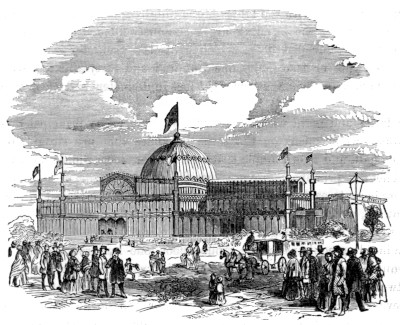
THE CRYSTAL PALACE IN NEW YORK.
Ten large and eight winding staircases connect the principal floor with
the gallery, which opens on the three balconies that are situated over the
entrance hall, and afford ample space for flower decorations, statues, vases,
&c. The ten principal staircases consist of two flights of steps with two
landing-places to each; the eight winding staircases are placed in the octagonal
towers, which lead also to small balconies on the tops of the towers and
to the roof of the building.
The building contains on the ground-floor, one hundred and eleven thousand
square feet of space, and in its galleries, which are fifty-four feet wide,
sixty-two thousand square feet more, making a total area of one hundred
and seventy-three thousand square feet, for the purposes of exhibition.
There are thus on the ground-floor two acres and a half, or exactly two and
fifty-two hundredths; in the galleries, one acre and forty-four hundredths;
total, within an inconsiderable fraction, four acres.
There are on the ground-floor one hundred and ninety octagonal cast-iron
columns, twenty-one feet above the floor, and eight inches in diameter, cast
hollow, of different thicknesses, from half an inch to one inch. These
columns receive the cast-iron girders. These are twenty-six and one-third
feet long and three feet high, and serve to sustain the galleries and the
wrought-iron construction of the roof, as well as to brace the whole structure
in every direction. The girders, as well as the second-story columns,
are fastened to the columns in the first story, by connecting pieces of the
699same octagonal shape as the columns, three feet and four inches high,
having proper flanges and lugs to fasten all pieces together by bolts. The
number of lower-floor girders is two hundred and fifty-two, besides twelve
wrought-iron girders of the same hight, and forty-one feet span over a part
of the nave. The second story contains one hundred and forty-eight columns,
of the same shape as those below, and seventeen feet and seven inches
high. These receive another tier of girders, numbering one hundred and
sixty, for the support of the roofs of the aisles, each nave being covered by
sixteen cast-iron semicircular arches, each composed of four pieces.
The dome will strike every one as the grand architectural feature of the
building. Its diameter is one hundred feet, and its hight to the springing
line is nearly seventy feet, and to the crown of the arch, one hundred and
twenty-three feet. It is said to be the largest, as well as almost the only
dome hitherto erected in the United States. It is supported by twenty-four
columns, which rise beyond the second story, and to a hight of sixty-two
feet above the principal floor. The system of wrought-iron trusses which
connects them together at the top, and is supported by them, forms two
concentric polygons, each of sixteen sides. They receive a cast-iron bed-plate,
to which the cast-iron shoes for the ribs of the dome are bolted. The
latter are thirty-two in number. They are constructed of two curves of
double angle iron, securely connected together by trellis-work. The requisite
steadiness is secured by tie-rods, which brace them both vertically and
horizontally. At the top the ribs are bolted to a horizontal ring of wrought
and cast iron, which has a diameter of twenty-feet in the clear, and is surmounted
by the lantern. As in the other roofs of the building, the dome is
cased with matched deal and tin sheathing. Light is communicated to the
interior through the lantern, and also in part from the sides, which are
pierced for thirty-two ornamental windows. These are glazed with stained
glass, representing the arms of the union and of its several states, and form
no inconsiderable part of the interior decoration.
The external walls of the building are constructed of cast-iron framing
and panel-work, into which are inserted the sashes of the windows and the
louvers for ventilation. The glass is one-eighth of an inch thick, and was
manufactured at the Jackson glass works, New York, and afterward enameled
by Cooper & Belcher, of Camptown, N. J. The enamel, with which
the whole of it is covered, is laid upon the glass with a brush, and after
drying, is subjected to the intense heat of a kiln, by which the coating is
vitrified, and rendered as durable as the glass itself. It produces an effect
similar to that of ground glass, being translucent, but not transparent.
The sun’s rays, diffused by passing through it, yield an agreeable light, and
700are deprived of that heat and glare which belong to them in this climate.
In the absence of a similar precaution in the crystal palace at Hyde park, in
England, (of which an account will next be given,) the roofs of which, as
well as walls, were inclosed with transparent glass, it was found necessary
to cover the interior of the building with canvas, to produce the required
shade.
At each angle of the building there is an octagonal tower, eight feet in
diameter and seventy-six feet in hight. These contain winding stairways,
which lead to the galleries and roofs, and were intended for the use of the
officers and employees of the association. Twelve broad staircases, one on
either side of each entrance, and four beneath the dome, connect the principal
floor with the gallery. The latter are circular in part, and consist of
two flights of steps with two landing-places. The flooring of the galleries is
made of closely matched planks, while those forming the floor of the first
story are separated by narrow intervals, in the same manner and for the
same purpose as in the London building. Over each of the principal
entrance halls, the galleries open upon balconies, which afford ample space
for placing flowers, vases and statues for decoration. Above the balconies,
the ends of the naves are adorned with large fan-lights, corresponding to the
semicircular arches within. On each side of the entrances there are ticket
offices, and adjacent to them rooms are provided for the officers of the association,
telegraph, &c.
The rapid and unexpected increase of the applications of exhibitors,
induced the association to erect a large addition to the building already
described. It consists of two parts, of one and two stories respectively, and
occupies the entire space between the main building and the reservoir. Its
length is four hundred and fifty-one feet and five inches, and its extreme
width is seventy-five feet. It is designed for the reception of machinery in
motion, the cabinets of mining and mineralogy, and the refreshment rooms,
with their necessary offices. The second story, which is nearly four hundred
and fifty feet long, twenty-one feet wide, and extends the whole length, is
entirely devoted to the exhibition of pictures and statuary. It is lighted
from a skylight, four hundred and nineteen feet long, and eight feet and six
inches wide.
The decorations of the building were intrusted to Henry Greenough, Esq.,
brother of the lamented sculptor of the same name. Mr. Greenough has
made art his study, and in its pursuit has resided long in Italy. The
leading idea in the plan of decoration, has been to bring out the beautiful
construction of the building; to decorate construction rather than to construct
decoration. To do this, and at the same time to preserve a general
701harmony of effect, has given Mr. Greenough ample opportunity to display
his knowledge of the resources of his art. The result is surprisingly beautiful.
The colors employed on the exterior are mixed in oil, the base being
the white lead manufactured by the Bellville Company. The exterior
presents the appearance of a building constructed of a light-colored bronze,
of which all features purely ornamental are of gold. The interior has a
prevailing tone of buff, or rich cream color, which is given to all the cast-iron
constructive work. This color is relieved by a moderate and judicious use
of the three positive colors, red, blue and yellow, in their several tints of
vermilion, garnet, sky-blue and orange, (certain parts of the ornamental
work being gilt,) to accord with the arrangement of colors employed in the
decoration of the ceilings. The only exceptions to the use of oil colors are
the ceilings of the American lean-to and the dome; these decorations are
executed on canvas. The effect of the interior of the dome, (designed by
Sr. Monte Lilia,) is particularly splendid. The rays from a golden sun, at
the center, descend between the latticed ribs, and arabesques of white and
blue, relieved by silver stars, surround the openings.
The building is supplied with gas and water in every part. The gas was,
at first, designed for the use of the police, in protecting the property by
night; but was so arranged that now, when the building is opened in the
evenings, it affords the most ample light throughout the entire edifice. The
water is accessible at numerous points, with convenience for drinking, also
for the attachment of hose, in case of fire.
The whole quantity of iron employed in the construction amounts to
eighteen hundred tuns; of which three hundred tuns are wrought and
fifteen hundred tuns cast iron. The quantity of glass is fifteen thousand
panes, or fifty-five thousand square feet. The quantity of wood used
amounts to seven hundred and fifty thousand feet, board measure.
The general mode of erection by base pieces, columns, connecting pieces
and girders, is the same with that of the great Hyde park building, but the
construction of the arched nave, and of the dome, is of course entirely
peculiar, and the general effect of the building is completely different. The
London building was certainly deficient in architectural effect. The form
of the New York edifice affords the requisite scope for a pleasing variety of
embellishments, by which all monotony can be avoided, and allows a very
economical use of the ground. The dome, independent of its effect in the
interior arrangement of the edifice, will give hight and majesty to the
exterior.
To complete the explanation of the construction of the building, we recapitulate
its principal dimensions.
| 702 |
| |
|
|
|
Ft. |
In. |
| From principal floor to gallery floor, |
24 |
|
| From principal floor to top of second tier of girders, |
44 |
4⅜ |
| From principal floor to top of third tier of girders, |
59 |
10 |
| From principal floor to ridge of nave, |
67 |
4 |
| From principal floor to top of bed-plate, |
69 |
11 |
| From principal floor to top of upper ring of dome, |
123 |
6 |
| From Sixth avenue curb-stone to top of lantern, |
151 |
|
| From Sixth avenue curb-stone to top of towers, |
76 |
9 |
| |
Area of first floor, |
157,195 |
square feet. |
| |
Area of second floor, |
92,496 |
square feet. |
| |
Area of second floor, |
92,496 |
square feet. |
| |
Total area, |
249,692 |
or 5¾ acres. |
The magnitude of these proportions alone, is calculated to excite feelings
of profound awe in the spectator’s mind; and when we see added the
gorgeous but subdued chromatic decoration with which the interior is ornamented,
and the innumerable works of art and industry with which it is so
richly filled, we may well be proud of an erection which is destined to confer
lasting honor on the American name.
It was to be hoped that this splendid building, filled with the products
of the industry and art of all nations, might have remained permanently in
New York, to be an ornament to the city, and a museum for the entertainment
and instruction of visitors from every part of the country and the
world; but since the above was written, it has been decided that the building
is to be taken down, either for removal to some other place, or for the sale
of its materials.
Having spoken of the New York crystal palace, we now pass to the crystal
palace of London, which preceded the former in the order of time, and far
surpassed it in size and magnificence. This splendid building, erected for
the great exhibition of 1851, was located on the south side of Hyde park,
near the Kensington road, in a position highly favorable in all respects to its
intended objects. The construction of the edifice presented not a few difficulties.
The building committee, comprising some of the leading architects
and engineers of Great Britain, advertised for plans to be presented for the
building; and as the result, no less than two hundred and forty designs were
laid before them. A large part of these were at once put aside as utterly
worthless; and then from about sixty, which were thought worthy of consideration,
703the committee proceeded to prepare a design which pleased nobody,
not even themselves. This plan, however, such as it was, was decided upon,
and advertisements were issued for proposals to build it. Objections were
at once raised, both against the plan proposed, and the possibility of its
execution; but while the committee, perplexed with the difficulties suggested,
were doubting what they should do, relief came to them from an unexpected
quarter, which we must go back a little to explain.
In 1839, Sir Robert Schomburg, a distinguished botanist, in going up the
river Berbice, in Demerara, had discovered in the still waters of the stream,
a gigantic water-lily, of a shape hitherto unknown, and had transmitted
some of its seeds to England, where the plant growing from them, under the
care of Joseph Paxton, the head gardener of the Duke of Devonshire, was
called the Victoria Regia. This plant was the occasion, and in some
respects the model for the crystal palace. Every means was adopted to
place this wonderful exotic in its accustomed circumstances. A tropical
soil was formed for it, of burned loam and peat. Coal-heat was substituted
for that of the tropical sun; and by means of a wheel, a ripple, like that of
its native river, was communicated to the waters of the tank upon which its
broad leaves reposed in beauty. In these circumstances the lily grew luxuriantly,
and Mr. Paxton was obliged to plan an edifice capable of holding it.
This he was doing just about the time when the committee were poring
wearily over their two hundred and forty plans; and in June, he drew out
a design for the exhibition building, which had been suggested to his mind
while preparing an abode for the Victoria Regia. In ten days he had completed
his elevations, sections, working plans and specifications; and the
whole being submitted to the inspection of competent and influential persons,
was unanimously declared to be practicable, and the only practicable scheme
presented.
The design, thus prepared, was next laid before the contractors, Messrs.
Fox & Henderson, who at once determined to submit a tender for the construction
of a building in accordance with it. And in a single week, they
had calculated the amount and cost of every pound of iron, every pane of
glass, every foot of wood, and every hour of labor, which would be required,
and were prepared with an offer and specifications for the construction of the
edifice. But here arose a difficulty. The committee had advertised only
for proposals for carrying out their own design; but, fortunately, they had
invited the suggestion, on the part of contractors, of any improvements on
it; and so Mr. Paxton’s plan was presented simply as “an improvement”
upon that of the committee, though it had not a single feature in common
with it. This, with certain modifications, was adopted; and the result was
704the celebrated crystal palace, the first of the name, and the suggester of all
others of the same general character—the great, original crystal palace;
itself the greatest wonder of the most wonderful exhibition the world has
ever seen!
The building consisted, or rather still consists, of three series of elevations,
of the respective hights of sixty-four, forty-four, and twenty-four feet, intersected
at the central point of meeting, by a transept of seventy-two feet in
width, having a semicircular roof rising to the hight of one hundred and
eight feet in the center. It extended in length eighteen hundred and fifty-one
feet from north to south, or more than one-third of a mile, with a breadth
of four hundred and fifty-six feet on the ground; thus covering a surface of
some eighteen acres, or nearly double the extent of Washington square in
New York, and exceeding, by more than one-half, the dimensions of the
Park or the Battery. The whole rested upon cast-iron pillars, united by
bolts and nuts, fixed to flanges perfectly true, so that if the socket was placed
level, the columns and connecting pieces could not but stand upright; and
in point of fact, not a single crooked line, it is said, was discoverable in the
combination of such an immense number of pieces in the building as first
erected, or as it now stands. For the support of the columns, holes were
dug in the ground, in each of which was placed a bed of concrete, and upon
this rested the iron sockets, of from three to four feet in length, according
to the level of the ground; to which sockets the columns were firmly
attached by bolts and nuts. At the top, each column was attached by a
girder to its opposite column, both longitudinally and transversely, so that
the whole eighteen acres of pillars were securely framed together.
The roofs, of which there were five, one to each of the elevations, were
constructed on the ridge and furrow principle, and glazed with sheets of
glass of forty-nine inches in length. The construction will be easily understood,
by imagining a series of parallel rows of the letter V, extending
(thus,  ) in uninterrupted lines the whole length of the building.
The apex of each ridge was formed by a wooden sash-bar, with notches on
each side for holding the laths in which the edges of the glass were fitted.
The bottom bar, or rafter, was hollowed at the top, so as to form a gutter to
carry off the water, which passed through transverse gutters into the iron
columns, which were made hollow so as to serve as water-pipes; while in the
base of each column a horizontal pipe was inserted to convey the accumulated
water into the sewers. The exhalations from so large a surface, from
the plants and from the breath of the innumerable visitors, rising against the
glass and there being condensed, would, if the roof had been flat, have
descended in the form of a perpetual mist, or dropping rain; but it was
705found that from glass pitched at a particular angle, the moisture did not fall,
but would glide down its surface. The bottom bars, therefore, were grooved
on the inside, thus forming interior gutters, by which the moisture found its
way down the interior of the columns, and thus through the drainage pipes
into the sewers. These grooved rafters, of which the total length was two
hundred and five miles, were formed by machinery, at a single operation.
) in uninterrupted lines the whole length of the building.
The apex of each ridge was formed by a wooden sash-bar, with notches on
each side for holding the laths in which the edges of the glass were fitted.
The bottom bar, or rafter, was hollowed at the top, so as to form a gutter to
carry off the water, which passed through transverse gutters into the iron
columns, which were made hollow so as to serve as water-pipes; while in the
base of each column a horizontal pipe was inserted to convey the accumulated
water into the sewers. The exhalations from so large a surface, from
the plants and from the breath of the innumerable visitors, rising against the
glass and there being condensed, would, if the roof had been flat, have
descended in the form of a perpetual mist, or dropping rain; but it was
705found that from glass pitched at a particular angle, the moisture did not fall,
but would glide down its surface. The bottom bars, therefore, were grooved
on the inside, thus forming interior gutters, by which the moisture found its
way down the interior of the columns, and thus through the drainage pipes
into the sewers. These grooved rafters, of which the total length was two
hundred and five miles, were formed by machinery, at a single operation.
The lower tier of the building was boarded; the walls of the upper portion
being composed, like the roof, of glass. Ventilation was provided for by the
basement portion being walled with iron plates, placed at an angle of forty-five
degrees, known as luffer-boarding, which admits the air freely, while it
excludes the rain. A similar provision was made at the top of each tier of
the building; the plates all being so constructed that they could be closed at
pleasure. In order to subdue the intense light in a building having such an
immense extent of glass surface, the whole roof and the south side were
covered with canvas, which also precluded any possible injury from hail, as
well as rendered the edifice much cooler than it otherwise would have been.
In the construction of the building the utmost care was taken to give
each part the stiffest and strongest form possible in a given quantity of
material. The columns were hollow; and the girders which united them
were trellis-formed. The utmost weight which it was supposed any girder
would be likely to have upon it, was seven and a half tuns; and not one was
used till after having been tested to the extent of fifteen tuns; while the
breaking weight was calculated at thirty tuns. At first sight it would seem
as if there might be danger that a building presenting so vast a surface to
the action of the wind, might be liable to be blown down, or at least forced
out of position. But from the manner in which the columns were framed
together, they could not be overthrown except by breaking them; and
experiments showed, that in order to break the one thousand and sixty
columns on the ground floor, a force of sixty-three hundred and sixty tuns
must be exerted, at a hight of twenty-four feet. But the greatest force of
the wind known, is computed at twenty-two pounds to the superficial foot;
so that assuming even a force of twenty-eight pounds, and supposing a hurricane
with that momentum to strike at once the whole side of the building,
the total force, it was said, would be less than fifteen hundred tuns, not one-fourth
what the building could easily sustain, independently of the bracings,
which added materially to its strength. So that, if any reliance at all could
be placed on theoretical engineering, there could, it was said, be no doubt
whatever but that the building would be safe in the most violent tempest.
The building being thus erected, the spectator entering at the main east
or west entrance, found himself in a nave sixty-four feet in hight, and
706seventy-two in breadth, and extending without interruption the whole
length of the building, one-third of a mile. Parallel with this, but interrupted
by the transept in the center, was a series of side aisles, of forty-eight
and twenty-four feet in breadth, and with a hight of forty-four and
twenty-four feet. And over the center of the nave, swelled the semicircular
roof of the transept, overarching the stately trees beneath; thus forming a
gigantic green-house, with the ancient elms of the park in the place of
geraniums and rose-bushes. The whole area of the ground-floor was seven
hundred and seventy-two thousand, seven hundred and eighty-four square
feet, and that of the galleries, two hundred and seventeen thousand;
making in all nearly a million square feet, to which should be added five
hundred thousand feet of hanging space, available for the display of the
innumerable products of human skill and labor, that made the exhibition
one of the most wondrous of all the wonders of the world.
There were three refreshment rooms; one in the transept, and one near
each end of the building, around the huge trees of the park, which, as
already said, were left standing. No wine, spirits or fermented liquors
were allowed to be sold, but only tea, coffee and unfermented drinks;
while pure water was to be furnished gratis to all, by the lessees of the
refreshment rooms. As to the decoration of the interior, it may here be
added, that the shafts of all the columns were painted yellow; the concave
portions of the capitals, blue; the under sides of the girders, red; and their
vertical surfaces, white.
We might dwell in detail on the vast collection of the products of human
industry and art which filled the interior of this immense structure, and
made it the resort of visitors from every part of the world. But the history
of “the great exhibition” is familiar to most if not all of our readers. We
will only add, that among all the wonders of the crystal palace, nothing was
more wonderful than its cheapness, and the rapidity of its construction.
Possession of the site was obtained on the thirtieth of July; and in a period
of one hundred and forty-five working days, the building was mainly completed.
Its cost was less, by the cubic foot, than an ordinary barn. If it
had been used only for the exhibition, and at its close returned to the contractors,
its cost would have been nine-sixteenths of a penny per foot; and
if it had been left remaining permanently, it would have been but one penny
and one-twelfth of a penny per foot. The astonishing fact, that a building
of glass and iron, including thirty-three million cubic feet, and covering
eighteen acres, and affording room for nine miles of tables, should have been
completed in less than five months from the day when the contract was
707entered into, at a cost less than that of the humblest hovel, opens a new era
in the art of building.
Silliman, in his late “Visit to Europe,” under the date of the twenty-ninth
of March, 1851, says: “Into this wonderful and imposing structure we have
to-day merely made our entrance. As we drove along the eastern side of
Hyde park, on a bright and beautiful morning, the splendid vision caught
our eyes, as the sunlight was thrown wide around by this immense mirror.
It was merely a glance that we took on this occasion, reserving more deliberate
observation for future opportunities. It was not accessible, as yet, to
visitors, but by particular favor, through an introduction to one of the
managers, we were admitted into the interior. It has become so familiar, in
all its aspects, to the whole world, that at this date, after its complete development,
any detailed description would be out of place. The general
impression made upon us, by our walks through this stupendous conservatory
of the arts, was that of great splendor and magnificence. It appeared a fairy
palace, like the creations of fable; a building equally unique and original in
its structure; original, also, in its bearing upon the concord and amicable
rivalry of nations; in this respect of most auspicious tendency. Already the
consignments of the world are coming in, and to a great extent have actually
arrived. African Tunis sends its contributions, and even more remote
countries are beginning to occupy the large space allotted to them. The
palace is so high as to cover several of the large trees of Hyde park, where it
is erected; and we saw, not without a shudder, a man dangling in the air at
the end of a rope near the roof, at the hight of eighty feet. He had been
drawn up simply by holding on the end of the rope by his hands, and was
whirled around and around, until he reached a plank almost in the angle of
the roof, where at last he was safely landed.”
And at a later date, he adds: “Although I have walked many hours, and
I presume ten miles in this immense structure, I seem only to have begun
to see it. In despair of my ability to convey any adequate idea of it, I am
almost disposed to pass it in silence, but this would disappoint those for
whom I write. Pictures and descriptions of the building had reached
America before I left home, and it is known that its front extends more
than one-third of a mile, besides its branches. The area which it covers is
eighteen acres, and under its vaulted transept are included some large and
lofty trees that were growing in the park. So many accounts of its contents,
and so many views of its form, both within and without, have been since
published, that a better idea of both can be obtained from numerous sources,
than from anything that I can write. I shall, therefore, attempt nothing
more than some general remarks, and will mention a few examples. When
708we were here in March, I expressed my admiration of the general design.
So far as I know it is novel. Exhibitions of the productions, whether in
nature or art, of particular countries, have often been made, and in some
countries they are annual, as in France, England, and in the United States;
but I believe it was reserved for Prince Albert to originate the design of
inviting all nations to bring to one place the results of their industry and
skill, and specimens of their physical resources. For obvious reasons, no
place was so proper as London, the commercial metropolis of the world, and
I suppose now containing a greater population, and certainly more wealth,
and exerting more influence on mankind, than any other city. The invitation
was a pledge of universal good-will, and it has evidently tended to
produce kind feelings among the nations. Instead of new fortresses of stone
and iron, instead of walls and battlements to protect this immense city from
invasion, there rises in its grand domain of Hyde park, a crystal palace, the
temple of arts and industry. It rose like an exhalation, a magical illusion
of the senses. The frame-work of iron, although strong enough to sustain
the weight and to resist the winds, is so little apparent to the eye, that the
crystal palace appears a sea of glass, as in the Revelations, ‘A sea of glass
like unto crystal.’ One might dream, as in the ‘Arabian Nights,’ of such a
creation, ‘in the visions of the night, when deep sleep falleth upon men,’
and might find on waking that it was all an illusion, when it would vanish
like the fabric of a dream, and leave not a wreck behind. But there it
stands, a splendid reality, and with its widely extended transepts, wings and
galleries, has proved sufficient to receive and protect the gathered riches of
mankind.
“I mentioned in my passage from Boulogne, that I was in company with a
large number of French people coming over to see the crystal palace.
Crowds of all nations throng this palace; fifty thousand, or sixty thousand,
and sometimes seventy thousand in a day. As you walk about, or thread
your way through the great masses of human beings that crowd the avenues,
you may hear half the languages of Europe, and some of those of the orient.
I imagined that before our return from the continent the deluge of nations
would have subsided, and this consideration was not without weight in
inducing us to prefer a late inspection of the splendid wonder; but in this
particular we have been disappointed. The numbers who daily resort to the
crystal palace are undiminished: it may be that there are fewer foreigners,
but since the price has been reduced to a shilling, the country people come
in, parents and children, and mothers with their infants; steamboats and
cars are crowded, and it seems as if the rural population of the kingdom
were all rushing into London.
709“As to the contents of the palace, it is impossible to enumerate them. A
mere catalogue, with the most brief descriptive notices, would fill a large
volume. I can only mention groups of things, with here and there a particular
instance. The collection embraces the useful as well as the fine arts.
All kinds of agricultural machines are here to be seen, and there are seeds,
and specimens of crops, all duly arranged and labeled. The American
department has been somewhat undervalued, because it was not so splendid,
and was less full than the collections from some other countries, but even
the Times, which has generally an unfriendly bearing in relation to our
country, has commended the American department on the score of utility.
Indeed, it was not reasonable to expect that a country occupied but two
centuries by civilized people, should be able fully to compete with nations who
have been civilized for a thousand years; and our great distance, and the
difficulty and expense of transporting articles across the ocean, and of coming
over to look after them, must have prevented our appearing as we do at
home, in the great industrial exhibitions of New York, Philadelphia and
Boston. I have seen such gatherings at Niblo’s and the Castle Garden, in
New York, and in Boston, not only of useful, but of elegant things, as I
should feel proud to see in the American department in the crystal palace.
Two agricultural instruments are, however, spoken of as giving the palm to
America above all competition. I refer to the plow and the reaping-machine
of American manufacture. The plow is said to have attained the perfection
of form, and the reaping-machine to be recommended by its great utility.
“Iron, as it is the material which, more than others, (wood excepted,)
contributes indispensable aid to the arts of life, occupies a conspicuous place
in the exhibition. Its ores and its castings, and its wrought articles, whether
in a locomotive, or the hair-spring of a chronometer, whether in chain-cables
or a cambric needle, are displayed in endless variety of useful and beautiful
forms, and in this department England justly claims and fully proves her
preëminence. Iron, lead, copper, bismuth, zinc, antimony, and silver, gold
and platinum, are conspicuous here. England glories in her tin, lead and
copper: in the two latter we can compete with her; our lead is inexhaustible,
and our native copper of Lake Superior, is unequaled for abundance.
A large mass of it has been brought over for the exhibition, weighing many
thousand pounds.
“Nothing can exceed the beauty of the articles of silver, whether utensils
or ornaments, which are exposed to view in the gallery of the crystal palace.
The most graceful forms both of peaceful men, and of warriors, armed
cap-à-pie; and of woman in the very beau ideal of her loveliness, are here in
profusion; and if England excels in these articles in silver, France is not
710behind her, both in them and in gilded furniture, and bronze, as seen in all
the splendor and elegance of the show windows of the Palais Royal. The
silver extracted from lead by Pattinson’s process is here seen in piles so rich,
with a perfect purity of whiteness, and in scaly pyramids, a kind of flaky
mound, that the observer looks on with delight, as also upon the same metal
cast in ponderous ingots. Here is the gold of California, one brilliant mass
weighing in value eight hundred pounds sterling, equivalent to nearly four
thousand dollars. There are three masses of native Siberian, or Russian
platinum, weighing respectively twenty-one, twenty-three, and twenty-five
pounds, and many wrought articles of the same metal. The copper of
Russia, in the form of malachite, here makes a great figure. The same material
which we saw in the Vatican, and in the palace of the king of Prussia,
in the form of magnificent vases, is here seen wrought into innumerable
forms of beauty. There is even a large paneled door fabricated entirely of
malachite. Of course many pieces are united to afford the requisite mass.
There are tables, vases, urns, chairs, settees, &c., mounted with the same
rich material. The gems form a conspicuous ornament of the collection.
Queen Victoria has loaned her largest diamond, with several smaller ones,
to be exhibited, and here also are some of the most precious of the diamonds,
rubies, sapphires, topazes, emeralds, chrysoberyls, opals, and pearls of the
regalia of Russia, Spain and India. The Duke of Devonshire has an emerald
deposited by Mr. Tenant, nearly two inches in the diagonal diameter, and
two to three inches in length; it is of surpassing beauty, being perfectly
crystallized, and of the most intense and uniform grass-green color. There
is no end to the bijouterie of the French. A case in the gallery is composed
of four pieces of plate glass, each between five and six feet long, and four to
five broad. This case is entirely filled with elegant ornamental articles.
“I can not pretend to enumerate the marbles, granites, porphyries, serpentines,
and other architectural materials, nor the piles of mineral coal,
and anthracite, nor the perfect imitations of beautiful and useful mineral
compositions, such as serpentines, verd-antique, porphyry, and verd-antique
marbles, &c. The chemical products, too, of great beauty, are numerous.
The crystallizations of carbonate and bi-carbonate of soda, of alum, of the
prussiates, yellow and red, of the sulphate of iron, and the sulphate of
copper, and sal-ammoniac, are splendid, and evince that the chemical arts
are not behind the mechanical. Large cakes of metallic antimony are crystallized
in beautiful fern-like radiations.
“France“France, Belgium, Holland, Austria, Germany, Prussia, Turkey, the Barbary
states, Egypt, Bermuda, the East Indies, Canada, Australia, and other
countries, have combined to decorate the crystal palace. Superb silks have
711come from the east, and pictured stuffs, shawls, carpets, &c., from Germany;
the antipodes have conspired to crown the glorious spectacle; plain and
useful materials, leather, hemp, ropes of manilla grass and of other fibrous
vegetables, and glass and pottery in their varieties, are not omitted. To give
animation to the scene, steam generated out of doors is brought in through
concealed tubes and applied to machinery. Cotton-gins and paper-making
machines are at work, and the palace resounds with the noise of actual and
productive labor. Ship models are presented in many forms, especially
ships of war, in sections longitudinal and transverse, with all their interior
structure. Life-boats and life-preservers, and in harmony with them, mirrors
for light-houses; but in contrast, swords, pistols, revolvers, guns, dirks
and daggers, and multiform contrivances to do the work of killing the
greatest number of men in the shortest time; such are man’s inconsistencies!
“But time would fail to tell of the furniture, the carriages, the musical
instruments, the ceramic wares, and all the countless and indescribable
throng of articles which contribute their effect in the tout ensemble of this
vast storehouse of the nations. The statuary arranged along the naves is a
conspicuous and interesting feature. Many of the prominent and more
meritorious of these marbles, have since become so familiar from the
engravings in the Art Journal and other illustrated works, that it is needless
at this late day to call attention to them individually. The famous
Amazon of Kiss, the same which was in London, is now the most remarkable
artistic object in the American crystal palace. The most interesting
view is obtained from the galleries of the moving masses of human life
below. It is a panorama where multitudes are passing to and fro, and soon
are seen no more, fleeting as the jets-d’eau which sport among them from
living fountains, that curl over and descend in graceful sweeps, and seem to
enliven the stately palms and other living plants and trees which grace the
scene.”
In closing this extended notice of the crystal palace, we hardly need add,
that after the close of the great exhibition, it was taken down and removed;
and that at present, it rears its splendid form and stately transepts in a new
and more beautiful situation at Sydenham, with many important additions
and improvements. It now stands in the midst of a magnificent undulating
park of three hundred acres, surrounded with rural delights, fountains,
shaded walks and silvan temples; while within, it has been converted into
a great permanent museum of arts, antiquities and science, with living
groves of palms, enlivened by singing birds and sparkling fountains. For
eighteen pence the London artisan can visit it, including the ride out and
712back upon the railway. This is being done by a private association at a cost
of near four million dollars.
Among the public buildings at Washington, the capital city of the nation,
the first in architectural merit, and in point of interest, is the Capitol, which
contains the halls of the national legislature, the supreme court room, &c.,
&c. This building (a view of which, as it will appear when the enlargement
now in progress is completed, is given in the cut below) is situated on
an eminence at the eastern part of the city, about seventy feet above tidewater,
its main front looking toward the west. As it was before the commencement
of the alterations and improvements now in progress, it consisted
of a center building, with two wings, having a total length of three hundred
and fifty-two feet, and a depth at the wings of one hundred and twenty-one
feet. The central building contains a rotunda, ninety-six feet in diameter,
and the same in hight, crowned by a magnificent dome which rises one
hundred and forty-five feet from the ground. The wings, as they were, were
each surmounted by a flat dome. The eastern front, which was intended for
the main one, projects, including the steps, sixty-five feet, and is graced by a
713portico of twenty-two Corinthian columns, thirty feet in hight, forming a
colonnade one hundred and sixty feet in length, presenting one of the most
commanding fronts in the United States. The western front projects eighty-three
feet, including the steps, and is embellished with a recessed portico of
ten columns. This front, though not so imposing, in itself, as the eastern,
commands the finest view anywhere to be had in Washington, overlooking
all the central and western parts of the city, and all the principal public
buildings. On the steps of the east front is a noble statue of Columbus,
supporting a globe in his outstretched arm. In the interior of the western
projection is the library of Congress, a part of which was burned in the
winter of 1851-2. Before that event it contained over fifty thousand volumes.
It has been rebuilt so as to be fire-proof.
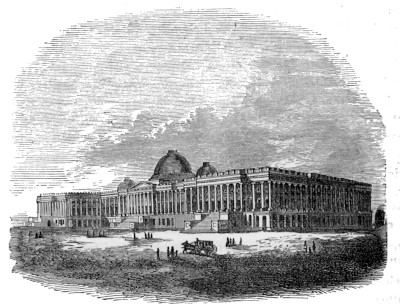
THE CAPITOL AT WASHINGTON.
On entering the rotunda, the first objects that strike the attention, are the
paintings which adorn the walls. There are “The Declaration of Independence,”
“The Surrender of Burgoyne,” “The Surrender of Cornwallis,”
“Washington resigning his Commission,” “The Embarkation of the Pilgrims
at Leyden,” “The Landing of Columbus,” “The Baptism of Pocohontas,”
and “The Discovery of the Mississippi by De Soto.” Surrounding
the rotunda, are a number of chambers, passages, committee-rooms, rooms
for the president, members of the cabinet, &c. The senate-chamber is on
the second floor of the north wing, of which it occupies about half, and is
of a semicircular form, being seventy-five feet long, and forty-five high. A
gallery for spectators, supported by iron or bronze pillars, surrounds the
semicircle, and fronts the chair of the presiding officer, which stands in the
middle of the chord of the semicircle. In the rear of the chair, and above
it, is a gallery, supported by Ionic columns of the conglomerate or Potomac
marble, in which sit the reporters, fronting the senators. The hall of representatives
is on the second floor of the south wing, and is also semicircular,
but much larger than the senate-chamber, being ninety-six feet long, and
sixty high, and surrounded by twenty-four Corinthian columns of Potomac
marble, with capitals of Italian marble. The galleries are similar in their
arrangement to those of the senate-chamber. Over the chair of the speaker
is a statue of Liberty, supported by an eagle with spread wings. In front
of the chair, and immediately above the main entrance, is a figure representing
History recording the events of the nation.
The enlargement of the Capitol, commenced in 1851, and now in progress,
will, however, materially change and improve its appearance. It will comprehend
two wings, two hundred and thirty-eight by one hundred and forty
feet, which are to be surrounded on three sides by colonnades, and on the
fourth side to communicate by corridors, forty-four feet long and fifty feet
714wide, with the main building. The whole will be seven hundred and fifty-one
feet long, and will cover three and one-half acres, or more than one
hundred and fifty-three thousand square feet. The architect of the new
building has completed the design of a magnificent new dome for the center
of the enlarged building, which is said to be a splendid conception of genius,
and which is to take the place of the present dome, and thus perfect the
symmetry and architectural beauty of the entire building when complete.
It will be constructed entirely of cast iron, and will be on the foundation of
the old dome. And if it at all meets the expectations formed of it, it will
be a lasting monument of the skill and genius of the architect.
The whole cost of the building as it now stands, before the extension, was
some two million dollars; but the improvement will cost several millions
more. The original structure was commenced in 1793, and had not been
completed when it was burned, by an act of vandalism, in 1814; and was
not entirely finished till 1828. The grounds around the Capitol, embracing
some thirty acres, and forming an oblong on three sides, and a semicircle on
the west, are handsomely laid out, and planted with trees and shrubbery,
presenting, during the spring and summer, a scene of great beauty. About
the center of the grounds, on the eastern front, is a colossal statue of Washington,
by Greenough. The material of the Capitol is a porous stone of a
light yellow color, painted white. The enlargement is to be of marble.
South-west from the Capitol, and midway between it and the president’s
house, on a gently rising ground, in the midst of a new park which has
recently been laid out, stands the Smithsonian Institute, one of the noblest
institutions and finest structures in Washington, a view of which is given
in the cut beyond.
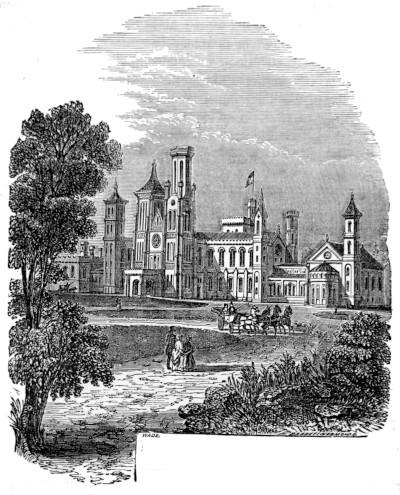
This edifice is four hundred and fifty feet long, by one hundred and forty
wide, and is built of red sand-stone, in the Romanesque or Norman style,
embellished by nine towers, from seventy-five to one hundred and fifty feet
high, and of different forms. In the building is a lecture-room, large enough
to seat some two thousand persons; a museum, for objects of natural history,
some two hundred feet long; one of the best supplied laboratories in the
United States; a gallery for paintings and statuary; a library-room, capable
of containing one hundred thousand volumes; and various other smaller
apartments connected with the designs of the building. The institution was
endowed by James Smithson, an Englishman, who left his whole fortune,
some five hundred thousand dollars, “to found, at Washington, an establishment
715for the increase and diffusion of
knowledge among men.” The fund, which
is in the keeping of the United States government,
yields an income of more than thirty thousand dollars per year;
and this increase is divided into two parts, one of which is to be devoted to
the increase and diffusion of knowledge by means of original research and
publications, and the other to the gradual formation of a library, a gallery
of art, museum, &c.
On the proposed new park, and between the Smithsonian Institute and
the president’s house, has been commenced a colossal monument to the
memory of Washington, to be erected by the voluntary contributions of the
people. A view of it, as it will appear when completed, is given in the cut.
716
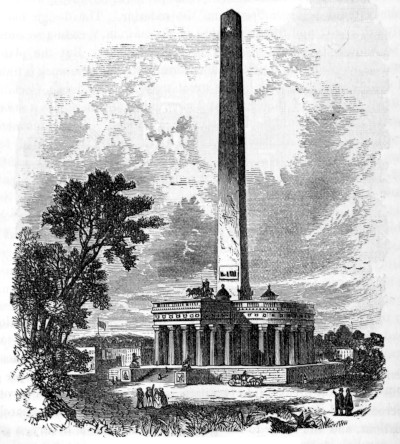
The plan contemplates, as a base, a circular temple, two hundred and fifty
feet in diameter, and one hundred feet high, from the center of which is to
rise a shaft, seventy feet square, to the hight of six hundred feet above
the ground, and to be cased in marble. The base is intended to be the
Westminster Abbey of the United States, to contain the statues of the revolutionary
worthies, and in the center, (if his family approve,) are to be
placed the remains of Washington. The temple, at the base, will be entirely
surrounded by a colonnade of thirty pillars, in the Doric style, forty-five feet
high by twelve in diameter, surmounted by an entablature of twenty feet,
which, in turn, is to be surmounted by a balustrade of fifteen feet in hight.
Each state in the union is invited to furnish a block of native stone or other
material, with an inscription, which will be inserted in the interior, where
the block may be seen and the inscription read in coming ages. A triumphal
car, with a statue of Washington, is to stand over the grand entrance, as
717seen in the engraving. The column, at present, has reached the hight of
less than two hundred feet; but if completed according to the original plan,
it will form the most magnificent monument ever erected. It is said that
there is not a column, either ancient or modern, in Europe, as high as the
Bunker-hill monument. And yet, such are the gigantic proportions of the
Washington monument, that Bunker-hill monument could be placed inside
of it without much impeding the operations of the workmen; and when it is
finished, any two of the monuments of Europe could be stowed away within
its walls without being noticed from the exterior. The design has been
severely criticised; and the great hight of the column, receding so suddenly
from so wide a base, has been strongly objected to. But the plan was
deliberately adopted after much consideration, and when the work is finished,
it will doubtless be approved by the great mass of beholders. Certainly it
will attract the gaze of thousands as a monument not merely to a man, but
to principles which should be dear to every American. The endowments of
the great man whom it commemorates, were peculiarly adapted to the
exigency which called them into action. He was brave, but cautious;
earnest, yet calm; resolved, yet guarded against rash adventure; a patriot,
in whose heart the love of country predominated; a statesman, in whose
conduct every public virtue was exemplified; a citizen, whose intercourse
with his fellow-men was without reproach. Placed in a position at once
responsible and perilous, he felt and was ever ready to acknowledge the
overruling providence of God, by whose blessing alone he could succeed.
It was not one great quality which formed the character of Washington, but
a rare union of many great qualities. These, with unfeigned devotion, he
laid on the altar of his country, and for the promotion of her interests he
was ready to sacrifice his personal comfort and his life. Wonderfully was
he sustained in his self-denying and eventful career, and remarkable was the
success which accompanied his efforts. The most formidable obstacles were
surmounted, the most powerful opposition subdued; his country was liberated;
the battle of free institutions was fought and won; and he, superior to
the impulses of mere personal ambition, nevertheless achieved a fame which
has no parallel in the world’s history. If he was “first in war,” he was
“first too in peace,” and he still remains “first in the hearts of his countrymen.”
Such a name should never be forgotten; such an example should
never lose its influence.
718
The Place de Vendome, formed upon the site of a hotel that belonged to
the Duke de Vendome, was begun by Louis XIV., who, in 1685, purchased
and leveled the hotel, intending to erect, round a public place, edifices for
the royal library, the mint, the extraordinary embassadors, &c. This project,
however, was abandoned, and the property ceded to the city of Paris, with a
stipulation to erect a place upon the site. Mansard, who furnished the first
plans, was charged with the second; and the buildings, as they now stand,
were begun in 1699, and finished by the financier Law. The form of the
place is a symmetrical octagon, the larger sides of which measure respectively,
four hundred and twenty and four hundred and fifty feet. Two wide
streets, forming the only entrances to it, the Rue de la Paix and the Rue de
Castiglione, equisect its northern and southern sides. The buildings are
uniform, consisting of a rustic basement surmounted by upper stories, ornamented
with Corinthian pilasters, and high roofs pierced with lucarne
windows. The middle of each side is graced with a pediment supported by
Corinthian columns. This place was first called the Place des Conquêtes,
then the Place Louis le Grand, and afterward the Place Vendome. In the
middle formerly stood a colossal equestrian statue of Louis XIV., in bronze,
erected in 1669, but demolished the tenth of August, 1792; the bronze
figures that ornamented its base were saved, and are still to be seen in the
Musée de la Sculpture Moderne. The mutilated pedestal remained till
1806, when it was replaced by the triumphal pillar, erected by Napoleon, to
commemorate the success of his arms in the German campaign of 1805.
This column is an imitation of the pillar of Trajan at Rome, of which it preserves
the proportions on a scale larger by one-twelfth. Its total elevation
is one hundred and thirty-five feet, and the diameter of the shaft is twelve
feet. The pedestal is twenty-one feet in hight, and from seventeen to twenty
in breadth. The pedestal and shaft are of stone, covered with bass-reliefs,
representing victories of the French army, in bronze, made from twelve
hundred pieces of brass cannon taken from the Russians and Austrians.
The metal employed in this monument weighs about three hundred and
sixty thousand pounds. The bass-reliefs of the pedestal represent the
uniforms, armor and weapons of the conquered troops. Above the pedestal
are garlands of oak, supported at the four angles by eagles, each weighing
five hundred pounds. The door, of massive bronze, is decorated with crowns
of oak, surmounted by an eagle of the highest finish; above is a bass-relief,
representing two figures of Fame, supporting a tablet, with an inscription in
honor of Napoleon, and commemorating the victories which the column was
719erected to celebrate. The bass-reliefs of the shaft pursue a spiral direction
to the capital, and display, in chronological order, the principal actions, from
the departure of the troops from Boulogne to the battle of Austerlitz. The
figures are three feet high; their number is said to be two thousand, and the
length of the scroll eight hundred and forty feet; a spiral thread divides the
lines, and bears inscriptions of the actions they represent. The figure of
Napoleon on the top of the column, is eleven feet high. The statue of
Napoleon, in imperial robes, was melted down in 1814, to form a part of the
equestrian statue of Henry IV., but was replaced by Louis Philippe, May
first, 1832, clad in military costume, shrouded by crape. From the summit
of the monument, which is reached by a spiral staircase, there is a splendid
view of the capital, and admission is obtained through one of Napoleon’s
veterans, who keeps the door.
This celebrated monument, a view of which is given in the cut on the next
page, is in the town of Charlestown, Mass., on the hill where the first battle
was fought between the provincial and British troops in the war of the
revolution. The hill was originally called Breed’s hill, Bunker hill being to
the north of it, at the entrance of the peninsula on which Charlestown is
situated. On this hight a detachment of one thousand men were directed to
intrench themselves, on the night of the sixteenth of June, 1775. By some
mistake, they proceeded to Breed’s hill, which is nearer Boston, and which
has since been called Bunker hill, as the name is associated with the battle.
The men had worked with such secrecy, that by the dawn of day they had,
unperceived by the enemy, thrown up a redoubt eight rods square. The
incessant fire from the shipping and a battery on Copp’s hill, in Boston, did
not prevent the Americans from completing by midday, with great labor and
fatigue, a slight breastwork from the redoubt to the bottom of the hill on the
east side. Between twelve and one o’clock, the British, to the number of
three thousand men, with a portion of artillery, under Generals Howe and
Pigot, landed in Charlestown, and having formed their men in two lines,
advanced slowly to the attack, frequently halting to allow their artillery
time to fire. The Americans, in their intrenchments, coolly waited their
approach. It is said that General Putnam, who was a leader, though
Colonel Prescott had the chief command, told the men that they had not a
charge of powder to waste, and exhorted them not to fire upon the enemy
till they could see the whites of their eyes. They were suffered to approach
to within ten or twelve rods, when these practiced American marksmen fired
720with such deadly aim as to throw the British ranks into confusion, and cause
them to retreat precipitately to the bottom of the hill. By the efforts of
their officers they were formed a second time and advanced to the attack.
The Americans waited till they were within five or six rods, when they
again opened a destructive fire, which brought them to a stand and threw
them into confusion. At this critical moment General Clinton arrived from
Boston, and succeeded in rallying his men, and in bringing them to a
charge, while some cannon were brought to a station that enabled them to
rake the breastwork from
end to end. The works
were now attacked with
fixed bayonets, and as the
Americans were not furnished
with them, and they found their ammunition beginning to fail,
they were obliged to retreat over Charlestown neck. The British were
victorious; but it was a dearly bought victory. Their loss, by the acknowledgment
721of General Gage, was ten hundred and fifty-four killed and
wounded; while the engagement was particularly fatal to the officers, as they
were singled out by the American marksmen. Nineteen commissioned officers
were killed, and seventy wounded. Of the men, two hundred and twenty-six
were killed, and eight hundred and twenty-eight wounded; while of the
Americans, who had only fifteen hundred men engaged, only one hundred and
forty-five were killed, and three hundred and four wounded and missing.
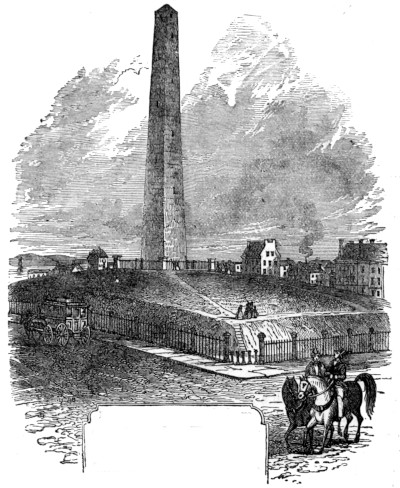
On the site of this celebrated battle, sixty-two feet above the level of the
harbor, on ground purchased for the purpose, the Bunker hill monument, a
splendid obelisk, has been erected. The corner-stone was first laid by La
Fayette, on the fiftieth anniversary of the battle, in the presence of an
immense concourse of citizens, the seventeenth of June, 1825, when an
address was delivered by Daniel Webster. This foundation, however,
having been found insufficient, the corner-stone of the present structure was
laid, in a more substantial manner, in March, 1827; and the monument was
completed the twenty-third of July, 1842. The obelisk is thirty feet square
at the base, and sixteen and one-third feet at the top; and is substantially
built of hewn Quincy granite. The hight from the base to the top of the
apex, is two hundred and twenty-one feet; and the cost of the work was
about one hundred and twenty thousand dollars. The interior is circular,
having a diameter of ten feet and seven inches at the bottom, and of six
feet and four inches at the top, and is ascended by two hundred and ninety-four
steps. The top is an elliptical chamber, about eighteen feet high, with
four windows, the view from which is truly magnificent, embracing Boston,
and its harbor and environs, together with the mountain scenery in the distance,
and the adjacent towns nearer at hand. The monument consists of
ninety courses of hewn stone, eighty-four above the base, and six below it.
There are a number of windows in the sides, closed with iron shutters,
beside numerous apertures. The completion of the monument in 1842, was
hailed by the firing of cannon, and other testimonials of rejoicing. The
monument itself, being the most elevated object in the vicinity, will serve as
a landmark to seamen, and will long stand in commemoration of the brave
men who here fought, and many of whom fell, in defense of the rights of
their country, nobly contributing to the independence of the United States.
This triumphal arch, says a late tourist, “is one of the most wonderful
conceptions of that wonderful man, Napoleon. It was begun by him, but
finished by his successors. This stupendous fabric strikes one with astonishment;
722and after we had opportunity to compare it with the triumphal
arches of the Roman emperors, we were still more impressed with its grandeur.
Dimensions are indispensable, if we would produce in others any
correct conceptions of structures or space; but they fail to impress the
mind as does the actual vision, and this is eminently the fact with this elaborate
work. Napoleon decreed its erection in 1806, after his successful
campaigns in Prussia and Germany. The plan of the triumphal arch was
furnished in 1809. The foundations were sunk twenty-five feet below the
surface, and it was only above ground in 1811. In 1814, the works were
suspended, and remained neglected until 1823. After various interruptions,
the pile was finished by Louis Philippe in 1836, thirty years from the decree
which gave birth to it, and from the laying of the first stone. The cost was
ten million, four hundred and twenty thousand francs, or over two million
dollars. The monument consists of a vast central arch, ninety feet in hight
by forty-five in width, over which rises a bold entablature, frieze and cornice.
There is also a transversal arch, fifty-seven feet high and twenty-five
feet wide. The total hight of the structure is a hundred and fifty-two feet,
and its breadth and depth are a hundred and thirty-seven and sixty-eight
feet respectively. These dimensions are more than realized by actual
inspection. The panels, frieze, and pediment of this structure, are covered
by figures in bold relief, eighteen feet in hight, three times the size of life,
and those above are half of this size. All of them illustrate the history of
France, and they are chiefly warlike. One group may be mentioned as an
example. Victory is crowning Napoleon with a laurel wreath; History is
writing the narrative of his deeds, and Fame, soaring above, is proclaiming
them with her trumpet.
“The observer should ascend the monument, when he will realize more
than ever its great hight and magnitude, and its massy materials. An aged
woman at the door furnished us with a lantern for our ascent through dark
passages. The stairs are easy, although narrow, and we mounted, without
difficulty, up the two hundred and sixty-one steps. The floor which covers
the arches, is composed of very large stones, hewn into perfect symmetry.
Notwithstanding the mountain weight of this structure, not the slightest
crack in the massy stones, or opening in the joints, can be perceived, in any
part of the pile. The top affords a secure and convenient place for observation,
and from this place the observer enjoys a glorious view of Paris and its
environs. Away into the country stretches interminably, as far as the eye
can discern, a beautiful road, almost of the same ample width as that of the
broad avenue, at the head of which the triumphal arch stands. Looking
from the arch to the north, the avenue leads through and along the Elysian
723Fields, the Place de la Concorde, the gardens and palace of the Tuilleries,
the Carrousel and palace of the Louvre, all of which are in one continuous
line of two or three miles. On our right, looking east, are the dome of the
Invalides, the extensive Champs de Mars, and the Ecole Militaire near that
field. The triumphal arch of Napoleon in the Carrousel, the cathedral of
Notre Dame, and the commemorative column of July, 1830, erected on the
site of the ancient Bastile, are seen on the north-east. Alas! how much
blood has this arch of triumph cost. The places of ninety-six victories are
given on the monument, with the names of the generals by whom they were
won, the latter making an aggregate of three hundred and eighty-four.”
This is a structure, not yet complete, but to be of huge proportions, the
foundations of which are imbedded deep in the earth, there resting on
masses of stone, from which, as they rise from the ground, they ascend in
columns and arches of iron. It is situated near the upper part of Broadway,
in the city of New York, not far from the Astor library, the Bible
house, and the fine building of the Mercantile Library Association. Like
the Bible house it covers a whole block, and extends on every side as far as
the streets which surround will allow. The space inclosed is nearly three-quarters
of an acre. The ground is excavated to the depth of twenty-five
feet, to lay the broadest foundations, and also to furnish space below the level
of the street for a large hall, which may be used for public assemblies.
Here, under one corner, is to be a complete apparatus for the manufacture
of gas, and also for warming and ventilating the whole building. From the
pavement the edifice rises to six stories, reaching a hight nine feet above the
Bible house. The lower story, which, from its long row of iron arches, presents
a noble appearance, is intended for stores, the rent of which will be a
perpetual endowment for the support of the institution. The second story
is to be fitted up for offices, which will also be a source of revenue. With
the third story, commences the portion of the edifice devoted strictly to
scientific purposes. Here, occupying the body of the building, is a hall,
which will hold four thousand people, and will probably be found the best
place for lectures in the city, being much more spacious and elegant than
the Tabernacle. It will not be quite so large as the Academy of Music,
which is out of all proportion with ordinary speaking and hearing; but it
will hold as large an audience as can well get within the sound of one man’s
voice. On this floor, a room of ample dimensions is set apart for a school
of design for ladies. This is an admirable feature in the plan. It will
724furnish hundreds of young women, who have a taste for drawing, with
facilities for becoming perfect in that accomplishment, and also with a
means of support for such as wish to teach. Another spacious apartment is
devoted to Egyptian antiquities. The fine collection brought to this country
by Dr. Abbott has been secured, and will form one of the attractions of the
Cooper Institute. Here will be placed the famous bulls, and all the wonders
brought from the land of the Nile. Other divisions of the building
will contain collections of natural history, of beasts, birds and reptiles.
Thus will be formed a grand museum, bringing together what is rare and
curious from the earth, air and sea. Here, too, the mineralogist and the
botanist will find a place for their collections, and the chemist be furnished
with his laboratory. Connected with these departments, there will be professors
and courses of lectures. The design of the benevolent founder is to
furnish to young men, free of expense, an education in any branch of
science or art. In many of its features, this institution is modeled after the
Polytechnic school in Paris. To every young man who has a thirst for
science, is here afforded the means of satisfying it. The fountains of
knowledge will be open to him, and he may drink freely. We doubt not,
many will avail themselves of this opportunity. Sir Humphrey Davy once
said, the greatest discovery he ever made was the discovery of the poor Irish
boy, Michael Faraday, now the world-renowned professor of London. May
not such a one yet be picked up in the streets of New York, who will here
find open to him a path to science and to fame. Many a country lad, whose
desire for knowledge can not be satisfied in a district school, will here find
an ampler field of study. In future years, the dwellers in that part of the
city will often see, at midnight, the lights gleaming in those high windows,
where ardent youth pore over books, exploring that world of science then,
for the first time, opened to their gaze. In another year, i. e., by 1856, we
hope to see it in full operation. A structure so immense, of course, can
advance but slowly. It has been delayed, also, for want of stone, and in
order to have made, specially for this building, iron girders, which take the
place of wood, and which give greater strength and security. It is guarded
against fire, in every possible way, and built in the firmest manner; and
when completed, it will be a huge mass of rock and iron. It is built to last
for ages, and will stand as a monument to the liberality of a private individual,
who, having, on this very spot, begun life himself as a poor boy, and
risen, by a long course of industry, to be one of the merchant princes of the
land, desired to found an institution for the benefit of the young men of his
native city.
725
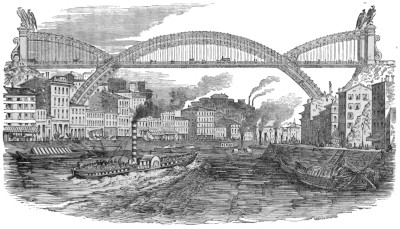
VERGNAIS’S HERCULEAN BRIDGE.
Various plans have from time to time been formed, for giving strength
and security to bridges; the history of which, from the time when streams
were first crossed by rude logs or trees thrown over them, up to the latest
726inventions, would be full of interest. One of the latest improvements in
this department, designed and invented by an ingenious French engineer,
M. Vergnais, is presented in the preceding cut. It was originally intended
to be thrown across the river Seine, at Paris. Some years ago, a wire suspension
bridge at Angiers gave way, while a body of troops was crossing,
precipitating an entire regiment into the water, with a terrible loss of life.
Since that dreadful catastrophe there has always been a feeling of aversion
in France, toward the erection of suspension bridges. The ingenious
improvement here presented is designed to relieve all possible danger of
breakage, and yet allow of the construction of a bridge of gigantic proportions,
without in the least impeding navigation. In the ordinary suspension
bridge, the main cables sustain the entire weight, and should the connection
between the bridge and the cables give way, or either of the cables break, a
most melancholy end awaits all who have happened to be trusting their lives
to its security at the moment. In the application of Vergnais’s improvement,
the utmost security is afforded. A monster arch of iron is thrown
across from shore to shore. This arch is composed of such strong materials
as not to require great bulk, so that it presents an aerial appearance. The
flooring of the bridge is suspended from the arch by innumerable pendants
of iron, so that the weight of a body, in crossing the bridge, is brought to
bear gradually upon the structure, and when it reaches the center, where
common bridges are the weakest, under this invention it reaches the strongest
part, for it is directly beneath the arch. Besides, should any of the
pendants give way, the entire bridge does not yield, for it is impossible
for all the pendants to break at once. This plan is certainly a new and
novel one, so far as suspension bridges are concerned. We hope that the
inventor will be encouraged to erect them in this country. Railroad companies
will find them to be in every way advantageous to their interest,
since the cars may run across them at the highest speed, with perfect
security.
A group of natural and artificial wonders more varied and magnificent
than at Portage, N. Y., is not to be found in this land of sublime scenery
and rapid improvement. It is destined to be a Mecca of travel, only to be
classed with the White mountains, Niagara and the Mammoth cave. No
descriptive language will appear exaggerated to one who visits the scene, or
studies the measurements and details now presented. These do not tell
half the story; a complete account would require a guide-book of pen-and-pencil
727sketches. The small village of Portage lies on the Genessee river, at
a point where it enters a stupendous gorge, which continues seventeen miles,
in a north-east direction, to Mount Morris. Here it flows into the famous
Genessee valley, which extends from Dansville to Rochester, and is a level
tract of rich farms and shaded meadows, that are said to resemble English
park scenery more than anything in our country. The river enters the lake
a few miles below the Rochester falls, thirty miles north of Mount Morris.
To begin back, just below Portage village is a noble aqueduct of the Genessee
canal: this is built of hewn limestone, and is much like the high bridge at
Harlem, in size and appearance. Passing this and advancing into the river-gulf,
with the Genessee on one hand, the canal on the other, and two hundred
and fifty feet of wooded declivity inclosing both, a short walk brings you
suddenly to the new bridge of the Buffalo and New York city railroad.
The first and last look at this bridge must be one of dumb amazement. It
is the crystal palace of all bridges. How any mortal ever conceived, or
having conceived ever dared to attempt carrying it into execution, passes
our comprehension. Resting on six heavy stone basements in the water, and
as many more on the land, it rises to the immense hight, for a bridge, of
two hundred and thirty-four feet, and is eight hundred feet long, lifting its
immense net-work of timber, as if a whole village of house-frames and rectangular
streets were raised up and set perpendicularly on edge. The first
fall of the river, a sidelong, broken descent of sixty feet, is a few steps below
the structure, and visible from its top, long before reaching which the
ascending mist is dissipated. One and a half million feet of timber, being
the product of two hundred acres of land, together with thirty tuns of iron
spikes, were required for this climax of modern engineering. The cost is
estimated at one hundred and thirty thousand dollars. Before the work
had reached its completion, the railroad passengers were taken in carriages
two miles around from one end of the bridge to the other, a very comfortable
hotel having been erected at the eastern extremity. Below the
monster bridge and its waterfall, the river chasm widens into a deep basin
of hills, with a pond in the center, and the second fall, a descent of eighty
feet, at the lower extremity. This grand natural temple of cliffs, has thus
at each end an organ with a shining range of silver pipes; on the left side
are several galleries in the shape of canal aqueducts of wood, built to avoid
the incessant slides of quicksand; and, at the upper entrance, the six-story
bridge furnishes fifty rostrums for as many orators. Connected with the
lower falls is a singular semicircular chasm, and, at its base, a cave, worn
by water, which, as a matter of course, has been afflicted with a Satanic
name: it is of difficult access. Here begin the imposing precipices of three
728hundred feet in hight, forming, at this point, a mighty amphitheater, around
the eastern brink of which winds the canal, protected by a stone parapet.
A gigantic tunnel was first constructed, and still remains in part; but the
rock proved so insecure, that the overhanging roof was thrown off, at great
expense, into the river, and the bed of the canal laid in cement. Nearly
the whole array of these wonders could be brought into one view from a
high point on the western bank, where the artist Cole, when this scenery
was in its pristine wildness, once took a sketch for a very large autumnal
picture, which is now in the possession of Hon. W. H. Seward. Some distance
below the places now described, is a third fall, very grotesque in its
features, and made remarkable by a tall natural tower, left by the wearing
of the river and surmounted by a crown of foliage.
This wonder of modern engineering, a view of which is given in the cut,
forms part of the railroad from Chester to Holyhead, and is thrown over the
Menai strait which separates Caernarvon, in Wales, from the island of
Anglesey. This strait appears to the eye as a beautiful river, half a mile
729wide, through which the tide, which here rises twenty and twenty-five feet,
rushes with great rapidity and force. The tubular bridge over it is one
hundred feet above high-water level, and formed of long, hollow, rectangular
tubes, one for up, and the other for down trains, composed of wrought-iron
boiler-plates riveted together, and resting on huge and massive towers of
masonry. Of these tubes or galleries, eight in number, four for each line,
the four shortest are each two hundred and thirty feet, and the four longest
each four hundred and seventy-two feet in length. The middle and largest
pier or tower, is sixty-two feet by fifty-two at the base, and rises majestically
to a hight of two hundred and thirty feet. The workmen engaged upon this
bridge, with their wives and families, were equal in number to the population
of a moderately sized town, and had the usual provisions for large
communities, of a clergyman, schoolmaster, surgeon, etc. The entire cost
of the stupendous structure, was about three million, five hundred thousand
dollars. The number of rivets used in fastening the tubes of this bridge
was over two million; and the entire length of it is eighteen hundred and
thirty-four feet. Silliman says of this immense and ingenious structure,
that it “is wonderful. To construct,” he adds, “a vast tube of iron strong
enough to admit of railroad trains passing safely through it; to build it in
separate pieces down on the common level; to float them to the site, and
there raise them to their elevation of one hundred feet, and place them on
firm pillars of masonry as supports, and then to unite them into one continued
tube, as part of the grand railroad connection between London and
Holyhead and Ireland, is an achievement which must forever place the name
of Robert Stevenson above all praise.” To show the immense strength of
this bridge, he goes on to say, “An enormous weight of between three and
four hundred thousand pounds, caused a depression of the level only three
inches. The ordinary pressure of the railroad trains produces a depression
of one-eighth of an inch, or even less, discernible only by instruments. A
pressure of more than six hundred thousand pounds produced a deflection
of less than an inch and a half. As works of art, this bridge, and the one
next to be mentioned, are triumphs of mechanical skill and science, and they
not only establish the connection which has been named between Wales,
Anglesey and Ireland, but they afford the prospect of a still more important
connection from Galway, in Ireland, to Nova Scotia, by steamers, thus
bringing Europe and America within a week of each other. The most
massy stone pier, the Britannia, was erected upon a firm rock which is in
the middle of the river. The term tube, as here applied to the body of the
bridge, may convey an erroneous idea; for instead of being round, it is
square. It is an immense iron corridor, or parallelopiped, closed in, forming
730a horizontal iron gallery, or passage, in which the rails are laid. It is thirty
feet high in the middle, and twenty-two feet toward the ends.
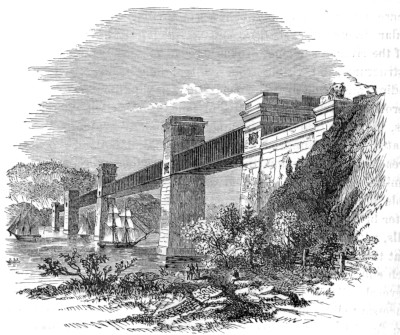
THE BRITANNIA TUBULAR BRIDGE.
“This stupendous structure proves to be a very delicate thermometer. A
little sunshine raises the center an inch, (as the expansion can not extend
downward,) and produces a horizontal deflection or swelling of an inch and
a half. For every fifteen degrees of Fahrenheit, it expands one ten-thousandth
of its length, or half an inch. Alternate sunshine and showers of
rain, cause the tubes to expand and contract. If one of the tubes was placed
on end in St. Paul’s churchyard, London, it would rise one hundred and
seven feet higher than the top of the cross. The rivets that unite the plates
are an inch in diameter; they were put in red-hot, and beaten with heavy
hammers, and in cooling, they contracted so strongly as to draw the plates
together with a force requiring four to six tuns to make them slide on each
other. The tubes were raised from their position afloat on the water, by
means of a Brahmah hydraulic press, into which the water was injected by
powerful steam-engines. The force exerted by this power would throw
water nearly twenty thousand feet high; more than five times the hight of
Snowdon, the highest mountain in Wales, and almost five thousand feet
higher than the summit of Mont Blanc. The greatest number of men
employed at any one time on this bridge, was two thousand, and the fatal
casualties were seven. The second tube was floated to its place December
fourth, 1849, and the opening of the bridge by the passage of cars took place
March fifth, 1850. It may be deflected thirteen inches without injury, and
would bear a weight of one thousand tuns.”
In the same vicinity, and over the same strait, is the great suspension
bridge, which, when it was finished in 1826, was deservedly esteemed one
of the wonders of the world, and is still entitled to hold that rank. It is
indeed a stupendous structure, of which the full details may be learned from
the official reports; but the following are among the principal facts. It is
one hundred feet above the water, so that the ships, even those of a large
size, are not impeded, and can pass under it without lowering a sail or a
spar. The bridge is built out upon arches from both sides of the river, to a
certain distance, leaving the space between the points of suspension, five
hundred and sixty feet. The platform is about thirty feet wide. The whole
is suspended from four lines of strong iron cables, by perpendicular iron rods,
five feet apart. The cables pass over rollers, on the tops of pillars, and are
fixed to iron frames under ground, which are kept down by masonry. The
731weight of the whole bridge between the points of suspension is four hundred
and eighty-nine tuns. The massy materials of which this bridge is composed,
the admirable manner in which they are locked together, the great
elevation at which it crosses this grand strait, its persistence without sign of
failure during more than a quarter of a century, its importance as a connecting
link between England and Ireland, and the result of this early effort
to conquer formidable physical difficulties, fill the beholder with admiration
and delight, and do lasting honor to Mr. Telford, the distinguished architect.
We have before, on page 265, given some account of this vast structure as
it was, when so far completed as to be used for ordinary passage. But we
advert to it again here, both because it has since had added to it the superstructure
for railway-trains, and also that we may bring in comparison, the
first suspension bridge ever attempted, (an account of which has been given,)
and one of the last and largest ever undertaken. The first train of cars
passed over this bridge on the ninth of March, 1855, from the Canada to the
American shore, the engine and tender being crowded with people, having
the English and American colors flying, while bands of music were playing
alternately the national airs of Great Britain and of the United States. The
opening of this mighty and magnificent structure, well worthy of being
classed with the world’s wonders, really forms an epoch in the history of the
world. It unites with strong iron bands two countries, to the intelligence
and enterprise of whose inhabitants the bridge owes its existence, and stands
a fitting monument. Its strength can never be fully tested; the weight of a
fully laden train being but a trifle in comparison to its capacity. A train
of eight cars, filled with passengers, two baggage-cars, locomotive and tender,
weigh but about one hundred and thirty tuns; this being only one-sixtieth
of its immense capacity. The railway portion of the bridge is leased to and
controlled by the Great Western railway company, and has laid upon it
tracks of three different gauges, viz., the New York Central, four feet and
eight and a half inches; the Elmira and Niagara Falls, six feet; and the
Great Western, five feet and six inches, thus affording facilities for the
transit of both passengers and freight, without change of cars. The following
statistics will give some idea of this immense structure and its capacity.
| Length of span from center to center of towers, |
822 |
feet. |
| Hight of tower above rock on the American side, |
88 |
feet. |
| Hight of tower above rock on the Canada side, |
78 |
feet. |
| 732Hight of tower above rock on the floor of railway, |
60 |
feet. |
| Number of wire cables, |
4 |
|
| Diameter of each cable, |
10 |
inch. |
| Number of No. 9 wires on each cable, |
3,659 |
|
| Ultimate aggregate strength of cables, |
12,409 |
tuns. |
| Weight of superstructure, |
750 |
tuns. |
| Weight of superstructure and maximum loads, |
1,250 |
tuns. |
| Maximum weight the cable and stays will support, |
7,200 |
tuns. |
| Hight of track above water, |
234 |
feet. |
At Peru, in Illinois, is the great bridge of the Illinois Central railroad,
which is thirty-five hundred feet, or nearly two-thirds of a mile long. This
is perhaps the greatest work of the kind in all the western states. It reaches
from bluff to bluff, is seventy-five feet in hight, and contains over one million
feet of lumber, beside immense quantities of iron and stone. The top is
covered with tin, and made water-tight; the trains of cars are to run on the
top of all; and beneath them, and between the frames, pass the roads for
wagons; while underneath all are the river and canal. An ornamental
railing is placed on each side of the track.
Another large bridge, on the suspension principle, is that over the Mississippi,
near St. Anthony and Minnesopolis, in Minnesota. The work consists
of a wire suspension bridge, of one span of six hundred and thirty feet,
having seventeen feet of roadway, connecting the western bank of the
Mississippi river with Nicollet island, about one hundred yards above the
first break of its waters into rapids above the falls.
But perhaps the largest bridge ever built, will be, when completed, that
now erecting over the St. Lawrence, called the Victoria (railroad) bridge,
which is to be an immense iron tube, ten thousand, two hundred and eighty-four
feet, or nearly two miles long. It is to be set on twenty-four piers,
from two hundred and twenty to three hundred feet apart. At the highest
point it will be some sixty feet from the water; and it is estimated that it
will take at least five years to finish it. These are some of the largest
bridges, (in addition to those already particularly mentioned,) ever erected
in any part of the world.
733
The High bridge at Harlem, a view of which is given in the cut below,
forms part of the immense works erected to bring the water of the Croton
river into the city of New York. The dam at the river, which is seventy feet
wide at the bottom, seven feet wide at the top, and two hundred and fifty
feet long and forty feet high, creates a pond five miles long, covering a
surface of four hundred acres, and containing five hundred million gallons of
water. From this the aqueduct proceeds, sometimes tunneling through
solid rocks, crossing valleys by embankments, and brooks by culverts, till it
reaches the Harlem river, a distance of thirty-three miles. It is built of
stone, brick and cement, arched over and under, and is made large enough
to discharge sixty millions of gallons every twenty-four hours. It crosses
734the Harlem river on a magnificent bridge of stone, fourteen hundred and
fifty feet long, having fourteen piers, eight of them bearing arches of eighty
feet span, and seven others of fifty feet span, one hundred and fourteen feet
above tide-water at the top. The aqueduct then passes on to a first, or
receiving reservoir, which covers thirty-five acres and will hold one hundred
and fifty million gallons, and thence to the second, or distributing reservoir,
which holds twenty million gallons, whence it is distributed by pipes through
the city. The entire cost of the work has been fifteen million dollars.
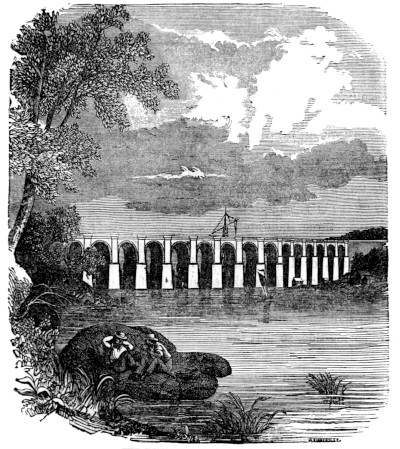
THE HIGH BRIDGE AT HARLEM.
The mention of the High bridge at Harlem, and its connection with the
aqueduct which brings the Croton water to the city of New York, suggests
some notice of the aqueduct by which water is brought to the city of Boston,
Massachusetts. So early as 1795, an association was formed in Boston for
supplying the inhabitants with pure water; and for years it was brought
from Jamaica pond, in Roxbury, some four miles distant, in logs which
were bored for the purpose. These logs were capable of supplying some
fifty thousand gallons daily, which could be raised to the hight of forty-nine
feet above tide-water. This supply, however, was soon found inadequate to
the wants of the city, though in 1845, some fifteen miles of pipes had been
laid, and some three thousand houses were regularly supplied with water.
A plan was therefore formed in 1845, to supply the city with water from
Lake Cochituate, or Long pond, as it was formerly called, about twenty
miles west of Boston. This lake covers a surface of some six hundred and
fifty acres, is seventy feet deep, and drains the springs, it is supposed, of
some eleven thousand acres. Its elevation is one hundred and twenty-four
feet above spring-tide, so that the descent is such as to make the conveyance
of water to the city both easy and sure. The water is carried in a brick
conduit or tunnel, high enough for a man to walk upright in, as far as the
receiving reservoir in Brookline, and from there is taken in thirty and thirty-six
inch pipes to the distributing reservoir on Beacon hill, in Boston. It is
this reservoir, a view of which is given in the cut beyond, from which the
water is distributed in pipes throughout the city. The average daily supply
of water needed for the present population of Boston, is about five million
gallons. The water-works are capable of supplying twenty million gallons
daily; and the Cochituate lake is capable, (by laying down another main
pipe,) of supplying forty million gallons daily. The supply of the lake is
fully equal to the wants of half a million of people.
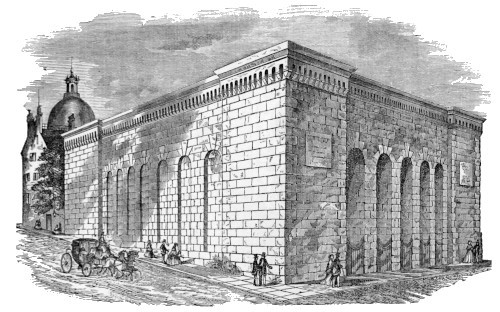
735
This aqueduct forms part of the Peat Forest canal, which is a branch of
one of the canals extending out from Manchester in England. The latter
city is the great center of the cotton manufacture for England, and perhaps
the principal manufacturing town in the world. Before the invention of
736what was called the spinning-frame, in 1767, the entire imports of cotton
into Great Britain did not amount to four million pounds a year, and the
value of exported cotton goods was not over one million dollars. But so
rapid has been the improvement of machinery, and the increase of manufactures,
that in 1840 the imports of cotton amounted to the prodigious
quantity of nearly six hundred million pounds, of which nearly five hundred
million were manufactured. And in 1854, these imports amounted to nearly
nine hundred million pounds, of which about the same proportion was manufactured
as in 1840. Of this immense manufacture, Manchester is the
center; and to this may be added various other manufactures, as in silks,
worsteds, machinery, &c., &c., &c. As a consequence of this immense business,
seeking, of course, outlets to market, Manchester has become a great
center of internal navigation. So early as 1761, the Duke of Bridgewater’s
canal was constructed; and this was soon followed by the Bury and Bolton
canal, in 1791; by that to Ashton and Oldham, in 1792; and by that to
Rochdale, in 1794. And these, again, are connected with other canals in
such a manner as to establish an easy communication with the eastern, central
and southern counties, including the ports of Hull, London and Bristol,
as well as Liverpool, which, of all others, is the port of Manchester. It is
737on one of these side canals that the aqueduct, a view of which is given in
the cut above, is located; or rather, it forms part of the canal itself. It is
not so much to be noted for its greatness or expensiveness, as for the fact
that it was among some of the earliest structures of this kind, which have
since become common wherever canal navigation is known.
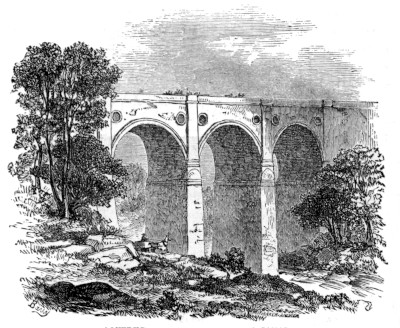
AQUEDUCT ON THE PEAT FOREST CANAL.
A tunnel, in engineering, is a subterranean passage cut through a hill, or
under a river, for the purpose of carrying a canal, road, or railway, &c.
One of the most remarkable works of this kind, ever executed, is the tunnel
under the river Thames, planned by Mr. Brunel, and successfully executed
under his direction. Two previous attempts had been made to carry a
tunnel under the river; one in 1799, and the other in 1804; but both were
unsuccessful. In 1824, however, an act of parliament, authorizing operations
on the plan of Mr. Brunel, was obtained; and shortly after the work
was commenced. A short account of the progress of the work will probably
be the best mode of conveying a notion of the nature and difficulty of
tunneling in general.
Mr. Brunel began his operations by making preparations for a shaft fifty
feet in diameter, which he commenced one hundred and fifty feet from the
river on the Surrey side; this he effected by constructing on the surface of
the ground a substantial brick cylinder of that diameter, forty-two feet in
hight and three feet in thickness. Over this he set up a steam-engine, necessary
for pumping out the water, and for raising the earth to be taken from
within the cylinder, and then proceeded to sink it bodily into the earth. By
this means he succeeded in passing through a bed of sand and gravel
twenty-six feet deep, constituting, in part, a quicksand, and in which the
drift-makers of the former undertaking had been compelled to suspend their
work. The cylinder having been sunk to the depth of sixty-five feet, the
horizontal excavation was commenced at the depth of sixty-three feet; and
in order to have sufficient thickness of ground to pass safely under the deep
part of the river, the excavation was made to descend two feet and three
inches in every hundred feet. This excavation is thirty feet wide, and
twenty-two and a half feet high, and the process of making it may briefly be
described as follows.
It was accomplished by means of a powerful apparatus of iron, called a
shield, and which consisted of twelve large frames, standing close to each
other, like so many volumes on the shelf of a book-case, these frames being
twenty-two feet in hight, and about three feet in width. They were divided
738into three stages or stories, thus presenting thirty-six cells or chambers for
the miners. The front of each one of these cells was protected by narrow
boards, technically called polling-boards, each of which was separately held
in its place by an apparatus constructed for the purpose. The miner commenced
by removing the upper polling-board in his division of the shield,
thus exposing a small portion of earth; into this earth he made an excavation
of six inches in depth, throwing the earth behind him, from whence it
was removed to the mouth of the tunnel, and from thence raised by steam to
the surface of the ground. He then replaced the polling-board, causing it
to press against the face of the newly excavated earth, and thus advancing
it six inches beyond the other polling-boards of his division. Then successively
taking down the remaining boards, excavating the earth six inches
behind them, and replacing the boards six inches further in than before, he
very soon had advanced that distance over the whole length of his division.
All the other miners in the thirty-six cells having done the same, the framework
was moved forward, and six inches more of earth removed. It was in
this way, by these slow degrees, that the work was finally completed. As
the frame-work advanced, it was closely followed by a solid mass of brick-work,
inclosing two arched passages. These two passages were separated
by a solid wall, three and a half feet at the top and four at the bottom.
Other arches, however, were formed in this wall, for the purpose of opening
a communication between one tunnel and the other. The whole of the
brick-work is laid in Roman cement, and each archway is finished with a
lining of cement, a carriage-road, and a narrow foot-path adjoining the
central wall.
This immense enterprise was not finally completed without serious delay
and apparently insurmountable obstacles. The works were thrice interrupted:
in 1826, by the breaking off of the clay, leaving the shield exposed
to the influx of the land-water for six weeks; also in May, 1827, and in
January, 1828, when the river broke in and filled the tunnel. This was
quickly remedied, however, by filling the holes or chasms with strong bags
of clay; the structure, on clearing the tunnel of the water, being found in a
most satisfactory state. Some time later, the works were suspended for
seven years, owing to the want of funds. Parliament, however, after
repeated applications, granted an advance for their completion, and the
works were resumed and continued, till they were brought to a successful
termination. The cost of the tunnel, with the approaches on both sides of
the river, was about three million and a half dollars; much less than the
cost of the modern metropolitan bridges which span the Thames between
Surrey and Middlesex.
739
The establishment of railroad communication has given rise, both in this
country and Europe, to some stupendous undertakings in the way of tunneling;
one or two of which are worthy of notice as illustrating the nature
and extent of this kind of work. And the first of these which we shall
mention, and one of the most remarkable, is the Box tunnel on the Great
Western railway in England. This tunnel pierces what is called Box hill,
between Chippenham and Bath, part of which is four hundred feet above the
level of the track. It is ninety-six hundred and eighty feet long, thirty-nine
feet high, and thirty-five wide to the outside of the brick-work. The shafts
for making and ventilating it, are thirteen in number, and vary in depth
from eighty to three hundred and six feet. The excavation amounted to
four hundred and fourteen thousand cubic yards; and the brick-work and
masonry, to more than fifty-four thousand cubic yards. The number of
bricks used, was thirty million. A tun of gunpowder and a tun of candles
were consumed every week for two years and a half; and eleven hundred
men and two hundred and fifty horses were kept constantly employed for all
that time. For a considerable distance the tunnel passes through freestone
rock, from the fissures of which there was, at times, an immense influx of
water, by which on one occasion the works were interrupted for a period of
nine months. On another occasion after an irruption, water was for some
time discharged by the engine at the rate of thirty-two thousand hogsheads
a day. This tunnel is on an inclined plane of one in a hundred. There
are several other tunnels of great extent in England, such as the Kilsby
tunnel, on the London and Birmingham road, which is over seven thousand
feet long; and the tunnel from Wapping to Edge hill, on the Liverpool and
Manchester road, which is over six thousand feet long, and quite a number
of others of five thousand, four thousand, three thousand feet long, &c.
One of these remarkable tunnels, is that on the South-eastern or Dover
railway, a view of which is given in the cut on the following page, which
passes through what is called Shakspeare’s cliff, at Dover, (though the cliff
to which the poet alluded has been undermined and thrown down, and the
name is now given to another part of the same range,) on the north side of
the British channel. This cliff is a high bluff of chalk, on the west of the
town, the white appearance of which gave the name of Albion (white) to
England. There are two openings in the tunnel; and through these the
whizzing locomotives fly along the dizzy precipice, as if it were an ordinary
highway. There is, also, a second tunnel in the same cliff. This last is
740called the Abbot’s-cliff tunnel, and is about a mile in length, coming out on
the face of the rock about sixty feet above the sea. The track passes along
the front of the rampart for about a mile, and then enters the Shakspeare
tunnel, which is also about a mile in length. Thence, again, it issues on the
face of the cliff, and proceeds to the station at Dover.
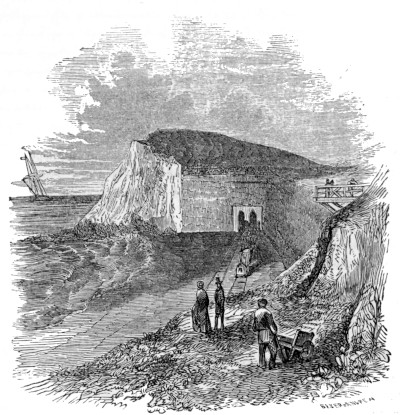
TUNNEL IN SHAKSPEARE’S CLIFF.
In the United States there are quite a number of railroad tunnels of great
extent. One of these is the Blue Ridge tunnel, in Virginia, the length of
which, when completed, will be forty-two hundred and sixty feet, of which
more than half is already (1855) finished. The work has been commenced
on each side of the mountain, and is progressing at the rate of about fifty
feet a month, at which rate of progress it would take about three years to
complete it.
But probably the most gigantic work ever proposed in the way of tunneling,
is the Hoosic tunnel, on the line of the Troy and Greenfield railroad,
by which it is designed to shorten the passage from the former place to
741Boston. This immense tunnel it is proposed to carry through the solid rock
of the mountain for a distance of some four miles, and to make it wide
enough for a double track for the railroad; the expense of doing which is
variously estimated, at from four million to six million dollars. By the
ordinary method of drilling and blasting, it would take so long a time, and
require so large an expenditure, that all idea of thus accomplishing the
work has long since been given up, if, indeed, it was ever entertained. And
the plan is, by immense boring machines, constructed for the purpose, to
make grooves round large masses of the rock, and when these latter are
broken up by blasting, to remove them piece by piece. Several such
machines have been invented and constructed with reference to this very
work, and one or two of these have been found successful in practice, though
the immense strain caused by the boring is such as to require corresponding
strength in the borer. To give the necessary ventilation, and now and then
light to the tunnel, both when in the course of construction, and especially
when finished and in use, it is proposed at proper intervals to sink dry wells,
or openings from the top of the mountain, down to the tunnel itself; so that
the constant stream of air entering the mouth of the latter, at either end,
may be always and steadily passing up through these chimneys or ventilators,
thus carrying off the smoke of the engines, or any impurities of the
otherwise stagnant air. The work, when completed, if it ever is, will be a
monument of enterprise and perseverance, unrivaled in the history of tunneling
in this or any other country of the world.
This was a celebrated brazen image of Apollo, of the enormous hight of
one hundred and five Grecian, or one hundred and twenty-five English feet,
placed at the entrance of one of the harbors of the city of Rhodes,
(anciently Rhodus,) which is about twenty miles from the coast of Lycia
and Caria, in the Mediterranean sea. The island of Rhodes is about one
hundred and twenty miles in circumference, and was early occupied by a
colony of Greeks from Crete and Thessaly, who in time became both
wealthy and powerful. Their capital city was on the east of the island; it
was built in the form of an amphitheater, and had numerous splendid buildings,
among which was a temple to Apollo. Having for a time submitted to
the power of Alexander the Great, they afterward refused to assist Antigonus
in his war with Egypt, when he sent his son Demetrius against them,
with an immense fleet and army. They, however, being aided by Ptolemy,
king of Egypt, were enabled to repulse his forces and to oblige him to agree
742to a peace. And he being thus reconciled to them, in admiration of the
courage they had displayed, presented to them all the engines he had
employed in the attack, by the sale of which, for three hundred talents,
they raised the famous colossus, a view of which is given in the cut.
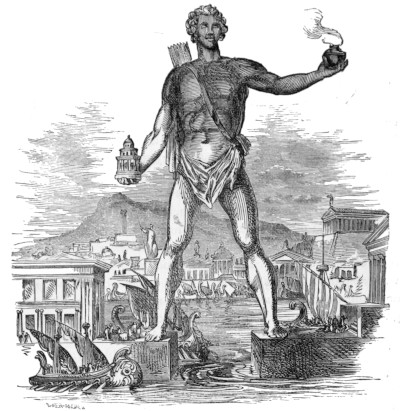
This immense statue, as already said, was of brass, and was erected in
honor of Apollo, the tutelary god of the island, in acknowledgment of the
protection he was supposed to have rendered the Rhodians in their recent
conflict. It was the workmanship of Chares, (a pupil of Lysippus, a celebrated
sculptor and statuary of Greece,) who, with an assistant, was engaged
in the work for more than twelve years. The hight of the statue, as already
said, was one hundred and twenty-five feet; its thumb was so large that few
people could grasp it; and the fingers were each larger than the bodies of
statues of ordinary size. It was hollow, and to counterbalance the weight,
and render it steady on its feet, its legs were lined with heavy masonry;
and within them, were winding staircases leading to the top of the statue,
743from which one could easily see Syria, and the ships sailing to Egypt. It is
supposed to have stood, with distended legs, on the two moles which formed
the entrance of the harbor; but as the city had two harbors, one twenty,
and the other fifty feet wide at the entrance, it has been supposed to have
been at the narrowest. It bore a light, or lantern, so as to serve as a light-house;
but whether on the head, or in one of the hands, as represented in
the cut, is not certainly known. The statue was erected B. C. 300, and
after having stood about sixty years, was thrown down by an earthquake.
After its fall, the Rhodians solicited help from the kings of Macedonia and
Egypt, and in other countries, to enable them to restore it; and so great was
the commercial importance of Rhodes, that their appeal was promptly met
by magnificent gifts; but the oracle at Delphos forbade them again to raise
the colossus. The statue then remained in ruins for the space of eight
hundred and ninety-four years, when, in the year 672 A. D., it was sold by
the Saracens, who were then masters of the island, to a Jewish merchant of
Edessa, who loaded nine hundred camels with the metal which had composed
it, and which, estimated at eight hundred pounds for each camel-load,
would have amounted to seven hundred and twenty thousand pounds’
weight.
The character of Rhodian art was a mixed Græco-Asiatic style, which
seems to have delighted in executing gigantic and imposing conceptions; for
beside this celebrated colossus, (which was one of the seven wonders of the
ancient world,) there were three thousand other statues adorning the city;
and of these, about one hundred were on such a scale of size and magnificence,
that the presence of any one of them would have been thought
sufficient to dignify almost any other spot. The architecture of Rhodes was
of the most stately character: the plan of the city was by the same architect
who built the Piræus at Athens; and all was designed with such symmetry,
that Aristides remarks, “It is as if it had been one house.” The streets
were wide, and of unbroken length; and the fortifications, strengthened at
intervals with lofty towers, did not appear, as in other cities, detached from
the buildings which they inclosed, but by their boldness, and decision of
outline, hightened the unity and conception of the groups of architecture
within. The temples were decorated with paintings, by Protogenes, Zeuxis,
and other celebrated artists of the school of Rhodes; and of one of these
pictures, it is said, that when taken to Rome, it was the object of universal
admiration. The island, after passing through various fortunes, has, for a
long time, been part of the Turkish empire.
MISCELLANEOUS WONDERS. — YOULE’S SHOT-TOWER. — THE EMPEROR FOUNTAIN. — THE UNITED STATES MINT IN PHILADELPHIA. — THE AIR BALLOON. — THE PROGRESS OF NAVIGATION. — STEAM NAVIGATION. — CHINESE JUNKS. — THE ARTESIAN WELL OF GRENELLE. — THE BANYAN-TREE. — THE WEDDED BANYAN-TREE. — THE COCOA-TREE. — THE REINDEER SLEDGE. — THE UPAS, OR POISON-TREE. — THE PRAIRIE ON FIRE. — THE MAMMOTH TREE OF CALIFORNIA. — OTHER MAMMOTH TREES. — THE PALM-TREE. — THE BAMBOO-TREE. — THE MANNA-TREE. — CONTINENTAL MONEY. — THE MILK-TREE. — THE TELEGRAPH. — THE ELECTRO-MAGNETIC TELEGRAPH. — THE ART OF PRINTING. — THE INDIA-RUBBER TREE. — THE ROUND TOWER AT NEWPORT. — DIVING ARMOR. — TREE-HOUSE IN CAFFRARIA. — THE RAINING-TREE. — THE TRAVELER’S FRIEND. — THE CAMPHOR-TREE. — THE CINNAMON-PLANT. — THE TREE TEMPLE. — THE TERMITES, OR WHITE ANTS. — HUTS IN KAMTSCHATKA. — THE WHALE. — LANDING OF THE PILGRIMS. — PLYMOUTH ROCK. — A WONDER OF ART. — THE WHALE-KILLER. — A PILE OF SERPENTS. — AMERICAN RUINS. — INSECT SLAVERY.
744
Having dwelt so long on the WONDERS OF NATURE, and the WONDERS OF
ART, both ancient and modern, we pass to some of the wonders and curiosities
of the world of a miscellaneous nature. Some things are wonders only
through their associations, as is the case with many of the localities of
Palestine, for example, where the Saviour lived and walked, and wrought
his miracles of power and mercy. Some are wonders as exhibiting the
inventive powers of man, or the progress of our age as compared with
another; some as exhibiting the singularities of nature; and some as
combining the wonders both of science and art. The steamboat, the
printing-press, the air-balloon, the residence of Washington, the hut of the
Kamtschatkadale, the spot where the “Pilgrim Fathers” landed, the telegraph,
the diving-bell or armor, the prairie on fire, the nest of the African
tailor-bird, each of these, and of a multitude of other things that might be
enumerated, is, in some way, or for some reason, associated to our minds
with what is more or less wonderful, while still it may not be strictly a
wonder either of nature or of art. Some of these we propose now to notice,
interspersing them at intervals with some of the more miscellaneous wonders
of nature, or art, or both, so as to give variety to the pages that follow. And
the first of this class of wonders we will notice, is,
This edifice, which is one of the best of its class, is situated at the foot of
Fifty-fourth street, on the East river, in the city of New York. It is hexagonal
in form, and rises to the hight of one hundred and seventy-five feet;
being sixty feet in diameter at the base, and gradually growing smaller as it
rises toward the top. It forms a most striking object of interest; and is
remarked by the multitudes who pass by it going up and down the sound,
to and from New York. When we consider the small size of the article to
the manufacture of which this lofty structure is devoted, the means appear
greatly out of proportion with the result. Formerly in casting shot, the
apparatus was merely a plate of copper, in the hollow of which were punched
a number of holes. This was placed a few feet above a kettle of water, into
which the melted lead descended, after passing through the holes in the
plate. But in falling so short a distance, and being so suddenly cooled and
745hardened, the shot did not acquire a perfectly globular form, a desideratum
which is now attained by means of shot-towers. In the tower of Mr.
McCullough, the largest shot falls from the summit of the tower to the
bottom of a well twenty-five feet below the surface of the earth, making the
descent one hundred and seventy-five feet. The size of the shot is determined
by the size of the holes through which it passes. The furnaces for
melting the lead are situated near the top of the tower; three or four tuns
of shot are manufactured per day. This method of casting shot was invented
by Mr. Watt, the celebrated engineer, in consequence, it is said, of a dream.
He tried the experiment from the tower of the church of St. Mary, Radcliffe,
and finding it very successful, obtained a patent, which he afterward sold for
ten thousand pounds. There are now several shot-towers in the vicinity of
London, and different parts of the world; but none more worthy of notice
than the one of which we are now speaking. An iron staircase ascends from
the base to the summit of the tower. Arsenic is mingled with the lead in
proportion of forty pounds to one tun. In casting, the metal is poured
through a tube, but descends through the open space of the tower in a continual
stream of silvery drops. As the weight of the lead prevents it from
scattering or being blown about like water-drops, the workmen pass to and
fro, without danger, close by this fiery cascade. The shot is of different
sizes, from number one, swan shot, to number twelve, dust shot. Mr. James
McCullough has brought the art of the manufacture of the shot to perfection.
Certain portions of his factory are kept entirely secret; and the shot manufactured
in New York are not surpassed in the world. The cause of most
of the imperfections in the manufacture of lead shot, is the too rapid cooling
of the spherules by their being dropped too hot into the water, whereby their
surfaces form a solid crust, while the interior remains fluid, and in its subsequent
concretion shrinks so as to produce the irregularities of the shot.
The patent shot-towers originally constructed in England, obviate this evil,
by exposing the fused spherules, after they pass through the cullender, to a
large body of air during their descent into the water-tub placed on the
ground. The greatest erection of this kind is probably at Villach, in Carinthia,
being two hundred and forty Vienna, or two hundred and forty-nine
English feet high. The following is the process. Melt a tun of soft lead,
and sprinkle round the sides of the iron pot about two shovelfuls of wood
ashes, taking care to leave the center clear. Then put into the middle about
forty pounds of arsenic, to form a rich alloy with the lead. Cover the pot
with an iron lid, and lute the joints quickly with loam or mortar, to confine
the arsenical vapors, keeping up a moderate fire to maintain the mixture
fluid for three or four hours; after which, skim carefully, and run the alloy
746into ingots or pigs. The composition thus made is in proportion of one pig
to one thousand pounds of melted lead. Two or three tons are usually
melted at once in large establishments. A crust of oxyd of a white spongy
nature, sometimes called cream by the workmen, covers the surface of the
lead, which is of use to coat over the bottom of the cullender. The cullenders
are hollow hemispheres of sheet-iron, about ten inches in diameter,
perforated with holes perfectly round and free from burs. These must
be of a uniform size in each cullender; but, of course, a series of different
cullenders, with sorted holes for every different size of lead shot, must be
prepared. The operation is always carried on with three cullenders at a
time, which are supported upon projecting grates of a kind of chafing-dish
made of sheet-iron, somewhat like a triangle. This chafing-dish should be
placed immediately above the fall; while at the bottom there must be a tub
half-filled with water, for receiving the granulated lead. The cullenders are
not in contact, but must be parted by burning charcoal, in order to keep the
lead constantly at the proper temperature, and to prevent its solidifying in
the filter. The hight from which the particles should be let fall, varies
likewise with the size of the shot; as the congelation is the more rapid, the
smaller they are. The workman then puts the filter stuff into the cullender,
pressing it well against the sides; he next gently pours lead into it with an
iron ladle. The center of the cullender being less hot, affords larger shot
than the sides. Occasionally, also, the three cullenders employed together,
may have holes of different sizes; the shot will then be of different magnitudes.
These are separated by square sieves of different fineness, and after
passing through other minute processes, are ready for sale and use.
This splendid fountain, a view of which is given in the cut beyond, is one
of the most remarkable in the world, and in commemoration of a visit paid
to it in 1844, by the emperor of Russia, it was called the Emperor fountain,
though since the outbreak of the war between Great Britain and Russia, the
name is said to have been changed to that of the Victoria fountain. It is
situated in Chatsworth, one of the most luxurious seats of the English
nobility; famous for its exceeding beauty and its costly embellishments. Its
walks, lawns, parterres, mimic Alpine scenery, conservatories, gardens,
cascades, halls, pictures, and sculpture, and music, and fountains, have all
been constructed and arranged with consummate taste and with lavish
expense. A month would scarcely suffice to visit all that is worthy of observation
in this wonderful place, and perhaps few sights could produce a
747deeper impression of the wealth possessed by the English aristocracy. We
have from this munificent storehouse selected a single object to be delineated
by the pencil. The Emperor fountain is fed by immense artificial reservoirs
on the hills above Chatsworth, covering eight acres of ground, into which
various springs and streams have been diverted. Our American ideas of a
fountain are usually limited to a beautiful jet of water forced twenty or
thirty feet in hight; hence it is with amazement, if not incredulity, that we
hear of the fountain of Chatsworth, which throws its jet to the hight of two
hundred and sixty-seven feet! Such is the velocity with which the water is
ejected, that it is calculated to escape at the rate of one hundred miles a
minute!
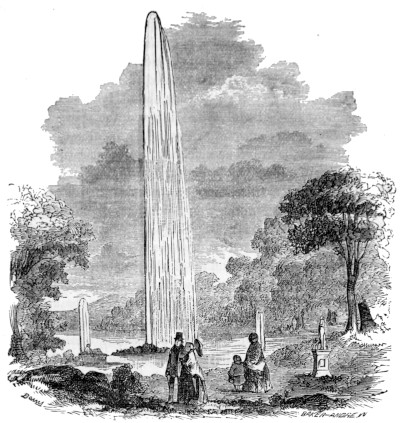
The United States mint was founded in 1790; and the business of coining
commenced in 1793, in the building now occupied by the Apprentice’s
748library. In 1830, it was removed to the fine building it now occupies, on
Chestnut street, above Olive street. The edifice is of white marble; and the
north front, opposite to Penn square, is one hundred and twenty feet long,
with a portico of sixty feet long, having six Ionic columns; while the south
front, on Chestnut street, has a similar portico. Since the enormous influx
of gold from California, the United States mint has become an object of
more than common interest and attention; and the place is usually filled
with visitors, watching the various processes the metal goes through before
it comes out in finished coin. The machinery and apparatus by which these
are accomplished, are of the most complete and perfect character. The
rooms in which the smelting, refining, and alloying are done, are spacious
apartments in which a large number of workmen are employed. Heaps of
the rich ores are to be seen lying around, just as they were extracted from
the mines, or gathered in dust from the sands of the mountain-streams of
California. Bars of the pure metal, of thousands of dollars’ value, are
passing through hands, which like those of the fabled Midas, seem to turn
all they touch into gold. The heat of this place is very great; the fires glow
with the intensity of those in a foundery; the men, in appearance, resemble
the workmen in a smithy; and there is a suffocating sensation of hot air,
steam, and perspiration, penetrating the atmosphere, which is anything but
pleasant to experience, especially when one is palpitating under the heat of
a summer temperature, without the freshness of the open air to modify and
alleviate it. Crucibles are handled with iron tongs, and cotton or woolen
mittens; and the metal is shaped into bars, and then reduced to the requisite
fineness. All this takes place in one apartment.
In another room, is seen a most beautiful steam-engine, which drives all
the rolling and stamping machinery. It is of one hundred horse-power, and
works the rolling machinery, the draw-benches, and the cutting presses. It
is called a steeple-engine, and has two cylinders; its boilers are forty feet
long, and forty inches in diameter; and the steam from them also moves a
ten horse, and a five horse engine, in the separating and cleaning apartments.
This main engine is of the most elegant workmanship, polished
like a piece of cutlery, and works with the most admirable precision and
regularity, without the least perceptible jar, and with scarcely a noise.
From this room, the visitor walks into that where the rolling machines are
at work, turning out the metal to the proper degree of thickness which each
particular kind of coin requires. The metal is cast into ingots fourteen
inches long, and about five-eighths of an inch thick; and these are rolled to
very near the proper thickness, when they are passed through the draw-benches
to equalize them. The strips are then cut at the presses, which is
749done at the rate of about two hundred to two hundred and sixty per minute.
There are fourteen men employed in this room, two at each pair of rolls.
The pieces, as thus cut, then pass to the adjusting room, where each piece
is weighed separately, and if too heavy, filed down, or if too light, or any
way imperfect, thrown back to be remelted. There are fifty-four females
employed in this room. The pieces are next taken to the milling and coining
room, where from two hundred to four hundred are milled in a minute,
according to their size. In another apartment, the coins are cut with a
punch to the desired size, and then stamped. For this purpose they are
placed, by a person seated at the machine, in a perpendicular tube, down
which they descend, one at a time, being seized as they drop by a part of
the machinery, which pushes the coin under the stamp, whence it falls
beneath the machine into a glass-covered box. This part of the process
used formerly to be performed by a press which required eight men to work
its lever and screw; but now the process requires scarcely any manual labor
except handling the various pieces of coin. The rapidity with which the
pieces are executed, is surprising; being at the rate of from seventy-five to
two hundred per minute. Cents, dimes, dollars, eagles and double-eagles
are turned out with equal facility, the process being the same in all. Some
idea of the extensiveness of these operations may be had, when it is stated,
that, in a single month, lately, nearly three million pieces of gold, silver and
copper were coined, and that over four million dollars in value are coined
every month.
In addition to the other attractions of the mint, there is a most extensive
cabinet of coins, ancient and modern, of various nations, which is one of the
greatest of curiosities to be found, probably, in any part of the world.
Here, too, are exhibited specimens of all the existing or past coins of the
mint itself, and models or specimens of any intended coins. The officers
and attendants of the mint are polite and attentive to all visitors, and
endeavor to make their visit one of instruction as well as amusement; and
any one, by calling at appointed hours, can go through the various apartments
of the building, and see the various processes which have thus been
described.
From the earliest ages, the notion of flying in the air, either by wings or
by supernatural agency, seems to have been in the minds of at least some
of mankind; but the idea of the balloon, consisting of an envelope containing
something light enough to make it rise and float in common air, is comparatively
750of much later date. It is said that the first definite notion of
the balloon originated with a Jesuit, by the name of Francis Lana, who in
1670 conceived the idea of raising metal balls in the atmosphere, which had
previously been exhausted of air, but which should be at the same time so
thin, as to weigh less than their bulk of air. The experiment, however, he
never tried, as, in his age, it was not believed that God would allow an
invention to succeed, by means of which civil government could so easily be
disturbed. Later experiments have proved that strength to resist the
external air is incompatible with the necessary degree of thinness in the
material. From this period, one hundred years elapsed, before the idea of
raising a body in the air, by means of its being lighter than the air whose
space it occupies, was pursued any further. In 1782, an attempt was made
to raise bodies filled with hydrogen gas, a substance which, as is well known,
is lighter than atmospheric air. The experimenter succeeded, however, in
raising nothing heavier than a soap-bubble. In the same year, the brothers
Montgolfier, paper-makers at Lyons, attempted to raise a paper balloon by
751means of hydrogen gas. Being unsuccessful in this, they conceived the idea
of applying fire underneath a large balloon of paper built upon a framework
of wood, and containing a receptacle for fire in the place where, in
modern balloons, the car is suspended. This experiment being so far successful
as to show the correctness of the principle, they next made a balloon
of linen cloth, and kindled under it a fire made and fed by bundles of
chopped straw, apparently with the impression that it was the smoke rather
than rarefied air which had the ascending power. The balloon, thus inflated,
rose about a mile in a direct line, and then described a horizontal line of
about seven thousand feet, after which it gradually sunk. The next attempt
was upon a balloon of lutestring dipped in a solution of India rubber, and
filled with hydrogen gas. The experiment at first failed, but on the twenty-seventh
of August, the same year, at Paris, the balloon rose beautifully to a
great hight, and fell about twelve miles off. Soon after, animals (sheep,
ducks, &c.) were sent up; and on the fifteenth of October, the first human
aeronaut made an ascent of a hundred feet. The balloon, however, was held
by a rope, and connection with the earth not entirely severed. A month
later, on the twenty-first of November, the daring feat of completely leaving
the earth was performed by two gentlemen, one of whom was M. Rosier, and
the other the Marquis d’Arlandes. The balloon was a Montgolfier, or one
in which the elevating power was air rarefied by fire. The signature of
Benjamin Franklin, who at that time was American minister to Paris, is
upon the official paper describing the balloon, its dimensions, &c. It was
seventy feet high, forty-six in diameter, and carried a weight of from sixteen
to seventeen hundred pounds; it rose to the hight of five miles in twenty-five
minutes. When the aeronauts wished to ascend still higher, they shook
a bundle of straw into the flame; when they wished to sink, they let the
fire smolder, or extinguished it with a wet sponge. The attempt was successful,
and the voyagers alighted in safety, after an absence of a little less
than an hour.
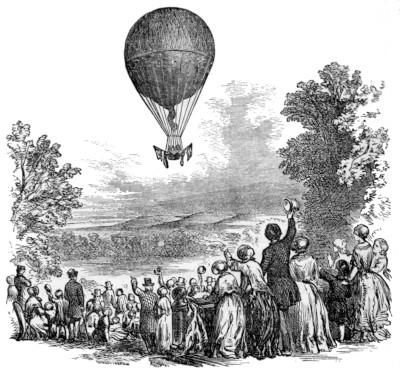
The first trial of a hydrogen balloon was made a week later, from the
garden of the Tuilleries, just after sunset. It ascended two miles with
perfect ease; its occupants here came in sight of the sun, which seemed to
rise again, as at morning, in the east. The balloon and its two travelers
were the only illuminated objects, all the rest of nature being plunged in
shadow. During the next two years, many ascensions were made by different
persons, and successive improvements and inventions were added. The
parachute was invented in 1784, and the first attempt at steering a balloon
was made in this year, but without success. In 1802, M. Garnerin
descended successfully from a great hight by means of a parachute. In
7521806, two aeronauts ascended to such a distance, that they came into an
atmosphere so rarefied as to burst the balloon. The remnants, however,
broke the fall, and they descended in safety. From the beginning of this
century to the present day, but little progress has been made in an art which
seems destined to be of little service to mankind. No possible means of
guiding the balloon have yet been discovered, or any practicable method of
giving it a horizontal motion, so as to withdraw it from the influence of
winds and currents. It has now become a mere toy, and for any practical
or scientific purpose, has long since ceased to be of the slightest account.
One of the largest balloons ever constructed is that of Mr. Green, a celebrated
English aeronaut, which is called the Continent, and has made many
ascensions from London and Paris. The following account of an ascent
from the Hippodrome at Paris, in 1848, is from a leading French journal.
It is from the pen of Theophile Gautier, an eminent Parisian romancer and
feuilletonist.
“Last Sunday, about five o’clock in the afternoon, Green’s balloon sprung
from the inclosure of the Hippodrome into the blue abyss of the heavens.
The ascension of a balloon is certainly not a novelty at the present day; but
an aerostat, like the one belonging to Green, is not of the ordinary class: its
colossal dimensions, the extraordinary care with which it is constructed, the
comfort of its arrangements, make it the wonder of aerial navigation, and
place it in the rank of a vessel of a hundred guns. To see it swelling its
enormous taffeta case under the net-work of cords which holds the car lined
with red velvet, one feels perfectly at ease as to the dangerous chances of a
voyage through the air. It would seem safer than an excursion in a diligence
or upon a railroad. Admitted into the reserved inclosure, we of
course saw the departure, being near the spot. Nothing could be more
quiet or more gentle. Mr. Green, in a black coat and white cravat, like a
gentleman going out to dine, stepped into his carriage—I should say his
balloon—with confidence and self-possession. A charming young English
girl, accompanied by a friend, had already taken her place in the boat or
car. She was calm and smiling; animation tinged her cheeks slightly, but
it arose rather from embarrassment at seeing so many eyes fixed upon her,
than from any fear whatever. Her intelligent face breathed that confidence
in the inventions of human genius, which characterizes the English and
American races. A Parisian lady would have screamed loudly.
“The balloon held by cords, trembled, and balanced itself, preparing to
take flight. A strong cord still held it to the earth, but soon, upon a signal
from Mr. Green, the cable was cut, and the aerial vessel arose steadily, with
a movement at once easy, powerful, and of exceeding majesty. As much as
753the locomotive has an infernal appearance, so has the balloon a celestial one,
without any play upon words. The one borrows its auxiliaries from iron,
coal, fire and boiling water; the other employs only silk and gas, a thin
cloth filled with a light wind. The engine, with its frightful shrieks, its
noisy rattling, and its black puffs of smoke, runs upon inflexible rails, roars
through the bowels of the earth, and dives into the darkness of tunnels,
seeming as if seeking some evil genius who might have invented it; the
balloon, without noise and without effort, leaves the earth, where the laws
of gravity hold us, and mounts tranquilly up toward heaven. Unhappily,
the balloon, like the fancied inspiration of the poet, goes where the wind
guides it; this every one knows; while the steam-engine, like prose, goes
straight upon its road. Green and his balloon were soon overlooking Paris
and all its horizon; long trails of sand, ballast that he threw over to raise
himself higher, streaked the heavens with their white tracks, proving, by the
time it took them to descend to the earth, the hight to which the intrepid
aeronaut had mounted in a few minutes. He had disappeared, while the
crowd was still looking for him, in the blue depths of the atmosphere.
What a splendid and magnificent spectacle the triumphal arch, and the
giant city with its black ants, illuminated by the setting sun, must have
afforded him! What greatness, and at the same time what littleness! and
how mean, from that distance, must seem the cares and ambitions of the
world!
“While looking with the rest of the crowd, a world of thoughts came
whirling through our brain. The balloon, which it was endeavored to make
perform a useful part in the battle of Fleurus, and at the siege of Toulon,
has only been considered, up to this time, as an amusing experiment of
natural philosophy. It is made to figure in fetes and in public solemnities;
for the crowd, who have more feeling for great things than academies and
wise bodies, feel an interest in balloon ascensions, which has not diminished
since the first attempts of Montgolfier. It is a profoundly human instinct,
which induces us to follow into the air, until it is lost to the sight, this globe
swelled with smoke, as if it contained the destinies of the future. Man,
the king of creation in intelligence, is, physically, but indifferently endowed.
He has neither the swiftness of the stag, the eye of the eagle, the scent of
a dog, the wing of the bird, nor the fin of the fish; for everything in man is
sacrificed to the brain. All these auxiliaries he has been forced to furnish
himself by the skill of his hand and the sweat of his brow. The horse, the
carriage and the rail-car make up to him for his want of speed; the telescope
and the microscope equal the eagle’s eye; the compass enables him to
follow a track as unerringly as a dog; the ship, the steamboat and the
754diving-bell open to him the dominion of the waters. Nothing remained but
the air, where the bird escaped us, followed only a few hundred feet by the
arrow or gun, ingenious means of bringing distances nearer together. It
really seems as if God should have given us such wings as the painters lend
the angels; but the beauty and grandeur of man consist in his not having
these giant appendages, or being embarrassed by fins. With the power of
thought, and the hand, that admirable tool, he must seek and find, out of
himself, all his physical powers.
“The idea of mounting into the air is not new; it is not to-day that
Phaeton asked to get into Phœbus’s car, and that Dædalus launched into
the air his son Icarus. Their descents were only unaccomplished ascents.
The griffins, the hippogriffs, the Pegasus, the winged shoes of Mercury, the
arrow of Abarys, the carpet of the four Facardins, testify to the continuance
and persistence of this idea. At night, does not the dream deliver us from
the laws of weight? Does it not give us the faculty of going, of coming,
and of flying to the summit of things before unattainable, or of losing ourselves
in the infinite hights? This general and oft-repeated dream, which
expresses the secret desire of humanity, has it not something prophetic?
Perhaps modern skepticism treats too lightly the meaning of these flights of
the soul, temporarily freed from the more earthly control of reason and
sense. With the astonishing simplicity of the operations of nature, a
miracle took place in the fireplace, without attracting attention, every time
that the smoke carried out of the chimney a piece of burnt paper. It
required six thousand years to take a hint from this simple fact. The
balloon floats in the air as oil floats upon wine, as cork upon water, as the
cannon-ball upon mercury, by relations of weight and of lightness, one
single law everywhere. But unfortunately, the balloon has neither wings,
nor tail, nor neck, nor feet, nothing which can guide it; it is a vessel without
sail or helm, a fish without fins, a bird without feathers; it floats, that
is all; it is immense, and it is nothing. Why do not all the inventors, wise
mechanicians, chemists, poets, occupy themselves by endeavoring to solve
the problem of the guiding of balloons? Is it not shameful for man to have
found the hippogriff which transports him to the celestial regions, and not
to know how to guide it; while every day the birds go and come on airy
wings, as if to instruct and defy us? The air, although a fluid, offers points
of propulsion, since the condor, or the sparrow, mounts, descends, goes to
the right and left, quickly or slowly, as he pleases; and why should not man
be able to do the same? The time when he shall do this may be near.
That will be a great day! Man will truly become master of his planet, and
will have conquered his atmosphere! No more seas, no more rivers, no
755more mountains, no more valleys; that will be the true reign of liberty.
Merely by this knowledge of the direction of balloons, the whole face of the
world will change immediately. Other forms of government, other manners,
a new style of architecture, a different system of fortification, will be
needed; but then men will no longer make war. The custom-house and its
taxes, and the stronghold, will disappear. Visit, if you can, with your
gauge and your yardstick, balloons ten thousand feet in the air; of what
use will be moats, ditches, portcullis and bridges, against an aerial army?
What a fine spectacle it will be to see crossing one another in the air, at
different hights, these swarms of balloons, painted with brilliant colors,
guided during the day by the light, and at night with their lanterns,
having the appearance of stars traversing the firmament! The ascension of
the highest mountains will then be but child’s play. We shall penetrate
into China, and go to Timbuctoo as one goes to St. Cloud; the deserts of
Africa, of Asia and of America, will be forced to deliver up their secrets.
We shall go even to the border of the atmosphere which surrounds us. We
shall visit creation in every nook and recess. There will be servant balloons
and master balloons; and in speaking of the luxury or extravagance of a
person, it will be said, ‘He is rich; he has a balloon of thirty-four thousand
cubic feet of gas;’ which will be equivalent to saying that he has a coach
and four. And when this dream is realized, the execution of another,
already dreamed by the poets, will be attempted. Man, arrived at the outward
limits of his atmosphere, will wish to leave his planet; and will
seriously attempt to reach the moon! And who shall say that at some time
he shall not do it?”
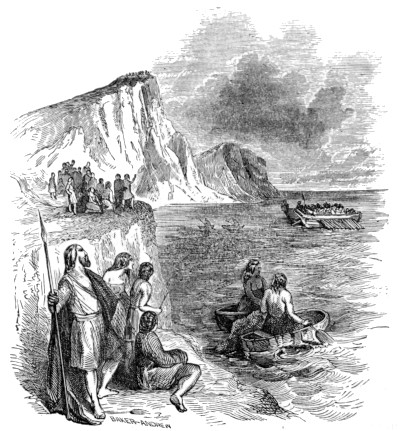
One of the wonders of the world, is to be found in tracing the progress
of navigation, from its small beginning, up to its present wonderful condition
and results. There is an old legend, that, ages ago, a piece of reed
floating on the water, first suggested the idea of navigation. And if so, the
next step might have been, the use of logs for crossing rivers; then, the use
of rafts; then, of canoes of hollowed logs; and then, of artificial boats, of
various forms and materials, some of wood, some of skins, and some of
bark. The earliest navigators on an extended scale were the Phœnicians,
who made voyages through the Mediterranean, and along the northern
coasts of Europe, and down the Red sea, as early as the days of Solomon,
one thousand years before the Christian era. Their earliest attempts to
navigate the waters, might perhaps be represented in the following cut, in
756which several forms of boats may be seen. Their larger and later vessels
were somewhat of the shape of those now in use, though more perhaps of
the Dutch, than of the English or American form. The sails of these
vessels are said to have been suggested by the little sea animal, called the
nautilus. The vessels themselves had no decks, and were not over twenty
or thirty tuns’ burden. They had masts and rudders, and the prow was
decorated with paint and gilding, and represented the image of some god.
The ships of the Greeks and Romans, in after times, were larger, but they
were uncouth structures, managed with difficulty, and liable to numerous
accidents and hindrances. The war ships were nothing but large row-boats.
These were very long and narrow, like canoes. The cable and anchor were
later inventions. The latter at first was a large stone. In the days of the
Roman emperors, vessels of immense size were occasionally built, but they
were of little use, except for the transportation of heavy objects. In the
middle ages, navigation made little progress; but about the close of the
fifteenth century, its strides were prodigious. The mariner’s compass had
757been invented, and the sailor had now a guide over the mysterious ocean.
Hence America was discovered in 1492, though the three ships of Columbus
were not so large as our common schooners, and had no proper decks; so
that it seems a wonder to us, that with these comparatively small vessels he
should have ventured so far on the mighty deep. From his day to the
present, there has been a steady advance in ship-building. The forms of
vessels have been improved; their size greatly increased; and their number
multiplied, a thousand fold; so that if the great navigator were now again
to visit the earth, he would be astonished at the huge structures built as
packet and freight ships for crossing the ocean. For a long time, the
English took the lead in ship-building; but it is now admitted that the
fastest vessels in the world, as well as those of most graceful appearance,
are those built in the United States. In the cut above, is a view of one of
our large packet-ships, just ready to be launched from the stocks. Vessels
of this class may vary from fifteen hundred to two thousand tuns’ burden;
their main cabins are beautifully furnished with mahogany and gilded
carvings; and no expense is spared that may contribute to their elegance,
or the comfort of passengers.
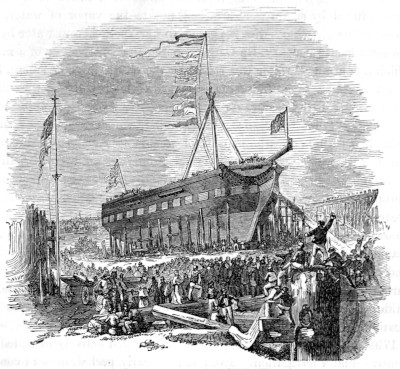
THE LAUNCH OF A PACKET-SHIP.
758
So far as we know, the ancients were unacquainted with the nature and
properties of steam. Some accounts, indeed, have come down to us, of
engines of a very early date, such, for example, as that proposed by Hero,
of Alexandria, in which the mechanical agency of steam was more or less
used; but it does not appear that those who invented and applied these
machines, understood the properties of vapor, or had any correct idea of the
effect of heat when applied to liquids. Even at a much later date, the
effects produced by steam were ascribed, not to the vapor of water, but to
the force of the air which was supposed to be expelled from water by heat.
In the seventeenth century, De Caus proposed the construction of a machine
by which a column of water was raised by the elastic force of steam, but he
does not seem to have understood the principle on which it was effected.
About the middle of the same century, Lord Worcester published the
description of a high pressure steam-engine, which has since formed so
remarkable a feature in all histories of steam-engines. Toward the latter
end of the century, however, the actual properties of vapor began to be
more unfolded. In 1683, Sir Samuel Morland discovered the exact numerical
proportion in which water increases its volume when evaporated. A
few years later, Papin discovered the method of producing a vacuum by the
condensation of steam; and this discovery was, by others, soon applied to
mechanical purposes. About the middle of the eighteenth century, Watt
applied himself to the improvement of the steam-engine; and from this time
forward, the various discoveries of chemistry, and the experiments of
scientific and practical men, prepared the way for rapid progress in the
application of steam.
In 1793, Fulton, the celebrated engineer, engaged actively in endeavoring
to improve inland navigation. Even at that early period, he had conceived
the idea of propelling vessels by steam; and he speaks, in some of his manuscripts,
with great confidence of its practicability. In 1797, he went to
Paris, and, while there, projected the first panorama that was ever exhibited
there. He also planned a submarine boat. In 1803, he completed his first
steamboat, which was tried upon the Seine, and proved completely successful.
He now proceeded to New York, to carry his ideas of steam navigation into
practical effect; and in 1807, his first steamboat, a view of which is given in
the cut beyond, ascended the Hudson river, to the great delight and wonder
of thousands of spectators. She was called the Clermont; and was only
one hundred feet long, twelve wide, and seven deep. Her first trip was
759made, September first, 1807, from New York to Albany, one hundred and
sixty miles, in thirty-six hours; the fare for the passage being seven dollars,
exclusive of meals. Thus this great man brought to a successful issue his
long meditated invention, and determined the possibility of applying steam
to navigation. Several steamboats were soon after constructed under Mr.
Fulton’s directions, and also a steam-frigate. He continued to make various
experiments till his death, which occurred in 1815.
FULTON’S FIRST STEAMBOAT.
Still later than this, we find a description of the Clyde steamboat, which
is spoken of in an English magazine as follows: “Its extreme length is
seventy-five feet, its breadth fourteen feet, and the hight of the cabins six
and a half feet. She is built very flat, and draws from two feet and nine
inches to three feet of water. The best or after-cabin, is twenty feet long,
and is entered from the stern: between the after-cabin and the engine, a
space of fifteen feet is allotted for goods. The engine is a twelve horsepower,
and occupies fifteen feet; the fore-cabin is sixteen feet long, and is
entered from the side. The paddles, sixteen in number, form two wheels of
nine feet diameter, and four feet broad, made of hammered iron: they dip
into the water from one foot and three inches to one foot and six inches.
Along the outer edge of these wheels a platform and rail are formed quite
round the vessel, projecting over the sides, and supported by timbers reaching
760down to the vessel’s side. This steamboat runs at the rate of four or
four and a half miles per hour in calm weather; but against a considerable
breeze, three miles only. It can accommodate two hundred and fifty
passengers, and is wrought by five men. The engine consumes twelve
hundred weight of coals per day. The funnel of the boiler is twenty-five
feet high; and carries a square-sail twenty-two feet in breadth.”
In the same connection, we find an article published in the Monthly Magazine,
by Sir Richard Phillips, with the express object of giving clear ideas
of the utility of steamboats, and of quieting apprehensions as to their safety,
which at the present day it is truly amusing to read. The writer says:
“The groundless alarms relative to a supposed increase of danger from
traveling by steam-packets, led the editor of the Monthly Magazine, within
the current month, (July, 1817,) to make a voyage, in one of them, from
London to Margate. This vessel left her moorings, at the Tower of London,
about half past eight in the morning, at the time the tide was running strong
up the river, and when no other vessel could make progress, except in the
direction of the tides. The steam-packet proceeded, however, against the
stream, in a gallant style, at the rate of six or seven miles an hour; and a
band of music, playing lively airs on the deck, combined with the steadiness
of the motion, to render the effect delightful. An examination of the steam-engine,
and of her rate of working, proved that no possibility of danger
exists. It appeared that the boiler had been proved at twenty-five pounds
to the square inch; but that the valve was held down by a weight of only
four pounds, and that the mercurial gauge did not indicate an employment
of actual pressure of above two pounds and a half per square inch. Hence
it follows, that, although the engine was capable of sustaining a pressure of
at least twenty-five pounds, only four pounds, or less than a sixth, was the
whole force which the valve would permit to be exerted; and that, in point
of fact, a pressure of only two pounds and a half to the square inch, or only
one-tenth of the proven power of the boiler, was employed. There is, therefore,
less danger in passing some hours in contact with such a machine, than
there is in sitting near a boiling tea-kettle, tea-urn, or saucepan, under
circumstances in which they are often used. Opposite Greenwich, a fine
commentary was afforded of the value of steam as a navigating power, in
preference to winds and tides; a Margate sailing-packet passing toward
London, which had been a day and two nights on its passage, a period of
time which it appears is not uncommon. In short, with uninterrupted
pleasure, and in an hour sooner than the captain had named at starting, the
vessel was carried along-side Margate pier, having employed nine hours in
performing a voyage of ninety miles. In this case it appeared, that a
761pressure of two pounds to the square inch, produced about forty rotations
per minute of the acting water-wheels; and, as these were ten feet in diameter,
the motion of the impelling floats, or wheel-paddles, would be at the
rate of fifteen with, or against the stream, at an average of ten miles an
hour. The consumption of coals during the voyage was less than a caldron;
but it was described as amounting frequently to a caldron and a half. On
the whole, nothing could be more demonstrative of the worth and security
of this mode of navigation; and there can be little doubt but, in a few years,
vessels of every size, and for every extent of voyage, will be provided with
their steam-engine, which will be more used, and more depended upon, than
winds or tides. The chances of accidents are lower than those under most
other circumstances in which men are placed in traveling. By land, horses
kill their thousands per annum, open chaises their hundreds, and stage-coaches
their scores; and, by water, the uncertainty of winds has destroyed
thousands, by prolonging the voyage, and increasing the exposure to bad
weather; but in a steam-packet, navigated by an engine whose proven
powers necessarily exceed what can be exerted during its use, or in general
by such engines as those used on the Thames or Clyde, no accident can
possibly happen; unless, by a miracle, it were to happen, that a force of
four pounds should overcome a resistance of twenty-four pounds.”
From the above amusing article, we pass to notice the immense ocean
steamers of the present day, as they so forcibly illustrate the progress of
steam navigation. The chief lines of those with which we are familiar, are
the Cunard line and the Collins line, both plying between the United States
and England. Before describing them particularly, however, it should here
be mentioned, that the first steamship that ever crossed the Atlantic sailed
from Savannah, in Georgia, for Liverpool, on the twenty-sixth of May, 1819,
and made the voyage in twenty-two days. She was telegraphed at Liverpool
as “a ship on fire” and a revenue-cutter was dispatched to her relief, when
the officers and crew of the latter were struck with astonishment at not
being able to overtake a vessel under bare poles. At Liverpool, and afterward
at Copenhagen, Stockholm, and St. Petersburg, whither she went, she
was visited by crowds of wondering people; and at the latter place a service
of plate was presented to her officers. She was commanded by Captain
Rodgers, of New London, Conn., and some of her officers are still living.
After this, it was a long time before another steamship crossed the Atlantic.
At last, however, the experiment was again and still again tried, until now
the ocean is constantly traversed by the huge steamers above alluded to, in
the average time of about eleven days and a half, though the passage has
been made, in some single cases, in a little over nine days.
762A good idea of these ocean steamers may be formed from the view given
of one of them in the cut below, in connection with the following description
of the Baltic, belonging to the Collins line.
The Baltic is of thirty-two hundred tuns’ burden, carpenter’s measure; in
length, two hundred and eighty-seven feet; breadth of beam, forty-six feet;
depth of hold, thirty-two feet; to the top of the gunwale, thirty-four feet and
six inches. The diameter of her wheels is thirty-six feet; the number of floats,
(corresponding to the buckets or paddles of a common water-wheel,) twenty-six
in each wheel; their length, twelve feet and a half; their breadth, twenty-eight,
and their thickness, three inches and a half; each float being armed
with three hundred pounds of iron, so that it requires six men to lift it.
The engine has two working cylinders, each ninety-six inches in diameter;
the length of their stroke is ten feet; and the number of revolutions is from
eleven to fourteen in a minute. The vacuum is equivalent to fourteen
pounds upon the square inch; a near approximation to a perfect vacuum,
which corresponds to fifteen pounds on the square inch. The pressure of
steam is from twelve to twenty pounds upon the square inch; usually from
twelve to fifteen pounds; this is all the amount of the power tending to
produce explosion, while including what is gained by the vacuum, the
effective motive power is equivalent to twenty-six, twenty-nine and thirty-four
763pounds on the square inch. The highest pressure used in an ordinary
passage may be about eighteen pounds, equivalent to a working force of
thirty-two pounds; and the lowest about seven or eight pounds, giving a
moving force of twenty-one or twenty-two pounds. The ability of the
boilers corresponds to fifty pounds, and with the addition of the vacuum, to
sixty-four pounds; it follows, therefore, that they are generally worked with
less than half their power. The entire weight of the steam machinery is
one thousand tuns, and it occupies sixty feet in the length of the ship.
As to capacity for passengers, there are one hundred and sixty berths,
aside from the accommodations for the people of the ship. As to strength
of structure, the timbers are fitted side by side, and calked so tight that it
was said the ship would float even before she was planked. Plates of iron
six inches wide and an inch and a quarter thick, are let, obliquely, into the
timbers at the distance of twenty-eight inches from the centers of each, and
therefore they are twenty-two inches apart. These are crossed obliquely by
other bars or plates of the same dimensions, which are let into the boards or
planks that are nailed over them. Copper bolts, for twenty feet from the
keel, pass through the plates of iron at their intersection, and in many other
places, and copper sheathing covers eighteen feet of the lower part of the
hull, the draught being nineteen feet, and twenty with the coal in. The
ships of this line are as strong as wood, iron and copper can make them,
and they hardly leak at all. They would bear long thumping upon the
rocks before they would go to pieces. The movement of the machinery,
and the stroke of the waves, produce scarcely a perceptible tremor, and not
the slightest deviation in the deck from a right line can be seen, when
viewed horizontally from stem to stern through its length of nearly three
hundred feet. No opening of a joint is perceived even in the beams that
form the capping of the gunwale; a knife-blade can not be passed between
their contiguous ends.
The machinery rests on an iron bed-plate, on the keelson, or engine bed;
and the bed-plate, which is cast in one piece, weighs forty tuns. The
machinery is below, and is invisible from the deck, except through certain
doors. A wave can hardly reach it at all, even should it break over the
ship; and by closing the apertures above, the engine room is safe from flooding,
while ventilation is secured by large tubes, having their orifices higher
than the upper or promenade deck. The people below, on the level of the
keelson, where there is little motion, hardly know when there is a storm
above; they live in a comparatively quiet world of their own, and always
in a tropical climate, even when among icebergs. The working of the
machinery is admirable. It travels onward with the greatest ease and
764regularity; even with a heavy head-wind and opposing waves, it moves like
clockwork, without apparent labor, throwing up its mighty arms and moving
its ponderous levers as if there were no weight to be lifted, or vis inertiæ to
be overcome. By observations made up to the tenth day of one of the passages,
there had not been the slightest leak of steam, nor had it been necessary
to turn a screw, although for several days together there was a heavy
head-sea, impelled by adverse winds. Except the effect of hidden flaws in
the immense masses of wrought iron that form some of the principal moving
parts, there seems to be little cause for anxiety, as the machinery appears to
be, in general, equal to every emergency.
Danger from fire, is always a subject of anxiety; but in ships protected as
the Baltic is, the danger is believed to be less than in a sailing ship. The
engine room is lined with iron; the boilers and their furnaces are everywhere
surrounded by that metal and by water, and no wood is in a position
to be unduly heated. All lights, except those necessary to the management
of the ship, are extinguished at eleven o’clock; many people are up all
night, and are about in every place; there are fire-engines always ready to
flood the ship, and they are adapted so as to be wrought both by hand and
by steam power. The behavior of the Baltic as a sea-boat, is admirable in
every variety of weather. This immense vessel rides upon the waves like a
duck, and has, in general, a dry and comfortable deck, rarely shipping a
sea, although the spray dashes over the forecastle in showers. The ship is
warmed by steam tubes, passing under the marble tables. More than fifty
persons are employed about the machinery, of whom forty-eight attend to
the coal and the fires, and there are six or eight engineers. There are
between thirty and forty servants, twenty or twenty-five sailors, and three or
four supernumerary officers; in all, about one hundred and forty, besides
passengers. The style and furnishing of the Baltic are elegant, rich enough
for a nobleman’s villa. Of mirrors, large and small, there are about fifty;
indeed, they are in such excess that a passenger can not look in any direction
without meeting his own image or the faces of his companions. The
tables of these steamers are amply supplied, and have the best attendance;
and of luxuries, there seems to be no end. The saloons of these steamers
are fitted up in superb style. Some of the table-covers are of beautiful
variegated marble, and the panels around are finely decorated with emblems
of the various American states. The cabin-windows are of beautiful painted
glass, embellished with the arms of various American cities. There are
large circular glass ventilators reaching from the deck to the lower saloon.
There is a rich and elegant ladies’ drawing-room near the chief saloon, and
there are berths for about one hundred and fifty passengers. Each berth
765has a bell-rope communicating with one of Jackson’s patented American
annunciators. Crossing the ocean in one of these steamers, some one has
said, is no cross at all!
Such are the present ocean steamers; and yet even these immense structures
will soon be thrown in the background by steamers of still vaster
dimensions. For the Edinburgh Journal gives an account of an immense
iron steamer, now (1855) being constructed for the Australian trade, which
will far surpass them. The actual measurements of this leviathan vessel
are, six hundred and seventy-five feet long, eighty-three feet wide at her
greatest breadth of beam, and sixty feet deep in the hold, forming four
decks. She will be furnished with paddle-wheels and a screw, the former
of a nominal power of one thousand horses, the latter of sixteen hundred
horses; but practically, the combined power may be estimated at three
thousand horses. The four cylinders in which the pistons are to work, are
the largest in the world; each of them weighs twenty-eight tuns. When
they are lying on the ground, a man, with his hat on, may walk through
them without touching the upper side. The engines, when erected and put
together, will be upward of fifty feet in hight. The weight of the entire
machinery will be about three thousand tuns, and of the hull, ten thousand
tuns, making thirteen thousand tuns. She will carry several thousand tuns
of coal and merchandise, sixteen hundred passengers, and her measurement
capacity gives about twenty-five thousand tuns’ burden! Notwithstanding,
her draught of water will be but small, not exceeding twenty feet when
light, and thirty feet when fully loaded. She will carry five or six masts,
and five funnels. Her cost will be about eighteen hundred thousand
dollars. She will carry coal enough for a voyage round the world, and is
built upon a model to insure great speed. Her ordinary speed is expected
to be eighteen or twenty miles an hour. She is expected to make the
voyage from England to Australia in thirty days, and return by Cape
Horn in thirty days more; thus making the circuit of the globe in two
months.
More wonderful still, it is said that Mr. Vanderbilt, of New York, is
about building an immense steamer, which is to be eight hundred feet in
length, and of corresponding proportions throughout, which of course will
surpass even the huge steamship just described. Where the rivalry and
enterprise in this matter are to end, who can tell?
766
As in perfect and wonderful contrast to the magnificent floating palaces
just described, we close the subject of navigation by a view of the clumsy
Chinese junk, which is represented in the cut below. The Chinese, though
neither a savage, nor a barbarous people, are still, in most respects, very
unlike other civilized nations. In houses, dress, furniture, equipage, worship,
indeed, in most of the actions, feelings, and opinions of life, they are a
peculiar people. They have, in fact, struck out a civilization of their own.
Their religion, their literature, their arts, are all Chinese, and nothing but
Chinese. It is curious to observe that although, for many centuries, they
have been a cultivated people, and have even preceded the Europeans in
many useful and ingenious discoveries, they seem to stand still at a certain
point, beyond which they are not capable of improvement. There they
remain, century after century; and, while other nations have surpassed
767them, they still conceive that they are the most learned, civilized and polished
people in the world. All other nations they conceive to be barbarians,
and hold them in supercilious contempt. And the Chinese vessels may
serve as a sample of their national character. We give above a picture of
one of their junks, which shows some ingenuity, and no little industry; yet
how clumsy, how ineffective is it, in comparison with a Yankee steamboat!
The Chinese can go, by dint of rowing, three miles an hour, while we go
fifteen. This is about the difference between the energy of the Chinese and
the civilized people of Europe and America.
Artesian wells, or fountains, are made by boring in the earth to a great
depth, till at last water rises to the surface, and often with such force as to
form abundant and elevated jets. The name artesian is derived from
Artois, a province of France, where especial attention has been given to this
means of obtaining water; though it appears from sufficient evidence, that
wells of this kind were well known to the ancients. Olympiadorus, who
flourished in the sixth century at Alexandria, states that where wells were
dug in the oases of the desert to the depth of two, three or five hundred
yards, rivers of water gushed out from their orifices, of which advantage was
taken by agriculturists to water their fields. The oldest artesian well known
in France, is at Lillers, in Artois, and is said to have been made in 1126.
In the great desert of Sahara, water is said to have been obtained in this
way; and the Chinese, we are told, have practiced it for thousands of years.
Artesian wells are now common in Europe and in the United States. The
artesian well of Grenelle, is a famous fountain of this kind, and as such is
worthy of notice. It is not far from the Hotel des Invalides, and was undertaken
chiefly with reference to the great slaughter-houses in its vicinity. It
was begun January first, 1834, and the boring was prosecuted during seven
years and two months. It opened with a diameter of twelve inches; at the
depth of thirteen hundred feet it was contracted to six inches. Water was
struck at the depth of eighteen hundred feet, and the entire depth is two
thousand feet, or nearly two-fifths of a mile. The water rose at first in a
fine thread, but soon after it came so rapidly as to injure the machinery. It
rose to the hight of one hundred and twelve feet above the surface; high
enough to flow into the attics of the most lofty houses in Paris, and into
many of its towers. The entire depth of the boring is five and a half times
the hight of the dome of the Hotel of the Invalids, and more than five times
that of the cross on the summit of St. Paul’s, in London. In a diagram of
768the strata, seen in section, the cathedral of Strasburg, and the church of
St. Peter, at Rome, are figured at the bottom on the level of the subterranean
fountain, and they appear very humble, compared with the great distance to
the surface of the ground.
The flow of the water was equivalent to six hundred gallons in a minute;
five hundred thousand gallons in twenty-four hours; and the quantity thus
far is not diminished. Some time after the opening of the well, it flowed
bountifully over the top of the tube, and with a force that would doubtless
have raised it to the full hight, although at that time the upper part of the
tube had been removed for repairs. It had collapsed, and a new tube was
about to be inserted; the old tube was twenty-one inches wide at the top and
seven at the bottom; but the new tube was to be reduced to five inches. It
is now, and was formerly, made of galvanized iron. The temperature of the
water, at first, was eighty-three and three-fourths degrees of Fahrenheit, and
it is now stated to be eighty-five degrees; a degree of permanent heat far
exceeding that of midsummer in Paris. Indeed, it is so warm, that it does
not answer for the use of the slaughter-houses, as was at first proposed, and
they are compelled to resort to water from other sources. It was quite warm
to the touch, when a hand was immersed in it. The labor attending this
boring was immense; and great difficulties were encountered. The boring
instrument broke several times, and fell in. This happened at the depth of
thirteen hundred and thirty-five feet, and it required incessant labor during
fourteen months to recover it. The government, at whose expense it was
prosecuted, was, at times, nearly discouraged.
Quite recently, in boring an artesian well in Livingston, Alabama, an egg
was brought up from the depth of three hundred and thirty-five feet below
the surface, of which distance, three hundred feet were through the solid
rock. The egg was completely petrified, and perfect in shape, except in one
place where the auger had defaced it. How it came there, and in what
remote age, it might puzzle the wisest geologist or philosopher to tell!
The banyan, or burr tree, the ficus Indica of Linnæus, a picture of which
is given in the cut beyond, claims our particular attention. It is considered
as one of the most curious and beautiful of Nature’s productions in the genial
climate of India, where she sports with the greatest profusion and variety.
Each tree is in itself a grove, and some of them are of an amazing size, as
they are continually increasing, and, contrary to most other animal and
vegetable productions, seem to be exempted from decay: for every branch
769from the main body throws out its own roots, at first in small tender fibers,
several yards from the ground, which continually grow thicker; until by a
gradual descent, they reach its surface; where, striking in, they increase to
a large trunk, and become a parent tree, throwing out new branches from
the top. These, in time, suspend their roots, and, receiving nourishment
from the earth, swell into trunks, and shoot forth other branches; thus
continuing in a state of progression so long as the first parent of them all
supplies her sustenance.
A banyan-tree with many trunks, forms the most beautiful walks, vistas
and cool recesses, that can be imagined. The leaves are large, soft, and of a
lively green; the fruit is a small fig, of a bright scarlet when ripe, affording
sustenance to monkeys, squirrels, peacocks, and birds of various kinds, which
dwell among the branches.
The Hindoos are peculiarly fond of this tree; they consider its long duration,
its outstretching arms, and overshadowing beneficence, as emblems of
the Deity, and almost pay it divine honors. The Brahmins, who thus “find
a fane in every sacred grove,” spend much of their time in superstitious
770solitude under the shade of the banyan-tree; they plant it near the dewals,
or Hindoo temples, improperly called pagodas; and in those villages where
there is no structure for public worship, they place an image under one of
these trees, and there perform their morning and evening sacrifice. These
are the trees under which a sect of naked philosophers, called Gymnosophists,
assembled in Arrian’s days; and this historian of ancient Greece, says
Forbes, in his “Oriental Memoirs,” affords a true picture of the modern
Hindoos. “In winter the Gymnosophists enjoy the benefit of the sun’s rays
in the open air; and in summer, when the heat becomes excessive, they pass
their time in cool and moist places, under large trees; which, according to the
accounts of Nearchus, cover a circumference of five acres, and extend their
branches so far, that ten thousand men may easily find shelter under them.”
On the banks of the Narbudda, in the province of Guzzerat, is a banyan-tree,
supposed by some persons to be the one described by Nearchus, and
certainly not inferior to it. It is distinguished by the name of the Cubbeer-Burr,
which was given to it in honor of a famous saint. High floods have,
at various times, swept away a considerable part of this extraordinary tree;
but what still remains is nearly two thousand feet in circumference, measured
round the principal stems; the overhanging branches, not yet struck
down, cover a much larger space; and under it grow a number of custard-apple,
and other fruit trees. The large trunks of this single tree amount to
three hundred and fifty, and the smaller ones exceed three thousand. Each
of these is constantly sending forth branches and hanging roots, to form other
trunks, and become the parents of a future progeny. The Cubbeer-Burr is
famed throughout Hindoostan, not only on account of its great extent, but
also of its surpassing beauty. The Indian armies generally encamp around
it; and, at stated seasons, solemn jatarras, or Hindoo festivals, to which
thousands of votaries repair from every part of the Mogul empire, are there
celebrated. It is said that seven thousand people find ample room to repose
under its shade. It has long been the custom of the British residents in
India, on their hunting and shooting parties, to form extensive encampments,
and spend weeks together, under this magnificent pavilion, which
affords a shelter to all travelers, particularly to the religious tribes of the
Hindoos. It is generally filled with a variety of birds, snakes and monkeys,
the latter of whom both divert the spectator by their antic tricks, and interest
him by the parental affection they display to their young offspring, in teaching
them to select their food, to exert themselves in jumping from bough to
bough, and in taking, as they acquire strength, still more extensive leaps
from tree to tree. In these efforts, they encourage them by caresses, when
timorous, and menace, and even beat them, when refractory.
771
Among the varieties of the banyan, or burr tree, is the peipal, or ficus
religiosa, which is not uncommon in Guzzerat, and causes a singular variety
of vegetation. It may be considered as belonging to the order of creepers,
and often springs round different trees, particularly the palmyra, or palm.
The latter growing through the center of a banyan-tree, looks extremely
grand. The peipal frequently shoots from old walls, and runs along them,
so as to cause a singular phenomenon of vegetation. In the province of
Bahar, one of these trees was seen by an English traveler, on the inside of a
large brick well, the whole circumference of the internal space of which it
lined, and thus actually became a tree turned inside out. A banyan-tree
thus inverted is uncommon; but the general usefulness and beauty of this
variety, especially in overshadowing the public wells and village markets,
can only be known by those who live in a sultry climate.
Of all the gifts which Providence has bestowed on the oriental world, the
cocoa-tree is the one most deserving of notice. The blessings which are
conveyed to man, by this single production of nature, are incalculable. It
grows in a stately column, from thirty to fifty feet in hight, crowned by a
verdant capital of waving branches, covered with long spiral leaves: under
this foliage, bunches of blossoms, clusters of green fruit, and others arrived
at maturity, appear in mingled beauty. The trunk, though porous, furnishes
beams and rafters for the habitations; and the leaves, when platted together,
make an excellent thatch, as well as common umbrellas, coarse mats for the
floor, and brooms; while their finest fibers are woven into very beautiful
mats for the rich. The covering of the young fruit is extremely curious,
resembling a piece of thick cloth, in a conical form, as close and firm as if it
came from the loom; it expands after the fruit has burst through its inclosure,
and then appears of a coarser texture. The nuts contain a delicious
milk, and a kernel sweet as the almond: this, when dried, affords abundance
of oil; and when that is expressed, the remainder answers to feed cattle and
poultry, and make a good manure. The shell of the nut furnishes cups,
ladles, and other domestic utensils; while the husk which incloses it is of
the utmost importance: it is manufactured into ropes, and cordage of every
kind, from the smallest twine to the largest cables, which are far more
durable than those of hemp. In the Nicobar islands, the natives build their
772vessels, make the sails and cordage, supply them with provisions and necessaries,
and provide a cargo of arrack, vinegar, oil, jaggree or coarse sugar,
cocoa-nuts, coir, cordage, black paint, and several inferior articles, for foreign
markets, entirely from this tree.
Many of the trees are not permitted to bear fruit; but the embryo bud,
from which the blossoms and nuts would spring, is tied up to prevent its
expansion; and a small incision being then made at the end, a cool pleasant
liquor, called tarre, or toddy, the palm-wine of the poets, oozes out in
gentle drops.
The reindeer is a native of Greenland, and the cold climates of the
extreme north. To the Greenlander he supplies the place of the horse, the
locomotive, and the steamboat to us, as may be seen in the cut, which
illustrates the mode of traveling in Greenland. The reindeer is swift of
foot, sharp-sighted, and of acute smell and hearing. His flesh supplies the
773Greenlander with food; while his skin, with its thick, warm hair, affords
material for his tent, his bedding and his clothing. The bones and antlers,
or horns, are worked into implements for domestic use, for fishing and
hunting, and the tendons are split into threads for various purposes. The
speed of the Greenlander on his sledge, is said to rival that of the locomotive
on the railroad.
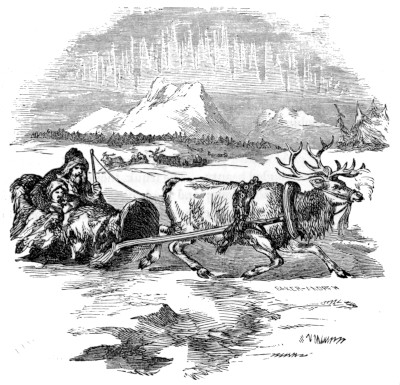
Although a serious refutation of the gross imposition practiced on the
people of Europe, by the romance of Foersch, on the subject of the upas, or
celebrated poison-tree of Java, may at this time be in a great measure superfluous,
as the world has long ceased to be the dupe of his story, and as
regular series of experiments have been instituted both in England and in
France, to ascertain the nature and potency of the poison; yet an authentic
account of this poison, as drawn out by Doctor Horsfield, and given in the
seventh volume of the Batavian transactions, can not fail to be interesting.
Almost every one has heard of its fabulous history, which, from its extravagant
nature, its susceptibility of poetical ornament, its alliance with the
cruelties of a despotic government, and the sparkling genius of Darwin,
whose purpose it answered to adopt and personify it as a malignant spirit,
(in his “Loves of the Plants,”) has obtained almost equal currency with
the wonders of the Lernian hydra, or any other of the classic fictions of
antiquity.
Although, as Doctor Horsfield observes, the account published by Foersch,
so far as relates to the situation of the poison-tree, to its effects on the surrounding
country, and to the application said to have been made of the upas
on criminals in different parts of the island, has, as well as the description
of the poisonous substance itself, and its mode of collection, been demonstrated
to be an extravagant forgery; yet the existence of a tree in Java,
from the sap of which a poison is prepared, equal in fatality, when thrown
into the circulation, to the strongest animal poisons hitherto known, is a fact
which it is his object to establish and illustrate. The tree which produces
this poison is the anchar, and grows in the eastern extremity of the island.
The work of Rhumphius contains a long account of the upas, under the
denomination of arbor toxicaria. The tree does not grow in Ambonia, and
his description was made from the information he obtained from Macassar.
His figure was drawn from a branch of what is called the male-tree,
sent to him from the same place, and establishes the identity of the poison-tree
of Macassar, and the other eastern islands, with the anchar of Java.
774The simple sap of the arbor toxicaria (according to Rhumphius) is harmless,
and requires the addition of several substances of the affinity of ginger,
to render it active and mortal. In so far it agrees with the anchar, which,
in its simple state, is supposed to be inert, and, before being employed as a
poison, is subjected to a particular preparation. Besides the true poison-tree,
the upas of the eastern islands, and the anchar of the Javans, this
island produces a shrub, which, as far as observations have hitherto been
made, is peculiar to the same, and by a different mode of preparation, furnishes
a poison far exceeding the upas in violence. Its name is chetik; but
the genus to which it belongs has not yet been discovered or described.
The anchar is one of the largest trees in the forests of Java. The stem
is cylindrical, perpendicular, and rises completely naked to the hight of sixty,
seventy, or eighty feet. It is covered with a whitish bark, slightly bursting
in longitudinal furrows. Near the ground this bark is, in old trees, more
than half an inch thick, and, upon being wounded, yields plentifully the
milky juice from which the celebrated poison is prepared. A puncture or
incision being made into the tree, the juice or sap appears oozing out, of a
yellowish color from old trees; but paler, or nearly white, from young ones;
and when exposed to the air, its surface becomes brown. The consistence
very much resembles milk; but it is more thick and viscid. This sap is
contained in the true bark, (or cortex,) which, when punctured, yields a
considerable quantity, so that in a short time a cupful may be collected from
a large tree. The inner bark (or liber) is of a close fibrous texture, like
that of the morus papyrifera, and, when separated from the other bark, and
cleansed from the adhering particles, resembles a coarse piece of linen. It
has been worked into ropes, which are very strong; and the poorer class of
people employ the inner bark of the younger trees, which is more easily
prepared, for the purpose of making a coarse stuff, which they wear in
working in the fields. But it requires much bruising, washing, and a long
immersion, before it can be used; and, when it appears completely purified,
persons wearing this dress, being exposed to rain, are affected with an intolerable
itching, which renders it insupportable. It appears from the account
of the manner in which the poison is prepared, that the deleterious quality
exists in the gum, a small portion of which still adhering, produces, when
exposed to wet, this irritating effect; and it is singular that this property of
the prepared bark is known to the Javans in all places where the tree grows,
while the preparation of a poison from its juice, which produces a mortal
effect when introduced into the body by pointed weapons, is an exclusive
art of the inhabitants of the eastern extremity of the island.
775
One of the most striking features in the geography of the Western states,
is the prairies, or natural meadows. These are immense plains, often
stretching, in every direction, further than the eye can reach, entirely destitute
of trees, and covered with grass and wild flowers. These prairies cover
a vast extent of country north of the Ohio and west of the Mississippi,
affording pasturage to countless herds of the buffalo, deer and other wild
animals. When the grass has been dried and parched by the heat of
summer, it sometimes takes fire, as represented in
the cut above, and then a sea of flame is swept by the wind over these vast
plains, spreading, it is said, more swiftly than the fleetest horse can run
before it. In such cases, the only resort is, to pull up the grass around one,
and kindle on every side a counter-flame, which burning outward, in every
direction, leaves the hunter or traveler in a place of safety.
776
One of the vegetable wonders of the world, is the immense tree discovered,
a year or two since, in California. The first reports concerning this huge
giant of the forest seemed fabulous, so extraordinary were the particulars;
but it is found that the largest statement did not exceed the truth. The
tree is a cedar, of the species called arbor vitæ, and was first discovered by
some miners in the mountains of Calaveras, California, in a forest called the
Redwoods, on Trinidad bay, some twenty or thirty miles from the mouth of
Klamath river, on the northern sea-coast of the state, a region that has been
but very little explored. A correspondent of the Sonora Herald, who
recently made an excursion to see it, thus describes it. “At the ground its
circumference was ninety-two feet; four feet above that, it was eighty-eight;
and ten feet above that, it was sixty-one feet in circumference; and the
tapering of the shaft was very gradual. Its hight, to the end of the trunk,
is two hundred and eighty-five feet; or, if we include the topmost branches,
three hundred and twenty-five feet. This tree is by no means a deformity,
as most trees with large trunks are. It is throughout one of perfect symmetry,
while its enormous proportions are inseparable concomitants of its
grandeur. I have said that this is the largest tree yet discovered in the
world. It is so. The celebrated tree of Fremont would have to grow many
centuries before it could pretend to be called anything but a younger
brother. It is said that a tree was once found in Senegal, in Africa, whose
trunk measured ninety feet in circumference. But nobody has been able
to find it since its first discovery. There is a tree in Mexico called the
taxodium, which is said to be one hundred and seventeen feet in circumference,
but this is said to be formed by the union of several trees. The hight
of all these foreign trees is not more, in any case, than seventy feet; and
none of the trunks are more than ten feet. The age of this mammoth
cedar of California, if each zone may be reckoned one year, is about twenty-five
hundred and twenty years. A section of the wood which I brought
home with me, exclusive of the sap, which is only about one inch thick,
numbers about fourteen zones or grains to the inch. At that rate, if it were
permitted to grow, it would increase its diameter one-seventh of an inch
every year. In eighty-four years its diameter would be increased one foot;
in eight hundred and forty years, ten feet; and in twenty-five hundred and
twenty years, it would be forty feet in diameter, and one hundred and
twenty in circumference.
“It seems like an act of desecration to cut down such a noble tree, such
777a magnificent specimen of the growth of the primeval forest. But it has
been done, not, however, without a vast deal of labor. It was accomplished
by first boring holes through the body with long augers, worked by
machinery, and afterward sawing from one to the other. Of course, as the
sawing drew to a close, the workmen were on the alert to notice the first
sign of toppling, but none came; the tree was so straight and evenly
balanced on all sides that it retained its upright position after it had been
sawed through. Wedges were then forced in, and a breeze happening to
spring up, over went the monster with a crash which was heard for miles
around. The bark was stripped from it for the length of fifty feet from the
base, and is from one to two feet in thickness. It was taken off in sections,
so that it can be placed, relatively, in its original position, and thus give the
beholder a just idea of the gigantic dimensions of the tree. So placed, it
will occupy a space of about thirty feet in diameter, or ninety feet in circumference,
and fifty feet in hight. A piece of the wood will be shown,
which has been cut out from the tree across the whole diameter. We are
told that this piece of wood shows a vestige of bark near the middle, and
that this bark was evidently charred many centuries ago, when the tree was
comparatively a sapling.”
Since the above was written, the section of this huge tree alluded to, has
been exhibited in Stockton and San Francisco, and thence brought to the
United States, so that some of our readers may be able to get a view of this
monster of the California woods for a trifling admission fee. In its natural
condition, rearing its majestic head toward heaven, and waving in all its
native vigor, strength and verdure, it was a sight worth a pilgrimage to see;
and it will still be a rich gratification to look upon the section of it, though
that will give but a faint idea of what the whole was in its native forest.
Notwithstanding the calculation given above by the writer in the Sonora
Herald, it is supposed that this tree can not be less than three thousand
years old; for, for a large space on the outer surface next to the bark, the
rings of growth are so thin as not to be distinguishable from each other.
Add one-third to the hight of Bunker-hill monument, and the outward
dimensions of the main trunk of this tree would be about the same. From
actual measurement it contained more than three hundred cords of wood.
One hundred men could easily stand within the hollow of it at the same
time, and a six-foot man rode a full-sized horse through it without touching
his hat to the upper surface.
778
A California paper says, that in the neighborhood of the mammoth tree
just described, within a circumference of half a mile, there are twelve
immense trees, which rival, or even surpass that huge giant of the forest.
One of these is called the Father Pine. This is dead, and has fallen to the
earth. Its dimensions are as follows: length, four hundred feet; circumference,
one hundred and ten feet. The trunk of this tree is hollow, and it
has been traced for a distance of two hundred and fifty feet. There is a
little pond of water in the center of this cavity, four feet in depth. This
tree, two hundred and fifty feet from the stump, is no less than twelve feet
in diameter. The cluster called the Three Sisters, taken together, is
ninety-two feet in circumference, and three hundred feet in hight. The
center one is bare of branches for two hundred feet above the ground. The
Mother Tree is ninety-one and a half feet in circumference, and three hundred
and twenty-five feet high. The Mother and Son are ninety-two feet in
circumference and three hundred feet in hight, united at the base. The
Twin Sisters, one hundred feet in circumference and three hundred feet in
hight. The Pioneer’s Cabin is a remarkable curiosity. This tree has been
partially burned; the result of the scorching is the dividing of the trunk into
several compartments, which are known as the parlor, bedroom and kitchen.
The hollow, which is two hundred feet in hight, is called the chimney. This
tree is eighty-five feet in circumference. The Siamese Twins is ninety feet
in circumference, three hundred and twenty-five feet in hight. Guardian
of the Times, eighty-five feet in circumference, three hundred and twenty-five
feet in hight. Uncle Tom’s Cabin, ninety-four feet in circumference,
three hundred feet in hight. Pride of the Forest, eighty-seven feet in
circumference, three hundred feet in hight. Beauty of the Forest, seventy-two
feet in circumference, three hundred feet in hight. Two Friends,
eighty-five feet in circumference, three hundred feet in hight. The above
trees are all embraced in an area not exceeding half a mile in extent.
The surrounding country is exceedingly picturesque and beautiful, and the
scenery, at many points along the road, is said to be unsurpassed for sublimity
and grandeur.
Passing from California to the countries of the east, let us next glance at
the palm-tree. This tree, which is called by Linnæus, from its noble and
779stately appearance, “the prince of the vegetable kingdom,” is of several
kinds, the chief of which are the doum-palm, and the date-palm. They are
chiefly found in the tropics. The doum or Theban palm, the same that
is found in Florida, differs from the columnar date-palm in the form of its
leaves, which are fan-like, and so thickly set as to resemble a huge bushy
mop, though they are always gracefully disposed, and also in having a
branching trunk. The main stem divides a few feet from the root, each of
the branches again forming two, and each of these two more, till the tree
receives a broad, rounded top. The fruit hangs below in clusters, resembling
small cocoa-nuts, (or, says a late traveler, still more of the size, shape,
and appearance of a yellowish-white potato, of full growth,) and has a sort
of gingerbread flavor, which is not disagreeable. When fully dry and hard,
it takes a polish like ivory, and is manufactured by the Arabs into beads,
pipe-bowls and other small articles.
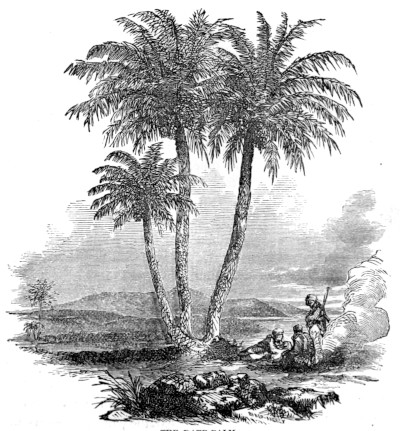
The more common, or date-palm, a view of which is given in the cut,
produces the sweet fruit which is brought to us from Smyrna, and other
780ports of the Mediterranean, with which all are familiar, under the name of
the date. In the regions between Barbary and the great desert, the soil,
which is of a sandy nature, is so much parched by the intense heat of the
sun’s rays, that none of the corn-plants will grow; and in the arid district,
called the land of dates, the few vegetables that can be found are of the
most dwarfish description. No plants arise to form the variety of food to
which we are accustomed; and the natives of these districts live almost
exclusively upon the fruit of the date-tree. A paste is made of this fruit by
pressing it in large baskets. This paste is not used for present supply, but
is intended for a provision in case of a failure in the crops of dates, which
sometimes occurs, owing to the ravages committed by locusts. The date, in
its natural state, forms the usual food; and the juice yielded by it when
fresh, contains so much nutriment as to render those who live upon it
extremely fat. As, by the Moors, corpulence is esteemed an indispensable
requisite of beauty, the ladies belonging to the families of distinction among
them, nourish themselves, during the season, solely with the fresh fruit, and
by continuing this regimen during two or three months, they become of an
enormous size! The date-palm flourishes very generally on sandy soils in
the hot countries of Asia and Africa. Not always, however, is the soil that
supports it so barren as the one we have described. It is frequently found
by streams, and as the tired traveler sees its foliage waving afar, he hastens
toward it, hoping to find a stream of water. Sometimes its tall stem is
surrounded by beautiful climbing plants, and the most brilliant flowers
flourish beneath. This kind of palm not only rises to a great hight, often
sixty or eighty feet, but is also frequently of great diameter and strength;
being unlike in this respect, some other species of palm, whose slight forms
yield to the winds. It was to this tree that the psalmist alluded when he
said, “The righteous shall grow as the palm-tree;” firm and unmoved by
the shocks of temptation and the storms of adversity.
The clusters of dates are sometimes five feet in length, and when ripe are
of a bright gold color, surrounded from above with the deep, rich leaves, as
with a crown. This kind of the palm is trained to its high growth, without
a single branch on its solitary, upright trunk, by trimming off the leaves
every year from the young stalk; so that its strength shoots upward; and
by this process, also, the bark is formed into a succession of steps or notches,
by which the barefooted Arab easily mounts to the top. From the very top
of the tree, the long, pointed leaves curl gracefully on every side, like the
close-set frame of a parachute; and just where the broad, ridge-shaped base
of the leaf adheres to the tree, the fruit hangs in clusters, all around the
trunk. When its early training is neglected, the palm-tree grows less gracefully;
781sometimes dividing at the root into several trunks, which grow
without branches to various hights, and then spread out their leafy crests.
The palm-tree looks most majestic and picturesque, when it stands alone
upon some broad plain or gentle bluff, and when its leaves are gently stirred
by the wind. The eye then takes it in at one view, measures it by some
mental standard, or disdaining all mathematical proportions, dreamily contemplates
the waving lines of beauty, and the straight, slender, yet stately
stalk that stands in bold relief against the stainless sky. The date-palm is
unknown in the United States, except in rare garden culture; but in Egypt
it grows everywhere, and is to the people food, shelter, shade, fuel, raiment,
timber, divan, cordage, basket, roof, screen. Its fruit is found in perfection
on the confines of Nubia.
Nature, or rather the great Author of nature, has conferred on the inhabitants
of hot countries few gifts more valuable than the bamboo-tree, a view
of which is given over the leaf. To such a multitude of useful purposes
are its light, strong and graceful stems applied, that almost any other
production of the vegetable world might more easily be spared than this.
These stems spring from a strong-jointed, subterraneous root-stalk, which is
the trunk of the tree, the shoots being the branches. They are hollow, and
jointed, and of a hard, woody texture, the outside being coated with silex,
and the inside consisting of a close, fibrous and very hard wood. The
bamboo grows with great rapidity; and the shoots, when quite young, are
sometimes cut and boiled like asparagus: but when full grown and vigorous,
it becomes a large and strong tree. Its shoots vary in size, from six to
one hundred and fifty feet in length. When fully grown, the bamboo is a
straight rod, bearing a number of stiff branches, which shoot at nearly right
angles from the main stem. It seems, at first, difficult to imagine how such
a stem elevates itself through the dense mass of rigid branches, which cross
each other in every direction. This is, however, arranged in a very simple
manner. The young shoot, when it is first produced, is nothing but a
sucker, as already said, like a shoot of asparagus; but, having a sharp point,
it easily pierces the dense and overhanging branches. It is only when it has
arrived at its full length, and has penetrated through all obstacles, that it
forms its lateral shoots, which readily interpose themselves amid the stems.
There are many species of the bamboo, all of which are useful. The young
shoots, as mentioned above, are sometimes eaten as food; the full-grown
stems, when ripe and hard, are converted into bows, arrows, quivers, fishing-rods,
782masts of vessels, bed-posts, walking-sticks, floors, supporters of rustic
bridges, chairs, and a variety of other purposes. By notching their sides,
the Malays form wonderfully light ladders. Bruised and crushed in water,
the leaves and stems form Chinese paper; some species are used for lining
tea-chests; cut into lengths, and the partitions knocked out, they form
durable water-pipes. Slit into strips, they form excellent materials for
weaving mats, baskets, window-blinds, and even the sails of boats. It is,
however, for the purposes of building, that the bamboo is most important.
The frame-work of the houses in Sumatra is chiefly composed of this material.
The floors are made of the whole canes, laid close to each other. The
sides are made of the stems, split and flattened, and the roof is formed of a
thatch split into various strips. Great hopes are entertained of introducing
this most useful tree into other countries; and, as it grows in dry and stony
places, where nothing else flourishes, its introduction would be of great
importance. A few species of the bamboo are found in the tropical parts
of America.
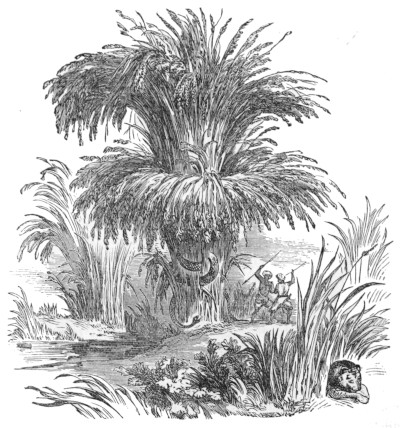
783
Manna, in our version of the Bible, is a term applied to the food that God
gave the Israelites in the wilderness. But what we now call manna, is a
saccharine substance that exudes from the bark of a species of ash-tree found
in the southern parts of Europe, and especially in Sicily and Calabria. At
the warmest season, the tree most abounds in sap, and, accordingly, in
August, the people make incisions into the bark. These are two inches long
horizontally, and half an inch in depth. On incision, the manna immediately
begins to flow, at first in the form of water, but it gradually becomes thicker.
A leaf is inserted into the incision, which conducts the juice into a vessel
placed at the foot of the tree. The liquor does not harden till it has
remained some time. It has an unpleasant taste, but after the watery parts
have evaporated, it is sweeter, but slightly nauseous. Manna is used in
medicine as a mild aperient. It differs remarkably from common sugar, in
not being susceptible of what is called vinous fermentation; so that if mixed
with common sugar and yeast, and subjected to the process of fermentation,
while the sugar is converted into alcohol, the manna remains unaltered in
the liquor.

One of the curiosities, if not wonders of the world, is afforded in the
Continental money, or Continental bills, issued by congress in the early
stages of the Revolutionary struggle, a specimen of which may be seen in
784the cut. These bills were of various denominations, and were issued by
thousands on thousands. But from the very great extent of their issue, and
the fact that the government could not redeem them in silver and gold, they
rapidly depreciated in value, till at last they became almost worthless. As
they are now almost never seen, except it be in some museum, or collection
of old curiosities, the fac-simile given above can not fail to be of interest.
That singular production of nature called the masseranduba, or milk-tree,
is found in the tropical regions of South America, and is thus described by
Wallace, in his “Travels on the Amazon.” Speaking of the various interesting
objects of the journey he was making, he says: “What most interested
us, however, were several large logs of the masseranduba, or milk-tree. On
our way through the forest, we had seen some trunks much notched by
persons who had been extracting the milk. It is one of the noblest trees of
the forest, rising with a straight stem to an enormous hight. The timber is
very hard, fine-grained, and durable, and is valuable for works which are
much exposed to the weather. The fruit is eatable and very good, the size
of a small apple, and full of a rich and very juicy pulp. But strangest of all
is the vegetable milk, which exudes in abundance when the bark is cut. It
has about the consistence of thick cream, and, but for a very slight peculiar
taste, could scarcely be distinguished from the genuine product of the cow.
Mr. Leavens ordered a man to tap some logs that had lain nearly a month
in the yard. He cut several notches in the bark with an ax, and in a
minute the rich sap was running out in great quantities. It was collected
in a basin, diluted with water, strained, and brought up at tea-time, and at
breakfast next morning. The peculiar flavor of the milk seemed rather to
improve the quality of the tea, and gave it as good a color as rich cream.
In coffee it is equally good. Mr. Leavens informed us that he had made a
custard of it, and that, though it had a curious dark color, it was very well
tasted. The milk is used for glue, and is said to be as durable as that made
use of by carpenters. As a specimen of its capabilities in this line, Mr.
Leavens showed us a violin he had made, the belly-board of which, formed
of two pieces, he had glued together with it applied fresh from the tree,
without any preparation. It had been done two years. The instrument
had been in constant use; and the joint was now perfectly good and sound
throughout its whole length. As the milk hardens by exposure to air, it
becomes a very tough, slightly elastic substance, much resembling gutta
785percha; but not having the property of being softened by hot water, it is not
likely to become so extensively useful as that article.”
Tho old-fashioned telegraph, which was in common use before the wonderful
invention of the electro-magnetic telegraph by Morse, was an arrangement
for the communication of intelligence by signals, or movements, previously
agreed upon; which signals represented letters, words, or ideas, which could
thus be transmitted from one station to another, as far as the signals could
be seen. It was first devised in France, about 1793 or 1794, and soon
became extensively adopted and used in other nations. A good idea of its
appearance may be formed from the cut below. It consisted of a mast, or
frame, in connection with shutters, or sliding-boards, worked by ropes pulled
like bell-ropes, and exhibiting, in all, sixty-three signals; by which were
786represented the nine digits, the letters of the alphabet, and several generic
words: and, sometimes, to these were added other signals, expressive of
entire phrases. The observers at these telegraphs were not expected to keep
their eye constantly at the glass, but to look only every five minutes for the
signal to make ready. The telescopes used for observation, were commonly
what are called Dolland’s achromatics, which possess no recommendation but
their enlarged field, and their freedom from prismatic colors in that field;
points of no consequence in looking through a fixed glass at a fixed and
circumscribed object. Sometimes a common and powerful spy-glass was
found sufficient. In the use of this kind of telegraph, dead flats or levels
were found to be universally unfavorable; and generally stations were found
to be useless nearly in the proportion of the miles of dead flat looked over.
On the contrary, stations between hill and hill, looking across a valley, or a
series of valleys, were found to be mostly clear; and water surfaces were
found to produce fewer obscure days than land in any situation. The
period least favorable of the same day was an hour or two before and after
the sun’s passage of the meridian, particularly on dead levels, where the
play of the sun’s rays on the rising exhalations, renders distant vision
exceedingly obscure. The tranquillity of the morning and evening were
ascertained to be the most favorable hours for observation.
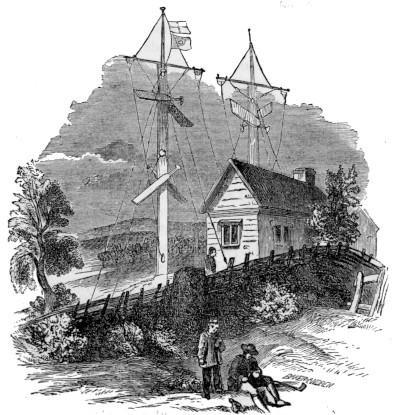
The old line of this kind of telegraph between London and Portsmouth,
had twelve stations; and another chain from London to Yarmouth, had
nineteen stations. The distances of the stations averaged about eight miles,
yet some of them extended to twelve or fourteen; and the lines were often
increased by circuits, for want of commanding hights. After about twenty
years’ experience, they found they could calculate on about two hundred
days on which signals could be transmitted throughout the day; about sixty
others on which they could pass only part of the day, or at particular
stations; and about one hundred days in which few of the stations were
visible to each other. A message from London to Portsmouth, was usually
transmitted in about fifteen minutes; but, by an experiment tried for the
purpose, a single signal has been transmitted to Plymouth and back again
in three minutes, which, by the telegraph route, is at least five hundred
miles. In this instance, however, notice had been given to make ready, and
every captain was at his post to receive and return the signals. The
progress was at the rate of one hundred and seventy miles in a minute, or
three miles a second, or three seconds at each station; a rapidity truly
wonderful for so imperfect an apparatus! And yet, clumsy and slow-moving
as all this now seems to us, it was the best telegraph known before the
invention of Morse. In contrast to it, let us turn to the latter.
787
The invention of this wonderful instrument, it is now universally admitted,
is due to Professor S. F. B. Morse, of whom some one has well said, that
“if Franklin brought the lightning from heaven, Morse both tamed it, and
taught it the English language.” So early as 1822, Mr. Morse described
his invention to reliable witnesses; and having obtained an appropriation
from Congress, for the purpose of testing it on an extended scale, he set up
the wires from Washington to Baltimore, a distance of about forty miles,
and thus established the first electro-magnetic telegraph ever known, and
the parent of that wonderful system that now threads every continent, conveying
messages literally on the lightning’s wing. A view of the instrument
used for transmitting messages, is given in the cut below. By this instrument
connecting with the wires, messages are either written or printed; by
the system of House, in actual letters, and by the systems of Morse and Bain,
in a cipher.
ELECTRO-MAGNETIC TELEGRAPH.
788The telegraphic wires having been extended throughout the United States
and the continent of Europe, it is now proposed to carry them under the
Atlantic, and so connect America and Europe. The plan now is, to carry
the cable from the northernmost point of the Highlands of Scotland to
Iceland, by way of the Orkney, Shetland and Ferroe islands; to lay it from
Iceland across to the nearest point in Greenland, thence down the coast to
Cape Farewell, where the cable would again take to the water, span Davis’s
straits, and then go across Labrador and Upper Canada to Quebec. Here
it would lock in with the North American meshwork of wires, which hold
themselves out like an open hand for the European grasp. This plan seems
quite feasible, for in no part of the journey would the cable require to be
more than nine hundred miles long; and as it seems pretty certain that a
sand-bank extends, with good soundings, all the way to Cape Farewell, there
would be little difficulty in mooring the cable to a level and soft bottom.
Among the most startling wonders in connection with electricity and the
telegraph, is the announcement that M. Bonelli, of Turin, has invented a
new electric telegraph, by which trains in motion on a railway are enabled
to communicate with each other at all rates of velocity, and, at the same
time, with the telegraphic stations on the line; while the latter are, at the
same time, able to communicate with the trains. It is added, that M.
Bonelli is in possession of a system of telegraphic communication by which
wires are entirely dispensed with.
From the telegraph, to printing, and the printing-press, is but a step; and
one that is naturally suggested. The origin of printing is involved in
mystery. Some think it was practiced as far back as the building of
Babylon. The Romans, we know, had metal stamps with which they
marked words and names on their various articles; but having no paper,
they could hardly be said to print. Printing from engraved blocks of wood,
was practiced by the Chinese nearly fifty years before the Christian era.
But the credit of first introducing movable types, is commonly attributed to
John Fust, or Faust, of Mentz, who is represented, in the cut on the next
page, as looking, with his associates, at the first proof taken from movable
types. This was supposed to be not far from the year 1450. Between 1450
and 1455, the celebrated “Mentz Bible” appeared, without date; and this
was the occasion of the art being discovered by the public. Next followed
the “Psalter,” in 1457; and from this time, printing rapidly spread
throughout Europe. William Caxton was the first to introduce printing
789into England, about 1474. The first book in which Greek types appear, was
printed in 1465; and the first using the Roman character, in 1467.
FAUST TAKING FIRST PROOF FROM MOVABLE TYPES.
Printing-presses were gradually improved. The old-fashioned press was
made of wood, with an iron screw that had a bar fitted in it; and to the
lower end of this screw was attached, horizontally, a flat piece of wood,
called the platen, which was brought down by means of the screw, and
pressed the paper on the face of the types, and thus the impression was
given. This kind of presses, however, soon gave place to those made of
iron. The Stanhope press was a great improvement on anything that had
gone before it; and the Caledonian press, invented by George Clymer, an
American, was a great improvement, in many respects, on the latter. The
press represented in the cut on the following page, on which Franklin
790printed, was one of these old-fashioned hand-presses, on which it would
have been a hard day’s work to print twenty-five hundred impressions, or
twelve hundred and fifty sheets on both sides, in a day. After a time, a
plan was devised of obtaining impressions from types by means of cylinders;
and in 1804, the idea was started, of applying steam-power to printing-presses.
It was not, however, till after years of experiments, and an
immense outlay of capital, that the invention was brought to a successful
issue, so as to be advantageously applied in practice. When, however, in
1814, the machine was completed, it was adopted in the office of the London
Times newspaper, and was thus spoken of in the papers of the day.
FRANKLIN’S PRINTING-PRESS.
“A new printing-press, or printing-engine, has recently excited the attention
of the typographical world. It is wrought by the power of steam, and,
791with the aid of three boys, perfects nearly a thousand sheets per hour. A
common press, worked by two men, takes off but two hundred and fifty
impressions on one side, and requires eight hours to perfect a thousand
sheets. Hence, three boys in one hour are enabled, by this new application
of the power of steam, to perform the labor of two men for eight hours.
Such are the present capabilities of this engine: but as there is no limit to
its required powers, and the size of the form is no obstacle to its perfect performance,
it is proposed to take impressions on double-demy, in which case
three boys will, in one hour, perform the labor of thirty-two men. This
engine is now at work at the printing-office of Bensley & Sons, near Fleet
street, and another on a similar (but less perfect) construction, has for some
time past been employed on a morning newspaper. In its general analogy,
this press is not unlike the rolling-press of copper-plate printers. The forms
being fixed on the carriage, are drawn under a cylinder, on which the sheet
being laid, and the ink distributed by an arrangement of rollers, the
impression is taken on one side. The sheet is then conveyed off by bands to
a second cylinder, around which it is conveyed on the second form, and the
reiteration is produced in perfect register, without the aid of points. All
the manual labor is performed by a boy, who lays the sheet of paper on the
first cylinder, by one who takes it off from the second cylinder, and by a
third, who lays the sheets even on the bank. As a further instance of
economy in the materials, we may mention, that the waste steam from the
copper is carried in tubes round the entire suit of offices, with a view to
warm them.”
Passing on, over various improvements, we come, last of all, to what thus
far is the perfection of all printing-machines, viz., Hoe’s eight-cylinder
power-press, a view of which is given in the cut on the following page. This
immense printing-machine is thirty-three feet long, fourteen feet and eight
inches high, and six feet wide. It has one large central cylinder on which
the type is secured, and eight smaller cylinders arranged around it, at convenient
distances. Eight persons supply the eight small cylinders with the
sheets, and at each revolution of the large cylinder, eight impressions are
given off, the sheets being delivered in neat order by the machine itself.
The limit to the speed is in the ability of the eight persons to supply the
sheets. At the rate of twenty-five hundred sheets to each, the press would
give off the unparalleled number of twenty thousand printed impressions per
hour. The press is thus far used exclusively for newspaper and similar
printing. What it may next be applied to, or what will be the next stride
in the rapidity and perfection of printing, only the future can reveal.
HOE’S EIGHT-CYLINDER POWER-PRESS.
Before leaving the subject of printing, it may not be uninteresting to
792mention, that a composing, or type-setting machine, is said to have been
recently invented, in Denmark. One who has seen it in operation, says:
“It is now in actual operation in the office of the Fœdrelandet. Instead of
the usual cases and composing-sticks, and the compositor standing at his
work, we see a person sitting before a machine with keys like a piano, which
he plays on incessantly, and every touch on the tangent is followed by a
click; the letter already in its place in the long mahogany channel prepared
for it. The whole is excessively ingenious. In fact it is fairy work. The
most wonderful part is that it distributes the already used types at the same
time that it sets the new page, and with an exactness perfectly sure. No
mistake can ever occur. The compositor, by this machine, does four times
as much work as another workman; but as he requires an assistant to line
and page the set type, this brings it to twice the amount of type set. The
whole is so clean and pleasant, that it will probably soon be a favorite
employment for women. The machine occupies a very small space, not
more than a large chair, and is beautifully made of hard woods, brass and
steel. Its success is now beyond all doubt. The proprietors of the Fœdrelandet
are so gratified by the one they now have, that they have ordered
another. The price is twenty-four hundred Danish dollars. It will last,
apparently, for a century or two without repair. Mr. Sorenson, the inventor,
793himself a compositor all his life, kindly shows the machine to any visitor.
Of course, a compositor can not set with this machine at once; it will take
a short time, a few days, for him to become familiar with the details, but he
is then a gentleman compared to his old comrades.”
India-rubber, called, also, caoutchouc, is produced from several different
trees, all of them of the ficus, or fig species. The ficus elasticus is the tree
from which it is chiefly obtained. This is a native both of India and of
South America; and its general appearance may be seen in the cut below.
When the bark is cut or broken, it gives forth a milky liquid, which, being
exposed to the air, produces the gum elastic which is so much in use among
us. It is now about a hundred years since it was first introduced into
Europe. For a long time it was only used to erase the marks of lead-pencils.
794The natives of South America had, however, long employed it, as we do
now, for boots and shoes. They also smear the inside of baskets with it,
thus providing a tough and tight lining. In the vicinity of Quito, they
make it into a kind of cloth. Its multiplied uses in the United States and
Europe, are familiar to every reader. In a volume lately published in New
York, entitled “Scenes and Adventures on the Banks of the Amazon,” is
found the following account of this singular and most useful tree.
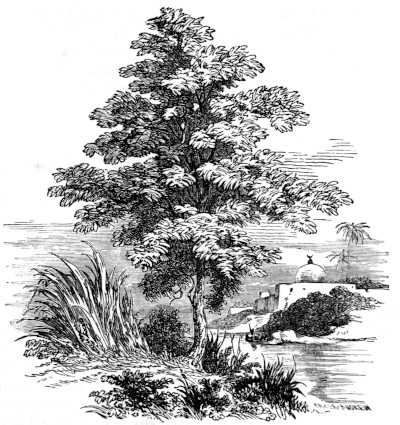
“A number of blacks, bearing long poles on their shoulders, thickly
strung with India-rubber shoes, also attracted our attention. These are for
the most part manufactured in the interior, and are brought down the river
for sale by the natives. It has been estimated that at least two hundred and
fifty thousand pairs of shoes are annually exported from the province, and
the number is constantly increasing. A few words here respecting the tree
itself, and the manufacture of the shoes, may not be out of place. The tree
is quite peculiar in its appearance, and sometimes reaches the hight of eighty
and even a hundred feet. The trunk is perfectly round, rather smooth, and
protected by a bark of a light color. The leaves grow in clusters of three
together, are thin, and of an ovate form, and are from ten to fifteen inches
in length. The center leaf of the cluster is always the longest. This
remarkable tree bears a curious fruit of the size of a peach, which, although
not very palatable, is eagerly sought after by different animals. It is separated
into three lobes, which contain each a small black nut. The trees are
tapped in the same manner that the New Englanders tap maple-trees; the
trunk having been perforated, a yellowish liquid, resembling cream, flows
out, which is caught in small clay cups fastened to the tree. When these
become full, their contents are emptied into large earthen jars, in which the
liquid is kept until desired for use. The operation of making the shoes is
as simple as it is interesting. Imagine yourself in one of the seringa groves
of Brazil. Around you are a number of good-looking natives of low stature
and olive complexions. One is stirring, with a long wooden stick, the contents
of a caldron, placed over a pile of blazing embers. This is the liquid
as it was taken from the rubber tree. Into this a wooden ‘last,’ covered
with clay, and having a handle, is plunged. A coating of the liquid remains.
Another native then takes the ‘last,’ and holds it in the smoke arising from
the ignition of a species of palm fruit, for the purpose of causing the glutinous
substance to assume a dark color. The ‘last’ is then plunged again into
the caldron, and this process is repeated as in dipping candles, until the
coating is of the required thickness. You will moreover notice a number
of Indian girls engaged in making various impressions, such as flowers, &c.,
upon the soft surface of the rubber, by means of their thumb-nails, which
795are especially pared and cultivated for that purpose. After this final operation,
the shoes are placed in the sun to harden, and large numbers of them
may be seen laid out on mats in exposed situations. The aboriginal name
of the rubber is cahchu, from which the formidable word of caoutchouc is
derived.”
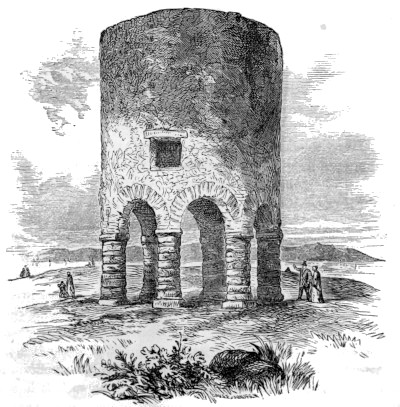
THE OLD ROUND TOWER AT NEWPORT.
“The tower”—“the old round tower”—“the old stone tower,” at Newport,
Rhode Island, if not one of the wonders of the world, has at least
excited wonder enough in some of its inhabitants, and been a monument of
deep interest to the traveler, the antiquarian, the controversialist, and the
poet. Its appearance may be seen in the cut below, which is taken from a
drawing made on the spot. For a long time it was the prevailing belief,
that it was built by the Northmen, who, it was supposed, coasted along the
New England shores as early as the twelfth century. Even the society of
Danish antiquaries, gravely came to this conclusion, from some drawings
796and accounts that were sent them; and the discovery of a “skeleton in
armor,” on the main land, near Newport, gave currency to this impression.
Later investigations, however, have settled the point that it was originally
built for a windmill, about 1676. It is about seventy-five feet above high-water
level in the harbor, and about one hundred and twenty rods from the
shore. Thus has been dissipated the foundation of many a wild theory, and
many a joyous hoax of other days.
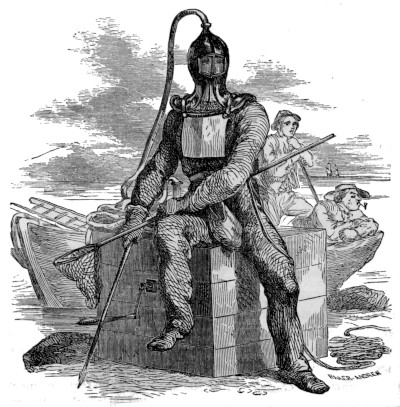
SUBMARINE OR DIVING ARMOR.
The mention of the India-rubber tree, on a previous page, suggests the
application of the valuable substance derived from it, to one of its many
important uses, viz., to the submarine or diving armor. This is represented
in the cut below, where the diver, or person about to descend into the sea,
is seen encased with a water-proof dress, made chiefly of India rubber. His
feet are heavily loaded with boots which have soles made of thick plates of
lead. On his head is a helmet-shaped covering, made of iron, from which
797rises a hose, through which fresh air is forced to him, by powerful air-pumps,
when he is under the water. This helmet, which is well padded, is furnished
with two glass eyes, which are protected by wire gratings. Around the
waist is a strong girdle provided with iron rings, one on each side, from
which ascend cords to the persons in the boat from which the diver descends,
for the purpose not only of aiding to guide him over the rocks, and helping
him to an upright position, but to serve for signalizing in case of sudden
danger or accident, and as a means of hauling him up when required. Thus
although the diver is at perfect liberty to direct his own movements, he is
still held in leading-strings from the boat, and all his motions are vigilantly
watched and cared for by his companions above. To aid him in keeping
under water, the diver also wears two heavy plates of lead, one in front and
the other behind, which are so adjusted as to leave his arms at liberty, and
at the same time give equilibrium to his submerged body. In this case, he
also has a bag in front, into which he may put valuables of small size picked
798up in the deep, such, for example, as pearls, or amber, both of which have
been sought for by persons thus equipped.
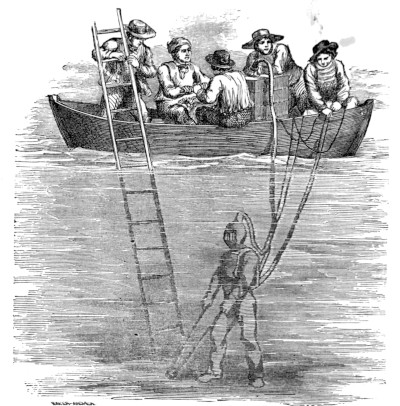
MANNER OF WORKING THE DIVING ARMOR.
The method of exploring with this armor, is seen in the second cut, where
the diver is represented as below the water, while his companions are in the
boat above, some of them holding the ropes, some pumping down air, and
others holding the ladder, while the diver himself is picking up some object
of value from the bottom of the sea. This armor has been used in searching
for amber, pearls, lost treasure, &c., &c. And when, some years since, the
United States steam-frigate Missouri was sunk in Gibraltar harbor, so as to
obstruct navigation, and all attempts by distinguished English engineers to
raise her had proved in vain, an American, going down in the above-described
armor, explored her position, and then contracted to blow her to pieces,
which he successfully accomplished, though she was in twenty-six feet water,
and covered by fifteen feet of sand. In doing this, he consumed forty-three
thousand pounds of powder, raised sixteen hundred tuns of iron, and some
eight hundred tuns of oysters that had grown to the iron. All his men
were clothed in the submarine armor, and so perfect was the management,
that not a life was lost, and not an accident happened during the whole of
the operation.
In this connection, the recently invented “Nautilus diving-bell” is worthy
of notice. This bell is provided with air-tight compartments, which hold
either air or water, as ascent or descent is required: and is so ballasted that,
when filled with water, buoyancy is destroyed, and the machine gradually
sinks. Expel the water from the tanks, and the machine comes of course
at once to the surface. By opening a valve near the bottom of the bell, the
water enters through a pipe into the tanks; the air at the same time escaping
through a valve at the top, opened or closed by the operator at will.will. Descent
is thus effected. On the contrary, let air be turned into the tanks, escape
at top be closed, and valves at bottom opened, water is expelled and ascent
secured. To raise heavy weights, a greater or less amount of water is
expelled. Suspension-chains attached to weight, immediately tighten;
machine and weight become buoyant, and then by cables attached to anchors
working through stuffing-boxes, windlasses may be transported to any
desired spot, and there deposited. Free communication may be held with
the bottom through an opening of between twelve and fifty square feet,
according to size of bell, closed by an iron door, and secured by bolts. By
throwing the door back, an equilibrium between air and water may be
attained at any depth, by greater or less amounts of air, as determined by
suitable gauges permanently fastened in the bell. Such is the ingenious
mechanism of this wonderful contrivance.
799
In Caffraria, in Africa, there is an “inhabited tree,” which travelers thus
describe: “It stands at the base of a range of mountains, due east from
Kurrichaine, in a place called ‘Ongorutcie Fountain.’ Its gigantic limbs
contain seventeen conical huts. These are used as dwellings, being beyond
the reach of the lions, which, since the incursion of the Mantates from the
adjoining country, when so many thousands of persons were massacred, have
become very numerous in the neighborhood, and destructive to human life.
The branches of the tree are supported by forked sticks, or poles, and there
are three tiers, or platforms, on which the huts are constructed. The lowest
is nine feet from the ground, and holds ten huts; the second, about eight
feet high, has three huts; and the upper story, if it may be so called, contains
four. The ascent to these is made by notches cut in the supporting
800poles; and the huts are built with twigs, thatched with straw, and will
contain ten persons, conveniently.”
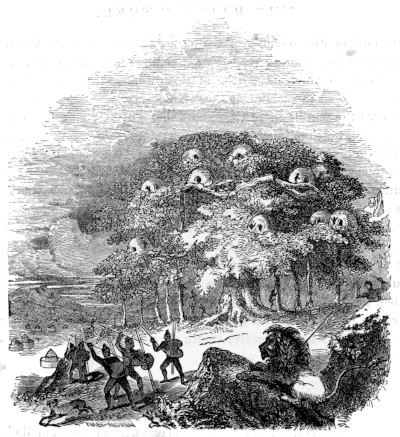
A view of one of these trees is given in the cut on the previous page.
Other villages have been seen by travelers, built somewhat similarly to the
above; but these were erected on stakes, instead of trees, about eight feet
above the ground, about forty feet square, larger in some places, and containing
about seventy or eighty huts. The inhabitants sit under the shade
of these platforms during the day, and retire at night to the huts above.
The island of Fierro is one of the most considerable of the Canaries, and
some suppose its name to have been given upon this account: that its soil,
not affording so much as a drop of fresh water, seems to be of iron; and,
indeed, there is in this island neither rivulet, nor well, nor spring, save that
only toward the seaside there are some wells; but they lie at such a distance
from the city, that the inhabitants can make no use thereof. But the great
Preserver and Sustainer of all, remedies this inconvenience by a way so
extraordinary, that we can but sit down and acknowledge that he gives in
this, undeniable demonstration of his goodness and infinite providence. For
in the midst of the island, says a late traveler, there is a tree, which is the
only one of the kind, insomuch that it hath no resemblance to those mentioned
by us in this relation, nor to any other known to us in Europe. The
leaves of it are long and narrow, and continue in constant verdure, winter
and summer; and its branches are covered with a cloud, which is never
dispelled, but resolved into a moisture, causing to fall from its leaves a very
clear water, and that in such abundance, that the cisterns, which are placed
at the foot of the tree to receive it, are never empty, but contain enough to
supply both man and beast.
Somewhat like the tree last mentioned, is one which is found in Madagascar,
and which, from its property of yielding water, is called “the traveler’s
friend.” It differs from most other trees in having all its branches in one
plane, like the sticks of a fan or the feathers of a peacock’s tail. At the
extremity of each branch grows a broad double leaf, several feet in length,
which spreads itself out very gracefully. These leaves radiate heat so
rapidly after sunset, that a copious deposition of dew takes place upon them,
which, soon collecting into drops, forms little streams, which run down the
801branches to the trunk. Here it is received into hollow spaces of considerable
magnitude, one of which is found at the root of every branch. These
branches lie one over the other alternately, and when a knife, or, which is
better, a flat piece of stick (for it is not necessary to cut the tree) is inserted
between the parts which overlap, and slightly drawn to one side, so as to
cause an opening, a stream of water gushes out as if from a fountain.
Hence the appropriate name of “the traveler’s friend.”
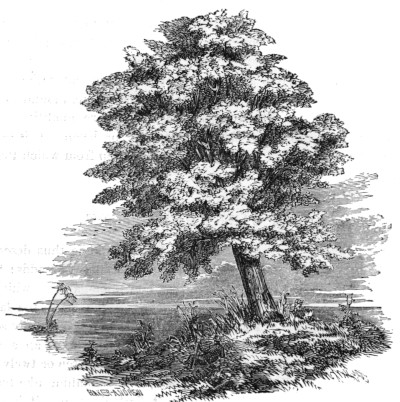
The camphor-tree, a view of which is given in the cut below, grows
naturally in the woods of Japan, and in many of the islands of the far
distant Pacific ocean. The part which smells stronger of camphor than any
other, is the root, which yields it in great quantities. The bark of the stalk
has outwardly rather a rough appearance; the inner surface is smooth and
mucous, and is very easily separated from the wood, which is dry in its
nature, and white in its color. The leaves stand upon slender, delicate foot-stalks,
802having an entire undulating margin running out into a point; the
upper surface of the leaf is of a lively, shining green, and the lower, herbaceous
and silky. The flowers are produced on the tops of footstalks, which
proceed from the arm-pits of the leaves, but not till the tree has attained
considerable age and size. The flower-stalks are slender, branched at the
top, and divided into very short pedicles, each supporting a single flower;
these flowers are white, and consist of six petals, which are succeeded by a
shining purple berry, of the size of a pea. This is composed of a soft, pulpy
substance, of a purple color, having the taste of cloves and camphor, and
of a kernel of the size of a pepper, which is covered with a black, shining
skin, of an insipid taste.
The camphor is a solid concrete juice, extracted from the wood of the
camphor-tree. Pure camphor is very white, clear, and unctuous to the
touch: the taste is bitterish-aromatic, and accompanied with a sense of
coolness: the smell is particularly fragrant, something like that of rosemary,
but much stronger. It has been long esteemed for its medicinal qualities,
and has been justly celebrated in fevers, malignant and epidemic distempers.
In delirium, where opiates failed in procuring sleep, but rather increased
and aggravated the symptoms, this medicine has been often found to procure
it. Physicians attribute these effects to its sedative qualities. It is a
powerful medicine, capable of doing great good or harm. It is said to be
poisonous to animals, often putting them into a sleep from which they never
waken.
This plant grows most abundantly in Ceylon, and is thus described by
Bishop Heber. After speaking of the visits of a forenoon, he adds: “In the
afternoon we drove through the far-famed cinnamon-gardens, which cover
upward of seventeen thousand acres of land on the coast, the largest of
which are near Colombo. The plant thrives best in a poor, sandy soil, in a
damp atmosphere. It grows wild in the woods to the size of an apple-tree,
but when cultivated is never allowed to grow more than ten or twelve feet in
hight, each plant standing separate. The leaf is something like the laurel
in shape, but of a lighter color. When it first shoots out it is red, and
changes gradually to green. It is now out of blossom, but I am told the
blossom is white, and spreads, when in full blossom, to cover the garden.
After hearing so much of the spicy gales from this island, I was much disappointed
at not being able to discover any scent, at least from the plants. In
passing through the gardens, there is a very fragrant-smelling flower growing
803under them, which at first led us into the belief that we smelt the cinnamons,
but we were soon undeceived. On pulling off a leaf or twig, you perceived
the spicy odor very strongly, but I was surprised to hear that the flower had
little or none. As the cinnamon forms the only considerable export of
Ceylon, it is of course preserved with care. By the old Dutch law the
penalty for cutting a branch was no less than the loss of a hand; at present
a fine expiates the offense. The neighborhood of Colombo is particularly
favorable to its growth, being well sheltered, with a high, equable temperature,
and as showers fall frequently, the ground is never parched.”
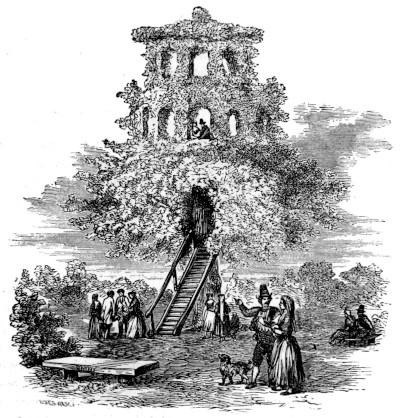
TREE TEMPLE AT MATIBO IN PIEDMONT.
Among the miscellaneous wonders, or at least curiosities, that the traveler
may behold as he passes through Italy, may be mentioned the tree temple,
a view of which is given in the engraving below. This singular tree is one
804of the curious ornaments of a beautiful estate, called Matibo, in the
neighborhood of Savigliano, in Piedmont, in northern Italy. It was planted
some seventy years ago; but it was only within some thirty years that the
idea was started of making it grow in the form of a temple, which, after
much time, perseverance and labor, was finally realized. It consists, as
may be seen in the engraving, of two stories, each of which has eight windows,
and is capable of containing twenty persons. The floors are formed
of branches twined together with great skill, and covered by nature with
leafy carpets; and all around, the natural growth and verdure of the tree
have formed thick walls, where flocks of birds have taken up their abodes
and built their nests. The proprietor of the island Matibo has never disturbed
these joyous little tenants of his property, but rather encouraged
their presence; so that at all hours of the day, they may be heard fearlessly
sporting and warbling, to the delight of the numerous visitors, who here
enjoy alike the cool breezes and the beautiful prospect.
These curious and wonderful insects are found both in India and Africa.
They are of several species, one or two of which construct works surpassing
in skill those even of the bee and beaver, and comparatively of far greater
size for them, than the boasted pyramids of the ancients are for man. The
laborers employed among them in these works, are not a quarter of an inch
in length; and yet the structures they rear rise to the hight of ten or even
twelve feet above the surface of the earth, and in their interior construction
and various arrangements, exceed even the works of man himself. The
most striking parts of these structures are the royal apartments, the nurseries,
magazines of provisions, the arched chambers and galleries, with their
various communications; the ranges of the Gothic-shaped arches, projected,
and not formed by mere excavation, some of which are two or three feet
high, but which diminish rapidly, like the arches of aisles in perspective;
the various roads, sloping staircases, and bridges consisting of one vast
arch, constructed to shorten the distance between the several parts of the
building, which would otherwise be connected only by winding passages.
In the following engraving may be seen, on the right, one of the ant-hills
as it appears externally; and on the left, a section of one of them, surmounted
by its conical roof. In some parts of Senegal, the number, magnitude
and closeness of these structures make them appear like the villages
of the natives; and their strength is such, that when they have been raised
to about half their hight, the wild bulls of the country stand on them, as
805sentinels, while the rest of the herd are feeding below. When at their full
hight of ten or twelve feet, they are used by Europeans as look-out stations,
whence they can see over the grass, which in Africa is, on an average, of the
hight of thirteen feet. Four or five persons may stand on the top of one
of these buildings, to look out for a vessel the approach of which may be
expected.
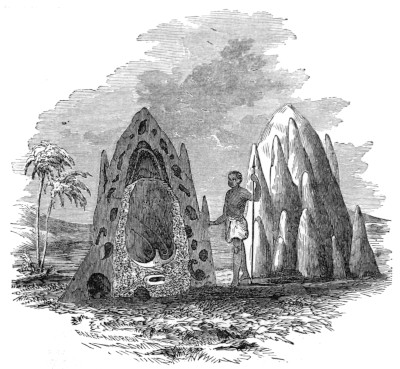
ANT-HILLS OF THE WHITE ANT.
The termites themselves are divided into three distinct ranks, or orders,
viz., the laborers, or working insects; the soldiers, or the fighting order,
who avoid all labor, and are about twice as long as the laborers, and nearly
fifteen times their bulk; and lastly, the winged or perfect insects, which
may be styled the nobility or gentry, who neither fight nor work, and from
whom come the kings and queens of the establishment.
These insects are extremely destructive; and it is said that a deserted
town has been known to be utterly destroyed by them in two or three years,
so that not a vestige of it remained. At Bombay, in a few hours, they will
demolish a large chest of books, papers, silks, or clothes, perforating them
with a thousand holes; and they sometimes penetrate and eat up the timbers
806and boards of houses, and in the same manner destroy the timbers of
a ship. The only way to preserve anything from their depredations, when
they are in a neighborhood, is to put it on a platform resting on glass
bottles, which, if kept free from dust, they can not ascend.
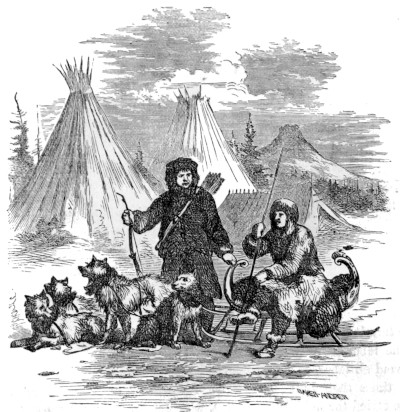
Side by side with the finished structures of animal instinct exhibited in
the engraving of the ant hills above, we next give a picture of the rude
huts of the uncivilized inhabitants of Kamtschatka, in their cold northern
home, at the north-eastern extremity of Asia, which is one of the coldest
spots on the face of the earth. It is impossible, in so severe a climate, to
raise wheat, corn, or the common productions of warmer regions. The
people, however, have a compensation for the scantiness of vegetable productions
in the profusion of animal life which seems to fill alike the earth,
the air and the water. The coasts swarm with seals and other marine
807animals; the rocks are covered with shell-fish; the bays abound in herrings,
and the rivers with salmon and other most valuable fish. Flocks of grouse,
wild geese and ducks, often darken the air. The country abounds in bears,
which are fat, and greatly esteemed by the inhabitants as food. From all
these sources, the people are supplied with the greatest abundance; and, as
a consequence, they have sunk into a lazy and almost stupid sensuality.
They are a short and copper-colored race, somewhat like the Esquimaux.
Like them, they have dogs, which they use in sledges, as seen in the
engraving. Their winter houses are half sunk in the earth, while those for
summer are elevated on poles above it.
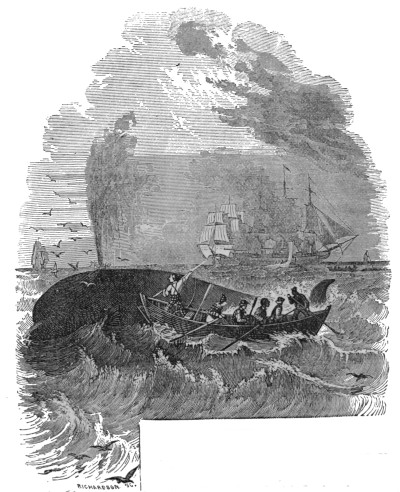
This vast monster of the deep is one of the
wonders of the world, or at least of its mighty
oceans. It is found chiefly in the more northern
808seas, where its food, consisting of small molluscous and crustaceous animals,
but chiefly of the clio borealis, is found. Whales are often found from
fifty to sixty, and some of them from ninety to one hundred feet in length,
and from thirty to forty feet, and even more, in circumference. The true
whale is remarkable for the immense size of its head, which constitutes a
full third of the entire length of the animal. The eyes are very small,
and placed just above the angles of the mouth. The external opening of
the ears is scarcely perceptible. The pectoral fins are of moderate size,
and located about two feet behind the angles of the mouth. The tail, or,
more properly, the tail fin, consists of two parts, or lobes, of immense
strength, measuring, in a full-grown whale, some twenty feet across, from
tip to tip. It is wielded by muscles of enormous power, and thus becomes
a weapon of offense and defense for the whale, as well as its chief means of
locomotion. A single blow of the tail is sufficient to cut the stoutest whaleboat
in two, and to send its fragments whirling through the air. The
engraving gives a view of a right whale about to be harpooned; while in
the distance is another, lashed to the ship for “cutting in,” and still another,
which the sailors, having killed, are towing in toward it. The whale fishery
was carried on by the Biscayans as early as the twelfth century; afterward
it was taken up by the Dutch and the English, and it now engages nearly a
tenth of the tunnage of the United States.
One of the most wonderful events in the history of the world, was the
voluntary exile of the forefathers of New England from their native
country, and their landing (December twenty-first, 1620) at Plymouth—here,
in the new world, to organize a community where they might enjoy
personal freedom, and liberty of conscience, and to worship God as seemed
right to themselves. The engraving on the following page gives a view of
them as they landed, in a howling wilderness, inhabited only by savages
and wild beasts, in the depth of winter, with no place of abode, or even
shelter, and no trust but in their own resources and the kind providence
of God which had thus far watched over and protected them. The history
of their trials, their preservation, their growth and prosperity as a people,
and of the wonderful country that has sprung up, and is still growing, with
a giant growth, in the broad land which they found a wilderness, is one
that fills us with wonder as we ponder it, and that should fill us with
deep thankfulness to the great source of all mercies, both to them and
ourselves.
809
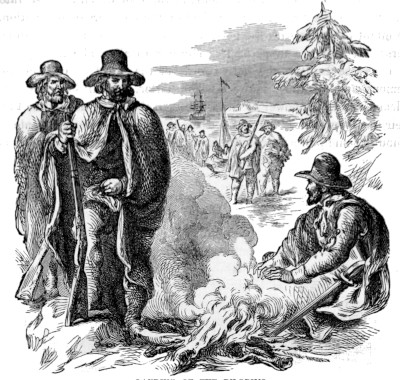
The place where the pilgrims landed is well known as the celebrated
This is, in part, still in the same place where it stood when our forefathers
first stepped upon it at their landing, and is pointed out to the visitor as
“Plymouth rock,” or the “Pilgrim rock,” or the “Rock of the Pilgrims.”
It is a hard kind of syenitic granite, of a dark gray color. The mica, which
in part composes it, is in very small quantity, and in fine black particles.
The rock is now in two pieces, each of which is about four feet through.
One of these pieces, about six feet and a half in diameter, as already said,
is still at the water’s edge, in its original position. The other part, represented
in the engraving on the next page, has been removed from its natural
location, and inclosed in an iron railing in front of “Pilgrim hall,” which
was erected as a monumental edifice on land that once belonged to Governor
Carver. Here it is visited by thousands, who, from year to year, go, as to a
810shrine of the most sacred associations, to the spot which is consecrated by
the sufferings, the courage, and the piety of the founders of our nation.
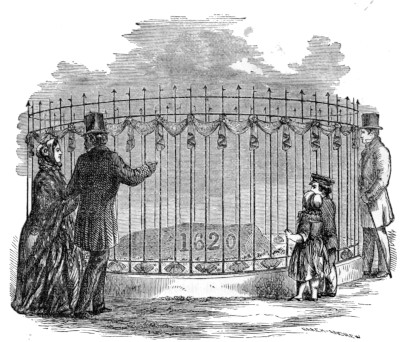
We might fill pages with the narratives of their exposures, hardships and
dangers; but they are more or less familiar to all. The history of their
perils from the Indians, the native lords of the forest, is of itself full of
excitement and thrilling interest. The latter, fearful lest the superior
knowledge and rising power of the white men should in the end be the ruin
of their own supremacy, were stirred up to endeavor to exterminate them;
and though some powerful chiefs and tribes were steadfastly friendly, others
were as steadfastly their foes. For years after the firm establishment of the
colonies, the early settlers were compelled to go to church, on the Sabbath,
armed, as represented in the engraving on the next page, that they might
be ready, if need be, to defend themselves in case of an attack by the
Indians. During the days of the Indian warfare such scenes were not
uncommon, and more than once a congregation has been roused by such an
attack, and gone forth to meet and disperse the foe, and then, setting their
sentinels to watch, returned to the house of God, to thank him for their
deliverance, and continue the worship of his holy day. Thanks to their
labors, and toils, and self-denials, and heroic enterprise, to the principles
811that guided them and the institutions they established, and to the divine
blessing attending all, we are not exposed to such perils; but may safely
enjoy the privileges they have handed down to us, with none to molest us
or make us afraid.
EARLY SETTLERS OF NEW ENGLAND GOING TO CHURCH.
There is now (1855) on exhibition in Paris, one of the most remarkable
pieces of masterwork which the union of art and science has ever produced.
It consists of a picture, of about three feet square. This picture is made up
of colors admirable for their beauty and boldness, but there is no subject.
The most experienced eye can detect nothing but disjointed and half-formed
approximations toward a coherent design. The most able artist sees there
only the finest colors, but no one can tell what they are intended to represent.
In the middle of the picture, which is horizontally placed, is a mirror
formed by a copper cylinder covered by a perfectly polished coating of silver.
This mirror is usually veiled. So far there is little remarkable, and the
812greatest amateurs in painting would hardly consent to spend five francs on
such an apparently profitless study. But it is impossible not to feel a glow
of admiration, when, on uncovering the mirror, there is represented upon it
in the brightest reflected rays, the whole scene of the Crucifixion. The
partial coloring then takes a character of incontestable superiority, and presents
to the astonished spectators a picture composed of six most perfect
figures, depicted with a degree of boldness such as the master painters alone
knew how to impart to the subject which it was their glory to represent.
This fish is one of the wonders of the mighty deep, well known to those
engaged in whaling, and in the Pacific cruisers. It is thus described by one
who has often witnessed its attacks on the whale.
“The killer is the wolf of the ocean, and hunts in packs, and their tall
dorsal fin can be constantly seen above the water. This fish has always as
a companion, but swimming deeper, the sword-fish, and now and then can
be seen the shark. On sighting their prey, which the killer sees at a great
distance, the pack gives chase. The unconscious whale is slowly moving near
the surface, and occasionally spouting, as it were in sport, jets of water
above him. But he now suddenly sees the sea-wolf near him. Instinct at
once teaches him that on the surface he can not be safe, and, taking in a long
breath, he flukes; that is, dives. But there has been another enemy watching
him from the depths below—the sword-fish, which now darts at him
with the velocity of lightning, and perforates the whale beneath, with his
long and spear-like nose. This sends him at once to the surface; here he
again meets with his enemies, the killers; but as yet they are afraid to
approach him. The whale now begins to see the extent of his danger, and
for a time merely lashes the water with his ponderous fluke. He soon tires
of this, and remains for a short time at rest; the pack now approach him,
and he seeks safety in flight. But what can he do? The poor whale has a
hump on his back, and steers unsteadily, while the killer’s tail and stiff
fin steady him on his course. Nearer and nearer approach the pack to
their victim; again he takes a long breath and dives. The sword-fish has
steadily kept him in view; he, too, has a tall fin and long slender propelling
tail; and while it is an effort to the whale to increase his speed, it is but
play to the sword-fish, which again darts and perforates his prey, and sends
the wounded whale again to the surface.
“The race again commences, but this time with diminished speed, the
killers having separated to watch the rise of the whale, who, finding his
813enemies in every direction, courses in a circle, and again makes a third, and
sometimes a fourth attempt to escape by diving, but is always met by the
terrible spike of the sword-fish. He at last, weak, exhausted and dispirited,
returns to the surface, where he again attempts escape by flight. Streams
of blood mark his course; his enemies still follow steadily after him, until
he stops and begins to lash and make the ocean foam around him; but now
large streams of his life-blood are pouring out, and he is only increasing his
weakness by the exertion, and merely lashing amidst his own gore. Tired,
exhausted and faint, he rolls over. The deep red streaks of blood flowing
from large orifices in his white belly can now be distinctly seen. The
hungry pack now close, and one more bold than the rest seizes him near the
throat and tears away the white skin and fat; he opens his mouth and bellows
with pain. This is generally the signal for a combined attack. His
tongue is seized and torn out; so are his eyes. The sword-fish now rises to
the surface, and his tall spar-like protuberance is seen projecting over the
body of the whale; the sharks also close in and feed on the fat rejected by
the killers. In this state the whale makes a few dying struggles. The
feast now commences and continues until the fat and sufficient flesh are
stripped off to cause the carcass to become too heavy to float on the surface,
and it sinks. The shark is left to enjoy his few streaks of fat, while the
killer pack, accompanied by their companion, the sword-fish, rove again the
broad ocean to seek another leviathan of the great deep.”
Baron Humboldt says: “In the savannas of Izacubo, Guiana, I saw the
most wonderful and terrible spectacle that can be seen; and although it be
not uncommon to the natives, no traveler has ever mentioned it. We were
ten men on horseback, two of whom took the lead, in order to sound the
passages, while I preferred to skirt the great forests. One of the blacks who
formed the vanguard returned at full gallop, and called to me, ‘Here, sir,
come and see the serpents in a pile.’ He pointed to something elevated in
the middle of the savanna or swamp, which appeared like a bundle of
arms. One of my company said, ‘This is certainly one of the assemblages
of serpents which heap themselves on each other after a violent tempest. I
have heard of these, but never saw any; let us proceed cautiously, and not
too near them.’ When we were within twenty paces of it, the terror of our
horses prevented our approaching nearer, to which none of us were inclined.
On a sudden, the pyramid mass became agitated; a horrid hissing issued
from it, thousands of serpents rolled spirally on each other, and shot forth
814out of the circle their hideous heads, presenting their envenomed darts and
fiery eyes to us. I own I was the first to draw back, but when I saw this
formidable phalanx remain at its post, and appear to be more disposed to
defend itself than to attack us, I rode round, in order to view its order of
battle, which faced the enemy on every side. I then thought what could be
the design of this numerous assemblage; and I concluded that this species
of serpent dreaded some colossean enemy, which might be the great serpent
or cayman, and they reunite themselves after seeing the enemy, so as to
resist this enemy in a mass.”
The recent discoveries in what is called the “Great Basin,” a tract of
table-land lying between the Rocky and the Pacific chain of mountains, are
exciting much interest, and awakening inquiry and speculation again as to
the origin of the people who evidently, in a former period, inhabited these
now desolate regions. Captain Walker, the mountaineer, passed through
the center of this basin in 1850, and made some interesting revelations of
what he saw. These statements have been called in question, on account
of their supposed improbability; but a later trip of Lieutenant Beale gives
a degree of confirmation to the facts, which will make the credibility of the
statements more readily admitted. The whole country, from the Colorado
to the Rio Grande, between the Gila and San Juan, is full of ruined habitations
and cities, most of which are on this table-land. Captain Walker
states that, in traversing this desert, he had frequently met with crumbling
masses of masonry and numberless specimens of antique pottery.
In his last trip across, he saw the ruins of a city more than a mile in
extent, the streets of which ran at right angles. The houses had all been
built of stone, but all had been reduced to ruin by the action of some great
heat, which had evidently passed over the whole country. In the center of
the city rose abruptly a rock twenty or thirty feet high, upon the top of
which stood a portion of the walls of what had once been an immense building.
The outline of the building was still distinct, although only the northern
angle, with walls fifteen or eighteen feet long, and ten feet high, was
standing. These walls were constructed of stone, well quarried and well
built. Lieutenant Beale, on his first trip across the continent, discovered in
the midst of the wilderness of Gila, what appeared to be a strong fort, the
walls of great thickness, built of stone. He traversed it, and found it contained
forty-two rooms. A correspondent of the Placerville Herald gives
an account more wonderful still, of a stone bridge, which had also been discovered,
815the foundations of which were of stone, and nearly six hundred
feet from one of the outer abutments to the other, while between the two
are no less than seven distinct piers. This bridge has the appearance of a
river once flowing between its piers, though now there is not the slightest
appearance of such a river in that vicinity.
Next we have an account of a strange race of people, neither whites nor
Indians, called Moquis, lighter in color than the Indians of California. The
women are tolerably fair, not being so much exposed to the sun. Among
them Captain Walker saw three perfectly white, with white hair and light
eyes. They raise all kinds of grain, melons and vegetables. They have
also a number of orchards, filled with many kinds of fruit-trees. The
peaches they raise are particularly fine. They have large flocks of sheep
and goats, but very few beasts of burden or cattle. They are a harmless,
inoffensive race; kind and hospitable to strangers, and make very little
resistance when attacked. The warlike Navajos, who dwell in the mountains
to the north-east of them, are in the habit of sweeping down upon
them every two or three years, and driving off their stock. At such times,
they gather up all that is movable from their farms, and fly for refuge to
their mountain stronghold. Here their enemies dare not follow them.
When a stranger approaches, they appear on the top of the rocks and
houses, watching his movements. One of their villages, at which Captain
Walker stayed for several days, is over six hundred yards long. The
houses are mostly built of stone and mortar; some of adobe. They are
very snug and comfortable, and many of them are two and even three
stories high. The inhabitants are considerably advanced in some of the
arts, and manufacture excellent woolen clothing, blankets, leather, basket-work
and pottery. Unlike most of the Indian tribes in this country, the
women work within doors, the men performing all the farm and out-door
labor. These people, according to the accounts, have never had any intercourse
with the white race.
The most remarkable fact connected with the history of ants, is the propensity
possessed by certain species to kidnap the workers of other species,
and compel them to labor for the benefit of the community, thus using them
completely as slaves; and, as far as we yet know, the kidnappers are red or
pale-colored ants, and the slaves, like the ill-treated natives of Africa, are of
a jet black. The time for capturing slaves extends over a period of about
ten weeks, and never commences until the male and female are about
816emerging from the pupa state; and thus the ruthless marauders never
interfere with the continuation of the species. When the red ants are about
to sally forth on a marauding expedition, they send scouts to ascertain the
exact position in which a colony of negroes may be found. These scouts
having discovered the objects of their search, return to the nest and report
their success. Shortly afterward, the army of red ants marches forth,
headed by a vanguard, which is perpetually changing; the individuals
which constitute it, when they advance a little before, are sent to the rear,
and their places occupied by others. The vanguard consists of eight or ten
ants only. When they have arrived near the negro colony, they disperse,
wandering through the herbage and hunting about, as if aware of the propinquity
of the object of their search, yet ignorant of its exact position.
At last they discover the settlements, and the foremost of the invaders,
rushing impetuously to the attack, are met, grappled with, and frequently
killed by the negroes on guard. The alarm is quickly communicated to the
interior of the nest; the negroes sally forth by thousands, and the red ants
rushing to the rescue, a desperate conflict ensues, which, however, always
terminates in the defeat of the negroes, who retire to the innermost recesses
of their habitation. Now follows the scene of pillage. The red ants, with
their powerful mandibles, tear open the sides of the ant-hills, and rush into
the heart of the citadel. In a few minutes each invader emerges, carrying
in its mouth the pupa of a worker negro, which it has obtained in spite of
the vigilance and valor of its natural guardians. The red ants return in
perfect order to their nests, bearing with them their living burdens. On
reaching the nest the pupa appears to be treated precisely as their own; and
the workers, when they emerge, perform the various duties of the community
with the greatest energy and apparent good-will. They repair the nest,
excavate passages, collect food, feed the larvæ, take the pupa into the sunshine,
and perform every office which the welfare of the colony seems to
require. They conduct themselves entirely as if fulfilling their original
destination.
At 94.32, there is a paragraph preceding some verse
which ends abruptly, without punctuation. It seems that the
intent was to continue the thought with the first lines of the poem.
At 530.18, a closing quote mark occurs where there is
no opening quote. The previous paragraph closes an extended quotation,
which is not re-opened. It is difficult to say whether the ‘voice’ has
shifted. In any case, the closing quote in question has been removed.
The word ‘bass-relief’ appears thirty-two times, while the more
familiar ‘bas-relief’ appears only twice. Both versions have been
retained.
Other errors deemed most likely to be the printer’s have been corrected, and
are noted here. The references are to the page and line in the original.
| 9.18 |
an object must be seen[,] |
Removed. |
| 26.17 |
rate of eight[y]-six feet an hour |
Added. |
| 28.2 |
wholly disap[p]eared |
Inserted. |
| 36.1 |
mottled with black and[ and] white spots |
Redundant. |
| 82.17 |
Mauna Loa and Mauna [R/K]ea |
Replaced. |
| 87.33 |
In many [y/p]arts of the precipice |
Replace. |
| 126.23 |
by any sounding line[,/.] |
Replaced. |
| 198.12 |
carried on in Colebrook[ ]dale |
Removed. |
| 230.17 |
Earth’s universal family.[”] |
Added. |
| 275.23 |
[‘/“]the waterfall mountain,” |
Replaced. |
| 289.1 |
some of the savan[t]s |
Inserted. |
| 317.17 |
or St. Helmo’s fires |
sic: Elmo’s. |
| 324.28 |
I had thought a mere fable.[’/”] |
Replaced. |
| 348.36 |
from such a[ ]surface |
Inserted. |
| 421.6 |
four hund[d]red feet |
Removed. |
| 427.27 |
it[s] extreme length |
Added. |
| 446.21 |
fresh-water mus[cle/sel]s |
Replaced. |
| 470.23 |
the name of E[d/l] Hedjeaz |
Probable. |
| 470.24 |
the cities of Medi[an/na] and Taif |
Transposed. |
| 511.15 |
PYRAMIDS OF MERO[E/Ë] |
Replaced. |
| 516.3 |
so has it been forever!’[”] |
Added. |
| 525.37 |
and quitted them forever.[”] |
Added. |
| 610.15 |
in Agræ[./,] |
Replaced. |
| 634.22 |
these ancient piles.[”] |
Added. |
| 649.35 |
the f[ri/ir]th of Forth |
Transposed. |
| 655.24 |
On the top is a bas[o/i]n |
Replaced. |
| 710.37 |
[“]France, Belgium, Holland, |
Added. |
| 798.27 |
closed by the operator at will[.] |
Restored. |