PREFACE.
It seems to me that there is something very unreasonable
in the plan of a great many of the books intended
to introduce young people to the various branches of
Natural History, which have been recently published.
The chief aim of their authors seems to have been to
combine brevity with comprehensiveness. Brevity is,
without doubt, a great advantage, inasmuch as the proverb
is true, that a great book is a great evil; but in my
opinion comprehensiveness ought not to be attempted
in books intended for children. If it were desirable, I
might indeed confidently say, that it can never be obtained
within the necessary limits; and the attempt to
effect it, will very often reduce the work to a mere dry
table of classification. However neat and systematic
tables of genera and species, and lists of names may
look, they can never convey to the young the elements
of sound scientific method; and will seldom fail in
being useless or disgusting to the mind, at an age when
it is seeking for that sort of knowledge which will
exercise the understanding, without burdening the
memory. This healthy appetite ought to be carefully
cultivated; and I am satisfied that if it were so, from
the earliest stage of education, we should have but few
complaints of bad memories. The memory is apt to
vanish from those who would make an idol of it; and I
am disposed to think that its cultivation may very safely
be omitted, as a direct object of education, if due care
is taken to keep the understanding active, and to present
the matter on which it is to be engaged in the
most entertaining form possible. In fact, what is often
termed "a good memory," that is, a ready recollection
independent of the connections which are made
solely by the understanding, is, as we may see by its
fruits in many persons of feeble intellect, by no means
desirable. An apt example of such a memory is afforded,
in what Dame Quickly says to Sir John Falstaff, when
she reminds him of a mixed multitude of unimportant
circumstances, with no other principle of arrangement
or connection, than what was supplied by proximity of
time and place.
I would not, however, willingly be supposed to
recommend books, in which systematic arrangement,
or the most scrupulous regard to accurate statement,
is overlooked. I had particularly in view that numerous
class of little books, which under various names
come out in series, each volume professing in a manner
to comprise the whole of the branch of Natural History
which may be the subject of it, by its containing a mere
arrangement of the names of the phenomena which the
branch includes. There is another and widely different
class of books, in which stories from travellers and other
idle gossip of the like kind, are compiled in an undigested
mass, without regard to the different names by
which the same thing may be called, and not unfrequently
to a common respect for truth, which is not
much less to be deprecated.
And yet to books of this latter description, often of a
very unworthy character, it is that many of us owe the
first calling into consciousness of that taste which may
have made us travellers or naturalists, or lovers of
knowledge. I wish that, without copying the example
of their authors, we should learn a lesson from them,
and put it in practice, by striving to form a taste to
enjoy knowledge in them we have to teach, before we
attempt any mode of systematic instruction.
The following little book has been written under the
impressions which I have here stated. I have selected
a few of such phenomena of the Kingdoms of Nature,
as seemed to me to have in them most to excite wonder
and admiration; and I have sought to convey distinct
notions with the least possible use of technical language;
neither forgetting the connection of things, nor
overloading the statements with matters that are merely
expletive of an arbitrary system. How far I may have
succeeded, is for my little friends, and their instructors,
who have approved of my other books, to decide.
Wishing the former as much pleasure in the reading, as
I have had, for their sakes, in the writing, I take my
leave of them.
P. P.
CHAPTER I.
PARLEY EXPLAINS HOW THE STRATA OF THE EARTH ARE PLACED.
I am now going to tell you, my young friends,
about some of the wonderful things in the earth,
sea, and sky. A great number of them I have seen
myself in my travels through various countries,
and others I have only read of; but I shall tell
you nothing that is not strictly true, for I do not
wish so much to astonish you as to make you
take pleasure in contemplating the works of
God, and to increase your knowledge of His
goodness, wisdom, and power.
I shall begin with some of the wonders of the
earth which, as I suppose you know, belong to the
branch of natural history which is called geology;
and to enable you to understand what follows, I
must first explain how the materials which compose
the ground you tread upon are arranged.
If you hastily travel over any extensive tract
of country, such as that between New York and
Philadelphia, or between London and Bristol,
you might think that all the different substances,
clay, chalk, limestone, and granite, were irregularly
mixed together. This is, however, not
the case, when taken on a great scale; for if
you more carefully examine, you will find that
the various sorts of earth are disposed in layers,
or strata, and that a uniform order of arrangement
is nearly preserved.
If these layers were perfectly horizontal, laid
one over another like the coats of an onion, we
should have to dig through one before we could
get to the second, and our knowledge of what
the globe consists, would be much more limited
than it is; for the greatest depth to which men
have descended in the deepest mines, is not much
greater than the thickness of one of the strata.
But, instead of this, the surface is broken up by
some force from beneath elevating portions, so
as to form mountains and hills; and in consequence
of this the edges of the strata appear on
the surface one after another; just as you would
see the edges of a row of bricks that had been set
up on their ends, and then the last one thrown
down so as to push down all the others.
This is the way in which the strata are placed
in the neighbourhood of Weymouth.
The chief reason why I wished you to understand
this is, that you may see how it is known
that one stratum is older than another. It
is evident that the substance marked a, in the
section, which is limestone, must have been
deposited before b, while b must certainly be
older than c.
Now in most of the strata above the granite,
which is nearly always in the position of the
oldest formation, there are found various shells,
plants, and bones of animals; and where certain
remains of different animals or vegetables are
found in one stratum, it is concluded that they
must have been living about the same time.
Most of the animals of the older strata were
different in form from any at present known to
exist; and some of them are very remarkable,
and if they were alive now, would seem to us
very strange and awkward.
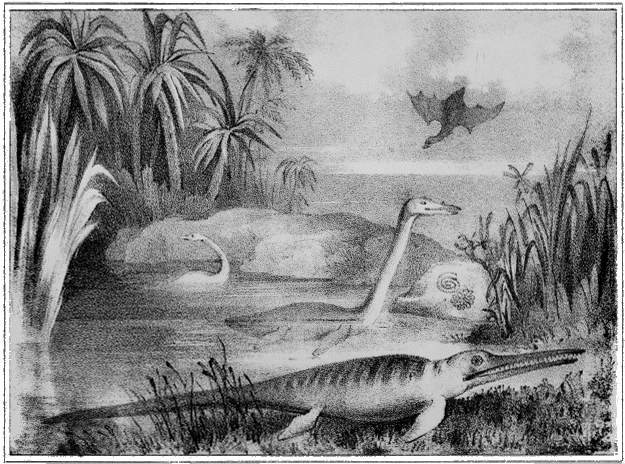
Plate I. p. 5
EXTINCT ANIMALS.
CHAPTER II.
WHAT CREATURES ONCE LIVED WHERE DORSETSHIRE NOW IS.
I will show you a picture of what creatures
were once living where the town of Lyme Regis,
in Dorsetshire, now stands, and tell you something
about their structure and their habits. You
may perhaps be ready to think that a great deal
of what we profess to know concerning them, is
the work of fancy, but I can assure you it is
not, and by and by I will endeavour to convince
you that there is reason enough for you to believe
what I tell you.
THE ICHTHYOSAURUS.
That large animal lying on the ground, is
called the Icthyosaurus, from two Greek words
signifying Fish-Lizard, in consequence of his
possessing some of the peculiarities of both
fishes and lizards.
The usual length of this creature was from
twenty to thirty feet. It possessed a most surprising
combination of the powers and qualities
of different animals which are now in existence.
In its general form and character it must have
been something like the modern porpoise; but
it had the teeth of a crocodile, the head of a
lizard, the back-bone of a fish, and the fins or
paddles, of a whale.
I shall spend some little time in explaining to
you each of these particulars, that you may see
how wisely all the parts of living things are
framed to supply their wants, and adapt them to
the circumstances in which they are placed.
The head was not very different from that of
a crocodile, or lizard, in its general shape. The
teeth were precisely like those of a crocodile,
and grew up in the same manner. Creatures of
this sort lead a ruffian sort of life, always biting
something or other, and as they live very much
in the dark at the bottom of the water, perhaps
now and then snap at a stone or a piece
of hard wood by mistake, and often break their
teeth; and in order therefore to keep them in
constant repair, they have a fresh set once a
year, or at very short intervals, so that they are
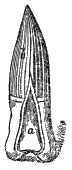
always growing. The young tooth a,
springs up inside the old one b, till it becomes
so large that it splits its predecessor,
and the pieces fall off, just as the
covering of some sorts of buds falls
off as the flower expands, as you will
see in this cut, representing one of the
fossil teeth.
You must have noticed in the picture the
great length of his snout. In a jaw-bone of
such amazing length which was to be applied to
such violent purposes, it was necessary there
should be great strength. There were two ways
of obtaining this: one would have been by
having the bones very hard and stout; but this
would not do, because they would then have
been so heavy that the animal would have found
difficulty in raising his head to the surface of
the water for the purpose of breathing, since
it would have overbalanced the other part of his
body. The other contrivance, which was the
one adopted by the wisdom of the Creator, was
to make the jaws consist of several thin bones,
a, b, c, d, strongly bound together, and terminating
in succession like the plates of steel of
which a carriage spring is made. There are
accordingly six of these bones thus disposed.
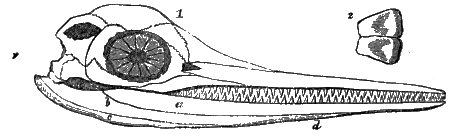
But this was not all, the principal middle
bone marked b, instead of having its fibres run
straight, parallel with the others, had them
placed in a slanting position, and thus there was
additional firmness given to the jaw by what
ship-builders would call diagonal bracing, a contrivance
that you may often see used in the construction
of houses and ships.
If you have ever seen a crocodile open its
mouth, and then snap together its long thin
jaws, so as to make you start with the noise, you
will see how necessary all these contrivances
must be for him and the Icthyosaurus, whose
jaws were still thinner, to prevent them from
breaking their bones.
This however is not at all more wonderful
than the eye, which in the old-fashioned animal
I have been describing, was much larger than
that of the crocodile, and not unfrequently bigger
than a man's head. From the very great
quantity of light which such a large surface
would receive, the creature's power of seeing
must have been very great. And besides this
advantage, it had the same faculty as is possessed
by the golden eagle, the turtle, the tortoise, and
the lizard, of pressing the eye forward to render
it more convex. In man and most animals, the
eye is placed in a fixed cavity of thin bone,
something like an egg-cup, but in the Icthyosaurus,
the cavity was formed by several bones not
quite touching each other; (as you may see in
the last cut, and in figure 2, you have two of the
bones by themselves, taken out of the socket of
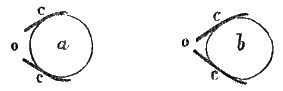
the eye;) and there were muscles to draw these
bones closer together; so that by making the
cup less deep, the eye was thrust forward and
made to swell out in the middle. This is illustrated
in the ball b, which is pressed outwards,
by drawing the plates of bone cc, together at o,
close than those which have the ball a between
them.
You must have seen that the more convex
magnifying glasses are, the more they magnify,
and the nearer you must hold them to
the object you are looking at. By this contrivance,
the eye of the Icthyosaurus could be made
at pleasure into a microscope, so as to see with
wonderful quickness things which were quite
close to it, by pushing it forward and rendering
it more convex; or it could be made into a telescope
like the eyes of some persons who are
long-sighted, for seeing what is at a greater
distance, by drawing it back.
In all these particulars you may see how the
skill of man leads him to adopt the same plans to
produce the same ends in the works of art, as God
has adopted before him in the works of nature,
without his being conscious of copying them;
and this should remind you that man was created
in the image of his Maker. If man had never
made a carriage-spring, or a diagonal bracing,
he would not have understood the structure of
the jaw of the Icthyosaurus; and if he had never
invented the telescope, he would not have been
able to explain the construction of the eye.
You have now seen the points in which the
Icthyo-saurus chiefly resembled a crocodile or
lizard; from which the latter half of its name is
derived, saurus, a lizard. I must now tell you
something of those parts in which it is like a
fish, from which it takes the other part of its
name, icthy, for icthus, a fish.
You know that crocodiles live a good part of
their time on land, and they therefore have feet
and a back-bone like land animals, which enable
them to walk better, but do not allow them to
swim so well as fish. The back-bone is heavy
and firm, and each of the bones composing it has
one side slightly hollow, and the other side swelling
out to fit into the hollow in the one that
comes next to it. But in fish both sides of the
bones are hollow, and they are joined together
by gristle, as you can easily see in the fish that
are commonly eaten; this renders the back-bone
much more flexible and lighter, and therefore
better adapted for an animal always swimming.
That of the Icthyosaurus was formed in
the same manner, and we therefore judge that
he spent his whole life in the water; for a back-bone
so formed, would not have been able to
support such a great heavy body when walking
on the land.
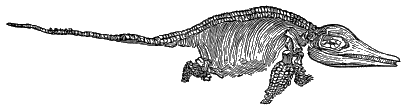
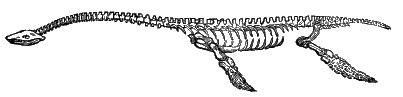
The fins, or paddles, were very curious, and
much like those of the whale; they consisted of
above a hundred small bones strongly united
together, in a sort of pavement enclosed in a
strong skin, and not divided into toes, as you
may observe in this representation of the entire
skeleton.
You may see many specimens of the skeleton
itself in the British Museum.
The Icthyosaurus was a great tyrant, and used
to prey on every creature that came within his
reach; this is known by the fossil remains found
in the inside of his body. He used at times
even to act the cannibal, and eat his own relations,
for a large one has been dug out of the
cliff at Lyme Regis, with part of a small one in
his stomach undigested; he must have been
altogether a very unamiable character. But as
his family has been so long extinct, and we
are told that we ought to say nothing but what
is good concerning the dead, I shall not say any
more about him, leaving you to form your own
conclusions from what I have related to you.
THE PLESIOSAURUS.
Those still more strange looking animals with
very long necks, which are represented swimming
in the water, have been named Plesiosauri,
a word signifying, related to, or closely resembling,
a lizard. There are some nearly perfect
specimens in the British Museum, and
this is a representation made up by taking the
uninjured parts of several, so as to make up a
perfect whole.
Taking it altogether, there is not one of the
fossil animals so much unlike anything at present
known to exist. Its usual length was from 9
to 15 feet, but it was at times very much larger.
The head was much shorter in proportion
than that of the Icthyosaurus, being more like
that of the guana, the lizard which people eat in
the West Indies. The neck must have been
longer than that of any living animal, not even
excepting the swan; it contained thirty-three
bones, or vertebræ, while the whole of the rest
of the back-bone in the body and tail, contained
only fifty-seven.
The faces of these vertebræ were nearly flat,
and not hollow like those of the Icthyosaurus,
which would better enable the animal to exist
on land, and it appears to have moved about
in the same manner as seals do. From some
very ingenious observations on certain parts of
its anatomy, (which if I were to endeavour to
explain to you, you would not understand, unless
you possessed a great deal of anatomical knowledge,)
naturalists have supposed that it used to
change the colour of its skin like the chameleon.
Its paddles were almost exactly like those of the
turtle, and its body was something of the same
shape, but not quite so wide.
From its long neck, which, although it was
strengthened by the solid joints and peculiar
shapes of the bones, was not very strong, and
its small head and jaws, the Plesiosaurus could
not have been near a match for its neighbour, the
Icthyosaurus, in combat, even when the individuals
were of the same size; neither would its
form adapt it for cutting through the water so
quickly. It must, therefore, no doubt, have often
fallen a prey to that voracious monster. Perhaps,
however, it often played him a trick when
he was pursuing it by running on shore out of
his reach; or it might mostly have kept out of
his way in very shallow water amongst the rushes
and reeds, where it could every now and then
dart its long neck like a swan, down at the
little fish that came near it; or else suddenly
reaching aloft into the air, it may have seized
upon some unlucky insect, or Pterodactyle, (a
sort of bat of which I shall presently speak)
and then laid down as quiet under the rushes
as if nothing had happened, waiting for its next
mouthful.
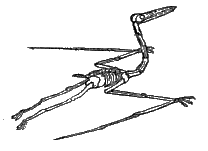
THE PTERODACTYLE.
That odd-looking creature which is flying in
the air over the heads of the Plesiosauri, has
been called the Pterodactyle, which signifies
wing-fingered. There were several varieties, of
different sizes and figures, from that of a snipe
to that of a raven. The most remarkable of them
was indeed a curious creature, and so you will
say if you look at the picture of his skeleton.
He was more like a bat in his general shape
and habits, than anything else we know of, but
was very different in a great many respects.
He had a head like a lizard, with a long snout
and sharp teeth; his ribs were round and thread-like,
not flat like those of birds and bats; his eyes
were large; and his wings like a bat's, being a
membrane or skin, stretched out by one very
long toe on each of his fore-feet. In order to
support his long head, there were strong cords
running down each side of the vertebræ of his
neck, such as are found in some modern birds,
as is known by the forms of the bones to which
the ends of them were attached. His toes ended
in sharp claws, and he had also claws at his two
principal joints, so that he could catch hold of
the branches of trees with them, as bats do.
These creatures used principally to feed upon
large dragon flies, beetles, and the other insects,
of which the remains are found, and some of
which are represented in the picture.
There were also living at the same time with
these creatures, several kinds of tortoises, and
fish in immense varieties. The whole district
where the south coast of England now is, seems
to have then been a marsh with no vegetation
but sea-weeds, reeds, and the like; and its only
inhabitants were, fish, reptiles, and insects.
After the races of animals which we have
mentioned, became extinct, a period followed in
which they were succeeded by some monstrous
creatures, like lizards in all respects, except that
they were fitted to live in the water by the construction
of their back-bone, their having lungs
of the same kind as those of fishes, and the possession
of fins. One of these, called the Iguanodon,
was sometimes seventy feet long. It had
a little horn near the end of its snout, placed
something like the horn of a rhinoceros, and
must have borne considerable resemblance in its
general form to the guana, which I mentioned
before. Their bones and teeth, are found at
Lewes, in Sussex, and in the Isle of Wight, where
you may pick them up on the shore, as you can
the bones of Icthyosauri and Plesiosauri, at Lyme
Regis, though not in such great numbers.
We are indebted for a great deal of what I
have told you about the animals that once lived
where Dorsetshire is now, to a lady, Miss
Anning, who spends nearly her whole time in
collecting fossils out of the cliffs. No one ought
to go near Lyme Regis without visiting her collection.
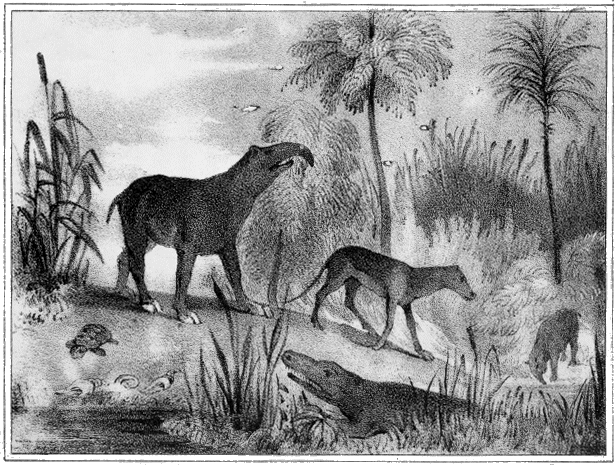
Plate II. p. 21
EXTINCT ANIMALS.
CHAPTER III.
WHAT SORT OF A PLACE ONCE EXISTED WHERE THE NEIGHBOURHOOD OF PARIS IS NOW.
I shall show you a picture representing a
state of things much more like the present, than
the one we looked at before. It existed at a
later period, though still a great many years
ago; and if you wish to know why we conclude
it to be later, since it is the other side of the
water and we are therefore prevented from distinctly
tracing the succession of the strata, I will
tell you.
After leaving the formations of Dorsetshire,
in which the great saurian or lizard-like reptiles
are found, we come to chalk in Hampshire and
the Isle of Wight; and after the chalk, to some
beds of clay, and then some beds of limestone.
The formations above the chalk, are those called
tertiary; those from the chalk down to the
lowest containing animal and vegetable remains,
are the secondary; and all below that, consisting
mainly of various sorts of granite, are the
primary.
Now all this occurs in the same order in
France, and the neighbourhood of Paris consisting
of tertiary formations, just corresponds with
the tertiary strata of the Isle of Wight, and them
we know to be more recent than the secondary
formations of Dorsetshire. Of course, therefore,
the animals found at Paris, must be more recent
than those found at Lyme Regis.
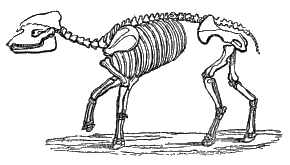
The largest of the animals represented in the
plate, is called the Palæotherium.
The following is a picture of his skeleton, as
it has been made out, bone by bone. A single
tooth was first discovered, and the French naturalist,
Cuvier, was able to determine from this
alone, a great many particulars which have now
been proved by the subsequent discovery of the
bones; such was the knowledge he had acquired
by comparing the bones of different animals.
He thus discovered that a certain shape of tooth
always accompanied a certain shape of foot, as
well as indicated what kind of food the animal
lived upon. From this might be judged a great
deal about the organs of digestion, and the
internal structure, and something of its habits
and disposition. In all these points and several
others, Cuvier predicted from a single bone of
the Palæotherium, what has been exactly confirmed
by the entire skeleton.
It was about the size of a small horse, and must
have possessed a little trunk, or proboscis, like
the modern Tapir, to which indeed it must have
borne a great resemblance.
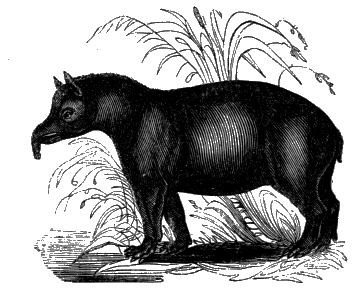
American Tapir.
The reason for thinking that it had a trunk,
is because there is a peculiar contrivance in the
bones to give strength to the neck, which only
exists in animals that have a proboscis. There
are some Tapirs in the Zoological Gardens, and
if you have seen them, you will be able to form
a pretty good notion of what the Palæotherium
must have been. It had perhaps rather more of
the hog about it, than the Tapir has, with a
more dull heavy expression of countenance.
There were three varieties of Palæotherium
distinguished by their size. The smallest was
not much larger than a little dog, and you may
see the figure of one of them in the picture,
going down to the water to drink.
The more slender animal, which is walking
towards the water, is the Anoplotherium, or
un-armed beast. Its size varied from that of a
hare, to that of a large dog; it had a very thick
tail like that of the Kangaroo. Everything about
it would lead one to suppose that it was a timid
creature, whose swiftness and agility would protect
it against stronger animals; not unlike in
disposition to the antelope, or the hare of our
times.
Another animal was living at the same period,
which I must describe to you, as it was, as far
as we know, the largest quadruped that ever
lived upon the earth, and in some respects the
most remarkable. It was called the Dinotherium,
or terrible wild beast, and you will soon
know how well it deserved this name. The individual
of which a part of the head is now in
the British Museum, must have been eighteen
feet long in the body, and proportionally large!
If you compare this size with that of the largest
elephant you have ever seen, you will be able to
form some notion of his enormous magnitude.
In his general form he somewhat resembled
the Tapirs, but by no means so nearly as did
the Palæotherium. He had a much longer trunk;
and his shoulder blade is formed like that of the
mole, by which we know that he must have used
his feet in digging. It seems almost certain that
he was amphibious: and the back part of his
skull has a remarkable similarity to that of the
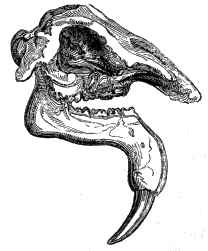
whale, and cetaceous fishes in general. But the
most striking peculiarity in the bones which remain
of this monster, is the existence of two
large tusks bending down from the lower jaw,
like two hooks, as you may see represented in
this cut, of the head preserved in the Museum.
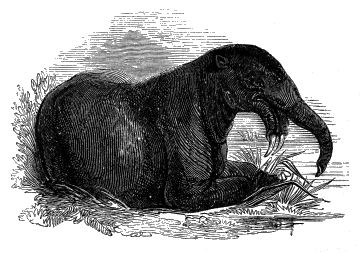
His legs were probably
rather short, and might
have borne nearly the
same proportion to his
body, as those of the
Hippopotamus do to his.
From all we can collect,
this must have been his
general form and appearance.
There can be but little doubt that he was of a
savage disposition and lead a sulky sort of life
divided between the water and the land, like the
Hippopotamus. His great tusks must have rendered
him a formidable enemy; but as we know
that he was a digging animal, it is very likely
that he more frequently used them as a sort of
pickaxe, to grub up such roots as he wanted to
eat, for he lived wholly upon vegetables. He
might also have employed them (as Dr. Buckland
has conjectured), to stick into the banks of
rivers to support his head above water, and to
anchor himself so as not to be carried down by
the stream, while his huge body lay in his favourite
element: or it does not seem unlikely that
he might at times have hooked them on to
the lower boughs of trees, to sustain himself
while he plucked down from above the fruit
and foliage with his trunk.
His bones have been found in various parts of
France, Germany and Austria.
When these animals were living, the climate
must have been very much warmer than it is at
present in France, for their bones are found
associated with palm trees, and other vegetable
remains of hot climates, and the bones of crocodiles,
tortoises, and other creatures which only
live in warm regions. The isle of Sheppey consists
chiefly of land which was deposited about
the same time, and it contains a great quantity
of fossil coffee, and similar plants at present
restricted to the East and West Indies, and
countries near the equator.
CHAPTER IV.
OF GREAT CAVERNS IN ENGLAND, AND GERMANY, CONTAINING BONES OF WILD ANIMALS.
In several parts of England there are great
caverns in limestone and other rocks, which
contain an immense quantity of the bones of
such animals as are now found only in wild countries
with warm climates. One of the most celebrated
of these caves, is that of Kirkdale, in
Yorkshire. Of the bones which most of them
contain, three-fourths and upwards belong to
bears, of a sort no longer to be found in the
living state. One-half, or perhaps two-thirds, of
the remaining fourth, have been traced to a
species of hyæna, which is also unknown at the
present day. A smaller number may be referred
to a sort of tiger or lion, and to some species
of the wolf or dog family. The smallest specimens
are of various small flesh-eating animals,
such as the fox, the polecat, and other kindred
species. There are also in some of them bones
of the Elephant, Rhinoceros, and Hippopotamus.
Plate III. p. 28
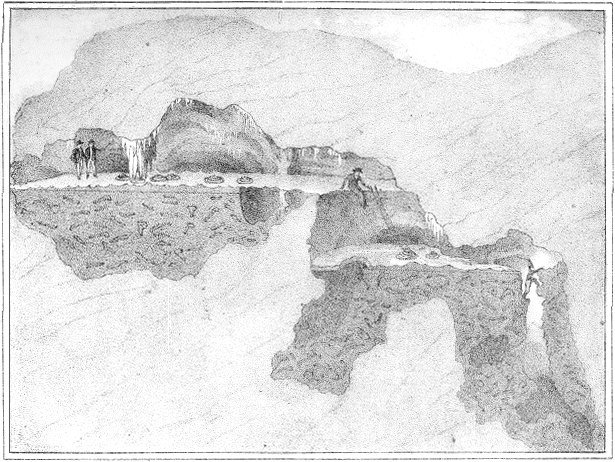
CAVE OF GAYLENREUTH
But the largest and most remarkable of these
caves, is at Gaylenreuth, in Germany, of which
the picture represents a section. You will understand
this representation, if you read the following
account of it by Dr. Buckland, the Professor
of Geology, in the University of Oxford.
"The first grotto turns to the right, and is
upwards of 80 feet long. It is divided into four
parts by the unequal heights of the vaulted roof;
the first three are from 15 to 20 feet high;
whereas, the fourth is only from 4 to 5. On the
bottom of this part, and on a level with the
floor, there is an orifice only two feet high,
which leads into the second grotto. This runs
first southward for 60 feet, being 40 wide and
18 high; it then turns to the west through a
space of 70 feet, becoming gradually lower till
its altitude is only 5 feet. The passage to the
third grotto is very incommodious, winding
through several corridors. It is thirty feet wide,
and only five or six high. The loam of the floor
is stuffed full of teeth and jaw-bones. Near the
entrance to it, is a gulf of 15 or 20 feet, into
which visitors descend by a ladder. After going
down, they arrive at a vault 15 feet diameter by
30 feet in height; and on the side on which they
descend, is a grotto all bestrewed with bones.
By going down a little further still, they fall in
with a new arcade which conducts to a grotto
40 feet long, and a new gulf 18 or 20 feet deep.
Even after this descent, another cavern presents
itself 40 feet high, quite covered with bones.
A passage now of 5 feet by 7 leads to a grotto
25 feet long and 12 wide; then alleys, 20 feet
long, conduct into another cave 20 feet high;
and finally, a grand grotto expands, 83 feet in
width, and 24 in height, more copiously furnished
with bones than any of the rest. The
sixth and last grotto runs in a northerly direction,
so that the whole series of caverns and
corridors, describes nearly a semicircle.
"A rift in the third grotto, disclosed in 1784,
a new grotto, 15 feet long by 4 wide, where the
greatest number of hyænas' and lions' bones
were found. The opening was much too narrow
to have allowed these animals to have entered
by it. A peculiar tunnel which terminated
in this small grotto, afforded an incredible number
of bones, and large skulls quite entire."
It is supposed that these caves were inhabited
by the fierce animals whose bones they contain,
and that the other more peaceable creatures
were dragged in by them for prey, since their
bones have evidently been gnawed and crushed
as they would be by fierce and powerful carnivorous
animals.
CHAPTER V.
OF OTHER ANIMALS THAT ONCE LIVED IN ENGLAND AND ELSEWHERE.
THE ELEPHANT.
I have before mentioned to you the bones of
Elephants, as occurring in the bone caverns;
they were, however, not just like the Elephants
now living in Africa and Asia. The tusks seem
to have been larger, and the head not quite so
broad and blunt; the teeth were also different.
There are not perhaps many counties in England
in which some of these remains have not
been found, and generally not far below the
surface of the soil. About London, and at
Woolwich in particular, a great many specimens
of the fossil tusks have been collected;
they are chiefly of about the consistency of
chalk, but if you break them across and look at
the end, you can see the grain of the ivory, just
as you do on a billiard-ball, or at the end of a
knife-handle.
Before anatomy was understood so well as it
is at present, the bones of the Elephant, and
those of several other large extinct animals, were
confounded together under the name of Mammoth.
There is a remarkable account of the
discovery of what was at the time called a Mammoth,
(but which was, doubtless, an Elephant,)
imbedded in ice in Siberia, which I shall relate
to you, as it is very well written and of undoubted
veracity.
"In the year 1799, a Tungusian fisherman observed
a strange shapeless mass projecting from
an ice-bank, near the mouth of a river in the
north of Siberia, the nature of which he did not
understand, and which was so high in the bank
as to be beyond his reach. He next year observed
the same object, which was then rather
more disengaged from among the ice; but was
still unable to conceive what it was. Towards
the end of the following summer, 1801, he could
distinctly see that it was the frozen carcass of
an enormous animal, the entire flank of which,
and one of its tusks, had become disengaged
from the ice. In consequence of the ice beginning
to melt earlier, and to a greater degree
than usual, in 1803, the fifth year of this discovery,
the enormous carcass became entirely disengaged,
and fell down from the ice-crag on a
sand-bank, forming part of the coast of the
Arctic Ocean. In the month of March of that
year, the Tungusian carried away the two tusks,
which he sold for fifty rubles, about fifteen
pounds sterling.
"Two years afterwards this animal still remained
on the sand-bank where it had fallen
from the ice; but its body was then greatly
mutilated. The peasants had taken away considerable
quantities of its flesh to feed their
dogs; and the wild animals, particularly the white
bears, had also feasted on the carcass; yet the
skeleton remained quite entire, except that one
of the fore-legs was gone. The entire spine, the
pelvis, one shoulder-blade, and three legs, were
still held together by their ligaments, and by
some remains of the skin; and the other shoulder-blade
was found at a short distance. The
head remained, covered by the dried skin, and
the pupil of the eyes was still distinguishable.
The brain also remained within the skull, but
a good deal shrunk and dried up; and one of
the ears was in excellent preservation, still retaining
a tuft of strong bristly hair. The upper
lip was a good deal eaten away, and the under
lip was entirely gone, so that the teeth were distinctly
seen. The animal had a long mane on its
neck.
"The skin was extremely thick and heavy,
and so much of it remained as required the exertions
of ten men to carry away, which they
did with considerable difficulty. More than
thirty pounds' weight of the hair and bristles of
this animal were gathered from the wet sand-bank,
having been trampled into the mud by the
white bears, while devouring the carcass. The
hair was of three distinct kinds; one consisting
of stiff black bristles, a foot or more in length;
another of thinner bristles, or coarse flexible
hair, of a reddish-brown colour; and the third
of a coarse reddish-brown wool, which grew
among the roots of the hair. These afford an
undeniable proof that this animal had belonged
to a race of elephants inhabiting a cold region,
with which we are now unacquainted, and by no
means fitted to live in the torrid zone. It is
also evident that this enormous animal must
have been frozen up by the ice at the moment
of its death."
THE GIGANTIC ELK.
There are frequently found in the peat bogs of
England and Ireland, the bones and horns of a
large Elk, called the gigantic Elk, and sometimes
the Irish Elk.
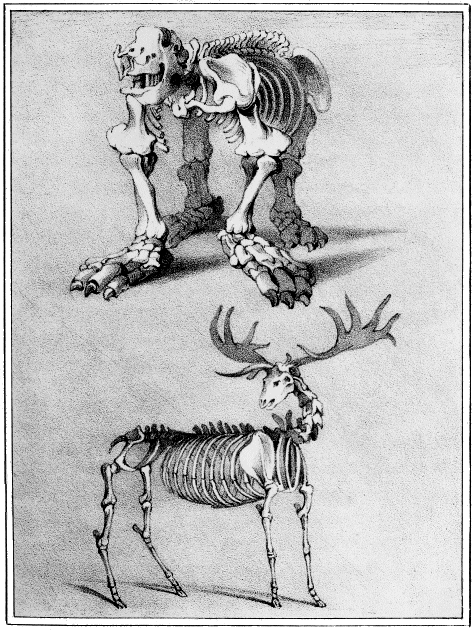
Plate IV. p. 38
MEGATHERIUM GIGANTIC ELK
Here is a picture of him; and you may judge
how well he was entitled to his name, when I
tell you that some pairs of his horns have been
found, which measured nearly twelve feet across
from tip to tip. He must have been considerably
larger than the Wapiti Deer in the Zoological
Gardens, and of quite a different form.
It is not known when these creatures became
extinct; but it is probable that it may have been
since Britain has been inhabited by man.
THE MEGATHERIUM.
The bones of this great beast were first found
at Buenos Ayres in South America, and a skeleton
nearly complete was sent home from thence
by the Governor to the Royal Cabinet of Madrid,
in 1789. They were found in loose soil, and
must apparently have belonged to nearly the
same age as the Fossil Elephant and Irish Elk.
The head must have been very much like that
of the sloth, but it seems to have possessed the
addition of a small trunk like the Palæotherium
I told you of just now. The structure of its legs
(and in particular its very strong short thigh-bone,
which is much stouter than that of any
animal living,) shows that it must have moved
very slowly.
Its teeth show that it lived on vegetables, and
the great ungainly fore-feet, armed with tremendous
claws, would lead one to suppose that
it used to dig in the ground for roots, and tear
down the branches of trees.
It appears to have been covered with a thick
shell or coating, thicker than the hide of a rhinoceros,
and rather resembling the covering of
the armadillo. I have seen a piece of this wonderful
coat of armour in the Museum at Paris,
which was found along with the skeleton in
South America.
If one might decide from its likeness to other
animals in its various parts, it was a sulky beast,
and, if it could have spoken, would only have
said to its neighbours, "Let me alone—I want
nothing of you, if you want nothing of me."
Its length was full 13 feet, and its height about
9 feet; so you may suppose armed, and defended
as it was, there was not much chance of other
animals being disposed to meddle with it, for
it must have been big enough and strong enough
to take good care of itself, though it could not
run very fast.
THE BEAVER.
You will, perhaps, be surprised to hear that
Beavers once lived in England; but it is known
from history, that they were found in Wales as
late as the twelfth century. I have got the
bones of some, that were given me by a countryman,
who picked them out of a peat bog in
Hampshire, without knowing what they were.
They were buried close by some hazel nuts, and
some moss that had not lost its colour, and was
in no degree decayed; such is the great power
possessed by certain minerals that exist in these
peat bogs, to preserve things from decay, even
during a period which could hardly be less than
a thousand years.
It is related, that the foot of a lady, which
seemed quite fresh, was found in peat, where it
had lain in contact with some of these substances,
with a sandal of a kind that must have
been worn many hundreds of years ago. And
though I will not assert that it is true, yet I will
say, that it is very likely to be so, from what I
have seen myself, in regard to nuts, and moss,
and various weeds.
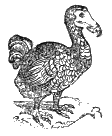
THE DODO.
When the Dutch in the 16th century, took
possession of the Isle of France, now called
Mauritius, which up to that time had not been
inhabited by man, they found a large bird something
of the Duck kind, of which they sent
home specimens and representations. They
called it the Dodo, but why, I cannot tell you.
The race has now become extinct, so that
many naturalists have declared that it never
existed, and that the account of it was naughtily
invented, and sent home for the gratification
and delusion of
"Those who greedily pursue
Things wonderful instead of true."
But there is not the least doubt of its being a
fact, for in the Museum in London there is a
painting said to have been taken from the living
bird; there is also a leg and a plaster cast of
the head placed near the painting, which naturalists
have determined could not have belonged
to any other animal known, from their peculiar
construction; there is also another foot and the
head from which the cast was taken, preserved
in the Museum of the University of Oxford,
being the remains of an entire specimen which
was kept in the collection of curiosities made by
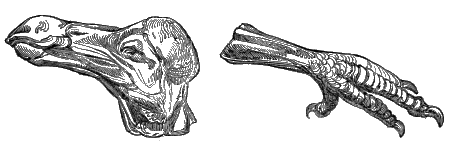
Elias Ashmole, Esq. till it rotted. This is
representation of these two valuable relics.
The account of the removal of the bones was
entered in the records of the University, and the
date is the 1st January, 1755.
More recently some of the bones have been
found in the Mauritius, and have been sent to
Paris, where I have heard they may be seen now.
It seems to have been the most unwieldy and
inactive bird in existence, and to have held
nearly the same kind of place among feathered
animals as the sloth does among beasts. The
body was very massive, and almost round, and
seemed to be stuck upon two short
thick legs like pillars. The tail was
strangely out of its place, according
to the usual form of birds; and
two little caricatures of wings were
hung upon its great blank sides. A
thick pursy neck supported the head, which consisted
of two enormous chaps that opened far
behind the eyes. You will best understand the
form of the bill by looking at the cut copied from
the painting which I mentioned before, and you
may there see how like a monk's cowl the feathers
of his head looked.
Some of the Dutch who met with this bird in
its own country called it the nauseous bird, and
declared that its flesh was intolerably disagreeable
to the taste; while others asserted that it
was very good eating, and that about three
Dodos would feast a hundred men. But whatever
may have been the quality of the flesh, I do
not believe what the latter said of its quantity,
for the head and leg which I have seen, and which
appear to have belonged to a full grown bird, are
not very much larger than those of a swan.
However this is now a question which of course
will never be certainly decided, as there are no
more of them to be eaten. It appears that, like
the beavers and wolves in England, the progress
of man and cultivation deprived them of their
sources of sustenance.
If we may judge of what his character was,
from his appearance, he must have been a silly,
voracious creature, with hardly any power of
resistance or flight. However, like all the rest
of God's works, he was no doubt adapted for the
circumstances in which he was placed, and had
enough means of enjoyment, to make it well
worth his while to live as long as he could.
CHAPTER VI.
PARLEY DESCRIBES VOLCANOES, EARTHQUAKES, AND HOT SPRINGS.
You have no doubt often heard of Volcanoes
and Earthquakes, for almost everybody in all
ages has felt a deep interest in them, and a
curiosity to know what they are caused by. If
you will listen to me, while I merely describe
them as they really exist, without "drawing the
long bow," as people say, I will then tell you
how I think they are produced.
It is quite certain that there is an important
connexion between Volcanoes and Earthquakes;
and we may safely take this for granted, and at
once call the cause of both, whatever it may be,
volcanic agency.
It has been discovered by extensive observations,
that this agency does not exert itself in
individual spots, so as to produce here a Volcano
and there an Earthquake; but its operations
take place over long tracts of country in which
the Volcanoes are placed, and, in the spaces
between them, Earthquakes are more or less
frequent.
These tracts are called Volcanic bands; one
of them extends nearly parallel with the West
Coast of South America, along the chain of
mountains called the Andes, which you will see
marked on the map; and another much smaller
extends from Mount Vesuvius to Mount Etna,
with the Volcanic Island Stromboli, and several
extinct Volcanoes lying between them, and then
turns to the East, through several of the Greek
Islands, and passes on to Syria, where Earthquakes
are frequent.
Earthquakes in their simplest form are nothing
more than violent shakings of the ground;
but sometimes the earth is split open; sometimes
it is raised; and sometimes it is depressed.
I shall tell you of some of the changes which
took place in the great Earthquake of Calabria,
which lies in the smaller volcanic band I mentioned
to you between Vesuvius and Etna.
EARTHQUAKE OF CALABRIA.
The shocks began in 1783, and lasted for
nearly four years, till the end of 1786. During
this time the King of Naples sent persons to
take correct notes and representations of all
that was going on, and we have therefore got a
better account of it than we have of any other
Earthquake that ever occurred.
The convulsion of the earth, sea, and air, extended
as far as Naples, and over the whole of
Sicily; but the district over which it was so
violent as to excite intense alarm, was about
five hundred miles in circumference.
"The first shock of February 5th, 1783, threw
down, in two minutes, the greater part of the
houses in all the cities, towns, and villages, from
the western sides of the Apennines in Calabria
Ultra, to Messina in Sicily, and convulsed the
whole surface of the country. Another occurred
on the 28th of March, with almost equal violence.
The chain of granite mountains which
passes through Calabria from north to south,
and attains the height of many thousand feet,
was shaken but slightly; but it is said that a
great part of the shocks which were spread with
a wave-like motion through the recent strata
from west to east, became very violent when
they reached the point of junction with the granite,
as if a reaction was produced where the
wave-like movement of the soft strata was suddenly
arrested by the more solid rocks. The
surface of the country often heaved like the billows
of a swelling sea, which produced a swimming
in the head like sea-sickness. It is particularly
stated, in almost all the accounts, that
just before each shock the clouds appeared motionless;
and although no explanation is offered
of this phenomenon, it is obviously the same as
that observed in a ship at sea when it pitches
violently. The clouds seem arrested in their
career as often as the vessel rises in a direction
contrary to their course; so that the Calabrians
must have experienced precisely the same motion
on the land."
At Messina in Sicily, the shore was rent; and
the soil along the port, which before the shock
was perfectly level, was inclined towards the
sea, and the sea itself was considerably deeper,
which showed that the inclination must have
been occasioned by the bottom's sinking. The
quay also sunk down 14 inches below the level
of the sea, and the houses in the neighbourhood
were much cracked.
In one town there was a large round tower of
great strength, which was divided by a perpendicular
rent, and one-half was raised up several
feet, so as to show the foundations. Those who
saw it, said that it looked like a great tooth half
extracted, showing the fangs. Along the line
of the crack, the walls were found to fit so exactly
together, that you would not have known
they had even been divided if the courses of the
stones had not been disturbed.
There was a very curious difference between
some of the walls which had been thrown down,
or very much shaken by some of the shocks. In
some of them, the separate stones were parted
from the mortar, so as to leave an exact mould
where they had rested; and in others, the mortar
was ground to dust between the stones. It was
not less strange to see the effect of what must
have been whirling movements in the ground. In
some streets, one house would be thrown down,
and leave the rest uninjured; while in others,
all the houses but one were thrown down, and
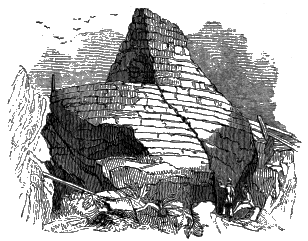
that one remained firm and unmoved. Two
obelisks were twisted round, so that the stones
of which they were composed, stood at cross
purposes. This cut represents one of the two, as
it stood after the earthquake, and before.
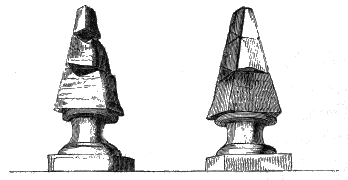
"It appears evident that a great part of the
rending and splitting of the ground was the
effect of a violent motion from below upwards;
and in a multitude of cases where the rents and
chasms opened and closed alternately, we must
suppose that the earth was by turns heaved up,
and then let fall again. We may conceive the
same effect to be produced on a small scale, if,
by some mechanical force, a pavement composed
of large flags of stone should be raised
up and then allowed to fall suddenly, so as to
resume its original position. If any small pebbles
happened to be lying on the line of contact
of two flags, they would fall into the opening
when the pavement rose, and be swallowed up,
so that no trace of them would appear after the
subsidence of the stones. In the same manner,
when the earth was upheaved, large houses,
trees, cattle, and men were engulfed in an
instant in chasms and fissures; and when the
ground sunk down again, the earth closed upon
them, so that no vestige of them was discoverable
on the surface. In many instances individuals
were swallowed up by one shock, and then
thrown out alive, together with large jets of water,
by the shock which immediately succeeded."
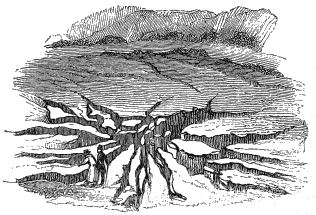
The district called Jerocarne, was torn in a
surprising manner, and in one spot the cracks
resembled those in a starred pane of glass; and
as these cracks remained open when the earthquake
was over, it seemed as if the middle had
been permanently lifted up.
"In the vicinity of Oppido, the central point
from which the earthquake diffused its violent
movements, many houses were swallowed up by
the yawning earth, which closed immediately
over them. In the adjacent district also of Cannamaria,
four farm-houses, several oil-stores, and
some spacious dwelling-houses were so completely
engulphed in one chasm, that no vestige
of them was afterwards discernible."
Amongst the many fissures that were opened,
there was one, a mile long, a hundred feet wide,
and thirty feet deep; and another, three quarters
of a mile long, one hundred and fifty feet
wide, and one hundred feet deep; and a third,
about a quarter of a mile long, which was two
hundred and twenty-five feet deep.
A mountain was cleft completely in two; and
a lake of considerable size was formed by the
opening of this great chasm, and springs bursting
out at the bottom. The inhabitants of the
neighbourhood were afraid that the pool of
nearly stagnant water which was thus formed
would injure their health, and were at great expense
in trying to drain it; but it was all in
vain, for the springs that fed it at the bottom
were inexhaustible.
A great mass of earth, or hill, two hundred
feet high, and four hundred feet in diameter,
was moved nearly four miles out of its place,
with trees growing upon it; and another similar
mass, with a house on it, which was not at all
injured. Some olive and mulberry trees travelled
a full mile. These great movements were
aided by springs under the masses of earth,
which made a slimy sort of road for them; and,
of course, the whole distance was down hill.
"Great agitation was frequently observed in
the bed of the sea during the shocks, and, on
those parts of the coast where the movement
was most violent, all kinds of fish were taken in
greater abundance, and with much greater facility.
Some rare species, which usually lie
buried in the sand, were taken on the surface of
the waters in great quantity. The sea is said
to have boiled up near Messina, and to have
been agitated as if by a copious discharge of
vapours from its bottom. The Prince of Scilla had
persuaded a great part of his vassals to betake
themselves to their fishing-boats for safety, and
he himself had gone on board. On the night of
the 5th of February, when some of the people
were sleeping in the boats, and others on a level
plain, slightly elevated above the sea, the earth
rocked, and suddenly a great mass was torn
from the contiguous Mount Jaci, and thrown
down with a dreadful crash upon the plain. Immediately
afterwards, the sea rising thirty palms
above the level of this low tract, rolled foaming
over it, and swept away the multitude. It then
retreated, but soon rushed back again with
greater violence, bringing with it some of the
people and animals it had carried away. At the
same time every boat was sunk or dashed against
the beach, and some of them were swept far
inland. The aged Prince, with one thousand
four hundred and thirty of his people, was destroyed.
The number of persons who perished
during the earthquake is estimated at about
forty thousand, and about twenty thousand
more died by diseases which were caused by insufficient
nourishment, exposure to the atmosphere,
and malaria, arising from the new stagnant
lakes and pools. By far the greater number
were buried under the ruins of their houses;
while some were burnt to death in the conflagrations
which almost invariably followed the
shocks, and consumed immense magazines of
oil and other provisions. A small number were
engulfed in chasms and fissures, and their skeletons
are perhaps buried in the earth to this
day, at the depth of several hundred feet, for
such was the profundity of some of the openings
which did not close in again."
There is a fine description of the Earthquake
and this melancholy result, in Cowper's Task,
which we shall quote.
Alas for Sicily! rude fragments now
Lie scatter'd where the shapely column stood.
Her palaces are dust. In all her streets
The voice of singing and the sprightly chord
Are silent. Revelry, and dance, and show
Suffer a syncope and solemn pause;
While God performs upon the trembling stage
Of his own works his dreadful part alone.
The rocks fall headlong, and the valleys rise,
The rivers die into offensive pools,
And charged with putrid verdure, breathe a gross
And mortal nuisance into all the air.
What solid was, by transformation strange,
Grows fluid; and the fix'd and rooted earth,
Tormented into billows, heaves and swells,
Or with vortiginous and hideous whirl
Sucks down its prey insatiable. Immense
The tumult and the overthrow, the pangs
And agonies of human and of brute
Multitudes, fugitive on every side,
And fugitive in vain. The sylvan scene
Migrates uplifted; and, with all its soil
Alighting in far distant fields, finds out
A new possessor, and survives the change.
Ocean has caught the frenzy, and upwrought
To an enormous and o'erbearing height,
Not by a mighty wind, but by that voice
Which winds and waves obey, invades the shore
With force resistless. Where now the throng,
That press'd the beach, and, hasty to depart,
Look'd to the sea for safety? They are gone,
Gone with the refluent wave into the deep—
A prince with half his people!
You will find a great many other astonishing
effects of this Earthquake described in Mr. Lyell's
Work on Geology, from which I have extracted
some parts of the preceding account.
VOLCANOES.
The word Volcano comes from Vulcan, the
name of the God of fire in the Greek mythology.
You have read how the poets used to represent
him as engaged underground in forging thunderbolts
for Jupiter, and other work of the same
kind, with the assistance of his one-eyed journeymen
the Cyclopes. They feigned that Volcanoes
were the chimneys of his workshops, and
that when an eruption took place he was busy
forging his iron.
Others pretended that when Jupiter had overcome
the giants named Titans, who had rebelled
against him, instead of putting them in the
stocks, he placed mountains upon them, and
that when the imprisoned monsters turned themselves
from one side to the other, earthquakes
and eruptions were the consequence.
However, we don't believe any of these stories
now, neither perhaps did the ancients. But you
must learn all about them and their meaning,
(where they have any,) from your schoolmaster.
My business now is to tell you what Volcanoes
are.
They are openings in the surface of the earth,
from whence ignited matter of various kinds,
smoke, and ashes, are sent forth by some subterranean
agency.
For the most part they do not always keep in
activity, but have long intervals of rest for
months, and sometimes for very many years,
between the eruptions.
One of the few that always keeps in eruption,
is Stromboli, one of the Lipari Islands off the
coast of Sicily, which there is good reason to
think, has been active for nearly 1600 years.
This Volcano is merely a mountain or rock,
standing out of the sea, and the melted matter,
that occasionally runs down its sides, flows directly
into the water, and at once kills and parboils
the fish that happen to be near it, and they
are thus sometimes taken and eaten by the poor
fishermen who live about the base of the mountain.
The way in which an eruption takes place in
a Volcano of the other kind, when it has been
quiet for a long time, is as follows.
Great noises are heard about the foot of the
mountain, and earthquakes frequently occur for
several days before any change is seen in the
opening or crater, as it is called. The springs
in the neighbourhood often disappear, and as
you may suppose all these forebodings make the
people who live near gloomy enough.
After a time a dreadful burst takes place, and
the crater is in an instant cleared of the stones
and earth that may have fallen into it during
the period of repose; ashes and cinders, rocks
and stones, are thrown up to an immense height
in the air, and a great cloud of smoke and steam
accompanies them.
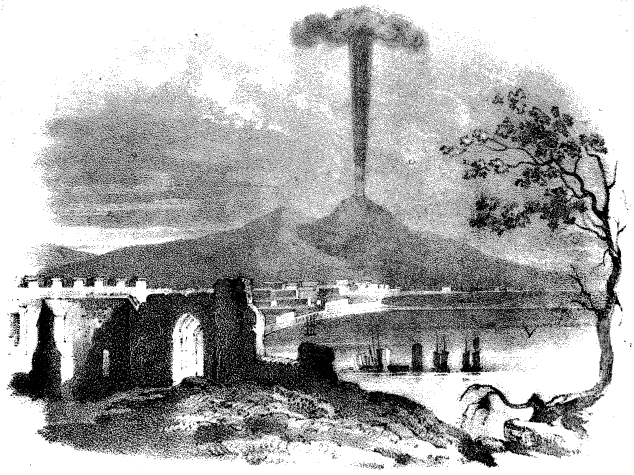
In perfectly still weather, this vapour is seen
to shape itself in a very beautiful manner. The
immense impulse from beneath sends it up to a
vast height as straight and almost as distinct
as a pillar. At a certain elevation, it spreads
abroad and assumes the appearance represented
in the plate. When this occurs on Vesuvius,
the Italians call it the pine tree cloud, from the
resemblance its form bears to that of a pine tree.
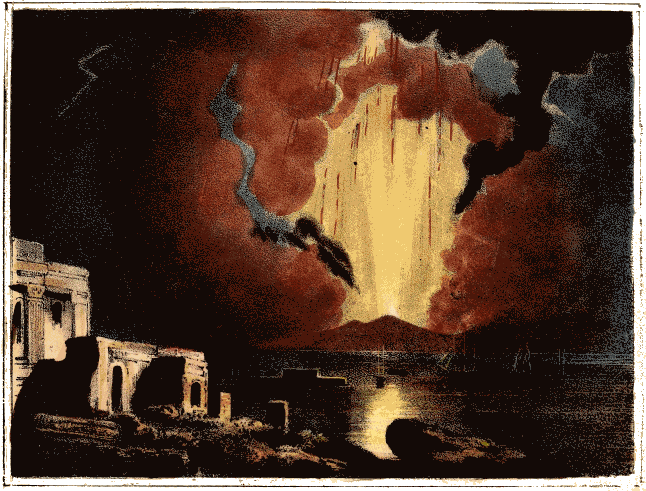
As the eruption goes on the cloud of smoke
which is always copiously charged with electricity,
sends out brilliant lightnings; its form
becomes disturbed, and the dark volumes of vapour
are angrily sent forth in shapeless masses.
Red-hot stones are sent into the air to a stupendous
height; the melted matter boils up inside
the crater and rolls down the sides of the mountain,
setting fire to the trees that it meets with,
and destroying or enveloping whatever else remains
in its way.
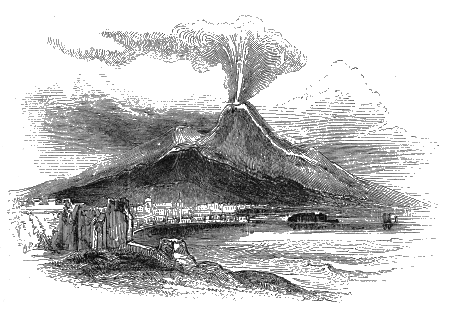
You will see their effect as they appear by
night, in the other plate. I should tell you that
the Volcano represented in both the pictures is
Mount Vesuvius.
Plate V. p. 64
VESUVIUS No. 1
The melted matter that boils up in the crater,
and flows down the mountain, is called Lava.
I dare say most of you have seen some pieces of
this substance when polished and worked into
ornaments. It is found in great variety, and is
sometimes black, porous, and light like cinders;
sometimes it consists of crystallized particles of
quartz, felspar, and other minerals, so as closely
to resemble granite; and not unfrequently it is
a solid dark-coloured mass, heavy and hard as
the stone that our streets are paved with.
It issues from the crater in a melted state,
bubbling and boiling like water in a tea-kettle,
but you must not therefore suppose that it runs
down the declivity of the mountain like water.
On the contrary, its motion is mostly very slow,
seldom being faster when it gets at some distance
from the crater, than four miles an hour,
which is about as fast as a man can walk. When
it has run still further from its source it does
not travel more than a few yards in a day.
The motion of a stream of Lava is very peculiar,
for the surface exposed to the air is immediately
formed into a crust, and hence it constantly
moves with a crackling noise, and when
the stream is quite fresh no light is seen except
in the cracks that are constantly being formed
at the extremity.
In this way a current will sometimes go
drawling on for months after the eruption which
gave rise to it has ceased.
A very curious effect is produced when the
lava runs in a certain state of fluidity down a
steep descent. A thick, strong crust forms on
the outside, and it is one of the qualities of lava
when it has become hard, like most other stony
substances, to present great opposition to the
passage of heat. In consequence of this the
liquid lava in the inside of the current is kept
hot, and continues to run on for a long time after
the supply from the crater has ceased, and leaves
the crust in the form of an arched passage.
From what I have told you about lava streams,
you will see that there is not much danger from
them to living creatures, who may always get
out of their way fast enough: but sometimes
houses and even towns are enveloped in them.
Plate VI. p. 66
VESUVIUS No. 2
However, from the peculiar mode in which
they travel there is often a way of preventing
this, and on one occasion it was resorted to, and
the town of Catania thereby saved. A current
of lava from Mount Etna was making its way
straight towards the town, but a body of fifty
bold strong fellows went out to meet it, armed
with crow bars; with these they broke great
holes in the crust at the side, and thus the stream
was turned into another course, and pursued its
way on one side of the town.
Throughout an eruption, a great quantity of
dust is produced by the rubbing of the stones
against each other which are thrown out from
the crater, and often fall back and are thrown
up again several times.
This dust is driven over a great extent of
country, and a gentleman whom I visited, who
lived about fourteen miles from Mount Vesuvius,
told me that during the great eruption of 1822,
his garden was covered with them, to the depth
of full six inches.
But in more violent eruptions they are carried
much further than this. In an eruption of a
Volcano in Sumbawa, an island which lies some
miles to the East of Java, the ashes were carried
to a distance of 270 miles in such quantities as
to darken the air, and in another direction they
were found 300 miles off. They fell so heavily
40 miles away from the Volcano that they broke
into many houses, and rendered them uninhabitable.
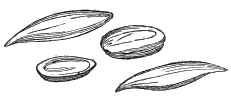
Quantities of liquid lava are thrown upwards,
and shape themselves into nearly the forms
of fish by their passage through the air. These
are called bombs by the inhabitants, and the
fall of them is very justly dreaded, as they come
with great violence.
The size of the largest of those from which
the following picture was taken, was six inches
long, two inches and a quarter wide, and one
inch and three quarters thick; but there are
much larger sometimes.
If you should have
a chance of examining
any of these, you may observe how wisely
the living principle, which gives the figure to
fish, has been ordained by their Creator to provide
the best form to assist their motions, in
a medium in which they are suspended, and
do not move on ground as the beasts do; seeing
that it is precisely the same sort of figure as the
laws of inanimate matter impress upon it, when
in a yielding state, and being impelled to move
under similar circumstances.
I must give you a notion of the quantity of
lava sometimes sent out in a single eruption.
The Volcano called Skapta Jokul, in Iceland,
in the year 1794, sent out two great streams, one
of which was 50 miles in length, from 10 to 15
in breadth, and the ordinary depth about 100
feet, but in some deep valleys it was more than
500 feet. The other was forty miles long, seven
wide on the average, and about the same depth
as the first.
These streams were not cold in the year 1805,
eleven years after they had issued from the earth,
so that you may judge how long the hardened
lava keeps in the heat.
During the eruption in which this immense
mass of melted matter was thrown out, twenty
villages were destroyed, more than nine thousand
persons killed, and an immense number of
cattle.
The vapour which rises at first in immense
clouds, when the eruption slackens, or when it
gets out of the reach of the heat, condenses, and
mingled with the dust thrown up with it, forms
mud, which rushes in torrents down the mountain.
These streams of mud are called alluvions,
and are very much more dreaded by the inhabitants
than the lava streams, because they are so
much quicker in their movement.
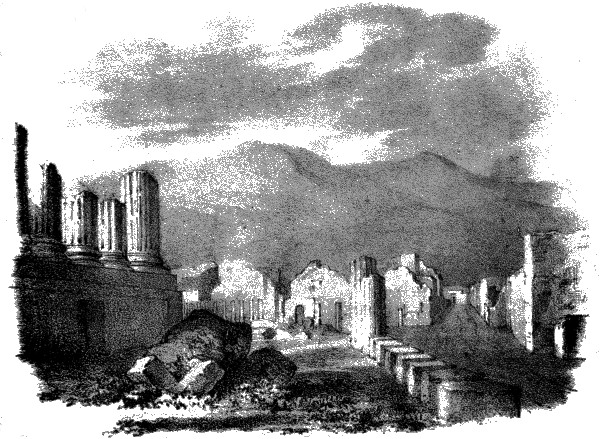
It was one of these, and not a stream of lava
which enveloped the Roman City Pompeii; and
which entered the modern town of Torre del
Greco, and so raised the ground that the lower
rooms of the houses were converted into cellars,
and the people were obliged to make the street
doors on what had before been the second story.
THE GREAT VOLCANO KIRAUEA, IN THE ISLAND OF HAWAII.
There is a very remarkable Volcano in the
Island of Hawaii, where Captain Cook was
killed.
The crater, instead of being at the top of a
mountain like those of most other Volcanoes, is
a large plain, seven miles in circumference, sunk
below the surface of the surrounding country,
and walled in by rugged cliffs more than seven
hundred feet high.
On this plain there are fifty-one conical hillocks,
which are almost constantly sending out
vapour and lava, and red hot stones. The surrounding
banks consist entirely of sulphur and
lava.
The islanders, before they were taught the
truths of Christianity, believed it to be the
abode of their deities, the chief of whom they
call Pelé, and to her, they say, that everything
which grows near the Volcano is sacred. When
some missionaries were going to visit it, and
plucked some juicy berries from the shrubs
that grew there to quench their thirst, the native
guides begged them to desist till they had
made an offering to Pelé. When they got to
the edge of the crater, they threw some of the
berries in, and said, "Pelé, here are your berries,
and I am now going to eat some." They
then ate fast enough, and were willing that the
missionaries should do the same.
The following are extracts from the account
of our countryman, Mr. Stewart's visit to this
terrific place.
"I can compare the general aspect of the
bottom of the crater, to nothing that will give a
livelier image of it to your mind, than to the appearance
the Otsego Lake would present, if the
ice with which it is covered in winter, were suddenly
broken up by a heavy storm, and as suddenly
frozen again, while large slabs and blocks
were still toppling, and dashing, and heaping
against each other, with the motion of the
waves. Just so rough and distorted was the
black mass under our feet, only a hundred-fold
more terrific, independently of the innumerable
cracks, fissures, deep chasms and holes, from
which the sulphureous vapour, steam, and smoke
were exhaled, with a degree of heat that testified
the near vicinity of fire.
"At an inconsiderable distance from us, was
one of the largest of the conical craters, whose
laborious action had so greatly impressed our
minds during the night, and we hastened to
a nearer examination of it. On reaching its
base, we judged it to be one hundred and fifty
feet high, a huge, irregularly shapen, inverted
funnel of lava, covered with clefts, orifices, and
tunnels, from which bodies of steam escaped,
while pale flames, ashes, stones, and lava, were
propelled with equal force and noise, from its
ragged mouth.
"The chattering of the islanders around our
cabins, and the occasional sound of voices in
protracted conversation among our own number,
had scarcely ceased long enough to admit
of sound sleep, when the volcano again began
roaring and labouring with redoubled activity.
The confusion of noises was prodigiously great.
These sounds were not fixed or confined to one
place, but rolled from one end of the crater to
the other; sometimes seeming to be immediately
under us, when a sensible tremor of the ground
on which we lay took place; and then again
rushing to the farthest end with incalculable velocity.
The whole air was filled with the tumult;
and those most soundly asleep were
quickly roused by it to thorough wakefulness.
One of our party sprang up in his cot, exclaiming,
'We shall certainly have an eruption; such
power must burst through everything;' He
had barely ceased speaking, when a dense column
of heavy black smoke was seen arising from
the crater directly in front of us; the subterranean
struggle ceased, and immediately after,
flames burst from a large cone, near which we
had been in the morning, and which then appeared
to have been long inactive. Red-hot
stones, cinders, and ashes, were also propelled
to a great height with immense violence; and
shortly after, the molten lava came boiling up,
and flowed down the sides of the cone, and
over the surrounding scoria, in two beautiful
curved streams, glittering with indiscribable
brilliance.
"At the same time a whole lake of fire opened
in a more distant part. This could not have
been less than two miles in circumference; and
its action was more horribly sublime than anything
I ever imagined to exist, even in the ideal
vision of unearthly things. Its surface had
all the agitation of an ocean; billow after billow
tossed its monstrous bosom in the air, and occasionally
those from different directions burst
with such violence, as in the concussion to dash
the fiery spray forty and fifty feet high. It was
at once the most splendidly beautiful and dreadfully
fearful of spectacles."
OF THE FORMATION OF NEW ISLANDS.
You must know that most of the volcanic
mountains bear evident traces of having been
built up of matter thrown out, in the first place,
from a crack or hole in the ground, and afterwards
from the crater or cup, which would thus
soon be formed. At every eruption a new layer
of dust, and cinders, and lava, is added, and
thus a mountain is gradually produced.
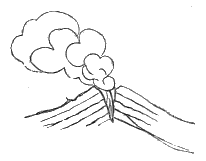
In some instances, the successive layers may
be seen is the crater, as is the case with Vesuvius,
of the summit of
which this would nearly
represent the section,
if we could cut it in
two.
Volcanic operations
can go on very nearly
as well at the bottom of the sea, as upon dry land;
and if you remember what I told you before,
respecting the mode in which the currents of
lava flow, you will not be much surprised to
hear that their progress is not stopped by the
water, though it may be somewhat impeded. It
is certain that the streams often travel a great
way at the bottom of the sea.
When a Volcano breaks out under the sea, if
the eruption send out a sufficient quantity of
lava, and stones and dust, it gets above the
surface and makes such a Volcano as Stromboli.
If the Volcano should afterwards become quiet,
then an island is the result, and if large enough,
it may be inhabited.
A great many of the islands of the South Sea,
and some of the Greek islands, originated in this
manner; and, only two or three years ago, an
island suddenly rose up off the coast of Sicily,
and was taken possession of in due form by a
British captain, in the name of the king of
England; but, as the land consisted of loose
earth, and had not much lava to bind it together,
it soon sunk down, and now no trace of it is to
be seen.
OF THE GEYSERS OF ICELAND.
There are many Volcanoes in Iceland, and the
whole island seems to have been the produce of
Volcanic agency. I am going to describe to
you one of the most singular proofs of this.
Geysers are springs which spout out at intervals
great streams of hot water. The name is
taken from the Icelandic word, geysa, which
signifies, to rage, or, burst forth violently.
Plate VII. p. 80
GEYSERS OF ICELAND
The Icelanders are a very simple, excellent
people, and exceedingly kind and hospitable to
strangers. This is not the place for me to tell
you how much kindness I experienced among
them; but if I were to do so, you would have as
high a regard for them as I have. They have in
general a considerable degree of intelligence, but
I was surprised to find that a great many of
them did not know where the Geysers were, or
anything about them.
There are many springs of the same kind in
several parts of Iceland; but those that are generally
known as the Geysers, are near the town
of Haukadal, in the south-west part of Iceland.
To these I went in company with four other
persons, and a guide.
After a dreary ride through a wild volcanic
looking country, we left our horses in a safe
place, and then, proceeding some distance on
foot, we saw clouds of steam arising over the hills
before us. A little further on we got into the
plain, where the Geysers are situated, which is
full of boiling springs and holes sending out
steam like the valve of a steam-boiler.
The great Geyser is at the top of a hillock,
which seems to have been formed in the course
of years by the substances which the hot water
holds in solution, and deposits as it cools.
At the top of this mound we found a pond of
the shape of a saucer, lined with the most curious
incrustations of spar, which exactly resembled
the heads of cauliflowers. It was then about
half full of the most beautiful hot water, as clear
as crystal, which was just stirred in gentle waves
by the steam that rose up from the opening at
the bottom of the basin.
We took advantage of this tranquil state of
the spring, to examine this opening. We let
down a line, with a weight at the end, to the
depth of about eighty feet, and as nearly as we
could judge, it went down perpendicularly.
The hole was nearly round, and about nine
feet in diameter, but it got gradually wider towards
the top like a funnel. The inside showed
the same kind of flinty incrustation as the hillock
was composed of, worn as smooth as glass by
the forcible passage of the water. The water was
then at a temperature of two hundred degrees.
The saucer-shaped reservoir was fifty feet
across, and four feet deep.
I ought to tell you that the waters of the
Geysers have a petrifying property, and hence
the ground all around them is covered with
what was once grass, moss, and sticks, converted
into stone, of which we brought away
many beautiful specimens.
It was very late in the evening when we had
completed this examination, and fixed our tent
where we intended to pass the night. The
springs still continued quiet, and you may judge
how impatient we were for something to be
going on. However, as it was dark, and we were
very tired, having had a great deal of fatigue
during the day, we lay down in the tent and
went to sleep.
About midnight we were suddenly called up
by one of our party, to witness the great Geyser
in its full glory. It threw up several jets,
should think of at least ninety feet high, and
sent off vast clouds of steam. There was only
just light enough for us to distinguish the water
and steam; but the effect was very grand, and
such as we shall never forget, though it did not
leave much behind in our minds to talk about,
as everything seemed indistinct and confused.
The next morning, as soon as it was light,
there was a beautiful eruption of the New Geyser,
as it is called. The column of water was
eight feet in diameter, and full sixty feet high,
and the clouds of steam were prodigious. The
sun was just then rising, and the effect of his
rays through the water and stream, was exquisitely
beautiful, producing many little rainbows.
When the water had sunk down, its place was
taken by a tremendous jet of spray and steam,
rushing out with a deafening roar to nearly the
same height as the water.
When we threw some large stones into the
pipe, the steam instantly carried them up to an
amazing height; and in several instances, when
they went up quite perpendicularly, kept them
within its influence for some minutes, throwing
them upwards several times successively, in a
very strange manner; the Geyser seemed to play
with them as a boy plays with his ball when he
throws it up and catches it again and again.
We were not yet satisfied, because we had not
seen an eruption fairly from beginning to end;
so we waited some time longer. At about seven
o'clock in the morning, we heard low grumbling
sounds near the great Geyser, and the water in
the basin bubbled up a little more actively.
We then had an hour and a half of anxious
expectation, during which we kept walking round
the hillock; there were then about a dozen
loud reports which made the earth tremble, and
the water rose to near the top of the basin, and
became so restless that many of the waves
washed over the edge.
A little while afterwards, the reports became
as loud as the firing of artillery; the ground
shook violently under our feet; we ran down
the mound, and had hardly got upon the level
ground before the water rushed up the pipe
with such thick clouds of steam, as completely
to conceal the stream. These bursts took place
in this manner to the height of about twenty
feet.
There was then a rest for a few seconds,
which was followed by several jets from forty
to sixty feet high; and after them a column was
thrown up eighty feet high, and ten feet in
diameter. But the last jet was the most remarkable,
for it was more than ninety feet high,
and lasted for seven minutes.
This great effort seemed to have wearied the
Geyser, for the water instantly sunk down out
of the basin into the pipe, quite out of sight;
but in a few minutes it rose again to within a
foot of the edge of the basin, and then remained
stationary.
Besides the great perpendicular jets, there
were many little ones curling and twisting about
in all directions; and we were taught to be careful
of these by one of my companions getting
badly scalded in the leg, for they were very sudden
and uncertain in their movements.
When we were quite sure it was all over, we
tried the temperature of the water in the basin,
and found it to be twenty degrees cooler than
before the eruption, which was probably caused
by the exposure of the water which had been
thrown up into the air.
It seems there are generally about five or six
eruptions of each of the two great Geysers,
within twenty-four hours. But while we were
on the spot, many of the smaller springs spouted
up much oftener, and one bustling little thing
darted out its waters in all directions, three or
four times in an hour.
We did not see any jet from the great Geyser
above one hundred feet high; but some travellers
have asserted that they are at times two or
three hundred feet in height. It would appear
that the force of the Geysers varies considerably,
and in some instances is affected by the earthquakes
which often happen here; some of which
seem to cripple, and others to strengthen them.
Some of the water of the great Geyser falls
over the edge of the basin into a deep hole in
the rock below, which makes a capital warm
bath, for by the time the water reaches it, it is
of the desirable coolness. I can assure you, we
enjoyed a bathe in it very much indeed.
There are several other springs in Iceland of
nearly the same character, and the most remarkable
are the Hot Springs of Reykium. The
largest of these has two openings, from one of
which the water is incessantly flowing to the
height of six or eight feet; the other opening is
about ten feet distant, and is surrounded by an
incrusted brim, like that of the great Geyser.
The eruptions take place from this about fifteen
times in twenty-four hours, to the height of
about thirty feet, accompanied with a great deal
of steam.
There is also a most wonderful spring in Reykium,
called the Badstofa. It flows into a great
cave, from the bottom of which the water keeps
on retreating and flowing like the waves of the
sea, with a deep rumbling sound for some time
before the eruption, when the water rushes up
to the height of nearly twenty feet.
About half a mile from this place, there are
some Hot Springs that rise in the bed of a river,
and force themselves quite through the cold
water which covers them.
THE SULPHUR MOUNTAINS AND SULPHUR SPRINGS.
There is a wonderful place in Iceland, which I
am sure you would like to hear about. It is in
the south-west part of the island nearer the sea
than the Geysers. Nearly the whole region consists
of sulphur, and hot clay, and hot dirty
water, and it contains some mountains, called
the Sulphur Mountains, from which great quantities
of sulphur are collected by the peasants,
and sent to the continent of Europe for
sale.
The vapour that is always rising from this
wretched-looking country, makes a sort of crust
over the hot clay; and you will sometimes come
to a spot that appears solid, and as you go over
it, your horse's hoofs will make holes which will
send out steam like little cauldrons. A gentleman
who would go over one of these on foot,
got terribly scalded by the crust breaking away
under him.
There is here a sort of hut, from the bottom
of which much steam rises, and it is used as a
vapour bath. People that are affected with
various diseases, come to it from the surrounding
country in considerable numbers.
At a little distance from this you come to the
brink of a cliff, and looking over it, you see
twelve large ponds or basins of black mud, boiling,
and splashing, and raging perpetually, with
large volumes of vapour rolling off their surfaces.
Beyond these some dismal black-looking
mountains make a back ground. Can you imagine
any thing more fearful to look upon?
Besides these, there is a kind of Geyser of
mud, which just resembles the real Geysers in its
action; but instead of sending up beautiful clear
water, it throws out black unsightly mud, as
thick as porridge, which is caught in a nearly
round reservoir of more than one hundred feet
in diameter. It is situated near the summit of
a mountain called Krabla and the reservoir
seems to have been in time past a volcanic crater.
HOW THE GEYSERS MAY BE CAUSED.
Of course there cannot be hot water without
some source of heat, and there must, therefore,
be a source of heat taken into consideration in
the action of the Geysers. Now, I do not wish
to speak of this here, I only wish to make you
understand how it seems likely that the eruptions
of the Geysers are occasioned, supposing
there was a supply of hot water.
This cut is intended to
represent what may be a
section of the subterranean
reservoir, S W, of
the great Geyser, and
the pipe, P, connected
with the saucer-shaped
basin, B, at the top of
the mound. You see
the cracks in the rock
through which you must
suppose hot water constantly trickling into the
reservoir.
The space S will be constantly full of steam,
and the space below, W, will be always full of
water. The water will continue to rise till it
gets to A, and it will then quite stop up the
escape of the steam.
The steam in S will then press upon the surface
of the water, and force it up the pipe P
with more or less violence, according to the supply
of heat; but when enough of the steam has
escaped to render the pressure less, and the water
has sunk to near I, the eruption will cease.
If you will take the trouble to understand this
section, you will see how reasonable it is that
the Geyser should be so constructed; and I have
seen a little apparatus made of glass, which
showed exactly the same sort of operations.
Some little variation in the shape of the reservoir
and pipe, may perhaps be needed to account
for all that takes place; but the principle
of the activity being produced by the agency of
steam, acting in a space which may be enclosed
by the water in its rising to a certain height,
seems to be certain and satisfactory.
CHAPTER VII.
OF THE ROCKS CALLED BASALTIC.
In some parts of the world, there are rocks
which are not stratified and arranged like those
which I described to you some time ago, but are
laid over the surfaces, and in the crevices of
others in this manner:—
In this cut, a, a, a, are intended to
represent the stratified rocks, and b, b, b,
the others, which from their position
are sometimes called overlying rocks,
and they mostly consist of a substance
called basalt, which is nearly
black and very hard, and occasionally
with white and coloured minerals imbedded
in it. There are two states in
which it is found; in one, it occurs in masses
without any particular form, and in the other
state it constitutes pillars shaped with great accuracy
and regularity.
Plate VIII. p.93
STAFFA.
The island of Staffa, one of the western islands
of Scotland, and the Giant's Causeway, on the
north coast of Ireland, near Londonderry, are
remarkable instances of the latter state; and as
I have seen them both, I will tell you what sort
of places they are.
STAFFA.
This wonderful island was not generally known
to exist, even by the inhabitants of Scotland, till
the last century, when Sir Joseph Bankes happened
to see it, and published an account of it.
Since then it has been visited by numbers, and
lately a steam-boat has regularly plied to it
twice a week, from the little town of Oban, in
Argyleshire.
It was in this way that I went, and a most
delightful trip we had of it. The steam-boat
left Oban in the afternoon, full of kind light-hearted
people, who seemed fully resolved to
enjoy themselves. In the evening we reached
the island of Mull, where we were to spend
the night.
The inhabitants of Tobermory, (the little capital
of Mull,) anxiously look out for the arrival
of the steam-boat, for they are very poor, and
the little money which the passengers spend, is
a great object to them. On these occasions the
inns are seldom large enough to accommodate
all the strangers, and then a strange scramble
takes place to get lodgings for the night. Most
of our party succeeded in doing so, and the rest
remained on board the steam-boat.
We went to see a beautiful little estate on
one side of the harbour of Tobermory, which
belongs to the son of the old Laird of Coll,
whom Dr. Johnson visited. The grounds are
nearly in the shape of a triangle, and the two
sides that are away from the sea, are formed by
lofty rocks with several beautiful waterfalls;
and in the middle is a pretty lake. Except the
house on this estate, there are scarcely any good
houses in or near Tobermory, and the inhabitants
are very ignorant and poor. Many of them
who could not speak any other English words,
ran after us to ask us for pence and tobacco.
We started early in the morning, and passed
several small islands of curious forms, composed
of basalt; one in particular, which is called the
Dutchman's cap, shaped like this.
As we approached Staffa, on the north side,
we could see scarcely anything of the pillars.
It appeared a mass of Basalt, of very irregular
shape, rising abruptly out of the sea, scantily
covered with grass on the upper surface.
It is the south side of the island that is chiefly
remarkable, of which I will show you a picture
that I made on the spot.
It has (as you may see) exactly the appearance
of a great layer of earth swelling out at
the edges, resting on a vast number of pillars
stuck close together. The colour of the pillars
is nearly black, and that of the stratum above,
lightish green, yellow, and brown, from the
grass and variously coloured lichens that grow
upon it. The sea is very deep, quite close to
the cliffs.
The day I was there, was as fine as possible;
not a cloud was to be seen, and the great ocean
was as calm as a mill-pond, which is not very
common in these parts, for there is mostly a
considerable swell.
The celebrated cave of Fingal, as it is called,
(but why, nobody knows,) is close to one extremity
of the south side.
Plate IX. p. 97
FINGAL'S CAVE
It seems just as if it had been formed by cutting
away the middle of some of the pillars,
since you can see that many parts of the pillars
now remaining on the roof, are placed as if they
were continuations of the stumps on which you
walk at the bottom.
We went into it in a boat, and when we were
at the farther end, we got out upon the broken
pillars and surveyed everything at our leisure.
The length of the cave is two hundred and
fifty feet, the breadth about forty, and the height
above one hundred feet at the entrance, and
seventy at the inner end.
Along the middle of the roof, is a deep cleft,
or fissure, which makes it something like a
pointed arch, resembling the roof of a cathedral.
The sides of the fissure are variegated, yellow,
red, brown, and white, in consequence of water
containing various substances, soaking through
from the surface above; and on each side of it,
there are several rows of the top of the broken
pillars, which look quite black.
On the sides at the bottom, the stumps form
a sort of pavement like this, which is an exact
copy of a small portion of it, and will show you
the forms of the pillars; some stand higher than
others; but there is not generally sufficient difference
to prevent you from walking over them.
Between these pavements
the water is very
deep, and as it flows direct
from the Atlantic
Ocean without any dirty
shore or shallows, it looks very beautiful,—of a
clear emerald green, showing at the bottom the
black basaltic pillars in ruins, and a very few
long luxuriant sea-weeds gracefully waving with
the undulations of the water.
The exposed surfaces of the pillars, between
high and low water-marks, are covered with the
little shell-fish called balanus, or BARNACLE,
of colours varying from pink, which is the hue of
those that are placed deepest, to yellow and
white, which are those that are least covered by
the water.
The walls of the cave above these shells, are
of a deep slate colour. The pillars which compose
them, are on the average about three feet
in diameter, and they are fitted so close together
that you cannot get a penknife in between them.
If separated at certain intervals, they break short
off, and leave a remarkably level surface without
the least splinter. Between these joints they
break roughly and irregularly.
Here is a view of the inside of the cave.
It is supposed that these wonderful pillars are
formed by the cooling of a melted mass, and that
this and other basaltic spots, are the remains of
streams of lava from a volcano long ago extinct.
In some of the lava streams of Mount Vesuvius,
there has been noticed an approach to this structure,
though not quite so regular as what we
have been describing.
You may understand in some measure how it
may come about, by examining starch, which
always hardens into little columns or pillars;
and if you look at the little sketch of a portion
of the pavement of the cave which I have given
you above, you will see that nearly all the pillars
have six sides, the same as the pieces of
starch.
It is remarkable what pains the basalt seems
to have taken to get into a six-sided form. I
should think about two-thirds of the columns
have six sides, though sometimes one side is
little more than a sharp edge blunted, because
it seems to have been prevented by its neighbour
making a similar effort to get its six sides
complete.
None of the remaining third of the pillars,
have more than nine, or, of course, less than
three sides. You might look a long time before
you would find two pillars exactly alike.
All this you will find occurring just in the
same manner in starch, except that the edges
of the basalt pillars are quite even, while those of
starch are more or less waved or twisted.
Near the side of the cave there is a little rock
formed by pillars into a pretty regular cone,
which you may see in the plate. It has a very
striking appearance as you approach the island.
Close by the rock there is a little cave, the mouth
of which is formed by bent pillars, in this manner.
The water in this is not
very deep, but it was deep
enough to give one of my
companions a good ducking
as he was trying to reach a
shell which one of the ladies
of our party wanted to possess.
You will also often see something like these
bent pillars in starch.
THE GIANT'S CAUSEWAY.
On the north coast of Ireland, the Giant's
Causeway is a collection of similar pillars of
rather a smaller size. They stretch far into the
sea, and at low water you may walk a long distance
upon the tops of them.
The pillars get higher as they approach the
cliff, and in the cliff itself, just above them, is
a remarkable layer of fossil wood in the state
called lignite, which closely resembles charcoal.
At some distance from the Causeway, some of
the pillars stand up by themselves, looking just
like tall chimneys. There are also some wonderful
caves in the Basaltic cliffs behind it, but
none of them consisting of pillars like the great
cave of Staffa. It is called the Giant's Causeway,
because some people have fancied that it resembled
the commencement of a great pier or
causeway, which some beings of superhuman
power had left unfinished. This is only a fancy
for poets to talk of; you and I are now engaged
about facts.
There are some similar formations in Iceland,
of very great extent, and in several other parts
of the world; but those I have told you about,
are the most remarkable which are known to
exist.
CHAPTER VIII.
WHY PARLEY BELIEVES THAT THERE IS A GREAT SOURCE OF HEAT WITHIN THE GLOBE.
If you have attended to what I have already
told you, you will have seen that there must be
a close connection between the causes of volcanoes,
earthquakes, and hot springs, (if they are
not all to be ascribed to one cause,) from their
always occurring in the neighbourhood of each
other. But there is something else that you
ought to notice in reference to this connection.
I said, that a volcanic eruption was almost always
preceded by shakings of the ground round
the root of the mountain. These shakings are
sometimes so violent as to be dreadful earthquakes,
and at other times the earthquake will
be at a long distance from the volcano.
There was once a great earthquake which
kept on for some days on the north shore of
South America, and then stopped quite suddenly.
It was afterwards found out, that just at the
moment it stopped, a tremendous eruption burst
forth from a volcano in one of the West-India
islands, more than 150 miles off.
You know what the safety-valve of a steam-engine
is. Now it would seem just as if volcanoes
were safety-valves for the power which
causes earthquakes.
Very well.—I am now going to tell you what
people have thought this power has been owing
to. Before I do so, that you may not be disappointed,
I should tell you that we know very
little on the subject; nor shall we ever know
much till somebody can get down to the centre
of the earth, unless some of the little black spirits,
that the Rosicrucians called Gnomes, and
fabled to live in the middle of the globe, should
be kind enough to give us some information on
the subject.
In the meantime, we can only guess; but we
ought to guess as well as we can, and see whether
our guess is not much more likely to be
true than any of the others.
Volcanic bands are always near the sea-shore,
and it has therefore been generally supposed
that water has something to do with their
action.
If you take a mixture of sulphur and iron
filings, and mix them into a paste with water,
and then bury them in the ground, after a while
they will become hot and send out a great quantity
of steam. Some people have imagined that
this is the way in which volcanic activity is
produced, but no one thinks so now, and for
very good reasons, for there is nothing in the
action so produced at all capable of accounting
for long continued eruptions, or for the flowing
out of the lava.
Sir Humphrey Davy found out, that nearly all
kinds of salt and earth, which had been before
looked upon as simple substances, contained certain
metals united to oxygen, which, (as you
should know,) is one of the parts of water, and,
in the form of gas, of the air we breathe. If
you put a piece of one of these metals into
water, it is in such a hurry to join itself to the
oxygen of the water, that you set it
on fire. A little piece of potassium,
(the metal of the salt called potash,
or pearlash,) will float for a few
moments on the surface of the water,
burning with a purple flame in
the prettiest manner imaginable.
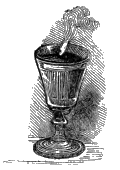
Sir Humphrey thought he had got the true
explanation of the thing. These wonderful metals
formed the basis of every substance in lava,
and supposing them to exist in the centre of the
globe, it was only necessary for water to get to
them to set them on fire, and thus to give rise
to earthquakes and volcanoes. It appeared only
to be required that a crack should be made at
the bottom of the sea, and the water flow into
the beds of metal underneath, and the violent
action produced would burst through the surface,
and throw out streams of melted matter,
accompanied with great clouds of steam, just
as takes place in the eruptions of Mount Vesuvius
and other volcanoes.
But you would find it very difficult to think
how this can account for continual and nearly
steady operations, such as have been known to
exist in the Geysers of Iceland for more than
1000 years, and in Mount Stromboli for much
longer than that, so we will try another guess.
It has been observed in descending deep
mines, that the earth gets warmer the deeper
you go. The usual mode of trying it is to dig
little holes, as you go down, in the sides and
bottom of the mine, and put a thermometer
into them. A great many observations of this
kind, have been made in different parts of the
world, and the greatest care has been taken to
allow for all causes of irregularity, consisting
in climate and local peculiarities. Comparing
these together, it has been determined that the
temperature increases about one degree every
fifteen feet of descent.
A similar conclusion has been drawn from the
heat of the water of the Artesian Wells. But,
perhaps, you do not know what Artesian Wells
are, so I will tell you.
They are deep borings in the earth, out of
which water rises to, or even above, the surface
of the ground. Wherever you bore, if you go
deep enough you may get plenty of water, and
this water is always found to be warmer in proportion
to the depth of the well in which it
rises. They are called Artesian Wells, from
Artois, a town in France, where the first was
constructed.
In a well of this kind near Rochelle, which
was 316 feet deep, the water near the surface
was at a temperature of 55 degrees, and at the
bottom 60 degrees. It was afterwards sunk to
the depth of 369 feet, and the temperature at
the bottom was then found to be 65 degrees.
Do you not think it most likely that the heat
continues to increase quite as fast in proportion
below the deepest point that man has gone down
to? Well, if so, at the depth of some miles it
must be hot enough to melt anything, even granite,
and all kinds of stones.
If we suppose, on this evidence, that the centre
of the globe is intensely heated, and that it gets
gradually cooler towards the surface, there is
what at once will account for the hot springs,
the increasing heat in descending mines, the
constant action of some volcanoes, the occasional
action of others, the streams of lava, and
the nature of all substances that are thrown out.
It is very natural to imagine that every now
and then the action of the great heated mass
inside, would crack open the crust, and the sea
wearing away its bottom in some places as it
does, may have something to do in assisting this.
Thus, new volcanoes would be formed, and earthquakes
would happen where they never happened
before; and over these immense cracks
there would be a volcanic band.
Then, after a time, these cracks might be partially,
or wholly, filled up by the matter thrown
into them, and the volcanoes on the surface
above may become quiet for a time.
CHAPTER IX.
PARLEY TELLS SOMETHING ABOUT THE HISTORY OF MOUNT VESUVIUS.
I am going to relate to you the biography of
a Volcano, and I hope you will find it amusing.
Before the time of the Roman Emperor Trajan,
Mount Vesuvius had been quiet for a great
many centuries. It is known that it had had
many eruptions before then, because there are
some great lava streams close by it, on which
some of the most ancient Italian cities are built.
In particular, Herculaneum, which was said to
have been built by the Demi-god Hercules, and
must therefore have been of the remotest antiquity,
was built chiefly of blocks of lava, and
founded upon a vast stream of the same substance.
And besides, there is no doubt that the land
all about the neighbourhood in the remotest
times, bore evident marks of the action of fire;
for it was here that the Poets pretended that the
gate of Hell was, and close by the black and
dreary-looking lake Avernus, which you may read
about in the Æneid of Virgil. This was also the
place where the Cimmerians dwelt, whom Ulysses
is said to have visited, according to Homer, on
his way to the regions of the dead.
THE GROTTO DEL CANO.
Near here, too, was the celebrated Grotto del
Cano, the cave which used to destroy the lives
of small animals put into it, by means of the exhalations
that rose from the bottom; but as
these exhalations were heavier than the air, consisting
chiefly of the gas called carbonic acid,
they did not rise much above the bottom. This
is what an old writer, the account of whose
travels I am very fond of, says of it.
"Whatsoever hath life, being thrust into the
farre end, doth die in an instant. Yet entred it
may be a good way with safety; neither heat nor
cold will oppress you, nor is there any damp or
vapour to be discerned; being perspicuous to
the bottome, and the sole thereof dusty. We
made triall with a dog; which we no sooner
had thrust in, but without crying, or otherwise
struggling than if shot to the heart, his tongue
hung out, and his eyes setled in his head, to
our no small amazement. Forthwith drawne
out, starke, and to our seeming without shew
of life, we threw him into the lake; when anon
he recovered, and swimming to the shore, ran
crying away as fast as hee could, to the not farre
distant Osteria: where they get no small part of
their living by shewing this place unto forreiners.
And it is a sport to see how the dogs
thereabout will steale away, and scud to the
tops of the mountaines, at the approach of a
stranger. The French King Charles, the eighth
of that name, who held the kingdome of Naples
for a while; made triall thereof with an Asse,
which immediately died. The like befell to a
foole-hardy souldier. Peter of Toledo caused two
offenders to be thrust thereinto, and both expired
in a moment. Nor found those three gallants
any better successe, who tempted God with
their desperate entrance. This place was not
unknowne to Pliny, who calleth it the Cave of
Charon. The cause of so deadly an effect, is
said to proceede from the fervent vapours ascending
at invisible pores, so thin, so dry, and
subtile, as not to be discerned: yet thickned by
the cold that enters at the mouth of the Cave,
convert into moisture, which hangs farre within
on the roofe like to drops of quick-silver; and
such esteemed to bee by a number. Carona
Pighyus, desirous to informe himselfe in the
mysteries hereof, ventured so farre in as to
touch one of those farre of shining drops, and
shewed it to his companions, who entred also,
and stayed therein about a minute of an houre:
sensibly perceiving the heat to arise from their
feet to their thighs, till they did sweat at the
browes without the endammaging of their senses,
who return'd, to the wonder of the guide,
that thought they had preserved themselves by
enchantments. By this their experiment it appeares
that the aire is most deadly neere to the
pores where it first ascended; especially to such
creatures as hold their heads downeward, exhaling
at their nostrils the dry and hote vapours.
Thrust a torch neere the bottome, and it will
forthwith go out: yet advanced higher, re-inflames,
which approves the former assertion."
OF THE DEATH OF PLINY THE NATURALIST.
But although there were such gloomy places
in the neighbourhood, in the reign of Trajan, less
than a hundred years after the Christian Era,
Mount Vesuvius was clothed with blooming
vineyards, and corn fields, studded with villas
and beautiful gardens, and with three or four
rich and populous cities near its foot.
The height of the mountain was then much
less than it is at present, and it seems to have had
a broad flat top, nearly surrounded by a ridge.
This shape will account for the spot being
chosen by the Roman rebel Spartacus to encamp
in, with his gladiators and slaves, when he
put Rome in danger.
For some time before the first eruption on record,
there were dreadful earthquakes, of which
the effects are still to be seen in the cracked and
ruined walls of Pompeii and Herculaneum.
"There were great droughts," says the historian,
"and violent earthquakes, so that the whole plain
boiled and bubbled, and the hills leapt, and there
were noises under ground like thunder, and
above ground like roaring; the seas made a
noise, and the Heavens resounded, and then
a sudden mighty crash was heard, as if the mountains
were dashed together; great stones were
then hurled upwards, and were followed by
mighty fires, and immense smoke, so that the
whole air was overshadowed, and the sun quite
hidden as in an eclipse."
The same writer then tells us about some
wonderful giants appearing to wander about the
summit of the mountain, which neither you nor
I shall be ready to believe.
Pliny, the great naturalist, was at that time
living at the town of Misenum, and as he was a
man always prying into nature, and wishing to
know the causes of things, you may suppose his
curiosity was very much excited by these strange
occurrences. But he paid dearly for this laudable
curiosity, as you shall hear in the account
which his nephew has left us of the event.
"On the 24th of August, about one in the
afternoon, my mother desired him to observe a
cloud which appeared of a very unusual size and
shape. He had just returned from taking the
benefit of the sun, and after bathing himself in
cold water, and taking a slight repast, had retired
to his study. He immediately arose and
went out upon an eminence, from whence he
might more distinctly view this very uncommon
appearance. It was not at that distance discernible
from what mountain this cloud issued,
but it was found afterwards to ascend from
Mount Vesuvius. I cannot give a more exact
description of its figure, than by comparing it
to that of a pine-tree, for it shot up a great
height in the form of a trunk, which extended
itself at the top into a sort of branches; occasioned,
I imagine, either by a sudden gust of air
that impelled it, the force of which decreased as
it advanced upwards, or the cloud itself being
pressed back again by its own weight, expanded
in this manner: it appeared sometimes bright,
and sometimes dark and spotted, as it was more
or less impregnated with earth and cinders.
This extraordinary phenomenon excited my uncle's
philosophical curiosity to take a nearer
view of it. He ordered a light vessel to be got
ready, and gave me the liberty, if I thought
proper, to attend him. I rather chose to continue
my studies; for, as it happened, he had
given me an employment of that kind. As he
was coming out of the house, he received a note
from Rectina, the wife of Bassus, who was in
the utmost alarm at the imminent danger which
threatened her; for her villa being situated at
the foot of Mount Vesuvius, there was no way
to escape but by sea: she earnestly entreated
him, therefore, to come to her assistance. He
accordingly changed his first design, and what
he began with a philosophical, he pursued with
an heroical turn of mind. He ordered the gallies
to put to sea, and went himself on board
with the intention of assisting not only Rectina,
but several others; for the villas stand extremely
thick upon that beautiful coast. When hastening
to the place from whence others fled with the
utmost terror, he steered his direct course to
the point of danger, and with so much calmness
and presence of mind, as to be able to make
and dictate his observations upon the motion
and figure of that dreadful scene. He was now
so nigh the mountain, that the cinders, which
grew thicker and hotter the nearer he approached,
fell into the ships, together with pumice-stones,
and black pieces of burning rock:
they were likewise in danger, not only of being
aground by the sudden retreat of the sea, but
also from the vast fragments which rolled down
from the mountain, and obstructed all the shore.
Here he stopped to consider whether he should
return back again; to which the pilot advising
him, 'Fortune,' said he, 'befriends the brave;
carry me to Pomponianus.'"
His nephew then goes on to relate that he
joined his friend who was in another vessel,
and went on shore, where he took a bath and
sat down to supper, not seeming to be in the
least alarmed, when everybody about him was in
the greatest consternation. He then went to
sleep so soundly, that he was heard to snore. The
ashes fell so thick in the court before his apartment,
that it was getting nearly impassable, and
his servants thought proper to awaken him. The
walls of the houses began to rock, and he and
his friends then resolved to go out into the fields,
lest the stones and bricks should fall upon them.
They tied pillows upon their heads, and went
out with torches, for though it was daytime, the
clouds of steam and ashes made it quite dark.
They went down to the sea, and found it in violent
commotion. Either a sudden gust of wind
then brought the effluvia of the volcano towards
them, or else a little stream of deadly vapour
burst out from a crack in the ground, which
dispersed the rest of the company. But Pliny,
who was a fat asthmatic old man, had laid down
upon the ground to watch what was going on. He
attempted to rise, but almost before he had got
on his feet, he fell down dead.
"As soon as it was light again," says his
nephew, "which was not till the third day after
this melancholy accident, his body was found
entire, and without any marks of violence upon
it, exactly in the same posture that he fell."
It was in the same eruption that the two great
cities, Herculaneum and Pompeii were overwhelmed
by substances thrown out by the volcano.
It does not appear that a single stream
of lava flowed out till many years afterwards.
There were several great eruptions between
this time and the year 1306, and then the volcano
was very nearly quiet for more than 300
years. During this time the volcanic power
broke out in another place called Puzzuoli, at
several miles distance. After a succession of
violent eruptions, the earth was cleft open, and
a hill, which is now called the Monte Nuovo,
was thrown up in the space of a single night,
which is 440 feet high, and a mile and a half in
circumference.
At the end of this period Vesuvius was richly
covered with vegetation, even within the crater.
But since the year 1650, there has not been ten
years pass without an eruption.
The form of the mountain has quite changed,
and a little mountain has grown up out of the
old broad topped one, as you may see in the
above picture.
HERCULANEUM AND POMPEII.
These cities which were of great extent and
importance, seem to have been almost forgotten
during more than 1600 years. They are not
often mentioned in Roman history, and, strange
to say, the Latin writers who describe the eruption
of Vesuvius, by which they must have been
buried, have said nothing about them, except a
very vague allusion or two, which would hardly
have attracted any notice, if what I am going to
tell you of, had not happened.
In the year 1713, as some people were sinking
a well, they discovered two statues, one of Hercules,
and the other of Cleopatra; and continuing
to dig in several directions, they found they
had got into a Roman theatre, and after a while
they discovered that this Theatre was that of
the City of Herculaneum. But in consequence
of the hardness of the ground, and the great
depth of the city under the surface, which is
one hundred feet, they have only been able to
clear out a very few buildings, and those cannot
be seen except by torchlight, so that very little
is known about it.
I cannot tell you exactly how the ruins of
Pompeii were first discovered to be the remains
of a city. It appears that an architect, who was
employed to make a subterranean canal to convey
water to the town of Torre dell'Annunziata,
nearly 300 years ago, met with some fragments
of buildings; and about eighty years afterwards,
enough was seen to convince the discoverers
that the ruins were extensive. In the year
1755, a regular plan of excavation was commenced,
and nearly the whole city is now exposed
to the light of day.
The situation of Pompeii is considerably further
from the crater of Vesuvius than that of
Herculaneum, and to that circumstance is owing
the superiority of its preservation, and the
greater moveableness of the substances which
covered it. It is probable that both cities were
originally assailed by alluvions, or streams of
mud, such as I told you of some time ago,
as well as by showers of cinders and stones.
But while Pompeii was only fourteen or fifteen
feet below the surface, and never had anything
besides cinders and earth above it, several
streams of lava flowed over Herculaneum, with
layers of the different substances, which the volcano
throws into the air, between them, so as to
raise the surface one hundred feet.
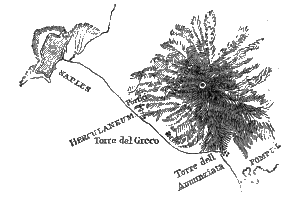
Pompeii was three miles in circumference,
and was a sea-port town, though it is now a
full mile from the sea. This is known, because
the steps which used to lead down from the
quay, for the convenience of passengers going
into boats, are still remaining, and so are some
large metal rings which were intended for cables
to be fastened to.
There are several inscriptions in both cities
commemorating the great injuries done by an
earthquake which happened in the reign of the
Emperor Nero, sixteen years before they were
destroyed. There are also great cracks to be
seen in some of the walls, testifying of the same
event. This was one of the efforts of the volcanic
power to get free before Vesuvius became
the safety-valve.
It is very evident that there was ample warning
of the catastrophe before it happened, and
that most of the people had time to escape, for
the number of skeletons found has been but
small. In the barracks, there were the skeletons
of two soldiers chained in the stocks.
There were seventeen persons found in the
cellar of a house just out of the town, who seem
to have fled there for safety, and the deluge of
mud then seems to have flowed in upon them,
for their bones were found in hardened mud.
One of the number was a woman, with an infant
in her arms, and the impression of her form in
the mud, was wonderfully perfect, though there
was nothing left of her but the bones. She
seems to have been the mistress of the house,
and a person of consequence, since she had a
chain of gold about her neck, and rich rings on
her fingers.
In these instances, (and there are related
several others similar,) the destruction of the persons
seems to be accounted for by the peculiar
circumstances in which they were placed. The
soldiers, poor fellows, would, doubtless, have
gone off with their companions, if they had not
been in the stocks; and the family of seventeen
might have escaped if they had fled into the
open country, instead of into their cellar.
The warning does not however seem to have
been very long before the sad event, perhaps only
about an hour. There have recently been found
three skeletons, which seem to have belonged to
a father, mother, and daughter, (the latter of
whom was decorated with pearl-rings and ear-rings,)
who were in the act of rushing out of
their house. And in one of the squares of
the city, a traveller saw "a new altar of white
marble, exquisitely beautiful, and apparently
just out of the hands of the sculptor, which
had been erected there; an enclosure was
building all round; the mortar, just dashed
against the side of the wall, was but half spread
out; you saw the long sliding stroke of the trowel
about to return and obliterate its own track—but
it never did return: the hand of the workman
was suddenly arrested, and, after the lapse of
1800 years, the whole looks so fresh and new,
that you would almost say the mason was only
gone to his dinner, and about to come back immediately
to smooth the roughness."
It is not unlikely that in the early part of the
eruption, the ashes and cinders which the volcano
threw out, fell in showers on the cities, and
that the walls were shaken by the subterranean
movements, so that most of the inhabitants
thought themselves less in danger in the open
fields, like the people of Misenum, who went into
the fields with pillows tied on their heads, as described
by Pliny the younger, in the passage
I quoted just now. Some few others, less afraid
of their houses tumbling down about their ears,
than of the bombs and cinders, betook themselves
to their cellars, and such places as they
thought safest.
I shall now tell you a little of what has been
discovered relating to the ancient state of the
City.
Its walls were about three miles in circumference;
the streets were generally narrow, and
paved with great flags of lava, which are furrowed
by very deep ruts made by the wheels of the
carriages that once passed busily along them.
When the great hardness of the paving material
is considered, this circumstance is very remarkable,
and shows that the flags must have been
laid down for a very long period, for the like
is not to be seen in the streets of the most
ancient City in Europe.
Plate X. p. 131
FORUM OF POMPEII.
The Forum was a very elegant building, and
if you look in the plate, you will see a correct
representation of what remains of it. The
Forums of ancient cities were not mere marketplaces,
although provisions and other commodities
were offered in them for sale; but they also
contained places fitted for meetings of the people,
and other public uses. You will thus understand
how it was that a place not larger than
Pompeii had such an extensive Forum.
The names of the owners over the door of
each house are still to be seen, and some of them
are perfectly legible; and the colours of the
paintings on the walls of the houses, are as fresh
as if they had been painted yesterday. Some
books have been found, but they are less perfect
than those in Herculaneum, where a whole
library has been discovered.
The wood of the houses in Herculaneum is
astonishingly perfect if you just scrape off the
surface, and some linen has been discovered, of
which the texture could be distinctly seen.
There were also some vessels full of almonds,
chesnuts, and walnuts, in a fruiterer's shop,
which preserved their form entire. A baker
lived near neighbour to this fruiterer, and in his
shop was a loaf with his stamp upon it, "ELERIS
Q. CRANI RISER." Not far off was an apothecary's
shop, in which was a box of pills, and a
little roll of some kind of medicine ready to be
cut into pills, with a jar of herbs and other medicines.
Another shop contained some sauces
and olives, which were quite moist. These curious
relics have been sealed up in glass, and placed
in the Museum of Naples.
There is a house in one of the streets of
Pompeii, on one of the walls of which there has
been scratched with some sharp-pointed instrument,
a rude device like this:
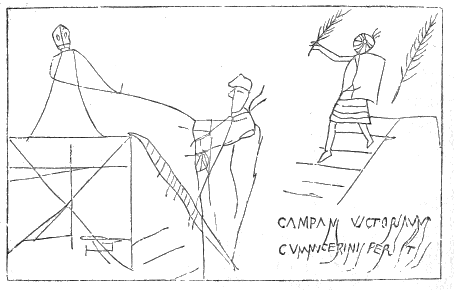
The letters in the corner, are, "Campani victoria
una cum Nucerinis peristis." Campanians, you
perished in the victory along with the Nucerians.
This was a jest of some merry fellow making
fun of the inhabitants of Nuceria, a neighbouring
city, and of some other parts of Campania,
over whom they had gained a victory in a
squabble. We are told that the Nucerians,
when they were dead beaten, went like cowards
to the Emperor Nero, and laid their case before
him. He decided in their favour, and punished
the Pompeians in what may seem a strange way
to you,—he forbade them to have any amusements
in their theatre for ten years. However,
from what we know of the general disposition
and habits of the ancient Greeks and Romans,
this was a very severe punishment to them.
From the scarcity of books, arising from their
being copied by hand, instead of being printed,
but few of them could spend their leisure time
in reading, as so many of us do now; and in
consequence of this, the theatre was to them at
once the principal source of literary improvement
and of amusement.
Plate XI. p. 136
FALLS OF NIAGARA
CHAPTER X.
PARLEY DESCRIBES THE FALLS OF NIAGARA.
The river Niagara runs out of Lake Erie into
Lake Ontario, and you may see the direction it
takes if you look in the map of North America.
You may likewise observe that Lake Erie is connected
with three other vast Lakes, and as its
level is lower than theirs, the whole of their
waters pass through it into the Niagara.
Nearly half way between the Lakes Erie and
Ontario, where the river is about three quarters
of a mile wide, it tumbles over a precipice of
160 feet in height. I shall try to describe to you
what I saw when I visited this place; but I am
quite certain I shall not be able to do justice to
the scene. You must form your conceptions of
it rather from the bare facts I tell you respecting
the mass of water and the height of the rocky
ledge over which it falls.
As we travelled along from the town of Waterloo
on a level road on the west bank, we saw
the river gradually become wider till it was cut
into two streams by a long narrow island some
miles in length. The streams after passing the
island, unite into one again, which continues its
course as before.
There is a sullen unpretending majesty about
this part of the river, as if it did not think it
worth while to remind the traveller of the vast
distance which its mighty waters have come,
or of the stupendous scene to which they are
travelling onward. There is nothing remarkable
in its appearance, and that very circumstance,
coupled with what we knew and what
we shortly expected to see, made us full of intense
feeling; and often and often did we put
our ears to the ground to hear whether the
sound of the falls could reach us, and then remount
and impatiently spur on our horses.
They say that the roar of the falls may be
heard fifteen miles off when the wind is favourable.
But the day we went, there was hardly
any wind, and we were within six miles of the
spot before we heard the sound.
At the distance of three miles the waters
seemed fretful and discontented, as they approached
what are called the rapids; we could
see afar off "a silver cloud rising slowly into the
sky—the everlasting incense of the waters,"
consisting of vapour, or rather fine spray, which
is dashed out by the violence of the fall; and the
roar seemed deeper and more tumultuous.
Within half a mile the rapids commence in
good earnest. A rapid means the descent of a
river down an inclined bed less sudden than
a fall. The descent here in half a mile, is fifty
feet. The bed is rocky, and the waters in rushing
over it foam, and eddy, and tear along in all
directions in which they can possibly approach
the awful precipice. The unity of the stream is
broken by thousands of rocks and stones, and
every part of its broad surface seems earnestly
taken up with driving forward to the falls.
After we had enjoyed this scene awhile, we
turned into the road again, and lost sight of the
river till we reached a public-house, where we
took refreshment and put up our horses.
The precipice which here breaks the course
of the river, is divided into three parts by two
large islands, and thus are formed three distinct
falls. One of these is called the Great, or Horse
Shoe Fall, from its peculiar shape, which you
will see represented in the picture. This is by
far the most extensive waterfall in the world,
and is considered to be above a quarter of a mile
in length. Then comes an island a thousand
feet in width, called Goat Island, which has a
great deal of wood growing on it. After that
the Second Fall, not more than twenty feet in
width, then an island considerably smaller than
the first; and lastly, Fort Scloper Fall, about a
thousand feet wide, which joins the opposite
bank of the river.
The quantity of water which descends every
minute in the three falls, has been estimated to
be about 700,000 tons.
Well, a path through the garden of the Inn
at which we were, led us down a steep and
thickly wooded bank, to a complete shelf of
rock, about a foot in thickness, called the Table
Rock, which stands out over the river.[A] Since
I was there this piece of rock has broken away
and fallen into the stream. I was not at all surprised
when I heard this intelligence, for I can
assure you that though I am no coward, it did
not seem very secure when I was standing on it,
and if I had not been quite taken up with what
I was looking at, I should not have staid there
long. Here the whole scene on a sudden broke
upon us. We were on a level with the top of
the precipice, with the Horse Shoe Fall just opposite,
and to our left, the Second, and Fort
Scloper Falls.
In spite of the loud roar and the violent rushing
of the waters, the scene altogether produced
on us feelings of deep tranquillity and
beauty. The portion of the river that falls over
the Horse Shoe Fall, comes on in such an unbroken
mass, as if nothing dared to oppose the
progress of a single drop of its water. Then
the deep transparent green of the middle stream,
showing at a little depth beneath its surface,
shreds of milky foam, the beautiful cloud of
fine spray ever decorated with a rich rainbow
when the sun shines, and the thick woods of
Goat Island, (the island that limits the Horse
Shoe Fall,) are in such lovely harmony. Altogether,
I should say that the scene from the
Table Rock, is more remarkable for its beauty
than its grandeur, though its grandeur is quite
equal to that of anything I ever looked upon in
my life.
We got down to the bottom of the falls by
means of some rough steps which have been cut
in the rock. As we stood on some large fragments
which have fallen down from the cliff
above, the roar fell with overpowering heaviness
upon our ears, the fall was nearly hid from our
eyes by the spray, and the river rushed past our
feet in a terrible tumult of white foam. By getting
along on the stones under the cliff, we went
in under the fall so as actually to be between
the rock and the descending sheet of water.
Your imagination must tell you better than I
can, the character of what we then saw by the
broken light that made its way through the
descending mass of waters. We stopped there,
overpowered by indescribable feelings, till we
got wet through by the spray, and then went
back to the inn, stored with recollections, which
will be a feast for us as long as we live.
A traveller who visited the Falls in winter,
adds some particulars which will be interesting
to you.
"At the time of my visit," says he, "the wind
drove the floating ice out of Lake Erie, with the
drift wood of its tributary rivers, and these were
constantly precipitated over the Falls, but we
were not able to discover any vestiges of them
in the eddies below. Immediately in front of
the sheet of falling water, on the American side,
there was also an enormous bank of snow, of
nearly a hundred feet in height, which the power
of the sun had not been fierce enough to dissolve,
and which, by giving an Icelandic character
to the landscape, produced a fine effect.
It appeared to me to owe its accumulation to
the fallen particles of frozen spray.
"What has been said by Goldsmith, and repeated
by others, respecting the destructive influence
of the rapids above, to ducks and other
water-fowl, is only an effect of the imagination.
So far from being the case, the wild duck is
often seen to swim down the rapid to the brink
of the Falls, and then fly out, and repeat the
descent, seeming to take a delight in the exercise.
Neither are small land-birds affected on
flying over the Falls, in the manner that has
been stated. I observed the blue bird and the
wren, which had already made their annual visit
to the banks of the Niagara, frequently fly
within one or two feet of the brink, apparently
delighted with the gift of their wings, which
enabled them to sport over such frightful precipices,
without danger."
CHAPTER I.
PARLEY TELLS ABOUT THE FROZEN OCEAN.
Your old friend Peter loves to talk about the
sea. Ever since he was a child, he loved everything
belonging to the sea, and when he was a
young man he went many long voyages, and
met with many strange adventures, on the sea.
Perhaps he did not find it quite so delightful to
be shut up in the narrow compass of a ship,
during long voyages, as he dreamt he should in
his childhood. But he does not now regret whatever
labours or sufferings he may have endured,
for the pleasure he finds in telling you of them.
But I do not intend here to spin you a yarn
(as the sailors say) about myself, but merely to
describe to you some of the wonderful things I
have seen during my voyages, that you may love
and admire them.
You have never seen the sea frozen over in
the same manner as you have seen ponds and
rivers in winter. The waters of the sea, everywhere,
contain a large portion of salt, as you
know from their taste, and this prevents them
from freezing, except where it is very cold. It
is only near the poles of the earth that the
ocean freezes, and there are large masses of ice,
both at the north and south poles, which are
never thawed, but stand as stedfast as the everlasting
hills of granite.
Icebergs are large bodies of ice filling the
valleys between the high mountains in northern
latitudes. Sometimes they get loosened from
the places where they were formed, by parts of
them thawing, in seasons which are less cold than
usual, and then rush down towards the sea, where
they float about in all manner of fantastic and
majestic forms.
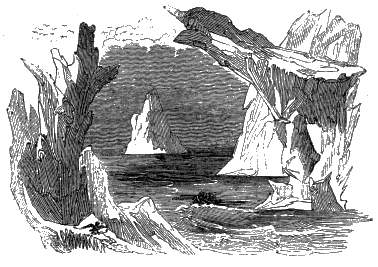
Icebergs.
These icebergs are the creation of ages, and
annually increase by the falling of snows, and of
rain, which instantly freezes, and more than repairs
the loss occasioned by the heat of the sun.
I must tell you a little about the way in which
cold converts water into ice.
Everything in nature is expanded or increased
in bulk by heat. You may see in a thermometer
how the quick-silver or the coloured spirit rises
in the tube, because it expands when the instrument
is in a warm place, and how it sinks in a
cold place. It is just the same with solids and
gases. This would seem to be a universal law of
nature, if it were not for the single exception of
water at the moment of its freezing. If water is
cooled down to the freezing point, it will gradually
diminish in bulk, but at the moment it
turns into ice, it seems to spring outward, and
increases considerably. In this way bottles are
broken when the water in them freezes; and
rocks are often split open in the same manner
when the cracks in them contain water.
You have seen that ice does not sink in water,
but floats upon the surface; this takes place, because
from the circumstance which I have told
you, a certain quantity of ice by weight, occupies
more space than the same quantity of water.
Now it is worth while for you to see how wisely
this is arranged, as it respects our own climate
and country; for if ice were to sink to the bottom,
the lakes, and rivers, and ponds, would become
solid masses of ice during winter, which
the sun's rays would never thoroughly thaw in
summer, because, after the surface had been
thawed, the rays would have to pass through the
water to get at the ice at the bottom, and thus
our climate would be rendered very much colder
than it is at present, and perhaps the springs
would not circulate, so that we should often
suffer from scarcity of water.
But when the salt water freezes, the ice is
very porous, almost like a honeycomb, so that
it is much lighter than frozen fresh water, and
is very buoyant upon the sea, and stands out
boldly to a great height, as is represented in the
cut of the Icebergs.
I will tell you of a perilous situation in which
I was placed in my younger days, when I went
a voyage to Greenland in a whale ship. It was
at the end of the fishing season, and our ship
was the last but one of the oil traders left in
those seas; we had been very unsuccessful,
having only taken five small whales, and we
were anxious to amend our ill luck by tarrying
after all the other ships had sailed, in hopes of
better success. We were gently sailing about
in search of whales amidst the broken ice when
there suddenly arose a rather brisk breeze, at
which time our ship was situated between two
icebergs,—one of them very high and resembling
a lofty mountain, and the other considerably
smaller.
Well, at the time the breeze sprung up, the large
iceberg was to the windward of us, that is, on
that side from whence the wind blew, and having
a very large surface which caught the wind,
it came sailing towards us very fast.
The vast bulk of this iceberg sheltered the
smaller one, which was to the leeward of us, so
that it did not move in the least, and we who
were between the two, were completely becalmed.
The ship was not advancing a knot in an hour,
and we could do nothing whatever to help ourselves.
We were in the greatest dismay, and
could only consider the way in which we should
meet our entire destruction. The larger mountain
of ice continued to bear down upon us, and
in a few minutes our vessel was crushed between
it and the smaller one, as if it had been put in
a huge smith's vice.
Fortunately, however, for us, the two icebergs
clung together, the greater one impelling the
lesser one forward, and we thus had time to get
out of the ship all our sea-chests, a large quantity
of cordage, nearly all our provisions, and
everything portable; but the smaller iceberg
soon shifted round the large one and let our ship
loose, which instantly sank, and we, being on the
small iceberg, were left floating on the ocean
with despair staring us in the face. Our despair,
however, was soon put to flight, for we perceived
a ship at a short distance, to which we made
signal, and they came to our assistance.
But, now I come to a part of the event which
I grieve to record.—The captain and crew of the
vessel which came to our succour, seeing that
we had no other alternative, thought they could
make an easy prey of us, and before they would
consent to save us, required that we should give
up to them all the things which we had been enabled
to rescue from our wrecked ship!—In such
circumstances you need not ask what we did,—life
is sweet, it is said, and the pitiless prospect
of the frozen regions around us, sharpened our
appetite for the enjoyment of it, and we surrendered
all but the clothes in which we stood.
Shall I tell you the place where these savages
came from? No. I will only tell you that it lies
in about 56 degrees North latitude, by 4½ West
longitude; you may, if you please, find its name
by looking in the map.
CHAPTER II.
THE STORY OF A LONG JOURNEY OVER THE ICE.
The Esquimaux live in the most northern
parts of America, where there is hardly anything
but ice and snow to be seen from year's
end to year's end. They build their houses of
snow, and make their longest journeys in sledges
upon ice along the sea-shore.
You, who have been used to a very different
kind of life, may wonder how they can enjoy
themselves, or even endure existence in such inhospitable
regions. But I can assure you they
love their native country so much, that they
could by no means be happy out of it; and their
pleasures are real pleasures, though they would
not be pleasures to you. And thus you may
learn that God wishes everybody to be happy,
and enables them to be so if they choose to act
according to the light which He has given them,
and not be ever struggling for something which
they cannot, and therefore ought not, to possess.
And not only do the natives of these frozen
countries endure perpetual frost and snow, but
good men have chosen to go and live among
them for the purpose of teaching the natives the
doctrines of Christianity. I shall relate to you
a most interesting narrative of some of these
men who were Moravians, and it will give you
a better notion of the character of these parts
of the world, and of the sort of life men lead in
them, than anything I could you of my own, for
the story is extremely well told.
"Brother Samuel Liebisch was entrusted with
the general care of the brethren's missions on
the coast of Labrador, and the duties of his
office required a visit to Okkak, the most northern
of our settlements, and about one hundred
and fifty English miles distant from Nain, the
place where he resided. Brother William Turner
being appointed to accompany him, they left
Nain on March the 11th, 1782, early in the
morning, with very clear weather, the stars
shining with uncommon lustre. The sledge was
driven by the baptized Esquimaux Mark, and
another sledge with Esquimaux joined company.
"An Esquimaux sledge is drawn by a species
of dogs, not unlike a wolf in shape. Like them,
they never bark, but howl disagreeably. They
are kept by the Esquimaux in greater or larger
packs or teams, in proportion to the affluence of
the master. They quietly submit to be harnessed
for their work, and are treated with little
mercy by the heathen Esquimaux, who make
them do hard duty for the small quantity of food
they allow them. This chiefly consists in offal,
old skins, entrails, such parts of whale-flesh as
are unfit for other use, rotten whale-fins, &c.,
and if they are not provided with this kind of
dogs' meat, they leave them to go and seek dead
fish or muscles upon the beach.
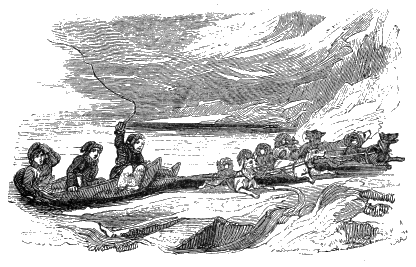
"When pinched with hunger they will swallow
almost anything, and on a journey it is necessary
to secure the harness within the snow-house
over night, lest by devouring it, they
should render it impossible to proceed in the
morning. When the travellers arrive at their
night-quarters, and the dogs are unharnessed,
they are left to burrow in the snow, where they
please, and in the morning are sure to come at
their driver's call, when they receive some food.
Their strength and speed, even with an hungry
stomach, is astonishing. In fastening them to
the sledge, care is taken not to let them go
abreast. They are tied by separate thongs, of
unequal lengths, to an horizontal bar on the
fore-part of the sledge; an old knowing one
leads the way, running ten or twenty paces ahead,
directed by the driver's whip, which is of
great length, and can be well managed only by
an Esquimaux. The other dogs follow like a
flock of sheep. If one of them receives a lash,
he generally bites his neighbour, and the bite
goes round.
Plate XII. p. 157
ESCAPE ON THE ICE
"To return to our travellers: the two sledges
contained five men, one woman, and a child.
All were in good spirits, and appearances being
much in their favour, they hoped to reach Okkak
in safety in two or three days. The tract over
the frozen sea was in the best possible order,
and they went with ease at the rate of six or
seven miles an hour. After they had passed the
islands in the bay of Nain, they kept at a considerable
distance from the coast, both to gain the
smoothest part of the ice, and to weather the
high rocky promontory of Kiglapeit.
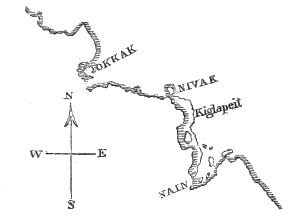
"About eight o'clock they met a sledge with
Esquimaux turning in from the sea. After the
usual salutation, the Esquimaux alighting, held
some conversation, as is their general practice,
the result of which was, that some hints were
thrown out by the strange Esquimaux, that it
might be better to return. However, as the
missionaries saw no reason whatever for it, and
only suspected that the Esquimaux wished to
enjoy the company of their friends a little
longer, they proceeded.
"After some time their own Esquimaux hinted
that there was a ground swell under the ice. It
was then hardly perceptible, except on lying
down and applying the ear close to the ice, when
a hollow disagreeable grating and roaring noise
was heard, as if ascending from the abyss. The
weather remained clear, except towards the east,
where a bank of light clouds appeared, interspersed
with some dark streaks. But the wind
being strong from the North-west, nothing less
than a sudden change of weather was expected.
"The sun had now reached its height, and
there was as yet little or no alteration in the appearance
of the sky. But the motion of the sea
under the ice had grown more perceptible, so as
rather to alarm the travellers, and they began to
think it prudent to keep closer to the shore.
The ice had cracks and large fissures in many
places, some of which formed chasms of one or
two feet wide; but as they are not uncommon
even in its best state, and the dogs easily leap
over them, the sledge following without danger,
they are only terrible to new comers.
"As soon as the sun declined towards the
west, the wind increased and rose to a storm,
the bank of clouds from the east began to ascend,
and the dark streaks to put themselves in
motion against the wind. The snow was violently
driven about by partial whirlwinds, both
on the ice, and from off the peaks of the high
mountains and filled the air. At the same time
the ground swell had increased so much, that
its effect upon the ice became very extraordinary
and alarming. The sledges, instead of gliding
along smoothly upon an even surface, sometimes
ran with violence after the dogs, and shortly
after seemed with difficulty to ascend the rising
hill, for the elasticity of so vast a body of ice,
of many leagues square, supported by a troubled
sea, though in some places three or four yards
in thickness, would, in some degree, occasion an
undulatory motion not unlike that of a sheet of
paper accommodating itself to the surface of a
rippling stream. Noises were now likewise distinctly
heard in many directions, like the report
of cannon, owing to the bursting of the ice at
some distance.
"The Esquimaux therefore drove with all
haste towards the shore, intending to take up
their night-quarters on the south side of the
Nivak. But as it plainly appeared that the ice
would break and disperse in the open sea, Mark
advised to push forward to the north of the
Nivak, from whence he hoped the track to
Okkak might still remain entire.
"To this proposal the company agreed, but
when the sledges approached the coast, the
prospect before them was truly terrific. The
ice having broken loose from the rocks, was
forced up and down, grinding and breaking into
a thousand pieces against the precipices, with a
tremendous noise, which added to the raging of
the wind, and the snow driving about in the air,
deprived the travellers almost of the power of
hearing and seeing anything distinctly.
"To make the land at any risk, was now the
only hope left, but it was with the utmost difficulty
the frightened dogs could be forced forward,
the whole body of ice sinking frequently
below the surface of the rocks, then rising above
it. As the only moment to land was that, when
it gained the level of the coast, the attempt was
extremely nice and hazardous. However, by
God's mercy, it succeeded; both sledges gained
the shore, and were drawn up the beach with
much difficulty.
"The travellers had hardly time to reflect
with gratitude to God on their safety, when that
part of the ice from which they had just now
made good their landing burst asunder, and the
water forcing itself from below, covered and
precipitated it into the sea. In an instant, as if
by a signal given, the whole mass of ice, extending
for several miles from the coast, and as far
as the eye could reach, began to burst and be
overwhelmed by the immense waves towering
above.
"The sight was tremendous and awfully
grand; the large fields of ice, raising themselves
out of the water, striking against each
other, and plunging into the deep with a violence
not to be described, and a noise like the
discharge of innumerable batteries of heavy
guns. The darkness of the night, the roaring
of the wind and sea, and the dashing of the
waves and ice against the rocks, filled the travellers
with sensations of awe and horror, so
as almost to deprive them of the power of utterance.
They stood overwhelmed with astonishment
at their miraculous escape, and even
the heathen Esquimaux expressed gratitude to
God for their deliverance.
"The Esquimaux now began to build a snow-house,
about thirty paces from the beach; but
before they had finished their work, the waves
reached the place where the sledges were secured,
and they were with difficulty saved from
being washed into the sea.
"About nine o'clock all of them crept into
the snow-house, thanking God for this place of
refuge; for the wind was piercingly cold and so
violent, that it required great strength to be
able to stand against it.
"Before they entered this habitation, they
could not help once more turning to the sea,
which was now free from ice, and beheld with
horror, mingled with gratitude, the enormous
waves, driving furiously before the wind, like
huge castles, and approaching the shore, where
with dreadful noise, they dashed against the
rocks, foaming and filling the air with the spray.
The whole company now got their supper, and
having sung an evening hymn in the Esquimaux
language, lay down to rest about ten o'clock.
They lay so close, that if any one stirred, his
neighbours were roused by it.
"The Esquimaux were soon fast asleep, but
brother Liebisch could not get any rest, partly
on account of the dreadful roaring of the wind
and sea, and partly owing to a sore throat,
which gave him great pain. Both missionaries
were also much engaged in their minds in contemplating
the dangerous situations into which
they had been brought, and amidst all thankfulness
for their great deliverance from immediate
death, could not but cry unto their Heavenly
Father for his help in this time of need.
"The wakefulness of the missionaries proved
the deliverance of the whole party from sudden
destruction. About two o'clock in the morning,
brother Liebisch perceived some salt water to
drop from the roof of the snow-house upon his
lips. Though rather alarmed on tasting the
salt, which could not proceed from a common
spray, he kept quiet, till the same dropping
being more frequently repeated, just as he was
about to give the alarm, on a sudden a tremendous
surf broke close to the house, discharging
a quantity of water into it; a second soon followed,
and carried away the slab of snow placed
as a door before the entrance. The missionaries
immediately called aloud to the sleeping Esquimaux,
to rise and quit the place. They jumped
up in an instant, one of them with a large knife
cut a passage through the side of the house, and
each seizing some part of the baggage, it was
thrown out upon a higher part of the beach,
brother Turner assisting the Esquimaux. Brother
Liebisch and the woman and child fled to
a neighbouring eminence. The latter were
wrapt up by the Esquimaux in a large skin, and
the former took shelter behind a rock, for it was
impossible to stand against the wind, snow, and
sleet. Scarcely had the company retreated to
the eminence when an enormous wave carried
away the whole house, but nothing of consequence
was lost."
CHAPTER III.
THE JOURNEY OVER THE ICE CONTINUED.
"They now found themselves a second time
delivered from the most imminent danger of
death; but the remaining part of the night, before
the Esquimaux could seek and find another
more safe place for a snow-house, were hours of
great trial to mind and body, and filled every
one with painful reflections. Before the day
dawned, the Esquimaux cut a hole into a large
drift of snow, to screen the woman and child,
and the two missionaries.
"Brother Liebisch, however, could not bear
the closeness of the air, and was obliged to sit
down at the entrance, where the Esquimaux
covered him with skins, to keep him warm, as
the pain in his throat was very great.
"As soon as it was light, they built another
snow-house, and miserable as such an accommodation
is at all times, they were glad and thankful
to creep into it. It was about eight feet
square and six or seven feet high. They now
congratulated each other on their deliverance,
but found themselves in a very bad plight.
"The missionaries had taken but a small stock
of provisions with them, merely sufficient for the
short journey to Okkak. Joel, his wife and
child, and Kassigiak, the sorcerer, had nothing
at all. They were obliged, therefore, to divide
the small stock into daily portions, especially as
there appeared no hopes of soon quitting this
place and reaching any dwellings. Only two
ways were left for this purpose, either to attempt
the land passage across the wild and unfrequented
mountain Kiglapeit, or wait for a
new ice track over the sea, which it might
require much time to form; they therefore
resolved to serve out no more than a biscuit
and a half per day.
"But as this would not by any means satisfy
an Esquimaux's stomach, the missionaries offered
to give one of their dogs to be killed for them,
on condition, that in case distress obliged them
to resort again to that expedient, the next dog
killed should be one of the Esquimaux's team.
They replied that they should be glad of it, if
they had a kettle to boil the flesh in, but as that
was not the case, they must even suffer hunger,
for they could not, even now, eat dogs' flesh in
its raw state. The missionaries now remained
in the snow-house, and every day endeavoured
to boil so much water over their lamp, as might
serve for two dishes of coffee a-piece. Through
mercy, they were preserved in good health, and
brother Liebisch quite unexpectedly recovered
on the first day of his sore throat. The Esquimaux
also kept up their spirits, and even the
rough heathen Kassigiak declared, that it was
proper to be thankful that they were still alive,
adding, that if they had remained a very little
longer upon the ice yesterday, all their bones
would have been broken to pieces in a short
time. He had, however, his heels frozen, and
suffered considerable pain. In the evening, the
missionaries sung an hymn with the Esquimaux,
and continued to do it every morning and evening.
God was present with them, and comforted
their hearts by his peace.
"Towards noon of the thirteenth, the weather
cleared up and the sea was seen, as far as the
eye could reach, quite freed from ice. Mark
and Joel went up the hills to reconnoitre, and
returned with the disagreeable news that not a
morsel of ice was to be seen even from thence,
in any direction, and that it had even been
forced away from the coast at Nuasornak. They
were, therefore, of opinion, that we could do
nothing but force our way across the mountain
Kiglapeit.
"To-day Kassigiak complained much of hunger,
probably to obtain from the missionaries
a larger portion than the common allowance.
They represented to him, that they had no more
themselves, and reproved him for his impatience.
Whenever the victuals were distributed, he always
swallowed his portion very greedily, and
put out his hand for what he saw the missionaries
had left, but was easily kept from any further
attempt by serious reproof.
"The Esquimaux eat to-day an old sack made
of fish-skin, which proved indeed a dry and miserable
dish. While they were at this singular
meal, they kept repeating, in a low humming
tone, 'you was a sack but a little while ago,
and now you are food for us.' Towards evening
some flakes of ice were discovered driving
towards the coast, and on the fourteenth in the
morning, the sea was covered with them. But
the weather was again very strong, and the Esquimaux
could not quit the snow-house, which
made them very low spirited and melancholy.
Kassigiak suggested, that it would be well to
attempt to make good weather, by which he
meant to practise his art, as a sorcerer, to make
the weather good.
"The missionaries opposed it, and told him
that his heathenish practices were of no use, but
that the weather would become favourable as
soon as it should please God. Kassigiak then
asked, whether Jesus could make good weather.
He was told, that to Jesus was given all power
in heaven and earth; upon which he demanded,
that he should be applied to. Another time he
said, I shall tell my countrymen at Seglek. The
missionaries replied. 'Tell them that in the
midst of this affliction, we placed our only hope
and trust in Jesus Christ our Saviour, who loves
all mankind, and has shed his blood to redeem
them from eternal misery.'
"To-day the Esquimaux began to eat an old,
filthy, and worn-out skin, which had served them
for a mattress.
"On the fifteenth the weather continued extremely
boisterous, and the Esquimaux appeared
every now and then to sink under disappointment.
But they possess one good quality,
namely, a power of going to sleep when they
please, and, if need be, they will sleep for days
and nights together.
"In the evening the sky became clear, and
their hopes revived. Mark and Joel went out
to reconnoitre, and brought word that the ice
had acquired a considerable degree of solidity,
and might soon be fit for use. The poor dogs
had, meanwhile, fasted for nearly four days, but
now in the prospect of a speedy release, the missionaries
allowed to each a few morsels of food.
The temperature of the air having been rather
mild, it occasioned a new source of distress, for
by the warm exhalations of the inhabitants, the
roof of the snow-house got to be in a melting
state; which occasioned a continual dropping,
and by degrees made every thing soaking wet.
The missionaries report, that they considered
this the greatest hardship they had to endure,
for they had not a dry thread about them, nor
a dry place to lie down in.
"On the sixteenth early, the sky cleared, but
the fine particles of snow were driven about
like clouds. Joel and Kassigiak resolved to
pursue their journey to Okkak, by the way of
Nuasornak, and set out, with the wind and snow
full in their faces. Mark could not resolve to
proceed farther north, because, in his opinion,
the violence of the wind had driven the ice off
the coast at Tikkerasuk, so as to render it impossible
to land; but he thought he might yet
proceed to the south with safety, and get round
Kiglapeit. The missionaries endeavoured to
persuade him to follow the above mentioned
company to Okkak, but it was in vain; and they
did not feel at liberty to insist upon it, not being
sufficiently acquainted with the circumstances.
Their present distress dictated the necessity of
venturing something to reach the habitations
of men, and yet they were rather afraid of passing
over the newly frozen sea under Kiglapeit,
and could not immediately determine what to
do. Brother Turner therefore went again with
Mark to examine the ice, and both seemed
satisfied that it would hold. They therefore
came at last to a resolution to return to
Nain.
"On the seventeenth, the wind had considerably
increased, with heavy showers of snow
and sleet, but they set off at half-past ten o'clock
in the afternoon. Mark ran all the way round
Kiglapeit, before the sledge, that he might
find a good track, and about one o'clock,
they were quite out of danger and reached
the bay. Here they found a good track upon
smooth ice, made a meal of the remnant of their
provisions, and got some warm coffee. Thus
refreshed, they resolved to proceed without
stopping, till they reached Nain, where they arrived
at twelve o'clock at night.
"The brethren at Nain rejoiced exceedingly
to see them return, for by several hints of the
Esquimaux, who first met them going out to
sea, and who then in their own obscure way,
had endeavoured to warn them of their danger
of the ground-swell, but had not been attended
to, their fellow-missionaries, and especially their
wives, had been much terrified. One of these
Esquimaux, whose wife had made some article
of dress for brother Liebisch, whom they called
Samuel, addressed her in the following manner:—'I
should be glad of the payment for my wife's
work.' 'Wait a little,' answered sister Liebisch,
'and when my husband returns he will settle
with you, for I am unacquainted with the bargain
made between you.' 'Samuel and William,'
replied the Esquimaux, 'will not return
any more to Nain.' 'How not return! what
makes you say so?' After some pause the Esquimaux
replied in a low tone, 'Samuel and
William are no more! all their bones are broken,
and in the stomachs of the sharks.'
"Terrified at this alarming account, sister
Liebisch called in the rest of the family, and the
Esquimaux was examined as to his meaning;
but his answers were little less obscure. He
seemed so certain of the destruction of the missionaries,
that he was with difficulty prevailed
on to wait some time for their return. He
could not believe that they could have escaped
the effects of so furious a tempest, considering
the course they were taking.
"It may easily be conceived, with what gratitude
to God the whole family at Nain bid them
welcome. During the storm, they had considered
with some dread, what might be the fate
of their brethren, though at Nain its violence
was not felt so much as on a coast, unprotected
by any islands. Added to this, the hints of the
Esquimaux had considerably increased their apprehensions
for their safety, and their fears
began to get the better of their hopes. All therefore
joined most fervently in praise and thanksgiving
to God, for this signal deliverance."
CHAPTER IV.
It seems strange that the largest animal in
nature should live in these regions, where you
would think everything must be starved by
the cold. But so it is, and it should lead you
to reflect, how wonderfully the principle which
animates living beings, by the outward form and
constitution which it gives to the bodies of
animals, adapts them to support the various circumstances
in which they are placed.
There are many kinds of whale which all
agree in these particulars. They are very much
larger than any other creatures existing; they
live in the sea and yet suckle their young with
milk, and have warm blood and lungs like land
animals, so that they can only breathe by putting
their heads above water. Some people have
doubted whether it was proper to call the whale
a fish, but on the whole it is certainly more like
fishes than it is like any other of the great divisions
of animals, seeing that it swims with
fins, and cannot live out of the water.
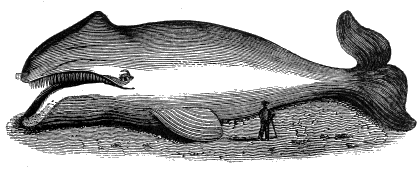
The Greenland whale (naturalists call it Balena
Mysticetus,) is the most important of the
varieties, as it is the one which produces train
oil in the largest quantities, and whalebone. In
common with all the others, it is a most awkward
looking creature. Here is a picture of one.
Its usual length is from 40 to 60 feet; and
the circumference of its body about 40. It
not unfrequently weighs 60 or 70 tons, which
is more than the weight of 180 fat oxen.
The tail is commonly about 6 feet long, and
25 feet wide. It lies flat upon the water, and is
what the creature principally uses in swimming,
for the fins near the head appear to be used
merely to keep the body steady in the water.
It is also a weapon of defence, and possesses
prodigious strength, as you shall hear by and
by.
The inside of the mouth is, perhaps, the most
wonderful part of the whale, both from its size
and construction. I was once in one, which
was 15 feet in length and 7 feet wide.
It is from the mouth that the Whalebone, as
it is called, comes. The jaws are not furnished
with teeth, but in their place there is something
which forms a curious sort of shrimp-trap, which
I will describe to you. The whalebone is ranged
along in blades upon the jaws, like the laths of a
Venetian blind, and the inner edge of each blade
is furnished with a fringe of fibrous stuff almost
like hair.
The natural position of the whale's mouth
seems to be open, and it mostly swims along or
lies near the surface, with its lower jaw hanging
down. Little fish and insects, most of them of
the smallest size, thus come in contact with the
smooth edge of the blades of bone, slip between
them, and become entangled in the hairy fringe
of the inner edge, so that they can never get
out again. When the whale thinks he has got
enough in his mouth, he immediately raises his
enormous lower jaw and swallows. One of
his mouthfuls must often consist of millions
of living creatures, respecting the kinds of
which I shall have something to tell you in a
future page.
I told you that he was obliged to rise to the
surface of the water to breathe. You would
like to see him ascend for this purpose, and
snort out a jet of thick vapour to the height
of twenty feet, or more, and making such a
noise, as may be heard at a distance of several
miles.
Under the skin, all over the body, there is
a covering of yellowish fat of about a foot thick,
which keeps the animal warm, answering the
same purpose as the fur does on land animals.
It is necessary, because the whale is not cold in
the inside like other fish, but has warm, red
blood, which is of a higher temperature even than
that of a human being. This is another circumstance
which becomes the more remarkable from
the cold climate in which he lives.
This fat is generally called blubber, and is
what the oil comes from. When first it is taken
from the whale, it has not the least unpleasant
smell, and it is not till the cargo is unstowed
that a whale ship is at all disagreeable.
The largest sort of whale is called the razor
back, from a ridge that runs along his back.
They are often 100 feet in length. I never saw
one of these taken, but the sailors told me that
they were very difficult to come near, and after
all, not worth the trouble of killing, for they
have very little blubber.
Then there is the Cachalot, or Sperm Whale,
which is smaller, and much more slender than
the common whale. It has teeth, and is of a
very quarrelsome temper. It often fights with
its own kind, and I have seen several of them
which had been wounded in the jaws, and made
blind by such conflicts. It is from the head of
this animal that spermaceti is obtained.
A number of vessels are sent out every year to
catch these great creatures, and this is the way
in which they manage their work. Every vessel
is furnished with five or six boats which are
hung on the sides of the vessel in such a way as
to be easily lowered into the water on the shortest
notice. One or two of the boats are usually
kept upon the look out, in each of which there
is a harpoon attached to a rope above 700 feet
in length, and about as thick as a man's thumb.
This is the shape of the harpoon.
When they see a whale showing himself above
the surface of the water, the man who is to
throw the harpoon, stations himself at the bow,
and the rest pull away as fast as they are able
till they approach the whale as near as possible,
and this is often to within a very short distance
in consequence of his being slower of hearing
than most other animals.
The harpooner then throws the harpoon with
all his might, and if he is lucky, it goes through
the poor creature's skin and blubber, into his
flesh. The moment he feels the wound, he
mostly sinks to a great depth, and drags out the
line which is carefully coiled at the bottom of
the boat, at a tremendous rate. One man stands
by with a mop to keep the edge of the boat over
which the rope runs constantly wet, lest the friction
should set the boat on fire, and another
holds a hatchet ready to chop it in two in case
it should become entangled. If it goes out
smoothly, they add lines as long as they are
necessary: and on one occasion, for a whale
which was very refractory, Captain Scoresby
actually joined together three miles and three
quarters of rope, the weight of which was nearly
two tons! Was not this a great fishing-line?
As soon as the whale is struck, they hoist a
flag, and the men who are in the ship, and constantly
upon the look out, immediately come
to their assistance. If the signal is made when
any of them are asleep, up they come with their
clothes under their arms, and dress afterwards
as they can, for not a moment is to be lost.
This is no joke, when the cold is more than
thirty degrees below the freezing point.

However, they are obliged to go; and as
many boats as there may be, then watch anxiously
for the re-appearance of the whale on the
surface. As soon as he shows himself, the men
of the other boats immediately strike their harpoons
into him, and so secure him till he is faint
from loss of blood, and at last comes up to the
surface, spouting out blood mixed with the vapour
from his nostrils. They then despatch him
with an instrument called a lance,
and the great carcass rolls over upon its back.
It is afterwards lashed by strong ropes to the
side of the ship, and the blubber is cut up into
lumps of convenient size, and stowed in casks.
It occasionally happens, after the harpooner
has thrown his weapon, that the creature in
agony, flaps about his tail with tremendous violence
before he goes down. Many boats have
been upset in this manner, and Captain Scoresby
relates an instance of a boat being dashed completely
in two.
Some people have thought the whale a very
stupid creature, but there does not seem much
ground for this notion, though we can never be
in a condition to see much of its instinctive wisdom.
As far as we can see, it is the very best
thing it could do when struck by the harpoon, to
go downwards as it does; and this seems to prove
that it has quite its share of intelligence; and it
is still more remarkable, that if a mass of ice be
near when it is pursued, either before or after
it has been struck, it gets under it as quickly
as possible, and often thus baffles its pursuers.
But the most interesting thing in the character
of the whale is, its extreme love for its
offspring, and a cruel use is often made by the
whalers of this beautiful disposition. They often
strike a cub or sucker, as they call the young
whales, which would not be worth taking itself,
because they know its mother will instantly expose
herself to an attack in its defence. You
shall hear what Captain Scoresby says on this,
"When the young whale is struck, its mother
joins it at the surface of the water, whenever it
has occasion to rise for respiration; encourages
it to swim off; assists its flight, by taking it
under her fin; and seldom deserts it while life
remains. She is then dangerous to approach;
but affords frequent opportunities for attack.
She loses all regard for her own safety, in
anxiety for the preservation of her young;—dashes
through the midst of her enemies;—despises
the danger that threatens her;—and even
voluntarily remains with her offspring, after various
attacks on herself from the harpoons of the
fishers. In June 1811, one of my harpooners
struck a sucker, with the hope of its leading to
the capture of the mother. Presently she arose
close by the 'fast-boat;' and seizing the young
one, dragged about a hundred fathoms of line
out of the boat with remarkable force and velocity.
Again she arose to the surface; darted
furiously to and fro; frequently stopped short,
or suddenly changed her direction, and gave
every possible intimation of extreme agony. For
a length of time she continued thus to act,
though closely pursued by the boats; and, inspired
with courage and resolution by her concern
for her offspring, seemed regardless of the
danger which surrounded her. At length, one
of the boats approached so near, that a harpoon
was hove at her. It hit, but did not attach
itself. A second harpoon was struck; this also
failed to penetrate: but a third was more effectual,
and held. Still she did not attempt to escape,
but allowed other boats to approach; so
that, in a few minutes, three more harpoons
were fastened; and, in the course of an hour
afterwards, she was killed."
CHAPTER V.
A VOYAGE ON A TROPICAL SEA.
To you, my little friends, who have always
lived in a climate in which it seems as if the
wind changed, and it became sun-shiny or
cloudy, wet or dry, cold or hot, without any
law or regularity, it is something strange to
hear of places where the inhabitants know almost
to a day that the wind will blow constantly
in one direction during so many months in the
year, and constantly in some other direction during
the rest: and where, with equal certainty,
they know when to expect rain and when fine
weather.
The truth is, our changeable weather is under
the influence of laws quite as certain and fixed
as their uniform weather is, only that there are
more partial causes operating in our climate, so
that the effects are not so strictly periodical.
We know as little about the way in which the
laws operate in one case, as in the other.
The winds that always blow in one direction
are called the Trade Winds, and those which
blow in one direction regularly during a certain
portion of the year, are called monsoons. They
make navigation in some parts of the ocean, very
certain, and you cannot think how odd it seems
to a young sailor the first time he sails in them.
He leads then a lazy sort of life; there is no
tacking about, but day after day he has nothing to
do but just such things as might be done on land.
When the sailors of Columbus first found
themselves in the Trade Wind blowing from the
eastward, having sailed before it for many days,
they gave themselves up to despair, because they
thought they should never be able to make their
way back against it to their dear native country.
They did not know that it would by and by
blow quite as certainly in another direction.
These uniform winds blow only within a certain
distance of the equator, and the cause of
them is this. The heat of the climate there occasions
the air next to the surface of the earth
to be always ascending, and other air rushes in
from other parts of the world to supply its place.
The motion of the earth upon its axis operates
with this, by bringing the parts of its surface
successively in contact with any certain point in
the atmosphere, which does not revolve so rapidly
as the earth itself, and a fixed direction is
thus given to the wind.
But it is still much more dull to find one's
self in a calm on a tropical sea. Only imagine
to yourselves a stagnant and shoreless sea, often
with unsightly masses of sea-weed floating on
it, a sky constantly of a gloomy-looking red,
and nothing to be seen day after day except
this sky and sea; insupportable thirst and bad
water to quench it, and the ship all the time
rocking to and fro with a nasty dull motion, and
the ropes and sails idly flapping against the
mast and yards.
But though I have seen and felt all this, I
cannot describe it to you so well as the poet, so
I will give you his words.
"Down dropt the breeze, the sails dropt down,
'Twas sad as sad could be,
And we did speak only to break
The silence of the sea.
"All in a hot and copper sky,
The bloody sun at noon,
Right up above the mast did stand
No bigger than the moon.
"Day after day, day after day,
We stuck, nor breath nor motion;
As idle as a painted ship
Upon a painted ocean.
"Water, water, everywhere,
And all the boards did shrink;
Water, water, everywhere,
Nor any drop to drink."
CHAPTER VI.
Well! one morning when we were only a few
leagues off the West Coast of Africa, to the
South of the Cape Verd Islands, we thought we
were going to have just such a calm as the poet
has described. There had been a violent storm
during the night, but every breath of wind had
died away, and left a long sleepy swell upon
the sea.
About nine o'clock, we noticed a cloud rising,
or rather seeming to form, at some distance from
us, and just below it a white spot of foam appeared
on the surface of the water, and the
waves raged over a little round space in a way
that made me feel I don't know how, for I had
never seen such a thing before. The cloud
grew blacker and blacker, and presently seemed
to move down towards the sea and swell out in
the same direction, as if to provoke the waves
below, which seemed straining up towards it.
Plate XIII. p. 194
WATER SPOUTS
There suddenly seemed to grow out of the
middle of the spot of waves, a complete pillar of
water of a tapering shape, and at the same moment
the lower part of the cloud seemed to condense
and turn to water, and shot downwards
in a cone to meet it. They united and formed
one pillar, almost as distinct as if it had been of
ice instead of water. You will see a correct representation
of this in the picture.
The size at the base must have been very
large, not less than 250 feet in diameter, but it
tapered off so much that at the middle it was
not more than three or four feet. Above the
middle it increased in size, and its solidity
seemed to get gradually less till it ended in a
great black cloud. Its height might have been
about 700 feet.
Its form changed considerably. It generally
seemed as if it was composed of water sucked
upwards in a spiral direction, and looked almost
like a great cable; but now and then it looked
like a simple hollow tube.
Sometimes it inclined a little one way, and
then another; and sometimes it was very considerably
bent, and then suddenly straightened
itself again.
When the ship was nearest to it, we heard a
noise from it like the rushing of a waterfall,
and before it was over, heavy rain came on with
lightning, but no thunder. The wind all the
time was very unsteady, though it was not
violent.
While we were looking at it, two smaller ones
formed at some distance under very nearly the
same circumstances. One of them stood quite
still for some seconds, and then disappeared;
but the other moved steadily on in a straight
line, for several minutes.
The great one continued moving also very
slowly for nearly half an hour, and then seemed
to snap in two, and one half sank rapidly into the
sea, as if it had been unhooked from above, and
the other half remained hanging from the cloud
for some time, and then curled upwards and disappeared,
throwing down a heavy torrent of rain.
I have seen many water-spouts since, in my
voyages over the great ocean, but have never
been so struck with the appearance of any one as
of this.
There is a common notion that a cannon fired
at a water-spout, will disperse it by making a
great concussion of the air; but I do not think
that this is true, unless the water-spout be very
small. At all events, it was not true in this
case, for we fired right at the large one several
times, and it took no effect except in splashing
the water about as the ball went through.
It is also generally imagined that they are
very dangerous to ships, and if they come close,
that they throw such a quantity of water into
them as to sink them. I have somewhere read
an account of a vessel having once been put in
danger by one off the Coast of Guinea, and two
or three of the men being washed overboard,
and I once saw the sails and deck of a vessel,
made very wet by a small one, myself. But my
own opinion is, that there is not much to be
dreaded from them, for they are not a solid mass
of water, but merely condensed vapour in the
form of a tube, with a hollow space in the middle.
And I think if you were right under one of them,
it would be no worse than rain descending in
very large drops.
Once I saw a much
smaller water-spout on
land. It was a gusty,
cloudy day, and the wind
had changed several
times, when a dark cloud
at some distance from
where I was, extended
downwards till it came
nearly to a point.
It seemed to reach about three-fourths of the
distance from the cloud to the ground, and
moved along slowly for about ten minutes.
When I afterwards made inquiry of the people
over whose houses it passed, they told me that
it had let fall in its progress a tremendous quantity
of rain, so as considerably to injure several
houses.
HOW PARLEY SUPPOSES WATER-SPOUTS
TO BE CAUSED.
I suppose you would now like me to tell you
how water-spouts are caused. I wish I could,
for your sakes; and, besides, I should very
much like to know myself. I have, however, a
tolerable guess upon the subject, and that I
will tell you of.
I dare say you have often seen little eddies of
wind which take up dust, straw, and other light
substances, and carry them up, twirling them
round in a spiral direction like a cork-screw.
When these occur on a larger scale, they are
called whirlwinds, and are often very destructive
in their effects, unroofing houses, and doing various
other mischief. They are sometimes occasioned
by draughts of air being disturbed in their
course by mountains or hills, and meeting each
other. But the largest are caused by two or
more currents of wind, produced by what ordinarily
influences the direction of the wind, meeting
from different quarters, and then twisting
round each other just as two strings, with weights
at their ends, would do if you swung them forcibly
together so as to meet about the middle.
A whirlwind occurred some years ago, near
where I was living; it lasted about ten minutes,
and produced some very curious effects. It first
met with a milk-maid, who was carrying a pail
of milk upon her head, and tore off her bonnet
along with the pail, and carried both to a great
distance, where they were not found till some
days afterwards. It next twisted a wagon in
pieces, and blew most of the fragments over a
wall; it unroofed a house, and carried some of
the tiles to a great distance; next it dashed
through the window of the room where I was
sitting, swept all the ornaments off the mantelpiece,
and made strange havock with some of
the furniture. It then passed on to a neighbouring
park, where it tore up several trees. The
wind had not been extremely violent before,
neither was it immediately afterwards.
Suppose a cloud happens to be exactly in the
point of union of two currents of wind, meeting
as they did in this whirlwind, it then becomes
twisted in along with them, and partially condensed;
and if it is over the land, this is all that
seems necessary to form the water-spout.
And if it happens to be over the sea, the wind,
as it eddies round, works up the waves into a
ferment, and much spray and foam is produced,
which is twisted in with the whirlwind in the
same manner as the cloud, and carried upwards
to meet it.
Whether this is just the way in which the
thing takes place, or not, it is pretty certain that
the water-spout is caused by the meeting of
winds from various quarters, from what Dr.
Franklin tells us in one of his letters which I
read the other day. He says that a sailor informed
him that he was in one of three vessels
which chanced to be placed as at the three corners
of a triangle; a water-spout was formed
between them which seemed to be to the leeward
of each of them.
The cut will enable
you to understand what
I mean. The star in
the middle represents
the water-spout, and
the three arrows the directions
in which each
of the three vessels
found the wind come,
which shows that three diverse currents of air
all set towards the water-spout.
CHAPTER VII.
When we were sailing through the Pacific
Ocean, I saw a great many coral reefs and
islands; and perhaps there is hardly one of the
wonderful things which I have seen in my travels,
that I remember with more pleasure, or
love more to think about, so I shall be glad to
tell you all I know of them.
You are acquainted with the appearance of
Coral, as you have often seen pieces of it in cabinets,
and employed as ornaments; and you
therefore know that it always abounds with
little holes, but its form, and the shape of these
holes, vary considerably. Some of it occurs in
branches, like the branches of trees, and in consequence
of this, and because it was known to
increase in size from time
to time, it was taken for
a marine plant, before its
nature was fully investigated.
The openings in
this sort are placed in
the form of
stars, as you
will see in this little piece of one
of the branches magnified.
Sometimes it is in large roundish masses,
called brain stones,
from its resemblance
to the brain of an animal;
the openings are
then long holes placed
in two rows between
high ridges, like this.
And a third form is found consisting of thin
pieces, thinner than writing paper, placed on
edge, spreading out from a centre, or from a line
down the middle of a long strip, and the openings
are then plain deep furrows, running from
the middle to the outside.
There is also the precious red Coral of which
beads and other trinkets are made, found principally
in the Mediterranean Sea, and several
other sorts, more or less rare. But what I have
described to you are the commonest.
This curious substance extends over hundreds
of miles in various parts of the Tropical Seas, in
islands of different forms. But before I describe
these to you, I must tell you what is known
respecting the little animals by which it is manufactured,
for it is proved to be the work of certain
kinds of the little creatures called Polypes.
THE CORAL-MAKING POLYPES.
The Polypes are a kind of animals apparently
of very simple structure, without bones, or
shells, or heads, or brains. They have very
large mouths surrounded by a great number of
tentacula, or feelers, which are threads of flesh
possessing the sense of touch in great perfection;
and to these tentacula they owe the name Polypes,
which comes from two Greek words signifying
many feet. The ancient naturalists who
named them, I suppose did not know but that
they were feet.
Plate XIV. p. 206
ACTINIÆ CORAL BUILDERS
If this was the case, they were not, however,
quite right. Most kinds of Polypes very
seldom move from one place to another in any
way, but stick themselves upon a rock by
means of the flat part of their bodies, and there
remain; and when they let go they generally
suffer themselves to be washed by the waves to
some other place, where they can conveniently
fix again. If you have ever been at
Brighton, or at any other places by the sea
side, for any length of time, I dare say you have
seen the sea anemones, or sea flowers, as they are
called, carried round by the fish people to show
to their customers; or possibly you may have
seen them in the holes on the rocks. They are
proper Polypes, and the scientific name of them
is Actiniæ. As they lead their lazy lives as if
they were rooted in the rock, when they are
hungry they spread out their tentacula to catch
any little insects or minute fish, such as crabs
and shrimps, which may come in their way.
The instant they feel anything, they close in all
their tentacula with surprising force. It is
worth while to put one's finger just in the centre
of one of these "flowers," to feel how strongly
they can draw anything in. I have seen one
suck in a little crab half as large as its own
body, in this manner.
When closed up they look an insensible lump
of pulpy flesh, but when their fringe of tentacula
is expanded, they are very beautiful indeed,
and exhibit various rich colours. You may see
them in each state in the plate (fig. 1.), where
one is represented closed up, and two are open.
If one of these curious creatures is cut into
several pieces in certain directions, each piece
will become an animal. You will say that this
seems more like a plant which is propagated by
cuttings, than a proper animal. But for all this,
and although it only appears to possess the same
sort of sensibility, in regard to light and touch,
as some plants do, I can give you a very good
reason for its being considered as an animal,—it
can move itself according to its own will, and
in choosing the time in which it moves, it exhibits
instinctive intelligence. When it finds its
little inch of rock in any respect inconvenient
from its being too high above low water mark,
or not sufficiently in the way of the little creatures
on which it wants to satisfy its appetite, it sucks
in a great quantity of water, and swells itself
out so as to become nearly as light as the water,
and then looses its hold and continues to float
about till it comes in contact with some more
convenient home. When I first saw them thus
full of water, and carried about by the waves,
I thought they were dead.
Now the coral builders are all of the same general
character as the Actiniæ, in the construction
of their bodies, their various colours, great
mouths surrounded by feelers, and habits of
taking their meals. But besides their being such
wonderful architects, they differ from the English
creature in being very sociable, and living together
in immense companies. When you read of
the Pyramids of Egypt, or of any other great
structures, you may justly think them wonderful
proofs of what the labours of many men may do
when directed to a single object; but here you
have not houses, pyramids, cities, nor even mere
islands, but whole continents constructed by the
combined labours of little insects.
I cannot tell you, neither can any one else, in
what manner these little workmen perform their
work. It is only certain that they have some
faculty by which they appropriate the particles
of carbonate of lime contained in the sea water,
and dispose them in the various forms I have
mentioned to you. When the coral is in progress,
it is coated with a soft gluey sort of substance,
and over the star-like clusters of openings,
there may be seen, when the creatures are
hungry, little rosettes of tentacula, more beautiful
than you can conceive.
In fig. 2 of the plate, you may see some of
these animals showing their rich rosettes on a
piece of branch coral, such as is represented
in the first wood cut, page 204.
There is another sort of branch coral, where
the animal always lives at the end of the branch,
the whole of which it has to itself, and will then
spread out its tentacula in a star on the extremity,
as you may see in figs. 3 and 4.
In fig. 5, you may see one of the animals
which construct the sort of coral represented in
the cut, page 205.
Since these little creatures can lay down their
tentacula in the openings of their stony houses,
when they are not hungry, or when they are
alarmed by the approach of anything that would
hurt them, they do not want the tough skin
with which the Actinia is covered, but have
bodies of a very soft and yielding texture.
FORMS OF THE CORAL REEFS.
As I have now introduced to you, as well as I
can by means of description and pictures, the
inhabitants of these wonderful submarine continents,
I shall now tell you something of the form
in which they arrange their habitations. Those
that I saw about the Society and Friendly Islands,
were mostly in three different conditions.
One kind forms a nearly circular reef, sometimes
with an opening in it. It is a part of the common
design of the Polypes always to make this
opening on the Leeward side, when the place is
one in which any particular wind blows during
a great part of the year. I cannot tell you why
this is, but it is constantly observed wherever
coral reefs are found. This peculiarity makes
the enclosed spaces of water, (which are called
Lagoons,) capital harbours for ships to anchor in,
for they are nearly always smooth, the windward
side of the reef acting as a breakwater. Here
is a map of three reefs of this form, in a part of
the ocean where the prevailing wind is South
East, and you will see all the openings are towards
the North West.
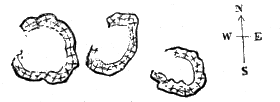
Another sort have an island of which the
foundation is coral, in the middle of a ring like
the above; and a third sort are merely the same
kind of rings round large islands, composed of
other sorts of rocks and earth. A very great
number of the islands hereabouts,—perhaps most
of them, are surrounded in this manner.
I well remember the first impressions which
the sight of a coral reef made upon me. I
always like to treasure up in my mind the first
impression produced by a beautiful scene; for
however wonderful the objects may be, when
you have seen them many times, you become in
some degree indifferent to them. This first impression
that I am going to describe to you, is a
continual feast to me when I think upon it, and
I wish you could enjoy it with me.
The first parts of the reef we saw were black,
roundish masses, standing up out of the water,
having just the appearance of black men's heads,
and when I asked the sailors what they were,
they told me they were "negroes' heads." I was
curious, as you may suppose, to know what they
could be, and I afterwards found they were
masses of coral, which were not covered by the
sea, except at very high tides, and had become
blackened by the weather.
The sun was shining brightly, and there was
a smart breeze. The waves breaking over the
ragged surface of the coral threw up abundance
of spray, which the sun's rays, every now and
then, painted with the most beautiful rainbow
colours. We sailed through an opening, and
when we had got into the Lagoon, the sea was
perfectly smooth. The water was as clear as
crystal, and we saw the bottom, and what was
going on there, nearly as well as if we had been
close to it, though the depth was very considerable.
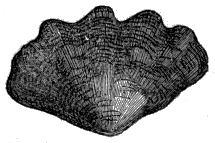
No flower garden was ever more exquisitely
varied, both as to form and colour, than the
scene under the water. The coral itself, standing
up in the forms of shrubs, wheat-sheaves,
mushrooms, stags'-horns, cabbages, and cauliflowers,
was mostly covered with millions of the
little polypes, displaying their graceful rosettes
of green, purple, yellow,
brown and white. Among
these were strewn innumerable
shells from the
smallest to the largest,
and amongst the most conspicuous were the
gigantic clams, of which many specimens weigh
hundreds of pounds.
Then there were seen fish darting in and out
as they
"With quick glance,
Showed to the Sun their waved coats dropt with gold,"
the variegated Zebra fish, and a hundred other
species, often popping up from deep holes and
caves, of which we could not see the bottom.
All seemed life, beauty, and enjoyment, and when
I had looked at it a long time, it brought to my
mind the time when God looked upon what he
had formed, and said that it was good, for you
could not wish anything to be different from
what it was; the scene appeared faultless, and
quite filled up the heart with emotions of love
and beauty.
This reef was one of those which surrounded
a good-sized island. The cut will show you
nearly how it appeared to be situated in regard
to the land; a is the land; b the coral; and c
the Lagoon, the width of which was about a
quarter of a mile.
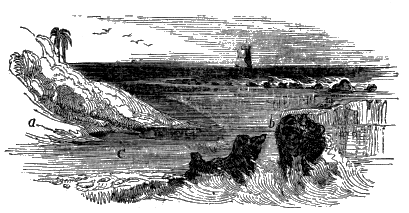
There were in it several masses of coral of a
very curious shape, such as I have since found
always exist in Lagoons. They are first built
up in the form of a sugar-loaf, and when they
get up somewhere between high and low-water-mark,
the polypes extend them at the sides so
as to make a sort of mushroom top, closely
resembling the stones which farmers place ricks
upon, to keep them out of the way of rats and
mice. Their constructing these rocks in the
sugar-loaf form, so as to make them as firm as
possible, is a proof that the labours of the
polypes are directed by a common instinct, and
that each one does not do as he likes, without
regard to the rest. I suppose the reason why
they spread them out at top, is because they
love best the highest habitations they can get,
that are not quite out of the water; and therefore
as many polypes as can, make their residences
there.
As the tide went down, a considerable space of
the shore of the reef was left dry, towards the
Lagoon, where it slanted off gently. Upon this
there were some of the large clam shells, such as
you saw a cut of just now. They generally lay
about half open, but they would occasionally
shut their shells together with a loud report, and
then spout up a stream of water three or four
feet high. We boiled one of these fish and tasted
it, but found it very disagreeable. The fish
weighed about four pounds, and the shell about
fifty. There were many of a much larger size.
The reefs towards the sea outside the Lagoons
go down very suddenly, and the soundings are
generally deep, close alongside them. This is
ascribed to their being built upon the tops of submarine
hills and mountains, for it is believed that
the polypes cannot work at very great depths.
The surface of the reef is seldom quite so high
as high-water-mark; but they sometimes go
along an incredible distance without interruption,
very near that point. The inhabitants of
the group of islands called Disappointment
Islands, and also of those called Duff's Islands,
pay visits to each other over a bridge of coral
600 miles in length, on a great part of which
their feet are close to the water, so that they look
when on their journey at the time of high-water,
just like troops marching on the surface of the
ocean.
The natives of some of the Polynesian islands
have actually employed some of these wonderful
little masons to build quays and piers. The
way they do this, is to break off large masses of
coral from any reef that may be near, and drop
them down where they want to form the pier.
In a short time the polypes will have stuck them
together as firmly as possible. In an island
called Barabora, a very fine quay has been thus
constructed, where a good-sized vessel may conveniently
take in or discharge its cargo.
There were once coral islands where England
is now, for in many counties fossil coral is found
in great quantities. It is indeed most likely that
there are large tracts in every part of the world,
which owe their existence to the labours of
polypes.
This would most probably be the history of the
formation of one of these tracts, if it were in the
Pacific Ocean. A volcanic eruption would throw
up a mountain from the bottom of the sea, the
top of which might be 60 or 70 feet below the surface.
As soon as the eruption had ceased, some
polypes who may have left their position on a
neighbouring reef, might be brought by the tide
into contact with the summit, and would immediately
begin to work. The race of polypes
would multiply, and the building would go on
year after year, till the reef reached the surface.
Pieces of wood which are always drifting about
in the ocean, might be washed into the Lagoon
and rest upon the shore. A little soil might thus
be formed in the course of years, and a cocoa-nut
or some other sort of seed, which would
equally well bear soaking in the salt water,
might be brought from some distant land, and
may take root and produce a tree. The steady
trade winds would also bring some of those
seeds which are provided with wings, such as
thistles. Various sea birds might build their
nests upon the infant land, which would thus be
increased in a hundred different ways. Small
animals driven out to sea on pieces of timber or
trees, torn away from their original position by
hurricanes, might land upon it; and after a succession
of ages, man would take possession, and
a populous country in time be formed.
If you are fond of poetry, you would be much
pleased with a very beautiful description of such
a process as this, in James Montgomery's poem,
called the Pelican Island, which you should
read.
CHAPTER VIII.
THE LUMINOUS APPEARANCE OF THE SEA.
If you were to go on a long voyage, there is
nothing that you would be much more pleased
with, than the occasional bright appearance of
the sea at night. You might see this in all latitudes,
but more frequently in the tropical, than
in colder climates. It occurs in a variety of
modes, and, as it seems, arises from several different
causes. Sometimes the wake of the vessel
looks like a waving line of beautiful silver
light; sometimes the surface will be studded
with spots of bright light, about as large as your
heads; not unfrequently you may see large islands
of light; and now and then a shoal of Albicores,
or some other fish, will pass the vessel, shaking
sparks of dazzling brightness from their fins in
all directions.
It has been supposed by some that the brightness
in the track of a vessel, and that which
sparkles and flashes in the spray on the tops of
the waves, is electrical light: whether it is so
or not, I cannot tell you.
The effect is, no doubt, sometimes produced
by decayed animal and vegetable bodies, which
appear bright in the dark. I dare say you have
seen the bodies of dead fish, and the surface of
rotten wood have this appearance. The particles
in which the brightness exists are so small,
that you cannot see them, for, if you touch the
luminous body, particularly if it is a stinking
fish, your fingers will immediately appear bright
in the dark, and when you look at them in the
light, you will not be able to see anything on the
surface of the skin.
But the most wonderful and extensive cause
of all, is the existence of countless myriads of
fish and insects, which are supplied with a fluid
substance that oozes out of their bodies, and
shines with a greenish light upon their surface.
Some of them may easily be taken, by dropping
over a net where the luminous spots appear. A
few of them are small shell-fish, of the crab or
lobster kind. However, the greater part are
an immense family of creatures called Acalephæ,
or sea nettles. The word Acalepha is the Greek
for a sting nettle, and they are so called for a
reason which I will tell you presently.
There are a great many different forms of
them, but they mostly agree in having their bodies
shaped something like an umbrella, with
long filaments hanging down from them. This
is a picture of one of the kind
called Berenice. It takes its
name from the resemblance of its
filaments, to the long hair of a
lady. Berenice was the wife of
a warrior, who made a vow to
sacrifice the hair of her head,
which was singularly beautiful, to Venus, if her
husband returned from some successful exploit
in which he was engaged. He did so, and the
lady accordingly hung up her hair in the temple
of Venus, and thereby gained the honor of
giving her name to a constellation called the
hair of Berenice, and the curious animal figured
in the cut.
The substance of the body is a mere mass of
jelly, mostly quite transparent, but sometimes
tinged with blue or green; and when deprived
of life it becomes merely a salt liquid, and an
extremely thin skin, weighing only a few grains.
The mouth is underneath, in amongst the
filaments, which seem to be placed where they
are for the purpose of entangling small fish
and insects, to hold them till the Acalepha can
swallow them. A very great number of them
are of a kind called Medusa, from the resemblance
of their filaments to the snakes, which were said
to take the place of hair upon the head of Medusa,
one of the Furies. One or two sorts have a
crest which they erect as a sail, and thus move
along before the wind, on the surface of the sea,
in calm weather. I will show you the picture of
one of these called the Physalia.
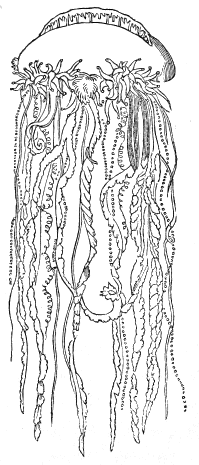
The size varies from that
of a pin's head, to a foot
or more in diameter, and
it is said that some have
been found to weigh as
much as 50 pounds. Their
weight is a very little more
in proportion to their bulk
than that of salt water,
and they keep themselves
afloat on the surface, as
long as they are inclined,
by moving very slowly
along, which they do by
alternately contracting and
expanding a very light
ring of muscle, which
surrounds the umbrella.
When they are tired of their snail's gallop, or
they want to descend on any other account, they
cease moving, and down they go. In this respect
they are just like a man swimming, who
sinks if he ceases to strike with his limbs.
There are some species peculiar to hot climates,
where they are generally larger, and
more luminous; and some to cold. But what
is wanting in size is amply made up in number,
in the Arctic regions. A certain naturalist calculated
by a fair average, how many Acalephæ
there were in two square miles of sea, and the
result of his calculation would fill up a whole line
of this work with figures; you may judge something
of it, by his saying that to count the number
would have taken 80,000 persons all the
time that has elapsed since the creation of the
world, counting as fast as they could! It is on
these creatures, most of them so small that they
cannot be seen without a microscope, that the
vast bodies of the whales are supported, caught
in the wonderful shrimp-trap, which I described
to you in a former page!
Two or three kinds are found on your own
shores, and I should not wonder if some of you
may not before now have found them lying on
the sea-shore, which the tide has left dry, and
taken them up in your hands. If so, I am sure
you will not forget it, nor be in any difficulty
to know why they are called sea nettles. They
have a stinging power, which will make the hand
smart that touches them. This is owing to a
caustic fluid with which a part of their bodies is
constantly covered.
It is this caustic fluid which is luminous. It
oozes through the skin all round the muscular
ring by which they move, and at the large filaments.
The whole body of the creature looks
bright, but it is only from the light transmitted
by these parts. You may get a very fair notion
of the appearance of one of their bodies, by
rubbing together two partly transparent pebbles
in the dark; the light is of nearly the same
colour, and though it is only produced just at
the points of contact of the pebbles, it illuminates
their whole substance.
As they move along they are much brighter
when they contract their bodies, than when
they expand them; this is because in contracting
they press out the luminous fluid. I will
tell you of some experiments and observations,
which have been made on them.
The body of an Acalepha was squeezed over a
glass of warm fresh water, and the fluid that
dropped out communicated its luminous property
to the water. The same was then done
with a glass of warm salt water, but the effect
was not nearly so great.
One was squeezed over a vessel containing
nearly a quart of milk, which it made so resplendent
that one could see to read by it. The
milk retained its brightness for several hours,
and when it faded, it could be restored by stirring:
even three days afterwards it was made
bright by being warmed.
In this manner the Acalephæ communicate a
slight degree of light to the sea-water, in which
they swim; but, if they are put into fresh water,
the light spreads much further.
I have often seen them round the ship, looking
like so many moons, and emitting light
enough for me to read by, some on the surface,
and others at various depths below it. Their
appearance was exquisitely beautiful when the
weather was still and the night dark; but as I
thought about it, I could not help having something
of a melancholy feeling at the strange
kind of half-life these creatures lead. They
might enjoy themselves, but I could not tell
how, for they had no sight nor hearing; they
loved no light except their own selfish light;
they moved about in the open sea, without seeming
to enjoy their freedom, for they did not
care which way they moved; they had no fixed
homes or neighbourhoods to love, like the coral
insects; and above all, they did not care for
their kind, for they appear to come near each
other only by chance as the wind or the waves
may drive them.
But as they were created by God, their life
was given them for some wise end, and no doubt
they have something to do in creation, and they
are capable of enjoyment, though perhaps of
nothing that would be enjoyment to us.
Plate XV. p. 231
SEPIAS
CHAPTER IX.
Have you ever seen the bone of a cuttle fish?
It is a flat, white, very light thing, about the
shape and size of a small sole, or flat fish, which
may be often picked up
on the sea-shore. One
side is covered with
a very hard substance,
which stands out and forms a border all round;
but the other side, which has no covering, is so
soft that you can easily scrape it into powder
with your nail. It is often used for making
tooth-powder, and polishing certain things, such
as hard woods and tortoise-shell.
This comes from some of a most curious family
of fishes, called by the general name of
Cephalopods, from the Greek words for head and
feet, because their feet are placed round their
heads, and they walk along with their heads
downwards.
There are several kinds represented in the
plate, which will give you a general notion of
their form and appearance. In the structure of
their bodies they possess much more in common
with the kind of animals with which you are
familiar, than the Actiniæ which make the coral,
or the Acalephæ which produce the luminous appearance
on the sea; though nothing can be more
strange or unsightly than their aspect. They
have a complete system of circulation, though
their blood is neither warm nor red as ours is;
their brains are enclosed in a strong case or
skull of gristle, and their organs of sense are
well developed; they have large and perfect eyes,
(as you may see in the picture,) standing out
prominently, and ears on each side of the brain.
Their mouths are armed with very strong horny
lips not unlike the bill of a parrot, between which
is a very rough tongue. They have no noses,
but it has been proved by experiment that they
like some smells and dislike others, and it has
been supposed that the quality of substances
which affects merely the organ of smell in us,
affects in like manner the whole surface of their
bodies, or at least, of their heads. They not
only resemble birds in their mouths, but also in
having gizzards.
Their great arms or legs, for they serve both
purposes equally well, of which they generally
have eight, are very wonderful. They have no
bones in them to act as levers, but are merely
long and muscular masses of flesh which they
move about with wonderful activity and power
in all directions, having the most complete command
over them. On their surfaces are great
numbers of little suckers or cups resembling leather,
which adhere very strongly to anybody
which the animal chooses to embrace.
You have, no doubt, often played with a round
piece of thick leather with a string through it,
by wetting it and pressing it with your foot
upon a stone, so as to lift the stone up, if it be
not too heavy. It is just on the same principle
that the suckers of the Cuttle Fish act.
These curious creatures gather up some of
their arms into a point, as a sort of cut-water, as
sailors would call it, and swim very rapidly, by
means of the others, having their heads behind.
They crawl in all directions with equal facility.
Their skin changes colour in spots like that
of the Chameleon. But I shall now tell you their
most remarkable peculiarities. They are provided
with a bag filled with black stuff, very like
printer's ink. This
bag they can at
pleasure open, and
press out some of
the ink; so when any voracious fish approaches,
which the Cuttle Fish thinks will be too strong
for him, he squeezes his ink-bag and colours the
water round him, and thus all of a sudden
becomes enveloped in a dark cloud, in which his
enemy gropes about in vain, while he makes the
best of his way off. Is not this a most astonishing
mode of defence?
The kind which is found most frequently in
our country is represented in the plate fig. 2. Its
skin is smooth and often of a dusky white, with
reddish brown spots, and its length about a foot.
It is eaten by the poor people on the coasts of
the Mediterranean Sea. I never tasted it, but
I do not think that either you or I should like
it, from the look of its flesh.
There is another species of which the ink
makes the colour called sepia, which is of great
value to artists.
The largest is called Octopus, and is figured
No. 1, in the plate. It is a very powerful creature,
and very ferocious in its disposition. It is
mostly found in the Indian Ocean, where it has
been known to drown men by throwing its great
arms round their limbs as they were swimming.
It is also much dreaded by the natives of some
of the islands, who sail in small canoes; for an
Octopus will sometimes cast one of its arms
over the side of the canoe, and will be sure to
overturn it, if the man does not instantly chop
the arm off.
Like most other very wonderful things, the
accounts of the Octopus seem to have been
strangely exaggerated, though we should not be
too ready to deny what a man who seems to be
sensible and honest relates, merely because it is
not like our own experience. In regard to the
largest size to which the creature has been
known to attain, it is very difficult to tell what
is the truth. I will relate to you what has been
said on the subject.
Some navigators have asserted that the largest
vessels have been put in danger by an Octopus
raising its arms so as to get them entangled
in the rigging; and a great many have said
the same respecting large boats.
Pliny, the Roman Naturalist, tells a story of
one in particular, which was a sad thief. I should
tell you that the Octopus is able to walk on
land when the surface is uneven, so that he can
get something for his suckers to adhere to.
Well, this individual that Pliny mentions, used
to visit a house near the sea-side, and steal all
the provisions within his reach. He was seen
once or twice before he could be taken; but at
last his thefts were so important, that the inhabitants
of the house watched for him all night,
and caught him by the help of dogs, as he was
striding over the rocks towards the sea. It is
said that he weighed 700 pounds, and that his
arms were 30 feet in length, and so stout that a
man could not embrace them.
Still more wonderful are the narrations which
were commonly believed about 150 years ago,
respecting some Sepias that frequented the coast
of Norway. They were then generally called
Krakens, and were supposed to be at times
nearly a quarter of a mile in length. It is related
that sailors not unfrequently mistook them
for islands.
This is alluded to by Milton in a passage of
the Paradise Lost,—
Him haply slumbering on the Norway foam
The pilot of some small night-foundered skiff,
Deeming some island, oft, as seamen tell,
With fixed anchor on his scaly rind,
Moors by his side under the lee, and waits
The wished approach of morn.
I dare say you will be ready to think that
these things are very unlikely, and I shall not
much differ from you if you do. But no doubt
some of these creatures must be very large, and
much to be dreaded, or such things would never
have been said of them.
Plate XVI. p. 239
PAPER NAUTILUS.
CHAPTER X.
But there is one of these Sepias, or Cuttle
Fish, which I like very much, though its character
rests under as severe an imputation for
dishonesty and rapacity, as that of the rest.
It is that one which inhabits the beautiful white
semi-transparent shell, and is called the Paper
Nautilus, or Argonaut.
Its body is represented out of the shell in the
plate, fig. 3, and you will there see that it is not
very different from those that are not provided
with shells, except in having two of its eight
arms spread out at the ends into a thin membrane
or web. You shall hear presently the
pretty use which it makes of these webs.
It has no muscular attachment to the shell,
as most other shell-fish have, but merely adheres
to it by means of its suckers. On this account,
some have thought that the Sepia must be an
usurper, who has murdered the original master
of the shell, and taken possession of his house.
But I do not believe there is any truth in this
charge, for the same sort of animal is always
found in the same shell, and if it be taken out,
though it may be kept in salt water, it is sure
to die.
When at the bottom of the sea, he walks
about with his shell uppermost, like a snail, but
of course with a much more rapid motion, and
every now and then snatches any mouthful that
may take his fancy, with two of his long arms,
and conveys it to his horny beak.
When the weather is fine, and he is disposed
to enjoy it, he partly empties his shell of water,
so as to make himself lighter than the surrounding
sea, and comes up to the surface, on which
he floats like a little ship.
I once had an excellent opportunity of watching
one. The sea was beautifully calm, and blue,
and the sky perfectly clear, when I caught sight
of something white coming upwards at a little
distance from the ship. In an instant the delicate
white shell popped above the surface, twirled
round, and the Sepia spouted out the water remaining
in his shell, spread out his two sails, and
threw out his six remaining feet, three on each
side of the edge of his shell, which acted as oars,
and scudded away before the wind. If you had
but seen the glad little creature, it would have
done your heart good. He seemed full of freedom,
and life, and joy. The dark deep caves
of ocean, with their corals and sea-weeds, and
strange variety of inhabitants; the broad surface
of the sea, the fresh breeze, the lovely blue sky,
and the glorious light of the sun, were all at
his command.
"Thou the light sail boldly spreadest,
O'er the furrowed waters gliding,
Thou nor wreck nor foeman dreadest,
Thou nor help nor comfort needest,
While the sun is bright above thee,
While the bounding surges love thee,
In their deepening bosoms hiding,
Thou canst not fear
Small marinere;
For though the tides with restless motion
Bear thee to the desert ocean,
Far as the ocean stretches to the sea,
'Tis all thy own, 'tis all thy empery.
"Lame is Art, and her endeavour
Follows Nature's course but slowly,
Guessing, toiling, seeking, ever,
Still improving, perfect never.
Little Nautilus, thou showest
Deeper wisdom than thou knowest;
Lore, which man should study slowly;
Bold faith and cheer,
Small marinere.
Are thine within thy pearly dwelling;
Thine, a law of life compelling
Obedience, perfect, simple, glad and free,
To the Great Will that animates the sea."
(Hartley Coleridge.)
You should read these exquisite lines with
deep attention. There is an allusion in the second
verse to the common notion that the form
of a ship was first taken from the Nautilus; and,
indeed, there is a very distinct resemblance in a
part of the shell to the keel, and in another part
to the poop. The sails and oars you will see
best in the picture.
Do you think that if the Sepia were a murderer
and a thief, in possession of what does not
belong to him, according to the notion of some
naturalists which I was telling you of just now,
that he could be so happy,—so in every way at
home,—in his silver boat? If you had seen him
as I did, I am sure you would agree with me in
saying that he could not be any other than the
rightful owner.
After "the small marinere" had sailed some
distance, he folded up his sails and packed them
and his oars close into his shell, and went down
like a stone.
The Paper Nautilus is mostly found in hot
climates. It is never seen on the surface unless
at a long distance from land, and it is very shy
of danger, so that it is not often you can get
such a good chance of observing one as I had.
I have been told by a person who was to be
trusted, that sometimes the Sepia will lay hold
of a piece of drift wood, a large leaf, or any
other floating substance, and use it as a raft,
when it is not inclined to take the trouble of
balancing its shell with its feet, and spreading
its sails.
And now, my little friends, what I have told
you respecting these marvellous Sepias, reminds
me of something on which I may give you a
useful caution. Many people are very fond
of congratulating you on the great wisdom
and knowledge of the times in which you live,
and of making very light of what the ancients
knew, or thought they knew, especially respecting
natural history. In doing this they are not
just to those who lived before us, and very often
deceive themselves in regard to the present state
of our knowledge. Aristotle, the tutor of Alexander
the Great, did more in investigating the
nature of the Nautilus, and all other kinds of
Cuttle fish, than any other naturalist has done,
and in his writings, (if you could read them,)
you might find nearly all the particulars I have
mentioned, and a great many besides. As to
some foolish things that may be found related by
him and other old writers, which are held up for
your ridicule, it is not at all unlikely that future
ages may find flaws and follies in what writings
we may leave behind us, as we now do in what
our predecessors have left us.
THE PEARLY NAUTILUS, &C.
There is another kind of Nautilus, the shell
of which is very strong, and marked with brown
streaks. You will see it in plate XV, fig. 4. It
also differs from the Paper Nautilus, in being divided
into a succession of cells or chambers, in
this manner.
In this respect it is like the immense family
of extinct shells called Ammonites, or Cornua
Ammonis; but the partitions of the chambers of
the latter are undulated, thus
As the cells are mostly filled with various
hard earthy substances, so as to form one solid
mass, they used to be called snake-stones, because
it was fancied they were petrified snakes.
There are a great number of them on the coast
of Yorkshire, and the story was once believed
that the place had been infested with an immense
quantity of snakes which were changed
into stone at the prayer of St. Hilda. What I
am going to tell you, relates both to the Ammonites
and the Nautilus.
If you examine the first cut, you will see
small openings connecting all the cells with each
other, and the continuous passage thus formed
through the whole of the shell, is called the
siphuncle. The inhabitant of the shell is an
animal of the Sepia kind, but without the webs
which serve the Paper Nautilus for sails, and
with its arms not so long. It always resides in
the outermost chamber, and it is supposed that
it forms a new partition every year, so that the
age of the animal may be known by counting
the number of chambers.
When the Pearly Nautilus wishes to rise to
the surface, it pumps out the water from its
shell through the siphuncle, and makes itself
light. It floats often with its shell upwards, and
at other times it moves along backwards for a
considerable distance, by means of spouting out
water over the front edge of the shell. It never
floats with the same beautiful stateliness as the
Argonaut.
There is also the pretty little shell of the
Nautilus Spirula, not much larger than a shilling,
plate XVI, fig. 5, which does not contain a
fish, but is merely annexed to the body of a
Sepia, as is represented, fig. 6. Its use appears
to be just the same as that of the shell of the
Pearly Nautilus, to answer the purpose of a float.
These two kinds are very rarely seen floating
on the surface, though there must be many of
both of them in the ocean, from the number
of their empty shells which are found. Perhaps
this arises from their not being so buoyant
as the Argonauts, and hence they more
readily dip under the surface at the approach of
a vessel.
It is now time for us to bid adieu to the sea
and its wonderful inhabitants, since I have promised
to tell you of some of the wonders of the
sky, (though I remember a great many more
things that I should like to tell you of).
CHAPTER I.
Before I tell you of some of the wonders of
the sky, I should like to tell you what the sky
is: it is true you know pretty nearly as much as
I do about it, but you perhaps have not thought
so much on what you know. The sky is everything
above our heads which is not connected
with the earth: thus, you may speak of a cloudy
sky, or a clear sky; or of the stars, sun, and
moon, being in the sky.
It may however be more proper to restrict
the word to the blue appearance which the atmosphere
above us assumes when it is not concealed
by clouds. This appearance is caused
by looking into the air, which surrounds the
globe to the height of forty or fifty miles above
its surface, and not by anything which exists
above it; for mountains, when seen from a great
distance, appear of the same colour, evidently
from the extent of the air between the spectator
and them.
Climate and the season of the year, have a
considerable influence on the colour of the sky.
You know what a rich full blue is over us in
the hot months of summer; and I hope you have
before now enjoyed the pale blue of a clear winter's
day, when the brown and bare branches of
the trees have showed against it, and all the
rivers and ponds have been frozen as solid as a
stone pavement. When I see some of you
sliding and skating on the glassy ice, at such
times I am ready to wish I was a boy again, to
join in your pleasures. However, I have had
my turn, and old age has its pleasures as well
as youth, only we are apt to get into a way of
looking at all past times as happier than the
present, which is both foolish and wicked. If
we were to keep ourselves diligently engaged in
doing our duty, we should always be happy,
whether old or young.
But the darkest blue sky you have ever seen
in your country, is light compared with the
skies of hot climates. In them you often see a
deep rich indigo; at other times you are under
a canopy of reddish orange, almost copper
colour, like that which was called in the poem
I quoted to you when describing the tropical sea,
"a hot and copper sky."
The elevation of the observer above the surface
of the earth, is likewise another cause of
variation. I have never myself ascended a mountain
sufficiently high to see this, but I have
been told by a gentleman who had been at the
top of Mont Blanc, that the sky there looked
nearly black.
As you must have seen them yourselves, I
need only remind you of the glorious changes of
colour by the alteration of the light at the different
times of day. I hope none of you are so
lazy as not often to have enjoyed the rosy mornings;
then there is the grey twilight of evening,
and the splendours of the setting sun in the
west, round which the deep orange shades off
into the most delicate yellow, which again glides
imperceptibly into pale blue towards the east.
Then the moon, when she has the heavens all to
herself, and the stars, when they are shining out
boldly in her absence, each make the sky so
beautiful, and are so beautiful in themselves,
that one cannot exceed the other.
I love to look at the moon when the winds
rend the clouds asunder, and drive them tumultuously
along, and you see her now and then in
the dark blue depths between. But if I were
to tell you all the ordinary appearances in the
sky which I love, I should leave no room to describe
its wonders; which will not do, because I
meant this book to give you an account of things
which most of you have not seen.
CHAPTER II.
During the winter months in the Polar Regions,
the sun never rises above the horizon;
and during summer it performs in appearance a
little circle round the pole of the Heavens, and
never goes out of sight. You may learn in what
manner this is occasioned by the position of those
countries on the surface of the earth, from the
book called "The Wonders of the Telescope."
The year is thus in reality divided into one
long day and one long night. While the night
continues, the ground is covered with snow, and
no vegetable life is to be seen, and the animals
have much to do to support themselves on what
fish they may chance to pick up on the sea
shore, by preying on each other, or else by
scraping away the snow to get at that scanty
vegetation which exists underneath. The odd-looking
Esquimaux and Greenlanders would indeed
be very badly off, if it were not for the
beautiful atmospheric phenomena which I am
going to describe.
There are seldom intervals of many hours
which are not illuminated by these beautiful
meteors, called Auroræ Boreales, or Northern
Lights, occurring in a never-ending variety of
form, colour, and intensity. They generally
have a tendency to form an irregular arch, and
one side of them is always much better defined
than the other. The more ragged side sends
out brilliant corruscations, shooting out into
the sharpest angles.
Sir John Ross describes one which was
nearly the colour of the full moon, and of
equal brightness, in the form of a well-defined
arch extending quite across the heavens, and
reminded him of what he conceived must be the
effect of Saturn's ring seen by the inhabitants
of that planet from its surface. It lasted for
several hours, and at last broke up as it were
into fragments of light, and disappeared.
The distinctness of its form is much influenced
by the wind, and when the air becomes agitated,
showers of rays spread out in every direction
with the quickness of lightning. Sir Edward
Parry describes long bands of light extending
with immense rapidity, but always appearing to
form round a fixed point, something like a
riband held in the hand and shaken with an
undulatory motion.
Little scraps of the brightest light dart about
in the heavens, called by the sailors, "merry
dancers." In stormy weather these wild little
things assume all manner of fanciful shapes;
sometimes they shoot like rockets across the
firmament, then take a zigzag or waving direction,
and frequently seem to become invisible,
and shine out again a little further on. The
Esquimaux say that these appearances are the
spirits of their ancestors playing at ball with
the head of a Walrus! You may perhaps laugh
at this odd notion, and I will laugh with you, if
you will learn a lesson from it. You see that
men in various states of society, are always
looking out for the appearance of spiritual
beings, and therefore that this disposition is
a part of their constitution which is given
them by God: and although their fancies may
form strange notions at times, yet the exercise
of the faculty, in some way or other, is very important.
Men had much better think that they
see spirits in the Aurora Borealis, and that
they hear them in the wind, than forget that
there are such things as spirits, and that they
have spirits within them, which will live when
their bodies are turned into dust.
But for you, my little friends, who are better
instructed, there is no occasion to think you can
see or hear spirits with your bodily ears and
eyes; but I trust you will always feel inwardly
that there are spirits within you and around
you, and one Great Spirit above you.
The most beautiful form of the Aurora, is
called the Corona. It is a luminous ring generally
just overhead, with long distinct rays very
slender, but extremely bright, diverging from it
all round. It only lasts a few seconds, and then
seems to burst like a firework, scattering sparks
in all directions.
The stars mostly shine through the Aurora,
as through a veil of thin gauze. The darkness
of the sky, with the stars shining in it above
and below, produces a most astonishing effect,
which you may see very well represented in the
frontispiece, where there is depicted a small
portion of the middle of a luminous arch, very
clearly defined.
It was considered, till quite lately, that the
Aurora in the Northern regions, made a sort of
rushing and rattling noise. This, however, seems
to be false, for Captain Lyons used to stand on
the ice with his ears uncovered till they were
nearly frost-bitten, listening with the utmost
attention, but he could never hear the slightest
sound. A very intelligent Danish traveller says,
that he has often heard the sound, but that he
is convinced of its being produced by the wind
blowing upon the ice. The reason of its being
heard while the Aurora is shining, seems to be
that the Aurora often appears when it is windy,
or has something to do with a change of weather,
which also occasions the noise.
The Aurora often appears in this country, but
not with nearly so much brilliancy or frequency,
as in more northern countries. I have, however,
seen it very beautifully developed in light tints
of red, yellow, and green, but very seldom with
a clear outline and determinate form. It appears
that it has been observed here much
oftener than formerly, within the last hundred
years, and this applies to nearly the whole of
Europe, where it occurs. In Sweden, before the
year 1716, it was a great rarity, and about the
same time the inhabitants of Iceland were alarmed
at its becoming so much more frequent than it
had previously been, supposing that it portended
some great misfortunes to be coming
upon them. A similar fancy prevailed amongst
ignorant persons in this country, and I have
heard that people used to imagine that the appearance
was a sign of an approaching war.
I have very little to say to you respecting the
cause of this wonderful phenomenon. The
most reasonable notion seems to be, that it is
occasioned by electric fluid playing about, and
diffusing itself in the upper regions of the
atmosphere, where the air is very thin. A similar
kind of light is produced by a very pretty experiment,
which consists in sending an electric
spark through a long glass vessel, from which
the air has been exhausted. When the air is
more compressed, as it is near the surface of the
earth, the electric fluid does not so spread itself
abroad, but moves in more direct lines, and in
more compact masses, as you may see in lightning,
or in the sparks of an electrifying machine
sent into the atmosphere under ordinary
circumstances of density.
CHAPTER III.
PARLEY TELLS OF SOME OTHER METEORS.
PARHELIA OR MOCK SUNS.
There are a great many very wonderful appearances
in a polar sky, besides the Aurora
Borealis. Perhaps the most remarkable of these
are Parhelia, or "mock suns," which are often
seen to shine in various parts of the sky. As
many as six of them are sometimes seen at
once, all shining with great brilliancy. They
are generally brightest just before day-break,
and fade away as the true sun ascends.
Parhelia have also been seen at different times
on the continent of Europe. At Marienberg, in
Prussia, many years ago, towards evening, one
was observed which seemed attached to a small
white cloud that was situated just below the sun.
It was at first of a reddish colour, but as the sun
descended towards it, it assumed the aspect of
the sun itself.
Three at once were seen at Sudbury, in Suffolk,
and two were seen in a part of Rutlandshire.
There are recorded many other appearances
of this remarkable phenomenon, but they
do not seem to differ much from each other.
There is great uncertainty as to what occasions
these mock suns. Perhaps they are
merely reflections of the image of the true sun
upon reflecting clouds, such as I shall describe
to you presently. The circumstance that seems
to render this probable, is that they sometimes
become brighter as the sun approaches them,
which cannot easily be accounted for by supposing
them to have any source of light in themselves.
On the contrary, their fading away at
times as he rises, may be occasioned by the
clouds on which they are reflected, becoming
rarified; or the effect may be only comparative,
just as the moon grows paler, and at last disappears,
as day comes on. Thus you see the two
opposite effects of the sun's approach may be
equally well accounted for, on the supposition
of the Parhelia being mere reflections of the sun,
and I do not think that they could on any other.
IGNES FATUI.
The name Ignis Fatuus, or False Fire, is applied
to a flickering, bluish light, which is often
seen in marshy districts, and in damp burial
grounds, either on the surface of the earth or
only a small distance above it. So you see it is
not strictly a wonder of the sky; but I introduce
it here because it seems to be somewhat similar
to some of the higher meteors, in the manner in
which it is occasioned.
A great many entertaining stories are told of
persons having mistaken these Ignes Fatui for
real lights, and it is said that benighted travellers
have frequently been led far astray by them.
They are vulgarly called in various parts of
the country, Will-o'-the-Whisp, Jack-o'-the-Lantern,
Peg with her Lantern, and in burying
grounds in Scotland, Grave Candles; and strange
superstitious notions are annexed to them.
They keep constantly in motion; now rising a
few feet above the earth, now sinking to the
surface; now seeming to be close to you, disappearing
in an instant, and shining out at some
distance; at times one of them dividing into
two, or two seeming to join into one.
I will presently tell you how you can try a
simple experiment, that will go a great way
towards accounting for these idle Will-o'-the-Whisps.
The inflammable gas called Hydrogen,
is copiously produced by the decomposition of
animal and vegetable bodies. The substance
called Phosphorus, is contained in animal bodies,
and is set at liberty in small quantities by their
decomposition. When phosphorus and hydrogen
come together under certain circumstances, they
mix, and a gas called Phosphuretted Hydrogen
is the result.
There is, therefore, no difficulty in supposing
that most marshy grounds may produce this
gas; and this experiment will show that it is
very likely that the Will-o'-the-Whisp is nothing
more.
Hydrogen may be obtained by pouring diluted
Sulphuric acid on small pieces of Iron or
Zinc. If you mix very small pieces of Phosphorus
with very small pieces of Zinc, and put them
into a glass, and pour over them the acid, Phosphuretted
Hydrogen will be sent off, and the
surface of the acid will be covered with a beautiful
blue flame of the very colour of the Ignis
Fatuus. The cause of the flame is, that the phosphuretted
hydrogen is so wonderfully inflammable,
that the moment it comes into air of a
common temperature, it bursts into flame. If
you try this experiment, you will see how likely
it is that the Will-o'-the-Whisp is an escape of
this gas from the surface of the earth.
CHAPTER IV.
There are few of you who have not seen falling
or shooting stars, as they are called. Perhaps
some of you have loved to walk out when
the stars have been shining brightly in the blue
sky overhead, to watch for these shy wanderers
that seem to come from no where, just to
draw a line of silver light across the heavens,
and then disappear. When I was a little child,
I used to think that each appearance of this
kind was the destruction of one of the countless
worlds that surround us, and possibly the same
fancy may, at some time or other, have occurred
to you.
If you have taken delight in watching for
them, you have many a time been disappointed,
because they would not show themselves more
frequently. It is, for the most part, only now
and then that you can catch sight of one; but
there have been some occasions on which they
have appeared in immense numbers.
The most astonishing multitude of them on
record, appeared in the year 1833, in the night
of the 13th of November, and was seen over
nearly the whole of North America, from the
Gulf of Mexico to Baffin's Bay. They came
from all quarters of the Heavens, and are said
at one time to have been half as thick as the
flakes in a heavy fall of snow. It was calculated,
on the most moderate grounds, that
36,000 must have appeared every hour for seven
hours successively.
Previously, in the year 1799, also on the 13th
of November, a similar phenomenon was observed
by Humboldt, the celebrated traveller, by
some Moravian Missionaries in Greenland, and
by many persons in Germany.
In the year 1822, on the same day of the
same month, almost as great a number were
seen in several parts of Europe and Asia.
In the year 1831, a French Officer states, that
on the 13th of November, while off the coast of
Spain, he saw on an average more than two a
minute during several hours of the night.
Similar observations were made in the year
1835, in some parts of France; and from several
other instances, there seems to be good reason
for believing that there are more falling
stars about the middle of November, than during
any other part of the year.
There have been a great many vague and silly
notions devised to account for these remarkable
phenomena, and some that are not unreasonable,
though none perhaps quite satisfactory.
It has been considered that they were clouds
of hydrogen gas, suddenly ignited by electricity,
within the range of our own atmosphere, and
indeed only a very few miles above the earth.
Recent investigations have, however, rendered it
most probable that they are at very considerable
elevations, often as much as 500 miles above us.
But supposing the circumstance of great multitudes
of them appearing just at one particular
period of the year, to be a fact, a new light is
thrown upon their origin which must then be
considered as decidedly of an astronomical character.
The theory which has been proposed,
is this:—that immense quantities of fragments
of matter revolve in regular orbits in our solar
system in various planes, and that on the 13th
of November the earth passes near the orbit in
which the greatest number of such fragments
move. Whether they are matter in a gaseous
state, or approaching it, or quite solid; or whether
they are constantly illuminated, or are only
rendered luminous by their relation to other
bodies, such as reflection, or meeting with electric
fluid, and so becoming ignited, are questions
which must remain unanswered. There may be
a slight evidence in favour of the notion of
their light not being permanent in themselves,
from the fact of a French naturalist having
observed on the 17th of June in 1777, a very
large number of small black spots pass over the
sun's disc. If these spots were really bodies,
which under other circumstances would have
been falling stars, it should not be forgotten
that the earth in June is nearly in the opposite
part of its orbit to that which it passes over in
November.
Well, after all, this is a very doubtful subject,
and we may possibly be very much out in our
notions; but it is always worth while to see
which is the best of two theories, though there
may be ever so little to choose between them.
We should make the best of what knowledge we
have, and never lazily satisfy ourselves by saying—"nobody
can tell which is true," which is
almost as bad as being too obstinate and dogmatical.
For even if we adopt a conclusion
which is wrong, we shall be more ready to receive
the truth when our knowledge may be
increased, than if we have no conclusion at all.
One of the wisest men who ever lived, said—"Truth
comes more easily out of positive error
than out of confusion."
You who have been interested with what I
have told you respecting shooting stars, should
compare with it what I shall tell you in my
next chapter.
CHAPTER V.
METEORIC STONES OR AEROLITES.
There were a great many accounts in very
early times, of stones having fallen from the sky.
In China and some other eastern nations, they
have long had a notion that such occurrences
were connected with political events, and accordingly
they have kept careful records of
what they have known to fall for centuries
back. This was a vain superstition, but it was
not more vain than the incredulity with which
these reports were received by nearly all the
learned of Europe, till about forty years ago.
They denied the existence of aerolites, for no
other reason than because they had not seen
them.
Some new statements attracted the attention
of scientific men in England and on the Continent,
to the subject, about the beginning of the present
century, and the conclusion of their researches
was, that stones of various sizes do, in reality,
not unfrequently fall from above to the earth.
It appears that sometimes they fall singly,
and at other times in great numbers. I will relate
to you some particular instances.
Near Benares, in the East Indies, in the month
of December in the year 1798, a very bright
meteor seemed to fall to the earth, about 8
o'clock in the evening, and a loud noise like
thunder was heard, which was followed by a
shock like the fall of heavy bodies. No cloud
was to be seen in the sky. The light of the
meteor was so great as to cast very distinct
shadows of the objects in its way. The ground
where it appeared to have fallen, was afterwards
examined, and was found to be strangely torn
up, having a number of small holes in it about
six inches deep. At the bottom of each hole was
an aerolite weighing on the average about one
pound and a half.
In the year 1803, a similar event took place
in Normandy. The meteor, when first seen,
must have been at a very great elevation, for
the inhabitants of two places more than a league
distant from each other, thought it was just
over their respective towns. A hissing noise was
also heard, like that of a stone hurled by a sling.
The space over which the stones were dispersed,
must have been more than eight miles long and
three wide. There were about two thousand of
them collected, of various weights, from two
drachms to seventeen pounds.
Two stones, one of which weighed 200 and
the other 300 pounds, fell in the year 1668, at
Verona. In 1680, several small ones are said
to have fallen in London. In 1628, several
fell near Hatford, in Berkshire, one of which
weighed twenty-four pounds. In 1795, one
weighing fifty-five pounds, fell in Yorkshire.
In 1810, a large aerolite fell, which was the
means of setting fire to five villages, and killing
several persons, in India. The largest of these
are, however, small compared with some which
are said, and there is good reason to believe, to
have fallen from the sky, at some time or other.
One of these, now at Bahia, in Brazil, weighs
14,000 pounds.
This is a cut of an aerolite in the British
Museum, which fell in Buenos Ayres. It weighs
1,400 pounds.
They are generally covered over with a thin
crust, which is quite black, and have a very
rough surface. Internally, they are greyish and
of a granulated texture. By the help of a microscope,
you may distinguish roundish grains
of a grey colour; others, like rusty iron; some,
angular pieces of perfectly metallic iron, which
are attracted by the magnet; and the rest is an
earthy sort of cement in which the others are
embedded. Their chemical composition is very
uniform, with the exception of some that consist
almost entirely of iron; of which sort is the one
represented on the preceding page.
Their descent appears to be quite independent
of the state of the atmosphere, from whence we
may infer that the clouds have nothing at all to
do with them, but that they come from much
higher regions. When they have been found
soon after falling, they have always been extremely
hot, and, as I told you of one in India,
they have been known to set on fire what they
have come in contact with on the surface of the
earth.
There have been four schemes devised to account
for the existence of aerolites. It has been
imagined that they were substances which had
been cast out by volcanoes to immense heights
from distant parts of the world; but this is disproved
by the fact that no substance of the same
composition as aerolites, has ever been discovered
amongst the known products of volcanoes.
The celebrated Frenchman, La Place, thought
they were substances that had been cast out by
volcanoes in the moon, with such violence as to
send them within the limits of the earth's attraction.
Some have conjectured that they are formed
in the air by the consolidation of clouds of gaseous
matters exhaled from the earth; but according
to Sir H. Davy's view of the nature of
flame, the light of meteors must arise from the
ignition of solid bodies, so that at least they
must become solid while they are in the condition
of meteors, and long enough before they
approach the earth.
I will tell you what I think, according to the
present state of our knowledge, the likeliest explanation,
though I do not say that the reasons
in favour of it are very conclusive. You will
remember what I told you respecting the probability
of falling stars being fragments of matter
revolving in orbits, which the earth at certain
times comes near in its annual course round the
sun. I suppose shooting stars and aerolites to
be the same things, only they are shooting stars
while they show in the sky, and aerolites after
they have reached the earth.
CHAPTER VI.
There are on record several instances of a fall
of red liquid exactly resembling blood in appearance,
which has often been accompanied by
a descent of aerolites. On the 15th of November
1755, there was a heavy shower of this kind
at Ulm, and several parts of Russia and Sweden.
There was another, March 5, 1803, in Apulia,
where it seemed to fall from a reddish black
cloud. A descent of large quantities of dry
dust preceded the latter, and has on several occasions
occurred by itself.
Before this phenomenon was understood, you
will easily suppose that it was looked upon as
something dreadfully portentous, and the more
so from its occurring so unfrequently. It is
now known to be closely related to the aerolites,
as you shall hear.
Some of the liquid, looking just like congealed
blood, which fell at Ulm, was examined. It
was found to have a sour taste, owing, as it was
thought, to the presence of sulphuric acid.
When dried, the dust that remained, which constituted
the colouring matter, was found to be
subject to magnetic attraction, and in other
respects to resemble the substance of the meteoric
stones; so there can be no doubt that the
dust is nothing more than what is caused by the
fracture or the friction one against the other,
of aerolites, and that the rain is made red by
the dust falling on the clouds, from which it is
precipitated.
RED SNOW.
Several travellers have witnessed the existence
of snow of a bright red colour, in various
parts of Baffin's Bay; and at Arezzo, in Italy,
in March 1813, there was a fall of it, which
lasted many hours.
There seems some reason to suppose that in
the latter instance the redness was caused by
aerolite dust; but a microscopic examination of
some of that at Baffin's Bay, has proved that its
colour is owing to a still more wonderful cause.
The colouring particles are actually small plants
or fungi, which take root and grow, and bear
seed upon the snow itself!
What do you think of this Lilliputian vegetation?
One full-sized plant is no more than
1-1600th of an inch in diameter; and to cover a
single square inch of its cold bed of snow,
2,500,000 are necessary! It has been named by
its discoverer, Mr. Bauer, Uredo Nivalis.
SHOWERS OF FROGS AND FISH.
I dare say you have heard, before now, of its
raining frogs and fish. I like that you should
have correct notions on these things, so I shall
just tell you what seems to have given rise to
these reports.
If you understood what I told you respecting
the water-spout, you will see how likely it is that
any small fish that may be on the spot, should
be sucked upwards along with the water, even to
the very top of the spout; now they might be
kept up there as long as the whirlwind kept up
a rotatory motion in the cloud, after it had ceased
to sustain the column of water drawn up from
the sea. When the whirlwind was exhausted,
the little fish would naturally fall out of the
cloud, perhaps after it had travelled far from
where the water-spout occurred.
If the water-spout had passed over fresh-water
lakes or rivers, frogs might be drawn up instead
of fish, and let fall in the same manner.
But I will relate to you another circumstance,
which may have been imputed to a descent of
fish from the clouds. I told you in the first
part of this book respecting the alluvions, or
torrents of mud, which make their way after an
eruption down the sides of Mount Vesuvius. In
some of the great volcanoes of South America,
these alluvions have not to be formed in the regular
way, but mud of the consistence of pap is
ejected from the craters themselves in amazing
quantities. This mud is supplied by subterranean
waters connected with the volcanic channel,
and it often contains myriads of little fishes
of the kind called Pimelodes Cyclopum: they are
generally about four inches long, and they exist
in such vast numbers, that their putrifying has
before now bred a pestilence in the neighbourhood
of the Volcano. There are plenty of the
same fish in the contiguous streams. What
renders the circumstance so wonderful, is their
being raised up to the level of 8 or 9000 feet,
and then thrown out from the crater with very
little injury.
Plate XVIII. p. 285
SPECTRE OF THE BROCKEN
CHAPTER VII.
THE SPECTRE OF THE BROCKEN.
I am going to tell you respecting some of the
appearances produced by clouds which reflect
like mirrors; and by those changes in the atmosphere
which turn aside, in an irregular manner,
the rays of light, which, as they pass from
an object to the eye which is looking at it, excite
the sensation called vision.
One of the most remarkable of these, has
long been known by the name of "The Spectre
of the Brocken." The Brocken is the loftiest
summit of the Hartz Mountains, in Germany; it
is said to be 3,300 feet above the level of the sea,
and to command the prospect of a tract of land
which is inhabited by more than five millions of
people.
It appears that clouds, from some cause or
other, which perhaps we shall never perfectly
know, are wont at times to collect on the neighbouring
heights, and reflect a very distinct shadow
of great size of whatever object may be on
the summit of the Brocken, when the sun is rising
and casts his beams horizontally. The best account
of this wonderful spectacle, is given by
the Abbe Hauy, who visited it in 1797, and I
shall give you his own statement.
"After having been here for the thirtieth
time," says Mons. Hauy, "I was at length so
fortunate as to have the pleasure of seeing the
Spectre. The sun rose about four o'clock, and
the atmosphere being quite serene towards the
east, his rays could pass without any obstruction
over the Heinrichshohe.[A] In the south-west,
however, towards Achtermanshohe,[B] a
brisk west wind carried before it thin transparent
vapours, which were not yet condensed
into thick heavy clouds. About a quarter past
four I went towards the inn, and looked round
to see whether the atmosphere would permit me
to have a free prospect to the south-west; when
I observed, at a very great distance towards
Achtermanshohe, a human figure of a monstrous
size. A violent gust of wind having almost
carried away my hat, I clapped my hand to it
by moving my arm towards my head, and the
colossal figure did the same. The pleasure
which I felt on this discovery can hardly be described,
for I had already walked many a weary
step in the hopes of seeing this shadowy image,
without being able to gratify my curiosity. I
immediately made another movement by bending
my body, and the colossal figure before me
repeated it. I was desirous of doing the same
thing once more; but my colossus had vanished:
I remained in the same position, waiting to see
whether it would return, and in a few minutes
it again made its appearance on the Achtermanshohe.
I paid my respects to it a second
time, and it did the same to me. I then called
the landlord of the Brocken; and having both
taken the same position which I had taken
alone, we looked towards the Achtermanshohe,
but saw nothing. We had not, however, stood
long, when two such colossal figures were formed
over the above eminence, which repeated our
compliments by bending their bodies as we did;
after which they vanished. We retained our
position, kept our eyes fixed on the same spot,
and in a little time the two figures again stood
before us, and were joined by a third," (most
likely by the double reflection of one of the spectators.)
"Every movement that we made by
bending our bodies, these figures imitated; but
with this difference, that the phenomenon was
sometimes weak and faint, sometimes strong
and well defined."
There are some remarkable circumstances attending
the Brocken, that are doubtless in some
degree connected with "The Spectre," which
was once looked upon as a supernatural apparition.
When Christianity was introduced into
Germany, the priests and votaries of the old superstition,
retired to the Brocken as a refuge,
and there long kept up the dark and mysterious
rites of the great Saxon idol, Cortho. It is a very
wild place, full of clefts and caverns, and with rivulets
and waterfalls on all sides of it, so that it
would answer their purpose remarkably well.
After the inhabitants had taken up the profession
of Christianity, they used to celebrate on this
mountain a festival on Midsummer night, in honour
of St. Walpurgis, a female saint, who had first
introduced Christianity among them. A legend
then prevailed, that the summit of the mountain
was occasionally haunted by a demon, which could
have been no other than the Spectre. Everything
about the mountain was looked upon with
awe and veneration. A beautiful spring which
runs down its side, is at this day called the Magic
Spring; a pretty little lily that abounds on the
Mountain, is called the Wizard's Flower; and
two great square granite rocks are called the
Wizard's Chair. These names may be looked
upon as monuments of the estimation in which
the mountain was once held.
While you ought, my young friends, to feel
happy and grateful in being taught what these
natural things really are, and released from all
superstitious fears or notions respecting them;
you should be most careful not to forget what
you owe to a purer faith, of which the character
is to invite you to inquire into, and to know
everything within your reach.
I shall say something to you respecting the
cause of the Spectre, in a future chapter.
CHAPTER VIII.
SOME OTHER INSTANCES OF AERIAL REFLECTION.
There has been something very like the Spectre
of the Brocken, seen on Souter Fell, a mountain
about half a mile high, in Cumberland.
One summer's evening, in the year 1743, as a
farmer, named John Wren, and his servant were
sitting at the door of his cottage, they saw a
man with a dog furiously chasing some horses
along a ledge on the side of the mountain which
they knew was so narrow that a horse could
hardly stand upon it. They seemed to go round
one end of the mountain, and disappeared.
The next morning the farmer and his servant
went round the track which the horses and man
had seemed to take, fully expecting to find that
they had fallen over and been killed. You may
guess how surprised they were to find no trace
whatever of them, not even the mark of a hoof
on the ground.
Well, they said nothing of what they had seen,
and perhaps they almost forgot it by nearly the
same season in the following year, when the servant,
whose name was Daniel Strickett, saw one
evening a whole troop of horsemen trot along
the mountain-side, near the same spot. It
seems that he had been laughed at by those to
whom he had related the other apparition, so
he was rather timid, and resolved to be well assured
of the reality of this one before he mentioned
it. He looked at the figures for a considerable
time, and then called another person to
witness the sight with him. Several others afterwards
joined them, and continued looking at
the aerial horsemen till it was quite dark. All
these circumstances were attested before a magistrate
in the year 1785: twenty-six persons
are said to have been spectators of the sight.
Plate XIX. p. 293
DOVER CASTLE
WHAT A FRIEND OF PARLEY'S SAW.
A gentleman with whom I am acquainted,
who lives in the country, told me that he once
left some labourers at the bottom of a very steep
hill, whom he had ordered to do some earth
work. As he was going down, intending to visit
them again, about sun-set, he saw a part of the
hill which he was descending, and one of the
labourers wheeling a barrow upon the side of it,
reflected on a cloud opposite with the greatest
distinctness. Though it was quite impossible
that he could see the men in their true position,
he knew exactly what this man was about, and
what work had been done, from the reflected
image.
DOVER CASTLE.
Dover Castle stands upon the side of a hill,
and when looked at from the side towards Ramsgate,
its four turrets may be just seen peeping over
the top of the hill. You may see how it appears in
the upper figure of plate XIX. On the 6th of August
1806, when Professor Vince, of Cambridge,
was staying near Ramsgate, he was astonished to
see the appearance of the castle as if it stood on
the side of the hill next to him, as is represented
in the lower figure of the plate. It continued so
for nearly half an hour, during which he looked
at it several times with a telescope, and the image
appeared quite clear and distinct.
WHAT HUMBOLDT SAW IN SOUTH AMERICA.
When Humboldt was residing at Cumana, he
frequently saw two small islands which lie off
the coast, suspended in the air. He once saw
some fishing boats seeming to float in the air for
several minutes. In another place he and his
companion saw the figures of cows in the air at
a great height; and they were told by a person
worthy of credit, that he had seen the forms of
horses suspended in like manner, but with their
legs upwards.
WHAT CAPTAIN SCORESBY SAW IN THE ARCTIC REGIONS.
Captain Scoresby relates several remarkable
appearances of a similar kind, one of which I
will describe to you. He saw one morning the
inverted image of a ship in the air, which he at
once recognized to be that in which his father
was sailing. "It was," says he, "so well defined,
that I could distinguish by a telescope
every sail, the general rig of the ship, and its
particular character; insomuch that I confidently
pronounced it to be my father's ship,
'The Fame,' which it afterwards proved to be;
though on comparing notes with my father, I
found that our relative position at the time,
gave a distance from one another of thirty miles,
being about seventeen miles beyond the horizon,
and some leagues beyond the limit of direct
vision."
Many other such things have been related by
travellers, but with very little variation of circumstance.
APPARENT DISTANCE OF OBJECTS.
If you have never noticed the fact, you will
be surprised to observe what a great difference
appears to exist in the distance of the same objects
under different states of the atmosphere.
I do not mean when it is merely clearer than at
another time, but when it is equally clear, the
same object will show much higher above the
horizon, and therefore seem to be nearer to
some given spot, than at other times. We who
have been at sea, have often seen this when we
have been approaching land; but you will better
understand an instance which occurred at Hastings,
on the coast of Sussex. The gentleman
who related it was surprised one day to see a
crowd of people running down to the sea-side,
and on inquiry he found they were going in
consequence of a report that the coast of France
had become visible to the naked eye.
He went down to the beach, and actually saw
the coast of France so plainly as to be able to
distinguish objects, and with a telescope he
even clearly saw French fishing-boats at anchor,
close to the shore. The illusion lasted for more
than an hour, and occasionally grew faint and
then brightened again. The distance is fifty
miles, and Hastings would therefore be hidden
from the opposite coast of France by the convexity
of the earth; so that if a straight line
were drawn from one to the other, it would pass
through the sea.
CHAPTER IX.
OF THE FATA MORGANA AND THE MIRAGE.
There is a very remarkable spectacle to be
occasionally seen between the coasts of Italy
and Sicily, which the inhabitants call Fata Morgana,
or Fairy Illusion.
The shores on each side are rich and beautiful
in the extreme, and the narrow strait being
very deep, looks always blue and fresh. According
to the best accounts of the Fata Morgana,
it appears only when the sun is elevated
at an angle of 45°. It consists in a reflection
of the objects on the shore more or less magnified,
multiplied, distorted, and often decorated
with the hues of the rainbow on the surface of
the sea itself, and the portion of the atmosphere
which is in immediate contact with it. The
inhabitants of the neighbourhood look on it as
a good omen, and whenever it appears, run
down to the sea-side joyously crying out, Morgana!
Morgana!
Plate XX. p. 299
FATA MORGANA
Those who have seen it, declare that nothing
can be more beautiful. The scene must look as
wonderful as anything you have ever read about
in a fairy tale. Castles, palaces, temples, of the
utmost magnificence, houses, hills and valleys,
woods, green pastures, all of the brightest colours,
and indeed every one of the beautiful objects
on shore, beautified tenfold. You will see
in the plate the attempt of an intelligent traveller
to convey a notion of this glorious phenomenon.
THE MIRAGE.
This name is given to similar illusions which
are seen in various parts of the world, and more
particularly to the illusive appearance of water,
which is frequent in the sandy deserts of the
East. You shall hear what the celebrated traveller,
Dr. Clarke, says of it.
"We procured asses for our party, and, setting
out for Rosetta, began to re-cross the desert,
which appeared like an ocean of sand, but
flatter and firmer as to its surface, than before.
The Arabs, uttering their harsh guttural language,
ran chattering by the side of our asses;
until some of them calling out 'Raschid!' we
perceived its domes and turrets, apparently
upon the opposite side of an immense lake or
sea, that covered all the intervening space between
us and the city. Not having in my own
mind, at the time, any doubt as to the certainty
of its being water, and seeing the tall minarets
and buildings of Rosetta, with all its groves of
dates and sycamores, as perfectly reflected by it
as by a mirror, insomuch that even the minutest
detail of the architecture, and of the trees,
might have been thence delineated, I applied to
the Arabs to be informed in what manner we
were to pass the water. Our interpreter,
although a Greek, and therefore likely to have
been informed of such a phenomenon, was as
fully convinced as any of us that we were drawing
near to the water's edge, and became indignant
when the Arabs maintained, that within
an hour we should reach Rosetta, by crossing
the sands in the direct line we then pursued,
and that there was no water. 'What,' said he,
giving way to his impatience, 'do you suppose
me an idiot, to be persuaded contrary to the
evidence of my senses?' The Arabs, smiling,
soon pacified him, and completely astonished the
whole party, by desiring us to look back at the
desert we had already passed, where we beheld
a precisely similar appearance. It was, in fact,
the Mirage, a prodigy to which every one of us
were then strangers, although it afterwards became
more familiar. Yet upon no future occasion
did we ever behold this extraordinary illusion
so marvellously displayed. The view of it
enabled us to imagine the horrible despondency
to which travellers must sometimes be exposed,
who, in traversing the interminable desert, destitute
of water, and perishing with thirst, have
sometimes this deceitful prospect before their
eyes."
Another traveller adds a particular which is
well worthy of notice.
"The most singular quality of this vapour is
its power of reflection. When a near observer
is a little elevated, as on horseback, he will see
trees and other objects reflected as from the
surface of a lake. The vapour, when seen at a
distance of six or seven miles, appears to lie
upon the earth like an opaque mass; and it certainly
does not rise many feet above the ground,
for I observed that, while the lower part of the
town of Abusheher was hid from the view, some
of the more elevated buildings, and the tops of
a few date-trees, were distinctly visible."
CHAPTER X.
HOW PARLEY SUPPOSES THESE APPEARANCES TO BE PRODUCED.
If you wish to understand the manner in which
it is most probable that these illusions are produced,
you must closely attend to what I am
going to tell you. I will make my explanation
as simple as I can, but I shall be able to teach
you nothing, unless you do your part by paying
attention.
You know that vision is produced by rays of
light passing from the object seen, to the eye of
the spectator. These rays have a tendency
to form straight lines, and they would be perfectly
straight, if they had only to pass through
empty space; but this cannot be the case near
the surface of the earth, as they there have to
go through air, and frequently through other
transparent substances.
When these rays meet with a substance which
they cannot go through, and which is therefore
called opaque, such as a man or a house, they
are turned back or reflected, and strike the eye
of the person who may be looking in that direction,
so as to cause vision.
But when they meet with a body which they
can pass through, called therefore transparent,
such as water or glass, they are turned aside
out of their original course or refracted; and
this refraction takes place in different degrees,
according to the density of the substance.
Thus, in looking at objects through air, you
do not see anything exactly in its real position;
but in looking at them through water, the variation
between the reality and the appearance
is still greater, because the density of water
being greater than that of air, it will refract
more. To prove this you need only put a stick
obliquely into water, and it will look as if it
were broken or bent at the surface of the water.
The true position of the stick is marked by
A B, and the apparent position, by A C.
We see the rising sun some minutes before he
has risen above our horizon, and the setting sun
after he has sunk below it, because his rays are
refracted by our atmosphere.
If the sun be at A, he will appear to a spectator
on the surface of the earth at C, as if he were
at B, because the rays will be refracted at D, which
represents the limit of the atmosphere, towards C.
Perhaps you knew all this before. Well, the
knowledge of these laws will very nearly enable
you to understand the wonders of which I have
told you. I will try to explain to you the manner
in which it seems that the appearances are
produced by the operation of the laws.
If a ray pass through a body that refracts it
from its original course, it will go on when it
has got through, in a line parallel with its first
direction.
Thus, let A B be a thick piece of glass, and
C D, a ray of light passing through it, which
would be refracted from c to d; C c would be
exactly parallel to d D, and the point C would
be seen from D as if it were at E.
If you think a little upon this, you will see
that nothing is necessary to account for objects
appearing nearer to a given point at one time
than another, or objects upon the earth appearing
high up in the air, except different degrees
of refraction. Thus in the instance of the coast
of France seeming to approach Hastings, it is
evident that the effect would be produced by an
extraordinary degree of refraction in a stratum
of air over the sea, through which the rays of
light producing vision must come.
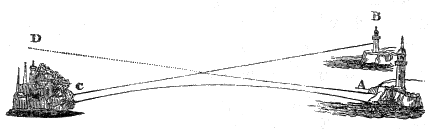
The explanation will be the same as that of
the diagram of the rising sun in a former
page; if the ray from A took the direction
D, as under ordinary circumstances it would do,
it is evident that a spectator at C would see
nothing. But instead of this, the ray was refracted
near the middle to the point C, which
represents the town of Hastings, and therefore
the object A appeared as if it had been placed
at B. You shall now hear what causes are likely
to alter the refracting power of the air at times.
When air, water, or any other substance, is
made hot, it becomes rarified, and its refracting
power is thereby diminished. Have you ever
watched, while you have been on one side of
a stove, or of any heated body, the appearance
of things on the other side through the
air above it? If so, you must have seen how
strangely they seem to tremble. Now this is
caused by a stream of irregularly heated air
rising from the stove, and enabling you every
instant to see the things beyond it more nearly
in their true position than you can through
air of the ordinary temperature.
If you look through a magnifying glass at
distant objects, they will appear upside down.
You may learn why this takes place from books
on optics. The same effect is produced by rays
passing through a medium which becomes gradually
denser, instead of suddenly passing from
one state to another. Thus, if you take a square
glass bottle and put some clear syrup into it,
and then carefully pour water on the top of that,
anything, such as a written or printed line, seen
through the space where the liquids are mixing,
will appear inverted.
Again, if you take a tin tube full of water,
stopped with a piece of plain glass at each end,
warm the middle of the tube, and then look at
one end, you will see an object at the other end,
if held at a proper distance, magnified, and
distant objects turned upside down, just as they
would be by a convex lens. If, on the contrary,
you cool the middle of the tube, by applying ice
to it, the same ensues as by using a concave lens.
If a space of cold air be between two spaces of
hot air, or the contrary, a space of hot air be
between two spaces of cold air, the effects would
be the same, only they could not be produced
in so small a compass as they could with water.
The space where the two different temperatures
were gradually mixing, would influence the rays
of light in the same manner as a lens on a very
large scale.
Now portions of air are often made of different
temperature by the sun's rays, by evaporation, as
from the surface of the sea, or of lakes, or from
marshy districts, and by winds operating under
particular local circumstances. I do not want
to lengthen out this dry story, but if you have
read attentively what I have said, you will see
that various positions of masses of air heated
to different degrees, is all that is necessary to
account for the instances which I have mentioned,
in which objects have appeared inverted
and out of their true positions; such as Dover
Castle, Captain Scoresby's father's ship, the
French coast opposite Hastings, and the islands,
and horses with their legs upwards, described
by Humboldt.
The apparitions of Souter Fell may be
accounted for in like manner. The latter one
was seen at a time of civil commotion, when
there were private troops of horse exercised in
all parts of the country, and so the fact of armed
horsemen being in the neighbourhood, is rendered
very probable. We have only to suppose
the image of such a troop to be brought to the
side of Souter Fell, perhaps from the opposite
side of the mountain, by a complicated refraction,
like that which appeared to move Dover
Castle out of its place.
But the Spectre of the Brocken, the Fata
Morgana, and the image which my friend saw
of the side of the hill on which he was, require
another sort of explanation, because the object
and the image are seen both at once; the latter
could therefore have been no other than the
reflection of the first.
It seems likely that some vapours are capable
of receiving shadows. When I have been bathing
in a river with a muddy bottom, I have often
seen my shadow on the cloud of muddy particles
which I have disturbed from the bottom,
in a manner something similar to that in which
I should think this may occasionally take place.
There is, however, another theory of it. When
rays pass from a thin medium into a denser
medium, the whole do not go through, but they
are strained, as it were, and a part are kept
back and reflected. It is thus that you see a
reflection on a transparent pane of glass.
If you breathe very lightly upon it, the reflection
will be still more distinct, and the
resemblance to the phenomenon we are describing
probably greater. There are then two
causes of reflection, the change of refracting
power, and the presence of the watery particles.
Something of this kind perhaps occurs on the
top of the Brocken. A rush of cold air may
set up from deep ravines, with water and marshy
land at the bottom, on the West side, while the
rising sun is genially warming the air on the east
side of the mountains. Mind, I do not say that
it is so, but it does not seem unlikely that two
currents, one of cold air and the other of hot,
thus ascend close to each other; and according
to what I have told you, there would be a reflecting
power in the plane of contact, which
might be increased by the watery particles
carried upwards.
A kind of aerial screen would thus be formed,
which might catch the shadow of a person on
the opposite summit, cast upon it by the horizontal
rays of the morning sun. Thus you may
account for the image, and its being so greatly
magnified, requires no further explanation than
I have given above; as it only needs the supposition
of a mass of heated air, with two colder
ones on each side, being between the persons
and the reflecting substance.
The doubling of one of the figures was possibly
occasioned by a reflecting surface having
been formed on a different plane from the first,
which might very easily occur.
CONCLUSION.
OF SOME OTHER WONDERS, AND HOW WE OUGHT TO USE OUR KNOWLEDGE OF THE WONDERS
OF NATURE.
I. I have now given you, my little friends
an account of a few of the wonders of the wonderful
world we live in, and I hope they have
entertained you. I should like to have spoken
to you of a great many other things, but it
would make my book too large.
Some of you, I dare say, are fond of some
branch or other of natural history, and perhaps
you may be in the habit of collecting shells,
plants, insects, or fossils. Well, I hope a great
many of you do so, for it is a very delightful
employment, when you are not learning your
regular lessons. When I was a school-boy, I
loved to dig fossils out of the earth, and many
a sunny day have I spent with my hammer
and chisel under the cliffs by the sea-side, or in
a stone-quarry. Many times I laboured long
without success, but at last I scraped together a
very pretty collection, and always managed to
enjoy myself on these fossil-hunting days, whether
I was successful or not.
But what I want particularly to say to you
before we part is, that I hope none of you will
rest satisfied with merely listening to what
others tell you, with making an orderly collection
of specimens, or recollecting merely the
outsides of things. Though all these are very
good when in their proper places, they are not
enough. You should compare together different
facts, and often turn them over in your minds,
always keeping in view that there is something
to be learned from them more interesting and
more important than any knowledge, however
correct, respecting the shapes of crystals, shells,
or plants, or the habits of animals.
If you are diligent in thinking on what you
know, you will see that nothing stands alone in
nature; every single thing is connected with
other things, so as to make up one great whole.
It is true that you will sometimes see what
seems to be an exception to this; you will see
instances of conflict and disorder, and, as it seems,
things destroyed without a reason; but you will
also very often find, as you come to know more,
that what seemed at first an exception was not
such in reality, and that it was what tends as
much to the order and beauty of the whole, as
any of the particular things you admired at first.
II. The ancients supposed that those parts of
the world which were in the torrid zone, and
those towards the North Pole, could not be inhabited
by man; and we find from their writings,
that it was something of a puzzle to know of
what use they could be. They did not, however,
know much about the extent of them, for even
the shape of the earth was then unknown,—some
contending that it was in the form of a
cylinder, some that it was pear-shaped, and
others that it was round and flat like a trencher.
A very few made a shrewd guess at its true
figure. No one was quite certain on the subject,
till navigators had sailed round it, so as to
reach, by continually going forward, the same
spot as they started from.
What men have learned within the last four
centuries, has taught us that only a small portion
of the surface of the earth is uninhabitable.
Man, by the wonderful constitution of his nature,
is enabled to bear the extremes of heat
and cold better than any of the animals that
are sent for his use, each of which is adapted
for the particular climate in which it may be
placed. Under the most extreme variations of
the temperature of the atmosphere, the heat of
our bodies, when we are in health, is never
increased or diminished more than a very few
degrees; so that a thermometer, with the bulb
put into the mouth of an Esquimaux, in a
climate much below freezing, will be only three
or four degrees below what it will be in the
mouth of an inhabitant of the East Indies, where
the temperature often exceeds 100 degrees.
The dog is almost the only animal that is
prepared to accompany man in all climates. The
form and habits of this faithful creature vary
most surprisingly, according to the circumstances
in which he is placed; but he is everywhere
the loving friend and faithful associate of man,
and ready to defend him and to share his toil, in
the hot and parched deserts of the East, or the
icy regions of the North.
There are a few animals that undergo remarkable
changes, to enable them to bear the vicissitudes
of the climate in which they may be
placed. The hares and the foxes of the Northern
regions become covered with white hair in
winter. Now, it is proved, that a body hotter
than the surrounding atmosphere which has a
white covering, cools much more slowly than
one covered with a dark colour: hence, the heat
generated inwardly is preserved and economized
by the winter coats of these animals, to the great
benefit of their health and comfort.
III. Some kinds of birds that love warm climates,
are taught to assemble together at a
certain season near the end of summer, almost to a
day, and start off on a pilgrimage to distant
lands, where nature is still blooming. There are
these birds which all live nearly the same sort of
life,—the swift, the swallow, and the house marten,
which all bear a strong resemblance to each other.
They all come to us from the south in spring,
and take their departure before the next winter.
The swifts form themselves into companies, and
take their leave of us before the middle of
August; the swallows do the same about the
middle of October, and the martens at the end
of the same month. Thus these happy creatures
manage to live all their life long in summer and
sunshine.
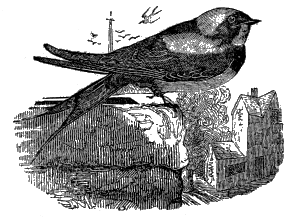
They are furnished with astonishing capabilities
for performing these very long journeys.
You are acquainted with their slender forms, so
exactly adapted for cutting through the air, and
their long, beautiful wings. Each of these
wings is moved by a muscle of prodigious
power, situated on each side of the breast-bone.
Possibly you may have noticed in larks and other
birds, that are in the habit of flying long distances,
which are eaten, what a large proportion
of their flesh is in these two muscles; in the
swallow, it greatly exceeds the weight of the
flesh of all the other parts of the body. You will
hardly believe it when I tell you, that the swift
is able to fly at the rate of more than a hundred
miles in an hour. The little bird that perched
upon your chimney this morning, may perch to-morrow
night upon one of the pyramids of Egypt,
and next week may be at the Cape of Good
Hope. You think a great deal of travelling
twenty miles an hour on a railway, but you see
that is slow compared with the travelling of the
swallows.
Instead of thus following the summer about
over the surface of the earth, some creatures,
that love warmth, make the best of it where they
are. Some birds get into holes and other sheltered
places, put their heads under their wings,
and so sleep away the winter months. The
pretty little black-eyed dormouse makes up a
snug nest, and does the same, and so do some
other of our common animals. During this
inactive period, all the functions which are
necessary to support life become fitted to a state
of repose; the circulation gets slower, and the
supply of inward heat sinks to the lowest temperature
which life will bear.
I dare say you have often found some sorts of
snail-shells with the snail inside, and the mouth
sealed up firmly, and have taken them for dead:
this is not the case. The covering is only put
over for the winter to keep out the cold, and the
creature lives till spring without food or motion.
How it must enjoy the first bright days of
spring, when it opens its eyes after its long nap,
reaching out its horns, and dragging its shell
over the green grass.
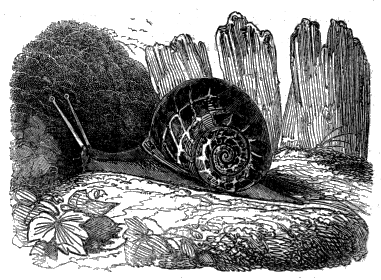
IV. Then, in the distribution of different animals,
there is not less to engage our attention.
The rein-deer is the support and comfort of the
Laplanders. It lives constantly on the scantiest,
and apparently least nourishing diet, and when
brought into warmer climates it soon languishes
and dies. The camel only flourishes where
there are large sandy deserts, with precarious
supplies both of water and solid food; and to
fit him for his peculiar line of usefulness, he has
a receptacle to contain a stock of water, which
he can at pleasure turn into his stomach, and
can go eight or nine days without a fresh supply;
he eats any kind of vegetables, however
dry they may be; and a pound a day is sufficient
to support him for weeks together; though he
is very much larger than any of the animals
which inhabit your country. It is usual for
camels to go the whole distance from Cairo to
Suez, in Egypt, without tasting a morsel, and
this remarkable faculty has been supposed to
arise from the hump upon their backs. When
the animal is well fed, this hump, which is of a
fatty substance, fills out and becomes solid; but
when his food is scanty, it wastes away, and its
substance appears to go to the nourishment of
the more vital parts of his frame. His large
feet rest upon the sand without sinking in, and
at the rate of about two miles an hour, he will
travel thirty miles a day over a parched desert,
bearing a burden of seven or eight hundred
weight. He is called by the Arabs the Ship of
the Desert.
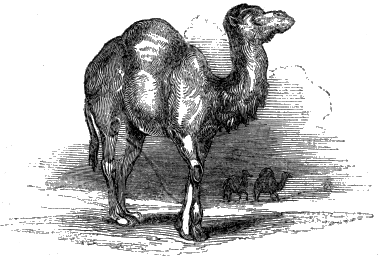
V. You may see that there is, in every variety
of circumstance, something that enjoys itself, and
has a place to fill up and a part to act amongst
the creatures which God has made. But this is
not all: the existence of the cold of the Poles,
and of the heat of the Tropics, is necessary to
the well-being of the whole.
The free air that surrounds the globe, which
we breathe, and through which we see, and hear,
and smell, and move, is the same in composition
in every part of the world. It contains just the
same proportions of the two gases, oxygen and
nitrogen, in the coldest and the hottest climates,
in the deepest valleys and on the tallest mountains.
Now, this air, considered on a large scale,
is always blowing from the Poles towards the
Equator. The more direct rays of the sun heat
that portion of the earth's surface which lies in
the Torrid Zone, and therefore the air above it is
perpetually ascending to the upper regions of the
atmosphere, to make room for that which presses
upon it from the Poles, because it is cooler and
heavier.
It is this process, united with the motion of
the earth on its axis, which causes the Trade
Winds and Monsoons.
Now, do you not see how necessary the cold
Poles are to keep the rest of the world from
becoming too hot, by supplying constant currents
of fresh air setting in upon the hotter
regions from both sides? Then the air, which
ascends from the Equator, becomes cool, and travels
down again to join the air from the Poles;
and so a healthful circulation is kept up, which
is necessary for all climates.
VI. It is very interesting to trace the dependance
of the various tribes of vegetables and animals
on each other, and to observe how one
flourishes through the dissolution of another; and
still more so to notice the gradual development
of the same parts in the kinds, as they ascend
one above another. You may see an instance
of this in three of the animals that I described
to you, which were different enough in other
respects, but agreed in being without a bony
skeleton, and in having long organs round their
mouths to catch their food with.
In the Acalephæ, or sea-nettles, these organs
were merely filaments without sensation, of which
the use seemed to be, to entangle little creatures
in, which chance might bring in their way.
The animals themselves would seem, at first
sight, to be very ill able to destroy small crabs
and other shell-fish. You would suppose that
the struggles they would make with their hard
pointed legs, would tear the tender bodies of
the Acalephæ; but the deficiency is supplied by
the caustic luminous fluid which paralyzes the
victim, and disables it for violent struggles
while it is detained by the filaments, before the
Acalepha attempts to swallow it.
In the Actiniæ, you will find the loose disorderly
filaments changed into feelers, with
wonderfully acute sensation, regularly disposed
in a star. When a substance touches the feelers
they close in with considerable power, but seem
to act more like a mechanical trap,—as the
leaves of certain plants catch flies and other
insects,—than in direct dependance on the will
of the animal. However, the Actinia has the
sense of feeling, and has a perception of light
and of odours, though without eyes or nose.
Having greater muscular strength and more compactures
of film, he does not need the destructive
fluid with which the Acalepha is furnished.
Thus, one sort of power is made to compensate
for the loss of another.
The Sepia also catches his food by means of
fleshy organs placed round his mouth; but in
him you find them possessed of amazing power,
moving in strict subjection to his will; never
loosely floating about as in the others. Then
he tastes, sees, and hears, by means of a tongue,
eyes, and ears, distinctly formed.
A similar gradation is observed in the development
of the various parts composing the
hand and arm in animals with perfect skeletons,
in which the bones act as levers. There is a
very interesting book[C] written on this subject,
which you would do well to read; and you will
see in it that all sorts of birds, quadrupeds, and
even fishes, have, in their fore feet, wings, and
fore fins, elements resembling those of the human
hand and arm. Often, in comparing only
two animals, you might fail to trace the slightest
resemblance; but when one or two or more of
other kinds are placed between them, you find
a sort of ladder which, in an evident manner,
unites the lowest with the highest tribes.
At distant periods of the earth's history, you
may see the same sort of organs, and the same
dependance of the creatures one on another.
The fierce Icthyosaurus, and the sly, long-necked
Plesiosaurus, had eyes, ears, tongues, and other
parts, the same as our contemporaries; and they
ate and digested their food, and moved from
place to place, and preyed on each other in no
other manner.
If our acquaintance with nature were much
greater than it is, we should doubtless be able to
bring proofs that there is no sort of stones, of
vegetables, or of animals, nor any process or
movement of the elements, in which we have not
an interest. There is no fact that is not in some
way or other connected with the whole, so as to
influence its well-being.
VII. Not only are the creatures which inhabit
the earth united together by bonds of similarity of
structure and appetite, of common wants and
enjoyments, and of mutual support; but we are
also united with the boundless system of worlds
which the night unveils to our view. The
principle of gravitation, and the beneficent
rays of the sun operating on the planets
and their moons, throw over us a plain and
obvious tie of brotherhood with the stars that
we may see night after night making their way
amongst the constellations, as they move in
their orbits, distinguished by their steady light
from the twinkling multitude of fixed stars.
The law that unites us to them is the same
as causes a drop of rain to descend, or a
weary fly to settle on the earth.
It is not improbable, that the aerolites (if the
theory which I hinted at in a former chapter
be true) may be fragments of original matter,
which have never been appropriated by any
globe, and now sometimes pitch on one planet,
and sometimes on another. If this be the case,
we should be warranted in concluding that the
matter of our solar system is everywhere the
same, chemically considered, and is, therefore,
governed by the same chemical laws; for the
aerolites contain no substance which is not to
be found far below the surface of the earth.
Some ignorant persons, in all ages of the
world, have fancied that the relative positions of
the stars to each other, at the moment of the
birth of an individual, must have an influence
upon his character and the future circumstances
of his life. Thus arose what was called the
science of astrology, and the practice of casting
nativities; and in vulgar conversation it is not
unfrequent for people, who do not know the
origin of the expression, to "thank their stars,"
or to talk of their "unlucky stars," which arose
from the prevalence of such a belief. This, I
need hardly tell you, is all nonsense, from
beginning to end; but you may now know that
there is, in reality, quite as wonderful a connection,
and as direct a one, between yourselves
and the stars, as this which was fancied to
exist.
VIII. But who can tell how wide the relationship
of our earth and everything upon it is extended,
through the agency of those wonderful
principles Light, Heat, and Electricity? It may
seem to you impossible, when I tell you that there
is not a blade of grass or a flower on this earth,
which may not, in its little degree, affect the
climate of a star far beyond the limits of our
solar system; but if you will consider the way
in which the falling of dews is regulated, you
will see that there are grounds for such a notion.
I must first tell you that it is a property of
Heat, like Light, to radiate or expand itself in
all directions, without limit; so that a heated
body is always sending out its heat.
Now, this radiation is influenced by the surfaces
of bodies: Heat will radiate more from
a black rough surface than from a smooth white
one, and a black body will therefore much
sooner get cool than a white one, as I had occasion
to tell you just now. The heat radiates
rapidly from the leaves of vegetables, though
from different kinds of plants in very different
degrees, while from stones and dry wood it radiates
very slowly.
Heat is also reflected, or turned back, by
meeting with certain objects; and in this respect,
too, it resembles light. You have possibly
seen experiments showing this, made with polished
metal mirrors.
At night time, when the sun's rays are not
present, as the heat radiates quickly from the
plants on the ground, each plant becomes
thereby cooler than the earth and stones
which surround it. This causes the watery
particles which the air contains, to condense
on its leaves and flowers, in the same manner
as you see the moisture in the air of a crowded
room, settle on the outside of a glass of cold
water; and, what is most wonderful, the surface
of each plant is so constructed as to allow the
escape of just so much heat, and to receive just
so much dew in return, as its peculiar nature
requires. You may see, if you look, that some
plants always have more dew on them than
others.
On a cloudy night, when dews are not so
much required, a great part of the heat thus
radiated is sent back, being reflected by the
clouds. Hence the dew falls less heavily at such
a time than on a clear starlight night, when
every blade of grass and every little flower sends
out its ray of heat to an indefinite extent, and
may possibly meet another ray from the Dog-stars
or one of the Pleiades!
This is very wonderful; but if you think, you
will perceive that it is not more wonderful than
that a ray of light should travel so far. Every
particle of the surface of these stars does its
part in emitting light, and by that the light of
our nights is increased; and if Light is affected
by such remote influences, why should not Climate
be so affected?
IX. As everything has a place to fill up
amongst the creatures by which it becomes connected
with the universal system, we find innumerable
instances of things being most wonderfully
provided with powers of retaining the
position for which they were created, when circumstances
may oppose it. The tendency which
every animal has to preserve its own life, supplies
abundant illustration. It is this which causes
the Arctic animals to change their colour to
white in winter, and the swallows to migrate to
warmer regions. But there is something selfish
in this, as the provision is merely to save the
animal's own life. Much more beautiful is it
to observe the operation of the affections of parent
animals towards their offspring, by which
the young, when they are incapable of taking
care of themselves, are kept alive and preserved
from injury often at the sacrifice of the enjoyment,
and even of the life of their parent. You
will remember what I told you respecting the
love of the old whales towards the suckers. Nothing
parts with its own life willingly, but in a
great many animals it may be seen that there is
a greater regard to the preservation of their race
than of their own individual lives.
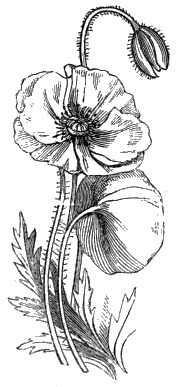
X. These tendencies may
be seen in vegetables as well
as in animals. The young
buds of various plants, of the
common poppy for example,
hang down their heads, so
that the bottom of the calyx,
as it is called by botanists, is
placed upwards, and forms
a sort of thatch or roof.
When the flower spreads out
its bright broad leaves, although
its weight is increased,
yet it then boldly lifts up its
head to the sun, and the
neck of the stalk which seemed unable to bear
up the bud, is well able to sustain the full
flower. Now if it were otherwise, and if the
bud held the same position as the flower, the
rain would run into the calyx and would lie
there, so as to cause the petals or leaves of the
future flower to become rotten.
In this Kingdom of Nature, the unwillingness
to part with life is even more wonderfully exhibited
than in animals.
Seeds have been known to retain their principle
of life for centuries, and long after they
have seemed perfectly dead and dry, when
placed in proper circumstances, they have sent
out shoots and borne flowers and fruit. Mr.
White relates, that when some old beech trees
were removed from a spot in the neighbourhood
of Selborne, where they must have stood for
ages, some strawberry plants sprung up, of
which the seeds must have lain dormant under
the roots of the beeches. When the Spaniards
took possession of Peru, many of the race of
Incas, the rulers of that country, fled to the
deserts and took with them what provisions they
could carry. There are now, sometimes, found
in these deserts, ancient vessels with very narrow
mouths, containing at the bottom a few
grains of maize or Indian corn, the remains of
the stock of those poor exiles. I have got one
of the vessels; and the maize which came out
of it was sown, and took root and bore seed,
though it must have been bottled up for considerably
more than three centuries.
But now I am going to tell you something
still more surprising than this. The Ancient
Egyptians, from some notion connected with
their religion, used at times to place in the
hands and under the soles of the feet of the
bodies they embalmed, the roots of a kind of lily.
The roots are of a bulbous sort, not much unlike
an onion, and they have often been found
on those mummies which have been uncovered.
One or two of them have been set to vegetate,
and have actually borne flowers and seed, after
having slumbered in a mummy coffin for considerably
more than 2000 years!
XI. You know that some seeds have wings or
sails, by means of which they are transported
by the winds over land and sea for very many
miles. The thistle-down everybody is acquainted
with. There is an eastern annual plant
whose seeds are provided with wings, which, in
a most curious manner, it only uses when it
needs them, as you shall hear. It grows in the
little pools that occur here and there in the deserts
of Arabia, which, as you may suppose, in a
hot climate and a sandy soil, are very apt to dry
up at some seasons of the year. The seeds grow
on the stalk enclosed in a roll of flaxen fibres,
and when they are ripe they fall off, and if the
water continues till the next year, they spring
up close by where their parent plant lived. But
should the pool dry up, the flaxen fibres become
dry and spread out into wings, the wind takes
hold of them, and away flies the seed till it
reaches a more favoured spot. When it is lucky
enough to get to the water, the pod speedily
bursts open, and the seeds take root at the
bottom. You see how, by a simple mechanical
contrivance, this plant is enabled to do the same
for the preservation of its species, as I told you
the Actinia did by a very simple exercise of instinct,
for the preservation of itself.
XII. Because you wonder at the works of creation,
you feel a desire to search into them. You
will find out many things, and you may learn to
explain a great many things, the reasons of which
you are ignorant of at present. Still, your
wonder will not be satisfied; on the contrary,
the further you go, the more it will be excited.
You will have to go wondering on, but if you
proceed in the right disposition, every addition
to your knowledge will increase your admiration
and love; for everything was made by the
loving and wise God, and therefore the whole
must necessarily be beautiful and harmonious,
and there is nothing which has not its place to
fill, and its part to act. May you, my little
friends, ever keep in mind that you are not
left out of this Divine Plan; and that there is
a place to be filled, and duties to be performed,
by each one of you, which are not left to a mechanical
contrivance nor to animal instinct;
but must be found out and fulfilled by a never
dying Spirit, which must be conscious of what
it is about, and is responsible to God for every
action.
J. GREEN AND CO., PRINTERS, BARTLETT'S BUILDINGS.
WORKS RECENTLY PUBLISHED BY
DARTON AND CLARK,
HOLBORN HILL.
BIRDS AND FLOWERS;
AND OTHER COUNTRY THINGS.
BY MARY HOWITT.
BEAUTIFULLY ILLUSTRATED IN A NEW STYLE.
Handsomely Bound in Saxony, Gilt Edges. Royal 18mo. Price 6s.
"This is a charming addition to the gift books of the season. The topics Mrs.
Howitt has chosen are "Birds and Flowers, and other Country Things;" and these
are varied with skill, and executed with much taste, delicacy, and a pastoral-poetical
feeling."—Spectator.
"We shall speak of this work with unreserved commendation.—The wood-cuts
are exquisite."—Athenæum.
In the Press.
HYMNS AND FIRESIDE VERSES:
BY MARY HOWITT.
BEAUTIFULLY ILLUSTRATED,
AS A COMPANION TO BIRDS AND FLOWERS.
TALES IN VERSE:
BY MARY HOWITT.
WITH BEAUTIFUL ILLUSTRATIONS.
Price 5s. in Elegant Binding; or in Fancy Wrapper, 3s. 6d.
TALES IN PROSE:
BY MARY HOWITT.
"Sweet Mary Howitt! Her name brings a magic with it, let us see it when and
where we will; it is one crowded with pleasant associations, telling of wisdom
learned by the wayside and under the hedge-rows breathing perfume,—not the
perfume of balls and routs, but of violets and wild-flowers,—leading the mind
to pure and pleasant thoughtfulness."—New Monthly Magazine.
THE LITTLE CONCHOLOGIST;
A GUIDE TO THE CLASSIFICATION OF SHELLS:
WITH A COPIOUS INDEX OF THEIR VULGAR NAMES:
BY THE REV. T. WILSON.
SECOND EDITION.
Square 36mo. Gilt Edges, Coloured Frontispiece,
and Copper-Plates. Price 1s.
"A nice sea-side book, in a pretty exterior."—Tait's Magazine.
"Ably drawn up, and beautifully printed."—Family Magazine.
"A little gem."—Monthly Review.
Just Published,
THE LITTLE MINERALOGIST;
OR, FIRST BOOK OF MINERALOGY.
BY THE REV. T. WILSON.
With Coloured Plates, a Companion to the above. Price 1s.
In the Press. By the same Author.
THE LITTLE GEOLOGIST;
OR, FIRST BOOK OF GEOLOGY
With Numerous Illustrative Plates, and Gilt Edges,
Royal 36mo. Fancy Cloth Boards.
Price 1s. 6d.
THE LITTLE BOOK OF BOTANY;
OR,
FAMILIAR EXPOSITION OF BOTANICAL SCIENCE;
SIMPLIFIED AND WRITTEN EXPRESSLY FOR
Young Botanists.
BY DANIEL COOPER, A.L.S.
CURATOR TO THE BOTANICAL SOCIETY OF LONG AND AUTHOR OF
"BOTANICAL RAMBLES WITHIN THIRTY MILES OF LONDON."
A New Illustration of the Geography of Holy Scripture, upon an
original plan, expressly adapted for SCHOOLS and
FAMILY INSTRUCTION.
Just Published,
PALESTINE, AND PART OF EGYPT,
WITH THE COUNTRIES ADJACENT;
Showing the Route of the Israelites through the Wilderness,
and the Division of Canaan among the Tribes; and
the Holy Land in the Time of our Saviour; all the Countries
visited by the Apostles, and the great Empires of the
East; being a complete Geographical Illustration of the
Sacred Scriptures.
BY WILLIAM MARTIN,
EDITOR OF THE "EDUCATIONAL MAGAZINE."
Size, 39 by 26 inches, price 10s. 6d.—in a case, 14s.
Canvas and Roller, Varnished, 21s.
 The physical peculiarities of the countries represented, and
the sites of particular events, with references to the passages of Scripture
in which they are recorded, are laid down in this Map with
peculiar accuracy and clearness.
The physical peculiarities of the countries represented, and
the sites of particular events, with references to the passages of Scripture
in which they are recorded, are laid down in this Map with
peculiar accuracy and clearness.
DARTON AND CLARK, HOLBORN HILL.
Transcriber Note
Some of the quoted passages have unusual spelling for some words. These
were left as is; but other minor typos have been corrected.
The Table of Contents and page 69 list name "Skapta-Jokul" and
"Skaptar Jokul" respectively. A web search shows that the more common
spelling was "Skapta Jokul" and both were changed to that. Some page
references in the Table of Contents were corrected. A reference to
"Plate XVI, fig. 4" on page 246 has been corrected to "Plate XV, fig.
4". Illustrations were moved so as to prevent splitting paragraphs.
All materials were obtained from The Internet Archive and any files
produced are placed in the Public Domain.