Frederic Baron Trenck, born at Königsberg in 1726, was the son of a
superior officer in the Prussian army, and cousin-german of the famous
Trenck, colonel of the Pandours in the service of Maria Theresa. At the
age of eighteen he became an officer in the body-guard of Frederic II.,
and he was high in the favour of that prince. But the intelligence, the
bravery, and the brilliant exploits to which he owed that favour had
also procured him many enemies, who knew how to take advantage of the
indiscretions of a high-spirited young man. Trenck was presumptuous
enough to aspire to the regard of the Princess Amelia, sister of the
king; and this was undoubtedly the main cause of his disgrace, though
not the only one. In the campaign of 1744 the enemy’s foragers captured
the young officer’s groom, with two of his horses. The king at once
supplied him with another horse from the royal stables; but the next
morning the groom and the captured horses were brought back again by a
trumpeter of the enemy, who, on returning them to Trenck, placed in his
hands the following letter from the chief of the Pandours:—
“Trenck the Austrian is not at war with his cousin Trenck the Prussian.
He is delighted to have been able to get the two horses out of the
clutches of his hussars, and to return them to his cousin, to whom they
belong.”
The young officer at once took the letter to the king, who, regarding
him with a frown, said: “Since your cousin has sent back your horses,
you have no need of mine.”
Some months passed, and Trenck seemed perfectly restored to the favour
of his sovereign, when, the blow with which the king had long menaced
him fell suddenly upon his head.
Some time previously, Trenck had been imprudent enough to write to his
cousin in the Austrian service; and, though his letter contained only
general expressions of compliment and regard, it was none the less a
grave breach of discipline. The affair of the captured horses had
afterwards happened, and Trenck had very nearly forgotten his letter,
when he one day received what purported to be a reply to it, though
there is every reason to believe that it was the work of some person in
the Prussian service plotting his ruin. Trenck was, however, arrested,
with the letter in his possession, and was taken to the castle of Glatz,
where he was placed in one of the rooms allotted to the officers of the
guard, and allowed the liberty of the fortress. He committed the error
of writing a very haughty letter to Frederic, which gave great offence.
He had remained five months in confinement; the king had vouchsafed no
reply to his demand to be brought before a military tribunal; peace had
been made; his post in the guards had been given to another; it was then
that he began to think of making his escape.
During his imprisonment at Glatz he had made many friends among the
officers who had charge of him, by freely supplying them with money,
with which he was well provided. Two of these officers volunteered to
aid him in his escape, and to accompany him; and in addition to this
they all three undertook, from feelings of pity, to deliver another
officer, who had been condemned to ten years’ imprisonment in the same
fortress. After he had learned all their plans, this wretch, whom Trenck
had loaded with benefits, betrayed them, and earned his own liberty as
the reward of his treachery. One of the confederates, warned in time,
was enabled to save himself; the other, thanks to Trenck, who had bribed
his judge, escaped with a year’s imprisonment. But Trenck himself was
from that day watched more closely than before. Some years after, the
wretch who had so basely sold him received his reward: Trenck met him at
Warsaw, insulted him publicly, and killed him in a duel.
The king was greatly incensed at this attempted escape, the more so as
he had already promised, at the earnest entreaty of Trenck’s mother, to
release him in a year. But Trenck had, unfortunately, been kept in
ignorance of this latter circumstance. He was not long, however, before
he made another effort to recover his liberty, of which he gives an
account in the following terms:—
“My window looked towards the city, and was ninety feet from the ground,
in the tower of the citadel, out of which I dared not get before finding
a place of refuge in the city. This an officer undertook to procure me,
and prevailed on an honest soap-boiler to grant me a hiding-place. I
then notched my penknife and sawed through three iron bars; but this
mode was too tedious, it being necessary to file away eight bars from my
window before I could pass through. Another officer, therefore, procured
me a file, which I was obliged to use with caution, lest I should be
overheard by the sentinels.
“Having ended this labour, I cut my leather portmanteau into thongs,
sewed them end to end, added the sheets of my bed, and descended safely
from this tremendous height.
“It rained, the night was dark, and all seemed fortunate; but I had to
wade through moats full of mud before I could enter the city—a
circumstance I had never once considered. I sank up to the knees, and
after long struggling and incredible efforts to extricate myself, I was
obliged to call the sentinel and desire him to go and tell the governor
Trenck was stuck fast in the moat.
“My misfortune was the greater on this occasion as General Fouquet was
then governor of Glatz. He was one of the cruellest of men. He had been
wounded by my father in a duel, and the Austrian Trenck had taken his
baggage in 1744, and had also laid the country of Glatz under
contribution. He was, therefore, an enemy to the very name of Trenck;
nor did he lose any opportunity of giving proofs of his sentiments, and
especially on the present occasion, when he left me standing in the mire
till noon, the sport of the soldiers. I was then drawn out, half dead,
only to be again imprisoned and shut up the whole day, without water to
wash myself. No one can imagine how I looked—exhausted and dirty, my
long hair having fallen into the mud, with which, by my struggling, it
was loaded. I remained in this condition till the next day, when two
fellow-prisoners were sent to assist and clean me.
“My imprisonment now became intolerable. I had still eighty louis d’ors
in my purse, which had not been taken from me at my removal into another
dungeon, and these afterwards did me good service.
“Eight days had not elapsed since my last fruitless attempt to escape
when an event happened which would appear incredible were I, the
principal actor in the scene, not alive to attest its truth, and might
not all Glatz and the Prussian garrison be produced as eye and
ear-witnesses. This incident will prove that adventurous and even rash
daring will render the most improbable undertakings possible, and that
desperate attempts may often make a general more fortunate and famous
than the wisest and best concerted plans.
“Major Doo came to visit me, accompanied by an officer of the guard and
an adjutant. After examining every corner of my chamber, he addressed
me, taxing me with a second crime in endeavouring to obtain my liberty,
adding that this must certainly increase the anger of the king.
“My blood boiled at the word crime; he talked of patience, I asked how
long the king had condemned me to imprisonment. He answered, a traitor
to his country who has correspondence with the enemy, cannot be
condemned for a certain time, but must depend for grace and pardon on
the king.
“At that instant I snatched his sword from his side, on which my eyes
had been some time fixed, sprang out of the door, tumbled the sentinel
from the top to the bottom of the stairs, passed the men who happened to
be drawn up before the prison door to relieve the guard, attacked them
sword in hand, threw them suddenly into surprise by the manner in which
I laid about me, wounded four of them, made way through the rest, sprang
over the breastwork of the ramparts, and with the sword drawn in my hand
immediately leaped this astonishing height without receiving the least
injury; I leaped the second wall with equal safety and good fortune.
None of their pieces were loaded; no one durst leap after me, and in
order to pursue, they must go round through the tower and gate of the
citadel, so that I had the start full half an hour.
“A sentinel, however, in a narrow passage endeavoured to oppose my
flight, but I parried his fixed bayonet and wounded him in the face. A
second sentinel, meantime, ran from the outworks to seize me behind, and
I, to avoid him, I made a spring at the palisades; unluckily my foot
got stuck, and the sentinel seized it and held me by it till his
comrades came up, who beat me with the butt end of their muskets, and
dragged me back to prison, while I struggled and defended myself like a
man grown desperate.
“Certain it is, had I more carefully jumped the palisades, and
despatched the sentinel who opposed me I might have escaped, and gained
the mountains. Thus might I have fled to Bohemia, after having, at noon
day, broken from the fortress at Glatz, sprung past all its sentinels,
over all its walls, and passed with impunity, in spite of the guard, who
were under arms, ready to oppose me. I should not, with a sword in my
hand, have feared any single opponent, and was able to contend with the
swiftest runners. That good fortune which had so far attended me,
forsook me at the palisades, where hope was at an end.
“The severities of imprisonment were increased, two sentinels and an
under officer were locked in with me, and were themselves guarded by
sentinels without. I was beaten and wounded by the butt ends of their
muskets, my right foot was sprained. I spit blood, and my wounds were
not cured in less than a month.
“I was now informed for the first time that the king had only condemned
me to a year’s imprisonment to learn whether his suspicions were well
founded. My mother had petitioned for me, and was answered, ‘Your son
must remain a year imprisoned as a punishment for his rash
correspondence.’ Of this I was ignorant, and it was reported in Glatz,
that my imprisonment was for life. I had only three weeks longer to
repine for the loss of liberty, when I made this rash attempt. What must
the king think? Was he not obliged to act with this severity? How could
prudence excuse my
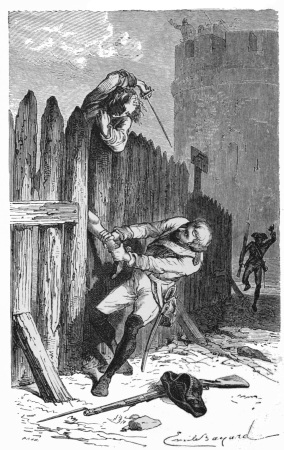 My foot got stuck, and the sentinel seized it.
impatience, thus to risk a confiscation, when I was certain of receiving
freedom, justification, and honour in three weeks. But such was my
adverse fate, circumstances all tended to injure and persecute me, till
at length I gave everyone reason to suppose I was a traitor,
notwithstanding the purity of my intentions.
“Once more then I was in a dungeon, and no sooner was I there than I
formed new projects of flight. I first gained the intimacy of my guards.
I had money, and this, with the compassion I had inspired, might effect
anything among discontented Prussian soldiers. Soon I had gained
thirty-two men who were ready to execute, on the first signal, whatever
I should command. Two or three excepted, they were unacquainted with
each other, they consequently could not all betray me at once. One
Nicholai, a subaltern, was chosen as the leader.
“The garrison consisted only of one hundred and twenty men from the
garrison regiment—the rest being dispersed in the county of Glatz—and
four officers their commanders, three of whom were in my interest.
Everything was prepared, swords and pistols were concealed in the oven,
which was in my prison. We intended to give liberty to all the
prisoners, and retire with drums beating, into Bohemia.
“Unfortunately, an Austrian deserter, to whom Nicholai had imparted our
design revealed our conspiracy. The governor instantly sent his adjutant
to the citadel with orders that the officer on guard should arrest
Nicholai, and with his men take possession of the casement.
“Nicholai was on the guard, and the lieutenant was my friend, and being
in the secret gave the signal that all was discovered. Nicholai only
knew all the conspirators, several of whom that day were on guard. He
instantly formed his resolution, leaped into the casement, crying,
‘Comrades, to arms! we are betrayed;’ all followed to the guard-house,
where they seized on the cartridges. The officer having only eight men,
and threatening to fire on whoever should offer resistance, came to
deliver me from prison, but the iron door was too strong and the time
too short for that to be demolished. Nicholai, calling to me, bid me aid
them, but in vain; and perceiving nothing more could be done for me,
this brave man, heading nineteen others, marched to the gate of the
citadel, where there was a sub-officer and ten soldiers, obliged these
to accompany him, and thus arrived safely at Braunau, in Bohemia, for
before the news was spread through the city, and men were collected for
the pursuit, they were nearly half way on their journey.
“Two years after I met with this extraordinary man at Ofenburg, where he
was a writer; he entered immediately into my service, and became my
friend, but died some months after of a burning fever at my quarters in
Hungary, at which I was deeply grieved, for his memory will ever be dear
to me.
“Now was I exposed to all the storms of ill fortune; a prosecution was
entered against me as a conspirator, who wanted to corrupt the officers
and soldiers of the King. They commanded me to name the remaining
conspirators; but to these questions I made no answer except by
steadfastly declaring I was an innocent prisoner, an officer unjustly
broken, because I had never been brought to trial,—that consequently I
was released from all my engagements.
“A lieutenant, whose name was Bach, a Dane, mounted guard every fourth
day, and was the terror of the whole garrison; for being a perfect
master of arms, he was incessantly involved in quarrels, and generally
left his marks behind him. He had served in two regiments, neither of
which would associate with him for this reason, and he had been sent to
the garrison regiment at Glatz as a punishment.
“Bach, one day sitting beside me, related how the evening before he had
wounded a lieutenant, of the name of Schell in the arm. I replied,
laughing, ‘Had I my liberty, I believe you would find some trouble in
wounding me, for I have some skill in the sword.’ The blood instantly
flew into his face. We split off a kind of a pair of foils from an old
door, which had served me as a table, and at the first lunge I hit him
on the breast.
“His rage became ungovernable, and he left the prison. What was my
astonishment when, a moment after, I saw him return with two soldier’s
swords, which he had concealed under his coat. ‘Now then, boaster,
prove,’ said he, giving me one of them, ‘what thou art able to do.’ I
endeavoured to pacify him, by representing the danger; but
ineffectually. He attacked me with the utmost fury, and I wounded him in
the arm.
“Throwing his sword down, he fell upon my neck, kissed me, and wept. At
length, after some convulsive emotions of pleasure, he said, ‘Friend,
thou art my master, and thou must, thou shalt, by my aid, obtain thy
liberty, as certainly as my name is Bach.’ We bound up his arm as well
as we could. He left me, and secretly went to a surgeon to have it
properly dressed, and at night returned.
“Lieutenant Schell was just come from the garrison at Habelschwert, to
the citadel of Glatz, and in two days was to mount guard over me, till
which time our attempt was suspended. I had received no more supplies,
and my purse only contained some six pistoles. It was therefore
resolved that Bach should go to Schweidnitz, and obtain money of a sure
friend of his in that city.
“It must be borne in mind that at this period the officers and I all
understood each other, Captain Roder alone excepted, who was exact,
rigid, and gave trouble on every possible occasion. Major Quaadt was my
kinsman by my mother’s side, a good friendly man, and ardently desirous
I should escape, seeing my calamities were so much increased. The four
lieutenants, who successively mounted guard over me, were Bach,
Schroeder, Lunitz, and Schell. The first was the grand projector, and
made all preparations. Schell was to desert with me, and Schroeder and
Lunitz, three days after, were to follow. No one ought to be surprised
that officers of garrison regiments should be so ready to desert; they
are in general either men of violent passions, quarrelsome, overwhelmed
with debts, or unfit for service. They are usually sent to garrison as a
punishment, and are called the refuse of the army. Dissatisfied with
their situation, their pay much reduced, and despised by the troops,
such men, expecting advantage, may be brought to engage in the most
desperate undertaking; for none of them can hope for their discharge.
They all hoped by my means to better their fortune, I always having had
money enough, and with money, nothing is more easy than to find friends
in places where each individual is desirous of escaping from slavery.
“The governor had in the meantime been informed how familiar I had
become with the officers, and, growing alarmed at this circumstance, he
sent orders that my door should no more be opened, but that I should
receive my food through a small window that had been made for the
purpose. The care of the prison was committed to the major, and he was
forbidden to eat with me under pain of being broken.
“His precautions were ineffectual. The officers procured a false key,
and remained with me half the day and night.
“A Captain Damnitz was imprisoned in an apartment by the side of mine.
This man had deserted from the Prussian service, with the money
belonging to his company, to Austria, where he obtained a commission in
his cousin’s regiment. This cousin having prevailed on him to serve as a
spy during the campaign of 1744, he was taken in the Prussian
territories, recognised, and condemned to be hanged.
“Some Swedish volunteers who were then in the army interested themselves
in his behalf, and his sentence was changed to perpetual imprisonment,
with a sentence of infamy.
“This wretch, who two years afterwards, by the aid of his protectors,
not only obtained his liberty, but a lieutenant-colonel’s commission,
was the secret spy of the major over the prisoners, and he remarked that
notwithstanding the express prohibition laid on the officers, they still
passed the greater part of their time in my company.
“The 24th of December came, and Schell mounted guard. He entered my
prison immediately, where he continued a long time, and we made our
arrangements for flight when he should next mount guard.
“Meantime Lieut. Schroeder, who was in the secret, had no doubt but that
we were betrayed, knowing that the spy Damnitz had informed the governor
that Schell was then in my chamber. Schroeder, therefore, full of
terror, came running to the citadel, and said to Schell: ‘Save thyself,
friend; all is discovered, and thou wilt instantly be put under
arrest.’
“Schell might easily have provided for his own safety, by flying singly,
Schroeder having prepared horses on one of which he himself offered to
accompany him into Bohemia.
“How did this worthy man, in a moment so dangerous, act towards his
friend? Running suddenly into my prison, he drew a corporal’s sabre from
under his coat, and said, ‘My friend, we are betrayed; follow me, only
do not allow me to fall alive into the hands of my enemies.’
“I would have spoken, but interrupting me, and taking me by the hand, he
added, ‘Follow me, we have not a moment to lose.’ I therefore slipped on
my coat and boots, without having time to take the little money I had
left; and as we went out of the prison, Schell said to the sentinel, ‘I
am taking the prisoner into the officer’s apartment; stand where you
are.’
“Into this room we really went, but passed out at the other door. The
design of Schell was to go under the arsenal, which was not far off, to
gain the covered way, leap the palisadoes, and afterwards escape the
best manner we might.
“We had hardly gone a hundred paces before we met the Adjutant and Major
Quaadt. Schell started back, sprang upon the rampart, and leaped from
the wall, which was at that part not very high. I followed, and alighted
unhurt, except having grazed my shoulder. My poor friend was not so
fortunate, having put out his ankle. He immediately drew his sword,
presented it to me, and begged me to despatch him and fly. He was a
small, weak man; but, far from complying with his request, I took him in
my arms, threw him over the palisadoes, afterwards got him on my back,
and began to run, without knowing very well which way I went.
“It may not be unnecessary to notice the fortunate circumstances that
favoured our enterprise.
“The sun had just set as we took to flight, and a hoar frost came on. No
one would run the risk that we had done, by making so dangerous a leap.
We heard a terrible noise behind us. Everybody knew us, but before they
could go round the citadel, and run through the town, in order to pursue
us, we had got a full half-league.
“The alarm guns were fired before we were a hundred paces distant, at
which my friend was very much terrified, knowing that in such cases it
was generally impossible to escape from Glatz unless the fugitives had
got a start of full two hours; the passes being immediately all stopped
by the peasants and hussars, who are exceedingly vigilant. No sooner is
a prisoner missed than the gunner runs from the guard house and fires
the cannon on the three sides of the fortress, which are kept loaded day
and night for that purpose.
“We were not five hundred paces from the wall when all before us and
behind us were in motion. It was daylight when we leaped, yet was our
attempt as fortunate as it was wonderful; this I attributed to my
presence of mind, and the reputation I had already gained, which made it
thought a service of danger for two or three men to attack me.
“It was, besides, imagined we were well provided with arms for our
defence, and it was little suspected that Schell had only his sword, and
I an old corporal’s sabre.
“Scarcely had I borne my friend three hundred paces, before I set him
down, and I looked round me; but darkness came on so fast, that I could
see neither town nor citadel, consequently, we ourselves could not be
seen.
“My presence of mind did not forsake me; death or freedom was my
determination. ‘Where are we, Schell?’ said I to my friend. ‘Where does
Bohemia lie? On which side is the river Neiss.’ The worthy man could
make no answer; his mind was all confusion, and he despaired of our
escape. He still, however, entreated I would not let him be taken alive,
and affirmed my labour was all in vain. After having promised, by all
that was sacred, I would save him from an infamous death, if no other
means were left, and thus raised his spirits, he looked round, and knew,
by some trees, we were not far from the city gates.
“I asked him, ‘Where is the Neiss?’ He pointed sideways. ‘All Glatz has
seen us fly towards the Bohemian mountains. It is impossible we should
avoid the hussars, the passes being all guarded, and we beset with
enemies.’ So saying, I took him on my shoulders, and carried him to the
Neiss. Here we distinctly heard the alarm sounded in the villages, and
the peasants, who likewise were to form the line of desertion, were
everywhere in motion and spreading the alarm. I came to the Neiss, which
was a little frozen, entered it with my friend, and carried him as long
as I could wade; and when I could not feel the bottom, which did not
continue for a space of eighteen feet, he clung round me, and thus we
got safely to the other shore. The reader will easily suppose swimming
in the midst of December, and remaining afterwards in the open air
eighteen hours, was a severe hardship.
“About seven o’clock, the hoar frost was succeeded by frost and
moonlight. The carrying of my friend kept me warm, it is true; but I
began to be tired, while he suffered everything that frost, the pain of
a dislocated foot (which I in vain endeavoured to reset), and the danger
of death from a thousand hands could inflict.
“We were somewhat tranquil, however, since nobody would pursue us to
Silesia. I followed the course of the river for half an hour, and having
once passed the first villages that formed the line of desertion, with
which Schell was perfectly acquainted, we in a lucky moment found a
fisherman’s boat moored to the shore. Into this we leaped, crossed the
river again, and soon gained the mountains. Here being come, we sat
ourselves down on the snow. Hope revived in our hearts, and we held
council concerning how it was best to act. I cut a stick to assist
Schell in hopping forward as well as he could when I was tired of
carrying him; and thus we continued our route, the difficulties of which
were increased by the mountain snows.
“Thus passed the night, during which, up to the middle in snow, we made
but little way. There were no paths to be traced in the mountains, and
they were in many places impassable.
“Day at length appeared. We thought ourselves near the frontiers, which
are twenty English miles from Glatz, when we suddenly, to our terror,
heard the city clock strike. Overwhelmed as we were by hunger, cold,
pain, and fatigue, it was impossible we should hold out during the day.
After some consideration, and another half-hour’s labour, we came to a
village at the foot of the mountain, on the side of which, about three
hundred paces from us, we perceived two separate houses, and the sight
inspired us with a stratagem that was successful.
“We lost our hats in leaping the ramparts, but Schell had preserved his
scarf and gorget, which would give him authority among the peasants.
“I then cut my finger, rubbed the blood over my face, my shirt, and my
coat, and bound up my head, to give myself the appearance of a man
dangerously wounded. In this condition, I carried Schell to the end of
the wood, not far from these houses. Here he tied my hands behind my
back, but so that I could easily disengage them in time of need, and
hobbled after me by aid of his staff, calling for help.
“Two old peasants appeared, and Schell commanded them to run to the
village and tell a magistrate to come immediately with a cart. ‘I have
seized this knave,’ added he, ‘who has killed my horse, and in the
struggle I have put out my ankle. However, I have wounded him and bound
him. Fly quickly; bring a cart, lest he should die before he is hanged.’
“As for me, I suffered myself to be led, as if half dead, into the
house. A peasant was dispatched to the village.
“An old woman and a pretty girl seemed to take great pity on me, and
gave me some bread and milk; but how great was our astonishment when the
aged peasant called Schell by his name, and told him he well knew we
were deserters, he having the night before been at a neighbouring
alehouse, where the officer in pursuit of us came, named and described
us, and related the whole history of our flight. The peasant knew
Schell, because his son served in his company, and had often spoken of
him when he was quartered at Habelschwert.
“Presence of mind and resolution were all that were now left. I
instantly ran to the stable, while Schell detained the peasant in the
chamber. He, however, was a worthy man, and directed him to the road
towards Bohemia. We were still about seven miles from Glatz, having lost
ourselves among the mountains, where we had wandered many miles. The
daughter followed me. I found three horses in the stable but no
bridles. I conjured her in the most passionate manner possible to assist
me. She was affected, seemed half willing to follow me, and gave me two
bridles. I led the horses to the door, called Schell, and helped him,
with his lame leg, on horseback. The old peasant then began to weep, and
begged I would not take his horses; but he luckily wanted courage, and
perhaps the will to impede us, for with nothing more than a dung fork,
in our then feeble condition, he might have stopped us long enough to
have called in assistance from the village.
“And now behold us on horseback, without hats or saddles—Schell with
his uniform scarf and gorget, and I in my red regimental coat. Still we
were in danger of seeing all our hopes vanish, for my horse would not
stir from the stable. However, at last, good horseman-like, I made him
move. Schell led the way, and we had scarcely gone a hundred paces
before we perceived the peasants coming in crowds from the village. As
kind fortune would have it, the people were all at church, it being a
festival. It was nine in the morning, and had the peasants been at home
we had been lost without redemption. We were obliged to take the road to
Wunshelburg, and pass through the town where Schell had been quartered a
month before, and in which he was known by everybody. Our dress, without
hats or saddles, sufficiently proclaimed we were deserters; our horses,
however, continued to go tolerably well, and we had the good luck to get
through the town, although there was a garrison of one hundred and
eighty infantry and twelve horse purposely to arrest deserters. Schell
knew the road to Brummen, where we arrived at eleven o’clock, and from
thence we went to Braunau, where we were safe.”
During the first few months following his escape, Trenck
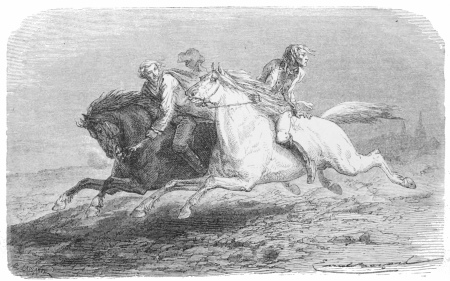 Trenck escaping with Lieutenant Schell.
wandered about miserably, pursued everywhere by the vengeance of
Frederick, and being obliged sometimes to resist sword in hand persons
sent in pursuit of him. Proscribed in his own country, he had taken
service with Austria. At length, after a series of adventures, of which
he gives an account in his “Memoirs” that bears all the impress of
sincerity, notwithstanding the extraordinary events to which it refers,
he found himself at Dantzic, where he was delivered up to the King of
Prussia by the treachery of the imperial resident and the authorities of
the city. He was then taken to Magdeburg, and imprisoned in the citadel.
“My dungeon,” he says, “was in a casemate, the fore part of which, six
feet wide and ten feet long, was divided by a party wall. In the inner
wall were two doors, and a third at the entrance of the casemate itself.
The window in the outer wall, which was seven feet thick, was so
situated, that though I had light, I could see neither heaven nor earth,
but only the roof of the magazine within, and outside this window were
iron bars, and in the space between, an iron grating, so narrow and with
such small interstices that it was impossible I should see any person
without the prison or that any person should see me. On the outside was
a wooden palisado six feet from the wall, by which the sentinels were
prevented conveying anything to me. I had a mattress, and a bedstead,
fastened to the floor by iron cramps so firmly that it was impossible to
move it up to the window. Beside the door was a small iron stove and a
table, in like manner fixed to the floor. I was not yet put in irons,
and my allowance was a pound and a half per day of ammunition bread, and
a jug of water. From my youth I always had a good appetite, and my bread
was so mouldy I could at first scarcely eat the half of it. This was
one result of the commandant’s avarice, who endeavoured to profit even
by the food supplies of the unfortunate prisoners. It is impossible for
me to describe to my reader the excess of tortures that during eleven
months I endured from ravenous hunger. I could easily have devoured six
pounds of bread every day; and every twenty-four hours, after having
received and swallowed my small portion I continued as hungry as before
I began, yet I was obliged to wait another twenty-four hours for a new
morsel. How willingly would I have signed a bill of exchange for a
thousand ducats, on my property at Vienna, only to have satiated my
hunger on dry bread. Scarcely had I dropped into a sweet sleep before I
dreamed I was feasting at some table, luxuriously loaded, where the
whole company were astonished to see me, eating like a glutton, to such
an extent was my imagination heated by the sensation of famine.
“Awakened by the pains of hunger, I used to find that the dishes had
vanished, and that nothing remained but the reality of my distress. The
cravings of nature were but inflamed, my tortures prevented sleep, and
looking into futurity, the cruelty of my fate seemed to me, if possible
to increase, for I imagined that the prolongation of pangs like these
was insupportable. God preserve every honest man from sufferings like
mine! They were not to be endured by the most obdurate villain. Many
have fasted three days, many have suffered want for a week or more, but
certainly no one beside myself ever endured it in the same excess for
eleven months; some have supposed that to eat little might become
habitual, but I have experienced the contrary. My hunger increased every
day, and of all the trials of fortitude my whole life has afforded, this
eleven months was the most bitter.
“My three doors were kept always shut, and I was left to such
meditations as such feelings and such hopes might inspire. Daily, about
noon, or once in twenty-four hours, my pittance of bread and water was
brought. The keys of all the doors were kept by the governor; the inner
door was not opened, but my bread and water were delivered through an
aperture. The prison was opened only once a week, on a Wednesday, when
the governor and town major paid their visit, after my den had been
cleaned.
“Having remained thus two months, and observed this method was
invariable, I began to execute a project I had formed, and of the
possibility of which I was convinced.
“Where the table and stove stood, the floor was bricked, and this paving
extended to the wall that separated my casemate from the adjoining one,
in which no one was confined. My window was only guarded by a single
sentinel. I therefore soon found among those who successively relieved
guard, two kind-hearted fellows, who described to me the situation of my
prison, whence I perceived I might effect my escape, could I but
penetrate into the adjoining casement (the door of which was not shut),
and find a friend and a boat waiting for me at the Elbe. Or could I swim
that river, the confines of Saxony were but a mile distant.
“To describe my plan at length would lead to prolixity, yet I must
enumerate some of its main features, as it was remarkably intricate and
it involved gigantic labour.
“I worked through the iron, eighteen inches long, by which the table was
fastened, and broke off the clinchings of the nails, but preserved their
heads, that I might put them again in their places, that all might
appear secure to my weekly visitors. This procured me tools to raise up
the brick floor, under which I found earth. My first attempt was to work
a hole through the wall, seven feet thick behind, and concealed by the
table. The first layer was of brick; I afterwards came to large hewn
stones. I endeavoured accurately to number and remember the bricks, both
of the flooring and the wall, so that I might replace them, that all
might appear safe. This having been accomplished, I awaited the day of
visitation. All was carefully replaced, and the intervening mortar as
carefully preserved. The cell had probably been whitewashed a hundred
times, and, that I might fill up all remaining interstices, I pounded
the white stuff from the walls, wetted it, made a brush of my hair,
washed it over, that the colour might be uniform, and afterwards
stripped myself, and sat, with my naked body against the place, by the
heat of which it was dried.
“While labouring, I placed the stones and bricks upon my bedstead; and
had they taken the precaution to come at any other time of the week, the
stated Wednesday excepted, I had inevitably been discovered; but as no
such ill accident befell me, in six months my Herculean labours gave me
a prospect of success.
“Means were to be found to remove the rubbish from my prison, all of
which, in so thick a wall, it was impossible to replace. Mortar and
stone could not be removed. I therefore took the earth, scattered it
about my chamber, and ground it under my feet the whole day, till I had
reduced it to dust, which I strewed in the aperture of my window, making
use of the loosened table to stand upon. I tied splinters from my
bedstead together, with the ravelled yarn of an old stocking, and to
this I affixed a tuft of my hair. I worked a large hole under the middle
grating, which could not be seen by any one standing on the ground, and
through this I pushed my dust with the tool I had prepared in the outer
window, then waiting till the wind rose, during the night I brushed it
away. It was blown off, and no appearance remained on the outside.
“By this single expedient, I rid myself of at least three hundredweight
of earth, and thus made room to continue my labours; yet this being
still insufficient, I had recourse to many other artifices, among them
that of kneading up the earth into little balls which, and when the
sentinel’s back was turned, I blew through a paper tube, out of the
window. Into the empty space I put my mortar and stones, and worked on
successfully.
“I cannot, however, describe my difficulties after having penetrated
about two feet into the hewn stone. My tools were the irons I had dug
out, which fastened my bedstead and table. A compassionate soldier also
gave me an old iron ramrod, and a soldier’s sheath knife, which did me
excellent service, more especially the latter, as I shall presently more
fully show. With the knife I cut splinters from my bedstead, which aided
me to pick the mortar from the interstices of the stone; yet the labour
of penetrating through this seven-feet wall was incredible. The building
was ancient, and the mortar occasionally quite petrified, so that the
whole stone was obliged to be reduced to dust. After continuing my work
unremittingly for six months, I at length approached the accomplishment
of my hopes, as I knew by coming to the facing of brick which alone
remained between me and the adjoining casemate.
“Meantime, I found opportunity to speak to some of the sentinels, among
whom was an old grenadier, called Gefhardt, whom I here name because he
displayed qualities of the greatest and most noble kind. From him I
learned the precise situation of my prison, and every circumstance that
might best conduce to my escape.
“Nothing was wanting but money to buy a boat, so crossing the Elbe with
Gefhardt, I might take refuge in Saxony. By Gefhardt’s means I became
acquainted with a kind-hearted girl, a Jewess, and a native of Dessau,
Esther Heymannin by name, whose father had been ten years in prison.
This good, compassionate maiden, whom I had never seen, won over two
grenadiers, who gave her an opportunity of speaking to me every time
they stood sentinel. By tying my splinters together, I made a stick long
enough to reach beyond the palisadoes that were before my window, and
thus obtained paper, another knife, and a file.
“I now wrote to my sister, the wife of the before-mentioned only son of
General Waldow, described my awful situation, and entreated her to remit
three hundred rix-dollars to the Jewess, hoping by this means I might
escape from my prison. I then wrote another affecting letter to Count
Puebla, the Austrian ambassador at Berlin, in which was enclosed a draft
for a thousand florins on my effects at Vienna, desiring him to remit
these to the Jewess, having promised her that sum as a reward for her
fidelity. She was to bring the three hundred rix-dollars my sister
should send me, and take measures with the grenadiers to facilitate my
flight, which nothing seemed able to prevent; I having the power either
to break into the casemate, or, aided by the grenadiers and the Jewess,
to cut the locks from the doors and that way escape my dungeon. The
letters were open, I being obliged to roll them round the stick to
convey them to Esther.
“The faithful girl diligently proceeded to Berlin, where she arrived
safely, and immediately spoke to Count Puebla. The Count gave her the
kindest reception, received the letter, with the letter of exchange, and
bade her go and speak to Weingarten, the secretary of the embassy, and
act entirely as he should direct. She was received by Weingarten in the
most friendly manner, and he, by his questions, drew from her the whole
secret, our intended plan of flight, and the names of the two grenadiers
who were to aid us. She told him also that she had a letter for my
sister, which she must carry to Hammer, near Custrin.
“He asked to see this letter, read it, told her to proceed on her
journey, gave her two ducats to bear her expenses, and ordered her to
come to him on her return; adding that during this interval he would
endeavour to obtain the thousand florins for my draft, and would then
give her further instructions.
“Esther cheerfully departed for Hammer, where my sister, then a widow,
and no longer, as in 1746, in dread of her husband, immediately gave her
a letter to me, with three hundred rix-dollars, exhorting her to exert
every possible means to obtain my deliverance. Having prospered so far,
Esther hastened back to Berlin, with the letter from my sister, and told
Weingarten all that passed, whom she allowed to read the letter. He told
her the two thousand florins from Vienna were not yet come, but gave her
twelve ducats, bade her hasten back to Magdeburg, to carry me all this
good news, and then return to Berlin, where he would pay her the
thousand florins. Esther came to Magdeburg, went immediately to the
citadel, and most luckily met the wife of one of the grenadiers, who
told her that her husband and his comrade had been taken and put in
irons the day before. Esther’s quickness of perception told her that we
had been betrayed: she, therefore, instantly again began her travels,
and happily came safe to Dessau.”
One of the grenadiers was hung, the other cruelly tortured. Trenck’s
sister was condemned to pay a heavy fine, and the expenses of building a
new cell for her brother. Trenck did not know at first what had
happened, but he was soon informed of it by Gefhardt, who told him that
his new prison would be finished in a month. Frederic, who had come to
Magdebourg to hold a review, himself designed the chains for the limbs
of his victim. Meanwhile Trenck was still in hopes of regaining his
liberty. As yet nothing had been discovered of his subterranean
operations. His preparations were at length finished, and he was getting
ready to fly during the night, when suddenly the doors were opened; he
was seized, and bound hand and foot; a bandage was placed over his eyes,
and he was dragged away to his new cell. His feelings are best described
in his own words:—
“The bandage was taken from my eyes. The dungeon was lighted by a few
torches. Great heaven! what were my feelings when I beheld the floor
covered with chains, a fire pan, and two grim men standing with their
smiths’ hammers.
“These engines of despotism went to work at once: enormous chains were
fixed to my ancles at one end, and at the other to a ring which was
fixed in the wall. This ring was three feet from the ground, and only
allowed me to move about two or three feet to the right and left. They
next riveted another huge iron ring of a hand’s breadth round my naked
body, to which hung a chain fixed into an iron bar as thick as a man’s
arm. This bar was two feet in length, and at each end of it was a
handcuff. The iron collar round my neck was not added till the year
1756.
“No soul bade me good-night. All retired in dreadful silence, and I
heard the horrible grating of four doors that were successively locked
and bolted upon me.
“Thus does man act by his fellow, knowing him to be innocent, in blind
obedience to the commands of another man.
“O God! Thou alone knowest how my heart, void as it was of guilt, beat
at this moment. There I sat, destitute, alone, in thick darkness, upon
the bare earth, with a weight of fetters insupportable to nature,
thanking Thee that these cruel men had not discovered my knife by which
my miseries might yet find an end. Death is a last certain refuge that
can indeed bid defiance to the rage of tyranny. What shall I say. How
shall I make the reader feel as I then felt? How describe my
despondency, and yet account for that latent impulse that withheld my
hand on this fatal, this miserable night?
“The misery I foresaw was not of short duration. I had heard of the wars
that were lately broken out between Austria and Prussia. To patiently
wait their termination amid sufferings and wretchedness such as mine,
appeared impossible, and freedom even then was doubtful. Sad experience
had I had of Vienna, and well I knew that those who had despoiled me of
my property would most anxiously endeavour to prevent my return. Such
were my meditations, such my night thoughts. Day at length returned,
but where was its splendour? I beheld it not, yet its glimmering
obscurity was sufficient to show me my dungeon.
“In breadth, the cell was about eight feet; in length, ten. Near me
stood a table; in a corner was a seat four bricks broad, on which I
might sit and recline against the wall opposite to the ring to which I
was fastened; the light was admitted through a semicircular aperture one
foot high, and two in diameter. This aperture ascended to the centre of
the wall, which was six feet thick, and at this central part was a close
iron grating from which outward the aperture descended, having its two
extremities again closely secured by strong iron bars. My dungeon was
built in the ditch of the fortification, and the aperture by which the
light entered was so covered by the wall of the rampart, that instead of
finding immediate passage, the light only gained admission by
reflection. This, considering the smallness of the aperture and the
impediments of grating and iron bars, made the obscurity very great, yet
my eyes in time became so accustomed to this gloom, that I could see a
mouse run. In winter, however, when the sun did not shine into the
ditch, it was dense night with me. Between the bars and the grating was
a glass window, most curiously formed, with a small central casement,
which might be opened to admit the air. The name of Trenck was built in
the wall in red brick, and under my feet was a tombstone with the name
of Trenck also cut on it, and carved with a death’s head. The doors to
my dungeon were double, of oak, two inches thick; without, there was an
open space in front of the cell, in which was a window. And this space
was likewise shut in by double doors. The ditch in which this dreadful
den was built was inclosed on both sides by palisadoes twelve feet high,
the key of the gate of which was intrusted to the officer of the guard,
it being the king’s intention to prevent all possibility of speech or
communication with the sentinel. The only motion I had the power to make
was that of jumping upward, or swinging my arms to procure myself
warmth. When more accustomed to the fetters, I became capable of moving
from side to side about four feet, but this pained my shin-bones.
“The cell had been finished with lime and plaster but eleven days, and
everybody supposed it impossible I should exist above a fortnight after
breathing the damp air. I remained six months, continually drenched with
very cold water, that trickled upon me from the thick arches above; and
I can safely affirm that for the first three months I was never dry, yet
I continued in health. I was visited daily at noon, after the relieving
of guard, and the doors were then obliged to be left open for some
minutes, otherwise the dampness of the air put out my gaolers’ candles.
“This was my situation. And here I sat, destitute of friends, helplessly
wretched, preyed on by all the tortures of an imagination that
continually suggested the most gloomy, the most horrid, the most
dreadful of images. My heart was not yet wholly turned to stone; my
fortitude was reduced to despondency; my dungeon was the very cave of
despair; yet was my arm restrained, and this excess of misery endured.
“How, then, may hope be wholly eradicated from the heart of man? My
fortitude, after some time, began to revive. I glowed with the desire of
convincing the world I was capable of suffering what man had never
suffered before, perhaps of, at last, emerging from beneath this load of
wretchedness triumphant over my enemies. So long and ardently did my
fancy dwell on this picture that my mind at length acquired a heroism
which Socrates himself certainly never possessed. Age had benumbed his
sense of pleasure, and he drank the poisonous draught with cool
indifference; but I was young, inured to high hopes, yet now beholding
deliverance impossible, or at an immense, a dreadful distance. Such,
too, were my other sufferings of soul and body that I could not hope and
live.
“About noon my door was opened. Sorrow and compassion were painted on
the countenances of my keepers; no one spoke, no one bade me ‘Good
morrow!’ Dreadful, indeed, was the sound of their arrival; for the
monstrous bolts and bars moved with difficulty, and the noise of their
removal would be resounding for a good half hour through the vaults of
the prison.
“But at length a camp bed, mattress, and blankets were brought me, and
beside it an ammunition loaf of six pounds’ weight. ‘That you may no
more complain of hunger,’ said the town major, when the loaf was laid
before me, ‘you shall have as much bread as you can eat.’ The door was
shut, and I again left to my thoughts.”
For eleven months Trenck had been dying of hunger, and he devoured the
bread so greedily that repletion nearly finished what starvation had
begun, and he became seriously ill. When he had somewhat recovered he
began anew to meditate a scheme of escape.
“I observed, as the four doors of my cell were opened, that they were
only of wood; I therefore considered whether I might not even cut off
the locks with the knife that I had so fortunately concealed; and should
this and every other means fail, then would be the time to die. I
likewise determined to make an attempt to free myself of my chains. I
happily forced my right hand through the handcuffs, though the blood
trickled from my nails. My attempts on the left were long ineffectual,
but by rubbing with a brick, which I got from my seat, on a rivet that
had been negligently closed, I effected this also.
“The chain was fastened to the ring round my body by a hook, the end of
which was not inserted in the ring; therefore, by setting my foot
against the wall, I had strength enough so far to bend this hook back,
and open it, as to force out the link of the chain. The remaining
difficulty was the chain that attached my foot to the wall; the links of
this I took, doubled, twisted, and wrenched, till at length, nature
having bestowed on me great strength, I made a desperate effort, sprang
forcibly up, and two links at once flew off. Fortunate indeed did I
think myself. I hastened to the door, groped in the dark to find the
clinchings of the nails by which the lock was fastened, and discovered
no very large piece of wood need be cut. Immediately I went to work with
my knife, and cut through the oak door to find its thickness, which
proved to be only one inch, therefore it was possible to open all the
four doors in four and twenty hours.
“Again hope revived in my heart. To prevent discovery I hastened to put
on my chains; but, O Heaven! what difficulties had I to surmount. After
much groping about, I at length found the link that had flown off, but
this I hid. It had hitherto been my good fortune to escape examination,
as the possibility of ridding myself of such chains was in no wise
suspected. The separated iron links I tied together with my hair ribbon;
but when I again endeavoured to force my hand into the ring, it was so
swelled that every effort was fruitless. The whole night was employed
upon the rivet, but all labour was in vain.
“It was near the hour of visitation, and necessity and danger again
obliged me to attempt forcing my hand through the ring, an operation at
length, after excruciating tortures, I effected. My visitors came, and
everything had the appearance of order. I found it, however, impossible
to again free my right hand while it continued swelled.
“I therefore remained quiet for the time; and on the fourth of July, the
day I had fixed for my attempt, the moment my visitors had left me, I
disencumbered myself of irons, took my knife and began my Herculean
labours on the doors. The first of them that opened inwards was
conquered in less than an hour. The other was a very different task. The
lock was soon cut round, but it opened outwards; there was, therefore,
no other means left but to cut the whole door away above the bar.
Incessant and incredible labour made this possible, though it was the
more difficult as everything was to be done by feeling, as I was totally
in the dark; the sweat dropped, or rather flowed from my body. My
fingers were clotted in my own blood, and my lacerated hands were one
continued wound.
“Daylight appeared. I clambered over the door that I had cut through,
and got up to the window in the space or cell that was between the
double doors as before described. Here I saw that my dungeon was in the
ditch of the first rampart; before me I saw the road from the rampart,
the guard but fifty paces distant, and the high palisades that were in
the ditch, and must be scaled before I could reach the rampart. Hope
grew stronger. My efforts were redoubled. The first of the next double
doors was attacked, which likewise opened inward, and was soon
conquered. The sun set before I had ended this, and the fourth was cut
away as the second had been. My strength failed, both my hands were raw.
I rested awhile, began again, and had made a cut of a foot long when my
knife snapped, and the broken blade dropped to the ground.”
Seeing all his dreams of liberty thus vanish in a moment, the
unfortunate prisoner, abandoning himself to despair, opened the veins of
his left arm and foot with the broken blade.
“I fainted, and I know not how long I remained in this state. Suddenly I
heard my own name, awoke, and again heard the words, ‘Baron Trenck!’
‘Who calls?’ was my answer. And who indeed was it to be but my loved
grenadier Gefhardt—my former faithful friend in the citadel. The good,
the kind fellow had got upon the rampart that he might see and comfort
me.
“ ‘In what state are you?’ said Gefhardt. ‘Weltering in my blood,’
answered I; ‘to-morrow you will find me dead.’ ‘Why should you die?’
replied he. ‘It is much easier for you to escape from this place than
from the citadel. There is no sentinel here, and I shall soon find means
to furnish you with tools. If you can only break out, leave the rest to
me. As often as I am on guard, I will seek an opportunity to speak to
you. In the whole of the Star Fort there are only two sentinels, the one
at the entrance and the other at the guard-house. Do not despair, God
will help you, trust to me.’ The good man’s kindness and his words
revived my hopes. I saw the possibility of my escape. A secret joy
diffused itself through my soul. I immediately tore my shirt, bound up
my wounds, and waited the approach of day; and the sun soon after shone
through my window with more than its accustomed brightness.
“Till noon I had time to consider what might further be done; yet what
could be done? What could be expected but that I should now be much more
cruelly treated, and even more insupportably ironed than before,
finding as they must the doors cut through and my fetters shaken off.
“After mature consideration I therefore made the following resolution,
which succeeded happily, and even beyond my hopes. Before I proceed,
however, I will speak a few words concerning my situation at this
moment. It is impossible to describe how much I was exhausted. The
prison swam with blood, and certainly but little was left in my body.
With painful wounds, swelled and torn hands, I stood shirtless in my
cell. I felt an almost irresistible inclination to sleep, scarcely had
strength to keep my legs out, and I was obliged to rouse myself that I
might execute my plan.
“With the bar that separated my hands I loosened the bricks of my seat,
which as they were newly laid, was easily done, and heaped them up in
the middle of my prison. The inner door was quite open, and with my
chains I so barricaded the upper half of the second, as to prevent any
one climbing over it. When noon came, and the first of the doors was
unlocked, all were astonished to find the second open. There I stood,
besmeared with blood, the picture of horror, with a brick in one hand,
and in the other my broken knife, crying as they approached, ‘Keep off,
major, keep off. Tell the governor I will live no longer in chains, and
that here I stand if he pleases, to be shot, for so only will I be
conquered. No man shall enter; I will destroy every one that approaches;
here are my weapons; I will die in despite of tyranny.’ The major was
terrified, and lacking resolution to approach, made his report to the
governor. I, mean time, sat down on my bricks to await what might
happen. My second intent, however, was not so desperate as it appeared.
I sought only to obtain a favourable capitulation.
“The governor-general, Borck, presently came, attended by the town major
and some officers. He entered the outer cell, but sprang back the moment
he beheld a figure like me, standing with a brick and uplifted arm. I
repeated what I had told the major, and he immediately ordered six
grenadiers to force the door. The front cell was scarcely six feet
broad, so that no more than two at a time could attack my intrenchment,
and when they saw my threatening bricks ready to descend, they leaped
back in terror. A short pause ensued, and the old town major, with the
chaplain, advanced towards the door to soothe me: the conversation
continued some time to no purpose. The governor grew angry, and ordered
a fresh attack. The first grenadier I knocked down, and the rest ran
back to avoid my missiles.
“The town major again began a parley. ‘For God’s sake, my dear Trenck,’
said he, ‘in what have I injured you, that you endeavour to effect my
ruin? I must answer for your having through my negligence concealed a
knife; be persuaded, I entreat you; be appeased. You are not without
hope or without friends.’ My answer was, ‘But will you promise not to
load me with heavier irons than before?’
“He went out and spoke with the governor, and gave me his word of honour
that the affair should be no further noticed, and that everything should
be reinstated as formerly.
“Here ended the capitulation, and my wretched citadel was taken.”
The state of the unfortunate prisoner excited commiseration, and he was
attended with great care, and supplied with everything needful to his
recovery. For four days he was suffered to remain out of irons, but on
the fifth he was again fettered, and new doors, one of them of double
thickness, were set up in place of those he had destroyed.
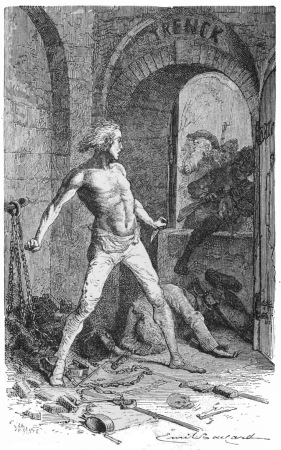 The first grenadier I knocked down.
Gefhardt came on guard soon after this, and he at once began to concert
with Trenck measures for a new attempt at flight. He furnished him with
writing materials, and undertook to post a letter to a friend of the
prisoner, in Vienna. This friend sent back some money, which Gefhardt
found means to convey to the prisoner while handing him his food.
“Having money to carry on my designs, I began to put into execution my
plan, of burrowing under the foundation. The first thing necessary was
to free myself from my fetters. To accomplish this Gefhardt supplied me
with two small files, and by the aid of these this operation, though a
difficult one, was effected.
“The cap or staple of the foot-ring was made so wide that I could draw
it forward a quarter of an inch. I filed the iron which passed through
it on the inside; the more I filed this away the farther I could draw
the cap down, till at last the whole inside iron through which the
chains passed was cut quite through; by this means I could slip off the
ring, while the cap on the outside continued whole, and it was
impossible to discover any cut, as only the outside could be examined.
My hands, by continued efforts, I so compressed, as to be able to draw
them out of the handcuffs. I then filed off the hinge, and made a
screw-driver of one of the foot-long flooring nails, with which I could
take out the screws at pleasure. The rim round my body was but a small
impediment, were it not for the chain which passed from my hand bar, and
this I removed by filing an aperture in one of the links, which at the
necessary hour I closed with bread rubbed over with rusty iron, first
drying it with the heat of my body; and I would wager any sum that,
without striking the chain link by link with a hammer, no one not in the
secret would have discovered the fracture.
“The window was never strictly examined. I therefore drew the two
staples by which the iron bars were fixed to the wall, daily replacing
and carefully plastering them over. I procured wire from Gefhardt, and
tried how well I could imitate the inner grating. Finding I succeeded
tolerably, I cut the real grating totally away, and substituted an
artificial one of my own making, by which I obtained a free
communication with the outside, additional fresh air, together with all
necessary implements, tinder and candles.
“In order that the light might not be seen, I hung the coverlet of my
bed before the window, so that I could work fearless and undetected. The
floor of my dungeon was not of stone, but of oak plank three inches
thick, three beds of which were laid crossways, and were fastened to
each other by nails half an inch in diameter and a foot long. Having
worked round the head of a nail, I made use of the hole at the end of
the bar which separated my hands to draw it out, and this nail,
sharpened upon my tombstone, made an excellent chisel.
“I now cut through the board more than an inch in width, that I might
work downwards, and having drawn away a piece of wood which was inserted
two inches under the wall, I cut this so as to exactly fit. The small
crevice it occasioned I stopped up with bread, and strewed over with
dust, so as to prevent all suspicions. My labour under this was
continued with less precaution, and I had soon worked through my
nine-inch planks. Under them I came to a fine white sand, on which the
Star Fort was built. My chips I carefully distributed beneath the
boards, but I soon saw that, if I had not help from without, I could
proceed no farther; for it would be useless to dig, unless I could rid
myself of my rubbish.
“Gefhardt supplied me with some ells of cloth, of which I made long
narrow bags, stuffed them with earth, and passed them between the iron
bars to Gefhardt, who, as he was on guard, scattered or conveyed away
their contents. Furnished with room to secrete them under the floor, I
obtained more instruments, together with a pair of pistols, powder,
ball, and a bayonet. I now discovered that the foundation of my prison,
instead of two, was sunk four feet deep. Time, labour, and patience were
all necessary to break out unheard and undiscovered; but few things are
impossible where resolution is not wanting.
“The hole I made was obliged to be four feet deep, corresponding with
the foundation, and wide enough to kneel and to stoop in. The lying down
on the floor to work, the continual stooping to throw out the earth, the
narrow space in which all must be performed,—these made the labour
incredible; and after this daily labour, all things were to be replaced,
and my chains again resumed, which alone required some hours to effect.
“I now continued my labour, and found it very possible to break out
under the foundation, but Gefhardt had been so terrified by the late
accident, that he started a thousand difficulties, in proportion as my
end was more nearly accomplished; and at the moment when I wished to
concert with him the means of flight, he persisted that it was necessary
to find additional help to escape in safety, and not bring both him and
myself to destruction. At length we came to a new determination, which,
however, after eight months’ incessant labour, rendered my whole project
abortive.”
A letter posted by Gefhardt’s wife, containing an unusual number of
recommendations, revealed the whole plot; though, after a strict search,
the authorities failed to discover any of the signs of Trenck’s
activity on either his chains or the flooring of his cell. All that was
noticed was the changes he had made in his window, which was immediately
closed up with planks. The prisoner was interrogated with threats as to
the names of his accomplices, in presence of his guards, and his
firmness in refusing to make any revelations proved of great service to
him afterwards among men, who were not unwilling to aid a prisoner if
they could feel quite certain of not being betrayed. Some days after,
all his chains were padlocked together; and his window too was narrowed
till it became little better than a mere air-vent. He was at the same
time deprived of his bed, and he had no other means of taking repose
than by sitting on the floor with his back against the wall, in which
position he was half strangled by the weight of the padlock. He became
ill, and lay for two months at the point of death without receiving any
aid. He was again, however, allowed the use of his bed.
When he had again recovered, he contrived to gain by bribes three of the
four officers who attended him, and through them he obtained candles,
books, newspapers; and, more precious than all, some tools for cutting
through the chains hanging from his padlock. He also, through one of the
officers, obtained larger handcuffs, from which he could easily withdraw
his hands. He then renewed his subterranean labours with the design of
cutting a passage, thirty-seven feet in length, to the gallery beneath
the rampart. He made a new opening, however, to avoid working beneath
the feet of the sentinels:—
“The work at first proceeded so rapidly that, while I had room to throw
back my sand, I was able in one night to gain three feet; but ere I had
proceeded ten feet, I discovered all my difficulties. Before I could
continue my work, I was obliged to make room for myself, by emptying the
sand out of the hole upon the floor of the prison, and this itself was
an employment of some hours. The sand was obliged to be thrown out by
the hand, and after it thus lay heaped in my prison, it had again to be
returned into the hole. I have calculated that, after I had proceeded
twenty feet, I was obliged to creep underground in my hole from fifteen
hundred to two thousand fathoms within twenty-four hours, in the removal
and replacing of the sand. This labour ended, care was to be taken that
in none of the crevices of the floor there might be any appearance of
this fine white sand. The flooring was next to be exactly replaced, and
my chains to be resumed. So severe was the fatigue of one day of this
kind, that I was always obliged to rest the three following.
“To reduce my labour as much as possible, I was constrained to make the
passage so small that my body only had space to pass, and I had not room
to draw my arm back to my head. The work, too, had all to be done naked,
otherwise the dirtiness of my shirt would have been remarked; and the
sand was wet, water being found at the depth of four feet, where the
stratum of the gravel began. At length the expedient of sand bags
occurred to me, by which it might be removed out and in more
expeditiously. I obtained linen from the officers, but not in sufficient
quantities. Suspicions would have been excited had too much linen been
brought into the prison. At last I took my sheets, and the ticking that
inclosed my straw, and cut them up for sand bags, taking care to lie
down on my bed as if ill, when Bruckhausen paid his visit.
“The labour, towards the conclusion, became so intolerable as to excite
despondency. I frequently sat contemplating the heaps of sand, during a
momentary respite from work; and thinking it impossible I could have
strength or time again to replace all things as they were, have resolved
patiently to wait the consequences, and leave everything in its present
disorder. Yes, I can assure the reader that to effect concealment, I
have scarcely had time in twenty-four hours to sit down and eat a morsel
of bread. Recollecting, however, the efforts and all the progress I had
made, hope would again revive in me, and exhausted strength return, and
again would I begin my labours; yet it has frequently happened that my
visitors have entered a few minutes after I had reinstated everything in
its place.
“When my work was within six or seven feet of being accomplished, a new
misfortune happened, that at once frustrated all further attempts. I
worked, as I have said, under the foundation of the rampart, near where
the sentinels stood. I could disencumber myself of my fetters, except my
neck collar and its pendant chain. This, as I worked, though it was
fastened, got loose, and the clanking was heard by one of the sentinels,
about fifteen feet from my dungeon. The officer was called, they laid
their ears to the ground and heard me as I went backward and forward to
bring my earth bags. This was reported the next day, and the major, who
was my best friend, with the town major, and a smith and mason, entered
my prison. I was terrified. The lieutenant, by a sign, gave me to
understand I was discovered. An examination was begun; but the officers
would not see, and the smith and mason found all, as they thought, safe.
Had they examined my bed they would have seen the ticking and sheets
were gone. The town major, who was a dull man, was persuaded the thing
was impossible, and said to the sentinel, ‘Blockhead, you have heard
some mole underground, and not Trenck. How indeed could it be, that he
should work underground at such a distance from his dungeon?’ Here the
scrutiny ended.
“There was now no time for delay. Had they altered their hour of coming,
they must have found me at work; but this, during ten years, never
happened, for the governor and town major were stupid men, and the
others, poor fellows, wishing me all success, were willingly blind. In a
few days I could have broken out; but when ready, I was desirous to wait
for the visitation of the man who had treated me so tyrannically,
Bruckhausen; but this man, though he wanted understanding, did not want
good fortune. He was ill for some time, and his duty devolved on K——.
He recovered, and the visitation being over, the doors were no sooner
barred than I began my supposed last labour. I had only three feet
farther to proceed, and it was no longer necessary that I should bring
out the sand, as I had room to throw it behind me. What my anxiety was,
what my exertions were, can well be imagined. My evil genius, however,
had decreed that the same sentinel who had heard me before, should be
that day on guard. He was piqued by vanity to prove he was not the
blockhead he had been called, he therefore again laid his ear to the
ground, and again heard me burrowing. He called his comrades first, next
the major; who came and heard me likewise, they then went outside the
palisades and heard me working next the door, at which place I was to
break into the gallery. This door they immediately opened, entered the
gallery with lanterns, and waited to catch the hunted fox when
unearthed.
“Through the first small breach I made I perceived a light, and saw the
heads of those who were expecting me. This was indeed a thunderstroke. I
crept back, made my way through the sand I had cast behind me, and
shudderingly awaited my fate. I had the presence of mind to conceal my
pistols, candles, paper, and some money, under the moveable floor. The
money was disposed of in various holes, well concealed in the panels of
the doors; and I hid my small files and knives under different cracks in
the floor. Scarcely were these disposed of before the doors resounded.
The floor was covered with sand and sand bags; my handcuffs, however,
and the separating bar I had hastily resumed, that they might suppose I
had worked with them on, which they were silly enough to credit, highly
to my future advantage.”
The passage which had cost Trenck so much trouble was filled up, the
flooring repaired, heavier irons replaced those which he had broken, and
he was once more deprived of his bed. Bruckhausen and the major
interrogated him in presence of the workmen and the soldiers as to the
manner in which he had obtained his tools. “My answer,” says Trenck, was
‘Gentlemen, Beelzebub is my best and most intimate friend; he brings me
everything I want, and supplies me with light. We play whole nights at
piquet, and, guard me as you please, he will finally deliver me out of
your power.’
“Some were astonished, others laughed. At length, as they were barring
the last door, I called, ‘Come, gentlemen, you have forgotten something
of great importance in the interior.’ I had taken up one of my hidden
files when they returned: ‘Look you, gentlemen,’ said I, ‘here is a
proof of the friendship Beelzebub has for me, he has brought me this in
a twinkling.’ Again they examined the cell, and again they shut the
doors. While they were so doing I took out a knife and the
louis-d’ors. Their consternation was excessive, and I solaced my
misfortunes by jesting at such blundering short-sighted keepers. It was
soon rumoured through Magdeburg, especially among the simple and vulgar,
that I was a magician, to whom the devil brought all that I asked. One
Major Holtzkammer, a very selfish man, profited by this report. A
foolish citizen had offered him fifty dollars if he might only be
permitted to see me through the door, as he was very desirous to see a
wizard. Holtzkammer told me, and we jointly determined to sport with his
credulity. The major gave me a mask with a monstrous nose, which I put
on when the doors were opening, and threw myself in an heroic attitude.
The affrighted burgher drew back, but Holtzkammer stopped him, and said,
‘Have patience for some quarter of an hour and you shall see he will
assume quite a different countenance.’ The burgher waited. My mask was
thrown by, and my face appeared whitened with chalk and made ghastly.
The burgher again shrunk back, Holtzkammer kept him in conversation, and
I assumed a third facial form. I tied my hair under my nose, and
fastened a pewter dish to my breast, and when the door opened a third
time, I thundered, ‘Begone, rascals, or I’ll twist your necks awry.’
They both ran, and the silly burgher, eased of his fifty dollars,
scampered first.”
Some time after this Trenck meditated another and a far bolder plan of
escape. The garrison of Magdeburg was but 900 strong, and there were at
least 7000 Croat prisoners of war in the fortress. He proposed to gain
access to the Croats by bribing his jailers, and then putting himself at
their head to seize the place for Maria Theresa. He sent to Vienna for
2,000 ducats, but failed to obtain them, and the project came to
nothing.
He then once more began his mining operations, and had already made
considerable progress with them, when the governor of the fortress
becoming mad, he was replaced by the hereditary Prince of Hesse Cassel,
who treated Trenck with so much kindness that the grateful prisoner
pledged himself not to attempt to escape. This state of things continued
for eighteen months, at the end of which time the prince, leaving the
fortress in consequence of the death of his father, Trenck considered
himself justified in making another effort for liberty. He accordingly
procured the necessary tools with the same facility as before, and was
opening up one of his old galleries, when an accident happened that had
nearly put an end to his project and his life.
“While mining under the foundation of the ramparts,” he says, “just as I
was going to carry out the sand bag, I struck my foot against a stone in
the wall, which fell down and closed up the passage. What was my horror
to find myself thus buried alive! After a short time for reflection, I
began to work the sand away from the side that I might obtain room to
turn round. By good fortune there were some feet of empty space into
which I threw the sand as I worked it away, but the small quantity of
air soon made it so foul that I a thousand times wished myself dead, and
made several attempts to strangle myself. Further labour began to seem
impossible. Thirst almost deprived me of my senses, but as often as I
put my mouth to the sand I inhaled fresh air. My sufferings were
incredible, and I imagine I passed full eight hours in this distraction
of horror. Of all dreaded deaths surely such a one as this is the most
dreadful. My spirits fainted, again I somewhat recovered, again I began
to labour, but the earth was as high as my chin, and I had no more space
into which I might throw the sand, that I might turn round. I made a
more desperate effort, drew my body into a ball and turned round. I now
faced the stone, which was as wide as the whole passage, but there being
an opening at the top I respired fresher air. My next labour was to root
away the sand under the stone and let it sink, so that I might creep
over, and by this means at length I once more happily arrived in my
dungeon.”
He had hardly time to clear away the traces of his work, and to put all
in order, before he received the daily visit of his jailers. A change of
the garrison and other circumstances somewhat hindered the
accomplishment of his design, but the gallery was at length finished,
and an officer had even promised to bring him false keys to open his
prison doors. The thought that he was on the very eve of liberty turned
his head, as he admits himself.
“I was then vain enough, stupid enough, mad enough,” he says, “to form
the design of casting myself on the generosity and magnanimity of the
great Frederic! Should this fail, I still thought my lieutenant a
certain saviour. Having heated my imagination with this lamentable
scheme, I awaited the hour of visitation with great anxiety. The major
entered. ‘I know, sir,’ I said, ‘the great Prince Ferdinand is again in
Magdeburg’ (my new friend had told me this): ‘Be pleased to inform him
that he may first examine my prison, and double the sentinels, and
afterwards give me his commands, stating at what hour it will please him
I should make my appearance in perfect freedom on the glacis of
Klosterbergen. If I prove myself capable of this, I then hope for the
protection of Prince Ferdinand, and I trust he will relate my
proceedings to the king, who may thereby be convinced of my innocence
and the perfect clearness of my conscience.’
“The major was astonished, and he supposed my brain turned. The proposal
he held to be ridiculous, and the performance impossible. As I, however,
persisted, he rode to town and returned with the sub-governor,
Reichmann, the town major, Riding, and the major of inspection. The
answer they delivered was, ‘That the prince promised me his protection,
the king’s favour, and a certain release from my chains, should I prove
the truth of my assertion.’ I required they would appoint a time; they
ridiculed the thing as impossible, and at last said that it would be
sufficient could I only prove the practicability of such a scheme; but
should I refuse they would immediately break up the whole flooring and
place sentinels in my dungeon night and day; adding, ‘The governor would
not admit of any actual breaking out.’
“After the most solemn promises of good faith, I immediately
disencumbered myself of my chains, raised up the flooring, gave them my
arms and implements, and also two keys, that my friend had procured me,
to the doors of the subterranean gallery. I desired them to enter this
gallery and sound with their sword hilts at a place through which I
could easily break in a few minutes. I further described the road I was
to take through the gallery, informed them that two of the doors had not
been shut for six months, and that they already had the keys to the
others, adding, I had horses waiting at the glacis that would be ready
the moment I wanted them.
“They went, examined, returned, and put questions, which I answered with
as much precision as the engineer could have done who built the Star
Fort. They left me with seeming friendship, continued away about an
hour, came back, told me the prince was astonished at what he had heard,
that he wished me all happiness, and then took me unfettered to the
guard-house. The major came in the evening, treated us with a sumptuous
supper, assured me everything would happen in accordance with my wishes,
and that Prince Ferdinand had already written to Berlin.
“But all these promises were illusory. The guard was reinforced next
day; two grenadiers entered the officers’ room as sentinels; the whole
guard loaded with ball before my eyes; the drawbridges were raised in
open day, and precautions were taken as if it were supposed I intended
to make attempts as desperate as those I had made at Glatz.”
Nothing had come from the Duke of Brunswick. The commandant and the
officers, dreading the king’s displeasure, had spread the rumour that a
new attempt at escape had been discovered on the part of the prisoner.
The cell was repaired in eight days and paved with great flagstones, and
the unfortunate Trenck was again placed there, with a single chain about
his feet, which weighed as much as all those he had previously worn put
together. The duke, however, was some time afterwards informed of all
the circumstances, and he spoke to the king, who kept Trenck in prison
another year and then set him at liberty.
It is well known that Trenck, after a life of constant agitation,
perished on the scaffold of the revolution with André
Chénier.—(Holcroft’s Life of Trenck.)