THERE was once a baron so rich and
powerful that only the king himself was
greater. He was very fierce and warlike,
and what he wished for he took from rich and
poor alike, and none was able to withstand him.
The baron had a very gentle and beautiful wife.
Often she wept bitterly over the evil deeds her
husband did in the world, but this the baron
never knew, for she was careful to hide her tears
from him.
One day the lady was sitting beside a fountain
in the gardens, and she was very sad. Presently
she leaned her head on her hand and began to
weep. Suddenly the waters of the fountain were
disturbed, and up from the midst of them arose
the figure of a nixie or water spirit.
The lady was frightened at such a strange sight,
but the nixie spoke to her gently and bade her
not be afraid.
“I,” said she, “am the spirit who watches over
the fortunes of the castle. I have come to tell
you that within a year a child will be born to
you—a little girl. This child will suffer many
things, both dangers and sorrows. There is only
one way in which she can be protected. If
you will make me her godmother I will be able
to guard her and bring her safely through her
troubles, but in no other way can she be saved
from them.”
The lady was filled with amazement at what
she heard. She had known there was a spirit
that watched over the fortunes of the castle, and
now she promised eagerly that if a child came
to her the nixie should be its godmother.
At once the nixie smiled at her and waved its
hand, and then sank back again into the waters
of the fountain.
In less than a year, as the nixie had foretold,
a little daughter was born to the lady, a child
as beautiful as the day. The time for christening
the child was set. She was to be called Matilda,
after her mother, but the lady refused to say who
was to stand godmother to the child. A godmother
she had chosen, but she would tell no
one who that godmother was.
The hour of the christening arrived, all the
ladies and gentlemen of the court were gathered
together, and still no godmother. Suddenly, without
a sound, a stranger appeared among them.
She was dressed from head to foot in silver
that shone and rippled like running water, and
a silver veil was wound about her head. At once
the Lady Matilda recognized her as the nixie.
The water spirit took her place as godmother
to the child, and the christening proceeded.
When it was over, every one looked to see what
gift the godmother would give the child. They
had no doubt that it would be something very
rare and handsome, but instead it was only a
common little carved wooden ball, such as ladies
sometimes use to carry perfume in. This the
godmother placed in the child’s hand. Then,
turning to the lady, she said, “Guard carefully
this ball which I have given to the child. Place
it in some safe place for her. Her good fortune—yes,
even her life itself—depends upon this ball.”
After saying this, the stranger at once disappeared,
and none could tell where she went,
nor how.
The Lady Matilda took the ball and put it
away among her jewels in a strong chest, and
orders were given that no one should touch or
disturb it. As soon as the little Matilda was old
enough, the mother meant to give the ball to her
and tell her of its value.
Before that time, however, and while the child
was still very young, the lady died, and the ball
was forgotten. The little Matilda grew up, knowing
nothing of its worth; indeed, she did not even
know that there was such a thing in the castle.
Not long after his wife’s death the baron
married again. His second wife was a very handsome
woman, but she was cold and proud and
envious. From the first day she saw Matilda,
she hated the child because of her beauty and
her gentleness. She treated her so unkindly that
Matilda was very unhappy. She was worse fed
and clothed than any servant in the castle, and
the meanest room and the hardest bed were
given to her. Still she grew in beauty day by
day, and every one except the stepmother loved
her for her gentle ways and her sweetness.
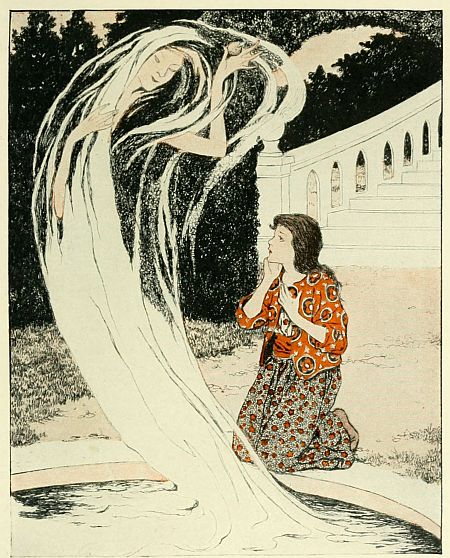
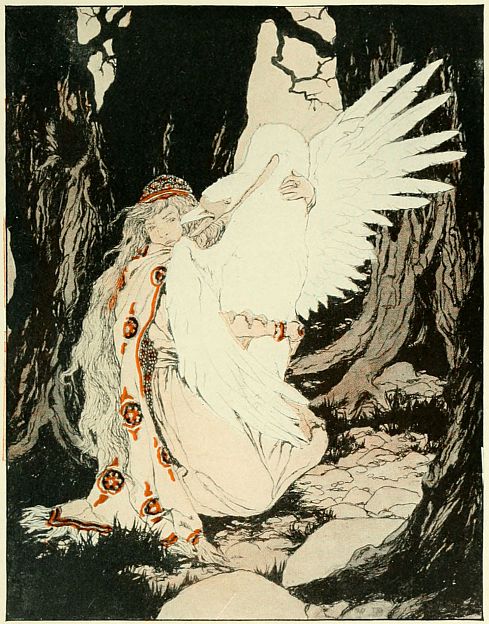
“DO NOT BE AFRAID, MY CHILD,” SAID THE NIXIE
TO MATILDA
One day the stepmother wished to examine
the jewels that had once belonged to the Lady
Matilda. She intended to choose from among
them such as she might admire. She had the
jewel casket brought to her room, and unlocked
it and began to examine the ornaments that
were in it. Some of them she decided to keep,
but others she threw aside. At last, hidden away
in a corner, she came upon a common little carved
wooden ball.
“What is this?” she asked. “Why should
this have been locked away with the jewels as
though it were valuable?”
Her ladies whom she had brought with her to the
castle could not tell her, and she disdainfully threw
the ball out through the open window of her room.
Now it so chanced that Matilda was passing
under the window at that very time, and the
ball fell directly at her feet. Surprised, she
stooped and picked it up, and examined it. The
top seemed to be screwed on, but though she
tried again and again she could not unscrew it.
However, Matilda took the greatest fancy to the
ball. Through the day she carried it in her
pocket or the bosom of her dress, and at night
she slipped it under her pillow, and somehow she
felt quite happy and contented now in spite of
the unkindness of her stepmother.
One day Matilda sat down beside the fountain
in the garden, and, as usual, she began to play
with the ball, tossing it up into the air and catching
it again. Suddenly the ball slipped from her
fingers and fell into the fountain. Matilda bent
over and tried to reach it, but it had floated
beyond her reach. Then a hand appeared in the
waters and seized it, and the figure of the nixie
rose out of the fountain.
“Do not be afraid, my child,” said the nixie
to Matilda. “I wish you nothing but good. I
am your godmother, and it was I who gave this
ball to your mother to keep for you until you
were old enough to take charge of it yourself.
Unfortunately she died before that time arrived.
It is well you have found it at last, for the time
is at hand when you will need it. Listen well
to what I now tell you. This ball contains three
wishes which you can use at any time. But be
careful. Only in the time of your greatest need
must you use its magic, for after it has given
you three wishes, its power will be gone, and it
can do nothing more for you.”
The nixie then told Matilda that there was one
other way in which the ball could aid her. If
at any time she wished to become invisible, she
had only to hold it in her hand and say:
“Light to guide me,
Dark to hide me,
Let no harm nor ill betide me.”
No one then would be able to see her until she
wished to become visible again.
At once, after saying this, the nixie disappeared,
dissolving back into the waters, but the ball she
left lying on the grass beside the fountain.
Matilda picked it up and slipped it into her
bosom, and then went back to the castle, very
grave and thoughtful.
Now in the years while Matilda was growing
to womanhood, the baron’s enemies had grown
very strong, so strong indeed that they no longer
feared him. A plan was made to attack him in
his castle, to take him prisoner, and to rob him
of the possessions that he himself had stolen from
others. The attack was planned for a certain
night when there would be no moon, and it
would be too dark for those inside the castle to
see their enemies approach.
Matilda went to bed early that evening, and
soon fell asleep. She slept for only a few hours,
however. Suddenly, just before midnight, she
was awakened by a great uproar and confusion.
The assault had begun. The baron’s enemies
had surrounded the castle. They entered in and
captured the baron and his wife, and presently
they came to the door of Matilda’s room and
began to break down the door. The poor girl
was overcome with terror.
Suddenly she remembered the charm the nixie
had taught her. She caught up the wooden ball
from under her pillow, and in a whisper she
repeated:
“Light to guide me,
Dark to hide me,
Let no harm nor ill betide me.”
At once she became invisible. The door was
broken open, and the foemen came into the room,
but they saw no one. Matilda, indeed, was there
close beside them, but they could not see her,
and she was careful not to brush against them.
Unseen, she passed from the room and down the
stairs and out of the castle. There was a light
in the heavens now, a red glow of flames, for the
castle had been set on fire.
Matilda hurried away, and when she had gone
far enough to feel that she was safe, she wished
and became visible again. Just as day was breaking,
she came to a deep forest. So far she had
seen no one, but before venturing farther she
gathered roots and herbs, and with them she
stained her face and hands so that no one would
have known her. She looked like a gipsy, or
some poor servant-maid in search of work. She
had now no fear of robbers, for who would think
of stopping anyone so poor and miserable-looking
as she?
All day she travelled through the forest, and
by night she came out on the other side of it
and saw before her a great castle. Matilda
knocked at the door and humbly begged the
woman who opened it to take her in and give
her food and shelter. In return for such help
she would gladly do any work that might be
needed about the castle.
Now it so happened that the old woman was
the housekeeper, and she was in need of a scullery-maid.
Matilda, with her poor clothes and her
darkened hands and face, looked just the one
for such a place.
“If you are willing to work,” said the housekeeper,
“it may be that we can strike a bargain.
You may begin by scouring these pots and pans.
If you do it well, I will keep you here as
scullery-maid.”
Matilda at once set to work, and soon had the
kettles and pans shining like new. The housekeeper
was very much pleased, and decided to
engage her. So Matilda became a scullery-maid
in the castle. Sometimes she helped the cook,
for she was very clever in cookery.
Now the nobleman to whom this castle belonged
was a young and handsome count named
Conrad. His father was dead and his mother
was anxious to see him married; but never yet
had the count seen any lady who attracted him
sufficiently.
At last the old countess decided to give a ball
for the count, and to invite to it all the most
beautiful ladies from the country round. Among
them all she hoped her son would see some one
whom he would care to make his wife.
The invitations were sent out, and everywhere
there was great excitement. Not only was the
count young and handsome; he was also as rich
as a prince, and so courteous that he was beloved
by all. There were few among the ladies who
did not hope that they might be chosen as his
bride.
At the castle nothing was talked of but the
ball that was to be given for the count. Matilda
listened to all that was said, and the more she
heard, the more she wished that she too might
go to the dance and mingle with the other ladies.
All the while she had been at the castle she had
kept the ball with her, but she had been careful
not to use any of the three wishes it contained.
But now the time had come when she determined
to try its power. The night of the ball Matilda
finished her work early, and then she stole away
to her room and fastened the door so that no one
could come in.
First of all she took water and washed off the
stain from her face and hands. When this was
done, her skin was once more as fair as a lily,
and her cheeks as red as roses. She shook down
her wonderful hair so that it fell in a cloud
about her. She combed and braided it, and
then she took out the little wooden ball and
held it in her hand.
“Little ball, I hold you close;
Little ball, I hold you tight;
By your magic power I pray
Grant my wish to me to-night,”
she whispered. And then, “I wish,” she said,
“for a gown more beautiful than any that ever
was seen, and for ornaments to go with it—jewels
for my neck and jewels for my hair, and slippers,
and a fan to wave in my hand.”
At once, upon the bed, appeared a gown more
beautiful than Matilda had ever dreamed of. It
was woven all of silver, and set with pearls, and
with it there were ornaments for her neck and
hair and a fan of shining plumes; and on the
floor beside the bed stood a tiny pair of satin
slippers embroidered with pearls and threads of
silver.
Trembling with haste, Matilda dressed, for
already the night was late, and when at last
she stood clothed all in silvery white, the whole
room shone with the light of her beauty.
She stole down the stairs unnoticed, and it was
not long before she reached the old countess’s
house where the ball was being held. Many
beautiful ladies were there, the loveliest in the
land, but when Matilda entered the ballroom,
she outshone them all as the moon outshines the
stars at night.
From the moment he saw her Count Conrad had
eyes for no one else, and there was no one else
with whom he would dance. Before the end of
the evening he drew her aside into another room.
“Listen,” said he. “Never before in all my
life have I seen anyone as beautiful as you, nor
one whom I could love as already I love you.
Tell me, I pray, who you are. Only some great
lady or princess could be as beautiful as you.”
Matilda was filled with joy when the count said
he loved her, but immediately after she became
sad, for she thought that if he learned she was
only a kitchen-maid in his castle, he would no
longer care for her.
“Look, I beg of you,” she said, “and see
whether there is not some one listening at the door.”
The count thought Matilda wished to tell him
some secret, and he at once went to the door to
make sure that no one could overhear it.
Matilda drew the wooden ball from her pocket
and whispered:
“Light to guide me,
Dark to hide me,
Let no harm nor ill betide me.”
At once she became invisible, and she slipped
past the count and hurried back to the castle.
When the count turned, he was very much
surprised to find that his beautiful partner had
disappeared. He could not imagine what had
become of her. He hunted for her everywhere,
and asked every one which way she had gone,
but no one had seen her.
He was very much disquieted at this. However,
there was to be another ball the next night,
and Count Conrad felt sure Matilda would appear
at it also. This time he was determined she
should not leave him until he knew who she was
and whence she came. To make sure of this, he
decided to set a guard about the house, with
orders to follow any strange lady who passed
out alone, and watch where she went.
All the next day but little was to be heard
anywhere but talk of the wonderful stranger,
of how beautiful she had been, and how
magnificently dressed, and of how much the
count had admired her. Every one wondered
whether she would appear again at the second
ball.
When evening came, Matilda made haste to
finish her work, and then stole away to her little
garret room. Taking the ball in her hand, she
said:
“Little ball, now serve me right,
Grant the wish I wish to-night.
I wish I may have a gown even more beautiful
than the one I wore last night, and all ornaments
that should go with it.”
At once the room was filled with light, and
Matilda saw, lying upon the bed, a gown made
entirely of cloth of gold, and set with precious
stones. There were jewels for her neck and arms,
and a pair of golden slippers that shone like glass.
Matilda dressed in haste, and throwing a dark
cloak over her, she stole away through the night
to the ball.
Count Conrad had been watching for her. He
would, indeed, look at no one else, and as soon
as she entered, he hastened to her side.
If she had been beautiful the night before,
she was far more so now. Then she had shone
like the moon, but now she glittered like the sun,
so that it dazzled the eyes to look at her.
The count begged her to dance with him, and
as soon as he could, he drew her aside into
another room. He then took from his hand a
ring, and placing it upon her finger, he said,
“Now you are my own true love, for you wear
my ring upon your finger. But tell me, I pray
of you, who you are and whence you come, that
I may ask your hand in marriage in a proper
manner.”
“Alas, my mother is dead,” answered Matilda,
“and my father, I fear, has also been put to
death by cruel enemies.”
So saying she dropped her fan. The count at
once stooped to pick it up. Quick as thought, as
he stooped, Matilda drew her ball from her pocket
and whispered the magic charm:
“Light to guide me,
Dark to hide me,
Let no harm nor ill betide me.”
At once she became invisible, and slipping from
the room, she hastened back to the castle.
When the count looked up and found that his
beautiful partner had once more disappeared, he
was in despair. He searched through every room,
and then sent for his guards and questioned them
closely. None of them could tell him anything
of the stranger, however. Not one had seen her
pass by. This was not strange, for Matilda had
remained invisible until she reached the castle.
She was even then in her little attic room, slipping
off her beautiful clothes, and staining her face and
hands that she might again appear as the kitchen
wench.
Again the count had lost her. But now he
determined to give a ball himself. He caused it
to be made known that this ball was in honour
of the unknown beauty, and he had no doubt
but that she would appear at it as she had
at the other two. This time he determined
that not for one instant would he lose sight of
her.
The count’s ball was to be much more magnificent
than those that the old countess had given.
All the servants in the castle were set to work
preparing for it, and Matilda was no less busy
than the others. She had not a moment to
herself.
The night of the ball arrived, and there was still
much to be done in the kitchen. Matilda began
to see that there would be no chance for her to
slip away from her work and appear at the ball.
She did indeed ask the housekeeper to allow
her an hour that she might go outside and peep
in through a window at the dancers, but the
housekeeper refused her angrily.
“Look in through the windows!” she cried.
“What are you thinking of? You would frighten
the ladies to death with your gipsy face and your
big eyes. No; do you stay here in the kitchen
where you belong, and do your work in a proper
manner.”
Matilda would not disobey her, but as she
scoured the pots and pans, she could not prevent
the tears from falling. She could think of nothing
but Count Conrad, of how handsome he was, and
how kind and gentle.
Meanwhile the count was standing close to the
door of the ballroom, waiting for the beautiful
stranger to appear. Great coaches rolled up to
the entrance of the castle. Beautiful ladies in
silks and satins and jewels swept through the
rooms. They waved their fans and smiled at
the count, but he had no eyes for any of them.
His thoughts were all of Matilda. Little he
guessed that even then she was scouring kettles
in the kitchen below and weeping as she scoured.
As hour after hour passed and she did not
appear, the count’s heart grew heavy with grief.
By the time the ball was over and his guests
were leaving, he was quite ill with disappointment.
He could hardly stand to bid them farewell.
The beautiful stranger had not come, and
now he feared he would never see her again.
The next day word passed through the castle
that the young count was unable to leave his bed.
He had fallen ill through grief and disappointment.
Doctors were sent for, but they could do
nothing for him. One thing could cure him and
one alone, and that was some knowledge of the
beautiful stranger who had danced with him.
Matilda had managed to win the confidence of
the old housekeeper, and now she went to her
and said, “I have heard how ill the count is and
how all the medicines the doctors have given
him have failed to help him. If you will but
let me, I can make a broth of such wonderful
qualities that if the count will but taste of it
he will be cured.”
At first the housekeeper refused, but Matilda
still urged and entreated, until at last the old
woman grew tired of saying ‘no’ to her.
“Very well, then,” she said. “It will do no
harm for you to make a bowl of broth, but as to
its having the power to cure the count, that, of
course, I do not believe.”
Matilda at once set to work, and as she was
very clever at cooking, she made a broth so rich
and delicious that it made the mouth water just
to smell of it. It was as clear as crystal, and
of a rich amber colour. When it was done, she
put it in a silver bowl and covered it over with
a napkin, but before doing this she managed to
drop into it the ring that the count had given her.
The broth was so good that the housekeeper
was delighted with it, and she herself carried it
up to her master’s room.
When she entered with it, the count turned
away his head. “Why do you come here?” he
said. “Do not trouble me. I wish for nothing.”
But the housekeeper would not be sent away
in this manner. “I have brought you a bowl of
broth,” she said, “and it is so delicious that if you
will but taste of it, I am sure you will be better.”
With these words she uncovered the bowl and
placed it before the count, and the broth was
so clear that at once he saw the ring lying at
the bottom of it.
“What is this!” he cried. “Who has made
this broth? Tell me immediately.”
The housekeeper was frightened at his look and
tone. “It is good broth,” she cried; “the best
of broth, I am sure, even though it was made by
our little kitchen-maid.”
“Whoever made it, send her to me at once,”
demanded the count.
The housekeeper was very much concerned.
She hurried away to the kitchen.
“What is to be done now?” she said to
Matilda. “The count demands to see you, but
the sight of your rags and dark face would surely
throw him into a fever. This is a pretty piece
of work!”
“Do not be troubled,” said Matilda. “I will
wash my face and hands, and then do you lend
me your cloak and your long veil. With them I
can cover myself so that he will not be able to
see what I look like.”
To this the housekeeper agreed, as she could
think of no better plan.
Matilda took the cloak and veil and hastened
away with them to her own room. There she
combed her hair and washed off the stain, and
then she put on her golden dress and her jewels,
which she had kept hidden away since the night
of the ball. When she was dressed, she covered
herself carefully with the cloak and veil, so that
even the housekeeper’s prying eyes could not
catch a glint of the finery beneath. So disguised,
Matilda went up to Count Conrad’s room
and stood modestly just inside the doorway.
The count had been waiting for her impatiently,
and as soon as she entered, he said, “Was it you
who made the broth the housekeeper brought to
me?”
“It was I,” answered Matilda.
“And who was it who put the ring in it?”
“It was I.”
“Then tell me,” cried the count, “who gave
you the ring. How came you by it?”
“It was you yourself who gave me the ring,
and it was you who placed it on my finger,”
said Matilda.
With these words she put aside the veil and
dropped the cloak from her shoulders. There
she stood before him, blushing, and filling all the
room with the light of her beauty.
The count was transported with joy. “You
have come!” he cried, “and you have come at
the time when I most despaired of finding you.
Now we will be married, and never again shall
you leave me.”
At these words Matilda grew very sad. “Alas,
that may not be,” said she. “Have you forgotten
that I am only your kitchen-maid?”
But the count loved her too dearly to care for
that. “You will be my wife,” he said, “and then
who will dare to remember what you were before?”
“Yes, but there is another reason why we can
never, never marry,” sighed Matilda. “You will
agree with me as to that when I tell you that
my father was your father’s bitterest enemy.”
“Who was your father?” asked the count,
wondering.
Matilda then related to him her whole story,
who her father was, how her mother had died
while she was still a child, and about her stepmother
and her nixie godmother. She also told
him of how she had chanced to come to his castle
and take service there.
The count listened to all she had to say, and
when she had come to an end, he took her in
his arms and embraced her tenderly.
“I care not who you are,” he said, “nor
whence you come. I know only that I love
you, and that you and you alone shall be my
bride.”
Matilda was very happy when she heard this.
She already loved the count dearly, and now she
could no longer refuse him.
Almost at once preparations for the wedding
were begun, and people from far and near were
invited to come to it.
The first to be asked was the count’s mother,
a proud and covetous old woman. She had been
the one who was most eager for her son to marry,
but when she heard whom he had chosen for a
bride, that it was the daughter of an enemy, and,
moreover, a girl both poor and homeless, she was
filled with rage.
At once she hastened to the castle, and urged
and entreated the count to give up Matilda, but
he would not listen to her. He loved his bride
too tenderly for that.
When his mother found that all her efforts to
separate them were in vain, she left the castle
in a fury, and drove away to her home. Never
again, she vowed, would she set foot in the castle
as long as Matilda was there, and the time would
come when the young count would bitterly regret
his choice of a wife.
Count Conrad was grieved at his mother’s
anger, but he was too happy with Matilda to
grieve long. He and she were soon married, and
so sweet and gentle was her character that every
day the count loved her better and was more
contented with his choice.
When the count and Matilda had been married
for a year, a child was born to them, a little boy
so handsome and big and strong that the count
was filled with joy and pride.
The nurse who had charge of the child was
sent to the castle by the old countess, and both
the count and Matilda were delighted at what
they took to be a sign that his mother had forgiven
them. This was not the case however.
The old countess still hated Matilda with a bitter
hatred, and had sent the nurse, hoping she might
find some way to injure her, and if possible to
separate her from the count.
Matilda always slept with the baby’s cradle close
to her own bed. One night, when all the castle
was wrapped in sleep, the old nurse slipped into
the room, and lifting the child carefully from the
cradle, she carried it away without waking anyone.
In the morning, as soon as Matilda awoke, her
eyes as usual turned first of all to the cradle.
She was greatly surprised to see that it was
empty, and at once called the nurse and demanded
what had become of the child.
The nurse pretended to be equally surprised.
“I do not know,” she answered. “When I last
saw him, he was asleep in the cradle beside your
ladyship.”
Matilda was very much alarmed. The count
was called, the castle searched thoroughly, and
every one was questioned, but they could find no
trace of the baby.
“It must be some evil spirit or enchantress
who has carried him away,” said the nurse.
“Last night I heard a beating of wings outside
my window, and a strange sound of sighing and
moaning, but I thought it was only some great
bird that was lost in the night.”
This the nurse said not because she had really
heard anything, but because this was part of a
plot that she and the old countess had hatched
between them.
Days passed, and still nothing was heard of
the child. The count was in despair. Even
Matilda herself was scarcely more dear to him
than his infant son.
At the end of a year another child was born
to Matilda, and this also was a son, a child as
strong and handsome as the first.
But again, when the infant was only a few
weeks old, the nurse stole it away secretly in
the night, without being seen by anyone. In the
morning the cradle was empty, and no trace of
the child could be found anywhere.
The count was filled with grief and anguish.
In his heart he secretly blamed Matilda because
she had not awakened when the child was carried
away. But he restrained himself from reproaching
her. He could not help treating her somewhat
coldly, however, and Matilda was grieved to
the heart not only over the loss of the child, but
because she feared her husband no longer loved
her.
At the end of the year, still a third child was
born, and now, in order to make sure that it
should not be stolen, a watch was kept over the
infant—by day and night; and though he slept
by Matilda’s side, there was always some one
else in the room with them.
But even this precaution could not keep the
nurse from carrying out her wicked plans. When
the child was still only a few weeks old, she
managed one evening to put a sleeping potion
in the repast that was served to Matilda, and in
that of the attendant as well.
Night came and the child was laid in the cradle
close to Matilda’s bed. The attendant took her
place at the door. It was not long, however,
before Matilda and the attendant fell into a deep
sleep. The nurse then stole into the room, and
lifting the child from the cradle, she carried it
away with her as she had the two others.
When morning came, and it was discovered
that this child too had been stolen, the count
could restrain himself no longer. The woman
who had been in attendance was thrown into
prison, and he heaped reproaches on Matilda for
having allowed this third child, the most beautiful
of them all, to be stolen from her side.
“You should not be surprised,” said the wicked
nurse, “and the attendant is not to blame. There
is some enchantment in this, and if you will come
aside with me into a private room, I will tell
you of some things I have seen here in the castle
in the last three years.”
The count was in a state to listen to anything,
and he allowed the nurse to speak to him in
private, and to tell him the story that she and
the old countess had arranged between them.
She told him that though Matilda seemed so
fair and gentle, she was in reality a wicked enchantress.
This his mother had known, and it
was for this reason she had been so unwilling
that he should marry her, and for no other cause.
During the night when the child was stolen, the
nurse said, she had been awakened by a beating
of wings, and had stolen to the door and looked
out. There she had seen Matilda talking with
a being that from its looks could be nothing
but an evil spirit. Presently (so the nurse said)
Matilda had gone back into her chamber, and
when she returned she was carrying the child,
and she had given it into the hands of the strange
being. “After that,” said the nurse, “I saw
no more, for I was afraid to look. But I make
no doubt that that is what has become of all
the children, and that the young countess caused
the attendant to fall into an enchanted sleep so
that she might have a chance to give the baby
to the evil spirit.”
The count was so distracted with grief that he
was ready to believe anything. He remembered
what Matilda had told him of her godmother the
nixie, and it seemed to him possible that this
water spirit had some power over her that might
cause her to sacrifice her children. In his distraction
he sent for his mother to question her
as to what she knew.
The old countess had been waiting for this
summons. She came to him at once and in haste,
and her heart was full of evil joy at the thought
that at last she was to have Matilda in her power.
When she appeared before her son, however,
she dissembled her joy, and pretended to be sad.
“Alas, my dear son,” said she, “what I feared
has come to pass at last. I would have warned
you before that the bride you had chosen was
a wicked enchantress, but I knew you would
not listen to me. Now, however, she has shown
herself in her own wicked character. She has
sacrificed her children to an evil spirit, and it
is only right that she should be punished for her
wickedness.”
The count knew not what to answer to this.
He still loved Matilda, but if she had done such
a wicked thing as to give her children to an evil
spirit, she must suffer for it.
“What you say may be true,” said he to his
mother. “As for me, I am so distracted that I
no longer seem to understand anything. I will
go away on a long journey, and I will leave
Matilda in your hands. Do as you think best
with her, only treat her as gently as you can.”
As soon as the count had said this he left his
mother and went away, and it was well for his
mother that he did so. She was so overjoyed
at the way her plans had turned out that she
could no longer hide her satisfaction. The count
left the castle without bidding farewell to his
wife. Matilda was cut to the heart when she
found he had left her without a word. She was
also terrified at the thought that now the old
countess had her in her power.
Matilda had indeed good cause for fear. As
soon as the count had gone, his mother caused
an iron room to be built. All about this room
were ovens arranged in such a way that the room
could be made so hot that it would be impossible
for anyone to remain in it for long and live.
After it was finished, Matilda was induced to go
into it, and as soon as she was inside, the door
was shut and locked.
The moment Matilda found that she had been
locked in the room alone, she suspected some
evil. She looked about her for a way of escape,
but the walls were of iron, and the room had
been built in such a way that there were no
windows.
“Alas,” said Matilda, “are my misfortunes
never to end? Oh, my dear husband, how had
you the heart to leave me here alone and in the
power of that wicked woman?”
In her despair Matilda threw herself down upon
the floor of the room. As she did so, she felt
something hard in the pocket of her dress. She
slipped her hand into it and drew out the wooden
ball that she had so long forgotten. One more
wish was left to her. Now, if ever, was her time
of need. Holding it in her hand she whispered:
“Little ball, so great my need,
Only you can help indeed;
Save me now and set me free,
Give my children back to me.”
Without her willing it, the ball slipped from
her fingers and fell upon the floor, and was
broken to pieces. From these fragments arose a
silvery mist that spread through the room and
filled it with a refreshing coolness. In the midst
of the mist appeared the nixie, and in her arms
she carried three beautiful little boys. They
were the children who had been stolen from
Matilda.
The nixie smiled upon her godchild and spoke
in a voice like the flowing of cool waters. “At
last you have remembered me and my gift,”
she said. “Long have I been waiting for you
to call upon me, my child. Now I am here, and
no harm can come to you. Look! Here are the
three children that the wicked old countess caused
to be thrown into the water, thinking to drown
them. But I saved them. They have been safe
in my care until you should call upon me, and
now I restore them to you.”
So saying, she placed the children in Matilda’s
arms, and the mother clasped them to her, weeping
with joy.
Meanwhile the men who had been in charge
of the ovens that were to heat the room found
that in spite of all they could do the walls of it
remained cool. They went to the old countess and
told her this. “Our fires are burning brightly,”
they said, “and are so hot that we can scarcely
go near them, and yet the walls of the room
are even cooler than when we began.”
The countess could not understand how this
could be. She was about to go and probe the
mystery when she heard a clatter of hoofs outside,
and a sound of loud voices. She looked
from a window, and saw to her surprise and alarm
that it was her son returning to the castle.
The count, indeed, had been unable to bear the
thought of having left Matilda in his mother’s
care. He feared some harm might come to her,
and the farther he went, the more anxious he
had grown. At last he had turned his horse and
ridden back with all speed to tell Matilda that
he still loved her, and that whatever their sorrow
was, they would bear it together.
As soon as the old countess saw her son, she
knew that her plots had failed, and she feared
his wrath when he should find his wife shut in
the iron room. She determined not to wait for
that, and calling the wicked nurse, they escaped
together from the castle and fled away, nobody
knew whither.
As for the count, he hurried through the castle,
searching everywhere for Matilda, and at last he
came to the iron room. When he found that
she was locked inside it, and saw the ovens all
about it, he was like one distracted.
He turned the key and threw open the door,
but he scarce dared look inside. He dreaded
what he might see there.
When he did summon courage, however, what
was his wonder to see not only his wife, but there
in her arms the three children they had lost. He
could hardly believe his eyes and was well-nigh
crazy with joy. Flinging himself on his knees
before her, he begged her to forgive him for
having doubted her and for having left her as
he had done.
Matilda, who was all mildness and sweetness,
raised him from his knees and placed the children
in his arms.
“See,” said she, “you have no longer any
reason to mistrust me. These are our own dear
children whom the nixie has returned to us.”
She then told the count the whole story, and
when she came to an end they kissed each other
and the children, and from that time on they
lived in mutual love and happiness.
As for the wicked old countess, unless she died
of spite, she may be living and wandering over
the world to this very day.