| LOWELL |
JEFFERSON |
| Everson, 2b |
Laird, 3b |
| Larke, lf |
Beach, cf |
| Talkington, cf |
Church, 1b |
| Hagner, ss |
Hollins, ss |
| Robb, rf |
La Joy, 2b |
| Case, 1b |
Warcford, lf |
| Delvin, 3b |
Twitchell, rf |
| Gibbs, c |
Brest, c |
| Black, p |
Mellen, p |
Laird waited and Black pitched two balls which
didn’t fool him any, and then Miner put two over
which cut the corners of the plate, one of which
Laird struck at and missed and the other was called
by the umpire. It was two and two. Then Miner
tried to tempt Harry with a wide one and the umpire
called it a ball, making it two and three, and Black
was forced to put it over. He served up one of the
kind that is hard to put outside of the diamond
and Laird hit it for a bounder straight to the pitchers’
box and Miner set himself for an easy assist, when
just as the ball was all but in his hands, it took an
extra bounce and went high up over his head and
neither Miner nor Everson could get near it in time
to catch Laird at first.
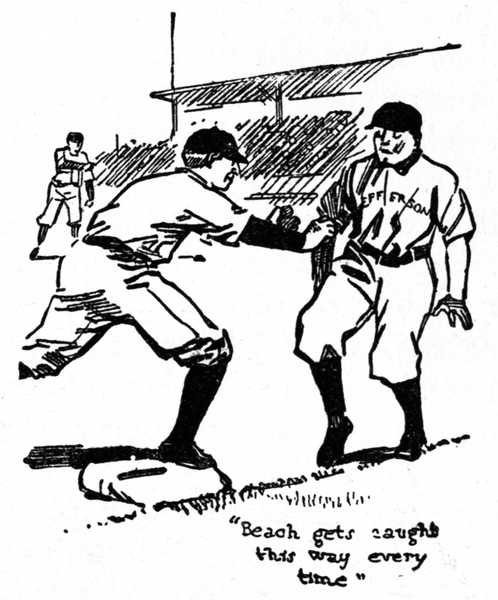
Beach let two go by and then hit one on the ground
to Everson, who tried for a force out at second; but
Laird beat this throw and both runners were safe.
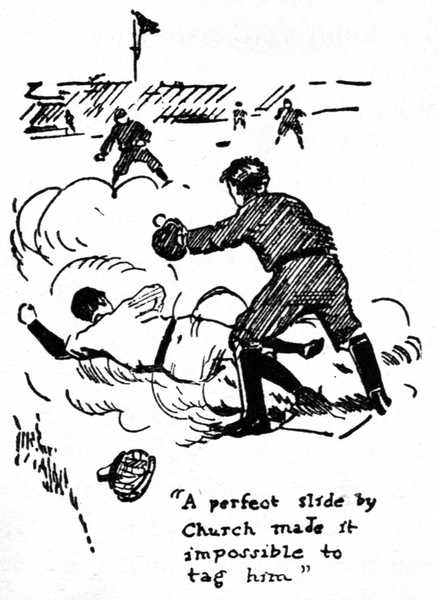
Captain Church immediately sacrificed Laird and
Beach to third and second respectively. On his way
to the bench, the Jefferson captain put his right hand
on Hollins’ left shoulder as he passed him and
Hollins walked to the plate and gave Laird the signal
for the “squeeze” play, Laird started for home as
soon as the pitcher began to wind up and Hollins hit
the ball smartly for a grounder between third and
short which Delvin went after and fumbled. There
was no chance to get the runner at the plate of course.
The squeeze had been worked beautifully, and with
the Lowell infield watching for it. Arthur’s fumble
was just bad enough in addition to give Hollins time
to get to first and this and the first score put Black
in the hole to such an extent that when La Joy came
up he wanted to give him a base on balls, but only
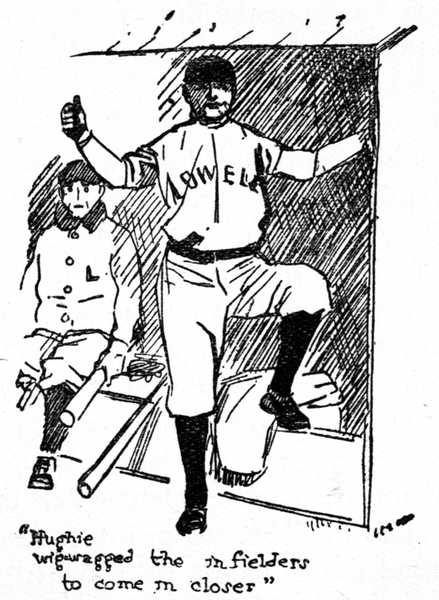
decided to do so after Hughie gave him the signal
from the bench.
This bit of strategy, however, and the hope of
thereby retiring the side on a double play didn’t work
for Sam Warcford was the next batter. Everybody
was expecting him to try for a long one but he
turned his best chance into what was better still,
a Texas Leaguer in left which scored Beach.
It began to look like the kind of a game the fans
like right there.
The infield came in and Twitchell, the batter, tried
to drive one out of Hans’ reach to his right, but
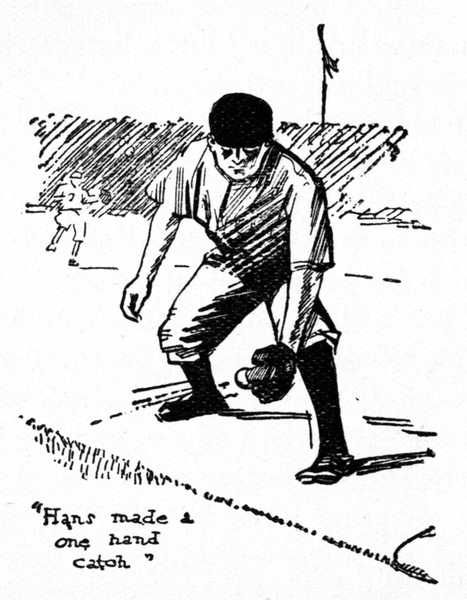
Hans made a beautiful stop and threw to Gibbie,
forcing Hollins.
The Lowell boys breathed a little easier as there
were now two out although the bases were filled.
Roger Brest came to bat and Black had in mind
the way Roger had worried him in the other games
and decided to get him. Brest let the first one go
by and it was a strike. The second ball he struck
at with a mighty swing and missed. Roger seemed
to be slow in recovering from his swing and Miner
tried to sneak a straight one over on him. But Brest
was only pretending for he hit that ball for about
as swift a liner as ever was hit, about six feet to
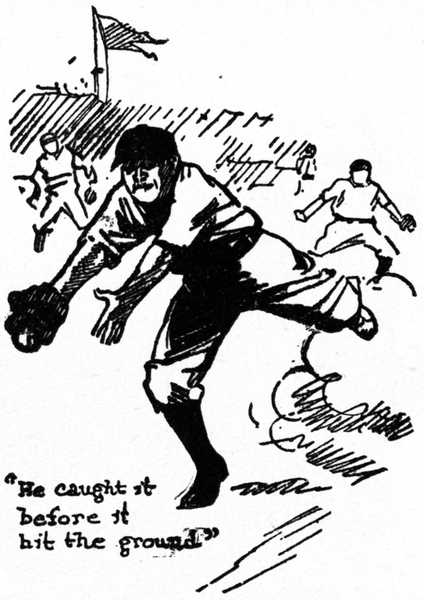
Hal’s right. It looked like a sure hit and the
Jefferson Singing Club was already cheering Roger
when Hal stuck out his right hand and the ball stuck
in his glove. Then it was time for Lowell to cheer,
for the spectacular catch had saved two runs at least,
and four runs in the first half is almost too much of
a handicap. It had been a hard inning for Lowell
to get by.
Everson started the ball rolling by hitting the first
ball for a single to right, just to show the other
fellows that there were others who had batting eyes.
Captain Larke’s attempt at a safe one through the
pitcher’s box went a little too near where La Joy
was playing and Everson was forced at second.
Talkington tried hard to put one over Twitchell’s
head, but all he got out of it was the satisfaction of
seeing that sterling right fielder make another of his
sensational catches.
Robb hit one in Hollins’ direction which was too
hot for the Jefferson shortstop to handle, though it
was almost straight into his hands and it went as an
error against him and Robb was safe.
It looked as though Mellen intended to walk Hans,
who was next up, for the first three balls were wide
of the plate. The fourth, however, whether intentional
or not, cut the outer corner and Hans quickly
turned it into a long single to left center, which scored
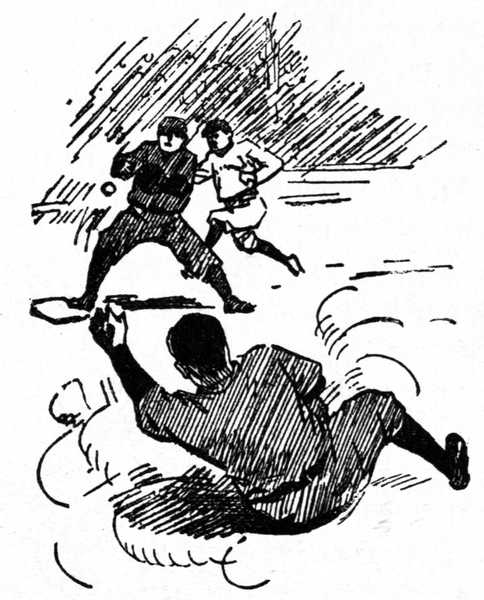
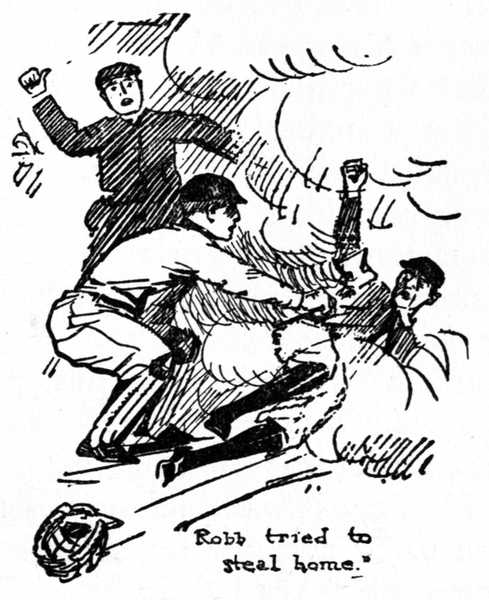
Larke. Robb thought this was a good time to tie
the score and tried to come all the way home on
the play. At that he came pretty near making it, for
he made a beautiful slide and was nipped by inches
on the relay from Beach to Hollins to Brest. The
crowd settled back to enjoy what promised to be one
of their favorite games—lots of hitting and sharp
fielding.
The second inning opened with Mellen at bat, and
Black went after him. He got two strikes on him
right away, but Mellen made a weak effort on the
next ball and it rolled to the pitcher’s box and was
an easy out for Miner and Hal.
Black then thought he’d make it one of his good
innings. He completely outguessed Laird who
struck out, and when Beach looked as though he
didn’t believe he could do it again, he put one straight
over on Tommy after the latter had fouled one off
and let another be called on him, and Beach struck
out also, retiring the side.
In the second half Hal was first at bat. Hughie
told him he just had to get on base and to hit it out.
Mellen put one over that looked good and Hal struck
at it with his short bat and missed. The next one
looked even better and Hal hit it for one of those
fast curving singles over Laird’s head which landed
him on first.
Delvin fouled out to Laird and Hal made a clean
steal of second on the first ball pitched to Gibbie.
He then made an effort to steal third and in Roger’s
anxiety to catch him he tried to throw before he had
the ball secure in his hand and it bounded off his
glove for a short passed ball, while Hal reached third
easily.
Gibbie came across with the needed long fly to
Warcford in left and Hal brought in the tying run.
Black, next to bat, made a hard try to hit one of
the three balls that Mellen pitched him, but he
missed all three of them and as he picked up his
glove and walked into the box, Hughie said, “That’s
the way, old boy, save your wind and strength for
pitching.”
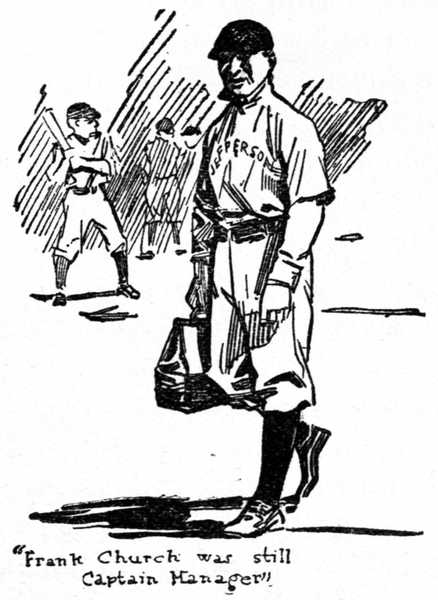
Captain Manager Church was first at bat and he
hit one on Arthur’s left, which both Delvin and
Hagner went after. It was too fast for Arthur to
get his hands on, but Hans made a quick lunge and
got it fifteen feet back of Delvin and threw quickly
to first where Hal made a neat pick up and retired
Church. Hollins tried to bunt the first ball pitched
and missed. Then he struck hard at the second one
and missed, and with his mind on nothing but fooling
the Lowell infield by his change of tactics he forgot
all about the rules when he saw the Lowell boys
playing back and bunted the next ball which rolled
foul and he was called out.
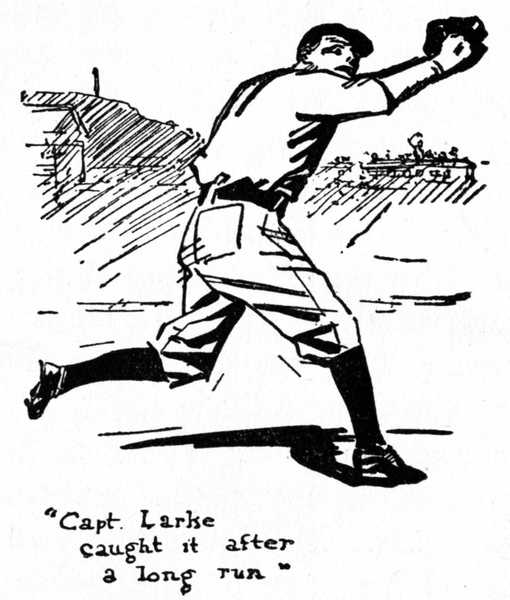
La Joy made one of his mighty efforts after getting
two strikes, and it went out to left field where Captain
Larke caught it after a long run close to the foul
line.
It began to look as if each full inning would be
practically the same, for the Lowell half of the third
was also short. Everson batted one to La Joy which
was easy for him, and Church, then Larke and
Talkington were both retired by Hollins and Church.
In the Jefferson half of the fourth the fun began
anew.
Warcford fouled off the first two over the stands
and when Black offered him another one he didn’t do
any waiting either, but rapped it far out over to
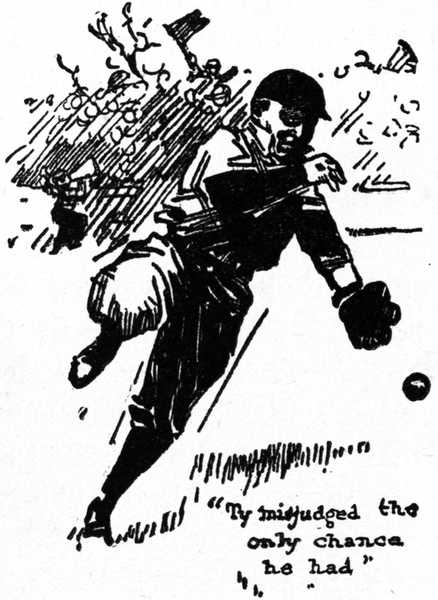
right center in Robb’s territory. Ty picked it up
after a stern chase and relayed it to Hal, for Sam was
already well on his way to third and Ty played to
catch him at the plate in case he tried to get home.
Things looked a little better, however, when
Twitchell went out on a pop foul to Gibbie. Black
thinking of the near damage which Brest had done
in the first inning walked him, planning to get Mellen
and a possible double play, but Big George knocked
out a beautiful sacrifice fly to Talkington which
scored Warcford. Tris saw that he couldn’t get the
runner on third and quickly threw to Everson on
second, catching Brest between the bases. He was
finally run down by Johnny and Hal, the latter
getting the put out.
This made the score three to two in Jefferson’s
favor and it was up to Lowell to do a little better.
Robb missed one and fouled off another. The
third one was also a foul, a tip, and Roger held on
to it making a strike out for Ty. Then Hans walked
to the plate and crouching in his accustomed manner
watched two go by—one a strike and the other a
ball. The third one he hit on a beautiful line over
Hollins’ head between Beach and Warcford. Beach
fielded it and threw to third as Hans had already
passed second. He, however, went back when he
saw that the throw would beat him.
Hal came up and giving the signal to Hans hit a
fast grounder to the left of the pitcher’s box which
went toward second like a shot and was well fielded
by Hollins. Hans was, however, almost home by
this time and all Hollins could do was to catch Hal
at first which he did. The score was again tied and
two out, Delvin made the third one by knocking a
fly into Warcford’s hands.
It had been nip and tuck between the two teams
up to this time with the advantage of a lead, when
there was any, always with Jefferson, and Lowell’s
best efforts were used to keep even.
The strain was beginning to tell on both teams,
and Black buckled down to outguess Laird, the first
man up in the fifth, but Laird was the best guesser
and got a base on balls when Miner failed to put the
third one over. Tommy Beach made a beautiful
bunt down the third base line and as Laird had a
good lead off first he got all the way around to third
when the throw went to first and Beach was out.
Church at bat signaled Laird for another squeeze
play and Harry did his part all right, but Jefferson’s
captain missed the ball and Gibbie touched Laird
out at the plate. Then Church hit a fast bounder
to the left of Arthur who made a great stop and
throw to Hal, retiring Church.
Gibbie came to bat and singled to right and
there was great hope of Lowell getting the advantage.
The plan went through all right so far as
Miner was concerned, as he sacrificed and Gibbie
reached second.
This brought Johnny to bat and he had the hard
luck to touch one of Mellen’s twisters for a foul
which fell into Roger’s big mitt and there were
two out.
Captain Larke tried to knock the ball out of the
diamond but the best he could do was an easy roller
to La Joy who, however, made a mess of it with two
attempts at picking it up before getting it, and by
that time Larke was safe on first and Gibbie on
third.
Larke started for second to draw the throw for
the double steal but Roger couldn’t be tempted to
throw the ball any place and Cap got credit for a
steal. Having struck out Robb before, Mellen
walked Talkington, filling the bases, and then Ty
knocked a fly to the fence in center field; but when
it came down Beach was there waiting for it.
Hollins, the first batter for Jefferson in the sixth,
ought to have been out, as he knocked a liner direct
into Robb’s hands. Ty dropped it, however, and
Hollins hustled to first. The error upset the boys
a little and when Hollins started to steal second
Gibbie made a poor throw and the Jefferson shortstop
was safe.
La Joy waited and got his base on balls which
was good judgment on Black’s part as it later
developed. Warcford came to bat and struck
viciously at the first ball and missed and the infield
guessed that Sam was bound to hit it out. All but
Hal did, at any rate, for when Miner pitched the
next ball and Sam bunted Hal started on his bunt
fielding run to the plate, and making a quick stop
he threw to Delvin at third, forcing Hollins. Then,
with Warcford on first, Twitchell hit a fast one to
Case, who made a one-hand stop, threw to Hans
who covered second, and then hustled back to first
in time to receive Hans’ return throw completing
a quick double play and retiring the side.
Hans came up in the Lowell half and got another
double. Hal sacrificed him to third and it again
looked as though Lowell might take the lead. Delvin
made what ought to have been a hit, for he drove a
fast liner toward first, but Church stabbed it after a
mighty leap into the air, and there were two out.
Then the Lowell hope died down once more when
Gibbie hit one to Mellen, who threw him out to
Church.
Brest struck at three fast ones and missed all of
them. Mellen went out also on a grounder that was
easy for Hans and Hal. Laird came along with a
pretty single to left, but was immediately caught
stealing, Gibbie to Hans.
In the Lowell half Black hit one between first and
second, which Church fielded nicely and threw to
Mellen who covered the bag.
Everson hit a bounder to Hollins who let it roll
between his legs, and Johnny was safe. Larke hit
one, which La Joy got with little effort and tossed to
Hollins, forcing Everson. Larke immediately stole
second, Roger’s throw being high. Talkington caught
them all napping by bunting toward third and
reached first safely. Then it was Robb’s turn and he
tried hard swinging on the first ball pitched which
was one of Mellen’s twisters again, and it went foul
back of third and was caught by Hollins after a
great run.
The eighth started well and ended badly for
Lowell.
Tommy tried for his usual two bagger, but
Talkington got in the way of his fast liner after a
mighty run and there was one gone.
Church tried to put one in short right but it went
up in the air and foul. Case got it after a backward
run near the first row of the grand stand.
Hollins dropped a short bunt in front of the plate
and Gibbie fumbled it. Hollins was easily safe.
It did not look bad to Black, however, as there were
two out and the boys were fielding nobly, and Miner
intended to make the next batter knock a fly if he hit
it at all. It happened, however, to be La Joy. Larry
fouled off four and it was certain in Black’s mind that
if the kind of balls he was pitching were hit they
would go up in the air, so he put over another one.
Larry acted badly, however, for he straightened out
that curve for a two bagger between Robb and
Talkington, which scored Hollins. This rather got
Black’s nerves temporarily and he didn’t have perfect
control of himself. When Warcford stepped to the
plate, Gibbie signaled for a low ball. Black insisted
upon sending them up on the inside. Here is where
Black went wrong, for Warcford hit the first one for
a single to left and La Joy scored from second. Two
runs in and both of them after two were out and it
looked like the game. To complete the inning,
Warcford tried to steal, but Gibbie nailed him by
four feet on a perfect throw to Everson and the
inning ended with the score 5 to 3 in favor of
Jefferson.
It looked bad for Lowell, as they had been behind
at all stages of the contest and the score as it stood
then, taking into consideration the high-class fielding
of both teams, made it look as though Lowell was
surely beaten.
“Now is the time to do it,” said Hughie as Hans
walked to the bat. “This is the one grand chance
to get them. We only need three, Hans, and you
can get one.”
Hughie’s coaching made no difference to Hans
either way. He kept his eye on Mellen and the
ball and when Mellen finally sent one up Hans
smashed it for a single to right which got him to
first.
Hal tried to hit it out and got a long fly to
Warcford which kept Hans on first.
Delvin came up determined to do or die and he
dropped a beautiful single in left which Warcford
fielded quickly, holding Hans on second. Then
Gibbie tried to knock the cover off the ball. He
struck three times at what appeared like good ones
and missed three of them, which was very good work
on Mellen’s part. Hughie now sent Huyler up to
bat for Black. Being two out Hans and Delvin
started and got away with a double steal, Hans going
to third and Arthur to second.
It was the only chance Huyler had in the game.
He landed on the second ball pitched for a beautiful
liner which went to the right field fence, but the
unbeatable Twitchell made it look like an easy out,
for he timed the ball to the instant and made a
running catch that was as clever as any that had been
made in the entire game. This made three out and
Jefferson still two runs ahead.
The Jefferson crowd felt they had the game salted
away and the team needed only to hold its advantage
and the Championship was theirs. At the same time
they intended to make the most of their last time
at bat.
Babe Radams went in to pitch for Lowell and
Twitchell feeling good over his line catch of a
moment before couldn’t be stopped. He leaned
against the third ball the Babe tossed up for a
well-played single to right. This hit and Brest’s
monkey shines at the plate got Babe going for a
minute and Roger walked. Mellen, good hitter
always, wanted to drive it out, but Captain Church
ordered the sacrifice, and Twitchell reached third, and
Roger got to second.
Laird came up to turn the trick and knocked one
that took just one bound in Hans’ direction, and then
tried to get over Hagner’s head, but Hans went up
in the air, lurching somewhat to the right, got it,
and with the same motion fired the ball to Gibbie,
who got Twitchell at the plate. To the crowd it
looked safe, but the umpire said “out” and that
settled it.
Babe’s nerves were on edge by this time and
unfortunately he hit Beach with a pitched ball and
the bases were full. This put everybody more or less
up in the air and anything might happen.
Church now came to bat. He was trying to make
Babe walk him, and he did get three balls. Then Babe
put two over which the Captain-manager missed.
The last one he hit right over third base and nine
times out of ten it would have been a safe hit but
Arthur managed to knock it down with his right
hand, and then picking it up hurriedly he fired it in
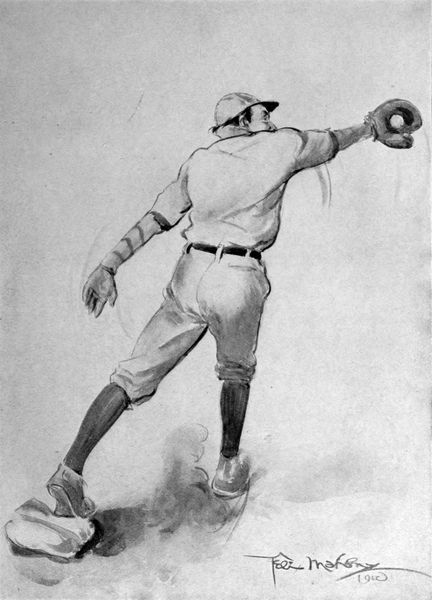
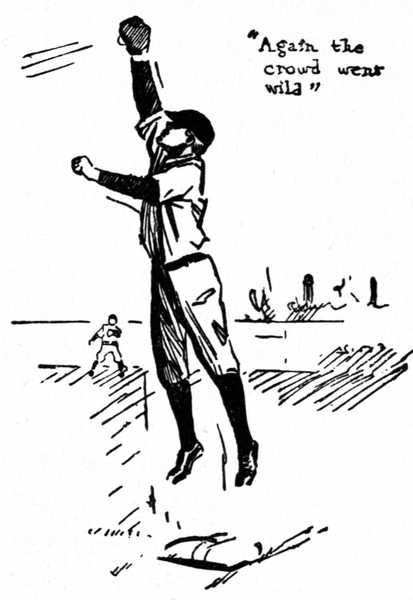
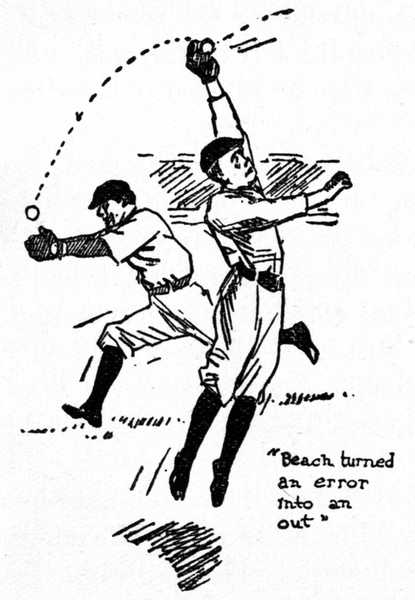
Hal’s direction, but high. If there ever was a ball
that was headed for the grand stand it was that one.
For height it came near the record. The Jefferson
crowd went wild, but they had never really seen Hal
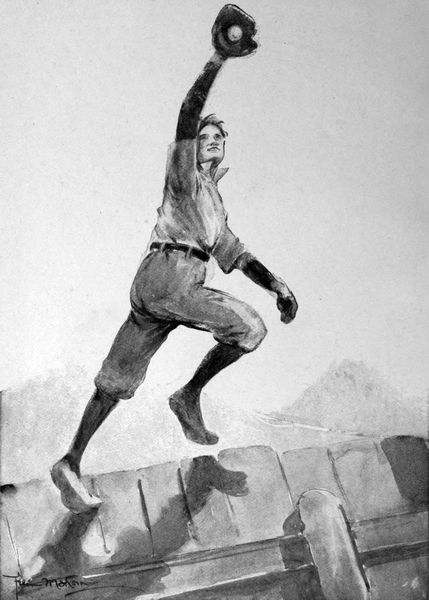
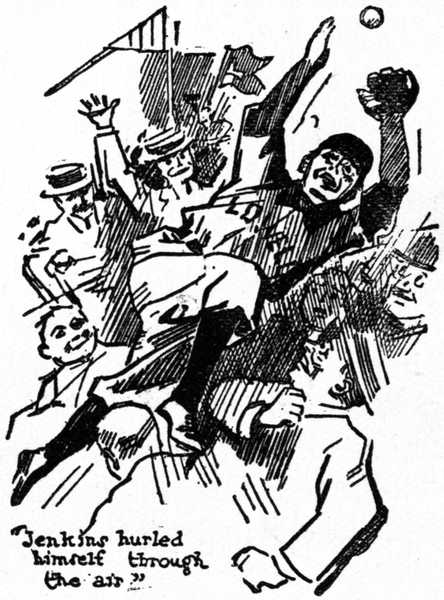
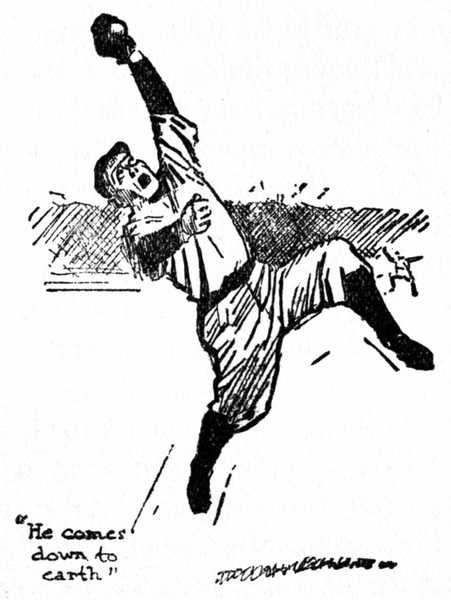
climb into the air. He ran three steps, made a
mighty leap into the air, his back to the ball, and
then that right hand of his shot up one, two, maybe
four feet higher, and he got it. He was as far from
the bag almost as the runner, only he was up over it.
He came to earth feet on the base and as the umpire
waved his hand for the out, Hal and Church came
together and the breath was knocked out of both of
them.
He had to call time, for these boys were both
unconscious for a few minutes.
When Hal opened his eyes his first words were,
“Did I get it,” but he couldn’t hear the answer, as
the stands were yelling, “Oh, you Hal! Oh, you
Case!” and then he heard Arthur say, “You saved
the game for us, Hal. We’ve got another chance,”
and when he turned to Hughie the latter just shook
his hand. He was too much overcome to speak.
Then Lowell went to bat for the final half of the
ninth with renewed courage, for the God of Champions
surely intended them to have another chance
when he enabled Hal to make that stop.
It had been a stern chase all the way for Lowell
and now it was up to them for the last time. It would
take three runs to win, but they had often made three
or more runs in the last half and Hal’s catch had put
the fire back into their hearts.
That’s the way they felt when Everson, the head
of the batting list, came up. If he could get a base
on balls he would have a good start thought he, at
least he decided to wait until the count was two and
two. That’s the way it worked out—two balls and
then two strikes, one of which Johnny tried for. He
guessed that Mellen would try to put the next one
over and Johnny decided to hit it out. Mellen on
the other hand wanted him to guess that way and he
sent up what looked like a fast straight one. Johnny
gave his sharp quick swing and missed. He had
struck out.
It was a bad start. Larke came up and without
waiting banged the first ball past the pitcher and out
toward second base. The ball hit the bag, and
glancing off at an angle to the right rolled straight
into La Joy’s hands and it was two out and hope
almost dead.
“They have to put three out before we’re beat,
boys,” called Hughie after Talkington as the latter
picked up his bat and started for the plate and all the
Lowell rooters prayed hard even while hope died
within them.
Mellen in the box, cool, confident, and with the
big strain nearly over, was tempted to fool with
Talkington. He had hopes of striking him out. He
started two balls straight for the plate but they curved
out. Tris let them go by and the umpire said after
the second one, “Ball two.” Then he started one
wide of the plate but failed to get the curve on it
and it went for third ball. The next two came
straight over but Tris never moved and let the umpire
call “Strike two.” The crowd stood up ready to
go home as Mellen let go the last ball. It was a
wild pitch that hit the ground in front of the plate
and Talkington trotted to first. The crowd sat down
again. There might be something doing after all.
Mellen was surprised and a little nervous. He let
the first one slip a little and it came within reach
of Ty’s bat, who connected with it for a single to
right on which Talkington got to third. Then Ty
stole second, which wasn’t hard, as Roger didn’t dare
throw.
The slight chance had developed into an opportunity
for the next batter, who was Hans.
Hughie was on the third base line yelling, “Eyah!
Eyah! We’ve got them, boys!” pulling grass with
both hands, yelling, whistling, kicking the air and
calling, “You can do it” to Hans.
Church walked over to the pitcher’s box and La
Joy and Brest joined them where they held a
consultation at which it was decided to walk Hans.
This was a natural thing to do, as Hal who was
up next, while a good batter, was not so sure to get
it safe. Hans knew what they were up to and the
Jefferson boys knew he knew it. So he stood there
at the plate, more or less resigned to his fate, acting
as though it wasn’t any use even to watch the balls
as they were pitched. At the same time he was
standing a little nearer the plate than he usually did
although Mellen didn’t notice this. Hans let three
go by and they were about as wide of the plate as
three balls could be. Hans hadn’t moved. When
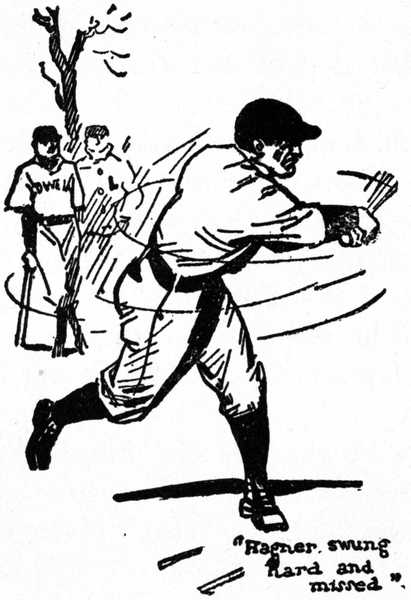
Mellen started to pitch the fourth ball Hans’ bat
was swinging in his left hand. The ball came on
high and wide and apparently Hans was going to
take his base but as the ball approached he took
one step forward, swung his bat up and out and met
the ball on the nose. When Mellen heard the crack
of the bat his arms dropped to his sides and he didn’t
even turn to look where the ball went. He knew
that ball wasn’t meant to be caught by any fielder
within the grounds. As it went over Twitchell’s
head that fellow also knew it would do no good for
him to give chase and as for the rest of the Jefferson
team, all of them except Church and La Joy stood
still with mouths open and watched the ball go sailing
clean over the right-field bleachers into the runway
which leads from the ticket offices into the grand
stand, and if they could have followed it after that
they would have seen it bounce beyond the turnstile
and clear out onto the elevated tracks, where it
dropped through to the street. The aforesaid Church
and La Joy merely took off their caps, threw them
into the dust and stamped on them. Then they picked
them up, brushed them off and put them back on
their heads.
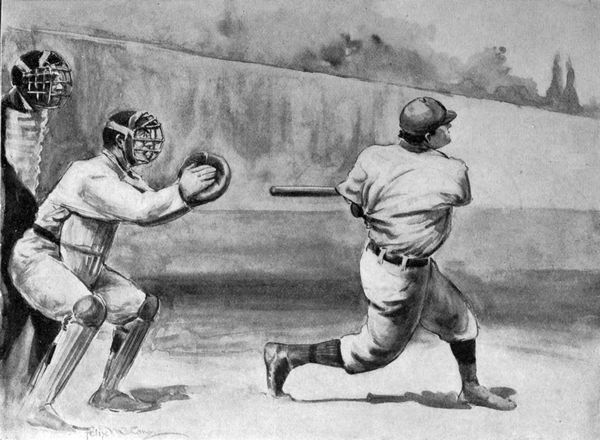
Meanwhile Talkington, Robb and Hagner had
touched the plate and were trying to get through
the crowd of Lowell rooters who had surrounded
them and the other members of the team.
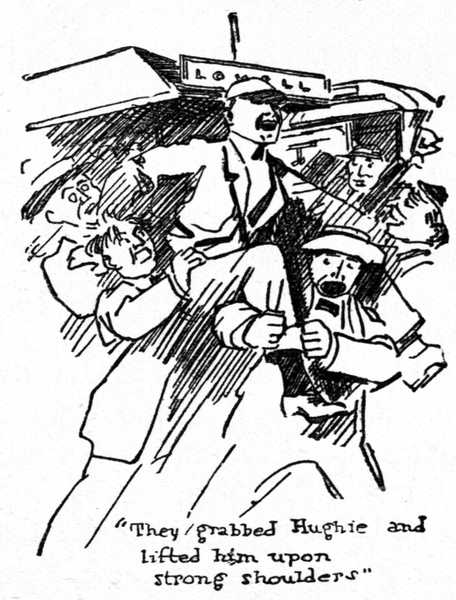
It was nothing but shoulders for the boys after
that. Up they went surrounded by thousands for a
parade around the park.
“Where’s Hal? He saved it!” shouted the
crowd, and then, “Where’s Hans? He won it,” and
after they had borne these two to the head of the
procession, though no one could tell how it was
possible, they carried them round the field a dozen
times to the music of Lowell songs and yells, to
finally land them at the Club House door where
they left them to bathe and dress, after giving them
to understand they were expected to attend the Lowell
banquet at the Waldorf at eight.
Words could not describe the reception given to
Hans and Hal by their team mates in the club house
of the New York Nationals that afternoon, so no
attempt will be made to do so, suffice it to say that
it was thoroughly impressed on both that but for
them the championship had been lost, and their
names went to the top of the list of the Lowell Hall
of Heroes.
BOX SCORE
| Lowell |
AB |
R |
H |
PO |
A |
E |
|
Jefferson |
AB |
R |
H |
PO |
A |
E |
| Everson, 2b |
5 |
0 |
1 |
1 |
1 |
0 |
|
Laird, 3b |
4 |
1 |
2 |
1 |
0 |
0 |
| Larke, lf |
5 |
1 |
0 |
1 |
0 |
0 |
|
Beach, cf |
3 |
1 |
0 |
1 |
1 |
0 |
| Talkington, cf |
5 |
1 |
1 |
2 |
1 |
0 |
|
Church, 1b |
5 |
0 |
0 |
9 |
1 |
0 |
| Robb, rf |
5 |
1 |
1 |
0 |
6 |
1 |
|
Hollins, ss |
4 |
1 |
0 |
3 |
5 |
2 |
| Hagner, ss |
5 |
2 |
4 |
2 |
2 |
0 |
|
La Joy, 2b |
4 |
1 |
1 |
0 |
5 |
1 |
| Case, 1b |
2 |
1 |
1 |
12 |
5 |
0 |
|
Warcford, lf |
4 |
1 |
3 |
3 |
0 |
0 |
| Delvin, 3b |
4 |
0 |
1 |
1 |
0 |
1 |
|
Twitchell, rf |
4 |
0 |
1 |
2 |
0 |
0 |
| Gibbs, c |
4 |
0 |
1 |
7 |
2 |
1 |
|
Brest, c |
4 |
0 |
0 |
6 |
0 |
0 |
| Black, p |
2 |
0 |
0 |
0 |
2 |
0 |
|
Mellen, p |
3 |
0 |
0 |
1 |
1 |
0 |
| Radams, p |
0 |
0 |
0 |
0 |
0 |
0 |
| Huyler[C] |
1 |
0 |
0 |
0 |
0 |
0 |
| |
— |
— |
— |
— |
— |
— |
|
|
— |
— |
— |
— |
— |
— |
| |
38 |
6 |
10 |
26 |
19 |
3 |
|
|
35 |
5 |
7 |
[D]26 |
13 |
3 |
| Lowell |
1 1 0 1 0 0 0 0 3—6 |
| Jefferson |
2 0 0 1 0 0 0 2 0—5 |
- Two Base Hits—Hagner, 2; La Joy, 1.
- Three Base Hit—Warcford.
- Home Runs—Hagner.
- Sacrifice Hits—Case, 2; Church, 1; Beach, 1; Black, 1; Mellen, 1.
- Stolen Bases—Case, 2; Larke, 2; Hollins, 1; Hagner, 1; Delvin, 1, Robb, 1.
- Left on Bases—Lowell, 8; Jefferson, 8.
- First Base on Errors—Lowell, 1; Jefferson, 1.
- Double Play—Case, Hagner, and Case.
- Struck Out—by Black, 3; by Mellen, 4.
- Hit by Pitcher—by Radams, 1.
- Wild Pitch—by Mellen, 1.
- Hits—off Black, 6 in eight innings; off Radams, 1 in one inning.
- [C] Batted for Black in eighth inning.
- [D] Hollins out bunting third strike.