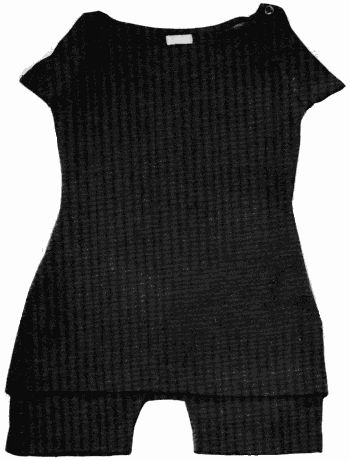
Bathing became popular as a medicinal treatment
for both men and women of the new world in the last
half of the 18th century. It was the only aquatic
activity, however, that was considered proper for
women until over a hundred years later.
Like so many other customs, changes in bathing
costume styles were initially introduced by way of
England. They were adapted or rejected according
to the special conditions of this continent. To give a
clearer picture of the costume worn in the colonies
and in the United States, descriptions of the English
dress will be included where pertinent. I have not,
however, found any evidence showing that bathing
nude was a practice for women in this country.
It is disappointing but not surprising to discover
the lack of descriptions pertaining to early bathing
costume. This simple gown was utilitarian, not
decorative. Thus it deserved little attention in the
eyes of the contemporary bather.
No doubt it is due to the importance of the original
owner that the following example has survived. In
the collection of family memorabilia at Mount
Vernon, there is a chemise-type bathing gown that
is said to have been worn by Martha Washington
(fig. 6). According to a note attached to the gown
signed by Eliza Parke Custis, and addressed to
“Rosebud,” a pet name for her daughter, Martha
Washington probably wore this bathing gown at
Berkeley Springs as she accompanied her daughter,
Patsy, in her bath.
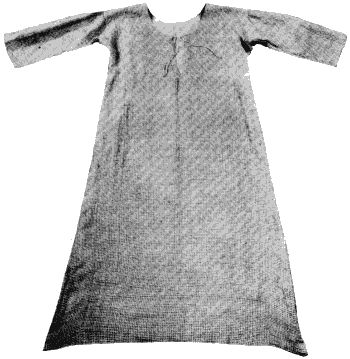
Figure 6.—Linen bathing gown said to have been
worn by Martha Washington. (Courtesy of The
Mount Vernon Ladies’ Association.)
This blue and white checked linen gown has
several construction details similar to the chemise, a
woman’s undergarment, of the period. The sleeves
were gathered near the shoulder and were set in
with a gusset at the armpit. The skirt of the gown was
made wider at the bottom by the usual method of
adding four long triangular pieces—one to each side
of both the front and back. The sleeves, however, are
not as full as those one would expect to find on a
chemise of the period. Also a chemise would probably
have had a much wider neckline gathered by a
draw-string threaded through a band at the neck
edge. Instead, this bathing gown has a moderately
low neckline made wider by a slit down the front
which is closed by two linen tapes sewn to either
edge of the front. Although less fabric was used for
the bathing gown than was normally required to
make a chemise, it was probably not because of
functional considerations as one might like to think,
but because of the scarcity of fabric. Close examination
reveals that the triangular sections of fabric
used to add fullness to the skirt consist of several
pieces. In fact the two sections used in the back are
made from a different fabric, although it is still a
blue and white checked linen. Frugal use of scraps in
linings and hidden sections of decorative costume was
common practice in the 18th century. The piecing
of the bathing gown is further evidence of the fact
that it was a garment that had no ornamental purpose.
Of particular interest are the lead disks which are
wrapped in linen and attached near the hem next
to the side seams by means of patches. No doubt
these weights were used to keep the gown in place
when the bather entered the water.
The following account of bathing in Dover, England,
in 1782 suggests how the bathing gown might have
been used at Berkeley Springs:
The
Ladies in a morning when they intend to bathe, put
on a long flannel gown under their other clothes, walk
down to the beach, undress themselves to the flannel,
then they walk in as deep as they please, and lay hold of
the guides’ hands, three or four together sometimes.
Then they dip over head twenty times perhaps; then
they come onto the shore where there are women that
attend with towels, cloaks, chairs, etc. The flannel is
stripp’d off, wip’d dry, etc. Women hold cloaks round
them. They dress themselves and go home.[27]
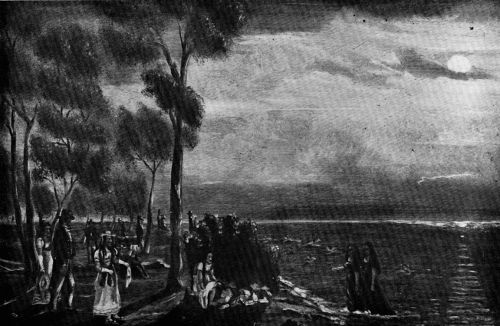
The earliest illustration showing costume worn in
the United States for fresh water bathing is dated
1810 (see fig. 2). Unfortunately the painting reveals
only that the bathing gowns were long and dark
colored in comparison with the white dresses of the
period.
An 1848 article which described, in detail, the
fashionable dress called for by each activity at summer
resorts, concludes with the following tantalizing
paragraph:
We have no space for an extended description of suitable
bathing-dresses. They may be procured at any of our
town establishments for the purpose. Much depends upon
individual taste in their arrangement, for uncouth as they
often of necessity are, they can be improved by a little
tact.[28]
This is the only reference to American bathing costume
of the second quarter of the 19th century that the
author has found at this time. Nevertheless, an
English source describes what must have been a
transitional style between the chemise-type bathing
gown and the more fitted costume of the 1850s.
The Workwoman’s Guide, published in London,
1840, included instructions for making both a bathing
gown and a bathing cap. Health and modesty were
the main considerations that influenced the choice
of color and type of material.
Bathing gowns are made of blue or white flannel, stuff,
calimanco, or blue linen. As it is especially desirable that
the water should have free access to the person, and yet
that the dress should not cling to, or weigh down the
bather, stuff or calimanco are preferred to most other
materials; the dark coloured gowns are the best for
several reasons, but chiefly because they do not show the
figure, and make the bather less conspicuous than she
would be in a white dress.[29]
The following details reveal that, in general, this
1840 bathing gown starts as an unshaped garment
similar to the gown attributed to Martha Washington
[brackets are mine].
As the width of the materials, of which a bathing gown
is made, varies, it is impossible to say of how many
breadths it should consist. The width at the bottom, when
the gown is doubled, should be about 15 nails [1 nail = 21⁄4
in.]: fold it like a pinafore, slope 31⁄2 nails for the
shoulders, cut or open slits of 31⁄2 nails long for the armholes,
set in plain sleeves 41⁄2 nails long, 31⁄2 nails wide,
and make a slit in front 5 nails long.[30]
The instructions for finishing this gown, however,
show that the sleeves were worn close around the
wrists and that the fullness of the skirt was secured
at the waist by a belt.
In making up, delicacy is the great object to be attended
to. Hem the gown at the bottom, gather it into a band
at the top, and run in strings; hem the opening and the
bottom of the sleeves and put in strings. A broad band
should be sewed in about half a yard from the top, to
button round the waist.[31]
By the addition of the above details this type of
bathing gown more closely approximates the style
of the long-skirted blouse of the 1850s to be described
later.
In regard to the bathing cap we are told that,
These are made of oil-silk, and are worn, when bathing,
by ladies who have long hair.... It is advisable, however,
for those who have not long hair, to bathe in plain
linen caps, so as to admit the water without the sand or
grit, and thus the bather, unless prohibited on account
of health, enjoys all the benefit of the shock without
injuring the hair.[32]
The “Scene at Cape May” (fig. 3) shows women
wearing long-skirted, long-sleeved, belted gowns as
well as head coverings similar to the type described
in The Workwoman’s Guide.
Thus during the period when bathing became
popular as a medicinal treatment, women wore loose,
open gowns perhaps patterned after a common undergarment,
the chemise. Although this chemise-type
bathing costume must have been very comfortable
when dry, its fullness was restrictive when wet. The
bather could only immerse herself in water which was
all that was necessary for the treatment. As the
recreational possibilities of bathing began to overshadow
its health-giving properties, women’s bathing
dresses also became more fitted, following the general
silhouette of women’s fashions.
During the first half of the 19th century in England
and the United States, a more tolerant attitude toward
feminine exercise led women to abandon the fiction
that they were not bipedal while bathing. This
acknowledgment, however, was not fostered solely
by the need for a more functional bathing dress. It
was first evidenced by a few daring European women
who wore lace-edged pantaloons trimmed with several
rows of tucking under their daytime dresses. The
shorter, untrimmed, knee-length drawers which
quickly replaced the pantaloons, became an unseen
but essential item in the fashionable English lady’s
toilette of the 1840s. These drawers, or a plainer
version of the longer pantaloons, were adapted not
only to the female riding habit but the bathing dress
as well. An 1828 English source reported that “Many
ladies when riding wear silk drawers similar to what
is worn when bathing.”[33] With the increased interest
in physical exercise for women, ankle-length, open
pantaloons also were being worn in the 1840s with a
long overdress as an early form of gymnasium suit.
This evidence of the early use of drawers suggests that,
like English ladies, women in the United States were
probably wearing a type of drawers beneath their
nondescript bathing gowns during the second quarter
of the 19th century. There is some slight support of
this theory in the following stanza of a poem that
appeared in 1845:
But go to the beach ere the morning be ended
And look at the bathers—oh what an array
The ladies in trowsers, the gemmen in blowses
E’en red flannel shirts are the “go” at Cape May.[34]
The rather crude but delightful sketch of seabathing
at Coney Island in 1856 (fig. 7) shows the
ladies wearing very full, ankle-length, trousers with
a sack top extending loosely only a few inches below
the waist. This type of bathing costume, which was
primarily a bifurcated garment instead of a skirted
one, became the prevailing fashion as reported in
English women’s magazines of the 1860s.
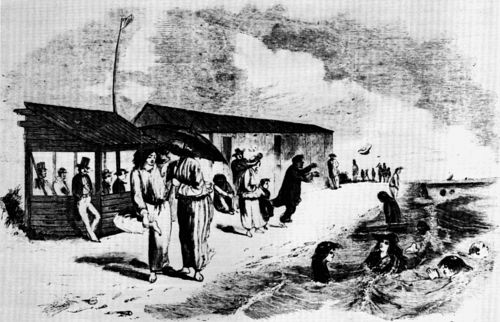
scene at coney island—sea bathing illustrated.
Figure 7.—Sea bathing at Coney Island, from Frank
Leslie’s Illustrated Newspaper, September 1856.
(Smithsonian photo 58437.)
In contrast to the originally European skirtless
costume, the Philadelphia publication, Peterson’s
Magazine, stated that bathing dress should consist
of a pair of drawers and a long-skirted dress. The
recommended drawers were full and confined at
the ankle by a band that was finished with a ruffle.
These drawers were attached to a “body” and
fastened so that, even if the skirt washed up, the
individual could not possibly be exposed. The dress
was made by pleating or gathering the desired
length of material onto a deep yoke with a separate
belt securing the fullness at the waist. The bottom
of the hem was about three inches above the ankle
and was considered rather short. Loose shirt sleeves
were drawn around the wrist by a band which was
finished with a deep ruffle as a protection against
the sun. According to this article many women wore
a small talma or cape which hid the figure to some
extent. It was recommended that the drawers, dress,
and talma be made of the same woolen material.
Bathing-dresses, although generally very unbecoming can
be made to look very prettily with a little taste. If the
dress is of a plain color, such as grey, blue or brown, a
trimming around the talma, collar, yoke, ruffles etc ...,
of crimson, green or scarlet, is a great addition.[35]
To complete a bathing toilette the following items
were considered necessary: a pair of large lisle thread
gloves, an oil cap to protect the hair from the water,
a straw hat to shield the face from the sun, and gum
overshoes for tender feet.
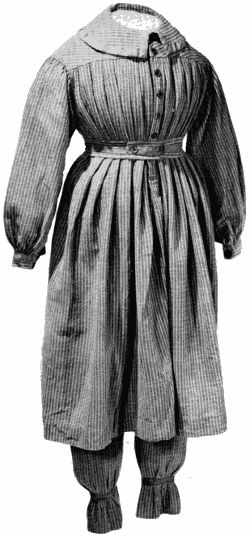
Figure 8.—Bathing dress, c. 1855. (Courtesy of Philadelphia
Museum of Art. Photograph by A. J. Wyatt,
staff photographer.)
The red, tan, and blue-green checked bathing dress
shown in figure 8 is jauntily trimmed with crimson
braid edging the collar, belt, and wrist and ankle
bands. This costume is a variation of the style described
previously. The drawers, unlike those described
in Peterson’s Magazine, are sewn to a linen band
with linen suspenders attached. The unfitted, unshaped
skirt (8 ft. 8 in. in circumference) is pulled in
at the waist by a belt attached to the center back. A
similar technique for forming a waistline is described
in The Workwoman’s Guide of 1840.
Women’s magazines in the United States from the
third quarter of the 19th century show illustrations of
bathing costume, but in many instances these publications
used European fashion plates. Harper’s Bazar,
(spelled thus until 1929) particularly in its early years,
used fashion plates and pattern supplements from its
German predecessor Der Bazar. Thus, in one issue
one can find a fashion plate showing the predominantly
bifurcated European bathing suit and, in a column on
New York fashions, a separate description of long-skirted
bathing dresses with trousers. During the same
period Peterson’s Magazine had illustrations previously
used in the London publication, Queen’s Magazine.
American women seem to have accepted the majority
of styles shown in European fashion plates,
except for the skirtless bathing suits. The writer of an
1868 column on New York fashions sought to convince
his readers to try the more daring European style
although he grudgingly admitted that the “Bathing
suits made with trousers and blouse waist without
skirt are objected to by many ladies as masculine and
fast....”[36] This style was in fact, very similar to
the costume worn by men when they bathed with the
ladies. A year later, the writer of the same fashion
column had given up the campaign to dress all women
in the skirtless suits and admitted that these imports
“... are worn by expert swimmers, who do not
wish to be encumbered with bulky clothing.”[37] Such
practical bathing dress was thus limited to a very
small number of progressive women.
The majority, consisting of those who were strictly
bathers, wore the ankle-length drawers beneath a
long dress as described or illustrated in the majority
of sources that originated in the United States. Why
was the European bathing suit not fully adopted by
American women? Differences between the bathing
customs of the two continents undoubtedly encouraged
the development of different dress. While men and
women in the United States bathed together freely
at the seashore during the latter half of the 19th
century, this practice was not widely accepted in
England until the early 1900s. In the presence of men,
American women probably felt compelled to retain
their more concealing dress and drawers.
In England swimming seems to have been more
popular among women than it was in the United
States. While encouraging its readers to swim, during
the late 1860s, Queen’s Magazine used forceful language
of a kind that was not found in American publications
until the late 19th century. If swimming was more
acceptable as a feminine exercise in England it is
understandable why English women were more
receptive to a functional, skirtless bathing suit—especially
since it was worn only in the presence of
other women.
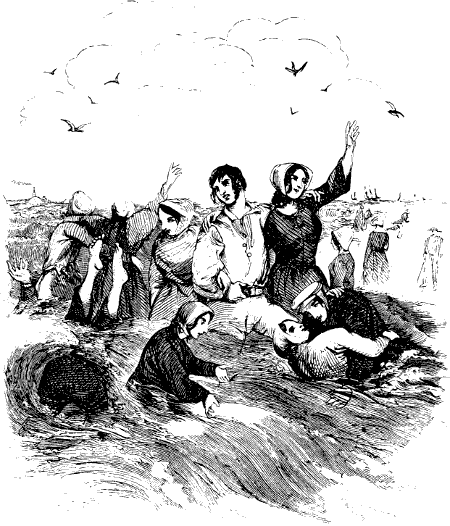
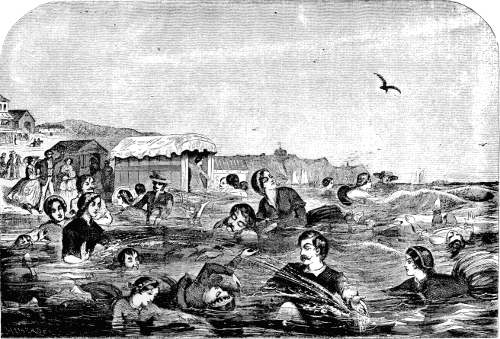
In 1858, Winslow Homer, who was later to become
a well-known American painter, was welcomed
into the society at Newport until it became apparent
that he wanted to sketch the bathers for a weekly
newspaper (see fig. 4). So great were the ensuing
objections that he was permitted to complete his
sketches “... provided he depicted the bathers
only in the water and only above the waistline and
without divulging the identity of the bathers.”[38]
As can be seen in figure 4, these sketches serve more
as a testament of Homer’s fancy than as an accurate
historical statement on style. The two feminine
legs exposed in the water from just below the knee
to the toe and the feminine head coverings appear
to be anachronisms. According to several other
illustrations of the period, these women were undoubtedly
wearing long drawers. The young artist
at 22, however, has been described as having an eye
for feminine beauty and a sense of fashion. He seems
to have exploited to the full the decorative possibilities
of hoop skirts blown by the breeze or agitated by some
pretty accident to discreetly reveal a trim ankle.
A drama of breeze versus long skirt appears with the
small feminine figure in the left background of this
print. The force of the waves and the motion of the
frolicking bathers gave the artist opportunity to show
two more pretty accidents. The only head covering
he showed for feminine bathers was a ruffled cap that
framed the face. Other sources show Newport bathers
wearing the less attractive wide-brimmed straw hat
(fig. 9). The straw headgear worn over these caps
seems more likely since Newport’s fashionable belles
would surely have sacrificed appearances and worn a
straw hat to avoid an unfashionable sunburn and tan.
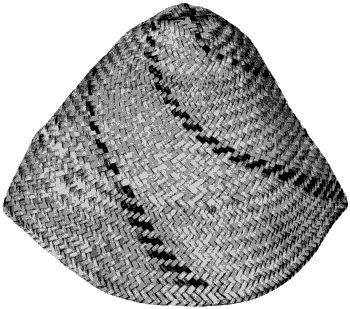
Figure 9.—Bathing hat of natural color and purple
straw, c. 1880. (Smithsonian photo P-65409.)
Nevertheless, Homer’s sketch reflects characteristics
seen in certain surviving examples from the 1860s—namely
that the top was becoming more fitted, being
attached completely to a belt with the fuller skirt
pleated or gathered to the bottom edge of the belt.
In the Design Laboratory Collection of the Brooklyn
Museum there is an 1860 black poplin specimen that
may be a bathing dress. This example is trimmed
at the shoulder seam with epaulets, an example of the
extent to which fashion was finally playing a part in
bathing costume.[39]
The dresses described above appear peculiar not
only to 20th century eyes, but they also seem to have
amused mid-19th century correspondents. One writer
in 1857 declared that,
We don’t think a man could identify his own wife when
she comes out of the bathing-house. A plump figure enters,
surrounded with a multitude of rustly flounces and
scarcely able to squeeze an enormous hoop through the
door. She is absent a few minutes, and presto change!
out comes a tall lank apparition, wrapped in the scanty
folds of something that looks more like a superannuated
night-gown than anything else, and a battered straw-chapeau
knocked down over the eyes, and stalks down
towards the beach with the air and gait of a Tartar
chieftain![40]
[fig. 10.]
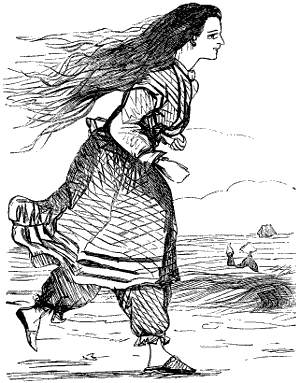
Figure 10.—“How she went in,” from Harper’s Bazar,
August 1870. (Smithsonian photo 61585A.)
Another writer felt that he
... must say—even in the columns of Frank Leslie’s
Illustrated—that they don’t look very picturesque or pretty
when a la Naiade.... Rather limp, sacks tied in the
middle, eel-bottles, hydropathic coalheavers and “longshoremen,”
and preternaturally dilapidated Bloomers,
would appear to be the ideals aimed at.[41]
[fig. 11.]
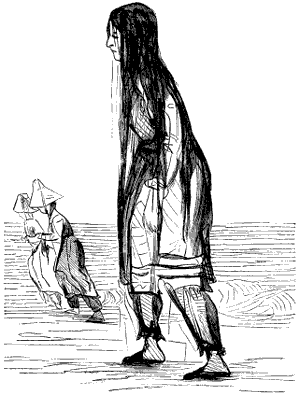
Figure 11.—“How she came out,” from Harper’s
Bazar, August 1870. (Smithsonian photo 61585B.)
This use of the term “Bloomers,” referring to long full
drawers or trousers, is a reminder of how similar the
1855 bathing gown with drawers (see fig. 8) was
to the reform dress introduced in 1848 and worn by
Amelia Bloomer, the feminist, in 1852.
Despite the evident use of a new waistline treatment,
the most popular bathing costume of the
1870s, according to Harper’s Bazar, continued to
feature the yoke blouse that reached at least to the
knee. This combination of blouse and skirt was held
in position at the waist by a belt. The high neck was
finished with a sailor collar or a standing pleated
frill, while the long sleeves and full Turkish trousers,
buttoned on the side of the ankle, concealed the
limbs. In 1873 a column on New York fashions
reported an effort to popularize short-sleeved, low-throated
suits then in favor at European bathing
places and which had been illustrated in the Bazar.
Nevertheless, the writer hedged this report by adding
that
It is thought best, however, to provide an extra pair of
long sleeves that may be buttoned on or basted in the
short puffs that are sewn in the arm holes. Sometimes a
small cape fastening closely about the throat is also
added.[42]
Nevertheless, sketches of bathing scenes from the
seventies indicate that some American women wore
even shorter sleeves and trousers than those prescribed
by the fashion magazines.
Linen and wool fabrics were both suggested in the
1840s, but by the 1870s flannel was most frequently
used for bathing dresses, with serge also being recommended.
Navy blue, and to a lesser extent, white,
gray, scarlet, and brown were popular colors in
checks as well as solid colors trimmed with white,
red, gray, or blue worsted braid.
Bathing mantles or cloaks were worn to conceal
the moist figure when crossing the beach. These
garments were made of Turkish toweling with wide
sleeves and hoods, and were so long as “to barely
escape” the ground.
In 1873 one good bathing cap was described as an
oiled silk bag-crown cap large enough to hold the hair
loosely. The frill around the edge was bound with
colored braid. Many ladies preferred, however, to
let their hair hang loose and under a wide-brimmed
hat of coarse straw tied down on the sides to protect
their skin from the sun (fig. 9).
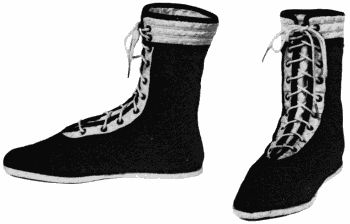
Bathing shoes or slippers were generally worn when
the shore was rough and uneven. In 1871 manila
sandals were worn, but the most functional bathing
shoes are said to have been high buskins of thick
unbleached cotton duck with cork soles. They were
secured with checked worsted braid. Two years later
there were bathing shoes of white duck or sail canvas
with manila soles. Slippers for walking in the sand
were “mules” or merely toes and soles made of
flannel, braided to match the cloak, and sewn to
cork soles.
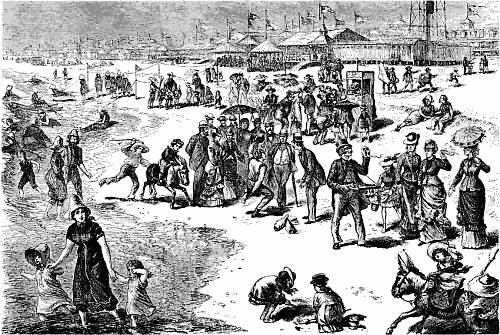
Throughout this period the social aspect of bathing
predominated over the therapeutic goals and women
were making a greater effort to transform their bathing
garments into attractive and functional outfits.
Motivated by the presence of men at the seashore and
by the competition with other women for masculine
attention, ladies were more concerned with the style
of their bathing dresses and appropriate trimmings.
Thus bathing costume joined the ranks of other
fashions described in women’s magazines.
Now that women were frolicking in the water
rather than simply being dunked several times,
their costume became somewhat more functional.
Long trousers gave them greater freedom in the water
although the skirts which continued to be worn,
tended to negate this improvement. Even as early as
the 1870s there were efforts to shorten sleeves and
eliminate high necklines. This trend to make bathing
dress more practical increased in momentum toward
the end of the century.
Although attitudes toward sports were more enlightened
by the 1880s, many women continued to
wear the old bathing dress with its belted blouse
extending to a long skirt and a pair of trousers. As an
alternate to this garb, the “princess style” was developed
with the blouse and trousers cut in one piece or
else sewn permanently to the same belt. A separate
skirt extending below the knee was buttoned at the
waist to conceal the figure. This new style in bathing
costume was probably derived from an innovation in
women’s underwear. During the late 1870s a new
style of undergarment, the “combination” of chemise
and drawers, had come into use. Petticoats could be
fastened to buttons sewn around the waist of the
combination. This streamlining of undergarments
helped the lady of fashion to maintain a desirably
svelte figure. Apparently the advantages of this
streamlining were obvious, because it was not long
before women were quietly adapting this style to
bathing dresses. By the 1890s the skirt was often
omitted for swimming (fig. 12), giving the more
active women more freedom in the water. Following
popular dress styles, the top of the bathing costume
was bloused over the belt. The sailor collar, either
large or small, was a great favorite, but a straight
standing collar with rows of white braid was also worn.
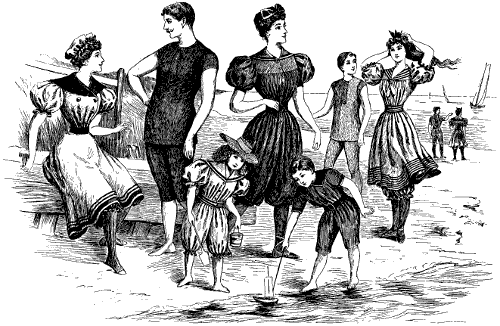
Figure 12.—Bathing costumes from a supplement to The
Tailor’s Review, July 1895.
(Courtesy of Library of Congress.)
The “princess style” was not the only innovation
available in bathing dress. Harper’s Bazar reported in
1881 that imported French bathing suits[43] for ladies
were made without sleeves, since any covering on the
arm interfered with the freedom desirable for swimming.
Nevertheless, according to other contemporary
fashion descriptions, American bathing suits retained
their long sleeves until the early 1880s when the
foreign fashion of short sleeves came to the United
States. In 1885 it was reported that
The sleeves may be the merest ‘caps’ four or five inches
deep under the arm, curved narrow toward the top, and
lapped there or they may be half-long and straight,
reaching to the elbows, or else they may be the regular
coat sleeves covering the arms to the wrist. With the short
sleeves it is customary to add the sleeves cut from a gauze
vest to give the arm some protection from the sun.[44]
Sleeves were pushed up in 1890 and puffed high about
the shoulders by means of elastic tape in the hem. By
1893 fashion reports acknowledged that sleeve length
was a matter of individual choice.
Despite this neat resolution of the diminishing
sleeve, contemporary sketches of bathing scenes
indicate that some women in the United States were
wearing the shorter sleeves even earlier.
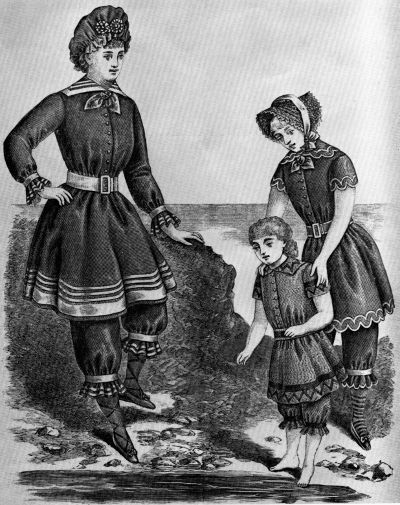
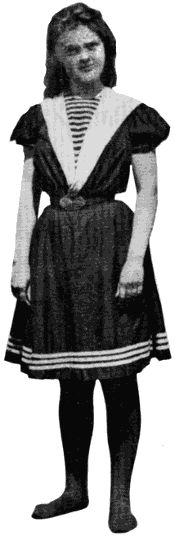
Short full trousers, reaching just below the knee,
accompanied by knee-length skirts—sometimes worn
even shorter—succeeded the long Turkish trousers
and ankle-length skirt. As the trousers diminished in
length, long stockings or bathing shoes with long
stocking tops became a necessary part of the bathing
costume to cover the lower limbs, particularly in
mixed bathing (see fig. 1). The stockings, which were
cotton or wool, plain or fancy, and of any color or
combination of colors in keeping with the costume,
were worn with a variety of bathing shoes, sandals, or
slippers when bathing off a rocky shore. Foot coverings
were usually made of white canvas; the slippers
were held on by a spiral arrangement of braid or
ribbon about the ankles, while the laced shoes were
often made with heavy cork soles. A gaiter shoe or
combination shoe and stocking was made of waterproof
cloth, laced up the sides, and reached to about
the knees. Low rubber shoes were also worn.
Bathing caps of waxed linen or oiled silk were used
to protect the hair. They had whale bone in the brim
and could be adjusted by drawstrings in the back.
Blue, white, or ecru rubber hats were also used. These
caps had large full crowns—which held in all the
hair—and wired brims. A wide-brimmed rough straw
hat, tied on with a strip of trimming braid or with
ribbon, was sometimes worn as protection against
the sun (fig. 9).
Bathing mantles like those of the 1870s were still
being worn by the late 19th century and these were
frequently trimmed with colored braid. Cotton tapes
sewn in parallel rows, mohair braid, or strips of
flannel were still being used to make the bathing
dress more attractive.
Navy blue and white, as well as ecru, maroon, gray,
and olive were popular colors for the bathing dress.
In 1890 the writer of a fashion column thought it
pertinent to add that “... black bathing suits are
worn as a matter of choice, not merely by those
dressing in mourning.”[45] Apparently the wearing of
black no longer had this exclusive significance when
bathing, but prior to 1890 it did.
As women became more active in the water and
were learning to swim they began to accept more
practical changes in bathing costume. Not only the
style, as described previously, but also the fabric was
considered for its functional characteristics. Flannel
was still widely used but was being replaced by serge
which was not as heavy when wet. Another indication
of this trend was that stockinet, a knitted material,
was gaining in popularity at the end of the century.
The “princess style” of the early 1890s combined
the drawers and bodice in one garment: the separate
skirt fell just short of the ends of the drawers which
covered the knees. By the mid-1890s, however, the
drawers which were now called knickerbockers, were
shortened so as to be completely covered by the knee-length
skirt. These knickerbockers were either attached
to the waist in the popular “princess style” or they
were fastened to the waist by a series of flat bone
buttons.
During this same period, the mid-1890s, knitted,
cotton tights were sometimes worn in place of
knickerbockers. Bathing tights differed from the
knickerbockers in that they were hemmed rather
than gathered on an elastic band at the lower edge
and that they were not attached to the waist. When
tights were used they were completely concealed
by a one-piece, knee-length bathing dress. The use
of the more streamlined bathing tights was another
step toward more functional bathing costume.
Despite these improvements, most women continued
to wear stockings, usually black, when they
bathed or swam in public. The dictates of fashion
and standards of modesty continued to conflict with
practical considerations.
As with street dress, corsets seem to have been an
important though unseen bathing article necessary
for maintaining smart posture. In 1896 it was reported
that
Unless a woman is very slender, bathing corsets should be
worn. If they are not laced tightly they are a help instead
of a hindrance to swimming, and some support is needed
for a figure that is accustomed to wearing stays.[46]
While describing the bathing dresses available in
1910 an article noted: “Some of these are made up
with ... princess forms that are boned so as to do
away with the bathing corset.”[47]
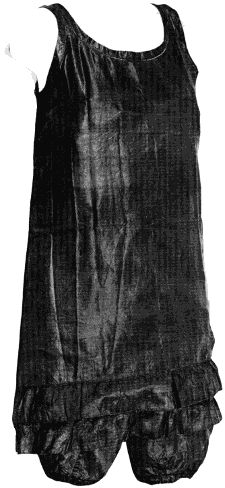
The bodice of the bathing costume continued to
be bloused, but by 1905 it was modified to be merely
loose. An article appearing in 1896 noted that bathing
suits should be cut high in the neck, not tight around
the throat, but close enough to prevent burning by
the sun. The sailor collar continued to be used during
the late 1890s but became less fashionable shortly
after the turn of the century. Nevertheless there had
to be some white around the neck for the bathing
dress to be considered smart. The puffed sleeves,
which had become popular in the late 1890s were
modified in breadth and length to allow free use of
the muscles in swimming (fig. 13).
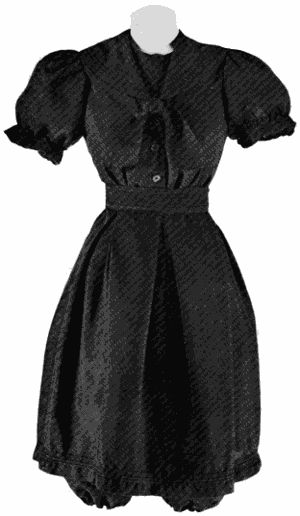
Figure 13.—Bathing dress of black “mohair,”
c. 1900. (Smithsonian photo 60383.)
In 1897 fashion magazines were suggesting that
skirts of bathing dresses looked best when the front
breadth was shaped narrower toward the belt,
while by 1902 the skirts were fitted over the hips in
order to delineate the figure. In 1905 pleated skirts
again became fashionable, although flared skirts
were still acceptable.
Dark blue and black were the popular colors,
although white, red, gray, and green were also used.
Flannel was no longer recommended for bathing
dress; serge and “mohair”—a fabric with a cotton
warp and a mohair or alpaca weft—were widely
used. The impractical bathing dress of silk fabric
was worn by those who could afford this extravagance;
thus, the conspicuous consumption of the “leisure
class” was even found at the beaches.
Bathing hats were still being worn but it was
considered more fashionable to wear a rubber or
oil silk cap covered with a bright silk turban when
there was a surf. For the bather who seldom ventured
very far into the water the most fashionable practice
was to have no covering at all.
Throughout the 19th century bathing costume
followed an impelling course toward becoming more
functional. As the popularity of recreational bathing
and then swimming for women increased, the number
of yards of fabric required to make a bathing dress
decreased. Nevertheless, by the 1900s, many women
knew how to swim, but the majority were still bathers.
Thus bathing suits continued in use through the
first quarter of the 20th century.
[24]