Introduction
9
The women in this book are the heroines of Homer,
of Attic Tragedy, and of the Æneid of Virgil.
Their stories are taken out of the best modern
translations of the old poems; and they are
retold from the human standpoint, with the minimum of
critical comment.
It is curious, when we reflect a moment, how little we
really know about the women of the classics. Their names
have been familiar to us as long as we can remember. We
have always been vaguely conscious of a glory clothing
them—sometimes sombre and troubled, often gracious and
serene, occasionally enchanting. About the greatest of
them some floating hints of identity ripple on the surface
of the mind. But we can by no means fit these little
fragments into any clear outline of the sublime beauty of
their originals. And when we light upon a reference to
them in our reading, or stand before one of the innumerable
works of art which they have inspired, memory is baffled.
We have no clue to the spell that they have cast upon the
centuries: the spell itself has no power over us; and we
grope in vain for the key which would admit us to a world
of delight.
There were reasons for this state of affairs when translations
were few and costly: when scholars were merely pedants
and when the classics were sealed to women. But nous
avons changé tout cela. Fine translations can be bought for
a few shillings. Women are themselves engaging in the
study of the old languages and of the sciences which are
10akin to them. Scholarship is growing more human; and
the awakened spirit of womanhood, having become conscious
of itself, cannot fail to be profoundly interested
in that earlier awakening which, twenty-five centuries
ago, evoked creatures so splendid. Of the women of
Attic Tragedy Professor Gilbert Murray has said, in his
Rise of the Greek Epic: “Consider for a moment the whole
magnificent file of heroines in Greek Tragedy, both for
good and evil.... I doubt if there has ever in the
history of the world been a period, not even excepting the
Elizabethan Age and the Nineteenth Century, when such
a gallery of heroic women has been represented in
Drama.”
By bringing these women together into a single volume,
it is hoped to make their stories easily accessible; and by
quoting some of the most beautiful passages from the poems
in which they live, it is hoped to send the reader back to
the poets themselves. It has not been possible to include
all the heroines in the available space; and several of those
who are missing have only been omitted under the direst
necessity. But all the greatest are here; and an effort has
been made to choose each group so that it shall represent
as far as may be the characteristics of its own poet. The
source of the story is indicated in each case, and has been
closely followed.
A word may be necessary on one or two points, to those
who are coming to these stories from the classics with an
unfamiliar eye. It will be found that there is a singular
reticence here on that aspect of love which engrosses
modern literature. It is occasionally treated by Euripides;
but even he handles the theme delicately and with reserve.
Nowhere in these stories—with the exception of Dido,
11who of course belongs to a later civilization than the Greek
women—is the love which leads to marriage dealt with
explicitly. It is implicit sometimes, and we who have been
born into a heritage of romanticism, may delightedly trace
it out and make the most of it. But the old poet never does:
indeed, he hardly seems to realize that he has put it there.
He belongs to a time when women were not wooed and won,
but literally bought ‘with great store of presents,’ or
acquired in other prosaic ways, which vary according to
the several epochs and their customs. The love of men and
women is treated from the point of view of husband and
wife, of sister and brother, of daughter and father, rather
than from the standpoint of the feverish hopes and fears
of romantic passion. Marriage is not so much the culmination
as the starting-point of an eventful story; and the
heroic devotion of sister and daughter is crowned, no less
than wifely fidelity, with everlasting honour. We must
therefore be prepared for a change from the warmth
and glow of romance to the tonic air of a more austere
idealism.
Again, these women are not the complex creatures of modern
civilization. The earliest of them, Homer’s women, are
drawn in outline only. They are great and splendid;
and because they were created for an aristocratic audience,
they are noble, dignified, and placed high above the small
things of common life. There is hardly any comedy in
Homer, and reality is far away. When we come to the
dramatists we find, as we should expect, a great advance in
characterization. The women are stronger, more real,
more complete. But they are still very far from the psychological
subtlety of modern drama.
There is, too, a singular reticence about the personal
12appearance of the heroines. We are rarely told what
manner of women they were to look at. Virgil comes one
step nearer to our modern love of description when he
portrays Dido as she rides out on the fatal morning of the
hunt; and when he paints the glowing figure of Camilla
as she rushes into battle. But it would be very hard to
discover what was the colour of Helen’s eyes, although
the old German Faustbuch of the Middle Age has dared
to assert that they were ‘black as coals.’ Homer has a
more excellent way. Instead of enumerating the charms of
his heroine, as it were in a catalogue of perfections, he
brings her into the presence of hostile folk, who on all
counts have reason to hate her, and in a few vivid phrases
shows the potent effect of her beauty upon them.
We shall find that the heroines have a system of ethics
which is different from that of our own day; and strange
moral contradictions may present themselves to our
astonished eyes. Electra, with the tenderest love for
her dead father, will not rest until the death of her guilty
mother has been compassed. Antigone, infinitely gentle
to the blind Œdipus, is capable of resolute opposition to
the law as it is embodied in Creon. But though the lines
of moral demarcation are differently placed, they are not
blurred. Revenge is a duty in this primitive saga upon
which the poets drew for their material; and in which
there is much that is savage and terrible.
Greek drama was a religious ritual closely bound to ancient
myth and heroic legend, from which the poets could not
escape. Hence, if these stories are approached in an
analytical mood, they will be found barbarous and wildly
improbable. If we give the rein to humour, we shall be
overcome by frequent absurdities. The best way is to
13come to them quite simply, leaving the comic and the
critical spirits a little way behind.
Grateful thanks are due to the translators and publishers
who have kindly given permission to quote the passages
used herein; and the author wishes humbly to acknowledge
the debt she owes to critical work in this field.
She is especially conscious of help from Professor Gilbert
Murray in interpreting some of the Women of Tragedy.
A note of the sources of the quotations will be found at
the end of each chapter.
Homer: Helen
15
In the twilight of early Greek history, one event and
one name blaze like beacons. They are the siege of
Troy and the name of Helen. They have not come
down to us as cold fact, but burning through a
mist of legend and poetry. The historian cannot name
the date of the Trojan war; and the archæologist, whose
labours have been so fruitful at Mycenæ and in Crete,
can only point doubtfully to the ancient site of Troy.
Yet that event, and its cause, fair Helen of Sparta, may be
said to mark the beginning of national life for the Greeks.
Perhaps it was more than two thousand years before
Christ when all the little peoples of Greece first joined
themselves against barbarian Asia. Troy fell; and although
the victory brought little material reward to the Greeks;
though they sailed back to their island homes poorer
and sadder than when they left, they had in fact achieved
momentous gains. For the struggle had first taught
them the strength of unity: it had launched them on their
long and triumphant feud against barbarism; and it had
laid the base from which they might go on to build, through
the long, slow centuries, the civilization that we inherit.
There was no historian to record the event. But it lived
on, in memory and in legend; and as the people became
more settled, wandering bards made songs about it. The
rich Mycenæn Age flourished and died; and the Homeric
civilization took its place. Probably it was then that the floating
fragments of the Tale of Troy first were woven together,
providing material for the Homeric epics that we know
16as the Iliad and the Odyssey. Probably they were not
written down at first. They were composed, and recited,
in separate parts, in the halls of the great lords, who loved
to look back on this glorious event of their national life,
and to hear the names of their remote and half-mythical
ancestors brought into the story. Thus Homer, no matter
who he or his school may have been, comes to represent
a high stage of civilization. His poems have a lofty tone,
a chivalrous spirit, a sweet cleanliness of thought and of
word, which do not belong to a primitive, uncivilized
people. They do not, as a fact, belong naturally to the
early period of which he sings. In the time of that grim
struggle before the dawn of history, there must have been
much that was ugly, dark and barbarous. This is proved
to us by the survival of some of the older legends upon
which Homer worked. They tell of unnatural crime and
of deeds of horror such as he never mentions; and they
give us, too, a very different interpretation of the story of
Helen. Homer puts aside all these vestiges of a primitive
past. He is composing lays for a people who have a keen
sense of honour, a supreme ideal of beauty and a love of
home; who have a religious feeling strong enough to
reverence the gods, despite their many hieratic quarrels,
and who hold womanhood in high esteem. So when we
come to him to hear about Helen, we find a very sweet and
gracious figure, quite unlike the Helen of the later poets.
With them she was degraded from her rank of demi-god.
She was regarded as a real figure, brought down to the level
of ordinary existence, and judged by the common standard.
The romantic charm of the Homeric conception faded; and
her name had for centuries an evil sound. It has passed
through many vicissitudes since. In late Greek literature,
17one or two poets tried to return to the reverent attitude
of Homer: but in the Middle Ages she became again a
byword and a reproach. At the Renaissance, something
of her early worship as an ideal of beauty was revived,
and our own Marlowe has passionately expressed the thought
of that age about her:
Was this the face that launched a thousand ships,
And burnt the topless towers of Ilium?
Sweet Helen, make me immortal with a kiss....
Oh, thou art fairer than the evening air,
Clad in the beauty of a thousand stars.
It is this vision of Helen, as the supreme ideal of beauty,
that modern poets and scholars have tried to recapture.
They have put aside the varied allegorical and ethical and
realistic conceptions of her, as the efforts of a more sophisticated
age; and they have tried to return directly to the
fine simplicity of Homer himself. Only thus, they believe,
can we stand at the right point of view with regard to Helen;
and only thus can we see her as she was to the Greeks, a
symbol of beauty incorruptible. We, who have to make
our own choice in the matter, cannot do better than
try to stand at the point where the moderns have
placed us.
We come then at once to the Iliad, where, in the Third
Book, Helen makes her first appearance in the world’s
literature. War has been raging round the walls of Troy
for nearly ten years. Now a truce is called; and in the
palace of the old king Priam, word goes round that Paris,
the author of the long feud, is to fight in single combat
with Menelaus, whom he has wronged. For Paris had
brought the bane of war upon Ilios. At his birth, the
oracles of the gods had demanded that he should die; and
18Priam, his father, sorrowfully handed over the wailing baby
to the priest, to be exposed upon Mount Ida. But first
he tied an old ring about his neck; and when Paris was
strangely saved from death, and grew up to be the fairest
and strongest of all the shepherd youths on Ida, he came
one day by accident to Ilios. There, by means of the jewel
hanging from his neck, he was made known as the son of
the king. Thenceforward the poor shepherd was the best
beloved of all the princes. Life went gaily; and for a
while he was utterly content. But he had left behind,
amidst the groves of Mount Ida, a sweet wood-nymph who
loved him well, Enone. And when after a time he began
to tire of life in the palace, he remembered her and thought
longingly of the freshness and beauty of the mountain.
So one day in summer he went to seek Enone. All day long
he searched the forest, but could not find her; and coming
tired at evening to a fragrant glade, he fell asleep. When
he awoke, night was hushed all around, and stars peeped
through the slender branches overhead. It was midnight
and there was no moon; but it was not dark. The glade
was filled with a soft radiance such as he had never seen
before, and when he raised his wondering eyes, he saw
the majestical figures of goddesses shining upon him: Hera,
queen of Olympus, Athena, the wise maid of Zeus, and
Aphrodite, the laughing goddess of love. Sweetly they
smiled on him; and as he stood in wondering awe, the deep,
rich tones of Hera sank upon his spirit, promising him
greatness and power, and the lordship over many lands.
Then Athena, resting her starlike gaze upon him, promised
him wisdom and courage; and Aphrodite, with a little
mocking laugh at power and at wisdom, promised him the
fairest woman in the world. Only, and this was to be the
19price of the gift, he was to be the arbiter between them: he
was to declare which was most beautiful.
There was only one answer possible to Paris. Ambition
had no lure for him. Why fight and strive and spend the
happy days in effort merely to be called great? And
wisdom had no appeal for him either; she seemed austere
and cold. What had she to do with the joy and grace and
sweetness that his soul loved? To the sublimity of Hera
he bent in awe. The shining purity of Athena smote
his glance to the earth. But the voice of Aphrodite
wooed him, and her winsome smile set him trembling with
delight. He reached out to her the golden prize of
beauty.
So Paris was to gain the fairest woman in the world. It
seemed an honest promise, full of the happiest portent;
and the young prince soon set out upon his search for a
bride over the western seas. But Aphrodite was no better
than a cheat, and had invoked on Paris, though he did not
know it then, the curse of guilty love. For the exquisite
child who was to be the world’s queen of beauty had grown
up in the home of Tyndareus, king of Sparta; and even
while the goddess gave her word to Paris, was happily
married to Menelaus there. To her and to her husband
Paris came in his wanderings, led unwittingly by the laughter-loving
goddess, and clothed by her in beauty like a god.
They feasted him and did him honour; and sitting at the
banquet which they made to him, he told the strange tale
of his life and his quest.
Helen listened to his story with a sudden prescience of
what was to come; and rising softly, left the banqueting
hall and went away to implore the goddess to avert the
doom. But she was no match for Aphrodite. Anger and
20entreaty could not move the wanton Olympian, but she
would grant one boon—Helen should be oblivious of all
her past. Under the spell, the love of husband and
child faded out; and even the memory of them vanished
when on that spring morning in the garden of the
palace, Paris met her beside the stream, ‘’twixt the
lily and the rose.’
Then either looked on other with amaze
As each had seen a god; for no long while
They marvell’d, but as in the first of days,
The first of men and maids did meet and smile,
And Aphrodite did their hearts beguile,
So hands met hands, lips lips, with no word said
Were they enchanted ‘neath the leafy aisle,
And silently were wooed, betroth’d and wed.[1]
Together they fled in the dewy morning, Paris urging his
horses with guilty haste to the ships. And there, with
Menelaus thundering along the road after them, they set
sail for Troy, fulfilling the old prophecy, and lighting a
brand by their deed which should burn the sacred city
to the ground. For Tyndareus, when he chose a husband
for Helen amongst her many suitors, had won a promise
that they would all defend the one who gained her. Agamemnon,
brother to Menelaus, and the great overlord of
the Hellenic princes, now summoned the allies to avenge
his brother, and for ten years they toiled at fitting out a
fleet. Then they ‘launched a thousand ships,’ and sailed
to punish Ilios for the sin of Paris.
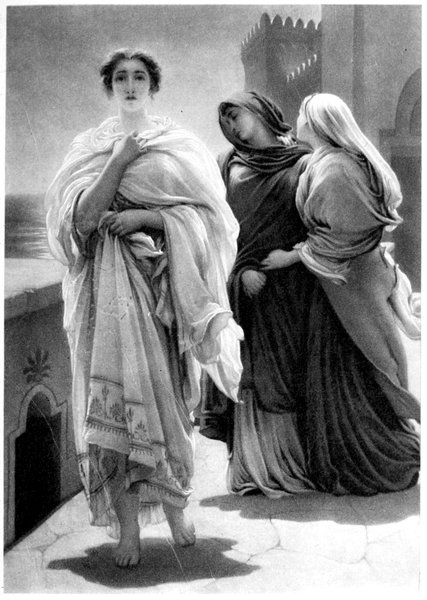
HELEN OF TROY
Lord Leighton
By permission of Henry Graves & Co Ltd
21Meantime, Helen had wakened sadly from the spell of
Aphrodite. Little by little memory of her home came
back, and with it came remorse. She was lonely too, and
disillusion crept upon her. The Trojans, who at first had
welcomed her as a goddess, soon began to look askance at
her when rumours came of the great siege that was preparing.
Mothers and wives of the Trojan princes held
aloof; and soon the only friends left to her were the
kind old king and Hector, the noble defender of the city.
But there was worse behind. Little by little the truth
dawned that Paris, for whom she had lost so much, and
who had seemed so godlike in his strength and beauty,
was very poor humanity indeed. The story of Enone was
told to her; and that showed him unfaithful. And when
the Leaguer actually lay beneath the walls, she soon found
that Paris was a coward too.
Now, in this Third Iliad, we find that the cruel siege had
wasted Troy for nearly ten years. The armies, reduced
by death and pestilence and famine, were beginning to
murmur against the worthless cause of all their misery;
and Paris, for very shame, could no longer shelter himself
within the city. At this eleventh hour he issued out to
meet Menelaus in single combat. Helen was sitting in
her inner hall, weaving a purple web and embroidering
upon it the battle scenes which ebbed and flowed around
the walls. Time and sorrow had only given her beauty
an added charm. She was still young, fresh, and exquisitely
fair, as on that spring morning in Lacedaemon when
Aphrodite graced her for the meeting with Paris. To her,
as her sweet face bent over the web, the goddess Iris brought
the news of the impending combat: “They that erst
waged tearful war upon each other in the plain, eager for
deadly battle, even they sit now in silence, and the battle
is stayed, and they lean upon their shields, and the tall
spears are planted by their sides. But Paris and Menelaus
dear to Ares will fight with their tall spears for thee; and
22thou wilt be declared the dear wife of him that conquereth.”
At the name of Menelaus a wave of homesickness filled
Helen’s heart. Great tears flooded her eyes, and drawing
on a shining veil, she left her embroideries and hastened
out to the Skaian gates to watch the duel. But there,
sitting upon the tower, were Priam and his counsellors;
and Helen and her maids hesitated at sight of them. They
were feeble old men. The fire and strength of youth had
gone, leaving in their place the cold wisdom of age. They
and their people had suffered deeply because of Helen;
and they had every cause to hate her. Yet as she approached,
veiled and slackening her pace from fear when she saw
them, all their wrongs were forgotten in wonderment at
her beauty. They who had potent reasons to revile her were
saying softly among themselves, almost in awe, as those
who had seen a vision: “’Small blame is it that Trojans
and well-greaved Achaians should for such a woman long
time suffer hardships; marvellously like is she to the
immortal goddesses to look upon.’ ... So said they; and
Priam lifted up his voice and called to Helen: ‘Come
hither, dear child, and sit before me, that thou mayst see
thy former husband and thy kinsfolk and thy friends.
I hold thee not to blame; nay, I hold the gods to blame
who brought on me the dolorous war of the Achaians’.”
“And Helen, fair among women, spake, and answered him:
‘Reverend art thou to me and dread, dear father of my
lord. Would that sore death had been my pleasure when
I followed thy son hither, and left my home and my kinsfolk
and my daughter in her girlhood and the lovely company
of mine age-fellows. But that was not so, wherefore I
pine with weeping’.”[2]
23Then Helen pointed out to the king and the elders the great
heroes of the Greek line: “This is wide-ruling Agamemnon,
one that is both a goodly king and mighty spearman. And
he was husband’s brother to me, ah shameless me; if ever
such an one there was.” Odysseus, too, and Ajax and Idomeneus,
she can see; but two whom her eyes seek longingly are
not there, her twin brothers, Castor and Pollux. “Either
they came not in the company from lovely Lacedaemon;
or they came hither indeed in their seafaring ships, but
now will not enter into the battle of the warriors,
for fear of the many scornings and revilings that are
mine.”[2]
Presently, Paris and Menelaus are engaged in fight below
the walls, with Helen looking on from above in fearful
expectancy. It was an unequal fight. Aphrodite had
joined the side of Paris; and when, despite her tricks,
Menelaus was gaining on his opponent, the goddess enveloped
Paris in a cloud and carried him off. In plain words, he ran
away; and Helen, shamed and indignant, received a
summons from Aphrodite to go to her cowardly lover.
She turned in wrath upon the goddess: “Strange queen,
why art thou desirous now to beguile me? Go and sit
thou by his side, and depart from the way of the gods;
neither let thy feet ever bear thee back to Olympus, but
still be vexed for his sake and guard him till he make thee
his wife or perchance his slave. But thither will I not go—that
were a sinful thing—to array the bed of him; all
the women of Troy will blame me hereafter; and I have
griefs untold within my soul.”[2]
Aphrodite triumphs, however, menacing Helen with terrible
threats; and leads her back to the house of Paris. Meanwhile,
the gods ‘on golden pavement round the board of
24Zeus’ had decreed that Troy should fall: Hera and Athena
were to wreak their vengeance upon it, for the insult of
Paris. The truce broken, the armies rushed into conflict
again, and two of the gods who were warring for Troy,
were driven back to Olympus. Then Hector came into
the palace to rouse his brother, and found him sitting in
Helen’s room, polishing his armour. To the scornful
reproaches of Hector, Paris gave only puerile answers, and
Helen turned from him to Hector in passionate scorn.
“Dear brother mine, would that on the day that my mother
bare me, a billow of the loud-sounding sea might have
swept me away before all these things came to pass.
Howbeit, seeing that the gods devised all these ills in this
wise, would that then I had been mated with a better
man, that felt dishonour and the multitude of men’s
reproachings. But as for him, neither has he now sound
heart, nor ever will have; therefore deem I moreover that
he will reap the fruit.”[2]
Hector answered her with a gentle word, and went out,
bearing on his shoulders the doom of Troy. In his
chivalrous kindness to Helen, he is a worthy son of Priam;
and when he was slain at last, fighting for his beloved city
alone with the terrible Achilles, Helen joined her lament
to those of his mother and his wife, in perhaps the most
noble tribute to his memory: “Hector, of all my brethren
of Troy, far dearest to my heart. Truly my lord is godlike
Paris who brought me to Troy-land; would that I had died
ere then. For this is now the twentieth year since I went
thence and am gone from my own native land, but never
yet heard I evil or despiteful word from thee; nay, if any
other haply upbraided me in the palace halls, whether
brother or sister of thine or brother’s fair-robed wife, or
25thy mother, then wouldst thou soothe such with words
and refrain them, by the gentleness of thy spirit and by
thy gentle words. Therefore bewail I thee with pain at
heart, and my hapless self with thee, for no more is any left
in wide Troy-land to be my friend and kind to me, but all
men shudder at me.”[2]
Almost with these words the poem closes, telling us nothing
of the dreadful sack of Troy by the Achaians, after they
had entered the city through the device of the wooden
horse. Our last glimpse of Helen in the Iliad is as she wails
her mournful threnos over the body of Hector.
And Helen’s sorrow brake into lament
As bursts a lake the barriers of a hill,
For lost, lost, lost was that one friend who still
Stood by her with kind speech and gentle heart.[1]
We hear no word of the Greek calamity in the fall of Achilles,
or how Paris was slain by the arrow of the outcast Philoctetes,
with perfect poetical justice. Nothing is told of the
massacre of Priam and his sons; of the burning of the
city; of the carrying off of its wealth and of its fair women
when the Greeks, sated with revenge at last, set sail for
Argos. And we hear no word of the most amazing
fact of all—the reconciliation of Helen and Menelaus.
We know from the Odyssey that they were reconciled,
but how, Homer does not say. Legend and song have
been busy with the theme, however, and the most
beautiful story has been woven by Andrew Lang into
his Helen of Troy. There we see how Aphrodite in
the midst of the slaughter and outrage, led Helen in
safety to the ships, while Menelaus raged through the
city seeking her, grimly determined to give her over to
the vengeance of the army.
26But Helen found he never where the flame
Sprang to the roofs, and Helen ne’er he found
Where flocked the wretched women in their shame
The helpless altars of the gods around....
So wounded to his hut and wearily
Came Menelaus; and he bowed his head
Beneath the lintel neither fair nor high;
And lo, queen Helen lay upon his bed,
Flush’d like a child asleep, and rosy-red,
And at his footstep did she wake and smile,
And spake: “My lord, how hath thy hunting sped?
Methinks that I have slept a weary while.”[1]
Lulled again by the arts of Aphrodite, Helen has completely
forgotten all that has happened in the dreadful interval
of the years since she last fell asleep at Lacedaemon. But
Menelaus feels the fierce anger rise in his heart against her.
He seizes and binds her, and carries her off to deliver her
to the vengeance of the people. He reminds them of all
they have endured and suffered, and calls upon them to
mete to her the just death for such an one as she. But when
the soldiers in their rage would have stoned her; when
Menelaus rushed upon her with uplifted spear, Aphrodite
drew the veil from before her matchless face.
And as in far-off days that were to be,
The sense of their own sin did men constrain,
That they must leave the sinful woman free
Who, by their law, had verily been slain,
So Helen’s beauty made their anger vain,
And one by one their gathered flints let fall;
And like men shamed they stole across the plain,
Back to the swift ships and their festival.[1]
So Helen went home to Lacedaemon again, the dear wife
of Menelaus. And when we take up the second great
27Homeric epic, the Odyssey, we find her the serene and
gracious hostess of young Telemachus. All the hateful
past is purged away, and chaste as the moon-goddess,
Forth of her high-roofed, odorous chamber came
Helen, like golden-shafted Artemis.[3]
She still remembers the horror of those days; and when
Menelaus is wondering who the stranger prince is who
has sought their hospitality, Helen’s quick wit perceives
how like he is to Odysseus. Is not this, she asks, the son
whom Odysseus left in his house as a new-born child
when the war began?
“And for the sake of me who knew not shame
Under Troy town your host Achaean came.”
[3]
It is indeed the son of Odysseus; and by the irony of fate
he has come to inquire from the very author of his sorrows,
news of the father who, for aught Helen knows, has long
ago been driven by Poseidon to the House of Hades.
Wept Argive Helen, child of Zeus, and wept
Telemachus, and with him at the word
But the ready tears of heroes are soon dried. They cheer
Telemachus so far as they may by tales of his father’s craft
and courage before Troy; and Helen mixes for him the
cup of Nepenthe, which steeps memory in a mist and
banishes care and calls a smile to the lips. She does not
herself taste of the magic drink, however; she has no wish to
forget. Secure now in the peace of home and enfolded
by generous forgiveness, she will always remember, until
she comes to pass through Lethe on her way to the Elysian
fields. And there, when the time came, she was translated
28‘where falls not rain, or hail, or any snow.’ A shrine was
built to her, and Greek men and maidens worshipped her
as one of the immortal gods themselves.
O’er Helen’s shrine the grass is growing green,
In desolate Therapnae; none the less
Her sweet face now unworshipped and unseen
Abides the symbol of all loveliness,
Of Beauty ever stainless in the stress
Of warring lusts and fears; and still divine,
Still ready with immortal peace to bless
Them that with pure hearts worship at her shrine.[1]
Homer: Andromache
29
Andromache was the young wife of Hector,
Priam’s warrior son and defender of Troy.
Over against the figure of Helen in the Iliad her
gentle integrity stands in mute reproach. It is
as though Homer, whose chivalry to Helen will not permit
him to censure her, yet feels the claim of a larger chivalry—to
womanhood itself. So he seems impelled to create
this type of gracious purity, vindicating wifely honour
and motherly tenderness; and proving at the same time
that if his race had a high ideal of beauty, it had also a
profound regard for domestic ties.
Helen and Andromache, therefore, stand side by side in
the action of the poem. Their destinies are linked: their
lives are passed within the same walls: they own the same
relationship to king Priam and to Hecuba the queen; and
they are united in suffering. But always they are as far apart
in spirit as conscious guilt on the one hand and indignant
rectitude on the other ever held two daughters of Eve.
Andromache, like all the men and women of heroic poetry,
was very human. And we have the feeling that she could
not rise to Hector’s generosity toward the Spartan woman
for whose sake Paris had brought the war on Ilios. Perhaps
the reason was that she had suffered more deeply on Helen’s
account. And if she had joined in those reproaches which
Helen wailed about in her threnos over Hector’s body, it
was from bitter cause.
Andromache had been happy, and a princess, in her girlhood
days, before Paris brought a Greek bride from Sparta.
30Her father was Eëtion, king of Thebes, in ‘wooded Plakos’;
and in those times she had a gentle mother and seven strong
brothers. But the Greeks came, and in the long years
when the Leaguer lay beneath Troy, their terrible hero
Achilles had ravaged the countries around, and had taken
the city of Thebes. He had slain Eëtion her father and
the seven fine youths who were her brothers. Her mother,
too, though ransomed from the Greeks for a great price,
had died of grief; and Andromache, utterly forlorn, had
found refuge in the halls of Priam. She found a mate there
too; and in the love of Hector, her father and mother
and brothers were all given back to her.
Homer makes the tender devotion of this noble pair stand
out in gracious contrast to the stormy passion of Paris
and Helen. Yet he does not tell us much about Andromache.
He does not describe her—indeed, he very rarely
draws a picture of his women—but we know that she is
beautiful. In some subtle way there is left on our mind
an impression of blended grace and dignity, of sweetness
and tenderness and fidelity; but we are not directly told
that she possesses these qualities. We do not even see her
till, in the Sixth Book of the Iliad, the time has come for
her to part from her husband.
The Greeks were at the very gates of Troy, and the last
phase had come for the sacred city. Diomedes had driven
their god Ares from the field, bellowing with the pain of a
wound; and Hector, who saw the end was coming, hurried
into the palace to rouse his followers and beg the queen to
pray for the cause of Troy in the Temple of Athena. Then,
before returning to the fight, he snatched the opportunity
to see his wife and child once more. At first he could not
find them. Andromache was not in the palace, nor in
31the Temple of Athena where the matrons of the city were
propitiating the goddess. She had heard that the Trojans
were hard pressed, and in fear for her husband she had gone
down to the tower to watch the battle from the walls.
“Hector hastened from his house back by the same way
down the well-builded streets. When he had passed through
the great city and was come to the Skaian gates, whereby
he was minded to issue upon the plain, there came his
dear-won wife running to meet him.... So she met
him now, and with her went the handmaid bearing in
her bosom the tender boy, the little child, Hector’s loved
son, like unto a beautiful star.... So now he smiled and
gazed at his boy silently, and Andromache stood by his side
weeping, and clasped her hand in his, and spake and called
upon his name. ‘Dear my lord, this thy hardihood will
undo thee, neither hast thou any pity for thine infant boy,
nor for me forlorn that soon shall be thy widow; for soon
will the Achaeans all set upon thee and slay thee. But it
were better for me to go down to the grave if I lose thee;
for never more will any comfort be mine, when once thou,
even thou, hast met thy fate, but only sorrow’.”[4]
So she weeps to him, forgetting the heroic, as heroes often
do in overwhelming human sorrow. Hector is human too;
and as she pours out all the pleas that touch him most nearly—her
love for him, his love for her, and their mutual love
for their child—he cannot utter the reply of the soldier
and defender of his people. Andromache thinks she sees
an instant of wavering in his eyes; she catches at it wildly,
and rushes on to tell of a place where he and his men may
screen themselves from the enemy. But that word has
lost her cause. Hector’s great refusal is brave and gentle:
“Surely ... I have very sore shame ... if like a coward I
32shrink away from battle. Moreover mine own soul forbiddeth
me.... Yea of a surety I know ... the day
shall come for holy Ilios to be laid low.... Yet doth
the anguish of the Trojans hereafter not so much trouble
me, neither Hekabe’s own, neither king Priam’s, neither
my brethren’s ... as doth thine anguish in the day when
some mail-clad Achaian shall ... rob thee of the light
of freedom.... But me in death may the heaped-up
earth be covering, ere I hear thy crying and thy carrying
into captivity.”[4]
Andromache can find no answer, and there is silence between
them as Hector turns to caress his boy. But the child
shrinks to his nurse in fear of the shining helmet and nodding
crest; and the parents laugh through their tears.
“Then his dear father laughed aloud, and his lady mother;
forthwith glorious Hector took the helmet from his head,
and laid it, all gleaming, upon the earth; then kissed he
his dear son and dandled him in his arms, and spake in
prayer to Zeus and all the gods, ... ‘Vouchsafe ye that
this my son may likewise prove even as I, pre-eminent
amid the Trojans, and as valiant in might, and be a great
king of Ilios. May men say of him, “Far greater is he
than his father,” as he returneth from battle; ... and
may his mother’s heart be glad’.”[4]
In his warrior-prayer Andromache cannot join; and to
us who know the fate of Hector’s son, there is appalling irony
in this appeal to the gods. She takes her boy into her arms,
smiling tearfully.
“And her husband had pity to see her, and caressed her
with his hand and spake and called upon her name:
‘Dear one, I pray thee be not of over-sorrowful heart;
no man against my fate shall hurl me to Hades.... But
33go thou to thine house and see to thine own tasks ...
but for war shall men provide, and I in chief of all men
that dwell in Ilios.’
“So spake glorious Hector, and took up his horsehair-crested
helmet; and his dear wife departed to her home,
oft looking back, and letting fall big tears.”[4]
But the end had not quite come for Hector and his beloved
Troy. For a time the tide of battle rolled back against
the Greeks, and while Achilles fumed idly in his tent,
Hector pressed upon them until he had forced them back
to their ships. The immortals came into the field again;
and success swayed to one or the other side, as Zeus to the
Trojans or Hera to the Greeks lent aid. Then Hector
slew Patroclus, the dear friend of Achilles; and that event
drew the Greek hero forth at last, raging in grief and
anger. Furnished with new armour by his goddess-mother
Thetis, Achilles went out against the Trojans like a destroying
flame. He drove them into the city with terrible
slaughter; and then faced Hector alone outside the Skaian
gates, and slew him there.
Meanwhile Andromache had won a little hope again, from
the past few days of success to the Trojan arms. She knew
nothing of the duel, and her husband’s fate at the hands
of Achilles; but was sitting quietly within her hall, while
the maids prepared warm baths for his return.
“Then she called to her goodly-haired maids through the
house to set a great tripod on the fire, that Hector might
have warm washing when he came home out of the battle—fond
heart, and was unaware how, far from all washings,
bright-eyed Athene had slain him by the hand of Achilles.
But she heard shrieks and groans from the battlements,
and her limbs reeled, and the shuttle fell from her hands
34to the earth. Then again among her goodly haired maids
she spake: ‘Come two of ye this way with me that I may
see what deeds are done ... terribly I dread lest noble
Achilles have cut off bold Hector from the city by himself
and chased him to the plain and ere this ended his perilous
pride that possessed him, for never would he tarry among
the throng of men but ran out before them far, yielding
place to no man in his hardihood.’
“Thus saying she sped through the chamber like one mad,
with beating heart, and with her went her handmaidens.
But when she came to the battlements and the throng of
men, she stood still upon the wall and gazed, and beheld
him dragged before the city:—swift horses dragged him
recklessly toward the hollow ships of the Achaians. Then
dark night came on her eyes and shrouded her, and she
fell backward and gasped forth her spirit.”[4]
We must not dwell upon the grim vengeance which Achilles
took upon the dead body of Hector, for the life of his
friend; nor the wonderful funeral rites for Patroclus;
nor the pitiful story of old Priam’s visit to Achilles at dead
of night, to beg for the body of his great son:
Before the throne of great Achilles see
The broken king kissing the deadly hands
Whereby his house is left him desolate.[4]
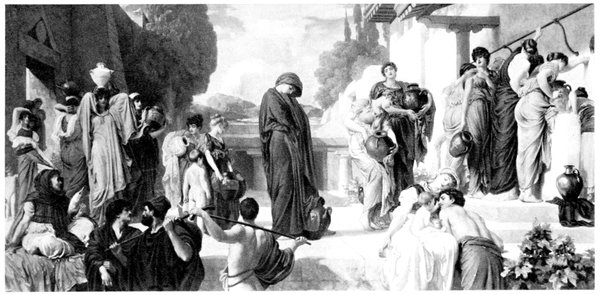
CAPTIVE ANDROMACHE
Lord Leighton
By permission of the Berlin Photographic Co. 133 New Bond St. W.
35But when the poor insulted body was at last recovered, all
the city went out to meet it and bring it in with lamentation.
Andromache led the women, wailing in her grief:
“Husband, thou art gone young from life, and leavest me
a widow in thy halls. And the child is yet but a little
one, child of ill-fated parents, thee and me; nor methinks
shall he grow up to manhood, for ere then shall this city
be utterly destroyed. For thou art verily perished who
didst watch over it, who guardest it and keptest safe its
noble wives and infant little ones. These soon shall be
voyaging in the hollow ships, yea and I too with them,
and thou, my child, shalt either go with me unto a place
where thou shalt toil at unseemly tasks, labouring before
the face of some harsh lord, or else some Achaian will take
thee by the arm and hurl thee from the battlement, a
grievous death.... And woe unspeakable and mourning
hast thou left to thy parents, Hector, but with me chiefliest
shall grievous pain abide. For neither didst thou stretch
thy hands to me from a bed in thy death, neither didst
speak to me some memorable word that I might have
thought on evermore as my tears fall night and
day.”[4]
Andromache’s foreboding was only too completely fulfilled,
for although Homer does not tell us of it, we know that when
the truce for Hector’s funeral was over, Troy fell into the
hands of the Greeks. The horrors of that day are related
over and over again by the poets—the ruthless massacre
of Priam and his sons, the capture of the women and
children and the burning of the city. Euripides tells us in
his Troades what befell Andromache. This drama, written
centuries after the Iliad, has been called by Professor Gilbert
Murray, “the first great expression of pity for mankind
in European literature.” The subject was, indeed, one
to evoke profoundest pity, and the poet, reflective and
humane, seems to select it purposely to reveal the dreadful
underside of war. He brings the figure of Hecuba upon
the stage, weighed down under innumerable woes:
Cassandra, too, in a dark prophetic frenzy, foretelling
her own doom and that of Agamemnon: Helen, confronted
36at last by Menelaus; and Andromache, borne
in the chariot of her captor, with the baby Astyanax in
her arms.
Leader of Chorus.
O most forlorn
Of women, whither go’st thou, borne
Mid Hector’s
bronzen arms, and piled
Spoils of the dead, and pageantry
Of them that hunted
Ilion down?
Andromache.
Forth to the Greek I go,
Driven as a beast is driven.
Hecuba.
Woe! Woe!...
Andromache.
Mother of him of old, whose mighty spear
Smote Greeks like chaff, see’st thou
what things are here?
Hecuba.
I see God’s hand, that buildeth a great crown
For littleness, and hath cast the
mighty down....
Andromache.
O my Hector! best beloved,
That, being mine, wast all in all to me,
My
prince, my wise one, O my majesty
Of valiance!...
Thou art dead,
And I war-flung to slavery and the
bread
Of shame in Hellas, over bitter seas.[5]
But the crowning horror remains. As Andromache and
the queen are taking mournful leave of each other, a hurried
messenger arrives from the Greek leaders. His message
is almost too dreadful to utter; but he stammers it at last—the
victors have resolved that Andromache’s son must die.
They will spare no slip of Priam’s stock to be a future
menace; and Astyanax is to be cast down therefore from
the city towers.
To Andromache it is an appalling blow, worse than all
37that she has yet suffered. She cannot realize it at first, and
answers the herald in broken, incredulous phrases. But
when the man, ruefully trying to soothe her meanwhile, at
last makes it clear to her that her child must die, all her
gentleness is suddenly swept away in fierce wrath against
her enemies.
“O, ye have found an anguish that outstrips
All tortures of the East, ye gentle Greeks!
Why will ye slay this innocent, that seeks
Her own wrongs, though deep and shameful, she could bear;
but the cruelty to her child is insupportable. All the
graciousness and dignity of her nature break down under
it; and carried beyond herself, she calls down wild curses
upon her conquerors, and upon Helen, the origin of all her
woes. Then, suddenly realizing the futility of her rage
and her powerlessness to save Astyanax, she yields him to
the Herald in a poignant outburst of grief:
“Quick! take him: drag him: cast him from the wall,
If cast ye will! Tear him, ye beasts, be swift!
God hath undone me, and I cannot lift
One hand, one hand, to save my child from death!“
[5]
So Andromache was taken alone into captivity. Of all
that befell her there we do not know; but there are hints
and fragments which suggest that the gods must have
relented a little, at sight of her misery. For long afterward,
when the Trojan prince Æneas set out to found another
Troy in Latium, he anchored his fleet one day in the bay
of Chaonia. And there, as he wandered upon the shore,
he found Andromache. Her cruel captor was dead; and
she was married to Helenus, the brother of Hector. But
38she had not forgotten her hero-husband, and when Æneas
and his companions came upon her first, she was paying
devotions at his tomb:
Within a grove Andromache that day,
Where Simois in fancy flowed again,
Her offerings chanced at Hector’s grave to pay,
A turf-built cenotaph, with altars twain,
Source of her tears and sacred to the slain—
Homer: Penelope
39
We come now to the Odyssey, the second
Homeric epic; and to its heroine, wise
Penelope.
Nominally, we have left the Iliad behind
by a space of several years. Troy had fallen, and the Greeks
were homeward bound, fewer in number and sadder at heart
than when the fleet had sailed ten years before. Some few of
them reached home in safety. But for the most part, the
return voyages were only accomplished with tremendous
hardship and peril; and many who had escaped death at Troy
found it at the hands of Poseidon, earth-shaking sea-god. Of
proud Agamemnon, and the fate that awaited him in his
palace at Mycenæ, we shall hear presently. We are concerned
now with the wanderings of Odysseus, and how he won home
at last to the faithful love of Penelope.
But after all, the connexion between the Iliad and the
Odyssey is only nominal. The links between them, although
they seem strong and real at first, do not in any sense unite
the two poems. It is true that there is the imaginary
relation of time; that the Odyssey relates the subsequent
adventures of one of the heroes who actually fought at
the siege of Troy; and, more important still, that it shows
him to possess upon the whole the same qualities which he
possessed in the Iliad. But when that is said, there remains
the fact of a contrast between the poems which almost
persuades us that in the Odyssey we are in a different world.
This contrast is best seen in the antithesis between the
two heroes of the poems; and indeed between the two
40great heroines too. In the Iliad, Achilles stands for physical
beauty and strength, young enthusiasm and ardent courage.
When Odysseus appears there, as he sometimes does, he is
overshone by the splendour of Achilles. Although he is the
brain of the enterprise, he is in quite a secondary place to
the physical magnificence of the younger hero. When we
come to the later poem, however, we find that intelligence
has risen to the higher plane. Odysseus is now the hero—not,
like Achilles, an ideal of bodily strength and beauty:
not a man of wrath, flaming over the battlefield in vengeance
for his friend: not merely a warrior, product of a warlike
age. Odysseus is by no means lacking in courage; and
he has not outgrown the need for war. But he has many
other qualities besides, and his fighting is usually prompted
by necessity.
It is significant that the character of Achilles is developed
in conflict with the war-god, Ares; while Odysseus is
whelmed in a ‘sea of troubles,’ literally heaped upon
him by Poseidon. Struggling constantly against the rage
of the elements, Odysseus becomes alert and cautious,
patient and painstaking and resourceful: a great constructive
energy, as contrasted with the destroying fury of Achilles.
The poet’s epithet for Odysseus is ‘subtle’ as that for
Achilles had been ‘swift’; and the emphasis is always
laid upon his qualities of brain and nerve. He is not a
very imposing figure, and has little physical beauty. When
his friends would praise him, it is gifts of mind rather than
of body to which they refer. He is ‘the just one’ who
does no injury ‘as is the way of princes’; the kindly ruler,
who is ‘like a father’ to help his people; the faithful
husband who can flatter and cajole his goddess-gaoler, in
desperate anxiety to be home with his dear wife; the loyal
41comrade who will risk the enchantments of Circe rather
than forsake his men without an effort; the gracious master
whose servants ‘mourn and pine’ because of his long
absence. And all the way through the poem, in passages
which are too numerous to quote, there is a running tribute
to his wisdom. Zeus himself, with other gods and goddesses;
kings and queens; nymphs, naiads and enchantresses;
swineherds and domestic servants; soldiers and
sailors; strangers and homefolk; friends and enemies, all
add their word to the eulogium of his wit.
Now Penelope, who is the perfect mate for such a man as
this, is for that very reason contrasted with Helen as strongly
as her husband is contrasted with the hero of the Iliad.
It is not merely that her personality is totally unlike Helen’s,
although that is true. The contrast is rooted in something
deeper—in the whole conception of the poet, the manner
of life out of which the poem came, the theme of which it
treats. In the Iliad we are quite literally moving amongst
demi-gods. Helen, reputed daughter of Tyndareus, is
really the child of Zeus; and Achilles has the nereid Thetis
for his mother. Something of their divine origin clings
to them, making them awful and magnificent. In all
that they do and are they are greater than mere human
folk. They move majestically, and they are not to be
approached too nearly, or judged by the common standard,
or compared with the ordinary race of men. Troy itself,
to which their names cling, was a city built by gods.
But Odysseus and Penelope are frankly mortal; and in
that one fact they approach nearer to us by many degrees.
They are no longer colossal figures hovering, as it were,
about the base of Mt. Olympus, and driven this way and
that in the surge of Olympian quarrels. They are a man
42and woman, with their feet firmly planted upon the earth,
and their affections rooted there too. They claim no
kinship with the gods: they take no part in Olympian
warfare: they have no care for the issues which are called
great. Their story, reduced to its elements, is of the
simplest kind: the call of dear home ties upon the man,
the fidelity and prudence of the woman. And in this
‘touch of common things,’ Penelope becomes a much
more real figure than Helen.
Of course that is not to say that Penelope is ‘real’ in
the technical sense of the word. She is in fact almost as
much a creature of romance as Helen is. But she appears
before us as a living woman with human hopes and joys
and sorrows; with human virtues too, and certain very
human weaknesses. We can never regard the heroine of
the Iliad just in this way. If we could, and if we dared
to lift the veil which the poet always interposes between
us and the character of Helen, it would stand revealed
slight and trembling in its amiability: fatally soft, with
no vein of essential strength. Now it is that essential
strength which characterizes Penelope. The wooers
realized it; and Antinous made it the chief point of his
defence:
Athena has bestowed on her
Wisdom of mind and excellence of skill
In beautiful devices manifold
Beyond all others, such as is not told
Even of those famous in the former time,
Achaean women lovely-tressed of old,
Tyro, Alcmena, and Mycene crowned—
Even among these the equal was not found
In wise devices of Penelope.[7]
43There is a significant silence about Penelope’s beauty; and
she has not eternal youth as Helen has. But when we
have seen her eyes light upon her boy Telemachus, and
the radiance of her face as the strange old beggarman
told her about her husband, we shall waive the question of
æsthetics. We shall be prepared to maintain Penelope’s
beauty against all-comers; and we shall not be much
concerned that the poet rather avoids the subject. For
he would not dream of a soul which did not know that
sweetness and dignity and a gentle heart, grief endured
patiently and love unswerving, would make for themselves
a worthy habitation. Beside Helen’s exquisite fairness,
Penelope would seem a little faded; and her sweet gravity
would be almost a reproach. She cannot compare for
one moment with Calypso, as Odysseus had to confess
when the goddess blamed him for his homesickness:
“Goddess and mistress, be not wroth with me
Herein: for very well myself I know
That, set beside you, wise Penelope
“Were far less stately and less fair to view,
Being but mortal woman, nor like you
Ageless and deathless: but even so,
I long and yearn to see my home anew.“
[7]
The keynote of the Odyssey is struck here; and here too
we may find a hint of all that Penelope means. The
thought of home is to dominate the poem, as something
so dear and sacred that innumerable toils are suffered and
infinite perils undergone to win back to it. And this
shining ideal of home is to be incarnate in Penelope. She
is to represent in her own person all that sweetens and
comforts life: all the domestic virtues which establish and
perpetuate it. Thus, beside Helen as the ideal of beauty—of
44physical perfection—Penelope stands as the ideal of
mental and moral worth.
Telemachus, whom Odysseus had left at home as a baby
twenty years before, had been sent by Athena to seek his
father. The goddess had appeared to him as he sat in
his father’s hall in Ithaca, lowering upon those unbidden
guests who were his mother’s suitors. She had asked what
the unseemly revel might mean; and he had told of the
long absence of his father.
“Ah but the spirits of storm to a death inglorious swept him,
Vanished, unseen and unheard of; and nothing but mourning and anguish
Me he bequeathed! Nor now do I sorrow and make lamentation
Only for him; for the gods send other and grievous afflictions.
All of the chief of the men who as princes rule in the islands....
All come wooing my mother and wasting the wealth of the homestead.
She dares neither reject their hateful proposals of marriage,
Nor can she end it; and thus do the men, consuming, devouring,
The goddess counselled immediate action—to go and seek
Odysseus; and while the minstrel sang to the carousing
suitors, Telemachus inwardly resolved that he would set
sail as soon as might be for Pylos and Sparta, whither Athena
directed him for tidings of his father. But he knew that he
must act quietly; and above all, that his purpose must be
45kept a secret from his mother. She would certainly prevent
his going, did she know, fearing to lose son as well as
husband.
Meantime, as he pondered the matter, Penelope was listening
from her lofty bower to the minstrel’s song in the hall
below. He sang of the return of the heroes from Troy;
and the words reawakened in her the old pain of longing
for her husband. At last she could not bear to hear
it any longer:
Straightway leaving her room by the high-built stair she descended;
Neither alone did she go; two maidens followed behind her.
So when at last she had come to the suitors, that fairest of women
Stood by the post of the door of the massively builded apartment,
Holding in front of her cheeks soft folds of her glistering head-dress.
There as she stood, with a trusty attendant on this and on that side,
Suddenly bursting in tears to the godlike bard she addressed her:
“Phemius, ...
... desist, I beseech, from the strain thou art singing,
Pitiful story, that ever the heart in the depths of my bosom Woundeth....”[8]
She is a touching figure, as she ventures out among the
revellers and begs the old man to change the theme of
his lay. But Telemachus was not in the mood to see the
pathos of the scene. The charge that Athena had laid
on him had suddenly given him his manhood; and in
46the new sense of responsibility, he spoke a little harshly
to his mother, bidding her go back to her loom and
housewifery.
Full of amazement she turned her to go to the women’s apartment,
Hiding the masterful words of her son deep down in her bosom.
So to her upper apartment ascending with maiden attendants
Here she lamented Odysseus her well-loved husband, till gently
Slumber was poured on her lids by the grey-eyed goddess Athene.[8]
While his mother slept, Telemachus lay awake in his own
inner room revolving plans whereby to carry out the
command of Athena. He determined first to confront the
suitors publicly, before a formal assembly of the Ithacans,
and charge them with their insolence and riotous greed.
So, with the first light of morning, he summoned the
people to a meeting in the market-place, and called upon
the wooers to cease their persecution of his mother and
quit his house. Antinous, answering haughtily for them
all, invented a coward’s excuses for their conduct. Penelope
was to blame, he said, for she would not decide between
them; but constantly put them off with various cunning
devices. With one pretext alone—that of weaving a
shroud for Icarius—she had kept them in suspense for
many months.
47Thus then all of the day at the spacious loom she was weaving;
During the night she unravelled the web with the torches beside her.
Three long years with her secret device she befooled the Achaeans;
Till, when the fourth year came, and as season was followed by season,
Then at the last (since one of her women, who knew it, had told us),
While at the loom her magnificent web she unravelled, we caught her.
Thus was she forced, though sorely unwilling, to finish her labour.[8]
Therefore, declared Antinous, because Penelope had
deceived them in this manner, they would not depart
until she had chosen a husband from among them. Telemachus
might spare his protests; indeed, he would be
better advised to coerce his mother, since they were determined
to remain in his house and devour his substance,
until Penelope should yield. But Telemachus was a child
no longer, and could not be threatened with impunity.
And to their base suggestion that he should favour them
against his mother, he gave a spirited reply. Nothing
should induce him to give Penelope in marriage against
her will:
“Such word I will not utter. But for you,
If you take shame at all this wrong you do,
Quit these my halls....
“But if you deem it worthier still to sit,
As now, devouring one man’s livelihood
And rendering no recompense for it,
“Waste on: but to the deathless gods will I
Make my appeal, if haply Zeus on high
Repayment of your deeds exact from you.
So in this house you unavenged shall die.“
[7]
48The assembly broke up; and Telemachus hastily fitted
out a ship and sailed to seek Odysseus, all unknown to
Penelope. The suitors continued their carousals day after
day, rioting and making merry, in feigned contempt of
Telemachus and his quest. But when after a time he did
not return, they grew uneasy. They had jeered at his
threats of vengeance, deeming him an untried boy; but
who knew what might happen now, since he had sailed with
a crew of the stoutest fellows in the island? Might he
not return with help and drive them out? Antinous took
counsel with his friends, and determined on a murderous
plan. They would man a ship, sail after Telemachus, and
lie in wait for his return, between the islands of Ithaca
and Samé; and that should be the last cruise that Telemachus
should make.
Meanwhile Penelope, busy with her household duties,
believed her son to be away with the flocks. She stayed
within the women’s rooms; and except for the clamour
of the wooers, or the occasional song of the minstrel, nothing
came to her ears. But now Medon the herald heard of the
plot which was afoot against his young master, and came to
warn her of it. She greeted him with a bitter question.
Had he come to order her maids to spread the banquet
for the suitors? Would that they might never feast
again! Had they not shame to deal so unjustly with her
absent husband—he who had always dealt justly with
them, who had never in word or deed done injury to any?
But Medon had a harder thing yet to say; and as gently
as might be, he told her of the going of Telemachus and
of the suitors’ plot to slay him.
49Thus did he speak, and with knees and with heart all quaking she stood there.
Speechless long she remained, struck mute, while gathering teardrops
Flooded her eyes, and the flow of her clear-voiced utterance failed,
Till at the last she recovered her speech and addressed him in answer:
“Wherefore, herald, I pray, is my son departed? He nowise
Needed to mount on a ship—on a swift-paced vessel that sailors
Ride as a horse and traverse the watery waste of the ocean.
Wills he that even his name no longer remain in remembrance?”[8]
Penelope is overwhelmed with grief, and Medon’s explanation
of her son’s errand does not soothe her. She believes
that he is lost to her for ever, like his father; and when
the herald has left her, she throws herself down upon the
floor of her room, wailing:
“... sorrow hath Zeus the Olympian sent me
Passing the sorrows of all the friends and the mates of my childhood.
Erstwhile lost I a husband—my lord with the heart of a lion....
Now is my dearly belovèd, my son, swept hence by the storm-blasts,
Vanished from hearing and home....
Had I but known he was making him ready to fare on a journey,
Verily either at home he had stay’d, though bent on departure,
Else he had left me behind him dead in the halls of his homestead.“
[8]
She casts about in her mind as to how she may save her
son; and it seems to her best to send a trusty messenger
50to the father of Odysseus, for help and counsel. But the
old nurse Euryclea gives good advice. She confesses that
she had known of the departure of Telemachus; but he
had sworn her with a great oath not to reveal it. It is of
no use to mourn about it; and since they can do nothing
to bring him back, the better way is to go and supplicate
their guardian goddess, Athena, the Maid of Zeus, for his
safety. For her part, she believes that Telemachus will
not be forsaken in his need. Penelope wisely takes the
advice of the old nurse. She bathes, puts on clean raiment,
and taking in her hand an offering of barley-flour, she ascends
to her own chamber and makes supplication to Athena:
“Hearken to my prayer this hour,
“Thou who hast thunder-bearing Zeus for Sire,
Maiden whose might no labour can out-tire!
If ever subtle-souled Odysseus here
Within these halls consumed upon the fire
“Fat thigh-pieces of ox or sheep to thee,
Remember it this day for good to me,
And save my son, and from us thrust away
The suitors in their evil surquedry.”
Calling aloud so spake she, and her call
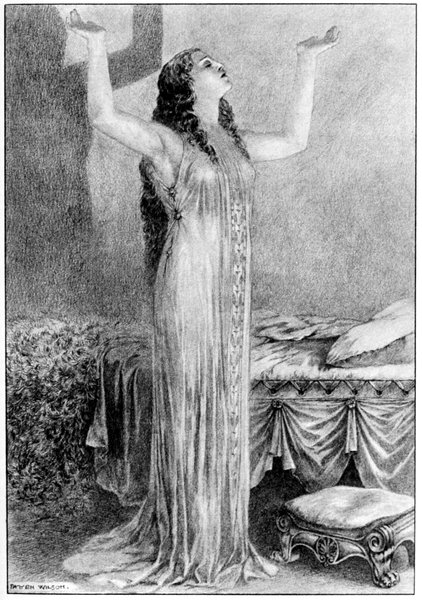
51Even while Penelope prayed, Athena was busy on her
behalf; and was bringing home to her both husband and
son. Odysseus she had convoyed safely to Ithaca, and was
now leading him in disguise to the swineherd’s cottage. And
to Telemachus she had shown a way to escape the murderous
suitors, and was bringing him swiftly to the father
whom he had never seen. Of their meeting, and of their
cunning plan for vengeance on the suitors, it would take
too long to tell. But in the morning, Penelope was gladdened
by the return of her son; and a little later, a poor
old beggar (no other than Odysseus himself) came among
the suitors as they sat in the hall. They glowered upon him
angrily, and proud Antinous set the vagabond Irus to fight
him, for their sport. But the old beggar had unexpected
strength, and Irus was defeated. Whereon the suitors
began to bait Odysseus with jeers and taunts; and one
hurled a stool at him. At this impious deed, the
guests were horrified; and Penelope, hearing of it where
she sat among her women, longed to make amends
to the old man for the cruel act. She descended into
the great hall, and spoke reprovingly to Telemachus for
allowing one who had sought the shelter of their home to
be treated so basely.
“What thing is this that hath befallen us
Within our halls that once were prosperous,
That you have suffered one who is your guest
To be despitefully entreated thus?“
[7]
But Telemachus hugged his secret knowledge of the
beggar’s identity, and kept silence, while Penelope returned
to her bower. The hall was cleared at last, and then he and
his father laid their plans for the slaying of the suitors on the
following day. The noisy crew had all gone to rest; and
when Odysseus and his son had agreed upon a plan of
action, Telemachus followed them, leaving his father alone
in the great hall. It was a moment for which Penelope
had been waiting; and she came down from her room again,
to question the beggar of his wanderings. There was no
light in the hall but that of the fire; and she ordered a
52cushioned chair to be brought near, so that the old man
might sit while she talked with him.
“Firstly of all, O stranger, I wish thee to answer a question:
Whence and what mortal thou beest? Tell too of thy city and parents.“
[8]
Cunning Odysseus evaded her question. She might ask
him anything but that, he said; for it gave him too much
sorrow to think of his country and his race. Penelope was
only too willing to be turned aside, burning as she was to
ask for news of Odysseus. So she told the old man of her
husband, and of his sailing for Troy, and of how she was
pining for his return.
“O that he came once more, and had care of my life as aforetime!
So were fairer my fame, and my lot more happy; for alway
Now I am sad—such woes hath a deity sent to assail me....
Wherefore little I care for my guests, or if beggars entreat me,
Little for heralds I care, who work for the weal of the people;
Wasted away is my heart as I yearn for Odysseus....“
[8]
She told him about the wooers, and the device of the
shroud, which gained her three years’ respite. But a
treacherous servant had betrayed her, and she had been
compelled to finish her task.
“Now can I neither escape from a marriage, nor yet am I able
Further device to discover; and urgently also my parents
Bid me to marry; and vexed is my son as they waste his possessions.“
[8]
53But having related so much of her own story, she asked
again for the old man’s name and race; and above all,
would not he say whether he had seen or heard aught of
her husband? Odysseus needed all his subtlety now, as he
invented a tale of Crete and the great city of Cnossos, and
Minos the king who was his ancestor; and how on one
occasion her husband had indeed taken shelter with him
there.
Thus in the likeness of truth he related a tissue of falsehood.
Meantime, weeping she listened, her cheeks all flooded with teardrops,
Like as the snow when it melteth away from the heights of the mountains,
Thawed by the breath of the Eurus—the snow that the Zephyr hath sprinkled.
... And Odysseus,
Touched to the heart by the grief of his wife, felt tender compassion;
Yet did his eyes keep fixed, as of horn they had been or of iron,
Motionless under the lids. Tears came, but he skilfully hid them.[8]
There was one thing more which Odysseus must do before
he could reveal himself; and meantime he could only
comfort Penelope by assuring her that her husband still lived
and was even now on his way home to her. She shook her
head sadly: that was too good to believe: the kind old
man was only trying to comfort her. But it was time for
him to go to bed; and because he disliked the giddy
young serving-maids, Penelope called up the old nurse
Euryclea, and bade her wash the beggar’s feet with as much
54care as if he were her master returned at last. That he
was indeed her master the nurse divined the instant that
her fingers touched an old scar upon his foot. But Odysseus
hastily whispered her to say nothing of what she had discovered;
and soon the palace was asleep, with the old beggar
stretched upon sheepskins in the forecourt.
At dawn next morning Odysseus awoke, and prayed to
Zeus to help him in the great deed that he was to do that
day. Soon the suitors were astir, and the usual preparations
were begun for the banquet. Penelope herself came
down from her room, to watch what would happen. For,
as she had told the beggar the night before, she could not
withhold her decision any longer. This day she must
choose between the suitors. And because they were all
alike hateful to her she would decide the question by a
test: she would consent to take for her husband that man
who could shoot with Odysseus’ bow.
“I now the suitors to that feat will call
Of axes, that he used to set in hall
Twelve in a row, like ship-stays, and far back
Standing would shoot an arrow through them all.
“Now therefore to the suitors I will shew
This feat; and whoso in his hands the bow
Shall bend most easily, and down the line
Of the twelve axes make the arrow go,
“Him will I follow, putting far from me
This house of my espousals, fair to see
And full of substance, that I think in dreams
I shall remember through the days to be.“
[7]
She went up into the high Treasure-chamber, and sorrowfully
took down the great bow that a friend in Sparta had
55given to Odysseus long ago. She carried it forth among
the suitors; and Telemachus, who was eager for the contest
which he knew would end for them in a shameful death,
swiftly set up the twelve axes in a row, through which they
were to shoot. Odysseus leaned silently against the door-post,
still in his beggar’s disguise; whilst one after another
of the suitors tried to bend the bow. But one after another
miserably failed to bend it, although a great fire was lit
and a cake of lard was brought to make the bow supple. At
last, in rage and despair, they had to abandon the attempt;
and then Odysseus humbly asked if he might be allowed
to try. This was a pre-arranged signal between father
and son; and in the instant outcry that arose at the old
man’s presumption, Penelope and her maids were led away.
Then Odysseus, with his son and two faithful serving-men
who were in the secret, made a bold attack upon the suitors.
They were greatly outnumbered, but their plans had been
laid warily, and Athena was on their side. Through a
grim struggle they prevailed at last, and did not cease until
vengeance was complete and every evil suitor had been slain.
But Penelope, although she heard the horrible din in the
hall below, had no idea of its cause. It was probably, she
thought, another of the frequent brawls between these
tumultuous wooers. She was still completely ignorant of
Odysseus’s return; and when the old nurse came running
to her with the joyful news, she believed her to be
mad. She had looked so long and so despairingly for
this event that now it had come she was utterly incredulous.
Even when she heard all the ghastly story of the
slaying of the suitors, and came into the hall where her
husband stood awaiting her, she could not realize that it
was he.
56Then from her room she descended, and deeply she pondered in spirit
Whether to hold her aloof from her lord and to test him with questions
Or to approach and embrace him and kiss him on hands and on forehead.
So, when at length she had entered the hall and had stept from the door-stone,
Fronting Odysseus she seated herself, in the light of a brazier,
Close to the opposite wall; and with eyes cast down he was sitting
Nigh to a pillar that rose to the roof; and he waited expectant,
Hoping his beautiful wife would speak when she saw him before her.
Long while silent she sat, with her spirit amazed and bewildered.[8]
Telemachus could not comprehend the reason for his
mother’s silence, and broke into impulsive chiding. He
could not see that the very steadfastness of her nature
would not allow her to be lightly convinced.
Then answer made Penelope the wise:
“My child, the soul is dizzy with surprise
Within me; no word can I speak to him,
Nor question him nor look him in the eyes.
“But if he comes indeed, and this is he,
We shall know one another certainly.
For we have tokens that from all men else
Are hidden, and none know but only we.”[7]
Truly, it is Greek meeting Greek, in this encounter
between the wit of Penelope and that of the man she
dare not hope is really her husband. Odysseus grows
57angry at last, and that gives the victory to his wife. For
when he orders that a bed shall be made for him apart,
she says cunningly to the maid:
“Now, Eurycleia, lay the goodly bed
Without the chamber firmly-stablished
That his own hands made: take it out from thence,
You and the women, and upon it spread
The broidered blankets, that he soft may lie,
And rugs and fleeces.“
[7]
Now Odysseus had built the bed himself, literally round the
trunk of a standing tree; and by this token she is trying
him. In his answer she perceives that he truly is her
husband, for none but he could know how wonderfully
their bed was built.
“Verily, wife, this word thou hast spoken is grievously cruel.
Who hath removed it—the bed that I built? ‘Twere difficult truly
E’en for a man right skilful, unless some deity helped him.
... Great is the secret
Touching that fine-wrought bed—for I made it myself and in private.
Once was a long-leaved olive that stood inside the enclosure,
Thriving and grown to the full; and its stem was as thick as a pillar.
Round it I built me a chamber and laboured until it was finished.“
[8]
Odysseus is indignant at the suggestion that his wonderful
handiwork has been destroyed; but Penelope does not
mind about his anger, for she is convinced at last that he
is indeed her husband.
58Then as he spake were loosened her knees and the heart in her bosom,
Since to herself she confessed that the token was sure that he gave her.
Bursting in tears, straightway to Odysseus she ran and embraced him,
Casting her arms on his neck and kissing his head and exclaiming:
“Gaze not upon me in anger, Odysseus! In all thou hast shown thee
Wisest of men—and thou knowst that the gods have sent us affliction,
Jealous to see us abiding in happiness one with the other....
Ever and ever again hath my heart in the depths of my bosom
Shuddered with fear lest any with tales might haply deceive me....
Now ... I believe! for thou giv’st me a token unerring—the secret
Touching the bed....
Yea, I believe! thou hast conquered my heart, however unloving!”[8]
Odysseus’s anger quickly melts as he clasps his sweet wife
in his arms; and so we may leave Penelope in her happiness.
Homer has one word more to say about her, however.
It occurs, with apparent naïveté, almost like a
curious little afterthought, in the last book of the poem.
But there is really exquisite art in it. The souls of the
suitors have gone wailing on their way to the World of
the Dead; and there they meet the great Greek heroes
who died at Troy. There too, they meet the haughty
spirit of King Agamemnon, murdered by his wife on his
return to Mycenæ. To him the suitors tell their tale of
59the faithful wife of Odysseus, and their ignominious end.
And then from Agamemnon’s lips, bitterly contrasting his
wife with Penelope, falls what is perhaps the noblest and
most impressive tribute to her:
“O fortunate Laertes’ son,
Odysseus many-counselled, who a wife
So virtuous and so excellent have won!
“How rightly minded from of old was she,
Icarius’ child, unblamed Penelope!
How well remembered she her wedded lord
Odysseus! Therefore undecayed shall be
“Her fame for worth, among mankind so long
Shall the immortals make a lovely song
Homer: Circe
60
Penelope is not the only woman in the Odyssey,
although she is far the most prominent. Round
her are grouped three other woman-figures—Calypso,
Circe, and Nausicaa; and although
two of them are goddesses rather than women, they seem
none the less deliberately chosen, with the sweet youthfulness
of Nausicaa, to enhance the dignity of Penelope.
They come into the story as incidents in the adventures
of Odysseus, as he is driven from point to point on his
weary voyage homeward. Calypso and Circe, dwelling
each in a lonely island of the sea, lure him and hold him
from Penelope against his will. But it is of no avail to
change his purpose. They have many charms, and they
can sing sweetly to ease the heart from pain. They live
a dainty and a joyous life, which he may share if he will;
and which he does share for a time. They are more beautiful
than Penelope; they have strange lore, and a knowledge
of enchantments; they have, too, eternal youth
and kinship with the immortals. But when all is said,
they cannot compare with the dear human soul who is
waiting for Odysseus in Ithaca; and this contrast the poet
makes us clearly see, in the way in which Odysseus always
turns with longing to the thought of Penelope.
So it is, too, with Nausicaa. This fresh young daughter
of King Alcinous, just a fair mortal girl, might be Penelope’s
very self, when twenty years before Odysseus had taken
away Icarius’s child to be his wife. One would think that
there must be something quite irresistible about her to
61the toil worn man just escaped from death. She is so
brave and helpful; and so prudent too, as she tells him a
little wistfully that he must not enter the city in her
company. Yet, though we feel that Odysseus cannot but
admire this spirited young creature, she does but serve to
remind him of one in whom similar beauty and wisdom
have grown to maturity.
Thus we have another comparison from which Penelope
gains; and thus all three of these other women of the
Odyssey serve to throw the heroine into stronger relief.
The poet accomplishes this very cunningly. He does not
bring them into direct contact with Penelope: they are
never, so to speak, on the stage together. That would be
too severe a contrast—one from which Penelope would
suffer, as well as they. But at distant times and places,
each is brought separately into the circle of Penelope’s life,
by rivalry for the love of her husband. So they stand in
the poem, not only as a graceful setting to the figure of the
heroine; but they occupy in relation to Odysseus the
same position which the suitors occupy in relation to
Penelope. There is a perfect balance of the poem here,
and one can only marvel at the art which built it so. For
the suitors serve on the one hand to show Penelope’s
fidelity; and on the other hand, by their arrogance and
brutality, they make a complete foil to the just and subtle
Odysseus. Penelope cannot cope with them; she knows
them too well to dare the effect of a downright refusal;
and she sets her wits to work to keep them at bay, while
she longs and prays for her husband’s return. In conflict
with them, her loyalty shines; and there are developed all
her many merits as queen and housewife and mother.
But in the conflict we get at the same time, through their
62sensuality and impiousness, a sense of the absolute contrast
with Odysseus.
The three minor women of the Odyssey serve a similar
double purpose. They stand to the hero as the suitors
stand to Penelope. If Odysseus’s loyalty to his wife does
not come perfectly scathless through the ordeal—if we
cannot hold him entirely blameless for the year spent with
Circe—the test does nevertheless reveal his essential constancy.
That is indeed the poet’s purpose; as well as to
give a bright and graceful touch to an exciting story of
adventure. But he had also another purpose, which we
have already seen—to make of these rivals of Penelope a
charming setting, in which she should shine with added
lustre.
We hear all about Circe when Odysseus is telling the story
of his adventures to King Alcinous. He relates how he had
sailed a second time from Aeolia, sadly and wearily, because
of the folly of his men. For they had been well within
sight of their beloved Ithaca, and Odysseus, worn out with
his long vigil at the main-sheet, had dropped asleep. It was
an evil opportunity for the curious crew, who were burning
to know what was contained in the great skin sack that
their commander had stored below so carefully. Within
a trice the Bag of the Winds was cut, letting loose on them
havoc and destruction.
They fared back to King Aeolus, and humbly begged his help
once more. But he would not a second time labour to imprison
the winds for men on whom the gods had obviously
laid a curse of foolishness; and they had to sail away unfriended.
For six days they rowed hard against adverse
weather; and on the seventh their evil fortune lured them
to the land of the Laestrygonians. Not one of the ships that
63entered the harbour ever came out again. Only Odysseus
and his own men, who lay outside awaiting them, were
saved from the hands of that cruel race.
Thence we sailed onward, joyful to have fled
With life, but for our fellows perished
Grieving at heart: then came we to the isle
Aeaea, where abode a goddess dread,
Circe, of mortal speech and tresses fair.[9]
Such was the coming of Odysseus to the land of Circe;
and of all the strange and terrible things that had yet
befallen him, the strangest and most terrible he was to
receive at her hands. At first all went well. The ship
ran smoothly into a fair haven: they landed in safety,
and for two days and nights they rested on the shore,
Odysseus himself shooting them venison for their food.
In all this time no human creature had been seen; but
Odysseus in his explorations had seen one sign of habitation—a
curl of smoke rising from an oaken coppice. That
gave at least some hope of succour; but when he called
his men to search the wood with him, he found that their
courage had been completely broken. Their sufferings
from the savage Cyclops and the Laestrygonians had taught
them to fear the unknown rather than to hope from it;
and none would volunteer for the expedition. So a council
was called, lots were cast, and those on whom the lots
fell went off most unwillingly, led by Eurylochus.
The island lay low upon the sea, with only one hill-peak;
and when they climbed the hill the circling waters could be
seen stretching away to the horizon’s edge, without another
glimpse of land. It would seem that they were utterly
cut off: that there was no possible succour anywhere but
in the mysterious valley below them; and the knowledge
64spurred them to seek out the dweller in the wood, and so
perhaps find help and counsel.
In a wide and shallow valley, where the oaks had been
cleared away and the sun streamed hotly upon a southern
slope, they came upon the house of Circe, daughter of the
sun. No human figure could be seen:
But beasts alone,
Hill-wolves and lions, over whom the witch
With evil drugs had her enchantment thrown.[9]
Even these creatures made no sound to break the silence
that was like a menace, while the sailors stopped awe-struck
at the sight. The great house, with its many halls and
shining marble pillars, fascinated their sight; and the
strange beasts which leapt and fawned around them seemed
to invite them to enter. But while they stood in doubt,
dreading to advance and yet withheld from flight by some
impalpable, resistless power, the sound of a sweet voice
rose upon the air. Softly at first it floated out to them,
in trembling notes; and they stole forward, drawn by the
exquisite melody, until they stood upon the very threshold
of Circe’s house.
And now upon the fair-tressed Goddess’ floor
They stood, and from the porches through the door
Heard Circe singing sweetly, as within
She wrought, the deathless high-built loom before.
... They called aloud and cried.
Then issuing forth she straight threw open wide
The shining doors and called them; and they all
Went in their folly trooping at her side.[9]
Circe, with a lurking smile of malice on her lips, came
forward to welcome them. She was very lovely, with the
65youthful, changeless beauty of the immortals; but though
Homer does not tell us so, we know that there was sensuality
in the curving fullness of her mouth and a cruel
gleam in the eyes over which the white lids drooped. With
sweet words and fluttering movements of her soft hands,
she brought them in and bade them sit; and busied herself,
with swift and stealthy eagerness, to mix and pour a luscious
drink of Pramnian wine and honey. But before she gave
the cup into their hands, she furtively dropped into it
one of her secret baneful drugs; and as they greedily
drank, their human shape was instantly transformed to
that of swine.
One of the crew, however, had not entered; and when
his comrades did not return, he ran back to the ship to
tell of what had happened. Odysseus, suspecting some
evil, slung on his sword, seized his bow, and sped away
to Circe’s house. But suddenly in his path stood the god
Hermes, Messenger of Zeus, in the likeness of a handsome
youth. The god held up an arresting hand.
“Ah, whither do you go
Across the wolds, O man unfortunate,
Alone amid a land you do not know?
“Your fellows here in Circe’s palace pine,
Close-barred and prisoned in the shape of swine;
And come you hither to release them? Nay,
Yourself you shall not save, as I divine.“
[9]
Then Hermes foretold all that should befall Odysseus in
Circe’s house, thinking to deter him. But when he would
persist in the attempt to save his men, the god gave Odysseus
a plant that should be an antidote to Circe’s poison.
66Thereafter to far-off Olympus he
Passed from the island set with many a tree,
But I to Circe’s house; and as I went
Many a thing my heart revolved in me.
Then by the fair-tressed Goddess’ portals nigh
I stood and called her, and she heard my cry,
And issuing forth at once flung open wide
The glittering doors and called me in: and I
Followed as one who goes his doom to meet:
Forthwith she led me in, and on a seat
Fair, carven, silver-studded, set me down
And laid a footstool underneath my feet.[9]
Below her courtesy an evil intent was lurking, as Odysseus
knew too well; and presently she served to him the same
poisoned drink with which she had bewitched his men.
But the plant of moly that Hermes had given him made
him proof against her drugs. The wine failed of its effect,
and Circe, angrily taking her wand, smote Odysseus with
it, crying: “Begone now to the sty and couch among
your band.”
So said she: but the sharp sword from my thigh
I drew, and leapt at Circe suddenly
As purposing to slay her; and she shrieked
Aloud, and under it ran in anigh,
And caught my knees, and winged words anew
She uttered: “Who and whence of men are you?
Where is the city of your ancestry?
I marvel greatly how this cup I brew
“You drink, and yet its sorcery have withstood:
For unbewitched has none of mortal brood
Drunk of it yet or let it pass his lips;
But your breast holds against bewitchment good.
“Wandering Odysseus truly you must be,
Who in his swift black ship across the sea
Ever the golden-wanded Shining One
Said should from Troy returning visit me.”[9]
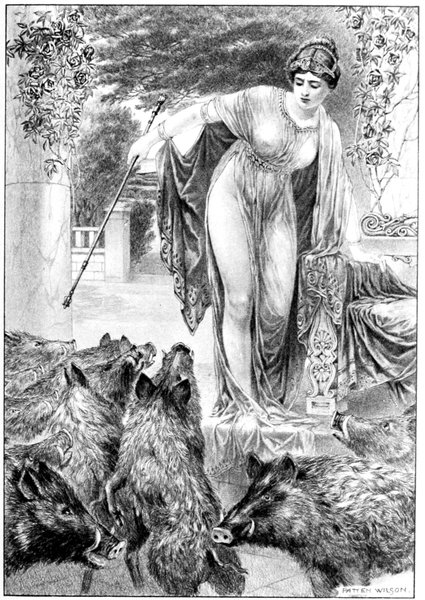
67Her mischievous purpose faded on the instant, and she
became full of fawning admiration and wonder. Her
malice was changed; but something even more dangerous
took its place. She began with sweet words to smooth
away Odysseus’s anger, fondling him and begging him to
remain with her and be her husband. But Odysseus
remembered the warning of the god, and at first he would
not yield. He was sullen and suspicious, and would not
answer her gently until she had sworn to release his men.
Thereat immediately
Out through the palace, rod in hand, went she,
And opened the sty-doors and drave them out
Resembling swine of nine years old to see.
Thereafter all in front of her stood they,
While she passed down along their whole array,
Smearing another drug on each of them;
And off their limbs the bristles fell away,
That the first baleful drug from Circe’s store
Had made to grow upon them; and once more
Men they became, and younger were to see
And taller far and goodlier than before.[9]
Then the ship was hauled into a cave, and their companions
were induced to come up to Circe’s house, where they all
joined in feasting and merriment. Cautious Eurylochus
tried to dissuade them; but Odysseus would give no heed
to his warning; and there followed a long interval of
riotous pleasure over which Circe and the river-nymphs
68who were her handmaidens presided as queens. The days
went by uncounted in luxurious ease; and if, in rare
moments, Odysseus had an uneasy flash of memory, Circe’s
caressing voice would flatter and soothe him into complacence
again, persuading him to stay yet a little longer.
“Myself I know
What sorrows you have suffered in the deep
Wherein the fishes travel to and fro;
“And likewise what the hands of hostile men
Of scathe on land have dealt you. Sojourn then
Here with me, eating food and drinking wine
Till the hearts rise within your breasts again
“As when at first you from your home were lorn,
Rough Ithaca: but feeble now and worn
With long hard wanderings are you, and your hearts
Forget all gladness; for you much have borne.“
[9]
So she would cajole them, and so the blandishments of
Circe proved far more effectual than her drugs. For a
whole year the thought of home and friends was driven
away, while jollity filled out the indolent hours. But
satiety came at last, and memory began to reawaken. With
rough home-truths, the sailors broke the spell that Circe
had cast upon their commander. They called him out
from her odorous, shadowy halls; and under the clear
sunlight that suddenly made Circe hateful, they reproached
him with his dalliance, and bade him flee at once if he
would save his soul alive. There was no withstanding
them; and indeed Odysseus had no wish to do so.
When evening came, he claimed from Circe the fulfilment
of her promise to send them safely back.... He would
be sad at leaving her, he said, since the time had passed
69so pleasantly in her sunny island; but now his men are
beginning to complain and he himself (though that he
did not tell her) had suddenly grown weary and remorseful.
It all seemed very simple: and he had not much misgiving.
Circe had only to speak the word, that they might have
safe convoy, and return to Ithaca. Surely the gods must
have laughed in irony at the man who thought to part
from Circe so lightly, knowing as they did the whole cost
of that parting for him. Circe was not to be cast off and
forgotten, as a mere incident of Odysseus’s adventures.
Her reply was proud, and of ominous import. Since they
wished to go, she would not detain them; but let Odysseus
summon all his courage:
“Not against your will
You and your fellows longer shall abide
Within my house; but you must first fulfil
“Another journey yet, the house to see
Of Hades and renowned Persephone.“
[9]
The awful words fell horribly on Odysseus’s ear. So they
might not then simply hoist sail and away, gaily bound for
Ithaca? Instead, there was yet to make the bitterest
voyage that even Odysseus had made—a dark and awesome
journey to the nether world, there to see and hold converse
with the dead prophet, Tiresias.
So spake she; but my heart was rent in me,
And sitting on the bed I bitterly
Wept, and no longer did my soul desire
To live, or yet the light of day to see.[9]
But so it was decreed, and since all his grief and horror
could not alter it, he begged of Circe at least to tell him how
70he might find his way to the dread World of the Dead,
and how he might return in safety from it. Circe smiled
inscrutably. She knew that the passage there is all too
easily won.
“Take no concern, for pilot need you none.
“Hoist but your mast and spread the sails of white,
And sitting let the North wind’s breath aright
Bear her: but when on shipboard you have crossed
The Ocean-river, there will come in sight
“The tangled groves of Queen Persephone,
A low shore set with the tall poplar tree
And willow that untimely sheds her fruit;
There run your ship abeach out of the sea,
“Beside the Ocean-stream’s deep-eddying flow,
And to the mouldering house of Hades go
She told him all that he must do there; how he must pass
right through the crowding shadowy forms, and where two
loud-thundering rivers meet he must dig a trench and pour
out a drink-offering before the dead. But he must not let
them partake of it, and must keep them at bay with drawn
sword till the prophet Tiresias should appear and prophesy
to him of his return.
So spake she, and Dawn straightway rose and shone
Gold-throned; and in my shirt and cloak anon
I clad me, and the nymph herself a great
White mantle, thin and beautiful, put on;
And round her loins a golden girdle fair
She drew, and cast a kerchief on her hair;
But I throughout the house to everyman
Went with soft words, and bade my crew prepare.[9]
71The crew set cheerily to work, but they did not know all
yet; and when Odysseus told them of the dreadful voyage
they had now to make at the bidding of the goddess, they
were filled with despair. Perhaps Circe too was ruthful at
heart; and one act of grace at least she did them. For
when all was ready to launch the ship, they found that an
unseen hand had placed beside it the animals that they
would need for sacrifices in the World of the Dead:
But when at last the margent of the sea
And the swift ship we reached in misery,
While from our eyes the heavy tear-drops ran,
Circe, before us gone invisibly,
By the black ship a ram and a black ewe
Had tethered, lightly passing by our crew.
For mortal eyes a god against his will
Hither and thither going may not view.[9]
Circe did not say farewell, because she knew that they
would meet again. For the first spirit to greet Odysseus
when he reached the dark Underworld was the restless
ghost of Elpenor, one of his own crew. In the hurry of
their departure, Elpenor had fallen from a gallery and had
been killed. His untended body still lay in Circe’s house,
and the poor ghost could not rest until it was buried.
So when the dreadful journey to the dead was accomplished,
Odysseus sailed back to Aeaea to perform the funeral rites.
Thus all the rites we ordered as was due:
But Circe well of our returning knew
From the Dark House, and very speedily
Arrayed herself and down anigh us drew.[9]
She made Odysseus tell her all that had befallen him, and
all that he had seen in the House of Hades; and then she
72gave him directions for his homeward voyage. He was to
beware of the Syrens, and of Scylla and Charybdis; but
above all he must prevent his men from doing injury to
the sacred Oxen of the Sun.
“But if you harm them, I foretell herein
Destruction to your ship and all your crew;
And though yourself to Ithaca may win,
“Late and unhappy shall your coming be,
And all your crew shall perish.“
[9]
Her black prophecy was fulfilled to the uttermost; and
indeed Circe seems destined always to be a baleful augurer
to Odysseus. Yet she herself is quite untouched by these
mortal woes. When the ship was manned she came down
to the sea to speed them away; and our last glimpse of
her is as she stands upon the shore, her garments and the
tendrils of her hair lightly fluttering, and her lovely body
drawn to its height as she raises white arms and cries to
the winds to follow them.
They got them in and took their seats again,
And sitting at the benches in array,
Smote with their oars upon the water grey;
Until the fair-tressed goddess terrible,
Circe of mortal voice, to speed our way,
Behind the blue-prowed ship sent forth anon
A following wind, a good companion.[9]
Homer: Calypso
73
Calypso is a statelier figure than Circe, although
they have much in common. Looking casually
at the two characters, we are inclined to wonder
why Homer should have given them so many
points of resemblance. Both are immortals—Circe a
daughter of the sun, and Calypso a daughter of Atlas.
Both are skilled in sorcery; both live on islands set far
away amidst the sea; both are ‘fair-tressed’ and beautiful
and have sweet singing voices; both love Odysseus and
desire him for a husband.
But our first thought is corrected the instant we look at the
two goddesses a little more closely. In fact, the likeness
between them only helps us to realize the art which has
given to each of them a distinct individuality. We shall
find that Calypso is gentler and more dignified; a sweeter
and more gracious creature than Circe. There is nothing
sinister or malign about her; and if she loves Odysseus,
and strives to keep him at her side, it is that she may make
him immortal, like herself. She has no evil intent toward
him; and when the messenger of Zeus bids her to release
him, she sets herself the task of helping him away. Odysseus
has not now to pay a gruesome penalty for willing bondage,
as when he left Circe in Aeaea; but wins his way by
Calypso’s aid to the friendly land of Phæacia.
In a “far isle amid the sea” Calypso dwelt alone. The
blue sky bent over it to embrace the bluer sea; and round
its base a spray of foam perpetually laved the rocks with
snowy fingers. Out of the sea tree-clad cliffs rose steeply,
74and the scent of pines hung like incense in the warm air.
Deep chasms here and there rent the cliffs apart, and gave
access to the sea; but their sides were clothed with olives
and trailing vines; and far down below could be heard the
whisper of a little stream as it ran to join the murmuring
waves on a strip of golden sand. At the head of one of the
ravines was Calypso’s cavern.
Close to the cavern and clustered around it was growing a coppice;
Alder was there and poplar and cypress of delicate perfume.
Many a long-winged bird in the copse found covert at night-time,
Many a falcon and owl, and crook-billed chattering sea-crows,
Birds of the brine which busy themselves with a life on the ocean.
Here too, stretching in front of the hollow mouth of the cavern,
Trailed a luxuriant vine rich-laden with many a cluster.
Four bright runnels of water arose from a neighbouring fountain,
Each one nigh to the other but turned to a different channel.
Spreading around soft meadows with violets blossomed and parsley
Richly bedight—yea e’en an immortal, if haply he came there,
All might wondering view and rejoice in his heart to behold it.[10]
Here it was, then, that Calypso, standing one morning in
the sunny entrance to her cave, first saw Odysseus. The
prophecy of Circe had been fulfilled. His crew had
impiously laid hands on the sacred Oxen of the Sun, and
smitten by an avenging storm sent by the wrathful Apollo,
75had every one paid the penalty with his life. Odysseus
only had been spared; and for nine days and nights he
had struggled alone with the waves on a shattered raft.
And on the tenth at night out of the sea
To that Far Island the Gods drifted me,
Calypso’s home, the fair-tressed mortal-voiced
Dread Goddess; and my friend and stay was she.[11]
Calypso rescued and tended the shipwrecked man who was
thrown upon her shores; and after his awful peril and
hardship he was content to forget everything for a time.
Days and weeks and months slipped quickly past and
Odysseus remained, charmed by the beauty of the island
and the gracious society of Calypso. Sometimes, reclined
on the yellow sands where he had been washed ashore, she
would listen eagerly to the tales of his wanderings. Sometimes,
when the evening breeze blew chill from the sea, they
would sit together in the cavern:
Where from a brazier by her, burning well,
A fire of cloven cedar-wood and pine
Far through the island sent a goodly smell.
And in it she with voice melodious sang,
While through the warp her golden shuttle rang
As to and fro before the loom she went.[11]
As Calypso sang her strange sweet melodies in the fire-lit
gloom, the memory of Ithaca and Penelope grew faint.
But one day the spell was broken. Standing on a cliff
and looking out to sea, he suddenly remembered home and
wife and friends; and from that time onward he did not
cease to long and pray for release. But year after year
dragged wearily on, and Calypso tried by arts and endearments
76and promises of deathless gifts, to win him to stay
with her. All her persuasion was fruitless, however, and
Odysseus
Sitting far apart
On the sea-beach, as oftentimes before,
Fretted with tears and sighs and bitter smart,
Out seaward to the barren ocean-rim
Kept gazing, and his eyes with tears were dim.[11]
Meanwhile, in high assembly of the gods upon Olympus,
Athena the loyal friend of Odysseus stood out and pleaded
his cause before them all. This austere daughter of great
Zeus despised the wiles by which Calypso would keep the
hero at her side; and begged her father to release him.
“But for Odysseus wise I am ill at ease,
That man unhappy who amid the seas
Far from his friends affliction bears for long,
Within the sea-girt island set with trees;
“The island in whose bounds a goddess dwells,
Daughter of Atlas of the guileful spells....
“But for his land Odysseus longs so sore
That even the smoke upcurling from its shore
Fain would he see and die....
“Did not Odysseus on the gods bestow
Guerdon of sacrifices long ago,
Down in wide Troy beside the Argive ships?
Why does your wrath, O Zeus, afflict him so?“
[11]
Zeus gently reproved his splendid daughter. Is it to be
supposed that he has forgotten wise Odysseus, famed for
his piety, and the constant friend of gods and men? But
there are reasons—partly the foolishness and rashness of
77the hero and his men—why all these delays and reverses
have fallen upon him; and but for Zeus they would have
brought on him destruction long ago. Athena may set
her mind at rest, however: the hour has come for his
deliverance. The great Father of the Gods turned to
his messenger:
“Hermes,—for ever as herald thou bear’st the behests of immortals—
Bring to the fair-tressed nymph our will’s immutable verdict,
Even that patient Odysseus return and arrive at his homeland....
Thus is he fated his friends once more to revisit and once more
Win to his high-roofed home and arrive at the land of his fathers.“
[10]
Swift as light itself, Hermes sped down to Calypso’s island
and passed up through the flowering garden that embowered
her cavern. He paused a moment before entering, to let
his glance roam over the peaceful beauty of the scene and
to breathe the delicious fragrance of the evening air.
Till at the last, when his spirit was fully contented with gazing,
Into the wide-mouthed cavern he entered; and standing before her
Straightway known was the god to the beautiful goddess Calypso,
Seeing that never unknown is a deity unto another,
None of the spirits immortal, not e’en if he dwells at a distance.[10]
Calypso greeted him gladly, not divining the cruel message
that he was charged to deliver. And while she hospitably
78set before him the deathless food of the gods, she eagerly
inquired the reason of his unwonted visit.
“Why come you, Hermes of the Rod of Gold,
Gracious and dear? You come not oft of old.
Speak, and most gladly to my power will I
Do your desire, if fate have so controlled.“
[11]
Hermes was reluctant to tell his errand, knowing the pain
that it would cause Calypso; and not until the meal was
over did he reveal it. He had come against his will, he
said, with a decree of Zeus concerning the hero whom she
is detaining in her island. Odysseus must be released.
So spake he; but aghast thereat his word
The bright of Goddesses Calypso heard,
And answering, spake a winged word to him:
“Jealous you are, O Gods, to envy stirred
“Beyond all others, and can never brook
On loves of Goddesses and men to look....
“Yet I it was who rescued him, while he
Clung round the keel, alone, when mightily
Zeus shattered with a fiery thunderbolt
His racing ship amid the purple sea.
“There his good comrades perished; him alone
Hither by flood and driving tempest blown,
I loved and nourished, and had thought to keep,
Deathless and ageless always for my own.”[11]
The love of Calypso, of which she spoke so simply and
frankly to Hermes, was something deeper than caprice.
It was rooted in that heroic act when she had toiled to
drag him up out of the fiercely beating surf, and had
brought him back from the brink of death to the cheerful
79light of day. She had given him his life, and her love
with it; and ever since she had striven to keep him at her
side, thinking to win his love in return. But she was no
witch, to wreak evil spells over an unwilling heart; and
though the blow that Hermes had dealt her was a bitter
one, she replied with dignity. She would consent to the
will of Zeus, not merely because he might not be withstood,
but because it was her desire to do good to Odysseus.
“Let him go hence across the barren sea;
Howbeit his convoy cannot come from me,
Since oared ships I have not to my hand,
Nor any mariners his crew to be
“Over the ridges of the broad sea-floor:
Yet will I gladly teach him all my lore,
And naught will hide of counsel, so that he
Free from all harm may reach his native shore.“
[11]
So the Messenger of Zeus departed; and Calypso went
sadly across the island to the spot where she knew Odysseus
was sitting. As she came near she could see him, gazing
out to sea, home-sick and despairing. So he had sat this
many a day, turning from her in coldness or in anger to
go and mourn for far-off Ithaca and his mortal wife. Why
could he not be content to remain with her? Was Penelope
then so very beautiful—more beautiful than she, a goddess?
Had she not offered him immortality? Had she not lavished
tenderness upon him? And now she knew that at the first
word of her hateful news he would joyfully prepare to go,
and leave her alone with her regret. As she came up and
stood by his side, her heart was sore at the perversity of
fate. But there was no rancour in it; and having given
her word, she would fulfil it generously. So she put her
hand upon his shoulder gently as he sat with averted face:
80“No more, unhappy man, sit mourning there,
Nor let your life be wasted; for to-day
Myself unasked your journey will prepare.
“Up therefore, hew long beams, and skilfully
Fit them with tools a broad-floored raft to be;
And build aloft a spar-deck thereupon
To carry you across the misty sea.
“But water I will store on it and bread,
And the red wine wherewith is comforted
Man’s heart, that you be stayed from famishing;
And lend you raiment; and your sail to spread
“Will send a following wind, that free from ill
Home you may win, if such indeed the will
Be of the Gods, who hold wide heaven, and are
Greater than I to purpose and fulfil.“
[11]
The great good news was too wonderful for Odysseus to
believe. Bewildered and doubting, he forgot his usual
courtesy, and uttered an ungracious speech. Is she not
deceiving him? Does she not intend some evil?
“Other is here thy device, O goddess—not homeward to send me—
While on a raft thou bidd’st me retraverse a gulf of the ocean
Such in its terrors and perils that never a well-built vessel
Voyaging swiftly and gladdened by Zeus-sent breezes will cross it.
Ne’er will I mount on a raft—still less if it give thee displeasure—
Art thou not willing to swear me an oath and solemnly promise
Never against me to plot a device that is evil to harm me.“
[10]
81Odysseus had suffered so much at the hands of angry
gods that he could not give credit to Calypso’s generosity.
He suspected her of anger too; and rather than risk the
perils of an awful voyage like the last, he would remain
here upon the island. His words would have embittered a
smaller soul; but Calypso saw what was passing in his
mind, and answered him playfully:
“The Goddess bright and bland
Calypso, smiling, stroked him with her hand,
and spoke a word and answered: “Verily
A rogue you are, and quick to understand,
Such words are these you have devised to say!”[11]
And then, knowing that he was really apprehensive of
danger, her voice dropped to a deeper tone, as she gave
him the solemn oath of the great gods.
“Now Earth I take to record here to-day,
And the wide heaven above us, and the dread
Water abhorred that trickles down alway,
“(Which is the mightiest and most dread to break
Of all the oaths the blessed Gods may take)
No practice for your hurt will I devise,
But take such thought and counsel for your sake
“As for mine own self I would reckon good,
If in the like extremity I stood.
For my own heart is righteous, nor my heart
Iron within me, but of piteous mood.“
[11]
He was convinced at last; and together they went back
to the cavern for the evening meal. Calypso served to
Odysseus his mortal food, and her handmaidens set before
her the deathless wine of the immortals. And while they
82ate, she suddenly realized how soon she must part from
him. Her brave mood faded as she thought how lonely she
would be when he had gone; and thought too of the
struggles which Odysseus had yet to make before he reached
his home. Again the haunting question came—Why need
he go at all? Why would he not stay with her? And
though she knew there was no hope, she pleaded with him
once more.
“Odysseus, may your longing nought withhold
To your own land so straightway to be gone?
Then fare you well; but had your heart foretold
“How many woes the fates for you decree
Before you reach your country, here with me
You had abode, and in this house had kept,
And been immortal, howso fain to see
“That wife for whom through all your days you pine:
Yet deem I not her beauty more than mine.
Since hardly mortal woman may compare
In shape and beauty with my race divine.“
[11]
Odysseus had recovered his gallantry now. He begged
Calypso not to be wroth with him for desiring to go, and
acknowledged that Penelope was by no means so fair as she.
As to the ill that he had still to suffer, he would incline his
heart to endurance: “And now, let this too follow after,
if it will.”
Under his courteous manner lay a stern resolve; and as
soon as morning came, Calypso set herself to prepare his
going. Though her heart was very sore, she helped him
readily.
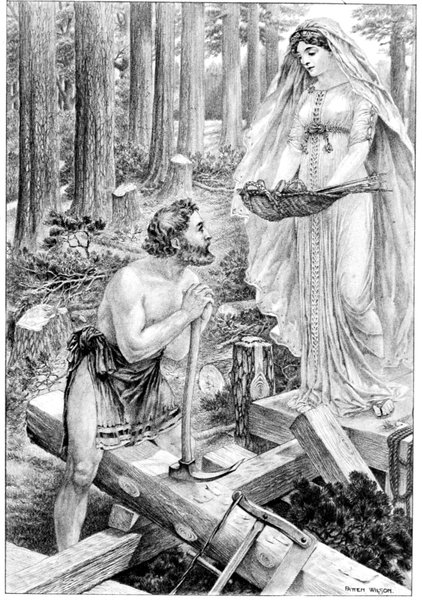
CALYPSO & ODYSSEUS
Patten Wilson
83... The nymph threw round her a garment of glistering whiteness,
Delicate, lovely; and over her waist then fastened a girdle,
Beautiful, fashioned of gold; and her head in a hood she enveloped.
Then she bethought her to send on his way great-hearted Odysseus.
Firstly a great wood-axe, in his hands well-fitted, she gave him,
Fashioned of bronze, two-edged. ...
... and going before him
Led to an end of the isle where tall straight timber was growing;
Alder was there and poplar and pine which reacheth to heaven,
Dry long since, well-seasoned and buoyant to float on the water.[10]
Odysseus wrought joyfully at the raft, building with
infinite care and skill a strong, seaworthy vessel. Calypso
brought out to him the store of fair cloth that she had
woven upon her loom, and of this he made the sails, with
“brace and sheet and halyard.” When all the strenuous
toil was completed, he drew the raft on rollers down to
the sea and made ready to sail.
Now was the fourth day come, and all of his labour was ended;
So on the fifth day sped his departing the goddess Calypso,
Bathing him first and arraying him freshly in fragrant apparel.
Then to the raft she conveyed dark wine in a bottle of goat-skin
—One was of wine and another, a greater, of water—and viands
84Stowed in a wallet; and many a toothsome relish she added.
Then did she send him a favouring breeze both gentle and kindly.[10]
So Calypso was left alone again on her little island; and
Odysseus, speeding before a favouring wind, was too absorbed
to give much thought to her. Freedom and the thought
of home filled him with exultation; and all his care was
bent to navigate the boat. But a grateful memory of her
survived in aftertimes; and often he would recall her
words to him, when she had given him the vow of good
faith:
For my own mind is righteous, nor my heart
Iron within me, but of piteous mood.[11]
Homer: Nausicaa
85
Nausicaa was the only daughter of Alcinous,
King of Phaeacia. Young and beautiful, reared
amid abundant wealth, the idol of parents
and stalwart brothers, she is yet simple and
sweet and quite unspoiled. Her father was lord over a
rich seafaring folk; a kindly, generous, impetuous man.
Her mother, Queen Arete, was a star among women; so
wise and noble that the people saluted her as a god, and
Alcinous worshipped her with absolute devotion. There
is hardly anything in Homer more beautiful than the
loving description that Nausicaa gives of her mother sitting
beside Alcinous in the great hall like a benign goddess, ready
to stretch a welcoming hand to the stranger and the suppliant.
Even the great goddess Athena had words of praise
for Arete, when she met Odysseus on the road coming up
from the harbour:
“Her Alcinous took to wife,
And honoured her as living woman none
“Of wedded wives is honoured upon earth:
Such is the worship paid her (and her worth
No less) by King Alcinous our lord
And by the children who from them have birth.
“Yea, all her people, when she goes abroad,
Salute her and account her as a god.
For of so excellent a wit is she,
Her woman’s wisdom puts a period
“To strife of men who in her favour stand.
And if to you she reach a helping hand,
86Hope you may have to see your friends, and reach
Your high-roofed house, and your own native land.”
[12]
Nausicaa, as we shall see, is worthy of her parentage. The
gods were gracious at her birth, and gave her the fine
qualities of both father and mother. Yet courage and
resource and a wise generosity sit lightly on the youthful
figure that flits through the Sixth Book of the Odyssey.
She is a mere girl, fresh and untried, with an irresistible
gaiety of heart and a tender regard for home ties. Her
changing moods and caprices are like dancing sunlight,
and now and then there falls upon her a soft shadow
of wistfulness, cast by the ‘long, long thoughts’ of
youth.
Her pretty head holds its own romantic visions, which she
cannot, from girlish shyness, bring herself to talk about
freely, even to the dear indulgent father. So for fear of
his teasing and laughter, she practises a little harmless deceit
on him; which, however, does not deceive him in the
least, because his love can look right through it.
So she moves before us, a creature of grace and beauty, of
fineness and strength; but withal so happy and human
that the thought of her has the bracing sweetness of upland
meadows, or the breath of the summer sea. Yet it is this
fresh young girl whom we have to consider for a moment
as the unconscious rival of Penelope. The idea of such a
rivalry seems absurd, in connection with Nausicaa. And
so it is, taken clumsily out of its setting and robbed of the
poet’s delicate art. Yet the suggestion is clear; and the
marvel is that Homer has contrived to bring her out of the
ordeal with her young innocence quite untouched. The
beats of the love-god’s wings only fan her in passing, and
she is left unhurt by a single barb. For a happy instant
87she glimpses him in flight, and stretches a welcoming hand
in naïve pleasure. But the moment after, he has fled in
jewelled light and she is left, wondering and wistful, but
scathless yet.
So Nausicaa lives, a peerless girl in Homer’s group of
immortal women. She has served his purpose in the epic
plan—to link the story with Penelope and to enhance her
dignified maturity. She has served too, in the strongest
way, to accentuate the chivalry and constancy of the hero.
But in doing this, the tenderest care has been taken that
she shall not be despoiled of her exquisite charm.
Poseidon the Sea-god was still wrathful with Odysseus for
the injury done to his son, the Cyclops. But having gone
on a long journey to the land of the ‘blameless Æthiopians,’
Athena had compassed in his absence the escape of the
hero. He had sailed joyfully from Calypso’s island, and
for seventeen days had fared onward steadily, with a
following wind. The wine and food that Calypso had given
him were still unspent, when on the eighteenth day there
loomed before him the island of Phaeacia, vast and shadowy
in the morning mist. Here, he knew, were friendly hands
and hearts; people who had never been known to refuse
safe convoy to distressed mariners. And Odysseus, feeling
that now at last the end of his struggles had come, steered
straight ahead. But he reckoned without Poseidon. For
that angry god, speeding on his homeward journey from
Æthiopia to Olympus, looked down from the mountains of
the Solymi and spied the raft of Odysseus, making for the
safety of a Phaeacian harbour. Amazement smote him;
then indignation, and then a furious desire for instant
revenge. So this was what the immortals had been doing
88in his absence—plotting to befriend the man who had so
foully mis-used his son. But no matter! If Athena must
needs win in the end—and even the might of Poseidon could
not eventually withstand her calm wisdom—her success
should be at bitter cost to this artful rascal whom she
favoured. So:
The clouds at his command
Gathered, and with the trident in his hand
He stirred the sea and roused the hurricane
Of all the winds, and blotted sea and land
With clouds: night swept across the firmament:
... a monstrous wave abaft
Came towering up, and crashed into the raft:
And the raft reeled, and off it far he fell,
And from his hand shot out the rudder-shaft.[12]
It would take long to tell all that Odysseus suffered from
that awful storm. Only the lion-heart that he was could
have endured the terrible strain of it. The raft was lost,
and for two days and nights the fury of the storm lashed
him unceasingly. He was buffeted out of his course, and
when at last a calm fell and he saw land ahead, he had only
just enough strength left to strike out for it, with a great
prayer in his heart for deliverance from the wrath of
Poseidon.
It is this exciting incident, told with tremendous vigour,
which is the prelude to the story of Nausicaa. For on the
very night when the waves flung Odysseus ashore on her
father’s island, she had a strange dream. A goddess stood
by her bedside, in the likeness of a girl friend; and with
hints of a happy marriage, bade her rise and go down to
the washing pools.
89The grey-eyed Goddess, inly counselling
Odysseus mighty-hearted home to bring;
To the richly-carven chamber went
Where slept a maid, the daughter of the king,
Like any deathless goddess fair and bright,
Nausicaa....
... “Nausicaa,” said she, “why
Thus idly does your mother’s daughter lie,
The garments wrought with bright embroideries
Unheeded? yet your wedding-day draws nigh;
When clad in goodly raiment you must go,
And on your marriage train the like bestow.
Not long shall yet your maidenhood be worn.
Even now, amid the land where you were born,
Phaeacia’s princes woo you. Up, and bid
My lord your father yoke at break of morn
A mule-team and a cart whereon to lay
Girdles and gowns and broidered blankets gay.”[12]
We who are watching behind the scenes know quite well
who is this celestial visitor; and that the whispered words
which have set Nausicaa’s cheeks tingling are a mere ruse
of Athena to bring help to the luckless Odysseus. But
Nausicaa has no hint of this; and waking with the morning
sun streaming upon her, she smiles in wonder and hope.
Then she dresses quickly and goes down to find her parents,
musing upon the words of the goddess. The queen is
sitting in the great hall, amid her handmaidens, winding
the ‘dim sea-purple’; and the king, coming out to join
the princes in council, meets Nausicaa on the threshold.
Is there anywhere a more charming scene than this?
“Papa dear, will you let me have to-day
A high wheeled waggon yoked, to take away
90The goodly clothes and wash them in the stream?
For in the house all lying soiled are they.
“Now for yourself it is no more than fit
That, when the councillors at council sit,
In clean array among your lords you go:
Also your house has five sons born in it,
“Two of them wedded now, but three are yet
Young bachelors, who evermore must get
New-washed attire when to the dance they go;
And now on all this charge my mind is set.”
So spake she, for her mouth for maiden shame
To her own father marriage might not name.
Howbeit he understood and answered her:
“Go, child: I grudge not any wish you frame,
“Mules or aught else: this thing my thralls shall do,
And yoke the high wheeled tilted wain for you.”[12]
As we see, Alcinous can deny nothing to his fair young
daughter. The lightly running mule-cart is ordered out,
and Nausicaa and the maids set busily to work. It is
refreshing to see this only daughter of a ‘king’ carrying
out the linen and fleecy blankets that have been daintily
wrought with needlecraft by her own hands. Alcinous, of
course, is not to be regarded as possessing the power and
state of a modern monarch; perhaps he was not a king at
all, in our sense of the word. But there can be no doubt
that his state was that of a rich and mighty lord, for he
lives in a magnificence which makes the simple practical
usefulness of his daughter all the more remarkable. She
helps the servants to load the wagon, while the Queen
herself places upon the box a skin of wine and many dainty
things to eat at their midday meal, together with a golden
flask of oil for their use when they wish to bathe.
91When all is ready, Nausicaa drives off merrily, her women
running at the side of the cart. Far out of the city they
go, past the embattled walls and the market-place and the
harbour: then on through farms and sloping, shimmering
olive-gardens, until they reach the sea and the washing-pools—the
very spot, in fact, where ‘toil-worn, bright
Odysseus’ is sleeping the sleep of exhaustion, after his
heart-breaking struggle with the waves. The mules are
unyoked and the clothes are brought out of the cart and
flung into the dark water. Then the girls bare their white
feet, catch up their fluttering garments, and tread the clothes
in the gushing water, gaily chattering the while. When
all are cleansed, they are spread out in the sun on the
pebbly beach, while the girls bathe and take their dainty
meal upon the shore.
All this while there lay in a thicket quite close to them,
the prostrate figure of Odysseus, like one dead. But when
the afternoon was wearing on, the girls joined in a merry
game of ball, before starting on their homeward journey.
The lovely group lives before us as we read, fresh from their
sea-bath, with crisping ringlets floating, cheeks touched to
a rosier hue by exercise and fun, and all the charms of youth
and beauty revealed as white arms throw the ball and
twinkling feet run hither and thither after it, upon the
yellow sand. Homer, in one of his rare exceptions, lingers
a moment to tell us how Nausicaa looked on this occasion.
But, characteristically, he does this by imagery, and imagery
in motion.
But when their hearts with food were comforted
Their kerchiefs they undid to play at ball;
And in the game white-armed Nausicaa led.
92Artemis the Arrow-showerer even so
Rejoices on the mountain side to go
All down the long slope of Taÿgetus
Or Erymanthus, while before her bow
Wild boar and fleet-foot deer flee fast away,
And round her move the wild-wood nymphs at play,
Daughters of Zeus the Lord of Thunder-clouds;
And Leto joys at heart; for fair are they,
Yet fairest of them all the child she bred;
And over all the rest her brows and head
Rise, easily known among them. Even so
Among her women shone the maid unwed.[12]
This is the moment for which Athena has been waiting, to
bring help to Odysseus.
Thereat the princess to a handmaiden
Threw the ball wide, and missed her, and it fell
In a deep eddy. From them all outbroke
A long shrill cry: and bright Odysseus woke;
And sitting up he pondered inwardly:
“O me, what land is this of mortal folk?”[12]
He is dazed by his long, long sleep. Where is he? What
land is this? Whose are those young figures that he can
just see by peeping through the leafy thicket in which he
lies? Are they the nymphs of the river along which he was
drifted out of the sea? Or are they human maidens who
may be besought to help? He does not hesitate long.
At all hazards he must speak to them, for he is in desperate
need. So, hastily breaking off a leafy bough to hide his
nakedness, he strode out of his lair. His uncouth figure
struck amazement and terror into the hearts of the girls.
Dreadful to them the sea-stained man drew nigh:
And up and down they ran dispersedly
93Along the jutting beaches; only then
The daughter of Alcinous did not fly:
Such courage put Athena in her breast:
Unfaltering she stood up and undistressed,
For once Odysseus is at a loss. How shall he address her?
He is almost naked, haggard, and sea-worn, a terrible object
to girlish eyes. Shall he go up close, and in the attitude
of the suppliant, clasp her knees? Or will not his touch
and his close approach startle and shock her? But his wits
are not long to seek. He decides that it will be better not
to come too near, but to address her gently, from a little
distance. “I kneel to you, Protectress. God are you, or
mortal?” Thus he speaks first, gracefully complimenting
her beauty and courage.
“If a god indeed you be
Of those who in wide heaven abide in bliss,
Unto none else than very Artemis,
Daughter of Zeus Most High, I liken one
So tall and fair and beautiful as this;
“But if a mortal, such as dwell on earth,
Thrice fortunate are they who gave you birth,
Father and mother, and thrice fortunate
Your brethren; surely evermore great mirth
“And joyance fills them, while with hearts elate
They see a thing so lovely delicate
Upon the dancing-floor. But far beyond
All others is that man most fortunate,
“Who loading you with many a precious thing
May woo you and to share his home may bring.“
[12]
Cunning Odysseus’s words are winged with a deeper significance
than he knows, for all his subtlety and tact. Does
94Nausicaa recall her dream, just at this point? We cannot
tell. But when he goes on to relate at length about the
dreadful voyage on the raft through the vengeful storms
of Poseidon, she pities and longs to help him. She has
gauged him shrewdly, too. This eloquent stranger, with
his air of frank deference, is no rogue nor fool; but whoever
and whatever he may be, he is a suppliant whom it is the
will of Zeus to succour. So she speaks cheerily to him,
to allay his anxiety, telling him that he is in the land of
a friendly people, whose king, Alcinous, is her father. She
will herself guide him to the palace and see that he is cared
for. Then she turns to reproach the silly fear of her maids:
“Stand still, my women! Why so timorous
At a man’s face? You do not surely think
This man is here with ill intent to us?
“That living mortal is not, nor shall be,
Who to Phaeacia bearing enmity
May come: for very dear to heaven we are,
And dwell apart amid the surging sea.
“... But to our abode
We must make welcome this poor wanderer.
Strangers and beggars all are dear to God.
“... With this stranger be it so.
Give him to eat and drink, and make him bathe
In shelter, down the windswept bank below.“
[12]
So Odysseus is bathed and clothed and fed; and Nausicaa,
looking shyly at him as he reappears, is astonished at the
wonderful change that has come over him. She speaks
apart to the women, a little wistfully.
“Listen, O white-armed girls, to what I say.
Not without warrant of the Gods’ array
Who hold Olympus, does this man arrive
In the divine Phaeacian land to-day.
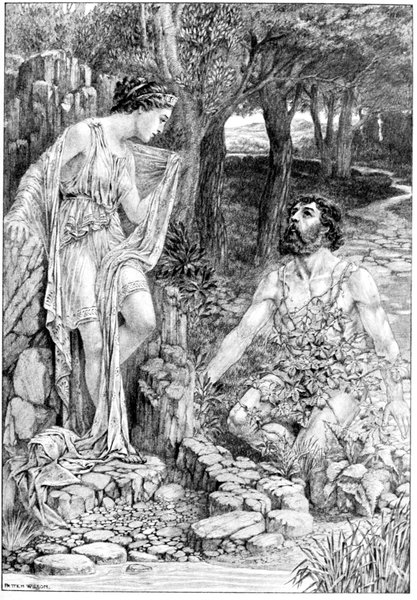
NAUSICAA & ODYSSEUS
Batten Wilson
95“Uncomely at the first he seemed to be
But now the Gods are not more fair than he,
Who hold wide heaven: I would that such an one
Dwelt here and bore a husband’s name to me.“
[12]
A little timid hope is dawning in her heart. Is it possible
that this may be the lover of whom she dreamed? But
she will not let him know her thoughts; and as she offers
to guide him to the city, she tells him with modest dignity
that he must not ride with her in the wagon. He must
follow behind with the maids; and when the city walls
are in sight, and they are near the houses of men, he must
draw away from them and continue his journey alone. She
is not discourteous, she explains; but it is not seemly for
her to be seen by the people driving a strange man into
the city.
“And taunting speech from them I fain would shun,
Hereafter flung at this that I have done.
Proud-hearted are our people; and of them
Meeting us, thus might say some baser one:
“’And who is this, the stranger tall and gay
That here beside Nausicaa takes his way?
And where may she have found him? Aye, no doubt
She brings a husband back with her to-day!...’
“So will they say; and to my shame would be
That word, as I myself would think it shame,
“If any other girl in suchlike way
While her own parents lived, should go astray
But she gives him minute directions, so that he may find
her father’s palace after she has left him. He will pass
Athena’s grove, and the well, and the king’s park, before
96he comes to the town and the gate of the palace. He is
to go right into the palace, and not to hesitate.
“But when the forecourt and the palace-wall
Have hidden you, pass quickly up the hall
Straight to my mother. In the firelight she
Sits by the hearth, while off her distaff fall
“The threads of dim sea-purple, strand by strand,
Marvellous; and her maids behind her stand,
By the hall pillar, and my father’s chair
Next hers, where he, the wine-cup in his hand,
“Sits like a God. Yet pass him by, nor stay
Till round our mother’s knees your hands you lay.
For thus, although from very far you come,
Quickly shall dawn your glad returning day.”
[12]
It all falls out as she has said. They start off as the sun
is setting, and Odysseus follows behind the mule-cart at a
little distance until they reach the sacred grove of poplars
that Nausicaa has indicated. There he waits behind for
a space, while she drives on to the palace. Her handsome
young brothers come out to meet her, with hearty greetings
and questions as to how the day has fared. But she does
not make much response to them, leaving them to unharness
the mules and carry out the clothing while she slips away
to her room and the society of her old nurse.
Meanwhile Odysseus makes his way to the palace alone
and is amazed at its size and magnificence.
The brazen walls
Athwart and endlong from the threshold went
Even to the inmost chamber up the hall;
And a great frieze of blue ran round the wall;
And golden doors the stately house within
Shut off, and silver doorway pillars tall
97Out of the brazen threshold sprang to hold
The silver lintel; and the latch was gold;
And gold and silver hounds on either hand
To this gorgeous palace, Alcinous and Arete give Odysseus
a royal welcome. They are charmed with their guest:
and when the queen, recognizing her handiwork on the
robe that he is wearing, elicits an account of his meeting
with Nausicaa, the king flames into anger.
Answered and said Alcinous: “Sooth to tell,
Guest, in this thing my daughter did not well,
That hither with her maids she brought you not
Herself, since first before her feet you fell.”
And subtle-souled Odysseus answer made:
“Prince, on that faultless maiden be there laid
No blame herein: for with her hand-maidens
She bade me follow; but behind I stayed
“For fear of shame, lest haply should you see,
Your mind might deem some hateful thought of me.”[12]
This is not exactly what had happened, as we know; but
we do not love Odysseus any the less for the chivalrous lie.
The most loving father can be unreasonable sometimes,
and Alcinous would not have the sacred laws of hospitality
broken, even for the maidenly prudence of his own sweet
daughter. Impetuously he tries to make amends:
“Nay, O guest,
Not so is framed my heart within my breast,
To be stirred up to anger without cause.
In all things to observe the law is best.
“Fain were I—Zeus our Father hear me vow,
And thou, Athena, and Apollo, thou!—
Such as you are and minded as I am,
You took to wife my daughter even now,
98“And were called son-in-law of me the king,
But Nausicaa’s dream was a lying vision; and the fine tact
of Odysseus is sorely put to it to find words for the inevitable
refusal. He is silent for a time; and then, beginning the
recital of all his eventful story, he gradually reveals to them
who he is, and tells about his home and the gentle wife
to whom he is longing to return. To the king and queen
his answer causes little regret. It means that they may
keep their fair daughter a little longer; and are there not
many Phaeacian princes from whom they may choose a
mate for her when she is ready? But Nausicaa, to whom
the nurse brings word of what is passing as she sits in her
beautiful chamber, hears the reply of Odysseus with a little
pang that she has never felt before. It does not linger
very long, however, and when the day comes for Odysseus’
departure, and the guests are trooping into the hall for the
last banquet in his honour, she steals out among them to
bid him farewell. It is the last time we see her.
But by the doorway of the stately hall
In godlike beauty stood Nausicaa;
And eyed him marvelling, and bespake him so:
“Fare well, O guest, that when you homeward go,
Me too you may remember, and that first
To me the ransom of your life you owe.”[12]
Odysseus’ reply is gallant; but it is not mere gallantry.
He vows that he will never forget her. Only let great
Zeus and Hera bring him safely home:
“Then would I alway
To you, O maid, who rendered me my life,
As to a God, in that far country pray.”
[12]
Æschylus: Clytemnestra
99
We come now to the heroines of Attic
Tragedy. The women of Homer, with all
their romantic beauty and charm, gleam
on us from a far distance. A new type of
heroine has arisen, reborn out of the legends of the remote
past into a new age; and evoked by a poetic genius which
is greatly different from that of the Homeric epics.
In the interval which had elapsed since the epics were
composed, civilization had advanced, life had grown more
complex, and women had attained to a fuller and freer
existence. It was the Great Age of Greece; and as in
our own Elizabethan Age, the poetic genius of the time was
impelled to find expression in dramatic form.
From all these causes, we shall find that the women of Attic
Tragedy are possessed of a stronger and more vivid personality
than their Homeric forerunners. They are resolute,
purposeful, passionate—women of action as well as
of feeling. Physical beauty they do possess, as well as
grace and charm. Neither do they lack the gentler qualities
which are usually supposed to be peculiarly feminine.
Indeed, we could probably find an eminent example of every
so-called feminine virtue if we went through the range of
the heroines. But the stress is not now laid merely on
beauty and the gentler graces. It is laid rather on a
combination of these qualities with strength of intellect
and will, generous emotions, and a soaring spirit.
Such a change would appear to be right and natural—in
fact, almost inevitable. We should expect that the passage
100of the centuries in an advancing civilization would give the
woman time and space ‘to bourgeon out of all within her’;
and that with a more harmonious development she would
definitely gain in mental height. We should expect, too,
that the dramatic genius would create a more clear-cut
individuality than that given by the epic poet in a long
narrative chiefly concerned with the doings of menfolk.
So that we are not surprised to find the women of tragedy
possessed of great vitality, and occupying a very large share
of the dramatists’ attention. What does surprise us,
however, is to discover that many of these newer heroines
are the very women whom we have already met in the
Homeric poems: that they have been taken straight over
from the heroic age, out of the ancient heroic themes, and
made to live over again, a new and vastly different life.
This brings us to a point which it is well to keep in mind.
Sometimes the heroines of Greek Tragedy do very terrible
things and are placed in situations of appalling horror.
Those acts, and the circumstances out of which they spring,
not only repel us but seem to be at variance even with the
spirit of the poet himself. Sometimes the heroine is the
victim of tyrannic physical force, and frequently again
there is the clash of motive, for which death seems to be
the only solution. Strange crimes, unheard of and almost
unthinkable, sometimes darken the atmosphere around
them. Age-old curses and hereditary feuds pursue them:
the terrible gift of beauty weighs them down; and over all
broods fate, a lurking, indefinable power against which, in
the last resort, they are powerless to stand.
There is then, sometimes in the heroines themselves and
almost always in their environment, an element of barbarism
which troubles us. The touch of savagery repels
101us all the more from its contrast with the exquisite poetry
in which it is enshrined, and the noble spirit of that poetry.
We wonder why the dramatist should have placed creatures
so sensitive and highly wrought in situations which are so
crudely appalling; and the incongruity is not shaken off
until we remember the nature of the material upon which
the poet is constrained to work. For the Attic dramatists
went for the subjects of their poetry directly to stories out
of the primitive past—old legends which, though sometimes
very beautiful, nearly always contain elements of cruelty
and horror. The reason why they did this is interesting,
and explains some curious points about Greek Drama.
To us it seems strange that these poets, whose ideas were
probably as ‘advanced’ to their contemporaries as our
modern Drama is to us, did not take their themes out of
the vastly interesting and even momentous life of their
own day. Very occasionally they did this, as we know from
the drama of Æschylus called The Persians, which deals
directly with that tremendous event of Greek history the
Persian Invasion. But almost always, as we have said,
they turned away from their own time, and looked back
upon the ancient past for the subject-matter of Drama.
It is probable that poetical motives influenced them to
some extent—the same that made Milton turn back to
the Hebrew story of the creation, and Tennyson occupy
himself for nearly fifty years with the Arthurian legend.
But there was another, and more compelling reason; and
it lay in the religious character of the Attic theatre.
Greek Drama was a ritual, performed in honour of the gods.
It had its origin in the worship of the Thracian god Dionysus
or in a still older cult of ancestor-worship; and it had an
established convention that its themes should be taken
102from legendary heroic subjects. So that the poet, however
he might modify character, was bound by tradition to the
main outline of the early stories. As we shall see, he
imbued those themes and characters with new significance.
Just as Milton puts the Reformation spirit into the story
of Adam and Eve, and Tennyson makes the Arthur of Celtic
legend into an ideal of modern gentlehood, Æschylus and
Sophocles and Euripides vitalize the old legendary forms
with the spirit of their own age. The spirit of that age
was profoundly interested in religion—perhaps because it
was beginning to lose its religion. It was passing out of
unquestioning belief in the old Olympian hierarchy; but
it had not yet attained to a new belief with any clearness.
And an extremely interesting fact is that here in the drama,
in the very cradle of religion, the new thought begins to
manifest itself quite clearly, despite the trammels of convention.
Each of the three tragedians represents some
phase of it; each shows, in greater or less degree, evidence
of the transition period in which old superstition was
being broken down; but each steadily maintained, through
the crash of falling faith, the sanctity of the moral law. It
is this clear view, this austere purpose and steady aim at
the highest, which gives Attic Tragedy its grandeur, and
the women of Attic Tragedy their surpassing interest.
What has been said above about the barbarity of the legends
on which Greek Drama is based, applies particularly to the
story from which the figure of Clytemnestra was taken.
It was a history of wrongdoing, of foul guilt going back for
generations: or rather, the history of a sin which, to use
the words of the poet himself, begot more sin in each
succeeding generation. Æschylus wrote his greatest work
103around this theme, a trilogy of three dramas called the
Agamemnon, the Choephorœ, and the Eumenides. The
first two of these dramas furnish the material for the story
of Clytemnestra. The last deals with the remorse of
Orestes, her son, and the atonement by which the long
record of crime is finally closed and a new era of hope
begins. Clytemnestra is, as it were, the last sacrifice
demanded by the Furies which had pursued the house of
Tantalus so long, and she represents in herself the two
forces by which that vengeance had always been effected—a
wrong done and a wrong suffered. For Æschylus makes
us see that it is not only by the first sin of Tantalus that
all his descendants have been relentlessly pursued; but
that each in his turn has added something of his own—some
crime of passion or of pride—to bring the penalty
on himself.
It is from this standpoint that we must look at Clytemnestra
and judge of her action. She was the instrument of a
power beyond herself, the dread fate which had marked
Agamemnon the king, her husband, as another victim of the
hereditary curse. But she was not merely an instrument.
She had fallen prey to her own unlawful passion, and when
she struck the blow which fate ordained, it was not impelled
by the single motive of revenge for the sacrifice of Iphigenia,
but a confusion of passionate anger and conscious guilt.
The Agamemnon opens with the joyful announcement of
the fall of Troy. The scene is laid in the wealthy city of
Mycenæ, in the palace of Agamemnon the king, where a
watch had been kept for many months for the return of
the Greek fleet. Ten years before, when the fleet had
sailed for Troy to avenge the carrying-off of Helen, there
had been left behind in the royal home a mother stricken
104by an awful grief. For the King Agamemnon, delayed at
Aulis by adverse winds, and in brutal haste to be gone, had
offered up to the gods a human sacrifice—the sacrifice of
his own young daughter Iphigenia. The prayers of
Clytemnestra the queen, and the tears of the beautiful girl
herself, could not prevail upon him. Iphigenia’s life was
forfeited to a hideous superstition, and the host sailed away,
leaving Clytemnestra overwhelmed with sorrow and wrath.
Here then are the two contributing elements to the tragedy—the
wrong done and the wrong suffered. Agamemnon,
driven on by the curse which lay over his house, blinded
by his own pride and headstrong impatience to the true
nature of the crime that he was committing, was forging the
weapon of his own destruction. And here too we have the
deed which accounts for and explains Clytemnestra—making
of her not the mere savage murderess of tradition,
without a touch of humanity, but an outraged mother, the
avenger of her child.
It is necessary to emphasize this point a little because we
have been used to regard Clytemnestra as a mere monster
of cruelty. It is therefore a shock of surprise, when we
come to Æschylus for her story, to find that he has made
her quite human. He is not concerned in her case, any
more than with the other persons of his Drama, to expose
intricate motive, or to paint delicate shades of character.
In his task of hewing out dramatic form—of virtually
creating Drama—he left subtlety and ingenuity and stagecraft
to be perfected by his successors. Hence he is not
exercised very much about making his plot a plausible one,
or to explain how its incidents are effected. He has a great
religious purpose; and this, with the ritual form in which
he had to work, subordinates the purely dramatic elements.
105But he does clearly let us see—and this is all the more
important from his usual reticence—that the whole course
of Clytemnestra’s action was determined by Agamemnon’s
inconceivable cruelty.
This point eludes us often, because we accept the sacrifice
of Iphigenia as an act belonging to a barbarous age. So
it is, but we forget that the age of Agamemnon had practically
left barbarism behind it. The slaughter of Iphigenia
must have been almost as revolting to the ideas of that
time as it is to us; and although in times of national crisis
fanatical minds may have been capable of reviving the
savage custom of human sacrifice, that is no justification of
Agamemnon. And that he submitted to the superstitious
frenzy, and offered up the life of his child, was the act
which armed Clytemnestra against him.
The deed was, however, of a piece with his character. He
was haughty, passionate, headstrong, brooking no resistance
and no rivalry: a man of tremendous force of character
who had grown too great and who in his pride had even
dared to dishonour Apollo himself in the person of his
votaries. To such a man, who after ten years’ preparation
found his fleet hindered by unfavourable gales, the slaying
of his daughter was merely an unpleasant step toward the
fulfilment of his purpose. Her beauty and her youth were
of little account, and her mother’s tears and entreaties were
brushed aside as weakness.
Sin from its primal spring
Mads the ill-counselled heart, and arms the hand
With reckless strength. Thus he
Gave his own daughter’s blood, his life, his joy,
To speed a woman’s war, and consecrate
106The story of Clytemnestra, then, rightly begins here. She
too was passionate and proud, with a will of iron: a nature
of strangely blended strength and tenderness. When the
blow came from the hand which should have shielded her,
it struck dead her gentler self. She gave herself up to
thoughts of revenge; and hearing from Troy as the years
passed tidings of Agamemnon’s infidelity, the last link
between them was broken. Other news would come to
her ears: of sedition amongst the people, left so long
without a ruler; of the country suffering from the need
of its strongest men, who were all away at the war; and
of a certain Egisthus, her husband’s enemy, who had
returned from exile. There would be a bond of sympathy
between Clytemnestra and this Egisthus. Had he not a
feud against her husband? Was he not wronged by
Agamemnon, too? Had his father not suffered at the
hands of Agamemnon’s father? There would be a meeting
between them, followed by other meetings, while they
made common cause against the king; and presently the
two were united, not only in a plot for Agamemnon’s
overthrow, but in the bonds of guilty love.
When the news came of the fall of Troy and the return of
the army, Clytemnestra had matured her plans for vengeance.
For years she had nursed her wrath, and plotted
with all the subtlety of her mental powers. And for years
she had hoped for and dreaded the day which would bring
back the king to Mycenæ. Her love for Egisthus was
common knowledge in the palace. Her sin would doubtless
be proclaimed to Agamemnon immediately after his arrival,
even if he did not already know of it; and she knew
that the penalty of it would be death. So every instinct
and impulse of her nature, and every consideration
107of self-defence too, demanded instant action. Vengeance
for the murder of her daughter, her love for Egisthus, and
the need of self-preservation all combined to nerve her for
what she had to do. Agamemnon’s arrival was imminent;
she must be ready, and when the moment came she must
not falter. But meanwhile, before the old senators who
had gathered to welcome him (and who form the Chorus
of the drama) she must play the part of a loving wife.
When the first part of the Trilogy (the Agamemnon) opens,
beacon-lights announce the fall of Troy. The news flies
through the palace, and there is instant excitement. The
old senators come thronging out; and as they sing, wonderingly
and half-doubting, Clytemnestra the queen
suddenly enters. She stands for a moment to confirm
this amazing news, and the old men turn to address her.
But she makes no answer: it is as though she has not
heard them—as though nothing but the words “The king
is coming” clamour in her ears, and bring a rush of emotion
that stifles speech. She goes out silently; but while the
old men are singing of the doom of Troy, she reappears.
Her entrance now is resolute and majestical: her purpose
is taken, and in firm tones she declares to the Senators that
the news they have heard is true. As she speaks, the tide
of emotion rises again and carries her on to utterance that
is almost prophetic:
Cly.
This day Troy fell. Methinks I see’t; a host
Of jarring voices stirs the
startled city,
Like oil and acid, sounds that will not mingle,
By natural
hatred sundered. Thou may’st hear
Shouts of the victor, with the dying groan,
Battling, and captives cry....
... Happy if the native gods
108They reverence, and the captured altars spare,
Themselves not captive led by
their own folly.
May no unbridled lust of unjust gain
Master their hearts, no
reckless, rash desire.
Cho.
Woman, thou speakest wisely as a man,
And kindly as thyself.[13]
Clytemnestra’s speech is significant. She knows the nature
of the king, and she fears that his victory over Troy has
been a brutal one, pushed even to the last extremity of
insult to the country’s gods. That impious pride is her
uppermost thought; with it, she steels her heart; and
when the herald arrives, she listens in ominous silence as
his tale confirms her utmost fears.
Her.
Agamemnon
Comes, like the sun, a common joy to all.
Greet him with triumph, as beseems the man
Who with the mattock of justice-bearing
Jove
Hath dug the roots of Troy, hath made its altars
Things seen no more, its
towering temples razed,
And caused the seed of the whole land to perish.
... His hand hath reaped
Clean bare the harvest of all bliss from
Troy.[13]
If anything were needed to confirm Clytemnestra’s resolution,
surely it lay in these words. Agamemnon, the ruthless
slayer of his daughter, the destroyer of Troy, who had no
fear of the gods and no pity for man, would have no mercy
upon her. She must kill or be killed; and she must act
quickly.
Even while the herald spoke came the sound of the procession
which was bringing the king up from the ships.
First, his own chariot, surrounded by his guard and by
the people who had gone out along the road to welcome
109him. Then, following close behind, a chariot containing
the solitary figure of a woman, seated amid the spoils of
war. She was Cassandra, a prize of battle, brought home
by Agamemnon to be his slave-wife. But she was no
ordinary slave. Daughter of Priam, King of Troy, and
virgin priestess of Apollo, she had been torn from the altar
of the god by her captor; and Clytemnestra, watching her
wild eyes, knew that Agamemnon had filled up the measure
of impiety to the gods and insult to herself.
Agamemnon uttered a laconic greeting to the people, while
the queen stood tense and still. By no word or sign did he
acknowledge his wife: only, in perfunctory terms, hailed
his country and his country’s gods, and thanked the people
for their welcome.
Then Clytemnestra, holding tremendous passions in the
leash, began her formal speech of welcome.
Cly.
Men! Citizens! ye reverend Argive seniors,
No shame feel I, even to your face,
to tell
My husband-loving ways.[13]
The hour has come for which she has waited so long: her
desperate plan is formed: all that may have been needed
to strengthen it has been heaped upon her in the pride
and insolence of the king. But she must dissemble a little
longer; she must force herself to speak lovingly, to appear
faithful before the people, and to lull suspicion in Agamemnon’s
mind. In her husband’s speech there had been a
veiled menace: and now, after the first conventional
phrases of affection, her words, too, take on a double
meaning; and an undercurrent of bitter irony runs through
them. On the surface lies the obvious meaning, to meet
the exigency of the moment; just below it lay another
110sense, designed to leap to life and plead for her when the
deed that she is contemplating shall be accomplished.
“There comes a time when all fear fades and dies.
... Does any heart but mine
Know the long burden of the life I bore
While he was under Troy?“
[14]
The time has indeed come to put aside fear, but for a
reason that these senators cannot see yet, any more than
they can conceive the real nature of the burden that she
had borne so long. To say that Clytemnestra’s speech is
not really that of a faithful wife, that it is too loud in its
protestations of joy, too insistent and eager in its avowal
of fidelity, is beside the mark. For not only is Agamemnon
in all probability aware of Clytemnestra’s sin, but she
realizes that he may be aware of it. Hence the deep irony
of the situation; and hence too the fact that these protestations,
begun calmly and deliberately with the object of
deceiving the crowd, gradually take on a different tone.
The king’s manner to her from the moment of arrival had
been cold, even repellent. The conviction grows that he
has been forewarned, and with that conviction, the sense
of danger to herself is heightened. As her speech proceeds
we seem to feel her quickening pulse and tingling nerve,
we seem to share the rush of fear that sweeps away restraint
and carries her along a torrent of language that is wild,
vehement, and almost frenzied.
“Now with heart at peace
I hail my King, my watchdog of the fold,
My ship’s one cable of hope, my pillar firm
Where all else reels, my father’s one-born heir,
My land scarce seen at sea when hope was dead,
My happy sunrise after nights of storm,
111My living well-spring in the wilderness!
Oh, it is joy, the waiting time is past!
Thus, King, I greet thee home. No god need grudge—
Sure we have suffered in time past enough—
This one day’s triumph.“
[14]
At this point she seeks relief in action from the stress of
emotion:
“Light thee, sweet my husband
From this high seat: yet set not on bare earth
Thy foot, great King, the foot that trampled Troy!
Ho thralls, why tarry ye, whose task is set
To carpet the King’s way? Bring priceless crimson:
Let all his path be red, and Justice guide him,
Who saw his deeds, at last, unhoped for, home.“
[14]
Self-control is clearly returning. There is profound significance
in her closing words, an invocation to Justice to
lead Agamemnon to his doom. There is an inner motive,
too, as well as awful irony, in the invitation to the king to
walk on ‘priceless crimson.’ She must contrive that he
will commit himself still further before the people, who
are already stirred by faction and chilled by his hauteur.
In the full light of what she is about to do, she sees that
this is Agamemnon’s last public act; and has determined
that the man of blood shall walk to his death along a
crimson path. The deed is almost sacrilege; but after
some protest, Agamemnon yields to her entreaties.
“If you must have it so, let some one loose
The shoe that like a slave supports my tread;
Lest, trampling o’er these royal dyes, some god
Smite me with envious glances from afar.“
[15]
He has a consciousness of what he is doing, and his mind
misgives him; but he who could deny to the mother the
112life of her child, cannot refuse this indulgence to his pride.
Clytemnestra, in exultation that she can hardly conceal,
reassures him. In lines of exquisite poetic beauty, but
weighted with a meaning that he does not see, she declares
that this honour is his due; that it is a sacrifice for his
return. Then, as Agamemnon passes within the palace,
she remains for one instant outside. The fire of exultation
dies away. She forgets the people standing round, the
need for dissimulation, the danger of discovery. One
thought sweeps everything else away—the thought of the
stupendous deed that she is about to attempt, its horror and
its peril. She raises her hands and utters an awful prayer:
“Zeus—thou fulfillest all—fulfil my prayer!
And take good heed of all thou doest herein!“
[15]
Then she follows Agamemnon into the palace. But there
remains one person whom she has overlooked, Cassandra,
priestess and prophetess of Apollo. As the Chorus takes
up a lovely song full of foreboding, the queen returns and
calls to Cassandra to come within. But there has fallen
upon Cassandra a prophetic vision of the crime. She is
distraught with fear and horror, and can find no answer
to the imperious queen. Clytemnestra, to whom every
moment is of infinite importance, suddenly loses all her
dignity in mere rage at the silent, helpless girl.
“I have not time to waste out here with her.
By this the victims at our midmost hearth
Stand ready for the slaughter and the fire;—
Rich thank-offerings for mercies long despaired.
... I’ll not demean myself
By throwing more words away.“
[15]
As Clytemnestra passes a second time within doors, the
113poor captive begins to wail a prophecy of what is about
to be enacted there. She mourns for the awful curse upon
the house.
“There bides within
A band of voices,—all in unison,
Yet neither sweet nor tuneful, for their song
Is not of blessing. Ay, a revel-rout,
Ever emboldened with new draughts of blood,
Within these walls, a furious multitude,
Hard to drive forth, keep haunt, all of one kin.
They cling to the walls; they hymn the primal curse,
Their fatal hymn.”
She foresees the death of Agamemnon, and her own fate
beside him. Twice she approaches the palace and twice
recoils in horror. But at last, committing herself to
Apollo, she rushes within; and instantly there rises a
dreadful cry. It is the voice of the king.
“Ah! Ah! I am mortally stricken, here, in the palace!”
The old men stand paralysed with fear; and before they
can move a step to help, the agonized voice cries a second
time:
“Oh me! Again I am smitten, to the death!”
There is an instant uproar and outcry. The palace becomes
noisy with hurrying feet and clamorous voices; the old men
feebly rush this way and that, unable to decide, in their
weakness and senility, how to act. In the midst of the
disorder, the doors of the palace are thrown open, and
Clytemnestra is revealed, weapon in hand, bending over
the body of Agamemnon. A dreadful hush falls; and the
queen, drawing herself up before the people, deliberately
confesses to the deed and declares her motives.
114“I, who spake much before to serve my need,
Will here unspeak it, unappalled by shame.
... Time, and thought still brooding
On that old quarrel, brought me to this blow.
‘Tis done, and here I stand: here where I smote him!—
I so contrived it,—that I’ll ne’er deny,—
As neither loophole nor defence was left him....
Such—O ye Argive elders who stand here,—
Such is the fact. Whereat, an if ye will,
Rejoice ye!...
Such a cup of death
He filled with household crime, and now, returning,
Has drained in retribution.”
But to the Senators only one thing is clear. A terrible
crime has been committed: their king has been foully slain.
All Clytemnestra’s pleas in extenuation of the deed are
wasted words. To them the situation is tragically simple:
her guilt is plain; there is but one word that fits her—murderess.
There is no question for them of reason or
of motive. What she claims to be a righteous judgment
upon Agamemnon, they declare to be a crime demanding
punishment. But they are not strong enough to enforce
their will; and when they threaten Clytemnestra with
banishment, she answers with scorn.
“That is your sentence. I must fly the land
With public execration on my head.
Wise justicers! What said ye, then, to him
Who slew his child, nor recked of her dear blood
More than if sacrificing some ewe-lamb
From countless flocks that choked the teeming fold,
But slew the priceless travail of my womb
For a charm, to allay the wind from Thrace?...”
“Then hear my oath. By mighty Justice,
Final avenger of my murdered child,
By Atè and Erinys, gods of power,
To whom I sacrificed this man, I look not
For danger as an inmate, whiles our hearth
Is lightened by Aegisthus, evermore,
As hitherto, constant in love to me;
My shield, my courage!“
[15]
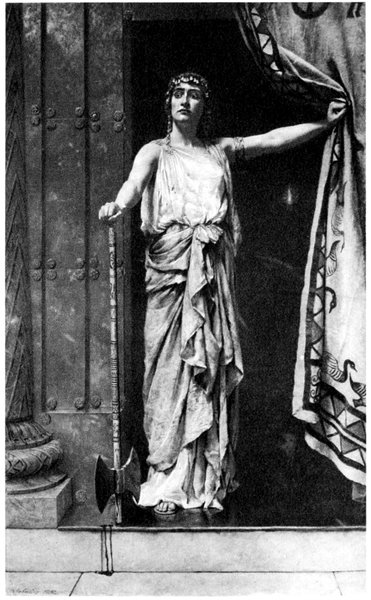
CLYTÆMNESTRA
Hon. John Collier
By permission from the original picture in the Guildhall Art Gallery
115Then, as the elders mourn the death of the king and the
demon of vengeance that haunts the house, Clytemnestra,
in passionate conviction, declares that she has been merely
an instrument of that spirit of vengeance.
“But I
Here make my compact with the hellish Power
That haunts the house of Atreus. What has been,
Though hard, we will endure. But let him leave
This roof, and plague some other race henceforth
With kindred-harrowing strife. Small share of wealth
Shall amply serve, now I have made an end
Of mutual-murdering madness in this hall.“
[15]
She comforts herself with the thought that now at last
the Furies are appeased. No doubt of her own motives
assails her: no warning hint that crime is not cancelled
by fresh crime. In the first glow of triumph she has no
premonition of the return of an avenging son. She proposes
to herself a reign of peace with Egisthus which shall
erase all memory of the past.
“Might but this be all of sorrow, we would bargain now for peace....
I and thou together ruling with a firm and even hand,
Will control and keep in order both the palace and the land.“
[15]
116On this note of false security the Agamemnon closes; and
for the fate of Clytemnestra, which now becomes bound up
with the story of Electra, we must go to the second drama
of the trilogy, the Libation-bearers.
Æschylus: Electra
117
The Æschylean Trilogy pauses at the point of
Clytemnestra’s triumph. The first drama, the
Agamemnon, ends there. We left the queen
tasting the joy of revenge, but by no means
gloating heartlessly over Agamemnon’s fall. She was
conscious of the magnitude of the event; and the awfulness
of her deed would have daunted even her strong spirit had
she not been confident that she was the instrument of destiny
in striking down the proud and cruel king.
The friends of Agamemnon, the loyal faction which should
have risen against her, must have been few and weak. They
were evidently soon subdued. They could not stand
against the force of her powerful will; and, moreover, she
combined with her strength a wise tact and a keen sense
of justice. Doubtless these qualities had gone far to
establish her government in Agamemnon’s long absence.
Her sway was no new thing to the people of Argos; and
when she resumed it with Egisthus as her consort, she
took up the thread of her former life, with little outward
sign to mark the change.
Underneath the surface of national life, wrath and horror
at the murder of the king must have smouldered. Inside
the palace itself, as we shall see presently, there was a small
party ardently devoted to his memory and to the cause
of his absent son, Orestes. But they were no match for
Clytemnestra; and she in her turn, having shaken off the
nightmare of fear in which she had lived for so many
years, proposed to herself a future that should cleanse and
118sweeten all the past. Her first emotion was one of intense
relief, not only from the long strain of suspense, but from
the fact that now, as she firmly believed, the old curse upon
the house of Atreus had at last been fulfilled. Her hand
had dealt the final blow; the last life demanded by that
implacable spirit had now been offered up. Henceforward
it only remained to wipe out the past by just rule and
sober living.
So for a time—we do not know quite how long—she lulled
herself in false security. Years may have passed in this
ominous calm: memory fell asleep, and she lived serenely in a
present that was full of such interest and action as her mind
delighted in. In such a mood, she would not observe, or
would disregard, small signs of disaffection around her.
Day by day she would see the sad face of her daughter
Electra; but until some shock came to awaken her sleeping
soul, Electra’s accusing eyes would fall upon her unheeded.
The awakening came at last, however; and it is at this
point that Æschylus opens the second part of his Trilogy,
in the drama called the Choephorœ, or Libation-Bearers.
The scene is laid outside the Royal Palace at Mycenæ, before
that tomb of Agamemnon which archæologists within recent
years have brought to light on the ancient site of the city.
The time is morning, and two young men, who have
evidently travelled far, approach the tomb. One is Orestes,
the son of Agamemnon whom Clytemnestra had sent away
as a child. The other is his dear friend Pylades. Orestes
has returned secretly to Argos, bidden by the oracle of
Apollo to avenge his father’s death. But he has no army:
he does not know that he has a single friend in Mycenæ;
and his purpose is fraught with extreme danger. How he
will accomplish it he cannot yet imagine; but he must
119first try to discover if there are any in the palace who will
befriend him.
As they reach the tomb, Orestes calls upon Hermes, the
god who guides the shades of the dead, and invokes his
father’s spirit.
“O Hermes of the Shades, that watchest over
My buried father’s right, be now mine aid.
I come from exile to this land. Oh save me!
Father, here standing at thy tomb I bid thee
Then, according to a solemn custom of the heroic age,
Orestes begins to clip the locks of hair from his head and
place them upon the tomb as a votive offering. As he is
thus engaged, a train of mourning women slowly emerge
from the palace, carrying vessels in their hands with libations
for the dead. They are slaves, captive Trojan women
whom the poet uses as the Chorus of his Drama; and they
are followed at a little distance by the drooping figure of a
girl, whom Orestes rightly believes to be his sister Electra.
They are coming to pour offerings at the tomb of the king.
This in itself is a sign of encouragement to Orestes. But
he dare not show himself until he is assured that they are
friendly to his cause; and he and Pylades hastily withdraw,
where they may hear and see the ceremony without being
seen.
The women are singing; and as their lovely parodos rises
and falls, we learn why they are coming thus early to the
neglected tomb of the murdered king. The astounding
fact reveals itself that they are sent by Clytemnestra.
Clearly, the awakening has come to her at last. In the
night that has just passed she had been visited by a dream
120that seemed to her a dreadful portent. She had started
from her bed, screaming with horror, and had called for
lights. But the crowding women with their lamps could
not drive away the vision of the fearful serpent-birth that
had turned and rent her breast. And Clytemnestra, her
conscience suddenly shaken into life, had sent for the
interpreters. They had no comfort for her, however, in
their reply:
They cried, aloud, by heavenly sureties bound,—
“One rages there beneath
Menacing death for death....”
So the interpreters confirmed her fear, that this dream
was an omen sent from the unquiet spirit of her husband.
Remorse assailed her. The shade of Agamemnon, neglected
hitherto, must be propitiated. As soon as daylight came,
libations should be poured upon the tomb; and that they
should be acceptable, Electra should perform the rite.
She might not herself call upon that dread spirit in the
underworld; but Electra, with her grief-marred face and
her loyal love to her father, would be a fitting suppliant.
Thus it happens that Electra, in the first light of early
morning, stands at the tomb. Her heart is filled with
bitter grief. She loathes the task that she is commanded
to perform—the rite which, after years of callous neglect,
is only now offered to the injured shade because some
beginning of fear has come into her mother’s mind. In
all this time, none of the dues that are sacred to the dead
had been permitted for Agamemnon. No libations had
been poured, no locks had been shorn from the head; and
even the mourning of Electra and her women had had to
be hidden away from sight and sound of the queen. Now,
121suddenly, from no motive of love or reverence to the dead,
from no sense of tenderness to her daughter, from no reason
that Electra can perceive save a premonition of danger to
herself, Clytemnestra orders that the proper ceremonies
shall be observed.
Electra cannot see the real motive which sways the queen.
Partly from her very youth and innocence, partly because
there is in her a tinge of the iron temper of her father, she
is blind to everything but Clytemnestra’s guilt. She sees
her mother in the light of one fact only—the murder of
the being whom she had loved most dearly. And looking
back upon the past, all its events are viewed through that
harsh light. There was the banishment of her brother
Orestes; the coming of the strange man Egisthus whom,
for some reason that she could not then comprehend, she
had always loathed; the return and death of her father;
her own subsequent misery and degradation. With the
hardness of youth, she can conceive of nothing which
could explain her mother’s action, much less palliate it.
Her sister Iphigenia she could not clearly remember; and
if the story of her sacrifice was known to Electra, her
absolute devotion to her father accepted it unquestioningly.
In no case could she apprehend how that crime would
wound her mother; just as she could not see or understand
the darker side of Agamemnon’s character. Only one
thing was painfully realized—that the great king who was
her father, and who had known how to be tender to the
little girl he left at home in Mycenæ, had been done to
death by the woman she called her mother. And now this
woman, whom the years had taught Electra to hate,
commanded her to supplicate the wronged dead for peace.
Electra cannot, and will not, entreat the dead in terms
122like these; and her first speech is awful with the bitterness
in her heart. She turns to the slaves, the Trojan women
who are attending her:
“Ministrant women, orderers of the house,
Since ye move with me to this suppliant rite,
Be ye my counsellors, how I must perform it.
When I pour this tribute at the grave,
What words will be in tune? What prayer will please?
Shall I say, Father, from a loving wife
This comes to thy dear soul: yea, from my mother?’
That dare I not.—I know not how to speak,
Shedding this draught upon my father’s tomb.
Or shall I say, as mortals use, ‘Give back
The giver meet return?—to wit, some evil’?
... Be kind, and speak.“
[16]
Grief and anger make her speech broken and barely coherent,
as her thoughts are. But below the emotion, and almost
unconsciously, there is a hint of some purpose forming.
Once for all she puts aside her mother’s orders; but she
is not clear what will take their place. The dawning
thought has not taken shape yet; and the vague counsels
of the women do not at first help her. But presently they
speak the name of Orestes, and bid her look for help to him.
She is startled at the name, and the gleam of hope it brings
lights up the underlying thought. She realizes suddenly
what it means.
Elec.
Well said and wisely! That most heartens me.
Cho.
Then think of those who shed this blood, and pray—
Elec.
How? Teach me; I am ignorant. Speak on.
Cho.
Some power, divine or human, may descend——
Elec.
To judge or execute? What wilt thou say?
Cho.
Few words, but clear. To kill the murderer.[16]
Here then is the thought of her own brain, clothed in
words and echoed back to her from the women whom she
123has implored to advise. But put thus into cold language,
they have a dreadful sound from which she recoils in
horror.
Elec.
But will the gods not frown upon such prayer?
Cho.
Do they not favour vengeance on a foe?[16]
In this tense dramatic moment, we are shown what the
theme of the Drama is to be. We are shown too, as vividly
and almost as rapidly as in a lightning-flash, the clear
outlines of Electra’s character. The beautiful devotion
to her father’s memory: the blind hatred of Clytemnestra:
the desire for revenge vaguely forming, and leaping full-grown
at the first prompting from without; but—and
here is the crux—that desire held in check by a profound
religious sentiment. This reverence for the gods makes
the whole tragedy, for Electra and Orestes both; it provides
the dramatist with the inevitable inner conflict round
which the action will revolve; and, most important of all,
it has an ethical significance which will sanctify the revenge
of Electra and Orestes. For while the mere human impulse
with them both is to strike back rapidly and without mercy
for the blow that has killed their father, a higher sense
restrains them; and it needs an imperious mandate from
Apollo to nerve them to the deed. This reluctance for the
shedding of blood is a new thing in the age-long record of
the house of Tantalus. When Electra asks whether the
gods will not frown upon a prayer for vengeance, there is
the birth of a holier spirit which will atone for and purify
all those old crimes.
But first the final retribution must fall. Electra now lifts
her voice in solemn prayer to the awful gods of the underworld
and to the spirit of her father. She prays for a wiser
124heart and purer hand than her mother’s. With almost
faltering words—literally constrained thereto, she says—she
prays for vengeance; and she implores that Orestes
may return and claim the throne now occupied by the
hated Egisthus.
It is at this moment, just as the prayer closes in the
Choral hymn, that Electra sees the locks of hair upon the
tomb. She is amazed, almost alarmed. There is only
one creature in all the world who should bring such an
offering. If any other has placed it here, it is an act of
sacrilege. She takes up the hair, examines it, and speaks
about it rapidly and anxiously to the women. Gradually
the conviction dawns that it can be no other than a votive
lock shorn from the head of Orestes himself. Then he has
been here? But where is he now? The thought that he
has indeed returned, that he may even be near at hand at
this moment, drives wild hope and fear alternately through
her mind. Holding the lock within her hand, she says:
“Ah! could it but speak, and tell me
Kind news, I were not shaken thus and cloven,
Thinking two ways: but either with clear scorn
I would renounce it, as an enemy’s hair;
Or being my brother’s, it should mourn with me,
And pay sweet honours at our father’s tomb.“
[16]
Meantime, Orestes in his hiding-place had verified the
fact that Electra was his sister. He had reassured
himself, too, on another vital point. What he had heard
and seen had convinced him that this group of women
at least was friendly to his cause. And at its head,
holding out against great odds, and suffering extreme
ills in consequence, was this brave spirit of Electra
who, with all her tender and loyal devotion, was strong
125enough to dare the uttermost with him. He need no longer
delay to reveal himself. He had heard Electra’s prayer for
his return, and for vengeance on his father’s murderers;
and, stepping forward, he came like an instant answer to
her petition.
Ores.
First tell the gods thy former prayer is heard.
Then pray that all to come
be likewise good.[16]
But Electra cannot recognize in this tall young man the
boy who left their home so many years before. She is
startled and incredulous; and there follows a curious little
scene which, if it occurred in a modern play, would simply
cause derision. Orestes gives such quaint evidence of his
identity—the colour of his hair, which matches her own;
the length of their footprints, which is similar; the embroidery
on the robe that he is wearing, which he says was
wrought by her own hands before he went to Athens. The
poet is not very much concerned with probabilities. He
has a great religious purpose which dominates all other
considerations; and in the sublime onward sweep of the
tragedy we are not troubled by minor inconsistencies.
At this point they are simply lost sight of, in the keen
dramatic interest of the scene when Electra is at last
convinced that this is indeed her brother. What is proof
to her is more than ample proof to us.
Elec.
Shall I, in very truth, call thee Orestes?
Ores.
You see myself ...
Nay, be not lost in gladness! Curb thy heart
We know, our nearest friends are dangerous foes.
Elec.
Centre of fondness in thy father’s hall,
Tear-watered hope of blessings
yet to be,
Faith in thy might shall win thee back thy home!
Oh how
I joy beholding thee! Thou hast
126 Four parts in my desires,
not one alone.
I call thee Father: and my mother’s claim
Falls to
thy side, since utter hate is hers.
And my poor butchered sister’s share is
thine.
And I adore thee as my own true brother.
But oh! may holy
Right and Victory,
And highest Zeus, the Saviour, speed thee too![16]
Then Orestes plainly declares the reason for his return,
and taking up Electra’s prayer to Zeus, he cries for help
in the vengeance to be accomplished for his father. He
claims that he has a direct mandate from Apollo.
Ores.
... Apollo’s mighty word
Will be performed, that bade me stem this
peril.
High rose that sovran voice, and clearly spake
Of stormy
curses that should freeze my blood,
Should I not wreak my father’s wrongful
death.
He bade me pay them back the self-same deed
Maddened by loss
of all: yea, mine own soul
Should know much bitterness, were not this
done.
... For one so slain
Sees clearly, though his brows
in darkness move!—
The darkling arrow of the dead, that flies
From
kindred souls abominably slain ...
Should harass and unman me ...
... I should have no share
Of wine or dear libation,
but, unseen,
My father’s wrath should drive me from all altars.[16]
Thus the command of Apollo was clear, definite, and
imperative; and the oracular utterance carried with it
terrible penalties, should these two children of the murdered
king dare to disobey. Yet we feel, all through Orestes’
speech, that the conflict is warring within him too. He
cannot accept the mandate implicitly. In the emphasis
that he lays on his authority, in the precise repetition of
127the very words of the oracle, in the horror with which he
enumerates the threatened punishments, we know that he
is trying to fortify himself against fear and horror at the
deed. Now that he comes close to his actual purpose, a
strange new questioning spirit arises which he strives to
appease—a shuddering reluctance which compels him to
throw himself back upon the divine mandate. “Was not
this a word to be obeyed?” he asks; and then, “Yea!
Were it not, the deed must yet be done.”
But struggle as Orestes may, the doubt will not be quelled.
The crime of mother-murder which they contemplate
starts up before them in all its hideous barbarity; and the
burden imposed on Orestes is more than he can bear. As
we know, it will lead him ultimately to madness. All
through the kommos which follows, a long and sublimely
mournful hymn chanted alternately by Orestes, Electra and
the Chorus, the brother and sister seem to be battling with
this question of the righteousness of their action. They
appeal to Zeus and to the powers of the nether world:
they cry to the spirit of their father: they remind each
other of the cruelty and shamelessness of Clytemnestra:
they recall the greatness of Agamemnon, and contrast it
with his ignominious end: they dwell upon the wrongs
done to Electra, and the sin of Egisthus, and the curse
upon their house. The wave of emotion rises and falls.
At one moment a solemn confidence reassures them that
the vengeance is righteous; at another, the doubt sweeps
back and shatters their assurance, and again they are
driven to bewail their wrongs and invoke the name of
Justice.
Ores.
Father, no word of mine, no deed may bring
Light to the darkness where
thou liest below:
128 Yet shall the dirge lament thy matchless
woe,
And grace the tomb of Argos’ noblest king....
Elec.
Hear me, too, father, mourning in my turn;
Both thine afflicted ones
towards thee yearn.
Both outcasts, both sad suppliants at thy tomb.
What dawn may pierce this overwhelming gloom?...
Ores.
Where is your power to save,
Lords of the grave?
Oh curse, of
endless might,
From lips long lost to light,
We, last of Atreus’
race
Implore thy dreadful grace,
Reft of our halls, and outlawed
from our right,
Zeus, whither should we turn?[16]
At this point is felt most strongly the undercurrent of
doubt and horror. It brims and rushes, overwhelming for
a time the confident sense of justice and trust in the oracle
of the god. And here the Chorus, expressing, as its function
is, the brooding meditation of an onlooker, echoes their
inmost thought in sympathetic strains:
Chor.
Again ye make my changeful heart to yearn,
Listening your plaintive cry.
One while I feel
My soul with dark misgivings shake and reel,
But
by and by the clouds are rolled away
And courage heightens with new hopes of
day.
Elec.
Oh mother! Oh enemy! Oh hard soul!
Like a foe, unhonoured by funeral
bowl,
Though a prince, unfollowed by mean or high,
Thou didst bury
thy husband without one sigh.
Ores.
Ah! ah! every word there hath stung.
But shall she not pay
For
each shame she then flung
On my sire?
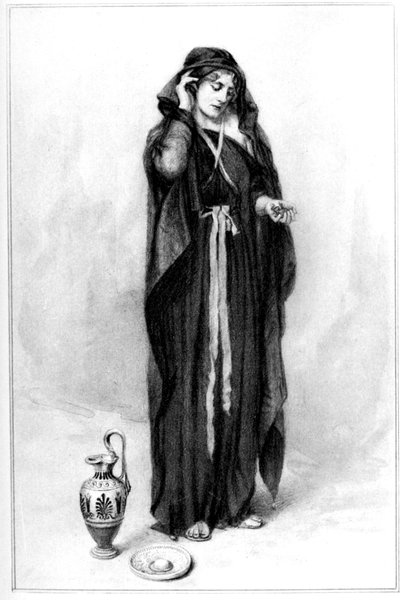
ELECTRA
Gertrude Demain Hammond R.I.
Elec.129
Thou hearest our father’s death; but I was driven
To grieve apart beneath the
dews of heaven;
Chased from the chambers like a thievish hound,
To pour my
grief in tears upon the ground,
They came more readily than smiles.... Write this in
thy soul ...
Ores.
Father, assist thy children in their deed!
Elec.
Thy daughter’s tears implore thee in deep need!...
Ores.
The cause is set. The battle doth begin!
Elec.
Oh gods, be just; and make the righteous win![16]
The resolution is taken at last. It remains now only to
ask their father’s blessing, before putting it into effect.
Orestes begs for power to rule well in Agamemnon’s stead,
and promises rich sacrifices to his shade.
Elec.
And I will bring
Choice offerings from all my patrimony
In day of marriage, and will honour first
My father’s tomb from the paternal
hall....
Ores.
Either send justice fighting on our side,
If thou wouldst gain requital for thy
fall,
Or grant us to catch them as they caught thee.
Elec.
Hear this last cry, my father! Look with pity
On these thy young ones sitting at
thy grave,
And feel for both, the maiden and the man.[16]
The real crisis of the tragedy is in this wonderful ode,
although the action has all to follow. Doubts and fears
are now subdued: Orestes and Electra have risen to a
height of stern conviction which will carry them to the fulfilment
of their purpose, although neither it nor the sanction
of Apollo will save them from remorse. The action moves
rapidly now, as though the revenge must be accomplished
at once, in the heat of this terrible purpose. Orestes is
told of Clytemnestra’s dream—that she had borne a serpent
130which had turned and rent her breast. He welcomes it
gladly, as an auspicious omen for him; and forms a hasty
plan of action. He and Pylades will apply for entrance
at the palace gates, with a feigned story of Orestes’ death.
Electra must make ready for them within, and secure
their admittance. They will kill Egisthus first, and
afterward complete the revenge by the murder of
Clytemnestra.
It is not a very skilful plot, but it succeeds. Clytemnestra
receives Orestes and his friend, believing them to be
strangers from Phokis. She is grieved and shocked at their
story of Orestes’ death; and goes out to apprise Egisthus
of it. Presently Egisthus passes across the stage alone, on
his way to give an audience to the guests and, though he
does not know it, to pay the penalty for his crime. He
goes into the palace, and an instant afterward he is heard
to utter a dreadful cry. Attendants rush forth, calling
upon the name of the queen.
Clytem.
What cry is here? What dost thou by the gate?
Atten.
I say, the dead have slain the living there.
Clytem.
Ay me! I read thy riddle! Oh! undone!
By guile, even as we slew! Give me an
axe,
A strong one; quickly too! I’ll dare the issue,
Be it for me or against
me! I am come
To the utterance in this fight with Fate and Doom.[16]
Then there follows an awful scene between Orestes and
Clytemnestra, as she grieves over the body of Egisthus.
Ores.
Was he so dear to thee? Then thou shalt lie
In the same grave with blameless
constancy.
Clytem.
Oh son, forbear! O child, respect and pity
This breast, whereat thou often,
soothed to slumber,
Drainèdst with baby mouth the bounteous milk.[16]
131For an instant these poignant words make Orestes waver;
and he half turns to Pylades with an appeal for counsel.
But the answer is a stern reminder of the oracular command;
and the pitying moment passes.
Ores.
How should I live with her who killed my sire?
Clytem.
The destinies wrought there. My son! my son!
Ores.
Destiny works a different doom to-day....
Clytem.
Oh! Wilt thou kill thy mother? O my son!
Ores.
I kill thee not. Thy sin destroyeth thee....
Clytem.
Ah!
I have borne and reared a serpent for my son.
Ores.
Then is fulfilled the terror of thy dream![16]
So Clytemnestra falls at the hands of Orestes; but the
vengeance has no joy for him. Before his mother’s mighty
spirit has taken its way along the road to Hades, a torture
of remorse has fallen upon her son. Even while he stands
above the murdered body, her avenging Furies come thronging
about him “with Gorgon faces and thick serpent hair”
and he feels his reason totter.
Ores.
Hear me declare:—How this will end I know not.
I feel the chariot of my spirit
borne
Far wide. My soul, like an ill-managed courser,
Is carrying me away,
while my poor heart
To her own music dances in wild fear.[16]
He cries in anguish to Apollo to justify him; but there
comes no answer from the god; and faster and faster
crowd those grizzly spectre forms, rushing upon him in
hideous multitudes, and menacing him with ghastly torments.
And as the tragedy closes, we see Orestes fleeing
before the rout of the Furies to find sanctuary at the shrine
of Apollo, while the Chorus wails:
132“When shall cease
Dread, Atè’s fury? When be lulled to peace?”
[16]
We hear no more of Electra from Æschylus. Measured by
action, or even by language, the part she plays in his trilogy
is quite a small one. It is significant, too, that this her
first appearance in Attic Tragedy is not called by her name,
but the Libation-bearers. Such a title, while it serves to
remind us of a stage of Greek Drama when the Chorus was
the whole play, indicates also the poet’s conception of the
theme. To Æschylus, the religious act at Agamemnon’s
tomb, with all that it implies, was of much greater import
than the figure of the great king’s daughter. The force of
destiny, the amazing mandate of the god and its conflict
with filial love and duty, and the pursuit of the matricide
by the Furies, constitute for him the essence of the tragedy.
The spiritual aspect of the story transcends for him the
human interest of it. Hence his characters, though
sublimely great, are great in outline only; and hence the
brief appearance of Electra.
But when we find that Sophocles and Euripides, who wrote
about Electra afterward, have boldly made her the protagonist,
and have called their plays by her name, we are prepared
for a change of attitude. The story is now viewed
from a more human standpoint. The protagonist is no
longer a chorus, but a woman: the ruling passion is now
not so much a principle, a moral, a duty, or any idea in
the abstract; but strong human will, intense human love,
and mortal hatred. The motive of the Drama is no longer
a religious ceremonial, but the enactment of a tragic story.
And the final result is not now that of a grand moral lesson
conveyed through the lips of shadowy demi-gods, but a
really dramatic drama.
133It follows, therefore, that with this change the character
of Electra has taken on a stronger and more complete individuality.
In the version of Sophocles, she rises to her
greatest height. She is a creature who can endure to the
end and dare the uttermost: of absorbing love and
strenuous hatred: tender and strong. Unbending and
uncompromising, she is in conflict not only with the mother
whom she loathes, but with the weakness of a sister whom
she loves. Implacable to her enemies, she is capable of
absolute devotion to the memory of her father and to the
absent Orestes; and in these contrasted qualities Sophocles
has made of his Electra a tremendously dramatic figure.
For the finest drama, and for the most enthralling story
we must go to him. But his purpose seems to have been
merely artistic. He takes a hint from the old legend, and
developing its possibilities to the utmost he evolves a play
which is perhaps more powerful as drama and certainly more
perfect as art than that of Æschylus or Euripides. But it
has hardly any other significance. His conception of
Electra, while finely complete and harmonious, is of a being
untroubled by ethical considerations, and casting no fearful
glance ‘before and after.’
With Euripides, on the other hand, the character of the
protagonist becomes more deeply significant than even
Æschylus had made her. For Euripides, the mandate of
the god was false, and the vengeance taken was a stupendous
crime against humanity. When Orestes and Electra,
wrought up by passion, have accomplished it, Euripides
makes reaction come to them as to any other mortal being.
They are not pursued by visible Furies, from which they
may flee to the sanctuary of Apollo, but by remorse and
cankering doubt of their own motives. For him they are
134simply human creatures; and the touch of realism, animated
as it is by a daring sceptical spirit, has laid a blight on
much that was beautiful in the earlier conception of
Electra’s character. To recover that, we must go back to
the Libation-bearers of Æschylus.
Æschylus: Cassandra
135
For the beginning of Cassandra’s story we must go
back to the epic theme. The first word which
Homer tells of her is in the Thirteenth Book of
the Iliad, where she is called “the fairest of Priam’s
daughters.” But that is late in the Siege; and there is a
legend which gives her an earlier connection with the tale of
Troy. Indeed, we find that she was a link in the chain of
events which led Helen and the Greek army to her native city.
When she was still a young girl she had, in some mysterious
way, been beloved by the god Apollo. The god gave her
the gift of prophecy; but because she refused his love he
angrily confounded the gift that he could not recall by
decreeing that her prophetic utterances should never be
believed. This is the central point round which our thought
about Cassandra must revolve. She is the virgin priestess
who holds herself inviolate even from the embraces of a divine
lover; and she is an oracle of clear vision and stainless truth,
whose divination is cursed with futility.
The events of her career show blacker and more hideous
against the clear light of her spirit. All through the long
agony of the Trojan war we have a sense of Cassandra at the
altar, lifting pure hands in supplication for her dear city.
The fighting raged outside the walls like an angry sea, while
inside the town and away in the Greek encampment all the
passions let loose by war raged no less fiercely than the battle
itself. But Cassandra, withdrawn from sight and sound of
the conflict, continued to pray and sacrifice. Her life was
consecrated. And although the gods themselves seemed
136sometimes leagued against her; although she had a perception
of what the end must be, nothing could weaken her
endurance nor shake her will. The Trojan princes wooed
her in vain: the love of the great Sun-god himself could not
make her swerve. The glory of her beauty: her gift of
vision: her lofty impassioned soul, were vowed irrevocably
to the service of her country and her home.
Yet this idealist and mystic was destined to suffer the worst
brutalities of war in the hour of Troy’s destruction. She
was made captive at her own altar; and was carried away by
Agamemnon to be his slave-wife and the rival of his queen.
The mind revolts at the thought: it is too awful to contemplate,
and will not shape itself in cold reflection. The poets seem
to have felt this; and we find that Æschylus and Euripides,
who have both dwelt upon the story of Cassandra’s downfall,
rise to stormy heights of emotion when they tell about it.
Euripides has placed Cassandra in the group of royal women
in his Troades. The time of the drama is the morning which
follows the overthrow of Troy; and the action represents
the carrying-off of the princesses by their captors. It is, one
would think, a time and a scene quite unfitted for dramatic
presentation. The immense excitement—of victory on the
one hand and defeat upon the other—has ebbed away; and
all that remains to the Trojan women is misery so profound
and hopeless as almost to be beyond the power of expression.
The measure of their pain seems to claim a reverent silence;
and we feel that the Troades does need the sanction of the
ethical purpose which Professor Murray has found in it. But
once we realize the deep and humane thought behind it:
that the poet has chosen this part of the story expressly to
reveal the hideous suffering which war entails upon women,
the tragedy is fraught with significance.
137The final act of Cassandra’s life is given by Æschylus in the
Agamemnon. He, no less than Euripides, feels the appalling
tragedy of her story; and both poets have put into her lips
lyrics of wild and haunting beauty. But Æschylus, by
removing the action to Mycenæ and by bringing Cassandra
into conflict with Clytemnestra, has wrought a climax of
extraordinary power.
If there be any truth in the legend, it was Cassandra who
first recognized the shepherd Paris for the son of Priam.
The stripling who descended from the glens of Mt. Ida to
compete in the games outside the city was unknown and
unloved by the Trojans whom he defeated. They were
jealous of the handsome stranger who carried off the prizes
from them; and he soon found himself embroiled with
Priam’s athletic sons. He was hard beset. The odds were
heavy against him; and like a hunted animal he flung himself
before the altar of Apollo for protection.
And lo! Apollo’s priestess with a train
Of holy maidens came into that place,
And jar did she outshine the rest in grace,
But in her eyes such dread was frozen then
As glares eternal from the gorgon’s face
Wherewith Athene quells the ranks of men.[17]
It was of course Cassandra. She had never before seen this
young suppliant who was clinging to the altar; but as she
looked on him now there came upon her a revelation of his
identity. She knew of the old ring which had been placed
about her baby brother’s neck when he was exposed to death
upon the mountain; and taking Paris by the hand, she
touched the chain he wore and slowly drew to light the
talisman.
138This sign Cassandra showed to Priam straight.
The king waxed pale and asked what this might be?
And she made answer, “Sir, and King, thy fate
That comes on all men horn hath come on thee;
This shepherd is thine own child verily.”[17]
Here, then, is the real beginning of the story of Cassandra.
For the old king would not be warned against his fate. He
welcomed his boy as one returned from death. A great
festival was made in his honour; and of all the many sons of
Priam there was not one so dearly loved. Joy and merriment
filled the city. All the warning oracles which had spoken
at the birth of Paris were forgotten. Nothing but thanksgiving
was heard for the restoration of the fair young prince;
and amid it all, Cassandra knew that when she placed his
hand in the hand of Priam, Destiny had wrought for the fall
of Troy.
The years passed speedily at first, untouched by care; and
then more slowly, big with events. First the sailing of Paris.
Then, after Helen came back with him to Troy, an interval
when the Trojans waited, wondering how the Greeks would
repay the insult. Finally, the arrival of the Greek fleet and
the beginning of the Siege.
Priam was not unsupported in his long ordeal. Neighbouring
princes joined him against the hostile Greeks, some in the
hope of reward and some for the sake of friendship. There
was one warrior, Othryoneus, who came because he loved
Cassandra. He brought no ‘gifts of wooing,’ but made a
promise to the king “of a mighty deed, namely, that he
would drive perforce out of Troy-land the sons of the
Achaians.” Priam consented to his suit; but we are not
told what Cassandra thought of it. Probably she was not
consulted. It is conceivable, so tender was her love of home
139and country, that to reward the hero who would save them,
she would even consent to lay aside her holy office; to recall
her soaring spirit to dwell beside the hearth. But the eye
which saw so far knew that it need not consider the present
problem. Before the end, Cassandra saw the valiant man
who loved her lying pierced by the spear of Idomeneus.
That was toward the end of the war; and in the penultimate
scene of it, the bringing-in of Hector’s body, Cassandra
appears again. She had watched all that fearful night, when
the old king went out to the Greek camp to beg of Achilles
for the body of his great son. And in the cold light of dawn,
straining her eyes from Pergamos and weary with her vigil,
she was the first to see the mournful procession. “Then
beheld she him that lay upon the bier behind the mules, and
thereat she wailed and cried aloud throughout all the town.”
The people wakened at her terrible cry, and coming out of
their houses, they followed her down to the gate to meet the
unhappy king.
Hector’s death was the beginning of the end. Troy fell.
Its brave men were slaughtered, its palaces burnt, its altars
dishonoured; and worst of all, its women and children were
carried off as slaves. Of this the Iliad does not speak; but
it was an event which seized and held fast the imagination of
the Attic dramatists. The glory of war, which throws a
glamour over the fighting in the epic, gives place in the later
poets to the pain and horror of it. Not because they were
less brave: Æschylus fought at the great Greek victory of
Marathon; but because an advancing civilization had brought
a more reflective mind, a more humane temper, and the birth
of sacred pity.
The Troades, to which we come next for the story of
Cassandra, breathes throughout the pitiful spirit of the
140poet Euripides. It relates what befell the women of the
royal household after the sack of the city. As grey daylight
comes we see the figure of the aged queen, prostrate
before the charred walls of the town. She rises feebly,
moaning in a bewilderment of grief and physical weakness.
To her approach, one after another, furtively, the
frightened Trojan women who form the Chorus of
the play. Her crying has wakened them, and they steal
out to try to discover what fate is in store for them. Even
while they ask, a messenger Talthybius, arrives from the
Greek ships. In curt phrases he replies to the queen’s
anguished inquiries about her daughters. They have been
assigned to certain of the Greek chiefs, he says: Andromache
to Neoptolemus, she herself to Odysseus, and Polyxena (he
speaks ambiguously, to hide a grimmer fact) to serve at the
tomb of Achilles. The stricken queen asks about each in turn.
Hecuba.
Say how Cassandra’s portion lies.
Talthybius.
Chosen from all for Agamemnon’s prize!
Hecuba.
How, ...
The sainted of Apollo? And her own
Prize that God promisèd,
Out of the golden clouds, her virgin crown?
Talthybius.
He loved her for that same strange holiness.[18]
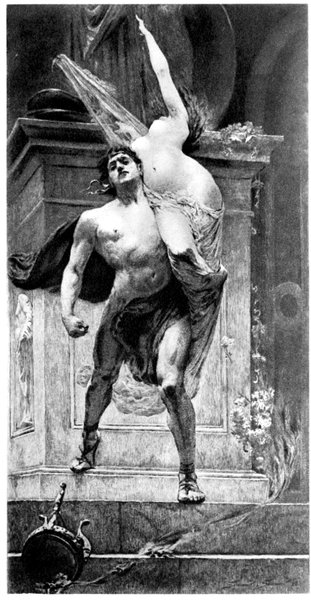
CASSANDRA
Solomon J. Solomon R.A.
By permission of the Artist
141Hecuba is appalled at this fate that is decreed for her child.
She whose pure spirit had always ranged beyond the things
of time and sense, who was the consecrated priestess of Apollo
and set apart for holy service, is condemned to be the slave-wife
of the man who has destroyed their city. The poor
mother wails in horror at the thought: it is too awful, too
sacrilegious a deed even for these proud Greeks, and she cries
out in protest. The herald silences her with a brutal comment
on the good fortune which makes her daughter the bride of
a king; and then orders an attendant to fetch Cassandra
from the tents. But there is no need for the man to go. Even
while they are speaking there comes a sudden flash of strange
fire, and the wild figure of Cassandra appears, robed in white,
garlanded with flowers and carrying a blazing torch. The
fearful events of the past night have driven her to a frenzy.
Arrayed as for a happy bridal, she comes singing a hymn to
Hymen; but the terror in her eyes, and the poignancy of the
words she utters hold her hearers dumb:
“Hail, O Hymen red,
O Torch that makest one!
Weepest thou, Mother mine own?
Surely thy cheek is pale
With tears, tears that wail
For a land and a father dead.
But I go garlanded:
I am the bride of Desire....
“O mother, fill mine hair with happy flowers,
And speed me forth.... So liveth Loxias,
A bloodier bride than ever Helen was
Go I to Agamemnon, Lord most high
Of Hellas!... I shall kill him, mother! I
Shall kill him, and lay waste his house with fire
As he laid ours. My brothers and my sire
Her frenzy gives place now to a more meditative strain. It
is as though the fiery cloud that hung about her brain was
pierced for an instant by the sight of her grieving mother.
She tries to find words to comfort Hecuba; and as the calmer
mood deepens she rises to a perception of the dignity of high
failure contrasted with low success. The Trojans dying for
their homes she sees as a nobler thing than the triumph of the
Greeks.
142“Would, ye be wise, ye Cities, fly from war!
Yet if war come, there is a crown in death
For her that striveth well and perisheth
Unstained: to die in evil were the stain!
Therefore, O Mother, pity not thy slain,
Nor Troy, nor me, the bride. Thy direst foe
And mine by this my wooing is brought low.”
[18]
At this point the herald is suddenly roused to reply. He
turns upon her furiously for her ominous forebodings and
bids her be silent. If he did not know her for a mad woman,
he says, she should suffer for boding thus evil to the Greeks.
He orders her roughly to follow him; but at his speech the
frenzy rushes over Cassandra again. She turns upon Talthybius
in magnificent anger and scorn. “How fierce a slave,” she
cries; and then the prophetic gift burns in her as she foretells
in language of awful beauty her own doom and that of
Agamemnon.
“Thou Greek King,
Who deem’st thy fortune now so high a thing,
Thou dust of the earth, a lowlier bed I see,
In darkness, not in light, awaiting thee;
And with thee, with thee ... there, where yawneth plain
A rift of the hills, raging with winter rain,
Dead ... and outcast ... and naked.... It is I
Beside my bridegroom; and the wild beasts cry,
And ravin on God’s chosen!...
“Mother, farewell, and weep not! O my sweet
City, my earth-clad brethren, and thou great
Sire that begat us; but a space, ye Dead,
And I am with you; yea, with crownèd head
I come, and shining from the fires that feed
On these that slay us now, and all their seed.“
[18]
143Cassandra is led away to the Greek ships, no blessing to the
toiling mariners. For even their own gods are wrath at the
crime against her; and many a heart-breaking struggle is in
store for them: many a noble ship will be lost, and many a
hero’s life will pay the penalty, before their homes are reached.
Perhaps to Agamemnon more than most, the Deities of the
Elements were kind. But then they knew the fate awaiting
him, and in ironic pleasure sped him to it. There is no need
to recall the details of his arrival at Mycenæ, or of his welcome
by Clytemnestra, almost distraught by conflicting hope and
fear. Agamemnon was weary of his voyage; weary, too, of
the long steep chariot-drive up from the sea. Yielding to his
wife’s entreaty to walk on costly crimson to the palace, he
turns for an instant to Cassandra’s chariot.
“Receive, I pray thee
This stranger-woman kindly. Heaven still smiles,
When power is used with gentleness. No mortal
Is willingly a captive, but this maid,
Of countless spoils the flower and crown, was given
To me by the army, and attends me home.”
[19]
The moment is crowded with emotion. For the briefest
space—merely long enough, in fact, to make the Trojan
woman formally known to Clytemnestra—these three strong
spirits face each other. Cassandra, wide-eyed and rigid,
looks beyond the king and queen, beyond the crowding people,
at something that her vision warns her is beyond the palace
doors. To Clytemnestra, her presence is an insult, and her
purity an intolerable reproach. There is one glance of
bitterness and hatred from the queen which Cassandra does
not see; and then the insolent king enters the palace, Clytemnestra
following him. She returns immediately, however,
lashed to a fury in which her dignity goes to shreds.
Cly.144
In with thee too, Cassandra! Get thee in!
Since Heaven in mercy hath consigned
thee here
To share our household lustral waters, one
Of many slaves that stand
around our hearth.
Come from that carriage. Be not proud. Descend!
The speech is cruel; and it has, moreover, an inner meaning
which the poor captive perceives only too well. She does
not answer. She listens in silence, too, when the Chorus
address her; and when Clytemnestra, with that crucial
moment imminent, grows wild with impatience. “Sure she
is mad,” ejaculates the angry queen; “I’ll not demean
myself by throwing more words away.” Only when she has
gone does Cassandra break silence; and then by a wail which
the sympathetic Elders cannot understand.
“Ai, Ai! O Apollo! Apollo!...
Builder! Destroyer!
Builder of Troy! Destroyer of me!“
[19]
The old men pity her, and try to calm her frenzy. She
looks round on them, as if awakening from a dream, and asks
what house is this. They reply that it is the Atridæ’s palace,
and the word calls up to Cassandra the long black record of
the house of Atreus.
Cass.
Ah! a hideous den, abhorred of Heaven,
Guilt-stained with strangled lives....
Ah! faugh!
Cho.
Her scent is keen, this stranger’s! Like a hound
She snuffs for blood. And she
will find, I doubt me.[19]
In a long recital, Cassandra recounts the ancient crimes of
the Atridæ; and in dark oracular language moans that there
is worse behind. The old men are perplexed. They cannot
follow her meaning, though over and over again she struggles
to make clear the doom that is even now about to fall.
Cass.145
Ah! what is this? Oh me!
What strange new grief is risen?
A deed of might
...
An act
Of hate for love; and succour bides
aloof,
Far, far away.
Cho.
This prophecy is dark to me....
Cass.
... ’Twill come,
‘Tis here! She lifts her hand; she
launches at him
Blow following blow!
Cho.
Thy speech appals me.
Cass.
Woe! For my hapless doom!
To fill the cup, I tell my own sad tale!
Why hast
thou brought me to this place? Oh misery!
To die with thee? What else? To die!... To
die!...
Paris, thy wedding hath destroyed thy house,
Yea, and thy sister!—O
Scamander stream!
Our fathers drank of thee and by thy shore
I grew, I
flourished. Oh unhappy I!
But now by dark Cocytus and the banks
Of Acheron, my
prophecies shall sound.[19]
The Elders begin to understand; but still the drift of her
message is only partly clear to them. They realize that she
is distraught, fearing some dreadful fate for herself; they
have, too, a glimmering fear of danger to the king. But they
cannot comprehend what it may be; and the thought of
succour never dawns upon their dull old wits. They speak
gently to Cassandra; but again her message seems to tear
her with its force and urgency.
“No longer, like a newly married girl,
My word shall peep behind a veil, but, flashing
With panted vehemence to meet the day,
‘Twill dash, against the shores of Light, a sorrow
146Then, point by point, she goes with studied clarity over all
the “trail of long-past crime.” So long as this is her theme,
the Elders understand and confirm her words. But when,
rising again on the wings of prophecy and therefore to a
rapt and obscure utterance, she foretells the fall of
Agamemnon and her own death, they are again at sea. She
pauses for an instant, baffled; she knows that her end is
imminent, and in her despair she casts stinging words at them
for their stupidity and inaction. Never has Apollo’s ban
wrought so bitterly; and in the extremity of her anguish
she declares that she will call upon the god no longer. She
strips herself of the sacred emblems and flings them from her.
“Why wear I still these mockeries of my soul,
This wand, these fillets round my neck? I tear ye
Thus! Go to your destruction ere I die!
To pieces with you! Lead the way! I follow!
Enrich some other life with misery....
I will go forward! I will dare to die!
Hail, then, thou gate of Hell!“
[19]
She takes a few steps toward the palace; but her courage
fails for a moment. The reek of blood in her nostrils
stifles her, and she recoils. In her last words passion and
strength alike fade out, giving place to a pathetic human
appeal:
“O strangers! friends!
I shrink not idly, like some timorous bird
Before a bush! Bear record in that day
And the old men, as she passes slowly out of sight, wail
over her what is perhaps her most fitting epitaph:
147Ah! what is mortal life? When prosperous,
A shadow can o’erturn it; and, when fallen,
A throw o’ the wet sponge blurs the picture out.
This is more piteous than the ruin of pride.[19]
Æschylus: Io
148
We turn now from the Trojan legend to that
of Thebes. We are still in the realm of
Tragedy; and in some respects the Theban
story is more barbarous than that of Troy.
But by some means the tension is slightly relieved, and the
atmosphere is lightened by one degree. Perhaps that is because,
in the dramas which treat of this subject, the poets
seem to have gone back further into the remote past and to
have steeped themselves in the spirit of those early times.
Perhaps, too, it is on account of something wilder and more
primitive inherent in the Theban story itself. Such elements,
and such a treatment by the poets, would tend to remove
the persons of the drama a step further from probability, and
would make them to that extent greater or less than human.
Thus their appeal to the emotions would not be so direct,
nor so intimate. On the other hand, the figures so presented
gain in sublimity. Their mythical origin surrounds
them with a halo, through which they loom vast, mysterious,
and inaccessible.
Such a being is Io. In the Prometheus Bound, the drama
in which her story is given, Æschylus has gone back for his
subject literally to the beginning of things; to the time
when Zeus was young and the reign of Chaos was not long
overpast. We must be prepared then for a tale which in
its details is marvellous and incredible: for a naïve account
of the love of the supreme god for a mortal woman: of
the anger of Hera, his jealous queen: of the metamorphosis
and long wanderings of the innocent maid: and of her
149reward at last, when she becomes the ancestress of the
founder of Thebes, and ancestress too, in a remote generation,
of Heracles, the deliverer of Prometheus.
It is here that we touch Io’s connexion with the Theban
legend, into which as a fact she does not otherwise enter.
For her son Epaphus, wondrously born at the touch of the
finger of Zeus, had two grandsons, Cadmus and Cilix; and
a granddaughter, Europa. The well-known legend tells
how Zeus, in the shape of a bull, carried off Europa. Whereupon
her two brothers went in search of their sister and
wandered many a long day. They did not recover her,
however, and at length gave up the search. Cilix settled
down in a country which was called Cilicia after him; and
Cadmus, instructed by the oracle at Delphi, followed a
straying cow into Bœotia. On the spot where the animal
should happen to lie down he was commanded to found his
city. But his task proved to be no light one. For there
was a dragon to be overcome; and a weird army, sprung
from the earth where the dragon’s teeth were sown, had to
be vanquished in battle before Cadmus could begin his
work of founding the city of Thebes.
This event, as we see, is only remotely connected with Io,
although the connexion is precise and clear. In point of
time, if chronology is the least use in such a case, it is
several generations nearer to us than she is. Yet we have
only to cast one glance at the story of Cadmus to see at
once its youthful element of marvel. Its wonders are so
crude as almost to raise a smile—the half amused, half tender
smile with which we turn over in our hand some grotesque
plaything of our childhood. It is indeed only the humorous
aspect of these old stories which seizes us when we look back
at them from a detached standpoint, and with minds bent
150to the critical attitude. But that was not the poet’s
attitude; not, at least, when he was making poetry.
Doubtless there must have been moments when the Comic
Spirit rebelled, since even poets do not live alone by the
emotions. But when tragedy first entered life’s deep
waters its captains bound the mischievous laughing spirit
securely under hatches. It could be of no service in such
a stern battle with the elements.
So we find that the tragic poets (except perhaps Euripides
occasionally) treat these strange old stories in what is called
‘the grand manner.’ Do not be disturbed by something
stiff and formal in the expression. Like all definitions, it
is smaller and harder than the thing it tries to define. For
the poet has not the least intention of being ‘grand,’ and
is as far as possible removed from any conscious ‘manner.’
On the contrary, it is true as a rule that the greater he is,
the simpler his thought and expression are. He comes to
these old themes with the eye and the heart of a child as
well as the brain of a great genius; and the spirit of poetry,
with all the knowledge of all the ages, utters its message
through his lips in limpid song. Matters of probability
and questions of logic, which seem so important to the
mere intellect, bow their chastened heads before him. The
whole scheme of values is changed, and that which appeared
to the arrogant intellect as wild and ludicrous is perceived
by the poet full of strange beauty and significance.
In this way Sophocles approached the Theban legend, as
we shall see when we come to Jocasta and Antigone,
presently. In this way, too, Æschylus gave us the story
of Io in his Prometheus Bound. Just when Io is supposed to
have lived we do not know. She is said to have been the
daughter of Inachus; and she was a priestess of Hera in
151Argos. But Æchylus has made her coeval with the Titans.
In this poem, therefore, she is a denizen of that early world
which saw the overthrow of Cronos from the throne of
heaven, and the rise of his son Zeus. All the Titans save
one had opposed the new god when he rose in rebellion
against the primeval powers. But Prometheus, far-seeing
from the first, and knowing that Zeus must conquer, lent
him aid. It was a long and bitter struggle in the youth of
the world. But at last Cronos and the Titans who had
opposed him were hurled by Zeus into Tartarus—“under
the misty darkness ... in a dank place, at the verge of
the earth.” Typhon was buried under Etna; and Atlas,
far in the West, was bowed beneath the pillar of the heavens,
“where night and day meet and greet one another, as they
pass the great threshold of bronze.”
All now seemed calm and fair for the establishment of the
new Hierarchy. Too calm and fair; for Zeus, with all his
enemies subdued and possessing absolute power, soon grew
tyrannical. With leisure now from Olympian warfare, he
looked down upon the earth and the feeble race of men.
It seemed to him a contemptible thing, struggling weakly
against pitiless forces and groping its way, by minute
degrees that were imperceptible from his lofty height,
toward a larger and a better state. It was a mean and
futile and impotent race, he pondered. Surely it would be
better to wipe it out of existence altogether, than let it
continue to blot the face of the fair world.
So concluded the youthful ruler of Olympus, in his haughty
strength. But Prometheus knew mankind better than Zeus.
The hills and valleys of earth were his kin, dear and familiar
to him; and he had come to love the imperfect human
soul that had just managed to get itself born in those rude
152cave-men. He saw the violent act that the Lord of
Olympus was planning in his mind; and resolved to save
humanity. So, as the old poet Hesiod says in his Works
and Days, “he stole fire for men from Zeus the Counsellor
in a hollow fennel stalk, what time the Hurler of the
Thunder knew not.” But the boon to man meant sheer
disaster to himself, as he knew when he filched it from
Olympus. The purpose of Zeus could not be thwarted
with impunity. Prometheus was condemned to age-long
punishment, chained to a rock on an icy mountain top
until such time as a deliverer should come, and an immortal
being could be found willing to give up life for him.
The punishment of Prometheus is the subject of the present
drama. It is believed to have been the middle play of a
trilogy, of which the last was the Prometheus Unbound, and
the first probably related the bringing of fire to earth.
The Prometheus Bound is not dramatic in the sense that the
Agamemnon and the Choephorœ are. There is hardly any
action in it, for the suffering Titan continues chained to
his rock throughout the poem. From the nature of the
theme, too, the characters are too colossal and remote to
make an intimate appeal to us. Yet the drama is charged
with the deepest emotion, transcending the pity or fear of
common experience. If it does not start into life before our
eyes as an actual conflict, that is because it is rooted in a
deeper and more crucial struggle between cosmic forces.
And if the persons of the drama are unapproachable and
unfamiliar, it is from the very reason of their sublimity.
We see the protagonist first as he is being riveted to the
rocky wall by the god Hephæstus. The Fire-god reluctantly
performs the task, bidden to it roughly by Force, who is
invested for the moment with the strength of Zeus, but
153without his dignity. Hephæstus is indignant at the sentence
on his kinsman, the titan, and declares that he has
no heart to chain him in this stormy mountain region,
merely because of his beneficent help to man. But Force
is inexorable: he urges on the work until every limb of the
titan is secured, and an adamantine wedge is driven through
his breast. When all is accomplished, Prometheus is left
alone; and then for the first time he breaks silence. He
invokes the elements that are his kindred: the sky, the
winds, the rivers, the smiling sea, the sun, the great earth-mother.
“See me tormented by the gods, a god!
Behold me, what agony
Through the measureless course of the ages
Racked, I shall suffer;
I by the upstart Ruler in heaven
To captivity doomed and outrage.
Woe, woe is me!...
... Blessings, that on man
I lavished, have involved me in this fate,
And for that in a hollow fennel stalk
I sought and stored and stole the fount of flame,
Whence men all arts have learned, a potent help.“
[1]
While Prometheus is speaking, there gather softly round
him the gentle sea-nymphs who are to be the chorus of
the drama. They question him tenderly, in words that
fall like balm, and elicit all his story. It is pitiable, they
say, and they marvel at the penalty which Zeus imposes on
so kind a creature.
Presently Oceanus himself, god of the dreadful river that
circles the world, approaches in his chariot. He is old and
grave and prudent. The action of Prometheus seems to
him rash and daring: his opposition to Zeus mere pride.
154He advises the titan to yield, since it is expedient to bow to
the superior power. But Prometheus fiercely rejects such
timid counsel. Nothing shall shake his resistance to the
tyrant, and Oceanus may spare his breath. Let him go
save himself: as for Prometheus, he will endure until it
shall please Zeus to relent.
Hot words pass. Oceanus tries in vain to teach prudence
to the high heart of the titan, and departs angrily. Then
the sea-nymphs sing a sweet song of pity; and Prometheus,
touched to a softer mood, begs them not to think him hard
and proud. Only, the thought of his wrongs is intolerable,
received at the hand of one whom he himself had helped
to place upon the throne of Olympus. And what had been
his crime? None. His hands are clean: his integrity
absolute. His sufferings are an amazing injustice: the
price of beneficent deeds to humanity that he tells over to
the wondering maids.
“I will recount you, how, mere babes before,
With reason I endowed them and with mind ...
Who, firstly, seeing, knew not what they saw,
And hearing did not hear; confusedly passed
Their life-days, lingeringly, like shapes in dreams,
Without an aim; and neither sunward homes,
Brick-woven, nor skill of carpentry, they knew;
But lived, like small ants shaken with a breath,
In sunless caves a burrowing buried life:
... The hidden lore
Of rising stars and setting I unveiled.
I taught them Number, first of sciences;
I framed the written symbols into speech,
Art all-recording, mother of the Muse:
I first put harness on dumb patient beasts ...
That they might lighten men of heavy toil,
I taught to draw the car and love the rein
155Horses, crown of the luxury of wealth.
And who but I invented the white-winged
Sea-roving chariot of the mariner?
“For mortals such contrivances I found,
But for myself alas no wit have I,
Whereby to rid me of my present pain.”
[20]
So he continues to narrate all that he had achieved for the
welfare of man: how he had taught him Medicine,
Prophecy and Augury; and had brought to light the
treasure of precious metals that lay hidden within the
earth. Indeed, as the long recital falls from his lips, we
know that the poet has symbolized in him all the great
civilizing influences on mankind.
But the sea-nymphs, though they sympathize with his
sorrow, cannot rise to the height of his thought. To them
mankind is a “fleeting, dream-like race,” unworthy of the
sacrifice that he has made. They chide him gently. Why
has he dared the wrath of Zeus, and why will he bear the
weary ages of torture for such a people? The beauty of
the lyric casts a spell upon us. The thought of the long-drawn
agony, endured from century to century, makes us
waver. Might he not have been misguided? Was Zeus
right, perhaps? And would not the titan be wise to make
peace with so powerful a ruler?
Thus the softer mood of the sea-maidens wins upon us.
Viewed through it, the resistance of Prometheus begins to
look like stubborn self-will; and the decree of Zeus a
righteous chastisement. But just as the feeling is gathering
strength an episode occurs which reverses the current of
emotion. For there rushes suddenly on the desolate scene
a strange wild creature, half woman and half beast. Under
the curling heifer’s horns there is a fair white brow; and
156below the brow sweet human eyes, distraught with fear
and pain. This is Io, the maid beloved by Zeus. Cast
out of her home by the god’s command, she has been chased
from the society of her kind, and her fair woman form has
been partly changed to bestial shape. For many a weary
league she has been goaded onward by the gadfly of Hera;
and even now she is haunted by the wraith of Argus, the
huntsman of the hundred eyes whom the angry goddess
had set to watch her. Good and beautiful she had been,
her serene life gladly given to the service of Hera in an
Argive temple. Yet now she is doomed to wander restlessly
over sea and land, through sun and storm, and by
many an unknown lonely path, without apparent aim and
for no apparent cause. As her feet stumble up the mountain
side and she stands before Prometheus, innocent and
mercilessly persecuted, we feel that the moment is crowded
with all the elements of tragedy. If we had wavered before,
standing on that ridge of neutral ground where the cool
airs of reason calm the passions; if the poet meant that we
should waver for a moment, giving us in his unifying purpose
some perception of the higher power as it would
ultimately justify itself; he plunges us now into the arena
again, with every emotion clamant to defend these victims
of tyranny.
As they confront each other, Io speaks, forgetting her own
griefs for the moment in contemplation of the suffering
titan.
“What land, what people is here?
Whom shall I say that I see,
Rock-pinioned yonder,
Storm-buffeted?
To penance of a living death
157What crime hath doomed thee?
Tell me, thou luckless one,
Where have I wandered?
“Ah me, alas, unhappy!
Frenzied again as by the gadfly’s sting,
The fatal herdsman with the myriad eyes,
The giant Argus, I behold ...
Me he pursues, the unhappy,
Over sandy leagues of the waste seashore....
Whither alas, ah woe is me
When shall my wandering end?
“What, O what was the sin in me,
O son of Cronos, that thou didst find?
Why hast thou doomed me thus to suffer
By the gadfly’s goad still onward driven,
Weary of fleeing, distraught with dread?...
Enough I have wandered—
Wandered afar till my strength is spent;
And still from my doom escape is none.
Dost thou mark my speech?
The hornèd maiden hearest thou?“
[20]
Prometheus does indeed hear and know her, he says, the poor
frenzied daughter of Inachus, whom Zeus loves. As he
speaks her father’s name, Io catches at it eagerly. Perhaps
this may be a friend.
Io.
Who told thee of my sire?
Tell me, the sufferer—who art thou,
That thou
hast named aright
One wretched as thyself?...
Prom.
This is Prometheus, who gave fire to men.
Io.
Of all our human kind, proved helper thou,
Ill-starred Prometheus—what hath
earned thee this?[20]
In rapid interchange of question and answer, the cause of
the quarrel, and its consequence, are related to Io; and
158then, because she knows that Prometheus can foresee the
future, she begs him to tell her what is in store for herself.
The titan warns her that the knowledge can only bring
fresh pain; and for awhile the prophecy is delayed, as Io,
at the petition of the nymphs, tells her own strange story.
Io.
Your will is law to me; I must obey.
... Albeit I blush to tell.
Haunting my virgin chamber, night by night,
Came visions to beguile me while I
slept
With fair smooth words: “O maiden highly blest,
Be maiden now no more; to
whom ‘tis given
To mate thee with the Highest; thy beauty’s shaft
Glows in the
heart of Zeus, and for his bride
He claims thee.”[20]
Her father Inachus sent anxious messages to the oracles at
Delphi and Dodona to inquire what this persistent vision
might mean. At first ambiguous answers came.
But at the last to Inachus there came
A peremptory word, with mandate clear,
To cast me from my country and my home,
At the world’s end a wanderer far from men;
And, if he would not, swift from Zeus should come
A fiery bolt that should consume his race.[20]
With sorrowful heart, Inachus obeyed the oracular command,
constrained thereto by Zeus. Io was driven out to
the pastures of her father’s herds.
Then was my feature changed, my reason fled:
Wearing these horns ye see, with frenzied hounds,
Pricked and tormented by the gadfly’s sting,
To fair Kerchneia’s stream and Lerna’s shore
I hasted. And upon my traces still,
Of rage unslaked, with myriad eyes agaze,
The earth-born huntsman Argus followed hard.
Him unawares a sudden death o’ertook,
159And reft him of his life. From land to land,
Heaven’s scourge, the unsleeping gadfly, drives me still.
My tale is told. What time has yet in store
For me to suffer, tell me if thou canst:
Not pitying think with lies to comfort me:
False words I count of maladies the worst.[20]
Io is asking more than she knows, and the prophecy that
Prometheus will make to her is more wonderful than she
could ever dream. In careful detail, and so impressively
that she must remember every word, he indicates the first
part of her wanderings. She must turn her face eastward,
and faring through Scythia, pass along the sea-coast,
avoiding the fierce Chalybes. Then on wearily to the range
of the Caucasus, which she must ascend to the very summit;
and following afterward a southward road, she will come to
the land of the Amazons and down to the sea which separates
the continents. Here she must boldly ford the strait,
which in later times will be called Bosphorus because she,
the cow-maiden, crossed it; and leaving Europe behind,
she will tread on Asian soil.
Prom.
... Deem ye not
That this proud lord of heaven on great and
small
Tramples alike? For this poor mortal maid,
Enamoured of her love, his
godhead dooms
To wander thus. Thy most imperious wooer,
Maiden, thou well mayst
rue. What I have told,
Deem that the prelude hardly hast thou heard.
Io.
Woe’s me, alas, alas!...
What boots it then to live? Were it not better
From this hard rock to fling myself outright,
That dashed to earth I might of all
my toil
Have riddance? Better surely once to die.
Than all my days to be
afflicted thus.[20]
160But Prometheus, looking further still into the future, sees
some hope for her, as he contrasts her fate with his. However
great her affliction, it must end some day; he can
even foretell just what the issue will be, and when. But for
him, suffering must continue until Zeus is hurled from his
throne.
Io.
Shall Zeus indeed be downcast from his throne?
Prom.
To see that day methinks thou wouldst rejoice.
Io.
How could I but rejoice, whom he has wronged?[20]
She begs for a revelation of the fate of Zeus; and the titan
tells briefly of a certain marriage that the god is contemplating,
which must bring him ruin if Prometheus will not
interpose.
Io.
Who then shall loose thee in despite of Zeus?
Prom.
One of thine own descendants he shall be.
Io.
How? shall a child of mine deliver thee?
Prom.
Ten generations hence, and three beside.
Io.
Now hard to read the prophecy becomes.[20]
Io’s mind cannot take so great a leap forward; and
Prometheus, resuming the course of her wanderings in
Asia, gradually leads up to the climax of her story. Having
crossed the strait, she is again to bend her steps eastward.
Through the land of the Gorgons she must go, and of the
Griffins, and of Phorcy’s daughters, the three hags with
one eye and one tooth between them. On the golden shores
of Pluto she will see an army of one-eyed horsemen, whom
she must carefully avoid; and toiling onward still, she
must follow the course of the river Ethiopia far up to its
very source. Then, at Canopus, a town upon the shores of
distant Nile, she will find rest.
So is completed the tale of Io’s wanderings. And now,
before Prometheus reveals the strangest thing of all, he
161would convince her that he is speaking truth indeed. So
he recalls to her mind a marvel that had happened on her
way thither, but which she had not spoken when she related
her story.
Prom.
To the Molossian plains when thou hadst come,...
And to Dodona’s rock-ridge, to
the seat
And sacred oracle of Thesprotian Zeus,
Famed for its marvel of the
talking oaks,
That with clear voice and nowise doubtfully
Hailed thee (sounds
this familiar to thine ears?)
The glorious bride of Zeus in days to come.[20]
The weird music of the oaks came back to her as the titan
spoke, phrased intelligibly now. It had haunted all her
journey, but confusedly, hinting at something she could
not clearly understand, and dared not name. But in the
words of Prometheus its meaning pealed. Becoming in
that far Eastern country the bride of the ruler of Olympus,
she would found a splendid race. From her the Danaans
would spring, one root of that Hellenic people which should
civilize the Western world. She would give a line of kings
to the Argive throne. But greater and more blessed than
all, from her should come the supreme Greek hero Heracles,
destined to release this suffering titan from his misery.
As she muses on the wonder of it, Prometheus takes up
again the thread of his prophecy. In that rich land which
borders on the Nile she may at last stay her weary feet.
“There shall the hand of Zeus, with soft caress
Upon thee laid, restore thee to thy mind:
And thou shalt bear, named of his fruitful touch,
A son, swart Epaphus, whom all that land,
By the broad Nile-stream watered, shall enrich....“
[20]
From Io’s son Epaphus should descend, generations afterward,
a princess.
162“’The royal line of Argos springs from her.
Time fails to tell the story to its close:
But of her strain one valiant shall be born,
And famous with the bow; he from these ills
Shall loose me.’ Thus the titaness, my mother,
Primeval Themis, prophesied to me,
But of the ways and means too long it were
To tell thee, and it profits not to know.“
[20]
To immortal eyes, seeing the end in the beginning, it was
a glorious destiny; one to compensate perhaps, if not to
justify, all that she had endured. But Io is only a mortal
maid. The vision of the future opens before her in one
radiant moment, and then all is dark again, and nothing
remains but her inexplicable pain. Even before Prometheus
has finished speaking the cloud had fallen upon her mind
again.
“Alas! Woe worth the day!
Again a thrill, a spasm of frenzy
Shoots through me, soul-distracting:
The unforged goad of the gadfly
Stings me afresh; and my seated heart
Knocks at my ribs for fear,
My sight swims, and my senses reel;
And a frantic gust of madness sweeps me
Wide of the course....”
[20]
Tormented and distracted, she rushes from the scene as
wildly as she had come; but as the titan and the sea-nymphs
sadly watch her go, they see that her face is set now toward
the East.
Sophocles: Jocasta
163
Jocasta, in Œdipus the King of Sophocles, is a
very real woman. Moreover, though she is a
splendidly dramatic figure, she is not heroic in
anything save her death. True, she is a queen,
deriving royalty through several generations from Cadmus
himself; and possessing the throne of Thebes so surely that
when the king her husband died she had perforce to marry
with his successor in order to establish him in the kingship.
But despite her special royalty, which makes her, as Professor
Murray has pointed out, like one of the consecrated queens
of early times: despite the extreme deference which is
paid to her, the weight that attaches to her counsel, and
the sense of brooding fate that clings about her, she is
before all an appealing and convincing human creature.
This vivid reality is a new fact in our study of Greek heroines,
and the reason for it is that we have come now to the
Drama of Sophocles. We have seen, so far, the women
of Homer and those of Æschylus; and we have observed
one or two characteristics which distinguish them.
The Homeric women are gracious and beautiful, glowing as
it were with romantic charm. With one notable exception,
Penelope, they appear rarely in the movement of the epic;
and then only to form the central figure in a picturesque
group. Reality has never touched them. Generous as
their emotions are, the extremes of passion have not for an
instant distorted their loveliness. When they are called
upon to act, they seem always to move with grace and
gentleness; and even in their sorrow they are serene. If
164they share in the great stern things of life, its aspiration and
its struggle, they give no sign of the penalty exacted. They
are always young, fresh and fair; except again Penelope,
and she has only gained from age, not lost. A wise maturity
has been added to her early charms. And thus these
Homeric women, with their delicate infrangible bloom,
seem to belong to a region just over the boundary-line of
our common humanity.
The women of Æschylus are much greater figures. Clytemnestra
is colossal: Cassandra, Electra and Io are all
conceived majestically. Unlike the Epic women, they are
capable of strenuous action: strong passions sway them,
and they are much concerned with the great issues of life.
We know little or nothing about their appearance, and it
does not seem to matter. They do not live in our mental
vision pictorially, in soft, warm tints; but remotely grand,
they appeal to a more austere sense of wonder, awe and
reverence. Surrounded by an atmosphere of myth, and
sharing in the elevation of the poet’s spirit, they seem to
be creatures of an older and a bigger world.
There is indeed one woman in the Æschylean Drama,
Orestes’ nurse, who is of ordinary stature and might belong
to any age. But she is of minor importance in the story,
and does not move on the heroic plane. She is therefore
beyond the range of that sublimating power of the poetic
spirit which magnified the heroes and heroines to immense
proportions. And as she stands in the clear daylight outside
the enchanted circle she is just an old grey woman
taken straight out of common life. But for that very reason
there is a hearty, homely breath about her which is very
refreshing. She is but a nurse: she is quaint and querulous
in her talk, inept, wordy and reminiscent; and peevishly
165loyal. Yet in her very weakness and foolishness she is
precious, for is she not a flash from the eyes of the Comic
Spirit, naïvely unconscious of its august surroundings? We
feel that we can actually see and hear her, as she gabbles
about Orestes’ babyhood and how she tended him; being
nurse, cook, foster-mother and washerwoman all combined.
But she is unique among Æschylean women, and when we
turn to look again on the figures of his heroines, a thought
is suggested by the extreme contrast. Here is creative
genius so strong that it has evoked on the one hand the
grandeur of a Clytemnestra; and on the other, the biting
reality of this old slave. But there does not seem to have
been an equivalent artistic power which, controlling the
fervid idealism and combining it with his keen insight,
would have produced types more fully and completely
human.
Such types we find first when we come to the Drama of
Sophocles. With Æschylus the ruling passion had been
spiritual fervour. In Sophocles the artist reigned paramount.
All the advance which his drama made, in plot,
incident and character-building, was in the direction of a
more perfect art. And although there was some inevitable
loss—as for instance the curtailment of the lyrics by
modifying the part of the Chorus; and their lower poetic
flight—on the whole the gain is very great. In the matter
of characterization, with which we are chiefly concerned,
the change is one which brings us out of the region of demi-gods
into the world of men and women.
When we say that the persons of Sophocles’s drama are real
people, that is not to say that they are ‘realistic’ in the
narrow sense of the word which conveys only what is average
and actual. But it does mean that with all their splendour
166and dignity and fine achievement they are subject to our
common humanity. They are not immune from the
defects of their virtues. The passions which have led them
to great deeds are potent agents of their downfall. It is
the flaw within which helps to betray them.
For this reason, and also because the poet shows his
characters moving in intimate human relationships, the
women of Sophocles are intensely living creatures. Electra
in her conflict with Chrysothomis, and Antigone with
Ismene, are of the stuff of life; and the situations thus
created are pure drama. Here two great natures clash.
Closely bound by the ties of blood and affection, but at the
opposite poles of temperament, the struggle between them
is all the more bitter from the intimacy of their relationship.
Both claim our esteem and both are sincerely confident
in the purity of their intentions. But each mistrusts
the other, believing her to be fatally misguided or wilfully
blind. It is by this faculty of seeing all sides of an issue,
or, as Matthew Arnold expressed it, “to see life steadily
and see it whole,” that Sophocles has heightened and
deepened the dramatic values of a story. Out of that, too,
he has made Jocasta, with all her state and despite the
unnatural horror with which she is touched, a pitiable
figure.
Here again two noble natures, near and very dear to each
other, are brought into conflict. In this case, however,
there is an added element of tragic irony which increases
the dramatic power threefold. For we know, as we watch
the tender comradeship of Œdipus and Jocasta, that there
is this sinister thing in the background, ready to flame out
at any instant and make them loathsome in each other’s
eyes. And the moment when the shameful truth is
167revealed, literally dragged to light by Œdipus to his own
undoing, is perhaps the most awful in Greek tragedy.
The story belongs to the Theban cycle, of which we have
already heard. It is older than Homer, who calls Jocasta
Epicasta; and it had many variants. In the Eleventh
Book of the Odyssey there is the quaint epitome of it
which the hero gives when he is describing his visit to the
World of the Dead. Among the shades which throng
there he sees Jocasta.
“And then beheld I Epicasta fair,
Oedipus’ mother, her who unaware
Did a strange deed through ignorance of mind,
To intermarry with the son she bare.
“And he his mother wedded, having slain
His father: and these things the Gods made plain
To all men suddenly; then he among
The folk Cadmean held a troublous reign,
“In lovely Thebes, according to the fate
By purpose of the Gods predestinate
For evil: but she went her way alone
To the strong Warder of the darkling gate.“
[21]
This version agrees in the main with that of Sophocles, and
points to the antiquity of the story. Even in those early
times the fate of Jocasta and Œdipus was part of an ancient
myth. Like the story of Io, remote ancestress of the
founder of their city, it is a tale of wrong wrought upon
mortals by a god. Perhaps it is not so primitive as the Io
legend. There is nothing in it quite so naïve as the idea
of the heifer-maiden loved by the supreme god and mercilessly
hunted by his jealous queen. The Olympian hierarchy
is now established, with its system of greater and lesser
gods, and Zeus at their head has grown, in accordance with
168the theory of Æschylus, wiser with age. Apollo is now the
persecutor. And with the development in the divine order
goes a corresponding complexity in the human elements of
the story. The actors in it are the instruments of their
own suffering. The inimical power is not now frank
tyranny. Its victims even believe it to be friendly, or at
least placable; and it is by their own deeds that the decree
against them is brought to pass. Yet this apparent advance
still leaves the story in a dark past, far behind the poets.
And there are some aspects of it—the curse fulfilled by
Œdipus of parricide and incest; and the stark unreason
with which it was regarded—which make us feel that the
primitive age has only just given place to one of gross
superstition.
The essence of the tragedy lies in the double fact of Apollo’s
hostility to Œdipus and Jocasta and their ignorance of it.
When Laius and Jocasta were young upon the throne of
Thebes they prayed to Apollo to give them a son. The
oracle at Delphi replied to Laius, “I will give thee a son,
but it is doomed that thou leave the sunlight by the hands
of thy child.” Thus the decree was launched.
Laius and Jocasta trembled at the doom, and considered
how it might be averted. When their son was born, they
took a cruel and desperate means to save its father’s life.
Three days after his birth they handed over the babe to a
herdsman, to be exposed on Mt. Kithairon. And first they
pierced his heels, to ensure his death. So Jocasta, out of
love for her husband and fear of the oracle, brought herself
to a deed which poisoned all her life. Yet it was of no avail
against fate. For the man who took her babe had pity on
it; and meeting a friendly herdsman who was in the service
of Polybus, king of Corinth, he gave the child to him.
169Polybus and his queen Merope were childless; and the
herdsman believed that they would welcome the little
foundling. He was not mistaken: calling him Œdipus
from his swelled feet, they brought him up as their son.
All went well until the boy had grown into manhood.
Then one day a young companion, heated with wine, flung
out a taunt about his birth. Œdipus, fully believing himself
to be the son of Polybus and Merope, went to them with
the story. They chastised the offender, but their replies
to Œdipus’ questions left a doubt of his parentage rankling
in his mind. He determined to satisfy himself once for all
by an appeal to Apollo; and he travelled to Delphi to
inquire of the oracle in person. The reply was terrible,
and, unlike most oracular utterances, seemed only too clear.
He was doomed, it said, to slay his father and marry with his
mother. But the most vital point, the names of his parents,
was not revealed; and Œdipus, still believing them to be
Polybus and Merope, vowed never again to set foot in
Corinth while they were living. So he hoped to avoid his
doom; and he set out alone, along the road to Bœotia, and
Thebes.
Now it happened that just about that time Thebes was
afflicted by a strange monster. It was the Sphinx, sent by
Hera to prey upon the city. Sitting upon a neighbouring
hill, she claimed the life of every man who could not read
her riddle—“What is the creature which is two-footed,
three-footed and four-footed; and weakest when it has
most feet?” No one could find the answer; and Thebes
daily paid the toll of life to the monster. The people were
in despair, when Laius the king set out to seek counsel at
Delphi. Thus the unknown father and son were hourly
approaching each other from east and west. Laius was
170accompanied by only four attendants. When his party
came to a narrow pass in Phokis, at a place where three
roads met, a young man appeared in the path before them.
The slaves of Laius were insolent, and the young man’s
blood was hot. A quarrel ensued. Three of the attendants
were struck down; and Laius himself, aiming at the stranger
from his chariot, was killed by a single blow. Œdipus had
unwittingly slain his father; and the first part of the curse
had fallen.
The fourth attendant of Laius, the very man who had
given away Jocasta’s babe years before to the Corinthian
herdsman, fled for his life. Arrived at Thebes, he reported
the death of the king. But he feared to tell the whole
truth: he dared not admit that he and his fellows had been
overcome by one man; and he gave out that Laius had
been slain by a band of robbers.
Meantime, Œdipus continued his wanderings; and some
time afterward he came to Thebes. He found the city still
harassed by the Sphinx, who seized her victims daily from
among the Theban people. He learned too that their king
had been killed by robbers whilst on a journey; and that
the old prophet Tiresias, who should have been able to
advise the people at such a crisis, was helpless. The young
stranger seized his opportunity. He faced the Sphinx and
solved her riddle, triumphantly naming the creature of her
question to be Man. Whereupon she flung herself down
from the hill on which she was stationed; and the people
of Thebes at last had rest from their tormentor. They
hailed Œdipus with joy; and in their gratitude they
named him king in succession to Laius.
But the new king could not put aside the queen who already
occupied the throne. Indeed, by a custom of those old
171times, he could not rightly become the king unless she
married him. He had proved himself to the Theban people
brave and wise, a ruler to be desired. Consideration for her
people inclined Jocasta to him, and besides, he seemed to
her just and kind. But more than all, there hung about
him, in his carriage or his manner, something which brought
a fleeting memory of Laius, and warmed her heart to him.
So she consented that he should be her husband.
The curse on Œdipus was now complete. In perfect
innocence, and though he had striven to keep his hands
clean from the horror, he had slain his father and married
with his mother. Yet no shadow of the truth fell on him.
There were in Thebes two persons to whom it was known,
or partly known. One was that slave born in Laius’s household
who had given the infant prince to the herdsman
from Corinth; and who had fled for his life when his
master was killed at the cross-roads in Phokis. The other
was the blind old prophet Tiresias. But neither spoke of
what they knew. The slave kept silence from loyalty; and
coming to the queen soon after her marriage, he besought
her earnestly to send him back to serve in outland parts.
Tiresias was merely prudent; and thought it best to bide
the time of the god.
For many years no sign came. Jocasta and Œdipus, loving
each other and beloved by their people, reigned happily in
Thebes; Creon, Jocasta’s brother, sharing equally in the
honour which was paid to them. Four children were born
to the king and queen: two sons, named Eteocles and
Polynices; and two daughters, Antigone and Ismene.
Life flowed so smoothly now that painful memories grew
faint. Œdipus had almost forgotten the menace that rang
in his ears at Delphi twelve years before; and Jocasta,
172though she would never forget that early act of cruelty,
was not haunted so persistently now by the thought of her
first-born. It seemed almost that Apollo had relented;
that having fulfilled the letter of the doom, he had taken
pity on the victims, and would leave them in happy
ignorance. But he, too, was only waiting for a fitting
moment—till Thebes should be most flourishing and
Œdipus should have reached the top of fame. Then the
blow fell. A sudden plague was sent upon the city, which
ravaged all life like a blight. Flocks sickened; the harvest
failed; and human creatures died in thousands, while
Œdipus looked on, sore at heart for their misery, but powerless
to help.
At this point of the story, Sophocles has opened the
Œdipus, King of Thebes. The scene is before the royal
palace, where a crowd of suppliants has gathered to implore
the aid of the king. Œdipus comes out in person to receive
them, and listens patiently while the old priest petitions
him on their behalf. They have pathetic faith in him.
There can be no doubt that he has power to succour them,
for did he not of old save Thebes from the Sphinx?
Perhaps too there is a touch of deeper meaning in their act,
a hint of that duty laid on early kings, to die for their
people in case of need. They come to lay on him the
burden of the whole land’s sorrow. Œdipus answers them
pityingly.
“My poor, poor children! Surely long ago
I have read your trouble. Stricken, well I know,
Ye all are, stricken sore: yet verily
Not one so stricken to the heart as I.“
[22]
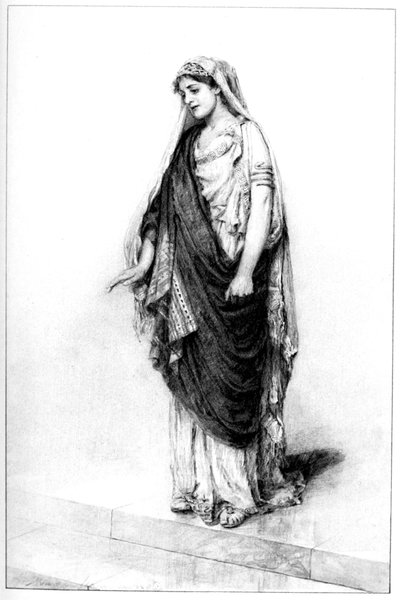
JOCASTA
Gertrude Demain Hammond, R.I.
173There has appeared to him only one hope; and days before
he had grasped at it. He had sent Creon to Apollo’s
House in Delphi, to inquire of the god what great thing
the king must do to save his people. When the answer
comes, he vows that he will not flinch. Whatever task
Apollo may command, no matter how bitter, it shall be
performed.
Even while Œdipus speaks shouts are heard announcing
Creon’s return; and presently he delivers before them all
the answer of the god.
“Thus saith
Phoebus, our Lord and Seer, in clear command:
‘An unclean thing there is, hid in our land,
Eating the soil thereof: this ye shall cast
Out, and not foster till all help be past’.“
[22]
But what is the unclean thing that is polluting the city?
Œdipus does not know that it is himself; and he questions
Creon until the oracular command seems clear to him—to
hunt out and banish the murderers of Laius. The task
seems hopeless. How is it possible, after all these years, to
find the men who slew the king? But the oracle has said
explicitly that it must be done; that they are still alive
within the city; and Œdipus unhesitatingly takes the task
upon him.
An assembly of the people is commanded, and Œdipus
publicly makes known to them his purpose of tracking the
murderers. In a great speech, full of tragic irony, he claims
their help in his search. They are Thebans born; but he,
a stranger to their town in those days when Laius was
killed, had never seen the king. It is for them to seek and
render up the men who murdered him. He calls upon
them solemnly to reveal what they may know. They need
not fear that harm will come to them, for he will promise
to befriend the man who does this service to the State.
174He pauses. But there is of course no answer. Again he
appeals to them, growing indignant now, because he believes
that they are wilfully shielding the guilty. Will they not
speak out, and save their city? Then he will make a
decree against them. For those who refuse to denounce
the murderers, they shall be outcast and shelterless, and
none shall succour them in living or in dying. For those
who will not lend him their active aid in his search, Nature
herself shall frown upon them and deny them every
blessing; whilst on the man himself who slew the king, the
most awful curse shall fall.
“Even as his soul
Is foul within him let his days be foul,
And life unfriended grind him till he die.
More: if he ever tread my hearth and I
Know it, be every curse upon my head
That I have spoke this day.”
[22]
As Œdipus, unconscious of what he is doing, invokes this
terrible curse upon himself, a blind old man is slowly led
in. He is the prophet Tiresias, for whom Œdipus has sent
at the suggestion of Creon. He is the only mortal being
who knows all the truth; and under peril of the ban that
Œdipus has just proclaimed: in virtue of his office, he must
needs proclaim it. How will he strike the blow at the
great good king? By his sacred calling, and his great age,
and his knowledge of the mesh of fate in which Œdipus
has been caught, he should be merciful. But as we watch
him we have strange doubts. It is not so much that he is
unshorn, ragged and unclean; we have learned to be familiar
with such things in these hermit-seers of an early age.
But there is something in the lowering brow and twitching
mouth that hints of an untamed soul in the unkempt
175body; and knowing the passionate heart of Œdipus himself,
we tremble for the issue.
At first it would seem that our fears are groundless.
Œdipus, who is calmer now, greets the prophet with profound
respect; and laying bare the oracle, he begs most
humbly for Tiresias’s help.
The prophet is calm too, awed by the thought of all that
is impending. He answers hesitatingly at first, almost
with a touch of pity and regret. He does know who is the
murderer of Laius, but—he dare not, he cannot tell. Such
a reply could only have one effect upon the tremendous
anxiety of the king. Rendered helpless by his ignorance,
his own keen wit cannot avail him one iota. He has perforce
to ask and ask of these ineffectual creatures around
him, only to be thrown back baffled again and again. For
one moment he puts a curb upon his rising anger, as he
tells Tiresias that his answer is not kind; and casting away
all pride and dignity, he kneels at the prophet’s feet. But
when in sullen words which give no light Tiresias doggedly
replies that he will not speak, Œdipus’s wrath leaps out at
him. Surely this man who knows God’s truth and will
not declare it is no prophet, but a devil. And is it not
probable therefore that he himself has had some hand in
the murder of Laius? As the words fall, there is a sudden
and malign change in Tiresias; and the dreadful truth
which could not be won from him by entreaty, flashes out
pitilessly in anger.
“So?—I command thee by thine own word’s power,
To stand accurst, and never from this hour
Speak word to me, nor yet to those who ring
Thy throne. Thou art thyself the unclean thing.”
[22]
176But such a wild utterance, smiting through a tempest of
passion, carries no shade of conviction to Œdipus. It is
but a horrible insult, which this old man, because he is
feeble, thinks he may launch with impunity. Not until it
has been thrice repeated does the full significance of it
break upon him. Then a suspicion flashes into his mind.
This is doubtless some conspiracy against him, prompted
by Creon, the brother of his queen, to gain the throne.
The foolish improbability of such a plot will not bear
reflection for a moment; but the king’s impulsive nature
is goaded by rage and mistrust. He turns fiercely upon
Tiresias and roundly charges him with conspiring against
his life.
The prophet retorts with an emphatic denial, but he is
not content to stop there. In cold malignance, he repeats
his foul accusation against the king, seeming to gloat over
every word of the hideous charge and the penalty which
his prophetic vision sees that the gods will exact from
Œdipus—
“Blind, who once had seeing eyes,
Beggared, who once had riches, in strange guise,
His staff groping before him, he shall crawl
To the infuriated king this frightful menace, like the
crimes of which he is accused, seems to be the mere raving
of madness; and he deigns no answer. The old man is led
away; Œdipus enters the palace; and in the pause that
follows the Chorus muse over the scene. They are bewildered
and torn by doubt. They may not disbelieve the
seer, but they cannot and will not believe that their
beloved king has been guilty of deeds so vile. As they sing,
Creon rushes on indignant; and he is followed a moment
177afterward by Œdipus. Here at last is an opportunity to
strike out against the deadly thing which seems closing in
around him. Creon is no old and blind opponent, before
whose weakness his hands are tied; but a man of equal
strength and rank whom, in his rashness, he believes to be
his bitter enemy. Without a word of prelude or explanation,
Œdipus flings down the gauntlet; and declares
Creon, his comrade and the brother of his wife, to be a
traitor. The charge is false and foolish, to every mind but
that of the overwrought king. But reason cannot sway
him now; Creon’s protests are futile, and his proofs of
innocence mere words bereft of meaning. This knave who
has plotted against him must die, and quickly, before his
schemes can take effect. In vain Creon pleads for justice:
in vain the leader of the Chorus tries to stem the king’s
anger, With a rallying cry to his guards, Œdipus draws his
sword upon Creon. But as he springs to the blow there
suddenly appears in the doorway of the palace, Jocasta the
queen. An immediate silence falls: weapons are lowered;
and the queen advances slowly to the top of the palace
steps. The Chorus move back, leaving Œdipus and Creon
standing alone before her. She looks reproachfully into
one shamed face after another and then, with gentle dignity,
she speaks:
“Vain men, what would ye with this angry swell
Of words heart-blinded? Is there in your eyes
No pity, thus, when all our city lies
Bleeding, to ply your privy hates?... Alack,
My lord, come in! Thou, Creon, get thee back
To thine own house. And stir not to such stress
Of peril griefs that are but nothingness.“
[22]
There is authority in her tone and in her words, none the
less compelling because of the tender humanity below them.
178It calms the disputants: and as they recount to her the
cause of the quarrel, emotions ebb and leave the cold facts,
hard and ugly. It is clear that Œdipus has been rash in
his accusations; and Jocasta counsels him to accept the
oath of loyalty that Creon offers. Then, when the peace is
made, and she and Œdipus remain alone, she begs him to
tell her all that has happened. Œdipus sums the cause of
the brawl in a few words—he believes that Creon is plotting
against his life, by accusing him, through the instrumentality
of Tiresias the seer, of the murder of Laius. At the mention
of the seer there is a flash of scorn in Jocasta’s eyes,
followed by a shadow of pain, as memory brings back the
time when she trusted in the vain words of a prophet to
her sorrow.
“The seer?—Then tear thy terrors like a veil
And take free breath. A seer? No human thing
Born on the earth hath power for conjuring
Truth from the dark of God.
Come, I will tell
She recounts the story of the oracle that came to Laius,
declaring that he should die by the hand of his son; and
of the terrible means that they had taken to frustrate it,
casting out their child to die upon the mountain.
“Thus did we cheat
Apollo of his will. My child could slay
No father, and the King could cast away
The fear that dogged him, by his child to die
Murdered.—Behold the fruits of prophecy!
Which heed not thou! God needs not that a seer
Help him, when he would make his dark things clear.“
[22]
As Jocasta speaks, we feel that time has not yet healed her
wound. The thought of that unnatural deed of her
179young motherhood, is still so horrible to her that though she
tries she cannot tell all the truth about it. She says that
Laius gave the baby to the slave, whereas it was she herself.
Remorse sweeps over her, and the bitterness which lies
just below the surface of her life rises in revolt against the
oracle which could tempt to such a deed. There is no
impiety in her words. Her voice is reverent when she
names the god. But for his corrupt interpreters her acute
perception has nothing but contempt. Œdipus will do
well to despise them too.
But the king has not observed her emotion. Something that
she has said about the manner of Laius’ death has startled
him. He asks her to repeat it. Yes, it was in Phokis, at a
place where three roads met; and it happened just before
the stranger Œdipus arrived. Œdipus is recalling fearfully
his own encounter on such a spot. But what was Laius like?
Joc.
Tall, with the white new gleaming on his brow
He walked. In shape just such a
man as thou.[22]
In growing dread, hurried questions are put and answered;
and all the details save one Œdipus finds to correspond
with that old event. But that one may save him yet. For
the attendant who returned had said that a band of robbers
slew the king. He must be sent for instantly. Jocasta
promises to do so; but may she not know all that is troubling
him, and whither his questions tend?
Œd.
Thou shalt. When I am tossed to such an height
Of dark foreboding, woman, when
my mind
Faceth such straits as these, where should I find
A mightier love than
thine?[22]
Then, partly because he is instinctively seeking relief from
the thoughts that oppress him: partly to refresh Jocasta’s
180memory and to clarify his own mind, he recounts all the
story of his early life; of his parents Polybus and Merope,
of his visit to Delphi, of his flight from the oracular decree,
of the fierce encounter at the cross-roads in Phokis, and of
how he slew the unknown rider in the chariot. At this
point his voice falters:
“Oh, if that man’s unspoken name
Had aught of Laius in him, in God’s eye
What man doth move more miserable than I,
More dogged by the hate of heaven!“
[22]
He has one shred of hope, however. If the herdsman who
returned spoke truth, clearly Œdipus was not the murderer.
Jocasta repeats her promise to send for him, and as she leads
the king into the palace she tries to soothe him. The herdsman
certainly told the story exactly so:
“... All they that heard him know,
Not only I. He cannot change again
Now. And if change he should, O Lord of men,
No change of his can make the prophecy
Of Laius’ death fall true. He was to die
Slain by my son. So Loxias spake.... My son!
He slew no man, that poor deserted one
That died.... And I will no more turn mine eyes
This way nor that for all their prophecies.“
[22]
The awful irony underlying her words prepares us for the
next step of the revelation. Œdipus sees only one thing
yet—that he may be the unwitting murderer. But what
need to fear, says the queen, to comfort him, since the
God had said that Laius should be slain at the hands of
that poor dead babe? She is not really confident however.
The king’s apprehension has secretly seized on her too;
and presently she returns from the palace with her maidens,
181to pray at the altar of Apollo. She lays her husband’s grief
before the god.
“And seeing no word of mine hath power to heal
His torment, therefore forth to thee I steal,
O Slayer of the Wolf, O Lord of Light,
Apollo....
O show us still some path that is not all
Unclean; for now our captain’s eyes are dim
With dread, and the whole ship must follow him.“
[22]
The answer to her prayer is very near; but bringing
desolation in the guise of joy. Even as she kneels before
the altar there comes a voice calling on the name of the
king, as though it were the voice of the god himself. It
is a stranger from Corinth; and the queen rises to receive
his greeting.
He is the bearer of good news, he says; a message from the
people of Corinth, to Œdipus. They have declared him to
be their king, in the place of Polybus, who is dead.
It seems good news indeed. Polybus dead, there is no
need now for the anxious king to fear that oracular menace
from Delphi; and Jocasta’s heart bounds at the thought.
“Where stand ye at the last,
Ye oracles of God? For many a year
Œdipus fled before that man, in fear
To slay him. And behold we find him thus
Slain by a chance death, not by Oedipus.“
[22]
Œdipus is hurriedly sent for, and, hearing the news confirmed
from the lips of the messenger, is caught up suddenly
on a wave of exultation. In the violent reaction from his
lifelong terror there is a rush of joy which has something
sinister in it, by its very excess. Jocasta was right. It was
a lying oracle which said he should slay his father; and in
182the first sense of relief he vows that never again will he
trust in seer-craft. But the words are hardly cold upon his
lips, when he remembers that he has still one other thing
to fear. The curse had been, “To slay his father and marry
with his mother”; and while Queen Merope lives he must
therefore always be an exile from Corinth. But Jocasta is
not daunted. Possessed by her conviction that all oracles
are false and evil, she tries to reason away his fear.
Joc.
What should man do with fear, who hath but Chance
Above him, and no sight nor
governance
Of things to be? To live as life may run,
No fear, no fret, were
wisest ‘neath the sun.
And thou, fear not thy mother. Prophets deem
A deed
wrought that is wrought but in a dream.
And he to whom these things are nothing,
best
Will bear his burden.[22]
The Corinthian messenger, too, has caught at Œdipus’s
words. Does the king fear Merope, believing her to be
his mother? And is that the reason why he has never
come to Corinth? Then let him set his mind at rest, for
he, the herdsman of Polybus, happens to have sure knowledge
that Œdipus is not the son of Merope. Œdipus and
Jocasta stand amazed; and Œdipus presses the stranger
for all that he knows. But at first he will not say more.
He repeats that Œdipus is not the son of Polybus and
Merope; but he shrinks from disclosing to the great king
that he was an unknown foundling. He answers reluctantly
to the eager questioning of Œdipus, who is now hot upon
the scent of his mysterious parentage. Blindly, almost
feverishly, with no hint of where each step is leading him,
he stumbles on. But fear is awakening in Jocasta, as bit
by bit the stranger reveals that he himself had given the
183infant to Polybus. But how came the child to him?
And whence? Thus pursues the excited king, while
Jocasta stands in silent suspense. The answer of the
stranger smites her with a sudden prescience of what is
coming. He says he found the babe in a high glen of
Kithairon; and as, in rapid answer to the king, he tells
of its poor maimed feet and of the Theban herdsman from
whom he received it, the full truth falls upon Jocasta with
a shattering blow. This man, the king, her husband, is
none other than that outcast child, her son. But Œdipus
does not see the horror yet; and as she stands rigid at his
side one thought and one prayer fill her mind—that he
may never know. But some frenzy seems to possess him,
driving him to destroy himself. He turns to an officer of
the Court. Where is the Theban herdsman of whom the
stranger speaks? He must be sought, and made to say
whence came the child that he gave to this stranger from
Corinth. The officer replies hesitatingly; he thinks he
must be the same man who was king Laius’ attendant, and
who has already been sent for. But only the queen can
tell of his whereabouts. Œdipus turns quickly on Jocasta,
and then for the first time sees her anguish. But he has no
clue to its cause. He cannot know that there has fallen on
her misery worse than death; and that with all the strength
of body and soul she is trying to shield him from it. He
can see only a fear, which seems to him contemptible, that
he may prove to be base-born. Impatience leaps to anger
as she tries to evade his questions; and he replies with a
taunt at what he believes to be her pride.
Œd.
Fear not!... Though I be thrice of slavish stuff
From my third grand-dam down,
it shames not thee.
Joc.
Ask no more. I beseech thee.... Promise me!
184
Œd.
To leave the Truth half found? ‘Tis not my mood.
Joc.
I understand; and tell thee what is good.
Œd.
Thy good doth weary me.[22]
It seems at this word that all Jocasta’s strength breaks down.
The malign power that is driving Œdipus onward is too great
for her, and she cannot strive against it any longer. She
can only wail in answer:
“O child of woe,
I pray God, I pray God, thou never know!“
[22]
And then, as Œdipus turns roughly from her, all his tenderness
shrivelled to scorn and wrath, the last link snaps. In
another moment he will know the truth; and knowing it,
she will be loathsome and abhorrent in his eyes. The
thought brings intolerable pain. She craves relief, escape,
and, swiftly—before Œdipus can learn what he is seeking,
before his accusing eyes can meet her own—annihilation.
With an imploring gesture, she takes one step toward him.
“Unhappy one, good-bye! Good-bye before
I go: this once, and never, never more!“
[22]
But Œdipus does not heed her; and with wild eyes, she
flies into the palace, to die by her own hand. And when
the great king, brought at last to see the truth which casts
him lower than the meanest slave, thinks to avenge his
wrongs on her, he finds that she has taken vengeance on
herself. Before her pitiful dead body his wrath is turned
to loathing of himself; and the hand that was raised against
her, smites the light for ever from his own eyes.
Sophocles: Antigone
185
There was an important figure in Œdipus the King
whom we only glanced at in passing when we
were considering the story of Jocasta. He was
the queen’s own brother, Creon; a man who
knew better than to covet kingly honours, and who had a
soul for friendship. It was he who said, answering the
rash accusation which Œdipus made against him:
“This I tell thee. He who plucks a friend
Out from his heart hath lost a treasured thing
Dear as his own dear life.“
[23]
Thus, when the great king’s downfall came, Creon knew
how to be a friend. He was gentle to Œdipus; and forgetting
his own wrongs, he took upon himself the care of
the king’s young daughters, Antigone and Ismene.
But Creon said once, at another crowded moment of his
career:
“Hard it is to learn
The mind of any mortal or the heart,
Till he be tried in chief authority.
Power shows the man.“
[24]
It was a true word, and curiously verified in his own life.
For he who had shown so fair a front in Thebes, when the
reins of government lay in the hands of Œdipus and Jocasta,
proved himself a tyrant when authority fell on him. Creon,
young and ardent, could dare the wrath of Œdipus, and tell
him to his face that even a king might not be unjust. But
the same man clothed in power, with youthful ideals fled and
all the texture of his mind hardened by age and convention,
186could only meet the supreme idealism of Antigone with a
decree of death.
It is not suggested that Sophocles has developed Creon’s
character in an unbroken sequence through the three dramas
in which he appears. The chronology of the plays forbids
this. For the Antigone, which presents the last phase of
the story, was written years before Œdipus the King and
the Œdipus at Colonus, which give us both Antigone and
Creon in earlier days. But that is an external fact which
does not much disturb the unity of the poet’s conception.
The Creon of the three plays is essentially the same man.
He is not consistent always, since no human creature is.
But under that accusing contrast between the theories of
his youth and the practice of his age there is an abiding law
of human nature which only the few fine souls escape. And
we are clearly shown that Creon was not born to be the
rare exception. Always prudent, law-abiding and careful
of authority, these qualities would strengthen with the
years; and lighted by no higher truth, but carried to excess
in moments of passion, would inevitably make him what he
became.
In the same way there is an underlying unity in the character
of Antigone. In Œdipus the King we know her only by
name, a child of thirteen into whose sunny life a storm has
suddenly crashed. In the Œdipus at Colonus, the strong
young spirit has awakened, and is giving clear promise of
the heights to which it will soar before its short day is done.
While the Antigone, the drama which bears her name, does
but fulfil and make perfect what is fair promise in the other
plays.
We are entitled therefore, in coming to the Attic dramatists
for Antigone’s story, to read the three Sophoclean plays as
187if they were a trilogy; although each of the three is distinct
and complete in itself. And we shall find too, that in the
Seven against Thebes of Æschylus, in which Antigone first
appears, there is sounded once for all the high heroic note
to which her story moved in the versions of the later poets.
There is indeed a wealth of testimony for Antigone, and
fine unanimity in it. We can trace her short life almost
throughout. There was the happy early time in Thebes,
when royalty sat lightly on the merry boys and girls in the
palace; and when the great king and queen were simply
their dear and loving parents. That was a time of sweetest
memories. Ambition had not yet taught the two spirited
brothers to hate each other; and Ismene was still the
gentle little sister who would follow with unquestioning
devotion wherever Antigone might lead.
But in one black day, and with no warning given, every ray
of happiness had been blotted out. Of all the sights and
sounds huddled into the memory of that hideous day,
Antigone could only recall two things clearly—the stately
queen her mother lying dead by her own hand; and
Œdipus the king, self-blinded, pleading in strange remorse
outside the palace to be banished from the city. But one
impression, filtering almost unconsciously through her
terror, remained and grew. It was the look of horror, almost
of loathing, on every face that surrounded the unhappy king.
Antigone herself could hardly bear to see him; but she
vaguely felt that in these shrinking figures there was something
more than physical revulsion at the sight. Why did
the crowding people, the senators, even Prince Creon
himself, draw away from her father as though he were
some unclean thing whose touch would pollute them?
That they did so stung her; and although their terrified
188recoil was only dimly realized at the time, it brought a
flood of pity and indignation with it. In the wave of
protecting love that filled her heart, making her long to
fling herself between the dear maimed father and all those
cruel glances, Antigone the woman sprang to a noble life.
She did not grow to full stature immediately. Years
passed, and Creon, assuming rule in Thebes as regent for
her brothers, prevailed on Œdipus to seclude himself
within the city. Time brought sad knowledge to Antigone.
She learned the causes of the tragedy that had fallen on
them, as it seemed, out of a blue sky. She found, too, the
meaning of that frantic abhorrence of her father; though
she never learned to share it. Neither intellect nor heart
would consent to hold him guilty: not by one iota was he
responsible for the evils that had smitten him. So, as his
own brain cleared from the shock of the calamity, Œdipus
found a champion in his daughter whose splendid logic and
whose love were alike invincible.
Later he had need of all Antigone’s courage. For faction
sprang to life in the city and grew fast. Superstition fed
it eagerly, and soon there was but one thought in all the
darkened mind of Thebes, from Creon downward. Their
town, in sheltering Œdipus, was harbouring pollution; and
he must be cast out. The people clamoured fanatically;
but Creon and the princes Polynices and Eteocles made no
stand against them. To them, the presence of Œdipus
was a political embarrassment, as well as an alleged cause
of displeasure to the gods. Thus ambition united with
fear to drive them on; and presently, his unnatural sons
consenting, Œdipus was ruthlessly cast out of Thebes.
There was only one voice uplifted in his defence; but a
woman’s word, though it might be the soul of right, had
189no value in the counsels of the State. Œdipus went into
exile alone: poor, blind and dogged by the curse which
his cruel destiny had invoked upon him. But he did not
wander long unfriended.
Antigone,
E’er since her childhood ended, and her frame
Was firmly knit, with ceaseless ministry
Still tends upon an old man’s wandering,
Oft in the forest ranging up and down
Fasting and barefoot through the burning heat
Or pelting rain, nor thinks, unhappy maid,
Of home or comfort, so her father’s need
Year after year they wandered together, haunting the glens
and groves of Mt. Kithairon, where the infant Œdipus had
been exposed. It seemed as if his destiny were calling him
to render up his life there on the spot which had seen the
beginning of his wrongs. But the gods relented a little at
last. There came to Œdipus a divine message that he
should have honour at the end, and a glorious passing. He
should not know the death of a mortal creature. He was
to fare to Athens, and in the little deme of Colonus, at the
place which was sacred to Poseidon and Prometheus, the
awful Powers of the Underworld would welcome him,
living, to their shadowy empire.
To Colonus, then, Œdipus and Antigone wearily came;
and threw themselves on the protection of Theseus. They
were strange suppliants, hardly auspicious in the eyes of
the Athenian folk before whom Antigone pleaded for
succour. And the message which Œdipus sent to their
king was stranger still, as he repeated the promise that
Apollo had given him:
190“When I should reach my bourne,
And find repose and refuge with the Powers
Of reverent name, my troubled life should end
With blessing to the men who sheltered me,
And curses on their race who banished me
And sent me wandering forth.“
[25]
Even in dying, it seemed, his life should have no peace.
There was still one act of wrath to do: the stormy day
must needs go out in storm. When he stood before
Theseus, to declare his name and history, all the unquiet
flux of life seemed sweeping round him still.
“Fair Aigeus’ son, only to gods in heaven
Comes no old age, nor death of anything;
All else is turmoiled by our master Time.
The earth’s strength fades and manhood’s glory fades,
Faith dies, and unfaith blossoms like a flower.
And who shall find in the open streets of men
Or secret places of his own heart’s love
One wind blow true for ever?“
[26]
Theseus took pity on the poor blind king and gave him
refuge. But meantime, away in Thebes, his sons were
quarrelling about the succession to the throne. Eteocles
and Creon had stirred up the people against Polynices;
and he, too, was banished from the kingdom. But he had
strength and influence. He fled to Argos: married the
daughter of king Adrastus there, and presently had raised
an army, with six other Greek chiefs, to invade his native
country. This incident is the subject of Æschylus’s drama
called The Seven against Thebes.
On the eve of the battle, Polynices remembered Œdipus.
His own misfortunes had taught him remorse for the
part which he had played against his outcast father; and
a conviction weighed on him that no enterprise of his
191might succeed until he had begged forgiveness and a blessing.
So he travelled hastily to Colonus; and in fear both of his
father and of Theseus, he flung himself as a suppliant at the
altar of Poseidon. But in the heart of Œdipus anger still
burned; and in his ears still sounded the last oracular
command—to curse these impious sons before he died. At
first he refused even to see Polynices, when Theseus
brought word of his petition; and only yielded to Antigone’s
plea that he should at least give her brother a hearing.
“Father, give ear, though I be young that speak.
... He is thy son:
Whence, were his heartless conduct against thee
Beyond redemption impious, O my sire,
Thy vengeance still would be unnatural.
O, let him!—Others have had evil sons
And passionate anger, but the warning voice
Of friends hath charmed their mood. Then do not thou
Look narrowly upon thy present griefs,
But on those ancient wrongs thou didst endure
From father and from mother. Thence, thou wilt learn
That evil passion ever ends in woe.“
[25]
But from the first there was no hope of a softer mood in
Œdipus. Grimly he listened while Polynices poured out
his plea for forgiveness, and when all was said, broke into the
curse which was to devastate his children’s lives. Never
should the crime of Polynices and Eteocles be forgiven;
but in this battle, when each hoped to win glory and the
throne of Thebes, both should fall, slain each by the other’s
hand.
The siege of Thebes was thus foredoomed; and Antigone
implored her brother to abandon the enterprise. But he
was committed to it beyond recall; and went to meet
192failure and certain death. One solemn request he made of
her and of Ismene too, at their farewell. When he should
lie dead before Thebes, would she promise him the last
holy act of burial? There would be no other kin to perform
the rite, and if it were not done, his ghost must
wander endlessly and find no rest.
“I must attend
To my dark enterprise, blasted and foiled
Beforehand by my father’s angry curse.
But as for you, Heaven prosper all your way,
If ye will show this kindness in my death,
For nevermore in life shall ye befriend me!“
[25]
No oath could bind Antigone more strongly than the
prompting of her love; but she gave her word to Polynices,
so that he might go untroubled by a dread more
awful than any other to a Greek. And when the testing
time came, both love and duty were irrevocably engaged.
It came very soon. On the day that the Seven laid siege
to Thebes, the gods took Œdipus. In marvellous fashion
he left the earth, rapt away in the thunders of Olympus,
while mighty voices called upon his name. And as, unseen
by mortal eyes, he crossed that mysterious Brazen Causeway,
the Argive army lay round Thebes. When Antigone
and Ismene returned to the city, dreadful tidings were
brought to them. Their brothers had met in single combat,
and, fighting furiously, each had slain the other.
Messenger.
The genius of them both was even so dire,
So undistinguishing; and with one
stroke
Consigns to nothingness that hapless race ...
Thebè is rescued: but her
princes twain
By mutual slaughter fratricidally
Are perished; their own land
hath drunk their blood.[27]
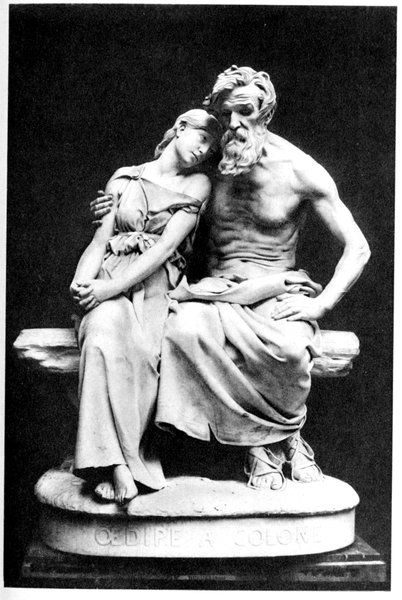
ŒDIPUS & ANTIGONE
From the sculpture by Hugues in the Luxembourg
193Creon instantly assumed control. The Argive host was
beaten back, and when the next day dawned, the invading
force was gone. The siege was over; and Thebes might
set about the pious task of burying its dead. The princes
were taken up from the spot where they had fallen, and
brought into the city. By the most sacred law of Greek
religion every ceremony of burial should now be reverently
performed. The duty devolved first on male kindred;
and Creon, as uncle to the princes, should perform the
rites. But Creon was now king of Thebes; and in that
capacity there fell on him another, and a conflicting, duty.
He must decide what burial honours might fittingly be
paid to Polynices, the traitor who had fought against his
country.
Antigone waited in anxiety for the decision. For Eteocles
she had no fear: he had given no offence to Thebes. But
she knew Creon’s rigorous spirit; she knew his devotion to
the State; and she trembled for the poor misguided brother
who had sinned against the State. In the early morning
after the battle, Antigone came out of the palace, to meet
the procession which bore her brothers’ bodies in. And as
she joined her voice to the mourners’ wail, Creon’s herald
broke upon their grief, to announce the king’s decree.
Herald.
’Tis mine to announce the will and firm decree
Of the high council of this
Theban state.
Eteocles, as loyal to his land,
Shall be insepulchred beneath her
shade....
But this, his brother Polynices’ corpse,
Graveless shall be cast
forth for dogs to tear.
... Dead though he be, his country’s gods
Shall ban
him, since he brought in their despite
A foreign host to invade and subjugate
Their city....
194 ... No drink-offerings
Poured at his tomb by careful
hands, no sound
Of dirgeful wailing shall enhance his fame,
Nor following of
dear footsteps honour him.
So runs the enactment of our Theban lords.[27]
But Creon had reckoned without Antigone. Her utmost
apprehension had not dreamed that so cruel an edict could
be passed. It was foul dishonour to the dead, and an insult
to the gods. But she would never suffer it. Though she
must be one woman against the whole of Thebes, her
brother should not lack the necessary rites.
Antigone.
But I make answer to the lords of Thebes,
Though none beside consent to bury
him,
I will provide my brother’s funeral.
... Then, O my
soul,
Of thine own living will share thou the wrongs
Forced on the helpless
dead: be leal and true.[27]
At this point of the story, the Antigone of Sophocles opens.
Creon has heard a rumour of defiance, and has added a
penalty of death to his decree. The sisters are alone outside
the palace. Antigone, not doubting of Ismene for a
moment, rapidly puts before her a plan for Polynices’
burial. They must act at once, quickly and quietly, before
Creon may have time to prevent them. To her utter
amazement, however, Ismene will not help her. She is a
gentle, timid creature: she cannot think it possible that
Antigone will dare to defy Creon’s edict: the mere
suggestion terrifies her. She cannot rise to Antigone’s
perception of a law higher than this ugly mandate against
the dead; and if she could, she is not of the heroic fibre to
make a stand against authority. She sees and admits that
this vengeful edict must needs offend the gods; but for
195her part, she can only pray to be held guiltless of it. She
is not lacking in love and loyalty to her kin. When Œdipus
and Antigone were wandering in beggary, Ismene had
secretly contrived to send them aid; and once she had
ridden a perilous journey in order to warn them of danger.
She is no craven. Only, she is oppressed by a sense of
physical weakness: the forces which Antigone will challenge
are overwhelming, and will surely crush her. Is it not rash
and sinful to attempt the impossible?
“O think how beyond all
Most piteously we two shall be destroyed,
If in defiance of authority
We traverse the commandment of the king!“
[24]
Antigone is bitterly disappointed. She had gauged Ismene
by herself, and thought her courage would be equal to her
love. To her the duty to their dead is a holy act, crying
aloud for fulfilment, and shining far above this tyrannous
decree. It is so clear to her eager spirit that she cannot
doubt or hesitate. She had thought that one word to
Ismene would enlist her help; and instead, she is met with
puerile answers counselling prudence and submission. Her
passionate soul flames into indignation, and in her anger
she is less than just to Ismene. Despite her heroism, she
is simply human. Nor is she, as has sometimes been
suggested, like a martyr of the early Christian era, whose
humility and gentleness would bless the hand that smote.
Antigone’s warm heart is as strong in its hatred as its love;
absolute in devotion, but impetuous in anger; capable of
supreme self-sacrifice, and tender to infirmity; but intolerant
of moral weakness and meanness and timidity.
She retorts in scorn upon Ismene:
196“I will not urge you! No! Nor if now you list
To help me, will your help afford me joy.
Be what you choose to be! This single hand
Shall bury our lost brother. Glorious
For me to take this labour and to die!
Dear to him will my soul be as we rest
In death, when I have dared this holy crime.
My time for pleasing men will soon be over;
Not so my duty towards the Dead! My home
Yonder will have no end. You, if you will,
May throw contempt on laws revered on High.“
[24]
Ismene protests that she had no thought of scorn; and indeed
her gentle spirit has no place for anything so harsh. But
when she begs Antigone to keep her purpose secret, and
reiterates her conviction that the attempt will prove futile,
Antigone will not listen any longer. With a bitter word
on her lips, she goes out alone to face her perilous task.
“Speak in that vein if you would earn my hate
And aye be hated of our lost one. Peace!
Leave my unwisdom to endure this peril;
Fate cannot rob me of a noble death.”
[24]
Ismene, left standing before the palace, gives one involuntary
cry of mingled fear and admiration. Then the thought
of Antigone’s danger overwhelms her, and she rushes within
like one distracted.
In the Parados which follows, sung by a Chorus of Theban
elders, we are made to feel with growing force the isolation
of Antigone. For they sing of the Argive attack, and of
the sin of Polynices in bringing an army against Thebes.
They are old men, and cannot be expected to share the
ardent enthusiasm of youth; and being senators, their
greatest care must be to uphold the State against its
enemies. When Creon enters, heralded with pomp and
197ceremony, they are tempered to the dry official mood
which will exactly suit his purpose.
Creon is newly burdened with the weight of monarchy;
and in this his first public proclamation it seems to oppress
him. There is an evident anxiety in his tone as he repeats
the edict that he has made against Polynices. It seems,
despite the authority of his words, as though he were trying
to justify the decree, not only to possible critics among
his hearers, but to an inner malcontent who will not be
silenced. With all the strength of words, he emphasises
his devotion to the State; and from our knowledge of
Creon, we realize that this is something more than mere
protestation. The glory of Thebes shall be his constant
aim and utmost care, he says. Her friends he will exalt,
and her enemies shall be his enemies.
With this prelude, he comes fittingly to the terms of the
edict. Eteocles, who died fighting for his country, shall
receive every tribute that the State can pay; but the
traitor who could betray his country to an enemy shall be
justly left dishonoured, for carrion to devour. As we
listen to the speech we are compelled to admit its stern
logic. We see that Creon’s action is not entirely arbitrary,
so far. There is, according to his standard, rigorous
justice in it; and no other standard had yet been applied.
The Chorus would not question it. It is in the main an
echo of their own thought; only it looks a little harsh, put
into words. They, too, believe Polynices guilty of an
unpardonable crime against the country that they serve;
and they have no wish to gainsay Creon. But about this
vengeance taken on the dead there seems to be a certain
degree of excess, which forbids entire approval. At any
rate, they will take no responsibility for it. “It is thine,”
198they reply to the king, “to exercise all power.” They will
not take upon themselves to criticize the action of their
king, though it may cause uneasiness; and on the other
hand, they dare not censure it. He is in authority, and
they must submit.
Creon then proceeds to explain that he has set a watch
over Polynices’ body. But even while he is speaking there
shuffles on the scene a curious, half-comic figure, announcing
that the edict has been defied. He is one of the sentinels
set to guard the corpse. In brusque speech, and with
exaggerated fear for his own life, he tells a strange tale.
At the first light of morning, he and his companions found
that some unknown hand had given the prince his funeral
rites: not the full and complete ceremony, but just so
much as to give peace to the unquiet spirit.
“And when the scout of our first daylight watch
Showed us the thing, we marvelled in dismay.
The Prince was out of sight; not in a grave,
But a thin dust was o’er him, as if thrown
By one who shunned the dead man’s curse.“
[24]
Creon’s judicial air vanishes in a moment. Astonishment
quickly gives place to anger as he listens; and this is only
heightened when the Chorus suggest that some god has
interposed to pay the burial rites. Startled by the strange
recital, their words betray an involuntary glimpse of the
misgiving that underlies their submission to the king,
Creon breaks into angry speech. The insult to his authority
stings his new-found sense of power; but when the
senators imply that the gods themselves disapprove of his
action, some prick of the unacknowledged truth goads him
to fury. And below his wrath there lies a suspicion of
199disloyalty amongst the citizens, and corruption amongst his
slaves.
Not the gods, he says, but these same watchmen who were
set to guard the body, have performed the rites. And they
have done it for gain; set on by rebels who will not accept
his rule. Driven by complex emotions, he loses all sense
of restraint; and threatens the sentinel with torture and
death if he does not find and bring the culprit immediately.
Then he strides into the palace, and the man flings off with
a gibe.
In the short interval which follows, the Chorus sing aptly
and beautifully of the daring and skill of man. But their
ode soon breaks into excited exclamations. They see the
watchman who but lately left them returning hurriedly
and leading a woman by the hand. At the same moment
Creon enters.
Chorus.
What portent from the gods is here?
My mind is mazed with doubt and fear.
How can I gainsay what I see?
I know the girl Antigone.
O hapless child of
hapless sire!
Didst thou, then, recklessly aspire
To brave kings’ laws, and now
art brought
In madness of transgression caught?[24]
Her captor is exultant, for he has disproved the charge
against himself. Not that it gives him pleasure to betray
the kind young princess; but everybody’s life is precious
to himself, he says, not seeing one gleam of the splendid
scorn of life in the girl who is standing beside him. This
maid is undoubtedly the transgressor, for they caught her
in the act. Now let the king acquit him of the false
accusation, and set him free.
200Before the man may go, however, Creon turns to Antigone.
She stands pale and silent, her eyes lowered before the
incredulous gaze of all these hostile men. Does she confirm
the amazing statement they have just heard? he asks.
It is quite true, she answers; she owns to the deed. Then
Creon, having dismissed the watchman, demands to be
told why she has dared to disobey his edict. Antigone’s
reply, with all its spiritual power and beauty, is also touchingly
human. Creon has asked whether she was aware of
the decree and the penalty.
Ant.
I could not fail to know. You made it plain.
Creon.
How durst thou then transgress the published law?
Ant.
I heard it not from Heaven, nor came it forth
From Justice, where she reigns
with Gods below.
They too have published to mankind a law.
Nor thought I thy
commandment of such might
That one who is mortal thus could overbear
The
infallible, unwritten laws of Heaven.
Not now or yesterday they have their being,
But everlastingly, and none can tell
The hour that saw their birth. I would not,
I,
For any terrors of a man’s resolve,
Incur the God-inflicted penalty
Of
doing them wrong. That death would come—I knew
Without thine edict:—if before the
time,
I count it gain. Who does not gain by death,
That lives, as I do, amid
boundless woe?
Slight is the sorrow of such doom to me.
But had I suffered my
own mother’s child,
Fallen in blood, to be without a grave,
That were indeed a
sorrow. This is none.[24]
Up to this point her ardent vision and courage have carried
her on, soaring high into the light of eternal truth, or
201tenderly stooping to the sanction of dear human ties. The
austerity of the stern faces by which she is surrounded has
had no power to quell her fervent spirit; and it is only
when she catches Creon’s look of contempt that a bitter
reality forces itself upon her. This passion of self-sacrifice,
this duty which comes to her as a mandate from the gods
themselves, is stark nonsense in the eyes of the man who
confronts her. The thought gives a sudden pause to her
ardour, and there is a quick revulsion to anger. O these
blind eyes that will not see! And this stupidity that
refuses to be enlightened! She drops to a lower range, and
ends abruptly on a taunt at Creon’s dullness of perception:
“And if thou deem’st me foolish for my deed,
I am foolish in the judgment of a fool.“
[24]
The Chorus has relapsed into submission to Creon. No
spark of fire from Antigone’s burning words can warm their
coldness. Yet their frigid comment is significant. How
like she is, in her strong will, to Œdipus, her sire. Creon
takes up their words. Yes, she is stubborn, but the hardest
metal will soonest break. Not content with disobedience,
she must glory in her deed. But she shall surely die for
it; and Ismene, too, if she has been an accomplice.
Antigone had expected no less than the death penalty for
herself; but she will by no means allow Ismene to be
included in it. For, first, Ismene had refused her help;
and then, she is too slight and weak a creature for such a
terrible ordeal. Antigone sees that there is a sharp struggle
coming. Some attendants have brought her sister from
the palace, and she comes weeping for Antigone’s fate.
Creon turns upon her in a fury. Without a sign of proof,
he roundly accuses her of complicity in the deed.
202To Ismene, who does not know what has passed, it seems
clear that Antigone has in some way implicated her. But
she will not deny it. On the contrary, there is in her
tender heart some sense of relief, despite her fear, that she
can now prove to Antigone her loyalty. Ever since she
first refused her help, remorse has stung her. But now
there is an opportunity to redeem her weakness, and she
makes a pathetic attempt to share Antigone’s fate. It is
not a very bold effort, however: she seems almost to tremble
as she tells Creon that she did help in the burial—if Antigone
said so; and none but a man who was blind with rage could
have been deceived by it. But to Creon the poor little
declaration has all the appearance of truth; and Antigone,
knowing his inexorable nature, sees that he will assuredly
condemn Ismene to death. She must interpose, quickly and
decisively. She is still sore with disappointment at her
sister; her own burden, since the glow of her magnificent
defence passed, has grown heavier at every moment; and
there is, moreover, a very natural resentment that Ismene
should claim merit where it is not due. She breaks in with
an emphatic denial of her sister’s help.
Ismene.
Alas! and must I be debarred thy fate?
Antig.
Life was the choice you made: Mine was to die.
Ismene.
I warned thee—
Antig.
Yes, your prudence is admired
On earth. My wisdom is approved below.
Ismene.
Yet truly we are both alike in fault.
Antig.
Fear not; you live. My life hath long been given
To death, to be of service to
the dead.[24]
Hurt and baffled, Ismene now turns to Creon with an appeal
that she thinks must touch him. Will he not save Antigone
for Hæmon’s sake, his son, to whom she is betrothed?
203Surely he will not break the heart of his own child, too?
His reply is a brutal jest that wrings from Antigone the first
sign of her anguish. The pity of her broken life, to herself
and to the lover she must leave, elicits a poignant cry:
“
O dearest Hæmon! How thy father wrongs thee!”
[24]
Then she is led away by the guards.
Almost immediately there enters upon the scene a man
who is much better fitted to cope with Creon. He is
Hæmon, Antigone’s lover. Logical, restrained, and of
considerable force of character, he possesses besides a
valuable key to his father’s temperament. He knows the
man with whom he has to deal, and adopts a quiet, conciliatory
tone, deferring from the first to Creon’s rights as his
father and his king. He listens with apparent calm to the
arraignment of Antigone; and makes no reply when Creon
expounds his doctrine of absolute obedience to the laws of
the State, be they right or wrong. He even controls
himself at the rough exhortation to “cast her off, to wed
with some one down below.”
But Hæmon is only biding his time; and when his father
concludes, he begins, tactfully and with moderation, to
put before him the only plea which he thinks has any hope
of influencing him. He appeals to Creon in his public
capacity, and asks him to consider the opinion of the citizens
of Thebes upon Antigone’s action.
“Thy people mourn this maiden, and complain
That of all women least deservedly,
She perishes for a most glorious deed.
‘Who, when her own true brother on the earth
Lay weltering after combat in his gore,
Left him not graveless, for the carrion-fowl
And raw-devouring field-dogs to consume—
204Hath she not merited a golden praise?’
Such the dark rumour spreading silently.”
[24]
With fine delicacy, and holding his emotions well in check,
Hæmon hints that his father will do well to listen to the
voice of the people. No human creature is infallible; and
is it not unwise to cling too tenaciously to one’s own will
in the face of so strong a public opinion? The tree that
will not yield to the torrent is torn up by the roots; and
the sailor who rushes into the teeth of the storm with sheets
taut is liable to end his voyaging keel-upward.
Creon interposes an angry exclamation; he will not be
taught discretion by a boy. But Hæmon is ready with an
answer—Even age must yield to truth and justice. Antigone
is no base rebel: all Thebes denies it. “Am I ruled by
Thebes?” thunders Creon; and Hæmon, seeing his father
lost to reason, begins to feel the onrush of despair that will
presently sweep away his self-control. In the wave of
emotion that breaks upon him, he answers hotly to Creon’s
taunts. It is the one thing needed to complete his father’s
wrath; and he turns with a brutal order to the Guards to
bring Antigone out, that she may die before her lover’s
eyes. But Hæmon will not look upon that sight. Under
his quiet manner, a torrent of passion has been gathering
force; and a terrible resolution. He has been keeping an
iron hand upon himself; but he has known all through his
pleading that if Creon will dare to carry out the sentence
against Antigone, it will cost him the life of his son. Hæmon
will not survive his bride. Now, with an ominous cry that
his father shall never see his face again, he rushes from the
place.
The Chorus break into an exquisite lyric on the power of
love; and a few moments afterward Antigone herself
205crosses the scene, on her way to the place of death. She is
to be buried alive, in a rocky tomb in the hills; and this
last horror, with the inevitable reaction that has followed
on her splendid daring, have wrought a pathetic change in
her. All her audacity has gone: the passion of righteous
anger has faded out: even her perception is blunted. The
vision of a higher law, and the superb confidence that the
gods approve her action, have grown dull and faint before
this dreadful thing which is coming to her. Her voice
falters: her footsteps lag: and on her lips are pitiful words
of regret for all the fair things that she is leaving. The old
senators are moved, but are sadly inept in their efforts at
consolation. Remembering Antigone as she had faced them
in her magnificent heroism, they think to comfort her with
the thought that there is glory in her death. But Antigone
is not heroic now. She is a lonely human soul, confronting
the last grim reality; and the well-turned phrases of these
comfortable old men are revolting to her. What glory can
really compensate for the monstrous injustice that she
suffers; for the loss of youth, and lover, and friends; and
for the hideous darkness that will quench the light of the
sun for her?
“O mockery of my woe!
I pray you by our fathers’ holy Fear,
Why must I hear
Your insults, while in life on earth I stand,
O ye that flow
In wealth, rich burghers of my bounteous land?...
By what enormity of lawless doom,
Without one friendly sigh,
I go to the strong mound of yon strange tomb—
All hapless, having neither part nor room
With those who live or those who die.“
[24]
206Even faith seems swept away for a moment in this access of
physical weakness. But a gleam comes back, flickering
through the clouds of doubt upon that shadowy region of
the Underworld:
“Dear will my coming be, father, to thee,
And dear to thee, my mother, and to thee,
Brother! since with these very hands I decked
And bathed you after death, and ministered
Then the clouds gather again, and she cannot see anything
clearly. Why is she suffering so? Is it possible that she
is guilty, that her deed was wrong? In the strange confusion
of her soul, truth itself seems to reel, and the form
of piety grows blurred. What if, after all, the gods do NOT
approve, and it is she who has sinned?
But from this most ghastly fear Creon himself unwittingly
delivers her. He breaks suddenly into her mourning with
a harsh order; and instantly her mind grows clear.
“O land of Thebè and city of my sires,
Ye too, ancestral Gods, I go, I go!
Even now they lead me to mine end. Behold!
Princes of Thebes, the only scion left
Of Cadmus’ issue, how unworthily,
By what mean instruments I am oppressed,
For reverencing the dues of piety.”
[24]
Beside the perverse authority of Creon, her integrity rises
unassailable. So Antigone passes, in light at the last.
It would take too long to tell of the punishment which
befell Creon, which is nevertheless a vital part of Sophocles’s
Antigone. It was swift and crushing. No sooner had the
princess been led to her rocky tomb than the seer Tiresias
207demanded an audience of the king. He had come with
solemn warnings from the gods, first because the body of
Polynices, the burial of which Antigone had not been
allowed to complete, was polluting the city; and secondly
because his shameful cruelty to the princess had given the
gods offence. Let Creon go at once and rescue Antigone
from her living tomb; and let him pay the needful honours
to the dead. But if he will not instantly make this just
amend, the divine power will surely exact from him the
payment of a life for the life that he has taken.
Creon has no recourse to authority now; and he makes but
a feeble resistance. Misguided and over-zealous hitherto,
he is no sooner convinced of his error by the Prophet than
he makes a strenuous effort to put it right. He is shaken
by fear, too: and declares that he cannot fight with destiny.
So he goes to perform the will of the gods; and on his
action now the whole force of the tragedy hangs. The gods
had commanded—Release Antigone first, and then bury
the body. But Creon in his perturbation had not paid
good heed. True to his nature, he turns to the official
duty first, the burial that is to remove pollution from the
city. Characteristically, too, he stays to perform the rites
with the utmost amplitude. Not until a mound has been
heaped upon Polynices does he proceed to the cave to
release Antigone. Then he is too late. Antigone has
hanged herself from the rocky roof, and Hæmon is clinging
about her feet in agony. As Creon appears, the youth
springs up with intent to kill him; but missing his aim, he
turns the sword against himself and dies by Antigone’s
side.
So the gods exacted a life for a life; but the punishment
was not yet complete. When Creon, broken with grief,
208came carrying his dead son into the palace, he found that
the tragic news had been before him. Eurydice his wife had
slain herself.
Creon.
Take me away, the vain-proud man who slew
Thee, O my son, and thee!
Me
miserable! Which way shall I turn?
Which look upon? Since all that I can touch
Is falling, falling, round me, and o’erhead
Intolerable destiny descends.[24]
Euripides: Alcestis
209
In the story of Alcestis, we step at once into light and
sweet air. Here is no taint of an hereditary curse;
no excess of passion to offend the sight of gods and
men; no foul crime to be avenged by other crime,
and expiated in its turn by bitter remorse. The Trojan
Cycle and the Theban Cycle, with all the tragic grandeur
with which Æschylus and Sophocles have invested them, are
left behind. We come to a new theme, fair as a garden and
clean as a morning breeze. It is the tale of a wife’s supreme
love: of the friendship of a god for a mortal man: of an
unique act of hospitality and its magnificent requital. The
oppressive sense of destiny, of something almost malign in
the heart of things, has lifted. Human error and wrongdoing
and impotence, which have hitherto made such a
sombre background for heroic figures, are lost in a glow of
human love. And instead of a brooding menace, there is
the presence of a benign divinity, seeking to protect and
recompense virtue.
But while we turn to the Alcestis of Euripides with a
refreshing sense of contrast, we are soon reminded that the
elements of the story itself are unfavourable to the work as
dramatic art. We could not expect from such a theme a
tragedy so intense and powerful as the works of the two
elder dramatists. The spectacle of virtue rewarded may
satisfy a primary moral sense; but for that very reason it
will not evoke the strong emotions which are the life of
drama. While perfect accord with the divine power, and
harmony amongst the human agents of the story, utterly
210preclude the sense of conflict without which tragedy can
hardly be. For that reason, it would seem, Euripides did
not treat the legend as pure tragedy. In any case, the
happy ending of the legend upon which he worked would
forbid it; and he has further departed from convention by
introducing two scenes which, by their flavour of satire and
their stinging realism, partake of the nature of comedy.
It would therefore appear that the critics have had some
cause of complaint against Euripides, on account of technical
defects in the Alcestis. They have indeed been very severe,
not only on this play, but on his drama generally, charging
him with all sorts of artistic sins which need not trouble
us in the least. Fortunately, we are not much concerned
with criticism: and in this case there is opposed to the
censure a vast body of praise, ranking most of the poets on
its side, and all the minds which are attuned most nearly to
the reflective note of Euripidean poetry.
If, however, we had time for a comparison with Sophocles,
we should quickly find for ourselves the one fact which
gives colour to much of the critics’ grumbling. Euripides
was not, like Sophocles, a consummate artist. But we
should not stop at such profitless negation; for a larger
truth would spring to light a moment afterward. While
the art is less, the thought is much greater: there is a wider
range, and a higher ideal. Euripides is not content to make
perfect drama: he must give humanity the fullest and
most complete expression possible to him. And since he
saw into the human heart with an eye at once so keen and
pitiful; since he felt with such insistence the ethical and
intellectual problems of the transition period in which he
lived, it is no wonder if the artist in him was sometimes
taxed beyond his powers.
211The great Periclean Age was passing; and the new era had
some curious intellectual resemblances to our own time. It
had begun to examine the bases of its religion; it had seen
a great development of the democratic spirit; and it was
awakening to something wrong in the position of women.
That these questions greatly exercised the mind of Euripides
we may see from the prominent place they occupy in his
drama; and that he must have been an original and
advanced thinker upon them is evident from certain facts
of his personal unpopularity, and from the freshness of his
ideas to the modern mind. That modernity is indeed one
cause of his intimate appeal to the thought of our own day;
and so far as it touches the question of womanhood, it has
a peculiar interest for us.
The political aspect of the woman’s question will not detain
us for one moment, save to note in passing that it is at
least as old as Attic Drama. We have little clue to the
political significance, if any, of the many references to the
status of women which are to be found in the plays of
Euripides; and it does not matter. The broad fact is
clear, that the poet was profoundly interested in womanhood:
that he had studied feminine character with care
and sympathy; and that he felt and strove to reveal something
of the evil which must result to the race when the
woman is treated unjustly. Hence we have the Troades, a
drama which looks steadily at the horrors of war from the
standpoint of the women who suffer because of it. Hence
too, there is an Iphigenia exerting all the energies of an
acute mind to rescue her brother from imminent danger;
a Medea, transformed from a tender mother into a destroying
Fury by Jason’s infidelity; a Phædra literally consumed
by love which she will not declare; and an Alcestis, type of
212enduring feminine courage, placed side by side with the
weak amiability of Admetus.
The character of Admetus is of some importance in the
story we are now to consider, and hence has received a
great deal of attention. It has been interpreted variously.
On the one hand he is made to appear improbably base, a
poltroon who was not only willing that his wife should die
in his stead, but who hurried her to the tomb with indecent
haste, to avoid the awkward questions of her relatives. On
the other hand, he is shown as incredibly virtuous, a man
whom the gods delighted to honour—with this doubtful
gift of life at another’s cost—and who could not, from very
piety, refuse it. But the Admetus of Euripides is not
found in either of these two extremes. He is a much more
real figure poised somewhere along a middle line between
the two; an average man, compounded of good and bad:
a warm friend, a tender husband, generously hospitable
and of evident charm of nature; but with a fatal weakness
of will. Thus, in the common level which the balance
shows, he is much more convincing as a man, and for the
purpose of the dramatist, an excellent foil to his heroic
wife.
In the lovely poem by William Morris on this subject, there
is a picture of King Admetus which glows with just the
charm that such a nature might possess. The poem, which
is called The Love of Alcestis, relates that part of the legend
which precedes the climax treated by Euripides. It tells
of the coming of the god Apollo to Thessaly, to serve as an
unknown herdsman to Admetus, King of Pheræ, for nine
long years; of Admetus’ wooing of the young daughter of
Pelias, King of Iolchos, and of the impossible condition (fulfilled,
however, by the divine herdsman’s aid) that whoever
213would wed with Alcestis must fetch her for her bridal in a
chariot drawn by a lion and a boar. It tells, too, of the
god’s help in foiling the spells of Artemis over the bride;
of the happy wedded life; and of the departure of Apollo,
leaving with the royal couple what seemed at first a priceless
boon—the promise that when Admetus came to die,
another life should be accepted by the Fates in his stead.
This is the man whose gracious serenity first won the love
of the god when, banished from Olympus, he came to serve
as a thrall:
Young, strong, and godlike, lacking naught at all
Of gifts that unto royal men might fall
In those old simple days....
... Little like a king,
As we call kings, but glad with everything,
The wise Thessalian sat and blessed his life,
So free from sickening fear and foolish strife.[28]
He stretched an eager hand to the young stranger who
knelt at his feet, begging hospitality, and promising rich
rewards.
“Rise up, and be my guest,” Admetus said.
“I need no gifts for this poor gift of bread,
The land is wide and bountiful enow.”[28]
From that moment, there was a tender comradeship
between the king and his new herdsman, which only grew
stronger with time. Now and then, strange tokens made
Admetus wonder about his guest’s identity; but he
refrained from questioning him, and it was not until the
last day of the appointed service that the revelation came.
The king’s sweet bride had been won ere then; brought
home to Pheræ in an ivory chariot which the stranger had
marvellously provided, drawn by a lion and a boar; and
214the circle of their happiness seemed complete. But one
soft evening when the sun was sinking, the herdsman drew
the king out of the palace; and together they climbed the
hill to watch the sun go down. There fell on Admetus a
sense of sadness, and soon he was aware of a wonderful
change in the figure at his side. He dared not raise his
eyes, for he was conscious of glory which might not be
looked upon. Awe filled him, and now he knew the
meaning of his sadness. This mysterious guest who had
been so strong and wise and kind a friend, was leaving him.
As he stood trembling, in dread and sorrow, the dear voice
that he loved fell on his ear once more, thrilling him with
its music:
“Fear not! I love thee ...
And now my servitude with thee is done,
And I shall leave thee toiling on thine earth,
This handful, that within its little girth
Holds that which moves you so, O men that die;
Behold, to-day thou hast felicity,
But the times change, and I can see a day
When all thine happiness shall fade away;
And yet, be merry, strive not with the end,
Thou canst not change it; for the rest, a friend
This year hath won thee who shall never fail.”
[28]
It is on this note of divine favour that the Alcestis of
Euripides opens. In the golden interval since Apollo took
his flight from Pheræ toward the setting sun, life had sped
joyously for Admetus and his lovely queen. The hint of
ill to come which had dropped from the god’s lips was to
the king but a fleck on a fair horizon, the measure of pain
that every man must bear—some day. But it was too
remote for present heeding. Why fret away the day of
youth because of sorrow and death that must come to all
215alike at the end? So he lived merrily, as the god had
counselled, his fruitful land at peace with all the world, and
his doors flung wide to the stranger and the suppliant.
The little cloud was quite forgotten.
Alcestis was happy too, with a difference. Deep under the
bright surface of her life, the warning of the god lay hidden.
It never rose to disturb her husband’s boyish gaiety, nor to
trouble with its shadow the sunny eyes of her little ones.
But it was not lulled to sleep. Alcestis could not palter
with reality. In quiet times the black thing was called up
from its hiding place, and faced and fought. There was
many an hour of anguish before it was finally conquered,
since youth and beauty and happiness are precious. But
from the moment when Alcestis learned that love was
greater than them all—when she pledged her soul to take
upon herself the evil that was coming to her husband, life
grew calm and fair again. There was little outward sign
to mark the struggle: only a gentle gravity crept into her
sweetness, and her voice grew tenderer still to husband and
to babes. And she too clutched the hope, since she was
human after all, that the thing she feared was still far
away.
Very soon, however, and with bewildering suddenness, the
little cloud gathered into storm. The fiat went out
from the Moiræ that Admetus was to die—now, in the
glory of youth and strength, a goodly prize to enrich the
House of Hades. One favour only they would grant, at
the supplication of Apollo for his mortal friend—that the
king might live if father or mother or wife would consent
to die for him. Admetus, unprepared for an ordeal which
must shake so slight a nature to its roots; and with all his
kindly social virtues rent by the shock, forgot his manhood.
216The old people clung feverishly to their remnant of dear
life; and Alcestis knew that this was the moment when
the compact that she had made with her own soul must be
ratified to the powers below. She gave her word to the
Fates that she would die for her husband.
Now the appointed day has come; and before the palace
of Admetus a grim contest is in progress. Guarding the
door with his splendid presence is the great Sun-god
himself, making a last stand against Hades, lord of the dead,
who has come in person from the Underworld to claim his
victim. He may not use force against this shadowy king;
but with all the strength of persuasion he pleads for Alcestis’
life. “My heart is heavy for my friend’s mischance,” he
says; and tries to touch the obdurate spirit by the thought
of this noble wife’s youth and goodness. But Death will
yield no jot to his entreaty; and as Apollo reluctantly
gives place to him, vanquished for the moment, he flings a
threat at the great Enemy.
“Surely thou shalt forbear, though ruthless thou,
So mighty a man to Pheres’ halls shall come,
Sent of Eurystheus forth, the courser-car
From winter-dreary lands of Thrace to bring.
Guest-welcomed in Admetus’ palace here,
By force yon woman shall he wrest from thee.
Yea, thou of me shalt have no thank for this,
And yet shalt do it, and shalt have mine hate.“
[29]
The prophecy contains a gleam of wild hope; but Death
passes on unheeding, and there gather slowly before the
doors the friends who have been summoned to mourn for
the dying queen. They are awed by the hush that lies
upon the house, and hardly know how to interpret it.
Perhaps it means that Alcestis is already dead, they conjecture;
217and that the funeral train has left the palace.
Yet this can hardly be.
Would the king without pomp of procession have yielded the Grave the possession
Of so dear, of so faithful an one?[29]
No, they would rather surmise that Alcestis is living still;
and as one of the queen’s maids comes out, they beg eagerly
for news. The girl tells them through tears that her
mistress does indeed still live, but that the end is very
near. Even now, in quiet courage, the queen is performing
all the needful rites.
For when she knew that the appointed day
Was come, in river-water her white skin
She bathed, and from the cedar chests took forth
Vesture and jewels, and decked her gloriously,
And stood before the hearth and prayed....
To all the altars through Admetus’ halls
She went, with wreaths she hung them, and she prayed,
Plucking the while the tresses of the myrtle,
Tearless, unsighing, and the imminent fate
Changed not the lovely rose-tint of her cheek.
Then to her bower she rushed, fell on the bed,
And there, O there she wept....
And the babes clinging to their mother’s robes
Were weeping: and she clasped them in her arms,
Fondling now this, now that, as one death-doomed.
And all the servants ‘neath the roof were weeping,
Pitying their lady. But to each she stretched
Her right hand forth; and none there was so mean
To whom she spake not and received reply.[29]
The maid goes on to tell of Admetus’ grief. Clasping his
wife in his arms, he begs her not to leave him. But she is
growing rapidly weaker, and his entreaties hardly pierce
the darkness that is settling down on mind and body. She
218craves for air and light, just to look once more on the
glorious sun, and feel the breath of heaven. As Admetus
carries her out, followed by their two young children, she
utters one bitter cry of regret for all the beauty that she
must leave:
“O Sun, and the day’s dear light,
And ye clouds through the wheeling heaven in the race everlasting flying!...
O Land, O stately height
Of mine halls, and my bridal couch in Iolkos my fatherland lying!“
[29]
Then the presence of imminent death rises on her fading
sight. She sees the sinister Ferryman Charon beckoning
with impatient finger, and she hears him calling her to
hasten.
“Hades is near, and the night
Is darkening down on my sight.
Darlings, farewell: on the light
Long may ye look:—I have blessed ye
Ere your mother to nothingness fleet.“
[29]
There has been no word of farewell to Admetus yet; and
now she gathers strength for the last thing that must be
said to him. Perhaps she has been waiting, all through
his evident grief and broken words of devotion, for some
hint of awakening to a nobler spirit. Perhaps she has
longed, in hope that she knew to be vain, for one word of
remorse, one flash of protest, though it were too late,
against the sacrifice that she is making. But Admetus
gives no sign; he is absorbed in his own suffering; and we
seem to hear, all through the solemn charge which the
dying lips lay upon him, a note of pain.
219“Admetus—for thou seest all my plight—
Fain would I speak mine heart’s wish, ere I die.
I, honouring thee, and setting thee in place
Before mine own soul still to see this light,
Am dying, unconstrained to die for thee....
Yet she that bare, he that begat, forsook thee,
Though fair for death their time of life was come,
Yea, fair to save their son and die renowned.
... For these thy babes thou lovest
No less than I, if that thy heart be right,
Suffer that they have lordship in mine home:
Wed not a stepdame to supplant our babes,
Whose heart shall tell her she is no Alcestis,
Whose jealous hand shall smite them, thine and mine....
For I must die, nor shall it be to morn,
Nor on the third day comes on me this bane,
Straightway of them that are not shall I be.
Farewell, be happy. Now for thee, my lord,
Abides the boast to have won the noblest wife,
For you, my babes, to have sprung from noblest mother.“
[29]
Admetus promises all, and more, than she asks. He will
never wed again, but will mourn her always. There shall
be no more revelry in Pheræ; he will not touch his lyre
again, nor sing. Her death has robbed his life of mirth;
and all his longing will be to come to her.
“Yet there look thou for me whenso I die:
Prepare a home, as who shall dwell with me.
For in the selfsame cedar-chest, wherein
Thou liest, will I bid them lay my bones
Outstretched beside thee: ne’er may I be severed,
No, not in death, from thee, my one true friend.“
[29]
The eager protestations bring some comfort to her passing
spirit, and she tenderly commends the children to him.
Then:
Alces.220
Dark—dark—mine eyes are drooping, heavy-laden.
Admet.
O, I am lost if thou wilt leave me, wife!
Alces.
No more—I am no more....
Farewell.[29]
Amid the wailing of her children, and the mournful chant
of the Chorus, the body of Alcestis is carried into the house,
Admetus following to prepare the funeral rites.
The scene then quickly changes, lifting the gloom of death
for a moment. The mourning ode rises, in vague sweet
longing for power to bring Alcestis back from the grave.
And hardly has it ceased when there arrives at the palace,
claiming hospitality in cheery confidence, Heracles the
hero of many toils, and the destined deliverer of Alcestis.
He is a creature of immense interest to the people gathered
around the doors, for are not his valour and endurance
known and marvelled at throughout the whole of Greece?
He is weary with travel, but he hails them blithely, asking
for the king; and when they ply him with questions, he
tells all his errand with free good-nature. His taskmaster,
Eurystheus King of Tiryns, has laid yet another labour
upon him, harder and more perilous than all the rest. He
is commanded to go to wintry Thrace, the land of the
Bistones, and capture from King Diomedes there the
fierce man-eating mares that draw his chariot. The
Chorus, enthralled by his story, remind him of the prowess
of the man whom he must conquer, and that he is descended
from the God of War himself. But the hero replies that
he will not shrink from the task; only, as he has already
come far upon his journey, he needs rest and refreshment
first. He comes unhesitatingly to his friend Admetus,
knowing from of old his unfailing hospitality; and there is
about the hero such a glow of exuberant life and strength, his
221history and his present adventure are things so fascinating
to his hearers, that they have for the moment completely
forgotten the sorrow that weighs upon their royal master.
No single word of it has been uttered when Admetus
himself, apprised of his friend’s arrival, comes out of the
palace to welcome him.
An embarrassed silence falls upon the mourners. They
know that they should have made known to Heracles at
once the calamity which had befallen Pheræ in the loss of
their queen. Then he could have sought the bounty of
some other house, and the grief of their king need not have
been intruded upon. But while they have been lost in
eager talk, an attendant has called Admetus; and on him
now will fall the cruel pain of announcing the death of his
wife and—what will be even worse—of declining hospitality
to his friend. They stand in suspense as Heracles, after
the first greeting is over, exclaims in astonishment at the
signs of mourning that Admetus is wearing. But as it
quickly becomes evident that the king is evading the
questions of his guest and does not intend to reveal to him
the nature of the grief that has fallen on his home, their
suspense is turned to wonder and carping. Heracles asks
anxiously about children and parents and wife, even
touching upon the far-famed vow of Alcestis to die for her
husband. But every question is successfully parried by the
king; and the guest is at last prevailed upon to enter the
house, believing that only some distant kinswoman is dead,
for whom perfunctory mourning and formal rites are in
progress. The sense of propriety in these conventional
old men is roughly shaken: they cannot see that the
magnitude of the king’s sorrow has dwarfed the petty
things of use and custom. Only great things remain—love
222and duty pre-eminent; and Admetus knows that his
dear dead would not grudge this imperative present task.
So, when the senators complain of his action, he gives them
a simple answer:
“But had I driven him from my home and city
Who came my guest, then hadst thou praised me more?
Nay, sooth; for mine affliction so had grown
No less, and more inhospitable I;
And to my ills were added this beside,
That this my home were called ‘Guest-hating Hall.’
Yea, and myself have proved him kindliest host
Whene’er to Argos’ thirsty plain I fared.“
[29]
But now there comes in sight a procession bearing burial
gifts, headed by the old parents of the king. At their
entrance there is an abrupt change of tone, a descent from
the ideal standpoint, and a violent clash of character which
make for acrid realism in the scene which follows. It is
one of mutual recrimination between father and son, each
blaming the other for the cowardice which the onlooker
can perceive in both. As the procession halts before his
door, Admetus drops to the dead level of existence from
the height of great emotion. He hates the formal troop
of mourners: the gifts by which they seek to honour the
peerless spirit of his wife: the trite phrases of consolation
which are belied in the uttering by the hardness of voice
and eye. He hates the very presence of his father, reminding
him, as it does, that they both of them alike have
cowered for safety under the sacrifice of a woman. And
when, in the selfishness of an unlovely old age, Pheres praises
the act of Alcestis because it leaves him the protection of his
son, the wrath and shame in the heart of Admetus break
out into unreasonable railing against his father.
223“Thou grieve!—Thou shouldst have grieved in my death hour!
Thou stoodst aloof—the old, didst leave the young
To die:—and wilt thou wail upon this corpse?“
[29]
The retort is obvious, and pointed with caustic truth:
Pheres does not spare his son, and although there is fierce
malignance in his speech, there is justice in it too.
“Shamelessly thou hast fought against thy death:
Thy life is but transgression of thy doom,
And murder of thy wife.“
[29]
The torrent of scorn that he pours upon Admetus: the
merciless exposure of his timidity, the gibes at his base
love of life, cannot but sweep away the moorings which held
the king to his self-respect. But pride and anger struggle
fiercely against humiliation; and the unseemly quarrel
rages on, despite voices interposed in a vain effort at
conciliation, until the funeral train emerges from the
palace. Then father and son, shamed to silence, follow the
body of Alcestis to its burial, while the Chorus chants:
“Alas for the loving and daring!
Farewell to the noblest and best!
May Hermes conduct thee down-faring
Kindly, and Hades to rest
Receive thee! If any atonement
For ills even there may betide
To the good, O thine be enthronement
Meantime Heracles, with mind at perfect ease concerning
the fortunes of his host, had been feasting and making
merry within the palace. Rooms apart had been assigned
to him; precautions had been taken that he should not be
disturbed by the sounds of mourning, and the servants had
224been warned not to betray to him what was passing. So
in all good faith he had given himself up to jollity, scandalizing
the man who waited on him until the honest
fellow could bear it no longer, and flung himself sulkily out
of the house. He is followed soon by Heracles himself,
who cannot comprehend the reason for the servant’s gloom
and chides him good-humouredly. Why such excessive
grief for a woman alien-born? he asks. Surely such sullen
service is not worthy either of master or of guest.
At first the man is reticent, fearing to offend the king.
But pressed by Heracles, he presently reveals that it is not
a stranger who is dead, but the queen herself; and that
even now the funeral train is returning from the grave.
Heracles is overwhelmed with sorrow for his friend and
contrition for his own untimely revelling. For a few
moments he stands heaping reproaches on himself, and on
the servants for their silence; but he is not long inactive.
The generosity of Admetus fires his own heart; and his
thought leaps impetuously to an act of tremendous daring.
He will face the power of Death himself, and wrest Alcestis
from him. He puts rapid questions to the man concerning
the place of burial, calls up every resource of energy and
endurance, and nerves himself for his grim task by a determination
to requite Admetus worthily.
“... I must save the woman newly dead,
And set Alcestis in this house again,
And render to Admetus good for good.
I go. The sable-vestured King of Corpses,
Death, will I watch for, and shall find, I trow,
Drinking the death-draught hard beside the tomb.
... I doubt not I shall lead
Alcestis up, and give to mine host’s hands,
Who to his halls received, nor drave me thence,
Albeit smitten with affliction sore,
But did it, like a prince, respecting me.“
[29]
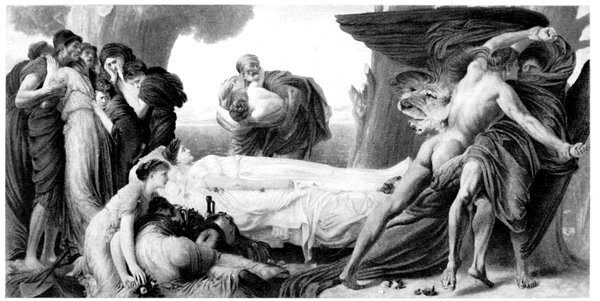
HERCULES’ STRUGGLE WITH DEATH FOR ALCESTIS
Lord Leighton
By permission of the Fine Art Society, Ltd.
225As Heracles departs in search of Alcestis’ tomb, the mourners
are seen approaching, led by Admetus, alone. A profound
change has come upon the king. His ignoble anger has
vanished: no word more is heard of the petulant reproach of
his parents: nothing of the old arrogant claim on life which
had blinded his soul and hardened his heart. Humbled
now, and remorseful, he sees that death were infinitely
preferable to life at the price that he has paid. Something
had given him sight as he stood beside Alcestis’ tomb. He
had tried to cast himself down to die beside her; but friends
had restrained him, and now as he stands before the home
that he dare not enter, he makes a pitiful confession—
“Friends, I account the fortune of my wife
Happier than mine, albeit it seems not so.
For nought of grief shall touch her any more,
And glorious rest she finds from many toils.
But I, unmeet to live, my doom outrun,
Shall drag out bitter days: I know it now.
How shall I bear to enter this my home?“
[29]
The bystanders try to persuade him to go in, but he lingers
through the beautiful choral ode that is raised in praise of
Alcestis. They sing of the worship and honour that will
be paid at her tomb as at a shrine; and as the long hymn
is drawing to a close, Heracles is seen to be returning,
leading a woman closely veiled. The king, standing in
quiet despair, utters no word of greeting to his guest, and
the Chorus wait in silent wonder for an explanation. A
strange awe falls upon them; and Heracles, beginning in
gentle gravity to reproach the king for want of confidence
in him, turns presently to the veiled figure at his side. Will
226the king take and guard this maid for him, until he shall
return from Thrace? She is a prize awarded him for great
toil, and Admetus will do well to care for her.
But the king recoils at the thought. How can he receive a
young and beautiful woman into his house without pain to
himself and shame to her? He protests that it is unthinkable,
and begs Heracles to take her elsewhere. She would
be a constant reminder of his grief, and an insult to the
memory of his wife. Until this moment he has hardly
glanced at the silent figure by the hero’s side, except to
notice that her rich vestments proclaim her young. But
something in her appearance seizes his attention; and
he proceeds, rapidly and in great agitation:
“But, woman, thou,
Whoso thou art, know that thy body’s stature
Is as Alcestis, and thy form as hers.
Ah me!—lead, for the Gods’ sake, from my sight
This woman!—Take not my captivity captive.
For as I look on her, methinks I see
My wife. She stirs my heart with turmoil: fountains
Of tears burst from mine eyes. O wretched I!
Now taste I first this grief’s full bitterness.“
[29]
It is Alcestis’ very self, won back from death as Apollo had
promised; but with the awful silence of the tomb still
upon her. Heracles places her hand in that of the reluctant
and incredulous king, while he draws aside her veil:
“Yea, guard her. Thou shalt call
The child of Zeus one day a noble guest.
Look on her, if in aught she seems to thee
Like to thy wife. Step forth from grief to bliss.“
[29]
Euripides: Medea
227
Only eighteen dramas are extant of the seventy-five
which Euripides is known to have written.
And an interesting small fact is that the two
earliest of these surviving dramas are the
Alcestis and the Medea, produced respectively in 438 B.C.
and 431 B.C. Each of the two has a woman for the
protagonist, and both have love for their central theme.
To that extent therefore they are similar, and represent
certain clear features of Euripidean drama as a whole.
We have already noted the poet’s interest in womanhood:
his keen and careful study of feminine character. He was
no less occupied with the influence of love in human life;
but on both themes he was clear-eyed and penetrative,
aspiring always to the ‘white star of truth.’ Therefore we
do not find in his drama a troop of faultless women, moving
in an atmosphere of romantic glamour; nor a treatment
of love which reveals only the more beautiful aspects of it.
He seems to have been content to acknowledge, as for
instance in the Alcestis and the lost Andromeda, that life’s
flowers do sometimes, given the right conditions, come to
fair fruition. But he saw how often they are warped and
blighted; and though he would not hide the grimmer
facts, he was always careful to seek and show the cause of
the aberration. Hence, though the truth of his presentation
is sometimes merciless, and may have given colour to
the contemporary gossip which called him a ‘woman-hater,’
one glance below the surface of his thought shows
him to have been inspired by a nobler chivalry than that
228which is content to veil the facts of life in romantic illusion.
So we find that although both the Alcestis and the Medea
are preoccupied with the theme of love, there is a vivid
contrast in the treatment of the theme, despite certain
resemblances between the two dramas. It is true that
both of the heroines are pre-eminent in devotion to the
men with whom they are mated; and that the hero in each
case moves on a plane from which he cannot reach the
height of his wife’s spirit. But whilst on the one hand
love takes possession of a gentle nature, and favoured by
every circumstance of character and environment triumphs
over death itself, in the case of Medea a wild soul spends
itself recklessly for the object of its love, beats impotently
against injustice, loses hold on sanity and sweet human ties,
and is transformed into an avenging fury.
The story of Medea belongs to the old Argo legend, which
was made into poetry by Apollonius Rhodius in the first
century before Christ, and by our own Victorian poet
Morris in The Life and Death of Jason.
Jason, the exiled heir to the throne of Iolchos, was reared by
the centaur Chiron. Arrived at manhood, he determined
to claim his right from his usurping uncle Pelias; and
travelling to Iolchos on foot, he presented himself before
the king minus a sandal. Now Pelias had been warned
against a man who should come to him with one foot bare;
and, moreover, he had no intention of yielding up the
throne to his nephew. He therefore cast about for some
means of ridding himself of Jason, and hit upon the plan
of sending him on a wild and dangerous quest—to seek and
bring the Golden Fleece from the barbarous land of Colchis.
Jason gladly undertook the task: gathered the Greek heroes
together and sailed with them in the good ship Argo.
229After a perilous voyage, the heroes arrived at Colchis, and
Jason made known their quest to the king Aeêtes. But
they soon found that they had no hope of success. Aeêtes
was false to them, made impossible conditions, and plotted
against their life. Disaster seemed imminent, when there
came a deliverance so glorious that it seemed like the
interposition of a god. It was the quick wit of a girl,
prompted by love. Medea, the young daughter of Aeêtes,
had seen and loved the brave Greek prince whom her
father now plotted to destroy. She was an ardent and
impulsive creature; and she determined to save Jason. By
the magic lore that she possessed, she secretly enabled him
to overcome the fire-breathing oxen, and the earth-sown
army that her father sent against him. Then, realizing
too late that she had incurred the unpitying rage of her
father, she fled at night from the palace, to take refuge
with the Greek heroes.
She kissed her bed, and her hands on the walls with loving caress
Lingered; she kissed the posts of the doors; and one long tress
She severed, and left it her bower within, for her mother to be
A memorial of maidenhood’s days, and with passionate voice moaned she.[30]
Under cover of the darkness, she led Jason to the forest-precinct
where the Fleece was hidden; and by her
charms she lulled the sleepless dragon that guarded it.
She even betrayed to him her brother Absyrtus, driven by
the danger of a horrible death for herself, her lover and
his comrades; and then, claiming from Jason a solemn
oath of marriage when they should come to Hellas, she
sailed with him on the Argo. Aeêtes pursued them in
230fierce wrath; and the gods, offended for the murder of
Absyrtus, vexed them with storms. But at length they
came to the island of Circe; and she, for the sake of her
kinship with Medea, purified them of the murder of
Absyrtus and set them on their way again. At Phæacia,
where they were driven for harbourage, Aeêtes overtook
them, threatening war with King Alcinous if he did not
yield up his fugitive daughter. It was then that the great
wise queen Arete pleaded for Medea in gentle charity:
“In madness she sinned at the first, when she gave him the charm that should tame
The bulls; and with wrong to amend that wrong,—Ay, oftimes the same
In our sinning we do!—she straightway essayed; and shrinking in fear
From her proud sire’s tyrannous wrath, she fled. Now the man, as I hear,
This Jason, is hound by mighty oaths which his own lips said,
When he pledged him to make her, his halls within, his wife true-wed.“
[30]
Alcinous yielded to his wife’s entreaties on one condition—that
Jason and Medea should be married forthwith; for
then he could return answer to Aeêtes that he would not
separate husband and wife. Thus the two were hurriedly
wedded; and sailed in safety from Phæacia, to encounter
many a terrible adventure before they reached Iolchos at
last, triumphing in the possession of the Fleece. They
gained great glory from their enterprise, but little else.
For Pelias would not yield the throne to Jason; and it
seemed to Medea that all she had wrought had been in
vain. She brooded over Jason’s wrongs, chafing at the
restraint imposed on her in her new life, and eager to
231strike for the kingship on his behalf. At last she evolved a
plan by which she thought Pelias might be removed from
their path, and the throne secured for Jason. Promising
the old king renewed youth by means of her enchantments,
she induced him to submit to death at the hands of his
daughters. Then, in the storm of indignation which arose
against her, she and Jason and their two young children
fled to Corinth.
So the legend runs to the point where Euripides takes it
up. In crude outline it is savage and incredible; and yet
it contains all the elements which in the hands of idealistic
poets have made a story of enthralling romantic beauty.
In the Medea, however, the poet has avoided so far as
might be both the barbarity of the legend and its potential
charm. He has treated only the final catastrophe—the
abandonment of Medea by Jason and her dreadful vengeance
upon him. And although he could not escape from the
data: although he is compelled to handle some of the most
barbarous of them, he has translated them from terms of
glimmering wonder and breathless excitement into the
language of reality. He has brought Medea out of the
region of myth, where she dwelt in eerie and tempestuous
beauty, into the stream of human existence. The marvellous
and the superhuman drop away, save for a fragment
or two in the framework of the Drama; and Medea becomes
simply a woman, struggling against her own wild heart and
the injustice of her oppressors.
The Drama opens with the monologue of Medea’s old
nurse, from which we learn all that is vital to an understanding
of the action. Jason has forsaken Medea and is
about to marry with Glaucé, the young daughter of Creon,
King of Corinth. Medea is sick with misery and is lying
232in the house prostrate on her bed. Two things the old
woman makes quite clear, as she stands talking outside:
that the chief cause of Medea’s grief is shame at her
betrayal; and that already the storm of passion is tending
toward madness. When an attendant comes in, bringing
Jason’s children back from their play, there is a clear hint
of the catastrophe. The man tells of a rumour that he has
heard: Creon has ordered the banishment of their mistress
and her boys. The nurse breaks into a wail of commiseration,
and then clearly states her fear for the effect of this
new wrong upon Medea’s mind. She sends the little ones
in before she speaks the dread she has that their mother
may lift her hand against their lives; and almost immediately
afterward the frenzied voice of Medea is heard, calling
bitter curses upon her unfathered children.
There gather gradually the ladies of Corinth who form the
Chorus. They are deeply sympathetic; and they give
pitying answers to the nurse’s tale; while within the house,
at intervals, Medea’s voice is heard, wailing her grief and
anger, and the old remorse that has reawakened for her
brother’s death.
“Virgin of Righteousness,
Virgin of hallowed Troth,
Ye marked me when with an oath
I bound him; mark no less
That oath’s end. Give me to see
Him and his bride, who sought
My grief when I wronged her not,
Broken in misery,
The scene is one of weird impressiveness. So far, Medea
has not appeared; but her cries within the house, the
appearance of her children, the indignant fidelity of the
233old servants, the beautiful lyrics of the Chorus, and, above
all, the knowledge we possess that another blow is about to
fall on her, produce a cumulative effect which makes the
moment of her entrance intensely dramatic. Yet she
begins her speech quietly, almost in apology for her former
unrestraint. She strives for self-control while she puts her
case before the Corinthian women and begs their help.
For a moment or two she succeeds, pathetically acknowledging
her foreign birth and the flaw it intrudes in the
legality of her marriage. But at this thought, emotion
sweeps over her again:
“...I dazzle where I stand,
The cup of all life shattered in my hand,
Longing to die—O friends! He, even he,
Whom to know well was all the world to me,
The man I loved, hath proved most evil.“
[31]
She pours out her heart to the listeners; and it is not a
mere selfish recital of her own sorrow. The brain that had
been clear and quick to save her lover in the extremity of
danger has not lost its power. She sees the base act of
Jason in its broad aspect, as a wrong to womankind; and
she rises from the contemplation of her personal suffering
to the thought that this, after all, is but one of the many
evils that subjection brings upon women. But the greatest
evil—the helpless creature goaded to crime by injustice—is
present to her at this moment only as a blind craving for
revenge. It will seize and carry her on to its culmination
as the sweetest thing that life now holds; but it will
finally reveal itself, since she cannot but face the truth, as
the last and deepest wrong, that has cancelled her humanity.
The light of that thought has not yet dawned; and will
not until the storm of passion has wrought sheer havoc.
234All her fervent nature is possessed by the idea of vengeance;
and seeing that her friends pity and sympathize, she
pledges them not to betray her. Their willing promise is
only just in time, for they are interrupted by the arrival of
the king, guarded by armed attendants whose very presence
is a menace. Creon is old, and has grown hard and
tyrannous with age. He has long desired a great match for
his only daughter, hoping to see his line established on the
throne of Corinth before his death. To him the marriage
with the Argonaut hero is not only a prudent step, likely
to bring him reflected glory; but a thing perfectly right
in itself, because perfectly legal. By the letter of the law,
which forbade a Greek to marry a ‘barbarian,’ Medea was
not Jason’s wife; and the letter of the law merely was of
concern to Creon. To him Medea was an uncivilized creature
from outland parts: a being without rights, who might
safely be ignored; and having won over Jason, the match
was arranged and the preliminary formalities concluded.
Not until a rumour reached him that Medea in her wrath
had solemnly cursed his child and him, did any thought
of her disturb him. Then, fearing that she might indeed
do his daughter some injury, or at the least might move
public opinion in her favour, he determined upon instant
banishment for her and her two young sons. Without a
word to soften or explain his action, he stands before Medea
now, and curtly orders her to prepare for departure.
The blow is so crushing that for a moment Medea seems to
sink under it; she can think of nothing but to ask what
crime of hers has merited this punishment. But when
Creon cynically replies that there has been no crime, and
that the measure is one of precaution merely, to guard
himself against her reputation for magic-lore, she rallies her
235wit and meets him on his own ground. Half ironically, she
repudiates the damning possession of brains, and bids him
set his mind at rest.
“’Tis not the first nor second time, O King,
That fame hath hurt me....
Come unto fools with knowledge of new things,
They deem it vanity, not knowledge....
Ah, I am not so wondrous wise!—And now,
To thee, I am terrible! What fearest thou?
What dire deed? Do I tread so proud a path—
Fear me not thou!—that I should brave the wrath
Creon sees that she is trying to placate him, and harshly
repeats his decree. He even threatens her, when she continues
her entreaties, with force from his soldiery; and Medea,
shrinking in horror from the thought of personal violence,
instantly ceases her petition. She pretends to yield; and
in feigned humility, begs on her knees for one day’s respite.
Creon, partly deceived, and entirely convinced that she
can do no harm in so short a time, reluctantly consents.
But he has hardly gone when Medea breaks into a torrent
of speech which, in its fierce exultation over Creon, its wild
leap to the height of daring and its rallying cry to her own
spirit, comes very near to madness. All the shapeless
thoughts of vengeance on which she had brooded spring
into vivid life as she rapidly cons now this plot, now that,
to reach her end. Of the end itself there can be no doubt;
she must kill these three—the king, and Jason and his
bride—in the few hours left to her. And for this she will
need every resource of strategy and courage.
“Awake thee now, Medea! Whatso plot
Thou hast, or cunning, strive and falter not.
236On to the peril-point! Now comes the strain
Of daring. Shall they trample thee again?“
[31]
No wonder that the Chorus sing, as she rushes into the
house, of a strange reversal of all the order of nature; of
woman made terrible because man has forgotten God.
They take up the story of Medea’s broken life: of the
wonder and the pity of it: of her distant home: of her
surpassing love for Jason, and of her betrayal. In the
beauty and grace of the songs the emotional strain is
lightened: but they have a further purpose. For while
they tell the old story over in tender phrases, Jason himself
enters and Medea again comes out of the house. The two
stand face to face at last and the crux of the drama is
reached. Jason is the first to speak; and one feels all the
spirit of the man in his opening words—cold, ambitious,
prudent, with ideals faded and every generous emotion
dead. He protests that he has acted from motives of
policy and considerations of their best interest: for the
welfare of Medea and their children as well as for himself.
The new marriage was the only way, in a land to which they
were strangers, to secure a home for them all, and princely
connexions for his sons. But Medea has spoiled everything
by her ungovernable anger: and he has come, since
nothing else is possible now, to make provision for the
children in their exile.
The speech is clear, terse, moderate in tone, and pitilessly
logical from Jason’s point of view. From that point, too,
it is not unkind: he wishes to do what may be done to
soften their lot. But to the woman who loves him his
words are a mere blur of sound, the logic meaningless, the
untroubled manner a thing of contempt. In tone and look
and gesture one fact is certain—that her husband has
237ceased to love her, and is content to cast her off. It has
clamoured in her ears while he spoke, drowning every other
sound; and when she replies it is that which prompts her.
It inspires her great indictment—the case for the woman
against injustice throughout all time—and it evokes a
shuddering recoil from baseness which she feels to be
literally a pollution.
“Evil—most Evil ...
I will begin with that, ‘twixt me and thee,
That first befell. I saved thee. I saved thee—
... And hast thou then
Accepted all—O evil yet again!—
And cast me off and taken for thy bride
Another? And with children at thy side!
... Is sworn faith so low
And weak a thing? I understand it not.
Are the old gods dead? Are the old laws forgot,
And new laws made? ...
... O great God, shall gold withal
Bear thy clear mark, to sift the base and fine,
And o’er man’s living visage runs no sign
To show the lie within, ere all too late?“
[31]
Jason’s anger is stung by her denunciation, but his purpose
is quite unmoved. He flings a veiled insult at her
love; and as he elaborates the reasons for his action, with
no little skill and plausibility, we feel that with every
word the conflict becomes more deadly. In apparent
good faith, but with intolerable effrontery to the injured
woman, he claims to have repaid that old debt, if
indeed it were a debt. He has given her a home in an
ordered country and her name has been linked in the
glory of his. As to the marriage with Glaucé—with a
sneer at the bare idea of sentiment—the affair is a
238bargain, with consideration given and received on each
side. Let Medea look at the matter for one instant with
the eyes of reason, and she herself will acknowledge that he
has acted wisely.
But the very root of the tragedy lay there. Medea could
no more detach herself from the emotion that possessed
her than Jason could revive the tenderness that filled him
when he lifted the sweet wild fugitive on board the Argo.
So they stand, typifying the eternal struggle between the
passionate heart and the arrogant brain; and striking at
each other in baffled rage across the gulf between them.
Jason makes one last offer of help, but it is vehemently
refused, and with a final thrust at Medea’s savagery, he
leaves her. When he has gone, the inevitable reaction
comes. The Chorus, interpreting her mood, sing musingly
of the pains of exile, and of her lonely state. She realizes
that she has flung away her only chance of help, and she
sees herself in a few hours expelled from Corinth without
one friend to shelter her. Despair is settling upon her
when a curious incident occurs, suddenly reviving hope and
making the path clear for her revenge. It is the arrival of
Ægeus, King of Athens. He is travelling back from
Apollo’s shrine at Delphi, where he has been to renew an
old petition that the god would give him children. Medea,
thinking rapidly, questions him of his errand. She sees a
possibility of succour; and putting all her wrongs before
him, she begs him to give her refuge at Athens. He shall
not fail of a reward, for she has magic arts which will secure
to him his long desire for children. Ægeus is indignant
at her wrongs, and promises to succour her if she
comes to him; but knowing what she is about to do,
she cunningly extorts an oath from him. He gives it
willingly, and as he departs Medea breaks into a cry of
exultation:
“God, and God’s Justice, and ye blinding Skies,
At last the victory dawneth!“
[31]
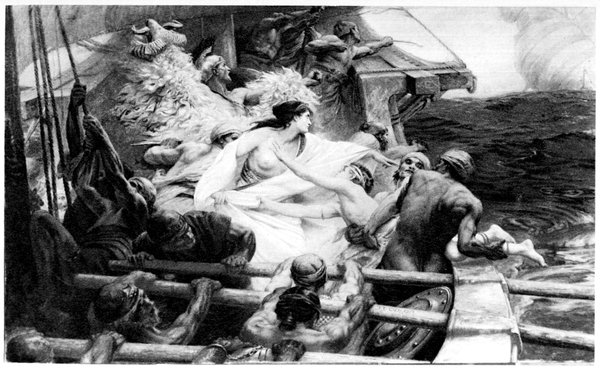
MEDEA & ABSYRTUS
Herbert Draper
By permission of the Corporation Art Gallery of Bradford
239Quickly she lays her plan. She will recall Jason, feign
repentance, and send the children to the bride with gifts—marvellous
raiment and jewels which will hide under their
beauty an agonizing death for Glaucé. But that done—she
pauses in horror, the sweetness of revenge dashed by
the thought of what must follow. Then, she must lift her
hand to slay her children, before they can be caught and
killed for their mother’s crime. There is a short altercation
with the friendly women about her, who make a futile
effort to restrain her. But brushing aside their remonstrance,
she sends the nurse for Jason, and in a scene which
vibrates with dramatic power, she pretends to make peace
with him, and puts the frightful revenge in motion. Jason,
completely deceived, promises that the children shall be
taken to Glaucé, to present their gifts and beg for leave to
stay in Corinth. But twice, as the little ones stand waiting,
the motherhood in Medea rebels against the fury that is
driving her. Tears that she cannot check rush into her
eyes, and she almost forgets her rôle, as she clasps them to
her.
“Shall it be
A long time more, my children, that ye live
To reach to me those dear, dear arms? ... Forgive.“
[31]
And again when Jason, softened by her submission, is
promising to lead them up to an honoured manhood, a
sudden movement of Medea arrests him. He cannot
understand her grief, and the strangeness of her manner;
240and asks her if she doubts that he will act in good faith
toward their children.
Medea.
I was their mother! When I heard thy prayer
Of long life for them, there swept
over me
A horror, wondering how these things shall be.[31]
But the gentler mood passes, and when Jason, with characteristic
canniness, counsels her not to send such precious
gifts to his bride, the spirit of vengeance has regained
possession of her soul. She overrules him, and Jason leads
the children to the princess, carrying in their innocent
hands the weapon that will slay her. Not until they are
gone does Medea realize fully what the next step must be;
and the realization brings agony. She waits for their
return in a storm of emotion: suspense that almost stops
the beating of her heart: hideous hope that her plot has
succeeded and that Glaucé even now is dying from the
poison; and ghastly fear that her children have been taken
for the deed. But when they return at last, in unconscious
gladness that the great lady has been kind to them, it is
something more awful still that robs their mother of power
of utterance. The children’s tutor is amazed at the grief
that he sees is racking her, and asks its cause.
Medea.
For bitter need, Old Man! The gods have willed,
And mine own evil mind, that
this should come.[31]
And as the man goes in, leaving her alone with her boys, a
poignant scene follows in which every instinct of her nature
struggles against her wrath. Their sweet young faces stir
the tenderness that has hitherto been bound within her; and
as it floods her heart it seems for a few moments to sweep
away her evil purpose. But it only returns in added
strength, and as her soul writhes in the conflict, reason
241totters, and she implores the vengeance within, as a living
and implacable foe, to spare her babes. Backward and
forward she sways, driven by hatred and love, until the
scale is turned at last by the thought of her own irrevocable
act. Glaucé, even at this moment, is dying from the
poison that she has sent.
“Too late, too late!
By all Hell’s living agonies of hate,
They shall not take my little ones alive
To make their mock with! Howso’er I strive
The thing is doomed....
Oh, darling hand! Oh, darling mouth, and eye,
And royal mien, and bright brave faces clear,
May you be blessèd, but not here! What here
Was yours, your father stole....
... I am broken by the wings
Of evil.... Yea, I know to what bad things
I go, but louder than all thought doth cry
Anger, which maketh man’s worst misery.“
[31]
But even yet she cannot strike: one thing more is needed
to nerve her hand, and it comes only too soon. A messenger
is seen flying toward them from the palace in frantic haste.
As he comes within hail, he shouts to Medea to flee—both
Creon and the princess lie dead from the effects of her
poisoned gift, and she has not a moment to lose. Her
own life will surely be demanded for the crime. Medea
remains immovable, smiling in awful joy at the news. She
makes the man relate every detail of the ghastly scene in
the palace; and for just so long as the story takes to tell,
she clasps revenge complete and satisfying. But a moment
later the thing has shrivelled in her hand; for there is now
no hope to save her children.
242“Oh, up, and get thine armour on,
My heart!...
Take up thy sword, O poor right hand of mine,
Thy sword: then onward to the thin-drawn line
Where life turns agony.”
[31]
She goes into the house; and a moment later the shrieks of
the children are heard. They have hardly ceased when
Jason rushes in, bent on carrying off his sons before the
king’s avengers can capture them. A woman warns him of
what is passing within; and as the agonized father bursts
open the door of the house, Medea appears on the roof, in
the dragon-chariot of the Sun, with the poor dead bodies
lying at her feet. There is something weird in this touch
of the supernatural; but there is something symbolic too. For
Medea is a woman no longer: with her own hand, driven
by foul wrong and an untamed heart, she has cast humanity
away.
We need not follow to the end the last clash of the two
bitter spirits. Jason pleads piteously for one poor boon:
“Give me the dead to weep and make their grave.” But
the fury that has smitten him is inexorable.
“Never! Myself will lay them in a still
Green sepulchre....
... For thee, behold, death draweth on,
Evil and lonely, like thine heart: the hands
Of thine own Argo, rotting where she stands,
Shall smite thine head in twain, and bitter be
To the last end thy memories of me.“
[31]
Euripides: Phædra
243
The Hippolytus of Euripides, to which we turn for
the story of Phædra, is frequently called the
earliest love-tragedy in European literature.
That is to say, it is the first to deal fully and
frankly with the power of love toward tragic issues. This
can hardly be said about the Medea, for that drama is only
the last incident of a story wherein love has been changed
to hatred; and the motive is revenge. But in the Hippolytus
the story is unfolded from its inception; and Phædra’s
passion is found to be the force that moves the whole action
of the tragedy. This fact has a peculiar attraction for the
modern mind; but the drama has other claims upon us
too. First, for its sheer beauty, as poetry and as dramatic
art of a special type; then, for its accurate study of
character, three people at least gripping our interest as
complete and convincing human creatures; and again, for
its lofty tone and a reflective element which, though
characteristically original, is calm and clear. But the most
wonderful fact of all is the surprising contrast between the
nature of the theme and the austere beauty of the drama
which has been built upon it.
The crude facts of the story are almost repulsive on the
face of them. Phædra, the young wife of Theseus, King of
Athens and Trozen, had fallen in love with her husband’s
illegitimate son Hippolytus. That is the initial situation;
and the further data of the old Attic legend do not soften
it. For we know that Phædra’s love was unrequited, a
fact which, with curious unreason, seems to accuse her;
244and we know too that when her love was betrayed to
Hippolytus, she took her own life in shame and fear, first
making a false charge against him which she knew would
bring upon him the punishment of death.
Such, in harsh outline, is the story of unhappy love and
wild impulse which has been made by this poet who was
before all things a seeker of truth, into a work of supreme
spiritual beauty. More wonderful still, Phædra, who by conventional
canons would seem to have forfeited all claim to
respect or sympathy, is found to be a woman of sweet and
gentle purity, cruelly betrayed by forces without and
within, and driven by desperation to a frantic attempt to
save her honour.
The means to such an end are interesting, although behind
them all lies the explanation of them all—the poet’s higher
and broader perception of truth. He has seen the passion
which ruled Phædra as a great world-force, an elemental
power which could neither be escaped nor overcome. This
power is personified as Aphrodite or Cypris, goddess of
love; and she is conceived as the mortal enemy of Hippolytus,
because he has scorned her in his spiritual pride
and refused her her need of worship.
The key to the tragedy lies in this conception of Cypris,
and in the mystical, ascetic spirit of Hippolytus against
which she has set her offended godhead. They represent
eternally opposing forces, and warfare between them is
inevitable and deadly. For that reason, the opening
monologue of the Drama is of great importance. The
scene is placed before the castle of Theseus at Trozen. A
statue of a goddess stands on either side—that of Artemis,
chaste Moon-goddess, on the one hand, decked with
flowers and carefully tended; and on the other hand, bare
245and unhonoured, is the statue of Aphrodite. While beside
the latter, musing in evident anger, is the gleaming form
of the goddess herself. We learn the cause of her anger as
she speaks. She is grieved on account of Hippolytus, who
in his excessive devotion to Artemis, despises Aphrodite
and looks upon love as a thing unclean. His arrogance and
neglect are an unbearable insult, and she has determined to
punish him, swiftly and without mercy. She has already
prepared the pitfall, long ago in Athens, when Hippolytus
came to be solemnly initiated into the Mysteries.
“And Phædra there, his father’s Queen high-born,
Saw him, and, as she saw, her heart was torn
With great love, by the working of my will.
And for his sake, long since, on Pallas’ hill,
Deep in the rock, that love no more might roam,
She built a shrine, and named it Love-at-home:
And the rock held it, but its face alway
Seeks Trozên o’er the seas.“
[32]
Thus Phædra tried to exorcise her passion; but there came
a time when Theseus, to expiate some sin, retired to
Trozen with his queen. There, meeting the young prince
daily, love reawakened; and at the opening of the tragedy
it is secretly consuming her very life.
And here that grievous and amazéd queen,
Wounded and wondering, with ne’er a word,
Wastes slowly; and her secret none hath heard
Now Aphrodite’s hour has come, and Phædra is the weapon
with which she will strike. The young queen’s vigilant
honour, proud and enduring, shall be overthrown, by a
broken word uttered in weakness; and she shall die,
dragging down Hippolytus with her. Even while the
246goddess is invoking the prince’s doom, there are cheery
distant sounds of the returning hunt; and the voice of
Hippolytus raised above the rest in a hymn to Artemis.
Aphrodite lingers an instant longer, and the menace of her
final words shatters the blithe harmony that is approaching:
“Little he knows that Hell’s gates opened are,
And this his last look on the great Day-star!“
[32]
The next moment the goddess has vanished, and Hippolytus
leads in his troop of huntsmen, laden with spoil and bearing
fresh-culled field flowers for the honour of the goddess of
all wild things. Straight to the statue of Artemis goes the
prince, and standing in an attitude of supplication, he
proffers a wreath from the uncropped meadows that she
loves. There is in his prayer a curious note of exaltation.
Young, brave and fair, there is something at once beautiful
and sinister in his claim to perfect purity: his naïve
assumption that he alone of all men is worthy to worship
the goddess: in the ascetic vow he takes; and the mystical
touches, hinting of personal converse with the deity. We
vaguely feel that there is a shade of excess in it; that the
limit of holy confidence has been passed; and that, with
all its intensity, there is something narrow and hard in his
devotion. A pious old huntsman has to remind him that
he has not paid service at the second shrine; when, with a
perfunctory salute to the statue of Aphrodite, Hippolytus
and his train go into the castle.
There follows a lovely ode by the Chorus, which prepares
for the entrance of Phædra. They tell of a mysterious
sickness that has fallen on the queen, and of their fears for
her life.
“For three long days she hath lain forlorn,
Her lips untainted of flesh or corn,
247For that secret sorrow beyond allayment,
That steers to the far sad shore of the dead.“
[32]
Many a surmise they ponder, to account for the strange
malady: perhaps some god is angry with the queen for
stinted rites: or the absent king her husband is unfaithful:
or she has had ill tidings from her Cretan home. Their
musing brings no light to the problem; but its purpose is
served, for when Phædra is presently borne out on her
couch, we are prepared to see a being in whom vitality is
burning low; but in whom suffering is overshone by
stainless honour and an unconquerable will. She is attended
by her maids, and by an old nurse whose delineation is
wonderful. She is one of the humble characters whom
Euripides drew so often: whose sterling qualities he seems
to delight in, but whose limitation and error he puts in
too, with absolute fidelity. Like Medea’s nurse, she probably
came with her mistress from her maiden home; and
she has grown old in faithful service. She has the tenderness
of a mother for the young queen; but age has made
her fretful, and slavery has hardened the fibre of her mind.
With pathetic solicitude, she is yet inclined to be querulous
at the feverish caprices of her charge. Moreover, she
divines that there is something weighing upon her mistress
which Phædra will not reveal, even to her; and she is hurt
at the lack of confidence.
As the queen’s languid voice follows the wandering thought
that has almost escaped control, the old woman grows
impatient. She cannot comprehend the yearning flight of
fancy which, in phrases of wild beauty, betrays its longing
for escape: to flee to the mountain spaces and the woods
and fields, and thread the mazes of the pines with arrow
and spear, like Artemis herself.
248“Oh for a deep and dewy spring,
With runlets cold to draw and drink!
And a great meadow blossoming,
Long-grassed, and poplars in a ring,
To rest me by the brink!“
[32]
There is a significance in the half-conscious utterances
which lies very near the surface of the words: the fair soul
unwittingly hinting its secret in delirium as lovely as itself.
Presently her mind grows clear again, and she starts in fear
of what she may have betrayed.
“What have I said? Woe’s me! And where
Gone straying from my wholesome mind?
What? Did I fall in some god’s snare?
Nurse, veil my head again, and blind
Mine eyes! There is a tear behind
That lash. Oh, I am sick with shame!“
[32]
The sight of her anguish and humiliation stings the nurse
to another protest. She had not possessed the clue to
Phædra’s raving, and the sudden access of shame is inexplicable.
She longs to soothe and help, out of her deep and
genuine affection; and she has also some touch of quite
human curiosity which she cannot restrain. But every
way she is baffled by the silence of the queen. She feels
that she is slighted, but much more she feels the cruelty of
unsuccoured pain to one whom she dearly loves.
The thought that Phædra is surely dying from this
mysterious malady flings her down in supplication; and
she pours out a torrent of entreaties until we feel that the
queen is growing exhausted by them. But there is no sign
given until the nurse, reminding her mistress of the children
whom she will leave unprotected by her death, speaks of
Theseus’ bastard son who may disinherit them, and lets fall
249his name, Hippolytus. The word brings a cry from
Phædra at last; and then, reluctantly, in slow and broken
phrases, all the secret is wrung from her.
The old woman now is horrified and remorseful at her
own persistence. Terror seizes her, and an unreasoning
sense that her mistress must perforce yield to dishonour.
Phædra’s chastity rises indignantly at so base a thought,
giving her strength to face the women about her with a
magnificent defence of her honour. She begins almost
hesitatingly, on a note of sadness for all the sum of human
misery; but she gathers courage as the story is unfolded
and rises to sublimity at last:
“Come, I will show thee how my spirit hath moved.
When the first stab came, and I knew I loved,
I cast about how best to face mine ill.
And the first thought that came, was to be still
And hide my sickness....
After that
I would my madness bravely bear, and try
To conquer by mine own heart’s purity.
My third mind, when these two availed me naught
To quell love, was to die—the best, best thought—
Gainsay me not—of all that men can say!
I would not have mine honour hidden away....
Nay,
Friends, ‘tis for this I die....
‘Tis written, one way is there, one, to win
This life’s race, could man keep it from his birth,
A true clean spirit.“
[32]
But while the queen is speaking, winning a painful way
upward to her spirit’s height, the nurse is lagging after her
on a much lower path. She has rallied from the first
shock, when Phædra’s confession had driven her to mere
panic; and is now revolving the matter in a mind where
250perception has been dimmed by age and the moral fibre
coarsened by long servility. Calling up all her store of
doubtful experience and worldly wisdom, she opposes every
cunning and plausible argument to Phædra’s virtue. Can
her mistress not see that she is visibly caught in the snare
of Cypris? Of what use is it to struggle against so mighty
a goddess? No human heart can resist the power of love;
and it is wiser to yield at once than to be broken by
Aphrodite’s anger.
Phædra listens patiently, seeing that the faithful old
creature is prompted by real devotion; and her reply has
more of pity than of anger in it, for the crooked counsel.
“Oh this it is hath flung to dogs and birds
Men’s lives and homes and cities—fair false words!
O why speak things to please our ears? We crave
Not that. ‘Tis honour, honour, we must save!“
[32]
But when the nurse, irritated, flings a rank word at this love
that she cannot comprehend, Phædra’s anger blazes in a
vehement rebuke.
“Shame on thee! Lock those lips, and ne’er again
Let word nor thought so foul have harbour there!“
[32]
The old woman is not silenced, however: she merely
changes her tactics. Will not the queen trust to her?
She knows of love-philtres and salves that will cure her
passion without fear of shame. Phædra is growing weary
of the contest; and at last, when endurance is strained to
breaking, she yields on a point which seems quite innocent
and harmless. The nurse may fetch the potion of which
she speaks; only—and on this she lays pathetic stress—no
word of her secret must be breathed to the prince. There
is a soothing, half evasive reply from the nurse: a muttered
251prayer aside to Cypris which has something ominous in it;
and the old servant goes out to wreck the honour of her
mistress in a foolish attempt to serve her. Hardly has she
gone when, above the song which the women of the Chorus
have taken up, Phædra catches the deep tones of an
angry voice within the palace. She springs to her feet,
every nerve tingling with apprehension; and calling to
the singers for silence she bends her ear to the great door.
A cry escapes her:
“Oh, misery!
O God, that such a thing should fall on me!“
[32]
It is the voice of Hippolytus which she can hear, raging at
her nurse in immeasurable scorn, for something that has
been asked of him. As each brutal epithet falls, Phædra,
in a trance of horror and shame repeats it to the listening
women. Then she shrinks aside, as Hippolytus bursts out
of the castle, the nurse at his heels, frantically entreating
him to hold his peace. By no direct word does he acknowledge
Phædra’s presence; and she, with every shred of
self-respect gone, cowers apart as though she were indeed
guilty of the foulness he imputes to her. But in noisy
indignation, with every word barbed for the trembling
queen, he raves against the nurse, against the whole of
womankind, and love and marriage, ending by a threat to
reveal the story to Theseus upon his return. His anger is
just; but in the hardness of youth and the bitterness of a
narrow spirit it is savage, merciless and all too prompt.
Blind to everything but his own wounded pride, he cannot
see that Phædra has been cruelly betrayed by the meddling
zeal of her servant; and he heaps insult upon her until
her sensitive soul lies prostrate—a thing that seems even to
herself as black as he believes it. All through the tirade
252she, who is the central figure in this extraordinary scene,
takes no part in it: she remains mute, as though literally
smitten dumb with shame, until Hippolytus rushes out.
Then she sinks to the ground, sobbing:
“And, this thing, O my God,
And thou, sweet Sunlight, is but my desert!
I cannot fly before the avenging rod
Falls, cannot hide my hurt.“
[32]
Some of the women try to comfort her, and raising her
eyes as they speak, she catches sight of the figure of the
nurse. She springs from the ground, a wave of anger
sweeping away her weakness:
“O vilest of the vile, O murderess heart
To them that loved thee, hast thou played thy part?
Am I enough trod down?“
[32]
The old woman is deeply contrite for the wrong that she
has done; but garrulous and plausible to the last, she
pleads her love as an excuse, and claims that had her plan
succeeded she would have been praised for what she now is
blamed. Phædra’s wrath abates a little after its first
uncontrolled outburst: she cannot long be angry with one
so old and lowly; and besides, there are other, darker
things to be thought about and done. But when the
nurse, deceived by her calmness, tries to broach some other
scheme, the queen dismisses her peremptorily. She will
henceforth guide her own affairs, she says; and we know
she means that there remains only one thing for her to do.
The old woman goes sorrowfully away, and Phædra is left
to face the thought of her intolerable humiliation, of the
threatened exposure to her husband, and of the stain upon
her children. As reflection brings back the assurance that
253she is innocent, despite all, it does but increase her anguish
at the thought of dishonour, and stir her to frenzy against
Hippolytus. She is resolved to die: that she sees to be
inevitable now. But how save her fair name, and the
honour of her young children, and the fame of her dear old
Cretan home? How secure to herself, in spite of false
appearances, the innocence that is hers by virtue of every
act and thought of her life? Beating backward and
forward in the narrow circle of shame and fear, the poor
baffled mind can only see one path, crooked and dark, to
the thing she craves for. It is the way of a lie—a false
charge against Hippolytus. It will mean the death of a
good man: that she knows—and rejoices in—so completely
are truth and justice shrivelled in the monstrous injustice
that she is suffering.
“... But now, yea, even while I reel
And falter, one poor hope, as hope now is,
I clutch at in this coil of miseries;
To save some honour for my children’s sake:
Yea, for myself some fragment, though things break
In ruin around me. Nay, I will not shame
The old proud Cretan castle whence I came.
I will not cower before King Theseus’ eyes,
Abased, for want of one life’s sacrifice....
Yet, dying, shall I die another’s bane!
He shall not stand so proud where I have lain
Bent in the dust! Oh, he shall stoop to share
The life I live in, and learn mercy there!”
[32]
She goes in, and the Chorus break into a song of foreboding.
A few minutes later there are cries of alarm within the
castle, the sound of hurrying feet and voices calling to
come and help the queen. Then there are ejaculations of
pity: a sudden, ominous silence, and again another voice—“Let
254it lie straight.” Phædra is dead by her own
hand.
We must pass quickly over the fate of Hippolytus, though
that is really the crisis of the tragedy. Hardly had the
poor body of Phædra been composed upon a bier than
Theseus himself was announced, returning garlanded and
joyful from a visit to the oracle of some god. Met by the
news of his wife’s death, he tore off all the signs of joy that
he was wearing and threw himself beside her in bitter
lamentation. A little tablet hanging from her wrist
caught his eye, and believing it to be some dying wish, he
gently disengaged it. It was the false charge against
Hippolytus; and as the king read, his brow darkened with
terrible anger. The pitiful figure before him seemed to
claim swift and terrible vengeance; and Theseus uttered
an awful curse against his son. Calling upon the god
Poseidon to ratify an ancient promise, he demanded instant
death for Hippolytus. The petition was uttered rashly, in
anger and grief; and Theseus himself hardly dreamed that
it would be fulfilled; but the answer came with dreadful
promptitude. There was one stormy scene between father
and son; and Hippolytus, pleading in vain for mercy, went
out to banishment. But Poseidon in his far sea-caves had
heard Theseus’ invocation; and as the young prince urged
his chariot along the shore, a mighty wave, crested by a
fierce sea-monster, rolled destruction on him. Hurled
from his chariot, and dragged at the heels of the maddened
horses, Hippolytus was barely saved alive by his attendants.
They carried him back to the castle, and brought him into
the presence of the king, wounded and dying. But before
life closed for him he was gloriously vindicated, and the
255tragedy ends, as it began, with the appearance of a goddess.
It is not Aphrodite now, however. She has done her
worst with the two young lives she has chosen to despoil;
and now Artemis will justify their innocence and leave
their memory clean and sweet.
Artemis.
For this I came, to show how high
And clean was thy son’s heart, that he
may die
Honoured of men; aye, and to tell no less
The frenzy, or in some sort
the nobleness
Of thy dead wife.[32]
Euripides: Iphigenia
256
We turn back to the Trojan legend now, and
to two Euripidean plays which in some
sense round off the Orestean story. We had
to leave that story at a ragged edge—the
murder of Clytemnestra by her son Orestes in revenge for
the death of Agamemnon. We could not go on to the third
drama of the Æschylean trilogy, to follow the unhappy youth
as he fled in remorse to the oracle of Apollo at Delphi, and
thence to Athens, seeking to appease his mother’s Furies.
But if we had done so we should have found the whole
theme brought to a calm and beautiful conclusion: Orestes
cleansed by suffering and set free from guilt by Athena;
and the avenging Furies changed into Spirits of Mercy.
Euripides, however, who took so many subjects for his
drama from the Trojan cycle and always gave them new
significance, in this case chose variants of the legend and
wove them into a story which was entirely fresh. So that the
Iphigenia in Tauris, with which we are chiefly concerned now,
shows Orestes still fleeing before the Erinnyes; and carries
the tale to another and much more exciting conclusion.
Indeed, the peculiar charm of this tragedy is that it is not
really tragedy at all, but a thrilling adventure-play. It
reminds us of the Odyssey, with its flavour of the sea, the
wistful note that haunts it and its spice of physical peril;
only, this is the work of a poet who adds high dramatic
values to the delight of the story, with a lyric note of
enchanting beauty, and penetrating thought.
Characteristically, when Euripides took up this part of the
257Orestean legend, it was not so much the man Orestes in
whom he was interested, as the woman Iphigenia; with
the result that we have two dramas called by her name
and in which she is the protagonist. Both were produced
late in the poet’s life, the Iphigenia in Aulis being probably
his last work. It contains the earlier part of the heroine’s
story—the sacrifice of the virgin-martyr at Aulis; and the
great new feature of it, her rescue by Artemis just as the
knife was falling to her throat, was perhaps the poet’s own
invention. There is no hint of it in Æschylus. To
Clytemnestra, the murder of her first-born child Iphigenia
was the crime which turned her life to bitterness and
armed her against Agamemnon. He had beguiled her to
send the child—for she was but a mere girl—to Aulis, for
marriage with the splendid young hero Achilles. And then,
at the bidding of a soothsayer, he had ruthlessly slain his
daughter on the altar of Artemis; and sailed away to
Troy.
Those are the facts at the heart of the mystery which is
Clytemnestra; but when we come to the Iphigenia in
Aulis we find some different data and a far different interpretation.
Agamemnon there is almost pitiably human,
driven by complex motives first to consent to Iphigenia’s
death, then to recant in horror, and finally to yield to
forces which he could not control. Iphigenia, too, is made
at once nobler and more tragic in the idea of a willing
sacrifice—giving herself up, after the first shock of terror,
to die freely for her country’s good. And in her rescue by
the goddess there is added an element of marvel and
mystery, which is at the same time a protest against a form
of religion so inhuman.
The Iphigenia in Tauris opens at a period many years later.
258Troy had fallen. Agamemnon and Clytemnestra were both
dead in the manner we know of; and Orestes was a fugitive,
seeking through many lands to expiate the crime of mother-murder.
There had been laid upon him at last, as the only
means to peace, the command of Apollo to make his way
to the savage land of the Tauri. He was to seize and
bring from the temple of Artemis there a certain statue of
the goddess which had fallen from heaven long before, and
which the people of the land were dishonouring by human
sacrifice. Every stranger cast upon their shores was slain
at the shrine of the goddess; and Orestes ran the risk of
almost certain death in making the venture. But he had
a solemn promise from Apollo; and the reward would be
sweet indeed. He would be cleansed of the crime, and set
free from these haunting shapes of remorse which sometimes
drove him to madness. Moreover, he would rid the name
of Hellas from the stain which lay on its religion through
the barbarous practices of the Tauri. So he and his
devoted comrade Pylades sailed for those inhospitable
waters.
Through the Clashing Rocks they burst:
They passed by the Cape unsleeping
Of Phineus’ sons accurst;
They ran by the starlit bay
Upon magic surges sweeping,
Where folk on the waves astray
Have seen, through the gleaming grey,
Ring behind ring, men say,
The dance of the old Sea’s daughters.[33]
But Destiny was guiding them to something stranger than
they had either hoped or dreaded. For this wild land,
fiercely guarded from approach by the Rocky Gateway of
the Symplêgades, was the country to which Artemis had
259carried Iphigenia from the altar in Aulis. And in the
temple where they must seek the sacred statue, the daughter
of Agamemnon was even now a priestess.
The years had passed wearily since Iphigenia first found
herself a captive in Tauris. Completely shut off from the
world by the sea which foamed round that desolate coast,
no word ever came to her from her home in Argos; and
she could make no sign to the friends who believed her dead
long since. She hated this savage people, and Thoas their
king, and the hideous sacrifices at which she had to perform
the cleansing rite. Sometimes she would grow sick at
their brutality, and wild with loneliness and longing to
escape. Then sceptical thoughts would come about the
deity who could accept such worship; and it would seem
to her better to have died at Aulis than to have been saved
for such slow misery. At other times she would brood over
her short sweet girlhood and its bitter ending, gone
irrevocably from the moment of her father’s fraud; and
bitterness would overwhelm her against Agamemnon, and
the Seer who counselled him, and the chieftains who
persuaded him; but above all against Helen, for whose
sake the war was made.
So youth stole away, taking with it, as Iphigenia sadly
thought, all the high things that inspire a fair young soul—the
shining ideal, the simple and ardent faith, the generous
emotion that leaps to sympathy and service. And at the
moment of the opening of the play, when the ship that
bears Orestes is being run ashore at Tauris, Iphigenia stands
before her temple feeling hard and hopeless, dispossessed of
all that is dear in life, and with every illusion long since
fled.
It is early morning, and Iphigenia has just emerged from
260the temple. There are a few lines of formal exposition:
an involuntary cry of disgust at the blood-stained altar
that is insulting the eye of day; and then a flow of troubled
speech.
“Ah me!
But what dark dreams, thou clear and morning sky
I have to tell thee, can that bring them ease!“
[33]
In the night that has just passed, she had dreamed of her
home in Argos. She seemed to lie asleep there, with her
maids around her, when suddenly an earthquake shook the
palace; and running out of doors, she saw the great building
reel and fall. Only one pillar remained; and as she
watched it, she saw that brown hair waved about its head,
and she heard it speak with a human voice. Then, in the
strange confusion of dreams, she found herself fulfilling the
office that she bears here in Tauris; and she washed the
pillar clean for death, as it was her duty to wash the victims
for the sacrifice.
With pathetic readiness, Iphigenia has accepted the dream
as an evil omen. The pillar of her father’s house must
mean his son Orestes, whom she left a child in Argos all
those years ago. Those whom she cleanses are doomed to
die. What can the dream mean, therefore, save that her
brother is dead? The conviction is so strong upon her
that she at once decides to prepare the funeral rite.
“Therefore to my dead brother will I pour
Such sacrifice, I on this bitter shore
And he beyond great seas, as still I may.“
[33]
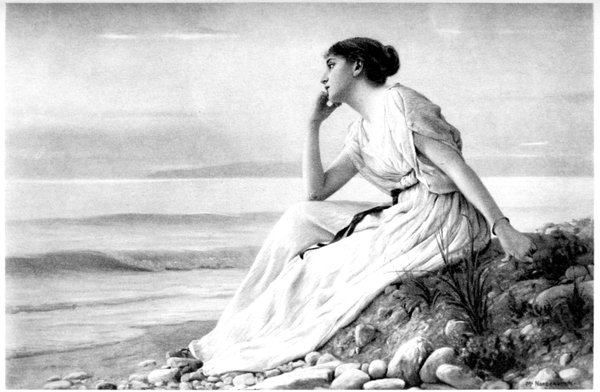
IPHIGENIA
M. Nonnenbruch
By permission of the Berlin Photographic Co. 133 New Bond St. W.
261But hardly has she gone upon her errand when there is a
sound of muffled voices approaching, and two youths enter,
treading cautiously, and peering for danger on every
side. They are Orestes and his friend Pylades, who have
found their way up from the shore, and are searching
for some means to carry out the god’s command.
As they come before the temple, and note the grim signs
of slain men on the altar and hanging from the roof,
they realize that this is the very centre of their quest;
and that they have now to face the most deadly peril
of all.
At this crucial moment, however, when all their hopes
depend on a calm nerve and rapid thought and resolute
action, an approaching fit of madness begins to shake
Orestes. With strength sapped and courage broken, he
falls upon a seat while Pylades goes to reconnoitre. In his
weakened state he is overcome by the terror of the place
and their enormous danger; and when his friend returns,
he implores him to fly back to the galley. But Pylades has
hopeful tidings. He has found a spot in this almost
impregnable temple where an entry might be forced by
courage and daring; and heartening Orestes with the
news, he leads him away, to hide till nightfall in a cavern
by the seashore.
As they go out of sight, the Chorus enters, singing a hymn
to Artemis, the mountain-born child of Leto. They are
Greek women, captured in war by Thoas and given by him
to the priestess for her handmaidens. They come wonderingly,
in answer to Iphigenia’s urgent summons; and
are amazed when she appears with every sign of grief,
followed by attendants who carry libations for the dead.
In answer to a question from their leader, the priestess tells
them of her ominous dream and of the funeral rite that she
is about to perform for her brother.
262“Alas, O maidens mine!
I am filled full of tears;
My heart filled with the beat
Of tears, as of dancing feet.“
[33]
From each attendant she takes in turn a golden goblet
containing a libation of wine and milk and honey; and as
she pours them into the altar for the dead, she and her
women alternately chant a threnody for Orestes. They
sing of the old dark story of Agamemnon’s house, from its
beginning in the sin of Pelops down to what was for
Iphigenia its last and worst enormity, the sacrifice at Aulis.
And as their voices rise and fall in the long ceremonial,
while Iphigenia is still upon her knees before the altar, there
is a violent interruption. A herdsman bursts eagerly upon
them, with news that shatters the mournful beauty of
their rite.
“A ship hath passed the blue Symplêgades,
And here upon our coast two men are thrown,
Young, bold, good slaughter for the altar-stone
The priestess rises, impatient at this sudden recall to her
hated duty, and the jarring note that has broken their
obsequies. The man and his ugly zeal are a complete
offence to her, and she answers him curtly. Who and what
are these men he speaks of? At his reply, however,
annoyance gives place to astonishment, curiosity, and a
strange mingling of joy and pain. For he tells that the
men are Greeks; and never yet, in all the dreary time
of her captivity, has one of her countrymen landed upon
these shores.
Once or twice, in her darkest hours, she had longed and
prayed for such a day as this—for fate to send some Hellenic
263victim to her altar. She had thought she would be glad:
that it would be a keen and satisfying pleasure to take a
Greek life for all that the Greeks had made her suffer. But
now that she stands face to face with her desire, there is a
tumult of emotion within her in which bitterness hardly
shares.
She questions the herdsman closely of the name and
appearance of the strangers. One is called Pylades, he
says; but the other’s name he did not catch. And at
Iphigenia’s command, he goes over the whole story of their
capture. He and his companions were washing their cattle
in the sea, when one of them had spied two strangers
sitting on the beach in a little bay. They were young,
handsome and apparently noble; and there was something
in their fine physique and sudden unaccountable appearance
in that lonely spot which made one of his fellows cry out
that they were gods. But another jeered and said most
likely they were shipwrecked sailors who knew the custom
of the country and were trying to escape it; and just at
that moment a strange thing happened. One of the
youths was suddenly seized with a fit of madness. They
saw him spring from his seat and beat his head up and
down, while he shrieked wildly to his comrade:
“Pylades,
Dost see her there?—And there.—Oh, no one sees!—
A she-dragon of Hell, and all her head
Agape with fangèd asps, to bite me dead!“
[33]
The distraught fancy of Orestes saw the cattle and their
watch-dogs as the pursuing Furies of his mother; and quick
as a flash, before his friend could intervene, he had drawn
his sword and was slashing right and left amongst the
helpless beasts. The herdsmen blew their horns; and soon
264a crowd had gathered and were pelting the strangers with
stones. While the fit of madness lasted Pylades guarded
Orestes from attack; but it passed quickly, and the two
youths fought together gallantly for life. Not one of the
missiles struck home, the goddess, it seemed, taking care to
save her prey. But at last they were surrounded, and the
swords beaten out of their hands.
“Then to the king
We bore them both, and he, not tarrying,
Sends them to thee, to touch with holy spray—
And then the blood-bowl.“
[33]
All through the tale Iphigenia had listened in pity for the
brave youths so cruelly overborne; and now she is suddenly
brought back to the thought of the sacrifice and of her part
in it. There is a shudder of horror too, when the herdsman
reminds her of her prayer in past times for just such a
capture as this. She restrains herself with an effort, and
coldly bids the man fetch the prisoners; but no sooner has
he gone than the tumult of emotion within rushes into
speech. Memories of the old times: of the bridal rites
that were only a snare; and of the poor timid child that
she once had been, imploring her father to be merciful.
Thoughts, too, of shipwrecked men and of all the dreadful
sacrifices which she cannot and will not believe that the
goddess delights in. And above all, the certainty she feels
that Orestes is dead; and which she says has turned her
heart to stone and made her pitiless.
“’Tis true: I know by mine own evil will:
One long in pain, if things more suffering still
Fall to his hand, will hate them for his own
265So she thinks she will not falter: that though she may have
shrunk from the task in former times, this last pain has
made her cruel. Yet, when the strangers are brought in,
all the hardness melts in a moment.
“Ah me!
What mother then was yours, O strangers, say,
And father? And your sister, if you have
A sister: both at once, so young and brave,
To leave her brotherless.“
[33]
Orestes answers, a little irritated at the sight of her tears.
Whoever this stranger woman is, it is hardly kind of her,
he thinks, to unman them thus by pity; and he bids her
cease. They know the form of worship of the country, and
are prepared to die.
Iphigenia checks her tears, but she cannot control her
desire for news of home and friends. So, rather heartlessly
as the prisoners think, she presses eager questions on them—for
their name and parentage and city. To Orestes it seems
that she is prompted by the shallowest curiosity, and he
flings curt phrases at her, refusing the information. But
the clamour at her heart will not be silenced by the rebuke:
her own pride and the dignity of her office, and every other
consideration but this craving for word from Hellas, go
down before it. She pleads that she at least may know
what land of Greece they hail from; and grudgingly, in
the fewest words possible, Orestes answers that Argos is his
land, and his home is at Mycenæ. His words evoke an
exclamation of joy from Iphigenia; and as his reluctance
gradually breaks up under the spell of her sincerity, he is
drawn on to answer her on all those matters which, unknown
to either, are of such weighty interest to both.
She asks about Troy, and the fate of Helen: of Calchas, that
266evil prophet who had bidden her father slay his child: of
Achilles, her promised bridegroom, dead long since outside
the walls of Troy. And Orestes in his turn begins to wonder
who may be this searching questioner, who asks so feelingly
of the things that lie closest to his heart. She tells him
that she is Greek; and that explains a good deal. But when
she comes nearer home, and asks for news of Agamemnon,
it is only her evident emotion that wins a reply. Bit by
bit she learns that Agamemnon is dead by the hand of
Clytemnestra; and a cry escapes her which is full of the
sense of the tragedy from the woman’s standpoint:
“O God!
I pity her that slew ... and him that slew!“
[33]
Orestes, too, is moved, and begs her, shrinking from further
questions which he sees are coming, to desist. One word
more, she entreats—what of Clytemnestra? And when
the youth, in slow words that seem wrung from him in
pain, tells that the great queen was slain by her son in
vengeance for his father’s death, it is again the woman’s
judgment that springs to utterance:
“Alas!
A bad false duty bravely hath he wrought.“
[33]
So little by little the tragic events that have filled the
years of her exile are related in this wonderful dialogue,
where every sentence that each speaker utters carries a
significance to which the other has no clue. All through
the scene the underlying dramatic irony is profoundly felt—the
ignorance of each of the other’s identity; and at
moments one holds the breath in suspense. At one time
the unknown priestess speaks of the Greek king’s daughter
who was slain at Aulis; and when the stranger answers that
267of course nothing more was heard of her, she having died
at Aulis, Iphigenia sighs:
“
Poor child! Poor father, too, who killed and lied!“
[33]
Again, remembering her ominous dream, she asks what has
become of Agamemnon’s son, and receives the reply:
“
He lives, now here, now nowhere, bent with ill.“
[33]
So her dream was a lie, she muses, thankfully; and falls
silent while the stranger, whose reserve has vanished now,
breaks into bitter railing against the gods who have brought
him to this pass. Iphigenia scarcely hears him. Relief and
gratitude for the fact that Orestes is living: renewed pity
for the strangers’ doom and some wistful tenderness for
him to whom she has spoken, fill her mind and prompt her
to rapid thought.
Suppose she were to rescue them, she ponders, or one of
them? And suppose, in doing so, she could bring help to
herself from the brother in Argos who believes her dead?
Suddenly she turns upon Orestes and begins rapidly to
unfold a plan. She knows a way to save him; and she will
undertake to give him life in return for a promise. He
must pledge himself to carry a letter which she will give
him to her friends in Mycenæ.
So her proposal runs to the amazed and grateful youths;
but a difficulty instantly arises. Orestes will not by any
means consent that Pylades shall be left behind to die.
His friend is very dear to him, he says: let Pylades go free
and bear the message. The priestess agrees, with a word
of admiration for his generous love; and goes into the
temple to fetch the tablet, which had been written for her
long ago, by a prisoner taken by king Thoas.
While Iphigenia is gone, the friends take a tender farewell
268of each other. Pylades entreats Orestes to let him stay and
die in his stead: he will have no more joy in life, he says,
when he returns without his comrade; and men will scorn
him for a coward. But the other puts his pleading resolutely
on one side, and when the priestess returns with the
tablet, both are composed and ready. She has one misgiving,
however. She fears that Pylades will forget his
trust once he is free of Tauris; and she requires of him an
oath that her letter will be delivered. But when the oath
is solemnly given, Pylades perceives a difficulty in his turn.
Suppose the tablet should be lost, how could he fulfil his
promise? Iphigenia sees that there is only one thing to
do—she must repeat the contents of the letter, and the
messenger must commit them to memory. So, speaking
slowly and impressively, she begins:
Iphigenia.
Say: “To Orestes, Agamemnon’s son,
She that was slain in Aulis, dead to
Greece,
Yet quick, Iphigenia sendeth peace.”
Orestes.
Iphigenia! Where? Back from the dead?
Iphigenia.
’Tis I. But speak not, lest thou break my thread.[33]
Orestes and Pylades, after a wild exclamation each to the
other, stand listening in bewildered joy as Iphigenia proceeds,
relating the story of her rescue by Artemis, and calling
upon her brother to come and save her from captivity.
During the recital, they have had time to grasp the wonder
of the things they have heard; but no ray of the truth has
come to Iphigenia. And when Orestes, receiving the letter
from the hand of Pylades, turns eagerly to embrace the
sister so marvellously saved, she recoils in horror.
Orestes.
O Sister mine, O my dead father’s child,
Agamemnon’s child; take me and have no
fear,
Beyond all dreams ‘tis I thy brother here.[33]
269Iphigenia, incredulous, thinks he is mocking her. She has
been so long dead to love and happiness that she cannot
believe that they have come to her at last, and that this is
really the brother for whom, a little while before, she had
performed the funeral rite. She insists on proof of his
identity; and as he tells over the little homely signs by
which she may know him, her doubt slips away and she
clasps him in her arms.
“Is this the babe I knew,
The little babe, light lifted like a bird?...
O Argos land, O hearth and holy flame
That old Cyclôpes lit,
I bless ye that he lives, that he is grown,
A light and strength, my brother and mine own.“
[33]
They cling to each other, Iphigenia oblivious of everything
but her joy, and Orestes loth to recall her to a sense of
their danger. Presently her thoughts come painfully back
to it, fluttering wildly round each possibility of escape
together, and seeing no way clear. But when Orestes tells
her of his mission to carry off the statue of the goddess, the
very magnitude of its daring clarifies her mind. She sees
one way, and though it is not the way that she had hoped,
she is ready for the sacrifice. She must secure the statue,
and Orestes must escape with it to Attica, as the god
commands. For herself, her part will be to stay, and by
every means prevent her brother from being followed. She
is sure of success in this, and though it mean death for her,
it will be sweet to give herself for the peace of one so dear.
“Thou shalt walk free in Argolis again,
And all life smile on thee.... Dearest, we need
Not shrink from that.“
[33]
270But Orestes absolutely refuses to accept his life at such a
price; and they strain every nerve to contrive a scheme
which will carry them to safety together. There is a
suggestion to kill Thoas, but the woman who has been
sheltered and protected by him will not hear of it. Again,
they think of hiding in the temple until nightfall; but that
is impracticable, because the guards would see and capture
them. And at last Iphigenia, beating backward and forward
over all the possible chances, sees a gleam of hope.
Slowly and carefully she unfolds her plan. She will give
out that the victims for the altar have come from Greece
polluted with a mother’s blood, and that they may not be
offered to the goddess until they have been cleansed in the
sea. The statue, she will say, is unclean too, since one of
the captives has touched it; and she will prevail upon the
king to allow her to take it, with the victims, down to the
seashore. The rest will be Orestes’ task; and as his ship
with fifty rowers lies waiting for them in the little bay, they
should be able to get away before Thoas can follow.
The scheme is at once subtle and daring, but it is their
only hope of escape from awful peril; and it is hastily
resolved upon. Iphigenia claims a promise of loyalty from
her women, sends the prisoners away in charge of attendants,
and goes into the temple for the statue. As she comes out
again, bearing it in her hands, the king himself arrives.
To his astonished questions, she answers as has been
arranged, and no point is overlooked by her ingenuity.
A herald should be sent before her, to clear the streets, and
proclaim that no one must look out, or leave his house, for
fear of pollution. Thoas himself, and his attendants, must
veil their eyes when her procession passes; and while she
is gone, the king is to purge the temple with fire in preparation
271for her return. Lastly, if she be a long time away,
the king need not be anxious, and she must not be disturbed:
the cleansing must be thoroughly performed.
The king consents without a shadow of suspicion, impressed
by her piety and forethought. The prisoners are led out,
and as the procession moves away, Iphigenia utters a prayer
for help in her strategy and pardon for the deceit that she
has practised on the king. As Thoas returns to the temple
to carry out Iphigenia’s injunctions, the Chorus break into
an ode in honour of Apollo and Artemis; and for a while
there is no sound but the sweet rise and fall of their voices.
As time slips by, bringing we know not what fortune to the
fugitives, we know that the women of the Chorus, who are
in the secret, are tortured by suspense. Then there is a
sudden shout; and a messenger comes running from the
shore and cries for entrance to the temple. The women
try to turn him aside; but he batters upon the gates until
Thoas throws them open, angry at the clamour.
In rapid and excited speech the man tells his errand. Let
the king come at once, for he has been befooled. The
cleansing was a fraud: the statue has been stolen; and the
Greek princess and the two young men who were destined
for the altar are even now rowing away in a boat which was
awaiting them. But if the king will hasten, they may yet
be caught; for at this moment they are battling with an
adverse wind, and they have no knowledge of the currents
of that treacherous shore.
Thoas, furious at the trap into which he has fallen, gives
rapid orders: a company of herdsmen is to go to the headlands,
and boats are to be put off immediately from the
shore. So these crafty Greeks will be overtaken, either by sea
or land; and then let them beware of a barbarian’s anger!
272But suddenly, through the shouting and confusion, there
is a roll of thunder and a lightning-flash; and descending
through the air the goddess Athena is seen. Her voice
rings out imperiously, commanding Thoas to stay his haste.
Then, in the awed hush that falls she makes known the will
of the gods that Orestes and his sister shall not be pursued.
Fate has ordained their escape, and Thoas may not strive
against it.
“No death from thee
May snare Orestes between earth and sea.“
[33]
As for Orestes himself, Athena declares that it is laid on him
to carry the rescued image of Artemis to Halæ, on the
bounds of Attica; and there it will be worshipped with
curious rites designed to recall the old barbarity while
condemning it. These poor Greek women must be
restored to their homes; and, for that fleeing priestess,
Destiny has given to her to end her days in peace and
gentleness.
“And thou, Iphigenia, by the stair
Of Brauron in the rocks, the Key shalt bear.
Of Artemis. There shalt thou live and die,
And there have burial.“
[33]
Virgil: Dido
273
Nineteen years before the birth of Christ the
great Roman poet Virgil died, leaving amongst
his papers an epic poem which had been the
work of many years. Both in life and art this
poet of the Augustan Age had a very high ideal; and because
he was conscious of defects in his work: because his last
illness came before he was able to put the finishing touches
upon it, he begged that it should be burned. But the
emperor Augustus interposed. Some parts of the poem
were already known and loved in the circle of Virgil’s
friends, of whom the emperor was one. They knew its fine
theme—the founding of the Roman State by its legendary
ancestor Æneas; and having already some foretaste of its
beauty and charm and strong patriotic appeal, it seemed
that the destruction of the poem would mean an immense
and irreparable loss. So the Emperor decided that it should
be preserved, and directed Virgil’s executors to edit it.
The poem is of course the Æneid, and Dido is its heroine.
Like the Greek epics, it is an authentic voice of the ancient
world; but of an Age, a Race and a Civilization vastly
different from theirs. It is quite frankly fashioned in the
Homeric form, and its hero is one of the Trojan chiefs who
fled overseas to Italy, to re-establish his race there at the
command of the gods. It actually brings Æneas at one
point of his wanderings within three months’ time of an
incident in the Odyssey: it shows us Andromache still
mourning for Hector, and the gods still at enmity over the
old feud between Greek and Trojan. But all these links
274with the earlier epics, and many others, subtler or more
obvious, are merely formal. In spirit there is as wide a
severance as we know to exist in actual time. The Æneid,
with its humane, philosophic and cultured poet, belongs to
a state of society many hundreds of years later than the
Iliad and Odyssey. And although it is a mistake to regard
the earlier poems as really ‘primitive,’ they represent an
age which, because it was relatively simpler and less self-conscious,
seems youthful and buoyant by comparison.
The outward similarity and the fundamental contrast
between Homer and Virgil make a fascinating subject on
which to linger; and one aspect at least we must just
glance at, because of its bearing on Dido’s story. It is that
added element of purpose in the Æneid which perhaps
includes in itself or is the ultimate cause of all the other
points of difference from the Greek poems. The Æneid
was conceived with a deep and serious aim, and composed
with infinite care. It did not originate, as perhaps the
Iliad and Odyssey may have done, in the almost spontaneous
lays of wandering minstrels, for the delight and honour of
princely hosts. It was designed from the first to represent
the divine birth of the Latin race, the gradual uprising of
the Roman state, its long struggle with barbarism and its
mission to civilize the Western world—all as the ordinance
of the supreme deity.
From the very beginning of the poem its purpose is clear
upon the face of it; and one of the most important results
is the creation of a new type of hero. Æneas is not an
ardent young soldier like Achilles, nor an acute and hardy
sailor like Odysseus, with their zest and naïveté. He is a
much more complex character, with a deeper estimate of
life and some civic virtues which had not been evolved
275when the earlier heroes were created. He is a pioneer and
adventurer who loves above all things home and a settled
order; an invader who does not enjoy warfare in the least;
a prince who rules by gentleness; a tender son and husband
and father who is capable of the deepest cruelty to the
woman who loves him; a man sadly conscious of human
weakness, but conscious too of the divine within himself
and of the high destiny to which he is called.
The character of Æneas is the primary element in the
tragedy of Dido. Because he was such a man, their love
for each other was bound to end as it did. Of course there
was the external cause, too; also arising out of the design
of the poem. For Dido was the founder and queen of
Carthage, the hereditary foe of Rome. And the poet
desired to dramatize, as it were, the first clash of the two
races in their infancy; to show the origin of the long feud;
and to prefigure by a sort of allegory the eventual triumph
of Rome. We do not think of the allegory, however, as we
read the story of Dido in the First and Fourth Books of the
Æneid. We are caught in the onward sweep of the poet’s
imagination, and moved by the intense human interest of
the theme. It is only when the catastrophe comes, when
Æneas, fleeing from Carthage in the cold dawn, sees the
light of the queen’s funeral pyre reddening the sky, that
we begin to reflect on the meaning of it. Even then, so
complete is the victory of the poet’s art, our last thought
is one of pity—for the indignant spirit of Dido that has
fled to the House of Shadows; and for the miserable man
no less, whom fate is driving to the coast of Italy.
When Troy was sacked, Æneas sailed away with twenty
ships, and all that remained dear to him of home. His
276wife Creusa was killed as they were escaping from the
burning city; but his household gods were preserved, and
these he carried with him in his flight, with his aged father
and his little son Iulus.
Misfortune followed him, however. Juno, still unrelenting
in her anger against the race of Paris, buffeted him to and
fro upon the seas for seven years, and cast him at length
upon the shore of Libya. The greater part of his fleet was
scattered, and perhaps lost for ever: his own crew was
broken by the long struggle; and he himself, under the
cheery manner which he assumed to encourage his men,
was heart-sick with despair. What this strange land was
he did not know. It seemed wild and desolate: it was
most probably inhabited by barbarians, and at any moment
a savage horde might fall upon them.
But the country was not hostile, as Æneas’ goddess-mother
Venus took care to assure him, meeting him in the guise
of a mountain nymph. It was the new land of Dido, the
Tyrian princess who had fled from her native country and
the evil rule of her brother Pygmalion. The late king of
Tyre, her father, had given her in marriage to one she dearly
loved, Sichæus, a priest of Heracles, and the wealthiest
man of all the wealthy East. But a little later the king
had died. Pygmalion succeeded to the throne, and in
greed for Sichæus’ wealth he secretly slew him at his own
altar.
Blinded with lust of gold,
And heedless of his sister’s passionate love,
Pygmalion on his brother crept by stealth,
And slew him at the very altar’s foot.[34]
For some time he hid his guilt and tried to win from
Dido, in her grief, the immense treasures of Sichæus. But
277her intelligence, and her love for her murdered husband,
could not be long deceived. She discovered her brother’s
guilt, and realizing that to remain in Tyre would mean her
death too, she instantly laid plans to leave the country.
It was to be no timid surrender, however. She gathered
about her all those who hated Pygmalion’s tyranny, and
proposed that they should join her. Ships were seized and
rapidly manned: Sichæus’ wealth was stored in them, and
Dido sailed to found a new city on the coast of Africa.
At the moment when Æneas landed there, the building of
the city was in eager progress; and Dido, the brain of the
enterprise, was beginning to forget her sorrow in the joy
of achievement. When Æneas climbed the hill above the
bay, he saw the city stretched beneath, and the Tyrians
busy upon it ‘like bees in summer fields.’ Walls were
rising, trenches were being dug and foundations laid:
houses and streets were already finished: great blocks were
being hewn for the citadel and columns for the theatre;
while in the centre of the town, complete in every detail
of ornament, a magnificent temple stood. Here Æneas
made his way, passing invisibly through the crowded street
by the spells of Venus. As he stood gazing at the walls,
marvelling to see that they were carved with the history of
his Troy, a shout arose. The great queen was coming.
Queen Dido, beautiful beyond compare,
Enters the temple, by a mighty train
Of youths attended. Like Diana she,
When on Eurotas’ banks, or on the heights
Of Cynthus, she the dances leads ...
A quiver on her shoulders, as she moves.[34]
Dido took her seat upon a throne raised high beneath the
central dome, surrounded by her guards. Before her
278thronged the captains of her great work, merchants, emissaries
from distant states, and many of her own folk who
had come to petition her for justice. She was the ruling
spirit, and by no mere accident. Æneas stood in amazement
at the scene, as she allotted to each his task, and adjudged
every difficult question, and dispensed the law.
Suddenly there was a tumult outside the gate, and a noisy
interruption, as a band of foreigners approached the
temple and claimed audience of the queen. The strangers
were brought in, and Æneas, in joyful astonishment,
recognized in them the comrades who he had thought
were lost. He longed to rush forward to greet them, but
Venus’ spell was on him still; and he stood invisible while
the Trojans threw themselves on the mercy of the queen
and implored her help. She answered kindly, and with
modest dignity. Long ago she had heard and pitied the fate
of Troy, she said; and though she is bound to guard her
infant state against invasion, she has no quarrel with a
peaceful folk, and least of all with fugitives from Troy. She
will, if they so desire, send them away in safety, with
provision from her ample store.
“But should you wish to settle here with me,
This city I am building, it is yours.
Draw up your ships. Without distinction both
Trojan and Tyrian I alike will treat.
Oh, would that driven by the same South Wind,
Tour king Æneas self were here!“
[34]
Æneas could keep silence no longer. Breaking the spell of
darkness that was shrouding him, he gained the throne and
stood before the astonished queen.
“I, whom thou seekest, here before thee stand—
279It is a great moment, fraught with significance of which
the two chief actors seem to have a perception. To Dido,
this handsome prince whose fame has reached her, and whose
melancholy history is so like her own, seems to have flashed
upon her as the fulfilment of her wish. And to Æneas,
who has just learned that she can be kind as well as brave,
she seems peerless among women. While from each to
each is passed the silent intuitive sense that here is a nature
great and good. Æneas, touched by her generosity to his
comrades, tries to thank her. But he feels that only the
gods can reward her adequately.
“If powers divine
There be, who look with reverence on the good,
If anywhere be justice, or a soul
Conscious of inward worth, oh, may the Gods
Confer on thee commensurate reward!...
So long as rivers to the ocean run,
So long as shadows hang on mountain sides,
Long as the firmament is gemmed with stars,
Thy name and fame and praise with me shall live,
Whatever lands may claim me.“
[34]
In the warmth of his words there is a hint of coming passion;
and thinking of the tragic end, there is something ominous
in them too. Æneas will indeed remember Dido in far-off
lands, but otherwise than he imagines. And she, as she
invites the Trojans to banquet in her palace and hospitably
begs them to make their home in Carthage, is serenely
unconscious of the pitiful entreaties that she will one day
make to Æneas.
The ships were laid up, and generous provision made for
the weary sailors, while their chief and his friends were
feasted by the queen in Oriental splendour and luxury.
Rich gifts from Troy were presented to Dido by Æneas,
280and received by her with great delight. There were the
jewels of Ilione, King Priam’s eldest daughter: the sceptre
that she had borne, her diadem of gold and gems, and
the pearls that once hung about her neck. They were
scarcely of happy omen, one would think; but more ill-fated
still were the presents that Dido found most beautiful.
A mantle stiff with figures, and with gold,
A veil, too, with a border wrought about
Of saffron-flowered acanthus, ornaments
Yet no shadow from their history fell upon the queen.
She was strangely happy as she listened to her guest and
caressed his beautiful little son. She did not know that the
mighty love-goddess was plotting against her; and when
the feast was over, she rose to pour a libation to the gods
with a prayer for peace and blessing.
“Oh Jupiter! for thou, they say, art he
Who gives the laws that govern host and guest,
Grant that this day a day of joy may be
To us of Tyre, and these our guests from Troy,
A day to be remembered by our sons!
May Bacchus the Joy-Bringer be with us,
And Juno the Beneficent.“
[34]
When the Fourth Book opens Æneas is still the honoured
guest of the queen, entertained by her at the banquet as
each succeeding night falls, and accompanying her during
the day as she rides to inspect the progress of her city.
But Dido was no longer quite untroubled in her happiness.
She could not hide from herself her growing love for the
Trojan hero; and she was assailed by a sense of wrong to
her dead husband.
At first she fought against her passion and called up every
281resource of pride and modesty to hide it from the prince.
But the emotion of a richly dowered nature was not easily
to be kept in check; and Dido had not learned to dissemble.
The inner conflict grew daily stronger, absorbing every
thought: on the one hand drawing her irresistibly toward
Æneas, and on the other claiming fidelity to the memory
of Sichæus. At last, craving relief and counsel, she
confided in her sister Anna. But Anna was no idealist,
and her advice to Dido was the plainest commonsense.
Was she to waste all her life for the sake of faith to the
dead? It was certain that Sichæus himself would not
desire it; and why then should Dido renounce the joys of
love and motherhood? Why pine alone all her days, her
country menaced on every side by wild African tribes,
because she had no warrior at her side to make them fear?
So the argument ran, turning adroitly from questions of
sentiment to the call of patriotism and ambition. Undoubtedly
Dido was right in refusing marriage with the
barbarian chiefs who had asked for her hand; but she must
remember that she had thereby made enemies of them.
Let her consider the danger to her little state from these
jealous kings; and on the other hand let her think of the
power and glory which Carthage might win, if only it were
allied to the race of Troy. Lastly, added the astute
pleader, with a word which she knew had power to move
her sister, for her part she believed that the coming of
Æncas was ordained by heaven, and by Juno herself, the
great goddess of marriage.
No wonder that Dido’s resolution was weakened, when
every instinct of her being was thus championed, and the
only opponent was an idea, an abstraction, that even to
herself began to look fantastic. Again she begged her
282guest to remain in Carthage, and the memory of Sichæus
began rapidly to fade.
Now Dido leads
Æneas round the ramparts, to him shows
The wealth of Sidon, all the town laid out,
Begins to speak, then stops, she knows not why.[34]
Then at night, when the guests are gone from the banquet:
when—
The wan moon pales her light, and waning stars
Persuade to sleep, she in her empty halls
Mourns all alone, and throws herself along
The couch where he had lain.[34]
Æneas himself was losing all thought of his mission in the
society of the lovely queen. Italy was forgotten in the
peace and luxury of his life; and he gave himself up to
content, without one glance beyond the present. He had
toiled so long and hard; surely he might take his ease for a
while. Moreover, it would be mere churlishness to refuse
Dido’s gracious bounty; and he could not be so ungentle.
So both the lovers wrapped themselves in a golden dream,
with reality shut far away.
The unfinished flanking turrets cease to rise,
No more the young men exercise in arms,
Build harbours, or rear bastions for defence;
All work is at a standstill—giant walls
That frown defiance, cranes that climb the sky.[34]
All the happy toil of brain and muscle was suspended, and
Carthage, silent in the sun all day, gave itself up, like its
queen, to idleness and revelry. The weeks slipped quickly
by, and one by one the restraints which her clear spirit had
imposed were loosened or forgotten. And then the autumn
283came, and the fatal day of the hunt, when Dido gave
herself without reserve or shame to her lover.
The nymphs
Along the mountain-tops were heard to wail.
That day bred death, disasters manifold;
For now she took no heed what men might say.[34]
She who had been so proud and chaste, whose wisdom and
fidelity had been the fame of all the countries round about,
was now the prey of every evil tongue. Rumour flew from
city to city, soiling her fair name; and soon it was known
in all the jealous neighbouring lands that the queen of
Carthage had joined herself in unlawful union with Æneas,
Prince of Troy. The reputation that had been so painfully
won was quickly lost; and not one of her many qualities
were remembered. The courage and quick wit and
resource, the generous hospitality, the impartial judgment,
the kindness and tender sympathy—were all forgotten.
Dido knew of the malignance and scorn that were smouldering
about her; but she was too honest to hide her sin, and
secure in Æneas’ love, she paid no heed. Together they
recommenced the work which had lain idle so long; and as
winter came, the towers began to rise again.
But now the gods grew envious of the little barbarian state,
and Jupiter turned an angry glance upon Æneas. Was this
the end for which he had been saved from Troy—to make
his home among a savage people, heedless of the divine
command? Has he so poor a soul that he is content to
spend his days in dalliance while the fair land of Italy cries
out for a hand to govern it? Let Mercury carry to the
prince this warning from the ruler of Olympus:
“With what hopes lingers he
‘Mongst hostile races, heedless of the great
284Ausonian line, and the Lavinian plains?
Let him put out to sea! My last word this.“
[34]
The message fell upon Æneas with a shock of fear and
remorse. His dream was shattered: his sleeping conscience
suddenly sprang to life, and in a flash he saw the long
months spent in Carthage as treachery to the gods, to his
countrymen, and to the son who was to inherit the great
Roman state. In a rush of penitence, his first thought
was to flee instantly: to leave at once and for ever the
land that had seen his folly. But the moment after he
remembered Dido, and realized in horror all the suffering
that he would bring to her. He knew the intensity of
her love; and recalling all her kindness to him and his, he
could not summon courage to face her and tell her that
he must go. Weakly he resolved to prepare in secret for
departure; and orders were sent down to the ships to fit
out with all speed. But the unworthy act was bound to
bring disaster. Word was soon brought to the queen that
the Trojan fleet was being furtively prepared for sea, and
she leapt to the obvious conclusion. Æneas intended to
forsake her—and to go by stealth. All her frank nature
revolted at the deception. That he should wish to go at
all, lightly flinging away her love and honour, was a thing
that her own fidelity had never suspected; but to steal
away thus was baseness that drove her to fury. Her
ungoverned Oriental rage was loosed upon him.
“False as thou art, and didst thou hope, ay, hope
To keep thy infamous intent disguised,
And steal away in silence from my realm?“
[34]
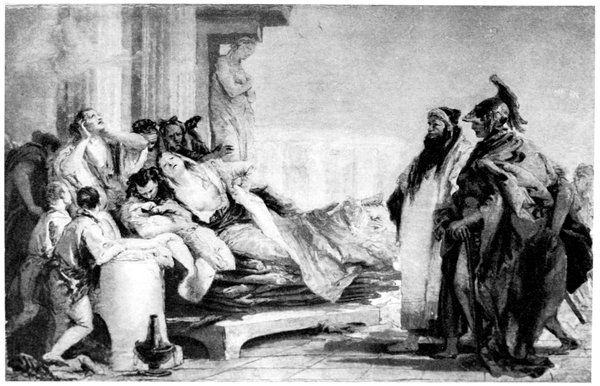
THE DEATH OF DIDO
Gianbattista Tiepolo
By Permission of Ad Braun et Cie.
285But the first gust of anger past, she dropped to a softer
mood and besought him by every tender plea that her
tongue could frame, not to leave her—by their great love:
by her trust in him, and the pledge that he had given her;
by the constant service that she had paid him, and all that
she had forfeited for his sake.
“Because of thee it is, the Libyan tribes,
And Nomad chieftains hate me; my own people
Are turned against me; all because of thee
My woman’s honour has been blotted out,
And former fair good name whereby alone
I held my head aloft. To whom dost thou
Abandon me, a woman marked for death?
My guest, my guest! Since only by that name
I am to know my husband!“
[34]
It would seem that her anguish must melt a heart of stone,
but Æneas remained apparently immovable. Before him
still shone the vision of the god, and in his ears Jove’s
message rang insistently. Controlling every tender impulse,
he answered in words that were made harsh by
restraint. To Dido their coldness was as cruel as death
and far more bitter. She did not know the gentle Æneas
in the grip of the force that was driving him, transforming
him into a monster of ingratitude.
“This man thrown up a beggar on my shores,
I took him in, insanely gave him up
A portion of my realm, from very death
Redeemed his comrades, saved his scattered ships.
... Go! Make for Italy!
Chased by the winds, across the wild waves seek
These vaunted kingdoms! But in sooth I hope,
If the benignant Gods can aught avail,
Vengeance will strike thee midway on the rocks,
Calling and calling upon Dido’s name.“
[34]
She was borne away fainting, and Æneas, racked by pity
that he dare not show, made his way down to the harbour
286to hasten the sailing of the fleet. Day by day his men
toiled with a will, for they were sick of inaction and eager
to get away, although winter was already upon them. And
watching from her tower, Dido saw each day’s work
completed with deeper misery, and a growing sense of
despair. Very soon now all would be ready; the day was
rapidly approaching when Æneas would trust himself to
that stormy winter sea, with small chance, as she knew, of
ever reaching Latium. At the thought of that final parting
and of her lover’s danger, Dido’s anger melted, and every
vestige of her pride was swept away. She could not and
would not let him go like this. At the risk of worse
humiliation still, she would make another effort to keep
him in Carthage, at least until the stormy season should be
passed. In feverish haste she called Anna and sent a
poignant message.
“In pity of my love,
Let him concede this boon—the last I crave,—
And wait propitious winds to speed his flight.“
[34]
But Æneas is inexorable, and when Anna returns to the
queen with his refusal, it adds the last intolerable touch to
her pain and shame. Nightlong she roams the palace, like
one distraught; and finding her way to the tomb of
Sichæus, she prays to die. Strange omens answer her;
and to her maddened brain it seems that the voice of her
husband is calling her to come to him. The water of her
libation turns black as she pours it upon the altar, and the
wine congeals to blood. The high gods have answered
her: they approve her purpose.
As soon as day comes, she begins with deliberate care to
make all ready for her death. Under her directions, a
great pyre is built within the courtyard, on which the
287queen announces that she intends to offer a solemn sacrifice.
Every relic of Æneas is gathered and laid upon it; his
armour, his cloak and his sword; while all about it Dido
herself hangs garlands and funeral chaplets. Her sister and
her women wonder, but have no hint of her intention.
When night falls and all the palace is sunk in sleep, Dido
stands again before the altar and consecrates herself for the
sacrifice. But she cannot yet take the fatal step. She
longs for one more look from her watch-tower, down upon
the ships that are so soon to carry her lover away. So she
strains her eyes through the darkness, only to find, with the
first gleam of light, that the harbour is bare. The fleet has
sailed: Æneas, warned by a vision from Jove, has fled in
the night. A bitter cry escapes her:
“Oh rare
Fidelity and honour! And they say,
He takes his household gods about with him,
And on his shoulders bore his aged sire!“
[34]
She calls upon the great powers of Earth and Sky and the
dreadful Underworld to avenge her wrongs; and looking
forward to the years that are to come, she invokes upon
Æneas and his descendants the curse that followed the
Roman race through many generations:
“So then do you,
My Tyrians, harry with envenomed hate
His race and kin through ages yet to come:
Be this your tribute to my timeless death!...
Let coast conflict with coast, and sea with sea.
Embattled host with host, and endless war
Be waged, ‘twixt their and your posterity!“
[34]
Then, rushing to the courtyard, she climbs the great pyre,
and grasps Æneas’ sword. For one moment, ere she falls
288upon it, the frenzy lifts from her brain and shows her all
the course of her troubled life.
“Lo! I have lived my life, have run the course
Assigned to me by fate; now ‘neath the earth
I go, the queenly shade of what I was.
I have built a goodly city; I have seen
Its walls complete; I have avenged my spouse,
And struck my cruel brother blow for blow!...
“This heartless Trojan, let him from the waves
Drink in with startled eyes the funeral fires,
And bear with him the presage of my death!”
[34]
So the founder of Carthage died; and the father of great
Rome, looking back with remorseful eyes from his fleeing
ship, saw the flames of her pyre reddening the dawn.