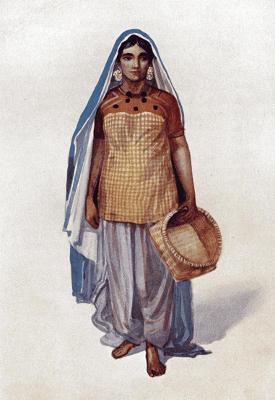
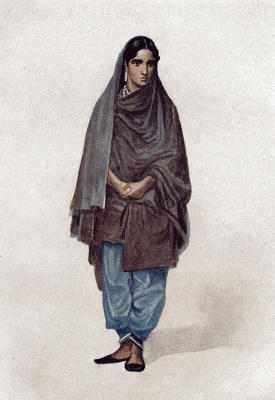
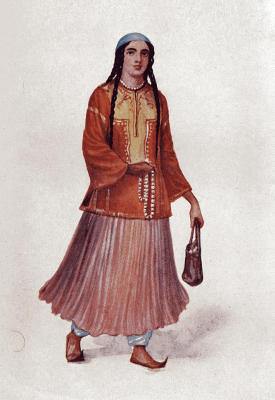
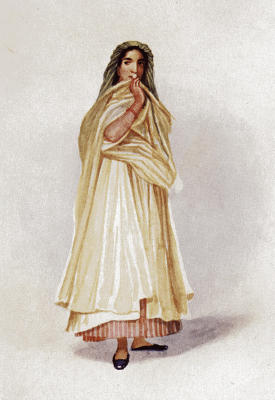
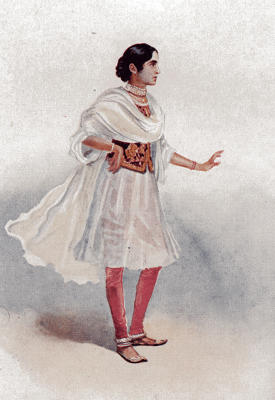
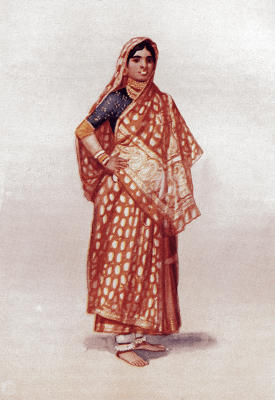
In a vast empire with a population of over three
hundred millions, in area a continent, with some
thirty-five main languages and of dialects none can
say how many, with different religions and with cultures
divided from each other by centuries of progress,
anything like an adequate description of the middle-class
woman would be a task beyond human power,
and its perusal beyond the patience of the most
enduring reader. Less difficult by far would it be to
head a chapter “The middle classes of Europe,” and,
within its limits, after running from Greece and
Roumania to Spain and England, to scale the heights
upon which, like an inspiration, the womanhood of
France sits enthroned. But there are at least some
essentials in which the womanhood of the Indian middle
classes becomes congruous, differing therein from the
women of other countries, Europe for instance, or
America or China. Perhaps it may be tried by the
selection of a few types, with the aid of contrast and
analysis, in some way to express their essential
atmosphere and habit.
Burmah must, one finds, go to the wall, not most
certainly for any fault of its own but because it lies so
far apart from the total of Indian life. For administration
it is placed within the confines of the Indian
Empire, but with the Indian peoples its people has
no lot or part. To omit it seems almost a pity, so
frankly independent are its women and so fascinating—free
above the women of most nations and consonant
to an unusual degree with ultimate human ideals.
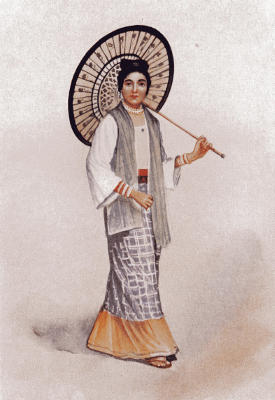
One sees such a little Burmese lady sometimes, but
how rarely, in India, the wife perhaps of some English
officer or of a high Burmese councillor, so a picture may
stand as reminder of smiling daintiness, like some
porcelain figurine glazed and tinted in the furnace of
human freedom.
In India proper, of the middle classes, the most
important, and perhaps the most enigmatic, figure is
the Brahman’s. The class is certainly an aristocracy
in one, the etymological, sense. For it is as being best
that they hold power and the power that they hold
is, even to this day, most undeniable. Aristocracy—“rule
of the best”—of those rather who are admitted
to be best—if this be indeed a meaning true to fact,
then the Brahmans should be included in or alone
comprise that rank. With many of them their very
appearance, their gait and self-composure, support the
role. With steady untroubled eye, straight nose and
sensitive nostril, fair skin, “pride in their port” and
self-restraint in every gesture, they move through the
mass of common men, as if conscious of a higher mission.
By the sacred thread across the shoulder they proclaim
themselves twice-born, once from a mortal womb and
once again at an auspicious hour in childhood by
initiation to the sacred mysteries. Calm and indifferent,
serene with a careful precision and habit of
restraint, they incarnate in their manner something
of absolute repose, as if untouched by the mundane
ebb and flow. Withal they are not in any customary
sense a nobility. Perhaps, it may be said, they have
transcended even nobility. In any case the proudest
noble must at times, and some must constantly, admit
the ascendancy, spiritual though it be, of these born
preceptors. The greatest ruler will eat food cooked
by the poorest Brahman beggar; but no Brahman,
desperate with the pangs of destitution, would accept
even a glass of water from a monarch’s jug, the mere
touch being a profanation to the nutriment of sanctity.
In Southern India, where the Brahman, immigrant
from Aryan races, was most successful in exploiting
the indigenous population by the means of religious
awe, the Nair nobility are abject in their recognition
of this hierarchic superiority. In every word of
speech the Nair throws himself, as a clod of mud,
before the Brahman’s feet to be trampled and contemned.
His house becomes, in speaking to a Brahman,
his poor dunghill and the Brahman’s house his palace;
his teeth are dirty in his speech, and the Brahman’s
pearls; his sleep is a mere falling into snores, and the
Brahman’s an honourable slumber.
But in ordinary speech, in Europe and no less in
India, the concept of nobility or aristocracy in its
worldly relations implies other qualities. A certain
tinge of feudal tradition colours our thought; and a
nobleman is always conceived primarily as a fighter
and a leader of his own men in his own estate. Love
of sport, a certain careless gaiety, an eupeptic cheerfulness
and a happy enjoyment, face to face with a world
in which nothing really matters, coupled with the
readiness to do the duties of his station and to die for
honour, these are qualities that make up the mental
picture.
It is not to such a class that the Brahman belongs.
To life and the pleasures of life, he stands as a pillar
of negation. Not here and now one conceives him
beckoning, but in a reality transcending all appearance
in duty and existence. Privation is for him the highest
rule and participation in the world is at most an
inexorable concession to accidental forces. The
Brahman’s life must, in semblance at least, be one of
constant abstention, rigidly guarded. The show of
enjoyment and the joy of healthy natural life must
be repressed or at least veiled discreetly. Between
him and mere sensual humanity he has dug a gulf,
impassable.
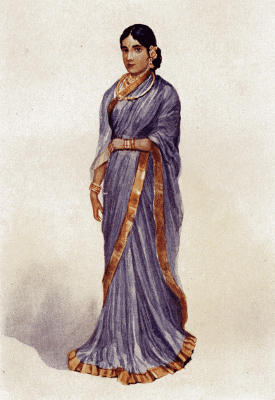
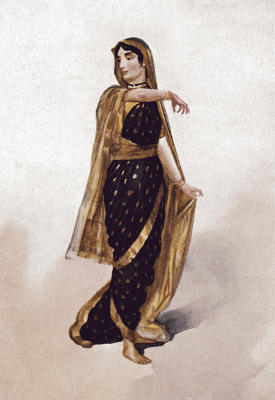
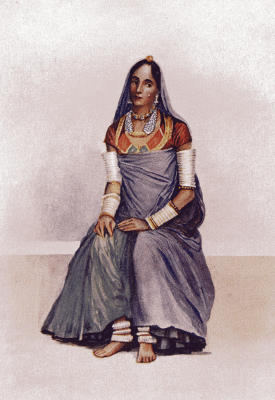
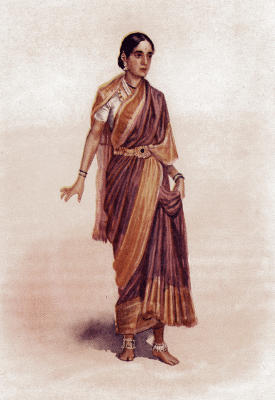
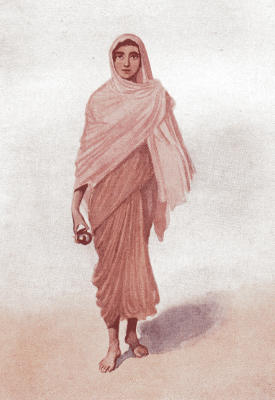
LADY FROM MYSORE
Of Brahmans only a few are by ordination priests.
The majority fill the professional classes, as administrators,
clerks, astrologers, scholars, physicians, lawyers,
and the like. Some are money-lenders and not a few
are cultivators of the soil. There are even rare
Brahman houses which, in spite of religious prohibition,
have usurped the thrones of princes. But in
all there exists not only a sense of solidarity as being
sanctified, but also this ideal of abstention, leading in
practice not unseldom to a grave and measured
hypocrisy. As a whole they are the professional class
of India, they and the rival caste, the Kayasthas or
“scribes,” and maintain with admirable earnestness
the tastes and pursuits of an intellectual, idealizing,
and temperate order. Mental discipline, the suppression
of the impulsive act, a habit of restriction so
incessant as to become almost instinctive, these they
have to a degree almost overwhelming.
Among Rajput women one finds certainly the highest
development of the individual with the greatest charm
and the fullest humanity, and it is they, almost alone,
who have achieved the heroic. But to India as a
whole the ordinary ideal of woman in her relation to
social function is represented by the more reticent
figure of the Brahman. She is woman as in his life
the ordinary man would wish to find her, quiet,
devoted, managing and pious.
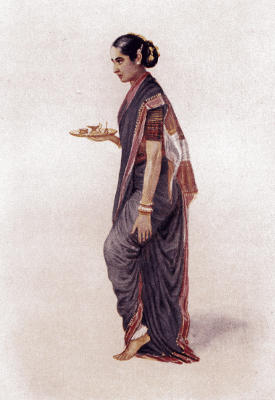
Nowhere is the Brahman woman so true to the type
presented in this ideal as in the Madras Presidency
and in the Bombay Deccan. And never is she so true
to herself as when she goes, sedately, to the temple.
In her hand she carries the brass tray on which she has
put her humble offerings of ochre powder and flowers
with a wick burning beside them; and she goes looking
neither to the right nor to the left. She rings the bell
which summons the God’s attention to his worshipper
and walks the prescribed ceremonial steps round the
idol with a grave unquestioning dignity. And her
whole life is one unceasing round of service, in which
humility is elevated by an ever-present sense of Divine
ordinance. To the lowly in heart she feels—almost
one might say she knows, so strongly does she feel—belongs
the kingdom of heaven. In service to find
fulfilment, even happiness, that is her God-given
mission. She grinds corn and cooks, carries water
and washes the house, nurses her children, waits upon
her family, as also she draws ornamental patterns with
white and red chalks upon her door-step, all with a
humble pride and joy in the singleness of her devotion.
In poorer houses, in the houses of far the greater
number of her class, she is at work all day from long
before the first-dawning till at last at night she falls
into the deep slumbers of exhaustion. There are few
who keep servants, except for an occasional old woman
who comes to help with the rougher tasks. And in
addition to the household labour, she is forced, too
early, to premature childbirth, and protracted nursing.
For charm and coquetry, for all the arts by which
woman gladdens life and creates a liberal society, she
has, if she had the inclination, no spare time or energy.
She ages early, spent by exhausting labour and the
recurring burden of unregulated childbirth, unwarmed
by joy, unlit by passion.
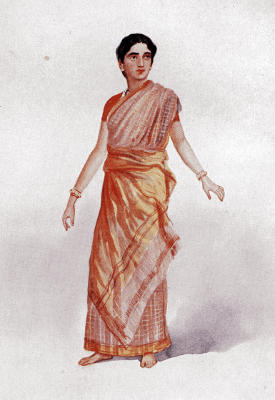
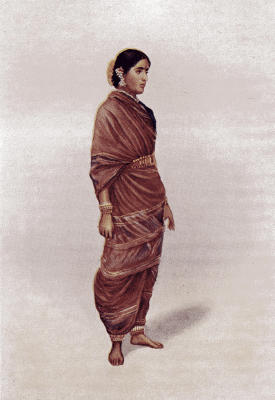
A SOUTHERN INDIAN TYPE
But the bare life of poverty and unending labour
is illumined by a spiritual exaltation. With the performance
of their service the million Saint Theresas of
the Deccan are able to find within their hearts a satisfying
happiness. Like nuns, by an austere self-repression,
they avert their eyes from humanity and the
human purposes of life; and when they are forced to
see, they persuade themselves to despise. They live
as it were in a spiritual cloister. But even in this world
they are not altogether without reward, though it
comes late in life. The love and devoted kindness of
her sons, that is the one constant meed of service upon
which the woman counts. And there are few things
more impressive than an Indian son’s look when he turns
to his mother or the tone in which, even years after her
death, he speaks of his childhood at her side. And in old
age when she in turn, with her husband, succeeds to the
management of the large joint family household, she
finds a peaceful joy in the ordering of their simple life
and the caresses of her clustering grandchildren. At
the end, when death lays her to sleep at last, she dies in
the hope of an untroubled peace, as one who has accomplished
a lengthy service not without pain and effort.
Such perhaps most truly are the women of India, as
through a large continent the greatest number of its
inhabitants would like to see them. Not for this world,
they might say, is the labour; not for love and enjoyment
and greater power and finer emotions and self-development
and the glories of nature do they thirst.
Of the fervours of youth and the vivid joys of mere
active BEING, of the fine harmonies between soul and
sense in expanding, self-perfecting human functions,
of a humanity that should be self-sufficient, free in
the face of the eternal universe and glad in the fight
for mastery with obstructive matter, they have not
even a conception. To an Indian Antigone no chorus
would sing of human power and magnitude. Only
the preacher would instruct in humility and abnegation.
Even the richest Brahman women of the South spend
their leisure hours in a manner that accords with the
common ideal. Relieved of the more exhausting
house-work by the labour of the servants, they spend
the afternoon hours when they are at rest in the reading
of the Purans, those grosser Scriptures or, one might
perhaps with truer comparison say, those Hagiologies
in which priests have deformed the too subtle tenets
of Hindu theosophy with the flesh of mythology. In
the reciting of these legends, and in lengthy prayers
and ritual performance the wealthy Brahman lady is
content to find the entertainment of her leisure.
The same ideal of service and privation is to be found
no less in Bengal, sweetened however and softened like
the more languid air. There is something hard, even
cruel perhaps, in the arid Deccan plain with its burning
dry winds and its stony hill-sides, and its stern, thrifty,
self-centred people. Its asceticism is harsh and rough,
the sour ferment as it were of crude souls in fear of a
fierce Deity, looking by abnegation to secure the grace
that alone can give salvation. The spirit is that,
almost, of a Hindu Calvinism, savagely abnegatory.
A softer piety, as of some Italian nunnery among roses
and olive trees over the blue sea, inspires the womanhood
of Bengal. They have a devotion no less intense,
their service and self-sacrifice is no smaller; but they
are filled also with the pity that assuages and the love
that makes things sweet. To be kind and tender in
a world which, with all its evil and pain, is pervaded
by a loving and merciful Providence, such is the spirit
in which they render service. The large houses of
Bengal, embowered in trees, have a claustral peace
as well as labour. The lives of the women in them
are coloured by the tender light of pity and affection.
Often in the warm nights under the star-strewn sky,
young girls creep to each other and whisper little gaieties.
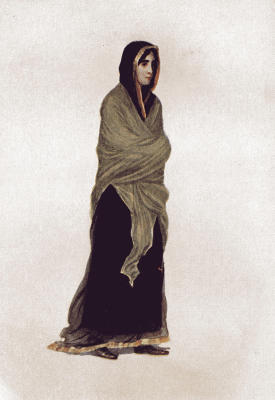
BENGALI LADY
In general, among the middle classes of Bengal,
women practise a seclusion that is, however, not too
rigid. It is a seclusion like that of classic Athens, not
savagely jealous as it still is in many Rajput houses.
But with the renaissance that in the last fifty years
has so greatly altered life in this great province, many
have learnt to discard orthodoxy and with it the
traditional restrictions. At Benares, especially, many
a Bengali lady can be seen walking openly to the
temples and the sacred river. Always she bears a
perfect courtesy and a rounded balanced dignity. Of
the newer school, too many perhaps have aspirations
gleaned from the lighter English novels which they
eagerly read—dreams for whose passage the ivory
gates of Hinduism were never meant to open. But
deep in the hearts of all—far deeper than such fashions—are
the images of Sita and Sakuntala. Some play
tennis and ride, some there are who return from
English schools and the smarter section of London
society with the gossip of Ranelagh or the bridge club
and a wider taste for amusement. But there are none
who discard the tenderness and soft devotion of their
native womanhood. Nowhere in India have there
been so many marriages between English and Indian;
nowhere have they been more successful. The number
of women really educated, appreciative of art and
literature, a few even themselves poets and writers, is
out of all comparison large; and the artistic rebirth
in Bengal must to some extent have been shaped by
the influence of women’s grace on the social world.
Without departing from the prescribed fields of service
and abnegation, they take their part in every important
movement—sometimes perhaps unwisely! But at times
they have brought untold benefit by their acts. So a few
years ago did the brave girl who by the sacrifice of her
own life slew a great social evil—the purchase of men
at the price of ruinous dowries. It must at least be conceded
that the women of Bengal, descendant from mixed
races but long since truly Indian, have clothed the
sacerdotal ideal in vestment of soft and womanly grace.
But there are other parts of India where even the
Brahman woman has diverged from this ideal, or—should
one not rather say?—has transfused into it
the feelings and robust sensuality of a more vigorous
nature. Where the late conquerors from the North
have settled, where rich plains bear wheat and millet,
and fields are hedged with the milk-bush and the
cactus, where the great trees make the country seem
like an English park, and the air bites cold in the
winter mornings when a skin of ice crackles on road-side
pools, where in the hot months the sun hangs like
a disc of brass over the panting earth, there the pulse
beats stronger and a larger nature sways the will.
Women there have their claims as well as duties;
and from life they demand, besides the right to serve,
a broader power also and a rich fulfilment. They
wish for love and to be loved, and even in their service
they aspire to govern. For their womanhood they
claim at least some freedom. The texts are still the
same; but they are commented by a bolder temperament.
The distinction holds good perhaps for all the
women of real Hindustan—for the lusty graceful women
of Allahabad, for instance, and the upper Ganges Valley.
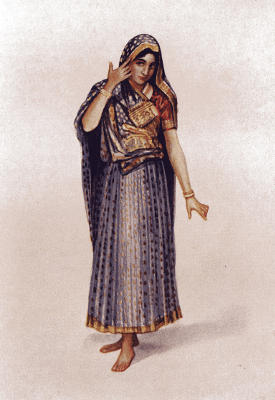
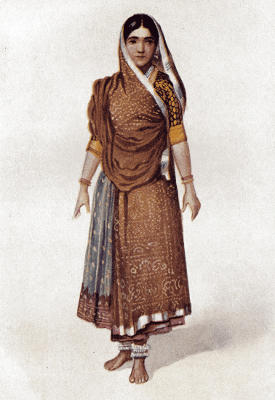
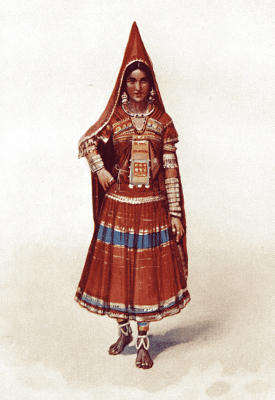
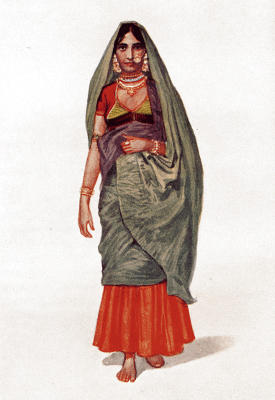
A NÁGAR BEAUTY
But nowhere can this fine and active type be better
studied than in the Nágar caste of Káthiawád and
Gujarát. The Nágar community came to India with
the last Scythian hordes; and almost at once, at the
great fire baptism of Ajmer, attained the rank of
Brahmans. To this day, so high do they hold themselves
above all others, they hardly trouble to use the
title Brahman, but call themselves merely Nágar, with
a proud simplicity, as who would say, “I am the
Prince.” For centuries they have held the appointments
of the State and been famous as administrators.
They are to be found in every rank and in every department
of the public services, clever, courteous, receptive,
and self-confident. Their pride has become a
byword among other castes; and their success has
made them the mark of envy and dislike. But there
can be no question of the ability with which they have
held their position, nor of the keen, progressive intellect
that guides their interests and activities. They have
an eager humanity, and a keen understanding of worldly
good and evil, and are above the hypocritical renunciations
and pessimistic sanctity of a priestly class.
Literature they hold in honour; and the creative
instinct, which leads many of them to administration
as the career in which man expresses his active will
through the minds and morals of mankind, forces others
of their community to self-expression in thought and
language. If renunciation there be, it is here, not for
a mere negation, in itself fruitless; but to the end of
a greater realization in the material given by humanity.
In this dynamic will, the women have a proportional
share. Ambitious and intellectual, they partake in
the interests of their families and encourage or advise
their husbands and their children. For the achievement
of purpose they are ready for every sacrifice;
but the consciousness of larger interests ennobles the
sacrifice as it humanizes the purpose. They too serve, as
every Hindu woman seeks to serve, and the Nágar wife,
like her sisters, will cook and wash and stand aside before
her man and wait upon his meals. But her devotion is
shaped by a less trammelled intellect, and she claims in
return an immediate recompense of love and attention.
Very beautiful are the Nágar women, and their
beauty is the theme of countless songs and ballads.
Fair with a rich golden vivid fairness, like the colour of
ripe wheat, with dark eyes in whose depth glows a
spark of passion and round which humour and laughter
play, with full petulant lips, figures finely rounded and
firmly plump like the quail, with, graceful movement
and slender limb, the whole lit up by intelligence and
comprehension and a touch of conscious charm, the
Nágar woman presents a picture that remains unforgotten.
Even laborious study seems to have no
power to rob her of her looks, and the girl-graduate is
fresh and graceful, as if she had never bent over Euclid
or deductive logic. One meets them so at times in
Ahmedabad or Baroda, in the houses of the highest
officials, clever, well-read, well-bred, with perfect
manners and astounding beauty, like some memory
of the Italian Renaissance, taking no small part in the
establishment of an urbane and liberal society, and like
the donne of Boccacio they return to their homes to
serve and cherish their husbands. And of love they
can repeat the whole gamut. Indeed, the keynotes of
this society, with all its undertones of Hindu abnegation—as
in Florence, too, one imagines an undercurrent,
not too discordant, from Savonarola’s denunciations—are
not unlike Italy in the great age. Women have
similar duties with a touch of the same implied seclusion;
they have the same intrigues and stolen pleasures,
the same essentially natural poise in life; they are now
even beginning a similar application to learning and
poetry. And of love too they have no lesser lore and
experience than those ladies who, finely natural and
fittingly acquiescent in their sex, gladdened and made
illustrious the Courts of Mantua and Ferrara.
Even more beautiful than the women in the Nágar
caste are their charming and delightful children.
With the round oval of their faces, the fair bloom of
their skins, the growing intelligence that dances in their
eyes, they at once captivate all who look. In general
up to the age of eight or ten they remain naked (though
an unfortunate new fashion, imitated from customs
made necessary by the cold grey skies of England, tends
to hamper their free beauty in ugly and unwholesome
clothes), and the light movement of frail gold-browned
limbs in the Indian air is sheer refreshment to the eye.
Devotion, then, the Nágar woman certainly stands
for, devotion and the due and harmonious fulfilment
of the duties of her station. A woman she is always,
fully and truly womanly. But she is far above the
mere privative of empty abnegation. Beauty she
knows and values, and she is not ignorant or afraid
of the power that kindly beauty can exercise in the
affairs of men. Learning she can recognize and
honour; literature she assists; even of art, she is not,
like her sisters, much afraid. In Gujarát from of old
the dainty custom has remained by which on certain
festivals, the feast of lamps for instance, ladies of the
highest classes meet in the open streets of the residential
quarters and chant choral songs while they move round
in a circle, beating time with their hands and bending
gracefully up and down. They sing of spring and
flowers and the sports of girl-friends in palace-gardens.
But in the large industrial cities which in the last
generation have risen upon the older towns with their
restricted social circles, the publicity of the streets has
become inconvenient. The Nágar ladies in Ahmedabad,
for instance, have taken a leading part in transferring
the old songs to larger concert halls in clubs
and similar places, and at the same time raising the
standard and artistic value of the performance. Those
who have ever heard such a concert must be grateful
for a movement full at the same time of beauty and
colour and sweet sound along with modesty and perfect
taste. For a higher social life, with heightened
enjoyments and a rational freedom, for self-development
and wider interests, yet well within the limits
that nature prescribes for woman, distinct from the
far other limits set to man by his divergent functions,
for a life that has in it something of Greece as well as
the main ideals of Hinduism, the Nágar woman, for
all the illiberal asceticism of the Brahman tradition,
may emphatically stand.
In the mercantile classes the same ideals persist,
deflected however by the incidents of their livelihood
and to an even greater extent by a profound difference
in spiritual aspect. Of the Hindu trading classes by
far the most important and the most ubiquitous are
the merchants of Márwár, of Gujarát, and of Cutch.
All follow one of two sects, the Vaishnava or the Jain—the
latter in essence a different religion, originally
indeed a protest against Hinduism but now little more
than a sect, another ripple, so to say, on the waters of
national faith. Both at any rate are protests against
Brahman orthodoxy and the gnostic philosophies of
essential Hinduism. Numerically and in its effects,
by far the more important is Vaishnavism. In the
form in which it has been adopted by the trading
classes, it is the belief that by love alone can God be
realized. It centres upon Krishna, that tender and
sportive figure, in whom the God Vishnu again came to
earthly life, and in whom are enshrined the memories
of a once-living hero. On Him mythology and popular
song have lavished their softest endearments and their
most entrancing images. In His name have been
composed the voluptuous love-poems of many generations;
and the dalliances of Krishna with the milk-maids
and His beloved Rádha are the constant theme
to which Indian passion turns for lyrical expression.
They are the familiar accompaniment in childhood as
in age of the merchant’s women-folk. In Vaishnavism
such as this the devotee throws himself, as a suppliant,
on God’s grace and love alone. He acknowledges indeed
his innate incapacity to apprehend the Godhead,
but he aspires at least to feel something of His Glory
in those ecstasies of self-abandonment which can be
likened on this earth only to the passionate love of man
and woman. In their prayers too they associate with
the God that consort Lakshmi or Rukhmini, who gives
wealth and prosperity—the benign divinity who with
her lord preserves and maintains all living things and
in loving-kindness intercedes for all who seek by love
and submission to realize the Divine in the universe,
be their sins manifold as the sands upon the shore.
In every land, of course, the pursuit of wealth as
such must be opposed to higher spiritual activities
and loftier aspirations. For the merchant the end
must be the acquisition of riches for its own sake. All
other purposes are either means or incidents. He must
treat men and women as means and not as ends in
themselves. He can have for humanity none of that
respect which is felt by him who, as equal among
equals, seeks as his end human perfection, or even by
him who, again one of many equals, works, as he thinks,
by pain and self-denial for the greater glory of God.
Where acquisition is the supreme good, all else must
be subordinate. And the methods of acquisition are
really two-fold, either by careful saving and the
starving of desire to accumulate useless metal tokens
which are the equivalents of untasted pleasures, or by
wilder speculation quickly to capture the wealth which,
exchanged, can buy luxury and material gratification.
Side by side, in the same class of men, the two methods
can be seen. Extravagant abstention and extravagant
lavishness, a fulfilment that is material or an abstention
that is no less material, these in all countries are the
marks of the merchant class. But they can be mitigated
in their effect, as they were in the Italian
Renaissance by the almost superstitious devotion of
all ranks to the newly-exhumed classic ideal. In
India this mitigation is given by the creed of Krishna
and of love. Materialized though it has to be when
refracted through the mind of man the acquisitive, it
is still an influence, nicely attuned to the receiver, for
something finer and ennobling. What there is of
good, charity and spiritual significance in the merchant’s
life (and it is after all much) is mainly drawn
from a faith which, even when interpreted in a too
material sense, could hardly be replaced for its worshippers
by any other credo. In modern Europe the
aristocratic ideal has for the richer merchant something
of the same significance and mitigating value.
But for those outside the circle in which this ideal
can be operative there is no other thought to raise and
enlarge the spirit.
It is not difficult to see how all these influences must
react upon the woman’s life. The effects are further
complicated by the fact that child-marriages are still
the rule, and that only too often, in a trading class,
the young bride is sold by her parents for large sums
to an aged bridegroom. Among the larger number of
the class, probably, acquisition is sought by rigid
economy. The young wife finds herself stinted,
therefore, of every comfort and even of the dresses
and ornaments that by nature every woman desires.
The husband holds the purse and makes almost all
purchases himself. A few rupees only can reach the
wife, and for these she has to account. Even if her
husband is young, long hours in the shop, constant
poring over account books, and little exercise only too
soon make him obese and feeble. The only real
interests are house-work, in which she has no final
voice, and frequent, often ill-natured, gossip. On the
other hand, she has this of advantage that her menfolk,
weighing the world as they do by its material fruits,
ascribe to women the first place in their pleasures.
She is, therefore, in spite of all, able sometimes to
attain a real power that is discordant with her ostensible
position. The passion is for the sex in general,
not for the individual woman; for a mere satisfaction
of sense, not for a spiritual individualized love of the
fitting mate. But a shrewd woman can play upon the
passion and make it serve her own purposes. And when
the trader’s wife does manage to attain such influence,
she uses it unsparingly for her own satisfaction. Many
a comedy of manners is played, unseen, on the dark
stage of the merchant’s house. There are not a few
husbands who, whether from love of gain or from
sheer terror of their wives, shut their eyes complaisantly
to divagations damaging to their honour. The practice
common to many money-lenders of keeping burly
Mussulman, often Afghan, servants in their households,
is anything except an incentive to female virtue.
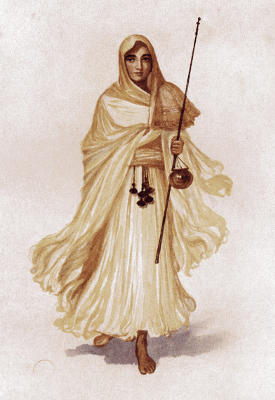
JAIN NUN
Among the merchants who follow the Jain religion,
however, these conditions apply with less force. Their
life is simpler and the imagination is unheated by the
constant thought of loving ecstasy. The Jain sadhvis,
a class of nuns recruited both from the unmarried
and the widowed, bear a character that is far above
reproach. With shaven heads and in yellow garments,
a little square of cloth usually tied upon their lips to
save them from inhaling the smallest insect, they
wander through the country, begging and singing
hymns, nowhere to remain above four days, leading a
life of austerity for the glory of the spirit. They are
irreproachable like Sisters of Mercy, and like Sisters
of Mercy they can move safely among the roughest
crowds, protected by the respect of all. Something of
their simple and humble piety has penetrated to all ranks
among the Jains; and the ladies of the Jain millionaires
of Ahmedabad, owners of large cotton factories and
masters of men and money, live their simple lives in
the midst of riches with purity and quiet modesty.
Amongst the richest of the merchant class are the
Bhatias, who gain rather by daring speculation than
by niggardly effort. On the race-course, as in the
exchange and cotton market, they are conspicuous
figures, with a certain pleasing bonhomie and easy good-fellowship.
The Bhatia women play a part in the
social life of modern India that is hardly less conspicuous.
Orthodox in the extreme, they are strict
followers not of the ascetic but of the more human
sect. They are able, therefore, to be strict in
observance and orthodox in belief without abdicating
the rights and enjoyments of humanity. They attend
diligently to religious services and in the early hours
of the morning the ways that lead to the Krishna
temple are thronged with their carriages. To the
High-priests, in whom they see the divinity incarnate,
they give an adoration that is almost boundless. But,
with all this, they claim from life the fulfilment of
their humanity and their womanhood. Moreover,
they demand something of excitement and palpitant
emotion. A few there are who, like their menfolk,
gamble, and there is none who will deny herself the
excitement of jewelry and fine clothes, diaphanous
fabrics half disclosing the limbs they cover. The
worst offshoot of their orthodoxy is the practice of
infant marriage; and there are few sections of the
community in which young girls are so often married
to old men, the parents profiting by the bride-price.
As the remarriage of widows is forbidden, it follows
necessarily that in the Bhatia caste there is a number,
quite excessive, of young widows, in the first bloom of
fresh maturity, often left with great fortunes. Fortunately
for society, these widows, so numerous are
they and the conditions of their marriage so manifestly
unfair, have been able collectively to repudiate the
hardships that enmesh the orthodox Brahman who has
lost her husband. Among the Bhatias, there are few
shaven heads! Neat and well dressed, with pleasing
face and figure, perhaps too consciously demure, they
strike an attractive note in the complex harmonies
of modern India. The system by which they are
married is hardly elevating and is opposed not only to
the ideals but also to the commandments of the sacred
texts; but a commercial class cannot get away from
its own limitations. It is at least a great deal gained
that it should be alleviated by a sensible appreciation
of life and joy and by a degree of freedom which,
though not of the highest and inmost kind, is more
humanizing and liberal than the negatives of material
self-denial. Self-control, control, that is, of and by
the inner self in harmony with ultimate nature, is no
doubt the concomitant of the highest liberty; but
any liberty, even any licence, is better than the denial
of the actual living self.
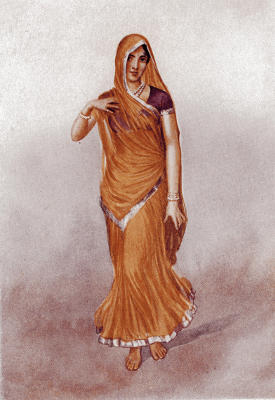
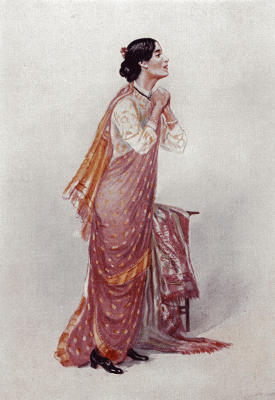
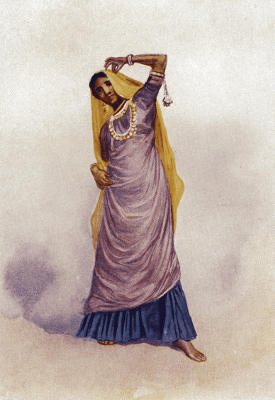
BHATIA LADY
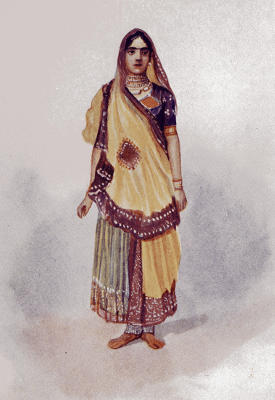
In the rich province of Gujarát, the home of so
large a proportion of the merchants of India, there is
a festival which embodies in its observance much of
the inner feeling of the Indian woman. During the
rains, for one waxing moon, the days are sacred to
that Goddess, who represents the all-pervading energy
of nature, the spouse of Shiva, the Great God, the
ultimate Destroyer. During these days the maidens
of middle-class Gujarát worship the Goddess with an
eye fixed upon the attainment of the perfect husband.
The little girls go in groups and bathe and pray, and
they make the vow that is the Vow of Life. They
may be as young as six or seven or eight, but year after
year they renew the vow till they are married.
Throughout the day they have to sit in a darkened
room, reflecting upon the Goddess and upon the
supreme boon of a good husband, but at times resting
their minds by nursery tales or songs or innocent
games with cards and dice. Then every morning
they bathe again in the pond or river, where rival
groups of girls make jokes upon each other and laugh
and play. The many songs are the most touching
part of the whole festival. And these songs represent
a marriage of free choice, in which the girl chooses a
husband from her suitors. How different from the
present practice! Year after year, till they are
married, they sing these songs. And who shall say
how far this dream of choice may remain to mould
their actions, even after the forced marriage that
awaits them? The need of marriage at least, its
supreme value to a woman’s life, that is always before
their eyes from early childhood; and marriage is bound
up with religion, with the personal gifts of the divine
and happy wife of the Greatest God. But in the very
songs, sanctioned by the goddess, the cry is always
for the chosen mate, the giver of love and happiness.
Little wonder if at times the grown girl, now become
conscious, learns to know the difference between the
husband selected under social conventions by her
parents for his worldly circumstance and the man
who, unsuitable perhaps in wealth or temperament,
is yet nature-chosen to be the mate of her desires and
the beloved of her heart. For the parents’ choice is
not always wise, and among sinful mankind there are
not a few who will sacrifice a daughter’s welfare to
their own profit.
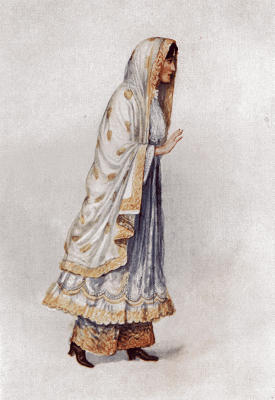
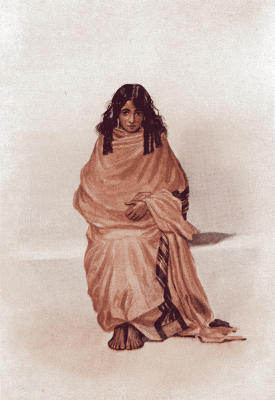
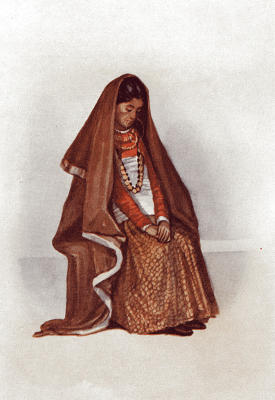
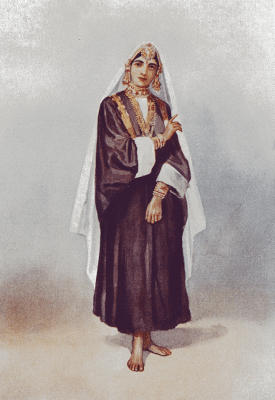
KHOJA LADY IN BOMBAY
Of the Mussulman middle classes, the most conspicuous
are the Bohras and the Khojas. Both belong
to different branches of the Shiah sect, that sect which
is to Islam what the Catholic Church is to Christianity.
Both also are the descendants of Hindu communities
which were converted in fairly recent times to the
faith of salvation. Among the Khojas, especially,
many Hindu customs have survived, and their law of
succession in particular is not the law of the Qor’an
but the survival of Hindu tribal custom. At this
moment, perhaps, theirs is the most interesting of
these communities, both because by their practical
talents they have obtained a place of political leading
among Indian Mussulmans and because they are—with
the exception of a small reforming branch—the
religious followers of H.H. the Agha Khan, a prince
so nobly known by his loyal efforts in the War.
The Khojas, “honourable gentlemen” as the name
means, come in the main from Gujarát and Bombay.
But they are scattered now through all the bigger trade
centres of India—Calcutta, Nagpur, Sind and the
Punjáb. They have not, however, confined their
enterprise to the Indian Empire, but have made
settlements in the East wherever the British flag gives
its subjects protection. They have crossed the
mountain passes to Hanza and Dardistan; they have
sailed to Zanzibar and the Persian Gulf; they have
penetrated into Arabia; they maintain business connections
with Singapore, China and Japan, and even
with England, America and Australia. Many of the
great commercial interests of India are in their hands,
and in business they bear an excellent reputation for
integrity and punctuality. Their representatives have
an important place in the Legislative Councils of
Bombay and of the Government of India. In social
life, they are something of epicures, and their clubs
are not only hospitable but are well-managed and
furnished. The best of food and the best of wine
will always be found at any entertainment given by
these generous and liberal merchants. They enjoy
literature and still more music and dancing; and they
are among the most tasteful supporters of those arts.
Many among them have now forsaken commerce for
the liberal professions.
The Khoja woman is hidden in seclusion behind the
purdah. The few that are to be seen are as a rule
somewhat below the middle height and are of a graceful,
but not altogether healthy, slightness. They are
well educated and are good housekeepers, known for
their neatness and management. As Mussulmans
they are of course married under a system of free
contract, but unfortunately for them Hindu tradition
has been too strong, and they suffer in practice from
many of the disabilities of their Hindu sisters. Remarriage
after widowhood is in practice almost unknown;
and divorce is so discountenanced that its
relief is seldom sought. On the other hand, the
ascetic idea is at least absent, and a wife expects and
a husband is prepared to give constant attention and
all possible comfort. They have a force of character
which merits this attention; and their features, with
arched head and broad forehead, strong chin, and
large lustrous eyes, are the index of their character.
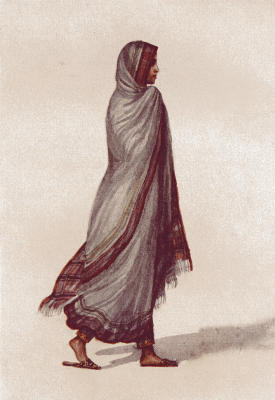
Of other trading classes of Mussulmans, the Memans,
also converts from Hindu castes in Sind, Káthiawád
and Cutch, deserve notice, if only for their charity
and piety. All Memans, women as well as men, hope
to perform the pilgrimage to Mecca and habitually
visit the Chisti Shrine at Ajmer. And for their large
secret charities the women, no less than the men, have
a well-deserved reputation.
Among the large body of middle-class Mussulmans
of the usual Sunni sects, those who claim to be descended
from foreign invaders and who are at least not
directly traceable to any special wholesale conversion,
the position of women is on the whole satisfactory and
agreeable. Every family has its poor relations and
dependants so that, even when she is childless, the
mistress of the house is seldom lonely. The morning
she spends at her toilet and in seeing to the day’s
marketings and looking to the kitchen. At meals all
the family, men and women alike, meet and eat
together. Sometimes, even, a much-favoured friend of
the husband’s, a trusted and intimate friend, may be
introduced to the inner, unveiled circle. After the
midday meal, a rest; then sewing and talking; then
games of backgammon and chess make the afternoon
pass. The evening dinner then needs looking to, and
after dinner it is common to hear or read tales and
romances or religious books. Children may also take
up much of the woman’s time; and among Mussulmans
as a rule the wife may count upon a loving,
almost a passionate, husband, except in the unhappy
cases where differences of temperament produce a real
antipathy. In that case she can always try to force a
divorce from his hands, though the practice varies
with the social circle. That the pressure of Indian
influences has forced upon them child-marriage,
followed only too often by premature consummation;
that the intentions of the Prophet in regard to divorce
and widowhood have often been neglected; and that
the rule of veiling has been interpreted with a superstitious
irrationalism, quite opposed to the teachings
of the law, are disabilities under which the Mussulman
woman of the middle classes still has in part to suffer.
But she is at least oppressed by no tradition of renunciation
or asceticism, and she has, in favour of her fulfilment
and just cherishing, text after text in the sacred Book.
The recent tendency to a purer Islamic practice, hand
in hand with the growth of rationalism, offer her
hope of early liberation from extraneous bonds and of
development as a free human agent. The women of
Islam have as guide rules of law, sanctioned by revelation,
which if practised are more rational and more
insistent on justice and human freedom than any
other precepts ever codified into statutes. It is to be
hoped that the recent advance and rationalistic movement
in Islamic countries will secure the happiness
that should follow intelligent practice of a humane
code. The devastation caused by Mongol invasions
and ravages and the subtle perversions induced by an
alien atmosphere have to be repaired and eradicated;
but there is no intrinsic reason why the social system
of Islam should not again reach and surpass the high
level it commanded in the days of Al Ma’mun.
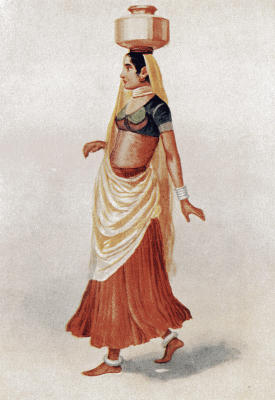
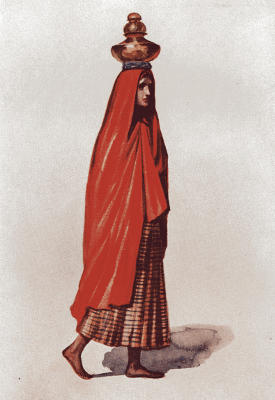
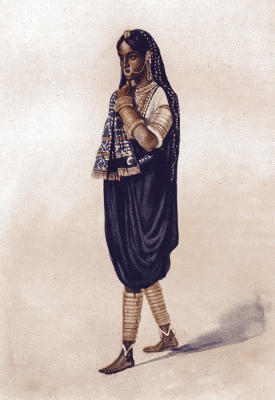
MEMAN LADY WALKING
In a review of the middle classes of India, it would
be impossible to omit the rich and influential sect of
Parsis. Descendants of the ancient inhabitants of
Persia, expelled after the Mussulman conquest, followers
of Zoroaster and worshippers of fire, they reached the
west coast of India after many perils, to be finally protected
by a Hindu Rána or prince. Small in numbers,
for many centuries they lived in the main by agriculture,
though there were a few among them who
achieved a name in arms. With the coming of the
British they changed their pursuits and their social
habits. Commerce had heretofore been strictly protected
by the exclusive guilds of the Hindu merchants.
Its doors were now thrown open. Moreover, the
British official required body-servants, if possible of
good class. The Hindu was precluded from accepting
such an occupation by caste rules of purity and caste
prohibitions. The Zoroastrian religion left the Parsi
free from such scruples. Many members of the community,
by commerce direct and by the assistance that
gratitude was ready to bestow, were soon able to insinuate
themselves into positions which they maintained
by their adaptability and their commercial
integrity. In shipbuilding they excelled, and both
in this and in the kindred trade of ship-broking they
accumulated many fortunes. The liquor trade was
their monopoly; and, aided by the privilege of exclusive
distilling and a monopoly of sale, it was remunerative
to an undreamt degree. By the end of the eighteenth
century, an old traveller notes, practically the whole of
Malabar Hill, the most fashionable and only really
enjoyable portion of Bombay had already passed into
the ownership of rich Parsis. Throughout the nineteenth
century their wealth and their importance grew.
One of the most striking qualities of the Parsi community
is its aptitude for imitation. With the advent
of British rule, this facility stood them in good stead.
It was not long before English education became
general and almost universal among them, while by
their prompt acquisition of the minor conventions of
manners, they easily opened the doors of European
society. In consequence it was not long before they
attained a position of social importance, based upon
solid grounds of wealth and education. The Parsi
woman was not left behind in the advance of her caste.
Many women studied diligently and even passed the
examinations of the University. In general they
demanded a liberty such as they read of in English
novels, and fancied they could see among their English
friends. They refused to marry except at their own
choice. For the dull details of household management
they expressed contempt and considered their duties
done when they looked to the furnishing and decoration
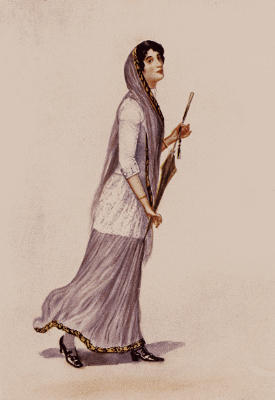
of their houses. In dress, the Parsi woman has
contrived no less to modify her own costume, originally
a slightly altered form of the Hindu woman’s, in
imitation of European fashion. She still retains the
mantle or sari, but it is hemmed with a border imported
from London or Paris. An outer lace shirt is
draped like a blouse under the mantle. The trousers,
which she has to wear under her skirt by customary
prescription, are so curtailed as to be invisible, and
the feet are thrust into silk stockings and Louis Quinze
shoes. Her jewelry is of European pattern, usually
second-rate, and she despises the beautiful antique
designs of the Indian goldsmith as “old-fashioned.”
The Parsi woman has in the past been greeted by
an amount of praise from European writers which,
though intelligible, is yet almost extravagant. It was
natural to be pleased at so conscious an imitation,
especially in a generation when most Europeans had
no doubt of the superiority of their own civilization
and were prone to judge the merits of other races,
like missionaries, by their aptitude for assimilating its
products. They could, after all, always clinch the
argument by pointing irrefutably to the triumphs of
the Albert Memorial and the Crystal Palace. In a
country where few women of the better classes appear
in public and beauty is seldom displayed, the spectacle
of many gaily-dressed ladies, with graceful drapery,
promenading along an Indian street with the freedom
of a popular sea-side resort at home, gave almost as
much pleasure and pride to the gratified Englishman
as it did to the girls’ own parents. It has required
closer inspection and broader judgment of East and West
to notice the cracks that stretch, no doubt inevitably,
across the charming picture. New liberties, imitation
not always too wisely conceived, above all sudden commercial
prosperity—these have had their advantages.
But they also have their countervailing losses.
At the bottom of such disadvantages as appear is
no doubt the broad fact that the community as a
whole consists of business men. There are of course
individuals who have adopted the learned professions
and are solicitors, doctors, barristers, and judges. But
even they live in a society and probably in a family
circle which is wholly commercial; and even their
successes are estimated by the money they bring in.
In many ways Parsi society is like the Jewish society
that is to be found in the larger cities of Europe.
But the Jews as a community are devoted to the arts
and have a ripe sense of emotional and spiritual values.
They respect learning and artistic expression. Even
those—the greater number—among them who are
engaged in business frankly enough recognize their
inferiority to thinkers and artists. Again the Jews
have always had a tradition of aristocracy among
themselves, and in recent years have sought every
opportunity of mingling with the nobilities of the
countries to which they belong. The best among
them have, therefore, raised themselves by art and
letters and by an aristocratic code far above the narrow
vices of a commercial middle class, and it is only the
lower strata who continue to display the typical defects
of “business life.” But the Parsis have unfortunately
so far missed these mitigations. They have not, and,
within the memory of history, they have never had,
the tradition of an aristocracy. They are separated
from the indigenous nobility, not only by religion, but
by interest and custom, and the difference has been
deepened by their partiality for an Anglicized mode
of life. Though a few among them have done good
work, they have no real liking for learning and art.
Hence there is hardly a community in the world,
except perhaps in the United States of America, which
bases its standards so largely upon wealth. Men are
esteemed mainly by what they have managed to
acquire; precedence is allowed according to size of
income; the business man takes rank over the
professional; and a memorandum of their richest men
is inscribed on each Parsi’s heart, as on tablets of brass.
These are defects which are not unnatural when a
small and isolated community finds itself confined to
commerce and is from its history devoid of higher
interests. They are defects which do not alter the
fact that not a few among the Parsis, especially those
who have for generations reposed upon inherited
wealth and have taken to the learned professions, are
charming men and women and true and worthy
friends. Among those who have such a position—who
do not aspire to dazzle fashion in the wealthiest circles
and do not require to increase their incomes by further
trading—the women are attractive by their education
and their rational freedom. They preserve a place of
dignity and reserve, while quietly taking from life the
benefits it offers to a liberal mind. They may even rise
above the touchy vanity which is all too common.
It must, however, be admitted that Parsi womanhood
has suffered harm from the excessive imitation
of English habits—or what are taken to be such.
From the nature of the case, because of their own
inclinations and environment, the English life they
have sought to imitate has inevitably been that of the
middle classes. And the effect has been heightened
by the enormous consumption of English novels among
Parsi women. Owing partly to national character and
partly to the demoralizing secret censorship which
broods over the publishing world, nearly all English
novels have to be “pretty-pretty” falsehoods, distorted
away from the facts of life and the truths of
nature. The consequence has been to produce a
dangerous mental confusion in which spirituality and
idealism are suppressed and replaced by a fruitless
sentimentality. Reality on the other hand is known
and presented only in the shape of hard cash. The
harm done by such popular writings is not so apparent
in England, where they are part of the normal tissue
wastage of the nation. In a foreign and not immune
constitution, they produce rapid inflammation. One
finds therefore among Parsi women, as one does among
the women of the United States, a mentality in which
impracticable and silly sentimentalism is mixed up
inextricably with a thirst for the solid advantages of
wealth. They sigh for courtships of the kind depicted
in their favourite “literature,” with scores of “dears”
and “darlings” scribbled over scented letters, with
moon-calf glances and clammy squeezings of hands;
they and the heroes of their fancy get photographed
together like any German braut and brautigam; they
enter marriage with a blind eye turned to the hard
realities of human nature, to discipline for instance
and duty, but with the expectation of finding a husband
on his knees to pamper every wish and petulance. Yet
at the same time, the Parsi, like the American, girl
will not let herself slide into these sentimentalities till
she is assured of her admirer’s income and position.
Both restraints—that which keeps her from love till
she knows how money stands, and that which keeps
her during her courtship within the bounds of technical
chastity—come easy enough as she is, with a few
honourable exceptions, free from passion. She would
never give herself to the wild love of Romeo and Juliet
or the abandoned ecstasy of Tristan and Isolde.
Hermann and Dorothea, or a drawing-room ballad,
would appeal more readily to her sympathies. That
in England there is also another type of womanhood,
truer and greater, she does not know—how could she?
That there are girls of a fine candour and simplicity
who are taught in childhood to obey and to have quiet,
effacing manners, who respect a father whom they see
controlling a large estate, honoured in Parliament,
perhaps governing a great dependency, who are bred
in a society of equals in which true and natural superiorities
alone, whether of age or seniority, of success
in the hunting-field or in the council, are admitted
and publicly recognized, that such girls bring to their
husbands with their love, respect, and the heritage of
discipline, that as wives, while expecting to find fulfilment
and the realization of their hopes, they are ready
to subserve the higher and enduring interests of a family,
of such facts and such nobilities of life—worthy indeed
of imitation if such there must be—there can be little
knowledge. Vital facts are not always plain upon the
surface, and in England no class is so quiet and unobtrusive
as the one which really counts.
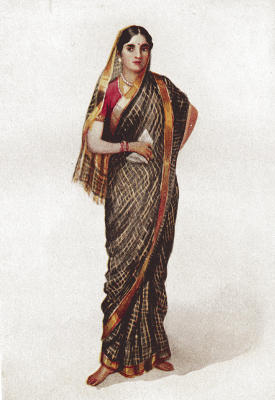
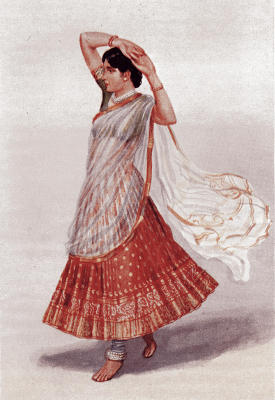
PARSI FASHION
The prevalence of a money standard in their lives
has introduced among the Parsis the great evil of
excessive dowries. Generally speaking, it may almost
be said, no Parsi young man will marry a bride unless
her parents come down with a large settlement, and
scandalous stories are sometimes told of the means
employed to extort larger sums from the father. The
girl whose family is poor—be she as beautiful as Shirin
and virtuous as an angel—stands in every danger of
being left a spinster. Day by day the probabilities
against marriage grow heavier, and the number of unmarried
Parsi women of mature age goes on increasing.
Alone of all the peoples of India among them the
reproachful name of “old maid” can be used. The
numbers of unmarried women are already so great
that this has become a serious danger to the community,
as for that matter it is among the upper middle
classes of Great Britain. “Old maid-ism” must have
its consequences: hysteria and other illness is on the
increase; and the suffragette may soon become as actual
a terror and a retribution to the Parsis as she has been
in England. If this should ever happen, then climate
and the surrounding environment are likely to make the
pathology of the situation even more critical in India.
The marriage law which governs the Parsis is very
much the same as that which exists in England.
Marriages are strictly monogamous, and divorce can
be given only by the decree of a public Court of Law
on grounds nearly the same as those admitted in the
English Courts. In practice early marriage has ceased
to exist, and indeed marriages, as in England, are as
a rule contracted at far too late an age. The same
causes which lead so often to women remaining unmarried,
have also raised the average of age.
Parsi life presents, therefore, the picture of a society
in which woman have many seeming and some actual
advantages, but in which, on the other hand, they are
more and more rapidly plunging into unforeseen but
very real evils. They have great liberty, a liberty
greater, or at least less restrained, than is enjoyed by
the women of the better classes in England or in
France. They can have education and the pleasures
of a liberal mind. In accepting a husband they are
ostensibly allowed full freedom of choice, though in
practice they are of course limited by the usual considerations,
by the importance attached to wealth,
and, especially, by the great difficulty of securing any
husband at all. They have the advantage of being
trained to mix without shyness in all societies. But,
even apart from a certain self-assertiveness which at
times distresses their best admirers, they have to suffer
from the growing probability of a life-long spinsterhood.
Only too many will have to face the final
misfortune of a wasted and infructuous life.
The community is distinguished by its loyalty and
its generosity; and Parsi women, as well as men, play
their part in that lavish distribution of charity for
which their race has become famous. It could be hoped
that, without foregoing what they have gained in education
and position, they should also preserve fresh the
emotional values of sweet and disciplined womanhood
and be able to secure those timely and assured conjugal
relations which must be its fulfilment and best reward.
Working and Aboriginal Classes
“Sweetly the drum is beaten and
Sweetly the girl comes to draw water:
Sweet is the ochre on her forehead:
Sweet is her bodice of silk:
Sweet is her charming footstep.
Ohé! the cakes baked by the girl:
Sweet is the girl with her infant child.
Lo, her dress is wet and clinging from the water
And she is adorned with tassels of jewels:
On her hands are bracelets
And her feet are enriched with anklets.”
Rowing Song of the Fisher Kolis.
“A palmer came over the mountains and sat down under a barren tamarind tree
Then he got him three stones and placed a pot upon them.
He went to the midst of the town to ask alms and played his pipe as he went.
The sound of his pipe reached the ear of Rádha.
She ran towards her father and towards her mother:
‘You are my father and my mother: I am going off with this palmer for my man.’
‘Do not go, my dearest daughter, I will give you all you want.
Cows and buffaloes will I give and for your service four hand-maidens.’
‘What should I do with your cows and buffaloes?
What should I do with your four maid-servants?
For such a man have I prayed to God for full twelve years.’”
Marriage Song of the Fisher Kolis.
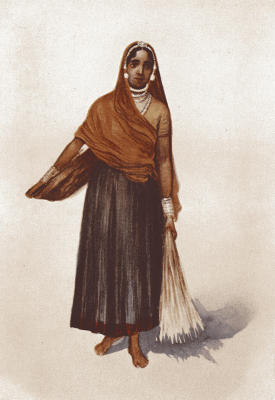
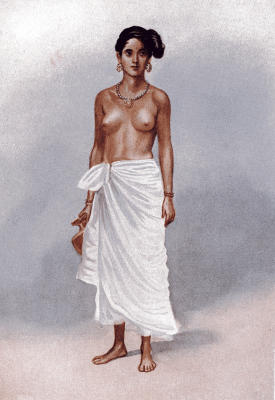
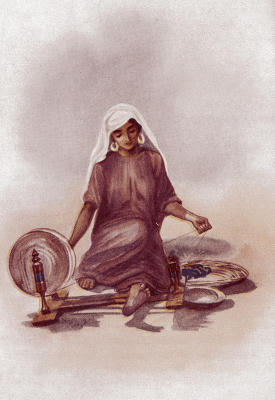
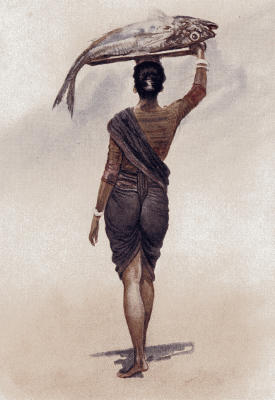
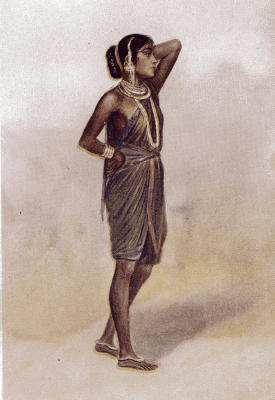
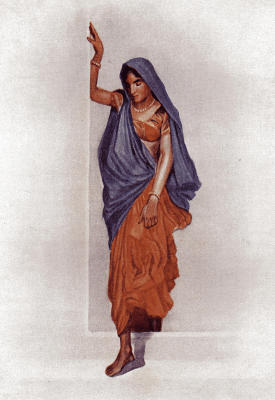
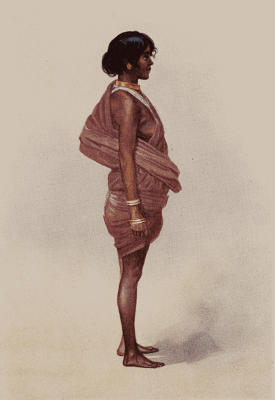
DYER GIRL IN AHMEDABAD