THE “SOUPES”
I shall never think of Belgium
without seeing endless processions of
silent men and black-shawled women,
pitchers in hand, waiting, waiting for the
day’s pint of soup. One and one-quarter
million make a long procession. If you
have imagined it in the sunshine, think
of it in the rain!
One may shut himself up in his house and forget the war for a few
hours, but he dare not venture outside. If he does he will quickly
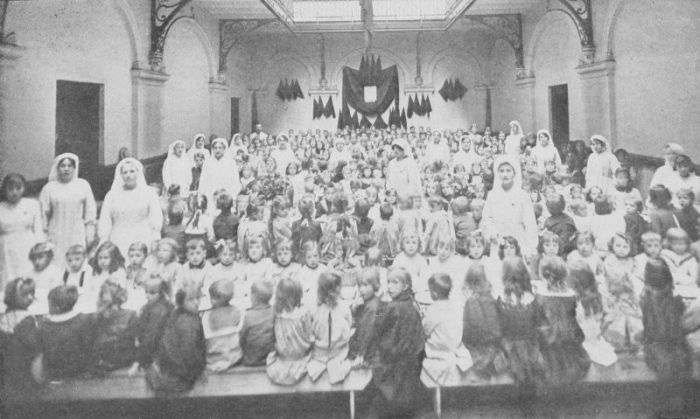
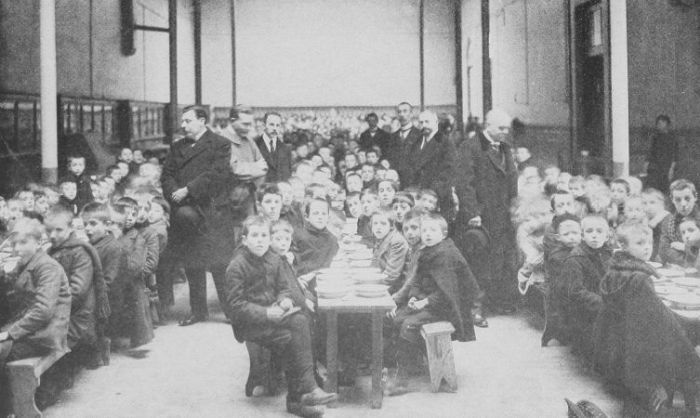
stumble against a part of this line, or on hundreds of little children
guarding their precious cards as they wait to be passed in to one of
the “Enfants Débiles”
dining-rooms, or on a very long line of women in front of a communal
store where “identity cards” permit the purchase every week of limited
rations of American bacon or rice and a few other foods at fixt prices
(prices set by American efficiency below those of America itself); or
on a group of black-shawled mothers waiting for the dinner that enables
them to nurse the babies in their arms.
The destitute must have a “supplement”
to their daily ration of carbohydrates
and fat which will give them
protein—says the C. R. B., and thus we
have “Soupes”;—but these dry statements
of engineers now become dieticians
convey to no one the human story of
these dumb, waiting lines.
We can have little conception of what
it means for just one city, the Agglomeration
of Brussels, for instance, to keep
200,000 out of its 1,000,000 people on
the “Soupes,” not for a month or two,
but for over two years! Nor does this
include the soup made by the “Little
Bees,” an organization which cares especially
for children, for the thousands in
their cantines; or the soup served to the
8,500 children in sixty communal schools
of central Brussels at four o’clock each
afternoon, which is prepared in a special
kitchen. These quantities are all over and
above the regular soup served to 200,000—and
do not think of soup as an American
knows it, think more of a kind of
stew; for it is thick, and, in the words of
the C. R. B., “full of calories.”
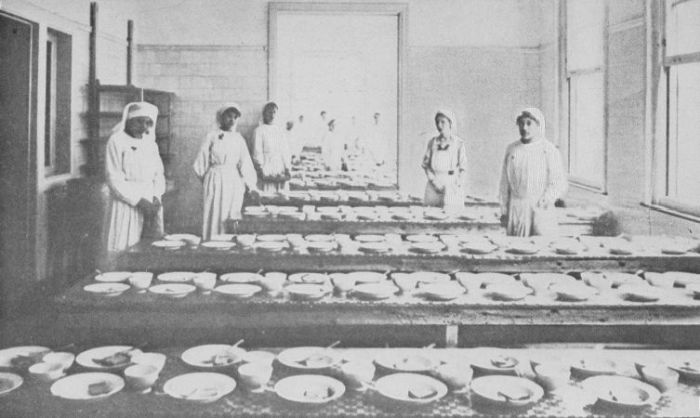
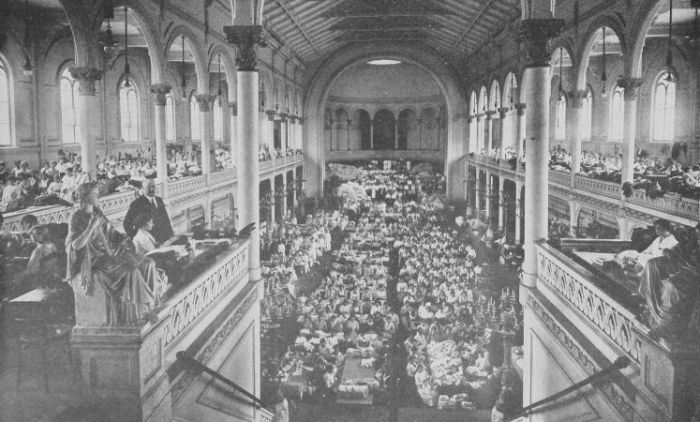
To make it for central Brussels the
slaughter-house has been converted into
a mighty kitchen, in charge of a famous
pre-war maître d’hôtel. Ninety-five cooks
and assistants from the best restaurants
of the capital have been transferred from
the making of pâtés and soufflés to the
daily preparation of 25,000 quarts of
soup! And they use the ingenuity born
of long experience, to secure an appetizing
variety while strictly following the
orders of directing physicians. They had
been doing this over 700 days when I
visited the kitchen, but there was still a
fresh eagerness to produce something
savory and different. And one must remember
that the changes can come only
from shifting the emphasis from our dried
American peas to beans, from carrots to
cabbages, from macaroni to rice. The
quantity of meat remains about the same,
1,200 pounds a day, which, tho the committee
kills its own cattle, costs almost
fifty cents a pound. There must be, too,
10,000 pounds of potatoes. The great
fear has been that this quantity might be
cut, and unfortunately, in November,
1916, that fear was realized to the extent
of a 2,000 pound drop—and then remedied
by the C. R. B. with more beans, more
rice, more peas!
Personal inspection of this marvelous
kitchen is the only thing that could give
an idea of its extraordinary cleanliness.
The building offers great space, plenty of
air and light and unlimited supply of
water. The potato rooms, where each
potato is put through two peeling processes,
are in one quarter. Near them
are the green vegetable rooms with their
stone troughs, where everything is washed
four or five times. The problem of purchasing
the vegetables is so great that a
special committee has been formed at
Malines to buy for Brussels on the spot.
One of the saving things for Belgium has
been that she produces quantities of these
delicious greens. In the smaller towns a
committeeman usually goes each morning
to market the day’s supply. For instance,
the lawyer who occupies himself with the
vegetables for the Charleroi soup, makes
his own selection at four o’clock each
morning, and is extravagantly proud of
the quality of his carrots and lettuces!
The most important section, naturally,
is that which cares for the meat and unsmoked
bacon or “lard” the C. R. B.
brings in. The more fat in the soup, the
happier the recipient! With the little meat
that can still be had in the butcher shop,
selling at over one dollar a pound, one can
imagine what it means to find a few pieces
in the pint of soup! Then there is the
great kitchen proper, with the one hundred
and forty gas-heated caldrons, and
the dozens of cooks hurrying from one
to another. There seem to be running
rivers of water everywhere, a perpetual
washing of food and receptacles and
premises.
The first shift of cooks arrives at two-thirty
in the morning to start the gas
under the one hundred and forty great
kettles, for an early truck-load of cans
must be off at 8 o’clock. That shift leaves
at noon; the second works from 8 till 5,
on an average wage of four francs a day
and soupe!
There are ten of the large trucks and
500 of the fifty-quart cans in constant
use. As soon as the 8 o’clock lot come
back, they are quickly cleaned, refilled,
and hurried off on their second journey.
Mostly they are hurried off through rain,
for there are many more rainy than sunny
days in Belgium.
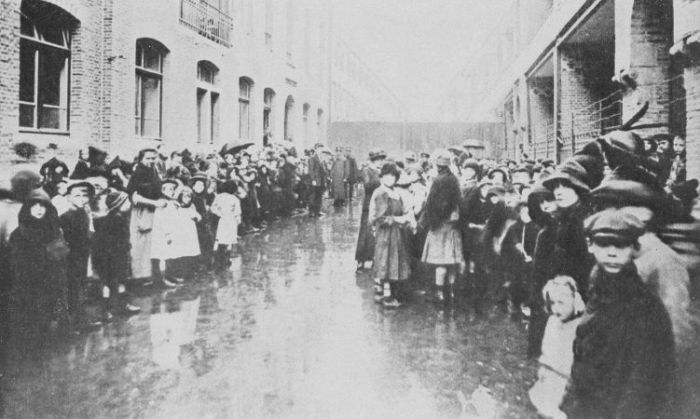
One passes a long line of patient, wet,
miserable-looking men and women with
their empty pitchers, then meets with a
thrill the red truck bringing the steaming
cans. The bakers have probably
already delivered the 25,000 loaves of
bread, for a half loaf goes with each
pint of soup.
By following one of these steaming
trucks I discovered “Soupe 18,” with its
line of silent hundreds stretching along
the wet street.
I was half an hour early, so there was
time to talk with the local committee managers
who were preparing the big hall for
the women who would arrive in a few
minutes to fill the pitchers with soup, and
the string bags with bread. These communal
soupes are generally directed by
men, tho women do the actual serving.
The enthusiastic secretary, who had been
a tailor before the war, said regretfully
that he had been obliged to be absent
three days in the two years.
At the left, near the entrance, I was
shown the office with all the records, and
with the shelves of precious pots of jam
and tiny packages of coffee and rice
which are given out two or three times a
month—in an attempt to make a little
break in the monotony of the continual
soup. No one can picture the heartbreaking
eagerness in the faces of these
thousands as they line up for this special
distribution—these meager spoonfuls of
jam, or handfuls of chopped meat.
We reviewed the army of cans stationed
toward the rear, and the great
bread-racks of either side. The committee
of women arrived; we tasted the soup
and found it good. I was asked to sit at
the table with two men directors, where
I might watch them stamp and approve
the ration-cards as the hungry passed in.
One may hate war, but never as it
should be hated until he has visited the
communal soupes and the homes represented
by the lines. The work must be
so carefully systematized that there is
only time for a word or two as they pass
the table. But that word is enough to reveal
the tragedy! There are sometimes
the undeserving, but it is not often that
any of the thousands who file by are not
in pitiful straits. That morning the saddest
were the very old—for them the
men had always a kindly “How is it,
mother? How goes it, father?”
The “Merci, Monsieur, merci beaucoup,”
of one sweet-faced old woman was
so evidently the expression of genuine
feeling, that I asked about her. She had
three sons, who had supported her well—all
three were in the trenches. Another
still older, said, “Thank you very much,”
in familiar English. She, too, had been
caught in the net, and there was no work.
A little Spanish woman had lost her husband
soon after the war began, and the
director who investigated the case was
convinced that he had died of hunger.
An old French soldier on a crutch, but
not too feeble to bow low as he said
“Merci,” was an unforgettable figure.
Some of the very old and very weak
are given supplementary tickets which
entitle them to small portions of white
bread, more adapted to their needs than
the stern war bread of the C. R. B.;
and every two days mothers are allowed
additional bread for their children. One
curly-haired little girl was following her
mother and grandmother, and slipt out
of the line to offer a tiny hand. Then
came a tall, distinguished-looking man,
about whom the directors knew little—except
that he was absolutely without
funds. They put kindly questions to the
poor hunchback, who had just returned to
the line from the hospital, and congratulated
the pretty girl of fifteen, who had
won all the term’s prizes in the communal
school. There were those who
had never succeeded; then there were
those who two years before had been
comfortable—railway employees, artists,
men and women, young and old, in endless
procession, a large proportion in
carpet slippers, or other substitutes for
leather shoes. Many were weak and ill-looking;
all wore the stamp of war.
Every day they must come for the pint
of soup and the bread that meant life—200,000
in Brussels alone; in Belgium
one and a half million! These are the
lowest in the scale of misery—those who
“must have a supplement of protein,” for
meat never passes their lips but in soup.
The questions were always swift, admitting
no delay in the reply, and knowing
the hearts of the questioners, I wondered
a little at this. Till in a flash I
saw: if the directors wished to know
more they would go to the homes represented—but
the line must not be held
back! Every ten minutes’ halt means
that those outside in the rain must stand
ten minutes longer. On this particular
day the committee put through a line representing
2,500 pints of soup and portions
of bread in fifty minutes, an almost
incredible efficiency, especially when you
remember that every card is examined
and stamped as well as every pitiful
pitcher and string bag filled.
That day a woman who had not before
served on the soupes offered her
services to the seasoned workers. They
were grateful, but smilingly advised her
to go home, fill her bath tub with water,
and ladle it out—to repeat this the following
day and the following, until finally
she might return, ready to endure the
work, and above all, not to retard the
“Line” five unnecessary minutes! Two
and a half years have not dulled the tenderness
of these women toward the
wretched ones they serve.
At Home
Belgium is small. Until now I had
been able to go and return in the same
day. But on this particular evening I
found myself too far south to get back.
I was in a thickly forested, sparsely settled
district, but I knew that farther on there
was a great château belonging to the
family of A., with numerous spare rooms.
Tho I had been in Belgium only a
short time I had already learned how unmeasured
is the friendship offered us, but
I also knew that Belgian etiquette and
convention were extremely rigorous, and
I hesitated.
It was thoroughly dark, when, after
crossing a final stretch of beechwood, I
rang the bell and sent in my card, with
a brief line.
After what seemed an endless time I
saw the servant coming back through the
great hall, followed by three women, who,
I felt instinctively, had not come in welcome.
But there was no turning about possible
now—some one was already speaking to
me. Her very first words showed she
could not in the least have understood.
And I swiftly realized this was not surprizing
since I had been there so short a
time, and there had not before been a
woman delegate. I explained that my
sole excuse for sending in my stranger’s
card at that time of night was my membership
in the C. R. B.—and I uncovered
my pin.
It was as if I had revealed a magic
symbol—the door swung wide! They
took my hands and drew me inside, overwhelming
me with apologies, with entreaties
to stop with them, to stay for a
week, or longer. They would send for
my husband—as Director he must be
sorely in need of a few days’ rest—we
should both rest. Their district in the
forest had many relief centers, they would
see that I got to them all. A room was
all ready for me on the floor above—if I
did not like it I should have another. I
must have some hot tilleul at once!
In the drawing-room I was presented
to the other thirteen or fourteen members
of the family, and in pages I could
not recount their beautiful efforts, individually
and together, to make me forget
I had had to wait for one moment on
their threshold.
Still later, two American men arrived.
They were known, and expected at any
hour of the day or night their duties
might bring them that way. One of them
was ill, and not his own mother and sister
could have been more solicitous in their
care of him than were these kind women.
Do Americans wonder that it hurts us,
when we return, to have people praise
us for what we have given Belgium? In
our hearts we are remembering what
Belgium has given us.