INTRODUCTION.
The Negro Woman in American Life
In the history of the Negro race in America
no more heroic work has been done than that
performed by the Negro woman. The great
responsibilities of life have naturally drifted
to the men; but who can measure the patience,
the love, the self-sacrifice of those
who in a more humble way have labored for
their people and even in the midst of war
striven most earnestly to keep the home-fires
burning? Even before emancipation a
strong character had made herself felt in
more than one community; and to-day,
whether in public life, social service, education,
missions, business, literature, music, or
even the professions and scholarship, the
Negro woman is making her way and reflecting
credit upon a race that for so many
years now has been struggling to the light.
It was but natural that those should first
become known who were interested in the
uplift of the race. If we except such an
unusual and specially gifted spirit as Phillis
Wheatley, we shall find that those who most
impressed the American public before the
Civil War were the ones who best identified
themselves with the general struggle for
freedom. Outstanding was the famous lecturer,
Sojourner Truth. This remarkable
woman was born of slave parents in the
state of New York about 1798. She recalled
vividly in her later years the cold, damp
cellar-room in which slept the slaves of the
family to which she belonged, and where she
was taught by her mother to repeat the
Lord's Prayer and to trust God at all times.
When in the course of the process of gradual
emancipation in New York she became legally
free in 1827, her master refused to
comply with the law. She left, but was
pursued and found. Rather than have her
go back, however, a friend paid for her
services for the rest of the year. Then there
came an evening when, searching for one of
her children that had been stolen and sold,
she found herself without a resting-place
for the night. A Quaker family, however,
gave her lodging. Afterwards she went to
New York City, joined a Methodist church,
and worked hard to improve her condition.
Later, having decided to leave New York
for a lecture tour through the East, she
made a small bundle of her belongings and
informed a friend that her name was no
longer Isabella, as she had been known, but
Sojourner. Afterwards, as she herself said,
finding that she needed two names she
adopted Truth, because it was intended that
she should declare the truth to the people.
She went on her way, lecturing to people
wherever she found them assembled and being
entertained in many aristocratic homes.
She was entirely untaught in the schools,
but tall and of commanding presence, original,
witty, and always suggestive. The stories
told about her are numberless; but she
was ever moved by an abiding trust in God,
and she counted among her friends many of
the most distinguished Americans of her
time. By her tact and her gift of song she
kept down ridicule, and by her fervor and
faith she won many friends for the anti-slavery
cause.
It was impossible of course for any single
woman to carry on the tradition of such a
character as Sojourner Truth. She belonged
to a distinct epoch in the country's
history, one in which the rights of the Negro
and the rights of woman in general were
frequently discussed on the same platform;
and she passed—so far as her greatest influence
was concerned—with her epoch. In
more recent years those women who have
represented the race before the larger public
have been persons of more training and culture,
though it has been practically impossible
for any one to equal the native force
and wit of Sojourner Truth. Outstanding
in recent years have been Mrs. Booker T.
Washington and Mrs. Mary Church Terrell.
The spread of culture, however, and the
general force of the social emphasis have
more and more led those who were interested
in social betterment to come together
so that there might be the greater effect
from united effort. Thus we have had developing
in almost all of our cities and towns
various clubs working for the good of the
race, whether the immediate aim was literary
culture, an orphanage, an old folks' home,
the protection of working girls, or something
else similarly noble. Prominent among
the pioneers in such work were Mrs. Josephine
St. Pierre Ruffin, of Boston, and Mrs.
John T. Cook, of Washington, D. C. No
one can record exactly how much has been
accomplished by these organizations; in fact,
the clubs range all the way in effectiveness
from one that is a dominating force in its
town to one that is struggling to get started.
The result of the work, however, would in
any case sum up with an astonishing total.
A report from Illinois, fairly representative
of the stronger work, mentioned the following
activities: "The Cairo hospital, fostered
and under the supervision of the Yates Club
of Cairo; the Anna Field Home for Girls,
Peoria; Lincoln Old Folks' and Orphans'
Home, founded by Mrs. Eva Monroe and
assisted by the Women's Club of Springfield;
the Home for Aged and Infirm Colored
People, Chicago, founded by Mrs.
Gabrella Smith and others; the Amanda
Smith Orphans' Home, Harvey; the Phillis
Wheatley Home for Wage-Earning Girls,
of Chicago." In Alabama the State Federation
of Colored Women's Clubs has established
and is supporting a reformatory at
Mt. Meigs for Negro boys, and the women
are very enthusiastic about the work. A
beautiful and well ordered home for Negro
girls was established a few years ago in
Virginia. Of the White Rose Mission of
New York we are told that it "has done
much good. A large number of needy ones
have found shelter within its doors and have
been able to secure work of all kinds. This
club has a committee to meet the incoming
steamers from the South and see that young
women entering the city as strangers are
directed to proper homes." All such work
is touching in its tenderness and effectiveness.
The National Association of Colored
Women's Clubs was founded in 1896.
The organization has become stronger and
stronger until it is now a powerful and
effective one with hundreds of members.
One of its recent activities has been the purchase
of the home of Frederick Douglass at
Anacostia, D. C.
In education, church life, and missions—special
forms of social service—we have only
to look around us to see what the Negro
woman is accomplishing. Not only is she
bearing the brunt of common school education
for the race; in more than one instance
a strong character, moved to do something,
has started on a career of success a good
secondary or industrial school. Representative
are the Voorhees Normal and Industrial
School, at Denmark, S. C., founded by
Elizabeth C. Wright; the Daytona Normal
and Industrial Institute for Negro Girls,
founded by Mrs. M. M. Bethune; and the
Mt. Meigs Institute, Mt. Meigs, Alabama,
founded by Miss Cornelia Bowen. Noteworthy
for its special missionary emphasis
is the National Training School of Washington,
of which Miss Nannie H. Burroughs
is the head. One of the most important
recent developments in education has been
the appointment of a number of young
women as supervisors in county schools
under the terms of the will of Anna T.
Jeanes, a Quaker lady of Philadelphia who
left a considerable sum of money for the
improvement of the rural schools of the
South. In church work we all know the
extent to which women have had to bear the
burden not only of the regular activities but
also of the numerous "rallies" that still so
unfortunately afflict our churches. Deserving
of special mention in connection with
social service is the work of those who have
labored under the auspices of the Young
Women's Christian Association, which has
done so much for the moral well-being of the
great camps in the war. In foreign mission
work one of the educational institutions sustained
primarily by Northern Baptist agencies—Spelman
Seminary—stands out with
distinct prominence. Not only has Spelman
sent to Africa several of her daughters from
this country, the first one being Nora Gordon
in 1889; she has also educated several
who have come to her from Africa, the first
being Lena Clark, and for these the hope
has ever been that they would return to their
own country for their largest and most
mature service.
In the realm of business the Negro woman
has stood side by side with her husband in
the rise to higher things. In almost every
instance in which a man has prospered, investigation
will show that his advance was
very largely due to the faith, the patience,
and the untiring effort of his wife. Dr.
B. T. Washington, in his book The Negro in
Business, gave several examples. One of
the outstanding instances was in the story
of Junius G. Groves, famous potato grower
of Edwardsville, Kansas. This man moved
from his original home in Kentucky to
Kansas at the time of the well-known
"Exodus" of 1879, a migration movement
which was even more voluntary on the part
of the Negro than the recent removal to the
North on the part of so many, this latter
movement being in so many ways a result of
war conditions. Mr. Groves in course of
time became a man of large responsibilities
and means. It is most interesting, however,
to go back to his early days of struggle. We
read as follows: "Soon after getting the
crop planted Mr. Groves decided to marry.
When he reached this decision he had but
seventy-five cents in cash, and had to borrow
enough to satisfy the demands of the law.
But he knew well the worth and common
sense of the woman he was to marry. She
was as poor in worldly goods as himself; but
their poverty did not discourage them in
their plans. * * * * During the whole
season they worked with never-tiring energy,
early and late; with the result that when the
crop had been harvested and all debts paid
they had cleared $125. Notwithstanding
their lack of many necessaries of life, to say
nothing of comforts, they decided to invest
$50 of their earnings in a lot in Kansas City,
Kansas. They paid $25 for a milk cow, and
kept the remaining $50 to be used in the
making of another crop." In the course of
a few years Mr. Groves, with the help of
his wife, now the mother of a large family,
gathered in one year hundreds of thousands
of bushels of white potatoes, surpassing all
other growers in the world. Similarly was
the success of E. C. Berry, a hotel-keeper of
Athens, Ohio, due to his wife. "At night,
after his guests had fallen asleep, it was his
custom to go around and gather up their
clothes and take them to his wife, who would
add buttons which were lacking, repair rents,
and press the garments, after which Mr.
Berry would replace them in the guests'
rooms. Guests who had received such treatment
returned again and brought their
friends with them." In course of time Mr.
and Mrs. Berry came to own the leading
hotel in Athens, one of fifty rooms and of
special favor with commercial travelers.
Such examples could be multiplied indefinitely.
It is not only in such spheres that
the worth of the Negro woman has been
shown, however. Daily, in thousands of
homes, in little stores and on humble farms,
effort just as heroic has been exerted,
though the result is not always so evident.
On their own initiative also women are now
engaging in large enterprises. The most
conspicuous example of material success is
undoubtedly Mme. C. J. Walker, of the
Mme. C. J. Walker Manufacturing Company,
of Indianapolis and New York, a
business that is now conducted on a large
scale and in accordance with the best business
methods of America. Important also
in this connection is the very great contribution
that Negro women—very often those
without education and opportunity—are
making in the ordinary industrial life of the
country. According to the census of 1910,
1,047,146, or 52 per cent. of those at work,
were either farmers or farm laborers, and
28 per cent. more were either cooks or washerwomen.
In other words, a total of exactly
80 per cent. were doing some of the
hardest and at the same time some of the
most necessary work in our home and industrial
life. These are workers whose worth
has never been fully appreciated by the
larger public, and who needed the heavy
demands of the great war to call attention
to the actual value of the service they were
rendering.
The changes in fact brought about within
the last few years, largely as a result of war
conditions, are remarkable. As Mary E.
Jackson, writing in the Crisis, has said:
"Indiana reports [Negro women] in glass
works; in Ohio they are found on the night
shifts of glass works; they have gone into
the pottery works in Virginia; wood-working
plants and lumber yards have called for
their help in Tennessee." She also quotes
Rachel S. Gallagher, of Cleveland, Ohio, as
saying of the Negro women in that city:
"We find them on power sewing-machines,
making caps, waists, bags, and mops; we
find them doing pressing and various hand
operations in these same shops. They are
employed in knitting factories as winders,
in a number of laundries on mangles of
every type, and in sorting and marking.
They are in paper box factories doing both
hand and machine work, in button factories
on the button machines, in packing houses
packing meat, in railroad yards wiping and
cleaning engines, and doing sorting in railroad
shops. One of our workers recently
found two colored girls on a knotting machine
in a bed spring factory, putting the
knots in the wire springs."
In the professions, such as medicine and
law, and in scholarship as well, the Negro
woman has blazed a path. One year after
Oberlin College in Ohio was founded in
1833, thirty years before the issuing of the
Emancipation Proclamation, the trustees
took the advanced ground of admitting
Negro men and women on equal terms with
other students. Of the Northern colleges
and universities Oberlin still leads in the
number of its Negro women graduates, but
in recent years other such institutions as
Radcliffe, Wellesley, Columbia, and Chicago
have been represented in an increasing
number by those who have finished their
work creditably and even with distinction in
many instances. More and more each year
are young women at these institutions going
forward to the attainment of the higher
scholastic degrees. In connection with medicine
we recall the work in the war of the
Negro woman in the related profession of
nursing. It was only after considerable discussion
that she was given a genuine opportunity
in Red Cross work, but she at once
vindicated herself. In the legal profession
she has not only been admitted to practice
in various places, but has also been appointed
to public office. It must be understood
that such positions as those just remarked
are not secured without a struggle,
but all told they indicate that the race
through its womanhood is more and more
taking part in the general life of the country.
In keeping with the romantic quality of
the race it was but natural that from the first
there should have been special effort at self-expression
in literature, music, and other
forms of art. The first Negro woman to
strike the public imagination was Phillis
Wheatley, who even as a young girl wrote
acceptable verse. Her Poems on Various
Subjects published in 1773 at once attracted
attention, and it was fitting that the
first Negro woman to become distinguished
in America should be one of outstanding
piety and nobility of soul. Just a few years
before the Civil War Frances Ellen Watkins,
better known as Mrs. F. E. W. Harper,
entered upon her career as a writer of
popular poetry. At the present time attention
centers especially upon Mrs. Georgia
Douglas Johnson, who early in 1918
produced in The Heart of a Woman a
little volume of delicate and poignantly
beautiful verse, and from whom greater and
greater things are expected, as she not only
has the temperament of an artist but has
also undergone a period of severe training
in her chosen field. In the wider field of
prose—including especially stories, essays,
and sketches—Mrs. Alice Moore Dunbar-Nelson
is prominent. In 1899 she produced
The Goodness of St. Rocque, and
other stories, and since then has continued
her good work in various ways. The whole
field of literature is a wide one, one naturally
appealing to many of the younger
women, and one that with all its difficulties
and lack of financial return does offer some
genuine reward to the candidate who is willing
to work hard and who does not seek a
short cut to fame.
In music the race has produced more
women of distinction than in any other field.
This was natural, for the Negro voice is
world famous. The pity is that all too frequently
some of the most capable young
women have not had the means to cultivate
their talents and hence have fallen by the
wayside. Some day it is to be hoped that a
great philanthropist will endow a real conservatory
at which such persons may find
some genuine opportunity and encouragement
in their development in their days of
struggle. In spite of all the difficulties,
however, there have been singers who have
risen to very high things in their art. Even
before the Civil War the race produced one
of the first rank in Elizabeth Taylor Greenfield,
who came into prominence in 1851.
This artist, born in Mississippi, was taken
to Philadelphia and there cared for by a
Quaker lady. The young woman did not
soon reveal her gift to her friend, thinking
that it might be frowned upon as something
too worldly. Her guardian learned of it by
accident, however, and one day surprised her
by asking, "Elizabeth, is it true that thee can
sing?" "Yes," replied the young woman in
confusion. "Let me hear thee." And Elizabeth
sang; and her friend, realizing that she
had a voice of the first quality, proceeded to
give her the best instruction that it was possible
to get. Elizabeth Taylor Greenfield
had a marvelous voice embracing twenty-seven
notes, reaching from the sonorous bass
of a baritone to the highest soprano. A
voice with a range of more than three octaves
naturally attracted much attention in
both England and America, and comparisons
with Jenny Lind, then at the height of
her great fame, were frequent. In the next
generation arose Madame Selika, a cultured
singer of the first rank, and one who by her
arias and operatic work generally, as well
as by her mastery of language, won great
success on the continent of Europe as well
as in England and America. The careers
of some later singers are so recent as to be
still fresh in the public memory; some in
fact may still be heard. It was in 1887 that
Flora Batson entered on the period of her
greatest success. She was a ballad singer
and her work at its best was of the sort that
sends an audience into the wildest enthusiasm.
In a series of temperance meetings in
New York she sang for ninety consecutive
nights, with never-failing effect, one song,
"Six Feet of Earth Make Us All One Size."
Her voice exhibited a compass of three octaves,
but even more important than its
range was its remarkable sympathetic quality.
Early in the last decade of the century
appeared also Mrs. Sissieretta Jones, whose
voice at once commanded attention as one of
unusual richness and volume, and as one
exhibiting especially the plaintive quality
ever present in the typical Negro voice.
At the present time there are several
promising singers; and there are also those
who in various ways are working for the
general advancement of the race in music.
Mrs. E. Azalia Hackley, for some years
prominent as a concert soprano, has recently
given her time most largely to the work of
teaching and showing the capabilities of the
Negro voice. Possessed of a splendid
musical temperament, she has enjoyed the
benefit of three years of foreign study and
generally inspired many younger singers or
performers. Prominent among many excellent
pianists is Mrs. Hazel Harrison
Anderson, who also has studied much
abroad and who has appeared in many
noteworthy recitals. Mrs. Maud Cuney
Hare, of Boston, a concert pianist, has
within the last few years given several excellent
lecture-recitals dealing with Afro-American
music.
As between painting and sculpture the
women of the race have shown a decided
preference for sculpture. While there are
some students of promise, no woman has as
yet achieved distinction on work of really
professional quality in the realm of painting.
On the other hand there have been three or
four sculptors of genuine merit. As early
as 1865 Edmonia Lewis began to attract attention
by her busts of prominent people.
Within the last few years the work of Mrs.
May Howard Jackson, of Washington, has
attracted the attention of the discerning;
and that of Mrs. Meta Warrick Fuller is
reserved for special comment.
Any such review as this naturally has its
limitations. We can indicate only a few of
the outstanding individuals here and there.
At least enough has been said, however, to
show that the Negro woman is making her
way at last into every phase of noble endeavor.
In the pages that follow we shall
attempt to set forth at somewhat greater
length the life and work of a few of those
whose achievement has been most signal and
whose interest in their sisters has been
unfailing.
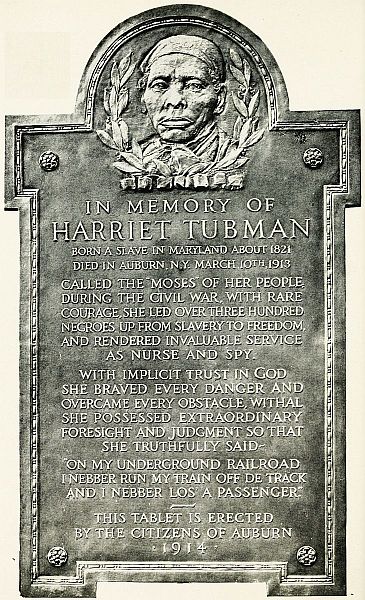 Used through courtesy of John Williams, Inc., Bronze Foundry and Iron Works, New York, N. Y.
Transcriber's Note: A larger version of this
image may be seen by clicking on this image.