Sarah the Beautiful Princess—Her Faith Tested—The Mistake
of Her Life—Her Lovely Character—Rebekah—An Oriental
Wooing—Eliezer’s Prayer—The Bride’s Answer—Meeting
Isaac—A Mother’s Love for Her Son—Jacob’s
Flight—Rebekah, the Beautiful Shepherdess—Seven Years’
Service for Her—Laban’s Deception—Leah, the Tender-Eyed—Human
Favorites—Divinely Honored—Rachel’s Tomb
the First Monument to Human Love.
From the prominence given to Eve in connection with the
temptation and the overwhelming disasters which followed
the loss of the Eden home in Paradise, we are surprised the
Sacred historian passes over a period of about two thousand
years without giving us any record of women. The names
of good men are mentioned. Enoch walked before God for
over three hundred years, and the walk was such a perfect
one, and it pleased God so well, that He translated Enoch.
Noah also “found grace in the eyes of the Lord,” and he was
“a just man and perfect in his generations,” and “walked
with God,” doubtless as Enoch had done. No doubt there
were others who lived clean, pure lives. Of this number was
Lamech, the father of Noah, for he was comforted in the birth
of his son, saying, he “shall comfort us concerning our work
and toil of our hands, because of the ground which the Lord
hath cursed.” Surely such men must have had good mothers
to train them, and good wives for companions. But nothing
is said about these women that walked in White Raiment in
that dark and sinful age, when “all flesh had corrupted his
way upon the earth,” until Sarah, the fair wife of Abraham,
is reached.
We find this beautiful princess willing to leave her home
and her people in the land of Ur of the Chaldees and journey
for more than a thousand miles to the land of Canaan.
However, this journey was not a continuous one, for a long
stop was made at Haran, in Mesopotamia, perhaps half way
between Ur and Palestine.
Of her birth and parentage we have no certain account in
Scripture. In Gen. xx, 12, Abraham speaks of her as “his
sister, the daughter of the same father, but not the daughter
of the same mother.” The Hebrew tradition is that Sarai
is the same as Iscah, the daughter of Haran. This tradition
is not improbable in itself, and certainly supplies the account
of the descent of the mother of the chosen race.
The change of her name from Sarai to Sarah was made on
the establishment of the covenant of circumcision between
Abraham and God, and signifies “princess,” for she was to
be the royal ancestress of “all families of the earth.”
The beautiful fidelity of this noble woman is shown in her
willingness to accompany her husband in all the wanderings
of his life. Her home in Mesopotamia was gladly and willingly
exchanged for a tent, and that tent was often taken
down and set up during the nomadic life which formed the
basis of the patriarchal age. God intended to set forth in
Abraham not only the thought that here man has no continuing
city, but also the life of faith. And this faith of Abraham
is distinguished from the faith of the pious ancestors in
this, that he obtained and held the promises of salvation, not
only for himself, but for his family; and from the Mosaic
system, by the fact that it expressly held the promised blessing
in the seed of Abraham, as a blessing for all people. But
this faith had not only to be developed, but also tested. It
is beautiful to read that Abraham believed God, but his
faith when he went down into Egypt was far from that when
he went “into the land of Moriah” to offer up Isaac. Nothing
is plainer in the Bible than that a man’s faith is not a
matter of indifference. He can not be disobedient to God’s
calls, and yet go to heaven when he dies. This is not an
arbitrary decision. There is and must be an adequate
ground for it. The rejection of God’s dealings with us is as
clear a proof of moral depravity, as inability to see the light
of the sun at noon is a proof of blindness.
Now let us look at a few of these testings or trials of faith
that came into the life of this woman in White Raiment, this
princess in Israel. She was asked to give up her native
land. How dear the fatherland is to the heart, only those
who have passed through the experience can realize. This
was not all. She was asked to give up her kindred. To
move away from all the associations of childhood and youth,
requires a brave heart. But she was also asked to give up
her home, and what is dearer to a woman’s heart than her
home? We have no doubt Sarah’s home by the beautiful
streams that flow down from the high table-lands of Armenia
into the rich valleys of Mesopotamia, was a lovely one, and
to exchange it for tent-life was a brave sacrifice. Her love
to God must have been deep and constant.
After a long, weary journey through the desert sands, the
land of promise is finally reached, only to find it afflicted with
a famine. How often Sarah must have longed for one look out
over the fig orchards, the olive yards and waving grain fields
ripening in the summer’s sun of her native Mesopotamia, as
she looked out over the barren hills, burned-up fields, and
dried-up water courses of Palestine. Night after night,
Abraham’s tent is pitched, only to be taken down in the
morning, in quest of pasturage for their herds and flocks,
until the wilderness in the southern extremity of Canaan is
reached. How all this must have tested their faith. Had
they not mistaken the call of God? Is it possible that this
parched land is the land of promise? How disappointments
and failures test our faith, and the heart of poor Sarah must
have been sorely tried.
But there was yet another test, and a humiliating one at
that, and it seems to look as if their united faith was wavering.
She was a beautiful woman, and they were now upon
the very borders of Egypt, and there was no other alternative
but to perish with famine or to go down into the land of
the Pharaohs. Both Abraham and Sarah seemed to realize
the hazard they were running, for, possibly, the bloom and
beauty of Sarah’s face might cost Abraham’s life. So they
agreed between them that Sarah should say that she was his
sister, lest he should be killed. The declaration was not
false. She was his half-sister, but it was not the whole
truth, and it would seem, from their present conduct, that
their faith, tested by the famine, was now wavering, for,
why not appeal their cause to God, instead of taking it into
their own hands? The reason for resorting to this deception
was, if she was regarded as his wife, an Egyptian could only
obtain her, when he had first murdered her husband. But
if she was his sister, then there was a hope that she might be
won from her brother by loving attentions and costly gifts,
or, if her beauty came to the notice of Pharaoh she would
be taken to his harem by arbitrary methods. They had not
reasoned in vain. The princes of the land saw her, “and
commended her before Pharaoh,” and “Sarah was taken
into Pharaoh’s house.”
It is hard for us to understand what a trial of her
faith this harem life must have been to the pure-minded
Sarah. How often her mind must have gone out over
the stretches of desert wastes to her own land abounding
with streams and fertility. And to be conscious that the
charms of her person were the centre of attraction in the
court of Egypt.
But all this time God’s eye was a witness to all that was
passing. When we get to the end of self, He always comes
to our rescue—our extremity is His opportunity. In her
resided the religious disposition in the highest measure, and
just at a time when the nations appeared about to sink into
heathenism, hence her faith must be saved to the race, so
“the Lord plagued Pharaoh with great plagues,” that is to
say, God administered “blow on blow,” and these were of
such a nature as to guard Sarah from injury. At length the
ruler of the land, whose heart does not seem to be hardened
like the later kings, concludes that his punishment is for the
sake of Sarah, and restores her to Abraham.
After Abraham had separated from Lot, the Lord again
appeared unto him, at which time Abraham complained
for the want of an heir. So the Lord leads Abraham
out of his tent, under the heavens as seen by night, and in
that land of blue skies, the night heavens are beautiful indeed.
God had promised at first one natural heir, but now
the countless stars which he sees, should both represent the
innumerable seed which should spring from this one heir,
and at the same time be a warrant for his faith.
At this point the human element again seeks to aid in
bringing about the realization of the divine promise. The
childless state of Abraham’s house was its great sorrow, and
the more so, since it was in perpetual opposition to the calling,
destination, and faith of Abraham, and was a constant
trial of his faith. Sarah herself, doubtless, came gradually
more and more, on account of her barrenness, to appear as a
hindrance to the fulfillment of the divine promise, and as
Abraham had already fixed his eye upon his head servant,
Eliezer of Damascus, so now Sarah fixes her eye upon her
head maid, Hagar the Egyptian. It must be this maid not
only had mental gifts which qualified her for the prominent
place she occupied in the household, but also inward participation
in the faith of her mistress. So Hagar is substituted,
for, in the substitution, Sarah hopes to carry forward the
divine purpose of the family. In this she certainly practiced
an act of heroic self-denial, but still, in her womanly excitement,
anticipated her destiny as Eve had done, and carried
even Abraham away with her alluring hope. Though she
greatly erred in this effort to assist God in bringing in the
realization of the promise, and thereby revealed a lack of
faith in the divine appointments, yet we have here a beautiful
exhibition of her heroic self-denial even in her error.
Perhaps, viewed from the human standpoint, we should here
bring into our narrative also, the fact, that they had been
already ten years in Canaan, and Sarah was now seventy-five
years of age, waiting in vain for the heir, through whom
the great blessing was to come to all the families of the earth.
However, in all this, Sarah, the noble generous hearted,
had not counted upon the conduct Hagar would assume in
her new relation. As an Egyptian, Hagar seemed to have
regarded herself as second wife, instead of recognizing her
subordination to her mistress. This subordination seems to
have been assumed by Abraham, and hence the apparent
indifference probably was the source of Sarah’s sense of injury,
when she exclaimed, “My wrong be upon thee.” She
felt that Abraham ought to have redressed her wrong—ought
to have seen and rebuked the insolence of the maid. Beyond
a doubt, looking at the pride and insolence of Hagar, from
Sarah’s standpoint, it was very trying. The Hebrews regarded
barrenness as a great evil and a divine punishment,
while fruitfulness was held as a great good and a divine
blessing. The unfruitful Hannah received the like treatment
with Sarah, from the second wife of Elkanah. It is still
thus, to-day, in eastern lands. With almost the tenderness
of Elkanah to the sorrowing Hannah, Abraham says, “Behold
the maid is in thy hand.” He regards Hagar still as
the servant, and the one who fulfills the part of Sarah. But
now the overbent bow flies back with violence. This is the
back stroke of her own eager, overstrained course. Sarah
now turns and deals harshly with Hagar. How precisely,
we are not told. Doubtless, through the harsh thrusting her
back into the mere position and service of a slave. But
Hagar, it appears, would not submit to such treatment.
She, perhaps, believed that she had grown above such a position,
and fled from the presence of Sarah.
What need was there for Sarah to learn the lesson of the
patience of faith. God had promised her great honors and
blessings. There was in her nature much that needed toning
up by the grace of patience, and God would take his
own best time in developing her life. Her haste to anticipate
the blessing promised, not only delayed its realization,
but brought sorrow to her own heart, and untold trouble to
her posterity, for Ishmael’s hand has been “against every
man, and every man’s hand against him.” The Ishmaelites,
it is said, “dwelt from Havilah unto Shur,” and it is certain
that they stretched in very early times across the desert to
the Persian Gulf, peopled the north and west of the Arabian
peninsula, and eventually formed the chief element of the
Arab nation, which has proved to be a living fountain of
humanity whose streams for thousands of years have poured
themselves far and wide. Its tribes are found in all the
borders of Asia, in the East Indies, in all Northern Africa,
along the whole Indian Ocean down to Molucca, they are
spread along the coast to Mozambique, and their caravans
cross India to China. These wandering hordes of the desert
have always and still lead a robber life. They justify themselves
in it, upon the ground of the hard treatment of Ishmael,
their father, who, driven out of his paternal inheritance,
received the desert for his possession, with the permission to
take whatever he could find. Mohammed is in the line of
Ishmael, and the followers of Islam, in their pride and delusion,
claim that the rights of primogeniture belong to Ishmael
instead of Isaac, and assert their right to lands and
goods, so far as it pleases them. Vengeance for blood rules
in them, and the innocent have often fallen victims to their
horrible massacres. So that the disaster which overtook the
race in this premature anticipation of divine Providence is
second only to the disaster that overtook Eve in the temptation
and the loss of Paradise. Could Sarah have foreseen all
the sad consequences of her unseemly haste to pluck the
unripened promise God meant to give her, she certainly
would have cultivated the patience of faith.
But the years passed on—fifteen of them nearly—since
the child Ishmael had been in the home of the patriarch, and
the visit of the angels under the Oaks in the plain of Mamre.
During this time God had once more renewed his promise to
Abraham, and also the rite of circumcision had been established,
and, doubtless, the symbolical purification of Abraham
and his house, opened the way for the friendly
appearance of Jehovah in the persons of the angels, or men,
as the patriarch at first thought them to be, as he looked up,
while seated in his tent door through the heat of the noontide
hours.
When he saw the angels, “he ran to meet them,” and, it
seems, instantly recognized among the three the one whom
he addressed as the Lord, and who afterwards was clearly
distinguished from the two accompanying angels. “If
now,” Abraham asks, “I have found favor in Thy sight,
pass not away.” This cordial invitation, while it has in it
the marked hospitality of Orientals, to the inner consciousness
of Abraham it had a deeper meaning, the covenant
relation between himself and Jehovah, that is, he hopes this
relation is still continued. His humble and pressing invitation,
his zealous preparations, his modest description of the
meal, his standing by to serve those who were eating, are
picturesque traits of the life of faith as it here reveals itself,
in an exemplary hospitality. This is the custom still in
Eastern lands, and is referred to by our Lord in that passage
where He speaks of His second coming, and shall find His
people watching, for He will “make them to sit down to
meat, and will come forth and serve them” (Luke xii, 37),
and seems to be one of the countless instances where, in the
web of the Holy Scriptures, the golden threads of the Old
Testament are interwoven with those of the New, and form,
as it were, one whole. And the fact that this beautiful custom
of hospitality is still observed among the Bedouins, as
we can speak from personal knowledge, is remarkable, and
impresses us with the thought that the covenant blessings,
like some sweet, heavenly fruitage, refuses to be lost out of
the lives of that ancient people.
The meal having been served in this beautiful Oriental
manner, the Lord asks, “Where is Sarah?” Abraham made
answer, “Behold, in the tent.” Then the Angel of the Lord,
not only renews the promise, but that it should be fully
realized in the birth of Isaac within a year. Sarah, behind
the tent door, hears this unqualified assurance, but, viewing
it from nature’s standpoint, rendered doubly improbable
from her life-long barrenness, “laughed within herself.”
We can not regard this as a laugh of unbelief, or the scoff of
doubt, as some do, but as a laugh falling short in her conception
of God. The thing which was impossible according
to the established laws of nature, her faith had not yet
grasped as being possible with God. But the Lord, nevertheless,
observed Sarah’s laugh, and this divine hearing on
the part of the Angel of the Lord, startled her, and had its
part in the strengthening of her faith. It prepared the way
for the question, “Is anything too hard for the Lord?” To
her own mind one thing, namely, that she should be a
mother at ninety years of age, seemed too hard. And so the
question had to do with this very thought, and must be settled
on the side of her faith. And she grandly and heroically
asserted her belief that nothing, not even the seeming
insurmountable obstacle which nature interposed, was too
great for God to overcome, and her faith was strengthened,
for we read, “through faith Sarah received strength to conceive
seed, and was delivered of a child when she was past
age, because she judged Him faithful who had promised”
(Heb. xi, 11). The trial of her patience of faith was a long
struggle. It took twenty-five years to bring her up to the
point where her faith could grasp the truth that nothing
was too hard for the Lord to perform. But this blessed
woman at length stood in right relation to God, for, without
faith, be it observed, it is impossible to please God, or to
receive anything at His hands.
In due time Isaac was born. It was the great event in
Sarah’s life. As the mother looked down into the face of the
son of her bosom she breaks forth in an exultant song of
thankfulness, not unlike that of Mary, the blessed virgin.
The little song of Sarah, it has beautifully been said, is the
first cradle hymn. Our Lord reveals the profoundest source
of this joy, when, in addressing the Pharisees, who held
Abraham to be their father, said, “Your father Abraham
rejoiced to see my day.” Sarah, in the birth of Isaac, is the
ancestress of Christ. Spiritually viewed, the birthday of
Isaac becomes the door or entrance of the day of Christ,
and the day of Christ the background of the birthday of
Isaac.
Another beautiful incident in connection with the childhood
of Isaac is, that Sarah, his mother, even at her advanced
age and exalted station in life, did not deem it a burden to
nurse him. Calvin has well said, “Whom God counts
worthy of the honor of being a mother He at the same time
makes a nurse; and those who feel themselves burdened
through the nursing of their children, rend, as far as in them
lies, the sacred bond of nature, unless weakness, or some
infirmities, form their excuse.”
But along with the growing child is the mocking Ishmael.
He was fourteen years of age at the birth of Isaac, and
therefore in the first years of Isaac, appears as a playful lad,
and true to his nature, doubtless developed a characteristic
trait of jealousy which would not escape the ever watchful
eye of Sarah, as she observed his dancing and leaping, and
now and then making hateful faces at the mother’s darling,
mocking his childish fears and appeals to the mother for
protection. This seems to have been endured by Sarah
until the great feast day, held to celebrate the weaning of
Isaac. Seeing special attention paid to Isaac by all the invited
guests, his jealousy suddenly developed into envy,
and this, in turn, found expression in mockery. Sarah could
endure these mockings no longer, for to her sensitive nature,
Ishmael’s mocking the child of promise was but the outward
expression of his unbelief in the faith of his parents, and
therefore the word and purpose of God. His conduct revealed
his unbelief, and hence was unworthy and incapable
of sharing in the blessing, which then, as now, was secured
only by faith, and which had already cost her so much.
Hence she said to Abraham, “Cast out this bondwoman and
her son.” The treatment may seem harsh, but there could
be no peace or happiness in that household until the mocking
Ishmael was out of it. This mother, whose spiritual faith
had been quickened in a marvelous manner, was clear-sighted
enough to see that the purposes of God in reference
to Isaac could only become actual through this separation.
The fact that the prompt, sharp determination that “the
son of this bondwoman shall not be heir” with Isaac, “was
very grievous in Abraham’s sight,” shows that his prejudice
in favor of the rights of the natural first-born needed correction.
And God confirmed the judgment of Sarah. For the
exclusion of Ishmael was requisite not only to the prosperity
of Isaac and the line of the promise, but to the welfare of Ishmael
himself. And the man of faith, who should later offer
up Isaac, must now be able to offer up Ishmael also.
After the sending away of Hagar and her son Ishmael,
there is but one incident recorded in the life of Abraham,
namely the treaty or covenant of peace with Abimelech,
King of Gerar, though probably several years passed away
between the departure of Hagar and the last great test or
trial of Abraham in the offering up of Isaac on Mt. Moriah.
The son of promise had grown to be a lad of sixteen or
seventeen years of age, when the voice of the Lord called
unto Abraham, saying, “Take now thy son, thine only son
Isaac, whom thou lovest, and get thee into the land of
Moriah; and offer him there for a burnt offering upon one of
the mountains which I will tell thee of.” It would seem that
this message came to Abraham while asleep—in a dream as
we would say—and therefore all the more trying as such a
revelation, under such circumstances might well be questioned.
Upon waking out of his sleep he might reasonably
question the import of such a dream, especially since Isaac
was his only child, and the son of promise. But it appears
that Abraham did not stop to explain away this command,
and we must believe that he did not even inform Sarah of
this heart-crushing revelation, for neither she nor Isaac
knew at the time the special object of the journey. Promptly
Abraham made the necessary preparations, and set out on
the three days’ journey. His obedience is absolute. There
is not even a question raised as to his correctly understanding
the duty required of him. To suppose that Abraham
did not have the bleeding heart of a father in this great
trial, would be to destroy the force of this testing of his
faith. And the fact that he had three days’ time in which
he could change his purpose, made the conflict within him
all the harder.
The lad and the mother could easily see from the wood, and
the fire, and the knife, that he went not merely to worship, but
to sacrifice. The testing was still more heart-breaking when,
at the end of the journey, at the foot of Moriah, while Abraham
is in the act of laying the wood upon the obedient Isaac,
the heir of promise said, “My father, behold the fire and the
wood, but where is the lamb for a burnt offering?” How the
bleeding heart of the father must have been touched afresh
as he looked upon Isaac as “the lamb,” yet, as if the hour
for the fuller revelation had not yet come, made answer,
“My son, God will provide Himself a lamb.”
And so the two, the father and the son, slowly climb the
rugged sides of Moriah to its very summit, and Abraham
built an altar, as he so often had done before, for, wherever
Abraham had a tent, God had an altar, and in the building
of this altar we may well believe the loving, obedient Isaac
assisted. Then the wood was laid upon it. All was ready
for “the lamb!” But God had not yet provided the victim.
What passed between father and son the Sacred record
has not revealed. However, we must believe it was the
Gethsemane struggle with Isaac, and that in the end he said
to Abraham, as Christ, under similar circumstances, said to
His heavenly Father, “Thy will be done.” And, perhaps,
this loving self-surrender of Isaac made it all the harder for
the father’s heart. But, somehow, we can not understand it,
only in the light of complete self-surrender to the will of God,
he “bound Isaac his son, and laid him on the altar upon the
wood,” and, nerving himself for the last great act, he
“stretched forth his hand, and took the knife to slay his
son.”
But God, during this scene on Mount Moriah, was an
interested spectator. He saw that the obedience of faith—the
complete self-surrender of Abraham’s will—was perfect.
“And the angel of the Lord called unto him out of heaven,
and said, ‘Lay not thine hand upon the lad, neither do thou
anything unto him, for now I know that thou fearest God,
seeing thou hast not withheld thy son, thine only son, from
me.’”
It is worthy of observation that, while the command to
offer up Isaac came in a dream, and therefore open to misgiving,
the command to stay his hand is spoken by the angel
of Jehovah out of heaven. Abraham was perfect in his faith,
and how far it reached into the great love for God and self-surrender
to His will, we shall never know. Paul, speaking
of this wonderful victory over self, said that Abraham
accounted that God was able to raise up Isaac, “even from
the dead; from whence also he received him in a figure.”
Though all his hope, humanly speaking, perished out of his
heart when he took up the sacrificial knife on Moriah, yet
his faith overleaped human limitations into the infinite
ability of God to raise up Isaac out of the ashes upon his
altar.
Such faith was possible for Abraham, for God asks no
impossibilities at the hands of men, and what was possible
for this man of faith is possible for any of us, if we are willing
to pay the price. Let no one think, however, that such
fruits of righteousness drop into the lap of the faithless.
But through this severe testing, Sarah nowhere appears
on the scene. It may be, infinite love would spare the
mother’s heart. It may be, also, the last great trial of her
faith took place in the tent, stretched under the oaks, in the
plain of Mamre. There is a Jewish tradition that when
Sarah fully learned the nature of the journey to Moriah, and
the scene which there took place, the shock of it killed her,
and Abraham found her dead on his return home. This
may do as a tradition, but not as the finale of God’s dealing
with His people. The potter, as he fashions the vessel upon
the wheel, does not seek to break it. So God does not test
us beyond our capacity to endure. Then, also, if Isaac was
born when Sarah was ninety years of age, and she died at
the age of one hundred and twenty-seven, and the scene on
Moriah took place when Isaac was a lad of sixteen or seventeen,
she lived for twenty years after that event, to be a
comfort and a blessing in her home.
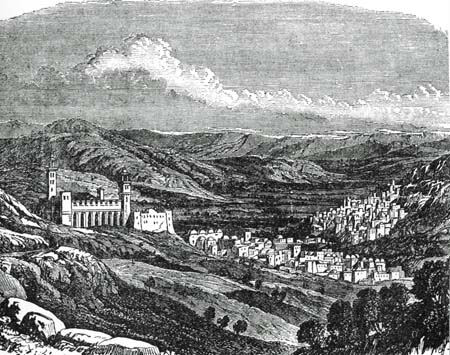
At length this princess in Israel, tested and tried, and
found true, died at Hebron at the good age of one hundred
and twenty-seven years, and Abraham wept over her, and
well he might, for she had shared his trials and was a good
and faithful wife, and she was a mother, even more than a
wife.
Abraham purchased the cave of Machpelah of Ephron, the
Hittite, and tenderly laid the remains of this lovely woman
to rest in one of the chambers of the cave. It is the first
burial mentioned in the Sacred records. And the tomb
remains unto this day, hallowed in the eyes of Jews, Christians
and Mohammedans alike, and was visited by the
writer.
The lesson which God would teach us in the life of this
woman in White Raiment is that testings are necessary to
the development of faith, and that these testings come to us
in the most ordinary events of our daily lives. All Christians
surely know by experience that events which seemed
all darkness at first have ultimately brought them nearer to
the light. The much-dreaded cloud has proved to be only a
veil under which God hides His mighty power. His gracious
query, “Is anything too hard for the Lord?” has comforted
us, and has turned what we thought to be a curse into a
blessing. O, can we not trust Him in the darkness as well
as in the light, knowing that He can bring calm out of
storm, and that he often chooses the darkness and the cloud
as a special medium by which to reveal himself? Could we
climb to heaven by some other way, and escape the shadows
and the storms of life, how much should we miss of the
blessed manifestations of God’s revelations of His power.
God speaks to listening ears and waiting hearts as truly
to-day as He did before the tent door under the oaks in the
plain of Mamre. He may speak to us through his providence,
through the voice of a friend, through a book or a
sermon; but perhaps He does so most frequently in the
little details of everyday life, in which we can not fail to see
His dealings with us if our hearts are turned expectantly
toward him. Only let us be admonished by Sarah’s sad
mistake. That she made it, proves that she was human.
But let us be afraid of sin. The door once open, none of us
can tell into what endless labyrinths of sorrow it will lead
us. God wants a tried people, not only for their own sake
but that they may be a blessing to others.
And now we come to a most beautiful scene in Sacred
History. While, as a whole, the Bible gives the drama of
human sin and divine redemption, yet it pauses in its wonderful
revelations to let us look into the homes of the people
who lived ages ago. It somehow touches human life on all
its sides. Other books which are held sacred by eastern
nations, give woman only contemptuous mention. This one
recognizes the dignity and beauty of her life and work.
It tells in seven verses the story of Enoch, who walked with
God three hundred and sixty-five years and who was holy
enough to escape death, while it gives sixty-six verses to the
wooing and wedding of Rebekah and Isaac. In the pictures
which the Sacred Record opens to us of the domestic life of
the patriarchal age, perhaps this is the most perfectly characteristic
and beautiful idyl of a marriage, and how it was
brought about. In its sweetness and sacred simplicity, it is
a marvelous contrast to the wedding of our modern fashionable
life. And surely, since God’s Book gives so much time
and space to the domestic life of women, the daughters of
modern Christianity ought to regard themselves and their
affairs of the utmost importance. For the sake of Him who
gave them such prominence and recognition, they ought to
love Him.
Abraham, the friend of God, understood fully that it would
never do to have the heir of promise fall into the hands of a
heathen wife. He could not bear the thought of taking
one of the corrupt Canaanites into his family, with the
chance of her leading Isaac into the abominable worship
of her gods.
Parents often frustrate the grace of God and mar His
plans irreparably by being careless of the worldly associations
and affinities of their children.
Sarah, the beautiful and beloved, had been tenderly laid
away in the cave of Machpelah, and Isaac is now forty years
of age. Forty years, however, in those good old times, is
yet young, when the thread of mortal life ran out to a hundred
and seventy-five or eighty years. As Abraham has
nearly reached that far period, his sun of life is dipping
downwards toward the evening horizon. He has but one
care remaining—to settle his son Isaac in life before he is
gathered to his fathers.
The scene where Abraham discusses the subject with his
head servant sheds a peculiar light on the domestic and
family relations of those days.
Calling Eliezer, his most trusty servant, he discloses to
him his purpose, and makes him take an oath that he will
faithfully carry out his wishes. But Abraham’s steward saw
the difficulties of such a proxy wooing, and expressed a fear
that the young woman would object to so hazardous a journey
to share the home of a man whom she had never seen
and of whom she had possibly never before heard. So, to
make matters sure, he asks if it would not be better to take
Isaac with him? To this request the patriarch replied,
“Beware thou that thou bring not my son thither again.”
Abraham saw that there was too much risk in allowing Isaac
to go back to the old home. He might have to be scourged
out of it as was Jacob, the next in the line, a few years later.
He must do right and trust God. So he told his steward,
“The Lord, before whom I walk, will send his angel before
thee and prosper thy way, and thou shalt take a wife for my
son of my kindred and of my father’s house.” Then, as he
saw the ever-present contingency with which human free
agency may frustrate even Divine Providence, he added,
“And if the woman will not be willing to follow thee, then
thou shalt be clear from this thine oath; only bring not my
son thither again.”
The picture of the preparations made for this embassy
denotes a princely station and great wealth. “And the
servant took ten camels of the camels of his master, and
departed; for all the goods of his master were in his hand;
and he arose and went to Mesopotamia, unto the city of
Nahor.”
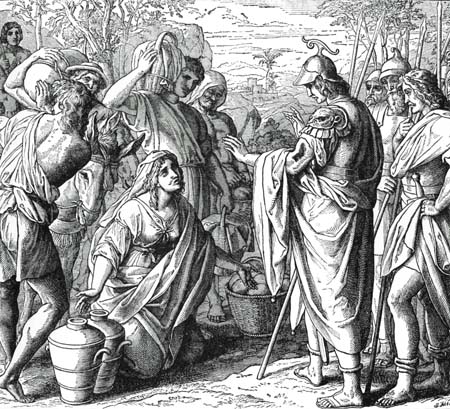
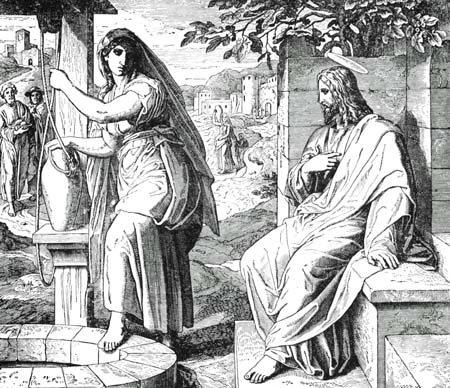
Now comes a quaint and beautiful picture of the manners
of those pastoral days. He made his camels to kneel down
without the city by a well of water, at the time of the evening
when the women go out to draw water. With the kneeling
camels around the well, the aged Eliezer uncovers his
head in the evening twilight, and with closed eyes and face
raised towards heaven, he talks to God in this simple and
yet eloquent way, “O, Lord God of my master Abraham, I
pray thee, send me good speed this day, and show kindness
unto my master Abraham. Behold! I stand here by the
well of water; and the daughters of the men of the city come
out to draw water: And let it come to pass that the damsel
to whom I shall say, Let down thy pitcher, I pray thee, that
I may drink; and she shall say, Drink and I will give thy
camels drink also: let that same be she that Thou hast appointed
for Thy servant Isaac; and thereby shall I know
that Thou hast shewed kindness unto my master.” It is to
be observed that this aged servant talked to God with all the
simplicity and directness of a child with its mother. He
told the Lord where he stood, and it was in the most likely
place about an Oriental city at evening time, for all the damsels
come out to the well at that hour of the day to draw
water. He did not doubt that there was a bride for Isaac in
the town; and he wanted to find the right one immediately.
The care of Abraham’s affairs pressed him, and he wanted
to get through the matter with as little waste of time
and sentiment as possible. That he might not make any
mistake in his delicate mission, he tells the Lord of a little
test he thought of using. He needed a sign from God to
select the bride from among the women who should come to
the well. He used his own judgment as far as it went; but
it stopped short of a decision. He specified that the chosen
one should be industrious, hospitable, deft, courteous. She
should be qualified to stand at the head of a princely establishment.
His prayer was speedily granted, for thus the story
goes on, “And it came to pass, before he had done
speaking, that, behold Rebekah came out, who was born
to Bethuel, son of Milcah, the wife of Nahor, Abraham’s
brother.”
It is noticeable, how strong is the sensibility to womanly
beauty in this narrative. This young Rebekah is thus
announced: “And the damsel was very fair to look upon,
and a virgin, and she went down to the well, and filled her
pitcher, and came up.” Drawn by the bright eyes, and fair
face, the old servant hastens to apply the test, doubtless
hoping that this lovely creature is the appointed one for his
young master.
“And the servant ran to meet her, and said, Let me, I
pray thee, drink a little water of thy pitcher. And she said,
Drink, my Lord; and she hastened, and let down her
pitcher upon her hand, and gave him drink.”
She gave with a will, with a grace and readiness that outflowed
the request, and then it is added: “And when she
had done giving him drink, she said, I will draw water
for thy camels also, until they have done drinking. And
she hastened and emptied her pitcher into the trough, and
ran again unto the well to draw water, and drew for all his
camels.” Let us fancy ten camels, all on their knees, in a
row, at the trough, with their long necks, and patient, care-worn
faces, while the pretty young damsel, with cheerful
alacrity, is dashing down the water from her pitcher, filling
and emptying in quick succession, apparently making nothing
of the toil; the gray-haired old servant, looking on in
devout recognition of the answer to his prayer, for the story
says: “And the man, wondering at her, held his peace, to
wit (know) whether the Lord had made his journey prosperous
or not.”
There was wise penetration into life and the essentials of
wedded happiness in this prayer of the old servant. What
he asked for his young master was not beauty, or talent, but
a ready and unfailing outflow of sympathy and kindness.
He asked not merely for a gentle nature, a kind heart, but
he asked for a heart so rich in kindness that it should run
even beyond what was asked, and be ready to anticipate
the request with new devices of helpfulness; the lively,
lighthearted kindness that could not be content with waiting
on the thirsty old man, but with cheerful alacrity took
upon herself the care of all the ten camels. This was a gift
beyond that of beauty, yet when it came in the person of a
maiden exceedingly fair to look upon, no marvel that the old
man wondered joyously at his success.
Instantly, as the camels had done drinking, he produced
from his treasury golden earrings and bracelets with
which he adorned the maiden. We can easily imagine
the maidenly delight with which she ran to exhibit
the gifts of jewelry that thus unexpectedly descended
upon her.
Nor does Eliezer fail to offer up a prayer of thanksgiving
for divine guidance. In this he set a worthy example to all
who seek direction from God. He said, “I, being in the
way, the Lord led me.” A free translation would be, “I
used my own judgment as far as it would go, which was a
long distance from a safe conclusion, and the Lord led me
the rest of the way.”
Bethuel, when he saw the gifts and heard the words of
Rebekah, hastened to the well and said to Eliezer, “Come
in, thou blessed of the Lord; wherefore standest thou without?
for I have prepared the house, and room for the camels.
And the man came into the house: and he ungirded the
camels, and gave straw and provender for the camels, and
water to wash his feet, and the men’s feet that were with
him. And there was set meat before him to eat: but he
said, I will not eat, till I have told my errand. And he said,
Speak on.”
He then related the purport of his journey, of the prayer
that he had uttered at the well, and of its fulfillment in a
generous-minded and beautiful young maiden, and thus he
ends his story: “And now, if ye will deal kindly and truly
with my master, tell me: and if not, tell me; that I may
turn to the right hand or to the left.”
Bethuel answered, “Behold, Rebekah is before thee; take
her, and go, and let her be thy master’s son’s wife, as the
Lord hath spoken.”
“And it came to pass, that when Abraham’s servant heard
their words, he worshipped the Lord, bowing himself to the
earth.”
And now comes a scene most captivating to female curiosity.
“The servant brought forth jewels of silver, and jewels
of gold, and raiment, and gave them to Rebekah; he gave
also to her brother and to her mother precious things.” The
scene of examining jewelry and garments and rich stuffs in
the family party would have made no mean subject for a
painter. No wonder such a suitor sending such gifts found
welcome entertainment. So the story goes on: “And they
did eat and drink, he and the men that were with him, and
tarried all night; and they rose up in the morning and he
said, Send me away unto my master. And her brother and
her mother said, Let the damsel abide with us a few days,
at the least ten, and after that she shall go.”
“And he said unto them, Hinder me not, seeing the Lord
hath prospered my way; send me away, that I may go to
my master. And they said, We will call the damsel and inquire
at her mouth. And they called Rebekah, and said
unto her, Wilt thou go with this man? And she said, I will
go.” Her prompt reply to this important question was an
index to her character. The Divine approval of her ready
obedience gave her a grand prophetic Messianic promise
that thousands of millions should be gathered into His Kingdom
from the conquest “of those which hate them.” This
extra Hebrew prophecy was a flash of God’s light on the fact
that our Lord should be the Saviour, not only of the Jews,
but of the entire world.
Thus far this wooing seems to have been conceived and
conducted in that simple religious spirit recognized in the
words of the old prayer, “Grant that all our work may be
begun, continued and ended in thee.” The Father of nations
has been a never-failing presence in every turn.
“And Rebekah arose, and her damsels, and they rode
upon the camels, and followed the man; and the servant
took Rebekah, and went his way.”
It was a long way from the city of Nahor, in Mesopotamia
to Hebron in the southern borders of Palestine, and between
the Euphrates and the land of promise stretched leagues of
hot desert sands, through which the camels slowly and
patiently toiled day after day with their precious burden.
But at length Damascus with its refreshing streams, and Mt.
Hermon with its dome lifted among the clouds, were passed,
and, towards evening of the last day, just as they reached
the head of the valley of Eschol, from the summit of which
opens a magnificent view through the whole length of the
valley, “Rebekah lifted up her eyes, and when she saw
Isaac she lighted off the camel. For she had said unto the
servant, What man is this that walketh in the field to meet
us? And the servant had said, It is my master; therefore
she took a veil and covered herself.”
Doubtless for days Isaac had walked the mile and a half
from his mother’s tent to where the valley of Eschol forms a
junction with the plain of Mamre, from whence he could look
up the narrow valley and view the approaching caravan at a
considerable distance. The expectant bridegroom, brought
up with the strictest notions of filial submission, waits to
receive his wife dutifully from his father’s hand, and yet, we
fancy, day after day he goes out to meet her, and now the
long-expected caravan, with Eliezer, his father’s most trusted
servant, at its head, is approaching at eventide, and he
quickens his step to meet his bride.
From what we have already seen of Rebekah, she is lively,
lighthearted, kind, possessed of an alert readiness, prompt
to see and do what is to be done at the moment. No dreamer
is she, but a wideawake young woman who knows her own
mind exactly, and has the fit word and fit action ready for
each short turn in life. She was quick, cheerful and energetic
in hospitality. She was prompt and unhesitating in
her resolve; and yet, at the moment of meeting, she knew
the value and propriety of the veil. She covered herself that
she might not unsought be won.
“And Isaac brought her into his mother Sarah’s tent.”
Tent life in the days of Abraham, in our estimation, must
have been not only desirable, but grand and glorious. Living,
as they did, so closely in contact with nature, as God
made it, fresh, pure air, babbling brooks, rippling streams,
and blue skies, theirs was a happy life. They were not
confined in crowded cities, surrounded by dismal walls, but
on the hillsides, the open valleys and the unbounded plains.
Their tent was pitched in a clump of oaks, near a living
stream, and overlooked the plain of Mamre—a beautiful
picture of freedom, ease and comfort. To such a place he
took Rebekah, and she became his wife; and he loved her;
and Isaac was comforted after his mother’s death. So ends
this most charming story of domestic life in the patriarchal
age. For beauty, simplicity and directness it has no equal.
We also see, in the closing words, one of those delicate and
tender natures that find repose first in the love of a mother,
and when that stay is withdrawn, lean upon a beloved wife.
So ideally pure, and sweet, and tenderly religious has
been the whole inception and carrying on and termination
of this wedding, that Isaac and Rebekah have been remembered
in the wedding ritual of Christian churches as models
of a holy marriage according to the divine will.
Though for nineteen years Rebekah was childless, yet
retained she her husband’s love. This may have been a
trial to Isaac, since the line of the blessing was to pass
through him. That he thought much about it is evident,
for, at length, he “entreated the Lord for his wife,” and his
intercession was based upon a divine foundation in Jehovah’s
promise. And, possibly, even Isaac had to be educated
up to this point, namely, that the seed of promise must be
sought from God, so that it should be regarded, not as the
fruit of nature, but as the gift of divine grace.
In due time Esau and Jacob were born, and they were
twins, but with natures and characteristics marked more for
their contrasts than similarity. Beyond the bare statement,
“And the boys grew,” nothing is said of their childhood and
youth—the formative periods of their lives.
When they had grown to manhood’s estate, we are
informed that “Esau was a cunning hunter, a man of the
field; and Jacob was a plain man, dwelling in tents.” The
free and easy life in the chase developed in Esau a robust
appearance, and for that reason, and also “because he did
eat of his venison,” Isaac loved Esau. Jacob is represented
to us as of a more delicate make-up and naturally appealed
more to the mother heart. “Rebekah loved Jacob.” From
merely a parental standpoint, both were wrong. Even
though the characteristics of these boys were wide apart, the
parents should have been united in their love, and impartially
discharged their duties, and let God, in his own good
time, make His selection. But here, as in the lives of
Abraham and Sarah, Isaac and Rebekah delayed the blessing
God designed they should have, and brought sorrow into
their own lives. It is evident that the ardent Rebekah, by
her animated, energetic declarations, formed a very significant
complement to Isaac, confiding more in the divine
declarations as to her boys than Isaac did, and therefore
better able to appreciate the deeper nature of Jacob. But
when Isaac shows his preference for Esau to be the heir, the
courageous woman forgets her vocation, and with artifice
counsels Jacob to steal the blessing from Isaac—a transgression
for which she had to atone in not seeing her favorite
son after she sent him away, out of reach of his brother’s
anger. She had only Esau left, and he must have made her
feel that it was her partiality that had robbed him of what
he prized most highly. His heathen wives had been a
“grief of mind” to her. She said, in her diplomatic effort to
get Jacob off to a place of safety, “I am weary of my life
because of the daughters of Heth. If Jacob take a wife from
the daughters of Heth, such as these which are the daughters
of the land, what good shall my life do me?” Probably
Esau did not mend matters by adding to his family the Ishmaeltish
woman.
Rebekah’s habit of managing affairs may be more common
than we think. It is the fault of energetic souls. She loved
Jacob with the passionate, tropical strength of her fervid
heart. She would not trust God to give him what she believed
he ought to receive. It is very hard for such as she
to wait patiently for the Lord when His delays are developing
faith.
However, viewed from a human standpoint, her faith in the
divine purposes was much more clear-sighted than that of
Isaac. Consenting to be laid on the altar as a sacrifice to
God, Isaac had the stamp of submission early and deeply
impressed on his soul. Hence, in the spiritual aspect of his
character, he was the man of patience, of acquiescence, of
susceptibility, of obedience. Rebekah, on the other hand,
was energetic, intensely active, self-confident, a most excellent
manager, even tricky, but nevertheless capable and efficient.
She had the faults which usually go with such traits
of character. Taking things into her own hands, she even
meddled with Providence.
But was she not provoked to this act by Isaac himself?
Isaac’s willful act does not consist alone in his arbitrary determination
to present Esau with the blessing of the theocratic
birthright, although Rebekah received that divine sentence
respecting her children before their birth, and which,
no doubt, she had mentioned to him, but the manner in
which he intends to bless Esau. He arranges to bless him
in unbecoming secrecy, without the knowledge of Rebekah
and Jacob. The preparation of the venison, in its main
point of view, is an excuse to gain time and place for the
secret act. In this point of view, the act of Rebekah appears
in a different light. His well-calculated prudence was skillfully
caught in the net of Rebekah’s shrewdness.
A want of divine confidence may be recognized through
all his actions. Rebekah, however, has so far the advantage
of him that she in her deception has the divine assurance
that Jacob was the heir, while Isaac has only his human
reason without any inward spiritual certainty. Rebekah’s
error consists in thinking that she must direct divine Providence
by means of human deception. The divine promise
would have been fulfilled without her assistance. Of course,
when compared with Isaac’s fatal error, she was right.
Though she deceived him greatly, misled her favorite son,
and alienated Esau from her, there was yet something saving
in her action according to her intentions. For to Esau
the most comprehensive blessing might have become only a
curse. He was not fitted for it.
Viewed from Rebekah’s point of view, the lesson for us is,
we are not to do evil, that good may come. The sinful element
in her act was the wrong application of her assurance
of faith, for which she suffered, perhaps, many long years of
melancholy solitude.
Had this noble woman in White Raiment not erred she
would not have been human. As a whole, she has a beautiful
character—beautiful in its generous helpfulness, in its prudence,
in its magnanimity, and in her theocratic zeal of faith.
Here Rebekah obviously disappears from the stage of life.
It has been conjectured that she died during Jacob’s sojourn
in Padan-aram, whither she had sent him to escape the tragic
consequences of her hasty conduct, for she is not mentioned
when Jacob returned to his father, nor do we hear of her
burial till it is incidentally mentioned by Jacob on his deathbed.
She was buried in the cave of Machpelah, by the side
of Sarah.
After Jacob had obtained the theocratic birthright he fled
from his father’s home in Beer-sheba to Padan-aram, or the
city of Haran, in Mesopotamia. Haran was situated about
four hundred and fifty miles north-east from Beer-sheba. If
the young man walked thirty miles a day, for he performed
this long journey over the mountains and through the desert
on foot, it took him fifteen days. No doubt, as he drew near
the well, before the city, he was footsore, dust-covered,
homesick, and greatly depressed in mind, for the occasion
of his sudden departure and the anger of his brother Esau
were still fresh in memory.
But what a quaint, picturesque scene of Oriental life is
presented to our view. It is yet early evening. The shepherds,
with their flocks, are moving from various points over
the plain to one common centre. Three of the shepherds
had already arrived, and Jacob salutes them, and asks,
“My brethren, whence be ye?” And they answered, “Of
Haran.” Then he inquired, “Know ye Laban?” They
made reply, “We know him,” then, pointing to a shepherdess
slowly leading her flock over the plain towards the
well, said, “Behold Rachel, his daughter, cometh with the
sheep.” While he was yet talking with the shepherds,
Rachel drew near “with her father’s sheep.” Jacob saw his
opportunity, for the great stone over the mouth of the well
had not been removed, and, though it was the work of three
men to remove the stone, he hastens to perform this task for
the beautiful shepherdess alone, and does for her what his
mother had done for Eliezer’s camels, watered her flock.
Clearly, it was love at first sight. Rachel must have deeply
impressed him. And what could have been her thoughts as
she stood by her flock and saw this youth pour bucketfull
after bucketfull into the stone troughs for her sheep? It
was certainly an impressive introduction.
The sheep watered, and before he made himself known,
he stepped up to the bewitching shepherdess, and kissed her.
This story of Rachel, the pretty shepherdess of the plains of
Mesopotamia, who took with a glance the heart of the loving,
homesick Jacob, and held it to the end of her days, has
always had a peculiar interest, for there is that in it which
appeals to some of the deepest feelings of the human heart.
The beauty of Rachel, the deep love with which she was
loved by Jacob from their first meeting by the well of Haran,
when he showed to her the simple courtesies of the desert
life, and kissed her and told her he was Rebekah’s son; the
long servitude with which he patiently served for her, in
which the seven years “seemed to him but a few days, for
the love he had to her;” their marriage at last, after the
cruel disappointment through the fraud which substituted
the elder sister in the place of the younger; and the death
of Rachel “in the way to Ephrath, which is Bethlehem,”
when she had given birth to Benjamin, and had become
still more endeared to her husband; his deep grief and ever-living
regrets for her loss—these things make up a touching
tale of personal and domestic history which has kept alive
the memory of Rachel through all the long centuries down
to the present time. Her untimely death has been likened
to a “bunch of violets pulled up by the roots, with the soil
clinging to them—their exquisite perfume reminding one
of the leafy nook in which they grew.”
What a mystery is love! We can not define it. It can
only be unlocked by the key of experience. Love is not a
product of the reason. It is the free play of the spiritual
sensibilities in the possession of its object. And if human
love is inexplicable, divine love is an ocean too deep for the
plummet of man, and by far too broad to be bounded by the
thought of the loftiest intelligence in the universe.
Chaste human love is a beautiful thing, by which conjugal
love is afterwards more and more strengthened and confirmed.
And, in this scene at the well, we have emphasized
the fact that virtuous maidens do not need to attend large,
exciting assemblies or popular resorts, to get husbands. If
they are true to themselves, they can safely trust God, who
is able to give them pious, honorable and upright husbands.
As soon as Rachel learned that Jacob was her father’s
nephew, and that he was Rebekah’s son, “she ran and told
her father.” When Laban heard Rachel’s story, he hastened
to meet Jacob, and brought him to his house.
After a short stay as the guest of the family, it seemed
best to Laban that wages should be given to Jacob for his
services, but instead of wages he desires Rachel, and, instead
of service for an indefinite time, he promises a service of
seven years. Jacob’s service, it is thought by some writers,
represents the price which was usually paid for the wife.
Doubtless, Rachel was worth to Jacob the years of service
he paid, but doubtless then, as now, prices varied according
to age and beauty, and in some Eastern countries the prices
are higher than in others. The custom still exists. A man
without means serves from three to seven years for his bride.
To Jacob, these years of service seemed but a few days. His
love for Rachel made his long service a delight to him. He
was cheerful and joyful in hope.
At the end of the years of service Laban made a great
nuptial feast. These Oriental weddings last seven days.
Doubtless Laban arranged this feast, the better to facilitate
Jacob’s deception by the coming and going of guests, and
the general bustle and noise characteristic of such occasions.
The deception was also possible through the custom, namely,
the bride was led veiled to the bridegroom and the bridal
chamber. Laban probably believed, as to the base deception,
that he would be excused, because he had already in
view the concession of the second daughter, so Leah, the
elder daughter, was substituted. The motive for this is not
stated. Perhaps Laban recognized a skillful and useful
shepherd in Jacob. He may also have acted from regard to
his own interest, especially since he knew that Jacob possessed
a great inheritance at home.
The substitution of Leah for Rachel is the first retribution
Jacob experienced for the deceitful practices of his former
days. He had, through fraud and cunning, secured the
place and blessing of Esau—he, the younger, in place of
the elder. Now, by the same deceit, the elder is put upon
him in the place of the younger. God has somehow so
arranged the affairs of men, that what a man sows, that
shall he also reap. Sin is often punished with sin.
When Laban was asked for an explanation of his conduct,
he replied that it was not the custom in his country to give
the younger into marriage before the first-born, a bit of
information he should have given Jacob when he first made
suit for Rachel. His excuse does not justify in the least his
deception, but there was, however, a sting for Jacob in his
reply, namely, in the emphasis of the right of the first-born.
There was, therefore, nothing left for Jacob but to give
another seven years’ service for Rachel. So, at the end of
the marriage week or feast of Leah, the second wedding
followed, and the years of service were rendered afterwards.
We do not know why Rachel was affectionately loved, while
Leah held but an indifferent place in Jacob’s heart. But
then there is no accounting for, or explaining, love. Leah,
it is said, was “tender-eyed,” that is to say, weak-eyed.
This, however, does not necessarily mean she was sore-eyed
or blear-eyed, but simply they were not full, clear, and
sparkling, not in keeping with the Oriental idea of beauty,
though otherwise she might have been comely. But to an
Oriental, black eyes, clear, lustrous, full of life and fire,
especially, when in addition to all these, the eye is expressive,
are considered the principal part of female beauty.
Rachel was the fortunate possessor of all these charming
qualities of Eastern beauty, and so must have charmed, captivated,
and held Jacob in spite of all other obstacles.
That Leah tried to win his affections is evident from what
she says in connection with the birth of Reuben, her first
born. “Now therefore,” she says, “my husband will love
me.” No doubt, during the seven years that Jacob was in
the home of Laban, her love for him became deep and
strong, which had, no doubt, induced her to consent to
Laban’s deception. So, after the birth of the first son, she
hoped to win, through her child, Jacob’s love in the strictest
sense. After the birth of the second, she hoped to be put on
a footing of equality with Rachel, and to be delivered from
her disregard. After the third one, she hoped at least for a
constant affection. At the birth of the fourth, she looked
entirely away from her surroundings to Jehovah by calling
him Judah—praised be Jehovah.
If Rachel obtained Jacob’s affections because of her beauty
and loveliness, and he refused to bestow upon Leah that
affectionate consideration for which she was grieving her life
away, it may be a comfort to those who suffer as Leah did,
to know that God does not look for beauty from man’s standpoint,
and that the sweet graces of mind and heart go farther
than personal charms, for He certainly conferred more
honor upon her than He did upon Rachel. He gave her
more children than to Rachel. She was also, through her
posterity, the mother of Moses, David, John the Baptist, and
the greatest honor of all, was the mother of our precious
Lord Jesus Christ. Leah was not an idolator, so far as we
know, while the beautiful Rachel was tainted with this
abomination, and it seems to have clung to her posterity, for
it was the tribe of Ephraim that led Israel in the sin of idol
worship. So that while Leah may not have been as beautiful
as her fair sister, she was more loyal to God, and doubtless
was, on that account, so greatly honored of Him.
But the fair, clear-eyed, beautiful Rachel, like the lovely
Sarah and sprightly Rebekah, was barren and childless, and
because of this became very much dejected, and exclaimed,
“Give me children or else I die!” From this expression we
are to understand, she would die from dejection. Doubtless
this dejection led to the substitution of her maid Bilhah.
Her jealous love for Jacob is overbalanced by her envy of her
sister. The favored Rachel desired children as her own, at
any cost, lest she should stand beside her sister childless.
The ambition to be among the progenitors of the Messiah
made Hebrew women eager to have children. Rachel was
not willing to leave the founding of the people of God to her
sister only, but wished also to become an ancestress, as well
as Leah, but in very deed, not until Joseph’s birth, her very
own, could she say, “Now God has taken away my reproach.”
At length, after a service of twenty years or more, God
called Jacob to return to his own people. Laban had been a
hard master, not only to Jacob, but to his own daughters.
“Are we not counted of him strangers?” said they in their
conference with Jacob concerning the return. He had sold
them as strangers, more as slaves, for the service of their
husband. Hence they had nothing more to hope for from
him, for this very price, that is, the blessing resulting from
Jacob’s service, he had entirely consumed. The daughters
had received no share of it. Hence it is evident that they
speak with an inward alienation from their father, and are
quite willing to go with Jacob to the land of promise.
The time set for the departure was the feast of sheep-shearing.
Either Laban had not invited Jacob to this feast,
or Jacob took the opportunity of leaving, in order to visit his
own flocks. As the sheep-shearing lasted several days, the
opportunity was very favorable for his flight.
“But Rachel had stolen the images,” the Penates or household
gods, which were honored as guardians, and as oracles.
From this incident we may infer that she was not altogether
free from the superstitions and idolatry which prevailed in
the land whence Abraham had been called, and which still,
to some degree, infected even those families among whom
the true God was known. It is thought she was actuated
to steal them with the superstitious idea that her father, being
prevented from consulting them as oracles, would not be able
to pursue Jacob. This act, however, as also the well-planned
and ready dexterity and presence of mind with which she
concealed her theft, and prompt denial to her father, reveals
a cunning which is far more befitting the daughter of Laban
than the wife of the prudent patriarch.
Jacob continued his journey without interruption until the
fords of the Jabbok were reached. While at Mahanaim he
sent messengers to Esau, with a view of bringing about a
reconciliation with his grieved brother. When he reached the
Jabbok the messengers returned and brought the alarming
intelligence that Esau was coming to meet him, and four
hundred men were with him. This greatly distressed Jacob,
and led him to divide his family and his flocks, and to send
them in bands before him. Once more, in a critical time,
when he expected an attack from Esau, his discriminate
regard for Rachel is again shown by placing Leah and her
children in the place of danger, in advance of Rachel and
her child.
JACOB’S STRUGGLE AT THE JABBOK.
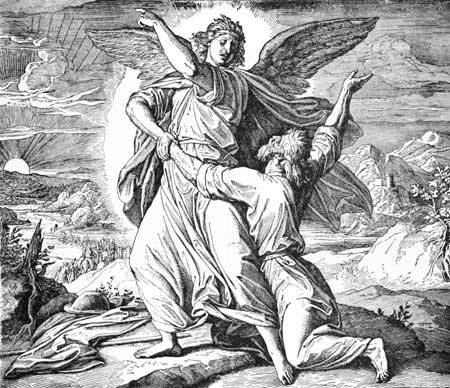
Having thus disposed of his family and his flocks, Jacob
remains behind to pray. It was the great struggle of his
life. And the burden of that midnight cry was, “Deliver
me, I pray Thee, from the hand of my brother, from the
hand of Esau; for I fear him, lest he will come and smite
me, and the mother with the children.” At length the angel
of the Lord said, “Let me go, for the day breaketh!” But
Jacob, as if his life hung on the issue, which it doubtless did,
replied, “I will not let Thee go, except Thou bless me!”
God heard his prayer and delivered him out of the hands
of his brother, Esau.
As Jacob passed over the Jabbok “the sun rose upon him,”
and he set forward on his journey a changed man.
In due time Jacob reached the Jordan at Succoth, thence
to Shechem, and then to Bethel. At each of these places he
halted.
It seems that for a considerable time after the return to
Palestine, the images, or household Penates, which Rachel
had stolen from her father, remained in the family, perhaps
connived at by Jacob, till, on being reminded by the Lord of
the vow which he had made at Bethel when he fled from the
face of Esau, and being bidden of Him to erect an altar to
the God who appeared to him there, Jacob felt the glaring
impiety of thus solemnly appearing before God with the taint
of idolatry cleaving to his beloved Rachel, said, “Put away
the strange gods from among you.” After thus casting out
the polluting things from his house, Jacob, at Bethel, amidst
its sacred associations, received from God an emphatic
promise and blessing.
After his spirit had been purified and strengthened by
communion with God, by the assurance of the divine love
and favor, by the consciousness of evil put away and duties
performed, it was, as he journeyed away from Bethel, that
the chastening blow fell and Rachel died. Doubtless the
blessings that came as a result of the cleansing and purging
from idolatry at Bethel had their effect in bringing Rachel
to a higher sense of her relation to that Jehovah in whom her
husband, with all his faults of character, so firmly believed.
Five miles south of Jerusalem, and a mile and a half from
Bethlehem, in the way to Hebron, is a beautiful chapel,
sacred to the memory of Rachel. This is the place where
beautiful Rachel surrendered her own life for the life of her
second son, whom she named Ben-oni (son of my pain). The
wish she had uttered at Joseph’s birth, that God would give
her another son, now, after a long period, perhaps sixteen or
seventeen years, is at last realized.
Rachel held Jacob’s love to the last, and even down to his
old age he mourned her loss. The stone pillar which he set
up at her grave is the first recorded instance of the setting
up of a sepulchral monument; caves having been up to this
time spoken of as the usual places of burial. The tomb of
Rachel is one of the shrines which Mohammedans, Jews and
Christians unite in honoring, and concerning which their
traditions are identical. At the time of our visit, it happened
to be the time of new moon, when the chapel was
open and all lighted up with olive oil lamps, and the chapel
and crypt filled with weeping women. The lamentations
were real and sincere, and, had we remained very long, we
should have wept out of very sympathy for the grief-stricken
mourners of this princess of Israel. The thought that here
this lovely woman in White Raiment sacrificed her own life
for another was in itself depressing. This first mortuary
monument, sacred to the memory of a great love and a great
sorrow, has come down to us through more than three
thousand years. One may see it “but a little to come to
Ephrath.”
“Tell me, ye winged winds,
That round my pathway roar,
Do ye not know some spot
Where mortals weep no more?
Some lone and pleasant dell,
Some valley in the west,
Where, free from toil and pain,
The weary soul may rest?
The loud wind dwindled to a whisper low,
And sighed for pity as it answered, ‘No!’”
Leah probably lived for some years after Jacob reached
Hebron. Whether she ever found grace in his sight is not
stated. However, in Jacob’s differences with Laban both
Leah and Rachel appeared to be attached to him with equal
fidelity, while later, in the critical moment, when he expected
an attack from Esau, his discriminate regard for the
several members of his family was again shown by his placing
Rachel and her child hindermost, in the least exposed
situation, Leah and her children next, and the two hand-maids,
with their children, in front. Of her death nothing
is said. From the expression, “There I buried Leah,”
(Gen. xlix, 31), we are led to believe that she died at Hebron
before Jacob went down into Egypt. She was buried in the
family sepulchre, “in the field of Machpelah, which is before
Mamre.” Since Hebron is only twenty-five miles from
Rachel’s tomb, near Bethlehem, it is quite strange that Jacob
did not bury his beloved Rachel in the family sepulchre,
along with Abraham and Sarah, Isaac and Rebekah, and
Leah, and where he was himself finally buried.