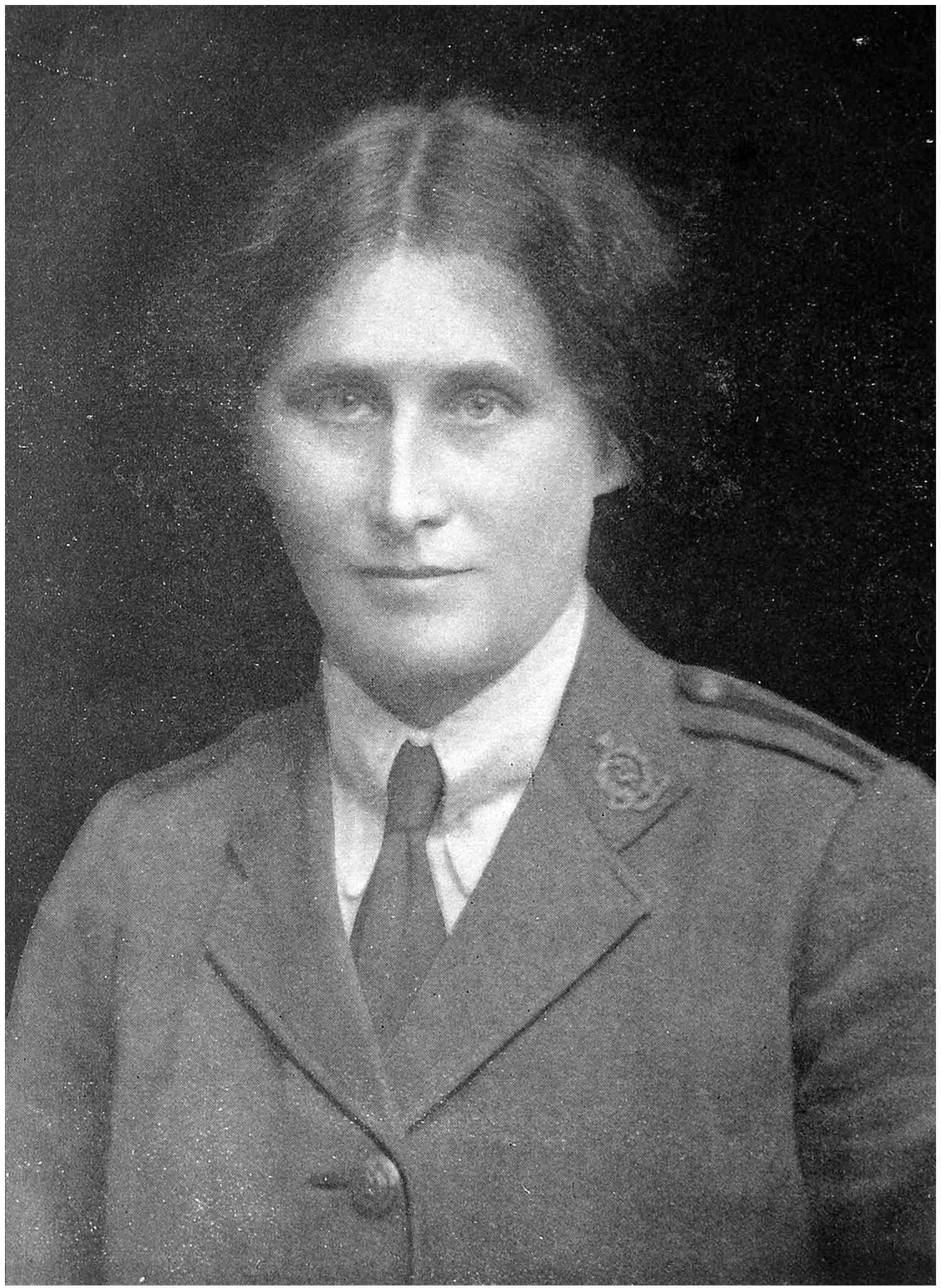
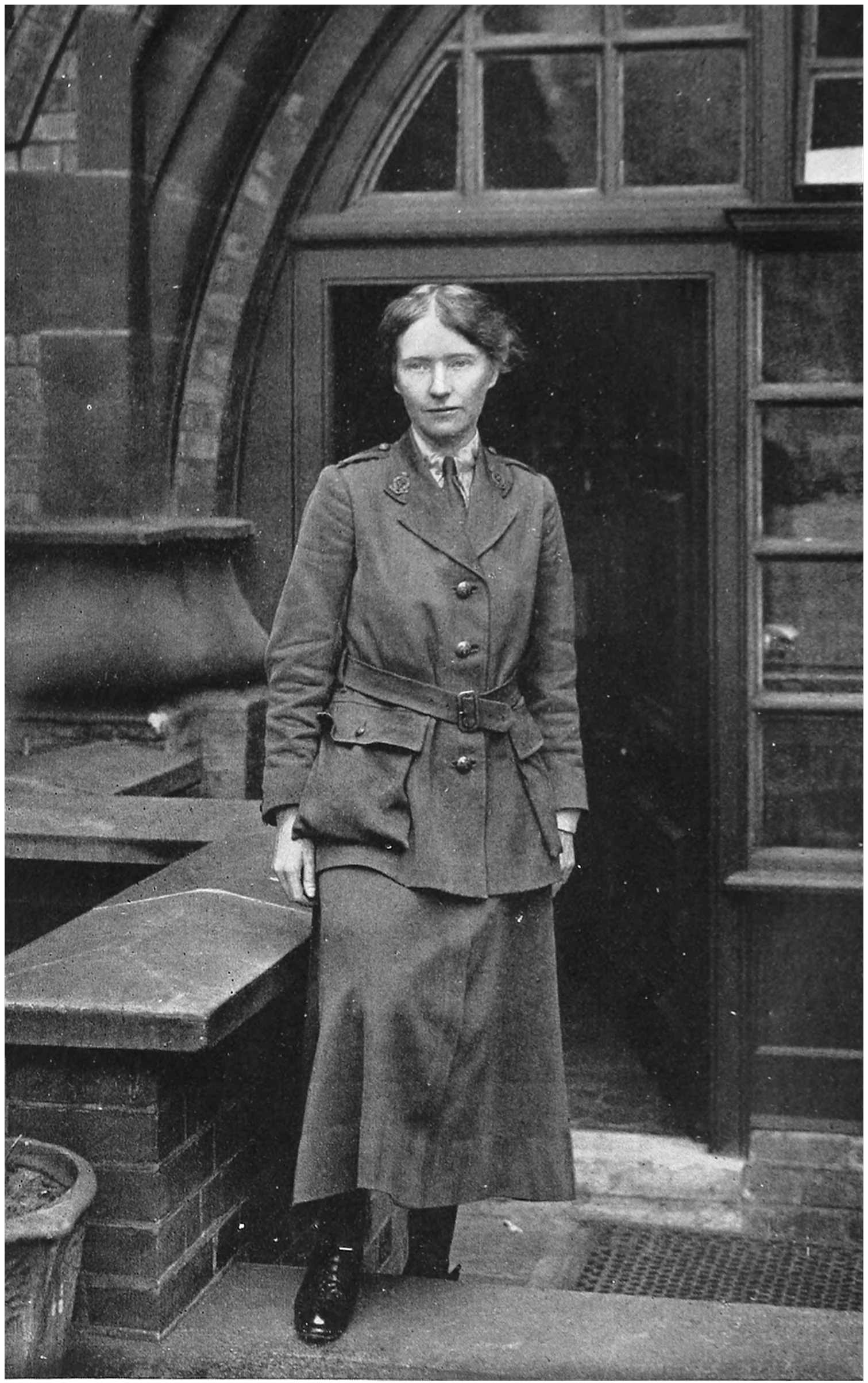
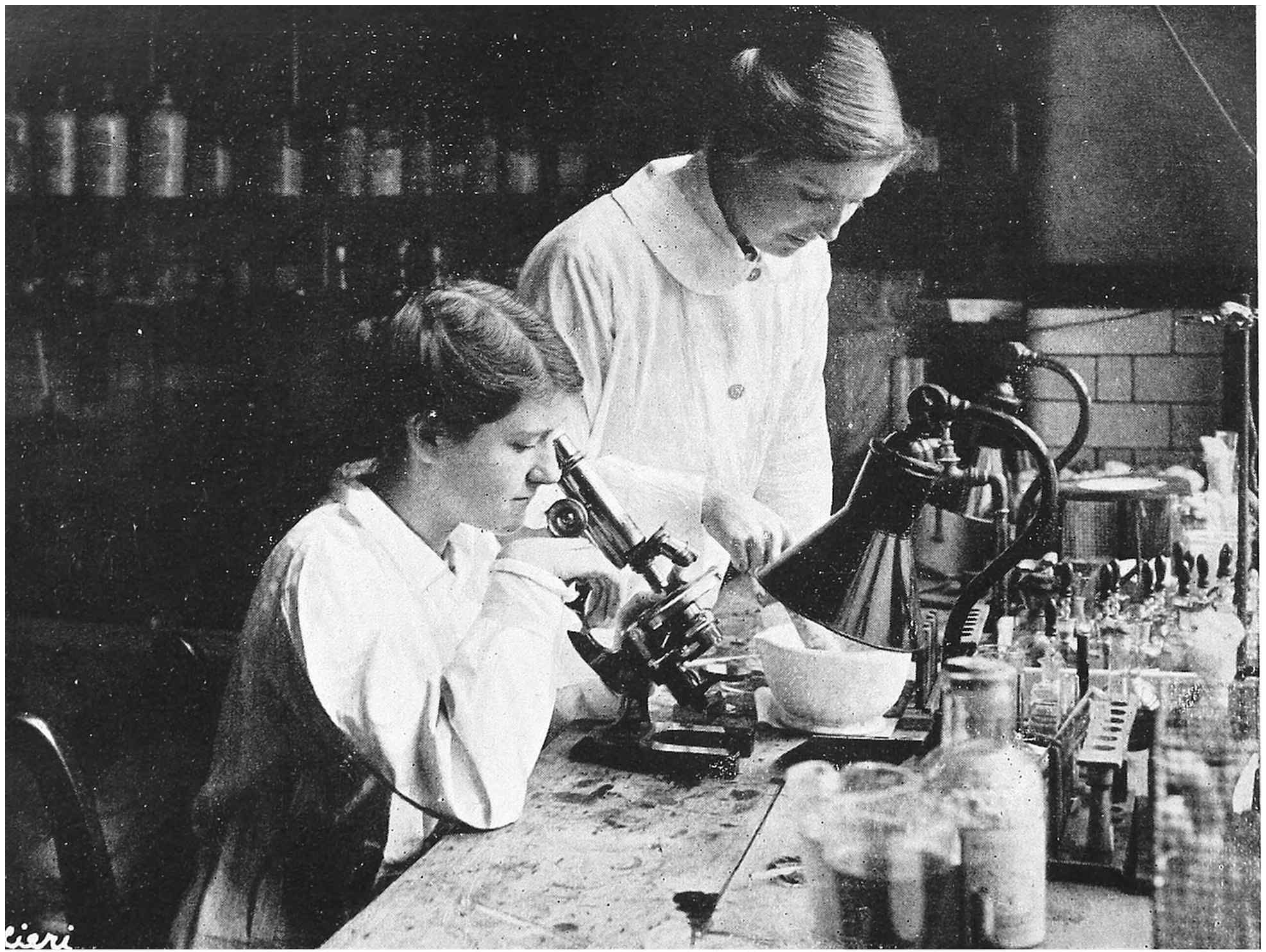
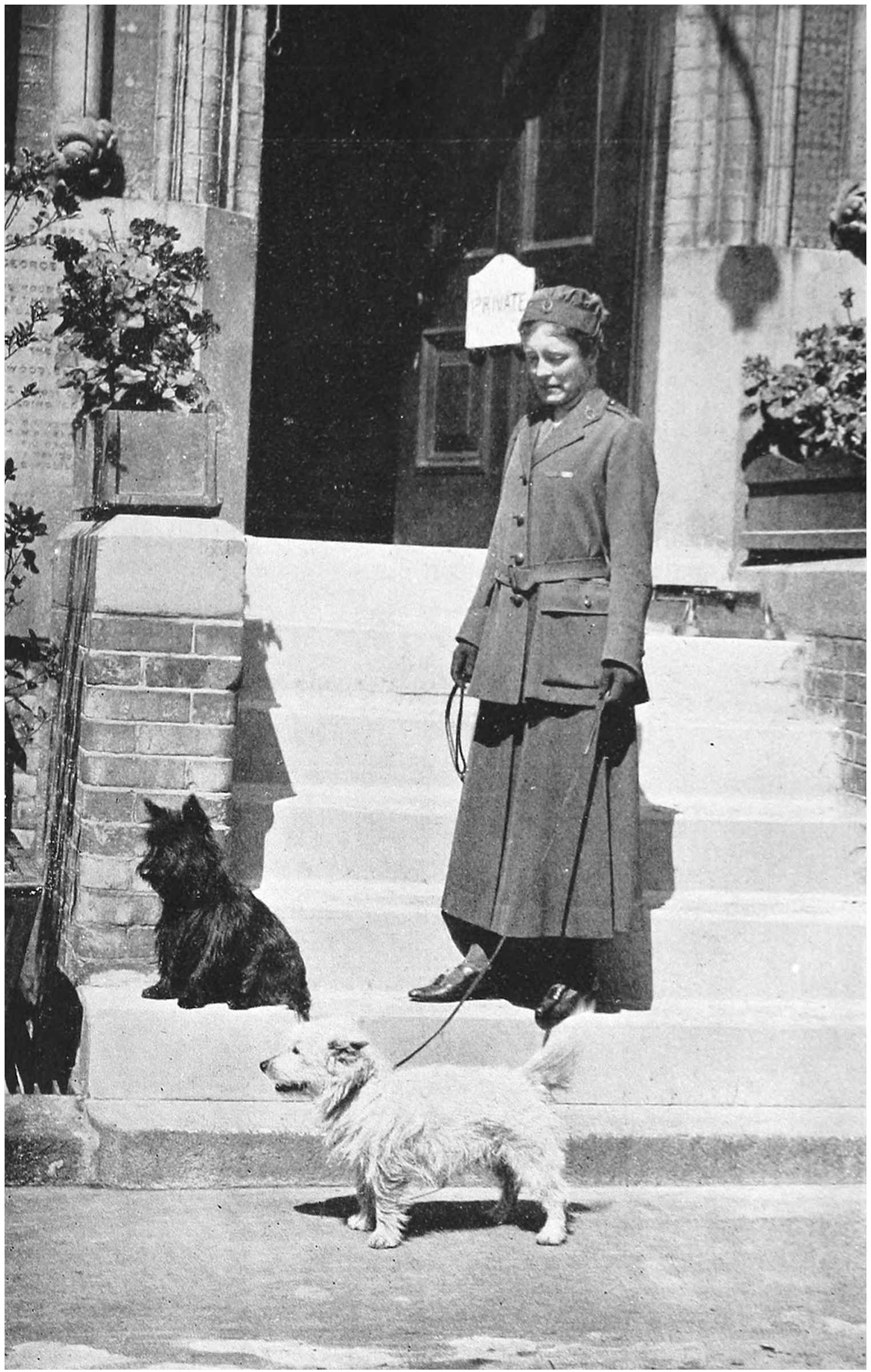
Larger versions of most illustrations may be seen by right-clicking them
and selecting an option to view them separately, or by double-tapping and/or
stretching them.
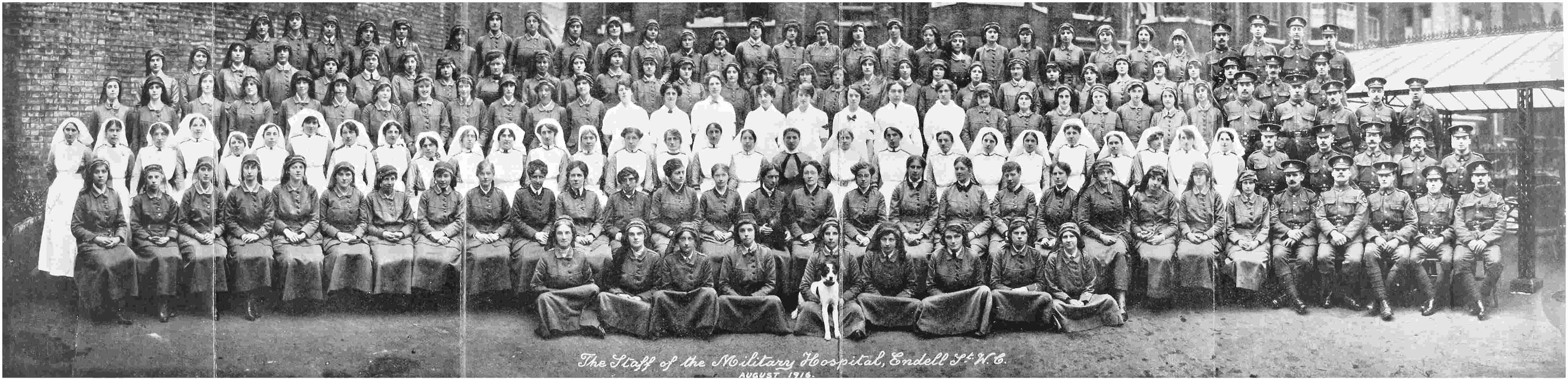
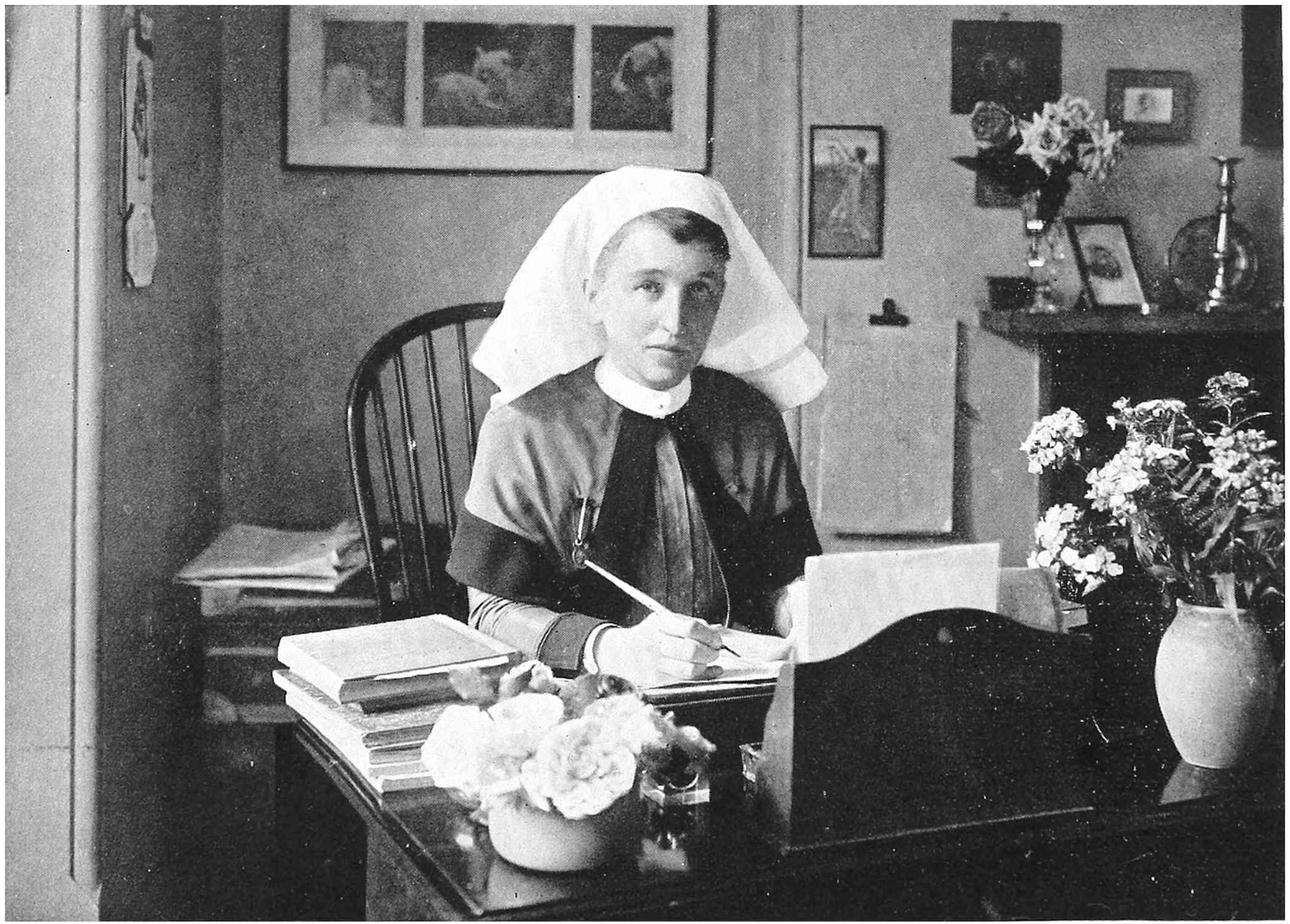
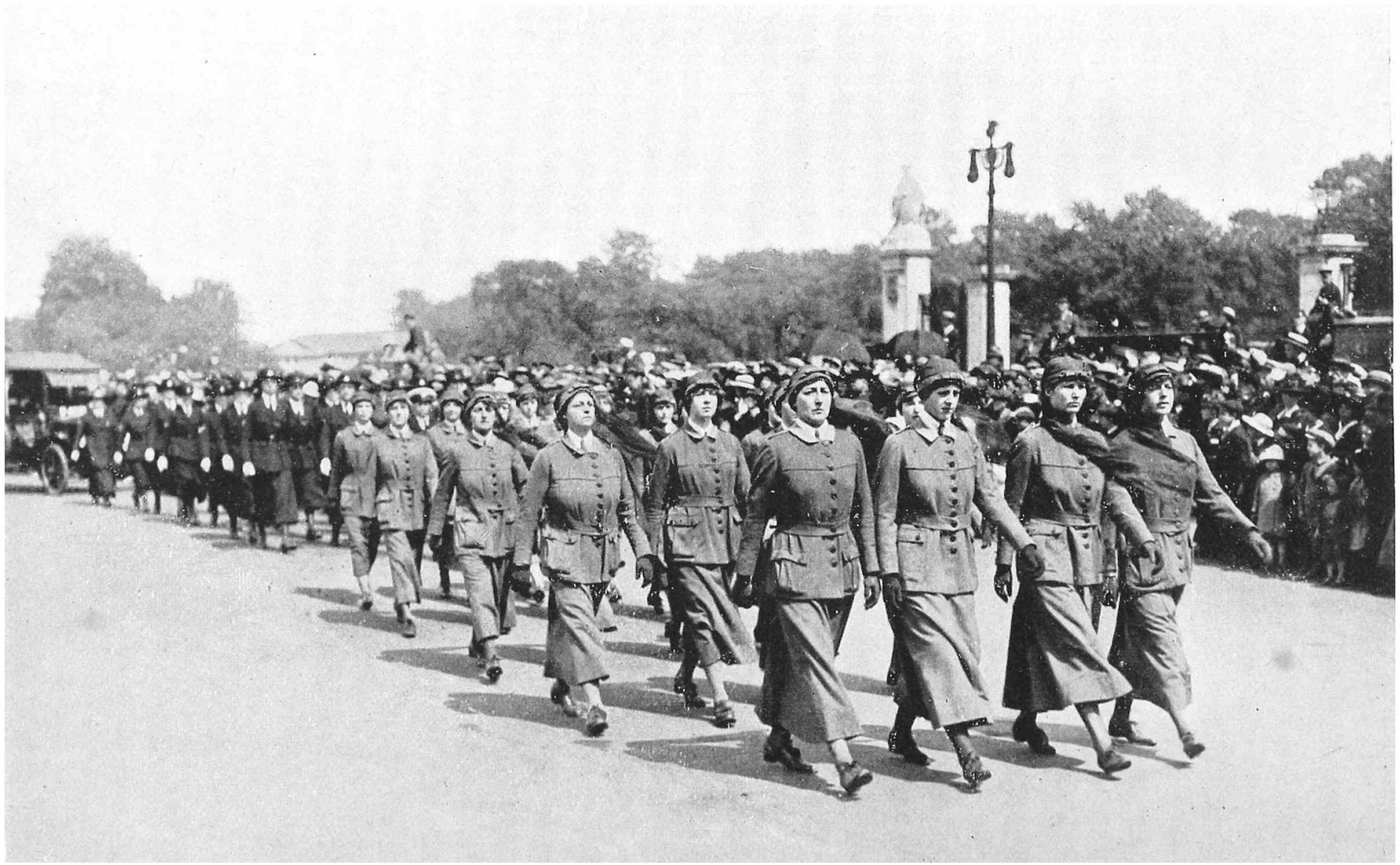
The Staff of the Military Hospital, Endell St. W. C.
AUGUST 1916.
(Photo, Panora Ltd.) Frontispiece
WOMEN AS ARMY SURGEONS
BEING THE HISTORY OF THE WOMEN’S
HOSPITAL CORPS IN PARIS, WIMEREUX
AND ENDELL STREET
SEPTEMBER 1914-OCTOBER 1919
BY FLORA MURRAY C.B.E., M.D., D.P.H.
HODDER AND STOUGHTON LIMITED LONDON
TO
LOUISA GARRETT ANDERSON ‘Bold, cautious, true and my loving comrade’
TO THE WOMEN’S HOSPITAL CORPS
Dear Fellow Members—This little book has been written for you and for your pleasure.
Your work was too good to be left unrecorded;
and though in these pages I have said little in
praise, yet if you will read between the lines you
will find there a very genuine affection for each
one of you, and admiration and pride for your
courage and endurance. I ask you to accept
Women as Army Surgeons in memory of ‘Endell
Street.’
FLORA MURRAY.
PREFACE
This record of the work of the Women’s Hospital
Corps in France, and especially at the Military
Hospital, Endell Street, is a valuable contribution
to the literature of the Woman Movement. Dr.
Flora Murray and Dr. Garrett Anderson made
history at Endell Street. Through their initiative,
endeavour, and efficiency they opened the
doors to further fields of opportunity for women
physicians and surgeons, and not only for medical
women, but for all women who are setting out, or
have already set out to conquer fresh territory.
We owe them a debt of gratitude, the recognition
of which will become even more accentuated as
the years go on.
It would be difficult to put into words the pride
with which the members of the Women’s Hospital
Corps served their country in the Great War under
the only woman Lieutenant-Colonel in the British
Army. For this was the rank of Dr. Flora Murray
when acting as Doctor-in-Charge at the Military
Hospital, Endell Street. The War Office withheld
from her both the title and the outward and
visible signs of authority. But the position, with
its responsibilities, pains, and penalties, was hers,
and it is well known how she and the Chief
Surgeon, Dr. Louisa Garrett Anderson, rose to
the demands of the occasion.
It is only on reading these pages that many of
us who worked with them at Endell Street will
realise even partially the difficulties and anxieties
through which they passed during the four years
and more that the Hospital remained open. They
had a double responsibility all through: firstly,
for the lives and welfare of the soldiers entrusted
to their care, and secondly, for the demonstration
of women’s efficiency and vindication of the confidence
placed in their professional and administrative
abilities. If they had failed to satisfy the
Authorities even in the slightest detail, there is
not much doubt but that the charge of the
Hospital would have been handed over to a man,
and that more than one military official would
have had the joy and triumph of saying: ‘There—I
told you so. The women have failed medically
and administratively, and have been unable to maintain
discipline.’
But the opportunity did not occur. The weeks,
the months, the years went on. Thousands of
soldiers poured in and out of that Hospital. A
year after Armistice found it still open. The
women had succeeded—not failed, and had set a
living example of what trained and disciplined
women could do in the service of their country.
Perhaps our C.O. will forgive me for being personal
enough to refer to one of her characteristics
which was greatly appreciated by all—the trust
she reposed in those working under her. You
were given your task, your opportunity, your department,
and you went ahead with it. It was
yours—your own. If you could not do it, you
went. If you could, you stayed. She interfered
with no details, and harassed you with no unnecessary
restrictions. She took it for granted
that you were carrying on in the right way and
in the right spirit—and judged by results whether
it were desirable that you should continue to
carry on. In this way you became and remained
a living part of the administration. Work and
personality alike were benefited, and the young
received a baptism of responsibility, destined to
influence them favourably for the rest of their
lives.
This is surely a great characteristic—and rare.
It is not to be wondered at that the success of
this Military Hospital, officered, staffed, and run
entirely by women, became a source of immense
satisfaction and pride to all women, but more
especially to those who had taken an active part
in the struggle for the Suffrage, and had shared,
with Dr. Flora Murray and Dr. Garrett Anderson,
the ups and downs, the hopes and fears, the disappointments,
disillusions, and encouragements,
and all the stress and strain of a long-drawn-out
political campaign. To these, Endell Street represented
work for the country and work for the
woman movement combined, and to the members
of the Women’s Hospital Corps itself it meant, in
addition, a double chance of service, a double devotion,
a double inspiration, a double reason for
carrying on with undiminished enthusiasm and
faithfulness to the end.
PART I THE WOMEN’S HOSPITAL CORPS IN PARIS AND WIMEREUX
CHAPTER I ORGANISATION OF THE WOMEN’S HOSPITAL CORPS
In August 1914 it was a popular idea that war was
man’s business and that everything and every one
else should stand aside and let men act. But
there were many persons who failed to endorse
this view and who held that, though men may have
been responsible for the war, the business of it
concerned men and women equally. Far from
standing aside and leaving men to act alone,
every woman in the land accepted her duty and
her responsibility, and recognised at once that if
the war was to be won it must be won by the
whole nation, and by the common effort of all her
children.
The long years of struggle for the Enfranchisement
of Women which had preceded the outbreak
of war had done much to educate women in
citizenship and in public duty. The militant
movement had taught them discipline and organisation;
it had shown them new possibilities in
themselves, and had inspired them with confidence
in each other. In face of the greater militancy
of men, the Suffragists called a truce, and set
their adherents free for service in government
departments, in factories and in hospitals. Workrooms
were opened, day-nurseries established and
surgical supply depots commenced their useful
labours.
Women who had been trained in medicine and
in surgery knew instinctively that the time had
come when great and novel demands would be
made upon them, and that a hitherto unlooked-for
occasion for service was at their feet. It was
inconceivable that in a war of such magnitude
women doctors should not join in the care of the
sick and wounded, but it was obvious that prejudice
would stand in their way. Their training
and their sympathies fitted them for such
work; they knew and could trust their own
capacity; but they had yet to make their
opportunity.
Amongst others, Dr. Louisa Garrett Anderson
and Dr. Flora Murray were determined that
medical women desiring to give their services to
the nation should not be excluded from military
work and from the great professional opportunities
naturally arising from it. An opening, therefore,
had to be found for them. As militant suffragists
they had had dealings with the Home Office, and
had gained an insight into the cherished prejudices
and stereotyped outlook of officials. One
government department is very like another, and
to have approached the War Office at that time
would only have meant to court a rebuff. But
it was common knowledge that the French Army
was inadequately supplied with surgeons and
hospitals; and they turned their attention where
the need was great.
On the 12th of August these two doctors called
at the French Embassy and were received by one
of the secretaries in an absolutely airless room.
The atmosphere was enhanced by red damask
wall hangings and upholstery, and by an aroma
of stale cigar smoke. In somewhat rusty French
they laid before him an offer to raise and equip a
surgical unit for service in France. The secretary
may have been rather mystified as to their intentions;
for medical women were off his horizon.
Very likely he never realised that they themselves
intended to go to the aid of the French wounded;
but he affirmed again and again the real need of
France for medical and surgical aid, for stores of
all kinds and for English nurses. He begged
‘Mesdames’ to call upon the President of the
French Red Cross in London and discuss the matter
with her, and, tendering with the utmost courtesy
a card of introduction, he directed them to her
house.
Madame Brasier de Thuy was the President of
the branch of the French Red Cross known as
‘L’Union des Femmes de France.’ The title of
her Society was attractive, and she herself combined
great charm of manner with a pleasing
personality. Although she was oppressed with
anxiety for the safety of France and the welfare
of her relations, she was working hard to raise
money and necessaries for the French Red
Cross.
She had few fellow-workers and no organisation
to help her, and both she and Monsieur Brasier
de Thuy often wrote and toiled far into the night.
She received with great cordiality the offer of a
fully equipped surgical unit, comprised of women
doctors and trained nurses. Surgeons were a
godsend and English nurses an indescribable boon.
No difficulties were raised; and the offer was
transmitted to the headquarters of her Society
in Paris. Within a week, a formal acceptance
from Paris reached Dr. Garrett Anderson, accompanied
by a request that the unit might be
organised at once and be ready, if required, to
start on the 1st of September.
There remained exactly twelve days of August
in which to raise the funds required, find a staff
and purchase the equipment and all the stores
which would be needed.
The appeal for money was made privately and
met with a prompt and generous response. Mrs.
Garrett Anderson, M.D., Mrs. Granger and Sir
Alan Anderson led the way with large donations.
Miss S. A. Turle, Miss Janie Allan and other
women interested in women’s work sent liberal
help. Letters of encouragement and further subscriptions
poured in, and within a fortnight the
sum of £2000 was placed to the credit of the
Women’s Hospital Corps, which was the name
decided upon for the unit.
This amount was enough to purchase the
equipment, defray the preliminary expenses and
leave a working balance in hand.
At that time the authorities in Paris had not
decided where the Corps was to be located; it
was thought that it might be established in a
château near Belfort, where it would have to be
self-dependent; and this possibility had to be
taken into account when making purchases.
Comprehensive lists of drugs, stores and hospital
equipment were drawn up with a view to all
emergencies. Many kinds of serum were included,
with cases of invalid foods and chloroform, chests
of tea, clothing, blankets, camp bedsteads, enamel
ware and a full set of surgical instruments.
Altogether, £1000 was spent on the equipment,
which afterwards proved to be adequate for the
needs of both the hospitals managed by the
Corps.
Offers of service were gladly accepted from
Dr. Gertrude Gazdar, Dr. Hazel Cuthbert and
Dr. Grace Judge. Many applications were considered
from nurses and from girls anxious to go
out as supernumeraries or orderlies; and the
staff was rapidly completed. It was decided to
include a few male nurses, and in order to find
suitable men recourse was had to the St. John’s
Ambulance Association, at St. John’s Gate, Clerkenwell.
In these early days every public office probably
presented an air of chaos, and ‘The Gate’ was no
exception. In the central hall a swarm of people
circulated without ceasing through a maze of
chairs and tables; loud crashes of falling furniture,
due to the entanglement of umbrellas and
draperies, punctuated the incessant conversations.
Every one was friendly, anxious to help
and willing to work, but the confusion and noise
of voices had a bewildering effect.
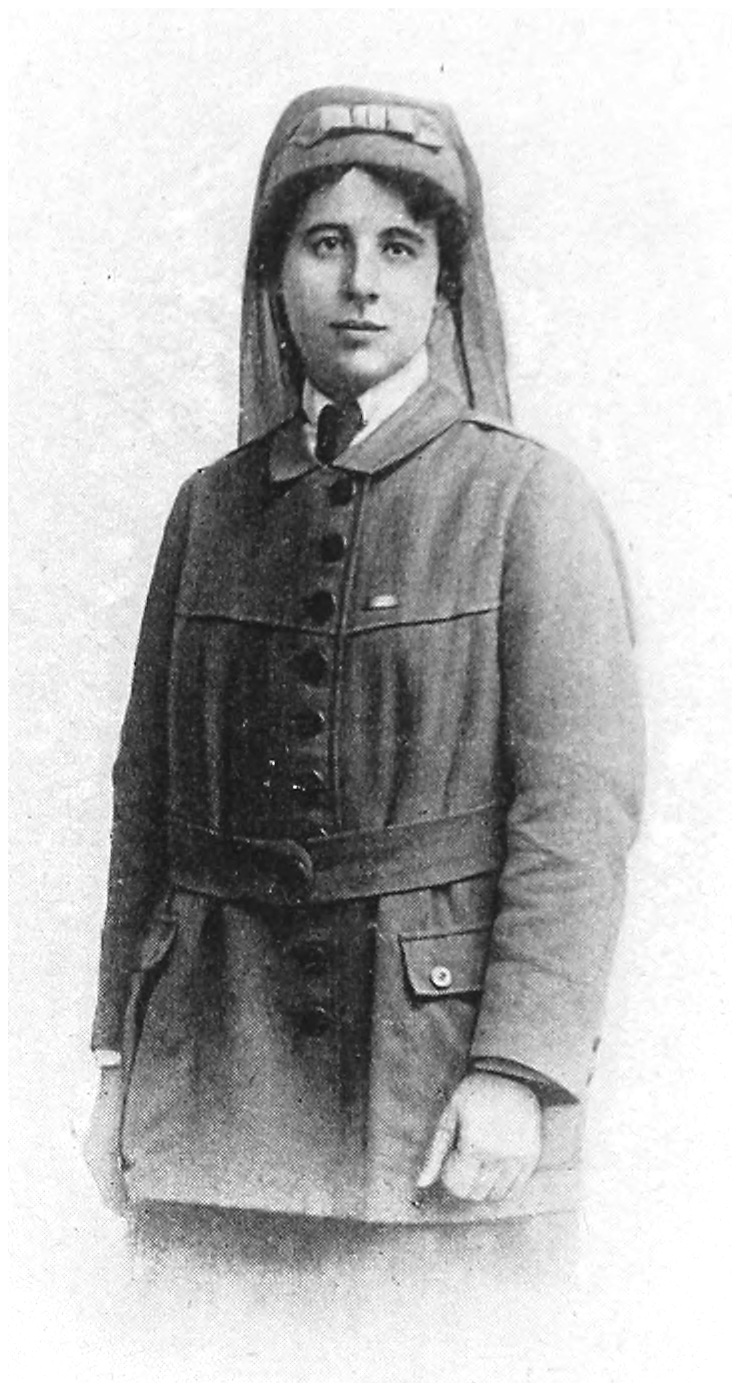
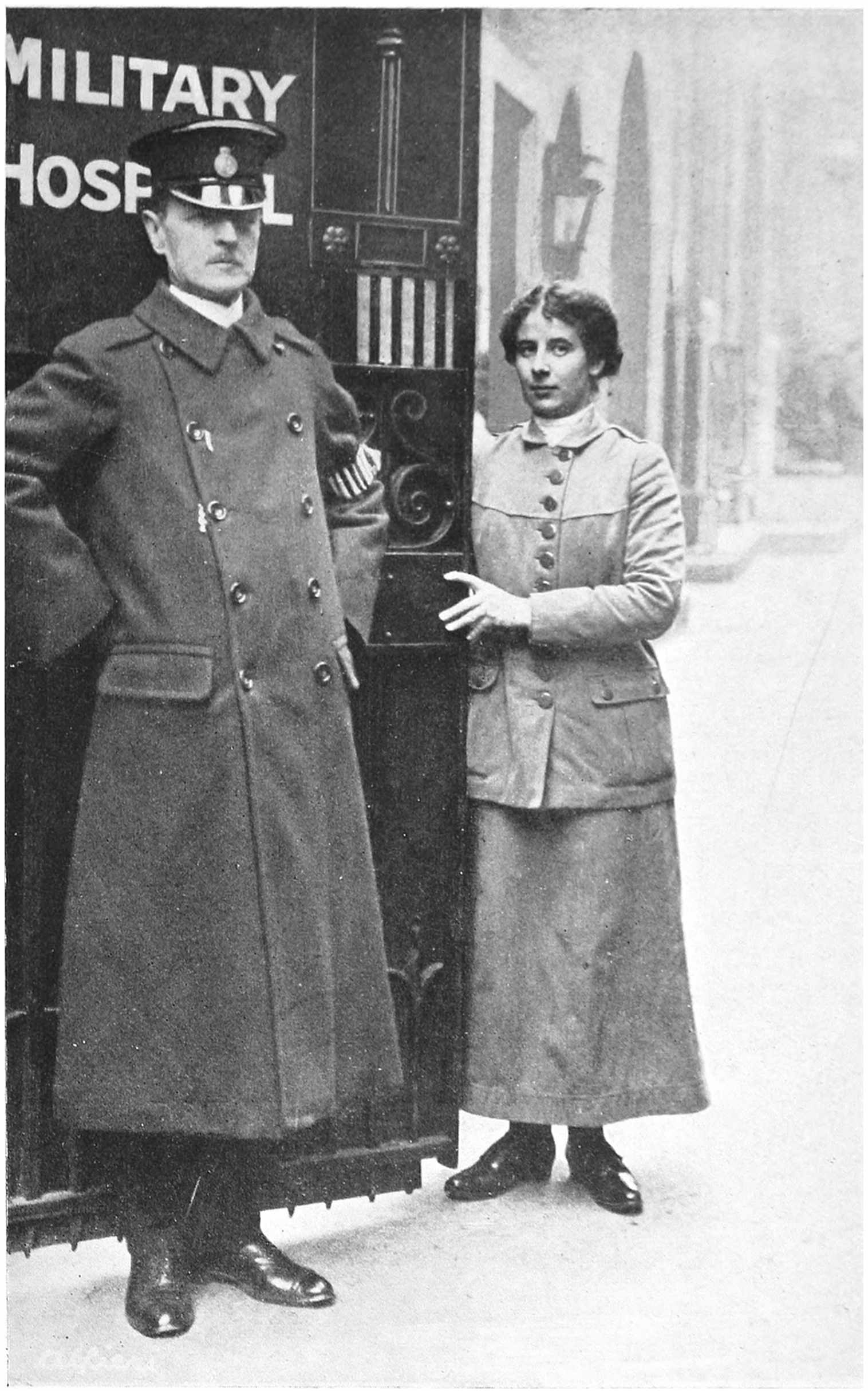
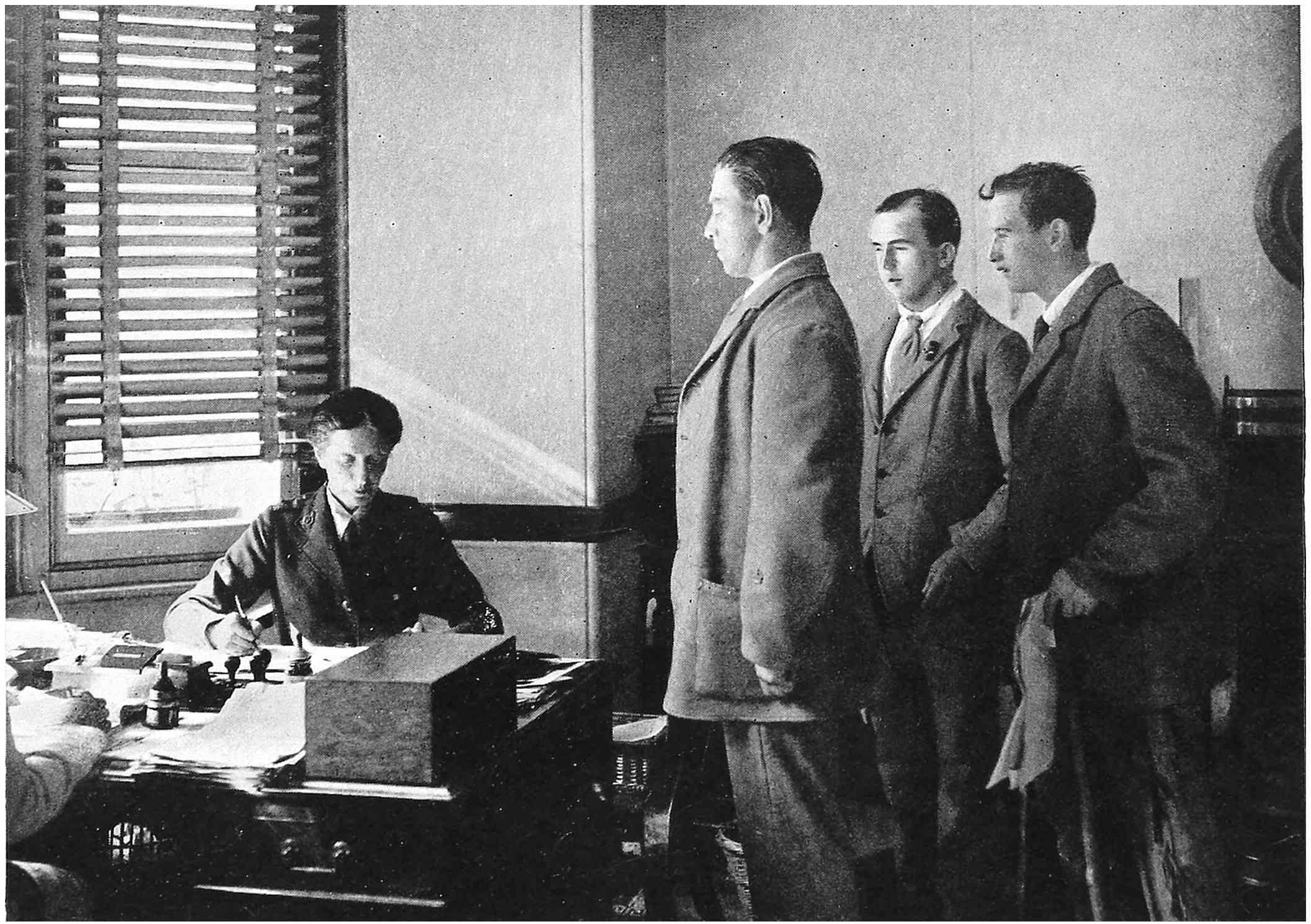
ORDERLY HODGSON IN THE UNIFORM
OF THE WOMEN’S HOSPITAL CORPS
In the smaller rooms some kind of departmental
order was growing. With real kindness, the
authorities gave advice and assistance, and one
of the officials put the doctors into touch with
two first-class male nurses, who proved most
valuable assistants.
The place was full of rumours and of special
information brought over by its Commissioners
about military matters and German atrocities.
All the head officials appeared to have different
opinions and to come to different decisions, and
one old gentleman, who held a high office, kept
saying, ‘Kitchener will never let you cross,
you know. Does Kitchener know you are going?
He won’t let any one cross.’
‘The Gate’ distrusted the French Red Cross,
and was quite sure that if anything was left for
it to do it would be muddled; and the French
Red Cross could not understand why ‘The Gate’
should offer to arrange about passports and
baggage, since it was quite able to do all that
itself. As a matter of fact, the arrangements
for the transport of baggage were made, and
most excellently made, by Monsieur Brasier de
Thuy.
The packing was done by Messrs. John Barker
& Co., of Kensington, a firm which also supplied
a great part of the equipment. When the bales
and boxes were complete, they were piled in the
street outside their premises and made an imposing
array. There were more than a hundred packages—many
large Red Cross cases with padlocks, all
labelled and painted with ‘Croix Rouge Française’
and ‘Women’s Hospital Corps,’ with lists
of their contents noted on them and the address.
Piled on the top of them were enormous bales of
wool and blankets, pillows and clothing. The
display attracted crowds of interested spectators
as it lay under the awnings, and members of the
Corps who saw it thrilled with anticipation and
eagerness.
The uniform of the Corps had been chosen
carefully. It consisted of a short skirt with a
loose, well-buttoned-up tunic, and was made of
covert coating of a greenish-grey colour. The
material was light and durable, and stood wear
and weather well. The medical officers had red
shoulder straps with the Corps initials, ‘W.H.C.,’
worked on them in white, and the orderlies had
white collars and shoulder straps with red letters.
The white was not serviceable, and at a later date
blue was substituted for it. Small cloth hats
with veils and overcoats to match made a very
comfortable and useful outfit.
That uniform was a passport which admitted
the women who wore it to offices, bureaus, stations,
canteens, wherever their work took them. It was
equally correct in hospitals, in ambulances, in
the streets of Paris and among troops. In some
magic way it opened doors and hearts and
pockets.
The Parisians murmured, ‘C’est chic, ça!’
The senior British officer asked, ‘Who designed
your uniform?’
And the subaltern said, ‘Where did you get
that jolly kit?’
Feminine, graceful, business-like, it was invaluable
as an introduction to the character of the
Corps.
Before leaving England, it was necessary to
appoint a representative in London to receive
gifts and to send over these and any extra things
which might be wanted. Dr. Louisa Woodcock
undertook this work, and found that it was no
sinecure. For as soon as the work of the hospital
in Paris became known at home, her correspondence
increased by leaps and bounds and her house
was crowded with sacks and parcels coming
from all parts of the country.
Her interest in the formation of the unit was
only equalled by that of Mrs. Garrett Anderson,
the pioneer woman doctor, who, though eighty
years of age, came up to London in order that she
might hear all the details at first hand.
‘If you go,’ she said, ‘and if you succeed, you
will put your cause forward a hundred years.’
CHAPTER II ARRIVAL IN PARIS
The authorities in Paris did not require the unit
to travel until later than the date originally
suggested. It was September before they decided
that it should be located in Paris and should
open a hospital in the Hôtel Claridge, which had
been placed at the disposal of the French Red
Cross.
On Tuesday the 14th of September 1914 the
Women’s Hospital Corps left Victoria for Paris.
The heavy baggage had gone the day before, and
was to be forwarded on the boat by which the
party would travel. Empty trucks were to await
it on the other side, and these were to be attached
to the Paris train.
A personal friend among the traffic managers
reserved a saloon for the travellers and procured
them the great privilege of having friends on the
platform to see them off. This was immensely
appreciated, and many well-wishers gathered round
them, offering greetings and tokens of affection
in the form of flowers and fruits. Madame
Brasier de Thuy and her husband, accompanied
by several French ladies, were there. Mrs. Granger
came with her arms full of grapes. Many
women doctors, well-known suffragists, journalists
and photographers joined the little crowd.
Relatives brought roses and chocolates, and ladies
with sons in France asked that letters and parcels
might be conveyed to them.
A little apart, Mrs. Garrett Anderson, a dignified
figure, old and rather bent, stood quietly observing
the bustle and handshaking. One wondered of
what she was thinking as she contemplated this
development of the work she had begun. Her
eyes were tender and wistful as she watched her
daughter in uniform directing the party and
calling the roll of the Corps. A friend beside her
said:
‘Are you not proud, Mrs. Anderson?’
The light of battle—of old battles fought long
ago—came into her face as she raised her head
and surveyed the scene.
‘Yes,’ she answered. ‘Twenty years younger,
I would have taken them myself.’
* * * * *
Late that afternoon the boat steamed into
Dieppe, past the long low lines of the Quay,
outlined by silent, watching people. As the
women in uniform followed one by one down the
gangway, the groups of sailors and porters gazed
at them with grave attention. The English
Consul had come to meet them, and wished that
they were staying in Dieppe; for the hospitals
were crowded with wounded and there were not
enough helpers. The agent, M. Guérin, was there
too, with his complement of empty trucks for the
baggage, which, it now transpired, had not been
put on the boat. The perjured purser, who had
given assurances that all was well, stood ashamed;
but M. Guérin, claiming him as a great friend of
his son, demanded that he should use his best
endeavours to expedite the missing luggage.
Leaving them to arrange the matter between them,
the women followed the Consul to the Douane.
A picturesque old French lady in a chenille cap
asked no questions but made marks with a stubby
bit of chalk on the hand-baggage; an excitable
British Red Cross lady explained that nothing
was any good here. ‘The red tape was awful—all
the arrangements had broken down. The
sepsis was appalling. The town was full of
Germans whose legs and arms had been cut off
and who were being sent to Havre next day
like that!!’
And so talking the party came to the station,
and travelling like soldiers, ‘sans billets,’ on
account of their uniform, they were hustled into
the train, which jolted slowly away.
The last part of the journey was very slow,
and Paris was not reached till ten o’clock at night.
From Pontoise onwards the train was held up at
every little station, and gentlemen in blue blouses
came to the carriage windows asking with immense
interest who the travellers were and where they
were going, or volunteering amazing information
on military matters, and as it grew dark indicating
lights which they called patrolling aeroplanes or
signals or searchlights.
The Gare du Nord was dimly lit and there were
no porters on the platform, but a representative
of the French Red Cross met the train with the
information that rooms were reserved in the
Station Hotel. He watched with silent astonishment
while Orderly Campbell and Orderly Hodgson
commandeered a large luggage trolley and, having
loaded it with all the bags and wraps, proceeded
to trundle it out of the station. Then drawing
a deep breath, he led the way through the darkness
to the hotel. The station entrance to it
was locked; the lifts were not working; the
cuisinier was mobilised. There could be no supper.
Impossible even to make a chocolat. But there
were bedrooms on the third floor, and the ladies
might go up and take their choice. So, shouldering
the bags, they mounted the half-lit staircase,
found a whole corridor of rooms at their disposal,
and settled down cheerfully to picnic out of the
still well-stocked luncheon baskets.
The following morning the President of the
French Red Cross, Madame Pérouse, called at the
Hôtel to discuss matters with Dr. Louisa Garrett
Anderson and Dr. Flora Murray. She was a
charming old lady, gentle and unaccustomed to
office work. She was confused by the multiple
claims made upon her, and oppressed by the
burden of work, which was far beyond her strength
and her powers.
Speaking no language but her own, without a
stenographer or typewriter, and supported by
officials who were all advanced in years, her difficulties
must have been very great, and no one
could blame her if she was not entirely successful.
There was friction to contend with between the
three branches of the Red Cross, which caused
overlapping instead of co-ordination of effort;
and each and every section had obstruction to
meet from the Army Medical Department, the
military authorities and the Military Governor
of Paris. Thus, if the Society seemed slow in
its decisions and uncertain in its action, there
were extenuating circumstances; and the number
of old people at the head of affairs could
not fail to be a drawback. For has it not
been written: ‘Men of age object too much,
consult too long, adventure too little, repent too
soon, and seldom drive business home to the full
period’?
Madame Pérouse was accompanied by an
English doctor, who was attached to another
voluntary hospital. He gave a lurid account
of the French Army, its hospitals and the state
of its wounded as he saw them, including in his
remarks advice against trusting the French Red
Cross or anything else that was French. While
he talked to Dr. Garrett Anderson, Dr. Murray
came to an understanding with Madame Pérouse.
Realising that the old lady really did not know
what she wanted them to do and had no instructions
to give, she proposed that they should go
with her to the Hôtel Claridge and inform themselves
as to the possibilities of that building.
The Hôtel Claridge was a large modern caravanserai
on the Champs Élysées. As the builders
had only just completed their work, the walls
were hardly dry, and the floors were covered with
débris. The whitening had not been cleaned off
the windows, and men were still working at the
electric light and in the boiler house. On the
ground floor a series of large salons and dining-rooms
opened out of one another. They had been
designed so that no ray of sunlight ever entered
them! But they were structurally capable of
making good wards for a hundred patients.
Luxurious and comfortably furnished bedrooms
on the first floor offered accommodation for the
staff, and large stores of new beds and expensive
blankets were available. The building was intersected
by long gloomy corridors, each one laid
with an elaborate tesselated pavement and decorated
with enormous mirrors. The chauffage
had not yet been persuaded to act, and the
atmosphere was cold and damp; but there were
many conveniences in the shape of gas ovens and
sinks as well as service-rooms—a fact which made
the Hôtel a suitable place for a hospital.
The French Red Cross had already accepted the
services of a Red Cross commandant and a small
party of English nurses, and had quartered them
in the Hôtel. Madame Pérouse proposed to
attach them to the staff of the Women’s Hospital
Corps and to let them work under the direction of
the doctors. In the kitchen a chef had been
installed, with some Belgian women to assist him,
and the rest of the establishment included
M. Perrin, the engineer, and M. André, the concierge,
with his wife and family.
It was obvious that the Unit ought to move in
at once and begin to get the wards into order.
Meanwhile, there were certain formalities to be
observed. The members of the staff had to be
registered with the police; cards of identity had
to be issued for each one of them; photographs
were needed to complete these; and arm brassards
with cryptic figures must be procured from the
offices of the French Red Cross in the rue de
Thann.
The Red Cross offices were the scene of great
activity. In one large room numbers of ladies
were engaged in writing examination papers
which would qualify them as nurses after an
intensive fifteen days’ course of study. They
were ‘très bien mises,’ and the first lecture of the
course gave careful instructions for the care of
the hands and complexion, and included recipes
for the preparation of pommades and other cosmetics!
In an adjacent room ladies in white
robes were winding bandages; and an office upstairs
was tenanted by two gentlemen who occupied
the position of directeurs.
The senior of these two was M. le Docteur M——,
a man of a highly irritable nature which made
him a terror to the Red Cross ladies. ‘Pour rien
du tout,’ they whispered, his long grey hair
would stand on end, his pendulous cheeks quiver
and his corpulent person be convulsed; then,
with threatening finger and bitter gibes, he would
drive them from his presence. His method of
conducting affairs was unintelligible to British
people; and seeing how obstructive and perverse
he was, it was a marvel that his staff accomplished
anything. Dr. Garrett Anderson and Dr. Flora
Murray, having stated their requirements to a
secretary, were asked to sit down while he made
out some papers for them, and from two chairs
against the wall they had leisure to make their
observations. With deep interest they heard a
senior clerk try to obtain a decision from M. le
Docteur and his white-haired, sleepy colleague as
to the situation of ‘L’Hôpital Base des Alliés.’
Both directors were deaf, and he had to read the
letter in question in a loud voice. The letter
was ten days old, and the clerk urged this as a
reason for deciding that afternoon.
‘Il y a déjà dix jours,’ he pleaded.
‘Et s’il y avait vingt jours!’ roared M. le
Docteur; and suddenly subsided as he became
aware of the interested spectators against the
wall.
The clerk tried another line, produced a map
and made further suggestions; but the older
gentleman was tired of the matter. He turned
his back on his colleague—still growling over the
map—and concentrated his attention upon ‘ces
dames anglaises.’
The papers being ready, the secretary directed
them to another office where brassards might be
obtained. Here a lady, with great volubility
and in most rapid French, explained her intricate
reasons for not giving them any! And as they
did not much mind whether they had them or
not, they bade her a friendly farewell and left the
premises. Just outside they met M. Falcouz and
laid the foundation of a pleasant little friendship.
With his white hair ‘en brosse’ and his little
tufted beard, he presented a sufficiently un-English
and interesting appearance. It was his
habit always to dress in black and to wear a black
satin tie and gloves two sizes too large for him.
He was the Red Cross Treasurer, and as beseemed
his office, he beamed on the doctors and fell to
discussing money matters.
‘Have you money? How have you raised it?’
he asked.
On hearing how the money had been found, he
exclaimed:
‘Épatant.’
And then added:
‘In France it would not be possible, mesdames.
Nobody would be trusted with such a sum!’
CHAPTER III THE HOSPITAL IN THE HÔTEL CLARIDGE IS OPENED
The second morning in Paris found the Corps
busily engaged at the Hôtel Claridge. There was
a great deal of cleaning to do and many arrangements
to make before the place would be habitable.
In the centre of the building was a handsome
paved hall with a many-coloured marble table
and enormous glass chandeliers. Out of this
four good-sized salons opened, and it was in these
that wards were first arranged.
The salons were only divided from one another
by plate glass; and some degree of privacy is
necessary for a ward. Doctors and nurses alike
put on aprons and rolled up their sleeves, and while
some cleaned the whitening off the glass, the others
pasted the lower part over with white paper.
With help from the Belgian refugees, who were
lodged on the seventh story, the floors were
cleaned and polished, beds were put up and order
began to be evolved.
The ladies’ cloakroom, with its pavement, its
hot-water supply and basins, was converted into
the operating theatre. A gas steriliser and a
powerful electric light were fixed in it. Though
small, it proved serviceable and well equipped.
The cleaning was sufficiently advanced to allow
of the Corps moving into its quarters on the first
floor next day, and they spent the morning carrying
bedding and furniture down to the wards.
These at once began to have a professional look,
and by concentrating on two wards they were
successful in getting fifty beds prepared for patients
by the evening.
The work of preparation was at its height when
a doctor from the American hospital walked in.
Upon the outbreak of the war, the American
colony in Paris had organised their fine hospital
in the Lycée at Neuilly and had established a
fleet of ambulances. Their ambulances enabled
them to carry hundreds of men from the fighting
line in to Paris. Both French and British wounded
were in terrible straits; for there was no organised
motor transport service, and the Armies depended
on the railways for the removal of the sick and
injured. The long delays and the conditions under
which the men lay whilst waiting for removal
were fatal, and the American service was the
means of saving numbers of lives.
When trains were available the wounded were
packed into them and despatched to distant
places in the interior. As they passed Paris,
those who were so severely wounded that they
were unlikely to survive a long journey were left
at the stations on the Circle Railway round the
city. There they would lie on straw or sacks,
waiting for friendly ambulances to come out and
bring them in.
In those first weeks there was no system of
communication between the hospitals and the
stations; the French ambulances were small and
bad, and the British had none available for Paris.
The matter depended largely upon individual
effort, and the ambulances of the American and
other voluntary hospitals played a devoted and
humanitarian part.
The doctor from Neuilly was in charge of the
ambulance service. The American hospital was
already very full of French and British, but, in
response to a message which he had received, he
was sending out his cars that day, and he hoped
that there might be beds ready for some of the
cases at ‘Claridge’s.’
‘How many can you take?’ he asked.
‘We can take twenty-four this afternoon and
another twenty-six to-night,’ replied Dr. Murray,
well knowing that the baggage was still at the
station, and conscious of the expression on the
faces of those who heard her.
‘Good! Will you take officers?’ he said.
‘Yes. We have a ward for officers,’ she answered,
remembering for the first time that officers
get wounded as well as men, and that no special
pyjamas or cambric handkerchiefs had been included
in the equipment!
‘Well, I shall bring officers,’ he said; ‘British
ladies are the right people to look after British
officers.’ And remarking that he only brought
in severe cases, and that they would all need
immediate operations, he left the stall to face the
inadequacy of their preparations from the officer’s
point of view.
‘At any rate, they’ll have lovely beds, if
nothing else,’ Orderly Campbell remarked, with
a reassuring laugh.
Fortunately, a notice had come from the Railway
Company that morning to say that the baggage
was at the station, and Orderly Hodgson had
started early to retrieve it. She spent hours
dealing with the intricate formalities required by
the Company and finding transport for the baggage;
but she stuck to it resolutely, and drove
in triumph to the door with it a few minutes before
the first ambulance full of wounded arrived.
The stretchers and the packing cases were carried
into the hall side by side, and while the nurses
and surgeons cared for the patients, the orderlies
unpacked the equipment.
As those first stretchers with their weary
burdens were carried in, a thrill of pity and dismay
ran through the women who saw them. The
mud-stained khaki and the unshaven faces spoke
to them no less than the wounded limbs and
shattered nerves. Here, for the first time, they
touched the wastage and the desolation of war.
In every wounded man they saw some other
woman’s husband or son, and the thought of those
other women made a double claim on their energy
and sympathy. The battered, inarticulate, suffering
men who lay there needed service, and they
braced themselves for the work before them.
Organisation developed automatically: nurses
for night duty were sent to rest; the theatre
sister began to sterilise; chloroform, instruments,
drugs and dressings were produced and distributed.
Late in the afternoon a message from the Chief
Surgeon was brought from the wards:
‘Dr. Anderson wishes to know if the theatre
is ready and if she can operate to-night.’
‘It is ready now,’ was the answer.
And the surgeons operated till a late hour
that night.
The hospital was a smooth-running concern by
the end of the week. Nurses and patients had
settled down in the wards; work in the operating
theatre was going well; and though it was far
from perfect in all its details, the comfort of the
officers and men was assured, and their contentment
and satisfaction with their surroundings
were very pleasant to see.
CHAPTER IV FIRST DAYS IN PARIS
The streets of Paris were strangely altered and
unfamiliar, with closed shops and whole blocks
of houses empty and shuttered. The Government
was at Bordeaux, and the Louvre and all
places of amusement were shut. Only the churches
were crowded, and from their dark interiors the
side altars shone out, brilliantly lighted and
surrounded by women and children on their
knees. Day by day they trooped past the altars,
lighting the candles and offering their prayers;
and day by day the casualty lists grew longer and
the number of crêpe veils in the streets increased.
Life was not easy for the women of Paris, but
they bore themselves with great dignity and
courage. Their attitude was calm and reticent;
they took over men’s posts in the shops and work-rooms,
or on the trams and railways, as a matter
of course, and carried out their duties with quiet
efficiency.
The uniform of the Women’s Hospital Corps
soon became known, and secured a cordial reception
for its members in the bureaux and offices
which they had to visit, as well as on the boulevards.
Strangers would offer them gifts of socks
and mittens. Old ladies, with tears running down
their cheeks, would lift their outer skirts and
rummage in the poche intérieur to bestow a few
francs with a blessing upon them. An Englishman,
choking with emotion, put two sovereigns
into a doctor’s hand as she passed him on the
stairs of the Hôtel. Shopkeepers asked about ‘les
blessés’ and sent presents of sweets and biscuits.
The greengrocer added an extra cauliflower to
the purchase! Flower-women ran after them
and pressed bunches of roses into their hands.
At the entrance of the Hôtel when ambulances
were unloading, elderly men in silk hats and black
kid gloves would crowd round and offer to carry
the stretchers, or would follow the bearers inside,
with the kit—often a very dirty kit—in their arms.
The sight of the suffering moved them so that
they turned aside and wept. They brought
violets and roses and cigarettes for the men.
They stood outside the doors to listen to them
singing, and they wrung the hands of the doctors
silently and went out. The people were deeply
moved, but not cast down. They had settled
down to war, and even then they were confident
of victory, since the English were with them.
The cordiality of the people, the general sympathy
and the inspiration of a common cause,
combined with the beauty of Paris and the charm
of the autumn weather to make these days a
wonderful memory.
* * * * *
The organisation of the hospital proceeded
rapidly, and the amount of heavy surgery and
acute sepsis which came in taxed the energy
and resources of the surgical staff. Dr. Garrett
Anderson acted as chief surgeon and Dr. Gazdar
took charge of the officers’ ward. Other workers
fell into their places and a sort of routine was
gradually evolved. The duties of administrator,
or Médecin-en-Chef, fell to Dr. Flora Murray, and
when she was not issuing stores or counting linen,
she would be receiving the countless visitors who
came to see the wards.
The French Red Cross wished the hospital to
have a directeur, and for this purpose they attached
to it M. Aubry, a French gentleman who was at
leisure during the closure of the stock exchange.
He spoke French only, and his duties as director
were purely nominal. He was considerate and
genial, and the staff became very fond of him.
He had a son in the Dragoons of whom he was
immensely proud; and the arrival of a grandson,
or petit dragon, was a great social event in which
every one shared. He seemed to spend several
hours a day chatting with any one who had time
to listen to him, and occasionally he joined the
mess for tea. He helped the work of the
hospital greatly by bringing in one of his clerks,
M. Gohin, to take charge of the registers and
returns.
The French Army required an immense number
of returns to be made. These had to be rendered
in the form of a nominal roll, on the fifth day, the
tenth day, and the twenty-fifth day of each man’s
stay in hospital. As the men did not all come in
on the same day, the return of the yellow or blue
or white cards—as the case might be—was never-ending.
The British made it simpler, for one
nominal roll went every week to the War Office
and a copy of it to the R.A.M.C. authorities in
Paris.
M. Gohin was unfit for military service, but he
certainly made good by the skill with which he
managed a very complicated and tiresome piece
of clerical work.
Sundry other youthful clerks also came from
M. Aubry’s office to assist in the wards, and his
concierge, M. Roget, took the hospital under his
wing. M. Roget had been with M. Aubry for a
great many years, and he loved and admired him
dearly. His affection frequently prompted him
to discuss the appearance and ways of his master
when he was ‘en colère.’ At such times he was
said to resemble a wild beast, and no one could
calm him except Roget. Every morning, in a
white pinafore, with a little watering-pot in his
hand, M. Roget would perambulate the central
hall, covering the pavement with moist curls and
twists. Then he would throw a little sawdust
about and leave it for some one else to sweep. He
was a great man for rumours, and when he was
not giving details of his anatomy and his pathological
condition, he would have mysterious tales
of a hundred trains that had gone from Paris to
the Front to bring in German prisoners; of spies
and plots within the walls of Paris; or of great
military events which were to end the war in six
weeks.
* * * * *
The management of the Hôtel itself was in the
hands of M. Casanova, who acted as directeur
under the Company which had built and owned
it. He was short and stout, with a flowing black
beard, and soft, well-manicured little hands, very
courteous and agreeable, prolific of promises,
which for some reason never seemed to be fulfilled.
He was moved to the very depths of his self-indulgent
soul by the war and the proximity of
suffering and wounded men. He would descend
at night in his pyjamas if he heard a convoy
coming in, and penetrate to the wards to see what
was going on, and to offer help. Though not in
the best of health, he would fetch hot water or
lift weights. He would reach out a trembling
hand to hold things, while he wiped his eyes with
the other. His sympathy and distress, combined
with a desire to kiss the busy hands of the doctors,
made him a touching figure.
In his train were always strange ladies, wrapped
in blankets, who followed him and peeped round
the doors. His rooms were luxurious. His menu
was spécial. But he roused himself to serve and
to help with all sincerity. Unfortunately, his
relations with M. Aubry became somewhat strained
at a later stage, for he had a passionate temperament.
There were wont to be terrible domestic
uproars below stairs. M. Casanova’s method of
administering justice was to declare that some one
was coupable of breaking into the wine-cellars,
eating too much butter or causing the cheese to
disappear. He accused everybody, and everybody
asserted his innocence; so he said they
must draw lots as to which of them must be
chassés. The lot fell on four Belgian girls who
hung about the place and did services; at this
the rest of the staff was up in arms, and M. Perrin,
the engineer, said, if they were chassés, he also
would be chassé; and in a perfect storm of
rage and recrimination it was decided that every
one was to be chassés. M. Perrin disappeared.
The apparatus for the supply of hot water and
heating ran down in his absence, and the Belgian
girls wailed that they were being cast upon the
streets.
The Médecin-en-Chef waited upon M. Casanova
in the interest of the girls. He presented her with
twelve cakes of soap and some scent:
‘As a testimony of my admiration for your
courage and nobility,’ he said.
And, kissing her hand, he added:
‘The members of l’équipe under your distinguished
direction, madame, are models of virtue
and devotion; but there are others of whom one
can say nothing but evil.’
His mood, however, softened, and in the morning
it was understood that no one was to leave,
and, to the relief of all concerned, M. Perrin returned
and resumed his duties.
The officials of the French Red Cross were
delighted with the rapid way in which the hospital
had got to work, and took a great interest in all
that was being done there. Not infrequently
Madame Pérouse, accompanied by M. Falcouz,
would arrive to pay a visit at eight o’clock in the
morning. The first greetings over, she would
suggest going to greet the officers—‘prendre de
leurs nouvelles,’ so she put it. At that hour the
ward work was in full swing, and any one who has
had experience of nurses knows how the Sister
feels when visitors arrive before she is ready.
British officers, too, prefer to have time to breakfast
and shave before being inspected. But the
dear old people were oblivious of their embarrassment
and entered the ward with genial ‘Bonjours.’
They asked the major how he was and
he replied, with grave courtesy, ‘Merci, madame;
merci, monsieur.’ They asked the others one by
one if they spoke French, and they replied severally,
‘Pas beaucoup,’ or ‘Un petit peu.’ And so,
bowing and gracious, they passed on their tour
of inspection.
In those days very few officers seemed able to
speak French, and intercourse with their French
brothers-at-arms in neighbouring beds was inconveniently
restricted. Referring to the language,
one of them said, ‘The insuperable difficulty
of this campaign is the language—it’s
unspeakable!’ And some of the doctors echoed
his opinion heartily.
Left alone on duty one night, a surgeon wished
to talk to a wounded French officer and was
obliged to ask for the assistance as interpreter
of a nurse who had a reputation as a linguist.
‘Ask him,’ said the surgeon, ‘if he has a pain
in his stomach.’
The nurse bent over the bed and put the question:
‘Monsieur, avez-vous du pain dans l’estomac?’
The poor man had been shot through the body
and was on a water diet. He indignantly repudiated
the suggestion, assuring her that he had only
taken what the surgeon had ordered for him and
that under no circumstances would he do otherwise.
Both French and British officers were acutely
shocked by the horrors through which they had
passed, and most of them suffered from a painful
reaction when the strain was relaxed. At first
they could not rest in hospital, and their nights
were haunted by terrible memories and anxious
thoughts. One of them never told what he had
seen, but night after night he covered his face
with his uninjured hand and moaned:
‘The children. Oh! the children!’
He had left children of his own at home; and
the sufferings of the little Belgians gave him no
rest.
Older men were harassed and worn by anxiety,
and distressed by the difficulty and precarious
position of the allied Armies. The younger ones
spoke of how ‘the British were hanging on with
their eyelids’; or how the French were supposed
to be ‘making a flank attack and were lost.’
Some in their depression feared defeat; others
broke down with exhaustion and reaction.
To all of them, officers and men alike, hospital
was a haven of peace and security. It was
heavenly to lie in clean beds, to be cared for by
Englishwomen, to be rid of regimental discipline
and for the moment of responsibility too. The
severity of their wounds, the operations, the pain
were minor matters; for the time being they had
found comfort and rest. Probably none of them
had been in contact with women doctors before;
but that did not make any difference. They
trusted the women as they would have trusted
men—passing the bullets which had been extracted
from their persons from bed to bed and pronouncing
the surgeon to be ‘wonderfully clever!’
The more convalescent patients visited the men
who had undergone serious operations in the
wards and cheered them with reminders that they
were not ‘in the hands of the R.A.M.C.’ Their
enthusiasm for the hospital was delightful and
encouraging. When they got well and went away,
it was like seeing boys go back to school.
The condition of the men was, if possible, worse
than that of the officers. They had lain in queer
wayside stations, waiting for trains, or on straw
in stables and churches, hoping for transport.
At Villeneuve, on the Paris railway circle, there
was a goods shed with straw on the ground, in
which officers lay at one end and men at the other.
An R.A.M.C. doctor and a few men did what they
could for them, and when the ambulances came
out from Paris, the worst were picked out; but,
for the rest, the weary waiting for a train continued.
At Creil, forty miles from Paris, the
accommodation was an open shed filled with straw.
French and British lay huddled in groups, some
covered by blankets, others by dirty sacks. A
doctor of the French Army, very dapper in his
red and blue plush cap, sorted them into trains,
when any trains came. Several French soldiers
stirred a mess of potage with a dirty stick. But of
dressings or nursing there was no sign. Patiently
and uncomplainingly these sufferers waited, often
fifteen, twenty-four or more hours, while the rain
poured down on the roof of their shed, and the
wind swept drearily through the station.
At last, septic and wasted by fever, they were
jolted by the ambulances over the ill-paved roads
to Paris and hospital. Lieut. Lowe, whose only
chance lay in getting into hospital without further
delay, was brought down from Compiègne on a
stretcher laid across an ordinary motor-car and
held in position by an American doctor and a man
with one hand. His thigh was badly fractured
and very imperfectly supported; but with the
help of morphia he endured the journey. From
the first there was little hope of his recovery,
but he lingered for some weeks, during which his
sister was able to be with him, lavishing care and
tenderness upon him to their mutual comfort.
The men were dirty and half-fed; many had
not had a change of clothes or socks since they left
England; but they were absolutely uncomplaining
and began at once to appreciate their hospital
surroundings. Women doctors were a novelty
which served to enhance the importance and the
grandeur of the gilded and marble halls in which
they found themselves. ‘The doctors is ladies,’
they wrote in their letters home; and to the
visitor who asked: ‘Is it really true that you
have no men doctors here?’ the reply was:
‘And what will we be wanting men doctors for,
sir?’
They found comfort in the presence of women
and repose in the care lavished upon them, and
with the philosophy of the soldier they let it
rest there.
CHAPTER V A VISIT TO BRAISNE, AND AN INSPECTION
Good supplies of clothing and hospital comforts
found their way to ‘Claridge’s’ from the many
work-parties which had been started in England.
Socks and gloves came in sacks from Oban,
Edinburgh and Aberdeen; pillow-cases and shirts
from Annan; belts and bandages from Stoke;
parcels were sent from Cardiff and Bristol; and
hot-water bottles, bed socks and many other
welcome gifts arrived from other places. The
Corps had plenty of socks and shirts to send to the
outlying stations through which troops passed,
or to the places where collections of wounded
were known to be lying. French soldiers, too,
learned that there were socks to be had, and many
of them came to the Hôtel to ask for a pair. They
emphasised their need by drawing rubbed and
bruised feet, bound in rags, from their army boots,
lamenting that the smallness of their pay would
not run to socks. With a nice pair, knitted by
some one in Scotland, and a little box of ointment
they went out beaming.
Two Paris friends, Mlle Block and Miss Grey,
gave the hospital very real assistance by providing
two ambulances and placing them at the disposal
of the medical staff. They were both of them
splendid drivers, and they did many a hard day’s
work, and thought no pains too great, no journey
too long, that gave some wounded man a chance
of recovery.
When the R.A.M.C. officer at Braisne telephoned
to ask for ‘shirts and anything else you
can send,’ a car with all sorts of necessary articles
was got ready. A bundle of shirts, a sack of
socks, a case of invalid foods and a large bag of
dressings were piled in. All the English papers
which could be collected and a supply of Woodbines
and some books were added, for distribution
to the British troops who were always found on
the roads or resting in the villages; and the whole
was despatched in the care of the Chief Surgeon
early one morning in September.
The country was beautiful in the autumn sunlight.
It looked peaceful too, as her car followed
the long straight roads. But there were shallow
trenches by the roadside and barricades, with
sentries at intervals, which spoke of war. English
soldiers were met, who cheerfully relieved her of
the papers and books, and appreciated the Woodbines
and the matches; or asked for news from
home, and gave her letters to post in Paris. At
every village the permis and the contents of the
car were examined, and when Paris was left
behind, troops were seen moving in large numbers.
Wherever the car stopped, villagers crowded round
it, eager to tell ‘l’Anglaise’ how the ‘Uhlans’
had come so far: how they had fired the houses
and emptied the cellars, and how they had been
driven out, and how terrible war was. The smoke
of the German guns firing on Soissons was visible
as the driver turned off towards Braisne.
The little town, which looked destitute and
untidy, lay in a hollow with bare hills all round it,
and Dr. Garrett Anderson, as she drove down the
main street, could tell by the stench in which
buildings the wounded lay. She was met by the
R.A.M.C. officer, who asked her to come to headquarters,
and took her to a dilapidated little
house in which the officers had their mess. She
followed her guide through the house into a small
backyard where three officers were sitting round
a wooden table eating bread and cheese. The
colonel said he had not much time, but he would
like her to sit down and talk to him while he ate.
And a wooden stool was found for her. The air
of the place was close and fetid, the flies buzzed
over the food, and the men looked careworn and
lined. The squalor and discomfort were oppressive,
and she was glad when the meal was finished and
she could go out into the street with the R.A.M.C.
officer, who stayed closely by her. The car was
unloaded, and when he saw what she had brought
his voice shook as he thanked her. He was young,
and the strain of his present life and the contact
with so much suffering which he had little power
to allay was becoming almost more than he could
bear. It was obvious that he felt it a great relief
to turn to the doctor from Claridge’s for sympathy
and comfort.
‘Come and see the men,’ he said.
They walked together to the church. The west
door was open. The smell of sepsis and foul
wounds met them as they entered the graveyard.
Near the door some R.A.M.C. orderlies were tending
a cooker, and on a bench a cheese stood among
some long loaves and a few tins of Maconochie’s
ration. Packets of lint and cotton-wool were
scattered on the ground, and some mugs and ration
tins were piled in the porch. The floor of the
church was covered with wounded men in ragged
khaki. They lay upon straw close together.
Some of them were moaning quietly; others
muttered in their delirium. Some were dying as
the doctors stood near, and more than one had
entered into rest. The smell, the dirt and the
misery of it all was overwhelming. It was heartrending,
too, to think of the women to whom
these men belonged. In the midst of such squalor
and wretchedness, an Army Sister, radiant in
scarlet and white, presented a strange contrast.
When ambulances could be spared, they came
down in the evening and carried as many wounded
as they could to a station—where the men waited
sometimes for days for a train. In this way they
were transported long distances, even to St.
Nazaire on their way to England. Such suffering!
Such loss of life! And yet within sixty miles
lay Paris with thirty thousand empty beds, but
with no organised transport.
Dr. Garrett Anderson had two places in her
car, and she offered to take back with her two
wounded men who could sit up. Out of the
medley the orderlies produced two. They sat
them on a bench and washed their faces with
a piece of lint wrung out of the copper. They
put their caps on their heads, gave them a drink
of tea and intimated that they were ready. Dr.
Anderson looked at them, and it seemed to her
that one of them was too ill for the long drive in
an open car; but when he saw that she was hesitating,
the tears came into his eyes, and he caught
her arm, pleading:
‘Do take me, lady. Don’t leave me behind.’
So he had to be taken. She fortified them both
with a dose of morphia and some brandy diluted
with water from the copper; then they were
helped into the car and driven away.
The memory of the men she had left in that
putrid atmosphere and under such comfortless
conditions was never to be forgotten.
* * * * *
No doubt some report of circumstances like
these reached the authorities in England. Towards
the end of September, the War Office sent
over a representative to examine into existing
conditions, and to inspect and report on the
auxiliary hospitals, of which Claridge’s Hôtel was
one. The ‘Milord’ selected for this mission
made a handsome, martial figure as he strode
through the streets of Paris. He was resplendent
in khaki and brass hat, and a beautiful order hung
round his neck. Rumour said he was the Duke
of Connaught or Lord French or Sir Frederick
Treves or Mr. Bottomley! But whoever he was,
his appearance commanded great respect. He
was saluted on all sides, and men stepped from
the pavement to let him take his noble way.
The first hospital which he visited was Claridge’s.
He was an imposing figure as he entered the central
hall. His spurs rang on the pavement and his
steps re-echoed in its vastness. He fixed a suspicious
blue eye on the senior medical officers who
went to meet him, and interrogated them sternly:
‘Who is in charge of this place?’
‘What are you doing here?’
‘What have you got behind there?’ pointing
at the glass partition rendered opaque by white
paper.
‘A French hospital! How can it be a French
hospital? You’re British.’
‘All women! No proper surgeons?’
‘Have you British soldiers here? Any officers?’
‘What are you doing with them?’
‘Where do they go when they leave you?’
‘Versailles! Who told you to send them to
Versailles?’
‘Colonel Smith! How do you know about
Colonel Smith?’
Curt, sharp questions that met with curt, sharp
answers.
At this moment Madame Pérouse, who had been
notified of his visit, arrived. He greeted her with
the most delightful courtesy, and withdrawing
with her to a little distance, asked if these women
were really practical surgeons and if it were possible
that the soldiers tolerated such an arrangement.
The poor old lady was rather flustered, but she
declared that this was her ‘meilleure installation’
and that the organisation was ‘parfaite.’ He was
only half-convinced by the assurances which she
gave him, but his manner became more ordinary,
and turning to Dr. Flora Murray and Dr. Garrett
Anderson, he announced his intention of going
through the wards. He was accompanied by a
doctor, a civilian, whom he introduced as being
‘unconverted to women doctors.’ These pleasing
preliminaries being concluded, he was conducted
into the hospital.
It was the rest hour, when many of the patients
were asleep, and an air of peace and comfort was
over everything. Sisters moved softly whilst
tending the more seriously ill, and those who were
awake lay quietly reading and smoking. The
handsome wards with their flowers and coloured
blankets looked charming: for they were in
perfect order, and there were no visitors so early
in the day. The men when questioned spoke of
their ‘good home’ with grateful appreciation.
The officers expressed their satisfaction in cordial
terms; and as ‘Milord’ went from ward to ward,
he became silent and thoughtful. He finished his
inspection without relaxing the severity of his
aspect and took a graceful farewell of Madame
Pérouse, leaving her much mystified as to the
reason of his visit and his apparent displeasure.
‘Qu’est-ce qu’il avait?’ she inquired. ‘Il
me semblait mécontent.’
Two days later the ‘unconverted doctor’ called
again, bland and eager for conversation. He
explained that he and his companion had been
sent over by the War Office, and he talked of the
intentions of ‘K’ with regard to the hospitals.
He said they wanted to know whether the Women’s
Hospital Corps could increase its beds, and whether
it could move its hospital forward if needed.
The astonished organisers were given to understand
that if any auxiliary hospitals were moved
forward, Claridge’s would be the first to be invited
to move, and that the British Army would not
hesitate to make use of it, supposing that the
matter could be arranged with the French Red
Cross. The ‘unconverted one’ still seemed, however,
to be tormented with uncertainty as to the
attitude of men when called upon to accept treatment
from women doctors. In order to reassure
him, he was pressed to visit the officers’ ward
by himself. He went, and, to the amusement of
all concerned, returned an agreeable and equable
convert.
* * * * *
Early in October ‘Milord’ was in Paris and
came to Claridge’s again, bringing with him
Professor Alexis Thomson, of surgical fame and
of Edinburgh University. He greeted the staff
in the friendliest manner, and introducing the
Professor to them, he explained that he had
brought him because he believed that he would
be as much impressed as he himself had been.
He turned to the Professor and said:
‘It’s a curious thing, Thomson. They are all
lady doctors here. Have you ever come across
any?’
‘Yes, we begin with them at Edinburgh,’ the
Professor replied. By which it was understood
that, as a junior member of the Infirmary staff,
it had been his duty to teach the women
students.
In the wards he was shown two trephined
patients who were doing well, and several compound
fractures of thigh. He was interested to
see that Dr. Anderson was using Steinman’s pins,
and discussed that method of treatment with her.
But what pleased him most, perhaps, was the
reply of a Scotsman to his inquiries:
‘Aw, A’m fine. A tak’ ma meat an’ A get ma
parritch in the morning. A’m fine.’
On many future occasions ‘Milord’ visited the
hospitals of the Women’s Hospital Corps, always
as a welcome and honoured guest, distinguished
by his courtesy and his kindness.
* * * * *
The medical staff of Claridge’s had taken a good
deal of trouble to find out the correct way of
evacuating convalescent officers and men. There
was no organisation in Paris at that time dealing
with the transport to hospital or the discharge of
British wounded, and it was only by chance that
the Corps got into touch with the officer-in-charge
of the Military Hospital, Versailles, and arranged
to evacuate its patients through him. No proper
instructions had been sent round to the auxiliary
hospitals; and in many cases patients had been
discharged from hospital and allowed to proceed
direct to England. The War Office termed this
‘leakage,’ and took ‘the gravest view’ of such an
irregular proceeding. Subsequently, an R.A.M.C.
colonel was established in a neighbouring hotel to
act as a central authority. The R.A.M.C. authorities
always treated the Hôtel Claridge as though
it were a British auxiliary; whereas, in reality,
it was affiliated to the French Military Hospital
St. Martin. Troops of both nations used the
hospital as long as it was open, and there was no
difficulty in serving both masters. Inspection
by highly placed officials of both Armies was
constant; and these visits were often a source of
amusement to the medical staff.
Senior officers of the British Army seldom came
to Paris without including the Women’s Hospital
in their round of inspection. Especial care was
taken to receive these gentlemen with ceremony.
The Médecin-en-Chef always took them round
herself, and whenever possible the Chief Surgeon
assisted too. Under such an escort they could
not fail to see everything that it was desired
they should see; and often they saw it rose-coloured
through the spectacles of the doctors
themselves! By the end of the tour they were
full of admiration for ‘a model hospital,’ as
they used to phrase it, and almost always
asked:
‘But why are you a French hospital? You
ought to be working with us.’
‘The War Office would never look at women
doctors,’ was the reply.
‘Oh, but that’s absurd!’ they exclaimed.
‘Look at the work you are doing. We must tell
them about it.’
The hostesses passed the conversational ball
from one to the other with skilful tact, intent on
educating the officer in question in the work of
medical women. They told him stories of the
men and of their contentment, of surgical results,
of the approval of high officials and of the work
which other women doctors were doing during
the war, until lifelong opinions began to give way.
‘There are men who are extraordinarily prejudiced
about women,’ he would say. ‘You may
not have met them. But for myself I think it is
a pity the R.A.M.C. should be so pig-headed.’
* * * * *
‘Has Sloggett been to see you?’ asked one
Brass-hat, referring to the Director of Medical
Services for the British Armies in France.
‘No, he has not been here.’
‘I wonder at that. Great man with the ladies,
Sloggett.’
‘I expect we are not his kind of ladies,’ rejoined
the doctor drily, to the great appreciation of her
hearer.
* * * * *
‘That’s a silly sort of badge you are wearing,’
observed one lieutenant-colonel; for both the senior
doctors were suffragists and wore the purple,
white and green badge of their union. As their
motto was ‘Deeds not Words,’ they never attempted
propaganda even with their colleagues,
and it was rare indeed for an officer to raise the
subject with them.
‘Oh! are you not in favour of Woman’s Suffrage?’
she asked.
‘No, I am not,’ he replied stoutly: ‘Horrid
women!’
‘Somehow, I thought you would be.’
‘What made you think I would be?’ he asked,
falling into the trap.
‘Well, you are not a stupid man, and you have
been about the world a lot. You seemed to me
to be unusually open-minded.’
‘Well, I won’t go so far as to say I am against
it, you know,’ he conceded.
And then the argument started, amplified by
facts and reasons which would have opened any
mind, and which finally sent him off ‘almost
persuaded.’
* * * * *
An R.A.M.C. general in a responsible position
called one day when the senior medical officers
were out. He was received by another member
of the medical staff, and assuming the semi-jocular,
semi-familiar attitude which professional
women dislike so much in their colleagues, permitted
himself to say:
‘I don’t know anything about lady doctors.
Do you bite?’
It was almost the only time that this sort of thing
was encountered. As a rule, there was no want
of courtesy; and the doctors met with the kindest
consideration on all sides.
A more trying type of visitor was a celebrated
neurologist who, as he went round the wards,
looked over the patients as though they were
goods on a counter, and said in front of them:
‘I want to see some good head cases. Have
you got anything shot through the brain? Any
paralysis? No fractures of skull! Nothing good.
You don’t seem to have much in. Deaf and dumb!
Hm—yes, that’s not bad. But I only want to
see head cases.’
To women who kept the human side very much
to the front this attitude was unsympathetic.
They much preferred the stout old chief from the
Hôpital St. Martin, who hated to see the French
soldiers without their képis on, even when in bed,
and who puffed himself out and frowned and
said that the hospital was ‘curieux,’ but sent
cases in all the same.
Each day seemed to bring fresh visitors.
Amongst them were the American Ambassador
and his predecessor, French députés, English
Members of Parliament, Miss Jane Harrison,
Mrs. Pankhurst, Lord Robert Cecil, Lord Lytton,
French ladies and gentlemen, English and American
people resident in or passing through Paris
and representatives of the Press of all the allied
nations.
The minds of the French journalists were
severely exercised on the subject of operations;
for they could not believe that women were equal
to such work. It was one thing to ‘soigner les
blessés’ and another to operate. It was conceivable
that women might succeed as nurses; but
as surgeons! never! These gentlemen would go
admiringly over the hospital, listening to what
the doctors told them and talking to the French
patients, and then, before leaving, they would
beg for permission to ask one more question.
It was always the same question:
‘Who is it really who operates?’
One editor, to whom the surgeons were indicated
in person, contemplated with serious attention
Dr. Cuthbert, who was young and pleasing, and
then said to her:
‘Et vous, mademoiselle, vouz coupez aussi?’
‘Oui, je coupe,’ she replied slowly; for her
facility with the knife was greater than with the
French tongue.
‘Incroyable!’ he gasped.
For the most part, ‘épatant’ was the word they
used, and the older journalists would listen silently
and shake their heads incredulously.
The editor and assistant editor of Le Matin
were so difficult to convince, that the Médecin-en-Chef
offered to let them see the interior of the
operating theatre, where work was going on.
The assistant editor eagerly accepted the offer,
and gazed spellbound through the screen which
divided the anæsthetist’s room from the theatre.
He became so absorbed that it was difficult to
get him to come away before the surgeon discovered
and resented his presence. Once outside,
he flung his arms round his chief and in an ecstasy
of delight cried:
‘Je l’ai vue—je l’ai vue—le couteau à la main!’
The reporters from the English papers wrote
charming articles and paragraphs about the hospital,
which were fruitful in rousing interest at
home, and which brought subscriptions and many
parcels to further the work.
CHAPTER VI THE HOSPITAL AND ITS VISITORS
A large sign was stretched across the portico of
the Hôtel:
Hôpital Anglo-Belge, 173 Auxiliaire.
On Sunday afternoon, when all the world
walked in the Champs Élysées, it attracted a
great deal of notice. And M. Aubry, smoking his
cigarette on the doorstep, was gratified by many
inquiries about ‘les blessés’ and the hospital.
With characteristic affability he bowed and
made every one welcome, and sent a stream of
unknown and curious people to see the wards.
The visitors made him so many compliments
upon his ‘installation si parfaite’ that the following
Sunday found him again on the doorstep.
Before long he was surrounded by a large and
friendly crowd; for all who had seen the hospital
the previous week had returned, bringing with
them their families and friends to enjoy the
‘épatant’ spectacle! Even M. Aubry perceived
that it was impracticable to admit a seething
mass of two hundred or more people; and the
staff promptly came to his support and closed
the grille in the face of a protesting, gesticulating
throng. After this incident, M. Aubry was persuaded
to smoke elsewhere on Sundays.
The wards were visited regularly by many kind
friends, who took infinite trouble to get to know
the men personally and entertained them with
talk or reading. The Rev. Mr. Blunt, of the
British Embassy Church, came often, and his
curate, Mr. W. Bennett, was a daily visitor.
The latter visited the sick and talked football
round the brazzeros whilst he roasted chestnuts
and made toast. On Sundays he held a service,
with the help of the Baroness Geysa de Braunecker
and Mrs. Henley, who made music for the hospital
every evening. Their sing-songs in the big central
hall were delightful: English songs, Scotch songs,
French songs, one after the other. ‘Tipperary’
was the favourite then, but ‘Thora’ had a great
vogue, and a heavy bass would thrill the company
with:
‘Speak! speak! speak to me, Thora!’
Most popular, too, was ‘The Bonnie Banks of Loch
Lomond.’ And the ‘Marseillaise’ united everybody
in one great roar.
A natural comedian among the patients, called
Ginger by his comrades on account of the colour
of his hair, mounted the platform readily to give
his song: ‘With my little wiggle waggle in my
hand.’ He received so many encores that he
felt encouraged to make a speech. He began by
saying how much he enjoyed the appreciation of
the audience because he knew how well he deserved
it; and then he wandered off into praise of his
feats with the Army, ending up with kindly comments
on the comfort of the hospital.
From the neighbouring church of S. Philippe
du Roule came l’Abbé Charles Ablin to care for
the Roman Catholics. M. l’Abbé was as tenderhearted
and sympathetic as St. Francis himself.
His spiritual face radiated gentleness and piety.
His heart ached for the wounded and the dying.
To go round a screen with him and see him raise
his hands and murmur, ‘Ah! nos braves, nos
braves!’ called up a vision of suffering, bleeding
France. In every delirious or dying infantryman
he saw his country, and he poured out his love and
pity on each one. He lamented that he could not
speak to the English, but he visited them all the
same: ‘At least I can bless them,’ he said.
And day by day he passed among them, raising
his hand and murmuring gentle words: so that
they learned to love him, and missed him if he did
not come. He had his own anxieties too: for a
niece who lived with him had gone to a Belgian
convent for a holiday in August, and he had had
no news of her since the war broke out. In
January he heard that she had reached England,
and in a tremor of joy and relief he set out for
London to bring her home.
Mr. Chester Fentress, the well-known tenor,
was at that time living in Paris. When the work
on which he was engaged at the American Embassy
came to an end, he found that the American
hospital had more workers than it needed, and
fortunately he was able to attach himself to
‘Claridge’s.’ He came every day, ready to do
anything, until he was regarded as an orderly of
the Corps, and helping in the wards he suffered
some things at the hands of the Sisters and patients.
‘There is a lamp there,’ one Sister was heard to
say to him. ‘I cannot get it to burn. Would
you have the sense now to put it right?’
Nor was his genius always recognised! An
irritable patient, hearing him sing as he performed
some menial task, exclaimed:
‘God help him, if he had to earn his living by
his voice!’
Mr. Fentress’s knowledge of Paris and of the
shops was of great use. He was an expert shopper
and guide, and very kind about undertaking
commissions. Later in the autumn he brought
his friend, Mr. Hubert Henry Davies, the playwright,
to the hospital, and made him so interested
that when work pressed and helpers were few he
also would don a white coat and enter the wards.
It appealed to his sense of fun to fetch and carry
for the Sisters, and the men were a constant
interest and pleasure to him. He was dearly
loved by everybody for his sensitive nature, his
refinement, his humour and the way in which he
threw himself into the hospital life.
Amongst the nurses was one elderly lady who
had once nursed for Mrs. Garrett Anderson and
who never failed to impress the fact on any doctor
who ventured to comment on disorder or want of
management in her ward. If reminded that the
men should breakfast at 8 A.M. and not 9 A.M.,
she would reply:
‘Well, I have nursed for Mrs. Garrett Anderson,
and she always said it was a mistake for patients
to breakfast early.’
If it were pointed out that dinner was over in
other wards and had not yet begun in hers, the
answer was:
‘When I nursed for Mrs. Garrett Anderson, she
always said that patients should not be pressed
to eat till they were hungry.’
If asked to put an extra jacket on the man
whose bed was near the passage way, the doctor
was informed:
‘Mrs. Garrett Anderson did not approve of
muffling up patients, and I nursed for her long
enough to know.’
Or she would remark crushingly:
‘Well, doctors are not what they were when I
nursed for Mrs. Garrett Anderson.’
The medical staff bore itself humbly, for it was
already conscious of its inferiority to the great
Pioneer; and try as they might, they never succeeded
in learning when and where the nurse
had had this great experience. Her quaint habits
of mind and plainness of speech made her a joy
to Mr. Davies. Meeting him one day on the Boulevards,
she attacked him for not having emptied
her dressing-bin that morning, and drew such a
pathetic picture of her plight in consequence of
his negligence that she moved herself to tears.
Both he and Mr. Fentress were horrified to find
themselves and the weeping nurse objects of public
interest. They hastily pushed her into the nearest
shop, hoping to propitiate her with coffee. But
the shop turned out to be a bookshop, and she
never read books. It took some time before a
suitable offering could be found and friendly
relations be re-established.
Nearly every afternoon saw Lady Robert Cecil
in the wards. She was always a most welcome
visitor. No one knew better than she did how
to make the time pass pleasantly. Mrs. Kemp
came too, with generous supplies of English
bread, which the men regarded as a great treat
after the French loaves. And at Christmas time
Mrs. Pankhurst was in Paris, and her first visit
made an equal sensation among French and British.
They would gather round her while she talked to
them of their homes and the education of their
children, or encouraged them to consider how
the heavy daily toil of their wives might be
lightened.
‘I would rather have seen that lady than that
Queen who came the other day,’ said one, referring
to the visit of Queen Amelie of Portugal.
And the roughest diamond, a bricklayer, not unaccustomed
to beer drinking, delivered himself:
‘I do declare to you, lady, that this war has
shown me that the “spear” of woman is something
different to what I thought it had been.’
But very often there were more visitors than
was desirable; men suffered from too much
attention and grew weary of the repeated inquiries
as to wounds and progress. The sick would
gladly accept the suggestion to have screens
put round them, and even then they were not
always safe from intrusion. A lady in ‘a
shepherd’s plaid frock’ upset a Cameron Highlander
by commenting on his lemonade and
grapes and calling him ‘one of the pampered
ones.’
‘I would have ye know, mem,’ he retorted,
‘I’m a Brrritish soldier man and not a toy dog.
What should I want to be pampered for more
nor other men—and me a Cameron?’
And to his nurse afterwards he confided:
‘She fair maks me seeck.’
Two days later the same tactless lady again
gave him cause for complaint.
‘She offered me a cake an’ I took it, for she was
vera polite. An’ then she starts her sauce.
“There’s naething the matter wi’ ye,” she says.
An’ I says, “Ye’re right, there’s naething wrang
wi’ me an’ so I’m no’ needing ony mair visitors.”
An’ I never touched her cake; I’ll never touch
her cake again—wi’ her shepherd’s tartan frock
an’ a’,’ he growled wrathfully.
At a later stage the Cameron was met in a
corridor, with his uninjured arm fondling a Belgian
girl. The doctor who met him remarked upon
his affectionate manner.
‘Och, Doctor, she’s got the toothache an’ I
canna speak French.’ And in complete understanding
they wandered undisturbed down the
corridor.
It was difficult to make kindly-intentioned
people understand that the wards must close at
certain hours or that the men were really ill and
must have quiet. Concert parties and people
with views on recitation would arrive unexpectedly
at a late hour, and fail to see any reason why performances
could not be given during supper or with
the sleeping draughts. A lady brought a French
poet to recite his works to a ward which held
principally Englishmen, at the time when general
washing and blanket bathing was in full swing.
The sight alone of the poet caused catastrophes
among the basins; for his appearance was as
advanced as his verse, and his long hair and bow
tie and very full-skirted coat were more than
startling to British eyes.
Other hospital units, waiting in Paris for a
location, called to see round Claridge’s, and
amongst such visitors were the Duchess of Westminster,
Lady Sarah Wilson and Lady Dudley.
The surgeons belonging to these units were restive
at being kept waiting so long and inclined to be
envious of the Women’s Hospital Corps, which
had been running for some weeks; but their
hospitals had a large personnel, for which quarters
were not so easy to find as they had been for the
women’s smaller unit.
In December a cordial welcome was extended
to Dr. Elsie Inglis and Dr. Frances Ivens, who,
with a Scottish Women’s Hospital, were on their
way to L’Abbaye Royaumont, to open the hospital
which became so famous. At an earlier
date Dr. Elsie Inglis had written to Dr. Garrett
Anderson to ask if there were a vacancy for a
surgeon in the Women’s Hospital Corps; but the
Unit had its full complement of surgeons; and
her suggestion to join it was regretfully declined.
In view of what she afterwards initiated and
accomplished, this was not the matter of regret
which it seemed at the time. It was splendid
to have another women’s hospital established
under the French Red Cross, and to hear also of
the other Scottish units which were going farther
afield.
* * * * *
The presence of their English colleagues was
stimulating to the French medical women, and
they did not fail to contrast their own position
unfavourably with that accorded to their foreign
sisters. Whereas English women were established
in control of hospitals under the French Red
Cross, the French women were serving in military
hospitals as dressers, or as night orderly officers.
They had no responsible work, and no professional
position. One afternoon, Madame Paul Boyer
brought a number of them to ‘Claridge’s,’ when
a free discussion took place over the coffee
cups.
Although the Paris University had opened its
degree to women many years before the Universities
of the United Kingdom, the number of
women on the register fell far below the number
in England. Educational facilities were equal in
Paris for men and women, but after qualification
the resident posts and staff appointments were
still given to men, and women could only secure
very subordinate work. They were not combined
in any society, as the British women are. They
had no association or council to promote their
interests, and they had no hospitals of their own,
staffed and supported by women, through which
they might obtain responsible surgical work and
experience.
When war broke out, their Government scorned
their offer of service, and it was only as the result
of the shortage of doctors that a few had obtained
any footing at all in military hospitals. Dr. N.-K.,
a Russian lady of great ability and many years’
experience, was working as a dresser under a
lieutenant of twenty-two years in the officers’
section at ‘St. Louis.’ Her work seemed to be
largely that which a nurse would do in England.
She took temperatures, dressed wounds, kept
notes, directed the male orderlies, but was denied
all responsibility in professional matters. Mme.
Boyer was permitted to sleep in the ‘Val de Grace’
and attend to night calls. She lamented the
absence of women, whether as nurses or doctors,
in the French hospitals, and described in graphic
terms the confusion and discomfort to be found
there. Another, who spoke Polish, had been told
that she might join a hospital on the eastern
frontier if she were disguised as an infirmière, but
that she must promise not to disclose to the
Médecin-en-Chef that she was a doctor.
Most of these women doctors were married and
very much domesticated, but they complained
unanimously of having no opportunities, and were
even a little bitter about the unfairness of their
position. Dr. Garrett Anderson and Dr. Flora
Murray pointed out that women must make their
own opportunities, and told them of the societies,
schools and hospitals for women in England.
At last, stirred to emulate, they declared that
they also must ‘faire un mouvement.’ Then one
said that her husband did not like her to concern
herself with ‘mouvements,’ and another that, if
a ‘mouvement’ meant attending meetings at
night, she could not come, because her husband
could not bear to be left alone. And the enthusiasm
began to dwindle. Pressed to consider the
possibility of a hospital staffed by women, they
admitted that it would be an advantage, and that
such a scheme might be feasible, till Mme. Boyer
said that they had had no chance of surgical
experience and asked dramatically what they
should do ‘if the first patient came with an
énorme fibrome.’
But there were at least two silent onlookers,
young women, one of whom had not yet finished
her medical course but knew English, had been
in England and had some knowledge of the
women’s movement there. She and her comrade
were not married, and they obviously had personal
ambition. They had been touched by the modern
spirit. Through them and through their contemporaries
progress might come. They sat listening
to their seniors with decorum and in
silence. But their eyes were critical and in
their hearts they judged them and found them
wanting.
The English doctors realised that the new element
was present, and that the advance had
sounded for professional women in France.
The rate of mortality was lamentably high, for
the men coming into the hospital were not only
badly wounded, but also in bad condition; and
tetanus and gas gangrene, shock and sepsis claimed
their victims. The recovery of the French soldiers
was hindered by the painful impression made on
them by the invasion of their country. In delirium
or under the anæsthetic they raved of their
patrie, of her beauty and of their love for her;
and horror and fear of the German dominated
their minds. The men who owned and loved the
soil spoke on their deathbeds always and only of
France. They were tormented with anxiety for
her safety and welfare; and the mental agony
which they endured lessened their vitality and
power of resistance.
The mortuary was arranged in the hall which
had been designed for a grill-room. It had a
separate entrance from the street, and was lit by
a beautiful ‘plafond lumière.’ Departed heroes,
surrounded by flowers, lay before the temporary
altar: the laurel wreath was not wanting; nor
was reverent care from their countrywomen
lacking.
Funerals were arranged to leave the hospital at
8 A.M. For some of them the chaplain came to the
hospital to read the first part of the Service in
the Chapel; for others this was read in the Church
of S. Philippe du Roule. In the sunshine of the
autumn mornings an attentive, sympathetic little
crowd used to gather round the entrance of the
Hôtel. The coffin would be placed on an open
hearse, and covered by the national flag of the
soldier who lay there. A picket of soldiers and a
detachment of police accompanied the hearse,
and the undertaker in evening dress, with cocked
hat and blue and red scarf of office, led the way.
The police laid palms on the coffin, tied with a
broad ribbon, on which was inscribed: ‘Pour les
Défenseurs de notre Patrie’; and another wreath
was sent by the military authorities. It was made
of bead flowers with a plate, on which was written:
‘Souvenir français’ for the British soldiers, and
‘À notre Brave qui est mort pour la patrie’ for
the French. Members of the staff accompanied
the hearse. Sometimes M. Aubry went too, or
the hairdresser from across the way, for he learnt
to know the men by coming regularly and gratuitously
to shave them. Constantly a little old
lady attended, English by birth and French by
habit. She was aged and poor; and the only
war service within her power was that of following
British soldiers to the grave. No one knew how
she heard that a death had occurred; but she
constantly arrived with a rose blessed by the
Pope to lay in the coffin, and a request to be told
the hour next morning. The orderlies used to
say that she looked disappointed if they told her
that men who were seriously ill were better. Be
that as it may, she was faithful in the service she
had laid down for herself; and her pathetic little
figure, in straw bonnet and much worn sealskin
jacket, was seldom absent when the sad procession
started from the Hôtel.
In the autumn of 1914 eight o’clock was Paris’s
most beautiful hour: the newly watered Champs
Élysées shone blue with the reflection of the sky,
and the leaves on the lime trees shone gold in the
sunlight. As the hearse made its way to the
church, women ran to lay flowers on the coffin,
men stood in silent salute, and the pious crossed
themselves and said a prayer.
On the steps of the church the beadle stood
waiting, a wonderful presence, six foot high and
corpulent, impressive in his laced coat and three-cornered
hat, and bearing a staff of ebony topped
by a large silver knob. He marched up the church
in front of the procession, rattling his staff on
the stones at every third step, and continued
during the service to act as director and usher.
The services were held in the Lady Chapel, and at
intervals his staff would rattle on the aisle, and
with a bow to either side he would give directions
‘s’asseoir, messieurs et mesdames.’
After the service the hospital staff waited in
the side aisle whilst the coffin was carried out,
and at these times kindly old people came to ask
about the dead soldier. Was he English or
French? wounded or sick? Had he a wife and
children? How many blessés lay in the hospital?
And benedictions, gratitude and five-franc
pieces were bestowed upon ‘les dames anglaises.’
In the cemetery of St. Pantin, outside Paris,
the rows of graves and wooden crosses increased
in number, and French and British side by side
lay at rest.
CHAPTER VIII THE UNIT EXPANDS
The number of patients coming into a war hospital
must inevitably fluctuate, and ‘Claridge’s’
had its easy as well as its heavy periods. During
September and the first half of October the wards
were occupied principally by British wounded;
but as the weeks went on, the War Office completed
its arrangements, and hospital trains were sent
down to transport the men to England, and fewer
came into Paris. Meanwhile, affiliation with a
French military hospital had taken place, and a
greater number of French sick and wounded were
sent in, as well as some Belgians. November
brought a lull, and the wards became comparatively
empty. An R.A.M.C. general called and asked
that a hundred and fifty beds might be made
ready, as it was intended to send large numbers of
light cases to Paris, but the expected trains did
not arrive till December, when once more every
available bed was filled by the British.
Investigation revealed that the reduction of
French admissions was caused by difficulties
which had arisen between the Red Cross offices in
the rue de Thann and the Governor of Paris.
The Red Cross directeur, M. le Dr. M——, was of
a choleric disposition; and when he insulted the
military authorities, they retaliated by cutting
all the rue de Thann hospitals off the station list.
Hospitals which were not on this list did not
receive any wounded, even though they sent their
ambulances with a permis signed by M. le Dr. M——.
New regulations, too, were constantly made; so
that the papers which had been in order on Monday
might be obsolete on Wednesday. After one of
these inimical passages it was decreed that ambulances
must carry a permission from the Service
de Santé in addition to the Red Cross mandate.
The rue de Thann was not successful in obtaining
the necessary document from headquarters, and
consequently M. Falcouz suggested that Dr. Flora
Murray should go in person to see the Governor and
ask for an authority from him.
It transpired that appointments were not made
with M. le Général F——. The usual procedure
was to be on the steps of his cabinet at eight o’clock
in the morning. He held a Réunion at seven o’clock
every morning; and those who wished for interviews
waited to catch him when the Réunion dispersed.
M. le Général was very handsome: six foot in
height, he was broad in proportion and his red
and blue uniform was highly becoming. As he
stood on the steps shaking hands with his colleagues,
he was a debonair and pleasant figure.
There was power in his face and a sense of humour,
but there was cunning too. His extreme courtesy
did not completely disguise his insincerity. He
was frankly curious about the women doctors, but
behind his polite interest was scepticism. Dr.
Murray presented a letter of introduction from a
British official, and requested M. le Général to
furnish her with the necessary authority for the
stations and an order for coal and coke. Experience
had shown that he was always ready to
promise everything that he was asked, but that
his promises were seldom fulfilled. With great
affability he said that he would send the authorisation
and that he would refer the question of
coal to ‘l’intendance militaire.’ It was to meet
this contingency that Orderly Hodgson had accompanied
the doctor. She said she would wait
and take both papers with her.
‘It will take an hour to prepare,’ said the
secretary.
‘I will wait an hour,’ she said amiably.
‘It may perhaps be two hours,’ he warned her.
‘I will wait two hours,’ she said, still more
amiably.
‘Or perhaps till midi,’ he insisted.
‘It is well. I will wait till midi,’ she rejoined.
He shrugged his shoulders and invited her to
follow him to his office. Before letting Dr. Murray
go, M. le Général entered into his reasons for
requiring thirty thousand beds in Paris, and
ended with:
‘Je tiens absolument à retenir votre installation.’
Probably he did not care at all, but he feared
that if he let the hospital leave Paris the British
would absorb it. The interview was useful.
The necessary document was granted; and for a
time obstruction ceased.
The French soldiers who were admitted to the
hospital were in a much worse condition than the
British. To begin with, they were of a more
intellectual and imaginative temperament, and
they suffered in mind as well as in body. They
had borne great hardships, for their clothing and
equipment, and especially their commissariat, fell
far below the British standard.
One of those admitted was Pte. Darcy of the
Légion étrangère. He was one of several hundred
young Englishmen resident in Paris who, on the
outbreak of war, had precipitately joined the
French Army. When wounded, he insisted on
being put out of the train near Paris, that he might
go to an English hospital. As he recovered, he
told how he had joined in a hurry because he
feared that he would miss all the fighting if he
went home and went through his training. He
described his experiences with the French Army:
the severe training of recruits, the inadequate
accommodation, the lack of bedding, clothing, food,
and the indifferent medical attention. In the
trenches his regiment remained unrelieved for
long periods, and for weeks his food was bread
and a sardine. Both he and his brother had
married French women and lived in Paris. His
brother had been shell-shocked and was deaf and
dumb, and being unable to protest, had been removed
to a French hospital in the provinces.
With a good deal of trouble his transfer to Claridge’s
was effected; and the two brothers had
beds side by side and were very happy in their
reunion.
Other men in the ward became much interested
in the cure of ‘Darcy’s brother,’ as every one
called him, and combined to stand behind him
and yell all together, to try and make him hear.
The din was terrible, but it gave the whole ward
great pleasure; and when at last, one evening,
Darcy’s brother heard and turned round and
smiled at them, they cheered vociferously. Soon
after this he recovered his speech also; and, in
his delight, it seemed to the staff as though from
that moment he never ceased talking.
They came from all over France, these men—from
north and south, from the Pyrénées and the
Vosges: Zouaves, Moroccans, Bretons, Alsatians—with
their various types and uniforms, and,
what was more embarrassing, with their various
patois. The nurses learnt their tastes in food and
in wine; they studied the difference in their
temperaments; prepared tisanes and special
dishes, and made them all happy and at home.
A simple Poilu could not sleep at night for wonder
and delight at being in a marble hall. His melancholy
neighbour answered every inquiry about
his arm with ‘Ça pique; ça pique toujours.’
Sergeant Jacquot had innumerable smart lady
friends. And ‘le Caporal’ had quaint old parents
from the Midi, who travelled all night to come and
see him and bring him a cheese and raisin wine.
The French soldier associated with the British
very readily, joining in his games and songs as
though the difference of language was no impediment
to understanding. He was the most grateful
and appreciative of patients—glad to be nursed,
massaged and well treated. Only, now and then,
he would say:
‘Our hospitals are not like that.’
This was the only criticism of his country’s
institutions that ever escaped him; for his
patience under hardship was wonderful. His
thick red trousers were always too large for him;
his heavy long blue coat was most cumbersome,
and his boots left much to be desired. His under-clothing
was of cotton; and he might or might
not have socks with which to face the damp and
cold in the trenches. But he was a valiant and
an intrepid fighter, and his intense patriotism
made him the most uncomplaining and enduring
of men.
Some of those who found refuge at Claridge’s
had been shelled out of three hospitals and had
lain on straw in a cellar for six weeks. Others had
homes in the occupied area and did not know
what had become of their wives and families.
Most of them had closed their shops and left their
business, and their future was uncertain. But,
one and all, they were certain of victory, and confidently
referred to the time when the German
should be beaten.
The hardships of the winter and the wet climate
told very heavily upon the Algerians, who reached
hospital in a miserable condition. They were
the victims of severe frostbite, and in one case,
at any rate, both feet had to be amputated. This
man remained in the hospital for a considerable
time. Mrs. Kemp, who visited his ward, was very
kind in bringing fruit to him and his compatriots,
for they loved to consume large quantities of it.
One day she asked him what he would like for a
present, and he said that his desire was to possess
a valise. He received it, when she brought it,
with wide smiles. It was covered with grey
cloth, and had shiny black leather straps and
handles and was considered very attractive. At
the earliest opportunity he summoned his doctor
to his bedside, and showing her the valise, asked
for his feet. Alas! they had not been preserved,
and he was bitterly disappointed.
* * * * *
When reports reached Paris of the heavy fighting
in the north and of the great rush of wounded
to Boulogne, the English hospitals in that city
made up a party of surgeons and nurses and sent
them to give any additional aid which might be
required. Three doctors from ‘Claridge’s’ were
of the party. When they reached Boulogne
they found the hospitals and stations seriously
overcrowded, and approximately three thousand
casualties were coming in daily. The authorities,
however, refused all outside help. They said
that they had ample staff and needed no volunteers;
and it was even supposed that orders
were given to refuse civilians access to the hospitals.
The women doctors made friends with the
matron of one of the hospitals, who told them that
she had orders not to take any doctors round;
but as they were women and in uniform, they would
probably pass as nurses, and therefore she would
show them some of the wards. They found the
accommodation had been stretched to the uttermost.
Instead of four hundred patients there were eight
hundred. Rows of stretchers filled the corridors,
and the orderlies were stepping over the men in
their efforts to pass water or food among them.
The dressings could not be overtaken. The men
were unwashed, and in many cases their dressings
had not been changed for days, owing to want of
staff. They lay in Boulogne for two or three
days, and were then transferred to England.
Everywhere there was overcrowding, and it was
evident that more hospitals were needed.
The next day the officer in charge of one of the
hospitals, finding himself hopelessly short-handed,
asked for the temporary assistance of two women
surgeons. Dr. Rosalie Jobson and Dr. Marjorie
Blandy were accordingly lent to him by the
Corps. They became attached to his staff and
remained serving under the R.A.M.C. in this post
for six months. During this time the Corps
maintained them, the Army accepting their services
gratis.
Acting on instructions from Paris, Dr. Gazdar
called at the headquarters of the Army Medical
Service, and found that the Women’s Hospital
Corps was well known. She stated that the Corps
proposed to establish another hospital in Boulogne,
and asked whether it would be welcome to the
authorities.
In reply, she was told:
‘If you had a place here, we should certainly
use you. We know all about your work in Paris.’
She then returned to Paris, where preparations
were already being made for the second hospital.
The French Red Cross was willing that the Unit
should divide and extend its sphere of work, so
long as it bore the expense itself. And M. Falcouz
offered them all assistance in obtaining transport
for the heavy luggage and permission to move the
ambulances, which Mlle Block and Miss Grey
were anxious should go with them.
On the 1st of November Dr. Garrett Anderson
and Dr. Flora Murray left for Boulogne, to find a
house for the new hospital and get it ready for
occupation.
The company in the very crowded railway
carriage in which they travelled included a lady
and gentleman who had fled from Lille and who
were going to Calais. Madame had what she
called ‘un petit panier’ on her knee, and very
politely hoped it would not inconvenience her
fellow-passengers. The panier measured twenty-eight
by thirty-six inches and contained two dainty
little dogs. These howled whenever Madame left
the compartment, and she left it frequently,
for she was stout and the carriage was airless.
When they howled, Monsieur beat on the lid of the
panier and called them bêtes and infâmes.
In one corner a French woman who had been
nursing in a hospital for the wounded recounted
her experiences. She related how a German had
lain in the hospital, with both hands helpless;
and how the nurses had always attended to him
last; how she herself, when she did anything for
him, always said:
‘I do not do this for my own pleasure, but
because God has so commanded me.’
And the carriage nodded its head in approval.
Further, she described how, being set to feed him
with rice and milk, she made this remark with
each mouthful; till, goaded beyond bearing, the
man spat the food out in her face. And the
carriage exclaimed with horror at the brute.
Then all the nurses gathered round to tell him
what they thought of him, and unanimously
declared they would refuse ever to feed him again.
The infirmière majeure, being informed, said that
she would feed him, and with the spoon and basin
she approached the bed. The poor man, however,
let himself go and ejected the rice and milk thus
bestowed upon him in the direction of the lady
herself. The carriage lifted its hands in horror,
and agreed, as the raconteur continued, that after
that there was nothing more to be done, and the
Médecin-en-Chef had to remove the wounded
German.
With such tales the long journey was beguiled.
CHAPTER IX THE HOSPITAL AT WIMEREUX UNDER THE R.A.M.C. IS OPENED
In Boulogne itself every place which was suitable
for hospital purposes was already occupied, but
there was a large house at Wimereux which was
to let. The little town was full of jerry-built
hotels and chalets, erected by the maire and rented
in times of peace to the summer visitors, who were
a source of revenue both to him and to the town.
The large hotels were all let to the Army, but the
Château Mauricien was vacant; and although it
was Sunday, the agent was prepared to do business.
The château had originally been built by an
Englishman, and it was provided with an English
cooking range and hot-water system as well as
with central heating. Its chief attractions were
its position in the eye of the sun, with a large
garden all round it, and the purity and freshness
of the air. Attached to it was a three-storied
dépendance, which promised quarters for the staff.
In addition the stable, coach-house, garage and
greenhouses could all be made use of. It is true
that the roof was inclined to leak and that the
drainage system was obsolete and broke down
hopelessly; but the place was full of sunshine
and sweetness, and made a passable hospital
both then and later.
The agent, M. Jean Bataille, who acted for the
maire, had the appearance and manners of a bluff
sea-captain. His appearance suggested that his
blue serge clothing covered an honest heart, that
his mind was as guileless as a child’s, and that
philanthropy was his hobby. He had a fixed idea
that to be English was to be wealthy; and experience
had shown him that in matters of business
the English were as babes in the hands of the
maire and himself. Between them they monopolised
most of the trades and all the public offices of
the town; nothing could be obtained and very
little could be done without applying to the
maire. Builders, chimney-sweeps, plumbers, gas-fitters—all
seemed to be his employees. No one
else had houses or hotels to let. The milk came
from his farm; the coal through his agency. He
controlled l’apparat by which the congestion of
drains was relieved; and by virtue of his office
he issued requisition orders and autorités at his
own discretion and his own price.
The greater part of the morning was spent in
argument, on the sunny terrace of the château,
before the bargain was struck. The terms of the
maire were high, and he haggled and held out;
but finally, having been assured that the Légion
d’honneur was likely to be his, and that his
association with the British Army might bring
further honours, he melted, and agreed to put the
house in order and let it to the Women’s Hospital
Corps for six weeks, or longer if they wanted it.
The party adjourned to the maire’s office—a black
little den behind his house—so that the agreement
might be drawn up. There was only standing
room in the office, and a board laid on the top of
the stove acted as a writing table! M. le Maire
and M. Bataille were unable to write more than
their own names, and the agreement had to be
composed and written by the doctors themselves.
With much concentration and deep breathing
the gentlemen affixed their signatures. The document
being completed, they beamed on the ladies,
and promised to have workmen and cleaners in
the house by sunrise next day.
By ten o’clock in the morning the sweep, the
plumber and the gas-fitter had not arrived; the
women who were to do the cleaning were still
absent, and the maire himself was invisible. The
town had to be turned upside down to discover
them all; and when once they were set to work,
it was necessary to stand by and keep a watchful
eye upon them, lest they should disappear and
get lost again.
The château needed furniture. And here the
maire was supreme; for he had stores of furniture
stacked in the ‘Salle Jeanne d’Arc,’ which he
had removed from the Grand Hotel when he let
it to the R.A.M.C. for a hospital. He was charmed
that it should be requisitioned, and the agent
sent two ramshackle old carts and a couple of
men to convey mattresses and tables and chairs
from the salle to the new hospital. Through him
also a batterie de cuisine was unearthed from the
underground cellars of the Grand Hotel; and
from cupboards in the typhoid wards cutlery and
knives and forks were forthcoming. With the
supplies and stores from Paris, and others which
Dr. Woodcock sent over, the château assumed a
fairly habitable and comfortable appearance.
There was no furniture available for the staff;
for the maire lent on hire at exorbitant rates;
and therefore they contented themselves with
mattresses on the floor of the dépendance for many
weeks, until the British Red Cross came to their
relief with bedsteads.
Dr. Cuthbert arrived from Paris with a detachment
of nurses and orderlies, who soon brought
order into the house. And, to every one’s joy,
Miss Fenn and Miss Goodwin, professional cook
and parlour-maid, came over from London to
run the establishment. After the arrangements
at Claridge’s, English cooking and ample army
rations almost constituted luxury.
For the service some Belgian girls were engaged,
and a French-English vocabulary was pinned on
the kitchen wall, by means of which Miss Fenn and
Miss Goodwin were able to direct the work.
After a few days, a complete understanding took
place between them; and cheerful conversation
was not wanting.
For heavier work, one ‘Joseph’ was added to
the establishment. He was a young Belgian of
military age, who had no taste for military
service! He was a refugee with his wife and
child. He roused the sympathies of the staff by
relating the graphic story of the death of his
brother, whom he said he had seen cut into small
pieces by German soldiers ‘before his very eyes.’
‘My only brother,’ he would say, and burst
into tears.
Much kindness was shown to his wife and little
girl; and Joseph’s own shortcomings and disappearances
were leniently treated. A few weeks
later he told the quartermaster with much indignation
that his brother had written him a
begging letter.
‘But,’ said the quartermaster, ‘I thought you
had only one brother?’
‘It is true, mam’selle, and now he wishes to
beg of me.’
‘But you said that you saw the Germans
cut him to pieces,’ remonstrated the quartermaster.
‘It is true, mam’selle. Nevertheless, he has
written asking me for money,’ replied Joseph, too
much absorbed in his anger against his brother to
notice his own want of veracity.
The town was full of Belgians, for whom relief
was organised by M. Larensard, the proprietor of
the stationer’s shop and library. He had a soup-kitchen
in the coach-house of the château, and
begged that he might not be displaced. He came
daily to supervise the soupe, looking like an El
Greco grandee, with his long ivory face, his
pointed beard and erect white hair. He wore
black clothes, a white clerical-looking tie and
fluffy yellow socks, and on his arm a white brassard
indicated his merciful calling. He had a Christian
creed and lived up to it.
Dr. Flora Murray had brought letters of introduction
with her from Paris, and as the preparations
for the hospital were nearing completion,
accompanied by Dr. Garrett Anderson, she called
at the headquarters of the Army Medical Service
in Boulogne and presented the letters. In a bare
little hotel bedroom with a hideous French wallpaper
on the walls, they found two colonels and
a soldiers’ table. The senior officer glanced at
the correspondence and said:
‘We know all about the Women’s Hospital
Corps here. Saw you in Paris. You are very
welcome here. Have you got a place? How many
beds can you give us?’
He seemed satisfied when the doctors answered
that their ‘place’ with a hundred beds would be
ready next day. In answer to their inquiry
whether he would make use of it, he said:
‘Yes, to the fullest extent. I am Commandant
here. You will be working directly under me.
Will you take surgery? We need another operating
station.’
Their hearts leapt within them; for all the time
it had been their ambition to see women doctors
working as army surgeons under the British War
Office.
The conversation then took the form of instructions
about registers, returns, reports and nominal
rolls. The question of maintenance was discussed;
and it was proposed to provide the hospital with
rations and coal, as well as petrol for its ambulances.
‘Have you a quartermaster?’ he asked.
‘Yes, we have one,’ Dr. Garrett Anderson replied,
mentally appointing Orderly Campbell to
this post as she spoke.
It was arranged that the Château Mauricien
should be attached to the Military Hospital in
the Grand Hotel, and that the newly appointed
quartermaster should understudy the quartermaster
of that hospital. An official document
was issued for her use:
To O. i/c. Supplies.
The Women’s Hospital Corps have established a hospital
at the Château Mauricien at Wimereux, and is
recognised by the War Office.
(Signed) D. D. S.——, Lt.-Col., for A. D. M. S.
5th November 1914.
Armed with this, Quartermaster Campbell
assumed her duties, and, accompanied by her
model from the Grand, sought out the Supply
Depot. She returned with most superabundant
rations, the male quartermaster apologising and
puzzled; for he could not understand how or
why they had got so much. Miss Campbell’s
account was:
‘An orderly asked me if I would like a side of
bacon, and when I said yes, he put it in the car.
And another said a case of peaches would be useful
and put it in. And some one else brought the
jam and the cheese, and they said a bag of tea
and another of sugar would not come amiss. And
just as we were leaving, a sergeant threw in two
hams.’
‘So there it all is,’ she ended gleefully.
On the following day, the 6th of November,
the hospital was ready for occupation; the
plumber and gas-fitter were ejected, the pantry
became an operating theatre, the greenhouse was
converted into a linen room and packstore. In
the evening the ambulances met the trains, and
the large ward on the ground floor filled up.
Before very long all the beds were occupied, and
the Chief Surgeon and her two assistants were
kept busy with severe cases and heavy surgery.
The pressure of work continued until January;
and both doctors and nurses had their hands full.
The place was small enough to be very personal,
and the relationship between the staff and the
men was a close one.
The women felt strangely near the Front, for
the men came down from the lines in a few hours,
and their tales of the mud and wet in which they
were standing almost up to their waists, the agony
of frostbite, the terrible shortage of ammunition
and the superiority of the German guns made
pitiful hearing. The anxiety and strain of the
severe cases was as nothing to the pathos of the
slight cases who had to be sent straight back. As
the day came nearer, their eyes would follow the
Chief Surgeon round the ward, apprehensive of
discharge; and when at last the moment of farewell
came, they were silent, for fear of losing their
composure. A parcel of all the comforts possible
was prepared for each one, and the hospital turned
out to see them off, and some one would go with
them to ‘Base Details,’ as the reporting station
was called. But there was no getting over the
horror of going back. Many of them, when they
came out, had had no idea of what was before
them; and others were unfitted by temperament
and by their former life for all they had to endure.
A Lancashire operative, no longer a young man,
told how he had put his name to a paper.
‘Missus she said I should, and so I did, but I
never thought anything would coom of it.’
Then one day as he sat at dinner a military
escort knocked at his door and called him out.
‘But they coom for me,’ he went on, ‘at one
o’clock they coom, just as I was settin’ down to
my dinner they coom, and took me outside, and the
orficer he said, “Now, A——, you’re soldier, and
if you desert, you will be shot,” says he, and they
took me away. I had often heard tell of abroad
and I thought I would like to go, but I never
thought abroad was like this. Just a sea o’ mood,
abroad is! I don’t want to coom abroad no more.’
It was very easy for friends to come over from
England, and many of them took advantage of
the opportunity. They did not come empty-handed,
and the hospital was supplied with games
and gramophones, and with abundance of such
things as water-beds and air-rings. Sir Alan
Anderson arrived with a car load of pheasants,
which were the last word in luxury. And work
depots were kind in sending linen and warm
clothing.
It was in this hospital that a suffragist friend
met and recognised a wounded policemen. She
claimed his acquaintance.
‘I remember you,’ she said. ‘You arrested
me once in Whitehall.’
‘I wouldn’t have mentioned it, Miss,’ he replied
with embarrassment. ‘We’ll let byegones be
byegones.’
There was a constant stream of official visitors—colonels,
inspectors and consultants—all of
whom were more or less eager to pass men on—to
send them to England or back to the line.
The surgical work came in for a good deal of
scrutiny; for the R.A.M.C. were zealous about
the turn-over, and went round every week or
sometimes oftener, with the desire of emptying
beds. Through constant observation, it was borne
in upon these officers that the professional work
and the organisation of the women were worthy
of a wider opportunity; and when the chance of
saying a word of commendation came, that word
was generously and freely said.
CHAPTER X CLOSURE OF THE HOSPITAL IN THE HÔTEL CLARIDGE
Early in December trains of British sick and
wounded were brought into Paris and the hospital
on the Champs Élysées was filled to overflowing.
In order to make additional accommodation, the
large central hall had been closed in and furnished
as a ward, and extra beds had been placed in the
side wards.
The main problem, which became more pressing
as the winter advanced, was how to procure
enough coal to heat the huge building. The
heating system was an extravagant one, for it
was impossible to heat the hotel in sections, and
if heat were raised for the ground floor, the whole
of the seven stories had to participate, while the
five great furnace boilers ate up the fuel with
marvellous rapidity. It became necessary to
introduce brazzeros into the wards. By this means
the patients were kept fairly comfortable, although
there were many objections to their use.
A continual effort was required to secure enough
fuel for cooking and for keeping the water
hot, and neither M. Casanova nor M. Aubry nor
M. Falcouz was successful in maintaining the
supply.
Christmas found the hospital very full, and
preparations for decorating the wards began unusually
early. The British soldier had preconceived
ideas with regard to paper chains, and
thought that a blanket decorated with crude
mottoes in cotton-wool and holly berries was the
last word in mural decoration. The Poilu watched
his operations in silence till his artistic soul rose
within him, and snatching the chalk, with an
impatient ‘Tiens,’ he too went down on the floor
and sketched amazing pictures, directing with the
voice of the master the colouring and embellishment
of his designs.
In the end the walls were hung with aeroplanes,
long guns, rising suns, statues to Liberty
and Victory, mixed with British mottoes: ‘Good
Luck to the Women’s Hospital Corps,’ ‘God
Bless Mr. Davies,’ and ‘A Happy New Year to the
Doctors’; while, overhead, paper chains of many
hues were draped and the flags of all nations
were prominently and abundantly displayed. In
one ward every bedstead had the four Allied flags
bound to each post, and in another a large dark
coloured blanket displayed three battleships and
a Union Jack, under which was traced ‘The
Flag of Freedom,’ in letters of cotton-wool.
‘Freedom!’ said the Médecin-en-Chef to the
Sister, with the treatment of militant women
suffragists still fresh in her memory. ‘Freedom!
There is no freedom for women under that flag.’
The men were a little disappointed, for this was
their great effort, and that it should fail to please,
when all the rest of the decorations were commended,
puzzled them. For some days before
Christmas the wards were open to visitors, and
crowds of people came to admire them. A
sergeant taking a lady round paused before this
masterpiece, and she too made the same comment.
‘That’s just what the doctor says, and we can’t
think what she means,’ he exclaimed.
That night, when the doctor made her round,
the word ‘Freedom’ had become ‘England,’
and as she looked at it with a comprehending
smile growing on her face, a voice from the
group round the brazzero said:
‘We’re all for Votes for Women, Doctor.’
‘Yes,’ said another, ‘even the Frenchies is
for it.’
On Christmas Eve Mr. Bennett brought the
choir boys from the Church to sing carols in the
wards, and it was touching to see them grouped
between the wards, wearing their white surplices
and carrying coloured lanterns, which gleamed
in the darkness. While the old melodies echoed
through the hospital, the night nurses slipped
from bed to bed, hanging socks on each one, and
the final preparations for the next day’s festivities
were hastily completed behind the scenes.
At five o’clock on the festive morning the
whole place awoke to the sound of laughter.
Tin trumpets and jews’ harps, tumbling pigs and
false noses, evoked shouts of joy, reminiscent of
nursery life. The spirit of Christmas descended
on the hospital and pain and care were forgotten.
M. Casanova had found splendid turkeys and
sausages, and plum puddings had been sent from
England. Mr. Davies had procured beer and there
was port wine for the King’s health. Long tables
were set for those who were up, and the beds of
those who were not up were collected in the large
ward. Only one officer, Lieut. Vogel, was in the
hospital that day, and he gave the French toasts,
and joined in all the fun with great delight. The
procession of puddings was hailed with acclamation.
The toasts were drunk and the crackers
pulled with energy and much noise. Every one
feasted and made merry. Later there was an
entertainment in the big hall, to which many
guests had been invited, including all the Belgians
from the seventh story.
The concert began, with a sergeant in the chair,
and was going well, when Colonel S—— and his
quartermaster and several sergeants arrived to
distribute Princess Mary’s gifts to the men.
Some weeks before, a nominal roll of men who
would be in hospital had been required, and the
hospital was hardly to blame if the roll had altered
since that date. At the last moment two new
rolls had to be made, one for smokers and one for
non-smokers, and this task had been much complicated
by a desire on the part of many recipients
to change over from one roll to the other. The
colonel arrived without warning, and was embarrassed
to find himself on a platform, facing a
large crowd of people. In consequence, he lost
his place on the roll and made mistakes about
the names, and confused the smokers and non-smokers;
but in the end he got through the distribution,
and merry-making was resumed.
The chef-d’œuvre was the Pantomime, arranged
by the staff. Mr. Davies was consulted about an
abridged version of ‘Red Riding Hood,’ and was
so horrified by the amateurish suggestions that
he refused to write it. He said his reputation
would never survive it; so, if it was written at
all, Baroness Geysa de Braunecker and Dr. Cuthbert
wrote it, or threw it together; for the construction
left much to be desired. The actors
(having no reputations) were not at all nervous,
and they appointed Mr. Davies stage manager
and instructed him to take one cue and pass a
cow’s head through the screen. Divided between
laughter and nervousness, he forgot his cue about
Maud, the cow; and the performer called so
frequently for Maud that the room took it up and
shouted for Maud, until, with a shaking hand, a
large pasteboard cow’s head was pushed through.
The hall became uproarious over the flight of
the grandmother pursued by the wolf, and many
hands were stretched out to catch the wolf and
give the old lady a chance. The day ended, as it
had begun, with laughter and cheers. And as
night fell there was a quiet hour, smoking in the
wards and talking it over. The men said that
they had never known such a Christmas: it was
something to tell in the trenches, something to
write home—a memory treasured by patients and
staff alike.
The Pantomime had inspired the men to give
dramatic entertainments on their own account,
and almost every evening the staff enjoyed seeing
a play arranged and rehearsed by the patients,
which was often full of humour and of pathos.
One, entitled ‘The Murder of Mr. Smith,’ in which
a judge was represented who wore a cotton-wool
wig and who constantly roared out ‘Silence in
Court!’; and another, ‘The Deserter,’ stand
out in the memory of those who saw them. The
latter was a pathetic little drama. The officers
at the Court Martial were faithfully portrayed:
the bullying sergeant-major, the bouncing lieutenant,
the courageous accused, were all recognisable
types. And the death sentence, carried
out on the stage, moved one strangely. The
acting was simple and intelligent, and the theme
a very living one to those men in those days.
After the play there would be music and songs,
with the Baroness at the piano and Mrs. Henley
leading and conducting from the steps.
‘My! this is a place!’ a sergeant from a
neighbouring hospital said to Mrs. Henley. He
had come with a message from Colonel S—— and
had found his way into the hall one evening.
‘This is a place! You would be pleased if you
heard how they are all talking about you.’
The patients, too, appreciated the place and
wrote glowing accounts of its grandeur and its
pleasures to friends at home.
‘I’d be happy,’ wrote a wife, ‘if you was
stopping there till the war was over.’
And many messages of thanks reached the
Sisters from mothers in England. Photographs
of babies and little boys in velveteen suits arrived
by post, so that the doctors might see what fine
children they had. And the Poilus were always
proud if opportunity allowed them to introduce
Madame. One of the older men, who was confined
to bed with rheumatism, consulted the doctor
as to the best way of sending a registered parcel
to his wife.
‘It will be vallyble furs,’ he said.
And the doctor thought he must have been
looting, until it transpired that he wished to send
her the goat-skin coat which had been issued for
his own use.
‘I don’t seem to fancy it for myself,’ he said,
‘but the Missus would look proper in it.’
* * * * *
‘They pay you the compliment of not wishing
to leave,’ said a general after his round of inspection.
And indeed it was with very mixed feelings
that men ready for evacuation left the hospital,
even though evacuation meant going straight to
England. There were many handshakings, promises
‘not to forget you,’ grateful thanks and not
uncommonly tears in the eyes of the men as they
drove away, making the Champs Élysées resound
to the strains of ‘Auld Lang Syne.’
* * * * *
As the weather grew colder, all M. Casanova’s
efforts to procure coal were unavailing, and very
often there was not enough to maintain the supply
of hot water. This was the case on one occasion
when notice was received that eighty patients
were arriving, and no hot baths were available;
and much time and labour was spent in preparing
gallons of hot water for toilet purposes over the gas
rings. When the wards were very cold, the men
were kept in bed with hot bottles and blankets;
but obviously this plan could not be continued
indefinitely, and as no help was forthcoming from
‘l’intendance militaire,’ the question of closing
the hospital had to be considered. The French
Red Cross had other hospitals in Paris, and many
of these had not yet been opened. They were
unwilling to close ‘Claridge’s,’ which had been
very useful to both French and British troops;
but they were helpless over the matter of fuel,
and during the winter months the pressure of
work was not very great. They regarded the
hospital as their ‘meilleure installation.’ It had
been a great interest and a great revelation not
only to the officials of the Red Cross but to many
people outside it, and they were reluctant to part
with it. In addition, they began to have some
difficulty with M. Casanova, and it was understood
that he had offered the building without
the authority of his Board of Directors, and that
the presence of the hospital in the Hôtel was
embarrassing to him.
British officials were equally unwilling to lose
the hospital. One wrote: ‘You have set a
standard which is quite unknown even among
auxiliary hospitals.’ And another said: ‘It
would be a misfortune if you were to leave. You
are such a good example of what a hospital ought
to be.’
Nevertheless, it was decided in conference
between M. Pérouse, M. Falcouz and Dr. Flora
Murray that, in view of the circumstances, the
hospital should be closed. The decision was
reached after much consideration, and with deep
regret the staff turned to the task of evacuation
and packing.
The hospital closed on the 18th of January 1915.
The doctors and nurses proceeded to Wimereux
to join forces with the rest of the Corps, bearing
with them the good wishes and kind farewells
of their many friends in Paris.
The hospital in the Hôtel Claridge was the first
effort of the Women’s Hospital Corps. It brought
help to the wounded at a time when such help
was greatly needed. It gave women doctors an
opportunity of showing their capacity for surgery
under war conditions. It was one of the outstanding
pieces of work done by women in those
first months of war, and it was a great success.
CHAPTER XI THE CORPS IS OFFERED A HOSPITAL IN LONDON
The hospital at Wimereux was lighter than it
had been for many weeks, for the winter weather
had caused a lull in the fighting. In February it
was evident that the constant rains and the state
of the ground at the Front would make any advance
impossible for weeks to come. The patients
coming down to the base were chiefly medical
cases or had slight injuries, which made their
early transfer to England possible; and the work
assumed more and more the character of a clearing
station.
In conversation with the Assistant Director
of Medical Services, it was learnt that fifty
thousand additional hospital beds were to be set
up in England that spring, and that the supply of
doctors—especially of doctors who could organise—was
far short of the Army’s requirements.
The organisers had now to consider whether the
Corps could be of greater service in England
than in France. General W——, with whom this
question was discussed, stated that the pressure
of work would probably lie in England, and that
the services of the Women’s Hospital Corps
would certainly be acceptable there.
‘You must not give up military work,’ he said
to Dr. Garrett Anderson and Dr. Flora Murray.
And with real kindness he sent a despatch to the
Director General about their work, and advised
them to ask for an interview with him at the
War Office.
Preceded by General W—’s despatch and their
letter enclosing various introductions and asking
for an appointment, Dr. Garrett Anderson and
Dr. Flora Murray arrived in London. Here
rumour met them with reports of the intentions
of the Director General and of his favourable
disposition towards them, and it was with a not
unnatural thrill of anticipation that they entered
the War Office.
Surgeon-General Sir Alfred Keogh, G.C.V.O.,
G.C.B., opened the interview by saying that he
had heard a great deal about their hospitals,
that he had heard nothing but good, and that
he expected them to manage a larger formation
than a hundred beds.
‘Who is running you?’ he asked.
‘Nobody. We run ourselves.’
‘Yes! but who is behind you? What lady?’
‘There is no lady.’
‘Who gets your money?’
‘We get it ourselves.’
‘Well, but who is your committee?
‘We are the committee.’
‘Ah then,’ he said, with a twinkling eye, ‘then
we can talk.’
It was a very pleasant talk, in the course of
which the Director General said that he required
large units, for small ones were no good to him
at that time. And he arranged to take the
women doctors on ‘in the usual way’ and to
give them charge of a hospital of five hundred or
a thousand beds. The staff was to consist of
women, with as few R.A.M.C. men as possible.
The task of finding doctors and nurses was to
rest with the organisers. In the meantime, he
asked them to close the hospital in France and to
bring the Unit over to London.
Dr. Garrett Anderson and Dr. Flora Murray
returned to France next day, and the business of
closing the hospital in the Château Mauricien
began at once. A number of the nursing sisters
who had done arduous and devoted work in
Paris and Wimereux expressed their intention
of joining the Corps in its new hospital, and were
consequently hurried off to England, so that
they might have a rest and recuperate before the
next demand was made upon their health and
energy. The quartermaster and orderlies, full
of delightful enthusiasm for the future, made
short work of the packing and all the winding up
of affairs. A large part of the equipment, especially
such things as coloured blankets, linen and
extras which add to the comfort of wards, were
reserved for use in London. The rest was taken
over by the Ordnance, to the annoyance of the
quartermaster who had to receive it, because
it was not according to the scheduled pattern.
Dr. Garrett Anderson and Dr. Flora Murray
took an early opportunity of calling upon the
Assistant Director of Medical Services, who
greeted them with his usual kindness.
‘Come and tell us how you got on with the
Director General—what is he going to give you?’
he asked.
‘He is going to put us in charge of a hospital
of five hundred and twenty beds in London,’
replied Dr. Garrett Anderson.
‘Good God! he isn’t?’ gasped the colonel,
falling back in his chair with surprise. Then,
recovering from his astonishment, he added
kindly:
‘Well, when I think of it, I expect you’ll be
able to do it.’
His congratulations and advice were most
friendly.
‘You must insist upon one thing,’ he said.
‘They must give you good warrant officers.
Otherwise you’ll have awful trouble with your
discipline.’
‘We never have had any trouble,’ said Dr. Flora
Murray.
‘I know you haven’t,’ he answered. ‘We have
often spoken of it, and wondered how you managed;
for you have never come to us for help.
But now it will be different. You’ve always
been ladies; now you’ll both be colonels, and
you’ll see what a difference it makes.’
There remained only the final arrangements
to be made. The requisitioned articles were
returned and the house was handed over to the
maire, who remarked regretfully that he had
never made so little out of any one before! The
farewell calls were paid, a farewell dinner was
given, and the Belgian staff was paid off and
disposed elsewhere.
On the day when they were ready to cross the
morning boat was not running; for the Germans
had just announced their submarine campaign
in the Channel. The night boat, however, was
sailing; and quite late, with the connivance of
the purser, the little party, which included
Dr. Garrett Anderson, Dr. Flora Murray and two
others, managed to get on board, and lay very
low in a corner. But at 11.30 the Transport
Officer came stamping through the saloons, shouting
that all civilians and ladies were to go ashore,
and they were hastily turned out on to the muddy
quay in the pouring rain. After a delay of
forty-eight hours places on board a hospital
ship were courteously placed at their disposal,
and they finally arrived at Dover on the 19th
of February 1915.
On reaching London they learnt that Sir Alfred
Keogh had made public his intentions with regard
to the future of the Women’s Hospital Corps the
day before. Speaking at a meeting at Sunderland
House, in favour of the extension of the
London School of Medicine for Women, on
the 18th of February 1915, he said:
‘He had received numbers of unsolicited letters from
Paris and Boulogne, which stated that the work of
women doctors at the Front was beyond all praise; it
was an example of how such work ought to be done.
So impressed had he been that he had asked two of the
staff from Paris and Boulogne to come here and do
bigger work. He had asked them to take charge of a
hospital of 500 beds and, if they pleased, of a hospital of
1000 beds. (Cheers).’—The Times, 19th February 1915.
The audience, which was composed largely of
people interested in the development of the
work of medical women, received this announcement
with every sign of pleasure and approbation.
Sir Alfred Keogh was cordially congratulated by
the other speakers upon the wisdom and courage
with which he had made himself responsible for
an innovation of such magnitude and importance.
His action was destined to lead subsequently to
that extensive development of Women’s Services
which proved so valuable and so necessary in
the conduct of the war.
THE GATE OF THE MILITARY HOSPITAL, ENDELL STREET, AND
THE TRANSPORT OFFICER—MISS M. E. HODGSON
CHAPTER I ORGANISATION OF THE MILITARY HOSPITAL ENDELL STREET
The old workhouse of St. Giles, Bloomsbury, had
been taken over by the War Office for hospital
purposes, and it was there that the Director
General decided to station the Women’s Hospital
Corps.
The group of buildings rises, grey and sombre-looking,
at the upper end of Endell Street, on
ground which was granted by Queen Matilda for
a lepers’ hospital. It abuts on Shorts Gardens,
where the leper colony lingered long after Henry
VIII. had absorbed the original foundation. Some
months before the war, the Guardians had evacuated
these premises for grander and more commodious
quarters elsewhere, and during 1914
the buildings had been occupied by Belgian
refugees. In the spring of 1915 an army of
workmen took possession, and the work of renovating
and adapting them for a hospital was
already advancing. A narrow entrance, partially
hidden by Christ’s Church, led into a square,
formed by three large hospital blocks, the church
and a long administrative building. A glass-covered
passage ran down the centre of the square
and across to either block. It was fenced in
with high iron railings, and the free space on
either side was divided by more railings into
little pens. The little pens had padlocked gates
and were labelled: ‘Old Males,’ ‘Young Males,’
‘Old Females,’ ‘Young Females;’ and it was
in these cages that the inmates of the workhouse
had sought fresh air and recreation. There was a
little gate office next to the mortuary, where a
set of pigeon holes, constructed out of slate slabs,
was designed to receive coffins, and where the
gas meter took up most of the room. Behind
the main buildings were the children’s home—modern
and well built—and the Guardians’ offices,
opening on to Broad Street. Part of the administrative
block bore the date 1727, and St. Giles
was said to have been the workhouse described
by Dickens in Oliver Twist. A long room, with
a fireplace at either end, still exists in the oldest
part, where Oliver is supposed to have been
interviewed by the Guardians; and the cellars
or basements under this section of the building
are of the most ancient and grimy description.
The hospital blocks were five stories high, with
good air space and large wards. There were
windows on both sides of these wards, and more
sunshine and fresh air were available than was
expected in that locality. The warehouses next
door were in the hands of the A.S.C.M.T., and all
round lay the teeming, crowded streets of Soho
and Drury Lane.
Extensive structural alterations were necessary.
Lifts capable of carrying stretchers were put
in; the sanitation was renewed, and electric
light and modern cooking apparatus were installed.
The building was cleaned and painted
throughout, but there was an extraordinary
amount of old furniture and disused apparatus
which the Guardians had left behind, and the
presence of piles of lumber was embarrassing.
The fittings of padded rooms and curious pieces
of furniture, designed to restrain the insane,
came out of the lunacy block; antique baths
and obsolete drain-pipes were cast out by the
builders, and in their place ward kitchens and
bathrooms were arranged on every floor; and
operating theatres, X-ray room, laboratories,
dispensaries and store-rooms were completed.
Acting upon instructions from the Director
General, Dr. Garrett Anderson and Dr. Flora
Murray, since their return, had been engaged in
finding staff and in drawing up a scheme for the
future establishment. Their final destination was
not decided until early in March, when they were
summoned to the War Office to discuss the
suitability of Endell Street. On the way to keep
their appointment, they stepped inside the gate
and surveyed with a rapid glance the lie of the
buildings and the piles of rubbish and dirt massed
among the iron railings in the square. They saw
enough to enable them to say that it would do,
before the gate-keeper turned them out as being
unauthorised persons upon government premises.
The feeling of the Army Medical Department
towards women doctors could be gauged by the
atmosphere in the various offices with which
business had to be done. In one there was
disapproval; in another curiosity and amusement;
in a third obstinate hostility, which was
not dissipated by an unassuming manner. But in
the Director General’s own office a most cordial
desire to assist was met with, and nothing was left
undone to that end. He himself put the doctors
in touch with a young major in the department,
instructing him to give them every possible
assistance and telling them to go to him in any
difficulty. Further, he sent them to see the
Deputy Director of Medical Services for the
London District, and so launched them on the
War Office tide.
The young major—who shortly became a
colonel—was obviously nervous of being seen in
such company, and in the manner of a sheepish
schoolboy secluded them in his own little den.
There the limit of his knowledge was soon reached,
but he was able to indicate the rooms of several
colonels who ought to be seen. Fearful of making
a public appearance in the corridors again, he
telephoned through to these gentlemen, and with
relief despatched the ladies, under the guidance
of an N.C.O. A few days later, when he was
approached with regard to some small difficulty,
he said that he knew nothing about hospitals
and that it was no good coming to him—a plain
truth which was already becoming apparent both
where he and other officers were concerned.
By the light of experience gained in the years
which followed, the doctors realised how much
these War Office officials could and should have
done to help them in those early days, and how
they did as little as possible. Thus they created
on the minds of these women an impression,
which may or may not have been correct, of
incompetence and want of intelligence. Advice
and assistance were withheld, lest the officer who
gave it might in some way become responsible
for the women’s affairs; and in addition, their
path was often obstructed. It was not understood
at the time that obstruction was due to
hostility: it was taken for stupidity, or the way
in which things were done at the War Office;
and after two or three fruitless visits to the branch
offices of the Army Medical Department no
further time was wasted on these gentlemen.
Other sources of information or other ways of
getting things through were discovered.
The Director General had arranged for the
senior medical officers and the quartermaster to
take a course of instruction in administration
under the Officer-in-Charge of the Queen Alexandra
Military Hospital, Millbank; and this officer and
his staff showed them much kindness and gave
them, with many hints as to procedure, a valuable
insight into the working of a well-directed military
hospital.
In due course an appointment was made with
the officer then in charge of the alterations at
Endell Street, in order that he might take the
doctors round the premises and give them information
which would enable them to complete
their scheme of establishment.
Two officers, a quartermaster, an N.C.O. and
six privates—R.A.M.C.—were living in the buildings
and were engaged in making preparations; but
owing to the state of the works and the mess in
the place, they were—so the colonel said—‘marking
time.’ The colonel was what the soldiers
call ‘a real R.A.M.C. colonel.’ The idea of women
doctors in a military hospital was very distasteful
to him. The proposal filled him with disgust
and apprehension, and he was firmly convinced
it was not feasible.
‘Good God! Women!’ he ejaculated. ‘God
bless my soul, Women!’
He writhed on his chair and, perspiring heavily,
spoke for an hour (with frequent ejaculations
about ‘Women!’) in an endeavour to prove
that the idea was ridiculous and impossible in
any hospital, but especially so in that particular
one. Being reminded that the matter had been
settled and that the doctors desired to go over the
buildings, he questioned the sanity of the War
Office, and finding himself unable to stay any
longer in the vicinity of such ‘indelicate females,’
he firmly declared that he was going out, and he
marched off, exclaiming:
‘Oh, good God! what difficulties you will have.’
The second officer followed him silently. The
quartermaster-sergeant, who had been present all
the time, pretended that he did not know his
way round the building, so Dr. Garrett Anderson
and Dr. Flora Murray set out alone on a tour of
inspection. From what they saw they concluded
that, if the hospital were to open in May, ‘marking
time’ must cease, and they therefore wrote to the
Director General, requesting that they might be
put in charge at once. By return of post came
their instructions, and on the 22nd of March 1915
the Military Hospital, Endell Street, was handed
over to them by the chastened and protesting
colonel. There remained, to superintend the
structural alterations, a captain in the R.E. and
the contractor’s clerk of works, Mr. Cook. The
latter was a civilian and a real patriot. He was
destined to become a great ally and, incidentally,
a staunch feminist. The rapid progress made in
the work was due to his energy and devotion.
The premises were encumbered by the presence
of much worn-out and obsolete furniture—the
discarded property of the Guardians. A certain
portion of it could be made use of, and this was
picked out and cleaned for the wards or the
quarters of the staff; but a great deal of it was
useless, and urgent requests were made for its
immediate removal. It included several hundred
old flock mattresses; and these, by direction of
the above-mentioned colonel, had been stored in
the laundry. This was a fine, large room, and
it was filled up to the door with dirty and somewhat
damp bedding. The danger of heating was
obvious, and in addition the laundry itself was
the only available place for a linen store. The
colonel and the R.E. captain had decided that the
hospital would not require this room, and the
cleaning of it had been cut out of the estimates.
As an alternative they suggested that linen,
bedding and clothing for six hundred men should
be kept in a little basement store. After much
opposition and delay, it was sanctioned that the
laundry should be used, and renewed efforts were
made to induce the Guardians to remove their
material. More than one visit was made to the
Clerk of the Guardians before the name of the
official who was really responsible was elicited.
It slipped out quite inadvertently in conversation
one morning. The Clerk had no sooner said it
than he regretted it, for he was promptly required
to telephone and see if this gentleman was available.
It was Saturday morning and though he was in
his office, he was leaving early to catch a train.
As the doctors hastily left the room, they heard
the Clerk, in accents of dismay, saying down the
telephone, ‘They have started!’ Arrived at
the other office, it was clear that the hall-porter
and secretaries were anxious to prevent an interview
with their chief; but the doctors, instead
of sitting down in the waiting-room with a closed
door, as they were invited to do, followed closely
on the heels of the distressed porter and were
so close behind him that they could not be refused
entrance to the office and the presence
of the Chairman. He had his hat on, his bag in
his hand, and in another second he would have
been gone.
‘I have a train to catch,’ he cried.
‘We won’t keep you a moment: just give
orders to have all that furniture and bedding
removed.’
‘I will attend to it on Monday, certainly.’
‘Monday is too late. A telephone message
now, please.’
He hesitated, looked at them standing between
him and the door, laughed and capitulated.
‘All right, ring them up,’ he said to his secretary,
and fled to catch his train. But the women
remained to hear the order sent through.
By the end of the month Dr. Garrett Anderson
and Dr. Flora Murray had moved into the quarters
at Endell Street, which they continued to occupy
until April 1919. And the work of preparation
was progressing rapidly. Under Mr. Cook’s influence,
the workmen gave up their Easter holiday,
and every one pressed forward eagerly. Indents
were drawn up and sent in for the furniture and
medical stores required, and gradually the supplies
were delivered. Several years later, Major
B—— told Dr. Flora Murray with what interest
the first indents from Endell Street had been
scanned at the Horse Guards, and how surprising
it had been to find that they were right.
The furniture arrived before the lifts were ready
and in quantities which the small R.A.M.C. contingent
could not deal with. Fatigue parties,
therefore, from the various regiments stationed
in London were obtained, and the furniture and
equipment were distributed through the buildings.
At this stage, a very kind old gentleman—not
in uniform—came into the square and inquired
how we were getting on. He said that he was the
Officer in Charge of Barracks, and that the indents
for furniture, linen, etc., went through his office.
In conversation he stated that he was in his
eightieth year, and he showed a friendly interest
in the plans for the hospital. He had two
daughters who were both suffragists.
‘One,’ he said, ‘belongs to a most respectable
society,’ then dropping his voice, ‘but the other—she
goes with Mrs. Pankhurst’s lot.’
Perhaps his hearers, who had also gone with
‘Mrs. Pankhurst’s lot’ in the suffrage days, did
not look as shocked as he expected; for he added
kindly:
‘I daresay you may not have heard of Mrs.
Pankhurst.’
One morning, as he watched a fatigue party
fall in in the square, he asked:
‘Now, do you get any work out of these fellows?’
‘Yes,’ answered Dr. Garrett Anderson, ‘there
is a woman placed at the bottom of the stairs to
send them up, and another at the top to send
them down again, and they get quite a lot done.’
‘Poor fellows, poor fellows,’ said the major.
‘Very energetic ladies! Oh! we are not accustomed
to that in the Army.’
The Corps required to be largely supplemented
to enable it to cope with the work before it, but
fortunately it was able to fall back upon a number
of its original members, and these formed the
nucleus of the new staff. Dr. Woodcock became
the physician to the hospital. Dr. Gertrude
Gazdar and Dr. Rosalie Jobson, who had worked
in France, accepted posts as assistant surgeons.
Dr. Amy Sheppard, O.B.E., was appointed ophthalmic
surgeon; Dr. Helen Chambers, C.B.E.,
pathologist; Dr. Eva Handley-Read, dental surgeon;
and Dr. E. M. Magill, O.B.E., radiologist
(in 1916); while Dr. Winifred Buckley, O.B.E.,
who served from the opening of the hospital to
its closure, and three other doctors, completed
the surgical staff. Dr. Louisa Garrett Anderson,
C.B.E., was the Chief Surgeon, and the administrative
work, with title of ‘Doctor-in-Charge,’
fell to Dr. Flora Murray, C.B.E.
Miss Hale, R.R.C., who was then matron of
the Elizabeth Garrett Anderson Hospital and a
member of the Territorial Force Nursing Service,
was working at the 1st London General Hospital
at the time. Dr. Flora Murray represented to
Sir Alfred Keogh that she was the right person
to take up the work of matron, and by his wish,
and with the cordial consent of Dame Sidney
Browne, D.B.E., R.R.C., Matron-in-Chief, Territorial
Force Nursing Service, she was seconded
for service under the War Office. She held the
office of matron with success from April 1915
till October 1919. Some of the Sisters from
the French hospitals, Miss Breen, Miss Pearson,
Mrs. Lawrence, R.R.C., Miss Clemow, R.R.C.,
and Miss Belton, continued as members of the
Corps. The schedule of establishment sanctioned
only thirty-six trained nurses for the entire
hospital. Words cannot measure or describe the
value of their service to the sick and wounded.
Some of them, including Sister May, Sister Beales
and Sister Moore remained from the opening
date until its closure. They worked at high pressure,
often under difficulties, and with untrained
subordinates, while surgeons and patients learnt
to rely more and more upon their constant care
and devotion.
Quartermaster Campbell expanded her staff to
meet requirements, and the former orderlies,
Miss M. E. Hodgson and Miss Isabel Lowe, were
called up early to help in organising. A hundred
picked young women joined up as orderlies,
some for nursing and some for administrative
work; while the clerical section was organised
by Miss Jarvis, who had also served with the
Corps in France, and by Miss Esther Hatten.
The R.A.M.C. detachment numbered one N.C.O.
and twenty men, fourteen of whom were later
replaced by women. Thus a staff of approximately
one hundred and eighty persons was
ready when the hospital opened in May.
CHAPTER II FIRST DAYS OF THE MILITARY HOSPITAL ENDELL STREET
The hospital was designed to accommodate five
hundred and twenty cases, but it had not been
open long before orders were received to put up
as many extra beds as possible; and from 1916
onwards the number of beds was five hundred
and seventy-three. Several auxiliary V.A.D.
hospitals were attached to it at a later date, supplying
another hundred and fifty beds. At times of
pressure, when billeting of convalescent men was
allowed, the numbers on the register approximated
to eight hundred. Once the extra beds went up,
they were not taken down again, and it was not
until the summer of 1919 that any reduction was
made.
There were seventeen wards, of which the three
smaller ones in the south block were reserved for
severe cases. They all had ample window space,
and though the beds were closer than is usual
or desirable in civilian hospitals, there was plenty
of fresh air and light. The chilly whitewashed
walls and gloomy brown blankets of Army hospitals
seen in France were not forgotten, and
great trouble was taken to make the Endell
Street Hospital look gay and comfortable. Every
ward had its flowers and its red and blue or
scarlet blankets to give it colour, and its table and
screen covers to give it an air of comfort. The
electric lighting, as carried out by the R.E. in
spite of demonstration and remonstrance, was
hopeless; with only three or four single drop
lights in the centre of a ward for thirty or forty
men, no one in bed could see to read or play
cards. An application for standard lights produced,
after long correspondence and delay,
only the scheduled number of thirty; and the
lighting was not arranged satisfactorily until
the St. Leonard’s School stepped in and sent
one hundred and eighty standards for ward use.
This generous gift made every one comfortable,
and the necessity for drafting report after report,
to support applications for more than the scheduled
number of lamps, ceased.
The lifts were large enough to carry beds, and
in fine weather it was usual to find rows of beds
and wheel chairs in the square, which had been
cleared of all the impedimenta and railings belonging
to its workhouse past, and which made a
pleasant general meeting ground. A large recreation
room was available for wet days. At
one end there was a small green-room and stage,
which the Corps out of its own funds supplied
with electric batons and curtains. The drop
curtain was of saxe blue, with monogram ‘W.H.C.’
in black and orange, and the motto of the Corps,
‘Deeds not Words,’ was proudly mounted above
the proscenium. This room also housed the
library and billiard table.
The patients’ dining room was a somewhat
gloomy place on the ground floor in the neighbourhood
of the kitchen; but only the very
convalescent descended to it at midday and spent
there the few minutes which a soldier man requires
for consuming a hearty meal. The more
experienced Sisters had an ineradicable objection
to not knowing what and how ‘their men’ ate,
and persistently discountenanced the dining-hall.
On the ground floor of the south block the large
windows of the pathological laboratory and the
dispensary afforded those who worked inside a
fine view of the square and prevented them
from feeling cut off or isolated from the general
life of the place. On the top were found two
operating rooms and the X-ray room with its
appurtenances, as well as accommodation for the
dental surgeon. The ophthalmic surgeon worked
up there too, in default of better quarters, adapting
a passage and a corner of the dark room for
the needs of her patients. In a building where
there was not a corner to spare, and where people
were constantly asking for ‘a room of my own,’
her uncomplaining consideration was much appreciated.
In every spare corner of the basements and
ground floors, offices and store-rooms were
crowded in. Above the quartermaster’s office
and steward’s stores, three floors of cubicles
were arranged as sleeping quarters for women
orderlies; and for some unknown reason this
part of the building was called the ‘Barracks.’
The Children’s Home housed the nursing sisters,
and the Barracks and Guardians’ Offices were
full to overflowing with girls. The old Receiving
House near the gate was occupied by the
R.A.M.C. The Master’s house, which had been
built so as to command a good view of the square,
provided offices and doctors’ room on the first
floor and living rooms above for the resident
doctors, the orderly officer, the matron and several
other people. Every corner was occupied, and
as the work or the needs of the hospital expanded,
it was a puzzle to find room. As the years went
on, it became necessary for additional quarters
to be found outside for the nursing staff, and two
houses in the neighbourhood were eventually
rented and adapted for the use of the hospital.
It is noteworthy that although the first report
and request for further accommodation described
this need as ‘very pressing,’ it took an entire
year to get the first of these houses passed by the
military authorities and the necessary business
completed for opening it.
In naming the wards, it was convenient to
follow the alphabetical order, and in the desire
to call them after women the names of saints,
with a few others, were chosen. Thus Ward ‘A’
was known as ‘St. Anne.’ ‘St. Barbara’ and
‘St. Catherine’ followed; and, with one or two
omissions, the sequence continued down to ‘St.
Veronica.’ ‘St. Ursula,’ the patron saint of young
women, was included, and in order to cover the
letter ‘O,’ ‘St. Onorio’ was invoked. She was
afterwards found to be, not very appropriately,
the patron saint of wet-nurses! But she served
her ward well, for it was one of the happiest in
the hospital. ‘St. Mary’ was unfortunate, and
the ward never had very good luck until her name
was changed to ‘St. Margaret.’ Rachel, in those
tragic days of war, could not be omitted. Hildegarde,
the famous medicine woman of the third
century, and the martyred St. Felicitas were
grouped with St. Geneviève of Paris and St. Isabella
of Spain. The idea was picturesque, and
the nomenclature pleased the staff, if it did not
appeal much to the men. A bare little room in
the basement was entitled the ‘Johnny Walker
Ward,’ and was used as a place of recovery by
his patrons and slaves.
Early in May the first return of available beds
was made; for two blocks were ready for occupation
and the third was nearly so. The delivery
of certain things, such as dinner tins, wagons
and knives and forks, was delayed, and promised
to be delayed for months. With activity increasing
in France, the opening of the hospital
could not be postponed for such trifles, and the
resourceful quartermaster arranged to hire what
was needful for a month. The staff was called
up and settled down in its quarters; the rows of
beds were got ready; the stock bottles and cupboards
were filled; the instruments and apparatus
were issued on charge to the Sisters; the kitchen
plant was in order. Though not yet completely
equipped, it was possible to inform Headquarters
that Endell Street was ready to open.
The Army way of opening a hospital is to
transfer to it convalescent cases from other
hospitals. When asked at a later date why this
custom prevailed, since it did not make things
easier for the receiving hospital, a senior officer
said that there was nothing to recommend the
custom, but that that was the way they did it.
In every hospital there were cases which, for
some reason or another, the staff was more or
less glad to pass on; and an order to transfer
twenty-five or fifty walking cases meant that the
troublesome, the idle, the grousing, or those who
were unsatisfactory for some reason, were collected
and moved on. On the 12th of May 1915
Endell Street received a hundred convalescent
cases from various hospitals in the London District.
That night, the convoys from France
began to arrive, and a letter written on the 14th
to hasten the supply of knives and forks states
that on that date there were two hundred and
forty-six men in the hospital. It was open just
as a spell of heavy fighting began, and within a
week all its beds were available and all were full.
The first month was a difficult one. The work
poured into the hospital, making new and heavy
demands upon every one. Equipment was short,
and the women had everything to learn and no
one to advise or help them. They had to find
things out for themselves, and some months later
much time was spent in correcting, by the light
of experience, entries in registers and returns
which had been incorrectly made in those early
days. Gradually order was evolved. The women
adapted themselves to the conditions, and the
wheels of the establishment went round more
easily each week. The strain of those first days
was severe; the staff was weary in mind and
body; but the general eagerness to make things
go right triumphed, and the organisation developed
and established itself.
It soon became evident that Endell Street was
a favourably situated hospital, and that it would
not lack for work. It was near to the railway
stations, and through all the years that followed
its beds were kept very full and the proportion
of cot cases—as against sitting cases—coming
into its wards was a high one. It had a busy
casualty room, too, where men from neighbouring
stations reported sick in the mornings, and
into which men on leave, or men absent without
leave, would wander for more or less severe
ailments. Men suffering from accidents or fits
or drunkenness were liable to arrive in ambulances
at all hours of the day and night, and more
serious cases, from billets, from hotels or from
the St. Albans military district were constantly
received there. In 1917 to 1919 numbers of
pensioners came for treatment, and hundreds
of men were examined and certified before
demobilisation, or else attended after demobilisation
to have the Army form relating to
disabilities and assessments made up. The average
number of attendances in the casualty room
totalled not less than five thousand each year.
Twice, perhaps, a lull occurred in the convoys
coming from overseas, and the return of empty
beds rose to two hundred or so. The nursing
staff would begin to complain of being slack,
but such periods of quiet were followed by rushes
of work, when two or three or four convoys
would arrive in twenty-four hours, and every
effort had to be made to discharge or transfer
convalescents and make room for new-comers.
As a rule, at busy times every bed emptied
during the day was filled at night. On one
such night, when four beds were returned, four
fractured spines were sent in a few hours later.
A big bell hung in the square, and the arrival
of a convoy was notified to the staff by two blows
on it. This brought out those whose duty it
was to assist in taking in. Doctors, women
stretcher-bearers and R.A.M.C. assembled without
delay; for it was necessary to hasten and let
the ambulances get back to the station for a
second journey. The staff of men orderlies being
small, the women were all trained as bearers.
The men would unload the stretcher and hold
it, while women stepped between the handles
and carried it to the lift and so to the bedside.
Stretcher bearing was a popular occupation, and
if the bell rang during the day, volunteers would
run out of the stores and offices and laboratories
and fall in with the R.A.M.C. The man on the
stretcher was often speechless with astonishment
when he realised that two ‘flappers’ were carrying
him; but they were very steady, gentle
bearers, and earned high praise for the way in
which they performed their duties.
Out of twenty-six thousand patients who passed
through the wards, the greater number were
British, with a fair proportion of Dominion and
Colonial troops. Two thousand two hundred
and seven Canadians and more than two thousand
Australian and New Zealand men and about
two hundred U.S.A. troops made up this proportion.
They had the same cheerful spirit as
the men in Paris and Wimereux. They settled
down to enjoy the amenities of the hospital with
apparently little thought for the past or the
future, entering into the hospital life with zest
and pleasure; and their contentment and gaiety
were pleasant to see. Within an hour of coming
in, new-comers learnt that it was ‘a good home’
and that the doctors were women. They showed
no surprise, but were wont to develop amazing
confidence in the ward doctors and to discuss
the merits of the various surgeons in the square.
Each man thought his ward the best ward in
the hospital, and his doctor the best doctor on
the staff; and many boasted to visitors and
at tea-parties that the worst cases in the hospital
were in their ward and under their doctor. The
dental surgeon, whose skill in extraction was
considered marvellous, never failed to thrill the
men, and she was eagerly pointed out to friends
or visitors. The ophthalmic surgeon excited interest
too, for she was the victim of a false report,
which supposed her to have broken more windows
than any other suffragist!
Only once did a man ask to be transferred on
the ground that he did not wish to be under a
woman surgeon, but he repented of his decision
and sent his mother to ask that he might remain.
More than once, a transfer was offered in certain
cases, in order that the patient might be treated
by a man; but this was invariably refused, the
patient feeling perfectly satisfied where he was.
Their confidence in the Chief Surgeon was unbounded.
She never operated without telling
the patient what she was going to do, and she
never omitted to see him afterwards and talk
over the operation. Between the hours of 5 and
7 P.M. was a quiet and very useful time in the
wards, when she would visit all the more severe
cases and give them time to talk about themselves.
She would explain clearly the surgical
situation and what she advised and why. She
never hurried a man in his decision, unless it
were urgent; but waited, gentle and reassuring,
until he would say, ‘I leave it to you, Doctor;
if you think it’s best, I’ll have it done.’
The men were reticent and inarticulate, but
they trusted her. They wrote to her afterwards
for advice; and pensioners were known to travel
from Scotland and other distant places to get
her opinion. In the same way, they believed in
and trusted the ward surgeons and the Sisters,
and realised that every one in the building desired
their welfare and happiness. There was a homeliness
in the wards and in the men’s relations
with the nursing staff which was soothing and
welcome to them after their experiences.
Racial characteristics were very evident. The
English were slow and phlegmatic, satisfied with
theatres, billiards and the football news. The
Scots were friends with the librarian and always
pushing to get well enough to see London. The
Irish brought grace and charm into the ward,
but each one was the Irish question intact.
Their grievances were as unexpected as they were
incomprehensible. As a rule, they were anxious
to be transferred to Irish hospitals, and the
necessary steps having been taken, Pte. Doolan
would receive instructions to draw his kit and
prepare himself. Then he would go grumbling
up and down the ward.
‘But I thought you wanted to go to Ireland,’
said an astonished orderly.
‘So I do,’ he replied. ‘But I think this is very
hard.’ And in response to further probing,
‘Well, I did ask to go, but I wasn’t expecting to
go—not this week.’
Or one would present himself in the C.O.’s
office.
‘I wish to mak’ a complaint. There’s a lot
of men in the ward gone to the theatre and the
Sister kep’ me back.’
Under discussion, it transpired that he was not
so well, and being kept in bed, he had risen and
dressed to come down and make his complaint.
‘It’s true the doctor said I was not to leave
my bed, me being with a temperature again.’
When asked whether he would have wished the
other men to stay in, since he could not go out,
he replied with dignity that he was not ‘an
onreasonable man’; and on being advised to
return to his bed and take care of himself, he said:
‘Would ye say a wurrrd to the Sister?’
Then with a ‘Thank ye kindly, lady,’ he retired
to bed again all smiles!
With all their difficulties, they were the most
grateful of people. It was the Irish who stood
up in the ward and made speeches to the nurses
before the Irish convoy left; and it took an
Irishman to say that if he had been all the time
in this hospital, he never would have had the
heart to leave it, and then to confound the doctor
by a bitter complaint at a fancied delay in procuring
his transfer.
Australians and New Zealanders began to arrive
from Gallipoli in August 1915. They were gaunt
and grey after their terrible experiences. The
wounded had suffered much during the voyage
home, and all of them were wasted with disease.
They were big, fine men, reduced by three or
more stone below their usual weight, and so
weakened by long illness that they lay silent and
apathetic in their beds, thankful to be at rest
at last. The sick were collected in special wards,
and it was not long before they began to put on
weight and lift up their heads. The pathologist
concentrated on them, and the laboratory had a
fine exhibit of lamblia and tetramites and kindred
organisms, which excited the interest of the
staff. Whenever special diseases were admitted,
every one was invited to see the specimens and
listen to brief lectures, even the cooks and the
librarian’s charlady availing themselves of such
opportunities!
These men were better educated than the British
soldiers. Mentally they were more formed, and
were accustomed to independence of thought.
Their attitude towards the women, among whom
they had been thrown so unexpectedly, was
friendly and chivalrous. They enjoyed the hospital
and they appreciated the work which was
being done there; but they could not understand
why the vote was withheld from women,
and in face of their eager questioning the medical
staff was unable to adhere completely to its rule
of avoiding propaganda talk on the subject of
women’s suffrage. They were almost the only
men who wished to discuss this subject and other
political subjects with the doctors and sisters.
As they got better, they were able to go about,
and they were greatly interested in London.
A party which went to the House of Commons
included Pte. King, a keen politician. At the
House, various members were introduced to the
Australian soldiers, and Mr. Ramsay MacDonald
asked the politician what hospital he came from.
Hearing that it was Endell Street, he could not
resist saying what a great suffragist he was, and
how much he had helped the women’s cause.
‘That may be, sir,’ replied Pte. King cautiously,
‘but these ladies have records of every M.P.’s
career, and they know exactly what each one has
done and how he has voted.’
Relating the interview in his ward that night,
the politician inquired what this M.P. had done
to help; for, he said, ‘he seemed properly put
about.’
During these weeks, when about two hundred
beds were occupied by Australian troops, officers
from their headquarters used to call, full of
anxiety as to the conduct of their men. The
reason of this anxiety was not understood till
afterwards, when reports were circulated that
there had been difficulty and outbreaks in other
hospitals and that Australians were considered
‘very wild.’ Many Australians were admitted
to Endell Street Hospital, but they never gave
any trouble. On the contrary, they showed a
consideration and courtesy towards the staff
which was only equalled by the attitude of the
New Zealanders.
Eventually, the hospital became one of those
to which New Zealand soldiers were sent, and the
wards—especially the medical wards—had many
serious cases among them. In the spring of
1917, and again in 1918, a great many cases of
pneumonia occurred among New Zealanders, and
some of them made marvellous recoveries. These
troops were very much liked in the hospital;
for they had gentle, refined manners and a wide
outlook, especially where women were concerned.
The organisation of the New Zealand Headquarters
was one of the most efficient. It gave
no unnecessary trouble to the hospital, and took
a great deal of care of its men. In marked contrast
was the Canadian organisation, which duplicated
and triplicated the work of the offices,
and sent innumerable letters of inquiry, instead
of filing and referring to hospital returns. With
a few exceptions, their men were brusque and
somewhat rough, and the medical staff learnt
to dislike the manners of Canadian staff officers
thoroughly. Among their ranks were men of all
nationalities—Russians, Greeks and Japanese,
with whom communication was difficult, as they
did not know English, and many Frenchmen,
who spoke a patois only. These latter would
have been very friendless, if Monsieur and Madame
de Bry had not been available close at hand in
their chocolate shop, and a message to them was
never sent in vain. On visiting days the French
soldiers were sure of seeing either Madame de
Bry or one of the charming young ladies who
sold so many sweets to the orderlies at Endell
Street.
In 1919, when men were evacuated from Russia
by Archangel and England, a party of French
infantrymen arrived in an ambulance, with a
large dog on a very stout rope. He was very
gentle with people, but as he had lived in the
forest camps and been trained to kill bears, he
was not to be trusted with other dogs, and there
was a hectic moment in Tottenham Court Road
when he met a bull terrier, and two men and
the rope were required to hold him. A party
of Greeks and another of Serbians also came
from Russia, the latter rejoicing in the sights
and shops of London.
In that year, too, numbers of cases came
from the East and from India, and it was not
unusual to meet a monkey or a parrot or a
strange reptile harbouring in the wards for a
few days.
In August 1917 sixty beds were set aside for
women, and were available for Q.M.A.A.C. and
other women’s units until January 1919. Ladies
who had been working abroad with the Y.M.C.A.
or canteens found hospitality at Endell Street,
and the wives of officers and N.C.O.’s, with
children and little babies and their governesses
and their nurses, returning from the East, spent
a few days there. In all, two thousand women
passed through those wards.
Comparatively few Americans were admitted
as patients, but in the summer of 1919 orders
were sent to accommodate a hundred and fifty
U.S.A. troops, not sick, on their way home from
Russia. These men, to judge by their names,
were mostly of Russian origin. The U.S.A.
Headquarters telephoned to the hospital to keep
the men in for inspection, but consented to letting
them go out the second day. The men were
inclined to paint the town red, and straggled
back, drunk and sorry, up till 1 A.M. The Headquarters
said they must stay in next day, as they
might leave at any moment. But no orders for
departure came through, and the men became
restless and rebellious and would have broken
hospital but for the persuasive feminine tongue,
which led them back to their wards. They were
granted leave to go out the next day and were
started off for U.S.A. on the following morning,
less half-a-dozen who did not return in time,
and two who were in the hands of the police
for firing revolvers in the streets.
The critics and the sceptics prophesied that
women would fail in keeping discipline, and
certainly the War Office did nothing to strengthen
their hands. It denied the women commissions
or honorary rank, and refused to let them wear
the badges of rank which soldiers recognise as
symbols of authority. Thus there was nothing
except her bearing to distinguish a senior from
a junior officer. It would have been helpful
if an experienced warrant officer had been appointed
to the hospital, but instead a newly
promoted corporal was put in charge of the
R.A.M.C. detachment. Having thus made it as
difficult as possible, the authorities left the
women to sink or swim. But discipline came of
itself. Until 1919 no conscious effort was made
to maintain it, and in that year it only became
necessary to take definite trouble about it owing
to the very large numbers of men transferred
to the hospital from others which were closing
and in which a certain laxity had prevailed.
It was very rare for a man to be reported for a
small offence and brought before the C.O., and
in the early days the embarrassment was mutual.
The sergeant (afterwards the sergeant-major) was
often asked to leave the offender alone with her,
so that she could speak more freely; and an
appeal to the feelings of the sinner generally
reduced him to tears. Then he had to be detained
in the office with more pleasant conversation,
till he regained his composure sufficiently to meet
the public eye. After such an interview, one
young fellow retired to his bed, and drawing
the blankets over his head, refused to answer the
inquiries of his much concerned friends. In
the evening, when hunger drew him from his
lair, they gathered round him with solicitude.
‘I’ve been up before men and up before women,’
he said, ‘and God save us from the women!’
The conduct of the hospital was based upon
the Army rules for men in military hospitals;
and now and then, when things were not going
quite well in a ward, the N.C.O. patients would
be paraded in the office and the Doctor-in-Charge
would read to them the rule making N.C.O.’s
responsible for ward discipline. With a few
words about the hospital and the staff who cared
so much for its reputation, she would enlist
their interest and help. As they themselves
expressed it, ‘After that, there was nothing more
to be done.’
In 1915 to 1916 the Army rule which did not
permit men to go out unconducted was in force,
and walks and drives were extensively organised.
Many friends came several times a week to take
men out, thereby helping to keep them happy
and contented. Foremost among these was
Mrs. Cobden Hirst, who with the help of a
group of hostesses organised hundreds of outings
and gave immense pleasure to several thousand
patients. This rule was subsequently rescinded,
and the order to let men out till 5 P.M., and later
till sundown, was welcomed by all concerned.
It was rare for a man to be late in coming in
or to stay out all night; for such offences meant
that the privilege of going out would be suspended
for his whole ward next day, and he would have
an uncomfortable time with his fellows. On days
of public rejoicing, such as Armistice Day or
Peace Day, extended privileges were freely given,
but they were not abused. On Peace night
every man was in by 10 P.M.; not one was absent.
This punctuality was perhaps due to a large tea,
with sausages and tomatoes and cake in the
afternoon, and to a meal of cocoa and eggs at
10 P.M. These luxuries having been advertised
in the wards the day before, the men knew where
comfort was to be found. In any case, things
went smoothly. The life of the hospital was not
dull. Festivities and Bank Holidays were observed.
There was an endless succession of outings—drives,
teas and theatres; within, the
library was an important interest, the needlework
a constant pleasure; and the two or three
entertainments given every week were eagerly
looked forward to. There was always something
going on, or something coming on, which kept
the men interested and expectant.
CHAPTER III MEDICAL AND SURGICAL WORK
From the professional point of view, the work
which came into the hospital was excellent: it
was varied and full of interest, and it gave women
an exceptional opportunity in the field of surgery.
The responsibility for finding the medical and
surgical staff rested with the Doctor-in-Charge,
the War Office confirming the appointments on
her recommendation. By a special arrangement
these appointments were binding for six months
at a time, and could then be renewed or terminated
as desired. The medical officers were not
commissioned, but they were graded as lieutenants,
captains, majors or lieut.-colonel, and each one
drew the pay and allowances, under Royal Pay
Warrant, of her respective rank. They also
drew uniform allowance and specialist pay, as
well as the bonus and new rates of pay when
these were introduced. On the termination of
their service they were granted a gratuity.
Among the graduates who served at Endell
Street were representatives of the Universities
of England, Scotland, Canada and Australia.
Some of them spent one year or two years there.
Others continued for the whole period that the
hospital was open. The general knowledge which
all the doctors were able to have of all the work
in the hospital, and especially of all the serious
cases, was a great advantage. The ward officers
acted as orderly officer in rotation—that is,
they took casualties and night work for twenty-four
hours in rotation—and had the supervision
of the wards on their nights on duty. In civil
hospitals members of the staff may not meet
for weeks at a time; but in a military hospital
surgeons and physicians attended daily, and at
the morning meeting the orderly officer’s report
for the previous night was read, and it was possible
to talk over the various cases. A great deal
of good team work was done, the surgeons,
physician and pathologist concentrating on the
worst cases. The pathological laboratory, which
was situated in the centre of the square, was
the scene of many useful consultations.
Of the five hundred and seventy-three beds,
sixty were reserved for medical cases, and the other
five hundred and thirteen were under the supervision
of the Chief Surgeon. Each of her assistants
had charge of sixty or seventy beds, and
one ward was generally given to the Doctor-in-Charge,
who refused to be excluded altogether
from professional work.
The surgeons spent all their mornings in the
wards, and most of their afternoons in the operating
theatre, where it was not unusual to have a
list of twenty or thirty cases on each operating
day.
In 1915 large numbers of wounds of head,
presenting many interesting features, were admitted.
From the surgeon’s point of view they
were fine cases, for they did well. One lad, who
had a bullet removed 1¼ inches deep from the
brain, was found sitting up sewing at his badge
four days afterwards, and greatly pleased with
himself.
After steel helmets came into use these injuries
decreased in number, and other kinds of wounds
took their place. There were always an immense
number of compound fractures, for three hundred
of the surgical beds were returned as orthopædic.
And in 1917 one hundred and fifty-four
compound fractured thighs were in the wards
at the same time. These were exacting cases:
a good result depended on the excellence of the
nursing and the most unremitting surgical care
and watchfulness. The latest forms of apparatus
were manufactured by the carpenter, Mr. J. A.
Campbell of Arduaine, and the masseuses toiled
over the patients without ceasing. The results
were very satisfactory, and it was disappointing
to be told, in 1918, that in future fractures of
thigh were to be grouped in special hospitals.
However, that same year brought in a series of
wounds of knee-joint which exercised the ingenuity
and skill of all concerned. In addition, there was
valuable experience with fractures of the upper arm.
The wounded owed much to the inventive genius
of Mrs. Banks. She began work in the hospital
mending room, and then became famous over
papier mâché. No one could construct splints
for the upper arm so comfortably and so effectively
as she did, and her abdominal belts and
other appliances were greatly appreciated. One
notable case had the humerus smashed into a
hundred pieces, but it ultimately united and the
patient left hospital with a useful arm and some
X-ray photographs which thrilled him. There
were men with divided or injured nerves, and
several hundreds with acute appendicitis, both
interesting and satisfactory to the surgeon;
besides all the more ordinary gunshot injuries,
many of them with fractures, for which the
operations of wiring and plating the bones were
constantly undertaken.
The number of operations performed in the
theatres was seven thousand, but the minor ones
done in the wards or casualty room were unrecorded,
and are not included in this figure.
When the wards were full of men, the actual
work of dressing their wounds occupied a great
deal of time; and as it was often necessary that
a large number should be dressed twice a day,
or even every four hours, the work was never
finished.
In July 1916, at a time when the hospital was
very crowded and dressing was going on practically
all day, Professor R. Morrison, of Newcastle
on Tyne, wrote to the pathologist, asking that
his method of using ‘Bipp’ might have a trial.
Doctors, nurses and patients alike were finding
the constant changing of dressings exhausting,
and suggestions were welcome. ‘Bipp’ was a
paste which, after being rubbed into the wound,
could be left untouched for ten or even twenty-one
days. A chemical reaction kept up an antiseptic
effect, and the undisturbed tissues healed
rapidly. The first results were so romantic
that an extended trial was given to the method;
and before long ‘Bipp’ came into general use
in the hospital and held its position first amongst
all other disinfectants. The work in the wards at
once became manageable; the number of dressings
fell 80 per cent, and the results were splendid.
The men appreciated the rest and relief from painful
dressings and were also proud of their rapid
progress. New-comers might look doubtful when
they heard that their wounds would be left alone
for ten days, and would murmur that in the
last hospital they were dressed every day; but
their neighbours had learnt to comment on old-fashioned
ways, and laughed them out of their
fears. ‘Bipp’ metamorphosed the work of the
hospital. The surgeons relied on it so confidently
that they never hesitated to operate on septic
fractures or joints; and on one occasion a scalp
abscess was evacuated, the skull trephined and
a bullet extracted from the brain, in the complete
assurance that ‘Bipp’ would save the situation,
as it did.
In the autumn of the year 1916 Sir Alfred
Keogh paid his first and only visit to Endell Street.
He came, accompanied by the Deputy Director
of Medical Services for the London District, to
see the results obtained by the use of ‘Bipp’;
for the War Office had heard of the method and
was considering introducing it into the Army
hospitals and casualty clearing stations abroad.
Endell Street was the only hospital in London
which had given it an extensive trial, and it was
a proud moment when the Chief Surgeon led the
Director General from ward to ward, displaying
one good surgical result after another, showing
normal temperature charts and healed wounds,
with conservation of tissues and good movements.
At last he said that he had seen enough and was
convinced, and when he took his leave, he congratulated
the staff upon the success of the
hospital.
‘I knew you could do it,’ he said. ‘We were
watched, but you have silenced all critics.’
In his busy life, Sir Alfred Keogh had not time
to see the hospital again, but he kept himself
informed of its progress, and when the time came
that he left the War Office, he wrote as follows:
Dear Dr. Garrett Anderson—I appreciate very
highly the very charming message you and Doctor Flora
Murray have sent me in your letter. I shall go down
to see you and say good-bye before I actually leave the
War Office.
I should have liked to have seen you and your work
very often, but you will know that with six foreign
campaigns on hand, and an immense amount of work in
addition in connection with home affairs—which perhaps
were even more difficult than the foreign ones—it has
not been possible for me to visit you more than I have
done. I have not been unmindful of you I can
assure you. I have often talked of you and heard your
work discussed, and it has always been to me a great
pride to know how successful you have been.
I was subjected to great pressure adverse to your
movement when we started to establish your Hospital,
but I had every confidence that the new idea would
justify itself, as it has abundantly done. Let me, therefore,
thank you and Doctor Flora Murray—not only
for what you have done for the country, but for what
you have done for me personally. I should have been
an object of scorn and ridicule if you had failed, but I
never for a moment contemplated failure, and I think
we can now congratulate ourselves on having established
a record of a new kind.
I think your success has probably done more for the
cause of women than anything else I know of, and if
that cause flourishes, you and I can feel that we have
been sufficiently rewarded for our courage.—Yours
sincerely,
Alfred Keogh.
19th January 1918.
It was characteristic of the Women’s Hospital
Corps that, when the Director General had left
the hospital—or, indeed, after any official visitor
had left—various members of the staff would come
to the office, one after the other, to ask how the
inspection had gone, and to rejoice over any little
word of praise or appreciation which might have
been given to their hospital.
About three weeks after the hospital opened
two severe cases of acute mania were admitted.
As there was no ground-floor ward and no window
with any protection, they were a source of anxiety
to the medical staff. One of them was blasphemous
and homicidal, the other deeply religious
and suicidal; both were violent and noisy
and had to be detained in a small room by themselves,
with several R.A.M.C. men in constant
attendance. The hospital telephoned to the Horse
Guards, reporting the matter and asking instructions
as to their disposal, and was told
that instructions would be sent. The next day
the hospital telephoned again for instructions,
and the reply was that the men must not be certified.
On the third day the hospital telephoned
urgently and inquired about disposal. It was
told that the question was under consideration
and that information would be sent. On the fourth
day the hospital telephoned still more urgently and
received the same reply. It telephoned again the
same afternoon, and this time was told that Colonel
H—— would come and see the Doctor-in-Charge.
Towards five o’clock, a gentle and very elderly
colonel arrived. Evidently, he was under the
impression that women doctors were unaccustomed
to lunatics and were unduly alarmed.
‘Yes, mental cases,’ he said, ‘rather worry
you, don’t they? Yes, yes, not nice cases for
ladies. I will just go up and say a soothing word
to them—poor fellows.’
The Doctor-in-Charge and Chief Surgeon looked
at each other and then led the colonel upstairs.
Pte. T—— was sitting up in bed, cadaverous
and morose, and behind the screen the orderlies
were struggling to prevent Pte. W—— from choking
himself while he recited his prayers. The
colonel spoke soothingly to Pte. T——, but obtained
no response. Pte. T—— only continued to
glare fiercely. So he passed round the screen to see
Pte. W——. Immediately, Pte. T——, stealthily
and rapidly, got out of bed, and prowling after
the colonel, seized him from behind! The orderlies
interfered and a regular scrimmage ensued,
until the doctors, who were almost helpless with
laughter, seeing that the officer was being roughly
used, called in further help, and a dishevelled,
flustered colonel was assisted out of the room.
‘Dear me, they are indeed dangerous fellows,’
he said. ‘We had no idea they were so bad.’
He went straight back to the Horse Guards.
And very promptly orders were sent for the
removal of the patients to safer quarters without
delay.
The work in the medical wards was perhaps
less dramatic than on the surgical side, but it was
not less severe. Many cases of rheumatism,
gastric ulcer and cardiac disease spent weeks
in the hospital, and pleurisy and empyema were
constantly admitted. There were painful cases
of gas poisoning and malaria, and others of
mental disturbance; but pneumonia dominated the
wards in numbers and in severity. They were
anxious cases, occurring constantly among New
Zealand and Australian men, whose distance
from their homes made a further claim on the
sympathies of the staff. Recovery depended
largely upon the nursing, and many of them owed
their lives to the devoted work of Sister Hughes
and Sister Exell, who were in charge of St. Felicitas
and St. Geneviève wards.
During the first two years the physician in
charge of the medical side was Dr. Louisa Woodcock.
When she died in February 1917, the staff
lost one of its most brilliant and successful
members. She was a woman of high professional
attainment, of scientific mind and of noble character.
Her influence in the hospital was always
helpful, and her friendship was greatly valued
and greatly missed by her colleagues. She was
succeeded by Dr. Margaret Thackrah, who was
appointed in May, and when the number of
medical beds was increased in 1919, Dr. Ellen
Pickard also joined the staff.
The women’s wards, at the top of the East
Block, were the best in the hospital, and as the
women were less destructive than men, it was
easy to make them homelike and comfortable.
The arrangement to take women was initiated as
a temporary measure, but it continued for more
than two years. The work was both surgical
and medical. The recruiting for the women’s
units had not always been prudent, and many
women were sent home unfit, as the result of
illnesses or operations occurring before enlistment.
Most of these came before Invaliding
Boards and were discharged. But the greater
number of the patients sent home from France
were debilitated, or anæmic and fatigued by
long hours and an unaccustomed diet, and needed
rest and good conditions to make them ready for
service again. A rather large proportion of
mental cases, all of whom had had previous
attacks, and some serious injuries owing to
accidents and to the bombing of camps, were
received. The women’s wards were the most
responsive wards in the hospital. They were
credulous of rumours and false reports, susceptible
to the influence of a ‘grouser’ or a change
of Sister, but on the other hand they responded
readily to wise handling, and were led and guided
by their ward visitor, Mrs. Prior.
During the influenza epidemics of 1918 and 1919
men and women suffering from the disease trooped
into the casualty room or sent messages for ambulances
to fetch them. The extra beds were all
full, and the number of men seriously ill with
pneumonia might be fifty or sixty each day.
The staff slaved over them. Extra nurses were
procured; the doctors knew no rest. But the
mortality was tremendous. In the months of
November and December 1918 twenty-four men
and women died; and in February 1919 thirty
died. The hospital was accustomed to a death
rate of eight per thousand per annum, and was
aghast over three deaths in one day. Sorrowing
and anxious relatives sat in the square and passages,
watching the doctors’ faces as they went
in and out of the wards, and patiently accepting
the issue. Old people who had never been out
of Ireland came over, and would not venture in
the streets in case they should be lost or run over.
Grey-haired fathers and mothers came from
Scotland to sit, silent and enduring, beside the
beds. The habitual gaiety of the place was hidden
under the cloud. The staff could only work and
wait. A dear old uncle and aunt arrived from
the country to see a precious nephew, whose life
hung in the balance for some days. One morning
the doctor met them in the square and told them
that their boy was better and should do well now.
They both burst into tears, and presently the
old lady, through her sobs, begged the doctor to
excuse ‘Uncle,’ for ‘he was always so silly and
took on so.’
Pte. B——, a Scottish shepherd, had wounds of
hip and knee, and was so ill that his wife was sent
for. She travelled all night, and for twenty-four
hours sat steadily beside his bed. When it was
suggested to her that she was tired and should lie
down, Pte. B—— opened his eyes to say, ‘Och!
the wife’s enjoying herself fine, sitting beside me
here.’
The relatives were very brave and very pathetic.
The men clung to their mothers, and many a
careworn, weary woman sat night after night by
the side of her son, grateful because she was
allowed to be there.
* * * * *
The hospital had its share of malingerers and
self-inflicted injuries, and one or two cases of
fraud. The cleverest of these was a man admitted
for some slight ailment, who had only
one arm, and who stated that he was awaiting
admission to a limbless hospital. He was in the
ward for ten days, and might have left undetected
but for the thoroughness of the Chief Surgeon,
who insisted upon seeing whether the stump was
in a good condition before he left. The Sister
said he was a very modest man and did not like
to show his arm to ladies.
‘Surely he need not be modest about an arm,’
said the Surgeon. And the Sister unfastened his
jacket.
‘Which arm did you say, Sister?’ she
continued. ‘He seems to have the usual
number.’
And so he had. He stood abashed before a
half-fainting Sister, while Dr. Garrett Anderson
and the orderlies pealed with laughter, and the
whole ward joined in the joke.
The amount of clerical work required of the
doctors was no light matter. They had to keep
all the notes for their own beds, and as the turn-over
was generally fairly rapid, the writing was
incessant. Convalescent men reported to the
office of the Doctor-in-Charge for discharge on
two days a week, and history sheets had to be
made up for every one who left or was transferred.
The monthly turn-over varied between four
hundred and eight hundred cases, and each admission
and each discharge or transfer entailed
the preparation and despatch of several forms.
Invaliding Boards were held regularly, and thirty-nine
different forms had to be filled up and signed
for each man who came before the Board. As
time went on, the work of these Boards became
heavier; for the Army Council was clever at inventing
new forms. But when once the Ministry
of Pensions got into its stride, these were triplicated
and amplified, and the hospital’s responsibilities
in clothing, equipping and providing
for the men were largely increased.
The War Office had a habit of issuing numbers of
circular instructions to hospitals, many of which
dealt with medical subjects. These were known
at Endell Street as ‘purple papers,’ from the
colour of their ink, and it was usual to post them
in the Staff Room, where they sometimes gave
rise to amusement. One circular warned surgeons
against using syringes without sterilising
them first, and suggested that for this purpose
‘a little warm oil’ should be used; another
pointed out that they should not make a practice
of amputating the right arm, unless it were absolutely
necessary to do so; while a third informed
them that ‘death under an anæsthetic’ should
in future be regarded as part of the treatment.
The Army has a wonderful way of having an
official name and number for each disease. These
are to be found in the official ‘Nomenclature of
Diseases,’ and no patient may have any disease
not mentioned in the book. For instance, the
Army does not recognise rheumatism, and many
soldiers had to have ‘37 Rheumatic Fever’ or
‘931 Myalgia’ instead. On the other hand, the
book had some nice comprehensive diagnoses,
such as ‘952 I.C.T. (inflammation of connective
tissue)’ and ‘21 P.U.O. (Pyrexia of uncertain
origin),’ which were very useful in haste. The
proper nomenclature and numbers were much
insisted upon by the Medical Statistical Department,
and tired doctors sometimes felt that the
extra work which had to be done for this department
was almost the last straw.
Three auxiliary V.A.D. hospitals—at Dollis Hill,
under the Commandant, Mrs. Richardson, O.B.E.,
and at Highgate, under the Commandant, Lady
Crosfield, R.R.C.—were a great source of pleasure
and benefit to the men. When fully expanded,
these hospitals provided, under fine conditions,
a hundred and fifty beds for the more convalescent
cases. They were very popular with the
men, who were well cared for and very happy in
them; and as an important factor in recovery
they were greatly appreciated by the medical
staff.
CHAPTER IV THE VISITORS—THE ENTERTAINMENTS—THE LIBRARY
The Deputy Director of Medical Services for the
London District was the official head of the
hospital, and Endell Street knew three officers
in succession in that capacity. The first of these
was remarkable for his length of limb and the
brevity of his tongue. His frigid attitude might
have been misunderstood at the preliminary
interview, if he had not been accepted as ‘very
Scotch’ and ‘obviously East Coast.’ On his
rare visits to the hospital he would stride silently
through the wards, making his round, without
saying more than ‘Uch ha!’ and a curt ‘Good
morning’ on leaving. Time led to a slightly
better acquaintance, and on one occasion he
even made a joke about misappropriation, and the
wintry smile that crossed his face was like a gleam
of sunshine in February. His efficiency was
liked, and his habit of returning applications
(although generally marked ‘inadmissible’) was
very convenient. His successors were less tall
and had more to say, and relations with them
were easy and pleasant.
Visitors were nearly as numerous in London as
they had been in Paris. The King and Queen
honoured the hospital with a visit, and went
through the wards giving great pleasure to the
patients. More often, Queen Alexandra and
Princess Victoria would arrive, either to see the
men or to be present at some entertainment.
And it was on one of these occasions that an
Irishman begged to be allowed to go down to
the recreation room.
‘For,’ said he, ‘the only member of the Royal
Family that I have seen is Sir Edward Carson,
and I would like to see the Queen.’
When Her Majesty heard this, she asked to be
taken to his bedside, so that she might speak to
him. She was full of kindness and sympathy
for the sick, and would give them little books,
or smelling-salts from her own reticule, and once
she handed her handkerchief to a dying man with
which to wipe his face. This handkerchief he
gave to his sister, who preserves it as one of the
great treasures of Lancashire. After her visits,
Queen Alexandra would send gifts for distribution
to the men. Among these valued mementos
were ash walking-sticks, with silver bands engraved
with ‘A.’ One severely wounded man
was found awake at night with his ‘Queen’s
stick’ in his bed. He had refused the morphia
which had been ordered for him, as he was afraid
to go to sleep lest some one should take his stick.
It was only when safe custody had been promised
for the stick that he consented to rest.
The Princess Royal, the Duke of Connaught
and Princess Arthur of Connaught also came
to the hospital, and Lord French paid a visit
one afternoon, and had many things to say to
the patients.
More frequent and very welcome visitors were
Lieut.-General Sir Francis Lloyd, G.C.V.O., K.C.B.,
D.S.O., and Lady Lloyd. The men enjoyed
seeing them, especially when the General Officer
Commanding made speeches, and the staff of
the hospital much appreciated his kindness and
courtesy. His successor, Major-General Sir
Geoffrey Fielding, K.C.B., C.M.G., D.S.O., and
Lieut.-General Sir T. H. Goodwin, K.C.B., C.M.G.,
D.S.O., who succeeded Sir Alfred Keogh as
Director General, were also among those who
inspected the hospital.
The news that the Chief Magistrate, Sir John
Dickinson, had called, and would return next
day, was disturbing, for relations between magistrates
and suffragists had not always run
smoothly. The Doctor-in-Charge questioned the
quartermaster: ‘What do you think the Chief
Magistrate can be coming about?’
‘I don’t know,’ she answered, ‘unless it is
about that kitchen-maid.’ And she told how one
of the kitchen staff had been to a dance in her
brother’s uniform, and, coming home through the
streets, had been warned by a policeman.
With this crime on their consciences Sir John’s
visit was awaited uneasily. But he came in
friendship, with outstretched hand and kind congratulations
upon the womanly work which his
former acquaintances had found to do.
With Endell Street before it as a demonstration,
the War Office could not fail to perceive
that ward duties and the general administrative
work of hospitals came easily within the scope
of women. Towards the end of 1915 instructions
were circulated to officers in charge of hospitals,
requiring them to set free men so employed and
to replace them with women. Those in command
of military and of naval hospitals began to arrive
at the women’s hospital, anxious to learn how
this might be done. They were given opportunities
of seeing women stretcher-bearing, handling
bags of sugar and potatoes, or doing fire-drill.
Armed with notebooks and pencils, they
would make notes of all they saw and sadly discuss
what they used to describe as ‘the hopeless
difficulty of the situation.’
During 1916 and 1917 one staff officer called
periodically to see whether every possible man had
been replaced by a woman. His time was spent
in inspecting hospitals and trying to persuade
those in authority to replace their men; and
naturally Endell Street was his example. Again
and again he came to say that he was assured
that it was impossible to use women for certain
services, and to ask how it was done. Amongst
other things, he had been told that to use
women in the X-ray room was ‘indelicate.’ The
Doctor-in-Charge reminded him that skiagrams
were made through clothing and in a dark
room.
‘I never thought of telling them that,’ he
said.
Talking over his experiences elsewhere, he
remarked: ‘As soon as I say, “But at Endell
Street——” I see a nauseated expression come
over their faces.’ And his tales of the obstruction
he met with among old-fashioned officers
and N.C.O.’s were amusing.
Acting on these general orders, the Doctor-in-Charge
applied in September 1916 for authority
to replace fourteen men by fourteen women.
Referring to the R.A.M.C. personnel, she wrote:
The greater number of these men (nineteen) are physically
unfit. Their physique is very poor and their work
is not satisfactory. I find that able-bodied women are
capable of performing practically all the duties which
these men perform.
In March 1917 a return showed that three
women had replaced four men as dining-hall
attendants, one woman had replaced one sergeant
as cook, and fourteen women had replaced
fourteen men on general duties. Later, the
Doctor-in-Charge stated that ‘no additional women
can be employed in substitution for men in this
hospital.’ The staff of men had been reduced to
two N.C.O.’s and six men, and fourteen young
women had been attached to the R.A.M.C.
detachment to act under the orders of the sergeant-major.
There was no difficulty about the arrangement.
The girls were splendid. They emptied the ward
bins, managed the incinerator, removed soiled
linen and took up the clean, distributed the
dinner wagons, swept and hosed the square,
carried stretchers, conducted patients to the
stations or travelled with them to Brighton and
other places, as required. They rose at night
when the convoy bell rang or air-raid warnings
came through; they manned the fire hose and
took their turn of night duty and gate duty, with
marked efficiency. The sergeant-major praised
them highly; for they were sober, disciplined
and industrious. The men and women paraded
together, but messed separately; and the mixed
company, which had at first been tried as an
experiment, was one of the great successes.
* * * * *
Experience in France had shown that though
visitors in the wards were a great help and
pleasure, the number and the kind of visitor
might easily be harmful, and a decision was
taken to regulate the visiting, so as to reserve
certain days and hours when quietness might
prevail in the wards and when the nurses might
be able to give extra care and attention to those
who needed it. These regulations were found
to be fully justified; for the many very sick men
constantly distributed through the hospital would
have suffered more than was right if unlimited
visiting had been allowed. In order that there
might be dependable visitors, a lady was appointed
as official ward visitor to each ward. She became
an honorary member of the corps and devoted
herself to the interests and welfare of the men
in her ward.
‘I want to ask you a question,’ said a rather
dour sort of man to his ward visitor when she
came to his bedside.
‘Yes, what is it?’ she asked, sitting down
beside him.
‘I want to know what you come for. You
come and sit by my bed and talk, and you never
talk about religion nor about politics. Now,
what do you do it for?’
When she explained that she did it in the hope
of giving him a little change and pleasure, he said:
‘Well, I say that it’s wonderful.’
Men confined to bed for long periods looked
forward to their visitor’s days, and missed them
when they were out of town. And many still
write to the ladies who gave so much time to
this work and who had such a sympathetic understanding
of their needs.
The hospital was overwhelmed by visitors of
all sorts and conditions, who came at all hours
for any purpose and who were all determined to
‘speak one word of kindness to the poor fellows,’
or, as one lady wrote, ‘to bring one ray of
pleasure into the lives of the poor mutilated
darlings.’ There were scores of people representing
regimental associations and other societies,
who were sure that no one except themselves
would say ‘a kind word’ or convey ‘a little
brightness’ into the wards. All of them expected
and demanded nominal rolls of men in hospital
from the overworked clerks, and they did not
accept it amiably if the ‘one man they wanted
to see’ was out. It was difficult to make people
realise that wards must close at 5 P.M., since there
were nursing and dressing to do.
‘Oh, I am not at all upset by painful sights,’
they would say.
And it was still more difficult to make them
understand that the men could not be disturbed
late in the evening. Officers, Members of Parliament,
countesses, ladies who claimed to have
been ‘born and bred in the Army,’ ladies with
husbands ‘in the Blues’ or the War Office,
colonels’ wives and V.A.D. commandants, were
apt to arrive at 8 P.M. or even later, expecting to
be admitted. All these people had to be seen
and dealt with—reasoned with, cajoled and
smoothed down, or otherwise they did not hesitate
to write and worry the War Office about their
grievances. The staff stood as buffers between
the helpless and sick men and those who did not
understand; and the buffer gets most of the jar.
Impartial witnesses have marvelled at the
patience and self-control of the girls in charge
of the gate. Their post was difficult and onerous.
They were constantly receiving parcels, answering
inquiries, taking telephone calls or running
messages, obtaining reports for relatives, bringing
walking cases down at odd hours to see odd
callers in the square, admitting, directing, checking;
they had to convince callers that the man
they wanted to see was not in this hospital, or
that it was true that another whom they were
seeking had been discharged. But most difficult
of all tasks was that of tracing men on quite
insufficient data.
‘I have come to see my father’s footman,’
said one lady.
‘Yes, what is his name?’ asked the gate-keeper.
‘David.’
‘Is that his surname?’
‘I don’t know. We always called him David.’
‘What is his regiment?’
‘Oh! a Highland regiment.’
‘We have some Black Watch men in. Do
you think he is in that?’
‘Yes, I think he is perhaps.’
And somehow they found him for her.
The patients’ friends came on three days a
week, and on fine summer afternoons, when
many men were out in the square, there was often
an orchestra playing, and fruit and ices were
on sale at the canteen in the corner. The blue
suits and red or blue umbrellas suspended over
those in bed gave an air of gaiety to the scene
which had an almost continental aspect.
Amusements were regarded as of special importance,
and Miss Bessie Hatton was asked to
be the Honorary Organiser and Secretary of
this department, a post which she held until
the hospital closed. The hospital was fortunate
in securing her help, for she was in touch with
the theatrical world, and her delightful gifts as
a writer of charming little plays and as an actress
of exceptional power made her advice and her
experience invaluable. She formed a committee
of experts, which was joined by Dame May
Whitty, Miss Lilian Braithwaite, Miss Inez Bensusan,
Miss Waldegrave and Mrs. J. T. Grein. The
latter wrote plays and pantomimes for the hospital
and took infinite pains over rehearsals and over
the training of a ‘troupe’ of gifted girls, whose
performances as the ‘Endell Street Follies’ were
immensely popular. This committee was responsible
for the entertainments and music on
the stage and in the wards, for Christmas festivities
and Bank holiday parties, and for the
organisation of the ‘Endell Street Orchestra’
under its conductor, Mrs. Salaman.
On summer evenings crowds assembled in the
square to listen to the band playing. The patients
were equally appreciative of the beautiful singing
of the Temple Church choir, of conjurers,
reciters or Miss Italia Conti’s pretty dancing
children. And performances held in the open-air
had the added advantage that every one in
the wards could hear and enjoy the music and
singing, and that the whole hospital participated
in the pleasure.
St. George’s Day, St. Patrick’s Day, St. Andrew’s
Day and Hallowe’en were all celebrated with
special and appropriate features.
On Bank holidays the patients invited their own
friends to come to tea and spend the afternoon,
and a variety entertainment was arranged to promote
the holiday feeling. At Christmas there
were concerts and variety shows, and Mrs. Grein’s
pantomime delighted all beholders. Mystery
plays and masques, whist-drives, sports and many
other kinds of fun were introduced and eagerly
taken up.
‘I never knew,’ said one, ‘that it was possible
to have such pleasure and enjoy ourselves so
much without being drunk!’
A beautiful pageant was arranged in 1915,
representing the Patron Saints of the wards.
Miss Waldegrave as St. Mary led the procession,
and each saint entered preceded by her banner-bearer.
St. Barbara, the patron saint of Arms,
and St. Felicitas with her seven sons, were followed
by the Abbess Hildegarde and St. Joan
of Arc. Rachel, surrounded by an international
group of children, and St. Ursula with her band
of noble maidens completed a very interesting
and artistic spectacle.
The recreation room was a moving sight when
it was packed to its uttermost by an eager and
happy audience. On one side of the gangway
were men in beds, and ranks of wheel-chairs with
their more convalescent occupants; on the other,
a solid mass of men in blue were crowded on chairs,
window-sills or tables, wherever a corner could
be found; and at the back, a few members of
the staff found standing room. The audience
listened with rapt attention to the singing of
Mr. Courtice Pounds, Miss Jean Sterling MacKinlay
and Miss Grainger Kerr; or followed the
performances of Sir Johnston Forbes-Robertson,
Mr. H. B. Irving, Miss Ellis Jeffreys, Mr. Nigel
Playfair and Miss Helen Haye with great delight.
The laughter and cheers which greeted each
item marked their appreciation and pleasure.
The programmes were never long, so that patients
who were less well could be included in the fun,
and many of them tried to get better in time
for the entertainments. More than a thousand
artistes visited the hospital each year, and between
May 1915 and May 1919 five hundred
and eleven entertainments were held. During
these years the Committee arranged two hundred
and sixty concerts; seventy ward concerts;
ninety-five orchestras; fifty-two plays; four
pantomimes; and thirty sing-songs.
The King and Queen gave a party to wounded
soldiers at Buckingham Palace, to which a
number of Endell Street patients were invited.
There was a sumptuous tea, followed by a wonderful
variety entertainment—an all-star show
of the very best. When the men returned,
having thoroughly enjoyed themselves, one of
them admitted:
‘Yes, they did us very well; but of course
we had seen all the turns before on our own
stage.’
The hospital owed a great deal to the many
artistes who so generously came again and again
to amuse and interest the patients.
In the wards reserved for serious cases there
were always men whose beds could not be moved
to the recreation room, and these found pleasure
and amusement through the electrophone installed
beside their beds. Every evening men
who were still suffering greatly forgot their pain
for a time as they lay with the receivers fastened
over their ears, listening to ‘The Bing Boys’
or other plays. It was delightful to see them
laughing, and often they fell asleep and were
unaware of the night-nurse when she came round
and removed the apparatus from their heads.
New-comers were always eager to share in this
treat, and a man who had just arrived and was
having an operation done in the afternoon made
his neighbours in the ward promise to rouse
him when the time came for ‘The Bing Boys.’
His surgeon, visiting the ward in the evening,
was surprised to find him propped up in bed,
with a smile on his face and the receiver on his
head.
But daily occupations and interests had to
be provided for those who were confined to the
hospital for long periods, and to supply this want
basket-weaving, knitting, rug-making and needlework
were introduced. Lady Anderson and a
small committee of ladies organised the needlework
and found that the embroidery done by
the men was quite unexpectedly good. About
seven thousand regimental badges were worked,
but those who had any aptitude were not restricted
to this kind of sewing only. Miss Rosamond
S. Wigram produced designs copied from
old pieces of needlework or from pictures, and
taught the men how to do needlework pictures.
Some who had never sewed before developed
great skill, and worked baskets of flowers in
excellent shading, or gardens full of colour,
and having learnt to make French knots, they
produced life-like woolly lambs and rabbits. The
workers became happily absorbed in their work,
and would take up their sewing frames as soon
as it was light and only lay them aside when it
grew dark. Each year a sale of the work done
for the committee was held, at which some of
the pictures fetched a price of five and seven
guineas each.
Before the Endell Street Hospital opened in
1915, Miss Beatrice Harraden and Miss Elizabeth
Robins were requested to join the staff as Honorary
librarians, and the value of the library which
they created cannot be over-estimated. The
important educative influence which it exercised
was due to the personal work of Miss Beatrice
Harraden, who spent many hours daily among
the men, sacrificing, during the whole period
of the hospital’s existence, her own work and her
leisure to their needs. Miss Robins was unfortunately
unable to continue her help for
long, but in the first weeks Miss Harraden and
she made a fine collection of books and organised
an ambulatory service for the wards. Magazines,
newspapers, stationery, stamps, and very often
matches, were supplied freely by the librarian,
and the demands made upon this department
were so heavy that it was necessary to give
Miss Harraden two assistants, and in addition
she was glad of the help which Miss Evelyn
Glover gave in the afternoons.
At all hours of the day the librarians were
to be met in the wards, getting orders for books,
and giving advice or encouragement. Miss Harraden
used to talk to the men till they felt that
they wanted to read the books she spoke of.
She catered for every taste: the old reader
and the new reader were equally stimulated.
Beginning with Tit Bits or Blighty, by way of
Charles Garvice and W. W. Jacobs, they were
led along the path of literature till they found
themselves absorbed in Henry VIII. or Bacon’s
Essays!
A proportion of the patients were educated
men, with literary tastes, to whom a good library
made all the difference. Six subscriptions at
Mudie’s were taken out and placed at the disposal
of such readers; so that books could be
changed daily if necessary. The rule of the library
was to provide every book asked for, on whatever
subject and in whatever language. If these
books were not in the library or obtainable at
Mudie’s, Miss Harraden knew where to find
them, and many valuable books, on seventeenth-century
furniture, old silver, zoology and
metaphysics, were lent to the hospital. The
technical bookcase was well stocked, and those
who had trades or hobbies were encouraged to
read their own subject. There were many gardeners
in the wards, who pored over books on
rose-growing, ferns or chrysanthemums, and
furious debates would rage as to the relative
superiority of their favourite flowers.
Handbooks about motors, aeroplanes and
engines were popular, and some men found
interest in fossils and archæology. Men who
had been in India said that they learnt more
about that country from an illustrated book
than from living there for seven years, and it
was found that there was quite a vogue for
the History of Mexico, Dante and Don Quixote.
Abridged representations of Shakespeare’s plays
in the recreation room would send up the demand
for this author. One or two men studied for the
London Matriculation examination whilst in hospital,
the librarian finding the text-books and
directing their course. To most of them, reading
proved a great source of interest and a great
education. Some, it is true, appraised the value
of literature by its price! One man, who had
been devoted to reading tales published at twopence
and had been persuaded to read one of
H. Seton Merriman’s books in the sevenpenny
edition, told the librarian that ‘this sevenpenny
author is an improvement on the twopenny
ones. Perhaps I might try something better
now. Have you a shilling author I could
have?’
‘Oh! why did they bring me back? Why
didn’t they let me die?’ groaned a poor young
fellow, restlessly moving his head on his pillow.
The presence of the librarian by his bed roused
his interest. He was a musician, and he asked
her to bring him the life of a musician. She
brought The Life of Chopin, and a smile came
over his face as she placed it in his hands. That
afternoon, still smiling and still holding the
book between his hands, he passed peacefully
away.
In a neighbouring ward a man described
himself as a sociologist, and said that the subject
he wished to read was ‘one which you will not
know anything about here.’ It was Woman’s
Suffrage! With all her years of suffrage work
behind her, Miss Harraden said nothing, but
produced the books required. A few days later,
she asked him: ‘Why did you think that we
knew nothing about Woman’s Suffrage here?’
and went on to tell him something of the practical
interest which she herself and other members
of the hospital staff took in that movement.
‘But none of you ever talk about it,’ the man
exclaimed with astonishment. And he listened
earnestly while she showed him how the propaganda
was going on all the time, though it was a
propaganda of deeds and not of words.
The book-cases were not locked, and men
could handle the books and choose for themselves,
and the staff also had free access at all times
and made great use of the privilege. Some
books were lost; but the main object of the
library was to promote reading, and the losses
were accepted quietly. There were generally five
thousand books in the library and large surplus
stocks were sent away periodically to start
libraries in other hospitals and to supplement
those in Y.W.C.A. huts and munition factories.
The librarian brought real education to the
bedside, and aroused intelligence and interest
in a wonderful degree.
CHAPTER V THE WOMEN ORDERLIES
The mention of the staff of the hospital calls
up a picture of that splendid band of young
women who responded to the call of patriotism
and who, laying aside their habits of ease and
pleasure, gave themselves up to the strenuous
toil and restricted life of those who serve in
hospitals. It is true that the staff included
doctors, matron, and trained nurses; but they
were professional people, carrying out their professional
work; and though each and all of them
took her share and played her part well, their
effort did not compare with that of the young
girls, who took up the burden as a simple duty.
The women orderlies who served in the various
departments gave the hospital its distinctive
character and were largely responsible for the
fine spirit which kept all ranks united in such
complete harmony and good-fellowship. They
were young, and they brought the grace and
charm of youth inside the grey walls. Some of
them were beautiful and all of them looked
charming in their uniform, with their fine physique,
their shining hair and look of freedom and self-determination.
Their attitude recalled the words
of the poet:
She had the step of the unconquered, brave,
Not arrogant; and if the vessel’s mast
Waved liberty, no challenge did it wave.
Gently nurtured, expensively but ineffectively
educated, they were unequipped and untrained;
but they had fine courage, and did not lack
resolution and intelligence, and, with a little
training, they took responsibility in the wards
and tackled any difficulty or any situation on
the administrative side. They brought laughter
into the wards. Their very aspect was cheering.
They encouraged, protected, chaffed, and sympathised.
Their gaiety was infectious, and their
willingness a thing that could be counted on.
The men felt their influence; but it was only
the Australians who could put their feelings into
words.
‘Disciplined women,’ said Sergt. Peto. ‘I have
never seen such women. Ours can’t touch them.’
And it was not only their beauty and their
kindness that counted, for they worked hard and
well. They controlled the wards in the absence
of the Sister; they managed the sick or wilful,
and they were dignified or motherly, authoritative
or persuasive, at need. The wounded depended
upon them and trusted them, and in return,
sought for complimentary interpretations of the
‘W.H.C.’ on their shoulder-straps. The ‘What-Ho-Corps,’
‘Wounded Heroes’ Comforters,’ and
suchlike, were meant appreciatively.
At the gate, in the stores, in the offices, they
had one desire and one intention—to make the
hospital a success. They worked early and late,
at dull, ever-repeating tasks, in inconvenient
quarters, with humour and with laughter. And
out of hours, the residential parts of the building
resounded with merriment. They slept, and rose
again with shouts of talk and laughter, reassuring
to those who feared that the hard work might
be too much for them.
The main office was a centre of life, where a
cheerful clamour of voices would arise, regardless
of open doors; and tales would be told by one
and another of how the Doctor-in-Charge had
looked or spoken in different circumstances, and
how awful it was, and how funny. They rocked
with mirth and capped the stories, till at last a
voice from the other office across the passage
broke in: ‘I am sure I didn’t say it like that.’
Then a sudden silence fell, followed by subdued
laughter. And one by one grey figures flitted
right and left, and business was resumed. To
the end of the time, those girls never remembered
the open door nor the Doctor-in-Charge working
in the adjacent office!
In the quartermaster’s offices there was a
young team, full of good spirits and ready for
any enterprise. They fed and clothed and administered
the hospital, and were ready for
every entertainment and piece of fun. They
prepared extra teas and extra suppers; rehearsed
and performed, if need be; danced or sang,
or carried tables and handed refreshments, with
equal vigour and enthusiasm. Messages of appreciation
came to the stores from the wards:
letters of thanks for special teas, requests for
tomatoes or other dainties. Or a sergeant would
come to the clothing store, to say that the men
in his ward were obliged for being clothed so
quickly, and especially for the trouble taken
to give them the proper sizes. Men who had
left would write with confidence to the quartermaster
for jerseys, socks, cakes, musical instruments,
belts and other wants, and in answer
she constantly sent parcels to France and Salonika.
It was the orderlies who made the special atmosphere
of the hospital and who kept its standard
of conduct high. Though young in years, they
were wonderfully sensible. Their duties were
performed with friendliness and charm, but with
unfailing dignity, and no man ever took liberties
or caused them inconvenience.
They threw themselves readily into amusements
for the wards, and under their guidance,
men dressed up and played parts, while others
sang and recited. Sports and games were organised,
and the designs for Christmas decorations
owed much to their suggestions and ingenuity.
They formed a choir which sang carols in the
square at Christmas time, and which on Christmas
Eve clothed itself in white dominoes and hoods,
and bearing gaily coloured lanterns, passed singing
from ward to ward. This little procession
of white-robed girls singing the familiar old
carols in their sweet voices touched many of
the men. One of them told his nurse next day
that when it had passed he had said his prayers,
‘though he didn’t usually.’
An Australian described his arrival at the
hospital, when he was on leave in London and
felt unwell.
‘When I went in at the gate, a flapper asked
me what I had come for. Then she called another
flapper to take me to the sick-room. I found
another flapper there, and she took my temperature
and told me to sit down. Then she
brought another flapper, and she said I should
go into a ward. So I was taken upstairs, and
there were more of them. And I’m blest! if
another flapper didn’t come and stand by my
bed and write my medicine down.’
But he stayed long enough to become much
attached to the ‘flapper’s hospital.’
‘What beats me,’ he said, ‘is that they all
go on as though they had been doing it always.’
This was true; for each one learnt her part
or her office very quickly, and carried on her
work with a sense of responsibility and without
self-consciousness.
The orderlies showed a great power of endurance.
Many of them remained at work for four
and a half years, while others stayed for three
or two years. It was rare to have any one leave
under one and a half years. Miss Anderson,
Miss Nicholson, and Miss Paul nursed right
through. They were among the first to come
and the last to go. Miss Chance and Miss Tanner
gave four years, many months of which were
spent in the operating theatre. Miss Joyce Ward
joined up at the beginning, aged sixteen, as a
messenger, and finished in November 1919, as
head financial clerk. There were many others
who did equally well, and more than one girl
asked to have a vacancy reserved for her before
her last term at school was ended. There were
failures, but they were allowed to go and were
forgotten. There were disappointments, but they
were grieved over in silence. The bulk of the
girls inspired pride and admiration in those who
looked on.
The management disliked rules, and none were
drafted for the guidance of the staff. It was
desired that they should be free when off duty,
and the trust reposed in them was not abused.
The orderlies were asked only to take one late
pass a week, and they generally fell in with this
request; but they appreciated the freedom of
the life they might lead, and used to say how
lovely it was to be able to go out without being
asked where you were going to. Some supervision
and some advice were given to those who
were younger and less experienced; but the
absence of rules and regulations was insisted on,
and girls who could not do without them, were
advised to return to their mothers. Rumour
in the main office had it that the Doctor-in-Charge
disapproved of mothers and of marriage,
and that you should keep your mother from her,
and never, never on any account allow your
parents to write to her. The fact was that,
acting on the principle that they were adult
people, doing responsible work, the Doctor-in-Charge
did not write to their parents without
their knowledge, and whenever a letter came
from parents, even though it contained a request
for secrecy, the orderly in question was invited
to come and discuss it. From the Doctor-in-Charge’s
point of view, it was impossible to treat
these young women as children, or carry on a correspondence
which concerned them without their
knowledge, and they would have had little confidence
in a chief who acted in such a manner.
It was strange how the kindest of parents
thought it proper to control the actions of women
well over age, and how younger brothers, uncles,
brothers-in-law and the family doctor would
think that they had a right to interfere in her
business, and would invite the Doctor-in-Charge
or the Matron to conspire with them. One could
not help sympathising with healthy girls who
were made to relinquish the work in which they
were successful, and a life which they enjoyed,
because ‘Mother was dull at home’ or ‘Father
likes to have his girls with him in the evenings,’
or ‘She has been away long enough.’ No one
could blame the girls so coerced if they were
bitter and discontented, or the others if they
‘strictly forbade’ their mothers to interfere.
But on the other hand, there were parents whose
self-sacrifice and devotion equalled that of their
daughters. They gave them their freedom generously,
watching them develop with pride, and
finding compensation in their happiness and in
the knowledge that they were successful and
appreciated.
From time to time, an effort was made to interest
the orderlies in public questions and to
educate their communal sense; but they viewed
these attempts as mild peculiarities on the part
of those senior persons who made them, and,
smiling and polite, they discouraged them.
In January 1918, the Bill enfranchising women
passed the House of Lords, and early the next
morning the Doctor-in-Charge was on the steps of
her office. She made known to Sergt. Robertson
her desire to have the flags run up.
‘Certainly doctor,’ he replied. And then hesitated.
‘I was not aware, Doctor, that it was any
special occasion.’
The significance of the occasion was explained
to him, and the whole place was soon gay with
bunting.
The young women viewed this celebration with
some amusement. They were kind about it,
and a little patronising in their congratulations.
‘I am so glad your bill has passed all right’;
‘It is awfully nice your bill is through’; ‘Simply
topping about your bill’; said the potential
voters, pleased that the older members of the
community should have obtained something they
desired, and personally quite untouched by their
possible share in it.
The beautiful spirit which dominated the staff
pervaded the hospital. It was inspiring and uplifting,
uniting every one in loyalty and affection,
and triumphing over all difficulties and all sorrows.
It was the spirit of hope and youth and courage;
the spirit which breathed charity for each other
and success for all.
When Dr. Louisa Woodcock was dying, she
sent her love to Endell Street. ‘It is a nice place,’
she said, ‘a nice spirit.’ And then, ‘Spirit is
the thing that counts.’
It counted, as year succeeded year, and effort
had to be multiplied and sacrifice prolonged.
It kept the women loyal and generous, harmonious
and disciplined. No one came there
without being sensible of the spirit of the place,
and no one left without being touched by it.
The health of the staff was good on the whole.
In 1916, measles claimed a number of victims;
but when once disinfection by means of the
steam spray was introduced, the rate of sickness
was kept very low. During the second influenza
epidemic in 1919, only twenty-two persons out
of a staff of a hundred and eighty-four were
laid low, and this at a time when every one was
exposed to infection and was working very hard.
The hospital did not escape without having
to mourn the loss of more than one comrade.
In January 1918, Miss Eva Prior passed away,
dying of Vincent’s Angina after a tragic forty-eight
hours’ illness. She was in the second year
of her service, and loved by every one for her
sweet disposition and her strength of character.
It was the first tragedy. In July 1918, at a
time of high pressure and great anxiety, Miss
Gladys E. Morrison developed influenza and
pneumonia and died, in spite of all that nurses
and doctors could do. She was one of those
who joined the hospital when it opened, and she
had just completed three years continuous and
splendid service. Her long association with the
hospital had made her part of it, and her many
friends and admirers missed her sadly. Miss
Helen Wilks, who had been one of the assistants
in the Pathological Laboratory, died at home
on January 15th, 1919, of appendicitis, after
many weeks of illness. She was only eighteen
and full of promise. Dr. Elizabeth Wilks, her
mother, wrote:
Endell Street was the great time of her life. She
loved the place and was completely happy. She was
sixteen and a half when Dr. Murray agreed to take her.
We wanted her to continue her studies, thinking her too
young for war work, but she was absolutely determined
to take her part.... It was completely successful,
and we always felt so thankful that we agreed to her
doing what she wanted to do; for the last eighteen
months were lived with intense enthusiasm and satisfaction.
In February 1919, Miss Joan Palmes succumbed
to influenza and pneumonia, her death casting
a sad gloom over the hospital. Although, for
family reasons, her service had not been continuous,
she had been a member of the staff since
1915. She had a most endearing personality,
gay and courageous and considerate for others.
In the same year Miss Mary Graham died,
away from the hospital, to the great sorrow and
regret of all who knew her.
In a small community, so united and so friendly
as Endell Street, tragedies like these were deeply
felt, and those who fell were not forgotten.
When Dr. Woodcock died, her funeral took place
from Christ Church, Endell Street. And in January
1918, when Dr. Elizabeth Garrett Anderson
died, a memorial service for her was held there
also. So each fallen comrade was honoured in
the church, a guard of honour standing round her,
and her comrades forming the choir which gave
the Nunc Dimittis. Then, following in sad procession,
they stood round her in the square and
with sorrowful hearts, took their last farewell.
Their feeling was voiced in the paragraph which
appeared in ‘Orders for the Day’:
It is with the deepest sorrow and regret that I have
to record the death on active service, at this hospital
of ..........
She was our comrade and fellow-worker. She leaves
in our hearts a fine memory of one who gave generous
and tender service to those who suffered, of one whom
we admired and trusted because she responded with
courage and devotion to the call of her country.
Our united sympathy will go out to her mother and to
those who love and mourn her.
From her work, her example and her sacrifice let us
draw fresh inspiration and fresh courage. Let us also
put Duty first, as she did. Let us strive to give more,
to do more, to sacrifice more, in memory and for the sake
of our lost comrade.
In April of 1919, the Doctor-in-Charge was
informed that the hospital would be required
until the autumn, and arrangements for staffing
it for this further period had to be considered.
It was reluctantly decided to demobilise the
greater number of the nursing orderlies. The
presence of so many young people, however
delightful, had always been a heavy responsibility,
and the dread of serious illness occurring
amongst them again was ever present. Many
of them were tired; others were young and
immature; and since the pressing need for their
services no longer existed, it was felt that they
should not be subjected to the strain of another
six months’ work. Only a few of them wished
to go, and the motive which prompted those
in authority was probably not appreciated, even
if it were understood; but the wisdom of the
decision was undoubted. The sorrow and regret
at parting was mutual; it was the first step
towards disintegration; and their fellow-workers
and the hospital missed them sorely.
The senior nursing orderlies, who remained
by their own wish, were supplemented in the
wards by R.A.M.C. men, of whom plenty were
available then. Their want of training and want
of interest in the work made them poor substitutes
for the girls who had left.
Time takes them home that we loved, fair names and famous,
To the soft long sleep, to the broad sweet bosom of death;
But the flower of their souls he shall take not away to shame us,
Nor the lips lack song for ever that now lack breath.
For with us shall the music and perfume that die not dwell,
Though the dead to our dead bid welcome, and we farewell.
CHAPTER VI THOSE WHO MADE THE WHEELS GO ROUND
In such a community, one of the most difficult
offices to fill successfully was that of chaplain;
for it is not always possible to combine a vocation
for the sick with a sympathetic understanding
of young men and women. The chaplain’s work
was solitary and lacked the stimulus of companionship,
which was so helpful to the doctors;
and it cannot be denied that a large proportion
of the patients were more interested in the quality
of the surgeons than of the parsons. The efforts
of the Church of England chaplains were supplemented
by chaplains of other denominations,
but these only visited the wards and did not
give their whole time to the hospital.
Five chaplains were appointed in succession
to Endell Street, but, except the Rev. Edward
Wells, none of them remained there for any
length of time. Mr. Wells’s close and happy
association with the hospital continued for more
than two years and was only terminated in 1919
by his decision to accept a living. From time
to time, a locum tenens came for holiday duty
or during an interregnum; but the duties were
not easy, and the young and inexperienced men
who were sent must often have felt discouraged.
The attitude of the soldier to the chaplain
was one of shyness or embarrassment. He was
unwilling to be seen talking long with him because
other men might tease him about it. Every
new chaplain approached him in a different way—some
with assumed confidence, some with a
brotherly bluffness, some with diffidence. They
seemed to find it as hard to be natural as he
did. One of them who laid his hand on the
patients’ heads and stroked their faces, ruined
his own cause by the discomfort he caused them.
A convalescent, speaking of him, said, ‘I am
sure he speaks beautifully, but I never could
listen: I was so afraid he was going to kiss me.’
And the fear was not unfounded; for in his
earnestness, the parson used to bend nearer
and nearer, till the men became so nervous that
they almost screamed.
Visits out of ordinary hours had a terrifying
effect upon the seriously ill, and the wrath of
Heaven, in the form of the Chief Surgeon, overtook
one chaplain who ventured to disturb a
case she was specially concerned about at eleven
o’clock at night and again at seven in the morning.
Private Stephens, white and trembling, asked:
‘Doctor, is it true I am dying?’
‘No, you’re not going to die. Who said you
were?’
He rejoined, with tears, ‘Chaplain says I must
be prepared; but I’d rather trust in you, Doctor.’
Which he did, with the best result.
The visiting of the acutely ill required judgment;
for if it caused fear and excitement
instead of comfort, it could be harmful; and at
times both Sister and doctor might be anxious
to ward off the chaplain’s visit, and yet hesitate
to interfere with his prerogative.
Under Army Orders, church parade was compulsory.
It was unfortunate that it was almost
the only thing which was compulsory at Endell
Street. In church, the men sat rigidly during
the sermons, their eyes fixed on the preacher
with an appearance of attention, which must
have been very helpful to him. The methods of
preaching varied with the chaplains. Those who
were young, favoured local colour. The Bible
would be referred to as a trenching tool; the
Prayer Book as an enamelled mug, and the
Twelve Apostles were termed staff officers. Stories
of the piety of men in the trenches or other
hospitals were given and letters from men to the
chaplain were often quoted. One preacher was fond
of inventing allegories, and conversations between
himself and imaginary soldiers, which mystified
the men very much. And another who was in
favour of Women’s Suffrage, preached on the
‘New Womanhood,’ and exhorted his hearers
not to regard those in charge of the hospital as
‘playthings,’ but as ‘their own equals in every
respect’; the women being for the time in the
position of the men’s superior officers!
In the summer of 1919, an Education officer
was added to the staff of the hospital, and a few
of the men were persuaded to take classes. The
first of these officers was unfortunate in having
a hesitating, uncertain manner and a bad delivery,
which made the men call him ‘Mr. Er-er.’ The
second was very deaf. As a rule, the patients
showed little desire to study anything, and only
about two per cent. welcomed the scheme, on
which the country was spending such enormous
sums of money. Teachers in every branch of
knowledge were produced. One came to teach
shorthand; another, book-keeping; others, history,
German, singing, or typewriting. The
Jewish men were the most anxious for lessons,
but they preferred instruction in voice-production
or singing, and one wished the army to train
him for the operatic stage. The attempt was
not very successful. It did not equal the real
education which the librarian had carried on
during the years that had gone before.
The Hospital was more than fortunate in its
R.A.M.C. detachment, which, though small, was
excellent of its kind. Sergt.-major Harris was in
charge of it from August 1915, until his demobilisation
in July 1919. When he was promoted
to the rank of corporal and sent to Endell Street,
his friends in the 35th Company R.A.M.C.
kindly prophesied failure and disaster; but he
remained there for four years as one of the pillars
of the hospital. His experience had been gained
in the St. John’s Ambulance Brigade and in the
South African War, and he had not had the
advantage of any training in the work of a warrant
officer. However, his sense of responsibility and
his devotion to duty overcame all obstacles, and
his value to the hospital grew with his rapid
promotion. There were occasions on which
neither the Doctor-in-Charge nor he felt sure
of the correct procedure, and then they would
shut themselves up in her office with ‘King’s
Regulations’ and ‘Regulations for the R.A.M.C.,’
and make a careful study of those wonderful and
intricate volumes. Emerging later, with minds
made up, they pursued the line of action decided
upon, with an air of confidence and custom,
very impressive to all who witnessed it.
In the sergt.-major, the medical staff had a
loyal supporter, who never failed to back up
their authority. He adopted the hospital; took
it to his heart; and often sacrificed Mrs. Harris
and his own leisure to its service. When women
were added to his detachment he trained and
drilled them, and guarded them in a manner
almost paternal. In the sergeants’ mess of the
35th Company R.A.M.C., which he visited occasionally,
he upheld the credit of his hospital
and of his mixed Company. After such visits,
he would tell the Doctor-in-Charge interesting
details, chiefly about the discipline in other
hospitals, where men habitually stayed out all
night, and where lists of forty or sixty defaulters
were of daily occurrence. ‘Nothing like that
here, Doctor,’ he would say, with pardonable
self-congratulation.
He was assisted and supported in his duties
by Sergt. Robertson, who began as a private in
1915, and whose reliability and excellence soon
brought him promotion. His good nature was
unfailing. He believed that the Endell Street
Hospital showed the way to all others, and his
chivalry towards women, whether working under
him or as his officers, never failed; his avuncular
manner included them all.
When the hospital opened, Privates Bishop,
Price, and Hedges, who had been in France with
the Corps, and who had enlisted in February
1915, were transferred to the 35th Company
R.A.M.C., and included in the Endell Street
detachment. The help of such experienced nurses
in the first year was invaluable and their places
were always in the serious wards, where the
heaviest cases and the greatest need of skill
were to be found. Later, when all men of class
‘A’ were sent abroad, they found wider fields
of usefulness and more thrilling experiences in
France and in the East.
Corpl. Musselbrook was theatre orderly. Under
the training of the Chief Surgeon and Sister,
he had become very expert in his duties, when
to every one’s regret he was suddenly called in
and sent, with several hundred other R.A.M.C.
men, to be trained and transferred into an infantry
regiment. He took with him a document
certifying him to be a trained theatre orderly;
and on the strength of this, he subsequently
got back into the R.A.M.C. and was sent to
Salonika and Russia. On his return to England
in 1919, he came to Endell Street and related
his experiences and successes. He described his
feelings when he went to a hospital in Salonika
and was detailed for duty in the operating theatre.
How the major, in his apron, holding out his
gloved hands, stood silently watching him arrange
the patient; how he himself perspired with
anxiety, as he placed the hands and folded the
clothing; and how suddenly he was asked:
‘Where have you been?’ When he replied
that he had been at Endell Street, it was a joy
to find that the major had been there too, and
that he shared Corpl. Musselbrook’s admiration
for that place and for its women surgeons.
Through all the months that followed, he had
one important post after another, attributing
his success to the early training and to the document,
which he always kept on him.
Corpl. Washington succeeded him in the operating
theatre, and soon equalled him in skill and
keenness, remaining at his post through several
years of pressure. He was a favourite with the
rest of the staff, and on summer mornings, when
ices were sold in the canteen, Orderly Tanner
might be met slowly ascending the stairs, consuming
an ice with her right hand and carrying
another for Washington in her left.
The duties of the R.A.M.C. included the care
of the intoxicated men who were constantly
brought in by the police or by the London County
Council ambulances.
These ambulances were staffed by a fine set
of young women, whose serviceable uniform and
alert, well-drilled bearing were a credit to their
service. It was a pleasure, when the ambulance
turned into the square, to see these active girls,
in their navy blue suits of breeches and tunic,
swing themselves off the car, throw the doors
open, unload and bear the stretcher with its
burden to the casualty room. If they thought
that the N.C.O. on duty might be chary of receiving
a case of drunkenness—for, strictly speaking,
unless otherwise injured, such cases should
not have been brought to the hospital—they
were clever in finding another diagnosis: ‘Case
of drugging,’ they would cry confidently, tip
the man on to a couch and be off in a whirl of
wheels and blue legs, before the N.C.O. could
stop them. More often they favoured fractures,
and their cases would arrive bound in first-aid
splints or with collar bones duly bandaged. When
splints and bandages were unfastened, it was
not uncommon to have the injured man make
violent use of his arms and legs.
The Y.M.C.A. huts also were too kind to diagnose
drunkenness, and many a time the hospital
sent for cases described by their workers as
‘serious’ or ‘immediate,’ only to find them
‘fighting drunk.’ The huts always seemed to
postpone dealing with such cases until late at
night, and many an uproar arose in the Johnny
Walker Ward when the sergt.-major asked these
‘serious’ cases to show their ‘passes.’ Men
with ‘both collar bones broken’ were known to
attack him with their fists! Some put their
feet through the panels of the door, and others
their heads through the window-panes; and
the peace of the hospital was so often disturbed
that the Doctor-in-Charge finally reported the
matter to the Command. Her report included
as instances an account of one man who ‘bit a
policeman and struck the sergt.-major,’ and of
another, supposed to have a dislocated shoulder,
who arrived at 10 P.M. ‘As it was a Sunday,’
she wrote, ‘some of the staff were off duty, and
there were only the sergt.-major and a dwarf, and
a man with a wasted arm to deal with him.’
For in 1917 the physique of the R.A.M.C. was
very poor.
There were men who became habitués of the
Johnny Walker Ward, for they knew enough
to simulate fits when in the hands of the police,
and these symptoms would insure that they were
taken to the nearest hospital. One of these,
who was well known to the doctors, was quieting
down after the departure of the police, and the
doctor sent for lemonade for him. He took a
long pull at the mug, and then looked up at her,
and with a regretful sigh said:
‘Och! Dochter, jist think ef it was beer!’
Many half-intoxicated men had to be admitted
to the wards for slight or serious injuries; for
they jumped from windows or fell down areas
in their attempts to evade the police; and the
nurses and orderlies became more or less accustomed
to looking after them. A voluntary worker
at a railway station, thinking that a man in this
state was really ill, brought him to the hospital,
where he was detained for the night. Not being
very busy, the voluntary worker called next
morning, full of kind intentions, and was able
to conduct the man to the railway station. He
wrote afterwards, complaining that the gate
officer ‘was not by any means sympathetic’ about
the poor fellow; which in the circumstances may
have been natural, for his case was not exceptional.
When the women orderlies were demobilised
in 1919, the male detachment was increased.
The men who were sent to the hospital were
mostly infantrymen, who for some disability
had been transferred to the R.A.M.C. They
had had no training, and as a rule they had little
liking for ward work, and when put on night duty,
they firmly believed that they were entitled to a
certain number of hours sleep at night, and to the
indignation of the Sisters, were found rolled in
rugs on empty beds. It was a rude change,
after being accustomed to the ways of the intelligent,
gentle young women, to go to a ward at
night and ask if a case, newly operated upon, was
comfortable, and to be told by a stableman in
khaki, ‘T’ y’ung chaap in t’ carner be ’eavin’ a
bit.’ From which it was inferred that the patient
was somewhat sick.
The mysteries of hospital life and Sisters’
orders, were new to them. One of them, being
instructed to shave the leg of a patient going up
for operation, was greatly puzzled. ‘Shave him
very close,’ said the Sister. ‘You must not leave
a single hair anywhere.’ The orderly’s knowledge
of asepsis was meagre. He had never
heard that legs or arms required shaving; but
wishing to carry out his instructions, he attacked
the man’s face with energy: strictly obedient,
he insisted upon removing his moustache; and so
clean did he make his shave that the patient was
found sitting up wiping blood from his chin with
cotton-wool; but his leg remained unprepared.
There is always some one behind the scenes
who plays an important part in making the
wheels go smoothly, some one who works hard
and gets no kudos; and this was so at Endell
Street also. There was a band of some twenty-eight
or thirty women, referred to on the pay-sheet
as ‘cleaners’ and by most people as ‘char-ladies,’
who cleaned and scrubbed and swept
and washed-up, day in and day out, year after
year. It is impossible to estimate the value of
faithful, continuous service of this sort. The
cessation of it is demoralising in an institution,
for every one’s comfort depends upon it. So
the char-ladies never failed to come. Labouring
patiently, they learnt to love the hospital and to
regard it as their own. And on the anniversary
of their third year of continuous service, the
hospital fêted them. A small presentation was
made to each one; they were appraised by the
C.O. in a speech which ‘went right through you
and was felt in yer very bones,’ and cheered
by the assembled patients.
Working well together, the staff could also
play together; and sometimes a dance would be
given, into which they threw themselves with
delight. Every one came to it—the char-ladies
too; and for once in their lives, these hard-worked,
toil-worn women flung care and husband
and family aside, and gave themselves up to
pleasure. Some yielded to the novelty of wearing
men’s clothes and appeared in khaki or blue,
as jockeys or as workmen, dancing all night,
enjoying the supper and the speeches, and
looking back on it afterwards as ‘a little glimpse
of ’Eaving.’
The R.A.M.C. gleefully decorated the recreation
room and polished the floor, and then arrived
disguised as niggers, cowboys, or nurses, led by
the Sergt.-major dressed as a ‘lady doctor.’
The Sisters, the masseuses, and the orderlies
were well known to the assistants at Clarkson’s
and Simpson’s, whose shops they ransacked
periodically. Every kind of dress was worn.
‘Little Bits of Fluff’ and cavaliers, pages, sailors,
officers, ballet girls; early Victorian ladies jostled
doctors in Plantagenet costumes, doctors as
Turkish houris, as pierrots or as navvies. Colonel
and Mrs. Dug-out—the one exuberant in kilt
and plaid, with fierce red whiskers; the other
clinging and elegant, in lace cap and mittens—received
the guests and joined in the dance.
The invitation to sit down to supper was greeted
with loud cheers by the guests, so was the Colonel’s
speech; and the toast of ‘The Hospital’ was
drunk with Highland honours and much acclamation.
There never were such dances as those.
Youth, in its beauty and happiness, was at its
best.
No record of Endell Street would be complete
which did not mention ‘Keogh Garrett.’ At
the age of six months, he sat on the office table,
asking for approval: a rather weak puppy,
with a beautiful head, neat pointed ears and a
manner which won all hearts. Once assured of
his position, he grew more attractive every day;
and a chorus of praise and adulation was wont
to follow him as he passed—a dainty little aristocrat,
full of character, full of idiosyncrasies,
trotting at the heel of the Chief Surgeon, lying
down before those he loved, turning a deaf ear
and a white eye to those he did not favour.
Affectionate to Sister Lawrence, who massaged
his weak forelegs, adoring the Quartermaster,
he was reticent and dignified towards the patients,
failing to notice their friendly advances, but
remonstrating with any man not in khaki or
blue who entered the square. Outside, in park
or street, he would recognise and run to greet
the hospital uniform. To this day a floating
veil attracts him, and he will do homage to
unknown nurses.
The long hours that his family spent in the
operating theatre tried him, and as the afternoon
waned, he would come upstairs and lie
with his nose on his paw just outside the door.
He knew he must not enter and cross that shining
surface of floor; but he also knew that it
mattered less about the floor if the Sister was
at tea. What hours he spent on the table in
the office window, watching the lift by which
friends came back to his world again; how many
muddy footprints he left on official documents,
and how many colonels he growled at, from his
safe retreat on the blotting-paper!
For the sake of companionship, a little ball of
white fluff with the blackest of black eyes and
nose was added to the staff; and as they grew
older, they became wonderfully possessive.
William was every one’s friend—a veritable cupboard
lover and wheedler. He had an unsubdued
and boisterous spirit.
How naughty they were to the cats of Soho,
who sought a refuge in the hospital precincts,
and how rude to the Matron’s dog, whose lineage
they persistently insulted. On their walks abroad,
they excited admiration and constant reference
to Buchanan’s Whisky. Elderly gentlemen,
tightly buttoned into majors’ tunics, would
journey the whole length of a railway car, swinging
perilously on the straps, to bend over their
guardian and chuckle, ‘Black and white!’ The
patients thought they must be brothers, regardless
of the difference of breed; and some even
thought them the sons of Matron’s ‘Bully’;
while the Daily Mail, describing a historic scene,
referred to them as ‘Black and white Airedales.’
Garrett had all the dignity and airs of Dog-in-Charge.
William was the little friend of all the
world, and they accepted their position as the
pets and mascots of the hospital.
CHAPTER VII THE POSITION OF WOMEN UNDER THE WAR OFFICE
In the Spring of 1916, Sir Alfred Keogh called
for forty women doctors to replace men in the
hospitals of Malta. It was already a well-known
fact that the soldier and the woman doctor were
compatibles, and the outcry which had greeted
the establishment of the Military Hospital, Endell
Street, was not repeated. Out of her experience
as an army surgeon, Dr. Garrett Anderson wrote
to those who were engaged in recruiting these
doctors, urging that an effort should be made to
secure temporary rank as officers for them, and
that they should ask to be formed into a uniformed
corps attached to the R.A.M.C. She
pointed out that as they were proceeding abroad
and were to be distributed among the various
hospitals, they would be working with R.A.M.C.
officers, and that they would be at a disadvantage
professionally if they had not the same status
and position as their men colleagues.
Her advice was not taken, and the medical
women left England in mufti. They were not
graded, nor paid at officers’ rates, but were given
a flat rate which made no allowance for seniority.
These terms, once accepted, were imposed, in
spite of protest, upon all the medical women—except
those at Endell Street—who subsequently
served in hospitals and camps at home or abroad
under the War Office. They did fine work in
Malta, Egypt, Salonika, India, and in France
with the Q.M.A.A.C. At least four hundred of
them gave of their best in the service of the sick
and wounded, carrying on courageously and
generously, although the conditions under which
they had taken service often proved difficult
and humiliating.
The Army’s need of women’s service grew
greater every day, and the War Office was forced
to consider the necessity of introducing them
widely into hospitals and camps, as dispensers,
storekeepers, cooks, and motor-drivers. In November
1916, a deputation of Red Cross ladies,
headed by Dame Katherine Furse, visited the
Doctor-in-Charge, to inquire into the work done
by women who had replaced men at Endell
Street, and to discuss the formation of a new
section of V.A.D.’s for general service. The
uniform of the Women’s Hospital Corps was
highly approved by the deputation as a practical
service dress, and when a letter was received
asking for the name of the maker, the Doctor-in-Charge
thought it advisable to request in
writing that it might not be too closely copied.
In her reply Dame Katherine Furse wrote:
Would a different colour, style and absence of veil
on cap and black shoes and stockings, be sufficient
protection?... It would be iniquitous to copy your
uniform, which is very much respected by all of us here.
The writer went on to ask questions as to the
physical fitness of women for the work it was
proposed that they should do.
The Doctor-in-Charge was also asked to give
evidence before a Committee of Enquiry which
met in December under the auspices of the
Board of Education, with a view to determining
the capacity of women as substitutes for men.
She was actively questioned by the members of
the Committee on the subject of stretcher-bearing
by women, and offered to arrange a demonstration,
so that they might see how well-trained
women could acquit themselves in this work.
A few weeks later, Dr. Chalmers Watson, C.B.E.,
engaged in the organisation of the Q.M.A.A.C.,
and many long talks over formations and detail
were held in the doctor’s sitting-room upstairs,
when Dr. Chalmers Watson’s ideas on uniforms
and her views on discipline and regulations
came in for some friendly criticism. It was at
Endell Street, too, that she and Dame Helen
Gwynne Vaughan were first made known to
each other, and it was from the same quarter
that she drew some of the early members of
her corps. In the desire to help the new service,
the Doctor-in-Charge set free Miss Ethel Thomas,
the Steward, and Miss Doreen Allen, the Assistant
Steward, that they might take administrative
posts in the Q.M.A.A.C. Afterwards she always
maintained that their success in that corps was
due, not so much to their own ability and exceptional
qualities, as to the training which they
had received at Endell Street.
Dr. Chalmers Watson steered the Q.M.A.A.C.
through the shoal of vexatious delays and difficulties
which beset its early days with great skill,
and she and Dr. Laura Sandeman made a gallant
struggle to procure for the women doctors serving
with it a position and terms equal to those granted
to men.
The first detachments of Q.M.A.A.C. were
hurried overseas in the early summer of 1917,
and as was only natural, a demand for hospital
accommodation arose almost at once. In August,
the Deputy Director of Medical Services, finding
himself at a loss how to meet this demand, approached
the Doctor-in-Charge and asked whether
Endell Street could make temporary accommodation
for women returning from France. The
arrangement of the building did not lend itself
easily to this purpose, but his request was met
most willingly, and the top floor of one of the
blocks was made ready for their reception. The
situation was complicated by an order from the
War Office to set aside two beds for officials of
the corps.
At first a little room on the Women’s floor
was adapted for these ladies; but an order was
shortly received to make room for women requiring
to be segregated, and the little room
was no longer available for general use. Small
rooms on other floors were very seldom empty,
and in these circumstances the only beds which
could be offered to officials were those in curtained
cubicles in the general ward, which were
used in sickness by the Sisters of the hospital.
The ladies objected to this accommodation even
temporarily, and they were certainly entitled
to better quarters; but they were apt to lay
the blame for a situation over which it had no
control on the hospital, instead of on the Army
Medical Department. After frequent representations
from the Doctor-in-Charge, extending
over nine months, instructions were given for
the reception of officials elsewhere; but in the
meantime irate administrators, arriving in the
middle of the night and refusing to make use
of the only empty bed in the hospital, were sometimes
a real difficulty.
The Q.M.A.A.C. Hospital at Isleworth was not
opened till the end of January 1919, and the
‘temporary accommodation’ at Endell Street was
required for more than two years. The other
women’s services found it convenient to use it,
and members of the G.S.V.A.D., the W.R.N.S.,
N.A.C.B., W.R.A.F., and W.L., found a resting
place there. Ladies were admitted from overseas
and the East, with babies, nurses, governesses,
and occasionally husbands; while, under the
heading of ‘civilians,’ women who were working
in France with the Y.M.C.A., the Soldiers’
Christian Union, the Expeditionary Force Canteens,
the Lena Ashwell Concert Parties, and
officers’ wives and servants, were also given
hospitality.
While this development in the women’s services
was proceeding, the Government was making
increasing demands upon medical women, and
was introducing them in greater numbers into the
hospitals at home and abroad. In August 1917,
a cable from Lady Chelmsford reached Dr. Garrett
Anderson, asking to be informed as to the terms
of appointment of doctors at Endell Street,
and this was followed by a letter from the Secretary
of the Central Committee of the Countess
of Dufferin’s Fund at Simla. She stated that
it had been decided ‘that one of the large military
hospitals in Bombay should be handed over to
women doctors,’ and she asked for information
and suggestions which might be helpful in organising
it. The reply sent gave details of the Endell
Street establishment, and urged that the women
should undertake the ‘entire control and management’
of the hospital. It advised, on grounds
of economy, that women should be employed as
quartermasters and storekeepers, spoke of the
ease with which discipline could be maintained
by women, and of the help which a good warrant
officer could give.
The Indian hospital was established on one of
the finest sites in Bombay; but the charge of
the hospital was vested in men, a Colonel and a
Registrar being appointed, although women
doctors could have filled these posts. The professional
work, however, was in the hands of
women, and they made an undoubted success
of it. In 1919 when men were brought home
from India in large numbers, some who had
been in the Women’s Hospital at Bombay came
to Endell Street. They said it was ‘the only
good hospital they had been to in India,’ and
spoke of it and of its doctors with great appreciation
and pleasure.
A request for information and help came from
medical women in America during 1918, enclosing
a copy of a resolution which the Women Physicians
of California were sending to their Government.
The resolution urged
upon the Secretary of War that the services of women
physicians be utilised to the fullest extent by the United
States War Department in the present war; that opportunities
for medical service be given to medical women
equal to the opportunities given to medical men, both
as members of the staffs of base hospitals and otherwise;
and that the women so serving be given the
same rank, title and pay given to men holding equivalent
positions.
As a result of this petition, the American War
Department communicated with the British War
Office, asking a number of questions concerning
the employment of women doctors. The right
hand of the War Office never seemed to know
what the left hand was doing, and three separate
staff officers, each armed with notebook and
pencil, called on three separate occasions to
obtain the information which the American
Government required from the Doctor-in-Charge.
Doctors working for the Army in isolated
posts wrote to Endell Street to tell of difficulties
or grievances arising out of their anomalous
position. They were doing the work of officers
and were supposed to exercise the authority of
officers, yet they were not officers. In some
cases, they were refused first-class travelling
warrants and were furnished with third-class
‘as for soldiers’ families,’ while their R.A.M.C.
colleagues and the nurses were issued with the
former. Or, on the ground that they were
‘civilian women,’ the right to drive in an army
motor-car would be withheld from them; or
they would be excluded from the officers’
mess.
One wrote from East Africa, stating that her
position had been excellent under a C.O. who
allowed her to wear a captain’s badge of rank,
but that his successor had ordered her to remove
it, and she was therefore a discredited person in
the hospital to which she was posted. Women
working under R.A.M.C. colonels in R.A.M.C.
hospitals were at the mercy of the wisdom or
the prejudices of the officers-in-charge, and the
pin-pricks and little indignities to which they
were often subjected were very unfair. They
were volunteers, in the best sense of the word,
and if their services were accepted at all, no
difference should have been made between them
and the men they worked among.
In a women’s unit, internal difficulties like
these did not arise; but the officer-in-charge
of a military hospital is required to deal with
small offences; and when the Doctor-in-Charge
‘admonished’ defaulters, she was conscious that
her authority would have been greatly strengthened
if she had been wearing the badges of a
lieut.-colonel. In the casualty room, where men
might not recognise a woman as an officer, the
doctors were sometimes placed at a disadvantage;
but the good feeling of the N.C.O.’s and the support
which they gave to their medical staff avoided
any real trouble.
Urged thereto by the President of the Medical
Women’s Federation, Dr. Garrett Anderson and
Dr. Flora Murray took up the question with the
War Office, and asked for honorary rank or commissioned
rank for women doctors serving with
H.M. Forces. The Department refused, but it
was interesting to find that many individual
officers could see no objection to rank being
held by women.
During the weeks of tension and anxiety which
preceded the armistice, no further action seemed
possible; but shortly after that event, the medical
staff was unanimously in favour of reopening
the matter. The campaign started with a letter
from Dr. Garrett Anderson to The Times. But
the Editor suppressed the correspondence which
followed, and the doctors therefore circularised
the House of Commons. A leaflet entitled ‘Bricks
without Straw’ was sent out to all Members of
Parliament in November 1918. It stated the
disabilities complained of by medical women
serving under the War Office, and called attention
to the action of the Income Tax Commissioners,
who had refused their claim to be assessed at
the service rate.
Women had been recently enfranchised and
the General Election was approaching. The
circular received a large and sympathetic response.
One member wrote:
As they are doing the same work as men in the
military hospitals, I can see no reason why they
should not be entitled to the same style or commission....
Other members wrote:
There is ample precedent for the grant of honorary
rank to ladies in the Armies of Europe—and seeing that
the practical value of it can be proved in this case, I
think it should be given.
The decision of the Income Tax Commissioners referred
to in your letter to The Times must be reversed if the
rank is granted, and should be challenged if the rank is
not granted.
And:
... You may rely upon me now and upon all future
occasions to support the demand you make.
And:
There seems to me to be great force in your contention
that where a woman doctor has to perform
the duties of a colonel, in authority over a large
number of different sorts of troops in a general military
hospital, she should have the advantage which
military rank would give in maintaining discipline among
them.
Altogether sixty-two Members of Parliament
gave definite promises of support and many
others expressed a desire to help. Questions
were asked in the House; and the amount of
sympathy and interest evinced by Members
were astonishing to those who made the usual
official replies. It was, however, too late in the
session to do more. Parliament was on the point
of dissolving, and every one’s thoughts were concerned
with the coming election.
When the new House of Commons met in
February 1919, the Prime Minister and Mr. Bonar
Law were pledged ‘to remove all existing inequalities
of the law as between men and women.’
The doctors circularised the new House without
delay, desiring to obtain consideration for their
requests before the new Army Act and Finance
Act were drafted. The documents forwarded
to Members were entitled: ‘Memorandum on
the position of Women Doctors serving under
the War Office,’ and ‘Application for Relief
under Service Rate of Income Tax by Women
Doctors serving the War Office.’ The first requested
that legislation might ‘be introduced
under the New Army Act to enable women doctors
serving under or attached to the War Office to
hold Commissions.’ The second asked for an
alteration in the wording of the Income Tax
Act.
In 1915–16, the doctors had claimed to be
assessed under the Service Rate of Income Tax,
quoting Schedule E, page 2:
Persons who have served during the year as members
of any of the naval or military forces of the Crown, or
in service of a naval or military character in connection
with the present war for which payment is made out of
money provided by Parliament ... special rates of
tax and scales of allowances are applicable to the pay in
connection with any such service.
The Surveyor of Taxes, however, disallowed the
claim, though he could give no reason for doing
so. The matter was referred to the Secretary
of the Board of Inland Revenue in 1916–17,
and without giving any reason, he also informed
them that they were not eligible for the special
rate of tax. In 1917–18, an appeal was heard
by the Income Tax Commissioners, who decided
that ‘on the wording of the Section relief could
not be granted,’ and advised them to spend a
large sum of money in making an application
to the High Court. All these persons were profuse
in expressions of sympathy, which were
naturally irritating to women who were only
asking for justice. The application to Parliament
made a point of asking that relief might
be made retrospective over the years 1914–1919.
This appeal to the House of Commons met with
far less response than the first one had done.
Members who had written almost gushingly
before the general election, forgot to reply at
all; others thought that everything had been
done which could be done, or pointed out that
the War was over; and when unsatisfactory
replies to questions were received and friends
moved the adjournment of the House, sufficient
support was not forthcoming.
The women were supported by the British
Medical Association. The matter had been
brought before the Naval and Military Sub-Committee,
and its members had been unanimously
in favour of commissioning medical
women.
Although the first point was not conceded,
the second was, and the new Income Tax gave
women doctors relief under the Service Rate,
and allowed them to claim to be refunded, as
from the year 1915–16. The staff at Endell
Street had learnt to look upon Surveyors and
Commissioners as ‘oppressors of the poor,’ and
it was with genuine satisfaction that they forwarded
to these sympathetic gentlemen claims
for abatement and refund.
In the autumn of 1919, an official circular letter
invited the commanding officers of all units and
formations to suggest ‘amendments’ to the
Army Act. This gave the Doctor-in-Charge a
last opportunity of pleading for equality for
women and men, whether as medical officers,
nursing orderlies, general service orderlies, clerks,
or storekeepers. And it enabled her to propose
the formation of a reserve of women organised
on territorial lines and available in future emergencies.
Whether her draft ever reached the War Office,
or whether it was buried in some waste-paper
basket on the way, is not known.
CHAPTER VIII CLOSURE OF THE MILITARY HOSPITAL ENDELL STREET
Government Departments tend to economise by
keeping a careful watch over the salaries of their
subordinate staff, and a great deal of correspondence
and effort were directed to improve
the conditions of pay for various groups of the
women employed.
A strenuous attempt was made to obtain better
terms for clerks, for the pay given to them in
1915 was not a living wage. Twenty-five shillings
a week was considered enough for shorthand
typists; and a colonel who was interviewed on
the subject refused assistance on the ground that
‘the girls in his office got no more, and they
looked alright.’ After weeks of letter writing,
the pay was raised to twenty-six shillings, with
overtime at ninepence an hour; and gradually
it was pushed up for all grades of Government
clerks. When a bonus for clerks was introduced,
the men received four shillings a week and the
women two shillings, although they were doing
the same work. The weekly salary finally reached
thirty-nine shillings and forty-five shillings, but
the rate was always below that paid by civilian
employers, and the Government was in the position
of exploiting the patriotism and generous
feeling of the women who worked for it.
The Quartermaster was graded and paid as a
sergeant-major and the storekeepers as sergeants.
When these officials had given two years’ service,
it was requested that the Quartermaster might
be promoted to a higher grade, and as this was
refused because she was a ‘civilian,’ a claim was
made for authority to draw the bonus for her
and the sergeants to which civilian employees
were entitled. After many weeks of waiting,
the Doctor-in-Charge was informed that these
members of the staff were not civilians. Since
they were paid under Royal Warrant, they were
N.C.O.’s, R.A.M.C., and were entitled to draw
an additional penny a day for each year of
service. Thus, instead of a bonus amounting
to some shillings weekly, the Quartermaster was
allowed to draw an additional 1s. 2d. per week;
and a similar economy was made in respect of
other members of her staff. Many months later,
when the army bonus and new rates of pay
were introduced, the authorities would fain have
designated these officials as ‘civilians.’ But the
letter calling them N.C.O.’s, R.A.M.C., was very
definite, and both they and the medical officers
benefited by the new rates.
The files were full of letters about inadequate
pay or insufficient allowances, or requests that
the staff of Endell Street might come under new
rates announced in Army Council Instructions
which did not specially mention that hospital.
In most cases the requests were granted after
long delay, and the arrears which accumulated
during the period of negotiation were drawn in
a lump sum, and made a pleasant impression
of wealth.
A notable instance of procrastination occurred
over the cooks’ pay, correspondence concerning
which spread over eleven months! The cooks
all had three or four years of continuous service
to their credit; during that period they had not
received any increment, and the bonus granted
to ‘civilian subordinates’ had been refused to
them. Then the rate of pay for women engaged
in cleaning and in the kitchen work was raised;
and the vegetable women and kitchen maids
began to draw higher pay than the cooks under
whom they worked. It speaks volumes for the
good-feeling and loyalty of the cooks that no
unpleasantness occurred over this situation; and
that although readjustment was delayed month
after month, everything continued to go smoothly
and well. A few weeks before the hospital closed
the new rate of pay was settled, and a substantial
sum in arrears was available for each one.
It may have been that the new Women’s Corps
and Services offered a more attractive life to
women, or that hospital work began to pall
upon them after several years of war; but it
became more difficult to find recruits, and in
1918 a glad welcome was extended to a number
of American women who came over to London
to serve as orderlies at the Military Hospital,
Endell Street. This little group of women was
known as the ‘Hazard unit’; for the work of
organising it and sending it to England was due
to the energy, resource and friendship of Mrs.
Hazard of Syracuse. The American women,
though untrained in hospital work and unaccustomed
to English life, took up the task before
them with great enthusiasm, and proved very
useful members of the staff. The hospital was
much indebted to Miss Nancy Cook and Miss
Marion Dickerman, who gave a year of most
valuable service, and whose happy personalities
endeared them to all those with whom they came
in contact.
The problem of resting the orderly staff was
always important, and as the years passed, it
became more pressing. The holidays allowed
under the terms of appointment were very insufficient,
and it was essential to give each one
a full month’s leave in the summer, if they were
to keep well and fit for the work. This could
only be done if other girls could be found to take
their places temporarily; for the summer was
always the busiest time of the year. An appeal
for temporary workers was sent to a number of
the women’s colleges and girls’ schools, and in
1917 and 1918 a very cordial response was met
with.
During the vacation, students from the London
School of Medicine for Women came in large
numbers to work in the wards and laboratories
and operating theatre. Teachers from the women’s
colleges at Oxford and Cambridge and from girls’
schools gave up a month or a fortnight of their
hard-earned rest to relieve the hospital orderlies.
Older girls came by tens from Roedean School
for girls to take up administrative or clerical
work or to be general duties orderlies. Wycombe
Abbey sent its contingent, and friends and
younger sisters volunteered to help also. The
scheme was a great success: the regular orderlies
appreciated the good holiday and came back
better for it, and the substitutes enjoyed the
novelty of the work and surroundings, and
learnt much that was useful to themselves.
Sunburnt, muscular schoolgirls appeared to find
great pleasure in conveying stores and linen
about the hospital, and their good spirits were
a delightful asset. They took an interest too,
in the personnel and customs of the hospital,
and were wont to carry on conversations about
them in loud tones, which were very amusing
to those who could not help overhearing them.
A dormitory which three Roedean girls and
an Endell Street orderly were using was very
close to the rooms occupied by Dr. Flora Murray
and Dr. Garrett Anderson. One summer night,
as the babel of voices in the residential quarters
died down, the piercing conversation close at
hand attracted their attention.
1st Roedean: ‘Do you like Dr. Murray?’
2nd Roedean: ‘No, I don’t think I do.’
1st Roedean: ‘Why don’t you like her?’
2nd Roedean: ‘Oh, I don’t know. I don’t
think I like her manner.’
3rd Roedean: ‘Have you ever spoken to her?’
2nd Roedean: ‘Yes, I have, once.’
1st Roedean: ‘What does she do?’
Orderly: ‘Oh, she sits in that office.’
1st Roedean: ‘Do you like Dr. Anderson?’
2nd Roedean: ‘Yes, I like her awfully.’
3rd Roedean: ‘Have you ever spoken to her?’
2nd Roedean: ‘Oh no, I’ve never spoken
to her.’
1st Roedean: ‘What does she do?’
Orderly: ‘Oh, she does all the operations.’
Roedean in chorus: ‘Oh! how horrible!’
Warning voice from room above: ‘Campbell!’
Orderly: ‘Yes.’
Voice: ‘They can hear every word you say.’
The silence which fell was almost as penetrating
as the voices had been.
But while they retained their independence of
mind and their vivacity, they gave very real
service to the hospital; and the Doctor-in-Charge
and the Matron were not less grateful than the
orderlies who owed so much to the students and
others who set them temporarily free.
During the winter months which followed the
Armistice there was little change in the work
coming into the hospital. Men arrived in large
numbers from France and from the East, and the
hospital was full to overflowing for Christmas
1918. It was to be the last Christmas at Endell
Street, and the Entertainment Committee and
the staff decided that it was to be the best, and
festivities and gaieties were organised on a special
scale. As the new year advanced, men began
to arrive from every part of the world; the
hospital ships brought them from India, Egypt,
Mesopotamia, Palestine, and Turkey, Salonika
and Russia, Italy and Africa. Some were recovering
from wounds; some were repatriated
prisoners of war; and others were suffering from
diseases contracted in the East.
The surgical work became less pressing, and
more wards were set aside for medical patients.
Cases of pneumonia and acute appendicitis were
as frequent as ever, but there was less night
work; the convoys were fewer and came at
reasonably early hours, and there were no air-raids
to get every one out of bed. Innumerable
men on demobilisation leave reported or were
brought in for accidents or illness, and the
‘Johnny Walker’ Ward was in constant use at
night.
The returning soldier was strangely unmoved
by the countries he had visited, and seemed to
have learnt little of their geography and inhabitants,
and to care not at all what became of them.
Palestine, perhaps, had interested him most, for
the familiar Biblical stories and names of places
had made it real for him. A Scotsman, who was
wounded two miles distant from Jerusalem,
never ceased to regret that he had not entered
that city. He had been thrilled by the waters
of Jordan and moved by the sight of Gaza and
Beersheba, and it was a bitter disappointment
to be carried back and to miss the Holy City.
Others spoke of the Mount of Olivet and the road
from Jerusalem to Jericho, of Joppa and of
Lebanon, with an interest and an appreciation
which was very different from that shown for
Italy or Greece. But the general feeling was
one of relief at being back in England, combined
with an intense eagerness to be demobilised.
Regulations for demobilisation were issued at
first in pamphlet form, and later as thick books
in more than one volume. They were supplemented
by conferences held at Headquarters,
at which most confusing discussions took place,
and the blind attempted to lead the blind to their
mutual embarrassment. The regulations were
amended, altered, or amplified almost week by
week, and the frequent small changes in procedure
had to be observed and noted. It was
easy to make a slip among the complicated rules
for the disposal of patients. The men did not
themselves understand the regulations for demobilisation,
and each one was inclined to think
himself entitled to ‘get out first,’ or failed to see
how his position differed from that of his more
fortunate neighbour. Convoys of convalescent
hospital cases arrived from Russia or Italy or
India, all eager to get home, and anxious not to
be detained long in the home hospital. The
staff applied itself with energy to the task of
holding Boards and making up documents, and
many were the compliments received from N.C.O.’s
and men upon the rapidity with which their demobilisation
was completed. Men from various
units who were about to be demobilised, or men
who had been demobilised, attended by hundreds
in the casualty room, for medical examination
and report, and the task of examining them and
assessing their disabilities made heavy demands
on the time of the doctors.
As the summer months passed, the tone of the
men in the wards gradually changed. They
only wanted to get out of the army: to be rid
of discipline, to get back their former work, or
to be pensioned. They craved for liberty and
plenty of amusement, and above everything they
desired to see restrictions of every kind removed.
The inevitable reaction had set in, and they were
filled with half-understood desires and a dissatisfaction
which they could not explain.
As other hospitals in London closed, their
patients were transferred to those that remained
open, and many such transfers were sent to Endell
Street. Apart from further treatment, which
might or might not be required, numbers of these
men were ready to be demobilised, others to be
invalided; and many asked to be transferred
to the neighbourhood of their own homes. The
Scots would wish to be sent to Scotland, the Irish
to Ireland, the Welsh to Wales; and for all such
local accommodation was obtained. The tone
and manner of men transferred from other hospitals,
where discipline was slack, were unpopular
with the staff; but after a few days, the civilising
influences of the nurses triumphed and the men
adopted more gentle ways. There were times
when eighty or a hundred men arrived with the
intention of giving trouble, and those in charge
found it necessary to exert their authority and
take a firm stand. It was especially during
these latter months that the work of the doctors
would have been much easier if they had been
wearing badges of rank.
In October 1919, an order was issued to evacuate
and close the hospital; and though this instruction
had been more or less expected, it
was nevertheless received with regret; for it
meant the termination of the work and the
dispersal of those who had been united so
long and so happily in the Women’s Hospital
Corps.
No more convoys came in, and as the disposal
of the present cases was systematically proceeded
with, the wards gradually fell vacant. There
was stock-taking to do and equipment to be
returned to store before the nursing staff could
be released. Deficiencies and breakages were
disclosed, and the unaccountable disappearance
of scissors and bath-towels clouded the last days.
By the end of the month, the remaining patients
had been passed over to other hospitals. The
doctors dined together and spent a festive evening
at the Alhambra. They held their last staff
meeting and separated, with a pleasant sense of
work accomplished, many happy memories and
the knowledge that the ties of friendship would
not be readily broken.
The Matron and Sisters were demobilised, and
sadly turned to other work or holidays. The
last of the nursing orderlies said farewell, and
there remained only the clerks and quartermaster’s
staff, with the Doctor-in-Charge, for
the purpose of winding up.
In recognition of their services, six awards of
the Order of the British Empire were made to
doctors, and eleven Royal Red Crosses were bestowed
upon the Matron and nursing Sisters.
Members of the Corps who had served in France
were also entitled to receive the 1914 Star, the
British War Medal and the Victory Medal.
* * * * *
Before finally separating, the members of the
Women’s Hospital Corps determined to perpetuate
the name of the hospital which had grown so dear
to them all, and it was decided to raise a Commemoration
Fund and to endow a bed in the
Women’s Hospital for Children in Harrow Road.
This hospital was chosen because Dr. Garrett
Anderson, Dr. Flora Murray and Dr. Buckley
were on its staff, and because it aimed at giving
opportunities to women doctors in the study and
practice of children’s medicine. Under the able
direction of Dr. Buckley and Dr. Sheppard, an
appeal was issued to all who had worked at Endell
Street and to all who had been patients there;
and within a few months the first £1000 was
subscribed. The response from old patients was
very friendly, and many of them took a great
deal of trouble to collect among their friends
and fellow-workmen, and sent substantial contributions.
Private S—— sent 50s. with a letter: ‘I have
done my best for you. I took the letter you sent
me into work with me and some of them agreed
to help me, so I made out a paper as you will
see and took it round the Firm so you must
excuse it being so dirty and would you kindly
let me have a letter back to take into work and
show my Fellow workmen.’
Private C—— wrote that he had got up a dance.
‘I thought I would like to do something towards
it, being so good to me while I was in Hospital
there, so I have been able to get up a Dance in
our village and I am glad to say I had a good
company there to help towards it, being for a
good cause, so I hope you will accept this order
for £5, 9s. 0d.’
Private Cl—— enclosed 14s., with the words:
‘I try my best to help you the way I was cared
for when I was there.’
A touching letter from the niece of a man who
had been killed since his stay in the hospital,
said: ‘... which my Mother’s brother was an
inmate for a time wounded, I wish to state that
he was killed at Bullecourt in France some few
months afterwards. He was my Mother’s only
brother, and she is now the only one left of the
family. She wishes to most heartily thank all
who cared and tendered for him whilst he lay
so far from home. She also wishes to send a
small donation of 2s. 6d. to help a little your grand
and God given work.’
The wife of another man who had died sent £1,
‘on behalf of my Late Husband ... who died
Feb. 28th, 1919, from Influenza and Lobar Pneumonia
after a week’s illness. He was just demobed
three weeks to the day we buried him.
It will be a surprise to those who nursed him at
Endell St. He often spoke about it of what they
had done for him & the kindness shown to them
the sister he said was a mother to him there was
no hospital as good as Endell St. to him he had
some real good times there & he never forgot
them.’
Others became annual subscribers or filled
collecting boxes, and their letters showed affectionate
remembrance of the staff. ‘I was very
Thankful for what I had done for me in Endell
Street Hospital. And thanks for sending me the
Photo of the Staff. As the Doctor is on it what
attended me. So I can show it to my Friends.’
And again: ‘I was cared for kindly at that
hospital and I was sorry to leave it. I was
wounded twice after being at that Hospital
but I wasn’t cared for anywhere else so kindly
as I was at Endell St.’
Contributions came, too, from Australia and
New Zealand, from Canada, America, and South
Africa; and during the year 1920, enough money
was subscribed to name a second cot after the
Military Hospital, Endell Street.
* * * * *
Endell Street was a changed place. The dreary,
empty wards, where equipment was collected and
counted and checked, were miserable in their
loneliness. The busy kitchen was handed over
to the R.A.M.C. cook. The girls who remained
counted linen and glass and china, or sorted
cutlery, furniture, pianos, wheel-chairs, and all
the hospital impedimenta. They concentrated
on ledgers and registers. They entered and
checked and corrected, from morning till night.
Romance had gone out of the life and ‘Finis’
was written on the walls; but the old unquenchable
cheerfulness still dominated the stores and
offices.
The Office of Works invaded the buildings early
in November. After that, workmen, who seemed
to be always waiting for something or some one,
hung round the empty wards and staircases. A
discourteous foreman lounged about, with his
hands in his pockets, and smoked and spat and
pushed his way into the offices without asking
permission. The noise in the square became
intolerable: carts and vans and motor-lorries
came and went constantly; workmen played
football at all hours, and the bell clanged to
summon them to and from work. In a confidential
moment, an officer at Headquarters said that
‘the Office of Works was almost more than flesh
and blood could bear.’ And the Doctor-in-Charge
fully endorsed this opinion.
By the end of November the ledgers and returns
were practically finished, and it was possible to
demobilise the remaining members of the staff.
When they separated, as they did reluctantly
and with sorrow, the closure of the hospital was
complete.
There was other work for professional people,
like doctors and nurses and clerks, to take up;
but the future was blank to the young girls who
had been there so long and who were now to be
unemployed. They missed the hospital and the
hospital life sadly. In many cases there was no
special place in the home circles for daughters
who had been living away for some years; those
who had experienced the joy of work and of
responsibility, had to exchange these for the
comparative inactivity of home-life. Parental
restrictions had become unfamiliar and now
seemed irksome to them; and they found unrelieved
amusement a poor substitute for work.
Thus they suffered considerably, until they were
able to adapt themselves to new conditions or
to find new openings.
The Doctor-in-Charge and Miss Draper, the
chief compounder, were detained for some weeks
longer to supervise the removal of the stores and
equipment. Once this was accomplished, their
work was finished, and on the 8th January 1920
the buildings were formally handed over.
The Office of Works took final possession of
the premises, and devoted them to a different
purpose under a quite different name, and ‘The
Military Hospital, Endell Street,’ became a wonderful
and cherished memory.
Printed in Great Britain by T. and A. Constable, Printers to His Majesty,
at the Edinburgh University Press.
Transcriber’s Notes
Punctuation, hyphenation, and spelling were made
consistent when a predominant preference was found
in the original book; otherwise they were not changed.
Spelling variations related to dialect were not changed.
Simple typographical errors were corrected; unbalanced
quotation marks were remedied when the change was
obvious, and otherwise left unbalanced.
Illustrations in this eBook have been positioned
between paragraphs and outside quotations. In versions
of this eBook that support hyperlinks, the page
references in the List of Illustrations lead to the
corresponding illustrations.