Women in Modern Times. — WOMAN IN SLAVERY. — THE DAWNING OF BRIGHTER DAYS. — PIONEER WOMEN IN THE NEW WORLD. — WOMEN OF THE FRENCH REVOLUTION. — WOMAN’S ENTRY INTO INDUSTRY. — THE MOVEMENT FOR AN EIGHT-HOUR DAY. — EQUAL PAY FOR EQUAL WORK. — THE MEANING OF THE MINIMUM WAGE. — EFFORTS TO SECURE SAFE AND SANITARY WORKING CONDITIONS AND CLINICS FOR THE TREATMENT OF DISEASES RESULTING FROM INDUSTRIAL OCCUPATIONS. — WOMEN AS MINISTERS OF THE GOSPEL. — WOMAN IN THE MEDICAL PROFESSION. — WOMAN IN THE PROFESSION OF THE LAW. — WOMEN AS INVENTORS. — EMINENT FEMALE SCIENTISTS. — NOTEWORTHY WOMEN IN WORLD LITERATURE. — WOMEN IN MUSIC AND DRAMA. — WHAT WOMEN HAVE ACCOMPLISHED IN ART. — GREAT MONUMENTS OF WOMAN’S PHILANTHROPY. — THE HUNDRED YEARS’ BATTLE FOR WOMAN SUFFRAGE. — WHY WOMEN WANT AND NEED THE VOTE. — WOMAN’S ACTIVITY DURING THE WORLD WAR. — I. WOMEN AND WAR. — II. ACTION TOWARDS PEACE. — III. PRINCIPLES OF A PERMANENT PEACE. — IV. INTERNATIONAL CO-OPERATION. — V. THE EDUCATION OF CHILDREN. — VI. WOMEN AND THE PEACE SETTLEMENT CONFERENCE. — VII. ACTION TO BE TAKEN. — WOMAN TRIUMPHANT. — WOMAN’S MISSION IN THE FUTURE.
111
113
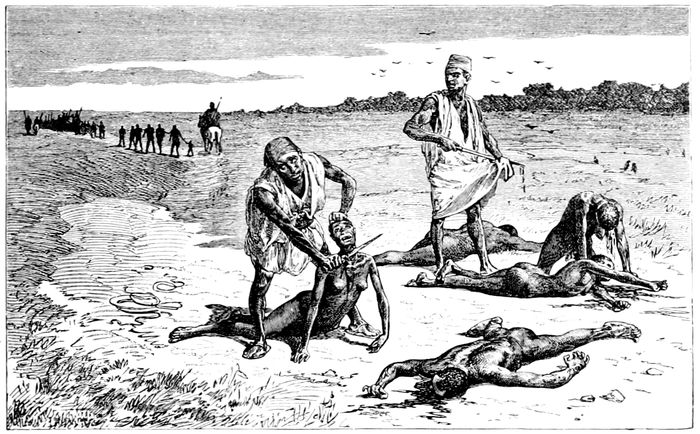
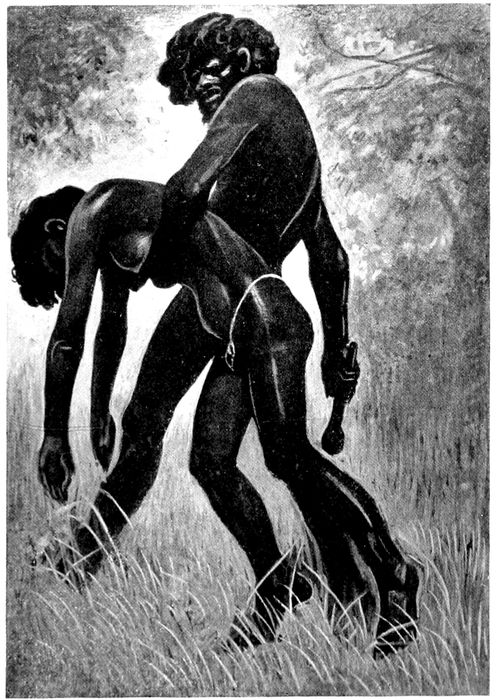
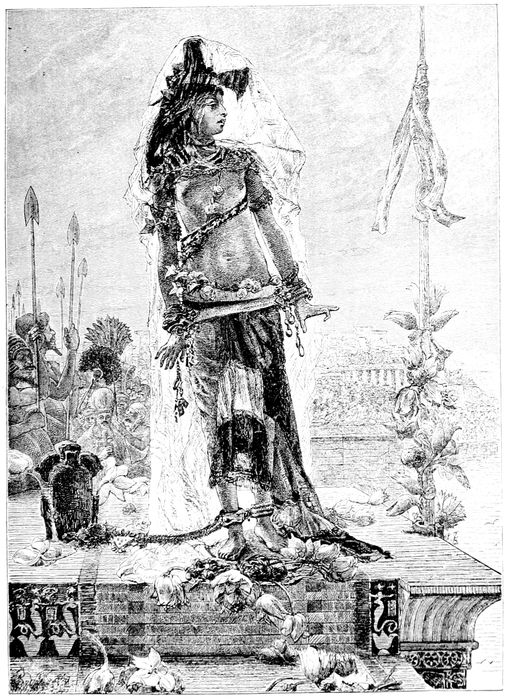
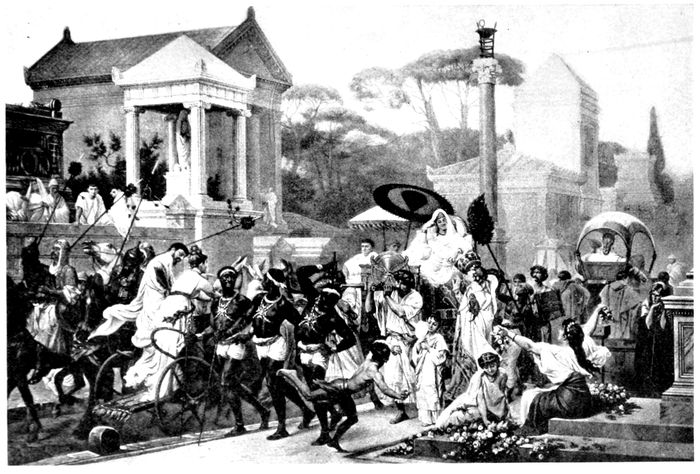
DISPOSING OF EXHAUSTED CAPTIVES.
When our historians date the beginning of Modern Times
from the discovery of America by Christopher Columbus,
they are fully justified, as no other event has caused so many
radical changes in the thoughts of men as well as in all commercial
and social conditions. The earlier views about our
terrestrial globe and its relation to the universe gave place to
new and far greater conceptions. Almost every day brought
new and astonishing disclosures in natural history, physics and
other spheres of science.
The end of the 15th and the beginning of the 16th
Century was also the time of the Renaissance as well as of
the Reformation, of a revival of the wisdom of the classic
past and of the rise and establishment of new sublime ideas
about God and the destiny of man.
It could not fail that in this period of spiritual fermentation
and inspiration the views about women, matrimony and
woman’s rights likewise underwent considerable changes. But
before these new conceptions found general acceptance many
mediæval traditions, prejudices and customs had to be overcome
and cleared away.
While the discovery of America brought incredible riches
to various European nations, it caused nothing but misery
and disaster to the aborigines of the New World. And to
many million Africans as well.
It must not be forgotten that the conquest of Mexico,
114Peru and other rich parts of America inflamed the greed of
inumerable adventurers, and that these men, in order to wring
gold and other treasures from the natives, resorted to the
most heartless cruelties. We also must call to mind, that in
company with these conquerors went hosts of monks and
priests of all orders, eager to convert the “heathen” to the
“only true creed.” Ruthlessly invading the temples of the
“infidels,” they turned the banner of the Cross, this beacon
light of promise, into an awful oriflame of war, spreading
destruction and disaster. The well known accounts, given by
the Spanish bishop Las Casas, disclose among other horrible
events the fact—heretofore unheard of in human history—that
whole bands and tribes of American Indians, to evade
the tyranny of their European oppressors, slaughtered their
own children, and then committed suicide.
These Indians had been compelled not only to work in
the gold mines and in the pearl fisheries, but to perform all
other labor that white men were unable or unwilling to do.
As under the cruel treatment of their oppressors the natives
rapidly dwindled away and whole islands became depopulated
the Portuguese as well as the Spaniards resorted to the importation
of negro slaves, whom they captured in Africa and
brought to America.
It was not long before the profits, derived from this trade,
attracted the eyes of English adventurers. The first to become
engaged in that new branch of business, was William Hawkins.
It was he who undertook the first regular slave hunts to the
coast of Guinea and opened that shameful traffic in which
England was engaged for nearly three centuries. His son,
John Hawkins, sailing under a charter of Queen Elizabeth,
continued the lucrative business and grew rich.
That this men-hunter imagined himself under the special
protection of the heavenly father appears from several entries
in his log-book. When, invading a negro village near Sierra
Leone, he almost fell into captivity himself and would have
been exposed to the same fate that he inflicted, without compunction,
upon thousands of other unfortunate men and
women, he wrote: “God, who worketh all things for the
best, would not have it so, and by Him all escaped without
danger; His name be praised for it.” At another time, when
his vessels were becalmed for a long time in midocean and
great suffering ensued: “But Almighty God, who never suffereth
His elect to perish, sent us the ordinarie Breeze, which
is the northwest wind.”
To what extent the name of Christianity was abused, we
see from the fact that Hawkins, when entering upon his
greatest expedition with five ships in 1567 sacrilegiously named
his flagship “Jesus Christ.”
115Because of the riches Hawkins brought to England,
Queen Elizabeth knighted him and granted him a coat of
arms, showing, on a black shield, a golden lion rampant over
blue waves. Three golden doubloons above the lions represented
the riches Hawkins had secured for England. To give due
credit to the piety of this “nobleman,” there was in the upper
quartering of the shield a pilgrim’s scallop-shell, flanked by
two pilgrim’s staffs, indicating that Hawkins’ slave-hunts were
genuine crusades, undertaken in the name of Christianity.
For a crest this coat-of-arms shows the half-length figure of
a negro, with golden armlets on his arms, but bound and
captive.
In an article entitled “The American Slave,” published
in “Pearson’s Magazine” for 1900, James S. Metcalf states
that the slave trade quickly developed to tremendous extent
and that from 1680 to 1786 there were carried from Africa
to the British colonies in America 2,130,000 slaves, men as
well as women. This does not include the number, vastly
larger, taken to the Spanish and Portuguese colonies before,
during and after the same period.
The same author states, that the traffic in human flesh
was a recognized commerce at the London Exchange, and
that, in 1771, the English alone sent to Africa 192 ships
equipped for the trade and with a carrying capacity of
47,146 slaves per trip.
It was the tribal warfare among the aborigines of Africa
that furnished the slave dealers with the greater part of their
human merchandise. Small and unprotected villages were constantly
in danger of being attacked by powerful roving bands.
When in 1872 the famous explorer Nachtigal traveled through
Central Africa, he witnessed a tragedy that happened at the
shores of Chad Lake. Strong forces of Bagirmis made an
assault on a negro village, to capture the inhabitants and
carry them off for slaves. Alarmed by their guards, the
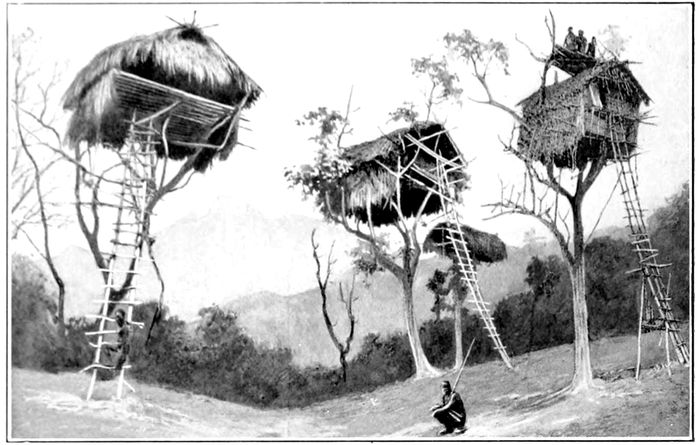
negroes, terror-stricken, fled to some tree-huts, prepared for
such emergency in a nearby forest. Here they considered
themselves safe. But unfortunately the enemies were in
possession of a few guns, with which they picked a number
of the fugitives from the trees like birds. Falling from the
dizzy heights, the wounded were hacked to pieces. After a
while the cruel enemies succeeded in constructing some rough
ladders, by which the trees were scaled. Unable to escape,
many of the assaulted, preferring death to slavery, threw
themselves upon the ground below, where they perished.
116
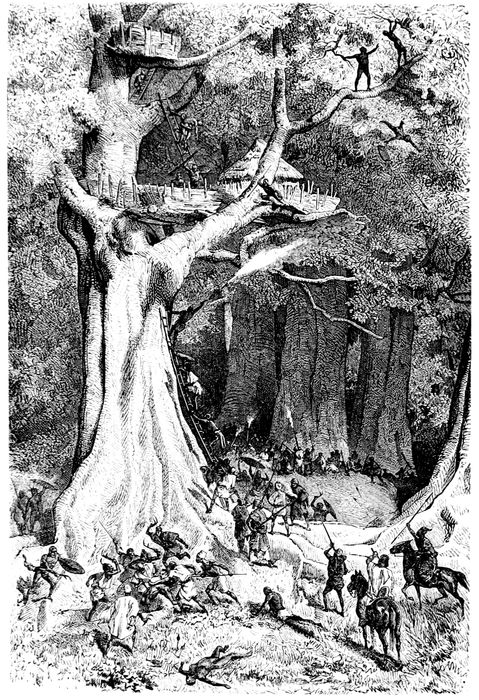
A RAID OF SLAVE-DEALERS IN CENTRAL AFRICA.
117
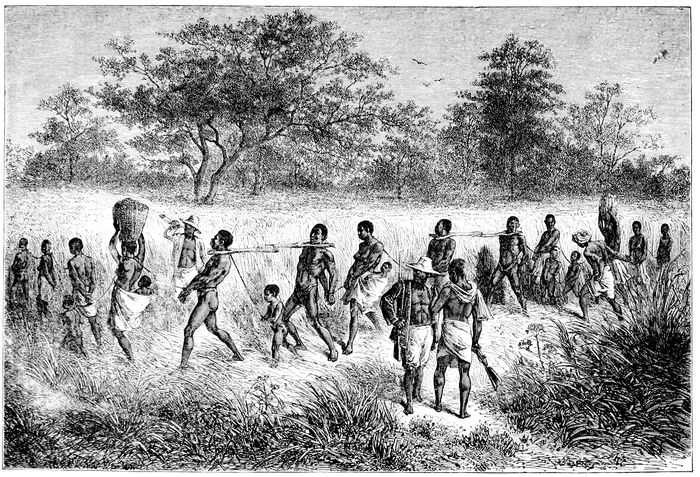
A SLAVE TRANSPORT IN CENTRAL AFRICA.
118The most desperate fight ensued for the tree-house of
the chief. It took several hours, before the enemies succeeded
in reaching the lower platform, where within a rude enclosure
food, water, and even a few goats had been hidden. Unable
to hold this place, the chief with his two wives and four
children withdrew to the highest branches. From there he
defended his family with such ability, that the foes, after
having exhausted their supply in powder, were compelled to
abandon the siege.—
The stronger portion of the captives made during such
raids, were shackled hand and foot to prevent escape. The
remainder often were killed and the flesh distributed among
the victors, who, as a rule, after such a raid formed a small
encampment, lighted their fires and gorged upon the human
flesh. They then marched over to one of the numerous slave-markets
on the rivers or the coasts, where they exchanged the
captives with the slave-traders for beads, cloth, brass wire
and other trinkets.
Woe to those who became sick or exhausted during the
long march to the markets! If unable to stagger on any longer
they were, to set an example for the others, either butchered
on the spot, or left behind to perish by hunger and thirst,
or to be torn by wild beasts.
In the further transportation of such kidnapped men and
women no regard was paid to their comfort. In the best of
slave-ships the height between decks in the quarters set aside
for the living cargo was five feet and eight inches. Even in
these not all the slaves had so much head room. Around
the sides of the vessel, halfway up, ran a shelf, giving room
for a double row of slaves, one above and one below. This
was stowed with undersized negroes, including women, boys,
and children. In the worst class of slavers the space between
decks was no more than three feet, compelling the wretched
occupants to make the entire journey in a sitting or crouching
position, as they were oftentimes, in fact most of the times,
so crowded together that lying down was an impossibility.
In fact, the more ingenious traders often so figured out the
available space that the slaves were packed in with their feet
and legs across one another’s laps. To prevent revolt, the
men were manacled in couples with leg irons and stowed
below. The irons were fastened to the ceiling. As a rule
the women were not handcuffed but crowded into compartments
under grated hatches and locked doors. At sea there
might be a faint possibility of a breath of air’s penetrating
into those quarters, but under all circumstances the mortality
among the slaves was frightful.
“In the literature of the slave trade,” says Metcalff, “the
horrors of the path of commerce stand out as prominently
as the persecutions of the Roman emperors in the history of
Christianity. When the sea gives up its dead there will come
from this highway of cruelty a prodigious army of martyrs
to man’s inhumanity to man. The best authorities agree in
119estimating that of all the slaves taken from Africa at least
one-eighth—some authorities say more than a quarter—died
or were killed in transit. It staggers the imagination to think
of how thickly the traffic in these helpless savages, continued
through almost four centuries, must have strewn with corpses
the lower depths of the Atlantic.
“Of course it was necessary, if any part of the cargo was
to be delivered alive, that the negroes should occasionally
be brought on deck and exercised. This was done with a
few at a time, although their masters never went so far as
to free even these from their irons. Often it was found when
a couple was to be brought up that one of them had died
and that his mate had spent hours, days even, in the stifling
atmosphere of between-decks, manacled to and in constant
contact with a corpse. It is small wonder that, as often happened,
when the slaves were brought on deck they began
jumping overboard in couples, sooner than return to the heat,
thirst, stench, and filth of the hold, where the scalding perspiration
of one ran to the body of another and where men were
constantly dying in their full view. Sooner than endure these
tortures even the savage Africans sought refuge in death by
starvation. This was a contingency provided for in advance
by the experienced trader, and if the gentle persuasion of
the thumb-screw failed to cure the would-be suicide, the ships
were always provided with a clever device to compel the
human animal to take the nourishment which kept in him
the life without which he ceased to possess any pecuniary
value. This instrument consisted of a pair of iron compasses,
the legs of which were driven into the mouth when closed
and then forced open and held open by the action of a screw.
Even the African negro, stoic to the pains incident to a life
of savagery, would renounce the privilege of death by starvation
to escape the immediate agony of forcibly distended jaws,
especially when at the same time his thumbs were under the
pressure of the screw with blood exuding from their ends.”
Branded like cattle, the negroes, after their arrival in
the American harbor, were sold by auction. And now the
slave was, as the Civil Code of Louisiana said, “subject to
the power of his master in such a manner that the master
may sell him, dispose of his person, and of his labor. He
can do nothing, possess nothing, nor acquire anything but
that may belong to his master.”
Of course this master had also the right to punish the
slave for any neglect or wrong. To be sure, there were laws
against excessive punishment, but as most of the plantations
were far from the cities, such laws were practically ineffective
against those who wished to violate them.
We quote once more J. S. Metcalff: “Almost every
120plantation had its whipping post, consisting of an upright set
in the ground with a short crosspiece near the top. The
thumbs or wrists of the negro to be whipped were securely
tied together, and placed around the upright above the crosspiece,
so that the toes barely touched the ground. Sometimes
the offending slaves were sent to the nearest jail to be whipped
by the jailor, who was an expert in his line of work, and
provided with the right kind of whips as well as a strong
arm and an accurate eye to make his blows inflict the most
pain. In other cases, this official paid regular visits to the
plantation, and inflicted the punishments accumulated since
his preceding visit. Thus the terror of anticipation was often
added to the agony of realization. These events were occasions
on the plantations, and the other slaves were compelled
to witness the punishments and sufferings of their fellows as
a deterrent to wrongdoing on their own part. In the case
of some offenders which seemed cardinal against the foundation
principles of slavery, such as striking a master, engaging
in a conspiracy with other slaves, or aiding a fugitive, the
punishments were made extraordinarily severe, and slaves
from surrounding plantations were obliged by their masters
to gather to witness them.
“A case of this latter sort was the one of a negro and his
wife, who had given their owner a severe beating. In spite
of the fact that the first cause of the trouble was the rejection
by the woman of the master’s advances, the offence was so
flagrant that neighboring slave-owners feared to let it go
by without severe and public punishment. At the time set
the slaves from neighboring plantations were gathered, and
the man and woman fastened to posts near each other. The
man was to receive a hundred and fifty lashes and the woman
a hundred. As the first strokes fell on the man’s back and
loins he gave no sound, but the agony betrayed itself in the
ashening of his dark skin, and in the involuntary contortion
of his features. Meanwhile the woman encouraged him with
crude expressions of pity and love. As the blows increased
in number the torture became unbearable, and the sound of
the regularly landing lash was punctuated with the shrieks of
its agonized victim. Finally a blessed unconsciousness came
to his relief, and he hung from the post a limp, unfeeling
mass of bruised and bleeding flesh. While his back was being
washed, the whipping of the woman began. The first blows
brought shrieks of anguish from her lips, but as the whipping
went on these subsided into a murmur of sobs, prayers, and
appeals for mercy. With the exception of an occasional rest
for the tired arm of the man wielding the whip, her punishment
was carried to its end without her losing consciousness,
although it was apparent that there had come some numbing
121influence to her faculties closely akin to insensibility. The man
had now been restored to his senses and his punishment was
resumed. When it was finished the wounds of both were
washed with salt water, to intensify the effect of the blows,
to prevent blood-poisoning and to heal the wounds more
quickly, so that the slaves could resume their accustomed
labor. This matter of the slave’s ability to work was always
taken into account, and we have one instance of two economical
lady slave-owners in Georgia who always inflicted their
punishments Sunday mornings, so that by Monday the slaves
would be able to go into the fields.”
As the slave-holders were absolute masters over the
negroes, they made their dusky female slaves only too often
the objects of their passions. The effects of this intermingling
were soon seen in all slave-holding countries of America in the
mixed character of the population, which, gradually extending
itself as time wore on, resulted in the race of the mulattoes.
From the intercourse of these again with the whites or among
themselves, innumerable shades of color sprang up, giving rise
to the distinctions of octoroons, quadroons, terceroons, quinteroons,
etc. To all these people, regular or irregular in birth,
light or dark in color, were given the various names of
“people of color,” “sang melée,” or “mulattoes.” Notwithstanding
the fact, that some of these quadroons and octoroons
could hardly be distinguished from white people in appearance,
their condition followed always that of their mothers,
and they were therefore chattels to be bought or sold.
“On the plantations where negro children were brought
up to be sold, it was,” as Metcalff states, “not an unheard-of
thing for a master to sell his own son or daughter. In the
break-up of family estates it sometimes happened that the
heir was compelled to sell his own half-brother or half-sister.
These relationships were seldom or never recognized.”
In the slave-markets of New Orleans and the other large
cities the personal appearance of the younger women was
a decided element in fixing their value. The languorous
beauty of the Southern quadroon and octoroon is famous
the world over, and on the auction block and at private sale
they brought the highest prices.
The glory of having written the first formal protest
against slavery and its countless cruelties, belongs to a small
band of Mennonites from Germany, who arrived in Philadelphia
in 1683, in the neighborhood of which city they started
a settlement called Germantown.
Becoming aware that in the colonies slaves were sold
without the disapproval of the Puritans and Quakers, who
claimed to be defenders of human rights, the Mennonites drew
up a protest against slavery on February 18th, 1688. It was
122the first written in any language. This remarkable document,
still preserved in the archives of the “Society of Friends” in
Philadelphia, was directed to the Quakers and reads as follows:
“This is to ye Monthly Meeting at Richard Warrel’s.
These are the reasons why we are against the traffic of men
Body, as followeth: Is there any that would be done or
handled at this manner? to be sold or made a slave for all
time of his life? How fearfull and fainthearted are many on
sea when they see a strange vessel, being afraid it should be
a Turk, and they should be taken and sold for slaves into
Turkey. Now what is this better done as Turks do? Yea
rather it is worse for them, which say they are Christians; for
we hear that ye most part of such Negers are brought hither
against their will and consent; and that many of them are
stollen. Now, tho’ they are black, we cannot conceive there
is more liberty to have them slaves, as it is to have other
white ones. There is a saying, that we shall doe to all men,
like as we will be done our selves; making no difference of
what generation, descent or colour they are. And those who
steal or robb men, and those who buy or purchase them, are
they not alike? Here is liberty of conscience, which is right
and reasonable; here ought to be likewise liberty of ye body,
except of evil-doers, which is another case. But to bring men
hither or to robb and sell them against their will, we stand
against. In Europe there are many oppressed for conscience
sake; and here there are those oppressed which are of a black
colour. And we, who know that men must not commit
adultery, some doe commit adultery in others, separating wifes
from their husbands and giving them to others; and some
sell the children of those poor creatures to other men. Oh!
doe consider well this things, you who doe it, if you would
be done at this manner, and if it is done according Christianity?
You surpass Holland and Germany in this thing. This
makes an ill report in all those countries of Europe, where
they hear off, that ye Quakers doe here handel men like they
handel there ye cattel. And for that reason some have no
mind or inclination to come hither, and who shall maintain
this your cause or plaid for it? Truly we can not do so, except
you shall inform us better hereof, that Christians have liberty
to practice this things. Pray! What thing on this world can
be done worse towards us, then if men should robb or steal
us away, and sell us for slaves to strange countries, separating
husbands from their wifes and children. Being now this is
not done at that manner, we will be done at, therefore we
contradict and are against this traffick of menbody. And
we who profess that it is not lawful to steal, must likewise
avoid to purchase such things as are stollen, but rather help
to stop this robbing and stealing if possible; and such men
123ought to be delivered out of ye hands of ye Robbers and sett
free as well as in Europe. Then is Pennsylvania to have a
good report, instead it hath now a bad one for this sake in
other countries. Especially whereas ye Europeans are desirous
to know in what manner ye Quackers doe rule in their
Province; and most of them doe look upon us with an envious
eye. But if this is done, well, what shall we say is done evil?
“If once these slaves (which they say are so wicked and
stubborn men) should joint themselves, fight for their freedom
and handel their masters and mastrisses as they did handel
them before, will these masters and mastrisses tacke the sword
at hand and warr against these poor slaves, like we are able
to believe, some will not refuse to doe? Or have these Negers
not as much right to fight for their freedom, as you have to
keep them slaves?
“Now consider well this thing, if it is good or bad? and
in case you find it to be good to handel these blacks at that
manner, we desire and require you hereby lovingly, that you
may inform us here in, which at this time never was done,
that Christians have such a liberty to do so, to the end we
shall be satisfied in this point, and satisfie likewise our good
friends and acquaintances in our natif country, to whom it is
a terrour or fairfull thing that men should be handeld so in
Pennsylvania.
“This is from our Meeting at Germantown held ye 18. of
the 2. month 1688. to be delivered to the monthly meeting
at Richard Warrel’s.
“gerret hendericks
derick op de graeff
Francis Daniell Pastorius
Abraham op Den graeff.”
This document, set up by the humble inhabitants of
Germantown, compelled the Quakers to think. Becoming
aware that the traffic in human beings did not harmonize with
the Christian religion, they introduced in 1711 an act to
prevent the importation of negroes and Indians into Pennsylvania.
Later on they also declared themselves against the
slave trade. But as the Government found such laws inadmissible,
the question dragged along, until 150 years later, by
Lincoln’s Emancipation Proclamation, this black spot on the
escutcheon of the United States was wiped out.
The Germans of Pennsylvania were also compelled to
protest against other gross abuses, of which white men and
women had become the victims. To review early immigration
into America means to open one of the blackest pages of
Colonial history. The constant wars, prevailing in Europe,
124the horrible persecutions to which the followers of certain
religious sects were exposed, the frequent times of famine
and pestilence led many thousands of unhappy beings to
sail for the New World, where such sufferings would not be
encountered. But the means of travel, then existing, did not
meet the demands. Vessels, fit for the transportation of large
numbers, were few and their accommodations extremely poor.
Authorities took no interest in the proper treatment of the
emigrants. Everything was left to the owners of the ships,
who were responsible to nobody.
What sort of people were these shippers? Many were
smugglers and pirates, always on the lookout for prey. Others
were slave-dealers, making fortunes in trading negro-slaves.
No doubt, the moral standard of these gentlemen was very
low. Do we wonder that many of these unscrupulous men
established also a regular trade in white slaves, for which the
increasing exodus from Europe to America opened most alluring
inducements. If smart enough, they would amass great
wealth and would no longer have to make the perilous voyage
to Guinea, to kidnap black people at the risk of their own
lives. For the white slaves could be seduced by a bait that
had a flavor of high-spirited benevolence.
Pretending willingness to help all persons without means,
the ship-owners offered to give such persons credit for their
passage across the ocean, on condition that they would work
for it after their arrival in America, by hiring out as servants
for a certain length of time to colonists, who would advance
their wages by paying the passage money to the ship-owners.
As the persons were redeeming themselves by performing
this service, they were therefore called “Redemptioners.”
With this harmless-looking decoy many thousands of
men and women were lured on to sign contracts, only to find
out later that they had become victims of villainous knaves
and had to pay for their inexperience with the best years of
their lives.
The voyage across the ocean took as many weeks as
it takes days at present. The ship-holds were in such horrible
condition that words fail to describe them. And these dirty
rooms were always packed beyond capacity. The food was
poor and insufficient. Some captains kept their passengers on
half rations from the day of the start, pretending that it was
necessary to prevent famine. In consequence of the poor
nourishment and the overcrowded quarters, all sorts of sickness
prevailed and the mortality was terrific. For medical
help and all other services excessive prices were charged. So
it came that at the end of the journey almost all the passengers
were deeply in debt. According to their amount and the
physical condition of each immigrant the length of time was
125fixed for which he or she should serve any person, willing to
pay the captain the amount of the immigrant’s debt. This
servitude extended always from four to eight years, and sometimes
to more. The captains had no difficulty in turning the
bonds, signed by redemptioners, into cash. Cheaper labor
could be obtained nowhere, and for this reason the colonists
were always eager to secure the services of redemptioners.
The offers were made through the newspapers or at the
“Vendu,” the place where negroes were bought and sold.
When applicants came, the redemptioner was not allowed to
choose a master or to express wishes about the kind of work
that would suit him. Members of the same family must not
object to separation. So it happened frequently that a husband
became parted from his wife or children, or children from
their parents for many years or for life. As soon as the
applicant paid the debt of a redemptioner, the latter was
obliged to follow him. In case this master did not need his
servant any longer, he could hire, transfer or sell him like
chattel to someone else.
As in such a case the redemptioner received no duplicate
of his contract, the poor creature depended entirely upon
the good will of his new master, who had it in his power to
keep him or her in servitude far beyond the expiration of
the true contract time. If any dispute arose, a redemptioner
enjoyed no greater protection than a negro, like whom he
was treated in many respects. If found ten miles away from
home without the written consent of his master, he would be
regarded as a run-away and submitted to heavy physical
punishment. Persons guilty of hiding or assisting such fugitives
were fined 500 pounds of tobacco for each twenty-four hours
such fugitive had remained under their roof. Who captured
a run-away was entitled to a reward of 200 pounds of tobacco
or 50 dollars. And to the run-away’s servitude ten days were
added for every twenty-four hours absent, to say nothing of
the severe whipping he was liable to get.
The redemptioners went through all sorts of experiences,
according to the different tempers of their masters. Some
were lucky enough to find good homes, where they were well
treated. But many fell into the hands of heartless, selfish
people, who in their eagerness to get as much as possible out
of the redemptioners, literally worked them to death, to say
nothing of providing insufficient food, scanty clothing and
poor lodging. Many owners made use of the right to punish
redemptioners so frequently and so cruelly, that a law became
necessary whereby it was forbidden to apply to a servant
more than ten lashes for each “fault.”
Female redemptioners were quite often exposed to lives
of shame, which some of the laws seemed to invite. For
126instance in Maryland a law was passed in 1663 providing that
any freeborn white woman, who married a colored slave,
should together with her offspring become the property of
the owner of that slave.
Originally this abominable law was intended to deter
white women from intermarriage with colored men. But
many depraved colonists misused this law purposely and compelled
their white female servants by threat or deceit to marry
colored slaves, as the master then would legally secure permanent
possession of the white freeborn woman as well as
the children she might bear. Though everybody knew that
such devilish tricks were practiced extensively, this law
remained in force until 1721, when a peculiar incident led
to its repeal. When Lord Baltimore, the founder of Maryland,
visited his province in 1681, he brought over an Irish
girl, Nellie, who had agreed to redeem the cost of passage to
America by doing service. Before her time ended, Lord Baltimore
returned to England. Prior to his departure he sold
the unexpired term of Nellie’s service to a resident of Maryland,
who some weeks thereafter gave Nellie to one of his
negroes, making her thereby, together with two children that
were born, forever his slave. When Lord Baltimore heard
of this, he caused the abolishment of the law of 1663. But
all efforts to release his former servant and her children were
in vain. The case dragged along for years, until the courts
decided, that Nellie and her children must remain slaves, as
the latter were born before the annulment of the law.
Incidents of similar character stirred the German citizens
of Philadelphia to revolt against the unjust treatment to which
their immigrant countrymen and women were subjected. At
a meeting on Christmas Day of 1764, they formed “The
German Society of Pennsylvania,” with the purpose of securing
laws for the abolishment of all abuses which had grown
out of the treatment of immigrants. Such a law was secured
on May 18th of the following year.
The “German Society of Pennsylvania” became the
model for many similar institutions in all parts of America.
By uncovering evils and by vigorous persecutions of guilty
persons, by continuously framing and recommending effective
laws, these societies secured at last a better treatment of the
immigrants on the ocean as well as after landing. With full
justice these societies may be called the true originators of
our modern immigration laws.—
They also established the “Legal Aid Societies,” to
assist poor people in need of legal advice and help. As these
institutions spread over hundreds of cities of America as well
as of Europe, we see that since the Christmas meeting in
Philadelphia in 1764 untold millions of people have profited
127by the earnest work, begun by that small band of Germans,
who had the welfare of their poor countrymen at heart, and
showed what genuine Christmas spirit can do for humanity,
if it is only put to a proper purpose.
There existed yet another form of female slavery, the
worst of all. With the development of the feudal system in
mediæval Europe, which made the poor man, especially the
peasant, dependent on the lord or owner of the land he
cultivated, the lords appropriated in time unlimited sway over
their vassals. Among other rights they claimed not only that
to marry him or her to whomsoever the lord might chose,
but also absolute control of the vassal’s newly wedded bride
for the first three days and nights. This custom, known by
a variety of names, as “jus primæ noctis, droit de cuissage,”
“marchetta” or “marquette,” had the sanction of the state
as well as of the church and compelled newly married women
to the most dishonorable servitude. If the female serf pleased
the lord he enjoyed her, and it was from this custom, that
the eldest son of the serf was always held as the son of the
lord, “as perchance it was he, who begot him.”
If it should happen that the young bride did not meet the
fancy of the lord, he let her alone, but in such case the
husband had to redeem her by paying the lord a certain
amount of money, the name of which betrayed its nature.
Matilde Joslyn Gage in her able book “Woman, Church
and State” has devoted a whole chapter to the history of
marquette and says:
“The seigneural tenure of the feudal period was a law
of Christian Europe more dishonorable than the worship of
Astarte at Babylon. In order to fully comprehend the vileness
of marquette we must remember that it did not originate
in the pagan country many thousand years since; that it was
not a heathen custom transplanted to Europe with many
others adopted by the church, but that it arose in Christian
countries a thousand years after the origin of that religion,
continuing in existence until within the last century.”
She further states that in France even the Bishops of
Amiens and the canons of the cathedral of Lyons possessed
the right over the women of their vassals, and that in several
counties of the Piccardy the curés imitated the bishops and
took the right of cuissage, when the bishop had become too
old to take his right. She also states, that “marquette began
to be abolished in France toward the end of the 16th Century,
but still existed in the 19th Century in the County of Auvergne,
and that the lower orders of the clergy were very unwilling
to relinquish this usage, vigorously protesting to their archbishops
against the deprivation of this right, declaring they
could not be dispossessed.
128“But finally the reproach and infamy connected with the
‘droit de cuissage’ became so great, and the peasants became
so recalcitrant over this nefarious exaction, that ultimately
both lords spiritual and lords temporal, fearing for their own
safety, commenced to lessen their demands.”
From a letter, reproduced in the same book, it appears
that instances of the survival of the feudal idea as to the right
of the lord to the persons of his vassal woman occurred within
the last decenniums of the Nineteenth Century. This letter,
written by Mr. D. R. Locke, and dated December, 1891,
reads: “One of the Landlords was shot a few years ago and
a great ado was made about it. In this case as in most of
the others it was not a question of rent. My Lord had visited
his estates to see how much more money could be taken out
of his tenants, and his lecherous eyes happened to rest upon
a very beautiful girl, the eldest daughter of a widow with
seven children. Now this girl was betrothed to a nice sort
of boy, who, having been in America, knew a thing or two.
My Lord, through his agent, who is always a pimp as well
as a brigand, ordered Kitty to come to the castle. Kitty,
knowing very well what that means, refused. “Very well,”
says the agent, “yer mother is in arrear for rent, and you had
better see My Lord, or I shall be compelled to evict her.”—Kitty
knew what that meant also. It meant that her gray-haired
mother, her six helpless brothers and sisters would be
pitched out by the roadside to die of starvation and exposure,
and so Kitty, without saying a word to her mother or anyone
else, went to the castle and was kept there three days, till
My Lord was tired of her, when she was permitted to go.
She went to her lover, like an honest girl as she was, and
told him she would not marry him, but refused to give any
reason. Finally the truth was wrenched out of her, and Mike
went and found a shot-gun that had escaped the eye of the
royal constabulary, and he got powder and shot and old nails,
and he lay behind a hedge under a tree for several days.
Finally one day My Lord came riding by all so gay, and that
gun went off. There was a hole, a blessed hole, clear through
him, and he never was so good a man as before because there
was less of him. Then Mike went out and told Kitty to be
of good cheer and not to be cast down, that the little difference
between him and My Lord had been settled, and that they
would be married as soon as possible. And they were married,
and I had the pleasure of taking in my hand the very hand
that fired the blessed shot, and of seeing the wife, to avenge
whose cruel wrongs the shot was fired.”
In the same work we read that another of these British
lords in Ireland, Leitram, was noted for his attempts to dishonor
the wives and daughters of the peasantry upon his vast
129estate. His character was equal to that of the worst feudal
barons, and like these he used his power as magistrate and
noble, in addition to that of landlord, to accomplish his
purpose. After an assault upon a beautiful and intelligent
girl, by a brutal retainer of his lordship, his tenantry finally
declared it necessary to resort to the last means in their power
to preserve the honor of their wives and daughters. Six men
were chosen as the instruments of their crude justice. They
took an oath to be true to the end, in life or death, purchased
arms, and seeking a convenient opportunity shot the tyrant
to death. Nor were those firing the fatal shots ever discovered.
130
As the Reformation aimed at the restitution of the purity
and simplicity of the first Christian communities, the position
of woman in the Church as well as in private life was of
course also considered.
As has been shown in former chapters, the authorities of
the mediæval Christian Church regarded the daughters of
Eve not only as creatures inferior to man, but also as the
medium preferred by Satan above all others to lead man
astray. Seeing in woman nothing but a necessary evil, they
claimed also that a nun is purer than a mother, just as a
celibate monk is holier than a father. This prejudice of
benighted theologians against woman had influenced the conduct
of the State toward the woman and made her everywhere
the victim of unjust laws. For a long time in certain countries
to ask rights for women exposed one to the suspicion of
infidelity.
Therefore it must be regarded as an event of greatest
importance in the history of woman, when Martin Luther, the
most prominent figure in the Reformation, decided to take
a wife. He married Catherine von Bora, a lady twenty-four
years of age, of a noble Saxon family.
She had left the convent of Nimbschen together with
eight other nuns in order to worship Christ without being
compelled to observe endless ceremonies, which gave neither
light to the mind nor peace to the soul. Protected by pious
citizens of Torgau, the former nuns had lived together in
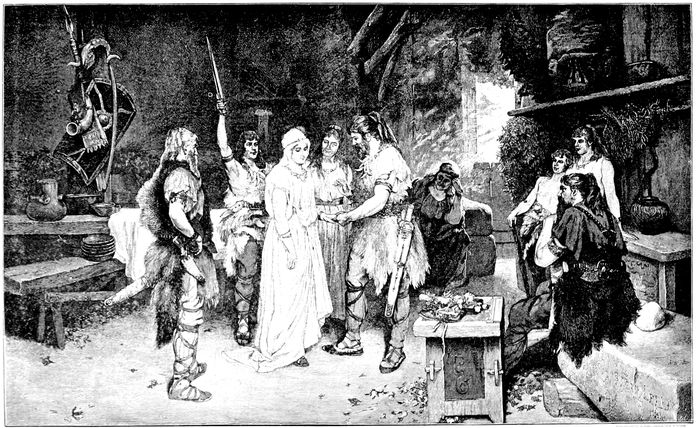
retirement. Luther married his betrothed on June 11, 1525,
with Lucas Cranach and another friend as witnesses. The
ceremony was performed by Melanchton.
The marriage, blessed with six children, was a very happy
one. Catherine proved to be a congenial mate, of whom
Luther always spoke as “his heartily beloved house-frau.”
The great reformer himself was a tender husband, and the
most loving of fathers. Nothing he liked better than to sit
amidst his dear ones, enjoying a glass of wine and those
beautiful folk-songs, in which German literature is so rich.
Many of these little poems breathe the sincere respect
and high appreciation, in which woman was held by the
Germans since time immemorial. There is for instance Simon
Dach’s well known poem “Anne of Tharau.” Written in 1637,
it reads:
131
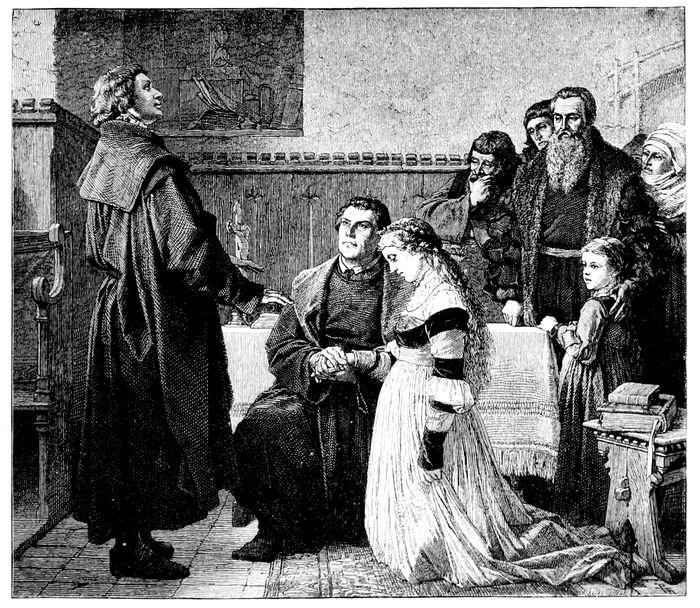
THE WEDDING OF MARTIN LUTHER TO CATHERINE VON BORA.
After a painting by P. Thumann.
132“Aennchen von Tharau ist’s die mir gefällt,
Sie ist mein Leben, mein Gut und mein Geld;
Aennchen von Tharau hat wieder ihr Herz
Auf mich gerichtet in Lieb und in Schmerz.
Aennchen von Tharau, mein Reichtum, mein Gut,
Du meine Seele, mein Fleisch und mein Blut.
Würdest du gleich einmal von mir getrennt,
Lebtest dort, wo man die Sonne nicht kennt,
Ich will doch dir folgen durch Wälder und Meer,
Durch Schnee und Eis und durch feindliches Heer,
Aennchen von Tharau, mein Licht, meine Sonn’,
Mein Leben schliess ich um deines herum.—
Annie of Tharau, ’tis she that I love,
She is my life and all riches above;
Annie of Tharau has giv’n me her heart,
We shall be lovers till death us do part!
Annie of Tharau, my kingdom, my wealth,
Soul of my body, and blood of my health.
Say you should ever be parted from me,
Say that you dwelt where the sun they scarce see,
Where you go I go, o’er oceans and lands,
Prisons and fetters, and enemies’ hands.
Annie of Tharau, my sun and sunshine,
This life of mine will I throw around thine.”
And who would be able to pay to female virtues a higher
tribute than did Paul Fleming in a poem, directed to his
betrothed:
“Ein getreues Herz zu wissen
Ist des höchsten Schatzes Preis;
Der ist selig zu begrüssen
Der ein solches Kleinod weiss.
Mir ist wohl bei tiefstem Schmerz
Denn ich weiss ein treues Herz.
To call a faithful heart thine own
That’s life’s true and only pleasure,
And happy is the man alone
To whom was given such a treasure.
The deepest anguish does not smart
For I know a faithful heart.”
This poem was written at the time, when the tempests
of the Thirty Years’ War swept over Germany, ruining that
133country beyond recognition. Hundreds of cities and villages
were burned by Spanish, Italian, Hungarian, Dutch and
Swedish soldiers, who made the unfortunate country their
battleground. Of the seventeen million inhabitants thirteen
millions were killed or swept away by starvation and the pest.
Agriculture, commerce, industries and arts were annihilated.
Of many villages nothing remained but their names. According
to the chronicles of these times, one could wander for
many miles without seeing a living creature except wolves
and raven. All joy and happiness, in which the German
people had been so rich, were extinguished. To women the
cup of sorrow would never become empty, as hate, revenge,
cruelty, and the lowest passions combined to fill their lives
with endless mental and physical agonies.
During these dreadful times such social gatherings as
had become the fashion among the refined people of Italy
during the period of the Renaissance, were of course out of
the question. Far happier in this respect was France, where
the era of the “Salons” began, many of which became known
throughout Europe, for the inspiration and refinement that
spread out from them.
It was to the exceptional qualities of a young and noble-minded
woman of Italian birth, that the first salon in France
owed its origin and its distinctive character. This lady was
Catherine Pisani, the daughter of Jean de Vivonne, Marquis
of Pisani. Born at Rome in 1588, she married the French
Marquis of Rambouillet, with whom she moved to Paris.
Repelled by the gilded hollowness and license of the court
of King Henry IV. she retired, about the year 1608, to her
husband’s stately palace, which became famous as the “Hotel
Rambouillet.” Its pride was a suite of salons or parlors,
arranged for purposes of reception and so devised as to
allow many visitors to move easily. With their draperies in
blue and gold, their cozy corners, choice works of art, Venetian
lamps, and crystal vases always filled with fragrant flowers,
these rooms were indeed ideal places for social and literary
gatherings.
As Amelia Gere Mason has described in a series of
articles about the French Salons, written for the “Century
Magazine” of 1890, Mm. de Rambouillet “sought to assemble
here all that was most distinguished, whether for wit, beauty,
talent, or birth, into an atmosphere of refinement and simple
elegance which would tone down all discordant elements and
raise life to the level of a fine art. There was a strongly
intellectual flavor in the amusements, as well as in the discussions
of this salon, and the place of honor was given to
genius, learning, and good manners, rather than to rank.
But the spirit was by no means purely literary. The exclusive
134spirit of the old aristocracy, with its hauteur and its lofty
patronage, found itself face to face with fresh ideals. The
position of the hostess enabled her to break the traditional
barriers and form a society upon a new basis, but, in spite
of the mingling of classes hitherto separated, the dominant
life was that of the noblesse. Women of rank gave the tone
and made the laws. Their code of etiquette was severe.
They aimed to combine the graces of Italy with the chivalry
of Spain. The model man must have a keen sense of honor
and wit without pedantry; he must be brave, heroic, generous,
gallant, but he must also possess good breeding and gentle
courtesy. The coarse passions and depraved manners which
had disgraced the gay court of Henry IV. were refined into
subtle sentiments, and women were raised upon a pedestal
to be respectfully and platonically adored. In this reaction
from extreme license familiarity was forbidden, and language
was subjected to a critical censorship.”
This definition of the salon of “the incomparable
Arthenice”—an anagram for Mme. de Rambouillet, devised
by two poets of renown—we find confirmed by the words
of many distinguished men, who were fortunate enough to
be admitted to this circle. Among them were Corneille, Descartes,
and all the founders of the Académie Française.
“Do you remember,” so said the eminent Abbé Fléchier
many years later, “the salons which are still regarded with
so much veneration, where the spirit was purified, where
virtue was revered under the name of the ‘incomparable
Arthenice’; where people of merit and quality assembled who
composed a select court, numerous without confusion, modest
without constraint, learned without pride, polished without
affectation?”—
The salon of Mme. de Rambouillet continued till the
death of its mistress, the 27th of December, 1665, having
been, as Saint-Simon writes, “a tribunal with which it was
necessary to count, and whose decisions upon the conduct
and reputation of people of the court and the world had great
weight.”
There were other salons, modeled more or less after the
present one. When the Hotel de Rambouillet was closed,
Mademoiselle Madeleine de Scudéry held regular reunions by
receiving her friends on Saturdays. Among this “Société du
Samedi” were many authors and artists, who conversed upon
all topics of the day, from fashion to politics, from literature
and the arts to the last item of gossip. They read their
works and vied with one another in improvising verses.
About the personality of Mlle. de Scudéry Abbé de Pure
wrote: “One may call her the muse of our age and the prodigy
of her sex. It is not only her goodness and her sweetness,
135but her intellect shines with so much modesty, her sentiments
are expressed with so much reserve, she speaks with so much
discretion, and all that she says is so fit and reasonable, that
one cannot help both admiring and loving her. Comparing
what one sees of her, and what one owes to her personally,
with what she writes, one prefers, without hesitation, her conversation
to her works. Although her mind is wonderfully
great, her heart outweighs it. It is in the heart of this illustrious
woman that one finds true and pure generosity, an immovable
constancy, a sincere and solid friendship.”
Fearing to lose her liberty Mlle. de Scudéry never married.
“I know,” she writes, “that there are many estimable men
who merit all my esteem and who can retain a part of my
friendship; but as soon as I regard them as husbands I regard
them as masters, and so apt to become tyrants that I must
hate them from that moment; and I thank the gods for giving
me an inclination very much averse to marriage.”
Under the pseudonym of “Sappho” Mlle. de Scudéry was
acknowledged as the first “blue-stocking” of France and of
the world. Several of her novels, in which she aimed at
universal accomplishments, were the delight of all Europe.
Having studied mankind in her contemporaries, she knew
how to analyze and describe their characters with fidelity
and point.
Another noteworthy salon of the 17th Century was that
of the beautiful and amiable Marquise de Sablé, one of the
favorites of Mme. de Rambouillet. It was she who set the
fashion, at that time, of condensing the thoughts and experiences
of life into maxims and epigrams. While this was her
special gift to literature, her influence became also felt through
what she inspired others to do. A few of her maxims, as
proven in Mrs. Mason’s articles about the French Salons, are
worth copying, as they show the estimate Mme. De Sablé
placed upon form and measure in the conduct of life.
“A bad manner spoils everything, even justice and
reason. The how constitutes the best part of things; and the
air which one gives thoughts, gilds, modifies and softens the
most disagreeable.”—
“There is a certain command in the manner of speaking
and acting which makes itself felt everywhere, and which gains,
in advance, consideration and respect.”—
“Wherever it is, love is always the master. It seems truly
that it is to the soul of the one who loves, what the soul is
to the body it animates.”—
With the death of the Marquise de Sablé in 1678 the
last salon of the brilliant era of the Renaissance was closed.
With the approach of that period of affected and artificial
life, known as the Rococo, new types of women came to
136the surface, gay, witty, piquant and amusing, but lax and
without great moral sense or spiritual aspiration. The
dangerous influence of the many mistresses of Louis XIV.
and Louis XV., of Mesdames de Montespan, Maintenon and
Pompadour pervaded the atmosphere, and turned the salons
into headquarters of intrigue and political conspiracy. Especially
at the time of the clever Mme. de Pompadour women
were everywhere the power, without which no movement
could be carried through successfully. “These women,” said
the famous philosophical historian Montesquieu, “form a
kind of republic, whose members, always active, aid and
serve one another. It is a new state within the state; and
whoever observes the action of those in power, if he does
not know the women who govern them, is like a man who
sees the action of a machine but does not know its secret
springs.”
Montesquieu himself, when in Paris, made the salons of
Madame de Tencin and Madame d’Aiguillon his favorite
resorts.
Here he discussed with other brilliant thinkers of the time
literary and political questions, and those theories, which he
embodied in the most famous of his works: “Esprit des Lois”
(the Spirit of the Laws). This book, dealing with law in
general, with forms of government, military arrangements,
taxation, economic matters, religion and individual liberty,
was the first open attack on absolutism. Put on the Index
by the Pope it was nevertheless eagerly read and discussed
everywhere, and thus it became one of the factors leading to
the French Revolution.—
Among the salons of the 18th Century, known for their
influence on scientific and political life, the most remarkable
was that of the Marquise de Lambert. Her magnificent apartments
in the famous Palais Mazarin, decorated by artists like
Watteau, were a rendezvous for the most eminent men and
women, among them the best of the “Forty Immortals,” or
members of the Académie Française. As candidates for vacant
chairs in this body were often proposed here the Salon Lambert
was called “the Antechamber to Immortality.”
The quality of the character and intellect of the hostess
of this salon may be judged from a few of the bits of advice
she wrote to her son. “I exhort you much more to cultivate
your heart than to perfect your mind; the true greatness of
the man is in the heart.”—“Let your studies flow into your
manners, and your readings show themselves in your virtues.”—“It
is merit which should separate you from the people, not
dignity nor pride.”—“Too much modesty is a languor of
the soul, which prevents it from taking flight and carrying
itself rapidly towards glory.”—“Seek the society of your
137superiors, in order to accustom yourself to respect and politeness.
With equals one grows negligent; the mind falls asleep.”
She urged her daughter to treat servants with kindness. “One
of the ancients says they should be regarded as unfortunate
friends. Think that humanity and Christianity equalize all.”—
Up to the latter half of the 18th Century the salon had
become the most characteristic feature of Parisian society.
Having multiplied indefinitely, they catered to all tastes and
thoughts. Besides the rallying points for philosophers, literateurs
and femmes d’esprit, there were other salons, where sly
maitresses and political adventurers met the corrupt officials
of the Government. Still other salons served as meeting
places of fiery spirits, who, disgusted with the debauchery
and unrestrained immorality of the ruling classes, made the
discussion of politics and the deliverance of the oppressed
people their chief topic.
Like the French Renaissance so the English Renaissance
received its first impulse from Italy. But less concerned with
culture as such, it was more practical in England and distinguished
itself chiefly by the greater attention given to
education. While the sons and daughters of the nobility were
carefully trained by tutors, the children of the middle class
received an education in grammar schools founded during
the reign of King Henry VIII.
This interest in education was greatly stimulated by the
doctrines of the Reformation, which had spread from Germany
to England, and which were favored by the king, as they
served his political interests as well as his passion for the
beautiful Anne Boleyn, one of the queen’s ladies-in-waiting.
That he divorced his wife and married Anne Boleyn, and
that she, on September 7th, 1533, gave birth to a girl, are
facts familiar to everyone acquainted with English history.
This girl later on ascended the throne and as Queen
Elizabeth became famous as one of the most remarkable and
illustrious of all female sovereigns.
Most remarkable was her attitude toward Rome. When
the “Virgin Queen” in her twenty-fifth year ascended the
throne, it was not only as queen, but also as the head of
the rebellious Church. Religious strife had already passed the
point of reconciliation and Elizabeth’s position was extremely
difficult, as the Catholic party was still very strong and was
bent on maintaining the connection with Rome. Aware of
this fact, the Pope, claiming England as a fief of the Holy See,
refused to recognize Elizabeth’s title to the crown, and
demanded that she should renounce all her pretensions so
much the more since she was an illegitimate child. But whereas
many monarchs would have cringed before the Pope,
138Elizabeth ignored his demands and answered the subsequent
bull by Pope Pius V., by which all Catholics were released
from their allegiance to the queen, by the famous Acts of
Supremacy and Uniformity. Striking directly at the papal
power, these acts compelled all clergymen and public functionaries
to renounce the temporal and spiritual jurisdiction of
every foreign prince and prelate; and all ministers, whether
beneficed or not, were forbidden to use any but the established
liturgy. These statutes were carried out with considerable
severity, and many Catholics suffered death. Thus bending
priests and prelates to her fiery will, the queen made England
a bulwark of Protestantism.
That the long reign of Elizabeth, which lasted from 1558
to 1603, was also a period of brilliant prosperity and advancement,
during which England put forth her brightest genius,
valor, and enterprise, has been recorded by history. It is
also a well-known fact that the learning of Elizabeth was
considerable, even in that age of learned ladies. Horace
Walpole has assigned her a place in his “Catalogue of Royal
and Noble Authors,” and a list of thirteen literary productions,
chiefly translations from the Greek, Latin, and French, are
attached to her name.
There were quite a number of English ladies interested
in literature and poetry. The most remarkable was Mary
Astell, born in 1668 at Newcastle-on-Tyne. Having received
a careful education by her uncle, a clergyman, she continued
her studies in London. Here her attention and efforts were
especially directed to the mental uplift of her own sex, and
in 1697 she published a work entitled, “A Serious Proposal
to the Ladies, Wherein a Method is Offered for the Improvement
of Their Minds.” With the same end in view she
elaborated a scheme for a ladies’ college, which was favorably
entertained by Queen Anne, and would have been carried
out had not Bishop Burnet interfered.
During the reign of Queen Elizabeth England was called
“the Paradise of Women,” on account of the great liberty,
granted to them in all social affairs. There exists an interesting
account of a Dutch traveller, Van Meteren, who spent
some time in England. With surprise he saw that here the
members of the fair sex enjoyed considerable freedom. “They
are,” so he says, “not shut up as in Spain and elsewhere, and
yet the young girls are better behaved than in the Netherlands.
Having fine complexions, they also do not paint like the
Italians and others. They sit before their doors, decked in
fine clothes, in order to see and be seen by the passers-by.
In all banquets and feasts they are shown the greatest honor:
they are placed at the upper end of the table where they
are the first served. All the rest of their time they employ
139in walking and riding, in playing cards, or visiting their
friends and keeping company, conversing with their equals
and neighbors, and making merry with them at child-birth,
christening, churchings and funerals. And all this with the
permission and knowledge of their husbands.”
In strange contrast herewith was the legal position of
women. It was, as D. Staars says in his interesting book “The
English Woman,” “entirely detrimental. They were under
the absolute authority of their husbands. In regard to
property, husband and wife were considered by the law as
forming one indivisible person. Therefore a husband could
not make a deed of gift to his wife, or make a contract with
her. The subordinate position of the married women was
evident in the whole of her existence. The husband was his
wife’s guardian, and if anyone carried her off he had a right
to claim damages. He could also inflict corporal punishment
on her sufficient to correct her. All the property which
she might afterwards acquire, became by her marriage the
common property of husband and wife, but only the husband
had a right to the income, because he alone had control and
administration of the property. Not only lands, but also
funds, furniture, plate, and even the bed and ornaments of
a woman, all became the husband’s property on the wedding
day, and he could sell or dispose of it as he pleased. A
married woman could not even make a will. Only when
she became a widow, her clothes and personal possessions
again became her own property, provided, however, that her
husband had not otherwise disposed of them in his will.
Furthermore, she had a right to the income of a third of all
the husband’s property.”
These unsatisfactory conditions later on caused the
English women to join their American sisters in the struggle
for emancipation.
140
At the same time that ladies and gentlemen of refinement
discussed human rights and liberty in the elegant salons of
Italy and France, a race of hardy men and women amid the
wilderness of the New World was engaged in establishing
crude settlements, from which later on the spirit of genuine
freedom should radiate throughout the world.
When toward the end of the 16th Century European
explorers arrived on the eastern coast of the North American
continent, they found what later times demonstrated beyond
dispute: the richest and finest land on the face of the globe.
The unsurpassed beauty and grandeur of the scenery stirred
their hearts with surprise and admiration. They became
enthusiastic about everything, and in their reports described
the newly discovered country as the most wonderful they
had ever seen.
The more these explorers saw of America, the more their
amazement increased. When Henry Hudson in 1609 discovered
that noble river which now bears his name, its
magnificent shores were a revelation to him, who was accustomed
to the modest surroundings of the Netherlands.
The French, who entered North America by the way
of the St. Lawrence River, met with still greater surprises.
The Great Lakes, stretching like oceans toward the setting
sun, thundering Niagara, the royal Ohio, the majestic Mississippi,
and the beautiful forests girding these shores, made
their hearts beat with wonder and delight and filled their
imagination with dreams of vast empires full of wealth.
Beyond the “Father of Waters” and the regions of forest, the
explorers found the “Prairies,” boundless seas of fragrant
grass and beautiful flowers. Beyond these plains rose majestic
mountain-chains, with lovely valleys and parks, and snow-capped
domes, towering above the clouds.
Such majestic nature must of necessity exert a most
powerful influence on all who came in contact with it. Many
of those immigrants who in their native countries had been
restrained by narrow traditions and customs, and oppressed
by despotic rulers, were here given the first chance to develop
and prove their abilities. The unlimited freedom of the
boundless forests, plains, and mountains stimulated their
energy and imbued them with a spirit of enterprise, hitherto
unknown.
New types of heroic men, such as never had lived in
Europe, sprang into existence: the trappers, traders and
“voyageurs,” who in the pursuit of the lucrative fur trade
penetrated the vast continent in all directions, fighting their
way through countless hardships and dangers.
141
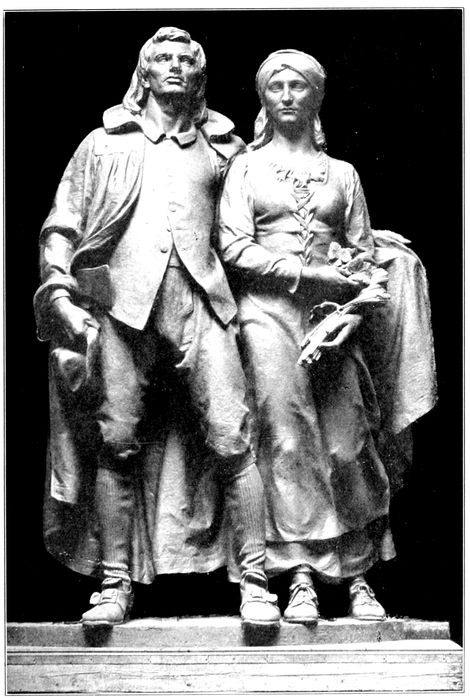
PIONEERS.
Modeled by A. Jaegers.
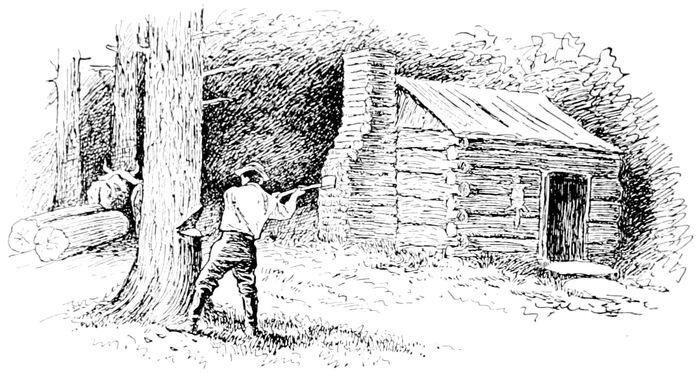
142Later on these daring forerunners of civilization were
followed by settlers, who, with their families, established
the first permanent homes: single log houses and hamlets,
like little islands in the vast ocean of the primeval forest.
These “backwoodsmen,” completely isolated from the
civilized world and compelled to wage constant battle with
hostile nature as well as with ferocious savages and wild
animals, have been justly glorified as heroes. They were at
once explorers, carpenters, builders, woodmen, farmers, breeders,
trappers, hunters and fighters,—in short, everything.
But their wives and daughters, who accompanied them, certainly
deserve to be honored too, as one can hardly conceive
situations more trying than those which these courageous
women had to face.
First of all there were the daily labors of the household
and farm, the unceasing cares of motherhood, the toils and
sufferings in times of drought or sickness. Because of the
isolation of their homesteads, void of even the slightest comforts
and improvements, these women had to toil from early
morning till late in the night. They worked with their
husbands, clearing the lands. They planted and raised the
vegetables in the little kitchen gardens. They prepared the
meals, baked the bread, did the washing and scrubbing, the
milking, preserving, pickling, churning and brewing. They
also broke and heckled the flax, from which they spun the
linens. They sheared the sheep and transformed the wool
into yarn and cloth, which they dyed, cut and turned into
suits and dresses. They knitted the socks and underwear,
made the candles and many of the furnishings, in short, they
produced whatever the family needed and consumed, giving
all and asking little. They even helped to defend the cabin
and the settlement in times of danger.
143
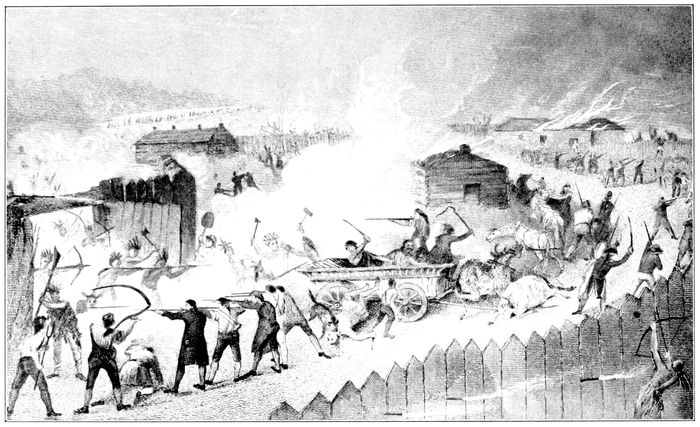
DEFENDING A SETTLEMENT.
After an old engraving.
144In the days of the Indian wars and of the Revolution
such danger was always imminent, particularly when the men
were working in the fields, or out hunting to provide food
for the family. Then the women, with loaded guns, stood
guard to protect the home and children from lurking enemies.
The chronicles relating incidents of border warfare
abound with stories of heroines who played conspicuous parts
in the defense of single log houses, as well as of stations and
forts. Moulding the bullets and loading the guns, they handed
them to the men, who could consequently fire three times
where they otherwise could have fired but once. If there
happened to be a lull during the fight, the women carried
water and food to the smoke-blackened fighters, tended the
wounded, baked bread and cared for the children. In cases
of emergency, they stood at the loop-holes, firing the rifles
with all the skill and precision of men.
When, during the War of Independence, the Mohawk
Valley became the scene of many horrible ravages by the
Indians and Tories, Christian Schell, a Palatine, together with
his wife and six sons, occupied a lonely log house. It was
in the early hours of August 6, 1781, when 48 Indians and
16 Tories made a sudden raid upon this family. Schell and
his sons were working in the field, but detected the enemy
soon enough to make their escape to the house. All succeeded
in reaching it, except the two youngest lads, who were
captured by an Indian. The latter was shot by Schell, but
it was impossible to free the boys, as they were hurried off
by other Indians.
Then the battle commenced and an almost incessant
firing was kept up until night, Mrs. Schell assisting her
husband and sons in loading the guns. Several times the
attacks of the enemy were repelled. But when darkness had
set in, McDonald, the leader of the Tories, succeeded in reaching
the door of the cabin and attempted to force an entrance
by using a crowbar he had found in front of the house.
Suddenly a shot from Schell hit him in the leg and brought
him down. Quick as lightning the bold German unbarred
the door, grasped the wounded man and dragged him in
a prisoner, thus saving the house from being set fire to, for
in such a case the leader of the attacking party within, would
likewise have perished in the flames.
Enraged by the capture of their leader, the enemy made
several furious assaults. Jumping close to the house, they
thrust their guns through the loop-holes and began to fire
into the building. But Mrs. Schell, cool and courageous, seized
an axe and by well-directed blows spoiled every gun by
destroying the barrels. As the men opened a terrific fire
from above at the same time, the besiegers fell back in a hurry,
145and the following morning disappeared, having suffered a
loss of twenty-three dead and wounded.
Another example of noble-spirited womanhood is that
of Elizabeth Zane, a young girl of seventeen years, living near
Fort Henry in West Virginia. When in November, 1782, the
fort was besieged by several hundred Indians and the little
garrison of forty-two men had been reduced to only twelve,
the situation became extremely desperate, as the supply of
powder was nearly exhausted.
There was a full keg of powder hidden in the cabin of
the Zanes, but this hut stood some ninety yards from the
gate of the fort and could be reached only by passing the
whole distance under fire of the Indians, a feat which seemed
altogether hopeless. But the perilous attempt had to be made.
When the commander of the fort called for volunteers,
several responded, among them, to the general surprise,
Elizabeth Zane. She argued that the garrison of the fort
was already too weak for the life of one of the soldiers to
be risked. As her own life was of no importance, she claimed
the privilege of attempting the dangerous task. Refusing to
listen to any objection, Miss Zane slipped out of the gate
and strolled leisurely to her home, as though there were no
redskins in the whole world. The Indians, wondering what
it meant, made no attempt to molest the girl.
Entering the cabin, she found the keg of powder, and
a few minutes later reappeared with the keg concealed under
a tablecloth. Not before the girl had gone some distance
did the Indians realize the meaning of the girl’s mission and
at once opened a brisk fire on her. But the girl sped with
the fleetness of a fawn and reached the fort in safety amid
a shower of bullets, several of which passed through her
clothes. By this daring act the little garrison was so inspired
and fought with such tenacity that the Indians despaired of
capturing the fort and finally retreated.—
In 1787 John Merrill, a settler in Nelson County, Kentucky,
was awakened one night by the furious barking of
his dogs. Opening the door of his cabin to reconnoitre, he
was shot by several Indians, but managed to bar the door,
before sinking dead to the floor. His wife, a woman of great
energy and strength, jumped out of bed, grasped a large axe
and sprang forward to be prepared for the coming attack.
Scarcely had she reached the door when the Indians began
to chop it down with their tomahawks. But as soon as the
savages sought to enter the breach, the woman, making a
terrific effort, killed or badly wounded four of the enemy.
Foiled in their attempt to force the door, some of the
redskins climbed onto the roof of the cabin and tried to enter
by way of the chimney. But again the solitary woman confronted
146them. Snatching her featherbed and hastily ripping
it open, she flung its contents upon the still glowing embers.
At once a furious blaze and stifling smoke ascended the
chimney, overcoming two of the Indians. Dazed, they fell
down into the fire, where they were instantly dispatched
with the axe. Then, with a quick side stroke, the woman
inflicted a terrible gash in the cheek of the only remaining
savage, whose head just appeared in the breach of the door.
With a horrible yell the intruder withdrew, to be seen no more.
In Western Pennsylvania, in the year 1792, there stood
some twenty-five miles from Pittsburgh the crude cabin of a
settler, named Harbisson. One day, during his absence, the
home was attacked by Indians, who, after ransacking the
house, carried off the wife prisoner. But there were three
children, two boys aged five and three respectively, and an
infant. As the mother had no hand for the little fellow of
three, one of the savages relieved her from this embarrassment
by grasping the child, whirling it through the air and
smashing his head against a tree. And when the older brother
began to weep, his crying was stopped forever by cutting
his throat. The mother fainted at the horrible sight, but the
savages brought her back to consciousness again by giving
her a few blows across the face. At night the poor woman
noticed one of the savages busying himself with making two
small hoops. The captive watched him with languid curiosity
and saw that he had something in his hand. Then a flash
of horror-struck recognition flickered in the woman’s eyes.
She saw the bloody scalps of her children, which the savage
was stretching on the hoops to dry. “Few mothers,” so
the unfortunate woman said afterwards, “have been subjected
to such dreadful trials. Those who did not see the scalps
of their own children torn from their heads and handled in
such a way, cannot imagine the horrible pain that tortured
my heart!”
In the dark of the second night the poor mother managed
to make her escape. It rained in torrents, but hugging the
baby to her breast, she entered the endless forest and wandered
the whole night and the next days, making her way to the
settlements. She arrived there on the sixth day after incredible
sufferings and almost starved. So changed was she by the
many hardships, that her nearest neighbors failed to recognize
her. The skin and flesh of her feet and legs was hanging in
pieces, pierced by hundreds of thorns, some of which went
through her feet and came out a long time afterwards at
the top.—
147
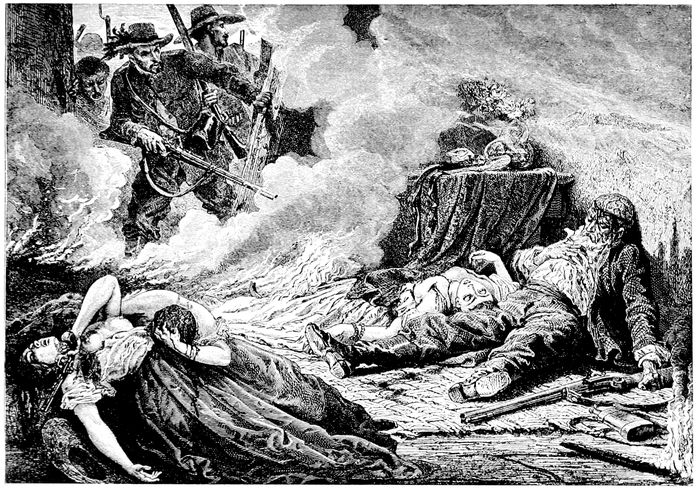
SLAUGHTERED.
A scene during the Seminole Indian War.
148Such were the hardships and dangers the women of the
settlers had to brave. But they endured their sufferings like
heroines. In recognition of this fact it may justly be said
that the establishment of the Republic of the United States
of America, one of the grandest achievements in all history,
would not have been possible without their aid. For it was
among these hardy men and women that the spirit of American
liberty was born. Their surroundings and manner of
life compelled them to rely on themselves in everything. And
while they assisted one another in all embarrassments and
perils, they made their own regulations and selected their
own officials, fully aware, that the laws of England would
never suffice for the wilderness.
From those autonomous settlements the spirit of independence
spread in time to all the towns and cities on the
coast, inspiring many of their inhabitants with the same
enthusiasm for liberty. In New York and other places the
People’s Party was organized, which strongly opposed the
insolence and encroachments of the Government and aristocrats.
Among its members was Peter Zenger, the fearless
printer, whose caustic articles in the “New York Weekly
Journal” in 1735 led to that famous trial, whereby one of
the highest privileges—the freedom of the press—became
established in America. And when in complete disregard of
this significant omen England continued in her selfish policies
toward the colonies, curtailing all privileges which had been
granted to them by their charters, the spirit of rebellion spread
like wildfire, and the great struggle for independence began.
When a Declaration of Independence was considered,
the men, selected to draw up such a document, were greatly
influenced by two noble-minded women, whose names should
not be omitted in a history of remarkable women: Mrs.
Mercy Otis Warren, and Abigail Smith Adams. Mrs. Warren
was a sister of James Otis, the famous lawyer, whose fiery
words did so much to arouse the colonists against British
aggression. She was one of the first persons who advocated
separation, and she energetically impressed this view upon
John Adams before the opening of the first Congress. With
Abigail Smith Adams, the wife of John Adams, she shared
the belief, that the declaration should not consider the freedom
of man alone, but that of woman also.
How outspoken Mrs. Adams was in her views about
this question, appears in a letter she wrote in March, 1776,
to her husband, who was then attending the Continental
Congress. In this letter she says: “I long to hear you have
declared an independency; and, by the way, in the new
code of laws which I suppose it will be necessary for you to
make, I desire you would remember the ladies, and be more
generous and favorable to them than your ancestors. Do
not put such unlimited power into the hands of husbands.
Remember, all men would be tyrants if they could. If particular
care and attention are not paid to the ladies, we are
determined to foment a rebellion, and will not hold ourselves
bound to obey any laws in which we have no voice or
representation.”—
149
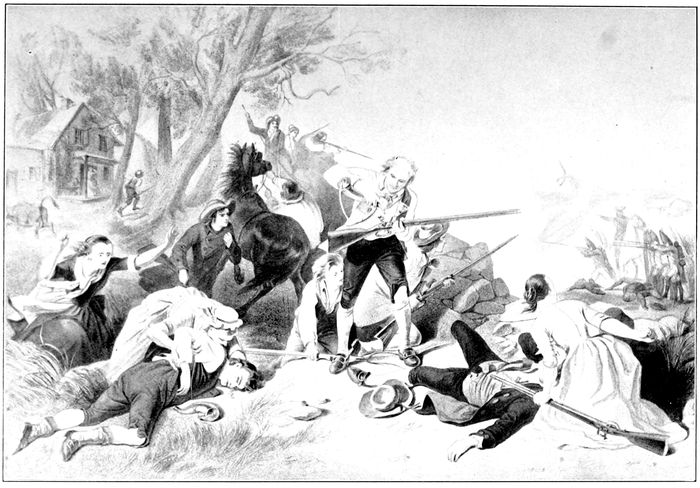
STRUGGLING FOR INDEPENDENCE.
150The Declaration of Independence, accepted on July 4th,
1776, in Philadelphia, by an assembly of delegates from all
the colonies, is the greatest and most important political
document that was ever set up and signed by men. Although
the representatives knew that it would produce a long and
terrific war against the most powerful and most inconsiderate
government of the world, they solemnly agreed to choose
liberty or death. Liberty to make their own laws and to
elect their own officials, liberty of religion, liberty of speech
and press, liberty of trade and commerce, liberty for man,
woman and child.
The eminent significance of the declaration becomes
apparent from the following sentences: “We hold these
truths to be self-evident, that all men are created equal; that
they are endowed by their Creator with certain inalienable
rights; that among these are life, liberty and the pursuit of
happiness. That, to secure these rights, governments are instituted
among men, deriving their just powers from the consent
of the governed. That, whenever any form of government
becomes destructive of these ends, it is the right of the people
to alter or to abolish it, and to institute new government,
laying its foundation on such principles, and organizing its
powers in such form, as to them shall seem most likely to
effect their safety and happiness.”
While the Declaration of Independence is silent in regard
to women, there are, however, positive proofs of the fact,
that the men of 1776 regarded their faithful partners in all
struggles and danger decidedly as their equals and entitled to
the same rights and privileges. Two days before the signing
of the Declaration of Independence, on July 2, 1776, the
Provincial Assembly of New Jersey, when writing the constitution
of that province, adopted the provision, that “all
inhabitants of this colony, of full age, who are worth fifty
pounds money clear estate in the same, and have resided
within the county in which they claim to vote for twelve
months immediately preceding the election, shall be entitled
to vote for representatives in council and assembly, and also
for all other public officers that shall be elected by the people
of the county at large.”—
Under this provision, women and free colored men of
property exercised the electoral franchise for thirty years,
voting also in the Presidential election of 1804, when Thomas
Jefferson was re-elected for a second term. The acts of the
New Jersey Legislature of 1790 clearly recognized the women,
voters, saying:
151“No person shall be entitled to vote in any other town-house
or precinct than that in which he or she doth actually
reside at the time of election.”
At first the law was construed to admit single women
only, but afterward it was made to include females eighteen
years old, married or single, without distinction of race. But
as most of the women were on the side of the Federation
and always delivered a heavy vote, a Democratic legislature,
to defranchise Federalists, passed in 1807 an act defining the
qualifications of electors, excluding women and free colored
men by the use of the words “White male citizens.” This
was a partisan piece of legislature, clearly in violation of the
constitutional guarantee, and made under the pretext that
male voters, by disguising themselves as women and negroes,
had voted several times. It was on the strength of this pretext
that the unconstitutional act was passed and upheld.
It is on record that in Virginia likewise women at an
early day exercised the right of voting. But it is unknown, for
what reason this right was not preserved.
152
There are few events in history that created such world-wide
interest as the triumphant success of the American War
for Liberation. The deepest impression was made on the
French nation, which for centuries had suffered under the
tyranny and coercion of extravagant kings, corrupt officials,
greedy clergy and feudal nobility. In sharp contrast to the
prodigality and lasciviousness of the court and its armies of
courtiers and courtesans, who all revelled in luxuries, there
was among the people a general feeling of misery and despair.
Finances were in a frightful condition; public scandals were
every-day occurrences; famines were frequent; the old creeds
had lost their power to arouse enthusiasm, while out-worn
institutions and customs still encumbered the land, and with
their dead weight pressed men down. The deep longing to
be delivered from all these parasites and encumbrances, the
urgent need of reforms and relief was evident everywhere.
In the streets, in all cafés, clubs and salons the discussion of
politics was the foremost topic.
The most conspicuous among such political salons were
those of Théroigne de Méricourt, Marie Olympe de Gouges,
and Madame Roland.
The first of these three ladies was a quick-witted, strikingly
handsome woman, intensely passionate in temper, and
commanding an almost volcanic power of eloquence. Her
salon was the birth-place of the “Club des Amis de la Loi,”
the most noteworthy members of which were Jerome Pétion,
author of “Les Lois Civiles,” and Camille Desmoulins, author
of “La France Libre.” Both writers were among the leaders
of the revolution, and it was Desmoulins, who in July, 1789,
inflamed the people by his violent speeches to take up arms
and storm the Bastille. At the fall of this ill-reputed prison
Théroigne de Méricourt came prominently into notice and it
was she who proposed to erect a temple for the National
Assembly on the site of the razed fortress.
With her friends she also had a hand in framing the
“Déclaration des Droits de l’Homme,” which, together with
the American Declaration of Independence, ranks among the
greatest human documents of history. The most important
points of this charter of the French Revolution are: that all
men are born and continue free and equal in rights; that
Society is an association of men to preserve the natural rights
of men; that Sovereignty is vested in the nation; that all
Authority, held by an individual or a body of men, comes
expressly from the nation; that Liberty is the power of doing
153what we will, so long as it does not injure the same right of
others; that the law can forbid only such actions as are mischievous
to society; that Law is the expression of the general
will; that all citizens have a right to take part, through their
representatives, in the making of laws; that laws must be
equal to all; that all citizens have equal rights to fulfill all
offices in the state; that society has a right to demand from
every public servant an account of his administration; that all
men are free to hold what religious views they will, provided
that they are not subversive of public order; that freedom of
speech, of writing and printing is one of the most precious
of the rights of man and that public force is needed to guarantee
these rights; that property is an inviolable and sacred
right, of which no one can be deprived, save when public
necessity, legally established, evidently demands it, and then
only with the condition of a just and previously determined
indemnity.
With the adoption of this declaration by the national
assembly, all hereditary distinctions, such as nobility and
peerage, feudal regime, titles, and orders of chivalry were
abolished, also venality or hereditary succession in offices,
feudal privileges, religious vows or other engagements which
might be at variance with natural rights or the constitution.—
Early in October, 1789, Théroigne de Méricourt also
took a leading part in the march of the women to Versailles
and it was she who by the violence of her speech won the
royalist soldiers over to the revolution and so enforced the
return of the royal family to Paris.
Being accused of dangerous conduct and of having been
engaged in a plot against the life of the queen Marie Antoinette,
the daughter of Empress Maria Theresia of Austria, during
a visit to Liége she was seized by warrant of the Austrian
Government and for some time interned at the fortress of
Kufstein. After her release in January, 1792, she returned
to Paris, where she was hailed as a martyr of liberty. Resuming
her former role she again became very active in all public
affairs. On June 20, 1792, she even commanded in person
the 3d Corps of the so-called army of the Faubourges, and
marched with them to the palace, where the king, wearing
the red cap, met the revolutionists and assured them “that
he would do whatever the constitution ordained that he should
do.” But as soon afterwards the king’s secret connections with
Austria and Prussia became public, the insurrection broke loose
again, resulting in the massacre of the national guard on
August 10th, in the Place Véndome. It was here, that
Théroigne sprang at Suleau, a pamphleteer in royal service,
and dragged him among the infuriated mob, where he was
instantly killed.—
154It was a year before these incidents that Madame Roland
opened a salon in Paris, whither her husband had been sent
as the deputy from Lyons to the constituent assembly. Her
salon had nothing in common with those frequented by people
seeking recreation in conversation and belle esprit. Generally
there were no women present except the hostess. But her
salon was the rendezvous of such fiery spirits as Mirabeau,
Brissot, Vergniaud, Robespierre and others, interested in the
great movement, which was soon to reach its climax. It was
in this salon that Madame Roland impressed her enthusiasm
for a republic upon those men who likewise strove for progress
and liberty. Here also she conceived the plan of a journal,
entitled “The Republican,” which, however, was suppressed
after its second issue. Here she penned that famous letter to
the king, which, as it remained unanswered, was read aloud
by her husband, the king’s appointed Minister of the Interior,
in full council and in the king’s presence. Containing many
terrible truths as to the royal refusal to sanction the decrees
of the national assembly and as to the king’s position in the
state, this letter initiated the dethronement of the king and
the abolition of royalty.—
It was in these troubled times, also, that another remarkable
woman attracted great attention by matching the “Declaration
of the rights of man” with a “Declaration des Droits
de la Femme,” a declaration of the rights of women. In this
document she preached for the first time not only the principle
of equality of both sexes but she also demanded the right of
women to vote and to hold public offices. This document
was published just at the time when the equality of both sexes
before the law and the guillotine had become a recognized
fact, when not only the head of the king but also that of the
queen Marie Antoinette had rolled into the dust. Pointing
to these events Olympe de Gouges closed her manifesto with
the flaming words: “When women have the right to ascend
the scaffold then they must have the right to mount the platform
of the orator!”
When Olympe de Gouges wrote these lines, she hardly
anticipated her own fate. Provoking in some way the anger
of Robespierre, this rabid tyrant did send her also to the
guillotine.—
Théroigne de Méricourt likewise fell a victim of the
furious hostility, which in 1793 arose between the two leading
parties, the Girondists and the Montagnards, the latter party
led by those most extreme autocrats as Marat, Danton and
Robespierre. When Théroigne, being aware that her own
party, the Gironde, was in peril at the hands of these bloodthirsty
men, one day urged the mob to moderate their courses,
she was seized, stripped naked and flogged in the public
garden of the Tuilleries. This infamous affront affected her
so that she became a raving maniac, never recovering her
reason.—
155
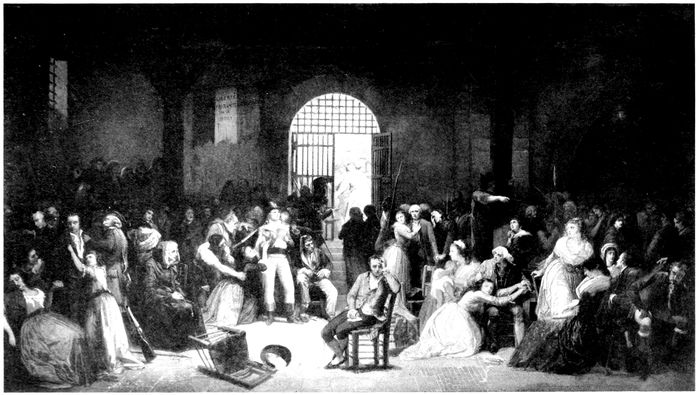
THE ROLL-CALL FOR THE GUILLOTINE.
After the painting by C. L. Mueller.
156For Madame Roland and her husband too the day of
darkness was soon to come. They found that they could no
longer control those passions which they had helped to call
forth. Repulsed by the incredible excesses, which were committed
during the progress of the revolution, Mr. Roland sent
in his resignation on January 22, 1793, the day after the
execution of the king. But all his and his wife’s efforts to
regulate and elevate the Revolution failed. Both became more
and more the butt of calumny and the object of increasing
dislike on the part of the ultra-revolutionists, whose leaders,
Marat and Danton, heaped the foulest falsehoods upon them.
At the instigation of these men Madame Roland was arrested
early on the morning of the last of July, 1793, and thrown
into the same prison cell, that had been occupied by Charlotte
Corday a short time before. On November the 8th she was
conveyed to the guillotine. Before yielding her head to the
block, she bowed before the statue of Liberty, erected in the
Place de la Revolution, uttering her famous apostrophe: “O
Liberty! what crimes are committed in thy name!”—
After the elimination of the three leading spirits of
woman’s emancipation all attempts to claim political rights for
women were sternly repressed. The bold deed of Charlotte
Corday, who on July 17th, 1793, killed Marat, the chief of
the Mountain party, had given to his followers a warning of
what resolute women were able to do. And so all female clubs
and political meetings were forbidden by the Convention.
Women were even excluded from the galleries of the hall
where it sat, and Chaumette warned them that by entering
into politics they would violate the law of nature and would
be punished accordingly. French girls were also entirely
excluded from all educational reforms that were instituted by
the Convention and, later on, by Napoleon, who always maintained
that female education should be of the most rudimentary
description.
At the same time that Olympe de Gouges, Théroigne de
Méricourt and Madame Roland took such a conspicuous part
in the French Revolution, there appeared in England a most
remarkable book, which might be called the first comprehensive
attempt to establish the equality of the sexes. Its authoress
was Mary Wollstonecraft, a woman of Irish extraction, born
at Hoxton on April 27, 1759. Compelled to earn her own
living, she, together with her sisters, had conducted a school
for girls. Later on she held a position as governess in the
family of Lord Kingsborough, in Ireland. Among her early
157publications are “Thoughts on the Education of Daughters”
(1787) and “The Female Reader” (1789). That she followed
the events of the French Revolution with the utmost interest,
appears from her book: “An Historical and Moral View of
the Origin and Progress of the French Revolution, and the
Effects it has Produced in Europe.” It was intended to comprise
several volumes, but after the first one had been published
in 1790, the work remained unfinished. Two years
later, in 1792, appeared the work with which the name of
Mary Wollstonecraft is always associated, as from this book
was born one of the grandest movements which exists in the
world to-day—the Woman Suffrage Movement.
This book, entitled “A Vindication of the Rights of
Woman,” was a sharp protest against the assumption that
woman is only a plaything of man. It is also a demand on
her to become his equal and his companion.
In the preface the authoress states the “main argument”
of her work, “built on this simple principle that, if woman
be not prepared by education to become the companion of
man, she will stop the progress of knowledge, for truth must
be common to all, or it will be inefficacious with respect to
its influence or general practice.” In carrying out this argument
she explains that woman can never be free until she is free
economically; it makes no difference how poetic, romantic
and chivalrous we become,—the fact is, there can be little
equality between the sexes as long as the male partner has
entire charge of the purse. Woman may be free socially; she
may get rid of all sexual superstition, and she may crack and
cast from her all theological trammels: but of what value is
all this if she is still dependent upon man for food, raiment
and shelter? What good does it do her to say “My body is
my own, subject to the whims and lusts of no man,” if upon
that very man depends her livelihood? Woman’s economic
dependence is the root of that tree which nourishes the
poisonous fruits of her subjection and abject slavery. Only
when woman is on equal terms with man, can she be really
virtuous and useful. But this result can only be obtained by
rejecting the fallacious idea of weakness and refusing man’s
help.
After that the authoress states, that woman by open air
exercise can become healthy and strong. By study she can
acquire a solid education and useful knowledge, and thus
become fit to earn her own living. Marriage will then cease
to be her sole hope of salvation. If she marries she must not
expect infinite romantic love from her husband, that would
be an endeavor to perpetuate what is transitory in its very
essence. From her husband she should require esteem and
friendship. But before she can ask for or inspire these sentiments
158she must have shown herself a lofty mind and a
sincere, benevolent, and independent temper.
“But this ideal will remain a myth unless the system of
education is entirely changed. It is the duty of the Government
to organize schools and colleges, for boys and girls, both rich
and poor, and of all ages.”
Mary Wollstonecraft recommends that boys and girls
should study together. She does not regard as an evil the
attachment which might result under these conditions. On the
contrary, she is an advocate of early marriage, and believes
that the physical and moral health of young people would
be greatly benefited thereby. “Do not separate the sexes, but
accustom them to each other from infancy!” she demands.
“By this plan such a degree of equality should be established
between the sexes as would break up gallantry and coquetry,
yet allow friendship and love to temper the heart for the
discharge of higher duties.”
Thus asking the widest opportunities of education for
women, she demands also her participation in industry, political
knowledge, and the rights of representation.
While Mary Wollstonecraft in this manner advanced progressive
ideas, she also discussed several questions, dangerous
and explosive at that time. In regard to marriage she recommended
emancipation from the coercions and ceremonies imposed
upon all Christians by the Church. And where love
had ceased, divorce should be made easy. These points,
together with her extraordinary plainness of speech and her
denial of the eternity of the torments of hell, caused an outcry
of all classes, to whom the dust of tradition was sacred, or
who saw their assumed authority endangered. The air grew
thick with insults and insinuations, hurled at the champion of
such principles by churchmen feeding on their worn-out thistle-creeds.
There were also the shrill, polished shrieks of society,
whose antiquated dogmas Mary Wollstonecraft had repudiated.
But the impulse, given by her, did not die. It became the
heritage of later and more advanced generations, who have
tried to realize the ideas of this most remarkable woman of
the 18th Century.
159
Since the stirring years of the American War of Independence
and of the French Revolution the question of woman’s
rights and woman suffrage has remained constantly before
the public. Its significance greatly increased when with the
invention of steam-engines, with the rapid growth and extension
of trade and commerce, and with the introduction of
modern methods all conditions of industrial life likewise
became revolutionized. Many of those industries in which
women participated, were transferred from the homes to
factories, where the workmen and women were placed at
machines, producing within one day greater quantities of
goods than the laborers formerly had manufactured within
weeks or months.
With this industrial revolution came, however, also many
evils. The laborers remained no longer masters of their own
time and efforts. While hitherto they had been the owners
of their little industry, now the factory owners and the great
industries began to own them. They found themselves bound
by strict rules, not of their own making, but prescribed and
enforced by their employers, many of whom had not the
slightest consideration for the people that worked for them.
Just as soulless as their machines, and thinking only of gain,
they abused their employees wherever possible, and in doing
so often resorted to the meanest tricks.
Nowhere did such evils become so appalling as in England,
where the politicians subordinated all other considerations
to industry. It was here that in order to reduce the
small wages of the workman cheap woman- and child-labor
was first introduced on a large scale, and feeble, defenseless
creatures, without experience and organization, were subjected
to the most cruel oppression and exploitation.
At the end of the 18th and during the first half of the
19th Century large numbers of women and pauper children
were shipped from the agricultural districts of Southern England
to the northern districts to work in the factories which
had been established there in consequence of the superior
water-power.
Tender women and girls, and even children from six to
ten years were placed in cotton mills, where they were compelled
to work in overcrowded rooms thirteen to fourteen
hours daily. Robert Mackenzie in his book “The Nineteenth
Century,” p. 77, states, that the accommodations provided
for these people were of the most wretched nature. “If such
children became over-tired and fell asleep they were flogged.
Sometimes through exhaustion they fell upon the machinery
160and were injured—possibly crushed,—an occurrence which
caused little concern to any except the mothers, who had
learned to bear their pangs in silence. These children, who
were stunted in size and disposed to various acute diseases,
were often scrofulous and consumptive.”
The Encyclopædia Britannica, in an article on Socialism,
describes the conditions of the working people in England
at that time as follows: “The English worker had no fixed
interest in the soil. He had no voice either in local or
national government. He had little education or none at all.
His dwelling was wretched in the extreme. The right even
of combination was denied him. The wages of the agricultural
laborer were miserably low. The workman’s share in the
benefits of the industrial revolution was doubtful. Great
numbers of his class were reduced to utter poverty and ruin
by the great changes consequent to the introduction of improved
machinery; the tendency to readjustment was slow
and continually disturbed by fresh change. The hours of work
were mercilessly long. He had to compete against the labor
of women, and of children brought frequently at the age of
five or six from the workhouses. These children had to work
the same long hours as the adults, and they were sometimes
strapped by the overseers till the blood came. Destitute as
they so often were of parental protection and oversight, with
both sexes huddled together under immoral and unsanitary
conditions, it was only natural that they should fall into the
worst habits and that their offspring should to such a lamentable
degree be vicious, improvident, and physically degenerate.”
A report, delivered at the “International Congress of
Women,” held in July, 1899, at London, states that the weak
legs of those children, which were not strong enough to support
the body for hours, were sustained by boots of wood and
lead, in which they were obliged to stand. Hence the high
scale of mortality among the children.
Most revolting conditions prevailed in the English coal
mines. Married women, girls and children worked here,
harnessed to trucks and nearly naked, dragging on their hands
and knees loads of coal through long low galleries to the pit
mouth.
When some philanthropists made complaints about these
conditions, Parliament instituted a commission to inquire into
the state of working women in these mines and the wages
paid them. From its official report we quote the following:
“Betty Harris, one of the numerous persons examined, aged
thirty-seven, drawer in the coal-pit, said: ‘I have a belt around
my waist and a chain between my legs to the truck, and I
go on my hands and feet. The road is very steep and we
161have to hold by a rope, and when there is no rope, by anything
we can catch hold of. There are six women and about
six boys and girls in the pit I work in; it is very wet, and the
water comes over our clog-tops always, and I have seen it
up to my thighs; my clothes are always wet.’—
“Margaret Hibbs, aged eighteen, said: ‘My employment
after reaching the wall-face (the place where the coal is
broken) is to fill my bagie or stype with two and a half or
three hundred-weight of coal; I then hook it on to my chain
and drag it through the seam, which is from twenty-six to
twenty-eight inches high, till I get to the main road, a good
distance, probably two hundred to four hundred yards. The
pavement I drag over is wet, and I am obliged at all times
to crawl on my hands and feet with my bagie hung to the
chain and ropes. It is sad, sweating, sore and fatiguing work,
and frequently maims the women.’
“Robert Bald, the government coal-viewer, stated: In
surveying the workings of an extensive colliery underground
a married woman came forward groaning under an excessive
weight of coal, trembling in every nerve, and almost unable
to keep her knees from sinking under her. On coming up
she said in a plaintive and melancholy voice: ‘Oh sir, this
is sore, sore, sore work!’
“And a sub-commissioner said: ‘It is almost incredible
that human beings can submit to such employment—crawling
on hands and knees, harnessed like horses, over soft, slushy
floors, more difficult than dragging the same weight through
our lowest sewers.’”—
Mackenzie, in his above mentioned book, states that
“there was no machinery in these English coal-pits to drag
the coal to the surface, and women climbed long wooden
stairs with baskets of coal upon their backs. Children of
six were habitually employed. Their hours of labor were
fourteen to sixteen daily. The horrors among which they
lived induced disease and early death. Law did not seem to
reach to the depths of a coal-pit, and the hapless children
were often mutilated and occasionally killed with perfect
impunity by the brutalized miners among whom they labored.”
Other authorities state that the women were paid less
than 20 cents per day! For the same kind of work men got
three times as much pay; but the employers preferred girls
and women to do the work “because of their lower wages
and greater docility!” In the iron districts of the Midlands
women earned for very hard work 4 to 5 shillings a week,
(=$1.25) while the men received 14 shillings.
These small wages, which forced upon the laborers the
most barren mode of living, were, however, taken away
again from them through the meanest tricks, devised by the
162employers particularly through the so-called Truck System.
Under this abominable system the employers, instead of
paying the wages in cash, forced their employees to take
checks or orders, redeemable in all kinds of necessities and
goods, but valid only in those “truck stores” or “tommy
shops” run by the employers, or in which they had an interest.
By cheating the workmen with goods of inferior quality, by
overcharging them at the same time, by pressing them to
take goods far beyond their need and wages, and by making
long intervals—often from 40 to 60 days—between the
real pay days, they forced the laborers into debt and absolute
slavery.
The situation of many thousands of those women who
tried to make a living as seamstresses was also desperate.
Always put off with wages far below the demands of a
modest existence, they were real martyrs of labor. Thomas
Hood, one of the foremost English poets of the first half of
the 19th Century, gave in his famous “Song of the Shirt” a
most touching picture of such woman’s toil and misery, of
woman in her wasted life and in her hurried death. His
poem reads:
With fingers weary and worn,
With eyelids heavy and red,
A woman sat, in unwomanly rags,
Plying her needle and thread—
Stitch! stitch! stitch!
In poverty, hunger and dirt,
And still with a voice of dolorous pitch,
She sang the “Song of the Shirt!”
“Work! work! work!
While the cock is crowing aloof!
And work—work—work,
Till the stars shine through the roof!
It’s Oh! to be a slave
Along with the barbarous Turk,
Where woman has never a soul to save,
If this is Christian work!
“Work—work—work
Till the brain begins to swim;
Work—work—work
Till the eyes are heavy and dim!
Seam, and gusset, and band,
Band, and gusset, and seam,
Till over the button I fall asleep,
And sew them on in a dream!
163“Oh, Men, with Sisters dear!
Oh, Men, with Mothers and Wives!
It is not linen you’re wearing out,
But human creatures’ lives!
Stitch—stitch—stitch,
In poverty, hunger, and dirt,
Sewing at once, with a double thread,
A Shroud as well as a Shirt.
“But why do I talk of Death?
That Phantom of grisly bone,
I hardly fear his terrible shape,
It seems so like my own,
Because of the fasts I keep;
Oh, God! that bread be so dear,
And flesh and blood so cheap!
“Work—work—work!
My labor never flags;
And what are its wages? A bed of straw,
A crust of bread—and rags.
That shatter’d roof—and this naked floor—
A table—a broken chair—
And a wall so blank, my shadow I thank
For sometimes falling there!
“Work—work—work!
From weary chime to chime,
Work—work—work—
As prisoners work for crime!
Band, and gusset, and seam,
Seam, and gusset, and band,
Till the heart is sick, and the brain benumb’d
As well as the weary hand.
“Work—work—work,
In the dull December light,
And work—work—work,
When the weather is warm and bright—
While underneath the eaves
The brooding swallows cling,
As if to show me the sunny backs
And twit me with the spring.
“Oh! but to breathe the breath
Of the cowslip and primrose sweet—
With the sky above my head,
And the grass beneath my feet,
For only one short hour
To feel as I used to feel,
Before I knew the woes of want
And the walk that costs a meal.
164“Oh! but for one short hour!
A respite however brief!
No blessed leisure for Love or Hope,
But only time for Grief!
A little weeping would ease my heart,
But in their briny bed
My tears must stop, for every drop
Hinders needle and thread!”
With fingers weary and worn,
With eyelids heavy and red,
A woman sat in unwomanly rags,
Plying her needle and thread thread—
Stitch! stitch! stitch!
In poverty, hunger, and dirt,
And still with a voice of dolorous pitch,
Would that its tone could reach the Rich!
She sang the “Song of the Shirt!”
Constantly struggling with want and poverty and seeing
health menaced by the machines, the working classes of England
were filled with bitterness, when they found that their
complaints brought no relief, while the law-makers, sitting in
Parliament, favored any demands of the employers and of
the big interests. To forget for a few hours their hopeless
existence, large numbers of men and women resorted to
liquor, hereby hastening their final collapse and ruin.
Such was the life led by English laborers during the
greater part of the Nineteenth Century. Feeble attempts to
improve these deplorable conditions were made through a
series of “Factory Acts,” the immediate cause for which was
the fearful spread of epidemic diseases which wrought dreadful
havoc among the laborers, especially among the women
and children. If we glance over these factory acts, as they
are sketched in the Encyclopædia Britannica, we find that
even under these acts children below the age of nine were
permitted in silk factories, and that they were required to
work twelve hours a day, exclusive of an hour and a half
for meal times. An act of 1833 provided that young persons
from thirteen to eighteen and women were restricted to 68
hours a week. Ten years later a mining act was passed which
prohibited underground work for children under ten and for
women. In 1867 the Workshop Regulation Act fixed the
working day for children from 6 a. m. to 8 p. m. = 14 hours,
and for young persons and women from 5 a. m. to 9 p. m.
= 16 hours! After having made such sad disclosures, the
Encyclopædia Britannica dared to say: “By these various
enactments the state has emphatically taken under its protection
165the whole class of children and young persons
employed in manufacturing industries. It has done this in
the name of the moral and physical health of the community.”
The despicable methods employed by the British mine
and factory owners in their dealings with the working classes
spread to the Continent as well as to America. In France,
Germany and Austria they led to those desperate struggles
between capital and labor, out of which was born that most
remarkable movement of the 19th Century called “Socialism.”
In the United States soon enough attempts were made
to imitate the detestable methods of the British mine and
factory owners. But as the character of the population was
quite different, the abuse of the working men and women
never became so appalling as in Great Britain.
The first industry to be established in factories was the
weaving of cotton in the New England States, where a number
of rapid streams, among them the Merrimac, the Connecticut
and the Housatonic, furnished excellent water-power. And
as during the pioneer and colonial times the housewives and
daughters had spun and woven all the cloth and linen for
family use, there was an ample number of expert workers at
hand. After the first weaving machines were brought over
from Europe, in 1814, Dover, Lowell, Waltham, Great Falls
and Newmarket became the principal centers of the cotton
industry.
Here the daughters of the farmers and settlers did the
work that formerly their mothers had done at home. Only
they did it faster, by tending the machines all day long. At
first the girls did not know that the employers might try to
make the people in the factories work longer hours without
any rest and adequate pay. Soon enough they found this
out. But as the girls had inherited the independent spirit
of their fathers and grandfathers, trouble began to brew. In
December, 1828, four hundred girls in Dover, New Hampshire,
formed a procession and marched out of the factory,
in order to show their indignation at the growing oppression
by their employers. They clad their complaints in verses,
one of which ran:
“Who among the Dover girls could ever bear
The shocking fate of slaves to share!”
Unorganized as they were at that time, they did not
succeed in gaining all they desired. But five years later they
walked out again, eight hundred strong, adopting resolutions
stating that they had not been treated as “daughters of freemen”
by their employers and the unfriendly newspapers. At
the same time in Lowell, Mass., at a signal given by a Dover
166girl, two thousand girls, who had formed a “Factory Girls’
Association,” joined in a sympathy strike, marched around
town and issued the following proclamation:
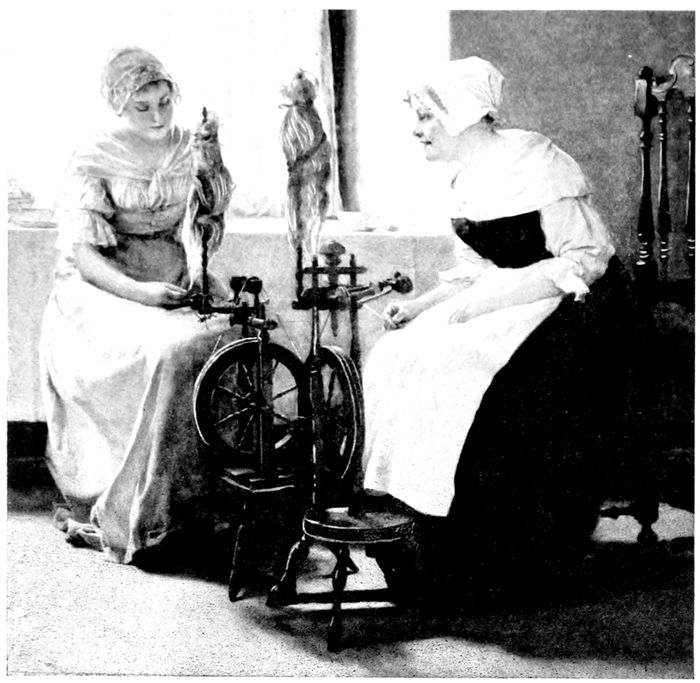
SPINNERS IN THE COLONIAL TIMES.
After a painting by Carl Marr, now in the Metropolitan Museum of Art, New York.
“Union Is Power.”
“Our present object is to have union and exertion, and
we remain in possession of our own unquestionable rights.
We circulate this paper, wishing to obtain the names of all
who imbibe the spirit of our patriotic ancestors, who preferred
privation to bondage and parted with all that renders life
desirable—and even life itself—to produce independence
for their children. The oppressing hand of avarice would
enslave us, and to gain their object they very gravely tell us
of the pressure of the times; this we are already sensible of
and deplore it. If any are in want of assistance, the ladies
will be compassionate and assist them, but we prefer to have
the disposing of our charities in our own hands, and, as we
167are free, we would remain in possession of what kind Providence
has bestowed upon us, and remain daughters of freemen
still.
“All who patronize this effort we wish to have discontinue
their labor until terms of reconciliation are made.
“Resolved. That we will not go back into the mills to
work unless our wages are continued to us as they have been.
“Resolved, That none of us will go back unless they
receive us all as one.
“Resolved, That if any have not money enough to carry
them home they shall be supplied.
“Let oppression shrug her shoulders,
And a haughty tyrant frown,
And little upstart Ignorance
In mockery look down.
Yet I value not the feeble threats,
Of Tories in disguise,
While the flag of independence,
O’er our noble nation flies.”
In 1843 the girls in the cotton mills of Pittsburg, Pa.,
whose working hours had been from five o’clock in the morning
till a quarter of seven in the evening, rebelled also, when
their employers attempted to increase the time one hour each
day without extra pay. Two years later they co-operated with
the factory girls of New England, concurring in the proposal
to “declare their independence of the oppressive manufacturing
power” unless the work day was limited to ten hours.
The policy of these fighters for better conditions is outlined
in the constitution of the “Lowell Female Labor Reform
Association,” which had been organized in 1845. Article IX
says:
“The members of this association disapprove of all
hostile measures, strikes and turn-outs until all pacific measures
prove abortive, and then that it is the imperious duty of
everyone to assert and maintain that independence which our
brave ancestors bequeathed to us and sealed with their blood.”
The spirit of these working women is likewise shown in
the preamble adopted at the annual meeting of the association
in January, 1846. It reads:
“It now only remains for us to throw off the shackles
which are binding us in ignorance and servitude and which
prevent us from rising to that scale of being for which God
designed us. With the present system of labor it is impossible.
There must be reasonable hours for manual labor and a just
portion of time allowed for the cultivation of the mental and
moral faculties, and no other way can the great work be
168accomplished. It is evident that with the present system of
labor the minds of the mass must remain uncultivated, their
morals unimproved. Shall we, operatives of America, the
land where democracy claims to be the principle by which
we live and by which we are governed, see the evil daily
increasing which separates more widely and more effectually
the favored few and the unfortunate many without one
exertion to stay the progress? God forbid! Let the daughters
of New England kindle the spark of Philanthropy in every
heart till its brightness shall fill the whole earth.”
Not satisfied with securing thousands of signatures of
factory operatives, who petitioned the legislature for a ten-hour
day, prominent members of the union went before the
Massachusetts legislative committee early in 1845 and testified
as to the conditions in textile mills. This was the first American
governmental investigation of labor conditions, and it was
due almost solely to the petitions of the working women.
About the same time the union appointed a committee to
investigate and expose false statements published in newspapers
concerning the factory operatives. Nor was this all.
In their work of publicity they did not hesitate to call public
men to account for assailing or ignoring their movement.
The chairman of the legislative committee, before whom
the working girls had testified, was the representative from
the Lowell district, and should, therefore, have shown special
interest in the complaints of the girls. Instead, he had treated
them in a high-handed manner, withholding at the same time
from the Legislature some of the most important facts presented
by the Lowell girls. The latter expressed their just
indignation in the following resolution, which was circulated
before the elections of that year:
“Resolved, That the Female Labor Reform Labor Association
deeply deplore the lack of independence, honesty and
humanity in the committee to whom were referred sundry
petitions relative to the hours of labor, especially in the chairman
of that committee; and as he is merely a corporation
machine, or tool, we will use our best endeavors and influence
to keep him in the “City of Spindles,” where he belongs,
and not trouble Boston folks with him.”
That the “endeavors” of the girls met with full success
is evident from a second resolution published after election
day:
“Resolved, That the members of this association tender
their grateful acknowledgments to the voters of Lowell for
consigning William Schouler to the obscurity he so justly
deserves for treating so ungentlemanly the defense made by
the delegates of this association before the special committee
of the legislature, to whom was referred petitions for the
169reduction of the hours of labor, of which he was chairman.”
The result of all this agitation against long hours of
work was that in 1847, 1848, and 1851 the first ten-hour
laws were passed in New Hampshire, Pennsylvania and New
Jersey.
The success, won by the textile workers, inspired women
workers in the tailoring and sewing trade, in the manufacture
of shoes, cigars, and other necessities to similar efforts. In
the tailoring and sewing trade wages were extremely low, as
sweat-shop conditions existed from the beginning, and the
trade was overcrowded.
In 1845 New York City alone had over 10,000 sewing
women, the majority of whom worked from twelve to sixteen
hours a day to earn only from two to three dollars a week!
As similar conditions prevailed in other occupations, the
number of poorly paid women wage-earners in New York City
in 1865 was between 50,000 to 70,000, of whom 20,000
were in a constant fight with starvation, and of whom 7,000
lived in cellars. Their situation grew from bad to worse, as
at the same time that they were falling into a state of physical
and mental deterioration, the improvements in many machines
made greater and greater demands on the capability of
those who were operating them.
Thus the situation became such as was sketched by
W. I. Thomas in an article written some fifteen years ago
for the “American Magazine,” in which he said:
“The machine is a wonderful expression of man’s ingenuity,
of his effort to create an artificial workman, to whom
no wages have to be paid, but it falls just short of human
intelligence. It has no discriminative judgment, no control
of the work as a whole. It can only finish the work handed
out to it, but it does this with superhuman energy. The manufacturer
has, then, to purchase enough intelligence to supplement
the machine, and he secures as low a grade of this as
the nature of the machine will permit. The child, the woman
and the immigrant are frequently adequate to furnish that
oversight and judgment necessary to supplement the activity
of the machine, and the more ignorant and necessitous the
human being the more the profit to the industry. But now
comes the ironical and pitiful part. The machine which was
invented to save human energy, and which is so great a boon
when the individual controls it, is a terrible thing when it
controls the individual. Power-driven, it has almost no limit
to its speed, and no limit whatever to its endurance, and it
has no nerves. When, therefore, under the pressure of business
competition the machine is speeded up and the girl
operating it is speeded up to its pace, we have finally a situation
in which the machine destroys the worker.”
170The rapidly increasing misery among such exhausted
women workers aroused public attention and led to the
formation of a number of woman’s organizations with the
purpose to investigate abuses among such women workers,
to teach them the value of trade unions, to agitate equal pay
for equal work, to shorten the number of working hours, and
to abolish child labor and prison work. The first national
women’s trade union, formed in the United States, was that
of the “Daughters of St. Crispin.” It held its first convention
on July 28, 1869, at Lynn, Massachusetts. The delegates
represented not only the local lodges of that state, but also
lodges of Maine, New York, Pennsylvania, Illinois, and California.
With the organization of the “Knights of Labor” in
1869, and the “American Federation of Labor” the position
of woman in the American labor movement became more
firmly established, as both federations made it one of their
principal objects “to secure for both sexes equal pay for
equal work.” They also appointed special committees to
investigate the conditions of working women, and to organize
them for concerted action.
Other potent factors arising in this line were the “National
Consumers’ League” and the “Women’s Trade Union
League.” The founding of the first federation was due to
efforts to better the conditions of women in department stores.
In 1890 a group of saleswomen of New York City pointed
to the fact that girls in fashionable department stores were
receiving wages too low to allow them a decent living. They
also complained that these girls were forced to stand from
ten to fourteen hours a day, and that sanitary conditions in
the cloak and lunch rooms were such as to endanger health
and life. While the plan of these saleswomen, to unite all
women clerks of the city into a labor union, failed, their
complaints, however, attracted the attention of a number of
influential ladies interested in philanthropic efforts. They
investigated the charges against the department stores, and
what they discovered made them resolve that conditions
demanded radical changes. In May, 1890, they called a
mass meeting of prominent women and proposed a constructive
plan for raising the standard in shop conditions, not by
blacklisting any firm guilty of bad conduct, but by white-listing
those firms which treated their employees humanely.
“We can make and publish,” so the presiding lady said,
“a list of all the shops where employees receive fair treatment,
and we can agree to patronize only those shops. By acting
openly, and publishing our White List we shall be able to
create an immense public opinion in favor of just employers.”
In other words, it was by the spirit of praise rather than condemnation
171that these ladies sought to stimulate stores to raise
their standards.
Adopting the name “Consumers’ League of New York,”
the society organized on January 1, 1891, and published its
first White List. It was a disappointingly small one, as it
contained the names of only eight firms. Still more disappointing
was the indifference of the many hundred other firms
toward this reform movement. But soon enough these firms
found that the League had also introduced into the New York
Assembly a bill which became known as the “Mercantile
Employers Bill.” It aimed to regulate the employment of
women and children in all mercantile establishments, and to
place all retail stores, from the smallest to the largest, under
the inspection of the State Factory Department.
Of course the merchants took prompt steps to defeat
this obnoxious bill, and they were most complacent when
their representatives in the Assembly succeeded in strangling
it. But the bill appeared again and again, finally resulting
in the appointment of a State Commission for the investigation
of the conditions. As Reta Childe Dorr in her book
“What Eight Million Women Want” graphically relates, “The
findings of this Commission were sensational enough. Merchants
reluctantly testified to employing grown women at a
salary of thirty-three cents a day. They confessed to employing
little girls of eleven and twelve years, in defiance of the
child-labor law. They declared that pasteboard and wooden
stock boxes were good enough seats for saleswomen; that
they should not expect to sit down in business hours, anyhow.
They defended, on what they called economic grounds, their
long hours and uncompensated overtime. They defended
their system of fines, which sometimes took away from a girl
almost the entire amount of her weekly salary. They
threatened, if a ten-hour law for women under twenty-one
years old were passed, to employ older women. Thus thousands
of young and helpless girls would be thrown out of
employment, and forced to appeal to charity.”
The Senate heard the report of the Commission, and in
spite of the merchants’ protests, the women’s bill was passed
without a dissenting vote. Its most important provision was
the ten-hour limit which it placed on the work of women
under twenty-one. The bill also provided seats for saleswomen,
and specified the number of seats, one to every
three clerks. It forbade the employment of children, except
those holding working-certificates from the authorities.
But soon it was found that the smart representatives of
the merchants had succeeded in attaching to the bill a so-called
“joker,” by which the inspection of the stores was
entrusted to the local boards of health. As the officials of
172these boards, supposedly experts, proved, in fact, ignorant
of industrial conditions and their relation to health and
sanitation, the true objects of the bill could not be enforced.
So the Consumers’ League was compelled to wage another
tedious war, until it finally succeeded in convincing the Legislature
that the inspection of all department and retail stores
should be turned over to the State Factory Department.
When this was done, there were reported in the first three
months of the enforcement of the Mercantile Law over 1200
violations in Greater New York. At the same time 923
under-age children were taken out of their positions as cash
girls, stock girls, and wrappers, and sent back to school.
It was natural that the good results and the purely
benevolent motives of the Consumers’ League attracted wide
attention. Similar Associations were formed in many other
cities and states. The movement spread so rapidly, that in
1899 it was possible to organize “The National Consumers’
League,” with branches in twenty-two states.
Encouraged by such success, the league now began to
study the working conditions of girls employed in restaurants.
It was found that in many cases these conditions were even
worse than in the department stores. Girls of twenty years
were found working as cooks from 6:30 in the morning to
11:30 at night, with no time off on Sundays or holidays! This
meant 119 hours a week, more than twice the time the law
permits for factory employees. Other girls, employed as
waitresses, were serving every day from 7:30 a. m. to 10:30
p. m., or 105 hours each week! In going back and forth, they
walked several miles a day, carrying heavy trays at the same
time. In rush hours they worked at a constant nervous tension,
for speed is one of their requirements. And they must not
only remember a dizzying list of orders, but must fill them
quickly and keep their temper under the exactions of the
most rasping customer.
Based on such findings, the Consumers’ League of New
York caused the framing of a bill by which the hours of
women in restaurants were limited to 54 hours weekly, which
gave the girls one day of rest in seven, and prohibited their
working between 10 p. m. and 6 a. m. In October, 1917,
this bill became a law. In a number of other states minimum
wage laws have also been secured.
The Consumers’ League of Philadelphia took pains to
investigate conditions in the silk mills of Pennsylvania. It
was found that besides overwork and underpay there were
often other evils, due to an erring as well as inhuman policy
on the part of the employers. Like the owners of the department
stores many of these men were possessed by the idea
that the right to sit down would encourage slow work and
173laziness. Accordingly the girls in these mills were forced to
stand from early morning till late at night, day after day,
and month after month.
The secretary of the Consumers’ League, who, under
an assumed name, worked for some time in various mills,
in order to study conditions, wrote:
“The harmful effect of continuous standing, upon young
and growing girls, is too well established a fact to require
any elaboration. In addition to the permanent ill effects, much
immediate and unnecessary suffering, especially in hot weather,
is inflicted by the prohibition of sitting. I could always detect
the existence of this rule by a glance at the stocking-feet of
the workers, and at the rows of discarded shoes beneath the
frames. For after a few hours the strain upon the swollen
feet becomes intolerable, and one girl after another discards
her shoes.”—
Another harsh and very common practice of employers
is to cover the lower sashes of the windows with paint, and
to fasten them so that they cannot be raised in hot weather.
This is done “so that the girls don’t waste time looking out.”
The cruelty of these unnecessary rules is often aggravated
by a most amazing lack of the common decencies and necessities
of cleanliness.
One of the most difficult tasks of the Consumers’ League
was to overcome the absolute unwillingness of storekeepers
to compensate their saleswomen for overtime. If it would be
possible to compute the amount of such unpaid labor performed
after the regular hours in many stores as well as in
the bookkeeping and auditing departments, especially during
the Christmas season, the sum would be startling indeed.
A circular issued by the Women’s Trade Union League of
Chicago some years ago stated that the 3000 clerks in only
one department store of that city had been required to work
during the holiday season overtime to the total amount of
96,000 hours, without receiving any compensation. At the
rate of only ten cents an hour these clerks suffered a loss of
$9,600, at the rate of 25 cents an hour a loss of $24,000.
The first “Women’s Trade Union League” was organized
in 1875 by Mrs. Emma Paterson, the wife of an English trade
unionist. While travelling in America, she had observed that
women workers of various trades had formed unions, among
which the “Umbrella Makers’ Union,” the “Women’s Typographical
Union” and the “Women’s Protective Union” were
the most prominent. Convinced that the utility of such combinations
could be still more increased, Mrs. Paterson, after
her return to England, organized a federation of such women’s
unions, the “British Women’s Trade Union League,” which
174later on became the model for a similar organization in
America. It was founded on November 14th, 1903, for the
one main purpose to organize all women workers into trade
unions, in order to protect them from exploitation, to help
them raise their wages, shorten their hours, and improve
sanitary conditions of the work shops. Becoming affiliated
with the “American Federation of Labor,” the league gained
a splendid victory during the years 1909 to 1911, when a
series of huge strikes in the sewing trades spread over the
East and the Middle West. Also an agreement was arrived
at, that the principle of preference to unionists, first enforced
in Australia, should be acknowledged. Under this plan manufacturers,
when hiring help, must give to union workers of
the necessary qualifications and degree of skill precedence
over non-union workers.
At all times ready to express the sentiments and voice
the aspirations of those who toil, the “Women s Trade Union
League” represents to-day over 100,000 working women.
While it has had a wonderful effect in improving standards
of wages, hours and sanitary conditions in what was originally
an underpaid and unhealthy industry, it also has become the
pioneer in another direction, that of education in the labor
movement. At the initiative of a group of girls an educational
movement was started which has extended into organizations
including some half a million workers, men as well as women.
In public schools of New York, Philadelphia, Boston, Chicago,
Los Angeles, and other cities educators of national reputation
are co-operating with teachers and delegates from labor
unions in giving lecture courses for adults on such subjects
as social interpretation of literature, evolution of the labor
movement, problems of reconstruction, social problems, trade
unionism and co-operation, etc. At the same time a movement
for co-operative housing has been developing. “The
New York Ladies’ Waist and Dressmaker’s Union” for instance
has bought in 1919 at a cost of several hundred thousand
dollars a magnificent summer home for the exclusive use of
its members. This “Unity House” at Forest Park, Pennsylvania,
has accommodations for 500 guests. Situated at a
beautiful lake, surrounded by shady forests and green lawns,
provided with tennis courts, a library and reading rooms, it
is an ideal recreation ground of first order. The money for
this estate was brought up by the 30,000 members of the
union, each contributing one day’s wages.
In New York City also a co-operative “Unity House”
has been established with quarters for fifty girls. A great
extension of this movement in the city is planned. The Philadelphia
group of the same union is following these examples
and has acquired a fine estate worth $40,000.
175At present the various woman’s organizations of the
United States as well as of other countries aim at the following
issues:
- 1.
- To limit the working day for women to eight hours.
- 2.
- To demand for women equal pay with men for equal work.
- 3.
- To establish for all the various occupations minimum wage scales, sufficient to grant
all women workers an adequate living.
- 4.
- To secure safe and sanitary working conditions, and clinics for the treatment of
diseases resulting from certain industrial occupations.
- 5.
- To secure industrial insurance laws.
- 6.
- To secure for all women full citizenship with the right to vote in all municipal and
national elections.
As woman’s future position will depend on the realization
of these demands, their discussion is of utmost importance.
As has been shown in a former chapter, innumerable
valuable lives of workmen, women and, in former years, children
have been sacrificed through the unreasonable exploitation
by employers, who in their greed for profits had lost all
consideration for the welfare of their fellow-men. Hundreds
of thousands of laborers have been slowly worked to death
as no sufficient amount of time for recuperation was granted
them.
The only possible excuse for such incredible waste of
human lives is that neither the employers nor the law-makers
of those bygone days realized that the physical and mental
abilities of the large laboring classes belong to the resources
of a nation just as truly as do the water-power, the soil, the
mineral deposits, the forests, and other natural means. Moreover,
nobody was aware of the fact that it is one of the
supreme duties of a wise government to guard these resources,
so fundamentally necessary to the prosperity of a nation, from
unscrupulous exploitation and possible destruction.
The danger of the reckless exploitation of laborers,
especially of women workers, has increased considerably with
the improvement of many machines, the greater speed and
output of which demand far greater attention and strain than
before on the part of the men or women operating them.
This is what Newton D. Baker, Secretary of War, said
in 1917 at the annual meeting of the National Consumers’
League:
“Machinery has given us one great delusion. People
176have imagined that when a machine was operated by a steam
engine or by an electric motor, the steam engine or the electric
motor actually did all the work, and the people who were
attending it while it operated were more or less negligible.
As a consequence, we indulged in the very unfortunate and
often fatal belief that unlimited hours of labor were possible
because it was the machines which were doing the work. We
overlooked the fact, which we have lately begun to appreciate,
that the person who tends the power-driven machine is far
more susceptible to exhaustion, is far more open to fatigue
and to the poisons that affect the system and that come from
over-exertion than ever before.”
Mrs. Florence Kelley, the able General Secretary of the
National Consumers’ League, who studied woman’s occupation
in the sewing trade, states that of late years the speed
of the sewing machines has been increased so that girls using
these improved machines are now responsible for twenty times
as many stitches as twenty years ago, and that many girls
and women, not capable of the sustained speed involved in
this improvement, are no longer eligible for this occupation.
Those who continue in the trade are required to feed twice
as many garments to the machine as were required five years
ago. The strain upon their eyes is, however, far more than
twice what it was before the improvement. In the case of
machines carrying multiple needles this is obvious; but it is
true of the single needle machines as well.
When a girl cannot keep the pace she is thrown out.
A comment frequently made by the girls about such an unfortunate
comrade is: “She got too slow. She couldn’t keep
up with her machine any longer.” It amounts to this, that
the girl can earn a living wage, if she is unusually gifted,
until she is worn out.
The nerve strain caused by innumerable rapid-working
machines of the present day has become obvious in many
cases. As the compressed air-hammer has shattered the nerves
of many robust men, so the latest machines used in the sewing
and other trades have impaired the health of many women.
“Such nerve strain,” says Rheta Childe Dorr, “cannot be
regulated. It is a Gordian knot that cannot be untied. The
only thing to do is to cut it. The only solution of it is a
shortened work-day. This is true for men as well as for
women, but, in all probability, not to the same degree. Nerve
strain affects men, certainly, and it demands, even in their
case, a progressively shortened work-day as an alternative to
a progressively shortened work-life. But with women the case
becomes infinitely more urgent, infinitely more tragic, in exact
proportion as woman’s nervous system is more unstable than
man’s and more easily shaken from its equilibrium.”
177The advantages of an eight-hour day with rest at night
for women and children have been summed up as follows:
1.—Where the working day is short, the workers are less
predisposed to diseases arising from fatigue. They are correspondingly
less in danger of being out of work, for sickness
is in turn one of the great causes of unemployment.
2.—Accidents have diminished conspicuously wherever
working hours have been reduced.
3.—The workers have better opportunity for continuing
their education out of working hours. Where they do this
intelligently they become more valuable and are correspondingly
less likely to become victims of unemployment.
4.—A short working day established by law tends automatically
to regularize work. The interest of the employer
is to have all hands continuously active, and no one sitting
idly waiting for needles, or thread, or materials, or for
machines to be repaired. Every effort is bent towards having
work ready for every hour of every working day in the year.
In unregulated industry, on the contrary, there are cruel alternations
of idleness and overwork.
5.—For married women wage-earners it is especially
necessary to have the working day short and work regular.
For when they leave their workplace it is to cook, sew, and
clean at home, sometimes even to care for the sick.—
In the movement for an eight-hour day for the women
workers its advocates have already succeeded in Australia,
Great Britain, Germany, Denmark, Porto Rico, and Mexico.
The eight-hour day has also been secured for all employees
of the U. S. Government and for the women and workmen
of a large number of the states.
That women are entitled to equal pay with men for equal
work, was recognized by the ancient Babylonians five or six
thousand years ago. The justice of this demand is so self-evident,
that it would hardly seem to need any discussion.
Notwithstanding all labor organizations have been compelled
to place it on their program, as many factory owners employed
the cheaper woman- and child-labor only in order to underbid
and reduce the wages of the male laborers. As female laborers
have been much more poorly organized than men, they have
been less capable of maintaining their claims.
The first equal opportunity and equal pay laws were
passed in the State of Washington. In 1890 a section was
added to her Labor Laws reading as follows: “Hereafter in
this state every avenue of employment shall be open to
178women; and any business, vocation, profession, and calling
followed and pursued by men may be followed and pursued
by women, and no person shall be disqualified from engaging
in or pursuing any business, vocation, profession, calling or
employment on account of sex.”
Section 5 of Industrial Welfare Commission of the State
of Washington, Order of September 10, 1918, is the first
general equal pay law: “That women doing equal work
with men in any occupation, trade, or industry in this state
shall receive the same compensation therefor as men during
work of the same character and of like quantity and quality,
the determination of what constitutes equal work to rest with
the Industrial Welfare Commission.”
The interests of every community demand that all workers,
male as well as female, shall receive a fair living wage,
to save them from pernicious effects upon their health and
morals. The dangers to the health of women have been found
to be twofold: lack of adequate nourishment and lack of
medical care in sickness. Careful investigations as well as
statistics have proven that with insufficient wages food is
necessarily cut down below the requirements of subsistence,
and health inevitably suffers. In order to meet unavoidable
expenses for lodging and clothing, workingwomen reduce
their diet to the lowest possible point.
On the moral side, authorities agree in the opinion that,
while underpayment and the consequent struggle to live may
not be the primary cause for entering upon an immoral life,
it is inevitably a highly important factor. When wages are
too low to supply nourishment and other human needs, temptation
is more readily yielded to.
The discovery that inadequate wages menace the morals
of women and through them the interests and the good name
of the community in which they work, has had much to do
with the adoption of minimum-wage laws in America as well
as in other parts of the world.
In the United States the first minimum-wage orders were
those of the Oregon Industrial Commission, which fixed $8.64
as the legal weekly minimum for manufacturing establishments,
and $9.25 for mercantile establishments, in the City of Portland.
These rates were based upon the testimony of workers
and employers gathered by the Oregon Consumers’ League.
The testimony had shown that the prevailing wage for beginners
in department stores was $3.00 a week; that nearly half
of these girls and women employed were receiving less than
$9.00, and that female clerks never received above $10.00
179a week, no matter how long the term of their service.
After learning from the employers what wages were
actually paid, the Oregon investigators sought to determine
the amount necessary to protect the health and morals of the
women workers through an examination of market prices and
a careful study of the actual expenditures of the workers.
One hundred and sixteen department-store workers furnished
the information for the following table of averages:
|
Living at Home |
Adrift |
| Rent |
$315.51 |
$118.00 |
| Board |
|
196.25 |
| Carfare |
31.20 |
23.42 |
| Clothing |
161.36 |
139.63 |
| Laundry |
24.28 |
16.27 |
| Doctor and Dentist |
29.23 |
23.82 |
| Lodge and Church |
12.19 |
9.72 |
| Recreation |
21.48 |
36.62 |
| Books, etc. |
10.11 |
6.69 |
| |
|
|
| Total Expenses |
$605.36 |
$570.42 |
| |
|
|
| The total wages received in the average: |
|
|
| Total Wages |
$459.50 |
$480.57 |
| |
|
|
| Deficit |
$145.86 |
$89.85 |
These figures show that a majority of these women
actually received less than it cost them to live.
Investigations carried on in order to find how these
women met the difference, disclosed that many of them,
whether living at home or boarding, did extra chores in the
morning before going to work and after work-hours in the
evening. Others went into debt. And still others became
“charity girls”—that is, they kept company with “gentlemen
friends,” who came up for the balance, sometimes under
promise of marriage when these “friends” should feel able
to set up a household. That such promises are not always
kept and that the girls quite often sink to lower levels, are
facts well known.
The first law embodying the principle of the minimum
wage was enacted in New Zealand 25 years ago. From there
it spread gradually to the other Australian States. In 1896
Victoria, the largest industrial State of Australia, passed the
first act providing for special boards to fix minimum wages
in different trades. Beginning with a few sweat-shop industries,
the movement has grown by successive special acts, until, in
1916, there were about 150 trades or occupations in which
minimum wages were set by special wage boards.
180The same general plan was followed by Great Britain in
the trade boards act of 1909. This bill, introduced in Parliament
by delegates of the English Anti-sweating League and
of the National Consumers’ League in January, 1909, was
passed and signed in time to take effect at New Years, 1910.
In the United States, up to the end of 1918, minimum-wage
laws had been enacted in Arizona, Arkansas, California,
Colorado, Kansas, Massachusetts, Minnesota, Nebraska, Oregon,
Utah, Washington, Wisconsin and in the District of
Columbia, guaranteeing a living wage to women workers,
especially in unorganized trades.
When in the industries human power began to be supplanted
by steam-driven machines, when competition grew
fierce and fiercer, it was found that with the ever increasing
speed of the whirling wheels the dangers that threatened the
workmen increased enormously. The use of almost every
machine has brought with it some peculiar peril, this one
crushing a finger or cutting a limb of the person in charge;
that one tearing out an arm or killing the operator if for a
fraction of a second his thoughts strayed from his work, or
if he became drowsy after long hours of work.
It was also found that many persons, engaged in certain
occupations, became afflicted by peculiar diseases, unknown
before and strictly confined to the persons doing that special
work.
According to conservative estimates, of the 38,000,000
wage earners of the United States, in every year 30,000 to
33,000 are killed by industrial accidents. In addition, there
are approximately 2,000,000 non-fatal accidents.
Imagine a plain strewn with 35,000 corpses and two
million men and women crying out under the pain of severe
lacerations, burns, cuts, bruises, dislocations and fractures!
Imagine the horrible sight of so many human beings with limbs
torn into shreds, with faces having empty eye-holes, with
breasts heaving from the effect of poisonous gases! If such
numbers of men and women were killed and wounded in one
day at one place, the whole world would be terrified, and
register the day as the most dreadful in history. But as these
losses extend over a whole year and a large territory, our
nation takes only slight notice of them, hardly thinking of
the fact, that these immense losses and sufferings are terrible
181realities, which affect the economic wealth of our nation as
a whole in a very serious way.
These conditions are the more deplorable as the majority
of such accidents could be avoided by intelligent and rational
methods, as is done in other civilized countries, where the
possibilities for successful prevention of accidents have been
clearly demonstrated.
Granting that many of such industrial accidents are the
result of ignorance, reckless indifference or carelessness, the
fact remains that much that could be done in our country
for the protection of working people is neglected.
When in Europe with the increase of industries the
number of accidents and “professional diseases” swelled in
proportion, some philanthropists and economists, interested in
the welfare of their fellow-citizens and convinced that every
life saved is a national asset, became alarmed and searched
for means to prevent such calamities. When in 1855 the first
World’s Exposition was held at Paris, it had a special department
in which were exhibited inventions for the safety of
working people. Later on a permanent “Musée social” was
established.
Since then similar institutions have been opened in Berlin,
Munich, Vienna, Amsterdam, Brussels, Zurich, Copenhagen,
Stockholm, Budapest, Milan, Moscow, and several other
places. These museums contain the latest and most select
inventions for the restriction of accidents and in the interest
of industrial hygiene. And as all exhibits are arranged in
separate groups according to the various professions, every
manufacturer and every working man and woman can inform
himself without loss of time about all new inventions relating
to his special trade.
Perhaps the most comprehensive and most scientific of
these museums is that of Charlottenburg, a suburb of Berlin.
Its wonderfully interesting character is evident from the
moment one enters the magnificent building, which occupies
a whole city block. There are long rows of figures equipped
with the various types of masks and helmets used by miners,
divers, fire-fighters, and laborers, working in rooms filled with
poisonous gases, dust, or irrespirable smoke. There are all
the implements and attachments for the protection of persons
working on men-killing machines.
There are casts in plaster and reproductions in wax
illustrating all the dreadful skin diseases and deformities of
the limbs, by which the laborers engaged in certain industries
become afflicted. Other exhibits illustrate what measures
should be taken for the improvement of the conditions of
the working classes; how to furnish the best nourishment at
the lowest cost; how to settle laborers in pleasant colonies,
182and how to treat those, who have become sick or afflicted
with industrial diseases.
Among the most important exhibits are the statistics of
three institutions provided for all persons employed in workshops
and factories.
Germany was first among the nations to recognize the
need of reforms in the social conditions of the working classes.
Before 1870 wages had been low, and many of the evils that
developed in other industrial countries had spread to Germany.
Believing that the working classes have a right to be considered
by the State the Government in 1881 initiated the era of
“State social politics,” which brought about an enormous
change in the condition of the working classes. Besides many
reforms in regard to the length of the working hours and to
women’s and children’s labor, this State socialism provided
for three important institutions: first, a compulsory insurance
against sickness; second, a compulsory insurance against accidents;
third, a compulsory insurance against invalidity and
old age.
To the funds of the first class all laborers earning less
than 2000 marks a year must pay two-thirds, and the employer
one-third of the weekly premiums. In case of sickness, the
insured person receives half the amount for twenty-six weeks.
Doctors, hospitals and medicines are free. In 1913 14,555,609
laborers, men and women, were protected in this way. Many
poor mothers were supported for several weeks before and
after confinement. To prevent sickness, especially tuberculosis,
the institution supported numbers of sanitariums and recreation
homes, where thousands of people, who would otherwise have
perished, regained their health.
The insurance fees against accidents had to be paid
entirely by the employer. In case of an accident, it was not
the employer in whose factory it had happened who was held
responsible, but the whole group of employers in the same
branch of industry. Every group was compelled to establish
an insurance company. In 1913 there were 25,800,000 men
and women thus protected. An injured laborer received, during
the time of his disability, two-thirds of his wages, also
free medical treatment. In case of his death the family received
at once fifteen per cent. of his annual wages and an annual
support of sixty per cent. As the employers naturally wish
to keep the amount of expenses as low as possible, this kind
of compulsory insurance greatly stimulated the invention and
institution of measures by which accidents may be prevented.
The premiums for the insurance against invalidity and
old age were paid half by the employees and half by the
employer. Support was given to invalids without regard to
age, and to persons above seventy years. To every lawful
183pension the Government contributed 50 marks. In 1914
16,551,500 people were protected by this insurance. In the
one year of 1913, the amount distributed among needy people
by these three branches of insurance was 775,000,000 marks.
The miners of Germany were protected by similar institutions.
The splendid results of such compulsory insurance induced
the Government to prepare a special insurance for widows
and orphans. It may be mentioned that the management of
these insurance companies was entirely in the hands of the
working classes and the employers.
All in all, the “Permanent Expositions for the Welfare
of the Working Classes,” as they exist in Berlin and in other
European capitals, demonstrate what intelligent nations can
do for the protection and the welfare of their laborers. How
many millions of useful lives have been saved by the inventions
brought here to the knowledge of the public, and what
vast amounts of suffering, sorrow and tears have been averted,
we can only guess.
In view of these facts it must be stated that our United
States, which of all countries is the greatest in industry and
suffers most heavily through industrial accidents and diseases,
is among the most backward in regard to social legislation
as well as in the effort to interest employers and employees
in these welfare institutions which are of such vital value for
both parties.
Yes, there was in 1910 a “Museum of Safety” established
in New York, but so far it has remained the only one in the
entire western hemisphere. And, as it is housed in the lower
floors of an insignificant building in 24th Street, it has failed
to attract the attention and the support of the masses.
In my opinion, every state should have a permanent
museum which brings to public knowledge all inventions relating
to the special industries and trades followed by its population.
The agricultural states may confine themselves to
exhibits by which accidents connected with the pursuit of
agriculture can be prevented. The mining states may give
preference to everything that increases safety in the mines.
The states bordering our oceans and great lakes should collect
all devices that make navigation safer; our industrial states
must direct their efforts to collect such inventions as may
restrict accidents in workshops and factories. If this should
be done, and if our governments, legislators and factory
inspectors would demand the installation of such inventions,
the terrific number of victims that perish every year upon
our industrial battlefields would most assuredly be greatly
diminished. It is to these aims that our statesmen as well as
our male and female workers should direct their utmost
endeavors.
184
Perhaps in no other field of human activity has the disinclination
of Christian men to make any concessions to women
been so strong as in all matters regarding the church. While
women were permitted to sit on thrones and rule vast empires,
theological prejudice would not allow them to officiate at the
altar or to occupy the pulpit. This vehement opposition was
due to mediæval traditions and customs. The saying of the
Apostle Paul: “I suffer not a woman to teach, nor to usurp
authority over the man, but to be in silence,” had been an
inviolable law to all Catholic and Protestant dignitaries of
the church. And so during the whole Middle Ages the idea
was prevalent that a masculine priesthood alone was acceptable
to God.
The first attempt to overthrow these views was made in
1634 by Anne Hutchinson, who came from Lincolnshire to
Boston. Joining a church there she found that the male
members used to meet every week to discuss the sermon
they had heard the preceding Sunday. Believing that the
power of the Holy Ghost dwells in every believer, and that
the inward revelations of the spirit, the conscious judgment
of the mind, are a paramount authority. Mrs. Hutchinson
established similar meetings for the women. Soon she had
large audiences, in which she set forth sentiments of her own.
But disputes arose among her followers and their opponents,
which grew so hot, that the continued existence of the two
opposing parties was considered inconsistent with public peace.
A convention of ministers, the first synod in America, was
called in 1637, which condemned the opinions of Mrs.
Hutchinson, and caused her to be summoned before the
General Court. After a trial of two days, she was convicted
of censuring the ministers and advancing errors, and sentenced
to banishment from Massachusetts. She found refuge in Rhode
Island, but moved later on to the Dutch settlements, where
she as well as her children were killed by Indians.
In 1774 another English woman, Anne Lee, immigrated to
New York. Professing to have received a special persuasion,
she organized at Watervliet, N. Y., the first community of
Shakers, to which she promulgated a doctrine of celibacy.
Their previous training had led members of this sect to expect
that the second coming of Christ would be in the form of a
woman; as Eve was the mother of all living, so in their new
leader the Shakers recognized “the first mother or spiritual
parent in the line of the female.” These Shakers gave their
women an equal share with men in the service and government
of their society.
With the history of the “Salvation Army” likewise the
185names of several women are closely connected. This religious
body was organized in 1865 on military lines by Rev. William
Booth. In his revival and mission work among the lower
classes of England he found in his wife Catherine a perfect
helpmate. Together they conquered with their revivals first
London, then the province, then the United Kingdom, and
afterwards country after country in every part of the world.
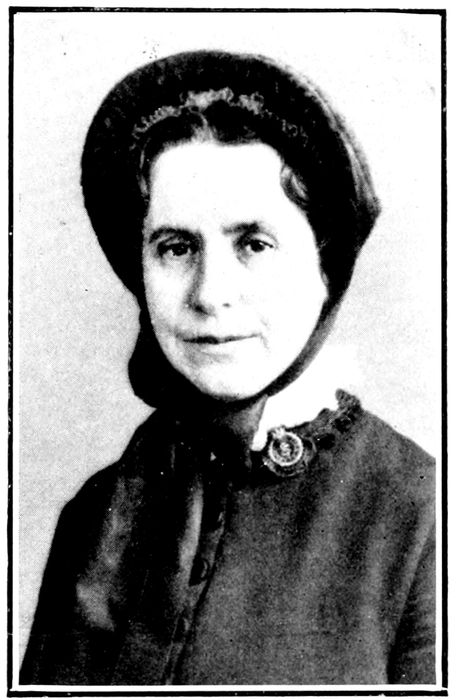
CATHERINE BOOTH, THE “MOTHER OF THE SALVATION ARMY.”
In England Mrs. Booth was the first woman preacher,
and if she had done nothing else but vindicate the right of
woman to speak in public and preach the Gospel, she would
have done great work. But she did far more than this. By
making her whole life, and every thought and action subservient
to the cause of the Salvation Army, she brought
comfort and happiness to many thousands of poor souls.
The work of this “Mother of the Army” was continued
by her daughter, Evangeline Booth, known in the history of
the organization as “The Commander”; by Emma Booth-Tucker,
known as “The Consul”; by Mrs. W. Branwell Booth,
“The General,” and by Elizabeth Swift Brengle, known as
“The Colonel.”
The first woman in the Christian world to be ecclesiastically
ordained was Antoinette Brown Blackwell, an American
186woman who had graduated from Oberlin, Ohio. She was
ordained in 1852 in South Butler, N. Y., by a council called
by the First Congregational Church. Rev. Olympia Brown
was the next woman ordained ten years later. In December,
1863, the Rev. Augusta J. Chapin was the first woman to
receive the title of Doctor of Divinity.
Since the ordination of these women the number of
female “clergymen” in the various denominations has increased
rapidly. According to the Census of 1910 their
number within the United States was 7395 in that year. The
success of woman in the pulpit is no longer a question but an
affirmation. This is what Rev. Phebe A. Hanford said on
the subject:
“Other things being equal, why may not a woman preach
and pray and perform pastoral duty as well as a man? Why
should she not preside at the Lord’s table, consecrate in
baptism the child whose parents would dedicate their choicest
possessions to God, or the adult who would thus express his
faith in Christ and his determination that “whatever others
may do he will serve the Lord”? When two loving hearts
desire to join hands and walk the earthly pathway side by
side, why should not a woman minister pronounce the sacred
formula and convey the sanction of the Law and the Gospel
to their matrimonial purpose? And when the voice of consolation
is sorely needed, and the solemn words are to be
spoken which consign the silent dust to its last resting-place,
why should not a womanly woman officiate as well as any
tender-hearted and eloquent man? Surely woman is proverbially
compassionate; and that she is often eloquent with voice
and pen, and with poetic expression and the fervor of truth
which can reach the heart, who can deny?”
187
It is hard to realize in these days of professional equality
between the sexes that only half a century ago a woman who
desired to study medicine was considered such a phenomenon
that her morality and the purity of her motives were questioned.
And yet this desire is only natural, as the life of
every woman has moments when she has to call for medical
help. There are especially the transition to womanhood, all
the experiences of motherhood, and the many ailments peculiar
to women. To be compelled to consult in these cases a male
physician, is for many bashful girls and women such a repellant
thought, that they quite often postpone it from week to week,
until too late.
No doubt such were the reasons and experiences which
caused Agnodice, an Athenian girl, born about 300 B. C., to
disguise her sex in order that she might study medicine. Like
Dr. Mary Walker in the 19th Century, she donned male attire
and became a disciple of Herophilus, an eminent physician
and anatomist of the Alexandrian School. Her specialty was
midwifery and women’s diseases, and when she started to
practice herself, she met with such great success that her male
colleagues became jealous and tried to prevent her from practicing
by accusing her of corruption before the Areopagus.
But the result of the proceedings was quite contrary to their
expectations, as a law was immediately passed allowing all
freeborn women to learn midwifery.
Since then female physicians practiced in Hellas as well
as in Alexandria and in Rome. And when in the 9th Century
after Christ the famous Schola Salernitana was established at
Salerno, a department for women’s diseases was included,
with a number of female professors as teachers. The names of
several of these professors are still known; the most noted was
the celebrated Tortula, who lived in the 11th Century. Abella,
Constanza, Calendas, and Hildegarde too have been praised
for their great ability.
This eminent position held by women in the medical
profession declined slowly after the 12th Century, and practically
disappeared after the 16th Century. The cause for this
relapse was undoubtedly the increasing hostility of the
Christian Church toward any occupation of women with
sciences. This prejudice remained alive up to modern times.
It was dominant in 1845 when a young American woman,
Elizabeth Blackwell, decided to study medicine. The same
motives as had moved the Athenian Agnodice and the loss
of a dear woman friend caused the young American to write
to various physicians asking as to the wisdom and possibility
of a woman becoming a doctor. The answers she received
188were unanimously to the effect that while the idea was a
valuable one it was impossible of accomplishment for many
reasons. This verdict only served to intensify her determination
to accomplish her purpose. After two years of private
study she went to Philadelphia, which in those days, 1847,
was considered the seat of medical learning in this country,
and made application to the four medical colleges for admission
as a regular student. But such a revolutionary idea was
not to be entertained, and all the doors remained closed to
her. One kindly Quaker adviser said to her: “Elizabeth, it
is of no use trying. Thee cannot gain admission to these
schools. Thee must go to Paris and don masculine attire to
gain the necessary knowledge.”
It had now become a moral crusade with Miss Blackwell,
and the justice and common sense of her undertaking seemed
so supreme that she determined to push the warfare to the
farthest limit. After similarly unsuccessful attempts in New
York, she obtained a complete list of all the smaller institutions
of the Northern States, examined their prospectuses, and sent
applications for admission to twelve of the most promising.
After long delay an answer came from the medical department
of the small university at Geneva, in the western part of New
York State. It seems that the faculty had submitted Miss
Blackwell’s letter to the medical class, who adopted the
following resolutions:
“Resolved—That one of the radical principles of a
republican government is the universal education of both
sexes; that to every branch of scientific education the door
should be open equally to all; that the application of Elizabeth
Blackwell to become a member of our class meets our entire
approbation; and in extending our unanimous invitation we
pledge ourselves that no conduct of ours shall cause her to
regret her attendance at this institution.”
Their gallantry won the day, the faculty cordially opened
the doors of the institution, and she began her studies there
at once.
Being the first female student in the small place her
appearance of course gave rise to many comments. Many
people looked at this new woman in wonder; some even
inclined to regard her as a lunatic, or a disorderly person.
But her behavior and seriousness compelled respect, and when
in 1849 she received her degree, the public press very generally
commented upon the event in favorable terms and even
in Europe some notice of it was taken. She found fewer
obstacles in her path in her studies abroad, especially in Paris.
After her return to America she began practice in New York
City, and here again she had to do pioneer work. The medical
fraternity stood aloof, refusing to consult with her, and society
189in general somewhat distrusted the innovation. But in time
her work received just recognition and the status of women
in the profession became fully established. In 1868 Dr.
Blackwell founded the “Woman’s Medical College of New
York.” The later years of her life were spent in England,
where she also did much in moulding public opinion along
the lines of philanthropy, especially in opening hospitals and
dispensaries for women and children.
A few years after Miss Blackwell had received her diploma,
another remarkable woman, Florence Nightingale, aroused
world-wide admiration by her noble service during the Crimean
war of 1853–56. Intensely devoted to the alleviation of suffering,
she had since 1849 paid great attention to the sanitary
conditions of civilian as well as military hospitals, which in
many cases she found rather poor. In 1851 she went into
training as a nurse, and when in 1853 war was declared with
Russia, and the hospitals on the Bosphorus were soon crowded
with the sick and wounded, she offered the English Government
to go out and organize a nursing department at Scutari.
Starting with a unit of thirty-seven nurses, she arrived at Constantinople
when the mortality in the hospitals had become
appalling. Seeing clearly the cause for this frightful state in
the bad sanitary arrangements of the hospitals, Miss Nightingale
devoted incessant labor to the removal of these causes,
as well as to the mitigation of their effects, with such success,
that in the English army the death-rate fell from 22¼% to
only 2¼%.
After her return to England, in 1856, the Government
as well as Queen Victoria and the public were not slow to
acknowledge her splendid services. While the Queen presented
her with a cross set with diamonds, the people subscribed a
fund of several hundred thousand dollars for the purpose of
enabling her to found an institution for the training of a
superior order of nurses in connection with the St. Thomas’s
and King’s College Hospitals. Miss Nightingale also enriched
the medical literature by two valuable books, “Notes on
Nursing” and “Notes on Hospitals,” in which she gave the
results of her lifelong observations.
The example of Miss Nightingale had much to do with
calling forth the exertions of American women during the Civil
War. As soon as there were wounded soldiers to heal, and
military hospitals to serve, the patriotic and benevolent women
of America remembered the great work of Florence Nightingale,
and hastened to the front. As A. W. Calhoun states in his
“Social History of the American Family,” by 1864 there were
busy in the North 250 women physicians. Women planned
and organized also the “U. S. Sanitary Commission,” for the
alleviation of the sufferings of the battlefield. Its pre-eminent
190utility was universally recognized. It caused likewise several
great charity fairs, the last two of which were held in New
York and Philadelphia and yielded $1,000,000 and $1,200,000
respectively.
Among the female physicians, who did service during
the Civil War, the most noteworthy was Dr. Mary E. Walker.
Having studied medicine at the Medical College in Syracuse,
N. Y., she was the first woman commissioned to serve on
the surgical staff of any army in time of war. On assuming
her duties as surgeon in the war, she found hospital efficiency
and hoopskirts incompatible; so she sacrificed the skirt and
donned a man’s coat and trousers. In recognition of her able
services Congress not only awarded her a Medal of Honor,
but also allowed her—the only instance in history—by a
special act to continue to wear male attire. Dr. Walker
declared many times that her sole reason for advocating dress
reform for women were hygienic ones. A real pioneer in
her profession, she also maintained for many years a farm
for sufferers from tuberculosis and carried on a school for
prevention of that disease modelled after a plan of her own.
Among the women, whose names appear in the history
of the Civil War, one of the most brilliant was Miss Clara
Barton. Devoting herself to the care of the wounded soldiers,
she won for herself as superintendent of the hospitals in the
army of the James the surname “the Florence Nightingale of
America.” During the Franco-Prussian War of 1870–71 she
joined the German branch of the Red Cross Society, that
noble institution, which in 1859 had been founded by Henry
Durant, a citizen of Geneva, Switzerland.
Inspired by the example of Miss Nightingale, and horrified
by the ghastly scenes of the Italian battlefields, he resolved
to work for the proper treatment and nursing of wounded
soldiers, while still on the ground. At his strong appeal the
Swiss Federal Council invited all European nations to a convention
in order to discuss proper steps to be taken in this
direction. Attended by delegates from Baden, Belgium, Denmark,
France, the Netherlands, Prussia, Switzerland and
Wurtemberg, the convention met on August 22, 1864, in
Geneva, and decided, that henceforth not only all places where
wounded soldiers are treated, but also all persons, engaged
in this samaritan service, should be regarded as neutrals and
distinguished by white flags or white bands showing a red
cross. Such places must not be attacked, but protected by
the soldiers of all combating armies.
In the further history and evolution of this international
Society of the Red Cross women have played a most prominent
part. Miss Barton established during the Franco-Prussian
War several military hospitals and, by conducting them,
191distinguished herself so that she was decorated with the Iron
Cross. After her return to the United States she organized
in 1882 the “American Red Cross Society,” of which she
became the first president. The work of Miss Barton and the
Red Cross in the Spanish-American War and the great help
given to the sufferers after the great tidal wave in Galveston,
Texas, caused the United States Senate and the Texas Legislature
to adopt resolutions of thanks.
All these great efforts of women could not fail to create
a most favorable impression toward woman’s activity in
medicine. In England an act of 1868 for the first time opened
the study of pharmacy to women; and after a long struggle
they obtained their footing as physicians. In 1874 a special
medical school was opened for women in London. In 1876
an act authorized every recognized medical body to open
its doors to women. In 1878 a supplemental charter enabled
the University of London to grant degrees to women in all
its faculties, including medicine. As a result up to the close
of 1895 264 women had been placed on the British register
as duly qualified medical practitioners.
In the United States similar progress was made.
According to the census of 1910, there were 7399
women physicians and surgeons in the United States.
Whereas fifty years ago there was great objection to
admitting women to the medical societies, now the men of
the profession welcome women physicians to the societies and
to their discussions, and are more than willing to consult with
them. The advantage of employing women physicians has
been recognized likewise by many hospitals, sanitariums and
insane asylums; the courts too recognize the justice of women’s
preferring women in the physical examination required by law.
There can be no doubt, that the 20th Century opens to
women physicians undreamed-of possibilities in science and
in the art of healing.
192
When in the year of our Lord 1869 American papers
reported that in Iowa a woman had been admitted to the
bar, most readers were inclined to regard this “bit of news”
as one of the many jokes, sprung occasionally upon credulous
people in order to warn them what the “new woman” might
be able to do. But in this case the “joke” turned out to be
a fact. And if people had been somewhat better acquainted
with their Bibles, they would have known that the woman
lawyer of Iowa was only another confirmation of Rabbi Ben
Akiba’s famous saying: “There is nothing new under the sun!”
Open your Bible and read in Chapter 4 of the Judges IV
about Deborah, the Joan of Arc of the Hebrews. Of this
most extraordinary woman recorded in Jewish history it is
stated that she was a prophetess as well as a judge, “to whom
the children of Israel came for judgment.”
The Greeks and Romans too had female lawyers. From
writers of the classic past we know that Aspasia pleaded causes
in the Athenian forum, and Amenia Sentia and Hortensia in
the Roman forum. And Valerius Maximus (Hist. lib. VIII,
Chapter 3) states that the right of Roman women to follow
the profession of advocate was taken away in consequence of
the obnoxious conduct of Caliphurnia, who, from “excess of
boldness” and “by reason of making the tribunals resound
with howlings uncommon in the forum,” was forbidden to
plead. The law, made to meet the especial case of Caliphurnia,
ultimately “under the influence of the anti-feministic tendencies”
of the period, was converted into a general one. In its
wording the law sets forth that the original reason for woman’s
exclusion “rested solely on the doings of said person.”
The “howlings of Caliphurnia” furnished the legislators
of all later periods with a welcome pretext to exclude women
from practice of the law, and it was not till 1869 that a
woman again obtained admission to the bar. This pioneer
was Miss Arabella A. Mansfield of Mount Pleasant, Iowa, who
was admitted to the Iowa bar in 1869, under the statute providing
only for admission of “white male citizens.”
The next female lawyer was Mrs. Belva Ann Lockwood,
a graduate of the Law School of the National University at
Washington, D. C. Having been admitted in 1873 to practice
before the Supreme Court of the District of Columbia, she
applied in October, 1876, for admission as practitioner of
the Supreme Court of the United States, but was rejected
under the following decision: “By the uniform practice of
the Court from its organization to the present time, and by
the fair construction of its rules, none but men are admitted
to practice before it as attorneys and counselors. This is in
193accordance with immemorial usage in England, and the law
and practice in all the States, until within a recent period;
and the Court does not feel called upon to make a change
until such a change is required by statute or a more extended
practice in the highest courts of the States.”
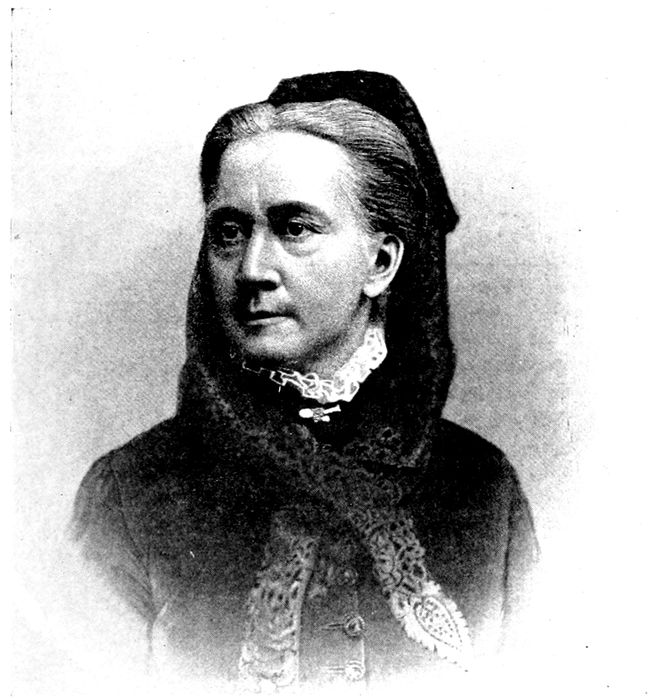
But if the members of the Supreme Court had entertained
the hope of scaring away women once and for all,
they soon enough found that they were mistaken. Mrs. Lockwood
drafted a bill and secured its passage in Congress,
providing “that any woman who shall have been a member
of the bar of the highest court of any State or Territory, or
of the Supreme Court of the District of Columbia, for the
space of three years, and shall have maintained a good
standing before such court, and who shall be a person of
good moral character, shall, on motion, and the production
of such record, be admitted to practice before the Supreme
Court of the United States.” This bill was approved on February
15th, 1879. Since then Mrs. Lockwood as well as a
194number of other female lawyers have been admitted under
this law to practice before the highest court of the United
States.
A “Woman’s International Bar Association” was organized
in 1888, for the purpose of establishing law schools for women
and of promoting the interests of female lawyers as well as
of securing better legal conditions for women.
According to the Census of 1910 there were 1010 woman
lawyers in the United States.
“Having taken up the law,” so said Miss Edith J. Griswold,
herself a counsellor-at-law, “woman will not rest until
she stands on a level with man, and the end of the Twentieth
Century will probably find an equilibrium in the United States
Government that can only be obtained (as in the home government)
by the equal balancing of the different propensities
of male and female mind in the making and enforcing of
laws. The prophecy that the time is coming when woman
will govern seems ludicrous, and yet it is no more ludicrous
than the present lopsided arrangement whereby man has the
exclusive power of government. With the rapid advance of
woman conditions are being manifested that require woman’s
judgment, and to obtain true justice in matters relating to
both sexes an equal number of men and women should compose
both the court and the jury. By the end of the Twentieth
Century, I believe, a woman’s judgment will carry as much
weight as a man’s, and the opinions handed down from our
higher courts will have to be concurred in by an equal number
of male and female judges.”

195
Sometimes, when the merits of the woman movement
were discussed, its opponents made it their trump that the
female sex is without any inventive spirit and that this want
should be regarded as a convincing evidence for the inferiority
of woman s mind. That this assertion was never true at all,
but made in absolute ignorance of the real facts, becomes
evident, when we recall, that primeval and aboriginal women
have been the inventors of our most important industries, of
agriculture, weaving, basketry, pottery, tannery, brewing, and
many other peaceful arts. And there is not the slightest doubt,
that during the times of Antiquity and the Middle Ages women
have been the greatest factor in the evolution of these industries,
in which they remained constantly busy.
Among the few instances of which records have been
preserved, is that of Barbara Uttmann, a German woman of
Annaberg, Saxony, who in 1561 invented the Cluny-lace.
Herewith she opened, for the extremely poor people of the
Erzgebirge, at the most critical time, a new and well paying
industry, in which in 1800 about 35,000 girls and women
were busy.
Another important invention was made in 1792 in America
by the widow of General Nathaniel Green. It was the
so-called cotton gin by which the difficult work to separate
the seed from the lint was greatly simplified. To pick the
seed from one pound of cotton had been formerly considered
a good day’s work. With the aid of the cotton gin, which
consists of a series of saws revolving between the interstices
of an iron bed upon which the cotton is placed so as to be
drawn through whilst the seeds are left behind, several
hundred pounds of cotton can be cleaned in the same time.
This invention stimulated enormously the cultivation of cotton
and the manufacture of cotton goods in America. In the
South, where so far cotton had been produced only in small
quantities, it now became the main product. While in 1792
the quantity exported from the United States was 138,324
pounds, it increased by the year 1800 to nearly 18,000,000
pounds. In the North it led to the establishment of cotton
mills and factories on a large scale.
As only few countries have taken the trouble to prepare
statistics about inventions made by women it is impossible to
give reliable facts about what women have contributed to
human culture in this line.
Their most intensive activity has been observed in the
196United States, especially since with the founding of woman’s
colleges and the opening of the universities, the education of
the female sex became a more careful and broader one.
The U. S. Patent Office at Washington, D. C., has published
“Lists of Women Inventors,” in three volumes, covering
the period from 1790 to March 1, 1895. From these lists
it appears that till 1849 only 32 inventions by women have
been registered at the Patent Office. This number increased
to 290 during the period from 1850 to 1870; during 1870–1890
to 2568, and up to 1910 to 7942. These numbers
prove that with the increase of woman’s knowledge and with
the closer contact with modern industrial life her inventive
spirit has likewise developed. Also the inventions became
more manifold. While prior to 1850 they were almost
exclusively confined to dress and household, they now cover
all fields of human activity.
This fact became most evident during the terrible years
of the World War. Some time ago the “Women Lawyer
Journal” reported that of all the many inventions registered
since 1914, fifty per cent. have been entered by women.
Among these inventions have been such for the better protection
of soldiers and aeronauts as well as for the greater
comfort of the wounded and crippled. Other inventions meant
improvement in wireless telegraphy, gas masks, submarine
boats and hundreds of other objects.
197
Just as hostile as had been the clergy to the admission of
women to ecclesiastical office, so unwilling were many prejudiced
scholars to admit women into the sacred realms of
science. By hundreds of arguments they tried to prove the
inability of women to do any deeply scientific work. They
explained that the hard study would impair their health, their
chances of marriage, and their true destination as mothers.
Higher education would make women unfit for domestic life,
and, besides, they would hardly produce anything of real
scientific value.
If these learned gentlemen would have taken the trouble
to make themselves somewhat more acquainted with the
history of science they would have found the names of
numerous women on record, who, at their time, were among
the leaders in the most abstruse sciences. Several centuries
before Christ Hellas as well as Rome had a number of brilliant
female philosophers, among them Damo, the daughter of
Pythagoras, who lived about 580–500 B. C. She was one of
his favorite disciples, and to her the great savant entrusted
all his writings, enjoining her not to make public all the
secrets of his philosophy. This command she strictly obeyed,
though tempted by large offers while she was struggling with
poverty.
Socrates, the great philosopher, declares that he learned
of a woman, Diotima, the “divine philosophy,” how to find
from corporeal beauty the beauty of the soul, the angelical
mind. Diotima lived in Greece, about 468 B. C.
Arete is known as the daughter of Aristippus of Cyrene,
the founder of the Cyrenaic system of philosophy, who
flourished about 380 B. C. She was carefully instructed by
her father, and after his death taught his system with great
success. Leontium, living about 350 B. C., was a disciple of
Epicure, and wrote in defense of his philosophy. Tymicha,
a Lacedaemonian, was the most celebrated female philosopher
of the Pythagorean school. When she, in 330 B. C., was
brought before Dionysius, the tyrant of Syracuse, as a prisoner,
he made her very advantageous offers, if she would reveal
the mysteries of Pythagorean science; but she rejected them
all with scorn and contempt. And when he threatened her
with torture, she instantly bit off her tongue, and spat it in
the tyrant’s face, to show him that no pain could make her
violate the pledge of secrecy.
Of Hipparchia, a lady of Thrace, who lived about 328
B. C., it is known that her attachment to learning was so great,
198that having attended several lectures of Crates, the cynic, she
resolved to marry him though he was old, ugly, and deformed.
She accompanied him everywhere to public entertainments
and other places, which was not customary with Greecian
women. She also wrote several philosophical theses, and
reasonings and questions proposed to Theodorus, the atheist;
but none of her writings are extant.
Ancient Rome too had a number of female philosophers,
among them Cornelia, “the mother of the Gracchi.” She
frequently gave public lectures and was more fortunate with
her disciples than with her sons. It was Cicero, who said of
her that, had she not been a woman, she would have deserved
the first place among philosophers. In what esteem she was
held is shown by the fact that a statue was erected to her
with the inscription, “Cornelia, Mater Gracchorum.” She died
about 230 B. C.
The most renowned female philosopher of the classic
times was Hypatia, the lovely daughter of Theon, the head
of the famous Alexandrian School in Alexandria, Egypt.
Born in 370 A. D., Hypatia was taught by her father and
acquired such extensive knowledge and learning, that the
Bycantine Church historian Socrates, as well as Nicephorus
placed her far above all the philosophers of her time. Several
other learned contemporaries praise her in similar terms.
Sinesius, bishop of Ptolemais, never mentions her without the
profoundest respect, and in terms of affection little short of
adoration. In a letter to his brother Euoptius he writes: “Salute
the most honored and the most beloved of God, the Philosopher
Hypatia, and that happy society, which enjoys the
blessing of her divine voice.” And in a long epistle he sends
her with the manuscript of a book, he asks her opinion and
states his resolution not to publish the book without her
approbation.
Hypatia succeeded her father in the government of the
Alexandrian School, teaching from the chair where Ammonius,
Hieracles, and other celebrated philosophers had taught; and
this at a time, when men of immense learning abounded in
Alexandria and in other parts of the Roman empire. In fact
her renown was so universally acknowledged, that she had
always a crowded auditorium. What a subject for an able
artist, to present this beautiful woman in her chair, with the
flower of all the youth of Africa, Asia and Europe sitting at
her feet, eagerly imbibing knowledge from this oracle of
wisdom.
Socrates states that she was consulted by the magistrates
of Alexandria in all important cases. This frequently brought
her among the greatest assemblages of men without causing
the least censure of her manners. “Considering the confidence
199and authority which she had acquired by her learning,” says
Socrates, “she sometimes came to the judges with singular
modesty. Nor was she anything abashed to appear thus
among a crowd of men; for all persons, by reason of her
extraordinary discretion, did at the same time both reverence
and admire her.”
Unfortunately this wonderful woman was to become a
martyr of science. The population of Alexandria was split
into three hostile groups—the Pagans, the Jews, and the
Christians. The latter, under the leadership of the patriarch
Cyril, assailed in violent zeal Jews as well as pagans, and
heretics or supposed heretics alike, driving them by thousands
from the city, destroying their synagogues and temples, and
pillaging their houses. It was during one of these riots, that
the illustrious Hypatia was attacked by a mob of vicious
monks, torn from her carriage, dragged into a church, stripped
naked and clubbed to death. Then the murderers in fanatic
frenzy tore the body to pieces, carried the limbs to a public
square and burnt them to ashes. This happened in Lent 415.
All the writings of Hypatia, among them her treatise “On
the Astronomical Canon of Diophantus” and another “On the
Conics of Apollonius” are lost. Most probably they too were
destroyed by the fanatic Christian mobs, who, after the murder
of Hypatia, extinguished the Greek School of philosophers
and scientists at Alexandria.—
Astronomy, probably the most ancient of the sciences,
has since early days exerted a singular attraction on women.
Herman Davis, in his essay “Women Astronomers,”
published in the reports of Columbia University, New York,
gives the names of a large number of women astronomers,
beginning with several of classic times. Of the Egyptians he
mentions Aganice, Athyrta, Berenice, Hipparchia and Occelo,
who were connected with the Alexandrian School. Of the
Greeks he names Aristocle and Athenais, and of Thessaly
Aglaonice. But nothing definite is known about their achievement.
Davis likewise gives an account of Hildegarde, abbess
of the monastery on Mount St. Rupert near Bingen on the
Rhine. This learned woman, who lived from 1099 to 1180,
wrote a book in Latin, in which some marvelous statements
are claimed to have been made: 1. that the Sun is in the
midst of the firmament retaining by its force the stars which
move around it; 2. that when it is cold in the Northern
hemisphere it is warm in the Southern, that the celestial
temperature may thus be in equilibrium; 3. that the stars not
only shine with unequal brilliancy but are themselves really
unequal in magnitude; 4. that as blood moves in the veins and
makes them pulsate, so do the stars move and send forth
200pulsations of light. “If even one-half of these marvelous statements
are found in Hildegarde’s writings as early as the 12th
Century,” says Davis, “then this woman may well be classed
with the great forerunners of modern astronomy, with Copernicus,
Galileo and Newton, for she was three centuries earlier
than the first of them.”
The first female astronomer of whom we have more
intimate information, was Marie Cunitz, born in 1610 as the
eldest daughter of a physician in Silesia. Commanding an
extraordinary general culture, her principal study was mathematics
and astronomy. Her tables, published under the title
“Urania Propitia, sive Tabulæ Astronomicæ,” gained for her
a great reputation, and the by-name “the Silesian Pallas.”
Dedicated to the Emperor Ferdinand III. the book was published
in Latin and in German in 1650 and 1651.
Another noted astronomer was Caroline Lucretia Herschel,
born in 1750 at Hanover, Germany. In 1772 she accompanied
her brother William to England, and when he accepted the
office of astronomer-royal, she became his constant assistant
in his observations. In this capacity she succeeded in discovering
independently eight comets, five of which had not
been observed before. Also she discovered many of the
small stellar nebulæ which were included in her brother’s
catalogue. For her many contributions to astronomy in 1835
she was presented by the Astronomical Society with their
gold medal, and was also elected an honorary member.
When the memoirs of Miss Herschel were published, the
editor, in describing her character, said: “Great men and
great causes have always some helper of whom the outside
world knows but little. These helpers and sustainers have
the same quality in common—absolute devotion and unwavering
faith in the individual or the cause. Seeking nothing
for themselves, thinking nothing of themselves, they have all
the intense power of sympathy, a noble love of giving themselves
for the service of others. Of this noble company of
unknown helpers Caroline Herschel was one.”—
This capacity of self-denial distinguished likewise a number
of other women, whose names are known in the history
of astronomy, as for instance Theresa and Madeline Manfredi,
the daughters of Eustachio Manfredi, from 1674 to 1739
director of the observatory of Bologna. Further, Marie Margarethe
Kirch, who assisted her husband, the astronomer Kirch,
in the upper Lausatia; Madame Lepante, the wife of the famous
clock-maker Jean Andre Lepante; and nearer our own time,
there is Maria Mitchell, born 1818 at Nantucket, Mass., who
at an early age became the assistant of her father. Carrying
on a series of independent observations, she was in 1865
appointed professor of astronomy in Vassar College.
201Emilie de Bréteuil, Antonie C. Asher, Elizabeth von Matt,
Wilhelmine Witte and Agnes Mary Clerke likewise distinguished
themselves in astronomy. The last named lady published in
1885 a “History of Astronomy” and in 1890 “The System of
the Stars.” These writings, conspicuous for a careful sifting and
due assimilation of facts, with a happy diction that is at the
same time both popular and scientific, place the author in
the foremost rank of writers on astronomy.—
As an eminent mathematician, linguist and philosopher
Maria Gaetana Agnesi is known to every student of science.
Born 1718 at Milan, she gave early indication of extraordinary
ability and devoted herself to the abstract sciences. In mathematics
she attained such consummate skill, that, when her
father, professor of mathematics at Bologna, died, the Pope
allowed her to succeed him. In this capacity she wrote her
famous work: “Instituzions Analitiche ad Uso Gioventu
Italiana,” which was published at Milan in 1748. Its first
volume treats of the analysis of finite quantities, and the
second of the analysis of infinitesimals. The able mathematician
John Colson, professor at the University of Cambridge,
considered this work so excellent, that he studied Italian in
order to translate it into English. Under the title “Analytical
Institutions” this translation was published in 1801, to do
honor to Maria Agnesi, and also to prove that women have
minds capable of comprehending the most abstruse studies.
Another female mathematician, Sophie Germain, born
in 1776 in Paris, won the grand prize, offered by the Institute
of France for the best memoir giving the mathematical theory
of elastic surfaces and comparing it with experience. This
question had come up in 1808. Great mathematicians were
not wanting in Paris at that time—Lagrange, Laplace, Poisson,
Fourier, and others, but none of them were inclined to tackle
the question. Lagrange, in fact, had said that it could not be
solved by any of the then known mathematical methods.
The offer was twice renewed by the Institute, and in 1816 the
prize was conferred upon Sophie Germain, who in 1808 as
well as in 1810 had made two unsuccessful attempts to solve
the difficult question. The same woman distinguished herself
by a number of other valuable papers and philosophical
writings.
In more recent years Sonja Kowalewska, a Russian, who
had studied mathematics at the universities of Berlin and
Goettingen, became famous as the winner of the Prix Bordin,
offered by the Academy of Paris. Later on, as a professor
of mathematics in Stockholm, she wrote a number of excellent
professional works, but died there in her fortieth year.
Among the British scientific writers of the 19th Century
the most famous was Mary Somerville, whom Laplace called
202the most learned woman of her age and the only woman
who understood his works. In translating his brilliant work
“Mécanique Celeste,” she greatly popularized its form. Its
publication in 1831 under the title of “The Mechanism of
the Heavens” at once made her famous. Her own works:
“Connections of Physical Science,” “Physical Geography”
and “Molecular and Microscopic Science” have been declared
masterworks, distinguished by a clear and crisp style, and the
underlying enthusiasm for the subject.
In the history of chemistry the name of Marie Curie will
be forever connected with the wonderful discovery of Radium
and Radio-activity. Born on November 7, 1867, at Warsaw
as Marja Sklodowska she came to Paris in 1888 and studied
at the Faculté des Sciences. In 1895 she married Professor
Pierre Curie and joined him in his chemical investigations.
It was in 1898 that she published a most valuable work on
metals in solution. Her investigations in collaboration with
her husband led to the discovery of two new bodies: Polonium
and Radium, which are found in certain minerals, especially
in pitch blende in a state of extreme solution; as a matter of
fact, to the extent only of a few decigrammes to the ton of
mineral for Radium, and much less in the case of Polonium.
The separation of these elements presented extreme difficulties.
Further investigations led to the observation of most
interesting phenomena in connection with these bodies—chemical
effects, luminous effects, effects of heating, etc. New
realms of science were disclosed—the science of Radio-active
phenomena. In recognition of these discoveries in 1903 the
Nobel Prize was awarded to Professor Curie and his wife.
And when Mrs. Curie, after the tragic death of her husband,
accomplished the “isolation” of Radium and also determined
its atomic weight, she was awarded the Nobel Prize for a
second time in 1911. At present Mrs. Curie is Director of
the Physico-Chemical Department of the University of Paris.
For valuable research work in bacteriology Dr. Rhoda
Erdmann, a former assistant of the famous professor Robert
Koch in Berlin, became most favorably known. Having published
several excellent treatises on the amoeba and protozoa,
she followed in 1913 a call to the Sheffield-Institute of Yale
University.
In the wide fields of archæology and ethnology likewise
several women have achieved remarkable results. Among
those scientists who devoted themselves to the study of
archæology and the ancient history of America the name of
Zelia Nuttall is well known. She is the author of many interesting
essays on the relics left by the Aztecs, Toltecs, and
Mayas. Science is also indebted to her for the so-called
“Codex Nuttall,” now preserved in the Peabody-Museum at
Cambridge, Mass.
203Another noteworthy ethnologist was Erminnie Adele
Smith, who, as compiler of the famous Iroquois-English Dictionary,
was distinguished by being elected the first woman
member of the New York Academy of Science.
Alice Cunningham Fletcher made most valuable investigations
about the religious and social conditions of several
Indian tribes of the Far West, especially of the Sioux, Omaha,
and Pawnee Indians. Her very exhaustive studies have been
published in the Annual Reports of the Bureau of American
Ethnology.
The same reports contain highly interesting papers by
Matilda Cox Stevenson and Tilly E. Stevenson about the mythology,
esoteric societies and sociology of the Zuni Indians.
Miss Elsie Clews Parsons in New York has published
valuable monographs about the folk-lore of the Pueblo
Indians and the Negroes of the Bahama Islands. A. M. Czaplicka,
Mary Kingsley, Barbara Freire-Marreco, Adele Breton,
Mrs. Jochelson-Brodsky, and Maria Tubino are likewise most
favorably known as writers on archæology and ethnology.
For a number of years Johanna Mestorf has held the
position of director of the Museum of Antiquities of Schleswig-Holstein.
Cornelia Horsford, the learned daughter of the late
Professor Eben Horsford of Cambridge, Mass., made great
efforts to settle many questions in regard to the early voyages
of discovery by the Norsemen to Greenland and Vinland. In
the pursuit of these studies she sent several scientific expeditions
to Iceland as well as to Greenland and published a number
of valuable essays, among them “Graves of the Northmen”;
“Dwellings of the Saga Time in Iceland, Greenland and Vinland”;
“Vinland and its Ruins”; and “Ruins of the Saga-Times.”
Anne Pratt is known as an able botanist. And Eleanor
Anne Ormerod has been hailed in England as “the Protector
of Agriculture,” as she organized the valuable “Annual Series
of Reports on Injurious Insects and Pests,” distributed by the
Government.
Among the explorers of the Dark Continent a Dutch
lady, Miss Alexandrine Tinné, created a sensation by her
daring journeys in the upper Nile regions. During her first
expedition, which lasted from 1861 to 1864, she penetrated
great stretches of unknown territory, and was the first to enter
the land of the Niam Niam. Several members of her expedition
died from the terrible hardships that had to be overcome.
After her return to Cairo Miss Tinné started in January, 1869,
on a still more hazardous expedition, which was to proceed
from Tripoli to Lake Tchad, and from there by way of Wadai,
Darfur, and Kordofan to the Upper Nile. But while her
204caravan was on the route from Murzuk to Rhat, the daring
explorer was murdered by her own escort.
An English lady, Florence Caroline Dixie, explored the
wilderness of Central Patagonia. Isabelle Bishop became
known for her extensive travels through Asia, and the masterful
descriptions of those countries she had traversed. Her
best work is “Korea and Her Neighbors.”
Therese, Princess of Bavaria, wrote several highly interesting
works about her extensive travels in Colombia, Ecuador,
Bolivia, Chile, and the tropical regions of Brazil. Cecilie
Seler, the wife of the famous archæologist Eduard Seler, is
the author of the valuable book “On Ancient Roads in Mexico
and Guatemala.”
While these examples—which might be increased by
many others—give ample proof of woman’s ability in regard
to scientific work, it must be stated, that, up to the middle of
the 19th Century, men did very little to encourage their
struggling sisters in this line of activity. Indeed, there are not
a few instances of strong disinclination on the part of statesmen
as well as of scientists, to smooth woman’s road to
higher education. Centuries passed before women succeeded
in gaining the right to follow their studies in colleges and
universities, a right they had enjoyed in Italy during the 10th
and 11th Centuries as well as during the Renaissance.
The first institution of modern times, that admitted
women on the same footing with men, was Oberlin College
in Ohio, founded in 1833 and open to all irrespective of sex
and color. The first woman who graduated here was Miss
Zerniah Porter, who in 1838 received her diploma in the
so-called literary course. The State universities of the West
that were founded later on all followed the example set by
Oberlin College and gradually the older ones adopted the
same policy, so that all over the West and South, where the
State university is a strong influence, these institutions are open
to women. Throughout these regions women’s education is
for this reason almost synonymous with co-education. In the
Eastern part of the United States, however, the private college
predominates, and there is a greater degree of separation.
But even here the restrictions are gradually being removed,
and most of the men’s colleges and universities admit women
to some departments with some restrictions, or have an affiliated
woman’s college.
America has also a number of independent colleges
exclusively for women. The best known among them are
Vassar College, at Poughkeepsie, New York, organized in
1861, with 1124 students and 144 teachers in 1918; Wellesley
College in Massachusetts, organized in 1875, and with 1612
students and 138 teachers in 1918; Bryn Mawr in Pennsylvania
205organized in 1880, and with 489 students and 63
teachers in 1918; Smith College at Northampton, Mass.
France began to open its universities to women in 1858;
England followed in 1864; Switzerland in 1866; Sweden in
1870; Denmark, Holland, Finland and India in 1875; Italy
and Belgium in 1876; Australia in 1878; Norway in 1884;
Iceland in 1886; Hungary in 1895; Austria in 1897; Prussia
in 1899, and Germany in 1900.
To-day no one clings any longer to the old prejudices
against the abilities of women. College education among
women has become so common as to attract little or no attention.
It is regarded as the essential training for intellectual,
professional and business life, and it is no longer an effort
to secure it, but rather to make it of the greatest possible
value to the students and to the community. As women do a
large proportion of the teaching in public schools as well as
in colleges for both sexes, the education of the citizens of
the 20th Century depends largely upon the opportunities
available to women in the past, present and future.—
As educators as well as founders of learned institutions
large numbers of women became most favorably known.
There was for instance Jeanne Louise Henriette Campan.
When the tempests of the French Revolution began to rage,
she held a position at the royal court as reader to the young
princesses. Thrown on her own resources after the dethronement
and execution of the King and the Queen she established
a school at Saint-Germain. The institution prospered, and
was patronized by Mme. Beauharnais, whose influence led
to the appointment of Mme. Campan as superintendent of
the Academy founded by Napoleon at Ecouen, for the education
of the daughters and sisters of members of the Legion
of Honor. While in this position Mme. Campan wrote a
treatise “De l’Education des Femmes.”
Emmy Hart Willard in 1823 founded Troy Female
Seminary at Troy, N. Y., over which she presided until 1838.
Mary Mason Lyon established in 1836 Mount Holyoke Female
Seminary, of which she was president until her death in 1849.
Elizabeth Palmer Peabody in Boston was largely instrumental
in introducing Froebel’s kindergarten system in the
United States. She likewise wrote a number of educational
works. In England Emily Anne Shireff was active as President
of the Froebel Society of England. Barbara Leigh Smith
Bodichon, who worked for the extension of university education
to women, aided in 1868 in establishing Girton College,
at Cambridge, England. Anne Jemima Clough founded in
1867 the North of England Council for Promoting the Higher
Education of Women, and in 1875 the Newnham College for
Women.
206The name of Sophie Smith is remembered as the founder
of Smith College at Northampton, Mass., the first woman’s
college in New England; the name of Annie N. Meyer as the
founder of Barnard College, the woman’s department of Columbia
University in New York.
Marie Montessori was the inventor of a new system of
teaching.
207
Reviewing the countless contributions women have made
to literature is a task that can be mastered only by devoting
to this subject several ponderous volumes. Whether such an
attempt has even been made we are unable to say. But the
theme is so attractive that I hope that some competent woman
author may be inspired to undertake this task. What more
beautiful mission could she have than to study and analyze
all the scattered evidences of brilliant intellect, rich in imagination,
deep emotion, power of expression, soaring enthusiasm,
scintillating wit, and profound sorrow, to be found in many
of the books written by women since the days of Sappho and
Erinna.
Only fragments remain of the beautiful odes, hymns and
love-songs produced by the poetesses of the classic past. But
that they inspired all Hellas and Rome we know from the
testimony of the foremost authors and critics of their time.
When Meleager of Gadara, the famous sophist and poet,
selected the choicest poems of his predecessors and wove
them into that delicious “Garland,” to be hung outside the
gate of the Gardens of the Hesperides, he did not forget
Sappho, because “though her flowers were few, they were
all roses.” And a critic, writing five hundred years after
Erinna’s death, speaks of still hearing her swan-note clear
above the jangling chatter of the jays, and of still thinking
those three hundred hexameter verses sung by this girl of
nineteen in “The Distaff” as lovely as the loveliest of Homer.
There is also a report, that Corinna, a native of Tanagra, in
Bœotia, won five times in poetical contests the prize in competition
with Pindar, the greatest lyric poet of Greece.
With greater kindness fate treated the works of Alphaizuli,
a Moorish poetess, who lived in Seville during the 8th
Century A. D. Of her, who was called “the Arabian Sappho,”
two volumes of excellent verses are preserved in the library
of the Escurial. Likewise Labana and Leela, two Moorish
poetesses, were famous throughout beautiful Andalusia during
the 10th and the 13th Century. Of Valada, the daughter of
the Moorish King Almostakeph, of Corduba, her contemporaries
report that she several times contended with scholars
noted for their eloquence and knowledge, and quite often
bore away the palm.
That such contests were held in great favor by learned
ladies, appears from the institution of those famous poetical
festivals known as “Jeux Floraux” or Floral Games. They
are said to have been established in the 11th or the 12th
208Century by a gay company of French minstrels, called “the
seven troubadours.” But in time they had become forgotten.
It is due to Clemence Isaure, a poetess born in 1464 at
Toulouse, that these festivals were renewed. Fixing the first
of May as the day of these Floral Games, she invited all poets
and poetesses to participate in peaceful contest, assigning as
prizes for the victors five different flowers, wrought in gold
and silver. There was an amaranth of gold for the best ode;
a silver violet for a poem of from sixty to one hundred
Alexandrine lines; a silver eglantine for the best prose composition;
a silver marigold for an elegy, and a silver lily for
a hymn.
These contests have been held in Toulouse through all
the centuries. They were recognized by the French Government
in 1694, and confirmed by letters-patent from the king.
Some twenty-five years ago they were likewise introduced
into Germany, and held first in Cologne.
The brilliant age of the Renaissance produced several
women writers and poets, whose works are still read. The
literary annals of Italy shine with such illustrious names as
Cassandra Fidelis, the Venetian; Veronica Gambara, of
Brescia; Lucia Bertana, of Bologna; Tarquenia Molza, of
Modena; Gaspara Stampa, of Padua; and the great Vittoria
Colonna, of Marino, whose sonnets as well as her beauty and
virtues were extolled by all contemporaries.
In Spain Marianne de Carbajal and Maria de Zayas,
during the 17th Century, the classic period of Spanish literature,
became the pride of their country.
In France Marguerite d’Angouleme wrote a delightful
book, “the Heptameron,” similar in plan to the famous
“Decamerone” by Boccaccio. In the middle of the 16th
Century Louise Labbé, known in French literature as “La belle
cordière,” produced her “Debat de Folie et d’Amour,” a work
full of wit, originality and beauty. Erasmus and La Fontaine
were both indebted to it; the former for the idea of “The
Praise of Folly,” and the latter for “L’Amour et la Folie.”
In truth, La Fontaine’s poem is only a versification of the
prose story of Louise Labbé.
Of the illustrious French women, who during the 16th,
17th and 18th Centuries made their “salons” the gathering-places
for men and women of letters, several became widely
known for their own poems and works of fiction. As for
instance Madeline de Scudéry, Anne de Seguier, Claudine de
Tencin, Madame de la Sabliére, Madeline de Souvré, and
Anne Dacier, of whom Voltaire said, that no woman ever
rendered greater services to literature.
209
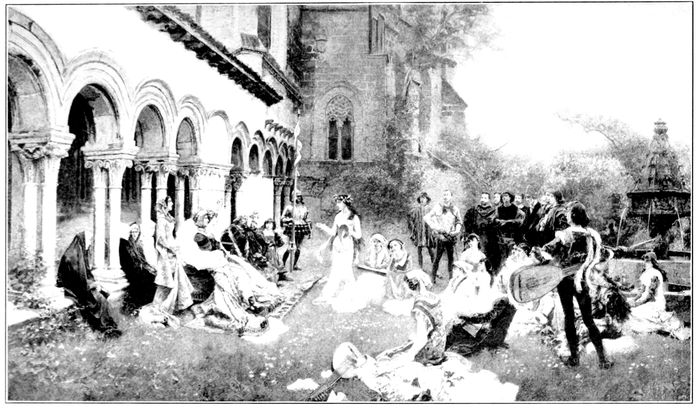
A FLORAL GAME DURING THE 14TH CENTURY.
After a painting by F. Padilla.
210In the literature of the 19th Century Anne Louise Germaine
Necker, Baroness de Stael-Holstein, held a singular
position. Many of her contemporaries exalted her as “the
founder of the romantic movement” who gave “ideas” to the
world. To-day she is almost forgotten, and her novels and
plays, among them “Corinne” and “Sophie and Jane Grey”
lie undisturbed and dusty on the library shelves.
Perhaps her most remarkable contribution to literature
was her book “L’Allemagne,” which was announced in 1810.
It gave a most intelligent exposition of the science, literature,
arts, philosophy, and other characteristics of the Germans,
gathered from the author’s own observations. The work,
written with a spirited independence, quite at variance with
the deadening political influence of Napoleon, irritated the
emperor to such a degree that he ordered the minister of police
to seize and destroy the whole edition of 10,000 copies.
Besides this he exiled the author from France. When, after
the overthrow of Napoleon, she returned to Paris, she had
her book printed again, and had the satisfaction of seeing it
eagerly read by millions of Frenchmen.
Of all French authoresses of the 19th Century Armantine
Lucile Aurore Dudevant, or “George Sand,” holds the
supreme rank. In the long line of her thoughtful, concentrated
and meditative novels “Valentine,” “Indiana,” “Lelia,” “Mauprat,”
and “Le Meunier d’ Angibault” are real gems of fiction,
whose influence can be traced in many later works by writers
of France and other nations.
Of her contemporaries Louise Révoil Colet, Eugenie de
Guérin, Pauline de la Ferronay Craven, and, above all, Delphine
de Girardin must be mentioned, whose “Letters Parisiennes”
as well as her poems, novels, dramas and comedies
belong to the most excellent productions of the 19th Century.
By her dramatic pieces “L’Ecole des Journalistes,” “Judith,”
“Cleopatra,” “C’est la faute du mari,” “Lady Tartufe,” and
others she reaped a wide popularity. In the literary society
of her time she exercised no small personal influence. Balzac,
Alfred de Musset, Gautier, and Victor Hugo were among the
frequenters of her salon.
Among the British woman writers of the latter part of
the 18th Century Jane Austen was the most distinguished.
Her novels “Sense and Sensibility,” “Pride and Prejudice,”
“Emma,” “Northanger Abbey” and “Persuasion” have been
likened to the carefully-executed paintings of the Dutch
masters for their charming pictures of quiet, natural life.
Ann Ward Radcliffe wrote three novels unsurpassed of
their kind in English literature: “The Romance of the Forest,”
“The Mysteries of Udolpho,” and “The Italian.” They are
distinguished for originality, ingenuity of plot, fertility of incident,
and skill in devising apparently supernatural occurrences
211capable of explanation by human agency and natural
coincidence.
Mary Russell Mitford edited several volumes of sketches
of rural character and scenery, delightful and finished in style,
and unrivalled in her manner of description. It is by these
sketches of English life that she obtained the greatest share
of her popularity. She wrote also an opera called “Sadak
and Kalasrade,” and four tragedies, “Julian,” “Foscari,”
“Rienzi,” and “Charles the First.” All were successful;
“Rienzi,” in particular, long continued a favorite.
Elizabeth Inchbald’s two novels “The Simple Story” and
“Nature and Art,” have long ranked among standard works.
Besides novels she wrote a number of dramas, some of which
were very successful.
Maria Edgeworth published a new work almost every
year from the beginning of the 19th Century to 1825. The
novels “Castle Rackrent,” “Belinda,” “Vivian.” “Harrington
and Ormond,” and many others followed each other rapidly,
and all were welcomed and approved by the public. Her best
and last work of fiction, “Helen,” appeared in 1834.
Mary Shelley, the wife of the famous poet Percy Shelley,
is renowned as the author of the romances “Frankenstein,”
“Valperga, or the Life and Adventures of Castruccio, Prince
of Lucca”; “Falkner”; “Lodore,” and “The Fortunes of Perkin
Warbeck.” A most peculiar work is “The Last Men,” a fiction
of the final agonies of human society owing to the universal
spread of pestilence.
Among the dramatists of the 19th Century Joanna Baillie
was the foremost. In her “Plays of Passion” she illustrates
each of the deepest and strongest passions of the human mind,
such as Hate, Love, Jealousy, Fear, by a tragedy and a
comedy. Other dramas were “The Family Legend”; “Henriquez”;
“The Separation,” and other plays, which show remarkable
power of analysis, and observation. They are all written
in vigorous style.
Of the numerous novelists of the 19th Century Charlotte
Bronté was received with universal delight. Her novels “Jane
Eyre,” “Shirley” and “Villette” have all the vigor and individuality
of poetic genius. She was “a star-like soul, whose
genius followed no tradition and left no successors.”
Elizabeth Cleghorn Gaskell will be remembered for her
intensely interesting books “Mary Barton,” “North and South,”
the exquisitely humorous “Cranford,” and “Cousin Phyllis,”
which has been fitly called an idyll in prose.
The prolific Catherine Grace Gore gives in the novels
“The Banker’s Wife,” “Cecil, or the Adventures of a Coxcomb,”
“Greville,” and “Ormington,” masterful pictures of
the life and pursuits of the English upper classes.
212Caroline Elizabeth Norton, after having given in her novel
“The Undying One” a version of the legend of the Wandering
Jew, became in her book “A voice from the Factories” a
most eloquent priestess of reforms. She condemned especially
child labor, the darkest blot on the social conditions of England.
In the middle of the 19th Century Mary A. Evans became
famous under her nom de plume “George Eliot.” Having
translated in 1844 David Strauss’ brilliant work “Das Leben
Jesu,” and Spinoza’s “Ethics,” she published in 1858 her novel
“Adam Bede,” which placed her at once in the front rank
of modern authors. Her later novels “The Mill on the Floss,”
“Silas Marner,” “Romola” and “Felix Holt” proved so many
contributions to her fame.
In recent times the works of Mary Edgeworth, Charlotte
R. Lenox, Anne M. Fielding Hall, Mary Braddon, Elizabeth
Sheppard, Louise de la Ramée (Ouida), Matilde Blind, Anna
Seward and Charlotte M. Younge have won much appreciation.
Of the woman-authors born in Scotland, Margaret Oliphant
wrote “Chronicles of Carlingford” and the charming novels
“Merkland”; “The Quiet Heart”; “Zaidee,” all of which are
exquisite delineations of Scottish life and character. Another
Scottish woman-author deserving of mention is Mary Ferrier,
whose novels “Marriage,” “The Inheritance,” and “Destiny”
breathe much originality and humor.
Of the Irish novelists Julia Kavanagh and Margaret Hamilton
Hungerford must be mentioned, the former for her
volumes “French Women of Letters”; and “English Women
of Letters,” as well as for her novels “Adele”; “The Pearl
Fountain”; “Sibyl’s Second Love”; and “Daisy Burns.” Marg.
Hungerford’s novel “Molly Brown” has been much admired.
Mary Augusta Ward, born in Tasmania, became favorably
known through her principal novel “Robert Elsmere,” which
delineates effectively the modern spiritual unrest and attempts
to proclaim an ideal religion.
Another noteworthy author of Tasmania is Louisa Anne
Meredith.
England has of course also a long roll of able poetesses,
among them Sarah Flower Adams, who wrote the beautiful
hymn “Nearer, My God, to Thee.” Alison Cockburn, Anne
Barnard and Caroline Oliphant are the authors of many fine
Scotch songs and ballads, among them the famous poems
“Flowers of the Forest” and “Auld Robin Gray.”
In recognition of the grace and delicacy of her lyrics
Elizabeth Barrett Browning has been called “the most distinguished
poet of her sex that England ever produced,” but
at the same time “the most unreadable.” Her fame rests
213chiefly on her “Drama of Exile,” the “Casa Guidi Windows,”
and “Aurora Leigh.” The latter is a social epic, which contains
many noble passages that give evidence of great originality
and power.
Sarah Coleridge has been much admired for the gracefulness
and the beautiful language of her poems “Phantasmion,
a Fairy Tale”; “Sylvan Stay,” and “One Face Alone.”
The poems of Felicia Hemans have been the result of a
fine imagination and temperament, and of a life spent in
romantic seclusion. Many of them, as for instance “Homes of
England,” “The Treasures of the Deep,” “The Better Land,”
and “The Wreck” rank among the best ever produced.
Adelaide Ann Proctor, Catherine Fowler Philips, Christina
Rosetti, Mary Blackford Tighe, and Caroline Oliphant have
been the authoresses of many poems, still cherished for their
beauty and nobility of thought.
The United Kingdom has also several woman historians,
among them Catharine Macaulay, whose “History of England,”
in six volumes, appeared in 1763.
The love and reverence she was taught from childhood
to cherish for the queens of her country induced Miss Agnes
Strickland, of Roydon Hall, Suffolk, to write her great work
“The Lives of the Queens of England.” Its twelve volumes
appeared at intervals from 1840 till 1848. In 1850 she began
to publish a similar series about the “Lives of the Queens of
Scotland,” completing it in eight volumes in 1859. Unresting
in her industry, she wrote likewise “The Lives of the Last
Four Stuart Princesses,” published in 1872.
Harriet Martineau too deserves an honorable place among
English women of letters. Her series of tales designed as
“Illustrations of Political Economy” and “Illustrations of
Taxation” brought her at once into great prominence. Later
on she produced an amazing quantity of works, relating to
the laws of man’s nature and development, mesmerism,
travel, and other subjects.
In American literature woman’s activity began with
Anne Bradstreet, the daughter of Governor Bradstreet of
Massachusetts. To him she dedicated the first volume of poetry
published on the Western hemisphere. Printed in 1642, it
had the somewhat verbose title: “Several Poems, compiled
with great variety of wit and learning, full of delight; wherein
especially is contained a complete discourse and description
of the four elements, constitutions, ages of man, seasons of
the year, together with an exact epitome of the three first
monarchies, viz.: the Assyrian, Persian, Greecian, and Roman
Commonwealth, from the beginning to the end of their last
king, with divers other pleasant and serious poems. By a
214Gentlewoman of New England.” Three editions of this collection
appeared.
Of several poems, directed to her husband, we give the
following lines:
“If ever two were one, then surely we;
If ever man were loved by wife, then thee;
If ever wife were happy in a man,
Compare with me, ye women, if ye can!”
Hannah Adams, born in 1755, was the first American
woman who made literature her profession. Interested in
religious controversy she compiled a “View of Religions,” in
three parts. After that she wrote “Evidences of Christianity,”
a “History of the Jews,” and a “History of New England.”
As far as pecuniary matters went, she was, however, singularly
unsuccessful, probably from her want of knowledge of business,
and ignorance in worldly matters. At the time when she was
engaged in compiling her books, so rare were woman-writers
in America, that she was looked upon as one of the wonders
of her age.
In 1790 appeared a novel, “Charlotte Temple,” a story
of love, betrayal, and desertion, by Mrs. Susanna Haswell
Rowson, a book of which more than a hundred editions are
known.
With the beginning of the 19th Century the number of
American authoresses increased rapidly. Catharine and Susan
Sedgwick wrote their “New England Tales,” which were
received with such favor, that Catharine in 1824 published
a novel in two volumes, entitled “Redwood,” a work which
met with great success, was republished in England, and translated
into French and Italian. It was followed by a large
number of other novels, which were greatly appreciated for
their purity of language and grace of style.
Somewhat later Lydia Maria Child developed as one of
the first and foremost progressive writers. Having commenced
her literary life with “Hobomok, a Story of the Pilgrims,”
she later on devoted herself to the cause of woman and the
abolition of slavery. She wrote a “History of Woman,” which
was followed in 1833 by a strong “Appeal for that Class of
Americans Called Africans,” the first anti-slavery work ever
printed in book form in America. In 1841 she moved to New
York and assisted her husband in editing “The National Anti-Slavery
Standard.”
As is very generally known, her contemporary, Harriet
Beecher Stowe, too, was interested in the question of abolition.
In 1850 she wrote for the “National Era,” an anti-slavery
paper, a serial entitled “Uncle Tom’s Cabin.” When this
215novel was republished in book form it met with tremendous
success. In the United States between 300,000 and 400,000
copies were sold within three years, and the printing press
had to run day in and out to meet the demand. In Europe
the book was devoured with the same deep interest. There
are thirty-five different editions in English, and translations
in at least twenty different languages. As the novel was also
dramatized in various forms, it became a great factor in the
abolishment of slavery.
Of the later stories by Mrs. Stowe “The Minister’s
Wooing,” a tale of New England life in the latter part of the
18th Century, has been pronounced to be her best. But her
reputation, while it lasts, will rest chiefly upon “Uncle Tom’s
Cabin.”
Sarah Margaret Fuller too belongs to those authors who
espoused the cause of woman’s rights. In “The Dial,” a little
quarterly journal, the organ of the transcendentalists and of
the famous community at Brook Farm, she first published
“The Great Lawsuit.” It formed the nucleus of a larger
volume entitled “Woman in the Nineteenth Century.” Far
in advance of the ideas of her times, it is with its noble
sentiments and valuable hints a spirited plea for the rights of
the female sex.
Elizabeth Ellet is favorably known for her valuable work
“The Women of the American Revolution,” published in 1848
in three volumes. It was followed in 1850 by the “Domestic
History of the American Revolution,” designed to give an
inside view into the spirit of that period, and to describe the
social and domestic conditions of the colonists and their feelings
during the war.
Ann Sophia Stephens, and Emma D. Southworth were
likewise immensely popular fiction writers during the first
half of the 19th Century. So was Maria S. Cummins, who
in “The Lamplighter” achieved a success comparable to that
of Mrs. Stowe’s “Uncle Tom.”
The many short stories and novels of Mary Virginia
Terhune, who wrote under the pseudonym of Marion Harland;
the romances of Harriet Prescott Spofford, Miriam Coles
Harris, Elizabeth Barstow Stoddard, and Adeline Whitney,
are now almost forgotten. Also the novels of Lydia Sigourney
of Norwich, Connecticut, who holds the record of being one
of the most prolific female writers in America. She produced
not less than fifty-seven volumes, among them “Letters to
Mothers”; “Water-Drops,” a contribution to the temperance-cause;
“Pleasant Memories in Pleasant Lands”; “Pocahontas”;
and “Traits of the Aborigines of America,” a descriptive poem
in five cantos.
Elizabeth Stuart Phelps enjoyed with her “Sunny Side”
216and other tales a phenomenal success. Her daughter, Elizabeth
Stuart Phelps Ward, was in her time regarded as the greatest
American woman novelist, who has most influenced the
women of the United States. “The Silent Partner”; “Hedged
In”; “Dr. Zay”; “The Story of Avis” as almost all other stories
of the Phelps are laid in New England and exquisitely describe
its nature, past, and present conditions.
Jane Goodwin Austin, Rose Terry Cooke, Annie Trumbull
Slosson, Clara Louise Burnham, Alice Brown and Mary
E. Wilkins Freeman belong also to the woman-authors whose
works deal with colonial and present-day life in the New
England States.
Of the woman-authors, who realized the possibilities of
the romantic life and history of the early settlers and pioneers,
Mary Johnston and Mary Hartwell Catherwood were the most
successful. To the former we are indebted for the romances
“Prisoners of Hope,” and “To Have and to Hold”; to the
latter for the novels “The Lady of Fort St. John,” “The White
Islander,” “Old Kaskaskia,” “Lazarre” and others.
Under the pen name of Charles Egbert Craddock Mary
Noailles Murfree published a series of highly interesting short
stories “In the Tennessee Mountains.” Displaying an intimate
knowledge of the mountaineers of Eastern Tennessee, and
full of life, these stories attracted at once wide attention.
They were followed later on by a large number of other
novels, of which “The Prophet of the Great Smoky Mountains,”
“In the Clouds,” “The Frontiersmen” and “The Storm
Centre” have secured to Miss Murfree a place of honor among
present-day writers.
Alice French under her well-known pen name Octave
Thanet sketched in her short stories life in Iowa and Arkansas;
Ruth McEnery Stuart wrote amusing stories of negro life in
Louisiana.
Gertrude Franklin Atherton achieved a wide reputation
with her charming romances of early Californian life, among
which “The Doomswoman” and “The Californians” are the
most remarkable. Of her later novels “The Conqueror” and
“A Whirl Asunder” need to be mentioned.
Mary Hallock Foote, having likewise studied the conditions
of the Far West, in her admirable stories “The Led-Horse
Claim,” “Cœur d’Alene,” and “The Chosen Valley”
carries the reader into the romance of Western mining camps
and of the virgin wilderness.
Helen Hunt Jackson, whose literary productions, over
the signature “H. H.,” began to attract attention about 1870,
offered a truly native flower to American literature in her
poetic book “Ramona.” Intensely alive and involving the
reader in its movement, it yet contains an idyl of singular
217loveliness. “Ramona,” says Helen J. Cone in an essay about
American literature, “stands as the most finished, though not
the most striking, example that what American women have
done notably in literature they have done nobly.”
The various works of Constance Fenimore Woolson,
a grand-niece of Fenimore Cooper, also enjoyed general
approval. In her best known novels: “East Angels,” “Jupiter
Lights,” and “Horace Chase” she attained a high standard
of excellence.
Frances Hodgson Burnett created in her book “Through
One Administration” a pathetic story of the intricate political
life in Washington. Furthermore she gave in “Louisiana” and
in “The Pretty Sister of José” charming pictures of Southern
conditions.
Mrs. Burton N. Harrison and Edith Wharton delighted
their many readers with highly interesting novels and short
stories of New York City Life, full of local color. Of the
former author’s works “The Anglomaniacs,” “Golden Rod,”
and “The Circle of a Century” show her great skill in the
dialogue. Of the many novels and short stories of Miss
Wharton “The House of Mirth,”, “The Greater Inclination,”
“Sanctuary,” and “Crucial Instances” are perhaps the best.
Among the American novelists of our present days
Margaret Deland is without question one of the most popular.
Her novels “John Ward,” “Sidney,” “Tommy Dove,” “Philip
and His Wife,” “The Wisdom of Fools,” “Dr. Lavendar’s
People,” and “The Awakening of Helen Richie” rank among
the best in American fiction.
The literary work of Anna Katherine Green, Kate Douglas
Wiggins, Molly Elliot Seawell, Ellen Glasgow, Mary Shipman
Andrews, Leona Dalrymple, Margaret Sherwood, and many
other woman authors, excellent as much as it is, can only be
referred to summarily.
To enrol the names of those American women who since
the days of Anne Bradstreet have expressed their thoughts
and emotions in poetry, would be a task far exceeding the
limits of this volume. Confining ourselves to the most noteworthy,
we mention first the sisters Alice and Phœbe Cary.
Among their many splendid poems and novels “Hualco, a
Romance of the Golden Age of Tezcuco,” is founded upon
adventures of a young Mexican chief, as related by several
Spanish historians of the time of the conquest. Of Alice
Cary exist several hymns, one of which is almost a classic
in the purity of its sentiment.
The poetic spirit of Julia Ward Howe found expression
in “Passion Flowers” (1854) and “Lyrics” (1866). Her
most memorable poem is the “Battle Hymn of the Republic,”
which breathes fervent patriotism and gives expression to the
deep moral purpose of the Civil War.
218The poetry of Helen Jackson unquestionably takes rank
above that of any American woman. Emerson rated it above
that of almost all American men. Her works include simple
poetry of domestic life as well as love-poems of extraordinary
intensity and imaginative fullness, furthermore, verses showing
most intimate sympathy with external nature; and lastly, a
few poems of the highest dignity and melody in the nature
of odes, such as “A Christmas Symphony” and “A Funeral
March.”
The numerous lyrics of Elizabeth Oakes Smith, E. O.
Kinney, Frances S. Osgood, Anne L. Botta, Sarah Helen
Whitman, Maria Lowell, Harriet W. Sewall, Emily Judson
and many other women poets of the last half century show
a development corresponding to that traceable in the field
of American fiction.
In recent times a large number of gifted women have
contributed to the general chorus new notes of unusual
strength and beauty. Many names deserve a place upon the
honor roll; among them Margaret J. Preston, Elizabeth Allen,
Julia Dorr, Mary E. Bradley, Nora Perry, Mary C. Hudson,
Margaret Sangster, Charlotte Bates, May Riley Smith, Edna
Dean Proctor, Elizabeth Stuart Phelps, Alice Wellington Rollins,
Edith Thomas, Emma Lazarus, Kate Osgood, and Ella
Wheeler Wilcox.
In other branches of literature, to which comparatively
few women have chosen to devote themselves, as for instance
in history, several American women have shown remarkable
talent and thoroughness.
First among these historians stands Mrs. Mercy Otis
Warren, the same who with Mrs. Abigail Smith Adams, the
wife of President John Adams, shared the belief that the
Declaration of Independence should consider not the freedom
of man alone, but that of woman also. Having warmly
entered the contest between England and America, Mrs.
Warren had corresponded with many of the leading men of
the time; these often consulted her, and acknowledged the
soundness of her judgment on many of the important events
before and after the war. The most valuable of her writings
appeared in 1805, under the title “The History of the Rise,
Progress, and Termination of the American Revolution, interspersed
with Biographical, Political, and Moral Observations.”
The three volumes of this work, dedicated to George Washington,
are valuable as a true record of the events and feelings
of those great times.
To Martha Lamb the citizens of the metropolis on the
Hudson River are indebted for a comprehensive “History
of New York City.” Agnes Laut penned a series of articles
about the discovery of the farthest Northwest. Ellen Mackay
219Hutchinson compiled with Edmund Clarence Stedman “A
Library of American Literature,” which in 1888 appeared in
ten volumes; it shows excellent judgment, knowledge and
care. Ida Tarbell produced among many other works a “Life
of Abraham Lincoln” and an exceedingly interesting “History
of the Standard Oil Company.” Katherine Coman published
the “Industrial History of the United States.”
“A Century of Dishonor” is the title of a sensational
book, written by Helen Hunt Jackson, and published in 1881.
During her extensive travels in the Far West the author became
deeply interested in the much maltreated Indians. Disgusted
by the shameless robberies and lawless acts committed by
many Indian Agents on the reservations, Mrs. Jackson wrote
her book, which is one of the strongest indictments ever
directed against the Government. Through this volume she
succeeded in doing much to ameliorate the unfortunate conditions
of the Red Race.
Mrs. John A. Logan compiled a valuable volume, entitled
“The Part taken by Women in American History.”
Woman’s status in the laws of the forty-eight states
belonging to the United States of America has been treated
by Rose Falls Bres in the valuable book “The Law and the
Woman,” published in 1917 at New York.
The great movement for Women Suffrage found of
course likewise its historians. Four of the most prominent
leaders and best authorities: Elizabeth Cady Stanton, Susan
B. Anthony, Matilda Joslyn Gage, and Ida Husted Harper
combined for the difficult task of collecting, sifting, and putting
together the immense mass of material. Their “History
of Woman Suffrage,” published in five huge volumes, is not
only a noble record, but at the same time a magnificent monument
to women’s courage, indefatigability and perseverance.
A considerable number of women have also contributed
to the literature about suffrage, social culture, labor questions,
and kindred subjects. Anna G. Spencer produced the book
“Woman’s Share in Social Culture”; Charlotte P. Gilman
devoted a volume to “Home” and a second volume to “Woman
and Economics”; Alice M. Earle described “Childlife in
Colonial Times”; Ellen Key gave a study of “Love and Marriage”;
Mary Eastman published “Woman’s Work in America”;
Olive Schreiner wrote “Woman and Labor,” and Elisabeth
Butler “Woman in the Trades.” To Jane Addams the
world is indebted for several well written works, among them:
“Democracy and Social Ethics”; “The Spirit of Youth”; “An
Ancient Evil and a New Conscience,” and “New Ideals of
Peace.” She gave a record of her great settlement work in
Chicago in her delightful book “Twenty Years at Hull House.”
220For many centuries the Germans have been known as
great writers, poets and philosophers. Perhaps no other nation
has contributed so much to the world’s literature. Before the
unfortunate year of 1914 the annual output of Germany in
works of science, art, philosophy, technics and fiction far
surpassed that of any other country, even that of France,
Great Britain and America combined.
In these contributions German women have a conspicuous
share. Their great interest in this line of activity can be
traced back to the early days of the Middle Ages, when nuns
like Hroswitha glorified the deeds of great emperors, or, like
the Abbess of Hohenburg, undertook the bold enterprise of
compiling a cyclopædia of general knowledge.
Germany had also the first periodicals for women, the
earliest dating back to 1644, much read and patronized by
the members of the gentle sex. Its title “Frauenzimmer-Gesprächspiele”
(“Playful discussion for ladies”) indicates
that it was devoted exclusively to matters of the “eternal
feminine.”
A similar periodical was “Die vernünftigen Tadlerinnen”
(“The reasonable fault-finders”), edited by Johann Christoph
Gottsched, professor of philosophy and poetry at the University
at Leipzig. The most faithful of his assistants and
collaborators was his wife, known in German literature as
Louise Adelgunde Gottschedin. To the “Deutsche Schaubühne,”
likewise published by her husband, she contributed
several translations of French Dramas and five comedies of
her own, which are still of interest as they illustrate the manners
of the time, the middle of the 18th Century.
Meta Moller, the wife of the famous poet Klopstock,
Friedericke C. Neuber, and Rahel Levin, the wife of the
historian Varnhagen von Ense, made similar use of their great
literary abilities. The salon of Mrs. Varnhagen in Berlin from
1814 to 1830 was the meeting place for the most celebrated
intellects of Germany, among them Humboldt, Fichte, Schleiermacher,
von Kleist, and Heinrich Heine.
The great poetess Annette von Droste-Hülshoff (1797–1848)
wrote a most powerful novel, “Die Judenbuche”,
which is based on the belief that murderers are forced by a
mysterious power to return to the scene of their crimes.
The prolific but now almost forgotten writers Karoline
Pichler, Henriette Paalzow, Otilie Wildermut, Countess Ida
Hahn-Hahn, Fanny Lewald and Louise Mühlbach were followed
in the second part of the 19th Century by Eugenie
John, better known under her nom de plume Marlitt. Her
novels “Das Geheimniss der alten Mamsell” (“Old Mamselle’s
Secret”), “Heideprinzesschen” (“The Princess of the Moor”),
“Gold Else” (“Gold Elsie”) and others met with tremendous
221success and have been in translations also enjoyed by many
English and American readers.
With like enthusiasm the women of Germany read the
novels of Wilhelmine Heimburg, Louise von Francois (“Die
letzte Reckenburgerin”) and Marie von Ebner-Eschenbach.
The latter is regarded as the greatest of all modern novelists
of Germany, Paul Heyse not excepted. When the University
in Vienna bestowed upon her the degree of Doctor phil.
honoris causa, the enormous body of her readers heartily
rejoiced. Her most famous novel is “Das Gemeindekind”
(“The child of the Parish”). She also published a volume
of “Aphorisms.”
Wilhelmine von Hillern’s once much read novel “Die
Geierwally” has been surpassed by far more valuable works
of Ilse Frapan, Ida Boy-Ed, Helene Pichler, Margarete von
Bülow, Bianca Bobertag, Ossip Schubin, Helene Böhlau,
Emma Vely, Emmy von Dinklage, Dora Dunker, Marie von
Bunsen, Sophie Junghans, Louise Westkirch, Clara Blüthgen,
Olga Wohlbrück, Carry Brachvogel and a number of other
modern writers.
Among them Enrica von Handel-Mazetti and Ricarda
Huch are distinguished by their great ability in drawing strong
characters as well as deeply affecting situations. The first
of the two authors transports her readers in the two novels
“Meinrad Helmpergers denkwürdiges Jahr” and “Jesse und
Maria” to the turbulent times of the 17th and 18th Centuries,
when a superstitious world was upset by cruel warfare between
Catholics and Protestants. Ricarda Huch created works of
equal value in the novels “Erinnerungen von Ludolf Urslen
dem Jüngeren” (“Reminiscences of Ludolf Urslen, Junior”),
“Aus der Triumphgasse” (“From the Alley of Triumph”)
and “The Verteidigung Roms” (“The Defense of Rome”).
Elizabeth von Heyking carried the reader to the more
recent times of the Chinese Boxer War with her admirable
novel “Briefe die ihn nicht erreichten” (“Letters he did not
get”).
Clara Viebig belongs likewise to the great novelists of
modern times. Having manifested in her first collection of
short stories, “Kinder der Eifel” (“Children of the Eifel
Plateau”), a most extraordinary gift of observation and
description, she brought this talent to full development in
her splendid novels “Rheinlandstoechter” (“Daughters of the
Rhein”), “Das schlafende Heer” (“The sleeping army”) and
“Absolve te.”
Gabriele Reuter treated in her novels “Aus guter Familie”
(“Of good family”), “Frau Bürgelin und ihre Söhne,” “Ellen
von der Weiden,” and “Liselotte von Reckling” various phases
of the woman’s question. In the first book she protests against
222the injustice created by custom and tradition, which allows
men to propose, while women are condemned to remain silent.
Finally we must mention the noble woman who, most
intensely realizing the deep longing of mankind for peace,
with her famous book “Die Waffen nieder!” (“Lay down your
arms!”) exerted probably the greatest influence any author
ever had through a single volume: the Austrian Bertha von
Suttner. The powerful appeal of this great book, which was
translated into more than twenty different languages, led
Alfred B. Nobel, a rich Swedish scientist and the inventor
of dynamite, to bequeath the annual interest of his great
fortune to whoever has contributed most to the peaceful
progress of mankind during the year immediately preceding.
It was not more than just that the great merit of Madame
von Suttner was acknowledged by awarding to her in 1905
the Nobel Prize for peace.
Having devoted her whole life to the cause of peace,
Bertha von Suttner died in June, 1914, while engaged in
preparations for an International Peace Congress to be held
in September of that same year in Vienna. Fate spared her
the bitter disappointment to see the outbreak of the most cruel
and destructive war in history. But her call “Lay down your
arms!” will live. It will remain the watchword and summons
of all who with this high-priestess of peace believe that war
is the most unreasonable and most criminal act men can
commit.
Of course, German women have also contributed to the
literature about the woman’s question. Perhaps the most valuable
work in this line is Dr. Kaethe Schirmacher’s book “Die
moderne Frauenbewegung,” giving a history of the woman’s
rights movement in all countries of the world. As there has
been no English book covering this broad subject, it was translated
by C. C. Eckhardt and in 1912 published at New York
under the title “The Modern Woman’s Rights Movement.”
Rich as German literature is in prose works of women
writers, its poems and lyrics written by women are no less
noteworthy. There can be no doubt that many of the beautiful
folk songs of the Middle Ages were created by women. For
instance the following was discovered in a collection of songs
of the 13th Century, compiled by the nuns of a convent at
Blaubeuren, Bavaria:
Kume, kum, geselle min,
ih enbite harte din,
ih enbite harte din,
kume, kum, geselle min!
223Süsser rosen-varmer munt,
kum und mache mich gesunt,
kum und mache mich gesunt,
süsser rosen-varmer munt!
That women took deep interest in folk-songs we know
from the fact that several of the most valuable collections of
mediæval songs came down to us through women like Clara
Haetzler, a nun in Augsburg, and Katharine Zell. The latter
states that these lovely poems were sung by workmen and
vintages as well as by the mothers at the cradle, and by the
servants while they were washing the dishes.
It is not before the 17th Century that women authors of
poems begin to write under their names. Among them we
find the countesses Anna Sophie von Hesse-Darmstadt (1638–1683)
and Amalia Juliane von Schwarzburg-Rudolstadt. The
latter was the author of about six hundred songs, of which
the funeral-hymn “Wer weiss wie nahe mir mein Ende” is
sung in all Protestant churches of Germany to-day.
The 18th Century produced a number of other women
poets, among them Louise Adelgunde Gottsched, Dorothea,
Countess von Zinzendorf, Anna Louise Karsch, Sidonie
Zäunemann, and Christine Marianne von Ziegler. The last
two enjoyed the special patronage of the Emperor, who
bestowed upon them the title “Kayserlich gekrönte Poetinnen.”
With the beginning of the 19th Century appeared new
groups of women poets, among them Bettina von Arnim,
Karoline von Günderode, Elisabeth Kulmann, Louise Brachmann,
Betty Paoli, Louise von Ploennies and Adelheid von
Stolterfoth, the “Philomele of the Rhine,” so called for her
lovely songs and tales in praise of that noble river. In 1797
one of the greatest female poets of all times was born: Annette
von Droste-Hülshoff, a native of Westphalia. Compelled to
lead a quiet, secluded life by the delicate state of her health,
she devoted herself to study and literature, and wrote a number
of masterful ballads of which “The Battle in Loenerbruch”
has few equals in powerful and realistic description. Her
poem “Die beschränkte Frau” is one of the gems of German
poetry.
Among the large numbers of German poets of the latter
part of the 19th and the beginning of the 20th Century Isolde
Kurz, Lulu von Strauss, Margarete Beutler, Agnes Miegel,
Tekla Lingen, Ricarda Huch, Frieda Schanz, Anna Ritter,
Hedwig Dransfeld, Wilhelmine Wickenburg-Almasy, Hermione
von Preuschen, Klara Müller-Jahnke, Hedda Sauer, Maria
Eugenie delle Grazie, Angelika von Hörmann, Marie Janitschek,
Ada Christen, Mia Holm, Alberta von Puttkammer,
Anna Klie, are the names of a few of the many distinguished
poets of our present days.
224Among American women of German descent we find
likewise a number of gifted poets. The two anthologies
“Deutsch in Amerika” (Chicago, 1892) and “Vom Lande des
Sternenbanners” (Ellenville, N. Y., 1905) contain many contributions
of Dorothea Boettcher, Elizabeth Mesch, Edna Fern,
Amalie von Ende, Marianne Kuenhold, Maria Raible, Minna
Kleeberg, Bella Fiebing, Henni Hubel, Martha Toeplitz, and
others, distinguished in form as well as rich in imagination
and powerful in expression. Several German-American women
also became favorably known by valuable works in prose,
as for instance Therese Albertine Louise Jacob, the wife of
Professor Robinson, of New York. Under the name of Talvj,
she wrote historical works about Captain John Smith and the
colonization of New England, and a “Historical Review of
the Language and Literature of the Slavic Nations, with a
Sketch of their Popular Poetry.” Of her many poems and
translations Goethe spoke with great admiration. Her novels
are far superior to the average in style and interest.
In the Netherlands the novels of Elizabeth Bekker were
extremely popular at the end of the 18th Century. She ranks
high among Dutch authors. Her “Historie van William Levend,”
the “Historie van Sara Burgerhart,” “Abraham Blankaart”
and “Cornelia Wildshut” are her greatest works. The
poems of Agathe Dekken are to this day esteemed masterpieces
of Dutch poetry. During the 19th Century Mrs. Bosboom-Toussaint’s
novels, and Helen Swarth’s poems “Passiebloemen”
have been widely read.
The most eminent woman writer of Denmark was
Thomasine Kristine Baroness Gyllembourg-Ehrensvärd, who
introduced into Danish literature a novel vein of realism and
domestic humor. Although she has had many imitators, she
is still without a rival. Hadda Raonkilde has exerted a powerful
influence upon Scandinavian literature.
The two most successful women-novelists of Norway are
Anna Magdalene Thoresen and Jacobine Camilla Collet,
author of the excellent novel “Amtmandens Döttre” (“The
Governor’s Daughters”). In 1894 all Norway celebrated her
eightieth birthday as a national holiday.
The most eminent Swedish novelist of the 19th Century
was Frederika Bremer. Her “Sketches of Every Day Life”
attracted immediate attention. But this success was far surpassed
by the novels “The H—— Family” and “The Neighbors.”
Both manifest the author’s purity, simplicity, and love
of domestic life. These books as well as almost all of the
author’s later works have been translated into English, German
and French.
Another Swedish author of note was Anne Charlotte
225Edgren. Of Emily Carlen’s novels “The Rose of Thistle
Island” and “The Magic Goblet” are most appreciated.
Anna Maria Lenngren belongs likewise to the most popular
Swedish writers. The Swedish Academy ordered a medal
cast in her honor. And of the Swedish authors of the 20th
Century Selma Lagerloef was in 1909 awarded the Nobel Prize
for her beautiful modern saga “Goesta Berling.”
Finland and Poland too have noteworthy women-writers.
Finland, “Country of the thousand lakes,” was the birth-place
of Sarah Wacklin, Wilhelmina Nordström and Helen Westermark.
The literature of Poland was enriched by the poems
and novels of Elizabeth Jaraczewska, Lucya Rautenstrauss,
Narcyza Zwichowska and Comtesse Mostowska.
Spain has produced in modern times several remarkable
woman authors: Gertrudis de Avellaneda, Maria de Pinar-Sinues,
and Angela Grassi. Italy has the excellent novelists
Rosa Taddei, Francesca Lutti, Matilda Serao, Grazia Pierantoni-Mancini,
Fanny Zampini-Salazar, and the Marchesa
Vincenza de Felice-Lancellotti. Furthermore Ada Negri, one
of the most powerful poets of all times.
Having glanced at woman’s part in world’s literature,
a few words should be said about women journalists. During
the middle of the last century the publishers of several leading
newspapers of England and America, desiring to infuse new
life into their papers, added a number of women to their staffs.
The complete success of this experiment was confirmed by
the rapid increase in the number of such women journalists.
Whereas in 1845 England had only 15 of them, this number
grew to more than 800 in 1891. In the United States the
number increased from 350 in 1889 to 2193 in 1910. Many
of these women journalists received careful training in the
special schools of journalism at the universities of New York,
Philadelphia, and elsewhere.
Jeannette Gilder, herself a journalist, writes about her
profession: “Woman as a mere fashion writer is a thing of
the past. To-day she expects to rank with the man writer.
In the future she will expect to be his superior, for a woman
is not stationary in her ambitions, she likes variety. A man
is wedded to his old clothes. He sighs when he has to throw
aside the old and comfortably fitting coat for a new one not
so comfortably fitting. A woman sighs when she has to wear
an old dress. She would like fashions to change every week
instead of every three months, as they do now. This love for
variety in personal matters is carried into her professional life.
If she reports a Salvation Army meeting to-day she hails with
glee an opportunity to report an automobile race to-morrow.
With boundless ambition, with adaptability, energy and a
226pleasing style, there is nothing to keep women from monopolizing
the journalistic profession if they put their minds to it.
The only trouble is they are apt to marry and leave the ranks.
But, then there are others standing ready to fill the vacant
places. In the next hundred years why may we not see all
newspapers owned by women, edited by women, written by
women, with women compositors and women pressmen.
Already there is one such in France.”
227
The prejudice which excluded women for centuries from
the realms of science, interfered likewise with their participation
in music and art. Up to the midst of the 19th Century
almost all European conservatories and art academies were
closed to female students. Previous to 1876 no women students
of the violin were allowed at the High School in London, and
for a long time they could not compete for prizes or receive
diplomas. When Elizabeth Sterling presented her beautiful
CXXX Psalm for five voices and orchestra to the university
at Oxford for the degree of Mus. Bac., the degree, although
the work was accepted and its merits acknowledged, could
not be given for want of power to confer this degree upon
a woman!
As the views of publishers of music and of conductors
of orchestras were influenced by similar prejudices, nobody
should wonder that women’s work in music has shown comparatively
unsatisfactory results.
Yet, in spite of all these obstacles, there have been a
number of women composers, whose works were appreciated
by all their contemporaries. During the glorious time of the
Renaissance Francesca Caccini, born in 1581 at Florence, was
the pride of her city because of her magnificent church music
and madrigals. Compositions of Vittoria Aleotti, a native of
Argenta, were likewise much admired, especially her great
opus, which was published at Venice, in 1593, under the
flowery title “Ghirlanda dei Madrigali a 4 voci.” Maddalena
Casulana of Brescia, produced also a number of fine madrigals,
which were issued in two volumes in 1568 and 1583. Cornelia
Calegari, of Bergamo, Barbara Strozzi, of Venice, belong also
to the Italian composers of the Renaissance. Maria Teresa
Agnesi, born during the 18th Century, produced a number
of cantatas, and three operas, “Sophonisbe,” “Ciro in
Armenia,” and “Nitocri,” which were the delight of all Italy.
In Austria at the same time appeared Maria Teresa
Paradies, born at Vienna in 1759. Notwithstanding her
blindness, dating from her fourth year, she had become a
most remarkable pianist and composer, dictating her cantatas
and several operettas. In 1784 she set out on a concert tour
through Germany and England, everywhere exciting admiration
by her rare endowments. She often moved her audiences
to tears by a cantata, the words of which were written by
the blind poet Pfeffel, in which her own fate was depicted.
During the later part of her life she presided over an excellent
musical institute in Vienna.
228In another native of Vienna, Marianne Martinez, the
qualities of many distinguished artists were combined.
Not only did she sing beautifully, but she was likewise an excellent
pianist; her compositions showed a vigor of conception together
with extensive learning. She composed several cantatas, and
a miserere, with orchestral accompaniment. Her oratorio
“Isacca” was in 1788 produced by the Tonkuenstler Gesellschaft.
Her salons, in which she gave weekly concerts, were
the rendezvous of many musical celebrities.
Foremost among the women-composers of Germany was
Clara Josephine Wieck-Schumann, the accomplished pianist
and unexcelled interpreter of her husband’s, Robert Schumann’s,
splendid works. She also produced a large number
of songs of great merit, many of which have been published.
Francesca Lebrun, born 1756 at Mannheim, wrote several
sonatas for piano, and trios for piano, violin and cello. Louise
Reichard, of Berlin, Corona Schroeter, the famous artist of
the 18th Century, Fanny Cecilia Hensel, born 1805 in Hamburg,
and Josephine Lang, born 1815 in Munich, composed
very beautiful songs. A “Suite for Pianoforte” (Op. 2) by
Adele aus der Ohe has likewise received highest praise.
Among the women composers of France Elizabeth Claude
Guerre, born at Paris in 1669; Edme Sophie Gail Garré, born
in 1775, and Louise Bertin were the pioneers. Elizabeth
Guerre’s opera “Cephale et Pœris” was performed at the
Royal Academie. She also composed a Te Deum, and a
number of cantatas.
The most successful composer of recent years was Cécile
Louise Stephanie Chaminade, born at Paris in 1861. Her
most ambitious compositions are “Les Amazones,” a lyric
symphony with choruses; “La Sevillane”; “Callirhœ”; “Etude
Symphonique,” and a large number of compositions for piano,
many of which became very popular.
Of Augusta Mary Ann Holmes, likewise a native of Paris,
the opera “Hero et Leandre” had great success.
Of the women composers of England M. Virginia Gabriel
was very popular. She wrote the cantatas “Evangeline” and
“Dreamland,” and the operettas “Grass Widows,” “Widows
Bewitched” and “Who’s the Heir?” Leza Lehman was the
author of the song cycle “In a Persian Garden,” and of “Nonsense
Songs.” Clara Angela Macirone’s anthem “By the Waters
of Babylon” has been sung in all the cathedrals of Great
Britain.
Lady Helen Dufferin is known principally for her songs
and ballads, which, both for comic humor and pathos, rank
among the best in the English language. “The Irish Emigrant’s
Lament” compares favorably with any English lyric. Charlotte
Sainton Dolby, Elizabeth Mounsey and Harriet Abrams composed
229likewise numerous songs, and Kate Fanny Loder the
operette “Fleur d’Epine.”
There exist also many splendid compositions by American
women. When in 1893 the Woman’s Building at the
World’s Columbian Exposition at Chicago was dedicated,
Mrs. H. A. Beach’s “Jubilate” was received with greatest
enthusiasm. Also her “Gaelic Symphony” was played by
many famous orchestras.
The “Dramatic Overture” (Op. 12) of Miss Margaret
Ruthven Lang has been frequently performed by the famous
Boston Symphony Orchestra.
Of the innumerable virtuosos, who interpreted works of
the above-named composers and others, the American violinists
Arma Senkrah and Maud Powell, the Italian Teresina Tua,
the German Maria Soldat, and the South-American pianists
Terese Careno and Giomar Novaez, not to forget the Hungarian
Sophie Menter and the Russian Annette Essipoff have
been the most eminent.
“Dem Mimen flicht die Nachwelt keine Kränze,” the great
German poet Schiller has said in one of his poems, pointing
out that, while the painter, sculptor, composer and writer
transmit their works to remote generations, the glory won by
the actor and singer exhales with their disappearance from
the stage as quickly as does the fragrance of a delicate flower.
The record of the performer’s and singer’s gift remains only
as a tradition, as a legend.
So it is. The majority of those actors and singers, who
in bygone times held large audiences spellbound, are forgotten.
There are only few exceptions which in the history of
dramatic art and music will remain. So for instance with the
history of the English stage of the latter part of the 17th
Century the names of two great actresses are inseparably
connected: Gwynn and Elizabeth Barry. The former especially
was the darling of the people, and much favored by King
Charles II. During the following century Anne Oldfield, Mary
Porter, Elizabeth Billington, Anne Spranger Barry, Hannah
Pritchard, Mary Robinson, Jane Pope, Susanne Cibber, Frances
Abington and Margaret Woffington were celebrated for their
talent, charm, and elegance. Of Sarah Siddons, called “the
Incomparable,” it has been reported that by means of her
excellent art as well as by her beauty, dignity and personal
distinction she reduced her audiences to an awe-struck reverence.
Edmund Gosse, in an article devoted to the memory
of Sarah Siddons says: “Under the effect she produced, women
as well as men lost all command over themselves, and sobbed,
moaned, and even howled with emotion. Young ladies used
230suddenly to shriek; men were carried out, gibbering, in
hysterics.”
Of the many excellent English actresses of the 19th
Century and of our present days Louise Nisbett, Mary Stirling,
Elizabeth O’Neill, Helen Faucit, Lillian Neilson, Deborah Lacy,
Frances Kemble, Adelaide Kemble-Sartoris, Charlotte Dolby,
Ellen Terry, Gertrude and Rose Coghlan have to be mentioned.
Also we must remember the great triumphs of Nellie
Melba, a native of Australia, but at home on the stages and
in the concert halls of Europe as well as of America.
The United States produced likewise a number of
brilliant actresses and opera stars. Among the former were
Clara Fisher, Mary Vincent, Laura Keene, Anna Gilbert,
Anna and Cora Ritshie, not to forget Mary Ann Dyke-Duff,
whom the elder Booth declared to be “the greatest actress
in the world.” Furthermore, there was the classic Mary Anderson,
who was followed later on by such eminent performers
as Ida Conquest, Adelaide Phillips, Julia Marlowe, Leslie
Carter, Maud Adams, and Ethel Barrymore.
Our United States have been also the native land of
the famous opera stars Minni Hauck, Lillian Nordica, Emma
Eames, Olive Fremstadt, Florence Macbeth, Mary Garden,
Anna Case and Geraldine Farrar.
Germany and Austria too have produced numbers of
accomplished actresses and singers who stood high in public
esteem and thrilled vast audiences by splendid revelations of
their art. The name of Charlotte Wolter is forever connected
with the famous Burgtheater in Vienna as the greatest tragedienne
in the history of that famous institution. To the many
actresses, whose fame is not limited to their native countries
but has extended to America as well, belong the following
stars of the 19th Century: Marie Seebach, Ottilie Genee,
Kathie Schratt, Hedwig Niemann-Rabe, Fanny Janauschek,
Magda Irschik, Anna Haverland, Marie Geistinger, Agnes
Sorma, Helene Odilon, Francisca Ellmenreich, Fanny Eysolt,
Irene Triebsch and Else Lehmann.
As stars in grand opera and concert singers the most
famous of the former century have been Henriette Sontag,
Pauline Lucca, Marie Schroeder-Hanfstängl, Teresa Tietiens,
Etelka Gerster, Lilli Lehmann, Fanny Moran-Olden, Rosa
Sucher, Amalie Materna, Marie Brema, Katharine Klaffsky
and Marianne Brand. Our present generation has paid tribute
to Milka Ternina, Marie Rappold, Alma Gluck, Elene Gerhard,
Johanna Gadski, Julia Culp, Ernestine Schumann-Heink,
Melanie Kurt, Margarete Ober, and Frida Hempel.
With the history of the French drama the names of the
great tragediennes Elizabeth Rachel and Sarah Bernhardt are
inseparably connected, while in opera Madeline Arnould,
231Magdalene Marie Desgarcins, Louise Françoise Contat, Marie
Felicite Malibran, Louise Angelique Bertin, Sophie Cruvelli,
Emma Calvé, Lucienne Breval, Felia Litvinne and Desiré
Artot have been stars of the first order.
Italy gave birth to the famous actresses and singers Guilia
Grisi, Marietta Alboni, Angelica Catalani, Adelaide Ristori,
Eleonora Duse, L. Scalchi, Louisa Tetrazzina, and Amelia
Galli-Curci.
Poland had her superb Helena Modjeska and Marcella
Sembrich; Bohemia the marvelous Emmy Destinn.
Sweden treasures the memory of Jenny Lind and Christine
Nilsson as superlative artists. Jenny Lind was called “the
Swedish Nightingale,” and was famous for her great charm as
well as for her musical gifts. Her splendid tour in America
under the management of P. T. Barnum in 1849 was one
of the greatest artistic and financial triumphs ever achieved
by one single artist.
A somewhat international position has been held by the
famous Adelina Patti, born in 1843 at Madrid, as the daughter
of a Sicilian tenor and the Spanish Signora Barilli. Taught
singing by the Moravian Maurice Strakosch, she commanded
an unusually high soprano of rich bell-like tone and remarkable
evenness, and was equally at home in the tenderness of
deep passion and the sprightly vivacity of comedy, and in
oratorio. For these reasons she has been regarded as one of
the greatest singers of all times. That her reputation was
founded on her rare qualities, is best shown by the testimony
of two of her fellow-artists, Marcella Sembrich and Lilli Lehmann.
The former expressed her admiration in the words:
“When one speaks of Patti one speaks of something that
occurred only once in the history of the world.” The latter,
famous in a totally different school of her art, wrote the following
lines: “In Adelaine Patti everything was united—the
splendid voice, paired with great talent for singing. All was
absolutely good, correct and flawless, the voice like a bell that
you seemed to hear long after the singing had ceased.”
232
As is familiar to every student of the classic past the
Greeks and Romans hailed a female deity, Pallas Athene,
or Minerva, as the protectress of their arts and industries. She
was believed to have invented spinning, weaving, embroidering,
painting, and every other handicraft that has brought
mankind comfort and happiness.
Of course this goddess had many eager women disciples.
There was hardly any Greek or Roman woman without a
thorough command of the above named crafts. Since the
days of Homer, who praised Penelope, the beautiful wife of
Ulysses, for her skill in tapestry-weaving, all women devoted
themselves to useful arts. In Ephesus Pliny admired a picture
of Diana, painted by Timarata, the gifted daughter of an
able artist. He also praises Laya for her excellent miniature
portraits on ivory, which were held in great favor by the rich
ladies of Rome. The names of several other female artists
are known, but unfortunately none of their works have come
down to us.
Enthusiastic authors of the Middle Ages glorify Agnes,
Abbess of Quedlinburg, for her great skill in illuminating
manuscripts with figures, beautiful initial letters and elaborate
border ornaments, which she enriched with all the splendor
of color and gilding.
It was only natural, that the magnificent works of art,
produced by Raphael, Leonardo da Vinci, Titian, Correggio,
Tintoretto and other great masters of the Italian Renaissance,
inspired the women who came in daily contact with these
men; especially their daughters, many of whom inherited their
fathers’ enthusiasm for beauty and art. Constantly witnessing
the origin and progress of the products of their fathers’ genius,
it could not fail that such women likewise devoted themselves
to art. As did Lavinia Fontana, the daughter of Prospero
Fontana of Bologna, whom Michael Angelo recommended to
Pope Julius III., in whose service he remained for many years.
Lavinia was born in Rome in 1552. Inspired by her father’s
art, she too won great fame. The old patrician palaces of
Rome, Bologna, and other Italian cities still contain many
portraits of beautiful women and illustrious men, who once
were among her sitters. She likewise painted various other
works which show great care and delicacy.
Among her most admired works are a Venus, now in
the Museum at Berlin; the Virgin lifting a veil from the
sleeping infant Christ, now in the Escurial; and the Queen
of Sheba visiting Solomon. Her masterpiece, however, is her
own portrait, which shows her in all her radiant beauty.
233Sofonisba Anguisciola, born in 1533 at Cremona, likewise
ranks high among the foremost portrait painters of the
16th Century. On recommendation of the Duke of Alba,
Philippe II., King of Spain, invited her to his court in Madrid,
where she was received with extraordinary honors. Here
she painted numerous portraits of the king as well as of the
queen, the infantas and the members of the court. A few
specimens of her art are still to be seen in the Escurial at
Madrid and at Florence. Van Dyck acknowledged himself
more benefited by her than by his study of all other masters.
Marietta Tintoretto, born in 1560, a daughter of the great
Venetian artist Jacopo Robusti, commonly called Tintoretto,
was one of the most appreciated portrait painters in the “Queen
City of the Adriatic.” She was so favorably known for the
beauty of her work and the exactness of resemblance that
she was solicited by Emperor Maximilian as well as by Philippe
II., King of Spain, to visit their courts. But her affectionate
attachment to her father was so great that she declined these
honors, and remained in Venice, where she died in 1590.
The 17th Century likewise produced a number of excellent
women artists. Bologna, the birth-place of so many famous
men and women, was also the native town of Elizabeth Sirani,
who, born in 1638 to Gian Andrea Sirani, a painter of some
reputation, attracted attention to her attempts at drawing
when scarcely more than an infant. Her rare talents developed
as she grew older. Before she had attained her eighteenth
year, she had finished several paintings, which were greatly
admired and given places of honor in various churches. Her
most admired work, a Lord’s Supper, grand in conception, is
in the church of the Certosini, and is considered one of the
best examples of the Bolognesian School of art. Unfortunately
this promising woman died suddenly when only twenty-seven
years of age.
Rosalba Carriera, a Venetian, born in 1675, became
famous over all Europe for her admirable miniature- and
crayon- or pastel-portraits, which, through her, became the
fashion of the 18th Century.
Among the Dutch artists of the 17th Century Maria van
Osterwyck and Rachel Ruisch excelled in painting flowers and
fruits. Elisabeth Cheron, a French woman, born in Paris in
1648, was famous for her miniatures and historical subjects.
England too had some fine women artists: Mary Beale,
born 1632 in Suffolk, and Anne Killigrew, born in London.
Both are known for excellent portraits of notable persons.
The National Portrait Gallery in London contains for instance
Mary Beale’s portraits of King Charles II., of the Duke of
Norfolk, and of Cowley.
234
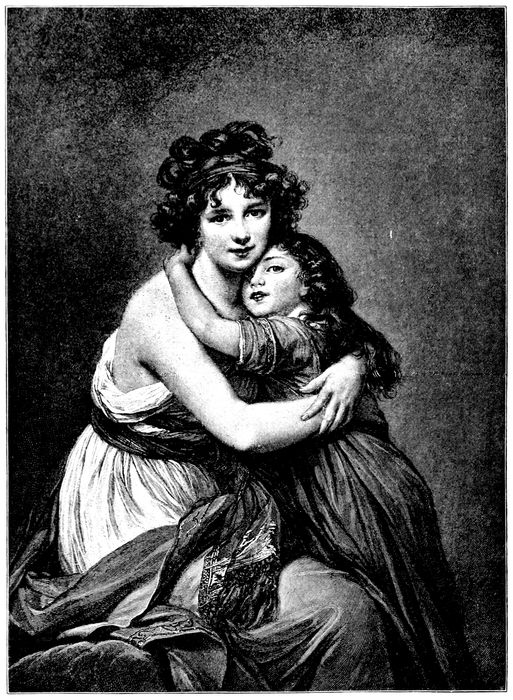
MARIE S. LeBRUN WITH HER DAUGHTER.
After her own painting.
235The 18th Century produced two women artists, who
were among the leaders of their time: Angelica Kauffmann
and Marie LeBrun. Angelica Kauffmann, the daughter of an
artist, was born in 1740 at Coire in Switzerland, from where
she went later on to Italy, to study the great masters. In 1765
she came to London. Here she painted many excellent
portraits as well as numerous classic and allegorical subjects.
In 1781 she returned to Italy. Here she was always much feted
and admired for her talents as well as for her personal charm.
Goethe, who met Angelica Kauffmann in Rome, admired
her works very much. “No living painter,” so he wrote in
a letter, “excels her in dignity or in the delicate taste with
which she handles the pencil.” And Raphael Mengs, one of
the most brilliant artists of the Rococo, praised her in the
following words: “As an artist Angelica Kauffmann is the
pride of the female sex in all times and all nations. Nothing
is wanting; composition, coloring, fancy, all are here.”
When she died in November, 1807, she was honored by
a splendid funeral under the direction of Canova. The entire
Academy of St. Luke at Rome with numerous ecclesiastics
and virtuosi followed her funeral train and, as at the burial
of Raphael, two of her latest paintings were carried behind
her coffin in the procession.
Of Madame LeBrun, who was born in 1755 in France,
it has been said that “a more ideal artist never lived.” The
well-known portrait of herself and her daughter has been
termed “the tenderest of all pictures.” She also painted several
portraits of the unfortunate Queen Marie Antoinette. The
Louvre has one of her best paintings: “Peace bringing back
Abundance.”
Madame LeBrun was one of the most prolific artists of
all times. In her autobiography, entitled “Souvenirs,” she
states that she finished six hundred and sixty-two portraits,
fifteen large compositions, and two hundred landscapes, the
latter sketched during her travels in Switzerland and England.
During the 18th Century Germany was the scene of the
greatest activity of women artists. France held the second
place and Italy the third, thus reversing the conditions of
preceding centuries. Flanders and Antwerp too were famous
for women artists, some of whom went to other countries
where they were recognized for their talent and attainments.
The most famous woman artist of the 19th Century was
Rosa Bonheur, born in 1832 at Bordeaux, the daughter of
Raymond Bonheur, an artist of merit. From him she received
her first instructions. In 1841 she began exhibiting in the
Paris Salon, with several small animal paintings, indicating
the direction in which she was to attain her future eminence.
Her great success in painting animals was due to her conscientious
study of living subjects. One of her masterpieces, “Plowing
with Oxen,” ranks among the gems of the Luxembourg.
Another excellent painting, “The Horse Fair,” was the chief
attraction of the Paris Salon in 1853, and later on became
the property of the New York Metropolitan Museum of Art.
Of all animal paintings ever executed, this one is perhaps the
most animated, and the best in composition as well as in color.
Another canvass, “Horses Threshing Corn,” shows the same
merits. Containing ten horses in full life size, it is the largest
animal picture ever produced.
236
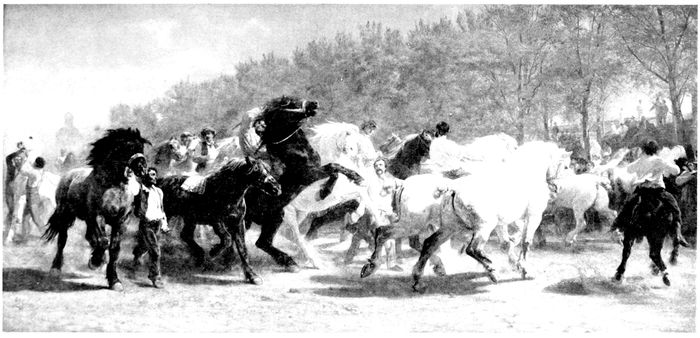
THE HORSE FAIR.
After the painting by Rosa Bonheur in the New York Metropolitan Museum of Art.
237Another painting, “The Monarch of the Glen,” received
much praise at the World’s Columbian Exposition.
In just appreciation of her genius Rosa Bonheur was
proposed in 1853 for the Cross of the Legion of Honor, but
because of her sex the decoration was withheld until 1865.—
One of the four daughters of an early German pioneer
of California, who distinguished themselves in different lines
of activity, Anne Elizabeth Klumpke followed in the footsteps
of Rosa Bonheur, of whom she became a close friend, and
who, in appreciation of her great talent, bequeathed to her
her beautiful chateau as well as her entire fortune.
The second half of the 19th and the beginning of the
20th Century produced a surprising abundance of women
artists, some of whom gained the most coveted prizes and
medals offered by the great annual exhibitions in Paris, London,
Berlin, Munich and other centers of art. Clara Erskine
Clemens in her book “Women in the Fine Arts” has compiled
notes about several hundred of them, without enumerating
them all. To mention a few of the most excellent, we name
of the German artists Louise Parmentier Begas, Tina Blau,
Dora Hitz, Lucia von Gelder, Herminie von Janda, Countess
Marie Kalckreuth, Minna Stock, Toni Stadler, Frieda Ritter,
Margarethe von Schack, Vilma Parlaghy, and Margarethe
Waldau.
Italy names among its best modern painters Alceste
Campriani, Ada Negri, Juana Romani, Erminia de Sanctis, and
Clelia Bompiani.
The French extol the genius of Louise Labé, Marceline
Desbordes-Valmore and Louise Ackermann.
Belgium and Holland number among their women artists
Therese Schwartze, Adele Kindt and Henriette Ronner; Spain
points with pride to the works of Fernanda Frances y Arribas,
Adele Gines and Antonia de Banuelos. Denmark’s famous
artist, Elizabet Jerichau Baumann, is remembered especially
for her magnificent painting “Christian Martyrs in the Catacombs”;
Switzerland has two portraitists of the first order,
Louise Catherine Breslau and Aimée Rapin, while Russia
produced in Marie Bashkirttseff an artist of rare ability.
Perhaps in no other country is the number of female
artists so large as in England. We will name only a few of
them. Laura Alma Tadema was the gifted daughter of the
famous artist Laurenz Alma Tadema. Margaret Sarah Carpenter
238won wide reputation as a gifted portrait painter. Ethel
Wright’s beautiful painting “The Song of the Ages” belongs
to the best examples of English art. Clara Montalba is favorably
known for her splendid scenes of Venice, and landscapes
of the Adriatic coasts. Elizabeth Thompson demonstrated by
many excellent sketches and pictures that women are not
afraid to make a specialty of battle scenes.
Ambitious American women are likewise hard at work
gaining honor and laurels in the various fields of art. The
morning promises fair, as there are already many shining
names upon the scroll. To begin with one of the middle of
the last century, we mention Cornelia Adele Facett, whose
chief work, “The Election Commission in Open Session,” contains
258 portraits of men and women, prominent in the
political, literary, scientific and social circles of their time.
It adorns the Senate Chamber in the Capitol at Washington.
The most brilliant woman artist of the United States is
without question Cecilia Beaux, a Philadelphian, who, as a
portrait painter, compares with the very best of any nation.
Her portrait of a “Girl in White,” owned by the Metropolitan
Museum of Art in New York, verifies what a critic said about
her: “Miss Beaux has approached the task of painting the
society woman of to-day, not as one to whom this type is
known only by exterior, but with a sympathy as complete as
a similar tradition and artistic temperament will allow. Thus
she starts with an advantage denied to all but a very few
American portrait painters, and this explains the instinctive
way in which she gives to her pictured subjects an air of
natural ease and good breeding.”
Sadie Waters, born in St. Louis, produced a number of
religious paintings, her best and largest showing the Madonna
in a bower of roses.
Violet Oakley of New Jersey had a prominent part in
decorating the new Capitol at Harrisburg, Pennsylvania, one
of the most elaborate and costly public buildings in America.
The mural painting “The Romance of the Founding of the
State” in the Governor’s room is her work.
Anna Mary Richards excelled as a marine painter. Her
large canvass “The Wild Horses of the Sea” has been especially
admired.
Anny Shaw, Grace Hudson, Lucie Fairchild Fuller, Mary
Cassatt, and Matilde Lotz are among the latest women artists
of America, favorably known for many creditable works.
Although comparatively few women have devoted themselves
to sculpture, there are several among them well worth
mentioning.
The first female sculptor of whom anything is known,
was Sabina von Steinbach, a daughter of Erwin von Steinbach,
239the famous architect of the magnificent cathedral at Strassburg,
in Alsace. After the southern portal of this minster had been
erected, Sabina adorned it with the statues of the apostles,
one of which, that of John, held in his hands a scroll with
the following inscription:
“Gratia divinæ pietatis adesto Savinæ,
De petra dura per quam sum facta figura.”
“The grace of God be with thee, O Sabina,
Whose hands from this hard stone have formed my image.”
Nothing further is known about this artist of the end of the
13th Century.
Properzia de Rossi was an Italian woman sculptor, born
near the end of the 15th Century at Bologna or Modena.
The first-named city cherishes still a number of her works,
among them a fine marble statue of Count Guido de Pepoli,
and several figures that adorn the three gates of the facade
of St. Petroneus. Vasari in his biographies of celebrated
artists calls her “a virtuous maiden, possessing every merit
of her sex, together with science and learning all men may
envy.” And when she died in 1530, the following epitaph
was written in her praise:
Fero splendor di due begit occhi accrebbe
Gia marmi a marmi; e stupor nuovo e strano
Ruvidi marmi delicta mano
Fea dianzi vivi, ahi! morte invidia n’ebbe.
In modern Germany Anna von Kahle, Marie Schlafhorst,
Dora Beer, Helene Quitmann, Henny Geyer Spiegel and Lilly
Finzelberg have done much excellent work.
In France several statues by Jeanne Hasse, a Parisian,
have been purchased by the government and presented to
various provincial museums.
In England Mary Thornycroft, daughter and pupil of John
Francis, the sculptor, has won the praise of the severest critics.
In America Annie Whitney’s statue of “Lady Godiva”
as well as her “Africa” and “Roma” have been much praised.
Helen Farnworth Mears is well known for her “Fountain
of Life.” Vinnie Ream Hoxie modelled a life-size statue of
Lincoln, which stands in the rotunda of the Capitol at Washington.
A statue of Farragut in Farragut Square is by the same
artist.
Another American woman sculptor of renown was Harriet
Hosmer, born in 1830 in Watertown, Mass. Having received
her first instruction in Boston and St. Louis, she went to Rome
in 1852 where she became a pupil of Gibson. Of her various
works, the best known are “Beatrice Cenci in Her Cell”; “Willo’-the-Wisp”;
240“The Sleeping and the Waking Faun”; and a
colossal statue of “Zenobia, Queen of Palmyra, in Chains.”
She exhibited a statue of Queen Isabella of Spain at the
World’s Columbian Exposition. A statue of “Puck” was so
spirited and original, that it was ordered more than thirty
times, is also her work.
Emma Stebbins (1815–1882) produced a statue of
Horace Mann for Boston, and a large fountain for Central
Park, New York, the subject being “The Angel of the Waters.”
The Metropolitan Museum of Art in New York has in
its collections several works by Frances Grimes, Laura Gardin,
Malvina Hoffman, and Evelyn Longman. Miss Hoffman’s best
known work, “The Russian Bachanale,” showing two almost
nude dancing figures in bronze, was in 1919 presented by an
American connoisseur to the famous Gardens of the Luxembourg
in Paris.
The United States of America produced also the first
women architects. In 1881 Louise Bethune took the lead.
Somewhat later the New York firm Hands & Gannon, both
members of which were women, designed the plans for
numerous schools, hospitals, and model homes for the working
people. Elizabeth Holman in Philadelphia became favorably
known for her excellent designs for theatres, hotels, and
cottages. Mrs. Wagner in Pittsburgh made a specialty of
university buildings, churches and chapels.
Miss Sophie G. Hayden of Boston, a graduate of the
architectural school of the Massachusetts Institute of Technology,
was the architect of the beautiful Women’s Pavilion
at the World’s Columbian Exposition. The task of adorning
this building with sculptures, emblematic of woman’s great
work in the world, was after an extremely vigorous contest
awarded to Miss Alice Rideout, of San Francisco. Women
architects likewise designed the imposing woman’s palaces at
the expositions in St. Louis, Atlanta, and San Francisco. Since
then the number of women in this line of activity has steadily
increased. According to the Census of 1910 the United
States had in that year 1037 women architects, designers and
draftsmen.
Thus we find woman hard at work in all the various
realms of art. And since her joy in beauty is supreme, we
may well expect that her expression of the highest beauty,
the spiritual, will in time favorably compare with that of her
brother-artists.
241
Woman and philanthropy have always been inseparably
connected, for charity has been regarded in all ages as one
of the noblest virtues of the gentle sex.
There is scarcely any country which does not cherish
the memory of some women for great works of charity.
Germany, for instance, has the lovely story of Elizabeth, the
wife of Ludwig IV., landgrave of Thuringia, who reigned
during the first half of the 13th Century. Feeling an aversion
to worldly pleasures, and making the early Christians her
example, Elizabeth devoted herself to works of benevolence.
In these she was so liberal, that her husband became uneasy,
fearing she might impoverish his estate by her alms-giving.
He accordingly bade her to give less to the poor. But secretly
she spent just as much. One day, while she was carrying a
heavy load of bread in her basket, she was stopped by her
husband, who inquired what she was hiding. “Roses, my Lord,
roses!” she said, hoping that he would not investigate. But
when he insisted on seeing them, she was forced to open her
basket and, oh wonder! all the loaves of bread had turned
into the most beautiful roses.—
America remembers Dorothea Dix as one of the most
distinguished women it ever has produced. Compelled by
declining health to go to Europe from 1834 to 1837, she had
ample opportunity to study in Liverpool and other cities of
England the terrible conditions of the poor, especially of the
inmates of poor-houses and insane-asylums. As at that time
similar institutions in America were just as bad, she gave
after her return to the United States all her time, strength
and influence to ameliorate suffering, and to persuade the
public to furnish suitable asylums, also to improve the moral
discipline of prisons and penitentiaries. For this purpose she
visited every State east of the Rocky Mountains, seeking out
intelligent and benevolent people, and trying to kindle in their
hearts the same enthusiasm that filled her own.
Fearless in lifting her voice against abuses, she was so
persistent in reiterating her protests and in pleading needed
reforms, that attention had to be given her. The founding
of many state hospitals and insane-asylums in the United States
as well as in Nova Scotia and Newfoundland is due to her
indefatigable work.
A similar case is that of Margaret Fuller, the famous
author. Warmly espousing the cause of reform in many
directions and making herself the champion of truth and
human rights at any cost, she visited prisons and charitable
242institutions and talked freely with the female inmates. It was
on the common ground of womanhood that she approached
these degraded of her own sex, true to her unalterable faith
in awakening whatever divine spark might be there. She was
surprised herself at the results—the touching traits and the
possibilities that still survived in beings so forlorn and
degraded. Many of them expressed a wish to see her alone,
in order to confide to her the secrets of their ruined lives,
and their ardent desire to enter a new course whereby they
might regain respectability. Thus making herself the friend
of the friendless, Margaret Fuller began what we call to-day
“settlement work.”
In the matter of prison reform the name of Elizabeth
Guerney Fry (1780–1845) will likewise be remembered as
one of the first women promoters in this line of charity.
An accidental visit to Newgate Prison in London disclosed
to her the horrible conditions prevailing in this ill-reputed
dungeon. Like most prisons at the time it was dark, damp,
and cold in winter. The prisoners were usually half-starved,
and clad in rags; often loaded with chains, and oftener yet
pestered by vermin and rats. The ward, into which Miss Fry
penetrated, although strongly dissuaded by the officials, was
like a den of wild beasts. It was filled with a hundred and
sixty women and children, gambling, fighting, swearing,
yelling, dancing. It justly deserved its name of “hell above
ground.” The general disorder and abject misery of the
women confined there so impressed Miss Fry, that she took
immediate and effectual means to relieve them. The first
step in the great public work of her life was the forming of
“The Association for the Improvement of the Female Prisoners
in Newgate,” in April, 1817. Its aim was the establishment
of what is now regarded as “prison discipline,” such as entire
separation of the sexes, classification of criminals, female
supervision for the women, and adequate provision for their
religious and secular instruction, as also for their useful
employment. Disregarding sarcastic critics, who protested
against the “ultra-humanitarianism which sought to make jails
too comfortable and tended to pamper criminals,” Miss Fry
pursued her way and finally brought about the passing of
Acts (1823–24), in which it was laid down that over and
above safe custody it was essential to preserve health, improve
morals, and enforce useful labor in all prisons. Not content
with these results, Miss Fry likewise inspected during the time
from 1818 to 1841 the principal prisons of Scotland, Ireland,
France, Switzerland, Belgium, Holland, Southern Germany,
and Denmark, everywhere conferring personally with the leading
prison officials. By keeping up a constant correspondence
with them she had the satisfaction of hearing from almost
243every quarter of Europe that the authorities were giving an
ever increasing consideration to her suggestions.—
Following the example set by Miss Fry, women in many
countries aided in forming societies for the improvement of
prison-discipline. They also established reformatories for
women and juvenile delinquents. For instance Mrs. Abbey
Hopper Gibbons assisted in founding the “Women’s Prison
Association of New York” in 1844 and the “Isaac T. Hopper
Home.” Its objects were: “First, the improvement of the
condition of the prisoners, whether detained on trial or finally
convicted, or as witnesses; secondly, the support and encouragement
of reformed convicts after their discharge, by affording
them an opportunity of obtaining an honest livelihood,
and sustaining them in their efforts to reform.”
The association employs an executive secretary who visits
all the places where women are detained in the State or City
of New York, keeps track of the housing conditions and
studies the treatment of the prisoners. On the basis of this
exact knowledge, the Association has proposed various
reforms; for example the establishment of Bedford Reformatory
was largely due to the efforts of this society, and the
appointment of police matrons in the city station houses.
Through the instrumentality of Mrs. Hopper Gibbons the
“New York State Reformatory for Women and Girls” was
established by the Legislature.
Through the efforts of Linda Gilbert various prisons
throughout the country were provided with libraries. She
also secured the incorporation of the “Gilbert Library and
Prisoners’ Aid Society” under the laws of the State of New
York. Furthermore she procured employment for thousands
of ex-convicts, and aided others in establishing in business in
a small way.—
To enumerate what women have contributed to culture
as founders and patronesses of infant homes, foundling
and orphan asylums, industrial schools and homes for boys
and girls, of refuges for unfortunate women, invalids and
the aged, of hospitals for destitute children and for people
afflicted with tuberculosis, cancer, and incurable diseases, is
a task impossible for the limited space of this book. Besides,
all information is fragmentary and far too insufficient to give
a true idea of the vast sums and immense amount of time,
labor, and effort, devoted by women to these works of charity.
Constantly on the lookout to alleviate sorrow and provide
comfort, they have not forgotten even those lonely men, who
do duty in remote light houses and life-saving stations. It was
through the efforts of women that these involuntary hermits,
who often do not come in touch with other human beings
for several months, are regularly provided with interesting
books and entertaining games.
244Mrs. Matilde Ziegler of New York has taken a special
interest in the blind. Mrs. Ziegler, at an expense of $20,000
a year, founded a monthly magazine for the blind, which has
a printing press of double the capacity of any printing plant
for the blind in any other country. Blind girls do all the work
connected with this magazine.
Georgia Trader in Cincinnati established school classes
for the blind and a library with over 25,000 volumes, from
which books in raised type are sent to the blind all over the
country, free of any charge. She also founded a working-home
for blind girls, where they are profitably employed in weaving
rugs, and in various artistic work and handicraft.
Jane Addams in 1889 opened in Chicago a social settlement,
known as “Hull House.” Wonderful work in sociology
is done there. Many thousands of men, women and children
are instructed in all kinds of handicraft, and directed to places,
where they can make an honest and profitable living. They
have also access to an excellent library, comfortable club
rooms, lecture-halls, kindergarten, play-grounds and other
institutions.
Miss Addams is to-day recognized as one of the foremost
women in her line of work, and by her example as well as
through her public lectures and able books, has probably done
more than anybody else for the extension of practical sociology.
Women have also taken charge of thousands of tired
working-girls and sent them to the country for a short rest
during the summer, thus enabling them to take up their lives
of toil with renewed vigor and courage.
Similar organizations have established vacation schools
to save children from the demoralization of the long summer
idleness, and to secure for them fresh air vacations.
Moved by a sincere desire to improve the conditions of
the despised and maltreated American Indians, Helen Hunt
Jackson, Alice Fletcher, and Mary L. Bonney succeeded after
indefatigable efforts in awakening interest among the legislators
in their work. Miss Fletcher, in her valuable book
“Indian Civilization and Education,” gave such ample proof
of her special qualifications that she was appointed by President
Cleveland in 1887 as a special agent of the Government,
to allot lands to various Indian tribes. Mary L. Bonney devoted
herself principally to educational work and, in 1881, was
foremost in the task of organizing the “Indian Treaty-Keeping
and Protective Association” by which the many unlawful encroachments
of white settlers, and the oppression of the Red
Men by government agents were stopped.
In their efforts to alleviate the hard lot of negro slaves,
Lucretia Mott, Sarah and Angelica Grimke, Harriet Beecher
Stowe, and many others, braved criticism, insults and social
ostracism.
245By organizing societies for the prevention of cruelty to
children and animals, women have taken care of those who
cannot speak for themselves. In many cities they have likewise
provided drinking fountains for men and for animals.
All women members of the “National Association of the
Audubon Societies,” that protect bird-life in America, bind
themselves never to decorate their hats with plumes and
feathers. They have also secured laws that forbid hunters to
kill useful birds, and prevent milliners from buying or exhibiting
feathers and stuffed skins of such birds.
As generous patronesses of education, science and art
many women have set themselves lasting monuments.
Catherine L. Wolfe donated to the Metropolitan Museum
of Art in New York not only her magnificent collection of
paintings, but likewise a fund of $200,000 for its preservation
and increase. A million dollars was also bequeathed by her
to several educational institutions founded by her father and
herself. She is also known as the founder of the New York
Home for Incurables.
Mary Tileston Hemenway supported the so-called Hemenway
Expeditions for the archæological exploration of certain
regions of Arizona and New Mexico.
Jane Lathrop Stanford, wife of Leland Stanford, railway
constructor, and U. S. Senator from California, founded in
memory of her son the “Leland Stanford Jr. University”
at Palo Alto, near San Francisco. At her own expense Mrs.
Stanford established a museum, connected with the university,
containing objects of art, and many things she had collected
during her extensive travels. At her death the entire estate
of the Stanfords, amounting to about $50,000,000, was left
to endow this great university. Her San Francisco home, on
Nob Hill, became an art gallery and museum.
Phœbe Hearst, wife of George Hearst, and mother of
William Randolph Hearst, made large donations to the University
of California. These included $800,000 for the erection
and equipment of the Hearst Memorial Mining Building. She
also made provision for twenty scholarships for women, and
founded a number of free libraries in mining towns with which
her husband had been associated. Mrs. Hearst was also
actively interested in every kind of organization for the welfare
of women. Furthermore she established and maintained
two kindergarten schools in San Francisco, and three in Washington,
one of which is for colored children. Her most important
gift to the District of Columbia was the National
Cathedral School for Girls, erected on a beautiful site on the
outskirts of the city.
Margaret Olivia Sage, the widow of Russell Sage, donated
between seventy-five and eighty million dollars for charitable
246and educational purposes. With ten millions she established
in 1907 the “Sage Foundation for Social Betterment.” Its
purpose is the improvement of social and living conditions
in the United States. It does not attempt to relieve individual
or family need, but tries to seek out and eliminate causes of
this evil. It furthers education that more directly affects social
and living conditions, such as industrial education, education
in household arts, and the training of social workers. In the
pursuit of these aims the Sage Foundation subsidized worthy
activities and organizations; it has established investigational
and propagandist departments of its own; invested its funds
in activities with a social purpose; and published extensively
books and pamphlets on social subjects. Since the work of
the Russell Sage Foundation aids social advance for people
of every nation, Mrs. Sage became one of the benefactors not
only of this country, but of the world.
Among the many donations Mrs. Sage made to other
institutions, were $600,000 to the Troy Female Seminary,
which was one of the first schools in America for the higher
education of girls; $1,600,000 to the Woman’s Hospital of
New York; $1,600,000 to the Children’s Aid Society;
$1,600,000 to the Metropolitan Museum of Art; $1,600,000
to the American Museum of Natural History; and $1,600,000
to Syracuse University.
The list here given mentions only a few of the innumerable
philanthropic works of American women. Similar lists
could be made for all other countries, but the material has
never been properly collected. Besides, by far the greatest
number of such benevolent acts have been performed without
public knowledge. But wherever we go, we find women
active, helpful, and persevering, always rejoicing in the
accomplishment of good.
247
“If particular care and attention are not paid to the
ladies, we are determined to foment a rebellion, and will not
hold ourselves bound to obey any laws in which we have no
voice or representation.”—This was the warning directed by
Mrs. John Adams in March, 1776, to her husband while he
was attending the Continental Congress, assembled in Philadelphia
to consider the Declaration of Independence.
When this document was framed and adopted without
recognizing the rights of women, Mrs. Adams and a number
of other women, deeply indignant, made good the threat of
Mrs. Adams and opened that most remarkable warfare, which
has lasted for more than a hundred years and may be called
“Woman’s Battle for Suffrage.”
That they were deeply disappointed by the inattention
of Congress, may be inferred from a letter by Hannah Lee,
the sister of General Lee, in which she asks her brother to
demand from Congress suffrage for women, as otherwise
they would not pay any taxes. The same request was made
by various other prominent women, who pointed to the fact
that, while their husbands and sons had fought for the inherent
rights of men, they had likewise fought for the rights
of women. But as at that time American women were not
organized their demands failed to make the necessary impression
and remained unheeded. Besides, the majority of
American women receiving only a very limited education,
took little interest in the question, because of their ignorance
of its importance. Thus, the subject of woman’s rights and
suffrage dragged on until women had discovered, that there
is strength in numbers, in federation, and that federation is
the preliminary requirement to make victory possible.
The evolution of women’s clubs during the 19th Century
is one of the most striking and most important phenomena
in woman’s history. The movement began with the sewing
or spinning circles of long ago, and made a great stride when
the custom was initiated of some members reading while the
others sewed. Later on these circles evolved into reading-clubs,
which again developed into literary societies and
associations for public improvement, aiming at the establishment
of public schools and libraries, the erection of hospitals,
orphan asylums, the sanitation of the streets, and other public
works.
Such women’s clubs were not even afraid to tackle such
248most difficult problems as the abolition of slavery, which, at
the end of the 18th and the beginning of the 19th Century,
became the burning question of the time. The hot discussion
of this problem split the population of the United States into
two hostile factions, of which the South with its partisans in
the North made desperate efforts to prevent the free expression
of opinion respecting the institution of slavery. In the slave
States even the Christian churches used their influence in
favor of the maintenance of slavery.
Among the first and strongest advocates of abolition were
Sarah and Angelina Grimke, the daughters of a family of
Salzburgers, who during the 18th Century had immigrated
into South Carolina and Georgia. Shocked by the inhuman
treatment and cruelties inflicted upon the slaves all round,
and suffering intensely from the stand taken by their own
relatives, the sisters resolved to fight these abuses.
While visiting Philadelphia, Sarah came under the influence
of the Quakers, and read the strong protest against
slavery, which Pastorius and the settlers of Germantown in
1688 had directed to the Quaker meeting. Returning to her
home, Sarah besought her relatives to free their slaves. Failing
in this effort, she left her home, joined the Quaker society
of the “Friends” in Philadelphia, and in 1835 directed an
“Appeal to the Christian Women of the South,” imploring
them to become active on behalf of the slaves. This pamphlet
aroused such a profound sensation wherever it was read, that
when some time afterward Miss Grimke expressed a desire
to visit her former home, the mayor of Charleston called upon
her mother and informed her that the police had been instructed
to prevent her daughter’s landing when the steamer
should come into port. He also would see to it that she
might not communicate with any person, by letter or otherwise,
and that, if she should elude the vigilance of the police and
go ashore, she was to be arrested and imprisoned until the
return of the vessel. As threats of personal violence were
also made, Miss Grimke abandoned her visit, but published
soon afterward “An Epistle to the Clergy of the Southern
States,” and, at the same time, began to address meetings
in Pennsylvania as well as in the New England States, in
order to rouse the dormant moral sense of the hearers to protest
against the colossal sin of the nation. She was assisted
by her sister Angelina and such eloquent speakers as Lucretia
Mott, Elizabeth Stanton, William Lloyd Garrison and others.
These agitators finally created such a stir, that the conservatives
and opponents of abolition decided that they must be silenced.
Quite often their meetings were disturbed by mobs; halls were
refused them, and violence was threatened. The General
Association of Congregational Ministers of Massachusetts
249passed a resolution censuring the Grimke sisters, and issued
a pastoral letter containing a tirade against “female preachers.”
But in spite of all efforts, public sentiment in the North in
favor of abolition steadily grew, until it became evident that
the question could not be settled without an armed conflict.
At a gathering of abolitionists, held on July 19th, 1848,
at the home of Mrs. Elizabeth Cady Stanton in Seneca, N.Y.,
the question of women’s rights was eagerly discussed. Mrs.
Stanton, the daughter of a lawyer, had found by frequent
visits to her father’s office that according to the then existing
laws, which had been adopted from England, married women
had no right of disposal over their own inherited property,
their own income, or their own children, no matter how unfit,
degraded, and cruel their husbands might be. There was even
no redress for corporal punishment which the husbands might
inflict on their wives.
Another woman, present at the gathering, was Lucretia
Mott, a Quaker teacher. It had been her experience, that
250female teachers, having paid for their education just as much
as the males, obtained, when teaching, only half of the compensation
granted to male teachers.
But the indignation of the two women over the inferior
position of woman had been especially excited while attending
the World’s Anti-Slavery Convention, held in 1840 at London.
Both women, together with Mrs. Wendell Phillips, had been
appointed delegates by the abolitionists of America, and as
they were able speakers, much had been expected from their
eloquence. But when the women submitted their credentials,
they discovered that the English abolitionists had not reformed
their antiquated views of male predominance and would not
admit any woman as delegate nor on the platform. When
the question was submitted to vote, the women were excluded
by a large majority. This flat refusal to recognize woman’s
right to an equal participation in all social, political, and
religious affairs brought what is termed “the Woman Question”
into greater prominence than ever before. The gathering in
the Wesleyan chapel, at Seneca Falls, N.Y., Mrs. Stanton’s
home, is known as the First Woman’s Rights Convention.
Held on the 19th and 20th of July, 1848, it was attended
by 68 women and 38 men. The simultaneous discussion of
the subject of slavery and the natural rights of man had as
their logical consequence, on the part of women, the demand
of a privilege exercised in many cases by persons far below
them in intelligence and education. They asserted that many
of their number were taxpayers, that all were interested in
good government, and that it would be unjust for women
of intelligence to be deprived of a vote while ignorant negroes
could have a voice in the government. Furthermore they
asserted that the participation of women would have a purifying
effect on politics.
At the close of the second day the convention adopted
the following:
Declaration of Sentiments.
“The history of mankind is a history of repeated injuries
and usurpations on the part of man toward woman, having in
direct object the establishment of an absolute tyranny over
her. To prove this, let facts be submitted to a candid world.
“He has never permitted her to exercise her inalienable
right to the elective franchise.
“He has compelled her to submit to laws in the formation
of which she had no voice.
“He has withheld from her rights which are given to
the most ignorant and degraded men—both natives and
foreigners.
“Having deprived her of this first right of a citizen, the
251elective franchise, thereby leaving her without representation
in the halls of legislation, he has oppressed her on all sides.
“He has made her, if married, in the eye of the law,
civilly dead.
“He has taken from her all right in property, even to
the wages she earns.
“He has so framed the laws of divorce as to what shall
be the proper causes, and, in case of separation, to whom
the guardianship of the children shall be given, as to be
wholly regardless of the happiness of women—the law in
all cases going upon a false supposition of the supremacy of
man, and giving all power into his hands.
“After depriving her of all rights as a married woman,
if single and the owner of property, he has taxed her to
support a government which recognizes her only when her
property can be made profitable to it.
“He has monopolized nearly all the profitable employments,
and from those she is permitted to follow she receives
but a scanty remuneration. He closes against her all the
avenues of wealth and distinction which he considers most
honorable to himself. As a teacher of theology, medicine, or
law, she is not known.
“He allows her in church, as well as state, but a subordinate
position, claiming Apostolic authority for her exclusion
from the ministry and, with some exceptions, from any
public participation in the affairs of the church.
“He has created a false public sentiment by giving to
the world a different code of morals for men and women, by
which moral delinquencies which exclude women from society
are not only tolerated but deemed of little account in man.
“He has usurped the prerogative of Jehovah himself,
claiming it as his right to assign for her a sphere of action,
when that belongs to her conscience and God.
“He has endeavored, in every way that he could, to
destroy her confidence in her own powers, to lessen her self-respect,
and to make her willing to lead a dependent and
abject life.
“Now, in view of this disfranchisement of one-half the
people of this country, their social and religious degradation;
in view of the unjust laws mentioned, and because women
do feel themselves aggrieved, oppressed and fraudulently
deprived of their most sacred rights, we insist that they have
immediate admission to all the rights and privileges which
belong to them as citizens of the United States.”
Of course, this declaration, modeled after the immortal
Declaration of 1776, did not fail to create a sensation everywhere.
Other conventions were held in Rochester and Syracuse,
N.Y., and in Salem, Ohio. They brought to the front
252a number of wonderful women, whose names were henceforth
connected with this movement, first among them Susan B.
Anthony, Lucy Stone, Paulina Wright Davis and Anna Howard
Shaw. In October, 1850, the First National Woman’s Rights
Convention was held at Worcester, Mass. Attended by delegates
from nine states it was distinguished by addresses and
papers of the highest character, which filled the audiences
with enthusiasm. A National Committee was formed, under
whose management conventions were held annually in various
cities. An account of the convention, written by Mrs. John
Stuart Mill, in the “Westminster Review,” London, marked
the beginning of the movement for woman suffrage in Great
Britain. But in spite of all efforts and agitation, progress was
but slow. The first result was not gained before 1861, when
Kansas granted school suffrage to women, a step that was
not followed by other states for many years afterwards.
How averse the stronger sex was to grant women suffrage
became evident, when in 1868 the 14th and 15th amendments
to the Constitution of the United States were adopted. These
amendments abolished slavery and gave the freed negroes of
the South all privileges of citizenship, including the right to
vote. Section 1 of the 15th amendment reads:
“The right of citizens to vote shall not be
denied or abridged by the United States, or by any
State, on account of race, color, or previous condition
of servitude.”
As the advocates of woman suffrage were American
citizens, they held themselves entitled to the same rights as
granted to the negroes. But their demands to be registered
as legal voters were denied by the registrars of elections.
Now the women appealed to the courts, to see if their claim
would be sustained by invoking the aid of those constitutional
amendments above cited. But the uniform decision in each
court was that these amendments had in no way changed or
abridged the right of each State to restrict suffrage to males,
and that they applied only to the men of color and to existing
rights and privileges. An appeal to the Supreme Court
resulted in the decision that this body was in accordance with
the decisions of the State courts.
To test the application of the 14th and 15th amendments
to the Constitution Susan B. Anthony,—who in 1860 with
others had been successful in securing the passage of an Act
of the New York Legislation, giving to married women the
possession of their earnings, as well as the guardianship of
their children,—cast in 1872 ballots at the State and Congressional
elections in New York. Miss Anthony was indicted
and in 1873 found guilty of criminal offense against the
253United States for knowingly voting for congressmen without
having a lawful right to vote, which offense was punishable,
under Act of Congress, by a heavy fine or imprisonment.
Fined $100 for illegal voting, Miss Anthony declared that
she would never pay the penalty, and in fact it has never been
collected.
Undaunted by the decision of the Court, Miss Anthony
in 1875 proposed the following amendment to Article 1 of
the Constitution:
“Section 1. The right of citizens of the United States to
vote shall not be denied or abridged by the United States
or by any State on account of sex.
“Section 2. Congress shall have power by appropriate
legislation to enforce the provisions of this article.”
This resolution was introduced by Senator Sargent of
California in 1878, but was rejected several times. In 1887
it secured in the Senate only 14 affirmative to 34 negative
votes.
But several years before the indictment of Miss Anthony
254woman suffrage had already won its first victory, in the Territory
of Wyoming. The Organic Act for the regulation of the
Territorial governments provides that at the first election in
any Territory male citizens of the age of twenty-one years
shall vote, but
“at all subsequent elections the qualifications of voters
and for holding office shall be such as may be prescribed
by the legislative assembly of each Territory.”
Under this act the first legislative assembly of Wyoming,
in 1869, granted women the right to vote and to hold office
upon the same terms as men. An effort made in 1871, to
repeal this statute, failed, and to the men of Wyoming belongs
the honor, of having been first to recognize the rights of
women.
A further gain was made when the Republican National
Convention of 1872 and 1876 resolved that “the honest
demands” of women for additional rights should be treated
with respectful consideration.
Of still greater importance was the organization of two
national Woman Suffrage Associations, the one with headquarters
in New York, the other in Boston. A union of these
two bodies was effected in 1890 under the title of “The
National American Woman Suffrage Association.”
Mrs. Stanton was elected president of the new organization.
When in 1892 she resigned from her office because of
advancing age, she was followed by Miss Anthony, who in
1900 resigned at the age of 80. Her successors were Miss
Anna Howard Shaw and Mrs. Carrie Chapman Catt.
Under the able leadership of these brilliant women victory
was now followed by victory. Up to 1914 Colorado, Idaho,
Washington, California, Arizona, Kansas, Oregon, Nevada,
Utah and Montana had joined the ranks of Woman Suffrage
States; also the Territory of Alaska.
To these Western regions the Eastern and Southern States
formed a strange contrast, as so far the suffragists had been
unable to conquer one of them. For this surprising fact I fail
to find any other explanation but that the Western men are
much more conscious of a great historical truth, which the
men in the East and South seem to have almost forgotten,
namely: that to the women the founding of real culture in
America is due. Having heroically shared with their husbands
all hardships and dangers, having gone with them on their
hazardous journeys into the wilderness, even on their long
voyages across the prairies and Rocky Mountains to far
Oregon and California, the women provided the first permanent
homes and filled them with comfort, sunshine and
happiness. In recognition of these facts the Western men
granted their partners only a well deserved tribute of gratitude.
255In many places the men expressed their respect for the
gentler sex by electing women to important public offices, and
in almost all cases these positions have been filled to the
fullest satisfaction.
The steady progress of woman suffrage in the United
States was followed by the women of other countries with
intense interest, especially by those of Great Britain and
Australia. Encouraged to like activity, they demonstrated with
convincing clearness the injustice of the legislatures toward
women and thus prepared the way for a similar movement
in favor of woman suffrage. The result was that the English
government in 1869 adopted the Municipal Reform Act,
which permits women to vote in all municipal elections. An
Act of 1870 gave them the school vote. The Act of 1888
made them voters for the county councils. An Act of 1894
abolished in all departments of local government the qualification
of sex.
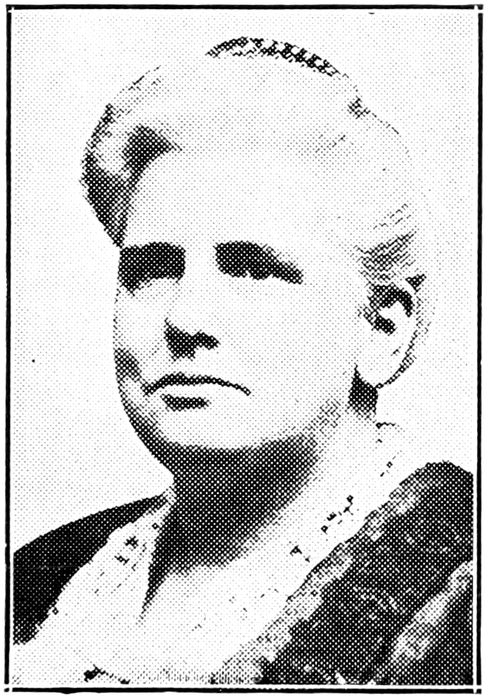
New Zealand, one of the most progressive of all countries,
went even farther. The women there were granted suffrage
in 1893 on the same basis with men. A similar step was
taken in the following year by South Australia. And when
in 1901 the Commonwealth of Australia was formed by the
federation of the six provinces, or states, of New South Wales,
256Victoria, Queensland, South Australia, Western Australia and
Tasmania, one of the first steps was to give all women full
national suffrage.
In the countries of continental Europe the evolution of
local women’s organizations to State- and National Unions had
been the same as in the United States and in England. But
the majority of these societies remained conservative in regard
to woman suffrage. Germany since 1813 has had the “Vaterlaendische
Frauenverein” (Patriotic Women’s League), a
union of wonderful helpers for suffering humanity, both in
peace and in war. Since 1865 a “General Association of
German Women” tried to secure new rights for women, both
along political and economic lines. A “Society for Woman
Suffrage” was not formed before 1902. But only two years
later the “International Suffrage Alliance” was formed in
Berlin, with Mrs. Carrie Chapman Catt, of New York, as president.
The progressive movement in Germany took largely
the form of educational and industrial training. And the
women shared the national belief that education precedes
every good, and that for their legal and political protection
from injustice they might rely upon their male relatives.
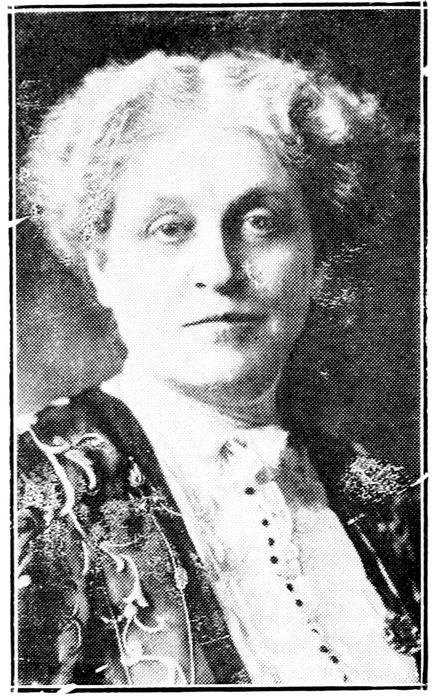
In certain districts of Germany, Austria, Denmark,
Hungary and Russia women who owned property, were permitted
257to cast their votes on various communal matters, either
by proxy or in person. In Belgium, the Netherlands, France,
Italy, Switzerland, Roumania and Bulgaria women had no
political rights whatever, but were permitted to vote for certain
state boards—educational, philanthropic, correctional
and industrial. In France, women as a rule showed little
sympathy with suffrage, retaining their racial instinct that
they might accomplish more through social influence, personal
suasion and the special charms of their sex than by working
openly through the ballot.
In Switzerland few women had the courage to seek
emancipation, as those who favored the movement were
looked upon as disreputable persons without regard for social
laws. In Portugal and Spain women remained absolutely
indifferent. Sweden had given women the right to vote in
all elections, except for representatives, while Finland and
Norway in 1906 and 1907 granted full suffrage rights and
eligibility to women upon exceedingly generous terms.
Since the beginning of the 20th Century the Modern
Woman’s Rights Movement has also caused significant changes
in the status of the women of the Balkan States, and of the
countries of the Orient and the Far East. Restrictions and
obstacles, placed on woman by tradition and religious rules,
have been abolished. Many Mohammedan women for instance
appear to-day on the streets without veils, a thing that no
prominent woman could do formerly. The establishment of
girls’ schools, woman’s colleges, universities, woman clubs
and journals mark likewise the progress of the movement.
And in Servia, Bulgaria, Greece, Turkey, Egypt and Japan
exist federations of women’s clubs, which can be regarded as
political organizations.
Thus, at the beginning of the memorable year of 1914
woman throughout the civilized world had gained various
degrees of freedom in the exercise of her political rights.
258
Few questions have been so universally and intensely
discussed as the right and expediency of Woman Suffrage.
Its opponents assert that the true woman needs no governing
authority conferred upon her by law. While discussing this
question one “gentleman” said “that the highest evidence of
respect that man could exhibit toward woman, and the noblest
service he could perform for her, were to vote Nay to the
proposition that would take from her the diadem of pearls,
the talisman of faith, hope and love, by which all other requests
are won from men, and substitute for it the iron crown of
authority.”
The chief arguments brought forward against woman
suffrage are: that the majority of the women never desired
it, because they were already represented by their husbands,
fathers and brothers; that there were already too many voters,
and that by admitting women to suffrage the whole machinery
and cost of voting would be doubled without changing the
result; that women would not have time to perform their
political duties without neglecting their higher duties at home;
that women were too emotional and sentimental to be
entrusted with the ballot; that women would cease to vote
after the novelty had worn off; that the introduction of women
into political life would increase its bitterness, and would
abolish chivalry with its refining influence on men; that the
franchise, in a large majority of instances, would be exercised
under the influence of priests, parsons, and ministers, under
the power of religious prejudice, and that religious feuds
would affect political life much more than under present
circumstances. And finally it has been asserted that woman
suffrage would place a new and terrible strain upon family
relations as the introduction of political disputes into domestic
life would lead to quarrels and divorce.
These arguments were answered in an editorial of the
“New York American” of October 6, 1912, as follows:
“The ballot is the weapon that men use in defending
their rights. It is the voice with which men express their
opinions, their wishes, as to law, in the more settled civilization
where the ballot is the recognized power. Little by little
the mass of the people—that is to say, of the men—have
got the ballot. Originally there was no ballot. Savage tribes
held disorganized meetings, and shouted their opinions. The
loudest shouters won, and the man who could hit the hardest
led the others. Little by little the big man formed his own
opinions, alone reached his own decisions, and the others had
259nothing to say. The expression of opinion was confined to one,
or to a few leaders, gathered under a chief, or, where religion
ruled, opinion was controlled by the priests in the old temples
making up their minds what would be good for them, and
forcing their will on ignorant people. For many centuries
the kings, the nobles and the priests ruled—and the people
had nothing to say. Men and women alike were without the
vote.
“Little by little, the men got the vote, and now, in
civilized countries, universal suffrage became the rule, as
regards men. The women were shut out because men always
have had the idea that voting was in some way connected
with fighting. Their thoughts went back to the old savage mob
shouting its determination to attack and kill—leaving the
women at home. And the ignoring of women persists, although
little by little the voting power has been used, not to make
war, but to prevent war.
“Now, in every country calling itself civilized, the chief
use of the ballot is to express ideas of peace—justice. The
ballot that was once the expression of man’s fighting quality
is now the expression of his better nature, and for that reason
it is time to give that ballot to the better half of the human
race, to the women that have civilized it.
“Supporters of women suffrage are, and for many years
have been, the best men in the country. Men that are unselfish,
just, scorning ridicule, and proud to vindicate the rights of
their own mothers and sisters, have long demanded votes for
women. The women that have worked and fought for the
suffrage have been, beyond all comparison, the best women
of this and other countries. Humorists used to talk of “short-haired
women and long-haired men” as the advocates of
woman suffrage. That is a foolish and false division. The
women with good foreheads, earnest, gentle and dignified
faces have been the advocates of votes for women. The
women with low foreheads, plastered with hair, the women
with their faces painted, the women with a hundred thoughts
for dress and no thought for anything else, have been the
opponents of women suffrage. And the men, brutal, conceited,
looking upon woman as a piece of property, created for man’s
pleasure or for his service, have been the men that opposed
suffrage. Another class opposed to woman suffrage is the
most dangerous class of all. That is the class that would keep
in ignorance women, and men, too, if it could. Those that
prey upon the ignorance and superstition of women are anxious
that women shall know as little as possible. They do not
want the women to vote, for voting means thinking, and thinking
means freedom. Wherever women have voted they have
bettered conditions.”—
260Lecky in his valuable book “Democracy and Liberty”
writes on page 547: “It has been gravely alleged that the
whole character of the female sex would be revolutionized,
or at least seriously impaired, if they were brought by the
suffrage into public life. There is perhaps no subject in
which exaggerations so enormous and so grotesque may be
found in the writings of considerable men. Considered in
itself, the process of voting is now merely that of marking
once in several years a ballot-paper in a quiet room, and it
may be easily accomplished in five minutes. And can it
reasonably be said that the time or thought which an average
male elector bestows on the formation of his political opinions
is such as to interfere in any appreciable degree with the
currents of his thoughts, with the tendencies of his character
or life? Men wrote on this subject as if public life and interests
formed the main occupation of an ordinary voter. It is said
that domestic life should be the one sphere of woman. Very
many women—especially those to whom the vote would be
conceded—have no domestic, or but few domestic duties
to attend to, and are compelled, if they are not wholly
frivolous or wholly apathic, to seek spheres of useful activity
beyond their homes. Even a full domestic life is scarcely more
absorbing to a woman than professional life to a man. Scarcely
any woman is so engrossed in it that she cannot bestow on
public affairs an amount of time and intelligence equal to
that which is bestowed on it by thousands of masculine voters.
Nothing can be more fantastic than to argue as if electors were
a select body, mainly occupied with political studies and
public interests.
“Women form a great section of the community, and
they have many special interests. The opening to them of
employments, professions and endowments; the regulation of
their labor; questions of women’s property and succession;
the punishment of crimes against women; female education;
laws relating to marriage, guardianship, and divorce, may all
be cited; and in the great drink question they are even more
interested than men, for though they are the more sober sex,
they are also the sex which suffers most from the consequences
of intemperance. With such a catalogue of special interests
it is impossible to say that they have not a claim to representation.”—
Among the arguments in favor of woman suffrage the
most important are the following: As women are citizens of a
Government of the people, by the people, and for the people,
and as women are people, who wish to do their civic duty, it
is unfair that they should be governed by laws in the making
of which they have no voice. As women are equally concerned
with men in good and bad government, and equally
261responsible for civic righteousness, and as they must obey the
laws just as men do, they should vote equally with men.
If it is true that “taxation without representation is
tyranny” then tax-paying women who support the government
by paying taxes, should have the right to vote to elect such
representatives, who protect them against unjust taxation.
Working women need the ballot to regulate the conditions
under which they work. Millions of women are wage-earners
and their health is often endangered by bad working
conditions and sweat-shop methods that can only be remedied
by legislation.
Business women need the ballot to secure for themselves
a fair opportunity in their business, and to protect themselves
against adverse legislation.
Mothers and housekeepers need the vote to regulate the
moral and sanitary conditions under which their families must
live. Women are forever told that their place is in the home.
But what do men expect of them in the home? Merely to
stay there is not enough. They are a failure unless they do
certain things for the home. They must minister, as far as
their means allow, to the health and welfare, moral as well
as physical, of their family, and especially of the children.
They, more than anybody else, are held responsible for what
becomes of the children. Women are responsible for the cleanliness
of the house, for the wholesomeness of the food, for
their children’s health and morals. But mothers cannot control
these things, if the neighbors are allowed to live in filth, if
dealers are permitted to sell poor or adulterated food, if the
plumbing in the house is unsanitary, if garbage accumulates
and the halls and stairs are left dirty. They can take every
care to avoid fire, but if the house has been badly built, if
the fire-escapes are insufficient or not fire-proof, they cannot
guard their children from the horrors of being maimed or
killed by fire. They can open the windows to give the children
the air that we are told is so necessary. But if the air is laden
with infection and contagious diseases, they cannot protect
the children from this danger. They can send the children
out for air and exercise, but if the conditions that surround
them in the streets are immoral and degrading, they cannot
protect them from these influences. Women alone cannot
make these things right. But the City administration can do it.
The administration is elected by the people, to protect the
interests of the people. As men hold women responsible for
the conditions under which the children live, the women should
have something to say about the city’s housekeeping, even if
they must introduce an occasional house-cleaning.
What enormous influence women are able to exert in vital
questions has been demonstrated in the Temperance Movement;
262which originated in the United States. Since the beginning
of the colonization of the Western Hemisphere Americans
have been heavy consumers of rum, whiskey, and other intoxicating
liquors. “Everybody drank, and on all occasions,”
says a writer who has left us a pen picture of these bibulous
days. Drunkenness and all the evils resulting from it increased
with the gradual development of the “saloon” and the habit
of “treating,” two institutions peculiar to America and almost
unknown in Europe.
For generations the women were the greatest sufferers
from the intemperance of the men, because many husbands
came home besotted, their faculties benumbed to an unconsciousness
of their own degradation, with wages gone, and
employment forfeited. The purer and gentler the wife in such
case, the more intense her suffering. So it was but natural,
that when the first “Anti-Spirits Association” was formed in
1808 in Greenfield, Saratoga County, New York, several
women should join it. The movement made rapid progress,
and in 1826 the “American Temperance Society” was founded.
In 1829 and 1830 similar associations were started in Ireland
and England; and in 1846 the first “World’s Temperance
Convention” was held at London. In 1873 women became
a real force in the field when the women inhabitants of Hillsborough,
a small town in Ohio, started what became known
as “The Women’s Crusade.”
Frances E. Willard, one of its principal leaders, described
the proceedings in the following graphic manner: “Usually
the women came in a long procession from their rendezvous
at some church, where they had held a morning prayer meeting.
Marching two and two in a column, they entered the
saloon with kind faces, and the sweet songs of church and
home upon their lips, while some Madonna-like leader with
the Gospel in her looks, took her stand beside the bar and
gently asked if she might read God’s word and offer prayer.
After that the ladies seated themselves, took their knitting
or embroidery, and watched the men who patronized the
saloons. While some of them cursed the women openly, and
some quietly slunk out of sight, others began to sign the
pledge these women brought with them. In the meantime
one of the ladies pleaded with the proprietor to give up his
business. Many of these liquor dealers surrendered and then
followed stirring scenes, and amid songs and the ringing of
the church bells the contents of barrels and bottles were
gurgling into the gutter, while the whole town assembled to
rejoice in this new fashion of exorcising the evil spirits.
“Not everywhere the ladies met with success. In Cincinnati
such a procession of women, including the wives of
leading pastors, were arrested and locked up in jail; at other
263places dogs were set on the crusaders, or they were smoked
out, or had the hose turned on them.”
The movement, wholly emotional, and in many cases
hysterical, spread throughout the country like a prairie fire.
In 1874 it led to the organization of “The Woman’s Christian
Temperance Union,” and, in 1883, to the founding of “The
World’s Women’s Temperance Union,” the members of
which wear a white ribbon and have the motto: “Woman
will bless and brighten every place she enters, and she will
enter every place.”
Since the founding of this world’s union the movement
has extended over many countries and has branched out into
a multitude of organizations. Their influence has been widely
felt in legislatures, and in all elections in which laws have been
voted upon for the regulation of the production and sale of
liquors.—
Another question in which women are deeply concerned
is that of Child-labor, the reckless exploitation of children in
the interest of industry. Evidences that in England the dreadful
abuses, committed by unscrupulous mine- and factory-owners,
as described in a former chapter, have continued to
the present times, were submitted to the International Women’s
Congress, held in 1899 in London. It was reported that
at that time 144,026 children below the age of 12 years were
employed in workshops, mines, factories and warehouses. Of
these children 131 had not yet reached the age of 7 years;
1120 were under 8; 4211 under 9; 11,027 under 10, and
122,131 under 11 years of age. Miss Montessori, the Italian
delegate to the Congress, described the hard work of the
children employed in the sulphur mines of Sicily. As they
have to carry heavy loads on their shoulders through low
gangways and over steep ladders and stairways, they are
compelled to walk in a stooped position, and therefore in
time become deformed and crippled.
In the United States the question of child-labor is likewise
a matter of deep concern to men as well as to women.
As every State has its own Legislature, there exists a varied
assortment of child-labor laws. Ten or fifteen years ago
several states had none whatever. Others prohibited the
employment of children under ten years, while still others
had an age limit of twelve or fourteen years. The same diversity
prevailed in regard to the hours of labor. Some states had
no legislation in this direction, while others forbade any child
to work longer than ten hours daily.
During the year 1890 there was a total of 860,786
children between the ages of ten and fifteen years at work in
various occupations in the United States. A report of the
Bureau of Mines of Pennsylvania for 1901 stated 24,023 of
264the employees of the anthracite coal mines in Pennsylvania
were children.
In 1918 investigators of the children’s bureau of the
Department of Labor reported that the number of minors
employed in factories, mines and quarries has increased at a
rapid rate since the U. S. Supreme Court, on June 5th, 1918,
nullified the child-labor act of 1916 as unconstitutional. Not
only are a greatly increased number of children employed,
but they are kept at work longer hours than before. Since
the future of such children as well as the future of the country
depend to a very great extent upon what legislators do in
regard to children, it is obvious that women are deeply concerned
in this question.—
The need of women’s participation in government and
of an “occasional house-cleaning” in the Legislatures as well
as in the Municipal Administrations becomes evident, when
we realize that one of the most revolting crimes is committed
daily in our communities, quite often with the silent protection
of corrupt officials and politicians. We refer to the White
Slave Trade. As few people have any definite idea of its
extent and terrors, some authentic facts are here given, which,
at the same time, demonstrate men’s indifference as well as
the urgent need of woman’s interference for its suppression.
As everybody knows, the traffic in young girls for purposes
of prostitution is as old as humanity. It has flourished
in all ages and in all countries. But it was during the 19th
Century that it found its systematic organization and its most
extensive development.
With alarming frequency, the papers report that some
young woman or girl is “missing,” having stepped out of her
home on some household errand, and from this moment
having vanished as though swallowed by the earth. Such
was the case of Dorothy Arnold, who some years ago left
her cosy home in New York, to do some shopping in a department
store. She never returned and no trace of her was ever
discovered. This particular case attracted wide attention all
over the United States, as Miss Arnold, a beautiful girl of
eighteen, was the daughter of wealthy parents, who spent a
fortune in desperate but futile attempts to recover their child.—
Every year hundreds of similar cases occur in our country,
some in San Francisco, some in New York, Baltimore, St.
Louis, Chicago and elsewhere. If the exact number of such
missing girls could be known, the public might well be shocked;
and horrified if it would know the sad lot that befalls the
majority of these unfortunate girls. Where efforts to ascertain
their fate have met with success, it was found that in ninety
out of a hundred cases such girls became victims of the most
detestable fiends on earth, human ghouls, who make fortunes
265by luring innocent and inexperienced women into the most
degrading slavery.
There were many events that favored the development
of the white slave trade. The discovery of gold in California
and the construction of many transcontinental railroads were
followed by the opening of the rich mining- and lumber-districts
in the northwestern and western parts of the United
States, and in Canada. In more recent years came the opening
of the gold and diamond fields in South Africa, of the gold
grounds in Alaska, the construction of the Panama Canal
and the great transcontinental railroads through Siberia and
Africa. All these great undertakings attracted many thousands
of men, who were ready to squander their earnings in gambling,
drinking and any other kind of dissipation. Women, of course,
stood at the head of things in demand. And as there are
always people eager to profit by catering to such passions,
the white slave trade assumed most threatening proportions.
To ensnare victims, the slave dealers insert enticing
advertisements offering profitable positions to waitresses,
chambermaids, servants, governesses, and other female help
in hotels, boarding houses and private families. They send
their “procurers” or agents to the dance-halls and cheap
pleasure resorts, and to those industrial towns, where large
numbers of poorly paid young girls toil in mills and factories.
Here they approach their prey under all kinds of disguises
and pretenses. One especially ingenious procurer of New York
has been credited with gaining the acquaintance of young
girls in the garb of a priest. And George Kibbe Turner in
an article “The Daughters of the Poor” (published in 1910
in McClure’s Magazine) made the statement that a gang of
such fiends worked under the name “The New York Independent
Benevolent Association”!
However, the chief recruiting-grounds for the white slave
trade are the miserable Jewish Ghettos of Poland, Russia,
Galicia, Hungary, Austria and Roumania, where always numbers
of degraded men can be found, ready to sell their own
kindred for any price offered. With the help of such procurers
four principal centers of the white slave trade were
created: Lemberg, London, Paris and New York, with branches
in all parts of America, Africa and Asia.
Of course such a villainous trade would not be possible
without the silent protection of corrupt officials and political
machines, who share in its enormous profits. Inside information
on this subject was received through the disclosures, made
during the latter parts of the last century about conditions in
the mining and lumber regions of Michigan and Wisconsin.
In January, 1887, Representative Breen appeared before the
House Judiciary Committee of the legislature of Michigan
266and stated the existence of a regular trade in young and
innocent girls for purposes of prostitution between Chicago,
Duluth and other cities with the mining and lumber districts
south of Lake Superior. As he said that the horrors of the
camps into which these girls were lured beggared description,
several newspapers, among them the “Chicago Herald” and
“The New York World,” dispatched representatives, disguised
as woodmen, to those regions to investigate the truth of these
statements. They found that almost without exception the
girls, kept in these camps, had been secured under promise
of respectable employment. The houses, in which they were
imprisoned, were surrounded by stockades twenty or thirty
feet in height, the one door guarded night and day by a man
with a rifle, while within were a number of bulldogs to prevent
the girls from escaping. In the largest of such lumber camps
dens from twenty to seventy-five girls were found.
On January 24, 1887, the “New York World” published
the story of an unfortunate girl, who had been lured by an
advertisement to work in a lumberman’s hotel in the North.
Believing the position to be respectable, she went there, but
after her arrival at the place she was taken to a rough two-story
building surrounded by a slab fence twenty feet high,
within which was a cordon of bulldogs, thirteen in number,
chained to iron stakes driven into the ground. In this place
she was compelled, like all the other girls, of which there were
always from eleven to thirty, to drink and dance with the
men of the mining and lumber camps. They were not permitted
to refuse any request of those visitors. A complaint
of any kind, even of sickness, meant a whipping, frequently
with a rawhide upon the naked body, sometimes with the
butt of a revolver. When the log drives were going on, there
would be hundreds of men there night and day, not human
beings, but fiends.
“Oh, it was awful, awful!” cried the girl after her release.
“I would rather stay in prison until I die than go back there
for one day. I tried to escape three times and was caught.
They unchained the dogs and let them get so near me that I
cried out in terror and begged them to take the dogs away
and I would go back. Then, of course, I was beaten. I tried,
too, to smuggle out notes to the Sheriff through visitors, but
they would take them to the proprietor instead, and he would
pay for them. Once I did get a note to the Deputy Sheriff
at Florence, Wisconsin, and he came and inquired. But the
proprietor gave him $50, and he went away. I was awfully
beaten then. While I lived this life, from March until September,
two inmates died, both from brutal treatment. They
were as good as murdered. Nearly all the girls came without
knowing the character of the house, and first implored to get
267away. The county officers came to the places to drink and
dance with the girls. They are controlled by a rich man in
Iron Mountain, who owns these houses and rents them for
$100 a month.”
That the den keepers were always on good terms with
the officials, appears also from the following report of the
“Chicago Herald” of April 17, 1892, in which attention is
called to the continuance of the horrible conditions in the
mining- and lumber-camps. “Four years ago, when “The
Herald” exposed the pinery dens, Marinette was known as
the wickedest city in the country. It was the rendezvous of
every species of bad men. Thugs, thieves and gamblers
practically held possession of the town. Their influence was
felt in all municipal affairs. Certain officers of the law seemed
in active sympathy with them, and it was almost impossible
to secure the arrest and conviction of men guilty of infamous
crimes. Dives of the vilest character ran open on the outskirts
of the town. Their inmates, recruited from all parts of the
country by the subtle arts of well known procurers, were kept
in a state of abject slavery. Iron balls and chains, suffocating
cords and the whistling lash were used on refractory girls
and women. Bodies of ill-starred victims were sometimes
found in the woods, but the discovery was rarely followed
by investigation. The dive keepers were wealthy and knew
how to ease the conscience of any over-zealous officer.”
Another report states: “Many den-keepers wield a powerful
influence in the local elections; one of the worst of such,
after paying the constable $12 for the return of a girl who had
tried to escape, beat her with a revolver until tired and was
then only prevented by a woodman from turning loose a bulldog
upon her; but such was his political influence that he was
elected justice of the peace the following spring!”—
About the same time, at a session of the National Social
Purity Congress held in Baltimore, the following statement
was made: “Of the 230,000 erring girls in this country, over
half have been snared or sold into their lives of shame. Their
average life is five years. Forty-six thousand are carted out to
Potters Field every year. Over one hundred American homes
have to be desolated every day to recruit the ranks of shame.
Isn’t it time for somebody to try to save these girls from falling
into those dens of iniquity? Twenty million Christians can
rescue 230,000 erring girls, or surely the religion of Jesus
Christ is a failure.”
Terrible happenings, as for instance the murder of Ruth
Cruger of New York in 1917, and similar cases in February
and March, 1919, have disclosed that gangs of white slave
traders still exist in America and do a flourishing business.
268The prices paid to agents depend upon the girl’s youth and
beauty, ranging from $20 to $1000, and even more.
The enormous and thoroughly organized traffic in girl-children
in England was exposed by the revelations of the
“Pall Mall Gazette,” which roused the people to earnest efforts
against this commerce and secured the formation of the
“Society for the Prevention of Traffic in English Girls.” In
giving details of this traffic the paper said:
“London, the great metropolis of Christian England, the
largest city of ancient and modern times, is acknowledged
by statisticians and sociologists to be the point where crime,
vice, despair, and misery are found in their deepest depth
and greatest diversity. Not Babylon of old, whose name is
the synonym of all that is vile; not Rome, “Mother of Harlots,”
not Corinth, in whose temple a thousand girls were kept for
prostitution in service of God, not the most savage lands in
all their barbarity have ever shown a thousandth part of the
human woe to be found in the city of London, that culmination
of modern Christian civilization. The nameless crimes of
Sodom and Gomorrah, the vileness of ancient Greece, which
garnered its most heroic men, its most profound philosophers,
are but amusements among young men of the highest rank in
England; West End, the home of rank and wealth, of university
education, being the central hell of this extended radius
of vice.”
As in many countries priests and police departments
have failed to stop this heinous traffic in young girls, women
must step in, and, by their votes, must place such legislators
and police commissioners in office, that proper laws and their
strict enforcement can be expected.
In Germany the “white slave trade” is practically
unknown. For many years two women associations have
existed,—a Protestant and a Catholic,—whose representatives,
recognizable by distinct arm bands, patrol all important
railway stations, in order to furnish correct information to
incoming girls who are looking for positions, and to escort
them to the homes of the associations, where they may stay
till respectable places have been found for them.
It is obvious, that the problems connected with the
temperance question, child-labor and the white slave trade are
of vital importance to every woman and mother. Salvation
must come through the woman’s ballot. They must defend
themselves and their children as men have done: by co-operating
in the elections, by controlling those that make the laws,
and by controlling those who are appointed to enforce them.
A few words may be said in regard to the claim that
woman would cease to vote “after the novelty of her new
269toy had worn off.” Statistics as well as the testimony of competent
observers confute this claim. In all states where women
enjoy full suffrage, they have shown themselves eager to
vote. In Idaho the Chief Justice and all the justices of the
State Supreme Court signed a statement that “the large vote
cast by the women establishes the fact that they take a lively
interest.” In Wyoming, Colorado and other full suffrage states
it has been observed that 90 per cent. of the women vote.
In Australia, in 1903, at the first national election in
which women took part, 359,315 women voted; in 1906,
431,033; in 1910, 601,946.
In New Zealand the number has increased at each triennial
parliamentary election. In 1893 90,290 women voted;
in 1896, 108,793; in 1899, 119,550; in 1902, 138,565; in
1905, 175,046; in 1908, 190,114; in 1911, 221,858.
The following is a testimonial from Sir Joseph Ward,
Prime Minister of New Zealand, in regard to Woman Suffrage
in practice:
Prime Minister’s Office,
Wellington, Oct. 17th, 1907.
Woman Suffrage exists in New Zealand because it dawned
upon the minds of thinking men that they were daily wasting
an almost unlimited supply of mental and moral force. From
the time their baby hands had found support and safety by
holding the folds of their mother’s gowns, they had trusted
the happiness of their lives hourly to the common sense, the
purity and the sympathy of women. Strange to say, in one
department of life alone, and that perhaps the most important,
viz.: the political, had they denied the right of speech and of
direct influence to women. Men of different countries had for
centuries preached and written of evils which deformed their
systems of Government and even tainted the aspirations of
statesmen for just laws within the state, and equitable relations
abroad. Nevertheless these men neglected, or refused to avail
themselves of the support and counsel of women’s hearts and
women’s brains, which they accepted on other matters. Indeed,
they were ready to listen to foolish arguments against the idea
of women entering political life; such as: women would lose
their grace, modesty, and love of home if they voted; since
they could not be soldiers, they had no right to control questions
of peace and war.
In New Zealand we have not found that making a “pencil
mark on a voting paper” once in three years has resulted in
any loss of grace or beauty among our women, or even in
neglect of home duties. On the contrary the women’s vote
has had a distinctly clarifying effect on the process of elections.
The old evil memories of election day, the ribaldry, the
fighting, have been succeeded by a decorous gravity befitting
270people exercising their highest national privilege. When the
contention, that women should not be entitled to vote because
they cannot bear arms, is used by one whose mother could
only make his life and citizenship possible by passing through
pain and danger greater than the average soldier has to face,
it becomes inconsistently ridiculous. Besides, many men
(clergymen, government officials, etc., etc.), are exempt from
actual military service, and that fact has never been used to
deprive them of a vote. The main argument, however, which
weighed with us, was that of right, of abstract right. If the
foundation of government is the consent of the governed, it
appears monstrously unfair that one half of the population
should not be represented or have any share in it. Therefore,
after long and grave consideration, we gave our women an
equal right with men in deciding on the qualifications of candidates
to represent them in Parliament.
We have no reason to regret the decision. I feel confident
that if any great crisis in national morals should arise, the
women’s vote would press with irresistable weight in the
direction of clean, honest and efficient legislation. New Zealand
has not repented having abolished set disqualifications
among those men and women who have unitedly helped to
build the foundations of a nation. I write as one who advocated
the extension of the franchise to women before my entry into
Parliament twenty years ago. I have always supported it in
Parliament, and, while closely watching its effect, have never
seen any genuine cause for believing that it has not worked
for the good of the Dominion.
Similar testimonials have been given by the governors of
all Western States of the Union.
Governor Bryant B. Brooks of Wyoming said: “Nothing
can be so far from the truth as the idea that Woman Suffrage
has the slightest tendency to disrupt the home. Indeed it has
the very opposite effect. As a result of it politics is talked
freely in the family circle, and political questions are settled
by intelligent discussion. This has a great and good influence
on the growing generation. The children grow up in an
atmosphere that encourages intelligent consideration and
debate of public problems, and are thus better equipped to
deal with public questions when they reach voting age.”
Governor Shafroth of Colorado said: “Our State has
Woman Suffrage for many years, and has found it of inestimable
benefit to her people,” and Governor James H. Brady
of Idaho said: “Woman Suffrage has been an unqualified
success, not only in Idaho, but in all Western States adopting
the principle.”
271
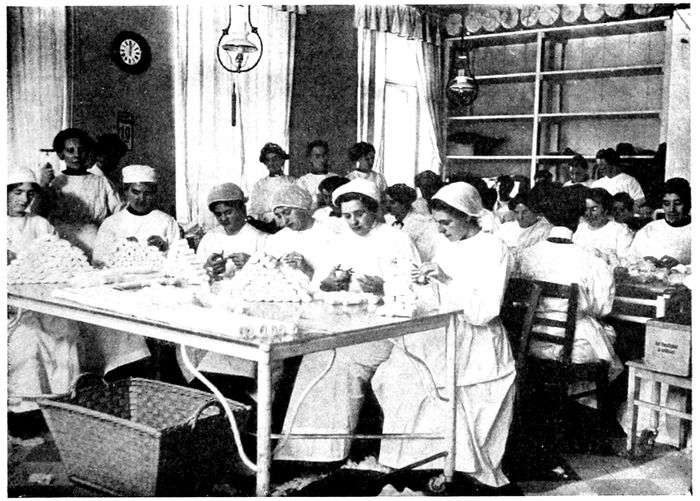
When in August, 1914, the most dreadful disaster that
ever befell humanity burst upon the European nations, women
at first stood paralyzed with fear and terror, foreseeing the
tremendous burden and sacrifices they would have to bear.
But after every hope for a peaceful solution had vanished and
nothing remained but to face the inevitable, they rallied and
prepared to weather the coming hurricane.
The manner in which they met it during the long and
terrible years of 1914, 1915, 1916, 1917 and 1918 was
perhaps the greatest revelation the world has ever experienced.
Never before have members of the “weaker sex” braved such
a catastrophe more heroically and made such supreme sacrifices.
In fact, woman’s activity during the World War has
been a grand manifestation, which stands out in glorious colors
from a black background of man’s hatred, revengefulness,
slander, calumniation, treason, avarice, atrocities, and murder.
When the vast armies were mobilized it became necessary
to close the innumerable gaps caused by the sudden drafting
and departure of so many million men. To refill the positions
they had occupied, was the most urgent necessity, as otherwise
the whole machinery of national life would become disorganized,
and that at the most critical time.
272At once immense numbers of women and girls responded
to the call. They went into the tramway and railway service
to act as ticket sellers and punchers, as conductors, brakemen
and motormen. They replaced the letter carriers and chauffeurs;
they climbed the lofty seats formerly occupied by cab-drivers
and postilions. Mounting motor-cycles they delivered
telegrams and performed other urgent errands. They formed
street-cleaning and fire-brigades and took care of the sanitation
and protection of the cities. In the offices and stores they
assumed the duties of the bookkeeper and floor-walker; in
the schools they substituted for male teachers who had followed
the call of the war trumpet. They repaired telegraph-wires
and installed telephones; they became blacksmiths and
repaired the roofs of houses. They cleaned windows and
chimneys, delivered newspapers and carried the coal from the
wagon into the bins and bunkers. They acted as “ice-men”
and collected the garbage and ashes. They tilled the fields
and vegetable gardens, and brought in the crops and the
harvests. They thrashed the wheat and served in the mills as
well as in the bakeries. They furnished clothes, and made and
mended shoes. They finished the public roads and other
works that had been left uncompleted. They built houses and
tore down others. In Berlin the excavation for a new underground
railway, badly needed, was done by women, and
half of the gangs that worked on the railroad tracks were
made up of girls.
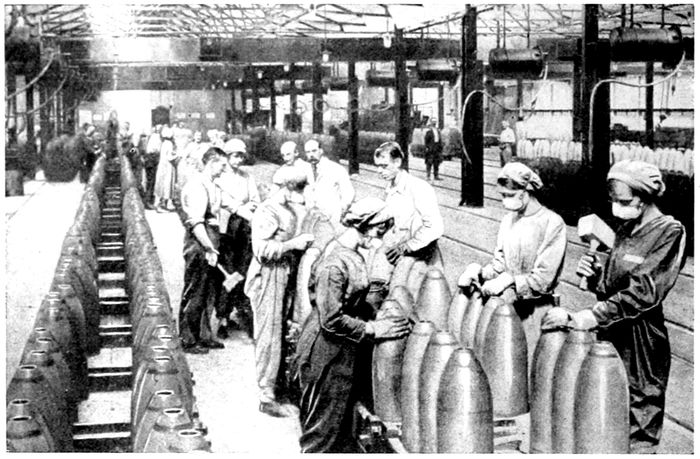
WOMEN FILLING SHELLS IN A BRITISH AMMUNITION FACTORY.
273In England as well as in France and Germany thousands
of women could be seen in the ship-yards working side by
side with men on the scaffolds, at bolting and riveting, forging
and casting, as if they had always done this work. In fact,
women did everything that heretofore had been regarded as
“man’s work.”
But they did much more. Hundreds of thousands of
women entered the gun- and ammunition factories in order
that the armies might not lack ample means for the defense
of the country.
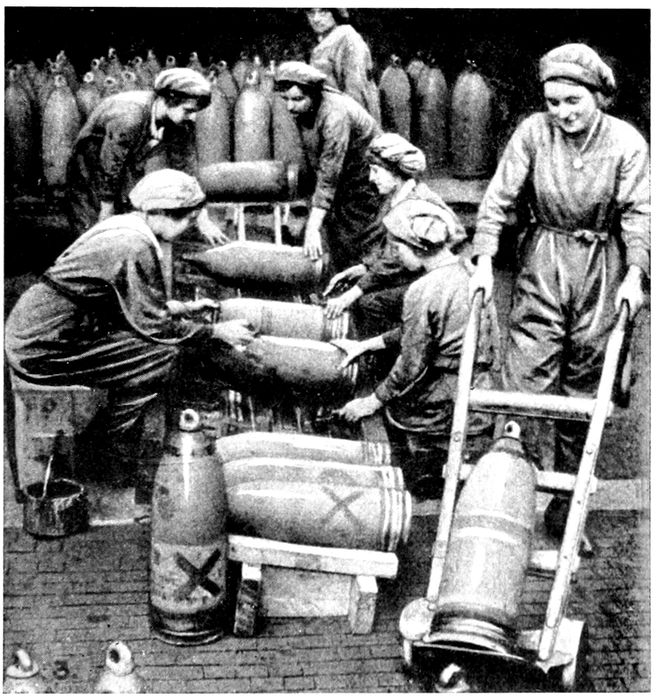
WOMEN IN A SHELL FACTORY.
Donning overalls, oil-cloth caps and gas masks they
became engaged in the hazardous manufacture of high explosives,
of filling and packing the deadly gas-shells and other
projectiles. At the same time millions of busy hands prepared
the bandages and other necessities for the treatment of the
wounded. Whole brigades of Red Cross nurses were formed
and went to the battlefields and hospitals, to attend those who
in the grim conflict might lose their limbs, their eye-sight, or
become sufferers from the effect of poisonous gases.
All too soon long trains and hospital-ships brought in
274such unfortunates, at first a few hundred, then in ever increasing
numbers, by the thousands and by tens of thousands.
Within a few months most of the countries engaged in the
dreadful struggle were turned into immense hospitals, filled
with moaning and suffering. What noble and indefatigable
women did here to alleviate this misery and distress, can
never be fully told and will never be forgotten. Whoever was
witness of the self-control and perseverance shown year after
year by many Red Cross nurses will always think of them
with reverence.
There is not a single Army Medical Corps of the many
nations engaged in the World War, which does not freely
admit, that the immense amount of work could not have been
done without the help of women. In a tribute to the Red Cross
Major-General Merritte W. Ireland, Surgeon-General U. S.
Army, said:
“Probably the greatest single service rendered by the
Red Cross home forces was the supply of trained nurses it
furnished our hospitals. The Army Medical Corps trains a
few nurses, but could never hope to turn out the large number
provided through Miss Delano’s department. If we needed
a thousand nurses for a given work, we telegraphed the War
Department. The War Department notified Miss Delano. And
the nurses arrived on schedule.
“An especially notable service rendered by Red Cross
nurses occurred during the early American campaign when our
men were brigaded with French divisions. When wounded,
they were, of course, taken to French hospitals. Unable to
answer questions or tell their needs, they were in a very
unhappy plight. Scores of Red Cross nurses speaking both
French and English were immediately sent to these hospitals—and
the problem was solved.
“The work of the Red Cross was often the theme of
discussions at American General Headquarters at Chaumont.
I remember that it was enlarged upon there in a conversation
between General Pershing, Mr. H. P. Davison, the Chairman
of the War Council of the American Red Cross, and myself.
We were speaking of the value of the service rendered by the
millions of our women and how they helped keep the influence
of home about the boys at the front. And General Pershing
said: “The women of the United States deserve a large share
of the credit for the success of the American forces.”
“Our Army officers have often admired not only the
spirit but the efficiency of the American Red Cross organization.
It provided an inexhaustible store of supplies; it possessed
a remarkable facility for adapting itself to any emergency,
however unexpected; and its personnel always evinced the
finest readiness for co-operation. The millions of surgical
275dressings, knitted articles, refugee garments, and other supplies
it contributed—for these things alone it would have deserved
the Army’s unstinted praise. All the splints used in all our
hospitals in France, both of the Army and of the Red Cross,
came from the Red Cross. It furnished more than a quarter
of a billion surgical dressings. It sent over enough sweaters
for every man in our overseas forces to possess one.”
Similar tributes have been freely extended to the nurses
of all other Red Cross branches, which co-operated with the
Medical Corps of the various powers engaged in the terrible
war.
While performing their merciful work, many women had
to bear the depressing anxiety caused by husbands, sons, or
brothers, fighting in the trenches or on the ocean; or for those
unfortunates who as prisoners had fallen into the hands of
the enemy.
The women of the Central powers had to face many
additional problems of the most perplexing nature. As the
soil of Germany and Austria does not yield enough to support
the whole population, and as all imports of foodstuffs were
cut off by hostile fleets, provisions became more scarce and
more expensive from day to day. There was not sufficient
milk to keep the millions of babies alive; and not enough
food to save adults from slow starvation. To stretch the scant
supplies the most careful and rigid methods of administration
276had to be invented and applied. Public kitchens were established
to reduce the cost of living to the lowest point possible.
In Berlin twenty-three committees of the National Women’s
Service with several thousand voluntary workers were running
such charitable kitchens, from which tens of thousands regularly
received their daily meals. The same organizations
later on supervised the system of bread-, milk-, grocery- and
butter-cards, when the increasing shortage of food forced the
governments to the severest restrictions.
Among the many German relief organizations those of
the Red Cross took the leading place. Originally divided into
five main sections under the general control of a central committee
and designed to combat of sickness and destitution in
the civil population, it now was increased to twenty-three
divisions. Their welfare work assumed such importance during
the progress of the war that it had to be subdivided into three
groups, the first of which became engaged in fighting tuberculosis
and contagious diseases, the second in the protection
of infancy and motherhood, the third in family welfare work
in the narrower meaning of the term. In all these branches
the organization of the Red Cross provided the framework
within which the numerous national, state and local social
activities of the country grouped themselves naturally in
accordance with their separate functions.
The activity of the organizations during the years 1917,
1918, and 1919, the dreadful years of general distress and
starvation, forms one of the most pathetic chapters in woman’s
history. Not only the food, but the cotton, wool, leather,
rubber, fat, oil, soap, and hundreds of other necessities gave
out completely. People were compelled to live on substitutes.
And as these became too scarce or too expensive, they lived
on substitutes for these substitutes. Imagine the heartrending
pain mothers were bearing when at the end of 1918 and
in 1919 large numbers of mayors of German cities and
numerous professors of medicine were compelled to send
urgent appeals for help to all medical faculties of the world,
stating that since the signing of the truce 800,000 people in
Germany had died from starvation. “Many millions of human
beings,” one of the appeals reads, “are living on only half or
even less than half the quantity of food necessary to sustain
life. Utterly exhausted they have lost all power of resistance
and succumb to any kind of sickness that may befall them.
The worst sufferers are the children and those mothers, who
fast for the sake of their children. There are too the neurasthenics
of all kinds, the numbers of which have, for four
years, increased immensely. Furthermore, there are the overworked,
and those who have become sick through the unheard-of
monotony of food and from the absolute absence of every
277stimulant. Their existence becomes more unbearable from
day to day. While the physicians of Germany are profoundly
impressed with the terrible ravages caused by hunger, they
have absolutely no means of combating them.”
While during these dreadful times millions of women
devoted themselves to the noble work of healing the terrible
wounds and sufferings, other groups eagerly tried to bring
about a cessation of hostilities. Immediately after the first
declaration of war, the “International Woman Suffrage Alliance”
directed an urgent appeal to the British Foreign Office
as well as to all Foreign Embassies in London, to leave untried
no method of conciliation or arbitration to avert the threatening
disaster. Numerous women’s societies in Holland, Sweden,
Germany and Switzerland arose simultaneously and joined
the good cause. Soon a great movement for peace began to
sweep through the women of the entire world.
But women’s efforts to bring the conflict to a standstill
lacked as yet the necessary strength. They were overpowered
by the influence and machinations of those statesmen, financiers,
publishers of newspapers and countless others, who wanted
war. And so nothing remained for women but to repeat ever
and again their protests against the madness of men.
When in December, 1914, suffering Christianity prepared
to celebrate the natal day of the Messiah, the Prince of Peace,
a noble-minded woman of London, Miss Emily Hobhouse,
wrote the following letter:
“To American Women, Friends of Humanity and Peace!
“Friends:—May I appeal to you in the name of Humanity,
on behalf of the children of Europe, before whom suffering
or death has already taken place, and whose future is fraught
with pain? In you lies our hope of help for them, for you
are free to speak and act.
“Will you not come to our troubled world, unite with
the women of other neutral lands and initiate a crusade—a
real ‘holy’ war, fought with the swords of the Spirit?
“Appalling as is this massacre of the manhood of Europe,
that is not the worst. As long as men adopt barbaric methods
of settling disputes they must abide by the consequences; but
for those innocent victims, the non-combatants—women,
babes, old and sick—I crave your help. Their names and
numbers will never be known. They are multiplying in Poland
and Galicia, in Belgium and France, in East Prussia and Holland,
and elsewhere. Ponder this vast host, voiceless, suffering,
dying, crouching beside their blackened ruins or fleeing from
the devastated areas both east and west. Think of disease
let loose, of the horrors of cold and famine!
“I know it is not easy to visualize details of conditions
278so foreign to average experience. It needs a mental effort
few can make. It is because I was daily witness of such things
in the South African War that I dare not be silent. Disease,
devastation, starvation and death were words I then learned
as war interprets them. I saw a country burnt and devastated
as large parts of Europe are to-day; I saw old and sick, women
and children turned out of house and home; I saw them, half
clad, starving, lying sick to death upon the bare earth; I saw
babies that were born in open, crowded trucks; I saw haggard,
endless sick, gaunt skeletons, hourly deaths. There in the
Boer States death swept away non-combatants in the proportion
of five to one of those who fell in the field.
“It is because I know the brunt of this war, too, is falling
and must fall, heaviest upon the weak and young, that I appeal
now on their behalf, not merely to those who love peace, but
to the great body of women who love children. Little children,
more sensitive to exposure, to extremes of heat and cold,
to tainted food, to starvation, and to the stench, the poisonous
stench of war, quickly fade, quickly die.
“Will you not arise and work for peace?—For peace
alone can save the children. It would be, I well know, a
struggle against powers of darkness and will need the whole
armor of God. Yet every sentiment of pity and of civilization,
leave alone Christianity, demands the effort. The victims
cannot help themselves; succor must come from without.
“Relief, we know, you pour most generously, but relief
cannot meet a want so colossal, neither can it touch the worst
ills. Cut at the root of the evil—the war itself. A strong
lead is needed. Myriads want peace; they never wanted war.
In each country this is true; constant proofs reach us from
Germany and France, as well as various parts of England.
The press of each nation asserts that the people are unanimous
for war. It is not so, but those who have the means of speaking,
and who swim with their governmental streams, can speak
the loudest and alone are heard. Many dare not, many cannot
speak. Others make a truce and save thousands of human
lives and receive the blessings of thousands of wives and
mothers.
“A union of neutral women could investigate the facts
of the sufferings amongst non-combatants, and founded upon
acquired personal knowledge they could in the name of
Humanity formulate demands persistent, cogent, irresistible,
not in favor of any one party or nation, but simply for Peace.
“It seems futile to turn to statesmen, governments or
prelates for aid. They are tied and bound by position, custom
and mutual fear. They await propitious movements. Famine,
disease and death do not wait.
“Women have this advantage: they are still unfettered
279by custom and expediency; they need consult only the dictates
of humanity. If ever the world needed their intervention
on a vast scale, it needs it now!
“Failure in such a task would have no fears for them;
failure in a noble effort is often a measure to success! The
greatest have seemed to fail. Judged by human standards,
Christ’s life on earth was a failure. The effort in any case
would leave its mark upon the thought and history of the
world. Womanhood will have arisen in vindication of a higher
humanity—to avenge desolated motherhood and protect
martyred children; it will have asserted its right to shield the
weak and young from the fatal results of the organized murder
called war.”
The appeal was not made in vain. The day after its
receipt a number of prominent American women called a convention
in Washington, D. C., on January 10th, 1915. Miss
Jane Addams of Chicago acted as chairman. The result of
280this meeting was the organization of the “Woman’s Peace
Party,” which adopted the following
“We women of the United States, assembled in behalf
of World Peace, grateful for the security of our own country,
but sorrowing for the misery of all involved in the present
struggle among warring nations, do hereby band ourselves
together to demand that war be abolished.
“Equally with men pacifists, we understand that planned-for,
legalized, wholesale, human slaughter is to-day the sum
of all villainies.
“As women, we feel a peculiar moral passion of revolt
against both the cruelty and the waste of war. As women, we
are especially the custodians of the life of the ages. We will
not longer consent to its reckless destruction.
“As women, we are particularly charged with the future
of childhood and with the care of the helpless and the
unfortunate. We will not longer endure without protest that
added burden of maimed and invalid men and poverty-stricken
widows and orphans which war places upon us.
“As women, we have builded by the patient drudgery
of the past the basic foundation of the home and of peaceful
industry. We will not longer accept without a protest, that
must be heard and heeded by men, that hoary evil which in
an hour destroys the social structure that centuries of toil
have reared.
“As women, we are called upon to start each generation
onward toward a better humanity. We will not longer tolerate
without determined opposition that denial of the sovereignty
of reason and justice by which war and all that makes war
to-day render impotent the idealism of the race.
“Therefore, as human beings and the mother half of
humanity, we demand that our right to be consulted in the
settlement of questions concerning not alone the life of individuals
but of nations be recognized and respected.
“We demand that women be given a share in deciding
between war and peace in all the courts of high debate—within
the home, the school, the church, the industrial order,
and the state.
“So protesting, and so demanding, we hereby form
ourselves into a national organization to be called the Woman’s
Peace Party.
“We hereby adopt the following as our platform of
principles, some of the items of which have been accepted
by a majority vote, and more of which have been the unanimous
choice of those attending the conference that initiated
281the formation of this organization. We have sunk all differences
of opinion on minor matters and given freedom of
expression to a wide divergence of opinion in the details of
our platform and in our statement of explanation and information,
in a common desire to make our woman’s protest against
war and all that makes for war, vocal, commanding and
effective. We welcome to our membership all who are in
substantial sympathy with that fundamental purpose of our
organization, whether or not they can accept in full our detailed
statement of principles.
“The Purpose of this Organization is to enlist all American
women in arousing the nations to respect the sacredness of
human life and to abolish war. The following is adopted as
our platform:
- 1.
- The immediate calling of a convention of neutral nations in the interest of early peace.
- 2.
- Limitation of armaments and the nationalization of their manufacture.
- 3.
- Organized opposition to militarism in our own country.
- 4.
- Education of youth in the ideals of peace.
- 5.
- Democratic control of foreign policies.
- 6.
- The further humanizing of governments by the extension of the franchise to women.
- 7.
- “Concert of Nations” to supersede “Balance of Power.”
- 8.
- Action toward the gradual organization of the world to substitute Law for War.
- 9.
- The substitution of an international police for rival armies and navies.
- 10.
- Removal of the economic causes of war.
- 11.
- The appointment by our Government of a commission of men and women, with an adequate
appropriation, to promote international peace.”
In the meantime women of other countries had not
remained idle. Dr. Aletta H. Jacobs, President of the Dutch
National Society for Woman Suffrage, directed a letter to
the most prominent women societies of various nations, saying
that it was of the greatest importance to bring those women,
representing the women societies of the world, together in an
international meeting in a neutral country, to show “that in
these dreadful times, in which so much hate has been spread
among the different nations, the women at least retained their
solidarity and that they were able to maintain mutual friendship.”
At the same time she suggested to hold this International
Congress in Holland, and offered to make the necessary
arrangements.
282While many women welcomed this first effort to renew
international relations it was only natural that, especially in
belligerent countries, a fierce criticism should be directed
against this daring move. This criticism came even from some
of the women’s organizations. “It was to be impossible to hold
the Congress! No one would attend! Even if the Congress
were held the nationalities would quarrel amongst themselves!”
But those who had undertaken the work were not deterred by
this criticism, but encouraged by many enthusiastic responses.
The announcement that Miss Jane Addams had accepted the
invitation to preside at the Congress gave courage to all who
were working for it. And so the memorable “International
Congress of Women for Permanent Peace” came to pass. It
was held at the Hague from April 28 to May 1, 1915, and
attended by 1136 delegates and a large number of visitors.
The countries represented were Austria, Belgium, Canada,
Denmark, Germany, Great Britain, Hungary, Italy, Netherlands,
Norway, Sweden, and the United States of America.
In her address of Welcome, Dr. Aletta H. Jacobs, the
President of the Executive Committee, said: “In arranging this
International Congress we have naturally had to put aside all
thoughts of a festive reception, we have simply endeavored
to receive you in such a way that you may feel assured of
our sympathy, our mutual sisterly feelings, our goodwill to
link the nations together again in the bonds of fellowship and
trustful co-operation.
“With mourning in our hearts we stand united here. We
grieve for the many brave young men, who have lost their lives
in barbaric fratricide before even attaining their full manhood;
we mourn with the poor mothers bereft of their sons; with
thousands and thousands of young widows and fatherless
children; we will not endure in this Twentieth Century civilization,
that governments shall longer tolerate brute force as the
only method of solving their international disputes. The
culture of centuries standing and the progress of science must
no longer be recklessly employed to perfect the implements
of modern warfare. The accumulated knowledge, handed
down to us through the ages, must no longer be used to kill
and to destroy and to annihilate the products of centuries
of toil.
“Our cry of protest must be heard at last. Too long
already has the mother-heart of woman suffered in silence.
O, I know and feel most strongly, that it is impossible that
a world-fire, such as has been blazing forth for the last nine
months, can be extinguished, until the last bit of inflamable
material has been reduced to ashes, but I also feel most strongly
that we must raise our voices now, if the new era of civilization
that will arise from these ashes is to rest upon a more substantial
283basis, a basis on which the women with their inherent
conserving and pacific qualities shall have the opportunity to
assist men in conducting the world’s affairs.
“We women judge war differently from men. Men
consider in the first place its economic results. What it costs
in money, its loss or its gain to national commerce and industries,
the extension of power and so forth. But what is
material loss to us women, in comparison to the number of
fathers, brothers, husbands and sons who march out to war
never to return. We women consider above all the damage
to the race resulting from war, and the grief, the pain and
misery it entails. We know only too well that whatever may
be gained by a war, it is not worth the bloodshed and the
tears, the cruel sufferings, the wasted lives, the agony and
despair it has caused.
“Important as are the economic interests of a country,
the interests of the race are more vital. And, since by virtue
of our womanhood, these interests are to us of greater sanctity
and value, women must have a voice in the governments of
all countries.
“Not until women can bring direct influence to bear
upon Governments, not until in the parliaments the voice of
the women is heard mingling with that of the men, shall
we have the power to prevent recurrence of such catastrophes.
“The Governments of the world, based on the insight
of the half of humanity, have failed to find a right solution
of how to settle international disputes. We therefore feel it
more and more strongly, that it is the duty, the sacred duty
of every woman, to stand up now and claim her share with
men in the government of the world. Only when women are
in the parliaments of all nations, only when women have a
political voice and vote, will they have the power effectively
to demand that international disputes shall be solved as they
ought to be, by a court of arbitration or conciliation. Therefore
on a programme of the conditions whereby wars in future may
be avoided, the question of woman suffrage should not be
lacking, on the contrary, it should have the foremost place.
“May this Congress be the dawn of a better world, a
world in which each realizes that it is good to serve one’s
own country, but that above the interests of one’s Country
stand the interests of humanity, by serving which a still higher
duty is fulfilled.”—
The business sessions, presided over by Miss Jane Addams,
led to the adoption of the following resolutions:
284
1. Protest.
We women, in International Congress assembled, protest
against the madness and the horror of war, involving as it
does a reckless sacrifice of human life and the destruction of
so much that humanity has labored through centuries to
build up.
2. Women’s Sufferings in War.
This International Congress of Women opposes the
assumption that women can be protected under the conditions
of modern warfare. It protests vehemently against the odious
wrongs of which women are the victims in time of war, and
especially against the horrible violation of women which
attends all war.
3. The Peace Settlement.
This International Congress of Women of different nations,
classes, creeds and parties is united in expressing sympathy
with the suffering of all, whatever their nationality, who are
fighting for their country or laboring under the burden of war.
Since the mass of the people in each of the countries
now at war believe themselves to be fighting, not as aggressors
but in self-defence and for their national existence, there can
be no irreconcilable differences between them, and their common
ideals afford a basis upon which a magnanimous and
honorable peace might be established. The Congress therefore
urges the Governments of the world to put an end to
this bloodshed, and to begin peace negotiations. It demands
that the peace which follows shall be permanent and therefore
based on principles of justice, including those laid down in
the resolutions 5, 6, 7, 8 and 9 adopted by this Congress.
4. Continuous Mediation.
This International Congress of Women resolves to ask
the neutral countries to take immediate steps to create a conference
of neutral nations which shall without delay offer
continuous mediation. The Conference shall invite suggestions
for settlement from each of the belligerent nations and in
any case shall submit to all of them simultaneously, reasonable
proposals as a basis of peace.
5. Respect for Nationality.
This International Congress of Women, recognizing the
right of the people to self-government, affirms that there
should be no transference of territory without the consent of
285the men and women residing therein, and urges that autonomy
and a democratic parliament should not be refused to any
people.
6. Arbitration and Conciliation.
This International Congress of Women, believing that
war is the negation of progress and civilization, urges the
governments of all nations to come to an agreement to refer
future international disputes to arbitration and conciliation.
7. International Pressure.
This International Congress of Women urges the governments
of all nations to come to an agreement to unite in bringing
social, moral and economic pressure to bear upon any
country, which resorts to arms instead of referring its case to
arbitration or conciliation.
8. Democratic Control of Foreign Policy.
Since War is commonly brought about not by the mass
of the people, who do not desire it, but by groups representing
particular interests, this International Congress of Women
urges that Foreign Politics shall be subject to Democratic
Control; and declares that it can only recognize as democratic
a system which includes the equal representation of men and
women.
9. The Enfranchisement of Women.
Since the combined influence of the women of all countries
is one of the strongest forces for the prevention of war,
and since women can only have full responsibility and effective
influence when they have equal political rights with men, this
International Congress of Women demands their political
enfranchisement.
10. Third Hague Conference.
This International Congress of Women urges that a third
Hague Conference be convened immediately after the war.
11. International Organization.
This International Congress of Women urges that the
organization of the Society of Nations should be further developed
on the basis of a constructive peace, and that it should
include:
a. As a development of the Hague Court of Arbitration,
a permanent International Court of Justice to settle questions
or differences of a justifyable character, such as arise on the
interpretation of treaty rights or of the law of nations.
b. As a development of the constructive work of the
Hague Conference, a permanent International Conference
holding regular meetings in which women should take part,
to deal not with the rules of warfare but with practical proposals
286for further International Co-operation among the States.
This Conference should be so constituted that it could formulate
and enforce those principles of justice, equity and goodwill
in accordance with which the struggles of subject communities
could be more fully recognized and the interests
and rights not only of the great Powers and small Nations
but also those of weaker countries and primitive peoples
gradually adjusted under an enlightened international public
opinion.
This International Conference shall appoint:
A permanent Council of Conciliation and Investigation
for the settlement of international differences arising from
economic competition, expanding commerce, increasing population
and changes in social and political standards.
12. General Disarmament.
The International Congress of Women, advocating universal
disarmament and realizing that it can only be secured
by international agreement, urges, as a step to this end, that
all countries should, by such an international agreement, take
over the manufacture of arms and munitions of war and should
control all international traffic in the same. It sees in the
private profits accruing from the great armament factories a
powerful hindrance to the abolition of war.
13. Commerce and Investments.
a. The International Congress of Women urges that in
all countries there shall be liberty of commerce, that the seas
shall be free and the trade routes open on equal terms to the
shipping of all nations.
b. Inasmuch as the investment by capitalists of one
country in the resources of another and the claims arising
therefrom are a fertile source of international complications,
this International Congress of Women urges the widest possible
acceptance of the principle that such investments shall be made
at the risk of the investor, without claim to the official protection
of his government.
14. National Foreign Policy.
a. This International Congress of Women demands that
all secret treaties shall be void and that for the ratification of
future treaties, the participation of at least the legislature of
every government shall be necessary.
b. This International Congress of Women recommends
that National Commissions be created, and International Conferences
convened for the scientific study and elaboration of
the principles and conditions of permanent peace, which might
contribute to the development of an International Federation.
These Commissions and Conferences should be recognized
by the Governments and should include women in their
deliberations.
287
15. Women in National and International Politics.
This International Congress of Women declares it to be
essential, both nationally and internationally, to put into practice
the principle that women should share all civil and political
rights and responsibilities on the same terms as men.
16. This International Congress of Women urges the
necessity of so directing the education of children that their
thoughts and desires may be directed towards the ideal of
constructive peace.
17. This International Congress of Women urges, that
in the interests of lasting peace and civilization the Conference
which shall frame the Peace settlement after the war should
pass a resolution affirming the need in all countries of extending
the parliamentary franchise to women.
18. This International Congress of Women urges that
representatives of the people should take part in the conference
that shall frame the peace settlement after the war, and
claims that amongst them women should be included.
19. Women’s Voice in the Peace Settlement.
This International Congress of Women resolves that an
international meeting of women shall be held in the same
place and at the same time as the Conference of the Powers
which shall frame the terms of the peace settlement after the
war for the purpose of presenting practical proposals to that
Conference.
20. Envoys to the Governments.
In order to urge the Governments of the world to put
an end to this bloodshed and to establish a just and lasting
peace, this International Congress of Women delegates envoys
to carry the message expressed in the Congress Resolutions
to the rulers of the belligerent and neutral nations of Europe
and to the President of the United States.
These Envoys shall be women of both neutral and belligerent
nations, appointed by the International Committee of
this Congress. They shall report the result of their missions
to the International Women’s Committee for Constructive
Peace as a basis for further action.
288The memorable Congress adjourned on May 1. In closing
the sessions Miss Addams said: “This is the first International
Congress of Women met in the cause of peace in the necessity
brought about by the greatest war the world has ever seen.
For three days we have met together, so conscious of the
bloodshed and desolation surrounding us, that all irrelevant
and temporary matters fell away and we spoke solemnly to
each other of the great and eternal issues as to those who
meet around the bedside of the dying. We have been able
to preserve good will and good fellowship, we have considered
in perfect harmony and straightforwardness the most difficult
propositions, and we part better friends than we met. It seems
to me most significant that women have been able to do this
at this moment and that they have done it, in my opinion,
extremely well.
“We have formulated our message and given it to the
world to heed when it will, confident that at last the great
Court of International Opinion will pass righteous judgment
upon all human affairs.”—
In accordance with Paragraph 20 of the resolutions the
members of the different delegations appointed to present
the resolutions to the rulers of the belligerent and neutral
nations of Europe and to the President of the United States
of America began their work on May 7th. Various delegations
with Miss Addams and Dr. Jacobs as speakers, were
received on that day in the Hague by Prime Minister Cort
van der Linden; on May 13th and 14th in London by Foreign
Minister Sir Edward Grey and Prime Minister Asquith; on
May 21st and 22d in Berlin by Foreign Minister von Jagow
and Chancellor von Bethmann Hollweg; on May 26th in
Vienna by Foreign Minister von Burian; on May 30th in
Buda Pest by Prime Minister von Tisza; on June 2d in Berne
by Foreign Minister Hoffmann and President Motta; on June
4th and 5th in Rome by Foreign Minister Sonnino, and Prime
Minister Salandra; on June 8th by the Pope; on June 12th
and 14th in Paris by Foreign Minister Delcassé and Prime
Minister Viviani; and on June 16th in Havre by the Foreign
Minister of Belgium, M. d’Avignon. Other delegations submitted
the resolutions to the Prime Ministers of Norway,
Sweden, Denmark, and Russia. The resolutions were likewise
sent to the Ministers of Foreign Affairs of all countries
not visited by the delegates, and to President Woodrow Wilson.—
That all these efforts by noble-minded women, to secure
the cessation of hostilities, failed, is a grave reproach to those
men who directed the war. Blinded by hate and revenge
they insisted that the murderous struggle be carried on to the
bitter end. And to do this unhindered and unmolested, they
289decried all “pacifists” as despicable creatures to whom no
attention should be paid. To speak of peace was made a
crime, equal to illoyalty and sedition, and so the resolutions
of the Woman’s Peace Conference were drowned under waves
of detraction and calumny.
One of the most glaring examples of this sort of warfare
was that of Miss Jeanette Rankin, who in 1917 had been sent
by the State of Montana as the first woman member to the
House of Representatives. Her first act in this body was very
dramatic. When on the memorable April 6th, 1917, the
House voted on the question, if the United States should enter
the World War, she answered the call with the words: “I love
my country and I want to stand by it. But I cannot vote for
war! No!” After these words she sank, tears in her eyes,
into her chair. Although Miss Rankin had without doubt
expressed the feeling of the overwhelming majority of American
women, she nevertheless excited the wrath of the
notorious “National Security League,” who in 1918 defeated
the re-election of Miss Rankin by sending broadcast to Montana
tons of literature in which her vote against the declaration
of war was stigmatized as an “infamous and damning act.”
Undaunted by such persecutions the gallant women
once more raised their voices when it became evident that
the so-called Peace Congress of the allied delegates at Versailles,
instead of giving quick relief to the starving millions,
and instead of promoting good will and better understanding
among the different nations, was degenerating into an orgy
of autocracy, merciless extortion and land-grabbing, repudiating
all the high-sounding phrases of humanity, democracy,
self-government, political and economic liberty, with which
the war had been carried on.
On May 12th, 1919, delegates of the “International
Women’s Party for Permanent Peace” assembled at Zurich,
Switzerland, to discuss the work of the Peace Congress in
Versailles and the movement for a League of Nations. Sixteen
countries were represented, the neutral with thirty-five, the
countries of the Entente with forty-nine, and the Central
Powers with thirty-six delegates. Among the twenty-three
delegates of the United States were Jane Addams, and
Jeanette Rankin, ex-member of Congress for Montana. Again
Miss Addams acted as president.
The noble spirit, that had brought these women together,
found expression first in the following address of the French
delegates to the German women:
“To-day for the first time our hands which have sought
each other in the night can be joined. We are a single
humanity, we women. Our work, our joys, our children, are
the same. French and Germans! The soldiers which have
290been killed between are for both of us alike victims. It is
our brothers and our sisters who have suffered. We do not
want vengeance. We hate all war. We push from us both the
pride of victory and the rancor of defeat. United by the
same faith, by the same sense of service, we agree to consecrate
ourselves to the fight against war and to the struggle
for everlasting peace.
“All women against all wars!
“Come, to work! Publicly, in the face of those who have
vowed eternal hate, let us unite, let us love each other!”
To this address the German women made the following
reply:
“We German women have heard the greetings of our
French sisters with the deepest joy, and we respond to them
from the depths of our souls. We too protest against the
perpetuation of a hate which was always foreign to women’s
hearts. Our French sisters! It is with joy that we grasp your
extended hand. We will stand and march together, in common
effort for the good of mankind. On the ruins of a materialist
world, founded by force and violence, on misunderstanding
and hate, we women will, through death and sorrow, clear
the road to the new humanity. As mothers of the coming
generations, we, women of all nations, want love and understanding
and peace. Despite the dark gloom of the present
we stumble, comforted, toward the sunshine of the future.”
On May the 14th the delegates passed the following
resolution, which was sent to the Congress at Versailles:
“This International Congress of Women expresses its
deep regret that the terms of peace proposed at Versailles
should so seriously violate the principles upon which alone
a just and lasting peace can be secured, and which the
Democracies of the world had come to accept. By guaranteeing
the fruits of the secret treaties to the conquerors the
terms tacitly sanction secret diplomacy. They deny the principle
of self-determination, recognize the right of the victors
to the spoils of war, and create all over Europe discords and
animosities, which can lead only to future wars. By the
demand for the disarmament of one set of belligerents only,
the principle of justice is violated and the rule of force is
continued. By the financial and economic proposals a hundred
million people of this generation in the heart of Europe are
condemned to poverty, disease and despair, which must result
in the spread of hatred and anarchy within each nation. With
a deep sense of responsibility this Congress strongly urges
the Allied Governments to accept such amendments of the
terms as may be proposed to bring the peace into harmony
with those principles first enunciated by President Wilson
upon the faithful carrying out of which the honor of the
Allied peoples depends.”
291This communication was proposed by Mrs. Philip Snowden
of England and seconded by Miss Jeanette Rankin of
the United States.
Another resolution protested against the prolongation of
the blockade as bringing starvation and death to innumerable
innocent women and children of the Central Powers. It also
urged that all resources of the world, food, raw materials,
finance, transport should be organized immediately for the
relief of the peoples, in order to serve humanity and bring
about the reconciliation and union of the peoples. A third
resolution demanded representation in the League of Nations
for women, and that Miss Addams be the first woman representative.
At its concluding session the Congress voted
unanimously to call a world-wide strike of women in the
event another war be declared, even if such a war should be
sanctioned by the League of Nations.
292
The wonderful spirit displayed by many millions of
women during the World War gave foundation to the hope
that universal suffrage would be an inevitable result of the
war, and that the law-makers of all the belligerent countries
would no longer deny this crowning privilege to those mothers,
wives, and sisters, who had worked so nobly, suffered so
keenly, and endured so patiently through the long years of
this cruel catastrophe. In a large number of countries this
expectation has been verified. To name them in chronological
order, we begin with neutral Denmark, which in 1915 granted
to her women full parliamentary suffrage and eligibility. Nine
women were elected to Parliament. Iceland extended to her
women the same rights, and one woman was sent to Parliament.
The next country was England, for many years the storm
center of the suffrage movement. While in all other lands
had been steps in evolution, England was the scene of a
revolution. Not one with guns, and powder and bloodshed,
but nevertheless with all other evidences of war. As Mrs.
Carrie Chapman Catt, President of the International Woman
Suffrage Alliance, graphically described, “there were brave
generals and well trained armies, and many a well-fought
battle; there have been tactics and strategies, sorties, sieges,
and even prisoners of war, many of whom had to be released
as they went on a hunger-strike. But in time, by the restless
activity of the leaders, every class, including women of the
nobility, working girls, housewives and professional women,
became engaged in the campaign, and not a man, woman or
child in England was permitted to plead ignorance concerning
the meaning of woman suffrage. Together, men and women
suffragists carried their appeal into the byways and most
hidden corners of the kingdom. They employed more original
methods, enlisted a larger number of women workers, and
grasped the situation in a bolder fashion than had been done
elsewhere. In other countries persuasion had been the chief,
if not the only, weapon relied upon; in England it was
persuasion plus political methods.
“First, the world expressed disgust at the alleged unfeminine
conduct of English suffragists. Editorial writers in many
lands scourged the suffrage workers of their respective countries
over the shoulders of these lively English militants. But
time passed; comment ceased; and the world, which had
ridiculed, watched the contest in silence, but with never an
eye closed. It assumed the attitude of the referee who realizes
293he is watching a cleverly played game, with the chances
hanging in the balance. Then came a laugh. The dispatches
flashed the news to the remotest corners of the globe that
English Cabinet Ministers were “protected” in the street by
bodyguards; the houses of Cabinet Ministers were “protected”
by relays of police, and even the great Houses of Parliament
were “protected” by a powerful cordon of police. Protected!
and from what? The embarrassing attack of unarmed women!
In other lands police have protected emperors, czars, kings
and presidents from the assaults of hidden foes, whose aim
has been to kill. That there has been such need is tragic; and
when, in contrast, the vision was presented of the Premier
of England hiding behind locked doors, skulking along side
streets, and guarded everywhere by officers, lest an encounter
with a feminine interrogation point should put him to rout,
it proved too much for the ordinary sense of humor.
“Again, the dispatches presented another view. Behold,
they said, the magnificent and world-renowned House of
Parliament surrounded by police, and every woman approaching
that sacred precinct, halted, examined, and perhaps
arrested! Behold all this elaborate precaution to save members
of Parliament from inopportune tidings that women
would have votes; yet, despite it all, the forbidden message
is delivered, for over the Houses floats conspicuously and
defiantly a huge “Votes for Women” kite. Perhaps England
did not know the big world laughed then; but the world did
laugh, and more, from that moment it conceded the victory
to the suffragists. The only question remaining unanswered,
was: ‘How will the Government surrender, and at the same
time preserve its dignity and consistency?’”
Surrender came when in January, 1917, the Lower House
of Commons adopted a resolution favoring a bill making
women eligible as members of Parliament.
The bill was discussed again in October, 1918, and a
vote of 274 to 25 on October 24th gave women the right to
sit as members of Parliament.
Voting in the general elections on December 14th, 1918,
for the first time, the British women enjoyed at last the victory
for which they bravely fought. While they did not succeed
to elect one of their women candidates for a seat in the
Parliament, the election was nevertheless one of the most
notable in years. Nearly in all districts the women voters
made a satisfactory showing as compared to that of men.
In Ireland one woman, Countess Georgina Markievicz, an
Irish by birth and the leading female figure in the Sinn Fein
movement, was elected to the House of Commons, the first
woman ever sent to this body.
Canada likewise granted full suffrage to women. A bill
294passed the third reading on May 3d and received Royal Assent
May 23d, 1918.
In Nova Scotia a bill was passed April 26th, 1919.
In South Africa Parliament accepted a Woman Suffrage
Bill on April 1st, 1919, by 44 votes to 42.
When the revolution came in Russia, equal suffrage for
women was accepted by the men of all parties without opposition.
It has had, as Catherine Breshkovsky, the “Grandmother
of the Russian Revolution,” explained, “a profound effect
upon the minds of the peasant women. They used to be
often beaten by their husbands. Now the idea of freedom and
equal rights has taken firmer root among them. Instead of
submitting to beatings from her husband the sturdy peasant
woman defends herself, and sometimes she even beats him,
especially if he is drunk. The fact that during the war the
women have had to do every kind of work has also contributed
to this sense of independence.”
When in November, 1918, the German Republic was
declared, paragraph 31 of the Constitution provided that the
representatives of the people be elected by all men as well
as women over twenty years, and that women are eligible for
all Federal and State Legislatures and municipal bodies.
Under this regulation on January 19th, 1919, 36 women
were elected to the Federal Parliament, and 22 to State Legislatures.
Among the women elected to the Parliament were
several of the most prominent leaders of the suffrage movement
in Germany: Dr. Gertrud Bäumer, Dr. Käthe Schirmacher,
and Dr. Alice Salomon.
In Austria the downfall of the monarchy nullified the
law which forbade women to take part in political societies.
The 12th of November, 1918, brought to the women universal,
equal, direct, and secret suffrage and eligibility with
the announcement of the republic. Seven women were elected,
among them the well-known suffragist Adelheid Popp, who
was also elected to the Vienna Municipal Council.
The Government of the Hungarian Republic likewise
adopted a suffrage law which gives the vote to all men of
21 and to women of 24 if they can read and write. While
this is not equality of the sexes yet, the government gave at
the same time evidence of its profound respect for the abilities
of women by taking one of the most important steps in the
history of woman’s progress. It appointed Miss Rose Bédy
Schwimmer, highly respected for her activity and literary
works on suffrage and peace, as ambassador extraordinary
and minister plenipotentiary to Switzerland. But the conservative
members of the Federal Council of that country refused
to accept a woman ambassador, and so Miss Bédy Schwimmer
found it advisable to tender her resignation, a month after
having accepted her difficult task.
295The new republic Czecho-Slovakia as well as the newly
reconstituted state of Poland at once conceded full political
citizenship to their women. In Czecho-Slovakia eight, and in
Poland five women were elected to the Parliaments.
In Sweden full suffrage was accorded to women May
28th, 1919, when a bill was passed by large majorities in
both houses of the National Parliament, according to which
every subject, man or woman, who has attained his or her
twenty-third year, is qualified to vote.
In France the “Union Française pour le Suffrage des
Femmes” sent on January 24th, 1919, a proclamation to the
Parliament demanding that French women be given the
franchise. The proclamation pointed to the fact that the right
to vote had been recognized in enemy and allied countries
and that therefore France should not be backward. But in
spite of this on April 4th two women suffrage amendments
to the Electoral Reform Bill were killed in the Chamber of
Deputies. The provision making women eligible for election
to the Chamber was defeated, 302 votes to 187. The vote
against transmission of the right to vote to the next of kin
of heads of families, without distinction of sex, was defeated
335 to 134. But on May 20th the Chamber of Deputies
adopted a bill granting women the right to vote in all elections
for members of the Communal and Departmental Assemblies.
The vote was 377 to 97. The measure then went to the Senate.
Switzerland, with the European spread of woman suffrage
all around, may be expected to soon respond to the wave
of democratic sentiment. On January 22, 1919, the delegates
of the Swiss Union of Women’s Clubs adopted a resolution
to request the Federal Council to order a radical revision of
the Constitution, and grant to women equal political rights
with men. On March 17th, the Grand Council of the Canton
of Neuchâtel declared for the principle of Woman Suffrage,
and likewise instructed the Government to prepare a suffrage
bill. If passed this bill will probably be decided by referendum.
The Belgian Chamber of Deputies, by unanimous vote,
adopted on April 11th, 1919, an Electoral Reform Bill,
under the terms of which the right to vote is limited to widows
who have not remarried, to the mothers of soldiers killed in
battle and to the mothers of civilians shot by the enemy.
In Holland the first Chamber of the Dutch Parliament
adopted on July 12th, 1919, a motion to introduce woman
suffrage by a vote of 34 to 5.
In the United States of America the Western States have,
as pointed out in a former chapter, never hesitated to acknowledge
the rights of women to vote. But the Southern and
Eastern States had remained reluctant in granting this privilege.
And so the suffragists were compelled to conquer these regions
step by step. The women of New York won full suffrage in
2961917, those of South Dakota, Michigan and Oklahoma in
1918. Presidential suffrage was secured in 1917 in North
Dakota, Nebraska, and Rhode Island, and in 1919 in Indiana,
Iowa, Minnesota, Wisconsin, Missouri and Maine.
For many years efforts had also been made by the
friends of Woman Suffrage to induce Congress to act on the
so-called “Susan Anthony Amendments to the Constitution,”
reading as follows:
“Section 1. The right of citizens of the United States
to vote shall not be denied or abridged by the United States
or by any State on account of sex.
“Section 2. The Congress shall have power by appropriate
legislation to enforce the provisions of this article.”
In 1914 the Senate again voted these amendments down
by 11 votes. Again, in September, 1918, it was rejected by
two votes, and again in February, 1919, by one vote. The
House voted upon the resolution three times, rejecting it in
1915 by 78 votes, passing it in 1918 by a margin of one vote,
and again, on May 21st, 1919, by a vote of 304 to 89. The
fight ended on June 4, 1919, when the Senate adopted the
resolution by a vote of 56 to 25.
“The credit of having won this victory,” so the “New
York American” said in an editorial, “belongs chiefly to the
resourceful women of the land who have, for generations,
been pushing this issue to the front in spite of stupid opposition
and almost as stupid indifference.
“Liberal-minded men, a few in the early days, many
more recently, have helped. But, primarily, it is a woman’s
victory, and no man will begrudge the acknowledment.
Equal partners in the economic and social life of the nation,
American women will now be equal sharers in its political life
and in the responsibilities which this will involve.
“The joy of triumph will be of brief duration. The
period of responsibility will be long and trying. But the
women of America will certainly meet it equally with the
men, and if they do that the men will have no just basis of
complaint. Political rule by men has been full of blunders.
Women, too, will blunder, but they will not be likely to make
the same kind of blunders that men make. The blunders that
men make will tend to be corrected by the superior insight
and intuition of women; and probably in time the blunders
to which women will be prone will have counteraction by
the men. So instead of the blundering being increased by
the widened circle of electoral responsibility it is more likely
to be lessened, for the cure for the ills of democracy is always
more democracy.
“Anyhow, the change is here. It is world-wide. It
comes as a resultant of increased freedom and it presages more
freedom.”
297
As woman now is man’s equal partner, she must share
in the difficult task of solving the many problems connected
with the economic, social and political life of that nation to
which she belongs. That she will assume this obligation,
fully aware of its significance, cannot be doubted; we need
only recall the noble spirit, enthusiasm, intelligence and perseverance
which have distinguished all the leaders in the great
movement for woman’s emancipation.
Woman’s mission in the future will be many-sided.
Paramount among all questions, that demand her utmost
consideration, is the prevention of future wars. And it may
be said right here that mankind, through the efforts of women,
will most probably find the final realization of hopes cherished
for centuries by all right-minded people. We hardly need
point to the glaring contrasts between the Peace Congresses
called together by women at the Hague and in Zurich, and
the conferences held by men at Versailles to secure a League
of Nations. While the former meetings were distinguished
by the perfect harmony and cordiality among the delegates
of all belligerent and neutral nations, and while their resolutions
expressed the good will and lofty disinterestedness of
all members, the wearisome discussions at Versailles were
characterized by suspicion, avarice and merciless extortion.
The “Allies” no longer spoke for a common cause, but were
rivals over the spoils of war. Each clamored for an individual
gain. And instead of extending brotherly hands to the conquered
enemy, instead of instilling hope in the hearts of the
desperate, and instead of feeding the starving, they increased
the bitterness and sufferings by an unwarranted and cruel
blockade, through which more than a million innocent children
and women were condemned to agony and death.
Many far-seeing men have expressed grave doubts that
the “Covenant of Peace” and the “League of Nations” can
prevent future wars. So we hope that women, who would
again become the greatest sufferers through such a catastrophe,
will continue in their efforts to re-establish international good
will and solidarity. Deep abysses of antagonism must be
bridged; hate and the thirst for revenge must be quenched,
and thousands of smarting wounds must be healed before
humanity can hope for a better future. But women can perform
these wonders. Since the organization of the “International
Woman’s Peace Party” the voice of women will be
heard in the council of nations, and their influence will be
mighty, for the women outnumber the men.
298Most naturally the demands of women will also be
directed to an international regulation of women’s relations
to men, which in most countries are far from satisfactory.
The World War has emphasized the fact that in almost all
countries women, on marrying foreigners, forfeit their own
nationality and are compelled to adopt that of their husbands.
Thus it happened in 1914 that many French and English
women, having married Germans or Austrians, residents or
citizens in France or England, were deported from their native
countries, at the same time losing all personal property that
they were unable to take with them.
Under the laws of the United States a loyal American
woman, who marries an alien enemy, becomes herself an alien
enemy, while a woman enemy alien who marries an American
becomes herself a loyal American. By allowing the woman
no choice of allegiance this law works injustice both to her
and to the country.
An international agreement has been proposed that
women shall not be deprived of their own nationality against
their will, irrespective of marriage, and, when deported into
enemy territory, shall be restored to their own country.—
Full equality between husband and wife, father and
mother is also desired in regard to property and responsibilities,
especially parental. In some countries, as for instance
in Great Britain, under the existing laws only the father is
recognized as the guardian of the children. He is the sole
judge of what shall be their maintenance and education; and
he has, prima facie, the sole right to their custody.
Another important question which demands regulation
through international agreement, is the suppression of the
White Slave Trade, that horrible evil, which under the imperfect
conditions of civilization has assumed such amazing
proportions. To abolish it, women have presented to the
League of Nations Commission resolutions saying, that States
who enter into the League shall undertake to suppress the
sale of women and children and to punish severely the traffic
in women, whether under or over age, and of children of
both sexes, for the purposes of prostitution.—
The suppression of tuberculosis, of syphilis and other
venereal diseases is likewise a serious problem calling for
international regulation. The energetic co-operation of women
is of utmost importance, as far too often innocent women
become sufferers from these horrible diseases through infection
from their unscrupulous husbands, who have concealed from
their wives the fact that they were afflicted with such maladies.
The supervision of such diseases by health officers, and
the provision of clinics for all infected persons will be
299demanded by woman legislators; likewise penalizing for infecting
with venereal diseases.
While in most countries no questions are asked in regard
to the health of the candidates for marriage, it has been
through the activity of women, that the new marriage law
that came into force in Norway on January 1st, 1919,
demands that both candidates must declare in writing that
they are not suffering from epilepsy, leprosy, syphilis, tuberculosis,
or other diseases in an infectious form. Written
declarations must also be given as to previous marriages and
to children born to them out of wedlock. As this new marriage
law contains not less than eighty-one sections, it is evident
that henceforth in Norway it will be difficult to marry in haste.
Such laws for the protection of women are nowhere
more needed than in the forty-eight States which together
form the American Union. As everyone of these States makes
its own laws, there exists a variety of laws in regard to the
“age of consent,” to marriage and divorce, far too intricate
for any woman or lawyer to be thoroughly informed about
them all. For instance the legislators of Florida have fixed
the “age of consent” at 10 years (!), documenting herewith
their utter ignorance in such a serious question. In other States
it is 12 or 14 years, in Wyoming it is 18. How competent
women think about this subject, may be judged by a resolution
of the “Woman’s Political Association of Australia,”
asking the Government to raise the age of consent to 21 years,
and to extend this provision to cover girls as well as boys.
Very heterogeneous are also the marriage laws of the
United States. In Tennessee girls may marry without their
parents’ consent when only twelve years old, while in other
states they must not do so before eighteen, or even twenty-one.
Missouri is one of the few states which still recognize common
law marriages. As this state sets no minimum legal age for
marriage, a boy or girl of twelve may without their parents’
consent live together as man and wife.
Still more perplexing is the diversity in regard to the
causes for absolute divorce. While South Carolina grants no
divorce, other states are very liberal and acknowledge eight
or ten different reasons as sufficient reasons for divorce.
Marriages between Whites and Indians, or between Whites
and Negroes or persons of negro descent, or between Whites
and Chinese are prohibited and punishable in a number of
states, while they are allowed in others.
Improvement in the status of the illegitimate child;
child-labor and welfare; woman’s status in industries; mothers’
insurance during maternity; proper insurance for the invalid
and aged; combating of alcoholism; the suppression of the
traffic in opium and other injurious narcotics; the traffic in
300arms, especially with uncivilized or semi-civilized tribes and
nations, and many other questions call for international
regulation and the co-operation of women. To compare the
laws of the various countries and to select the best and
clearest laws to be used as a standard to which other states
should be urged to raise their legislation, will be one of the
great missions for the women lawyers connected with the
various national leagues of women voters.
That women have the ability as well as the hearty desire
to contribute in this way to the progress and welfare of the
human race, needs no further explanation. It is for the men
to accept and encourage their help and to utilize it to the
fullest extent. The beneficial result of such co-operation can
not be doubted. Women with their intuitive judgment,
spiritual insight and knowledge of the needs of women,
children, public education, sanitation, philanthropy, etc., will
become a most important factor in the vast task of human
betterment. And man, working with woman side by side in
these noble endeavors, will not only profit, but learn that
nature has given him nothing more sublime than woman.