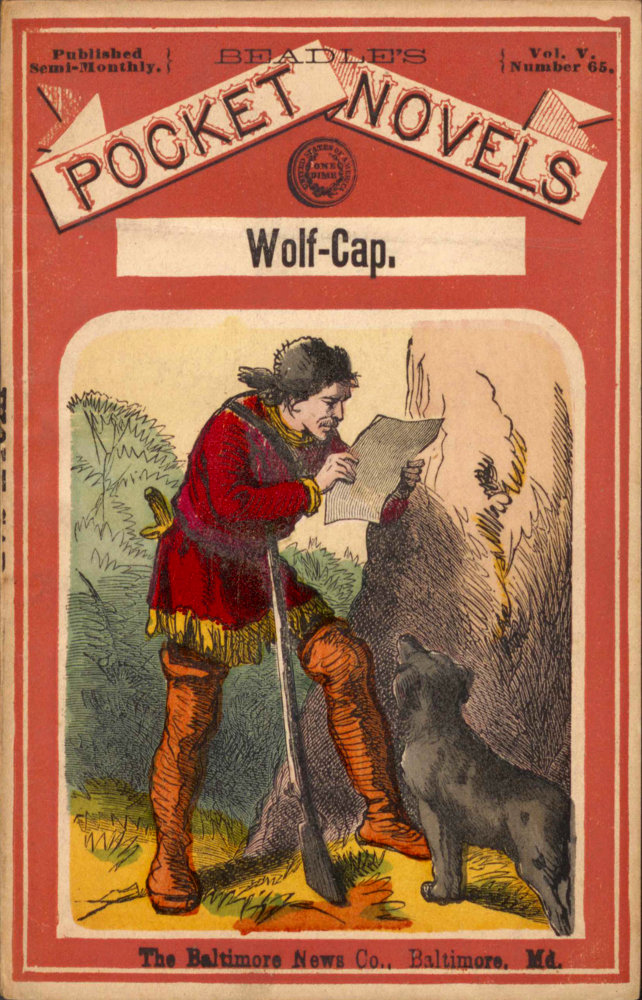
A small apartment, walled with rough logs, and blackened
by smoke.
A substantial fire burns in an uncouth but serviceable fireplace,
and a man reclines on the puncheons in the ruddy
blaze.
His sole companion is a huge yellow dog of the mastiff
species; and his master’s long black locks rest upon his shaggy
coat.
It is nine o’clock at night, and the moon shines in an unclouded
firmament.
Not a sound disturbs the stillness of the wood; but just
at the edge of the meager clearing that lies before the cabin,
a little river flows northward with a low noise, for it is almost
bank full.
Man and dog are wide awake; the former gazes into the
fire, the latter looks up into the hard, sunbrowned face.
The master is a great, strong man, whose looks, physique
and voice, when he speaks, indicates a long frontier life. He
is perhaps three and forty years of age. Some would say that
he is fifty; but people must not judge age by certain crows-feet
on the brow; troubles make young men old. His occupation
is revealed by a quantity of animal traps lying in one
corner of the room, and suspended from a rafter overhead
hangs a bundle of skins, ready for the market at Fort Sandusky.
10
But he rises and looks at the dog, who bristles up and runs
to the door, protected by a strong oaken plank.
“What is it, Yellow Dick?” asks the trapper, standing beside
his companion, rifle in hand, and peering into the moonlight
through a crevice between two logs. “I would hev
sworn that I heard the voice of a man; but—”
He paused abruptly, for Yellow Dick had suddenly pricked
his long ears anew, and the trapper began to unbarricade the
door.
“’Tis old Johnny, Dick, as sure as death,” he said, glancing
at the mastiff while he worked at his plank. “He hasn’t
been this way for a three month. Mebbe he brings news
from the seat of war.”
The dog seemed to understand the man, for his fierceness
abated, and he stepped from the portal.
“There! I knew it was Johnny Appleseed,” the trapper
said triumphantly, as he opened the cabin door, and let a
flood of moonlight into the dingy room. “Here he comes,
down the river. What’s that he’s saying, Dick?”
The speaker leaned forward and caught these words uttered
in a melodious voice:
“The spirit of the Lord is upon me, and he hath anointed
me to blow the trumpet in the wilderness and sound the
alarm in the forest: for behold the tribes of the heathen are
round about your door, and a devouring flame followeth after
them.”
The herald of danger stood near the edge of the water, and
looked like some wild being from spirit-land.
“Old Johnny means somethin’; somethin’s gone wrong
somewhar,” cried the trapper, becoming excited, and then in
a louder tone he spoke the singular cognomen of the man of
the wilderness—“Johnny Appleseed!”
The latter turned and after some hesitation came forward.
“Do not detain the Lord’s anointed long,” said the little
wiry man, exhibiting his old restless activity, “for the Philistines
are this night sweeping down upon the scattered tents
of Israel, who will be found without the cities of refuge.”
“But, Johnny, what has happened?” queried the settler,
who could not repress a smile at the herald’s quaint phraseology.
11
“The Philistines hold revel in the great walled city on the
northern water.”
“What! has Hull surrendered?”
“Even so, Israel is again in captivity, and the families on
her borders must feel the fire now.”
The trapper was silent for a while.
“Then the red-coated and red-skinned devils are coming to
devastate the frontiers,” he said, in a tone scarcely audible.
“Their forces no man can number,” said the strange herald.
“They are like the sands of the sea-shore. But I must go.
I am appointed to deliver my message before every door in
the forest, that the Lord’s chosen may flee from the wrath to
come.”
“Then go, Johnny. I should not have detained you a minute.
Yours is an errand of mercy. I have a duty to perform
this night. Go, Johnny; tell them all of the swoop of the
red eagles; and tell them that Wolf Cap says, ‘Fly to the block-houses
without delay!’”
The pioneer hero started forward, but paused after taking
a step, and drew the portion of an old volume from his
bosom.
“Here news right fresh from heaven,” he said, and he tore
a leaf from the book and handed it to the trapper.
It was a leaf from Swedenborg’s writings, for Johnny
Appleseed—Jonathan Chapman—is no myth, and he was a
true disciple of the Swedish seer.
Having accomplished his duty, the strange man, clad in
nothing save a garment fashioned from a coffee sack, and
bearing a long distaff, started off to spread dismay throughout
the fire-lands.
“So Hull has surrendered,” muttered Wolf-Cap through
clenched lips, as he turned into the cabin again. “I know it
was a cowardly affair, for Detroit was proof against ten thousand
foes; but Hull was the wrong man in the right place. I
know it; I told the soldiers so when I war there not long
ago. These frontiers hev got to be desolated now, through
the cowardice of one man,” the lone trapper continued, busying
himself with preparations for a night journey. “Our
block-houses are poor excuses for bulwarks; but we must get
the women and children in them as quickly as possible.”
12
He donned his hunting accouterments and the wolf-skin
cap which had given him the sobriquet that entitles our romance,
and replenished the fire.
“I’ll leave you to keep house, Dick,” he said, addressing
the dog. “I’ll be back about daybreak. Now old fellow do
your duty, and don’t let a sneakin’ red-skin over this portal.”
He patted the dog’s shaggy back, barricaded the door, and
made his exit from the cabin, by the roof.
“I’m pretty sure that Johnny missed ’em,” he said, pausing
for a moment beside the cabin and communing with himself.
“He came down the river, and they are too far to his left.
Yes, I guess he missed ’em.”
The last word still quivered his lips when he started in a
north-easterly direction, leaving the river to his left.
A well-defined trail stretched before him, and he walked
rapidly through the moonlit forest, trailing his long-barreled
rifle at his side.
It was a night in August, 1812, and, as not a breath of
wind was stirring, the heat was oppressive. Once or twice
the hunter started a deer from the weed-fringed margin of
some forest stream, or frightened a coyote from his feast of
freshly-slain bird.
Suddenly he paused and listened to a silver voice, soaring
skyward far away.
“That’s Huldah’s voice,” he said, audibly. “No woman
can sing like her in these parts. I don’t know, but some how
or other I think an uncommon sight of that girl. She looks
so much like Bessie did twenty years ago,” and here the rough
deer-skin sleeve dashed a tear from the speaker’s eye.
“But I wonder what makes her so happy just now—when
terror sits in many a white girl’s heart. Ah! old Johnny did
not warn them!”
He leaped the little rivulet by which he stood while speaking,
and threaded the forest mazes again. Presently he came
upon a neat clearing, in the center of which, surrounded by
a rail-fence, stood a cabin, somewhat larger than his bachelor
abode. An air of industry pervaded the spot, and the honeysuckles
that half concealed the little square windows, proclaimed
the presence of the softer—the flower-loving sex.
The song that had startled the trapper by the little creek,
13
was mute now, and a dead silence brooded over the settler’s
home, on which the moonlight softly fell.
Wolf-Cap leaned against a tree at the edge of the clearing,
and thought of the coming whirlwind of destruction.
He thought till he gritted his teeth, and started forward,
impulsively.
“Here’s the toil of months,” he cried. “Levi has labored
like a giant to build a shelter for Huldah’s head, and now to
think that the flames must, in one brief hour, destroy it all.
Oh, I wish I could wield the thunderbolts of heaven for a
single minute!”
He approached the cabin boldly, his giant form bathed in
moonshine, and a low growl saluted his ears as he stepped
upon the little porch before the door.
“Who’s there?” said a woman’s voice, beyond the heavy
door.
“Me—Wolf-Cap,” answered the trapper, and he heard nimble
fingers undoing the fastenings.
“Come in, neighbor Belt,” said a voice as the door flew
open, and a beautiful young girl, whose right hand griped a
rifle, appeared to the hunter.
He obeyed, and as he crossed the threshold the door was
closed again and barred.
“Ye warn’t lookin’ for me to-night, I guess,” he said,
taking in the room at a glance.
“No, neighbor Belt; but you are none the less welcome.
Father has just retired—”
“I’ll be thar in a minute, Belt,” interrupted a man’s voice
in the next room. “I thought it war you when I heard your
step on the porch. What’s up? Ye kin talk while I
dress.”
“A good deal what’s bad is up,” said Wolf-Cap, in a loud
one. “Hull has surrendered, and a swarm of British and
Indians are pouring down upon the frontier.”
“Who told you, Belt?”
The speaker had appeared like a flash, and, scarcely more
than half-dressed, stood before the trapper.
“Who told me?—Johnny Appleseed. He went down the
14
last, Armstrong. We’ve enjoyed comparative quiet thus far
during the war; but the cowardice—I know it was just that
and nothin’ else—of Hull, has unloosed the dogs of hell, an’
they’ll be here pretty soon. To the block-house is the cry
now. If safety lies anywhere, it is there.”
Levi Armstrong, the old settler, stood in the dim light of
the tin fat lamp, and quivered with rage.
“Belt,” he said, slowly and with emphasis, “I’m not goin’
to give up the work of my hands without a struggle. You
kin bet on that.”
“But Huldah must go to the block-house. Strong’s is the
strongest, and best defended. We must act—”
“So long as father remains from the block-house I remain,
too,” interrupted Huldah Armstrong, as she touched Wolf-Cap’s
arm. “I share his love for our home. He shall not
be separated from me.”
“Huldah, you must go to Strong’s to-morrow,” said Levi.
“I will go with you.”
“Truly, father?”
“Truly, girl.”
“Then I am content to go,” she said. “When do you look
for the marauders, neighbor Belt?”
“They are liable to come at any hour,” was the reply.
“But in truth I do not look for them for several days yet.
No doubt Johnny heard of the disaster from some Indian, and
is many hours in advance of the slayers.”
“And what are you going to do, Belt?” asked Levi Armstrong.
“I had settled upon no plan of action. I’ve got a cabin,
and I hate to leave it to the torch. The Night-Hawks are
with Proctor, you know. I wonder if they will come down
upon the frontiers?”
“To be sure they will, neighbor Belt.”
“God help the frontiers, then.”
“Yes, yes.”
“But I must go back,” said the trapper; “nobody is at
home but Yellow Dick. I guess we’ll not go to the block-house
till to-morrow night. I think we’re safe in keeping
aloof till then; ’tis best, you know, to seem in ignorance of
the threatening danger.”
15
“I think so too, Belt. You’ll come over to-morrow evening,
ready for the run?”
“I’ll be here, and then”—with a glance at Levi that
told much—“we’ll shelter our heads beneath Strong’s
roof.”
Several minutes later Wolf-Cap was returning to his cabin,
and at length the grayish dawn of day revealed it to
him.
“Nobody has disturbed Dick,” he said, after inspecting the
little structure’s surroundings. “He’s a good housekeeper—no
woman in this land kin beat him, but— What’s that?
By Huron! somebody hes nailed a piece of paper to my
door.”
The trapper was walking forward while speaking, and it
was a piece of paper on his cabin door that called the exclamation
to his lips. With his eyes fastened upon the object,
he quickened his steps, and presently paused on the flagstone
stoop.
Before his eyes was a piece of dingy paper, bordered with
blood, and held in its place by a knife, the point of which was
buried deeply in the firm wood!
The uncouth letters had been traced on the dirty sheet with
a stick dipped in gore, and were arranged in the following
order:
“We hunt you. You know us. Fly or die!
“The Night-Hawks.”
The trapper looked at the warning a long time, and gradually
a smile of contempt wreathed his lips.
“So, Royal Funk, you and your devils are in these parts
again,” he said, “and I tell you, once for all, that I am not
an illegal squatter. You can’t scare Card Belt.”
Then, without more words, he ascended to the roof and
joined Yellow Dick, who received him with manifestations
of delight in the room below. Fearlessly he threw wide the
cabin door, and spread a map of the North-west, face downward,
on the floor.
Then, with a piece of charcoal, he traced these words on
the parchment:
“Roy Funk, I’m going to remain on the fire-lands. You can’t
16
frighten me. I spare not and no mercy ask. No block-house
shall shelter me!”
Twice the trapper read the defiance to his dog, as though
the animal was possessed of comprehension, and then he pinned
it to the door with the point of a knife.