Although the Masquerade itself, as
a necessary protection against non-telepaths,
was not fully formulated
until the late years of the Seventeenth
Century, groups of telepaths-in-hiding
existed long before that date.
Whether such groups were the results
of natural mutations, or whether
they came into being due to some
other cause, has not yet been fully
determined, but that a group did exist
in the district of Offenburg, in what
is now Prussia, we are quite sure.
The activities of the group appear to
have begun, approximately, in the
year 1594, but it was not until eleven
years after that date that they achieved
a signal triumph, the first and
perhaps the last of its kind until the
dissolution of the Masquerade in
2103.
—Excerpt from "A Short History
of the Masquerade," by A. Milge,
Crystal 704-54-368, Produced 2440.

onas came over the hill
whistling as if he had
not a care in the world—which
was not even
approximately true, he
reflected happily. The state of complete
and utter quiet was both foreign
and slightly repugnant to him; he
was never more pleased than when
he had a job in hand, a job that involved
a slight and unavoidable risk.
This time, of course, the risk was
more than slight. Why, he thought
happily, it was even possible for him
to get killed, and most painfully, too!
With a great deal of pleasure, he
stood for a second at the crest of the
hill, his hands on his hips, looking
down at the town of Speyer as it
baked in the May afternoon sunlight.
"Behold the Tortoise: He maketh
no progress unless he sticketh out
his neck." But he maketh very
little progress unless he pick the
right time and place to "sticketh
out his neck"—which can
be quite a sticky problem for
a man in a medieval culture!
Jonas did not, in spite of his pose,
look like the typical hero of folk
tale or scribe's tome; he was not
seven feet tall, for instance, nor did
he have a handsome, lovesome face
with flashing blue eyes, or a broad-shouldered,
narrow-waisted marvel of
a figure. He was, instead, somewhat
shorter than the average of men in
Europe in 1605 and for some time
thereafter. He had small, almost hidden
eyes that seemed to see a great
deal, but failed completely to make
a fuss about the fact. And while his
figure was just a trifle dumpy, his
face completed the rhyme by being
extraordinarily lumpy. The nose, as
a matter of strict truth, was hard to
distinguish from the other contusions,
swellings and marks that covered the
head.
Nor, of course, did he carry the
sword of a great hero, or a noble.
Jonas had no von to stick on his
name, and he had never thought it
worth his while to claim one and
accept the tiny risk of disclosure.
After all, a noble was only a man
like other men.
And, besides, Jonas knew perfectly
well that he had no need of a sword.
His adventures, too, were a little
out of the common run of tales. Jonas
had, he thought regretfully, few duels
to look forward to, and he had even
fewer to look back on. And, as a
maid is won by face, figure and daring,
and a wife by riches, position
or prospects, there was a notable paucity
of lissome ladies in Jonas' career.
All in all, he thought sadly, he was
not a usual hero.
But he refused to let the thought
spoil his enjoyment. After all, he was
a hero, though of his own unique
kind; there was no denying that.
And, in his own way, he had his
reward. He took one hand off his
hip to scratch at the top of his head,
wondering briefly if he had managed
to pick up lice in the last town he
had visited, and he took another look
at the city.
Speyer seemed a lot better, at first
glance, than some of the other places
Jonas had visited. For one thing, it
had a full town hall, built—no less—of
honest stone, and probably a relict
of the Roman times. There was the
parish church, of course, a good solid
wooden structure, and a collection of
houses strung along the dirt paths of
the town. The houses of the rich
were, naturally, wooden; the poor
built of baked mud. There were a
great many baked-mud structures, and
only one wooden one, besides the
church, that Jonas could see.
The paths were winding, but comparatively
free from slop. That was
pleasing, he told himself. And the
buildings themselves, wood, mud and
stone, clustered in the valley below
him as if they were afraid, and needed
each other's protection.
Which, in a way, they did. Jonas
reflected on that a trifle grimly, thinking
of the Holy Inquisition with its
hierarchy of priests and lay folk,
busily working in Speyer just as it
worked in every other town throughout
Offenburg, and throughout the
civilized world.
Ordinarily, he would not have
given it a thought, beyond a passing
sigh for the ways of the world; he
had other business. But now—
He grinned to himself, and the
grin turned to a laugh as he started
down the hill. The grislier methods
of the Inquisitorial process were well-known
to him by reputation, and soon
he might be testing them out for
himself. There was absolutely no way
to be sure.
That thought pleased him greatly;
after all, he told himself, there was
nothing like a little danger to spice
the boring business of living. By the
time he reached the bottom of the
hill, he was whistling loudly.
He stopped at the first house, a
mud construction with a badly-carpentered
wooden door and a single
bare window that looked out on the
street. It smelled, but Jonas went up
to the door bravely and knocked.
There was no answer. He went on
whistling "Fortuna plango vulnera"
under his breath, and after a time
he knocked again.
This time he heard movement inside
the house, and nodded to himself
in a satisfied fashion. But almost
a minute passed before the head of
an old woman showed itself at the
window. She was really extraordinarily
ugly, he thought. She wore a
bonnet that did nothing whatever to
enhance her doubtful, wrinkled
charms, or to conceal them; and besides,
it was dirty.
"Nobody's here," she said in the
voice of a very venomous toad. "Go
away."
Jonas smiled at her. It was an
effort. "Madam—" he began politely.
"Nobody's home," she repeated,
drawing slightly back from the window.
"You go away, now."
"Ah," Jonas said pleasantly. "But
you're home, aren't you?"
The old woman frowned at him
suspiciously. "Now," she said vaguely.
"Well."
"This is your house?" he said.
"The house where you live?"
"Never saw you before," the old
woman said.
"That's right," Jonas said equably.
"You come to turn me out?" she
demanded. Her eyebrows—which
were almost as big and black as her
ancient mustache—came down over
glittering little eyes. "I hold this
house free and proper," she said in
a determined roar, "and nobody can
take it from me. It belongs to me,
and to my children, and to their
children, and to the children of those
children—"
The catalogue seemed likely to go
on forever. "Exactly," Jonas said
hastily.
"Well, then," the old woman said,
and started to draw back.
Jonas gestured lazily with one
hand. "Wait," he said. "I am not
going to take your house away from
you, madam. I am only here to ask
you a question."
"Question?" she said. "You come
from Herr Knupf? I'm an old
woman but I do no wrong, and there
is no one can accuse me of heresy.
I am in church every week, and more
than once; I keep peace with my
neighbors and there's none can say
a mystery about me—"
The woman, Jonas thought, was
full to the eyebrows with words.
Probably, he told himself, trying to
be fair, she didn't have anyone to
talk to, until a stranger came along.
He sighed briefly. "I do not come
from the Inquisitor," he said truthfully,
"nor is my question one that
should cause you alarm."
The old woman pondered for a
minute. She leaned her elbows on the
window sill, getting them muddy.
But that, Jonas thought, didn't seem
to matter to this creature, apparently.
"Ask," she said at last.
Jonas put on his most pleasant expression.
"Madam," he said, "I wish
to know if there be any family in
this town to give room to a wayfarer—understanding,
of course, that the
wayfarer would insist on paying. Paying
well," he added.
The old woman blinked. "You
looking for an inn?" she said. "An
inn in this town?" The idea appeared
to strike her as the very height of
idiocy. She covered her face with her
hands and shook. After a second
Jonas discovered that she was laughing.
He waited patiently until the fit
had left her.
"Not an inn," he said. "There is
no inn here, I know. But a family
willing to take in a stranger—"
"Strangers are seldom here," she
said. "Herr Knupf watches his flock
with zeal."
Which meant, Jonas reflected, that
he was in a fair way to get himself
burned as a heretic unless he watched
his step carefully. "Herr Knupf's
fame has reached my own country,
far away," he said with some truth.
"Nevertheless, a family which—"
"Wait," she said. "You have said
that you will pay well. Yet you do
not appear rich."
Jonas understood. Fishing in his
sewn pocket, he withdrew a single,
shiny coin. "I also wish," he said
smoothly, "to pay for any help I
may receive—such as the answering
of an innocent question, a question in
which the respected Inquisitor Knupf
can have no interest whatever."
The old woman's eyes went to the
coin and stayed there. "Well," she
said. "It is said that the family called
Scharpe has a house too large for
them, now that the elder son is gone;
there is only the man, his wife and
a daughter. It is said that the man
is in need of money; he would accept
payment, were it generous, in return
for sharing room in his house."
"I would be most grateful," Jonas
murmured. He passed the coin over;
the old woman's hand snatched it and
closed on it. "Where might I find
this family?" he said.
"It is now late in the afternoon,"
the old woman said. "Perhaps they
are at home. You will see a path
which takes you to the left; follow it
until you reach the last house. Knock
at the door."
"I shall," Jonas said, "and many
thanks."
The old woman, still clutching her
coin, disappeared from the window
as if someone had yanked her back.
Jonas turned with relief and got back
on the path, but it stank quite as
badly as the house had.
He endured the stench—heroically.
Scharpe proved to be a barrel-shaped
man who was unaccountably
cheerless, as if the inside structure
had been carefully removed, and then
replaced by sawdust, Jonas thought.
Even the offer of seven kroner for
a single week's stay failed to produce
the delirious joy Jonas had expected.
"The money is needed," Scharpe
said in a dour, bass voice, staring off
past Jonas' left ear at the darkening
sky. "And for the money, you will
be welcome. I must take your word
that you are not dangerous; I can
only pray that you do not betray that
trust."
It was far from a warm welcome,
but Jonas was satisfied with it. "I
shall work to do you good," he said,
"and not evil."
"Stranger," Scharpe said, "work
for your own good; do nothing for
me. This is an accursed family; there
is no good to be done to me, or my
wife or child."
Jonas tried to look reassuring. He
thought of several things to say about
the sunny side of life, and decided
on none or them. "My sympathy—" he
began.
"Your sympathy may endanger
you," Scharpe said. "My son is gone;
I pray that there is an end to it."
Jonas peered once into the mind
of the man, and recoiled violently;
but he had enough, in that one
glimpse, to tell him the reason for
Scharpe's misery. And it was quite
reason enough, he thought.
"Herr Knupf—"
"We do not mention that name,"
Scharpe said. "My wife has resigned
herself to what has happened; I am
not so wise."
"I promise you," Jonas said earnestly,
"that you will be in no danger
from me. No, more: that I will help
you out of your difficulties, and ensure
your peace."
"Then you are an angel from
Heaven," Scharpe said bitterly.
"There is no other help, while the
Inquisitor remains and our sons become
suspect to his rages."
Jonas shook his head. "There is
help," he said, "and you will find it.
Your son is gone; accused, questioned,
confessed and burnt. But there
will be no more."
Scharpe looked at him for a long
time. "Come with me," he said at
last, and led the way into his mud
house. Inside, there was only one
large room, but it seemed spacious
enough for four. Three pallets lay
against the far right wall, a single
one against the left. Scharpe went
to the back of the house, near the
single bed. "This will be yours,"
he said, "while you are with us. It
is poor but it is all we can offer."
"I am honored," Jonas said.
"Here we are alone," Scharpe went
on, his voice lowering. "My wife and
daughter have gone to visit a neighbor,
for they have not yet closed us
off entirely from all human contact."
He grimaced. Jonas peered into the
mind again, very gently, but the mad
roiling of pain and memory there
was too strong for him, and he returned.
"If you have anything to say to
me," Scharpe said, "tell me now. No
one can hear us, not Herr Knupf
himself."
"To say to you?"
"Regarding your plan," Scharpe
said. "Surely you have a plan. And
if I may play any part in it—"
Jonas blinked. "Plan?" he said.
"Of course," Scharpe said. "You
speak of an end to troubles, an end
to the Inquisition and the burnings,
an end to the question. And so you
must have a plan for ridding us of
Herr Knupf; one which you will tell
me."
Jonas shook his head. "I have no
plan," he said.
"It means danger," Scharpe pressed
him. "But I do not mind danger,
in such a cause. I am not vengeful,
but my son was no wizard. Yet the
Inquisitor took him and had a confession
from him; you know well the
worth of such confessions. And soon
there will be others, for when the
curse strikes a family it does not stop
with one member." He tightened his
lips. "It is not for myself I am
afraid," he said.
Jonas nodded. "Were there such
a plan," he said, "be assured I would
tell you."
"But—"
"There is none," Jonas said. "Herr
Knupf shall remain, for all that I
can do, while the earth remains."
Scharpe opened his mouth, shut it
again, and then shrugged. "I see," he
said at last. "You do not trust me.
Perhaps you are wise. I might talk
foolishly; I am an old man; older,
in this last month, than in all my
other years."
"Believe me," Jonas began. "I—"
"Let it be," Scharpe said quietly.
"I believe you. If that is what you
want, I believe you." He shrugged
again, moving out toward the door
of the hut. "And, in any case," he
said, "the money is needed. For there
are fines to pay, and costs of the Inquisition."
"I understand," Jonas said helplessly.
Scharpe turned and looked him full
in the face. In the big man's eyes,
bitterness and hopelessness glittered.
"I am sure you do," he said, and turned
again toward the door.
The others he met only briefly.
Frau Scharpe was a little woman with
the face of a walnut, who looked as
if she had never really been cheerful.
Her son's death, he saw when he
looked into her mind, had not come
as a surprise to her; it was one more
unhappy event, in a lifetime in which
she had expected nothing else. Unhappiness,
she told herself, was her
portion in this life; in the Life
Above, things would be different.
Jonas had met the type before, and
was uninterested in going further.
But Ilse Scharpe was something else
entirely. She did not say a word to
him, coming into the house that evening,
a pace behind her mother, like
an obedient slave. She was about
seventeen, and her mind was as fresh
and clean and pretty as her face and
figure. Jonas started musing on
Heroes again, but he never had the
chance to make a move toward her.
She had a very nice smile, and from
memories in the others' minds he
could hear her voice, low and quiet
and entirely satisfactory.
Jonas sighed. The job, he told himself
sternly, came first. And afterward—
Though, come to think of it, there
wouldn't be an afterward.
The evening meal was simple.
There was a single dish of meat and
some sort of beans; after it had been
eaten, and the darkness outside grew
to full night, it was time to retire.
Jonas went over to his pallet, removed
his jerkin and shoes, and lay
down. He heard the others readying
themselves for sleep, but he did not
look into their minds. Soon they were
asleep and breathing heavily.
But Jonas stayed awake for a while.
"It's really too bad we can't work
this sort of thing at a distance,"
Claerten's voice said suddenly. "But
then, none of us has ever met the
man, and you can't read a mind if
you haven't had some physical contact
with the man who owns it."
"It is too bad," Jonas agreed
politely. Five hundred miles away
Claerten chuckled, and the linkage of
minds transmitted the amusement to
Jonas.
"You don't think so, at any rate,"
the director said. "You're having adventures—and
a fine time. It's the
sort of thing you like, after all."
Jonas shrugged mentally. "I suppose
so," he said. "I like to work on
my own, do my own job—"
"And it's got you into trouble before,"
Claerten said. "But you can't
afford any mistakes this time."
"I know the risk perfectly well,"
Jonas thought back.
Claerten's thought carried a wry
echo. "You know the risk to yourself,"
he told Jonas, "and you've accepted
that. You rather like it, as a
matter of fact. But you haven't
thought of the risk to the rest of us—and
to the town you're in."
Jonas sent a thought of uncertainty:
"What?"
Claerten transmitted the entire picture
in one sudden blow: the chance
that Jonas would not be killed immediately,
but would be discovered;
the chance that the Inquisitor would
get from him the secret of the Brotherhood—
"That's impossible," Jonas said.
Claerten sounded resigned. "Nothing's
impossible," he said. "And if
the secret is let out—why, the Brotherhood
is finished. Finished before
it's barely started. Because you can
read a man's mind doesn't mean you
can defeat him, Jonas."
"But you know what he's going
to do—"
"And if he's got you in a wooden
house and he's going to burn it down,
what good does your knowledge do
you?"
"But you can transmit false
thoughts—"
"And confuse him," Claerten said.
"Fine. Fine. If you've ever met the
man before. And suppose you
haven't? Then you can't transmit a
thing to him; you're trapped in the
house, remember, and the fire's started.
What good's your telepathy?"
"But—"
"It's a sense," Claerten said. "Like
any other sense. But it isn't magic
any more than your eyes are magic.
They're ... given by God, if you
like; they grow, they develop. So the
ability to read minds, to transmit
thought is given by God. No one
knows why or how. Fifteen of us
have developed it; fifteen who are
members of the Brotherhood. But
there are others—"
"Of course," Jonas thought impatiently.
"I know all that."
"You know a great deal," Claerten
said, "which I sometimes find it
necessary to bring to your attention."
"I've done all right," Jonas
thought sullenly.
Claerten agreed. "Of course you
have," he thought, "but you're not
the most careful of men; and great
care is needed. The Brotherhood
must grow. This new sense is of
great value; perhaps we can learn
to teach it to others in time, though
we have had little success with that.
But at the least we can maintain our
numbers, pass the gift on to our
children—"
"If it is possible," Jonas said.
"We must try," Claerten said.
"And your job is enormously important."
"I know that," Jonas thought wearily.
"You have accomplished the first
step," Claerten said. "Do nothing
rash."
"Of course not."
"You will not accept help—"
"I will not," Jonas thought.
"Very well, then," Claerten
thought. There was the ghost of another
idea; Jonas caught it.
"I know perfectly well that you
wouldn't have sent me if there were
any other available member," he
thought. "There is no need to remind
me."
"I'm sorry," Claerten thought. He
radiated caution, worry, patience;
Jonas turned in the bed and cut off
from the director with a grunt. He
was tired; long-distance linkages were
a drain on the body's energy, even
when the person involved was easy
to visualize. But Claerten had insisted
on intermittent contact.
If there were such a thing as total
contact, constant contact over a period
of days, Jonas thought, Claerten
would use me for a puppet, a veritable
Punch among men; he would override
me and take me over the way
a traveling entertainer rules his jointed
dolls.
And that would be a fine thing for
a hero, wouldn't it?
He grimaced in the darkness. Constant
contact was simply impossible;
any reaching out used energy, and
linking up for a long period simply
burned the body up like a long starvation;
it was as bad as a penance.
Jonas was thankful for that.
And for the rest—well, he thought
resignedly, what was a hero without
a quest? And what was a quest without
someone to set it?
But that the someone had to be
Claerten, with his caution and his
old-woman worry—
Jonas sighed and set about the
business of falling asleep.
The days passed slowly, with great
boredom. Jonas made contact twice
with Claerten, who told him over
and over to wait, to do nothing: "The
next move is coming soon; do nothing
to hurry it. You can only upset
the natural course of events."
"Which is unwise," Jonas thought
bitterly, "and risky, and very probably
impious as well."
"As for the piety," Claerten
thought, "I leave that to the priests
and the women. But wisdom and
caution are my task, Jonas, as they
must be yours."
"I—"
"You are a hero, out on an adventure,"
Claerten thought witheringly.
"But set your course with sense,
travel it with caution; you will the
more certainly arrive."
"Philosophy for a dull plodder,"
Jonas thought.
"Philosophy for one of the Brotherhood,"
Claerten thought back. "We
are tiny as yet; we have no force. You
can add to that force, add greatly;
but you must be wise."
"I must be slow, you mean."
"I mean what I have told you,"
Claerten thought. "And—one more
thing, Jonas."
"Yes?"
"The daughter," Claerten thought.
"I have seen her in your mind. Ignore
the wench. Is she worth what
your task is worth?"
"I never—"
"Then my caution is unnecessary,"
Claerten thought. "But, in the unlikely
case that she might tempt you
to folly—remember it."
Jonas, who disliked irony, sighed
and cut off.
That was the third night. During
the days he had done the things he
had planned; he did no work with
the Scharpes, but let them find him,
when they returned to the hut of an
evening, reciting strange words. Once
he built a small outdoor fire and
walked around it, widdershins, for
several minutes. Then he put the fire
out and went inside. He wasn't sure
whether or not anyone was watching
him, that time.
But sooner or later it had to happen.
And it happened, as Jonas had suspected
it would, through the wife.
Mrs. Scharpe came back to the hut
early one day, threw a frightened
glance at Jonas sitting in a corner
doing nothing at all, and left.
He hardly needed to see into her
mind to know where she was going.
And twenty minutes later two men
came to the hut. They stood in the
opened doorway, Mrs. Scharpe behind
them twittering like an ancient
bird, and Jonas watched them boredly.
They were giants, for this part of
the world, almost six feet tall, with
great hands and jaws. One had black,
coarse hair on his head and a stubble
about his face; the other was bald
as an egg.
"That's him," Mrs. Scharpe said—just
a trifle hesitantly. "He's the one.
He came to stay with us and we
didn't know—"
The man with black hair said:
"Uh. Gur."
"Herr Knupf said take him back,"
the bald one added.
"Herr Knupf?" Jonas said, entering
the conversation with a light,
pleasant tone.
"He's the ... the—" Mrs. Scharpe
tried to get the word out, and then
pushed by the two men and came into
the hut. "I didn't want to but there's
something strange, and we can't afford
any suspicion, and—"
Jonas realized slowly that she was
crying as she looked at him. "It's all
right," he said uncomfortably.
"You're—"
"I'll be perfectly all right," Jonas
said. He stood up. "This Herr
Knupf," he said. "He wants to see
me?"
"He said bring you along," the
bald man told him.
The black-haired man nodded very
slowly. "Gur," he said.
Jonas sighed and went forward to
meet the two big men, leaving Mrs.
Scharpe sobbing in the background.
The poor woman felt terrible, he
knew; but there was nothing he could
do about that. "Then let us go," he
said, and marched off. Feeling that
one more effect wouldn't hurt, he led
the way to the Town Hall; let them
figure out how he had known just
where to go, he thought.
Their minds were very, very boring,
and quite blank. Herr Knupf,
Jonas reflected, might be a definite
relief.
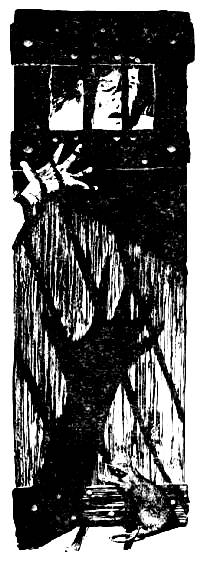
First there was the cell, which
was in the basement of the Town
Hall. It was damp and the air was
not too good, but there were compensations.
Rats, for instance. Jonas
told himself, after the first couple
of hours, that he simply wouldn't
have known what to do without the
rats. Trying to trap and kill them,
with no weapons beyond his bare
hands—even an eating knife he had
carried in his jerkin had been taken
away, leaving him to the uncomfortable
reflection that he was going to
have to dine with his fingers—was
a pastime that occupied him for several
hours on the first day.
On the second day, the rats began
to bore him. By that evening, they
were annoying him, and when the
third day dawned bright and warm—as
near as he could tell from the
tiny slip of window at the top of
his cell—Jonas was telling himself
that any move at all was a move in
the right direction.
He set up a shout for one of the
guards. The bald one had brought
his meals every day, but the black-haired
one was the man who checked
his cell at night. For once, Jonas
thought, he was lucky; the bald man
appeared, after some fifteen minutes
of screaming and cursing. Jonas was
not at all sure whether the black-haired
man understood language:
there was little trace of it in his mind,
and virtually nothing that might be
called intelligence. With the bald
man, at least, he could communicate.
"What's wanted?" the guard said
sourly, staring through the bars.
Jonas smiled softly. "You know
why I'm here, don't you?" he said
in a voice as close to silky as he
could make it.
"You?" the bald man said.
"You're here. In a cell."
"That's right," Jonas said patiently.
He rubbed at his face. "Do you know
why I was put here?"
"You—cast spells. You make
things happen."
"That's right," Jonas said, smiling
again. "I'm a wizard. A warlock.
That's what they say, isn't it?"
"You—make things happen," the
bald man said.
But he had the basic idea; Jonas
checked that in his mind. "Very
well," he said. "Now, I wish to see
Herr Knupf."
"The Inquisitor calls you when he
wants you," the bald man said.
"Now," Jonas said.
"When he wants—"
"If I am a wizard," Jonas said, "I
have powers. Strange powers. I could
make you—" He reflected for a minute.
"I could make you into a beetle,
and squash you underfoot. As a
matter of fact, I think I will." He
gazed reflectively at the bald man,
who gulped and turned a little pale.
"You ... you are in a cell," he
said at last. "Locked up."
"Do you think that will stop me?"
Jonas said. He came to the barred
door, still smiling.
"You would not dare—"
"Why not?" Jonas asked. "What
have I got to lose?"
He raised one hand, clawing the
fingers slightly. He took a deep
breath, as if he were about to spit
out an incantation. His eyes glittered.
The smile broadened.
A long second passed.
"I will tell the Inquisitor you wish
to see him," the bald guard said.
Jonas relaxed and stepped back. "I
shall be most grateful," he said formally.
The guard turned and started to
walk away. Five paces down the corridor,
the walk turned into a run.
Jonas watched him go, and then sat
down on his louse-infested cot to
await developments.
The minutes ticked by endlessly.
He thought of trying to reach
Claerten, but decided, not entirely
with regret, that the contact would
use up too much energy. And he
needed all the energy he could conserve
now. The second step had been
taken—the fact that he sat in a cell
in prison was proof of that.
The third step—the all-important
final step—was about to begin.
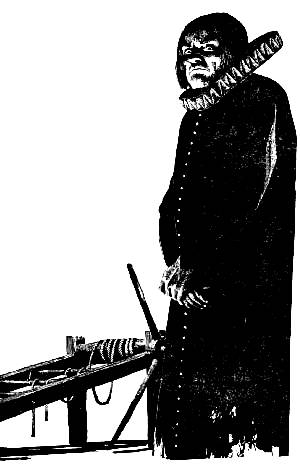
Georg Knupf was a tall man with
skin the color and apparent texture
of good leather. He had a face like
an eagle, and his eyes were ice-blue.
He moved his thin, strong hands
gently back and forth on the table
that held his papers, inkstand and
pen, and said in a voice like audible
sandpaper: "You wanted to see me."
"True," Jonas said pleasantly.
Knupf was sitting behind the table.
Jonas had not been asked to sit; he
remained standing, and he was reasonably
sure that his feet were going
to hurt in a minute. He tried not to
let the thought disturb him.
The man's mind was like his office
in the Town Hall: sparsely furnished,
almost austere, but with all the necessaries
laid out for easy access. Underneath
the strength and iron of the
mind Jonas caught the spark glowing,
and nearly smiled. In spite of the reports,
in spite of logic, there had been
a chance the Brotherhood had guessed
wrongly about this man.
Now that chance was gone, and the
Brotherhood was right again.
"Not many ask to see me," Knupf
said in the same voice. He went on
looking at his hands. There was bitterness
in his mind, bitterness that
had changed to hate. "Their pleas
tend to be exactly the opposite."
"I did not plead," Jonas pointed
out. "It was necessary that I come to
see you."
The question was, he told himself,
exactly what were the Inquisitor's
real beliefs? His public professions
were well-known; Jonas searched and
found the answer. Knupf was an
honest man.
That, of course, made matters
simpler.
"Necessary?" Knupf said, looking
up for the first time. His gaze stabbed
like a sword. He was uneasy,
Jonas knew; with another mind probing
his, he could not help but be
uneasy. But he could not find a cause;
it would never occur to him. And he
controlled his feelings superbly.
"You believe that I am a wizard,"
Jonas said.
Knupf waited a bare second, and
then nodded.
"I can do many things," Jonas
went on. "It was necessary that I
bring these to your attention—and
prove to you that they are not wizardry,
or magic."
"Many have told me," Knupf muttered,
"that their feats were natural.
It is a common defense."
"So I have heard," Jonas said
easily. "But I shall prove what I
say."
"I am under no compulsion to
listen to you," Knupf said after a
pause.
Jonas shrugged. His feet were beginning
to hurt, he realized; he
sighed briefly, but there was no time
or attention to spare for them. "I
could only see you by having myself
accused of witchcraft," he said. "In
that way, you would be forced to
listen to me. You may listen now,
or later at a full hearing of the Inquisitor's
Court."
"And I am to take my choice?"
Knupf said. He smiled briefly; his
face remained cold. The strong hands
moved on the tabletop.
"It is a matter of indifference to
me," Jonas said. "But the wait becomes
boring, after a time."
Knupf's eyebrows went up. "Boring
is—hardly the word others would
use."
"I am not like others," Jonas said.
He wished for Claerten suddenly, but
there was no way to reach him safely.
He had to make his move alone.
Well, he told himself, that was
what he had wanted.
"I can tell you what is in your
mind," he said.
The words hung in the air of the
room for a long time. At last Knupf
nodded. "The Devil grants to many
his power of seeing the minds of
men," he said quietly.
"This is not Devil's work—as I
shall prove," Jonas said. He shifted
his feet. "But let me establish one
point at a time, in the most scholastic
manner; if you will permit."
"I permit," Knupf said. There was
interest in his mind, overlaid with
skepticism, of course, but interest all
the same. That, Jonas thought, was
a better sign than he had dared to
hope for.
"Very well," he said. "Think of
a word. Think of any single word. I
shall tell it to you."
"As any wizard might do, who had
the help of his lord the Devil,"
Knupf muttered. "Do you expect this
to prove—"
"One thing at a time," Jonas said.
Knupf nodded. A second passed.
Jonas licked his lips. The possibilities
paraded before him; on one
hand, success. On the other there was
the torture and death of the Inquisition.
Jonas took a deep breath; there
was no way to back out now. Heroism
looked a little empty, though.
He closed his eyes. "Cabbages," he
said.
Knupf neither applauded, nor
looked surprised. "As I have said,"
he murmured, "that which the Devil
can grant—" He paused and looked
down at his hands. "Am I to take
this as a confession?" he said. "Do
you wish to hurry your own death?"
"I am no wizard," Jonas said.
"A stranger," Knupf said, "who
enters a small city, is seen at mysterious
undertakings, plucks words out of
the center of a man's mind ... why,
the picture is a classic one. Del Rio
himself, Holzinger or any of the
others could not describe a better."
"Yet all this was done to draw your
attention, to fix it on what I have
to tell you," Jonas said, shifting his
feet again. "I am no wizard, but a
man who may do certain things. And
here is my proof: you may do the
same yourself."
The silence was a long one, and at
the end of it Knupf rose. He walked
to the door of the room and opened
it, and the bald-headed guard came
in. "He has tried to tempt me to
pact with Satan," the Inquisitor said.
"But—"
"Take him away."
Some day, Jonas thought, back in
his cell, there would be a method of
controlling minds that did not require
the willing co-operation of the
two parties. Some day the man who
reads minds would be more than a
passive onlooker.
But the talent was new; it needed
practice, it needed training.
The cell grew dark as night came,
and the dampness seemed to increase.
Jonas heard squeaking and thought
of the rats, but he couldn't even summon
up enough energy to try for
them. He sat crosslegged in a corner
of the cell and closed his eyes.
He sighed once, deeply. This was
what a hero came to, he told himself.
This was the end of heroics and playing
a lone hand. Why, if he had it
to do over again, he would—
"You would do exactly the same
thing," Claerten's voice said.
Jonas grinned suddenly, and sat
straighter. "I should have known
you'd be getting into contact sooner
or later," he thought.
"I try to keep track of all our
men," Claerten thought. "In a case
like yours, I try harder."
"My foolishness," Jonas thought,
"sometimes works to my benefit."
Claerten's thought was wry. "If
you hadn't got impatient and tried
to hurry things," his voice said in
Jonas' mind, "you wouldn't be back
in your cell now. There is a time and
a place for your disclosure—"
"Another day in here would have
driven me out of my wits," Jonas
thought.
"Better out of your wits than
dead," Claerten thought.
Jonas sighed.
"However," Claerten went on,
"there is still a way out for you. I
have read the situation in your mind,
and your next move will have to be
rather more spectacular than usual."
"So long as it works," Jonas said,
"I will be satisfied."
"It will work," Claerten said. "At
least—I think it will."
Another day dragged by. Jonas put
in his time alternately going over the
new plan and feeling more frightened
than he had ever believed possible.
Claerten reached him once, but
the contact was weak and fleeting;
the director hadn't enough strength
to reach him again, at least not for a
day or so. Jonas was exactly where
he'd wanted to be: on his own.
He hated the idea.
Time passed, somehow. When
morning dawned, Jonas awoke to find
the door of his cell being unlocked.
The bald man and the black-haired
man were both there. He looked up
at them with distaste.
Then he saw what was in their
minds, and the distaste changed to
fear.
"You have confessed," the bald
one said. "It is necessary that you
ratify your confession. Come with
us."
Jonas knew what that meant: ratification
of a free confession took
place under torture. He wiped his
face with one hand, but he hardly
thought of escaping.
He had to go through with the
plan.
The two guards came into the cell
and gripped his arms. Jonas allowed
himself to be carried out into the
corridor, and down it to a great wooden
door. The guards opened it, and
dragged him through.
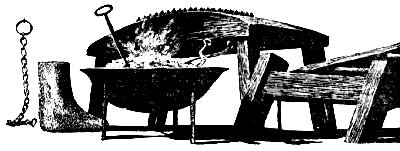
The torture chamber was brightly
lit, with torches in brackets along the
walls that gave off, by a small fraction,
more light than smoke. In one
corner the rack itself stood, and there
were other tools of the trade scattered
around the room.
Jonas found that he was sweating.
The guards brought him to the
center of the room. Knupf was standing
near him, a perfectly blank expression
on his face. His voice was
the same rough rasp, but it seemed
almost mechanical.
"You have confessed to me," he
said, "your heresy. Now, you will be
made to ratify your confession. That
done, your penalty will be exacted."
And the penalty, of course, would
be death—death at the stake.
He forced himself to remain calm.
Now was the time for his play. He
took a deep breath and felt the
strength in him gather to a single
point and flow outward. The two
men suddenly seemed to stagger;
there was a second of confusion and
they had let him go. He stood alone
in the room. He turned and walked
to the door, but he did not open it.
Instead, he leaned against it.
He forced his voice into the patterns
of calmness and ease. "Your
men cannot touch me," he said.
"Wizard—"
"No," Jonas said. The confusion
he was broadcasting kept the men
from doing anything that required
even a simple plan, but he couldn't
keep it up for long. "A man like
yourself, a man with a particular
talent, given by God."
"The name of God—"
"I can say that name," Jonas told
the Inquisitor. "No wizard may say
it."
"It is a trick," Knupf said.
Jonas shook his head. "Not at all.
I will ask you to do nothing against
the Faith; I will merely ask you to
test for yourself what I say."
"You are a heretic," Knupf said
stubbornly. "I can not—"
"You can pray," Jonas said.
Knupf blinked. "Pray?" he said.
"Meditate on a prayer," Jonas said.
"Keep your mind open, keep yourself
ready for the gift of God. It will
descend on you."
Knupf shook his head. "It is a
trick—" he began.
"A trick?" Jonas said. "With the
prayers of God and His Church?"
And that was the unanswerable
question. For no wizard could use the
name of God, no wizard could pray.
So the Inquisition said; so Knupf
said, so Knupf had to say, and so he
had to believe.
Slowly, his mind opened and became
receptive. The prayer hung in
the air of the smoky room. Jonas
slipped in—
"Now," he said quietly.
His control slipped. The two
guards came toward him, overpowered
and held him in a brief second—
"Wait," the Inquisitor said heavily.
"Wait. Release him."
"And so," Claerten thought, "the
job was accomplished."
"Naturally," Jonas thought.
Claerten's thought had an overtone
of weariness. "There is no need to
be smug," he told Jonas. "After all,
you did not do the job yourself."
"Unimportant," Jonas thought.
"The man is convinced; he can be
trained further and join the Brotherhood."
"It will take time," Claerten said.
"A few years, perhaps. But in the
meantime there will be no trials in
Speyer."
"No trials?" Jonas thought. "But ... oh.
I see."
"Of course," Claerten thought.
"Any man who considers himself a
wizard will have his mind seen by the
Inquisitor. And since there are no
wizards—at least, none we have discovered—"
"The trials will cease," Jonas finished.
"And the Brotherhood has gained
a new member," Claerten said. "A
member with influence and power.
It is an important step forward,
Jonas."
"Of course," Jonas thought disinterestedly.
"Yet you seem bored by the matter,"
Claerten thought, puzzled. "I
don't see ... oh. I see the woman
in your mind. The daughter. And—"
"Now, stop it," Jonas thought.
"Stop it. Cut off. After all," he finished,
"there are times when even a
hero wants a little privacy."
Postscript:
In 1605-1606 (in Offenburg) there
were no executions....
—H. C. Lea, "Materials Toward a
History of Witchcraft," Vol. III,
p. 1148.