“Fate grants not passionless repose
To her who weds a glorious name.”
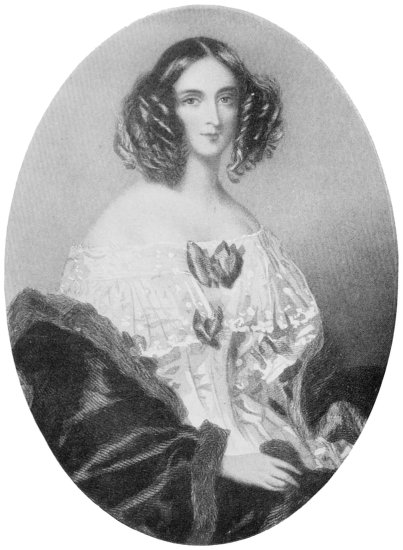
Catherine, elder daughter and third
child of Sir Stephen Glynne, eighth
Baronet, by his wife, Mary Neville,
daughter of the second Lord Braybrooke, was
born at Hawarden Castle, Flintshire, on 6th
January 1812. Lady Glynne was a granddaughter
of George Grenville—Sir Richard
Grenville of the Revenge was a member of this
family—the Minister whose Government was
responsible for the “Stamp Act” (1763), which
led to the loss of the American Colonies, and
niece of Lord Grenville, Prime Minister in 1806–7,
and head of the Cabinet of “All the talents,”
which abolished the Slave Trade. His only
sister became the wife of William Pitt, Earl of
Chatham, and the mother of William Pitt,
the Younger. Thus Catherine Glynne was
related by birth with four famous Prime
Ministers of England, and was destined to
become the wife of a fifth.
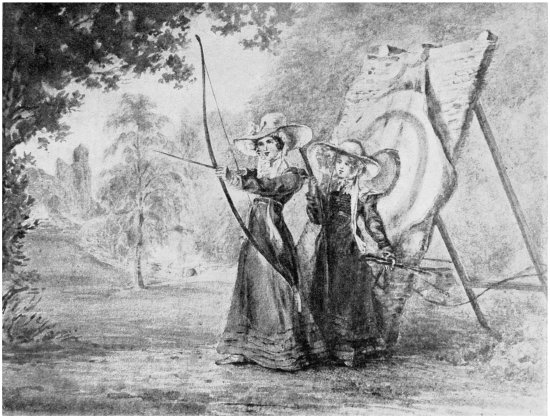
MRS. GLADSTONE (ON THE LEFT) AND HER SISTER, LADY LYTTELTON,
ON THE LAWN AT HAWARDEN
The families of both parents were of great
antiquity, and directly descended from Crusaders;
the names of Sir Stephen and Lady
Glynne are on the Plantagenet Roll. Ancestors
had been settled at Glynllifon, Carnarvonshire,
in very ancient times. The founder of the
Hawarden branch of the family, Sir John Glyn
(1603–66), won distinction as a lawyer both
under Cromwell—he was Lord Chief Justice from
1655 to 1659—and Charles II. Notwithstanding
his support of the Parliamentary party, he seems
to have been a Monarchist at heart and to have
urged Cromwell to take the title of King; and
we know that he served quite happily as King’s
Serjeant under Charles II., even acting for the
Crown in the prosecution of Sir Henry Vane for
high treason in 1662. It was through him that
Hawarden came into the Glynne family, for he
purchased it at a nominal sum when it was
sequestered in the Civil Wars. The castle itself
was nearly in ruins and was never rebuilt. In
1752 Sir John Glynne, Mrs. Gladstone’s great-grandfather,
acquired through marriage the adjoining
property of Broad Lane, and the house
belonging to it, with much rebuilding and various
additions, became the Hawarden Castle with
which the name of Gladstone is always associated.
The ruins of the old original castle still exist
and form a picturesque object in the grounds.
Sir Stephen Glynne died in 1815, and the
care of the four children, two boys and two
girls, all under six years old, devolved on the
mother. She returned to her father, and she
and the children lived with him in Berkeley
Square, at Audley End, and at Billingbere.
It was only after his death that she resided
at Hawarden, where she was assisted in the
duties connected with the estate by her brother,
the Rev. the Hon. George Neville, to whom her
husband, shortly before his death, had presented
the living of Hawarden.
A journal is still in existence in which Lady
Glynne made notes about her children during
the years 1815–20. She describes Catherine as
beautiful, high-spirited, and strong-willed.
Catherine Glynne was not highly educated
in the sense in which that phrase is now understood.
As a girl, she lived more out of doors
than indoors, became a good horsewoman and
proficient in all the athletic exercises, archery
among them, then permitted to girls. She was
not a great reader then nor later, but contact
with the life of the village, the witnessing and
even assisting in the schemes of improvement of
her mother and uncle in regard to the cottagers
and the education of their children, added to
intercourse with people of intelligence in her
own rank of life, taught her valuable lessons.
Her training helped to lay the foundation of the
excellent philanthropic work she accomplished
on her own account after her marriage, and to
develop the qualities which made her so admirable
a companion for a great statesman. She
could scarcely be called intellectual, but she
possessed a natural intuition that never failed
her, an equally natural shrewdness, and a keen
sense of humour. Another quality that stood
her in good stead was a capacity for making
friends. One winter was spent at Hastings,
and next door were staying Prince George of
Cambridge and his cousin Prince George of
Hanover. The young people speedily made
acquaintance, and to the end of her life Mrs.
Gladstone had no warmer friend and admirer
than the Duke of Cambridge.
In 1829, when her daughters were about
fifteen or sixteen, Lady Glynne took them to
Paris for educational purposes, and, among
other advantages, they enjoyed pianoforte lessons
from Liszt. The sisters were girls of singular
beauty, and attracted much admiration. Lord
Douglas was so impressed that he induced his
mother, the Duchess of Hamilton, to call on
Lady Glynne, and persuade her to let the girls
go to two or three balls at the Tuileries, the
British Embassy, and the Duchess of Hamilton’s.
Lady Glynne yielded, and the girls had
a very enjoyable time.
Their brother Stephen, the head of the
family, sat in the House of Commons as Liberal
Member for Flint Burghs, and afterwards for
Flintshire, from 1832 to 1847; his interests and
tastes, however, lay rather in archæology than in
politics. He was a man of great refinement and
remarkable modesty, but he lacked the business
capacity, as will be seen later, needed for managing
landed estates. Among his friends at Oxford
was W. E. Gladstone. The Glynnes, after the
girls grew up, often went abroad, and once when
Catherine was with her brother in Florence, they
passed a gentleman who raised his hat. She
asked Stephen who the handsome young man
was. “Don’t you know him?” he replied.
“That is young Gladstone, the Member for
Newark, and the man who everybody says will
one day be Prime Minister of England.” Catherine
was first introduced to Gladstone at the house
of Mr. Milnes Gaskell in London, and then they
used to meet at Lady Theresa Lister’s musical
parties and elsewhere. The two sisters were
known as “the twin flowers of North Wales,”
were greatly admired in London society, and
received numerous proposals of marriage. They
were, however, bound up in each other, and
were determined that one could not be engaged
or married without the other. Gladstone admired
Catherine in silence, scarcely dreaming that
he dared aspire to her hand. In 1835 he was
invited by Glynne to pay a visit to Hawarden.
But still he did not venture to speak. In the
winter of 1838–39 he was suffering from overwork,
and was ordered abroad. He had been a junior
Lord of the Treasury, and also Under-Secretary
for War under Sir Robert Peel, and had published
his book on Church and State, and so was not without
claims to distinction. In Rome in December
he met Stephen Glynne and his sisters, and
there found courage to propose to Catherine one
moonlight night in the Coliseum. He had repeated
to her Byron’s lines from “Manfred” beginning:
“I do remember me, that in my youth,
When I was wandering,—upon such a night
I stood within the Coliseum’s wall—”
Notwithstanding his eloquent appeal Miss Glynne
refused him, and it was not until the following June
at Lady Shelley’s garden party that she accepted
him. About the same time her sister Mary
became engaged to the fourth Lord Lyttelton.
When the two bridegrooms arrived at Hawarden
for the wedding, they walked down the
village street, “Gladstone, tall and upright in
figure, pale and strong in face, with dark flashing
eyes like an eagle’s; Lord Lyttelton, something
of a rough and awkward youth of twenty-one,
with rugged features, massive head, and intellectual
brow; some one said, gazing at Gladstone,
‘Isn’t it easy to see which is the
lord?’”
The double wedding took place on 25th July
1839, at Hawarden Parish Church, and was
made the occasion for much festivity and rejoicing
on the part of the family and their friends,
and of the humble inhabitants of the district.
Sir Francis Doyle was Gladstone’s best man,
and he wrote a poem for the occasion entitled
“To Two Sister Brides,” of which the following
stanzas refer to Catherine:
“High hopes are thine, oh! eldest flower;
Great duties to be greatly done;
To soothe, in many a toil-worn hour,
The noble heart which thou hast won.
Covet not then the rest of those
Who sleep through life unknown to fame;
Fate grants not passionless repose
To her who weds a glorious name.
He presses on through calm and storm
Unshaken, let what will betide;
Thou hast an office to perform,
To be his answering spirit bride.
The path appointed for his feet
Through desert wilds and rocks may go,
Where the eye looks in vain to greet
The gales that from the waters blow.
Be thou a balmy breeze to him,
A fountain singing at his side;
A star, whose light is never dim,
A pillar, through the waste to guide.”
Immediately after the ceremony Mr. and
Mrs. Gladstone drove to Norton Priory, Cheshire,
the seat of Sir Richard Brooke, whose daughter,
Lady Brabazon, was the bride’s best friend,
where the honeymoon was spent.
Neither sister had been specially accustomed
to the society of highly intellectual or
bookish men, and during the engagement neither
Gladstone nor Lord Lyttelton, as ardent lovers,
had felt the necessity of resorting to the classics
when in the company of their fiancées. The
young brides, when comparing notes after the
honeymoon, confided to one another their dismay
that at odd spare moments both husbands
produced pocket editions of Horace or Sophocles
(or some other classical poet), and filled the
minutes by reading in them.
At the outset of their married life, Gladstone
gave his wife the choice: either to know nothing
of the great matters of State in which he would
be involved and so be entirely free of responsibility,
or to know everything and be bound to
secrecy. Needless to say, she chose the latter.
Fifty years later Gladstone declared, “My wife
has known every political secret I have ever
had, and has never betrayed my confidence.”
He became a Cabinet Minister in 1843 as President
of the Board of Trade, and was six times
Chancellor of the Exchequer and four times
Prime Minister, so that his wife had ample opportunity
for intimate acquaintance with State
secrets, and for a corresponding exercise of discretion.
It is related that once in the early days
of Cabinet office she unwittingly said something
that showed she had some important knowledge
of a confidential nature. She was terribly upset
and immediately sent Gladstone a little note of
confession and penitence,—he was engaged at
work in his study in Carlton House Terrace,
where they were living,—to which her husband
responded with ready forgiveness, saying,
“It is the only little mistake you ever made.”
Once she congratulated a man on his promotion
before he knew anything about it himself,
but no harm was done by that, and it only
serves to prove how intimate was her knowledge
of affairs. As a matter of fact, no one could
ever extract anything from her, though many
tried to do so. When she was asked what
Gladstone was going to do in some crisis or other,
she would answer with the greatest naïveté,
“Well, I wonder, don’t you? What do you
think he ought to do?” Some undiscerning
persons attributed her manner to stupidity, but
Mrs. Gladstone always knew what she was doing
and saying, and why she did and said it.
After the honeymoon, and a visit to Fasque,
Kincardineshire (the home of Sir John Gladstone,
where, so long as he lived, they spent some time
each year), Gladstone and his wife when in London
lived at 13 Carlton House Terrace, which he purchased
in 1840. About six months after her
marriage Mrs. Gladstone began to keep a fragmentary
diary. Some extracts, printed here for
the first time by kind permission of Mrs. Drew,
form a record of her early married life, and
illustrate her intelligent observation of the people
around her, and her sense of humour.
“April 1840.—Dined at the Archbishop of
York’s, meeting the Queen Dowager, also the
Duke and Duchess of Cambridge, Lady Harrington,
etc. The Queen heard me speak of some
one who was ill, and asked me all about it
when we came upstairs. She beckoned to me
to sit down by her. The Duchess of Cambridge
very kind and talkative to me, speaking
of our marriage at Hawarden, Mary’s and
mine, upon the same day, and the Queen
joined in the conversation and also talked to
William.
“I sat next to Guizot at Mr. Hallam’s; he
only made out my husband towards the end of
dinner. He spoke English to me. We also met
Mr. and Mrs. Grote (she is dreadful), the Bishop
of London, George Lewis, Mrs. Austin, Dr.50 and
Mrs. Hawtrey.
“To a party at Buckingham Palace, arriving
in time to see the Queen51 enter the room. She
does this more gracefully than I can possibly
describe; it is quite a thing to see. Prince
George of Cambridge talked to me. Lord
Melbourne looked aged and careworn.
“At Northumberland House we met the
Duke of Wellington—interesting to watch the
people’s manners with him. He went out of
his way to speak to William.”
The first baby, a boy, William Henry, was
born on 3rd June 1840.
“April 1841.—Lord Lyndhurst52 was on the
platform at Twyford station. I saw him look
at Baby, and the nurse said he noticed his
intelligence, and having asked whose child he
was, said, ‘Will you ever be as clever a man as
your papa?’
“Sir Robert Peel desired William to introduce
me to him at Lady Jersey’s; he talked
of his daughter’s approaching marriage to Lord
Villiers.53 He seemed in great force, which the
events of the past few weeks would account for.
Lady Peel said to William, ‘Has not he done
it well? It is very soon after the want of
confidence motion and the majority of one.’
The Duke of Cambridge was very loquacious,
but I was not a little relieved at his fastening
upon William.
“I sat next the Duke of Wellington at the
Archbishop of York’s dinner, but I had his
deaf ear; yet I was pleased to think he had
spoken to me before either of us died—have
long wished for this.”
“September 21, 1841.—Dinner-party at home.
The future Bishop of New Zealand was with us;
his conversation was very interesting as to his going
to New Zealand, very touching the way he spoke
of his wife: ‘She feels just as I could most wish;
she has all the tenderness of a woman joined
to the greatest firmness and resolution.’ I was
present at his Consecration at Lambeth Chapel,
that fine touching service never to be heard without
emotion, but in the present instance how
peculiarly affecting. He was leaving his native
land and all that he held most dear. I believe
there was scarcely one dry eye. May I be the
better for this day!
“William and I visited the Bishop at his
house at Eton, so as to be present at the farewell
dinner given by Mr. Coleridge the day before his
farewell sermon at Windsor. There were forty
present. I sat between Judge Patterson and
Dr. Hawtrey. Afterwards Mr. Coleridge proposed
the health of the Bishop in a touching
speech, for which the Bishop returned thanks.
Devoted to the service of his God, he is able to
feel the step he has taken not as a sacrifice but
as a privilege; he unites unusual tenderness of
feeling to great manliness of character. The
scene was an extraordinary one. Casting the
eye down a long dinner-table, most of the guests
were in tears, men and women sobbing, poor old
Dr. Keate (to-day was my first introduction to
him), his head upon the table, his face buried in
his pocket-handkerchief.54 I never witnessed
such devotion. His sermon (i.e. the Bishop’s)
the following day was striking and affecting; a
crowded congregation, there was not even standing
room. Evidently he is not allowing himself
to have any idea of returning to live in England.”
“December 20, 1841.—I find London very
empty. William is absent from twelve to seven
in the daytime,55 and works hard all the time he is
at home, but I am greatly relieved to be with
him again, though it is a little dreary sometimes
in the day. I have been reading Hook’s
Sermons, and I have finished Ten Thousand a
Year,56 which, although vulgar, is clever and
interesting. I sat an hour at his office at the
Board of Trade.
“January 1, 1842.—A new year is always
an awful thing. God give me grace to become
better in the future! I feel acutely how little
good I do—but to feel is not enough.
“January 6.—I am thirty to-day—a terrible
thought. We had a dinner-party for Mr.
Grenville (Uncle Tom).57 He sat nearly an
hour with me in the afternoon. As he walked
from Hamilton Place and back this was pretty
well for eighty-seven.
“January 17.—William dined in the city to
meet Prince Albert. Peel spoke well, and the
Prince was evidently affected in alluding to his
dear ties which bind him to England. Elizabeth
Fry sat between the Prince and Sir Robert
Peel.
“January 20.—William dined at Putney with
Lord and Lady Ripon. He liked her extremely,
and she was particularly thoughtful in wishing
me to come there for country air.
“January 22.—Dined with the Barings to
meet Lord and Lady Stanley, Lady Granville,
etc., Lord Stanley58 taking me in to dinner. I
was very shy, he was in great spirits, full of fun
and jokes. At all events he can shake off the
cares of office. I was interested, but relieved
when we went upstairs, where I got on with
both the ladies well.
“January 24.—George, the page, did not
know what event we celebrated on Christmas
Day! I hope he will come on, but it is sad,
as he is near fifteen.
“January 29.—To-day William met the
King of Prussia59 at Bunsen’s. H.M. recognised
him, and said he wished to have some conversation
with him about his book. Lady Canning
was the only lady except the hostess. A queer
medley of people—clergymen, Quakers, scientific
men. I dined at Mrs. Grenville’s, meeting the
Duchess of Sutherland,60 Lord and Lady Mahon,
Mr. Harcourt, and Mr. Samuel Rogers. Pleased
with both Duke and Duchess; she spoke
so nicely and naturally about nursing her
babies.
“January 31.—We dined at the Duchess of
Beaufort’s alone, and to Stafford House61
afterwards. Never so struck by that splendid
house, specially the staircase, where a band
was playing. Saw the King of Prussia; a
strong likeness to O’Connell, with an ingenuous
countenance.
“February 1.—At the Duke of Wellington’s
to meet the King of Prussia—the first time I
had been to Apsley House—which gave me
great pleasure; he sat near the pianoforte listening
to the music, apparently lost to everything
besides.
“February 5.—William told me something
of great interest; he was harassed, and we
were glad to escape quietly to pass our evening
alone.
“February 6.—At St. Martin’s and St.
James’s Churches. Before the end of the day
William a different being, and his appetite
returned.
“Sunday, February 13.—A note from Sir
Robert Peel desiring William to follow Lord
John Russell in the House on Monday. He
made no preparation to-day.
“February 14.—This has been a happy
chance which fixed my night at the House of
Commons for his speech. Lady Stanley was in
the next division. I found myself nearly upon
Lady John Russell’s lap—with Lady Palmerston
and some other wives near; funny, we began
talking, though before unacquainted, and I told
her my husband was to answer hers, which news
she received with the greatest interest. She
said her heart was beating, and she was all
attention when Lord John began. He spoke
for an hour and a half with eloquence and
cleverness, but he made one slip, which William
made much of in a speech which lasted two
hours. It was quite pain to me before he got
up, but before he had said many words, there
was something at once so spirited, so collected,
in his manner that all fright was lost in intense
interest and delight. Pride is not perhaps the
right feeling; great thankfulness was, however,
mixed up with it. We heard him very well;
he was rapid, and without the smallest hesitation
throughout. Peel was evidently much delighted,
and from all I gather this speech has made
a very great sensation. We had coffee in our
room—how snug I need hardly describe, indeed
I could not.
“March 2.—Went to Lady Peel’s. I was
struck by Sir Robert’s cordiality for William’s
sake, and never had more satisfactory things
said of him than from Mrs. Dawson, Peel’s
sister. A very popular party with all kinds.
M.P.’s wives make obeisance to Lady Peel,
which was fun to watch.”
In view of the philanthropic work Mrs.
Gladstone was to do later, the following entry
is of interest:
“March 3.—Lord de Tabley drove me in his
cabriolet to the Mendicity Society, where we
spent a long time. Most interesting to hear
the examination of the numberless cases of
poverty, and to see the quickness and the knowledge
of the interrogators. I could have wished
to see less asperity and suspicion in their manner.
Alas! that such glaring and constant imposition
should cause this, as I believe that a certain
degree of severity is necessary. Out of thirty
cases only one, in all likelihood, will turn out
true.
“March 19.—Dined with Lord and Lady
Stanley. Lady Stanley very nice and looking
better than I have seen her. After dinner Lord
Stanley came and sat by me and was particularly
agreeable. I found I lost my awe of him, he
was so easy and pleasant. The conversation
took the turn of an official life, and he questioned
me about William. He said that he had the
chief brunt of the work now. Lord Stanley has
cold chicken and weak wine and water late at
night, and is very apt to sit, while eating it, with
his feet in hot water, specially if excited or
after speaking. Then he takes a suitable novel
for half an hour, which composes him to sleep.
When Chief Secretary for Ireland, he worked
eighteen hours a day. He maintains that with
mental work there is no need for bodily exercise,
which accordingly he never takes now. He
prides himself upon twenty years’ experience.
This may be all very well, but the truth is his
health is particularly good. He went off afterwards
on the various tricks in speaking. He
took off Peel, who, he says, is very nervous at
times. He could not remember any trick of
William’s. He was full of interesting anecdotes.
A few days ago at Peel’s some one was placed
by the Duke of Wellington, who gave an elaborate
account of things relating to India.
The Duke sat in his armchair, his chin upon his
chest, listening with occasional grunts. The
man having gone on—on, the Duke suddenly
came out in the quietest manner with, ‘I’ve
been in India.’ Stanley told it very well.”
Mrs. Gladstone was present at the Queen’s
fancy dress ball at Buckingham Palace on 12th
May. She went as Claude, wife of Francis I.
of France, and wore a deep red petticoat opening
in front, large sleeves of gold tissue and a crimson
cap. She found the ball a striking and amusing
sight.
At a dinner-party at Lord Ripon’s in July,
Peel took Mrs. Gladstone in to dinner. She was
glad of this because it enabled her to thank him
for the letter62 he had written to her father-in-law
about Gladstone. In it Peel said: “At no
time in the annals of Parliament has there been
exhibited a more admirable combination of
ability, extensive knowledge, temper, and discretion.
Your feelings must be gratified in the
highest degree by the success which has naturally
and justly followed his intellectual exertions,
and that the capacity to make such exertions is
combined in his case with such purity of heart
and integrity of spirit.”
Mrs. Gladstone gives the following interesting
account of Peel’s talk at dinner:
“He was in great force, some of the conversation
very interesting. He had seen a
letter written by the Duke of Wellington soon
after entering the army, in which he expressed
the hope that he should be taken out of the
army, as there seemed to be no chance of any
promotion!!
“Peel told me he required very little sleep,
that he was a light sleeper at any time, and got
but a small portion when his mind was occupied.
He still regretted the political power which
some had, the Duke of Wellington for instance.”
Mrs. Gladstone in these years saw something
of the Royal children, as their governess, Sarah,
Lady Lyttelton,63 was the mother-in-law of her
sister Mary. The following visits to the Palace
are recorded in the Journal:
“July, 1842.—Went to see Lady Lyttelton
and the Royal children. The Princess64 is a
very interesting child, no longer answering to
Mary’s65 description, ‘a sadly delicate thing.’
She is the image of the Queen. I played on the
pianoforte, which delighted her, she tried to
dance, and when I stopped called for ‘more.’
The Prince of Wales a fine, fair, satisfactory
baby, whom William and I gazed upon with
deep interest. We kissed his little hand. Who
could look at him and think of his destiny
without mixed emotion?”
“March 8, 1844.—Took Willie and Agnes66
to Buckingham Palace by desire of the Queen.
Lady Lyttelton received us, and we took off the
children’s things before going in to H.M. She
shook hands very kindly and desired me to sit
down by her. The three Royal children were
with her. Princess Alice a nice fat baby, thoroughly
good humoured and benevolent. Princess
Royal about a head shorter than Willie, very engaging,
not exactly pretty but like the Queen and
Prince Albert. The Prince of Wales small, and
the head not striking me as well shaped, his
long trousers tied below the ankles and very full,
most unbecoming. His manners very dear and
not shy. They are evidently quite unspoilt,
and I observed the Queen made them obey her.
Princess Royal and Willie kissed each other, and
she patronised little Agnes who stood by her
and the Prince, quite at home and nearly as tall
as the Prince, so much so as to make the Queen
observe, ‘The Prince is the tallest of the two’
(he was a year older). I was much relieved at
my children being so good and doing no harm.
The Queen observed, ‘What care Willie takes of
Agnes,’ admired his hair and his width. Agnes’s
independence amused her, and she was in fits of
laughter occasionally at her. Before leaving
the Queen kissed both my children.”
“January 30, 1846.—Dined at the Palace;
the Queen ill dressed; very kind to us, talking
much of Mary’s children and my own. The
Queen has ordered me to bring my children to
her on Saturday.
“I accordingly took the four, Willie, Agnes,
Stephen,67 and Jessy.68 H.M. came in with her
four, and was very nice and kind. Princess
Royal a nice quiet thing, not so much difference
in the heights as last time. Prince of Wales
has a striking countenance, Alfred very pretty,
all have such fat white necks. Prince Alfred
is a year and a half old, Stephen head and
shoulders taller at a year and ten months. The
Queen commented on Agnes’s looks: ‘I had
not heard about her being so very pretty.’
Thought Willie pale and Stephen gigantic, baby
fat and like her father. She took great notice
of them all, kissed Agnes and gave them a huge
lamb between them all, which the Royal children
and ours played with very happily during the
visit. The Queen spoke of their goodness, asked
if they were always so good.”
We must now return to 1842. In September,
at Hawarden, Gladstone met with the shooting
accident that caused the loss of the forefinger
of his left hand. Except for that no harm was
done, and Mrs. Gladstone records her husband’s
calmness and cheerfulness, “only thankful for
his escape and thinking how he could make the
best of it for me. He only seemed to think of
others, evincing the greatest coolness and
presence of mind, quietly submitting to the
operation, which lasted five minutes. It gave
him terrible pain, which he bore with unflinching
courage.” There were really two operations,
but this was kept from his wife, who was expecting
her confinement in a month. The surgeon
found he had made the cut in the wrong place
and had to do it all over again. As the days of
chloroform had not yet dawned, the acutest
agony was endured. All went well, and in a
few days Gladstone was able to play chess and
whist without inconvenience.
On 18th October Mrs. Gladstone drove in the
park with her husband, and at 8 p.m. her little
girl (Agnes) was born, “a fine healthy baby with
pretty features, complexion nice and clear,
never red.”
Christmas was spent at Hawarden.
“December 29.—My dear William’s birthday.
God bless him! How every day that passes
more and more impresses me with the treasure
I am blessed with, but alas! how very far I am
behind him.
“January 6, 1843.—Thirty-one to-day.
Time passes so quickly, and in reviewing the
past year how little I have done. May God
enable me to act upon the resolutions I have
formed.
“January 7.—Most people struck by baby’s
beauty, the eyes particularly large and fine and
very expressive, dark blue in colour, the sweetest
thing that ever was.
“January 30.—We all left dear Hawarden,
a party of seventeen, including the Lytteltons
and mama, besides children. Willie a very
fatiguing traveller, Agnes excellent. William69
met us at the station, all well. Whirled by the
bustle of London and the contrast of Hawarden.
“March 3.—Engaged a cook after a long
conversation about religious matters, chiefly
between her and William. She interested me
greatly.
“March 6.—To Mr. Richmond with my
boy, he finds him difficult to paint and varying
in expression.
“Dined with Samuel Rogers. Archbishop
of Canterbury, Bishop of London and Mrs.
Blomfield, Wordsworth, Lord Glenelg, and
others. Mr. Rogers whispered to me that he
was much impressed at having the heads of the
Church to dine with him. I never saw him
so little at ease.
“March 17.—We dined at the Palace. Clanwilliams,
Lord Palmerston, Lord Rosebery,
Lord Jersey. Lord Sydney took me in. After
dinner the Queen asked me about William’s
accident and the children and Mary. She has
a good deal of expression when speaking,
more than I had thought. Was surprised to
find it so little formal, really enjoyed my
evening.”
Mrs. Gladstone was piling up experiences of
many kinds. She was learning the cares and
pleasures of motherhood; she had become
familiar with the life of palaces and of political
centres. She also gained some acquaintance
with a more sordid side of existence. One of
her housemaids had to be prosecuted for theft;
Mrs. Gladstone had to spend two mornings at
Bow Street and to attend the trial. “Having
with the policeman, the searcher, and the pawnbroker
sworn to speak the truth, the whole truth,
I went into the box. I felt very shy; they would
not admit William with me. To find myself
there gave quite a new view of life.” Mrs.
Gladstone visited the girl at Newgate and at the
Penitentiary.
In 1843 Gladstone first became a Cabinet
Minister.
“May 13, 1843.—A letter from Sir Robert
Peel offering William a seat in the Cabinet, to
succeed Lord Ripon as President of the Board
of Trade. He went to Peel, having taken a short
time for consideration, and came back to tell
me there was a hitch, because of the Church
question. I walked with him in Kensington
Gardens. He was oppressed by the great anxiety
to act rightly, he asked me to pray for him.
How thankful I am to be joined to one whose
mind is purity and integrity itself. If I have
received joy in reading Peel’s letter, how much
more ought I to feel in seeing the way he received
it, in witnessing that tenderness of conscience
which shrinks at the bare idea of any worldly
gain lest it should in any way interfere with
higher duties.
“May 15.—A consultation with Hope and
Manning of some length. They persuaded him
to go himself to Peel. He has accepted; God
bless and prosper him in his new office. He has
been very happy in his former place. May the
increase of responsibility not injure his precious
health. How I wish he could have a horse!”
In August Mr. and Mrs. Gladstone and
the children went to Fasque on a visit to
his father. From Glasgow to Fasque she
travelled on the outside of the mail coach, a
twelve hours’ drive, her first experience of such
a mode of journeying, enjoying it immensely.
When returning in October, prevented by bad
weather from going by sea as they had intended
from Dundee to London, they caught the midnight
mail from Perth. Only one inside place
was available, so Mrs. Gladstone elected to
mount to the top with her husband, and so
travelled all night, “cold and blowing a high
wind.”
Some of the entries in the Journal for 1844
show that Mrs. Gladstone’s mind was turning
towards the distress in London which, later on,
she was to do so much to relieve. At dinner in
March with the Duke and Duchess of Buccleuch,
her host talked to her of the misery existing in
London, and she thought his conversation
showed the interest and pains he took. At this
period she often went to the House of Commons,
and one night heard Shiel, “his style fluent and
brilliant, but ranting, and the voice peculiarly
discordant and unpleasant”; and on another,
Lord Ashley on the Factory question.
On 4th April her son Stephen was born, “a
plain baby, small eyes,” but a few months later
she notes, “baby greatly improved.” In June
she was present at a party at Buckingham
Palace given for the Emperor of Russia,70 “a
grand-looking personage, his figure so striking,
tall, and commanding, his manner remarkable,
so very civil and courteous, friendly without
losing his dignity. The form and manner struck
me more than the face itself. But he has an
expression that seems to look straight through
one, something peculiarly awful in the eyes.
The profile, however, is good, and combined with
the figure there is something grand and noble.
It was interesting to watch him and the Duke
of Wellington talking together. When the
Queen and the Emperor had finished with refreshments,
the manner in which she took his
arm, and his in giving it to her, was striking and
graceful beyond description; the great inequality
of their heights would never have been suspected,
such was the grace and ease with which
they walked off together.”
Mrs. Gladstone thoroughly enjoyed the continual
meetings with interesting persons; she
liked listening to the conversation of such men
as Peel and Brougham, and was hugely delighted
when after a concert at the Palace the Duke of
Wellington insisted on escorting her husband
and herself to their carriage. “I was fearful
lest he should catch cold, there was such a
draught; he merely placed his cocked hat upon
his head. How characteristic is all he says, and
the honesty and peculiar straightforwardness of
his character.”
On 27th July 1845 a second daughter was
born, Catherine Jessy, “a nice fat thing, with
famous lungs to judge by her voice, the mouth
so small with short upper lip, the hair darkish,
very placid, and takes much notice for her age.”
There were some interesting dinners at Sir
Robert Peel’s. One in March 1848 she thus
describes:
“Anxiety and sorrow sat on many of the
countenances assembled. There stood Guizot,
with that piercing eye of fire, his whole appearance
eagle-like, his countenance beaming with
sagacity and a great intellect, in earnest conversation
with Peel, full of gesture, and now and
then his voice raised, as if bursting with feeling
that would out. There were the poor Jarnacs,
with full marks of sorrow for their King and
Queen! The Princess Lieven; the Austrian
Ambassador harassed afresh with the increasing
troubles in Austria which so afflicted his wife as
to make it impossible for her to be present. The
party was relieved by Lord Aberdeen, Lord and
Lady Mahon. I had some talk with Madame
Jarnac. Her account of the poor Queen of
France especially was touching, of the dangers
and trials connected with their flight, of the sad
deprivations to which they were subject, the
terror of the poor Queen about her husband and
then her children. Sir Robert Peel joined in
our conversation; he views the state of Europe
with much alarm. He had received private
information respecting the Prince of Prussia
(now at Bunsen’s), who is said to have broken his
sword, and laid it with his spurs at the feet of the
King of Prussia. Lady Peel looks so wonderfully
young and pretty. I returned home excited
with the evening we had passed with that remarkable
party.”
Next year (1849) dining again at Sir Robert
Peel’s, Peel talked to her after dinner. “I
confess I had never known him so well before,
for now his conversation turned on subjects
which specially brought out feeling, his children
and their education, Lady Lincoln, Mr. Goulburn’s
trials and excellences. Speaking of his
children he enlarged upon the satisfaction of
having no permanent governess, liked his girls to
travel with him, said it enlarged their minds,
and a good deal more, showing that amidst all
his great cares the domestic element was very
near his heart.”
Two more daughters were born, Mary, in
1847, and Helen in 1849. The first sorrow of
their married life occurred in 1850, when on
9th April their little girl Catherine Jessy (born
1845) died of meningitis after a long and painful
illness. In her Journal Mrs. Gladstone writes:
“Yes, to look at her face after death was a
privilege. I dread lest the solemn remembrance
of her loved face should in any way fade, so holy
it was.
“My loved child, my own Jessy, to think
that the quiet countenance in its deep repose is
the same which but a few hours before seemed
racked with pain. The hair waved softly on the
marble forehead, the dark lashes fringing her
cheeks, the little white hands folded across one
another. We had placed roses and lilies of the
valley about her. I could not describe the sublimity
of her expression.”
In 1850, after the death of their second
daughter, Catherine, Gladstone took his wife to
Brighton to recruit, and although Mrs. Gladstone
looked worn and found it difficult to join in
general conversation, she felt as if a great calm
had set in “after the storms before.”
Two more sons were born, Henry Neville in
1852, and Herbert John71 in 1854. Thus between
1840 and 1854 Mrs. Gladstone became
the mother of eight children, seven of whom
survived. While never neglecting her duties
as a mother, from the first she studied her
husband and sought to secure him the quiet at
home which he needed during the Parliamentary
Session. He used to say to her, “It is always
relief and always delight to see and to be with
you.” Her sister Lady Lyttelton gave him
the same sense of restfulness; the two sisters
were as united after marriage as they had been
before, and their close association was only
broken by Lady Lyttelton’s death in 1857.
Gladstone wrote at the time: “They so drew
from their very earliest years and not less since
marriage than before it, their breath, so to
speak, in common.” Lady Lyttelton left
twelve children, and Mrs. Gladstone, despite the
cares of her own family, and the rest of her
various pre-occupations, never ceased to look
after these children as long as they needed
her.
Mr. Gladstone was the soul of method, neatness,
and punctuality; the girl he had married
was exactly the reverse, and she used to tease
her husband and tell him it was good for him to
have an untidy, unmethodical wife, it made him
more human. Many stories are told of her
delinquencies. It is said that on one occasion
when cards of invitation were being sent out
for a great party, certain letters of the alphabet
were mislaid and ultimately found after the party,
hidden in the interstices of a sofa into which
they had fallen. The deep offence of those
persons who had received no invitation may be
better imagined than described. Most of us
have known the queer experience of the sudden
disappearance of a pencil case or a pair of
scissors, when sitting on a chair or sofa of a
certain type of upholstery.
When Mrs. Gladstone was beginning philanthropic
work and had charge of money
connected with it, her husband told her that
she must have a cash box to keep it in, and
must take great care of the key. One day she
triumphantly showed him the box with the key
carefully fastened on to it! But be it said
that where such casual ways would have been
harmful to her husband’s interests, she was able
to overcome them.
She managed all the details of their daily
life; the meals were punctually served, the
carriage at the door to the moment. Mr. Gladstone
was never, through her instrumentality,
kept waiting for anything. She contrived
with what almost amounted to genius to
have a hot dinner consisting of suitable food
ready at any time between eight and twelve
o’clock that Mr. Gladstone might come home
from the House. It was always she who made
the arrangements for journeys; she looked after
all the details of, and carefully guarded him
from, the tiresome inconveniences and annoyances
inseparable from travel. She used laughingly
to tell him that while he, no doubt, could
govern the country admirably, arrangements
for a railway journey were better left to her.
She accompanied him to the House of Commons
whenever he had an important speech to make,
and from the Speaker’s little gallery listened to
every word and watched every gesture. She herself
mixed the egg-flip with which Mr. Gladstone
provided himself when his voice was to undergo
a prolonged strain. In 1847, when she canvassed
for her husband at Oxford, she was described
as a “potent canvasser.” At Newcastle
in 1862 she told a friend that it had been the happiest
day of her life, while her husband averred:
“Catherine is a great part of the whole business
everywhere,” and twenty years later she said,
“I shall never forget that day! It was the first
time that he was received as he deserved to be.”
Sometimes she would herself receive his
callers on business and usher them into the
library. Indeed, she shielded him from all the
cares and worries that it was possible for her
to take on herself. She looked after his health,
and in her powers as physician Gladstone had
an intense confidence. He often consulted his
wife when there were difficulties between
Ministers, and averred that her mother-wit
often hit on a solution. Even in comparatively
small matters she sought to save him physical
fatigue. Every one who has held any kind of
public office knows the pain incurred in shaking
hands with hundreds of people. Mr. Gladstone
used to stiffen his hand and to place his thumb
against the palm so that people could not
grasp it, but even so when his wife thought he
had gone through enough fatigue of the kind,
standing close behind him she would thrust her
hand forward in place of his, and no one noticed
the exchange.
She accompanied Gladstone on all his
political campaigns, on all his recreative travels.
When in 1891 he went into residence at All
Souls’, Oxford, for a week, she invited herself
to stay with Sir Henry Acland, and her husband
was in and out of the house as often as he wished.
Sir Stephen Glynne’s taste for the study of
ecclesiastical architecture72 led him to rely on
others for the management of his estates, and
in 1851 it was discovered that their financial
condition was in so bad a way, that it was feared
Sir Stephen would have to leave Hawarden.
Mr. Gladstone had just inherited a large sum of
money from his father, and he devoted a portion
of it to clearing off the debts that through the
indiscretions of an agent, left too much to his
own devices, encumbered the Hawarden estates.
It was then arranged that Mr. and Mrs. Gladstone
and their young family should regard
Hawarden as their country home, Sir Stephen
Glynne still continuing to live there. He died
suddenly in 1874; he was unmarried, and as his
brother Henry, who died in 1872, left no male
issue, it had been settled by will that the estates
should pass to the eldest surviving son of his
eldest sister, but that Mr. and Mrs. Gladstone
were to have the use and enjoyment of Hawarden
Castle and grounds for their lives. Thus Mr.
William Henry Gladstone became the heir to
the property, which descended on his death in
1891 to his eldest son, the late William Glynne
Charles Gladstone. But Hawarden continued
to their death to be the country home of Mr.
and Mrs. Gladstone and their children.
Mrs. Gladstone was devoted to the gardens
and park of Hawarden, and was sometimes
seriously concerned for the trees that it was her
husband’s recreation to cut down, and would
earnestly plead for them. But it should be
stated that Mr. Gladstone knew what he was
doing, and his knowledge of forestry only made
for the improvement of the estate and for the
better health of the trees left standing.
Although the greater part of Mrs. Gladstone’s
time was given to the care of her husband and
of her children, and to the social duties entailed
by her position, she found sufficient leisure
during the period we have traversed to initiate
and carry through philanthropic work of an
important and useful kind, involving a large
amount of actual personal service.
She began by visiting the House of Charity
in Soho, founded in 1846, to provide shelter for a
few of those persons, not of the ordinary vagrant
class, who through misfortune or ill-health had
become homeless wanderers, but could not bring
themselves to ask for poor-law relief, and indeed
for many reasons would not have been received
into the casual wards of the workhouses.
Mrs. Gladstone soon saw that something further
was needed. Throughout her life she was a
most successful beggar. She raised the sum of
£1200 among her friends, rented some disused
slaughter-houses in Newport Market, made the
necessary alterations, and early in 1864 the
place was opened as a Night Refuge. In
October a woman’s ward was added. All this
was done mainly through Mrs. Gladstone’s
exertions. The interest of the public was thereby
aroused in the question of casual relief, and
the passing of the Houseless Poor Act73 was
the direct result. At the end of 1865 it was
stated by the authorities that there was far less
misery and distress about the streets of London
than was the case before the Act came into force.
The Newport Market Refuge, as it was called, did
admirable work. A Boys’ Industrial School
was also soon established there—for many of
the casuals were friendless, little, half-starved,
half-naked boys between the ages of five and
twelve.
Mrs. Gladstone not only wrote appeals for
funds and enlisted the sympathy of the Times,
but regularly visited the Refuge and the School,
and used to make excellent little speeches to
the boys, full of kindness and admirable advice.
In 1882 the old buildings were condemned, and
after temporary housing in Long Acre, the
Refuge and School went into a building of its
own in what is now Greencoat Place, Westminster.
The Refuge ceased to exist after 1905,
but the Boys’ School is still carried on as the
Newport Market Army Training School, and
does excellent work.
There were many other sides to Mrs. Gladstone’s
philanthropic work. She was a constant
visitor to the London Hospital in Whitechapel,
and when cholera broke out in 1866, instead of
seeking to avoid infection and the distressing
sights of a large hospital at the time of an
epidemic, she only redoubled her zeal. She
was indeed one of the very first to face all the
difficulties when most people were panic-stricken
for fear of infection. She moved
freely about the wards among the patients,
speaking kindly words of comfort and encouragement.
She saw that one great necessity was a
place to which convalescent patients, especially
children, could be sent, and she made a public
appeal for funds wherewith to provide such
accommodation. Mainly through her instrumentality
and exertions a sum of £70,000 was
soon subscribed. Convalescent homes are now
regarded as indispensable, and their existence
taken as a matter of course, but Mrs. Gladstone’s
share in promoting the good work that led to that
result can scarcely be overrated. It is said that
in the beginning a few of the convalescent
children wrapped in blankets were received in
an attic in Downing Street until suitable shelter
could be provided. The Home was established
first at Snaresbrook, and then removed to
Woodford, on the borders of Epping Forest, as
“Mrs. Gladstone’s Free Convalescent Home
for the poor, more especially of the east of
London.” In considering the history of such
institutions, it must be remembered that it was
Mrs. Gladstone who initiated the system of
giving the subscribers no privileges either in
admitting patients or in the management of the
Home. The money was handed over to the
Committee who were responsible for everything,
and applications for admission were made as
simple as possible. Mrs. Gladstone herself
attended the meetings of the Convalescent Home
Selection Committee at the London Hospital,
and made patient and sympathetic inquiries of
the applicants. She also on those occasions,
as far as her time allowed, visited the wards
and showed her interest in patients and nurses.
And she often paid the patients at Woodford
Hall visits which were a source of intense
pleasure. She had the gift when talking to
them of conveying her real personal interest in
them each individually, and they felt no shyness
in her society. Sometimes she would sit down
at the piano and play dance music for them;
they generally chose country dances like Sir
Roger de Coverley in which the older people
could join, and a very merry time they had.
Her visits ceased in 1894, but her interest never
flagged. During the last weeks of Mr. Gladstone’s
illness, a letter of application to her from
a girl who wished to be received into the
Home was put aside and forgotten. When Mrs.
Gladstone came across it she was terribly concerned
lest her inadvertence, which any one would
have excused at such a time,74 had caused a
delay that should have done the girl any hurt.
Happily it was not too late for her admission.
It may be stated that 33,000 patients were
admitted to the Home down to the end of 1897.
It was removed to Mitcham, Surrey, in 1900.
It should be remembered that in the years
when Mrs. Gladstone was most active in her
ministrations there were no motor-cars, and
indeed no quick and convenient communication
between the west end of London and the Whitechapel
Road, and it is marvellous how she
found time to do all she did. She mostly went
down to Whitechapel by omnibus and train,
travelling third class. On one occasion there
was a lady in the train with whom Mrs. Gladstone
entered into conversation and who
confided her troubles. It seemed her husband
had an appointment in Australia, but she could
not accompany him as they had not money
enough to pay the passage for both. In talking
Mrs. Gladstone passed the station at which she
should have got out, and on looking in her purse
found she had no money, having expended
what she had on her return ticket. Thereupon
she borrowed some from the lady, giving her
name and address, and told her if she would call
next day she would in the meanwhile see
what could be done to help her. When the lady
told her husband of the adventure, he said,
“Well, you must be green. As if Mrs. Gladstone
would travel third class and be without any
money!” He insisted on accompanying his
wife next day, fearing some hoax. To his
surprise she was let in to the house, and he
walked up and down till she came out in a great
state of joy. Mrs. Gladstone had been at a
dinner-party the night before and had collected
£70, a sum she had just handed to her for her
journey!
But Mrs. Gladstone’s charities were not
confined to the east end of London. She established
an orphanage and an asylum for aged
women at Hawarden, and during the distress
that prevailed among the cotton operatives in
Lancashire at the time of the American Civil
War, Mr. Gladstone gave employment to
some of the men in making footpaths in
Hawarden park and woods, an improvement
of the property that had been long meditated.
Mrs. Gladstone invited the men to bring with
them their unemployed daughters, asked her
brother to give her the use of an old house—a
former dower-house—situated in the courtyard
of the castle, fitted it up as a house for the
girls, and had them trained in domestic work;
as soon as they attained some degree of efficiency
she found them situations. Others then came
from Lancashire to take their places at the
Home.
Later on, after the cholera outbreak in London,
she brought to Hawarden some of the orphans75
she had taken charge of at Clapton and lodged
them in a smaller house; they attended the
village school and were taught trades. When the
Lancashire trouble was past, and the hands
had returned to the mills, the orphans were
transferred to the larger house, where thirty
children could be accommodated. It has only
lately been given up. The smaller house then
became a Home for aged women. When Mrs.
Gladstone was at Hawarden, she paid frequent
visits to the Orphanage and Home, accompanied
generally by her daughters and any lady who
chanced to be staying with them.
In the forties of last century the only political
work in which women took any part was in
canvassing, and even that was done individually
without any sort of organisation. Women did
not speak on public platforms, did not form
political associations, and although the wives
of the great politicians in or out of office talked
freely of all that was going on, and undoubtedly
had through their husbands and their men
friends great influence on affairs in many ways,
it never occurred to them to band themselves
into an organisation or to demand the Vote.
Yet women had managed to effect important
social reforms. Elizabeth Fry as early as 1813
brought the conditions of prison life into notice,
and reforms were instituted. Elizabeth Barrett
Browning helped to better the conditions of the
children who worked in mines and factories,76
and Helen Taylor through her public spirit
brought about drastic reforms in the industrial
schools of London, to mention only a few instances
that, were this a suitable place, might
easily be multiplied. Mrs. Gladstone did her
share of canvassing, and especially helped her
husband in the Oxford election of 1847. She was
said to be very skilful at the work and hard to
resist. But it was not until Gladstone’s Midlothian
Campaign of 1879 that there arose any
thought of political organisation among women.
A presentation was made to him and Mrs. Gladstone
at Dalkeith77 of an album of photographic
views of Scottish scenery from the ladies of the
county, and a velvet tablecover from the women
workers at a carpet factory at Lasswade. In
acknowledging the gifts, Mr. Gladstone spoke
of those political interests which appealed more
especially to women, and pointed out how women
might assist in the regeneration of the world.
Addressing the women present he said:
“The harder and sterner and drier lessons of
political economy are little to your taste. You
do not concern yourselves with abstract propositions.
It is that side of politics that is
associated with the heart of man that I must
call your side of politics.” He then pointed
out how “peace” was the one thing that must
make a strong appeal to women, and how they
could do much to influence its preservation
among the nations; and to prevent the “mischief,
indescribable and unredeemable, of causeless
and unnecessary war.” At the same time
Gladstone made it clear that he knew that the
state of society did not permit a vow of universal
peace and the renunciation in all cases
of the alternative of war. He concluded his
address by an appeal to women to bear their
part in the crisis, and thought that he was making
no inappropriate demand but was asking them
as women “to perform a duty which belongs
to you, which, so far from involving any departure
from your character as woman, is
associated with the fulfilment of that character
and the performance of its duties, and the
neglect of which would in some future time be
to you a source of pain, but the accomplishment
of which will serve to build your future
years with sweet remembrances, and which will
warrant you in hoping that each of you, within
your own place and sphere, has raised your
voice for justice, and striven to mitigate the
sorrows and misfortunes of mankind.”
The appeal was to bear great fruit. Towards
the end of 1880, after the General Election of that
year placed the Liberal party in power, small
associations of women Liberals began to be
formed in London and the Provinces, and by the
spring of 1886 there were about fifteen of such
associations in existence. But it was not until
1887 that the central organisation of the
Women’s Liberal Federation was formed, with
Mrs. Gladstone as president. The inaugural
meeting was held, 25th February 1887, with Mrs.
Gladstone in the chair. Thus Mrs. Gladstone
was seventy-five years of age before she took
any really active part in politics, or made any
speeches from a public platform. Her voice,
though very sweet, was not strong, and she
could only be heard by those seated in her immediate
neighbourhood; her ingrained lack of
method prevented her ever properly grasping
the technical routine of a public meeting. But
others more efficient in such matters were
always ready to help her through, and there is
no question that her acceptance of the presidency
made for the strength of the Federation, and
caused it to count in the political world. Her
record as wife, mother, and philanthropist was
a fine one, and it was felt that, combining in
perfection as she did the new and the old ideal of
woman’s mission and work, she was eminently
the right person in the right place. In her inaugural
address she said that she understood
there were a number of women anxious to work
for the Liberal cause and able to do so with
advantage. Such work on the part of women
should be open and clear and carried on by direct
not by backstairs influence. She herself held
rather old-fashioned views regarding the part
to be taken by women in the world’s work,
but they could all, without in any way impairing
their efficiency as women, help the Liberal cause,
which had always been one of progress and
justice. She was present at meetings wherever
she could manage it, most often arranged in
conjunction with some speech of her husband,
as at Nottingham in October 1887, or at Birmingham
in November 1888, where, in referring to
the Irish question, she pointed out how women
could do great things for the cause with gentleness,
patience, kindness, and charity, by tenderly
and quietly educating and not quarrelling with
their opponents. “We must persevere, combining
our efforts, reassuring the doubtful, stimulating
the weak, working and waiting with
courage and with faith.” In May 1889 the
annual meeting of the Federation was held in
London during the sittings, as it chanced, of the
Parnell Commission, at which Mrs. Gladstone
was a regular attendant. The forty associations
of 1887 had increased to 133, with over 43,000
women members in 1890, and in that year the
question of their attitude towards woman
suffrage had to be considered. It led to a split
in the camp, but contrary to expectation Mrs.
Gladstone continued her presidency of the old
society, which now put the Parliamentary enfranchisement
of women in the forefront of its
objects; but while she did not feel keen about it,
and had no inclination personally to advocate
it, she saw that it had become a question of the
hour, and the fact that the Federation supported
it did not seem to her a sufficient reason for
resigning, especially as the party were straining
every nerve to bring Mr. Gladstone back to
power, and the Whips desired to retain the influence
that was wielded by her position as
president. But when Mr. Gladstone became
Prime Minister again in 1892, there was no longer
a special reason for the continuance of the office,
and in October she signified her intention
of resigning: “I have already on my hands,”
she wrote to Lady Aberdeen, “as much
as I can do, and every year makes it more
necessary for me to be free from any extra cares
and responsibilities.”
Mrs. Gladstone’s active political work was
undertaken solely because she thought she could
thereby be useful to her husband and the causes
he had so deeply at heart. It extended only
over some half-dozen years, from her seventy-fifth
to her eighty-first year. She disliked
publicity, though she was quite ready to accept
the share of it inevitable from her husband’s
great position, but she had no idea of aggrandising
women as women, of setting sex against sex;
she believed that organisation would enable
women to take their share of the larger life of the
world without any risk of hurting “distinctive
womanhood,” and her own life set an example
of the possibility for a woman to gain mental
breadth without failing in “childward care”
or losing “the childlike in the larger mind.”
On 25th July 1889 Mr. and Mrs. Gladstone
celebrated their golden wedding, completing
fifty years of a married life in which they had
abundantly realised “all the unclouded blessings
of the home.” The year before, on entering
their fiftieth year of married life, colleagues
and personal friends presented them with their
portraits, that of Mr. Gladstone painted by Holl
and of his wife by Herkomer, and three massive
silver cups. In thanking them Mr. Gladstone
said that it was difficult for him to give an
adequate idea of the domestic happiness he had
enjoyed during the fifty years of his married
life. Other presentations were made on the
wedding anniversary itself, both in London and
at Hawarden, and again Mr. Gladstone said that
no words he could use would ever suffice to express
the debt he owed his wife in relation to all
the offices she had discharged in his behalf during
the long and happy period of their conjugal
union.
Mr. Gladstone was Prime Minister for a short
time in 1886. From 1892 to 1894 he again held
the office, and in the latter year retired for good
from public life. Mrs. Gladstone was much
disturbed by his decision and did everything
in her power to persuade him to continue in
office, but he stood firm as the rocks at Biarritz,
where the discussion was held. It had always
been his belief that men ought not to go on with
official work after they had become really old.
He was eighty-five, so that no one could say
he had not done his share of the work of the
world.
The nature of the pains in the face from
which Gladstone suffered was recognised early
in 1897. His wife went with him to Cannes
in the hope that a more genial climate might
be beneficial, but when it became certain that
the malady was incurable, they returned to
Hawarden. Though there was nothing she could
do for him, she sat by his bedside till the end,
only consenting with great reluctance to take a
few hours’ rest. When, on 19th May 1898, all
was over, and her lifelong companion had gone
from her, even in her deep grief she thought of
others, and before the remains of her beloved
husband were taken from Hawarden to their
last resting-place in the Abbey, she drove out
to offer consolation to two Hawarden women
whose husband and fiancé had been killed in a
mine accident the day before. She and her
sorrow were in every one’s hearts, and Lord
Rosebery, speaking in the House of Lords, expressed
in memorable words what all were feeling
when he referred to the “solitary and pathetic
figure who for sixty years shared all the sorrows
and all the joys of Mr. Gladstone’s life, who received
his every confidence and every aspiration,
who shared his triumphs with him and cheered
him under his defeats, and by her tender vigilance
sustained and prolonged his years.”
Mr. Gladstone’s body was brought to London
for burial in the Abbey. Mrs. Gladstone accompanied
the mournful convoy, and stayed in
London at the house of her niece, Lady Frederick
Cavendish. She was present at the funeral, an
impressive and touching scene, seated at the head
of the grave, the group around which included,
besides children and grandchildren, sons and
daughters-in-law, princes, statesmen, high dignitaries
and functionaries of every kind. When
all was over the Prince of Wales78 went up to the
chief mourner and, bending down, kissed her
hand, and said a word or two of sympathy;
Prince George79 did the same, thus reversing the
usual attitude of sovereign and subject. The
example so greatly set was followed by the
other pall-bearers, and Mrs. Gladstone was so
much revived by the wonderful tribute the whole
funeral had been to her husband’s worth, that
she was able to say to each the most suitable
thing, reminding, for example, the aged Duke of
Rutland that he had been Gladstone’s colleague
at Newark when he had been returned for his
first Parliamentary seat. Some one said that
Mrs. Gladstone went into the Abbey a widow
and walked out of it a bride.
The death of her eldest son in 1891 and the
retirement of Gladstone in 1894 had seemed to
break her spirit, and it was clear to all for
the first time that she really showed signs
of age. But after the great testimony of the
Abbey her vitality in large measure returned,
and she was almost her old self until her death,
which occurred at Hawarden, 14th June 1900.
A few days later she was buried near her husband
in Westminster Abbey.
Although Mrs. Gladstone was never a great
social force, her grace and charm of manner won
her a large circle of attached friends. When the
occasion called for it, she could be the grande
dame, and could act with great dignity. Beneath
her simplicity of manner lay great cleverness.
She disliked bores, and showed peculiar skill in
extricating herself from them without their
perceiving her manœuvre. With importunity,
however, she had no patience; she would then
summon all her dignity, and would put the sinner
in his place without ado. She scarcely practised
the social arts in the technical sense of the term.
She was indifferent in the choice of guests, and
seldom troubled to make sure that they would
amalgamate. The Thursday 10 a.m. breakfasts
became deservedly famous, because they
comprised most of the celebrities of the day—a
prima donna, a popular actor, an editor, Mme de
Novikoff, Canon Liddon, a great Whig peeress.
Dinners would include a mixed company of
Members of Parliament and a few non-political
friends. At Hawarden the great Whig nobles
of the party, like Lord Spencer, Lord Rosebery,
and Lord Aberdeen, were chiefly entertained, at
whose houses also the Gladstones stayed. Life
at Hawarden, even with visitors in the house, was
simple; food was good but plain, the hours
regular and early. Mr. and Mrs. Gladstone always
attended the eight o’clock service at the parish
church, a walk of three-quarters of a mile, returning
to breakfast, which was enlivened with brilliant
talk. It was with difficulty that in later years
they could be persuaded to use a pony carriage
for the early attendance at church, and at last
to substitute attendance at evensong at five
o’clock three times a week. Gladstone’s library
was known as the “Temple of Peace,” and when
the books overflowed into the adjoining lobby,
that was christened the “Chapel of Ease.”
Punctuality was a rule of the house for all.
Dinner was at 8 p.m., and no late-comer was
waited for, unless he or she happened to be
some distinguished stranger. As soon as three
were assembled Mr. Gladstone would cry,
“Quorum! Quorum!” and march into the
dining-room.
Gladstone always notified where he himself
wished to be entertained, and Mrs. Gladstone
showed great dexterity and tact in arranging
such invitations. She was similarly skilful in
the general management of her husband. She
secured that he should enjoy all his little peculiarities,
such as eating slowly, and supplying him
with the glass of good port he liked to drink after
dinner, and allowing him to see the friends
he preferred, both men and women—an excellent
way, if wives in general would only believe and
practise it, to keep husbands young and fresh.
They were both fond of walking, and very
often walked home after dining out. Mrs.
Gladstone was indifferent to dress, and her
general untidiness and absence of method in
minor matters occasionally got her into trouble.
But she managed dexterously to escape it. Mr.
Gladstone used to say, “My wife has a marvellous
faculty for getting into scrapes, but also a
marvellous faculty for getting out of them.”
She had a regal carriage, and her movements
were swift and light. Her eyes were of a deep
sapphire blue, long in shape, set well apart, in
expression according to her mood, merry or
tender or mischievous. Abundant soft brown
hair waved on her forehead.
After the first few years of married life, when
children were born in quick succession and her
health was therefore somewhat delicate, she
enjoyed for the rest of her existence wonderfully
fine health. She took a daily cold bath until
the year of her death. One winter, when she
was over eighty, a mission was held at Hawarden.
As the service began at 4 a.m. she consented to
sleep at the Rectory. Her son, the Rector,
got up at three, made some water hot, and took
it to his mother’s room. She opened her door
fully dressed and ready, having taken her cold
bath as usual.
One reason of Mrs. Gladstone’s ability to
resist fatigue and to get through so large an
amount of work was her practice of sleeping
for short periods. She could lie down on a
sofa and go to sleep at will for ten or fifteen
minutes, and awake perfectly refreshed. Sometimes,
too, in the House of Commons, during
one of her husband’s long speeches, she would
take a short nap, for as she always sat with her
head bent and eyes looking down on Mr. Gladstone,
her companions never detected that she
was asleep, and indeed were lost in admiration
at the rapt way in which she listened, and the
manner in which she endured the fatigue of
sitting there so many hours.
Amid all her activities she found time for
much letter-writing, and corresponded with
numbers of interesting people. With the
slightest materials she contrived to get an
atmosphere into her letters that made them
delightful reading.
One who knew Mrs. Gladstone well writes:
“Helpfulness, that was the note of her
character; in any difficulty, in the most impossible
case, Mrs. Gladstone would plan, contrive,
arrange, enlist others, and never rest
until the difficulty was solved, and the persons
put in the way of helping themselves—nay
more, supported, befriended, encouraged, till
they could stand alone. Perhaps few persons
were so often consulted and appealed to as
was Mrs. Gladstone. It might be young girls
entering on life in the first joy of a marriage
engagement, or young beauties to whom she
would gently suggest thoughts that were unworldly.
Very often it would be some hard-worked
London priest toiling single-handed
amongst his thousands, and thinking no one
cared, who found in Mrs. Gladstone a listener
not only sympathetic but suggestive, one who
did not forget, but would forward his plans,
and who had the rare gift of setting other people
to work.
“Mrs. Gladstone had the genius of charity.
Good or to be helped to be good, that was the
essence of it all. Religion not forced, not
obtruded, but as natural and vital as fresh air,
was, not an adjunct of life, but life itself. In
her own devotions, in the daily services of the
Church, in many a Eucharist did Catherine
Gladstone renew her soul’s life, and increase
the charity and the delightful gaiety of her
temperament, and from the spirit of wisdom
learn those intuitions which so rarely failed her.
It seemed but natural that her last spoken
words were, ‘I must not be late for Church.’”
In these days of storm and stress and feverish
excitement and unrest among women, it is well
to recall the life of a woman like Mrs. Gladstone
who, in a period when such mechanical aids to
activity as motor-cars and telephones were non-existent,
yet contrived to be a devoted wife,
smoothing her husband’s path in every direction,
accompanying him everywhere, an equally
devoted mother, as well as a charming hostess
of country-house parties at Hawarden and of
the more formal entertainments in London
consequent on her position as the wife of a great
Minister of State. In addition to such domestic
and social duties she engaged in philanthropic
work, and in no dilettante spirit; she visited
hospitals, founded convalescent homes, and
refuges and orphanages; she played her part
in the public political work then undertaken by
women. She accomplished all these things
without an idea that she was doing anything
worthy of note or of record, and yet quietly,
unostentatiously, and unconsciously leaving an
ineffaceable mark on every phase of life with
which she came in contact.