"Stand back so that they cannot see you," commanded
Tom, as the peasants rushed madly at the
entrance of the church that the troopers had defended
so gallantly on the previous evening, and
above which they were now stationed. "There is no
need for us to risk their bullets yet. Let them climb,
and then we will use our spears again and teach them
that, if anything, we are in a stronger position."
The advice came in time to save many a wound
without shadow of doubt; for while two or three
hundred of the maddened Portuguese had swarmed
along the walls of the house, and turning the corner
abruptly had then made a fierce onslaught on the
gate leading into the yard, or were endeavouring to
clamber to the top of the wall, an almost equal number
had selected the church door for their own particular
effort. They came on at the double, brandishing
an assortment of strange weapons, weapons which,
though they were not similar to those carried by the
troops, and had seen many and many a summer, and,
in fact, were wont to be used more often in the peaceful
employment of agriculture, were still capable of
giving terrible wounds, wielded as they were by men
who seemed actually to be maddened by the sight of
the defenders. The affair in which Tom and his
friends found themselves so strangely and unexpectedly
mixed was, indeed, one of those sad exhibitions
of savagery to be met with, alas! in time of
war, when such war is accompanied by atrocities.
Knowing something of the history of this Peninsula
campaign, and guessing at the rest, Tom could realize
that the Portuguese peasant had suffered severely at
the hands of vindictive troops who had been given a
more or less free hand. The French bore an unenviable
reputation for rapine, and history tells clearly
that while the Spaniards had no very great cause of
complaint, the Portuguese were often enough horribly
treated. And at this time, when the French were
slowly being forced in front of our armies towards the
Portuguese frontier, driven in spite of their numbers
out of a country they had sworn to hold, the atrocities
committed were many. They did not stop at burning
villages and ruining crops. Defenceless people were
killed and horribly illtreated. Even the women and
children were subjected to violence. And here was a
direct result. One could hardly blame the peasants.
Reprisals, terrible reprisals when the opportunity
came, were but a natural sequence to violence.
"I have known these brutes waylay the rearguard
of two battalions marching north, and capture everyone,"
said a trooper who was close to Tom, craning
his head so as to see the mob from over the edge of
the parapet. "Yes, monsieur, I have known them
to capture a hundred men, and when the news reached
us, and we, a full regiment of cavalry, galloped to the
spot, we found every one of our brothers murdered,
done to death by torture. Vraiment! It made our
blood boil. It makes us fight now till there is not
a breath left in us."
Tom sighed. It was not often that he indulged in
such a melancholy act; but the thing saddened him.
In the midst of an attack it is true that he could forget
the reasons for it, could almost forget the nationality
of the enemy, but in his more serene moments he
could not help but see the fact that these were but
peasants, and that their rage and hatred were natural.
Nevertheless, to allow them to chop himself and his
little command to pieces because the French had
earned reprisals was a very different matter. Self-preservation
is one of the first laws ingrafted in us,
and in Tom it was acutely displayed.
"Keep lower, my friend," he warned the trooper.
"Ah! They have rushed into the church, perhaps
hoping that we have left a comrade or two there.
Soon they will try the steps, and then there will be
a hubbub. Stand back, you men with the spears;
and recollect, no shots, no wasting ammunition. Beat
them back with the spears or with your sabres. Now,
I will go to see how the others fare."
He left the faithful Andrews in charge of the party,
and, passing into the clergy house, popped his head
into the room occupied a little while before by Jack
and Mr. Riley. They were gone; it was evident that
they had risen. Pushing on, he came to the windows
commanding the yard, and there discovered the
truants.
"What's this?" he demanded somewhat curtly.
"Disobeying orders," smiled Mr. Riley, while Jack
looked his friend up and down for a few seconds, as if
he resented interference, and then grinned widely.
"Never did see such a cormorant, sir," he said,
addressing the naval lieutenant. "Here he is; he
gets up a row with these poor peasants, bottles us in
bed, and expects us to stay there. Not if I know
it!"
Jack hopped on one leg to the far window, steadied
himself there, and then slowly lifted a carbine which
he had managed to secure.
"You go along and see to the defence generally,
lad," cried Mr. Riley, slapping our hero on the back.
"Jack and I couldn't be expected to stay in that room
when such an attack was being made. You leave us
in charge of this part of the defences, and even if we
can't do much, we can at least encourage the men
and see that all goes well. It will leave you free to
arrange other matters. Ah! The beggars have managed
to get to the top of the wall; they've failed once
at the gate."
The attack on the latter had, in fact, been easily
driven off; for the little room built over it projected
a couple of feet beyond the face of the wall, and was
provided with a wide door and a trap, while a wooden
crane swung outside. It was, therefore, a matter of
no great difficulty to open the trap and fire directly
down upon the attackers, while Howeley, the energetic
commander of the post, had already contrived
to gather a respectable number of paving stones from
the yard below, and with these had beaten down the
attackers.
"Made 'em hop mighty quick, sir," he said.
"There must have been twenty dozen of the beggars,
all as mad as hatters. But even mad people feel
blows when landed on their heads. You can see
what happened."
Tom peeped through the trap. Down at the foot
of the gate were three peasants prone and still, while
two more were slowly crawling away. At a distance
of fifty feet there was a bunch of a hundred, eyeing
the gateway with savage looks, and discussing the
situation hoarsely. Then some went away at a run,
returning in less than five minutes with a long beam.
"Going to try a battering ram," said Tom, rather
scared at the sight.
"We'll give 'em battering," came the reassuring
words from the rifleman.
"I've two men posted down in the yard with their
carbines, and we've knocked a couple of holes in the
gates. If we can't reach the enemy from above here,
the boys below can manage. They've filled up their
barrels with pebbles scraped up from between the
paving stones. The shots will scare the peasants
same as if they was birds."
A glance at the sturdy fellow showed that he had no
fears with regard to his own particular defences, and,
staying there a moment, Tom had full reason to trust
him; for the mob outside were in such temper that
delay was out of the question. Some fifty of their
number began to fire at the gateway and at the trapdoor
above, while their comrades picked up the huge
beam and advanced at a run, shouting loudly to encourage
one another. Crash! went the end of the
beam against the gates, shaking them severely. Then
came the clatter of stones. Standing well above the
attackers, Howeley and his two troopers advanced in
turn, elevated a paving stone, took careful aim, and
then threw it downwards. With a shout of terror the
attackers promptly retired. A minute later, however,
they came forward again at a run, and on this occasion
a dozen of their number bore muskets. Stationing
themselves in such position that they could fire
through the open trap, they sent their bullets thudding
into the ceiling of the room, making it impossible
for Howeley and his men to take effective aim.
Meanwhile the others ran in, and, picking up their
beam, swung it backward in preparation for another
blow.
"Jest you keep on tossing them stones over," commanded
Howeley, as if the troopers could understand
every word. "Savvy, me lads? Don't show up, but
jest lift a stone same as this, standing well back, and
heave it through. It'll hit something."
It did. A howl from below, and a chorus of shouts
and cries greeted the stone, while one of the men holding
the beam fell as if struck by a poleaxe.
"Savvy?" asked Howeley curtly.
"Bien!" came the equally curt answer.
"Then jest you look to it."
Howeley went off as if he were provided with wings,
and a moment or two later Tom heard him shouting
to the troopers down in the yard.
"Jest give 'em mustard," he bellowed. "You've
got that, me lads? Mustard's the stuff they're wanting.
Let in at 'em."
A loud roar followed his words instantly, and then
a second. Smoke billowed up through the trap,
while a torrent of yells and cries came from the mob.
Tom glanced over the edge, to find the beam lying
on the ground and the attackers in full flight, save
for those struck down by the slugs and bullets which
had been discharged at them.
However, the fury of a mob is a thing to tremble
at. The poor wretches outside came on again, bearing
a ladder, and in a trice the latter was safely
wedged in the open trap. Desperate men swarmed
on to it, and it looked as if there would soon be a
contest at the top. But Howeley's paving stones
were irresistible. They swept the rungs of the
ladder clean, and in less than a minute the ladder
was tossed down and the frantic enemy was in full
retreat.
"Well done!" cried Tom, delighted at the success
gained in this quarter, but sorry, nevertheless, for the
peasants. "I can leave you here knowing that all
will be well. What's that?"
He went racing back to the windows occupied by
Jack and the naval officer, to discover that a commotion
had suddenly arisen in the yard over by the far
containing wall. The tops of a dozen ladders could
be seen against the skyline, perched against the outside
of the wall, while the broad summit of the latter
was thickly covered with defiant peasants. They
clustered thickly along the top, some firing their
muskets at the figures in the window. Others had
managed to drag up two ladders, and having dropped
these into the yard were now swarming down.
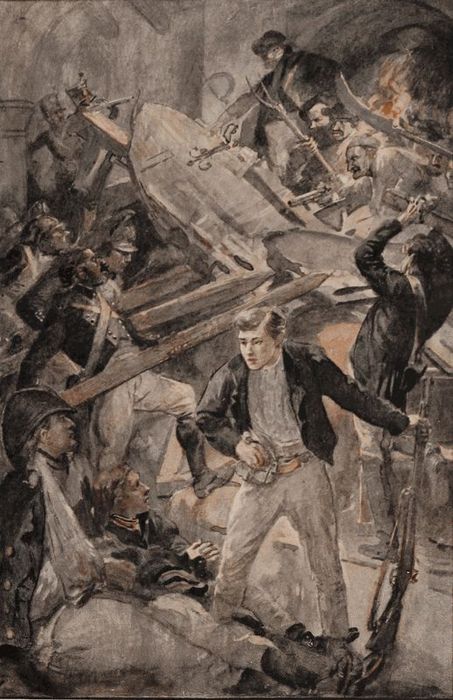
"Into the yard!" shouted Tom at once, leading
the way downstairs at a run, and dashing outside
where the horses were quartered. He was joined by
a dozen troopers within a few seconds, who all raced
across the yard, their sabres swinging in their hands.
One of their number, a light horseman by the look
of him, outdistanced his fellows, and gripping one of
the ladders dragged it aside with all his force, and
sent it thudding into the yard with a couple of the
peasants upon it. But a dozen and more of the latter
had contrived to descend the second ladder, and at
once there began a desperate hand-to-hand contest,
pikes and scythes being opposed to sabres.
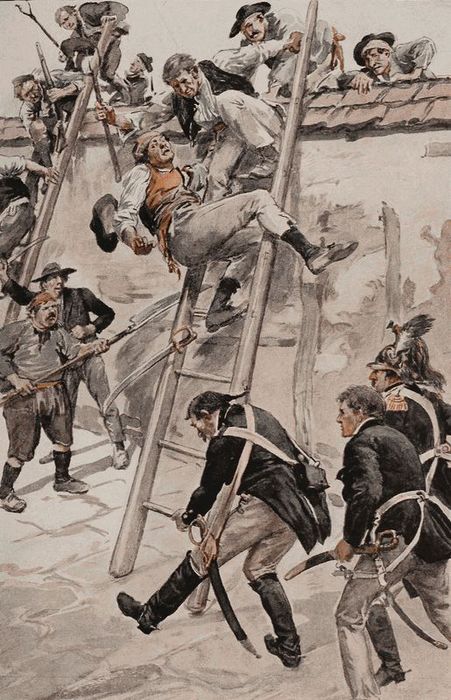
"GRIPPING ONE OF THE LADDERS DRAGGED IT
ASIDE WITH ALL HIS FORCE"
"Hold them, lads!" came in stentorian tones from
Mr. Riley, in spite of his wound. "Hold them for
a little, Tom. We'll have the other boys along in
a jiffy."
Stamping with impatience because common sense
and lack of strength told him that he himself was
unfit to join in the mêlée, and, in fact, even to clamber
down the steps, the naval lieutenant put to good
purpose a stentorian voice trained in a service where
lung power is required, and where the weakling is
useless. In spite of the roar of the mob Andrews
and Howeley heard him, and, rallying in his direction,
went headlong down the stairs, with a number of
their fellows with them. They arrived just in time
to stem the tide of invasion. The ladder still remaining
upright, and loaded with peasants scrambling
to the help of their comrades, was thrown down
by a couple of the troopers. And then, for the space
of five minutes perhaps, there was a fierce struggle
in the yard. The troopers at a shout from Tom
separated themselves and formed a ring round the
invaders, while the latter, taken aback now that they
found themselves cut off from all help by their comrades,
retired towards the wall, their scythes held well
in front of them, their eyes furtively seeking for some
hole or corner which would give them security.
"Hold!" cried Tom loudly, anxious to save unnecessary
bloodshed. "You men keep your formation.
Now," he went on sternly, addressing the
Portuguese in their own tongue, "I give you a moment
in which to lay down your arms, promising
on the word of an Englishman that you shall not
be injured. Answer."
With a sullen clang the peasants tossed their arms
to the pavement, and stood glowering at the troopers,
fearful yet whether they would be murdered.
"Form into line, two abreast," commanded Tom
again. "Howeley, just get to your post and tell us
if the enemy are near. I'm going to eject these
fellows."
He waited till there came a hail from the rifleman.
"All clear, sir," he shouted. "Them fellers has
had a stomachful and has cleared."
"Then get below and make ready to open one of
the gates. My lads," he said, addressing the troopers,
who regarded their prisoners with no very friendly
looks, "these men have thrown down their arms on
my promise that they shall go unharmed. You will
march beside them to the gate and stand about in
case of a rally. Pick up your wounded and killed,"
he called to the peasants. "You will march straight
across to the gate, and will pass out without attempting
violence. Any man who disobeys will be killed
instantly. Let this be a lesson to you. Go to your
comrades and tell them that we are well able to
defend ourselves, and that it would be better far for
them and all if they left us alone. Now, march."
Looking forlorn and frightened, and regarding the
troopers with eyes which showed even now, though
rather cowed, their hatred of them, the peasants
picked up their comrades, of whom a number had
fallen, and bore them to the gate. Two minutes later
they were gone, wending their way from the defences
sadly, and in different spirit from that which had
filled them a little while before. Crash went the
gate. Howeley threw the bar into position and
turned the key.
"Well done!" came from the window above in
loud tones. "Well done all of you!"
Glancing up, Tom saw the jovial naval lieutenant
waving eagerly to him, while close at hand was Jack's
grinning and perspiring face. He was actually shaking
a fist at our hero.
"Lucky brute!" he growled in a voice so quaint,
and with such queer grimaces, that even the French
troopers could see the humour.
"Lucky brute to be able to hop about and take
part in all these skirmishes. Wouldn't I give
something to be in your shoes."
"And right well ye'd do, sir, begging pardon,"
came from Andrews, whom the contest had worked
up to a degree of excitement. "But it's well for us
all that Mr. Clifford's here, begging pardon, sir."
"Well said," shouted Mr. Riley. "Ah, I wish to
goodness I could talk French! I'd make a speech in
Tom's favour. I'd call for cheers."
"Then here's three cheers fer Mr. Tom," came
from Andrews in bellowing tones, cheers in which
the troopers joined lustily, for they fully understood
the gist of what was passing.
"And now?" asked Mr. Riley, wiping the perspiration
from his face. "Now, Tom, after that precious
near squeak?"
"Any damage done?" asked our hero at once. He
ran his eyes over the troopers, and soon discovered
that four had been wounded, though, fortunately,
none of the wounds were severe.
"Then pitch those ladders up against the wall
again and look about for a strong plank. We'll
make a bit of a platform above, where we can post a
few men. They'll be able to keep others of the
peasants from trying the same game. How are things
passing at the church door?"
An inspection there proved that the enemy had
retreated, though doubtless some of them were within
the church. However, for the moment at least, the
bulk of the mob had gone, and Tom took advantage
of the lull to make his preparations for feeding the
defenders. The kitchen fire was soon roaring up the
chimney, while outside, in the yard, there was another
blaze. A trooper, booted and spurred, and stripped
to his shirt, bent over a huge basin perched on a
low wooden table, and sturdily pummelled a mass of
dough. Near at hand stood another, stripped like
his fellow, thrusting his long moustaches upward
toward his eyes.
"Nom de nomme, but this is soldiering!" he was
saying to his comrade, as he added handfuls of flour
from an open sack. "This is what a man can call
campaigning."
"Eh? Ah!" the other grunted. "Mais pourquoi?"
"Hear him!" came the astonished answer, while
the trooper held a floury hand aloft as if to show his
amazement. "He asks why, when the reason is
plain. Dites donc, mon fou; is it so often, then, that
we fight under the eye and command of an English
garçon? Poof! That is the charm of the thing.
I tell you, yesterday I said to myself: 'Pierre, you will
be chopped to pieces before the sun comes up to-morrow.
You and your comrades will be but mince
meat.'"
The man kneading the dough shivered and grunted
his disapproval. "Gently, comrade," he growled.
"You will spoil the tart I am making. What then?"
"What then? He asks what then? See here,
mon brave, we have fighting, heaps of it, and it is the
peasants—poor fools!—who are chopped to pieces.
We have excitement and work fit for a soldier, I say,
and, with it all, see also what we get. Ah! I smell
meat cooking, and here is something that we have
not seen for many a long day."
He went clanking his spurs across to a corner
where the watchful Howeley had deposited a huge
jar of jam, and came staggering back with it. The
two men took the pan from the low table, lifted the
dough from it, and, having thickly dusted the table
top with flour, laid their dough upon it. Then came
the task of rolling.
"Try that, mate," suggested Howeley, who was
now watching the proceedings with a grin of expectation.
"Wasn't meant for the job; but beggars can't
be choosers."
He offered the barrel of an old firelock, the butt
and lock of which had gone, and the trooper took
it with a flourish. Dusting it well, like the table, he
rolled the dough with the hand of an expert, and,
having satisfied himself that his work was nearly
finished, he pinched a corner from the dough and
handed it to the rifleman.
"Try," he grunted.
"Real fine!" answered the Cockney. "I'm waiting
for this here pie to get finished."
"Then the jam, Pierre."
The second trooper let it fall from the jar into the
species of basin which his comrade had now contrived
within a shallow pan, and watched as the latter
smoothed it down with a wooden ladle. On went
the covering of dough, while the cook with skilled
eye and hand marked the edges of the pie, dividing
it into as many sections as there were defenders.
"Now," he cried, "to the kitchen with it. If we
are to be cut to fragments this evening, at noon we
will at least dine like gentlemen. Take it, Pierre,
and see that you do not get it burned. Then indeed
would your punishment be terrible."
Such rejoicing as there was over that meal! Divided
into three separate messes, the defenders ate slices
of frizzled ham in the recesses of the room above the
doorway of the church. Others again washed down
the food with liberal allowances of the wine of the
country, looking about them through the door opening
above the gateway of the yard, while Jack and
Mr. Riley held a reception in the corridor from which
windows opened into the yard, and there discussed
the good things sent them with many a jest and
laugh. Yes, the spirits of the defenders were wonderfully
buoyant. And why not?
"Why be miserable while we're alive?" asked Jack,
cramming a piece of that wonderful tart into his
mouth; for, even if he were wounded, Jack could still
show a remarkably undiminished appetite.
"First there's ham, and then there's jam," he sang,
till another mouthful kept him silent.
"Indeed, why not be jolly?" chimed in Mr. Riley.
"Here we are all tight and weatherproof, as you
might say. What's there to grumble at? But, seriously,
how on earth is this matter to end? Those
peasants have drawn off for the moment; but will
they retire from the contest for good? Eh? Now,
sir, what's the answer?"
Tom flushed at being addressed in such a manner,
and munched steadily at his food. But his deep-set
eyes wore a far-away look which showed that he was
thinking.
"Eh?" asked Jack, prodding him with the prong
of a broken fork discovered in the kitchen. "Do we
draw off as victors, receiving well-deserved promotion
for this—er—this—shall we say, gallant action? or
shall we, in fact——?"
"Be paid the compliment of appearing in the
Gazette as 'missing'? My word, that would be hard
luck after such a business! Now, Tom?"
"More pie," said the latter deliberately. "Whilst
we live we'll eat. But who can say what'll happen?
We've given those poor fellows a regular drubbing;
but I don't believe they've done with us. I don't like
this drawing off, and the silence we now have; it
means mischief. I'd give a heap to know what they
are up to."
Once the meal was finished, and the horses' wants
seen to, the defenders of the place occupied themselves
in a hundred different ways. Some cleaned
their carbines and burnished their scabbards; others
indulged in the luxury of a wash at the pump in the
yard; while Tom, on whom the responsibility of
everything depended, walked slowly from one end
to the other of the defences.
"I'd give a heap to be able to guess rightly what
the enemy are up to," he said, for perhaps the tenth
time, to Andrews, who seemed to haunt his side.
"One sees little or nothing of them."
"Next to nothing, sir," agreed the rifleman, with
knitted brows. "But they ain't up to no good, I'm
sure of it. You can see 'em come from the village
at times and stare over here at us. Then they'll disappear
again, while boys and young men scuttle
about, and carry armfuls of something that I ain't
sure of at this distance. There's been knocking,
too, in the church."
"Hum!" Tom pondered over the information.
He listened acutely, for he was just at the edge of
the platform above the church door. But from that
position, indeed from any position held by the defenders,
it was impossible to look into the place.
Yes, there was knocking, coming from the interior
of the church, and——
"I heard a heavy fall, as if stones had been dislodged!"
he exclaimed. "Come down below with
me, Andrews."
They ran to the stairs, and scuttled down at their
fastest pace. Making their way along the corridor
they were soon at the kitchen, and then entered a
storeroom beyond. It had been ransacked by Howeley
and his helpers, and had provided an ample supply
of good things. But it was not the contents of
the room that interested Tom; it was the wall, the
party wall, on the far side of which was the church.
"Listen," he said. "There!"
A glance at the rifleman's face was sufficient to
show that he, too, had gathered the full meaning
of those blows.
"Can't get at us by fair means, as you might say,
sir," he grunted, "so they're agoing to break through
the wall. It'll be a teaser to hold 'em if they once get
through."
"Couldn't be done," agreed Tom. "There's not
room enough here for more than four men. We
should be driven back into the yard, and, of course,
an attack would be made in other quarters. It is
a teaser!"
His face was drawn and stern as he retraced his
footsteps, and stopped to discuss the situation with
Mr. Riley.
"Of course we could pile all the bales and boxes
we could find against this side of the wall," he said.
"But that would not help us; the peasants would
pull them into the church. There's no way of blocking
up the passage either, and the difficulty of the
situation seems to be this: we have now another
place to defend, and no men to spare for the work.
I think we shall have to try a sortie."
"Or retire up here and hold on to the last," said
the naval lieutenant, his face serious. "But they'd
smoke us out, or burn the whole place over our
heads. I know well the temper of such men as these.
Harmless enough as a general rule, but demons now
that they are roused. They've suffered frightfully at
the hands of the French, and they have made up their
minds to retaliate in the best way they can. Well?"
"I'll see," answered Tom shortly. Turning on his
heel, he went off with Andrews, and clattered down
the stairs to the yard. Yes, there was nothing for it
but to defend the upper story of the house, or——
"Or make for the church again," suggested
Andrews, for our hero had spoken his thoughts
aloud. "You could clear out those fellows who
are working there in a twinkling, carry all the grub
and wine in—and there you are, as good as ever you
were, and better."
"But with a wall still," said Tom dryly. "They
could come in here then, and knock the wall down
just the same. We should have them pouring in
through the church door and through this other opening.
Still, there's a lot in the suggestion. Tell me,
can you see anyone elsewhere than in and around the
village?"
They had mounted to the top of the house, and
could obtain a clear view. Both stared out in all
directions, and kept silent for a few minutes.
"Heaps at the village, sir," reported Andrews after
a while. "A few here and there, watching the surroundings.
No big body of them anywheres as I
can see."
"Nor I; let's get below."
As if bent on a purpose, Tom led the way to the
yard, and then dived into the stable. There were the
two nags they had seen when first they established
themselves in the place, contentedly munching at the
hay with which a thoughtful trooper had provided
them. Tom pulled a door open and entered the cart
shed.
"Good!" he exclaimed. "Two of them—light carts
too. Call Howeley and his men."
The riflemen came plunging down at once, and
stood at attention.
"Get the carts out and the horses harnessed in,"
Tom ordered. "When that's done, load one of the
carts with food. We shan't want water or wine,
though you can take a small cask of the latter. Don't
overload. Now you, my friend," he went on, addressing
one of the troopers, "hurry to the rooms
above, and bring down a mattress and some blankets.
Quick with it!"
"You're going to—beg pardon, sir," began
Andrews, using his accustomed formula. "You
ain't going to take French leave of them beauties!
Never!"
His smile told of his delight, and of his agreement
with the order.
"Take my compliments to Mr. Riley and your own
officer, and help them both to descend," said Tom.
"When they are safely in the cart on the mattress
I have ordered, and armed, Andrews——"
"Yes, sir."
"And armed with carbines, you get to the top of
the building and look about you carefully. If all's
clear, let me know. Then slip down to join us.
Now, I'll collect the other men."
Very silently and swiftly did the troopers obey his
orders. At an earlier date they might very well have
demurred and hesitated, delaying, perhaps, to discuss
the matter; for why should they give obedience to one
who was, nominally at least, their prisoner? But
Tom had won their confidence, and that is a great
thing where troops are concerned. They merely
looked their surprise when ordered to repair to the
yard and mount their horses, while the man posted
over the church door bared his sabre, as if determined
that no fault of his should allow a slinking
peasant to mount secretly and discover the movement
of the garrison.
"Wait till I call you," whispered Tom. "Then
run down to the yard and mount your horse. You
understand?"
The fellow grinned at him, a grin of interest and
friendship.
"Parbleu! An enemy, he!" he grunted, spitting
into the palm that gripped his sabre. "By all the
fiends, but I, Jacques, would welcome the English
as brothers."
The clatter of hoofs told of moving horses, or preparations
down below. Not that it was likely to disturb
the enemy, for the horses moved often enough,
particularly when being watered. Men slipped silently
from their defensive posts and crept into the yard,
while a couple of brawny troopers bore the injured
Jack to the cart, smiling serenely at his angry protestations.
"Treat me as if I were a child," he growled, as
Tom came into hearing. "Who said I couldn't
walk?"
"I'll leave you behind if you're a trouble," came
the answer. "Fiddlesticks, Jack!"
"Or cut his diet down," laughed Mr. Riley, who
already lay on the mattress placed on the cart.
"That's it, my lad; cut his grub short. That'll
make our Jack less fiery. What's up?"
"Going for an airing," came the answer. "Now,
men," said our hero, addressing the troopers, who
were mounted by now. "You'll fall in on either
side of the carts, which will be driven by two selected
by yourselves. Spare horses will be led by others.
If I have it reported that the coast is clear, we will
throw the gates open and ride out. A sharp trot once
we reach the road will take us away from the village.
After that——"
"After that, monsieur?" asked one of the men
eagerly.
"We will see. You are prisoners at this moment
just as much as we are. If we get through, perhaps
we'll call it quits. You'll ride for the army of France,
and we for our comrades."
That brought a grin of pleasure to the bronzed
faces of the men. They would have cheered had not
the need for silence been there. Instead, they picked
up their reins, and fell in on either side of the carts,
waiting for the signal to open the gates. Tom went
back to the sentry he had posted over the church
doorway.
"All clear," was the report. "There is still
knocking."
"Then get to your horse and mount. I am
following."
Tom clambered once more into the yard, and
looked up at the window which Andrews occupied.
"All clear," came the gentle hail.
"Then fall in—time we were moving."
All were mounted within a minute, save Howeley,
who stood at the gates. "Open," called Tom.
"Open it is, sir," said the rifleman, throwing the
gates wide at once.
"Forward!"
Steadily, and without sign of undue haste, the
cavalcade rode from the yard into the open, leaving
a place which, though it had revictualled them and
offered excellent cover, might, were they to hold it
longer, lead to disaster. They moved away into the
open in regular order, the carts in their midst bearing
their wounded and their supplies with them as became
good soldiers.
"Trot!" commanded Tom, and at the word the
troop set their horses into faster motion, Andrews
at their head leading them off obliquely towards a
point where the road was accessible.
"Hear 'em!" ejaculated Jack, by no means dismayed,
as a torrent of yells and cries came from the
village and from a number of points about them.
"They don't seem overpleased at our leaving."