Six Volumes. Cloth. Illustrated. Price per volume $1.25.
UNDER DEWEY AT MANILA.
UNDER OTIS IN THE PHILIPPINES.
A YOUNG VOLUNTEER IN CUBA.
THE CAMPAIGN OF THE JUNGLE.
FIGHTING IN CUBAN WATERS.
UNDER MacARTHUR IN LUZON.
Stratemeyer Popular Series
Ten Volumes. Cloth. Illustrated. Price per volume $1.00.
THE LAST CRUISE OF THE SPITFIRE.
TO ALASKA FOR GOLD.
REUBEN STONE’S DISCOVERY.
THE YOUNG AUCTIONEER.
TRUE TO HIMSELF.
BOUND TO BE AN ELECTRICIAN.
RICHARD DARE’S VENTURE.
SHORTHAND TOM, THE REPORTER.
OLIVER BRIGHT’S SEARCH.
FIGHTING FOR HIS OWN.
Soldiers of Fortune Series
Cloth. Illustrated. Price per volume $1.25.
ON TO PEKIN.
AT THE FALL OF PORT ARTHUR.
UNDER THE MIKADO’S FLAG.
UNDER TOGO FOR JAPAN.
American Boys’ Biographical Series
Cloth. Illustrated. Price per volume $1.25.
AMERICAN BOYS’ LIFE OF WILLIAM McKINLEY.
AMERICAN BOYS’ LIFE OF THEODORE ROOSEVELT.
Colonial Series
Cloth. Illustrated. Price per volume $1.25.
WITH WASHINGTON IN THE WEST.
AT THE FALL OF MONTREAL.
MARCHING ON NIAGARA.
ON THE TRAIL OF PONTIAC.
THE FORT IN THE WILDERNESS.
Pan-American Series
Cloth. Illustrated. Price per volume $1.25.
LOST ON THE ORINOCO.
YOUNG EXPLORERS OF THE ISTHMUS.
THE YOUNG VOLCANO EXPLORERS.
YOUNG EXPLORERS OF THE AMAZON.
Dave Porter Series
Cloth. Illustrated. Price per volume $1.25.
DAVE PORTER AT OAK HALL.
TWO YOUNG LUMBERMEN. Price $1.25.
BETWEEN BOER AND BRITON. Price $1.25.
JOE, THE SURVEYOR. Price $1.00.
LARRY, THE WANDERER. Price $1.00.
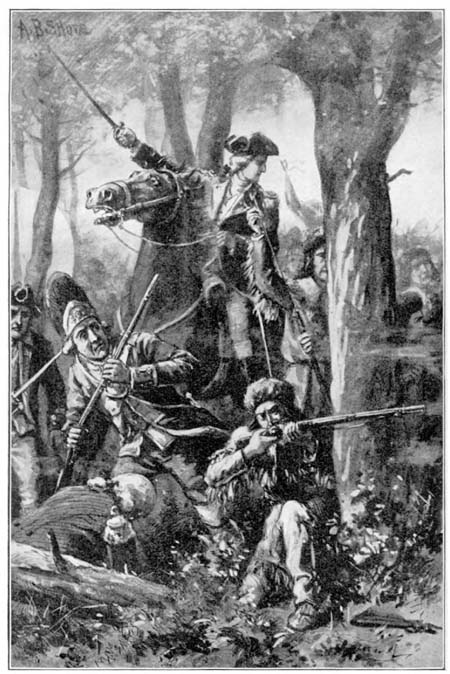
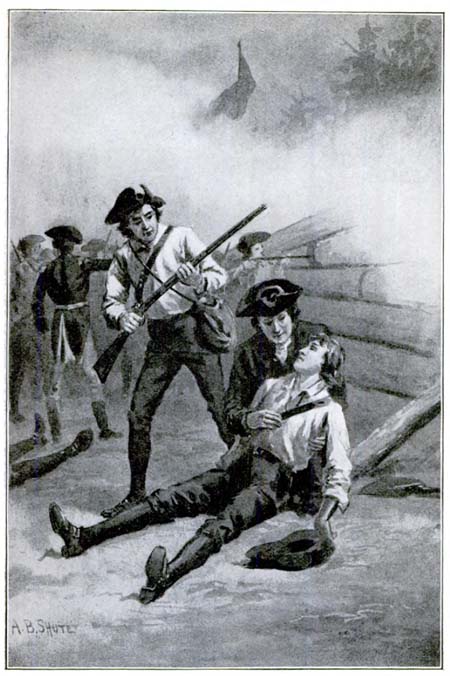
Col. Washington was in the thickest of the fight.—Page 278.
WITH WASHINGTON IN THE WEST
Colonial Series
OR
A SOLDIER BOY’S BATTLES IN THE
WILDERNESS
BY EDWARD STRATEMEYER
Author of “On to Pekin,” “Between Boer and Briton,” “Old Glory
Series,” “Colonial Series,” “Pan-American Series,” “Great
American Industries Series,” “American Boys’
Life of William McKinley,” etc.
ILLUSTRATED BY A. B. SHUTE
BOSTON: LOTHROP, LEE & SHEPARD CO.
Copyright, 1901, by Lee and Shepard
All rights reserved
With Washington in the West
Norwood Press Berwick & Smith
Norwood, Mass.
U.S.A.
PREFACE
“With Washington in the West” is a complete
story in itself, but forms the first of several
volumes to be known by the general title of “Colonial
Series.”
The main character of the book is David Morris,
the son of a hardy pioneer who first settles near Will’s
Creek (now the town of Cumberland, Virginia),
and later on establishes a trading-post on one of the
numerous tributaries of the Ohio River.
As a boy David becomes acquainted with George
Washington, then but a young man of seventeen.
Washington is at work, surveying tracts of land in
the beautiful Shenandoah valley, and David is glad
enough to go with him as an assistant. Together
they ford the rivers and creeks, and climb the mountains,
and they do not separate until the ill health of
Lawrence Washington compels his brother to return
home.
The coming of the English traders into the valley
of the Ohio was viewed with suspicion by the French,
and it was not long before these traders were served
with notices to quit. A notice reaching Mr. Morris,
he turned it over to his son, who was to take it
to the Virginia authorities and learn whether or not
it must be respected. On his way eastward David
falls in with the Virginia Rangers, who are under
the command of Washington, and learns that there
is practically a state of war between the English and
French in America. Several trading-posts have been
attacked and this being so the youth becomes anxious
to return to his father, and throws in his fortunes
with Washington as a young soldier. Then follows
the march to Great Meadows, the defence of Fort
Necessity, and the news that Mr. Morris’ post has
been captured by the French and the trader taken
prisoner.
Chafing to learn what has become of his parent,
David remains at the home of his uncle until the
next Spring, when General Braddock arrives with his
troops from England. Another campaign against
the French is now opened and once again the youth
becomes a soldier boy, to witness Braddock’s bitter
defeat and Washington’s masterly effort to save the
remnant of the army from annihilation.
In the preparation of the historical portions of this
work numerous authorities have been consulted, including
the Writings of Washington, biographies by
a great number of more or less well-known authors,
and several colonial histories and books of record.
For this reason the author trusts that it is free from
any error sufficient to hurt its usefulness. As a
story the writer hopes it will find equal favor with
the many which have preceded it from his pen.
“Uncle Joe, an Indian is coming this way, down
the Creek trail.”
“An Indian, Dave! Can you make out who it
is?”
“Not yet. He’s in the shadow of the hemlocks.”
The youth pointed along the brushwood bordering
the watercourse. “There! do you see him?”
“I do. He is trailing a gun, too, and wears
white feathers. It must be White Buffalo.”
“White Buffalo! Oh, Uncle Joe, do you think
he’d be able to get back so soon?—over the mountains
and rivers, and all?”
“These redskins can travel swift enough when
they want to, Dave, and like as not your father told
him to bring the word back as quick as he could.”
Joseph Morris continued to keep his eyes fixed on the
trail, which wound in and out under the low-drooping
trees. “Yes, it’s White Buffalo, and he’s coming
straight for our cabin.”
“I hope he brings good news,” went on Dave
Morris. “Shall I go and tell Aunt Lucy? More
than likely he’ll want something to eat—they all do
when they come here.”
“Yes, tell her to fix up a good supper for the redskin,
and tell her, too, to get that new dress goods
I bought at Winchester last week out of the way.
If she doesn’t White Buffalo will surely want some
of it for himself or his squaw—he can’t hold back on
bright colors—although he’s not half so much of a
beggar as some of them.”
“I will. But, Uncle Joe, you’ll bring him right
up to the cabin, won’t you? I’m so impatient to hear
from father.”
“Yes, I’ll bring him right up.”
“It seems an age since father went away,” added
Dave Morris.
With these words the boy turned away from the
bank of the creek and, axe in hand—for he had been
helping his uncle cut down some scrub timber on
the edge of a small clearing—moved quickly through
a patch of corn and then into a belt of timberland
composed of beautiful walnut, hickory, and mountain
ash. Beyond the belt was a second clearing,
long and narrow, spread out upon both banks of a
brook flowing into the creek previously mentioned.
In the midst of this was a rude but comfortable log
cabin, long, low, and narrow, the eaves at one end
coming down in a porch-like roof to shelter the
kitchen door. There were four rooms in this home
in the wilderness and all upon the ground floor, the
upper floor under the roof tree being little more than
a loft in which to store certain winter supplies.
David Morris was a youth of fourteen, tall, strong,
and by no means ill looking. His manner was open
and frank, and this disposition made for him ready
friends wherever he went. Since earliest childhood
he had been used to a life in the open, and this made
him appear somewhat older than his years. He
could plow a field or cut down a tree almost as well
as a man, and he was far from being ignorant of the
use of firearms. Indeed, the winter before, he had
gone out hunting with old Sam Barringford, one of
the best of the hunters and trappers in the Virginia
valley, and had acquitted himself in a manner to
earn the ardent praise of that individual. As a matter
of fact, Dave would rather have gone hunting
and fishing any time than stick to the work on the
farm, but he knew his duty to his uncle and his aunt
and did not seek to evade it.
Dave’s taste for woods and waters—for hunting,
trapping and fishing—came to the lad naturally. His
grandfather had been of New Jersey stock, and had
drifted into Pennsylvania with the thrifty German
pioneers who afterward did so much to make that
great state what it is to-day. But old Ezra Morris
could not remain in sight of the farms and plantations
and had gone on south-westward, into what
was then termed the great Virginia valley, between
the Shenandoah and the upper Potomac Rivers.
Here he had built himself a cabin, and it was here
that James Morris, the father of Dave, was born and
raised. The surroundings were wild, and the majority
of neighbors—if those living half a mile
or more away could be called such—were Indians.
Although Ezra Morris always sought to be fair
with the red men, others in that district cheated the
Indians in numerous ways, and as a result the Indians
arose one wintry night and slew nearly all the
settlers for miles around. Among the victims were
Ezra Morris and his wife; and the son James, then
a boy of twelve, barely escaped by hiding in a snow-bank
behind the cabin. He was found in the woods
two days later, nearly frozen to death, and was taken
to Winchester by parties living there. At Winchester
was his brother Joseph, several years older, who
was visiting at the time, and thus escaped the horrors
of the massacre.
For several years after this Joseph and James
Morris remained in and around Winchester, then a
frontier post of considerable importance, and during
that time the elder brother married Lucy Smiley, who
had just come over from England with her brother,
who was in the employ of William Fairfax of Belvoir.
Several years later James Morris also married,
and both families settled near what was called
Will’s Creek, not a great distance from the present
city of Cumberland. It was here that Dave was
born and also his cousins, Rodney, Henry, and little
Nell.
At first all went well with both families, but one
day Rodney Morris had a bad fall from a tree which
injured his leg and rendered him lame. This was
a great misfortune, for the young man had been a
much needed help to his father and his uncle, but
a greater trial followed in the sudden and unexpected
death of James Morris’ wife, who was taken with
a chill one Saturday noon and expired on the following
Sunday morning.
This blow almost stunned both the husband and
the son, and it may truly be said that the former
never got over it. As soon after the funeral as
possible the father placed his son in his brother’s
care and took to the woods, and none of his folks
saw him for nearly a year. When he returned his
pale and haggard face showed plainly that even in
the depths of the wilderness beyond the Blue Ridge
he had not been able to get away from his great
grief.
During his wanderings James Morris had gone
West as far as a stream of water called by the Indians
Kinotah. He described the river as very lovely
and one upon which a trader with a little means
might set up a trading-post to great advantage. One
particular spot, which he named Ella Dell, in memory
of his wife, continually haunted him, and he
told his brother and his son that some day he intended
to go back to it. He reported that the Indians
were now very friendly and that many of those
who had conducted the massacre of years gone by
were dead.
Neither of the brothers was blessed with much
money, and the opportunities for making any were
small, so the idea of opening a trading-post had, for
the time being, to be abandoned. All the Morrises,
with the exception of Rodney the cripple, worked
hard on the farm, and even Rodney did what he
could to keep himself employed. During this time
Henry Morris made a trip as far East as Annapolis,
and on returning told of a stop-off at Lawrence
Washington’s magnificent estate at Mount Vernon,
so called in honor of Admiral Vernon, under whom
Lawrence Washington had served in West Indian
waters.
“They are a fine people, those Washingtons,”
Henry Morris had declared. “Mr. Lawrence
Washington is a thorough gentleman, and his
brother George is as nice a boy as any in these parts.
And, oh, what a plantation they’ve got! Nearly a
thousand slaves, and so many horses I couldn’t count
them. I can tell you a place like that is something
worth while.”
“The Washingtons have always been rich,” had
been Joseph Morris’ answer. “And Lawrence
Washington lost nothing by marrying William Fairfax’s
daughter. Those families own more land than
they know what to do with.”
“Old Lord Fairfax was there,” Henry had continued.
“He takes a great interest in George Washington.
George is learning surveying at school, and
Lord Fairfax said he might give him the work of
surveying his estate some day.” And so the talk
had run on, for in those days Lord Fairfax was a
personage of great importance in that neighborhood,
and the Washingtons were also well known.
One day there came a sudden and unexpected
windfall to the Morrises. A distant relative who
lived in New Jersey died and left to each brother
the sum of twelve hundred pounds—about six thousand
dollars—and also a quantity of household
goods, cattle and horses. At once James Morris
journeyed to New Jersey after the fortune, going
both for himself and as his brother’s legally appointed
agent. This trip in those days was a long
one, and had to be made on horseback for the greater
part of the distance. The mission took four months,
and when Dave’s father returned he brought with
him a train of sixteen pack-saddle horses, some carrying
furniture which had originally come from England
and which could not be duplicated in the
colonies.
As soon as the furniture and other effects had been
left at the cabin near Will’s Creek, James Morris
had announced his intention of using his part of the
inheritance in establishing a trading business with
the Indians on the Kinotah. “I know there is money
to be made in it,” was the way he reasoned to his
brother. “A good deal more money than is to be
made here at farming.”
The idea pleased Joseph Morris, but he was loath
to go further into the wilderness with his wife and
his little daughter, and with a son who was a cripple,
and after a long conference it was decided that
James Morris should start out alone, using a thousand
pounds belonging to both, and also the pack
horses, and leaving Dave with his uncle.
It grieved Dave to be left behind, yet, as his father
thought it best, he did not complain, only begging
that he might be permitted to join his parent at the
trading-post at some time not too far in the future.
To this the father had promised that the lad might
make the trip during the year following, if all went
well.
The hopeful pioneer had fitted out his trading expedition
at Winchester, with goods brought from
Annapolis, and with his pack horses loaded with
trinkets, bright colored blankets and cloths, and other
things dear to the heart and eye of the red men, had
set off for the great “Western Country” as some
people of that time called the western portion of
Pennsylvania. Here the virgin forests were almost
trackless, the only trails being those of the Indians
and the deer and other wild animals. Bridges there
were none, and every river had to be either forded
or swum, and the journey through the vast mountain
gaps was perilous in the extreme. The party
consisted of James Morris, two old hunters known
as Tony and Putty, and half a dozen Indians under
the leadership of White Buffalo. It was agreed
that as soon as the Kinotah was reached and the
trading-post established White Buffalo should be
sent back with the news.
CHAPTER II WHITE BUFFALO BRINGS NEWS
When Dave entered the cabin homestead he found
his Aunt Lucy and his cousin Rodney, the cripple,
hard at work making tallow candles, the only kind
of light used about the place after sundown. Over
a fire in the dooryard hung a kettle full of soft tallow
and on the kitchen floor rested the metal moulds
for forming the candles after the wicks had been
placed in from end to end. The best of the candles
were made in this manner, but Rodney was making
a commoner sort by simply dipping wicks into the
fat and hanging them up to harden, repeating this
process until the prospective lights were of the desired
thickness.
“Why, Dave, what brings you back so soon?”
cried Mrs. Morris, somewhat startled at his unexpected
appearance. “I didn’t blow the horn for
supper.”
“White Buffalo is coming, and Uncle Joe told me
to tell you that he would probably be hungry, and
for you to get those new dress goods out of the
way before the redskin saw ’em. If you don’t he’ll
most likely tell you he dreamed you gave them to
him for his squaw, or something like that.”
“Mercy on us, White Buffalo! Yes, I will get
them out of sight, every one! He is a good-enough
Indian, but, oh, every one of ’em is such a beggar!
What did he say of your father, Dave?”
“I didn’t see him to talk to, Aunt Lucy—I came
away before he came up. But Uncle Joe said he
would bring him right up to the cabin. Shall I help
clear the kitchen floor?”
“Yes, we are about done for to-day, and Rodney
is more than tired, I can see that plainly. Rodney,
you just go and rest yourself on the bed, Dave
and I can get this mess out of the way in a jiffy.”
“I’m willing enough,” answered Rodney, with a
deep drawn sigh, and rising from his rush-seated
chair he hobbled out of the kitchen to the next room.
“Do you want me to kill anything for supper—a
couple of chickens or ducks?” queried Dave, as he
began gathering up the still warm candle moulds.
“No; Henry shot a deer right after dinner—down
by the old salt lick—dropped him, so he said,
without the least bit of trouble. He’s down at the
shed now dressing it. We can have that,—and I’ll
make some corn cakes—the kind those Indians like.
You had better bring me in some more wood. I’ll
take care of the rest of the candles. And tell Henry
to fetch along a nice piece of that deer meat, and
a jug of that yellow apple cider.” And so speaking
Mrs. Morris bustled around at a lively rate, that she
might have the kitchen in order when her husband
appeared with their Indian guest.
At the cattle shed, a rude affair of rough logs
and tree branches, Dave found his cousin Henry
tacking up the deer-skin to dry and tan in the sun.
Henry was a short, stout youth and a good deal of
the same turn of mind as his mother.
“I’ll bring up a good-enough piece of meat for
any redskin,” he said, after listening to Dave. “I’m
glad White Buffalo has come, although I didn’t
expect to see him for a fortnight, or until the next
new moon. Everything must have gone along swimmingly
with your father.”
“I hope so, Henry.”
In a few minutes Henry brought up the venison,
and Dave followed with the extra wood, and soon
Mrs. Morris had a roaring fire with which to prepare
the evening repast. There was, of course, no
stove, only a rude brick oven, and the meat was
placed on a spit to broil, the oven being used for
the corn cakes and for other things the lady of the
cabin wished to bake. From chains overhead hung
a pot and an iron kettle with water, and also a smaller
kettle in which Mrs. Morris brewed herself some
tea. As the cooking progressed most of the smoke
went up the broad chimney but some came into the
kitchen, and the ceiling, where hung numerous things
to dry, was covered with soot in consequence.
The table was bare of linen or oilcloth, but
scrubbed to a snowy whiteness. Plates were laid
for all, but at the place to be occupied by White
Buffalo a short bench was drawn up, that the Indian
chief might eat from the level of his lap should he
prefer to do so. The knives and forks, the latter
quite new, were of iron, and Joseph Morris, like
many other old pioneers, preferred to use his pocket-knife
when cutting food. Napkins there were none,
but a bucket of water stood in a corner and above
it was a towel hung on a cow-horn, for the use of
anyone who wished to keep his fingers or mouth
clean. And yet this cabin was furnished as well as
those of thousands of other pioneers.
The supper was well under way when Joseph
Morris appeared at the edge of the homestead clearing
side by side with White Buffalo, who slackened
his pace to a dignified walk when approaching the
cabin. The Indian was of the tribe of Delawares,
tall, thin, and as straight as an arrow. His eyes
were black and bright, and his mouth showed a set
of teeth as clean and polished as those of a wolf.
His headgear consisted principally of white feathers,
tipped with yellow to imitate gold, and over his
shoulder he carried a small blanket of buffalo hide,
dyed white with yellow spots, the spots being somewhat
in the shape of wolves’ heads. This signified,
in the Indian language, that he was White Buffalo,
son of Yellow Wolf, a former powerful chief of the
Delawares.
As the Indian came up Dave ran out to meet him
and shake his hand. “I am very glad to see White
Buffalo,” he said. “I hope you bring good news of
my father,” and he pressed the red man’s hand
warmly.
“How-how!” answered the Indian in return,
meaning, “how do you do?” Then he looked at
Dave steadily for a few seconds. “The white boy’s
father was well when I left him, eight sleeps ago.
He must still be well,” he went on.
“I am glad to hear that, White Buffalo. Did he
find the spot he visited before?”
At this question a proud look came into the Indian’s
face. “Yes, he found the spot, but not alone.
White Buffalo was told how the place looked, and he
hunted it up for the white boy’s father.”
“White Buffalo has brought a long letter from
your father,” put in Joseph Morris. “I know you
are impatient to read it, so you may do so before
we have supper,” and he handed the communication
to his nephew. Then he led the Indian into the
cabin, where Mrs. Morris and the others greeted
him as warmly as had Dave, for all but little Nell
knew the old chief well and liked him.
The letter from James Morris was straight to the
point and characteristic of the man, and ran, in part,
as follows:
“The journey to this spot was a hard one. We
had great difficulty in crossing the rivers, and at
one of the fords Bess, a good black mare, lost her
footing and was drowned before we could catch her
and take off her packs.
“Two days before we reached the Kinotah we
came upon a band of very dirty Indians under the
leadership of Fox Head, a Miami. They begged for
many things and we had at last to drive them off.
I got two of White Buffalo’s braves to trail them for
several miles, and they brought back word that Fox
Head was very bitter against me. Fearing an attack
that night I moved our camp to the south of the
regular trail, but the Miamis have not appeared
since.
“In consequence of moving from the trail I lost
the lay of the land for twenty-four hours, and had
to call on White Buffalo to aid me in locating the
Kinotah. This he did with great ease, and by high
noon the day following we reached the point I have
named Ella Dell, and before night were hard at work
establishing our trading camp.
“At present our post consists of a strong log
cabin built in the shape of a cross, and is located in
the angle formed by the Kinotah and a creek I have
called Indian Brook, for the Indians use it greatly
when in quest of fish. Game is plentiful and I
have arranged it so that Tony and Putty can go out
and shoot. The Indians are already bringing in their
hides and furs, but a good deal of what they have
is old and I have given them to understand that I
want only that which is new and of the best. I believe
that by next year the trade will be a well paying
one.
“I am sorely in need of a number of things, and
on another sheet have made out a list. If you will
buy them at Winchester or Annapolis and pack them
well on two horses, White Buffalo has agreed to
bring them to me without delay. To the list you
can add anything new which you may see and which
you think would be attractive for trading purposes.
“Give my best wish and love to all, and tell Dave
that I think of him constantly and that I trust all
goes well until we meet. Perhaps when White Buffalo
makes another trip I will write him personally,
but just now my hands are too full, and I am writing
this while the others are sleeping.
“Before closing, I must mention that the French
are pushing into this territory fast, and that I heard
from two of the Indians that they consider this land
as belonging to them. I always considered that it
belonged to our colonies. As yet I have not met any
of the French traders, but have been told that a
number of them are located further west, on the
Ohio River. Unless this question of whose land it
really is, is settled soon, it may bring serious difficulties
in the future.”
Dave read the letter with deep interest, not once
but several times. Communications of this sort were
not common in those days, and each letter received
was treasured for a long while afterward. He wished
his father had written to him personally, but understanding
the situation, did not complain.
When he entered the kitchen he found the family
and White Buffalo assembled around the table.
Placing the letter on a shelf he slipped into his own
seat. A moment of silence followed, and then Joseph
Morris offered a humble prayer and gave thanks to
God for the food of which they were about to partake.
During this White Buffalo sat as motionless
as a statue, nor did he speak a word while the food
was handed around. He ate from the bench, and if
he wanted a thing took it, otherwise he simply motioned
it away.
The meal over, Joseph Morris brought forth some
of his best tobacco and filled a new clay pipe, one of
the red variety with a long stem. He took a few
puffs, then handed the pipe to White Buffalo who did
the same. Then the Indian produced his own pipe
and went through the same performance. After this
both smoked freely, and the tongue of White Buffalo
loosened readily.
“I have seen many places which were fair to look
upon, but none more fair than Ella Dell,” said he.
“In days to come the spot will bring many doubloons
to the pockets of the Morrises. The game love the
spot, the deer and the fish cannot stay away from it,
and the river makes sweet music as it passes it by.”
“Yes, my brother told us of it before,” answered
Joseph Morris. “It was continually in his mind. I
sincerely trust we can make our title good to it. But
what do you know of the French around there?”
At this the brow of White Buffalo clouded. “The
French are not my friends, nor are they the friends
of the English who have gone toward the setting
sun. The French would keep that fair land for themselves,
and send away both the English and the Indians.
Sooner or later there will be war because of
this.”
“War!” cried Dave.
The Indian nodded gravely. “The French and
the English are at peace, but when they buried the
hatchet many moons ago none of the great warriors
spoke of the lands between here and the Father of
Waters,” he went on, meaning by Father of Waters
the Mississippi River. “I have heard the story from
White Thunder, and also from Tanacharisson, the
Half-king. The French have sailed upon the Father
of Waters and claim all the lands which drain therein;
the English claim this land because of a treaty made
many winters ago with the Iroquois. And the Indian
who lives upon the land, what of him, with
his squaw and his pappoose? If the French or the
English take the land he will have nothing, and he
and his squaw and his pappoose can starve. Yes, the
hatchet will be dug up again.”
“It sounds reasonable, White Buffalo,” answered
Joseph Morris, after a thoughtful pause. “But if
war should come because of this, I think the Indians
ought to stand in with the English.”
“White Buffalo will stand with his white friends.
But he cannot speak for those of other tribes. Many
will fight with those who promise the most, for we
are but children when it comes to dealing with the
white man. I have lived with you long and I know
you better than do most of my people. The Indian
is wise, but his wisdom is of the woods and not of
books. The white man can cheat him if he will, and
the Indian will be none the wiser.”
Here the conversation changed and Joseph Morris
went over the list his brother had sent him. Before
retiring that night it was decided that he should depart
for Winchester and Annapolis the next day,
leaving White Buffalo to remain at the cabin until
his return.
“Can’t I go with you and help buy those things?”
asked Dave of his uncle.
“Would you like to go very much, Dave?”
“I would.”
“Then you shall go. And now let us off to bed,
for it is growing late.”
A few minutes later the occupants of the cabin
retired, leaving White Buffalo to make himself comfortable,
as suited him, on the kitchen floor in front
of the dying fire.
CHAPTER III IN THE FOREST
Dave and his cousin Henry occupied a small bedroom
at the north end of the cabin. Like the other
apartments, this was unplastered excepting for some
clay stuck in the chinks to keep out the wind. The
room boasted of one window, a foot and a half
square, and fitted with a heavy wooden shutter, to
be closed in winter, or when there was danger of
an attack.
Three-quarters of the floor space was taken up
by the heavy four-posted bedstead, built of black
walnut and hickory and almost as hard and as heavy
as iron. The bed was corded with rawhide, on which
rested a mattress of straw and a long pillow filled
with chicken feathers. In front of the bed, and directly
under the window, ran a bench the length of
the room, and above was a row of pegs upon which
the boys could hang their clothing. The ceiling was
so low that the boys could jump up and touch it with
ease.
By the time the boys had said their prayers and
retired, a deep silence had fallen on the cabin and its
surroundings, broken only by the faint gurgling of
the brook as it tumbled along over the rocks and the
soft fall breeze as it swept through the forest beyond
the clearing, sending the golden leaves down in showers.
Presently the moon shone over the top of the
distant mountains, tipping the brook here and there
with silver. The shining of the orb of night seemed
to displease the wolves, and soon one and another
let up a lonely howl, ending in a chorus which was
truly dismal. But those in the cabin were used to
such sounds and were not disturbed. White Buffalo
uttered a long sigh and then began to snore, as if
in answer to the beasts outside.
The moon still hung low in the heavens, as if loath
to give place to the rising sun, when Joseph Morris
arose, followed by his wife, and set about preparing
the morning meal. White Buffalo was already up
and sat on the doorstep, cutting out a wooden trinket
with his knife. With this trinket he intended to make
friends with little Nell, who so far, had proved rather
afraid of him.
“White Buffalo make little Nell a wooden pappoose,”
he said, when the six-year-old came from
her bedroom and shyly approached to see what he
was doing. “Little Nell can dress the pappoose and
make much play.”
“Oh, a doll!” cried the girl, and much of her
shyness vanished. She looked it over. “Why, it
hasn’t any arms!”
“White Buffalo make arms by-me-by, and feet,
too. Make arms and feet fast with sticks, so little
Nell can move them and make head fast with stick,
too, so pappoose can look over shoulder and all
around. Heap big pappoose then, much proud!”
“That will be nice,” answered Nell and smiled
frankly into the Indian’s face. Then the two consulted
about the length of the legs and arms to be
put on the doll, and before breakfast was ready they
were firm friends. When finished the doll was decidedly
crude and had a strong Indian expression on
its straight-nosed face, but this Nell did not seem
to mind. She possessed but few toys and this was
her first doll, and she cherished it accordingly.
Joseph Morris felt that he would have to go direct
to Annapolis for the majority of the things his
brother wished, so preparations for such a journey
were made. Such a trip was quite an event, and
Henry Morris was sent around to several of the neighbors,
who might desire some commission executed in
town. Annapolis was rapidly becoming a place of
considerable importance, with a growing trade in
tobacco, hemp, and other commodities.
It was a cool, crisp day when Joseph Morris and
Dave set out on their journey. They were on horseback,
and several neighbors came to see them
off and incidentally to load them with further commissions,
which had been forgotten until the last
moment.
“Take care of yourself, Joseph,” said Mrs. Morris,
on parting. “And you be careful, too, Dave,” and
then she kissed both her husband and her nephew affectionately.
Little Nell also came in for a hug and a
kiss, and the others for a handshake.
The distance to the trading-post at Will’s Creek
was three miles, and the distance from the post to
Winchester, then nothing but another frontier post,
was about forty-five miles. But the wagon road
from one place to the other had not yet been cut
through, and the trail ran in and out along the river
and through the forest, making the distance to be
traversed at least sixty miles. The mountain pass
was a difficult one and at one point ran around the
edge of a cliff forty to fifty feet high. Here a tumble
for man or beast to the jagged rocks below would
have meant instant death.
But Dave thought of none of these perils as he
rode beside his uncle or directly behind him. He
had a good mount and a good rifle, and his aunt had
fairly stuffed their saddle bags with good things to
be eaten on the way. The lad saw nothing but a
grand outing ahead and whistled cheerily in consequence.
Mr. Morris was more thoughtful and so pre-occupied
that he scarcely noticed Dave’s rendering of
“The Pirate’s Lady, Oh!” and of “Lucy Locket
Lost Her Pocket,” afterward known universally as
“Yankee Doodle.” The tunes were whistled half a
dozen times, and then of a sudden the lad turned
to his relative.
“Uncle Joe, what are you so silent about? You
haven’t spoken since we passed the old fish hole.”
“Is that so, Dave?” was the answer. “Well, to
tell the truth I was thinking of many things—of the
articles we are to buy and where I could probably
get them cheapest, and of the talk we had with
White Buffalo about the trouble with the French.”
“Do you think we will have trouble with the
French?”
“I cannot see how it can be avoided. As I understand
it, when the treaty of peace was signed at Aix-la-Chapelle
nothing was said about the English and
French possessions in western America. Now the
French discoverers have sailed down the Ohio and
the Mississippi, and consequently they may claim the
land by right of discovery, especially when they realize
the value for trading-posts and for cattle and
farm lands.”
“But can they claim the land when they sail only
on the water?”
“They hold that a discoverer sailing along an unknown
river can lay claim to all lands drained by
that river, or by creeks flowing into it. But this is
absurd when it comes to such a stream as the Mississippi
which is the basin for miles and miles of
territory, or even with such a river as the Ohio.”
“When did they discover the Mississippi?”
“About seventy-five years ago one Padre Marquette
sailed down the stream for several hundred
miles, in company with a friend named Joliet. They
were French subjects and took possession, so-styled,
in the name of the King of France.”
“But what about our claim?”
“Well, to tell the truth, our claim isn’t much
better than that of the French. In 1741 the commissioners
from Virginia, Maryland and Pennsylvania
met a number of head chiefs of the Six
Nations, and the Indians, for four hundred pounds,
gave up all their claims to the land lying this side
of the Mississippi.”
“Well, that claim ought to be all right, it seems
to me.”
“It is all right for the land this side of the Alleghany
Mountains, but as for the other I doubt if the
Six Nations had any right to deed it away. They
never lived on it and the story that they once conquered
it is only a tradition.”
“Well, who does the land belong to?”
“To the Indians first, and then to the white people
who establish themselves on it. As to what nation
shall rule, our country and France will have to settle
that between them.”
“Then war must surely come?”
“Probably; although the folks in Europe may
have enough of fighting for the present. Very few
have forgotten the hardships of the last struggle or
the distress which followed. For myself, I do not
wish to live to see another war, either with the Indians
or the French.”
“Have the French any regular settlement on the
Ohio and the Mississippi?”
“I don’t know of any settlement on the Mississippi,
but their fur traders are on the upper Ohio,
Sam Barringford met several of them when he was
on a hunt with White Buffalo. He said they were a
lawless set, some of them half-breeds, and they would
get the Indians drunk on rum and then literally rob
them of their pelts. I shouldn’t be surprised if the
Indians rose up some time and wiped them all out
in revenge.”
“If the French traders are that sort do you think
they will bring trouble to father?”
“They are not all that sort. Here and there you
will find a good-enough fellow. As to bringing
trouble, though, that’s another question. You know
when an Indian goes on the warpath he is apt to get
excited and then perhaps one trader will look just
as black to him as another. But your father didn’t
go to trade in rum, and he expected to give the
redskins honest value for their hides, so they may
remain his friends even if they do rise.”
“I think war is a dreadful thing, Uncle Joe, and
I can’t see why civilized nations should fight each
other. It’s bad enough for the redskins to do
that.”
“True enough, Dave, but I imagine there will be
fighting to the end of time. It’s a sort of court
of last resort, you know; first folks argue, then they
make demands, and at last they fight, and there
doesn’t seem to be any help for it. But it’s truly a
pity England and France can’t agree—they’ve
pitched into each other so many times.”
The pair had now reached the end of the trail
beside the creek and for the time being the conversation
came to an end. There was a small brook to
ford and then the side of a hill to climb. Here the
giant trees sent their roots sprawling in all directions
and they had to proceed with care lest one of the
steeds might stumble and break a leg. The forest
was dense, for a woodman’s axe had never yet entered
it, and in some spots the gloom was intense
while at others the faint rays of sunshine piercing
the boughs above served only to intensify the darkness.
In spots the trail was very damp and the trees
covered with fungi, in other places there were patches
of green moss as soft as the most delicate carpet.
Here and there the boughs hung so low they had to
lift them to get past.
“What a solitude!” remarked Joseph Morris, as
they came to a halt in a glade surrounded by stately
walnuts. They held up their heads to listen. Not
a sound broke the stillness close around them. From
afar came the songs of birds and the chant of some
swamp frogs. Around them floated butterflies of
various hues, and presently came a cluster of honey
bees, heading for an old tree they had just passed.
At once all else was forgotten by Joseph Morris but
the bees.
“A bee tree, Dave!” he cried. “See, we are in
luck for once!”
“A bee tree, true enough!” echoed the youth.
“It ought to be pretty well filled with honey by this
time, too. Of course you’ll mark it, Uncle Joe.”
“To be sure, although I shouldn’t forget it very
easily—being so close to this opening and so near
to the trail. But we’ll mark it, so that nobody else
can claim it between now and the time we come for
the honey.”
Approaching the tree with caution Joseph Morris
noticed the bees go into an opening just above the
lower branches. His experienced eye told him that
there was here a hive of considerable size with a
good many pounds of honey in it. He marked the
tree with care, so that it now became his property
by right of discovery.
“We’ll gather in that honey just as soon as we
return from Annapolis,” he said. “It will please
mother I’m sure, for we are short on sweets for this
winter.”
And then they proceeded once more on their way.
CHAPTER IV DEER SHOOTING BY MOONLIGHT
Night found Dave and his uncle at the cabin of a
settler named Risley, an Englishman who had come
to the neighborhood a year before. Visitors were
far from frequent in those days and the newcomers
were made heartily welcome by the farmer and his
wife. The former insisted on helping them care for
their horses, while the latter bustled about to prepare
a substantial meal for their benefit.
“It does one good to set eyes on another face,”
remarked Uriah Risley, when they were gathered
around his rough-hewn table, partaking of a stew in
an iron pot set in their midst. “It is so different
here from life in Sussex, where we came from. The
good wife thought she should die of loneliness when
we first settled. But now she is somewhat used to
it. Is that not so, Catherine?”
“Truly it is, Uriah,” answered the spouse. “In
dear Lenfield Glen we had neighbors by the score,
and the smoke of a hundred chimneys went up of a
sunrise; here we have nothing but trees and water
and blue sky until I am weary of gazing upon it
all.”
“It won’t be so for many years,” put in Joseph
Morris. “The settlers are coming in more and
more every year.”
“I’ve heard some talk of a company being started
to take up the lands in the West,” said Uriah Risley.
“I believe Lord Fairfax and others are behind
the scheme.”
“To get ahead of the French?”
“Aye. I’d like to see the thing go through, too—’twould
bring more faces to this district.”
“I cannot say that I object to the solitude, so long
as the Indians do not molest us,” said Joseph Morris.
“I love the woods and the lonely rivers—I have
grown so used to them that they seem part of my
life.”
Uriah Risley nodded to show he understood. “I
believe you. But Catherine and I are used to having
friends around. Why, the poor wife nearly cried
her eyes out the first night we were here—nay,
nay, do not deny it, for it’s nothing to be ashamed
of, Caddy. She said the mountains and the tall,
black-looking trees seemed to fairly press in on her.”
“And they do that—at times,” answered Joseph
Morris. “I know the feeling. But it will pass
away, Mistress Risley, and you will get to love the
trees as you love the furniture of your house—and
know them just as well.”
The supper was not a dainty affair, but the riders
were hungry and ate long and heartily. After the
meal Dave insisted upon helping Mrs. Risley get in
the wood and water, while his uncle and the owner
of the cabin sat by the doorstep smoking and talking.
The moon was rising over the distant trees when
of a sudden Joseph Morris leaped up and reached
for his rifle, which he had placed behind the kitchen
door, “A deer—down at the end of the clearing,
where the brook makes a turn!” he whispered. “If
you don’t make a noise perhaps I can bring him
down.”
“It’s a long shot,” returned Uriah Risley, who
was no marksman at all, measured by the proficiency
of the old pioneers. “I can scarcely see the animal.”
“I see him,” put in Dave. “There, he is turning
up the brook!”
By this time Joseph Morris had his rifle and was
examining the flint-lock. The weapon was in good
condition for use, and he tiptoed his way out of the
cabin, and crouching low, made for a stump standing
fifty feet closer to the brook.
“Let us keep in the shadow,” whispered Dave,
who wished to give his uncle all the advantage possible,
and the Englishman, his wife, and the boy
huddled up in the sheltered doorway. A silence of
several minutes followed. Joseph Morris had gained
the stump and was on his knees behind it, with his
rifle barrel leveled across the top.
“I don’t see the deer anymore,” came in a husky
tone from Uriah Risley. “He must have got
frightened and run away.”
“No, he is there, behind the brush,” answered
Dave. “Hist! here he comes!”
All became silent, and Mrs. Risley breathed hard
in anticipation of hearing the rifle go off. Step by
step the deer came out of the shadow of the forest
until the brookside was gained. For a moment it
disappeared, behind some brush, then came into view
at the other end. Its head was down and only its
back could be seen.
Dave looked at his uncle. Joseph Morris still
rested behind the stump as motionless as a statue.
Presently he let out a short, sharp, hissing whistle.
Instantly the head of the deer came up, and the
animal was all attention, staring in the direction
from whence the sound had come.
Bang! The shot from the rifle echoed and re-echoed
through the night air and across the distant
mountain. The deer gave a mighty leap into the
air, then fell with a splash into the brook and lay
kicking convulsively.
“Good! You’ve got him!” shouted Dave, and
ran down the clearing with his uncle behind him
and the Risleys bringing up the rear. By the time
they reached the game the deer had ceased to kick
and was calmly breathing its last, with eyes wide
open in painful wonder. They hauled the animal out
of the brook, and Joseph Morris speedily put it out
of its misery by cutting its throat.
“A fine shot!” remarked Dave. “Straight
through the neck. It’s something to be proud of—especially
in this uncertain light.”
“A remarkable shot!” cried Uriah Risley. “I
couldn’t do that if I practised a thousand years!
And you took your time, too.”
“The brush hid him a bit and I wanted him to
raise his head,” explained Mr. Morris. “Yes, it
was a good shot, but I’ve seen plenty equal to it.
You can have venison for a week now, and longer.”
“Don’t you want the meat?”
“No, I’ll take the skin and leave the meat to you
for your hospitality to Dave and me. Perhaps we’ll
stop again on our return from Annapolis.”
“Do, and we’ll do our best by you,” put in Mrs.
Risley. “I’ve been longing for some fresh venison
these three weeks back, but Uriah was not equal to
bringing a deer down.”
“You should practice more with your rifle,” said
Joseph Morris, to the cabin owner. “A pound or
two spent on powder and ball is often well invested.
Dave, here, I am proud to say, can shoot almost as
well as myself, and so can my own boys at home.”
“I will take the advice,” answered Uriah Risley.
“For such deer meat as this is certainly worth some
shillings, not to speak of the worth of the hide.”
The game was brought up to the house, and by the
light of a pitch pine torch, the Morrises skinned it
and then turned the carcass over to the Risleys.
“Don’t leave it outside,” said Joseph Morris.
“This is the night for wolves to be around, and they
will make short work of the meat if once they get
at it.” And the meat was hung up at the roof of a
cattle shed adjoining the cabin.
The Risley homestead boasted of but two rooms,
the living apartment and a small bedroom. Under
such conditions there was nothing for Dave and his
uncle to do but to wrap themselves in their blankets
and make themselves comfortable before the kitchen
fire. But this was no new experience for them and
Dave slept as soundly as though in his corded bed at
home. Once during the night he heard the wolves
at the cattle shed, but they soon went off disappointed,
and did not return.
The Morrises expected to make an early start, but
Mrs. Risley would not hear of their leaving without
a substantial breakfast and they had to sit down
while she made them some pancakes and broiled a
fish her husband had caught in the brook the day
before. To these were added some blackberry jam
and some coffee. The Englishman apologized that
he could not offer his visitors any ale.
“I miss my measure for meals sadly,” he observed.
“But we have none in the wood and no
pot-house handy, so I have to rest content without
it.”
“Water is good enough for me,” answered Joseph
Morris. “I care for no liquor, saving it be a hot
toddy when I have been in the wet and cold and am
afraid of taking sick.”
The day was bright and the weather warmer
than it had been, and Mr. Morris and Dave rode off
in the best of spirits, the Risleys watching them
until a bend in the trail hid them from view. To
the Risleys the visit was an event to be remembered.
Perhaps no other white person would visit the lonely
cabin for weeks and perhaps not even a red man
would cross the threshold.
As the Morrises approached Winchester the cabins
of the pioneers increased, until several could be seen
at a time, far up on the mountain sides, or set snug
in the valley below. Winchester was a fairly large
trading-post, and here, at certain times in the year
the hunters, trappers and farmers did considerable
business.
When they entered the place they found that a
band of Indians had come in several hours before.
The red men had brought in the fruits of their summer
hunt, which they were exchanging for metal and
glass ornaments, highly colored but cheap blankets
and cloths, and liquor and sugar. The two latter
articles were in active demand, and many of the Indians
insisted on carrying the rum on the inside instead
of in bottles, and this made them exceedingly
noisy. Here and there a brave partly under the
influence of drink would become quarrelsome, but
the majority indulged in nothing more dangerous
than singing, whooping and dancing.
“Much drink, much good jolly time,” said one
red man, as he rolled up to Dave and caught the
youth by both shoulders. Then he insisted upon
rubbing his nose against Dave’s, a not unusual Indian
token of friendship.
“You’d be better to leave the drink alone,” returned
Dave, in disgust, as he tried to release himself.
“White man’s fire-water heap good,” grunted the
Indian. “Make Turtle Foot feel young again.”
“You may think so, but I don’t. Now let me go.”
“White boy no go yet. White boy drink with
Turtle Foot. Feel like big brave. See!”
As the Indian concluded he pulled from under his
blanket a large bottle still half full of rum. Holding
tight to Dave with one hand, he held the bottle in
the other and pulled the cork with his teeth. Then
he shoved the liquor to the lad.
“Take drink—heap good fire-water,” he grunted.
“Turtle Foot treat—Indian big heart.”
“Thank you, but I don’t wish to drink,” said
Dave, as calmly as he could. He was alone with the
red man, his uncle having gone inside the post, leaving
him in care of the horses. Near at hand were
half a dozen other Indians all whooping as if trying
to split somebody’s ears.
“White boy must drink with Turtle Foot,” insisted
the red man in an ugly manner.
“I won’t—and that’s an end on it!” cried Dave,
his temper rising. “Now let me go I tell you!”
And he gave the Indian a shove that sent him sprawling
flat on his back. At once the other Indians
stopped whooping and set up a roar at the expense
of their fallen companion.
“Turtle Foot has lost his legs,” said one, in the
Miami tongue. “He is as a pappoose in the hands
of the white boy.”
“Turtle Foot cannot drink fire-water like we can,”
said another. “And he cannot make the white boy
drink. He had better return to the squaws and sell
his fire-water for a bracelet,” and then another roar
went up.
With a snort like that of an angry beast, Turtle
Foot turned over on the ground and scrambled to
his feet. Fearing trouble, Dave started for the doorway
to the trading-post. Then he thought of the
horses tied some distance away and hesitated, fearing
to leave them unwatched. In another moment Turtle
Foot staggered up to him and caught him again
by the arm.
“White boy shall pay!” he cried, in a rage, and
now one hand slid under his blanket and came forth
again clutching a long hunting knife.
CHAPTER V AN UNEXPECTED MEETING
It must be confessed that Dave was both startled
and dismayed by the sudden turn affairs had taken.
He had not wished to quarrel with Turtle Foot from
the start, but the half drunken Indian was one of
those persistent fellows who could not be avoided.
“Put down that knife!” he said, in as steady a
voice as he could command. “Put it down!” And
then he caught hold of the red man’s wrist and held
on with all his strength. At once the fellow began
to struggle, and Indian and boy swayed back and
forth in front of the trading-post. The other Indians
looked on in expectancy, but nobody tried to
stop Turtle Foot in his evil intention to injure the
youth.
Strange as it may appear, Dave did not think to
cry out until it was too late, and even if he had done
so, it is doubtful if he would have been heard above
the general uproar the Indians were making. He
felt himself pressed back against a stockade and then
his foot slipped in a puddle of water and he went
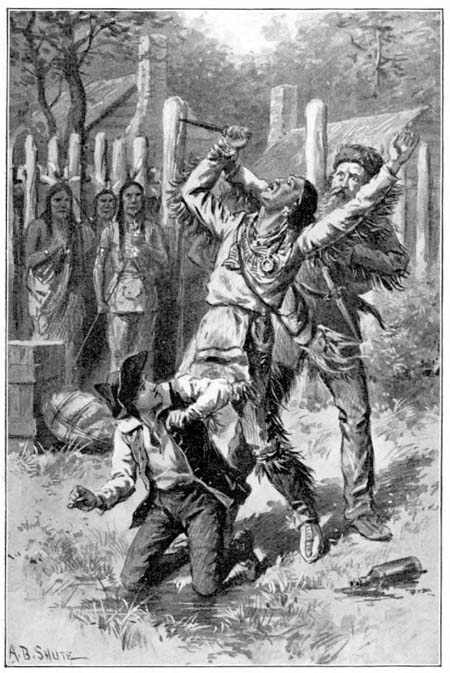
down on his knees. Instantly the Indian’s hand left
his arm and glided to his throat and the red man held
the knife aloft in front of his eyes.
“Consarn you!”
The exclamation came very much in the nature
of an explosion, and was followed by the leap of a
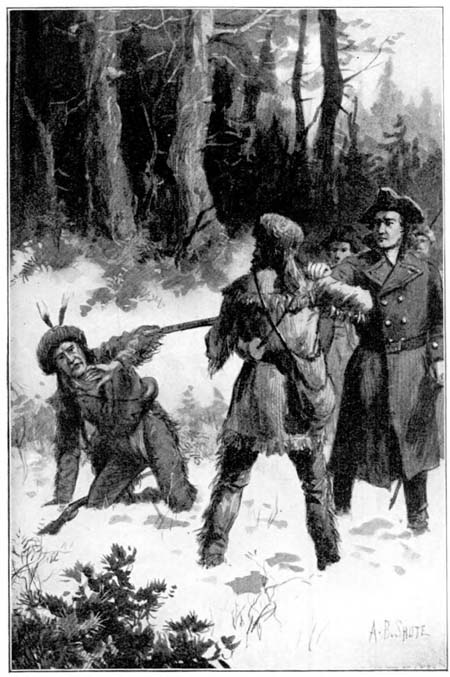
white man directly behind the Indian. Like a flash
Turtle Foot was yanked backward by his hair and
his hunting knife twisted from his grasp. Then the
newcomer raised the Indian bodily over his head,
rushed across the roadway, and threw the fellow into
a ditch, where he went to the bottom with a loud
splash.
“Thar, you miserable critter, lie thar and cool
off! If you ever dare to tech this lad ag’in I’ll split
your wizen fer you! The idee of you a-coming to
the post to git rum and then cutting up sech a shindy
as this! Clar out with you afore I kick you so full
of holes your own squaw won’t know you! And
you other redskins, you behave yourselves, or I’ll
cut loose, and thar will be some tall shooting and
knifing going on, I’ll warrant you!” And the
speaker ended with a fist shaking that made the Indians
retreat in all directions. They knew the man
who spoke and knew he meant all that he said.
“Sam Barringford!” ejaculated Dave, joyfully,
as he arose to his feet. “I’m mighty glad you came.”
Like a flash Turtle Foot was yanked backward.—Page 42.
“I’m glad myself, Dave,” returned the old hunter.
“But tell me, what made him so sot ag’in you?”
“He got mad because I wouldn’t drink with him.”
“Did, hey? Wall, Turtle Foot always was a fool,
and he’s a heap wuss when he’s in liquor.” Sam
Barringford looked over to where the Indian was
extricating himself from the mud. “Mind what I
told you!” he shouted. “Git right away from here!
You can come back for your knife to-morrow. I’ll
leave it with Seth Crosby!” And not daring to
remonstrate Turtle Foot limped down the trail away
from the trading-post.
Sam Barringford was a typical hunter and trapper
of that period, and well known throughout the whole
of the Virginia valley, both to the whites and the
red men. He was a man of fifty, tall, broad-shouldered,
and with muscles of iron. His hair was long,
as was his beard, and from under a shaggy pair of
eyebrows peered a pair of black eyes as sharp as
those of some wild beast. The look of his face was
one of decision, yet not unpleasant, and his voice
had a peculiar drawl to it that was whimsical in
the extreme.
The hunter was dressed in buckskin, with a wide
fringe to his leggings. On his feet he wore a pair
of Indian moccasins, and on his head rested a coonskin
cap with the tail falling over his back. Around
his waist was a broad belt containing a hunting knife
and a horn of powder, shot and ball, and across his
back was slung a rifle which he had nicknamed Old
Trusty, as good a piece of firearm as to be found
anywhere.
“The Injuns are as foolish as some white folks
when it comes to rum,” was Barringford’s comment,
as he and Dave walked to where the horses were tied
up. “They know it hurts ’em, and yet they won’t
leave it alone. Ain’t here alone, are you?”
“No, Uncle Joe is inside the post. He left me to
watch the horses. We are on our way to Annapolis
to buy some things for father.”
“Then he’s settled on the Kinotah? I’m glad to
hear of that, lad. He ought to do well. I shall hunt
him up the next time I git out to that region.
Took Tony and Putty with him, I understand.”
“Yes.”
“Them twins is all right and rattlin’ good shots
to boot. He’ll do well if he treats the Injuns half
right—and I know he will.”
“But what do you think of the French, Sam?”
The old hunter shook his head slowly. “Ain’t
no telling what them garlic eaters will do—their
mind ain’t the same two days. I’ve heard tell they
claim the whole Ohio valley. But they might as
well claim the whole airth and done with it.”
“I’ve been talking with Uncle Joe about it and
he is afraid the peace won’t last. Nothing was said
about Lake Erie or the Ohio valley in the treaty.”
“Then the French will make trouble, if they can
git the Injuns to side with them—and I suppose they
can, or, at least, they can git some of them—those
up around the lakes. You see the Frenchman is the
slickest talker on airth and he can make the redskin
believe a whole lot what ain’t so.”
The old hunter and Dave continued to discuss the
subject for a while longer, and then Joseph Morris
came out of the trading-post in a hurry, having just
heard that an Indian had attacked his nephew.
“What was it all about?” he questioned, and
when told showed how much he was disturbed.
“The rascal! He ought not to be allowed near the
post! He might have killed you had not Sam come
up. Sam, I owe you one for that,” he went on,
warmly, catching the trapper by the hands.
“I suppose Turtle Foot will remember me, if ever
we meet again,” said Dave.
“No doubt on that, lad,” answered Barringford.
“But when you do meet him put on a bold front,
and my word on it, he’ll sneak in double-quick order.”
The frolics of the Indians had now been resumed,
and a number of backwoodsmen had come in to have
a good time also. Some of these fellows were half-breeds
and many wore the dress of their red brethren.
They were a wild, lawless crowd and, on the whole,
more to be feared than the Indians themselves. Soon
the liquor was flowing freely, the Indians were dancing
and whooping madly, and the backwoodsmen
were shouting themselves hoarse and shooting their
firearms into the night air. This orgy kept up until
two o’clock in the morning, when it died away gradually,
the Indians slinking off into the woods and the
backwoodsmen dropping wherever it was convenient
in drunken slumber.
Joseph Morris had secured accommodations for
himself and Dave at a cabin close to the post, and
hither they retired, leaving their horses in care of
Sam Barringford, who tethered them to a tree in
the woods and went to sleep beside them as innocently
and as free from care as a child. When the
carousal in the village broke up some of the Indians
came toward Barringford, but as soon as they recognized
the old hunter they took great pains to leave
him undisturbed.
Dave slept but little that night previous to the end
of the noise, and he sat for a long while at the cabin
window looking at what was going on in the moonlight.
He had witnessed such a scene before, when a
white man and an Indian had been seriously hurt,
and he anticipated similar results now. But this anticipation
was not fulfilled, for with all the shooting,
leaping, shoving and wrestling nobody was injured,
and the most that anybody suffered was the
tearing of his clothing. One backwoodsman who
had refused to pay for liquor for his friends was
ridden on a sharp rail, but this act was carried out
more in fun than as a punishment.
When Dave came out in the morning and walked
toward the trading-post and around it he felt somewhat
astonished at the turn affairs had taken. One
backwoodsman had aroused another, and all had
stolen off as meekly and quietly as had the red men
several hours before. The post was almost deserted
in consequence and appeared more lonely than ever.
“It’s a way those fellows have,” said one of the
traders to Dave. “They go out into the woods for
weeks at a time and you never see hide nor hair of
’em. Then of a sudden the Indians come in and the
half-breeds and the rest follow, and they kick up such
a shindy as you saw. It seems they have got to
break loose—they jest can’t help themselves. And
they don’t mean no harm by it neither—at least the
most of ’em don’t. That Turtle Foot is an exception,
and if he don’t look out he’ll get a knife in his
back some day.”
Sam Barringford was bound for the home of Lord
Fairfax, but had business at Winchester which would
keep him at the post for a day longer, so he had to
part with the Morrises when they resumed their
journey, much as he would like to have accompanied
them, for he was strongly attached to Dave.
“Lord Fairfax is a great hunter, you know,” he
explained. “But his style is the English one—behind
the hounds. Now he wants to git right out in
the woods after big game, and he’s offered me a
pistole a day for my services, and I’ve closed with
him for a month. It’s not bad pay in these times,
and he says he may make it more, if I show him
something worth bringing down, and I think I can.”
And Joseph Morris agreed that it was a good offer,
for a pistole in those days was worth about three
dollars and sixty cents.
“Is Lord Fairfax going alone?” asked Dave.
“No, he is going to take Lawrence Washington
and several others with him. I am calculating on
a fine time, for my lord is a good liver and has the
finest horses in this section of the country.”
“I know he has a fine estate,” put in Joseph
Morris.
“Nothing finer. I read some of the reports that
young George Washington brought in—you know
he surveyed the tract for Lord Fairfax. He noted
down all about the soil and the timber, and the water
power and all. I can tell you that young fellow
is a smart one. I don’t wonder that they have made
him a public surveyor. Lord Fairfax is sure a surveyor
from England couldn’t have been more accurate.”
“I should like to see a surveyor at work,” said
Dave. “It’s always been a good deal of a mystery
to me how they measured land, especially from one
hill or mountain to another.”
“Perhaps you’ll meet Washington on your way
to Annapolis, lad; he’s out somewhere in the neighborhood
of the Shenandoah, surveying a grant of
land for a man named Burger. The north end of
the grant lies at Heckwell’s Creek.”
“We intended to cross near Heckwell’s,” said
Joseph Morris. “How is the river?”
“Very low now and you’ll have no trouble;” and
after a few words more the friends parted, and the
Morrises continued on their journey.
The route was now directly eastward, across the
broad and fertile valley of the beautiful Shenandoah,
the name of which, in the Indian tongue, means,
“Daughter of the Stars.” Here the forests were
still immense, but broken by wide patches of luxuriant
grass and “islands” of wild flowers, some of
which were still in bloom. The scene was truly entrancing,
and often Joseph Morris would call a halt
and point out one object or another of special interest.
“How people can box themselves up in a city
when they might come forth to enjoy something like
this is past my understanding,” he said once. “Was
ever air purer or sweeter, or music more full of
melody than that which yonder birds are giving us?
And listen to the murmur of that brook as it trickles
along through the brush and over the rocks; it is a
psalm in itself.”
“It certainly is grand, Uncle Joe. If only a
painter could set it all down on canvas and show it
to the folks that live in such a city as London!”
“Aye, but he couldn’t, for the breath of the life
that is here would be missing. To me every tree
and bush, and patch of grass, can talk as well as
can yonder brook and the birds. And what painter
could put that talk in his picture, or that feeling
that comes over one as he stands here under such a
blue sky? No, it’s not possible, and painters must
know it, unless they be truly conceited.”
At midday they came to a halt under the wide-spreading
branches of a gigantic oak, a veritable monarch
of the forest, standing like a sentinel on a grassy
knoll overlooking a wide creek flowing into the
Shenandoah several miles beyond. For the last hour
the trail had been uncertain, with many wet and
slippery spots to avoid, and they had moved forward
slowly and with care.
Both felt like eating something warm, and while
Mr. Morris got out the provisions, Dave stirred round
with a hatchet with which to cut some firewood.
There was little on the knoll and he descended and
walked over an opening to where grew some brush.
Here lay a fallen tree with several dry branches
well suited to his purpose.
Dave was hard at work chopping off one of the
branches when a noise coming from the woods beyond
the brush attracted his attention. There was a
cry and then a thrashing around of a human being.
“Hullo, what’s up there?” he called out, and
leaving the fallen tree, started in the direction from
whence the sounds proceeded. Running through a
strip of the woods, he reached a series of rocks
where there was another open patch with a spring.
Just as Dave came to the opening a gun went off,
and as the smoke cleared away the first thing he saw
was a snake twirling and twisting on the ground in
its death agonies. Several other snakes were close
by, and in their midst was a young man who was
doing his best to get away from the reptiles.
Dave had often encountered snakes on the farm,
so he was not as frightened as he might otherwise
have been. As the young man started to club one
of the reptiles with the stock of his gun, Dave aimed
a blow with his hatchet at another, and in a few
seconds two more of the snakes were put in a condition
where they could do no further harm. Then
the young man and the boy attacked the remaining
snakes, but these glided away between the rocks,
and in less than five minutes after it had begun the
battle was over and the snakes had departed to return
no more.
“That was warm work,” remarked Dave, as he
wiped the bloody hatchet on the grass. “Did that
first snake bite you?”
“He struck at my boot, but the leather was too
thick for him,” was the answer, delivered in quite
a cool tone considering the excitement which had
just passed. “I must thank you for coming to my
assistance.”
“You were lucky to escape so easily. I know a
man who got in a nest of snakes like that and was
bitten three times.”
“I was somewhat on my guard, as it happens.
I imagined there might be snakes around these rocks.
But I had to come here.”
“Had to come here?”
“Yes. You see, I am surveying this tract of
land.”
“Oh, then you are Mr. George Washington, the
public surveyor?” cried Dave.
“I am.”
CHAPTER VI GEORGE WASHINGTON THE SURVEYOR
At the time Dave Morris first met George Washington,
the future President of the United States
and “Father of His Country,” as he has affectionately
been called, was about nineteen years of age.
He was tall, well proportioned, muscular and athletic
and showed well the advantages of his temperate
mode of living. His eyes were blue and penetrating,
and his face, while not severe, showed a quiet reserve
and a dignity that made him what he soon after became—a
natural leader of men.
It was on the 22d day of February, 1732, that
George Washington first saw the light of day, in
an old family homestead on Bridges Creek, near
where that stream empties into the Potomac river.
The homestead was an old-fashioned affair, with
sloping roofs coming almost to the ground and with
a wide and substantial chimney at each end. It had
come into the possession of Colonel John Washington,
the future President’s great grandfather years
before, and upon the colonel’s death had been left in
the family. It was a beautiful spot, but in later years
was allowed to go to decay.
The father of the future President was named
Augustine, and he was married twice. By his first
marriage he had a son Lawrence, of whom we shall
hear more later, and several other children. His
second marriage was to Mary, the daughter of Colonel
Ball, and by this he had George and three other
sons and two daughters. Thus it will be seen that
the Washington family was quite an extensive one.
George was still a small boy when his father gave
up the homestead at Bridges Creek, and moved to a
place opposite Fredericksburg, on a bit of rising
ground bordering the Rappahannock. The family
were well to do, and, as was the custom of many rich
folk, Lawrence, the oldest son, was sent to England
to be educated. But George had no such advantage,
and his first schooling was obtained at a modest
country school of the neighborhood, kept by a Mr.
Hobby, who was both schoolmaster and parish
sexton.
At school George proved a quick and diligent
scholar, and there are still preserved some of his copy
and other books in which he wrote and ciphered,
showing a neatness and orderliness which followed
him all through life. He even wrote out for himself
a series of Rules of Conduct, which are to-day
models of etiquette. He was a champion runner,
jumper and swimmer, and many anecdotes have been
told showing how he won contests, and how he
brought to grief the bully of the school. In those
days the wars with the Indians were fresh in the
public mind, and Washington with his school fellows
played Indians and soldiers, with wooden guns and
rude bows and arrows of their own making. Once
such play ended in a grand fight that became real,
and then Washington did his best to separate the
contestants. After the fight was over the schoolmaster
called the boys together and asked for an
explanation. Each of the boys took his own part,
declaring the others in the wrong. In despair the
teacher called on Washington, and asked what he
knew of the matter. At once Washington stood up
and spoke like a lawyer in court, giving the details
with great clearness and showing how one was about
as much to blame as another, and pleading that the
boys be forgiven all around, as they had not meant
to make the fight real when they started. The school
teacher agreed to let the matter drop if the boys
would promise to fight no more, and this the lads
did, and separated with a cheer for Washington and
with their general good feeling restored.
When Lawrence Washington returned from England,
a well educated and highly polished young man
of twenty-one, the mother country was having a
great deal of trouble with Spain, who had interfered
with her commerce on the high seas. This led to the
raising of some troops for a campaign in the West
Indies, and George’s elder brother obtained a captain’s
commission and served under Admiral Vernon
and General Wentworth for nearly two years. This
service filled George, who was but eight years old,
with military fervor, and he forthwith organized the
schoolboys into a military company and drilled them
on the green—the foundation stone of his great military
leadership of the future.
When George was eleven years of age his father
died, leaving him to the tender care of his mother
and his two older half-brothers. The youth had now
outgrown the advantages of the school kept by Mr.
Hobby, and consequently was sent to live at Bridges
Creek, with his half-brother Augustine, who was
married and had settled there. Here George attended
a school kept by a Mr. Williams, and was as diligent
as ever in his studies, although always preferring
those of the more practical kind, reading, writing,
arithmetic, geography, history and the making out
of bills, accounts and the like. He also studied surveying,
and often went out for practice in this art,
so that he might master it thoroughly. In the meantime,
he did not forget his athletic exercises and his
horsemanship, and it was said that he could ride as
well and throw a stone as far as anybody of his age.
Shortly after his father’s death, Lawrence Washington
had married the daughter of William Fairfax,
who was then living in Virginia, and managing
the large estates of his cousin, Lord Fairfax,—estates
which lay upon both sides of the Blue Ridge
Mountains. Lawrence had settled at Mount Vernon,
named, as told before, after his old commander, and
he was now an influential member of the community,
belonging to the House of Burgesses, and acting as
adjutant-general of the district. Here George was a
frequent visitor, and here he became at one time possessed
with a desire to join the navy, his brother’s
visitors filling him with stories of the glories of such
a life. A midshipman’s warrant was obtained for
him, his baggage was packed, and all was made
ready for his departure. But at the last moment Mrs.
Washington broke down and begged her son to remain
at home.
“But how can I refuse now I have enlisted?” said
George.
“If you go you will break your mother’s heart,”
was the sobbed-out answer.
At this George stood for several minutes in deep
silence. A struggle was going on in his breast. At
last he caught his mother around the neck.
“I will stay at home,” he said, softly. “I can’t
go away and see you suffer.”
His baggage was brought ashore, the midshipman’s
warrant annulled, and George returned to
school. Some few called him a coward for this, but
he did not care, for his conscience told him that he
had done what was right.
When George gave up school and came to stay
again at Mount Vernon he was a frequent visitor at
Belvoir, the home of the Fairfaxes, but a few miles
away. Here he had a companion in George Fairfax,
the son of the manager of the estate, and the two were
often out hunting or fishing together. In the meantime,
Lord Fairfax, a nobleman of sixty, had come
on from England. He was a great hunter and often
took the two Georges with him behind his hounds.
He took a special liking to Washington and treated
him very much as a son, and one day, learning that
Washington had studied surveying, asked to see
some of the young man’s maps. These were brought
and inspected, and at the conclusion of the interview
Lord Fairfax made Washington an offer that he
survey the estates, and offered him from a doubloon
to six pistoles per day, according to the work accomplished.
George Fairfax was to accompany the
young surveyor.
The compact was made and the young surveyor,
but sixteen years old, and clad in plain buckskin and
hunting shirt, started out, accompanied by George
Fairfax. At times they had attendants with them,
but not always. It was the month of March and the
snow still lay deep in the mountain passes, and the
rivers were much swollen. The two traveled for
miles along the Shenandoah, making surveys and
maps, the accuracy of which are to-day beyond dispute.
It was a life to which Washington was unaccustomed,
yet he never complained. For the most
part they slept in the open, in the “howling wilderness,”
with only the canopy of stars above them.
Once they stopped at the cabin of a squatter and the
vermin in the bed drove George out in the middle of
the night; again they were out in their tent when a
big storm came up and blew the tent to shreds and
sent their traps flying in all directions. Once Washington’s
bed caught fire and he would have been
sadly burnt had not his companion awakened him.
He now met many Indians, and one day witnessed
a war dance, which, however, ended in nothing more
than a drunk on the part of the red men. They had
to hunt a large portion of their food and had to go
hungry several times, when fish and game failed to
appear. The Indians were always suspicious of
them, and viewed the doings of the young surveyor
with awe, and inspected the marks set up with exceeding
curiosity. “White man make mark what
for?” asked one old Indian, and when Washington
tried to explain he went on: “Dis red man’s land,
white man no need to mark him,” and strode off in
disgust and wrath. That night George and his companion
lay awake with their guns in their hands,
fearing the old Indian might come back to harm
them, but the old warrior did not reappear.
When the surveys were completed, Washington
returned to Mount Vernon, drew them up into proper
shape, and presented them to Lord Fairfax. His
lordship was greatly pleased with the work done and
listened closely to all George had to tell him about
the soil, the timber in the forests, the currents of the
streams, and other matters of importance.
“It was a great work for a young man like you,
George,” he said. “A great work. You ought to
be a public surveyor.”
“I wouldn’t mind having the position,” answered
Washington.
“Then you shall have it—if my influence counts
for anything,” replied Lord Fairfax.
Shortly after this his lordship called upon Lawrence
Washington, and the three talked it over between
them. It was agreed that the opening might
prove of value to George in the future, for in the
heads of older men there was already a scheme for
forming a company to develop the region beyond the
Blue Ridge.
“I shall give up Belvoir, go across the Blue Ridge
and establish myself at Greenway Court,” said Lord
Fairfax. “Then when I am settled we can perfect
our schemes. George is honest, fearless, and has
a sound judgment in all things, and he will be the
man we shall need. He ought to become a public
surveyor by all means. Then all his transactions will
have a legal standing and will go on record.” And
so it was settled.
Washington entered on his new duties with as
much faithfulness as ever, and soon he was overcrowded
with work, for it was known that he was
thoroughly reliable, and there were very few surveyors,
considering the many grants of land which
had to be mapped out. To him the days and the
months passed swiftly. When he needed a rest he
either visited his brother and mother, or else went
to see Lord Fairfax at Greenway Court, which became
a noted resort for all sorts of visitors, who
hunted and danced to their hearts’ content. At
Greenway Court Washington met many in high life
some of whom, when the War of the Revolution
broke out, remained his warmest friends, while
others became his bitterest enemies.
One day a man named Burger came to Washington
and asked him to survey a grant of land near
Heckwell’s Creek. Burger was a German who had
emigrated to Virginia from Pennsylvania, and he
had met Washington while the young surveyor was
out for Lord Fairfax, and had helped carry the baggage
over a much swollen stream.
“I cannot pay you now, Mr. Washington,” said
Burger, “but I will pay you when I am settled down,
take my word on it.”
“I will trust you willingly, Mr. Burger,” answered
the young surveyor. “I haven’t forgotten
the service you rendered me a couple of years ago.
You can pay me when you can afford it.” And then
he left for Heckwell’s Creek, and went to work. He
had been out two days, locating some former landmarks
which a storm had partly washed away, when
he encountered the nest of snakes, and fell in with
Dave as just described.
CHAPTER VII THE CAMP IN THE MOUNTAIN GAP
Joseph Morris was now coming up, gun in hand,
to learn the meaning of the shot which had been
fired. He looked with surprise at the dead snakes
and then at his nephew and the stranger.
“This is Mr. Washington, the surveyor,” said
Dave, and then he added: “This is my uncle, Mr.
Joseph Morris. I am Dave Morris. We come from
back of Will’s Creek.”
“I have heard of the Morrises before,” said
Washington, as he shook hands with Joseph Morris.
“And I have heard of you, sir, and have met
your brother Lawrence,” answered Dave’s uncle.
“You seem to have had a lively time of it,” he continued,
and kicked one of the snakes with his foot to
make sure that it was dead.
“Yes, I did have. But your nephew came to my
aid, and between us we made short work of the reptiles.
Master David, I owe you my thanks, and
more.”
Washington bowed as he spoke, and Dave bowed
in return. “It wasn’t much I did,” said the youth.
“You frightened them pretty well when you fired
that shot. It’s lucky you had your gun in hand.”
At this the surveyor smiled faintly. “I was out
trying to stir up some dinner,” he said. “You see, I
left all my traps over at Denton’s and I did not wish
to go back until to-morrow. I thought it would be
easy to pick up a bird or two, or a pair of squirrels.”
“If that is the case, will you not come and eat
with us?” said Mr. Morris. “We were just preparing
our midday meal. We have a-plenty and
you will be heartily welcome.”
At first Washington demurred, not wishing to intrude,
but soon he saw that the invitation was genuine,
and he consented to join the Morrises.
“I left some of my surveying outfit behind yonder
rocks,” he said. “I will bring them over and then
help with your fire,” and this he did, and soon he
and Dave were bringing in armfuls of wood. In
half an hour the meal was ready and the three sat
down to partake of it.
At first there was a reserve upon both sides, as
was natural, but as the eating progressed all
warmed up and then the talk flowed freely. Washington
told of the work he was doing for Mr. Burger
and what he had done for some men Mr. Morris
knew, and the latter related how Dave’s father had
gone west and established a trading-post on the
Kinotah, and how he and Dave were now on their
way to purchase some goods needed by the trader.
From this the conversation branched off to the difficulty
with the French and the Indians, and Joseph
Morris asked Washington if he knew how matters
stood in political circles with regard to these difficulties.
“Matters are not very promising,” answered the
surveyor. “I heard some guests at Greenway Court
talking strongly of another war. But I sincerely
trust it does not come.”
“Will the Indians side with us if war does
come?”
“My brother thinks they will and so does Mr.
Fairfax, and so do some of the hunters and traders
who have been among them. But the Indian is an
uncertain creature, often moved more by impulse
than reason, and there is no telling how he will stand
when it comes to striking a blow.”
The meal over, Washington saw that Dave was
curious to learn something of the method of surveying,
and so brought forth his outfit and explained
the uses of the various instruments. The youth was
deeply interested and listened closely to all that
was said.
“I wouldn’t mind being a surveyor myself,” he
remarked. “That is, if I could make a living
at it.”
“You could do that readily enough if you could
command the work,” answered Washington. “But
it is no child’s play, especially in the mountains. In
a week or two I expect to have some work to do
which will be exceedingly hazardous.”
“And what will it be?”
“Do you see yonder mountain, over near the
split?”
“I do.”
“I must survey along the face of that mountain
and through the gap to the north-east, and around
the mountain torrent running there. That will mean
rough work and dangerous climbing.”
“It would just suit me!” cried Dave. “I wish
I could go along. Don’t you want some help?”
“My regular man will be with me. He is now
over at Denton’s after another chain, for he lost one
in the river.”
“I have been to the tops of a dozen mountains,”
went on Dave. “I like climbing very well, and it
never makes me the least bit dizzy.”
“That’s certainly in your favor,” said Washington,
with a smile. He liked Dave’s frankness—which
frankness was a good deal like Washington’s
own.
Over an hour was thus spent in camp, and then
with a handshake the Morrises parted company with
the surveyor, who went back to his search for landmarks.
Soon the camp utensils were repacked, and
they were off, to the best crossing place the river,
in that vicinity, afforded.
“He’s a fine young man,” was Dave’s comment,
as he urged his steed forward, side by side with that
of his uncle. “His face has a thoroughly good
look.”
“That it has, Dave, and his tongue is as honest
as his face. I do not wonder that folks like to do
business with him. And he must be uncommonly
clever, too, to conduct surveys of estates worth thousands
of pounds.”
“I wish I could go and survey yonder mountain
with him.”
“It might prove harder work than you anticipated.”
“I don’t care—I would like to do it anyway.
Roughing it just suits me. That’s why I would like
to be out with father.”
“I’m afraid, Dave, you’ll never care to settle
down to steady farming life,” said Joseph Morris,
with a sigh. “It’s plain to see you have your father’s
restless spirit in you.”
“Well, we can’t all be farmers, Uncle Joe. Some
men must be restless or the world would stand still.
Columbus was restless and that is what made him
discover America and Captain John Smith was restless,
too, and that brought him to Virginia and
made him fight for his footing. I don’t think it’s
right to find fault with restless men, as you call them,
if they do what is right.”
“I am not finding fault, my lad. Only I want to
caution you against breaking away from habits that
are steady. A steady farmer, who attends strictly
to his work, is worth a dozen such men as those restless
backwoodsmen for instance, who came into
Winchester and raised a row.”
“But if a fellow doesn’t like farming?”
“Then try to find something else to do. There
are many openings, and more are springing up. You
might get into some business in the town. How
would you like to be bound out as an apprentice?”
“I’d hate that! I don’t want to live in town. I
would like trading, or surveying, or something like
that—something that would let me travel around,
and yet something that I could make money at.”
“Well, those openings are not so many. But perhaps
your father will need you soon, and out in that
wild country you’ll get all the open air you’ll want.”
The Shenandoah passed, their course was now
directly for the gap in the mountains which Washington
had pointed out. Here the trail soon plunged
into the gloom of the mountain forest, where the
cedars and hemlocks were so thick the two could
scarcely see a rod before them. The road was rough
to such a degree that the horses often came to a
standstill and had to be led forward by hand. The
soil was black and thick with insects and they had to
watch carefully for fear of stirring up such a snake’s
nest as had been left behind.
“Mr. Washington certainly will have a task surveying
through here,” remarked Dave, as they came
to a halt to catch their breaths after toiling up a
rocky hill.
“Such a forest as this must be hundreds of years
old,” returned Mr. Morris. “Look at that stately
tree for example. It flourished probably even before
your grandfather was born. What a story it could
tell could it speak!”
“Probably it could tell more of the Indians than
they know themselves, Uncle Joe. It’s too bad the
redskins couldn’t keep a written history, isn’t it?
It would make interesting reading, I’m thinking.”
Nightfall found them still in the mountains and
no habitation of any sort in sight. Mr. Morris
climbed a tree and took a long view of their surroundings.
“I can see no cabin,” he said, on descending to the
ground. “We shall have to spend the night in the
open.”
“I shan’t mind,” answered Dave. “Let us start
up a roaring camp-fire and make ourselves comfortable.”
Searching around, they found a clump of bushes
ten or a dozen feet in diameter. With the hatchet
Dave cut out the center of the clump, leaving an
opening large enough for his uncle and himself to
sleep in. Over the top of the remaining brush he
fastened a canvas they carried, and on the bottom of
the improvised shelter he scattered some small cedar
branches. The latter gave forth a clean and wholesome
smell and would serve to keep the sleepers from
the damp ground.
“There, that ought to make a good bunking-out
place,” he declared when he had finished.
“It will, Dave.” The boy’s uncle smiled. “You
were cut out for a life in the open, no doubt of that.”
While the boy was working around the brush,
Joseph Morris had started the camp-fire. The dry
cedar caught fire readily and soon the generous blaze
made the surroundings decidedly cheerful. At the
river they had paused long enough for Dave to hook
a fine fish, and this they baked on a flat stone, and
ate with some corn bread, washing the meal down
with a drink from a nearby brook. Then the horses
were cared for, and they laid down to rest.
Dave was tired and hardly had his head touched
the cedar boughs when he dropped off into a profound
slumber. Mr. Morris sat up a little longer, to
finish a pipe of tobacco he had lit and to replenish
the fire. But presently the pipe went out, the fire
was fed with an extra billet of wood, and he too
turned in, and in five minutes was snoring lustily.
Left to itself, the fire burnt merrily, the new fuel
causing the flames to shoot up far above the brushwood.
The light attracted several magnificent deer
to the vicinity and the timid creatures came closer
and closer in their curiosity. On the trail of the
deer came a large and powerful panther, empty in
stomach and longing for a meal of venison.
Closer and closer to the camp-fire came the deer,
sniffing the air suspiciously and eyeing the fascinating
blaze with nervous wonder. Then the burning
logs fell in a heap and they shrank back, startled
by the noise, slight as it was. As the blaze went
down the panther crept closer and still closer. Its
hungry eyes gleamed ferociously and its jaws began
to work convulsively. Step by step it came up
at the rear of the largest of the deer, closer and still
closer. Now it squatted flat on the ground and
gathered itself for a leap. Several seconds passed,
and the deer turned, as if told by instinct that something
was wrong. Then came a swift whirr of a
heavy body through the midnight air and the panther
landed on the deer and brought it to the ground.
CHAPTER VIII ON TO ANNAPOLIS
Both Dave and his uncle awoke with a start and
sat bolt upright in the shelter of brush. The fire had
died down so that they could see but little around it,
the moon had gone behind a dense mass of clouds.
“What was that?” cried the youth, as he reached
for his gun, which had been placed close at hand.
“I heard a snort of some kind,” answered Joseph
Morris. “Perhaps some wild beast has attacked the
horses.”
He, too, caught up his weapon, and a bound took
him outside. Then he ran with all speed to where the
steeds were tethered.
When Dave reached the side of the camp-fire he
paused. He had been about to follow his uncle, when
a snort of pain, followed by a cracking of bones,
reached his ears. The sounds did not come from the
direction of the horses, but from a glade on the
opposite side of the camp-fire.
Catching up a burning fagot, he hurried in the
direction. The noise continued, and soon he made
out the form of the struggling deer as the head and
antlers were waved from side to side in an endeavor
to pierce the panther’s side.
“This way, Uncle Joe!” he cried. “A deer is
fighting with some other wild animal. I can’t make
out what it is, it’s so dark.”
“The horses are safe!” came in reply from
Joseph Morris. “Where is the deer?”
“This way! I’m going to shoot the other
beast.”
“No! wait! I am coming.”
Dave had raised his gun, but at the latter words he
lowered his weapon. In less than a minute his uncle
was at his side.
“A painter!” ejaculated Joseph Morris. “And
a big fellow at that. This is a fight to the death.
Let them have it out.”
“Do you suppose there are others around?”
“No. There might have been more deer, but
they have taken to their heels long ago. So far as I
know, painters never travel together.”
“I suppose the painter has the best of it.”
“He hoped to have, or he wouldn’t have tackled
the deer. But he may get more than he bargained
for.”
All this time the battle was going on furiously.
In the semi-darkness they could see little more than
a turning over of first one body and then another.
Suddenly the panther shifted its hold from the deer’s
shoulder to its throat. But the movement, quick as it
was, gave the deer time to shift also and one of its
sharp prongs was caught under the panther’s hind
legs, piercing the flesh for several inches and causing
the blood to flow freely.
Having turned over twice, the deer started to toss
off its assailant. It failed, and then attempted to
run, hoping to dash the panther against a nearby
tree. But the panther clung as tightly as ever to the
deer’s throat, and before the tree was reached, it
staggered for want of wind and loss of blood, for its
shoulder was horribly mangled. Failing to reach
the tree, it gathered itself up for a last effort and
struck up with its hind hoofs, gashing the panther
deeply in the lower portion of its body. Following
this despairing kick it gave a convulsive shudder
and fell back lifeless.
For a few seconds after the deer breathed its last,
the panther held on. Then slowly its grip relaxed
and it fell back, but with its stony gaze still fixed
upon its victim.
“The deer is dead,” cried Dave. “And see, the
painter is sneaking away! Shan’t I give him a shot
now?”
“Wait! I don’t think he’ll go far,” answered
Joseph Morris. “The deer cut him up pretty well.”
The sounds of human voices now for the first time
attracted the attention of the panther, and taking
its gaze from its lifeless prize it looked in the direction
of Dave and his uncle. Then it gave a snarl of
rage and dismay, and did its best to stand erect on
its four short legs. But the effort was too much and
it collapsed almost immediately.
“He’s done for,” said Joseph Morris. “The deer
must have ripped him through and through. See,
he can’t get up.”
Mr. Morris spoke the truth, the panther tried in
vain to rise, at the same time gasping for breath and
snarling with pain and rage. Once it took something
of a step and Dave brought his gun up on a
jump, but before the weapon could be leveled the
panther was down on its side and stretching itself at
full length.
“He is done for now,” said Joseph Morris. “It
would be a waste of powder and ball to fire on him.
It was a battle royal, and it’s a pity it wasn’t light
enough for us to witness it in detail. Such a sight
isn’t to be met with every day, even in such a wilderness
as this.”
Saying he would watch the panther, he sent Dave
back to replenish the fire and this the youth did so
effectively that soon the glade was nearly as light as
day. By this time the panther was almost gone, yet
it was allowed to lay undisturbed for nearly half an
hour before Joseph Morris came up behind it and
cut its throat with his hunting knife, thus putting it
out of its misery.
“I am glad the painter attacked the deer instead
of us,” said Dave, as he took a close look at the
great cat-like creature and shivered. “What a
powerful beast, and what awful claws and teeth!”
“He’s an old one. If he had been younger the
deer would never have been able to turn on him. I
think this is the first painter you’ve seen, isn’t it?”
“Yes.”
“They are getting thinned out around here, so
Sam Barringford told me.”
“Do they generally attack such big game as
deer?”
“Very often, although they usually feed on
smaller animals. They lie on the limbs of trees and
drop down on anything passing beneath. Zeph
Tassot had a hand-to-hand fight with one, and he’s
got that long scar on his left cheek to show for it.
Zeph jammed the painter in the throat with his
knife and they fought for ’most half an hour, when
the beast turned tail and hid among the rocks. Zeph
ran for his life and didn’t stop till he’d covered two
miles or more. He says he never wants to set eyes
on a painter again.”
Uncle and nephew dragged the dead deer and the
dead panther close to the camp-fire, and then it was
decided that one should remain on guard while the
other slept.
“The smell of blood may attract other wild beasts
to the vicinity,” said Joseph Morris. “We’ll keep
an eye open for them, and also keep the fire burning
brightly.”
Dave turned in and slept for three hours. Then
his uncle aroused him and slumbered for the same
length of time.
In the morning they skinned the deer and the panther
and hung the pelts in the rising sun to dry. For
breakfast they tried a steak from the panther and
found it not unlike coarse beef to the taste. The
remainder of the panther meat was left behind, but
they took with them all of the deer meat they could
conveniently carry.
That day saw them through the mountains and by
nightfall they struck a trail over which horses and
wagons had traveled. They now pushed on faster
than ever, and did not rest until an hour after sunset,
when they had gained a small collection of
houses called Berry’s Post. Here they met a trader
who willingly relieved them of their skins at a fair
price.
They were now coming into “civilization,” as
Joseph Morris expressed it. Plantations were to be
seen on every hand, and they frequently encountered
the overseers and their slaves, for in those days half
the population of Virginia were colored people who
were in bondage. Yet the darkeys were a happy set
and often they could hear them singing at a distance
as they worked in the corn and tobacco fields, or
around the immense barns and warehouses.
A storm had been brewing and the next day
Joseph Morris and Dave lost no time in riding
straight on to Georgetown, on the beautiful Potomac.
The river was scarcely reached when it began to rain
furiously and so strong was the wind that to ferry
across the stream was impossible. Consequently
they remained where they were until the afternoon of
the day following. By this time the wind went
down sufficiently for them to be ferried to the east
bank of the stream, and then they set out directly for
Annapolis.
Riding was now easier than ever and they frequently
met horsemen and ladies out for pleasure,
and occasionally a chariot would roll by with the
family arms blazoned on its side and its horseman
and footman in resplendent livery.
“That was the governor’s turnout,” whispered
Joseph Morris once, after a brilliant chariot drawn
by four horses had swept by, sending a shower of
dust and dirt over them. “I can tell you he lives
well.” Dave turned around to catch a good look at
the show, but a bend in the road already hid it from
view.
Not long after this came a yelping of hounds and
a great pack burst into view and behind them half a
dozen hunters, including several city dignitaries
whom Joseph Morris knew by sight. With the
gentlemen were several colored servants, and all
seemed to be in the highest spirits. As they swept
by, the Morrises learned that they were bound for
the woods beyond South River, on a grand fox hunt.
“They’ll have sport,” said Dave, gazing after the
crowd. “But it won’t be anything as thrilling as
that deer and painter tussle in the dark.”
At last they came to the city gate and passing
through made their way to a respectable enough
hostelry where accommodations were not high
priced. The tavern was a low, two-story affair, with
many windows, all filled with tiny panes of glass
no larger than one’s hand. In front was a low stoop,
with a heavy railing, and above this stoop hung a
rudely carved wooden plough painted yellow, and
underneath the sign, “Golden Plough Inn, Kept by
Theophilus Mangot. Good Fare at Reasonable
Prices.”
Behind the tavern was a wide yard and a large
barn, and from here came several negro hostlers to
take charge of their steeds.
“Right welcome, sirs,” said the host, coming out
in shirt sleeves to meet them. “Right welcome and
just in time for the best of the rooms.”
“The best will depend upon the price you ask,”
answered Joseph Morris cautiously. “We want
that which is good without being extravagant.”
“And I can give it you, sirs,” said Theophilus
Mangot. “Come, I will show you what I have, and
then we’ll settle upon the price to your satisfaction,”
and he led the way inside.
CHAPTER IX A STORM IN THE MOUNTAINS
Inside the tavern all was life and jollity. In the
tap-room, located at the upper end of the hostelry
but down two steps lower than the rest of the building,
a crowd of burly traders, farmers and sailors
were assembled, drinking, smoking and talking
loudly. Occasionally a sailor would burst into a
song of the sea, and his mates would join in the
chorus, drowning out every other sound until the
song came to an end with a heavy thumping of
glasses and mugs.
Beyond the tap-room was the parlor, a tidy place,
with quaint furniture brought from England sitting
in rows along the walls. Here, in a book-case, were
a number of leather-bound volumes, and also a file of
the Spectator, a much-prized English periodical.
There were also several copies of a Maryland newspaper
which had but lately made its appearance and
was languishing for want of support.
Next to the parlor came the dining hall, down
one step, with a kitchen in the rear. The hall was
long and narrow and had a floor which was well
sanded and marked before meals into fancy shapes.
The tables were low and solid, the chairs broad and
high-backed, and at the front was a long settle,
where one might rest and gaze out on the dusty
highway. On a shelf in the dining hall rested the
wooden model of a ship, the vessel in which Theophilus
Mangot had come over from England. Beside
the ship was a small brass clock and a frame
containing a hand-made map of Annapolis and
vicinity.
Dave saw but little of this until the next morning.
For six shillings his uncle hired a small but comfortable
bed-chamber in the rear of the inn, instairs, and
to this they retired, after a bountiful supper which
both enjoyed. No sooner had Dave’s head touched
the pillow than he sank into slumber, and from this
he did not awaken until the sun shone in at the
window.
Joseph Morris had already gone below, and the
youth hastened to follow him. But while he was
dressing his attention was drawn to a fight in the
stable yard, between two of the negro hostlers. This
was a head-ramming contest, in which the slaves
butted each other over and over again until at last
one apparently had enough of it, when he ran away,
leaving the victor to ha! ha! loudly.
“I would rather it were their heads than mine,”
said Dave, after telling his uncle of the affair. “It’s
a wonder one of them wasn’t killed.”
“They get used to it, by practice,” replied Joseph
Morris. “I have seen them fight for hours in that
fashion and then give it up little the worse for the
sport.”
Dave’s uncle was to do his purchasing on King
and Church streets, two of the busiest thoroughfares
of the town, and hither they went immediately after
breakfast. Several ships from England had come in
only a few days before, so the shops were well filled,
and trading was brisk on every hand. Ready money
was often scarce, but the Assembly had some years
before made both tobacco and Indian corn a legal
tender for all debts, and these were readily accepted,
at the rate of one penny a pound for tobacco and
twenty pence per bushel for corn. But with it all the
shop-keepers and others who had goods to sell preferred
cash, and Mr. Morris got many a good bargain
in consequence.
One of the shops was close to the end of Church
street, and while his uncle was having some goods
wrapped up and made otherwise ready for transportation
by horseback, the youth slipped down to
the immense wharves fronting Chesapeake Bay, to
take a look at the stately ships, with their towering
masts and square yards, and the little boats of all descriptions.
Here the smell of tar and salt air was
heavy, and here large gangs of black and white
laborers were toiling at their tasks of loading and
unloading tobacco, hemp, lumber, rum, molasses,
hardware, and a hundred and one other things.
“Looking for a chance to ship, lad?” asked one
of the sailors at hand. “If ye are there’s nary better
craft nor the Queen Mary lying yonder, nor better
master than Cap’n Ringdale who commands her.”
“Thank you, but I don’t care to be a sailor,” answered
Dave. “I have come in to do some trading,
that’s all.”
“But you’d better ship,” went on the tar, and
caught Dave by the arm.
“No.”
“Come and see our cap’n—he’ll treat ye well,”
urged the sailor, trying his best to became friendly.
The ship was short of hands and Captain Ringdale
had promised his men ten shillings for each new
man brought in.
“I don’t want to go—and I want you to let go of
me!” cried Dave, and at once grew suspicious, for
he had heard of how men had been impressed into
service against their will.
“Don’t grow alarmed, lad, I won’t hurt ye.
Come, you’ll like the cap’n, I know. Perhaps you
never had the chance to look over a ship. It’s a sight
worth seeing, and will cost you nothing.”
“I said, let go of me,” exclaimed Dave, in more
alarm than ever. “If you don’t, I’ll call the watch.”
“You’re a troublesome lad truly!” answered the
tar, and then gazed around to see who else was in
sight. Apparently satisfied that the coast was clear,
he suddenly stepped behind Dave and pinned his
arms fast to his side. Then he lifted the lad up
bodily in his brawny grasp.
“You shall see the cap’n—whether you go or
not,” he went on.
But if he imagined that Dave was to be taken thus
easily, he soon found out his mistake. In an instant
the youth twisted his legs around those of his assailant,
so the latter could not budge a step—and there
they remained, one locked above, the other locked
below.
“Let loose!” roared the tar. “Let loose, I say,
or by my soul, I’ll knock ye down!”
“Help! help!” cried Dave, shrilly. “Help!
Watch!”
“Stow your calls, I say!”
“I will not! Help!”
Dave did his best to turn his head and look up the
long dock. The sailor did likewise, at the same time
trying to loosen his legs, that he might make off
with the boy. A small boat was handy and once he
had Dave in this, he felt he could get off with the boy
easily.
But now an answering shout came back, which
filled the youth with joy and brought dismay to the
tar. Coming from the trading shop, Joseph Morris
had heard and recognized his nephew’s cry and was
now running in that direction.
“What’s the matter, Dave?” he shouted when he
caught sight of his nephew. “What’s the trouble?”
Hearing Dave called by name, the sailor at once
let go his hold on the youth and struck the lad in
the side. To keep from falling Dave had to step
away, and thus freed, the tar lost no time in taking
to his heels.
“That man wanted to carry me on board his ship,”
answered the youth, as he gazed after the sailor, who
was now disappearing behind one of the nearby
warehouses.
“On board his ship?”
“Yes. First he asked me if I didn’t want to become
a sailor. I told him no, and then he caught
me around the breast.”
“The rascal!” burst out Joseph Morris. “He
wanted to impress you! I thought it was safe here, or
I should not have allowed you to come alone. If I
can catch him I’ll give him a piece of my mind, I’ll
warrant you!”
He ran toward the warehouse, and quite willing
to see the sailor punished, Dave went with him. But
the tar had taken time by the forelock, and when the
warehouse was gained, he had disappeared utterly,
nor did a hunt of half an hour bring him to light.
The “scare” made Dave more cautious, and for
the remainder of the time spent in Annapolis he kept
within sight of his uncle, especially when down by
the docks. With his uncle he boarded one of the
merchantmen lying at anchor in the bay and inspected
the great ship from stem to stern. From the captain
of the merchantman they learned that sailors were
just then scarce and a good price had to be paid to
get them to sail in West Indian waters on account
of the pirates.
“The minute you say West Indies to them they
won’t sign articles at any price,” said the captain.
“The pirates are as thick as bees and when they take
a prize it’s either join them or walk the plank and
not over half an hour to make up your mind to it
either.”
Three days were spent in Annapolis, and then,
having purchased all the things needed, and also several
extra horses to carry the load, the Morrises set
off for home. With them for part of the distance
went a settler named Crosby, a whole-souled man of
middle age, who by his light-hearted talk did much
to while the weary hours away.
“’Tis a great city, this Annapolis,” said Crosby.
“And a good one wherein to get rid of one’s loose
money. Five days ago I had a well filled purse, but
between the drinking, and the card playing, and a
trip to the races at Marlboro ’tis little I have left.
To-night there was to be a play by an Englishman
named Shakespeare, but I thought I would not stay
to it, for I’m not overly fond of make-believe
things.”
“I’d like to see a play,” said Dave. “At the inn
I saw a book of them written by this same Shakespeare
of whom you speak. It must be very fine.”
“I saw a play at Annapolis several years ago,”
put in Joseph Morris. “It was a comedy called
‘The Sailor’s Lass,’ but it was not well produced and
the actors were hooted off the stage and bombarded
with stale cabbages.”
Our friends were to take the same road home by
which they had come, and proceeded as rapidly as
the loads carried by the pack horses permitted. These
latter beasts were powerful animals and well broken,
although one large horse named Lovejoy had a habit
of wandering away if not closely watched.
The third day of the return journey found the
Morrises climbing through the Blue Ridge Mountains
once more. Aaron Crosby was still with them,
although he expected to leave them when the Shenandoah
was gained.
It was a warm day for this time of year, and
Crosby ventured the prediction that a storm was at
hand. “We’ll catch it afore midnight,” he said,
and Joseph Morris agreed with him.
By nightfall the wind had freshened and the sky
was heavily overcast. They had tried to reach the
cabin of a settler living in the neighborhood, but
before they could gain it, the rain came down in
torrents and they were glad enough to seek the first
shelter at hand. This proved to be a cliff of rocks,
and here they found a cave-like opening a score of
feet in depth, and huddled beneath. At first they
thought to light a camp-fire, but the wind blew so
furiously that the scheme was abandoned.
“The fire would fly in all directions,” said Joseph
Morris. “We would get no benefit and there would
be much danger.”
By ten in the evening the storm was at its worst.
The rain came down in sheets, while the fitful gusts
of wind tore through the mountain gap with a fierceness
that threatened to uproot every bush and tree
in its path. Sometimes a tree would come down, with
a booming and a crashing to be heard distinctly for
hundreds of yards away.
The horses had been tied up in a clump of bushes,
but that was all that could be done for them, excepting
to strap the blankets tightly over them, and
also the loads, the latter being placed in the shelter of
some rocks.
At length, when the fury of the storm had subsided
somewhat, Dave laid down to sleep, and Aaron
Crosby followed. Joseph Morris walked away from
the cliff to see if the horses were safe. He was gone
about half an hour and came back much disturbed.
“Lovejoy is gone and so is Fanny,” he said.
“I’ve looked for them everywhere but I can’t find
any trace of them.”
CHAPTER X AN UNSUCCESSFUL MISSION
“Fanny is gone?” cried Dave, and sprang up
instantly, for the mare mentioned was his own,
given to him by his father, just before the parent had
departed from the farm at Will’s Creek. Fanny had
been a pet in the Morris family for years and Dave
thought a great deal of her.
“Yes, she’s gone, and Lovejoy, too,” went on
Joseph Morris. “I can’t find trace of them anywhere.”
“They can’t be very far off,” put in Aaron
Crosby. “For I looked after all the animals not
more than an hour ago, and they were well
fastened.”
“Could they have been stolen?” asked Dave, with
increased anxiety.
“I don’t think so,” said his uncle. “I haven’t
seen anybody around, have you?”
Neither Dave nor Crosby had, and the party came
to the conclusion that the horses must have broken
away in their fright. But be that as it might, they
could not afford such a loss, and moreover Dave
could not bear to think of losing Fanny. Wet and
dark as it was those who had retired arose and a
small camp-fire was lit in a sheltered corner, and
from this each provided himself with a torch.
The other steeds remained as they had been left,
but not even a trace of the halters which had held
Fanny and Lovejoy could be found.
“If they broke away we ought to find the broken
leathers,” said Dave, soberly. “I don’t believe
Fanny could slip the knot I tied for her. She never
did so before, and I’ve tied her up in the same way a
hundred times.”
“Both horses are worth some money,” said Joseph
Morris, “not to speak of that really fine saddle Dave
has been using. Yes, we must find them by all
means, although I must confess I do not know how
to begin the search.”
With great care they examined the ground, the
scattering rain wetting them thoroughly in the meantime.
At last they found something like a trail which
led to the northward, along the western slope of the
mountain.
“I can’t see anything to do but to follow this
trail,” was Joseph Morris’ comment. “But we
need not all go. Mr. Crosby, will you look after the
other horses and our traps?”
“Assuredly,” answered Aaron Crosby. “But if
you are not back by daybreak, what then?”
“Then you might as well move on to Caspar’s
place and leave our horses and traps there. Tell
Caspar that we will come for them soon.”
So it was arranged, and providing themselves
with fresh torches, Joseph Morris and Dave set out
on the hunt. They went afoot, for the trail was
hilly, full of stones and uncertain, and they did not
wish to run any chances of a serious fall.
The storm was now letting up, but the furious
downpour had left the hillside exceedingly wet and
slippery, while here and there was a hollow filled
with water. The wind still blew and this sent down
the water from the trees long after the rain had
ceased.
Over a mile was covered and they were afraid they
had lost the trail when they came out upon a narrow
ledge of rocks overlooking a shallow but wide ravine
between two of the hills. As they came into the
open Dave suddenly clutched his uncle by the arm.
“Put down the torch,” he cried. “Look!”
His own torch went down behind some brush, and
that of Joseph Morris quickly followed. Both gazed
in the direction the lad was pointing out. It was to
the opposite side of the ravine, and there they saw a
torch waving slowly from one side to another as if
the holder was looking for a safe trail. The torch
lit up the faces of two Indians, one leading a horse
and the other on a steed’s back.
“Two Indians!” cried Joseph Morris.
“Yes, and that first one is leading Fanny,” returned
Dave. “See the white foreleg and the spot
on her face?”
“You are right, Dave. Can it be possible those
rascals came up in the darkness and stole the
horses?”
“I don’t see how they could have them otherwise.
Shall I call upon them to halt?”
“No. We had better follow them up. If we call
and they see we are on foot, they may ride away from
us.”
“But we have our guns.”
“I wouldn’t care to shoot even a redskin unless it
was necessary, Dave. Come, we’ll get after them at
once.”
“But how are you going to cross the hollow?
It’s as black as ink below and maybe full of snakes.”
“We’ll have to go around—I see no other safe
way. The Indians went around.”
“But they have the horses.”
“True, but they can’t use them much in the
mountains. Of course we’ll have to hurry, or they’ll
slip us.”
On they went again, Joseph Morris rightfully concluding
that the trail around the hollow was shaped
very much like a horseshoe. They held their torches
close to the ground and in such a fashion that their
bodies were between the lights and the Indians.
About half the distance around the ravine was
covered when Joseph Morris, who was in the lead,
gave a sudden cry of dismay. “We are in a pickle
truly!” he exclaimed. “There is an opening here
both wide and deep. I don’t see how we are to cross
it.”
“Can’t we leap over?”
Mr. Morris shook his head. “I would not dare to
risk it in the dark.”
“But the Indians must have gone over, and the
horses, Uncle Joe.”
“I don’t see how they could. Let us brighten up
the torches a bit and look around. They can’t see the
lights from this point.”
They swung the fagots vigorously and soon had
lights which lit up the scene for a considerable distance.
Then commenced another close examination
of the ground.
“They came to this point, that is sure,” said
Dave. “But I see no other trail.”
“They passed over these rocks, Dave. Come, let
us move to the left.”
Joseph Morris proceeded over the rocks with care,
for the way was uncertain and he did not wish to
court a fall in that darkness. The rocks and more
brush passed, they came to the ravine again, but
at a point where there was a well defined trail leading
downward.
“Found!” cried Dave. “See, here is the trail
as plain as day.”
No more was said, and they plunged into the darkness
of the ravine. Here it was even wetter than it
had been at the brink, and the bushes, laden with
water, struck them in the faces at almost every step.
But as they were already soaked this was no added
discomfort, although the water made Dave shiver
with cold.
Fearing the Indians might reach some point where
they would take to the horses, they hurried onward
with all speed. Soon they were out of the hollow
once more and moving to the point where Dave had
discovered the redskins.
They now learned why one of the Indians had
been on foot and why both were moving so slowly.
The ground was full of treacherous holes and soft
spots and presently Joseph Morris went up to his
knees in one of these.
“A horse would have broken his leg here, were
he on a swift walk,” said he, while Dave helped him
out of his difficulty. “It is almost like a honeycomb.”
Presently the trail led away from the ravine and
through a cedar grove. This caused their hearts to
sink within them, for they felt that a good road could
not be far off. They were not mistaken, and soon
came out upon it.
“This is the end,” groaned Joseph Morris.
“Yes, this is the end,” echoed Dave. “Oh, what
luck! I suppose they must be several miles away by
this time.”
“True, unless they do not suspect that they are
being followed.”
“Have you any idea where this road leads to?”
“Probably around the mountains and then westward,
but not within ten miles of the trail we shall
follow.”
They talked the matter over and concluded to follow
the road for another mile or two, and set off on
the fastest walk they could command. It was a
shale road, dry, firm, and even, and they covered the
distance quickly. But neither Indians nor horses appeared
anywhere.
“We may as well give it up, Dave,” said Joseph
Morris at last, as he sank down on a rock to rest.
“They have got a good start and to catch them on
foot is plainly out of the question.”
“Poor Fanny!” murmured the youth, sadly. “I
don’t care so much for that new horse, but I did love
the little mare.”
“Yes, it’s too bad, lad, too bad truly. But it’s
done, and there is small comfort in weeping over it.
We may as well go back. I know you are tired, but
if we don’t go back now, we’ll have to walk all the
way to Caspar’s place.”
They listened, there in the depth of the mountain
woods, but the only sound that reached their ears
was the rain as it dripped down on the rocks. They
rested a little while, then turned back, each with a
heavy heart and much discouraged.
“We didn’t gain much on the trip after all,” was
Dave’s comment. “The horses are worth much
more than those pelts we picked up.”
“True, Dave, but it can’t be helped. And you
mustn’t forget that bee tree. That’s worth something.”
“I’d like to know what redskins it was who took
the horses.”
“We may find out some day—unless they drive
them westward right away,” answered Joseph
Morris.
When they got back to the cliff they found Aaron
Crosby sleeping soundly in the very midst of the remaining
animals. Without disturbing him, they built
a large camp-fire and set about drying their clothing.
Then they too lay down to rest, and soon Dave was
in the land of dreams.
CHAPTER XI DAVE BECOMES WASHINGTON’S ASSISTANT
“Oh, how stiff I feel!”
It was Dave who uttered the exclamation, as he
arose on the morning following. The storm had
cleared away, and the sun was coming up brightly
over the mountain top. The birds were singing
gaily as if they knew no care. Here and there the
raindrops glistened like so many diamonds.
Dave had slept longer than either of the others
and he found breakfast, including a hot pot of coffee,
awaiting him. His uncle told him he had better
drink all of the coffee to warm up, and this he did.
The air was bracing and he was glad enough to sit
with his back close to the fire, to dry out the remaining
moisture in his clothing.
“It’s too bad you missed the redskins,” said
Crosby, when he had heard their story. “It ain’t
likely you’ll see ’em again, now.”
“I shall keep my eyes open,” answered Dave.
“And I shan’t forget how Fanny looks, I’ll promise
you that.”
Breakfast was soon over, and then came the task
of re-dividing the loads brought along. At the start
neither Dave’s steed nor that ridden by Mr. Morris
had carried aught but its rider, now every horse had
to carry a little more than formerly and one had to
take Dave in addition.
“I’ll walk when we come to an extra hard bit of
the trail,” said the youth. “I don’t like to crowd
a horse too much.”
Soon the party was on its way toward the Shenandoah.
The storm had left the sky a clear blue and
the sun came out with an unexpected warmth which
was just then highly welcome to the Morrises, although
Crosby grumbled a little at the heat.
Because of the loads, the progress was slow, and
in the middle of the forenoon they halted by the side
of a mountain stream, and while the others rested
Crosby went fishing and hooked several trout which
promised a fine meal for dinner. Then on they went
once more, and did not rest again until the bank of
the swiftly flowing Shenandoah was gained.
Dinner was at its height when Joseph Morris,
chancing to look down the river, saw a man approach
with a tripod over his shoulder.
“Here comes Mr. Washington,” he said. “I
suppose he is still surveying around here.”
Soon the young surveyor was within hailing distance
and Mr. Morris called out a cheery good-day.
Washington returned the salutation, and coming
closer recognized Crosby as a man he had met in
Annapolis half a dozen times.
“Thank you, but I have had my dinner,” he said,
in answer to their invitation to share in the repast.
However, he sat down on a nearby rock to talk.
“And how goes the surveying?” asked Joseph
Morris.
“Very well, up to yesterday,” was the reply.
“Why, the storm did not come up until night,”
put in Aaron Crosby.
“It wasn’t the storm hindered me. I have lost
my assistant and cannot get along very well alone.”
“Lost your assistant?” queried Joseph Morris.
“What happened to him? He wasn’t hurt, was
he?”
“No. Early in the morning a negro came to tell
him that his father was sick and not expected to live,
and that he must come home at once. Under the
circumstances there was nothing to do but to let
him go, even though he had engaged with me for
six weeks longer. This has left me alone and I must
confess I hardly know how to manage.”
“It’s too bad,” said Mr. Morris. “Cannot you
find another assistant somewhere around here?”
“I do not know of anybody. I was up at Denton’s
and over to Moran’s but neither of those settlers
could help me out. I was almost certain I could get
Moran’s son, but he has gone off on a hunt, and there
is no telling when he will be back.”
“Why not give me a chance, Mr. Washington?”
cried Dave, impulsively. “I would like to help you
very much.”
At this enthusiastic outburst the surveyor smiled.
“I was thinking you might offer yourself the moment
I saw you,” he said. “You see, I haven’t forgotten
what you said the other day, when I was
showing you my instruments.”
“I will work with you if my uncle will let me
stay,” went on Dave, readily. “In fact I would like
nothing better. I’ve thought of it half a dozen
times since I’ve been to Annapolis.”
“As I said before, it is no easy task, David, and
one must be careful or run the risk of imperiling
one’s life.”
“I would be careful. Uncle Joe knows I am a
good climber—isn’t that so, Uncle Joe?”
“Yes, Dave can climb well enough,” answered
the uncle. He hesitated a moment. “This is news
to me and I scarcely know what to say, Mr. Washington.
Do you think the lad could do the work
you wish of him?”
“I think so—after I have given him a few lessons.
To be sure I should prefer an experienced
hand, but he looks as if he might learn quickly.”
“I’ll do my best,” put in Dave, and then he added:
“What does the work pay? Or perhaps you’d like
to find out what I am worth first.”
“I gave my other helper six shillings a day and
his board, and also a horse when the animal was
needed,” answered Washington. “I will give you
the same if you do the work properly.”
“I’ll take you up—if Uncle Joe will let me,” answered
Dave, quickly. It was the first chance he
had ever had of earning money away from home.
“You wish the lad for six weeks,” questioned
Joseph Morris.
“Yes, if he proves willing and obliging, and he
looks as if he would.”
“Then I don’t know but that you might try it,
Dave. That will give our horses one less to carry,
and you could stay at Denton’s until you fell in with
some other folks coming out our way, if you didn’t
want to come on alone.”
“I wouldn’t be afraid to come on alone, if I had
a horse and my rifle.”
“It would be better to wait, for the snow might
waylay you,” put in Aaron Crosby.
The matter was discussed for over an hour and
Joseph Morris asked many questions concerning
what Dave would be called on to do. “You see, his
father is out west and I have him in my care,” he
explained. “I want nothing to happen to him while
he and his father are separated.”
The surveyor’s camp was close by, along with
his horse, and he said he had two other steeds at
Denton’s, two miles away, where he had left some
of his traps. At Denton’s he had some extra
clothing and said he would lend Dave a greatcoat,
should the weather get much colder. So it was
arranged that the youth should become Washington’s
assistant, starting that very afternoon.
“Take good care of yourself,” were Joseph Morris’
words on parting. “And remember, we’ll
look for you back at the end of the six weeks,” and
so nephew and uncle parted, and soon Mr. Morris
and Aaron Crosby were out of sight on the trail
leading north-westward.
Dave found that the surveyor’s outfit was not a
large one. There were several wooden affairs called
crosses, having fine grooves at the top running at
right angles to each other, several measuring chains,
a bundle of stakes and tall, thin poles painted white
at the top, and a good field glass, with measure and
angle. There was also a portfolio of drawing paper,
with some drawings and with a mass of measuring
tables in the back, and compasses and pencils.
“Not so very many things,” was the lad’s comment.
“And yet we could measure our way around the
world with them if we wished,” returned the surveyor.
And then, while they took up the traps and
moved, with the horse, towards the cabin owned by
Christopher Denton he explained how ordinary land
surveying was very simple in theory if not in
practice.
“The whole basis of ground surveying is the triangle,”
said Washington. “No matter what the
shape of the property to be surveyed is it must first
be divided up into triangles, or a triangle must be
built up over it.”
“But why a triangle?” asked Dave.
“Because a triangle is both safe and easy to measure.
You will understand this when we get to
work.”
“But how can you survey over a big hill or a
mountain?”
Washington smiled. “What do you do if you
want to get to the other side of the mountain?”
“Climb over it or go around?”
“And that is what the surveyor must do—measure
over it, or measure around it. Where the land
is very uneven the best of surveyors sometimes have
to make a guess at allowances—but that is rare. Of
course in such a wild territory as this to split hairs
would be impossible, yet I try to be as accurate as
circumstances permit.”
“Yes, I would want to be accurate, if I was a surveyor,”
answered Dave.
As they pushed along the Shenandoah, Washington
pointed out several parcels of land which he had
surveyed in days gone by. “It will not be many
years before this land will all be settled,” he said.
“Towns will spring up where there are now nothing
but forests.”
Christopher Denton’s cabin was reached in the
course of an hour, and here Dave was provided with
an extra coat and a good horse. Washington wished
to survey a tract of land six miles up the stream, and
they took with them all the camping outfit, for they
did not expect to return to Denton’s for several days
or a week.
“How is it, can you prepare a meal?” asked the
surveyor. “I did not think to ask before.”
“I’ve prepared many a one for my uncle and my
cousins,” answered Dave. “I don’t know how my
cooking will suit you.”
“I doubt if you can do worse than my other
assistant,” laughed Washington. “He burnt more
than half of what was placed over the fire.”
“I can do better than that I am sure.”
“Then we ought to get along.”
Soon they were again on the road, but now both
on horseback. The surveyor knew the territory well
and set such a brisk pace that Dave had to push
hard to keep up to him.
“You are a splendid rider,” the boy ventured. “I
never saw anybody keep his saddle so well.”
The praise appeared to please Washington. “Yes,
I always loved riding,” he made answer. “I used
to climb in the saddle when I was five years old.
Once we had a fiery colt at home that nobody could
manage. I got on his back and rode him.”
“You did!”
“Yes, but it was a costly ride, for the colt got
scared and plunged so madly that he burst a blood
vessel, and right after the ride he died. After that
I let the other colts alone,” concluded Washington.
CHAPTER XII SURVEYING ALONG THE SHENANDOAH
On the whole Dave found his employer rather
companionable, although at times reserved and
thoughtful. He soon learned that Washington was
a hard worker and that the more difficult the problem
to be solved the more the surveyor was interested.
Once they were surveying in the midst of a
forest, with rough rocks on every side, and the lad
felt almost certain that the work must come to a
standstill. But Washington kept on as if nothing
out of the usual confronted him, and in the end the
difficulty appeared to straighten itself out with
scarcely an effort.
Dave soon learned how to carry the chains and
call out the measurements and how to set the stakes
and poles, and this was almost the extent of what he
had to do. The weather remained fair, although it
was gradually growing colder and he was often
glad enough, early in the morning or late in the
evening, to don the greatcoat Washington had loaned
him.
But if the surveyor was engrossed in his work, he
always kept his eyes open and his wits about him,
as Dave learned before he had been out a week.
They were surveying a grant of land running
along a brook flowing into the Shenandoah, and in
making some measurements and setting stakes the
lad was called upon to remove his boots and stockings
and wade into a swamp where the water was
almost up to his knees. While Dave was thus engaged
Washington rested on a rock, doing an example
in trigonometry in a field-book he carried.
Presently, while Dave was pounding away at one
of the stakes, the water close to him was disturbed
and of a sudden a large snapping turtle appeared. It
swam directly toward Dave, as if contemplating an
attack on the lad’s ankles or feet.
Dave had had a bitter experience with a small
snapping turtle two summers before and he had no
desire to be attacked by this large fellow, who
looked both powerful and ugly.
“Go away!” he cried, loudly, and hit the water
with one of his poles. “Go away!”
Instead of going away, the snapping turtle came
closer, until it was within ten feet of the boy. Dave
started to run, but was hampered by the things he
carried and made but slow progress.
At Dave’s first cry of alarm, Washington sprang
to his feet and looked in that direction. Had he had
his rifle he would undoubtedly have shot the snapping
turtle dead, but the firearm was some distance
away with the rest of the traps, and to run for it
would have taken too much time.
In his school days Washington had been a great
lad to throw stones and balls, and in contests of
accuracy he had generally come off the victor. Almost
instinctively he now looked around for a stone,
and finding one to his taste, he snatched it up, took
aim, and hurled it forthwith with all his strength.
His old-time cunning had not deserted him and
the sharp stone hit the snapping turtle fairly and
squarely on the head, with such force that the creature
was almost if not quite killed. It disappeared
from view, leaving only a ripple of water to mark
its departure.
“Come ashore, quick!” called the surveyor to
Dave, but that advice was not necessary for, as said
before, the youth was already running as rapidly as
his burden permitted. In the meantime Washington
picked up another stone, and when the turtle’s body
reappeared hurled it forth with as good aim as
before. Then the turtle disappeared a second time,
and that was the last they saw of it until the next
day, when they found the dead body floating in the
rushes at the edge of the swamp.
“I—I thought he had me sure!” gasped Dave,
when he came out of the swamp and threw down his
traps. “Oh, but wasn’t he a big one!”
“That he was,” answered Washington, and took
up a third stone. “I don’t see anything more of
him,” he added, after a pause.
“Nor I. That first throw paralyzed him I think
and the second finished him. I am thankful to you
for coming to my aid,” went on Dave, warmly.
“I have only balanced our account,” answered
the surveyor, with a smile. “You helped me
against the snakes, now I have aided you against this
turtle.”
“It’s too bad that turtle should turn up,” went
on Dave, after he was settled down. “I don’t much
like to think of going back into that swamp. There
may be more of them there.”
“If you do go back put on your boots and take
your gun, David. But, wait awhile, perhaps I can
arrange it to survey around the swamp. It may
take longer, but I do not wish to expose you to
unnecessary peril. If that snapper had taken off
one of your toes you would have to walk lame for the
rest of your life.”
Washington told Dave to leave the stakes in the
swamp as they were, and then ordered measurements
taken around the north shore of the swamp. Dave
went to work briskly, and by night the pair had
worked their way to another point and had laid out
a new triangle, so that the lad would have to go
into the swamp only a short distance. This he did
the next day, with his boots on, and it was then that
the dead snapping turtle was discovered and hauled
ashore.
The days followed each other in rapid succession,
and after the work around the swamp was completed,
Washington said they must now move up
into the mountain gap, before the winter snows came
to stop all surveying. They went on foot, for horses
in that wild section would have been worse than useless.
Each carried a heavy load, and in addition the
surveyor had two negroes from Denton’s “tote”
along supplies. The negroes remained with them for
two days, assisting them to put up a mountain shelter
of logs and brush, and then left them.
Work for one or two days was not difficult, but
on the third day they moved out of the gap up the
side of one of the mountains and along a narrow
cliff. Here was a grant of land hardly of any value
excepting for the timber on it, but it belonged to an
English nobleman who was anxious to have it surveyed
and who had offered Washington a neat sum
to do the work.
“This is one of the difficult undertakings,” said
Washington. “To lay out a straight line is next to
impossible, but we can do our best, and there is no
hurry, so long as the good weather lasts.”
The scenery, even for this time of year, was magnificent,
and Dave often paused to survey the surroundings.
Here were acres upon acres of cedar
and hemlock as green as ever, and, in between, other
trees, either bare or covered with leaves turned to
red and yellow. The patches of wood were separated
by the black rock, covered in many spots by the vari-colored
mosses, and giving birth to innumerable
springs of crystal water which flashed gaily in the
sunshine.
Wild animals were also in evidence, and more
than once a rabbit, squirrel or fox crossed their path,
and once they saw a herd of deer at a distance and
also a black bear. The bear interested Dave more
than anything and he wondered if they would ever
meet face to face.
“If we do, I hope I have my gun handy,” he
said to Washington.
“You’ll do better to leave the bear alone if he
doesn’t harm you,” was the surveyor’s advice. “For
if your shot fails he will surely do his best to hug you
to death.”
The work proceeded along the cliff and then across
a long hollow and up the mountain again. One day
it rained and this made climbing on the day following
difficult.
“You must be careful,” cautioned Washington,
on starting out. “A false step may cost you dear.”
They were soon hard at work, and Dave was finding
his way around a particularly steep bit of rocky
ground when he heard a shout from his employer.
He could not make out what was said and while he
listened the shout was repeated.
Fearing that something had gone wrong, he
crawled back the way he had come and ran through
the underbrush to where he had left Washington.
But the surveyor was nowhere in sight.
“Where are you?” he called. “What is the
matter?”
“This way!” was the answer, delivered in a
panting tone of voice. “This way!”
Guided by the tones, Dave turned and ran in a
new direction. Soon he reached a series of rocks
sloping down toward a deep ravine.
“Where are you?” he went on, still unable to
see anything of Washington.
“Here I am—down the rocks!” was the low
answer, and now, looking down, Dave saw Washington
far below, at the very edge of the ravine. He
was clinging fast to a small cedar, and the tree was
so bent it looked as if it might break at any instant
and let him down into the abyss below.
“Oh! How did you get there?” burst out the
boy. “What can I do for you?”
“Get a rope—or one of the chains,” answered
Washington. “Be quick, this tree won’t hold much
longer,” and now he clutched at the rocks with one
hand while holding to the tree with the other.
No rope was at hand, and the nearest chain was
several rods off, but fear lent speed to Dave’s flying
feet and soon he had the chain in his hand, and then
he ran back to the rocks as fast as he had come. By
this time the cedar tree was gradually loosening from
the edge of the abyss below and while Washington
had his feet around it, he now clung to two tiny
crevices in the rocks above his head.
“Here is the chain, catch hold!” cried Dave, and
paid it out to its full length, while bracing himself to
hold fast should Washington do as suggested.
Alas! the chain was several feet too short and the
surveyor could not reach it. Then with a crash the
cedar tree snapped from its rooting and landed with
another crash at the bottom of the abyss, and
Washington was left at the edge of the rocks without
other support than the crevices to which he clung
with might and main.
CHAPTER XIII A BEAR HUNT
If Dave had been dismayed before, he was doubly
so now, for he expected each instant to see his employer
lose his hold and follow the cedar tree to the
jagged rocks far below.
But even in that moment of peril Washington did
not lose his presence of mind. Still clinging to the
rocks with all the strength of his fingers he called to
the youth to tie the end of the chain to one of the
poles which were not far away.
“Take the pole with the cross-piece,” he said.
“And tie the chain well.”
Dave was quick to understand, and fairly flew to
do as bidden. Then when the chain was fast, he
lowered it again, and also the pole, taking care to
keep a firm hold on the latter.
The chain now came within reach of the surveyor,
but before he trusted himself to it he looked up at the
boy. “Are you well braced?” he questioned.
“I am,” answered Dave. “One foot is against
the rock and the other against the tree. But I
doubt, sir, if I can pull you up.”
“It will not be necessary so long as you can keep
the pole and chain from slipping,” answered Washington.
“If you feel it getting away from you, give
me warning.”
Dave agreed, and the surveyor began to pull himself
up with extreme care, keeping one hand on the
rocks the majority of the time. But the youth was
as good as his word and held fast, although the
strain was great, for Washington was large and of
good weight.
In a few minutes the surveyor reached the end of
the pole. He was now within ten feet of the top of
the slippery rocks and the most difficult part of the
climb was before him.
“You are sure you can hold the pole?” he asked.
“I must now trust my whole weight to it.”
“Yes, sir, I am sure. But you will have to be
careful and not bend it, or it may break.”
“I will have a care, David.”
Slowly Washington came up, hand over hand, and
lying close on the rocks. He moved only a few
inches at a time. Presently he reached the top with
his fingers and drew himself to a place of safety.
Dave gave a long sigh of relief, and hauled up the
pole and chain.
“That was a narrow escape,” was Washington’s
comment, with something of a shudder.
“Indeed it was, sir.”
“You did me a great service, David, and one I
shall not forget, I promise you.”
“It’s lucky I had the chain and pole. I don’t suppose
you could have held on to those rocks much
longer.”
“You are right, lad.”
In a little while the surveying proceeded, and soon
both were as hard at work as ever. But for the remainder
of the day Washington was in a thoughtful
mood and spoke but little.
Winter was coming, and on the day following a
light flurry of snow told the surveyor that he must
hurry with his work or it would remain unfinished
that season.
“There is no use of our being caught in the
mountains and snowed in,” he said. “Besides, it
would not do for me. My brother, Mr. Lawrence
Washington, is far from well, and I am anxious to
be near him should he grow worse.”
“Why, I heard he was going out hunting with
Lord Fairfax,” said Dave.
“He thought of going, but I doubt if he
will.”
Two days later, when they were finishing up the
survey in the mountain gap, there came another
flurry of snow. With the white flakes flying all
around them, they worked from daylight to dusk
with only a few minutes’ rest for lunch.
“By to-morrow it may be too late to do anything,”
said Washington.
They were encamped at the side of a cliff. Here
they had found a fallen hemlock and over this spread
their canvas and some cedar boughs. There were
rocks on two sides of the shelter, keeping out a good
share of the wind and making it quite comfortable.
Late as it was that night, they piled extra cedar
boughs on a third side, leaving only a narrow opening
for an entrance, and brought all their provisions
inside.
“Now, if we are storm-bound we will not be so
very badly off,” said the surveyor.
“But I trust we are not storm-bound,” answered
Dave. “We might be laid up for several weeks.”
“Hardly, at this time of year. Were it later in
the season I should get out of the mountains with all
speed.”
Being utterly worn out with the long day’s work,
it did not take Dave long to fall asleep and Washington
soon followed. In the meantime the wind fell
and the snow continued to come down, more heavily
than before. This continued until shortly after midnight,
when the storm cleared away, and by three
o’clock the stars were shining.
“David!” It was Washington calling, at the
first light of day, and the boy at once sprang up.
“Yes, sir.”
“Have you been at our traps?”
“At the traps?” repeated the lad, in some confusion.
“Why, what do you mean?”
“The traps have been dragged outside and scattered
in all directions.”
“Oh, Mr. Washington! No, I had nothing to do
with it. I’ve been asleep all the night.”
Dave followed his employer outside and saw that
what Washington said was true—the traps were indeed
scattered in all directions, and, what was even
of more importance, the entire supply of meat, fresh
and jerked, was missing.
“Who could have done this?” asked the youth.
“I didn’t hear anybody about the camp during the
night.”
“Nor I, David. But it has been done, and we
are out the larger portion of our provisions.”
“Here are tracks in the snow, Mr. Washington.
But they are the tracks of some wild beast. Would
a wild beast dare to come so close, and with that
camp-fire burning there?”
“A bear would—if he was hungry.”
“A bear! Do you think it was a bear made off
with the meat?”
“I do not know what else to think, David. The
provisions are gone, and those are the only tracks
leading from the camp.”
“But I see no tracks leading to the camp,” went
on Dave, looking around in the snow.
“No, and that proves that the animal came here
while it was snowing and went away after it cleared
off. The tracks made coming have been covered
up.”
“Think of a bear so close and both of us fast
asleep!” said Dave, with a shiver. “I suppose we
can be thankful that he spared our lives.”
“A bear will not attack a man unless he finds it
necessary. Had he been very hungry and had there
been no food around he might have pounced upon
us.”
“But what shall we do now? We haven’t a pound
of meat left.”
At this Washington laughed. “I propose to go
after my meat,” he said. “And if I cannot get my
meat back then I’ll try for the bear himself.”
“A bear hunt! Just the thing! You’ll let me go
along, won’t you?”
“I don’t know whether it would be right or not,
David. I promised your uncle to take good care of
you.”
“But if you leave me here alone, the bear may
come back,” insisted the youth.
“True, too—although I doubt if he will return.
However, you can go with me if you’ll promise to be
careful and keep back when I tell you.”
“I’ll promise.”
Little more was said, and Dave bustled around to
prepare breakfast, which consisted principally of
crackers and coffee and what was left of some jam
in the bottom of a jar. The meal over, they placed
all the traps in a hollow and over them put some
brush and several heavy stones. Then they set off,
each with his rifle in hand, on the track of the
bear.
“It may prove a bootless chase,” said Washington,
as they moved forward. “That bear can readily
climb where it will be impossible to follow him.”
“But he has that meat to carry,” answered Dave.
“That will hinder him somewhat.”
“True.”
The trail of the bear led around the end of the
cliff and then upward, between the mountain forest
and a cedar brake. Here the rocks, at certain points,
were almost bare, and more than once the footprints
were lost.
The sun was now coming out, making the melting
snow glisten like diamonds. It promised to be
much warmer than formerly and Washington
rightly calculated that all the snow would melt before
nightfall.
The cedar brake passed, the trail led through the
forest, and down into something of a hollow. At
one point they saw that the bear had paused, either
to rest or to feast upon the stolen meat.
“I am of the opinion that from here on he carried
the meat on the inside,” remarked Washington.
“It was the easier way.” This was said so soberly
that Dave felt compelled to laugh outright.
The bottom of the hollow gained, they followed
a dried-up watercourse for quarter of a mile, and
then came to a series of rough rocks, with dark
hollows between. At once the surveyor called a halt
and advised Dave to be cautious.
“Yonder looks like a regular bear’s den,” he said;
“And if that is so, there may be a whole family
of the animals around. Keep your eyes open, and if
you see anything don’t shoot until you are certain of
your aim.”
An instant later the bear discovered them.—Page 127.
Having thus delivered himself, Washington led
the advance from the right, while Dave moved forward
on the left. Step by step they came closer to
the rocks, each with his rifle raised, ready to shoot
as soon as it became necessary. The tracks were
plain here and both felt that the bear could not have
gone beyond the wall of rocks further back.
Suddenly the surveyor halted and called softly to
Dave to do the same. He had caught sight of a
large, black body crouching behind the first of the
rocks. An instant later the bear discovered them
and gave a low, savage growl, at the same time
leaping on the rocks in full view of both.
Crack! It was Washington’s rifle that spoke up
first and his aim was so true that the bear was hit
fairly and squarely in the forehead and badly stunned,
though not mortally wounded. Then Dave fired,
landing a ball in the beast’s shoulder.
A fearful growling and snapping followed, and
the bear tumbled from the rock and rolled over and
over. But it was still able to fight, and regaining its
legs, rushed toward Dave, who was not slow to retreat,
doing his best to reload his rifle as he ran.
“Keep out of his reach, David!” called out
Washington. “Come this way and let me get another
shot at him!”
Dave heard the cry, but it was several seconds before
he could veer around in the surveyor’s direction,
for the bear kept somewhat between its two human
enemies. But at last he got beside Washington, and
then the latter let drive a second time, now landing
a bullet in the bear’s vitals.
Two steps more, and the animal went down a second
time and rolled over, gasping and snarling in
a horrible fashion. Seeing the beast was almost
done for Dave plucked up courage and ran close to
it and let it have a fourth bullet in the ear. This was
the finishing touch, and the big black bear gave a
shudder and lay dead at their feet.
CHAPTER XIV HOME COMING IN THE SNOW
“Good, that shot finished him,” cried Washington,
as both he and Dave hastened to reload their
weapons. “What a fine specimen he is!”
“He’s the biggest black bear I’ve seen,” answered
Dave. “His pelt will be worth some money.”
“You shall have it, David. I think, all told, you
richly deserve it.”
“I don’t see how?”
“I do. But come, let us look around and learn if
there are any more bears here.”
A half hour was spent in the vicinity of the rocks,
but no other bears appeared, nor did they see any
new tracks. At last they concluded that the dead
animal must have been alone, and began to speculate
upon what should be done with the carcass.
“It’s too heavy to drag back to camp,” said
Washington. “And if we leave it here, the wolves
will make short work of it.”
“Then why not skin the beast and cut out such of
the meat as we can use? We can put the meat in the
hide and drag that home with ease, on a cedar
bough.”
This was sensible advice on Dave’s part, and soon
they were at work with the hunting knives they had
brought along. Dave had imagined that the surveyor
would know little or nothing about skinning
the animal, but in this he was mistaken, for Washington
had been on many a hunt before, with Lord
Fairfax, as previously mentioned.
Although they took along less than sixty pounds of
the meat that and the great bearskin proved a good
load when strapped to a sweeping cedar bough, and
they had all they wanted to do dragging the prize
back to camp. By the time the shelter was gained,
the sun was shining more hotly than ever, and the
water from the snow was running in all directions.
“It will be too muddy to go surveying to-day,”
announced Washington. “So you can dress up the
hide, if you wish, and then we will rest for a big
day’s work to-morrow.”
A week of clear weather followed the adventure
with the bear, and during that time the surveyor and
Dave completed the tasks which had brought them
to the neighborhood. Then came a heavy fall of
rain and they moved down to the Shenandoah.
Here, on a Sunday morning, two negroes from the
Washington home at Mount Vernon appeared, with
tidings that Lawrence Washington was quite ill
and wished his brother to return home without
delay.
Much alarmed, George Washington prepared to
start for Mount Vernon that afternoon. With Dave
and the negroes he journeyed to Denton’s and here
took leave of the youth, after paying him the wages
promised.
“I trust we meet again,” he said. “You have
done very well, and if you ever wish to continue surveying
come to me and I will do what I can for
you.”
“Thank you, Mr. Washington, I will remember
that,” answered Dave. “And let me say that I
think you have been more than kind to me.” With
this they parted, after a hearty handshake. Little
did Dave dream of the different circumstances under
which they were to meet again!
Dave had so many things to carry, including the
bearskin, that he was compelled to borrow a horse
from Denton, although he had to wait ten days for
the animal. He promised to return the horse in the
spring and the settler was glad enough to have the
animal off his hands during the winter, when he
could not use him and yet would have to feed him.
“Ain’t ye afraid to go it alone?” asked Denton.
“No,” answered Dave. “Coming over, I noted
the trail closely, and I’m sure I’ll have small trouble,
if the snow holds off.”
He set out bright and early on the following
morning and reached Winchester without mishap.
Here he remained over night and then struck out
for Will’s Creek. He found the trail very much as
it had formerly been and journeyed for part of the
distance with two pioneers from Pennsylvania, and
spent one night in camp with them. The Pennsylvanians
were Germans who could not speak a word
of English, yet they were good natured and Dave
got along very nicely with them.
It was late of an afternoon when Dave found himself
still two miles from home. The Germans had
parted with him in the morning and he was alone on
the trail. He had passed the bee tree and saw that
his uncle had claimed the prize. It was again snowing
and the sky was heavily overcast, but with home
so close, he was in the best of spirits and as he rode
along he broke out into his favorite tune “Lucy
Locket Lost Her Pocket,” whistling with all the
strength of his lungs.
Soon the snow began to come down faster and
faster, until the trail was almost hidden by the flakes,
which whirled and swirled in every direction. The
snow was thick and clinging and shut out the landscape
on every side.
“Hullo, this won’t do,” he said to himself. “This
is getting too thick for comfort!” And he struck his
steed, to get him off a walk. But the horse was
tired, and after cantering a few steps dropped again
into a walk.
The wind was rising through the timberlands
with a dull, moaning sound and now it became
darker, so that Dave could not see where his horse
was going. He calculated that he had still a mile
and more to cover, and it must be owned that he
heartily wished the journey was at an end. Of a
sudden his hat was knocked off by a tree branch and
his horse came to a halt.
Getting down to pick up his hat, Dave made the
discovery that he had missed the trail, and by certain
marks on the trees saw that he was moving into the
woodland to the north of the homestead instead
of for the cabin itself. The snow was now several
inches deep and coming down harder than ever,
blotting out the little light which remained.
Growing thoroughly alarmed, the youth concluded
to remain on the ground and lead his steed.
He turned the animal about and step by step left
the woodland slowly, not desiring to make another
false turn. Had he been less experienced in woodcraft
the storm and growing darkness would have
completely bewildered him.
When he at last gained the trail the storm was at
its height and the wind sent the snow sharply into
his face. “I can’t keep this trail now,” was his
thought, and so, crossing the path, led his steed
down into the hollow, where the creek ran. Then,
at the risk of sinking into the mud and water over
his boot-tops, he continued along the edge of this
watercourse until he gained the brook which flowed
up past the cabin.
“Thank fortune I am this far!” he murmured to
himself, and after resting for a moment, started forward
again, up the slight rise of ground upon which
the cabin was erected. At last through the downfall
of snow he saw the light of a candle, shining through
one of the kitchen windows. Immediately he set up
a loud shout. A moment later the cabin door was
flung open and his uncle appeared, backed up by his
aunt and the others.
“Dave! And in such a storm as this!” cried
Joseph Morris. “Why, lad, it’s a wonder you
didn’t lose your way!”
“I did lose my way, Uncle Joe,” was the panting
answer. “But let me come inside, my feet are like
chunks of ice!” And leaving his steed at the doorstep,
Dave staggered into the kitchen and shook the
snow from his clothing. A handshaking, and kisses
from his Aunt Lucy and little Nell, followed, and
soon he was sitting before the roaring fire and the
others were doing all they could to make him comfortable.
“You arrived just in time,” said Joseph Morris,
after bringing in the traps and caring for the horse.
“This fall of snow is going to be a heavy one,” and
so it proved. By noon of the next day the ground
was covered to the depth of two feet, and none of the
family ventured further than the stable and cow-shed.
In those days heavy falls of snow in that
vicinity were quite common while to-day they are
rare,—why, nobody has ever been able to explain.
It was a happy family group that gathered around
the wide fire-place that evening and listened to all
Dave had to tell of his adventures while helping
Washington. The bearskin was brought in and
much admired by all, and Mrs. Morris was greatly
pleased when Dave said he would give it to her for
a rug or a coverlet, just as she preferred.
“It’s very kind of you, Dave,” she said, as she
kissed him for the gift. “I shall prize it highly, for
it will make the best coverlet I possess.” And in
later years, when Washington became so well known,
and the President of the United States, this
bearskin was much thought of as an heirloom by all
the Morris family, who would tell how the young
surveyor and their Dave had brought down the animal
by four well-directed shots.
From his uncle and the others Dave learned that
White Buffalo had long since departed with the
train of pack horses for the trading-post on the
Kinotah.
“He must be there by this time,” said Joseph
Morris.
“Did he say when he would be back?” questioned
Dave.
“He said probably not until next spring. You
see, the Indians had a fight among themselves, and
some of White Buffalo’s relatives are missing, and
he wishes to learn what has become of them. If
the enemy slew them, White Buffalo said he and his
tribe would probably go on the warpath.”
“If they do go on the warpath, I hope they don’t
fight around here,” put in Henry Morris.
“No, the fighting will be further to the west,”
answered Mr. Morris.
“You mean on the Kinotah, where father is?”
asked Dave, quickly.
“Somewhere in that region, Dave. But don’t be
alarmed. White Buffalo is our friend, and he will
not let the battle rage around your father’s trading-post,
rest assured of that.”
“But the very fact that we are friends to White
Buffalo may make the other tribes look upon us as
enemies,” persisted Dave.
To this Joseph Morris could not answer, and the
conversation left Dave much disturbed.
CHAPTER XV THE SITUATION BETWEEN THE ENGLISH, FRENCH, AND INDIANS
The fall of snow which had marked Dave’s home-coming
was followed by nearly a month of mild and
fine weather, but after that winter set in heavily, and
for weeks at a time those at the cabin in the clearing
hardly stirred out, excepting to take care of the cattle
and horses and do other necessary chores.
During that time but little was seen or heard of
the outside world. Occasionally an Indian would
stop at the cabin, for food and shelter, and from
these red men it was learned that all of the Indians
between the Shenandoah and the Ohio had buried
the war hatchet until the last of the snow was off the
ground.
“Then father is safe, at least for the time being,”
said Dave. “That is, unless he is suffering from
this bitter cold.”
“He will not suffer so long as there is wood
around,” said Henry Morris. “Trust him to have
a rousing fire. He always did believe in keeping
the wood-pile heaped up.”
“You are right, Henry,” laughed Dave. “I can
remember yet how he made us work at splitting
wood the Saturday we wanted to go fishing.”
In the summer time the boys had but scant chance
to improve their limited education, for there was
no schoolhouse for miles around. Now, being housed
up by the weather, they were made to bring out such
study books as the family possessed, and Joseph
Morris took a hand daily at teaching them to read,
write, spell and cipher, and also gave them lessons
in geography and history, while Mrs. Morris took it
upon herself to give them a strong religious training.
Everybody from Rodney the cripple to little
Nell took part in the lessons, and so the days passed
much more quickly than they might otherwise have
done. Paper was scarce and they often ciphered
on birch bark, which Henry had cut and pressed for
that purpose, writing with quill pens and home made
ink, or with sticks of charcoal.
At last the winter broke up and by April the work
around the cabin homer was resumed. There had
been some cutting of timber and hauling away of
the same late in the fall and now this was resumed
and the new ground was cleaned up and plowed for
an early planting. The cattle shed had also to be repaired,
and Dave was given this task, for he was
more handy with tools than was his cousin Henry.
Rodney was feeling decidedly stronger, and took
great pleasure in taking care of the poultry, of which
he boasted a good stock, and in looking after a respectable
flock of ducks. Chickens and ducks knew
him well and when he sat in the warm sunshine
they would not hesitate to crowd around him, to fly
to his lap and search his pockets for corn.
As the spring advanced into summer Dave became
anxious to hear from his father, especially
when a trapper brought in the rumor that the Indians
were preparing for trouble.
“They have held several war dances,” said the
trapper. “And that means mischief before long.”
“Do you know White Buffalo?” asked Dave.
“I do.”
“Is he anywhere around here?”
“No, he and his braves have gone into the wilderness,
where I do not know,” answered the trapper.
Soon summer was at hand and now there was
so much work to do that Dave had scarcely time to
think of anything else. Almost before he knew it
August came and it was time for harvest. Then one
day Sam Barringford dropped in upon those at the
cabin.
“Glad to see me, are ye?” he said, as he gave
Dave his usual iron-like grip that made the youth
wince. “Wall, I’m jest as glad to set eyes on ye,
too, mark thet! I’ve thought on ye a heap of times
sense we had thet little flip-up with Turtle Foot.
Seed anything of the rascal sense thet time?”
“I have not,—and I don’t wish to.”
“I don’t blame ye, Dave. And how is your
father these days?”
“I can’t tell—for we haven’t heard.”
“Creation! Ain’t heard at all?”
“Not a word. And I am worried, because I hear
the Indians are going on the warpath.”
“The war won’t amount to much, my way of
thinking—the Six Nations ain’t in it, you see. They
are fixing things with the French to pepper us fellows,
that’s their game. But it’s too downright bad
ye ain’t got no word from the Kinotah.”
“Where have you been, Sam?”
“Oh, jest knocking around, same as usual. Told
you, didn’t I, about going to take Lord Fairfax and
a lot of them grandees out fer a hunt? Wall, I took
’em—that is, all but Mr. Lawrence Washington. He
was took sick and had to go back to Mount Vernon.
After he got home they sent for his brother George,
and he has taken Lawrence down to Barbadoes for
his health. I opine he won’t git back alive.”
“Then Mr. George Washington has left Virginia?
I helped him at surveying.”
“So I heard tell over to Winchester, and heard
how both of you brought down a big black bear.
Dave, it’s a feather in your cap, no two ways on ’t.
Is that the hide?”
“Yes.”
“Fine as any I ever see,” and Sam Barringford
examined it with a critical eye. “Dave, I’m proud
of ye.”
“I am sorry to hear Mr. Washington’s brother is
so ill.”
“Yes, everybody up to Greenway Court was blue
over it. They were expecting great things from him
and from George, who was appointed an adjutant-general
of the militia some time before he sailed.”
“Is the militia reorganizing?” asked Joseph
Morris, who was standing by, having met the hunter
before Dave came up.
“Yes, and there’s a reg’lar war spirit in the air,”
answered Barrington. “There will be a big row
over the Ohio valley before the matter is settled.”
“Have the Frenchmen done anything yet?”
“Not in the way of fighting, but they are working
hard to prove they own the valley. The governor
of Canada sent a man named Celeron with about
three hundred men down the Ohio to make peace
with the Indians. He’s been nailing up lead plates
all along the stream, to testify that the land is
claimed by the French.”
“Did he have any trouble with our traders?”
questioned Dave.
“He ordered them away, and sent a letter to Governor
Hamilton, of Pennsylvania, saying he was
surprised to find ’em on French territory. This
woke Hamilton up and he sent old George Croghan,
the trader, to the Indians with presents, and to
treat with ’em. I heard Croghan had fallen in with
a man named Gist, sent out by that new Ohio Company,
but I don’t know the particulars.”
The news which Sam Barringford brought was
true. Following the expedition of Celeron de Bienville
into the Ohio Valley there was a great stir in
the Pennsylvania Assembly and the outcome was the
expedition under George Croghan, who was accompanied
by a Canadian half-breed named Montour,
who spoke the Indian dialects perfectly.
Croghan was ordered to invite the Indians to a
grand assembly at Logtown, to receive presents
from the English and to come to an understanding
in regard to the land in the Ohio Valley. He advanced
as far as Muskingum, where he was met by a
man named Gist, who had been sent out by the Ohio
Company to inspect the country, note the value of
the land, and learn how strong the Indians were and
what they intended to do.
News soon reached Croghan that the French had
captured three English traders and carried them off
as prisoners to Canada. He at once ordered all
the English for miles around to gather at Muskingum
for mutual defence. But the scare which
had arisen did not last long, and Croghan and Gist
proceeded on their way, visiting the villages of the
Delawares, Shawnees and Miamis. With the latter
an alliance was formed, in the name of the Governor
of Pennsylvania.
This latter ceremony was scarcely concluded when
the Indian runners announced the approach of a
French expedition. Envoys had been sent by the
Governor of Canada, with two kegs of brandy, ten
pounds of tobacco, and other things for the Indians.
But the Miamis would not accept the presents,
and told the French that should war ensue
they intended to remain upon the side of the English.
At this the envoys departed much crestfallen.
The meeting at Logtown,—located but a short
distance below the present city of Pittsburgh—was
a grand success. The Indians were given many
presents and professed eternal friendship for the
English. Even the coming of Captain Joncaire, a
veteran French pathfinder, did not turn their feelings.
Although Joncaire promised them many
things and spoke most eloquently to them, they
hardly waited to hear him out.
“This is our land,” said one of the head chiefs.
“The English are our brothers. They shall live
among us, and we will trade with them and not with
you,” and Joncaire had to depart defeated in his
undertaking. But before he went he warned all
that the land belonged to the King of France and
that for the English to trade there would bring
trouble.
Feeling that “possession is nine points of the
law,” the Ohio Company ordered Gist to continue
his explorations, and this the pioneer did, and made
a survey of the company’s lands on the south side
of the Ohio as far as the Great Kanawha. But in
the meantime the French strengthened their stronghold
at Niagara and pushed their trading-posts still
further southward, on the Ohio and other streams.
War was indeed inevitable, but it was yet to simmer
a year or two before bursting forth in all its fury.
CHAPTER XVI DAVE’S DEPARTURE FOR THE WEST
A week after the arrival of Sam Barringford
at the Morris homestead Dave was much surprised
and delighted to see White Buffalo making his way
along the creek. Dropping the hoe he was using at
the time, the youth ran to meet the friendly Indian.
“White Buffalo is welcome,” he said, as he shook
hands. “I have been looking for you a long time.”
“How-how!” returned the Indian, as he bent a
kindly glance on Dave. “White boy was afraid
White Buffalo would not come back, is that so?”
“You are right. How is my father?”
“He was well a moon ago. Since that time I
have not set eyes upon him.”
“Has he had any trouble with the French, or with
those other Indians?”
“The French have ordered him away, but it was
only with their tongues, and he paid no attention
to them. He has with him now four white men and
ten Indians—of White Buffalo’s tribe—and the
French were but three in number.”
“Then there was no fight?”
“No. The French remained but one night and
stole away ere the sun was up.”
“You say you saw him a moon ago. Then you
did not come direct to here from his post?”
“I could not come. The braves of White Buffalo’s
tribe have had trouble with the skunks under
Fox Head, the Indian who made trouble for the
white boy’s father when he first went toward the
setting sun. Two fights we had, and three of our
braves were slain. We followed Fox Head and
killed six of his skunks and left their bodies by the
river side for the wolves to feed upon.”
As White Buffalo concluded he thrust his hand
under his blanket and drew forth a letter. It was
addressed to Dave and written by the boy’s parent.
The communication was as follows:
“My dear Dave: I am writing this in haste, for
White Buffalo is anxious to get away, saying there
is trouble between his tribe and the cowardly curs
under Fox Head.
“I suppose you and your uncle have been wondering
why you did not hear from me. The truth is, I
have been off scouting most of the time, for I was
afraid the French and Indians were planning to surprise
me and wipe out our post.
“All now seems to be quiet and although I have
been warned by the French to go away I think it
will end in talk. At any rate, I am doing very well
and I shall not move until actually forced to. I have
strengthened the post and now have constantly a
guard of four whites and ten Indians. Every night
I send one man up the river, one down, and another
to our rear, so it will not be an easy matter for anybody
to surprise us.
“About your coming out here at present I do not
know what to say. I would be much pleased to have
you with me, but I do not wish to expose you to
peril, should this post be attacked. If you wish very
much to come, you can do so, providing you can get
Sam Barringford or some other reliable hunter to
come out with you. I would have you come with
White Buffalo but he is at present interested in the
troubles between his own tribe and that of Fox
Head, and might not be able to bring you through in
safety.
“Above all, consult your uncle Joe about this
previous to making any move, for he may know
more about these troubles with the French and Indians
than I do. Tell him that the goods came
through safely and that they have helped me to make
many good trades. I have shipped goods by pack
train to Annapolis, but not by way of Will’s Creek,
for the man in charge, Isaac Fraley, wanted to go
by way of Pontona instead.”
This was the main portion of the letter. There
was another sheet, written principally for Joseph
Morris and his family, in which James Morris hoped
they were all well and said he had not been sick a
day since opening the trading-post. He ended by
stating that if Dave did come on, in company with
Barringford or somebody else, they might bring
along the goods mentioned on a separate slip—the
articles being mainly glass trinkets and medicines.
This letter put Dave in high feather and he lost
no time in hunting up his uncle Joe, who was getting
the barn floor in readiness for threshing.
“A letter from father!” he cried. “And I can
join him if I want to.”
Joseph Morris read the communication with as
much interest as had his nephew. He was glad to
learn his brother was safe.
“Then you still want to go, Dave?” he asked.
“To be sure, Uncle Joe. Do you blame me?”
“Can’t say as I do, lad. It’s natural that you
should want to be with your father. But if war
comes——”
“If war comes I would rather be with father than
be away from him,” broke in Dave, quickly.
“I don’t know if you can get Sam Barringford
to go with you.”
“I’m sure I can—Sam will do anything for me.
Of course father will pay him for the trip, and for
bringing along those goods.”
“We’ll have to get the goods at Annapolis—that’s
a trip in itself, and I can hardly spare the time now—with
harvesting coming on.”
“If you’ll let me, I’ll buy the goods myself. I
know I can do it and not get cheated.”
“Perhaps you can buy them, Dave. But how
about the trip to Annapolis?”
“I wouldn’t mind it, in this fine weather. I came
on alone from the Shenandoah, remember.”
“Yes, I haven’t forgotten that, nor how you were
’most lost in that snowstorm.”
“We’re not likely to have a snowstorm now,
Uncle Joe.”
“Henry has been bothering me about a trip to
Winchester,” went on Joseph Morris, slowly. “I
might let him take the trip with you, if he wasn’t
away from the farm too long.”
“Just the thing! I’d like Henry along and he
ought to have a vacation—he has worked so hard all
spring and summer.”
“Well, come in the house, and you too, White
Buffalo, and we’ll talk the matter over.”
They entered the cabin, and here White Buffalo
was entertained with the best at hand, and also paid
for his services. Soon Henry Morris came in and
was told of what was proposed. He said nothing
would please him better than a trip to Annapolis,
and was willing to start the next day. Sam Barringford
had gone off on a hunt, but both Dave and
his uncle felt certain that the old hunter would willingly
make the journey to the trading-post on the
Kinotah.
“He spoke of going out there only yesterday,”
said Joseph Morris. “He will jump at the chance
of having Dave along.”
So it was arranged before nightfall that Dave
should go west and should first make the trip eastward
with his cousin Henry.
The day following was one full of bustle and excitement
for the two cousins, and it must be confessed
that Mrs. Morris was equally affected, for
this was the first time Henry had left her, to be gone a
week or more. The weather was all that could be
wished for, and the boys wanted to make the most
of it.
It is not my purpose here to go into the details of
the trip. Each of the lads was provided with a good
horse and consequently they made rapid progress.
On the way they shot a deer and also aided a plantation
owner to overcome a negro who had run
amuck and was threatening to kill everybody in
sight.
At Annapolis their trading took somewhat longer
than expected, and while Dave did not strike any
great bargains, yet he was shrewd enough not to
get cheated and his purchases, on the whole, were as
satisfactory as if his uncle had made them. The two
boys went sight seeing and also spent one evening at
the theater, where they witnessed a performance of
Shakespeare’s “Merchant of Venice,” at a shilling
an admission.
On the day they were leaving Annapolis Dave fell
in with a man he had met there before and learned
from him that Lawrence Washington was dead,
having departed this life at Mount Vernon, shortly
after coming back from Barbadoes, on July 26. He
had left a wife and a little daughter, and these were
consigned to the care of his brother George, who was
now called Major Washington, on account of his
attachment to the militia.
When the boys got back as far as Winchester,
they found Sam Barringford there, waiting for
them. Through another settler, Joseph Morris had
heard of a skilled surgeon who was stopping at the
post, and he had sent Barringford to interview the
medical man, in hope of getting him to doctor Rodney’s
lameness. The old hunter had met the surgeon,
and now the four journeyed to the Morris
homestead together.
“To be sure I’ll go west with ye, Dave,” said the
old hunter. “Nothing would suit me better.”
The arrival of the surgeon at the homestead put
Mrs. Morris in a flutter, and preparations were at
once made to operate upon Rodney, who was willing
to undergo any amount of pain if only he could be
cured. Dave would have liked to see the operation,
but Barringford advised that they take advantage
of the fine weather and push on.
“With some of the Indians on the warpath it
may take us some time to get to the post,” he said.
“And we don’t want to be caught in the heavy fall
rains.”
A day later saw them on their way, all those left
behind wishing them God-speed.
“Take good care of yourself, Dave,” were Joseph
Morris’ last words. “And tell your father to give
up the post, even if he is making money, rather than
run the risk of losing his life.” And so nephew
and uncle parted, not to meet again for many a long
day.
CHAPTER XVII CARRIED DOWN THE RIVER
It has truthfully been said that in those days the
principal trails west of the Shenandoah were those
which had been made by the wild animals and the
Indians, and these trails never ran in anything like
straight lines, but wound in and out around every
obstruction. Even the Indians rarely made an improvement,
no matter how necessary, so that the
trails remained as they were for generation after
generation.
Dave had experienced some of the difficulties of
trail following in his trips from Will’s Creek to the
East, but he had not been out over a day on the
journey westward before he realized that what had
been left behind was as child’s play to what was before
him. On every hand was the gigantic primeval
forest, where the towering, rough-barked trees had
never yet felt the edge of a white man’s axe.
The roots, heavy and snake-like, sprawled in all directions,
and growing between these were short,
sturdy bushes and creeping vines, often overlapping
the trail, as though to keep back any human intruder.
Where there was an open spot the grass would
be tall and rank and often ingrown with wild flowers.
Here butterflies and insects would be numerous.
From the forest itself would come the constant song
of the wild birds and from the pools and hollows the
steady chant of frogs and lizards, mingled occasionally
with the gurgle of water falling over distant
rocks.
“How lonely!” said the boy more than once.
“How lonely in spite of the birds and the wild
animals!”
“It is lonely, Dave,” responded Sam Barringford.
“But you’ll git used to it after a spell. Some
men don’t like nuthin better, and can’t stay in town
nohow, after living here awhile.”
“Why should we and the French fight for this
vast territory, Sam? I’m sure there is more than
enough ground to go around.”
“It’s an amazement, lad, that’s a fact. We might
all have a couple of hundred acres and still land to
spare. But man’s a selfish critter and the more he
gits the more he wants—and nations ain’t no better
nor the folks as makes ’em.”
“Do you think we’ll meet any Indians?”
“Ye mean enemies? I trust not. Of course we’ll
stop at one or two of their villages. I calkerlate to
strike Nancoke day after ter-morrow—if we can
ford the river that’s ahead,” concluded the old
hunter.
They had been out two days and to Dave it appeared
that they were making slow progress. More
than half the time they had to dismount and lead
their horses. Each carried his gun over his shoulder
and kept his eyes open for enemies, four-footed, two-footed,
or otherwise, the otherwise, as Dave explained,
being mainly snakes, for hardly a day
passed that they did not see one or more reptiles.
Toward sunset they came to the river, hardly
more than a mountain torrent, full of rocks and
shifting sands. It was quite shallow in spots, but
the current was strong and Barringford advised his
companion to be careful in crossing.
“The sand sometimes makes the rocks shift,” he
explained. “And if yer hoss goes down and breaks
a leg, thar won’t be nuthing to do but to knock him
in the head,—and we can’t afford to lose none of
the animals.”
“I’ll be as careful as possible,” said Dave. “Are
you going ahead?”
The old hunter said that he was, and soon he entered
the water with his horse. He was leading a
pack animal, and the boy followed the two, also with
a pack animal behind him.
The fording spot was fully a hundred feet wide,
for the water was only shallow because the stream
was spread out. Sam Barringford had reached the
middle when he came to a sudden halt.
“Look thar!” he cried, and pointed down the
stream a distance of a dozen rods. Dave gazed in
the direction and beheld several deer standing by the
river side, under the drooping branches of a tree.
They had come up in haste, and now, catching sight
of our friends, hardly knew how to turn.
“They are pretty bold,” cried Dave. “Shall I
take a shot at them?”
“No,—something has driven ’em out of the
wood,” answered Sam Barringford. “Perhaps—— They
are coming this way!”
The old hunter spoke the truth—the deer, evidently
more frightened than ever, were turning up
the stream. Soon some were in the water, struggling
madly to reach the opposite shore. One sped
up so far before turning into the stream that it came
within a couple of rods of Dave. The lad could not
resist the temptation to fire and did so, killing the
deer instantly with a ball through the neck.
The shot was still ringing through the air, when
two other shots came from down the stream, along
with the flight of several arrows. A number of
Indian hunters had burst into view. At first their
gaze was set upon the quarry, but soon one saw the
whites and set up a cry of warning.
“We had better go back, Dave, and be quick
about it!” came from Barringford, in a low but
earnest voice. “If these redskins are friendly thet’s
one thing, but if they ain’t, it’s quite another.”
The youth thought the advice good, for the Indians
were more savage and warlike in appearance
than any he had ever before seen. Only two had
guns, the others were supplied with nothing better
than bows and arrows.
The shots and the rushing of the deer into the
water, frightened the pack horses, and when Dave
and Barringford attempted to turn back they found
they had their hands full. One of the pack horses
balked and in plunging around bumped up against
the steed Dave was riding. This knocked the youth’s
horse from the rocks, and in a twinkling Dave found
himself and his steed floating down the current of
the stream.
“Come back here!” roared Barringford. “Turn
to the shore!” And then he said no more, having his
hands full with the pack horses and his own animal.
One of the pack horses began to kick and did
not stop until the old hunter struck him a heavy blow
with his gun stock. Then the steed made a plunge
for the bank it had left but a few minutes before,
and Barringford and the other two horses followed.
The leading horse did not stop at the bank but took
to the back trail, and thinking that Dave had followed
his advice and was close behind, the old
hunter started to stop the runaway.
In the meantime Dave was doing his best to gain
control of his own steed which was badly frightened
and snorting wildly. But the current was
strong beyond the rocks and despite his best efforts,
the steed went with it instead of turning toward the
bank. Then, without warning the horse struck a
sharp rock, turned over, and Dave was flung
headlong.
So rapid was the turn of affairs, and so entirely
unexpected, that for the moment after disappearing
under the surface of the stream, Dave scarcely knew
what was happening. He opened his mouth, took
a gulp of water, and then closed his mouth again
in a hurry. He could swim fairly well, and instinctively
struck out for the surface.
When he came up he was directly opposite the
spot where the deer had first appeared and by his
side floated the animal he had shot and killed. Looking
ashore he saw the Indians, gathered in a group
on the bank and gazing at him and the game in
astonishment. One of the red men shouted at him
in the Indian tongue and two of the braves raised
their bows and arrows. Seeing the latter movement
Dave promptly dove out of sight again.
The youth was greatly perplexed concerning what
to do next, and so were the Indians. The appearance
of the whites was a complete surprise to the
red men, who had been thinking of nothing but the
deer they had been after. The leader, a tall and not
bad-looking savage, yelled again at Dave, and spoke
to those with him, ordering the bows to be lowered.
Then one of the party brought forth a lasso, and
after some trouble managed to bring the dead deer
ashore, along with two others of the herd which
the red men themselves had laid low.
Below the spot where the deer had been sighted
the river made a sharp turn and divided into two
branches, the one flowing to the north the other
to the west. Here both channels were narrow
and deep, and the water ran with increased swiftness.
Dave tried to land on the spur of shore which
divided the stream but failed. On he swept, through
the channel leading northward. Here at first the
banks were overgrown with brush, and tall trees
sent their branches down almost within reach of
his hand. Soon, however, the character of the surroundings
changed and he found the stream cutting
its way between two walls of rock. The top of the
banks were far out of his reach and his heart sank
within him.
“No wonder Sam warned me to beware of the
river,” he thought, dismally. “Where in the wide
world can this lead to?”
As a projecting rock came within reach he tried to
stay his progress. But his strength was not equal
to the task, and torn from the hold, he was hurried
on again, to another bend, where the water boiled
and foamed in a most alarming manner. Fearful that
the end was at hand he closed his eyes and prayed
to God that his life might be spared to him. Then
he whirled on and on, over some jagged stones and
around the bend, and at last into smooth water
again. He was now so faint and dizzy that he could
do little besides keeping his head above water.
Quarter of an hour passed,—to poor Dave it
appeared much longer,—and the rocks gradually
gave way to loose stones and dirt, and the bushes
and trees again appeared. The stream was growing
wider and presently the floating youth struck another
point where it divided into two branches,
forming an island in the center half a mile long. His
feet struck bottom, and more dead than alive, he
dragged himself to the island and sank down on
a grassy bank exhausted.
How long he rested he could hardly tell, afterwards.
The setting of the sun far over the forest
to the westward startled him and made him leap to
his feet. He must get back to where he had left
Barringford and that, too, without loss of time.
But then he thought of the Indians and how two
of the red men had pointed their arrows at him.
They must be enemies to the whites, and if that was
so it would not do to run the risk of falling into
their hands. Yet he knew of no way to reach the
old hunter except to trail back along the bank of
the stream which had played him such a sad trick.
Young as he was he knew the folly of trying to
strike a direct course through the dense forest which
confronted him.
“I’ll have to risk the Indians,” he said to himself,
with something like a groan. “Perhaps, if I’m
careful, I can get past them without being seen—that
is, if they are still in the neighborhood. But
for all I know they may have shot and scalped Sam
long before this,” and the cold perspiration stood out
on his brow.
His gun was still over his shoulder and his powder
horn hung at his belt. But the powder was soaked
and therefore useless, so he could not reload. This
left him only his hunting knife to fall back on, in
case of attack by Indian or wild animal, and he
started on the return with a heart as heavy as the
leaden bullets which were now useless to him.
CHAPTER XVIII DAVE VISITS AN INDIAN VILLAGE
Dave’s first movement was to get from the island
to the bank of the stream. Having no desire to be
carried further by that treacherous current, he entered
the water with care and did not leave one foot-hold
until he was sure of the next. It was now
almost dark and the shadows along the shore were
rapidly growing black and forbidding.
Having gained the bank, he wrung the water from
his jacket and emptied his boots. The brushwood
was thick close to the stream and he found if he
wished to make any progress up the river he would
have to enter the forest, fifty feet further back. This
he did and was soon moving on, over moss, dead
leaves, gnarled roots, and stones as speedily as his
tired frame permitted. Under ordinary circumstances
he would have dropped and gone to sleep, now the
fear of what might happen kept him wide awake.
At last the forest came to an end and he found
himself mounting the rocky canyon through which
the stream had cut its way probably centuries before.
Here he had to do a vast amount of climbing and
long before the canyon came to an end he was so
tired he could scarcely drag one foot after the other.
“It’s no use,” he groaned, half aloud. “I can’t
get back to-night and I might as well look for some
place where I can camp out. If I don’t take care
I’ll become completely lost.”
A short distance further on he came to a pretty
creek flowing into the river. Feeling he could not
get lost as long as he kept near the creek, he followed
this tiny stream until he felt certain the woods
would hide him from the Indians should they come
in that direction. He sank on a fallen tree and gave
himself up to his dismal reflections.
What had become of the old hunter? Had Sam
had trouble with the redskins, or was he following
the river in hope of finding his companion?
“He won’t go far in the dark,” thought Dave.
“Not as far as this, anyway, and as soon as it’s light
I’ll get back to the river and keep on the watch for
him.”
For some time he sat there in the dark, not daring
to start a fire for fear the Indians would see the light.
But his wet clothing chilled him through and through
and afraid of getting sick if he remained all night in
this condition he presently got out his flint and box
and hunted for something for tinder. A bit of dry
moss answered the purpose and it was not long before
he had a roaring fire, placed in a hollow between
several large rocks. He crouched down to warm and
dry himself, and in this attitude fell asleep.
When Dave awoke the brightness of day was on
him and he sprang up in dismay, fearing he had overslept
himself. “Perhaps Sam had passed this way
already,” was his instant thought and he lost no time
in getting back to the river. But nobody was in
sight, and once more he tramped on whence he had
come the day before. He was now tremendously
hungry, without any food with which to satisfy the
cravings of his stomach.
“If I don’t find Sam by dinner time I’ll throw a
line into the river and go fishing,” he told himself,
but just then he contented himself with a drink of
water.
On and on he tramped, through the forest and
brushwood, and across small streams and bits of
marshland. His sleep had rested him thoroughly
and he made rapid progress.
When a turn of the river brought him in sight of
the spot where he had first seen the Indians, he halted
to reconnoitre. But not a single red man was anywhere
in the vicinity, and satisfied of this, he pushed
forward faster than ever, until he gained the fording
place where all the trouble had originated.
“Dave! By all thet’s lucky! Wall now, but ain’t
I downright glad to see ye ag’in!” came suddenly
from a clump of nearby brush, and Sam Barringford
ran toward the youth. “Are ye hurt at all?”
“No, I’m all right,” was the equally joyful answer.
“And what of you? Did the Indians molest
you?”
“Not a bit of it. They know me, and the minit
they sot eyes on me they took their game and slid
out on the double-quick. But tell me, where have ye
been and why didn’t ye come after me, when I sot out
after the runaway hoss?”
“I didn’t know you went after a runaway horse,
Sam,” returned Dave, and told the story of his remarkable
experience on the river. “As soon as I
passed the Indians I didn’t think of anything but to
save myself from drowning.”
“To be sure,—I see how it was now. Wall, I
had a long chase after the runaway and when I got
back it was almost dark. Then I spotted the redskins
and they spotted me. They were a crowd I
met once over to Frazier’s trading-post and they
knew me thoroughly. They got out, as I said afore,
on the double-quick, and I don’t know where they
went to. I thought fust of hunting for you in the
dark, but knew thet wouldn’t do, so I squatted to wait
for daylight. I’ve been around a good bit sense then
and jest came back to make certain the hosses was
safe.”
“Do you know anything of my horse? I lost him
in the river just as he struck a rock.”
“He got out and came back, and he’s all right
excepting for a cut on his foreleg and another on his
head. It’s a wonder he didn’t kick ye to death. Had
any dinner?”
“Dinner? I haven’t had last night’s supper yet.”
“Golly-whoppers! Ye don’t mean it? Come
right on and I’ll fix ye something in a jiffy. Ye must
be hollow clean down to the boots!” And Sam Barringford
bustled off to his temporary camp, but a few
rods away. With a heart that now felt as light as
a feather, Dave followed. He was glad enough to
fling himself in the long grass and lazily watch the
old hunter bustle around, and doubly glad to partake
of the hot coffee and broiled birds and corn cakes
which his companion provided. Never had a feast
tasted better to him.
“The Indians took the deer I shot I suppose,”
said Dave, while eating. “Well, I can be thankful
that they didn’t take me instead.”
The youth was glad enough to get back in the
saddle again, for his feet were still sore from the
climbing of the canyon rocks. They pushed on directly
he had finished his meal, and they did not halt
again until night was once more on them. Their
course was now directly for the Kinotah and Barringford
calculated that they would strike one branch
of that stream by the afternoon of the next day.
The character of the country remained the same—tall
trees, heavy underbrush and vines, and high
grass. In spots the trail was almost wiped out, while
at other places it became so divided Barringford was
almost at a loss which division to follow. Once they
crossed a stream where there was a fine beaver dam
and from a distance saw the active creatures at work.
When the beavers saw they were discovered they lost
no time in disappearing, so neither Dave nor Barringford
got a shot at them.
The weather remained fine and it was a most glorious
sunset in which Dave first beheld the rolling
Kinotah, at a point fifty or sixty miles from where
James Morris had erected his trading-post. Along
the river ran a well-worn trail and many evidences
showed that they were in a favorite hunting ground
of the Indians.
“Nancoke ain’t far away—we might as well make
for it,” said Barringford, and they did. Soon the
Indian wigwams came into sight, stretched along the
river bank, and a pack of lean and hungry looking
Indian dogs came out to greet them, barking furiously.
Several children and squaws followed, and
then an old chief, Eagle Plume by name, came after.
“The white men are welcome to Nancoke,” said
Eagle Plume, after listening to what they had to say.
“Eagle Plume knows the white trader of the Kinotah
well and is his friend. Remain with us over
night and be at rest.”
They entered the Indian village and Eagle Plume
ordered some of the boys to drive off the dogs. Dave
and Barringford were led to the old chief’s wigwam,
the largest in the village, made of poles twenty to
twenty-five feet long and covered with the skins of
wild animals, all curiously decorated with Indian
symbols. Within some fancy mats lay upon the
ground, and a small fire was burning to drive away
the chill. Eagle Plume’s squaw was present and also
his two daughters, Indian maidens who were by no
means bad looking. All of the women folks had been
making fish baskets, but the work was now laid aside
in order that they might prepare the evening meal.
“I declare, it’s quite home-like after all,” was
Dave’s comment, when he got the chance to speak
to Barringford privately. “I had no idea the Indians
lived so comfortably.”
“There are some lodges a heap finer nor this,”
answered the old hunter. “Why, thet of Tanacharisson
the Seneca half-king is a reg’lar palace under animal
skins. His beds are made of the finest furs ye
ever sot eyes on, and his cloak has got feathers on
it wuth a fortune.”
The warriors of the tribe were all off on a hunt
and Eagle Plume said he did not expect them back
for several sleeps, meaning, of course, so many days,
for the Indians reckoned their time largely by sleeps,
moons, and winters.
With the warriors gone the boys and girls had
matters very much their own way, for Eagle Plume
was too old to remonstrate with them, and the
squaws rarely interfered. This was the first time
Dave had seen Indian children at play and he was
much interested.
One crowd was playing ring toss, very much as
it is played to-day. A stake was driven in the
ground and several circles were marked around it.
The hoops, to be thrown over the stake or within
one or another of the circles, were made of willow
withes, tightly interwoven. When a hoop went over
the stake the thrower would give a yell of delight,
and would make a mark for himself or herself in a
square on the ground.
But the main game was one of war, because the
Indian’s real life was made up largely of strife with
the white man and with other Indians. To-day when
small boys see a big parade they soon after form a
soldier company of their own, and when they go to
a circus they end up by giving a show in the back
yard. So these Indian boys and girls separated into
two parties, one to hide in the brush and behind the
trees and the other to go on the warpath and surprise
them. As Dave witnessed it, the surprise was
really a thrilling one, and the fighting and shrieking
more than half real. Yet despite the roughness of
this sport nobody complained, although before the
battle was over some of the smaller warriors withdrew
to play another game, which consisted of leaping
over a number of sticks laid down like the rungs
of a ladder, and which was called “Let the Snakes
Alone.” First the crowd would leap over the sticks,
then hop over them with one foot, next the other
foot, and then backward. If a player kicked a stick
out of position he or she was out of the game, and
the last person left in the game was the winner.
CHAPTER XIX THE TRADING-POST ON THE KINOTAH
Dave had anticipated a fine night’s rest in the Indian
wigwam assigned to Barringford and himself,
and he could not understand the quizzical look upon
the old hunter’s face when he prepared to lie down.
“What’s the matter, Sam?” he questioned.
“Nuthin, Dave,” was the dry answer. “Only if
ye sleep well let me know in the morning.”
“But why did you look at me in that fashion?”
“Don’t mind it, lad—it’s all right,—and I hope
ye sleep well,” and with this Barringford rolled himself
in his blanket and was soon in the land of dreams.
But he slept close to the entrance of the wigwam
and disdained all the mats and robes offered to him.
Feeling it would be softer to sleep on a robe, Dave
piled three of them on top of each other and threw
himself down. He was just dozing off when he felt
something on his ankle, then something on his knee,
and then something pretty much all over him. The
robes and mats were filled with vermin, and without
waiting to scratch himself he leaped to his feet.
Then began a lively battle between the youth and the
pests, in the midst of which he awoke Barringford.
“Hullo, what’s up?” came from the old hunter,
sleepily, but that quizzical look came again into his
eyes.
“You know well enough, Sam. Why didn’t you
tell me this place was inhabited?” cried Dave, twisting
and scratching himself, first in one way and then
another.
“Is it inhabited?”
“Yes, and you knew it, you rascal! Oh, dear, I
feel as if I was going to be eaten up alive! Why,
those robes have got a thousand million things in
’em,” and Dave went to scratching again.
“I was afraid on it,” answered Barringford, and
then broke out into a roar of laughter. “But, ye see,
I didn’t want to alarm ye afore I was sure.” And
he laughed again.
“You may think it fun but I don’t,” grumbled
Dave. He felt far from laughing himself. “What
in the world will I do to get rid of them? They’ll
nip me to death!”
“Throw a wet log on yonder fire and stand in the
smoke. They can’t stand thet nohow.”
This was the best of advice and Dave was not slow
in following it. The smoke nearly choked him and
made the tears run down his cheeks in a stream, but
it likewise made the vermin decamp, and soon he was
free of the pests.
“You can have what’s left,” he said. “I’m going
to sleep outside, near the fire,” and he did, and soon
Barringford joined him, to be at hand in case of
unexpected peril. Strange to say the Indians did not
appear to mind the vermin in the least.
After thanking the Indians for their kindness, and
making Eagle Plume a present of some ornaments
from one of the packs, they started on their journey
up the Kinotah early the next morning. The trail
was now easy, and before nightfall they covered half
the distance to the trading-post, and reached another
small Indian village, called Shunrum, although it is
doubtful if the red men of this village shunned rum
any more than did their fellows. Here the warriors
were also on the hunt, and two aged red men, one
so feeble he could scarcely walk, entertained them.
The one who was feeble was suffering from dropsy
and the medicine-man of the tribe was trying to cure
him by dancing around and groaning in a sing-song
fashion.
“He’ll never help it a bit,” said Dave, but Barringford
cautioned the youth to be quiet.
“Don’t ye ever set yourself up against a medicine-man,”
he whispered. “This is part of their
religion, and if ye don’t want to git burnt ye keep
off.” And Dave said no more. Yet he was sorry for
the sick red man and wished there had been a real
doctor at hand to attend him.
The Indians reported all quiet at the trading-post
and said Dave’s father was well. They looked upon
James Morris as a big white chief and treated Dave
accordingly. But Dave refused to sleep in the wigwam
assigned to him and said he never cared to sleep
on Indian robes! This puzzled them a little, but they
asked no curious questions. However, Barringford
enlightened them on the quiet, and they went off
with their eyes drawn up into little slits,—a sign
that something had struck them as exceedingly
comical.
“And now for the post, and father!” cried Dave,
on arising the morning following. He was impatient
to be off and could hardly wait to eat the well-cooked
deer meat which the Indian squaws prepared.
With the meat were served some flat cakes made of
Indian meal, which were as delicious as any the youth
had ever tasted, and water sweetened with honey
and flavored with mint.
“It’s curious we haven’t seen any wild animals
lately,” remarked Dave, as he rode along. “I
haven’t sighted as much as a rabbit or a fox for two
days.”
“The Indians bring down everything around here,
Dave. That is why they have to go so far away
when they are on a big hunt. In years to come game
will be as scarce around here as it now is around the
lower Potomac.”
“Do the Indians ever let up on the game during
the breeding season?”
“Some tribes do but not many. The majority of
the redskins believe in bringing down everything in
sight, jest as some foolish white men do. If the
whites git out here in force, and hunt as they’ve been
a-hunting, they’ll kill off everything byme-by.”
The trail kept close to the river and they could
plainly hear the water as it rushed along, between the
brushwood and the rocks, on its way to the mighty
Ohio, and even more mighty Mississippi. It was
certainly a beautiful stream, and Dave could readily
see why it had charmed his parent.
“I’m going out on it in a canoe some day,” he
said. “It will be great sport I know.”
“So it will, Dave, and I’ll go with ye,” returned
his companion.
The stop for dinner was a short one, and they
would not have halted at all had not the pack horses
needed a rest. Dave was so impatient he could
scarcely sit still. Barringford understood the feeling
and said nothing, and did not delay the rest beyond
what he thought was necessary.
It was four o’clock when Dave gave a sudden
wild whoop. He had caught sight of a stockade
through the branches of the low-hanging trees.
“There is the post, Sam!” he cried, and made off
at the top of his horse’s speed.
Dave’s cry was answered by a hunter standing
close to the stockade. This was the fellow called
Putty, a tall, lean specimen of the backwoodsman.
As soon as he caught sight of the young rider, he,
too, set up a shout. The shout was answered by
somebody within the post, and a man hurried forth,
bareheaded and coatless.
“Father!” shouted Dave, and rode up to his
parent. “Here we are, safe and sound!”
“My own Dave!” answered James Morris, and
as the youth dismounted he caught him closely in his
arms. “I was expecting you some day this week.
So you are well? I am glad of it. And what kind
of a trip did you have?”
“It was not bad, father, although we had some
adventures we didn’t look for. But what a truly
lovely place this is!” Dave gazed around with much
interest. “I see you are strengthening the stockade.”
“Yes, we want to feel safe in case of an attack by
the French or Indians.”
“Have you had trouble lately?”
“No, Dave, but there are ugly rumors afloat.
How is your Uncle Joe, and all the others?”
“Pretty fair. A surgeon was going to operate
upon Rodney when I came away. I would have
stayed to see how he made out only he said we
couldn’t tell anything about it for a week or two, and
Sam wanted to take advantage of the good weather.”
By this time Sam Barringford rode up and more
handshaking followed. The newcomers were conducted
into the post and Dave was taken around by
his father, who was almost as eager to exhibit the
place as Dave was to view it. To the youth the
trading-post was even a superior place than he had
imagined from that first letter from his father.
“I wouldn’t want a better place to live,” he remarked,
when led from the main building to the
stables. “It’s as comfortable as anybody would want
and the location is superb. The name Ella Dell just
fits it. But how is the situation for trading?”
“Very good indeed. I have made friends with
the Indians for many miles around, and some of
them call me their white chief. The only trouble I
have had has been with Fox Head, the rascal who
bothered me when I first came. I would give a good
deal to get rid of him.”
“And what of the French?”
“There is a French trader named Jean Bevoir who
has a post twenty miles below, on Buffalo Creek.
He has tried to take my trade from me and tried to
make the Indians my enemies. But the only Indians
who side with him are Fox Head and his tribe, and
a few other Miamis. Those up at Shunrum and
Nancoke will have nothing to do with him.”
“Yes, I know those Indians are your friends,
father; they treated Sam and myself so well. But
what has Fox Head been doing lately?”
“Carrying messages to the French and telling
them that we are preparing to make war on all their
posts and wipe them out. Jean Bevoir is helping
him, and between them I am afraid they’ll make
trouble for us with the French government, and with
the Indians along the lakes.”
After the inspection of the premises had been concluded,
Mr. Morris opened the packages Dave and
Barringford had brought along, and went over the
list of goods. He was well pleased with the purchases,
and even more so when told that Dave had
picked the things out himself, aided by Henry
Morris.
“At this rate, you can buy all our goods in the
future,” he said to his son. “At the prices, you certainly
have some bargains, and there is nothing but
what is worth about what you paid for it. You have
done much better than I did the first time I went
bartering.”
In honor of the new arrivals all the hands attached
to the trading-post were called in that evening and a
general jollification was had. In this several Indians
joined, and the festival kept up until nearly midnight.
But it was no such orgy as Dave had witnessed
at Winchester, and when it came to an end,
the helpers departed in as sober and respectable a
manner as they had come.
“It’s wonderful what control your pap has over
his men,” said Sam to Dave, on retiring. “He’s
kind, but he’s strict, and he makes ’em toe the mark
every time.”
“Well, that’s the way it ought to be,” answered
Dave. “And that’s the way I’m going to do, if I
ever have any men under me.”
CHAPTER XX AN ALARMING DISCOVERY
Dave’s first impression of the trading-post remained
by him upon a further inspection, indeed,
the youth liked the locality more and more every day.
Putty and the other men, as well as his father and
Sam Barringford, took him around, and also up and
down the river, and up Indian Brook, which flowed
into the Kinotah just below the stockade. They went
hunting, trapping and fishing, and the days seemed
to fairly fly on the wings of the wind. Before the
snow amounted to anything, Dave knew every trail
and watercourse for fifteen miles around.
The men all liked Dave and he also liked them,
but he was true to Sam Barringford, and many were
the times that the two went forth, to fill their game
bags, or try for something more important. It was
Barringford who taught Dave the latest devices in
trapping, and it was the old hunter who, aided by
Dave, set a bear trap and caught one of the largest
beasts captured in that vicinity. Occasionally Mr.
Morris went out with the pair, but the Indians and
backwoodsmen were now bringing in their pelts, so
the trader could not remain with them long.
The coming of winter found our friends well provided
for, and business brisk. Mr. Morris always
got his pick of hides from the red men, who would
then take the second best to Jean Bevoir, the French
trader. This made Bevoir very angry, yet he could
not help himself and rather than get nothing he took
what was offered. But he vowed that sooner or later
he would make the hated English trader get out.
The winter held off well, but when it did come, it
let down in all its fury. For three days and nights
it snowed without ceasing. During the last night
the wind arose to a gale and this drove the snow in
a drift along the river bank, covering a section of the
stockade completely, and also the front end of the
log cabin.
“Now we can stay in and suck our thumbs,” said
Putty, the following morning. “Even the wild
beasts must be snow-bound.”
The old backwoodsman was right so far as staying
in went, for going abroad was totally out of the
question. The most the men could do was to shovel
a path to the stables and take care of the horses and
cattle.
After that the winter, to Dave, passed slowly.
At times it cleared a little, and then he and the others
went out to track game, or fish through holes in the
ice. By this means he brought in all the fish that
were needed, and also several deer, and helped Barringford
and an Indian named Tobacco Jack bring
down another bear. He also shot a large quantity
of rabbits and several woodchucks and opossums.
To Dave all this was play, but he did not shirk his
work, when it came to splitting wood for the fire
and caring for the animals about the place.
“Got to take one thing with another,” he would
say. “Can’t do nothing but have fun all the time.”
“Thet’s the way to look at it,” Barringford had
answered. “Got to work if ye want to eat.”
The month of February was the most severe of
the whole winter, and again they were snowed in
and could not get out for a week. But after that it
thawed rapidly and the only danger was that the
river and the brook would overflow their banks and
sweep the trading-post away. The overflow did
come, ten days later, but the only damage done was
to the stockade, and this was easily repaired.
During the cold weather some of the men around
the post had cleared a patch of ground lying up the
creek, and as soon as weather permitted, James
Morris set Dave to work to plant the spot with
garden vegetables and corn. Some of the tree
stumps were burned out, but others were left standing,
and plowing, consequently, was not easy. But
Dave stuck to his task like a man, and soon the patch
was growing nicely.
Thus the spring and summer passed and Dave was
always kept busy, if not at one thing then at another.
But he loved the forest, and his rifle, and went out
with Barringford or Putty at every opportunity.
The constant use of the firearm made him an expert
marksman, and in a trial at skill one afternoon between
everybody at the place, he came off fourth
best, which was certainly more than good when it is
remembered that he had so many older shots against
him.
Late in the summer one of the trappers announced
his intention of leaving the neighborhood and paying
a visit to Georgetown, where he had a sister and an
aged mother living. At this time James Morris was
anxious to see his brother about making improvements
at the post and investing additional capital in
the trading business. He accordingly consulted with
Dave and Barringford, and the upshot of the talk
was that he concluded to go eastward with the
trapper, leaving Dave and the old hunter in charge
during his absence.
For the eastward expedition James Morris called
in several of the Indians belonging to White Buffalo’s
tribe, the chief himself being off on a grand hunt,
and when he started he took with him eight horses
loaded down with pelts of all sorts, which were worth
a good many hundreds of dollars.
“Don’t try to do anything out of the ordinary
while I am gone,” he said, on parting with Dave and
Barringford. “Treat the friendly Indians well and
beware of any Indians or trappers Bevoir sends up.
If the French try to dictate to you, tell them they
must wait until I return.”
For the first few days after his parent was gone,
the trading-post seemed lonely to Dave. He felt a
responsibility which was new to him, and he often
consulted with Barringford. “We mustn’t make
any false moves,” he said. “If the Indians or the
French are up to any tricks they’ll surely try them
on while father is absent.”
“Wall, Dave, don’t git alarmed,” answered the
old hunter. “I know the crowd putty well, and I
allow they know me and they know I won’t stand
any nonsense. Jest be careful, and we’ll pull through
in fine feather.”
For a week nothing out of the ordinary happened.
Barringford went out hunting every day, but Dave
remained around the post and always kept one or
more of the men with him. He did some trading,
and when the Indians visited him treated them
kindly.
One day a Shunrum warrior came in to dispose
of several skins, and after the deal was over, and
Dave had made him a present of some trinkets in
addition, the warrior called him aside.
“White boy beware,” he said, in a low voice.
“Red Bird here two days ago.”
“Yes, I know that,” answered Dave. “But what
of it?”
“Red Bird friend to French—Red Bird does not
like the English. Red Bird tell the French all he
sees and hears.”
“You are sure of this?”
“Yes, Swiftwater is sure,” grunted the warrior.
“Where is Red Bird now?”
“Yesterday he went to the post of Jean Bevoir.
He did not come back.”
This was all the warrior had to tell, but it was
enough, for Dave now remembered how sneakingly
Red Bird had acted, and how he had asked many
questions out of the ordinary, about the furs on hand,
and about when James Morris was expected back.
“I don’t like this thing,” he said to Sam Barringford,
that evening. “If I remember rightly this Red
Bird and Fox Head belong to the same tribe, and
Fox Head is father’s enemy and always has been.”
“Thet’s true, Dave,” was the old hunter’s answer.
“I think we ought to keep a closer watch than
ever, especially at night.”
“We’ll do it. I’ll organize the men into a reg’lar
guard.”
Barringford was as good as his word, and, realizing
the danger, the men around the post readily
agreed to take turns at watching. Dave, of course,
joined the guard, and stood his three hours every
other night with the rest. This was the best that
could be done with the number of men on hand at
the time.
The second night that the youth was out was
muggy and rainy, and he wore an oiled skin cape to
protect himself from the downpour. He had relieved
a man named Pothers, and was to guard from
eleven o’clock to two, when Sam Barringford would
come to his relief.
The guard had formed a beaten path, leading
around the stockade, up and down both the river and
the creek, and in and around the stables and the log
house itself. The distance covered was over a mile
and each guard was supposed to cover the ground
at least once an hour.
As Dave tramped slowly around the stockade,
with the water streaming steadily from his cape, he
could not help but think what a disagreeable night
it was, and how much nicer it would be in bed than
out there in the rain. “The Indians don’t like rain
any better than I do,” he reasoned. “Nobody will
come to-night.”
Yet though he reasoned thus, he did not relax his
vigilance and when he moved up and down the river
and the creek he kept his eyes and ears wide open.
It was almost two o’clock, and he was wondering
when Barringford would come to relieve him, when
struck by a sudden impulse, he resolved to take another
walk down the river. The rain was now beginning
to let up, and a rising wind was sending the
dark clouds scuttling swiftly across the face of the
sky.
Reaching the end of the walk below the trading-post,
he came to a halt close to the edge of the stream,
which was already rising on account of the rain.
Here he stood in the deep shadow of the trees looking
and listening, as he had done three times before
during that watch.
He was about to turn away, having beheld nothing
out of the ordinary, when an unexpected movement
on the stream caught his trained eye. He saw
something moving in the darkness. It was coming
slowly up the river, and was followed by four similar
objects.
“They must be canoes,” he told himself. “Nothing
else could come up the stream in that fashion.
And if they are canoes, they must be filled with
Indians!”
With strained eyes he watched the objects and at
last became satisfied that they were canoes, and filled
with men, either whites or Indians. Soon the canoes
turned shoreward and were lost to sight in the
bushes. On the instant Dave turned and sped for
the post with all possible speed.
“Hi, Dave, what’s up?” came from Barringford,
who met him at the entrance to the stockade. “Have
ye spotted anything?”
“I have, Sam. Five canoes just came up the river
and they were filled with men. They turned in at the
blasted oak.”
“Injuns!” returned the old hunter. “Didn’t
think they’d be out to-night.”
“Neither did I. But they are out. What shall
we do?”
“Call all hands, shut up this gate, and stand on
guard. We’ve got one thing in our favor. Everything
is wet through and they’ll have their hands
full if they attempt to set anything afire,” concluded
the old hunter.
While Barringford closed the huge gate and
barred it, and also went to make the other entrances
safe, Dave ran off to awaken the others in the post.
All told the garrison, if such it may be called, numbered
six whites, two half-breeds, and three full-blooded
Indians. The latter had been in James
Morris’ service since the trader had come west, and
were fully trustworthy.
CHAPTER XXI THE DEFENCE OF THE TRADING-POST
“We are eleven all told,” said Dave, when he
came up to his position in the loft of the log house.
“The Indians in those canoes must number at least
twenty or twenty-five.”
“Wall, we have an advantage,” replied Putty,
who stood near. “We are under cover, and they
won’t be, when they attack us.”
“Can they be friendly?”
“Friendly Indians don’t travel far in the rain.
However, we can hear what they have to say when
they come up.”
The possibilities of an attack had been talked over
so many times that now when it looked as if it was
really coming, each man knew what was expected
of him and it was not necessary to tell him where to
go. Four, including Dave, were stationed in the
loft of the log cabin, at sheltered port-holes placed
there when the post was built. The others went
below, to the stockade and to the stables.
Barringford cautioned all to keep silent and hardly
a sound broke the stillness five minutes after Dave
had rushed in with the news. Each man was on the
alert, with loaded rifles ready to hand and powder
and ball close by. The storm was now over and
here and there the stars were struggling through the
scattering clouds.
Presently Dave pulled Putty by the coat sleeve.
“An Indian!” he whispered. “Look!”
Dave was right, an Indian had appeared down by
the garden clearing. He walked swiftly but noiselessly
toward the stockade but came to a halt when
he reached the angle and found the gate closed.
“Wall, Injun, what do ye want here this time of
night?”
The question came from Sam Barringford, who
had his station close by the gate. His rifle was
thrust through the port, and his face peered forth
over the muzzle.
If the red man was taken by surprise he did not
show it. He came to a halt.
“Red Bird wants to come in,” he said, in smooth
tones. “Red Bird and his followers are wet and
hungry.”
“Ye don’t generally travel in the rain, Red Bird.”
“Red Bird and his braves were on the river. The
canoes were split on the rocks and lost. We
tramped many miles through the woods, and are
without food.”
“Whar did ye git upsot?”
“At the Minnewah Falls. Three canoes were
lost.”
“Where are the other canoes?”
“We had but three.”
“It ain’t so, Red Bird; ye had five canoes and none
of ’em was lost. You go away from here and come
around when it is daylight.”
“The white man will not open the gate for Red
Bird and his braves?”
“Not to-night. Your canoes are below here in
the bushes. Go to them and paddle back to Jean
Bevoir and tell him the plan to surprise us has failed,”
went on Barringford, sharply.
At this the Indian uttered a grunt of disappointment
and disgust. “We must come in,” he insisted.
“We are cold, tired and hungry.”
“You’ll git away—and quick!” ordered Barringford
and raised the muzzle of his rifle until it was
leveled at the Indian’s head. At once the red man
turned and sped away whence he had come.
“Wall, did I do right?” called out the old hunter,
after the Indian was gone. He no longer thought
it necessary to remain silent.
“Ye did,” answered Putty, who was the leader of
the others. “Wonder how soon he’ll be back?”
“Perhaps he won’t come,” put in Dave. “I trust
he doesn’t.”
“Trust nothin’, lad, they’ll come afore ye know
it.”
Putty had scarcely spoken when a savage war-whoop
rang out just beyond the clearing, answered
by another whoop from up the river. Then as if
by magic Indians appeared to spring up all around
the trading-post. All rushed forward, some with
guns and others with bows and arrows, and all with
tomahawks at their girdles. The yells were deafening
and for the moment Dave was dazed by the sight
and the noise.
“Oh, what a crowd—at least forty or fifty of
them!” he gasped. “We can’t stand against so
many. They——”
The end of his remark was cut short by the report
of Barringford’s rifle, followed by the crack! crack!
of several other guns. Putty was at a port hole
trying to pick off one of the leaders. The Indians
had also fired, but none of the whites were reached.
Two of the red men went down, and now Putty
dropped a third, which, later on, proved to be Red
Bird himself.
With his heart almost in his throat, Dave shoved
his own rifle through one of the holes. An Indian
was sneaking around the angle of the stockade, followed
by half a dozen others. Bang! went the
youth’s firearm, and the leading red man fell, shot
through the thigh. But the others kept on and
almost before those inside knew it three were over
the stockade and more were following.
But now Barringford showed his backwoods training
and his unbounded courage. Taking a quick aim
he sent one Indian to earth with a bullet through his
breast. Then, as another red man fired on him, hitting
him in the shoulder, he swung his gun around,
and down went the enemy with a crushed arm.
With his own left arm hanging limply at his side,
the old hunter leaped in again, swinging his rifle at
arm’s length and mowing down two others as with a
scythe.
“Want ter fight, eh?” he roared. “All right,
I’ll give ye all ye want! Thet fer ye, an’ thet! I’m
a painter when I’m aroused, an’ don’t ye forgit it—a
roaring, howling mountain lion an’ painter rolled
inter one! Thar’s a wolloping fer ye!” And he
danced around like a madman, moving so quickly
that try their best the Indians could not reach him.
His coonskin cap was off, his hair was flying freely
about his head, and his eyes blazed with the fury of
a serpent.
The others were not idle. With the close approach
of the Indians, those in the loft hurried below, and
soon Putty was in the yard along with two others,
fighting fiercely at close range. Arrows were flying
in all directions and just as Dave appeared at a
window one whizzed past his ear and buried itself
in the wall opposite. He heard one old hunter named
Larrison give a cry of mortal agony and saw him
pitch forward on the grass dead, and saw one of the
friendly Indians go down, shot in the leg. In the
meantime the other Indians had caught one of Red
Bird’s followers near the stables and had tomahawked
and scalped him.
In the midst of the tumult, and when it was impossible
to tell how the encounter was going, another
war-whoop rang out, coming from the forest to the
eastward. This was a new cry, different from that
heard before, and both the whites and the Indians
around the stockade listened in amazement.
“It’s the war cry of the Delawares!” ejaculated
one of the men. “It must be White Buffalo and his
braves!”
“White Buffalo!” exclaimed Dave. “Pray God
it is! He will surely aid us.”
The war cry continued, and as it came closer, the
whites saw that the Miamis were much disturbed,
not only by this but by the fall of Red Bird, who had
led the expedition, Fox Head being away on a mission
to the French. Suddenly one gave a signal and
at this the Miamis began to withdraw as quickly as
they had appeared.
“They are retreating!” said Dave, joyfully. “It
must indeed be White Buffalo who is coming. See
them run!”
“Give it to ’em!” was the cry from several sides.
“Don’t let them escape! They need the lesson!”
And as the Indians retreated, the stockade gate was
swung open and those who were able to do so ran
out, firing as they went. At the same time the Delawares
also opened fire from the forest and then came
leaping on, whooping at the top of their lungs and
flourishing their tomahawks.
Feeling that the contest was lost to them, the
Miamis fled down the river to where they had left
their canoes. Three of the craft managed to get
away, having sixteen or eighteen warriors on board.
The other canoes were sunk while yet close at hand,
and the swimmers were either shot down in mid-stream
or tomahawked when they came ashore. This
completion of the battle was left entirely to the Indians
themselves, the whites thinking it their duty
to remain in the vicinity of the trading-post.
At last, just as it was growing light in the east,
some of the Delawares came back and with them
White Buffalo. Each of the party carried a fresh
scalp at his girdle and the chief looked the pride he
felt.
“White Buffalo!” cried Dave, and ran to meet
him and shake hands. “You did us a great service.”
“White Buffalo heap glad to help his white
brothers.”
“Did you know the Miamis were coming here?”
“White Buffalo learn something of it—but not
much. March here to make sure. Know white
boy’s father is away.”
“You are indeed a friend, White Buffalo, and
father will not forget this, nor will I. Had you not
come up it might have gone badly with us.”
“It is the work of the French, not of the Miamis,”
went on the Indian. “Red Bird was paid for this
work. A brave told me he saw the wampums passed,
at a meeting last full moon.”
“Did Jean Bevoir give the wampums?”
“He did, but they came not from Bevoir but from
a greater trader—a French half-breed named Joncaire,
he who is close to the French governor.”
“Captain Joncaire!”
“It’s jest like the dirty sneak,” burst out Barringford,
who sat by dressing his wound. “I know the
cap’n well. He’s an oily talker and smooth, but a
reg’lar snake in the grass with it. But I allow this
will teach him and his kind a lesson.”
“But it may bring us into trouble with the French
government,” said Dave.
“What of it, lad? The trouble’s been a bilin’ and
a bilin’, and it’s got to come sooner or later. Let
it come, say I, and the sooner it does the sooner it
will be over. They can put down stakes and nail
lead plates to the trees all they please, but that won’t
make this country theirs. The land belongs to the
Indians and to their English brothers; ain’t that so,
White Buffalo?”
“My brother the great hunter speaks the truth,”
responded the Indian chief. “War is coming. Old
Garudah hath foretold it and what Garudah says
will surely come to pass.” Garudah was an old Delaware
squaw, the daughter of Shannarion the medicine-man,
and much believed in as a prophetess.
White Buffalo did not wish to remain at the trading-post
and after a hearty breakfast he and his
braves departed, taking with them the scalps of all
the enemies that had been slain. They had lost two
warriors and these they buried according to their
Indian custom.
The day proved a busy one to those left at the
post. The wounded were cared for and the dead
buried. Out of the garrison Larrison and one Indian
were dead, and three were wounded but none
seriously. The Indian was placed beside White Buffalo’s
followers and the old hunter was buried on a
slight knoll overlooking the brook. Dave read the
burial service in a voice choked with emotion, and
later on made and erected a rude cross over the grave,
with Larrison’s full name painted upon it.
CHAPTER XXII WASHINGTON’S MISSION TO FRENCH CREEK
When James Morris arrived at the homestead of
the Morris family he was received with open arms
by his brother and his sister-in-law, and Henry and
little Nell. All were glad to see him and wished to
know immediately about Dave.
“He arrived safe and sound with Sam Barringford,”
said James Morris. “And he has done so
well that I have left him and Sam in charge at the
post.”
Then he asked about poor Rodney and was told
that the operation had proved a great success and that
the youth was mending rapidly. Later on he went
in to have a long talk with the sufferer which Rodney
much enjoyed, for visitors were scarce, and the
family’s stock of books was so small that he had had
nothing new to read for fully six months.
Of course Joseph Morris was anxious to learn
all about the affairs at the trading-post and the
brothers spent a whole day and several hours of the
night going over the figures James had brought
along. These satisfied Joseph thoroughly and he congratulated
his brother heartily on his success.
“As for that additional capital, do as you think
best,” he added. “I am willing you shall use it all
up to the limit of fifty pounds. That I must keep for
Rodney’s doctor’s bills and for anything else he may
need in the future.”
James Morris remained at the homestead about a
week, and then, in company with the hunter who
was going to Georgetown he started eastward again.
He went straight through to Annapolis, and here
not only disposed of his furs at a good price but also
made several business arrangements for future goods,
and purchased additional things needed at the post.
While in the east he heard many rumors which
caused him more or less uneasiness. Governor Dinwiddie
had sent a Captain Trent to the French commander
on the Ohio to remonstrate against the several
attacks on the English traders, and this commissioner
had returned with news that the friendly
Miamis living at and near Piqua had been attacked
by other Indians and by the French and defeated,
and that the English traders were taken prisoners
and the French flag hoisted over the spot. At the
same time news came from other sources that two
additional English trading-posts had been robbed by
the French and Indians and everything of value carried
off.
“Can it be possible that they intend to attack my
post?” he asked himself. Then he resolved to get
back to the Kinotah without unnecessary delay. But
trading in those days took time, and shop-keepers
were not used to be hurried, and consequently it was
fully a week before he started on the return, by way
of Winchester and Will’s Creek.
In the meantime Governor Dinwiddie, much dissatisfied
by the manner in which Captain Trent had
executed, or more properly perhaps, failed to execute,
his commission, appointed George Washington to
take up the task, knowing that Washington was well
acquainted with the country and its people, and used
to roughing it. By his orders Washington was to
go to Logtown and hold a conference with Tanacharisson
and other sachems of the tribes friendly to the
English, and having settled with them, was to get
an escort and travel to the headquarters of the
French commander, where he was to present a letter
written by Governor Dinwiddie and wait not longer
than a week for an answer. While traveling to the
French headquarters he was to keep his eyes and ears
open and learn all he could of what the enemy had
done and was doing toward fortifying the Ohio
valley.
Such a mission was exactly to Major Washington’s
taste, and late in October he set out, accompanied
by Jacob Van Braam, an old Dutch-American
soldier, who had taught Washington how to fence
and shoot while at Mount Vernon, and who went
along as interpreter. The pair journeyed from Fredericksburg
to Alexandria, and from the latter place
to Winchester. Here tents and supplies were purchased,
and they pushed on to Will’s Creek, arriving
there in the middle of November. Winter was now
at hand again and the ground was covered with snow.
At Will’s Creek James Morris met the Washington
party, which was now increased by the addition
of Mr. Gist, the pioneer, John Davidson, an Indian
interpreter, and several backwoodsmen and Indian
traders. Word had come in of a battle between the
Delawares and some thieving Miamis under Red
Bird, but nothing of the attack on Ella Dell post.
Yet the air was full of ugly rumors and James Morris
lost no time in bidding his brother and the others of
the family farewell.
“I am going west with the Washington party,”
he said. “He remembers Dave well and said he
would be glad to have me along. I don’t know how
far I will go with him but certainly as far as Logtown.”
The first snows of the winter had been followed
by a thaw and heavy rains, consequently the rivers
were so swollen the party had to swim their horses
across. Washington shipped a goodly portion of
his outfit down the Monongahela by canoes, telling
those in charge to meet him at the point where that
stream and the Alleghany united.
“A fine spot for a fort,” said Washington to James
Morris, as the pair stood on the bank of the rivers,
just at the fork. “The ground is high and firm and
there is an abundance of timber with which to build.
I shall recommend it.” This he did, but the French
came in and erected Fort Duquesne. To-day, as
stated before, the city of Pittsburgh, with its great iron
and steel works, stands upon the spot. Thus has the
wilderness, in less than a hundred and fifty years,
been subdued.
At last the party, after stopping to interview
Shingiss and other Indian sachems, arrived at Logtown,
and two days later a grand conference was held
with the sachems who had come in upon invitation.
This was a most impressive sight, even to James
Morris, who had seen “pow-wows,” as he termed
them, before. Each Indian chief was dressed in his
best and brightest robe and feathers, and all squatted
around the camp-fire and the whites squatted with
them. Before there was any talking the pipe of peace
was lit and passed from one to another until it had
gone around the circle and been returned to the oldest
of the sachems. Then Washington arose and delivered
his message, sent to them, as he said, by their
white brother, the Governor of Virginia. At the
conclusion he presented his “speech belt,” a string
of wampums, always necessary when holding an important
conference with the red men.
Washington’s manner of presenting his cause
pleased the Indians and after due deliberation they
stated that they had always considered the English
their brothers and that they would return the “speech
belts” given to them by the French. They further
stated that Captain Joncaire had called the Indians
together at Venango, nearly sixty miles away, by
the trails. They would send three representatives
with Washington, and they trusted that all would go
well with their white brother on the trip.
On the way from Winchester, Washington’s party
had been joined by John Frazier, already mentioned
in these pages. Frazier was an English trader who
had had a gunsmith shop in Venango, but had been
driven from the town by the French. He now
warned the young commander of the expedition to be
on his guard.
“The French are not to be trusted,” he said. “Unless
you are careful they will steal your papers from
you and then call you a trader and make you a prisoner.”
“I shall be careful, never fear,” answered Washington.
Anxious to see the outcome of this appeal to the
French, which might mean so much to him and his
trading-post, James Morris accompanied the expedition
to Venango. It was now bitterly cold and snows
were frequent and at one spot they were snow-bound
for nearly a day, and one of the backwoodsmen had
his toes frostbitten. But at last, on the 4th of December,
they reached the town, which was little more
than a French and Indian settlement.
“The rascals, look at that!” exclaimed John
Frazier, and pointed to the house in which he had
had his shop. The French officers had made it their
own and from the roof was hoisted the flag of
France.
It was not long before Washington presented himself
to Captain Joncaire, who proved to be as oily
and smooth-tongued as Sam Barringford had described
him. Yet Joncaire was a lover of good liquor
and company and did his best to make them feel at
home, in the meantime trying to “draw them out,”
at every possible opportunity. Yet Washington
soon gauged the fellow perfectly, and hearing that
the French commander was at the next fort, tried to
get away at once. But Joncaire would not listen and
had the Indians brought in and treated, and kept this
up so liberally that the poor red men at last forgot
all they had come for and said nothing about returning
the French “speech belts.”
“It’s a shame to let the French rascal get them
in his clutches,” said James Morris.
“Wait, it will all come back upon Captain Joncaire’s
head,” said Washington, and so it proved.
On the next morning the half-king of the Indians
came to the commander and related how sorry he
was over the way he had acted. “I will yet return
their speech belts, and then they shall feed me no
more fire-water,” he said. “It is not good for the
Indian for it makes of him a fool.”
At last the party was off for the next fort, situated
on French Creek, fifteen miles below Lake Erie. This
fort was quite an elaborate affair, but to reach it
they had to travel through mud and slush for four
days, with snow coming down steadily. When they
arrived at the fort they were glad enough to accept
the shelter offered them.
At this place the greeting to Washington was quite
different from that given by Joncaire. The young
commissioner was received with much formality
and this formality continued during the whole of his
stop there. His letter from Governor Dinwiddie was
translated by the French first and then corrected by
Van Braam, and the French commander took a long
while to consider it.
But Washington was not idle. On the second day
at the place he called James Morris to his side.
“You have a keen eye and understand these people
and also the Indians,” he said. “Take a walk down
the river and see how many canoes they have for use
in the spring. Blaydell will do the same errand up
the river.”
The mission was a delicate one, for the French
and Indians were watching the English as a cat
watches a mouse. But James Morris was equal to
the occasion and the next day appeared with his
arm in a sling.
“I am going out to cut some herb roots for a
sprain,” he told the French guard, and then told the
Indians the same thing. After that he sauntered
down the bank of the stream knife in hand and cut
out first one root and then another. Yet his eyes
were not on the roots, but on the canoes which he
brought to light hidden in the bushes, and when he
came back he had a tally which pleased Washington
very much. Needless to say the herb roots were
never used on the arm in the sling.
CHAPTER XXIII AN INDIAN’S TREACHERY
“Mr. Morris, I have news for you which will not
be pleasant for you to hear,” said Washington, on the
day after the trader had counted up the canoes.
“What news is that, sir?” asked Mr. Morris.
“I have it from the commander here that he has
been ordered to arrest every English trader found
doing business on the Ohio or near that river.”
“That order would take in me, wouldn’t it?” returned
James Morris, with a faint smile. “What do
you think of it?”
“Privately I think the French are going beyond
their authority. But of course it would not do for
me to tell the commander here that. All I can do is
to wait for an answer to Governor Dinwiddie’s letter.”
Just then one of the others of the party came up.
“I have had a long talk with one of the Indians
here,” he said. “He had been drinking enough to
loosen his tongue, and in the course of his talk he
let slip that the French are preparing for an expedition
against the English early in the summer.”
“That I have already suspected,” answered Washington.
“And what is more, they are going to keep
us here as long as possible, so that the message I
carry will be delayed and our country’s time to prepare
for war shortened.”
In this surmise Major Washington was correct,
the French commander delayed him upon one pretext
or another until his patience was almost exhausted.
At the same time the Frenchman entertained
the Indians that had come with the English
royally and did his best to get the red men to
side with the French and desert Washington’s party.
Because of the snow and the roughness of the
road, Washington had already sent his horses back
to Venango without baggage. He now started for
Venango himself by the river, taking several canoes,
all laden with men and stores. The weather continued
foul and the trip was full of discomfort and
peril. Often a boat would strike the rocks or a sand
bar, and then the occupants would have to get out
and haul the craft along by hand.
“This is the worst yet,” said James Morris.
“Were it not for the baggage I would rather walk
the whole distance along the trail.”
“I would do that myself,” answered Washington.
“But the stores cannot be left behind.”
At some of the rocks one of the Indian chiefs,
White Thunder, was hit and badly hurt. He also
took a heavy cold because of the exposure and by
the time Venango was gained was so ill he could not
walk.
Washington hated to leave the Indians where they
could again come under the influence of the wily
Joncaire, but there was no help for it, and at Venango
he left the sachems, but reminded them of the promises
they had made.
“We shall not forget what we have promised,”
said Tanacharisson. “The English are our brothers,
and we know the French too well to be deceived
by them.” Washington went away rather doubtful,
but in the end the half-king proved as loyal as he
had promised.
It was not James Morris’ intention to return to
the east with Washington. Had all gone well he
might have done so and purchased more goods, to
take to his trading-post early in the Spring. But
the rumors of war disturbed him and he thought it
best to hold off before sinking more money in his
venture.
“If war comes I may lose all I have on the Kinotah,”
he said to one of the party. “And to take
more goods out in the spring might only add to the
loss. I will let matters rest and see how affairs
turn.”
He journeyed with the party part of the way to
Shannopins Town, a couple of miles above the fork
of the Ohio, where they hoped to find an easy passage
over the Alleghany. The way was extremely rough
and the snow now lay deep in the hollows. Some
days the party made hardly any progress, and once
they missed the trail in a fierce snow storm.
On the way they fell in with a number of Indians
who seemed to be waiting for them. They were
from Venango and one of the red men was recognized
as being in the employ of Joncaire.
“We want to beware of these redskins,” said Gist,
the pioneer. “They are friends to the French and
would murder us all for a keg of rum or a roll of
tobacco,” and in this surmise he was more than half
right. That night the entire party slept, as the saying
is, “with one eye open.”
But an unbroken forest lay before them and nobody
in the party was acquainted with the way, so
at last Washington agreed to hire one of the Indians
as a guide. This appeared to please the redskin,
and he promised to take them through the forest by
the most direct route. They started off leaving the
other Indians behind.
James Morris had been watching the Indians
closely and had seen a certain sign pass between them,
and this sign had also been noticed by Gist. Now the
two drew behind Washington and the others and
held a consultation.
“Those others intend to follow us,” said James
Morris.
“Then you saw that sign?” questioned Gist.
“I did. We must watch out or all of us will
surely be murdered.”
“Right you are,” was the answer. “I will warn
Washington and the others.”
As slyly as he could, so that the suspicion of the
Indian guide might not be awakened, the old pioneer
told what he and James Morris had seen.
“I have suspected this,” said Washington. “This
guide is leading us too far to the north.”
A few minutes later they came to a small clearing.
The Indian guide was several yards in advance of
the others. Of a sudden he swung around, raised
his rifle, took aim, and fired into the crowd.
Fortunately nobody was hit, yet for the moment
there was wild excitement. Finding himself unharmed,
Washington turned to the others.
“Is anybody hurt?” he questioned, anxiously.
“I am not,” answered Gist. Then he raised his
own gun, but the Indian guide had hidden behind a
tree. Not to be shot at again, the old pioneer ran forward
after the wretch and the others followed. Gist
caught the Indian just as he was reloading his firearm.
“Will shoot us, will you!” he stormed, as he
hurled the rascal to the ground and kicked him
heavily. “Will kill us, eh? I’ll show you!” And
then he drew up his own gun and aimed it straight
at the red man’s head.
“Stop, do not murder him!” shouted Washington.
“But he wanted to murder us,” returned Gist, in
astonishment. To him an Indian’s life was of small
value.
“True, but we must not kill him in cold blood,”
went on the young commander. “Take his gun
from him.” And this was done.
When the Indian was allowed to rise he pleaded
that it was all a mistake, that the gun had been pointed
at a wild beast behind them. This they knew to be a
lie, but Washington pretended to believe him. He
said they would go into camp, and they did.
“But, sir,” pleaded Gist, when he could get Washington’s
ear in private. “He fired at us deliberately.
He ought to be shot for it!”
“I know it, Mr. Gist,” was the calm answer. “But
I cannot bring myself to take the poor wretch’s life.
We will send him off, and let that end it.”
“If you send him off he will bring the whole tribe
down on us. He is trying to lead us into their
clutches now.”
James Morris advised that the Indian be sent away
immediately, but they waited until they went into
camp. The Indian said his cabin was not many
miles away and they might rather go there for the
night.
“You can go to your cabin, we are too tired to do
so,” said Washington.
“Yes, we will remain here,” said Gist. “Be sure
and come back by sunrise,” he added.
“Spotted Tail will be back,” answered the Indian,
and hurried away. Both Gist and James Morris
watched him out of sight.
“Now to get out of this neighborhood with all
speed,” said the old pioneer, when the Indian had
vanished. They ran back to the camping spot, and
told Washington the rascal was gone. Then wood
was heaped on the camp-fire to make it burn a long
while, and they made off. Nearly a mile away they
built another camp-fire and left this blazing also.
All night they traveled and it was well that they
did so, for had they remained at the first camp the
treacherous Indians would undoubtedly have fallen
upon them and murdered them. But as it was, the
red men failed to catch them and by the next day they
felt safe once more.
When Washington’s party arrived at the Alleghany
River, James Morris left them and struck out
directly for his trading-post. Before he left Washington
shook hands warmly with him.
“You have been of much help to me, sir,” said
the young commander. “I shall not forget you, and
if you ever come near Mount Vernon do not forget
to call upon me.”
“Thank you, Major Washington,” returned Mr.
Morris. “And if you ever come in the vicinity of
my trading-post make it your stopping place and I
will treat you as well as I can.”
It was a bitter cold day when James Morris started
out alone to find his way to the Kinotah. He did
not wish to pass the trading-post kept by Jean Bevoir,
and so passed to the west of that spot. He carried a
small stock of provisions, and his rifle and his horse
were in a fairly good condition.
That journey, however, proved one he never forgot.
On the second day it snowed heavily and he
was driven to seek shelter under a small cliff. Here
a pack of wolves beset him and he had a lively time
getting rid of the beasts. When he started out the
next day his horse went lame and he had to lead the
animal, for the beast could carry no weight but the
baggage. Twice he lost the trail, and once he sighted
a band of Indians but did not dare to go near them
for fear they might prove to be enemies.
At last, however, he struck a trail he knew well,
and then hurried on faster than ever. Another snowstorm
was coming on and the first heavy flakes came
down just as he caught sight of the stockade through
the semi-darkness. He set up a loud shout and in a
few minutes Dave came out to meet and greet him.
“Where in the world have you been!” cried the
son. “We have been looking for you for several
weeks.”
“It’s a long story,” answered the father. “Let
me get inside first and warm up.”
They were soon inside the trading-post and while
one of the men went to care for the lame horse,
Mr. Morris sat down and told his story. Later on
he listened in much surprise to what Dave, Barringford,
and the others had to say.
“Have you seen or heard anything of the Indians
since?” he questioned anxiously.
“Not of our enemies,” answered Dave. “White
Buffalo was back and reported that Fox Head had
gone northward, to join in a big pow-wow with the
French.”
“Everything points to war,” was the trader’s comment.
“It is simply a question of when it will come.”
“And if it does come, father, what of us and this
trading-post?”
“I cannot answer that question, Dave. We must
trust in God and take what comes.”
CHAPTER XXIV WASHINGTON AT WILL’S CREEK
The remainder of the winter passed slowly to
those at the trading-post. When it did not snow it
was bitter cold, and often the wind shrieked and tore
through the leafless branches of the trees along the
river and back of the clearing. Nobody came near
the place but a few friendly and half-starved Indians,
who were given the food and shelter they begged.
They brought no news of the outside world excepting
that the red men of the lakes were digging up
their war hatchets at the instigation of the French,
and that great things were expected to happen during
the coming summer.
“And they will happen,” said James Morris. “But
I sincerely trust the fighting does not take place
around here.”
“More than likely it will take place at every trading-post,”
answered Barringford. “Those Frenchmen
won’t stop at nuthin when they git a-going, and
they’ll bribe the Injuns to do the dirtiest kind of work
for them.” This was a strong opinion, yet in those
days many thought as the old hunter did.
In the meantime Major Washington had gotten
back to Virginia and delivered his reply from the
French commander to Governor Dinwiddie. The
answer was considered evasive and a ruse to gain
time, and when Washington published his report the
people at large were much impressed by it. On all
sides it was felt that something must be done to
clinch the English claim to the Ohio Valley.
The first movement of the governor was to send
Captain Trent to the front. Trent was to organize
a body of a hundred men and complete the building
of the fort which the Ohio Company had started at
the fork of the river. In the meantime Washington
was commissioned to organize another company at
Alexandria and then march for the fort, where he
was to take general command. It was hard work to
get the colonists to vote any money for the militia
but at last the governor obtained an appropriation of
ten thousand pounds. On the strength of this the
militia was increased to six companies of fifty men
each.
“You can have the command of the whole militia
if you wish,” said Governor Dinwiddie to Washington.
“I know of no better officer.”
“I thank you greatly,” returned Washington.
“But as yet I have had small experience in warfare.
I would rather stand aside in favor of somebody who
knows more of these things than I do.” The governor
demurred, but Washington was firm, and in
the end Joshua Fry became colonel of the command
and the young major was made lieutenant-colonel.
In a country so sparingly populated, it was difficult
to get recruits. But few in the cities cared to undergo
the hardships of a campaign in the wilderness and the
majority of the backwoodsmen preferred to “go it
alone,” as they expressed it. In this quandary neither
Colonel Fry nor Washington knew what to do, although
the latter went around “drumming up”
soldiers wherever he could. In this predicament
Governor Dinwiddie again came forward and offered
a bounty of two hundred thousand acres of land to
be divided among the soldiers and officers who enlisted
for the campaign. This was an inducement,
which many, especially the farm and plantation boys,
could not resist, and soon recruiting went forward
rapidly.
Early in April Washington set off with a portion
of the command for the fort at the fork of the Ohio.
Colonel Fry was to follow later, bringing the artillery
along by way of the Potomac. The winter was now
past, but the snow still lay in the mountain passes,
and the rivers were much swollen.
The young commander had with him about a hundred
and fifty men. These marched to Winchester,
where the expedition was to fit out further for the
march into the wilderness. But at the frontier town
supplies were scarce and Washington would have
gotten nothing had he not ordered what he wanted,
in the name of the province.
“We need these things and must have them,” he
said. “If you will not give them up willingly, we
shall take them. Your bills will be paid by the government.”
At last he procured ten wagons and the
horses to draw them, and thus equipped started out
for Will’s Creek.
The creek was not yet gained when an old hunter
came riding along with alarming news from the
fort.
“The place has been attacked,” he said. “Captain
Trent was killed and all his men slain or taken
prisoners.”
“The fort attacked!” cried Washington. He said
little more, but pushed forth to Will’s Creek with
renewed vigor. Some few of his recruits wanted to
wait for reinforcements but he would not listen to
them.
When Will’s Creek was gained Washington found
the trading-post in wild excitement. Captain Trent
was there and said there had been no attack on the
fort so far as he knew. He had left John Frazier in
charge, for the trader had joined the soldiery a
short time before. Trent had been ordered to Will’s
Creek, to prepare a pack train for Washington but
had done little or nothing. Only a few horses could
be procured in the neighborhood—two coming from
Joseph Morris’ farm—and the young commander
had to wait, impatient as he was, until he could send
back to Winchester for another levy.
With the coming of spring business at James Morris’
trading-post was resumed. The Indians, however,
had but few pelts to barter with and the English
hunters also came in more or less empty handed.
The red men were preparing for war and did not
dare go too far from home for fear their villages
would be attacked by the Indians from the lakes.
In March the trader received a communication supposedly
from a French commander ordering him to
vacate the vicinity of the Kinotah in three months’ time
or less. This communication was delivered to Mr.
Morris through a French guide attached to the trading-post
kept by Jean Bevoir and Dave’s father half
suspected that the order was fraudulent, gotten up
by Bevoir himself to get him out of the territory.
He sent word back that he would consider the matter
and consult with the English officials concerning it.
“What will you do, father?” asked Dave, after
the messenger had taken his departure.
“I hardly know, Dave,” returned Mr. Morris,
walking uneasily up and down the cabin floor. “If
this is a genuine notice it is a serious thing.”
“But perhaps it is only the work of that rascal,
Jean Bevoir.”
“I am half of a mind to take the notice to Winchester,
but I hate to leave the post at such a critical
time as this.”
“I will take the notice to Winchester if you wish
it.”
“You might do so, but I would not let you go
alone, and I don’t know of anybody I can spare just
now. I want Barringford to remain here, too. In
case of a sudden attack he will be worth half a dozen
ordinary men—you’ve found that out already.”
The matter was talked over for two days, but
nothing came of it. On the third day White Buffalo
put in an appearance, along with two followers, and
James Morris at once asked the Indian chief to escort
Dave as far as Will’s Creek, offering him fair pay
for the work. The Indian chief consented, and the
party started out early on the following morning.
“Perhaps the war is already on,” said Dave, half
jokingly. “If it is, father, I’ll join the soldiery.”
“All right, join,” answered Mr. Morris, just as
lightly. “But don’t forget that I want to hear from
that notice;” and so they parted, never dreaming
of the terrible events in store for both of them.
White Buffalo was the best of guides and through
his leadership the advance of the little party was
rapid. He knew the best fording spots in all the
rivers and what trail was good and what bad. He
thought a great deal of Dave and the youth felt perfectly
safe with him.
On the second day out from the trading-post
White Buffalo, who was slightly in advance, came to
a sudden halt.
“White men are ahead,” he announced. “Men
with guns, shovels and axes.”
The Indian chief spoke the truth, and drawing
closer they made out that the party, which numbered
between forty and fifty, were English, and that only
a few were armed. Feeling that they must be friends
Dave advanced and hailed their leader, who proved
to be an ensign named Ward.
“We are from the new fort,” explained the ensign.
“Whither are you bound?”
“For Will’s Creek first and then for Winchester.”
“Then you can go with us if you wish.”
“You are going to Will’s Creek?”
“Yes.”
The ensign did not wish to speak further, but
from a hunter who was with the party Dave learned
the truth of the situation. This body of men were
those left by Captain Trent at the fort under the
leadership of John Frazier. While Frazier was away
and the men under the ensign were hard at work on
the fort, a body of a thousand French soldiers, with
field pieces, had suddenly appeared on the river,
having come down in canoes and on rafts from
Venango. The French leader, an old army officer,
had demanded an immediate surrender of the fort.
The ensign knew not what to do. He wished to consult
with Frazier, or with Captain Trent, but the
enemy would not give him the necessary time. As
it was surrender or fight, and the fort was by no
means completed, the ensign surrendered on condition
that his company of fifty be allowed to march
away unmolested and with their working tools. This
condition had been granted, and the company was
now on its way to join the advancing body under
Lieut.-Colonel Washington.
“The French will count this a great victory,”
said the hunter who told the story, “and they will
go around and make every other fort and trading-post
surrender.”
“Then that means they will visit my father’s post,”
returned the youth, soberly.
“More than likely, lad.”
After this conversation Dave consulted with White
Buffalo. “I will need you no longer,” he said to
the chief. “I will march to Will’s Creek with these
soldiers. But my father may need you and you had
best go back to him and tell him of what has occurred.
If you meet any of your braves on the way,
take them with you.”
“I will do as the young white hunter wishes,”
answered the Indian. “But if the French number a
thousand, what can the white boy’s father do against
so many, even with the help of White Buffalo? My
tribe is fallen to decay and now numbers but three
score, and many are old and can fight no longer.”
The last words were spoken sadly and Dave pitied
the warrior, who had in his younger years been at
the head of a powerful tribe.
“Do your best, White Buffalo,” he said, placing
his hand on the Indian’s shoulder. “Stand by my
father and the Great Spirit will surely reward you.”
So they parted, and soon White Buffalo and his followers
had vanished on the back trail.
The march to Will’s Creek came to an end three
days later. The appearance of the ensign with his
men surprised Washington a great deal and he
quickly asked for the particulars of what had occurred.
In the party were several Indian chiefs sent
by the half-king and other sachems to learn what
the English were doing and when they would come
west.
Realizing the increased gravity of the situation,
Washington acted promptly. One chief he sent to
Governor Dinwiddie, the other he told to return to
the half-king with the news that he was coming to
open the way for a large body of English soldiers,
and he asked that the half-king meet him for the
purpose of holding a council of war.
CHAPTER XXV SOLDIERS OF THE WILDERNESS
“Uncle Joe, what brings you to Will’s Creek?”
Dave uttered the words as he hurried forward to
meet his uncle, who was standing outside the principal
store in the tiny settlement.
“Dave!” ejaculated Joseph Morris, as he wrung
his nephew’s hand warmly. “I’ve been looking for
either you or your father for a sennight. Is all well
at the trading-post?”
“So far, yes, but we don’t know how long it will
be so.”
Mr. Morris shook his head slowly. “You are
right, Dave, war is at hand and I am afraid it will
go hard with all who are on the frontier. You have
heard how we had to give up the new fort that was
being built at the Fork.”
“Yes, I came down with Ensign Ward, who was
in command. But you haven’t told me yet what
brought you here.”
“I have brought Colonel Washington another
horse. He has been trying his best to fit out his
expedition but can make small headway. Captain
Trent was going to have some pack horses ready for
him but hardly anybody would let the captain have
what he wanted.”
“Then the people can’t be very patriotic!” burst
out Dave. “Don’t they understand the seriousness
of the situation?”
“That’s the trouble. The majority of the folks
don’t want another war with France, and the most
a good many wish to do is to act on the defensive.”
“But now that we have been attacked——”
“It will wake the slow ones up, I trust, Dave.”
“We have received a notice to quit the post,”
went on the youth. “That is one reason why I have
come on. Father wishes to find out what he is to do.”
Dave brought forth the notice, which was written
in French, and also the English translation. Joseph
Morris read the translation carefully, and the youth
explained that he and his parent suspected that it
might be a trick of the rascally Jean Bevoir.
“But the attack on the fort at the Fork was no
trick,” answered Joseph Morris. “Do you know
what I think you had best do? Show this to Colonel
Washington.”
“I was thinking of that. Where can I find him?”
“Here he comes now.”
Joseph Morris pointed down the road whence
Washington was approaching on horseback, followed
by a slave who had come along as his personal attendant.
At once Dave ran forward to meet the
young commander.
“Ah, Master David, is it you?” said Washington,
drawing rein. “How have you been since you
helped me at surveying?”
“I have been well, sir, thank you,” answered the
youth. “I am glad to see you are in command,” he
added, with an honest smile.
“Are you?” Washington smiled in return. “Perhaps
you would like to join our ranks. If so, let me
say there is plenty of room.”
“I may join before long, sir. But I would like
to ask your advice about something, if you can spare
me a few minutes.”
“Certainly, David. What is it?”
“Here is a notice which was sent to my father at
his trading-post. He does not know if it is genuine
or the work of a French rival named Jean Bevoir.
He sent me eastward to consult the authorities about
it.” And as Dave handed over the notice and the
translation he gave a few more of the particulars.
George Washington read the translation with deep
interest and then examined the signature on the
original. For a minute his brow was knit in study.
“Come to my headquarters,” he said, at length. “I
will compare this signature with that I have of the
French commander on other documents.”
“Thank you, sir.”
Colonel Washington now turned to Joseph Morris.
“I am glad to see that you have brought in another
horse,” he said. “I wish your neighbors would do
as well.”
Accompanied by his uncle, Dave followed Washington
to his headquarters, located at one end of the
trading-post. Here the young commander’s orderly
brought forth a small trunk and from this Washington
took several legal looking documents. The signatures
were compared by all three of the party.
“I should pronounce this notice a forgery,” said
Washington, breaking a painful silence.
“That is also my opinion,” returned Joseph
Morris. “The handwriting is quite different.”
“Then father need not move?” cried Dave, impulsively.
“I do not say that,” replied Washington. “The
French commander may not take the trouble to notify
him until he is at hand—as was the case with Ensign
Ward.”
“But an honest man will not stand up for a
forgery.”
“That is true, and if the forger can be caught
probably the French commander will punish him
severely. But that will not help your father—if the
French march upon his post.”
“Do you think they will do that?”
“It is hard telling what they will do now they
have started this war. Probably they will do as much
damage as possible.”
“I hope you move against them soon.”
“I am impatient to do so, but I must wait for
extra horses from Winchester, and for extra men,
too. The recruiting has again fallen off, despite the
governor’s offer of free homesteads to all who serve.”
“My son Henry wishes to go with you,” put in
Joseph Morris. “He has talked about it for two
days.”
“Henry!” cried Dave. “If he goes, then I will
go too.”
“That will give us two more fighting men,”
laughed Washington. “And at least one good shot,”
he added, pointedly, remembering the bear hunt.
“My cousin can shoot as well as I, perhaps better,”
returned Dave, quickly. “He has brought
down a bird on the wing more than once.”
“Then we must have him by all means—and you,
too.”
In those days Washington was but twenty-two,
full of youthful activity, and bent upon getting together
the necessary men by hook or by crook. He
continued to talk to Dave and the boy’s uncle for a
good half hour, and the upshot of the conversation
was that Dave enlisted under him and Joseph Morris
promised that Henry should do the same.
When Dave returned to his uncle’s home he was
glad to find Rodney much better from the surgical
operations which had been performed upon him. The
young man could now walk around fairly well and
hoped inside of another year to be as well as anybody.
The doctoring had been very expensive but
Joseph Morris had paid the bills cheerfully.
“So you have gone and joined the militia!” exclaimed
Mrs. Morris, after embracing Dave. “And
Henry is going, too! I never heard tell of such
doings! You’ll all be shot!”
“I hope not, Aunt Lucy. Somebody has got to
play soldier, you know.”
“Play soldier? You won’t find it much play,
Dave, mark my words. I remember something of
the other war! It was awful, the shooting and killing
of innocent men! I don’t see how I’m to spare
Henry.”
“We’ll have to spare him, mother,” put in Joseph
Morris. “Unless you’d rather spare me.”
At this Mrs. Morris shook her head decidedly.
“No, if one has got to go let it be Henry. I suppose
the two boys will be company for each other.
But, oh, I wish it wasn’t to be!” And of a sudden
her eyes filled with tears, which rolled down her
cheeks and into the batch of bread she was kneading.
Henry was off on a hunt and did not come in until
nightfall. When told what had been done, he threw
up the coonskin cap he had been wearing.
“Huzza!” he shouted. “Just what I wanted!
My, Dave, but won’t we just knock over those
Frenchmen when we get the chance!” And then,
seeing the tears starting to his mother’s eyes he ran
and put his arms around her neck. “Don’t worry,
mother dear. I’ll come back safe and sound.”
“Perhaps, Henry, perhaps,” she sobbed. “But
it’s hard to let you go.”
The next day there was a general leave taking and
more crying on the part of Mrs. Morris, and also
little Nell, who joined in hardly knowing what it was
all about. All went as far as the creek with the
boys and Joseph Morris accompanied them to Will’s
Creek post.
That day Dave and Henry were duly mustered in
and given their first drill. Only the officers were in
uniform and the privates, for the greater part, carried
their own rifles. The service, it must be confessed,
was not a strict one and volunteers sometimes did
largely as they pleased. It was not until the War of
the Revolution that the colonies boasted of an army
worthy of the name, although the raw, undisciplined
troops fought as bravely as any highly trained set
of men.
Washington had sent a small body of men ahead,
to clear a road through the wilderness for Colonel
Fry with the artillery. On the 29th of April the
young commander marched forth from Will’s Creek
to join this advance guard and hasten the work of
making some sort of a highway. His troops numbered
a hundred and sixty, all strong, hardy fellows,
used to a life in the open, and handy with axe as well
as gun.
But the trails were in a wretched condition, overgrown
with brush and vines and often so narrow that
trees had to be chopped down to make the path wide
enough for a gun carriage to pass. All hands labored
day after day, clearing the trails, yet it was seldom
that they could make over four miles’ progress from
sunrise to sunset.
“This is soldiering truly!” declared Henry, as he
wiped the heavy perspiration from his brow. “I
should call this road building and nothing else.”
“It’s all a part of the game, Henry,” answered
Dave. “But I wish myself we could get ahead a
little faster.”
At length the little army reached the Youghiogheny
River, and while some of the men were building
a bridge across the stream, Washington went
down the watercourse on a scouting expedition,
taking with him several of his command and an
Indian guide, the latter promising to do his best for
the young commander if the latter would present
him with a ruffled shirt and a coat to match! The
scouting expedition kept on until some rapids were
reached which could not be crossed, and then Washington
returned to camp.
Soon came in reports of the French. They were
eight hundred strong and were marching to meet
the English. Another report, from the Indian half-chief,
followed, stating he would be with Washington
in a few days. That night it was learned that
the French were within eighteen miles. At once
Washington placed his men at Great Meadows, had
them dig an entrenchment and placed them on strict
guard. There was an alarm during the night, but
it amounted to nothing excepting that it made several
cowardly volunteers desert.
While Washington was at Great Meadows considering
what he had best do next, Mr. Gist arrived
with information concerning a body of fifty of the
enemy, under La Forge, that had been seen within
five miles of the present camp. That same night
came word from the half-king that more tracks of
the French had been seen and that the Indians were
certain the whole body of the enemy could not be far
away.
“They intend to surprise us,” said Washington,
grimly. “Well, we will try to turn the tables on
them.” Then he sent off a detachment of seventy-five
men in quest of La Forge’s command, and with
forty others started to join the half-king and learn,
if possible, what the larger part of the French army
was doing.
CHAPTER XXVI THE RETREAT TO FORT NECESSITY
“I think we’ll get some fighting before long,”
said Dave to Henry, as the two marched away with
Washington, through the woods and over the hills
leading to Tanacharisson’s lodge. “By all reports
the French must be close at hand.”
“Well, a fight would warm us up,” returned
Henry. “I must say I am chilled to the backbone.”
It was small wonder that Henry was chilled, for
it was night and raining heavily. Under the giant
trees it was pitch dark and the party, moving in Indian
file, had to feel the way from one step to the
next. Every soldier was on guard, rifle in hand, and
it must be admitted that the hearts of both Dave
and Henry thumped wildly. For all they knew to
the contrary they might be walking into the worst
kind of an ambush. Washington remained calm, although
constantly on the alert.
The march reached an end at daybreak, when they
came within sight of the Indian camp. The half-king
received Washington with much ceremony and
promised his immediate aid.
“I will put Spotted Face and Rainbow upon the
trail of the French,” said Tanacharisson. “They
are more keen than dogs of the hunt. They will soon
let us know the truth.”
He was as good as his word, and while the spies
were gone the Indians treated the English with the
best they possessed. All the half-king’s warriors
were tall, straight, powerful fellows, with coarse
black hair and eyes that were crafty and sharp. They
were accustomed to firearms and could handle a rifle
as well as their English allies.
When the two spies returned they reported that
the French had gone into camp in a hollow not far
away, a place surrounded by rough rocks and dense
trees, and had put up a few cabins to protect them
from the rain.
“If they put up the cabins they must mean to stay
awhile,” said Washington.
“They cannot suspect you are at hand,” replied
the half-king, “or they would not stop to put up
such shelters.”
“Will you aid me in surprising them?” questioned
the young commander.
“Have I not already promised it?” was the
answer.
It was soon arranged that they should move upon
the French in secret, the English on the right, the
Indians on the left. This done Washington called
his men together and made them a brief address.
“The enemy is just ahead,” he said. “We are
going to attack and the Indians are going to help us.
I expect every soldier to do his duty. Forward now,
and make no noise;” and away moved the little body,
into the forest again.
Step by step the militia drew closer to the French
camp until the cabins in the hollow were plainly to
be seen. The soldiers of France were off their guard
and lying in the shelters, smoking, drinking, and
playing cards. Suddenly a shot rang out, followed
by another, and on the instant all was commotion
and the French were leaping to arms.
“Keep cool!” ordered Washington. “Don’t
waste your shots! We are bound to win!”
The last words brought confidence to the raw soldiery,
and, advancing quickly, they poured a heavy
fire into the enemy, killing the leader, Jumonville,
and several privates.
Dave and Henry fired with the others, and continued
to discharge their weapons as quickly as they
could reload. The bullets were now whistling freely
upon all sides, and a soldier standing close beside
Washington was cut down, to rise no more. Soon
the smoke was so thick that little could be seen.
The French, imagining a large force of the English
had fallen upon them, started to rush out of the
hollow by the back way. As they did this the half-king
and his warriors came up and thus the enemy
was caught between a disastrous cross-fire. Again
they turned and fired into the English, wounding
several. Then Washington urged his men forward,
and the skirmish became more terrific than ever.
Panting for breath Dave leaped upon a rock and
fired as best he could. He heard a bullet rush by him
but did not know until later that it had passed
through the flap of his coat. The shooting, shouting
and yelling was deafening and he could not tell
whether they were losing or winning the contest.
But the skirmish was not of long duration. The
surprise of the French, followed by the fall of their
leader, produced a panic, and in quarter of an hour
the contest was at an end and the French were fleeing
in several directions. After them went some of the
English and the larger portion of the Indians, and
these brought back twenty-one prisoners. Only one
man escaped, and it was he who carried the news of
the disaster to what was now the French fort on the
Ohio.
The contest had not been a large one, but the victory
was gratifying to the soldiers under Washington,
and in high glee they marched back to Great
Meadows with their prisoners. This disappointed
the Indians somewhat for they would have preferred
to kill and scalp all who were taken. According to
their way of reasoning the best enemy was a dead
enemy.
Among the prisoners taken was La Force, and he
now tried to prove that he was on a peaceful mission
to the English. But a letter was found on Jumonville
which disproved this, and much against his will
La Force, who was considered by Washington a
very dangerous man, was sent to Winchester with
the other prisoners.
“Wasn’t that a great fight?” said Henry to Dave.
“How we did let the Frenchmen have it!”
“And how they did run,” answered Dave. “We
certainly surprised them in fine shape.”
After the prisoners had departed under a strong
guard the remaining soldiers were set to work to
erect a fortification at Great Meadows, which, when
completed, was called Fort Necessity. On this fort
Dave and Henry worked with the rest, day after day,
digging the soil and planting heavy posts as though
they were common laborers. On retiring their backs
would often ache from the toil, but neither complained.
“War isn’t all shooting and glory,” remarked
Henry. “This has got to be done, so let us make
the best of it.”
If the success of the contest just passed pleased
Washington it likewise delighted Tanacharisson, and
the half-king lost no time in sending messages to his
friends, urging them to join him in his fighting with
the English. A few responded without delay but
the majority held back, fearing that if they sided with
the English the French would annihilate them.
Washington had already sent word to Will’s Creek
for reinforcements. Colonel Fry was there, but he
was ill and could not move. Soon the colonel died,
and his place was taken by Colonel Innes, who had
been a fellow officer with Lawrence Washington.
Washington urged Innes to come forward and in
return received three hundred soldiers, those whom
Colonel Fry had mustered into the service. Later
still came a few other soldiers and also nine swivel
guns.
But powder and shot were scarce and provisions
were even more so, and with the coming of the Indian
half-king’s tribe there was for a week or more little
or nothing to eat in the camp. Old hunters went out
and brought in fresh meat and fish, yet these could
not take the place of flour and other necessities.
“I haven’t had a full meal in four days,” said
Dave to Henry, once. “How good a big slice of
bread would taste!”
“You are right,” answered Henry. “A fellow
craves bread no matter what else he can get. It is
certainly the staff of life. I wonder what the commander
expects to do next?”
“What can he do but hold his own until more
troops arrive. I hear the French army is over a
thousand strong.”
At length Washington, hearing nothing of the
French, prepared to continue his road building westward.
This was just started when a handful of the
enemy were discovered and captured. They were
brought in and found to be deserters and gave out
the information that the fort at the Fork was now
completed and had been named Fort Duquesne, after
the governor of Canada.
“And how many men are there?” asked Washington.
“Five hundred,” was the answer. “And they
expect several hundred more soon.”
Undaunted, the young commander proceeded with
his road building and kept this up until within thirteen
miles of the fort. Here he was met by an old
pioneer who told him that reinforcements had arrived
at the fort in large numbers and that the French were
on the point of sending out a strong body of troops
to attack the English.
At first Washington was for making a stand, but
he was urged by his fellow officers not to sacrifice
the little party with him, and then began a swift but
dignified retreat to Great Meadows.
“I don’t like this,” said Dave, with a falling face.
“I thought we should go right through to father’s
trading-post.”
However, he had to make the best of it, for a true
soldier obeys orders, no matter what those orders are.
As it afterward proved, the retreat was made just
in time, for the French were already on the way
from Fort Duquesne. They were five hundred strong
and under the command of Captain De Villiers, a
brother-in-law to Jumonville, who had sworn to
avenge his relative’s murder as he termed it. Finding
Washington’s late camp deserted, and learning
that the English were at Great Meadows and half-starved,
De Villiers pushed on to bring about a battle.
It was now that Washington showed the real stuff
of which he was made. Many have pictured him as
a severe, stately man, lacking in open-hearted enthusiasm.
He was this, at times, but not always. At
home he had slaves to do his bidding, but he did not
have them now, and pitching off his coat and rolling
up his shirt sleeves he went to work with his soldiers
at the task of chopping down trees, digging additional
trenches, and otherwise making Fort Necessity
a greater place of safety.
“We cannot do too much,” he said to Dave, when
they chanced to be together. “I wish I had four
hands instead of two.”
“He’s a great man,” whispered Henry, after
Washington was gone. “He’ll be a great leader
some day, he shows it all over.”
“Well, if he does become a great leader there
won’t be a better one,” answered Dave. He liked
Washington now even better than he had while surveying
on the Shenandoah.
With the coming of a large force of the French
the situation was certainly grave enough, but now
came a blow from an entirely different quarter. The
Indians complained of the lack of defence which the
fort afforded and pleaded that they must take their
squaws and children to a place of safety. The majority
departed, leaving only a handful of warriors
with Washington.
“The mean fellows!” exclaimed Dave, when he
saw the red men leave. “I was afraid they would
desert us when it came to the pinch. I’d like to have
White Buffalo here, only perhaps father needs him
more than we do,” and he sighed deeply.
This was early in July, and on the following morning
shots were heard at a distance and a picket came
running in badly wounded. The alarm was sounded
and the whole body of soldiers drawn up on the grass
in front of the fort. Soon scouts came in with the
news that the French army was but four miles away
and approaching rapidly.
CHAPTER XXVII BATTLE AT GREAT MEADOWS
“The scouts say there are about seven hundred
French and half as many Indians coming,” said Dave
to Henry, after having examined his rifle to see that
it was ready for use. “If that is true, we have some
hot work cut out for us.”
It was raining in torrents and this rendered some
of the firearms of the defenders useless. It must be
confessed that the militia were much downcast, for
provisions had continued scarce and it is hard for
anyone to keep up courage on a half-filled stomach.
As the firing drew closer Washington ordered his
men inside the fort and did his best to cheer them up.
“You are all good shots,” he said. “Wait until
you see the enemy distinctly and then make every
bullet reach its mark.”
Soon the French and their Indian allies surrounded
the fort upon three sides and opened the deadliest
fire the situation allowed. The Virginians followed,
Dave and Henry with the rest, and the cracking of
rifles and the booming of the small cannon was incessant.
The rain continued to come down heavily and
this, combined with the smoke, often hid one side
from the view of the other.
Amid the general tumult in the fort Washington
was to be seen here, there and everywhere. He had
on his person a good brace of pistols and used them
at every opportunity. Men fell all around him, but
strange to say he was untouched.
“You are doing well, men!” he shouted. “Keep
it up and the French will not dare to come closer.
We are dropping three men to one at every volley.”
“Ain’t got no more powder,” came from a corner
of the fort. “Anybody got some for me?”
“My powder is all wet,” came from somebody
else.
“My flints are all used up,” added a third soldier.
“Divide your powder and your flints,” said Washington.
“And, remember not to waste a single
shot.”
The battle had started at eleven o’clock and now,
at four o’clock, it still continued, the French firing
constantly and the defenders of the fort as often as
they saw the chance of making a shot tell. The
English had had but a scant breakfast and no dinner.
But Washington and his fellow officers still continued
to cheer them up.
Dave and Henry were in an angle of the fort.
From this point they presently caught sight of half
a dozen Frenchmen sneaking closer, along the shelter
of some rocks. Without hesitation both raised
their guns.
“My last bit of powder,” observed Henry and
pulled trigger. As the report died away one of the
Frenchmen threw up his hands and fell flat on his
face, seriously wounded in the side.
“A good shot,” exclaimed Dave. “Here goes
for another.”
He took equal care in aiming and the report was
followed by the fall of another enemy. He turned
to reload, when there came a sharp clipping of a
bullet through the leaves and he saw Henry pitch
over on his back.
“Henry!” he ejaculated, and for a moment his
heart seemed to stop beating. His cousin lay like
one dead, with the blood streaming from a wound
in his side. Throwing down his rifle, Dave ran to
him and raised him up.
“What’s the matter?” asked a soldier standing
near. “Killed, eh? Too bad!”
“I—I don’t think he’s dead,” returned Dave.
“Get the surgeon, will you?”
“Certainly,” and the soldier ran off through the
rain. Soon he reappeared with the medical man,
who dropped on his knees in the mud to make an
examination.
“Got it pretty bad,” said the surgeon, after what
seemed a very long wait to Dave.
“But he—he will get over it?” faltered Dave.
“He has a chance, that’s all. Help me to carry
him to where we have the other wounded.”
Dave complied, and Henry was placed on some
cedar boughs, where lay all manner of sufferers. He
was given a little liquor to strengthen him and his
wound was bound up.
“We can’t do any more for him just now,” said
the surgeon. “You had better get to the front
again,” and Dave hurried back to his post of duty,
but with a heart that was heavy and sore.
“Poor Henry!” he murmured. “If he dies, how
ever will I tell Aunt Lucy and Uncle Joe? It will
break their hearts, and the hearts of poor Rodney
and little Nell too.”
The fighting had let up a little, but now it was
resumed with increased vigor upon the side of the
French and their Indian allies. The Indians were
for assaulting the fort and forcing a hand-to-hand
fight, but luckily for the English the French commander
would not allow this.
Dave had hardly returned to his post, and was
standing on the very spot where Henry had stood
when another bullet came whistling that way, striking
the young soldier in the shoulder. He stumbled
and fell but quickly arose to his feet.
“Are you shot?” asked the soldier who had
spoken to him before about Henry.
“Yes, in the shoulder, but I do not think it is
severe.”
“Must be a sharpshooter with an eye on this
p’int,” went on the soldier. “If so, wish I could
draw a bead on him.”
“The shot came from yonder tree, I saw the
smoke,” replied the young soldier, and grated his
teeth over the pain his shoulder was causing him.
“I see his cap!” ejaculated the older soldier. Up
came his rifle like a flash and down came the hammer
on the flint. There was a flash and a crack, and Dave
saw a French sharpshooter pitch from the tree and
fall on the rocks, dead.
“You got him,” said Dave, grimly. “He’ll never
shoot my cousin or me again.” Then he turned
back once more, to have his wound bound up, for
the blood was flowing freely down his side. He
had to wait some time for this, because the surgeon
and his assistants had more than they could do, with
men dropping every few minutes.
At last it grew dark, and with the coming of night
the firing ceased. The French and their Indian
allies had withdrawn to a safe distance and gone
into camp. At the fort half of the soldiers remained
on guard while the others threw themselves on their
guns to snatch a bit of rest. The scanty food which
remained was divided evenly among all, Washington
getting no greater share than that of the commonest
private.
What the morrow would bring forth nobody could
surmise, yet to tell the truth matters looked very
black. The French and Indian force was a large one
and through some trustworthy scouts Washington
learned that the French commander had sent back
to Fort Duquesne for reinforcements.
“We’ll be wiped out to-morrow,” said more than
one of the soldiers. “And if they can’t wipe us out
they’ll starve us out.” And a good many others said
the same.
Dave was thinking more of Henry than of what
was going to happen on the morrow. The sufferer
had regained consciousness but was deathly weak.
Dave’s shoulder now felt stiff but the pain was gone.
He sat on the cedar boughs with Henry’s head in
his lap.
Late in the evening the French commander sent
word to Washington that he desired a parley and
old Jacob Van Braam, now a captain of the Virginians,
went forth to see what was wanted. It still
rained steadily and in that downpour Washington
waited for Van Braam’s return. When the old soldier
got back the paper he brought was written in
French, and he had to translate it by candle-light.
“They want us to surrender,” said Washington,
as the paper was translated.
“They want us to give up all our arms and
stores,” said another officer.
“I will not give up our arms and stores,” said
Washington. “I would rather risk another battle,
weak as we are.” And his officers agreed with him.
When the French commander heard what Washington
had said he was much disappointed, for he
had counted on a complete victory. But he had no
desire for another encounter with these English,
whose shots were so deadly, so he said if Washington
wanted his stores and his small arms he could
have them. It was mutually agreed that the artillery
should be destroyed. The English troops were
to march from the fort with flags flying and drums
beating and were not to be molested on their way
back to Will’s Creek.
Early in the morning preparations were made
to leave the fort. The killed, numbering twelve
to fifteen, were buried. The wounded, to be
taken along, numbered sixty, many of whom were
still able to march. The loss to the French and their
Indian allies had been nearly twice as great, hence
the desire of the French commander to avoid another
battle.
The wounded were carried in wagons and on
litters, and among them was Henry. The rough
journey ahead would do the young soldier no good,
but there seemed no help for it, since he did not wish
to be left with the French, and indeed, they did not
want him.
“Those Indians mean treachery,” said one old
soldier to Dave, as they marched from the fort, and
he was right. Washington’s command had not covered
a mile when the Indians who had aided the
French fell on his pack train and began to plunder
it. Seeing this, the young commander ordered all
the unnecessary stuff burned, and this was done,
causing the Indians to gnash their teeth in rage.
They wanted to fight, but did not dare to fire a shot.
A long and weary march now lay before Washington’s
command and many, especially the wounded,
were much downcast. They had fought bravely but
the number of the enemy had been too great for
them, and a deserved victory had passed them by.
Many weary days were spent upon the road and
a constant guard had to be kept lest the treacherous
Indians might fall upon them. Several of the
wounded died and had to be buried by the wayside.
Poor Henry developed something of a fever and at
times was out of his mind.
At last Will’s Creek was reached. News had
been sent out ahead, and the settlers from far and
wide came to welcome the returning soldiers, who
were greeted with enthusiasm regardless of their
defeat.
“Henry!” cried Joseph Morris, as he ran up to
where his son rested on a litter. “My poor boy! Is
he seriously wounded?”
“It’s bad enough,” answered Dave, soberly. “But
it might be worse. The surgeon says he will get
well, but it may take some months.”
“And you are wounded, too.”
“Oh, that’s little more than a scratch, Uncle Joe.
But tell me, have you heard from father?”
“Not a word since you brought that notice in.”
“That is strange.”
“It is strange and I am more fearful than ever,
now that the French are in possession at Great
Meadows and elsewhere.”
It did not take Joseph Morris long to obtain a
wagon and in this he removed his son to his home.
Dave went along, having obtained permission to absent
himself. What would be the next movement of
the English troops nobody knew.
At home, Henry and Dave were both tenderly
cared for by Mrs. Morris. As Dave had said, his
wound was slight and he quickly recovered. But
Henry lingered on a bed of sickness for several
months.
CHAPTER XXVIII THE FALL OF THE TRADING-POST
At the farm the days passed slowly. The rumor
of more battles was in the air, but for many months
little or nothing was done upon either side. Washington
went to report to Governor Dinwiddie, and
an effort was made to increase the number of the
militia, and at the same time get the other colonies
to co-operate with the Virginians. But in those days
both telegraph and railroads were unknown, letters
had to be carried by horseback, and everything moved
slowly. Besides this, Washington did not wish to
go forward again until he could strike a blow he
would be sure would be victorious.
Many were the times that Dave wished to set out
for his father’s trading-post but his uncle objected.
“The country is now a hostile one, lad,” Joseph Morris
would reason. “You would fall into the hands
of the French or be killed and scalped by their Indian
friends. And even if you escaped, what could you
do at the post after you got there?”
“But, Uncle Joe, I can’t help but think of father
night and day. He has certainly had some kind of
trouble with the French by this time.”
“Let us hope for the best, Dave. Your father
is a shrewd man and he has some shrewd men with
him. He may compromise with the French and all
may go well.”
One day Dave was on his way to Will’s Creek to
learn the latest news, when he saw a man riding toward
him on horseback. He gave a shout as he
recognized the rider as Sam Barringford.
“Sam!” he cried, joyfully. And then as the two
came closer his face fell. “Why, you have been
wounded! Your face is all scratched up and your
arm is bandaged! You have been in a fight.”
“Yes, Dave, I’ve been in a fight,” was the answer,
as Barringford drew rein. “More’n thet, I’ve been
a prisoner of the Injuns.”
“Too bad! And father——”
Barringford dropped his head, not being able to
face Dave. “Sorry, lad, but I can’t say much about
your father. Ye see, the redskins took him one way
and me t’other.”
“Oh!” Dave gave a sharp gasp. “Then the
post was attacked?”
“It was, a fortnight ago, by a body of French
under thet villian Jean Bevoir and a band of Injuns
under Fox Head. They came on us ’most a hundred
strong, and right in the middle of the day, too. As
soon as the guard saw ’em, we tried to close the
stockade gate, but some rascal had blocked it, and
the Frenchmen and redskins poured inside like water
over a dam. Oh, lad, it was terrible, the fight that
followed! Jackson was killed, and Phendell, and
Weingate, and every one else was more or less
wounded. We took a last stand in the log cabin,
but the Injuns set fire to it and drove us out like
rats.”
“And father? Tell me of father? Never mind
the rest.”
“Your father fit as hard as any of us, Dave, and
I saw him bring down two redskins and shoot the
sneaking Bevoir in the leg. Then he got a ball in
his arm and an arrow in his shoulder and keeled over
too weak to stand. This was about at the end of the
fight, which lasted over an hour. Right after your
father went down an Injun struck me with a club
and I went down too, all in a heap, and I didn’t
know a thing more until the whole jig was up and
we were prisoners.”
“Who were prisoners?”
“Your father, me, Putty, Tony, and the others
who wasn’t killed. White Buffalo was in the fight,
with six of his braves, and they fit well, too. One
brave was killed and the rest got away, along with
the chief, although how they did it is an amazement
to me.”
“Then the cabin was burnt down?”
“Not entirely. After the fight was over the
Frenchmen went to work to save the property, for
that was what Jean Bevoir was after, according to
your father’s notion and mine. The Frenchmen
didn’t pay any attention to us, but jest handed us
over to the Injuns.”
“And you were separated from father?”
“I was, two days later, along with Putty and
old Tony. The Injuns were afraid to keep us together
for fear we would hatch out a plot to git away
from ’em.”
“But how did you get away?”
“I got away two days after I last saw your father.
I was a captive of two of Fox Head’s band who
were marching me northward. I knew well enough
what that meant—burning at the stake as soon as the
Injun village was reached. I made up my mind I’d
rather die fighting than be tortured to death. So I
watched my chance and pretended to be very weak
from my wounds. We got further and further away
from the others and at last I grabbed up a rock and
let one redskin have it in the skull and it finished him.
Then I jumped on the other and knocked him down.
But he fired a pistol, and while the ball didn’t hit me,
I knew it would bring others down on me, so I
started and ran like greased lightning, straight into
the forest. I got lost and nobody found me, and it
has taken me ever since to get to Will’s Creek. I
was almost starved and my buckskin suit was in tatters.
I borrowed this suit from the man who loaned
me the hoss.”
“Then you don’t know what has become of
father?”
“Nothing more than I’ve told ye, Dave. They
was a-going to march him northward, too.”
“To their village?”
“Yes.”
“Then they were going to burn him at the stake,
too!” burst out the youth. “Oh, how terrible!”
“I don’t know thet for sartin, Dave. He may
have escaped, jest as I did.”
“But we have heard nothing from him.”
“He may be in the forest somewhere. I don’t
believe he knows the trails quite as well as I do.”
Dave shook his head dismally. “You are trying
to make the news easy for me, Sam. But I understand
it.” The youth had all he could do to keep back
the tears.
“Remember the saying, Dave, thet a man’s alive
until you are sure he’s dead.”
“I wish I had gone right back to the post after
I was sure the notice was a forgery. I might have
put father more on guard. But the soldiers were
going out and I thought it would be a fine thing to
go with them. So I went, and so did Henry.”
“I heard down to Will’s Creek ye was in the fight
at Great Meadows and both got shot.”
“Yes. Henry is still very ill, but I’m all right.”
Dave paused a moment. “But you look tired out.
Come to the house. They’ll all be glad to see you.”
Barringford was more than willing, for he had
been bound for the homestead, to tell the news and
get a good and much needed rest. His coming
proved an event and for the balance of that day
all work about the place was suspended. He had
to go into all the details of the battle at the trading-post
and tell all he knew of what had happened later,
and answer questions innumerable. In the meantime
Mrs. Morris prepared for him a hearty dinner
and Joseph Morris poured for the old hunter a mug
of the best liquor his little store afforded.
The news brought a gloom that could not be dispelled.
Mrs. Morris cried not a little and so did
Nell, and Dave often found a lump rising in his
throat which was difficult to swallow. Joseph Morris
stalked around with his hands behind him, thinking
deeply, while Rodney and Henry, both propped
up in rush chairs, exchanged glances which were far
from happy.
“The loss of the post, with all the money we had in
it, is bad enough,” observed Joseph Morris. “But
I would willingly lose that and this place too, if only
brother James was restored to us.”
“Yes, yes,” returned Mrs. Morris. “The money
is nothing. But poor Dave——” She could not go
on and hid her face in her apron. Then she walked
to the boy and threw her arms around his neck.
“Never mind, Dave,” she said earnestly. “If—if
your father should not come back, remember you’ll
always have a home here, and your uncle and I will
be father and mother to you.”
“I know that, Aunt Lucy,—you’ve been a mother
to me right along. But father—oh, I must find him,
if he’s alive!”
“But you can’t do anything, lad,” put in Joseph
Morris. “I’ve been thinking of it. We can’t march
against the Indians and French alone.”
“Washington is going west again before long.
We can go then. But father may be dead long before
that—if he isn’t dead already!”
The matter was talked over until far into the night,
and when Dave went to bed it was not to sleep but
to lie with his eyes wide open gazing at the stars
which shone through the narrow window. Then he
dropped on his knees and in that midnight stillness
prayed as he had never prayed before, that the Heavenly
Father might restore his parent to him.
After that the days went by more slowly than
ever. Before snow fell Henry got around and so
did Rodney, although both had to be careful so that
their strength might not be overtaxed. Sam Barringford
remained at the homestead, doing the work
Henry had formerly done and trying to cheer up
Dave.
Once a fortnight Dave or his uncle rode over to
Will’s Creek to learn the latest news regarding the
war and find out if anything had been heard of the
missing member of the family, or those who had been
with him.
At last news came of a hunter named Ferry who
had been on his way to the trading-post with pelts
just at the time the French and Indians had descended
upon it. He had been captured and had had
his furs taken from him by the French. He had
remained a prisoner for six weeks and had then escaped
from Fort Duquesne along with the two old
hunters often mentioned in these pages, Tony and
Putty. He had heard of Dave’s father and said
that the Indians had orders to bring him to Fort
Duquesne as a prisoner of war. The Indians had
burnt two prisoners from the trading-post at the
stake, but up to that time had spared James Morris’
life, for they had heard that he had a treasure of
silver buried somewhere and they were anxious to
make him tell where it was.
“If he is at Fort Duquesne he must be alive!”
said Dave, on hearing Ferry’s story, and his heart
gave such a bound as it had not experienced for
many a day. “How I wish our troops would march
against that fort!”
“No doubt they will march against it,” said his
uncle. “But not this winter. The snow is already
deep in the mountain passes.”
“Well then, I hope they go the first thing, in the
spring, and if they do, I’ll go with them.”
“And so will I,” put in Barringford. “I’d do
’most anything to help ye save your father, Dave.”
CHAPTER XXIX BRADDOCK’S DEFEAT AND FALL
With the coming of spring it was felt by many
that a swift and decided movement should be made
against the French and their Indian allies. Word
came in through backwoodsmen and hunters that the
French fort was but slimly garrisoned and that the
enemy was also suffering for the want of army stores
and ammunition.
“Could I strike a blow at once I might be successful,”
said Washington, but he now had but a handful
of soldiers and more it was next to impossible to
obtain.
There was serious trouble regarding the English
army and more troubles were to follow. Each officer
was jealous of the others, and Governor Dinwiddie
made matters worse by announcing that each
company should be independent of the others and
that nobody should hold a rank higher than that of
captain. On top of this came a proclamation from
England that any officer holding a commission from
the king should be the superior of any provincial
officer with whom he happened to be acting! Many
Americans, though still loyal to the mother country,
would not stand this, and among those to resign their
commissions was Washington, who went back to his
mother and to his brother’s family at Mount Vernon.
But the trouble in America was now a matter of
hot discussion in England and France and soon
England decided to strike at France’s colonies in
Nova Scotia, New York, and throughout the Ohio
valley. For this purpose England sent Major-General
Edward Braddock to Virginia at the head of
two regiments of picked soldiers.
The coming of Braddock with the trained soldiers
of the king was hailed far and wide with delight,
for all felt that the French would now suffer a quick
and complete defeat. The soldiers arrived in February
and went into camp at Alexandria, to which place
the colonists from miles around flocked to see them.
It was soon found that the English soldiers were
indeed the pick of the army. They were drilled to
perfection and everything in the camp went “like
clock-work,” as the common saying goes. It was
found that General Braddock was a stern veteran
and disciplinarian, and one who never took advice
from anybody. How dear this last trait was to cost
him will soon be seen.
At Alexandria General Braddock met Washington,
and the pair often came together later, when the
Englishmen and the governors of the colonies held
a consultation at Annapolis. It would seem that
Braddock took to Washington, for soon after he
offered the latter a position on his staff, with rank
as colonel. Washington accepted at once, after being
assured that he would be under orders from nobody
but the general himself. At first some of the English
officers grumbled at this, but before the army
moved into the wilderness Washington was on a
friendly footing with all.
It was well that Braddock took Washington on
his staff. The English general knew nothing of
American ways, nothing of the country to be covered,
and nothing of the Indian method of warfare.
He led the colonists to believe that he and he alone
would fight and conquer the French and Indians,
and when it came time for them to join him in the
expedition they held back, not caring to “play second
fiddle,” as some of the backwoodsmen said.
It was Washington who spoke to those who had
fought under him before, and spoke to other of the
colonists, and at last he persuaded the Virginia
Rangers and a few other colonial troops to join the
army under Braddock. But all this took time, and
it was not until the middle of May, 1755, that the
army reached Will’s Creek, and then the French,
and their Indian allies, were on the alert and watching
for their further march westward.
“The army has come!” shouted Dave one day,
on returning from a visit to Will’s Creek. “General
Braddock is there with over a thousand soldiers,
and so is Colonel Washington with the Virginian
troops. Oh, but don’t the regulars look grand!
Their uniforms and rifles shine, I can tell you!”
“Here at last, eh?” returned Joseph Morris.
“Well, it has taken them a good while to march from
Alexandria, seems to me.”
“I saw Colonel Washington,” went on Dave.
“And I’m going along, as soon as they move.”
“Wall, I’m with ye, Dave—told ye so right
along,” put in Barringford, who had heard the talk.
“I know he’ll take me quick enough,” and the old
hunter grinned suggestively.
Dave looked doubtful for a moment. “I hope
so, Sam,” he said. “I didn’t have much of a chance
to talk about it. You see, the coming of General
Braddock has made a big difference in the army.
He’s as stiff and stern as can be, and none of the
soldiers under him dare so much as wink without
his permission. I heard from one of our old
soldiers that even Washington can’t give him any
advice. He says he knows just what he is doing.”
“Hope he does then,” was Barringford’s dry comment.
“But he ain’t fit Injuns afore, has he?”
“I fancy not.”
“Then he’d better be jest a leetle careful. Ain’t
I right, Mr. Morris?”
“You are, Barringford. Indians do not fight like
European armies, and the French that know the
wilderness won’t fight that way either,” answered
Dave’s uncle.
A few days later Dave and Sam Barringford set
off for the Creek settlement. Henry was now almost
as well as ever and anxious to go with them, but his
mother urged him to remain at home, at least for a
little while longer.
All was bustle and excitement at Will’s Creek.
Braddock wished to move forward without delay
but found it next to impossible to get the necessary
horses and wagons. Washington by his personal
efforts obtained a few and then Benjamin Franklin,
coming down from Philadelphia, obtained some
more, by giving his personal security for them.
Franklin, wise and far-seeing, advised Braddock
to be cautious during his march into the wilderness,
stating that the Indians were sly and would ambuscade
them were it possible to do so. To this Braddock
answered that the Indians might do so with
colonial troops but not with soldiers of the King’s
army, moving in a solid body against them.
As the little army went forward, Braddock insisted
upon making a first-class roadway and the result
was that it was the middle of June before Little
Meadows was reached. The army now consisted
of the two English regiments, two colonial companies
of pioneers, a company of guides, a company of Virginia
light-horse, two small companies of New York
militia, and a detachment of sailors, about two thousand
men in all. There were also about half a hundred
Indians, under Groghan, the pioneer, who was
made a captain over them. Braddock treated the
Indians with great ceremony but in secret he held the
same contempt for their fighting qualities as he held
for the fighting qualities of the colonists.
Little Meadows reached, the general was in perplexity
and for once listened to Washington. He
was furious over the continued delays and angry
because the colonists did not do more to help him.
“I would advise that the main portion of our
army go forward in light marching order,” said
Washington. “A fair portion can remain behind to
bring up the heavy baggage.”
Braddock thought it over and finally ordered the
main body of the army to proceed. But each man
was heavily equipped, with full knapsack, army
blanket, and rifle, and the progress was not much
better than before.
“At this rate, we’ll never get to Fort Duquesne,”
said Dave, one day, when they had come to a halt
at the ford over the Youghiogheny. “I wonder why
General Braddock doesn’t push ahead and let the
baggage come up when it can?”
“Because he’s a drill-room soldier,” growled Barringford.
“He don’t know any more about fighting
in the wilderness than I do of dancing at a royal ball.
Fust thing you know we’ll be surrounded and then—wall,
we’ll see what we will see, thet’s all.”
“Colonel Washington is down with a fever,” put
in a soldier standing near. “I just heard that the
general ordered him to stay here until he was better.”
“That’s too bad,” said Dave. “I wish he was
in command. I’d feel safer than I do.”
“Don’t worry, we’re safe enough just yet,” answered
Barringford. “General Braddock won’t let
our troops go ahead. He wants his own regiments
to lead the way.”
“He ought to throw out a good body of scouts,”
put in another soldier, who knew the backwoods thoroughly.
“For all we know the French and Indians
may be all around us this minute.”
So the talk ran on, but no one dared to tell the
general of what was passing in the minds of the
pioneers. The army moved on, making for the Monongahela,
and here a few days later Washington
rejoined it, still weak but resolved to be at the front
when the fighting took place. So anxious was he
to be on the field that he wrote to a friend he would
rather lose five hundred pounds than miss the coming
battle.
The soldiers, as they crossed the river, with glittering
swords and bayonets, made an imposing sight.
The royal troops moved forward in solid platoons,
with only a small vanguard of guides and skirmishers.
As Washington saw the movement he could not
resist speaking to Braddock again of the folly of
sending soldiers into the wilderness in that form.
He begged to be allowed to send the Virginia
Rangers in advance.
“It will not be necessary,” was Braddock’s
haughty answer. “The royal troops are capable of
taking care of themselves.” And the march forward
was resumed. To awe the enemy the general had
had all uniforms and equipments cleaned the day
before, so that everything shone as bright as a new
silver dollar—making the better marks for the Indians
siding with the French!
By two o’clock in the afternoon the main body of
the army had reached a position seven or eight miles
from Fort Duquesne. They had just left a plain about
half a mile from the river bank and were ascending
a rise through the forest. The royal troops were in
advance, in two sections, the Virginia Rangers somewhat
to the rear. A few guides were out, but not
many, and the pioneers were kept at work opening
up the road for the artillery.
On a sudden came a sharp firing from the front,
at first a few scattered shots, and then several rattling
volleys. Several of the vanguard were cut
down instantly and the others came to a halt in dismay.
“The French and the Indians!” was the cry.
“They are on us a thousand strong!” The firing
continued, and the vanguard was driven back. In
the meantime General Braddock ordered the main
body of troops forward and went with them himself.
The troops advanced in a solid body until the
remnant of the vanguard was met and then came
to a halt.
The enemy was in front and upon either side, but
could scarcely be seen. From behind rocks and trees,
and from the shelter of a nearby ravine, they poured
a hot and murderous fire into the English, laying the
grenadiers low with marvelous rapidity. Both the
Indians and the French tried to pick off the officers
and in this way succeeded, for of the number sixty-two
out of eighty-six were killed or wounded.
At last Braddock’s eyes were opened to the blunder
he had made, and riding around quickly he tried
to form his men into separate companies and send
them into the woods. But they were now panic-stricken
and huddled together not knowing what to
do or what to expect. Braddock raved at them
and pleaded with them, but it was all in vain. His
horses were shot from under him until five were
gone, and then he tried to get his men into order
for a retreat. Just at that moment a bullet passed
through his right arm and lodged in his lungs. He
pitched forward and was caught by a captain of the
Virginia guard, and soon after carried to the rear,
begging those who supported him to let him die
where he had fallen.
CHAPTER XXX FIGHTING IN THE FOREST
From almost the start Colonel Washington was
in the thickest of the fight. As an aide to Braddock
he did his best to rally the men and also tried to get
the cannoneers to bring their weapons into position,
even going so far as to train and fire one of the pieces
himself.
“Take to the woods!” were his orders to the Virginia
Rangers. “Surround the grenadiers and drive
the Indians back. Perhaps we can then take care
of the French.”
Soon the rangers, and all of the other colonial
troops, were in the woods, fighting the French and
the Indians on their own ground. Time and again
they rallied around the fatal spot where the royal
troops remained exposed, and this should have given
the soldiers from England fresh courage, but it did
not. Still panic-stricken they fired into the Rangers,
cutting down several before the mistake was discovered.
“If they’d only come out in the open,” cried one
old grenadier. “I’d fight them all day then!” His
sentiment was the sentiment of all his fellows, but
the French and their Indian allies knew better, and
continued to keep under cover, while cutting down
every Englishman at whom they could get a shot.
With the fall of Braddock and a number of the
other officers, the command fell upon Washington.
The young Virginian was full of the blood of battle
and had the contest depended upon his individual
heroism the English would certainly have carried the
day. Fearless of personal danger he rode around,
having two horses shot from under him and receiving
four bullet holes through his coat. Again and
again did the French and Indians fire upon him, but
he seemed to bear a charmed life, as if Providence
was shielding him for greater deeds.
At last the truth forced itself home to all who remained
alive. Braddock’s awful blunder in trying
to fight the Indians and French according to the rules
of European warfare had brought about complete defeat.
Hundreds of the grenadiers had fallen and
among the other troops the slaughter had been just
as great. The artillery was practically deserted and
the wagoneers cut their horses from the traces and
mounted them in a mad frenzy to get away from the
scene of slaughter. The shouting and whooping
was terrific, and the Indians not only killed but
scalped their victims at every opportunity.
It was now that Washington shone forth in his
true character, able to calculate wisely even in such
a moment of intense excitement. He had seen Braddock
borne to the rear, slowly dying but still conscious
and able to speak.
“Colonel, what is to be done?” asked the general.
“Retreat,” answered Washington, grimly. “Your
men will not fight further, the assault has paralyzed
them. The Rangers will cover the retreat.”
“As you think best,” sighed Braddock, and then
continued, half to himself: “Who would have
thought it! Who would have thought it!”
Again Washington went to the front, past the
flying wagoneers and others who had been in charge
of the heavy baggage. All was in hopeless confusion,
some of the soldiers were on their knees calling upon
their savage enemies to spare them. The forest was
full of gun smoke, and the dead and wounded lay
everywhere, dyeing the soil with their blood.
At last Washington made himself heard and managed
to make those who remained understand that
they must retreat in order or every man would be
killed. The few officers who remained unhurt rallied
to the support and the Rangers formed a body
guard, beating back the French and Indians who
wished to rush in and make the victory greater than
it already was. The whooping and yelling went on
and with it the shooting, until at last the English
gained the river. Then the pursuit came to an end,
the Indians stopping to gather up the baggage and
other spoils left by the English and the French not
caring to continue the fight unaided.
Dave and Barringford were with the Rangers
when the first order came to scatter into the woods
and “beat up” the French and their Indian allies.
Forward went the pair side by side, for they meant
to keep together, come what might.
“There are some of the varmin!” cried Barringford,
suddenly, and dropped behind a rock. He had
seen three Indians ahead, crouching behind a clump
of bushes. The red men were in the act of firing on
the grenadiers in the glade. As their rifles rang out,
so did that of the old hunter, and one of the Indians
pitched backward, dead. Then Dave fired and the
second red man fell, wounded in the breast. The
third took to his heels.
But some French soldiers had now discovered
our friends and while they were reloading half a
dozen bullets clipped through the bushes around
them.
“Come, this is too hot a place for us!” ejaculated
Barringford, and ran with might and main for another
shelter. As they gained it, they heard a crashing
in a tree at their side, and saw a French sharpshooter
coming down with his rifle slung over his
back. Again Barringford blazed away and another
enemy fell, to rise no more.
“The Indians are coming this way!” cried Dave,
suddenly. “See, a whole company is on the run!”
“Oh, fer a cannon to train on ’em!” muttered
Barringford, who was reloading his hot piece with
all speed. “Give it to ’em, Dave. Take the leader.”
Dave did “give it to ’em,” aiming at the leader,
and the Indian fell so quickly that two of his warriors
stumbled over him. Then the Indians caught
sight of our friends and whooping in a rage bore
down on Dave and Barringford with all speed.
Not to be caught, the young soldier and his companion
fled to another portion of the forest. Here
there was a rise of ground and from this spot they
could catch sight of the opening where stood the
larger portion of the grenadiers in hopeless terror.
As they came into view several of the royal troops
opened fire on them, putting a bullet through Dave’s
coat and another through Barringford’s rather long
hair.
“Willikins! they take us fer Frenchmen!” roared
Barringford. “It was a close shave, wasn’t it? Git
out o’ sight, lad!” And he pulled Dave flat.
After such an experience the young soldier was
willing to go into hiding, and lying among some
tree roots, the pair spent ten minutes in getting back
their breath. Several other Rangers were in the
vicinity, all occupying something of a semi-circle and
each on the alert for the first sight of a French soldier
or Indian enemy.
At the end of the rest, Barringford crawled forward
on hands and knees until he reached a large
rock with a split in the center. Dave followed the
old hunter. From this point they could see a detachment
of the French behind some brushwood to
their right. Down in the glade was Washington,
trying to place the troops in order for retreat.
“They are going to fire on Washington!” cried
Dave. Scarcely had he spoken when Barringford’s
weapon rang out and one of the French soldiers fell.
The others looked toward the split in the rocks
and just then Dave fired, but missed his mark. The
French soldiers gave a yell and turned their aim on
our friends. Several bullets hit the rocks and one
cutting across Dave’s cheek left a mark which the
lad carried to his grave.
“You are hurt!” cried Barringford.
“It’s nothing,” answered Dave, putting up his
hand. “But we must get out of here!”
They fell down and crawled off, and were not a
minute too soon, for presently the French came to
the spot in a body. In the meantime the other Rangers
had left the vicinity and now the grenadiers were
in full retreat.
“Our men have moved in this direction,” said the
old hunter, as they stopped to reload. “We had
better go after them, or we’ll be left behind.”
“It’s hot work!” panted Dave. “I wish there
was a brook handy, where I could wash my face and
get a drink.”
But nothing was at hand, and he had to push on,
with his face covered with blood, dust and gun soot,
making him look as fierce as any Indian. The yelling
kept on, and also the firing, but they noticed that
both came from a considerable distance.
“This day is a loss to us,” said Barringford,
sadly. “And Braddock is responsible. With all
the soldiers in the woods we could have fought our
way to the fort beyond a doubt.”
“This ends the hope of releasing father, if he is
alive,” returned Dave, sadly.
They went on, until they came to another clump
of brushwood. Here they found two Rangers, each
badly wounded and moaning because of his hurts.
“Dobley!” cried Barringford, as he recognized
one of the unfortunates. “This is rough on ye.”
“Save me, Barringford,” answered the man addressed.
“Don’t let the Indians come and scalp me.”
“Save me, too,” put in the other Ranger.
Barringford and Dave came to a halt and gazed at
each other in perplexity. They were perfectly willing
to save the men, but how could it be done?
“I can carry one of ’em,” said the old hunter to
Dave. “But the other——”
“I will see what I can do,” answered the young
soldier. “Perhaps we can get to some sort of safe
place.”
Slinging their rifles over their backs, they took up
the wounded Rangers and placed them over their
shoulders. Then Barringford struck out through
the forest, hoping to make a wide detour and thus
gain the river at the point to which the main body of
the English army was retreating.
A hundred yards were covered, when a wild yelling
sounded out close at hand, and in a twinkle the
little party was surrounded. Several shots rang out
and the Ranger Dave was carrying was instantly
killed. Then Dave himself felt a sudden sharp pain
in the back of the head and pitched forward insensible.
CHAPTER XXXI FATHER AND SON
When Dave regained his senses all was dark
around him and his head ached as it had never ached
before. He was lying flat on his back, close to some
brushwood growing beside the river. At a short distance
glowed the dying embers of a camp-fire and
around this the youth made out the forms of a score
of Indians, four on guard and the others sleeping.
Hardly realizing what he was doing, he put forth
a hand and felt the clothing of somebody beside him.
With an effort he turned his head to look in the direction
and weak as he was gave a start. The person
was the Ranger Barringford had been carrying and
he was stone dead and scalped.
Under ordinary conditions Dave would have left
the place horrified. But on trying to sit up he found
himself so weak that the effort was a failure and he
fell back with his head in a whirl and sharp pains
flashing across his eyes. He had been struck down
with the flat side of a tomahawk and although his
skull was not cracked it was sadly bruised.
“I am in for it now,” was his dismal thought.
“If the French allow it these redskins will certainly
burn me at the stake. I wonder where Sam is?”
In vain he asked himself the question. His old
friend was nowhere in sight. On the other side of
him lay two English soldiers, one dead like the Ranger,
and the other wounded in the breast. Presently
the latter began to moan piteously.
“Boys, don’t be a-leavin’ me ’ere, so far from
’ome,” he panted. “Take me with yer. An’ give
me a drop of water, won’t yer?” And then he began
to mumble to himself of home and of some friends he
had left behind in “Lunnon town.” He was a tall,
heavy-set grenadier, and his beautiful uniform was
dyed deep with his life’s blood.
Dave, too, was thirsty and would have given a
good deal for a drink from the river which rolled so
tantalizingly near. Once he thought to call on the
Indian guard, but then grated his teeth and remained
silent.
“They would only kick me for disturbing them,”
he reasoned, and truthfully. “They are only leaving
me alive so that they may torture me. Oh, if
only I knew what had become of Sam!”
Slowly the night wore away until with the first
streak of dawn the camp was astir. Dave had fallen
into a light doze from which he was aroused by an
Indian raising him up on the end of his moccasin.
“White dog get up!” ordered the Indian, darkly.
“Sleep heap too much.”
“I’ll get up if I can,” answered Dave, and did his
best to pull himself together. It was hard work and
as he stood on his feet his head spun around and
around. He clutched at the tree behind him and
sank down again.
The Indian muttered something under his breath
and went back to his companions. Probably he
thought the young soldier was going to die and he
wanted to know if he had not better scalp Dave then
and there and leave him where he fell.
But now a shouting was heard at a distance, and
presently a dozen or more Indians came rushing into
the camp, followed by twice that number of French
soldiers. They had found a body of English grenadiers
in the woods half a mile back of the river,—soldiers
who had failed to get back to the main army.
Here was a fresh quarry for the bloodthirsty red
men, and forgetting about Dave and the wounded
grenadier beside him, they took up their arms and
made off, the French soldiers with them.
“Gone!” muttered the young soldier, when the
last of the enemy had vanished from the glade. “If
only they don’t come back!”
“Come back?” came from the grenadier, wildly.
“They must come back! They mustn’t let poor
Peter Chanter die like this. Take me ’ome, boys!
No more of the King’s shilling for me! Take me
’ome!” And he continued to rave, being now out
of his head for the want of care and nourishment.
The day was one Dave never forgot. A storm
was at hand and the breeze swept mournfully through
the giant trees and through the dense brushwood.
The birds, frightened by the fierce shooting of the
day before, had flown, and the wild animals had likewise
taken themselves off. From a great distance
came an occasional shot.
Crawling on hands and knees, Dave took his way
to the edge of the river and at the risk of plunging
in, procured a drink and bathed his aching head. All
the while the wounded grenadier kept moaning and
talking wildly, and crying for a drink. With a great
effort the young soldier filled his cup for him and he
drained it with strange gulpings.
“Thank you, Bob!” he murmured. “Thank ye,
old boy. When we gits ’ome, I’ll make it right with
yer, Bob.” And then he sank back as if to sleep.
He never stirred afterward.
At last the dull day faded away as it had come.
The heavy raindrops came pattering on the leaves
of the trees and presently struck upon Dave’s upturned
face, for the young soldier was once more
resting flat on his back, with his head clasped in his
hands. A frightened squirrel came hopping back
to his former haunts. Catching sight of Dave, he
sat up and stared for a moment, then vanished as he
had come.
The youth was now hungry and feeling a little
stronger, crawled over to where the Indians had had
their camp-fire. Here he found the remains of some
corn cake and a bit of meat which he devoured slowly
and painfully. The rain furnished him with water
to wash down the scanty food, and again he
slept.
When Dave awoke he felt surprisingly stronger
and got up with scarcely an effort. He saw that
the grenadier was dead and could not help but shudder.
How awful to travel so many miles across the
ocean and then meet a fate like this!
Where should he turn? What should he do?
These were the questions he asked himself, over and
over again, without arriving at any satisfactory answer.
He knew that the day had been lost to the
English, that Braddock was shot down, and that
Washington had taken command in one last effort to
save the remnant of the troops from annihilation.
But where were Washington and the other soldiers?
Where was Sam Barringford?
“They must be retreating eastward,” he reasoned,
at last. “That would be the only way for them to
go. I’ll have to go likewise, and be careful I don’t
fall into the clutches of those redskins again.”
The thought had scarcely crossed his mind when
he saw a sight that filled him first with dismay and
then with joy. Three Indians were coming along
the river, directly toward the glade. He felt they
must be enemies. But as they drew closer he recognized
White Buffalo and two followers.
“White Buffalo!” he cried, with all the strength
he could command.
“Who calls?” was the instant question, and the
Indians leaped behind the trees.
“It is I, White Buffalo, Dave Morris! I am alone,
so you have nothing to fear.”
Upon hearing this White Buffalo ran forward and
was soon at Dave’s side. He was pleased to learn
that the young soldier was not dangerously wounded
and had one of his followers bind Dave’s head up in
a mash made of healing herbs.
“The English have gone back,” said the Indian
chief. “They lost many soldiers and would have
lost more had it not been for Washington. He carries
a charmed life and the enemy cannot kill him.
They are safe on the retreat.”
“And what brings you here?”
“’Tis a strange thing—more strange since I have
met you. I came to look for the white boy’s father.”
“My father?” ejaculated Dave. “Is he here?”
“I hoped to find him here. In the great battle I
met Yellow Ear, who was once at the trading-post
with your father. He is a dog of a Miami and I fell
upon him and wounded him greatly. To save his
life he told me of your father, who had been a prisoner
at the fort. Your father had escaped and was
in this wilderness. So White Buffalo came to look
for him—and found his son.”
“In this wilderness! My father!” murmured
Dave. “And have you found any trace of him
yet?”
“White Buffalo has not.”
“Was he in the fight?”
“Who can tell that? White Buffalo will look for
him—he can do no more.”
“And I will help look—if I can walk. Tell me,
have you seen anything of Sam Barringford?”
The Indian chief shook his head. “They are all
gone—this part of the wilderness is deserted,” he
said.
His words, however, were not true, for scarcely
had he spoken when a rifle shot rang out and one of
his followers fell, mortally wounded. The shot came
from across the river, and looking in that direction
Dave and the others saw four Indians behind the
brushwood. Leaping quickly to the shelter of the
trees, White Buffalo and his remaining follower fired
and one enemy fell. Then of a sudden came two
shots from further up the stream and two more of
the enemy went down. At this the fourth Indian
turned and fled into the bushes and they heard him
crashing along until the sounds lost themselves in the
distance.
“Hullo! are you English up thar!” came the unexpected
cry.
“It is Sam Barringford’s voice,” exclaimed Dave.
“Sam! Sam!” he called, with all the strength he
could muster. “Come this way, Sam! It is Dave
Morris and White Buffalo!”
“Wall, I never!” ejaculated the old hunter, and
in a moment came more crashing of bushes and Barringford
leaped into the glade. Behind him came
another white man, gun in hand, and clothed in tattered
buckskin. He limped as he ran and his forehead
was bandaged up in a handkerchief.
“Father!” was all Dave could say and tottered
forward to meet his parent, who caught him in his
arms. “Father!”
“Dave, my son!” cried James Morris, joyfully.
“How wonderful! I never dreamed of this!”
“Nor I father, although White Buffalo was just
telling me about you. You have been a prisoner at
the fort.”
“Yes, I’ve been there a long time—ever since
Bevoir got the French and Indians to attack the
post. They were going to ship me to Canada on the
day I gave the guards the slip and got away. But
you are wounded.”
“Yes, and so are you.”
“I was in a good deal of the fighting day before
yesterday and a bullet grazed my temple. I fell into
the river and was almost drowned. When I recovered,
I ran across Barringford, who said he had been
with you, but the Indians had separated you and him
and he was wounded in the side shortly afterward.
Both of us lay low in the bushes until we started up
the stream to look for you. Barringford saw White
Buffalo just about the time those Indians fired into
your party, and we made up our mind to come to the
rescue.”
CHAPTER XXXII BACK TO THE HOMESTEAD—CONCLUSION
It was a happy meeting, and for some time Dave
could think of but little excepting that his father was
restored to him. While the two compared notes
upon what had passed, Barringford, White Buffalo,
and the other Indian went on guard, to prevent a
surprise by any enemy who might be moving toward
them.
But no one came near them, and an hour later the
whole party moved off, toward a trail which White
Buffalo was certain would sooner or later, bring
them to the encampment of what was left of the English
army.
“It was a sad disaster,” said James Morris, after
telling his story and after listening to all Dave had to
say of himself and those left at the homestead. “Barringford
told me how General Braddock walked into
the trap, which was set with the greatest of care by
the French and the Indians.”
“Washington would not have been caught that
way, had he led,” returned Dave. “I suppose this
campaign is done for,” he added, soberly.
“More than likely, Dave. The victory will elate
the French, and our people will be correspondingly
cast down. It will take a good while before anything
more is done, I feel certain.”
“And what of the post?”
“As you know, part of it was burnt down during
the attack. I heard at the fort that Jean Bevoir was
repairing it and had taken possession. Well, such
are the fortunes of war,” and James Morris sighed
deeply.
“Didn’t you save anything, father?”
“Oh, yes, I saved my furs and a good part of the
stores. I suspected the attack and sent the things
by pack train to Lambert’s post. Yesterday I heard,
through a soldier, that Lambert sent everything of
his own and mine to Winchester. So the loss is not
near so great as it might otherwise have been,” concluded
Mr. Morris.
The march through the wilderness was slow and
painful and at every half mile Dave had to rest, and
most of the others were glad enough to do the same.
Once there came an alarm, and Barringford and
White Buffalo went forward to investigate. They
discovered two grenadiers and a Ranger, who had
lost themselves in the woods. These soldiers were
glad enough to join them, and this made the little
party correspondingly stronger.
They did not dare to fire at any game, and lived
entirely on fish taken from brooks flowing into the
river and on some corn bread Mr. Morris had with
him. Thus three days were spent in the wilderness
when, late one afternoon, they came in sight of a
soldiers’ camp.
“The Rangers!” cried Dave, and he was right,
and soon they were among the Virginians, or rather
among what was left of them, for the Rangers had
lost nearly three-quarters of their command.
All was still in confusion, for those in charge of
the baggage train had fled as soon as the news of the
defeat reached them, and the drivers had taken a
large number of the horses along. The camp was
filled with the wounded, and so many officers were
down that in some instances the oldest private had
to command what was left of his company. The
grenadiers, especially, were utterly downcast and
their one thought was to return to some safe English
town without delay. They were brave, and on an
open field of battle would have done well, but the
Indian method of fighting from behind trees, rocks,
and bushes unnerved them.
At Will’s Creek there had been erected Fort Cumberland,
and to this place of safety the army now directed
its footsteps and Washington sent on ahead
for extra horses to carry the wounded. The worst
of the panic over, Colonel Dunbar assumed command,
but this English officer was still so full of fear
that he would not listen to any plan of Washington’s
for a stand at Fort Cumberland. It would be foolhardy,
the French were too powerful and the Indians
aiding them too numerous, to dream of such a
thing, was the way in which Dunbar reasoned, and
in the end he did not stop until he had pushed his
way across Pennsylvania to Philadelphia. His sick
and wounded he left at Will’s Creek, under the care
of the colonists.
Yet no other attack came from the French, and for
a good reason. The garrison at Fort Duquesne was
much reduced, and as a matter of fact, the “army”
that had attacked Braddock’s troops had been nothing
but a detachment of several hundred French regulars
and Canadians and six or seven hundred Indians!
Had this detachment been met as Washington
and others wished to meet it, victory it is likely
would have been upon the side of the English. As
it was, while the fight was going on, the commander
at the fort was considering whether he should withdraw
in secret or wait and surrender upon honorable
terms!
The long, weary march to Will’s Creek told upon
poor Dave and when the settlement was gained he
looked but the shadow of himself. He was glad to
find his Uncle Joe awaiting their arrival and equally
glad to obtain permission from Washington to go
home on sick leave. With him went Barringford,
who was now attached to his protégé more than ever.
White Buffalo had left the party when the fort had
been sighted, saying he would come in when the
snow came. The next day the Indian and his followers
were off to avenge the fall of their brethren.
“It’s not a joyful home-coming,” remarked Joseph
Morris, to his brother. “But I am glad that you
and Dave are alive.”
“But the loss at the post—” began James Morris,
anxiously.
“Let that drop, James. The loss is nothing compared
to what it would have been had you lost your
life out there. In the future you may be more successful.”
“Then you think we will eventually conquer the
French and Indians?”
“I do—and it will not take many years to do it
either,” replied Joseph Morris, and his words proved
true, as history testifies.
When Dave and the others came in sight of the
homestead, all even to little Nell, ran forward to
greet them, and it was Mrs. Morris who first folded
the young soldier in her arms and kissed him.
“I am so glad to see you back!” she cried. “You
must not go away again!”
“Not for the present, Aunt Lucy,” answered
Dave. “I think I’ve earned a good rest.”
“I’ve got a little news to tell,” said Henry, after
all had entered the cabin. “Do you remember the
horses which disappeared? Well, father and I got
them back last week, from some Indians who were
going to turn them over to the soldiers for thirty
pounds apiece.”
“You’ve got Fanny back?” cried Dave, and
his face lit up with pleasure. “That’s splendid!
Did you have any trouble?”
“No, as soon as the Indians saw father they ran
away. One of them was that rascal Turtle Foot,
and I suppose he thought father had it in for him on
account of the way he treated you at Winchester.”
Henry was quite himself again, and Rodney was
also doing finely, and had to tell how he could now
work on the farm almost as well as anybody. He
had been a great help during Dave’s absence.
“The work seems to strengthen me,” he said.
“And, oh, Dave, you don’t know how good it feels
to walk around once more like other folks!”
“I can believe you—now I am under the weather
myself,” replied Dave.
“The home looks quite natural,” remarked James
Morris, as he dropped into a comfortable chair.
“Quite natural, and I am very glad to get back to it
again.”
“And so am I glad,” murmured Dave. And
then, as little Nell climbed up on his knee, he added:
“I can tell you what, war isn’t all fun and glory,
after all.”
A few words more and I will bring to a close this
tale of a young pioneer’s war adventures while
“With Washington in the West.”
After the defeat of Braddock came the defeat of
English arms in other quarters, and as a consequence
the whole frontier was in a state of excitement and
terror. At Winchester and at Fort Cumberland
there were frequent reports that all of the Indians
were rising for a general massacre of the whites.
These reports proved, upon investigation, to be untrue,
but for many weeks the settlers, including the
Morrises, slept upon their arms and kept their horses
in readiness for immediate flight.
There could be but one result of all this, and early
in the year following war was formally declared between
France and England, and each nation set to
work to send large forces to America in the hope of
conquering its rival. These forces united with the
colonists, and once again the tocsin of war sounded,
spreading gradually from Virginia on the south to
Canada on the north. Excitement was again at a
fever heat, and in the midst of this, Dave Morris
and his cousin Henry, now as well as ever, thought
it their duty to go again to the front, and with them
went old Sam Barringford. What their further
adventures were will be related in a second volume
of this series, entitled: “Marching on Niagara; or,
The Soldier Boys of the Old Frontier.”
Yet for the time being Mrs. Morris was glad to
have the boys at home, and shook her head sadly
when they spoke of going away.
“You must stay here for a long time,” she would
say. “You did your duty nobly. Let others do as
much.”
“Thet’s right,” Barringford would add. “The
lads have the blood of their fathers in ’em, God bless
’em!”
“Well, who wouldn’t want to fight, when following
such a leader as Washington?” came from
Dave. “Why, a fellow simply can’t help himself.”
“A wonderful man—truly a wonderful man,” put
in the youth’s father reflectively. “I feel certain we
shall hear a good deal more of him in years to come.”
And we have heard a good deal more, haven’t we,
reader?
COLONIAL SERIES
By EDWARD STRATEMEYER
FIRST VOLUME
WITH WASHINGTON IN THE WEST Or a Soldier Boy’s Battles in the Wilderness
12mo Cloth Illustrated by A. B. Shute 302 pages $1.25
WASHINGTON’S earlier life
has received scant attention,
notwithstanding its possibilities. Mr.
Stratemeyer has woven into an excellent
story something of Washington’s
youthful experience as a surveyor,
leading on to the always thrilling
Braddock’s defeat. The hero, David
Morris, is several years younger than
Washington, with whom he becomes
intimately associated. Pictures of
pioneer life are given; scenes with
friendly Indians; and old-time games.
SECOND VOLUME
MARCHING ON NIAGARA Or The Soldier Boys of the Old Frontier
12mo Cloth Illustrated by A. B. Shute Price $1.25
THIS tale is complete in itself, but many of its characters
have appeared in “With Washington in the
West.”
The story relates the doings of two young soldiers who
join the Colonial forces in a march on Fort Niagara, during
the time of the war with France, when the whole territory
between the Blue Ridge and the Great Lakes was in a
state of unrest. Many side lights are thrown into the
colonial homes, and much useful information is given of
the pioneers who helped to make our country what it is
to-day.
David Morris is a fine fellow, and about him is woven a fine “Injun”
story that is sure to delight the boys.—Universalist Leader, Boston.
Mr. Stratemeyer is an entertaining story-teller, and his books are clean.—Herald,
Rochester, N. Y.
THIRD VOLUME
AT THE FALL OF MONTREAL Or a Soldier Boy’s Final Victory
Illustrated by A. B. Shute 12mo Cloth Price $1.25
THIS volume relates the adventures of Dave Morris and his cousin
Henry during the two last campaigns against the French for the
possession of Canada and the territory below the great lakes. The scaling
of the heights of Quebec under General Wolfe, and the memorable
battle on the Plains of Abraham, are given in detail. There are many
stirring scenes of battle, but the tale is not all of war. Pictures of the
rough-and-ready camp life of that day are given, and there are also
adventures while fishing and hunting, and with the Indians.
Since the passing of Henry and Alger, Mr. Stratemeyer controls the
field in this particular branch of literature. The chief charm of his stories
lies in the fact that an enormous quantity of valuable information, collected
from the most reliable sources, is deftly woven into the narrative
without taking away from the interest.—Philadelphia Inquirer.
FOURTH VOLUME
ON THE TRAIL OF PONTIAC Or Pioneer Boys of the Ohio
12mo Cloth Illustrated by A. B. Shute Price $1.25
THIS volume tells of times in our country immediately after the war
with France for the possession of Canada. The tale is complete in
itself, but in it are introduced a number of characters which have already
figured in this series, including that brave young soldier, Dave Morris,
his sturdy cousin, Henry, and their common friend, Sam Barringford.
Pontiac, the great chief of the Ottawas, is also a leading figure and much
is told of his work in organizing his great conspiracy against the whites.
A fight with the Indians and the French in a snowstorm is especially
realistic, and the entire book carries with it the atmosphere of colonial
times.
Boys are attracted to stories by Edward Stratemeyer, and they will
enjoy “On the Trail of Pontiac.”—Plain Dealer, Cleveland, O.
THE FAMOUS “OLD GLORY SERIES”
By EDWARD STRATEMEYER
Author of “The Bound to Succeed Series,” “The Ship and Shore
Series,” “Colonial Series,” “Pan-American Series,” etc.
Six volumes Cloth Illustrated Price per volume $1.25
UNDER DEWEY AT MANILA Or The War Fortunes of a Castaway
A YOUNG VOLUNTEER IN CUBA Or Fighting for the Single Star
FIGHTING IN CUBAN WATERS Or Under Schley on the Brooklyn
UNDER OTIS IN THE PHILIPPINES Or A Young Officer in the Tropics
THE CAMPAIGN OF THE JUNGLE Or Under Lawton through Luzon
UNDER MACARTHUR IN LUZON Or Last Battles in the Philippines
“A boy once addicted to Stratemeyer stays by him.”—The Living
Church.
“The boys’ delight—the ‘Old Glory Series.’”—The Christian Advocate,
New York.
“Stratemeyer’s style suits the boys.”—John Terhune, Supt. of Public
Instruction, Bergen Co., New Jersey.
“Mr. Stratemeyer is in a class by himself when it comes to writing
about American heroes, their brilliant doings on land and sea.”—Times,
Boston.
“Mr. Stratemeyer has written a series of books which, while historically
correct and embodying the most important features of the Spanish-American
War and the rebellion of the Filipinos, are sufficiently interwoven
with fiction to render them most entertaining to young readers.”—The
Call, San Francisco.
For sale by all booksellers, or sent, postpaid, on receipt of price by
Lothrop, Lee & Shepard Co., Boston
American Boys’ Life of
Theodore Roosevelt
By EDWARD STRATEMEYER 325 pages Illustrated
from photographs $1.25
EVER since the enormous
success of Mr. Stratemeyer’s
“American Boys’ Life
of William McKinley” there
has been an urgent demand
that he follow the volume with
one on the life of our present
President, and this has now
been done with a care and
a faithfulness certain to win
immediate appreciation everywhere.
The book covers the whole
life of our honored executive
step by step, as schoolboy, college
student, traveler, author,
State assemblyman, Civil Service
and Police Commissioner, Governor of New York,
as a leader of the Rough Riders in Cuba, as Vice-President,
and finally as President. Many chapters have also
been devoted to Mr. Roosevelt’s numerous adventures as
a hunter and as a ranchman (true stories which are bound
to be dear to the heart of all boys who love the strenuous
life), and full particulars are given of the daring battles
for Cuban liberty, in which our worthy President, as
Lieutenant-Colonel of the Rough Riders, took such a
conspicuous part.
The Appendix contains a Chronology of Theodore
Roosevelt, and also brief extracts from some of his most
famous speeches and addresses.
For sale by all booksellers, or sent postpaid, on
receipt of price, by the publishers.
LOTHROP, LEE & SHEPARD CO.
BOSTON
The Stratemeyer Popular Series
10 volumes Illustrated and handsomely bound in gold and colors
Attractive new cover designs Price $.75 per volume
SINCE the passing of Henty, Edward
Stratemeyer is the most widely read
of all living writers for the young, and
each year extends the vast and enthusiastic
throng. In obedience to the popular
demand we have established this Popular
Series comprising ten representative
books by this great writer, on which
special prices can be made. The stories
are bright and breezy, moral in tone, and
while full of adventure, are not sensational.
These books, at a popular price, will be a
rare treat for the boys and girls.
1. The Last Cruise of the Spitfire Or Luke Foster’s Strange
Voyage
2. Reuben Stone’s Discovery Or The Young Miller of Torrent
Bend
3. True to Himself Or Roger Strong’s Struggle for Place
4. Richard Dare’s Venture Or Striking Out for Himself
5. Oliver Bright’s Search Or The Mystery of a Mine
6. To Alaska for Gold Or The Fortune Hunters of the Yukon
7. The Young Auctioneers Or The Polishing of a Rolling
Stone
8. Bound to be an Electrician Or Franklin Bell’s Success
9. Shorthand Tom the Reporter Or The Exploits of a Bright
Boy
10. Fighting for His Own Or The Fortunes of a Young Artist
Lothrop, Lee & Shepard Co., Boston
SOLDIERS OF FORTUNE SERIES
By EDWARD STRATEMEYER
VOLUME ONE
ON TO PEKIN Or Old Glory in China
Cloth 330 pages Illustrated by A. B. Shute $1.25
THE hero, Gilbert Pennington, goes from the Philippines with the
Ninth Regiment to take part in the rescue of the beleaguered British
Embassy at Pekin by the international forces. Mr. Stratemeyer has
risen to the occasion by giving, in addition to one of his very best stories,
a store of information concerning China and the Chinese, conveyed in a
natural and entertaining manner.
The demands of boy readers are peculiar, and the author who can satisfy
them, not once or twice, but uniformly, must possess rare ability in
an extremely difficult field. Such an author is Edward Stratemeyer.—Sunday
News, Newark, N. J.
VOLUME TWO
UNDER THE MIKADO’S FLAG Or Young Soldiers of Fortune
320 pages Cloth Illustrated by A. B. Shute Price $1.25
“UNDER the Mikado’s Flag” relates the adventures of two young
Americans in Korea and Manchuria during the outbreak of the
great war between Russia and Japan, one of the leading characters being
Gilbert Pennington, the hero of “On to Pekin,” and the other, Ben
Russell, who with his brothers, Larry and Walter, is so well known to the
thousands of readers of the famous “Old Glory Series.” It closes with
the great Battle of Liao-Yang, and is as valuable for the information
conveyed as it is interesting as a story.
Mr. Stratemeyer is undoubtedly improving very greatly on the average
book for boys.—Star, St. Louis, Mo.
He knows how to attract and hold boy readers.—Evening Standard,
New Bedford, Mass.
TRANSCRIBER’S NOTES:
Obvious typographical errors have been corrected.
Inconsistencies in hyphenation have been standardized.