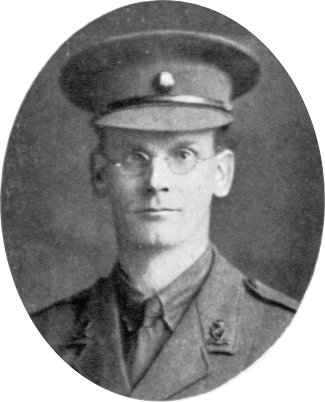
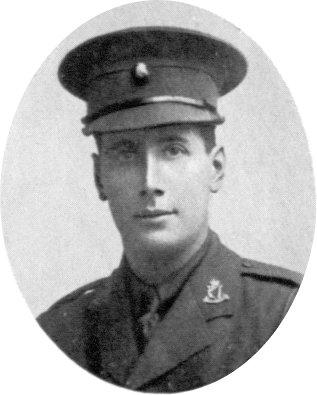
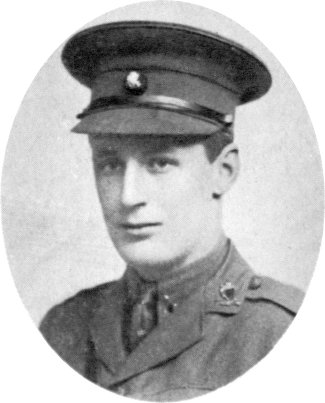
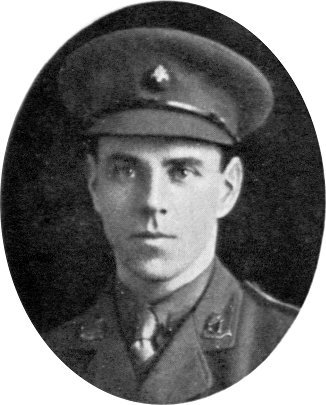
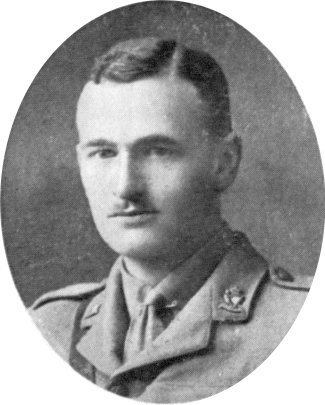
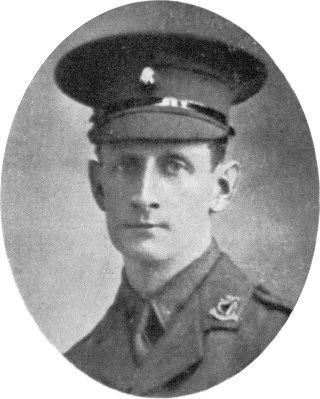
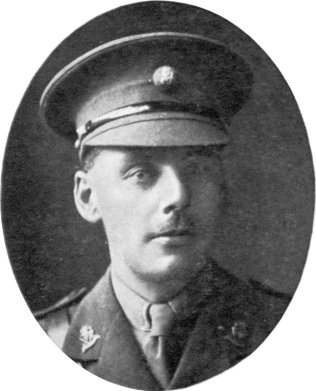
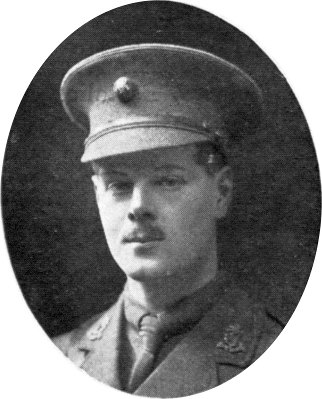
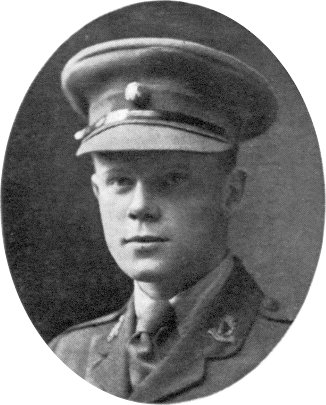
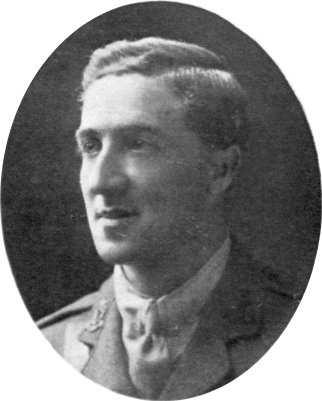
We fell in at 4 o’clock on the afternoon of October 4,
1915, on the parade ground of St. Lucia Barracks,
Borden. So mechanical a proceeding is a regimental
parade, and so extremely heavy were the packs that we
carried, that there was little opportunity for pondering
over the changed conditions that we were soon to
undergo. As far as the men were concerned—and the
same applied to a large number of the officers—they
had left their homes and all that home implied when
they left Ireland three months before.
As we marched to the station we were struck by the
apathy displayed by the few civilians we saw. There
was no cheering, waving of handkerchiefs, or kissing of
hands; even the children, making mud pies on the side
of the road did not trouble to look up. We were only
one of the many units that had passed down that same
road during the previous fourteen months. It was
almost an everyday sight now for the people who lived
there to see regiments entraining for France. So it
was, that as we marched down the short road to Borden
station, we felt that we were only going on our business,
and that those plain-clothed civilians—many of them
young and physically fit men—were going on theirs. At
Borden station the somewhat questionable spirits of the
men were revived by large cups of excellent tea, brought
round by ladies, a parting kindness which was greatly
appreciated, and which none of us will forget. The
first train, with Brigade Headquarters, Battalion Headquarters,
and A and B Companies, steamed out of the
station at 5-10 p.m., followed at 5-35 by the second
train with C and D Companies. Blinds were drawn in
the carriages soon after starting, and with only one stop
the train ran through to Folkestone Pier, where we went
on board the transport “Onward.” At 9-35 p.m. we
left the shores of England, bound for France and the
unknown. A war-time cross-channel steamer, converted
into a troopship for short runs, is as uncomfortable a
form of craft as one can wish to sail in, and the
“Onward” was no exception to the rule. In addition
to our battalion there were several drafts, principally
from Scotch regiments, on board. Luckily it was a fine,
warm night, and the sea was as smooth as glass. The
dining-room and lounge were boarded up and stripped
as bare as a barrack floor, while the corridors, and every
available inch of accommodation below were packed
with men, in all those extraordinary attitudes, recumbent
and sprawling, which the sleeping Tommy can
only adopt. On deck it was just the same, and quite
impossible to walk from one end of the boat to the other.
There were strict orders against smoking on deck, and
the task of the unfortunate officer, whose sense of duty
was sufficiently strong to prevent him from winking at
any breach of discipline, was unenviable. A cigarette,
like Nerissa’s candle, throws a long beam, and every
effort to reach the culprit was fraught with such curses
and mutterings from the bodies over which one stumbled,
that it would have disheartened even the adamant spirit
of the Secretary for War himself.
We reached Boulogne at 11-30 p.m., and, after the
usual disembarkation formalities, in which the
Disembarkation Officers and R.T.O.’s always seem to
exercise their unlimited powers to the full, the Battalion
fell in by companies about 300 yards down the pier. In
the darkness and heavy rain which now began to fall
this proceeding took a considerable amount of time, but
after half an hour we moved off, all thoroughly soaked
through. At the best of times the way from the pier
at Boulogne to the Rest Camp, some distance out of the
town, is not pleasant, but that October night it was
particularly bad. The streets were wet and slippery,
the men heavily laden with blankets and equipment,
and the road up to the Rest Camp led up a steep incline.
The leading company, however, stepped out at their
normal pace. A few, mindful of the landing of the
original Expeditionary Force, and the ever famous
“Tipperary” scenes, burst into song, but the Frenchman
retires early to bed, and, with the exception of one
long, thin arm fluttering a pocket handkerchief from a
top window, we saw no sign of life in the deserted
streets. After a very steep climb of about two miles,
we came to the Rest Camp, and a series of gasoline
flares lit up the muddy flats on which the tents were
pitched. The mud, ankle deep, sucked up round our
boots, and torrents of rain danced in the puddles. It
was a matter of ten minutes before each company was
allotted its area, and after that, in less time than it takes
to tell, the sleep, which only those who have spent a
night in a Rest Camp at Boulogne know, had fallen on
all.
The day after we landed was an easy one. No orders
came as to moving, and the time was spent by our men
in parading about the camp, sleeping, and talking to
the numerous women and small boys who wandered
round the railings, clamouring for “biscuit,” “penny,”
or “bully beef.” So urgent was the appeal for these
commodities, that the men took it for granted that the
entire population of France was starving, and handed
over that somewhat elusive “unconsumed portion” of
the previous day’s ration, or any that remained of it.
As the day wore on and word was received that there
would be no move until the following morning, some of
the officers were allowed into town in the afternoon.
Boulogne in war-time is not an interesting place, and
an hour was sufficient for exploration purposes. With
the exception of a few French territorials, guarding the
bridges and railway station, the town seemed to be entirely
handed over to the British, whose motor ambulances
glided in every direction. The “Cambria,” with
her green and white topsides and large Red Cross flag
at her masthead, lay alongside at the quay, a sight to
make one home-sick, which brought one’s mind back
to Dublin Bay and Kingstown Harbour in the days of
peace. It rained off and on all day, and was bitterly
cold, an early foretaste of the bitter winds we were to
experience in France. We fell in next morning,
Wednesday, 6th October, at 10-15, and marched to the
Central station, where we entrained. Speculation was
rife as to where we were going, whether Belgium, which
savoured of Ypres and all that that name implied, or
the new line between Arras and the Somme. The latter
was a sector taken over by the British from the French
in the July preceding, and had the name of being quiet
and pleasant compared to the more northerly parts of
the line. As the day wore on and we steamed South
through Abbeville, and finally came to Amiens, there
was no doubt as to our destination. From Amiens we
moved on to a side line, and at 6-15 came to Flesselles,
a small town about 15 miles south of Amiens, where we
detrained. It was a lovely autumn evening, and with
a slight breeze blowing from the East, and as we stood
fallen in ready to move off from the station, we heard
the low rumble and occasional growl of a big gun. From
Flesselles we had to march some twelve kilometres to
Rubenpre, which was to be our billeting town. Very
heavily laden as we all were, officers and men, again the
mistake was made of setting too fast a pace. It was an
exceptionally warm evening, the men were tired, hungry
and thirsty, after the long train journey, and as an
hour, and then two, passed by, and we still appeared
to be some distance from our town, the softer hearts in
the battalion collapsed. There is no necessity to dwell
on the unpleasant memories of our first route march in
France; it was the most trying experience for both
officers and men that we had for many a long day. As
we marched East, and as the night grew darker, the
flares, and the lurid flashes of gunfire became more
vivid, and helped to keep up the interest of the men
and distract their attention from the general weariness;
at any rate we were, after eleven months’ training,
getting to the “Front” at last.
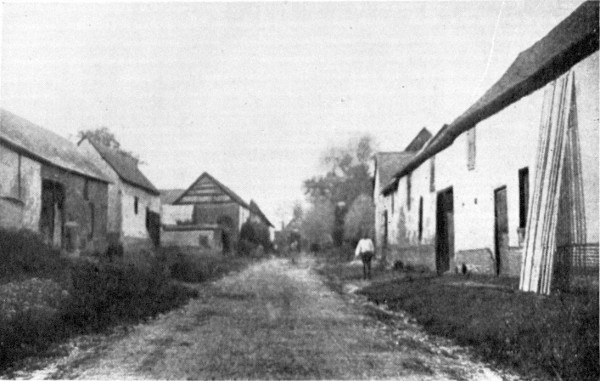
RUBENPRÉ.
When we reached Rubenpré, at 11 o’clock at night,
many of the men done up and all very tired, we halted
at the head of the village. The second in command had
gone on the previous day with the advance party to
arrange the billeting, but in the darkness, of a more
than usually dark night, the result of his effort was
practically impossible to find. The village consisted,
as far as one could judge by the light of electric torches
or matches, of a series of long barns with doors most of
which were barred and bolted, and presented a remarkably
inhospitable appearance. A few days before we
had left Borden we had been paraded, and in the course
of a ten minutes’ harangue, the Commanding Officer had
dwelt upon the good name of the battalion, and its excellent
conduct while in England. He told the men
that he relied on them to maintain that high record in
the country to which they were going. Especially he
told them to respect the religious susceptibilities of the
people. “Hanging over your beds in your billets you
will find crucifixes, pictures of the Virgin Mary, and the
Saints, and other emblems of the Roman Catholic
Church and religion. You will respect these emblems,
and remember that you and your Allies have come to
free these people from the Germans.” So throughout
that march from Flesselles to Rubenpré, the men had
before them the vision and anticipation of feather beds
which all the saints in the catalogue might adorn, so
long as it was a bed. No such luck, however, as feather
beds could be hoped for in the land which the men had
already christened “No man’s land.” So dark was the
night, and so impossible to find were the billets allotted
to each Company, that after nearly half-an-hour’s halt
at the entrance to the village, Company Commanders
and Officers took the matter into their own hands, threw
off their packs and equipment on the side of the street,
and led their worn-out men down the village. They
burst open the doors of barns, and put in, here 20, there
30, men, despite the irate remonstrances of the owners,
often punctuated by some shrill scream from some female
proprietor, who thought that at any rate her last hour
had come. At length, on straw and hay, on floors hard
and soft, everyone found a bed, and, tired, as they were,
one or two were heard to mutter, Orangemen though
they might be, that they wouldn’t mind a bed even if the
picture of the Pope himself hung at the head. In this
part of France there are no farms. The country is
dotted at intervals of a kilometre or two with villages,
some small, some large, mostly the same in appearance,
with their orchards, and grey church spires sticking up
above the knots of trees. All round these villages the
country stretches away in gently rolling plains, like a
great checkerboard, no ditches or hedges, reminding one
of what England must have looked like in the days of
the “common field” system. This part of the country
is intensely cultivated, not an inch of land is allowed
to go to waste, and in war time the work is done entirely
by young girls and old women. A young man was never
seen, either in the fields or villages; there seemed to be
few old men, and the small boys spend most of their day
at school. These Picard villages are intensely dirty,
and Rubenpre was even dirtier than most of them. The
barns were in a bad state of repair, and the yards were
swimming with filthy water from the great heaps of
manure which were piled up in front of each house, often
right up against the windows, yet, curiously enough, the
houses themselves were in most cases neat and clean.
The houses are built of laths, plastered with mud and
straw, poor in construction, and, owing to lack of men,
in many cases whole villages presented a dilapidated and
tumbled-down appearance. Rubenpré was, therefore,
an inhospitable place, and the reception we received
from the people themselves was not what we expected.
We felt that we had come to the country to fight for the
people, and to free them from the enemy; in other
words we looked upon ourselves in a mild way as deliverers,
and felt to a small extent that we were entitled to
be received as such. But our eyes were soon opened,—those
bolted barns and inhospitable entrances were an
index of the regard in which the people held us; we were
received with suspicion, and often with dislike, in every
village to which we came during our long peregrinations
in Picardy. It speaks volumes for our men to be able to
say, as we can say with truth, that we always went away
with the good wishes and blessings of the people, and
there were many in the battalion who, when a day off
came, would walk eight or ten miles to revisit some of
their French friends. It was only after we had been
some time in the country that we discovered the reason
for this coldness. Robbed first of all by the Germans,
they had endured successive invasions of Zouave,
English, Scotch, and Indian troops, and now an Irish
Division, a form of terror formerly unknown was thrust
upon them in its entirety. We saw that there was a
certain amount to be said for their apparent inhospitality,
and put up with it.
The first couple of days at Rubenpré were devoted to
“shaking down.” As far as my Company was concerned,
we were, on the whole, fortunate with regard to
our billets. There was at first a lack of straw, but this
was soon remedied, and the men very soon accustomed
themselves to the novelty of their surroundings. Large
fatigue parties were put on from each Company, and
within a week the town was cleaner than it had been for
many a long day. The people looked on with quiet
amusement, but they too soon became resigned to what
they considered the British mania for cleaning.
Battalion headquarters were in a cottage, and at first
a battalion officers’ mess was tried in an estaminet which
had a room in which a stove was riveted in the centre.
In a short time, however, the difficulty of running a
four company and headquarters mess in the same house
became apparent, and two companies, A and B, seceded
and formed a mess of their own in another café. C
Company and headquarters remained in the same house,
but before we had been many weeks in France the advantages
of company messes became evident. Our
company headquarters was in a disused and rather
tumbled down house, but it had a good orchard and field
behind, which we used for musketry and range finding.
In return for the use of the house, we lent the owner a
few men every day as a help to thresh his corn and milk
his cows. There was no lack of fresh milk, eggs,
potatoes, and apples. Eggs cost three sous each, milk
four sous per litre.
We remained at Rubenpré for about two weeks, and
during that time had the usual routine of parades and
training as at home. We were inspected by the G.O.C.
Third Army, Sir Charles Munro, who expressed himself
very pleased with our bearing on parade. We had two
or three brigade field days and one divisional day, the
latter the first divisional exercise under the eyes of our
new G.O.C. Division, General Nugent. The remarks of
our General on the day’s performance were, to say the
least of them, hardly as complimentary as we should
have wished. They left an impression on the minds of
those who heard them that will never fade, and they
had their effect on all ranks.
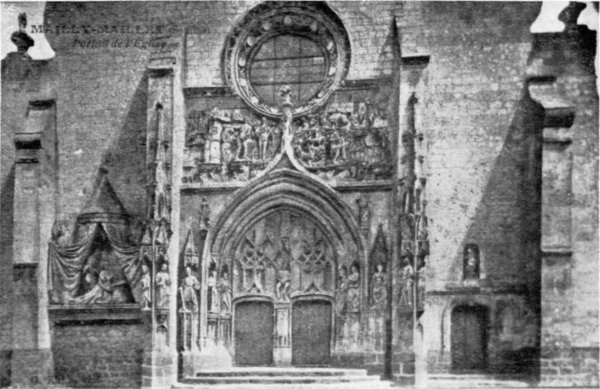
MAILLY-MAILLET.
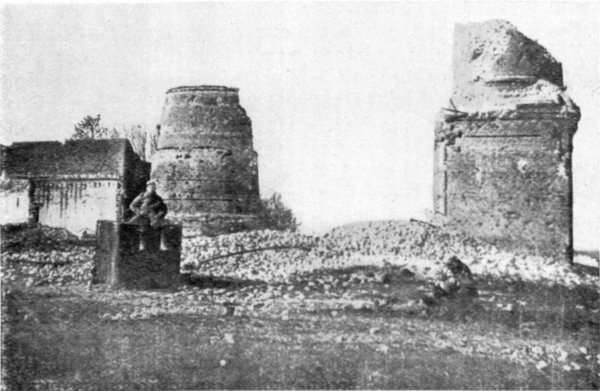
MAILLY-MAILLET SUCRIER.
On 18th October we left Rubenpré to go up to the
line for that instruction period which everyone in the
New Army in France knows so well. As we got nearer
to the line the sound of the guns became more distinct,
and the tiny puffs of white smoke in the sky from the
German aircraft guns was the first sign of the nearness
of the trenches. The country was just the same as at
Rubenpre every inch cultivated. At Varennes we were
met by a band of the South Lancs., and played through
the town and along the road as far as Forceville. Here
we halted in a field for dinners. After dinners we fell
in, and marched off by companies at ten minutes’ interval,
for we were now within the zone of artillery fire,
being about 3½ miles from the trenches. It was only
when we left Forceville that we saw any change in the
aspect of the country. We now passed several lines of
heavily wired trenches, which made long, white streaks
across the otherwise brown and regular landscape. In
other respects there were the same signs of intensive
agriculture as far behind the line. We reached, at
length, Mailly-Maillet, which was to be our billeting
town during the instructional period. In peace time
Mailly-Maillet had evidently been a very pretty little
town of about 1,000 to 1,500 inhabitants, considerably
better built and evidently much more prosperous than
any of the villages we had seen since we came to France.
There was a chateau with a fine avenue of elms which
had its entrance on one side of the main street. The
chateau was a Brigade Headquarters, while the avenue
of elms was used as a park for transport, and was
crowded with limbers and G.S. waggons up to the axles
in mud. There was not a pane of glass to be seen in
any of the houses; many were without doors, and some
were pierced by great shell holes. Generally Mailly-Maillet
had a dejected and war-worn appearance. A
battery of howitzers close by caused all the window-frames
in the place to shake, and every now and then a
few slates would come tumbling down. As the town was
full of troops, and we were an additional battalion, our
billets were very poor. The men were in a very bad
outhouse with little straw, while C Company Headquarters
was an empty room with a tile floor in an
extremely rickety condition. The first few days in
Mailly were devoted to working parties. A Company
was attached to the 1st Batt. Essex Regt., B Company
to the 8th South Lancs., and C to the 1st Batt. Kings
Own Royal Lancaster Regiment, and D Company to the
2nd Royal Lancaster Fusiliers; all belonging to the 12th
Brigade of the 4th Division.
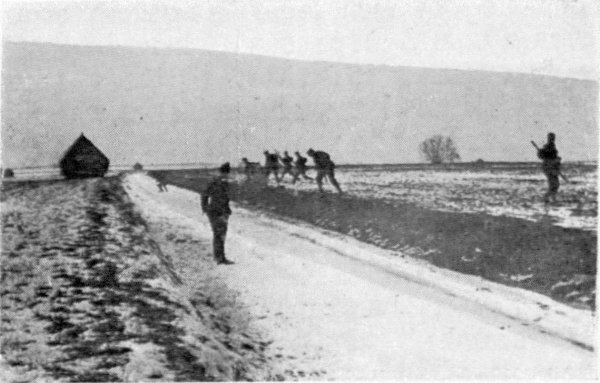
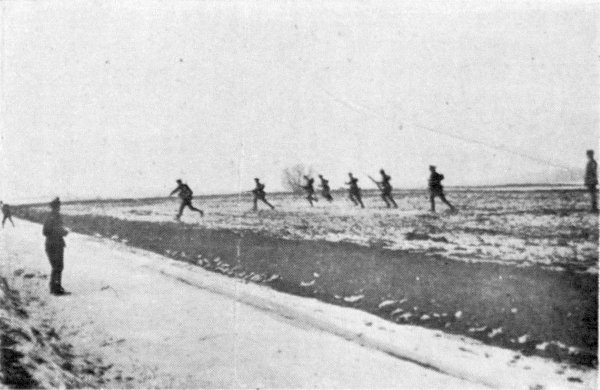
IN TRAINING BEHIND THE LINES.
The more or less eventful period of instruction which
C Company experienced with the King’s Own began on
the night of 19th October, when No. 11 and 12 platoons
working at the second line trenches on the Mailly-Serre
Road, were fired on by a machine gun. It was the
christening. On the 21st we paraded at 5-30 a.m. and
with guides from the King’s Own supplied to each
platoon, marched to the trenches by platoons at five
minutes’ interval. The front held by the King’s Own
ran from the Serre Road on the right to slightly below
and to the left of La Ligny farm. On our left was the
Essex Regiment, while on our right were the Lancs.
Fusiliers. No. 12 platoon was attached to A Company
of the King’s Own on the right of the Batt. line; No.
10 was attached to C Company in the centre; No. 11 to
B Company on the left, and No. 9 to D Company in
reserve. I was with B Company on the left with Vance.
The line held by the 12th Brigade formed part of the
trenches taken from the Germans by the French in the
preceding June. These trenches, known as the
“Toutvent” trenches, had been subjected to a prolonged
bombardment by the French. The latter would
cease firing at intervals, during which the Germans
would man the front line, and on the bombardment
recommencing would retire to their dug-outs. This
sort of thing went on for over a fortnight, and finally,
one morning, the Germans got tired of coming out of
their dugouts when the bombardment stopped, and the
French swept down from their trenches behind La Ligny
farm, and caught them. The victorious French advanced
as far as the village of Serre, but had to fall back in
the face of a terrific German counter attack, and eventually
took up their position in what had been the old
German second line. This trench they consolidated and
held. The regiment which took the trenches was a local
one, consisting of men from the region around Hebuterne,
Mailly, and Bapaume. There had been reports
of terrible outrages committed by the Germans on the
villages behind the lines, and evidence was found in the
trenches themselves to prove the truth of these reports.
The story goes that little quarter was given, and the
French took few prisoners, the Germans, caught like
rats in a trap, being bombed in their dugouts.
B Company of the King’s Own, to which I was
attached, had its headquarters in a dugout known as
“The Catacombs.” Built by the Germans, no labour
had been spared to make it shellproof and comfortable.
Twenty feet deep, cut out of solid chalk, it was about
twenty yards long by seven feet broad. It was divided
into sections for signallers, mess, and servants’
quarters, but into the wall from the mess were nooks
containing beds for six officers. The whole inside of
this dugout was riveted with massive planks four to six
inches in thickness. There were five entrances
approached by flights of steep, narrow steps. This was
typical of the living dugouts in this hive of trenches.
The English never built dugouts like this one in front
line trenches, owing to the difficulty of getting men out
of them in a hurry in case of emergency, and time after
time they have proved death traps to the Germans themselves.
The method of training for a battalion up for
instruction is as follows:—Officers, N.C.O.’s and men
are attached to their opposite numbers. Company Commander
to Company Commander, Platoon Commander
to Platoon Commander, sergeant to sergeant, corporal
to corporal, and sentry to sentry. For three nights this
proceeding is carried out, then, on the fourth night, the
instructing companies withdraw to reserve, and each
company takes over a sector of line on its own. Thus,
bit by bit the officers and men are broken in. The first
night we were in the trenches was an ideal one. A full
moon made things easy, and it was quite possible to get
the lie of the trenches and those of the enemy. Opposite
B Company the Germans were about 100 to 120 yards
away; in the centre their trenches ran to within 40
yards, and on the right about 100. There were a
number of “saps” formed out of what had originally
been old German communication trenches. Sand
bag barricades built by each side in these formed the
“sap heads.” In one “sap” these barricades were
about 15 feet from each other.
One may forget the incidents of one’s first night in
the trenches, but one never forgets the first dawn.
Gradually, out of the darkness, things begin to take
upon themselves their proper shapes. The first impression
is that of desolation, for there is nothing so utterly
forsaken or forlorn as “No man’s land” at first grey
dawn. A maze of misty barbed wire, some in loose coils
lying on the ground, some draped from stumps and
stakes driven in at all angles, some in shell holes, all in
a shapeless and indescribable jumble, stretches for about
three yards in depth in front of the parapet. Then
there is that desolate and shell-pocketed strip of land
which terminates with the German wire, and beyond
that again great heaps of chalk and brown earth begin
to appear as the daylight comes. These are the German
trenches, and behind them is the rolling country out of
which the sun now begins to rise; country that is in
the hands of the Germans, away beyond the pale. Those
coils of rusty wire, hung on the rickety posts, form the
boundary of civilization.
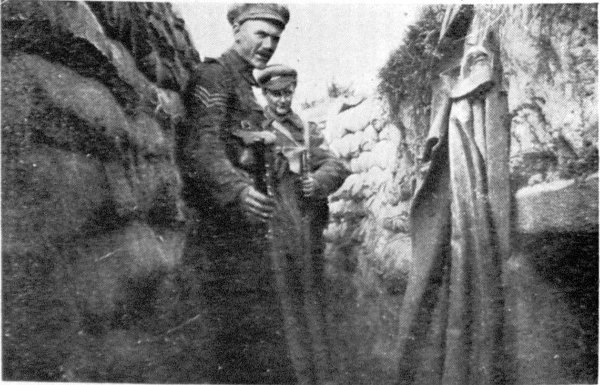
ONE OF THE SERGEANTS OF “C” COMPANY
IN THE TRENCHES.
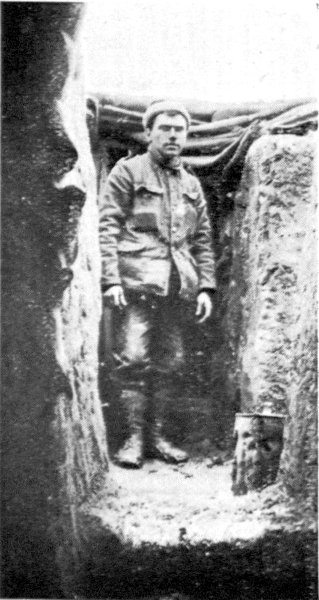
IN THE TRENCHES.
The 22nd of October promised to be the most lovely
day. Except for the usual amount of desultory rifle
and machine-gun fire at “stand to,” there was nothing
to show that the Germans were about to depart from
the normal state of inactivity that characterised the
warfare on this sector of the front. About 8 a.m. a
corporal of the King’s Own who had been doing
observation work reported that the Germans had removed
all their own wire, with the exception of a few
strands, on their front opposite the sector held by C and
B Companies. This Captain Woodgate, commanding
B Company, confirmed himself. In the “Comic Cuts,”
or Corps’ Summary, of the previous day it was noted
that the enemy had also removed his wire opposite the
line held by the French, north of Hebuterne. The
natural conclusion was, therefore, that he was going to
attack. The state of the wire in front of our own
trenches was wretched. A month before, during the
period of fighting in Champagne and the battle of Loos,
the wire all along the front had been removed in readiness
for a possible advance, and little trouble had been
taken to replace it afterwards. At 9-35 a.m., Woodgate,
Vance, Brown (one of Woodgate’s subalterns), and
myself were having breakfast in the “Catacomb.”
Suddenly—“whiz-bang, whiz-bang” right at the door
of the dugout. The blast from the shells knocked the
cups and plates off the table. There was a pause for a
second, then a terrific explosion which shook the whole
earth. In half a minute we had on our equipment, and
Woodgate, followed by myself, Brown, and Vance, ran
up the stairs of the dug-out. The air was full of dust,
and the ground in front of us seemed to be in a blaze
of bursting shells. “This way,” called Woodgate, and
following him we ran down a communication trench
leading to the front line. We had only gone a few yards
when we ran into a man rushing back, blood pouring
from his shoulder and arm. Woodgate stopped and
caught hold of him, calling to us to run on. We ran
down the trench, bending low, for a hail of shells was
passing us and bursting on all sides. In a few seconds
Woodgate caught us up again. I led, then Brown,
Woodgate, and Vance. Suddenly, just round a curve
in the trench, and about ten yards in front of me, there
was a terrific explosion. I was lifted clean off my feet
into the air, and thrown flat on my stomach on the
ground. Almost simultaneously another shell hit the
top of the trench, and before I could think where I was,
or recover my breath, the whole side of the trench leant
over, and fell on top of me. It was a wonderful sensation,
and I remember saying to myself aloud: “I wonder
when this is going to stop.” Still the earth kept
falling, and the weight on my shoulders and the small
of my back became oppressive. One thing was pleasing,
there was dead silence under ground. I began to
heave with my shoulders, and took a deep breath. There
was no difficulty in breathing as the earth seemed full
of air. On the second heave I felt I was able to move,
and after what seemed ages I got my head and shoulders
clear. I was firmly fixed from my waist down, but in
less than a minute had dragged myself out. I looked
round, and saw that the entire trench had been filled in.
There was no sign of any of the others, but a small bit
of British warm coat was sticking out of the hole where
I had been which represented Brown. I got hold of it
and pulled hard. Gradually Brown emerged, cursing
like a trooper, and spitting clay out of his mouth. With
little difficulty we got Woodgate out, and Vance appeared
behind him. We then ran on, and when we
came to the fire trench Woodgate called out: “Get the
men out of the living trench into the front line.” The
living trench was one running just behind and parallel
to the fire trench. In it were a large number of what
were called “funk holes,” scooped out of the front of
the trench, in which the men slept when off duty.
Leading from each company in the fire trench there was
a passage to the living trench. It should be explained
that by day the minimum number of men possible are
on duty in the fire trench. Sentry duty is most exhausting
work, and it is possible for one man by day to suffice
where it would take ten or even twenty men by night.
In a company frontage of perhaps 500 to 600 yards
three sentries, one to each platoon would be ample in
the firing line provided there was a clear field of view to
the front; but of course it is entirely a matter of situation
and the nature of the ground. Woodgate
called to me: “You take the two centre platoons and get
everyone into the trench as quickly as possible.” I
ran along the living trench rousing the men, who despite
the terrific din of bursting shells were mostly sound
asleep, and telling them to get out. Shells were falling
mostly in the living trench and just behind it, and I had
to go round by way of the fire trench as the passage
behind was blocked up. Meanwhile the air was thick
with flying debris of every kind—posts, iron sheets,
great baulks of timber were flying everywhere as the
enemy blew our wire to bits. In particular I watched
with fascination, a sheet of corrugated iron, blown from
the roof of a dug-out, which flew about in the air like a
card, and dashed hither and thither, finally coming
down with a great slant on the parados of the bay next
to where I was. It is no easy matter to wake the
sleeping soldier, and as I worked my way down the living
trench I thought I would never get the men out of
the dug-outs. Here and there, however, where a bit
of trench had been blown in, men were creeping out,
pulling their rifles from under the fallen clay. At
last, after what seemed an age, they began to file into
the bays. The front trench was very narrow, deep, and
well sand-bagged, and once they had thoroughly realised
what was going on they knew it was the safest place.
Owing to the double number in the trenches nearly
every bay was manned by at least two men. Bayonets
were fixed, and ten rounds fixed into the magazine, and
we felt quite ready for what I expected would come any
minute. The shell fire now became terrific, and
practically the whole living line was filled in, the shells
just missing the front line and lighting on the step of
ground some ten yards inside separating it from the
living trench. Curiously enough no shells were lighting
in the fire trench. Two bays on the right of the two
platoons under my charge had been knocked in during
the first few minutes of the bombardment. They
formed a small salient, and presented a very easy target
to the enemy, whose artillery was mostly operating
from Serre wood. Once the fire trench was manned
there was little to do except go up and down the trench
and see that all was well. The stuff the Germans were
sending over was composed of every imaginable form
of ordnance. The biggest shells were probably eight
inch, and the air was thick with aerial torpedoes,
minenwerfer, and oil drums. The latter came hurling
through the air turning over and over and exploding
with a terrific crack, making a very large crater.
Aerial torpedoes, designed more for moral effect than
to cause actual damage, burst with a nerve shattering
explosion. I noticed that the closer one was to a bursting
shell or aerial torpedo the less the noise, it was more
of a sharp click, the greatest effect would be at almost
30 yards, under that the sound did not seem so great,
though the concussion of course was terrific. Meanwhile
the Germans, though they had blown most of our
wire away showed no signs of attacking. It was just
one of those small intensive bombardments known at the
front as “a morning hate” or “straffe.” When this
had lasted about an hour and a half, our artillery began
to retaliate. Those were the days when ammunition
was precious, and each battery strictly limited. It was
a pleasant sound, however, to hear the whiz of our own
shells overhead and see a great mass of earth rise from
the German lines, and this had a marvellous effect on
the men. They at once became cheerful, the Lancashire
men especially. “Thar goes a Lloyd George for you,”
as the whiz of a heavy shell like an express train overhead
was heard. “Bah, he’s a dud.” “Say, Jock, the
lassie ’as made ’im forgot to put in the vital spark.”
“There goes Fritz’s iron rations” as a salvo of shrapnel
burst over the first line. On the whole, however, our
artillery retaliation was poor.
About 11-30 the bombardment began to die down,
and by 12-30 it was over. The damage done, considering
the number of shells fired into such a small sector
was very small. Two bays on the right of “B” Company
were completely flattened, otherwise there was no
damage done to the fire trench. The living trench and
communication trenches suffered more. Two of the
latter had been knocked in, while the living trench along
the company line had been badly battered. One very
gruesome effect was noticed. There were a large
number of Frenchman’s graves in the parapet of the
fire trench, for the French have a habit of burying a
man where he falls, whether at his post or not. A
hole was opened in the side of the trench, the body was
shoved in, and the grave filled up. A little cross surmounted
by the dead man’s cap, and often his bayonet
and rifle, marking the spot. In places where the fire
trench had been hit or shaken many of the remains
stuck out, and in many cases buttons and badges were
“souveneered” by the men.
When the bombardment was over Woodgate told me
it was the most severe they had experienced since May
8th, at Ypres, and quite an unusual occurrence on that
front. Two men were killed and sixteen wounded, very
small casualties taking into consideration the intensity
of the fire. That night we dug a new trench behind
the small sector blown in. There was a full moon, and
walking about on top was very interesting. The
ground was honeycombed with shell holes, while in all
directions unexploded shells were lying about. A trench
which had been used by the French for the purpose of
burying dead had been unearthed in many places and
the ground was littered with old equipment, clothes,
and bones. I remember thinking it was the most appalling
refuse heap I had ever seen. Next day was very
quiet, we began work on the new trench at about 7-30,
and I took charge of the three working parties in it.
A considerable amount of work had been done the night
before, and only a short piece remained to be dug in the
centre. At 8-55 I told the men to take a ten minutes
“easy” and went up to the left platoon to see one of the
Sergeants about rations. I had gone about five minutes
when a salvo of “whiz bangs” (77 mm shells) burst
right in the trench where the men had been working,
and immediately afterwards very heavy rifle fire broke
out on our right. The “stand to” was passed down
and the rifle fire went on for about half-an-hour, especially
in the direction of “C” Company. All had quieted down
about 10 o’clock. I then ascertained that a party of
Germans had endeavoured to bomb “C” Company’s
trenches. A very large number of bombs were thrown,
and in all sixteen men were wounded. For their coolness
in this attack our men were greatly commended,
and one man, Andrew Marshall, of No. 11 platoon, was
specially recommended for devotion to duty. Badly
wounded in the hand, and unable to use his rifle, he
refused to leave the trench, and kept loading rifles for
the men on the fire step.
The remainder of our time in the trenches was very
quiet. On Sunday, 24th October, we took over the
line held by “A” Company King’s Own as a Company
the King’s Own going back into support, and the following
evening we marched back to our billets in Mailly-Maillet.
Our period of instruction had been most
useful, for “C” Company in particular. We had
experienced a bombardment and a bomb attack in both
of which the men had proved their metal, and shown
what was in them. As far as the Officers of “C” Company
were concerned, those who came in contact with
Capt. Woodgate will never forget the lesson they learned
from him. “A” and “B” Companies attached to the
Essex and South Lancs. Regiments had a quiet time,
but “D” Company attached to the Lancs. Fusiliers in
the Redan salient had their initiation into mine warfare,
a platoon being in the salient when the Germans blew
up a mine without, however, causing any loss of life.
A good story is here told of Lieutenant W. He was out
one night with a small patrol, the pass word being
“Shakespeare.” A large German patrol was sighted
and W and his patrol had to retire in some haste. W
himself fell headlong into a sap on the top of the
astonished sentries with the ejaculation “For God’s sake
let’s in, Shakespeare.”
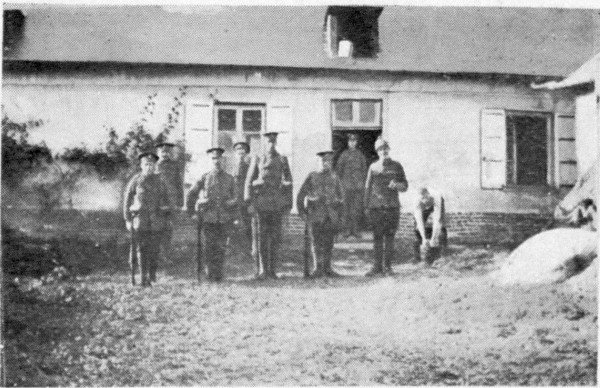
FIENVILLERS.
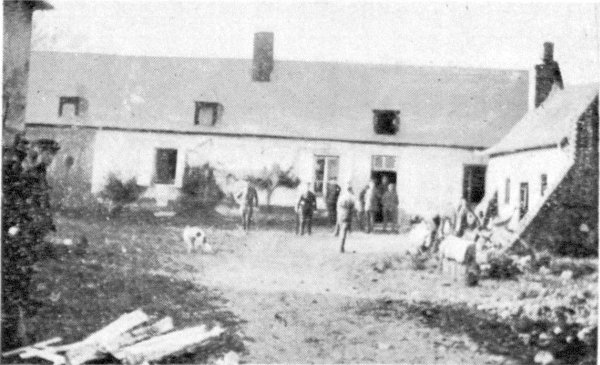
FIENVILLERS.
We left Mailly early in the morning of October 26th,
and marched down through Forceville and Varennes to
Puchvillers where we stayed the night. Next day we
marched to Fienvillers and went into billets. Fienvillers
was a better town than Rubenpre. There were
better barns for the men, and for a company headquarters
mess we were lucky to get a lovely house
standing in its own grounds with bedrooms for each
Officer. We now had heard our fate, it was that the
107th Brigade was to go up to the trenches to take the
place of the 12th Brigade of the 4th Division, which was
coming out and going to be attached to our Division.
Our two remaining Brigades were to be in Army
reserve for about three months. Our Battalion, with
the 14th R.I.R. from the 109th Brigade, was attached
to the 12th Brigade under General Auley, taking the
places of the Essex Regiment attached to the 109th
Brigade, and Lancashire Fusiliers attached to the 108th.
We joined the 12th Brigade at St. Leger-les-Domarts on
the 5th November, the King’s Own being billeted in the
same town. We now began a new and extensive system
of training, both in march discipline and attack.
General Auley, during the first week that we were in his
Brigade gave the Officers a series of lectures on the retreat
from Mons and the subsequent advance to the
Marne. We heard the story from his own personal
point of view, which made it a fascinating narrative
rather than a tactical lecture. During the five weeks
in which we were attached to his Brigade we obtained
much practical and useful knowledge. In march
discipline, especially, we improved greatly. We were
taught that the most men can do with comfort is 112
paces to the minute. The pace was set from the rear
and not from the head of the column. Company
Commanders riding at the rear of their Companies were
made to check the pace. The utmost importance was
paid to keeping in step, and keeping the sectors of fours
well dressed and well covered down. The rifle was
carried at the sling, never over the shoulder, the reason
for this being that men, when they get tired, will let
their butts drop, and keeping hitting the man in the
sector of fours behind, thus causing loss of space in the
section, in the Company, and so on down to the Brigade
and Division on the march. We did many long route
marches, and the General used to hide in all sorts of
weird places to watch us go past, and take us unawares.
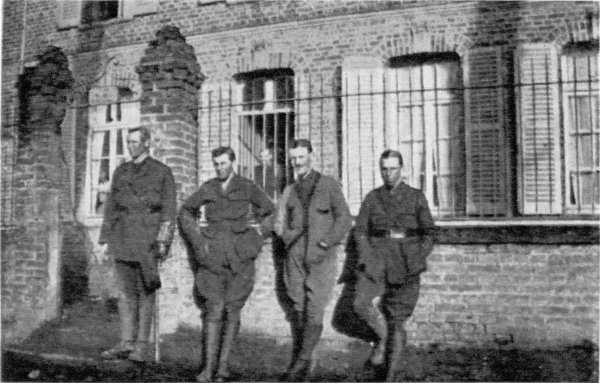
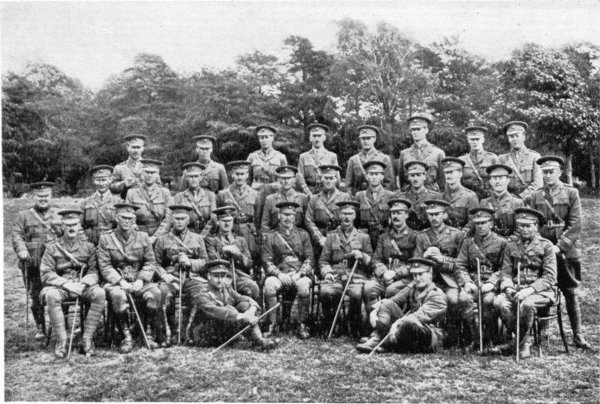
LIEUT. VANCE, CAPTAIN SAMUELS, LIEUT. YOUNG, LIEUT. ELLIS.
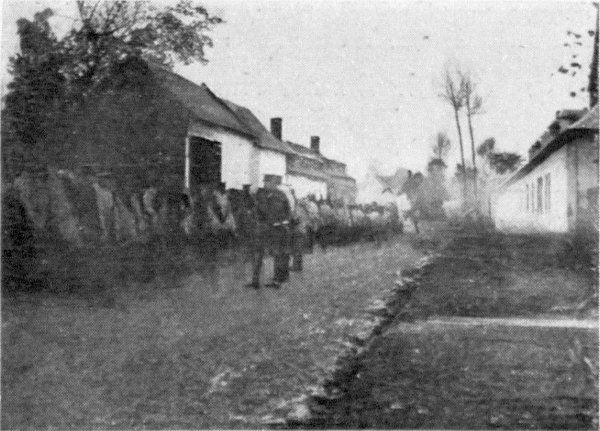
“C” COMPANY, ST. LEGER.
During the time we were in St. Leger, Major Clarke
(Officer Commanding “C” Company) left the Battalion
and joined the 108th Brigade as Staff Captain. I took
over command of “C” Company on November 12th.
Our Company headquarters were in the Cure’s house,
the Cure, like most of his confreres in France, having
gone to the front. On 27th we moved from St. Leger
to Buigny l’Abbe, a small village about three kilometres
from St. Requier where we were billeted until December
10th. Buigny was an unhealthy low lying village,
and we experienced a considerable amount of sickness,
principally influenza. Our stay of a fortnight was unpleasant,
it rained most of the time, and the people were
inhospitable. This, we found, was due to bad conduct
on the part of a Regiment which had preceded us there.
The triangular pond, which is a feature of all Picard
villages, had in former days formed the fish pond of the
ancient monastery of Buigny l’Abbe; and for this reason
was held in more respect by the villagers than most
ponds of its kind. Unfortunately, whether by accident
or design, some bombs were thrown into this pond one
night, and in the morning the villagers woke up to find
their pond gone, and in its place a chasm of liquid mud.
On investigation it was found that the bombs had burst
in what proved to be the roof of a subterranean passage
leading from the monastery, and through this the water
had disappeared. During our stay in the town we had
working parties engaged in making good the damage.
On December 10th we rejoined the 108th Brigade,
moving from Buigny l’Abbe to St. Mauguille, a faubourg
of St. Requier. This proved to be the most pleasant
town in which we had as yet been billeted. Two
Companies “B” and “C” were in St. Mauguille at
Neuville, about one mile from St. Riquier. We had
excellent billets both for Officers and men, and as we
had now thoroughly acquired the nack of making ourselves
at home, settled down very comfortably. The
people were most hospitable. There were excellent
hot and cold shower baths for the men, and a Battalion
laundry was set up. For our Company Mess, Monsieur
Vivien, the manager of a big phosphate works gave us
the greater part of his house, and he and Madame Vivien
with their daughter, did all they could to make us feel
at home. St. Requier was a most interesting old town.
It had successfully stood siege by Henry V. and the
English on two occasions, but had been sacked and
burnt by the Burgundians in the end of the 15th
century. Large portions of the walls still remain, and
some of the old towers. In a moated farm-house just
outside the town Jeanne D’Arc spent a night on her way
to her trial at Rouen. Another fact of great interest
was that the ancient Abbey of St. Requier had been
founded by our own countrymen in the 6th century[1].
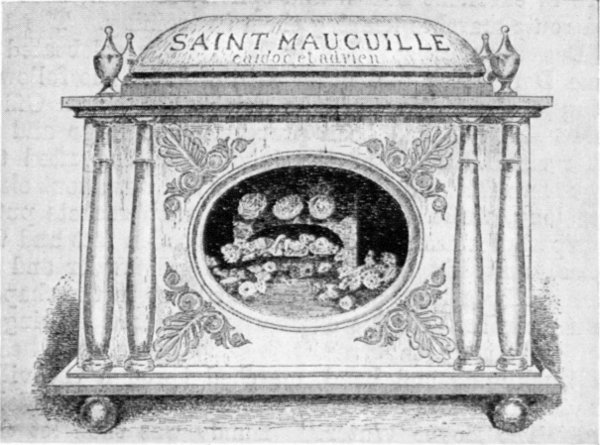
TOMB OF THE FIRST IRISH SAINTS.
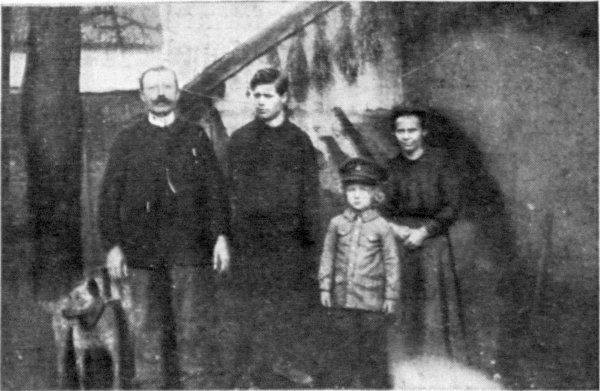
MONSIEUR VIVIEN AND FAMILY.
We spent a happy Xmas at St. Requier, and as we
were in billets decided to make the best of it. The men
were in excellent health and spirits, football, shooting,
and route marches keeping them in training. The 18th
of December being “Lundy Day,” was celebrated by
some Derry men and other Ulster boys, the following
being a description of the celebration by an Officer.
Two Lundy’s had been prepared, one large and the
other small. Some of the inhabitants suggested that
they were father and son. The father was about eleven
feet long, stuffed with straw, and with rockets put in
unexpected places. He had large wooden feet and wire
knees, and his head filled with gunpowder and surrounded
by a large yellow trimmed hat in the shape of
an Admiral’s. On his chest was a placard bearing the
words “Lundy the traitor.” The procession, headed
by torchlights and band, marched through the village
playing such airs as “No Surrender,” “Derry Walls”
and “The Boyne Water.” Lundy was then let down
on a wire rope from a tree where he had been strung up,
and set on fire, amidst great cheering and boohing. He
was well soaked with petrol and burnt excellently.
Every now and then someone gave him a shake and his
knees wobbled in most realistic fashion. Bombs made
of jam tins were thrown into a pond just beside him,
and of course broke the windows of houses in the vicinity.
The procession then reformed, and marching to
the top of the village, where Lundy junior was burnt
with like ceremony.
Christmas, of course, produced a series of dinners
given by the Officers Commanding Companies and
Battalion Headquarters. To read the menu cards it
was hard to believe we were in France, and that this was
the second year of the war. One particularly elaborate
dinner was given on Christmas day, to which we invited
Madame Vivien, our kind hostess, and her family. The
following is a copy of the menu in which most of the
guests are represented.
- Potage Vivien.
- Poulets Roti au Capitaine.
- Petits pois Lieutenant.
- Rosbif au Docteur.
- Pommes de terre Louis (the little son).
- Fruits, plumb pudding, Xmas desserts.
- Cafe.
- Vins—Muscatel—Bordeau—Whiskey.
- Le Presedent de la Republique.
- Le Roi D’Angleterre.
- Mesdames, Messures Vivien.
- Les Allies au paix glorieuse.
A service was held in the ancient Abbey of St.
Requier on Christmas Day, and a sacred concert, which
gave our men an opportunity of listening to Christmas
music.
An incident happened about this time at St. Requier
which caused no little excitement. A French billet
belonging to the Downs (13th Battalion Royal Irish
Rifles) went on fire. At the sound of the fire alarm
every one turned out to assist the French people who
stripped to the waist were hard at work trying to save
their farm. The fire was raging fiercely round the
stables and out-houses, and it was quite impossible to
save all the horses, some of whom were burned to death
in their stalls. It was a horrible sight.
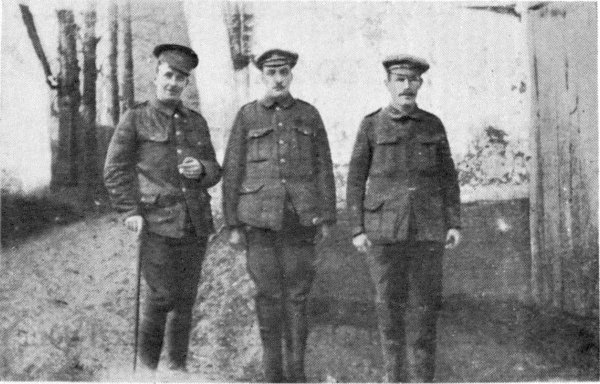
THREE SERGEANTS OF “C” COMPANY.
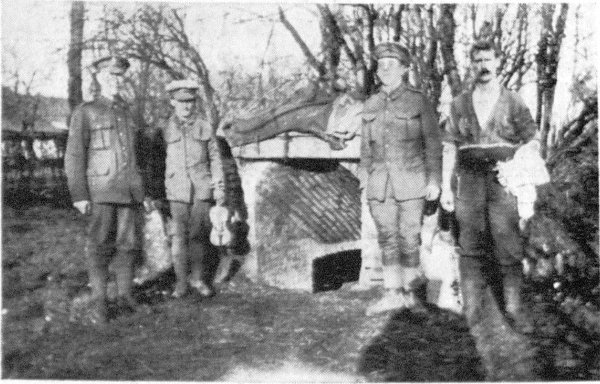
AT ST. RIQUIER.
On January 8th, our Battalion moved to Bernavillers.
We were now beginning to think of the trenches again,
and many were the rumours. Everyone seemed to know
for certain our exact peregrinations during the next few
months, but in truth no one could tell from day to day
what our next move would be. There were also rumours
of a more pleasant character, but so far only spoken of
with bated breath, the one and only hope of our existence—“Leave”
had begun. Our first “leave” and
all that the word means. There is no doubt of it that the
first leave is the best, but your first leave you are then
indeed a hero, whether from billets or trenches, and
your dear people who have not yet become accustomed
to those short ten days have waited and watched for it
with an intense longing and pride in their hearts; is it
any wonder one’s blood thrills with the thought of that
never-to-be-forgotten home coming.
At Bernavillers an excellent concert party was formed
by Lord Farnham, called “The Divisional Follies” or
“The Merry Mauve Melody Makers.” Their first
concert was honoured by a visit from The Most Rev. Dr.
Crozier, Lord Primate of Ireland, who had come to
France on a tour among the Irish Divisions. He had
already paid a visit to the 107th Brigade, who had been
having a strenuous training in the trenches ever since
October. They had escaped with very few casualties.
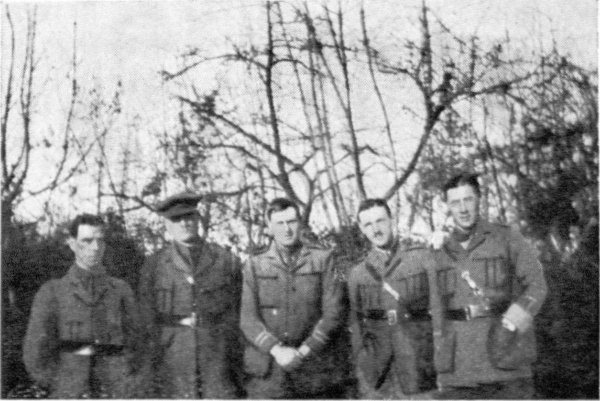
OFFICERS OF “C” COMPANY.
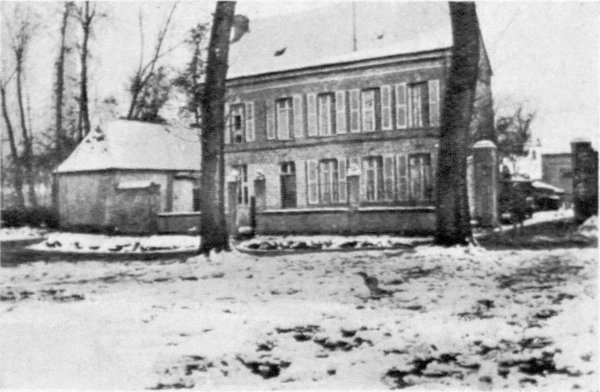
ST. LEGER.
My Company now got orders to move to Beauval,
where we took over billets from the Y.C.V.’s (14th
Battalion Royal Irish Rifles). They were the cleanest
billets I can remember in France, and the Y.C.V.’s
deserve great praise for the way in which they were
left for us. After a week of preparation we moved on
to Canaples, and from there to Martinsart where we
again manned the trenches, and went in alongside the
9th Inniskilling Fusiliers by Companies, “C” and “D”
Companies in front with “A” and “B” in reserve.
The next week we went into support with “D” Company,
and “A” and “B” took our place in front.
This time we were not attached to a regular Battalion
for training, but took over part of the line ourselves.
Our period in the trenches was uneventful, it was a
quiet part of the line, and the trenches were deep and
well made. This time we gave the Bosche 500 to every 50
of theirs, so all taken into consideration we were lucky.
The weather, however, was by no means favourable, the
trenches being full of slush and water. A heavy fall
of snow also made the ground in a bad condition, and
the men suffered greatly from the cold, which was intense.
Several new Officers joined our Battalion about
this time, for which we were very thankful, as leave
was able to proceed without difficulty, two Officers being
sent each week. On February 29 our first death
occurred, poor young Watt of No. 12 platoon. He was
killed by a shell while standing outside the door of his
billet in Mesnil, and buried in Mesnil Ridge Cemetery.
From this time on we went into the trenches by Battalions,
alternately with the Downs (13th Royal Irish
Rifles). Our casualties were not great, but always a few,
the expected result of trench warfare. Indeed, if it
had not been for a tot of rum at “stand to” on those
very cold mornings, I feel sure there would have been
more work for the hospitals. About March 6th the
weather began to improve and we occasionally felt dry.
We now began to think about giving Jerry something
to stir him up as he seemed to have gone underground
completely during the cold weather. Evidently Battalion
Headquarters also felt that the time had come
to stir for we received a message to supply a specimen
of German wire as it was wanted by the corps. The
job was given in “C” Company to Young, our scout
Officer, and four other scouts. On a dark and snowy
night they crept out on patrol, and procured a good
specimen about a yard long. The other Companies also
procured specimens and the Corps appeared satisfied
with results. Our Batteries also began to wake up,
and we kept them well informed as to the position of
the German transports, which from this time on never
got a moment of peace. The 10th Inniskillings on our
right, under command of Colonel Ross-Smyth, got a
terrific shelling from the Bosche on the night of the
10th-11th of March. Shells came over at the rate of 60
to the minute, but the 10th showed splendid coolness
and gallantry, keeping up a steady fire from the front
trenches throughout the bombardment, which was
evidently intended by the Germans to cover a raid on
our lines, similar to one which took place elsewhere the
same night. An Officer, describing the bombardment
in a letter, writes—
“The Bosche has been very prodigal of shells for a
day or two, all along the front, but particularly on the
somewhat unpleasant sector occupied by the “Derry’s.”
On this particular afternoon he had subjected it to a
smart bombardment with “heavies,” field guns, and
trench mortars. Then he fell short and waited. At
eleven o’clock precisely he opened fire with guns of all
calibres. Over the Derrys he burst shrapnel, reserving
his high explosive for the Donegals and Fermanaghs,
and for the Brigade on their right. Not content with
peppering the line, the supports, and the reserves, he
shelled half a dozen villages to the rear, with which he
did not as a rule concern himself. It was a very dark
night, and the flashes of the guns seemed to cut through
the darkness like spear points. Before the Bosche had
been firing five minutes our guns had begun to reply to
him, and the eighteen pounders commenced to whiz over
our heads on to their front line, and soon the men in the
trenches heard the welcome whistle of a high travelling
howitzer over their heads in the right direction. Then
indeed the din was indescribable, so fast and furious did
the game become that at one time it seemed as if the
boom of the big guns, the harsher bark of the small, the
explosion of the shells, and the tearing crash of bursting
mortars were all blended into one continuous roar.
The trenches of the “Derrys” had an ugly time of it.
Dug-outs were caved in, and traverses smashed down,
one whole sector of the front line being practically
ploughed up. At one time the enemy proceeded to
pound the flank out of one Company with high explosives
for several minutes, then lifted to the opposite
flank and gave it the same measure. This evidently
appeared to him a satisfactory idea as he repeated the
manoeuvre. But the Company Officer had by now
appreciated his tactics, and by his work undoubtedly
prevented a great number of casualties. Gradually
the German fire on the front line slackened and ceased,
though it still continued overhead, and our “heavies”
now warmed up to their work showed no inclination to
give up. It was at this juncture that a sentry came
running back from the sap head to report that he had
seen Germans moving in front of the wire. The order
was given to the men to stand up on the fire step, and
send bursts of rapid fire in the direction of the German
line. If the raiders had intended coming over this
caused them to change their minds. The “Derrys”
stood to till morning, but nothing fresh occurred.
Through the night the men prayed their Officers to lead
them over to vengeance, but for that they will have to
wait. The loss was slight considering the intensity of
the bombardment. When morning came the “Derrys”
learned that the famous raiders had entered the trenches
of the Battalion on their right, which, by the way,
did not belong to the Ulster Division, and carried off
an Officer and nine men as prisoners. It was a workmanlike
job without a doubt, for the raiding party had
come and gone within ten minutes.”
Bombs found on night patrol just in front of BEAUMONT HAMEL, March, 1916.
Several of the men of the Inniskillings earned commendation
from Colonel Ricardo for conspicuous
gallantry on this occasion; their names were Private
D. Little, Private J. J. Young, Lance Corporal Black,
and Private W. Dinsmore. They were serving as Company
Officers, Orderlies, Signallers, and Messengers.
Captain Cruickshank, of Omagh, also showed great
coolness and valour on that occasion.
The weather still continued fine, and our time was
spent in building new traverses, and rivetting and
sandbagging the parados and firesteps. Bosche aeroplanes,
taking advantage of the fine nights, crossed our
lines, and green flares were sent up from the enemy to
show our positions. The Germans would then send over
a number of shells, and we had several casualties,
Lieutenant Waring of “A” Company being hit by
shrapnel, and Privates Moffat and McBride of “C”
Company badly wounded. Poor Moffat subsequently
died from his wounds.
We were now stirred to think of raids and night
patrols. The following is an example of a patrol
done by one of my Officers and some men of “C”
Company. Lieutenant Young, Sergeant Renshaw,
Riflemen Storey, Pollock, M‘Dowell and M‘Kelvey.
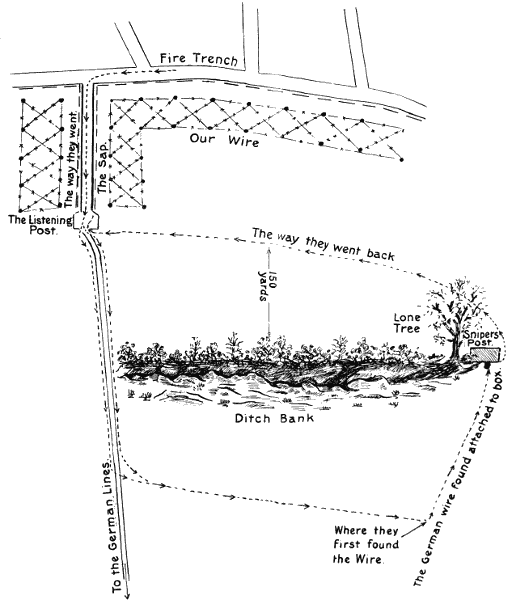
March 16th. “C” Company Patrol Report.
“Patrol went out from Sap in Sector 41 at 7-30 p.m.,
consisting of one Officer, one Sergeant, and four Riflemen.
On leaving our wire we turned north, striking
sunken road which runs north-east in direction of
German trenches. After going about 100 yards down
this road we turned off under a ditch running north-west
from the road. There were a number of small
thorn trees on this ditch, and we could distinctly see
footprints and elbow marks round them, also pits had
been dug which could be used by snipers. Further
along the ditch we came to a lone tree, which can be
seen from Sector 49 in our lines, here we halted. About
20 yards from the tree we discovered a wire which came
from the direction of the German lines. Following this
we found it entered the parapet of a sniper’s pit, just
beneath the lone tree. We then dug out the wire, and
discovered it was attached to a square box covered with
felt. This box we opened, thinking it contained a
telephone, but instead found four German grenades
with the detonators attached to the wire. We quickly
disconnected the wire, and dug out the box. Not far
from the spot we found another German grenade which
we also took with us. At 10 p.m. we returned to our
own trenches. A working party of the enemy could be
heard, but it was difficult to say from which direction
the sound came. Otherwise, everything was normal.”
G. O. Young, Lieutenant.
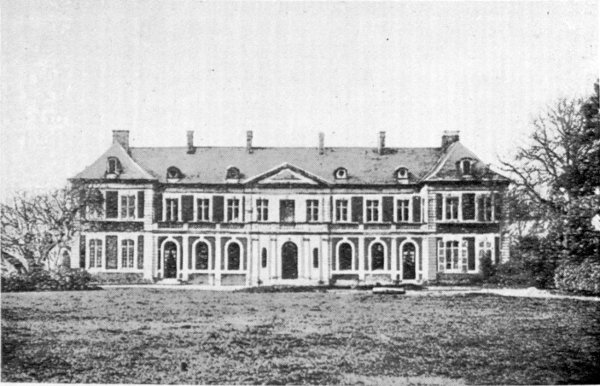
THIEPVAL CHATEAU.
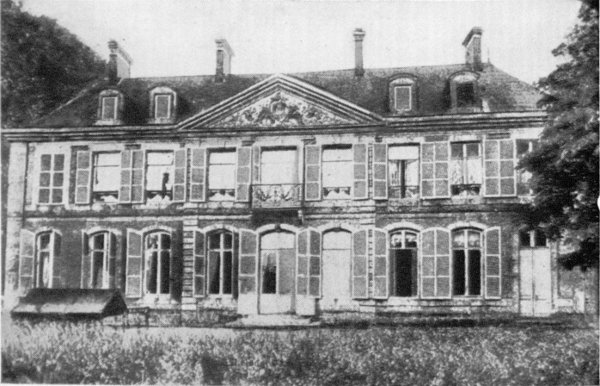
MESNIL CHATEAU.
On March 18th we went into reserve, and were
billeted in Englebelmer, being relieved on 24th by the
13th Royal Irish Rifles (The Downs). This time the
11th Battalion East Yorks were attached to us for
instruction. They saw a fair amount of shelling for
their first period in the trenches, the Germans putting
a lot of trench mortars over on Thiepval hill. All that
remained of the Chateau at Thiepval being the walls,
about as high as the hall door, and a few holes where
windows once had been, in all about 7ft. high by 20ft.
long. The German trenches lay in front of it, on the
carriage drive, and ours right up to the other side of
the avenue, almost into them. Not a pleasant place,
with an active sniper in the Chateau. Our trenches
also ran through Thiepval wood, in which the trees were
now thick with foliage. The birds built their nests and
sang merrily enough on those Spring mornings. They
did not appear to mind the shelling, even a cuckoo could
sometimes be heard, reminding us that winter was over
“this winter of our discontent.” Spring had indeed
come, a time when the birds call, the trees call, all
nature calls for life, while we were there to kill and to
be killed. There were moments when a lull came in the
busy day’s work, when the monotony of trench warfare
left time to think, that thoughts such as these arose.
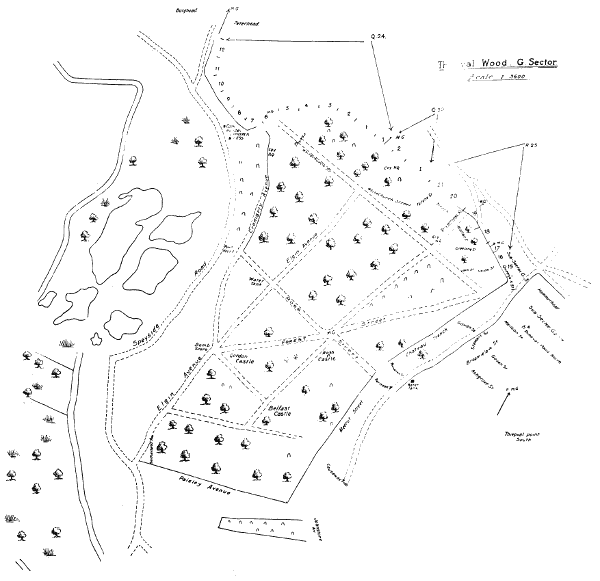
Thiepval Wood. G. Sector.
We spent Easter in billets, in Martinsart village.
The 23rd of April being Easter Sunday, a general holiday
was given to the Battalion. Amiens, once the
capital of Picardy, was about twenty-five miles distant,
a long ride, but an interesting old town, and well worth
visiting. Its fortifications have been turned into Boulevards,
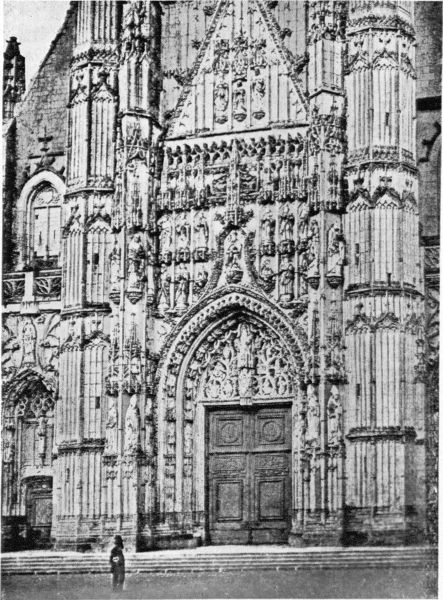
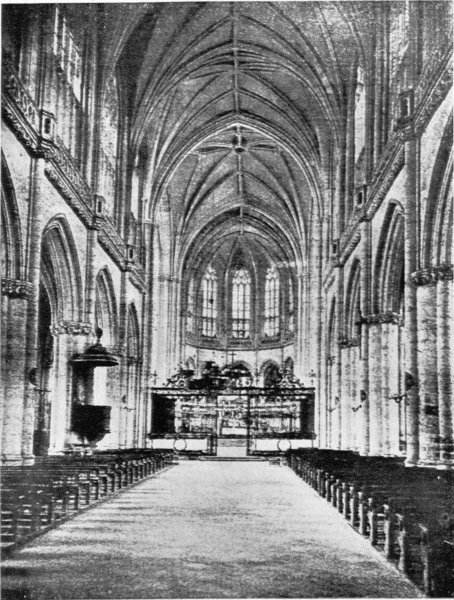
but it still retains its old citadel, and the
Cathedral of Notre Dame is indeed a masterpiece of
Gothic architecture. The great straight road that leads
from Amiens to the front, or Albert, is the great route
nationale, running from Rouen through Amiens,
Albert, Pozieres, Le Sars and Bapaume on to Mons
and Valenciennes. It was on this road that the
famous Gordon Bennet races took place, and a
better road for riding on or motoring on, it would be
hard to find. The road is lined on either side with
poplar trees, and a screen used to be hung from tree to
tree to hide the traffic to and from Albert. There are
few trees left now, and only the barest stumps, owing
to bombardment. Amiens, as a rule, was out of bounds
to both Officers and men, unless they were the possessors
of a pass, but on Easter Monday official permission was
granted to all, and many availed themselves of the
opportunity to explore the ancient town. It was a
chance to see civilization again, and to dine in a restaurant.
At that time Amiens had not been badly shelled,
even the Bosche aeroplanes seemed to be busy elsewhere,
and life went on much the same as in towns at the Base.
People went about their business and pleasure with
very little thought of the enemy who were comparatively
few miles away. The ride back at night from
Amiens was rather an interesting experience. After
the first six miles the sky was lit up like sheet lightning.
Then the villages all became dark, no lights to be seen,
then came the halts at the different outposts, the constant
flashes and rockets in the sky, awful, yet fascinating.
Nearer Albert the sound of the guns became
clearer, and in the distance could be seen the great
Church tower of Notre Dame de Brebieres with the
leaning figure of the Virgin holding the infant Christ
above her head. For over a year she had hung at an
angle of 15 degrees below horizontal, face downwards to
the street below. The French people believed that the
day the holy figures fell, would see the end of the War,
and that the German shell which threw down the blessed
Virgin of Brebieres would shatter the throne of the
Hohenzollerns.
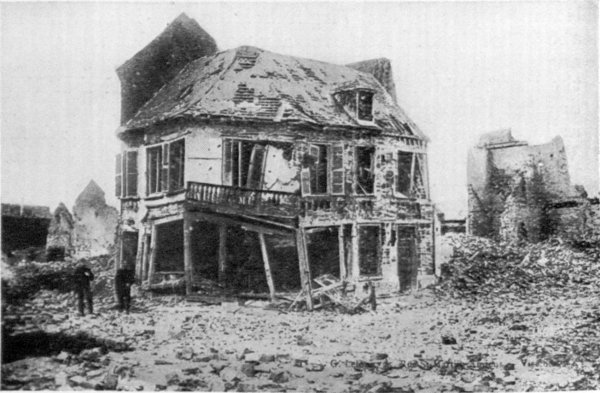
ALBERT.
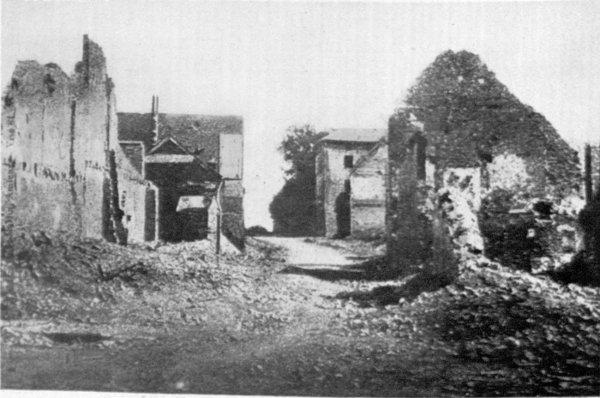
RUINS OF ALBERT.
Our Battalion being now out of the trenches the
Companies were divided among the small villages
around. My Company had the luck to be billeted in
Autuille, a small village on the Ancre. We were able
to get plenty of amusement there between rat hunting,
fishing and bathing. Captain E. and I spent several
afternoons trying for trout, and sent our finest specimen
to “B” Company with compliments. The Ancre at
Autuil was an excellent place for fishing, and this would
have been a pleasant occupation were it not for the fact
that snipers found us out in a short time. The bathing
place was hardly 600 yards from the German lines. On
May 7th the “Tyrones” had the honour of carrying out
the first raid made by the Division. The following is
contained in a special order of the day issued by Major
General O. S Nugent, D.S.O., Officer Commanding
Division. “A raid on the German trenches was
carried out at midnight on the 7th inst., by the 9th
Battalion Royal Inniskilling Fusiliers, the raiding party
consisting of Major W. J. Peacock, Captain J. Weir,
Lieut. W. S. Furness, Sec.-Lieut. L. W. H. Stevenson,
Sec.-Lieut. R. W. M‘Kinley, Sec.-Lieut. J. Taylor,
and 84 other ranks. The raid was completely successful
and was carried out exactly as planned. Six German
dug-outs, in which it is certain there were a considerable
number of men, were thoroughly bombed, and
a machine gun was blown up, while a lively bombing
fight took place between the blocking detachments of
the raiding party and the Germans. Having accomplished
the purpose of the raid the party was withdrawn
with the loss of one man killed and two wounded. The
raid was ably organised by Major Peacock, and was
carried out by the Officers and men in accordance with
plan, the discipline and determination of the party
being all that could be desired. The Divisional Commander
desires that his congratulations should be extended
to all who took part in it.”
Brigadier-General Hickman in a special Brigade Order
says—“The arrangements and plans reflect the greatest
credit on Colonel Ricardo, Major Peacock, and the
Officers concerned. The whole scheme was executed
with great dash and determination, with cool judgment
and nerve.”
The following awards were issued—Major Peacock
received the D.S.O., Sec.-Lieutenant Stevenson the
Military Cross, Sergeant Barker, D.C.M., and Lance-Corporal
D. Armour, M.M.
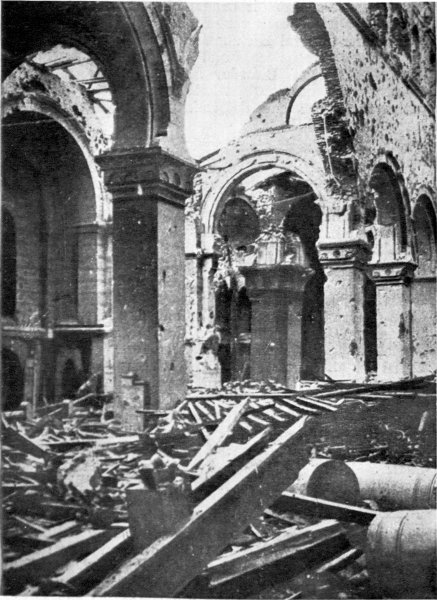
THE RUINS OF ALBERT CATHEDRAL.
At this time an important change took place in the
Command of the 11th Battalion Royal Inniskilling
Fusiliers. Lieutenant-Colonel W. F. Hessey was promoted
to Brigadier-General, and given Command of the
110th Infantry Brigade. His place was taken by Major
G. H. Brush, Second in Command of the 10th Battalion
(Derry Volunteers). The following farewell Order
was issued by Lieutenant-Colonel Hessey to his
Battalion. “Lieutenant-Colonel Hessey wishes God
Speed to all members of the 11th Inniskillings, and
thanks them for the loyal support they have given him
from the raising of the Battalion to this day. He
leaves the Battalion with very sincere regret, but with
feelings of great pride that he has had the privilege of
Commanding such a fine lot of Officers, N.C.O.’s and
men, and that their “esprit de corps” has made the
Battalion a worthy part of the 27th Inniskilling Regiment
of Foot.” During the following days we spent
alternate periods in and out of the trenches, with little
excitement to keep our spirits up. On May 16th we
again took over from the 13th Battalion Royal Irish
Rifles (Downs), and this time a spell of beautiful
weather favoured us and the trenches were quite dry
and habitable. We had the usual machine gun fire at
night, especially from the direction of Thiepval
Chateau, also a large number of shrapnel shells and
whizbangs fell in our Sector. The enemy was apparently
very busy during the night on his front line opposite
our Company. We could hear the sound of picking
and shovelling going on, and stakes being driven into
the ground. During 18th-19th the enemy gave us little
peace, between trench mortars, heavies, and whizbangs.
Several salvoes of shrapnel managed to do considerable
damage to our inspection trench and Whit Church
Street. During a heavy bombardment, while the shells
went over and round us at a tremendous rate I was
lying flat on my stomach to avoid some shrapnel that
burst near. I looked round to see if there were any
casualties among the men following, and noticed a head
emerging from the earth which had fallen in all round;
suddenly there was a splutter, the head moved, and a
very solemn voice said “Boys o’ boys it’s aboot time the
referee blew his whistle,” his thoughts must have been
far away on the Balmoral football ground, perhaps he
was thinking of a tough fight Malone v. Queen’s, in the
old days.
We were glad to notice that the German trenches
opposite suffered severely on the retaliation of our
artillery. The following nights were busy putting up
wire and sending out patrols. On one occasion a sentry
reported having seen an aeroplane fall in flames some
distance to the east of Thiepval, just before it fell three
planes had been observed very high in the air, and the
sound of machine-gun fire heard coming from them.
On the 20th there was considerable enemy machine
gun activity, and a very large number of flares were
sent up during the night from the German lines. At 9-30
p.m. two red flares were sent up apparently from the
German salient opposite “Mary Redan.” Immediately
afterwards two salvoes of shrapnel were fired, and
appeared to burst in the neighbourhood of “Mary
Redan,” while enemy search lights could be seen near
Serre.
During the 21st the enemy continued his constant
machine gun fire, and at night our wiring parties were
much hampered on this account, one being forced to
come in. At 10-30 p.m. on the 22nd, red rockets were
sent up from the German lines north of the river
Ancre. Immediately afterwards a heavy bombardment
by enemy artillery began, apparently on our lines
in front of Thiepval, which lasted about half-an-hour.
We had a more or less quiet day on the 23rd,
and on the 24th were relieved by the 13th Royal Irish
Rifles. “C” Company was sent to Autile, “B” to
South Antrim Villas, and the other two Companies to
Mesnil. We spent a pleasant few days in billets, the
usual rat hunts and bathing in the Ancre gave plenty of
amusement to the men. On May 31st we got our orders
to join “D” Company in Martinsart, and the following day
moved to Harponville via Bouzincourt and
Varrennes, where we rejoined our Brigade, and started
Divisional exercises on a large training ground known
as the Clairfaye trenches. These trenches had been
dug from aeroplane photographs, and were an exact
reproduction of the German trenches opposite Thiepval.
It was here that we heard the terrible news of the death
of Lord Kitchener, to whose genius we owed so much.
During our period of training the 107th Brigade held
the trenches at Thiepval.
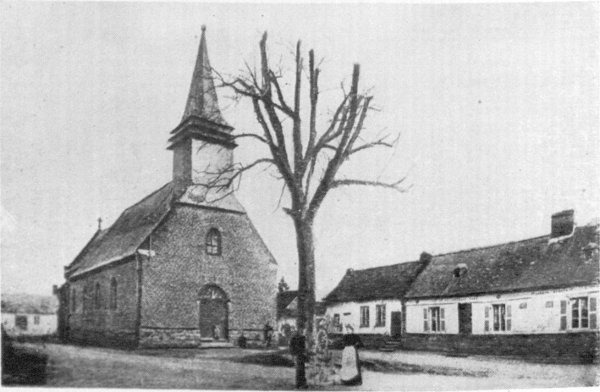
THIEPVAL VILLAGE
On June 15th, at 3 p.m., the Battalion marched off,
and with the 9th Royal Irish Fusiliers bivouacked in
Martinsart Wood. Martinsart village was already
occupied by numerous troops sent up in readiness for
the great battle of the Somme. We sent working
parties down to Thiepval wood to help in the digging
of assembly trenches. Our working party was very
unfortunate, and out of No. 11 platoon we had six
men wounded, Miller, Lyle, Brown, Galloway, Quinn,
and “B” Company also lost eleven men.
On 17th several new Officers joined the Battalion in
Martinsart Wood, among them Lieut. J. Marshall,
posted to “B” Company, afterwards proved to be the
only officer of the 11th Battalion who went over the top
on the 1st July without getting wounded. All was
bustle and excitement, we heard we were to hold the
line from Thiepval Wood to La Boiselle and Fricourt.
On 22nd the Tyrones went into the trenches. We
had a fine concert in “D” Company Mess, and I had a
last talk to the N.C.O.’s. On 23rd we paraded at 7-45
p.m. and marched to our trenches in Thiepval Wood.
Our Company Officers consisted of the following—myself,
in command, Captain Ewart, Lieutenants
Vance, Ellis, Young, Carson and Murphy. It was a
very hot march but a glorious day, and all of us were
in good heart. “C” and “D” Companies manned the
front line, with “A” and “B” behind, “C” holding
from Elgin Avenue to Garden Gate at the head of
Cromarty Avenue. “C” Company Headquarters
were in Thurso Street, and Battalion Headquarters in
Cromarty Avenue. On the 26th, at 2-30, we had
planned a gas attack, but there was not much wind,
and the gas did not go well. Young and myself happened
to be the next casualties, luckily both of us slight.
Young was gassed while on duty at a gas cylinder, and
I got a touch of shrapnel from a whiz bang. It meant
No. 29 C.C.S. for both of us, and very reluctantly we
had to leave our men just on the eve of the first and
greatest battle ever fought by the Division.