I know not how to set down properly
such a narrative as this, and, therefore,
should be excused for such mistakes as may
occur through ignorance and inexperience.
It is with the attack upon Georgetown
that I must end this portion of the adventures
which befell Percy and myself during
the time we served under General Marion,
and it may be the story should be continued
straight on without any heed whatsoever
to those who fought with us, although
in the same squad.
Whether it be right or wrong, I cannot
well neglect to speak of the part played
by that other party of twenty who volunteered
their lives as eagerly as did we who
followed Captain Melton, and what I write
concerning them must, of course, be from
hearsay.
Therefore it seems to me proper to tell
first the story of Colonel Horry's squad,
as I have heard it related again and again,
before attempting to set down that which
I know of my own knowledge.
When the forty volunteers were divided
into two squads there was no time lost, as
I have already said, in setting forward
upon that mission which we believed could
be fully accomplished only through the
sacrifice of us all, and we parted at the
limits of the temporary halting place,
Captain Melton leading his force to the
right, while Colonel Horry began the reconnoiter
by bearing to the left.
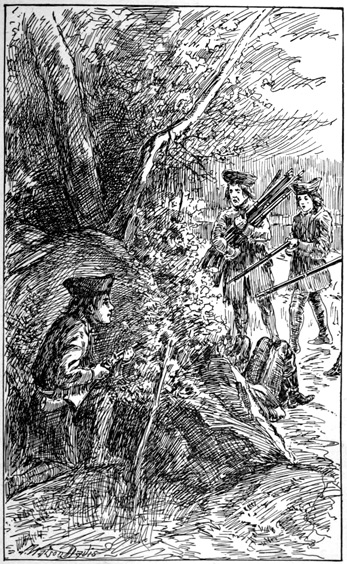
They continued on through the woods
until near to daybreak, when, as Colonel
Horry himself has said, and I am now
quoting from his official account, he "laid
an ambuscade, with my twenty men, near
the road. About sunrise a chair appeared
with two ladies escorted by two British
officers. I was ready in advance with an
officer to cut them off, but reflecting that
they might escape, and alarm the town,
which would prevent my taking greater
numbers, I desisted. The officers and chair
halted very near me, but soon the chair
went on, and the officers galloped into
the town. Our party continued in ambush
until 10 o'clock.
"Nothing appearing, and we having
eaten nothing for many hours, retired to
a plantation not far distant, where I knew
were to be found friends. As soon as I entered
the house four ladies appeared, two of
whom were Mrs. White and her daughter.
I was asked what I wanted. I answered,
food, refreshment. The other two ladies
were those whom I had seen escorted by
the British officers.
"The strange ladies seemed greatly
agitated, and begged most earnestly that
I would go away. I kept my eye on Mrs.
White, and saw she had a smiling countenance,
but said nothing. Soon she left the
room, and I left it also and went into the
piazza, laid my cap, sword and pistols on
the long bench, and walked the piazza;
when I discovered Mrs. White behind the
house chimney beckoning me.
"I got to her undiscovered by the young
ladies, when she said: 'Colonel Horry, be
on your guard; these two young ladies are
just from Georgetown; they are much
frightened, and I believe the British are
leaving it and may soon attack you. As
to provisions, I have plenty in yonder
barn, but you must affect to take them by
force.'
"I begged her to say no more, for I was
well acquainted with all such matters.
We both secretly returned, she to the room
where the young ladies were, and I to the
piazza I had just left."
The colonel had no more than gained
this point, when the sentinels gave an
alarm.
Two musket-shots told him that an
enemy was near at hand, and almost immediately
afterward the firing became so
rapid that he knew an encounter was already
begun.
That brave officer thought only of his
men, and so nearly were the interests of
the squad allied, that he forgot all else save
the desire to be with them in the time of
danger.
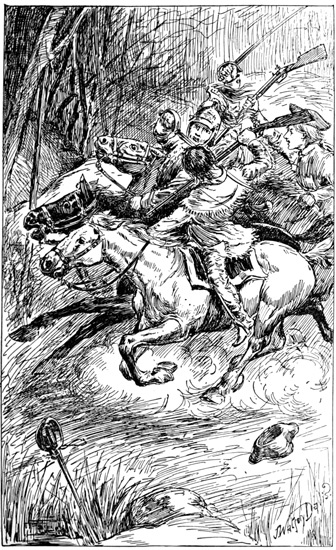
He rushed into the fight, forgetting to
take with him even his saber—intent only
on being with those who had so well proven
their devotion to the Cause.
The British were seventeen in number,
well armed, and commanded by a brave
fellow named Merritt; but they were taken
by surprise.
The redcoats retreated, but turned in
their flight to strike a blow, and our men,
believing they had been ordered on even to
death, pursued with fatal earnestness.
Of the enemy's force only two men escaped
death or capture, and one of these
was the captain, of whom Colonel Horry
writes:
"My men in succession came up with
Captain Merritt, who was in the rear of his
party, urging them forward. They engaged
him. He was a brave fellow. Baxter,
with pistols, fired at his breast, and
missing him, retired; Postell and Greene,
with swords, engaged him; both were
beaten off. Greene nearly lost his head.
His buckskin breeches were cut through
several inches. I almost blush to say that
this one British officer beat off three Americans.
Merritt escaped to a neighboring
swamp, from whence, at midnight, he got
to Georgetown."
I would it were possible for me to give
as brief an account, with as satisfactory
an ending, regarding our portion of the
reconnoiter.
As has been said, after crossing White's
Bridge the two squads separated, Colonel
Horry's going toward the left and ours to
the right.
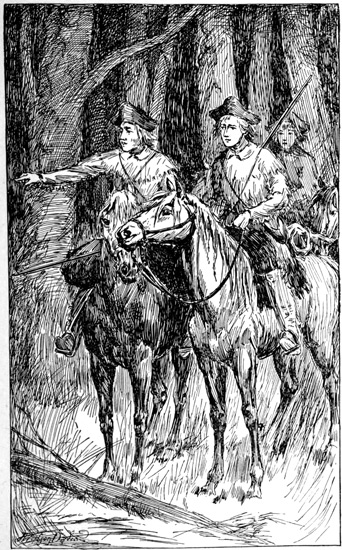
Then it was, as we rode on slowly,
mentally nerved for anything which might
happen and fully expecting sharp and
bloody work at any instant, that Gabriel
Marion said, looking first at Percy and
then at me:
"Perhaps it will never again be our good
fortune, comrades, to have such an opportunity
of proving our metal as has
come to us this night. Now I am in nowise
eager for death; but to my mind
there is little fear that the end be near at
hand. Although the odds are so strongly
against us, we shall take this post of
Georgetown, and I believe it because my
uncle, the major, is a careful, prudent soldier,
never taking upon himself chances
that are utterly without hope, although
many times the fact may have seemed to
be the reverse. We shall capture Georgetown,
comrades, and if either of us fails to
come out alive, we have the proud satisfaction
of knowing that whatsoever befalls
the Cause our names must live among
those who volunteered everything for
freedom."
"I hold to it that this is not the time
for such speeches," Gavin Witherspoon
said nervously; and had I not known him
to be a man of tried courage I should have
said that at that moment he was afraid.
"These forty men who came forward so
gallantly understood full well in what
kind of an adventure they were engaged.
It does not prove that his courage is the
greatest who speaks overly much regarding
the future."
"Meaning by such speech, that I had
best hold my tongue," Gabriel said with a
laugh. "Perhaps you may be right, and
yet there is upon me the inclination to
speak of what we have ventured, in order
that I may be the better able to appreciate
life after it has been offered as a sacrifice
and refused."
"I guarantee that once we are come out
from this expedition, you will need no
thought of the past to make you understand
that we rode down the very shadow
of death, when we crossed yonder bridge,
and this I say, not because there is in my
mind any foreknowledge of the future,
but from what I know regarding the
enemy. I realize, without being told, that
ours is as desperate an undertaking as
men can well imagine."
"I am thinking that your words, Gavin
Witherspoon, are as ill-timed as were
Gabriel's, for while he spoke of what might
be our reward, you are weighing, as it
were, the chances against us, and to my
mind it is not pleasant," Percy said with
an attempt at cheerfulness which I knew
full well was forced, and, stepping nearer
to the lad, I grasped his hand, an act
which, perhaps, gave him as much encouragement
as was in my mind to impart.
Gabriel continued to speak of the future,
as if he had no part in the present, until
word came that each man must hold himself
silent because we were come so near
the town that there was good reason for
believing the enemy's sentinels might be
close at hand.
We straggled on, each as he pleased, although
there was some little show of military
formation. Captain Melton was allowed
to remain in the lead as he had
stipulated, but we four comrades took
good care not to fall back more than two
or three paces, for we were minded to
bear the brunt of the first encounter.
I had never before known what it was
to advance against an enemy on foot, and
the fact of being without a horse gave me
a certain sense of uneasiness.
So far as we of these two advanced
squads were concerned, there could be no
sudden dash; no spurring forward into
the very midst of the enemy. We must
fight our way forward slowly, and, as it
seemed to me, at a disadvantage.
However, it is true that my courage did
not fail me, although my hand trembled
with excitement, and my mouth was
parched and dry as if I had been many
hours without water.
Gabriel had just thrown his arm over my
shoulder, to show the affection which was
in his heart for us all, when the thud of
horses' hoofs directly in the front told that
the enemy were on the alert.
Instantly we were halted, every man in
a posture of defense, and I venture to say
that there was not one among us who did
not wish he was in the saddle.
"Hold steady, boys!" Captain Melton
whispered. "Yonder comes the patrol,
and it may be they will turn before coming
as far as this; but if not, we have our
work cut out for us. The enemy must not
pass this point lest our friends in the rear
be discovered!"
Involuntarily we four had crouched
upon our knees in such position that we
could use the muskets to good advantage,
and thus we remained in the front line
while the horsemen galloped nearer and
nearer until they were absolutely upon us.
"Fire!" our commander shouted, and
from that little squad of crouching figures
a line of fire flashed forth into the very
nostrils of the animals, causing them to
rear and plunge madly, thus diverting our
bullets from their targets.
Three saddles were emptied when a full
twenty would have been the result of the
volley had we fired one minute before, and
then every man among us began to reload
his weapon with feverish haste, for but
few seconds could elapse before the Britishers
would charge.
"This is what may be called a real battle!"
Gabriel cried exultantly; but no
one replied.
Death for many of us was close at hand,
and at such a time words do not come
readily.
I was ramming home the bullet in my
musket when the horsemen again dashed
upon us from out the darkness; there
came a roar as if a thousand guns had
been discharged at the same instant, and
all before me seemed to be a sheet of
flame.
Of what followed during the next five
or ten minutes I have no clear idea.
Before me reared and plunged the
British horses, while here, there and everywhere
I heard cries of rage or groans of
mortal agony until it was all a hideous,
whirling, dancing picture in which I could
distinguish only the outlines of my comrades,
who held their places bravely.
Side by side we fought against the redcoats,
ignorant of the fact that we were
alone, and then came the moment when
all our muskets were emptied at the same
instant.
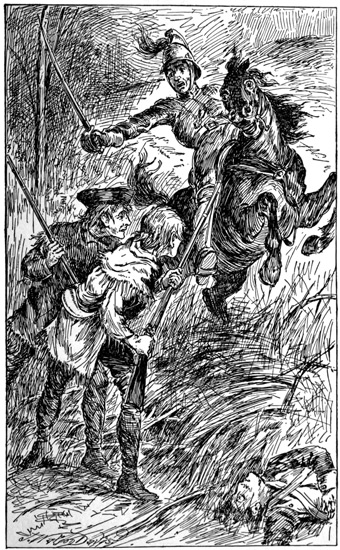
The horsemen surrounded us; our weapons
were of little service against the sabers
of the enemy, and we understood it, although
there was no thought of surrender
in my mind until Gavin Witherspoon
seized me by the arm, shouting in my
ear:
"Surrender, lad, surrender! There is
neither honor nor glory in dying when our
lives are of no avail for the Cause!"
Even as he spoke three of the redcoats
had clutched Gabriel and Percy.
I allowed my musket, which had been
raised as a club, to drop, and immediately
I felt, for the first time, the grasp of a
Britisher.
We were prisoners. The glory of fighting
to the bitter end with the knowledge
that in so doing we were opening the way
for those in the rear, was denied us, and
but for the shame of it I could have wept
like a girl.
And yet all this was as nothing compared
with what followed.
The troopers were about to disarm us,
and some one had fired a torch that we
might be the better seen, when Sam
Lee—that miserable Tory and renegade—came
up from the rear, where most likely
he had been skulking during the fighting,
and, seeing us, set up a shout of
triumph.
"Now have I got you rebels where
I've been burning to see you?" he cried.
"Is that Sam Lee?" Gabriel shouted,
struggling to release himself from his captor's
grasp.
"Ay, and it is the cur who has sold his
country, his kinsmen and himself for the
king's gold!" Percy replied. "There is no
dishonor in being overpowered by true soldiers
in a fair fight; but to have such as
that villain alive before one's eyes is a disgrace."
"It shall be worse than that to you!"
Sam shrieked, "and as for that nephew of
the rebel Marion, I—"
"What are you saying?" one of the
troopers asked, seizing Sam Lee and shaking
him as if to force the reply more
quickly. "Is one of these a nephew to the
Swamp Fox?"
"Ay, that he is!" Gabriel made answer,
stepping forward as far as the hand of
the captor would permit. "I am the
nephew of General Marion, and proud indeed
of the kinship!"
I was looking at the dear lad that instant,
having turned my eyes from the
scurvy Tory when Gabriel began to speak,
otherwise, perhaps, I might have prevented
that terrible thing which followed.
While the remainder of the party were
looking at the brave lad who stood before
them in the glare of the torches, Sam Lee,
doubled-dyed villain that he was, rushed
upon him with a saber which he had
seized from the hand of the trooper.
In the flickering light I saw the gleam
of the steel, and before a word of warning
could escape my lips, the cruel weapon
descended, striking Gabriel full upon the
head, sheering its way downward until the
dear lad sank a lifeless mass at the feet of
that cur who was not worthy to so much
as kneel before him.
On the instant it was as if my eyes were
blinded by the crimson flood that followed
the stroke of the blade. There was a sensation
as if all my blood was boiling, and,
for the time being, reason left me.
Gavin Witherspoon declares that I
wrenched myself free from the trooper who
held me, as if the Britisher had been no
more than a babe, that at the same instant
I leaped upon the Tory murderer, bearing
him to the earth till his face was sunk deep
in the blood-stained moss, and with the
same weapon which had let out the life of
the most gallant lad who ever lived, I
killed him.
It was done so quickly, Gavin declares,
that the redcoats had no time to interfere
before the work was accomplished, and
while they, horror-stricken as it were by
that which was not warfare in any sense
of the word, stood before us three—two
dead and one senseless, the remainder of
our squad fell upon them.
This last attack was successful; the
Britishers were beaten off, and our brave
fellows carried Gabriel's dear body, and
myself, back to the rear.
The attempt to capture Georgetown was
a failure, now that the enemy had been
warned, and our brigade beat a hasty
retreat.
Of all that I know nothing; it was many
days before my senses returned, and then
we were encamped on Snow's Island.
It is best that I add to my story what
has been written by one who is a master
hand at wielding a pen, while I am only a
novice, and that I bring this portion of
the adventures which befell Percy Sumter
and myself to an end, with the promise to
write out at some later day what we two
did when the work of the patriots was
finally crowned with success.
"The murder of Gabriel Marion, with
some other instances of brutality and
butchery on the part of the Tories, happening
about this time, gave a more savage
character than ever to the warfare which
ensued. Motives of private anger and personal
revenge embittered and increased the
usual ferocities of civil war; and hundreds
of dreadful and desperate tragedies
caused the inhabitants to pursue each
other rather like wild beasts than like
men.
"In the Cheraw district, on the Pedee,
above the line where Marion commanded,
the warfare was one of utter extermination.
The revolutionary struggle in
Carolina was of a sort unknown in any
other part of the Union.
"The attempt upon Georgetown was defeated.
The British had taken the alarm,
and were now in strength, and in a state
of vigilance and activity which precluded
the possibility of surprise. Marion's
wishes, therefore, with regard to this place,
were deferred accordingly to a more auspicious
season.
"He retired to Snow's Island, where he
made his camp. It was peculiarly eligible
for his purposes, furnishing a secure retreat,
a depot for his arms, ammunition,
prisoners and invalids—difficult of access,
easily guarded, and contiguous to the
scenes of his most active operations.
"Snow's Island lies at the confluence of
Lynch's Creek and the Pedee. On the east
flows the latter river; on the west, Clark's
Creek, issuing from Lynch's and a stream
navigable for small vessels; on the north
lies Lynch's Creek, wide and deep, but
nearly choked by rafts of logs and refuse
timber. The island, high river swamp,
was spacious, and, like all the Pedee river
swamp of that day, abounded in live stock
and provision. Thick woods covered the
elevated tracts, dense cane-brakes the
lower, and here and there the eye rested
upon a cultivated spot, in maize, which the
invalids and convalescents were wont to
tend.
"Here Marion made his fortress. Having
secured all the boats of the neighborhood,
he chose such as he needed, and
destroyed the rest. Where the natural
defenses of the island seemed to require
aid from art, he bestowed it; and, by cutting
away bridges and obstructing the
ordinary pathways with timber, he contrived
to insulate, as much as possible, the
country under his command.
"From this fortress his scouting parties
were sent forth nightly in all directions.
Enemies were always easy to be found.
The British maintained minor posts at
Nelson's Ferry and Scott's Lake, as well as
Georgetown; and the Tories on Lynch's
Creek and Little Pedee were much more
numerous, if less skilfully conducted, than
the men of Marion.
"Marion's encampment implied no repose,
no forbearance of the active business
of war. Very far from it. He was never
more dangerous to an enemy than when
he seemed quiet in camp.
"His camp, indeed, was frequently a
lure, by which to tempt the Tories into unseasonable
exposure. The post at Snow's
Island gave him particular facilities for
this species of warfare. He had but to
cross a river, and a three hours' march enabled
him to forage in an enemy's country.
"Reinforcements came to him daily, and
it was only now, for the first time, that his
command began to assume the appearance,
and exhibit the force of a brigade."
A. L. BURT'S PUBLICATIONS
For Young People
BY POPULAR WRITERS.
52-58 Duane Street, New York.
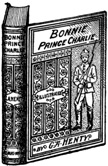
Bonnie Prince Charlie: A Tale of Fontenoy and Culloden. By
G. A. Henty. With 12 full-page Illustrations by Gordon
Browne. 12mo, cloth, price $1.00.
The adventures of the son of a Scotch officer in French service.
The boy, brought up by a Glasgow bailie, is arrested for aiding a
Jacobite agent, escapes, is wrecked on the French coast, reaches
Paris, and serves with the French army at Dettingen. He kills
his father's foe in a duel, and escaping to the coast, shares the
adventures of Prince Charlie, but finally settles happily in Scotland.
"Ronald, the hero, is very like the hero of 'Quentin Durward.' The lad's
journey across France, and his hairbreadth escapes, make up as good a narrative
of the kind as we have ever read. For freshness of treatment and
variety of incident Mr. Henty has surpassed himself."—Spectator.
With Clive in India; or, the Beginnings of an Empire. By
G. A. Henty. With 12 full-page Illustrations by Gordon
Browne. 12mo, cloth, price $1.00.
The period between the landing of Clive as a young writer in
India and the close of his career was critical and eventful in the
extreme. At its commencement the English were traders existing
on sufferance of the native princes. At its close they were masters
of Bengal and of the greater part of Southern India. The author
has given a full and accurate account of the events of that stirring
time, and battles and sieges follow each other in rapid succession,
while he combines with his narrative a tale of daring and adventure,
which gives a lifelike interest to the volume.
"He has taken a period of Indian history of the most vital importance,
and he has embroidered on the historical facts a story which of itself is deeply
interesting. Young people assuredly will be delighted with the volume."—Scotsman.
The Lion of the North: A Tale of Gustavus Adolphus and the
Wars of Religion. By G. A. Henty. With full-page Illustrations
by John Schönberg. 12mo, cloth, price $1.00.
In this story Mr. Henty gives the history of the first part of the
Thirty Years' War. The issue had its importance, which has extended
to the present day, as it established religious freedom
in Germany. The army of the chivalrous king of Sweden was
largely composed of Scotchmen, and among these was the hero of
the story.
"The tale is a clever and instructive piece of history, and as boys may be
trusted to read it conscientiously, they can hardly fail to be profited."—Times.
The Dragon and the Raven; or, The Days of King Alfred. By
G. A. Henty. With full-page Illustrations by C. J. Staniland,
R.I. 12mo, cloth, price $1.00.
In this story the author gives an account of the fierce struggle
between Saxon and Dane for supremacy in England, and presents
a vivid picture of the misery and ruin to which the country was
reduced by the ravages of the sea-wolves. The hero, a young
Saxon thane, takes part in all the battles fought by King Alfred.
He is driven from his home, takes to the sea and resists the Danes
on their own element, and being pursued by them up the Seine,
is present at the long and desperate siege of Paris.
"Treated in a manner most attractive to the boyish reader."—Athenæum.
The Young Carthaginian: A Story of the Times of Hannibal.
By G. A. Henty. With full-page Illustrations by C. J. Staniland,
R.I. 12mo, cloth, price $1.00.
Boys reading the history of the Punic Wars have seldom a keen
appreciation of the merits of the contest. That it was at first a
struggle for empire, and afterward for existence on the part of
Carthage, that Hannibal was a great and skillful general, that he
defeated the Romans at Trebia, Lake Trasimenus, and Cannæ,
and all but took Rome, represents pretty nearly the sum total of
their knowledge. To let them know more about this momentous
struggle for the empire of the world Mr. Henty has written this
story, which not only gives in graphic style a brilliant description
of a most interesting period of history, but is a tale of exciting
adventure sure to secure the interest of the reader.
"Well constructed and vividly told. From first to last nothing stays the
interest of the narrative. It bears us along as on a stream whose current
varies in direction, but never loses its force."—Saturday Review.
In Freedom's Cause: A Story of Wallace and Bruce. By G. A.
Henty. With full-page Illustrations by Gordon Browne.
12mo, cloth, price $1.00.
In this story the author relates the stirring tale of the Scottish
War of Independence. The extraordinary valor and personal
prowess of Wallace and Bruce rival the deeds of the mythical
heroes of chivalry, and indeed at one time Wallace was ranked
with these legendary personages. The researches of modern
historians have shown, however, that he was a living, breathing
man—and a valiant champion. The hero of the tale fought under
both Wallace and Bruce, and while the strictest historical accuracy
has been maintained with respect to public events, the work is
full of "hairbreadth 'scapes" and wild adventure.
"It is written in the author's best style. Full of the wildest and most remarkable
achievements, it is a tale of great interest, which a boy, once he has
begun it, will not willingly put on one side."—The Schoolmaster.
With Lee in Virginia: A Story of the American Civil War. By
G. A. Henty. With full-page Illustrations by Gordon
Browne. 12mo, cloth, price $1.00.
The story of a young Virginian planter, who, after bravely
proving his sympathy with the slaves of brutal masters, serves
with no less courage and enthusiasm under Lee and Jackson
through the most exciting events of the struggle. He has many
hairbreadth escapes, is several times wounded and twice taken
prisoner; but his courage and readiness and, in two cases, the
devotion of a black servant and of a runaway slave whom he had
assisted, bring him safely through all difficulties.
"One of the best stories for lads which Mr. Henty has yet written. The
picture is full of life and color, and the stirring and romantic incidents are
skillfully blended with the personal interest and charm of the story."—Standard.
By England's Aid; or, The Freeing of the Netherlands (1585-1604).
By G. A. Henty. With full-page Illustrations by
Alfred Pearse, and Maps. 12mo, cloth, price $1.00.
The story of two English lads who go to Holland as pages in
the service of one of "the fighting Veres." After many adventures
by sea and land, one of the lads finds himself on board a
Spanish ship at the time of the defeat of the Armada, and escapes
only to fall into the hands of the Corsairs. He is successful in
getting back to Spain under the protection of a wealthy merchant,
and regains his native country after the capture of Cadiz.
"It is an admirable book for youngsters. It overflows with stirring incident
and exciting adventure, and the color of the era and of the scene are
finely reproduced. The illustrations add to its attractiveness."—Boston
Gazette.
By Right of Conquest; or, With Cortez in Mexico. By G. A.
Henty. With full page Illustrations by W. S. Stacey, and
Two Maps. 12mo, cloth, price $1.50.
The conquest of Mexico by a small band of resolute men under
the magnificent leadership of Cortez is always rightly ranked
among the most romantic and daring exploits in history. With
this as the groundwork of his story Mr. Henty has interwoven the
adventures of an English youth, Roger Hawkshaw, the sole survivor
of the good ship Swan, which had sailed from a Devon port
to challenge the mercantile supremacy of the Spaniards in the
New World. He is beset by many perils among the natives, but
is saved by his own judgment and strength, and by the devotion
of an Aztec princess. At last by a ruse he obtains the protection
of the Spaniards, and after the fall of Mexico he succeeds in regaining
his native shore, with a fortune and a charming Aztec
bride.
"'By Right of Conquest' is the nearest approach to a perfectly successful
historical tale that Mr. Henty has yet published."—Academy.
In the Reign of Terror: The Adventures of a Westminster Boy.
By G. A. Henty. With full-page Illustrations by J. Schönberg.
12mo, cloth, price $1.00.
Harry Sandwith, a Westminster boy, becomes a resident at the
chateau of a French marquis, and after various adventures accompanies
the family to Paris at the crisis of the Revolution. Imprisonment
and death reduce their number, and the hero finds
himself beset by perils with the three young daughters of the
house in his charge. After hairbreadth escapes they reach Nantes.
There the girls are condemned to death in the coffin-ships,
but are saved by the unfailing courage of their boy protector.
"Harry Sandwith, the Westminster boy, may fairly be said to beat Mr.
Henty's record. His adventures will delight boys by the audacity and peril
they depict.... The story is one of Mr. Henty's best."—Saturday
Review.
With Wolfe in Canada; or, The Winning of a Continent. By
G. A. Henty. With full-page Illustrations by Gordon
Browne. 12mo, cloth, price $1.00.
In the present volume Mr. Henty gives an account of the struggle
between Britain and France for supremacy in the North
American continent. On the issue of this war depended not only
the destinies of North America, but to a large extent those of the
mother countries themselves. The fall of Quebec decided that
the Anglo-Saxon race should predominate in the New World;
that Britain, and not France, should take the lead among the
nations of Europe; and that English and American commerce, the
English language, and English literature, should spread right
round the globe.
"It is not only a lesson in history as instructively as it is graphically told,
but also a deeply interesting and often thrilling tale of adventure and peril by
flood and field."—Illustrated London News.
True to the Old Flag: A Tale of the American War of Independence.
By G. A. Henty. With full-page Illustrations by
Gordon Browne. 12mo, cloth, price $1.00.
In this story the author has gone to the accounts of officers who
took part in the conflict, and lads will find that in no war in which
American and British soldiers have been engaged did they behave
with greater courage and good conduct. The historical portion of
the book being accompanied with numerous thrilling adventures
with the redskins on the shores of Lake Huron, a story of exciting
interest is interwoven with the general narrative and carried
through the book.
"Does justice to the pluck and determination of the British soldiers during
the unfortunate struggle against American emancipation. The son of an
American loyalist, who remains true to our flag, falls among the hostile redskins
in that very Huron country which has been endeared to us by the exploits
of Hawkeye and Chingachgook."—The Times.
The Lion of St. Mark: A Tale of Venice in the Fourteenth
Century. By G. A. Henty. With full-page Illustrations by
Gordon Browne. 12mo, cloth, price $1.00.
A story of Venice at a period when her strength and splendor
were put to the severest tests. The hero displays a fine sense and
manliness which carry him safely through an atmosphere of intrigue,
crime, and bloodshed. He contributes largely to the victories
of the Venetians at Porto d'Anzo and Chioggia, and finally
wins the hand of the daughter of one of the chief men of Venice.
"Every boy should read 'The Lion of St. Mark.' Mr. Henry has never produced
a story more delightful, more wholesome, or more vivacious."—Saturday
Review.
A Final Reckoning: A Tale of Bush Life in Australia. By G. A.
Henty. With full-page Illustrations by W. B. Wollen.
12mo, cloth, price $1.00.
The hero, a young English lad, after rather a stormy boyhood
emigrates to Australia, and gets employment as an officer in the
mounted police. A few years of active work on the frontier,
where he has many a brush with both natives and bushrangers,
gain him promotion to a captaincy, and he eventually settles
down to the peaceful life of a squatter.
"Mr. Henty has never published a more readable, a more carefully constructed,
or a better written story than this."—Spectator.
Under Drake's Flag: A Tale of the Spanish Main. By G. A.
Henty. With full-page Illustrations by Gordon Browne.
12mo, cloth, price $1.00.
A story of the days when England and Spain struggled for the
supremacy of the sea. The heroes sail as lads with Drake in the
Pacific expedition, and in his great voyage of circumnavigation.
The historical portion of the story is absolutely to be relied upon,
but this will perhaps be less attractive than the great variety of
exciting adventure through which the young heroes pass in the
course of their voyages.
"A book of adventure, where the hero meets with experience enough, one
would think, to turn his hair gray."—Harper's Monthly Magazine.
By Sheer Pluck: A Tale of the Ashanti War. By G. A. Henty.
With full-page Illustrations by Gordon Browne. 12mo,
cloth, price $1.00.
The author has woven, in a tale of thrilling interest, all the details
of the Ashanti campaign, of which he was himself a witness.
His hero, after many exciting adventures in the interior, is detained
a prisoner by the king just before the outbreak of the war,
but escapes, and accompanies the English expedition on their
march to Coomassie.
"Mr. Henty keeps up his reputation as a writer of boys' stories. 'By Sheer
Pluck' will be eagerly read."—Athenæum.
By Pike and Dyke: A Tale of the Rise of the Dutch Republic.
By G. A. Henty. With full-page Illustrations by Maynard
Brown, and 4 Maps. 12mo, cloth, price $1.00.
In this story Mr. Henty traces the adventures and brave deeds
of an English boy in the household of the ablest man of his age—William
the Silent. Edward Martin, the son of an English sea-captain,
enters the service of the Prince as a volunteer, and is employed
by him in many dangerous and responsible missions, in the
discharge of which he passes through the great sieges of the time.
He ultimately settles down as Sir Edward Martin.
"Boys with a turn for historical research will be enchanted with the book,
while the rest who only care for adventure will be students in spite of themselves."—St.
James' Gazette.
St. George for England: A Tale of Cressy and Poitiers. By
G. A. Henty. With full-page Illustrations by Gordon
Browne. 12mo, cloth, price $1.00.
No portion of English history is more crowded with great events
than that of the reign of Edward III. Cressy and Poitiers; the
destruction of the Spanish fleet; the plague of the Black Death;
the Jacquerie rising; these are treated by the author in "St.
George for England." The hero of the story, although of good
family, begins life as a London apprentice, but after countless adventures
and perils becomes by valor and good conduct the squire,
and at last the trusted friend of the Black Prince.
"Mr. Henty has developed for himself a type of historical novel for boys
which bids fair to supplement, on their behalf, the historical labors of Sir
Walter Scott in the land of fiction."—The Standard.
Captain's Kidd's Gold: The True Story of an Adventurous Sailor
Boy. By James Franklin Fitts. 12mo, cloth, price $1.00.
There is something fascinating to the average youth in the very
idea of buried treasure. A vision arises before his eyes of swarthy
Portuguese and Spanish rascals, with black beards and gleaming
eyes—sinister-looking fellows who once on a time haunted the
Spanish Main, sneaking out from some hidden creek in their long,
low schooner, of picaroonish rake and sheer, to attack an unsuspecting
trading craft. There were many famous sea rovers in
their day, but none more celebrated than Capt. Kidd. Perhaps
the most fascinating tale of all is Mr. Fitts' true story of an adventurous
American boy, who receives from his dying father an
ancient bit of vellum, which the latter obtained in a curious way.
The document bears obscure directions purporting to locate a certain
island in the Bahama group, and a considerable treasure
buried there by two of Kidd's crew. The hero of this book,
Paul Jones Garry, is an ambitious, persevering lad, of salt-water
New England ancestry, and his efforts to reach the island and
secure the money form one of the most absorbing tales for our
youth that has come from the press.
Captain Bayley's Heir: A Tale of the Gold Fields of California.
By G. A. Henty. With full-page Illustrations by H. M.
Paget. 12mo, cloth, price $1.00.
A frank, manly lad and his cousin are rivals in the heirship of a
considerable property. The former falls into a trap laid by the
latter, and while under a false accusation of theft foolishly leaves
England for America. He works his passage before the mast,
joins a small band of hunters, crosses a tract of country infested
with Indians to the Californian gold diggings, and is successful
both as digger and trader.
"Mr. Henty is careful to mingle instruction with entertainment; and the
humorous touches, especially in the sketch of John Holl, the Westminster
dustman, Dickens himself could hardly have excelled."—Christian Leader.
For Name and Fame; or, Through Afghan Passes. By G. A.
Henty. With full-page Illustrations by Gordon Browne.
12mo, cloth, price $1.00.
An interesting story of the last war in Afghanistan. The hero,
after being wrecked and going through many stirring adventures
among the Malays, finds his way to Calcutta and enlists in a regiment
proceeding to join the army at the Afghan passes. He accompanies
the force under General Roberts to the Peiwar Kotal,
is wounded, taken prisoner, carried to Cabul, whence he is transferred
to Candahar, and takes part in the final defeat of the army
of Ayoub Khan.
"The best feature of the book—apart from the interest of its scenes of adventure—is
its honest effort to do justice to the patriotism of the Afghan
people."—Daily News.
Captured by Apes: The Wonderful Adventures of a Young
Animal Trainer. By Harry Prentice. 12mo, cloth, $1.00.
The scene of this tale is laid on an island in the Malay Archipelago.
Philip Garland, a young animal collector and trainer, of
New York, sets sail for Eastern seas in quest of a new stock of
living curiosities. The vessel is wrecked off the coast of Borneo
and young Garland, the sole survivor of the disaster, is cast ashore
on a small island, and captured by the apes that overrun the
place. The lad discovers that the ruling spirit of the monkey
tribe is a gigantic and vicious baboon, whom he identifies as
Goliah, an animal at one time in his possession and with whose
instruction he had been especially diligent. The brute recognizes
him, and with a kind of malignant satisfaction puts his former
master through the same course of training he had himself experienced
with a faithfulness of detail which shows how astonishing
is monkey recollection. Very novel indeed is the way by
which the young man escapes death. Mr. Prentice has certainly
worked a new vein on juvenile fiction, and the ability with which
he handles a difficult subject stamps him as a writer of undoubted
skill.
The Bravest of the Brave; or, With Peterborough in Spain.
By G. A. Henty. With full-page Illustrations by H. M.
Paget. 12mo, cloth, price $1.00.
There are few great leaders whose lives and actions have so
completely fallen into oblivion as those of the Earl of Peterborough.
This is largely due to the fact that they were overshadowed
by the glory and successes of Marlborough. His career
as general extended over little more than a year, and yet, in that
time, he showed a genius for warfare which has never been surpassed.
"Mr. Henty never loses sight of the moral purpose of his work—to enforce
the doctrine of courage and truth. Lads will read 'The Bravest of the Brave'
with pleasure and profit; of that we are quite sure."—Daily Telegraph.
The Cat of Bubastes: A Story of Ancient Egypt. By G. A.
Henty. With full page Illustrations. 12mo, cloth, price $1.00.
A story which will give young readers an unsurpassed insight
into the customs of the Egyptian people. Amuba, a prince of the
Rebu nation, is carried with his charioteer Jethro into slavery.
They become inmates of the house of Ameres, the Egyptian high-priest,
and are happy in his service until the priest's son accidentally
kills the sacred cat of Bubastes. In an outburst of popular
fury Ameres is killed, and it rests with Jethro and Amuba to
secure the escape of the high-priest's son and daughter.
"The story, from the critical moment of the killing of the sacred cat to the
perilous exodus into Asia with which it closes, is very skillfully constructed
and full of exciting adventures. It is admirably illustrated."—Saturday
Review.
With Washington at Monmouth: A Story of Three Philadelphia
Boys. By James Otis. 12mo, cloth, price $1.00.
Three Philadelphia boys, Seth Graydon "whose mother conducted
a boarding-house which was patronized by the British
officers;" Enoch Ball, "son of that Mrs. Ball whose dancing
school was situated on Letitia Street," and little Jacob, son of
"Chris, the Baker," serve as the principal characters. The
story is laid during the winter when Lord Howe held possession
of the city, and the lads aid the cause by assisting the American
spies who make regular and frequent visits from Valley Forge.
One reads here of home-life in the captive city when bread was
scarce among the people of the lower classes, and a reckless prodigality
shown by the British officers, who passed the winter in
feasting and merry-making while the members of the patriot army
but a few miles away were suffering from both cold and hunger.
The story abounds with pictures of Colonial life skillfully
drawn, and the glimpses of Washington's soldiers which are given
show that the work has not been hastily done, or without considerable
study.
For the Temple: A Tale of the Fall of Jerusalem. By G. A.
Henty. With full-page Illustrations by S. J. Solomon. 12mo,
cloth, price $1.00.
Mr. Henty here weaves into the record of Josephus an admirable
and attractive story. The troubles in the district of Tiberias, the
march of the legions, the sieges of Jotapata, of Gamala, and of
Jerusalem, form the impressive and carefully studied historic
setting to the figure of the lad who passes from the vineyard to
the service of Josephus, becomes the leader of a guerrilla band of
patriots, fights bravely for the Temple, and after a brief term of
slavery at Alexandria, returns to his Galilean home with the favor
of Titus.
"Mr. Henty's graphic prose pictures of the hopeless Jewish resistance to
Roman sway add another leaf to his record of the famous wars of the world."—Graphic.
Facing Death; or, The Hero of the Vaughan Pit. A Tale of
the Coal Mines. By G. A. Henty. With full-page Illustrations
by Gordon Browne. 12mo, cloth, price $1.00.
"Facing Death" is a story with a purpose. It is intended to
show that a lad who makes up his mind firmly and resolutely that
he will rise in life, and who is prepared to face toil and ridicule
and hardship to carry out his determination, is sure to succeed.
The hero of the story is a typical British boy, dogged, earnest,
generous, and though "shamefaced" to a degree, is ready to face
death in the discharge of duty.
"The tale is well written and well illustrated, and there is much reality in
the characters. If any father, clergyman, or schoolmaster is on the lookout
for a good book to give as a present to a boy who is worth his salt, this is the
book we would recommend."—Standard.
Tom Temple's Career. By Horatio Alger. 12mo, cloth,
price $1.00.
Tom Temple, a bright, self-reliant lad, by the death of his
father becomes a boarder at the home of Nathan Middleton, a
penurious insurance agent. Though well paid for keeping the
boy, Nathan and his wife endeavor to bring Master Tom in line
with their parsimonious habits. The lad ingeniously evades their
efforts and revolutionizes the household. As Tom is heir to
$40,000, he is regarded as a person of some importance until by
an unfortunate combination of circumstances his fortune shrinks
to a few hundreds. He leaves Plympton village to seek work in
New York, whence he undertakes an important mission to California,
around which center the most exciting incidents of his
young career. Some of his adventures in the far west are so
startling that the reader will scarcely close the book until the last
page shall have been reached. The tale is written in Mr. Alger's
most fascinating style, and is bound to please the very large class
of boys who regard this popular author as a prime favorite.
Maori and Settler: A Story of the New Zealand War. By
G. A. Henty. With full-page Illustrations by Alfred Pearse.
12mo, cloth, price $1.00.
The Renshaws emigrate to New Zealand during the period of
the war with the natives. Wilfrid, a strong, self-reliant, courageous
lad, is the mainstay of the household. He has for his friend
Mr. Atherton, a botanist and naturalist of herculean strength and
unfailing nerve and humor. In the adventures among the Maoris,
there are many breathless moments in which the odds seem hopelessly
against the party, but they succeed in establishing themselves
happily in one of the pleasant New Zealand valleys.
"Brimful of adventure, of humorous and interesting conversation, and
vivid pictures of colonial life."—Schoolmaster.
Julian Mortimer: A Brave Boy's Struggle for Home and Fortune.
By Harry Castlemon. 12mo, cloth, price $1.00.
Here is a story that will warm every boy's heart. There is
mystery enough to keep any lad's imagination wound up to the
highest pitch. The scene of the story lies west of the Mississippi
River, in the days when emigrants made their perilous way across
the great plains to the land of gold. One of the startling features
of the book is the attack upon the wagon train by a large party of
Indians. Our hero is a lad of uncommon nerve and pluck, a brave
young American in every sense of the word. He enlists and holds
the reader's sympathy from the outset. Surrounded by an unknown
and constant peril, and assisted by the unswerving fidelity
of a stalwart trapper, a real rough diamond, our hero achieves the
most happy results. Harry Castlemon has written many entertaining
stories for boys, and it would seem almost superfluous to
say anything in his praise, for the youth of America regard him
as a favorite author.
"Carrots:" Just a Little Boy. By Mrs. Molesworth. With
Illustrations by Walter Crane. 12mo, cloth, price 75 cents.
"One of the cleverest and most pleasing stories it has been our good fortune
to meet with for some time. Carrots and his sister are delightful little
beings, whom to read about is at once to become very fond of."—Examiner.
"A genuine children's book; we've seen 'em seize it, and read it greedily.
Children are first-rate critics, and thoroughly appreciate Walter Crane's
illustrations."—Punch.
Mopsa the Fairy. By Jean Ingelow. With Eight pages of
Illustrations. 12mo, cloth, price 75 cents.
"Mrs. Ingelow is, to our mind, the most charming of all living writers for
children, and 'Mopsa' alone ought to give her a kind of pre-emptive right to
the love and gratitude of our young folks. It requires genius to conceive a
purely imaginary work which must of necessity deal with the supernatural,
without running into a mere riot of fantastic absurdity; but genius Miss Ingelow
has and the story of 'Jack' is as careless and joyous, but as delicate
as a picture of childhood."—Eclectic.
A Jaunt Through Java: The Story of a Journey to the Sacred
Mountain. By Edward S. Ellis. 12mo, cloth, price $1.00.
The central interest of this story is found in the thrilling adventures
of two cousins, Hermon and Eustace Hadley, on their
trip across the island of Java, from Samarang to the Sacred Mountain.
In a land where the Royal Bengal tiger runs at large;
where the rhinoceros and other fierce beasts are to be met with
at unexpected moments; it is but natural that the heroes of this
book should have a lively experience. Hermon not only distinguishes
himself by killing a full-grown tiger at short range,
but meets with the most startling adventure of the journey.
There is much in this narrative to instruct as well as entertain the
reader, and so deftly has Mr. Ellis used his material that there is
not a dull page in the book. The two heroes are brave, manly
young fellows, bubbling over with boyish independence. They
cope with the many difficulties that arise during the trip in a fearless
way that is bound to win the admiration of every lad who is
so fortunate as to read their adventures.
Wrecked on Spider Island; or, How Ned Rogers Found the
Treasure. By James Otis. 12mo, cloth, price $1.00.
A "down-east" plucky lad who ships as cabin boy, not from
love of adventure, but because it is the only course remaining by
which he can gain a livelihood. While in his bunk, seasick,
Ned Rogers hears the captain and mate discussing their plans for
the willful wreck of the brig in order to gain the insurance. Once
it is known he is in possession of the secret the captain maroons
him on Spider Island, explaining to the crew that the boy is
afflicted with leprosy. While thus involuntarily playing the part
of a Crusoe, Ned discovers a wreck submerged in the sand, and
overhauling the timbers for the purpose of gathering material
with which to build a hut finds a considerable amount of treasure.
Raising the wreck; a voyage to Havana under sail; shipping there
a crew and running for Savannah; the attempt of the crew to
seize the little craft after learning of the treasure on board, and,
as a matter of course, the successful ending of the journey, all
serve to make as entertaining a story of sea life as the most
captious boy could desire.
Geoff and Jim: A Story of School Life. By Ismay Thorn. Illustrated
by A. G. Walker. 12mo, cloth, price 75 cents.
"This is a prettily told story of the life spent by two motherless bairns at
a small preparatory school. Both Geoff and Jim are very lovable characters,
only Jim is the more so; and the scrapes he gets into and the trials he endures
will, no doubt, interest a large circle of young readers."—Church
Times.
"This is a capital children's story, the characters well portrayed, and the
book tastefully bound and well illustrated."—Schoolmaster.
"The story can be heartily recommended as a present for boys."—Standard.
The Castaways; or, On the Florida Reefs. By James Otis.
12mo, cloth, price $1.00.
This tale smacks of the salt sea. It is just the kind of story
that the majority of boys yearn for. From the moment that the
Sea Queen dispenses with the services of the tug in lower New
York bay till the breeze leaves her becalmed off the coast of
Florida, one can almost hear the whistle of the wind through her
rigging, the creak of her straining cordage as she heels to the
leeward, and feel her rise to the snow-capped waves which her
sharp bow cuts into twin streaks of foam. Off Marquesas Keys
she floats in a dead calm. Ben Clark, the hero of the story, and
Jake, the cook, spy a turtle asleep upon the glassy surface of the
water. They determine to capture him, and take a boat for that
purpose, and just as they succeed in catching him a thick fog
cuts them off from the vessel, and then their troubles begin.
They take refuge on board a drifting hulk, a storm arises and they
are cast ashore upon a low sandy key. Their adventures from
this point cannot fail to charm the reader. As a writer for young
people Mr. Otis is a prime favorite. His style is captivating, and
never for a moment does he allow the interest to flag. In "The
Castaways" he is at his best.
Tom Thatcher's Fortune. By Horatio Alger, Jr. 12mo,
cloth, price $1.00.
Like all of Mr. Alger's heroes, Tom Thatcher is a brave, ambitious,
unselfish boy. He supports his mother and sister on
meager wages earned as a shoe-pegger in John Simpson's factory.
The story begins with Tom's discharge from the factory, because
Mr. Simpson felt annoyed with the lad for interrogating him too
closely about his missing father. A few days afterward Tom
learns that which induces him to start overland for California with
the view of probing the family mystery. He meets with many adventures.
Ultimately he returns to his native village, bringing consternation
to the soul of John Simpson, who only escapes the consequences
of his villainy by making full restitution to the man
whose friendship he had betrayed. The story is told in that entertaining
way which has made Mr. Alger's name a household
word in so many homes.
Birdie: A Tale of Child Life. By H. L. Childe-Pemberton.
Illustrated by H. W. Rainey. 12mo, cloth, price 75 cents.
"The story is quaint and simple, but there is a freshness about it that
makes one hear again the ringing laugh and the cheery shout of children at
play which charmed his earlier years."—New York Express.
Popular Fairy Tales. By the Brothers Grimm. Profusely
Illustrated, 12mo, cloth, price $1.00.
"From first to last, almost without exception, these stories are delightful."—Athenæum.
With Lafayette at Yorktown: A Story of How Two Boys
Joined the Continental Army. By James Otis. 12mo, cloth,
price $1.00.
The two boys are from Portsmouth, N. H., and are introduced
in August, 1781, when on the point of leaving home to enlist in
Col. Scammell's regiment, then stationed near New York City.
Their method of traveling is on horseback, and the author has
given an interesting account of what was expected from boys in
the Colonial days. The lads, after no slight amount of adventure,
are sent as messengers—not soldiers—into the south to find the
troops under Lafayette. Once with that youthful general they
are given employment as spies, and enter the British camp,
bringing away valuable information. The pictures of camp-life
are carefully drawn, and the portrayal of Lafayette's character is
thoroughly well done. The story is wholesome in tone, as are all
of Mr. Otis' works. There is no lack of exciting incident which
the youthful reader craves, but it is healthful excitement brimming
with facts which every boy should be familiar with, and
while the reader is following the adventures of Ben Jaffreys and
Ned Allen he is acquiring a fund of historical lore which will
remain in his memory long after that which he has memorized
from text-books has been forgotten.
Lost in the Cañon: Sam Willett's Adventures on the Great
Colorado. By Alfred R. Calhoun. 12mo, cloth, price $1.00.
This story hinges on a fortune left to Sam Willett, the hero,
and the fact that it will pass to a disreputable relative if the lad
dies before he shall have reached his majority. The Vigilance
Committee of Hurley's Gulch arrest Sam's father and an associate
for the crime of murder. Their lives depend on the production
of the receipt given for money paid. This is in Sam's possession
at the camp on the other side of the cañon. A messenger is dispatched
to get it. He reaches the lad in the midst of a fearful
storm which floods the cañon. His father's peril urges Sam to
action. A raft is built on which the boy and his friends essay to
cross the torrent. They fail to do so, and a desperate trip down
the stream ensues. How the party finally escape from the horrors
of their situation and Sam reaches Hurley's Gulch in the very
nick of time, is described in a graphic style that stamps Mr. Calhoun
as a master of his art.
Jack: A Topsy Turvy Story. By C. M. Crawley-Boevey.
With upward of Thirty Illustrations by H. J. A. Miles.
12mo, cloth, price 75 cents.
"The illustrations deserve particular mention, as they add largely to the
interest of this amusing volume for children. Jack falls asleep with his mind
full of the subject of the fishpond, and is very much surprised presently to
find himself an inhabitant of Waterworld, where he goes though wonderful
and edifying adventures. A handsome and pleasant book."—Literary World.
Search for the Silver City: A Tale of Adventure in Yucatan.
By James Otis. 12mo, cloth, price $1.00.
Two American lads, Teddy Wright and Neal Emery, embark
on the steam yacht Day Dream for a short summer cruise to the
tropics. Homeward bound the yacht is destroyed by fire. All
hands take to the boats, but during the night the boat is cast upon
the coast of Yucatan. They come across a young American
named Cummings, who entertains them with the story of the
wonderful Silver City, of the Chan Santa Cruz Indians. Cummings
proposes with the aid of a faithful Indian ally to brave
the perils of the swamp and carry off a number of the golden
images from the temples. Pursued with relentless vigor for days
their situation is desperate. At last their escape is effected in an
astonishing manner. Mr. Otis has built his story on an historical
foundation. It is so full of exciting incidents that the reader is
quite carried away with the novelty and realism of the narrative.
Frank Fowler, the Cash Boy. By Horatio Alger, Jr. 12mo,
cloth, price $1.00.
Thrown upon his own resources Frank Fowler, a poor boy,
bravely determines to make a living for himself and his foster-sister
Grace. Going to New York he obtains a situation as cash
boy in a dry goods store. He renders a service to a wealthy old
gentleman named Wharton, who takes a fancy to the lad. Frank,
after losing his place as cash boy, is enticed by an enemy to a
lonesome part of New Jersey and held a prisoner. This move recoils
upon the plotter, for it leads to a clue that enables the lad to
establish his real identity. Mr. Alger's stories are not only unusually
interesting, but they convey a useful lesson of pluck and
manly independence.
Budd Boyd's Triumph; or, the Boy Firm of Fox Island. By
William P. Chipman. 12mo, cloth, price $1.00.
The scene of this story is laid on the upper part of Narragansett
Bay, and the leading incidents have a strong salt water flavor.
Owing to the conviction of his father for forgery and theft, Budd
Boyd is compelled to leave his home and strike out for himself.
Chance brings Budd in contact with Judd Floyd. The two boys,
being ambitious and clear sighted, form a partnership to catch
and sell fish. The scheme is successfully launched, but the unexpected
appearance on the scene of Thomas Bagsley, the man
whom Budd believes guilty of the crimes attributed to his father,
leads to several disagreeable complications that nearly caused the
lad's ruin. His pluck and good sense, however, carry him through
his troubles. In following the career of the boy firm of Boyd &
Floyd, the youthful reader will find a useful lesson—that industry
and perseverance are bound to lead to ultimate success.
The Errand Boy; or, How Phil Brent Won Success. By
Horatio Alger, Jr. 12mo, cloth, price $1.00.
The career of "The Errand Boy" embraces the city adventures
of a smart country lad who at an early age was abandoned by his
father. Philip was brought up by a kind-hearted innkeeper
named Brent. The death of Mrs. Brent paved the way for the
hero's subsequent troubles. Accident introduces him to the
notice of a retired merchant in New York, who not only secures
him the situation of errand boy but thereafter stands as his
friend. An unexpected turn of fortune's wheel, however, brings
Philip and his father together. In "The Errand Boy" Philip
Brent is possessed of the same sterling qualities so conspicuous in
all of the previous creations of this delightful writer for our youth.
The Slate Picker: The Story of a Boy's Life in the Coal Mines.
By Harry Prentice. 12mo, cloth, price $1.00.
This is a story of a boy's life in the coal mines of Pennsylvania.
There are many thrilling situations, notably that of Ben Burton's
leap into the "lion's mouth"—the yawning shute in the breakers—to
escape a beating at the hands of the savage Spilkins, the
overseer. Gracie Gordon is a little angel in rags, Terence O'Dowd
is a manly, sympathetic lad, and Enoch Evans, the miner-poet, is
a big-hearted, honest fellow, a true friend to all whose burdens
seem too heavy for them to bear. Ben Burton, the hero, had
a hard road to travel, but by grit and energy he advanced step by
step until he found himself called upon to fill the position of
chief engineer of the Kohinoor Coal Company.
A Runaway Brig; or, An Accidental Cruise. By James Otis.
12mo, cloth, price $1.00.
"A Runaway Brig" is a sea tale, pure and simple, and that's
where it strikes a boy's fancy. The reader can look out upon
the wide shimmering sea as it flashes back the sunlight, and
imagine himself afloat with Harry Vandyne, Walter Morse, Jim
Libby and that old shell-back, Bob Brace, on the brig Bonita,
which lands on one of the Bahama keys. Finally three strangers
steal the craft, leaving the rightful owners to shift for themselves
aboard a broken-down tug. The boys discover a mysterious
document which enables them to find a buried treasure, then a
storm comes on and the tug is stranded. At last a yacht comes in
sight and the party with the treasure is taken off the lonely key.
The most exacting youth is sure to be fascinated with this entertaining
story.
Fairy Tales and Stories. By Hans Christian Andersen.
Profusely Illustrated, 12mo, cloth, price $1.00.
"If I were asked to select a child's library I should name these three volumes
'English,' 'Celtic,' and 'Indian Fairy Tales,' with Grimm and Hans Andersen's
Fairy Tales."—Independent.
The Island Treasure; or, Harry Darrel's Fortune. By Frank
H. Converse. 12mo, cloth, price $1.00.
Harry Darrel, an orphan, having received a nautical training on
a school-ship, is bent on going to sea with a boyish acquaintance
named Dan Plunket. A runaway horse changes his prospects.
Harry saves Dr. Gregg from drowning and the doctor presents his
preserver with a bit of property known as Gregg's Island, and
makes the lad sailing-master of his sloop yacht. A piratical hoard
is supposed to be hidden somewhere on the island. After much
search and many thwarted plans, at last Dan discovers the
treasure and is the means of finding Harry's father. Mr. Converse's
stories possess a charm of their own which is appreciated
by lads who delight in good healthy tales that smack of salt
water.
The Boy Explorers: The Adventures of Two Boys in Alaska.
By Harry Prentice. 12mo, cloth, price $1.00.
Two boys, Raymond and Spencer Manning, travel from San
Francisco to Alaska to join their father in search of their uncle,
who, it is believed, was captured and detained by the inhabitants
of a place called the "Heart of Alaska." On their arrival at
Sitka the boys with an Indian guide set off across the mountains.
The trip is fraught with perils that test the lads' courage to the
utmost. Reaching the Yukon River they build a raft and float
down the stream, entering the Mysterious River, from which they
barely escape with their lives, only to be captured by natives of
the Heart of Alaska. All through their exciting adventures the
lads demonstrate what can be accomplished by pluck and resolution,
and their experience makes one of the most interesting tales
ever written.
The Treasure Finders: A Boy's Adventures in Nicaragua. By
James Otis. 12mo, cloth, price $1.00.
Roy and Dean Coloney, with their guide Tongla, leave their
father's indigo plantation to visit the wonderful ruins of an ancient
city. The boys eagerly explore the dismantled temples of an extinct
race and discover three golden images cunningly hidden
away. They escape with the greatest difficulty; by taking advantage
of a festive gathering they seize a canoe and fly down the
river. Eventually they reach safety with their golden prizes.
Mr. Otis is the prince of story tellers, for he handles his material
with consummate skill. We doubt if he has ever written a more
entertaining story than "The Treasure Finders."
Household Fairy Tales. By the Brothers Grimm. Profusely
Illustrated, 12mo, cloth, price $1.00.
"As a collection of fairy tales to delight children of all ages this work
ranks second to none."—Daily Graphic.
Dan the Newsboy. By Horatio Alger, Jr. 12mo, cloth,
price $1.00.
The reader is introduced to Dan Mordaunt and his mother living
in a poor tenement, and the lad is pluckily trying to make ends
meet by selling papers in the streets of New York. A little
heiress of six years is confided to the care of the Mordaunts. At
the same time the lad obtains a position in a wholesale house.
He soon demonstrates how valuable he is to the firm by detecting
the bookkeeper in a bold attempt to rob his employers. The
child is kidnapped and Dan tracks the child to the house where
she is hidden, and rescues her. The wealthy aunt of the little
heiress is so delighted with Dan's courage and many good qualities
that she adopts him as her heir, and the conclusion of the book
leaves the hero on the high road to every earthly desire.
Tony the Hero: A Brave Boy's Adventure with a Tramp. By
Horatio Alger, Jr. 12mo, cloth, price $1.00.
Tony, a sturdy bright-eyed boy of fourteen, is under the control
of Rudolph Rugg, a thorough rascal, shiftless and lazy, spending
his time tramping about the country. After much abuse Tony
runs away and gets a job as stable boy in a country hotel. Tony is
heir to a large estate in England, and certain persons find it necessary
to produce proof of the lad's death. Rudolph for a consideration
hunts up Tony and throws him down a deep well. Of
course Tony escapes from the fate provided for him, and by a
brave act makes a rich friend, with whom he goes to England,
where he secures his rights and is prosperous. The fact that Mr.
Alger is the author of this entertaining book will at once recommend
it to all juvenile readers.
A Young Hero; or, Fighting to Win. By Edward S. Ellis.
12mo, cloth, price $1.00.
This story tells how a valuable solid silver service was stolen
from the Misses Perkinpine, two very old and simple minded
ladies. Fred Sheldon, the hero of this story and a friend of the
old ladies, undertakes to discover the thieves and have them arrested.
After much time spent in detective work, he succeeds in
discovering the silver plate and winning the reward for its restoration.
During the narrative a circus comes to town and a
thrilling account of the escape of the lion from its cage, with its
recapture, is told in Mr. Ellis' most fascinating style. Every
boy will be glad to read this delightful book.
The Days of Bruce: A Story from Scottish History. By Grace
Aguilar. Illustrated, 12mo, cloth, price $1.00.
"There is a delightful freshness, sincerity and vivacity about all of Grace
Aguilar's stories which cannot fail to win the interest and admiration of
every lover of good reading."—Boston Beacon.
Tom the Bootblack; or, The Road to Success. By Horatio
Alger, Jr. 12mo, cloth, price $1.00.
A bright, enterprising lad was Tom the bootblack. He was
not at all ashamed of his humble calling, though always on the
lookout to better himself. His guardian, old Jacob Morton, died,
leaving him a small sum of money and a written confession that
Tom, instead of being of humble origin, was the son and heir of
a deceased Western merchant, and had been defrauded out of his
just rights by an unscrupulous uncle. The lad started for Cincinnati
to look up his heritage. But three years passed away
before he obtained his first clue. Mr. Grey, the uncle, did not
hesitate to employ a ruffian to kill the lad. The plan failed, and
Gilbert Grey, once Tom the bootblack, came into a comfortable
fortune. This is one of Mr. Alger's best stories.
Captured by Zulus: A story of Trapping in Africa. By Harry
Prentice. 12mo, cloth, price $1.00.
This story details the adventures of two lads, Dick Elsworth
and Bob Harvey, in the wilds of South Africa, for the purpose of
obtaining a supply of zoological curiosities. By stratagem the
Zulus capture Dick and Bob and take them to their principal
kraal or village. The lads escape death by digging their way
out of the prison hut by night. They are pursued, and after a
rough experience the boys eventually rejoin the expedition and
take part in several wild animal hunts. The Zulus finally give
up pursuit and the expedition arrives at the coast without further
trouble. Mr. Prentice has a delightful method of blending fact
with fiction. He tells exactly how wild-beast collectors secure
specimens on their native stamping grounds, and these descriptions
make very entertaining reading.
Tom the Ready; or, Up from the Lowest. By Randolph
Hill. 12mo, cloth, price $1.00.
This is a dramatic narrative of the unaided rise of a fearless,
ambitious boy from the lowest round of fortune's ladder—the
gate of the poorhouse—to wealth and the governorship of his
native State. Thomas Seacomb begins life with a purpose. While
yet a schoolboy he conceives and presents to the world the germ
of the Overland Express Co. At the very outset of his career
jealousy and craft seek to blast his promising future. Later he
sets out to obtain a charter for a railroad line in connection with
the express business. Now he realizes what it is to match himself
against capital. Yet he wins and the railroad is built. Only
an uncommon nature like Tom's could successfully oppose such a
combine. How he manages to win the battle is told by Mr. Hill
in a masterful way that thrills the reader and holds his attention
and sympathy to the end.
Roy Gilbert's Search: A Tale of the Great Lakes. By Wm. P.
Chipman. 12mo, cloth, price $1.00.
A deep mystery hangs over the parentage of Roy Gilbert.
He arranges with two schoolmates to make a tour of the
Great Lakes on a steam launch. The three boys leave Erie on
the launch and visit many points of interest on the lakes. Soon
afterward the lad is conspicuous in the rescue of an elderly gentleman
and a lady from a sinking yacht. Later on the cruise of the
launch is brought to a disastrous termination and the boys narrowly
escape with their lives. The hero is a manly, self-reliant
boy, whose adventures will be followed with interest.
The Young Scout; The Story of a West Point Lieutenant. By
Edward S. Ellis. 12mo, cloth, price $1.00.
The crafty Apache chief Geronimo but a few years ago was the
most terrible scourge of the southwest border. The author has
woven, in a tale of thrilling interest, all the incidents of Geronimo's
last raid. The hero is Lieutenant James Decker, a recent graduate
of West Point. Ambitious to distinguish himself so as to win
well-deserved promotion, the young man takes many a desperate
chance against the enemy and on more than one occasion narrowly
escapes with his life. The story naturally abounds in
thrilling situations, and being historically correct, it is reasonable
to believe it will find great favor with the boys. In our opinion
Mr. Ellis is the best writer of Indian stories now before the
public.
Adrift in the Wilds: The Adventures of Two Shipwrecked
Boys. By Edward S. Ellis. 12mo, cloth, price, $1.00.
Elwood Brandon and Howard Lawrence, cousins and schoolmates,
accompanied by a lively Irishman called O'Rooney, are en
route for San Francisco. Off the coast of California the steamer
takes fire. The two boys and their companion reach the shore
with several of the passengers. While O'Rooney and the lads
are absent inspecting the neighborhood O'Rooney has an exciting
experience and young Brandon becomes separated from his
party. He is captured by hostile Indians, but is rescued by an
Indian whom the lads had assisted. This is a very entertaining
narrative of Southern California in the days immediately preceding
the construction of the Pacific railroads. Mr. Ellis seems to
be particularly happy in this line of fiction, and the present story
is fully as entertaining as anything he has ever written.
The Red Fairy Book. Edited by Andrew Lang. Profusely
Illustrated, 12mo, cloth, price $1.00.
"A gift-book that will charm any child, and all older folk who have been
fortunate enough to retain their taste for the old nursery stories."—Literary
World.
The Boy Cruisers; or, Paddling in Florida. By St. George
Rathborne. 12mo, cloth, price, $1.00.
Boys who like an admixture of sport and adventure will find
this book just to their taste. We promise them that they will
not go to sleep over the rattling experiences of Andrew George
and Roland Carter, who start on a canoe trip along the Gulf
coast, from Key West to Tampa, Florida. Their first adventure
is with a pair of rascals who steal their boats. Next they run
into a gale in the Gulf and have a lively experience while it lasts.
After that they have a lively time with alligators and divers
varieties of the finny tribe. Andrew gets into trouble with a
band of Seminole Indians and gets away without having his
scalp raised. After this there is no lack of fun till they
reach their destination. That Mr. Rathborne knows just how to
interest the boys is apparent at a glance, and lads who are in
search of a rare treat will do well to read this entertaining story.
Guy Harris: The Runaway. By Harry Castlemon. 12mo,
cloth, price $1.00.
Guy Harris lived in a small city on the shore of one of the
Great Lakes. His head became filled with quixotic notions of
going West to hunt grizzlies, in fact, Indians. He is persuaded
to go to sea, and gets a glimpse of the rough side of life
in a sailor's boarding house. He ships on a vessel and for five
months leads a hard life. He deserts his ship at San Francisco
and starts out to become a backwoodsman, but rough experiences
soon cure him of all desire to be a hunter. At St. Louis he becomes
a clerk and for a time he yields to the temptations of a
great city. The book will not only interest boys generally on
account of its graphic style, but will put many facts before their
eyes in a new light. This is one of Castlemon's most attractive
stories.
The Train Boy. By Horatio Alger, Jr. 12mo, cloth, price
$1.00.
Paul Palmer was a wide-awake boy of sixteen who supported
his mother and sister by selling books and papers on one of the
trains running between Chicago and Milwaukee. He detects a
young man named Luke Denton in the act of picking the pocket
of a young lady, and also incurs the enmity of his brother Stephen,
a worthless fellow. Luke and Stephen plot to ruin Paul,
but their plans are frustrated. In a railway accident many passengers
are killed, but Paul is fortunate enough to assist a Chicago
merchant, who out of gratitude takes him into his employ. Paul
is sent to manage a mine in Custer City and executes his commission
with tact and judgment and is well started on the road
to business prominence. This is one of Mr. Alger's most attractive
stories and is sure to please all readers.
Joe's Luck: A Boy's Adventures in California. By Horatio Alger, Jr.
12mo, cloth, price $1.00.
Without a doubt Joe Mason was a lucky boy, but he deserved
the golden chances that fell to his lot, for he had the pluck and
ambition to push himself to the front. Joe had but one dollar in
the world when he stood despondently on the California Mail
Steamship Co.'s dock in New York watching the preparations incident
to the departure of the steamer. The same dollar was
still Joe's entire capital when he landed in the bustling town of
tents and one-story cabins—the San Francisco of '51, and inside
of the week the boy was proprietor of a small restaurant earning a
comfortable profit. The story is chock full of stirring incidents,
while the amusing situations are furnished by Joshua Bickford,
from Pumpkin Hollow, and the fellow who modestly styles himself
the "Rip-tail Roarer, from Pike Co., Missouri." Mr. Alger
never writes a poor book, and "Joe's Luck" is certainly one of
his best.
Three Bright Girls: A Story of Chance and Mischance. By
Annie E. Armstrong. With full page Illustrations by W.
Parkinson. 12mo, cloth, price $1.00.
By a sudden turn of fortune's wheel the three heroines of this
story are brought down from a household of lavish comfort to
meet the incessant cares and worries of those who have to eke out
a very limited income. And the charm of the story lies in the
cheery helpfulness of spirit developed in the girls by their changed
circumstances; while the author finds a pleasant ending to all
their happy makeshifts.
"The story is charmingly told, and the book can be warmly recommended
as a present for girls."—Standard.
Giannetta: A Girl's Story of Herself. By Rosa Mulholland.
With full-page Illustrations by Lockhart Bogle. 12mo,
cloth, price $1.00.
The daughter of a gentleman, who had married a poor Swiss
girl, was stolen as an infant by some of her mother's relatives.
The child having died, they afterward for the sake of gain substitute
another child for it, and the changeling, after becoming
a clever modeler of clay images, is suddenly transferred to the
position of a rich heiress. She develops into a good and accomplished
woman, and though the imposture of her early friends is
finally discovered, she has gained too much love and devotion to
be really a sufferer by the surrender of her estates.
"Extremely well told and full of interest. Giannetta is a true heroine—warm-hearted,
self-sacrificing, and, as all good women nowadays are, largely
touched with enthusiasm of humanity. The illustrations are unusually good.
One of the most attractive gift books of the season."—The Academy.
Margery Merton's Girlhood. By Alice Corkran. With full-page
Illustrations by Gordon Browne. 12mo, cloth, price
$1.00.
The experiences of an orphan girl who in infancy is left by her
father—an officer in India—to the care of an elderly aunt residing
near Paris. The accounts of the various persons who have an
after influence on the story, the school companions of Margery,
the sisters of the Conventual College of Art, the professor, and
the peasantry of Fontainebleau, are singularly vivid. There is a
subtle attraction about the book which will make it a great favorite
with thoughtful girls.
"Another book for girls we can warmly commend. There is a delightful
piquancy in the experiences and trials of a young English girl who studies
painting in Paris."—Saturday Review.
Under False Colors: A Story from Two Girls' Lives. By
Sarah Doudney. With full-page Illustrations by G. G. Kilburne.
12mo, cloth, price $1.00.
A story which has in it so strong a dramatic element that it
will attract readers of all ages and of either sex. The incidents
of the plot, arising from the thoughtless indulgence of a deceptive
freak, are exceedingly natural, and the keen interest of the
narrative is sustained from beginning to end.
"Sarah Doudney has no superior as a writer of high-toned stories—pure
in style, original in conception, and with skillfully wrought out plots; but
we have seen nothing equal in dramatic energy to this book."—Christian
Leader.
Down the Snow Stairs; or, From Good-night to Good-morning.
By Alice Corkran. With Illustrations by Gordon Browne.
12mo, cloth, price 75 cents.
This is a remarkable story: full of vivid fancy and quaint
originality. In its most fantastic imaginings it carries with it a
sense of reality, and derives a singular attraction from that combination
of simplicity, originality, and subtle humor, which is so
much appreciated by lively and thoughtful children. Children
of a larger growth will also be deeply interested in Kitty's strange
journey, and her wonderful experiences.
"Among all the Christmas volumes which the year has brought to our
table this one stands out facile princeps—a gem of the first water, bearing
upon every one of its pages the signet mark of genius.... All is told
with such simplicity and perfect naturalness that the dream appears to be a
solid reality. It is indeed a Little Pilgrim's Progress."—Christian Leader.
The Tapestry Room: A Child's Romance. By Mrs. Molesworth.
Illustrated by Walter Crane. 12mo, cloth, price
75 cents.
"Mrs. Molesworth is a charming painter of the nature and ways of children;
and she has done good service in giving us this charming juvenile which will
delight the young people."—Athenæum, London.
Little Miss Peggy: Only a Nursery Story. By Mrs. Molesworth.
With Illustrations by Walter Crane. 12mo, cloth,
price 75 cents.
Mrs. Molesworth's children are finished studies. She is never
sentimental, but writes common sense in a straightforward manner.
A joyous earnest spirit pervades her work, and her sympathy
is unbounded. She loves them with her whole heart,
while she lays bare their little minds, and expresses their foibles,
their faults, their virtues, their inward struggles, their conception
of duty, and their instinctive knowledge of the right and
wrong of things. She knows their characters, she understands
their wants, and she desires to help them.
Polly: A New Fashioned Girl. By L. T. Meade. Illustrated
12mo, cloth, price $1.00.
Few authors have achieved a popularity equal to Mrs. Meade
as a writer of stories for young girls. Her characters are living
beings of flesh and blood, not lay figures of conventional type.
Into the trials and crosses, and everyday experiences, the reader
enters at once with zest and hearty sympathy. While Mrs.
Meade always writes with a high moral purpose, her lessons of
life, purity and nobility of character are rather inculcated by
example than intruded as sermons.
Rosy. By Mrs. Molesworth. Illustrated by Walter Crane.
12mo, cloth, price 75 cents.
Mrs. Molesworth, considering the quality and quantity of her
labors, is the best story-teller for children England has yet
known. This is a bold statement and requires substantiation.
Mrs. Molesworth, during the last six years, has never failed to
occupy a prominent place among the juvenile writers of the
season.
"A very pretty story.... The writer knows children and their ways
well.... The illustrations are exceedingly well drawn."—Spectator.
Little Sunshine's Holiday: A Picture from Life. By Miss
Mulock. Illustrated by Walter Crane. 12mo, cloth, price
75 cents.
"This is a pretty narrative of baby life, describing the simple doings and
savings of a very charming and rather precocious child nearly three years
old."—Pall Mall Gazette.
"Will be delightful to those who have nurseries peopled by 'Little Sunshines'
of their own."—Athenæum.
Esther: A Book for Girls. By Rosa N. Carey. Illustrated,
12mo, cloth, price $1.00.
"She inspires her readers simply by bringing them in contact with the
characters, who are in themselves inspiring. Her simple stories are woven
in order to give her an opportunity to describe her characters by their own
conduct in seasons of trial."—Chicago Times.
Sweet Content. By Mrs. Molesworth. Illustrated by W.
Rainey. 12mo, cloth, price 75 cents.
"It seems to me not at all easier to draw a lifelike child than to draw a
lifelike man or woman: Shakespeare and Webster were the only two men of
their age who could do it with perfect delicacy and success. Our own age is
more fortunate, on this single score at least, having a larger and far nobler
proportion of female writers; among whom, since the death of George Eliot,
there is none left whose touch is so exquisite and masterly, whose love is so
thoroughly according to knowledge, whose bright and sweet invention is so
fruitful, so truthful, or so delightful as Mrs. Molesworth."—A. C. Swinburne.
One of a Covey. By the Author of "Honor Bright," "Miss
Toosey's Mission." With Numerous Illustrations by H. J. A.
Miles. 12mo, cloth, price 75 cents.
"Full of spirit and life, so well sustained throughout that grown-up readers
may enjoy it as much as children. This 'Covey' consists of the twelve
children of a hard-pressed Dr. Partridge, out of which is chosen a little girl
to be adopted by a spoilt, fine lady.... It is one of the best books of the
season."—Guardian.
"We have rarely read a story for boys and girls with greater pleasure.
One of the chief characters would not have disgraced Dickens' pen."—Literary
World.
The Little Princess of Tower Hill. By L. T. Meade. Illustrated,
12mo, cloth, price 75 cents.
"This is one of the prettiest books for children published, as pretty as a
pond-lily, and quite as fragrant. Nothing could be imagined more attractive
to young people than such a combination of fresh pages and fair pictures;
and while children will rejoice over it—which is much better than crying for
it—it is a book that can be read with pleasure even by older boys and girls."—Boston
Advertiser.
Honor Bright; or, The Four-Leaved Shamrock. By the Author
of "One of a Covey," "Miss Toosey's Mission," etc., etc.
With full-page Illustrations. 12mo, cloth, price $1.00.
"It requires a special talent to describe the sayings and doings of children,
and the author of 'Honor Bright,' 'One of a Covey,' possesses that talent
in no small degree."—Literary Churchman.
"A cheery, sensible, and healthy tale."—The Times.
The Cuckoo Clock. By Mrs. Molesworth. With Illustrations
by Walter Crane. 12mo, cloth, price 75 cents.
"A beautiful little story. It will be read with delight by every child into
whose hands it is placed.... The author deserves all the praise that has
been, is, and will be bestowed on 'The Cuckoo Clock.' Children's stories are
plentiful, but one like this is not to be met with every day."—Pall Mall
Gazette.
Girl Neighbors; or, The Old Fashion and the New. By Sarah
Tytler. With full-page Illustrations by C. T. Garland.
12mo, cloth, price 75 cents.
"One of the most effective and quietly humorous of Miss Tytler's stories.
'Girl Neighbors' is a pleasant comedy, not so much of errors as of prejudices
got rid of, very healthy, very agreeable, and very well written."—Spectator.
The Little Lame Prince. By Miss Mulock. Illustrated,
cloth, price 75 cents.
"No sweeter—that is the proper word—Christmas story for the little folks
could easily be found, and it is as delightful for older readers as well. There
is a moral to it which the reader can find out for himself, if he chooses to
think."—Herald, Cleveland.
The Adventures of a Brownie. As Told to my Child. By
Miss Mulock. Illustrated, 12mo, cloth, price 75 cents.
"The author of this delightful little book leaves it in doubt all through
whether there actually is such a creature in existence as a Brownie, but she
makes us hope that there might be."—Standard, Chicago.
Only a Girl: A Story of a Quiet Life. A Tale of Brittany.
Adapted from the the French by C. A. Jones. Illustrated,
12mo, cloth, price $1.00.
"We can thoroughly recommend this brightly written and homely narrative."—Saturday
Review.
Little Rosebud; or, Things Will Take a Turn. By Beatrice
Harraden. Illustrated, 12mo, cloth, price 75 cents.
"A most delightful little book.... Miss Harraden is so bright, so
healthy, and so natural withal that the book ought, as a matter of duty, to
be added to every girl's library in the land."—Boston Transcript.
Little Miss Joy. By Emma Marshall. Illustrated, 12mo,
cloth, price 75 cents.
"A very pleasant and instructive story, told by a very charming writer in
such an attractive way as to win favor among its young readers. The illustrations
add to the beauty of the book."—Utica Herald.
Little Lucy's Wonderful Globe. By Charlotte M. Yonge.
Illustrated, 12mo, cloth, price 75 cents.
"This story is unique among tales intended for children, alike for pleasant
instruction, quaintness of humor, gentle pathos, and the subtlety with which
lessons moral and otherwise are conveyed to children, and perhaps to their
seniors as well."—The Spectator.
Joan's Adventures at the North Pole and Elsewhere. By
Alice Corkran. Illustrated, 12mo, cloth, price 75 cents.
"Wonderful as the adventures of Joan are, it must be admitted that they
are very naturally worked out and very plausibly presented. Altogether
this is an excellent story for girls."—Saturday Review.
Count Up the Sunny Days: A Story for Boys and Girls. By
C. A. Jones. With full-page Illustrations, 12mo, cloth, price
75 cents.
"An unusually good children's story."—Glasgow Herald.
Sue and I. By Mrs. O'Reilly. Illustrated, 12mo, cloth, price
75 cents.
"A thoroughly delightful book, full of sound wisdom as well as fun."—Athenæum.
Alice's Adventures in Wonderland. By Lewis Carroll.
With 42 Illustrations by John Tenniel. 12mo, cloth, price
75 cents.
"From first to last, almost without exception, this story is delightfully
droll, humorous and illustrated in harmony with the story."—New York
Express.
Celtic Fairy Tales. Edited by Joseph Jacobs. Illustrated by
J. D. Batten. 12mo, cloth, price $1.00.
"A stock of delightful little narratives gathered chiefly from the Celtic-speaking
peasants of Ireland."—Daily Telegraph.
"A perfectly lovely book. And oh! the wonderful pictures inside. Get
this book if you can; it is capital, all through."—Pall Mall Budget.
English Fairy Tales. Edited by Joseph Jacobs. Illustrated
by J. D. Batten. 12mo, cloth, price $1.00.
"The tales are simply delightful. No amount of description can do them
justice. The only way is to read the book through from cover to cover."—Magazine
and Book Review.
"The book is intended to correspond to 'Grimm's Fairy Tales,' and it must
be allowed that its pages fairly rival in interest those of the well-known repository
of folk-lore."—Sydney Morning Herald.
Indian Fairy Tales. Edited by Joseph Jacobs. Illustrated by
J. D Batten. 12mo, cloth, price $1.00.
"Mr. Jacobs brings home to us in a clear and intelligible manner the enormous
influence which 'Indian Fairy Tales' have had upon European literature
of the kind."—Gloucester Journal.
"The present combination will be welcomed not alone by the little ones for
whom it is specially combined, but also by children of larger growth and
added years."—Daily Telegraph.
The Blue Fairy Book. Edited by Andrew Lang. Profusely
Illustrated, 12mo, cloth, price $1.00.
"The tales are simply delightful. No amount of description can do them
justice. The only way is to read the book through from cover to cover."—Magazine
and Book Review.
The Green Fairy Book. Edited by Andrew Lang. Profusely
Illustrated, 12mo, cloth, price $1.00.
"The most delightful book of fairy tales, taking form and contents together,
ever presented to children."—E. S. Hartland, in Folk-Lore.
The Yellow Fairy Book. Edited by Andrew Lang. Profusely
Illustrated, 12mo, cloth, price $1.00.
"As a collection of fairy tales to delight children of all ages ranks second
to none."—Daily Graphic (with illustrations).
Through the Looking Glass, and What Alice Found There.
By Lewis Carroll. With 50 Illustrations by John Tenniel.
"A delight alike to the young people and their elders, extremely funny
both in text and illustrations."—Boston Express.
The Heir of Redclyffe. By Charlotte M. Yonge. Illustrated,
12mo, cloth, price $1.00.
"A narrative full of interest from first to last. It is told clearly and in a
straightforward manner and arrests the attention of the reader at once, so
that one feels afresh the unspeakable pathos of the story to the end."—London
Graphic.
The Dove in the Eagle's Nest. By Charlotte M. Yonge.
Illustrated, 12mo, cloth, price $1.00.
"Among all the modern writers we believe Miss Yonge first, not in genius,
but in this, that she employs her great abilities for a high and noble purpose.
We know of few modern writers whose works may be so safely commended
as hers."—Cleveland Times.
A Sweet Girl Graduate. By L. T. Meade. Illustrated, 12mo,
cloth, price $1.00.
"One of this popular author's best. The characters are well imagined and
drawn. The story moves with plenty of spirit and the interest does not flag
until the end too quickly comes."—Providence Journal.
The Palace Beautiful: A Story for Girls. By L. T. Meade.
Illustrated, cloth, 12mo, price $1.00.
"A bright and interesting story. The many admirers of Mrs. L. T. Meade
in this country will be delighted with the 'Palace Beautiful' for more reasons
than one."—New York Recorder.
A World of Girls: The Story of a School. By L. T. Meade.
Illustrated, 12mo, cloth, price $1.00.
"One of those wholesome stories which it does one good to read. It will
afford pure delight to her numerous readers."—Boston Home Journal.
The Lady of the Forest: A Story for Girls. By L. T. Meade.
Illustrated, 12mo, cloth, price $1.00.
"This story is written in the author's well-known, fresh and easy style.
All girls fond of reading will be charmed by this well written story. It is
told with the author's customary grace and spirit."—Boston Times.
At the Back of the North Wind. By George Macdonald.
Illustrated by George Groves, 12mo, cloth, price $1.00.
"A very pretty story, with much of the freshness and vigor of Mr. Macdonald's
earlier work.... It is a sweet, earnest, and wholesome fairy
story, and the quaint native humor is delightful. A most delightful volume
for young readers."—Philadelphia Times.
The Water Babies: A Fairy Tale for a Land Baby. By Charles
Kingsley. Illustrated, 12mo, cloth, price $1.00.
"The strength of his work, as well as its peculiar charms, consist in his
description of the experiences of a youth with life under water in the luxuriant
wealth of which he revels with all the ardor of a poetical nature."—New
York Tribune.