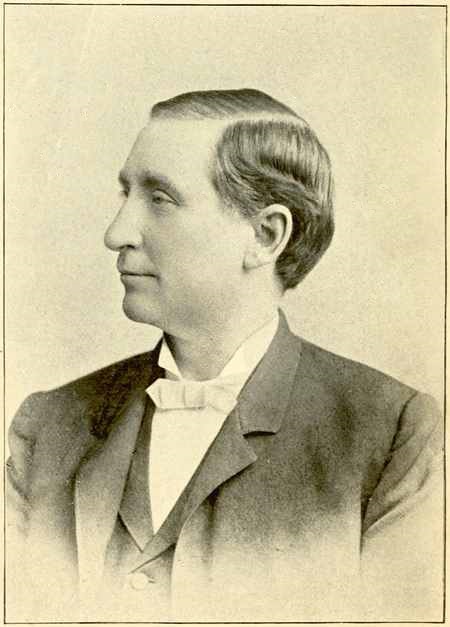
From Chickamauga to the Close of the War—Wounded at
Adairsville, Ga.—Nourished by a Union Woman.
An Address Delivered at E. B. Wolcott Post, G. A. R., Hall, Milwaukee,
Wis., by Thomas J. Ford, March 11th, 1898.

Commander and Comrades: Those pages that
I have here to-night are a continuation of the past,
and take in all my recollections in brief; and, in
giving you those few more sketches of the incidents
and privations of my army life, I will tell you, in
my humble way, of an incident that happened
shortly after we were driven into Chattanooga.
After the Battle of Chickamauga, so many men
were told off from each regiment to build up Fort
Wood, detailed for fatigue duty. We worked hard
that day. An order came around when the day's
work was done that General Sheridan was going
to give us all a ration of whisky. We fell in in
two ranks, with our tin cups, in double-quick time.
The whisky came around in buckets, full. It was
measured out with a small tin cup emptied into our
larger ones. I got my ration and drank it. My
brother Daniel was standing in the rear of me. He
never drank liquor nor used tobacco. The commissary
man ordered him to put out his cup and
take his ration. Brother told him he didn't drink
any and didn't want any. I turned around quick,
and said, "Draw your ration, Dan, and give it to
me." He did so, and I was very much pleased to
get it. The boys in the line looked over each other's
shoulders to see me drink the double ration of
whisky, and one said to the other, "My God, I wish
I had a brother in the army that didn't drink."
At a place called Buzzard Roost, perhaps better
known in history as Rocky Face, the rebels were
protected by natural breastworks and could not be
driven away from in front. After several attempts
a movement was made on their flank by General
Kilpatrick's cavalry. The rebels soon discovered
the movement and left from our front. At the
time that General Howard was viewing through his
field glass, Kilpatrick's cavalry were speeding to
the rebels' right around by the valley road. He
felt something touch him, and looking down he saw
a bullet hole through his boot leg, which evidently
had been aimed at him by some one in a much
higher location than where he was standing, and,
turning his glasses in that direction, he discovered a
rebel up in a tree. Seeing the movements up there
through the leaves, Howard sent after a couple of
his sharpshooters. They took in the situation. Mr.
Rebel kept very still, thinking perhaps he might
not be discovered, but our boys got a bead on him.
They let go their sharpshooting rifles. There was
an "Oh!" and a scrambling and a shaking of the
leaves and branches, and finally down comes the
rebel's gun and next himself. Upon examination
it was found that he had tied his arm with his handkerchief
to a limb of the tree so as to steady himself
while he was taking aim. The handkerchief became
loose in the struggle, but remained around his
arm as he fell.
As we advanced through those natural breastworks
of rocks some of our men that were killed
were lying just at the opposite side of the rock from
the rebels and were stripped of their clothing.
When we were advancing on this rocky mountain
the rebs pried loose a great many of those large
rocks and started them rolling down on us, but we
went up another direction, and marched about a
week, picketing and skirmishing until the rebels
made a stand at Resaca, which was a very hard
fight. We advanced in line of battle to within a
short distance of the rebels' breastworks, where we
halted. There were two cedar rail fences, ten rails
high with a stake and rider, right alongside of each
other. It was evident that the owners of the land
disputed the boundaries, or would not join fences
with each other, consequently each one built and
maintained his own fence on his own land, just inside
the line. We took advantage of that piece of
contrariness, however, and soon pulled down both
fences and piled them up into one. They made us
a fine breastwork. We were in close quarters to
the rebels; we could see them plainly and they
could see us. I remember in the part of the breastwork
where I was we had a thin cedar rail on top.
Two rebel bullets struck that rail and went through
it and dropped down just as I raised my head from
it to fire—a very close call for me. It was very
wet weather. The ground was uneven and rough,
all mud and slush. When firing ceased at night
some of us lay down to sleep, while others stayed
on duty in the breastworks. I rolled two dead
comrades together where I wanted to lie down and
another who was not quite dead was rolled crossways
over their heads for a pillow. I slept very
comfortably, with the exception of being disturbed
once in a while from a hiccough or movement of
muscles or peculiar noises coming from my pillow.
On the right of us the battlefield took fire and
burned a great many of our men, dead or wounded,
that were lying there. It was a piece of open
land where the grass was very thick the year before,
and was neither pastured nor cut off.
A few days previous to going into this fight we
went through a very plentiful country. We halted
for camp one evening. Some from every command,
the same as usual, struck off foraging. They
commenced coming in after a while with hams and
chickens. I remember by brother Dan and myself
asked some one about the hams, and they said you
might as well have one, they will be all gone anyway.
And so we struck out and soon found the
smoke-house. I made a rush in. There was just
one shoulder left. I grabbed it, and in going by
the house the woman was standing at the door crying,
and said that was the last piece of meat, and
what would she and her children do now. Brother
Dan and I agreed to give it to her. She put it under
her bed. We went to camp empty-handed; had
plenty to eat of government rations and felt and
slept better than if we had taken the meat from the
widow.
We had a hard march the next day. When we
camped that evening my feet were very painful,
with scalding blisters, and as I was very tired I
went down to a stream near by, took off shoes
and socks, rolled my pants above my knees, sat
down on the bank of the stream and placed my feet
in the cool, running water. Oh, but it did feel refreshing.
I lay down on my back with my feet in
that position, placed my hands under my head and
fell asleep; was in that position until the cool of the
morning began to break on me. I woke up much
refreshed and no pain or soreness in my feet.
I remember in marching through Huntsville,
Alabama, about 11 o'clock A. M., our band struck
up the tune of "Away Down South in Dixie." The
regiment was at a right shoulder shift arms, with
fixed bayonets. The sergeants walked on the sidewalks,
marching right in front, every man keeping
perfect step. A woman was sitting on her door
step with her elbows on her knees, and holding a
pan of potatoes in her hands that she had just
strained the water from preparatory to putting
them on the fire to cook for dinner. I noticed they
were a different kind of potato from what I had
ever seen, and politely asked her, "Please, madam,
what do you call those potatoes?"
She made answer in a very sarcastic manner,
saying, "I don't call them at all; they come without
calling." The next sergeant to me, Charles Powers
by name, a big, able fellow about six feet two
inches in height, raised his right foot, and never
losing his step to the music, hit the pan a kick, and
pan and potatoes flew out on the street on top of
the regiment, at the same time saying, "Now, damn
you, see if they'll come without calling." The
regiment charged on the potatoes and came to right
shoulder arms again with a potato on top of their
bayonets, and not one potato was lost. We
marched into camp and cooked them, and Charley
said to me, "Ford, you are a hell of a man to let
that rebel talk to you in that way."
"Well, how could I prevent her talking? I
didn't know what she was going to say; but I'll tell
you, Charley, I am mighty glad I didn't get that
kick."
We were going into camp one evening, and in
passing by a farm-house our Chaplain noticed a lot
of nice chickens. He called his servant—Sandy
was his name for short. "Sandy, here is a quarter,
go over there to that house and buy a chicken; we
will have a chicken for supper. If they don't want
to sell you any of their chickens don't you gobble
any; don't you steal any of their chickens, Sandy."
The Chaplain rode away a short distance and
called after Sandy, saying, "Now, Sandy, be sure
and have a chicken for supper." It is needless to
say Sandy got the chicken and the quarter, too.
This Chaplain resigned. The marching and
camping out were too severe on his delicate constitution.
He was not a very rugged man. Our
next chaplain was a drafted man, a wealthy farmer,
one of the first men that had the thoroughbred
short-horn cattle imported to this state from England.
He created an influence over James T.
Lewis, then Governor of Wisconsin, and received
from the Governor a commission as Chaplain of the
Twenty-fourth Wisconsin. The boys did not appreciate
this drafted man as a chaplain, but rather
took it as an offense to have a drafted man sent
down South to preach to them when he should have
been sent with a musket. I will say right here
that this man did no more good for the Twenty-fourth
Wisconsin than Billy Bray, the jackass who
to this day stands on the list of drafted men as forming
one of the quota of Maryland. The boys became
determined to rout him by scaring him and
making him think that they might do him bodily
harm. We had a flag pole. We hoisted the flag
every day and took it down at night. One morning
the Chaplain got up after a very pleasant
night's sleep, as he told me when he came to my
tent, seemingly under great excitement, telling me
that there were burglars in his tent last night, and
he never knew it until he awoke in the morning,
and found his chair, his table, little writing desk
and sheet iron heating stove, pipe and all, had been
taken from his tent. Being intimately acquainted
with me, having known me since I was a little boy,
he asked me if I would go with him in search of
his stolen furniture. I did. We went up and
down every company street, waking them up and
inquiring as we went along, but to no avail. No information
whatever could we get of the stolen furniture.
We gave up the search and came back by
regimental headquarters. In passing by the flag
pole—it was early in the morning and the flag
hadn't been hoisted yet—I happened to look up,
and lo! what was there?
"My God, Chaplain, look. What's on top of
that pole? Look at your furniture up there."
He looked up and cried out in solemn and fervent
prayer, with hands extended upwards, "Thanks
be to God on high that it ain't myself that is hanging
up there this morning."
There were no arrests made. The Chaplain
sent in his resignation. It was accepted.
This Chaplain introduced prayer meeting in
Company D's tent one night. We had fire-places
in the tents, with chimneys built of mud and sticks
on the outside. You could reach your hand to the
top of the chimney from the ground. John Mahan
was stretched on his bunk; Andy O'Neil had one
leg of his pants off, sewing a rip; he had a very long
thread in the needle. The Chaplain knelt down
close by Andy and asked Mahan if he would not
join in prayer. Mahan said he was tired and wanted
rest.
"And don't you want me to pray for you?"
asked the Chaplain.
"Oh, yes, pray for me all you have a mind to,"
said Mahan.
The Chaplain prayed. Each time O'Neil put
a stitch in his pants, in drawing the thread its full
length brought his hand in close proximity to the
Chaplain's face. He was seemingly very much interested
in repairing his trousers.
The Chaplain asked, "Now, Andy, don't you
feel the spirit of God coming within you?"
"No," said Andy, drawing his thread its full
length with his hand against the Chaplain's face,
"and I don't think it will come while the devil is so
close to me." At the same time the boys outside
dropped two or three bunches of cartridges down
the chimney into the fire inside. R-r-r-r-rapp-zip-zip-zip,
went the cartridges like a volley of musketry.
The Chaplain sprang from his knees, made
a rush for the door and then outside, saying, "Sure
enough, I believe the devil is in that tent."
We drove the Confederate General Anderson
across the river at a place called Loudon, Tennessee.
He burnt the bridge after his troops and supplies
had crossed it. The picket lines of both
armies were stationed on both sides of the river.
An armistice was agreed upon. Firing ceased, so
the boys might go in bathing. Every day we
would swim out further, and so would the rebels.
We came pretty close together one day, so close
that we dashed water into each other's faces and
ducked one another under the water, and about
faced and swam to shore, when a big rebel dived
under the water and came up in our ranks and swam
to shore with us. He was taken to General Sheridan's
headquarters, naked as he was born. They
clothed him and sent him to New York, the only
chance he said he ever had to get away. Being
down South before the war he was held and forced
into the rebel ranks; but that stopped the bathing
in the river. The armistice was withdrawn. If
you would show your face after that you would
hear a bullet whistle.
Captain Parsons had charge of the Twenty-fourth
Wisconsin at this place. An order came
from headquarters for a sergeant to take charge of
a detail of men to be sent out in the country with a
foraging train of wagons, mules and drivers and
wagon master to gather in all the wheat from the
farmers' granaries and haul it to a grist mill that
General Sheridan had confiscated to grind flour for
his army. The order fell on me, because it was
my turn to go on detail. I reported at Sheridan's
headquarters, and he himself gave me instructions
what to do. My detail of men was soon ready, and
we started with our wagons and wagon master out
to the mill, and the next day commenced hauling
in the wheat. I was very much interested in that
business, having been raised on a farm. With
some of the farmers we had a great deal of trouble
to get them to open their granaries peaceably, especially
those who were rebels. We ground forty
barrels a day. It was a water-power mill. Every
night I was offered greenback money for flour, but
never took a cent. They would tell sorrowful
stories about their little children starving. I would
tell them that their little children were of no consequence
when compared with the condition of
thirty thousand men stationed in Loudon waiting
for this flour. "Go and see Sheridan; he may give
you some." The owner of the mill was in the mill
office in the daytime when the wheat was brought
in. I signed the vouchers for the number of bushels
of wheat weighed and ground into flour, and
that, with the supplies we had, furnished plenty of
food. Every farmer that we took wheat from had
the miller's signature and mine attached to his order
on General Sheridan, and if he proved his loyalty
to the Union he got spot cash, or its equivalent,
for his wheat. My work being over, I received an
order one morning to report at Sheridan's headquarters.
We got into camp in the afternoon and
formed a line in front of the General's tent. I
found him inside and reported. He said, "You
have done very well, sergeant; you deserve a promotion.
Have your men break ranks right where
they are and go to your respective quarters." I
did not think any more about it. I simply was
glad that I pleased the General and did my duty.
In returning to the regiment I found Col. MacArthur
in command. I learned that Capt. Parsons
would not give up his command of the regiment
to MacArthur until he got orders to do so
from General Sheridan, which were promptly
given.
Liquor was plenty around Loudon, but at very
high prices. One man paid $10 for a canteen full.
He became disorderly and wanted to shoot somebody.
He was court-martialed and sent to Dry
Tortugas. I learned afterwards that he was pardoned
and came home. The bridge across the
river that the rebels burned was rebuilt by government
employes with the assistance of the pioneer
corps, and we crossed to the opposite side on another
campaign. Our regimental bakers at this
place turned out several loaves of bread with an old
chew of tobacco in the center of the loaf.
From Resaca we followed up the rebel General,
Johnston, and came very close to his rear guard at
a place called Calhoun, Georgia. We crowded
them very closely. The next day Johnston had his
advanced troops stop at Adairsville and build
breastworks of logs and earth, and located themselves
in the houses, while the main army passed
through and formed ready for battle. We followed
them right up, but we suddenly came to a
halt. They were ready for us. Johnston managed
his retreat with good generalship from Resaca.
We could not budge them. We marched
across the road into a field by the right flank, right
in front, towards the rebels' left, when Col. MacArthur
gave the command "By the left flank,
charge." When I was in the act of executing the
command I got a broadsider in the left jaw bone.
The bullet struck me in the lower angle of the jaw,
breaking the bone at that place, and coursed downwards,
inside the collarbone, and lodged in the cavity
of the chest. Dr. Hasse, our regimental surgeon,
treated me on the battlefield. I remember
he cut my accoutrements with his knife and left
them on the ground, cut the string of my blanket,
spread it out and laid me on it.
Our regiment advanced and was stubbornly resisted,
but held their ground by inch until the rebels
withdrew. A great many of our boys bit the
dust that day. It was a very severe fight for the
time it lasted, just a few hours. It was estimated
that the loss was 500 killed and wounded. Such
was rebel General Johnston's fighting tactics on a
retreat. He punished his pursuers very severely.
General John Newton had charge of our division
in the absence of General Sheridan. It was
thought at one time during the fight that our side
would have to give way, and an order came from
headquarters to the surgeons in the field to move
their wounded a certain distance to the rear. There
were four rebel bullets dropped on my blanket
while I lay there. We moved to where there were
a lot of small houses and a large mansion. In going
along the turnpike road the rebel bullets and
cannon balls came fast and lively. This was the
trying moment. It was desperate, as I could plainly
hear, and very well understood the situation.
The brave boys began coming in wounded thick
and fast, as the battle raged on. But at last victory
was ours. The battle was won; but a high
price was paid for it; the loss of life, limb, health
and blood. I remember in going to the rear, as ordered,
a Union captain was with us. He had his
nose shot off, or all but a part of the skin near his
forehead, which was holding it from falling. It
was swinging on his face like the pendulum of a
clock. The rebels sent a cannon ball down the
road. As it passed by, this captain turned around,
and, with much emphasis, said, "You rebel sons of
guns, I hope you will get your belly full before
night," and at that instant a rebel bullet took him
right in the abdomen and went through his body.
He fell dead where he spoke the words. We arrived
at our new hospital off the battlefield. Dr.
Hasse placed me in a chair on the porch and ran a
probe down in my neck.
"Ah, Ford," he said, "the bullet has passed
downwards; it is in your chest; perhaps I can find
it," and I began to faint away. He pulled out his
probe and turned around his canteen, placed it in
my mouth and told me to take a swallow. I took
hold of the canteen and held it until I had three
good swallows.
The doctor took the canteen and said, "Do you
think you can stand it now?"
"Yes, doctor, probe away now all you mind to."
And he did, and said it was no use in punishing
me. He could not locate the bullet, and even if
he did, it could not be removed without loss of life;
it may never injure me, but he could not tell now
what the result might be in the future.
I was assigned to a place to lie down on the
floor. I soon fell asleep, and when I awoke my
neck, face and breast seemed to be one thickness.
Well, I thought I would get up, but no, my head
would not rise by my will. I thought if I just
had somebody to lift my head for me I would be all
right, when, seemingly by instinct, my right hand
raised and caught myself by the hair of my head,
and I was on my feet.
An order came to the surgeons to send the
wounded to Chattanooga. All who were shot in
the legs and not able to walk would be carried in
ambulances to Resaca and there take the train for
Chattanooga. I came under the order of able to
walk, as the meaning of that term is applied in
cases of emergency, where transportation is limited,
as it was in that case. We struck out, a lot of us
that had to walk, but soon commenced trudging
along according to our strength, until there were
hardly two together. Every stream I would cross
I would dip my head in the water and then fill my
old Kossuth hat full and put it on my head. Arriving
at Calhoun early in the afternoon, I stopped
at the first house. There were two rebel ladies
standing on the porch looking at the wounded as
they passed by. I was very weak and wanted some
milk, as I could not eat or chew anything, my
mouth being nearly closed. By a great many signs
and mutterings I succeeded in getting one to understand
what I wanted, but she said they had no
milk; that there was a Union woman in the next
block over there that had two or three cows and
she most always had some milk.
"You got hit, did you?" she asked. "Well, we
don't like to see you'uns get hurt, but we do like to
see you'uns get licked. You'uns killed my true
love when you went by here the other day. He
stayed behind his command to bid me good-bye and
to have a little talk, when you Yankees came onto
him and three others of our boys. They ran into
the brush down there," pointing in the direction
that she wanted me to know, "and there you killed
my true love."
I listened very attentively, with my eyes fixed
on a picture that she wore on her breast. I recognized
the picture and muttered out to her as best I
could that if she thought so much of her true love
she ought to see about it and have him buried. He
was lying down there a little ways from the turnpike
road, swelled up as big as a two hundred
pounder.
The circumstances concerning my knowledge
of this incident are: Those four rebels ran from
the brush to a small log-house about fifteen or
twenty rods from the road where we were marching,
and were firing from their hiding place. A
squad was sent out there and surrounded the little
log-house. This true love escaped by jumping
through the window, and was shot and killed. The
other three were taken prisoners.
I made my way to the Union woman in the
next block. I saw a dozen wounded men go into
the house. Thinks I to myself, "There is no chance
there for me to get any milk," but before I reached
the house they came out again, and I went in. She
was a fine, clever-looking woman, with three little
girl children. I made known my wants.
"Yes," she said, "I have plenty of milk for you,
although I have been refusing it all day; so many
came together that the little I had would do them
no good." At the same time she poured the milk
out into a cooking utensil and placed it on the stove
and said, "As you came alone I have plenty for you;
and indeed you need it more than any one who has
come in here to-day."
She broke some round crackers into the milk, inquired
about my wound, said it smelled bad, took
off the bandage, washed it and dressed it with new
linen and threw my old bandages out doors. By
this time my milk and crackers were cooked. As
I could not chew or open my mouth to take in
coarse food, she fixed it so it was thin, like gruel;
cooled it sufficiently, spread a table cloth on part of
the table where I sat, and I felt just ninety-nine per
cent. better than when I first entered that house.
Her cheerfulness and willingness to do good made
me feel so much better that I could not express it
by words. I drew that food through my teeth
with such force that it did not take a very great
length of time to put it where it was much needed
for a nourishment.
I will say right here when you found a Union
man or woman in the Southern States, you found
them as loyal and as true as steel. I was now ready
to go on my journey to Resaca. The train was to
leave there at 8 o'clock. Before I left Adairsville
hospital I changed a $5 bill and gave half of it to
a comrade of mine, John Howard, who was shot
in the elbow. Twenty-six pieces of bone were
taken out of his elbow. Dr. Hasse wanted to cut it
off, but Howard said he would rather die with it on
than live with it off. The doctor thought possibly
that he might save it. The weather was very
warm. Gangrene set in. His arm was cut off
three times, and the poor fellow, after a long season
of suffering, went to the other shore. Changing
the $5 bill, which was all the money I had, left me
with two dollars and a half in fifty cent shinplasters,
as we called that kind of money. In bidding
good-bye to my good Union woman, with tears in
my eyes I offered her all the money I had. She
would not take any. She said it did her so much
good to do something for a Union soldier that she
only wished she could do more. I took her address
and bade her good-bye. Her three little girls followed
me out to the gate leading on the sidewalk,
and I slipped fifty cents apiece in their little hands.
I felt so much better, and my heart was so filled up
with the kindness that I received from that good
Union woman in the very heart of the Confederate
States, that if I had had it I could have given those
little ones one hundred dollars apiece as willingly
as I gave them fifty cents each. That woman
saved my life, for gangrene was beginning to show
itself, and I never could have reached Resaca without
that nourishment and the cleansing of my
wound. I reached Resaca just as the train was
pulling out, grabbed hold of the side door of the
last box-car and the boys pulled me in while the
train was moving quite fast.
It commenced raining very hard and the night
was as dark as pitch. Our train jogged along at
the rate such trains usually do. We came to an
up-grade, when all at once there came a crash and
a smash. I was in the hindmost end of the rear
car and was jerked up to the front end in a shorter
time than you could say Jack Robinson. A trainload
of new recruits was coming to the front, the
cars being full inside and many on top. The engineer
should have stopped at the station and
switched until the train with the wounded went by.
He paid no attention to the signal and went right
ahead to the top of a grade, where he pulled the
throttle of his engine wide open and let her go.
Jumping off his engine, he made his escape. He
was a rebel, and took advantage of his first opportunity
to apply his vengeance. It was a terrible
sight to look at. Many of the wounded were killed
and some of the new recruits and many were disabled.
It took till late next day to get fixed up for
our destination. There I lost my diary, with the
address of that good Union woman that did so much
for me at Calhoun, Georgia.
After I recruited up some, and others the same
as myself, who were supposed not to be fit for duty
within a certain time, we were sent farther north
to make room for new-comers. I was sent to New
Albany, Indiana, where I remained two weeks,
when a general order was issued that all not fit for
duty inside of sixty days should be sent to their
respective state hospitals. An examination was
made by the surgeon in charge, and I was sent to
Madison, Wisconsin. After I was a few weeks in
Madison I called on Governor J. T. Lewis in regard
to my commission. It was then the tenth in
order on file in his office, but he would give me one
then and there. There were vacancies in my company.
I refused to take it. There were others
higher in rank than I, and I did not want to jump
over them; and, in fact, we came home without a
commissioned officer, an orderly sergeant in command
of the company, John N. Keifer, who received
his commission dated back, as captain, as
brave a boy as ever lived to draw saber. Ed.
Blake, a corporal in my company, carried a commission
in his pocket that he received from the Governor,
but never reported for duty as an officer.
Such was the honor the old boys had for each other
in rank.
I stayed in Madison about two months and
could have had my discharge given me by Surgeon-General
Swift, medical director of the Western
Department, with headquarters at Milwaukee, but
would not take it. I wanted to go back and take
my chances of coming home with the rest of the
boys. I had the use of my limbs all right and
could shoot, but had to be very careful how I bit
the cartridge. There were six pieces of bone taken
from my left lower jaw, and it hurt very much to
bite off the cartridge.
My memory now takes me back to my regiment,
with which I was in several battles after my
four months' absence on account of my wound.
And now this brings me to the last battle of Nashville,
December 15th and 16th, 1864. We fought
the rebel General Hood, who had followed us from
Franklin and fortified himself in our front, near
Nashville. We marched out to them and made the
attack. They held us back. We were relieved by
a brigade of colored troops. While we were cooking
something to eat the colored troops made a
charge on the rebel works and got as far, or to a
distance where the rebels had fallen trees towards
us, as an obstruction to our advancement. There
the colored brigade fired one volley and then lay
down. The rebels peppered it to them so thick
and fast, they even stood up on their breastworks
and took aim at that black cloud, as they called
them. We were marched down there again, in
double-quick time, the rebels shouting and shooting
and waving their hats like so many demons. When
they saw us coming for them right through and over
the colored troops and tree branches they ceased
firing and had their arms stacked when we climbed
their breastworks, took off their hats and surrendered,
saying, "Hello, Jack; hello, Tom; hello, Jim.
Say, Yanks, never send a black cloud to take our
breastworks. We were retreating when we saw
them coming. When some one said, 'It's a black
cloud, boys; let's every man stand fast; never be
taken prisoners or surrender to them darkies, or
give them our breastworks while there is a man of
us left alive.'"
And then we commenced shaking hands with
each other. There were some of them who were
nearly barefooted, with pants ripped nearly up to
their knees; tall, fine-looking, good-hearted fellows,
from Georgia. This ended the battles of the war,
so far as we were concerned, and old Pap. Thomas
drank the health of the old Army of the Cumberland.
We stayed around Nashville for some time,
got our discharge, and, on the 10th day of June,
1865, broke ranks in Milwaukee. I bought a suit
of citizen's clothes for $85 that could be bought to-day
for $25.
There was a strong Fenian movement in Milwaukee
just about that time, with the object in view
of taking Canada. I happened in to Melm's, a
saloon where the new Pabst building now stands, if
my memory serves me right, and I think it does.
There was a big crowd of men in there talking war,
Fenians and Canada, all feeling good. Of course,
I had a say about the war and other topics of conversation
that were sprung into discussion as well as
anybody else had, and seemed to interest some of
my hearers. They wanted me to get up on a round
table near by. There were two or three rows of
tables in there. I would not get up on the table.
I was taken hold of and placed on the table. Well,
I talked a little while, and then came down to war
matters. I said the Battle of Stone River lasted
seven days and it cost this government nine millions
of dollars a day, and asked, "What would we
do if we didn't have a government to back us? Do
you think we could carry on a war by some one of
us having a few dollars in our pockets? Foolish
idea; that is your predicament, gentlemen." Of
course, that was disparaging the movement, but I
did not intend it for that particular purpose. I
was simply telling the truth as well as I knew how,
when somebody hit me. I jumped off the table,
lost my hat in the row and never found it.
I went to Illinois to work as a farm hand for $1
a day for every day in the year, wet or dry, hail,
rain or sunshine, board and washing free, and with
what money I had saved up, bought a piece of land
at twenty dollars per acre, with a mortgage of
$1,500 on it, payable in gold coin, but it was paid
off with the greenback dollar. I lived on that farm
for twenty-six years and brought it to a very high
state of cultivation. I sold it out seven years ago,
at one hundred dollars per acre, the first $100 acre
land that was ever sold in my township, and came
to Milwaukee, the scene of my boyhood days. I
have been a delegate to state and county conventions
and held offices of trust in the township where
I lived; but, commander and comrades, I can say
to you, with candor, that I never saw an assembly
of men that act more gentlemanly with each other,
and that I felt more proud of, and that I felt more
at home with than I do with the members of E. B.
Wolcott Post.