INTRODUCTION
Amongst the varied and manifold impressions of my long
and intimate connection with the Mohammedan world none
is more lively and more interesting than my experiences
with the Hajees, the dear, pious and good-natured companions
on many of my wanderings in Moslem Asia. We
in Europe can hardly have an idea of the zeal and delight
which animate the pilgrim to the holy places of Arabia, not
only during his sojourn in Mekka and Medina, not only
whilst making the Tawaf (procession round the Kaaba), not
only during the excursion to the valley of Mina, where the
exclamation of “Lebeitk yá Allah” rends the air round the
Arafat—but long before he has started on his arduous and
formerly very dangerous journey to the birthplace of Islam.
The Hadj, being one of the four fundamental commands of
Islam, is looked upon by every true believer as a religious
duty the fulfilment of which is always before his eyes, and if
prevented by want of means or by infirmity he will strive to
find a Wekil (representative), whom he provides with necessary
funds to undertake the journey and to pray in his name
at the Kaaba, and when the Wekil has returned he hands
over the Ihram (a shirt-like dress in which the pilgrimage is
performed) to his sender who will use it as his shroud, and
appear before the Almighty in the garb used on the Hadj.
The further the Moslem lives from Arabia the greater becomes
the passion to visit the holy places of his religion,
and if there was a country in which the desire to fulfil this
holy command was most fervently cultivated and executed,
it was decidedly Central Asia and Eastern Turkestan,
where nearly two-thirds of the pilgrims formerly perished,
partly in consequence of epidemics and inclemency of
weather, partly also at the hands of robbers or through thirst
in the desert. And yet these Turk or Tartar Hadjees often
disregard all dangers and perils of a long journey, and
begin to economise the money necessary for travelling
expenses many years before they have set out, for a man
destitute of means is not allowed to undertake the Hadj,
the same prohibition exists also for a man who is not
bodily strong enough, or who has to provide for a family
left back at home. It is true, in accordance with the saying
“Hem ziaret hem tidjaret” (Pilgrimage and Business together),
there are people, who connect trade with religion,
but their devotion is often criticised, whereas the pure religious
intention meets everywhere with the greatest praise
and veneration, and a successfully accomplished visit to the
holy places of Arabia makes a Mohammedan respected not
only in his community but also in the outlying districts of
his country. On his return journey from Mekka and
Medina the Hajee gets an official reception all along his
route. He is met by young and old, by rich and poor,
everybody tries to rub his eyes or his cheeks to the dress of
the man, in order to catch an atom of the dust coming from
the Kaaba or from the grave of the Prophet, and if the
Hajee is the bearer of some Khaki-Mubarak (i.e., blessed
earth from the grave of Mohammed), or if he is in possession
of a small bottle of “Zemzem” (the holy fountain in
the precinct of the Kaaba), there is no end and limit to the
pressing throng around him. I have seen people kissing
the footsteps of such a pilgrim, embracing and petting him,
and what struck me most was the scene where Kirghis or
Turkoman nomads cried like children on seeing one of
these Hajees, and when they began to quarrel, nay, to fight,
for the opportunity to bestow hospitality on a returning
Hajee, be he even an Uzbeg or a Tajik, whom they otherwise
dislike.
Yes, the Haj is a most wonderful institution in the
interest of the strength, unity and spiritual power of Islam;
it is a kind of religious Parliament and a gathering place for
the followers of the prophet, where the sacred Hermandad
is fostered despite all differences of race and colour, and
whereas the temple in Jerusalem does often become the
cockpit of different Christian sects, and the arena of bloody
fights, which would fatally end without the intercession of
the Moslem soldiers of the Padishah, we meet with perfect
peace and concord in the court of the Kaaba, where the
four sects have got their separate places without interfering
with each other, and where Hanefites, Shafaites, Malekites
and Hanbalites pay simultaneously their veneration to the
founder of their religion. Even the Shiite Persian is not
molested as long as he does not offend the believers by an
ostentatious exhibition of his schismatic views, what he
rarely does, for dissimulation is not prohibited according to
the tenets of the Shiites.
The foregoing remarks about the Haj have been quoted
here with the intention to realise the importance of this
religious custom of Islam, and particularly to show how
necessary it is to know and to appreciate duly the political,
social and ethical qualities of this precept ordained by the
prophet.
Well, in order to gain full information on this subject,
we have been in need of an account of the Haj written by
a Mohammedan who is not attracted by curiosity, but by
religious piety, who had free access to every place, who is
not hampered by fear of being discovered as a Christian,
and who is besides a shrewd observer. These essential
qualities I find in Mr. Haji Khan, M.R.A.S., the pilgrim,
who calls himself also “Haji Raz” (the mystery Haji). It
may be well said that Christian travellers like Burkhard,
Burton, Maltzan, and others, have exhausted the subject
relating to the holy places of Islam, but a Mohammedan
sees more and better than any foreigner, and I do not go
too far when I say that Mr. Haji Khan, with his thorough
English education, would have been more fitted to describe,
unaided, the life and the manners of the Haj, than was his
Turkish fellow-believer, Emin Effemdi, author of a Turkish
account of the same topic.
I daresay it will be the case with many other subjects
relating to the actual and past features of the Eastern life, if
natives will be only educated to describe the peculiarities of
their own nations and creeds, and for this reason it is desirable
that the number of scholars like Mr. Haji Khan should
increase, and that this present book, written in collaboration
with Mr. Wilfrid Sparroy, should meet with a well-deserved
reception.
Great credit is due to Mr. Wilfrid Sparroy, to whose
high qualities as a writer, this joint production owes so
much. Both Mr. Haji Khan and Mr. Wilfrid Sparroy are
to be congratulated on the results of their labours: they
have succeeded in bringing the East nearer to the West.
A. VAMBÉRY.
Part I A PERSIAN PILGRIM IN THE MAKING — I.—Message of the Prophet. — II.—Conditions of Pilgrimage. — III.—Forbidden Viands. — IV.—The Work of Purification. — V.—Prayers. — VI.—Aspects of Social Islám. — VII.—Story of the Muslim Moons. — VIII.— Persian Súfíism; and Persian Shiahism in Its Relation to the Persian Passion-Drama. — ( a ) Persian Súfíism. — (b) The Shiah Faith in its Relation to the Persian Passion Play.
WITH THE PILGRIMS
TO MECCA
The day before I left England for Persia some seven
years ago, I went to see my uncle, the author of the
“Siege of Metz.” On saying good-bye he made me
a present of the Kurán. “Here,” said he, “is the
thing to be read. It will be the best introduction to
the new life awaiting you in the East. If you can lay
hold of the spirit of this book you will not be alone out
there, but among men and brothers, for the Kurán is a
sincere revelation of much that is eternally true.” I never
saw George Robinson again: in less than a week—before
I had left Paris—his spirit had passed to the bourne
whence all revelations come, and where truth, in its completeness,
will be revealed.
Now, it should be the critic’s aim, in dealing with all
true books, to place himself on the same plane as the
author, and to look in the same direction, fixing the same
end. This is more especially true of what his attitude
should be towards a message that has been held sacred by
countless millions for more than thirteen hundred years.
The merits of the Kurán and the far-reaching reforms of
the Prophet of Islám can be appreciated worthily only by
such men as have taken the trouble to acquaint themselves
with the idolatrous superstitions of the Arabians in the
time of Ignorance, and with the empty logical jangling
of the rival Syrian Christian sects at the close of the Sixth
Century. And the critic having grasped the lifelessness
of religious practice before the coming of Muhammad,
would be wise to reveal, first of all, what there is of truth,
and to spread what light there is in the written word of
the great reformer, abandoning to the bigot and the purblind
the less fruitful occupation of stirring in the cauldron
of religious controversy. To that end, indeed, it were not
amiss that he should cultivate his imagination, for the
imaginative have turned the corner of their narrower
selves, and theirs is an ever-widening vision. To
those who, living by the word of Christ, diffuse darkness,
Muhammad will ever be either a charlatan or an unscrupulous
man of the sword. Well, the Prophet’s
followers must take heart of grace. History itself as
well as the Kurán has proclaimed the charges to be false.
The keynote to Muhammad’s character is sincerity.
Sincerity rings out clear enough in every word of his
book. He was a man in whom the fire-thought of the
desert burned so fiercely that he could not help being
sincere. He was so truly sincere, indeed, as to be wholly
unconscious of his sincerity. Now, of all the stories
related of him none affords a more convincing proof of his
thorough honesty than the one which shows him to have
been, at least once in practice, a backslider from the high
ideal of conduct that he preached. This story, from
Al-Beidáwí’s commentary, is thus related by Sale:
“A certain blind man named Abdallah Ebn Omm
Mactúm came and interrupted Muhammad while he was
engaged in earnest discourse with some of the principal
Kuraish, of whose conversion he had hopes; but, the
Prophet taking no notice of him, the blind man, not
knowing that Muhammad was otherwise busied, raised
his voice, and said, ‘O apostle of God, teach me some
part of what God hath taught thee’; but Muhammad,
vexed at this interruption, frowned, and turned away
from him,” for which he was reprehended afterwards by
his conscience. This episode was the source of the
revelation entitled “He Frowned.” “The Prophet
frowned, and turned aside,” so runs Chapter lxxx. of the
Kurán, “because the blind man came unto him; and how
dost thou know whether he shall peradventure be cleansed
from his sins; or whether he shall be admonished, and
the admonition shall profit him? The man who is
wealthy thou receivest with respect; but him who cometh
unto thee earnestly seeking his salvation, and who fearest
God, dost thou neglect. By no means shouldst thou act
thus.” We are also told that the Prophet, whenever he
saw Ebn Omm Mactúm after this, showed him marked
respect, saying, “The man is welcome on whose account
my Lord hath reprimanded me,” and that he made him
twice Governor of Medina. And yet many still persist in
calling Muhammad a charlatan. Surely a prophet who,
in reproving others, spared not himself, has won the right
to be respected as an honest man. For my part I believe
him to have been one whose word was his bond, and whose
hand it had been good to grasp.
As for his having been a mere victorious soldier, he
was in the beginning “precisely in a minority of one.”
Your Napoleon finds in patriotism his most successful
recruiting sergeant. But the call of patriotism had
summoned to Muhammad’s standard not a single recruit,
because he was despised by the patriotic (if the Kuraish,
the predominant tribe in Arabia, and the keepers of the
Ka’bah, deserved to be so called) and was rejected by
them. Assuredly Muhammad drew the sword; he was
driven to draw it in the end. But how did he get the
sword, and to what purpose did he put it when he had
it? Muhammad’s sword was forged in the furnace of
that passionate, human soul of his, was tempered in the
flame of divine compassion, and gave to every Arab an
Empire and a creed. Islám was the sword! The blade
of steel achieved no miracle, it merely drew blood—sufficiently
corrupt. It was the sword of Muhammad’s
word which freed the Arab heart from its vices and fired
it with a wider patriotism and a purer faith. His battle-cry
was the declaration of God’s unity; his sword was the
faith; his battlefield the human heart and soul; and his
enemy idolatry and corruption. “Yá Alláh!” and “Yá
Muhammad!” carried the Arabian conquest from Mecca
to Granada, and from Arabia to Delhi. The conquering
hosts fought rather with their hearts and with their souls
than with their swords and their strong right hands;
inculcating in the conquered no earthly vanities, as do
modern Muhammadan rulers, but the principles of liberty,
solidarity, unity, equality, and compassion.
Forty thousand Arabs, under their famous leader, Sád
Vaghás, having defeated five hundred thousand Persians
and overthrown the mighty Persian Empire, in the battle
of Khadasieh, on the plain of Nahavend, deeply rooted
their faith in the heart of the alien race, and then left her
to be ruled by her own people, in accordance with the
precepts of the new revelation. Omar, perhaps the greatest
Caliph, is said to have lived throughout his life on a loaf
of barley bread and a cup of sour milk a day. And Alí’
the Prophet’s son-in-law, whom the Persians revere as his
true successor, lived for no other purpose than to help the
poor and to succour the weak. He was, as Carlyle assures
us, a man worthy of Christian knighthood. So also was
his son, Huseyn, whose glorious martyrdom has endeared
him to the hearts of the Persian people.
In the East men are ruled and guided by religious
laws and not by positive ones, so Muhammad’s aim was to
make the Arabians free and united by lessening the sufferings
of the poor and by establishing equality among the
people. That these aims and aspirations cannot be consummated
through positive laws alone must be abundantly
clear to every man in the civilised West who has watched
the gradual rise among us of Socialism and the deadly
growth of Anarchy. We Western peoples merely pray
that God’s will may be done on earth as it is in Heaven.
Whereas Muhammad, being, as he was, a practical reformer,
made it incumbent on his followers to contribute
to the consummation of the Divine Law by bestowing on
the poor a fair share of the things that they loved.
The very core of the Muhammadan faith lies, as I conceive,
in three broad principles. First, in the declaration
of God’s unity. “Say, God is one God; the eternal God:
He begetteth not, neither is He begotten: and there is
not one like unto Him.” This short chapter, as is well
known, is held in particular veneration by the Muhammadans,
and declared, by a tradition of the Prophet, to
be equal in value to a third part of the whole Kurán. It
is said to have been revealed in answer to the Kuraish,
who had asked Muhammad concerning the distinguishing
attributes of the God he invited them to worship. For
Muhammad held that all the prophets from the creation
of the world have been Unitarians; that as Moses was a
Unitarian so also was Christ; that Christianity, as
practised in Syria, was a break in God’s revelation of
Himself as One, and that he, Muhammad, had been
specially chosen by God to re-admonish mankind of this
fundamental truth.
As this ground idea satisfies the Oriental’s reason, so the
second, Islám, that is, resignation from man to God, responds
to the inner voice of his soul, and seems to lead his heart
warmly to embrace the third principle of the Muhammadan
faith, which, in the golden age of the Muhammadan
Era, was the means of establishing equality among the
people—I mean the principle of charity, of alms-giving, of
compassion from man to man. Unswerving obedience to
the spirit and the letter of these three laws carried with
it the obligation of unswerving loyalty to the Prophet.
When we pray, we Christians, we say “Give us this day
our daily bread.” The Muhammadans, under penalty of
everlasting torment, are obliged to sacrifice, to the poor
and needy, a due proportion of the things that they love—not
merely of their superfluity—with the result that
each man among them, by that fact alone, constitutes
himself, as it were, a willing instrument of God’s will that
His Kingdom of Heaven shall reign on earth. Another
fact that proves Muhammad to have been something far
more than a man of the sword is that to this day Muhammadans
hail one another on meeting with the word
“Salám” (have peace). Indeed, peace being an essential
condition of undertaking the sacramental Pilgrimage to
Mecca, it is unlawful to wage war during the three
months’ journeying of the Muslim lunar year, namely, in
Shavvál, Zú-’l-ka’dah, and Zú-’l-hijjah.
“Contribute out of your subsistence towards the
defence of the religion of God,” says Muhammad, “and
throw not yourself with your own hands into perdition
[that is, be not accessory to your own destruction by
neglecting your contributions towards the wars against
infidels, and thereby suffering them to gather strength],
and do good, for God loveth those who do good. Perform
the Pilgrimage of Mecca, and the visitation of God; and
if ye be besieged send that offering which shall be the
easiest, and shave not your heads until your offering
reacheth the place of sacrifice. But whoever among you
is sick, or is troubled with any distemper of the head,
must redeem the shaving of the head by fasting, by alms,
or by some offering [either by fasting three days, by
feeding six poor people, or by sacrificing a sheep]. But
he who findeth not anything to offer shall fast three days
in the Pilgrimage, and seven when he be returned: these
shall be ten days complete. This is incumbent on him
whose family shall not be present at the Holy Temple.”
“The Pilgrimage must be performed in the known
months (i.e., Shavvál, Zú-’l-ka’dah, and Zú-’l-hijjah);
whosoever therefore purposeth to go on Pilgrimage therein,
let him not know a woman, nor transgress, nor quarrel
in the Pilgrimage. The good which ye do, God knoweth
it. Make provision for your journey, but the best provision
is piety, and fear me, O ye of understanding. It shall
be no crime in you if ye seek an increase from your Lord
by trading during the Pilgrimage. And when ye go in
procession from Arafat [a mountain near Mecca] remember
God near the holy monument, and remember Him for that
He hath directed you, though ye were before this of the
number of those who go astray. Therefore go in procession
from whence the people go in procession, and ask
pardon of God, for God is gracious and merciful. And
when ye have finished your holy ceremonies, remember
God, according as ye remember your fathers, or with a
more reverend commemoration. Yea, remember God the
appointed number of days [three days after slaying the
sacrifices], but if any haste to depart from the Valley of
Mina in two days it shall be no crime in him. And if any
tarry longer it shall be no crime in him—in him who
feareth God. Therefore, fear God and know that unto
Him ye shall be gathered.... They who shall disbelieve
and obstruct the way of God, and hinder men from visiting
the Holy Temple of Mecca, which we have appointed
for a place of worship unto all men: the inhabitant thereof
and the stranger have an equal right to visit it: and whosoever
shall seek impiously to profane it, we will cause him
to taste a grievous torment. And proclaim unto the people
a solemn Pilgrimage; let them come unto thee on foot,
and on every lean camel, arriving from every distant road,
that they may be witnesses of the advantages which accrue
to them from visiting this holy place, and may commemorate
the name of God on the appointed days [namely,
the first ten days of Zú-’l-hijjah, or the tenth day of the
same month, on which they slay the sacrifices, and the
three following days] in gratitude for the brute cattle which
he hath bestowed on them. Wherefore eat thereof, and
feed the needy and the poor. Afterwards let them put
an end to the neglect of their persons [by shaving their
heads, and the body from below the neck, and cutting
their beards and nails in the valley of Mina, which the
pilgrims are not allowed to do from the time they become
Muhrims, and have solemnly dedicated themselves to the
performance of the Pilgrimage, till they have finished the
ceremonies, and slain their victims]; and let them pay
their vows [by doing the good works which they have
vowed to do in their Pilgrimage], and compass the ancient
house [i.e., the Ka’bah, which the Muhammadans pretend
was the first edifice built and appointed for the worship of
God]. This let them do. And whoever shall regard
the sacred ordinances of God: this will be better for him
in the sight of his Lord. All sorts of cattle are allowed
you to eat, except what hath been read unto you, in former
passages of the Kurán, to be forbidden. But depart from
the abomination of idols, and avoid speaking that which is
false: being orthodox in respect to God, associating no
other god with him; for whosoever associateth any other
with God is like that which falleth from heaven, and which
the birds snatch away, or the wind bloweth to a far distant
place. This is so....”
One of the benefits of this Pilgrimage, and, perhaps,
the greatest of all, if we regard the sacrament either from
the political and social or from the religious standpoint,
was, and is, the gathering together in Mecca of Muhammadans
of every race and of every sect. There, and in the
city of Medina, they first saw the dawn of their religious
faith and their political power; there their hearts were
drawn together in unity and strength; and there, in the
early days of the Caliphs, they discussed their latest
achievements, the glory of their future conquests, and
studied the wants and needs of their co-religionists.
Within the walls of the Holy of Holies they wept and
prayed that God might renew within them a cleaner spirit
through faith; and there, too, they strove with all earnestness
to raise themselves to the full height of the Prophet’s
conception of manhood, which encouraged such virtues
as hospitality, generosity, compassion, heroism, courage,
parental love, filial respect, and passive obedience to the
will of God. Thus Mecca, in the days of Pilgrimage,
might be looked upon as an immense club or a university
where Muhammadans, from every quarter of the globe,
meet and discuss their political and social problems, and
prostrate themselves in prayer to the one and only
Divinity.
Another effect of this Pilgrimage—an effect which has
grown less marked with the increased facility and comfort
of travelling—is that it kindled energy and courage in
such people as would never have left the safe seclusion
of their harems had it not been for the rewards which the
undertaking is said to gain for them hereafter. For the
Oriental nations, be it remembered, are not as a rule of a
roving spirit; they are far more inclined by nature to a
life of ease and security than to one of danger and privation.
“Travel,” says an Arab proverb, “is a portion of
hell-fire,” and so, perhaps, nothing save the hope of paradise
or the dread of perdition would ever have induced the
meditative Oriental to brave the trials and the hardships
of the long road to Mecca.
In our hearts we believe the proof of the Divine Spirit
using any religion is that it does not deteriorate. The
chief objection to Welsh Calvinism, which, like Muhammadanism,
is based on the theory of Predestination, is
that it grows worse. It was once simply and sincerely
religious: it is now mainly political spite. Has Muhammadanism
deteriorated beyond recognition—say, in the
eyes of the student of the Kurán, or does it still hold
tight by “the cord of God”? Do the Sunnís hold themselves
aloof from the Shi’ahs, or do they dwell together,
within the Holy Temple, in brotherly love and concord?
Their daily salutation of “Salám,” is it sunk to a mere
empty form, or is it still the expression, as it once undoubtedly
was, of a hearty wish to bring about the Prophet’s
single aim? And of all the nationalities congregated
yearly in the city of concourse—the Arabians, the
Persians, the Afghans, the Egyptians, the Muhammadans
of India and China—which among them all is the most
worthy to be commended for its enlightenment and
progress? All these questions, and many more on the
social and religious life of the East, will be answered in
the course of the second and third parts of this volume.
And in the meanwhile, I cannot do better than gather
into focus the preliminary notes of my literary partner,
beginning with the customs incidental to the pilgrimage;
for the main thing now is to leave nothing unsaid which
would enable the reader to enter into the spirit and the
form of the sacred journey. And henceforward, though I
shall always express myself in my own words, the personal
pronoun, whenever used, will apply, throughout this work,
to my collaborator, Hadji Khan, with the exception of the
contents of the Appendix.
That being understood, the conditions must be
mentioned which, in theory, though not necessarily in
practice, limit the number of Muhammadans that go
on the pilgrimage. First, the Muhammadan must be
of age—that is, he must have completed his fifteenth
year when, according to the Muhammadan Law, a
boy becomes a man. Secondly, he must be of a sound
constitution in order to endure the fatigue of the
journey. Thirdly, he should have no debts whatever,
but should be sufficiently well-to-do to defray his own
travelling expenses, after having distributed one-fifth of
his property among the Seyyids, given one-tenth of the
remainder in alms, and made provision during his absence
for the support of the family and the servants he leaves
behind him. Fourthly, he should support both the
mosque in which he prays and the fund of the saint he
adores the most by making his religious adviser a present
in proportion to his means. Fifthly, he must be either a
virtuous or a sincerely penitent man, for he cannot legally
undertake the pilgrimage unless his wealth has been gained
in a lawful manner. Strictly speaking, a thief, for example,
cannot be a pilgrim, nor can the money earned by accepting
bribes be used to cover the expenses of the journey.
The best money to use for the purpose is that which has
been gained from the produce of the soil, or else that
which has been bequeathed by a virtuous father. Sixthly,
the Muhammadan who would be a Hájí must start with an
absolutely clean conscience: he must look to it that the
friends he leaves behind him shall have no just cause to be
offended with him. Though he need not heed the slander
of the malignant, he must formally repent of his sins, bidding
his friends and acquaintances good-bye with the
words, “Halálám kuníd.” Seventhly, a woman should be
accompanied by one of her Meharem, that is by one
of the men who are privileged to see her unveiled—namely,
by her father, her husband, her brother, her
uncle, her born slave, or her eunuch. In short, the pilgrims
should be really good Muslims, adhering firmly to
all the laws laid down in the Kurán, and following religiously
the special teaching of their chosen directors,
whose prescriptive right to regulate the minor details of
the rites and observances of the Faith, has resulted in
their wielding a tremendous power over their flocks
even in political matters.
From the little that has been said of the influence of the
Persian clergy you will understand that the priests require
their pilgrims to adhere strictly to the letter of the laws
appertaining to the prohibition and recommendation of
certain articles of food. They must reckon as prohibited
and, therefore, impure, twelve things, among which may
be counted pork, underdone meat, the blood of animals,
and wines. Though a digression, it will not be out of
place to mention here that the wine, of which Omar
Khayyám and the Súfís in general sing, is more likely to
be the juice of the grape than the interpretation put on it
by such commentators as see in it a symbol of God’s
love. For the effect produced on the brain by the
forbidden drink is in itself something of a mystery, as it
were, a divine afflatus, more particularly is it so considered
by a people of such a temperate habit as the Persians.
Some of the higher classes, no doubt, drink hard, and even
drink to get drunk, but upon the whole the Muhammadans,
and especially the Persians, are, in comparison with the
majority of European peoples, extremely sober, bearing
their griefs without seeking the consolation of the bottle.
Now, purifications must be made either in flowing
water, or in about half a ton of stagnant pure water.
When the nose bleeds it must be dipped three times, after
being well washed. Strange to say, the sweat of the camel—the
animal that bears the pilgrim to Mecca—is said to
be unclean to the touch and its pollution must, like the
handling of dogs, pigs, and rats, be cleansed away by the
customary purifications. Ablutions, called wuzú’h should
precede every prayer that is farz or incumbent, and
wuzú’h consists first in washing the hands three times
by pouring water from the right hand over the left hand
and rubbing them together, next in washing the face three
times with the right hand, then in pouring the water with
the right hand over the left elbow and rubbing down the
forearm, and last of all in repeating the process with
the left hand over the right forearm. After this maseh
must be performed by dipping the right hand in water and
rubbing it over the front portion of the head, and also by
rubbing over the right foot with the wet right hand, and
the left foot with the wet left hand. If the hands or
the feet be sore or wounded then clay takes the place
of water, and this particular kind of purification is called
tyammom. The devout before reading the Kurán, or before
entering the shrine of a saint or the court of a mosque,
should perform wuzú’h or tyammom, and in doing so
they should resolve within themselves to recite such and
such a prayer. This is called Niyyat, or Declaration of
Intention.
According to a Shi’ah traditionalist, Imám Huseyn has
laid down twelve rules to be observed at meal times. The
first four are essential to the salvation of all true Muslims.
They should remember to say “Bismillah” before tasting
each dish, and refrain from eating of the forbidden viands;
they should also assure themselves that the food laid before
them has been bought with money obtained from a legal
source, and should end by returning thanks to God.
The second four, though not universally obeyed, are
admitted by all to be “good form,” and consist in washing
the hands before meat, in sitting down inclined to the left,
in eating with the thumb and the first two fingers of the
right hand, which hand must be kept especially clean for the
purpose. The last four rules deal with matters of social
etiquette. They are kept by most Muhammadans in polite
society, and are as follows: One should not stretch across
the tablecloth, but should partake only of such dishes as
are within one’s reach; one should not stuff the mouth
too full, nor forget to masticate the food thoroughly; and
one should keep the eyes downcast and the tongue as
silent as possible.
It is a tradition that the washing of hands before meals
will materially help the true Muslim to grow rich, and be
the means of delivering him from all diseases. If he rub
his eyes immediately after the ablution they will never be
sore. The left hand must not be used in eating unless the
right be disabled.
All true Muslims when eating are advised to begin with
salt and finish with vinegar. If they begin with salt they will
escape the contagion of seventy diseases. If they finish with
vinegar their worldly prosperity will continue to increase.
The host is in etiquette bound to be the first to start eating
and the last to leave off. Tooth-picking is considered
an act of grace, for Gabriel is reported to have brought a
tooth-pick from heaven for the use of the Prophet after
every meal. The priests recite certain passages of the
Kurán before and after lunch and dinner, and also before
drinking water at any hour of the day.
All Muslims must say five prayers every day, and
the following six things should be observed before the
prayers are acceptable to God: (1) wuzú’h or tyammom,
(2) putting off dirty clothes, (3) covering one’s body
and head and doffing the shoes, (4) keeping the appointed
time, (5) determining the exact position of Mecca, and (6)
assuring one’s self as to the purity of the place in which
the prayers are said. Before beginning one must say
within one’s self what prayers one is about to recite, and
for what purpose one is going to recite them, and at the end
one must raise the hands to Heaven, saying, “May peace
be with Muhammad and with his disciples.” For prayer
was by Muhammad deemed so urgent an act of reverence
that he used to call it the pillar of religion and the key of
paradise, declaring “that there could be no good in that
religion wherein was no prayer.” It behoves every pilgrim,
therefore, in his sacred habit, to pray at least five times
every twenty-four hours; (1) in the morning before sunrise,
(2) when noon is past and the sun begins to decline
from the meridian, (3) in the afternoon before sunset, (4)
in the evening after sunset and before day be shut in, and
(5) after the day is shut in and before the first watch of
the night. Besides these, there are certain other prayers
which, though not expressly enjoined, are commended
as a special act of grace, more particularly perhaps to
the pilgrims in ihrám. Among these may be mentioned
the separate prayers generally said at night (i.e.,
the namáz-i-tahajjud and the vitr), and the extra prayers
not prescribed by law, the naváfil and the namáz-i-mustahabb.
The positions of the body are as follows:
(1) kiyám, that is, standing erect, with the hands down
by the sides; (2) takbírguftán, declaring God’s greatness,
on raising the hands on either side of the face,
with the thumbs under the lobes of the ears, and the
fingers extended; (3) rukú, inclining the body from the
waist and placing the hands on the knees; (4) kunút,
standing with the head inclined forward and the hands on
either side of the face; (5) dú zánúnishastán, kneeling, the
hands lying flat on the thighs; and (6) sijdah, prostration,
in which the forehead must touch the ground, or the lump
of unbaked clay that is known by the name of “mohre.”
A full prayer is made up of five “rakats” or prostrations,
during which not a word save the prayer as prescribed
should be uttered. Part of the prayer is said aloud and
part in a whispering tone. The greatest care should be
taken to pronounce each word with the correct Arabic
accent, since ill-pronounced words, unless the result of a
natural defect, are said to be unacceptable to the Creator.
The pilgrim should say special prayers on Friday, and
every time he has recourse to the Kurán before deciding
on any course of action whatsoever. A special prayer
is said by the devout about one hour after midnight.
This is called the midnight prayer, and is, of course,
a tedious task. Hence it is sometimes said sarcastically
of a man with a loose belief in the Faith: “He
says midnight prayers!” The prayers most readily
answered are the prayers said in Mecca. Thus when a
pilgrim sets out on his journey he is requested by his
friends to pray for them at the House of God. The name
of the person for whom one prays should be uttered, otherwise
the prayer will have no effect. Every pilgrim must
take with him a rosary, the square piece of unbaked clay
called “mohre,” and a copy of the Kurán, for a passage of
the Kurán must be read after every prayer.
It is now time to give the reader, in as terse and as
condensed a form as possible, a general idea of the
part played by religion in the workaday lives of the children
of the Faith, beginning with their toilet, that is, with
their dressing and bathing, with the combing of their hair
and the cutting of their nails.
A pious Persian Muslim, before wearing any new article
of clothing, performs his ablutions and prostrates himself
twice in prayer. A man of a less devout, but a more
superstitious, trend of mind contents himself with consulting
the taghvím or the estakhhareh[1] muttering to himself,
ere he dons the garment, “In the name of God the
Merciful and Clement!” His friends on seeing the new
apparel cry out, “May it be auspicious!” The rewards of
a man who says his prayers before putting on a new suit
of clothes will be in proportion to the number of threads
in the cloth. Hence it has come to be a practice to preserve
the material from the blight of the Evil Eye by besprinkling
it with pure water over which a prescribed
passage of the Kurán has been read.
It is unlucky for a Muslim to sit down before taking off
his shoes. When drawing them on it is equally unlucky
for him to stand up. The custom, in the first instance, is
to rise, doffing first the left shoe and then the right one.
The procedure must be reversed in every particular when
putting them on. The universal belief in omens is traditional,
and extends, among other things, to precious stones.
By far the luckiest of these is the flesh-coloured cornelian,
which is a great favourite with the men. It owes its
popularity to the fact that the Prophet himself is said to
have worn a cornelian ring set in silver on the little finger
of his right hand. It grew still more in favour at a later
period, because Jafar, the famous Imám, declared that the
desires of every man who wore it would be gratified.
And thenceforward its property to bless has been regarded
as axiomatic by the superstitious to whom I am referring.
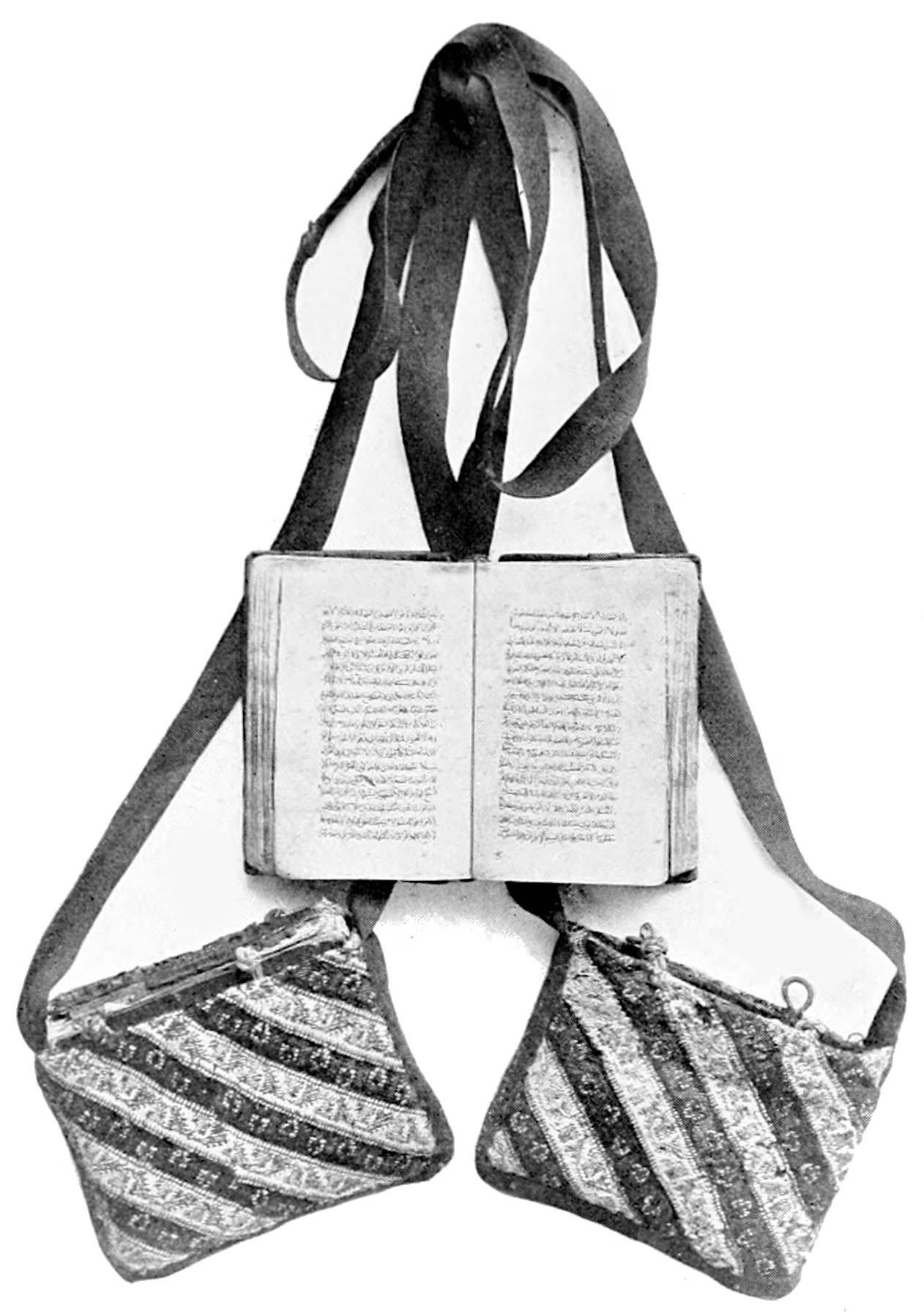
COPIES OF THE KURÁN WORN EN BANDOULIÈRE BY MUSLIMS
WHEN TRAVELLING OR ON PILGRIMAGE.
The Shiahs have the name of one of the twelve Imáms
engraved on the stone; others make use of it as a seal
bearing their own names. Hardly less lucky are the
turquoise and the ruby, which are believed to have the
effect of warding off poverty from those who are fortunate
enough to possess them. This is why they are treasured
by the fair sex, the ruby being, perhaps, the more dearly
loved of the two.
Every bath has generally three courts. On entering
each one of these the devout say the prayers prescribed
for the occasion, but the generality of Muslims, unless they
intend to perform the religious purifications, consider it
sufficient to greet the people who are present with the
word “Salám!” It is considered inauspicious to brush
the teeth in the baths, but certain portions of hair must be
removed by a composition of quicklime and arsenic, called
nureh, and the nureh, though efficacious enough, no
matter when it may be used, is said to add immeasurably
to a man’s chance of salvation by being laid on either on a
Wednesday or on a Friday.
The application of the juice of the marsh-mallow as an
emollient for the hair is strongly recommended by the
saints. Their object in bequeathing this advice to
the consideration of their flock was not to inculcate
vanity. They had a higher aim than that. Their desire
was to stave off starvation from the fold, for that, in their
opinion, would be the result of using the lotion on an
ordinary day of the week; while rubbing the head
vigorously with the precious juice on the Muslim Sabbath
would be certain to preserve the skin from leprosy and the
mind from madness. To the use of a decoction of the
leaves of the lote-tree a divine relief is attributed, for the
mere smell of it on the hair of the most unregenerate has
on Satan an effect so disheartening that he will cease from
leading them into temptation for no less than seventy
days.
The pressure of the grave will be mitigated by a
skilful and untiring application of the comb in this life.
The blessing of the comb is said to have been revealed
to Imám Jafar. Women are not excluded from the spiritual
benefits derived from the comb. But, remember, the hair
must not be done in a frivolous, much less in a perfunctory
fashion. Far from it. On no account whatever
must the hair be neglected, for Satan is attracted by dishevelled
locks. They are, as it were, a net in which he
catches the human soul. Therefore, since the priests and
the merchants of Islám shave their heads in most parts of
the Muslim world, special attention should be paid by
them to their beards and eyebrows. A pocket-comb made
of sandal-wood is often carried by the true Believers, who,
it may be hoped, turn it to good account in moments of
spiritual unwillingness on the part of the natural man.
A Mullá’s beard is an object of veneration to his flock.
He may trim it lest it should grow as wild as a Jew’s, but
he is forbidden by tradition to shave it. Even the scissors
must be plied sparingly and to the accompaniment of
prayer. Perhaps the orthodox length of this almost
divine appendage of the true Muslim is the length of the
wearer’s hand from the point of the chin downwards.
This is known as a ghabzeh or handful. A priest may be
allowed to add the length of the first joint of his little
finger, otherwise his power to awe might grow lax. The
soul is in danger every time he forgets to cut his sharib,
that is, the tip of his moustache, which should be reduced
to bristles once a week. Once on a time a faithful follower
of the Prophet asked one of the Imáms what he should do
to increase his livelihood. The Imám answered unhesitatingly:
“Cut your nails and your sharib on a Friday
as long as you live!”
Again, according to a Shi’ah traditionist, if a Muslim
gaze into a looking-glass, before saying his prayers, he
will be guilty of worshipping his own likeness, however
unsightly it may appear in his eyes. The hand must be
drawn across the forehead, ere the hair or the beard be
adjusted, or else the mirror will reflect a mind given
over to vanity, which is a grievous, if universal sin. The
new moon must be seen “on the face” of a friend, on a
copy of the Kurán, or on a turquoise stone. Unless one
of these conditions be observed, there is no telling what
evil might not happen.
The devout who are most anxious to vindicate tradition
perform two prostrations on beholding the new moon,
and sacrifice a sheep for the poor as an additional safeguard
against her baneful rays. The Evil Eye more often
than not has its seat in the socket of an unbeliever.
Therefore, the Muslim who, on being brought face to face
with a heretic, should not say the prayer by law ordained
must look to his charms or suffer the inevitable blight. A
cat may look at a king; a king may shoot a ferocious
animal; and a thief may run away with the spoil. But
a true Believer must guard his faith against aggression
every time he sees a thief, a ferocious animal, or a king.
For very different reasons, he must recite a prescribed
formula of prayer on the passing of a funeral procession,
and also on his seeing the first-fruits of the season and its
flowers. The dead, it is said, will hear his voice if, on
crossing a cemetery, he cry aloud: “O ye people of the
grave, may peace be with you, of both sexes of the
Faithful!”
As the sense of sight gives rise to devotional exercises,
so also does the sense of hearing. The holy Muslim
should lend a prayerful ear to the cries of the muezzin
during the first two sentences of the summons, and when
the call to prayer is over he should rub his eyes with his
fingers, in order to produce the signs of weeping—a mark
of contrition and of emotional recrudescence in the matter
of piety. The true Believer, whenever he hears the Sureh
Sújdeh read in the Kurán, should prostrate himself and
repeat the words after the reader. If he hear a Muslim
sneeze he should say, “May peace be with thee!” and if
the sneeze be repeated, “Mayest thou be cured!” But, if
a Kafir sneeze, the response must be expressed in the wish
to see him tread “the straight path.”
Every child of Islám, before going to bed, should
perform his ablutions and say his prayers. If he wish to
be delivered from nightmare and all its terrors let him say
to Allah: “I take refuge in Thee from the evil of Satan,”
and if he is afraid of being bitten by a scorpion let him
appeal to Noah, saying, “May peace be with thee, O
Noah!” One day Eshagh-ben-Ammar asked Imám Jafar
how he could protect himself against the attack of that
malignant arachnidan. The Imám replied: “Look at the
constellation of the Bear; therein you will find a small
star, the lowest of all, which the Arabs call Sohail. Fix
your eyes in the direction of that star, and say three
times, ‘May peace be with Muhammad and with his
people: O Sohail, protect me from scorpions,’ and you
will be protected from them.” Eshagh-ben-Ammar goes
on to relate that he read the formula every evening before
going to bed, and that it proved successful; but one
evening he forgot to repeat it, and, as a consequence, was
bitten by a black scorpion.
Prayers are also said against mosquitoes and other
insects. This cleanses the conscience of the irate Muslim,
if it fail in preserving his skin. The Eastern peoples in
general and the Muhammadans in particular are early
risers. Sleep after morning prayers, which are said before
sunrise, is sure to cause folly; sleep in the middle of the
day is believed to be necessary and suitable to work; while
sleep before evening prayers has precisely the same effect
as after the devotions of the early morning. A traditionist
says that the prophets slept on their backs, so as to be
able to converse with the angels at any hour of the night;
that the faithful must sleep on their right sides, and the
Kafirs on their left; and that the deves take their rest on
their stomachs.
Usury, though interest on money was strictly prohibited
by the Prophet, is among the Muslims of the
present day a common practice. They evade the letter of
the law by putting what the Persians call “a legal cap
over the head” of the usurious transaction. The
money-lender picks up a handful of barley and says to the
borrower, “Give me the rate of interest as the cost of this
grain, which I now offer to sell to you at that price;” and
the borrower replies that he accepts the bargain. Also, a
merchant must know all the laws appertaining to buying
and selling. Imám ’Ali is said to have made a daily round
of the bazaars of Kufa crying out the while, “O ye merchants
and traders, deal honestly and in accordance with
the laws of your Prophet. Swear not, neither tell lies, and
cheat not your customers. Beware of using false weights,
and walk ye in the paths of righteousness.”
A high priest in Mecca assured me that to enjoy a
derham of interest is as bad as taking the blood of seventy
virgins. The admonitions of ’Alí the Just, though sometimes
read, are less often followed. On leaving his house
a merchant must say “Bismillah,” and then blow to his
left and his right and also in front of him, so as to clear
the way to good business.
The pious recite, on entering the bazaar, a prayer ordained
for the occasion. When the bargain is clinched
the seller should cry out, “God is great! God is great!”
But there should be no dishonest bargaining over the
purchasing of these four things: the winding sheets for
the dead, the commodities to be distributed in charity, the
expenses on the journey to Mecca, and the price of a slave’s
ransom. In all these transactions the buyer and seller
must act according to the dictates of fair play. The man
who buys a slave should lay hold of him by a hair of his
head and say the prescribed prayer; after which, if guided
by Imám Jafar, he must change the name of his purchase.
Slaves are treated with every consideration, so much so
indeed that in the household of Eastern potentates, whose
treatment of their dependents is extremely arbitrary, the
slaves lord it over the servants.
It is said, in the traditions, that a true Muslim should
marry neither for money nor for beauty, but should be
guided by the woman’s moral worth and spiritual endowments.
His choice is referred to the arbitrament of the
estakhhareh. “A chaste maiden will make a good wife;
for she will be sweet-tempered to her husband, and mild
but firm in the treatment of her children.” This saying is
attributed to the Prophet. “A bad wife, a wicked animal,
and a narrow house with unsociable neighbours, those are
the possessions which try a man’s temper,” cried one of
the Imáms, himself a saintly man. “The best woman is
she who bears children frequently, who is beloved by her
relatives, who shows herself obedient to her husband, who
pleases him by wearing her best clothes, and who avoids
the eyes of men who cannot lawfully see her.” These
words were uttered by Muhammad, if we are to believe
tradition.
The wedding must not take place when the moon is
under an eclipse, nor when she is in the sign of Scorpio.
The best time is between the 26th and the end of the
lunar month. Muhammad recommended festivals to be
celebrated on five occasions: on wedding and nuptial days,
on the birth of a child, on the circumcision of a child, on
taking up one’s abode in a newly-purchased house, and on
returning from Mecca. Only persons of unblemished reputation
should be invited to the marriage or the nuptial
feasts.
To the man who brings him news of the birth
of a male child the father should give a present. The
nurse should lose no time in singing the first chapter of
the prescribed prayer in the baby’s right ear, and what is
called the standing prayer in its left one, and if the water
of the Euphrates be procurable it should be sprinkled on
the baby’s forehead.
On the seventh day after the child’s birth the ceremony
of the Aghigheh is performed in Persia. This consists in
killing a fatted sheep, in cooking it, and in distributing
the flesh among the neighbours or among the poor who
come to the door. In memory of the occasion a cornelian
engraved with a Kurán text, and sometimes surrounded
with precious stones, as in the cover-design to the present
volume, is fastened to the baby’s arm by means of a silk
band, and is worn perhaps to the end of its life. Not a
single bone of the Aghigheh sheep should be broken;
certain prayers should be read before the sheep is killed;
and the parents should not take part in the feast.
The baby is not often weaned until it is two years old,
Muhammad believing that the mother’s milk is the best
and acts beneficially on the child’s future character and
temperament.
The twelve Muhammadan months are lunar, and number
twenty-nine and thirty days alternately. Thus the whole
year contains only three hundred and fifty-four days; but
eleven times in the course of thirty years an intercalary
day is added. Accordingly, thirty-two of our years are,
roughly speaking, equal to thirty-three Muhammadan
years. The Muhammadan Era dates from the morning
after the Hegira, or the flight of the Prophet from Mecca
to Medina, that is, on the 16th of July, A.D. 622. Every
year begins earlier than the preceding one, so that a month
beginning in summer in the present year will, sixteen
years hence, fall in winter. The following are the names
of the months, which do not correspond in any way with
ours: 1, Muharram; 2, Safar; 3, Rabíu-’l-avval; 4, Rabíu-’s-sání
or Rabíu-’l-ákhir; 5, Jumádáu-’l-úlá; 6, Jumádáu-’s-sání or
Jumádáu-’l-ákhir; 7, Rajab; 8, Sha’bán; 9,
Ramazán; 10, Shavvál; 11, Zú-’l-ka’dah, or Zí-ka’d; 12,
Zú-’l-hijjah, or Zí-hajj. Many stories of these months
were told to me by the priests and the pilgrims whom I
met at Mecca, and it is therefore my intention to tell over
again the stories of the most cherished months of the
Muslim year. These are Rajab, Sha’bán, Ramazán,
Shavvál, Zú-’l-ka’dah, Zú-’l-hijjah, and Muharram.
On the Day of Judgment, the Holy Muezzin, sitting
on the Throne, will cry out, ere he pass judgment on the
Faithful, saying: “O moons of Rajab, Sha’bán, and
Ramazán, how stands it with the deeds of this humble
slave of ours?” The three moons will then prostrate
themselves before the Throne, and answer: “O Lord, we
bear witness to the good deeds of this humble slave.
When he was with us he kept on loading his caravans
with provisions for the next world, beseeching Thee to
grant him Thy divine favour, and expressing his perfect
contentment with the fate that Thou hadst sent unto him.”
After them their guardian-angels, meekly kneeling on their
knees, will raise their voices in praise of the pious Muslim,
crying: “O Lord God Almighty, we also bear witness to
the good deeds of this humble slave of Thine. On earth
his eyes, his ears, his nose, his mouth, and his stomach
were all obedient both to whatsoever Thou hast forbidden
and also to whatsoever Thou hast made lawful. The days he
passed in fasting, and the nights in sleepless supplication.
Verily he is a good doer!” Then Allah will command his
slave to be borne into Paradise on a steed of light, accompanied
by angels, and by all the rewards of his piety
on camels of light, and there he will be conducted to
a palace whose foundation is laid in everlasting felicity,
and whose inmates never grow old. The moon of Rajab is
the month of Allah. It is said that there is a stream of
that name in Paradise, whose water is white, and more
wholesome than milk and sweeter than honey. The first
to welcome the new arrival will be this stream, which will
straightway wend its course round his palace. To Salim,
one of his disciples, Muhammad is reported to have said:
“If you keep fast for one day during the month of Rajab
you will be free from the terror of death, and the agony of
death, from the percussion of the grave, and the loneliness
thereof. If you keep fast for two days the eight doors of
Paradise will be opened unto you.”
The authoritative tradition goes that a crier will make
himself heard from between the earth and the sky, summoning
the pious who observed the prayers and the privations
of the moon of Rajab: “Oh, ye Rajabians, come forth and
present yourselves before your Creator.” Then the Rajabians,
whose heads will be crowned with pearls and rubies,
and whose faces will be bathed in the universal light, will
arise and stand before the Throne. And each one among
them will have a thousand angels on his right hand and a
thousand on his left, and they will shout with one accord,
saying: “O, ye Rajabians, may ye be deserving of all the
holy favours ye are about to receive!” And last of all,
Allah, in his mercy, will say to them: “O my male and
female slaves, I swear by my own magnanimity, that I will
give you lodgings in the most delightful nooks of my
Paradise, namely, in the palaces around which flow the most
refreshing streams of purest water.”
A baby is to the Muslim a symbol of purity: and so a
man who worships God in the month of Rajab will become
like unto a new-born child, always provided that he repent
of the sins which he has committed, and follow the law of the
Prophet. Not until then will the pious Rajabian be in a fit
state, in his character of new-born babe, to start life afresh.
The Muhammadans, in so far as duty and obedience are
concerned, put on pretty much the same footing the relation
of the slave to his master, of the wife to her husband, of
the child to its parent, and of the guest to his host. The
parallel between the last-mentioned and the preceding is
complete because the guest must acquiesce in his host’s will,
which is supreme. In the matter of repentance, that of
Nessouh is exemplary among the Muhammadans.
Now, this man Nessouh was in his face and his voice so
like a woman that his wicked nature persuaded him to wear
skirts that he might add to his experience of the opposite
sex by mixing freely among its members. Soon, his curiosity
growing in ratio with his acquired knowledge, we hear of
him as an attendant in the hammam of the royal seraglio,
where he might have pursued his studies in peace and in
rapture had not one of the Royal Princesses, who had lost a
ring, cast suspicion on every servant in turn. The seed of
Nessouh’s repentance was sown when the decree went out
that all the attendants of the baths were to be searched.
The fear lest his sex should be discovered yielded so swiftly
to repentance for having veiled it, that Almighty Allah despatched
an angel from Paradise to discover the missing
treasure before the decree took effect; and thenceforward
Nessouh, out of the gratitude of his heart, renounced his
studies of human nature in petticoats, and vied with the
most rigid disciplinarians in prayer and in fasting. His
virtues grew so conspicuous in male attire that his repentance
has come to be accepted as worthy of imitation by
every true Believer.
According to tradition it was on the first day of
God’s moon that Noah, having taken his seat in the
Ark, commanded all the men and jinns and beasts that
were with him to keep fast from sunrise to sunset. On the
evening of the same day, when the sun was going down, the
Ark, riding over the flood, would have heeled over had not
Allah sent seventy thousand of his angels to the rescue. It
is interesting to note that the number of all the traditional
rewards of virtue, as well as that of such of the heavenly
hosts as lend their assistance in cases of distress, is always
a multiple of seven. A Meccan priest added the following
to my collection of “rewards”: God will build seventy
thousand cities in Paradise, each city containing seventy
thousand mansions, each mansion seventy thousand
houris, each houri surrounded by seventy thousand beautiful
serving women, for the pilgrim—mark this—who
shall say his prayers with the best accent on the Hájj Day.
The Mullá in question was himself a perfect Arabic scholar;
his enunciation in reciting the forthcoming bliss was faultlessly
correct; each syllable seemed to pay his lips the
tribute of a kiss for the pleasure it had derived from listening
to the mellifluous sound of its predecessors. This
learned priest will be in his element on all scores should the
Paradise of his invention be materialised.
As Rajab belongs to Allah so Sha’bán is held sacred to
the Prophet. For we read in the history of Islám that
Muhammad, who entered Medina on the first day of the
gracious moon, commanded the muezzins to make it known
to his people that the good actions which they might perform
during the month would help both himself and them
to gain salvation; whereas their evil actions would be committed
against his apostleship, and would on that account
be the more severely punished hereafter.
Once a year, on the approach of Ramazán, the precincts
of Paradise, and all its gardens and palaces, are
illuminated, festooned, and decorated, and a most tuneful
wind, known in Arabic by the name of Meshireh, makes
music in the trees. Now, no sooner do the houris hear
this sound than they rush out from their seclusion, and cry
aloud: “Is there any one to marry us through the desire
to perform a good deed towards the creatures of God?”
Then, turning to Rezvan, the guardian of Paradise, “What
night is this?” they ask; and Rezvan answers, “O ye
fair-faced houris, this is the eve of the holy moon of
Ramazán. The gates of Paradise have I ordered to be
opened unto the fast-keepers of the Faith of the Faithful.”
Then Allah, addressing the angel who has the charge of
Hell, says to him: “O Málik, I bid thee to close thy gates
against the fast-keepers of the faith of my Apostle.” And
next, summoning the Archangel of Revelations, He gives
command, saying: “O Gabriel, go forth in the earth and
put Satan in chains, and all his followers, that the path of
my chosen people may be safe.” So, on the first day of
Ramazán, Gabriel swoops down on the earth accompanied
by hosts of angels. He has six hundred wings, and opens
all of them except two. In his hands he bears four green
banners, emblems of the Muslim creed. These he plants
on the summit of Mount Sinai, and on the Prophet’s
tomb at Medina, and in the Harem of Mecca. His
army of angels bivouacs on the plains round about the
Holy City and on the surrounding mountains. On the eve of
the day of reward, which is called Ghadre, the angels are
ordered to disperse throughout the Muslim world, and every
true Believer seen praying during that night is embraced
by one of them, and his prayer meets with an angelic Amen.
At the dawn of Ghadre day a heavenly bugle recalls the
angels to Mecca. When Gabriel returns to Heaven it is to
say to Allah, “My Lord, all the true Believers have I forgiven
in Thy name save those who have been constant
wine-bibbers, or incurred the displeasure of their parents,
or indulged in abusing their fellow Muslims.”
The various sects of the Muhammadans disagree a
good deal as to the date of Ghadre day. Some say it is
on the 19th, some on the 21st, and others on the 23rd of
the Muslim Lent; but all agree in believing it to be the
day on which the books of deeds, good and evil, are
balanced, and on which the angels make known to
Muhammad the predestination of his followers for whom he
intercedes. All Shi’ahs who would win a reputation for
piety must keep Ahia, that is, pass the three nights
above-mentioned in fasting and holy devotions—a penance
of untold severity in that every day of the month must
be similarly spent from sunrise to sundown. Through
most ardent prayers on the 21st of Ramazán the devout
Mussulman may win the privilege of becoming a Hájí in
the following year. The 7th is the anniversary of
Muhammad’s victory over the Kuraish in the battle of
Badre, and is a great day with all Islamites. For the rest,
the Arabs follow the example of their Prophet in breaking
their fast on dates and water; special angels are appointed
to plant heavenly trees, and to build divine palaces in
readiness for such of the Muslims as should neither neglect
their religious purifications nor forget to behave themselves
as “Allah’s guests.” Many Muslims, unquestionably,
adhere strictly to all the rites and observances of
the occasion; not a few, on the other hand, though they
may fast during the day, devote the night to feasting.
Indeed, in every capital of Islám, in Teheran, in Constantinople,
and in Cairo, the darkling hours are given
up by certain people to amusements and sometimes to
vicious pursuits.
The heavenly hosts under the Archangel Gabriel, with
his five hundred and ninety-eight wings wide open, and
his green banner flying over the gate of the Ka’bah,—the
heavenly hosts, I say, dispersing through the Muslim world
on the eve of Ghadre will prevail on the ghosts of the
one hundred and twenty-four thousand prophets to kiss
the Muslims that are piously engaged at night, delivering
them from the danger of drowning, of being buried under
ruins, of choking at meal times, and of being killed
by wild beasts. For them the grave will have no
terror, and on leaving it a substantial cheque on the
keeper of Paradise, crossed and made payable to bearer,
will be placed in the hands of each one of them.
On the first day of the moon of Shavvál, the fast of
Ramazán being over, all true Muslims are supposed to
give away in charity a measure of wheat, barley, dates,
raisins, or other provisions in common use. The guests
who stay over the preceding night are entitled to receive
a portion of the alms distributed by the master of the
house next morning; and hence only the poor and needy
are invited to accept hospitality on the occasion of the
Zikat-é-Fetre—that is, the festival of alms-giving. The
fulfilment of the law is believed not only to produce an
increase of wealth in the forthcoming year, but also to
cleanse the body of all impurities. So much for the
rewards as a stimulus to honesty. Now for the penalty as
a deterrent from greed. In the third Súra of the Kurán
it is written: “But let not those who are covetous of
what God of His bounty hath granted them imagine that
their avarice is better for them; nay, rather it is worse for
them. For that which they have covetously reserved shall
be bound as a collar about their necks on the day of the
resurrection: and God is well acquainted with what ye do.”
Shiahs are reluctant to get married in the interval between
the first of Shavvál and the tenth of Zú-’l-hijjah, because
the Prophet is said to have married Aishah, the enemy of
’Alí, about that time. On the other hand the Sunnis, who
reverence that brilliant woman, commemorate her wedding
day by solemnising their own during this season, unless
they are performing the pilgrimage of Mecca.
The most sacred day of the following month—the
moon of Zú-’l-ka’dah—is the twenty-fifth. On that day
Adam was created; Abraham, Ishmael, and Jesus were
born, and the Shiah Messiah, the concealed Imám, will
come again to judge the world. A Muslim, if he keep
fast on the twenty-fifth of Zú-’l-ka’dah, will earn the
rewards of a man to whom Allah in his mercy should
grant the privilege and the power of praying for nine
hundred years. On the first of Zú-’l-hijjah, which is the
month of pilgrimage, Abraham received from God the
title of Al-Khalíl, or the Friend of Allah. It is accounted
a good deed to fast from the first to the tenth day of
this the last journeying month; it is also wise to do so,
for it is not every month in the year that the Mussulman
can win, by nine days of fasting, the fruits of a whole lifetime
of self-denial. Another tradition deserving of mention
in connection with this month is that Jesus, in the
company of Gabriel, was sent to earth by God with five
prayers, which he was commanded to repeat on the first
five days of the pilgrims’ moon; but the two holiest
days of the moon of Zú-’l-hijjah are the ninth and the
tenth. On the ninth, after morning prayer, the pilgrims,
in olden times, departed from the Valley of Mina, whither
they had come on the previous day, and rushed in a
headlong manner to Mount Arafat, where a sermon is
preached, and where they performed the devotions
entitling them to be called Hájís. But nowadays they
pass through Mina to Mount Arafat without stopping on
the outward journey; and at sunset, after the sermon is
over, they betake themselves to Muzdalifah, an oratory
between Arafat and Mina, and there the hours of the
night are spent in prayer and in reading the Kurán.
On the tenth, by daybreak, the holy monument, or al
Masher al harám, is visited, after which the pilgrims
hasten back, on the rising of the sun, to the Valley of
Mina, where, on the 10th and the two following days,
the stoning of the Devil takes place, every pilgrim casting
a certain number of stones at three pillars. This rite is
as old as Abraham, who, being interrupted by Satan when
he was about to sacrifice his son Ishmael, was commanded
by God to put the tempter to flight by throwing stones at
him. Next, still on the same day, the tenth of Zú-’l-hijjah,
and in the same place, the Valley of Mina, the pilgrims
slay their victims, and when the sacrifice is over they
shave their heads and trim their nails, and then return to
Mecca in order to take their leave of the Ka’bah. All
these ceremonies will be described in detail in the forthcoming
narrative. Meanwhile, by way of further introduction,
a few words must be said as to the animals sacrificed.
The victims should be camels, kine, sheep, or goats. The
camels and kine should be females and the sheep and
goats males. In age the camels should be five years and
not less; the cows and goats in their second year; and
the sheep not younger than six months. All should be
without blemish, neither blind nor lame: their ears should
not have been cut, nor their horns have been broken.
The males should be complete, and all be well fed.
They were woefully lean, however, in the year 1319 of the
Flight. The camels are sacrificed while standing, the fore
and hind legs being tied together. A single blow is
delivered where the head joins the neck, the name of God
being uttered the while. The victim must face the Kiblah,
and the butcher or the pilgrim, as the case may be, stands
on the right of the animal he is going to slay. If the
pilgrim be too tender-hearted to deal the blow, he should
catch hold of the butcher’s wrist, so as to take part in the
act of sacrifice. All the other victims—namely, the kine,
the sheep, and the goats—are made to lie on their sides
facing Mecca, all four legs being securely fastened, then
their throats are cut with a sharp knife, without, however,
severing the head from the body.
The custom of sacrificing a camel on the tenth day of
Zú-’l-hijjah prevails among the Shiahs in most of the towns
of Persia and of Central Asia. The ceremony varies with
the locality; but the one we witnessed was so picturesque
that we cannot refrain from describing it. For the first
nine days the camel, richly caparisoned, is led through
the streets of the city; half a dozen Dervishes, intoning
passages of the Kurán, swing along at the head of the procession;
at every house the camel is made to halt, and
subscriptions are raised towards its purchase-money and its
maintenance. The victim, goaded on from street to street
and from square to square, ends at last by collecting alms
for its tormentors. On the eve of the Day of Sacrifice the
camel is stripped of its gaudy trappings, and its body is,
as it were, mapped out into portions with red ink, one portion
being allotted to every quarter of the city. The place
of sacrifice is usually outside the city walls, and early in
the morning each district arms its strongest men to go and
claim its share of the carcase. Each group may contain
as many as twenty men, bristling from head to foot with
uncouth weapons, and a band of drummers adds to the
barbaric display the sounds of discordant music. One man
in each group rides on horseback and wears a cashmere
shawl; it is he who receives into his hands the sacrificial
share of the parish he represents. Prayers are said, and
then, at a given signal, the butcher prepares his knife,
and the cutters appointed by the respective quarters make
ready to hack the victim in pieces. The camel, bare of
covering, and marked all over with the red lines, turns its
supercilious eyes on the eager cutters, and they, in their
turn, watch the butcher. The wretched victim may or may
not be conscious of its fate. I believe it to be conscious;
but, whether it is or not, there is no sign of terror in its
eyes, only the customary look of sly disdain. No sooner
does the butcher plunge the knife into the camel’s windpipe
than the cutters vie with one another as to who
shall be the first to finish carving the still animate body,
each allotted part of which is handed warm and well-nigh
throbbing with life, to the horseman of the quarter to which
it belongs. He takes it in procession to the house of the
magistrate, who distributes it among the poor.
The prayer most acceptable to God is that of
Nodbeh, which must be said by the pilgrims on
Mount Arafat, with tears pouring from their eyes. The
Prophet rose to a noble conception of the next life.
He not only believed that the pure-hearted will see God,
he also proclaimed that blessing to be the height of
heavenly bliss. The Muslim Paradise, therefore, in its
material aspect unalloyed, is the invention of the tradition-mongers.
According to the orthodox among them, it is
situated above the seven heavens, immediately under the
Throne of God. Some say that the soil of it consists of
the finest wheat flour, others will have it to be of the purest
musk, and others again of saffron. Its palaces have
walls of solid gold, its stones are pearls and jacinths, and
of its trees, all of which have golden trunks, the most remarkable
is the Tree of Happiness, Túba, as they call it.
This tree, which stands in the Palace of Muhammad, is
laden with fruits of every kind, with grapes and pomegranates,
with oranges and dates, and peaches and nectarines,
which are of a growth and a flavour unknown to
mortals. In response to the desire of the blessed, it will
yield, in addition to the luscious fruit, not only birds ready
dressed for the table, but also flowing garments of silk and
of velvet, and gaily caparisoned steeds to ride on, all of
which will burst out from its leaves. There will be no need
to reach out the hand to the branches, for the branches will
bend down of their own accord to the hand of the person
who would gather of their products. So large is the Túba
tree that a man “mounted on the fleetest horse would not
be able to gallop from one end of its shade to the other in
a hundred years.” All the rivers of Paradise take their
rise from the root of the Tree of Happiness; some of them
flow with water, some with milk, some with wine, and
others with honey. Their beds are of musk, their sides of
saffron, their earth of camphire, and their pebbles are rubies
and emeralds. The most noteworthy among them, after
the River of Life, is Al-Káwthar. This word, Al-Káwthar,
which signifies abundance, has come to mean the gift of
prophecy, and the water of the river of that name is derived
into Muhammad’s pond. According to a tradition of the
Prophet, this river, wherein his Lord promised him abundance
of wisdom, is whiter than milk, cooler than snow,
sweeter than honey, and smoother than cream; and those
who drink of it shall never be thirsty.
The blessed, having quenched their thirst in
Muhammad’s pond, are admitted into Paradise, and
there they are entertained to dinner by the Supreme Host.
For meat they will have the ox Balám and the fish Nún,
and for bread—mark this—God will turn the whole earth
into one huge loaf, and hand it to His guests, “holding it
like a cake.” When the repast is over they will be conducted
to the palaces prepared for them, where they will
dwell with the houris they have won by their good deeds
on earth. They will fare sumptuously through all eternity,
and without loss of appetite, eat as much as they will: for
all superfluities will be discharged by sweat as fragrant as
musk, so that the last morsel of food will be as comforting
as the first.
The imagination of the tradition-mongers is not less
extravagant when it busies itself with the holy festivals of
the faith. The A’yáde-Shadir, perhaps the most important
of these feast-days, falls on the eighteenth of Zú-’l-hijjah.
Books might be written—nay, tomes innumerable have
been filled—to do honour to the attributes of that day.
In fact, Oriental exaggeration in general, and the Shiah
superstition in particular, reach the climax of fancy in
the description of the events that are supposed by
the devout Shiah to have happened on the A’yád of
Ghadir. For was it not on the eighteenth of Zú-’l-hijjah
that Muhammad mounted a camel, and, raising ’Alí
in his arms, appointed this chivalrous cousin and son-in-law
of his to be his lawful successor? This righteous
act on the part of the Prophet is the corner-stone of
the Shiah faith, and so it is not unnatural, perhaps, that it
should have been made the source of unnumbered traditions.
We read, among other inventions, that it was on
that day that God chose to humiliate Satan by ordering
an angel to rub his nose in the dirt; that the Archangel
Gabriel, along with a host of angels, came down from
heaven in the evening, bearing a throne of light, which he
placed opposite to the Ka’bah, and from which he
preached to his companions a stirring sermon in praise of
Islám and its Prophet; that Moses had made his will in
favour of Aaron and that Jesus had selected Simon Peter
to go and preach to the Jews on the same day in their own
lives.
The waters that acknowledged ’Alí to be the Prophet’s
successor became “sweet” or fresh on the eighteenth of
Zú-’l-hijjah. The rest either remained salt or turned
brackish. The birds that accepted ’Alí as Muhammad’s
heir were taught to sing like a nightingale or to talk like
a parrot. Those that denied him were stricken deaf and
dumb. For the angels who delighted to honour him a
sumptuous palace was built with slabs of gold and silver
in alternate order. Two hundred thousand domes crowned
this edifice, and half of them were made of red rubies, and
half of green emeralds. Through the courtyard flowed four
rivers: one with water, one with milk, another with honey,
and a fourth with wine. Trees of gold, bearing fruits of
turquoise, grew along the banks, and on the branches were
perched the most marvellous birds. Their bodies were
made of pearls, their right wings of rubies, and their left
wings of turquoises. All the hosts of heaven gathered
together, praising God. The birds dived, singing, into the
streams. The angels clapped their hands and shouted.
The houris joined in the chorus. Then, with one accord,
they all raised their voices in homage of ’Alí and his
wife, the Prophet’s daughter, Fatima. Lovers should remember
to strengthen the bond of affection by exchanging
rings. The men should kiss each other frequently whenever
and wherever they meet. The servants should kiss
their master’s hands, and the children those of their
parents. If a Muslim smile on his brother-Muslim
on this holy a’yád, God will smile on him on the day of
the resurrection. If he die, he will receive the rewards of
a martyr of the faith. If he call on a true believer, he will
be visited in the grave when he draws his last breath by
seventy thousand angels. If he neglect neither the
ordained prayer nor the prescribed purification, he will be
entitled to rank with the man to whom God has granted
the rewards of one hundred thousand pilgrimages to
Mecca. And a week later, on the 25th of Zú-’l-hijjah, the
angel of revelations brought down from heaven to the
Prophet the chapter of the Kurán, entitled Man, and told
Muhammad that God congratulated him on the virtues of
his family.
Since the narrative which follows this introduction is
written rather from the Persian and Shiah than from the
Turkish and Sunni point of view, it is necessary for us to
dwell briefly on two more important subjects in connection
with Persian thought:—(a) on the love of metaphysical
speculation which vindicates the claim of Aryan thought
to be free, and which has given rise to the doctrines of
Súfíism,—our immediate consideration; and (b) on the
growth of Shiahism, the State religion, and more particularly
in its relation to the Passion-Drama, which is the
outcome of the Muharram celebrations in honour of
Huseyn’s martyrdom.
Now the Súfís, who are split up into numerous sects,
with slightly varying doctrines, speak of themselves as
travellers, for they regard life as a journey from their
earthly abode to the spiritual world. The stages between
them and their destination are reckoned as seven. Some
call them seven regions, and others seven towns. Unless
the traveller get rid of his animal passions and pass safely
through these seven stages he cannot hope to lose himself
in the ocean of Union, nor slake his thirst for immortality
in the unexampled wine of Love. The first region
before the traveller, the region of Aspiration, can only be
traversed on the charger of Patience. Though a thousand
temptations beset him on the road he must not lose heart,
but must seek to cleanse his mind from all selfish desires.
Other-worldliness should alone absorb his thoughts, and
to that end the gates of friendship and of enmity should
be closed against the people of the world. Only thus can
he find his way into the heart of the realm, wherein every
traveller is a lover in search of the True Beloved.
One day Majnún, whose love for Laili has inspired
many a Persian poet, was playing in a little sand heap
when a friend came to him and said—“Why are you
wasting your time in an occupation so childish?” “I am
seeking Laili in these sands,” replied Majnún: whereat his
friend, all lost in amazement, cried—“Why, Laili is an
angel, so what is the use of seeking her in the common
earth?” “I seek her everywhere,” said Majnún, bowing
his head, “that I may find her somewhere.”
And so the traveller, on this stage of his pilgrimage,
should regard no earthly abode as too humble a shrine for
the spirit of the True Beloved. He should eat, but only
to live; he should drink, but only to love; and, though
all worldlings should be shunned, he should keep
in touch with the hearts of his fellow-travellers lest,
peradventure, he might lose a guide to his destination.
Now, if he find in this region some sign from the Unsigned,
and trace the lost Beloved, he will pass forthwith
into the limitless bourne of Devotion, and see the setting
of the sun of Inspiration, and watch in rapture the dawn
of Love. At this time the crops of Wisdom are burnt in
the fire of Affection, and the traveller loses all consciousness
of self; he knows neither knowledge nor ignorance; he
recognises neither certainty nor doubt; but, turning his back
on the dusk of perplexity, he rides breast forward on the
charger of Pain and Endurance, drawing ever nearer to
the light of salvation. In this Kingdom of the Soul, he
will know nothing but tribulation unless he strive
strenuously to escape from himself on the wings of self-renunciation.
“Oh, traveller, if thou wouldst gaze on the
Joseph face of thy Beloved turn not away from the Egypt
of Love! And wouldst thou attain to divine truth, oh
learn the way of friendship from the grate, consuming
thyself for the sake of the True Beloved! For the love
that thou wouldst find demands the sacrifice of self to the
end that the heart may be filled with the passion to stand
within the Holy of Holies, in which alone the mysteries
of the True Beloved can be revealed unto thee. This is
so.”
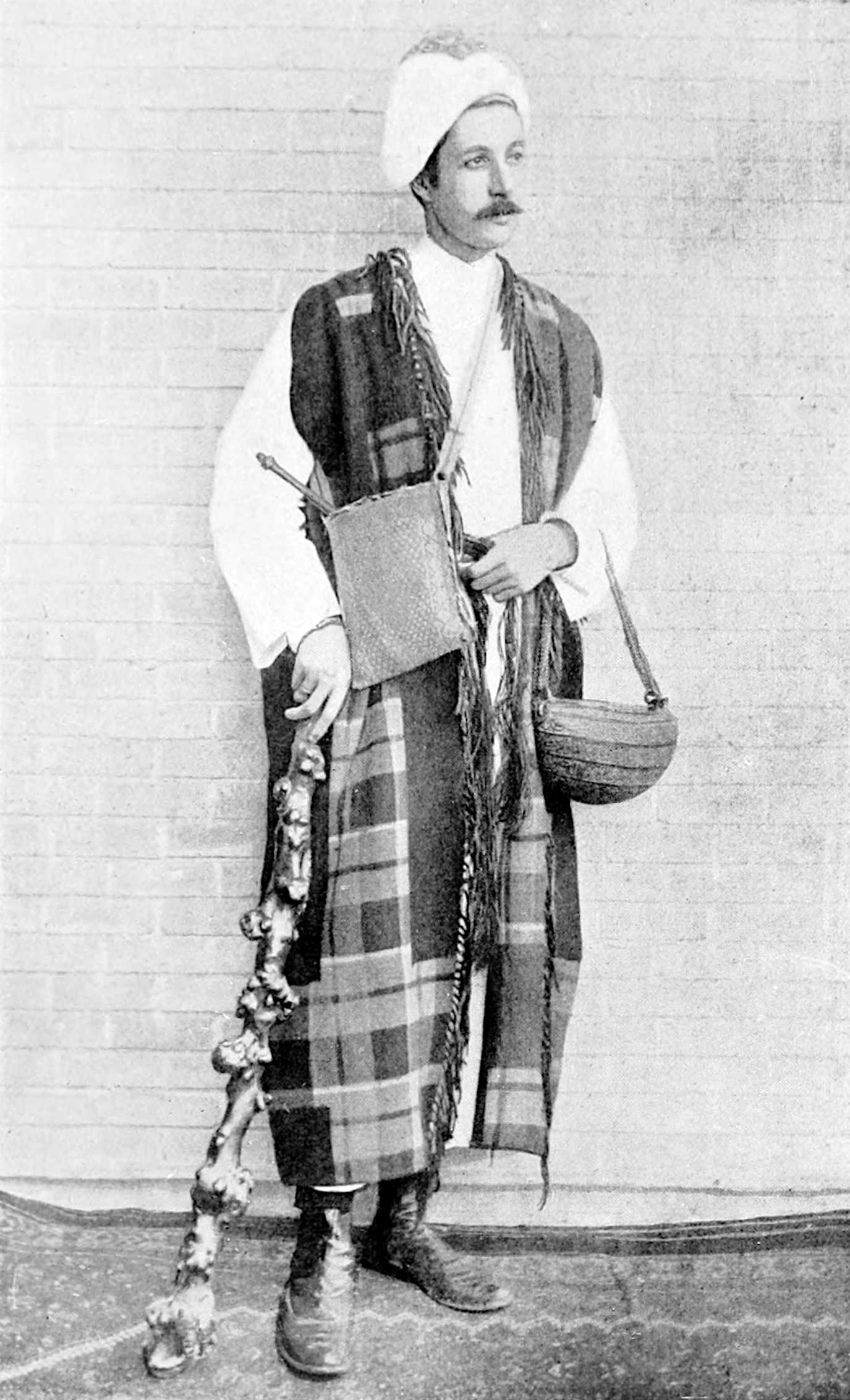
A PERSIAN SUFÍ OF THE ORDER OF THE LATE SEPHÍ ’ALÍ SHÁH.
And thenceforward the traveller, his heart aglow with the
sacred fire of Love, tears aside the curtain of earthly passions,
and wins his way into the Kingdom of Knowledge. He
has passed by slow degrees from doubt into certainty and
from darkness into light. Seeing with clearer eyes he is
now quick to discern wisdom in ignorance and in oppression
justice. Then, on ascending hopefully the ladder
of Wisdom, he rises higher and higher above the ocean of
being, and enters into closer communion with the spirit
of the one he seeks. The arc of truth becomes an
almost perfect round, and he is drawn irresistibly towards
the centre, where dwells the object of his quest. After
traversing the realm of knowledge, which is the last
stage of fear, the traveller enters the first City of Union,
and drinks deep from the bowl of its spirit: and the next
thing he does is to enter the chamber of the True
Beloved. As all the shine of the sea and its shade are
reflected in the heart of a single pearl, so now the infinite
splendour is manifested within the traveller’s soul. Looking
round him with the eyes of Unity he recognises his
true identity in that of his host, and reads the name of
the Beloved in his own name. The circle of his aspirations
will soon be complete, for the sun of divine grace is
seen to rise equally on all creatures; and he is prepared
in spirit to advance one step nearer the end. And soon,
on the breeze of godly independence, which blows from
the spirit’s flame and burns the curtain of poverty, the
traveller is borne into the City of Freedom. There he
will know no sorrow, but will pass through the gates of
joy, and, though he be on the earth, will ride the heaven
of power, and quench his thirst in the wine of love. The
sixth stage on the road to immortality is that of Amazement.
Sometimes he will notice perfect poverty in riches,
and sometimes perfect wealth in poverty. His surprise
will grow at every step. Each second will bring a fresh
revelation. Now he will dive into the ocean of divine
omniscience, and now be carried to the crest of omnipotence
divine.
The traveller passes swiftly from this stage into the
region of absolute poverty and nothingness, which is the
true forgetfulness of self in the love of the Beloved. He
is now as a pearl in the sea of the infinite splendour:
poor in the things created, but rich beyond counting in
the things that are spiritual and pure. And thus, casting
aside the burden of consciousness for ever, he becomes
one with the Beloved and enters the Kingdom of Immortality.
The renunciation of self, therefore, is the
Alpha and Omega of the Súfí doctrine: the lover, in other
words, must turn the Beloved, otherwise he can never
hope to gain admittance into the Chamber of Love.
“One came to the Beloved’s door and knocked. And a
voice from within whispered, ‘Who is there?’ And the
lover answered, saying, ‘It is I.’ Then the voice said,
‘There is not room in this house for thee and me,’ and the
door was not opened unto him. So the lover went back
into the desert and fasted and prayed. And at the end
of a year he returned once more to the Beloved’s door
and knocked. And the voice from within said again,
‘Who is there?’ And this time the lover, having learned
the lesson of self-renunciation, answered, ‘It is thyself,’
and the door was opened unto him.”
The Shiah faith is as old as ’Alí; for, on the feast of
Ghadir, he is said to have been selected by Muhammad
as his successor. In the ages immediately succeeding the
Prophet, it spread itself East and West. The Muslim
colonies, in various parts of the Empire, embraced its
political teaching. It took root even in Mecca and
Medina; but it was in Persia alone that it grew, in the
Ninth Century, to be the State religion, waning and
waxing in its hold on the people during the dynastic
changes to which the country subsequently submitted
itself; until, in the declining years of the Fifteenth
Century, under the Safaví Kings, it re-established its
grip, this time for good, on the national conscience. The
mourning celebration of the month of Muharram, in which
the whole country, with the exception of the Sunnis, takes
part to this day, was founded in the Tenth Century by
Ahmad Muizz-u’d-Dawlat. In order to appreciate the
depth of feeling underlying this yearly commemoration,
the reigns of the early Caliphs must be reviewed.
For, in the story of the family of the Tent, lies the raison
d’être of the Muharram celebration.
When Muhammad died he was succeeded by his
father-in-law, Abú Bekr, a man of great prudence and sincere
piety. His rule was accepted by all the Prophet’s companions,
if we except the Hashemites, who, under the
leadership of ’Alí, declined at first to take the oath of
fidelity. But the death of Fatima, the wife of ’Alí, so
subdued the spirit of her husband that he made his peace
with the aged Caliph, who died after a reign of two years,
bequeathing his sceptre to the iron hand of the incorruptible
Omar. In the twelfth year of a reign of unexampled
glory Omar was assassinated, and his successor was elected
by six of his most trustworthy lieutenants. Othman, the
man chosen by them, had been Muhammad’s secretary:
he was not a successful ruler. His helpless character and
resourcelessness of mind succumbed to the burden of his
responsibilities; his subjects rose in arms throughout his
Empire, and the treachery of one of his secretaries
hastened his downfall. The brother of Ayeshah is believed
to have led the assassins, and Othman, with the
Kurán on his knees, was pierced with a multitude of
wounds. He died in the year 655 A.D., in the eleventh
year of his reign. The inauguration of ’Alí put an end to
the anarchy that ensued; but, with all his bravery and all the
brilliancy of his endowments, ’Alí was alike too forbearing and too
magnanimous to cope successfully with the difficulties of his position.
He was not so much a politician as a poet turned knight-errant, a
religious enthusiast turned soldier.
The first Caliph would have secured the allegiance of
Telha and Zobeir, two of the most powerful of the
Arabian chieftains, by gifts. Omar, the second Caliph,
would have insured his authority and checked their lawlessness
by casting them into prison. Whereas ’Alí, from
purely chivalrous motives, left them to their own devices
without, however, in his contempt for what he had condemned
in another as self-seeking generosity, bribing
them to keep the peace. And so Telha and Zobeir
escaping from Medina, fled, and raised the standard of
revolt in Assyria. The Prophet’s widow, Ayeshah, the
implacable enemy of ’Alí, accompanied them, and was
present at the battle in which the Caliph, at the head of
twenty-nine thousand men, defeated the enemy, and in
which the rebel leaders were slain. This battle was called
the Day of the Camel: for, “in the heat of the action,
seventy men, who held the bridle of Ayeshah’s camel,
were successively killed or wounded; and the cage or
litter in which she sat was struck with javelins and darts
like the quills of a porcupine.” Ayeshah was reproached
by the victorious ’Alí, and then sent under escort to
Medina where she lived to the end of her days at her
husband’s tomb.
Meanwhile, Moawiyah, the son of Abú Sophian, had
assumed the title of Caliph and won the support of the
Syrians and the interest of the house of Ommiyah, and
against him ’Alí now marched. Mounted on a piebald
horse, and wielding his two-edged sword with terrific
effect, he literally ploughed his way through the ranks of
the Syrians, crying out at every stroke of the blade, “God
is victorious.” In the course of the night in which the
battle raged he was heard to repeat “that tremendous exclamation”
four hundred times. Nothing save flight would
have saved his enemies, had not the crafty Moawiyah exposed
on the foremost lances the sacred books of the Kurán,
thus turning the pious zeal of his opponents against themselves;
and ’Alí, in the face of his followers’ awe, was constrained
to submit to a humiliating truce. In his grief and
anger he retreated to Kufa; his party was dejected; the
distant provinces of Persia, of Yemen, and of Egypt
acclaimed his stealthy rival; and he himself, in the mosque
of his city of refuge, fell a victim to a fanatic’s knife.
Moawiyah, after the death of ’Alí, brought about the
abdication of the latter’s son Hasan, who, retiring without
regret from the Palace of Kufá, went to live in a hermit’s
cell near the tomb of the Prophet, his grandfather. There
he was poisoned, and, as many believe, by his wife. But
Huseyn, his younger brother, was not set aside so easily.
In every way worthy to inherit the regal and sacerdotal
office, he added to Hasan’s benevolence and piety, no
insignificant measure of his father’s indomitable spirit,
having served with honour against the Christians in
the siege of Constantinople. So that, when Moawiyah
proclaimed his son Yazid, who was as dissolute as he
was weak-minded, to be the Commander of the Faithful
and the successor of the Apostle of God, Huseyn, who
was living in Medina at the time, scorned to acknowledge
the title of the youth, whose vicious habits he despised. One
hundred and forty thousand Muslims of Kufá and thereabouts
professed their attachment to Huseyn’s cause, and
a list of these adherents of his was transmitted to Medina.
Against the advice of his wisest friends, he resolved to
traverse the desert of Arabia, and to appear on the banks
of the Euphrates—a river held sacred to this day by every
Shiah. He set out with his family, crossed the barren expanse
of desert, and approached the confines of Assyria,
where he was alarmed by the hostile aspect of the country
and “suspected either the ruin or the defection of his
party.” His fears were well founded. Obeidullah, the
Governor of Kufá, had quelled the rising insurrection; and
Huseyn, in the plain of Kerbela, was surrounded by a
body of five thousand horse, who cut off his communication
with the city and the river. Rather than retreat to a
fortress in the desert and confide in the fidelity of the tribe
of Tai he proposed to the chief of the enemy the choice of
three honourable courses of action—that he should be
allowed to return to Medina, or be stationed in a frontier
garrison against the Turks, or safely conducted to the
presence of Yazid. He was informed that he must surrender
unconditionally or accept the consequences of his rebellion.
“Do you think to terrify me with death?” he replied, and
to his sister Zainab, who deplored the impending ruin
of his house, he said: “Our trust is in God alone. All
things, both in heaven and in earth, must perish and return
to their Creator. My brother [Hasan], my father [’Alí],
my mother [Fatima], were better than I am; and every
Mussulman has an example in the Prophet.” His little
band of followers consisted only of thirty-two horsemen and
forty foot soldiers. He begged them to make good their
own escape by a hasty flight; but they held firm to their
allegiance, refusing to desert him in his straits. In return
he prayed that God might accept his death as a propitiation
for their sins; they vowed they would not survive him, and
the family of the Tent, as Huseyn and his fellow-martyrs
are lovingly called by the Shiahs, passed the night in holy
devotions.
The last hours of their lives cannot be more tersely
told, and therefore more suitably to our purpose, than in
the words of Gibbon:
“On the morning of the fatal day, Huseyn mounted
on horseback, with his sword in one hand and the Kurán
in the other; his generous band of martyrs were secured in
their flanks and rear, by the tent-ropes and by a deep
trench which they had filled with lighted faggots, according
to the practice of the Arabs. The enemy advanced with
reluctance, and one of their chiefs deserted, with thirty
followers, to claim the partnership of inevitable death. In
a very close onset, or single combat, the despair of the
Fatimites was invincible; but the surrounding multitude
galled them from a distance with a cloud of arrows, and the
horses and men were successively slain: a truce was allowed
on both sides for the hour of prayer; and the battle at
length expired by the death of the last of the companions
of Huseyn. Alone, weary, and wounded, he seated himself
at the door of his tent. As he tasted a drop of water
he was pierced in the mouth with a dart; and his son and
nephew, two beautiful youths, were killed in his arms. He
lifted his hands to heaven; they were full of blood, and he
uttered a funeral prayer for the living and the dead. In a
transport of despair his sister issued from the tent, and
adjured the general of the Cufians that he would not suffer
Huseyn to be murdered before his eyes; a tear trickled
down his venerable beard; and the boldest of his soldiers
fell back on every side as the dying hero threw himself
among them. The remorseless Shamer, a name detested
by the Faithful, reproached their cowardice; and the grandson
of Mahomet was slain with three and thirty strokes of
lances and swords. After they had trampled on his body,
they carried his head to the castle of Kufá, and the inhuman
Obeidullah struck him on the mouth with a cane. ‘Alas!’
exclaimed an aged Mussulman, ‘on these lips have I seen
the lips of the Prophet of God!’ In a distant age and
climate the tragic scene of the death of Huseyn will
awaken the sympathy of the coldest reader. On the annual
festival of his martyrdom, in the devout pilgrimage to his
sepulchre, his Persian votaries abandon their souls to the
religious frenzy of sorrow and indignation.”
The date of Huseyn’s death was the tenth of Muharram.
The month is one of mourning throughout the
Shiah world, every man and every woman wearing black,
and Passion plays based on the tragedy of the Tent being
performed in all the chief cities and even in the more important
villages of Persia, while the day itself is made the
occasion of a yearly outburst of grief, of rage, and of
fanaticism, which is as unbridled as it is sincere. On this
the Day of Cutting, processions bearing banners draped
in black pass weeping through the streets; the Muslim
Friars, or, to give them their true title, the Seyyid Rúsé
Kháns, lead the way, rending their naked breasts with
knives or with needles, and swelling the shouts of “Yá-Huseyn!
Yá-Hasan!” with the refrains of their wildest
hymns. The flow of blood drives the populace beside itself.
In every thoroughfare men of the lower classes run to join
the ranks of the mourners, laying bare their right shoulders
and breasts to the weapons they carry. And soon every
ward of every city in the country echoes and re-echoes, not
less to the curses showered on the head of Omar, than to
the cries in lamentation of ’Alí’s assassination, of Hasan’s
murder, and of Huseyn’s martyrdom. The universal
mourning animates the collective body of the nation as
with one soul. If it is mixed with a mean hatred for a
man of unrivalled integrity and force of character, it is still,
as the expression of the nation’s love for its chosen hero, a
sentiment of loyal devotion and enduring compassion.
The noise of the grief over Huseyn’s remote death may
ring discordant, unphilosophic, and almost barbaric, in
these days of the lukewarm enthusiasms and uninspiring
scepticism which sap the energies of the more cultured
of mankind; but it rings all the more moving to those who
can hear and understand. For “it is the noise of the
mourning of a nation” mighty in its grief, as Lionel
Tennyson has it.
So true and so deep is this outburst of sorrow that
every Englishman who believes the Persian people to be
corrupt should weigh well his evidence before he passes a
sentence so sweeping and so unjust. The nobility of a
nation is dependent, not so much on ends which consist
in “immediate material possession” of European means
and methods of transport, as “on its capability of being
stirred by memories,” on its faculty to animate an alien
creed with the breath of its own spirit, or on the courage
of its conscience to remain incorruptible in the day of
persecution and death. These tests, though they be of
the spirit and as such unworthy of the consideration of a
trading nation and a commercial age, would, if applied
to Persia, raise that distressful country to the rank of
the first eminence. The power of steam, though it rules
the waves and devours distance, has its limits as a civilising
influence, among mankind. It cannot fill the hungry
heart, though it may be the means of overloading the
belly; much less, if less may be, can it inspire in the
soul by its achievements the passion whereof the religious
drama of Persia is the embodiment. The incorruptibility
of the Persian’s outlook on spiritual truth has been vindicated
in the blood of countless martyrs, and out of
his susceptibility to be inspired by the heroism of the
mighty dead, or, to put the proposition more particularly,
out of his unfeigned devotion to the memory
of the family of the Tent, has sprung the Shiah Passion-drama,
as from the depth of a whole Empire’s sorrow.
Were it not so, the growth of the Miracle-play, that
passionate outcry of the Aryan spirit in the Persian
Muslim, would be a miracle indeed.
The truth is, the Shiah religious drama makes a most
touching appeal to the best qualities of the heart and the
mind. In its pathos, the episode of the Tent recalls the
tragedy of Calvary, and the virtues of the members of
the House of Hashem might have been modelled on those
of the twelve Apostles of Christ. The sublime figure of
Huseyn stands out among them as the redeemer of his
people. As the Founder of Christianity was tempted of
the devil in the wilderness to forego His lofty mission that
He might gain a worldly kingdom, so Huseyn, in the scene
on the plain of Kerbela, rejects the assistance offered to him
by the King of the Jinns on purpose to atone for the sins
of his people by death. On the Cross Christ’s heart forsook
him—once, and only once. It was when He cried: “My
God, My God, why hast Thou forsaken me?” In like
manner the heroic Huseyn, within sight of Kufá, having to
baffle the attack of Yazíd and his hosts by turning aside
from the direct road leading to his city of refuge, and seeing
the exceeding anguish of his beloved sister Zainab, had
felt the sting of his own destiny: “Ye crooked conducted
spheres,” he had cried, “how long will ye tyrannise over
us? How long will ye act thus cruelly to the family of
God’s Prophet?” Then, nerving himself to the trial, he
prophesied his death on the morrow, and said, with his
customary fortitude, that the sacrifice of himself and his
companions was not a cause for grief, since it would work
for the salvation of his grandfather’s people; and thenceforward
his resolution to meet the fate he had chosen for
himself never swerved; not even when the very angels of
heaven sought to save his life from sheer love of a soul so
dauntless and so incorruptible.
The reward of his martyrdom is won in the last scene of
all, which represents the resurrection. The Prophet, failing
to save his followers from punishment, notwithstanding the
united efforts of himself, of ’Alí, and of Hasan, throws
away his rod, his cloak, and his turban, in his disappointment.
Nor is he in the least pacified until Gabriel makes
it clear to him that Huseyn, who “has suffered most,”
must lend him the assistance he requires. The compassionate
heart of the man is wrung, so that when
Huseyn makes his appearance it is to receive from his
magnanimous grandsire the key of intercession. The
Prophet says to him: “Go thou, and deliver from the
flames every one who hath in his lifetime shed a single
tear for thee, every one who hath in any way helped thee,
every one who hath performed a pilgrimage to thy shrine,
or mourned for thee, and every one who hath written tragic
verses to thee. Bear each and all with thee to Paradise.”
And this being done, all the sinners redeemed by their
mediator enter into heaven, crying: “God be praised!
by Huseyn’s grace we are made happy, and by his favour
we are delivered from destruction.”
One word more. Among the sinners whom Muhammad
commanded Huseyn to rescue from hell-fire, as the reader
will have read, perhaps with a smile, were those who had
written tragic verses in praise of the martyr of the Tent.
His smile may, possibly, ring out in a laugh when we
inform him that the Seyyid Rúzé Kháns, the Shiah friars,
are said to have been the originators of the Passion-drama.
The foresight of the authors in thus securing for themselves
an entrance into Paradise and for their fellow-writers
the yearly prayers of the endless generations of mankind,
was it not ingenuously artful?
Part II THE STORY OF THE PILGRIMAGE — CHAPTER I LONDON TO JIDDAH
On bidding good-bye to the mighty capital of the world I
reminded her that though her sombre stone mansions and
teeming streets—and shall I say her epic atmosphere?—have
for me an unspeakable charm, I was glad to be on
my way to the city of great concourse, towards which I
had so often turned my face in prayer, and in which the
hearts of many millions of people are deeply rooted.
Indeed, so certain are the majority of finding salvation
within her sacred walls that it would be no exaggeration
to declare their highest aspiration to be to see Mecca and
die. Ah, well, I for one shall pray to see London again,
for how could I ever forget the least of her gifts to me?
Dear Alma Mater, au revoir!
While I was thus meditating the train puffed out of the
station, and the shore of the English Channel was reached.
The weather was mild, the sky was clear; even the worst
sailor might feel sure of having a delightful passage, and
I, praise the Powers, am a good sailor. And so it was:
we reached the neighbouring shore without the slightest
qualm, and arrived in Paris at six o’clock in the morning.
Many people were already on the move—unlike London,
where hardly anybody is seen about at that time of the
day, except, perhaps, the loitering scum that begins to
rise from the excess of the previous night’s libations. On
the way from the Gare du Nord to the Gare de Lyon I
noticed signs of the festivities in connection with the
Centenary of Victor Hugo, and I could not help admiring
the new statue raised this year to commemorate the
strenuous genius of that great man. One short hour in
Paris, then our train sped southward in brilliant sunshine,
which seemed to draw me nearer to that burning Arabian
land whither I was bound.
On my arrival at Marseilles I booked a berth on board
the steamer Rewa, belonging to the British India Steam
Navigation Company, as it proved to be the only one that
would enable me to reach Port Said and to proceed thence
to Suez by rail in time to catch the connection by boat to
Jiddah.
I shall neither tax the reader’s patience nor trespass on
my space by relating the trivial incidents of a voyage that
presented little of interest to a travel-worn mind. It will
be enough to say that the wind, which was as fair as one
could desire till we reached the Straits of Messina, was
bent afterwards on making another and an angrier sea.
The discomfort of the passengers, most of whom were
Britains bound for India, was betrayed by their seclusion
from the open air. The nearer we approached the East,
the more kindly grew the elements, until, on the seventh
day, about seven o’clock in the morning, Port Said hove in
sight. An hour later I had packed my kit and was ready
for a hearty landing. Steaming slowly into the canal we
passed the pier, which was still in course of construction,
saluted the statue of de Lesseps, and raised a shout of
surprise on counting not less than five Russian warships
before we had reached our moorings. Those guardians of
Russian prestige had come from Chinese waters, had
remained five days at Suez, and were now coaling at Port
Said, where they had arrived on the previous day. Not
one single British man-of-war was to be seen. I had my
breakfast at eight, after which I bade farewell to the
captain and my travelling companions, going ashore in
one of the boats that surrounded our steamer.
Two trains start from Port Said to Suez every day, one
in the forenoon and one in the evening. The line as far as
Ismailia is a narrow tramway having a gauge of 2ft.
8in.; the cars are consequently both narrow and uncomfortable,
and take about three hours to do the journey.
On my bidding good-bye to the dragoman I had engaged,
he assured me that he was far too devout a Muslim to fleece
so pious a pilgrim as myself, and he would not accept a
centime more than five francs for the boat, the carriage,
and his special services. It was from him that I first heard
of the outbreak of cholera in Arabia—a report that was unfortunately
confirmed at Suez, whither I journeyed in the
discomfort of a dust-storm and a hot easterly wind. We
arrived at Ismailia at one o’clock, or thereabouts, having
left Port Said at a quarter to ten o’clock. This place, when
the canal was being cut, was the headquarters of the workmen;
but now it has sunk in importance, many of the
buildings having actually fallen in ruins. Some of the
managers of the company, however, are still living there,
and the best houses in the town are at their disposal.
Employment is provided on the canal for some hundred
and twenty pilots, most of whom are Greeks and Frenchmen,
though a few Englishmen have been recently added
to the staff. The railway from Cairo to Suez, which belongs
to the Egyptian Government, passes through Ismailia and
picks up the passengers for Suez who have travelled so far
by the Canal Company’s toy line. Henceforward the
journey was made in comfort, for the line, though a single
one, is a standard British gauge and the train provided with
an excellent waggon-restaurant. Nearly all the passengers
on board were Arabs and low-class Europeans in the third-class
compartments. We stopped at three stations on the
way, and every time it happened we were greeted by a
weird chorus of Arab song, of which the burden was the
“Wondrous names of God and the virtues of His Prophet.”
I was somewhat amused to hear the words, “Not I, by
God!” in reply to my inquiry as to whether or not a certain
Arab would be good enough to fetch a bottle of soda water
for me. For I, being unused to the climate, had suffered
tortures from thirst in the scorching heat and driving dust-clouds,
the intervals between the stages being extremely
long and tedious—in fact, it took the train seven hours and
a quarter to cover the hundred miles that separate Port
Said from Suez. Nor was the prospect of a sort to slake
the thirst of the weary pilgrim. All along the line hugs
the right bank of the canal, and nothing is to be seen except
the soft white sand of the glowing desert, unless it be an
occasional patch of green grass or a cluster of date trees,
irrigated by the fresh-water canal newly cut in order to conduct
the much-needed water from a spot near Cairo to Port
Said and Suez, the latter a place which stands in sore want
of the cleansing and refreshing element.
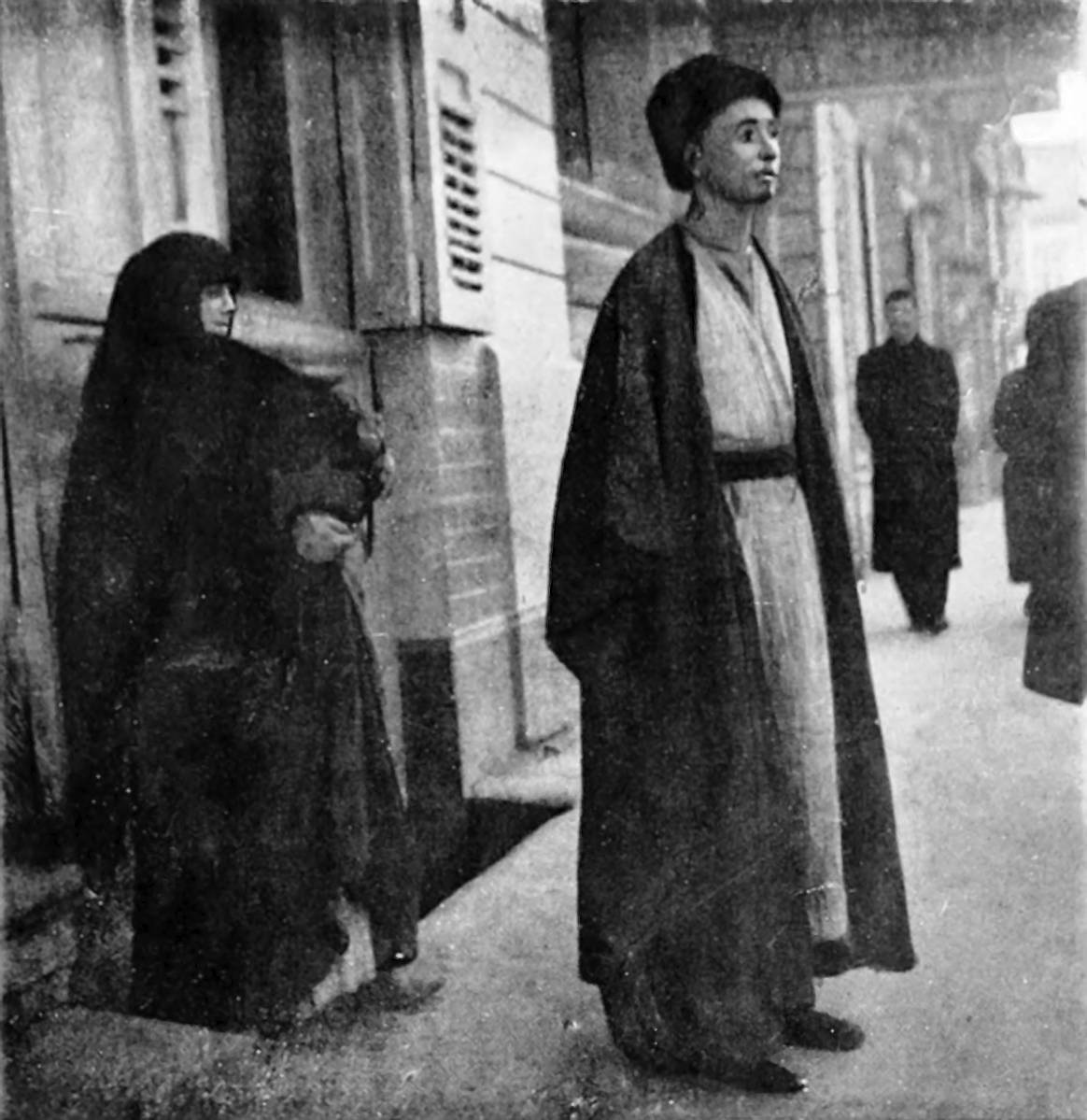
A PILGRIM “AT SEA”—SUEZ RAILWAY STATION.
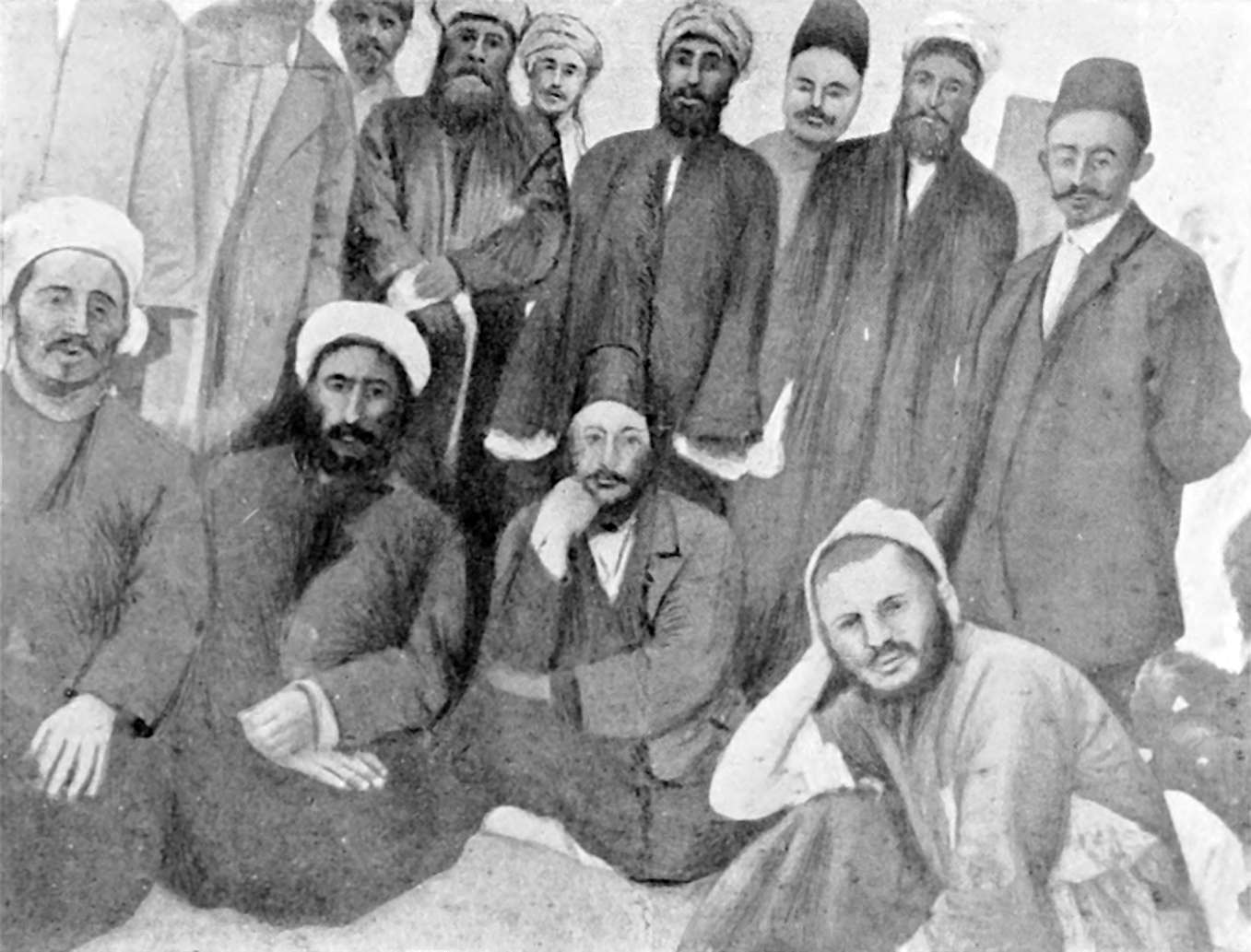
A GROUP OF MIXED PILGRIMS.
On my arrival at the station a dragoman, one of the
plagues of Egypt, joined himself to my suite, informing me
with glib mendacity that he carried both Arabia and the
Land of the Pyramids in his pocket, whereas, as a matter of
fact, he had not once left his native town. However, as I
could not shake the fellow off, I made the best of a bad
bargain by taking him out shopping with me. First, I
bought a deep crimson fez with a long black silk tassel and
a straw lining. Though it looked both cool and fanciful,
and was therefore pleasing to my Oriental eye, I am not
certain that a turban would not have been more in keeping
with the complete Arab suit which I subsequently purchased.
This consisted of a thin linen shirt, a pair of
trousers, and two long and graceful robes. The shirt was
worn as long as a night-shirt, it had no collar, and the
roomy sleeves were left open at the wrists. The trousers
were more interesting, and of a curious shape and an odd
material, being made of thin white calico, and so cut that
whereas an elephant’s thigh could scarcely fill the ample
width of the uppermost part, one had the greatest difficulty
in slipping the feet through the lower ends which clung
tightly round the ankles. As for the two robes, which were
long enough to cover the nether garments, the inner one
was made of the finest silk, striped in successive colours of
red, yellow, and green, and was left entirely open in front,
but the left breast overlapped the right, to which it was
buttoned from the armpits downwards. The outer habit of
a blueish colour served as a cloak to the inner one, was made
of the same material, and cut in precisely the same way.
No socks were worn, and the shoes were not unlike ordinary
slippers, with this exception, that they were turned up at
the toes.
On donning this picturesque attire I returned to the
Hôtel d’Orient by way of the narrow and filthy bazaars,
where my attention was attracted by a band of dancers
who were drawing together a crowd of sightseers of every
nationality. While one man was cutting his capers in the
skin of a Polar bear, a second, tambourine in hand,
powdered his face to imitate a European, while a third,
got up in guise of a Negro, played with a lively monkey
in chains, and three dancing girls with huge artificial moles
on their faces completed the company. All these, including
the monkey, pranced up and down to the tune vociferated
by the women and accompanied on the tambourine
by the man with the white face, repeating at intervals the
shrill cry of “Hullá-hee-há-há.”
As I sat within the courtyard of the Hotel, listening
to the voice of the Greek prima donna who sang nightly
to the assembled guests, I could not refrain from smiling
within myself at the transformation in my appearance and
demeanour which recalled to my memory a line of Obaid
Zakani’s satire of “The Mouse and the Cat,” which runs:
“Be of good cheer, comrades, the cat has become pious.”
These glad tidings were spread abroad by a little mouse
that, having hidden itself under the altar of a mosque at
Kirmán, overheard the cat reading aloud the passage of
repentance, meekly kneeling on its knees. Unfortunately
the cat, the symbol of vicious cunning, broke its vows a
little time after, and I wondered how far and how long I
should succeed in keeping mine.
Next morning I came across a blind Arabian priest
patiently waiting on the landing-stage for the departure of
the steamer, and in the evening he was still in the self-same
spot, kneeling on his prayer-rug and singing aloud
the verses of the Kurán in a deep original Arab melody,
rosary in hand. His young son was kneeling by his side,
listening with downcast eyes to the never-ceasing chants
of his father, who knew by heart every word of the sacred
book, to say nothing of the saddening elegies of the
Arabian traditionists. Like most of the singers of the
East, who pour out their rhapsodies all day long in an
ever-flowing torrent of melody, he was extremely
monotonous, and so I sought to stem the current of his
song by entering into conversation with him. On hearing
from me that he would be obliged to descend into the hell
of the Turkish quarantine and to remain there five days
before he could hope to ascend into the pilgrim’s paradise
of Mecca, a look of keen distress swept like a cloud over his
enraptured countenance. Rising slowly to his feet, he raised
his sightless eyes, saying: “God, if it please Him, will provide
me with a swift means of transport to His city. We
shall meet again.” So confident was his tone that my own
misgivings yielded to the hope that I should yet overcome
the difficulty of the quarantine. And soon after I was
informed that all the first-class passengers on board the
last pilgrim boat would be allowed to proceed to their
destination without let or hindrance, but the unfortunate
deck passengers would have to conform to the regulations.
Never was the privilege of wealth and the curse of poverty
brought home to the hearts of the weary in a more convincing
fashion. The next best thing to being wealthy, I
told myself, is to have the prerogatives of wealth thrust
upon one.
Having had my passport viséd, I booked a berth and
went on board the Khedivieh steamer, which completed
the distance between Suez and Jiddah—some six hundred
and forty-five nautical miles—in about eighty hours. At
ordinary times these steamers are simply employed on the
mail service, one of them leaving Suez for Jiddah every
week—generally on Thursday—and another leaving Jiddah
for Suez on the same day. Though they practically belong
to a British syndicate, they go under the name of
Khedivieh steamers. The captain and the chief officers
are English, whereas the crew are Egyptians and Lascars.
During the pilgrimage steamers run frequently between
the two ports, and in the year 1902 not less than two hundred
thousand pilgrims, I was told, had landed at Jiddah,
the majority of whom embarked at Suez. Among these
numbers must be reckoned the eighty thousand Russian
subjects from the Caucasus and Central Asia, who, for the
first time since they came under the Russian rule, had been
granted the privilege of undertaking the ancient pilgrimage.
Rumour credited them with being the main cause of the
cholera that year. If only the half of what I heard about
them were true their pollution would still beggar description.
The cruise in the Red Sea is not so interesting as that
in the Mediterranean. Save an occasional ragged rock
rising from the yellow waters, or a flight of white birds
over the steamer, nothing was to be seen from hour to
hour.
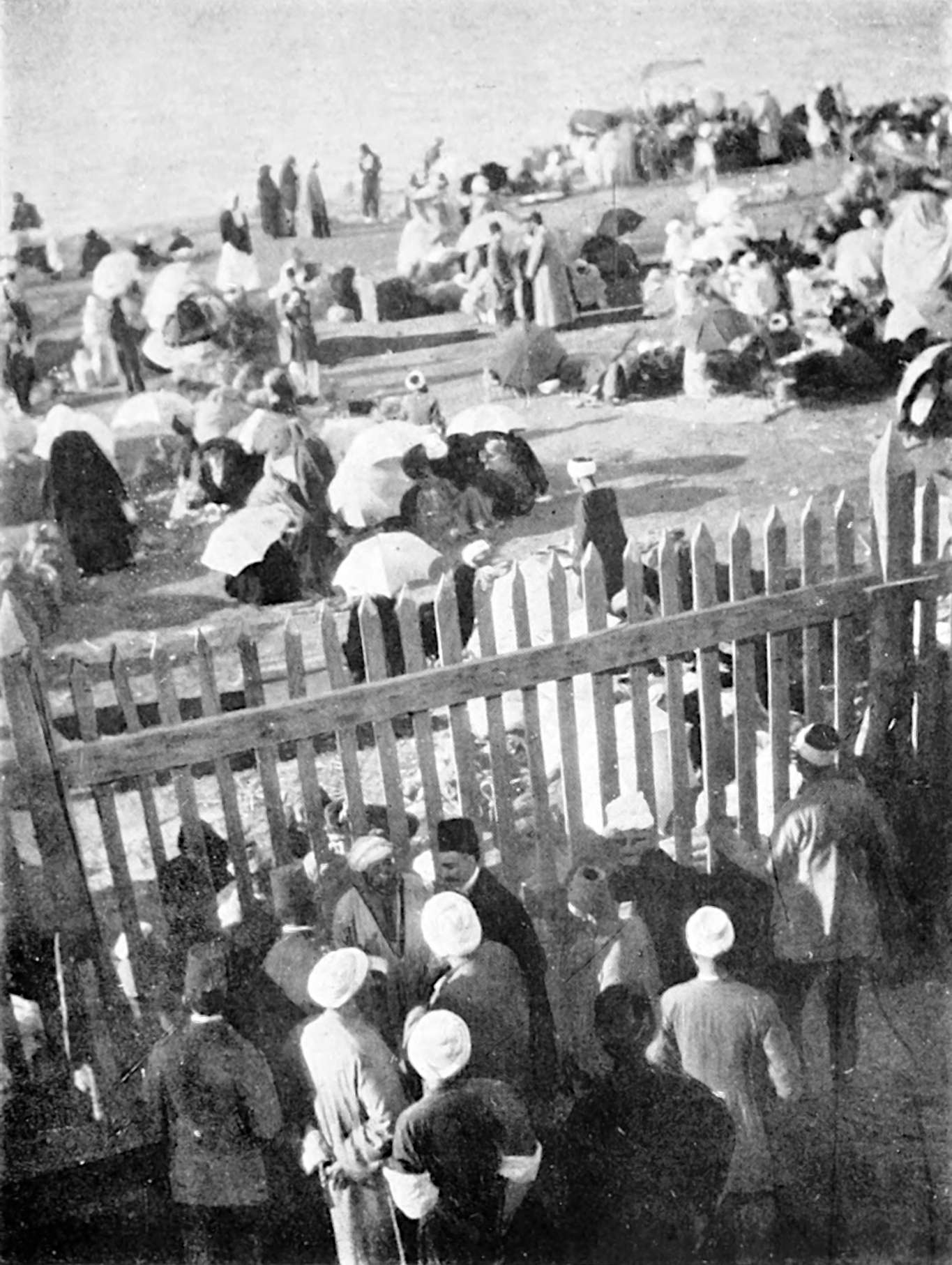
PREPARING TO EMBARK AT SUEZ.
When we sighted the port of Jiddah, which I shall
describe by-and-by, we were told to put on our ihrám, or
sacred habit, before entering the holy territory on our way to
Mecca. As a preliminary, I at once removed my Arabian
costume, washed my hands, up to the elbow, and my feet,
up to the knees; I afterwards shaved the upper lip, leaving
the fresh-grown, unsightly beard to its own fate. Then,
having performed the prescribed ablution of the head, I
closed my eyes and expressed, with the tongue of my
heart, the earnest desire to cast off the garb of unrighteousness
and pride and to put on the winding-sheet of humility
and of passive obedience to God’s will. Last of all, that I
might be worthy to visit His house, I prostrated myself
on the prayer-rug and said aloud the following formula of
devotion: “O Almighty God, Thou art without a mate;
I praise Thy sovereign grace with all my heart; Thou art
pure and everlasting;” then I repeated three times: “O
Lord, Thou art without a mate,” adding, “I praise,
O Lord, Thy apostle Muhammad and his disciples and
his family; in like manner, I also praise our father
Abraham and his house.” The next thing I said was:
“Send down upon me, O Lord, the healthful spirit of
Thy satisfaction; open unto me, I beseech Thee, the gates
of Paradise, and shelter me from the fire of Hell.” And
this petition I also repeated three times. I was then
ready to don the sacred habit.
Now, my ihrám, which I had bought at Suez, consisted
of two thin woollen wrappers and a pair of sandals. One
wrapper was tied about the middle and allowed to fall all
round to the ankles, while the other was thrown over the
shoulders, leaving my head and the forearms bare. Both
wrappers were spotlessly white, and had neither seam nor
hem. The sandal was a kind of shoe, consisting of a sole
fastened to the foot by means of a tie which passed between
the large toe and the first toe of the foot; it left uncovered
both the instep and the heel. This sacred habit was worn
by all pilgrims during the four days preceding the Hájj
Day. While they have it on they must neither hunt nor
fowl, though they are allowed to fish—a doubtful privilege
in a dry land. This precept, according to Ahmad Ebn
Yûsuf, is so strictly observed that nothing will induce
pilgrims to kill so much as a flea. We are told by Al
Beidáwí, however, that there are some noxious animals
that they have permission to kill during the pilgrimage,
such animals, for instance, as kites, ravens, scorpions, mice,
and dogs given to bite. Pilgrims must keep a constant
watch over their words and their actions so long as they
wear the sacred habit. Not a single abusive word must
be uttered; all obscene discourse and all converse with
women must be avoided; and not a single woman’s face
must be seen, save that of a wife, a sister, or a cousin-german,
i.e., a sister’s or a brother’s daughter. The men,
as I have said, must now doff their sewn clothes and must
keep both their faces and their heads uncovered; but the
woman must be, as it were, hermetically sealed in their
stitched cloaks and veils. The only part of their bodies
that they have the right to expose, if they like, is the
palms of their hands. For the rest, they must not travel
alone, but must be accompanied by a man who may lawfully
see them unveiled.
Poor pilgrims! They suffered from right and left. First
came the blood-suckers’ passport picnic. Here the pilgrim
was plagued to death with questions that the most cursory
perusal of his safe-conduct had rendered unnecessary.
“Where do you come from? When did you leave? How
did you get here? What are your intentions? Why
this? How that? When the other?” The poorer
pilgrims complained that they were positively fleeced on
the most frivolous pretexts. “Your passport is not
properly written; you must pay forty-eight piastres,”
and so on.
Then the customs’ authorities emerged. “Will you
walk into my parlour?” these mosquitoes said to the
pilgrims. To the imaginative mind the buzzing which
filled the room spelt the word bakhshísh. Woe betide
the pilgrim who did not so interpret the sound! All
these officials, as a Persian would say, had arms longer
than their legs—in other words, they reached out an itching
palm to every pilgrim, and, casting an appealing smile
on him, seemed as though they would ask him to tickle it
with the counter-irritant of a “tip.” They opened my kit-bags
and turned everything topsy-turvy before I had time
to bridle their official zeal in the customary way. Among
the contents were an English newspaper and a novel,
and these were promptly confiscated for no other reason
than that I had read them both. I cannot say that I made
them a present of my purse by way of pouring coals of
fire on their heads. It was otherwise in my case. I tied
my purse-strings a little tighter, and responded to their
bakhshísh-coveting smiles with a smile equally bakhshísh-coveting.
It is wise, when you know the ropes, to
husband your resources till you reach the interior, for there
your comfort in travelling will depend on your having a
purse well lined. By following this rule, I was not so
ill-prepared as I might otherwise have been to meet the
claims on my charity of the professional beggars who waylaid
my every step in the quaint old city of Jiddah.
Such a scene! Crowds of Arabs were lying on the
filthy ground, which, despite the heat, seemed strangely
damp. Some were praying, some were snoring, others
were smoking, many were wrestling in the mud, but by far
the greater number of them merely dreamed away the
passing hours, too idle even to open their eyes. You
might stay from sunrise to sunset by the side of the more
meditative among them without their showing the least
signs of life. How differently constituted are these loafers
from the free-born Arabs of the desert! The women held
themselves somewhat aloof from the men, and sat smoking
their pipes, or chatting like magpies, in groups of three or
four. The sight of a new face seemed to have lost its
attraction for them, or perhaps they had grown weary of
criticising the gait and the appearance of the incoming
pilgrims. Having now seen a good many of them, however,
as it were by stealth, I think I may say with confidence
that among the Arabs of Hejaz the men are far
better-looking than the women. This is mostly the
women’s own fault, for they ruin the beauty of their faces
by tattooing their chins. Were it not for this unsightly
custom, peculiar to the Arabs, the womenfolk, though
corpulent, might be regarded as comely. The men, on
the other hand, are fairly handsome, being tall and lean,
and having high-bridged noses, flashing black eyes, and
lofty foreheads. I am speaking more especially of the wild
Arabs of the desert and not of the townsmen, whose faces,
however handsome they may be, are too often marred by
an expression of cupidity and cunning.
Jiddah, though dirty, is a very picturesque city. It
has narrow serpentine streets which are rarely more
than seven or eight feet wide, and is surrounded by
five turreted walls of great antiquity rising to a height of
twelve feet or so. Of these walls the northern measures
in length about seven hundred and thirty-one yards, the
southern seven hundred and sixty-nine, the eastern five
hundred and eighty-five, the western six hundred and
twenty-four, and the south-eastern some three hundred
and seventy-nine. There are about three thousand houses
in the city, most of which are built of limestone and shut
out from the street by walls which sometimes conceal the
roofs of the houses within. Here and there a small
window in the surrounding walls affords ventilation to
the house. It is only a few years since a big well
was dug at a place called Bashtar, some two miles
distant from the city, the water of which is conducted
by means of underground passages. This well
bears the name of the reigning Sultan of Turkey. Pure
drinking water being scarce, sakkás or water-carriers are
seen about the streets carrying the precious liquid on their
backs in big leathern bags. Of recent years several mosques
and caravanserais and one steam mill have been erected
outside the city walls. The governor’s residence, together
with the post-office and almost all of the more modern
buildings, lies outside the walls, facing the Red Sea. The
shops, raised not more than a foot above the ground, are
about two yards and a half in width and some three yards
deep in the interior. Butchers, grocers, fruiterers, and
linen drapers are crowded together much as they are in an
English street. The babble within the bazaar is beyond
description. Your first conjecture is that a free fight is
about to begin between the tradesman and his customer;
but, on making ready to intervene in the cause of peace,
you find to your pleasure or your chagrin that the vociferous
couple shake hands, first by touching the right hand and
then by raising both hands to the right eye, after which the
shopkeeper makes tender inquiries as to his customer’s
health, and then the bargaining begins. It took me over
an hour to buy a few yards of cloth. The ancient draper
was too lazy to reach out for the stuff himself, so he ordered
his boy to bestir himself in my interests. The cloth being
handed to him, the draper fingered it caressingly, saying:
“The cloth is soft to the touch, its splendour dazzles the
eyes! Such an exquisite material has not been seen in this
market for years!” The cloth was to my liking, and so I
made haste to ask the price of it. The draper shook his head
reprovingly. Then he said: “Hurry and haste belong to
Satan: I usually sell this cloth at thirty piastres a yard to
my customers, but to you I will sell it for twenty-five, because
you have found favour in my sight.” I made him a counter-bid
of five piastres a yard in order to cut the barter short.
Whereupon the draper, nodding in admiration of my guile,
gazed around him for close on five minutes. When he opened
his mouth at last it was to say in his most winning voice:
“My good sir, since you are looking so well, so handsome,
and so distinguished, I will part with this priceless material
at the trifling cost to yourself of fifteen piastres a yard.”
“Not so,” I replied. “Since you are a bright old man I
will increase my favour in your sight by adding a piastre to
my last bid; in other words, I now offer you six piastres
a yard.” The draper raised his hand to Heaven. “That
is impossible! I ask pardon of God.” I now turned on
my heel and walked away. He called me back at once.
“Sir,” he said, “I would not have you leave me in displeasure.
Give whatever you like, the cloth is yours. I
am your sacrifice.” I retraced my steps. “Nonsense,”
I returned; “how is it possible for me to give what I
like for the stuff, since you are the tradesman and know
its proper value?” The old man smiled, and said,
“Honoured sir, the lowest price I can possibly accept
for this material is ten piastres a yard.” It was now my
turn to smile. “Sir,” I replied, “I have no wish to
offend you by leaving your shop, and so I will buy the
cloth from you for seven piastres a yard instead of going
to your rival yonder, who has offered to sell me some at
six and a half piastres.”
The draper then handed me a stool, and said, smiling,
“You are not easy to deal with. Come, sit down, and
smoke this hukah, and we shall not part in anger.” So I
sat down in front of the shop, and while I sucked
meditatively at the pipe he handed to me, the stuff was
measured, cut, and folded, the tacit understanding between
us being that we would meet half-way, namely at eight
piastres and a half. By the time I had finished my smoke
the material was ready for me, and so I lost no time in
returning to the hotel.
The harvest season of the shopkeepers is during the
journeying months. Their most striking characteristic in
the eyes of a Persian pilgrim is that they all wear white
beards. The reason of this probably is that young shopkeepers
would stand not a ghost of a chance of competing
successfully with their elderly rivals. Moreover, all greybeards
in the Muhammadan religion are entitled to receive
special veneration from the young. Another reason is that
nearly all the young men are employed by the pilgrims as
guides, as servants, and as drivers.
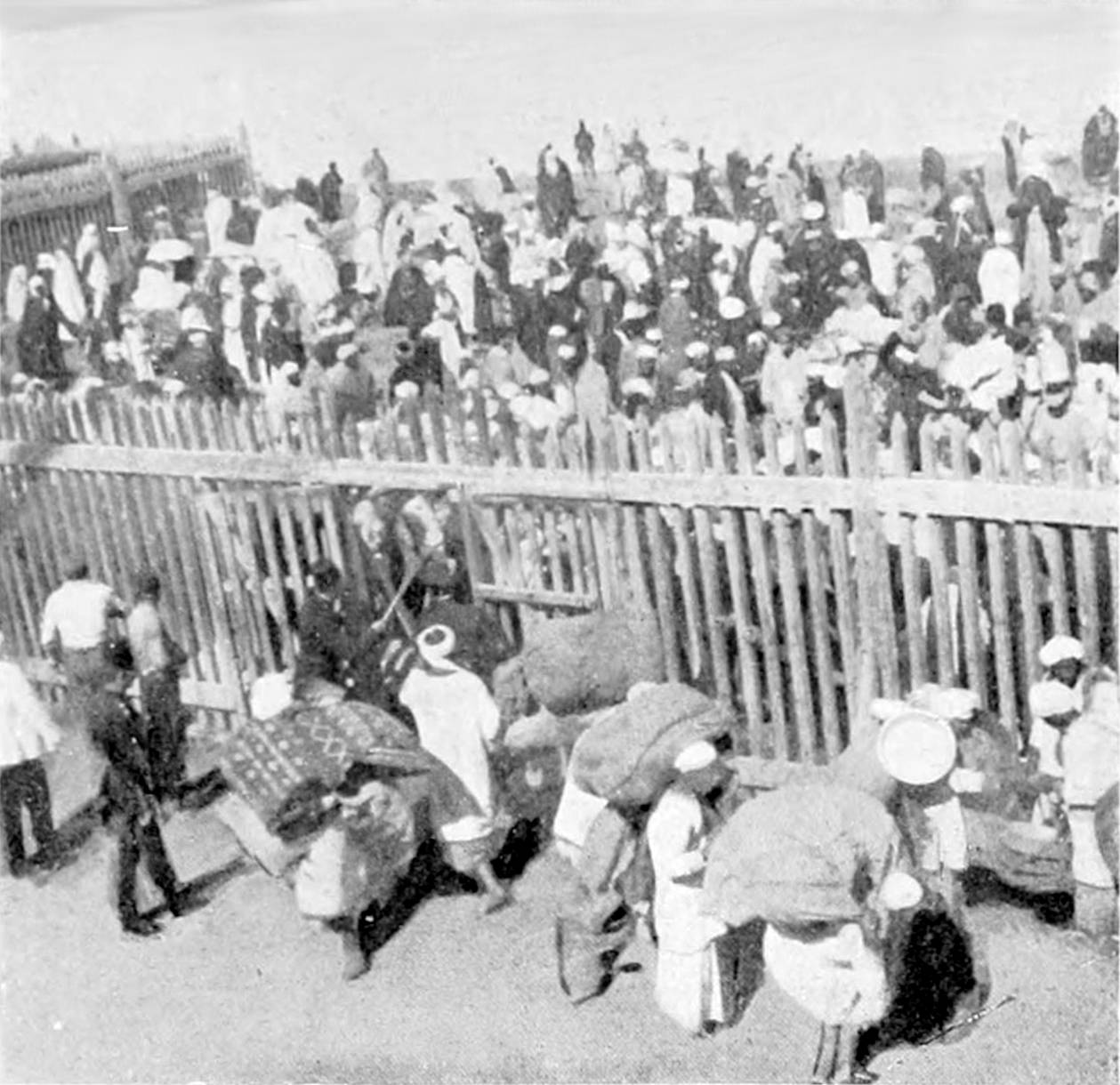
PILGRIMS EMBARKING AT SUEZ.
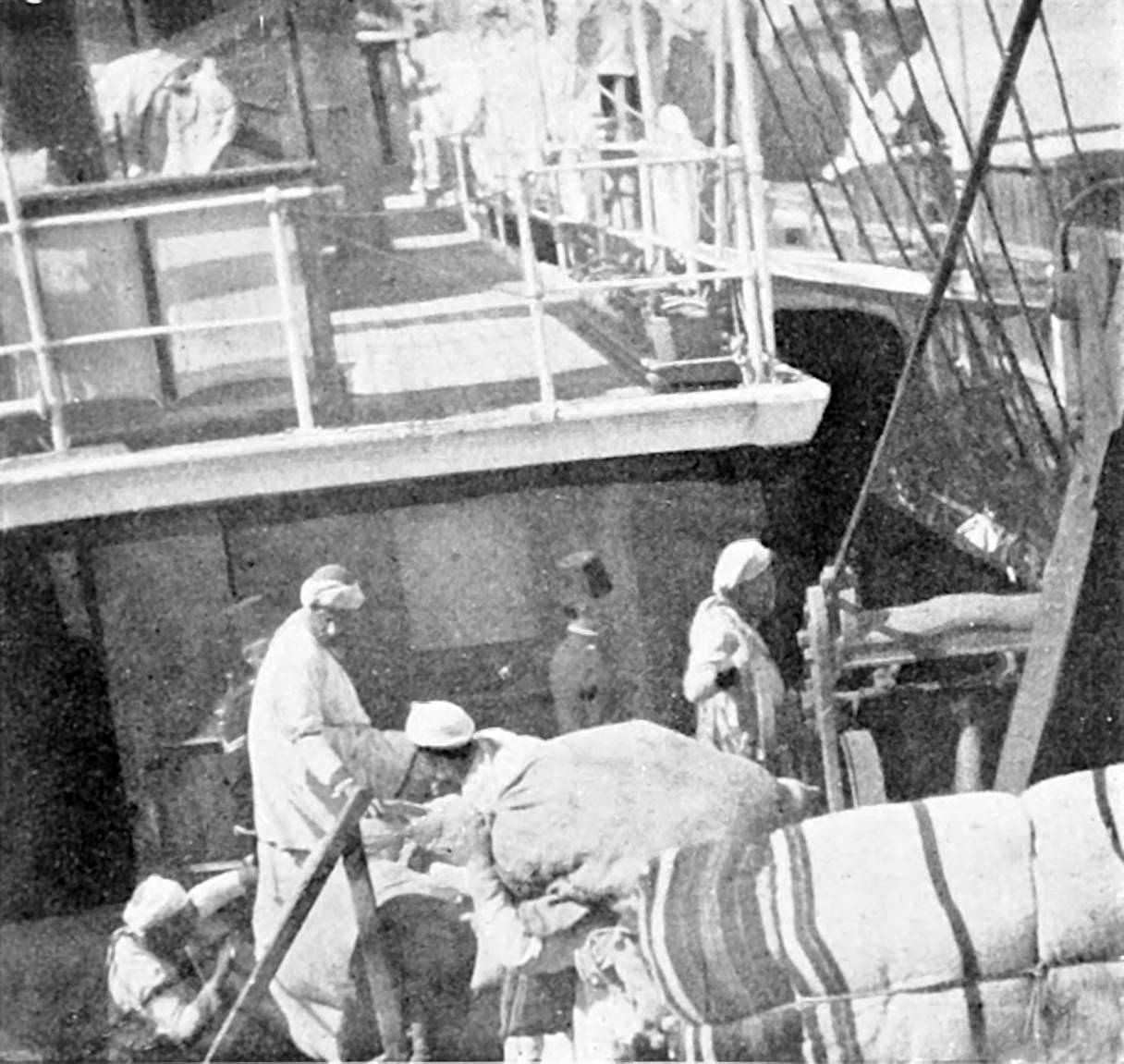
BEFORE WEIGHING ANCHOR AT SUEZ.
Everything moves slowly in these Arab towns. You
will break the laws of good breeding if you walk fast there.
Consider the camel of the desert, how he walks; he hurries
not, neither does he make a sound: so take this finnikin
creature as your model and form your gait on the camel’s.
All Orientals pin implicit faith in the doctrine of “slow
but sure,” and when they give you some work they recommend
you to be “slow over it,” believing that a thing done
smartly is not often done well.
CHAPTER II FROM JIDDAH TO MECCA
The time at my disposal being limited, I went at
once in search of a guide, who should accompany me
to Mecca and thence to Arafat, and put me in the
way of performing the rites and mysteries of the
Hájj. The men who officiate in that capacity are
called moghavems. The pick of them had fallen to the lot
of the early-comers who had flocked to Jiddah in great
numbers; but with my customary luck, I chanced upon a
Persian moghavem, whose knowledge of the ceremonies
and the holy places of the Pilgrimage was seasoned with
the waggish conceits of a singularly original mind. His
sceptical witticisms were the more piquant in that he gloried
in the name of Seyyid ’Alí. For the rest, he had travelled
far and wide, had sat down and laughed beside the waters
of Babylon, had wandered on foot as far to the East as
Benares, and had undertaken the Pilgrimage of Mecca
half a dozen times. I congratulated him on his globe-trotting
habit, whereupon he showed a gleam of white
teeth, raising himself on the tips of his toes, and stroked
his unkempt beard complacently. Then he aired his
knowledge of geography. “Yá-Moulai,” he said with
unexpected gravity, “Allah has had me in His keeping,
may He be praised! He has revealed to me the innermost
secrets of the world, and shown to me the whole
creation. I have been everywhere except in Hell, and even
that experience will not be withheld from me, I trust,
when I come to die. True it is, yá-Moulai, that this life
is a riddle; we solve it when we give up the ghost—perhaps.
Anyhow, my one desire in this world is to go
to Europe that I may see China and study the philosophy
of that wonderful land.” I had to avert my head lest he
should detect the struggle between amusement and politeness
which convulsed every feature of my face.
“Ah,” said he, “your Excellency is fortunate to have
met me: the Hájj Season is far advanced: moghavems
are scarce: and I am one of the most reasonable of men.
If you will burst from the bonds of economics in the
matter of salary, you will find in me a pleasant travelling
companion and a lettered guide.”
“Will two dollars a day content you?” I asked. The
offer was a liberal one, and on the spur of a grateful impulse
he clinched the bargain without a moment’s hesitation.
This trait of character endeared him to me, and so I treated
him on a footing of social equality so long as he was my
cicerone.
Now, the day was the sixth day of the moon: a distance
of some forty-six miles lay between us and the Holy
City: and, furthermore, since the Pilgrims had to leave
Mecca on the 8th for the hill of Arafat, it followed that
we had not a single moment to lose in making preparations
for our journey. With many words Seyyid ’Alí
staked his wages that, by hiring asses and riding alone,
we could cover the road in eleven hours. “Of course,”
said he, “we must run the risk of being attacked by
Bedouins who lie in wait for stragglers. Indeed, only two
days ago, so the rumour runs in the bazaars, a caravan of
forty Persian pilgrims was robbed on leaving Heddah for
Mecca: and everybody we meet—depend upon it—will
do his utmost to terrify us with blood-curdling stories of
Arab lawlessness and violence. However, let us pin our
faith not in firearms and bravado, but in our cool heads
and our stout hearts. And, in the meanwhile, I will take
you to a caravanserai, where we shall find an acquaintance
of mine, who is the owner of a drove of the fleetest asses
in Hejaz. His name is Nassir, and he owns allegiance to
the fighting clan of Harb. From him we will hire three
donkeys: one for your Excellency, one for the effects we
have with us, and a third for myself. Nassir will accompany
us on foot, and be a protector to us in the wilderness.
Let us hasten lest his services be engaged.”
After bartering with Nassir, it was settled that I should
pay him two dollars for the use of each animal (two-thirds
to be paid in advance and one-third on alighting in Mecca),
while he himself was to receive, in return for his services,
a bakhshísh in proportion to his usefulness on the road.
In appearance he was a typical representative of his
race, both in bearing and in dress, as well as in accoutrements
and in strength. Tall and lean, he had the appearance
of a man that had been baked in an oven: his skin
was as brown and as wrinkled as a walnut-shell, his features
seemed to leap out of the face, while his eyes declared the
nobility of a virile though savage nature. He wore a long
yellow shirt, reaching below the knees, with a red cotton
belt round the waist, in which was stuck an ugly-looking
dagger. Slung crosswise over his back a Bedouin generally
carries an old-fashioned flint rifle, having a barrel some
two yards in length, with a bow-shaped stock covered all
over with small square chips of white shells. For this ungainly
weapon Nassir substituted a stout Arab club, which
was a fortunate thing for Seyyid ’Alí, perhaps, inasmuch
as wordy wars between the two men came to be of hourly
occurrence.
About five o’clock in the evening, after having smoked
a pipe of peace at a coffee-house in the bazaars, we
mounted our asses, Seyyid ’Alí and myself, while the fleet-footed
driver, go as hard as we might, kept pace with us,
without so much as turning a hair. We rode through the
Mecca gate, and then bore off in a north-easterly direction
in order that I might have an opportunity of visiting Eve’s
Tomb. This excursion, because it took us a little out of
our way, was not to the liking of our Harbi warrior, who,
in his anxiety to reach Mecca by sunrise, was bent on
sparing both his own breath and his beasts of burden.
But I, having made up my mind to pay my respects to
the resting-place of our common mother, was not to be
gainsaid; and I contrived to convict my opponent of
churlishness by making a point of reaching my destination
within half an hour—that is in less than half the time he
had said it would take.
Assuredly, Arabia is the cradle of credulity. In that
land of legend the historian catches his breath. He is ill
at ease, alternately bewildered and sceptical, as might be
expected of a man, who, reaching out for truth, lays hold
of a myth at every step. Thus, on gaining admittance to
the enclosure, I was amazed to notice the exceeding length
of the Tomb, and on measuring the low walls believed to
define the outlines of Eve’s body, I found that they were
one hundred and seventy-three yards long, and about
twelve feet broad. In the centre a low dome is conspicuous;
it is said to crown Eve’s navel. “What a monster!”
I cried, laughing, “easy lies the head of our common
mother.” The guide corrected me, saying, “The Well of
Wisdom is mistaken. The tomb was not long enough to
contain her blessed head. It is well known that only the
trunk and limbs of her lie here.” Rising to my full height,
five feet nine in my sandals, I asked him to account for the
dwindling in the size of man. “The Fountain of Learning
must remember,” he replied, “that Eve, our Mother, fell,
and with her fell the stature of the human race.” The explanation
found a crack in the armour of my credulity, and
so, turning back into the direct road, we resumed our
journey, joining a caravan of about thirty pilgrims of mixed
nationalities, Egyptians, Syrians, Caucasians, Indians, and
Malays.
Instead of refreshing breezes, which would have come
as a positive godsend, the wind, blowing from the south-west,
spread abroad an abominable vapour, and caused the
sand to rise and fall like the bosom of the ocean. Sand-heaps
twelve feet high might be scattered at any moment
in these whirlwinds; but, fortunately, though our asses
often sunk over their fetlocks, we reached in safety the Hill
of Gaem (the first stage for caravans), where, according to
a local superstition, the Messiah will first appear. A small
booth here made ample amends for the scarcity of water,
and I could not remember ever having tasted more fragrant
and delicious coffee.
Slowly but surely the ground now began to rise, and
the sand to grow firmer. A caravan of camels glided
stealthily by, bells tinkling, pilgrims reciting the Kurán,
and the drivers singing to their camels a deeply melodious
song called Hodi, which has on them the effect of a goad,
urging them on to a brisk unchanging pace. To this
accompaniment a camel will cover a great distance without
stopping, the general belief being that the camel gets
drunk with the sweet burden of the Hodi song.
Overnight, long after sunset, my Harbi driver himself
began to sing aloud in the gathering darkness, asking God
to protect him from the goblins of the wilderness, and
always in a lugubrious minor key, as if he was going to
weep. But ever and anon we heard an original song set
to the music of the desert, wild as the wastes, elusive as
the winds, as revealing and obscure as the tuneless solitudes
from whose heart it would seem to spring—a song
that broke through melody, and added its tameless burden
to the music of the spheres. On cultured Europeans
these untutored outbursts would have an uncanny effect,
causing the centuries to roll back to the days of their
barbarian ancestry, and awakening within them, perhaps,
one of those haunting dream-memories of birth far back
in the misty past, of an anterior existence in keeping with
the strains of incoherent minstrelsy when men, labouring
under the burdens of consciousness, sang as the spirit
moved them, knowing nothing of the laws of counterpoint
and harmony. Such a song was sung by Seyyid ’Alí as
we left Heddah, a song written by a famous Sufí writer—
“My sorrow is Sorrow; my companion is Sorrow; my mate is Sorrow;
Where’er I go there’s none to care for me but Sorrow;
My Sorrow does not let me sleep alone at night;
Well done, my mate! bravo, my mate! hurrah, my Sorrow!”
The surrounding hills caught the intonation in their ragged
arms and flung it back into the dim-lit sea of eddying sand,
echoing and re-echoing the word “Sorrow!” Then my
own Arab driver, carried beyond himself, raised his voice
in the self-same song, and soon the whole caravan burst out,
crying, “Well done, my mate! bravo, my mate! hurrah, my
Sorrow,” the hills repeating the last word. Wagner, the
one master who has given us the music of the sea and the
stars, of the winds and the streams, and of all the vague
yearnings that torment the human heart, would have
understood us, would perhaps have played the part of
echo on his return to civilisation, would certainly have
joined in the chorus of that wild Arabian air attuned to
Arabia’s barren though luminous solitudes.
Here, at Heddah, a more than usually serious quarrel
arose between Seyyid ’Alí and Nassir on the subject of the
national virtues of their respective countries. It would
certainly have ended in a free fight, had not I, awaking
from a snooze at the uproar, turned to the pugnacious
Arab, who had accused the Persian of hypocrisy, and said
in a tone of gentle reproof: “Yá Nassir, is it true that a
Persian is double-faced?” For the space of a minute he
eyed the supercilious Seyyid, deliberating; then he turned
to me. “I wish he were only double-faced,” he replied,
“for then I should know how to deal with him. But
Satan has given him as many as two thousand faces, and
it is beyond the power of any one man to see them all in
his lifetime.” I pursued the inquiry, saying, “Oh, Nassir,
supposing you were asked to describe the Persian character,
how would you sum it up?” This time he turned
his flashing eyes on me. “Character comes from conscience,”
he answered; “but a Persian has none.” My
guide spat derisively on the sand, muttering, “Courtesy
is unknown to these people;” then he addressed me in his
own language, saying: “But, yá-Moulai, there’s truth in
what the burnt-father said, the Almighty Mason having put
so many constituents into the clay of a Persian that it is
very difficult to analyse it. Our countryman has as many
coils and colours as a serpent. He is the essence of
politeness and native refinement. He is the personification
of jealousy and envy. Conceit and hypocrisy are
embodied in him, and so also are generosity and amour
propre.”
The mere sound of the mellifluous Persian drove
Nassir beside himself. Raising his stout Arab club,
which the Persians call Hájí Yemút or the Pilgrim Slayer,
he vowed that he would teach the guide a lesson in courtesy;
and then, suddenly bethinking himself that any act
of violence on his part would be sure to affect his pocket
in the matter of bakhshísh, he turned a contemptuous
back upon his adversary, and said to me, smiling all over
his face: “This club of mine has many qualifications.
It is useful in urging my ass to mend its pace, it gives me
support when I am tired, and shelter from the sun when I
am sleepy”—here he stuck it in the sand, and tied at the
top a strip of cloth on a crossbar—“it serves as a line on
which to dry my washed clothes, as an altar when it is the
hour for me to pray, as a leaping-pole when a mountain
torrent stems my path; and, may Allah be praised, it is
my surest defence against all my enemies, be they men or
beasts, and so, when I die, God forbid, I will leave it as an
inheritance to my son.”
Midnight saw us again on the way, and, in the course
of our ride over the gravelly ground that rose ever higher
the nearer we approached the mountains, we overtook a big
caravan that was preceded by a couple of heralds, who
bore aloft the green banner of the Faith, whereon was
inscribed the Muhammadan watchword. “There is no God
but God, and Muhammad is His Messenger.” Then came
the cavalcade of pilgrims, the rear being brought up by a
string of camels, and other beasts of burden, heavily laden
with tents and water-skins, or mashks, with kitchen utensils
and provisions. Like ourselves, these men were latecomers,
but being overburdened they were soon left far in
the rear by us, indeed they could not hope to reach Mecca
before noon on the following day, whereas we were bent on
sighting the Holy City ere the rising of the sun.
At the last resting-house, I struck up acquaintance with
a Persian pilgrim, seated on a coarse mat; he declared the
Arabs to be cowards, while I defied him to justify this charge.
“What!” he cried, “anything will frighten them; they are
so superstitious. For instance, if a rabbit spring up at their
feet and run away from them they will pursue it until it is
lost to sight. But if the rabbit comes towards them, they
will lose heart, turn on their heels and scuttle as fast as
they can lay their legs to the ground, the timid creature
in hot pursuit at their heels. However, I will admit that
they hold fast together, that they are staunch and true to
one another, that they will sacrifice their lives to protect
their comrades against the strangers at their gates.” He
then began to scratch himself vigorously, giving voice the
while to an impromptu verse. Said he; “From sunset to
early dawn there’s a merry-making in the kingdom of my
body. The mosquitoes are the flutists, the fleas the dancers,
and I’m the harpist”—that is, the scratcher, the same word
being used in Persian. I left the quaint fellow playing the
accompaniment to the dance of the frolicsome fleas and
humming mosquitoes, and rode on my way, singing. The
ground rose higher and higher. On passing Mount Shíní
the road takes a north-easterly direction, and leads to the
tomb of Sheykh Mahmud, a priest who is held in special
veneration by the Arabs, though the dilapidated state of
his grave would scarcely confirm this attitude towards him.
And then, at last, on pursuing the way a little further, the
minarets of the City of God rise, with the sun, before the
pilgrim’s eyes. “Oh, would that I, having beheld its
domes, might fall and die,” is now the true Muslim’s
devoutest wish.
CHAPTER III WITHIN THE HAREM—SOME REMARKS ON THE ORTHODOX SECTS OF ISLÁM
The first thing I did before entering Mecca was to
perform my ablutions and say my prayers, according
to the custom; and then I rode to the encampment
on the outskirts of the city where I hoped to
find two Persian friends of mine who, in accordance
with a previous arrangement between us, had been
good enough to take along with them the camp equipment
which they had bought for me at Cairo. When
I had discovered their whereabouts, I dismissed Nassir,
giving him a liberal present, and then sat down to
breakfast, my friends congratulating me upon my safe
arrival.
The meal over, Seyyid ’Alí took me under his
wing, urging me to accompany him to the Harem
of the House of God without loss of time, that we
might perform the initial ceremony—namely, the compassing
of the Ka’bah—in the cool of the early
morning. So bidding my friends good-bye, I set out
with my guide, who was in sore straits to cloak his
native mirthfulness in the folds of his íhram. Do
what he would to conceal his natural character, he
could not wholly restrain it within the limits of decorum
incumbent on every pilgrim wearing that winding-sheet
of humility.
The streets were crowded with tents, camels, mules,
asses, horses, pariah dogs, and a motley crowd of pilgrims.
The din the dogs made in the small hours of the day was
indescribable. A pack of jackals would be quiet in comparison.
Through even the narrowest lanes must pass the
lordly Sheríf and his suite, the sun-baked Sheykhs on horseback,
the ladies of the harem sitting astride of mules led
by their servants, the peasant pilgrims on foot, and every
kind of beast of burden heavily laden with water-skins and
provisions. Accidents were consequently of hourly occurrence
in the press of the throng. On reaching the holy
precincts, my guide turned to me and said, in a cautious
undertone, pointing to the Ka’bah in the middle of the
Harem: “What need have I of the Ka’bah? it is only
four walls; the Ka’bah round which I hop is the face of
my Beloved.”
Now, the word Harem which is used to designate the
courtyard of every Muhammadan mosque, means “holy
place;” and thus the famous mosque of Mecca or, more
correctly, the open court in the middle of which the House
of God is situated bears the name of Harem. The same
expression is used by the Turks to denote the inner apartments
of their houses, since the women who dwell there
are held sacred to the family. The Harem of the Holy
City is an imperfect rhomboid in shape, its opposite sides
being not quite equal. The length extends from east to
west and the breadth from north to south. The northern
side is one hundred and seventy-eight yards long, and the
southern one hundred and eighty, while the western side
is one hundred and eighteen yards broad, and the eastern
one hundred and seventeen. Of the twenty-two gates
that give admittance to its precincts, eight are on the
northern length, four on the eastern breadth, seven on the
southern length, and three on the western breadth. The
most sacred of these gates are the Gate of Peace (Salám)
and the Gate of Purity (Safá). The Gate of Peace, through
which the pilgrims must enter, taking care to say the prescribed
prayer on its threshold, leads into the extreme
north-eastern end of the Harem; while the Gate of Safá is
the one in the centre of the southern length, through which
the pilgrims must pass out in order to say their prayers on
the platform beyond, from which platform, indeed, the
gate takes its name of Purity. There are no doors to
these gates, and from every one a flight of steps conducts
the Faithful down to the Harem, the surface of which lies
about twelve feet below that of the streets, dipping gradually
another three feet towards the centre, where the
Ka’bah stands; and on the walls of each gate are inscribed
the names of the four Caliphs, Abú Bekr, ’Omar, ’Othmán,
and ’Alí. The Shiahs, having rubbed their hands on the
name of the fourth Caliph, raise them to their faces, and
say: “May peace be with Muhammad and with his
people.”
To the best of my reckoning, there are some five
hundred and seventy-five pillars in the colonnade that
runs round the four sides of the Harem. But the
Muhammadans, in general, have a prejudice against
counting them, and the Meccans, in particular, declare
them to be “innumerable.” The eastern side of the
Harem is enclosed by a single row of columns, while the
other sides have columns three deep. These columns,
roughly speaking, measure about two feet in diameter and
twenty feet in height. Some of them bear Arabic inscriptions
that are scarcely legible now, and others are
strengthened by means of iron bands or by iron shafts
running from top to bottom. Every third column is
round, standing between two octagonal pillars, some four
feet apart; every second column supports a pointed arch;
and every fourth column a dome that is whitewashed from
without, and painted from within in stripes of blue, red,
and yellow. The front of the arches are coloured in the
same gaudy fashion, as are also the greater number of the
seven beautiful minarets from which the muezzins raise
the voice of the Faith calling the pilgrims to prayers.
There are three of these minarets along the northern
length, one at each corner of the opposite side, a sixth
along the eastern breadth, and a seventh at the thither
end of the cloister attached to the northern side of the
Harem. The columns, with the exception of a few
on the northern and eastern sides, said to have been
brought from Egypt, reflect no artistic taste whatever on
the part of the sculptors that carved them. Those that
are made of marble or of porphyry are in one piece—huge
blocks rough-hewn by unskilful hands—and the others
are made of granite or of sandstone from the neighbouring
mountains, and composed of three slabs, shaped, dressed,
and then cemented together. At least a dozen raised
pavements—called Farsh-ul-Hajar—of varying widths,
lead to and from the gates of the Ka’bah, the broadest being
from the Zaideh gate to the House of God. The floor of
the colonnades is paved all round, but the granite slabs are
put together in a very rough and ready fashion. The inner
path immediately round the Ka’bah is a few inches below
the general surface, itself some fifteen feet below that of the
streets without; but beyond the iron pillars, from which
are hung the glass lanterns that light up the precincts of
the House of God by night, rises a second paved way,
somewhat higher than the inner one, about five yards
broad, while a third, on a still higher level, is even
wider. Bordering on this pavement from without are the
Meghámé Ibrahím, the Station of Abraham, the Bábé
Shaibeh, the Arch of Peace, and the four Megháms
belonging to the four Sunni orthodox sects, behind
which runs the gravelled expanse of the Harem.
Dozens of sweepers are engaged daily in cleaning the
floors and pavements, but their efforts, in face of the
crowd all too careless of the laws of cleanliness, are
vain.
Of the four Megháms above-mentioned the Meghámé-Hanefi
is the largest, and is situated to the east of the
Ka’bah, some twelve yards from it. It rests on twelve
pillars, is open on all sides, and has a small upper chamber,
whence the muezzins call the Hanefites to prayer. These
are known as “the followers of reason,” and owe their origin
to Abú Hanífa al Nómán Ebn Thábet. He was born at
Cufa in the eightieth year of the Hegira, and died in the
hundred and fiftieth in prison at Bagdad, where he had been
confined because he refused to be made a kádi or judge.
The reason he gave for refusing to officiate in that capacity
may be given in his own words. “If I speak the truth,
they’ll say I am unfit; but if I tell a lie a liar is not worthy
to be a judge.” He is said to have read the Kurán no
less than seven thousand times during his imprisonment.
His doctrine brought into prominence by Abú Yúsúf,
Chief Justice under the Caliphs al Hádi and Harún
ur Rashid, now prevails generally among the Turks and
Tartars. In the time of Ignorance the Kuraish used
to hold their councils where the Meghámé-Hanefi now
stands. The Maleki pulpit, to the south-west of the
Ka’bah, is a small building open on all sides, and resting
on four pillars. The learned doctor who founded the sect
of the Malekites was called Malek Ebn Ans. He was born
at Medina in the year ninety of the Hegira, and there he
also died at the age of eighty-seven. His teaching is based
on the traditions of the Prophet. On his death-bed he said
to a friend who found him in tears: “How should I not
weep, and who has more reason to weep than I? Would
to God that for every question decided by me according to
my own opinion I had received so many stripes, then would
my accounts be easier. Would to God I had never given
any decision of my own.” His followers are scattered over
Africa, mainly in Barbary. The Sháfeïtes have their
Meghám on the top of the cupola-crowned building which
covers the Zem-Zem well, whence the criers call to worship,
but the congregation pray round the Ka’bah itself. The
author of this, the third orthodox sect, went by the name
of Muhammad Ebn Edris al Sháfeí. His birthplace is uncertain.
Some say he was born at Caza, others at Ascalon,
in Palestine, on the very day that Abú Hanifa died in the
year one hundred and fifty of the Hegira. At the age of
seven he was taken to Mecca, where he was educated. He
is said to have been the first Muhammadan to reduce the
science of jurisprudence into a systematic method, and he
was undoubtedly a man of great learning, of sincere piety,
and of calm, deliberate judgment. Two sayings attributed
to him throw a light on his character: “Whoever pretends
to love the world and its Creator at the same time
is a liar;” “I am considering first whether it be better
to speak or to hold my tongue.” This was said to a man
who, having asked his opinion and received no reply,
demanded an explanation of this silence. The doctrine
of this sect, like that of the Malekites, is founded on
the traditions of Muhammad, and is now embraced by
a good many people in Arabia and by a few in Persia
as well.
The Meghám of the fourth orthodox sect, that bears the
name of Hanbalí, is situated not far from the Zem-Zem well,
opposite the Black Stone—which is itself embodied in the
south-eastern wall of the Ka’bah—and is of the same
structure as that of the Sháfeïtes. It is there that the
Sheríf and many of the other dignitaries perform their
worship. It is divided into two compartments by means
of a canvas wall, the men occupying the front, and the
women the back part, at evening prayers. There are two
traditions as to the birthplace of Ahmed Ebn Hanbal, who
founded this school of religious thought. Those who believe
him to have been born at Merve, in Khorasán, the
native city of his parents, assure us that his mother brought
him thence to Bagdad when he was still at the breast;
while others declare that he was born after his mother’s
arrival in that city, in the year of the Hegira 164. He was
an intimate friend of al Sháfeí, who was also his master,
and was so well instructed by him in the traditions of the
Prophet that it is said he could repeat over a million of them.
On his return from Egypt he refused to acknowledge the
Kurán to be created, and was consequently scourged and
cast into prison by order of the Caliph al Mutasem. On
the day of his death no fewer than twenty thousand
Christians, Jews, and Magians embraced the Mussulman
faith, and he was followed to his grave by eight hundred
thousand men and sixty thousand women. This sect soon
became extremely powerful, so much so indeed that in the
year 323 H., in the Caliphate of al Rádi, they burst from all
restraint in their iconoclastic zeal, breaking into people’s
houses in Bagdad, spilling any wine they found, chastising
the singing women they came across, and smashing their
musical instruments in bits. A severe edict had the effect of
bridling their undisciplined fervour, so that the Hanbalites
are not very numerous nowadays outside the boundaries of
Arabia. The followers of these four men worship together in
the evening, but at other times they pray in the order of
their seniority. The four pulpits were erected, in 973 of the
Hegira, by Sultán Suleymán, who also founded, outside
the Harem, a school for fifteen students under a head
master and a preacher for each one of the orthodox sects,
allotting to every school a portion of the floor of the
Harem as a place of worship. These schools are said to
be still flourishing, and are subsidised from the funds of
the Ka’bah.
Before the time of the Prophet the ground on which the
Harem is now situated belonged to several landlords of
the tribe of Kuraish, who laid great store by the property
on account of its proximity to the House of God. To
Omar, the second Caliph, the idea of extending the Harem
first occurred, and it was he who built the walls round it.
The gates were erected by Abdullah Zobair. Thenceforward
every Caliph and every Sultán made a point of
beautifying the sacred enclosure until it came at last to
wear its present appearance. However, considering the
enormous sums contributed by the quick and the dead on
purpose to keep it in repair it is being shamefully neglected
in this year of the Flight. How the priests who batten
on the fund can find it in their consciences to watch
the decay of their surroundings without loosening their
purse-strings in order to check it is a source of wonder
to many a child of Islám. They are “resigned,”
these unrighteous stewards, for no other reason than
because theirs is a bed of roses. “After us the Deluge”
is their motto, and it cannot be denied that of all the sacred
places of the Faith that of the Harem, situated as it is in
the gap of the surrounding cliffs and dipping as it does towards
the centre where the Ka’bah stands, is the best
adapted to be a target to the winds and the rain. For
the floods, when they descend, rush down the flights of
steps of the gateways and inundate the open sanctuaries,
and that is why the Ka’bah has been so often destroyed
and rebuilt in the course of the centuries. These priests
of the Harem may be as wise as serpents where their own
interests are involved, but they are not so harmless as
doves where those of the Faithful in general clamour for
redress.
Talking of the Deluge reminds me of the pigeons that
strut about the floor of the Harem or wing their flight above
its sacred buildings. They are the prettiest birds imaginable,
and so tame that they will come and perch on the
pilgrims’ shoulders and feed out of their hands. In colour
they are of a blueish brown, with deeper spots of the same
colour on their breasts and backs. They have grey rings
round their necks, and their wings are streaked with black
lines. A traditionist says that to feed one of these
birds is to ensure to one’s self a sumptuous palace in
heaven; whereas to kill one of them is as bad as
committing homicide, and meets with the same punishment
hereafter. The consequence of this belief is that
there are crowds of women whose business it is to sell grain
to the pilgrims for the Harem pigeons, about twenty
grains of wheat in a box costing not less than one piastre.
The tradition was that the pigeons never alighted on
the domes and minarets of the Harem, but hovered
above them, like guardian angels. The fact that the
sanctuaries now stand in frequent need of whitewashing
is taken to be a proof of the growing wickedness of the
people, and a certain sign that the Day of Judgment is
at hand.
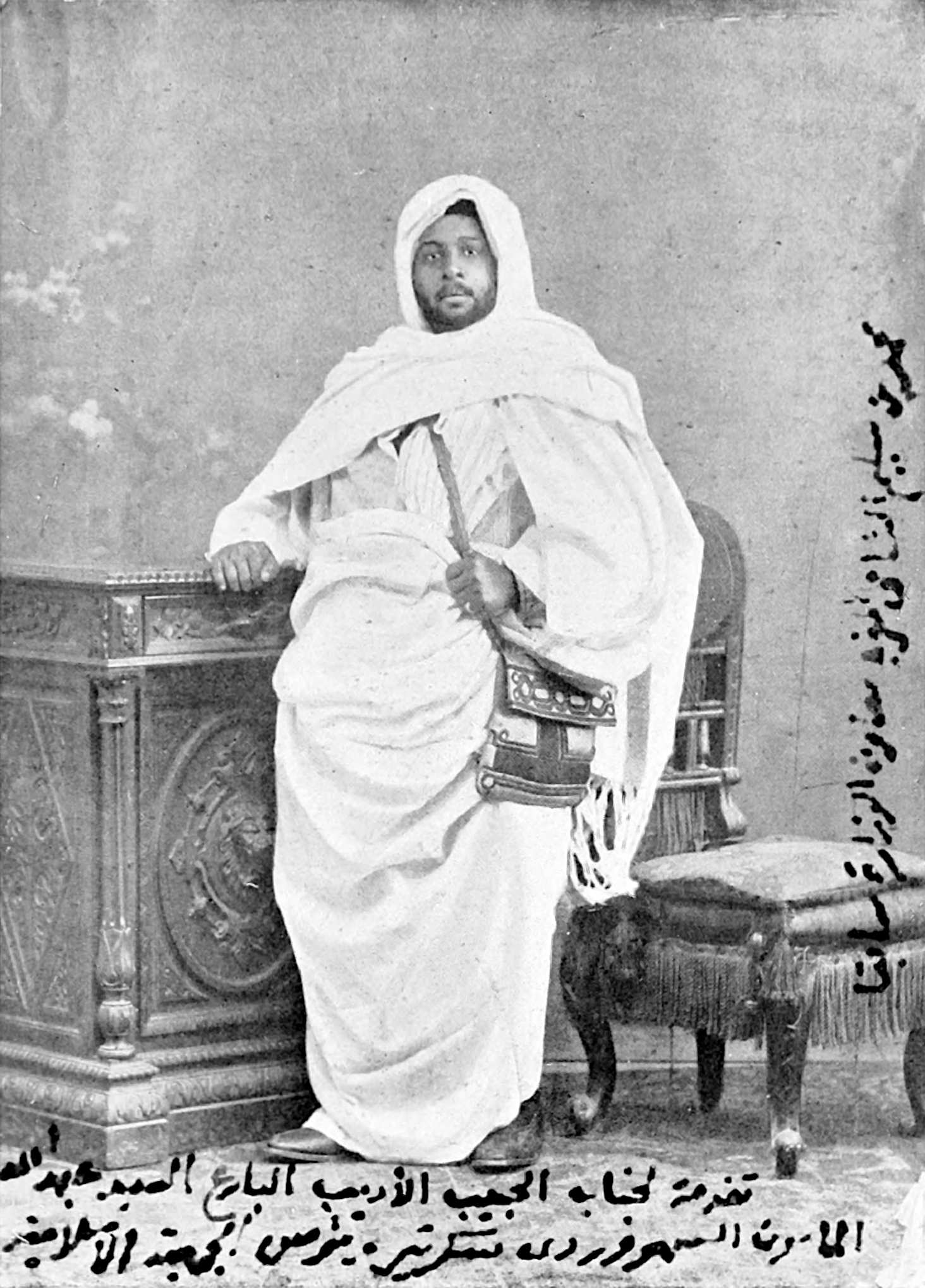
A MOORISH GENTLEMAN IN MOORISH DRESS.
On entering the Harem all men are equal, all privileges
of rank must be waived. The most despotic Oriental ruler
has no power over his fellows there. Even the Hereditary
Sheríf of Mecca must be as courteous to his servants or his
slaves as he would be to the Sultan of Turkey were he
present. Everybody is come to worship his Creator, the
Ruler Supreme over empires and republics, and so all
distinctions of rank are laid aside. The Prophet, wise in
his generation beyond all men, was the first to protect the
helpless against despotism by ruling the conduct of human
affairs through the principle of religious equality. But for
his laws the lower classes of the East would have been at
the mercy of their co-religionists of the higher castes. If the
Prophet alternately cajoled and coerced the superstitious
to be virtuous and meek by the promise of a material Paradise
and by the fear of a material Hell, what then? He
sought merely to achieve his end through the weaknesses
of the natural man, knowing that there is nothing that men
covet more than the permanent pleasures which satiate
human passions, and nothing that they had rather shun
than a punishment which endures for ever. The spirit of
his teaching and his laws, however, was anything but
material. It made for unity and fraternity and equality,
and the consequence was that in the early days of the Faith
his followers were inspired by the noblest aspirations of
the mind and heart. And as for the corporeal joys of
Paradise they knew that these were not the highest their
Prophet had promised to them, for they hoped to attain to
that most blessed degree of heavenly felicity which is reserved
for the Faithful who are found worthy to behold
God’s face from the rising of the sun till the going down of
the same. The case is otherwise with the majority of the
Muhammadans of to-day. For their country and their
countrymen they take too little thought, each one of
them beseeching God to shower His favours on himself or
herself alone. The priests of the Golden Age of the Faith
sat on a camel or stood on a high hill and preached, not
on form but on spirit. Their watchword was unity—unity
of religion under the banner of faith and charity. To-day,
on the contrary, the Mullás of Mecca mount a pulpit
and air their erudition, that is, their knowledge of
the traditions, as they interpret them according to
their respective schools, and end with a few wandering,
lifeless sentences in condemnation of all heretics, in contempt
of this life, and in praise of the world to come. A
philosopher would consider their sermons ridiculous. The
freethinkers of the times of ’Omar and ’Alí had no sound
excuse for raising their voices against the priests, who were
then the guides of the mind as well as those of the conduct.
But the wonder now is that a Faithful can be found to obey
the behests of these tradition-ridden miracle-mongers, who
do nothing to lessen the breach between the sects, but
leave the more enlightened laymen to lead the way to reunion.
Muhammad set these miracle-mongers a good example.
For we read that when Muaz was appointed Governor of
Yemen he was asked by the Prophet by what rule he would
be guided in the administration of the province. “By the
law of the Kurán,” said Muaz. “But if you find no direction
therein?” “Then I will act according to the example
of the Prophet.” “But if that fails?” “Then I will
exercise my own judgment.” Muhammad not only
approved of the answer of his follower, but also advised
his other representatives to follow the same rule of
conduct. That rule ought to be written over the door
of every mosque in Islám. My Meccan experiences
prove this, that the faith of the priest is stagnant from
the want of the breath of reason. In its decadence
Islám is priest-begotten and priest-ridden. In its
purity it was full of the spirit of the Holy Ghost, a religion
simple and sincere, whereof such men as ’Alí and
’Omar were made. The founder would be the first to
cleanse the minds of his present-day disciples of the false
traditions that have been ascribed to him. He would bid
them look up, facing the light, and setting their thoughts
free to soar. In his lifetime he, believing “God to be
more loving to His servants than the mother to her young,”
fought strenuously and with a patience almost sublime to
overcome the corrupt and idolatrous practices of his fellow-countrymen
of the time of Ignorance. Not otherwise would
he fight to-day in order to free his co-religionists from the
ever-permeating spread of the priestly misinterpretations
of his message. His voice would be raised to proclaim the
right of every man to reject what is unreasonable in the
dictations of the priests. “Knowledge,” said he on one
occasion, “is our friend in the desert, our companion when
friendless, our ornament among friends, our armour against
our enemies.... To listen to the words of the learned
and to inculcate the lessons of science is of more value than
religious exercises.”
Now, a religion which is lively to-day chiefly
through the appeal it can make to what is corporeal
and comfortable, as is undoubtedly the case with
Islámism at the present time, stands in sore need of a
spiritual reformer, the more so because its spirit is still
alive, in the pages of the Kurán and in the memory of the
mighty dead. Many Muslims still seek the name, and
are diligent in seeking it, but they less often try to find
the object, forgetting that the moon is not in the stream
but in the sky. “He, God, is the Enduring, and all else
passeth away”—all except such futile traditions as,
heaven knows, are dead enough to have earned a
decent burial, and the arbitrary ruling of the priests, to
whose pernicious influence there would appear to be
no limit. The hearts of these unrighteous stewards
deserve to be branded with the two matchless odes,
admirably translated by Professor Browne, of Cambridge
University, which are inscribed on the tomb of Háfiz,
in an orange garden at Shíráz, the two first lines of
which run:
“Where is the good tidings of union with Thee? for I will rise up with my whole heart;
I am a bird of Paradise, and I will soar upwards from the snare of the world.”
And again:
“O heart, be the slave of the King of the World, and be a king!
Abide continually under the protection of God’s favour!”
CHAPTER IV COMPASSING OF THE KA’BAH
When we reached the outer gateway of the Bábé Salám,
which leads into the vestibule, it was to bow humbly and
then to prostrate ourselves twice on the threshold, kissing
its sacred dust. After this we rose, saying aloud, with
closed eyes and outstretched hands:
“O God, this city is Thy city and this temple Thy
temple. I am come hither in search of Thy compassion,
and in perfect obedience to Thy commands. O Lord, I
am submissive to Thy power, I am in passive contentment
with Thy chastisements, I seek the fulfilment of all my
desires from Thee and from none but Thee. Oblige me
with Thy divine compassion, O God, and fling open to me
the gates of Paradise.”
We then passed into the vestibule, and, no sooner did
our eyes behold from the inner gateway the surface of the
Harem than we stretched out our hands once more to the
sky and closed our eyes in prayer, saying:
“O Lord, this harem is Thy harem and the harem of
Thy apostle. Therefore, since I am here in response to
Thy command, preserve my flesh and blood from the fire
of Hell and deliver me from Thy punishments on the Day
of Judgment.”
Then, advancing the left foot, we said:
“O God, grant me Thy protection from the temptations
of the devil—may he be accursed! I praise Thy prophet,
O Lord, and also his disciples; O, forgive me my sins and
open on me the gates of Thy mercy.”
Next, when we walked through the inner gateway, and
went down the double flight of steps leading to the colonnades,
whence the Ka’bah twinkled on us its dusky, square
face, we bowed reverently to the House of God and forthwith
recited the prayer, which being interpreted, runs:
“In the Name of the great Lord who is alone. There
is no god like unto Him. O God, I visit this Thy temple,
praising Thee, and glorifying Thy name. Nothing can be
done save through Thee, for Thine is the power, and Thine
the will alone.”
Then I paused awhile, and my eyes took in the impressive
scene.
The open Harem, surrounded on a higher level by the
colonnades that are surmounted by the crescented domes,
was packed with pilgrims from every quarter of Islám. In
the middle is the Ka’bah, hemmed in on three sides of its
solid cubic walls by the semi-circular row of columns
already described. Now, facing the gold Spout, on the
outer side of the pillared enclosure, stands the station of
the Hanifites. There, in front of the pulpit, were grouped
in the space between the paved ways and in every attitude
of worship the followers of reason. Some were standing
erect, their hands folded on their breasts, others were kneeling
on their prayer rugs, and many were bowed to the lump
of clay. Opposite to them were praying the Hanbalites
before the pavilion-shaped pulpit that forms the extreme
limit of the enclosure on the side nearest to the Black
Stone. Priests and peasants, merchants and princes, all
had come from far and near to render unto God their
hearts and minds in accordance with the law of the
Prophet. Those living people clothed in the garments of
the dead, there they were, in the very centre whence had
sprung the Faith that flashed forth its rays over the East,
there they were, and why? To do homage to Him whom
Muhammad had made manifest and had delighted to honour
thirteen hundred and twenty years ago. It must be conceded,
even by the sceptical and the scoffer, that the voice of
the “illiterate” Prophet has still the power to work wonders.
Hark, his followers are shouting their allegiance to his
watchword. Up go their voices to the burning sky overhead:
“There is no god but God! Muhammad is the
Messenger of God!”
Few could remain silent on hearing the cry of Faith
within the columned square of the Harem. It rang out
like a trumpet-call, filling the heart with an emotion never
felt before. Sincere and true, it drowned the rambling
eloquence of the priest haranguing the Malekites out there
to the west. It gathered in volume as it passed from lip
to lip until the very pillars of the Harem seemed to shake.
And then from time to time was sung the Talbih, which
might be called the song of the winding-sheet, so frequently
was it repeated by the pilgrims in íhrám:
Labbaik, Allahomma, Labbaik!
Labbaik, la Sherika lak Labbaik!
Labbaik, enal-hamda, vanahmeta lak Labbaik!
Labbaik, la Sherika lak Labbaik!
It swelled ever higher, my guide and I joining in the
chorus of praise and thanksgiving, since it was our bounden
duty so to do on setting foot inside the sacred precincts.
Having fulfilled the law of the Prophet or of tradition in
that particular, we were about to direct our steps to the
Ka’bah through the old gate of Beni-Sheybeh, which is
similar in shape to a triumphal arch, when my guide, standing
suddenly stock-still, turned on me a countenance of such
antic self-reproach that I was more than half afraid he had
made up his mind to wring from me a present ere he would
pursue his avocation. Perhaps my determination to resist
his blandishments expressed itself in my face, for he lost
no time in correcting the impression he had made, saying:
“Yá-Moulai, I ask pardon of al Moakkibát, I prostrate myself
before the two guardian angels who, in order to cope
with the difficulty of recording in their respective books the
good and the evil actions of every Muslim, are changed
from day to day, and I entreat the ones who are on duty
now not only to overlook the negligence whereof I accuse
myself, but also to allow me to retrieve, to the furtherance
of our eternal welfare, the blunder which I have committed.
Know then, that to him who reads a certain prayer near
the Salám Gate, after descending the steps thereof and
passing the colonnades, shall be granted the free gift of
one hundred thousand good deeds, together with this
additional benefit, that an equal number of his sins shall be
blotted out. Come, yá-Moulai, let us lose no time in laying
down the burden of our misdeeds.” So saying, he conducted
me to the proper place, and made me repeat after
him the following prayer:
“I begin in the name of God, and by the help of God,
from God and towards God, and through what is ordained
by God, and on the faith of the apostle of God. Praise
be to God, peace be with the apostle of God, peace be with
Muhammad, the son of Abdullah. O prophet of God, may
God in His compassion grant thee His peace! And may
peace be with all the prophets of God: with Abraham, the
friend of God, and with the messengers of God. Praise be
to the Lord of the two worlds. May peace be with us,
and with all the pious creatures of God. O Lord, may
Muhammad be praised, and may his people be praised.
May Muhammad be glorified, and may his people be glorified.
May Muhammad be redeemed, and may his people
be redeemed. May Abraham be praised, and all his
people. O Lord, verily, Thou art magnanimous, and
highly to be praised. O Lord, I praise Muhammad Thy
slave and Thy prophet. O Lord, I praise Abraham Thy
friend, and all Thy messengers. O Lord, open to me the
gates of Thy mercy, and bring me into obedience to Thee
and into submission to Thy will. O Lord, protect me
under the shelter of faith. For, verily, I am Thy slave, O
Lord, and Thy guest in this Thy house. O Lord the
Compassionate, I remind thee that there is no Lord but
Thee. Thou art alone, and hast no mate. Thou art everlasting.
Thou begettest not, neither art Thou begotten,
and there is not any one like unto Thee. Verily,
Muhammad is Thy slave and Thy apostle—may peace
be with him and with his people. O Generous, O Magnanimous,
O Exalted, O Just!”
Then we said three times, “God is Great!” and then,
“I seek shelter in Thee from the snares of the devils of
man and jinn, and from the evils that may betide the Arab
and Ajem!” We afterwards put the right foot foremost
on the floor of the Harem, and thence returned with steady
steps to the arch of Beni-Sheybeh, which is hard by the
Station of Abraham, and there we raised our hands again
and cried: “O Lord, grant me admittance into Thy place
of righteousness, and likewise a safe return therefrom, and
send down to us by Thy saving power a mighty king that
we may say: ‘Then came Right and destroyed Wrong.
Verily, Wrong is destroyable.’”
Now, the first ceremony of the Tewaff—that is, of the
compassing of the Ka’bah—must be performed in front of
the Hajerul-Asvad or Black Stone—a sacred relic which
requires a short description before we proceed on our way
round the Ka’bah: and as an introduction to this description
we must relate the story of the creation of Adam,
as told by the Muhammadans. They tell us that God,
having resolved to fashion a creature in his own likeness,
sent the angels, Gabriel, Michael, and Israfil, one after
another, to fetch for that purpose seven handfuls of earth
from seven depths and of seven colours. The earth, however,
foreseeing the revolt of man from the will of his
Creator, persuaded the angels to return without performing
God’s command, so sure was she of drawing down on herself
the divine wrath should the inanimate clay be made to
breathe. The angel Azraïl was then despatched by God
on the same errand, and he, closing his heart against the
earth’s appeal, executed his commission remorselessly, on
which account the Lord appointed him to be the angel of
death, charging him thenceforward to separate the souls
from the bodies. The earth which Azraïl had taken was
carried to a place between Mecca and Tayef, where it was
first kneaded by the angels, and then moulded by God into
a human form. It was afterwards left to dry for the space
of forty years, the angels visiting it frequently. Among
these angels was Edris—who from being of those that are
nearest to God became the devil—and he, not contented
with looking on the work of the Creator, which he knew to
have been designed to be his superior, vowed he would
never acknowledge it as such, and he kicked it till it rang.
Then God breathed His own spirit into the clay, so that it
was made man, and God called his name Adam, and placed
him in Paradise, and formed Eve out of his left side.
Now, when Adam fell and was cast out of Paradise
there fell with him a certain Stone, which has since become
the most cherished possession in the Muhammadan world.
The legend runs that it was restored to Paradise at the
Deluge, after which it was brought back to the earth by
Gabriel and given to Abraham, who set it in the south-eastern
corner of the Ka’bah, which he is said to have
built. There it remained till the Karmatians—that sect,
founded in the year 278 of the Hegira by a native of
Khúzistán called Karmata, which overturned the fundamental
points of Islám—bore it away in triumph to their
capital, having first polluted its sacred precincts by burying
there three thousand dead bodies, by tearing the golden
Spout from its place, and by dividing among themselves the
veil of the temple itself. The citizens of Mecca sought to
redeem the Stone by offering no less than five thousand
pieces of gold for it; but the ransom was scornfully
rejected by the impious sectaries, who hoped by keeping
it in their possession to draw the pilgrims from the Holy
City to their own capital. Some twenty-two years later,
however, having failed to achieve the purpose they had at
heart, they sent back the Stone of their own free will,
covering their discomfiture by declaring it to be a counterfeit.
The dismay of the Meccans was allayed when they
discovered that the stone would swim on water, that being
the peculiar quality of the stone they had lost, and so they
were satisfied that the true one had been returned to
them.
At first the Stone was whiter than milk, but it grew to
be black, either by the touch of a certain class of woman, by
the sins of mankind, or by the kisses of the pilgrims. All
believers, whatever may be the cause to which they attribute
the change of colour, agree that the defilement is
purely superficial, the inside of the Stone being still as
white as the driven snow. Let us hope that the same
thing can be said of the hearts of the Faithful, whose lips
are supposed to have wrought on this lodestone of theirs
a transformation so miraculous. The silver box wherein it
lies is about twenty inches square, and is raised a little
more than five feet from the ground. A round window
having a diameter of some nine inches is kept open on
purpose to enable the pilgrims to kiss or to touch the
treasure within, which is known as “the right hand of God
on earth.” This year the act of osculation was not performed
by more than ten pilgrims out of every hundred
that attempted it, the crowd being utterly undisciplined in
its zeal. It must be confessed that I owed my good
fortune to main strength, for I shoved my way through the
excited mob and examined the Stone curiously while
kissing it. In colour it is a shining black; in shape,
hollow like a saucer, presumably the result of the pressure
of devoted lips. A pilgrim, if he fail in touching
the Stone, must make a reverential salám before it, and
then pass on. Special prayers are also said. My guide,
before leaving, recited for my edification certain lines from
the “Fotúhúl Haremeyn,” which in rhythmic prose would
run something like this:
“Think not that the Ka’bah was made from the earth—in
the body of the world it took the place of the heart.
And the stone that you call the Black Stone was itself a
ball of dazzling light. In ages past, the Prophet said, it
shone like the crescent moon, until at last the shadows,
falling from the sinful hearts of those that gazed on it,
turned its surface black. Now, since this amber gem that
came to the earth from Paradise with the Holy Ghost has
received such impressions on itself, what should be the impressions
which our hearts receive? Verily, whosoever
shall touch it, being pure of conscience, is like unto him
that has shaken hands with God.”
In front of this Stone, the first rite is performed: it is
called Niyyat or Determination. The various forms and
ceremonies at this stage of the pilgrim’s initiation vary with
the sect to which he belongs, but six points are common to
all Muhammadans. First, Niyyat, including the declaration
of passive obedience to God’s will, the belief in His day of
judgment, and the formal repentance of all sins committed;
second, the frequent recitation of the watchword of the
Faith which is called Takbir; third, the reading of Esteghfar,
a short chapter of repentance and of tacit submission to
God’s ordinance; fourth, certain formulæ in praise of Allah
and the Prophet, which are known by the name of Tahleel;
fifth, the intoning of Hamde, which is the chapter of praise;
and lastly, the lively repetition of Ghúl-hú-Allah, which
runs: “In the name of the most merciful God. Say, God
is one God; the eternal God: He begetteth not, neither is
He begotten: and there is not any one like unto Him.”
The pilgrim, on making his “Determination,” must raise his
hands to his cheeks, putting the thumbs under the lobes of
his ears, and stretch up his shoulders, allowing his chest to
droop inward, and say in a voice toned to a reverent spirit:
“O Allah, Thou art omnipotent, Thou art glorified. I
purpose, in Thy excellent name, to make seven complete
circuits round Thy blessed house.” Having repeated this
after the motewaff or guide, I cried out: “In the name of
God, God is great!” Then the stream of Hájís caught me
to its bosom, and I was tossed about as in a whirlpool.
Fortunately Seyyid ’Alí stuck close to my side, and there, in
the eddying torrent of human beings that gave forth a
sound as of a swelling sea, we raised our voices, my motewaff
and I, one after the other, and cried: “O Allah, I do perform
this rite out of the fulness of my belief in Thee, in
acknowledgment of Thy book, and in faithfulness to Thy
covenant, according to the example of Thy prophet
Muhammad—may he be blessed and glorified!” And
all the while we struggled as hard as we could to get
within touch of the Hajerul-Asvad, which, as we knew
well from the pressure of the throng, was the lodestone that
drew the sheeted pilgrims to the south-eastern corner of the
house. Now we were driven forward, and then we were
hurled back; indeed, the bare-footed Faithful, seeing
their hopes alternately rise and fall, grew grimly resolute
to kiss the Black Stone, cost them what it might. The
yearning to do so, which had filled their hearts with piety
in the seclusion of their homes, gave place at close quarters
to a determination so fierce and so uncontrollable as might
have offered to a cool-headed spectator a living picture of
Pandemonium. Every now and then a pilgrim would
succeed in snatching a hasty kiss, after which he would be
flung aside, and another, less fortunate than himself, would
have to be contented with touching the Stone with his hand
and kissing that; but by far the greater number had no
other choice than to pass on with a salaam expressive of
good intentions. Some said their prayers with the tongue
of their hearts, and with tears in their eyes; others said
them aloud, the sweat streaming down their cheeks. “O
Lord, I bring my heart and soul to Thee, I acknowledge Thy
Book faithfully, I give evidence that there is not any one
equal to Thee, and I promise to obey Thy Commandments.”
Opposite to the place called al-Moltezem, between the
Black Stone and the gate of the Ka’bah, we paused and
said: “O Allah, Thou who art omnipotent, I beseech Thee
to pardon my sins in violating Thy commands.” A few
steps forward brought us face to face with the gate itself,
whose threshold is raised so high above the ground that
the pilgrims must mount by means of steps moving on
wheels which are kept alongside a wall of the Zem-Zem
well when not in use. There we stopped again, saying:
“O Allah, this house is Thy house, this sanctuary is
Thy sanctuary, this peaceful shelter is Thy shelter, and this
place is the place of all those that flee to Thee from hell-fire.
O Allah, Thy house is great and Thou art magnanimous;
verily, Thou art compassionate and merciful. From
fire, O Allah, and from the cursed Satan deliver me: yea,
render my flesh and blood scatheless in the fire of hell, and
pour on me Thy mercy on the day of judgment, and
shower on me Thy blessings in this world and the next.”
We proceeded thence to the north-eastern angle called
the Rokné-Araghi, where we halted in order to ask another
blessing, and cried out in a tone of deepest contrition: “O
Allah, I take refuge with Thee from evil, from doubt, from
disobedience, from disunion, from immorality, from hypocrisy,
and from all evil thoughts concerning one’s family
and one’s estate.” And when we went in front of the
Mizab, gold Spout, a few paces farther on, it was to say:
“O Allah, grant me refuge under the canopy of Thy
heaven on the day whereon there is no shelter save Thy
shelter. O Allah, make me to drink of the same cup as
Muhammad, on whom be blessings and glory!” Then we
proceeded on our way till we reached the Rokné-Shami or
the north-western angle, and there we said: “O Allah, may
it please Thee to accept this pilgrimage, making it a praiseworthy
perseverance and a laudable deed. O Compassionate,
O Beloved, O Lord, O Merciful, and Omnipotent!”
Next, on reaching the south-western angle or Rokné-Yemani,
we fell again to praying, in accordance with the law:
“O, Allah, our Lord and Ruler, grant us prosperity in this
world and happiness in the next, and deliver us from the
punishments of fire. O Allah, I seek shelter in Thee from
infidelity and from poverty and from the sorrows of life
and from the pangs of death; I also take refuge in Thee
from ignominy in this world and in the world to come.”
The last prayer we said was at the starting point, facing
the Black Stone. Finding it impossible to approach within
arm’s reach, we lifted up our hands from afar, and then
bowed, saying: “O Lord of this sacred relic, I flee to Thee
and to ‘Thy right hand on earth’ from all want and also
from all infidelity.”
In this, the first circuit or “shaut,” we used the step
called “harvaleh,” walking briskly and shrugging the
shoulders up and down, and we adopted the same gait on
the second and third “ashwat” (plural form of “shaut”). But,
in performing the remaining four circuits, a more grave
and stately tread was assumed according to the custom.
This ordinary eastern walk is called “teamol” and combines
dignity of demeanour with leisure of pace; it is a contemplative
fashion of walking, what the French would call
recueilli, and is admirably suited to a pilgrim’s devotional
stroll round the House of God. On the other hand, the
reformer who should wish to introduce the go-ahead civilisation
of the West could not begin better than by levying a
prohibitive tax on the “teamol.” Sale records the tradition
that this sevenfold compassing of the Ka’bah was ordered
by Muhammad, “that his followers might show themselves
strong and active, to cut off the hopes of the infidels, who
gave out that the immoderate heats of Medina had rendered
them weak.” A second tradition is that the circular motion
represents the orbicular motion of the heavenly bodies; a
third, that it is meant to symbolise the Egyptian
wheels, those hieroglyphics of the instability of human
fortune; and a fourth, that it arose from a custom among
the Pagan Arabs, who, if they wished to humble themselves,
were wont to walk seven times round the person or
persons whom they delighted to exalt. Anyhow, the compassing
of the Ka’bah, be its origin what it may, is held
by the Muhammadans to be an act of self-sacrifice from
man to God. I was much struck by the fact that the
victims of cholera and of other diseases were borne round
the sacred precincts in rude wooden coffins by their friends,
who cried out in tones of lamentation, “Yá-Allah! Yá-Allah!”
It was an impressive funeral procession, and is
said to relieve the pressure of the grave, and to insure to
the corpse a safe and a speedy entrance into Paradise.
The Tewaff is brought to a close by a reverential visit to
the tomb of Abraham, which faces the door of the House.
It is an open pavilion resting on four pillars, and crowned
with a crescented cupola.
There my guide and I, taking up our position on the
thither side of the tomb which was thus placed between
ourselves and the House of God, prostrated ourselves twice,
saying our morning prayers the while; and then, sitting on
our hips, we raised our hands to the sky and said with
closed eyes:
“We give praise to Thee, O Lord, we glorify Thee in
the name of Muhammad—may peace be with him and with
his people! O God, accept this Hájj from me, and allow
it not to be the last one. I praise thee, O Lord, in all Thy
attributes, I praise Thee for all Thy blessings; I praise
Thee for all Thou willest, I praise Thee for all Thy power.
O Lord, accept this worship from me, and cleanse my
heart, and sharpen my sense of duty. Take compassion
on me, O God, for my worship’s sake, and because I accept
the words of Thy prophet—on whom be peace! O Lord,
make me to detest those that do not worship Thee, and
make me to love those who love Thee, and those who love
Thy prophet and Thy angels and all Thy pious creatures.”
Then, bowing our foreheads to the ground, we said
aloud:
“O Lord, I worship Thee on my face; there is no God
but Thee; Thou art just and merciful; Thou art the
beginning of everything, and the end of everything; for
Thine is the management and Thine the power alone. O
Thou that forgivest the sins of Thy people, pardon my
offences, for in Thee do I now confess my sins. Verily,
no one can pardon grave sinners except Thyself. I say,
there is not any one to be compared with Thee.”
The rewards of a correct performance of the Tewaff
and of the necessary prayers—preferably at sundown,
the best time for meditation—are of a sort to render the
rite extremely popular among the pilgrims. At every step
they take, in making the seven circuits, no fewer than seventy
thousand sins will be blotted out of their bad books, and
an equal number of virtues be added to the companion
volumes containing their good actions. Nor is this all,
for they will be made, at the same rate, the intercessors of
seventy thousand sinners; they will build up to themselves
the same number of palaces in heaven, and will earn the
fulfilment of seven hundred thousand of their desires in this
world, and of seventy thousand in the world to come.
And that, no doubt, is why we took precious care that
our steps, even when walking briskly, as we were obliged
to do for the first three circuits, should be, if smart, extremely
short ones.
CHAPTER V THE COURSE OF PERSEVERANCE — PLAN OF THE HAREM. An Explanation of the Frontispiece .
Having encompassed the Ka’bah seven times, we stood hard
by the tomb of Abraham and watched the pilgrims fighting
to kiss the Black Stone. The wonder was that we had
emerged from the tight scrimmage with a skin more or less
whole. The perspiration oozed out of the pores in streams:
laying hold of the fag end of my sacred habit I wiped my
forehead. “You must not touch yourself,” said Seyyid ’Alí;
“it is a grievous sin.” “Let your conscience rest in peace,”
I replied; “I will do penance by sacrificing a sheep.”
The guide smiled. “There is no stain, however vile,
but money shall blot it out. Would that I were a rich
man!” “Thou fool,” I cried, “how about the stain of
superstition? Will money wipe it out, think you?” “Yá-Moulai,”
he whispered, “speak low.... Listen. It is
easier to dig the heart out of a mountain with the sharp
end of a needle than to remove ignorance from the mind
of a mullá. However, the Course of Perseverance has yet
to be trod. Come let us hop and be of good courage, for
to-morrow we must go in procession to Arafat. We must
begin again with Niyyat; that is, with a declaration of
intention in front of the Black Stone, and after that we
must proceed to Safá, and say our prayers there.” “I ask
pardon of Allah!” I shrilled. “Look, the people will be
trodden under foot near the Black Stone!” The guide was
silent, his eyes were turned to where the crowd was
thickest. “Look,” he said, “a man is down. They are
trampling him to death. That has often happened. In
581 of the Hegira no less than eighty-four men were
trodden to death inside the Ka’bah. In 972 of the Flight
sixty-five men were suffocated through the pressure of the
crowd in the Harem itself.... Praise Allah, the man
is up again.... See, his friends are bearing him to a
place of safety.” ...
God of love, what a sight! “He has achieved merit,” said
the guide, “except, it may be, in the eyes of the ‘mother
of his children.’ She will cease to love him when she
sees him. However, he may die, and thus she may be
spared the shock of—did you—but what have I done to
offend you?” My reply was curt. “I find your levity
somewhat tedious,” I said impatiently. The wag was
irrepressible. He waxed argumentative suddenly, affirming
that the snares of the heart are beauty of face and
charm of voice. He bade me to look on his own manly
countenance. I might believe it or not, but even he had been
deceived more than once. What chance of keeping love,
therefore, had the wretch whose face had been stamped as
flat as the palm of his hand? “Listen, and I will hum you
a song,” he whispered, “but it must be low, since it concerns
the heart, the theme of the poets, and not the soul, which
is the concern of the priests. For my part I am on the
side of the poets. Even in Mecca. The song is old. It
was sung by Adam in the Garden of Eden after the Fall.
I have found it true. Therefore, and for no other reason,
it is worth quoting—
“‘Oh, heart of mine, how often canst thou trace
Thy aching wounds to one bright maiden’s Face!
How often must, amid discordant din,
Another’s Voice be toned to take you in!
“‘Yet ah, my heart, among thy darling foes,
Was one that matched both Nightingale and Rose;
A Flow’r, she bloomed a day; a Bird, her flight
She winged ... and turned thy Day to endless Night.’”
“Alas, my poor heart, its disease is incurable, I fear.
No matter. Safá awaits our coming. We will go and
‘declare our intention,’ and then be off to the hill of Purity.
Let us skip and hop, for to-morrow we die. Yá-Allah! yá-Muhammad!”
So, approaching as near as we could to the
Black Stone, we closed our eyes, giving it as our determination
to run seven times between the platforms of Safá
and Marveh, and to recite the prescribed prayers at the
appointed places. It is considered an act of grace in the
devout to proceed thence to the Zem-Zem well, and, drawing
a bucket of water by means of the windlass with his
own hands, to besprinkle therewith his head and back and
stomach, after which he should drink a handful of the water,
repeating the following prayer: “O Lord, I beseech Thee
to make this draught for me a source of inexhaustible knowledge,
a vast livelihood, and a preventive of all pains and
diseases.”
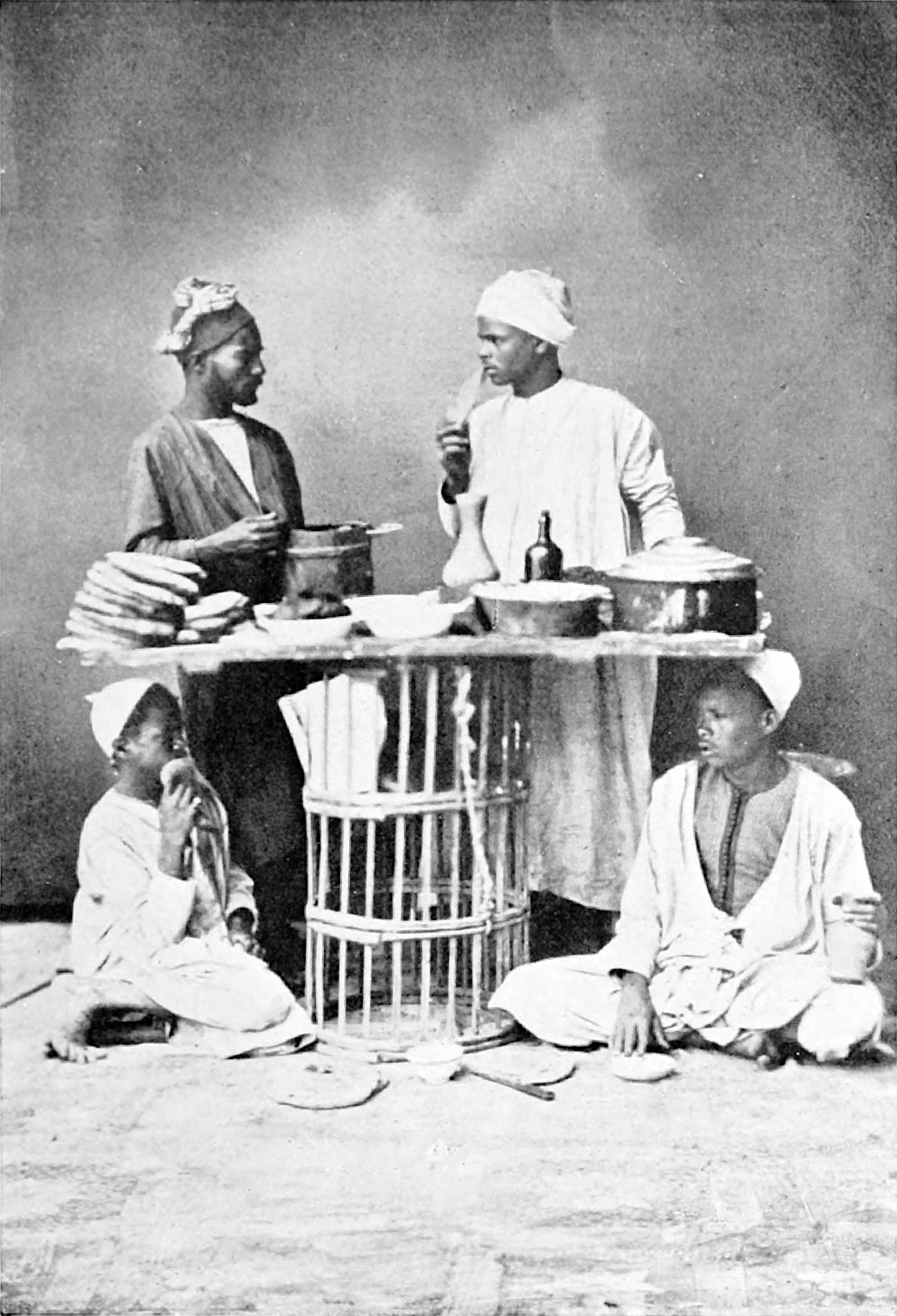
THE POORER SIDE OF EGYPTIAN MUSLIMS.
Frequent allusion is made to this spring in Arabian and
Persian literature. Its water ranks second to that of
Kúsar, a stream that runs in the Garden of Paradise,
keeping the grass ever green and the flowers ever
blooming. The prettiest ruby wine is compared by the
poets to the water of Zem-Zem; for they believe
it to be the spring that “gushed out for the relief of
Ishmael,” when Hagar, his mother, wandered beside him in
the wilderness. The story goes that when she saw the
bubbling water it was to call to her son, in the Egyptian
tongue, “Zem, zem!” (“Stay, stay!”). The taste of the
water is difficult to describe, but it is certainly bitterish.
My guide, to whom I had appealed in the matter, answered,
saying, “Allah—may I be His sacrifice—has made this
water sacred, as you know. It is neither sweet nor bitter,
neither fresh nor salt, neither scented nor stinking, but
would appear in its taste to be a mixture of all these
qualities. In everything sacred there must be a mystery,
or how could the mullás live?” As to its attributes, they
may be counted by the hundred. There is no disease that
it will not cure provided it be taken with a “pure” conscience.
It is as inspiring to a Muslim poet as that of
Helicon to an unbeliever. It prolongs life and purifies the
soul of him that drinks it in unswerving obedience to God
through the mediation of Muhammad. The rich pilgrims
carried gold or silver flasks in which they poured the
precious water, keeping it as a preservative of health, or as
a remedy in case of sickness. An Indian Prince told me
that he intended to keep his in order to restore the eyesight
of his brother, who had been unable to accompany him on
the pilgrimage. The Faithful bring their winding-sheets
along with them and wash them in the holy spring. Some
Negroes from Zanzibar have the honour to be the guardians
of the well and the dispensers of its contents, and they
exact as much as twenty piastres from the poor pilgrims for
the washing of one of these winding-sheets, and ten times
that amount from the rich.
Now, this practice of washing the grave-clothes stands
in need of explanation. When a Muslim dies and is buried,
he is received by a heavenly host, who gives him notice of
the coming of the two examiners, Nakir and Monker.
These are two angels as livid as death and as black as a
putrid corpse, and they proceed to question him concerning
his faith, more especially as to the unity of God and the
apostleship of the Prophet. If he prove himself a true
Mussulman, he is suffered to rest in peace and is refreshed
by the air of Paradise. But, if he be of a loose belief, he is
gnawed and stung till the resurrection by ninety-nine
dragons that have seven heads each, the earth pressing
harder and harder on his body without, unfortunately,
injuring the dragons. It is in order to escape from this
torture that the pilgrims wash their winding-sheets, in the
life-giving water of Zem-Zem, some of them taking the
precaution to make assurance doubly certain by inscribing
on the sheets, in coloured letters, the most sacred chapters
of the Kurán. One of the pilgrims showed me a winding-sheet
belonging to himself on which had been written in
green ink every single chapter of the Book. The well is
covered with a small square building crowned with a cupola
and a crescent, and is paved inside with marble. There
are four Chinese windlasses at the top of the shrine for
drawing the water, and these were working all day long,
the keepers having the greatest difficulty in restraining the
ardour of the poor, tradition-ridden devouts, some of
whom were wrought to such a pitch of blind fanaticism
that it was as much as the Negroes could do to prevent
them from flinging themselves into the well.
Since I had not the good fortune to win my way to the
windlass, I took a jug of Zem-Zem water, making the
attendant a present of ten piastres for it. Then, having performed
the necessary ablutions, I went out by the old gate (on
the thither side of the Place of Abraham) and ascended the
stairs of Safá. We found the platform alive with pilgrims,
and there, facing the Ka’bah, we had to pass in review all the
blessings we had received from God during our lives, from
the days of our birth upward. That done, we repeated
seven times in an audible tone: “God is great.... I
praise thee, O Lord!... There is no god but God....”
Three times: “There is no god but the one God; there is
not anyone like unto Him. For His is the kingdom, and
to Him do we lift up our praise. He is the giver of life
and the giver of death. Death and life He bestoweth on
all living creatures, but He dieth not, neither doth He sleep.
He is almighty over everything....” Once: “O Lord,
I praise Muhammad and his people.” Three times: “I
praise the Lord who endureth for ever, I praise the everlasting
Lord.” Three times: “I confess there is no god
but God, and I confess likewise that Muhammad is His
slave and His apostle. We worship Him whom we praise,
and none but Him!” Then three times we cried: “O
Lord, have mercy on me, and be compassionate to me, and
give me justice in this world and in the world to come....
O Lord, give us Thy blessing in this life, and grant us
Thy peace in the next, and protect us from the punishment
of fire.” Next, having repeated one hundred times the
words “God is great; there is no god but God, and Him
do I praise,” I said aloud: “O Lord, I praise Thee in
death and in what comes after death. In Thee, O God,
do I seek shelter from the darkness of the grave, from the
pressure of the grave, and the disturbance of the grave.
Under the canopy of Thy divine compassion do I take
refuge on the day when there is no shelter but Thy
shelter.” Then, in my inmost mind, I gave up to the Lord
my faith, my person, and my people, crying: “I return to
Thee, O Lord, Who alone art compassionate and merciful,
my faith, myself, my people, my property, and my progeny.
O Lord, make me to act according to Thy Book and the
dictation of Thy apostle: make me faithful to Thy people,
and protect me from revolution.” As an increase of
wealth, so says tradition, this prayer should also be read:
“O Lord, I seek shelter in Thee from the punishments of
the grave: from its troubles, and its separations, and its
awe, and its percussion, and its blackness, and its closeness.”
Then, uncovering the back, one should raise the
voice, crying out loud: “O Lord, pardon! O Thou who
hast commanded to pardon, O Thou who art the first to
pardon—pardon, pardon, pardon, pardon! O Generous!
O Compassionate! O Near! O Far! make me to achieve
Thy satisfaction by acting in obedience unto Thee!”
Then, descending from the platform, I said: “I persevere
seven times in running between Safá and Marveh, and this
I do in order to fulfil my pilgrimage and in obedience to
the command of the Lord of the Universe.”
The distance between the two hills is four hundred
and thirty-eight yards. The course has to be traversed
seven times. It begins at Safá and ends on the seventh
lap at Marveh. Those who are too weak or too ill “to
persevere” on foot must be carried on a horse, a camel,
a mule, or a donkey, like the women, who, if sufficiently
wealthy, are accompanied by three hired servants. The first,
the forerunner, who clears the way, wears an expression of
indescribable gravity. You can tell by his face that you
have only to cast an eye behind him to behold a “Light of
the Harem.” The second, leading the beast by the bridle,
looks religiously ahead, and the third brings up the rear,
doing all in his power to protect his precious burden from
the shrieking crowd. If a pilgrim at this stage of initiation
allow his thoughts to dwell on the fair sex he must sacrifice
a calf in the Valley of Mina. From the foot of Safá to the
first minaret at the south-eastern end of the Harem the
pilgrim must walk at his ease, and there he must say a
prayer. It is this: “I begin in the name of God, and by
God, and God is great. May peace be with Muhammad
and with his household. O Lord, the compassionate and
merciful, who art capable beyond my knowledge, O Thou
who art most exalted and most generous, take this act of
worship of mine, which is not worthy of Thee, and, enriching
it with Thy abundance, make it more deserving of Thy
acceptance. I offer up my ‘perseverance’ to Thee, O Lord,
and in Thee my hope and my strength are fixed. O Thou
that acceptest the devotion of the pious, reject not my
offering, O God.” Thenceforward, until he reached the
Baghleh Gate, some eighty yards away, the pilgrim had to suit
his gait as far as in him lay to the rolling pace of a camel on
the trot. He had now reached the starting point for hopping.
Two big green flags were flying to give him warning. Up
went the left leg of every mother’s son and of many a
father’s daughter—for to every woman who rode there
were twenty on foot—and a great deal of panting confusion
and breathless excitement ensued. Hands were lifted to
the sky, voices were raised in praise of God, asking for
strength “to persevere,” mules stampeded, horses lashed
out with their heels, camels pierced their way through the
surging mob as silently and as irresistibly as a ship breasts
the sea, men and women being hurled aside like waves.
The endurance displayed by the bare-footed devout was
marvellous. They were buoyed by the assurance that they
were supported by the angels, Gabriel being the captain of
the guard.
Now shoved forward by the pilgrims in the rear, now
carried back by those who were returning from Marveh, I
hopped about in a vicious circle, groaning and perspiring,
like a man bereft of his senses. Should I never reach the
blessed Gate of Ali! Who said the distance was not
more than seventy-five yards? Let him hop over the
course and he will multiply its figures by ten at every
step. The folly of it all seemed to crash down on the
crown of my bare head, shattering my belief in human
sanity. For, carried away by the obligation of imitating
the “persevering” antics of my fellow-pilgrims, I found
myself now hopping on one leg like a melancholy heron, and
now, on reaching Ali’s Gate, pitching and rolling and
labouring along like a spent camel under a goad. Yá-Allah!
yá-Muhammad! I cut a sorry figure in my own estimation,
no matter what merit I earned in the minds of my co-mates
in affliction. So depressed was I that I had forgotten to
say the prescribed prayer at the second minaret before
reaching the Baghleh Gate: “O God, the possessor of praise
and knowledge and mercy and magnanimity, pardon my
trespasses, for, verily, there is no forgiver of sins but Thee
alone.” Many were maimed for life, not a few were killed,
accident followed accident, but still the unheeding wave of
pilgrims swept along over the fiery sand, shrieking and
gesticulating, till my senses seemed to swoon. My guide,
inured to the Arabian heat and to the unhallowed confusion
of the course, performed his part with a studied
dignity and a nimbleness of resource which added a touch
of humour to an exhibition otherwise saddening. But these
pilgrims themselves were tormented by no such self-accusing
thoughts. If their feet were cut they had the consolation
of believing that the streams of Paradise would wash
them whole, for the cool water of Salsabíl and Tasním, if
they succumbed to their devotional exertions, would it not
be lifted to their parched lips by divine peris and everlasting
life be theirs?
What might strike the spectator most of all would probably
be the contrast presented by the dignity of the
prayers and the occasional outbursts of religious extravagance
on the part of the priest-ridden and ignorant among the
pilgrims. The prayers might be read in any church in
Christendom. The stormy outburst from all reserve could
only be witnessed nowadays in the East, where religion,
that ship of salvation, though seaworthy enough in its undeniable
if narrow sincerity, is in constant danger of being
wrecked in the breakers of fanaticism. Muhammad
reverenced science. Several sayings have been already
quoted in which it was rated by him at its true value. The
priests persist in disregarding its lessons from sheer self-interest.
It is not the light of religion which they spread
abroad. It is the fire of fanaticism which they fan—a fire
which, by throwing out abundant heat but no light whatever,
burns while diffusing darkness. “God does not change the
condition of a people,” said Muhammad, “until they change
it for themselves.” If these retrograde priests had kept
themselves abreast of the times, as they were in duty
bound to do as followers of a man of progressive genius,
the crescent of Islám had been a well-nigh perfect round
long ago. Enlightenment was not wanting on the part of
a great number of laymen, as I shall show later on;
but as to the greater number of the priests I met
at Mecca, well, let us hope that, on ascending the platform
of Marveh, they were conscious of falling short
of the responsibilities of their office, and that they
made amends by throwing into the prayer of repentance
the burden of a contrite spirit: “O Lord, Thou that hast
commanded to pardon; O Thou that lovest pardon; O
Thou that grantest pardon; O Thou that forgivest with
pardon; O Lord, pardon! pardon! pardon! pardon!”
And if they could then weep out of the fulness of a heart
ill at ease in its breast, and not perfunctorily as by law
ordained, there might be some hope of their redemption.
All joined in the concluding prayer, which runs: “O Lord,
verily, I beseech Thee, in all circumstances, to endow me
plentifully with tacit faith in Thee, and also to grant that I
may be pure of intention in my resignation to Thy divine
will.”
SM indicates the Salám Gate, through which the pilgrim must enter and
where the course begins; AM, the Tomb of Abraham; BK, the Black Stone;
K, the Ka’bah, or House of God; Z, the Fountain of Zem-Zem; SA, the Safá
Gate, through which the pilgrim passes out on his course; S, Safá, the platform
on which one must walk and pray; BH, the Baghleh Gate, the starting-point
for hopping; AI, the Ali Gate, the finishing place for hopping, but on
the return journey the starting-point, with BH as its ending. M indicates
Marveh, the platform on which the pilgrim must walk and pray. The distance
for hopping—marked by two pointers at BH and AI—is some seventy-five
yards, the dotted lines showing the Course of Perseverance, and the arrow-heads
indicating its direction.
CHAPTER VI SCENE IN AN EATING-HOUSE—VISIT TO THE KA’BAH
It was two o’clock by the time we had completed the
Course of Perseverance, and, since we had broken our fast
at an early hour in the morning, we betook ourselves in a
mighty hurry to the eating-house of Stád Mukhtar, the
Effendi pastrycook of Mecca. The caravan we had left
behind us at Heddah, swollen beyond recognition on the
journey up, had just arrived, and Mussah-street was in a
veritable delirium of excitement. It was dry and blazing
weather, with a glow as of a furnace in the air, and the
passing of the caravan, with its streaming banners, its jaded
camels, and its betousled pilgrims, added to the poignance
of our hunger by delaying the hour that should see it satisfied.
Only one glimpse we took of the medley of men and
beasts. As we raised our eyes we saw, securely strapped
on an ambling mule, a man of lofty mien, albeit distressingly
wasted, with streaming white beard and hair, and the
face of a corpse for tense impassivity. His eyes, deep sunk
and expressionless, met mine. He at once raised his voice—and
never shall I forget the eerie exaltation ringing in
its tones—and cried aloud: “Praise be to God on high, who
hath brought me alive into His house. Blessed is he who
dieth in the house of the Lord. May He be praised and
glorified!” And from the crowd there arose a shout, that
passed from lip to lip in a fervour of congratulation: “May
it be auspicious.... May your eyes be lightened....
May your years be increased.... May your shadow never
grow less.... Yá—Allah!... Yá—Muhammad!” The
grim fortitude of that towering wraith of a man on the
nimble-footed mule stirred in his co-religionists I know not
what feelings of awe and gratification. For pity there was
no room in their breasts; envy there might have been, but
of a sort whereof heroism is engendered; not one among
them but had wished to be in the place of him who, supported
by faith and guided by death, had won the crown
of self-martyrdom. In a moment the man was gone past.
“Islám,” said Seyyid ’Alí, “see how brightly it burns in
a grate worthy to contain the sacred fire. That man’s zeal
has made me rich in faith. I tell you that the stars of
heaven were a mean decoration for a zealot so long-suffering
and sincere. But come, Yá-Moulai, let us break our fast
in the famous eating-house of Stád Mukhtar. Behold, the
entrance awaits our coming, for the door is open.”
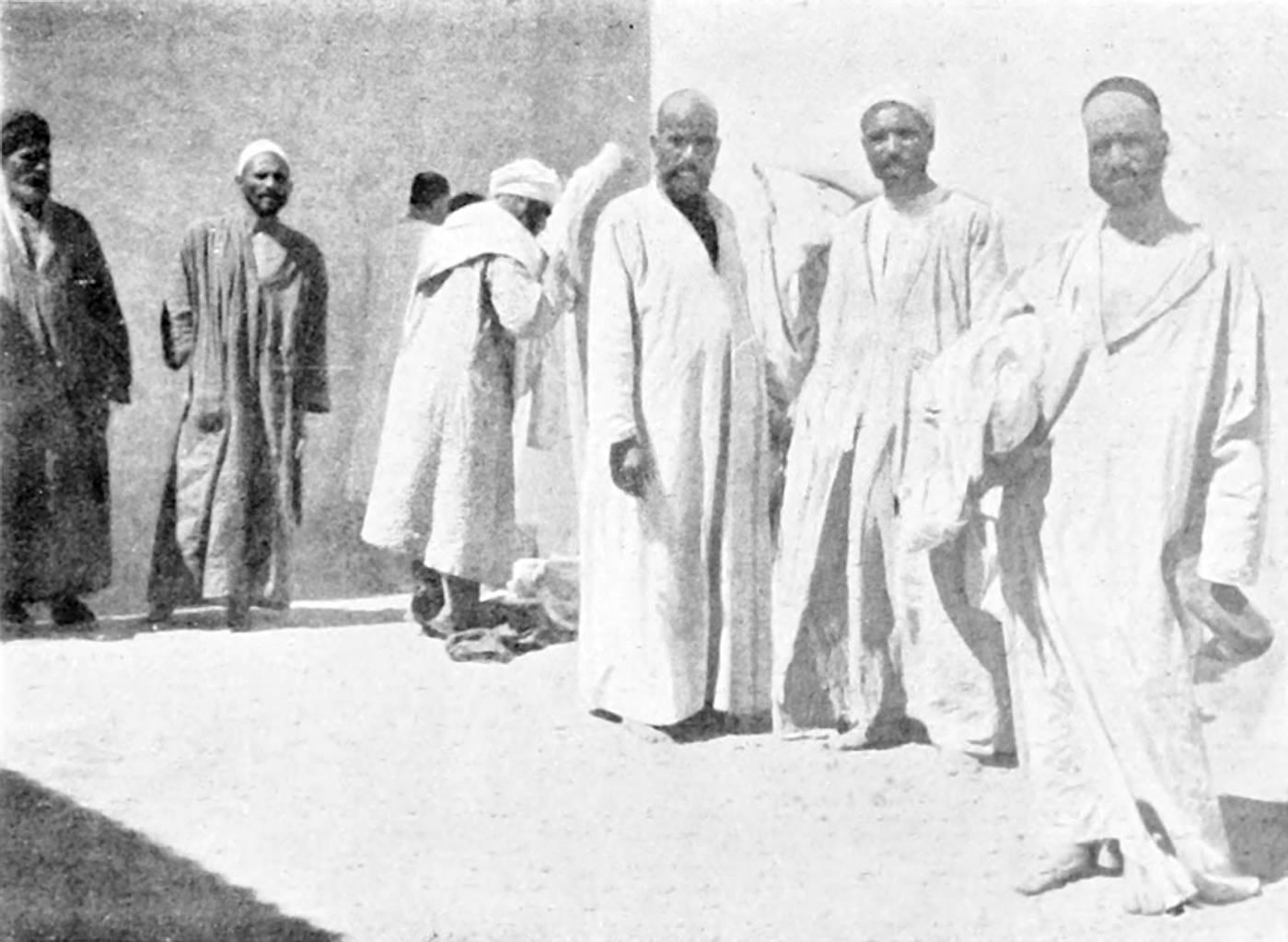
PUTTING ON IHRÁM AT JIDDAH.
On crossing the threshold we uttered a loud salám,
looking up into the air the while. Then we stepped inside,
for, as the Persians say, if you wish to escape reproof
you must assume the same “colour” as your company. The
shop was oblong, measuring some 24ft. by 9ft., at a guess.
Rough stools and low black erections on four legs took the
place of chairs and tables. I counted no less than sixty
pilgrims engaged in eating. It would have been impossible
to count the beggars who came crowding in. These I
brushed unceremoniously aside, much to the annoyance of
one of them, who cried out in vulgar Arabic: “May your
meal not sit well on you! How can you eat while we are
starving here?” Compassion laid its hand in mine, and I
would have given the petitioner a present, ungracious
though he was, had not Seyyid ’Alí restrained me, saying:
“Yá-Moulai, do not judge our friend by his looks. His
appearance, I grant, is poverty-stricken beyond the power of
repletion, but, you may take my word for it, his wealth
underground surpasses the dreams of this slave of yours.”
In this opinion he was supported by the pilgrims inside,
who assured me that the residential beggars of Mecca are
often extremely rich and in the habit of burying the money
they wring from the credulity or the generosity of the
strangers within the gates. The din in the eating-house
was beyond belief. Everybody spoke at once, and at the
top of his voice. A pack of children fresh from school
would give you an idea of the uproar. The first questions
the pilgrims asked of one another were their names, their
nationalities, their professions, and their family pedigrees.
Around one of the diminutive tables were seated two men,
and, as there were a couple of vacant stools, I took one of
them, my guide, as a mark of respect, sitting down on my
left. Shortly after another pilgrim came in, and, picking
up a stool, wedged himself between Seyyid ’Alí and myself,
muttering a half-reluctant “Bismillah!” The gentleman
directly facing me was a Turkish Effendi, Mahmud Bey by
name. Like the majority of the inmates, he was clad in
íhram, but his face singled itself out by virtue of its stony
reserve. On the extreme right was a Persian Mirza, called
Zainul-Abedin, whose countenance prepared me for the
authoritative unction of his speech. A stalwart Afghan sat
on my guide’s left hand, while the intruder, who had
separated us, was a native of Hyderabad, Deccan. His
name was Abdul Saleh.
The Persian Mirza was the first to break the silence.
Looking at each of us in turn he said, in his mellowest
tones: “Bah! Bah! Khúsh amedid! You are welcome.
You have brought purity into the City of God.”
“And so have you,” was ’Alí’s affable response. “I
was the essence of impurity when I left my native town of
Ardebil to perform this holy pilgrimage; but I trust that
God may purify my conscience.” The guide changed his
birthplace with his company. “Do you come from Ardebil,
my friend?” said Abdul Saleh. “Many learned people
have come from that blessed city. The poet calls it the
House of Knowledge.”
Seyyid ’Alí smiled a sarcastic smile. “Even the learned,
my good brother of Hindustan,” quoth he, “are prisoners
within the limits of the knowable, so fear not to inform the
company wherein the fame of Ardebil consists.” My
guide referred to the fact that the place he had chosen as
his native town is the convict station of Persia.
“God forbid!” replied Abdul Saleh, courteously, “for
the tact that is yours shows the poet to have been right.
The abode of learning must count you among its most
honoured citizens.” These amenities put the whole table
in a good temper, and Seyyid ’Alí was not long in
summoning the waiter, Omar, who, having informed us
that his master, Stád Mukhtar, had gone to Mina in order
to open a branch establishment there, awaited our orders in
an attitude so free and easy that Mahmud Bey, frowning
ever so slightly, grew a degree more reserved than ever.
The waiter wore a fez with a streaming tassel, a long white
robe, and a bright silk sash, from which hung an apron that
had once been white. The dishes we ordered were a
ghormeh of camel’s flesh roasted in onions; a kúfteh, or
mincemeat, served with rice and seasoned with spices; a
lamb kebab on a skewer folded in a sheet of bread fresh
from the oven; and a sweet called mehlabi, which looked
like English jelly. Omar, placing his right hand to his ear,
like a muezzin bugling out the cry of the Faith, shouted out
at the top of his voice to the cook in the adjoining kitchen:
“Ghormeh! Kúfteh! Kebab! Melabi! Eikki!” then,
seeing that his cigarette was gone out, he asked me to
provide him with a match, which was given to him by my
guide, who did not share Mahmud Bey’s ill-disguised disapproval
of the waiter’s demeanour. The Turk, raising his
eyes to mine, said across the table: “Effendim, the waiters
of Stambul have better manners—however.” A contemptuous
shrug of the shoulders completed the sentence.
The speaker addressed me in his own language, though he
was a good Arabic scholar; but a political discussion which
followed a question of mine as to whether Abdul Saleh
approved or disapproved of the British rule in India was
held in Arabic.
“The poet says: ‘The essence of human enjoyment is
the belly,’” said my guide, “so let us enjoy ourselves in a
human fashion.”
“What will you say,” objected Masoud, “if I assure you
that the poet means the spiritual belly and not the bodily
one?”
“This,” replied Seyyid ’Alí, quickly, “that there was
once a Dervish whose mysticism had so clouded his understanding
that he interpreted the writings of Omar Khayyam
as you would have me interpret them. The drinking of
wine, according to him, was meant to symbolise the adoration
of God. Now, it chanced that the dervish broke the
law, and was brought before his Governor, who sentenced
him ‘to eat five hundred sticks.’ The farrashes, fortified
by the juice of the grape, laid on with a will. It was
heart-rending to hear the shrieks of the sufferer. His
philosophy deserted him, so that he yelled for mercy. The
minions of the law appealed to the Governor, who said to
the dervish: ‘Have no fear, they are merely spiritual sticks.
You must eat them every one. May they go down well
with you.’ Are you answered?”
“Blessed be Islám. Long live the Caliphs of the
Faith!” cried Abdul Saleh, as though he had just awoke
from sleep.
“And long live the Ameers!” said Masoud, in a frenzy
of patriotism. “May the soul of Abdur Rahman Khan,
the conqueror of Kafiristan, the light of the nation and
religion, rest in peace, and may the sword of Islám grow
sharper day by day.”
“The sword of Islám is sharp enough,” cried Seyyid ’Alí,
“but it requires men to use it, as in the age of the blessed
Caliphs.”
“What do you mean by that?” said the Persian Mirza,
in anger. “Do you think we have no men in Persia?
May God keep stiff the neck of Iran. One man of Iran is
worth fifty foreign unbelievers.”
“Particularly if they come from Káshán and Isfahán,”
added the guide, sarcastically, referring to the alleged lack
of courage in the inhabitants of those two towns.
“May your heart be cleansed,” cried the Mirza. “Your
sarcasm, I take it, is aimed at the authorities, that enlist so
few soldiers from the southern provinces, and scarce a single
man from the towns you mention.”
The Turk looked surprised. “Do you mean to say that
Isfahán and Káshán do not contribute to the strength of
the Persian Nizam?” he asked. “How, then, can Persia
defend herself against aggression?”
“You do not know, my good friend,” replied the Mirza,
“what the Persians can do. We have no cause to fear any
foreign invasion.”
“Certainly not,” said the Afghan, with the tongue in
his cheek, dreaming no doubt of the sacking of Isfahán by
his countrymen.
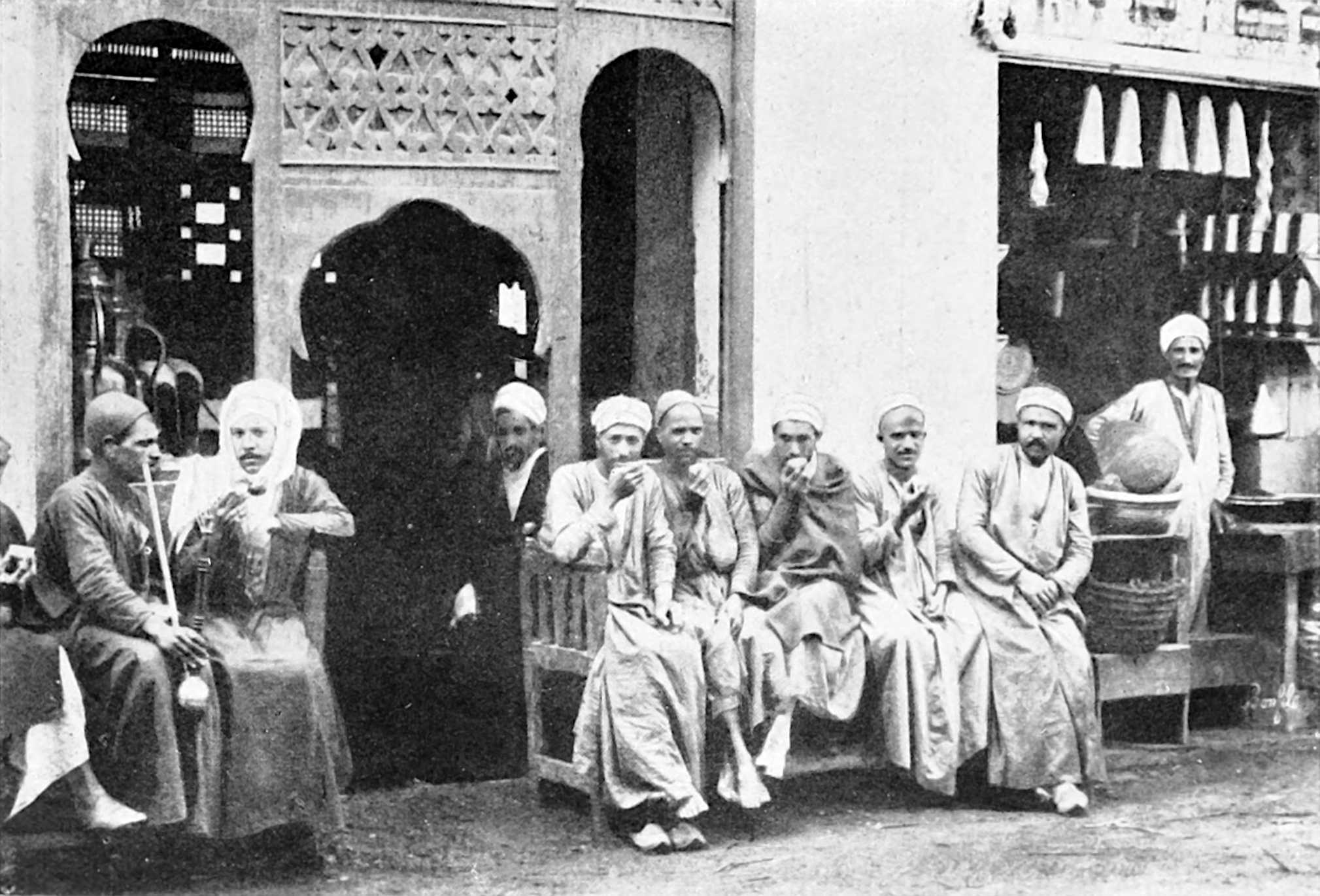
AN EGYPTIAN COFFEE-HOUSE FREQUENTED BY THE POOR.
“If you will have patience,” said the guide, “I
will tell you the circumstances that led the authorities,
whereon the sun of the Faith shines, to abandon the
practice of enrolling recruits from Káshán and Isfahán.”
We had now finished our meal and were drinking coffee
and smoking hukkahs, and so we lent a willing ear to the
sceptical rogue, who proceeded thus:
“Early in the reign of the late martyred Shah-in-Shah—may
peace be on his soul—the late Amin-ud-dowleh of
Káshán assumed the reins of government, and when that
came to pass his fellow-citizens implored him to free them
from the obligation of serving in the Army. The Minister
laid before them a plan whereby they might achieve the end
they had in view. Now you must know that Teherán is a
mighty capital, and if any one of you doubt the fact let him
go there at midday and listen to the booming of the great
gun, which shatters the buildings round about, laying whole
streets in ruins. Well, one day, when the Shah-in-Shah
was driving through the parade square, he saw a squad of
Kásháni soldiers weeping over a dead comrade. His
Majesty, having made inquiries, was informed that the
brave Kásháni had died from the fright caused by the sound
of the midday gun. Then the Shah, bursting out laughing,
disbanded the whole regiment, giving strict orders to discontinue
the enlistment of soldiers from Káshán.”
“Why don’t you finish the story, my friend?” asked
the Mirza. “The sting lies in the tail thereof. For when
the regiment was disbanded the soldiers asked for a
Cavalry escort to conduct them safely home.” A roar of
laughter followed.
“As for the non-enlistment of soldiers from Isfahán,” resumed
the Mirza, “take this story from me as its true cause.
The soldiers of the Isfahán regiment had not received
any pay for a long time, and so they waylaid his Majesty
one day when he was driving to the shrine of Shah Abdul
Azim and asked him to give them relief. The Secretary for
War, fearing revelations and the consequences, approached
his Majesty and told him that the soldiers had rebelled in
connection with the cursed Bábí Rebellion. The late Shah
returned to the Palace at once, and had fourteen of the
soldiers executed, and then started on a trip to the hills.
When he came back it was to discover the mistake he had
made, and, as an act of repentance, he absolved the town
from the yoke of soldiery.”
The Turk, Mahmud Bey, rose and made to leave the
eating-house. Looking the Persian Mirza in the eyes, he
said: “My friend, it is better to be seated in a corner, deaf
and dumb, than to have a tongue that is not under one’s
control. I have the honour to bid you good-bye.” My
guide and I followed him, leaving the others to digest his
admonition at their leisure, and bent our steps once more
in the direction of the Harem for the purpose of visiting
the interior of the House of God.
The gate of the House, except on certain occasions, is
kept shut. It is opened for men on the tenth day of the
month of Muharram, and for women on the following day.
During each of the months of Rabíu-’l-avval, Rajab, and
Ramazán (the Muhammadan Lent) admittance is granted
on two occasions to the devout, who are again free to cross
the sacred threshold once in the month of Sha’ban. On the
twelfth day of Rabíu-’l-avval prayers are offered by the high
priest of Mecca, within the Ka’bah, for the health of his
Majesty the Sultan. This ceremony is a private one. The
open sesame to the house, in the days of pilgrimage, is the
seductive jingle of gold. An influential Hájí, by means of
bakhshísh, can effect an entrance whenever he likes, but his
poverty-stricken fellow-pilgrims are not granted the same
privilege. Twice every year the house is ceremoniously
cleaned and washed. When that happens it is incumbent
on the Sheríf, the Governor-General of Hejaz, the head
priest, the keepers, and the priestly officials to be present,
after they have performed the prescribed purifications and
ablutions of the body. The first annual cleaning takes
place on the twentieth day of Rabíu-’l-avval. First the
floor of the house is scrubbed with the water from the Zem-Zem
well, then the walls are besprinkled with ottar of roses
and other fragrant scents. Aloe-wood is kindled in braziers,
and spreads its delicious perfume through the air. The
officials prostrate themselves twice in prayer, after which
they withdraw. The second cleaning of the year is effected
in the same fashion on the twentieth day of Zi-ka’d,
preparatory to the ceremony of draping the outer walls of
the house with ihrám. For, thirteen days before the Hájj-day,
the Ka’bah itself is clothed in the winding-sheet of
humility, as though it were regarded unworthy to be called
the House of God.
This ihrám of the shrine consists of a soft white material
manufactured in Yemen, and is hung on the outer walls
to the height of seven feet from the ground. One of the
most interesting sights is the selling of this stuff to the
richer pilgrims by the keepers of the Ka’bah. A square
inch of it will often fetch as much as £3. The purchaser
considers it his most cherished possession. The mere
touch of it is held to cure every sickness. The sight of it
is enough to protect its owner from the evil eye. So long
as he has it about him Satan will practise his snares on him
in vain. Thousands of miracles are believed to be wrought
by its use. “So-and-So is a lucky man,” one devout will say
to another, “he has obtained through God’s grace a strip of
the ihrám of the Blessed Ka’bah.” The chief door-keeper
of the present day goes by the name of Sheykh Shaban. The
post is a coveted one, and has become hereditary of recent
years. On the Hájj-day the ihrám is taken down, and is replaced
by the kesveh, which is composed of eight pieces of
black silk, embroidered round the margins with Kurán texts
in letters of gold, and of a curtain of the same design and
colour. Two of these pieces of silk go to cover each one of
the outer walls. They are hung from the corners on long
silver loops. The curtain is used to drape the silver-plated
door, and falls to the ground from a rod of solid silver
beautifully chased.
The “Square House,” or Ka’bah, stands almost in the
centre of the Harem, rather nearer to the west than to the
east. The ground whereon it lies is accounted holy, since
it was here that Adam, after his expulsion from the Garden
of Eden, first worshipped his Creator, a tent being sent
down from heaven for the purpose. This act of grace on
the part of the heavenly hosts was the compassionate result
of a conference over which the Archangel Gabriel had presided.
There was substituted for the tent by Adam’s son
Seth a structure of clay and stone which was rebuilt at a
later period, under the superintendence of Abraham and
Ishmael his son. So much for the legendary history of the
house. The task of restoring the sacred edifice, in the time
of Ignorance, fell to the lot of the four chief tribes of Arabia.
It was rebuilt by the Kuraish, a few years after
Muhammad’s birth, and was destroyed by the torrents
thirty-five years after its completion. Then ensued an
intertribal war, each of the clans claiming for itself a complete
side of the house which should face its tents, till the
cause of strife was settled by an agreement among the contending
tribes to accept the arbitration of Abú-Amid,
the chief of the Kuraish. The decision of Abú-Amid
was that the tribes should abide by the determination of
the man who, on the following Friday afternoon, should be
the first to leave the temple. So haphazard an arrangement
was bound to appeal to the sportsmanlike instinct of
a race that has been ever wont to test the wisdom of its
actions by the arbitrament of chance. The warriors
sheathed their swords, and when the fateful day arrived not
a single murmur was raised against the man who, being the
first to reach the open air, set about planning the building
as it now appears. This man, it is said, was Muhammad.
The Ka’bah, which was certainly reconstructed in the year
1627—the successive Sherífs and Sultans adding to its
interior decoration—is said to have been destroyed and restored
twelve times since the death of the Prophet.
In shape the Ka’bah is an almost solid square, having
from outside a length of fourteen yards, and being eleven
yards broad and sixteen yards high. From afar it has the look
of an immense block of dark-coloured granite. The double
roof is supported from within by pillars of aloe-wood, and is
held in so great reverence by the devout that it is declared by
them never to have been polluted by the Harem pigeons
until recently, the present misbehaviour on the part of the
birds being taken as a sign of the approaching end
of the world. The gateway, which fills a considerable
portion of the eastern wall, is raised about six feet from
the ground, and measures in height some four yards, as far
as I could gauge. The door itself is made of aloe-wood,
and is covered over with plates of solid silver, and studded
with heavy silver nails. The precious metal was presented
to the house, in 959 of the Hegira, by the generous Sultan
Suleymán. Inlaid in the eastern end of the southern wall
of the Ka’bah is the famous Black Stone which might be
said to be the centre of the pilgrims’ circling aspirations, and
the pivot of their circumambulations round the sacred precincts.
Another stone, marking the Sepulchre of Ishmael,
lies at the base of the northern wall, and from the roof above
there projects a horizontal semicircular rainspout, which,
including the end fixed in the wall, is five yards long,
measures twenty-four inches in width, and is made of
massive gold. The water flows from the lip of the split
pipe to the floor of the Harem below. The tomb of
Abraham, the legendary builder of the temple, is situated
close by, to the east, not far from the Gate of Beni Shaibeh.
The Prophet’s faithful followers, when they say their
prayers, must turn their faces in the direction of the
Ka’bah, no matter where they may be. This ascertaining
of the exact position of the House of God, which is the
centre of the Holy City, is called “taking the Kiblah or
Outlook.” Thus the Muhammadans of Syria, and those
beyond it to the north, having fixed the Kiblah, are face to
face with the northern wall, sacred to the Stone of Ishmael
and the gold rainspout: their prayers are therefore sure to
be heard. Those of Persia, Turkistan, Northern India,
Sind, and a part of China, look in the direction of the
north-eastern angle, called the Rokné-Araghi, which is an
equally blessed outlook, since the door of the house is on
the eastern side and rather more to the north than the
south thereof. The faces of the Muslims of Aden, of
Southern India, of Madagascar, and of Australia, are
turned to the eastern wall or the south-eastern corner of
it, while those of the faithful of Constantinople, as well as
those of the Muhammadans of some parts of Russia, are
opposite to the western wall of the sacred building. The
Boers believed themselves to be the “chosen people.” It
is a pity they are not Muhammadans. For, if they were,
they would be considered now the chosen people of Islám
for the simple reason that they would face the southern
wall of the Ka’bah, wherein is laid the Black Stone of immemorial
sanctity. But the prayers the most acceptable
to God, when all is said and done, are the prayers raised
from any quarter within the Harem of the House of Allah
on earth.
The interior of the Ka’bah is far more impressive than
the exterior. The silver threshold is reached by means of
a staircase running on wheels. There the pilgrim must
prostrate himself, asking God to grant him his heart’s
desire. He must be careful to maintain the correct
demeanour, closing his eyes and lifting up his hands,
inasmuch as the angels, who are believed to keep
watch over the entrance, are quick to resent the
slightest breach in the prescribed ceremony. The
guide who accompanied me assured me of the fact. He
was good enough to see that I had forgotten neither my
rosary of ninety-nine beads corresponding with the wondrous
names of God used in prayer, nor yet the lump of
clay (called mohre) whereon are stamped the selfsame
names, together with those of the twelve Imáms and the
Prophet. It was on the clay that I bowed my head in
contrition when I fell on my knees. My guide, who had
also prostrated himself, expressed the conviction, on rising,
that the angels were on his side. I was also about to
declare myself to be on the side of the angels when a
couple of sturdy pilgrims, in their impatience to behold the
Light of their eyes, wedged me tight between their bulky
forms and then hustled me to the ground, adding insult to
injury by being obviously unconscious of the presence of
my humble body. They were “absent-minded beggars”
with a vengeance. I can only say that, on regaining my
feet, I hoped the silent prayer I said, on the spur of my
annoyance, would be answered ere long; but when I
crossed the doorsill I was overcome by a sense of my own
unworthiness, so that I pardoned the men who had offended
me. I raised my eyes. The ceiling was flat, and
supported on three columns of aloe-wood, and from it hung
vases of great beauty on delicate gold chains. The walls
were covered with red velvet, save where, in white squares,
were written, in Arabic characters, the words “Allah-Jal-Jelalah!
(Praise to God the Almighty!)” The velvet is
said to have been a gift from Sultan Abdul Aziz. In the
corner formed by the northern and eastern walls there is a
door leading to the roof. This door, which is called the
Door of Repentance, is closed to the public; but a prayer
said on the hither side of the threshold meets with a
gracious response, and the pilgrim is clean-washed of his
sins if he but touch the wood with his hand. The floor
is now flagged with marble—the work of some twenty
years ago.
While I was admiring the unpretentious grace of the
holy shrine, and meditating from its threshold on the
golden age of Islám, my guide broke in on my thoughts,
saying: “You are allowed to make two prostrations at the
base of any one of the pillars. Let me advise you, in the
welfare of your immortal soul, to choose the one facing the
Black Stone outside, which is the most sacred spot under
the canopy of heaven.” The difficulty was to force my
way thither. The whole house was packed with pilgrims.
Some were praying, some were weeping, others were groaning
or beating their chests, and all—except the Bedouins—were
clad in their sacred habits. A great awe fell on me.
It was as though the graves had yielded up their dead at
the blast of Israfil’s trumpet. All eyes were blind, all ears
deaf. The thought of home, of country, of wife and child
seemed drowned as in a sea of passionate devotion to the
Creator of those human blessings. And from outside, in
the Harem, there arose the chant of the Talbih, which
every pilgrim must sing on sighting Mecca, on donning the
Ihrám, on entering the Harem, on starting for the Valley
of Desire and the Mountain of Compassion, and on performing
the little pilgrimage of Omreh. I paused in the
effort to reach the southern pillar, and listened to the singing
from without.
Labbaik, Allahomma, Labbaik!
Labbaik, la Sherika lak Labbaik!
Labbaik, enal-hamda, Vanahmeta lak Labbaik!
Labbaik, la Sherika lak Labbaik!
(Verily, here am I! O Allah, here I am!
Verily, here am I! O Allah, thou hast no mate!
Verily, here am I, O Allah! All praise and glory to thee!
Verily, here am I! O Allah, thou hast no mate!)
On my soul, it was fine! All my senses must have
deserted me. I must have lost all consciousness of self
suddenly. The burden of existence seemed to be lifted.
If I did not actually slip off the slough of the flesh I came
to realise in a flash that the soul is immortal. These introspective
thoughts were not mine at the moment of the
transformation. They were retrospective, forced on me,
when, on coming back to a sense of my surroundings, I
found myself kneeling at the Door of Repentance, and
heard myself crying “Labbaik, la Sherika lak Labbaik.”
Yes; there was I—“an Agnostic who would like to know”—rubbing
my brow on the marble floor of the Ka’bah,
without the dimmest notion in my mind as to how I came
to be there. Only a month before I had been sipping
lemon squash in a London restaurant. Strange. The
first thing I did was to look round in search of my guide,
as sceptical a rascal as ever breathed. He was on his
knees, at my side, his eyes starting out of the sockets. I
put my hand on his shoulder. “Come,” I said, “let us go
out. I’m suffocating.” He rose to his feet, looking scared
and abashed; but his face assumed its usual expression
of sunny mirth on reaching the Harem. He put his tongue
in his cheek as of yore; then, repenting him of his unregenerate
mood, he told the truth. “Yá-Moulai (Oh, sir),”
said he, “within the house so great reverence fell on me
that I did hardly think of the blessed hourís and perís promised
to me in Paradise. The same emotion overmasters
me every year on entering into the Ka’bah of Allah, and
yet what does it all mean? What is the value of this
dream which we call life, and which is my true self? Is it the
self that inquires, scoffs, doubts, but wants to find truth?
Or is it the self that you discovered a moment ago bereft
of every sense save one, namely, that which would seem to
have drawn me irresistibly to a power whose will none
would seem able to dispute? Has that power an existence
outside my emotions, or is it merely the fabric of my
senses? You are silent, Yá-Moulai. Well, there are more
ways of getting drunk than by drinking of the juice of the
forbidden fruit. I escaped from myself just then on a
spiritual rather than a spirituous fluid. Let us return to
our camp.”
CHAPTER VII ON THE ROAD TO ARAFAT
The most important days of the Pilgrimage are the 8th,
9th, and 10th of the moon of Zú-’l-hijjah. Now, the 8th of
Zú-’l-hijjah is the day of the Repose of the Soul. In Arabic
it is called Youm-ul-Tarvih, and it sees the exodus of the
pilgrims from Mecca on their way to the Hill of Arafat.
The most noteworthy “column” of the Hájj is the sermon
which is preached on the mount on the following day. No
pilgrim is qualified to call himself Hájí unless he is present
on that occasion. The preacher sits on a camel,
and the pilgrims gather round him, those who can find
no room on the slopes taking up their positions on the
plain. Not ten pilgrims in a hundred can hear a word, and
so the majority while away the time in praying, in weeping,
in chatting, in telling stories, and even in making love. If
they fall asleep or lose consciousness they are counted as
absent. They must arrive before noon and must remain
until after sunset. If they leave before the appointed time
they must pay forfeit either by sacrificing a camel or else by
keeping fast for eighteen days running. This day is named
Youm-ul-Arafat in Arabic.
The pilgrims, before reaching the plain of Arafat, must
perform their religious purifications, and, on arriving on the
Hill itself, they must recite the following Niyyat: “O God,
I purpose, in obedience to Thy commands, to abide here
until the setting of the sun.” With this they must say
aloud a prayer which runs: “I praise Thee, I glorify Thee,
O Lord; there is no God but Thee. I have burdened my
conscience with wrongdoing, and now acknowledge my sins.
O, forgive me my trespasses, O Lord, for, verily, Thou art
the best forgiver.” Nor is this all; for the pilgrims, having
declared their intention and confessed their sins, must pray
for their parents, their relatives, their co-religionists, their
servants, and their slaves. The number of persons thus
honoured in the remembrance should not be less than forty;
and for this act of grace the pilgrims will be rewarded one
hundred thousandfold. Furthermore, in the course of the
day what we have called the Song of the Winding-sheet or
Talbih must be repeatedly intoned, as must also the
Tamjid or hymn of praise, and the glorification of God’s
omnipotence, which is styled Takbir. Then, when the sun
is setting, the pilgrims turn their faces in the direction of
the Ka’bah and recite this prayer: “I take refuge in Thee,
O Lord, from poverty, and from the evil that may come
out of the day or the night; I repent of all my wicked
deeds, trusting in Thy gracious pardon; and I seek shelter
from fear in Thy protection: O Lord, I repent, I repent, I
repent.” The second “column” of the Hájj takes place
immediately after sunset, when the pilgrims rush forward
impetuously from Arafat to Muzdalifah, in order to remember
God near the holy monument (in Arabic, al Masher al
harám), where, on a mountain on the thither side of
Muzdalifah, the Prophet is said to have stood praying until
his face shone as one who had seen his Lord. There the
pilgrims pass the night, and at the hour of morning prayer
they say: “O Lord, in obedience to Thy commands, I
break my morning at Thy Masher al harám.” Thence
they proceed to Mina, through which valley they passed on
their road to Arafat, and there the stoning of the devil and
the slaying of the sacrifices, two notable “columns” of the
pilgrimage, are performed. This is the Youm-ul-Nahre or
Day of Sacrifice.
On the eve of Youm-ul-Tarvih my friends and I went to
stay the night with a Persian grandee who had taken up his
lodgings in a large house near the Harem. We will call his
name Ardashir Morad Khan. His was in many respects an
exceptional character. He had acquired a knowledge of
the French tongue without learning to detest the French
nation, and had studied the Darwinian theory of the origin
of species without aping the European. His conversation
was grave and impersonal. He was communicative without
being confidential. He never betrayed a trust, nor
blabbed his personal secrets. From him I learned all I
know of the political situation in Persia; and the Youm-ul-Tarvih
was six hours gone—remember, in the East, the
day begins and ends with the setting of the sun—ere we
closed the debate and flung ourselves down to rest. Morning
broke. Ardashir Morad Khan, having performed his
ablutions, was saying his prayers, and I was drinking a cup
of tea when there came a knock at the door, and a Persian
friend of ours rushed into the room. His excitement knew
no bounds. He stood bereft of speech from sheer lack of
breath; but his face spoke volumes.
“Well, Sheykh Eissa,” said I, “what is the news?”
Ardashir Morad Khan dropped his rosary and looked
up, listening. Sheykh Eissa coughed as if to clear his
gorge, and cried—
“My manuscript on the Bedouins is lost; the precious
volume has been stolen! For the last seventeen
years, as I told you yesterday, I have wandered from tribe
to tribe as a talisman-monger in order that I might study
the customs and the character of the Bedouins, and give to
the world a faithful history of my experiences. I had promised
to show you the result of my labour, and now I am
constrained by fate to re-shape my impressions. Youm-ul-Tarvih? Wáh!
How can my soul repose?”
I handed the rebellious little man a cup of tea. Having
taken a sip, he reached out for the sugar. “Your tea is as
bitter as mortality,” he said, and straightway converted it
into syrup. I recalled a pretty Persian story. “Perhaps,”
I replied, “the clay from which the cup was
made was once man.” The fancy, though borrowed, restored
the Sheykh’s good humour. “It is the burned clay
of my thief’s grandfather,” he declared, with a quaint
uplifting of his shaggy eyebrows, “or I am an infidel. My
precious manuscript—how can to-day be Youm-ul-Tarvih?
Assuredly it is the Day of Sacrifice.” Seyyid ’Alí now
entered the room. He said: “I have engaged a moghavem,
what we Persians call a hamlehdar; he will be here with
his mules and camels at midday; and our tents are even
now on their way to the Hill of Arafat, where an aristocratic
position has been reserved for them.”
“Surely you mean the Valley of Mina?” I asked.
“No, no,” broke in our host, Ardashir Morad Khan; “the
custom of sleeping at Mina on the outward journey was
abolished long ago on account of the delay its observance
occasioned, and that for no purpose that would
warrant——”
Sheykh Eissa leaped to his feet. “I ask pardon of God,”
he cried. “Why, the Prophet himself was accustomed to
halt at Mina from six hours after sunrise on Youm-ul-Tarvih
until sunrise next morning, and there he used to say
the five prescribed prayers. Surely that fact alone would
warrant our observance of the law?”
“Well,” I replied, “I must confess that I am delighted
to know that we shall have more roomy quarters for the
night. The Valley of Mina is a mere gully. According
to my calculation there must be scarcely less than three
hundred thousand pilgrims in this city.”
“Say four hundred thousand and you will not
exaggerate the number,” interrupted our host. “What is
your opinion, Sheykh Eissa?”
“The pilgrims are innumerable this year, your Excellency.
It is not possible to count them. The angels in
heaven are not more numerous. Nine years ago the pilgrims
outnumbered the present calculation of our distinguished
friend. This year Youm-ul-Nahre falls on a Friday, and I
am sure there never was before a concourse so great in the
City of God.”
“I admire the beauty of your flight, Sheykh Eissa,” I
said, dryly. “But let us deal with facts. I came here by
the last pilgrim boat. Some two hundred thousand passports
had then been handed in at Jiddah by the seafaring
pilgrims. Do you mean to say that the number of Hájís
who have crossed the desert are equal to the number of
those who have crossed the seas from every corner of the
Muslim world? I will never believe it. The advantages
are all in favour of the oversea route. It is cheaper, it is
quicker, it is safer, and it is perhaps less tedious. For a
fare of a few dollars any starveling can go by steamer from
Suez to Jiddah. The result is that the old caravan routes
with the one exception of the Syrian are, comparatively
speaking, deserted. For instance, the Muslims of Morocco
and North Africa are now conveyed to Mecca by sea. The
contingent sent by Persia down the Gulf outnumbers that
which journeys across Arabia. True, the Syrian caravan
still maintains not a little of its ancient glory. This year it
is unusually gigantic, containing as it does, in my opinion,
not less than seventeen thousand camels. The Bedouins
are also, I admit, in force; so let us say there are two
hundred and fifty thousand pilgrims in Mecca all told. We
shall have a better opportunity of testing the accuracy of
the figures when we are encamped on the Plain of Arafat.
But be the number what it may, it is, at the lowest estimate,
far too great for me not to congratulate myself that the
custom of sleeping overnight in that death-trap of Mina has
been done away with.”
Sheykh Eissa smiled. “It would be impossible
to extol its charms as a camping-ground. But I,
for one, remember that, though the halt on the outward
journey has been abolished, there we must stay for three
or at the least for two days after slaying the sacrifices.
For the rest, I am far from sharing your love of
the oversea route from the outlying dominions of the
Prophet. In my youth I travelled by caravan from
Morocco to Medina and thence to this holy city. Along
the northern coast of Africa, through Algeria, Tunis, and
Tripoli, to the Land of Pyramids, we wandered, halting for
one day in every six days in order that our camels might
gather strength to sustain the hardships of the road; and
in Cairo we joined the Egyptian caravan, whence we proceeded
together on our way—an endless string of pilgrims,
glorying in our liberty, praising God for His gifts of heaven
and earth, burying our dead where they fell—now in the
Sinaitic Peninsula, and now in the desert to the south, until
we reached at last the sepulchre of the Prophet and the
place of his birth. I deny not that God created the sea as
well as the desert. Nay, nay, spare your eloquence. My
stomach at sea is as inconstant as the waters. I am a
Bedouin at heart. However, you must stay at Mina for
three or for two days after the Day of Sacrifice.”
“If the cholera fiend should not drive us hence in search
of refuge,” I interpolated. “The epidemic is on the
increase. The sacrifices slain, we shall be only too glad to
make good our escape to the sea.”
“True,” said Seyyid ’Alí, grimly, “if the cholera fiend
should not choose for us an underground route to a city of
eternal rest! If it please God, I shall conduct your
Excellency to Jiddah so soon as the sun shall set on Youm-ul-Nahre.
For I have no wish to fall a victim to the fell
disease, Sheykh Eissa.”
With the foregoing words my guide bade us good-bye
and went about his business in my service. He came back,
however, almost immediately. “May it please your Excellency,”
he said, addressing Ardashir Morad Khan,
“Khalil is fallen sick of the cholera and is even now at the
point of death.” Now, Khalil was our host’s steward and
had set out for the Hill of Arafat in charge of the tents and
baggage. Ardashir Morad Khan looked extremely grave.
“God have mercy on his soul!” he cried. Then, “Where
is he now?” he asked; “and who has taken his place?”
Seyyid ’Alí replied that the man had been brought back on
a bier to Mecca, and was then lying in a cellar attached to
the kitchen of the house in which we were. A panic would
have followed this statement had not our host cried out in
a voice of sternest command: “I must request you all to
be calm. We must set the servants an example of courage.
Are we not the slaves of God?... Well, Seyyid ’Alí,
who has taken over the control of our caravan?” “The
cook of your Excellency’s household,” replied my guide,
“assumed the direction of affairs. I have done my best to
restore the confidence of your Excellency’s household. The
servants need a firm hand to keep them from running
away.”
So Ardashir Morad Khan left the room, and when he
came back I requested permission to see the sick man.
The other guests, who were sitting round the room with
their backs to the walls, jumped up at once and made a
low bow to me as I passed by to the servant’s quarters.
The Meccan houses are generally lower than the surface of
the street without, and when this is the case a flight of
stone steps leads from the first floor into the court round
which the apartments range. I found Khalil in the cellar.
He was sinking fast. Nobody had dared to stay with him.
His eyes were dried up in the sockets and blackened all
round the rims. Not an ounce of flesh remained on his
body. The stench was unendurable. The bearers, having
stretched his legs in the direction of the Ka’bah and given
him a cup of sour milk wherewith to quench his thirst, had
gone away, leaving him a prey to the fell disease. Compassion
rent my heart, but I could do nothing: remedy I
had none. I saw, moreover, that he was too far gone to
recover, and, indeed, scarcely was he aware of my presence
than his new-born hope was strangled by death. “Yá—Allah!”
he muttered, and that was the last time he drew
breath. Having rejoined my host, I went with him into
the city.
The streets were packed with camels, brought in
thousands by the Bedouins and by the Syrian and the
Egyptian drivers. Round about the Harem the moghavems
tried our endurance to the utmost. These are the men who
conduct the pilgrims by camel caravan to the Hill of Arafat
and back, supplying all their needs on the journey. There
is no fixed price for the hiring of a camel, but by dint of
persistent bargaining it is possible to get one for five
shillings, and each moghavem may have as many as fifty
pilgrims under him. We were tormented by these contractors
more than I had ever been tormented by the
Indian jugglers outside the gates of any hotel in Bombay.
They were as plentiful as flies in Egypt and not less irritating.
Perhaps that is the fault of the pilgrims themselves.
They begin by feigning indifference, and when they have
reduced the moghavems to a haughty silence they assume
an air of eager business. Thus the moghavems have
learned from experience never to take no for an answer.
Out of the madding crowd the talk was all of the
cholera epidemic. On my way to a coffee-house I
happened to meet a Turkish official, an acquaintance of
mine, and he gave it as his conviction that the death-rate
had risen to over five hundred victims a day. He advised
me to leave the Valley of Mina at sunset on the tenth of
the moon. In the coffee-house a Syrian pilgrim entered
into conversation with me. He told many stories of his
pilgrimage across the desert: of the discomforts and the
perils of the road, of the cruelties of the drivers, and the
almost inconceivable presumption of his own moghavem.
With the immense caravan had come the Syrian Mahmil,
in the charge of a Pasha, and the Surreh, in the care of
another Turkish dignitary. This Surreh is the pension
sent from Constantinople to the officials of the Harem. It
was formerly the accumulated hoard of centuries of legacies.
It is now managed by the Imperial Treasury. A strong
force of cavalry accompanied the caravan, which, according
to the pilgrim in question, counted some eighteen
thousand camels.
The number stated was, perhaps, an exaggeration,
though a pardonable one, for the string which I saw on
reaching the Plain of Sheykh Mahmud, where the caravan
had been encamped, and which was now on the move,
extended for miles and miles. I determined then and there
to avoid the crush on the road by remaining in Mecca until
the day was far spent. It was four hours before sunset ere
I could tear myself away from the Plain of Sheykh
Mahmud. The endless string of camels and of pilgrim
wayfarers was an unforgettable sight, and on my return to
my host’s house I met crowds of Syrian and Egyptian
stragglers, mounted and on foot, proceeding up the Moalla
to rejoin the immense caravan which was already threading
its way to the mountains.
Seyyid ’Alí gave me a hearty welcome when I entered
the house. He had scoured the city, he said, in search of
me, and had given me up for dead. I found everything in
readiness for our journey, and when we had smoked a
kalyán or two and quenched our thirst we got astride our
ambling mules and made for the Hill of Arafat.
Now, when my friends and I left Mecca for the Hill of
Arafat it was about four o’clock in the afternoon of Youm-ul-Tarvih.
Late as it was, the streets were still packed
with men and beasts. In the indescribable confusion steady
progress was impossible, and to the universal disorder was
added the danger of a general stampede on the part of our
mules. The uncertain tempers of those animals of ours
taxed our patience to the utmost. We had hired them in
the belief that they were tractable creatures trained to
amble. We rode them in terror of our lives, conscious of
our impotence to control their paces. Now they would
charge through a crowd in a panic blind and headlong, and
next they would stand stock-still in a sweat of suspicion at
the mere sight of a straw or a splash of water on the road.
Our moghavem, having a lively inkling of our rising
indignation, assured us with haughty unconcern that we
had been wiser to have followed his advice and ridden
camels. With one thing and another it took us quite an
hour to reach the outskirts of the city. All the people we
had met wore íhram except the drivers and the servants,
who were in their ordinary clothes.
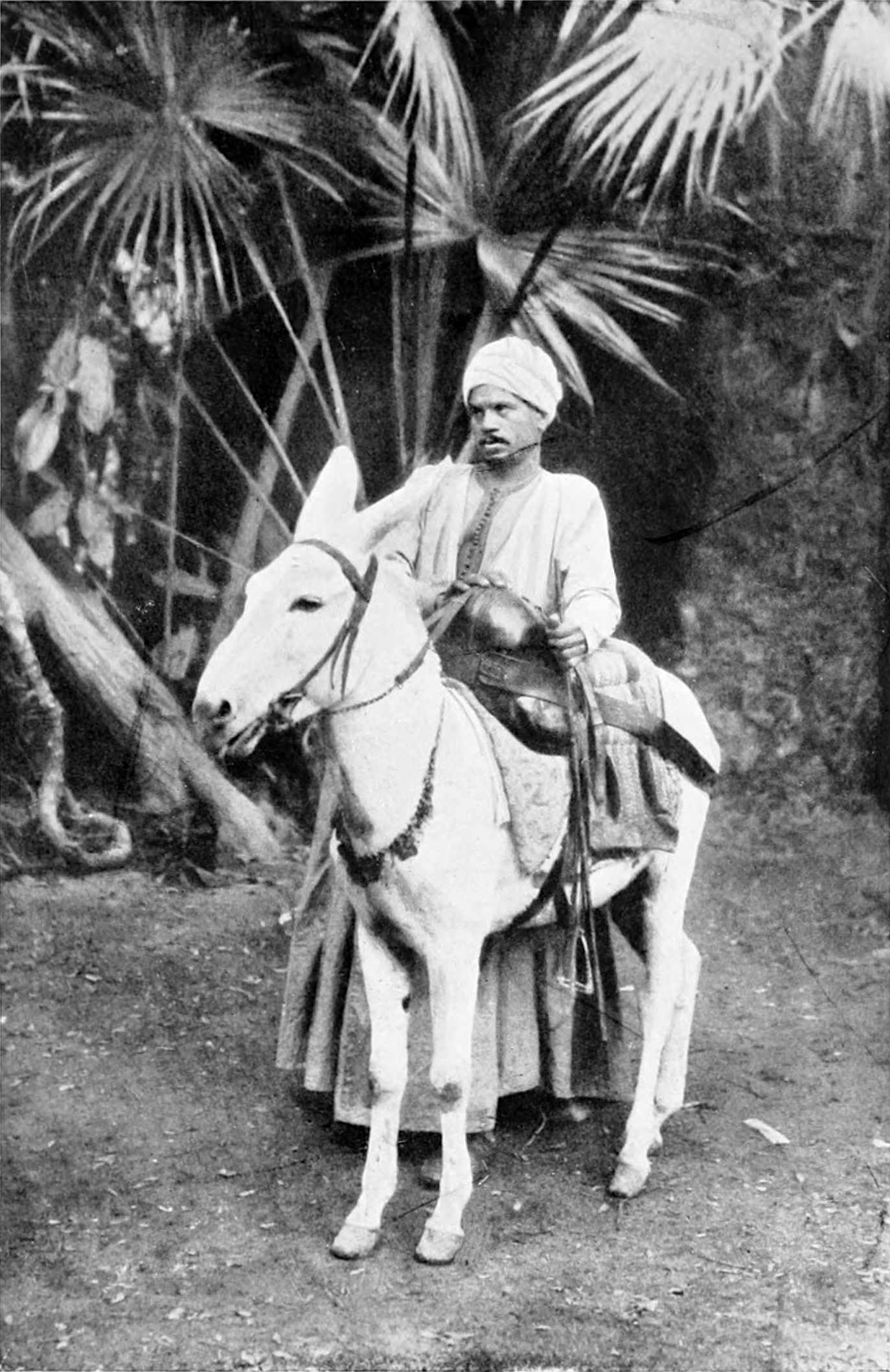
AN EGYPTIAN DONKEY AND ITS DRIVER.
Outside Mecca the road widens, taking an abrupt turn
from a northerly to a north-easterly direction. We passed
innumerable huts and Bedouin tents, we skirted the Jebelé-Nur
or Mountain of Light on our left, and then, swerving
back to the north, we kept a sharp look-out for the pitfalls
which beset our every step. In no case were the mountains
many miles away. The colour of them changed gradually
from a gloomy drab to a deep brown. Many camels had
knocked up and lay festering in the sun. Along the route
dead pilgrims had been buried so close to the surface that
the odour of putrefaction polluted the air. The stench of
decaying flesh was positively sickening. Again and again
I had to hold my nose and cry aloud, “Astaghferallah Menash-Shaitan:
I seek shelter in God from Satan.” This
phrase was used more often than any other, and in varying
moods and with many meanings. Every time an animal
fell down its driver would mutter the expression. If the
animal remained obstinate, refusing to rise, the driver
would rub his hands and repeat the words. An Arab
Sheykh who rode behind me took refuge in God against the
devil whenever he failed in his attempt to get past me.
This was merely a sign of impatience. Had he given vent
to his feelings by saying the formula sixty-nine times in
quick succession I might possibly have made way for him
for no other reason than because I should have expected
him to strike a blow in defence of his claim to precede me.
For the Prophet has said: “Utter not a word in wroth
until you have repeated seventy Astaghferallahs.” Believe
me, it is a word to conjure with. As a mark of ironic
negation it is more convincing than the strongest affirmative.
In a rocky pass I asked Seyyid ’Alí, whose face had
turned copper-red, and whose lips were scorched, if he was
thirsty. “Astaghferallah, yá-Moulai!” he cried, smiling
ironically. Later on, in the neck of the pass, where two
men could not ride abreast, I had proof of the expression
being used by way of a courteous refusal. Riding far
ahead of us two mullás in íhram, with shaven heads and
unkempt beards, drew rein simultaneously, each requesting
the other to pass on. This exchange of punctilio was most
unseasonable. So long did the two priests bandy courtesy,
crying “Astaghferallah” one after the other, that the word
was soon used in a contrary sense by the pilgrims in the
rear.
We waited about five minutes for the intervening
pilgrims to ride on in single file, and when we reached the
spot it was to find that the road lay between two rocks
some four feet apart. One of my friends, quoting a well-worn
proverb, bent towards me and remarked: “Why do
they not remove those stones out of the path of the Faithful?”
Seyyid ’Alí observed a priest in front of him, and
replied significantly, “I behold a bigger stone in my path!”
The priest, who was reading the Kurán atop of his camel,
overheard the words, and tugged his camel round that he
might face the sceptical rascal. The camel made a vicious
snap at Seyyid ’Alí’s mule. The mule, finding itself
between two fires—the rock on the one side and the camel
on the other—sat down on its haunches; and my guide,
crying out the word, “Astaghferallah,” came a cropper,
striking his head against a stone. The upper portion of
his íhram fell off. “Was it you, Seyyid ’Alí who fell?”
cried Sheykh Eissa. Seyyid ’Alí, all bruised and bleeding,
crept from under the mule’s legs, and picked up his sacred
habit. “Astaghferallah!” he replied; “it was not I who
fell. It was my íhram. Unfortunately I happened to be
in it.” A burst of laughter followed and then a shrill
scream. “I verily believe,” said Sheykh Eissa, addressing
me, “that your guide would make a kitten ‘eat a dozen
sticks’ if it mispronounced the Arabic letter ‘ain’ in the
feline word ‘maou! maou!’”
But I had turned whence the scream had come and
made him no reply. My guide’s mishap, as I saw on
looking ahead, had excited the compassion of a lady in a
palanquin. She was a Meccan. No sooner did she see
the blood than she uttered a shriek of deepest commiseration.
Then she recovered herself, and cooed out a
couple of orders. Her warmth of heart was now as
evident as had been her emotional susceptibility. In one
breath she summoned her husband and sent him to Seyyid
’Alí with an offer of a certain famous prescription for
wounds and bruises. In the next she implored her
moghavem to ransack on one of the camels a chest that
contained, among other things, a small bottle of scorpion
oil. It was the remedy in question. This is the way it is
prepared: the stings having been extracted, a couple of
black scorpions are dried in the sun, are then put in a
bottle holding about half a pint of castor-oil, and in this
they are kept corked up for the space of a year. The
unwilling Arab made demur, pleading that the delay
would inconvenience the pilgrims behind her own caravan;
but she reduced him to obedience with a look. “Be
sharp!” she crooned, as he swung reluctantly on his heel;
so sweet was her voice that without another sign of
hesitation he leaped forward to carry out her wishes. The
camel was made to kneel down by the wayside; then the
chest was overhauled. By the time her husband had
returned the precious oil was found and given to him.
“Take it,” she said, still gazing in ’Alí’s countenance over
her husband’s shoulder, “and tell him to use it unsparingly
lest the beauty of his face should be ruined.” Meccan
gentlewomen allow themselves a certain freedom of speech
and action, otherwise a less presentable man than this
woman’s husband might have been jealous enough to
resent the frank admiration in her voice. Seyyid ’Alí,
having laid on the oil by means of a wooden bodkin used
for the purpose, handed the bottle back to the husband,
who pressed him to accept the rest of its contents, which
would be useful, he said, in case of further accident.
My guide, however, refused with many thanks, saying that
he could not find it in his heart to deprive the giver of the
possibility of exercising her compassion on the next
unfortunate she might chance to meet. And with this our
respective caravans moved on.
Before reaching the Valley of Mina a serious accident
happened, this time to a Malay pilgrim—an accident that
proved fatal to him, for he was crushed to death in a
stampede of mules. I am happy to say that our own
caravan was not concerned in the disaster. Two women
swooned at the sight, and all the other women round about
raised their voices in bitterest lamentation, as though they
had lost a near relative. A quarter of an hour after, when
the unfortunate man had been laid to rest in his shallow
grave, the two women who had fainted fell to prattling
merrily as if nothing untoward had occurred. In fact, the
chief characteristics of the Oriental woman are her absolute
helplessness outside the restricted limits of her special
sphere of influence, and the swiftness with which she passes
from one emotion to another. There is no transition in
her moods. She passes from the tearful or the terrible to
the mirthful or the ridiculous at a single bound of her
mercurial temperament. She is at once more womanish
and more womanly than her European sisters. Not less
marked, on this journey of ours to the holiest mountain of
Islám, were the vanity of the wealthier classes as it preened
itself among the men, and the unfailing good humour of
the mob. A Persian nobleman, to whom my host had
attached himself, had a special chamberlain whose sole
duty it was to hand his lord and master a cigarette whenever
he felt disposed to smoke. Another grandee of the
same nationality, if he had occasion to drop his reins in
order to adjust his beard, would cry out at the top of his
voice to his moghavem, saying: “Boy, come here! Hand
me the reins!” preserving the while an expression of
sphinx-like aloofness from all human kind.
As for the good temper of the crowd, it was due, I
avow, to the soberness of each and every individual in it.
Of drunkenness there was nothing on the road so far as my
experience went, though I am constrained to admit that a
good many pilgrims of my acquaintance had smuggled
along with them a bottle or two of brandy apiece which, as
a safeguard against prying eyes, had been labelled “cholera
mixture.” When I say the mob was sober I only mean
that it was not drunk. Its humour, of course, was
individualised. It varied with the character of the unit.
Some of the pilgrims were lively, frivolous, even rowdy in
a playful sort of way, meaning no mischief. These chatted
and chaffed and flirted, killing monotony in many a breach
of etiquette. They being theoretically resigned to the will
of Allah, were resolved in practice to reflect Omnipotence
in a merry mood. Others, rapt and devotional, intoned the
holy and instructive Kurán, as they sat on their camels or
limped barefooted over the stony ground. Prayers were
muttered, religious hymns were sung, tears were shed, tales
were told, amid the deafening shouts of the drivers and the
lofty orders of the moghavems. Conspicuous in their
pastime on the road were the Bedouins. Either they
beguiled the tedium of the march by singing love-songs
that acted like magic on the listeners, or else they showed
that their weariness under restraint was invincible by
frequent salivation. For yawning is almost exclusively a
European habit. Oriental folk rarely yawn in public. If
they are bored they give odd little sham coughs instead,
while the Bedouins get rid of their moral phlegm or call
attention to its existence by expectorating. Nor is the
habit regarded even by the most courteous among them as
offensive: it is hallowed by custom. The virtue of politeness
is relative. In Great Britain, for example, the very
sound of the word “belch” could only be described as
unspeakable; whereas the act itself in many Eastern
countries breathes grace and gratitude after meat on the
part of the guests. The more often it is repeated by them
the better pleased is their host. Thus it is not in a carping
frame of mind that I have written down whatever in the
manners of my co-religionists excited my quasi-European
squeamishness.
Now, the road, before entering the narrow Wadi of
Mina, in which a village stands, narrows into a gap and
climbs a flight of stone steps. There the pilgrims thought
it necessary, as, indeed, I suppose it was, to call a halt,
while they performed a two-prostration prayer, and
in the chaos of confusion which arose I was separated from
my companions, or shoved forward by the pressure of the
crowd behind me. I was about to force my way back to
them when I caught sight of a young Syrian girl sitting
astride an ass. In the excitement of the moment she had
forgotten to cover her face, and our eyes met. On the
instant all thought of returning left me, for the girl was
good to behold. The caravan she was with numbered
about fifty people, and with it I rode along through the
village into the dreary gully beyond. Every now and then
we would glance at each other, the maiden and I. She
was shy, and I was anything but bold, breathing, in her
neighbourhood, a spell so pure. So on we journeyed, side
by side, I covertly watching her every movement, and she
playing hide-and-seek with my eyes, until at last I
summoned the courage to smile on her. By chance, or I
know not by what blessing, the smile was returned, and so
heartening was its effect on me that my whole being
seemed to throb, “not from one heart, but from a
hundred!” Never was I so near to a complete surrender
to love at first sight. In the meantime the sun was going
down behind the mountains in the west; shopkeepers were
busy erecting their booths in readiness for the return
of the Hájj on the Day of Sacrifice; torches were
lighted, casting a lurid glare around; cannons were fired
and rockets flung aloft to announce to the weary pilgrims
the hour of evening prayer. There, in the ruddy light
about us and the gathering darkness beyond, my maiden
and I knelt down, obeying the call of the faith, within arm’s
reach of each other. In my heart of hearts I prayed that
God would give me one day a helpmate as sweet as my
companion.
Not a word had passed between us, nor did we exchange
more than a glance, when the caravan got under way again.
To my dismay there came along, with furtive tread, an
ugly-looking Syrian, barefoot and old, and entered into conversation
with me, placing himself, with an air of suspicion
that nettled, and a look of proprietorship that alarmed me,
between the maiden and myself. I thought that he might be
her father, but he said he was her husband. Instinctively I
drew rein, and soon she was lost to me in the blackness of the
night. Caravan after caravan went by, but there I remained,
meditating first on the ways of the veil-worn sex, and then on
my hapless lot, cut off as I was from my companions, with
only a few mejidis in silver in a small bag round my neck.
By and by the moon rose, and I pulled myself together.
In truth, the pangs of a healthy appetite began to clamour
for satisfaction, and so I pressed forward until I reached
the top of the valley, which was simply blocked with
pilgrims, all hurrying as fast as they could go to the Mosque
of Khaif. There I alighted, and, leading my mule by the
bridle, made to cross the open space in front, where several
coffee booths offered refreshment; but my obstinate beast
would not budge, pull as I might. Not for nothing do the
Easterns call them “the children of donkeys.” They are
certainly more stubborn and more uncertain than their
mothers. Many paupers were hanging about, and any one
of them would have been only too glad to take the mule in
tow, but the danger was that he would run away with it—such
cases of theft are of frequent occurrence on the
pilgrimage—and therefore I called to a booth-keeper asking
him to send out his man to take charge of the beast that I
might go and quench my thirst and smoke a pipe at his
stall. Once rid of my stupid burden, I pushed my way
into the booth which was crowded with pilgrims of the
poorer classes. My sudden appearance among them raised
not a little astonishment. I fraternised at once with a
needy Bedouin, and together we smoked a pipe of peace.
Suddenly a gun went off outside the booth, the report echoing
and re-echoing among the mountains. “A blood-feud!”
cried my companion, leaping to his feet, then ran
out of doors.
CHAPTER VIII ON THE ROAD TO ARAFAT (Concluded)
More shots followed in quick succession: everybody in
the booth made a rush for the door, except the booth-keeper
and myself: and we stood staring at each other for
some moments without uttering a single word. But my
companion did not long remain silent under the questioning
look I turned upon him. “The sons of dogs!” he cried:
“they have not paid me!” and, before I could even smile
at the humour of the situation, he was gone.
Accordingly, I made haste to overtake him, laughing
quietly to myself as I observed, on reaching the open air,
that the artful rogues had made good their escape under
cover of the general panic, thus gaining for themselves, in
the estimation of their indignant dupe, a reputation of
cunning aforethought, which nothing I could say succeeded
in shaking. When I assured him that they had merely
turned the blood-feud to their own advantage, seizing the
occasion as a source of profit to themselves, he informed
me that there are a thousand and one ways of levying
bakhshísh by night, every one of which is practised during
the Hájj season, by the freebooters of Hejaz. “By Allah!”
he cried, “I say, the shots were fired by the Bedouins as a
signal to those customers of mine. They are in league
with one another, and the money that should be in my
possession will soon be divided among those lawless
tribesmen.”
Whilst I was arguing with him, however, about fifty
clansmen rode swiftly by on dromedaries, and disappeared
in the direction of Arafat. Hardly had they passed out of
sight than we heard the reports of their rifles, and after a
little while the more distant battle-cries of their opponents.
“You only heard the pursued,” said I, “but the pursuers
you have seen. You would not believe your ears; do you
believe your eyes?”
“Perhaps you are right,” he admitted, with surly reluctance.
“But is my loss any the less? Take care lest
you yourself become the argument of your present attitude
towards me in my trouble. Those men belonged to the
tribe of Hozail, and they are famous marksmen. To travel
alone to-night might mean death. The wisest thing that
you could do, therefore, would be to await the arrival of
the next caravan.—Tell me, are you rich?”
I untied the little bag I wore around my neck (the
sacred habit having no pockets), and emptied its contents
into the palm of my hand. “That is all the money I have
about me,” I replied; “but my present poverty should be
my best protector on the road.”
“No, no!” he cried: “the people believe you to be rich,
and therein lies the danger of your riding by yourself....
Ah, here comes a band of pilgrims; thank God,” he added,
as he pocketed the bakhshísh I gave him: “Allah be with
you!”
The caravan to which I now attached myself was
composed of eighteen lean camels laden with the effects of
some eighty Malay wayfarers, and of three half-starved
asses belonging to the moghavem, on one of which was
strapped the corpse of an old man. A torch-bearer led the
way on foot. He was a man with such an infamous past
that even his fellow-pilgrims, disreputable as they appeared,
held aloof from him, in terror of their lives. Still, when I
came to scrutinise his appearance at close quarters, I could
not find it in my heart to withhold the compassion that his
feeble condition aroused in me. As his weakness grew
more evident at every step, so the strength of will, which
alone kept him from sinking, seemed to point to some concentrated
purpose that he was determined to accomplish.
Whilst I was wondering what this fixed idea of his might
be, his companions whispered among themselves, and then
came to me and said that he had run amuck in Penang,
doing to death his wife and family; and they entreated me
earnestly not to enter into conversation with him, lest he
should be seized with another fit of homicidal madness and
do me some serious hurt. But this story, terrible as it
was, merely increased the interest I took in the man. I
pitied him the more, because, whatever insane impulses
might have ruled his past life, there could be no doubt of
his being now possessed with a passion to reach the goal
that should redeem him from the consequences of his misdeeds.
That goal was the Mountain of Mercy, as the
Muslims love to call the Hill of Arafat, and thus the
pilgrimage was to him an act of penance, a penitential
journey: every breath he drew was a token of his remorse
and his every step, a proof of his yearning to gain salvation.
The Malays, if I may judge from my observations of these
specimens of the race, are lacking in the gift of self-restraint
on the spur of their emotions. They never attempt to
assume the virtues which they do not possess. If they are
afraid, they lay bare their souls, and are not ashamed of
their cowardice. Their natures are in keeping with the
jungles of their native country—crude, chaotic, rank as the
undergrowth, and as responsive to their tameless instincts
as are the tiger, the bison, and the crocodile. The more
closely I studied the torch-bearer’s demeanour, the more
convinced I became of its sincerity. He bore his sufferings
with a stoical endurance, to which his companions were
blind, or at least indifferent, leaving him to gather what
encouragement he might from a word of sympathy that I
gave him. Raising his cadaverous eyes to mine, he thanked
me with a smile more eloquent than words, more moving
than tears. It seemed to say: “Brother, thy loving-kindness
has revealed me to myself, and, behold, I am afraid.”
A lump rose in my throat so that I could scarcely speak.
“Be of good courage,” I whispered: “take refuge in God
from thyself, and all will be forgiven thee.” The words
renewed his purpose, and, knitting his brow in a frown of
lithe resolution, he staggered on over the rugged pathway.
The road, winding through several declivities of the
valley, dips at length into the basin-plain of the surrounding
mountains. There it takes a sharp turn to the east, which
direction it keeps until on the limits of Arafat a place
called Alemeyn is reached. When we were midway
between the mosque of Khaif and the Hill of Arafat four of
the camels died from exhaustion, and the loads they bore
had to be divided among the freshest of the animals that
were left. Whilst this was being done by the moghavem,
our torch-bearer, in a state of wild excitement at the
interruption, flung down the guiding light, and then fell to
pacing restlessly to and fro, reeling in his gait like a
drunken man, and muttering incoherently to himself; nor
would he consent to pick up the torch, despite the
moghavem’s repeated orders, until the caravan resumed its
march.
Shortly after, another delay was occasioned by the
death of a pilgrim who had walked all the way from Mecca
supported on his brother’s arm. The moghavem refused to
set the corpse on one of his asses (that it might be buried,
as the brother wished, on the holier ground of Arafat),
declaring that an additional burden would break the back
of his stoutest donkey. On this the brother burst into a
storm of grief, and my heart so ached for him in his disappointment
that I volunteered to bear the body beside me
on my mule. A straggler, overhearing this offer, cried out
in broken Arabic: “If you do not lend me your assistance,
I too shall assuredly fall down and die.” Seeing that the
poor wretch was indeed worn out with sickness and fatigue,
I made a virtue of necessity and dismounted, telling him
that the price of his taking my place was that he should take
care of the corpse. His readiness to comply with this
condition, which would carry with it the necessity of
religious purification, proved him to be no malingerer, and
a second glance at him was enough to assure me that he
had not many more hours to live.
All being ready, I laid hold of the mule by the bridle,
and led the dying and the dead to the front of the caravan.
To my surprise, I saw that the torch-bearer, in his anxiety
to make the best use of his remaining strength, was some
distance away, and so determined was I to keep in touch
with him, and, if necessary, force him to accept my help,
that I broke into a run, as fast as I could lay my tender
bare feet to the ground. When I came up to him it was
to hear a volley of musketry which seemed to proceed from
a distance of not more than two hundred yards ahead of
us; and, not long after, there came, from the rear, the ever-nearing
tramp of a troop of horsemen riding at full speed.
The terror of the Malays, wholly undisguised, drove
them into one another’s arms. Not knowing which way to
turn, they all huddled together like a flock of sheep, while
the torch-bearer, whose one idea was proof against any
danger that might beset him, broke silence for the first time,
and derided them unmercifully because of their cowardice.
Then out stepped the Arab moghavem, as shepherd of
the cowering rabble, and cried: “Be not afraid, but keep
close to me!” And on this, he rushed quickly to the
fore, shouting out at the top of his voice, in the Bedouin
dialect of Hejaz: “Yá-Aghadin-ul-ghoum-Nahn-Meskinna-al-Zowarin!”
This sentence, “O tribal chieftains, we are only the
poor of the pilgrims,” he kept on repeating as he strode
boldly forward: every now and then he turned round in
order to hearten the cowering wretches that came trembling
after him; but, before he had advanced a hundred paces,
the galloping in the rear grew so loud that he ordered the
caravan to halt and take whatever cover it could devise.
With a swiftness of decision, born of a common fear
that the horsemen were Bedouins on the warpath, the
terrified pilgrims made the camels kneel down at the sides
of the road, and entrenched themselves behind them, scarcely
daring to breathe, lest their whereabouts should be revealed.
And no sooner had they flung themselves on the ground
than the troop came rushing past, proving itself to be a
squadron of Sherífian cavalry in pursuit of the freebooters.
Much to the joy of the pilgrims, the firing ceased almost
immediately after, and the skirmishers in front of us were
heard to beat a rapid retreat on Arafat.
On the silence that ensued, came the tinkle of an
approaching caravan, to which, on the principle that there
is safety in numbers, we resolved to attach ourselves. The
new-comers, forty in number, were Indian settlers of Mecca,
passive-eyed and wheedling of tongue, and with us they
were only too willing to make common cause, bearing
themselves towards us with that spirit of brotherhood
which is perhaps the most humanising characteristic of the
Islamic faith. Within half an hour’s march of Alemeyn, our
united party was overtaken by a band of professional men
and women—musicians, singers, and dancers—who, mounted
on gaily-caparisoned camels, presented a vivid contrast to
our poverty-stricken pilgrims on foot. As each one went by,
he or she was greeted by our greybeards with loud derisive
cries of “Astaghferallah! Astaghferallah!” This demonstration
on the part of our old men was meant to imply
that theirs was the garb of virtue, however naked might be
their wretchedness. In the same belief, I utter seventy
Astaghferallahs before I venture to describe this entertaining
company.
Altogether they numbered thirteen persons, the
musicians being men, and the singers and dancers being
the Flowers of Delight of Mecca. First came a drummer,
beating intermittently, but at regular intervals, on a
curiously shaped double drum, not unlike a huge orange
cut in two, and so joined that each part came under each
hand. It is called nagghareh by the Persians, and gave
forth a shrill, discordant noise, that not even the big egg-shaped
drum (Tabl), which was beaten energetically with
two long drum-sticks by the man that followed, could
drown or materially modify. Behind these drummers rode
two women singers, whose voices were as the tinkling of
the heavy bangles with which their arms and ankles were
laden. Next in the line of march was a young man with a
withered face, blowing incessantly on an instrument called
surná, that bears a resemblance, in form and also in tone,
to a Scotch bagpipe. After him, a couple of dancing girls,
with streaming ringlets, and clad in silk dresses of many
colours, burst into rippling laughter at every second, partly
because it was their business to be merry-hearted, and
partly because they found food for mirth in the members of
our caravan. But when they saw the number of our dead—and
our Indian contingent had added not less than seven
to our funeral train—their lively amusement was stilled, and
one of them said to me, on passing by: “Were I in your
place, O Haji, I should bury the corpse, and offer the seat
it occupies to yonder torch-bearer, who seems to stand in
sore need of succour.” “The wishes of the dead must be
respected, O Compassionate Heart,” I replied; “and as for
the torch-bearer, nothing would persuade him to renounce
his task of self-sacrifice. He has taken a vow to perform
the pilgrimage on foot, and he comes from a far distant
country.” The answer she returned was lost in the ear-piercing
squeak of a kerná—a woeful wind instrument at
least four feet in length—and in the scarcely less strident
din of a third tom-tom. The rear was brought up by two
men—the one thumbed a stringed rubáb, a Bedouin instrument
admirably adapted to the music of the wastes; while
the other, the jester of the band, had powdered his face with
barley flour, and wore a tall head-gear of white lambskin,
and a long cloak of vari-coloured silk. Casting a quizzical
eye on our effects, and one look in particular on my mule
with its dual burden of the dead and the dying, he remarked,
in an audible tone, imitating the Indian accent: “Wah, wah,
wah! Ahlul-Jehannum! Bah, what a hell party!”—an
expression that, in face of the open self-sufficiency of the
majority among us, made me roar with laughter. My
companions, refraining from retaliation in kind, contented
themselves with repeating the word Astaghferallah until
their tormentor had passed out of hearing.
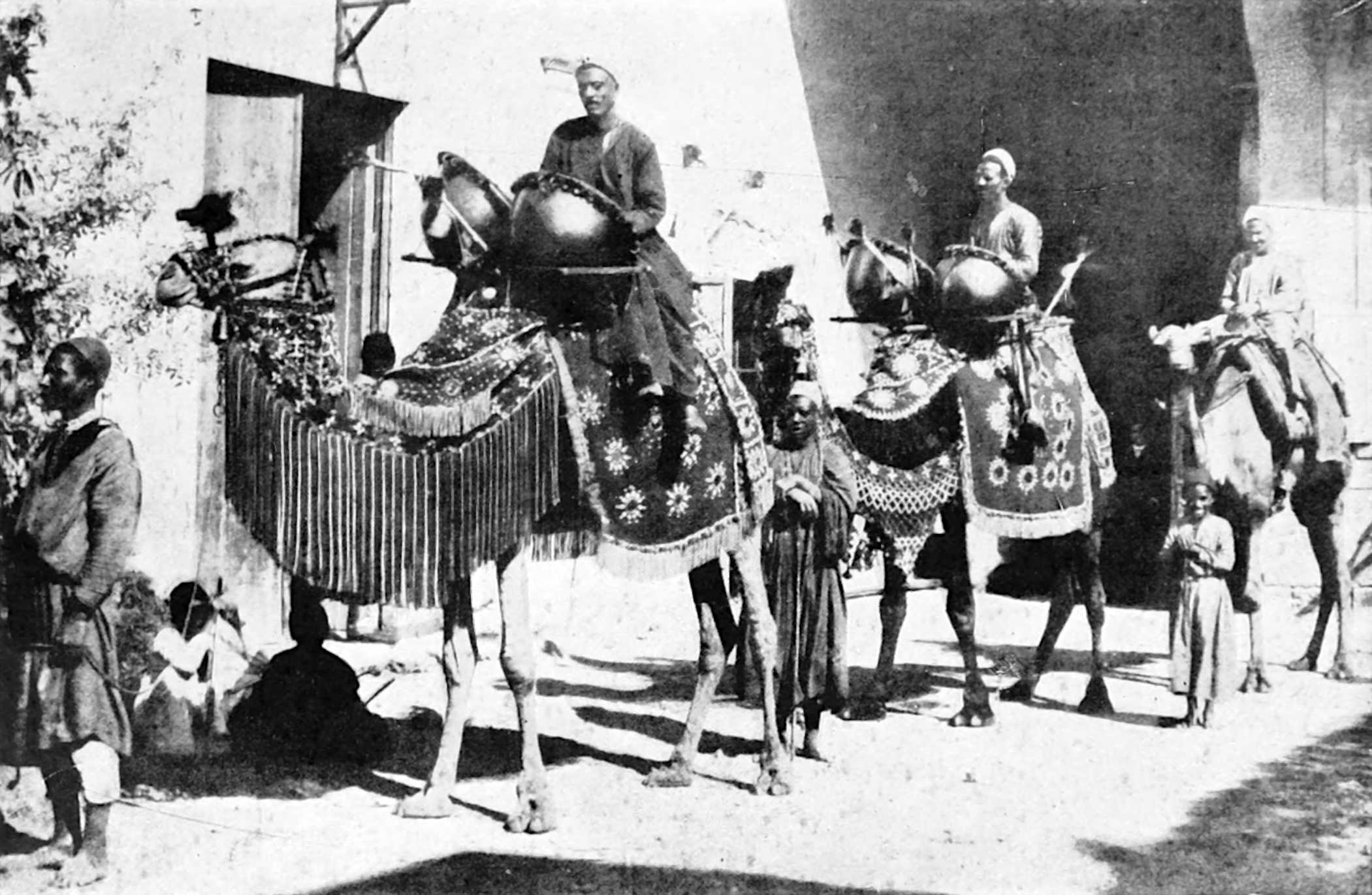
THE MUSICIAN CAMEL CAVALCADE.
The reader will understand that these musicians and
dancers were not proceeding to Arafat that they might be
present at the forthcoming sermon on the mount. Their
aim was to collect as much money as they could wring
from the pilgrims, and then be the first to lead the procession
back to Mina. For there, after the Lenten hardships
of the Hájj are ended, several days are spent in holding
revels and in merry-making.
An uninterrupted march of half-an-hour, under a stormy
sky, brought us to where two walls define the boundary of
Arafat. There the moghavem halted, and cried out, in a
joyful voice, “O blessed pilgrims, here we are on the exalted
soil of Alemeyn! May peace be with Muhammad
and with his family!”
Forthwith there arose on all sides such an outburst of
religious enthusiasm as I had not witnessed even in the
Harem of the Ka’bah. Cries of “Labbaik allahhomá labbaik!”
passed from lip to lip. The torch-bearer fell on his
face to the earth, and shed tears of delirious joy. The
dying man on my mule sank to the ground, dragging the
corpse with him, and sang praises to Allah with his last
breath. A native dervish, beside himself with hashshish-bibbing,
danced furiously round and round, beating on his
bare breast, and tearing his unkempt locks, and shrieking
excitedly, “Yá-Hú! Hú-yá!” Then, with one accord, we
all prostrated ourselves five times in prayer, rending the air
with a chorus of “Here I am, O Allah, here am I!”
After the excitement had subsided, the Sahebin-ul-Maiet,
or owners of the dead, met in conference together,
and decided that it would be best to bury the corpses of
their friends before we entered the encampment on the
plain of Arafat. To that end the help of the Bedouin
drivers was solicited. A grave was dug, measuring about
ten feet by twelve, and having a depth of some two-and-a-half
feet and into this the bodies were lowered and placed
side by side, some wrapt in their white kefans, and the rest
wearing the habits they died in. The pit was then filled
up, and large stones were piled a-top, serving the double
purpose of preventing the corpses from being snatched by
beasts of prey, and of marking the place where they lay
buried. This done, an Indian mullá, putting his thumbs
behind the lobes of his ears, the fingers extended, exclaimed
with indescribable fervour, “One only is great—one Allah!”
while the pilgrims, taking their stand behind him, bowed
themselves to the ground in prayer.
The funeral rites over, the mullá declared the dead to
be “martyrs in the Faith,” on which the moghavems of our
respective caravans, having made all necessary preparations,
ordered us to press forward in the direction of the city of
tents.
I looked round in search of the torch-bearer, but he was
nowhere to be seen, nor could anyone whom I questioned
tell me what was become of him. I never saw him
again.
On resuming our journey, the threatening storm-clouds
overhead dissolved in a shower of rain which drenched us
to the skin. More impatient than ever to find Seyyid ’Alí
and my Persian friends, I bade the Malay and Indian wayfarers
a hasty farewell, then, urging my mule into a quick
ambling pace, was soon far in advance of their caravan.
The road is very narrow at Alemeyn, but it widens
considerably, as, taking a sudden bend from the east to the
north-north-east, it approaches the central broadway of the
encampment. This thoroughfare was turned into a bustling
open-air bazaar. Coffee-booths were erected at intervals
of every twenty or thirty yards, and at these places the
crowd was thickest, and blazing torches impregnated the
air with smoke and the stench of noisome oil. It is customary
to keep awake throughout the hours of this night,
praying and reading the Kurán; and maybe the practice
was honoured in the observance by many a pious pilgrim
within the seclusion of his tent; but, in this gadabout centre
of uproar and confusion, the vigil was passed in no such
devotional mood. Eating and drinking took the place of
religious exercises. Stories were told to the bubbling of
the water-pipe; love songs were intoned under the journeying
moon; and pilgrims, whose minds were sharpened with
long brooding over metaphysical conundrums, could yet
find the keenest zest in bartering noisily over the purchase
of a melon.
It passed through my mind that here, if anywhere, I
should be likely to happen upon Seyyid ’Alí, for his pleasure-loving
disposition, as I shrewdly guessed, would be irresistibly
attracted to where it could be best satisfied and
displayed. And in this expectation I gave my mule in
charge of a beggar, and, having ordered a cup of coffee at
a refreshment stall, sat down on a stool to keep watch.
I had not been waiting more than a quarter of an hour
when I saw Sheykh Eissa come riding towards me. The
“rose of my heart bloomed,” and I leaped to my feet with
joy, calling him by his name. At last his eyes met mine,
and in another moment he was at my side.
“Sir,” he said, with a deep salaam; “Seyyid ’Alí is
looking for you dar-beh-dar—from door to door. He has
just gone down the road with our moghavem, and one of
our servants, and a Bedouin driver, to see if he can find
you. If you had bought one of my talismans, you would
not have lost yourself in the crowd.”
“My friend,” I replied, “you will remember the story of
the Slave in Sa’adi’s book of the Rose Garden. When he
was on board ship he cried night and day from fear of the
sea. Then Fate threw him overboard that he might appreciate
the safety of the ship, and be thankful to be rescued
and set on board again. I have learned the same lesson
on the journey from Mina to Arafat. There is no condition
in life so miserable but it may be rendered almost
pleasant, in retrospect, by a more wretched one still.”
Meanwhile, Seyyid ’Alí hastening up with his companions,
had overheard my remarks, and now interrupted
me, saying with some heat: “Yá-Moulai, I am grateful
for this—that the company of vagabonds should have had
the effect of making my society less tedious to you now
than it was before you deprived me of the brightness of
your presence! Verily, I have good reason to rejoice that
you fell among thieves and rogues!”
“You misinterpret his Excellency’s words,” cried
Sheykh Eissa. “Your vanity lies so close to the skin
that——”
“Why should you make it bleed, then?” I broke in.
“A truce to your quarrelling. Show me the way to our
camp. My eyes are heavy with sleep. It is as much as I
can do to keep them open. Come, Seyyid ’Alí, unknit
your sullen brow. I have missed you grievously. Let
that assurance suffice to heal your wounds.”
As I spoke a bugle sounded the hour of midnight.
Seyyid ’Alí, still somewhat glum, started off at once, carrying
a thick Bedouin club. After him came the servant,
bearing a lighted fánús in his hand, while Sheykh Eissa
and myself followed close at his heels, leaving the moghavem
in the rear to look after our mules.
Our way lay to the east of the central broadway. Before
entering our own quarters, in the north-eastern corner of
the plain, where all the dignitaries of the Hájj had pitched
their tents, the Sheykh pointed out to me the high-pinnacled
pavilions of the Sheríf of Mecca, of the Amin-us-Surreh,
of the Pashavat of Turkey, of the Persian Consul-General,
of the High Priest of Teheran, of the military
commanders of Hejaz, and of the Amir-ul-Hájj-ul-Shami
and the Amir-ul-Hájj-ul-Mesri.
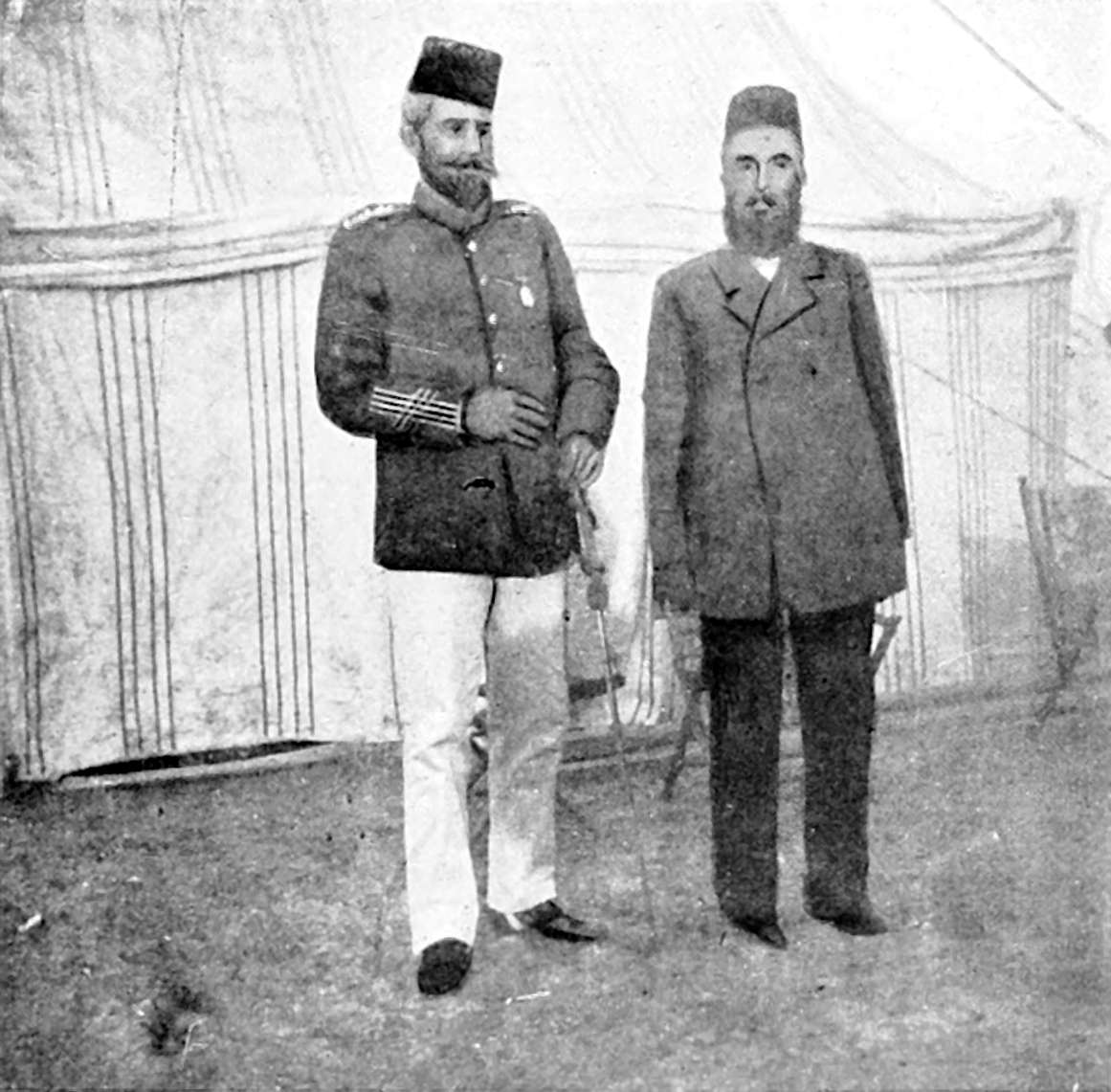
THE PASHA OF HEJAZ AND THE AMINUS-SURREH.
“His Holiness the Sheríf,” said he, “has more tents
than one could count at one’s ease. Do you see that high
pavilion where the green flag is flying? That is the
audience-chamber of his Holiness. Some of the tents
serve as dining-rooms, some as withdrawing-rooms, some
as bath-rooms. Others, again, as sentinel houses, as stables,
as cooking-houses, as servants’ apartments, and so forth.”
Well, the tents of all the grandees, including those of
my Persian hosts, were surrounded by tejirs or canvas
walls measuring about seven feet in height. The extent of
the confined space varied of course with the number of
one’s retinue; our enclosure being comparatively small
covered a stretch of ground about fifty paces square. A
sentinel was on guard at the entrance, above which hung a
Persian lantern, and directly in front of us as we passed
through was a semi-circular partition of canvas which concealed
from sight the series of tents beyond.
These tents of ours, five in number, must not be confounded
with the ones we had used at Mecca. They
belonged to a Persian moghavem attached to the Syrian
caravan, and were made of white canvas lined on the inside
with a particular kind of red cloth that goes by the name
of shelleh. Supported on nine poles covered with the same
material, they were so constructed that any one of the sides
could be converted at will into the front entrance, and that
doors could be opened wherever and whenever needed. By
this means it was possible to keep the interior relatively cool.
The floor of our withdrawing-tent was spread with
Persian rugs, and at the further end facing the doorway
was a downy mokhata or pillow divan. To this snug
abode I returned, after I had washed my hands and feet in
a tent close by, to find that the servants, following the hospitable
custom of the Bedouins, had already laid the cloth
for supper. My hosts were not present; having dined,
they were fast asleep in their own tents.
It is not considered seemly in the East for inferiors
to sit down in the presence of their superiors, nor do the
latter ever so far forget their superiority as to stand up in
welcoming a guest of lower rank. The act of rising is a
recognition of equality, and not a mere greeting. Thus,
when “I fell down to supper” (as the late Shah was
fond of saying in the diary of his European tour) I was in
etiquette bound to accept the homage of Sheykh Eissa
and Seyyid ’Alí’, who were standing up. But their attitude
of docile humility so tickled my sense of the ridiculous
that I raised my head after a few minutes, and said: “Ah,
are you there? Bismillah, sit down ... Yá-Allah!”
The invitation was certainly a breach of social custom
on my part, inasmuch as I was the master—a breach, however,
for which the exclamation of yá-Allah, which is an
acknowledged substitute for rising, made ample amends in
my humble opinion. With an equal contempt for
formality, or finding the silence oppressive beyond
endurance, I then gave them permission to talk. If I
refrained from inviting them to partake of the savoury
dishes of camel’s flesh prepared for me, it was simply
because I knew that they had already broken their fast.
The conversation fell on the subject of the Bedouins.
The Sheykh, having told me a story of a blood-feud
between two clans, untied a little parcel which he was in
the habit of carrying about with him, and took out three
steel dice loosely threaded on wire and inscribed with
talismanic characters, together with a brass disk divided
into squares and covered all over with hieroglyphics. “By
means of these two things,” said he (while Seyyid ’Alí
tipped me a wink of incredulity), “I can foretell the future.”
With those words, he shook the dice in both his hands,
and threw them on the magic disk, and then, after making
pretence to read the signs on the face of the dice, as well
as those within the squares they occupied, he sat meditating
for several minutes in gloomy silence. “Blood,” he
muttered at length, biting the thumb of his right hand,
“blood, I say, will be shed on this plain before the rising
of the sun. A peaceful caravan will be annihilated by a
warrior band. Terrible! I see some pilgrims: they belong
to my native land; I hear them crying for mercy: but the
clansmen—ah, what is this I read?—yes, the clansmen of
Hozail, having plundered them, refuse to give quarter. Surely
this is a warning to me to keep a sharp look-out that I may
use my influence should woe betide my fellow-countrymen!
May God protect them through my timely aid!”
By this time I had finished my meal, and, having drunk
a cup of coffee and smoked a kalyán, I dismissed the
fortune-telling Sheykh, who promised, before he went
away, to return at daybreak and accompany me to a sort
of gymkhana, where the Bedouins were to show their skill
in horsemanship. And then, being dead tired, I said
good-night to Seyyid ’Alí and flung myself down to rest.
Seyyid ’Alí, on leaving the room, sang a Persian lullaby
softly to himself. It ran something like this:—
Hence, begone, thou desert ogre,
Sleep would fain my baby lull:
Baby, hush, thine eyes are drowsy,
And the night is growing dull.
Hush, the night is full of shadows,
Full of phantoms dark and dread;
Soundly sleep, my precious baby,
Morning comes with joyous tread.
Hushaby, Beloved of Allah,
Sleep, and thou shalt go to school,
Pen in hand, shalt learn thy lessons,
Sagely con each word and rule.
Thou shalt read the wondrous sayings,
That in holy Koran stand;
Famous shalt thou be, my baby,
Wealthy, mighty, handsome, grand.
Hushaby, thou breathest smoothly,
And thine eyes like daisies close;
Sleep hath caught thee to her bosom
Rest, my baby, sweet repose.
CHAPTER IX ARAFAT DAY: NIGHT [2]
It has always been difficult, if not impossible, to satisfy the
cravings of an inquisitive nature; and when Seyyid ’Alí
left the tent, singing the Persian lullaby, my curiosity was
not long in overcoming my desire to sleep. It was not the
prayerful hum of the canvas city that kept me awake; it
was the undevotional uproar, with the appeal it made to my
love of adventure. I lay there for some time thinking, as
men active and alert in body and mind will, of the chances
I might miss of witnessing some deed of heroism or of
violence, were I to allow myself to count the possible cost
of the risk, rather than the certain opportunities of distinction
which its dangers would present to a man of an
enterprising spirit.
With these thoughts in my mind, I leaped to my
feet and at once wandered out in the camp. To me it
seemed one vast place of sepulture; for, go where I might,
there I happened upon the victims of the cholera fiend or its
terrible ally, fear. I saw them writhing on the ground, with
limbs hideously contorted and faces blackened like charcoal;
I heard the sick groaning from within the tents as I
hurried by to the more convivial surroundings of the market-place;
and I stumbled over the graves in which the dead
had been shovelled with unseemly haste by their terror-stricken
friends. The custom was to bury the dead outside
their tents (or wherever they might happen to fall, if away
from the camp), but to this custom the neighbours sometimes
objected in a craven regard for their own safety;
for my part, the longing to recreate my mind amid more
companionable scenes, caused me to run all the way to the
meidán. And there, carousing with the ragtag and bobtail of
the loiterers and stragglers of the encampment, I counted private
soldiers, our guardians of the peace, by the score. They
filled the front benches of almost every coffee-booth, making
the night merry with their hearty laughter, while their
companions, not behindhand in conviviality, burst out singing
love-songs to the accompaniment of the clapping of
hands.
The Bedouin Sheykhs, virile, dignified, and exclusive,
did not deign to take part in these revels, but spent the
vigil of the night on the Mountain of Mercy or in the cafés
that they kept for their private use. They were not
dressed in the pilgrim’s garb; they were arrayed in all the
warlike trappings of their tribal splendour; and being
impressed by this silent declaration of their independence,
I came at length to the conclusion that they, regarding
themselves as the chosen people of the Faith and the holy
places as their inheritance, deemed it right that the winding-sheet
of humility should be worn not by themselves, but
by those who visited the Holy Land of Islám from beyond
the seas. Another characteristic of theirs, a characteristic
that runs on parallel lines with the first, is the attitude of
the Sheykhs to their clansmen, and vice versâ, as it reveals
itself in the expression of their faces. As every one knows
who has studied the laws of this free and irresistible
people, despotism, as it exists in the Muhammadan
monarchies, is a thing impossible amongst them; and the
consciousness of this inalienable grace, why, upon my
word, their faces positively shone with it! Every
Sheykh’s face is as free as is that of his clansman
from that meek and submissive servility which is the
mark of the Persian or (in a less degree) the Turkish
dependent in the company of his master. A Sheykh, on
the other hand, being first amongst equals, bears himself
towards his followers with a dignity and charm commingled
out of paternal pride and childlike modesty, nor does such
an one consider his position to be threatened because his
tribesmen never cringe. They, too, are freeborn men and
carry their heads high even in the presence of the Sheríf of
Mecca, who holds his race too dear to exact an obsequious
homage. Indeed, his face never wears a frown; his voice
is never raised in anger; and yet for all who come near
him the consciousness of his power lies not in themselves,
but in the man himself: in a word, it lies in his complete
self-forgetfulness and his freedom from all arrogance and
pretence.
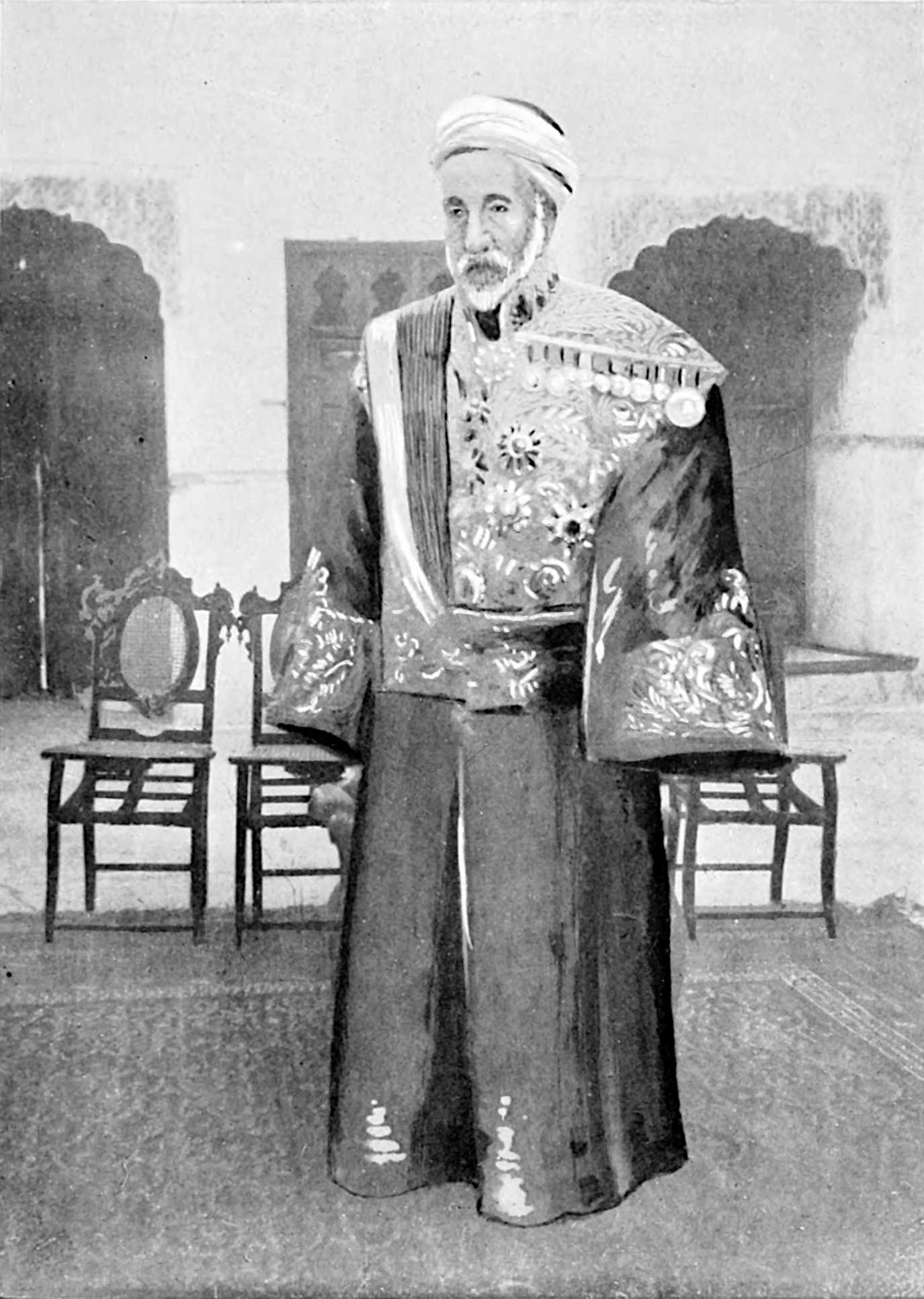
THE SHERÍF OF MECCA IN HIS UNIFORM.
Well, as I walked along in the direction of the Holy
Mountain, I found a great many pilgrims engaged in
calling out the names of such of their absent friends as
had begged to be remembered on the night of Arafat.
The Prophet recommended his followers to perform this
act of remembrance, and said that whosoever among them
should thus create seventy pilgrims by proxy would be
rewarded with seventy palaces in the world to come and
the praises of seventy thousand angels. Imagine, then,
with what zeal and devotion my fellow-pilgrims lifted up
their voices! After each name, loud cries of “Here I am,
O Allah! here am I!” were raised by one and all, the
Maghrebis singling themselves out, to my amusement, by
the number of women’s names that came tripping off
their tongues; it seemed for all the world as though
they were resolved to win the praise of none save female
angels!
Tickled not a little by this delicious trait of character,
I wandered on, falling the while into a vein of pleasant
memories on the friends I had left behind me, until I was
suddenly recalled to myself by a mighty hue and cry.
And this is what had happened. A Bedouin thief, breaking
through the tent of a pilgrim whom he knew to be engaged
in calling out names on the plain, saw in a corner a round
bundle in a white cloth. With greedy hands he made to
possess himself of its contents when, to his intense amazement,
a woman burst from its folds, shrieking! She had
wrapped herself up in the cloth ere she went to sleep, as
the custom is among Orientals of the lower class, so that
not even her head was visible to the nefarious Bedouin,
who, on now perceiving his mistake, threw himself on the
floor, with the intention of slipping headforemost under the
tent. He had certainly got away at once, had not the
husband returned, and, in the belief that the thief had it in
the mind to take advantage of his dearest treasure, laid hold
of the intruder by the leg, giving the alarm that had
startled me from my day-dream. The woman swooned
away, while the Bedouin tugged himself free and made
good his escape. A few minutes later, a sergeant and
his men shouldered their way through the crowd that had
collected round the entrance—too late for once.
I hesitated a moment before I ventured to put my fate
to the test of further experience. I knew well that I risked
robbery, if not death, in continuing my ramble; for, as I
had noticed from the moment of my setting out, the camp
was haunted by paupers with the most evil and desperate
faces I ever beheld. They lay in wait for the unwary
pilgrim wherever the gloom was densest, and at best the
lanterns and torches about each tent shed but a dismal
glimmer on its purlieus; but the desire to scale the Hill of
Arafat and to say my prayers on its summit, at last overcame
the whispers of alarm. My only weapon was a stout
cudgel, which I had picked up as a protection against the
pariah dogs that barked at every passer-by; however, as
only a couple of dollars were left in the little bag round my
neck, I felt that I could plod along in the teeth of danger
with no load of uneasy wealth on my mind. And so, with
a fresh glow of courage, I sallied forth.
It was by this time about half-past three in the morning,
and a lull seemed to fall on the camp, or perhaps this was
merely a fancy of mine, a testimony to my jangled nerves.
Be this as it may, I had not taken a hundred paces before
I had the evidence of my senses to testify to the fact that
my recent misgivings had been something more than the
suggestions of timidity or nervousness. For, on reaching a
secluded and storm-rent tent, I was suddenly surrounded
by a gang of paupers, who sprang out upon me, clamouring
for alms in a tone so threatening, that my pride rebelled
and would not allow me to purchase my safety at its expense.
Enough, I thought, if I seek refuge in yonder tent.
A hail of stones about my head increased my determination
to gain the place of shelter, about fifty yards away, and
thither I cudgelled me a path with a desperate expenditure
of strength. The surly rascals trod close upon my heels,
stoning “the devil of a Jew” with surly illwill; but inside
the tent they dared not follow me. For all that, if they
had committed the blunder of counting the booty before
the battle was won, I had soon the discomfiture to discover
that innocence in distress may be less fortunate in its
destiny than villainy in disguise. To the injuries I had
received at the hands of the robbers were now added the
insults of the inmates of the tent. They stood on the
defensive, taking me to be a thief; I called heaven to
witness that I had come near to being his victim; whereupon
they assumed the offensive, and, catching me by the
nape of the neck, dragged me outside and gave me in
charge of a sentinel who, as ill-luck would have it, happened
to be on his beat. Without saying a word, I disbursed
myself of half the money I had about me, which was a
proof of the innocence of my intentions so convincing to
the sentinel, that he let me loose and fell to upbraiding my
unwilling hosts for their unjustifiable suspicions. His
eloquence took the sting out of the reception they had given
me, and I went on my way blithely enough.
When I at last reached the Hill of Arafat, it was to find
that the Bedouins and the Sheykhs of the tribe of Kuraish
had already taken possession of the best places around the
enclosure whence the sermon would be preached on the
following afternoon; for it was there, about half-way up the
Hill, that Muhammud was wont to address his followers,
sitting on a dromedary. This place, as well as the summit
beyond, is reached by means of a broad flight of steps,
which, winding up the southern slope of the Mount, gets
gradually more precipitate and narrow. No attempt to keep
order was made by anybody in authority, with the result
that the pilgrims going up would meet the pilgrims coming
down, and be locked tight in one another’s arms, each party
fighting its hardest to force a passage through. On the
crest the pressure of the crowd was even greater: I mean
more especially in the neighbourhood of the Makam, or
prayer-niche of Adam, with its white-washed platform and
central obelisk, where pious wayfarers from every quarter
of Islam were pouring out their thanks to God from the
innermost tabernacle of the heart.
Having said a two-prostration prayer—a duty that I
had not neglected on passing the sermon enclosure below—I
turned to the north where, in the valley separating the
Hill from the surrounding mountains, a band of Bedouin
shepherds had lighted huge roaring bonfires, by the light of
which I could see their flocks (so soon to be slaughtered as
a sacrifice to the Omnipotent) peacefully nibbling the sparse
green herbage of the lowlands.
From the north I went to the south, and gazed down
on the plain below, to where, under the ruddy glare of the
torches and the yellow light of the lanterns, the tents of
the faithful stood out against the darkness beyond. The
only regularly pitched camps were those of the soldiery, the
Sheríf, and the other dignitaries of the Hájj; all of these
occupied the space on the left-hand side of the observer;
while in the fore-ground, to the right, as well as to the left,
the tents of the Syrian and the Egyptian caravans were conspicuous:
and most of these were either circular or elliptical
in shape and of considerable size, sometimes as many
as twenty pilgrims, and never less than ten, sleeping in a
single tent. For the arrangement between a Syrian
pilgrim and his moghavem is this: The pilgrim pays the
moghavem a certain sum of money in return for which the
latter guarantees (1) to find him a seat in a kejaveh when
the caravan is on the move, (2) to give him the use of a
camel on which to set his provisions and belongings, and
(3) to reserve for him a sleeping-compartment within
one of the tents that are thus turned into portable
caravanserais.
Now, the Syrian caravan, whose commander considers
himself the chief of all the foreign pilgrims and brings with
him a strong detachment of cavalry, claims superiority
over that of Egypt; but both caravans glory in the
possession of a Mahmil or Holy Carpet, a treasure, by the
bye, that is not a carpet at all, but a square wooden frame
with a top in the shape of a pyramid. A becrescented
ball of gilt silver is set on the four corners of the square and
on the crest of the pyramid, and the little shrine is covered
all over with rich brocade embroidered in gold and edged
with silk tassels. This covering varies in colour and in
material, but, generally speaking, the Syrian Mahmil is
draped with green velvet and the Egyptian with red. The
origin of the Mahmil is said by some to date back to the
year 645 of the Hegira, when a Queen of Egypt, called the
Tree of Pearls, made use of a similar kind of thing as a
litter, on the occasion of her pilgrimage to Mecca; and the
tradition goes that she borrowed the design from the chest
in which Muhammad stored the wares that he took with
him on his journey from Medina to Syria, a journey made
before he had revealed to the Arabians his new doctrine.
Nowadays the Mahmil is empty. But a copy of the
Kurán is fastened outside below the topmost crescent. In
the course of time the Egyptian Mahmil came to be
known by the name of Aishah, the Prophet’s second wife,
who one day questioned him, saying: “Now am I not
better than Kadijah? She was a widow, old, and had lost
her looks; you love me better than you did her?” And
Muhammad answered: “No, by Allah! She believed in
me when none else would believe. In the whole world I had
but one friend, and she was that.” And it is after this peerless
woman Kadijah that the Syrians have called their Mahmil.
Along with that of Egypt goes what is called the Kesveh,
which consists of eight pieces of black silk and a green
curtain. The first is used for covering the walls of the
Ka’bah, and the second for veiling the tomb of Abraham.
This ceremony, which takes place during the pilgrimage,
was first instituted by Kurb, King of Yemen, and in the year
of the Hegira 750, a man named Suleyman bought seven
villages in Egypt, the produce of which has since gone to
defray the yearly expenses of the Kesveh. These
villages now yield an income of about £7,000 sterling,
and all this money is spent in purchasing the Kesveh and
in despatching it with great pomp to Mecca.
After meditating for about half an hour on the
inexhaustible subject of my sins, I forced my way through
the press to the foot of the Hill, and after several
adventures in a place called the “Kitchen of Adam”
(where the Indian and Meccan pilgrims of the poorest
classes pitched their tents and where even the dervishes
and beggars had found a shelter)—adventures too trivial
to be related here, I returned at last to my own pavilion,
and “laid me down with a will” to sleep. The whole
encampment was now wrapped in a solemn hush.
CHAPTER X ARAFAT DAY: DAYBREAK
Pop, pop, pop! I lay between sleeping and waking, and
wondered what the noise could be. Bang, bang, bang!
And again, bang, bang! I awoke with a start—surprised
to find myself wide awake; but an hour’s sleep is not long
enough to stupify a man. The reports grew louder, and
the dogs began to bark from every corner of the encampment.
“Come hither to prayers,” sang out the muezzins;
“devotion is better than sleep.” By that time every
pilgrim was up and stirring. Wheuf! the air of the false
dawn, how chill it was! I summoned a servant, telling
him to light a fire outside the tent; other pilgrims followed
my example; and soon the hissing samovar gave promise
of a cup of tea.
The eastern horizon, in the meantime, was growing
redder and still more red; and the pilgrims, having performed
their ablutions and said their prayers, began to
intone the Talbiyah and the Tahlil, pouring out their
supplications to God and their belief in His unity, in a
wailing lilt of entreaty and contrition. Others stood in
circles, beating their breasts and singing the Labbaik. It
was a scene of enthusiasm impossible to describe.
Rap-tap-tap, tap-rap-rap, floated on the air: it was the
sentinels beating their drums to salute the break of day.
Guns fired incessantly on the hills and in the valley and
on the plain. And now the hawkers and the worshippers,
the water-carriers and the paupers, the hungry and the
ascetic, all began to shout together. “Sweet water refreshes
the soul,” cried the water-carriers; “drink of the
sacred water of Ainé-Zobeideh.” “Give in the name of
Allah,” whined the beggars; “my living is in the gift of
Allah. Are ye not the creatures of Allah? Yá-Allah, yá-Allah!”
“Light the fire and fill the cup,” said a Persian
officer, in his eagerness to break his fast. “And don’t forget
to ‘fatten’ the water-pipe,” added his companion.
“And you shall ‘dig up its grandfather’ [that is, be the
last to smoke it as it passes from mouth to mouth], my
friend,” said the officer, smiling.
When the sun came up on us, I saw Sheykh Eissa for
the first time that morning; he was standing at a distance
of some yards, talking to Seyyid ’Alí, whose handsome face
shone with its usual expression of light-hearted amusement.
The two men bowed to me reverentially, their
hands folded on their breasts.
“Look, yá-Moulai,” said Seyyid ’Alí, “the top of the
Mountain of Mercy is so full of tents and animals and
men, that the poor jinns, to say nothing of the
angels,——”
“Now, don’t talk blasphemy, my friend,” interrupted a
priest called Mullá Ahmad. “Do you think there is no
room left for the angels?”
“God forbid!” cried Seyyid ’Alí, raising his eyes aloft.
“They can perch on the tent-poles, or on the camel-saddles.”
“Kofre-negueíd (don’t blaspheme)!” yelled the Mullá.
“Don’t you know that the angels are transparent? But
for that the sun would be eclipsed, so dense is the choir of
angels in the circumambient air.”
“Is that so?” replied Seyyid ’Alí, with a smile that
incensed his questioner beyond all measure. “Does not
the Holy Tradition say that there must be six hundred
thousand souls on this Blessed Plain, and that the deficiency,
if any, will be made up with the necessary number
of heavenly choristers? I had not thought that the
deficiency was so great as to cause so vast a reinvasion of
light from above.”
“The Tradition,” shouted the Mullá, “says that there
must be fully six hundred thousand souls: there may be
more, but there cannot be less——”
“How many pilgrims are there, do you think?” I
asked, interrupting the Mullá.
“It is human to err,” he replied, sententiously; “but,
however many there may be, and I believe there are
600,000 and more, Allah may increase them. And as for
the angels, Seyyid ’Alí, they will confine themselves to the
regions of the air, immediately above us, and will say
‘Amen’ to our prayers and supplications.”
“Multiply your estimate by 3 and divide it by 6, and
you will not be so far out of your reckoning, I think,” and
so saying, I appealed to Sheykh Eissa for his opinion.
The Sheykh scanned the encampment with critical
eyes. “Let us say,” he murmured at last, “that this city
of tents on the plain and the hills contains innumerable
souls and moving beasts. Am I not right, Mullá
Ahmad?”
“Well said, my friend!” cried the Mullá. “Nobody
save Allah—may I be His sacrifice!—could count the
number one by one. And who are we that we should set
a limit to God’s omnipotence and clemency?”
The Turkish authorities were almost as ignorant in the
matter as the rest of the pilgrims. Some of the former said
280,000, others 380,000; a more daring calculation was
twice the first number (560,000); and the most timid of all
was that of a Turkish official of my acquaintance, who estimated
the concourse of pilgrims at 250,000. Now, in 1807,
there were 83,000 pilgrims in Mecca, according to Ali Bey;
in 1814, Burkhardt, the Swiss traveller, who visited the
Holy City in disguise, under the name of Sheykh Ibrahim,
calculated that there were 70,000 pilgrims; while Richard
Burton (Sheykh Abdullah), in 1850, found the number reduced
to 50,000;—a number which, in 1902, was increased
fivefold, in my humble opinion; indeed, I maintain with the
utmost confidence that this calculation of mine, if somewhat
too high, cannot possibly be reduced below 220,000; for
the opinion among the Meccans was unanimous that the
Bedouin and foreign elements, on the occasion of my pilgrimage,
were more than four times as numerous than they
had been within the memory of the oldest inhabitants.
Now, as regards the plan of the encampment, it has
always been the endeavour of the well-to-do to keep as
close to the Mountain of Mercy (the Hill of Arafat) as
possible, and the consequence of this is that the whole expanse
of the northern face of the plain is more or less
aristocratic, with an effort to regularity in the arrangement
of the tents, the most distinguished camping-places being
in the north-eastern angle, where the Sheríf’s pavilions are
pitched, and all along the north and north-western ridges,
where the tents of the Turkish soldiery and the foreign
grandees spread themselves in unbroken lines to the point
of attraction in the north-east. For to sun themselves in
the light of the Sheríf’s beneficent eye, is the ambition of
all pilgrims who have any claim to regard themselves as
gentlefolk. The more the plain slopes to the south, the
more it is covered with the tents of the vulgar and with the
pilgrims that have no tents at all; while midway between
the two extremes are the booths and stalls of the open-air
bazaars: these are also scattered here and there in every
encampment. The Syrian and the Egyptian caravans,
with their respective Mahmils, take up their appointed
places, nowadays, without any serious dispute arising
between them; but in olden times the rivalry was so keen
and so bitter, that blood was often shed. The Meccan
religious officials, the Turkish civil and military authorities,
and the privileged grandees of all nations, including, of
course, the Persian Consul-General, follow the precedent of
immemorial custom; but for the rest the rule of “first come,
first served” holds good in every quarter of the plain, I
mean within the limits of the broadly defined distinctions
of class which make it expedient, if not compulsory, for the
paupers and less reputable pilgrims to keep to the south,
leaving the northern regions to their brethren of higher
castes. In theory, the Mussulmans are all equal, each to
each; but, socially, they are at least as exclusive as the
Christians, and infinitely more exacting where etiquette and
ceremony are concerned; while at Mecca, the Kiblah of
the Faith, there is, with the yearly influx of pilgrims of
heterogeneous races, a growing tendency to assimilate the
two most striking effects of western centralisation as seen
in the capitals of Europe—namely, an inclination to become
more and more tolerant in matters of religion, and a
determination to regard wealth as the determinative factor
in separating class from class. To every student of Islám
the first of these is of tremendous importance. He must
bear constantly in mind that the embroilments between the
seventy-two sects, so far from being irreconcilable, show a
steady inclination to become less marked in the holy city
of Mecca at the present day, notwithstanding the hostility
of the priests towards a complete reunion. Time was when
the Shiahs, to which sect the Persians and the Nakhowalis
of Medina belong, were precluded from exercising their
religious rites in their own way, and when they were even
shut out from the regular encampment on the plain of
Arafat. But to-day they are not only allowed to gain
salvation as the spirit moves them through the performance
of their special ceremonies; they are also accorded the
privilege of following the time laid down in their own
almanacks for the due solemnisation of their sacred rites,
and that altogether apart from the Orthodox sects who
follow invariably the instructions of the Kazi of Mecca.
This is an immense gain; let us consider what it means:
Does it not mean that the Prophet’s aim in making
Pilgrimage an inseparable part of the Faith, is getting,
year by year, a step nearer to completion? And if so, can
the enthusiast’s belief in the possibility of an united Islám—an
Islám rooted in “one life, one law, one element, the one far-off
divine event,” be dismissed as a dream too spiritual to be
substantiated? I say no; for a dream that is already a spiritual
truth, as it most certainly is among the enlightened at
the present time, may one day become a political fact in
the eyes of the whole world. However, come with me
to the Persian encampment, and I will tell you on the way
something more about the city of tents, as well as something
more of the Mussulmans of the Shiah persuasion.
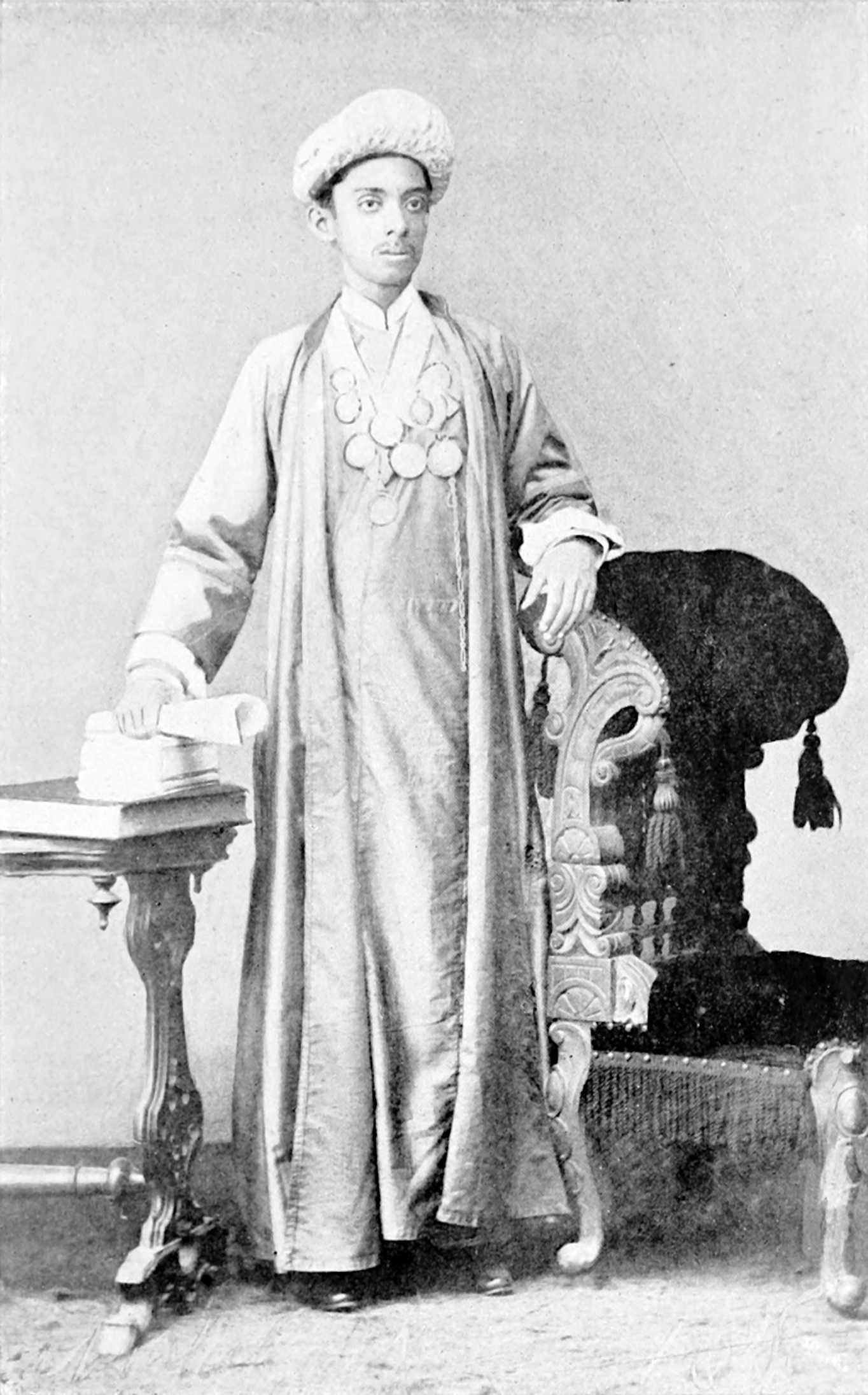
A LEARNED MUSSULMAN OF INDIA.
The first thing that struck me, by the light of day, was
the contrast presented by the personal cleanliness of such of
the pilgrims as had performed their ablutions, and the inconceivable
filthiness of the surroundings in which they lived.
To attempt to describe the causes that resulted in this insanitary
condition of the encampment (a condition that, in the
absence of any medical help worth mentioning, added considerably
to the violence of the cholera and the number of
its victims) would be to enumerate the disgusting habits
of every individual camp-follower in the train of the
grandees, not to allude to those of the poor and destitute,
who either lived under tattered rags over rude crossbars,
like the dervishes, or slept with the vermin on the naked
ground. The scene was pleasing to the eye, no doubt;
but the contagion spread by its most picturesque features
was none the less overpowering to the nose. At a distance
it was artistic: a glimpse of gipsy life twinkling with
colour; walk into it, and it was only fetid stench and
festering pollution. The tents of the less poverty-stricken
caravans were pitched in rings called dowars; the beasts of
burden being hobbled in the centre, or tethered to the
tent-pegs outside; and the shape and colour of the
tents, if less various than the facial types of those who
dwelt in them, were sufficiently diversified, in certain
quarters, to relieve the monotony of the general picture.
Red within and white without, the tents of the middle
classes were dome-shaped, while those of the privileged
dignitaries were as sumptuous and varied in colour and
form as those of the poorest classes were ingenious in contrivance.
The Sherífian colours were green and gold and
red, and the most beautiful pavilions of all were certainly
his. After these, perhaps, came those belonging to the
Persian Consul-General, who made a not unsuccessful
attempt to compete with the highest in the splendour and
completeness of his camp equipment. Moreover, the
thoroughfares of the select corner of the plain were, upon
the whole, well-ordered and creditably policed, more
especially was this the case with those in closest proximity
to the Turkish authorities.
And now with these preliminary remarks on the
appearance of the city of tents by day, I will ask the
readers to follow me into the Persian encampment
situated midway between the Syrian and Egyptian
caravans; for it is my present wish to be the means
of introducing him to that interesting Shiah sect that
flourishes in the neighbourhood of Medina and is known
by the name of Nakhowalis. I had a long talk with
about a dozen of these men (they had accompanied the
Persian pilgrims from Medina to Mecca as guides) and it
is on the information that I gleaned from them that this
short paragraph is based.
Well, when the Prophet fled from Mecca, with a few
devoted followers, he was received by a great number of
the people of Medina with every mark of confidence.
Those who fled with him were afterwards called Mohajer
or Immigrants, while those who went out to help him from
the city of refuge came to be known by the name of
Anssar or Auxiliaries. It is from the latter party that the
Nakhowalis claim descent. They now number about two
thousand families, and live, in open feud with the Orthodox
inhabitants, outside the city gates. They have their own
mosques and cemetery, as they are not allowed to worship
within the Harem of the Prophet’s Tomb, nor were they
permitted, until quite recently, to cross its threshold. The
cause of all their disabilities, however, is of a political rather
than religious nature; for all of them hold the first two
Caliphs in execration, the greater number forswearing
allegiance to Othman as well. The bond of sympathy
between the two groups thus formed is the veneration and
love they bear Muhammad’s cousin and son-in-law, ’Alí,
whom they believe to have been the lawful successor of the
Prophet. However much or little they may differ in
doctrine from the Shiahs of Persia, they are acknowledged
by the latter as belonging to the same communion; indeed,
the Persians contribute, year by year, considerable sums of
money to the support of these distant co-religionists of
theirs—sums which are handed over to them by one of the
Persian pilgrims. Moreover, a Nakhowali, if he chance to
visit the country of the Lion and the Sun, will be sure to
return with bags full of money; nor is this charity of a sort
that loses both itself and friend, the recipient being quick
in responding to every act of friendship, as many a
Persian pilgrim had good reason to remember if, as it
usually happened, he took up his abode at the friendly
hearth of a Nakhowali. Hospitable and chivalrous, the
Nakhowalis adhere strictly to this unwritten law of the
desert-born, that a guest must be protected even if he be
an infidel; none the less they count both Jew and Christian
as unclean, being as scrupulous in this particular as the
Persians, whose rules they follow in the discharge of their
religious purifications.
My informants, who were armed to the teeth, were
handsome, swarthy, and fearless-looking. They bitterly
resented the fact that, on certain points of religious
observance, they were constrained to obey the instructions
of the Kazi of Medina, rather than those of their own
clergy. They declared that this obedience had been
wrung from them as a condition of their freedom to have
priests of their own; but since I had not an opportunity of
going to Medina to see for myself, it would be unwise to
give further publicity to reports which reached me either
through the Orthodox Madani, who were naturally antagonistic,
or through the Shiah Nakhowalis, who were not less
certainly biassed in their own favour. Their womenfolk
(to make an end of this short discourse) are reputed
to be the most beautiful of all at Medina; they were so
closely veiled, however, that they might just as well have
been the ugliest—none save their husbands could tell.
The scene now changes.
CHAPTER XI ARAFAT DAY: FORENOON AND AFTERNOON
Early in the morning, shortly after my visit to the Persian
encampment, the Turkish cavalry paraded and manœuvred.
The troops were composed of Turks, Kurds, Arabs, and
Albanians. To see these men in the pride of a soldier’s
bearing, you must watch them as they rush into life and
motion; for with their ragged uniforms and unlikely-looking
mounts, they are at a disadvantage when standing
at attention. But once let them get in full swing, and they
soon prove that they are trained for use and not for show.
To me this sudden change from unsoldierly slovenliness
to skill and daring activity, was a revelation. And the
horses—lean Arabs from Southern Arabia or wiry nags
from Egypt—responded spiritedly to every twist and turn
of the bridle wrist: they too were transformed. The feats
of horsemanship performed by the Albanians were the
wonder and delight of every pilgrim. These manœuvres
of theirs, so different from those of European cavalry, are
doubtless aboriginal. They leave their cantonment in
fighting array, riding to the tattoo of a small kettle-drum
called nakus. On a sudden, at a beat of the drum, the
regiment opens out, scattering in all directions: each man
pricks it in pursuit of the enemy, firing incessantly into the
air. The sound of the drum now changes, and the men
come galloping back, meeting in a dense column: then all
is ordered confusion and breathless expectation. The signal
is given, and then with impetuous fury the whole squadron
hurls itself on the spot chosen to represent the enemy’s
position. The men, alternately dispersing and reforming,
advancing and retreating, obey every beat of the drum,
their horses being as intelligently alert as well-trained polo
ponies. So reckless were the Albanians on this occasion,
that it was a miracle that only a rider here and there came
to grief. And all the time this sham fight was raging,
horsemen from every corner of chivalrous Arabia galloped
aimlessly about the encampment, waving their tufted spears.
In the hearts of the pilgrim bands watching their every
movement they struck an awe not unmixed with terror:
for, as Seyyid ’Alí put it, the horses seemed shod with
lightning as they flashed to and fro; and lightning, may it
not spare the guilty and strike the righteous?...
You must not think that the pilgrims were idle all this
while—not even Seyyid ’Alí and myself. A party of us
met about nine o’clock to visit the holy places on the
plain, Seyyid ’Alí acting as guide. My companions
were Sheykh Eissa, Mullá Ahmad, Mirza Yusúf, and
Seyyid Muhsin. The demeanour of these men is worth
describing as a touch of character. The tour being a
religious duty, their mien was designed to give expression
to the earnestness of their devotion. The talkative charm-monger,
Sheykh Eissa, strode forward as in a trance; though
he rarely said a word, his lips moved constantly, as if he
were whispering in the ear of a jinn: he was spellbound.
His companion, Mullá Ahmad, looking neither to the right
nor the left, tripped along with mincing steps, reciting
prayer after prayer in Arabic (classical style). The man
who walked at my side was Mirza Yusúf, than whom a
deaf-mute of ordinary intelligence had made himself better
understood; for the Mirza, having taken a vow to remain
silent till he had repeated the Verse of the Throne seven
thousand times, replied to all my questions by signs and
nods and awkward contortions of the body. As for the
two Seyyids—Muhsin, a friend of mine from Central Persia,
and ’Alí, a man you already know—even they, though
drawn together by the law of affinity, yet felt constrained
to conceal their innate lightheartedness from each other,
wearing in its place an expression of sanctimoniousness
more comical than insincere.
Well, the usual course is to proceed at once to a place
called Jammé-Sakhra, where the Prophet used to stand
and say his Talbiyah; but my friends, allowing themselves
to be persuaded by me, had set out instead in the direction
of the Mountain of Mercy. There, with even greater
difficulty than on the previous night, I shoved my way up
the first flight of steps, using Seyyid ’Alí sometimes as a
buffer and sometimes as a wedge. The others had
remained below, being afraid to risk the dangers of the
ascent; for even on the lowest skirts of the Mountain the
swarms of pilgrims were subjected to pretty rough handling;
while on a somewhat higher ridge the Wahhabis of Nijd
were quarrelling with the Bedouins of Al-Hejaz as to who
should have the best places for listening to the Kazi’s
eloquence in the afternoon. We had skirted the angry
disputants and reached the steps not much the worse for
wear; but despite all our efforts we found it quite impossible
to mount higher than the first enclosure whence
the sermon is preached. There we might have stayed till
sunset, a prey to the rapacity of paupers, had not the
pilgrims on the plain learned wisdom from our plight, and
stayed where they were. This lessened the pressure round
the platform: and the number of pilgrims coming up being
now less than the number going down, we took advantage
of this opportunity without a moment’s hesitation, and
allowed ourselves to be carried away by the downgoing
stream to the foot of the Hill.
On reaching the bottom, we turned to the right and
made for the Ainé-Zobeideh—Zobeideh, wife of Caliph
Harun-ur-Rashid. To this spring has been given the
power of working miracles: merely dip a black cloth in it,
and it will be washed as white as milk. No dye can resist its
cleansing property, no stone withstand its charm. I might
believe this or not as I liked, said Seyyid ’Alí; for his part,
he would demand no greater wonder than that it should
quench his thirst—a thirst that was insatiable, he begged
Zobeideh Khanum (Lady Zobeideh) to believe. Throwing
himself on his stomach, he wriggled through the crowd to
the water’s brink; I did likewise; and then, having washed
our hands and feet and quenched our thirst, we crawled
back and said a two-prostration prayer out of the gratitude
of our hearts.
“God bless Zobeideh! May her fountain never run
dry!” cried Seyyid ’Alí; then off we went at last to where
the Prophet used to recite his Supplication before preaching
his sermon on the Mount. This place, as already mentioned,
is called Jammé Sakhra: it is a small enclosure
standing within whitewashed walls, and is divided into two
compartments—one for men and one for women—both
of which contain prayer-niches. Here our friends were
awaiting our arrival, having said their prayers—a duty
which they discharged a second time (God will increase
His kindness!) by way of returning thanks for our
safety.
By this time the sun shone in the zenith, and the whole
plain was covered with worshippers, saying their mid-day
prayers: the angels, as they believed most fervently,
lending ear to their entreaties and responding to such as
were sincere with an approving Amen.
Now, a Mussulman believes in earnest; watch him
as he bows himself in praise or supplication, and you will
not doubt his sincerity. His faith is unquestioning, for is
it not to him as an elemental force, as necessary as the air
he breathes? Why, it warms him like fire, this faith of
his, and refreshes him like water, nor is the earth than it
more solid and indestructible. The East has many things
still to learn from the West, but faith is not one of them.
Surrounded by the dying and the dead, these terror-struck
pilgrims, at the first cry of the muezzin, regained their
presence of mind. They had been stricken with fear as
with an ague, they had fled from death as from a scourge,
but at the first sound of that devotional summons, they
stood at attention before their Creator, like soldiers awaiting
the word of command. And then, as though God had
spoken, they bowed their bare heads—then they sank on
their bare knees—and then they prostrated themselves on
the ground. Do you doubt their sincerity still? And if
their faith is unimpeachable, can you deny that the
Prophet was less magnificently sincere?
With these thoughts in my mind, I hurried to our tents
to read a few chapters of the Kurán and to say the
prescribed prayers, before setting out again to witness the
Sheríf’s procession and attend the Kazi’s sermon. This
day, the 9th of the moon, was a day of fasting; but a good
many pilgrims found pretexts for breaking their fasts, and
I, being worn out after the long journey of the preceding
day and the exciting vigil of the night, was among the
number. Having eaten my fill, I dropped fast asleep, to be
awakened about three o’clock by the firing of guns. Our
party at once left the tents, giving full instructions to the
servants to have everything in readiness for the rush from
Arafat at sundown.
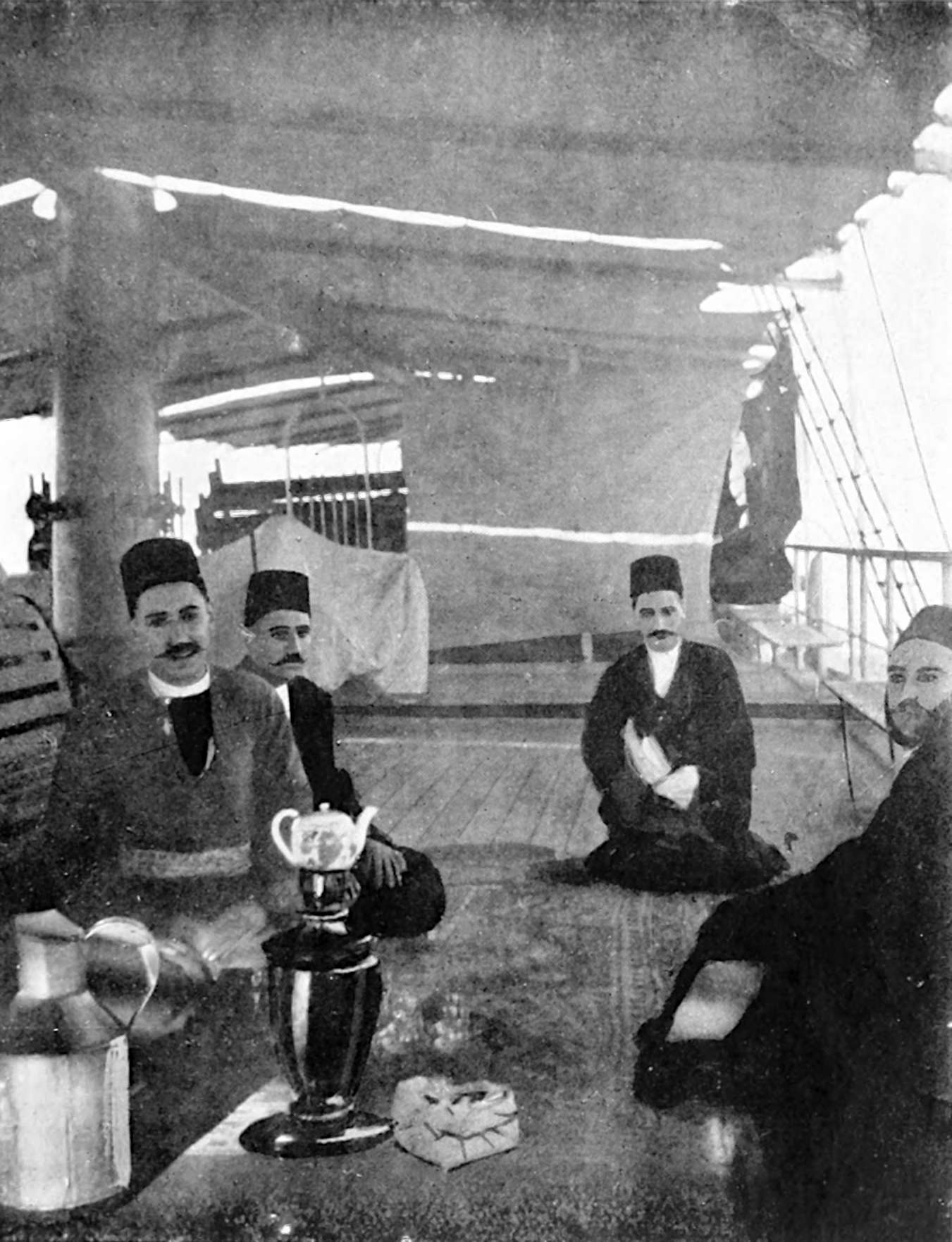
PERSIAN PILGRIMS FROM TABRIZ, HAVING TEA ON BOARD
THE STEAMER.
Then out once more into the plain, weltering in the
sunshine, to stand, bare-headed and with naked feet, until
the sun should sink behind the horizon....
The Egyptian Mahmil had already passed on to its
appointed place on the mountainside; but, fortunately, we
were not too late to see the passing of its Syrian rival
which, draped in its covering of gold and green, now
threaded its way across the plain. The Mahmil headed by
a dozen led horses of the purest Arabian strain, all richly
caparisoned with embroidered cashmere shawls, was surrounded
by a squadron of horsemen and camel-riders;
while immediately in front of the prancing Arabs, came
heralds in white headgear and red coats, bearing silver
batons in their hands. And thus the green badge of Syria
moved on to its allotted place on the skirts of the Mountain
of Mercy.
Hardly had it reached its destination, than the band of
the Sherífian procession crashed out a march: and soon
afterwards the cavalcade drew near. A score or two of
men on foot cleared the course, making vigorous use of the
long staves they carried in their hands. A number of
mace-bearers, who came next, were followed in turn by a
regiment of Sherífian cavalry, barbarously dressed and
gallantly mounted, each man prepossessing the spectator
in his favour. Even more popular was the appearance of
the magnificent body of men which next excited our admiration.
It was a staff of Arab chieftains, the pick of the
country, riding on mettlesome thoroughbreds, and combining
in their persons all the chivalry and the dash of their
indomitable race. Then a blaze of crimson-red—the
Sherífian state colour: this struck my eye on the flowing
saddle-cloths of the led horses of His Holiness, the Sheríf
of Mecca, who, meekly riding on a white mule, quite alone
in the line, was clad, like the poorest of the poor among the
pilgrims, in Ihrám. Behind him walked his courtiers and
the members of his Household, while a crowd of Bedouin
Sheykhs on horseback or on camels brought up the rear.
When the cavalcade was stationed near the Mahmils,
guns were fired again and again to announce that the sermon
was about to begin. Then, amid the sighs and sobs
and tears of that vast congregation, the Kazi of Mecca,
sitting on a dromedary, began to preach, or (perhaps more
correctly) to pray. Speaking in Arabic verse, each line
being repeated about a dozen times by the pilgrims, he
intoned the rhythmic psalm in a deep but ringing voice.
The opening passages ran as follows:—
Thou, O Lord, no mate possessest:
Thou, in truth, the King of kings!
I am here for Thee—for Thee:
I am here with praise for Thee.
Thou no compeer hast, O Allah!
Nights are darkened at Thy command:
Stars are shining in obedience:
Angels praise Thee round Thy Throne.
Prophets come at Thy beck and call:
The sun goes round to sing Thy praises:
Thou art holy and Thy name is holy:
Thou art merciful, magnanimous, and compassionate!
May the end of our life come with heavenly blessing!
May the angels of punishment pass by from our doors!
We glorify and praise Thee, Lord!
May the angels of mercy show their grace to us!
May our humble supplications be acceptable to Thee!
We glorify and praise Thee, Lord!
At first the pilgrims held their breath, afraid of missing
a word; but as the prayers and psalms and exhortations
proceeded, their enthusiasm grew more and more unrestrained.
No longer content with repeating the Kazi’s
words, line by line, they burst into tears, and from tears
into shrieks. They beat their breasts, sobbing from sheer
excess of joy; they could be seen, on the plain, whirling
round and round, as they sang the Labbaik. Some
swooned, partly from delirium of religious emotion,
and partly from the effect of the sun’s excessive heat.
One moment—and your blood seemed to boil and your
brain to swim in liquid fire; then came relief: you were
drenched in sweat, reduced to liquid that alternately
evaporated and gushed out of every pore. I was wedged
so tight in a compact mass of pilgrims, within a stone’s
throw of the preacher, that there was no chance of my
reaching the haven of my one desire—the cooling spring
where I had slaked my thirst at noonday. And so one
hour wore on.
What had happened among the pilgrims out there in
the dancing glare of the sunlit plain, I cannot say; but the
least said about the reports of the behaviour of some of
them, the better. No good purpose can be served by
emphasising the exceptional and parading the obscene.
Where I stood, longing for the sound of running water,
there, at least, the solemnity and the fervour of the congregation
were of a sort to take one’s reason captive, overcoming,
by sheer repetition of appeal, even the craving I
had to swill my gullet with a draught of water.
Another hour went by: the sun was sinking in the
west: the eastern horizon turned colour, passing from a
purple shade to a tone of deepest crimson. The green flag
on the mountain-top still floated high in air; still the
preacher gave out his message, to the ever-increasing
excitement of his people; and then at last, just as the sun
dipped in a pool of red, the signal of Essraf was given.
The sermon was over, and the night of another day begun.
We were now entitled to call ourselves Hájís.
“Aydákum Ghebúl (May your festival be accepted),”
cried Seyyid ’Alí, kissing me three times on the cheeks,
in accordance with the practice.
And I returned the kisses, saying—
“Tebarik-Allah! (May God be glorified).”
I now pass on to the Day of Sacrifice and the Days of
Drying Flesh.
CHAPTER XII THE DAY OF VICTIMS: FROM SUNDOWN TO SUNSET. THE DAYS OF DRYING FLESH.
Long before the signal of Essraf was given, the canvas-city
had been in a state of confusion: so that by the time
the sermon was over most of the tents had been folded and
stowed away. Thus everything was now ready for the impetuous
rush from Arafat.
The pilgrims’ jubilation was then at its height. The
uproar was deafening: drums were beaten, bugles called us
to make haste, and rocket after rocket exploded as it
whirred through the air.... We waited half an hour or
so, exchanging kisses and congratulations, and then a path
was prepared for the cavalcades. The Egyptian Mahmil
took the right-hand side of the road and the Syrian the left:
after them charged the mounted pilgrims, followed by those
on foot, all and each showing the same reckless determination
to press forward over every obstacle, no matter how
narrow the road might be.
This headlong stampede after the sermon on the
Mount is historic. It never grows stale with the years.
The havoc it wrought in 1319 of the Flight it would be
quite impossible to exaggerate; for the confusion which has
become traditional was increased fivefold by the number of
pilgrims, a number that was vastly greater than any within
the recollection of the authorities. Women and men
swooned in the crush and were trampled to death—litters
were overthrown and smashed in pieces—camels were
trodden under foot: but neither disaster nor death could,
in the slightest degree, glut the wild desire by which the
crowd was moved—the desire, namely, of being more
completely possessed by the feeling of a religion-wrought
delirium. It was not a triumphant procession of peaceful
pilgrims, therefore, though that is undoubtedly what it
should be; it was a charge of religious madmen running
amok. How many were killed or maimed, I can hazard no
guess; but of this I am quite certain,—the casualties had
not been so terrible on any previous occasion within the
memory of man.
Thus the dense mass moved on, and about the hour of
midnight we reached Muzdalifah. There we halted for the
night, the pious passing the time in praying and reading
the Kurán. Very few pilgrims took the trouble to pitch
tents here, the vast majority of them sleeping on the
ground. Before lying down to rest, Seyyid ’Alí and I
collected forty-nine stones apiece for the Lapidation of the
Devil in the valley of Mina.
Now, this ceremony takes place three times: first, between
sunrise and sunset on the 10th of the moon when
every pilgrim must fling seven stones at a buttress, situated
at the Meccan entrance to the valley, and called the Great
Devil. These seven stones must be gathered at Muzdalifah,
and have to be washed seven times and each time in fresh
water. On the following day, the 11th, twenty-one stones
must be thrown: seven at the Great Devil as before, seven
at the Wusta or Central Point in the middle of the valley,
and, last of all, seven more at the Ula or First Place lying
at that entrance to Mina which faces Arafat. All these
twenty-one stones may be gathered either in the valley
itself or at Muzdalifah on the return journey; but they, too,
must be washed seven times and each time in fresh water.
The same rules apply to the third Lapidation, which is
held on the 12th of Zú-’l-hijjáh: and the three ceremonies
aforementioned are performed in commemoration of the
tradition that Abraham was tempted three times of the
Devil, at those very places in the valley, what time he was
about to sacrifice his son Ishmael. Now the first day,
which is the 10th of Zú-’l-hijjah, is called the Day of Victims,
while the two following days are called the Days of Drying
Flesh in the Sun.
Awaking early, my party set out, at peep of day, to the
sacred monument hard by, where, amid scenes of indescribable
solemnity, the Festival Prayers were celebrated by
the Kazi of Mecca, who also preached a short sermon.
Departing thence at sunrise, we arrived at Mina about
nine o’clock, one of our servants dying of cholera on the
road. We buried him where he fell, each one of us wondering
if his own life would be the next to come to an end.
What would happen after the slaying of the victims we
dared not think. The prospect looked gloomy in the
extreme.
Having eaten a good meal, we traversed the valley in
the direction of Mecca, in order to be rid, as soon as
possible, of the tiresome duty of stoning the Great Devil.
When we reached the entrance to the valley, it was to find
our access to his Satanic Majesty blocked by a vast
concourse of excited pilgrims. The road, about thirteen
yards wide, was packed with horsemen, camel-riders, litters,
pilgrims on foot, and women in kejavehs, all struggling and
fighting to get within stone’s throw of the buttress which
rests against a wall that is only a little higher than itself
which is—say, three yards high by two yards broad. Of
the Orthodox sects the Shafeis are the most privileged, for
they are allowed to stand at a distance of five cubits from
the Devil, whereas the Hanefis are supposed to make their
attack the more formidable by fighting at close quarters—within
arm’s reach of the Arch Foe.
And all the while the great mountains frowned down
upon us; very awe-inspiring I found them: the seven stones
I had brought along with me fell at my feet only to be
picked up by Seyyid ’Alí.
“Come, yá-Moulai,” said he: “the devil is not so big
after all. See, I will fling your stones as well as my own
at little devils like myself.”
After this “ceremony” was over, we returned to our
camp where a barber was waiting “to bring me out of
Ihrám.” When he had trimmed my hair, shaving it round
the nape of the neck, and had cut my nails, I made to take
off the pilgrim’s garb, saying—“In the name of God the
Merciful and Compassionate, I intend to doff my Ihrám of
pilgrimage, according to the usage of it by the Prophet, on
whom be blessings and glory! O Allah, reward me to the
number of the hairs of my head with Light, Purity, and
Grace. In the name of God—God is great!” Upon this
the barber helped me to undress and (after I had had a
bath) to put on my gala attire which was Egyptian in make
and in material.
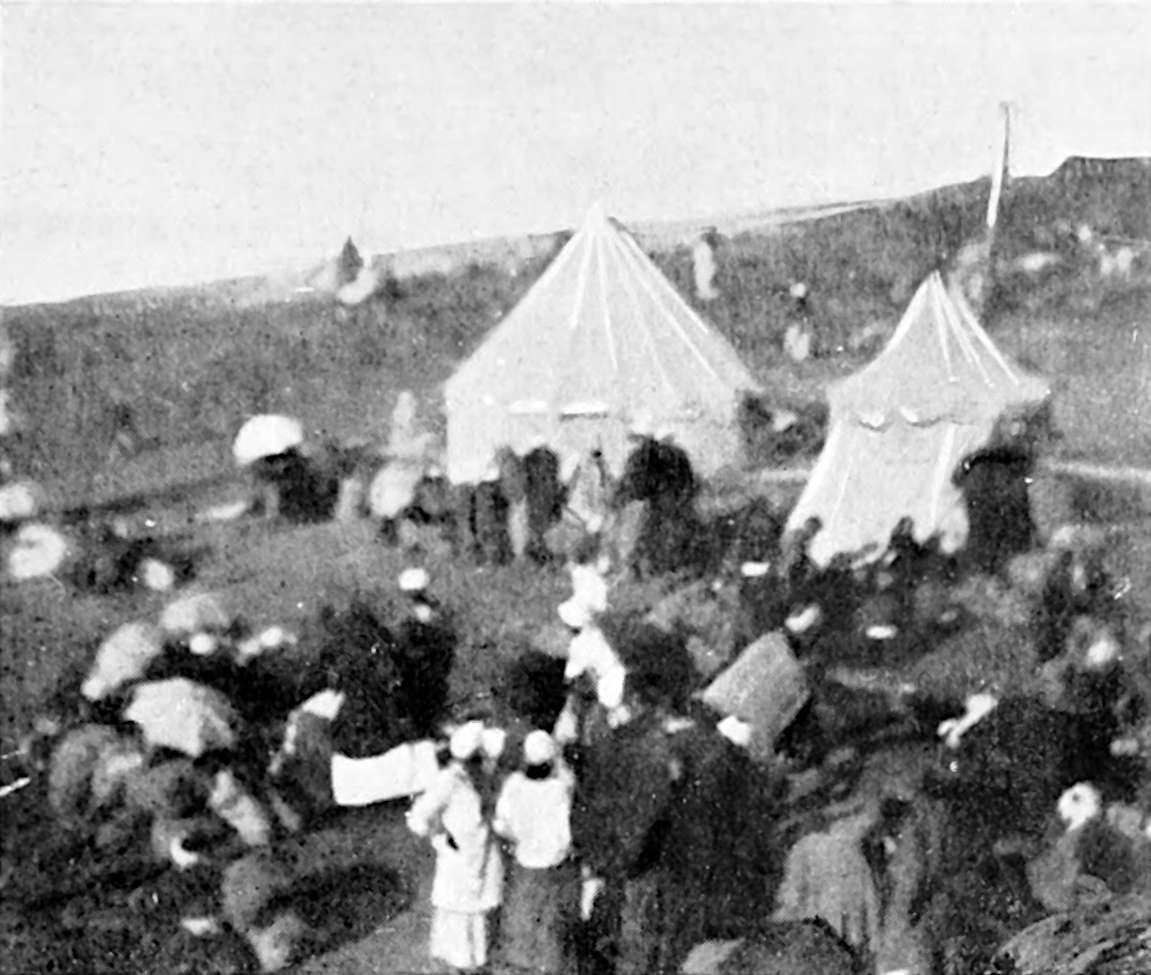
By this time the servants had purchased the victims,
and they now came to tell me that all preparations had
been made for the sacrifice. I deputed Seyyid ’Alí to slay
my harmless sheep, from a sudden invasion of squeamishness.
And before the day was over the valley of Desire
was turned into a reeking slaughter-house, and, it may be
added, into a cemetery for the dead pilgrims. These also
were victims—the victims of the misdirected religious zeal
which had prompted a slaughter that served no other purpose
than to spread the epidemic. The less said of it
here the better. I have no wish to make the reader
sick. It will be enough to add, to what has been said in a
previous chapter, that the camels were sacrificed by none but grandees,
who dispatched their victims with the words: “In the Name of God!
God is great!” the same words being used by the other pilgrims in
sacrificing the sheep!
All beasts of prey are believed by the superstitious to
keep away from the valley during the Day of Sacrifice and
the Days of Drying Flesh; for, had not the victims been
brought down from heaven by angels, and driven by them
under the guidance of Bedouin shepherds, to the place of
slaughter? But the truth is that the Takruri negroes were
more blood-thirsty than any of the carnivorous animals or
birds of prey: they laid in wait until the sheep were killed,
feasting their eyes on the creatures’ dying agonies, and then
pounced on the carcases like hungry vultures.
Now, a great many pilgrims, after casting off the Ihrám
and putting on their festival attire, went at once to Mecca,
visited the Ka’bah, repeating the ceremonies already described,
and then returned to Mina to slay their victims.
One of our party who had taken this course fell sick of the
cholera on the road, and the news of his grave condition
reached us at mid-day. We therefore determined to take
up our quarters in Mecca, for our comrade’s sake, and to
return to Mina, day by day, in order to complete our stoning
of the Devil. Sheykh Eissa, however, remained behind
to take charge of our camp; and when we got back again
next morning, it was to hear from him a flamboyant
account of the fireworks and jollifications of the Great
Festival that we had missed. We listened to his stories
of the too-unfettered revelry by night with heavy hearts, for
our friend was dead. Outside, the whole valley stank like a
shambles, hundreds of pilgrims having succumbed overnight
to the cholera epidemic; and so, when we had stoned the
Devil for the second time, we bent our steps again to the
Holy City, taking care to remember our comrade in our
prayers as we passed by the mosque of Khaif. There
we saw some poor pilgrims drying the flesh of a dead
sheep—a revolting spectacle. Next day, the 12th of
Zú-’l-hijjah, we cast the remaining twenty-one stones
at the three buttresses in the Valley of Desire, and
were ready on the 13th to join the little pilgrimage to
Al-Omreh—a mosque near the pillars of Alemeyn—having
to that end performed ablutions with the water of Zem-Zem,
and put on the ihrám once more, and made our
declaration of intention opposite the Black Stone. It took
us about three hours to reach the sacred spot where we
said a two-prostration prayer after having subjected our
heads and hands and feet to a second ablution. Then we rode
back to Mecca and again went through all those ceremonies
within the Harem and between Mount Safá and Mount Marveh
which have been described in the earlier pages of this
narrative. This brought the little pilgrimage of Omreh to
an end, and the ihrám was finally removed. Thenceforward
the streets of Mecca were crowded with pilgrims
dressed in every costume of the East.
I remained a week in the Holy City after the Day of
Victims—indeed, no pilgrim could bring himself to leave
the Kiblah of the Faith before the 18th of Zú-’l-hijjah—and
whiled away the time by frequent visits to the Harem and
the bazaars. By these means I added considerably to my
knowledge of the pilgrims and their ways. The result of
my observations will be found overleaf.
On the 18th I attached myself to a strong caravan
bound for Jiddah, and there I said good-bye to Seyyid
’Alí. The reader will meet him again, however, in the
brief pages of Part III.
Part III MECCAN SCENES AND SKETCHES — CHAPTER I THE MECCAN BAZAARS
The European, who prides himself on his practicality,
is inclined to look down on the merchant’s calling, though
it is surely one of the most practical of all. The Oriental,
on the other hand, who is supposed to be the most
romantic of mortals, generally holds it in high esteem.
Therefore the Oriental, if he is less practical in that he is
slow to adopt the time-saving methods of his Western
brother, is far more logical in paying every respect to a calling
which is one of the chief factors in the welfare of nations.
Moreover, the Oriental’s attitude towards travelling proves
him to be far more practical than he is generally believed
to be. As a general rule he takes to roving, either to lay
up for himself treasures in heaven by visiting holy places,
or to better his condition in life by trading in foreign parts.
If he is a pilgrim he combines the spiritual and the worldly
aims above-mentioned, strong in the Prophet’s assurance
that it shall be no crime in him if he seek an increase from
his Lord during his pilgrimage. The consequence is that
Mecca is turned every year into a bustling fair, an
exchange and mart where Eastern commodities of every
description can be purchased in cash or in kind. This
being understood, I will ask the reader to accompany my
guide and myself on our shopping tour of the Meccan
bazaars, for I must not forget, as a true pilgrim, to buy a
soughát or present for each of the friends I left behind me.
“Yá-Moulai,” said my guide, “let me advise you to
grease your tongue with honey before we go, that the shopkeepers
may respond to the compliments you must pay
them by lowering their prices. I notice that you have a
smile on your lips. Yá-Allah! do you wish to return
with an empty purse? Press your lips together, affect a
poverty-stricken demeanour, otherwise you will be fleeced
not only by the traders, but also by every beggar in Mecca,
more particularly by those who lie in wait for the generous-hearted
round about the Harem. On entering each shop
you must cough as hard as you can, though you tear your
chest in pieces: then the shopkeeper will be compassionate
in the matter of charges. Another counsel I would offer
you is this. Let us suppose you want to buy a knife.
The first thing you must do is to ask the cutler for a sword,
then for a dagger, then for a pair of scissors, and, after
refusing all of these things with a sneer, you must command
him to show you a knife in a voice toned to insinuate that
the purchasing of that article is an act of generosity on
your part, a magnanimous recompense to him for his
trouble. For our merchants, though they are often crafty
and betray a suspicious conscience, are, if you treat them
as they expect to be treated, of a childlike simplicity. So
cast off your sandals that you may acquire the reputation of
a saint and thus be treated fairly in the bazaars. Believe
me, Yá-Moulai, if you follow these instructions, you will
drive a better bargain with the Meccan than you would
by trusting to the honesty of a Firangi trader who is
civilisation-proof against these simple wiles.” And so
chattering he led me through the crowded streets, and
would have asked for alms, that I might pass as a beggar,
had I not forbidden him sternly to practise in my service a
piece of deceit as unworthy of himself as it would be
humiliating to me; whereon he glanced at me furtively
muttering in his beard: “He is as proud as a Shahzadeh.”
The city of Mecca is divided into two parts. Of these
the upper quarters are called Malá, as opposed to the lower
ones, which are known by the name of Misfál. The shops
are very similar to those at Jiddah; but in the street that bears
the name of Mussah, which is the broadest and most picturesque
thoroughfare, they occupy, I may say, the ground floor
of the houses on both sides, presenting to the passers-by such
a wealth of Oriental goods as I for one had not seen before.
The familiar word “bazaar” is Persian, its Arabic
equivalent being Súgh, and a whole quarter is sometimes
called after its neighbouring market, as is the case, for
instance, with the quarter called Súghé-Seghir. To the
North of Mussah-street is situated the Soueygha Bazaar,
where goods (especially the belongings of dead pilgrims)
are sold by auction twice a day, in the morning and in the
evening, and there also slaves are exhibited and knocked
down to the highest bidder. The Syrian Bazaar, or Sughé-Shamí,
is to be found to the east of this slave market; the
armourers display their weapons in the Súghé-Geshatshi
near the Platform of Purity, whence the Sughé-Lail, or
Night bazaar, is within easy reach; while further to the east,
below the skirts of Mount Abú Ghobais, in a market named
Moamil, pottery of any description can be bought by the
pilgrims as receptacles for the curative water of Zem-Zem.
In a square to the east of this bazaar camels and sheep are
sold, and fruit stalls are kept by Bedouins: and from
thence one passes to the blacksmiths’ shops or Sughé-Haddadin.
The pilgrim who would purchase shoes or sandals must
seek the upper quarters of the town, and there, in the north
of Malá, he will find what he wants in abundance, as well
as many provision stores which serve to replenish the
supplies of the yearly caravans; for most of these dealers
have agencies at Jiddah, Bombay, and Cairo. In the same
quarter, still to the north, is the meat market, most of the
butchers being Bedouin Arabs who keep special flocks of
sheep and camels for slaughter and for sale. From this
bazaar the way lies through some extremely narrow and
dirty lanes to the Zokáké-Seni or Chinese Market, where
gold and silver vessels and jewellery are sold by a few
Muhammadans of the Celestial Empire. Thence to the
north-east are situated the dyers’ shops, which go by the
name of Sughé-Sabbaghin. The manufacture of indigo
dye, which is much used in Arabia, is very interesting.
First the small leaves are dried in the sun, then they are
powdered and put into earthenware jars filled with water,
where they remain overnight. Next morning the leaves
are stirred thoroughly until a dark blue froth is produced in
the water, after which they are left to settle. When the
indigo is taken from the bottom it is spread on cloths to
drain, and is then mixed with dates and saltpetre. The
method of calendering the garments dyed with indigo consists
in beating them on stones with wooden hammers,
which is generally done to the accompaniment of a
song.
“Bismi’lláhi’r-Rahmáni’r-Rahim!” With those words
on our lips we entered the bazaar to the north of the Harem.
What first struck my attention was a man sitting on a rug
with a small wooden frame in front of him, a round blue
tile by his side, a reed pen in his right hand, and a few
sheets of paper in his left. He was an Arab scribe, and
around him were gathered a crowd of illiterate pilgrims, all
waiting for him to write their letters. The first to go
forward was an Afghan pilgrim. He had muscular limbs
and a fierce, scowling face. Said he: “Write me a letter
to my brother: he is ill and lives at Sakhir.” The scribe,
who was sitting on his hips, cocked up his right leg ever so
slightly so as to form a sort of table, and asked the Afghan
what he was to say. “By God!” exclaimed the native of
Sakhir, “I expect you to provide something more than
the paper and the penmanship. You must supply the
words as well. What! you know not what to write?
Have I not said that my brother is sick and like to die?
Tell him that I will bring him a bottle of Zem-Zem water—that
will cure him, if it please Allah—and a winding-sheet
that has been dipped therein, which will be useful if
he die—God forbid!” Here my guide stepped to the
front, saying, “From the Percussion of the Grave and from
the Interrogation of the Grave may God the Merciful and
Clement deliver him!” A bright smile flashed over the
Afghan’s face. “May your kindness increase!” said he.
Meanwhile, the scribe dipped his pen in the silk threads on
the blue tile which served the purpose of an inkstand.
These threads were soaked in soot and water, and it took
about three dips to write a single word. Every now and
then he would raise the paper to the left side of his face
and look at it slantingly out of the corner of his eye. If a
word did not please him he would rub it out by moistening
his forefinger and dabbing it half-a-dozen times on the
word, for the ink left no permanent trace on the paper but
came off in layers when rubbed with the wet finger. The
lines of the letter were wide apart, and an ample margin
was left on both sides. When the bottom of the page was
reached the scribe filled the margins lengthwise, and then
fell to writing between the lines. I could not help thinking
that the sick Sakhiri would find it easier to answer the
interrogations of Nakír and Munkar, those dread
Inquisitors of the Grave, than to read the letter from Mecca,
which struck me as being almost as difficult to decipher as
a Chinese poem. When the last word was written the
Afghan took out his purse, to the strings of which was
tied a round seal of brass whereon his name was engraved.
Having unfastened the seal he handed it to the scribe. It
amused me to see that the purse was withheld by the canny
Afghan, who obviously had no intention of losing over the
transaction more than he had bargained for.
All Orientals, particularly the Persians, lay great store
by their seals. Those of the lower classes are generally
round and made of brass, and are either fastened to their
purse strings or left dangling by their waistbands. The
mullás have a preference for square seals of cornelian set in
base silver, as approved by the Prophet; while the high
officials “gratify the pride of irresponsibility,” or the
instincts of taste in the matter, some choosing gold seals
ornamented with diamonds, and others turquoise seals
decorated with pearls or with rubies. Sometimes a line of
poetry is engraved on the seal as well as the owner’s name.
I knew a pious Shi’ah whose seal bore this inscription:
“The slave of the King of the country, Imám ’Alí,” only
the last word, of course, being his own name. Later, on our
journey through the bazaars, we chanced to see a Persian
hakkák, or seal-maker, at work. The cornelian he was
carving was fixed in tar on the small board in front of him.
The deft way in which he wielded his small hammer was
the result of a steady hand and an unerring eye, gifts for
which the Persians are justly famous. The motto was
intended to commemorate his pilgrimage to the Mother of
Cities, and ran as follows: “Sadik, the least of Hájís and
the slave of God, in the city of God!”
I entered into conversation with this man Sadik, and
was lucky to find in him a very lantern of traditions. The
works of Baidáwí, of Abú Sa’íd al-Khadrí, of al-Farrá of
Bagh, of Nu’man Ibu Bashír, of Abú Hurairah, of ’Abd
Allah Ibu Mas’ud, to say nothing of the Persian and
Arabian poets, he seemed to know by heart. When I
complimented him on his learning, he replied, saying: “If
I am blessed by God with a good memory, it is because
I have never eaten a quince, or a sour apple, or fresh
coriander, or garlic, or the remainder of a mouse’s meal;
nor have I, to the best of my belief, ever read a book written
by the blind, nor drawn blood from the nape of my neck.
For these things weaken the memory and produce folly.
From the unseemly demeanour of your guide”—the rascal
had been more exasperating than usual—“I would hazard
the conjecture that he has tasted of many a mouse’s meal.”
The guide grew exceeding wrath, and would have
struck the speaker had I not prevented him; then he cried,
“You lie! the humiliation you would thrust on me, see, I
cast it back in your face!” The seal-maker smiled good-humouredly.
“Friend,” said he, “the humiliation was
mine, and not yours, for have I not spoken to a careless
listener? Know, however, for your future guidance, that a
man, if he meet with humiliation, has sometimes nobody
but himself to blame. This will certainly be his sorry case
if he sit down uninvited to another’s table, or if he respect
not his host, or if he hope for kindness from a foe or for
learning from the low-born; so much the more will he
suffer the inevitable consequence if he honour not his
Prophet, his country, and his King. And”—here he
turned to the crowd—“to listen inquisitively to another’s
conversation has the same effect as addressing an inattentive
audience. I would not have ye be guilty of the former,
which is the extreme of discourtesy, any more than I would
have the latter, which is the acme of humiliation, thrust on
me a second time by the friend to whom I spoke.”
I watched the guide, who could not contain his spleen.
“Thou sententious ass!” he shrieked, making as if to take
off his sandal wherewith to belabour the seal-maker. Once
more he was met by a meek and smiling countenance.
“Verily,” quoth Sadik, “if one show leniency to the mean,
the low, or the servant, one must expect to be imposed on.
I do but light a lamp in broad daylight, or sow seed in the
desert sand, which is as wasteful as eating when one’s stomach
is laden, or as showing consideration to one who is not
deserving of it. Three things tend towards madness: the
first is to walk with the blind, the second is to talk to the
deaf, and the third is to sleep alone.”
By this time the sun had risen high in the heavens, and
the mat awnings suspended on poles were already drawn
down in order to keep out the fierce rays of sunlight, so on
we went till we came to the tin-makers’ bazaar. There
we heard a cry of “Yá Allah! yá Allah!” and, on looking
round, beheld a funeral procession. The corpses, four victims
of the epidemic, were being borne from the Harem
to the graveyard on rough serirs, or wooden biers peculiar
to Mecca. When the procession had passed by, I entered
one of the shops and bought a couple of tin bottles, each
of which would hold about two pints of Zem-Zem water.
It is not customary to bargain over the purchasing of these
articles since they are meant to contain the water of the
sacred spring.
Across the way, in a shop full of musty manuscripts of
questionable antiquity, I chanced on a veritable treasure.
This was an exquisite copy of the Kurán in the old Kufi
writing. It was plain that the bookseller had no conception
of its value, for when I asked him the price of it he said,
“Give whatever you like, and I will be content to part with
it. We must not attempt to make a profit out of the Word
of God, though it were well that we should seek to profit
by its lessons.”
The Muhammadans are not supposed “to sell” the
Kurán like any other book: a “hedieh,” or “present” goes
to defray the cost of production. I offered a “hedieh” of a
Turkish pound, not so much as dreaming that the bid would
be accepted; but to my intense delight the shopkeeper,
having raised the Book to his lips, and from the lips to his
eyes, and from the eyes to his forehead, handed it to me,
saying, “This is the Word of Allah; I give it to you,
earnestly begging you to pray for me when you read it!”
I certainly prayed for him five times that day out of a
grateful heart, and I made a point of doing so until, just
before I embarked on my homeward voyage, I looked for
the precious Book only to find it gone, along with several
other valuable purchases.
Soon after leaving the bookseller’s, being in need of rest
and refreshment, we entered a coffee-house which was
literally filled with a crowd of pilgrims of every nationality
in the East. Conspicuous in flowing abás with white
and yellow stripes were two Sheykhs, who were sitting on
stools at a low table, and with them I entered into conversation,
offering them a cup of coffee each. The elder, a man
of about forty-five, belonged to the tribe of Beni Súbh, while
his companion, who was many years younger, owed
allegiance to the tribe of Owf; consequently, both of them
were members of the fighting clan of Harb Bedouins, who
either live in tents about two stages from Mecca, on the
road to Medina, or reside, if they are settled Arabs, in the
towns of Rabegh, Safrá, and Fará. Of all the tribes of
Harb none is more dreaded by the pilgrims than that of
Owf, more particularly are they feared by the caravans that
travel between the two holy cities. Their power and
bravery are undeniable, as was clearly proved during the
Wahhábí invasion of Hejaz. Closely allied to them are the
tribes of Beni Amere and Zobeid.
The young Sheykh, with whom I now struck up an
acquaintance, declared that the Owf, with all their shortcomings,
could teach moral lessons to the rest of the clan,
and he attributed their predatory habits to the “overboiling
spirit that was in them.” He contradicted the report that
his tribe had robbed forty Persian pilgrims of their belongings
between Heddah and Mecca, and had murdered three
Syrians between Medina and the Prophet’s birthplace. He
professed strong attachment to the person of the Sheríf, and
expressed the hope that we would live to see the union of
every tribe of Arabia under his sway; in fact, he was a true
patriot, frank of speech, of engaging manners, and showing
no signs of lawless violence.
Not less courteous was his companion. On hearing
that he was a Sheykh of Beni Sobh I asked him if he
would tell me something about the famous balsam of Mecca,
for I had read that the amyris-tree, which exudes this
fragrant juice, grows on the mountain of Jébélé-Sobh,
between the towns of Rabegh and Bedre. He was good
enough to comply with my request, being a connoisseur
on the subject. The trees, Bishon, as he called them,
have a straight stem, and grow to the height of
about twelve feet. In the middle of summer incisions are
made by the women in the soft bark with a special kind of
knife, whereon a white juice oozes out, and this the women
collect with the thumb-nails of their right hands, and put into
a sheepskin or into a vessel of burnished copper. The balsam,
if the incisions are made later in the season, takes on a yellowish
colour, and loses a good deal of its virtue as a tonic.
The Persian pilgrims, I was told, are unwearied in their
efforts to obtain the honey-like balm in its unadulterated
form, but they rarely succeed unless they go to the headquarters
of Beni Sobh, for the stuff sold as balsam in the
Meccan bazaars is hardly ever pure. The Arabs themselves
can detect by the smell whether it is adulterated or not.
Fortunately for the pilgrims there are certain other tests
which are said to be infallible. The best balsam sinks in
water, has a bright blue flame when alight, and, if you put
a drop on your finger and set fire to it, it will burn without
injuring the skin. The Persian traders mix turpentine with
it, probably because the yellow balsam, even when it has
not been “doctored,” smells of that resinous substance, but
the Arabs adulterate the white balsam with inoffensive oils
of several kinds. Every morning the pilgrims who could
afford to buy the precious tonic would take a drop in their
tea or their coffee, and I know from experience that it has
the most invigorating effect on the nervous system.
The senna of Mecca, which is exported to Persia, to
Central Asia, and to Syria, is also a product of the country
of the tribesmen of Beni Sobh, who may be regarded as the
richest and most peaceful of the tribes of Harb, reaping as
they do the produce of their rich valleys without molesting
the caravans in the hope of spoil. The date-tree is cultivated
by them, my friend the Sheykh being the fortunate
possessor of over a thousand trees. It surprised me to hear
that these palms are sold not by the grove but by the tree,
and, as it sometimes happens, the dates of a single tree may
belong to two or more owners. When a tree has to be fructified,
the gardener, having laid bare the female spathe and
shaken over it the male pollen, sings in a low voice, saying:
“Please God, you will thrive and be fruitful.”
CHAPTER II THE TALISMAN-MONGER
On leaving the coffee-house (Kahvé-Kháné) we heard
the voice of a muezzin calling to prayers. It was noon.
“Listen,” said Seyyid ’Alí, “I know the Mullá well; he
has the soul of a saint and the voice of an angel.”
Emotional, the tears ran down ’Alí’s cheeks in streams;
then, drying his eyes, his whole face shone as from some
sudden light within him. The scoffer was mute—silenced
by the majestic melody of that far-flung summons; but it
must not be supposed that any translation in English could
reflect the dignity of the original Arabic, the most
devotional tongue ever spoken by the lips of man:
Mighty is the Lord! Mighty is the Lord!
Mighty is the Lord! Mighty is the Lord!
I bear witness, there is no god but God!
I bear witness, there is no god but God!
I bear witness, Muhammad is the messenger of God!
I bear witness, Muhammad is the messenger of God!
Come hither to prayers! Come hither to prayers!
Come hither to salvation! Come hither to salvation!
God is Great! There is no other god than God!
The words swept over the city like a storm cloud,
fraught with darkness, thunder, and lightning—symbols
these of the mysteries, the threats, and the promises of the
Faith. The mere sound of the full-throated syllables, even
to one who had no Arabic, would, however obscure it
might be, suggest something alike threatening and revealing.
It was as though some moonless desert had found a tongue
to proclaim to-morrow’s sunrise.
“By my life!” cried Seyyid ’Alí, “why, this human
voice, acknowledging the might of the most Mighty, finds
its way to the core of being. I do repent in that I did
make mock of the engraver of seals. He was a righteous
man, and of excellent courtesy and address. I have committed
a fault. I have eaten dirt. I am the humblest of
his servants. Come, yá-Moulai, let us hasten to say the
Fátihah within the holy precincts of the Harem.” This
prayer runs:
“Praise be to God, the Lord of the Worlds, the Compassionate,
the Merciful, the King of the Day of Judgment.
Thee do we worship, and of Thee do we seek help. Lead
us in the right way, the way of those to whom Thou hast
been gracious, not of those with whom thou art angry, nor
of those who go astray.”
This, the opening chapter of the Kurán, is held in
special veneration by the Muhammadans, by whom it is
sometimes called the chapter of prayer, of thanksgiving, of
treasure, and is repeated by them as often as the Christians
repeat the Lord’s Prayer. Not less precious is the sublime
passage in the second Súra, descriptive of the Divine
Majesty, and entitled Ayatu’l-Kúrsí—that is, being translated,
the Verse of the Throne. It runs something like
this:
“God, save whom there is no God, is the living, the
self-subsisting one. Slumber overpowereth Him not, nor
sleep. Unto Him belongeth whatsoever is in the heavens,
and whatsoever is in the earth. Who is he that shall
intercede with Him, save through His good pleasure? He
knoweth that which is past, and that which is to come unto
them; and they understand not a single iota of His knowledge,
except so far as He hath willed. His firmament
spans the heavens and the earth, the preservation whereof
doth not distress Him. And He is the most High, the
most Supreme.”
Having said our prayers, my guide and I, we left the
Harem and returned to the bazaars. The smell of burning
aloe-wood drew our eyes to a shop where combs seemed to
be the only purchasable articles. These combs, made of
ebony, were of two kinds. The first, used by the men, are
called male combs. They are provided with a single row
of teeth. The others, known as female combs, have teeth
on both sides. We passed on. A man bearing a sheepskin
was hawking honey, like the water of the eye for
purity. It is brought down to the Meccan markets by the
Arabs of the clan of Beni Salem, another branch of the
tribe of Harb, who also dwell not far from Rabegh, and are
more numerous than the two tribes aforementioned, whose
Sheykhs we had the pleasure of meeting in the coffee-house.
Among the countless hawkers thronging the
thoroughfares not a single Arab milkman did we see. We
met only one milkman, and he was an Indian. For milk-selling
is not a popular pursuit in Arabia. Indeed, it
carries with it the stigma of an ineffaceable disgrace, the
term “milk-seller” having come to bear the meaning of
“bastard.” In like manner the Persians make use of the
expression “mást-kash,” sour milk carrier, on the rare
occasions when they are driven to reprove a mean flatterer.
The first shop we entered was that of a draper who drove
a remunerative trade in winding-sheets. There we noticed
the poorer side of the East. Crowds of beggars—not
necessarily poverty-stricken—were practising their lucrative
business. Some were weeping, many were malingering,
and one was really dead. There was no bargaining over
the prices of the grave-clothes. Every purchaser chose
the one he could afford to buy. While I was selecting
mine Seyyid ’Alí intervened, saying, in an undertone:
“Yá-Moulai, allow me to persuade you to buy the oldest
you can find, to the end that Nakír and Munkar, when you
come to die (God forbid), may pass you by as having
already answered their cross-examination as to your
spiritual preparedness. For my own part, being in sound
health—praise be to God on high!—I have no faith whatever
in the existence of those Inquisitors. I am of the
opinion of the Persian grandee who, having stuffed the
mouth of his dead groom with grain, and having opened the
grave in due course, found the grain still in the groom’s mouth,
and cried: ‘This is proof positive that he never answered
Munkar and Nakír, and strong presumptive evidence that
no such Inquisitors exist!’ Nay, grow not impatient with
me. Am I not the least of thy slaves?”
The sceptical rogue chuckled, emitting a sound like that
of a camel drinking water. The winding-sheet I bought
cost about fifteen shillings. Later on I had it washed in
the water of Zem-Zem. It measures about 8ft. by 4ft. In
the middle the figure of a cypress tree is inscribed with the
Verse of the Throne as a protection to the wearer from the
Percussion of the grave; and other verses from the same
chapter of Al-Beghar surround the hem thereof. For the
life of me I could not help being sorry that I should not see
myself in it as others would see me—a reflection which
nearly stifled my guide with laughter. “Since you are still
a good enough Muslim to be superstitious,” said he, “I
would suggest that we should next visit a talisman-monger’s,
for there you would find charms to protect you
against the Evil Eye and the contagion of every disease.”
Thither, therefore, we bent our steps.
The talisman-monger, as I discerned from his features,
stern and passive, and from the determination of mind
underlying them, was half-Turk, half-Syrian. The Syrians
are of a resolute character, and seldom take a step that does
not bring them nearer to the end they keep ever in view.
In this regard they are the antithesis of the Egyptians,
who seem utterly aimless if left to their own devices.
In their attitude towards work the Syrians are more
persevering than the Persians, and less conceited in
character. They are at their best as men of action.
As men of thought they are inferior both to the
Persians, who are the Hamlets of the East, and to the
Bedouins, whose wild, imaginative spirits equip them for
pillage and for poetry alike. They are extremely fond of
music, these cheery sons of a flowery soil, though here, again,
they must yield the palm to the fiery clansmen of the
Arabian deserts. The charm-seller, a characteristic specimen
of his race, an excellent business man, was taken
completely by surprise when I asked him to give a
name to a certain cornelian set in silver gilt and inscribed
with a Kurán text. “May God protect me from
Satan,” he muttered in pious horror. “Here is a Muhammadan
who knows not a Bábághúli!” Then, recovering
slowly from his astonishment, he went on to explain that
it is worn by a Muslim child in commemoration of the
Aghigheh sacrifice, and I may repeat here that it forms the
chief feature of the cover design to this volume.
After much bargaining I bought a Bábághúli for a
couple of Turkish pounds, and found in it, beyond its usual
interest, a magnificent example of Perso-Syrian work. The
cornelian, which is circular in shape and slightly raised in
the middle, is of a rosy shade, and measures about an inch
in circumference. On it is engraved, in the finest Naskh
writing, a short chapter of the Kurán, which must have cost
the artist half-a-year’s labour. The stone is set in silver of
a floral design, with two loops or links, through which are
threaded strings of gold ending with tassels and a running
noose for fastening round the arm. Round the centre
stone are inlaid twenty-two rubies and emeralds, in alternate
order, eleven of each. These stones alone, though
they are not cut properly, are worth three times as much
as I gave for the whole thing. I made haste to tie the
Bábághúli round my biceps, more from fear of theft than
any superstitious motive, and promised not to part with it
in any circumstances; whereat my guide, sneering, said,
“May the devil give you a wide berth, yá-Moulai!” the
talisman-monger endorsing the wish by adding, “May it be
auspicious.”
The wearing of a túgh, or silver chain, to which is
attached a silver bowl called kashkúl, is confined to the
Shiahs. It is worn round the neck by many Persian boys,
and is changed every year until the boy is nine years old. By
the end of that time he has nine chains laid by. These are
sent, as propitiatory offerings, to the shrine of some saint,
that of Abbas in Kerbela being the most sacred. Thus it
comes about that a boy, so long as he wears the túgh, is
called “the dog of Abbas,” and is said to be under the
special protection of that saintly man. I turned to my
guide. “How is it,” said I, “that he is called Abbas’s dog,
and not ‘Allah’s dog,’ or, more becomingly still, ‘Allah’s
child’?”
“I will answer you in a parable,” replied Seyyid ’Alí.
“There was once a certain man who owned a flock of
sheep. Every morning, when he drove his flock out of the
fold to the pasture-land, he would say, ‘O Abbas, keep
watch over my sheep, which I leave in your protection;’
and then he would go about his work until it was time to
drive the sheep home again. One day he was too busy to
act as shepherd, and so he sent his son in his stead. The
boy, having brought the sheep to the grazing ground, said
within himself: ‘I wonder why my father leaves the sheep
in the care of Abbas. Did not Allah create them as well
as him? Assuredly my father has committed a fault.’
And, so thinking, he left the sheep in charge of their
Creator. Now it happened that, Abbas having resigned
his office, a pack of wolves passed by, and, being famished,
spared not even a lamb: so that when the father went in
search of the sheep, he could not find a single one. Having
questioned his son, he learned the truth. ‘Silly boy,’
said he, ‘knowest thou not that Allah takes care of all
his creatures, of the wolves as well as of the sheep, whereas
Abbas, listening to our entreaties, would keep the beasts of
prey from attacking our flocks and herds? Be wiser to-morrow
than you were this morning.’ So you see, yá-Moulai,
that there is no use in trying to be anything to
Allah beyond what one really is.”
At the end of nine years these chains are valued, and
the price of them is distributed among the poor, after
which they are sent to the shrine of Abbas. To the
chain a pair of hands made of silver is sometimes hung, in
memory of Abbas, whose hands were cut off on the plain
of Kerbela. The talisman-monger had hundreds of these
chains and bowls and hands in his shop, and also, among
other things, heaps of mázús, or oak-apples. These oak-apples
are used as charms by nearly all Muhammadans.
Those in the shop were of two kinds. Some were nearly
black and perfectly circular; others were of a light brown
colour and spheroid in shape. Among those of a spheroidal
shape was a mázú of exceptional beauty, evidently intended
for a woman. The two ends of the hollow spheroid were
set in silver with numerous figures exquisitely chased, one
group of which was that of a female slave handing over the
heart of her young mistress to the expectant lover. This
particular kind of mázú, I was told, is suspended on a
chain and worn on their breasts by the women. Other
oak-apples are seen hanging from the tip of children’s caps
on a silk band, along with prayer-bags made of green velvet
and containing texts from the Holy Scriptures.
Meanwhile my guide, having struck up acquaintance
with a countryman of his from Hamadan, was engaged in
conversation with him. This new friend, Murshid Khan
by name, was a tall swarthy fellow. He had come to buy
a chip of the sacred tree talh’, an acacia which has small
round golden blossoms, whereof he related the following
legend:
“Many centuries ago a certain peasant went to cut
wood in a forest near the city of Hamadan. This he had
been wont to do every winter in order to eke out his livelihood,
during the cold weather, as is still the custom among
the peasantry in our parts. Now, it chanced that his axe
struck against a branch of a talh’ which, as it happened,
was in the way of the tree he was felling. To his consternation
a stream of blood oozed out, followed by cries
the most pitiable he had ever heard. They seemed, in
their distressful anguish, to come from the heart of a
mother that had lost her child. The axe fell from the
peasant’s hand, and he himself sank to the ground in a
faint. When he recovered consciousness it was to look for
the talh’ ... only to find it gone! He returned to the
city as fast as his legs would carry him and there he told
his story, which was spread abroad among the people.
And from that day to this the wood of the talh’ has been
regarded as sacred. Children use it in the place of mázús,
and barren women, if they hang a chip of it above their
beds for the space of forty consecutive Fridays, will bear
children in due course. This is so.”
Here the guide, Seyyid ’Alí, interrupted the speaker,
saying: “Light of my heart, thou speakest the truth. In
my country, in the town of Behbehan, near Shíráz, we have
a famous way of protecting our women folk against the
attacks of Aal—that cursed ogress who comes to cut out
the liver of every mother after the birth of her child.
First we draw four lines round the walls of the house; then
at each of the four corners we plant a branch of the talh’
tree; and a dagger, with an onion atop, is stuck in the
ground facing the door. This is the only possible way of
keeping Aal out—may she be accursed!”
“Sarkár,” said Murshid Khan, turning to me, “I have,
with these two eyes of mine, seen things beyond belief,
though I believe in them myself, and many a true believer
shares the belief with me.” Here he turned his face in the
direction of the Harem, raised his eyes, and cried: “By
the owner of this Harem, the truth of my story is this:
I had a sister, by name Javáher, who became Jinni,
Jinnstruck, when she was ten years old. She had
been of an equal mind until one day she went into a
field in Hamadan, where a servant was milking the goats.
It appears that she spilt the milk by accidentally kicking
over the bowl containing it, and thenceforward her mind
was troubled: she was Jinni. Now we people of Hamadan
accounted ourselves lucky in that there lived among us a
pious Mullá ’Alí, whose extraordinary capabilities were a
matter of wonder and adoration. As a Jinn-gir, or Jinn-trapper,
he was unrivalled. Him, therefore, we called in
that he might cast out the Jinn that had disturbed the
peace of my sister’s mind. When he came he brought with
him his famous tás—a bowl used for ablutions—and a long
white sheet. Having filled the tás, he ordered my sister to
sit down beside it and to gaze into the water. Then he
threw the sheet over the child and the bowl, and made
certain passes with a wand he held in his right hand.
Whereupon, as we noticed to our terror, there arose a
mighty stir beneath the sheet, as though a host were fighting
there. On a signal from Mullá ’Alí the tumult ceased
and all was in a hush. Suddenly, the good priest, calling
my sister by her name, said: ‘What do you see there?’
And my sister replied, in a dreamy, awestruck whisper:
‘O, Mullá ’Alí, I see him seated gloriously on a throne
studded with precious gems, and hundreds of attendants,
both men and women, are kneeling before him. It is the
King of the Jinns.’ ‘And what do you hear? be attentive!’
said the priest. ‘One little Jinn,’ replied my sister, in a
terror-stricken voice, ‘is prostrating herself before his
Majesty, and this is what she says: “Javáher—may
she be punished—spilled a bowl of milk a month ago,
and hurt my toes, and I have been lame ever since. Though
my friends have cast a spell over her, I must request your
Majesty to increase her punishment, that she may learn to
fear the displeasure of our King.” Oh, oh, oh! How she
cries and weeps before the throne of his Majesty; I am
fainting.’ ‘Beg her humbly to forgive you, and promise to
be more careful in the future, and all will be well,’ cried
Mullá ’Alí. It was impossible to doubt the sincerity of my
sister’s repentance, and when the priest removed the sheet,
which he did so soon as my sister had made her appeal
before the throne, behold my sister was in her right
mind once more. I forgot to say that before the
removal of the covering a neighbour came in, saying
that he had lost a gold diamond ring, probably by theft.
So the priest commanded my sister to ask the Jinn
she had injured to tell her where the ring was. The Jinn
in question was good enough to mention the thief by name,
much to the delight of our neighbour, who subsequently
recovered his property. I can assure you, Sarkár, that this
last proof of the Mullá’s power made Hamadan the safest
city in Persia. Theft was unknown there. May Mullá
’Alí have a long life!”
The talisman-monger was the next to speak. He said:
“You must know that I am not always in Mecca. I come
here for the three journeying months, then I return to
Smyrna, where I have two shops of this nature in the
bazaars. Next to one of my shops there is a small coffee-house,
whither I go for refreshment in my leisure hours.
About three years ago there came to Smyrna a man named
Dervish Ibrahim, from Turkistan. Everybody except myself
believed in the supernatural power of this dervish, who
wore a white beard on a shining face. One evening, when
I had closed my shop and was proceeding home, I found
the dervish seated on the front bench of the coffee-house,
surrounded by his followers. He called me by my name—Abdullah-ben-Jafar—though
it had never been mentioned
before him, and when I went to him he said: ‘I can see
from your face that you scoff at the power of talismans,
though you sell them to those who are wiser than yourself,
and therein show yourself possessed of some share of wisdom.
It is my humour to-night to reveal to you a single
drop of the ocean of omnipotence. Come, take this scrap
of paper, whereon I have written a few words to the dead,
carry it to the neighbouring cemetery, bury it in the sand
near the entrance, and bring back to me a handful of the
sand. Be careful, on returning, not to look behind you, for,
if you do so, you will be torn in a million pieces that will
be distributed among those that lie there. Look ahead,
and your life will be safe.’ Well, curiosity possessed me,
and off I went. When I had buried the scrap of paper,
and taken up a handful of sand, I heard thunder and the
voices of the dead crying, ‘Oh, Abdullah-ben-Jafar, take
not the sand away, else you will be cut in bits. Stop!
Stop! Stop!’ I shuddered all over my body, and lost
consciousness suddenly. When I awoke it was to see the
sun rising. I hurried to the dervish, and kissed his feet,
and implored him to forgive me for having doubted his
power to work miracles.”
This story-telling had attracted a number of pilgrims,
who, to the exaltation of the talisman-monger, fell to examining
his curiosities with a view to business. After
every purchase, Abdullah-ben-Jafar raised his hands to
heaven, and cried: “Praise be to God on high! May His
kindness be increased!”
CHAPTER III SEYYID ’ALÍ’S STORY OF HIS REDEMPTION
On leaving the talisman-monger’s we went about our
shopping in the Meccan bazaars, my guide pointing out to
me the places of interest on the way. He grew excited
when we passed a certain coffee-house, from within whose
doors, as he assured me, he had escaped from himself into
the bosom of the Beloved more times than he could count.
“There are better ways of ascending into heaven, yá-Moulai,”
he exclaimed, ecstatically, “than by being buried
underground!” He paused as if to give me the opportunity
of begging him to explain the connection; but all I said in
reply was that a Tower of Silence would scarcely suit one
whose tongue was for ever on the wag.
“’Tis true,” he affirmed, in no way disconcerted, “the
birds of prey are not to my liking. I would discourse of
the parrot of mysteries, that hath opened to me the gates
of Paradise more than once. If your Excellency would
acquaint himself with——” I interrupted him, saying:
“Are you speaking of hashísh, my friend? If you are, let
me tell you that I have no wish to renew my experience of
the drug.” And when I hurried on, he drew a deep
breath, but whether of disappointment or of relief I couldn’t
make out. “In that coffee-house, yá-Moulai,” he said at
last, “you might have tasted of every narcotic of the
drowsy East: of hashísh, the master Seyyid, or the Parrot
of Mysteries, an acquired taste; of bang, a most potent
liberator of thought; and, lastly, of opium, which is, as we
Persians have it, the Antidote, the healer of every ill except the
one it engenders. I was once a well-seasoned vafurí (opium-smoker),
and could discourse of mysteries more eloquently
than any dervish. My nose would grow wet every time I
smoked a pipe of hashísh and my imagination bear me on
its wings to the seventh heaven, or plunge me into the
lowest hell. Those were days of spiritual intoxication—yá-Allah.
What cured me of drug-bibbing was the dread
of remaining in the abode of the damned.”
He sauntered on, telling over the beads of his rosary.
“Never,” he cried suddenly, “shall I forget the last pipe of
hashísh I smoked.” I followed him up on the scent of
a story. “Come,” said I, “tell me your tale, and have done
with it.”
“Well, it was at Shíráz; I was in the society of some
twenty matured dervishes, and the year was at the spring
and the sun was set. I never hear a nightingale, nor smell
a rose, but I can taste that kalyan of hashísh and tobacco.
Not that I was conscious at the time of any stomachic
qualm. Not more than half-a-dozen whiffs were enough
to speed me on my way into a world in which this
mortal flesh lay shuddering at the terrible aspect of things—terrible
beyond the imagination of the unenlightened to
conceive. Supper was brought in. Among the dishes laid
before me was a plate of piláw, dome-shaped, having on
top a multitude of round pieces of meat, and these, to my
exceeding terror, came tumbling down the pyramid of
white rice, owing to the carelessness of the servant in
handling the dish. But what did I, in my excited fancy,
behold, yá-Moulai? I thought I was at the foot of a snow-clad
mountain, whose crest dwarfed that of Demavend, and
from the summit thereof there came hurtling down on me
huge boulders of massy rock. I cried aloud in terror, and
tried to hide myself in the corner of the room. My friends,
the dervishes, laid hold of me, and carried me into the
compound, and flung me into the tank, and in so doing
they cheated me to believe that a host of angels had
rescued me from the avalanche, and, bearing me into
Paradise, had cast me into the living waters of Salsabíl.
For, on opening my eyes, I saw a heavenly houri, whose
face shone as the face of the sun. Her feet were on the
earth, but her head reached as high as the fourth heaven.
How could I—a man of ordinary stature—make love to a
houri whose height, even among the ladies of Paradise,
must have been a swallow’s flight above the average?
True, I might sit in adoration at her feet, but that a taller
man than I would have the pleasure of kissing her lips
seemed only too likely. This thought was blasphemy in
itself; and no sooner did it creep into this unregenerate
mind of mine than two angels caught me by the hands and
threw me into the burning furnace of hell. And this
sudden change in my fortunes corresponded with the
actions of my friends in taking me out of the tank and
putting me to bed, and applying a hot remedy to what they
believed to be a cold disease. Yá-Allah, how I burned,
but without consuming, in that fire of the unredeemed. I
cried for help, but Allah—may I be His sacrifice—cast me
still deeper into the hell of His displeasure, saying, ‘He
who would worship me must worship me in soberness and
sincerity! Eschew all narcotics, O Seyyid ’Alí, lest I leave
thee here to perish in the flames.’ Then repentance wrung
my heart so that the tears started to my eyes and overflowed.
And when that happened a wind from heaven
blew, and I caught sight of a cloud of sun-lit hair—the hair
of the divine houri who had previously overawed me—and
these radiant tresses were wafted by the wind within arms’
reach of my despair. I clutched them in these two hands.
The exhilaration of a swift ascent filled my soul with
thanksgiving, and a shriek—like a throb of pain—darted
through me from without, striking on the drum of consciousness
within me. In other words, I awoke to find
myself lying at home, with a handful of my wife’s hair
pressed to my lips in rapture. How I came to be there I
never discovered, but the mother of my children explained
to me with many words that the too forcible removal of the
hair I held in my fingers had left a bald patch on the
crown of her head. And this, yá-Moulai, is the true story
of my redemption.”
Meanwhile, we had reached the northern extremity of
Mussah-street, where in a shop I noticed a number of small
bags of yellow leather containing, as Seyyid ’Alí informed
me, the celebrated henna of Wady Fatima. This valley,
called after the Prophet’s daughter, the wife of ’Alí, his
cousin, is situated about eight hours’ journey to the north-west
of Mecca, on the road to Medina. The whole
neighbourhood abounds in the shrub from whose pounded
leaves the henna paste is produced. The act of dyeing the
hair with henna is known by the name of khezab, and is so
popular among the Muhammadans of both sexes that it has
come to be almost a religious rite. Many a devout dyes his
hands and feet and hair once a week, the paste giving to
the skin an orange-reddish colour, and deepening the
original shade of dark hair to a ruddy black. On the
hammám day the henna is taken to the bath; the attendant
forms it into a paste in small dishes used for the purpose
and called jamé-henna; the decoction should be allowed to
stand for half an hour before it is applied to the skin and
the hair. There are special women artists who draw, on
the soles of the feet and the palms of the hands, all manner
of pictures with this dye. Not less than eight hours are
devoted to the practice, the victims—women, of course—lying
with outstretched limbs, for the henna “to take its
colour.”
If one neglects to make use of the dye one runs the
risk of bringing misfortune and leprosy on one’s whole
family. The henna of Wady Fatima, which has a perfume
peculiar to itself, is considered particularly blessed. I was
told by the shopkeeper—a prejudiced person, no doubt—that
the Devil himself could be rendered harmless to the
Muslim who should dye his hands once a week and employ
an apt quotation from the Kurán, always provided he were
not clad in ihrám. The assurance that he had sold one
hundred thousand bags of the precious dye to the pilgrims
within the month gave me a lively notion of the credulity
of his customers.
Next day I had an opportunity of witnessing the
funeral of one of the chief priests of Mecca, who had
died of cholera. The procession, despite the panic created
by the epidemic, was of considerable length. Half a dozen
mullás, intoning passages of the perspicuous Book, led the
way. These were followed by twelve unkempt dervishes
in quaint uniforms, reciting in unison the praises of the
dead priest. Then came the rough bier peculiar to Mecca
on the shoulders of ten pilgrims of as many nationalities.
The son, supported by two stalwart priests, and the chief
mourners came next, and after them the women, about
twenty in number, and a crowd of beggars, who had heard
that the flesh of two camels was to be distributed among
them. Every now and then, as we noticed on watching
the procession pass by, the bearers would be relieved of
their burden by the most eager among the bystanders, for
it is a tradition that seventy thousand angels will praise the
man who lends a helping hand in carrying the dead to the
cemetery. A frequent cry went up of “O Lord, may his
sins be forgiven him. Praise be with Muhammad and with
his people.”
“Yá-Moulai,” said Seyyid ’Alí, “you saw how the
people lent their assistance in order to win the approval of
the angels? Well, I will tell you of a clever trick performed
in Mecca last year by four Sunnis who had murdered a
Shiah in a lodging-house. One of the assassins was chosen
by the arbitrament of the estakhhareh to buy the bier and
to bring it to the house where the body lay. That being
done, the mutilated corpse was laid inside by the four men,
who, so to speak, bore the burden of their misdeed into the
street. The passers-by, seeing a funeral, hastened to offer
their help in carrying the corpse to its resting-place. No
sooner was each one of the assassins relieved than he made
good his escape, so that by the time the washing-house was
reached the culprits had all disappeared. The crime was
detected when the body was taken out to be washed.
Suspicion fell on the bearers—half a dozen strange pilgrims
who had lent a willing shoulder—and they were brought
before the Kazi on the charge of murder. They only
escaped death by paying a heavy sum in blood money.”
We pursued our course eastward to the temporary
Syrian bazaar called Sughé-Shami. Goods from all parts
of Syria—from the town of Smyrna to the remotest
fastness of Lebanon—were to be found there. The
Syrians drove a lively trade in silk stuffs from
Damascus and Aleppo, as well as in European cotton
prints and in steel ware. The steel ware was sold as
“Inglisi,” though it was generally of German manufacture,
imported into Asia Minor either direct from the Fatherland
or from Constantinople. I saw “Inglisi” silk umbrellas,
with what appeared to be silver handles, priced at half a
mejidi, or about two shillings. German watches, guaranteed
to be “Inglisi,” could be bought at a cost varying from
four to ten shillings. On the other hand, Persian carpets
were far more expensive there than they are in London,
and so also were Turkish ones. Silk headgear called
chepi and silk kerchiefs called kefi were in great request
among the Bedouins, who purchased, besides, the dried
fruits of Syria. There were many coffee-houses à la
turque, where story-tellers recited in flowery language,
either Arabic or Turkish, the tales of the Arabian Nights.
Some pilgrims might sit listening from sunrise to sunset, but
my guide and I, having drunk a cup of coffee, proceeded
on our way, past the Prophet’s birthplace, to the Moamil or
pottery bazaar. There, as I watched the potters at work,
I couldn’t help quoting the immortal lines of Omar
Khayyám, as translated by Fitzgerald:
“For I remember stopping by the way
To watch a potter thumping his wet clay;
And with its all-obliterated Tongue
It murmur’d—‘Gently, Brother, gently, pray.’”
Thence, in the Sughé-Lail, the carpenters have their
niches. My guide told me a story of a Meccan carpenter
who went once to measure a doorway of one of the houses
in the neighbourhood. Having forgotten his yard measure
he calculated the width by opening his arms. Then, still
keeping his arms in the same position, he hastened back to
his shop. On the way he fell down a well; the people
gathered round; and one among them threw him a rope,
but the carpenter refused to catch hold of it, lest he might
change the measurement of the doorway. “Ah, my
friend,” said I, “there I waited for you. That story is
taken from ‘Mullá Nasiru’-Din,’ a book satirising the mock
piety and the folly of the priests. You must be more careful
in choosing the tales you would foist on my credulity.”
And so wrangling we reach the cattle market.
Now, kindness to animals is specially recommended by
Muhammad, but his followers have still much to learn
in practice. The sheep and cattle are driven to the market
in the early morning, before sunrise, and, unless they are
sold, must remain all day long without anything to eat or
to drink. The condition of some of the sheep was pitiful.
The camels, that are not accustomed to be for ever
nibbling like the sheep, appeared to suffer less from the
deprivation of food. In that quarter of the town
nearly all the tradesmen, whether cattle-sellers, butchers,
fruiterers, or grocers, were Bedouins, dwelling in their
encampments inside the town, and holding themselves
aloof from the Arab townsmen and the foreigners. In
manners, customs, and morality they have suffered but
little change from the time of the Prophet, for, unlike the
Meccans themselves, they have borrowed none of the
characteristics of their co-religionists from alien countries.
They forbid their women to be on intimate terms with the
townswomen; and when you meet them buying and
selling in the market place they are always extremely
reserved, and sometimes not less haughty in their
demeanour towards you. For the frankness which is
their most pleasing quality in their canvas cities is held in
restraint so soon as they take up their quarters in Mecca
during the pilgrimage. The women, both rich and poor,
work hard, in most cases even harder than the men, and
that is why they wear, in contrast to the townswomen, who
are corpulent and comely, an appearance of being as
muscular as they are lean and sun-baked. Near the cattle
market we saw some low shops and warehouses in which
corn and provisions were being sold by Indians and
Egyptians to some Bedouins who had entered the town in
order to replenish their supplies, and there, too, the out-going
caravans are wont to take in their eatables for the
homeward journey. Rice and wheat are the commodities
which are most needed by the Bedouins of Hejaz, and in
these the southern Indians carry on a brisk trade with the
interior of that barren province.
CHAPTER IV HEALING BY FAITH
Two things play an important part in the family life of
Persia. The first of these, the yearly almanac or taghvím is
studied with a pathetic trust by all. In a day that has
been marked unlucky they see the frustration of their hopes
and prayers, however perseveringly they may strive, by
earnest effort, to elude the working of the fateful stars and
to bring about the consummation of their wishes. “The
most blessed hour for prayer,” I was told by one of them,
“is when the planet Jupiter is in conjunction with the
culminating point of the firmament.” And when I began
to argue with him, he said in astonishment: “Have you no
faith in estakhhareh either?” I replied: “If you can prove
to me by any passage in the Kurán that God will lend
his advice to the Muslim who shall consult Him through
the beads of a rosary, I will believe in the taghvím,
the estakhhareh, or any fáll or omen you care to mention.
But, first, let me be sure that I understand
the method of making an estakhhareh. Having read a
verse of the Holy Scriptures, you place the finger on
a bead, then, counting the beads from that point to the
nearer end of the thread, you believe that God will grant
you your heart’s desire provided the number be odd, but
that He will refuse your request if it be even. Am I
right?” “Certainly,” he replied; “for if my prayer be
reasonable and I deserving in the sight of God, He will
assuredly guide my hand.” “It is obvious,” I retorted, “that
God can and does guide His slaves; but I deny that He
shares your belief in the luck of odd numbers. Let the
Prophet be my intercessor. This is what he says:
“‘Do ye acquire knowledge, for he who acquireth knowledge
in God’s service performeth an act of piety; he who
giveth utterance to it praiseth the Lord; he who is diligent
in search of it worshipeth God; and he who imparteth
it offereth sacrifice to Him.’ Now, your faith is rooted not in
knowledge, but in superstition. Look around you, and you
will see the wonders of God in the working of laws immutably
just, eternally the same. I tell you that action and reaction
are equal and opposite, that the ordered weal and woe are
the results of our own actions good and evil, and I advise
you to put on the armour of knowledge in the desert less
you fall a victim to the superstitious of whom you now
are one. ‘The ink of the scholar,’ the Prophet tells us, ‘is
more holy than the blood of the martyr.’”
My opponent, however, remained unconvinced. He
assured me that his spiritual director would not dream of
wearing a new ’abá without first consulting the taghvím,
nor would he take it on himself to administer a dose of
medicine to a sick child without asking God, through the
beads of his rosary or the pages of the Kurán, whether the
remedy would be efficacious or not. Of the progress of
medical science the Shi’ah pilgrims knew nothing.
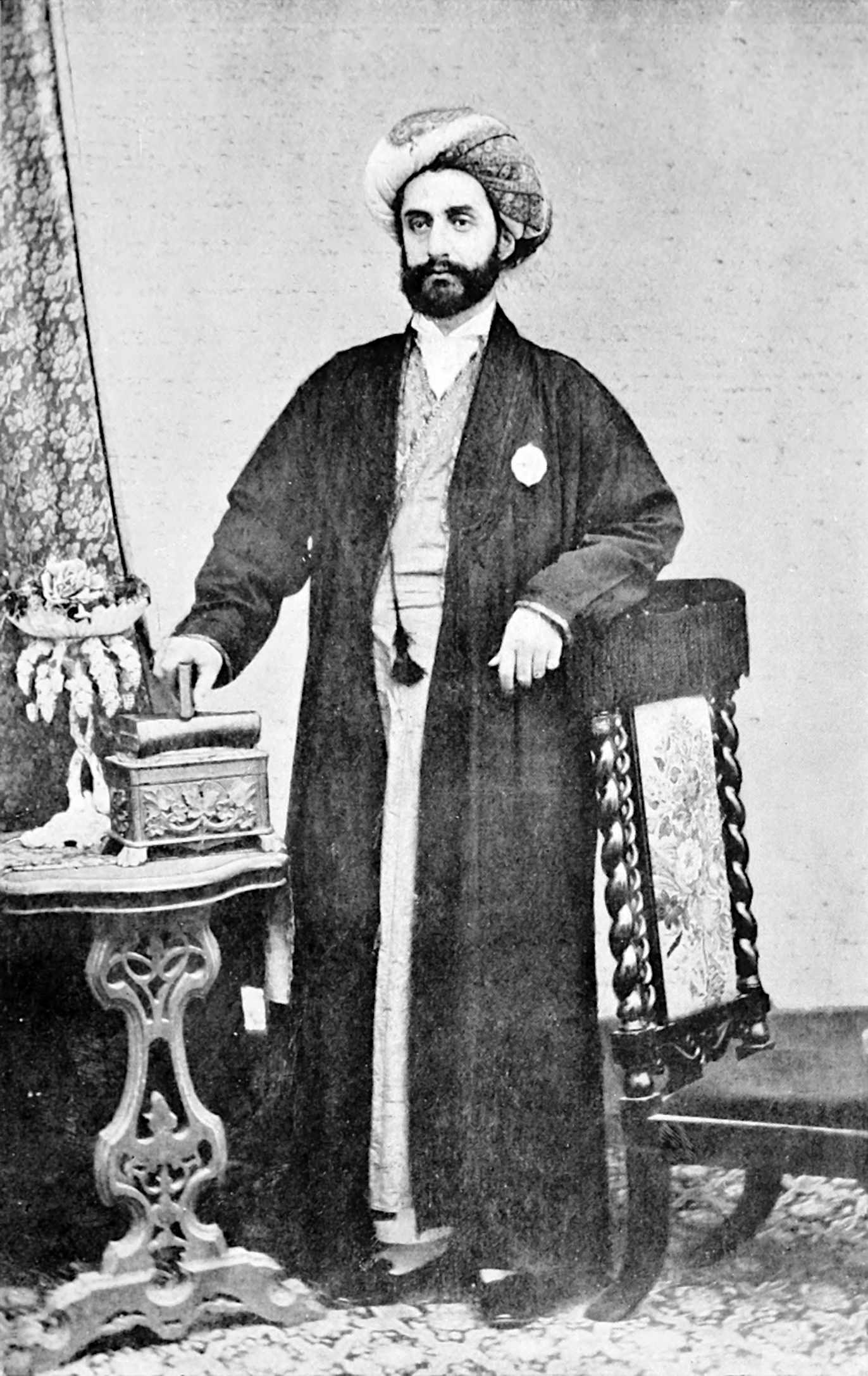
A PERSIAN PROFESSOR OF THEOLOGY.
Galen and Avicenna are still regarded as the leading
masters of the profession, and their treatises are the only
ones that are studied. Diseases are divided into hot and
cold. A cold remedy is applied to a hot disease, and a hot
remedy to a cold one. The doctors bleed patients suffering
from malarial fever. They keep small-pox endemic by
their curious remedies. Silver armlets containing texts out
of the Kurán are worn as preservatives of health. The
saints and estakhharehs are sometimes the only doctors.
“The One who sends fever takes it away ... Khodá rahím
ast (God is merciful).... If He wants me to remain here
He will cure me.... He is the best doctor.” Offerings in
money or in sweet-meats are given to the poor for the
patient’s recovery. The money is placed under the pillow
every night, and is distributed every morning among the
needy. The patient, despite the stifling atmosphere, is
persuaded to believe in a speedy recovery, everybody
telling him that he will soon be quite kushdell or cheerful.
But when the end draws near a priest is summoned
in haste, and the dying man, if he has no just cause of
complaint against a child or against his wife, says not a
word as to the distribution of his property, having full
confidence that the divine law will be religiously followed.
He instructs the priest as to the rites to be observed at
his funeral and the offerings to be paid for the peace of his
soul. He may command his sons to obey their mother and
to respect their sisters. If he has no issue he may settle his
property on a school, a mosque, a saint, or a water cistern.
The corpse must not remain more than twenty-four hours
in the house. The hammámí, or bath-keeper, now enters
the house in the capacity of an undertaker. He places the
body on a korsi, that is, on a raised wooden platform in the
middle of the room; a copy of the Kurán and a decanter of
rose-water are set down near the head; and a cashmere
shawl is laid over the remains. For a month or forty days
after burial a ghari or hired priest keeps watch over the
grave, praying for the soul’s peace of the newly-departed, and
reading the Kurán aloud. On the night of the interment
the percussion of the grave, the fesharé-ghabre, is supposed
to take place. The priest must keep on reciting a certain
passage of the Kurán, called Ayatu’l-Kúrsí or the Verse of
the Throne, in order to extend the space and prevent the
pressure. Then come Monker and Nakír—those livid-faced
angels of death—and question the deceased concerning
his faith. If his answers be satisfactory, ’Alí will cause
him to be refreshed by the air of Paradise; if not, he will
be beaten on the temples with iron maces.
The evening before I left Mecca for Jiddah I was
suffering from a racking headache, and my friends advised
me to consult a certain Arab physician. The curiosity
to have an interview with this leech overcame my scepticism
concerning his health-giving touch, so off I went
to the east of the town where he dwelt, taking my
guide with me; and there, in a winding lane some three
feet wide, we found his house. My guide summoned the
servant by banging at the outer door with his club. In
about ten minutes what we judged to be a small urchin
appeared behind the door and asked us in a piping treble
what we wanted. Having assured himself that we were
not Bedouin Arabs bent on pillaging the sacred house, he
drew back the bars, bidding us enter in the name of God
the Merciful and Clement.
The courtyard through which we passed was unpaved
and not more than five yards square. The apartments—six
fetid cells—ranged round three sides of it. The hakím’s
room faced the door. We walked in with the greeting
“Salám ’aleykum! Peace be unto you!” The faith-healer
was seated cross-legged on a mat in a corner
of the cell. He rose to receive us, saying “Bismillah!
in the name of God!” the Eastern equivalent of “Please
come in.” He was of middle height, lean, of a pleasing
countenance; his eyes were deep-set, brilliant, smiling; his
beard measured the span of a man’s hand; and his teeth
flashed between lips framed for laughter. He wore a white
handkerchief round his head, and a long blue gown reached
to his ankles. Nothing could exceed the courtesy of
our host. As a mark of respect, he insisted on my taking
his place; my guide, heaving a “Yá-Allah!” and a
sigh of relief, sank to my side on the left; while the
sunny-faced saint, squatting at my right hand, turned a
beaming eye on his trusty henchboy, who was standing in
the doorway, waiting for the orders of his lord and master.
In the East they never break the ice of silence with a
remark on the weather. The customary opening is to
inquire if you are in health. I told the doctor, in
answer to his question, that I had a bad headache, and
had come to him to be cured. When he had raised
his hands and cried out “Yá-Muhammad!” thereby invoking
the Prophet to lend him the assistance he required,
it was to ask me on which side the head ached. I
touched the spot, whereon he fell to rubbing it vigorously
with the palm of his right hand, calling out the while to
the urchin to fetch the necessary apparatus for the forthcoming
operation. The boy disappeared. In a few
minutes he came back, bearing in both his hands a round
hollow plate of clay in which were a few lumps of burning
charcoal.
The next things he brought in were a couple of round
iron rods about twice the length of an ordinary pencil,
together with a cup filled with a black fluid used as ink
and composed, if I mistake not, of a mixture of starch and
the soot of an oil lamp. The doctor thrust the rods in the
glowing charcoal. The fear of being branded bathed my
brow in sweat. The doctor, assuring me that I had no
cause to be afraid, cried out: “If we lose heart at the sight
of these little rods, how much the more shall we suffer when
we feel the weight of the maces of the angels of punishment.
May God protect you from the fire of hell!”
The tips of the rods by this time were red-hot. Having
dipped them in the cup of ink, he closed his eyes, and then
raised his voice in an incantation that lasted several minutes.
Not a single word could I understand. When it was over
he opened his eyes, and, saying the word “Bismillah,” proceeded
to draw with one of the rods on my right temple
five perpendicular lines crossed by five horizontal ones, thus
forming sixteen tiny squares. The same pattern was traced
on the left temple with the second rod. Several magic
hieroglyphics besides were inscribed in the same manner
behind my ears and on the nape of my neck.
After every operation the good doctor would pause to
ask me: “Is the pain gone now?” Four times did I tell
him the truth; then, fearing that he would begin to tattoo
my body, I assured the persevering little man that I never
felt better in my life. His joy knew no bounds. Raising
his hands to heaven, he cried, “Praise be to God Almighty,
who hath sent to this poor family a power so miraculous.
The secret was bequeathed to my father by the Lord God,
and when my father died he left it to me as an inheritance.
On no account must you wash off the signs until to-morrow
morning; for if you do the pain will return to punish you.
The blight of the Evil Eye was the cause of your headache.
Go in peace. You are welcome.”
The following day I set out on my homeward journey,
taking Seyyid ’Alí with me as far as Jiddah; and when I
said good-bye to him I felt that I was losing an entertaining
companion. That the reader may experience the same
feeling of loss in parting from me is my dearest hope on
bidding him farewell.
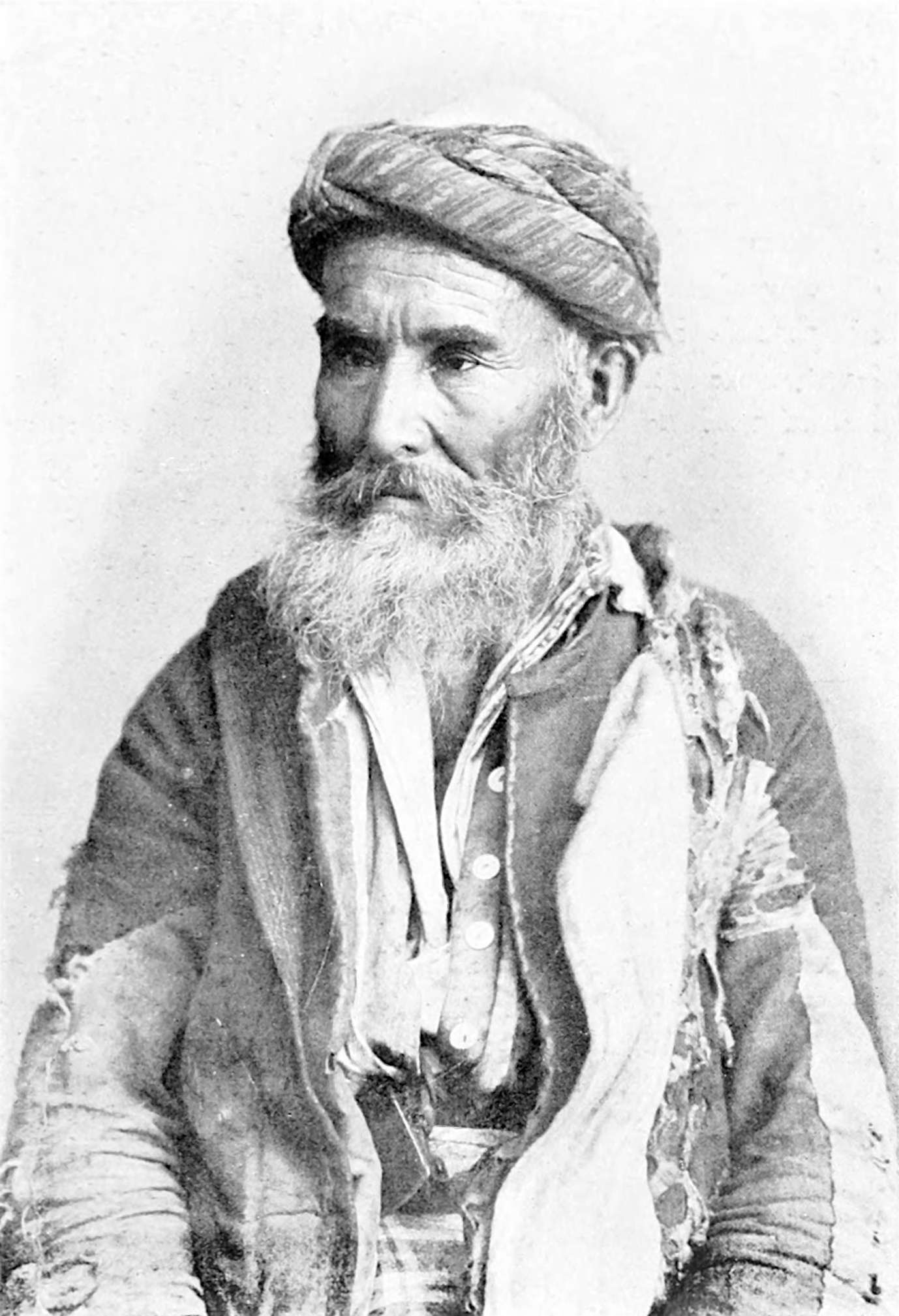
AN ARAB SHEYKH OF THE TOWN.
APPENDIX By WILFRID SPARROY
SOME REFLECTIONS ON THE EXISTENCE OF A SLAVE
MARKET IN MECCA
I brought the notes of “Hájí Ráz” to a conclusion in the
last chapter; and he himself has bidden the reader farewell.
It now remains for me to say a few words on what
I conceive to be the greatest weakness in the Mussulman
faith as interpreted by the Mullahs; and in so doing I wish
it to be understood, particularly by my Eastern readers,
that I am solely responsible for the opinions I am about to
express on the subject of the Mussulman’s attitude to slavery,
the existence of which, in the fourteenth century of the
Hegira, must be a source of some misgiving on the part of
those who sympathise with so much in the Muslim creed.
And I appeal throughout to the enlightened laymen of our
Indian Empire, on whose interpretations of the Prophet’s
message the welfare of Islám will, in the future, depend in
an ever-increasing degree.
Now, the British are the champions of freedom: under
their flag every man is born free. Nothing is more hateful, to
their way of thinking, than that one human being should be
the slave of another. In their opinion the quality of slavery
is to brutalise both the slave and his master—the slave by
depriving him of the self-respect which is the heritage of
every man who is free to choose his own career and to rule,
within the limits of humanity, his own destiny; and the
master, by making him the owner of a human soul—a responsibility
so awful that it is far more likely to lower him
to the level of a beast than it is to raise him to the height
of a god. If this, in brief, be a fair statement of the British
attitude towards slavery, it will be interesting and, in a
measure, enlightening to the reader to follow, by way of contrast,
the argument supported by the ordinary Mussulman.
To be frank, the present-day followers of the Prophet—those
who have not been brought under the influence
of European civilisation—have far less sympathy with
the opinions expressed in the opening paragraph, than had
Muhammad himself. Humanly speaking, the British crusade
against slavery is not only beyond their comprehension—it
is also above it. Their outlook on life, with its rights,
its limitations, and its responsibilities, differs fundamentally
from that of the followers of the Founder of Christianity.
The Christian, who speaks of himself as “a child of God
and an inheritor of the Kingdom of Heaven,” believes, if we
misinterpret him not, that the first step is with him, and the
road with God. In other words, he holds the inspiriting belief,
which is, indeed, the source of all his worldly progress
and his prosperity, that God has given him the right to act
of his own initiative, but not the power—or only a circumscribed
power—to foresee whither his actions will lead him.
Therefore, in calling himself “a child of God,” he has chosen
the title that would best express his independence and his
limitations. The Muhammadan, on the other hand, cannot
admit that he has the power to move of his own free will,
much less the right to do so. He holds that every true
Muslim is, and must be, “the slave of God,” the theory of free-will
being to the Muslim trend of thought so antagonistic that
it has come to bear much the same meaning as lawlessness.
Hence his aversion from Europe and all its ways. “How,”
he asks, “can morality and law flourish in a continent, in
which thought is free, in which women are free, in which
God’s will is superseded by the will of man? Freedom?
I say we are all the slaves of God, even when we are the
slaves of other men. There is not one creature who is
free to act. Only the Creator is free. It is our predestined
lot to be submissive to His will.”
I hope the reader is following the thread of my argument.
It is the feeling of the East which I would
attempt to lay bare. The existence of slavery in these
days is the natural outcome of that feeling. Many a
child is kept illiterate for no other reason than because its
father is illiterate. If the father is a pea-parcher or a bean-roaster,
the son must be a pea-parcher or a bean-roaster;
for a son is nothing more than a child of its father. This
thraldom, to a lad of originality and spirit, is unbearable, but
he must either endure it, or else run the risk of being an outcast.
Thus the son is the slave of his father. In his turn
the father is under the bondage of his spiritual director, who
too often serves no other God than Mammon. The tendency
of the Muslim, however, is to accept the guidance of his “master”
with unquestioning humility. All might go well with him
if his “master”—we mean his priest—were always a man
to be trusted, and the right man to lead. Unfortunately the
Muslim priest more often than not is more unenlightened,
more selfish, more avaricious, more unscrupulous than most
of his flock, and thus there is a danger of his enslaving
the whole fold. Poor sheep, they, believing him to be the
shepherd of God, are accustomed to follow him whithersoever
he may ensnare them. They are doomed to perish
together on the rock of Predestination, unless these
“masters” can be brought to revise the interpretation they
have put on their Prophet’s teaching. Muhammad, as a
matter of fact, was careful not to draw a too narrow line between
the scope and the limitations of the human will.
There is nothing in his message which need deter a progressive
Muslim from accepting the belief that the first step
is with him always, and there is no doubt that the acceptance
of such a belief by the whole Muslim world would go
far to breathe new life into the body politic. For it would
give to the imagination an ever-widening vision of human
responsibility, of human knowledge, and of human destiny.
It would emancipate every race that is proud to pay
allegiance to the Prophet, and would make slavery, in its
widest as well as in its literal sense, a curse of the unredeemed
past.
“We know,” says Mr. J. H. Shorthouse, speaking in the
words of an oracular voice, addressing the King of Diamonds
in a pack of cards, “that we possess a power by which the
fall of the cards is systematised and controlled. To a higher
intelligence than ours, doubtless, combinations which seem
to us inscrutable are as easily analysed and controlled. In
proportion as intellect advances we know this to be the
case, and these two would seem to run side by side into
the infinite—law, and intellect, which perceives law, until
we arrive at the insoluble problem whether law is the result
of intellect or intellect of law.”
Now, the Mussulman, in trying to solve this problem,
seems to me to have chosen the solution which is more
likely than not to paralyse the intellect and clog the wheels
of progress. For if he is oppressed or poor or ignorant
or unhappy, he may say it is God’s will that he should be
so; and thus he may remain stationary, making no effort
to keep abreast with the march of civilisation. In other
words, he may come to be a slave to his god. And so, to
make an end of this preamble, it is not surprising that in
countries where most men are to some extent slaves, socially
and politically speaking, there should be men and
women who belong, as purchasable and saleable chattels,
to such families as can afford to buy them. But—and
this is an all-important point—the Prophet wrought
his manly utmost to mitigate the ill-effects of slavery: it
flourished exceedingly, as every schoolboy knows, long
before his time, and in other countries besides his own;
but, thanks to Muhammad’s laws, the lot of the slaves of
Islám was, and is still, immensely happier than was ever
that of the slaves of pagan Rome or of Christian North
America. It is related that Abdullah Ansari went one
day to visit the Prophet, and received from him the following
instructions; “On this the last Friday of Ramazán,
you must devote yourself ‘to taking leave’ of the month,
and to redeeming as many slaves as you can: and these
things you must do in order that God may be gracious
unto you.” The “leave-taking,” be it known to the
reader, is practised every year, but the old custom of
setting one’s slaves free on the last day of the congregation
of the Muslim Lent has completely died out. However,
though it was not possible for Muhammad to abolish
slavery in a lifetime, the system being far too deeply
rooted in the customs of the country, he fully realised the
oppression to which the slaves had been subjected, and left
nothing undone which would ameliorate their fate.
Thus, in Súra xxiv. of the Kurán, entitled “Light,” it
is written: “And unto such of your slaves as desire a
written instrument allowing them to redeem themselves on
the payment of a certain sum, write one, if ye know good
in them: that is, if ye have found them faithful, and have
reason to believe they will fulfil their engagement; and
give them likewise of the riches of God which He hath
given you, either by bestowing on them of your own substance
or by abating them a part of their ransom.” Some
commentators believe the last admonition to be addressed
not only to the masters but to Muslims in general, making
it an obligation on them all to assist those who have
obtained their liberty and paid their ransom, either by
giving the ransomed slaves of their own stock, or by
admitting them to have a share in the public alms.
One of the Imáms, as we read in a Shi’ah book of
traditions, put a very generous interpretation on the
Prophet’s words; for on the approach of the Hájj Day he
would buy as many slaves as he could afford to set free—a
signal and heartening proof that Muhammad had not
preached in vain. But, alas! in these modern days a slave
is rarely allowed to buy his freedom—unless, indeed, he be
utterly worthless as a servant—until such time as his master
is dead. A good Muslim either releases his slaves on
his death-bed, having no further use of their services, or
makes provision for their redemption in his will. The
money and the belongings which they may have amassed, as
well as they themselves, are during his lifetime his inalienable
property, and, therefore, on the first day of the moon
of Shavvál he must, on paying his Zikkát (that is, one-tenth
of his gross estate), include therein the purchase-price
of his slaves and the value of their hoards.
Another instance of the Prophet’s solicitude for the
best welfare of the slaves must not be omitted here. In
his reverence for virtue he took such steps as would, to a
certain extent, guard the female slaves from the indelicacy
of their masters. If the masters have deteriorated morally,
less than one might expect from the burden of their responsibility
and the force of their temptation, dealing as
far as in them lies with kindness by their slaves, what can
be said in respect of morality of the unfortunate slaves
themselves? In a play modelled on the European
drama, an Oriental writer has chosen for his hero a
Negro slave by name Pistachio, to whom he attributes
the lowest traits of ignorance and cunning. Pistachio is
the evil genius of the family. He turns the house into a
secret gambling hell. He brings about a liaison between
his master’s daughter and a suitor rejected by her parents;
and, by winning his mistress’s favour, excites the apprehension
and jealousy of her husband. Every act of treachery
is committed under the cloak of folly. His perversity
has no limit, and his ingratitude no end. Making every
allowance for reasonable exaggeration, we have in Pistachio
a type of what an Oriental slave too often is. For there is
no manner of doubt that a man, born and bred in slavery,
knowing next to nothing of the refining influence of education,
is more apt to represent rather the worse, than the
better, side of human character. Some slaves there are,
doubtless, who, like Arab horses, are surpassingly faithful
to their masters, but there are others—perhaps more
numerous—who, in the effrontery of deceit and moral degradation
could hardly be matched by the most thankless
rascal in the sink of hypocrisy. Of the majority connecting
the extreme types whose portraits I have sketched,
two things may be said with almost unquestionable certainty.
They are self-willed and effeminate when young,
and indolent and self-willed when old. In their youth,
provided they be good-looking, they are regarded with
suspicion by their masters, if they are male, and with
jealousy by their mistresses if they are female. They live,
whether they be men or women, in the strength-sapping
seclusion of the harems, and hence, for one reason, their
lack of such qualities as go to the making of healthy manhood.
For intellect they must be placed not much above
the level of the dog—in fact, if the dog could speak, he
would put in his claim to the higher rank.
I have hardly heard of a single slave in an Oriental
house who deserves to be noted for his intellectual power.
Since he is so cunning and can set the whole family by the
ears, how comes it that he is so dull of understanding?
Does the cause lie solely in the neglect of education?
Surely not, for if it did his master’s case would often be no
better than his own. Is the reason, then, to be sought
beneath the surface of his skin? Scarcely, I think, since,
under the British flag in South Africa, his brother blacks
are gaining fast in intellectual strength. No; set your
slave free; let him have a body he can call his own.
Educate him that he may develop a mind to rule himself.
Give him light, and room, and liberty. Do this, you
master of Islám’s slave, and your jesters shall have no
cause in the future to satirise the wretched victim who,
bought in chains and reared in sloth, is nothing less than a
living stigma cast on your manhood. If anything could
emancipate your sense of justice, it would be a visit to the
Slave Market of Mecca. Go there, see for yourself the
condition of the human chattels you purchase. You will
find them, thanks to the vigilance of the British cruisers,
less numerous, and consequently more expensive, than they
were in former years; but there they are, flung pell-mell in
the open square—in crowds that clamour for a recrudescence
of Muhammad’s attitude towards slavery.
One group, that of a mother and daughter, excited the
sympathy of many pilgrims. The girl, unthinking, giddy,
broke every now and then into shrill laughter. In her
mirth, more terrible to witness than grief, it seemed as
though she would while away the hours of exciting expectation.
For the girl was bent on winning a master; slavery
had for her no terror, a mother no reclaiming tie. Every
time the daughter laughed her mother’s face twitched all
over, and then grew rigid. It was plain, to the sympathetic
eye, that she had forced herself to rejoice in her own anguish—her
daughter’s unconcern, telling herself, it may be, that,
though her own pain would soon be the greater, her
daughter’s would be so much the less. The one, dreading
the parting, disguised her secret anguish, or found her consolation
in her child’s heartlessness; the other, who could
not conceal her anxiety lest she should be overlooked, was
innocent of a qualm. The dealer, standing by, cried out:
“Come and buy, the first fruits of the season, delicate, fresh,
and green; come and buy, strong and useful, faithful and
honest. Come and buy.” The day of sacrifice was past,
and the richer pilgrims in their brightest robes gathered
round. One among them singled out the girl. They
entered a booth together. The mother was left behind.
One word she uttered, or was it a moan of inarticulate
grief? Soon after, the girl came back. And the dealer,
when the bargaining was over, said to the purchaser: “I
sell to you this property of mine, the female slave Narcissus,
for the sum of £40.” “And I,” replied the pilgrim, “agree
to pay you £40 for your property, Narcissus.” Thus the
bargain was clinched. This time the mother’s despair was
voiceless; for it meant to stay with her always.
Most of the slaves, male and female, came from Nubia
and from Abyssinia, and these are said to be the most
faithful. “Hájí Ráz” tried his best to determine the extent
of the traffic at Mecca, but in a country where the census
is unknown, where every nobleman is an independent ruler,
and where the revenue cannot be calculated with any
degree of accuracy, he found it impossible to form even a
working hypothesis as to the number of human beings that
are sold yearly in the city of God. That the trade by sea
is on the decrease is certain; but many a slaver escapes
from the clutch of the British cruisers owing to the shallow
waters of the Red Sea and to the fact that the pursuer
cannot go ashore. Moreover, the overland route is always
open. Thus he was told that the generality of the richer
pilgrims commemorated the sacramental journey by buying
at least one slave, and often two. The price varied. A
woman-slave, if she were good to behold, fetched by far the
higher price—from £20 to £80. Men slaves could be
bought for sums varying from £15 to £40. The children-in-arms
were sold with their mothers, an act of mercy; but
those that could feed themselves had to take their chance.
More often than not they were separated from their
mothers, which gave rise to scenes which many a sympathetic
pilgrim would willingly forget if he could.
It is the custom among the Muhammadans to change
the names of their newly-acquired property. Thus the
slaves that go to Persia and to Central Asia are called
by the names of the flowers if they are women, and by
those of the precious stones if they are men. Of the
precious stones Turquoise and Cornelian are the most
common. Flowers and precious stones! Are they not
men and women, O children of Islám, and if they are,
why do you not restore to them, in accordance with the
express commands of Muhammad, the Prophet, the breath
that would reanimate and the light that would redeem
them?... “But zeal outruns discretion. Here I end.”