PREFACE
Every Johnny not a professional novelist has, I
suppose, some reason besides making money when
he sits down to write a book, for, as far as I can
see, there is deuced little pleasure to be gained by
the author while occupied in doing so, especially
if, like myself, he should have passed some forty
years of his life on the frontiers of the Empire,
and, with the exception of writing an occasional
letter, has never, during that time, taken a pen in
his hand. My reason is that during the last three or
four years, since broken health and bad luck drove
me back to civilisation, such as it is in England, I
have frequently been knocked end-ways by the
woeful ignorance of all classes of Englishmen, not
only of the history of the various colonies that
form the Empire, but also of the struggles of the
men in acquiring and holding the same. Again
I have noticed no one ever gives the colonial
irregular troops the least credit of having fought
and suffered in the Imperial cause, nor does anyone
in this country seem to be aware of the debt the
Empire owes to the men of the Lost Legion.
Not long ago I dined at the same table with a big
city pot, who after dinner gassed inordinately
about OUR Empire, laying a great stress on the
“our,” as if he had been a prime mover in the settlement
of every country contained in it. New Zealand
was the country under discussion, and amongst
other twaddle he discoursed on the wonderful
progress WE (a very big “we”) had made in those
islands. During a pause in the conversation I
humbly asked him: “How did England acquire
this fruitful country?” With a disdainful smile
he condescended to inform me Captain Cook found
it and gave it to England. “But,” said I, “surely
in my young days I remember a lot of fighting
going on there.” “Oh yes,” he replied, “there
was some trouble out there, but WE” (a big “we”
again) “sent out our soldiers, who soon put a stop
to that, and then WE” (a huge “we” this time)
“developed the country until it is one of the
gardens of the world.” Still with due humility
I asked if he were a New Zealand colonist, and was
not astonished when he replied: “Good gracious
me, no; I have never been in the country, and
except to occasionally visit the Continent, I never
leave England.”
This and many other instances determined me
to jump into the breach, and try if a yarn, even
written by such a duffer as myself, can educate
some few of my countrymen, and let them know
what sort of a life the men of the Lost Legion led
during the wars that took place in New Zealand
from 1866 to 1871, which wars eventually pacified
the North Island, and were fought without the
assistance of a single Imperial soldier.
Moreover thousands of novels have been written
with plots founded on the splendid achievements
of our gallant army and navy, then why should not
one be penned about the deeds of the Lost Legion,
the men who have not only rolled out the map of
the Empire, as the deft hand of a cook rolls out
a lump of dough, but who have also held that
ground until properly settled by their own countrymen.
Innumerable and unknown are the graves of
the Lost Legionaries, slain as they have been by
the bullet, tomahawk and assagai of their savage
opponents, or cut down by hunger, thirst and the
malarial fevers of the lands into which they have
penetrated.
And now if I need any further excuse for inflicting
this badly written (for I claim no pretensions
to literary skill) yarn upon you, let me inform
you that in the main the facts are all strictly true,
and that the men I have tried to depict lived,
starved, fought and died in the very manner described
in this volume.
So now that we are inspanned let’s trek.
CHAPTER I
WITH THE LOST LEGION
IN NEW ZEALAND
PART I
WHY I JOINED THE LOST LEGION
I, Richard Burke, at least so I am told, for
although present myself I cannot claim a vivid
recollection of the fact, was born shortly before
the middle of the last century. My father was a
major in H.M. army, having the reputation of
being a very smart soldier, and was also looked
upon as being one of the best sportsmen in the
service, as he was justly famous, not only in the
saddle, but also as a shot, a fisherman and a general
good all-round man. This, together with being
descended from a very ancient Irish family, made
him popular both in the service and in society.
My mother was a member of an old Lancashire
county family, most of whose men-folk had for
generations worn the Queen’s scarlet, so that from
both sword and distaff side I inherited the longing
to be a soldier. My paternal grandfather, who
had been a distinguished cavalry officer during the
Peninsular War, was a big county magnate, and on
his death left two large estates, my father inheriting
the old family demesne and mansion situated in
the north of Ireland; and now I think I have told
you quite enough about my family belongings.
I was the fourth son, and from my earliest youth
was looked upon as the unlucky member of the
family, being always in hot water. At a very
tender age I took a delight in watching my father’s
regiment at drill, and the first licking I ever got
was for a breach of military discipline, the crime
being that while under lawful control of my nurse
I had committed mutiny by direct disobedience
of orders, and had aggravated that crime by conduct
unbecoming a soldier, insomuch as by crawling
through a drain I had broken away from my
escort, who, being portly, not to say fat, was quite
unable to follow me, and in direct defiance of her
repeated orders had betaken myself to the barracks,
where I was subsequently discovered and arrested
while playing at soldiers with the barrack children.
Keep me out of the barracks they could not, and
when I was seven years old I am certain that had
I possessed sufficient strength I could have gone
through the drill as well as the regimental fugleman.
It was therefore, at the age of seven, I was
sent to a private school in Derbyshire, kept by a
dear old rector, the squire of the parish being an
old service friend of my father. This worthy old
gentleman was also a great sportsman, and took
charge of my education in all branches of field
sports. Young as I was, I was most anxious to
acquire strength, so that I became a devotee to all
gymnastic exercises, especially boxing; consequently
when I reached the age of thirteen I was a good
horseman, shot and swimmer, while, being naturally
a robust boy, I had acquired the muscle and strength
of a lad at least four years older than I really was.
At this time a maternal uncle who had served
many years in the H.E.I.C.S. cavalry returned
home and took up his quarters with us in Ireland.
He was a noted swordsman and shikaree, who,
having distinguished himself greatly during the
Indian Mutiny, had retired as colonel when the
company’s service was merged into the Imperial.
Although an Englishman, he was a great respecter
of, and authority on, the ancient pastime of duelling,
and he quickly instructed us boys in the strict
etiquette of the duello. It was now quite time
for me to choose a profession, and after a long
confab it was decided I should go into the artillery,
so I was despatched to a public school that has
been very famous for passing young fellows into
the service, especially into the scientific branches.
There I remained over four years, gaining far more
laurels in the playing fields than in the lecture-rooms,
for although I worked hard in a desultory
way, still my best efforts were given to the playground
and the gymnasium.
This being the case my father determined to
send me to Lausanne, so as to perfect myself in
French, science and mathematics, an idea my
uncle fully approved of, as there resided at that
place a most noted maître d’armes, who he thought
would be the very man to put a polish on my
swordsmanship. At Lausanne I stayed for some
months, working hard by fits and starts and enjoying
myself thoroughly, and here I was joined
by my eldest brother, Jack, a gay and giddy
subaltern in a crack cavalry regiment. Together
we started on a trip through northern Italy, and
while at Milan I had the opportunity of putting
into practice the precepts my uncle and the celebrated
maître d’armes had taught me.
It happened in this way. I was called out by
an Italian nobleman of sorts, who objected to
some small attentions I had paid to a Tyrolese
chantress in a café. Him I easily defeated, wearing
him out by my better training and then administering
a pin-prick on his forearm, whereon
he insisted upon embracing me and we became
great friends. Towards the end of the trip, however,
I had a misunderstanding with a French
artillery cadet at Strasbourg, who, as I was too
self-confident, ran me through the arm. He also
embraced me and we became good friends.
After the completion of our trip I returned to
London, where I really worked hard, and I had no
doubt I should have passed into Woolwich all right,
when on the eve of going in for my last paper I
was poisoned by a fiend of a woman, whom I was
perfectly innocent of harming, and so, not having
qualified for the requisite number of subjects, I
was spun.
In a fit of disgust I enlisted in the R.H.A. as a
driver, and for a few months soldiered in the ranks
at Aldershot, but, just when I had had enough of it,
I was discovered by my father’s cousin, who had
assumed command of the camp, and who promptly
had me discharged. Saying good-bye to my
comrades necessitated my imbibing too much beer,
so I reached my father’s town house full of beans
and benevolence, where, with my usual bad luck,
I ran foul of two very big military swells, who
in my exuberance of spirits I astonished and
quite unintentionally insulted. Next afternoon,
by my father’s orders, I attempted to apologise to
the mighty potentates, and should have most likely
been forgiven had not my infernal bad luck still
stuck to me, for just at the moment that the tomahawk
was being buried, I handed my father a vile
squib cigar which I had placed in my case for the
benefit of my eldest brother, who I considered had
been too handy with his toe while assisting me to bed
the previous night, and which I had completely forgotten.
The debacle that ensued was too much for
my nerves, and I fled from the house.
In my agony of mind I remembered an appointment
with my brother and made for his club,
a very fast one, where I told my pitiful story. He
and his wild friends were delighted with the yarn,
and a council was promptly held to discuss what
was to become of me. At this council one of them,
a Roman Catholic of very high rank, suggested I
should join the Papal Zouaves, at the same time
offering me letters of introduction to the big-wigs
at the Vatican. These I gratefully accepted, and
in less than a fortnight became a sous-lieut. in that
cosmopolitan corps, in which I thoroughly enjoyed
myself. However, it was not for long, as at the end
of five months I was summoned home to present
myself at the examination for a direct commission.
On my return to England I took up my residence
with my uncle at Brighton, and while there came in
contact with the celebrated Gipsy Lee, who told
my fortune, and that so truthfully I think I may
be forgiven should I repeat her prognostications.
It fell out in this way. One day I chanced to
meet an old schoolfellow, and together we walked
out to the Devil’s Dyke, and while lolling on the
grass were accosted by Gipsy Lee, then a handsome
middle-aged woman, who insisted on telling me
my fortune. In a chaffing spirit I replied to her
solicitations: “Ah, mother, I know my fortune.
I am going up to be examined for the army and
shall then go to India, but come along, you shall
tell me if I am to pass high up on the list.” Putting
my hand carelessly into my pocket, meaning to
give her a small piece of silver, I accidentally drew
out a sovereign, which I handed her, then, seeing my
mistake, said, with a rather rueful laugh: “Keep
it, mother, you’re in luck’s way to-day.” She
shook her head and looked at my hand for some
time, then gravely said: “An open-handed, free
giver you are, and as it was born in the blood, so
will you remain till your death. That is as it
should be, but you are and always will be reckless,
never learning the value of money, although you
will often suffer for the want of it. You will pass
your examination high up on the list, but will
never enter the army. You will wander over the
world, through lands I have never heard of, but
you will never go to India. You have already been
a soldier; there is blood on your hand, and there
will be much more, for, although you will never
join the army, you will take part in many wars and
fight in many battles. You will suffer much, you
will experience hunger, thirst, cold and poverty.
You will pass through many dangers, from fire,
from water, from savage men and beasts. You
will lose many friends through war and sickness,
but though often hurt you will live a long life of
disappointment. Others will make fortunes round
you, but you will remain poor. Women will be
your best friends and your worst enemies, and you
will be robbed of your birthright by your own
brother. Many times you will have grasped the
cup of good fortune, only to have it dashed from
your hand. Yet you will meet every disaster with
a laugh, and will learn nothing. Still keep up
your heart, for, although you will live a rough,
hard life, you will live a long one. The end is
hidden from me, but remember there is often a
burst of sunshine at the end of a cloudy day.”
Had I been superstitious, this prophecy might
have upset me, but, although an Irishman, I
merely laughed at it, and in due course of time went
up to London and passed my exam. There I
was joined by my brother, who was on long leave,
and accompanied him to Spa, so as to put in the
three months previous to joining the regiment
I should be gazetted to. Among my brother’s
friends was a Belgian nobleman, who, being a great
patron of the turf, owned a string of racehorses
and was very pleased to obtain my services as a
gentleman rider for that year’s Spa and Liège
races.
While waiting in Spa to oblige him I got into
serious trouble. Among the gang of blacklegs
and chevaliers d’industrie who in those days hung
about the Continental gambling resorts was a man
called Baron Touchais, who with his wife clung to
the fringe of the fast society that frequented the
tables and took part in the gaieties of the very gay
little town. I was quickly introduced to these
people, and very foolishly allowed myself to be
drawn into a flirtation with the lady, who was a
pretty, vivacious little Frenchwoman. The man
was a well-dressed, plausible fellow, a past master
at all games of chance, who, not having yet
been discovered cheating, was still a member of the
clubs, and tolerated by the fast set. I, however,
very soon got sick of the whole business, and strove
all I could to break loose, but it eventually ended
in a scene, evidently prearranged for the purpose
of blackmailing. The lady, with her hair down,
weeping and hanging on to my shoulder, is discovered
by the bold, bad baron, who rushes in with
a sword-cane, but, getting knocked end over end by
a straight left between the eyes, reclines on the
floor drumming with his heels and vomiting blue
blasphemy.
The infernal row he made brought everybody
in the hotel into the room, and the publicity of the
affair forced him, very much against his will, to
call me out, as it was cash he wanted, not blood, as
of course had he not done so he would have been
kicked out of society. Naturally I was obliged
to go out with him, although I did so much against
my will, especially as H.R.H. had just promulgated
an order that any officer taking part in a duel would
be at once cashiered, and although I had not yet
been gazetted I knew full well that if a duel got
bruited about I should not be permitted to serve
in H.M. army. Notwithstanding this I had to go
out, two of my Belgian friends kindly volunteering
to act as my seconds. It was arranged that the
duel was to be fought with pistols à la barrière,
and I received instructions from Baron Le Noble,
my principal second, that unless my opponent advanced
to the mark I was to allow him to fire two
shots, delivering my own in such a manner that
all the seconds could see that I missed intentionally.
These orders I carried out, receiving my enemy’s
fire and then knocking up the turf three or four
feet from him. The duel should now have terminated,
but my opponent claimed a third shot.
This for some time my seconds refused to allow,
but at last gave way, and Le Noble, as he handed
me my pistol, said to me: “You have done all
that honour demands, now fire at him.” Again
I obeyed instructions, for on the word being given
Touchais strode up to the barrier, and was taking
deliberate aim at me, when I dropped him. As
the wound was considered mortal, my seconds
hurried me out of the country, and I crossed over
to England.
The duel made some stir, although Touchais
made rapid progress to convalescence, but as there
was no hope of being allowed to join the service,
by the advice of my uncle and one or two very
senior officers I determined to go out to New
Zealand, where plenty of fighting was going on.
This I did, and in a very few days, with plenty of
money in my pocket, and a bundle of letters of
introduction, I bade farewell to my uncle and
brother, and, accompanied by my servant, set
sail for the antipodes.
CHAPTER II
THE WAR ON THE EAST COAST—THE HAU HAUS
Before I begin my yarn of the New Zealand wars
it may be as well to tell you about the ferocious
fanatics I assisted in exterminating, and you will
find I always speak about them as Hau Haus.
This is not the name of any tribe of Maoris, but
was the designation given to all the natives who
joined the extraordinary faith which I am now in
this chapter attempting to explain, and to do so I
must dip into New Zealand history.
Christianity was first introduced into New
Zealand in 1814 by Marsden, who started the
first Church of England Mission. The Wesleyan
missionaries arrived in 1822 and the Roman
Catholics in 1838; other denominations quickly
followed. Up to the year 1830 very few converts
had been made, but in 1838 more than one-fourth
of the natives had been baptised, and the numbers
increased rapidly. In 1838 the New Testament,
published in the Maori language, was in the hands
of the converts, and the complete Bible was finished
in 1853. Very many of the natives had learned to
read, and the Sacred Writings were read with
avidity.
Now the Maoris were puzzled, like many others,
by the different dogmas set forth by the various
denominations, each claiming they were right and
that the others were wrong, yet all asserting they
drew their inferences from the same Book. Among
the tribes existed bitter rivalry, hatred and jealousy,
so they gloried in belonging to different sects,
and consequently added religious rancour to their
tribal hatred. Missionaries, however, travelled
through the country with impunity, not one receiving
any harm until 1865. There was, however,
a very great desire on the part of a vast number of
the natives to find out which was the real and true
faith, so that many of them joined one sect after
another, as if to discover which fancy brand of
religion suited his own constitution best, and being
highly intellectual and keen reasoners they came
to the conclusion that each sect was only formed
from the interpretation by the devotees of the
Book itself, and that therefore they (the Maoris)
had a perfect right to interpret the Sacred Writings
in any way they saw fit.
Just previous to the promulgation of the Pai
Marire faith the Maoris had elected a king. Why,
therefore, should they not have a new religion?
Hence the growth of the Hau Haus. The Hau
Haus first came into collision with the white men
in April 1864. For although this extraordinary
religion was known to exist previous to this date,
the majority of the settlers and the authorities
only looked upon it as a farce, and never for a
moment thought that the natives, most of whom
professed Christianity, could tolerate such an
absurd, fantastic and fanatical creed of murderous
tendencies as that denominated the Pai Marire
or Hau Hau religion. The origin of this fanatical
creed is obscure, as well it might be, for the author,
Te Ua, had up to the date of his inspiration been
considered a harmless lunatic, and had been
tolerated by his tribe as such. (The Maoris,
like all other wild races, never interfere with and
are always kind to the demented.)
Previous to the teaching of Te Ua the majority
of the tribes had for a short time combined together
for mutual support against the white men,
and had chosen a king (the head chief of the Waikato
tribe). This coalition did not last long, as
the intense jealousy between the various tribes
caused many of them to abandon it, some of them
remaining neutral, while others joined the Government
and fought with the greatest gallantry on
our side. This alliance was strengthened by the
acts of the apostles of Te Ua, the disciples of whom
spared neither white man nor Maori refusing to
join them or their absurd faith.
Te Ua, although a man of weak intellect, was of
a peaceful disposition, and more friendlily disposed
towards the white settlers than he was toward
the king, so much so that when the ship Lord
Worsley was wrecked on the Taranaki coast he
attempted to persuade his tribe not to plunder the
ship nor passengers. In this he was unsuccessful,
as the sight of so much loot was too tempting to
the nature of the Maoris. He was much upset
by his failure, and solaced himself by long-continued
prayers to his atua (god or spirit), Pai Marire.
Just about this time he assaulted a woman, whose
husband seized him, and, after tying him up, left
him in a whare (hut) to meditate and repent. Had
Te Ua been in his right mind the man would have
killed him. It was during this punishment that his
atua stood by him and rendered him the assistance
that made him famous and all-powerful among
the superstitious tribes. His yarn was this, and,
absurd as it may seem to us white men, yet it was
swallowed and implicitly believed by the majority
of the natives, most of whom were so-called
Christians. Te Ua asserted that the archangel
Michael, the angel Gabriel, and a host of minor
spirits landed from the wrecked ship, Lord Worsley,
and came to him. Gabriel, who took the lead in
everything, ordered him to break his bonds, which
he did easily, whereupon the woman’s husband,
finding him loose, tied him up again, this time using
a chain. Again at the angel’s command Te Ua
burst the chain in fragments, and afterwards was
considered by the superstitious natives to be a man
under the direct protection of God. After this
Gabriel visited Te Ua frequently, and between them
they concocted a wonderful religion. The angel
instructed Te Ua to plant a pole a certain height
in the ground, to be called Niu, around which all
true believers were to worship, and those found
worthy were to be granted the gift of tongues and
also to be rendered invulnerable to the bullets of
the white man.
The symbol of their faith was Pai Marire, which
may be interpreted, if each word is taken separately,
as good, peaceful, but the words must have had a
very different meaning to the worshippers if we
may judge by their actions, where very little that
is good or peaceful can be found. The meanings
of the words Hau Hau also received from the
angel are very obscure, as they simply mean
wind, wind, but probably referred to the wind
which was supposed to bring the angels to the
worshippers round the pole, as the spirits were
always spoken of as Hau Anihera (wind angels).
No matter what meaning the words conveyed to
the Maoris, they were convinced that the utterance
of them, at the same time raising the hand with
the palm turned towards their enemies, would
render the true believer invulnerable, causing the
hostile bullets to deflect and fly high.
These words, after the first fight, became their
charging cry; pronounced short they sounded like
the bark of a dog, and the hostile tribes, no matter
what their proper tribal designation was, were
soon only recognised by the name of Hau Haus.
Up to April 1864 Te Ua and his disciples lived
in a peaceful manner, and the religion had not been
looked on as a factor in the war, but now he was
unable to control his zealous followers, for a furious,
fanatical and murderous spirit was soon shown,
which took a form of hostility not only against the
white man, but also against all the natives who
refused to adopt the Hau Hau faith, and this turned
the North Island of New Zealand into a pandemonium
of cold-blooded murder and savage warfare.
The Maori wars which began in 1860 had up to 1864
been carried on by the natives in a manner that
had earned them the respect of our men. Their
splendid courage, combined with their wild chivalry,
made them an enemy worthy of the highest praise,
and very many men, such as Sir George Grey and
Bishop Selwyn, looked on them with esteem and
affection. This now was all to be changed, and
the subsequent wars, which lasted till 1871, were
wars of savage murder, treachery and torture on
the one side, and bitter reprisals on the other,
until the remaining Hau Haus, unable to face us
any longer, fled for refuge to the King Country and
remained quiet.
On the 6th of April 1864 a party of the 57th Regiment
and a few military settlers, in all about one
hundred strong, under the command of Captains
Page and Lloyd, were destroying crops in the
Taranaki district. They had piled their arms
while at work, when they were surprised and
rushed by a large band of natives. Captain Lloyd
and six men were killed, twelve more were wounded
and hid in the fern, the remainder falling back in
something like a stampede to the Potuka redoubt
and the town of Taranaki. Reinforcements were
quickly on the ground, and found the bodies of the
slain shamefully mutilated, the heads having been
carried away. This brutality was quite a new
feature in Maori warfare, and was the intimation
of the barbarities that were to follow. The 57th
regimental call was sounded, when the wounded
and a few fugitives crept out of the fern. They
informed their comrades that the natives had
rushed upon them, barking like dogs, and seemingly
quite regardless of their own lives. Our men were
much astonished at this conduct, as little was known
of the new faith at this time, but it was soon discovered
that it was the result of the fanatical belief
of the Maoris in their invulnerability. Now it is
a strange thing, but none of the four men whom the
Maoris had lost in the above skirmish had joined
the Pai Marire faith, and this fact added to the
natives’ belief in its virtue. The heads of Captain
Lloyd and his men were carried round the district
as a proof of this victory, and were buried, but
Gabriel ordered Te Ua to exhume and preserve the
Captain’s head, and to use it as a medium through
which the angel could communicate with himself
and his disciples.
There was no delay or ambiguity in Gabriel’s
orders through this oracle, for the head spoke at once
to Te Ua, saying, “You are the chief prophet of
Pai Marire. Matene and Hepanaia will be your
apostles.” Te Ua was also informed that all his
followers should be called Pai Marire, that the
head should be carried peacefully round all the
tribes, and, that having been done, Gabriel with
legions of angels would assist the Maoris in their
general rising, help them to slaughter all the white
men, and then bestow upon the faithful a complete
knowledge of all the languages, arts and
sciences in the world.
These supposed instructions were admirably
conceived, and reflect great credit on Te Ua, who,
it must be remembered, was a man of weak intellect;
for had the head been carried by its escort of
fanatics peacefully through the country, and had
these fanatics abstained from hostility towards
the tribes who professed friendship to the white
man, there is but little doubt that all the tribes
would have been converted and that when the
general rising took place it would have been most
disastrous to the Europeans even if Gabriel and
his promised hosts had not rendered the looked-for
active assistance.
It must be remembered and thoroughly understood
that the magnificent service afterwards
rendered by the friendly Maoris was not prompted
by their love for the white man, but by the hatred
and jealousy they entertained against the hostile
tribes, in very many cases their bitter enemies in
old-time wars. It was indeed fortunate for us that
Te Ua’s subalterns, Hepanaia, Matene, Kereopa
and Patara, allowed their diplomacy to be outrun
by their ferocious desire for blood, and the savage
murders perpetrated not only on inoffensive white
men but also on friendly natives roused such desires
for revenge in the hearts of the latter’s tribes that
caused them to be just as anxious as the white man
to stamp out the fiendish brutality of the Pai Marire
faith and allowed us to retain our hold on the North
Island, which we should have undoubtedly lost, at
least for a time, had they joined the Hau Haus.
The first among Te Ua’s apostles to make a stir
was Hepanaia. For some time Pai Marire had
been preached through the Taranaki district, and
there were hundreds of zealous warriors waiting a
prophet to lead them. This want was soon filled
by Hepanaia, a very brave warrior, but one lacking
in discretion, for he promised the natives, if
they would attack the fort on Sentry Hill (the
strongest post in the district), not only victory but
absolute immunity from injury or death; also
that with the assistance of Gabriel the soldiers
should be turned into stone.
The fort stood on a steep hill, the sides of which
had been scarped, and was held by Major Short
and fifty men of the 57th Regiment. Hepanaia
sent two hundred men to the rear of the fort to
make a false attack, but these men, not liking the
look of the place, and perhaps being new converts
and so not strong in the faith, wisely went home,
leaving the prophet with three hundred men to do
the work himself. There was no attempt made to
surprise the place, for previous to the assault at
daybreak on the 1st of May 1864 the fanatics danced
a war-dance (a very noisy ceremony) and went
through their incantations. These finished, they
advanced in close formation to the attack.
Hepanaia must have been very strong in the
faith, for he led the charge in person, accompanied
by some distinguished chiefs. One of them, Titokowaru,
was afterwards to become our bitterest enemy
on the west coast, and one who, on two occasions,
defeated us.
The natives, three hundred strong, advanced
in broad daylight in close column, shouting “Hau
Hau” and confident of gaining a bloodless victory.
Something, however, must have gone wrong with
their incantations, for the angel Gabriel was not on
deck on this occasion to deflect the bullets, nor even
to turn the Tommies into stone.
The latter lay quiet behind the parapet until the
taua (war party) reached the peg that marked the
three hundred yards’ range from the fort, then,
jumping up, poured a steady volley into the head
of the advancing column, and also opened fire with
two Cohorn mortars. The immediate slaughter
took the natives by surprise, but they were Maori
warriors, as brave as any men on earth, and they
charged home, attempting to escalade the steep,
scarped sides of the hill, a feat of impossibility
without scaling ladders, only to be swept back by
the steady fire of the Diehards, and at last they had
to turn and bolt, as strong reinforcements of the
troops advanced.
In this defeat Hepanaia and most of the principal
chiefs were killed, Titokowaru losing an eye.
Anyone would think that a disaster of this sort
would make the natives pause in accepting and
believing in their wild faith. It did nothing of
the sort, as Te Ua quickly persuaded them that
the men who had been killed must have broken
one of the numerous directions given by Gabriel
through the medium of the head, and thereby caused
the jealous angel to bring about the catastrophe.
So the crazy superstitions spread and flourished
until the whole of the west coast and the interior
of the island reeked with murder and violence.
Te Ua’s second apostle, Matene, had been despatched
to the tribes on the Upper Wanganui
River. These readily received the new faith, but
their relations on the lower part of the river refused
to do so, or else there is no doubt that the rising
township of Wanganui would have been wiped
out. Not only did they refuse to join the Hau
Haus, but they informed them that if they attempted
to descend the river that attempt would
be resisted, and wound up by offering to fight them
on the island of Mutoa.
It is not for a moment to be thought that the
Lower River natives were prompted to act in this
way by their love for the white man—not a bit
of it—they only acted as they did to assert their
ownership to the right-of-way on the river. This
sporting challenge was accepted, the numbers
and date agreed on—the fight to take place on the
aforementioned island—date fixed, 14th May 1864;
numbers, one hundred a side. These arrangements
being amicably settled a tremendous fight took
place, fortune varying during it, both sides fighting
hand-to-hand with the greatest ferocity, but in the
end the Lower River natives won the day, killing
seventy and wounding twenty of the Hau Haus,
the remainder being driven into the river and forced
to swim for it. Matene was among the latter,
but he was soon recognised and followed by Te
Moro, who killed him with his mere (short battle-axe)
when he reached the bank, notwithstanding
the incantations used by the misguided prophet.
Te Ua had thus lost his two factotums in their
first fights, and this ought to have been a set-back
to the new religion; but it was not so, as he asserted,
and with justice, that they had both disobeyed the
orders of the angel, who had directed that the head
should be carried through the country peacefully
and without bloodshed, so that Hepanaia and
Matene were to blame for bringing disaster and
death to the faithful through their disobedience.
Accordingly he despatched two more apostles,
Kereopa and Patara, who were to take Captain
Lloyd’s head, together with two white men
prisoners or deserters (for strangely enough several
men deserted from her Majesty’s forces and joined
the rebels), and preach the Pai Marire faith to the
east coast and Taupo tribes, so that there could
be no mistake this time.
Te Ua gave them the following written orders:—“While
on your journey be careful not to interfere
with those whom you may meet; do not quarrel
with the pakeha (white man). When you reach
Taupo, go on to Whakatane, thence to Opotiki,
from thence to Waiapu, and finally to Tauranganui,
where your journey will end. If this piece of
paper should get torn or dirty, ask another piece
from your white friends and rewrite it, that it
may arrive clean and in good condition to Hirini
Te Kani at Tauranganui. Give him also this
flag and the man’s head.”
The apostles, far from obeying these orders, at
once began to pillage and murder. To start with,
on their reaching Taupo, Patara began by breaking
into the house of the Rev. Mr Grace, who at the
time was absent, and, appropriating the reverend
gentleman’s goods, sold them to the Christian
flock, who at once became converts to Pai Marire.
This was playing a low-down game on the absent
missionary, but much worse was to follow.
Having converted Taupo, Kereopa and Patara
again disobeyed orders, for instead of proceeding
direct to Whakatane they altered their route to the
Uriwera country and held a meeting that for
crazy devilry would be hard to beat. Forming
some two or three hundred of the Uriwera warriors
into double rank, facing inwards, they then
proceeded down them, carrying the head, forcing
each man to look into the dead eyes, at the same
time working them up to a pitch of mad fanaticism
by their wild prayers and incantations which drove
their hearers into a raving frenzy. Then calling for
the widows of the warriors slain at Orakau to come
forward, Kereopa directed them to vent their revenge
on the head and the two wretched white men.
The women, mad with excitement, pretended to
eat the head, but it was eventually taken from
them; the fate of the white men, however, had
better be left to the imagination of the reader.
The apostles, having converted the Uriwera, departed
and left for Whakatane, where all the people
at once joined them, and proceeded to Opotiki,
a flourishing mission belonging to the Church of
England, under the charge of the Rev. C. S. Volkner,
who had resided there several years. This gentleman
by his admirable conduct had justly earned
the respect of both settlers and natives, the latter
especially (his own flock) professing much love
for him. Yet on the advent of the apostles they
at once joined the Pai Marire faith, their
Christianity falling from them like a garment.
Mr Volkner was absent in Auckland when
Kereopa and Patara reached Opotiki, and the
latter, before proceeding on a short journey, wrote
him a letter telling him not to return. Mr Volkner,
however, accompanied by Mr Grace, was on his
way, and reached Opotiki on the 1st of March 1865,
in the schooner Eclipse, which was immediately
boarded and seized by his late parishioners. All
the passengers and crew were made prisoners
(with the exception of Captain Levy, who, being a
Hebrew, was considered a Hau Hau of sorts), and
marched up to the Roman Catholic Church, inside
which Kereopa was holding a council to try Mr
Volkner on the most absurd charges. The council
was adjourned, the prisoners being confined in a
tumbledown hut, but again met that night, when,
with the exception of two or three, all of the tribe
voted for their minister’s death. Next day at
two P.M. Mr Volkner was led out and murdered
in a most brutal manner, being hung, Kereopa
firing a shot into him at the same time. The body
was then carried into the church, where this fiend
ordered it to be decapitated, and directed his new
converts to drink and smear themselves with
their victim’s blood, which they all did, Kereopa
giving them a lead by gouging out the eyes and
swallowing them. The first to participate in
this horrible act was Volkner’s own woman-servant,
who from a child had been brought up and educated
by the Church Mission. Patara returned the
same night and was bitterly angry with Kereopa
on account of this foul murder, although he had
annexed and sold all Mr Volkner’s belongings
previous to his departure on his short journey.
A few days afterwards the cutter Kate put into
Whakatane and was immediately boarded by the
Hau Haus. Her crew and passenger, Mr Fulloon
(a Government agent), were soon brutally murdered.
Kereopa, followed by Patara, reached Poverty Bay.
At once the Christians joined them, and Bishop
Williams of Waiapu was only saved from being
murdered, together with his whole family, by two
or three chiefs who remained loyal to him, and
these would have failed had not the Bishop just
escaped in the nick of time on board a steamer.
The Hau Haus built a pah at Waerenga-a-Hika
(the Bishop’s residence), where they were subsequently
attacked and defeated by the colonial
troops in November 1865, who killed over one
hundred of them and forced over three hundred
of them to surrender. The prisoners were brought
to Tauranganui, where two hundred of them were
transported to the Chatham Islands, the remainder
being allowed to return home. Small bands of
the most fanatical of the natives, who had escaped,
still wandered about the district.
Just before the last of these events I had set sail
for New Zealand.
CHAPTER III
I START TO JOIN THE LOST LEGION
It was on the 14th September 1865 the ship
Queen Bee was towed down the river and dropped
anchor at Gravesend, so as to allow the crew to
sober up, and the captain to join. In the meantime
my servant and myself arranged and made
comfortable my state-room, stowing away and
making fast everything in its place. I may also,
while we are at anchor, take the opportunity of
bringing to your notice my man, Tim Egan. He
had not been with me very long, but as the circumstances
under which I met him, and subsequently
engaged him, were unique, and as he
not only faithfully served me, but stood by me, as
a gallant comrade and a true, if humble, friend for
many years, until a Kaffir bullet put an end to
his life, I may be pardoned should I digress and
relate them.
It happened some months previously, when I
was staying at Brighton, I had been asked to play
in a cricket match against a crack light infantry
regiment, and on the evening previous to the first
day’s play had proceeded to the town at which
they were quartered. On my arrival I was sitting
at a window of the principal inn when my attention
was attracted to a couple of soldiers coming along
the road, one of whom was very drunk indeed,
while his comrade, a fine, slashing-looking young
fellow, was trying to convoy him home to barracks,
which was a difficult job, as the drunken man was
not only a big, heavy fellow, but also hung back
and resisted.
These two warriors were followed by a crowd of
jeering roughs and hobbledehoys, who annoyed
them, and seemed inclined to obstruct their
journey. The drunken man resented this conduct,
wishing to stop and fight, but the sober one took
no notice of the gang and only tried to get his
comrade along, until they came just opposite
to where I was sitting, when a big rough jostled
the votary of Bacchus, evidently trying to trip
him up and upset them. It would have been
better for him had he left them alone, for, placing
his helpless comrade against the wall, the Tommy
turned on his aggressor, who, encouraged by the
rabble, was about to renew his attempt, exclaiming
in a voice that at once denoted he belonged to my
own country: “Arrah, ye blaggard, ye want it, do
ye? Thin begorra ye shall have it,” and with
that he lashed out with his left, landing his opponent
flat on his back in the middle of the road.
Then stepping back, he stood in front of his mate,
hitting out right and left at the gang of roughs,
who now tried to rush him. I was running out to
assist him when six or seven policemen came up,
who without the least inquiry proceeded to arrest
the two soldiers. But this piece of brutal Saxon
injustice to Ould Ireland was more than my
countryman, whose fighting blood was now up,
could stand, for no sooner had a bobby placed
his hand on him than he knocked him down, and
as the others rushed in he served them the same
way, until the footpath was strewn with recumbent
Peelers, and I believe he would have come out
top dog had not a rough legged him, when he was
brought to the ground, sat upon and captured.
I had never seen a more gallant resistance, and my
heart warmed to the victim, so that I immediately
proceeded to the barracks, called on the adjutant
and gave him full particulars of the row, offering,
at the same time, to bear witness of the correct
conduct of his man. This in due course of time I
did, when my evidence saved the poor fellow from
imprisonment. Now it had always been a family
custom that when ever one of us joined the service
he should take with him, as servant, some young
man or other reared on the estate, and as I should
shortly want a servant, and had taken a fancy to
this man, I asked to see him. When I did so he
warmly expressed his gratitude for my volunteering
evidence on his behalf. “But sure,” said he,
“ave a Burke of Clonkil wouldn’t stand by a
poor boy from his own county, who wud?” “Oh,
so you are a countyman of mine?” I asked.
“Deed I am, yer honour, and mind ye and your
brothers well. Bright boys ye were, an’ full of
divilment.” “Well,” said I, “I am joining the
service soon, and want a servant. If I buy your
discharge, would you like to come to me? Of
course you will have to enlist in any regiment I
may have to join.” “Is it come to you and sarve
ye I’d like? Troth I’d give an arum for the
chance. An’ do ye mane it, Mr Dick? Do you mane
it, sor? Be the holy cross of Clonkil, I’ll sarve ye
as long as life blood rins, and me four bones hang
together.” So then and there the compact was
made. I lodged the money and directed Tim to
report himself to my uncle at Brighton, so soon
as he should receive his discharge. All this had
taken place and Tim, accompanying my uncle
up to town, had joined me, when I explained
to him my change of plans, at the same time
offering to take him with me, provided he saw fit
to follow my very uncertain fortunes. “Is it
go to New Zaland wid ye, Mr Dick?” quoth he.
“Sure it’s to hell I’d go wid ye, and maybe that’s
farther. An’ it’s fighting ye say there is in thim
outlandish parts. Well, an’ why not, sure it’s our
trade it is, an’ maybe there’s some loot to be picked
up, an’ some purty gurls to colougue wid, an’ it’s
thankful I’ll be to visit forin’ parts, for sure so
many young women have been so kind to me that
it’s bothered I am, for it’s Mormon I must turn, to
satisfy them all, God bless ’em.”
Both my uncle and Jack considered it was
right for me to be accompanied in my exile by a
faithful follower who could be depended on to
stand by me, so that when the good ship Queen
Bee sailed from London port she carried the two of
us to seek our fate in the antipodes. Tim Egan
was indeed a man any young fellow might be
proud to have at his call. Standing five feet
eleven in height, he was a picture of a beau-ideal
Irish soldier, square in the chest, broad in the
shoulders, narrow in the flanks and well set up,
every bit of him looked made for strength and
activity, while his handsome, clean-cut face, that
usually carried a pleasant smile, and his dark blue,
merry eye made him one that must attract the
notice of a girl be she white, black or brown. Such
was Tim Egan, and I may say here that a truer,
braver comrade, friend and soldier, never took the
Queen’s shilling.
As soon as the tide suited, and the crew had
slept off the thick of their drink, all hands were
roused out, the anchor weighed, and the tug,
getting hold of our hawser, towed us, during the
early hours of the morning, out to sea, casting us
loose as we opened the Channel, when with a fair
wind we hoisted topsails and topgallant sails, to
the good old-time chanty of “Renzo, boys, Renzo,”
and with our main royal set we bore away on our
course to the other side of the world.
Going to sea in the sixties was a very different
matter from going to sea nowadays. At present
you step on board a huge floating hotel, with all
the comforts and most of the luxuries of the best
London establishments, finding innumerable well-dressed
stewards to attend to every want, while
your comfortable though small cabin is provided
with everything necessary. Then again the cold
storage chamber furnishes the table with fresh
meat, game, poultry, fish and ice for every meal.
While in those days you were accommodated with
an empty square cell lighted by a dim port hole,
this chamber being called a state-room, and you
could furnish it to your fancy at your own expense.
Then as regards the commissariat, here there was
a great difference—no ice, no cooling drinks, no
well-filled menu—true a number of sheep, pigs and
poultry were carried, but these rarely lasted out
the voyage, and in our case a heavy gale we ran up
against in the North Atlantic deprived us of most
of ours, and I have frequently seen the steward
and cabin boy washed into the lee scuppers, together
with the dinner they were conveying aft to the
cuddy, from the galley that was located abaft the
foremast. Again at the present time you know
to the day, even to the hour, when you will reach
your destination, while then you did not even
know, to the month, when you would get there.
Still I loved the old wind-jamming days, and can
look back to many a jolly hour lazed away on the
breezy decks of the old Queen Bee. Our saloon
passengers consisted of an old major, going out
to take up a grant of land and settle in New Zealand;
three or four young subs. just off the
barrack square, en route to join their regiments;
and eight young fellows who, as the old song runs:
“Had played in the eleven, or pulled five or six
or seven in the ‘Varsity or else their college boat,”
who were going out to learn sheep farming; at
least, poor lads, they thought so.
In the ’tween decks were one hundred and twenty
single women sent out under the ægis and, I believe,
at the expense of Miss Burdett-Coutts, and in the
fore part of the ship were some forty Tommies
and twenty male emigrants, so she had the makings
of a very gay ship. I am not, however, going to
write a history of that voyage, as a good many
of the incidents that took place on board would
not bear telling, as they were very gay, and as
regards the passage itself nothing very startling
took place. We met two very severe gales, but
weathered them safely, only losing one boat and
two topsails, blown to rags, and we also passed close
to a large raft, but as there was nothing on it we
did not stop to examine it, so after a passage of
one hundred and eighteen days we dropped anchor
in the beautiful harbour of Wellington on the
10th January 1866, and were very glad to get our
feet on dry land once more.
New Zealand in 1866, the year I landed, was in
a very bad way indeed. The war in the North
Island, begun in 1860, showed still no signs of
terminating, and blazed up wherever the white
settler came in contact with the native. For
although General Sir Duncan Cameron had, with
overwhelming numbers, forced his way into the
interior of the country, and had built chains of
forts with which to hold it, yet no white man’s
life was safe out of rifle range of these works, and
the settlers, especially on the west coast, had all
to abandon their farms, and send their women and
children to the South Island for safety, while they
themselves had to take up arms and form themselves
into defence forces. A year or so before
there had been a great impulse given to the trouble
by the invention of the new religion, called Pai
Marire, that had turned the Maoris, both Christian
and pagan, from chivalrous, if savage, enemies
into howling, bloodthirsty fanatics who murdered
in cold blood, with every vile atrocity, man,
woman and child not only of the white race but
even also of the Maoris who refused to join
their crazy faith. It is not my purpose, however,
to write a history of New Zealand and its troubles,
but of how I came to join for good the Lost Legion,
the men who live and die on the frontiers of the
Empire, and who, reckless of life, health and
everything else that makes existence endurable
to the carpet soldier, have gradually rolled out the
limits of Old England’s possessions as the deft
hand of a cook rolls out the lump of dough on a
pastry board.
Directly we landed I made inquiries as to
the whereabouts of Sir Duncan Cameron, but was
quickly informed he had resigned the command
of the forces to Sir Trevor Chute, and that the
latter was at present on the west coast, but that
it was impossible to say where. This was a
disappointment, but as I had more than one string
to my bow I bent my way to the Mount Cook
Barracks, as, among others, I had a strong letter
of introduction to the colonel commanding the
regiment stationed there. I was most hospitably
received, asked to dine, and, after a few minutes’
chat about mutual friends in the old country, I
asked the best way how to get to the front and
take a hand in the fighting.
The Colonel looked surprised, but said, “Well,
look here, Mr Burke, if you really want to see
what they call fighting in this country” (he had
served through the Crimea and Mutiny and like
all the rest of the regular officers was sick and
disgusted with the long-drawn-out war), “the best
thing for you to do would be to join one of the
colonial defence forces. We get news very slowly
here but the day for regular troops in this country
is past, and before another twelve months is over
there will be but few left in the island. The only
way to put an end to the war will be for small
bands of irregulars to follow the Hau Haus into
the bush, live, or rather starve, in the bush, and
keep in pursuit of the enemy until they are worn
down and killed off. Now I will, if you like,
at the club this evening, introduce you to some
of the colonial leaders and you can discuss the
matter with them, but you will find it a hard,
brutal life without any chance of gaining honour
or distinction.”
After a pleasant dinner he took me down to the
club, and there I met several leaders on their way
from the east coast to the west, for, as the enemy
held the whole of the interior of the island and
there were no roads, all communications between
the two coasts had to be sea-borne. I was also
introduced to several members of the Colonial
House of Parliament who were at that time in
the capital, and, among others, to the Defence
Minister, to whom I mentioned my desire of taking
service. He was evidently amused at the idea
of a man travelling over fifteen thousand miles to
run the chance of getting killed and turned into
long pig but assured me there were plenty of
openings in the country for a man desirous of
seeing hard, rough fighting, and asked me to call
at his office next morning. Well pleased with my
evening I said good-bye to my host and returned
to my hotel, where I found my shipmates full of
beer and excitement, drinking in company with
some half-dozen tough, weather-beaten, fine-looking
young fellows dressed in blue jumpers,
Bedford cord riding breeches and smasher hats,
who on being introduced to me I discovered to be
troopers in the Colonial Field Force. They were
all men who belonged to the class that go to public
schools and Varsities, and in a very short time I
discovered that most of them had come out to
learn sheep farming, but finding the cadet business
to be a swindle had thrown it up and joined the
irregular forces. Their tales of the wild life they
led quickly captivated my companions, who one
and all declared they would join the irregulars
and let the sheep farming go swing. Other men
trooped in, and seeing every likelihood of a very
wet night I slipped off to bed and managed to
get some hours of sleep, notwithstanding the rough
choruses that were howled out for some hours
as the troopers, taking the only chance they had,
after months of hard work, and knowing they
were on the threshold of another campaign, were
determined not to let that chance slip but employ
it so as to knock down their cheques and blue all
the hard-earned pay they had in their pouches.
Next morning at breakfast, which was partaken of
by all the guests at a sort of table d’hote, there were
many troopers present and I got into conversation
with one of them. Up to the present I had been
rather surprised to see the principal hotel of the
New Zealand capital thronged with men serving
in the ranks, but my eyes were quickly opened
by my new acquaintance, who told me that the
corps to which he himself and most of the men
present belonged was the Wanganui Defence
Force, and that as every able-bodied man in
that district was forced to serve, most of them
at table with us were well-to-do men, holding
good positions in the country but, having been
forced to abandon their farms and businesses, had
been enrolled into a corps; that they had been
serving on the east coast, and had been recalled
to the west coast; that the day previous their
transport had put into Wellington, where it was
going to remain three days, so that they were
taking advantage of the stoppage to enjoy a few
days’ life of civilisation between the two campaigns.
They seemed to be all very keen about the new
campaign, as they considered the new general
to be a far better man, for the work, than the
one who had lately resigned, whose method of
conducting the last five years’ operations they
criticised in the most unmerciful manner, while
their open comments on the inutility of the regulars,
both officers and men, made me wince with
astonished indignation, so that it was with the
greatest difficulty I could restrain myself from
starting a row.
The man I was sitting next to evidently noticed
my vexation, for he said: “If you have finished
breakfast let’s go out on the back verandah and
have a smoke, and, if you have nothing better to
do, a chat for an hour or two.”
As he seemed a very good fellow, and I was
most anxious to gain knowledge, I gave him my
card, telling him I had only landed the day previous.
“Yes,” said he, “I can see you are a new
chum, and I saw you were getting riled at the talk
of the boys inside, but you must remember that
the majority of those men have been ruined by
the pig-headed procrastination of the General,
who with twenty thousand men at his disposal
has not been able, after five years’ warfare, to gain
any permanent advantage over savages who have
never at any one time exceeded two thousand
fighting men. Now,” he went on, “my name
is West. I own a large farm on the west coast. I
have been out in this country seventeen years,
and, having sunk my capital in land and stock,
had put in twelve years’ hard work in clearing
ground, fencing farm and improving stock. Five
years ago I was well off, with every prospect of
becoming a rich man, having a comfortable house,
a wife and two children, good horses, valuable
cattle and sheep, and was contemplating a trip
home for twelve months. The war broke out. I
just saved the wife and kids; my house is burned,
my stock and horses driven away and looted, my
fences destroyed and my farm a wilderness, so
that when this wretched business terminates
I shall have to begin again. I am just completing
three years’ service in this force, and as far as I can
see we are no nearer to the end than what we
were the day we began.”
“But why blame the General and troops?”
I asked. “Surely you have out here thousands of
officers and men whose splendid conduct and
courage during the Crimea and Mutiny will live
in history as long as the old flag flies?”
“Mr Burke,” he answered, “you do not understand.
The man who speaks a word against
the courage and devotion of H.M. troops lies in
the throat, but nevertheless, from the General
downwards, they are simply useless for this sort
of work. If you have the patience, and,” with a
laugh, “promise not to go for me, I will try and
explain. The facts are these. The General and a
vast majority of the senior officers are hide-bound
in the old traditions and customs of the British
army, so much so that they are quite incapable
of adapting a new style of warfare to novel circumstances,
while the training of the men itself
renders them unfit for bush warfare. I read, as a
boy at school, how General Braddock, refusing
to take the advice of his colonial officers, was
cut up in an American forest. It is the same here,
and it has only been our overwhelming strength
that has saved similar disasters in this country.
Look here, let me give you a few examples of what
has happened in the past five years. You have,
you say, been educated for a soldier, and have come
to this country to lend us a hand; it will therefore
do you no harm to hear and ponder over some of
the absurdities that have been perpetrated, remembering
that I am speaking with no ill-will
against the General or troops but only just telling
you how Maoris should not be fought. In 1860,
when the war broke out in the Taranaki district,
and we settlers saw our life’s work go up in smoke,
although the Europeans outnumbered the natives
ten to one, it seemed that nothing could be done.
The Maoris built pahs at the edge of the bush,
often on deserted farms. General Pratt, then in
command there, would besiege these, as if they
were Sebastopols, and when with a vast amount of
hard work he had sapped up to them he would
find them deserted, the natives having withdrawn
into the bush, where the General refused
to follow them. The Maoris therefore used to
plant their potatoes in perfect security, then,
while their crops were growing, would announce
the shooting season to be open, and invite their
friends to come and pot white men, making raids
into our country right up to musket range of the
forts, killing and looting everyone and anything
they came across. Occasionally the General (the
Maoris called him the rat, from his burrowing
and sapping propensities) would ginger up and
try to make what he called a combined movement,
and even to venture into the bush, but always to
come to grief. Par exemple, at one of the very
first fights, the attack on the pah at Waireka,
Colonel Murray with two hundred regulars and
one hundred and twenty Colonials were detached to
take it, the latter being ordered to make a
detour through some very rough country and take
up a position in rear of the place, while the regulars
were to rush it from the front. The Colonials after
a sharp skirmish took up the position assigned to
them and held it all day, but the attack was never
made, and at nightfall the regulars drew off and
returned to the town, leaving the Colonials planted
there with their retreat cut off and ammunition
nearly all expended. They were in a tight fix,
and it would have gone hard with them had not
Captain Cracroft, R.N., who with a party of sixty
bluejackets had just landed from H.M.S. Niger,
heard of their predicament. He at once took
action, got hold of three young fellows to guide
him, and started off with his jacks to do their best
to help their stranded countrymen. Captain Cracroft
wasted no time over formulating complicated
plans or strategy but made straight for the pah;
it was pitch dark and when he reached the vicinity
of it his party fell across a mob of the enemy.
One volley the bluejackets fired, then out cutlass
and revolver and charged the astonished natives,
who fled for the protection of their works with
the sailors in close pursuit. The stockade is
reached, but that does not check the shell-backs,
who, giving one another a leg up, enter the place,
and gut it as clean as a red herring. The Maoris,
who had bailed up the Colonials, hearing the row
ran to see what was up, and the latter, taking
advantage of their absence, retired in safety. So
far so good, but the conduct of the soldiers’ O.C.
in botching the show caused heaps of ill-feeling.
“Subsequently, after an immense amount of
talk and preparations, a field force goes out to
attack Puketakauere, more combined movements
and high-falutin strategy, all of which, when
it comes to the point, proved unworkable in
the bush, and we have to clear out after losing
sixty soldiers, shot down like sheep. Again, look
at the game Cameron has played in the Waikato.
With an overwhelming force he attacks Rangiriri.
Mind he is fully cognisant that the natives have
neither food nor water in the pah. He surrounds
the place, and instead of waiting for them to be
starved out he assaults the pah three times, getting
beaten back with the loss of over one hundred and
thirty men.
“Next day the pah surrendered, as its defenders
are dying of thirst. The following year at Orakau
he played the same silly game. He knew the
enemy had neither food nor water, yet he tries
five times to rush the place, loses heaps of men,
and the Maoris, unable any longer to endure the
pangs of thirst, sally out, break through the
surrounding troops, and many of them escape.
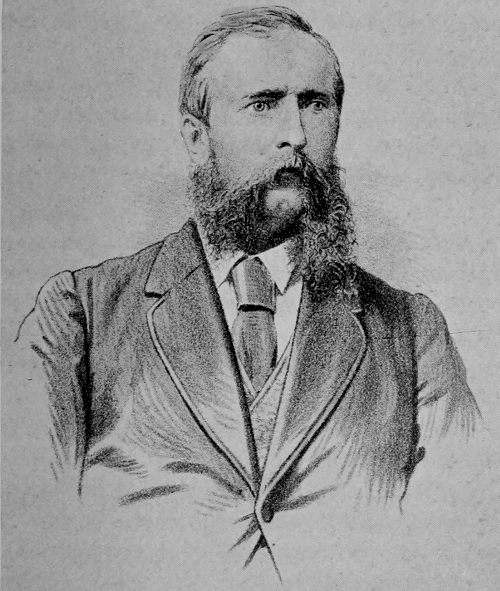
COL. MCDONNELL.
“During the same month comes the Gate pah.
Again over one hundred men are lost, through
folly, blind stupidity, nothing else. The General
has learnt nothing, is incapable of learning. True,
the Tommies caught the same fellows within two
months at Te Ranga, and pretty well wiped them
out with the bayonet. Then the war breaks
out again on the west coast. What is done?
General Cameron starts to march up the coast to
Taranaki with two thousand men.
“I was with the mounted portion of the force,
and the first day out the column had marched
fifteen miles when it was halted, early in the afternoon,
to pitch camp. The Adjutant-General,
Johnston, had picked out a site at Nukumaru.
My O.C., an old hand, who knew the country
well (I was acting as his orderly) rode up to the
staff. ‘General,’ said he, ‘don’t you think we
are rather too near the bush, especially as that long
Toe-toe grass grows right up to the tents, and
we are only five miles distant from the Weraroa
pah, the principal stronghold of the enemy.’
‘Pooh, pooh, Major,’ answered the General, ‘do
you imagine, sir, for one moment, that any body of
natives would dare to attack two thousand of
H.M. troops?’ ‘Yes, sir,’ said the Major, ‘fifty
Maoris are quite capable of doing so.’ But it
was no good talking, so we rode away to our lines.
‘Keep your horses saddled, boys,’ said the Major,
‘we may be wanted any moment,’ and we did so.
“Well, sir, the troops had just finished pitching
the tents when rip comes a volley from the Toe-toe
grass. Over rolled Adjutant-General Johnston
and sixteen men dead, and there was hell to pay:
men rushing to the piles of arms, bugles blowing
and officers shouting contradictory orders, while
the natives continued blazing into the camp, some
of them even rushing in with their tomahawks,
one of them being killed within twenty yards of
the General’s own tent.
“At the first shot our O.C. had yelled out
‘Mount,’ and as we were standing to our horses
we were on them in a moment. ‘Charge,’ sings
out the O.C., and we charged through the long grass
right into the middle of the Hau Haus, there not
being more than fifty of them all told. Maoris
won’t stand mounted men, so we swept them back
to the bush, killing a good lot. On our return to
camp we found all the soldiers standing in rows,
looking very pretty, and the General very angry, declaring
it was not warfare for fifty savages to attack
two thousand British troops.
“Now the General ought to have learned something
from that lesson, but he didn’t, for next night,
a gale of wind blowing, the column was halted to
bivouac in long dry fern. Fine beds for tired men
long dry fern makes, provided there is not a gale
of wind blowing and the Hau Haus are not hostile,
but on this occasion such was the case, and we
were roused out by shots and bugle calls to see a
wall of fire, twenty feet high, charging us faster
than a horse can gallop. Gad, sir, it was a case of
sauve qui peut, and we all bolted for the sand-hills
like redshanks, the Maoris tomahawking five of the
18th R.I. picket and a lot of others. This last affair
so disgusted the General that he refused to leave the
beach, and, without making another attempt of any
sort, consumed fifty-seven days to march fifty-four
miles, while the Maoris, only a handful in number,
used to chaff us and called the General the lame
seagull.
“I’ll give you one more instance of incapacity, or
call it what you like. Sir George Grey asked the
General to attack Weraroa pah. The General insisted
it was impregnable to the force he had at his
disposal, and that he should require at least six
thousand men to do so. After a lot of blarney he
sanctioned an attack to be made by Sir George, who,
with less than five hundred Colonials and friendly
Maoris, took the place.
“Now look here, we settlers are sick of the
war, and want to get back to our farms and businesses.
We are paying the British Government
forty pounds sterling per annum for every regular,
and when it takes an army fifty-seven days to
march along an open beach fifty-four miles we
don’t think we are getting our money’s worth.
Besides we can tackle the natives better ourselves.
We men you see here are on our way back
from the east coast, where, without the help of a
single regular, we have smashed the Hau Haus,
taking their pah Waerenga-a-Hika, and, with only
twenty-three casualties, have killed one hundred
and fifty of the enemy, and forced four hundred
more of them to surrender, two hundred of whom
have been transported to the Chatham Islands,
so that they are out of the way.
“Now the reason I have told you all this is,
you say you have come out here to see fighting.
That being so, my straight tip to you is to join a
colonial corps; all the fighting during the coming
campaign will be done by them. Don’t bother
about a commission; join the ranks under Von
Tempsky or McDonnell and learn your work; then,
after you have done that, you may take a commission
if you like, and your men will think all the more
of you. Now then I’m dry with talking, come and
have a drink, and I’ll walk with you as far as the
Defence Minister’s; he is an old pal of mine. What,
you don’t drink? Well so much the better for
you, so let’s get.”
With my new friend discoursing on things in
general we strolled along to the Government
Buildings, where we had not to wait many minutes
before we were shown into the minister’s office.
This is a funny country, I thought, where a trooper
in uniform, if such a garb can be called uniform,
can call unasked on an important minister; but new
countries, new customs, so I made no remark but
accompanied my companion into the presence of
the big man, who greeted him with much cordiality.
Presently, turning to me, he said, “Mr Burke, you
are fortunate in making the acquaintance of my
old friend West, and you will be wise in taking any
advice on colonial matters he may offer you. I
have been thinking over your case. Now this is
how it appears to me. Although you have been
educated and trained as a soldier, still you have
had no experience in bush fighting, and without
that are of no use to us. I should therefore recommend
you to join a colonial corps as a private,
and you will quickly gain promotion, when you
have gone through the mill and gained the required
knowledge. Pay, I believe, is of small consequence
to you; the hardships and dangers of the campaign,
which are very great, must be borne equally by
officers and men alike. Good birth and education
are desirable, but it is the best men we
want, and the best man gets ahead in this country.
You have travelled fifteen thousand miles to
see fighting, and therefore don’t want to serve as
a town guard, so I will give you a letter to Colonel
McDonnell, one of our most experienced officers, and
can promise you that you will see enough savage
warfare and experience every phase of irregular
fighting. What do you say, West?”
“You have given him the same advice as I have
already done, so that if you will scribble a chit to
McDonnell and give Burke a pass up in the St Kilda
I will look after him and see him through.”
The advice was sound and I determined to profit
by it, so, thankfully receiving the letter and pass,
the latter including the name of Tim, we shook
hands with the minister and backed out.
No sooner were we clear of the Government
Buildings than West said: “Let’s go down to
Prosser’s; we are sure to find some of McDonnell’s
men there, and you can make acquaintance with
them. You will find them a warm lot, but all right
in the field, and perfect devils to fight.”
Prosser’s, at that time, was the great sporting
headquarters of the up-country man, and was much
frequented by the driver and stock-rider class,
every one of whom is more or less a sportsman
and lover of horseflesh. An odd prizefighter or
rowing man might be found there occasionally,
while diggers on their way to and from the goldfields
used it largely. It was, however, a well-run
establishment, owned by a very good fellow. On
our entrance we found the place swarming with
men of a type I had not as yet met, but although
I have used the word “type,” and anyone could see
they were men who followed the same occupation
and had much in common, yet in nationality, birth,
education and manners they differed greatly, and
this difference was far more marked than had been
the case among my old comrades in the Papal
Zouaves.
Here, carelessly lounging against the wall, you
saw a man whose clean-cut features, correct mannerism,
cultivated voice and easy abandon proclaimed
him unmistakably to have been a former denizen
of the club and drawing-room. Yet he is talking and
drinking with a huge, burly fellow whose sunburnt
face, open jumper, tattooed arms and shoulder-of-mutton
fist branded him as a shell-back from before
the stick. Yes, they were all there, the ex-public
schoolboy, the ex-army man, the ex-sailor, stock-rider,
bushman, gold-digger, professional man,
ay, and, had you looked carefully, you would no
doubt have found the unfrocked parson. The
great majority of them are British, but among them
is a sprinkling of vivacious Frenchmen, stolid
Germans, hang-dog-looking Dagos, and even a few
half-caste Maoris and South Sea Islanders. No
matter what nationality they belonged to, they all
had the same indescribable air of reckless good-nature,
combined with determination and latent
ferocity, which fully convinced an observer that
although they might be a dangerous and godless
crew, yet they were a fearless one, and that he
could plank down his bottom dollar on the assertion
that they would stick to a leader of their own
choice to the last gasp.
West knew some of them, and, having spotted
the man he wanted to get hold of, we elbowed our
way through the crowd towards him, refusing many
invitations to drink en route. My appearance
seemed to cause considerable excitement among
them, and I was nearly deafened with the number
of chaffing questions put to me. “Hullo, mate,”
quoth one, “what’s the last news from the big
smoke?” “How’s Kate and Rose thriving, and
is the old market as naughty as ever?” “Have
a drink, pal, and tell us what you were lagged for,”
bellows another. “Good old collars and cuffs,
who’s the best girl in London nowadays?”
While one big fellow raised a laugh by roaring out:
“Come and have a wet, new chum. Don’t you
tumble, boys, to it? Why, he must be the new
little general who’s been sent out to teach us how
to lick the Hau Haus.”
Taking no notice of these embarrassing but good-natured
remarks, I pushed on after my leader, till
we reached the man he was making for, who was
a tall, good-looking, bearded fellow whom I at
once saw to be a man in every sense of the word.
“Hutton,” quoth West, “come out of this. I
want you to come over and tiffin, also to introduce
you to a new chum friend of mine. Mr Burke, Mr
Hutton. Now you know each other, come along.”
We shoved our way outside and soon reached the
comparatively quieter hotel, where under the back
verandah we sat down to chat. “See here,
Hutton,” said West, as soon as we had been served
with long drinks, “I want you to give our young
friend a hand. He is going up with us in the St
Kilda, taking a letter from the Defence Minister
to McDonnell, whom he is going to join as a Ranger.
Now we were both of us new chums once, and you
can do him plenty of good turns, as I do not expect
to go myself farther than Wanganui.”
Hutton looked me over for a minute, and said:
“I don’t want to be inquisitive, Mr Burke, but I
think I know a good deal about you. I used to
know London well years ago, and have still an old
pal in the Guards who writes to me. I expect
you are the Dick Burke who made himself rather
notorious by fighting duels, blowing up your
ancestors and joined the Papal Zouaves. Well,
if such is the case I think you will do for a Ranger,
provided you can stand the work and hardships.
We are chiefly composed of individuals who have
run awful muckers, the balance being men from
the gold-diggin’s, together with the sea-drift of the
Pacific slope and the South Seas. But why on earth
should you plunge into the pit? Remember a
man who once joins Les Enfants Perdus is lost
for ever, not one man in a hundred ever returning
to civilised society. Look here, Burke—we have
no misters in the Rangers—I was once the same
as you are now. Good old family, public school,
crack regiment, best society in London, and all
the rest. What am I now? A knock-about
adventurer, stock-rider, prospector, digger, all
those I’ve been and plenty more. I ran a mucker,
never mind how, but do you think I never regret
the past? My God!” and his face became suffused
with blood and his eyes glared, “you see me and
hundreds of others like me. You see us drink,
hear us laugh and shout, and think what a jovial,
high-spirited crowd we are. Jovial, forsooth, yes,
with the joy of hell in our hearts and the high
spirits born of rum in our laughter; and do you
think there is no thought or longings for the old
life and the sweet women whose companionship
our folly has cut us off from for ever? Yes, by
God, as the man dying of thirst in the desert longs
for water, so we long for the past life we shall never
live again.”
“Yes, yes, old chap,” said West soothingly;
“but remember the honours you have gained.”
“Honours!” almost shouted Hutton. “Do you
think that one of our fellows, in a corps like ours,
whose name will be forgotten in this country six
months after we are disbanded, and will never be
even heard of in England, count honours for anything,
when even if we won them we could not
share them with those who are never, save when we
are drunk, out of our minds? No, West, my dear
fellow, you fight for your home, for your wife and
kids, and for the country of your adoption, but
what have we to fight for? New Zealand to us
is only a wayside station passed on our journey
through life. Yes, by the Lord Harry, I may well
ask you what we do fight for. It’s not for our six
bob a day, for any man can make his pound a shift
at the diggin’s for half the fatigue and none of the
exposure; no, nor is it for the offal served out to us
called rations; nor for the gilt and glory of war,
for there is none here. So I ask you again, West,
what is it that makes a man like me, another like
Ginger Dick the blackbird catcher, or Holy Joe,
the drunken, unfrocked parson, fight like we do
and suffer the hardships we have to undergo?
Why is it, answer me that?”
West said not a word, but pointed at the flag
that floated at the peak of a ship of war, removed
his hat and whistled a bar or two of “God Save the
Queen.”
In a moment Hutton was on his feet. “Yes,
by Satan, you’ve struck it!” he shouted. “It’s
the Queen and flag, God bless them, that claims
us, and gives every one of us skallywags and ne’er-do-wells
a chance and right, no matter what we
have done in the past, to at all events die like
gentlemen in their service. But look here, you
fellows, I must apologise, must have gone a bit
dotty. It’s Burke’s fault. Why the deuce do
you come among us with your London-built coat
and your Bond Street rig-out, to make a poor devil
remember? Never mind, care killed the cat.
There goes the tiffin gong. Let’s make the most of
our remaining chances at the fleshpots of Egypt,
for in a short time, Burke, you will have to exist on
rations that you only eat to keep body and soul
together, so sling ahead and let’s russle our hash.”
After lunch I informed the horrified Tim that
we were to join the Forest Rangers as privates,
that for a time the difference between master and
man must be forgotten, and that in future we must
be comrades on the same plane.
The worthy man took some time to absorb the
information, and when he had fully grasped the
idea blurted out: “Well, begorra, we won’t.
Fancy the likes of me being chummy with the likes
of you, Mr Dick. Av course, sor, av you join as
private, I join too, but I’m your man, sor, still, and
be this an’ be that, I’ll be so.”
Later on, under the guidance of Hutton, I
purchased my own and Tim’s outfit. Riding
breeches and boots, also good flannel shirts, in those
days called Crimean shirts, we had already, but
after Hutton had picked out two blue jumpers he
selected with great care two strong and warm
but light woollen shawls.
“What on earth are these for?” I asked, as we
had plenty of rugs.
“Oh,” he replied, “when we enter the bush we
discard breeches and trousers and wear shawls
round our waists like kilts.”
“And what for am I to be turned into a
Hielander, sor?” quoth Tim.
“Why,” replied our mentor, “you see we have
often to use a creek or river-bed as a road, either
to wade up it or keep on crossing it, and it’s deadly
work having to march in wet trouser-legs, but with
a shawl you can raise it out of the water, and
continue your route with ease, also make an extra
blanket of it, and, my word, you need it. Remember
you will have to act as your own pack horse
here; every man has to hump his own swag—that
is, you will have to carry on your own backs
everything you take out with you on a foot patrol.”
Orders were given out that night that every man
must muster at noon next day, so the reckless
boys set to work to blue their remaining money,
and Wellington was painted scarlet. As for me,
I persuaded Hutton, West and some others to
dine with me. All the rest of my shipmates had
joined various corps, and we not only had a first-rate
dinner but a jolly good spree after it. Tim
had packed up, all our goods had been warehoused,
so next morning I had nothing to do but pay my
bill and walk down to the St Kilda that was to sail
at two P.M. for Wanganui.
CHAPTER IV
I JOIN THE LOST LEGION
It was on a lovely afternoon that the old tub St
Kilda, crowded with men and looking far from safe,
steamed slowly out of the harbour and made for
Wanganui. Fortunately the weather was very
fine and calm, so next morning we were off the
heads at the mouth of the river, where we received
orders to proceed farther up the coast to the Patea
River, close to the mouth of which the camp at
Patea was situated. This was very fortunate for
me, as I now should be landed right at the front,
where General Chute was himself in command,
and Colonel McDonnell was also present. The
bar across the mouth of the Patea River is a very
bad one, only to be negotiated by boats or small
steamers at high tides, and during calm weather.
We were, however, lucky, and crossed it in
safety, anchoring shortly afterwards in front of the
settlement and camp, where I, as I was still my
own master, at once went on shore, landing in the
midst of turmoil and bustle that made it very
difficult to gain any information. It was evident
to me that some expedition on a large scale was
contemplated, as strings of pack horses, soldiers,
Rangers and a good few Maoris jostled, shouted and
worked.
At last I managed to get hold of a sergeant of
the 57th, who, as he had evidently been lately
wounded in the arm, was willing to converse, and
asked him to direct me to the General’s quarters.
He informed me that the General had gone on to
a new camp farther up the coast, with a strong
party of the 14th Regiment, Colonials and friendly
Maoris; that there had been some sharp fighting
lately, and that his own O.C., Lieutenant-Colonel
Butler, was in camp, but leaving with a strong
detachment of his regiment some time during the
next twenty-four hours.
As I had a letter of introduction to this officer
I determined to call on him and try to get some
definite information, so proceeded to his camp,
where I was fortunate enough to find the gallant
lieutenant-colonel for the moment disengaged.
He received me very kindly, and told me Colonel
McDonnell was in camp, having been wounded by
a ball in the foot at Putahi a few days previously,
but that, far from lying up, he insisted on accompanying
the field force that was to operate north
of the Patea River. He also informed me that if
I wished to join it, no time was to be lost, as within
the next twenty-four hours the whole of the men
to complete the General’s column would leave the
base camp, and he very kindly offered to guide me
over to McDonnell’s lines and introduce me.
This offer was, of course, too good to refuse, and
in a few minutes I found myself face to face with
the man who had done perhaps more Maori fighting
than any other in the country, and who was in the
future to be the chief factor in eventually putting
a stop to the war.
Colonel McDonnell was a big, powerful man, who
sported a heavy moustache, with large, bushy
whiskers and eyebrows; from under the latter looked
out a pair of glaring eyes, while the expression of
his face was that of stern determination, almost
pitiless, and you could see, when in motion, every
movement denoted strength and activity. I had
heard many yarns about him during the last few
days, and they all bore witness to his wonderful
knowledge of the natives, his courage and endurance,
while he was accredited with having killed,
in single hand-to-hand fights, ten Maoris. He
had been wounded a few days before, but had no
intention of going on the sick list, and when we
were announced was engaged in earnest conversation
with several Maoris. Still, on hearing Colonel
Butler’s name, he ordered us to be at once admitted.
In a few words the Colonel stated our business,
and I presented the Defence Minister’s letter, which
he hurriedly read, glancing occasionally at me over
the paper. Then he laughed and said something
to the natives in Maori which seemed to amuse
them. Then, turning to me, he remarked: “Well,
Mr Burke, you wish to join me and see some
fighting. Very good, you are just in time. We
start at two A.M. to-morrow morning. I will
put you in the way of gratifying your desires.
The first thing to be done is for you to sign your
attestation paper, etc. Orderly, go and bring Mr
Roach here.”
In a few moments a tall, powerful man, some
thirty years old, entered, who looked as hard as
nails.
“Oh, Roach,” said the Colonel, “this is Mr
Burke, who has come from England to see some
fighting, and wishes to join us. Be good enough
to attest him and his companion, attach them
to your own company and let them go with us
to-morrow. And now, Colonel Butler, I have put
your friend in the way of seeing some fighting,
whether he will enjoy the road that leads to it
remains to be proved.”
With a good-natured nod to me, and a “So-long,
Colonel,” to my companion, the interview terminated,
and we left the tent. After I had thanked
Colonel Butler for his kindness we also parted, and
I accompanied my new officer-to-be to the office
tent of the corps, where in ten minutes myself and
Tim had signed away our liberty for three months,
or six if required, in the Forest Rangers, and had
been served out with carbines, belts and pouches.
We drew nothing else from store as we preferred
to use our own revolvers, and, thanks to the advice
of Hutton and West, I had purchased all the other
articles necessary, of better quality, in Wellington.
After a few words of instruction and advice from
Mr Roach we were handed over to the sergeant-major,
who took us to the lines, and we were told
off to a tent and mess, when I was glad to find the
man in charge of the former to be Hutton.
I have already described, en bloc, the men composing
the Rangers, but I think my tent companions
deserve a word or two individually, especially as
you are already acquainted with myself, Egan
and Hutton.
Now the most important man in a mess is the
cook. Of course in an irregular corps everyone
has to bear a hand and take his turn, the consequence
being that the food you have to eat is
neither tempting nor palatable, but occasionally
one man shines out, pre-eminently superior to the
rest, when he is at once handed over the big iron
ladle and enthroned cook. A cook must be born,
not made, and when in a mess a man is discovered
who has a knack of making a good meal out of
nothing he is indeed a treasure. Such a one we
possessed, for no sooner had myself and Tim conveyed
our scanty belongings from the St Kilda to
the tent than the dinner call went, and I was glad
to hear it, albeit doubtful of being able to procure
the wherewithal to satisfy a remarkably sharp
appetite.
“Come on, Burke,” shouted Hutton; “just in
time. Squat down on your blankets and buckle
to.” And no sooner had I taken my seat than
two men entered bearing a steaming pot and a
bucket full of tea.
In a moment these were placed on the ground,
each man dipping his tin pannikin into the bucket
and securing his allowance of sweetened though
milkless black liquid, on the top of which floated
innumerable small sticks, which caused the said
liquid to be called, through the forces, post and
rail tea. In the meantime the piece of plank that
served as a lid had been removed from the pot,
when at once a goodly odour filled the tent, and
on being handed a deep tin plateful, I found the
taste to more than justify the scent.
But the cook himself! He was a big, raw-boned
Frenchman from the south of France, bearded
like a pard, his open and tattered jumper revealing
a huge crucifix tattooed on his chest, while his
long hairy arms and huge hands were also covered
with red and blue figures. The only other garment
he wore was a greasy, ragged shawl, worn very short,
and fastened round his waist by a belt in which
was thrust a murderous-looking knife. Head,
feet and legs were bare, the former being covered
with a thatch of long, thick black hair, and the
latter with a skin nearly burnt black by exposure
to sun and weather.
No sooner had he served out his delicious ragout,
with a big iron ladle, than he squatted down
alongside his companion and fed with him out of
the pot, the two combined making a picture
that if painted would have been received in any
art gallery as a study of gnomes feeding. For
his mate, the man who had brought in the tea
bucket, was, as far as dress and appearance went,
his exact duplicate, though not of the same nationality,
as he was a Levantine Greek who, although
a tall, wiry man, was by no means as big or powerful
as his French partner.
These two beauties were presented to me as
Pierre De Feugeron and George Kantuarius, and
were as extraordinary a half section as I have
ever tumbled across. Each man, in his youth,
had been a sailor, Pierre having originally started
as a French naval man, George probably as a
pirate, to which latter profession, at the time I
met them, if one could judge by appearances,
they both seemed fully qualified, notwithstanding
the fact that Pierre, especially after his tongue
had been loosened with a tot or two, always
asserted that he had, at one time, been chef de
cuisine to the French Admiral commanding the
Mediterranean Fleet, and had on more than one
occasion cooked dinner for the Emperor himself.
Certainly he was the most wonderful cook,
though how he came to abandon that profession
was always a mystery he would never divulge.
He and George had been mates for years, having
met in Central America, where they had served
together under Walker and Garibaldi. They
had drifted over to New Zealand with a cargo
of mules, had joined the Rangers, and were here.
I shall relate more of them later on.
The man who squatted opposite to me was also
a man to be noticed. He likewise had evidently
been a sailor, belonging to that class that is now
extinct, and looking at him as he swallowed his
food my thoughts at once flew back to Drake,
Morgan and the Buccaneers, and I easily pictured
to myself my new comrade serving on some old-time
ship that hoisted the Jolly Roger. He
was about five feet ten inches in height, but
of enormous breadth of shoulder and chest; the
latter, like his face and immensely long and muscular
arms, burnt mahogany colour, were covered
with cicatrices of ancient knife and bullet wounds,
while with an enormous hand grasping an iron
spoon, which it almost hid, he shovelled his food
into his capacious jaws with an enjoyment and
sound that reminded me of a half-starved hound
gulping at a trough.
Still, when he all of a sudden paused and looked
at me I saw he had the wide-open blue eye, the
frank, fearless look, and the determined mien that
stamped him as a chip of the old English block
grown in Devon, that county that has bred so
many gallant hearts, gentle and simple, who have
done so much for the honour of our glorious old flag.
Yes, Jack Williams was a Devonshire man who,
having been born within sound of the sea, had
taken to it, and followed it all his life, most of which
had been passed on the South Seas. Jack had put
in many and very wicked years among the Islands,
upon the Pacific slope, and even as far north as
China. He had been a sandalwood trader, an
opium smuggler, with more than likely a turn of
piracy added, a blockade runner, a blackbird
catcher, and had shipped in every desperate and
bloody adventure that had been perpetrated on
the coast, and in Central America, till at last he
had drifted over to New Zealand and brought
up in the Forest Rangers.
Of the other two members of the mess, one,
named Buck, was a typical digger, who had
followed the gold for years, and was now putting
in a few months with the Rangers on the chance
of striking something good in the hitherto unprospected
country over which he might be called
on to scout or fight during his service. He was
a quiet, reserved man, but a good comrade, who
seldom went on the bust, and was not rowdy
when he did so. He had been brought up as a
gamekeeper in Sussex, and had emigrated to
Australia during the great gold rush to that
country in 1856.
The remaining man was one of the many
mysteries in that polygenous corps. He called
himself Smith. That he had once occupied a
very different position in life was evident, and
must have, at one time, made a considerable
reputation at one of the Varsities. What he
had been we never learned, but he possessed
the most varied education, not only being conversant
with ancient literature, but having a marvellous
knowledge of mediæval and modern writers,
and I have never met a man who could spout so
readily any ancient or modern prose or poetry.
He also possessed an unquenchable thirst, and
would go to any extreme to obtain liquor, drinking
any spirits he could get by the pannikinful until
he became overcome, ranting the whole time
passages from Shakespeare, Racine, Homer or
Horace with equal facility. When sober he was
of a saturnine disposition, rarely speaking to anyone,
but was the very devil in action, and could
stand any amount of hardship.
Well, this queer crowd sat round the tent
devouring Pierre’s excellent ragout with iron
spoons, the said spoons, together with iron three-pronged
forks, our sheath knives and our tin
plates, comprising all our table equipments. Very
few remarks were made during the repast, but
when it had concluded and George had cleansed
with sand the greasy utensils, Hutton drew out,
from his roll of blankets, a bottle of rum and a
bundle of cheroots, which he placed by the pole
of the tent.
“Here you are, boys,” said he. “I brought
these up from the canteen so as to welcome the
new chums. You will find both the cheroots and
men all right, so sling round the pannikins, Pierre,
and let’s drink them luck.” This was promptly
done, and after the bottle had gone round conversation
became general.
I began by congratulating Pierre on the wonderful
dish he had given us, and told him it
reminded me of a plat I had partaken of in
Marseilles.
In a moment he was off. “Oh, the beautiful
Marseilles, and does Monsieur know Marseilles,
perhaps Monsieur also speaks French?”
This I allowed was correct, and in a moment
he burst out with a volubility that none
but his own countrymen can equal, and
was going ahead nineteen to the dozen when Jack
brought him to with a growl like an enraged
lion.
“’Ere stash it, yer darned frog-eater. This ’ere’s
an English ship an’ yer don’t jabber yer dago
lingos aboard us.”
Pierre answered with the snarl of a wild cat, but
the row was fortunately cut short by a bugle blowing
the assembly, which necessitated us all falling
in.
It was not for a long parade, however, we were
required, but only to warn fifty of us, whose names
were read out, to hold ourselves in readiness to
parade at one A.M. next morning for field duty,
and that ten men, who were to act as scouts,
were to fall in at sunset.
Among the latter I was rather surprised to hear
the names of Pierre and George called, but was
delighted, when my own and Tim’s, together with
the rest of our mates, were included in those composing
the main body.
No sooner was the parade dismissed than we
set about making preparations for the march, and
it may be as well here to give you some idea of our
armament and outfit.
The Rangers were, at this time, armed with a
breech-loading carbine of the most primitive
pattern. It was loaded with a cartridge the
powder of which was contained in a thin skin bag
at the base of the bullet, and when loading in a
hurry it was quite on the cards you burst the skin
and spilt the powder. Then you had to fit on
a cap, and after you had the weapon loaded you
were more likely to miss a church two hundred
yards distant than hit it. Heavy muzzle-loading
revolvers, tomahawks and sheath knives completed
our outfit of lethal weapons, and every man
had to carry one hundred carbine cartridges and
thirty revolver ones. Besides this, a man had
to hump his swag (carry his pack), the amount
and weight of each swag depending entirely on
the strength and ability of the humper and the
country over which it had to be humped. We
had no transport of any kind nor knapsacks, so
whatever we carried was wrapped up in our
blankets, which were rolled, drum-shape, and
suspended up and down our backs by straps over
the shoulders, but not worn across the chest, this
method giving free play to the arms; but it required
a man to be square-shouldered and not
shaped like a soda-water bottle.
It must not be imagined there was any hard-and-fast
rule or uniformity required as to how the
Rangers carried their packs, or even if they carried
any at all; in fact the only uniformity required
was the blue jumper and carbine, all the rest
was left to the man himself, who could go as he
darned well pleased. Boots were not considered
essential, nor was the pattern of shirt or shawl
taken into consideration, very many men, like
Pierre and George, never wearing boots nor carrying
blankets during the summer months.
It will therefore be thoroughly understood that
the Rangers were not for show, and that the gilt
and gorgeous panoply of war was as absent from
their ranks as hymn-books.
In accordance with Hutton’s advice we at once
started making our preparations, which were
as follows:—Our English clothes were stripped
off, and everything we had that we did not intend
to take with us was packed in a canvas kit-bag
and stored. The expedition was to be made on
foot, so discarding our trousers we donned the
shawls and were instructed how to wear them.
Flannel shirts, our blue jumpers, smasher hats,
strong laced boots and worsted socks completed
our garbs. Then the blankets were packed.
Pierre had drawn four days’ rations for each man,
and proceeded to distribute them; mine consisted
of four pounds of cooked salt pork, four pounds of
biscuits, a small tin of tea and sugar mixed, and a
smaller tin of pepper and salt mixed. A spare
shirt, a pair of socks and a few odds and ends
completed my outfit. All these, with the exception
of the pork and one day’s biscuit, which went
into the haversack, were rolled up tightly in the
blanket, and the pekau straps (shoulder straps)
carefully adjusted; then after we had had some
food and tea we lay down to get what rest we
could before the fall-in went.
It was some time before I dropped off to sleep,
but I seemed only to have slept a moment when
I was aroused up by Tim, and it took me a minute
or more to pull myself together. I found the
other fellows sitting up, each with a pannikin of
steaming cocoa in his fist, and, sleepy as I still
was, I soon joined them.
Presently bugles began to sound all over the
camp, and Hutton growled out, “There they go.
That’s the way the Maoris are informed of our
movements.”
Pierre and George had disappeared, and Hutton
informed me they, being the best scouts in the
corps, had left camp at dark, and that by this time
they would be miles away along the road we were
to travel.
We soon finished our cocoa, pannikins were slung
on the belts, swags and belts were buckled on,
carbines picked up, and we were ready for the word
to fall in.
At two P.M. sharp the word was given, and we
fell in without any bugle blowing or noise of any
sort; every man knew his place in the ranks, so
there was no roll-call, numbering off, or proving the
company. Mr Roach silently walked along the
line, then at a whispered word of command we
formed fours and moved out of camp as silent as a
lot of ghosts. Heavily loaded as we were, we
pushed on fast along the rough trail, which in places
led us through deep sand, very fatiguing to march
over, no conversation or smoking being allowed,
and as it was very dark we stumbled frequently.
Unaccustomed as I was to carrying a pack, I
soon began to feel the discomfort of it, but of
course said nothing. I must break myself into
it, and till then must grin and bear it. Another
thing that added to my discomfort was, I had only
landed a few days previously from a long voyage,
so was not in good fettle for foot slogging, and I
was very glad when at daybreak a halt was called
and we were given a quarter of an hour’s spell.
The moment we halted Tim was alongside me.
“Is it getting on all right ye are, Mr Dick?”
quoth he. “Sure ye’ll be finding the pack and
pouches bothersome at first, but glory be to God
ye’ll soon get the hang of thim, and, Mr Dick,
dear, yer feet are not blistered, are they? For sure
it’s the heels of yer socks I rubbed well with fat,
I did, and a quartermaster’s tot of rum I soaked
into yer boots, I did, so plase God your feet will
harden widout blistering, they will, and I filled
both the flasks wid the crater, I did, so if it’s a nip
you are wanting, sor, sure it’s convanient at all
times, thank the Lord.”
I had barely time to assure the good fellow I
was all right when the word was again given to
march, and we started at a slinging pace to complete
the remainder of the journey to the new
camp at Kumikumiti, where the General and the
advanced party, destined to make the expedition,
were.
As the daylight increased we were able to get a
look at the country we were marching through.
On our left lay the sea, the road running through
sand-hills covered with stunted manuka bushes,
fern and rough wiry grass, and on our right lay
a chain of hills covered with bush, but the eyes only
glanced over these, for in a moment they centred
on the glorious mountain in front of us, that, rising
in its lonely grandeur, formed a picture none who
have ever seen are likely ever to forget. Of
course I allude to Mount Egmont, the glory of the
west coast, and very beautiful indeed it looked that
morning, with the rising sun shining on its splendid
peak, while its densely bushed slopes fell gracefully
away from it, fold on fold in masses of light and
dark green. But mark time, Dick, you can no
more do justice to that lovely spectacle than you
can fly.
“Pretty picture, Burke,” said a voice alongside
of me, and turning I saw Mr Roach was marching
on my outer flank.
“Yes, sir,” I answered; “a very lovely picture,
and what a magnificent mountain!”
“Yes,” he replied. “We shall know more of
that mountain before we have finished with it,
and perhaps many of us will remain on its shoulders
and foot-hills for ever, as they are going to be the
battle-ground for a year or more, and many a weary
day and night’s march we’ll have over them, untrodden
as yet by foot of white man. Mr Burke,
I want to give you a tip or two about bush fighting,
and if that’s your comrade alongside of you, it’s
as well that he should also listen. Well, the first
thing you have to remember in bush fighting is,
that you must learn to work independently, as
every man has more or less to act on his own initiative,
and as it is absolutely imperative to work in
extended order you very often lose sight of the
men on either flank of you and fancy you are left
alone. This feeling in men untrained to this
special sort of fighting has often caused a catastrophe,
as it is the nature of Englishmen to close
in and fight shoulder to shoulder, therefore men
finding themselves, as they fancy, alone, close in,
and if they do so they are easily surrounded and
may be shot down like sheep in a pen by invisible
enemies. I therefore want to impress on you
fellows that, no matter what happens in the bush,
remain in extended order, and wait for the bugle
to close. I expect we shall be in action in a day or
so, and we have one or two tough nuts to crack.
Sir Trevor Chute has already shown himself to be
far more enterprising than the late general, and
the hostile natives have gathered great strength
through the new religion.”
He remained beside me, chatting in the free-and-easy
colonial way, for some time, during which I
gathered much information about the country and
war, and was surprised to discover how utterly
ignorant people in England were of all things
colonial. He also told me he had come out to the
country as an infant and had served all through
the war. During that march I took a great fancy
to my new officer, and we started a friendship that
has lasted over forty years.
Well, mile after mile, through the ankle-deep
sand we toiled on, at least I did, for the rest
of the men, hardened as they were to marching
and accustomed by constant practice to humping
their swags, made light of the road and
swung along as if they had nothing on their
backs at all, while I could only grit my teeth
and determine I would hang on to the last, but was
very glad when an opening in the manuka bushes
showed us a river on the other side of which stood
a large, well-ordered camp. This river was the
Manawapou, which we easily forded, and, pushing
on through the camp, bivouacked in a clump of
manuka just in rear of the outlying picket. Oh,
but I was glad, very glad, when the order was given
to form bivouac and I could slip off my pack and
belts even for a minute, for, as soon as we had
had a stretch, the latter had to be replaced and
continually worn, day and night, nor were our
carbines ever allowed to be out of reach of our
hands.
Mr Roach picked the camp ground and pointed
out the places where each four men were to make
down their mi-mis (beds). This was done so that
in case of an alarm a man had only to turn on
his face, as each man slept with his carbine under
his blanket, and be ready to repel an attack. It
was wonderful to see the rapidity with which the
bivouac was formed and the mi-mis made down.
“Here, Egan,” quoth Hutton, “take this water-bag
and fill it. Jack, you get the fern. Burke, out
tomahawk and help me to clear the ground.” In
a moment we were all at work, Hutton and myself
chopping down the tough manuka bushes and tearing
up the roots so as to make a soft lying-down
place.
Tim soon returned with the water and then
helped Jack to bring in huge armfuls of dry fern,
which they deposited on the ground we had by
this time cleared, while the fire we had already
lighted had burned down to red embers, in which
we quickly placed our pannikins filled with water.
These did not take long to boil, and when they did
so, tea and sugar mixed, according to taste, were
added, our haversacks opened and we piped to dinner.
“Gord,” growled Jack, “I’d give some’ut for
a tot this morning, but s’pose it’s not to be come
by.”
“Don’t be so sure of that,” I chipped in, handing
him my silver flask. “Here you are, drink hearty.”
He took the flask in his huge discoloured hand,
it lay in his palm like a new half-crown on a
fire shovel, although it held a pint, and turned it
over and over as if he had never seen such a thing
before, then handed it back and growled out:
“Yer don’t think I’m agoin’ to take yer last sup,
and you a ruddy new chum and a blankity blank
soft swell, do yer? ’Tain’t likely, is it, mates?”
But I pacified the grousing old buccaneer and
persuaded him there was enough to go all round,
and as Smith and Buck had completed their mi-mi
next to ours and joined us, we all had a wet, and
I had won a corner in the ancient pirate’s rugged old
heart for ever.
Directly the meal was over, which, primitive as
it was, I had thoroughly enjoyed, old Jack fetched
more fern and made the mi-mi down scientifically.
Tim brought another bagful of water and then
insisted on taking my boots off, examined my feet
carefully, and made me put on a dry pair of clean
socks as a preventive to blisters, then, as the
bed was finished, and, if properly prepared, there
is no more comfortable bed in the world than New
Zealand fern, we all lay down, booted and belted,
to get some sleep, for, as old Jack truthfully remarked,
it was as well to rest when we got the
chance, as no man in the Rangers ever knew when
the watches on deck might be doubled, and the
watch below be a forgotten luxury.
When I woke up it was evening, and the first
thing my eye rested upon was Pierre squatting
in front of the fire, on which was a big pot and a
bucket, while alongside of him squatted his fellow-gnome,
sharpening a knife, the very sight of which
was enough to make a man shudder. Now I was
not surprised to see either Pierre or George, but
where the deuce did the pot and bucket come from?
The advent of these utensils puzzled me, so I strolled
up to Pierre and wished him good-evening, at the
same time remarking: “You are indeed fortunate
to have found such a beautiful pot.”
“But, Monsieur,” he replied, “I have not found
this pot. It is the same pot and bucket out of
which Monsieur has already once dined.”
“But, Pierre,” I said, “I know you and George
to be the most intrepid scouts, how therefore can
you manage to carry your pot and bucket through
the bush?”
“Monsieur,” he replied with dignity, “a Cordon
bleu should never part with his batterie de cuisine.
True my hands are occupied while in the bush
scouting, so I wear this magnificent pot as a helmet;
my friend George likewise wears the bucket, so
that, having no use for hats or caps, we have always
the wherewithal to cook the dinner, and it affords
much pleasure to cook dinners for gentlemen of
taste such as Monsieur and Monsieur Hutton.
As for the other savages, ah, bah!”
This I found on inquiry to be the truth. These
men, hardened by incessant exposure, during the
summer months carried no blankets, packs nor
rations, neither did they wear boots nor hats, but
lived on what they could find, and when they
halted just threw themselves on the ground and
slept like animals. This unnatural training had
rendered them capable of covering immense
distances, and going for marvellous long intervals
without food, sleep or rest. Yet they were born
marauders, could and did steal everything and
anything that came in their way, and as it was
Pierre’s chief idiosyncrasy to cook dinners our
mess lived well when other messes were mumbling
tough, bad rations.
That night there was no need to use our homely
rations, for Pierre’s helmet contained a wonderful
stew, and I noticed everyone abstained from
asking any questions as to how or where he had
obtained the ingredients. Pierre and his pard were
scouts and they had chances which they never
neglected to profit by.
At sunset we fell in for orders and guard mounting,
and were told that we were to march before
daylight next morning to attack a very strong pah,
named Otapawa, which had been scouted that
afternoon by Ensign McDonnell, the Colonel’s
brother. The scouts had been discovered and
had had to make a running fight of it, but, although
heavily fired on, had escaped scathless. Colonel
McDonnell, together with Colonel Butler and a
strong party of the 57th Regiment, had also reached
camp, and Major Von Tempsky with his Forest
Rangers was also close by, so it was pretty certain
we should have a warm day. As none of my
party were wanted that night for duty, we overhauled
our arms carefully, lay down and slept the
sleep of the just.
CHAPTER V
MY BAPTISM OF FIRE. OTAPAWA
We were roused from our slumbers at one A.M.,
but alas there was no cocoa for us, and the pannikin
of tea served out in lieu did not supply an adequate
substitute, but we had to make the best of it,
and as we were ordered to leave our packs behind
us I for one did not grumble. Our scouts had
gone on two hours before, and when we had fallen
in Colonel McDonnell approached and gave Mr
Roach his instructions. The latter was standing
in front of me, so close that I could not help
overhearing the conversation.
“See here, Roach,” said the Colonel, “the
General has determined to rush the pah with the
bayonet, and I know the Maoris will stand.
You will advance along the road in line till you
reach the bush, but as both of your flanks are
protected and the scouts are in front, you need
only take ordinary precautions. When you reach
the bush extend your men along the edge of it,
your centre resting on the road, take cover and
wait for further orders, but on no account try and
precipitate an action. Von Tempsky will be on
your left and will operate on the right of the pah,
and the Kupapas” (friendly natives) “are working
round to your right to hold the left and rear of
the pah so as to prevent the Hau Haus’ escape.”
Then sinking his voice he murmured: “By
gad, Roach, the General is inclined to rush things
a bit too fast to-day. I fear he has not allowed
the Kupapas time enough to get round, and if
they don’t the majority of the Hau Haus will
escape. Now, time is up, move off your men,
good luck to you.”
I was centre man of the company that day,
and as we moved in line I had the advantage
of marching in the middle of the road, which was
fairly smooth. The trail led inland and was well
defined as it had originally been a road leading to a
fine farm, but the farm had been burnt and a pah
built there instead.
We marched steadily as we had only a short
distance to go, and of course no smoking or talking
was allowed, and also halted frequently, so that
none of us were in any way fatigued.
Just as the daylight had begun to light up the
top of Mount Egmont, and we had covered about
five miles, a long wall of dense blackness appeared
in front of us which we knew to be the bush, and
we reached it when it was light enough to see a
man thirty yards from us.
Previous to this we had received the whispered
order: “From your centre, five paces extend.”
So we were advancing in skirmishing order, and
when we were still some twenty yards away a
whisper of “’Ware scout” ran along the line as a
dim figure stepped from behind a tree and came
towards us. This turned out to be George, who
with the tea-bucket on his head looked, in the dim
light, a blood-curdling apparition. As we had
extended from the centre the road made a gap
between the two half companies, and being centre
man I was next the road on the right-hand side
of it. Mr Roach’s position while the company was
in skirmishing order was also in rear of the centre,
so that he was alongside me when George met
us.
“Well, George,” said he, “what have you got
to tell me, and where is Pierre?”
It is no good my endeavouring to try and
write what George called English. Talleyrand, I
think it was, who said, “Speech was given us to
conceal our thoughts with.” Certainly Providence
never expected George to convey his in the English
tongue, so I will transpose his jargon so far as I
understood him.
“The bush,” said George, “is not a mile through,
and is fairly an open one. The pah stands in a
clearing about two hundred yards from the edge of
the bush on this side, but not so far on the other.
On this side, for more than one hundred yards the
trees are cut down after you get out of the bush,
but the stumps are left, though the trunks and the
branches are all cleared away, as is also the brushwood.
The stumps, however, will give good
cover. For a distance of eighty yards round the
pah all the stumps are pulled out, and there is no
cover for a rabbit. Over one hundred Maoris
have come out of the pah and are waiting in
skirmishing order in the bush half-a-mile in front
of us. Pierre is still watching them.”
Just as George had finished, Colonel McDonnell,
riding on a pony, reached us, and having heard
the report, said: “Roach, the General has determined
to attack as soon as he arrives, although
I am sure the Kupapas will not have had time to
come up. I am going to prolong your line of
skirmishers to the right with Northcroft’s party,
who will try and overlap the left of the pah.
The Maoris who are in front of you will not offer
a strenuous opposition, it’s their dart to try and
draw you on to attack the pah. You will therefore
drive them back across the ground on which
George says the tree-stumps are still standing.
When you reach the far edge of it take cover and
try to smother the Maoris’ fire from the trench.
The 14th and 57th are to rush the place. When
the storming party has passed through your
skirmishers sit tight until you are sure they have
entered the works. If you see they have done
so with a good chance of success, double your men,
as fast as you can, round the left of the pah to the
rear of it, so as to try and cut off the enemy’s
escape. Should the attack fail, hold your ground
till the last gasp and cover the stormers’ retreat.
I shall have the Rangers call blown and the advance
when I wish you to move. Here comes
the column. What a row they make!”
He was turning to ride away when his eye caught
mine as I lay at the foot of a tree. With a nod he
said: “Well, Burke, so you are already going
to see some fighting. By Jove, if we could all get
our desires granted so easily, what a jolly world
it would be!” and with a pleasant laugh and
another nod he rode back to the head of the
approaching column that was advancing with a
jingle and row you could hear a mile off.
The gallant Tommies were supplied with abundance
of mess-kit, which they carried loose in their
haversacks, instead of the single pannikin we
carried on our belts, and this kit made a big rattle,
besides which there was the rumble and thump
of the Armstrong guns.
I was meditating on this noise when our corps
call, followed by the advance, rang out, and in a
moment we were in motion. Faith, it is an anxious—I
was almost writing a solemn—feeling that
comes over a man when, for the first time, he
advances through a silent bush, knowing full well
that every step he takes brings him nearer to
possible wounds or death.
It is not like an advance in the open, where
as one of a mass of men marching shoulder to
shoulder the numbers and continuity of comrades
gives one a sense of security and companionship,
nor is it like sitting on a good horse waiting for
the trumpet call to charge, for then also you have
fellowship of the very best. But to skirmish
through a bush, even a fairly open one like this
one was, is quite enough to give a new chum a fit
of the jumps, for a sense of loneliness comes over
a man, and the inclination to close in becomes
intense. This, however, was not to be thought
of, and I found myself boiling with excitement,
keeping my line easily as I worked alongside the
road, and instinctively moving forward with the
others.
Occasionally I could see Tim, who was next me
on my right, and sometimes three or four others
as we moved rapidly from tree to tree; but still
the dim light of the bush, its intense silence and
the ghostly, gliding figures were conducive to
serious thoughts, while once the bell-like note of
the Tui bird made my heart jump into my throat.
Nearer and nearer we glided towards where, we
knew, the line of savages was awaiting us, and
Mr Roach had just taken up his position by me
as I crouched forward to my next cover and
knelt down on a mass of dry fern that lay against
the root of the tree.
Holy Moses! I nearly jumped out of my skin,
and could scarcely smother a yell of consternation
as I felt the fern heave under me, and heard a
voice whisper: “If Monsieur will have the goodness
to remove his knee from off my back I will
get up.”
I at once rolled over, when Pierre wriggled, like
a snake, backwards from under his cover, at the
same time placing his finger on his lip and extracting
from its hiding-place his cherished batterie
de cuisine, which he placed carefully on his head.
“Not more than fifty paces in front,” he hissed
to Mr Roach, who nodded, and I slid on to the
next tree, then to another.
I peered into the bush in front but could see
nothing. Mr Roach again joined me and again
nodded, and once more I crawled forward. I
was under a low punga (tree fern), making for a
big rata-tree some twelve feet farther on, when a
rush of flame and smoke darted out of the bushes
not twenty yards in front of me, and I heard the
fern leaves just over my head torn to ribbons,
while the howl of the slugs through the air and the
crash of the volley sounded simultaneously.
One spring took me to the rata-tree, round the
root of which I peered, but saw no meat to fire at.
I glanced to my right. Tim was on his face taking
aim, and I could hear the crack, crack of individual
carbines answering the volley, which in another
second was repeated.
A few moments before the bush had been as
silent as a grave, but now it was an inferno; fire
darted from the roots and from the sides of the
tree-trunks in front of us, while yell after yell
tore the disturbed air; and the smoke from the
black powder either lay low on the ground or curled
in spiral wreaths up through the trees.
Nor were our own men silent, as cheer after
cheer answered our opponents’ yells, and carbine
shots rang out all along the line.
Up to this I had not fired a shot, as I had seen
no one to fire at, and an intense longing to advance
came over me, so spotting a tree some six
or seven yards farther on I ran, crouched up and
bending low to it, throwing myself down on my
face at the foot of it just as a piece of bark the
size of my hand was torn from its hole and the
deflected bullet passed me with an angry whir
that sounded extremely unhealthy.
My idea of advancing must have come to many
others simultaneously, for I saw several men rush
forward to fresh cover, and we were now in the
enemy’s smoke, that hung close to the ground, and
had to breathe the saltpetre befouled atmosphere.
Another advance and we were already on the
position the Maoris had originally occupied; it
was therefore quite evident they were giving
ground, besides which the distance between us
had increased, as we could tell by the sound of the
reports of their firelocks, for they still continued
to fire heavily although only an occasional shot
was fired by our men in reply.
“Forward!” shouted Mr Roach, and the word
was echoed along the line, and we shoved ahead,
although we still took cover.
Soon the trees grew thinner, and we increased
our pace, until it became a running fight which
rapidly turned into a pursuit, and as we cleared the
bush we saw a long line of Maoris making off
as fast as they could towards the pah.
At these we fired a volley and pressed on loading,
in doing which I experienced much difficulty in
getting hold of a cap and placing it on the nipple
of my carbine. The clearing was, as George had
described it first of all, some hundred and fifty
yards of ground with the stumps still standing in
it, and then perhaps sixty or seventy yards of
ground scraped as bare as the palm of your hand.
Firing ceased entirely as we crouched and
crawled from stump to stump, and we took advantage
of this to correct our intervals and the
dressing of the line, while word was passed from
both ends of it that with the exception of a few
chips being knocked off no one was hurt.
Presently we came to the end of the stumps,
where, in accordance with orders, each man lay
down behind the most suitable cover he could
select and waited for what was to eventuate.
And now while we are waiting there, let me try
and give you an idea of the pah.
Less than eighty yards in front of us, and for
about one hundred and twenty yards in length,
stretched a fence, flanked at both ends with well-formed
bastions that looked, from where we lay,
flimsy to a degree, it being composed of straight
sticks of unequal length, say from fourteen to
twenty feet long, and about the thickness of an
ordinary broomstick. These were not placed
touching one another, nor stuck into the ground,
but lashed two or three inches apart to stout
cross-pieces and suspended a few inches above
the ground, the cross-pieces in their turn being
lashed to trunks of trees or stout posts sunk deep
into the earth at intervals of from twenty to
thirty feet. This fence, as I said, looked flimsy,
but it was not, as the sticks it was composed of
were manuka saplings, a wonderfully tough, hard
wood, quite unbreakable, while should artillery
be brought to bear on it, a shell would only break
one stick and the fence be still impassable. Just
in rear of this fence is a trench, dug deep enough
for the defenders to stand in and fire under the
fence along the level of the ground in front of it,
and behind this trench is the earthwork and the
heavy palisadings of the pah itself.
The inside of the pah is connected with the
trench by underground passages, so that the defenders
may take refuge inside, should the pekerangi
(outer fence) be carried by assault, but the
natives regard it as their principal bulwark, and
usually try and bolt if it be destroyed.
It had been in assaulting the pekerangi at Rangiriri
and Orakau that the British troops had suffered
so heavily in the past, and it remained to be proved
to-day whether the pekerangi at Otapawa was to be
the scene of success or disaster to its gallant assailants.
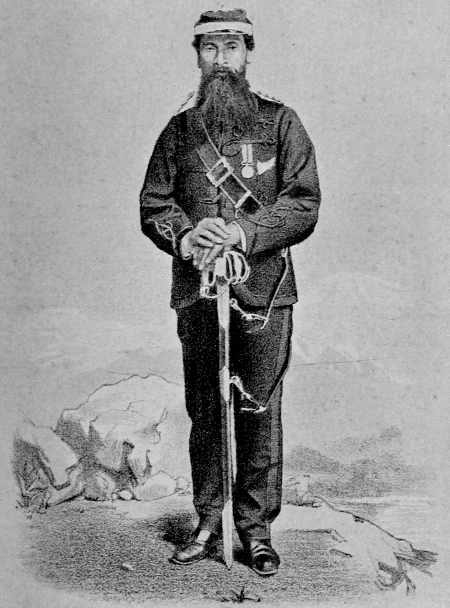
MAJOR KEMP.
MEIHA KEPA TE RANGI-HIWINUI.
“Burke,” said Mr Roach, “look at the foot of
that post to your right front; you will see the head
of a beggar peeping over the edge of the trench.
Try and put him out of mess.”
Looking at the post indicated I could just see
half a Maori’s head peeping out, evidently trying
to spot what was going on, so as directed I took
a steady aim and fired.
“Good shot,” ejaculated Mr Roach, “but I don’t
think you got him, for he ducked at the flash like
a coot; anyhow you have given him a strong hint
to lie low, as you knocked a splinter off the post
just where his head had been. By Jove, here the
column comes.”
I looked back and saw the head of the column
debouching from the bush, and when four companies
had reached the open they wheeled left
and right and left the road clear.
“Wonder what they are doing that for?”
soliloquised Mr Roach, but he was soon answered,
as over our heads shrieked an Armstrong shell,
which passed over the palisading and plumped
right into the middle of the pah, where it burst
and kicked up any amount of row, smoke, dust and
bobbery. This surprise packet was quickly
followed by several others, and a burst of flame
told us that some of the huts inside had caught
fire. Still not a shell had touched the defences,
and as all the defenders would be in the trenches
it was not likely any of them would be hurt.
Subsequently it was discovered that only one
man had had his head blown off, which went to
prove the inutility of bombarding Maori pahs.
Suddenly Mr Roach shouted out: “Look out,
men, the stormers are advancing. Keep your
eyes on the foot of the pekerangi, take good aim
and make the Hau Haus keep their heads down.”
Glancing round I saw the troops formed in two
columns, and heard the advance blown, but then
had to concentrate all my attention on our own
business, which was to prevent the Maoris from
raising their heads out of the trench so as to take
aim at the stormers. This we did, as the moment
an over-inquisitive Maori bobbed his head up to
take a look or get a shot three or four bullets
would splash around it as a hint to him to tuck in
his twopenny.
Presently from the rear I heard the measured
tramp of advancing columns, and soon the order
was given for the leading companies to deploy,
previous to making the rush. We were now very
busy, as the heads were popping up a dozen at a
time, but as yet not a shot had been fired nor a
sound uttered from the pah.
The Maori individually is a vile shot and quite incapable
of hitting anything he aims at, at fifty yards
from him, but when he fires a volley from a trench
with the muzzle of his firelock only an inch or
two from the ground that volley is a very deadly
one indeed, especially as the object is never more
than fifty or sixty yards away from him, sometimes
closer. Again, most of them were armed with double-barrelled
guns, so that they could pour in a second
volley at a storming party more or less disorganised
by the first discharge. A Maori moreover is a
cool, brave warrior, who is brought up to regard
courage in war as not only essential but also as the
only quality by which he will be remembered
and his name honoured by his descendants.
I was lying behind my stump, with my eye fixed
on the foot of the pekerangi, when the trampling
feet came up to me, and Colonel Butler, with his
sword drawn, passed within a yard of me. Behind
him came a party of pioneers carrying axes, while
a few of them had charge of a long stout pole to
the centre of which was attached a long chain.
Close up behind these marched, in line, a company
of the 57th, the old Diehards, whose fathers had
fought at Albuera as these men had fought at
Inkermann and through the Mutiny. Oh, but my
heart did beat fast at the sight of their gallant
Irish faces, for at that time hardly an Englishman
was in the regiment, as they swung through our
skirmishing line and advanced to the grim and
silent pah. On their left marched another company
in line, led by another field officer, Colonel
Hassard, and in rear came two more companies
in support.
My work was now over, as the moment the
attacking party had passed me they masked the
pah from my fore, though my comrades at the
extreme flanks were still firing as fast as they
could load so as to cover the advance of the forlorn
hope.
Ye gods, how excited I was, an excitement
equally shared by Tim, who howled out: “Oh,
begorra, Mr Dick, mayn’t we go wid thim, sor?
Say the word, sor, and let’s go.”
But it would not do. Discipline in action above
all things, and we had to remain spectators. The
rear rank of the company had not cleared me more
than five yards when a tremendous yell rose from
the pah and the simultaneous roar of at least three
hundred rifles and guns, while sheets of lead crashed
into the advancing companies, or went whistling
over our heads, which in a second strewed the
ground with dead or wounded men writhing in
their agony.
For a moment the advance was checked and
the line wavered. Good God! surely these old
Crimean warriors are not going to flinch! Not
much. For like a trumpet-call out rang Colonel
Butler’s voice: “Steady, Diehards, go back, or
come on. I am going on. Charge!”
Did those grizzled old veterans hesitate? Not
for a breathing space. Their much-loved countryman
and commander was in front of them, so was
the enemy, and with a yell wilder even than the
Maori war-cries every man able to move rushed
forward. At the double, howling for blood, the
supporting companies rush past, a rush that the
second smashing volley of the Maoris, although
it sadly thinned their ranks, could not check, and
in a few moments the whole storming party had
launched itself against the pekerangi. Would
they succeed, or was it to be another Rangiriri?
Half mad, I jumped on to the stump that had
sheltered me and glued my eyes on the proceedings.
Mr Roach and all my comrades had done the same,
and though the dense smoke hid most of the conflict
from us, still we could hear the ferocious yells
of the natives, the cheers and savage imprecations
of our struggling men, while occasionally the ring
of the axe-blades on the fence reached us, although
deadened, as they well might be, by the continuous
firing.
All of a sudden I saw the long pole that the
pioneers had carried launched over the fence, and
my mind pictured the line of men swaying on the
chain. What’s that? as a triumphant shout is
raised, and with a rip, crash, down comes some
fathoms of fence. Yell on yell goes up, the shots
lessen, the bayonets flash, the smoke blows away,
and we can see the wild Irish, cheering like mad,
pour through the breach and into the trench.
Did we cheer? You bet we did, and many a
smasher hat was slung skyward and many a
laudatory cuss was cussed. “Who dare say a
word agin the Quane’s reglers now?” howled Tim.
“God bless the boys from Ould Ireland. Wud to
God I was wid thim.”
But the pah is not taken yet, the earthworks
and permanent fence still remain to be negotiated,
and we see the Tommies swarm up the parapet,
every inch of which we know to be flanked, and
rush at the palisades, giving one another backs to
surmount them.
With his sword hanging to his wrist by the sword-knot,
a young officer is the first man up. He is on
the top, grasps his weapon, steadies himself for a
moment, preparatory to leaping in, but throws up
his arms and falls backwards, dead. Now there are
two men up, their rifles hanging to their right
shoulders by the slings, one falls back but the
other, regaining the hold of his rifle, jumps in.
Before he can have reached the ground three or
four more are over, then a dozen, then a swarm,
and then, as Tim remarks, “they are lepping over
like crickets,” and the dust, smoke and yells float
up to the bright blue sky.
But we are called to order, for Mr Roach shouts,
“By the Lord, they’ve taken it. On your right,
close. Double!” and we rush to our right, forming
into a column of fours as we close in.
Small time is given to the men on the extreme
left to join up, for in less than a minute our O.C.
gives the word: “Come on, boys, double!” and
we run as hard as we can round the left flank of
the pah, and make for the rear of it, taking no
notice of the shots fired at us.
As we come round to the rear we catch sight of a
long line of natives evacuating the place and
making for the bush, that on this side was less than
one hundred and fifty yards from the work, and we
race to try and cut them off. Many of them
however are women and children, so we do not
fire, but our attention is speedily distracted by a
sharp fire opened on us from the bush.
Like a gate we swing round. “Extend and
charge!” shouts Mr Roach, and we rush at the
bush full pace, reaching it two men short, and at
once take cover.
Here we have a pretty little skirmish, the natives
falling back while we press on for over half-a-mile,
when a loud yelling proclaimed they had been
joined by another party. “By Jove, they are
going to charge us. Form groups!” shouted
Mr Roach, and on this order Hutton, Jack and Tim
race up to me, Mr Roach also joining our group, all
of whom have good cover.
“’Ord blast this carbine,” growled Jack as a
fresh yell rose from the natives. “’Eyer’s this
blankity blank powder-skin busted, and the ruddy
bullet’s jammed. ’Ord rot ye,” he howled, throwing
his useless weapon down and drawing his knife
and revolver. “Come on, yer blankity blank
swine, and let’s get to handgrips with yer.”
“Dick, see your pistol’s clear for drawing;
they are going to rush us,” whispered Hutton,
and we all stood wound up ready for anything.
All at once a dead silence fell that lasted for a
few minutes.
“By God,” growled Jack, “I believe the rotten
swine have cleared,” and he picked up his carbine,
withdrew the cleaning rod and proceeded to knock
out the jammed bullet. “Just like our ruddy luck,
to be sold when yer think ye’re in for a bit of sport,”
and the bad words rumbled out of the old buccaneer
like the grumblings of a distant thunderstorm.
Jack was right in his surmises, for the cunning
natives had pretended to charge us so as to gain
time to retreat. We were still chewing the rag
over our disappointment when from the rear our
corps call sounded, followed by the retire, so Mr
Roach, after ascertaining we were all present,
reluctantly gave the orders to fall back on the
main body, and my first fight in New Zealand was
over.
We fell back slowly, as, although no one was
badly wounded, still some of the boys had corners
chipped off, and we parted with our friends the
enemy with regret. We made for the pah, retiring
over the same ground we had previously
crossed, passing a strong picket of the 14th, who,
with advanced sentries, outheld the edge of the
bush. Our two men who had fallen in the open
during our advance had already been picked up,
and we were soon back at the blood-stained pah
itself. I should have very much liked to have
gone inside, but was unable to do so, as no sooner
had we reached it than we received orders to
return to camp and get ready for the next day.
We therefore marched round the flank of it, getting
a sight of the breach in the pekerangi, and also
passed a long line of our dead comrades, whose
remains we saluted with shouldered arms; then
passed the wounded, among whom the doctors,
with rolled-up sleeves, saws and knives were
busy; and then, striking the road, slung along it at
a topping pace.
Missing Pierre and George I remarked the fact
to Hutton.
“Oh, don’t you worry yourself about them,
Dick,” quoth he; “and don’t you fill yourself
with mouldy biscuit. Pierre and George may
not have been the first men into the pah, but I’ll
bet they got a start when the looting began, and
I’ll wager we shall have a good dinner to-night.
As scouts, you see, they have a fairly free hand,
come and go as they please.”
Hutton prophesied truly, for when we reached
camp there the two giddy marauders were, squatting
over their pot like two disreputable he-witches,
and as soon as we had cleansed our arms,
refilled our pouches and washed ourselves, Pierre
slung us up a dinner fit for a duke.
An issue of grog that night loosened our tongues,
and the fight was fought over again many times,
most asserting that if the General had waited
for the Kupapas not one of the enemy would have
escaped; the others, among whom were the most
experienced men, declaring that had the Hau
Haus not been aware their retreat was open
they would not have stood, and we should only
have captured an empty pah; but all hands
expressed their confidence in the General, their
admiration for the Tommies, and agreed that the
capture of Otapawa had been a well-fought action.
Yes, the capture of Otapawa had been a gallantly
fought action, though the escape of the bulk of
the Hau Haus rendered the success almost, if
not quite, nugatory, and we had lost heavily.
Colonel Hassard had fallen, sword in hand, Lieutenant
Swanson of the 14th was badly hurt, while
the long lists of dead and wounded nearly equalled
the number of dead Maoris found in the pah.
Again the natives were still in force in the bush,
so the victory would not enable one settler to
return to his homestead, nor would it permit any
cessation of the campaign, for the Maoris had
many pahs and only regarded these places as a
suitable battle-ground, the loss of one of them not
affecting their morale in the slightest degree.
I have stated that Colonel Hassard fell while
leading on his men. Well, the same night a yarn was
started, how, or by whom, the Lord only knows,
but it ran like wildfire through the camp, and was
implicitly believed, that the man who picked him
off was Kimball Bent, an infamous deserter from
the 57th.
This yarn, like many another lie, such as the
“Up Guards and at them” of the Iron Duke,
the sinking of the Revenge, and numberless other
picket-line stories, crept into history and is believed
by the masses, but in this case the fact remains that
the tribe who harboured K. Bent, Esq., were not
present in the action at all, and it is therefore
most improbable that the aforesaid scoundrel
had any hand in the gallant officer’s death.
Incredible as it may appear to home-staying
people, there were soldiers capable not only of
breaking their oaths and deserting their colours
but also of joining the enemy, even when such
an enemy should be bloodthirsty, fanatic savages
reeking with the blood of slaughtered white
women and children. Yet such was the case,
and several of H.M. soldiers did so; among others
this villain, Kimball Bent.
This man was an Irish American who had enlisted
in the grand old Diehards, in which corps
he worked in the armourer’s shop, being, moreover,
one of the best shots in the regiment. Having
committed a crime he was tried by court-martial,
Colonel Hassard being president, convicted and
punished, whereupon he deserted and joined the
Hau Haus.
Well the yarn went round that he had shot
Colonel Hassard, and had he fallen into the hands
of his countrymen his end would have been a
very rough one, for anyhow he had fought against
his own regiment, a crime never forgiven by a
British Tommy; so it would have mattered but
little whether he had shot Colonel Hassard or not.
He was never taken prisoner, but for all that
came to a bad end, as Nemesis was on his track,
and his punishment was heavier even than it
would have been had he fallen into the clutches
of his enraged comrades.
On his desertion he had joined the Ngatiruanui
tribe, whose fighting chief, Titokowaru, a fanatic
and bloodthirsty Hau Hau, was the white man’s
bitterest enemy on the west coast, and who on
more than one occasion defeated us. As Bent
was an armourer, and very useful to the natives,
he was at first well treated, and there is no doubt
he fought against his flag and late comrades with
such savage courage as to make a great reputation
among the natives as a high-toned fighting man.
But he must have always been in mortal dread of
his ferocious protector, as he continually wrote
letters, which he contrived to leave about so that
they should fall into our hands, bewailing his fate
and begging for mercy.
At last reports, circulated by some settlers
among some friendly natives, that Bent had
offered to shoot Titokowaru, provided he received
pardon, came to that chief’s ears, who at once
decided to make away with him, especially as he
had another deserter whom he employed converting
hymn-books, prayer-books, and goody-goody
literature into cartridges. He therefore gave
orders for Bent to be killed, but the latter’s suspicions
had for a long time been aroused, and
he never moved without his arms, while his great
reputation as a fighting man also prevented a
big rush of applicants for the job of executioner.
However, no man can keep awake for ever,
and although the miserable wretch knew men
were ever on the watch to take him at a disadvantage,
he at last fell asleep in his whare (hut).
The man who spotted him crept into the hut and
tried to tomahawk him, but through nervousness
only wounded him.
At once the intrepid scoundrel grappled with
his assailant, overthrew him, and would have
killed him had not a number of others rushed up,
who cut him to pieces, his remains being then used
as porkaroa (long pig), a fit ending for a traitor
to Queen and flag.
All the other deserters met the same or, in some
instances, a far worse fate, and the one or two of
them who escaped and gave themselves up were
only too thankful to accept any punishment they
received.
I must sue for pardon for this digression, but I
have recounted it as one of the thousand of facts
that took place in the New Zealand wars of
which the good people in England are blissfully
ignorant.
That night when orders were read out we were
warned to hold ourselves in readiness to march
at daybreak for the Waingangora River, and on
being dismissed we hurriedly sought our mi-mis,
so as to get as much sleep as possible, for we saw
the days were approaching when, as old Jack
remarked, it would be double watch on deck and
no watch below.
CHAPTER VI
A FROLIC WITH THE KUPAPAS
The late general had not deemed it expedient
for the regular troops to enter the bush—that is
to say, to follow the Maoris into the trackless
mountains that, covered with enormous forests,
constituted the interior of the North Island and
surrounded Mount Egmont, which a glance at the
map will show the reader to be the centre of the
big blunt promontory that juts out of the west
coast of the North Island.
Sir Trevor Chute, however, saw the absolute
necessity of carrying the war into the natives’ own
country and compelling them to sue for peace.
He had therefore determined to force his way
due north through the bush to Taranaki and show
the Hau Haus that the difficulties of their natural
fortifications were not unsurmountable. By this
march he would pass to the east of Mount Egmont
and penetrate a country that had never previously,
except on one occasion, by Father Pezant, been
crossed by a European.
This was a big order, but I shall relate how it
was carried through in due time. Suffice it for the
present to say we left camp before daylight and
saw the road all clear for the column, which joined
us on the banks of the Waingangora during the
afternoon.
Later on Mr Roach called me and said: “Burke,
I have been ordered by Colonel McDonnell to
accompany the chief, Te Kepa, who with one
hundred and fifty Kupapas” (friendly natives)
“leaves camp on a reconnoitring expedition. He
has also instructed me to take four of my own
company with me. Would you like to come?
I will not disguise the fact that the work will be
very hard and that we shall have a rough time,
but we are sure to see some real Maori warfare,
native against native.”
Of course I jumped at the chance, and he despatched
me to warn my three mates to draw four
days’ rations and be ready to start at sunset.
At the appointed time we joined our officer and
proceeded over to the Kupapas’ lines, where for
the first time I saw the famous fighting chief, Te
Kepa, who was even to rise to greater fame before
the end of the war, and was undoubtedly one of
the chief factors in terminating it.
Te Kepa was a Maori, able to grow a large beard,
an appendage rare among natives. He was not
above middle height, but had a tough, wiry look
about him that denoted great strength and an
ability to stand any amount of hardship. This
chief was better known among the Europeans by
the name of Major Kemp, and was highly respected
by all ranks of society. His men were chiefly
drawn from his own tribe, the Wanganui, and
were about three hundred in number, big, brawny
fellows, good fighting men, but an officer required
the tact of Satan as well as an intimate knowledge
of their manners and customs to handle them.
No sooner had we reached the Kupapas than
night fell and Te Kepa indicated it was time to
march, so we started along a rough track that led
inland.
The object of the expedition was to reconnoitre
a big pah called Ketemarae so as to ascertain if
it were strongly held, as it was the intention of
the General to move the column on there next day,
and, in case we found it strongly occupied, Mr Roach
was to find out the ways of approaching it.
Our scouts had gone on some time before we
started, and we had hardly made a move when the
heavens opened and it began to pour with rain,
which it steadily continued to do all night
long.
This made the march, which was over a bad bit
of country, very miserable, as the track, if it could
be called one, was intersected by many steep gullies,
the sides of which were slippery to a degree, so that
we were soon not only soaked through but became
plastered with mud from top to toe.
We, however, must push on, and did so, arriving
in the vicinity of Ketemarae just before dawn.
Here we halted and shivered till the sun rose, when
the clouds cleared away with every promise of a
fine hot day; then as soon as we had made sure
our firelocks would go off we extended and advanced
towards the pah.
We had not moved more than a hundred yards
when two of our scouts joined up, who reported
that to the best of their belief the pah was unoccupied,
which surmise Kepa very soon found out
to be correct. It was a strong place, but we did
not remain in it as Te Kepa deemed it better to
take up a position in the bush. Here we rested,
and I was glad of the spell, as it gave us the chance
to dry our sopping clothes and get rid of some of
the superfluous mud.
Mr Roach, Te Kepa and three or four chiefs now
held a runanga (council), and I was much struck,
although of course I could not understand a
word uttered, by the elegant and forcible manner
in which each chief gave his opinion, and how
carefully and earnestly every man listened to the
arguments of the others, notwithstanding, it was
easily to be seen, there was a considerable difference
in their ideas.
When each man had had his say Te Kepa gave
his orders, to which they all acquiesced without
demur.
As soon as the debate was over, Mr Roach kindly
told me the purport of the meeting, which was to
try and solve the problem why the pah had been
abandoned without a show of resistance, as this
was contrary to Maori war etiquette, which required
at least one volley to be fired in honour of
the pah, although it might not be deemed advisable
to hold it to the bitter end.
The opinion therefore come to was that the
pah was not abandoned, but that the Hau Haus,
not expecting such unwonted activity on the
General’s part, had temporarily withdrawn for
some purpose, probably to hold a tangi (wake) over
the warriors killed at Otapawa, and were most likely
to return that day to reoccupy the pah.
It was also decided that if they did so it would be
as well to allow them to enter it, as then, our being
on the spot, we could hive them, holding them
inside till the arrival of the General, when not a
man of them would escape. It was therefore
Te Kepa’s determination to lie dog-o and try to
entrap the Hau Haus in their own stockade.
The position we had taken up not being considered
a satisfactory one to carry out this purpose,
it was after much deliberation changed, and we
made ourselves as comfortable as we could in the
thick, damp bush, though as no fires were allowed,
and the sun could not penetrate the dense foliage,
the amount of comfort, thanks to the incessant
drip from the trees, did not amount to a row of
pins. Of course we had a patrol of scouts out on
all sides of us, and on that day I began to take an
interest and acquire a rudimentary knowledge of
the fascinating, though highly dangerous, game.
The day dragged on and I was only able to get
a few moments’ broken sleep, as I was not yet
sufficiently broken in to be able to sleep under such
disadvantageous circumstances, and envied old
Jack, who snored away on the soaked ground as if
he had been on a feather bed. Nor can I truthfully
say I enjoyed my dinner, composed as it was
of sodden, rancid salt pork and a handful of wet
mouldy biscuits.
As I said before, we had our scouts out, and we
learned during the afternoon that the enemy had
theirs out also, for one of our fellows came into
camp with a gaping tomahawk wound in his
shoulder, while his own weapon, and in fact his
whole person, looked as if he had indulged in a
blood bath.
His yarn was short. He had met a Hau Hau
scout face to face; neither of them could get away
nor hide, so they turned to and had it out with
tomahawks. Our man had the best of the argument,
which he proved by producing not only the
tupara (double-barrelled gun) and tomahawk of
his opponent as a spolia opima, but also certain
portions of the enemy himself, so that no doubt
could exist in the most sceptical of his encounter or
victory. He received great kudos, and submitted,
without a tremor or complaint, to having the gap
in his shoulder sewn up in the roughest possible
manner. Nor did it seem to interfere with his
appetite, as, noticing his eyes glued on my mass of
putrid pork, I handed it to him, and he devoured
it with a gusto I quite envied.
This little contretemps showed Te Kepa that the
Hau Haus must be well aware of our presence,
though perhaps not of our exact locality, and as
he became extremely desirous of ascertaining theirs
more scouts were detached for that purpose.
The trap was no longer to be thought of, as the
enemy were far too astute to allow themselves
to be shut in, especially as they must now be fully
aware of the advance of the column, which in fact
shortly arrived, heralded, as usual, by Pierre and
George.
These two beauties we found out afterwards had
smelt out our lurking-place early in the day, but,
not being able to decide whether we were friends
or enemies, had sat tight and waited for the main
body to close up. They had, however, managed
to get into the pah before the soldiers, where they
discovered a hidden stock of potatoes, with which
they joined us, so we had a feed of spuds that night.
As Colonel McDonnell still wished Mr Roach to
remain with the Kupapas we camped with them.
Te Kepa receiving orders to advance next morning
and reconnoitre the country for another day’s
march ahead, his remaining men also joining us
made up our party to over three hundred men.
We had now every prospect of a fight, as our
scouts came in with information that large numbers
of the Hau Haus were in our vicinity though they
were so skilfully protected by their scouts it was
impossible to locate them to a certainty, but still
they were convinced they were mighty adjacent
and hungry for a fight.
Te Kepa therefore took every precaution, each
of which I noted carefully, Mr Roach being kind
enough to explain their raison d’être. He also
told the chief that I was not only a well-born
rangitera (gentleman), the descendant of war chiefs,
but was in my humble position so as to acquire the
wisdom and knowledge of war, whereupon Te Kepa
was good enough to take great interest in me, presented
me to his principal warriors, and instructed
his men to look after me as I was his guest.
This Mr Roach informed me with a laugh was
better than taking out a life policy, as the natives
hold themselves responsible for the safety of their
guests, so they would take the greatest care of me,
and that, even should I unhappily come to grief,
my remains would be carried off at any cost, for
to allow a guest to be turned into long pig would
be the greatest disgrace that could befall the tribe.
Long before daylight next morning we were on
the move, and it was simply wonderful how we
slipped through the silent bush without a sound.
I could no more have walked through that pitchy
darkness under the trees and through the tangled
shrubs by myself, much less have moved in a straight
line, than I could have flown, but in accordance with
Te Kepa’s orders I was attended by four huge
savages, one of whom led each of us, the one attending
to me sometimes even placing my feet so as
to prevent my tripping over obstacles I could not see.
After a sharp march which, for all I knew, we
might have made alone, my attendant suddenly
halted, pulling me down behind a big tree-root.
What made him do so I knew not. I had not heard
so much as a twig snap, not a whisper had passed
along the line of invisible skirmishers, and why he
had come to such a dead stop I could not divine,
except it was some subtle instinct that warned
him there was danger ahead, or that by some extraordinary
system of transmission of thought his
chief could convey his wishes to his men. Whatever
the reason may have been, there we stuck
until a dim twilight penetrated to our lurking-place,
when I indistinctly saw we were close to the
edge of the bush, which here ran out into an open
glade some one hundred and fifty yards across,
on the far side of which it began again.
All of a sudden, without a word of orders, my
mentor rose, beckoning me to do the same, and
we emerged from the bush simultaneously with
the rest of the party, when in a moment the glade
that had been deserted before was filled with a
long line of men clothed in belts, pouches and a
few feathers, devil a rag else, in extended order,
looking, as Egan subsequently remarked, “like a
regimint on bathing parade,” but it showed how
wonderfully the natives had kept their line and
how exact pre-given orders or instinct had guided
them.
That Te Kepa must have gained news as to the
whereabouts of the Hau Haus is to me now evident,
as, taking advantage of a slight ground mist, he
moved us rapidly across the open, nor did anyone
seem surprised when we were greeted by a tremendous
volley which, strange enough to say, hurled
over our heads without touching fur or feather.
Immediately our men let out a yell of derision,
poured in their answering volley, and without a
pause charged through the mist and smoke straight
at their concealed enemies.
We reached the bush on the run and pressed
forward, our men still being careful to take cover
but yet advancing so rapidly that the enemy
must needs give ground or stand up to a hand-to-hand
fight, which, as we outnumbered them, was
not to be thought of, so that after a short, sharp
conflict, in which much powder was burned and an
immense amount of breath expended in yelling,
the Hau Haus retired at the run, leaving behind
them three dead bodies, this in itself being an
acknowledgement of defeat, as a Maori will run
very great risks rather than allow a wounded or
dead tribesman to fall into an opponent’s hands.
We had begun our day well but there was still
plenty of work in front of us, and Te Kepa was
not the man to waste time, so, dividing his men
into two parties, he despatched one of them to try
and cut off the retreating enemy, and with the
other, among whom were our party, followed on
the track of the flying Hau Haus.
They had not, however, flown far, for before
long we came to the remains of an old deserted
pah in which they had taken post, and as we
advanced opened on us with a heavy fire, at the
same time yelling defiance, and challenging us to
assault them.
To this our men replied with a step or two of the
war-dance, a couple of volleys and a baldheaded
rush that sent the rotten old palisading galley
west, and into the ancient works we poured.
The Hau Haus fought well, but it was our boys’
day out and they would not be denied but drove
them helter-skelter out of the place, forcing them
to abandon five more dead bodies.
Without a pause we followed on in full pursuit,
but they had had enough of it, so broke and bolted
all over the country. This, however, did not
check Te Kepa, for, selecting the spoor of the
biggest mob, we pushed on, but failed to bring
them again to action.
During this pursuit our detached party joined
up, who reported, producing evidence, that they
had killed two more Hau Haus, and Te Kepa,
after a short halt, decided to move on and attack,
or at all events reconnoitre a large pah called
Mawhitiwhiti.
This was decidedly a piece of presumption on
our part, but the Kupapas were full of wakahihi
(fighting spirit), profoundly believing it to be their
lucky day. Up to now they had not a single man
wounded, and at Te Kepa’s orders would have
attacked Old Nick himself.
Moving on, therefore, as jovial as a party of
schoolboys out bird’s-nesting, although not a
precaution was relaxed, you bet Te Kepa watched
that we came in sight of the place strong enough
to make an army pause, and boldly advanced
towards it, our men all game for a rush whenever
they received the order. But it was not to be,
for although the enemy fired volley after volley
at us while we were at a long range, and yelled
like blazes, yet the moment we started to close in
and charge they evacuated the place and fell back
to another position even stronger.
This was not playing the game, so our men got
vexed, and we went after them hot-toe, attempting
to surround the new pah in which they had taken
post, so as to cut off their retreat should they be
so inconsiderate as to try any more runaway
tactics, but unfortunately we could only surround
them on three sides.
The Hau Haus had also received strong reinforcements,
so that both Mr Roach and Te Kepa
deemed it advisable to send back to camp for
assistance, which was done, but not wishing to
waste time we set about the job ourselves, and
that to some purpose, for, after both sides had
fired and yelled as hard as they could for over ten
minutes, word was passed that the Hau Haus
were escaping down a steep, densely bushed gully
on the side we had been unable to occupy.
Immediately a general rush was ordered and we
charged the place at top speed, swarming over the
defences like monkeys and driving out the last of
the enemy, who fled precipitately, leaving behind
them seven more bodies, together with a large
number of fine fat pigs and an immense amount of
potatoes. They had indeed left us their breakfasts,
for the hangis (underground ovens) were full of
deliciously cooked pork and potatoes, on which
we regaled ourselves sumptuously.
The Kupapas now considered they had done
enough work for their day’s pay and declined to
follow on the flying enemy, but after a huge
repast they indulged in a short war-dance and
prepared to fall back on the camp.
First of all everything we could not take away
with us was destroyed, and the dead bodies
mutilated, in accordance with Maori customs,
for although our men were not openly acknowledged
cannibals, yet all the senior men had been,
while the juniors were not a generation removed
from the practice, so that mutilation of the dead
and many other uncanny customs were still
adhered to.
Then the pah itself was insulted and dismantled
and everything inflammable burnt, after which
we fell back, treating Mawhitiwhiti and the other
places in the same way.
I was now to learn another lesson, for Te Kepa,
notwithstanding our success, would not abate one
jot of his precautions.
Our men were loaded with loot, they could
please themselves whether they carried it or not,
but they must do their duty, and it was well such
was the case, for presently, when we were in thick
bush, one of our rear scouts (yes, my would-be
military reader, it is just as requisite in irregular
warfare to scout to your rear as well as to your
front, and don’t you forget it) ran in with the
information that the Hau Haus, furious and
indignant with the treatment we had served out
to them, were in full pursuit, determined to exact
utu (payment or revenge) for our manifold misdeeds.
On hearing this news Te Kepa caused us to
rapidly push on till we came to a long clearing in
the bush, at the camp side of which he ordered two
hundred of us to lie down and take cover, thus
forming an ambuscade. The remaining men, after
they had thrown down their plunder, he led back
towards the advancing Hau Haus. These he
quickly encountered and engaged, but after an
exchange of shots he and his men, all at once
simulating panic, turned tail and bolted, closely
pursued by the now exulting enemy.
Away our men rushed in headlong flight, crossing
the clearing and breaking through our hidden line
like frightened deer, and after them rushed the
triumphant Hau Haus, every man of whom was
hungry for slaughter, and faith they got it, but not
in the way they wished; for as they put on a
spurt to cross the clearing they were met half
way by a smashing volley, behind which came our
charging line, which so astonished them that they
turned about and sprinted all they knew to safer
localities.
Te Kepa would not allow us to pursue, no doubt
having good and sufficient reasons for not doing so.
We therefore again humped each man his plunder—mine
was a well-grown, succulent young pig—and
continued our journey back to camp, where,
loaded with good things, we white men rejoined
our own company, who received us with open arms,
while the Kupapas spent the evening in feasting,
singing songs of triumph and dancing war-dances
in honour of their own merit.
True, they had done well, for they had taken
and burnt five pahs, killed a lot of the enemy,
looted and destroyed large quantities of food,
and done all this without having one single man
wounded.
Individually, I was very satisfied. I was gathering
lots of valuable information, could now hump my
swag with but little discomfort, and had thoroughly
satisfied myself that, no matter how rough and
hard the life and work were going to be, I had go
enough in me to tackle anything I might be called
on to perform. So that I ate my dinner with
gusto, sang a song when called upon to do so
at the camp fire, and slept as soundly on my fern
bed as an innocent child in its cradle.
CHAPTER VII
BUSH-WHACKING
It was on the day following Te Kepa’s successful
reconnaissance that the troops destined to form
the party for the General’s projected march
through the bush to Taranaki were warned to
hold themselves in readiness to start the next
morning, and I was delighted when Mr Roach
informed us that our mess had been included in
the party of forty Rangers that had been selected
as one of the units of the column, which was to be
composed of three companies of the 14th Regiment,
eighty Kupapas and our forty Rangers.
There was a considerable diversity of opinion
among our men as to the advisability of this
movement, all the old hands being unanimous
that it would be a bitter hard undertaking, especially
as we were to be accompanied by a long string
of pack-horses, without which it is impossible
for regular troops to move. These would impede
our progress and necessitate much arduous fatigue
in the way of road-chopping and getting them
across the deep gullies, creeks and watercourses
that everyone knew ran from the mountain down
between its shoulders and spurs, over which our
route must lie.
Every yard of the journey ran through dense
bush, and although Father Pezant had, with
assistance of Maori guides, walked the distance
in two days, yet that was a very different pair of
shoes to conveying a long string of pack-horses,
heavily laden, over the same ground.
Then again, would there be any fighting? Our
sages thought not. The natives themselves rarely
used the route. Father Pezant declared the
country to be quite deserted, and the Kupapas
also asserted that that part of the district had
never been inhabited, although none of them were
conversant with the locality.
We had therefore the pleasing prospect before
us of slogging hard work without any fun to enliven
it, and for the first time I heard colonial
irregulars chew the rag (grumble).
Now there are two qualities of grumblers. One
is the open grumbler who grouses because it is
his nature to do so and he can’t help himself,
yet when it comes to the point does his duty and
performs his work better, perhaps, than a more
complacent man. Among such may be reckoned
most old sailors and soldiers. The others are the
stealthy grumbling dogs who incite young soldiers
to mutiny, taking jolly good care to keep in the
background, out of trouble, themselves. These
are dangerous scoundrels who ought to be flogged
and hung without mercy; no close season should
be allowed for such vermin.
Of the first lot mentioned was old Jack, a typical
grousing old shell-back whose whole existence,
if you believed him, was a grievance. Still he was
always one of the first to fall in for any extra work
or hardship the corps might be called on to face,
and would volunteer for any nasty job, grumbling
while he performed it, as if he were a victim to bitter
injustice, and had been forced against his will
and out of his turn to undertake it. In fact, as
Tim put it, “Sure ould Jack wud grumble if he
got a first-class passage to heaven, wid free drinks
at all the stoppin’ places. But maybe he’d be
right, seeing all his friends and acquaintances are
in the other place, and maybe the ould boy wud
fancy he’d been put in the wrong train agin his
own inclinations.”
Of the second class of grumblers was Mete Kingi
Te Anaua, a chief of the highest rank among the
Kupapas. It must be remembered that Te Kepa,
although the head fighting chief, was by no means
the paramount chief of his tribe, nor was he even,
by birth, of first-class importance, for although of
aristocratic descent he owed his position to election
as the most highly intellectual fighting man
among the Wanganui. Of this there was no doubt,
and on the war-path his word was law, not to be
quibbled at nor questioned, but in camp the men
were very prone to be led away by the arguments
emanating from such a high-born source as the
Right Dishonourable Mete Kingi, who did everything
in his power to render the utility of his tribe
nugatory. Also it must not be supposed the
Kupapas were fighting on our side on account of
any love they bore the white man, far from it,
the reason they fought being the intense hatred
they entertained against the hostile tribes, their
old-time enemies, who were in arms against us
and also against the crazy, fanatical religion that
had turned these tribes from being whitewashed
Christians into howling bloodthirsty murderers.
Massa Mete Kingi hated the white man, and
although self-preservation prevented him from
open rebellion, still he wasted no opportunity of
thwarting and hampering their movements.
This projected march of the General was of
course far too good a chance for Mete to let slide,
so he made his game accordingly, and played it
for all he was worth.
Colonel McDonnell, however, had foreseen the
probability of him raising trouble. He had been
absent from camp for two days, but returned that
night at twelve P.M., bringing with him Dr Featherstone,
an old settler in whom the Maoris had
great confidence.
These two gentlemen on their arrival went to
the Kupapas’ line, where they quickly ascertained
that these Johnnies, prompted by Mete Kingi, had
made up their minds not to start; in fact they
announced their determination to at once return
home.
A general runanga (meeting) was promptly
assembled, to which Mr Roach, knowing my anxiety
to hear and see everything appertaining to native
customs, kindly called me.
It was indeed a weird sight, the Maoris squatting
in a semicircle, with their chins on their knees,
round three sides of the fire, the gap between the
ends of their formation being occupied by the
Colonel, Dr Featherstone and Te Kepa, while
a few of the principal chiefs squatted behind
them.
On my arrival I at once took post in rear of the
Colonel, and was immediately struck by the dogged,
ugly look on the faces of the contumacious natives,
whose eyes, lit up by the firelight, looked ferocious
to the last degree, and I could scarcely believe
that these were the same men who had joined so
joyously in battle only two days before; but alas,
it was so.
Colonel McDonnell and Dr Featherstone
harangued them. It was useless; threats and
entreaties were in vain. They squatted there, a
sulky, ugly mob, one and all declaring they would
not march, they would return home; let the white
men go by themselves.
This refusal on their part was a very serious
matter, as without their knowledge and bush-craft
the expedition must end in a fiasco. Mete knew
this and chortled in his joy. But Mete Kingi had
on this occasion, as on many another, overlooked
a very powerful factor, for among the crowd was
a relative of his own and a much bigger pot,
as, squatting quietly behind the Colonel, was
Hori Kingi Te Anaua, who was the head chief of
the Wanganui.
This ancient-time warrior was a very old man,
now long past war, but he had been a mighty
fighting man before the Lord, and one who, not so
many years back, had been regarded not only
by his tribe but by all the surrounding tribes as
quite the cock of the walk, while even now the
glamour of his early deeds enveloped him with a
halo, and he was looked upon by the Wanganui
as more than human. This old nobleman was of
such a great age that he rarely interfered with
tribal business, and was occasionally overlooked by
young and pushing upstarts such as Mete, but he
was there, having accompanied the Taua, not in
his official capacity but rather as a critic, so that
he might form opinions of modern warfare and
contrast them with old-time methods, also that
he might once more steep his senses in the odour
of battle.
He had moreover been a firm friend and protector
of the white man from the early days, besides which
he was a great personal friend of Dr Featherstone,
who now drew him aside and besought his help.
At the moment they rejoined the meeting the
Kupapas had again vociferated that they would
go home, and there were indications of a rough
house, but the instant the grand old warrior raised
his still enormous bulk from the ground the silence
of death fell on the crowd. For a minute he glared
round on the squatting throng, every man of whom,
fearing to meet his indignant eye, held his head
down, then with a stamp of his foot he spake.
“Listen, ye men of the Wanganui, you who have
refused to march with the Pakeha” (white man).
“It is well, go home; but I, Hori Kingi, will go with
them, even though I go alone. It shall not be said
that I deserted them; but I warn you all that if
you desert me I will never again return to Wanganui.
Henceforth the white men shall be my
only friends, and my bones shall rest in Taranaki.”
Such an awful threat had never been uttered
before. Why, the very thought that their great
hero’s bones might be buried in the land of their
hated enemies was dreadful. Not one of them dare
even think of such a diabolical catastrophe.
It was worse than blasphemy, and it took some
minutes before the frightful idea could percolate into
their understandings. There they squatted, open-mouthed
and with goggling eyes, until the same
thought seemed to flash simultaneously into their
dazed brains, when they all raised their voices to
let go the piteous howl: “We go, father, we go,”
and Mete Kingi was sold again.
Next morning the column moved out of camp,
eighty picked Kupapas leading with an air of
jollity about them as if the row of the previous
night had been forgotten and forgiven, though I
noticed that old Hori Kingi marched with Mr Roach
as if he were still a little sore over his tribe’s misbehaviour.
In rear of the Kupapas we marched; then a long
line of pack-horses, while three companies of the
14th Regiment brought up the rear. The General
having heard that Father Pezant had completed
the journey in two days had reckoned on our getting
through in three, and therefore three days’ cooked
rations had been issued to all hands.
The Maoris, however, the most improvident
men in the world, especially as in this case they
had not intended to come, had eaten most of theirs
before we started, and then, in fear of Hori, had
said nothing about it.
Anyway we were off. For the first few miles
the track, although a very rough one, was well
defined, and we pushed on, but just before noon
we came to a very deep and narrow gully. The
Maoris crossed this, so did we, but when it came to
the pack-horses’ turn the column came to a dead
stop. They certainly could not get down, and,
supposing they were chucked over the edge and
survived, it was equally certain they could not
get out at the other side, so it was a case of getting
the picks and spades off them and making one
slanting road down and another up. The Tommies
tackled this job, but it was very slow work, and we
lost a lot of time. At last all hands and the pack-horses
were got across, and we proceeded, but had
to camp, having covered a far shorter distance
than the General had expected we should have
done.
Next morning we again made an early start, but
were brought up by more gullies, some of which
we crossed as we had the first one, others we had
to bridge in a way that I shall presently describe.
The Maoris up to now had been very useful,
though they did not care for the work, still, thanks
to Hori’s presence, they had given no trouble,
yet early in the day they had allowed the two Hau
Hau prisoners we had as guides to escape.
These two fellows fled along the track, followed
of course by a party of Kupapas who were at once
put into good humour by the chance of spilling
a little blood. The prisoners in their flight came
across a party of seven Hau Haus, who, unaware
of our proximity, were quietly enjoying their breakfast,
and shouted to them to escape, but the Hau
Haus, unable to realise that the white man had
penetrated so far into their fastnesses, refused to
budge and continued their meal. The fugitives,
declining to tarry, escaped, but the alfresco repast
was rudely interrupted by the Kupapas, who
surprised the picnicking party, killing four men and
capturing a girl.
This little interlude of blood somewhat cheered
up the Kupapas, but the guides were gone, and
the track that had been getting less distinct now
entirely disappeared.
Other misfortunes now overtook us. The
natives, having eaten most of their rations
previous to starting, now demanded food, and
caused trouble, still remaining sulky even when
a day’s rations were issued to them from the
slender stock carried on the pack-horses, and then,
to make us thoroughly cheerful, floods of water
(you could not call it rain) began to fall, and continued
to do so day and night without the slightest
intermission.
We were in a hole. Guides gone, road lost, bush
thick, a deluge falling, rations short, and many a
man would have turned back, but the General,
good man, was made of the right sort of stuff,
and “go on” was the order.
“What,” said he, “the road lost, is it? Then
chop one,” and our crowd, although they might
grumble like hell, started in to give a lead.
The New Zealand bush is a stiff one to tackle,
composed as it is of enormous trees growing close
together and a dense undergrowth of evergreens
and ferns. From the trees descend huge vines,
some of them many inches in circumference, either
hanging straight up and down, or draped in graceful
festoons from tree to tree, both the trunks and
branches of the latter being covered with patches
of orchids and other parasites. Here and there
amid the undergrowth springs up an elegant punga
(tree fern), a broad leaf or a koninonino (fuchsia tree),
while an occasional patch of lawyers, a thorny
bush whose name is most appropriate, for if you
once get into its clutches you can only get out
pretty nearly naked, lies in wait for the unwary,
these and many more being bound together into
an impenetrable tangle by the ever-present souple
jack and ground vine.
After reading the above very short and very
imperfect description you will be able to understand
that a New Zealand bush is not an easy one
to cut a road through, even for pack-horses, especially
when, as in this case, the line you wish
to follow led you across the shoulders and spurs
of a huge mountain which were furrowed by innumerable
deep gullies, watercourses, and rivers.
The New Zealand bush is a very beautiful one,
yet a very silent and lonely one; not a sound is
to be heard in it, with the exception of the doleful
dirge of the wind among the tree-tops, the coo of
pigeons, the occasional ka, ka of the New Zealand
parrot, or the rarer, bell-like note of the Tui bird.
However, such as it was, we had to chop our
way, for over forty miles, through it, so with plenty
of bad language, but heaps of determination, we
buckled to and tackled the job.
Te Kepa took the lead with his men, tomahawk
in hand, and chopped away the vines; our men
followed closely after, who cut away the undergrowth
and cleared a road sufficiently wide enough
for the pack-horses following behind us, these
taking every opportunity of tumbling down,
entangling themselves among the vines, rubbing
off their loads and generally making themselves
a darned nuisance. Of course we had to have the
scouts out on all sides of us, and likewise strong
covering parties, as it would have been far too
good a chance for the Hau Hau to have missed,
not to have taken advantage of us as we floundered
along that miserable path. They did not do so;
why, we never heard, but I fancy myself it was on
account of the unceasing downpour of cold rain,
which was certainly quite excuse enough to keep
any self-respecting savage in his happy home.
All this work fell very heavy on us, as the regulars
were of but little use in the bush, either as axemen
or coverers, but we should have made light of that
had it not been for the rain, that not only drenched
us but turned the soft loamy bush soil into liquid
mud, in which we sank nearly to the knee, and forced
us to corduroy the path so as to enable the wretched
pack-horses to get any footing, while men, horses,
packs, arms and everything soon became plastered
and caked with mud.
Presently we came to a gully with perpendicular
rocky banks, in the bed of which, swollen by the
rain, raged a torrent. Fortunately it was not a
very wide one, not more than from thirty to thirty-five
feet, but it was quite sixty feet in depth. It
was impossible to make roads up and down this
fellow; our old picks and spades, probably used by
Wellington’s men in the Peninsular War, were no
use here, and we had neither drills nor explosives.
No, it must be bridged; and I wondered how this
was to be done. Now we had in our heterogeneous
corps several old and skilled bushmen (men who
live and work in the bush), the two boss men of
whom were Nova Scotians, and what these two
men, Brothers Jake and Vic M’Farlane, did not
know about how to handle timber was not worth
learning.
These two men now pushed in front and examined
carefully the enormous trees that grew close to the
edge of the ravine, out of which they selected two
that grew close together, and then called for six
men who they knew to be the most skilful axemen,
to whom Jake gave instructions, turning at the
same time a deaf ear to an Engineer officer who
advanced to propound some learned theories, but
who fell back, choked off by the good-humoured
though scarcely respectful admonition: “Here,
be a good boy, Johnny; now run away and play
nicely by yourself,” tendered him by the Blue-nose
giant.
Then at the word, “Now get to it, boys!” the
eight men sprang at the two trees like tigers.
It was simply marvellous to see these men work,
every blow falling, notwithstanding the rain and
slippery axe helves, just where it was aimed;
while the men, although they put their whole
souls into the job, did not waste an ounce of
strength. First of all a large and deep scarf was
opened in the trunks of the trees on the ravine
side, two men working one opposite the other,
each blow so timed to succeed the other as to make
huge chips fly in all directions. At the same
time the other two men were attacking the far
side, though the depth of the wound on the creek
side was kept well in advance of the other.
After some time both trees emitted deep groans,
which drew a cheer from the bystanders though
the axemen still continued to ply their weapons
with unabated vigour; and the trees, as if in
anguish, groaned and groaned again and again.
Suddenly Jake yelled, “Spell-o,” when every
axe ceased, and after a few words with his brother
he approached the General, who, with most of the
officers, was watching the proceedings.
“Say, Boss,” drawled the unsophisticated bushman
to the astonished old gentleman, “you and
these ’ere galoots had better git, or I guess you’ll
be fouled by some of them darned monkey ropes,
an’ I kalkelate they’ll bring down a heap of branches
and dead wood.”
“Ah,” quoth the General, “I presume you think
we may be in some danger in remaining here when
the trees fall.”
“You bet, Boss; you’ve struck it in once,”
replied the unabashed Blue-nose, who promptly
returned to his mates.
“Your men,” said the General, turning to Mr
Roach, “do not seem to be very conversant with
military etiquette.”
“No, sir,” replied Mr Roach; “some of them
are a very rough lot, but I assure you, sir, no
disrespect nor offence was meant.”
“Quite so,” returned the General, “and no
offence is taken, but by gad we will take his advice
and fall back a bit. That fellow knows his work.”
“You bet, Boss,” drawled one of the staff, and
they all fell back, laughing.
Jake and his pard had gone back alone to their
respective trees. “Are you ready, Vic?” yelled
Jake. “Let her go.” And the two axes fell like
one in a succession of lightning blows. “She is
coming, mate,” yells Jake.
“Mine too,” gasps his brother, as rending
cracks and portentous groans burst from the now
shivering and swaying trees and rend the air.
“Stand clear, mate,” yell both men as the now
rocking trees make a half turn inwards on their
bases, and then, bending gracefully over, as if
bowing to their Creator, their sky-kissed tops sink
lower and lower, until with a rending crash that
echoes through the bush like thunder the two
mighty monarchs of the forest fall side by side
across the ravine, while ripping, tearing crashes
announce the fact that the tough vines attached
to them are tearing off huge limbs from other trees
and, together with the concussion, bringing down a
shower of dead wood.
How the two axemen escaped was to me a
mystery. I dearly love a fine tree, and, although
by no means a religious man, always seem to fancy
they are the property of the Almighty and that
it is an act of sacrilege to chop one down—this idea
still sticking to me after years of bush life.
No such opinions, however, were entertained
by the godless Blue-noses, who no sooner had the
trees crashed down than they leapt on to table-topped
stumps, jumped into the air, cracking
their heels together, flapping their arms up and
down and crowing like cocks.
Rude as was their ebullition of delight, their
wonderful skill was manifest, for the two mighty
trunks lay across the gully, side touching side,
and the framework of the bridge was an accomplished
fact.
“Guess you lobsters may be trusted to fill up
that crack,” remarked Jake to a disgusted-looking
colour-sergeant of the regulars. “Come on, boys,
let’s lop and top t’other side,” and he ran across
the bole of one of the trees as if it had been a
coach road.
There was plenty of hard work on the other
side, so while the Tommies made a platform
for the horses to cross by filling up the interval
between the boles with brushwood, fern and mud,
we set to to clear away the abatis of huge broken
branches so as to allow them to get off the bridge
when over.
Faith, I found it bitter hard work, it being my
first attempt at manual labour, as it was also my
first attempt to use axe or tomahawk, and it was
heart-breaking to compare my clumsy efforts with
those of my experienced comrades. Moreover,
although blessed with great muscular strength, I
quickly found out that without skill it was of but
little use to me, as my hands became dreadfully
blistered and very painful, though I still continued
slogging away for all I was worth.
At last we were able to start getting the horses
across, and a rotten job we had to manage the
terrified animals, very many of whom had never
seen a bridge in their lives before. Nevertheless
by blindfolding them and making a staid, quiet
old brute give them a lead we managed to get all
over except four, who, plunging midway, fell off the
rough structure, loads and all, into the now raging
torrent, where they were at once swept away,
and of course, as rations were scarce, all these
loads were biscuits.
By the time we had got them over it was time to
bivouac, so we set about the hopeless task of
trying to make ourselves comfortable. Our mess,
first of all, cut a lot of thick poles, which we placed
side by side on the poached, sodden ground, then
covered these with small branches of undergrowth
and piled on the top a two-foot thickness of wet
fern.
While we were doing this Pierre and George had
lighted a fire. What, a fire in that pitiless downpour?
Yes, gentlemen, a fire. First of all Pierre
sought out an old miri log, perhaps the hardest
wood in the world, so hard it is almost impossible
to cross-cut it, but it will split like matchwood and
is as inflammable as pitch. Off this log Pierre
split very many splinters and pieces, George in the
meantime raising a platform of poles some half-foot
above the mud. Under cover of his pot Pierre
collected some of the inside bark of a tree, and,
producing an oily piece of tow used for cleaning
his carbine, under cover of George’s bucket, held
inverted like an umbrella, a fire is lit on the platform,
fed steadily for a time with miri splinters,
until it gains heat and power, when larger pieces
are added, until eventually the fire gains sufficient
heat to withstand the rain for the bucket to be
boiled and tea made, for a pannikin of which we
were very thankful.
As soon as our fire was in full swing others were
lit from it, but the incessant rain at last got the
best of them and they dwindled away, leaving the
camp in inky darkness.
I was on guard that night and did my first
sentry go, passing two hours crouching in the mud,
peering into the black darkness, and listening to
the rush of the rain and the chattering of my own
teeth. I was but little better off when relieved,
as all I could do was to throw myself down on a
heap of soaked fern and cover myself with my
drenched blanket.
Worn out by the unaccustomed labour, aching
in every limb of my body and suffering great pain
from my hands, I got but little sleep, yet felt
thankful when the dim daylight announced another
day. Not that it would bring us much
comfort, for the moment our sopping blankets
were rolled up and we had swallowed a mouthful
of soaked mouldy biscuit and putrid pork, the
word was given to turn to, and again we started
the endless chopping.
My hands, however, were in such a state as to
preclude my doing my work, and I was very
nervous of being ragged by my comrades, as but
little sympathy is ever shown in a corps such as
ours to a man who is unable to do his share of
work unless he is incapacitated by the steel or
lead of the enemy, and I was quite prepared to
hear myself sneered at as a kid-gloved new chum,
or to be growled at as a waster who shirked his
work and shoved his bit on his mates. In a
crowd like ours men were not over-delicate in their
satire, nor particularly considerate for the feelings
of others.
We worked in relays, ten men chopping, ten men
clearing away the cut brushwood, while the remaining
twenty men held the workers’ carbines and
rested, two men out of each section of four working
at a time.
Now I was in the second relief, Tim and myself
having to replace Jack and Hutton, so that when
spell-o was called we pushed forward, handing
them their own and our carbines and taking from
them the axes they had been using.
Stepping forward I approached Jack to hand
him the carbines, when he noticed my hands, which
were much swollen and quite raw.
“’Ere, look ’ere, mate,” growled the old grumbler,
“yer mud hooks ain’t fit for this ’ere job, just you
hold the ruddy carbines. Old Jack does your
spell. Oh, clap a stopper over your jaw. You
ain’t no blankity blank shirker, and if any blooming
swine guys yer they’ll come athwart Jack’s
hawser, d—n ’em. Now you shove off.” And all
the day the old ruffian did my work for me, helped
occasionally by Hutton, who reported my state to
Mr Roach.
The latter took me to the surgeon of the 14th,
who did what he could for me, but I was unable to
do any more axe-work that trip.
It would be tedious for me to recapitulate that
miserable march day by day; suffice it to say that
every day the same work had to be done, gullies
had to be bridged or roads cut down their banks,
and these gullies and rivers grew more numerous
as we reached our destination.
On the night of the fourth day the last of our
rations was consumed, horseflesh being issued
in lieu, but the downpour of rain, that never
ceased for a moment, prevented any chance of
cooking the raw sodden lumps of flesh served out
to us. On the same night the Colonel’s brother,
Ensign McDonnell, volunteered to push on and
try to bring a relief party out to meet us.
He started next morning, reaching the frontier
post the same night, and at once started back
again, guiding a relief party of soldiers loaded with
food. These met us on the evening of the sixth
day, on the morning of which the General had
sent on the Maoris. This supply of food, small
as it was—my share consisted of one biscuit—was
much appreciated, and on the morning of the
seventh day we extricated ourselves from the
infernal bush, and as we did so the rain suddenly
ceased and the glorious sun shone out.
Never before, do I suppose, has such a gang of
wretched-looking objects ever been mustered:
drenched and sodden by five days and nights of
unceasing rain, plastered from head to foot with
mud, our clothes torn to rags by the bush, hung
in dripping shreds, while our unshorn faces, filthy
equipment and rusty weapons made a picture I
shall never forget.
Our men took a speedy and practicable way of
getting rid of our superfluous coating of filth, for
on reaching a river we laid down our arms and
belts and then marched deliberately into it, washing
ourselves and rags at the same time, which, considering
we had not a particle of soap in the whole
outfit, was perhaps the most expeditious way of
regaining that purity which is considered next to
godliness, and was in fact the only virtue approaching
it used in the ranks of the Rangers.
On the evening of the same day we limped into
Mataitawa, where our weary pilgrimage ended,
and we were the recipients of unbounded hospitality
from the settlers.
A few days’ spell with plenty of good food and
new clothing made us forget past hardships, and
we mustered gaily, when called upon to do so, for
the return march along the coast.
There was much controversy for a long time as
to whether this bush march had done good or not.
It had certainly shown the Hau Haus that they
could no longer rely on their forests as invincible
protections, and had also taught the troops how
utterly impracticable a string of pack-horses were
in the bush, and that in future they must, like us
Rangers, hump their own swags, as it does not
pay to waste seven days over a march that should
have been completed easily in three, to say nothing
of the awful labour their presence entailed.
We started our return march expecting severe
fighting, but were disappointed, as with the exception
of a sharp brush at a large village named
Waikoko, which the Rangers and Kupapas were
ordered to rush, we met no opposition at all.
Here the Kupapas behaved badly, refusing to
charge and drawing off to one side, this conduct
being caused not through funk of the enemy, but
because they entertained grave doubts as to the
discriminating powers of the supporting regulars,
who, they opined, might shoot them from behind
as the Tommies had the unfortunate habit of
loosing off at any Maori they spotted in front of
them and then inquiring if he were an enemy or not.
True, they always apologised when in error, but
our friendlies did not consider that that was a
sufficient salve for their injured sterns, therefore
no sooner had we deployed for the charge than
they withdrew to one side, sat down and looked on.
The General thereupon threw forward a company
of the 4th, who, game as pebbles, charged
alongside of us, and notwithstanding a heavy fire
we rushed pell-mell into the place, sweeping out
the defenders, who fled, leaving behind them
several dead bodies, our loss being one man killed
and seven wounded, among whom was Tim, though
I was delighted to find out not severely.
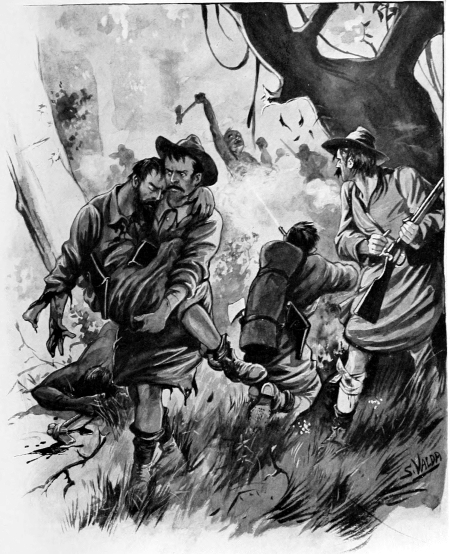
EVERY BULLET HAS ITS BILLET.
Two days after this pleasant little interlude
we reached the camp on the Waingangora River,
where the field force was broken up, ourselves
being ordered to return to Patea and go into
camp, tents and camp equipment being served out
to us for that purpose.
CHAPTER VIII
“AND WE DIE, AND NONE CAN TELL THEM WHERE
WE DIED.”—KIPLING
We reached Patea and formed a standing camp,
for as great political changes were on the tapis the
campaign for a period marked time. During
our absence the forces remaining behind under
Colonel Butler had not been idle, having defeated
and driven off the ground a large party of Hau Haus
at a place called Katotauru, while the Kupapas
had also rendered good service.
It was now generally known that the regular
troops were to be withdrawn from the country, so
that the action at Katotauru was the last engagement
in which they took part, though they were still
employed for a short time to garrison certain places.
It is not a pleasant thing to say, but it is the
truth, that during the past six years their efforts
had been futile, although all the colonial fighting
men allowed that had Sir Trevor Chute been in
command from the start of the war things would
have been very different.
It was at this time that Colonel Haultain, the
Colonial Defence Minister, determining to carry
out a bold policy, gave directions to occupy the
confiscated land situated between the Waitotara
and Waingangora rivers, and issued orders that
all the west coast colonial troops, many of whom
were at that time serving on the east coast, should
return and rendezvous at Patea. In the meantime
things were a bit quiet with us. When I say “quiet”
I use the word in the sense that we had no fighting
at least, with the Hau Haus, for a time, for no one
could call the Rangers’ camp peaceful nor reposeful,
nor was it a place in which a man given to
sedentary pursuits would care to linger or dwell.
I was now to experience the great curse of the
colony, for I regret to say the majority of our men,
rough and uncouth as they were, but who had been
quiet and tractable enough in the field, now became
a prey to the grog-seller, and the scenes of foul,
drunken debauchery were disgusting to the last
degree. This was only to be expected from the
majority of our crew, as there were many among
them who were the flotsam and jetsam of the
South Seas and Pacific slope, but what surprised
and disgusted me was that many of our worst cases
were men whom I knew to have been at one time
gentlemen.
Of course I had seen plenty of hard drinking at
home (a man in the wild parts of the world, although
colonial born, always speaks of the British Isles as
“home”), but then the vice was accompanied with
music, excitement and fun, when a man carried off
his legs by conviviality might be excused for temporarily
forgetting himself, and the crime was
disguised by its surroundings; but here it was not
even vulgar, it was bestial, and for days our camp
was a pandemonium, filled with drunken, blaspheming
fiends who, without any joviality, wit or
humour, scarcely with even an attempt at a sing-song,
gulped down vile doctored rum till they
collapsed and wallowed in their degradation.
Remember I have not written the above because
I was puritanically inclined, or a devotee to an
extravagant belief in teetotalism; far from it, for
I was myself as wild as a hawk and as reckless a
spendthrift as ever Ould Ireland produced, but
what I could not stand was the foul, bestial manners
and language brought out by the accursed poison
sold as rum.
Still there was some excuse for the men, as you
must bear in mind these fellows, accustomed to
long spells of hardship in the bush, cut off from
woman’s or any other civilising society, and undergoing
long periods of enforced abstinence, were,
when they did touch the fringe of civilisation,
mad for some change, and had but little wherewith
to amuse themselves.
Very many of them had never played a game
such as cricket or football in their lives; they had
no papers, books nor periodicals, even had they
cared to read them; and there was not a theatre,
music hall or anything of that sort to entertain
them; no, not even a woman, whose presence would
have quickly shamed them to decency, for there
is nothing that sobers up and tames a wild up-country
man more than the wholesome presence
of a respectable female. No, there was nothing
but this infernal rum, and they wallowed in it.
The day we reached Patea I had been looking
after Tim, and it was not till evening, when I had
seen him snug in hospital, I reached our tent, and
the scene there was far from pleasant for a tired,
hungry man.
Outside squatted Buck, grilling some meat on
the embers of a small fire, while a couple of pannikins
stood in the same, and a loaf of ammunition
bread lay on a blanket beside him. So far so good,
but where was Pierre and his batterie de cuisine?
We were in camp. Sutlers with stores were plentiful,
and all morning Pierre had been gassing about
the wonderful dinner he was going to give us, and
I had looked forward to it.
“Come on, Dick,” quoth Buck, “I’m getting
some tucker ready for you and me. I guess the
others won’t sup to-night; shove your swag down
here and let’s fall to.”
“But where are the rest of the boys?” I said.
“I’ve just seen Tim put away all right, and the
Surgeon-Major told me he would do well and be
fit for duty in next door to no time.”
“Oh! I’m glad Tim’s O.K.,” answered Buck,
“but if you want the rest of the boys you’ll find
them in the tent. I’ve just humped the last of
them up from the damned grog shop, and a ruddy
job I’ve had of it, but it won’t do to let one’s mates
lie aroun’ uncared for. Wish to goodness you’d
have come along a bit earlier so as to give a hand,
darned if I don’t.”
I looked into the tent and there I saw my comrades
lying in a distorted heap, mixed up with
loaves of bread, blankets, and all the camping
paraphernalia, every one of them putrid drunk.
This for a moment upset me, as I regarded
Hutton as more than a passing acquaintance, and
I could not understand how he, a gentleman by
birth and education, could have sunk his pride so
as to have got drunk in such companionship as
our mates. Old Jack I also liked, but his was a
different case, as nothing better could be expected
from him, Pierre or George than a pirates’ debauch;
and I had but small respect for Smith, who,
notwithstanding his culture, had somehow never
seemed to ring true.
However, I could do nothing for them, so
squatted down and enjoyed the meat and bread
Buck had so kindly prepared for me. Fortunately
the night was a fine one, so after a yarn by the
fire we made down our blankets and slept in the
open, leaving the tent to the votaries of Bacchus.
The following day, as the bust was still being
kept up, I attended a sale of captured loot, cattle,
horses, etc., and bought for ten pounds a very fine
horse, getting also a nearly new saddle and bridle
of the best Australian make for two pounds. The
nag was a very well-bred one and had evidently
been bred by some settler looted by the Maoris,
and was more than half wild, besides which he was
in very poor condition; but he was only four
years old, well topped, with splendid quarters, legs
and feet, and I made up my mind to set to work
to break him in and get him into good condition.
As I was overlooking my purchase Mr Roach
strolled up.
“Well, Burke,” he said, “so you’ve started a
stable, have you? Well, you’ve made a deuced
good start. I know the breed of that horse, and the
man who bred him never bred a wrong ’un,” and he
pointed at the two tomahawks’ brand on the near
shoulder. “He is by Cid out of a Duchess mare,
and is as near thoroughbred as they make them.
You have a cheap lot, but, by George! you may
have a job to break him, although once you have
done it you’ll find he’s all right, as there is not a
particle of vice in the breed. Come along and let’s
see you back him. But have you ever tried to
back a buckjumper before? What sort of a hand
are you in the pigskin?”
I told him I was all right in the hunting-field,
having ridden from childhood, but had never broken
in a horse, nor ever seen a buckjumper in my life.
“Then,” said he, “I advise you to let one of
those defence force fellows do it. There are plenty
of rough-riding stockmen among them.”
“Well, sir,” I answered, “I’m determined to
tackle him myself, especially as I want to train
him afterwards, and if I remain in the colony I
must sooner or later come across a buckjumper.”
“True,” he replied. “I’ll give you a hand with
the saddle, but bring him into the paddock so
that if he pips you we can round him up easily.
One thing’s in your favour, he is very poor, so
that you may have a chance of breaking him before
he regains his full strength.”
Buck had by this time joined us, and with their
assistance I managed to bridle and saddle the horse,
a job that gave us some trouble and attracted
many idle troopers, so that when I led him into
the paddock I had a big gallery.
The English cut of my riding breeches and boots
had given me away to the onlookers as a new chum,
and there were plenty of men offering odds that the
tenderfoot would be pipped in less than a minute.
Patting and talking to him I led him about for
a few moments up and down the paddock, which
was a field of some ten acres, surrounded with a
five-foot post-and-rail fence. Mr Roach now took
his head and placed his hand over his near eye,
while Buck held the off-stirrup ready to place on
my foot.
In a moment I was in the saddle and gave the
word to let go when Buck, having placed the stirrup,
together with Mr Roach, sprang clear, leaving
myself and horse to fight it out. For a few seconds
he stood still, then gave himself an angry shake or
two, then kicked viciously, rearing between each
kick as if he wished to throw himself backwards,
when, finding this did not move me, he stood still
and snorted as if he remarked to himself: “Well,
I am damned.” All at once he seemed to have
made up his mind, for he made a determined
snatch at his bit, and although I was on the lookout
for him he dragged the reins through my fingers,
and, like a flash of lightning, down went his head,
while his back seemed to bend and give under me,
but in a moment he shot up into the air, all four
feet leaving the ground at once, bending his back
up, arched like that of an angry cat, and returning
to the ground with a jar that nearly drove my spine
through the roof of my head. The same jar seemed
to send him aloft again like an india-rubber ball
bouncing, when after it has been thrown up into
the air it returns to the ground only to bound up
again.
This exercise went on for some minutes, and
though it was far from pleasant yet I felt I could
stick it all right, the worst part being that when
in the air it seemed as if I were sitting on the end
of an egg, as, bar a tuft of hair in front of the
gullet plate of my saddle, devil a bit of the horse
could I see at all.
Presently he stopped dead, and cheers rose from
the onlookers. “Well sat, new chum!” “Gad!
the chap can ride a bit!” and other laudatory
remarks, so that I began to think that the game was
won, when I heard Mr Roach’s voice shout: “Look
out, Burke. He is going to side-buck.”
What side-bucking meant I had no idea, but I
was soon to find out, as without the slightest
warning he again started, but this time he did not
spring straight ahead but sideways, at the same
time making his body wriggle like a snake, while
the jumps came so quickly I could not get the
chance to regain my grip, which the first side-buck
had loosened. More and more I was shifted from
my hold, and although I did my best, yet I could
not save myself, and I am sure some subtle instinct
told the horse he was getting the better of me, for he
seemed to redouble his efforts, and with one mighty
plunge sent me flying over his near wither. I fell
heavily, but was up in a moment, a bit shaken
though not hurt, and amid the cheers of the men
again mounted.
No sooner was I in my seat and the men helping
me sprung clear than he started with the side-bucking,
but this time I knew what to expect, and
was on the lookout, so was able, albeit with difficulty,
to retain my seat, and after some twenty
minutes’ game tussle forced him to walk and canter
round and round the paddock, having fairly conquered
him, which I should not have done so easily
had it not been for his starved condition.
This I set to work to rectify with good grooming
and feeding, riding him twice a day and passing
all my spare time talking to him and training him.
On two occasions only he again tried bucking,
but as he failed to get me off he gave it up, quickly
learning to know me and picking up flesh and
manners in a wonderful way, so that before a
month was over I possessed a really valuable
mount, one that in the future was to carry me
through some tough jobs and warm corners.
In this way I passed my time till my comrades
had finished their bust, which was not concluded
till their last shilling had been spent, and I also,
with Mr Roach’s kindly assistance, began to study
the Maori language, which, thanks to my knowledge
of French, came very easy to me.
As soon as they had spent all their money
my tent mates began to sober up, and it was a
pitiful sight watching them taper off. For a day
or two they were all mad for more drink and
suffered dreadfully, and acting on Buck’s advice
I began to doctor them.
On the first day I procured and issued to the
poor broken-nerved wretches five tots apiece; on
the second, four; on the third, three; and so on till,
by the time it came to one tot, with the exception
of Smith, they were all right and swore off bar
rations.
Smith, I regret to say, was not satisfied with
this regimen, and for days continued to loaf
around the camp trying to cadge drinks, and
would go to any mean extreme to procure one.
Pierre and George, when fit, returned to their
scouting, and Mr Roach kindly gave me leave to
accompany them so as to pick up what I could of
the trade.
These two worthies at first were by no means
keen to take me, as they did not consider I was
hard enough, but I managed to overcome their
scruples, and when they found I soon became
as hard and untiring as themselves they quickly
began to instruct me in their wonderful bush lore.
Yes, and bush lore is a very wonderful science,
and to be mastered by no one who does not give
himself up heart and soul to its study.
First of all there are so many things a new chum
must learn and remember, and it must be impressed
on him that the bush is revengeful and if
treated with disrespect is apt to exact a mortal
punishment. Let me enumerate a very few of
the things a man must thoroughly master before
he can call himself a scout: He must learn to
use his senses to an unnatural degree. His eye
must get accustomed to see and note everything,
although he is giving his attention to something
else. At the same time his senses of smell, hearing
and feeling must also always be on deck, while
his memory must retain every mortal thing his
senses have discovered and noted. He must be
able to pass through the bush day or night as
noiselessly as a bat and in as straight a line as
a bee, although in crossing it he will surely be
encountered by many obstacles, which he must
be able to get over, get under, or get round and
pick up again his straight line. He must be able to
approximately tell the time, day or night, and also
to steer his course without compas, sun or stars.
He must learn the different call and note of every
day or night bird and be able to distinguish them
so as to be sure that any bird is calling with its
natural note at its proper time and in its correct
locality.
These are only a few of the things a tyro has
to learn and digest, or if he does not do so don’t
let him go scouting when Hau Haus are hostile.
I am not going to turn this chapter into an article
on scouting, but have simply told you a few of
the subjects I had to learn, and which I did learn,
and digested so carefully that at last I became,
and mark you it was after long and weary work,
cognisant that I owned another sense or instinct
that informed me if I was going right or wrong
and eventually became so acute that in some
ways it warned me of approaching danger.
All this was not learned in a day or without
undergoing great hardship, but I stuck at it,
wandering through the rough country with my
queer companions, and gradually mastering some
of their marvellous skill and bush-craft.
Our duty chiefly consisted in searching for pahs
in the most inaccessible parts of the country, for
although the fighting had, for a time, ceased, yet
we were well aware that the natives were still
hostile, and in fact so long as they clung to the
Hau Hau or Pai Marire faith they must continue
to remain so.
The regular troops were at this time being
withdrawn, and Colonel McDonnell, although he
had not yet assumed the command of the west
coast, was anxious to make a move so as to get the
men out of the camp and strike another blow at
the Hau Hau. The Kupapas had returned to
Wanganui, so he issued orders for three companies
of the Forest Rangers to make a night’s march
up the Waingangora and beat up the enemy,
who were in force in that district, and it was on
this patrol that death was to be brought home to
me.
We left camp at sunset, loaded as usual, but
each company had to carry four stretchers as we
had no hospital men with us, so that we had to
take turn and turn about with the butchers’ trays,
as the men called them, and we marched all
through the night, resting for two hours before daylight.
We were moving in three separate bodies,
and were destined to get a lesson on how difficult
a matter it is for combined movements to be
carried out successfully when working in a rough,
bushed country, especially when no communication
can be held by the various units.
Our company was to make the frontal attack;
the other two, making detours, were to try and
envelop, or at least outflank, the enemy’s position,
Mr Roach’s orders being to advance to the attack
as soon as it was light enough for a man to be able
to see his fore sight. This we did, taking every
care and precaution in our advance, and found
the enemy, far outnumbering us, posted in a very
strong position.
We, however, in accordance with orders, gaily
began the fight, expecting our flankers to chip in
every moment, but they had been delayed on their
march and did not do so, and soon the Hau Haus
began to outflank us, so that Mr Roach was
forced to give the order to retire, an order we carried
out as coolly as if on parade, disputing every
fathom of ground and daring the enemy to rush us.
Still we must fall back or allow the natives to outflank
and eventually surround us, which spells
being cut to pieces in bush fighting, so we were
retiring very steadily by alternate groups of four,
my four consisting of myself, Hutton, Jack and
Buck.
The bush was an open one—that is, it consisted
of the usual huge trees without much undergrowth—so
that we could move quickly from
cover to cover but were more exposed while
doing so.
Hutton and myself were together behind one
tree; Jack and Buck behind another, about six
yards away, and at the time were in the firing line,
not more than a dozen yards away from the
advancing Hau Haus, who were yelling like a lot
of fiends newly let loose from the pit.
We were firing alternately—that is, I had laid
down and fired from the right-hand side of the
tree, then had slipped behind it, letting Hutton
take my place while I loaded under cover. Hutton
had fired and had sprung to his feet as we were
about to vacate our cover and run back so as
to pass through the groups that had taken up
their position some twenty yards to our rear, and
were ready to cover our retreat; in fact, I had
started to race back, when I heard beside me the
thud a bullet makes when it strikes flesh, and
Hutton, with a gasping cry, fell against me, nearly
knocking me off my feet.
In a moment I had hold of him, dragged him
back to the tree, and had grasped my carbine,
just in the nick of time, to meet the rush of a big
Maori who, tomahawk in hand, had charged in
to finish off his victim. He was in fact not more
than three yards from me when my bullet crashed
into his head, when, throwing up his arms, his knees
gave way and he fell dead at my feet, this being the
first Hau Hau that I could be positive of having
put out of mess up to date.
He had hardly reached the ground before I had
seized Hutton’s carbine, handing him mine, saying:
“Try and load this, old chap,” which, although
he was coughing up blood, he managed to do.
At the same instant Jack and Buck were alongside
of us. “’Ere, what’s all this?” howled the
former, his blue eyes on fire and his face as hard as
a stone.
“Leave me alone,” gasped Hutton; “the other
fellows have all fallen back and you’ll be cut off.
I’m done for.”
“Leave yer alone,” growled Jack; “that be
damned for a yarn; white-livered —— you must
think us ’uns to leave yer alone. ’Ere, Dick, you
and Buck cover me. I’ll carry our mate out. Bring
along all the carbines and give the ruddy scum hell
if they try to rush. Come on, now,” and exerting
his enormous strength the foul-mouthed old pirate
lifted Hutton, big man as he was, and bore him
tenderly, like a mother carrying a sick infant, to
the rear.
Buck and myself now had our hands full, but I
think both of our next shots must have been
lucky ones, as the Hau Haus hung back for a
moment from rushing us, a moment we grasped
to race back under heavy fire to a tree some dozen
yards away, where we turned at bay.
Again we fired, and I know my shot was a lucky
one, as I got a good chance, and saw the fellow I
had aimed at crumple up and fall, which gave us
the opportunity to again run back to fresh cover.
No sooner had we reached it than Buck shouted,
“It’s all right, Dick, the flankers have come up
and are twisting their tails; look out, we’ll get a
shot at the beggars in front of us as they bolt.
Gosh, this beats cock-shooting at home.”
Sure enough as he spoke I heard our fellows’
volleys, together with their charging shout, and
knew we were out of the fire, for at the same
moment our own company came back with a rush,
which we joined, and in a few minutes we had
taken the position, driving the Hau Haus helter-skelter
in flight.
The moment I could I made for the stretchers
and asked the doctor how Hutton was.
“Dying, poor fellow,” was the reply. “It will
be all over with him in less than an hour. Go to
him, he has asked for you several times. I expect
he will remain conscious to the end.”
In a moment I was kneeling by my poor pal’s
side, close to whom squatted old Jack, who was
swearing softly and tying a bandage round his
own leg.
“How goes it, old chap?” I asked, taking his
hand.
“Dick, dear boy,” he gasped, “I’m glad you
wiped out the beggar who shot me. Those are not
Christian sentiments, I know, but very human, still,
let him slide. Listen, old chap. Your mother
knows Lady —— well. I’m her son Eustace.
Yes, old chap, I’ve never told you my yarn, but
now you know it, as you must have heard it,
although the affair took place years before your
time. Dick, on the honour of a dying man, I was
innocent. Would to God I could prove it to the
old regiment. I knew your mother well. Now
promise to write to her and get her to break the
news to my mother, and let her tell her that as I
lay dying I swore to you I was innocent of that
crime, and that if I’ve lived like a waster I’ve died
like a man; and, Dick, when I’m dead take the
locket from my neck and send it to your mother,
she’ll know whom to give it to; and, Dick, dear boy,
get home out of this hell of drink and brutality;
there is nothing in it, only a wasted life and a
death without honour like mine.”
All this had been gasped out in short sentences,
and to try and cheer him up I said: “But,
Hutton, old pal, you don’t die without honour;
you got your death-wound fighting bravely for
Queen and flag.”
He smiled like a child and muttered: “Yes,
Dick, Queen and flag, God bless them, Queen and
flag.”
For some time he lay still, while I wiped away
the bloody froth from his lips, administering now
and then some weak rum and water, and vainly
tried to remember some prayer, if only to counteract
the awful oaths rumbled out by old Jack, who had by
now taken post on the other side of the dying man.
“Say, Dick,” growled the old pirate, as he expectorated
a worn-out chew of tobacco, “don’t
yer think our shipmate’s parted his moorings?”
And he swore with due solemnity. “Coz I feels inclined
to go back to the ruddy bush and see as if
I can’t do something to square this ’ere blooming
account. Yo’ve done your bit, you have, when yer
lifted the hatch off that swine’s head, but I guess I
feel as if I wants to do a bit myself.” And the old
fellow made to rise from the ground, but sank back
as Hutton again opened his eyes and gasped out:
“Thanks, Jack; good-bye, old ship,” and then,
after a pause, turning his fading eyes towards
mine, he whispered: “Une vie manqué, une vie
manqué, but thank God finished like a gentleman,
for Queen and flag. God bless them, Queen and
flag. So-long, Dick, go home.” And as he muttered
the last word he closed his eyes, and with a smile
on his face his gallant spirit left its clay to answer
the eternal roll-call.
There is no time for lamentation, and but little
for mourning, in the bush, so that as soon as the
doctor had pronounced our poor pal dead old Jack
and myself set about his obsequies. I first of all
removed from his neck the locket, which was sewn
up in leather, and looked through his poor sordid
pack in case there might be any letters or papers
to take care of; but there were none.
“’Ere, chuck me that blanket, mate,” growled
my fellow-undertaker. “No, mine’s a new one.
We’ll start him aloft in that, seems more respectful
like,” and the kind-hearted old filibuster substituted
his own brand-new blanket for Hutton’s tattered
one, at the same time producing a small canvas
ditty-bag, out of which he extracted a sailmaker’s
palm, needle and twine. “Yer see, Dick,” he
continued, “I always like to give a mate his last
chuck, so long as I’ve got time, respectful like.
So that he’s no call to feel shame when he toes the
line afore Davy Jones. Now you turn to and dig
the hole, while I sew him up ship-shape and Bristol
fashion, coz t’other mates will be ’ere soon and we
may have to hoof it.”
This was very true, so leaving Jack to sew up
the still warm remains I started in with tomahawk
and hands to scoop out a shallow resting-place for
my dead pal.
I had not more than half finished when I was
joined by Mr Roach and the rest of the company,
some of whom helped me to complete the grave,
and when it was ready his tent-mates lifted, with
rough though revering hands, the shapeless form,
and bore it slowly to its last resting-place. There
we laid him down, shovelling the soft soil over him
with our hands, and concealing the spot so that no
wandering Hau Hau could discover and desecrate
the remains of our gallant comrade.
Yes, there, alone he lay, without a prayer having
been said over him, without a bugle having been
blown, or without a parting shot having been fired,
and with only a mob of rough, sin-stained men to,
for a few minutes, mourn for him, yet I guess that
as horny hands wiped away a salt drop or two, and
deep voices muttered oaths and threats of revenge,
none of his noble ancestors resting under the old
abbey roof at home were more sorrowed for or
rest better than their hapless kinsman killed in a
forgotten, nameless skirmish and buried by his wild
and reckless comrades in a hidden grave on a lonely
fern ridge among the wilds of the New Zealand
bush. R.I.P.
No sooner was poor Hutton planted than we fell
in, moving off to continue the patrol, and I told
Mr Roach about the locket and message in case I
might be rubbed out, for I was new to the game then
and my poor pal’s death gave me the hump.
However, we were to have no more fighting that
patrol, and returned to camp after two more days
of bush-whacking.
On our return I found Tim had been returned
fit for duty, and I was glad of it, as my light-hearted
follower always cheered up the tent. The hump
was still bearing heavy upon me, and as it was now
the beginning of June and my period of service
terminated at the end of the month I had to make
up my mind whether I would sign on again or
return home, as my poor dead pal had begged me
to do.
I was tired of camp life, for although I enjoyed
my scouting trips, and knew there would be heaps
of good fighting to be got through in the near
future, still the glamour of the Rangers had worn
off. There was another pay-day to be faced on
the 5th July, and much as I liked some of my
comrades, yet I had no desire to associate again
with the foul, drunken, swearing mob that pay-day
would turn my companions into. No; I would
quit it. There was no middle course that I could
see, so I would return to Europe.
Man proposes but Kismet decides, for just as I
had come to the above determination Mr Roach
called me and told me to go to the Colonel’s tent
as he wished to see me, and of course I at once
reported there, where I found him hard at work,
but he at once called me in.
“Burke,” said he, “I hear you have worked very
hard to pick up a knowledge of bush work, that
you are a good horseman and leave the rum-bottle
alone. Moreover your company commander informs
me he has the greatest confidence in you.
Do you know anything of mounted drill?”
I answered in the affirmative and he continued:
“Well, I am in great want of an officer to take
over the adjutancy of the Mounted Defence Force.
I know of course you are a gentleman, well educated
and all that, so I offer you the position. The war
will breeze up again shortly and you’ll get plenty
of fighting.”
Naturally I was much gratified by the offer,
though I explained to the Colonel that I was at
present on the horns of a dilemma as to whether
I ought not to return home.
He, however, laughed, and said: “Well, Burke,
seeing you travelled fifteen thousand miles to see
some fighting it would seem a pity to return all
that distance with such a short experience.”
My late resolutions all seemed to fade away, so
after some more palaver I agreed to sign on as a
commissioned officer for three years, or longer, if
required.
As the interview terminated he drew out an
official document, which he handed to me with a
laugh, saying: “I was so sure of you that I sent
to Wellington a month ago for your commission,
and have much pleasure in now handing it you.
You will appear in orders this evening. Come and
dine with me to-night.”
As I strode away from the H. Q. lines I
cogitated over the new aspect of my affairs; but
the thing was done, all my determination of
returning home had blown to the deuce and I had
signed on for another three years. I felt rather
mad, but solaced myself with the thought that
anyhow there would be plenty of good fighting
in the near future. Of course I had mentioned
to the Colonel that my promotion would necessitate
Egan’s transfer, and he had at once directed that
the worthy Tim should be transferred in that day’s
orders, so I wended my way back to my tent to
say good-bye to my mates and see to the moving
of my kit over to the mounted men’s lines, situated
about a mile from the Rangers’ camp.
My news was received by my comrades in various
ways. Tim’s wild ebullition of joy at the idea I
was to be an officer and that he was going to be
my own man once more was tempered by the
regrets of the others at my leaving them, while old
Jack’s pungent remarks, such as “What the hell
do yer want to fight aboard a ruddy ’oss for? Ain’t
yer legs good enough? Course yer ort to be on
the ruddy poop, I know that,” etc., etc., were
rumbled out in the best grumbling style, accompanied
with his very choicest selection of bad words.
Pierre and George were also sorrowful, declaring
that the Rangers were losing their best scout,
but their lamentations I cut short by slipping a
couple of sovereigns into Pierre’s hands, telling him
to go to the sutler’s and procure materials for the
very best repast he could manage to serve up.
This he did, and a wonderful repast it was, so
that when it was over, and the farewells said, old
Jack himself confessed: “Things did not look so
dirty to wind’ard after all,” and insisted on helping
Tim to carry our kits over to our new camp, while
I mounted my horse and rode over to report myself
to my new O.C.
CHAPTER IX
I JOIN THE TROOPERS
I was very kindly received by my brother officers
on joining, all of whom were fine fellows, but sadly
deficient in their knowledge of drill, so I had to
turn to at once and knock them into shape.
Our duties chiefly consisted in patrolling, escorting
strings of pack-horses or drays, where practicable,
loaded with rations, etc., and despatch-riding,
the latter a very arduous and dangerous work
indeed, of which I shall say more anon, though of
course we had to do our share of bush-whacking,
when we discarded the breeches and boots for
shawls.
The troopers were the perfection of irregular
mounted men, being taken mostly from young
colonial fellows who had been stock-riders, but
there was a good leaven of broken-down gentlemen
and remittance men, so, taking them altogether,
they were a hard-riding, hard-fighting, hard-swearing
and hard-drinking crowd.
You may have some difficulty in understanding
why troopers should of necessity be hard swearers.
Let me explain. The bad habit comes from
driving pack-horses, most of which beasts of burden
are mules, and pack-mules, like transport oxen, will
not do their work without being comforted and
encouraged by the most awful language, stock
whips by themselves being useless; so even the
most religiously brought-up young men acquire this
habit and stick to it.
It was in the beginning of July that Colonel
McDonnell assumed supreme command and it
was officially announced that the regular troops
were to render no further service in the field, but
were to evacuate the country at their earliest convenience.
We now therefore began to look out for sharp
work, as our O.C. was not the man to let the fern
sprout without doing something, and although it
was winter, and bitterly cold, we knew that his
theory of native warfare was to fight winter and
summer, wet or fine, cold or hot, day or night, until
the resistance of the Hau Haus should be overcome.
In this he was quite right, for although it entailed
great hardships on us, with probably a heavy loss
of men, still it would cause more loss to the enemy,
as the fighting would be in their country. Their
pahs and villages would be burnt, their food-supplies
would be looted and destroyed, their
women and children would have to starve in the
bush, and they would also lose a lot of men. This
they could not afford to do and we could; for,
should we lose a hundred men in an engagement,
we could enlist a hundred more, but should they
lose a hundred they had no surplus stock from
which to replace them.
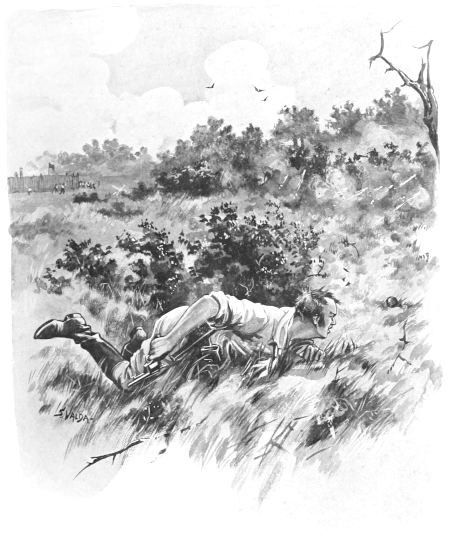
FIELDING UNDER DIFFICULTIES—LOST BALL
The Colonel knew the Hau Haus well. He knew
it must be war to the knife and that no peace was
possible with mad fanatics whose one belief was
to slay every white man and even all their own
countrymen who refused to accept the absurd
Pai Marire faith.
There is no doubt that had the Colonel been
allowed to carry out this policy the colony would
have been spared at least two years of bloodshed
and expense, but in every country where the Union
Jack flies there is always a gang of rotters, peace-at-any-price
men, nigger lovers, pro-Boers, pro anything,
so long as it is against their own flag, and
New Zealand, like all others, was cursed with such
a mob.
However I had nothing to do with politics and
was delighted when the Colonel, a few days after
he had taken over the command, moved his headquarters
and the bulk of the forces to Manawapou,
some fifteen miles nearer our old battle-grounds.
Towards the end of the month the Colonel,
escorted by a small party of troopers, rode to the
Waingangora River, to interview We Hukanui, a
neutral chief, so that he could ascertain through his
medium whether the Hau Hau tribes wanted peace
or war.
Of course we all knew peace was the last thing
they desired, but according to Maori etiquette
it was the correct thing to do, and the interview
was both novel and entertaining.
As it was by no means certain what sort of a
reception we were going to receive we advanced
to the trysting-place, a kainga (open village),
taking every precaution, and found some thirty
Maoris squatting down in a semicircle, waiting
for us. My first move was to leave two troopers,
who were to remain mounted, as videttes, some
hundred and fifty yards to our rear, so as to prevent
any attempt to surprise us from that quarter, and
this act received great praise from the Colonel,
who rode straight up to the squatting natives and
dismounted.
After the customary salutations had been gone
through many speeches were made and various
proposals suggested, among them one, moved by
We Hukanui, that the Colonel, alone and unarmed,
should accompany him and call on the Hau Hau
chiefs, was declined without discussion, as it was
too risky even for our gallant O.C., the fate of the
last Peace Commissioner who had called on them
being of far too recent a date to make him risk the
same end. (Note.—Mr Broughton, Chief Native
Commissioner, had a few months previously, at
their own request, visited the Hau Haus alone and
unarmed for the purpose of discussing peace and
had been foully murdered in the presence of the
chiefs without being allowed to say a word.)
So the Colonel, as an amendment, handed the
Rt.-Hon. We Hukanui a cartridge and a white
handkerchief, directing him to convey them to
the Hau Haus as symbols of war and peace. The
chiefs were to choose which symbol they preferred,
returning the other to the Colonel, who also sent
them the polite message that should they choose
the cartridge they would at once advise him
when and where they would like the fight to take
place. This ended the runanga and we rode back
to camp.
On the following day a letter was brought in
from the Hau Hau chiefs, requesting an interview,
so again we rode out to meet them, taking this time
only twelve troopers, though we left fifty Rangers
in a very strong position on the bank of the Waingangora
River.
At the rendezvous we met several chiefs and a
large number of their followers, whose absurd
gesticulations, together with the gibberish they
talked, pretending it was English, for they declared
that the angel Gabriel had served them out with
the gift of all tongues, excited the risibility of our
men to such an extent we could scarcely restrain
bursts of laughter, which would have been highly
indecorous on such a grave occasion.
After the chiefs had made many speeches, in
which they declared they wanted peace, the Colonel
replied: “It is good. Bring all the chiefs to the
Waingangora to-morrow; we will ratify peace
there. If you do not come, I shall know you
want war.”
The following day we waited at the Waingangora,
but no Hau Haus came; we were not disappointed,
as none of us expected they would, and at nightfall
we returned to camp.
Our O.C. now determined, as there was no
chance of peace, to strike a rapid blow, so on
the evening of the 1st of August he moved out
of camp with a strong force to surprise the village
of Pokaikai.
The night was a fine one, though the cold was
so intense that it numbed our thin-clad men to
the bone, while the stirrups and scabbards of us
mounted men were quite thick with frost. Cold
as it was we had to face it, and before daylight
had reached our positions, halted and dismounted.
Shortly after we had halted Pierre and George
came in with wonderful information, which was
that they had crawled so close up to the Hau Hau
pickets as to be able to overhear their conversation,
the tenor of which was that they, the Hau Haus,
considering there was no possibility of being
attacked on such a dreadfully cold night, had
decided that bed was the best place for them, and
so had taken themselves off to their virtuous,
or otherwise, couches; also that the village was
an open one, that they had penetrated into the
middle of it, and that all the natives were asleep
in the arms of Morpheus or their own various
ladies.
This was a piece of unprecedented luck, nor was
our O.C. the man to let such a chance slip, and the
new orders he gave were excellent. He had at
his disposal one company of military settlers
armed with rifles and bayonets, the remainder of
the outfit carrying carbines and revolvers, so this
company he ordered to silently fix bayonets,
enter the village and post themselves at the doors
of the various whares (huts) so as to imprison the
inmates. He also gave orders that on no account
was a shot to be fired, as he now had great hopes
of being able to surprise an adjacent village, hive
its inhabitants in the same way, and so kill two
birds with the one stone.
The movement was a plain and straightforward
one, so simple, in fact, that no one doubted its
successful termination, but, as Bobby Burns asserts,
“The best-laid plans of mice and men often run
crooked,” and it was to be so on this occasion.
It has often been the lot of an unfortunate
commander, after a long and harassing night’s
march, to have his well-thought-out plans utterly
ruined by some crass idiot discharging his rifle,
lighting his pipe, or committing some other wicked
act of folly or culpable clumsiness, and unfortunately
the military settlers had in their ranks a half-baked
rotter, whose nerves, getting overwound,
let go a cheer just as the company was about to
enter the village. The cheer was taken up by his
comrades, which gave the alarm to the sleeping
enemy, who rushed out of their huts and took to
headlong flight.
As the whole show was now spoilt, the military
settlers opened fire and charged, knocking over
some of the fugitives, and bayoneting a few of the
late starters, but the O.C. had to content himself
with the meagre spoil of some dozen women,
while, had it not been for the misconduct of
the aforesaid infernal idiot, he would have scooped
up all the principal Hau Hau chiefs and probably
have ended the war: which shows what a tremendous
lot of harm one fool can cause.
We had, however, made a valuable capture,
and one that entailed great loss to the enemy—namely,
some forty stand of rifles, together with
a large supply of ammunition and other arms
that fell into our hands. During this affair we
lost only one man, and he was killed in rather a
queer way.
At the end of the engagement one of the military
settlers entered a whare for the purpose of bringing
out a dead Hau Hau, and was still inside when a
party of Rangers, who were searching the huts
for any of the enemy possibly concealed, came up
to it. Hearing someone inside the hut they
demanded who was there, and received the answer:
“A white man.”
Now it was believed that the infamous deserter,
Kimball Bent, was with this gang of Hau Haus,
and the men had all previously been cautioned
to this effect, so that the Rangers fancied they had
at last hived the scoundrel that every man had
sworn should receive no quarter. Had poor Spain
(the military settler) answered: “Friend,” more
questions would have been asked; but as he simply
replied to the challenge, “A white man,” the
Rangers, convinced they had the villain in their
clutches, fired on him, thereby shooting their own
comrade.
By this time the loot had been collected and all
the huts, with the exception of one, had been
destroyed. (Note.—The principal reason for burning
huts was to destroy the large quantities of
powder or ammunition concealed in the thatch.)
It was broad daylight, and as, thanks to the
aforementioned fool, there was no further chance
of doing anything, we returned to the camp at
Manawapou where, I regret to state, Colonel
McDonnell could not see his way clear to hanging
the nervous ass who had spoilt our day’s work.
I am not writing a history of the New Zealand
wars, and it would be only wearisome for people
nowadays to read of the forgotten, innumerable
skirmishes, night marches and encounters, with
their attendant hardships, the colonial irregulars
went through.
For many years the district over which we then
marched and fought has been the most fruitful
one in New Zealand, where thousands of smiling
homesteads now stand on the sites of our old
bivouacs on which we shivered and starved, and I
often wonder if a single individual of the happy and
peaceful population who now occupy them ever
give a thought to the bands of reckless ne’er-do-wells
who, by the expenditure of their blood and
health, rendered that land safe for their present
occupants.
The British Empire has been largely built up
by the same class of men, who have rolled out its
frontiers farther and farther, and then held them
against savage enemies in spite of deadly malaria,
fever, starvation and horrible discomfort.
Would it therefore be an impertinent question
for me to ask if any one of the yapping gas-bags
in the home or the colonial Houses of Parliament
has ever given a thought to the welfare of these
rolling stones after they have been worn out by
their unrequited work? However, it’s no use
asking silly questions, so let’s return to our mutton.
The skirmish at Pokaikai put the fear of the Lord
into the Hau Haus, the chiefs of whom were so
fully cognisant of their narrow escape that for a
long time they hardly dare sleep inside a whare,
which the quick, continuous movements of
McDonnell, who, unlike the regulars in the past,
marched without pack-horses or impedimenta of
any kind, did not allay. Our O.C. kept his own
counsel, no one knowing when, where or how the
next move was to be made, and many a night
I have been roused out from under my blankets to
start away on a bitter cold march for the purpose
of beating up some congregation of Hau Haus.
Scouting and patrolling was also reduced to a
science little dreamt of in British armies of to-day,
so that the Maoris were kept ever on the qui vive;
in fact the Colonel employed their own tactics
against them, and they did not like it, as village
after village was attacked, stores of food were
destroyed, till at last the Hau Haus became so
harried that tribe after tribe weakened on it and
gave in, until only two tribes remained in arms
against us, and had the Government only had the
sense to allow McDonnell a free hand, the war
would have terminated in a few months. But
it was not to be.
The first set-back our gallant commandant
received was engineered by a worm called Parris,
a man whom Sir Trevor Chute had ordered out of
his camp, and this thing saw fit to invent and
promulgate charges against the Colonel and his
men for committing outrages and murdering
women at Pokaikai, and a commission, consisting
of Sir Cracroft Wilson, Colonel Cargill and Mr
Graham inquired into the whole matter.
At this commission both Hau Haus and friendly
natives were examined, and although Mr Graham
did his best to help Parris to substantiate the
latter’s lies, it was all without avail, as every
charge was ignominiously dismissed, the only
foundation on which the mountain of falsehood
had been raised being as follows:—
You must remember that it was dark when our
men entered the village, and that on the alarm
being prematurely given there was a general
stampede of the natives. In the rush and dim
light it is hard to tell man from woman, so one of
the latter received a bayonet-thrust by mistake.
The wound was not a bad one, and after it had
been dressed the Colonel interviewed her, offering
to have her carried on a stretcher to hospital.
To this she objected, requesting instead to be left
in a hut, asserting her friends would soon find her.
This was done. She was made comfortable in a hut
that was not burnt on her account, and we had not
left the place an hour when her relations returned,
so that at the time of the inquiry she was well
and hearty.
History of course repeats itself, and the British
House of Parliament is, at the present time, still
disgraced by some of the foul liars who invented
charges against the British troops in the Transvaal,
and these treacherous hounds, posing as religious,
honourable men, still have a big following in the
country.
The same was the case in New Zealand, as Parris,
who was commissioner for the district, was allowed
still to retain his post, and did all in his power
to thwart and hamper the Colonel, declaring the
natives wished for peace, recommending the disbandment
of the field force—in fact, played the
part of a Little Englander with a Nonconformist
conscience to perfection; and this man, owing to
the criminal folly of the Government, was the
cause of the discomfiture and defeat of the
colonial forces.
To give you some idea of the folly the New
Zealand Government perpetrated I must again
digress.
In the House was a very strong peace party,
mostly composed of members representing the
Middle Island, in which there had been no war,
and whose inhabitants begrudged paying the
cost of the prolonged struggle, and whose desire
to develop the resources of the colony made them
ardently long for peace, so much so that they gave
ready credence to the reports of Parris, while they
ignored those of McDonnell; and bitterly they
were to rue it in the near future.
At the time the Colonel assumed command he
had at his disposal an adequate field force of
splendidly trained bush fighters who by continual
warfare had not only learned their work but
also to place the utmost confidence in their officers,
their comrades and themselves. Alas, this was to
end!
The major part of this force were military
settlers who had contracted with the Government
to serve for three years, their remuneration to be
a grant of land, and it so fell out that at the very
moment their services were most needed the time
expired of one hundred and fifty of the very best
men.
This placed the Government somewhat in a
dilemma, as the Hau Haus were still in possession
of the land that should have been surveyed, ready
to parcel out to these fellows, and as this had not
been done they could not keep their part of the
contract. Still the men were quite willing to re-engage,
provided the Government would guarantee
ten more acres of land per annum for each year
they continued to serve. This was the most
modest demand, and the Colonel permitted one
of their officers to proceed to Wellington to lay the
matter before the ministry, who not only refused
to accede to it but treated the officer with quite
undeserved insolence, going so far as to return the
message that if the military settlers did not care
to serve without another grant of land they could
leave the service, which they promptly did, in
disgust, the majority of them making off to the
southern goldfields, and the district, thanks to
the insolent ignorance of a pack of lawyers and
counter skippers, lost for ever the services of its
best defenders.
Other corps had also been disbanded, and one
fine day the Colonel, thanks to the besotted
stupidity of the Government, found himself with
only one hundred and sixty men, including officers,
to hold a district and carry out a campaign—duties
that a few months previous had found ample
occupation for nearly four thousand men. Yet
our gallant O.C. was not the man to be daunted.
True he had not enough men to garrison the posts
which the Hau Haus, now emboldened by our
paucity of numbers, not only threatened with
attack, but also they ambushed every road, attempting
to cut off, and if successful cut up, our despatch-riders
and ration convoys. No; he would hit
back, as he knew that passive resistance was no use
in savage warfare, and although he had to withdraw
nearly every man from all the posts to obtain
a striking force, even then by no means an adequate
one, still he did so.
Just previous to this headquarters had been
moved forward to Waihe, where an old pah had
been reconstructed into a small but strong fort,
the building of which had been begun, carried on
and completed under fire, so that we continually
had to drop tools and take up arms to resist attacks.
At this time you might say we lived under fire,
as all day long the natives fired at us from the
bush, and it was now I played in the most extraordinary
cricket match that I think ever took
place.
The game was inaugurated in honour of the completion
of the work, and was Pigskin Polishers
(troopers) v. Footsloggers (rangers), and was
looked forward to with much excitement by both
corps. Naturally the players were all out of
practice, their dress far from accurate, and the
pitch, well, damnable; but we turned to with élan,
though to bat, bowl, or even field, belted as each
man was with his revolver and fifty rounds of
carbine ammunition, was very trying.
Moreover the side in the field had to pick up their
carbines when they changed places at the call of
“Over!” and the umpires held the batsmen’s guns
as in this country they sometimes hold their coats.
In fact the whole get-up was outré in the extreme,
and I fear ordinary spectators of English cricket
would not have been highly gratified unless they
had regarded it as a charity burlesque.
Now the main bush, in which the gay and festive
Hau Hau lived and gambolled, was about one
thousand yards away from the fort, but there
were big patches of bush up to within four hundred
yards of it, and any amount of manuka and fern
scrub, that afforded good cover to an enemy wishing
to pass from one to the other of these patches, so
that, notwithstanding all our vigilance, scouts, or
even considerable numbers of Hau Haus, could
get quite close up to the stockade.
Well, the game commenced, and of course
attracted the attention of the gentle savage.
Word was quickly passed into the recesses of the
bush that the white man was up to some new and
inexplicable devilment, so before long we had a
highly interested if not appreciative gallery, who,
emerging from the bush, squatted down, and for
a time behaved itself with decorum.
To this we did not object, and had they continued
to behave they might have remained there to the
end, but perhaps they were over-critical, and the
play, as I have already stated, not being first class,
they may have considered they were entitled to
show their disapproval of it.
Now we could have made allowances for their
ignorance or their want of appreciation, although
they were self-invited and had paid no gate money,
even should they have gone so far as to hiss, but
I maintain that paying spectators should restrain
themselves from heaving at the players such things
as dead cats, antiquated eggs, or ginger-beer bottles,
but when it comes to expressing dissatisfaction
with tuparas (double-barrelled guns) and Enfield
rifles it is high time for the performers to skip or
clear the ground.
Now the play was not good, that I allow, and
also it is very doubtful what the Hau Haus thought
had occasioned this entertainment and extravagant
display of energy on the part of the hated white
man. As most of them had been Christians they
knew it was not a religious ceremony, neither was
it a war-dance, white men not being civilised up
to the merits of the war-dance. Perhaps they
put it down to witchcraft, or some sort of an extra
insulting challenge issued by men who had just
built a pah in spite of the lavish expenditure of
powder they had seen fit to waste in their attempts
to obstruct its completion.
Anyhow it was something important, or wherefore
those cheers and hand-clapping from the other
white men who lined the parapet or reclined on
the ground, and as such must be counteracted.
First of all they danced a war-dance, and as no
attention was paid to that they proceeded to
take more active measures.
In the meantime the game had been progressing
steadily. The troopers had had their first innings
and had scored one hundred runs and the rangers
had scored ninety with the loss of nine wickets.
The excitement was intense, “Well bowled,”
“Well hit,” “Oh, well fielded” being howled by
the enraptured lookers-on after every delivery,
while ribald chaff, banter and badinage were being
exchanged by troopers and rangers that would
have shocked the spectators of a modern test
match.
The last hope of the Footsloggers was a leviathan
sergeant, an old Varsity blue, but his partner was
a very fragile reed, who only required one straight
ball to finish.
Could the sergeant keep the bowling to himself?
That was the question, and men hugged themselves
with excitement. He has it now, and the fielders
retire farther out. By gad! he gets a loose one,
and opening his shoulders he smacks it over
Long-on’s head. Big as the hit is he will only get
three or perhaps four for it, as on that tussocky
ground where a ball pitches there it stops, and
Long-on is far out. Still the hit is a big one and is
cheered by his delighted friends. “Well hit,”
“Oh, well hit,” “Run it out,” “Oh, run it out.”
Nor are the troopers behindhand with their shouts.
“Double up, oh, double up,” “Sling it in, oh, sling
it in,” as Long-on has turned and, weighed down
by revolver and ammunition pouches, darts after
the leather sphere. Yes, there it is lying on that
bit of open ground less than a hundred yards from
that patch of scrub. Spurred on by the wild
turmoil of shouts—“Oh, hurry up; for God’s sake
hurry up,” “Chuck her in now—smart,” “There,
run three, run it out; allow one for the throw,”
etc., etc.—he rushes at the ball.
But what’s the matter? Of a sudden the wild
yells terminate into the pious ejaculation of “Oh,
hell!” while the eager fielder throws himself on
his nose, hunting cover, and drawing his revolver
lets go the agonising shout of “Lost ball!”
Well this is what the matter was. As the
questing fielder rushes to secure the ball that lies
in full view in front of him and throw it in, out of
that patch of manuka scrub darts several spurts
of flame and smoke, and a number of balls of a
different nature whistle round his head, and I ask
you present-day cricketers which of you would
have cared to have fielded that ball and slung it in
to the expectant wicket-keeper? Or would you
have hunted cover and howled, “Lost ball!” as
that Pigskin Polisher did?
“Damn such interruptions,” shouts the umpire,
who was the Colonel at that; “drive the beggars
off the field.” And in a moment batsmen, fielders,
umpires, scorers and onlookers grab their weapons
and charge that patch of manuka scrub. We reach
and tear through it just in time to see a party of
Hau Haus disappear into a clump of bush some
way farther off, then, laughing and cussing, return
to our game as the friendly natives good-naturedly
offer to keep the ground for us.
The continuation of the game evidently mortified
the Hau Haus, for they lined the four-hundred-yard
bush and fired volleys at us. Did we allow
them to stop the game? Not a bit of it. It was
far too important a one to allow a gang of measly
Hau Haus to interfere with, for was not that night
grog night? And had not every trooper wagered
his tot in backing his side? And had not every
ranger done the same? Stop play; indeed no!
They would play it out to the bitter end. So the
game went on.
Now it is rather trying to most men to stand up
against fast, erratic bowling on a more than bumpy
pitch, but should the batsman’s attention be
distracted while watching the ball by the whistle
of an Enfield bullet past his nose, or by seeing the
pitch torn up by a similar missile, it becomes too
exciting for anyone.
Again, it is rather conducive to wild bowling
for a bowler to have to submit to the same ordeal
preparatory to his delivering a ball, nor can even
an umpire give the amount of attention the game
requires to his important functions when half his
time has to be devoted to dodging ricochets. So
that the Colonel, a sportsman to his finger-tips,
ordered all the available men not playing to assist
the friendly natives in keeping order in the free
seats. This they did, though not without a smart
skirmish, which ended in the rowdy interrupters
being driven off the field with the loss of several
men, which served them right for trying to interfere
with sport.
This well-merited chastisement did not, however,
satisfy the contumacious bounders, for they took
post in the big bush and continued to lob bullets
at us from the distance of a thousand yards, but of
these we took no notice, for although now and
again a bullet would announce itself with an angry
hum, or drop nearly plump into the ground, yet
they afforded a man a good excuse should he butter
a catch or make a duck. Anyhow we played the
match out, and I am delighted to say the troopers
won by the narrow margin of seven runs, although
I regret to add I contributed but little towards the
winning score.
CHAPTER X
HOW MAORIS SHOULD BE FOUGHT
I mentioned in the last chapter that our paucity
of men allowed the Hau Haus the opportunity of
making things warm for us, and they lost no time
in taking advantage of it; for one day they had
the cheek to ambuscade, within half-a-mile of the
fort, a dray loaded with rations. Now there was
a standing order that a ration dray should be escorted
by twelve troopers, but as the unfortunate
O.C. of the post from whence the dray started had
only twelve men for all duties he could only send
three, and the Hau Haus thought this far too
good a chance to be lost. The dray was drawn
by two horses driven tandem fashion, and when it
had reached within half-a-mile of Waihi, and within
view of the camp, a party of natives lurking in the
scrub fired a volley at the escort and charged with
their tomahawks. One trooper, named Haggarty,
went down, horse and man, but the driver managed
to unhook his lead horse, jumped on its back and
with the remaining two troopers won through to
the fort, from whence a party of Rangers had
already sallied.
These soon reached the spot, where they found
the empty dray and the remains of the poor chap
chopped to pieces, but the rations and the shaft-horse
taken away. Now this vexed the Colonel,
and more than irritated the rest of us, as rations
were very scarce indeed, and we were quite pleased
when the O.C. determined to return them a
Roland for their Oliver; so next day another dray,
apparently heavily loaded, with an absurdly small
escort, was despatched from the fort.
Some hours, however, previous to its departure,
a party of Rangers and friendly natives had been
despatched to do a bit of ambuscading on our
behalf, and proved themselves worthy of the trust
placed in them; for when the Hau Haus, having
spotted the sham escort, came down from the bush
to gobble it up they fell into the trap so skilfully
planted by the Rangers, who knocked the immortal
stuffin’ out of them, sending them back to the bush
hungry and howling, having on this occasion received
toko instead of tucker.
This lesson, though a severe one, the O.C. did not
think quite adequate, so he determined to strike
another blow to teach them better manners for
the future, and to leave his men’s rations alone.
He therefore with the greatest secrecy called in
men from the other posts, which was a very dangerous
thing to do, as it left them for the time quite
defenceless, but he had no other course to pursue,
and Fortune favours the bold player. Still, after
scraping every man together, he could muster only
one hundred and thirteen men of all ranks, and it
was a very, very risky game he intended to play,
and one he would never have attempted had he
not had the greatest confidence in his officers and
men.
Of course a body of men as large as this one was
bound to be spotted leaving camp, so that to
mislead the enemy’s scouts he first marched to
the fort on the Waingangora River and pretended
to start work there, but at ten P.M. we silently
left there, crossed the river, and made for an old
deserted pah where our scouts had come across
a well-defined track running inland. This track
they had scouted until it had ended in a clearing,
but could penetrate no farther as the enemy’s
scouts were too much on the alert. However, he
hoped that he had blinded them by what we had
done at Waingangora.
Well, we started, passed the deserted pah,
moved carefully on till we came to the clearing, and
then, as we were ignorant of the actual position
of the Hau Haus, we lay down and waited. Presently
we heard, not far off, some cocks crow,
which giving us the desired information we moved
off in their direction, and had not proceeded a
mile when, just as day broke, we came to a long,
narrow clearing with a lot of huts scattered all
the way up it. As there was no possibility of
surrounding the place our O.C., without a pause,
led us right up it, leaving a few men at the door of
each hut as we passed, who, with carbines loaded
and cocked, stood at them without making a
sound. The movement, quickly conceived as it
was, was admirably carried out, for although
before it was quite completed an alarm was given,
yet very few natives escaped, nor was there the
least confusion as the men, all of whom were old
hands, stood ready without saying a word.
When the arrangements were finished to his
satisfaction the Colonel posted himself in front of
the largest and most central hut, and delivered his
ultimatum, shouting out: “Will ye, O Ngatiruanui,
who are now surrounded, surrender yourselves as
prisoners of war or be shot?”
The query was a brief one; the answer was still
briefer, for it came in the shape of a volley fired
from all the huts that dropped a lot of our men, although
it would have been better for the inmates
had they considered their answer more carefully,
as Rangers are not men with whom to bandy
words. For in a moment fire was applied to every
whare, which, being built of dry raupo as inflammable
as petrol, burst into sheets of flame that
transformed the quiet village into an animated hell.
Out from the flaming whares rushed men, half
mad, with scorched hides and blazing hair, only to be
blown off their feet by shots fired from a few yards
distant, while the flames, smoke, explosions of
powder, yells, cheers and shots, together with the
roar and crackling of the burning huts, made a
service that sunny Sabbath morning that must
have delighted Old Nick himself.
This part of the day’s performance did not last
long, as in less than ten minutes every hut but one
was consumed, and every Maori dead with the
exception of that one’s occupants. Unfortunately
the hut remaining was a big whare puni made of
thick slabs of wood covered with earth, at the door
of which lay the dead body of one of our men, and
as no fire would touch this little fortress there was
nothing to be done but dig out the garrison. We
at once set to work at this job, and had nearly unearthed
them when we were attacked from three
sides by an overwhelming party of Hau Haus.
It was evidently high time to clear out of that,
but our Colonel was not the man to be balked of his
prey. There was no time for more digging, so he
again called on those inside to surrender, promising
to spare their lives if they did so at once.
To this they consented, and one of them came out,
but he had no sooner shown himself than a number
of friendly natives standing close by recognised the
unfortunate Johnny as one of their bitterest tribal
enemies, so let drive a volley at him, nearly blowing
the poor wretch to smithereens. This low-down
conduct drove the Colonel hopping mad, and he
cussed the delinquents with so much unction that
the tone of his cuss words reassured the Hau Haus
to that extent they at once came out and surrendered.
It was now high time for us to skip, and we
promptly made ready to do so, as we had already
lost three men killed and seven men badly wounded;
this for a small force like ours was bad enough, but
casualties in savage warfare mean a much greater
loss than the actual number of men hit.
You see it is this way: A man gets wounded in
civilised warfare; well, his side only loses the use
of one player for that match. As for the wounded
Johnny, he just makes himself as comfortable as
circumstances permit and quietly awaits the
arrival of the first ambulance, be it friend or foe,
when he is picked up and taken care of.
This, however, was not a rule of the game as
played in New Zealand. If a man got wounded
there his own friends must get him away smart,
for if the Hau Haus got him, so far from making his
wound whole they would make him into a whole
wound by torturing him in a way not fit to write
about, and as it took at least four men to carry the
poor chap along the rough bush paths we lost the
use of five men’s rifles instead of losing only one.
Then again it was considered very bad form to
leave a dead man behind, for doing so not only
supplied the enemy with a quantity of fresh meat
rations, but the capture of one was considered to be
a great triumph to them and an equal disgrace to
ourselves. It therefore amounted to this, that as
we had ten men hors de combat it left us with only
sixty-three rifles to withstand the onslaught of the
infuriated Hau Haus, besides which we had nine
prisoners to shepherd.
Nevertheless we must skip, so were just moving
off when Pierre rushed up and reported the enemy
had seized and were holding the only path we knew
leading out of the confounded clearing.
Even this Job’s comforter did not daunt our
gallant O.C., who at once summoned the prisoners
and demanded if there was any other path leading
out of the place we could make use of, at the same
time politely informing them that if there was not,
much as he regretted the necessity, he would be
forced to order their immediate execution.
This reasoning they saw was sound, and they at
once promptly replied that there was another road,
and that rather than linger any longer on that insalubrious
spot they would guide us out by it.
Now this was real kind of them, so we carried
the wounded off, leaving a rear-guard of only
thirty-five men to cover our retreat, and it was
fortunate, not only for themselves, but for the
whole of us, that they were a splendid lot of well-trained
old hands who were conversant with every
wrinkle in bush fighting, and moreover had as
commander one of the bravest and most experienced
officers in the country.
Nor were we going to have a very rosy time of it,
as carrying a heavy man in a blanket along a
narrow, crooked path running through dense bush
and over a terribly rough and broken country is no
child’s play. Remember that on a bush footpath
stretchers are of no use, the unfortunate wounded
must therefore be lugged along either in men’s
arms or doubled up in a blanket; that we had
none of those drugs nor appliances that now rob
the battlefield and hospital of half their terrors
and that even on reaching camp a fern bed with
a rolled-up blanket for a pillow was the only
accommodation a wounded man could hope
for.
At the front there was no chloroform, medical
comforts nor nurses, so that the lot of a wounded
man was by no means a happy one. Well, we were
nearly clear of the bush when the Colonel called
me and pointing out a low rough hill said: “Burke,
you see that hill, the path runs half way round its
base and we shall be in open ground when we get
past it, but if the enemy gain possession of it we
shall lose heavily. Now, I want you to take ten
men, make for the top of it as fast as ever you can,
and hold it till Northcroft and the rear-guard win
past.”
Hastily summoning the first available ten men,
among whom were old Jack, Pierre, George, Buck
and Tim, the rest of them being friendly Maoris,
we pushed for the hill as fast as we could get over
the ground, reaching the top of it just in the nick
of time, for as we surmounted its crest we ran
bang into a dozen Hau Haus who were struggling
up the other side.
There was no time for speech-making nor tactics,
so we just jumped at one another, and I had no
sooner fired my carbine than I saw a big native
with his tongue protruding and the whites of his
eyes turned up spring at me through the smoke,
twirling a long-handled tomahawk around his
head, as if it had been a shillelagh in the hands of
one of my own countrymen at home, and moreover
had barely time to throw up my carbine, so as to
guard a swashing cut he was good enough to deliver
at the left side of my head. Troth and it was no
fool of a cut either, for it drove my carbine in
until the muzzle of it came against my left shoulder,
which fortunately prevented my guard from being
quite broken, though the razor-edged blade at the
business end of the six-foot flexible manuka handle,
whipping over my carbine barrel, cut my left ear
in two, scarred my cheek, and gashed my eyebrow
so deeply that the flap of the wound fell over,
which besides deluging me with blood quite obstructed
the sight of my left eye, so much so that I
thought I was blinded.
This thought transmogrified me into a raging
fiend, so I let go my carbine, and, without even
pausing to say damn your soul, flew at his throat
like a wild cat, which I was fortunate enough
to get a firm hold of with my right hand.
Well was it for me at that moment that I had
devoted so many hours of my young life to the
gymnasium and salle d’armes, and that my great
natural strength had been increased by culture to
an almost phenomenal extent, for now it was to be
tried to its very utmost, and my wiry, well-trained
thews and sinews tested to their breaking point.
Well was it, also, for me, that by the quick fury of
my wild-cat attack I had at once made good my
hold on his bull throat, a hold I swore to maintain
till death parted us. Gad, I was very angry,
for the thought of having lost my eye was more
than I could tolerate, and I saw scarlet.
My opponent was a big, powerful fellow, standing
fully six feet and well proportioned, who, although
inclined to run to flesh, was still very active, and a
most formidable antagonist for a young man
who measured only five feet seven inches and
weighed under eleven stone. He was, moreover, a
noted warrior and a past master in the use of
native hand-to-hand weapons. Therefore, failing
firearms, it was the very best thing I could have
done to grapple with him, and it was to my immense
advantage having caught the first hold.
The moment I had closed with him he dropped
his long-handled weapon and strove with all his
might to tear away my grip on his throat with
his left hand, while with his right he attempted to
seize mine, but I successfully guarded it and,
although he repeatedly struck me with his right
hand, we were too closely locked for him to do me
much harm, while I was surely if slowly choking
him.
The struggle seemed to last for hours, in reality it
did not last for five minutes, but it was a hot five
minutes, and one to be remembered a lifetime.
For a few seconds we tugged and heaved at one
another, and twice he swung me off my legs into the
air, but I hung on and landed on my feet. In vain
he tried to sink his nails into my right forearm,
but the muscles, hardened by years of fencing,
cricket and gymnastics, were as rigid as iron, for
although he scratched and scored the skin yet he
could make no impression on the arm itself, the
nervous fingers of which were nearly buried round
his windpipe.
I now began to feel I was getting the best of it,
besides which, although still animated by the
determination to kill, I was becoming cooler and
cooler, and watched for any opportunity so that
I could profit by it.
Again and again he made desperate efforts to
throw me off, and after one prolonged, furious
struggle, in which I thought my sinews must give
way, his feet got caught by a vine and we fell
heavily sideways to the ground; when with one
tremendous heave I gained the upper hand and
drove my right knee into the lower part of his
breast-bone. Oh, but it was a glorious feeling of
exultation that rushed through my brain as I
tightened, if possible, my clutch on his windpipe
and, using the leverage of my knee, tugged and
tugged again.
One more despairing effort made and thwarted
convinced me he was beaten as he perceptibly grew
weaker and weaker, and although I never relaxed
my attention to my own particular quarry I
glanced round to see, if possible, how the game was
progressing with my comrades, as with the exception
of one or two pistol shots everyone had
fought mute, and the grim match had been played
with tomahawk, knife and hand.
The first I spotted was Tim, on his feet, wrestling
furiously with a big Maori, and at the same glance
saw George glide up and bury his huge knife in the
native’s back, who at once relaxed his hold, when
Tim, throwing the dead body clear, yelled out:
“Mr Dick, where are ye, sor? Oh, holy Jesus,
where’s the master?” Jack I could also see
kneeling in the stunted fern evidently top dog,
for I caught the flash of his swinging tomahawk
and heard the crushing thud as the blow descended.
I could also hear the grunts and deep sobbing gasps
and see the fern trembling where men still fought
in their death struggles, but I had now no anxiety
for the future as we had at least three hale men on
their feet and temporarily out of employment, so I
started in to finish off my man.
My man was by now almost passive, so much so
indeed that I could have easily drawn my knife
with my left hand, but somehow the thought of
sticking a man like a pig revolted me. No; it had
been up to now a fair fought fight, hand against
hand, so let the hand finish it; nor did he require
much more attention, as after one or two convulsive
heaves he lay quite quiet and I knew I had finished
him.
I was just on the point of rising when up rushed
Tim swinging a tomahawk over his head, who
with his eyes blazing yelled out: “Hould on,
Mr Dick, hould on, sor,” and before I could say
a word sank his weapon into the dead man’s head,
sending the contents of it spurting all over me.
“Faugh, Tim,” I said, starting to my feet.
“It’s a dirty fighter you are; give me something
to wipe my face with.”
“Och, be the howly Saint Bridget, it’s kilt ye are,
Mr Dick; oh, wura, wura, where’s the doctor, bad
luck to him,” whined Tim.
“Killed be d——d,” said I. “But he has
blinded my left eye.” And seeing the row was
over I quickly gave the order: “Load all the
carbines, boys, and take cover.”
No sooner was this done than Tim was alongside
me with a couple of bandages and a pannikin of
water, when, tenderly raising the flap of flesh
that hung over my eye, in a moment I knew that
the sight of it was all right and the relief of mind
was immense.
It did not take my kind-hearted comrade more
than a minute to replace the flap and twist a
bandage round my head, when I was quite fit
to attend to my duty.
First of all I looked out for any enemy; there
was none in sight though the noise of the rear-guard
action was drawing much closer, and I was
delighted to see the Colonel’s party already past
the danger point as I was now able to judge how
lucky we had been in capturing the hill, for our
loss must have been very heavy had the enemy
succeeded in gaining it, because the hill completely
commanded the only footpath.
I next turned my attention to our own
casualties; one friendly native was dead, poor
Buck, wounded desperately, was lying on his
back with his head on a blanket, and as I knelt
down beside him, taking his hand, he opened his
eyes and murmured: “Good-bye, Master Burke,
struck bed-rock, panned out, shift my pegs,” and
with a sigh or two the gallant English yeoman
drew his pegs and started for another gold rush.
The remainder of us, although more or less chipped,
were all fit for another scrap if called upon to face
one, while nine dead Hau Haus cumbered the
ground.
Setting Jack to sew up our poor comrade in his
blanket, while Tim and one of the Maoris dug his
last claim, with the rest of the men I was keeping
a bright lookout, when the Colonel with thirty
men joined me.
“Well done, Burke,” said he, “by gad, you
fellows have done well. Not much hurt I trust?
Well, my boy, you wanted to gain bush-fighting
experience, gad, you are getting it. I’ll leave you
six more men and take the others on to the rear-guard.
In case you are attacked hold this place
to the last, but retreat when the rear-guard get
round that corner, we shall be able then to cover
you. So-long,” and he was off.
I, however, was not called on to hold the hill,
as Lieutenant Northcroft made such a masterly
retreat, and his men fought so well, that the enemy,
seeing we had possession of the position and
rightly judging that their own party, sent to grab
it, had been cut to pieces, after harmlessly burning
an immense quantity of ammunition at long range,
drew off, allowing our men to disentangle themselves
from the bush, and to retire back to camp
in peace.
CHAPTER XI
SPORT À LA LOST LEGION
I have previously asserted that this yarn is not
meant to be a history of New Zealand wars, nor do
I wish to harrow the tender hearts of gentle readers,
should I be fortunate enough to secure any, by
stories of savage bloodshed or by describing gruesome
details of war to the knife. Yet, taking into
consideration the astounding ignorance of most
well-educated English men and women concerning
the history of the principal colonies that now form
the greater portion of the mighty British Empire,
I think I may be pardoned for recounting a few
scenes of the events, battles and hardships, willingly
endured by the men who actually won those
colonies and rendered them habitable for a civilised
people. Nor do I think the men, rough, wild,
undesirable ne’er-do-wells as they mostly were,
who recklessly risked their lives for that purpose,
should be entirely forgotten.
These scenes are not imaginary ones, evolved
from my own brain, but real occurrences; and the
men, whom I am trying to describe, actually lived,
fought, drank, and were killed in the way I relate;
alas, would that I had a more gifted pen and a
more artistic touch to depict them, their reckless
lives and their hard deaths.
However, as my pen is neither artistic nor gifted,
nor even a particularly good one to write with, I
must jog on as best I can, in the same way my
gallant O.C. did, when, short of men and with
plenty of malignant, backbiting enemies in both
Government and district, he made head against the
hostile Hau Haus.
After the fight at Pungarehu, fortune seemed
for a considerable time to have deserted us, which
was not to be wondered at, for although the
Government provided more men, and we were
reinforced by various parties of volunteers, yet
these recruits were, for the most part, new chums
of a very inferior quality. Indeed, most of them,
having been enlisted from among the scum and
riff-raff of the big Australian cities, were naturally
very different from those old hands whose services
the idiotic Government had so cavalierly dispensed
with, or who had been lost through the wastage of
war; and I was soon to learn the awful difference
of going into action with a lot of untrained, half-baked,
raw hands, instead of well-trained, reliable
men.
Again the new-comers could not stand the
physical hardships of the work. They knocked
up when marching and were not by any means
dependable shots or bushmen. So that the
campaign dragged, for although we made many
attempts we never again succeeded in catching
the enemy on the hop as we had done at Pungarehu.
In fact, on one or two occasions, we
received more than we gave, and although we did
not, as yet, meet with any calamitous disaster,
yet, at times, we had to quit the bush faster than
we went in, having failed to do that which we went
in to attempt, and these failures so bucked up the
Hau Haus that it enabled Titokowaru, a savage
and very fanatical chief, to draw numbers of them
to his flag, with whom for over two years he successfully
opposed us, during which period he administered
two very serious defeats to the colonial
forces.
It was while on one of these numerous excursions
I witnessed a somewhat extraordinary instance of
presentiment of death, which, owing to the fact
of the man who received the impression taking
advantage of it, thereby dodged the catastrophe.
Here’s the yarn, deduct what moral you
will.
Among the friendly natives was one named
Winiata, who was distinguished for his great
courage; and when, among a race noted for their
bravery, a man becomes so distinguished, there
can be no doubt of his intrepidity. In fact, not
only by his own comrades, but also by the white
men, and even by the Hau Haus, no mean judges
of courage, he was regarded as the very incarnation
of valour.
Now Winiata always led the van, and was the
rear of the rear-guard in a retreat, and his numerous
acts of dare-devil recklessness were the talk of
both camps. Well, on one occasion, we were
advancing to attack a place, when to everyone’s
astonishment Winiata hung back, and instead
of being leading man enacted the part of a timid
skulker. This surprised the O.C. so much that
he asked the man what was the matter. Winiata,
without hesitation replied: “I dreamt last night
I was leading the van as usual, when we were
ambuscaded and I was killed, the bullet striking
me on one hip and coming out at the other, so
to-day I remain in the rear.”
The column, at the time, was moving through
dense bush, along a footpath so narrow we could
only proceed in single file, and a short time after
Winiata had unbosomed himself the enemy poured
a volley into the head of it, killing the leading file.
Whereupon Winiata rushed to the front and,
pointing to the dead man, said to the O.C.: “Ah,
that’s the bullet which meant to kill me,” and
true enough the death wound that had killed his
substitute was exactly similar to the one he had
dreamt was to have finished himself off. After
this all the other natives declared that Winiata’s
god was a very powerful one and that his mana
(luck) was great.
I have, up till now, said but very little of the
various ways in which we tried to amuse ourselves
when resting in camp or, as we now were, marking
time in our Hau Hau tail-twisting operations.
True, we were much scattered, being located in
different forts, but our O.C., fully recognising the
necessity of allowing the men recreation, as all
work and no play makes Jack a dull boy, eagerly
grasped every opportunity of affording the men
any amusement that lay in his power. So that
we indulged in an occasional cricket match, race
meeting and athletic sports, with now and then a
camp fire and sing-songs.
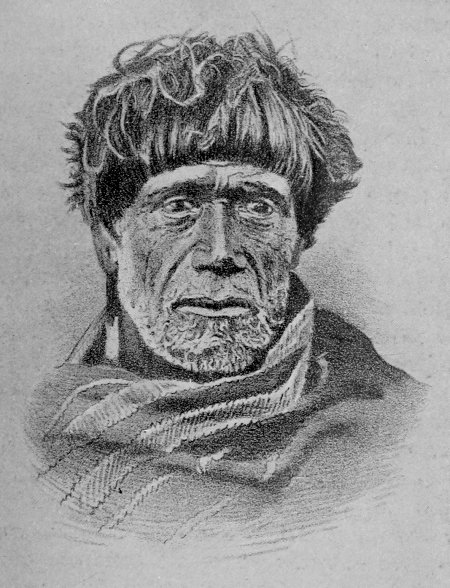
TITOKOWARU.
Some of the competitions were very good, as
amongst such a mixed crowd as ours there were
naturally some really good athletes, not only among
the white men but also among the friendly natives,
all of whom took a very keen interest in the events.
Of course, after one or two trials the crack men were
discovered, but we had such clever handicappers
that the interest in the various events was always
kept up to the required excitement pitch, so
necessary to render this form of sport attractive
to the looker-on, and as there was much healthy
rivalry between the various posts there was no
chance of the general interest in these sports
flagging.
It was through taking a very keen interest in
my post’s chances for distinction that I discovered
a man who, had he been taken in hand and been
well trained and taught in his youth, would I am
sure have turned out to be one of the greatest
athletes the world has ever possessed.
Strange to say the man himself, a London
Cockney, was profoundly ignorant of his own
capabilities, and it was quite by accident I discovered
them. The way it was done is as follows.
A big athletic meeting was to be held at headquarters
on Christmas Day, at which each station
was to be represented, and the rivalry was not so
much between individuals as it was between the
various stations, one garrison against another, also
trooper v. footslogger, and the men at my post
were very keen.
We were, however, sadly in want of a sprinter
and high leaper. I could run and jump a bit, but
then I had been beaten so easily on a previous
occasion at all these events that it was hopeless
to expect me to win on the coming one. True,
we had a most reliable man in Tim for the mile and
the long jump, and although he also had been
defeated before, still, on that occasion he had been
unfit, while now he was in splendid trim, so that
we had great hopes of him pulling off his events,
but I could offer no such excuses as I had been in
splendid fettle and had done my very best, but
had not succeeded in getting placed, as I had been
fairly beaten by better men, and as I was by a long
way the best man at the post things looked very
black for us, and our hearts were very dark indeed.
Now among my men was one named Bright, who
had been enlisted not so much for his fighting
capabilities, for he was no good either in the pigskin
or in the bush, but as a baker, and even as
such he was a bad one. Up to date I had never
taken much notice of the fellow, except perhaps on
a muster parade, when I invariably had to check
him for general untidiness, in fact the wooden way
he slouched about the camp rather got on my nerves,
and then his bread was often damnable.
One day, however, I happened to notice him on
a bathing parade and was much struck by the
muscular development of his legs and thighs,
which without being abnormal had yet every
appearance of possessing extraordinary nervous
powers.
That evening we were practising sprinting, at
which he was simply looking on, when turning to
him I said: “How is it, Bright, you never compete
with the others?” to which he answered:
“Well, sir, I never tried to run or jump in my
life.”
“Then,” said I, “it’s high time you did. Come
and run over the hundred yard course with me and
do your best so as to try and push me.”
It could not have been called a fair race, as I was
dressed in flannels and canvas shoes, while he was
togged in overalls with ammunition boots, and of
course my experience gave me an immense advantage
at the start, as when we jumped off I
must have gained over three yards. I was ahead,
as I expected to be, when I had covered fifty yards,
and I expected to win easily, but all of a sudden he
whizzed past me as if I had been standing still, and
although I strained every nerve he ran clean away
from me, beating me by fifteen yards or more.
I was simply thunderstruck. I had run and been
beaten often before by men whom I knew to be
good men, but never had I been beaten like this,
and turning to one of the sergeants, an old public
school boy, I asked him how he accounted for it?
To which he replied:
“There is only one way to account for it, sir.
This fellow Bright is a perfect wonder. Why, sir,
when you had covered forty yards he was ten
yards behind you, then all of a sudden he seemed
to start going and appeared to go faster and faster
every yard he ran. By Jove! sir, if we had him at
Lillie Bridge how he would astonish the world.”
Here was the chance of our winning the short
races at the approaching Christmas sports, so we
promptly took him in hand to teach him to start,
run straight and all the other wrinkles of the running
track.
Then happy thought! Why the blazes should
not this ignorant lout be able to jump as well as
run? Faith it was worth while trying him, so I
bullied him till he did so, and found out he jumped
like a sea-sick kangaroo, with body and legs nearly
straight. Teach the bounder to jump like a
Christian we could not, but by teaching him where
to take off, and keeping him hard at it, by the time
the sports drew near he could clear five feet six
inches, which was good enough.
Well, this Johnny we kept dark, and all the men
at my station saved their money and formulated
plans to get a bit of their own back, as they all had
lost heavily at the last sports, and they meant this
time to plunder the Amalekites.
The man who was first favourite for the hundred
yards and the quarter of a mile was a very smart
young Australian who had run in good company
over in Victoria. He had won both events at the
last contest and as he, as well as two or three others,
had beaten me easily then, and as all hands fancied
I was still the best man at my station, the foot
gangers thought we could have no chance, and
were ready to plank their bottom dollar against
our winning a single event.
The long-looked-for Christmas Day at length
arrived, and as the Hau Haus were quiet all the
men who could be spared from garrisoning the
forts gathered together at headquarters. Now,
the rule was that only two men from each station
should enter for each separate event, so that when
myself and Bright entered for the hundred yards,
quarter of a mile and high jump it was considered
our chance was nil, long odds being wagered against
us. In fact Bright’s slouching wooden appearance
caused unbounded merriment with much rough
banter.
The troopers, so as not to spoil the market, had
deputed one of their number, who was supposed to
possess great acumen and almost Satanic finesse,
to transact the wagering business on their behalf,
those of them being present strolling about bewailing
their station’s lack of chance, and the wily
one received very long odds against our winning a
single event, being so cute that he filled his book
before the sports started.
The hundred yards race was the first on the programme,
for which event ten competitors toed the
mark, and there was much chaff at the clumsy
way Bright took his place. The pistol was fired,
and we jumped off, Bright, of course, last of all,
but before the ruck in which I was had covered
thirty yards he rushed past us like an express
engine, and at seventy-five yards had overhauled the
leading man and challenged the young Australian,
Duff, who, running first and thinking himself quite
safe, was saving himself as much as possible for
his other races. In a flash Bright took the lead
from him and, to the unbounded astonishment of
all hands, breasted the tape quite three yards clear
in advance of Duff, who, when he had recovered
from his amazement sufficiently to speak, ejaculated
the word “D—n!”
Of course the footsloggers all swore it was a
fluke and tried to account for their champion’s
defeat in various ways, with much vivid language,
while Duff allowed he had been caught napping,
and asserted that before such a thing should occur
again he would jolly well go to—well, a warmer
climate than even that of Australia—and that in
the quarter of a mile he would make the ruddy
dough-puncher long to immolate himself in his
own blasted oven.
Just before the race I scratched, as I wanted to
see it run, as did most of the other men. It was
Duff’s best distance and we all knew he would try
his utmost, and although I had great faith in my
neophyte, yet it was a big order to expect him to
beat a man with a known record such as Duff had.
Well, the pistol cracked and Duff gained a lot
of ground at the start; nor did Bright, for the first
fifty yards, seem to be able to set himself going,
but then he all at once appeared to get into his
stride. His pace increased in a marvellous manner,
and he seemed to run up to the others with an ease
and rapidity I have never seen approached, while
before they reached the hundred-yard peg he had
collared Duff, who was leading. The latter made
a game effort to retain his place, and for perhaps
ten yards or more did so, when Bright shot ahead,
going faster and faster, and without an effort ran
right away, winning easily by at least thirty yards.
This was a glorious victory, and when he had
won the high jump, clearing five feet seven inches,
one grim old Maori chief gravely asked me if I had
imported the devil, and proposed that he should
kill him off-hand, as in his opinion no such common
personage as a cook or baker had any right to beat
warriors or chiefs. He also stated he had for some
time entertained grave doubts of Bright’s respectability,
as some hot bread he had eaten of
Bright’s making had given him a most infernal
pain in the stomach, so at any rate he thought he
might tomahawk him just a little bit in the way of
utu (payment or revenge) for his dose of indigestion.
But then again on second thoughts his tummie-ache
was a thing of the past, his present need was tobacco,
and as the fellow was one of my slaves, perhaps if
I handed him over a plug it might be as well to
forgive and forget. Needless to say he received
his plug.
That day was a big day for the troopers, as Tim
won both the mile and the long jump, so after a
good dinner my men returned to our fort weighed
down with plunder which the wily one had extracted
from the pouches of the footsloggers, and
all confessed that even a rotten bad baker may
sometimes prove useful.
Among a crowd like ours there were, of course,
some very queer fish, men from every grade of
society and every walk of life. To very many of
these, society had said good-bye without regret,
and yet we had men in our ranks who, but for a
single failing, were fit to occupy any position in the
beau-monde they had quitted for ever. Nor had
they all been wrong uns; far from it, as many,
like myself, had simply been born unlucky or had
not the means to retain the positions in which
they had been born.
One of the queerest of these fallen angels was a
man who called himself Barney Fisher, or the
Arapipi spider. Who or what he had been the
Lord only knew, but he possessed gifts that would
have made him a welcome guest in any country
house in the world. A superb horseman and
good at every outdoor game, he was equally
proficient in those indoor pastimes that make a
man like himself so valuable to a hostess, who
finds it so hard to find amusement for a houseful
of people on a wet day. He could paint a picture
worth looking at, write a song and sing it, although
the libretto, if similar to the topical chants he
composed for his comrades’ benefit, would not
have been tolerated for a moment, dance a breakdown
or jig and drink ration rum by the quart
without turning a hair, besides all which he could
talk fluently on any subject in the world in most
of the European languages and was as good-natured
and obliging as it is possible for a man to be.
Over and over again he received heavy remittances
to take him home and on more than one occasion
took his discharge for that purpose, but it was no
good, he never got farther than the nearest town,
where he could cash his draft, which being done he
would paint that town crimson until his last
shilling was blued and then return to the troop.
So used were we to these periodical absences that
his horse and equipments were kept ready for
him and he would be received back with open
arms, one reason for which being that the said
horse was such a fiend that no other man cared to
groom him, much less ride him, although with
Barney he was as quiet as a lamb.
Yes; the Arapipi spider was a queer fish, but
we had one queerer still; a tall, thin slab of a
fellow who called himself Limbs, and was yclept by
his comrades the Duke of Limbs.
Standing over six feet three, he wore a close-shaved
face, long as a child’s coffin, the features of
which always seemed set with such a look of intense
melancholic disappointment that the observer
would at once come to the conclusion that the
wretched man had just murdered his father for his
wealth, and had then only found wild-cat securities.
Still he was a cheery chap in his own sorrowful way,
and although he was never known to laugh, or even
smile, yet by his inadvertences he would cause
amusement, or sometimes even trouble, by perpetrating
acts which, if committed by an ordinary
individual, would have stamped him as a malignant
farceur or a practical joker suffering from liver.
He was, moreover, most good-natured, he would
give away anything, but like the gifts of the
Greeks his donations at times were dangerous to
their recipients. Did he not on one occasion
present old Paukino with a Tongeriro (a seidlitz
powder, so called by the natives after a burning
mountain that is always vomiting a column of
steam), directing the ancient warrior to first swallow
the powders and then drink a pannikin of water,
a process that turned the respectable old man-eater
into a human volcano of the most active
description, and cost me a gallon of rum to pacify
his infuriated relations, all of whom swore, and
not without reason, that his Grace had bewitched
the old fellow.
His Grace’s strong suit, however, were his limbs,
of which he had the most perfect control (hence his
title), he being the most wonderful contortionist
I have ever seen in my life, and he would frequently
raise a laugh on parade, while sitting rigid
in his saddle, by scratching the back of his head
with his spurs, or by tying himself into a knot
on some equally inappropriate occasion. He was
checked frequently, but was such a good fellow,
and made such splendid excuses when carpeted
in the office tent, that he escaped without dire
punishment, especially as the O.C., considering
the men’s lives were quite hard enough to be
endured, set his face dead against drastic punishments
which would make them harder; but one
day his Grace played a trick that might have
caused serious trouble. It happened in this way.
I have mentioned in a previous chapter how,
during the shindy at Pungarehu, we had captured
nine prisoners, or rather nine Hau Haus had surrendered
to the O.C. on his promise that their lives
should be spared, and as it was a nuisance keeping
these Johnnies alive in a frontier post it was
decided to send them, for safe keeping, to Wanganui.
On the first night of their journey, themselves
and escort were to sleep in our fort, at which the
Colonel happened to be sojourning on the same
night. Well, my guard took them over from the
travelling escort, and they were confined inside a
somewhat flimsy hut in the centre of the fort with
a sentry inside to watch them, for which purpose a
stable lamp was suspended from the roof.
This was by no means a safe prison, but, as all the
rest of the detachment slept in the open surrounding
them, there was no chance of escape, especially
as they well knew if they tried to play monkey
tricks it would be paramount to ordering their own
funerals, besides which, they had sworn to the
Colonel that they would make no effort to do so.
Well, the night waxed late; the camp, prisoners
and everyone, with the exception of the guard, the
Colonel, myself and two other officers being fast
asleep. We officers were writing and drawing, in
fact assisting the O.C. with despatches that had to
be forwarded next day, when all at once we were
disturbed by yells of terror and consternation.
To seize our revolvers and dash out of the tent was
the work of a moment, and we were in time to see
the men spring to their arms, while out through
the flimsy walls of the raupo-built hut burst the
yelling Hau Haus.
In a moment they were seized, in fact they made
not the slightest attempt to run away, and in a few
minutes were paraded before the indignant O.C.,
who sternly demanded, “What the hades they
meant by making such an infernal clamour and
trying to escape?”
To the charge of attempting to get away, a
hoary-headed old cannibal offered an indignant
denial, and as for the clamour and hut-breaking,
that he declared was the Colonel’s own fault, as
why had he shut them up with the devil.
This defence amounting almost to a countercharge,
made the Colonel open his eyes. He was
essentially a just man, and his great knowledge of
Maori character at once led him to believe that
something out of the common must have happened,
so he ordered the sentry to be called, who turned
out to be the Duke of Limbs. On his stepping
forth, the O.C. demanded the reason of the turmoil.
Now the Colonel was quite ignorant of the Duke’s
gifts, and he started back, rubbing his eyes, but
saying nothing, for, as he afterwards confided to me,
he thought he must have been mistaken when in
the dim light it appeared to him that the trooper,
standing rigidly to attention, all of a sudden elevated
his right leg and scratched the back of his
head with his spur, at the same time answering in
a most lugubrious voice:
“Sir, I went on sentry at ten P.M. as second
relief. I counted the prisoners, saw the lamp was
trimmed and then as the roof of the whare was
too low for me to stand upright I seated myself
with my back to the door and watched the natives.
At eleven-thirty, sir, that old man woke up and
looked at me, when he immediately started yelling,
which roused the rest of the heathens, who all
started yelling, jumping up at the same time and
bursting through the walls of the hut. I gave
the alarm and caught one by the leg, but he back-kicked
me so hard in the midriff I was forced to
let him go. I did not use my weapons as I feared
injuring my own comrades, whom I knew to be outside,
and whose presence rendered escape impossible.”
“Quite right,” quoth the Colonel, but after
listening to a long speech from the ancient man-eater
he continued: “It’s very extraordinary, but
the natives swear you are the devil and frightened
them. What have you got to say to that?”
“Simply, sir,” answered the unabashed trooper,
“that their assertions are neither complimentary
nor truthful, as if I was his Satanic Majesty I could
find more congenial employment than being a
trooper, and as for frightening them, I assure you,
sir, I never moved from the moment I sat down.”
Again the O.C. interpreted to the still trembling
natives, and again an eloquent speech from one
of them, at the end of which the Colonel, turning
to Limbs, said:
“Sit down at once in the same manner you
seated yourself in the hut.”
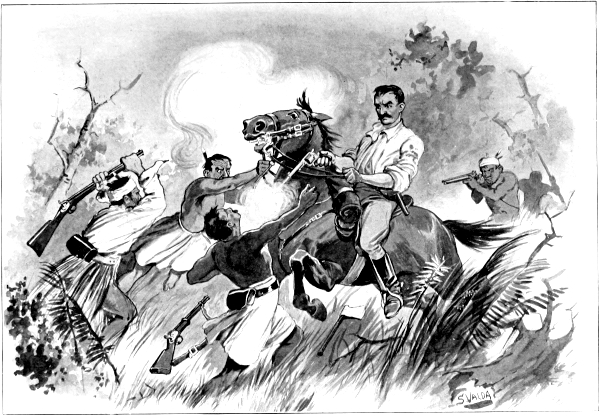
DESPATCH RIDING.
His Grace, looking if possible more doleful than
ever, sank down on his hams, crossing his feet
behind his head, so that one foot stuck out on
either side of it, and then crossed his hands, still
holding his carbine in front of him, while with
mournful eyes looking at his commandant he said,
“I always sit like this, sir, when resting.”
At once the Maoris yelled and tried to push
their way through the grinning troopers who
hemmed them in, while the astonished O.C., who
by the way had never seen a circus in his life,
threw himself back in his chair and gasped.
“Sit down like that when you want to rest, do
you? Then, in the name of all that is righteous,
how do you recline when you want to sleep?”
Without a word, and seemingly without an
effort, the noble Duke gave himself a twist and in
the snap of a cap reversed himself so that he stood
on his feet, with his western parts elevated in the
air and his long, melancholic face upside down
framed between his legs.
This transformation scene was greeted by another
yell from the Maoris, while the perplexed O.C.,
opening eyes and mouth, ejaculated:
“Well, I am damned. For God’s sake, man, get
straight if you can,” and then aside, “I wonder
what in hades he will look like when he’s dead.”
For in a moment a respectable, if sorrowful-looking,
trooper was standing rigidly to attention before
him. “Well,” continued the Commandant, “I
can’t punish the natives, that’s clear, nor can a
camp be alarmed for nothing, so, Mr Burke, be
good enough to see this man does nine days’ pack
drill, and if that does not keep him straight then
lash a spare tent pole up and down his back bone—I
fancy that will fix him; and now, sergeant-major,
relieve this tired sentry, let the prisoners
be taken back to the hut. Fall away, men; come,
gentlemen, let us finish our work.”
CHAPTER XII
THE YEAR OF THE LAMB
During the latter part of 1866 and the early part
of 1867 the war on the west coast of New Zealand
languished; Colonel McDonnell had for a time been
sent over to the east coast and had straightened
things out at Rotorua, while we who remained
behind marked time. The truth being we had
no men to take the field with.
The Maoris, only too glad to get a spell so that
they could plant fresh crops and repair damages,
sat tight and did nothing to excite active retaliation,
while Parliament, especially the South Island
members, howled for peace and retrenchment,
and although we all knew there was absolutely no
hope of a lasting peace, yet, of course, the Government
had the say, and more men were disbanded.
We, however, who held the frontier lived in a
semi-state of war, and although patrols and scouting
was all we could do, yet I had great opportunities
of improving myself in bushcraft and scouting.
Towards the end of 1866 Toi, the principal Hau
Hau chief, visited headquarters, bringing with him
twelve men, and this deputation demanded peace.
“Very good,” answered McDonnell, “it is the
earnest desire of the white man to live in peace.
Therefore bring in all the Hau Hau chiefs of the
district and we will ratify peace.”
The deputation left, promising to do so, but never
returned. Pungarehu had evidently instilled the
fear of the Lord into the Hau Haus, for Toi complained
against the Colonel’s method of fighting.
“The soldiers,” quoth he, “always gave us
notice of their approach. They blew bugles and
made plenty of noise so we might be ready to
receive them, but you and your men slip through
the bush by night like rats and we can’t sleep for
apprehension.”
“Yes,” answered the Colonel, “we fight in
your own manner and you don’t like it.”
“No,” said Toi, “let this sort of work cease,
or we shall soon be unable to continue the war.”
And having lodged a dignified protest the old
cannibal retired.
There is no doubt that Toi, himself, really wanted
peace, but he was sinking into obscurity, as now
Titokowaru took the lead, and everyone conversant
with Maori nature knew that so long as he lived
and ruled the roost there was no possibility for
peace.
This man had always been a bitter enemy to
the white man, and his hatred had been enhanced
by the new fanatical religion to which
he had become one of the very first converts, being
one of those who, in April 1864, had made the insane
attack on Sentry Hill, under the leadership of the
Hau Hau apostle, Hepanaia. In this fight the
apostle Hepanaia and most of the leading chiefs
were killed and Titokowaru himself lost an eye.
Now as the prophet and apostle Hepanaia had
promised his disciples a bloodless victory, but had
not only been killed himself and his men defeated
with dreadful slaughter, anyone would think that
a sane man would have chucked up such a rotten
religion, especially should he also have lost an eye
through his devotion to it; but not so Titokowaru,
who became more than ever embittered towards
the white men. In fact, as Tim put it, he had
turned from being a Fenian into an Invincible,
and wanted hanging. This was quite true, but,
unfortunately, you must catch your hare before
you can cook him, and Tito was too wily a bird to
be caught.
It was in May 1867 that the last of the military
settlers were disbanded and handed over their
land-scrip, but most of them, not wishing to be
murdered, and possessing a far greater knowledge
of the true state of affairs in the district than the
Government, sold their rights for what they would
fetch, and either left the country or went to the
gold-diggings, which were now booming, as the great
Coromandel and Thames gold rushes were in full
swing.
The volunteers had also completed their period
of service and, owing to the crazy manner in which
the Government, mad for retrenchment, acted,
no others were enlisted, so the district was almost
without defenders.
Now there was some excuse for the members
of Parliament representing the South Island, who
knew nothing about the circumstances of the case
nor the customs of the Maoris, but there was no
excuse for anyone on the ground, much less for
the damned commissioner, who not only wilfully
misled the Government but did everything in his
power to thwart and hamper McDonnell.
It may have been true that the Maoris wanted
peace for a time, or rather a truce, as we had so
rattled them, destroying their crops, villages, stores
of food, etc., that they must either gain time to
recuperate or give in, and they completely hoodwinked
the Government. For even Titokowaru
with some of his men visited Waihi early in June
1867 and announced that this was the year of the
lamb, meaning that it was to be a year of peace, but
he said nothing about what animal was to represent
the coming year. Again, shortly after this
visit, another hostile of importance, Whare Matangi,
chief of the Paka Kohi tribe, visited Patea, he
also declaring this was to be the year of the lamb,
but likewise refraining from mentioning what the
following year was to be; and the astute natives
so utterly blinded the Government, who, longing
for peace themselves, persuaded themselves they
had obtained it, that they refrained from grasping
the opportunities pointed out by McDonnell; and
the festive Hau Hau planted and garnered his
crops in security, laid in provisions and ammunition
for future use, rebuilt his pahs, furbished up his
firelock and sharpened his tomahawk, for are
not these the pursuits meet to follow during the
piping times of peace?
This relaxation of hostilities also gave time to
Titokowaru to consolidate his party of irreconcilables,
and he was joined by very many hotheads
of other tribes, which soon gave him greater
standing in the country.
Anyhow, it was not long before the natives
showed their real inclinations, as the very same
Paka Kohi tribe which the commissioner had declared
to be so desirous for peace forcibly stopped
the survey of the Whenua Kura block and although
they did not murder the survey party, still they
drove them off the land.
The Colonel managed to quiet this trouble,
and one or two other disturbances the starting of
which further convinced him that the natives,
now that they had saved their crops, meant to
fight, but this opinion the commissioner laughed
at, and just at the moment when his services were
most required the O.C. was sent with sixty of us
to suppress a fancied Fenian rising on the goldfields
of Hokitika.
Naturally we looked forward to this trip with
delight, as it would afford us a most agreeable
change in the somewhat monotonous life we had
been leading for the last few months, besides
which the goldfields contained many opportunities
for indulgence in vices our monasticism on the
frontier did not permit.
Hokitika is situated on the west coast of the
South Island, and was what is known as a poor
man’s diggin’s—i.e. a goldfield that a man with no
capital can win gold from by his own labour. The
New Zealand goldfields were never such rowdy
ones as the Californian nor the Australian, being
free, with few exceptions, from bushrangers and
the murderous riff-raff that congregated at the
American mines. Yet they were rough, and a
strong party of Irishmen, known as the Micks, were
apt, especially when under the influence of whisky,
to make themselves objectionable.
It must be remembered that at this epoch things
were very stormy in Ireland, and even in England,
and the Micks instigated by whisky had held
meetings and talked a lot of infernal rot, from which
the warden of the goldfields, a nervous ass, had
imagined possibilities of Fenian risings, insurrections,
civil war and the Lord only knows what other
catastrophes; hence the reason for withdrawing
the O.C. and the greater portion of his reliable
men from the west coast of the North Island
just when their services were most required.
However, we who composed the party looked on
the whole trip as a joke, and a pleasant interlude
to the hard work and short rations we had had for
so long to endure. As for any fighting with Fenians
that none of us believed, although Tim and myself
conjectured there might be some heads broken by
way of a frolic.
It was in this spirit we took ship and went to sea,
eventually reaching Hokitika, where we had to land
in surf boats, through a very bad surf indeed.
We, however, passed through it in safety, when
we were joined by the Colonel, who had gone ashore
previously. The authorities had begged him to
land us with loaded arms, and had prophesied all
sorts of bloody happenings, but the Colonel had
very rightly taken their wailings with a pinch of
salt, so we reached the shore in the most unostentatious
manner, at a time when the Micks
were sleeping off their previous night’s debauch,
and we were quickly marched up to a spot the
Colonel had selected, where we expeditiously made
ourselves safe and snug.
This artful move on the part of the O.C. completely
out-generalled the Micks, as the sons of
Ould Ireland, God bless her, were by no means in
a state to have resisted our landing had they wished
to do so, and by the time they were awake, and
ready to renew their potations and politics, we were
in possession of the strongest position overawing
the town. This fact may have induced them to
take up another line of defence against the bloody
Saxons, and they may have determined to kill
by hospitality those they feared to attack with
force. For their deputation waited on us, not with
pick-handles, revolvers and fowling-pieces, but
with cases of champagne and John Jameson’s
whisky, and I verily believe they would have defeated
us had we remained much longer with them.
The west coast diggings were at that time
booming, any man caring to work a few hours a
day being able to make his eight to ten pounds per
week, some of course far more, so that it was a
marvel to me why men cared to serve a government,
risk his life and undergo the awful hardships
our men did, for six shillings a day.
It was during this epoch in New Zealand I
could have, had I chosen to look after my own
interests, made my pile. I had plenty of money,
and could have got plenty more had I asked for it,
and as I before stated the late military settlers
were selling their land-scrip for what they could get,
so that as I was on the spot I could have purchased
blocks of the finest land in New Zealand for a song,
but I did not, and I want to warn young Lost
Legionaries not to follow on my spoor.
I had made the Crown and flag my fetish from
early childhood, and in my own stupid and conceited
mind reckoned it to be my bounden duty
to fight for them, and that so long as the war continued
I must continue to serve, no matter what it
cost me in pecuniary and personal losses. This
infatuation has stuck to me all my life, and is as
quick now as it was then, my life in consequence,
so far as gaining the good things of this world goes,
being a wretched failure.
I therefore want to warn the rising generation
against it, so that all of you young fellows who are
thinking of leading a frontier life take the advice
of an old hand. “Fight certainly and fight like
the devil, but don’t be carried away by any sentimental
rot.”
“God save the King” is a very fine tune, and the
Union Jack a very pretty object flying at the masthead,
but neither King nor flag can come to your
aid when you are old and stranded on the pebbles,
while as for your country, represented as it is by a
gang of greedy, self-seeking politicians, you may
starve in the gutter or rot in the workhouse.
Therefore, my romantic new chum, when you see
the chance to make money on the one hand and
fighting for your country on the other, you go for
the money. There are plenty of bally fools such
as I have been to do the fighting. Your paltry
services won’t be missed, and you will be thought
much more of by the people of the self-same
country.
We remained three weeks at Hokitika, and were
then fortunately sent back from our Capua to
sterner work, landing at Patea just barely in time
for the Colonel to quiet another shindy, as the
natives had stopped the survey on the Makoia
Block, and although he managed, by his vast
knowledge of Maori manners, to tide over this
trouble, yet it was evident the billy was boiling
and must soon boil over, for now everyone could
see, with the exception of those wilfully blind,
that war was imminent, as the natives now commenced
openly to steal every horse and head of
stock they could lay their hands on; so the early
months of 1868 passed.
Some very foolish acts on the part of the resident
magistrate and commissioner hurried on the
inevitable climax, but yet the perpetrators of
these follies still swore the sham peace would be a
lasting one and objected to order in the few settlers
who had the temerity to cling to their farms.
It would take too long to relate the wretched
details of that miserable time, but eventually
they culminated in the cold-blooded and brutal
murder on 9th June of three harmless bushmen
while peaceably at work.
Colonel McDonnell was at the moment in Wanganui,
from whence he at once returned, and did
all in his power to secure the safety of the district,
but we were so short-handed that, even with the
forts inadequately garrisoned to an alarming
extent, he had not one man to take the field with.
He therefore made a flying visit to Wellington
to try and instil some glimmer of reason into the
wilful numskulls who formed the ministry, receiving,
after much persuasion, leave to enlist
three hundred white men, together with one hundred
Maoris, for a service of not longer than three
months.
Now the men were wanted for immediate service,
so that there was no time to pick or choose them,
nor was there time to train them when chosen,
and it must be remembered that the population
of New Zealand forty odd years ago was much
smaller than it is now, also that the goldfields
were booming and really good men scarce. Yet
even then, in the towns, there were numbers of
loafers and riff-raff who, too lazy to go in for hard
colonial work, hung about the cities waiting for
what they call a suitable billet to turn up, and it
was from the ranks of these useless unemployed
that the great majority of the three hundred white
men were enlisted.
I do not suppose a more useless gang were ever
got together, but then on paper they represent
three hundred men. Well, the Colonel had asked
for them, the Parliament had granted them,
the town magistrates had enlisted them; and as
the lawyers, merchants and others, who constitute
a parliament, are quite ignorant of the
requirements of a war, they are apt to imagine
one man to be as good as another, so that you
have only got to put a uniform on his back, and
clap a rifle into his hand, when the miserable
scarecrow must be able to at once do the duties
of a well-trained soldier, or even a highly skilled
bush fighter.
In the meantime more settlers had been
murdered, more farms burnt and cattle looted, so
that Titokowaru and his tribe, the Ngatiruanui,
having saved their crops, and being well rationed
with stolen oxen, considered it was high time
to begin hostilities on a larger scale.
It was on the 9th June the aforementioned bushmen
were murdered, and on the following day every
one of our forts were more or less invested, so that
it was dangerous to leave the shelter of the parapet,
as on the 10th, a trooper, named Smith, having
left the fort to catch his horse, was killed and cut
to pieces before the eyes of his comrades, who were
only able to recover his two legs, the rest of him
being taken into the bush and eaten.
The Hau Haus also made it lively for the despatch
riders, making numerous attempts to cut
them off, capture or kill them, while on the 20th
June sixty of them made a desperate attack on
the ration dray, escorted by a sergeant and ten
troopers, at the same place where Haggarty had
been killed previously. The escort, however, made
a stout resistance, and being relieved smartly
from the fort the assailants were beaten off with
loss.
I think I may here give you a personal experience
of the pleasures of despatch riding, such
as were enjoyed by the mounted portion of the
colonial forces when engaged on that necessary
occupation. It must be remembered that in those
days we had no heliographs, and therefore all
orders, letters or news had to be transmitted by
horsemen riding from fort to fort, and the Hau
Haus looked on it as great sport, trying to cut off,
kill or capture the unfortunate whose duty it was
to carry them.
Of course their chief ambition was to catch the
despatch rider alive, as then it would afford them
much amusement in torturing him to death,
though failing capture he was of value to them
dead, as they looted his arms, and also procured
good meat rations from his remains. Anyhow
it was good sport, so, as they knew we were far
too weak in numbers to attack them, they made
up hunting parties to catch us. Fortunately
most of the main road ran along the sea-beach
and was fairly open, but when it was necessary
to ride inland you had to pass through scrub,
bush and long fern, in which they laid their ambushes,
and it behoved the horseman to have all
his wits on deck.
Well, one day I had to carry despatches up
to Waihi, a distance of some fifteen miles. I
was well mounted on the horse I had first bought,
who had turned out a slashing charger, very fast,
with great staying powers, very sure-footed and
a grand swimmer, the latter such a necessary
accomplishment in a country abounding with tidal
rivers and no bridges. It was a lovely afternoon,
and I rode with stripped saddle, carrying
only a brace of revolvers. The road ran for some
miles along the beach, the tide being out, and I
enjoyed my canter over the hard, firm sand although
I had two rivers to cross, one of which I
had to swim; these, however, were negotiated
comfortably and I turned inland, where the track
ran through manuka scrub, patches of bush and
fern.
I at once started a bright lookout, but saw
nothing to guard against until I came to a place
where the track ran through a natural clearing
about a mile in length, and no more than one
hundred yards across. (Note.—These natural
clearings are common enough in New Zealand
scrub, especially on the Taupo and Kaingaroa
plains. How formed no one knows.) The road
ran up the centre of the clearing, which was covered
with short tussocky grass that grew in little detached
knobs like the wool on a nigger’s head.
I had just entered this clearing when my eye
caught the gleam of something bright that sparkled
for a moment in the scrub more than half way
along the length of it, and knew it was caused
by the sunshine flashing on the head of a tomahawk
or the barrel of a firelock. Catching hold
of my horse’s head I slightly increased the pace, at
the same time dropping my right hand on the butt
of my revolver and preparing for a lively time.
I may have ridden a third of the way up the
clearing, when bizz came a bullet past my nose,
followed up by perhaps a score more. Thank
the Lord a Maori could not shoot for toffee, and I
saw at least forty natives at the far end of the
clearing jump out of the scrub and make for the
road, to try and cut me off, while yells from my
rear told me retreat would be worse than going
on, and I knew there was nothing for it but to
break through or be caught; in which case even
suppose I was not shot dead I must shoot myself,
as it would never do to fall alive into the hands of
these fiends. I therefore let my willing horse
break into a gallop, and charged along the road
as if Old Nick had kicked me.
Fortunately the noble beast I bestrode was
as bold as he was handsome, and never winced
nor shied from the yelling devils who, with waving
tomahawks and mats, tried to frighten and check
him, but just extended himself, and obedient
to my hand and knee pressure swung to whichever
side I wanted him to go. In fact he seemed
to be guided by my will and understood my
wishes as soon as the ideas were formulated in
my own brain. Oh, what a splendid gift Providence
presented to man when he gave him the
horse, and what a friend the noble beast is to you,
when you treat him as a pal and not as a slave.
Some such thought rushed through my mind
as, pistol in hand, I sent him at the crowd of howling
savages, a few of whom had already reached the
road, two of whom I spotted as being the most
dangerous.
These two bounders had taken up positions
on either side of the track, the one on the left
side being armed with a long-handled tomahawk,
with which he evidently intended to maim my
horse’s legs, the other stood empty-handed, whose
plan, plain enough to surmise, was to grab the
horse’s bridle and pull the wounded beast down,
or, in case he fell, to seize me and put a stop to any
resistance I might offer.
Backing these fellows up, and running to support
them, were a scattered mob of others, armed with
guns and tomahawks, but I had no time to notice
these critters, as, uttering a yell that must have
been inherited from some far-back old Milesian
ancestor, I charged straight at my would-be body-snatchers.
It was clear to me that the man with the tomahawk
was my principal danger, as should his cut
at my horse’s legs be successful down we must
both come in a heap, and it would be a case of
Kingdom Come for the pair of us. So aiming at
his midriff as well as I could, when I was within
ten yards of him, I fired, and to my delight saw
him collapse in a heap.
I had barely fired when I was badly shaken
in my saddle, as my horse seemed to stop dead,
make a half rear, and strike out savagely with
his fore-feet. ’Twas only for a tick of time, for
with a plunge and bound he regained his stride,
and I caught a glimpse of the smashed head, face
and shoulders of a man writhing on the ground, as
my horse leapt over him; so it was not difficult
to understand that the native had sprung at the
bridle and been struck down by my noble charger,
by which meritorious act he had gained utu
(revenge) for the brutal treatment he had received
from the Maoris whilst he was a captive and
slave in their hands.
Anyhow we had broken through them, and
although a shower of bullets followed us, two of
which touched my gallant pal, while one knocked
the heel and spur from my right boot, we were safe,
and I cantered along to the fort talking to my
horse, and praising him for the bold way he had behaved,
while he, playfully reaching at his bit, now
and then snorted back as much as to say, “Right,
Boss, we euchred those ruddy jossers, didn’t
we?”
Earnestly the reinforcements were looked out
for, as the garrisons of most of the forts were so
weak that it was more than doubtful whether they
could offer a successful resistance against a determined
attack. Moreover, trusty spies brought
in information that Titokowaru contemplated
making such attacks as he was very desirous of
obtaining a supply of rifles wherewith to arm
the numerous recruits who had lately flocked to
his standard.
Nor was the information false, for on the morning
of the 12th July he attempted to capture the
redoubt at Turu Turu Mokai, and very nearly
succeeded in doing so.
This redoubt was an old work that had been
constructed by the 18th Regiment at a time when
there were thirty men to do the work now allotted
to one, and though it had been built on an important
tactical situation, yet the site had been badly
chosen, nor was the work itself of any strength.
This did not matter when the district swarmed with
defenders, but now we were so weak it was considered
extremely vulnerable. Moreover, for a
long time, while the sun shone on our side of the
fence, it had been abandoned; the berm had in
places been washed away by the heavy rain, and in
places the much damaged parapet almost tottered
over the ditch; still, the importance of its situation
was so great that the O.C. had to now make use of
it in his scheme of defence.
This tumbledown structure was garrisoned by
twenty-five men under the command of a very fine
officer, Captain Ross, who had done everything
in his power to make the place defensible, but had
only succeeded in making the weak spots more
apparent.
The site of the work itself was so bad that it
necessitated a flying sentry to watch a gully that
could not be overlooked from the fort, up which
a storming party could easily creep, and there
being no room for the O.C.’s tent inside he had
to have it pitched outside, near the drawbridge,
which consisted of two narrow planks that spanned
the ditch.
On the night of the 11th a civilian came to the
fort and claimed protection, which was at once
granted, so that there were twenty-seven white
men at Turu Turu Mokai that night.
During the night the flying sentry reported a
flock of strayed sheep had disturbed him, and there
is no doubt that under cover of these animals two
parties of Hau Haus, numbering forty men each,
crawled through the fern, close up to the fort, lay
down and waited for the right moment to rush the
tumbledown work.
The flying sentry who had the morning relief,
however, spotted some dark figures, and discharged
his rifle at them, receiving in return a volley
which wounded him badly, though he still had
strength to crawl into the long fern where he hid
until relieved.
The storming party at once charged, making
for the gate, which in the dark they missed and
ran all round the work looking for it, a pause that
gave Captain Ross the chance of getting inside
and defending the entrance. He had no sooner
got to the gateway—there was no gate—than the
storming party rushed him, led by a noted fighting
chief named Tautai, who, missing his footing on
the narrow planks, tumbled end over end into the
ditch, an accident that saved his life, as the bullet,
that should have sent him whooping to perdition,
killed the man following him.
Two more Hau Haus, the gallant captain,
disputing the narrow way, despatched to their father
Satan, when the remainder, not relishing their
reception, jumped into the ditch after their chief,
and at the same moment the second party rushed
up.
Captain Ross was still in the gateway, doing his
best to give the new-comers a hearty and warm
welcome, when one of the scallywags in the ditch
crawled up under the bridge and discharged his
gun into the unfortunate officer’s body; at the same
moment another of them sank the head of his long-handled
tomahawk into his chest, and dragged the
desperately wounded man down into the ditch,
where he was soon hacked to pieces.
His fall caused some confusion in the already
scanty garrison, and that in rather a queer manner,
as when wounded he shouted: “Take care of
yourselves, boys. I am done for.”
On hearing which four men, interpreting the
order to mean that each man should try and save
himself, mounted to the top of the parapet, and,
jumping over the Hau Hau’s heads who were in the
ditch, sought to save themselves by breaking
through the other assailants and hiding in the fern.
Three of then succeeded in doing so, the fourth being
killed.
The defenders were now reduced in numbers
to twenty-one, Sergeant M’Fadden taking command,
occupying the post of danger left vacant by
the death of his gallant officer, where bravely he
sustained the fight until he was shot dead, when
Corporal Blake stepped into the breach and post
of honour, only to fall in the same manner; thus
the gallant fellows held out, defending their trust
until eight of them lay dead and six of them
desperately wounded in the blood-stained gateway,
the civilian also being killed.
Six men only were now left to continue the fight,
but their comrades had not died uselessly having,
previous to their departure to that Valhalla designed
by Providence for the reception of Lost
Legionaries, administered such punishment to
their enemies that the latter withdrew from the
attack on the gateway to positions from which the
whole interior of the work, with the exception of
one bastion, could be searched by a plunging fire.
To this bastion the six dauntless fellows now
retired, determining to make their last stand and
die there. It was the best spot in the untenable
work, the gorge being masked by a flimsy wooden
hut, that was not bullet proof, although it prevented
the Maori sharpshooters from seeing the
defenders and aiming at them.
Their greatest danger was the parapet that here,
as I mentioned previously, simply tottered over
the ditch, and which the Hau Haus at once set to
work to undermine.
They were now in a desperate strait, but never
lost heart. Relief was bound to come. Could
they hold out long enough? They gained time
by a clever ruse. The Maoris feared mounted
men more than anything, so the defenders with
one accord started cheering, at the same time
shouting: “Hurrah, the cavalry are coming!”
Whereupon the sappers left off their work, preparing
for a bolt.
This trick was played two or three times, but
the nervous Maoris were always rallied and forced
to return to their work by the infamous scoundrel,
Kimball Bent, whose voice, cursing the Hau Haus
for their cowardice and urging them on to make
further efforts, was distinctly heard and recognised.
At last the relief did come, though not by the
efforts of the troopers, who for some inexplicable
reason were left behind, Major Von Tempsky, then
in temporary command, selecting infantry to go to
the rescue and leaving twenty troopers standing
by their horses without orders.
He, however, arrived just in the nick of time,
as the enemy had not desisted from their work
and retired more than a minute when the crumbling
parapet fell bodily into the ditch which, had it
done so a few moments sooner, would have left
its six gallant defenders, all more or less hurt, to the
mercy of their savage opponents, but they, by
their splendid defence, not only saved their own
lives, but prevented a large amount of arms and
ammunition falling into the hands of Titokowaru
and the baffled Hau Haus.
The relief of Turu Turu Mokai, although successful,
was the origin of a most miserable squabble
which ended in a sad tragedy, as it was the cause
of as gallant an officer as ever drew sword throwing
away his life in attempting to regain a reputation
for courage which in the opinion of every man
worth his salt should never have been doubted.
It happened this way. When the garrison at
Waihi were alarmed by the sound of heavy firing,
both troopers and infantry at once turned out.
The former, twenty in number, were a very smart
body of men indeed, always ready at a moment’s
notice to tackle any job that might come along.
They were under the command of Major Hunter,
who was also second in command to Major Von
Tempsky (temporary O.C. of the district), who was
a splendid though very jealous officer.
Hunter, the moment the alarm was given, ran
round the fort to see that the sentries were on the
alert, and when he had done so found that Von
Tempsky had started with his own men, the
infantry, leaving no orders for the mounted men
nor for himself.
This placed him in a dilemma. It was clear
the headquarters fort, containing large supplies of
arms and ammunition, could not be left in charge
of a guard of six men. It was also clear that the
mounted men were the proper men to have gone
to their comrades’ assistance, but as his senior
officer had left them behind without orders it was
clear he must utilise them to hold the fort. He
therefore gave orders to lead the horses back to their
stables and for the troopers to man the bastions.
Now the troopers were as keen as mustard, and
had been ready for duty even before the infantry,
for although they did not, like the bold garrison of
Branxholm Castle, drink their wine through their
helmets barred, it was only because they had no
wine to drink nor tin pots to wear on their heads,
but they drank their ration rum, when they could
get it, under their forage caps, and they always lay
down to sleep fully accoutred, breeched, booted,
belted and spurred, while their horses stood all
night in their stalls saddled and bridled, with their
heads round, ready to be led out and mounted in
a moment.
It was so on this occasion. In fact they were
standing by their horses before the foot men fell
in, so it was through no fault of theirs they were
not employed.
Now the troopers were well aware that they were
the men who should have been selected to have
gone, as they could have reached their endangered
comrades at least half-an-hour before the footsloggers
could hope to do so, and the fact of their
being left behind drove them hopping mad, while
on receiving the order to man the bastions the
sergeant-major used language most reprehensible
and unwarrantable, for which he should have
been most severely punished. As the delay caused
by using foot instead of mounted men was responsible
for at least half the casualties, great irritation
was felt not only through the force but also through
the country, and the newspapers, getting to hear
of the sergeant-major’s hasty words, immediately
started to disseminate their garbled reports, it
even pleasing the ink-slinging stool-polishers, who
write them, to shower abuse and cast doubts on
the courage of a brave officer whose boots they
were not worthy to black.
The synopsis of the wretched affair was this.
Major Von Tempsky was the senior officer whose
undoubted duty it was to take steps to immediately
relieve the besieged fort. Well, he chose
to go himself, taking his own men, infantry, with
him, and leaving the mounted men and their
officer behind without orders.
This action on his part clearly shows he was
instigated by one of two ideas: either he considered
the infantry most suitable to effect his purpose or he
wished to gain all the credit of the relief for himself
and men regardless of the danger the other fort
ran through not receiving speedier assistance.
Most certainly Major Hunter could not have
followed on and left the headquarters fort unprotected.
Anyhow poor Hunter, a most high-spirited and
sensitive man, unable to endure the slurs cast at
him by a scum of newspaper men, threw away his
life a few months afterwards at Moturoa in giving
the lie to his cowardly detractors.
CHAPTER XIII
TE NGUTU-O-TE-MANU
Colonel McDonnell returned to the district on
the same day as the fight at Turu Turu Mokai
took place, reaching the blood-stained ruin at noon.
There was, however, nothing to be done but
wait for the reinforcements, which, as they arrived,
were licked into shape as rapidly as possible,
although it was not till the 21st of August they
were deemed fit to be introduced to the Hau Haus.
On this date a strong patrol was sent to have a
look what Titokowaru was doing, but that nobleman,
not caring to have his privacy intruded upon,
hunted the new chums out of the bush, killing
four and wounding eight of them. So the disgusted
O.C. decided to await the arrival of the
Wanganui warriors, whose enlistment was being
delayed by our old friend, Mete Kingi.
At last seventy splendid Wanganui Maoris
reached Waihi, under the command of their gallant
chief, Te Kepa, when the Colonel determined to
make an effort, as if the new levies were to be used
at all they must be used at once. There was no
more time to train them; they had been enlisted
for only three months, and their time of service
would shortly expire.
It was therefore now or never. The country
simply howled for him to wipe out Titokowaru;
our Wanganui natives were hungry for a fight, so
that although himself and all his officers knew well
that the new chums were not to be trusted in the
bush, still he made up his mind to march out and
attack Titokowaru in his vaunted stronghold.
Now, before I begin the yarn of this most
disastrous expedition let me inform you that at
this period I do not think our gallant and much
respected O.C. was at his best, nor was this to be
wondered at. For nearly two years he had been
struggling, not only against the Hau Haus but also
against an obtuse Government, who had listened
to his bitterest detractors and enemies, while they
wilfully closed their eyes to the obvious requirements
of the district, and who, regardless of his
expostulations, had reduced his fighting strength
to an absurdly inadequate force, and even now,
when his prognostications had been proved correct,
suffered the very men whose lying reports had
misled them to remain in office and hamper the
endeavours he was making to straighten out the
desperate muddle for which they were responsible.
Again he had at present under his command for
a very limited space of time a field force on the
bulk of which neither himself nor his officers could
rely, and with which he was expected to work
immediate miracles, and, as if all these circumstances
were not enough to worry him to distraction,
just at the moment his services were most in demand
his only trusty spy, Katene, deserted and
joined the Hau Haus, so that he was left without
any reliable information to guide his movements.
Therefore I am sure that several of the decisions
he came to and acted upon would have been
otherwise had not his keen judgment been obscured
by manifold anxieties and worries more than even
his strong and brave spirit could tolerate, and
that on this occasion he was not in full possession
of his brilliant fighting faculties.
Anyhow, as something had to be done, he issued
orders that a field force composed of two hundred
white men and the seventy friendly natives should
parade on the night of the 6th of September
1868.
During the day every preparation was made, but
alas when night fell the Tohungas (medicine men)
discovered something had gone wrong with the
moon and a star, an unfortunate occurrence, as it
denoted the overthrow of the expedition, and the
Maoris, who up to that time had been in a state of
huge delight at the chance of a scrap, now hung
back.
In a moment the whole aspect of affairs was
changed, as even Te Kepa and his best warriors
begged the O.C. to postpone the taua (war party)
for twenty-four hours. On any other occasion
I am sure he would have done so, as the Colonel
was always most anxious not to run counter with
the superstitions of our valuable allies, but the
irritated, overdriven man was inexorable, and
issued orders that the expedition should start that
very night, let the moon and star shine as unpropitiously
as they darned well pleased.
At this decision the hearts of the Maori warriors
became very dark indeed, and they held a meeting
so as to discuss what on earth should be done.
They were all keen for a fight, but it was flying in
the face of Providence and courting disaster for
themselves should they neglect such pregnant
warning; so things looked very black, as should
the Maoris refuse to march it was quite clear to all
of us the impossibility of our proceeding.
At last, after many speeches, a grim old warrior
of great experience got on his hind-legs. Quoth he:
“Men of Wanganui, we have done all in our power
to persuade the white chief not to go, but he insists
on doing so, notwithstanding the predictions of
certain disaster we have received. We are bound
by honour to accompany him; besides, we languish
for a fight. The taua will be defeated and the
white men cut to pieces, which will serve them right
for neglecting this warning. But we, my children,
having protested against such godless profanity,
will escape without injury, and as we go in honour
we shall, provided we fight bravely, all return
safe with our honour enhanced.” This speech
ended the meeting and the friendlies determined
to come with us.
Now you good people who live at home at ease
may laugh at a white man believing, or even tolerating,
the prophecies of a savage devil-dodger,
but very many experienced frontiersmen, in the
course of their pilgrimage through wild countries
and among wild races, come across so many queer
and uncanny incidents quite inexplicable to their
philosophy, therefore they are not so ready to
laugh at or deny that which they cannot understand.
Consequently many of our old hands
believed in the sombre prognostications of the
Tohungas, and perhaps were not wrong in doing so,
for if the proof of the pudding is in the eating of it,
surely the value of a prophecy is in the veracity of
its fulfilment, and on this occasion the soothsayers
certainly scored the straight tip, as on the next day
the friendly natives, although they fought with a
reckless gallantry never surpassed in the annals of
war, and while covering our retreat exposed themselves
in a manner that even astonished the
fanatical Hau Haus, yet, during the whole disastrous
affair, they had not one single man scratched,
while what happened to us white men I shall now
relate.
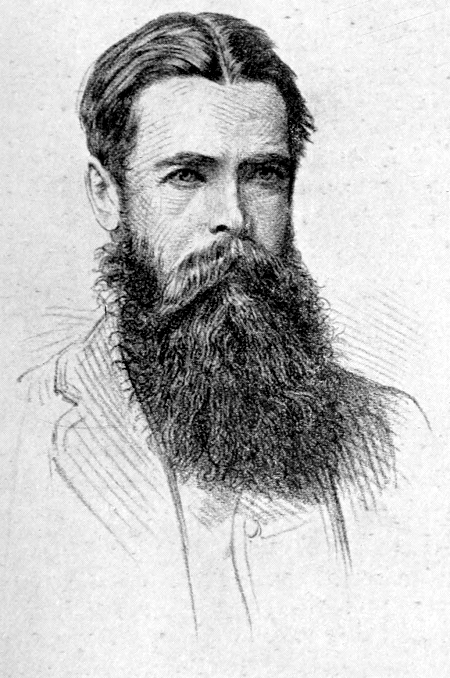
COL. WHITMORE.
Well, this difficulty being satisfactorily overcome,
we paraded at ten-thirty P.M. on the 6th,
two hundred white men and seventy Maoris, a
force quite sufficient had the former been of the
same calibre as the old rangers and military settlers,
but alas, out of the two hundred, not more than
forty men had ever been in the bush before, and
these old hands had no confidence in their inexperienced
comrades; in fact, the old joyous
devil-may-care spirit so noticeable in the ranks
when starting on past expeditions was on this
parade entirely wanting, and the old war-dogs
looked more as if they were attending their grandmother’s
funeral than starting for a jolly romp with
the Hau Haus in the bush.
Anyhow we started, the night being bitterly
cold, with a very heavy frost that gave our nearly
naked allies jip, laming their bare feet to such an
extent that some of them were crippled for weeks
afterwards, so that even they did not escape scot-free,
but were in some way punished for accompanying
their ungodly and incredulous white comrades.
Two miles had been covered when we came to
the flooded Waingangora River, whose icy waters
rose breast-high as we forded it linked arm in arm
so as to prevent being swept away. Oh, scissors!
it was cold, my shawl and jumper being frozen as
stiff as boards five minutes after I had crossed!
We, however, pushed on, and when daylight came
we were deep into the bush on the western slopes
of Mount Egmont.
Now we had no idea where the Hau Haus really
were, as all the information the Colonel had received
since Katene’s desertion had been conflicting,
some reports stating that Titokowaru had
fallen back to an inland pah called Ruaruru, the
position of which was quite unknown, and as the
so-called peace had given him plenty of time to
build a dozen new pahs, provided he had a mind to
do so, he might be anywhere within fifty miles of us.
We had therefore to follow the old bush-whackers’
plan—viz. enter the bush and cross it in a straight
line, and if you cut a well-defined track follow it
in the most likely direction to the bitter end.
This we did until one-thirty P.M. on the 7th,
when we cut a well-worn path which ran nearly
north and south. This was a streak of luck, and
at a short council of war it was decided we should
follow the track in a southerly direction towards
the sea.
After a short halt and a bite of cold, sodden food,
for of course no fires could be lighted and our
rations had been soaked in the waters of the
Waingangora, we moved on for nearly an hour,
when another halt was called and Te Kepa ordered
one of his men to climb a gigantic rata-tree so as
to obtain an outlook and try if he could spot any
smoke rising or see any indications of a clearing
in the adjacent bush.
The fellow ran up one of the huge pendent vines
like a monkey, being soon lost to sight among the
lichens, orchids and parasites that draped the
branches. He had not been gone over a few
minutes when down he slid, reporting he could see
plenty of smoke not more than half-a-mile down
the track, and could plainly hear the sound of a
haka (indecent dances accompanied by unprintable
libretto). This was a real slice of luck, as if the
Hau Haus were hakaing they could not be aware
of our vicinity, and we might catch them on the hop.
Another council of war was held, when Te Kepa
gave the soundest advice, which I am certain
would have been followed by the O.C. had he been
in his normal state, although there is no doubt
that the reasons he assigned for the action he took
were very weighty.
The chief’s advice was as follows:—“We are
here without the Hau Haus suspecting us, but we
ourselves are ignorant what sort of a pah we have
to attack or where it is exactly situated. Now
therefore let the white men, many of whom are
tired, retire a short distance off into the bush,
where, keeping perfectly quiet, they can lie down
and rest. I will place my men in ambush along the
track, so as to tomahawk any one of the enemy
who may pass without noise, though I do not
expect any of them to do so. Then when it is
dark I and my picked scouts will go and reconnoitre
the Hau Haus’ position, so that at daylight to-morrow
morning we shall know what to do and
fight with our eyes open.”
Now there was much wisdom in this counsel, and
had the Colonel followed it we should have at one
blow knocked Titokowaru out of the running, but
the O.C. decided otherwise, asserting the great
danger we ran of the Hau Hau scouts cutting our
trail, when the enemy would either clear out or
prepare themselves to resist our attack. Accordingly
he gave orders for us to immediately advance
in the following formation:—
Te Kepa with his seventy men led the van,
followed by Major Von Tempsky with one hundred
white men, while the Colonel, commanding the
remaining hundred white men, brought up the rear;
the column to move in close order and as rapidly
as possible.
Te Kepa’s men had not marched more than a
quarter of a mile when they came to a tent with a
woman standing outside it, who directly she saw
the advance-guard ran down the track screaming
at the top of her voice, with a few of the friendlies
in close pursuit, but they did not succeed in overtaking
and despatching her before she raised a hullabaloo
that would have alarmed the dead.
As the pursuing natives passed the tent a man
and two children jumped out, who were at once
shot, though another child was saved, one of Te
Kepa’s men carrying it on his back all through the
subsequent engagement.
The screams of the woman, together with the
firing, had of course alarmed the Hau Haus; the
singing of the haka at once ceased, and as there
was now no possible hope of surprising them
we pushed on rapidly, though with all due caution,
until we came to a large clearing.
Here we halted for a few minutes, while the O.C.
made his final arrangements. Not a vestige of
a pah was visible, nor, as a matter of fact, did
any one of us catch a glimpse of the pah on that day.
In front of us was a patch of dense, heavy bush
containing huge trees, and we knew that somewhere
among these was the lurking-place of
Titokowaru.
The Colonel’s orders were concise. Te Kepa
was to deploy his men in extended order to the
left, so as to surround the pah on that side; Von
Tempsky was to execute the same movement to
the right; and his own party were to advance in
extended order to the front.
So far so good, and as soon as Te Kepa and Von
Tempsky had cleared our front—I was with the
Colonel’s party—we deployed and extended, but
directly we began to advance our troubles began,
as the new chums would keep on closing in instead
of moving forward in open order.
This inclination to crowd into a mob became
worse as we entered the bush, so that, notwithstanding
all the efforts of us officers, and the
objurgations of the old hands, all formation was
speedily lost.
Passing through a narrow strip of bush we came
to a deep and broad creek, whose steep banks
were covered with dense undergrowth. This we
had to cross, and as we descended the bank the
left of Von Tempsky’s party surged into the right
of ours.
In vain we raved at them, even going so far as
to strike some of them and threaten others with
our revolvers, but it was no good, the wretched
conscripts had a bad attack of bush funk and
would not obey orders.
As we struggled down into the creek I fell over
Tim, who said to me: “For the blessed Virgin’s
sake, take care of yourself this day, Mr Dick,
sure these damned hooligans will land us up to
our necks in the bog. May Satan scrape ye wid
red-hot oyster shells, ye narvous spalpeens, will
ye extend or will ye march to hell in sub-divisions,”
he howled, while doing his best to second my
efforts, but it was all of no avail, and we started
to cross that creek, so as to ascend the far side,
in a disorganised rabble.
Up to this time dead silence had brooded over the
bush, but when we reached the centre of the
creek’s bed a terrific war yell was raised and a
tremendous volley, of at least three hundred rifles
and guns, was poured into us, from a distance of
not more than ten yards; which, tearing our disorganised
mob into tatters, transformed the bed
of that forest, fern-embowered creek into a bloody
shambles.
This reception was far too stern a one for our
nervous new chums, over forty of whom at once
scrambled out of the creek and bolted, never
pausing in their flight until they reached the crossing
place of the Waingangora River.
In vain with the old hands and those of the new
chums who had the pluck to stand, though not
the sense to extend, we made a rush and attempted
to charge.
We failed at once, for the cunning enemy had
woven the ground vines and undergrowth on their
bank so closely together that nothing except an
elephant could have broken through, while from
the lofty rata-trees, in whose branches the best
shots of the Hau Haus had been placed, came a
plunging fire that knocked over man after man,
so that we could do nothing but lie down and
return the fire of our invisible enemies.
The casualties among our officers had been very
heavy. Lieutenant Hunter had been killed; Dr
Best and Lieutenant Rowan, badly wounded by
the first volley, had been carried out of action,
while Captain Palmer and Lieutenant Hastings,
both badly wounded, had subsequently to be
abandoned to the awful fate of falling alive into the
hands of the ferocious Hau Haus.
In the meantime, Te Kepa had fared much
better, for with his warriors well in hand he had
worked round the left of the clearing, and with a
rattling charge had swept away the party of
Hau Haus sent to oppose him, subsequently taking
up a strong position ready to storm the pah when
ordered to do so.
Our plight, however, was now hopeless, as the
enemy manned a low, well-bushed hill, the fire
from which enfiladed the creek, rendering our
position in the bed of it more untenable than ever.
Still I am convinced that, had our men all been old
hands, our gallant O.C. would have pulled us out
of the mess, and we should have won the day, but
nothing could be done with the raw new chums,
most of whom seemed to be paralysed by the
slaughter and the blood-curdling yells of the Hau
Haus.
This being the case, Colonel McDonnell saw
that the only way to preserve the remainder of
his force was to order an immediate retreat; so,
directing us to carry out the wounded, he despatched
his brother, Captain McDonnell, to Von
Tempsky with orders for him to at once withdraw
his men out of action and join his own party,
Te Kepa offering to cover the retreat of our
shattered force.
We had brought ten stretchers with us: these had
been rapidly filled, and as we had now not more
than sixty men, officers and privates, left, we were
just able to handle fourteen wounded men, four
being carried on rifles, as it required at least four
men to carry a stretcher and six men to carry a
man on rifles through the rough bush, so that all
the remaining dead and wounded men had to be
abandoned.
This abandonment of our wounded comrades
was a heart-rending calamity, but nothing else
could have been done under the circumstances,
although we knew well the dreadful fate that
awaited the unfortunates.
It takes time to write an account of a scrimmage
of this sort, but in reality not ten minutes had
elapsed from the moment we had descended into
that infernal creek until we started to get out of
it, during which period, out of the two hundred
white men, one-fourth of our force had bolted,
and out of those that had remained over one-third
of their number lay dead or dying in the bed of it.
We had just succeeded in extricating the fourteen
wretched sufferers when Captain McDonnell returned
with the information that he had taken
the order to Von Tempsky, who demurred at
obeying it as he was of opinion that another charge
might succeed, but while moving a step or two, so
as to try to get a look at the pah, he had been shot
dead. He had then given the order to the next
senior officer, Captain Buck, who promised to at
once obey it, when he returned to the O.C., who
ordered him to take some friendly natives and
secure the dangerous defile at a place, on the line
of retreat, called Te Maru, so as to prevent the
Hau Haus taking possession of it, which if they had
done would have sealed the fate of the broken force.
This order he carried out splendidly, as just
when he reached the place he fell in with, and
utterly destroyed, the party the enemy had despatched
to seize the defile, so that, thanks to the
Colonel’s foresight and his brother’s gallant action,
our retreat was secured.
As soon as we had got the wounded up the bank
the retreat began, Te Kepa forming the rear-guard
and also protecting our right flank from the
swarm of Hau Haus who now, with triumphant
yells, rushed out of the pah and attacked us
furiously, shouting out their intention to kill
and eat the whole outfit. But they had tough
nuts to crack in Te Kepa and his warriors, who,
answering them yell for yell and shot for shot,
challenged them to fight hand to hand, taunting
them at the same time with cowardice, insomuch
that they feared to charge and finish off a beaten
taua, and reminding them of defunct ancestors
who had been killed and eaten in old-time wars;
so with great expenditure of ammunition and much
bad language the miserable retreat continued.
Now it is no pleasant duty for a tired man to
struggle through a New Zealand bush under the
most favourable circumstances, but when he has
to form one of a stretcher party to carry a heavy
wounded man through the said bush, his troubles
are increased many times, especially should he
be blazed at every yard of the journey, as was our
case while retreating from Te Ngutu-o-te-Manu
to Te Maru, men being frequently hit all along the
route, although we were fortunate enough not to
lose any more killed, and so were able, when,
thanks to Captain McDonnell, we had crossed the
gorge in safety, to drop our stretchers, turn about,
and give our pursuers such a grilling as to make
them turn tail and leave us alone.
It was now ascertained that Captain Buck
with his party had not joined up, nor did any of
us know what had become of them, the truth
being that every officer and man had been so fully
employed that no one had had time to devote a
single thought to the absentees.
Colonel McDonnell, who was much cut up,
proposed to return and look for them, but Te
Kepa pointed out that in every probability they
had retreated some other way, and as there was
no doubt that the great majority of the enemy
had followed us, it therefore stood to reason
Buck’s people were better off than ourselves.
This argument the Colonel was forced to admit,
and when he was informed that six of Te Kepa’s
most experienced warriors had, previous to the
retreat being ordered, joined Buck, he reluctantly
gave orders for our retreat to be continued.
The sun had set as we reached Te Maru, so, as we
had abandoned our packs and haversacks, we had
to toil, hungry and worn out, through the bush,
carrying our suffering wounded, at which heart-breaking
job Te Kepa and his glorious warriors
took turn and turn about, so that we reached
camp at two A.M. on the morning of the 8th.
Here we found everything in a state of chaos,
as the d——d runaways, who had arrived there
hours before, had spread the blood-curdling
report that the whole outfit had been cut to pieces
and killed, themselves being the only survivors.
Oh, but they received toko from fist, boot and belt
of the infuriated old hands.
There was, however, no news of Buck and his
party, which greatly disturbed our much troubled
O.C., and again gave the gallant Te Kepa another
opportunity of displaying his worth, for he immediately
volunteered to start with his men at
daylight and search for them.
This he did, but had only proceeded two miles
when he met them returning dead beat, under the
command of Captain Roberts. This officer reported
that no sooner had Captain McDonnell
given Captain Buck the orders, and returned to his
brother, than Captain Buck, without telling anyone
else of the orders he had received, made the attempt
to recover Von Tempsky’s body but was shot dead
in trying to do so.
Captain Roberts then assumed the command,
but, as he was in ignorance of any order to retreat,
continued to hold his ground until he was informed
by his own men that the Colonel had retreated.
Fortunately he had just been joined by Te
Kepa’s six men, one of whom, a noted war chief,
recommended him to retreat in the direction of
the sea, which he did, and although his new chums
behaved very badly, yet with the few old hands
and the friendly natives he managed to beat off
the attacks of the Hau Haus till dark, when after
firing a farewell volley they drew off. He now
halted his party till the moon rose, during which
halt two of his men died from cold and exhaustion,
and then, under the guidance of the old chief,
extricated his men from the bush and reached
camp as I have already described.
So ended the unfortunate expedition against
Titokowaru in his stronghold at Te Ngutu-o-te-Manu.
CHAPTER XIV
MOTUROA
Our defeat caused consternation through the
country, bitter recrimination flying like hail before
a southerly buster, while it added greatly to
Titokowaru’s prestige, who was at once joined by
every wavering native in the district. He had
moreover captured from us over fifty rifles and
carbines, as well as revolvers and ammunition,
which enabled him to arm his recruits.
We, on the other hand, had lost heavily, for not
only had fifty men been killed or severely wounded,
but out of the other men who had been engaged
more than half their number had been more or
less wounded, and very many of them were not fit
for further active service, while the remainder of
the new chums became so utterly disorganised that
it was not even safe to let them do a sentry-go.
The state of the camp at Waihi was deplorable.
The hospital overcrowded with sick and wounded
had not sufficient means of treating the patients,
while it was absolutely suicide for anyone to move
beyond rifle range of the fort. Moreover with
such a reduced force of efficient men it was more
than manifestly impossible to maintain the outlying
forts, to escort food and forage supplies and
also to provide a force to meet the enemy in the
field.
The Wanganui natives also demanded to go
home, as their great chief Hori Kingi Te Anaua had
just died and it was necessary for them to attend
the tangi (wake), a ceremony of the most sacred
importance to the Maoris. We also received
undubitable intelligence that Titokowaru meant
to move southward through the bush, cut off our
communications, and threaten Wanganui.
Under these circumstances Colonel McDonnell
and the Defence Minister, who had come up to the
front, decided that the only thing to be done was to
abandon Waihi, with all the frontier forts, and fall
back to Patea, which could be supplied by water
transport. Of course relief had been sent to us,
and Colonel Whitmore with a splendid division
of the Armed Constabulary quickly arrived from
the east coast.
With these and our own reliable men we at once
moved out to reconnoitre the Hau Hau position,
but although we numbered three hundred men and
found the enemy, yet for some reasons I never
understood we fell back after skirmishing to
within less than three hundred yards of them, and
that without firing a shot.
Three days after this reconnaissance the retrograde
movement to Patea was commenced, and
was very well carried out, for notwithstanding the
scarcity of transport the frontier garrisons were
withdrawn, and the wounded, with nearly all the
stores, safely escorted to the same camp ground
from which we had so gaily advanced, nearly
three years before, so that all the toil, bloodshed
and hardships endured during that period had been
borne for nothing. In fact we were far worse
circumstanced, for Titokowaru had moved through
the bush in a parallel line to our retreat, had forced
the Paka Kohi tribes to join him, and had taken up
his headquarters at Hukatere, on the head waters of
the Patea River, and shortly forced us to abandon
our principal outpost at Kakaramea; then moving
still farther south he established himself at Moturoa,
well to our right rear.
These movements put the fear of the Lord into
the Wanganui settlers, who fled to the town for
protection, where, although they could muster
fifteen hundred militia, they squealed so lustily
for assistance that the Government, now trembling
in their shoes, sent two companies of the 18th R.I.,
who were still in the country, to take care of them.
It was at this time that Colonel McDonnell resigned
the command of the district in disgust, and
Colonel Whitmore was appointed in his place—a
change of commanding officers that gave us no
pleasure, for, although we knew him to be a
brilliant soldier, yet he lacked tact, his manners
being decidedly against his ever becoming a
popular officer. Furthermore, although he had
gained a good reputation in the Crimea, he
was ignorant of both the manners and customs
of the Maoris, and quite failed to raise any enthusiasm
in the hearts of his colonial irregulars.
Still, as he was always ready to fight, and was quite
heedless of fatigue and privations, they tolerated
him, though they never respected nor loved him
as they did Fighting Mac.
Titokowaru now became very active, for although
he was too knowing to attack strong posts,
yet he swept off every head of cattle, burned every
house, ambushed every track, murdered a few
settlers and killed several despatch-riders and
scouts.
The authorities, however, had not been idle.
Major Roberts who had been sent to the goldfields
to try and re-enlist old hands now rejoined, having
persuaded over one hundred good men to accompany
him, these being further supplemented by
another draft of a hundred, the majority of whom
were Irishmen who had taken their discharges
from the 57th Regiment, then on its way home, and
all of whom were picked men. Again, Te Kepa had
joined with four hundred Wanganui Kupapas, so
that Whitmore was able to hunt out and disband
all the riff-raff of undesirable wasters we had previously
been hampered with.
This was nuts to our old hands, for now everyone
felt we could again put up a fight that would not
disgrace us, so the hearts of the Lost Legionaries
grew light and cheerful.
Our organisation had also greatly improved, as
all the permanent fighting men had been embodied
into one corps, which for the future was to be known
as the New Zealand Armed Constabulary, and
which soon became a picked body of men, second to
none in his Majesty’s dominions, and as they were
all trained bush fighters were invaluable for the
work they were called on to perform.
It was now high time to put a limit to Titokowaru’s
capers, so the Colonel therefore ordered a
field force to pay him a visit on the 6th November,
the said force to consist of Nos. 1, 2, 3 and 6
Divisions of the Armed Constabulary, two small
parties of the Patea volunteers, together with
the Kupapas, a nice, handy taua (war party), being
about two hundred and fifty white men and four
hundred natives.
At six A.M. on the morning of the 7th we found
ourselves outside the bush within which at a
distance of about four hundred yards we expected
to find the stronghold of the Hau Haus, and we
had been informed that it only consisted of a
simple stockade. This was false, as we afterwards
discovered it to be one of the strongest and most
cunningly constructed works ever built by Maoris.
The O.C. orders were that Te Kepa with twenty-five
men of No. 1 Division and one hundred
Kupapas should work his way through the bush to
the right rear of the pah; an hour being allowed
him to carry out this movement.
The order was successfully obeyed, Te Kepa
penetrating to the point assigned him, and lying
down within forty yards of the pah itself.
It was now a regrettable incident happened
through Colonel Whitmore’s ignorance of Maori
customs, for he involuntarily or otherwise insulted
an important Maori chief, upon which the remaining
Kupapas refused to enter the bush or fight, thereby
preventing the surrounding of the pahs, and the
shutting up of Titokowaru inside it, which, had it
been done, would have forced him to surrender
notwithstanding the defeat of our storming party,
as we afterwards ascertained the Hau Haus had
neglected to provision their stronghold and must
have been starved out in three days. But then
Colonel Whitmore, notwithstanding the fact that
he was a brilliant soldier, greatly lacked tact, and
seemed to take a delight in, or at all events to be
utterly callous about, injuring the feelings of his
subordinates, a failing that more than once cost
us dearly, anyhow it was to do so on this occasion.
As soon as the allotted time had expired Major
Hunter was ordered, with fifty of No. 3 Division
and some other details, to advance as a storming
party, myself and Tim being in the crowd, and
attack the front of the pah, which we believed to
be a simple stockade, and quite four hundred yards
if not farther in the bush.
A well-defined dray road led straight into the
forest, along which we marched in close order,
and before we had proceeded two hundred yards
we came to a clearing. This clearing was only a
narrow one, perhaps sixty yards across, but what
made it look ominous was that all the tree stumps
had been extracted, leaving no cover for a rabbit,
while the undergrowth on the far side seemed unnaturally
dense. However Major Hunter, who led
in person, gave the order to double and we dashed
across it.
The morning was a damp and slightly foggy one
in early summer, a light mist rising from the ground
in spiral wreaths and curling away among the trees
looked very beautiful in the rising sun.
We could see nothing of a stockade, in fact I do
not think Major Hunter realised we had reached
the pah, and it was afterwards ascertained that
on this side of the pah there was no palisading at
all, but that the Hau Haus had made a breastwork
by rolling the logs of huge trees into a line, over
which they fired, while in front they had made
with the branches interwoven with undergrowth
and ground vines an impenetrable abatis. They
had also masked the work most cleverly, and as a
dead silence brooded over their position there was
nothing to show that the scrub was occupied.
At a steady double we crossed the clearing,
reaching within fifteen yards of the far side, when
a single shot rang out, followed quickly by two
more.
“Charge,” shouted Hunter, but before we could
quicken our pace up went a terrific war yell, a
sheet of flame and smoke met us full in the face,
a sheet of lead tore through our ranks and the roar
of over two hundred rifles and guns went echoing
among the trees.
Down in a heap fell a third of our number, but
the groans and cries of the wounded were smothered
by the frantic cheer of us men left on our feet as
we made a wild rush at the undergrowth, so as to
get to hand-grip with our enemies. It was in
vain, the network of well-woven vines and creepers
was impervious, while their elasticity simply
bounced us back, when in desperation we hurled
our bodies against them.
“Out tomahawk,” I howled. “Here, Tim,
you and half-a-dozen men cover us,” and my sub-division
sprang at the entanglement, trying to chop
our way through the tough lianas so as to open a
path for the rest.
The distance between ourselves and the yelling
Hau Haus was not great, not more than twelve
feet, but we could not win through, for resting
their gun barrels on the boles of the fallen trees
they discharged them right in our faces, mine being
severely scorched by the flash from one of them.
In a moment the four men who had followed me
with their tomahawks were shot dead, and Major
Hunter ordered me back, directing me to retire
my men a few yards, lie down and open fire.
This we did, and although much hampered by
dead and wounded comrades, for more than half
of our men were by this time hors de combat, we
lay down ten yards from the bush in extended
order and opened a well-directed fire, aiming at
the line of the enemy’s flashes.
It was now the saddest event of the day happened.
We had been firing for some minutes, and
had already caused the enemy’s fire to slacken
and grow wilder, when Major Hunter walked up
and down our line, an action quite unnecessary,
as our men were behaving, if not talking, like
angels.
“Lie down, sir, for God’s sake, lie down,” shouted
some of the men, who all loved him dearly. “There
is no need to expose yourself, sir; we’ll stand by
you, sir, to the last grip.”
But he refused to do so, saying: “No, no, boys;
I must show the world to-day I am no coward.”
Under such circumstances the end could not be
long delayed, and he fell mortally wounded, having
sacrificed his life, giving the lie to the scum of
unjust accusers who had thrown mud at him after
the fight at Turu Turu Mokai; he was carried out
but died immediately.
Well, there we of the storming party lay out
in the open, and although more than half our
men were dead or wounded, still we were determined
to hold our grip on the position, even if we
could not succeed in getting into the work.
Heavy firing was going on round the pah, perhaps
some other party might have better luck, anyhow
we were not going to budge until we received
further orders.
We had hung on like this for more than half-an-hour
when the enemy’s fire slackened off, and of
course ours followed suit, and we were wondering
what was to be the next move, when all at once a
stark-naked Hau Hau, probably mad with fanaticism
and wishing to give an exhibition of his invulnerability,
jumped on to the top of their breastwork,
exposing his whole person to us from his
knees upwards, and of course standing up as he
was he could also see us lying down within ten
yards off from where he stood, and began to go
through his incantations, holding his hand, palm
turned towards us, at the full stretch of his arm
and barking the words Hau Hau at us like a dog.
Poor fool, he had either not learned the right
incantation, or something else must have been
amiss, or at all events he was wrong in his conjectures
re invulnerability, as our men, who had
all been waiting for a chance, let drive a volley at
him that simply lifted him off his feet, so that if
he finished his formula at all he must have completed
the peroration in a hotter climate.
It was just after this interlude the fire breezed
up again, and Tim, who was lying close to me, said,
“Begorra, Mr Dick, here comes the boys to help
us. Do you not think, sor, we may bate the
beggars yet? Sure isn’t it a trate to have rale
men beside ye? Look to the rear, sor, sure they’re
splendid.”
I turned on my side and looked, and there I saw
the Colonel—I hated the diminutive beast, but,
by gad! he could handle men—leading No. 6
Division (most of whom had been 57th men and
Irish at that) out of the bush. They were advancing
in extended order as if on parade, and at
once drew the enemy’s fire from us, at the same
time our call and the retire were sounded.
These calls, loth as we were to quit, we obeyed,
carrying with us, however, all our wounded and,
with the exception of the four men who had been
shot in the undergrowth, all our dead. These four
bodies it was certain death to approach, nor had
we sufficient men left to have carried them had
any of us succeeded in getting hold of them; as it
was most of us had to carry each his man as far
as the bush. Strange enough to say the wounded
man I individually carried out was an old schoolfellow
of mine who had been in the same house
as myself.
Retiring in perfect order, though as fast as we
could, we passed through the files of No. 6 Division,
and in a short space of time reached the dray
track, where we deposited our loads and lined
the bush to cover the retreat of No. 6.
No sooner were we safe than our gallant rescuers
fell back as if on parade, and the Hau Haus, poor
misguided miscreants, fancying they had got us
on toast, leaving the pah, rushed after us, thinking
they were going to enjoy a high old time cutting
up a beaten taua; but here they made a blooming
error, for no sooner had No. 6 reached the bush
than they also halted and joined us.
Howling with exultation and mad with fanaticism
the Hau Haus rushed across the clearing to
tomahawk the men whom their prophet had
promised them that the angel Gabriel would
deliver into their hands, and possibly, had we been
a mob of half-baked new chums, he might have
done so, but as we were not we waited quietly
for the Colonel’s order, who, good little man,
though he was a beast, allowed them to come
within twenty yards of our ambuscade.
Then out rang his word of command: “Give
them hades, boys,” the last word being lost in a
volley that knocked the immortal stuffing out of
them and sent them howling back to their pah.
Now it is my firm belief that had Colonel
McDonnell been in command he would have
followed up this success with another charge,
as our men were full of fight and well in hand, but
Colonel Whitmore thought otherwise, and give
the wee devil his due he never lacked for pluck
or enterprise, so maybe he was right.
Anyhow, picking up our dead and wounded we
slowly retreated to Nukumaru, and next day took
up a new line of defence on the Kaiiwi, as it was the
best position to defend the town of Wanganui.
A few days afterwards we received the intelligence
of the massacre of Poverty Bay, and it
was decided to despatch Colonel Whitmore with
two hundred picked men to the east coast. It
was, however, first necessary to provision Patea,
and the strong redoubt at Te Wairoa. This was
done, and then, handing over the lines of defence to
local militia, with one hundred Armed Constabulary
to give them backbone, the little Colonel in an
infernal temper embarked, on the 2nd December
1868, with two hundred and twelve men for Poverty
Bay, and I bade farewell to the west coast for a
time.
CHAPTER I
WAR ON THE EAST COAST OF NEW ZEALAND—YARN
OF THE GATE PAH
After a voyage during which nothing happened
worth recounting we landed at Tauranga, a pretty
little township with a good harbour situated on
the Bay of Plenty; but before I proceed with my
own personal yarn I think I might give you some
idea of the fighting that had taken place on the
east coast previous to our arrival there, and also
a brief account of the extraordinary ruffian, Te
Kooti, we were about to encounter.
It is very difficult to write an account of New
Zealand warfare, as it was mainly a jumble of
innumerable skirmishes dotted here and there
with an engagement that by stretching a point
might be termed a battle. Again so many different
tribes took part in the twelve years’ continuous
fighting, while the various campaigns would often
partially die away only to flare up again, and so
many separate expeditions took place at one and
the same time as to render it almost impossible
to write an account of the long war so that it
could be understood, much less be made interesting
to an ordinary reader, who would quickly become
confused and bored by a superfluity of dates and
of the Maori names of trivial combats, although
each of them was necessary and cost the men
engaged therein much hardship and bloodshed.
When the war originally broke out in 1860 the
east coast tribes sat tight and did not join the
Taranaki and Waikato natives, but at the end of
1863 they had in a great measure joined the
coalition of the tribes under the newly elected
Maori king, and in 1864 a large percentage of them,
abandoning Christianity, adopted the crazy Hau
Hau faith.
At this period, many settlers having been
murdered, General Sir Duncan Cameron proceeded
to Tauranga in April 1864, with a field force of
two thousand men well supplied with artillery,
having moreover at his disposal a splendid naval
brigade drawn from five ships, and with this fine
body of men attempted to overawe and subdue
the rebellious district.
Two considerable tribes, however, the Arawa
and the greater part of the Ngatiporou, had refused
to join the Hau Haus, and threw in their lot with
the Europeans. The former of these proved themselves
to be the most useless allies, being the only
New Zealand native tribe of a cowardly disposition;
they were also prone to overvalue themselves and
give trouble to the white officers sent to command
them, for which reason I suppose the Government
pampered them to an inordinate extent, thereby
making them more useless and insolent than ever
Providence intended them to be. The Ngatiporou,
however, were a splendid fighting race, who, under
their glorious war chief Rapata-te-Waha-waha,
rendered most valuable services.
The New Zealand wars brought to the front many
colonial officers, some of whom had previously
served in the regular army, while others had acquired
their training and experience through long
years of active service, making up for any lack of
theory and barrack-square knowledge by their
sterling common-sense, their acquaintanceship
with Maori customs and the ready way they
adapted themselves to the exigencies of bush
fighting.
Names such as Whitmore, Tuke, McDonnell,
St John, Von Tempsky and many others, men never
heard of in England, should be treasured in New
Zealand, and with these every colonial boy should
be taught the names of the two gallant Maori
chiefs, Rapata-te-Waha-waha and Meiha-Kepa-Te-Rangi-Hiwinui,
whose splendid courage and devout
loyalty did so much to bring the long, weary war
to a successful termination.
General Cameron with his forces arrived at
Tauranga in April 1864, and at once took the field,
commencing operations by an attack on the Gate
Pah, at which place he was badly beaten. Many
and varied are the accounts I have heard about
this disastrous action, both from old soldiers who
took part in it, and also from natives who fought
there against them, and after weighing the pros and
cons the only conclusion that I can come to is
that the defeat was due to the crass stupidity
and folly of the General and his staff, who had
neglected to scout or make any reconnaissance
of the so-called pah.
If you care to read an account of how two
thousand seasoned British troops plus a strong
naval brigade amply supplied with artillery and
supported by the broadsides of three ships of war
were defeated by one hundred and thirty Maoris,
the majority of these being youths, badly armed
with old muskets, double-barrelled guns and tomahawks,
I will give you a native version of the affair
as recounted to me by one of the few seasoned
warriors who defended the place.
Tourists proceeding in the mail-coach from
Tauranga to Ohinemutu may be shown close to
the road an old earthwork, and the coachdriver
will gravely inform them this is the remains of the
Gate Pah; but this is not a fact as they are the
ruins of a redoubt built by the troops subsequent
to the disaster. The spot where the fight actually
took place lies close to the sea-beach on the
Tauranga side of the swamp, where the ground is
comparatively level and is commanded by hills
on two sides, being bordered by the waters of the
harbour and the aforementioned swamp. And
now let me try to spin you the yarn as I was told
it by my old Maori friend and quondam enemy.
I had been out ka ka and pigeon shooting in the
big bush that lies between Tauranga and Ohinemutu,
my companions consisting of three rangatera
and some half-a-dozen lads to carry our swags,
game, stores etc., and at nightfall after a most
successful day’s sport we had formed a snug camp
in a small open glade through which ran a clear
rippling creek. The mi-mis had been made down,
we had enjoyed a scrumptious repast, and the
eyes of the whilom warriors glistened when I produced
from my swag a big bottle of rum, together
with a liberal supply of tobacco.
A tot of the former having been disposed of, the
pipes being lighted, and each old sportsman having
emitted a heartfelt grunt of beatitude and satisfaction,
I turned to the senior of the party and
said: “Tell me about the fights you had with
the Queen’s soldiers at Tauranga.”
“Augh! augh!” grunted the ancient, allowing
a dense column of smoke to escape through his
nostrils. “The flesh of the pigeon and ka ka is
sweet, the warmth of the burning log is good, the
taste of waiperou (rum—lit. stinking water) and
tobacco are very good, but better than all these
is war, and the next best thing is talking about it.
Yes, I will tell you of our victory and of our defeat
by the soldiers of the Great White Queen. Draw
near, you boys, listen and learn, so that when your
turn comes you will know how to fight so as to
sustain the honour of the Ngaiterangi.
“More than ten years are now dead since we
joined the coalition of tribes who had lately elected
the new Maori king, we doing so not that we were
so hungry to fight against the soldiers, but had we
not done so we could not have withstood the anger
of the Waikato and the other tribes who had
elected him. About this time also we were visited
by prophets who preached the new Pai Marire
faith, and we who had discovered that the white
missionaries were humbugs gave ear to them, and
many of us joined the Hau Haus, as they promised
that we should acquire much mana through
their incantations, they also promising us immunity
from wounds and death in battle; but we soon
found out that they also were humbugs. Yes,
friend, the white missionaries are humbugs and
the Hau Hau prophets are humbugs, all of them
talking about matters not to be understood even by
themselves, as no two missionaries or prophets agree
on the matters they talk about. Let these men
pass you by, oh children! The best things in life
are war, rum and tobacco, these a warrior can
understand.
“Pass me, my white friend, the bottle, and now
I have moistened my throat I will tell you first of
all about our victory, and it is right that I should
do so, because it happened to take place before
our defeat, and it is well to speak of events in their
due and proper order, also in recounting our glory
I may perchance gain courage to tell you better
about the way the soldiers took utu on the Ngaiterangi
for their brothers we had killed.
“Now it fell out in this way. News had come to
us of the fighting at Orakau and how the Taupo
and Uriwera Maoris had cloaked themselves with
glory defending that pah, and we all determined
to do likewise provided the big white chief saw fit
to honour us with war. Yes; true there had been
plenty of soldiers in Tauranga for a long time, but
up to this time they had remained quietly in their
forts, and had not come out to molest us, we therefore
took no notice of them, but proceeded with our
peaceful avocations which at that time of the year
was for the young men fishing, and as the soldiers
occupied Tauranga, our usual fishing ground, we
occupied the kainga near the sea-beach, close
to the spot you white men now call the Gate Pah.
No; it was not a fighting pah. It had no defences,
nor was the position a fit one on which to build
a fighting pah. It was simply a few raupo huts
surrounded by a light fence, just strong enough to
keep the pigs out from destroying the fish we were
drying on low stages, for, as you know well, friend,
there is no timber suitable for building a pah or
anything else within a long distance of the place.
Besides, the nature of the ground was such that
had we built a pah there the soldiers and ships
with their big guns could have destroyed it at once.
“Now there were in the kainga one hundred and
thirty Maoris, but out of that number there were
only four of us who were real warriors—i.e. who
knew from personal experience the joys and the
responsibilities of war, the remainder were young
men who had been entrusted to us to be taught all
the arts becoming to a Maori warrior, and who
were at that period learning to cure and catch fish.
These young men, however, were all rangatera
(well-born gentlemen). There were no slaves with
us for it is not seemly to train rangatera with
slave boys, and it so chanced that on this occasion
these youths were to be called upon to do warriors’
work before they had received their full instructions.
“Well, my friend, the fishing was progressing,
and we had already caught, cured and sent to our
homes very many loads of dried fish, and in a few
days more we should have returned to our tribe.
One day, however, we received news that some
big ships with many soldiers had reached Tauranga
and that the great chief himself was coming to
attack us. This was a great honour, but we could
not understand it, for the white men must have
known that where we were fishing was not a suitable
place for us to fight in, that it was only an open
kainga, the taking of which would gain the soldiers
no credit. Also the big white chief must have
heard that the bulk of our tribe were at that very
time building large entrenchments at Te Ranga,
which when complete would be suitable for him to
test the courage of his warriors by attacking.
Messages, however, we at once sent to our allies
the Ngatiporou and Whakatohea to come to our
assistance, and they did so, but were met and defeated
at Maketu by the wild soldiers (the colonial
irregulars) who killed very many of them; but of
this we knew nothing as that fight took place on
the same day as the one on which we were attacked
by the real soldiers and the Ngati Jacks (naval
brigade).
“These Ngati Jacks you must understand, boys,
do not belong to the same tribes as the soldier,
though they likewise fight for the Great White
Queen. They are a strange people. I who have
seen them know them well, and tell you youths to
beware should you ever have the honour to fight
against them. Great is the courage of the soldiers,
but also very great is their folly, for they will
walk up to an entrenchment in a body and suffer
themselves to be shot down by our fire from under
the pekerangi (outer fence of a pah), but the Ngati
Jacks rush at the fence tumultuously, leap on
one another’s backs and in a breath are among
you. Then, oh my sons, your hearts must be very
strong should you want to stay and fight to the
end. All the warriors of the Great White Queen
swear very much when they are fighting, but the
Ngati Jacks swear the most. Yes, my sons, they
are a strange people. They have no villages, nor
do they plant nor keep cattle, but live in the bowels
of the ships in which they store much rum, salt
pork and tobacco. Neither do these men possess
wives nor women, though when they come ashore
it is well to send all women and girls far away as
the Ngati Jacks are very prone to make love in a
very unceremonious manner. They also roll from
side to side as they walk, drink much rum and eat
tobacco.
“After we had despatched the messengers, we four
warriors held a council to decide what we should do
under the circumstances. It was plain we could
offer no prolonged resistance in the kainga, yet
we must fire at least one volley in honour of it,
should the great white chief deem it worthy of
attacking. Again, although its occupants were
nearly all young men and boys, still they were
born rangatera, and their honour and future reputation
must not be jeopardised by retreating
without making a show of resistance, moreover
we could not insult the soldiers who had come so
far to fight us by allowing them to occupy the
place without being fired at. We had, however,
heard it was the custom of the great white chief to
fire many shots with his big guns before he ordered
his storming party to charge, and if he did so on
this occasion we, who were without entrenchments,
must all be killed before we could fire one volley
in honour of the kainga, ourselves or the soldiers,
and our hearts grew dark with perplexity. It was
then that our chief man spoke. He had fought
against the soldiers in the Waikato and his war
craft was great.
“These were his words: ‘It is true, friends, we
cannot defend the kainga against the soldiers,
nor can we withstand the fire of their big guns,
but it is also necessary for the sake of our honour
to remain in the kainga and fire one volley. Come,
let us do this. We can cut much raupo and fern,
and tie it to the fence so as to make it look solid
and big. The ground is soft. We will dig trenches
and pits in which we can hide from the fire of the
big guns, and on that small hill we will erect a high
flagstaff. Perchance the men who fire the big
guns will mistake it for the pah, as may also the
Ngati Jacks on the ships, and by firing at it instead
of at the kainga we shall escape the anger of the
big guns. Should this plan succeed enough of us
may remain alive to fire a volley at the taua and
so save the honour of all concerned.’
“We saw his words were very good so we acted
on them, and by working hard all night we completed
our preparations. Next day (29th April
1864) our scouts came in with the information that
the soldiers were marching out of Tauranga to
attack us, and that the ships were coming up the
bay, so at once we ran and concealed ourselves in
the pits and trenches we had dug.
“Presently we saw the soldiers arrive on the high
ground and in a short time their big guns began to
fire, when to our joy we at once saw that misled
by the flagstaff and flag they were aiming at the
hill on which it was erected some hundred fathoms
away from the kainga. At this our hearts grew
light, for the noise of the big guns, especially those
belonging to the ships, sounded like thunder, while
the hill on which the flagstaff stood was shrouded
in flame and smoke, and groaned with the bursting
of the big power-filled balls which, had they been
directed at us, must have quickly destroyed every
man, so we thanked Wai Mati for his crafty foresight.
For a long time the big guns thundered in
their wrath while we lay hidden in our trenches,
then they ceased, and Wai Mati, peeping out, called
to us: ‘Arise, children, the taua is advancing,
line the fence and when I give the word fire one
volley, then break and retreat through the swamp
to Te Ranga.’
“We obeyed his order and when we had lined the
fence we also peeped through it and saw a long line
of soldiers with a line of Ngati Jacks in rear of
them advancing to the attack. When they had
reached within twenty fathoms Wai Mati gave the
word and our fire darted out through the fence to
meet them, then waiting no longer we ran to the
rear of the kainga and broke through the back
fence meaning to disperse in the raupo swamp,
and each man make his way as best he might to
Te Ranga.
“But as we broke through the fence for a breath
we stood still with amazement, for there drawn
up in line was another strong taua of soldiers whom
the big white chief had sent round to intercept
our retreat. What were we to do? We were all
rangatera and it was not befitting to our rank to
be taken prisoners, as that misfortune would reduce
us to the level of slaves. No, we must conquer,
escape, or die, and we felt justly angry with the
want of consideration on the part of the great white
chief for placing us in this dilemma. There was
no time to delay, the loud shouts of the charging
taua as they crashed through the fence and
entered the kainga rang in our ears, while the intercepting
soldiers were making ready to fire a volley
that would destroy us should we try to break
through them. We must surrender or die. Then
out cried Wai Mati and his voice sounded clear
above the noise: ‘Back into the kainga, my
children. Let us die there fighting like rangatera
with our tomahawks.’
“In a breath we turned, and every man, tomahawk
in hand, rushed back into the village, and
threw himself on to the astonished soldiers who had
already occupied the place. Now happened a
strange thing. Those soldiers who had been sent
to cut us off commenced firing into the kainga, and
the men working the big guns, seeing they had
been misled by the flagstaff, recommenced their
fire, this time aiming at the right spot, the ships
likewise doing the same. Then truly was the mana
of the soldiers inside the kainga very evil. They
had charged like brave warriors, and having broken
through the fence and having occupied the place,
they had a perfect right to think they were entitled
to the consideration of the big chief and his other
tribes (regiments).
“But just at the time when they thought they
had finished their work they found themselves not
only called upon to resist the desperate charge of
enemies whose sole longing was to kill and die, but
also they were subjected to the fire of their own
allies and the big ships with whom they were
unaware they had any quarrel whatever. Nor
had they any time to make inquiries as to why
they were subjected to such treatment. They
were falling fast by the bullets and shell of their
allies and among them raged the Maoris, who,
although most of them were boys, yet regardless
of death, only tried to kill. Is it to be wondered
at that their courage turned to water and their
hearts grew dark?
“The soldier is a brave man, none braver, but
astonished and confused as these warriors were
after a feeble resistance they broke and fled from
the place, rushing in their flight against the Ngati
Jacks, whose formation they broke and who they
carried away with them in their race for safety.
No, we did not pursue them, but jumped into our
pits to save ourselves from the fire of the big guns
and the other soldiers. The big guns and the
soldiers, however, did not continue firing, many
bugles were blown, the fire ceased and to our
astonishment on jumping out of our trenches
expecting another attack, we saw all the soldiers
retreating, which they continued to do although
we danced a war dance, so as to show them we were
not all killed but ready to furnish them with
another fight should their big chief deem us worthy
to be attacked again. This he did not do as
perchance he had by this time been informed
that ours was only a fishing kainga and not a pah
worthy of being attacked by such a redoubtable
warrior, so he with all his men returned to Tauranga,
and that evening we retreated through the swamps
to Te Ranga.
“Be still, oh boy, and ask not foolish questions.
It befits youth to listen attentively to the discourse
of warriors so as to acquire wisdom and knowledge
without interrupting, but I answer you this one.
No; the white rangatera did not run away when
their soldiers fled. It is not their custom to do so.
Like as it is with us, a white rangatera must
conquer or die, or, if it be necessary to retreat, he
must do so in a manner befitting his own honour
and the authority he holds from the Great White
Queen.
“On this occasion they did all that brave men
could do to prevent their men from running away,
and when this took place those who were left
alive and unwounded faced us still, some were
quickly killed or wounded by our young men
whose wakahihi (fighting madness) was roused,
before we, the trained warriors, could stop them.
It is not right for rangatera to kill rangatera.
When unable to resist they remain on the field of
battle, restrained as they are by their sense of
honour, nor can you take them prisoners, so that
when we forced the young men to cease from
killing, those white rangatera, who remained
unwounded, retired slowly from the kainga, some
of them saluting with their swords, which salute
we returned, for this is a befitting thing to do
between rangatera, be they Maoris or white men,
all brave men should respect one another.
“Nor did we torture, nor even kill the wounded
men left in the kainga, as although we had given
up the missionaries and most of us had become
Hau Haus, yet we had not adopted their ferocity.
No, we made fern mi-mis for the wounded and
brought them water to drink, one of their own
officers, a Tohunga (medicine man) who was unwounded,
remained with them and attended their
hurts; him also we did not molest, but when the
evening came we departed for Te Ranga much
elated by our success.
“My throat is dry and my pannikin is empty,
pass therefore the bottle, my friend, and let me
moisten my tongue before I tell you how we met
the soldiers again at Te Ranga, and of how they
took utu from us for their defeat.
“I have told you, my friend, that our allies were
driven back at Maketu, so we for a time worked
hard to complete the very strong entrenchments
we were building at Te Ranga, and it would have
been well for us had we finished them during the
time the soldiers allowed us to do so; but on
hearing the big white chief had left Tauranga we
relaxed our efforts thereby earning our punishment.
For remember this, you boys, that those
tribes that during the time of peace do not prepare
for war will soon be exterminated and their home
fires extinguished. Repair therefore during the
time of peace the fences of your pah, furbish up
your guns, make cartridges and sharpen your
tomahawks, for these are the suitable pursuits
for a warrior to indulge in during his days of
relaxation from war. We, the Tauranga Maoris,
neglected to finish our entrenchments although
they were far advanced towards completion, and
the soldiers in their courtesy allowed us ample
time to do so, but when two moons were nearly
dead they lost patience with our dilatoriness
and marched out of Tauranga to attack us.
“Now the construction of our entrenchments
was in this manner. Te Ranga, oh friend, is a
long ridge of a hill both sides of which are defended
by impassable swamps, so that the soldiers could
not outflank or surround us, and our retreat was
open. For our defences we had dug high up and
across the ridge long lines of rifle pits. This was
done in a very crafty way. Each pit would hold
ten men, or perhaps twelve, they were dug deep
though narrow, so that if the soldiers saw fit to
bring their big guns, by crouching down we
should be safe from their fire; also the rear lines
of pits commanded those in front of it, so that, if
driven out of one line, we could still hold the
others.
“Now it had been our intention to erect fences in
front of each line of rifle pits, so as to delay the rush
of the soldiers should they charge us, and also to
construct covered ways through which we could
retreat with safety from one line to another; but
this part of the work had not been done, although
the lines of pits themselves were all completed.
Two moons were nearly dead since our victory,
when we heard that the soldiers under another
war chief (Colonel Greer) were marching to attack
us, and at the council held on receipt of this news
each man blamed the other for our dilatoriness
in not finishing our defences, but the time to do
so was past. Nor could we blame the soldiers,
the fault was ours, and we had to make the best
of it. Wrangling amongst ourselves was no good,
the soldiers were here, we must man the rifle pits
and fight as best we could; even without the fences
our position was a very strong one.
“Having plenty of time before us, as from our
elevated position we could see the approaching
soldiers still a long way off, we danced a war
dance suitable for the occasion, and the Hau Hau
prophets performed their incantations promising
us victory with immunity from wounds and death,
which promise made our hearts light, for, although
no warrior fears death, yet it is as well to live as
long as possible, as perchance some portion of the
missionaries’ talk may be true and no man wishes
to be burnt for ever. No, it is too long a time to
be passed in that manner.
“But oh, my white friend, the Hau Hau prophets
were humbugs and liars, or knew not their art
perfectly, as wounds and death were the lot of
the Maoris that day. Give me the bottle, oh
friend, it makes me athirst with anger to think
of the lies of those Hau Hau prophets, and my old
wounds ache and burn again when I talk of them.
Augh! I feel better, I will continue. Our war
dance and incantations being over it was time to
man the rifle pits, which we did full of confidence
and hope. I myself was placed in one of the
advanced pits, that the soldiers must first attack,
and in the same pit were ten other Ngaiterangi,
all of us being tried warriors of acknowledged
courage and repute.
“Our orders were not to fire a shot until the
senior war chief gave the word, and then to fire
all together, those of us having tuparas (double-barrelled
guns) being ordered not to fire the
second shot until the smoke cleared away and then
only to do so on receipt of the order, by doing
this we thought that the men armed with muskets
would gain time to cast about and reload, and
this order was impressed on every man.
“Situated where I was I had a good sight of
the advancing soldiers who came in the order of
two fish [Maori term for two columns of fours],
but as they drew nearer they deployed into line,
when for a brief space of time they halted, then
with a rattle and flash they drew their long thin
knives and fixed them on their muskets. This
was done by all of them at the same breath, and
the sight was a very fine one, but somehow my
heart darkened, and for the space of three breaths
my blood seemed to turn to icy cold water. They
did not remain halted long, their chief spoke
a few words to them and they uttered three loud
shouts, then raising their rifles from the ground
they moved on towards us, the sun flashing and
playing on their long knives like it does on rippling
waters.
“As they approached closer I could see their
faces and the faces of the rangatera who led them,
and I could see that each face carried on it a look
of fierce determination quite different from the
usual look of joyous excitement that is so becoming
to a brave warrior when he advances to earn honour
and renown in the glorious game of war.
“No, they had danced no war dance to excite
their courage, nor had they indulged in incantations
to save themselves from wounds or death,
but they looked like men who, having a hard task
before them, meant to see it through. They had
come to exact utu and they received it.
“Well, friend, the soldiers advanced in the most
perfect order, and, when about fifty fathoms or
less from us, at the sound of a bugle, began to run,
not tumultuously, but each man in his place,
while we looked along the barrels of our muskets,
and with beating hearts awaited the order to fire.
This at last came and the thunder of our volley
rumbled among the hills, but it was at that same
moment the Atua (God or spirit) of the soldiers
stood by and protected them. It happened in
this way: about ten fathoms in front of our
advanced line of rifle pits there was a natural
declivity in the ground, the sides of which sloped
gently, though the depth of it was perhaps four
feet, and just as we received the order and fired
the volley, the soldiers stepped into this declivity,
so that our storm of bullets, instead of strewing
the ground with dead and wounded men, went
howling over their heads and injured not one of
them. Oh, but the mana of the soldiers was
very strong that day. We had no time to reload,
nor even had the men with tuparas time to fire
their second shot, for with the roar of a mighty
wave bursting over a sunken reef, a long line of
soldiers rushed through the smoke and flung
themselves on us.
“Oh, ye boys, whose fathers all fell at Te Ranga,
and who, with us few who survived, had among
ourselves derided the fighting power of the soldiers,
take heed and remember my word to you. If at
war with the soldiers fight them in the bush or
keep behind the strong fences of your pahs, but
never, my children, let the soldiers of the Great
White Queen, when they have fixed their long
knives on their muskets, get so near to you as
to fight chest to chest, for if you do so, your
wives will soon become widows and your children
orphans.
“Yes, oh friend, without a pause those white
soldiers flung themselves upon us, their long
knives stabbing deep, so that we fell like children
before the fire of their wrath. I, as I have before
related, had been posted in the advance line of
pits, and having fired my musket was trying to
reload it when the soldiers burst through the
smoke, but before I could handle a cartridge, a
white rangatera sprang on me, nor did he come
ceremoniously, for he came head first, which may
be the custom of the white rangatera so to do when
charging an enemy, for in the act of coming he
ran me through the shoulder with his sword and
we both fell to the bottom of the trench.
“Here I might have gained the mastery, for he
was quite a youth, but before my strength could
prevail or my friends help me, his men poured in
on us, they likewise coming unceremoniously,
for with many curses one drove his long knife
through my breast while another struck me on
the head with the butt of his musket, which made
me see many stars, and I fell in a corner of the
trench with my head swimming and unable to
move hand or foot but still conscious, though the
soldiers thinking I was dead left me alone, and
turned to kill my friends in the pit. This they
did very expeditiously, for although the Maoris
fought with the greatest courage still they could
not withstand the anger of the soldiers who had
come to take utu for their past defeat. Again,
circumstanced as we were, we could not retreat,
for as our men tried to scramble out of the pits,
which were deep, those soldiers who had not
jumped in on top of us slew them, and the slaughter
was very great, while those soldiers, being
placed opposite to the open spaces between the
pits, finding no Maoris to kill there, rushed on
without a pause and threw themselves into the
second line of trenches, where they slew and slew,
for, although the Maoris who held the trenches
did all that brave warriors could do, still none of
us on that day could withstand the impetuous
rush of the white men, who did not pause to fire
but just charged on with their long knives.
“Augh! I grow thirsty again talking of that
disastrous day. The bottle, friend; perchance
the rum may lighten my heart. Now I will
finish my long story.
“Soon the fight was over and the few Maoris
who escaped the fury of the soldiers had fled away
into the swamp and bush. Now the white men had
time to come back to examine the dead and assist
the wounded Maoris, for it is the custom of the
soldiers, fighting being over, to try and cure the
men whom just previously they had been doing
their best to kill. This, my sons, is a right and
wise thing for them to do, for the Great White
Queen has so many soldiers that should all of
them fighting in this country be killed, still she
has plenty more to send, whereas we Maoris are
so few that we miss sadly every man lost, so that
unless the wounded be made whole and the women
and children protected it would soon come to pass
that there would be no more Maoris left to fight,
nor anyone to take their place to test the soldiers’
courage and train them for war. This being so
the white officers are very careful to repair the
hurts of wounded Maoris.
“Presently a party of soldiers came to the
trench in which I lay, and finding that I was the
only one there to whom life still clung they lifted
me carefully out and bore me on a blanket to
their medicine-man, who bandaged my wounds,
and after many weeks I was made whole. This
was the last fight I had with the white man. No,
I did not join Te Kooti, nor did I fight against you,
my friend, up at Taupo, for I remained in my
kainga, my wounds giving me much trouble.
And now, my friend, I have told you all things
and will again moisten my throat with the good
rum.
“And oh, you boys, this is my word to you:
think not of utu against the white men for the
slaying of your fathers; the war is past, the soldiers
have gone, and we now are all children of the
Great White Queen. We must be friends with
the white settlers, and, like them, obedient to the
Queen’s law, and perchance when you boys are full-grown
she, when she sends her soldiers to war,
may in her great kindness remember that she has
brown children as well as white, and she may send
and say: ‘Come, ye Maoris, and fight my battles
for me beside my white soldiers.’ Augh! that
will be great honour, for perchance in those days
many descendants of Maori warriors will charge
side by side with the White Queen’s soldiers.
Yes, and perchance the spirits of your ancestors
may be permitted to see those of their blood cut
their way deeper into the ranks of the White
Queen’s enemies than even the soldiers can go.
Stand up, you boys, raise your tomahawks on high
and cry with loud voices: ‘Hip, hip, hip, hurrah
for Queen Wikitoria.’ No, hold not out your
pannikins; rum befits old warriors, not boys. You
shall shout for her and perchance may fight for
her; I who am old will drink her health. But
what is this? Lo, I can see two bottles, two white
friends and many Maori boys. Surely this is
caused by eating too freely the flesh of pigeons,
or talking of my old wounds makes my head go
round, or perchance it is witchcraft. It is meet
for me to retire to rest, as the whole earth and
stars spin round. I spin also. God bless Queen
Wikitoria. The bottle is empty, but Kiora, Kiora,
Kiora.”
And the old warrior, chock-full of rum and
loyalty, tried to get up, but pitched head first on
his soft bed of fern, where the rising generation of
Ngaiterangi carefully covered him up with blankets
and he slept the sleep of the brave and just.
Now the trouble caused by the defeat at the
Gate Pah did not end when the troops retreated to
Tauranga, for recriminations, charges and countercharges
flew like hail, while the New Zealand
press wrote the usual twaddle that ignorant
editors generally do write on matters of war;
but there was one paper in Auckland that went
too far, as it accused the Naval Brigade of
cowardice, an accusation as untrue as it was
unjust, and the gallant Ngati Jacks swore they
would take utu.
Now the Ngati Jacks were not given to writing
to the newspapers or any tommy-rot of that sort.
They were men of action; they would right their
own wrongs and teach the miserable ink-slinging
stool-polisher decorum in their own way. They
had lost a number of officers and shipmates, and it
was through no fault of theirs that, after the
Tommies had fallen back, they had not been
allowed to take the place and finish up the job
ship-shape and Bristol fashion.
Well, a short time after the disaster the ships
anchored in Auckland Harbour, and in due course
of time liberty was given to one watch from each
ship to go on shore; and no sooner had they landed
than some five hundred of them paraded of their
own accord, and marched quietly through the
streets of Auckland until they came to the one
in which the newspaper office was located. Nor
had they come without suitable arguments, for
they had brought with them a huge hawser and
two gigantic snatch-blocks. Now the editor’s
house and office were, like all the other buildings
in Auckland, constructed of wood. It was an
imposing two-storeyed edifice, and on the bluejackets
reaching it they quietly placed strong
pickets at both ends of the street, made fast the
blocks to old cannons sunk into the ground, passed
the hawser through the editor’s upper windows,
and then, with one hundred men tailing on at
each end of the bit of string, delivered their protest
and ultimatum. The latter was short, sweet and
significant. Either the editor must print at once
an ample apology and own up he had lied, or down
would come his whole bag of tricks.
There was no time given for palaver; there was
the hawser, there Jack stood in orderly array,
there stood the bos’n’s mates, whistle to lip,
and the thoroughly cowed editor caved in at once.
Orders were quickly given, and the smartest piece
of type-setting and printing ever accomplished in
New Zealand was carried out. Soon sheafs of
paper bills, still wet from the press, were handed
out and showered from the windows, and then
the Ngati Jacks, having received the amende
honorable, withdrew the hawser, and, thoroughly
satisfied with the utu they had obtained, retired
themselves to more convivial pursuits, while the
still trembling editor recorded a solemn oath that
for the future he would curb his poetic licence,
at least so far as her Majesty’s navy was concerned.
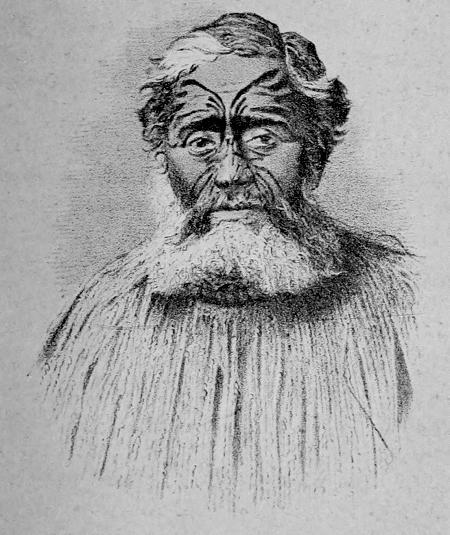
KEREOPA.
CHAPTER II
TE KOOTI
And now I must tell you something about that
bounder, Te Kooti.
Every country in the world has at some time
or other produced diabolically cruel villains who,
under one cloak or another, religion for choice,
have perpetrated horrible excesses and gratified
their love for blood. Yet very often these men
have been great and brainy ones. Europe has
produced Tilly, Alva, Torquemada, Cæsar Borgia,
and many others. England has produced Cromwell
and Judge Jeffreys; India, Nana Sahib;
and New Zealand in like manner produced Te
Kooti. Some of these men were of aristocratic
birth, but others, such as Tilly, Cromwell and Te
Kooti, springing from the lower middle class, had
first to make their names before they could perpetrate
the crimes their souls lusted for.
A number of Maori prisoners had been taken in
the successful action at Waerenga-a-Hika, which
followed upon the atrocious murder of the Rev.
Mr Volkner by the Hau Haus.
Now these prisoners should either have been
killed or, at all events, should have been well taken
care of, as on two previous occasions Maori
prisoners had successfully made daring escapes,
one of which is worth recording.
About one hundred and fifty Maoris, prisoners of
war, among whom were a few women and children,
had been confined on board an old timber ship
anchored far out in Wellington Harbour. They
were well fed, kindly treated, and seemed well
satisfied with their lot, being allowed access to the
upper deck during the day, where they talked
and laughed with their guard, a detachment of
the 50th Regiment, while during the night they
had comfortable quarters on the lower deck, all
the hatchways being shut up and strictly
guarded.
The old bow-port of the ship, however, had
been forgotten or overlooked, and one very dark,
stormy night the Maoris, who had discovered it,
forced it open, when every man, woman and child
slid noiselessly into the rough, shark-infested
water, and swam for the shore, nearly two miles
distant, where most of them landed in safety and
disappeared into the bush, nor was their escape
found out till next morning when the hatches
were opened to serve out breakfast.
The New Zealand Government therefore determined
to place the prisoners taken at Waerenga-a-Hika
in a place from which they could not
swim ashore, and so deported two hundred of them
to the Chatham Islands, but, being of a frugal
mind, they committed these two hundred fanatical,
ferocious and able-bodied warriors to the care
of a worn-out old officer and fifteen decrepit invalided
veterans, nor did they consider it worth
the expense to arm the white settlers on the island.
Verily the Government were wanting in common-sense,
though their cheese-paring parsimony might
be worthy of a present-date Radical.
Now during the siege of Waerenga-a-Hika a
native belonging to the native contingent, named
Te Kooti, had been charged by a sub-chief with
holding treasonable intercourse with the enemy.
He had been made a prisoner, but as there was no
evidence against him he was shortly afterwards
released. Subsequent to the surrender of the
pah, Te Kooti was again charged, this time by a
white settler, with communicating with the enemy,
but again there was not sufficient evidence to bring
him to a trial.
The great fighting chief Rapata had, however,
a private grievance against him, and wished to kill
him out of hand, but this the Government would
not allow, an act of very short-sighted policy, as
it turned out to be on their part. They, however,
feared to offend Rapata, so they transported
Te Kooti to the Chatham Islands with the two
hundred Hau Hau prisoners. Now this was
a piece of gross injustice. There had not been
sufficient evidence to try him on any charge,
and most certainly the Government had no
right to transport a man, serving as a soldier,
who had never even been tried, much less convicted.
Te Kooti was at this time a strong, daring
fellow, some thirty years old, who had, fighting
against the Hau Haus, acquired a small reputation
for courage, but he was much disliked by the
white settlers, who knew him to be a thief; nor
was he respected by his own people, who regarded
him as a quarrelsome mauvais sujet whose room
was more valuable than his company. He was
a man of no rank by birth, nor had he exhibited
any signs of intellect likely to raise him out of
the ruck of his fellows. As to whether or not
he deserved punishment may be open to argument,
but there is no doubt that all the atrocities committed
by himself, or by his orders, were dictated
by a desire of obtaining utu on those responsible
for his deportation. Well, this fellow was deported
with the other prisoners and landed in the
Chatham Islands. Here Te Kooti took up the
somewhat dangerous rôle of a prophet, and so
worked on the superstitions of his fanatical companions
that they rendered him unquestioned
obedience.
It must not be imagined that the prisoners
were shut up in jail or confined in any way; they
were made comfortable and lived in huts. The
burlesque guard during the night inhabited a
tiny, toy sand fort in which the arms and ammunition
were kept, but during the day the fort
was left in charge of one of their number, the
remainder being scattered over the place, employed
as ration issuers, clerks, etc.
The prisoners had been landed on the Chatham
Island in December 1865, and from the day of
their landing till the 4th of July 1868 their conduct
had been exemplary, though there can be no doubt
that during all this time Te Kooti was forming
his plans, and with infinite patience was awaiting
a suitable opportunity for a successful attempt to
escape.
On the 3rd of July 1868 the three-masted
schooner, Rifleman, was sighted making for the
island, loaded with stores for the use of the convicts,
a boat-load of whom pulled off and assisted the crew
of the vessel to bring her to her anchorage, also
volunteering to help discharging cargo. Captain
Thomas, the officer in charge of the prisoners, had
been previously warned that there was mischief
brewing, but the dear old soul did not believe it,
or at all events took no steps to prevent the rising,
which took place after this fashion.
In accordance with custom one of the old images
who composed the guard was on duty in the toy
fort, the remainder being scattered apart at their
usual occupations, and as he pottered about he
saw a strong body of the prisoners approaching
him and at once demanded their business. They
replied that they wanted the arms and ammunition
which were stored in the fort. He answered they
should not get them. They rushed him. He was
a good old soldier though past work, and, promptly
shooting one, tried to use his bayonet, but was
immediately knocked down, his rifle wrenched
out of his hand, and he finished his service by
being run through and killed with his own
bayonet. Truly the brave old fellow deserved a
better fate.
Te Kooti, however, must not be blamed for his
death, as he had given strict orders no one was to
be hurt, and this was the only blood spilt during
the whole affair. The Maoris also behaved with
the greatest courtesy to the white settlers, depriving
them of nothing except such guns and
weapons as they had in their possession. No sooner
had the prisoners received the arms than a boat-load
of them pulled off to the Rifleman, boarded
her, and drove the mate and crew (the captain was
ashore) down below, threatening to kill anyone who
resisted. They also boarded the ketch, Florence,
which chanced to be lying at anchor, sent her crew
ashore, and then, cutting the cable, sent their vessel
after them so as to prevent her being used in any
way against them.
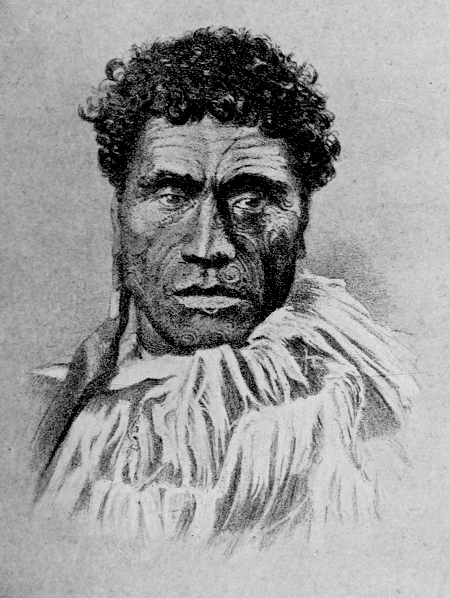
TE KOOTI.
Te Kooti had now full possession of the island,
but he did not linger, as he at once embarked all
the prisoners, he being the last man to leave the
shore. Directly he put foot on board he summoned
the crew on deck and gave them the option of
either working the schooner to Poverty Bay, where
he promised to hand her back to them, or to be
immediately killed. They chose the former alternative
and at once made sail, but a strong wind
from the west prevented them from beating out,
so they had to return to their former anchorage.
Te Kooti took no chances, for as soon as the
sails were furled he again confined the crew
below, nor would he allow them to cook the food
either then or on any other occasion during the
voyage.
Next day they again made sail and got away
from the island, but being delayed by foul winds
Te Kooti ordered all the greenstone ornaments on
board to be thrown into the sea as a propitiatory
sacrifice to Tangaroa (the Maori Neptune), and as
this had no beneficial result Te Kooti ordered an
old man, a relation of his own, to be cast into the
drink, and this, notwithstanding the old fellow’s
objections, was done, no one supporting nor
even seconding his amendment, as it had been
given out he was the delinquent who had warned
Captain Thomas of the projected rising. Whether
the victim was a Jonah or not, who can say, but it
is certain that no sooner had the poor old sinner
been launched over the lee-rail than the wind
changed, so, easing sheets, they made a good landfall
at Whare-onga-onga, about fifteen miles south
of the Poverty Bay settlement.
On the following day, the 10th of July, and during
the whole of that night, the Maoris working like
beavers, they landed some forty tons of stores,
about fifty rifles and a number of other weapons,
then releasing the crew Te Kooti told them to
upsail and hook it. This they did, but the mate
perpetrated a gross act of folly. The Port of
Napier was close to him, but instead of making for
it he set his course for Wellington, and thereby
lost ten days in giving the alarm.
In the meantime Te Kooti had taken up a strong
position near where he had landed, and sent
messengers to the adjoining tribe to come and tangi
with him. These messages fell into the hands of
Major Biggs, who could not at first believe the news,
but on its confirmation mustered a force of one
hundred badly armed white settlers and friendly
natives, and marched against the escaped convicts.
He found them strongly posted, but as the friendlies
refused to attack he could do nothing. He therefore
attempted to parley, trying to persuade the
defiant natives to lay down their arms, but this
they refused to do, and retreated inland, carrying
their plunder with them to one of the most broken
patches of country in New Zealand.
Now during the Year of the Lamb 1867 the infatuated
New Zealand Government, longing for
peace, had made up their minds they had obtained
it, and, being crazy for retrenchment, had not only
disbanded the Defence Force but, so as to save
the expense of having a man to look after them,
had removed the bulk of the arms and ammunition
from the district. Major Biggs was therefore
severely handicapped as the only men he had to
depend upon were badly armed settlers and untrustworthy
semi-friendly natives.
Owing to these circumstances Te Kooti got the
best of it in the desultory fighting that took place,
defeating the white men and their allies at Paparatu,
while he shortly afterwards forced another column
to fall back through their running out of ammunition
and the desertion of the friendlies, so that his
name spread through the country as a chief with
a most powerful mana.
Colonel Whitmore, who in the meantime hurried
up from Napier, followed up Te Kooti, but with his
usual want of tact so disgusted the Poverty Bay
volunteers that they refused to leave their own
district, and Te Kooti continued to make headway,
beating back an attack made on his position at
Te Konaki, and also getting much the best of it in
a stiff fight at Ruaki Ture. In September Colonel
Whitmore left for the west coast, where he was
beaten, as I have previously described, by Titokowaru
at Moturoa, and Te Kooti, on the 9th of
November, surprised and sacked the white settlement
of Poverty Bay, where he murdered in a most
atrocious manner every woman and child he could
lay his hands on. Loaded with plunder he left
the devastated settlement on the 14th, and retired
slowly to his lair, his rear-guard being overtaken
and attacked at Makaretu on the 25th, but the
Hau Haus made a good stand, and although they
lost heavily they held their ground, Te Kooti at
the same time by a smart bit of generalship
capturing an important convoy of ammunition and
stores.
But a change was to come over the scene, for
Rapata, with a party of Ngatiporou, arrived at
Makaretu, and on 3rd December he, with his men,
by a rattling charge carried two of the enemy’s
outworks, driving them back to their last line of
trenches, which they deemed impregnable, but the
gallant chief proved it otherwise, for he at once
rushed them, and with the assistance of the other
friendlies, who on this occasion fought bravely,
drove out the Hau Haus with great slaughter,
killing several of Te Kooti’s best fighting chiefs;
and they also captured the infernal villain Nama,
who had been most active in torturing women and
children at the late massacre. Well they got this
fellow alive, and so as to try to even things
up a bit the Ngatiporou roasted him alive, and
“sarve him right” was the verdict given by
the colonial troops, for after the Poverty Bay
massacre the gloves came off and it was war to the
knife.
Te Kooti now fell back, having only escaped by
the skin of his teeth, to his famous stronghold
Ngatapa, and Rapata moved forward to attack
him, but unfortunately a quarrel about some
prisoners with his allies hampered him sorely,
and although he attacked with the Ngatiporou
he had to fall back for want of ammunition,
his allies rendering him no service whatever; he
therefore, furious and disgusted, retired towards
Tauranga.
I think I have now given you some vague idea of
what had happened on the east coast previous
to our accompanying Colonel Whitmore there,
although I have not mentioned scores of skirmishes
that had taken place with the various tribes during
the last four years up and down the coast.
CHAPTER III
NGATAPA
I think I may now trek on with my own adventures.
We landed at Tauranga in December 1868, and
Colonel Whitmore at once started off to make Te
Kooti sit up, taking with him three hundred well-trained
and seasoned men. Near a place called
Patutahi we met Rapata and his men returning to
Tauranga, and Colonel Whitmore did his best to
persuade the angry chief to turn back, but this
he refused to do, saying: “I never break my word.
I have said I would go to Waiapu and I will, but
I will return with more Ngatiporou and wipe out
the Ngatikahungunu, the cowardly dogs who
deserted me.”
This would have meant wheels within wheels, or
rather a civil war within a civil war, a regular Donnybrook,
and it was only after much talk that the
indignant warrior could be persuaded to forgo
his vengeance against the other friendlies, though
he sternly refused to fight again in their company
or to alter his determination to proceed to Waiapu,
so, a steamer having been placed at his disposal, he
departed to his home, promising to recruit more
of his own tribe and to return shortly. It was
on this occasion I first met this redoubtable warrior
and general, when, like all other men who love a
man, I greatly admired him.
Rapata Te Wahawaha had from the outbreak
of the East Coast War played a very prominent
part, and, one may truthfully say, had carved out
in more ways than one his own path to rank and
fame. He was a fine, handsome, athletic-looking
man, evidently capable of enduring great hardships
and fatigue, while you only had to look at his
face to see that he had an iron will, the courage of
a bulldog and the ability to command. When in
repose he had all the good manners, the courteous
bearing and the musical voice of a well-bred Maori,
but in action the eyes blazed, the whole face
hardened into a mask of granite, while his word of
command was given in a voice that few who served
under him cared or dared hesitate to obey.
Although of aristocratic birth, he was not a
great chief by descent, nor had he up to the commencement
of the war given any proof of possessing
any first-rate administrative qualities, or possibly
in his paternal sub-tribe he had no chance of displaying
them, but from the first fight, Mangaone,
in which his tribe took part, he displayed such indomitable
courage and resource that by the time
I met him he was not only the principal war chief,
but was looked upon as quite the most prominent
man in the great and powerful tribe of Ngatiporou
to which his hereditary sept belonged. He had
from the very first set his face sternly against the
new faith.
The inhabitants of village after village, mission
station after mission station, throwing away their
Christianity, had joined the Hau Haus, but when
the apostles came to Rapata’s sub-tribe he sternly
bade them be gone, or he would test their invulnerability
with his tomahawk. Now several of
the sub-tribes of the Ngatiporou had already perverted,
and some of these sought to convert Rapata
by force. Rapata, however, was taking none of
that, so he waltzed out of his pah, and in the faction
fight that ensued he fairly knocked the stuffing
out of the Nonconformists, and as a proof of his
determination not to stand any nonsense he shot,
with his own hand, a near relation who had been
taken prisoner, not, as he was careful to explain to
the delinquent, because he had fought against himself,
but because he had been such a fool as to
join the Hau Haus against his, Rapata’s, orders.
He was the sealed pattern of the old-time Maori
warrior, one who knew not fear or pity, and was
just as ready to join in a hand-to-hand fight as to
plan out a campaign or eat his dinner. Byron,
singing about an old-time Dago pirate, described
him as being the mildest-tempered man who ever
cut a throat or scuttled ship.
Rapata was a polished Maori gentleman who
with a polite and easy nonchalance could entertain
the highest colonial dignitary, tomahawk a Hau
Hau, or shoot a deserter with his own rifle. He was
indeed a worthy ally, for had he not made the firm
stand he did the whole of the powerful tribe of
Ngatiporou would have been thrown in the balance
against us, and the white man must for a time have
been driven out of the North Island of New Zealand.
And now let me break back and try to regain my
spoor.
The following morning Rapata departed, still
in high dudgeon, and the Colonel, selecting four
scouts, sent them to find out whether or not Ngatapa
had been deserted, although why Te Kooti should
have deserted it was beyond my wisdom. The
men he selected for the work, although good enough
fighting men, were not trained scouts, nor had they
ever been employed at that fascinating though
dangerous game before. However, off they went
while we rested in camp.
That afternoon, while lolling on my mi-mi with
Roach, I heard a voice hail Tim, who was making
ready our supper: “Here, Tim, old shipmate,
where’s the skipper? Lay us alongside of him,
me hearty.” And in two skips of a jumping cat
I found my hand enveloped and crushed in the
enormous fist of old Jack Williams, while a moment
afterwards Pierre de Feugeron and Kantuarius
were salaaming in front of us, Pierre showing his
white teeth, shrugging his shoulders and gesticulating
as only a Southern Frenchman can, while the
Greek expressed his satisfaction at meeting Roach
and myself again by jabbering and grinning
like a demented Cheshire cat. They had come
to the east coast with McDonnell in 1867, and had
remained there, Jack in charge of a boat, the
other two doing odd jobs in scouting.
The foreigners at once attached themselves
to us, but old Jack had to return that evening to
Tauranga, so that after his oaths of gladness at
meeting us had rolled away like summer thunder
he drank a tot out of my flask, forced me to accept
a big prick of naval tobacco, and drifted away,
swearing softly, to join his party.
“Et maintenant, messieurs,” quoth Pierre, “I
will do myself ze honour of taking charge of
messieurs’ cuisine.”
“But, Pierre,” I said, “where is the famous
batterie?”
“Ah, monsieur, ze brave pot, ze poor pot; ah,
monsieur, such misfortune, my magnificent pot
lies mort sur le champ de battaille. Ah, monsieur,
it was heart-rending. George and myself were
retreating, and the sacred savages were coming
fast behind us, but we cleared them, when les
enfants d’enfer, seeing us escape, fired a volley,
plom I fall on my face. George help me to rise.
I am not killed nor much hurt, but my pot, my dear
pot lies in pieces. I am distressed. I am enraged.
Revenge. I yearn for revenge. I drop on ze knee
and fire. Ah! Ah! I see one of ze canaille throw
his arms on high and fall. I have my revenge.
I say, ‘Vive la France!’ George say, ‘Damn
good shot. Come, let’s cut and run,’ and we cut and
run. So, mon officier, ze grand pot est mort, mais
Pierre remains at monsieur’s service and has ze
wherewithal to prepare ze dinner for his two officers.
Let messieurs remain tranquil. We shall see.”
Messieurs remained tranquil, and in good time,
instead of supping off the putrid pork and mouldy
biscuits Tim had been fumbling over, we enjoyed a
delicious ragout of fowls, fresh pork, potatoes
and the Lord only knows what else. It is well for
you, oh, my son, when on active service two
scallywag foreigners, past masters in the art of
looting, and owning not one ghostly idea of meum
and tuum, attach themselves to you and take upon
themselves the onerous duty of catering for your
table. Be not inquisitive, oh, my son; ask no
questions, but accept the luck Providence sends
you and you will fare sumptuously.
In due course of time the scouts returned and
reported that Te Kooti had abandoned Ngatapa.
They had not approached the place closely, but
said he had done so, because they had seen large
volumes of smoke, and thought Te Kooti was
burning his huts before leaving.
Now this was all tommy-rot, and I marvelled
at a smart soldier listening to such twaddle.
In the first place a Maori does not build a hut to
burn it down. Again, we had heard from Rapata
that the position of Ngatapa was one of extraordinary
strength. Te Kooti had expended an
immense amount of labour in fortifying it. He
had successfully defended it against the first
attack. Why, therefore, should he desert it?
No, it seemed to me that it would be far more
probable that the dense smoke the tenderfoot
scouts had seen was caused by the Hau Haus
clearing ground in front of their works so as to
destroy cover, especially as dry fern and raupo,
commonly used by the natives for thatch, burns
with but little vapour, while undergrowth and
timber, full of sap, burns with a great deal, and was
therefore far more likely to be the fuel causing the
great clouds of smoke reported by the scouts.
Now I happened to be present at the time
the scouts reported to the Colonel, and, when they
had finished their yarn, ventured to state my
opinions, at the same time offering to take Pierre
and George, scout up to the place, and verify my
theories.
It would have been better for me had I held
my tongue, for I received in reply a most stinging
rebuke, which was both unjust and unmerited.
It is true a colonel may not be desirous of receiving
advice or suggestions from a subaltern, still I had
been employed on many important occasions and
had earned a reputation as a scout, and, as he well
knew, had put in three years’ hard bush training,
so even if it were presumption on my part to make
a suggestion, still that suggestion was worth while
taking into consideration, if not acting upon,
especially as I offered to run the risk, which was by
no means a small one.
Anyhow, the Colonel chose to give me a most unmerciful
slating for what he was pleased to term
my impertinence, and also added some most caustic
remarks on my general utility, and these in such a
sarcastic and bitter tone that it was only my strict
sense of discipline that prevented me using the
whip I carried in my hand over his hide, and I was
greatly delighted when I met him years afterwards,
when we were both civilians, to be able to give
him my plain and unvarnished opinion of his
conduct both as an officer and a gentleman.
However, to return to our mutton; orders were
immediately given for our return to Tauranga,
which were promptly carried out, and Colonel
Whitmore made arrangements to re-embark us
forthwith to Wanganui; in fact No. 6 Division of
the Armed Constabulary was already shipped on
board the Sturt for the west coast, but by the
merciful dispensation of Providence the skipper
was absent, and the old tub, objecting to the officer
temporarily in charge, sat down on a rock, which,
knocking a hole in her bottom, necessitated the
relanding of the men.
Now my theory re the smoke had been perfectly
correct. It had been caused by the Hau Haus
burning the scrub so as to destroy cover, and Te
Kooti, informed by his scouts of our retreat from
Patutahi, seized the opportunity to make one of
his lightning raids, in which he murdered several
settlers, and did much damage.
On the receipt of this news the little Colonel
went hopping mad, and without losing a moment
we started off to intercept Te Kooti’s retreat,
but as it was impossible for the main body to
move before morning he despatched Captain
Newland and a party of sixteen troopers on ahead.
Had he given us fifty troopers, which he very well
could have done, we should have hived the artful
dodger then and there, as we cut his line of retreat
and did all men could do to hold him till the arrival
of the Colonel, but eighteen mounted men, no
matter how good they are, cannot hold two hundred
Maoris, especially in rough country. We however
did the best we could, and had the ground been
anywhere suitable we should have charged; as it
was we had to draw off through the long fern, and
it was only the skill of our captain, the cool pluck
of our men, and the rotten bad shooting of the Hau
Haus that saved us from being cut to pieces.
We had, however, been driven off the ground
when Colonel Whitmore came up with Te Kooti’s
rear-guard and attacked them, but as his men
were worn out by their long forced march over
very rough country, he failed to make any impression,
so Te Kooti succeeded in gaining Ngatapa,
having got nine to four the best of us.
The advance, however, had begun in earnest, and
at the end of the third day, the 27th of December,
we took up our position on a high ridge about
a mile distant from the Hau Haus’ stronghold.
Here the Colonel received news that Rapata, with
three hundred and seventy men, had landed, but
refused to join up. This was a lie, for the gallant
chief was coming on as fast as he could. It
was, however, too good a chance for the spiteful
little devil to miss of insulting our most faithful
ally, and he despatched message after message of
such a nature that the high-spirited Maori would
not tolerate them, the last one being that if Rapata
did not hurry up he would take the place himself.
On receipt of this chit Rapata immediately
halted his men and returned this reply: “It
is well. I have tried to take it once and failed;
it is your turn now. I will camp here and await
your success.”
This brought the Colonel to his bearings, and he
saw he had gone too far, especially as some of the
senior officers plainly pointed out to him that
if he continued to try and bounce Rapata, that
chief would return insolence for insolence, and
that a quarrel with their great fighting chief would
be looked upon by the Ngatiporou as a direct
insult to the tribe.
Now Whitmore was a splendid soldier and no
fool, notwithstanding his nasty manner and want
of tact, he therefore, seeing he had gone too far,
visited Rapata the next day.
“Have you taken the place?” queried the chief.
“No,” replied the Colonel, “I want you to
help me.”
“I will be with you to-morrow morning,”
responded Rapata, and the interview terminated.
The Ngatiporou at once broke camp and advanced,
making a short halt at the Wharekopai
River, where, to see that everything was all right,
they danced a gaudy war dance, and as no one
tumbled down during the ceremony the tribal
tohunga and prophet declared that everything
was all right and that the expedition would be
successful. Thoroughly satisfied with this propitious
announcement, and perhaps more so with
themselves, they pushed on rapidly and joined up
the same night.
The position of Ngatapa was by nature a very
strong one, a high conical peak rising abruptly
amidst heavily bushed hills, the face fronting
our camp sloping gradually up to the summit,
but the sides of the slope, although surmountable
in some places, were not so in others, especially
in one place, where it was so precipitous as to be
quite unnegotiable, the side of the hill having
slipped away, leaving a perpendicular precipice
of rock quite seventy feet high, and this was the
spot where the enemy eventually escaped. The
ground in rear of the pah narrowed into a razor-backed
indented ridge, the formation of which was
gigantic steps, only to be descended by rope ladders,
and down the ridge ran a path by which the Hau
Haus hoped to escape, if driven to do so, but the
path was at once blocked by our men, although
for the time being we did not make use of it as a
way to attack.
The front slope of the position, in fact the only
one possible to march up, was defended by three
lines of stoutly built earthworks with ditches in
front of them and trenches in rear of them in which
the defenders could take cover. Their flanks
resting on the precipitous sides of the slope prevented
them from being turned, while every
particle of cover in front of them had been scarped
away. The two lower parapets were over seven
feet high, but the upper one was at least fourteen
feet, being pierced with sand-bagged loopholes, and
was indeed a most formidable work.
All these lines were connected by covered ways,
and altogether it was what it looked, a most imposing
fortification with its parapets rising one
above the other on the steep slope and growing
narrower as the ridge contracted. Yes, imposing
it looked, in fact impregnable, or only to be taken
with an immense loss of life, but it had, like most
Maori pahs, one sad defect, it contained no water.
This would have been no drawback in old-time
Maori warfare, as it had never been the custom
of the chivalrous sportsmen-like savages to prevent
the women from leaving a besieged pah for the
purpose of obtaining food and water. “For,” said
the old-time cannibal warrior, “how can a man’s
heart be strong, and how can he fight well, should
he be famished for want of sustenance?”
Civilised white men, however, use hunger and
thirst as two of their most formidable weapons, and
did so even during the most chivalrous epochs—to
wit, the siege of Calais—by that mirror of chivalry,
Edward III., or, coming to modern times—viz.
the siege of Paris—by the gospel-quoting, long-prayer-making
German Emperor. How then could
Te Kooti expect more consideration from that
chip of the devil, Whitmore, and this was the
weak joint in his armour.
At daybreak on the last day of the year 1868
we broke camp, and the whole force, by this time
considerably augmented, took up a position on a
conical hill some seven hundred yards in front of
the pah, which, although a part of the same ridge,
was divided from it by a deep gully, and this hill
we fortified, working under a heavy fire.
Next day the Ngatiporou and some other
friendlies skirmished very cautiously up the hill
so as to begin the game, and, on reaching the edge
of the cleared ground, came across a party of the
enemy carrying water. Our men opened fire and
charged, driving the Hau Haus back to the pah
and seizing the only watering-place they possessed.
Rapata at once dug, under a heavy fire, a line of
rifle pits, and sent back for reinforcements, which
were quickly furnished him in the shape of No. 7
Division Armed Constabulary, who, on reaching
the rifle pits, immediately started a flying sap,
which they drove within a distance of one hundred
yards from the outer parapet, and here they formed
the second parallel of attack.
The artillery division of the Armed Constabulary,
assisted by some natives, had for the last few days
been working like beavers to get a mortar across
some miles of the most awful country, consisting
chiefly of deep, rocky and precipitous ravines,
every shell having to be carried on men’s backs
across these natural obstacles, and just as No. 7
were completing their trench the gun was brought
into action, the vertical fire from which having a
great moral effect upon the defenders.
On the next day the place was thoroughly invested,
with the exception of the one small length
of precipice I have before mentioned. This place
was not overlooked, but as it was not more than
seventy yards long, and perpendicular, it was
deemed quite impossible that the enemy could
escape down it, especially as a strong picket was
placed at both ends of it, who could enfilade its
face.
The attack was now pushed briskly forward,
though for some days we were hampered by heavy
rain that filled our trenches with mud, and added
greatly to our discomfort, as we occupied them day
and night. It moreover supplied the enemy with
water to drink. Notwithstanding this drawback
we all worked away with good hearts, though of
course the risks officers and men ran, working in
the flying sap, soon caused our gimcrack hospital
to overflow.
I was at this time attached to Colonel Fraser’s
outfit that held the rear of the pah, and that gallant
officer, not being content to look on, gave the order
for us to mount the serrated ridge that led up the
back of the hill. This we did; scaling ladders were
quickly formed out of poles and vines. Rough
constructions they were, but they served at a pinch
for active, determined men, and we were all that,
though perhaps not a highly moral community.
We scrambled up one precipitous terrace after
another under heavy fire, but covered by our
sharpshooters, who, being infinitely better shots
than the Hau Haus, afforded us sufficient protection,
until we at last formed a rough shelter trench under
the steep rock that formed the summit of the hill
and the rear defence of the pah, so that the natives
were hived in their works.
This they bitterly resented, and made sally after
sally to drive us out of our hardly gained position,
but we clung to it like limpets to a rock, and,
although we lost many good men in the savage
hand-to-hand fighting, still we managed to hold on
to the end.
Colonel Whitmore and Rapata now determined
to storm the advance parapet, for, although we
were well aware that the Hau Haus had no water,
and we surmised they could have but little food,
if any, still we were on less than half rations
ourselves, as owing to the sinful country we were
fighting in it was absolutely impossible for pack-horses,
much less drays, to keep us supplied, so that
many of the friendly natives, should they feel the
pinch of hunger, might at any time take it into
their heads they had business at home and clear out.
This being so, Rapata, with fifty picked Ngatiporou,
under cover of the best shots in the force, scaled
the almost perpendicular sides of the slope, and,
with picks and spades carried up with them, broke
through the trench behind the parapet, and by
doing so were able to enfilade it.
The defenders drew to that end to oppose him,
and were doing their best, when with a cheer the
Armed Constabulary, who were in the advanced
trench of the attack, jumped out and rushed the
parapet. The Hau Haus, taken in front and flank,
fought bravely, but were either killed or driven pell-mell
behind their second line of defences. A fresh
sap was immediately commenced, the captured
trench being used as a new base, and the men
working like niggers, notwithstanding the heavy fire
and a furious sally by the enemy had excavated by
midnight sufficient cover for two hundred stormers
close up to the second line.
It was now Colonel Whitmore’s intention to blow
up this parapet, and with a rush take the main work
at daylight. Our party were also ordered to hold
themselves in readiness for a last effort, and we knew
something serious must happen, as that evening the
enemy had made a most determined attack on us,
which we had had great difficulty in beating off,
and we also knew that they must be now not only
short of water but also very short of food, as the
bodies of the dead Hau Haus plainly showed they
were on the shortest rations, while as the rain had
quite cleared off they must be famished with thirst.
All that night we sat with our weapons in
our hands, silently awaiting the dawn, but about
two A.M. a woman in the pah, having relations
among the Ngatiporou, called out telling them that
Te Kooti had escaped. This her people would
not believe, as every man of the field force was at
his post and on the qui vive, so, thinking it might be
a trap, they called to her to come out. To this
she demurred, refusing to budge until her safety
was guaranteed by some chief of repute. Eventually
this was done, when out she came, her story
being that all the unwounded Maoris had escaped,
leaving their disabled men, the women and children
behind them.
As day dawned we advanced cautiously into
the interior of the pah, and found her yarn to be
true; but we also plainly saw that had we made
an attempt to rush the place we should most probably
have been beaten back with great loss.
The Ngatiporou quickly finished off the wounded
men, and then, at Rapata’s suggestion, started off
in pursuit of the fugitives, who, as we ascertained,
had been three days without water and four days
without food of any sort, and were therefore not
likely to be able to travel fast over such rough and
broken country.
The way the bounders had escaped was truly
marvellous, as they had descended the face of the
precipice, and that so silently as not to have been
heard by the pickets posted at either end of it,
these pickets being not more than sixty yards apart.
It was not long before small parties of the Ngatiporou
began to return, bringing batches of prisoners
back with them, the latter being brought at once
before Rapata, a stern judge, forsooth. Few and
brief were the questions he asked them, and they
received a short shrift and a long drop, as they
were placed by squads at the edge of the highest
precipice, when they were shot, their bodies toppling
over and falling to the foot, and there their bones
lie to the present day.
This was a frugal way of getting rid of them, as
it saved rations, burial fees and all other expenses.
True it may seem to you good people who live at
home under the lee of the law and the police that
our conduct was cruel and bloodthirsty in the
extreme, but you must remember that every one
of those one hundred and thirty Hau Haus who
were disposed of in this summary manner had
borne a hand in the massacre of women and
children, and that in a way too awful to write
about; moreover we were fighting without gloves;
and that it was war to the knife.
By the end of the second day the last of Rapata’s
men had returned, and the last prisoner had gone
over the precipice; but the arch-devil, Te Kooti,
and some of his principal satellites, having escaped,
were still at large.
I will now relate a short yarn which illustrates
a phase of Maori customs, and how the astute
Rapata got to windward of a Maori law.
One of the prisoners brought in was a man named
Renata, who was a Ngatiporou Hau Hau of high
birth, being not only closely related to Rapata
himself but also connected to the highest chiefs
of the tribe. Now this man Renata had been one
of the original convicts sent to the Chatham Islands,
but owing to his high connections he had, after a
short detention there, been released and allowed to
return home. He however showed but little
gratitude for this indulgence, as he immediately
joined Te Kooti on his landing. When his capture
was reported to Rapata that gallant chief was
somewhat nonplussed. Spare him he would not,
and yet to order his immediate death might arouse
the anger and draw the revenge of the great tribal
chiefs against himself. Anyhow Renata had to
be killed, so Rapata sent word to his men that he
did not want to see the prisoner. This was his
death warrant, as no sooner had the captors received
the message than they placed Renata with
a batch of men who were philosophically waiting
the volley and the long drop. Renata, however,
was a rangatera, and would not submit to being
put to death in such an offhand fashion, so that
when he was formed up in the line of the unfortunates
at the top of the precipice, and the firing party
were capping their guns, he rushed at his captors,
knocked down one, broke through the rest and
fled into some scrub, but his plucky attempt was a
failure, as he was followed by two men, who ran him
down and shot him.
It now behoved Rapata to square the other chiefs,
who were as yet ignorant of the execution, so,
taking the bull by the horns, he called a meeting
of the tribal notabilities, the agenda being, What
was to be done with the delinquent? At this
meeting Rapata made a most eloquent and diplomatic
speech, pointing out how wrong they would
be to spare such a man simply because he was a
relation of their own. Again, what would the white
men say if a man of good blood was allowed to go
scathless while men of lower rank were shot by
the dozen? In fact he so cornered them that they
knew not what to say, until at last old Wikiriwhi,
a chief of the greatest rank, who very probably
was getting bored and quite possibly wanted his
dinner, became so moved as to say: “We leave
him to you.”
“Then,” rejoined Rapata, “he is a dead man”;
and so he was and had been for twenty-four hours.
Of course a large number of Hau Haus had escaped
with Te Kooti, and many of them, weakening on
the job, returned in small batches to their homes,
some having the temerity to show themselves in
the white settlements, and these the weak-minded
Government left unmolested, notwithstanding it
was well known they were all more or less implicated
in the various massacres. True there was not
much evidence against them, as all their victims
were dead, but this did not assuage the sorrow
of relations nor mitigate their wrath, and on several
occasions the white settlers very properly avenged
themselves.
One case was as follows: A man named Benson,
hearing the murderer of one of his relations had
returned, bailed him up and shot him dead. On
the following day Benson was warned by the town
constable to attend as a juryman at the inquest of
the defunct. This surprised him and he tried to
point out to the representative of the law that for
him to do so would be rather out of place as he
himself was the shooter; but the sapient official
refused to entertain the excuse and threatened him
with all sorts of dreadful penalties should he not
comply with the order. So Benson sat as juryman
on his own trial, gave evidence against himself,
and at the end of the inquiry was one of the twelve
good men and true who brought in the following
verdict:—“Shot by some person unknown, and
serve him right.”
One more case. The general killing was over
when eight prisoners were brought in, and the
Government representatives, who by that time
were on the spot, thought they should receive a trial.
This was equivalent to releasing them, as it is impossible
to get a witness to bear evidence after he
has been murdered. Anyhow these eight beauties
were confined in a hut with a trooper on guard over
them. Now it chanced that among the troopers
was a man named Hunt, whose wife and family
had been butchered by the gang these ruffians
belonged to. He was a quiet, methodical man who
said nothing, but awaited his opportunity; and it
came. One day he was detailed as prison guard,
which he mounted, having previously borrowed a
second revolver from his mate. Hunt quietly
took over the duty, entered the hut, made fast the
door, drew his brace of revolvers and deliberately
shot every one of the bounders, a plan so well
conceived and carried out as to be worthy of the
approval of both white men and Maoris.
CHAPTER IV
BACK TO THE WEST COAST
Directly after the fall of Ngatapa, Colonel
Whitmore returned to Wanganui, taking us with
him, so as to play a return match against our
old opponent, Titokowaru, and by the end of the
month we were again on the bank of the Kai-iwi
River, where Colonel Lyon had built a strong
redoubt, and constructed a bridge of sorts. The
little Colonel was not a man to waste time, so
decided to advance the following day by the track
that ran inland. Although close to the camp this
road passed through a very deep and densely
bushed gorge, which, if held by an enemy, would
cost a lot of lives to force. The Colonel knew
all about this, so during the evening he despatched
Kepa with his Wanganuis to make a detour through
the bush and occupy the other end, while shortly
afterwards he sent me with four scouts to
thoroughly examine the gorge itself, for which
purpose he sent with us a white settler, who,
owning the land there, of course knew that part of
the country well.
Taking Pierre, George, Tim and a man named
M’Kenzie with me, I left camp at dark, and worked
quietly along one side of the ravine as far as I
could get without running foul of Kepa’s scouts;
then I crossed it, and worked down the other side,
but could neither see nor hear anything. I
was, however, far from being satisfied, as the queer
instinct a highly trained scout acquires warned
me I was in the vicinity of great danger; moreover
George, whom I had detached for a time to
watch the greatest point of danger, told me,
when he joined up, he fancied he had heard the
sound of metal striking stone. I therefore determined
to make a further examination.
We again proceeded up the side of the ravine,
entered it high up and descended, guiding ourselves
through the pitch darkness by feeling our
way cautiously along the side of the track. This
of course was running an awful risk, but I saw no
other way of solving the problem. My men were all
game; if we were cut off some firing must occur,
the camp would be alarmed, and, if none of us
reported, still the Colonel would know the enemy
were in occupation of the gorge.
Moving as quietly as death, and just as the dawn
was lightening the sky, we reach the most dangerous
point of the ravine, when M’Kenzie tripped in a
rut and fell. Immediately a shot rang out, then
two, and before you could say knife, both sides
of the gully blazed with musketry. Hastily
pulling Mac to his feet we all bolted, as, with the
crashing of bush and yelling like fiends incarnate,
a swarm of Hau Haus started in pursuit.
Lord, how we did run, M’Kenzie and the settler
being in front, while myself and Tim, who would
not leave me, brought up the rear. Fortunately
we were close to the end of the defile, and as we
came out into the open we somehow got separated,
as each man took what he considered to be the
best line for camp, which he knew must be alarmed
by the firing. It was much lighter when we got
into the open and tore through the stunted fern
and manuka scrub, but, although you have no time
for debate or argument when some two hundred
howling savages, armed with tomahawks, are
close up to you, still I glanced to my right and left,
and as there was no cover to hide a running man
I saw M’Kenzie and the settler some fifty yards
away to my right, while Pierre and George were
running somewhat closer on my left. It was a case
of, “Go it, shirt tails, bowie knives is a-gaining on
you,” and you can bet your bottom dollar we did
our level best. Nor was I hopeless, as I knew, with
the little Colonel in command, all the troopers
would be saddled up, and the camp on the qui vive
at least an hour before the glimmer of dawn.
The Hau Hau volley must have been heard, and
the Maori did not exist who could catch the little
Colonel on the hop. I had no fear of being hit, as,
although an occasional Maori would squib off his
gun at us, still they could not stop to take aim or
load, so we only had to keep ahead to win through,
and each of us sprinted for what he was worth.
Tim and myself had kept to the road, and had
still plenty of run left in us, when I heard the hoof-thuds
of galloping horses and saw the troopers
come charging through the fern. But, alas! at
the same moment I heard from my right the
triumphant yell a Maori warrior lets go (which
being interpreted means, “I have caught the first
man”).
In a moment Tim and myself halted and faced
about; the party who had been actually in pursuit
of us had also halted, taking cover; and, looking
in the direction from which the yell had come, I
saw the settler staggering through the fern, closely
pursued by a Maori, who just overhauled him, and
was in the act of tomahawking him, as I fired;
which took effect first, lead or steel, I knew not,
but they both went down together.
In the first glance I had seen, a few yards in
rear of this pair, another warrior, who, waving in
the air a blood-stained tomahawk, yelled again
the same triumphant cry, “I have caught the
first man,” and at the same moment I heard Tim’s
vengeful cuss: “Have ye, ye blaggard? Thin go
to hell wid him.” The two carbines rang out
nearly simultaneously, and through the smoke I
caught a momentary glimpse of the triumphant
figure let fall his weapon and collapse.
Before either of us could speak a word a small
party of horsemen reached us, while, in rear of
them, advancing at the double, came two divisions
of the Armed Constabulary, who, passing us with
a cheer, swept forward and quickly drove the
retreating Hau Haus back to the bush.
We now went up to where the settler and
M’Kenzie were lying; the former we found alive,
though badly wounded, but the latter, poor fellow,
had lost the number of his mess; as for the two
Maoris, they were past conversion.
It had been indeed a stroke of luck our flushing
the Hau Haus as we did, although I could not
take any credit to myself for the way I had
engineered the contract, as we quickly discovered
they had planned a most artful ambuscade in such
a manner that, had the column entered the gorge
in the ordinary way, it must have been cut to
pieces. Poor M’Kenzie’s tumble, however, had
been too much for the nerves of some of the younger
warriors, so they let rip, and thereby gave away
the whole show.
The Colonel, without losing a single moment,
took advantage of the retreat of the Hau Haus,
for troth! the little fiend, with all his faults, was
a splendid soldier, always ready for a fight, so,
without giving the enemy a single minute to gather
together, he immediately rushed four divisions
through the gorge, and took up a strong position
some two miles on the other side of it. Here he remained
for a couple of days, gathering together all his
available forces, and then, on the 2nd of February,
advanced to attack Titokowaru in his new stronghold
of Tauranga-a-Hika, in which, he well knew,
the main body of the rebel Hau Haus were
massed.
It was late in the afternoon when we reached
the place and saw we had a stiff job before us, for,
although the natural difficulties were not nearly
so hard to overcome as had been the case at
Ngatapa, still it was a very strongly built pah,
heavily palisaded, and extremely difficult to surround.
It, however, had one defect, as in front
of the pah and quite close up to it ran a long bank
and ditch, which for some inscrutable reason the
enemy had not cleared away, but which the Colonel
spotted at a glance, and ordered three divisions of
the Armed Constabulary to immediately advance in
skirmishing order and seize them. My division
was one of those told off for this duty, so, without a
pause, we extended from our centre and advanced.
There was not much cover, but what there was
we made use of, and although the Maoris kept
up a tremendous fire, which we never paused to
return, we doubled straight to our front and were
soon inside the ditch and behind the bank without
a man being hit.
Here we quickly opened fire so as to cover the
advance of the other two divisions, who were
equally fortunate, and on their arrival we poured a
combined volley into the place, just to let the Hau
Haus know the sort of music we expected them
to dance to. I do not think we did much damage,
as their works were so beautifully constructed
that during the whole of the evening we never saw
so much as a head to aim at. Still we kept on
sending them an occasional volley, which they answered
vigorously, and between these we collogued
one another; as we were so mighty adjacent it
was quite easy to carry on a conversation, and a
conversation was kept up.
Chiefly, I regret to say, the dialogue was of a
personal nature more pungent than polite, although
now and again some old cannibal would call both
sides to order and preach a homily on the etiquette
that should be observed between hostile warriors
when engaged in the serious pastime of war.
At last night fell, and we received orders to
remain where we were, as it was the Colonel’s
intention to surround the pah the following day,
he quite rightly judging it to be far too dangerous
a job to tackle during the dark. We had food
in our haversacks, though water was scarce, and of
course we could not sleep, especially as the Hau
Haus every now and again fired a volley, so as
to warn us they were awake.
One old buster was good enough to preach us an
eloquent sermon, and tried hard to convert us to
the Pai Marire faith. He had, previous to joining
the Hau Haus, been a high-toned native Bible
reader belonging to one of the Nonconformist
fancy religions, and was loaded up to the muzzle
with Bible texts, which he employed in the most
laughable manner, interpreting them so as to
suit his own arguments. Alas, poor old scallywag,
not only was he wasting his breath in sowing his
seed on barren land, but he also ran up against one
of Kepa’s men who was likewise an ex-Bible reader,
and who proclaimed himself to be a devout Roman
Catholic. This sinner had the advantage, being
not only better posted in controversy, but knowing
more English, and through having been employed
with the pack-mules had acquired a far greater
number of Anglo-Saxon cuss words, therefore
the elderly sinner was utterly routed and driven
off the field, the Christian champion’s peroration
being as follows:—“You ruddy Hau Hau, you
dance round pole all same as monkey monkey;
you say prayers to Pai Marire, you make ruddy
fool incantations, you say angel Gabriel stop
bullets from kill you, you ruddy liar, you come
out here, you ——, me show you damn quick
you —— —— ——, angel Gabriel no have truck
with such a —— —— as you, you black Debil’s
man, you go hell quick time, and burn for eber,
you kiss my foot, you —— ——.”
This is only a fraction of what our Christian
hero said, and the apostle of Hau Hauism, handicapped
as he was by the non-existence of cuss
words in the Maori language, and having not yet
acquired the promised gift of tongues, was reduced
to silence and subsided.
After midnight the Hau Hau fire gradually
died away, as did the religious arguments, till just
before dawn not even the choicest abuse from
our side could draw any response. Naturally
this reticence on their part put us doubly on the
qui vive, as we thought most likely the enemy
were up to some devilry or another, a sudden sally
or a flank attack, but neither of these we feared,
as all our preparations were in order and we were
ready for anything. Nor were we nervous about
the main body, as we knew the impish little
Colonel, who could go a month without sleep
himself, would not only be on the alert, but would
jolly well have all his men awake and lively.
The dawn came at last, but brought no attack
with it, complete silence resting on the pah, so
one of our men, named Black, very pluckily jumped
over the bank and walked quietly up to the place.
As he heard nothing he climbed the fence and
shouted out the pah was deserted.
We were soon inside it, and were astonished at
its strength, all hands plainly seeing we should
never have taken it without expending enormous
labour in mining, or by reducing the defenders
through starvation. It was evidently the latter
Titokowaru feared, as it contained but little food
or water, and he was fully aware of the fate of
Ngatapa.
Without a moment’s delay the pursuit began,
the Colonel with the main body making for
Weraroa, while Kepa with a party of his own men
followed up the spoor of the retreating Hau Haus.
In a very short time he came up with their rear-guard,
who turned, and in overpowering numbers
attacked him, but he succeeded after a brisk hand-to-hand
fight in getting clear of them, and turned
the tables by hanging on their skirts until the firing
brought up one of our divisions, when the Hau
Haus were so roughly handled that they broke
and fled and the pursuit went on.
Bivouacking that night on their line of retreat
we advanced next day to Moturoa, where we
had been defeated the previous year, and where
we fully expected the enemy would make a determined
stand. Strong as the place was, however,
Titokowaru had not seen fit to hold it, but had
passed on, so we took the opportunity of gathering
together the remains of the poor fellows we had had
to abandon on that unfortunate day, and cremated
them.
Without going into nauseous particulars I may
state there was ample evidence of how they had
been desecrated by the enemy, which did not
improve the temper of their comrades. Some
sharp skirmishing ensued, in which we always got
the best of it, but after a few days we had to fall
back owing to the lack of food, it being impossible
to furnish us, in the rough and broken country,
even with the scantiest supply of rations.
As we retired the enemy followed us, and soon
let us know they had done so, as a sergeant and
nine men who had crossed the Waitotara River
in a canoe, for the purpose of gathering peaches,
were attacked by seventy Hau Haus. These
sportsmen fired a volley at our men while they
were picking the fruit, but hit no one.
The white men seized their rifles and made a
bolt for the river, which they reached in safety,
and where, had they made a stand under cover of
the bank, they might have stood their pursuers
off, as the already alarmed camp was in sight and
quite close to, but instead of doing so they tried
to escape in the canoe, and the Hau Haus lining
the bank shot them down in a heap, killing seven
and wounding one. The natives were immediately
driven back, but not before they had dreadfully
mutilated the dead men.
Just as we had recuperated and were about to
again take the field we received the news of
an outbreak at White Cliffs, north of Taranaki,
which began by the cold-blooded murder of Lieutenant
Gascoigne, his wife and three children,
together with the Rev. Mr Whiteley. The latter
was a man much respected by all classes of white
men, for he was one of the very few missionaries
who could deeply sympathise with the natives, and
yet forbear to throw mud at his own countrymen.
This rising necessitated the Colonel sending one
hundred of his men to the White Cliffs, although
he delayed not a moment, taking the field with the
rest of us. News had filtered through that Titokowaru
was at Putahi, and away we started, the
enemy trying to cut off our food convoy by laying
an ambuscade for us at the mouth of the Whenuakura
River. It was a well-designed plan, but when
it came to the scratch the Hau Haus fought half-heartedly
and were easily beaten off by the ration
escort.
I had been sent forward to scout, taking with
me my usual companions, and after three days’
arduous duty discovered that the Hau Haus were
actually in great force at Otauto, a kainga on the
left bank of the Patea River. Colonel Whitmore,
on receipt of my report, immediately despatched
Colonel St John up the right bank of the river to
hold the drifts and cut off the enemy’s retreat,
while he moved up the left bank to rout them out.
It was a splendidly devised scheme and well
carried out, but alas, it failed, for two reasons:
first of all the enemy, growing nervous, had that
night left the shelter of their kainga and camped
outside it, taking up a position at least half-a-mile
nearer than where we expected to find them.
Again, just as we had deployed for the attack a
dense fog came on and we of the advance-guard
blundered right into the middle of the Hau Hau
bivouac. We certainly completely surprised them,
but owing to the dense mist, that without a
moment’s notice became as thick as one of London’s
very best, we were quite unable to do anything,
in fact we could not see a foot beyond our noses,
so there was nothing to do but lie down and wait.
The surprised Hau Haus, who were in almost as
great a fix as ourselves, opened a tremendous fire,
which, as they could no more see us than we could
see them, did but little harm. Heavy firing was
nevertheless kept up by both sides for nearly an
hour, when, the fog suddenly rising, their camp
was discovered close to, which we at once charged,
the enemy rapidly retreating, followed by Kepa
and his Wanganuis.
On the 16th of March Kepa, who was out bush-whacking,
sent in word that he had located Titokowaru
at Whakamura, and off we went, joining up
to him on the evening of the 17th, when after
another smart march our whole force lay in ambush
within two hundred yards of the place.
During this interlude Colonel Lyon, who on
that occasion was in command, ordered me to
take the best scouts, creep up to the pah, and look
for a weak spot. On doing so we scouts had a
treat, as crawling right up to the place we could
distinctly hear the speeches of old Titokowaru
and his chiefs, who were holding a rather rowdy
council meeting. They were evidently not a
happy family, and their opinions greatly differed.
One old Johnny began his harangue by deploring
their late losses, asserting that his special tribe had
borne more than their share of the fighting, demanded
that the retreat should be continued at
once, asserted that either the angel Gabriel or a
certain prophet was a humbug, that reiterating
the word, “Hau Hau,” and holding out the palms
of their hands had, as far as his knowledge carried
him up to date, saved no one from the bullet of
the white man, that dancing round the Pai Marire
pole had not as yet brought them the gift of
tongues, otherwise their apostle would not have
received such a defeat as he had done at Tauranga-a-Hika
from the hands of a mere slave of a Roman
Catholic.
Another then took the floor, and asserted that
the late honourable member, who had wasted his
breath, was quite wrong; that they had not
abandoned Tauranga-a-Hika on account of their
losses, but because they had no food or water,
that the angel Gabriel only delayed helping them
so that those weak in faith should be cut off; this
being done he would come to their assistance with
a legion of angels, and those white men who were
not turned into stone would be driven into the
sea.
The next speaker, I think, must have been
Titokowaru himself or his representative, as he
asserted that they would fight on that spot, that
the white men could not reach them for three
days, and wound up by assuring them he had
received a revelation that they would gain a
decisive victory.
The council then separated, and it required no
great skill in the art of prophecy to foretell that
should the coalition of the Hau Hau tribes get
another good shake up they would fall asunder
like a bundle of sticks when the cord binding it
together is severed.
Creeping back I reported to the Colonel, and rejoined
the storming party to which I had been
told off. The weary waiting was almost over, in
another quarter of an hour the dawn of day would
have given us the signal to charge, when a mounted
native came out of the pah and rode towards us.
Greatly surprised as we were, we lay as still as death,
and he cantered right through our party without
spotting one of us, only to come full butt against
the main body. In a breath he slewed his horse
round and galloped back, yelling as if he had the
stomach-ache, and firing off a revolver. All our
fine plans were knocked galley west; out rang the
order to charge. We charged; crash went the
fence, and head first, feet first, or landing in a sitting
position, in we went, but it was too dark to see,
much less to aim, and all we could hear was the
yells of the astonished Hau Haus, who bolted hell
for leather, without firing a single shot.
As soon as it was light enough to see, Kepa, with
his Wanganuis, accompanied by a party of us
white men, started in pursuit, but we found before
we had proceeded far the Hau Haus had broken up
and dispersed. We, however, succeeded in killing
a few men, who had taken refuge up trees, and also
captured three women, who, on being brought into
camp, declared that Titokowaru had fled to Te
Ngaihere, a historical stronghold that in ancient
days had been looked upon as the last refuge of his
tribe. By doing so he had lost the last remnant of
his prestige, so that the haughty savage who had
proclaimed only two months previously he was
going to drive the white men into the sea was now
a fugitive, abandoned by his allies, laughed at by
his enemies, and with but few followers on whom he
could rely.
But now the question arose: Where was this
fabled Te Ngaihere? No one seemed to know its
locality or what it was like. Everyone seemed to
have heard traditions about it, but no one had ever
set eyes on it. It was a place tapu, not to be talked
about, much less to be visited, and whether it were
a mountain, a bush, a lake or a cave, no one could
give us a single pointer. However, if a place be
worth finding it is worth prospecting for, so away
went Kepa to scour the country one way, while
myself with my usual followers took another
direction. It was a big order, as I think you will
allow, my gentle readers, to plunge into a trackless
country and look for something not knowing what
the deuce it was you were hunting for. Troth,
for my own part, I consider that prospecting for
the Holy Grail was a dry billet alongside the one
I had shipped for.
Kepa was the lucky man to solve the problem,
Te Ngaihere turning out to be a big island situated
in the centre of a quaking swamp. In olden days
this swamp had evidently been much deeper, but it
still looked quite impassable for anything but a
snipe, and both Kepa and Whitmore deemed it to
be so, the distance from the mainland to the island
being quite four hundred yards.
The whole force, moved up by a night’s march,
camped close to the swamp and quite out of sight
of the stronghold, and although in dense bush, not
a fire was allowed to be lit during the whole time we
were making our preparations for attack, though
our scouts kept the island under observation day
and night. It was now a case for all hands to
off shirt, out tomahawk and work like beavers,
constructing out of supple jacks, hurdles, fifteen
feet long and four feet wide, in sufficient quantity
to cross the quagmire. So well did we work and
so well were we handled that in four days every
preparation had been made, and at dark on the
24th we began to lay our frail bridge across the
bog, this being finished at four A.M., when without
a second’s delay the column began to cross. The
first lot of us got over dry shod, but then the
bridge began to sink, so that the rear of the column
had to struggle through slime and water, which
took the rear-guard up to their middle.
Notwithstanding this drawback we were all
safely across, then, leaving Colonel Lyon with a
strong party to protect the bridge head, the little
Colonel moved on to the kainga, the inhabitants of
which were in blissful ignorance of our proximity.
With the scouts I crept right into the place and
heard one old man lamenting to his wife that he
feared the big evil man (Titokowaru) would soon
bring the white men down on them.
It was now an extraordinary accident was about
to happen that again saved Titokowaru and
the remnant of his bloodthirsty tribe from our
just resentment. The day broke clear, when the
natives immediately discovered us. Their astonishment
was most ludicrous, as they all thought we
had dropped from the sky. Some ran away from
us; some ran towards us, shouting out words of
welcome; others, too overcome to move, could do
nothing else but stand with goggle eyes and with
palms stretched out, hoarsely muttering the mystic
words “Hau Hau,” none making the slightest
attempt to resist us.
The long-waited-for execution was just about to
commence when the Wanganuis, usually so ready
to begin killing, shouted out to us to be careful
how we fired as two of their chiefs were mixed up
with the now flying crowd. The Colonel, not
understanding the Maori tongue, fancied that
because the Wanganuis had not fired we had in
some miraculous manner fallen across an unknown
friendly tribe, so ordered us not to fire. None of
us did fire, and because we did not fire the
Wanganuis did not do so, so we simply stood and
watched long lines of men, women and children
wading through the swamp within a few yards of
us, and it was only when the hindermost fugitives
made very many indecent gestures at us, previous
to disappearing into the bush, that the Colonel
ascertained that the simple, frightened friendlies
he had permitted to escape were Titokowaru and
his own personal tribe, the most blood-stained
fanatics in the whole of New Zealand.
Well, we sat down and looked at one another;
and as each man thought over the forced labour
of the past few days, of the long, dreary night
marches, of the short rations, of the blistered hands
and the torn feet which he had suffered and
which, through that morning’s miserable misunderstanding,
he would have to suffer again,
he forbore to swear, being unable to find in his
repertoire any cuss words suitable to express his
sentiments.
Notwithstanding his escape Titokowaru was
beaten; he had lost his mana (luck); all the allies
who had flocked to him in his prosperity deserted
him like rats running from an unseaworthy ship,
and after the retirement of the field force he was
for a time hunted by small parties of local levies,
together with a few of the Armed Constabulary
belonging to the district, until he disappeared into
the interior, where the Government let him rip.
The subjugation and disarmament of the tribes
who had joined him being left to junior officers,
Colonel Whitmore immediately started again for
the east coast, taking all the available men of the
West Coast Field Force with him.
We were therefore shipped on the steamers
Sturt and St Kilda, on the 10th of April, reaching
Onehunga on the eve of the following day. It was
dark when we landed and got our baggage ashore,
and we then started to march across the isthmus
to Auckland, where fresh shipping awaited to take
us down the east coast to Tauranga.
Auckland at that time was in its heyday of
prosperity. The great Thames gold-digging was
in full swing, and as our column of war-worn,
bush-stained men marched through the brilliantly
lighted and bustling Queen’s Street the temptation
for a spree was too much for some of our boys,
many of whom had not been into a town or seen
a white woman for three years, so they began to
break ranks and slip away, determined to have one
night’s fling, no matter what it cost them. Consequently
when we reached the wharf only about
half of our men were present. There confusion
became confounded, diggers, sailors, civilians and
women of a certain class crowding in upon us,
tendering the men bottles of liquor or tempting
them from their duty. Waggons and drays loaded
with camp equipage, ammunition, baggage and
stores arrived, which all had to be transferred to
the ship, and this was done chiefly by the officers,
who then, as the ship was to sail at daylight,
had to form themselves into a picket to collect
their scattered and more than half-drunk
men.
After a night of ceaseless work we managed to
get all but sixty on board, the Colonel remaining
behind to gather together the stragglers; nor did
he let slip the opportunity of venting his unjust
spleen, as he reported to the Government that
his men were all mutinous and his officers discontented.
This was not true, and caused intense bitterness
right through the field force, as the men were not
mutinous, but only fancied they were entitled to a
short spree after their past hardships; and as for
the officers, they had slaved all night without a
pause for food or rest until the ship sailed, which
she did at the time ordered.
CHAPTER V
THE URIWERA CAMPAIGN
It was now high time to call on the Uriwera so as
to punish them for past offences and teach them
that, because they inhabited the very wildest
and most rugged country in New Zealand, they
could not with impunity murder white people and
friendly natives.
The Uriwera are a queer tribe almost distinct
from other Maoris, for although they belong to
the same race, yet they have held but little intercourse
with the other tribes, who look upon them
as being somewhat uncanny, and perhaps stand
slightly in awe of them. Their country at that
time was absolutely unknown, no white man having
ever entered it, and no Maori war party had ever
possessed the temerity to attack them, so they
lived among their inaccessible mountains and deep
valleys, a people quite apart from any others.
This strange people were, however, extremely warlike
and ferocious, continually making raids on
their neighbours. They had never had any cause
to quarrel with the white settlers, yet they were
one of the first tribes to join the king movement,
and had fought desperately against Sir Duncan
Cameron in the Waikato campaign; then they
had joined the Hau Haus, and had committed
many murders.
On Te Kooti’s landing, without receiving any
provocation whatsoever, they had joined him, and
accompanied him in his raids on Poverty Bay,
revelling in the brutal massacres that had taken
place there, while, to make their cup of iniquity
overflow, they had invited the arch-devil himself
to come to their country, after we had routed him
out of Ngatapa. Well, if they had invited Te
Kooti, the little Colonel invited himself, and he
determined to twist their tails so as to teach them
decorum.
As it was well known this was going to be a
most arduous campaign, all hands, officers and men,
had to undergo a rigorous medical examination,
and even then only those were selected who were
well known to possess determination and ability
to put up with hardships without grousing, and of
course every man was a past master in the art of
bush fighting.
Colonel Whitmore’s plans were very clever,
though, when we came to carry them out, they
were found to be too comprehensive, for although
no man knew better than he did the great difficulty
there is in carrying out combined movements in a
rough country, still neither he nor anyone else
knew what an infernal country we were going to
soldier in, nor had even the most pessimistic man
among us gauged the sufferings we were to undergo.
The Colonel, however, was far too good a soldier
to leave anything to chance, so that each of the
four columns about to enter this terra incognita
at different points were strong enough to act alone,
and give a good account of themselves should
they even be attacked by the whole strength of
the Uriwera plus Te Kooti’s own men.
I should have gone in with the mounted column,
which was to start from Napier and march up to
Te Haroto, so as to block any fugitives from getting
across into the Waikato country, but as I knew
that the horsemen would have but little chance of
fighting, I was very glad to hear that Colonel St
John had applied for me to be attached to his
column as boss scout. Tim, of course, I was
allowed to take with me, while Pierre and George
did not ask for permission, but came of their own
accord, neither of these gentlemen being troubled
with any qualms of conscience regarding discipline,
orders or anything appertaining to red tape or
respectability.
Colonel Whitmore’s own column was to march
from Te Matata, cross the Kaingaroa Plains and
attack Te Harema Pah in the Ahikereru Valley;
so far all plain sailing, no great natural obstacles
to be overcome and fairly open country in which
strings of pack-horses, though not drays, could be
used. Here he would make a depot for stores.
But then he was to strike into quite unknown
pastures and try to meet Colonel St John at one
of those mythical Maori strongholds, Ruatahuna,
which, like Te Ngaihere, everyone had heard about
but no one had ever seen.
Colonel St John was to move in from Whakatane,
advancing up the river’s bed, there being no tracks
in that country, and to get to Ruatahuna as best
he could, destroying everything en route in the
way of pahs, kaingas or food he might come across;
then, provided the two columns did meet at this
mysterious trysting-place, they were to capture it,
and then, combined, were to trust to Providence
to find their way somehow or other across the
Huiarau ranges, and join Colonel Herrick’s column
at the big lake Waikaremoana. The whole plan
looked well on paper. It had required an indomitable
man to conceive it, and would require
indomitable men to carry it out, as, should any
of the columns meet with a reverse, they could hope
for no assistance from any of the others.
The heaviest fighting and the hardest work
would fall to the lot of Colonel St John’s column,
as we not only had to fight our way right across
the worst of the Uriwera country, but it was
absolutely impossible for us to use a pack-animal
of any sort, so that we must carry everything
necessary on our own backs, or go without. Winter
was also beginning, which that year promised
to be a very cold one. It was quite impossible
to defer the expeditions, indeed it was high time
something should be done, as Te Kooti, just
previous to our arrival on the coast, had made
one of his lightning raids against the Mohaka
Settlement, where (thanks to the—well, let us be
charitable and call it discretion—of the militia
officers, who, although amply supplied with men
and horses, made no offer to resist him) he had
brutally murdered over seventy white settlers
and friendlies, so that we were all boiling to get
after him.
Although everyone worked with a will, it was
not before the 2nd of May sufficient stores and
ammunition arrived to enable us to make a start,
but at daylight the following morning the field
force paraded in front of our camp at Oporiau,
numbering, all told, two hundred and forty-five
white men and one hundred and eighty friendly
natives. That parade was a queer sight and one
that would have made a stickler for military uniforms
shudder. Our men, dressed in their blue
jumpers with their shawls round their waists, and
smasher hats, looked like disreputable Highlanders,
while we were loaded up like pack-donkeys.
To give you some idea of our loads let me tell
you what each man had to carry: a Schneider
carbine with one hundred and sixty rounds of ammunition;
a revolver with thirty rounds; and of
course each man carried his tomahawk, sheath-knife
and pannikin; then each four men had to
carry, taking it in turns, an axe, shovel or pick;
then every twelve men in like manner carried a case
containing four hundred and eighty rounds of
carbine ammunition; while each division had to
carry five stretchers.
After these loads had been apportioned, each
individual might hump as many blankets, as much
clothing, rations and private property as he saw
fit, but all officers under field rank had to take their
turn at the extra ammunition, tools, etc., as well
as to hump their own swag. True we were all
picked men, tried and seasoned by many months
of bush warfare, in robust health, and, with the exception
of a couple of field officers, not a single man
under the age of twenty-four or older than thirty.
Oh, my gentle tourist friend, you who buckle
on a pretty, light knapsack, and tramp for a few
hours on a summer’s day along the shady lanes
of Old England, and after a bounteous repast
sleep in the lavender-scented sheets of some
picturesque old-fashioned country inn, and fancy
you have earned your repose, picture us, who had
to hump our swags over what is perhaps the
very roughest country in the world, perform our
marches in torrents of cold rain or icy sleet, and
sleep covered by a tattered blanket on the sodden
ground, soon to be frozen hard by the bitter
frosts of the New Zealand winter, for the months
of May, June and July are the coldest in the year;
and at the same time bear in mind we had to do
all that living on foul, putrid bacon and mouldy
lumps of what had at one time been the commonest
of ship’s biscuits.
I have previously stated I was delighted at
having been told off to join Colonel St John’s
column, and that for more reasons than one, as he
was universally loved and respected by every
officer and man who had the honour and pleasure
of serving under him. Colonel St John was at
this time past middle age, tall and handsome,
a gentleman to the tips of his fingers, and a
thorough good sportsman. He had seen much
service, had distinguished himself greatly both in
the Crimea and in India, and although perhaps
he lacked the great tactical skill possessed by
Colonel Whitmore, still he could get more out of
the men, as they loved the one and hated the other.
He was, moreover, just and considerate in his
dealings with his junior officers, who regarded him
more as a father than as a colonel. To me individually
he was always most kind and friendly,
and as he knew my father and family well I was
only too pleased to serve under him.
It was on the morning of the 4th of May, Colonel
St John’s column commenced its march into the
Uriwera country, the scouts having left the night
before, my orders being to enter the Whakatane
River, proceed up its bed, keep a bright lookout
for ambuscades and fall back to the Colonel every
night.
The first day’s march was a very bad one, as it
necessitated the column crossing the river twenty-eight
times during the twenty miles that brought
the tired men to a deserted kainga called Tunanui,
where we bivouacked with fair comfort, this being
the jumping-off spot into the unknown.
The next day the same sort of thing had to be
gone through again. The river-bed did not
improve, while during the day heavy showers of
sleet and rain soaked us through. Moreover, as we
were now in the enemy’s country we dare not
light fires when we bivouacked, so that we had to
get what rest we could during the bitter cold night,
deprived of any warmth and without the pannikin
of miserable tea we all so greedily looked forward
to after a cold and fatiguing day.
The following morning at the first glimmer of
dawn we scouts left the bivouac, and pushed on up
the river-bed, but before we had progressed a
couple of miles we came to a place where the
river rushed through a deep, rocky gorge that
prevented us making any further use of its bed as
a thoroughfare. I therefore awaited the arrival
of the Colonel, who shortly joined me, and after a
short discussion he determined the column should
cross the stream and make its way up a steep,
razor-backed ridge that sloped down to the water.
We had considerable difficulty in crossing, as not
only the current ran very fast, but the bed was
composed of slippery boulders over which many
of our men stumbled and fell. At last they were
all over, but long before the last man crossed we
scouts had out tomahawk and were painfully
chopping a path through the tangled fern, ground-vines
and lawyers—the latter being scrub, bearing
thorns shaped like fish hooks, and are as dangerous
to come in contact with as their human namesakes—with
which the steep slope was densely covered.
On reaching the summit we found ourselves on a
long serrated ridge running within a point or two
of the direction we wanted to go, both sides of it
being heavily bushed, but the ridge itself, thanks
to its narrowness and the rocky nature of the soil,
only carried stunted fern, through which we could
march with comparative ease. We therefore
thanked our stars for this slice of luck, and, after
we had excavated the larger thorns, licked such
scratches as we could get at to lick, and swallowing
a handful of soaked mouldy biscuit, we scouts
started, while the column was still painfully
crawling up the slope. Towards midday we came
to where the ridge suddenly ended in a very nearly
perpendicular drop into a deep valley, on the other
side of which, situated on a plateau of the same
altitude as that on which we stood, we saw a large
kainga. The cover on our side was very good,
so I halted, sending back Tim and George a few
hundred yards to await and report to the Colonel,
while Pierre and I scouted to either flank, prospecting
for the best place to descend. This
I found, but when found it had not much in its
favour to recommend it, as it simply bristled
with huge boulders and trees, the ground in
between which was, as per usual, a dense tangle
of ground-vines, lawyers and tough fern. Still
it was practicable, and the Colonel on viewing it
decided to make use of it to descend into the
deep valley. I also pointed out to him that across
the valley ran up two steep spurs leading to the
plateau upon which the kainga stood, and which
perhaps, faute de mieux, could be used for attacking
purposes. Facilis decensus Averni may be true,
but we found it by no means easy, much less
pleasant, to descend that infernal hill, and it was
only by lowering our loads, and even one another,
down the worst places that at last, tattered and
torn, we reached the foot, but fortunately, although
many men were badly bruised, still no one had
received sufficient injury to render him unfit for
further exertions.
On reaching the valley the Colonel, taking myself
and scouts with him, moved forward to reconnoitre,
while the main body rested, and as best they could
repaired damages. We had, however, barely time
to make certain that the aforementioned spurs
were practicable when from the kainga on the
plateau above out rang the report of a gun that,
being multiplied by the echoes of the mountains
and valleys, rumbled like thunder. Of course we
thought we had been spotted, and cursing our bad
luck we fell back to the main body as rapidly as
we could. As there was nothing to be gained by delay
the Colonel determined to attack immediately,
so throwing off our packs fifty of the most bruised
men were rapidly told out to remain in charge of
them, then, the remainder of the force being divided
into two parties, we started off to force our way up
the spurs. Fortunately these, though steep and
serrated, were not covered with thick scrub, so that
the men relieved of their packs mounted rapidly,
and as both parties were in sight of one another
we could regulate our pace so as to arrive simultaneously
at the top. Of course after we had heard
the shot we had thought that it had been fired
to give the alarm, and that the Maoris, resenting
our intrusion, would do their best to obstruct our
arrival; in fact we had made up our minds we should
have to fight every yard of the way up the
spurs. We however were agreeably disappointed,
the shot not having been fired to give the alarm,
but, as we were subsequently informed, it was fired
to execute a mighty big pig.
The Uriwera were in blissful ignorance of our
proximity. They had never fancied for a moment
that white men would ever dare to enter their
inaccessible country, and had therefore kept no
lookout whatever, so that instead of meeting with
a determined resistance, while mounting the narrow
spurs, we reached the plateau, formed line, extended,
and had advanced close to the kainga before
they spotted us.
Whoop, then there was a deuce of a commotion,
women and children running and screaming, men
yelling, pigs grunting and singing hymns, while
above all this turmoil out rang our bugles, which,
together with our cheering, added to the din that
was in a moment multiplied a thousandfold by the
crash of firearms, while the echoes of all these
noises combined were so extraordinary that anyone
might have thought thousands of men were engaged,
or that all the fiends in Hades were holding their
annual beanfeast, and were all drunk at
that.
Completely surprised as the Uriwera were, still
they made a stout resistance, but they could not
stand for long against our impetuous charge, for we
swept through the village like a flooded reservoir
bursting its dam, so that the surviving men, and
there were not many of them, turned their backs
and bolted for the bush. A number of men,
however, unable to escape, took refuge in their huts,
from which they still continued to fire. These were
ordered to come out, and so as to expedite their
movements their huts were set on fire. It was
however only granting the inmates a polite choice
of deaths, as those who came out were immediately
shot, and those who remained in were quickly
burned to death.
Our losses on that day were trivial, only amounting
to one man killed and four wounded, while we
captured fifteen women, a great many pigs and
large stores of potatoes. The women, after being
well questioned, we let go; the pigs were killed, and
when each man had taken as much meat as he could
eat and carry, the remainder, with the surplus
potatoes, were destroyed. Truly it was a shocking
waste of food, but absolutely necessary in savage
warfare.
That night we fared sumptuously, those men
not being on duty sleeping the sleep of the just,
and next morning, as soon as it was light enough to
see, we completed the destruction of the kainga,
ate a big breakfast, and again made our way to the
river above the gorge to proceed on our weary way.
It was now a case of looking out for squalls, as
the news of our being in the country would have
by this time been spread from one end to the other.
The country itself was splendidly adapted for ambuscades.
The Uriwera were past masters in the
art of laying them, and now, being enraged by their
late losses, would be burning to avenge them, therefore
it behoved us to keep all our senses on deck.
On reaching the bed of the river the Colonel
took every precaution, one of which being, instead
of sending forward three or four scouts, who might
be captured, he ordered a party of twelve men to
precede the main body. These men were only to
carry their own personal swags, so that they might
be ready at a moment’s notice to put up a fight.
The loads the men of the main body had to carry
on this day were very heavy. In the first place
we had three wounded men, who, being unable to
walk, had therefore to be borne on stretchers, and
then every man had brought along with him as
much pork and potatoes as he could stagger under.
The bed of the river was also if possible worse than
it had been before, as it was full of big slippery
boulders over which the heavily laden men
staggered and tripped as if drunk, many of them
having very nasty falls indeed.
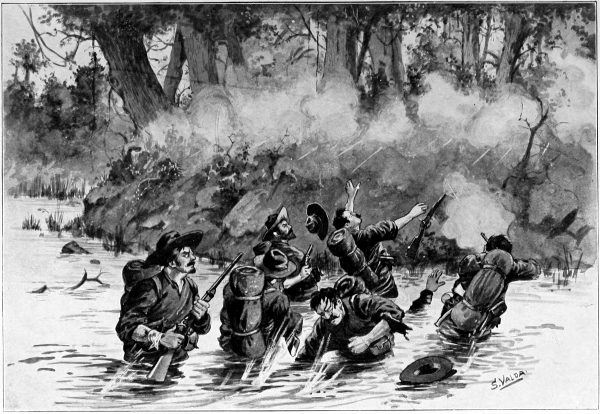
ADVANCE GUARD AMBUSCADED: DEATH OF LIEUT. WHITE.
We had journeyed about two miles when the
advance-guard halted, and at the Colonel’s request
I accompanied him to the front, where we found the
officer in command of them uncertain as to what
course he should pursue. Our advance up the
side of the stream we were on was blocked by a steep
though not very high ridge that was covered as
usual with densely tangled scrub, the end of it
jutting out into the water, which was there too
deep to allow the men to wade round it. Where
we stood a rocky bar ran to the other side of the
river, which appeared practicable, although the
water rushed swiftly across it to the depth of
perhaps four feet. The far bank of the river was
low but heavily bushed, and behind the bush rose
up a steep, razor-backed ridge, down the crest of
which ran a narrow path broad enough in places
for two men to climb it abreast.
After carefully studying the look of the country
the Colonel decided to cross the river and take to
the path, so that when the main body had closed
up the advance-guard began to wade over, the
water in the centre of the stream, which there ran
very fast, taking them half way up their chests.
That day they were being led by Lieutenant
White, a very gallant fellow, much liked and respected
by his brother officers and men. He had
been wounded the evening before, but as he was
able to march he insisted on taking his turn of
duty at the point of danger.
The advance-guard entered the ford and had
crossed three-fourths of the way when from the
dense brushwood on the far side, over which up
till now the silence of death had reigned, came a
tremendous volley, and down went poor White,
shot dead, while four of his men, badly hurt, splashed
the water like wounded wild-fowl. Immediately
some of us dashed into the stream, recovered
White’s body, and dragged out the wounded men;
at the same time one division opened a smart fire
on the ambuscade, who, however, after a couple of
volleys, ceased from returning it.
It was a nasty place; the ford was a very narrow
one, the stream ran fast, and the Colonel plainly
saw that by hook or by crook the enemy’s position
must be turned, or, should he rely on a frontal
attack, he would lose half his men. He therefore
despatched one hundred men, with whom I went,
to cut our way over the aforementioned ridge,
ascend the river until we found a crossing, and then,
descending the far bank, attack the flank of the
enemy’s position, he at the same time making a
dash at the ford.
Away we went and tackled the job, having to
put in two hours’ hard chopping before we could
get a crossing place, and then, when we had succeeded
in crossing, we had to cut our way down the
bank till at last we came close to the ford, when a
toot on our bugle let the Colonel know we were on
the enemy’s flank, there or thereabouts. Out rang
his bugle, and with a cheer we tore and struggled
through the remaining undergrowth, while a storm
of whizzing bullets, which fortunately did us but
little harm, tore the foliage to pieces over our heads.
At the same time we charged we could hear close
to us the shouts of the Colonel’s party as they
dashed through the water, the sharp file-firing of
his coverers and the volleys of the defending Hau
Haus.
Bristling with wrath, we cut and forced our way
through the last intervening scrub, fondly hoping
that a good hand-to-hand scrap would recompense
us for our past labour, but as both of our parties
simultaneously broke through the curtains of
greenery we found not one single Maori there to
receive us.
Their lines of rifle pits had been beautifully
constructed, and were admirably placed so as to
both rake and enfilade the ford, so there could be
no shadow of a doubt that had the Colonel decided
upon making only a frontal attack our butcher’s
bill must have been a very heavy one, or we might
have been beaten back; as it was we had forced
the ford with only the loss of Lieutenant White and
some half-a-dozen men wounded.
A party of us at once rushed on up the ridge, exchanging
a few shots with the enemy, who by some
hidden path had gained a similar ridge some three
hundred yards off, which they dared us to attack.
The Colonel, however, was convinced that we
were on the right footpath—else why had they
taken the trouble to build such elaborate rifle pits
to defend it?—and he was far too old a bird to be
drawn away on a wild-goose chase. His plan was
to push on to the famous Ruatahuna, of course
attacking any pahs he came across, and not to
lose time in running after Maoris, who, if he did so,
would only retire in front of him.
As soon as poor White was buried, which was
done as rapidly as possible, the only ceremonies
being the volleys the Hau Haus fired at the burial-party,
the whole force moved forward to attack
the enemy, who had occupied another very strong
position on the top of the ridge, from which they
poured in a continuous fire at our party that was
slowly mounting the steep and narrow track that
ran up from the river. This track wound about
so that both of our flanks were as often exposed
as our front, so it soon became quite evident it
would cause an awful loss of life to try and take
their position with a frontal rush.
The Colonel therefore again despatched a party to
try and turn the Hau Haus’ right flank, and again,
after immense labour, the movement having been
carried out, we made a combined rush, and charged,
the rifle pits receiving two smashing volleys, and
when we entered them we found nothing but three
guns, which some of the Hau Haus must have
dropped in their retreat. These rifle pits were
also well constructed, and were well worthy of
being better defended, but, by their having been
vacated without a stouter resistance, we saw it was
evidently the game of the Hau Haus to carry on a
war of ambuscades and not risk a stand-up fight.
After a short halt we again moved forward, our
advance-guard being fired into every few hundred
yards, while sometimes, by way of a change, the
enemy would tickle us up on the flanks; in fact it
was a most sinful and cuss-wordy march, as the
track, if you could call it such, was never broad
enough to allow us to show a greater front than
two men abreast, while the wounded men we had
now to carry added considerably to the toil of our
already overloaded men.
We had moved forward about three miles when
we sighted on a spur, with a bush in rear of it, a
pah which we afterwards learned was called Te
Whenuanui. It was in a very strong position,
but the works and fence were in a ruinous state,
as the Uriwera had never dreamt of our entering
their country, and of course had not had time since
they had heard of our visit to put it into a proper
state of defence.
The Hau Haus in the pah were evidently very
upset and excited by our call, as they opened a
heavy fire at us when we were quite eight hundred
yards distant, which was of course harmless; and
Colonel St John, splitting his command into three
parties, gave orders for an immediate attack.
The party I was with had been sent to the left,
and as we had to get over some very rough country
before we could charge, time was allowed us to get
into position.
At last we were all ready; the bugle sounded the
advance and charge, when we all rushed at the
tumbledown works, to be met by the usual heavy
but badly directed fire. There was nothing to
make us pause; the rotten fences gave way before
our rush, so with a cheer we burst into the place,
just in time to see the tail end of the bolting Hau
Haus disappearing into the bush, and to send a
volley after them that hastened their departure.
We did not pursue, as most likely they had planted
a nice little ambuscade at the edge of the bush,
and as a rule there is nothing to be gained by
running your head against a stone wall or walking
into a Maori trap, so we humped up our swags and
the wounded men, whom we made as comfortable
as possible, and occupied the pah ourselves for the
night.
During the night we had one false alarm, caused
by a patrol falling into a ditch, and various ill-bred
Hau Haus prowled round us, telling us nasty things
about ourselves. One of these lewd fellows kept
it up till daylight, and so interfered with one man’s
rest that just at day-dawn he took his carbine and
went gunning after the disturber of his slumber.
Good luck attended him, for just as it became
light enough to see his foresight the retiring night
prowler, all of a sudden calling to mind something
very ribald that he had up to that moment forgotten
to say, paused at the edge of the bush to
unburden himself. Silly fellow, he had better
have taken cover, for he had only made one indecent
gesture, and had only shouted a small
portion of what he had to say, when something hit
him, and, ceasing his oration, he took a header
among the fern, where the last thing he ever heard
in this world was the laughter of the men he had
lost his life in trying to insult.
The Maoris had left us a bare larder in Te
Whenuanui Pah, and our rations, bad as they had
been when issued to us, were by now quite unfit
for human food, and that day we ran completely
out of even the offal we had carried, so we were
not sorry when about midday we came across a
pah called Tatahoata, which afterwards turned
out to be the real Ruatahuna.
This pah, or rather fortification, was built on a
flat, with a dense bush to its right front; the
Whakatane River, with precipitous banks, on its
left; a deep, rocky creek with high, scrub-covered
sides defended its rear; while a small but thick
bush commanded its right flank. It was indeed an
ugly-looking place, but take it we must, or starve.
After an hour spent in reconnoitring, the different
divisions were told off for their several lines of
attack, and, the advance being sounded, we all
moved forward.
The Maoris were not only holding the pah, but
they had detached parties in the bush who had to
be driven back before we could rush the work itself.
We had just about completed this portion of the
game when, for some reason that has never been
explained, the Colonel’s bugler, without receiving
orders, sounded the cease fire, together with the
retire twice over, and then fell, shot dead. The
calls filled everyone with astonishment, nearly
amounting to consternation, but of course the
orders were obeyed, and before the O.C. and the
few men he had with him could rush round with
counter-orders the natives charged up to our
retiring divisions and poured in a heavy fire, which
killed and wounded a lot of men, among the former
being Captain Trevor.
Orders or no orders, we were not going to stand
that, so turning on our pursuers we flew at them
like wild cats, and as just at that moment we
received the new orders we pushed our charge
so well home that we drove the Hau Haus before
us like chaff, nor did they even make an effort
to defend the pah, but bolted as hard as they could
for the shelter of the bush and broken country,
while we occupied the place, which we eagerly
prospected for food.
It was not long, with two such sublime marauders
as Pierre and George looking after my interests,
before I had a good square meal stowed away
under my waistbelt, and the Colonel had just
sent for me to settle about some scouting when we
heard a distant bugle-call.
Our men started cheering, and shortly afterwards
it was reported that Colonel Whitmore’s column
was in sight, while the little man himself, attended
by a few men, came into the pah before sunset,
his column camping some two miles away. That
two columns should have been able to march
through such rough country and meet at an
appointed though unknown spot on the prearranged
day, speaks well for the officer who
planned the campaign, and also for the men who
carried his plans out.
CHAPTER VI
THE TAUPO CAMPAIGN
The two columns having completed the first part
of the programme by uniting at Ruatahuna it
behoved our O.C. and the senior officers to turn
to and stage the second act, but here Nature
chipped in and bade them pause.
Our force was composed of picked men, admirably
suitable for the work that lay before them,
and, with the exception of the Arawa tribe, the
only cowardly race in New Zealand, the whole
outfit were full of fight and ready to go anywhere.
Still it is a well-known fact that, no matter how
good and willing men are, nevertheless they must
eat sometimes, and we were, within twenty-four
hours of our junction, absolutely without food.
The inclemency of the weather also greatly added
to our sufferings, as we were never dry during the
day, while the bitter frosts at night froze us hard.
Moreover the enemy, though unable to face us
in a stand-up fight, still lingered in our vicinity,
and had even the cheek to commence fortifying a
high hill overlooking the camp, a movement on
their part that required a sharp skirmish to dissuade
them from continuing.
Colonel Whitmore had brought some horses with
him to Ahikereru; these now had to be killed, and
the flesh served out in short rations, while parties
were detached to try and locate the Maoris’
hidden stores of potatoes. These ruas (potato
pits), however, were so well concealed that we
could find but few, and those we did find we
had to skirmish for previous to looting, and even
when we had gained them the supply did not equal
the day’s demand.
Nothing daunted, the little Colonel still determined
to carry out his original plans and make a
push for Colonel Herrick’s column, which by now
should be on the Waikaremoana Lake, but here
again he was thwarted, as the Arawas not only
positively refused to accompany us, but also
insisted on going home, and it was with considerable
trouble they could be persuaded to carry to the
coast our wounded and sick, who by now reached
a considerable number. The indomitable little
Colonel had therefore no other option but to fall
back, so he gave orders that the combined columns
should start for Ahikereru, while the Arawas
convoying the wounded should march straight
for the coast by another route.
Previous to returning, however, he determined
to attack and destroy a big kainga that my scouting-party
had discovered while spud-hunting. This
expedition, trivial though it might be, and of no
importance, was yet a very popular one, all hands
eagerly volunteering to take a part in it, not on
account of any glory that might be reaped from
its capture, but the men were all so hungry that
they were only too anxious to undergo the extreme
hardships of a long, bitterly cold night’s march
through rugged bush on the chance of being able
to get a few mouthfuls of pork and potatoes; as
for the chance of being knocked over or wounded,
that was not taken into consideration at
all.
I am only mentioning the above facts as during
this insignificant affair an incident happened
to myself that was the cause of making me the
target for a lot of chaff, which though good-natured
caused many a hearty laugh at my expense.
It fell out in this way:
At dark a party of two hundred men, under the
command of Colonel St John, and guided by
myself and scouts, after the usual wretched march
reached the doomed place some two hours before
daybreak, and unable to surround it we lay down
to freeze, starve and wait for the dawn. Lord, I
was hungry, and being so close to the huts it came
like balm to my soul, all of a sudden, to hear an
old woman cry out: “It is time to prepare food,
let us arise and make ready the hangis” (ovens
constructed of stones sunk into the ground; these
being heated, the food is placed on them, water is
then poured over it, when it is carefully covered
up and the confined steam cooks the viands).
Presently there was a sound of women muttering
and grumbling, then a fire was kindled, followed
quickly by others, the combined flare from these
lighting up the cooking places, while we, shrouded
in the outer darkness, lay and licked our lean chaps
as we heard the boss woman directing so many kits
of potatoes and so much pork to be cooked in
each hangi; verily I for one wanted no sherry and
bitters to sharpen my appetite. Presently, the
stones being hot enough, the fires are removed, and
darkness again covers the scene as the food is
placed in the ovens and covered up.
Again a weary wait, and just as we know breakfast
ought to be ready the sky begins to lighten,
and we can see the outline of the kainga. Surely
in my impatience I may be forgiven for uttering
the following prayer:—“O gods of war, ye who
pass your days in fighting and your nights in
feasting, listen to your humble votary. Hurry up
Phœbus, the beggar’s slack to-day. Grant us
only light enough, and we vow to fight like bricks
and eat like heroes. Let us but get at our enemies
and to our victuals.”
The light comes slowly. Will the Colonel never
give the word? His expectant bugler lies beside
him, bugle to lip. The women inside the kainga
call to the men: “Arise, the food is ready to
be eaten,” and we hear the yawns and grunts of
the warriors as they wake up from their natural
slumber, some of them soon to be put to sleep again
in a speedier and more permanent manner. There
goes the trumpet, endorsed by a cheer from our
over-willing men as with a rush we dash into the
village. Here takes place the usual turmoil:
screaming women and children rush for the bush;
men, resisting and fighting desperately, are shot
down, while others are driven out of the place
in headlong flight. We do not pursue, but, with
mouths watering, instinctively gather round the
hangis. The women had stated that the food was
cooked; we required no expert evidence, off came
the earth-covered mats, when the steam of the
luscious pork and spuds rose to still further tantalise
the famished men.
There was, however, no greedy scrambling.
Starving we might be, but we were comrades in
adversity and must fare and share alike. Squads
of men fall in of their own accord, the food is
rapidly distributed by the non-coms., and is
more rapidly consumed by the hungry recipients.
Then comes the turn of the officers, who, noblesse
oblige, have had to wait, so as to make sure there
was enough to feed the men before attending to
their own wants. There was, however, no fear
on this occasion of anyone going short, as one
oven remained still unopened, and around this
we eagerly clustered. Pierre presents himself
with his huge knife, the food is served out, juniors,
taking precedence, receive their allotments first,
and I had just received mine, consisting of a lump
of pork about the size of my fist, together with a
dozen or so of potatoes, all steaming and piping
hot, served up on a fragment of a Maori mat, and
with ravenous eyes was watching the succulent
mess cool sufficiently to devour, when bang, whizz,
zip comes a flight of bullets whistling over our heads.
“Damn,” said the Colonel. “Mr Burke, take
thirty men and drive those blaggards back to perdition;
it’s like their infernal cheek to interfere with
gentlemen while breakfasting,” and the old fellow
squared his shoulders and tucked in to his portion.
As I stumbled to my feet I did not say “damn,”
as it would not have been an appropriate expression
on such an occasion, and I felt utterly
unable to coin one suitable, so picking up my
precious viands, which I carried in the mat on
my left fore-arm pressed against my chest, where
they raised blisters wherever they came in contact
with my bare skin through my tattered shirt,
in less than a minute I had the men extended,
and charged at the bush, from the edge of which
spurts of smoke told us that the Hau Haus, disgusted
at the loss of their breakfast, were seeking
utu by preventing us enjoying their forfeited
repast. It was as we were advancing I discovered
that, with the exception of my tomahawk and
sheath-knife, I was unarmed. This discovery
somewhat flabbergasted me, but it at once flashed
through my mind that I had been in the act
of reloading four chambers of my M. L. revolver
when I had received my share of the food, and that,
in my greediness to eat, I had placed my still
uncapped pistol on the ground beside me, and on
receiving the unwelcome order, in my anxiety
to carry off the food, I had forgotten the gun.
No matter, thought I to myself, the men must do
my shooting for me, so drawing my tomahawk
I led them at the bush, where we quickly drove
the enemy back for a few hundred yards, when
they turned tail and made a clean bolt for it,
while at the same time the recall was sounded
from the main body.
After seeing that all my men were present and
unwounded I gave the word to retire, and we
started wending our way back to the kainga.
I was now clearly entitled to break my long-sustained
fast. True, I could not sit down to eat,
but it is better for a hungry man to eat while
walking rather than not to eat at all, so that as
my men fell back at a brisk pace I opened my mat,
and, grabbing a handful of the by now well-smashed
and greasy potatoes, conveyed it to my mouth, instinctively
slowing up my pace as I began to eat
the precious food.
Lord, how good it was!—not tempting to look
at, my gentle reader, nor was there any romantic
refinement in the tableau of a gaunt, unshaven
man, dressed in a tattered shirt and shawl, feeding
himself with an unwashed, blood-stained hand
while pushing his way through the tangles of a
New Zealand bush.
Well, refinement or no refinement, I was
thoroughly enjoying it; as I swallowed each grimy
morsel I somehow, without noticing the fact, moved
slower and slower, until my men had gained
considerably on me, and I loitered perhaps fifty
or sixty yards in rear of them. This of course
was both foolish and wrong, and Nemesis the slut
was on my spoor in a moment. I had swallowed
some half-a-dozen handfuls of the smashed potatoes,
and was thinking of tearing off with my teeth a
mouthful of pork, when fizz! just past my ear
whizzed a bullet. Disgusted, I turned round and
saw a Maori lad, perhaps thirteen years old, with
a revolver in his hand, running after me, who had
evidently made up his mind to gain distinction
by bagging a white man. His intentions, though
highly commendable from his point of view, were
deucedly unpleasant from mine, as the moment I
stopped he fired again, making such a good shot
that he put a bullet through my rags which seared
my ribs like a red-hot iron. Angry as I was there
was only one thing for me to do, and that was to
bolt, so, infra dig. as it might be, I bolted, and went
tearing through the bush pursued by a native
urchin who every now and again squibbed off a
shot so as to keep me going. Of course I knew the
report of the first shot would bring my men to
the halt, and that I should be missed the moment
they did so. This happened, as I had not run far
when I spotted two men peering round tree-trunks
and ready to fire. I ran between them, still closely
followed by my youthful pursuer, who, being so
set upon bagging me, did not spot the ambuscade
until he was grabbed by the scruff of the neck and
his pistol wrenched out of his hand. He was a
plucky little beggar, and his fortitude quite
surprised us as he insisted upon being killed at once
and not being made a prisoner, at the same time
looking longingly at the provisions I still carried.
He gently intimated he was sick with hunger.
Angry as I was I still could not bring myself to
kill the gallant youngster; and then again, the
little beggar was hungry, which put us somehow
in the same boat, so I gave him a half share of my
rations, and, after gently admonishing him with my
toe, bade him run after his people, which he did,
while we continued to fall back on the main body,
and I managed to finish my much disturbed and
diminished breakfast.
The following day we marched to Ahikereru,
and then it became evident, even to our little
game-cock of an O.C., that we had shot our bolt,
and that without a proper supply of food it would
be an act of madness for us to try and surmount
the tremendous Huiarau range of mountains, then
quite unknown and deeply covered with snow.
Even to stay where we were was an impossibility,
as the distance to our base was so great that the
supply of rations, never regular, must cease on
account of the inclemency of the weather, so that
much against his will he determined to continue
the retreat, and take post from Fort Te Teko to
Fort Galatea, along the Rangitaike River, as in
these forts there were not only many provisions
stored, but to which ran a good road along which
both drays and pack-horses could easily bring
supplies up from the coast. My word, but we did
enjoy ourselves when we reached our new cantonments!—plenty
of good bread and meat to eat,
plenty of tea, such as it was, to drink, and oh, only
think of it, dry blankets and tents in which to
sleep! We revelled in it, though the privations
we had been through caused a terrible lot of
sickness and we lost very many good men who
could ill be spared. Somehow it has always
seemed so rough to me that a good fellow who has
run his risks, faced the music and done his duty
through a hard campaign, should, after he has
returned with a whole skin to comparative comfort,
and maybe is eagerly looking forward to another
go at the enemy, be rubbed out by some beastly
sickness. The parsons say it is Providence; I
maintain it is rotten bad luck.
We were, however, not allowed a long rest, as the
Colonel received information that Te Kooti intended
to break through our lines, so as to get
into the Taupo country, and perhaps from there
into the Waikato, so that we were all kept very
busy indeed. At Fort Galatea we mounted men
had met our horses, therefore for a time I had done
with the weary footslogging and was again in the
pigskin, with all the huge Kaingaroa and Taupo
plains to gallop over. This was indeed a change for
the better, though the weather was awful, and the
south-east blizzards which swept over the high
inland plateau bit us to the very bone. It
was not long before we mounted men located
Te Kooti at a native village called Heruiwi,
but he was in too great strength and far too
well posted for us to attack with only a handful
of cavalry, so that we had to fall back on Fort
Galatea, purposing to guide up infantry to do the
bush-whacking.
Te Kooti, however, was too old a bird to stay
long on his perch after he knew he had been located.
He therefore, breaking cover, crossed the Taupo
plains making for Lake Taupo, but, so that we
should remember him, he managed en route to
ambuscade two despatch-riders. One of these
succeeded in scraping clear and reached Galatea
with the news that Te Kooti was on the move, but
the other poor fellow was knocked off his horse
and taken prisoner. Now I do not know whether
in his Mission School days Te Kooti had ever read
Byron’s poems, though it is quite possible they had
been a portion of the useless literature that mission
folk hand over to youthful savages, but anyhow
he treated the poor captured trooper in the same
way as Mazeppa was treated, for, stripping him
naked, he caused him to be tightly lashed on to his
bare-backed horse and then had the two of them
cast adrift on to the Kaingaroa plains, where the
poor chap perished miserably.
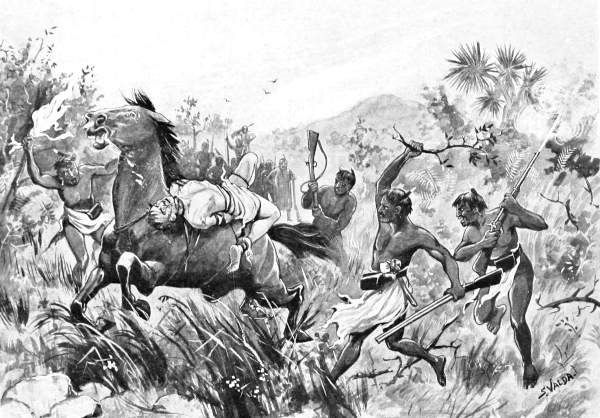
CAPTURED TROOPER’S LAST RIDE.
We were, however, quickly to receive further
news of Te Kooti’s activity. Colonel St John the
day previous to the despatch-rider’s escape had
started to visit a semi-friendly chief at Tapuaeharuru,
taking with him an escort of volunteer
cavalry. On reaching a deserted kainga, called
Opepe, as both the horses of his escort as well as
the men were badly knocked up by the vile
weather, he left them behind, there to recuperate,
and rode on to his destination, accompanied by only
four officers and an orderly, expecting to return to
Opepe the following morning. Of course both O.C.
and escort were ignorant that Te Kooti, having
broken camp, was on the move to Taupo, and none
of them thought for a single moment there was
any immediate fear of danger. Still the volunteers
should have kept on the alert, or at the very least
have taken the precaution of keeping their arms
handy; but this they do not do, for, worn out and
chilled to the bone, they simply enter the best of the
huts, light fires, discard their arms and belts and
strive to dry their dripping, sleet-soaked garments.
Presently two Maoris strolled up. “Tena koutou”
(salutations to all of you), quoth they; “we are
Arawas,” and they stood among the troopers,
warming themselves and expressing their delight
at the chance of doing so.
In a few minutes three more turned up, with
words of salutations on their lips and murder in
their hearts; and this goes on until at last the infatuated
volunteers grow suspicious and try to
get hold of their arms; but it is too late. They are
already outnumbered. A signal is given and the
tomahawk does its work. Some two or three,
however, escape, and reach Galatea, but nine of them
lie butchered in cold blood. The Colonel also had
a most wonderful escape, as the Hau Haus, ignorant
of his vicinity, moved off the ground immediately
the slaughter was ended and continued their march
towards the lake. Of course directly we got the
news at Galatea we were quickly on Te Kooti’s
spoor, but by the time we reached Opepe the Hau
Haus had retired to the other end of the huge lake,
where Te Kooti was immediately joined by the
majority of the Taupo tribes. He was therefore
again a leader of some six hundred desperate
fanatics, and there was also every possibility of
his being joined by the Upper Wanganui and the
powerful tribe of Waikato.
Had the above coalition taken place it would
have been a most disastrous affair for the colony,
as Te Kooti would then have had nearly three
thousand men at his disposal, but fortunately, just
at the critical moment, his men chanced to murder
an old and seemingly insignificant Maori, who
nevertheless turned out to be a close blood relation
of the most powerful chiefs of the Upper Wanganui
tribes. These at once demanded utu, and became
his bitterest enemies. Then with three hundred
men he pays a visit of ceremony to the Waikatos,
whom he insults, and whose country he is forced
to leave, and so once more falls back to the Taupo
country, where he locates himself south of the great
lake and close to the volcanoes Tongariro and
Ruapehu. Of course at that time we knew but
little of his movements, but it would have been
bad policy on our part to have attacked him in the
Taupo country immediately after the slaughter
of the volunteers at Opepe. In the first place
the country was quite unknown to us, while the
scarcity of rations, the severity of the weather,
the desertion of our allies, the Arawas, and the
certainty that the smallest reverse we might receive
would immediately bring to his banner all the
wavering tribes, forced our O.C. to mark time till
the weather improved and the big gaps in our
ranks could be filled up by fresh men.
Colonel Whitmore took advantage of this pause
to make a trip to Wellington to interview the
Government, an interview that caused great changes
in the plan of campaign, it being decided to mass
every available man on the Taupo plateau, to
build a chain of forts from Napier to Tauranga, so
as to cut off all communications between the Uriwera
and the Waikato, and at the same time to
ensure safe storage for a sufficient supply of rations
for what was evidently going to be a most arduous
campaign.
Colonel Herrick’s column was ordered from
Waikaremoana to Napier, and started cutting a
road for pack-horses up to Runanga, a high hill
situated on the border of the Taupo plains, and
here they built a strong stockade from which
communications could easily be kept up with
Opepe (now headquarters), a distance of twenty-two
miles, and Ahikereru, a distance of eleven
miles, while in between Runanga and Napier were
constructed three other forts.
Nor were we of the old field force idle. Winter
or no winter, we kept hard at it, scouting and
patrolling and learning the country thoroughly, so
that when spring came on we should be ready to
take the field again.
Our dear old O.C., Colonel St John, worn out
with past hardships, had been invalided, but our
regret at his departure was somewhat tempered
by our hearing the news that Colonel McDonnell
would take command in the ensuing campaign,
which he shortly did, after making a splendidly
plucky march across country from Wanganui to
Taupo, a march that had the greatest moral effect
on the natives, as they had up till then deemed the
road impracticable for white men to negotiate even
in summer.
CHAPTER VII
THE TAUPO CAMPAIGN—continued
About this time I was despatched with the mounted
division to Runanga, so as to reinforce Colonel
Herrick, who on our arrival was able to take the
field with two hundred white men and a strong
native contingent, which he did on 8th September
1869, as on that day he despatched Henare
Tomoana and Paora Hapi, friendly chiefs, in
command of one hundred and forty natives as an
advance-guard, the plan being to join hands with
McDonnell, who was on his way from Patea, and
we were to try and catch Te Kooti between two
fires. These warriors, however, marched too fast,
as they reached Tauranga Taupo twenty-four hours
before they should have done, leaving the main
body with the stores to come on as best they could.
Nevertheless they were there, and had occupied
an old tumbledown pah, when they perceived Te
Kooti and his Hau Haus marching down to attack
them. Paora Hapi, who was a renowned fighting
man, wanted to leave the defences, such as they were,
and fight it out in the open, but Henare jibbed at
the idea, so that our friendlies stood a siege of two
days, and stood off the Hau Hau attacks very
pluckily, though, through sticking to the pah, it
gave Te Kooti the chance to capture and carry off
one hundred and twenty of their horses.
True to time we arrived on the scene, but the
Hau Haus, well served by their scouts, had received
notice of our approach, and as a stand-up
fight with mounted men in the open was the very
last thing Te Kooti desired, he raised the siege and
fell back rapidly into rough mountainous country.
On the same day we received a rumour that Colonel
McDonnell with the advance-guard of his force had
reached Rotoaira, a small lake lying between Lake
Taupo and the active volcano Tongariro, and I
was ordered to ride through to him in order to
open up communications. This was rather a
jumpy job, as every yard of the road ran through
enemy’s country, and it might well chance that
en route I should tumble across Te Kooti’s whole
outfit; moreover, all the information I could get as
to the whereabouts of the place was that it lay
some ten, or possibly more, miles to the south, or
perhaps south-east, or south-west, of where our
camp was. However, I was well mounted, the
country for New Zealand was fairly open, and I
had had to chance it so often during the past four
years that the dangers bothered me but little, so
away I went and got through all right, although
I was shot at and hunted quite enough to make it
an exciting afternoon’s ride.
Colonel McDonnell was very pleased to see me,
as I was to meet him again, but I was more than
surprised at the paucity of his force, which only
consisted of seventy men. He, however, was
expecting to be joined daily by his main body, and
as nothing could keep him quiet he immediately
started me off on the scout towards Tokanu.
Here I found the enemy in force, and while trying
to gauge their strength got spotted, and had to run
farther and faster than I had ever run in my life,
before or since, but fortunately managed to keep
ahead until night came on, when I got back safely
to camp, very nearly dead beat.
The Colonel not being quite satisfied with my
report determined to call on Te Kooti himself, so
next morning we paid him a visit, when we found
the bounder not only in a strong position but with
fully six hundred men ready to receive us. These
odds being a trifle too long even for fighting Mac,
after an exchange of shots we fell back to Rotoaire,
where we threw up a rough breastwork, and as we
fully expected the Hau Haus to beat up our
quarters we all kept a remarkably sharp lookout.
The night passed quietly and early the following
morning the main body joined up. The Colonel at
once sent out scouts, who soon returned with the
news that Te Kooti, having abandoned Tokanu,
had fallen back towards Moerangi, hearing which
the Colonel, without loss of time, seized Tokanu,
despatching me with orders to Colonel Herrick
to join him there. This trip I got through without
trouble, and, on the 16th of September, both columns
joined hands at Tokanu, a very important strategical
position, and one that we could not understand
why Te Kooti should have abandoned without a
desperate struggle.
The following morning Hare Tauteka, one of the
friendly chiefs, turned up at the Colonel’s hut in a
great state of mind, reporting that four of his
scouts had been cut off, tortured and killed.
This was decidedly unpleasant though, alas! by no
means uncommon news. Scouts did at times get
captured, and the Hau Haus, especially Te Kooti,
had a nasty way of entertaining their captives.
Still this news required verifying, as it was unusual
for the whole of a patrol of scouts to be captured,
one or more as a rule managing to scrape clear.
The Colonel therefore asked Hare how he had
received the information, whereupon he replied
that his scouts should have joined up two days
previously, and that no hope of their safety could
be entertained for a single moment, as his pet
prophetess had dreamed a dream that they had
been captured, tortured and killed. The Colonel
demanded to see the lady, who with her son was
trotted up, and two more loathsome objects could
not be imagined.
The old dame was so hideous and unsightly
that she would have afforded a gang of godly
Puritans exquisite delight to torture and burn as
a witch; while the son, who suffered from some
horrible form of leprosy, appeared to be falling to
pieces. Notwithstanding the old faggot’s homeliness
she was gifted with a most eloquent tongue,
for no sooner had she appeared than she started
in and prophesied a whole hurricane. Moreover,
there was no Delphic ambiguity in her statements,
as she stoutly asserted and maintained that the
four scouts had been captured alive, tortured to
death, and that their remains had then been
thrown into a certain swamp, the name of which
she mentioned.
Now of course we white men were inclined to
laugh and ridicule the whole yarn, but refrained
from doing so, as we should have deeply offended
the superstitious Maoris, so, like the sailor’s
parrot, we thought profoundly, but said nothing.
The following day Captain McDonnell, with
Kepa’s advance-guard, joined up, and he reported
that he had been informed by some semi-friendly
natives that Te Kooti had captured four of our
scouts, tortured them to death, and ordered
their remains to be thrown into a certain swamp.
Upon hearing this news the Colonel despatched
a strong patrol of mounted men to search the
place, and there, sure enough, we found the poor
fellows’ remains, which, from the treatment they
had evidently been subjected to before death
mercifully put an end to their sufferings, showed
us plainly that the damned Hau Haus had spared
no torment that devils could invent or fiends
inflict.
The old Witch of Endor was now very cock-a-hoop,
as her lucky dream sent up her scrip many
points on the market, and her name resounded
through the field force as being quite a first-class,
high-toned, up-to-date and always to be relied
upon dreamer of dreams and seer of visions,
in fact a puka old-time witch that all respectable
elderly Maori fighting men must needs give ear to.
Now prophets and cattle of that sort were rank
poison to an O.C. of a column in which a large
number of natives served, and our field force had
many more of these critters on our strength than we
were entitled to or desired, in fact they troubled
us exceedingly, as, just when the Colonel would
want to make a move, some confounded old
image, possibly suffering from a repletion of
villainous ration bacon, would dream that the
proposed expedition would be an unlucky one, and
at once the whole of his congregation would plump
themselves down and refuse to budge an inch.
This then was an opportunity that the Colonel
could not allow to slip, for, taking advantage
of the old dame’s stock being at so high a premium,
he immediately subsidised her, and in future she
dreamt dreams that concurred with his wishes,
and, as our luck was in the ascendant, the natives
were quite ready to do any work they might be
called upon to perform. Truly there are more
ways of killing a cat than drowning it in cream.
Subsequently we heard how these scouts had
come to grief. They had been despatched to
discover the route that Te Kooti would be likely to
take should he attempt to break away round our
right flank, and had put in four days’ hard work.
On the evening of the fourth day, having completed
the duty, they were well on their way back to camp,
and had cleared the acute danger zone. Of course
they had had a very rough time of it, for, although
the spring was now coming on, it was only by
the date in the day’s Order Book you were aware
of the fact, as heavy sleet storms during the day
and hard frosts at night had still to be endured.
Well, as I said, they were fairly past the danger
line, in fact a few more hours’ tramping would have
landed them safely in camp, when unfortunately
they chanced upon an old potato clearing on which
stood a few huts, while, worse luck still, one of
them spotted a rua (potato pit) containing a lot
of potatoes.
The temptation was too great for the worn-out,
wet-through and starving men. Surely they
might rest and eat; anyhow they would chance it.
They did so; and entering the best hut they lit a
fire, cooked potatoes, dried their dripping clothes
and warmed themselves, then, overcome by the
lassitude brought on by their full meal, and the
unwonted heat, they fell asleep.
Of course they had played the fool, and had
done what they well knew to be wrong, but yet I
think St Nemesis might have closed her eyes on
the faux pas of these poor scallywags, but she is
not built that way, for she was on their spoor like
a jumping wild cat before they had eaten a single
pratie, and she punished their sin in a most cruel
manner.
It happened this way: Although they were in
blissful ignorance of the fact, they had been
spotted by two separate parties of Hau Haus,
each numbering forty men. These parties, posted
on high ranges of hills, had not pursued them, as
they deemed it impossible to overtake them, but
when they saw them enter the hut they came down
from their heights, and closely surrounded the
place. One of them creeps up and peers through
the chinks of the rickety door, and there he sees
the four wretched scouts fast asleep, with their
guns made fast to the hut-pole. In a moment
the door of the hut is knocked into splinters, and
before one of the inmates can move a finger they
are overwhelmed by numbers, and securely tied
hand and foot.
Next morning the captives are brought before
the arch-devil, Te Kooti. They are all warriors
of high repute and rangateras of the bluest blood,
most valuable recruits if they can only be made
to join the Hau Haus. Te Kooti knows this well,
and for a long time does all in his power to persuade
or intimidate them to join him, but to all his
specious arguments and diabolical threats he only
receives this one answer: “Do with us as you
like; we are warriors of the Great White Queen,
who fear not death, come it as it may.” As
persuasion is of no avail the threats are put
into practice, but I will not go into nauseating
details. Frequently at intervals during the next
twenty-four hours the torture is discontinued
for a few minutes, and the offer of life renewed
to the sufferers, but so long as speech remains the
overtures are met by the same steadfast answer:
“Do with us as you will; our honour is the honour of
the Great White Queen; we fear not death, come
it as it may.” At last it came, and those four
savage gentlemen yielded up their lives, but retained
their honour.
If in the far future there should chance to be a
corps d’élite among the legions of angels, I will
wager my golden crown that those four Maori
rangateras will swing their flaming tomahawks
in its ranks.
Well, now let’s get on with the main yarn.
I have previously mentioned the infernal
weather, which that year was the worst ever
known in New Zealand, and as Taupo is always
bleak and cold, we came in for more than our
share of snow, sleet and frost; in fact, it being
impossible for human flesh and blood to keep the
field, the Colonel occupied the two strong positions
of Rotoaira and Tokanu, while Te Kooti
remained quiet in his fastnesses, both sides having
to sit tight for a bit, and wait till the clouds roll
by.
While we are marking time for the clerk of the
weather, I think I may take the opportunity of
telling you about a wonderful occurrence that
took place at Tokanu, which is situated among the
hot springs and geysers close to the shores of Lake
Taupo. Many of these are hot enough to cook
in, the water boiling furiously, while many others
are cool enough to bathe in, and there was one of the
latter particularly favoured by all hands. Let
me try to describe it.
On a flat of silica, quite smooth to the bare feet,
are three huge basins, perfectly round, some seventy
feet in diameter and all in a row, each separated
at the surface by only a few feet of silica. Now
the odd thing about these basins is, that the water
in the two end ones rises and falls—that is to say,
when the one nearest the lake is brimful the
water in the farther one will sink out of sight, and
vice versa. This takes place as regularly as clockwork,
one being full and the other empty, while
the middle one always remains brimful, and
although the water in the two end ones is boiling
hot, that in the centre basin is cool enough to
bathe in.
This pool had been the favourite resort of the
natives for untold generations, and had never
been known to monkey—i.e. to blow up—so of
course when we occupied the place we gladly made
use of it; in fact it was full all day long, as in the
inclement weather it was the custom of everyone
not on duty to strip in his hut and rush off naked
to the pool, into which he would plunge, and
remain for hours in the hot water, thereby keeping
himself warm and out of the icy sleet. Now
we were entitled among other rations to a couple
of half-tots of rum per day, but, like many of
our other necessaries, we received them rarely,
and when we did get one it was highly appreciated.
Well, one wretched afternoon all hands not on
duty, perhaps one hundred and fifty of us or more,
were in this bathing hole when, oh, joyful sound,
the grog call rang out! Without a moment’s
pause every man in the water jumped out and ran
as hard as he could to hustle on his rags and make
the best of his way to the rum-bucket. We
were just in time, for the last man had barely
cleared the silica flat when, with a roar like ten
thunder claps lashed together, up went the bathing
hole, and what a minute before had been a placid
pool of warm water became a roaring geyser,
throwing up a huge fountain of boiling water
at least two hundred feet into the air, while
the screams of it were like ten thousand
steam hooters blowing off at the same time.
Well, now that was a slice of luck, as had the
bust up taken place one minute earlier the whole
lot of us would have been blown to Kingdom Come
in smithereens. Think of that, oh, my crazy,
fanatical teetotalerising, red-nose wind-bag, only
just think, one hundred and fifty lives saved by
their smartness in answering the wicked grog call.
Ponder over it, my brother, and lay this flattering
unction to your soul, should you by chance have one,
that bar the alarm it was the only call in the
bugler’s repertoire that would have been answered
in such a unanimous and energetic style, but
cheer up, Brother Stiggins, I will give you a tip.
The next time you spout trash to your brother
and sister fanatics, spin the above yarn, and if
you only alter the grog call for the tea call, you will
bring the house down. Surely you can’t hesitate
in telling such a tiny lie for so good a cause.
Just as the weather began to clear, a trooper
riding despatch from Rotoaira to Tokanu returned
at the gallop reporting that the road was blocked
and that he had only scraped clear by the skin of
his teeth.
The friendly natives refused to believe the yarn,
so next morning the Colonel, with a dozen of us
mounted men, rode out to reconnoitre, and near
Tokanu we found the Hau Haus had taken up a
strong position on the spurs of a range overlooking
the track.
They at once opened a heavy fire on us, but
following the Colonel’s lead we galloped past
them, and in a few minutes met a strong body of
friendlies, led by Captain St George, who had come
out of Tokanu to ascertain the cause of the firing.
The Colonel immediately dismounted, and led
the natives on to the attack, while we mounted
men cantered into action opening the ball.
The Hau Haus were in strong force, swarming
on the top of the range across the spurs of which
they had dug lines of shelter trenches, the first
line of which, the Colonel leading, we took with a
rush, but the main body of the Hau Haus, undaunted,
swept in masses down the spurs to
drive us back. At the start we were far outnumbered,
but were being reinforced every moment
by fresh arrivals of friendlies from both camps,
who, coming up at the run, threw themselves
promiscuously into the fight. The charge of
the Hau Haus downhill at us was indeed a pretty
sight, as they came on like mountain torrents,
yelling like devils and waving their weapons in
the air. McDonnell, however, had us well in hand,
and shouted to us to restrain our fire, which we
did until they were within ten yards of us, when
at his word we all fired, and followed up the volley
with a charge that effectually dammed their
torrents of attack.
Faith, it was as swate a little fight as I have
ever had the luck to take part in, for, although it
took place upon the spurs of a range and we had
to charge uphill, yet the battle-ground was free
from bush till the summit was reached, so that we
could see all the fun that was going on around us.
Another factor greatly to our advantage was
that, the scrap being quite unpremeditated on our
part, none of our limbs of Satan (prophets) had
been able to dream dreams, consequently our
friendlies fought with all their native courage,
which was in no wise handicapped by the lugubrious
prognostications of some old humbug suffering
from the mullygrubs. A gay and festive hand-to-hand
fight took place that lasted a few minutes,
in which tomahawk clinked against tomahawk,
and yell answered yell with all the reckless devilment
of a good old-fashioned Irish faction fight,
but at last the Hau Haus give ground, while we
press them so closely, and drive them back so
rapidly that they have to abandon their dead
and wounded, who fall into our hands, the latter
receiving the same amount of mercy as they
would have bestowed upon us had the tables
been turned.
Presently they give way and bolt, but we pursue
just as fast as they fly, and reach the top rather
breathless, but mighty adjacent to their shirt tails.
Here they turn and try to make a stand, but
without a pause we fly at them like a pack of wild
dogs at a flock of sheep, and in less than five
minutes they are driven across the summit of the
ridge, and disperse on the far side, a broken,
beaten, dispirited mob of fugitives, while we
white men sit down and laugh, and our bould
allies vent their superfluous energy in a blood-curdling
war dance in which the heads of the
defunct Hau Haus are passed from hand to hand
like footballs.
This fight, Te Pononga, insignificant as it may appear,
was yet of tremendous importance, although
at the moment we were quite unaware of the fact,
but we ascertained shortly afterwards that the
celebrated Waikato war chief, Rewi, with six
hundred warriors, had been spectators of the whole
action. It seems that Rewi and his men had
come to join Te Kooti, but had jibbed, as one of
the lately tortured scouts had been a close blood
relation to some of the most influential Waikato
chiefs. This rift, however, had been nearly closed
by Te Kooti’s wonderful art of persuasion, who
also braggingly prophesied that at his next fight
he would utterly defeat the white man. Thereupon
Rewi made the agreement that if he proved
himself to be a true prophet then he, Rewi, would
join forces with the Hau Haus and assist them in
driving the white men to perdition. Te Kooti
therefore selected his ground (a great point in
Maori warfare), went through all the Hau Hau
ritual and uncanny incantations, danced the
Pai Marire, wound his warriors up to their extreme
height of fanaticism, and then sent a braggart
message to Rewi ordering him to come and look
on at his splendid victory. Rewi came, but when,
instead of looking on at the victory, he saw the
boasting prophet with his whole gang of scallywags
driven off the chosen field in headlong flight
he quietly packed his grip-sack, and without beat
of drums returned to the Waikato, where he informed
H.M. King Potatau that Te Kooti was a
humbug as a prophet, and no great shakes as a
fighting man, so Waikato sat tight and left white
man and Hau Hau to fight it out alone, which was
a deucedly lucky thing for us.
The following day, as we were ready to start in
pursuit, the Colonel received a message from Kepa
asking him not to fight again until his arrival,
as he was bringing with him seventy renowned
warriors, and that he was most anxious to take
part in the next action. This was indeed good
news, as it would give us seventy trustworthy
men in whom the Colonel could place the most
implicit reliance, and would also enable him to
dispense with the services of some of the least warlike
of the friendlies, who were now beginning
to give a lot of trouble, especially the Napier
Maoris under Renata Kawepo.
Kepa’s advent was indeed a godsend, but more
good luck was to follow, as on the very same day
the splendid No. 2 Division of the Armed Constabulary
marched into Tokanu, who, together with
the Wanganuis, the Taupo friendlies and us mounted
men, gave the O.C. a fighting field force sufficient to
twist Te Kooti’s tail without the assistance of the
riff-raff who were always too ready to give ear to
the romances of dreaming prophets.
While waiting for Kepa, McDonnell kept all
hands, with the exception of the scouts, closely
confined to the camps, as he was most anxious the
Hau Haus should gain sufficient confidence to
again collect in a body, which would enable him to
deliver one more smashing blow, as in such a
country it was quite useless trying to run down
small parties of scattered fugitives.
His apparent supineness quickly bore fruit, as we
scouts soon discovered that the broken Hau Haus
were drawing together, and in a few days they had
regained sufficient cheek to try and drive off horses
and slaughter cattle grazing in the vicinity of the
camps. Yes, slaughter cattle, my friends; for as
regards meat rations we were now fairly well off,
as, a pack-horse track having been cut through the
bush to Runanga, droves of oxen could be sent up
to the front, and as these beasts performed the
journey on their own legs they required no transport.
Other rations, however, were still very scarce,
as we were only issued two days’ groceries and
biscuits for every eight days.
This had been all right up till now, as on our
arrival in Taupo huge stores of potatoes had been
captured, but alas, the succulent spuds had been
eaten, so could not be issued again. It was therefore
necessary to renew our stock, and we scouted
hard to find any ruas, but although we found
plenty of these underground storerooms, still they
were invariably empty, the truth being that the
Maoris of the district, having lost such large
quantities to us, and also having had to feed Te
Kooti and his hungry gang, were deucedly hard up
for potatoes themselves, and it became evident to
all that in the near future Te Kooti and his mob
would have to hunt for new pastures on which to
browse. This being the state of affairs, and no one
being anxious to chase the bounder again across the
island, we were all very hopeful, and most desirous of
getting the chance to smash him once and for ever.
Kepa arrived, and his advent was the occasion
of the most tremendous war dance I ever saw in my
life, but it is quite impossible for me to describe it.
Only one man has ever been able to picture with a
pen an old-time Maori war dance, and as I can’t
pretend to in any way approach his gift of description,
I won’t try to do so. Anyhow it was a very
wonderful sight, and was, I suppose, the last real
war dance ever danced in New Zealand. Of course
a few years back, when our present King, God bless
him, visited Rotorua, the tame natives round about
got up a burlesque haka, but although I was not
present I will gamble it was not an old-time war-dance,
as, had it been only a fraction of one, every
white female and most of the white men then
present would have fled off the ground overcome
with horror and disgust.
While we looked on an officer said to me: “I
wish to goodness, Dick, some of the infatuated
idiots who for the past forty years have subscribed
to the New Zealand mission funds could only see
this ruddy lot of Christian natives dancing their
war dance, for I ’ud bet my bottom dollar it would
open their eyes and close their pockets.” To
these remarks I fully agreed.
We scouts had by now located Te Kooti, who at
Pourere had built a strong redoubt after the
European fashion, but without kaponiers or any
other flanking defence. It stood fairly in the open,
close to the foot of the burning mountain, Tongariro,
while Papakai, the village of the great Taupo chief,
Te Heuheu, was within two miles of it. Here
Te Kooti, with the three hundred ruffians who had
rejoined him, determined to make a desperate resistance,
and as soon as McDonnell was aware of
the fact he moved forward to deliver what he and
the rest of us devoutly hoped was going to be the
coup de grâce to the foul gang of murderers we had
been so long in pursuit of.
The Colonel’s plan of attack was excellent, and I
have no doubt we should have succeeded in surrounding
and destroying the whole hive of vermin
had it not been for the old image Renata, whose
pet prophet chose to dream a dream just at the
wrong time—i.e. the evening before the attack
should have taken place, which said dream caused
Renata and his three hundred Napier Maoris to
squat down and refuse to budge.
The attack therefore was made anyhow, it culminating
in a race between the Wanganuis, St
George’s natives and ourselves as to who should
first get to hand-grips with the enemy. When
old Renata found we were attacking without him
he got into a terrible fluster, and with sixty of his
men following him ran after us, screaming to us to
wait for him, lamenting that he was disgraced for
ever, and cursing his pet prophet for all he was
worth. His penitence, however, came too late, as a
number of the Hau Haus had already got out of
the place, breaking through the gap he and his men,
through their confounded folly, had neglected to stop.
Pourere was rushed in a most orthodox style,
as we surmounted the parapet, which was eight
feet high, by climbing on to one another’s shoulders
and jumping on to the top of the defenders, whom
we finished off with butt, tomahawk and revolver.
It was quite a tidy little scrap, in which I came out
the richer by receiving two tomahawk cuts and
the poorer by having my shirt and shawl torn to
pieces off me, a very serious loss, believe me, as until
I got back to Tokanu every rag of clothing I possessed
was my boots, a somewhat scanty well-worn
Maori mat and bandages. Pourere was a
bad beating for Te Kooti, as, although we only
found thirty-eight dead Hau Haus inside the work,
yet during the pursuit very many were killed and
wounded. We also captured thirty women and
eighty horses. In this action Te Kooti himself
was wounded, receiving a bullet through his hand,
which, lacerating the thumb and forefinger, amputating
the third finger, then passed through the
fleshy part of his side.
Our loss as far as numbers went was trivial, four
men only being killed and four wounded, but alas,
we lost two men we could badly spare, one being
the gallant and chivalrous Captain St George,
shot through the head while leading his men to
the charge, and the other, the best little fighting
man I have ever known, Winiata Pakoro, whose
name will resound as long as war is ever talked
about by the Maoris.
He was killed in the following way:—The parapet
of the work was eight feet from the ground line and
four feet thick, being beautifully riveted with
fern. When we rushed the place we advanced in
extended order, and on the charge being sounded
ran forward, stooping low and closing in as we ran.
Now Te Kooti had asserted that the reason he
built Pourere after the European style was that he
acted under the direct instructions of the angel
Gabriel, in which case his angelship showed very
small knowledge of the art of fortification, as the
line of loopholes was pierced six feet from the
ground and straight through the parapet, not
giving the bottom sills any downward slope, so
that his men when firing could not depress the
muzzles of their guns, consequently when they
fired their volley at our charging ranks all their
bullets went howling over our heads, not one single
man being touched. In a moment we leaped into
the ditch, and, as there were no flanking defences
to enfilade it, we were quite safe, and all paused a
moment, cheering and laughing, to recover breath.
Winiata, however, had no need of more breath,
so forthwith scrambled up to the top of the parapet,
and, discharging his rifle into the mob of defenders,
called them all the naughty names he could think
of, then throwing down to his comrades his empty
gun he received from them another loaded one,
which he also discharged in the same manner.
He had done this three times, and was in the act
of doing it the fourth when he tumbled backwards
into the ditch with a bullet through his brains.
Her saintship Nemesis on this occasion made
use of a rod she must have kept a long time in
pickle for the back of that ancient sinner and believer
in dreams, Renata Kawepo, the chief of the
Napier tribe, and she served it out to him in this
fashion.
Old Renata, who in no ways lacked pluck, at the
last moment charged with about sixty of his men,
but in the pursuit through the bush got separated
from them. While alone he fell across a Hau Hau
man and woman, the latter’s husband having just
been killed, and these two at once attacked him. It
would have gone very hard with the poor old chap
had not a trooper and an Arawa come to the rescue,
who equalised matters by promptly killing the
man, and then stood by and, acting as referees,
watched a veritable hand-to-hand fight, no lethal
weapons being allowed, between the infuriated
Suffragette and Renata. Now I regret to state it
is impossible for me to report that the fight was
fought in strict accordance with the Queensberry
rules, or any other well-known code of laws drawn
up for the guidance of pugilistic encounters, as
after scrapping two rounds, during which both of
them should have been frequently disqualified
for foul fighting, in the third and last the vixen got
the dog down, mauled him severely, tore the greenstone
ornament out of his ear, taking the greater
part of that organ with it, gouged out one of his
eyes, which she promptly swallowed, and would
have finished him off had not the Arawa, suddenly
remembering that the Napier tribe would most
probably demand utu from him for looking on at
their chief being outed, put an end to the shindy
by taking the Amazon prisoner. The general
verdict of the field force on this encounter was
serve him right, and much more sympathy went to
the woman than to Renata, as everyone was fed
up with the pranks of the Napier tribe and bitterly
blamed Renata for giving Te Kooti the chance of
again escaping.
The Napier men, however, were furious, and, being
high-toned Christians, demanded the woman should
be given over to them so as to be tortured and killed.
This modest request the Colonel sternly refused,
and promptly ordered all the women prisoners to
be brought up to his own camp for safety. At
the same time he solemnly warned the Napier
scallywags that if they dared to play any monkey
tricks he would let loose us mounted men to twist
their tails, whereupon the disgusted Napier tribes
said they would go home, and were promptly told
to go to Hades, and they went not as far as they
were recommended to go but to Napier, and this
was only to be expected, for you see the beggars
always hung back when ordered to march an unfrequented
route or do anything of an arduous
nature.
CHAPTER VIII
HIDE-AND-SEEK WITH TE KOOTI
The Taupo Field Force now had to foot it in what
the men called a devil’s dance—i.e. marching and
counter-marching all over the big inland plateau—for
Te Kooti, having had sufficient fighting for the
time being, simply refused to be brought to book.
Ye gods! how we poor scouts were worked day
and night, as on foot through the bush and across
mountains, or on horseback, over the plains, we
searched for the beggar high and low. Occasionally
we would locate him, and, making for camp as
hard as we could pelt, would report to the fretting
O.C. we had him spotted. In a moment the
column would start walking all day, or scrambling
all night, till we surrounded the place, then rush it,
only to find the still smouldering fires of his bivouac.
Back would march the disgusted column, and would
scarcely have time to eat before fresh scouts tore
in with the report, “We have got Te Kooti located.”
Away would go the swearing column, only to be
sold again; and thus the dance went on. The
fact of the matter was that the Hau Hau scouts
were just as good as our own, and kept our camps
under such strict observation that no party of
men could leave them day or night without Te
Kooti being at once warned of the movement, and
so we could never depend on his remaining in the
same place for more than a few hours at a stretch.
Eventually he disappeared altogether from our
ken, and we were utterly nonplussed as to what
had become of him. This was indeed a very grave
and serious responsibility, as no one could surmise
from which direction some horrible story of murder
and rapine might be sprung upon us. Every
officer and man, from the O.C. downwards, did his
best to pick up the lost spoor, and despatch-riders
were sent to ride day and night to inform the
distant settlers and commandants of frontier
districts that Te Kooti had been lost, and to
earnestly warn them to keep on the lookout for
one of his lightning raids, while the hearts of us
poor scouts grew dark, as, although we had done all
that human beings could do, yet somehow it
seemed to ourselves that we were to blame for his
miraculous disappearance.
At last it was discovered, after we had marched
the boots off our feet, and our riding-breeches were
more holey than a cold wet saddle demanded, that
Te Kooti had retired into the King Country, where
he again, in the most extraordinary way, raised
another band of murderous ruffians.
There we could not meddle with him, for to have
done so would have been to declare war against
the powerful Waikato and Ngatimainapoto tribes,
who at that time acknowledged no British rule.
Moreover, starvation was again staring us in the
face, as some rotter in the Government, having a
large number of sheep to dispose of, and wool being
at a very low price, suddenly discovered it would
be cheaper to feed us on mutton than on beef, so
flocks of sheep were despatched up to the front
instead of herds of oxen. We should not have
objected to the change, but alas, the sheep could
not travel up the bush paths or swim rivers like
oxen, and the few that did arrive were so long on
the journey that we well-nigh starved before
they reached us. It was therefore absolutely
necessary to reduce the strength of the field
force, so as Kepa at this time received a message
from Topia Turoa, the great chief of the Wanganuis,
requesting his presence, as he, Topia, had received
a letter from the Maori King, which he refused to
open except in Kepa’s presence, the Colonel sent
home the splendid Wanganui warriors, and everyone
was awfully keen to hear what news this
wonderful letter contained.
In the meantime we starved, but never for a
moment relaxed our vigilance or discontinued our
scouting and patrols, as McDonnell knew full well
that the least slackness on our part would encourage
the wily Te Kooti to play us some dog’s trick or
another. At last we heard the purport of the
King’s letter to Topia, and as it throws light on
some queer phases in old Maori etiquette I will
tell you all about it.
The Maoris were the most hospitable people in
the world, being bound to defend their guests, as
their guests were bound to fight for their hosts.
On this occasion, however, Te Kooti was, if not
originally, an unwelcome guest, yet had misbehaved
himself to such an extent that his Maori Majesty
heartily wished to get rid of him, as he feared that
he would attract such a following as to enable him,
Te Kooti, to set up an opposition kingdom.
Nevertheless, although quite strong enough himself
to eject the artful dodger from the Waikato, yet
the laws of hospitality forbade him to act as his
own chucker-out, and he therefore wrote to Topia
stating that he, the King, withdrew his protection
from Te Kooti and requested Topia to immediately
assist Kepa in driving the murderers of women and
children from the Waikato. This was nuts to
Topia, as he sadly wanted utu for his old blood
relation, Hona, the insignificant old man the Hau
Haus had wilfully murdered shortly after they
had played old gooseberry with the volunteer
troopers at Opepe.
Accordingly on Kepa’s arrival Topia sent out
the fiery cross, and in two wags of a cat’s tail had
collected a posse comitatus of six hundred first-class
up-to-date fighting men, whom he placed under
Kepa’s command as war chief, but he accompanied
them himself so as to make sure that no monkey
tricks would be played or that any of his men should
suddenly fancy themselves to be prophets and
start dreaming dreams, he, Topia, not believing in
such necromancing when the serious business of war
was on foot. He likewise warned all hands he
would interpret any dreams with his tomahawk,
stated that Te Kooti’s head was fit to be boiled
(an awful cuss word for a Maori chief to use), and
that he meant to have utu for the blood of his
relative he had never seen. So with Topia, Kepa
and six hundred fresh men on their track the Hau
Haus did not draw dividends for their brutal
murder of a poor old non-combatant whom they
had deemed to be a mere nobody, and as such a
fit object for their wanton cruelty.
Te Kooti however quickly tumbled to the fact
that his game was up in the Waikato, as by one
of his lightning marches he turned our right flank,
and although he ran great danger in being caught
between Topia’s men and our column, when he
would have been crushed like a nut in a pair of
nut-crackers, yet thanks to a dense fog he scraped
through between us and got clean away to our
rear without our being aware of the fact, and it
was only through my cutting his spoor the same
evening that we knew of his desperate movement,
and that he had made his way to Patatere in the
country of the Ngaiterangi, a large portion of
which tribe at once joined him.
Now this was one of the most extraordinary
facts about this very extraordinary bounder.
Here was a man possessed of no blue blood, yet
Maoris regard high descent to be an essential in
their leaders. Again Maoris have no faith in an
unsuccessful general, and it was impossible to argue
that he had been successful. True, he had succeeded
in three or four raids, in which he had
ruthlessly tortured and murdered women and
children, yet whenever he had stood up to us in a
fair fight, even although he had chosen the battlefield
himself, he had been beaten and driven off
the ground with a great loss of men. Moreover,
he had set himself up as a prophet, and granted
a lucky prophet had immense influence over the
superstitious natives, yet on the other hand an
unlucky prophet met with scant ceremony; in fact
on more than one occasion Hau Haus relentlessly
killed prophets who had misled them.
Now as a prophet Te Kooti was a distinct failure.
He had over and over again declared himself to
be invulnerable, yet he had been wounded twice,
and on one occasion had had to be carried out of
action on a woman’s back. Moreover he had
promised his followers time after time invulnerability,
yet every tribe who joined him had lost
heavily in killed and wounded. Now this was
sufficient to have damned a big chief even had he
had a previous splendid record, and Te Kooti was
no big chief, while his record previous to his,
grantedly unjust, transportation was simply that
of a rowdy chicken thief. Nevertheless, notwithstanding
all his drawbacks and manifold shortcomings,
Te Kooti up to the end never visited a
tribe that he could not either frighten or persuade
numbers of that tribe to join his precarious
fortunes, and this without doubt was a marvel,
for the Maori is by nature a powerful reasoner
and wonderfully clear-headed. Perhaps the most
wonderful thing of all was that chiefs of bluest
blood who would have pilled him like a shot, had
he possessed the effrontery to put himself up for
their club, still willingly submitted themselves to
his rule and obeyed his commands.
On the 20th of January 1870 Topia’s and our
column met, and on the 24th our advance patrol
surprised and rushed a kainga, in which we killed
one Hau Hau and captured three others, who, after
putting both themselves and us to a deal of trouble,
owned up that they were Te Kooti’s scouts, and
that Te Kooti himself was camped a few miles
away, this being the first authentic information
we had received of his actual whereabouts.
Of course the Colonel at once determined to go
for him, and Kepa started off with two hundred of
his men to get to the wily one’s rear, it being
arranged that we were to leave camp two hours
before daybreak and make the frontal attack.
The country we were in was a sinful one, and quite
unknown to us. It was chiefly composed of deep
pumice-stone ravines with perpendicular sides,
and there were so many of them that Tim’s query,
“Where the divil did the man who dug them
hape up the stuff he excavated?” was quite
justifiable.
The following morning, just as I was about to
leave camp with the scouts, a dense fog came on,
so thick that you could have cut chunks out of it
with a knife, when of course it was a case of sit
tight, as it would have been worse than madness for
men ignorant of the locality to attempt to move.
Time passed, the men fell in, and were ordered to
lie down at their alarm posts—i.e. in square surrounding
the camp—and wait quietly till it was
possible to move. Daylight came, but the fog was
thicker than ever, the Colonel got vexed, the men
did not, as they had been vexed ever since they had
rolled up their blankets, still although everyone had
profound convictions as to the unsuitability of the
weather, none expressed them, for to have done
so would have only added to the sulphurous
density of the atmosphere.
The sun must have been well up, although no
one could see a foot in front of his nose, when to
our intense surprise crash came a volley, and a
storm of bullets swept over our recumbent force
that plainly demonstrated to us that instead of
our being the attackers the boot was on the other
leg, and that Te Kooti was attacking us.
Now at first sight this move on his part might
appear to have been a very considerate one, as it
apparently was undertaken so as to save us the
trouble of an early and unpleasant march, but the
bounder had no such philanthropic motive, for it
was in reality a very cute scheme.
Te Kooti had been warned the previous day of
our presence, and judging we should start before
daylight to beat up his quarters, he had, after dark,
altered the position of his own bivouac, and then, by
a detour, he had called on ours, expecting to find
our camp protected only by a few men whom he
hoped to spifflicate, and then capture the reserve
ammunition and anything else of value on which
he could lay his dirty claws. It was a well-thought-out
plan, but the fog coming on as it had done
kept us at home, so that instead of his finding a
weak camp guard, whom he could easily have
destroyed, he found the whole outfit ready and
only too willing to entertain him.
Well, rip came his first volley which was followed
up by others, while we lay dog-o, as what was
the use of firing when we could not even see the
flash of his men’s rifles to aim at. For some
time the above game went on, the Hau Haus
occasionally firing a volley, ourselves lying quite
silent, hoping that they would charge, and let us get
to hand-grips, but this they evidently feared to
do, as they were bothered by our silence.
At last the fog cleared, and we saw them, when
the Colonel ordered us to fire and charge, which we
did, the enemy bolting like redshanks, pursued
by Topia and his men, but the old chief, although
a fine old duke, was not Kepa, so Te Kooti and his
riff-raff, although dispersed, scraped clear with
but small loss. They were, however, to suffer
in another way by having the tables turned on
them in a queer manner.
Kepa, as I before mentioned, had started the
night previous to take up a position to the rear
of the Hau Hau camp, but hampered by the fog
he missed their old camping-ground, and stumbled
by chance on to their new one, and, as the sound of
the firing at our bivouac warned him what was
going on there, he shrewdly guessed Te Kooti’s
game, and that the Hau Hau main body must be
fully occupied. He at once took advantage of the
situation by surrounding and rushing Te Kooti’s
camp, from which he easily drove out or killed the
few men left in charge of it, thereby capturing
eighty horses and an immense amount of loot.
Thus the wily Te Kooti went out to shear, but,
thanks to a fog, got shorn himself.
The loss of the horses and loot was a great blow
to Te Kooti, who now disappeared again in his
usual miraculous way. After days and nights of
fatiguing scouting we eventually discovered him
with two hundred men at Kuranui, where we at
once attacked him. He, however, refusing to
fight, broke his men into two parties, the trail of
one leading towards Tauranga (Bay of Plenty),
the other towards Tapapa. We captured some
of his scouts the same day, who informed us that
Te Kooti himself was with a party en route to
Tauranga.
CHAPTER IX
THE END OF NEW ZEALAND WARS
The Taupo campaign had been a disastrous one
for Te Kooti. At its commencement the larger
portion of the Taupo and Tuhua tribes had joined
him; the Waikato and Ngatimaniapoto were
ready to do so; and the tribes of the Upper Wanganui,
though neutral, were friendly towards him.
Yet within five months he had been fairly beaten
five times. The Upper Wanganuis under Topia
had joined us, the Taupo and Tuhua tribes had
lost heavily, and, becoming disgusted with him, had
abandoned his fortunes, while the Waikatos not
only laughed at him, but allowed Topia and Kepa
to march through their country to attack him.
Te Kooti, therefore, was now a fugitive, with
two thousand pounds’ reward offered for his head,
dead or alive, and although he did his best to make
head against us yet he knew himself the game was
up; although an occasional skirmish would take
place no further action happened that could
be called a battle. Yet our game was a difficult
one to play, as we must keep the infernal ruffian on
the move, or he would soon have gathered together
another strong party, and all our work would have
to be commenced afresh. Likewise there were
other tribes who must be humbled and punished
for having taken part in the numerous massacres.
It was in one of these skirmishes that we lost
an old comrade, who fell a victim to his predilection
for other people’s property, notwithstanding
the fact that he was taking every precaution to
guard himself from his fate.
I have previously pointed out that but little
quarter was served out to Hau Hau prisoners,
very many of whom preferred death to being
made captives, especially if they could get the
chance of killing an enemy before taking their
own quietus, so that frequently when a Hau Hau
found he could not get away he would sham death,
and await the opportunity of shooting or tomahawking
one of our men, and then resign himself
to his death in such a philosophical way as to be
“worthy of a better cause.” Now a lot of these
bounders carried a good deal of money, which they
had looted from the white settlements, and therefore
their pockets and pouches were well worth
prospecting.
Among others who were not above replenishing
their exchequers in this way were my two foreign
scallywags, Pierre and George, both of whom
regarded the looting of a defunct Hau Hau as a
meritorious act. Now George, although a Greek,
feared nothing, yet had a slight nervousness
about being shot by a dead Hau Hau, so that he
used to take considerable precautions, as when
he approached a recumbent body he would do
so crawling, and on arriving alongside the stiff ’un
would gently insert between the ribs of the
prostrate Hau Hau a huge knife, then, turning to
his marauding comrade, would put his finger
to the side of his nose, and with a Satanic grin
murmur: “Dat makes all tings safe.” These
two beauties, being scouts, and having comparatively
a free hand, had great advantages over
the other men, as they would often be rabbitting
among the slain before the action was over.
On the occasion of the catastrophe both Pierre
and George dropped out of the firing line the
moment the pursuit began, and started in to look
after their own interests. They were both hard
at work, and George, having just made “all tings
safe” with one dead Maori, was in the act of going
through his pockets when another seemingly
defunct Hau Hau jumped up and blew a hole
through him. Pierre, who was close by, shot the
shamming Hau Hau, and then, being a thorough
good business man, notwithstanding his intense
sorrow at the loss of his mate, promptly went
through his pockets as well as those of the two now
very dead Hau Haus.
I was deeply sorry for poor George’s untimely
end, as although he was not quite the sort of man I
should have cared to have introduced into society,
and I was well aware he owed his neck over and
over again to the hangman of various countries,
still he had been a staunch comrade to me, and on
scores of occasions had not only prevented me
going hungry, but, by his marvellous instinct
as a scout, had frequently saved me from losing
the number of my mess, therefore both Tim and
myself sorrowed exceedingly.
Te Kooti now left the Taupo country and made
for Rotorua, where he attempted to persuade
the natives to allow him to enter their pah, which,
had they done so, Te Kooti would have murdered
every soul it contained. The inhabitants, however,
were saved from this act of folly by the
arrival of Captain Mair, who immediately attacked
him, and who, but for the bad conduct of his
men (Arawas), who, although fighting in their own
country and for the safety of their own families,
acted in their usual cowardly manner, would have
undoubtedly captured him.
Te Kooti, having been foiled at Rotorua, and
knowing the net was closing round him, made a
bolt for the Uriwera country, closely followed by
Captain Mair. A sharp skirmish took place at
Kaiteriria, in which, getting the worst of it in the
beginning, Captain Mair eventually drove him off
the field with the loss of his best fighting man,
the infamous half-caste known by the name of
Peka, who in reality was the son of a big white official,
and also of his pet torturer, Timoti Te Kaka,
the latter having been wounded and, caught
alive, met a suitable death at the hands of the
friendlies. Te Kooti, however, managed to escape,
and with his Chatham Islanders fled to Uriwera.
It now very much looked as if we were in for
another winter’s campaign in that awful country,
but our men were by this time fairly worn out,
and as it had been too often conclusively proved
that untrained, untried white men were worse
than useless in the bush, and also that the Taupo
line must be guarded by men who could be
thoroughly depended upon, and not by new
chums, the new Defence Minister determined on
trying a novel plan, which was giving a contract
to the friendly natives to run down Te Kooti
and his broken ruffians, while we held the chain
of forts along the Taupo line, and by continuous
scouting and patrols kept the Hau Haus from
again breaking through and disturbing other
parts of the country.
Rapata and Kepa, with the Ngatiporou and the
Wanganui tribes, gladly took up the contract,
which amounted to this: they were only to be
remunerated for work done—i.e. they received no
daily pay, but were paid in the lump for the
number of Hau Haus they killed and captured.
Another expedition was started, composed solely
of friendlies, under their magistrate, Mr E. Hamlyn,
who, starting in from Wairoa, were to thoroughly
punish the natives of Waikaremoana.
It would take me far too long to describe the
services rendered by these native columns and the
bitter hardships they underwent following up,
capturing or exterminating the remnant of Te
Kooti’s followers, nor did we pass our time reclining
on beds of roses, for although we had the shelter
of our forts and a sufficiency of food, such as it was,
yet we were never for a moment idle, as we had
always to keep on the alert, and over and over
again had to head off and drive back small gangs
of flying Hau Haus.
In this way the remainder of the year 1870 and
the commencement of 1871 passed, during the whole
of which period Te Kooti was hunted like a wild
beast through the fastnesses of the Uriwera, while
we guarded the line, and many volumes might be
written about the wonderful escapes the scoundrel
had. I myself know of no parallel case in history,
where a man so hunted ever successfully evaded
pursuit, but he eventually did so. After losing
nearly all his men, either by bullet or capture,
he at last succeeded in breaking through our line
and escaping into the King Country, where the
Waikatos, although they refused to give him up,
effectually prevented him from causing any more
trouble, and there he lived peacefully for twenty
years, and died in the odour of sanctity.
Kereopa, the blood-stained apostle of Te Ua,
remained with Te Kooti till the last, but, not being
so lucky, was captured and hung, remarking at
the time that he had always known he would have
an unfortunate end, as when he swallowed the
Rev. Mr Volkner’s eyes one of them stuck in his
throat.
And now my yarn is finished, as I think I have
told you sufficient to give you some sort of an idea
of what the colonial irregular forces went through
while flattening out the North Island of New
Zealand so as to render it safe for white settlers
to occupy and dwell therein.
I must, however, ask you to understand that
I have only told you of the small portion of fighting
that I took part in myself, for the war raged in
many places at the same time, so that I am clearly
not to blame for being unable to give you a full
account of all the fighting, as it was impossible for
me to be in half-a-dozen localities at once.
So trusting to your charity that you will be to
the few merits of his book ever kind, and to its
manifold faults a little blind, Dick Burke bids you
so-long. Kiora tatau.