My father kept a little firearm shop in St.
Louis. Over it was
the
sign:——
David Fox & Co.
Wholesale & Retail Guns
& Ammunition.
Fine Rifles & Fowling Pieces
Made To Order.
"Co." on the sign stood for my uncle, Wesley Fox, who was a
silent
partner in the business. Longer than I could remember, he had been an
employee of the American Fur Company away up the Missouri River.
It was a great event in the quiet life of our little family of
three
when he came, as he did every two or three years, to pay us a short
visit. He no sooner set foot in the house than my mother began to cook
bread, cakes, puddings and pies. I have seen him make what he called a
delicious breakfast on nothing but buttered toast and coffee. That was
because he did not get any bread where he lived except on Christmas
Day.
Every pound of freight that went up the river above Fort Union in the
company's keel-boats and bateaux was for the Indian trade, and there was
no room for such luxuries as flour.
While Uncle Wesley was with us, mother always let me put away
my books,
and not say any lessons to her, and I went with him everywhere in the
town. That is what St. Louis was in those days—just a good-sized town.
I liked best to go with him to the levee and see the trappers and
traders coming in, their bateaux loaded down with beaver and other fur
pelts. Nearly all these men wore buckskin clothes and moccasins, and
fur caps of their own make. They all had long hair and big whiskers and
mustaches that looked as if they had been trimmed with a butcher-knife.
Every time my Uncle Wesley came out of the Far West he brought
me a bow
and arrows in a fine case and quiver; or a stone-headed war-club; real
weapons that had killed buffalo and been in battles between the tribes.
And once he brought me a Sioux scalp, the heavy braided hair all of
four
feet in length. When I asked him where he got it he laughed a little
and
said, "Oh, I got it up there near Fort Union." But I had seen my mother
shake her head at him, and by that I knew that I was not to be told
more. I guessed, though, that he had taken that scalp himself, and long
afterward I found out that I had guessed right.
One night I heard the family talking about me. I had been sent
to bed
and was supposed to be asleep, but as the door to my room was open and
I
was lying wide awake, I couldn't help hearing. My mother was taking
Uncle Wesley to task. "You know that the presents you bring him only
add
to his interest in trapping and trading," she said, "and as it is, we
don't succeed very well in interesting him in his studies, and in the
life we have planned for him."
"You know how our hearts are set on his going to Princeton,"
said my
father, in his always low, gentle voice, "and then becoming such a
preacher as his grandfather was before him. You must help us, Wesley.
Show the boy the dark side of the plains life, the hardships and
dangers
of it."
In our little sitting-room there was a picture of Grandfather
Fox, a
tall, dark man with a long wig. He wore a long-tailed coat with a
tremendous collar, knee-breeches, black stockings, and shoes with
enormous buckles. I thought that I should not like to be a preacher if
that was the way I must dress. And thinking that, I lost the rest of
what they were saying and fell asleep.
Uncle Wesley stayed with us only a few days that spring. He
intended to
remain a month, but one morning Pierre Chouteau, the head of the great
fur company, came to our house and had a long talk with him, with the
result that he left for Fort Union the very next day, to take the place
of some one who had died there.
So I went back to my studies, and my parents kept me closer at
home than
ever. I was allowed to go out on real play spells only for two hours on
Saturday afternoons. There were very few American boys in the town in
those days. Most of my playmates were French Creoles, who spoke very
little English, or none at all, so naturally I learned their patois.
That knowledge was very useful to me in after days.
I am going to pass over what I have to say now as quickly as
possible,
for even after all these years, and old as I am, the thought of it
still
hurts. In February of the following winter my father fell ill of
smallpox and died. Then my mother and I took it, and my mother died
also.
I did not know anything about her death until many days after
she was
buried, and then I wanted to die, too. I felt that there was nothing in
the world for me, until one day Pierre Chouteau himself came for me in
his grand carriage, took me to his house, and kept me there until May,
when my uncle arrived again in St. Louis.
Uncle Wesley put on what we call "a bold front" when he came
to me, but
for all that I could see that he was very sad. We had just one talk
about my future. "I should like to carry out your father's and mother's
plans for you, Tom," he said. "The only way to do it, so far as I can
see, is to send you to Cynthia Mayhew, in Hartford, Connecticut. She
loved your mother,—they were just like sisters,—and I know that she
would be glad to take care of you and see to your education."
I broke out crying, and said that if he sent me away from him
I should
die. How could he be so cruel as to send me far away among strangers?
And then I cried all the harder, although I was ashamed of myself for
doing so.
Uncle Wesley almost broke down himself. He gulped hard two or
three
times, and his voice wasn't steady as he took me on his lap and felt of
my spindling legs and arms.
"Poor boy! You are weak," he said. "Weak in body and low in
mind. Well,
we'll say no more about this matter of your education now. I'll take
you
up the river with me for a year, or until you get good and strong. But
we'll pack your study books along, and a good part of your mother's
library, and you'll have to dig into them every evening after we get
settled. Now that's fair, isn't it?"
It was more than fair. My fondest dream was to be realized. I
was
actually to see the country and the Indians and the great herds of
buffalo. There was nothing in St. Louis now to keep my uncle or make
his stay there a pleasure. As quickly as possible he disposed of the
little shop and its contents, and deposited the entire proceeds with
the
company for me "for a rainy day," as he said.
On April 10, 1856, we left St. Louis on the Chippewa, a fine
new boat
that the company had just bought. I was thirteen years old, and that
was
my first steamboat ride. As the stern-wheel craft swung out from the
levee and steamed rapidly—as it seemed to me—up-stream, the novel
experience gave me the keenest pleasure. I fairly hugged myself as I
remembered that by the channel of the river it was more than two
thousand miles to our destination.
We no sooner left the Mississippi and turned into the more
muddy waters
of the Missouri than I earnestly begged my uncle to get his rifle out
of
the cabin and load it, so as to be ready to shoot buffalo. I was
terribly disappointed when he told me that many days must pass before
we should see any of the animals. But to please me he brought the rifle
to the cabin deck and fired a couple of shots at the sawyers in the
river. Again he loaded the piece, and told me to shoot at one.
"Even boys must know how to shoot where we are going," he
said. "Now
take a fine sight at the end of that little sawyer and let's see how
near it you can place a bullet."
I did as I was told and fired, after a long, wabbly aim; the
water
splashed just over the tip of the log, and a number of passengers
clapped their hands and praised me.
That shot began my training in shooting. Every day after that,
until we
got to the game country, I spent an hour shooting at different objects
in the water and on the banks. One morning I fired at one of a pair of
wild geese. The bird gave a flap or two of its great wings, its head
dropped, and it floated inertly with the current.
"I killed it!" I shouted. "I killed it! Wasn't that a fine
shot, uncle?"
He was silent a moment, and then said gravely:—
"It was a thoughtless boy's shot. And I hope it will be the
only one. A
true hunter never takes the life of God's creatures needlessly."
That was all he said, but the reproof was enough. I took it to
heart,
and all my life I have not only profited by it, but preached to others
against the wanton taking of life.
After passing St. Charles, Missouri, the ranches of the
settlers were
farther and farther apart, and in a few days we saw the last of them
and
were in the wild country. Game now became more and more frequent,
especially white-tail deer, of which we soon had some for the table.
The
boat was always tied to an island or to the shore at sundown, and
during
the short remainder of daylight we would all scatter in the near timber
to hunt. A number of wild turkeys were killed, which made us some fine
feasts. On these occasions, however, I was only a follower of the
hunters. My red-letter day was yet to come.
At Fort Pierre we saw a great number of Sioux Indians.
Formerly a
company post, it had been sold to the United States, and was now
occupied by several companies of soldiers. Two days after leaving the
fort, we sighted the first of the buffalo herds, a small band of bulls
that splashed out of the river not far ahead of the boat, and took to
the hills. About four o'clock that afternoon, the port engine breaking
down, we had to make a long stop for repairs. As soon as we swung into
the bank and learned that the boat would be tied there for the night,
my
uncle got out his rifle, and we went hunting.
The timber bordering the river was half a mile wide, with an
undergrowth
of willow- and rose-brush so thick that we never could have penetrated
it but for the game trails crossing it in every direction. From the
looks of them, I thought that thousands of animals must be living
there. The trails were worn deep by their sharp hoofs.
In places the earth was moist but hard, and there the tracks
were
plainly outlined. My uncle pointed out the difference in them—how the
tracks of the deer differed from those of elk, and how these differed
again from the tracks of the buffalo. I was taught, too, that wolf
tracks were longer than those of the mountain-lion, which were nearly
circular. Finally, I was asked to prove my knowledge.
"What made those tracks?" I was asked.
I hesitated a moment, and replied that I thought buffalo had
made them.
"Right," said my uncle. "They seem very fresh; we will follow
them."
The myriad tracks of different game, the mystery of the deep
woods, the
thought that hostile Indians might be there hunting us, all combined to
excite me. My heart thumped rapidly and I found it difficult to
breathe.
I was afraid, and kept looking intently in all directions—even behind
me, for I expected every moment to see something come charging through
the brush, either to rend us with sharp claws or to stick our bodies
full of arrows.
But nothing could have induced me to admit that I felt so;
gritting my
teeth, I followed on uncertain legs, close at Uncle Wesley's heels. So
close was I that when he suddenly stopped, I bumped into him, and then
gave a little squeal of fright, for I thought that he had discovered
something to justify my fears.
"Sh-h-h-h!" he cautioned, and reaching back
and drawing me to his
side, he pointed significantly ahead.
We were only a few yards from the outer edge of the timber; a
hundred
yards farther on were three buffalo bulls, standing motionless on the
open, sparsely grassed bottom-land. How big they were! How majestic and
yet uncouth they loomed before me! They had apparently no necks at all.
Forgetting entirely our purpose in coming there, I stared at them with
intense interest, until my uncle passed me the rifle and whispered,
"Take that farthest one. He is young and in good condition. Aim low,
close behind his shoulder."
My hands closed on the long-barreled, heavy weapon. Heretofore
my boy
strength had been sorely taxed to shoot with it, but now, in my tense
excitement, it fairly leaped to my shoulder, and I was able to hold it
steady. I pulled the trigger.
Bang! A thick cloud of powder smoke drifted
into my face, and then
passed on, and I saw two of the bulls running across the bottom; the
other was swaying, staggering round and round, with blood streaming
from
its mouth. Before I could reload, it toppled over with a crash and lay
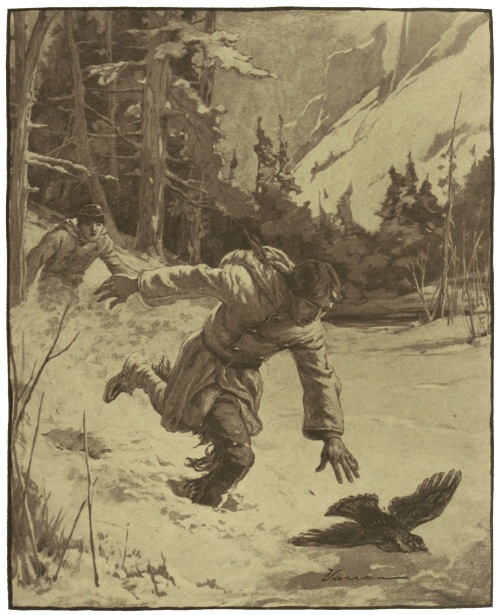
still.
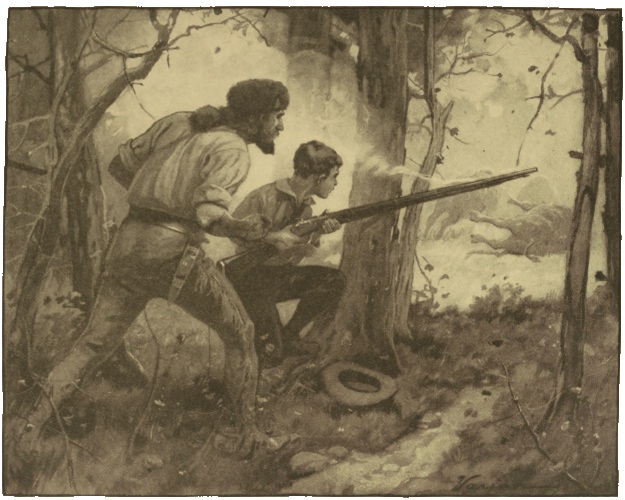
It
toppled over with a crash and lay still.
I stood staring at the animal like
one in a dream; it was hard
to
realize that I had actually killed it. Uncle Wesley broke my trance by
praising the shot I had made, and added that the animal was in fine
condition and would weigh all of a ton. He had me lie down on it, my
feet
even with its fore feet, and I found that I could not reach the top of
its withers, or rather, its hump: its height had been more than six
feet.
I now got my first lesson in skinning and butchering one of
these great
animals. Without axe or windlass, or any of the other things regarded
as
indispensable by farmers and by professional butchers, the old-time
plainsmen made a quick and neat job of this work with only a common
butcher-knife.
First, my uncle doubled up the bull's fore legs and
straightened back
the hind ones. Then, little by little, he twisted the great head
sharply
back beside the body, at the same time heaving up the back, and in a
moment or two the animal lay prone on its belly, propped up in that
position by the head. If the skin had been wanted, the rolling-up of
the
animal would have been reversed, and it would have lain on its back,
legs up, and as in the other way, propped in position by the bent-back
head.
After making an incision along the back from head to tail, he
skinned
both sides down to the ground, and even under the body, by propping the
head one way and then another, and slanting the carcass so that there
was knife room beneath. At last the body lay free, back up, on the
clean, spread-out skin.
The choicest part of it was the so-called "hump," or in
frontier
language, the "boss ribs." These dorsal ribs rose gradually from the
centre of the back to a length of twenty inches and more just above the
point of the shoulders, and were deeply covered with rich tenderloin.
It took but a moment to get the set off. Uncle Wesley cut an
incision
along each side at the base of them; then he unjointed a hind leg at
the
gambrel-joint, and with that for a club he hit the tips of the ribs a
few blows, causing them to snap off from the back-bone like so many
pipe-stems, and the whole hump lay free on the hide.
Next, he removed the legs with a few deft cuts of the knife,
and laid
them out on the clean grass; unjointed the backbone at the third rib
and
removed the after part; severed the neck from the big ribs, cut them
apart at the brisket, and smashed one side of them free from the
backbone with the leg club, and there we had the great animal divided
in
eight parts. Lastly, he removed the tongue through an incision in the
lower jaw.
"There," said he, when it was all done, "now you know how to
butcher.
Let's hurry to the boat and get the roustabouts to carry in the meat."
From this point on, there were days at a time when we saw no
Indians,
and the various kinds of game animals were more and more plentiful and
tame. At last, several days after passing Fort Clarke, we came to the
American Fur Company's greater post, Fort Union, situated on the north
bank of the river about five miles above the mouth of the Yellowstone.
It was begun in 1829, under the direction of the factor,
Kenneth
McKenzie, and finished in 1832. A stockade of logs ten or twelve feet
long, set up on end, side by side, protected the buildings, and this,
in
turn, was commanded by two-storied bastions, in which cannon were
mounted at the northeast and southwest corners.
When we approached the place, a flag was run up on the staff
of the
fort, cannon boomed a welcome, and a great crowd of Indians and company
men, headed by the factor, gathered at the shore to greet us. My uncle
and I were escorted to the two-story house which formed the rear of the
fort, and in which were the quarters of the factor and clerks.
I learned afterward that distinguished guests had been housed
there:
George Catlin, the painter and philanthropist, in 1832; Maximilian,
Prince of Neuwied, in 1833; and Audubon, the great naturalist, in 1843.
All of them published extremely interesting accounts of what they saw
and did in the Upper Missouri country, which I commend to the reader,
Maximilian's "Travels in North America" especially; for I went up the
river from Fort Union just as he did, and there had been practically no
change in the conditions of the country from his time to mine.
Maximilian gives a wonderfully accurate and vivid description of the
remarkable scenery of the Missouri, without question the most strangely
picturesque river in America, and probably in the world.
My Uncle Wesley was a valued clerk of the American Fur
Company. He was
sent from one to another of their Far Western forts, as occasion for
his
services arose, and frequently he was in full charge of a post for
months at a time, while the factor went on a trip to the States. When
we
arrived in Fort Union he was told that he must go on to Fort Benton,
where the factor needed his help. At that time, since the company's
steamboats went no farther than Fort Union, all the goods for the posts
beyond were sent in keel-boats, or bateaux. It was not until the summer
of 1860 that the extreme upper river was found to be navigable, and on
July 2 of that year the Chippewa and the Key West arrived at Fort
Benton.
A keel-boat was lying at Fort Union when we arrived there; it
was
waiting for part of the Chippewa's cargo of ammunition, guns, and
various trade goods, mostly tobacco, red and blue cloth, brass wire for
jewelry, Chinese vermilion, and small trinkets. These were soon
transferred, and we resumed our voyage, Uncle Wesley in charge of the
boat and crew. The Minnie was sixty feet long, ten feet wide, and was
decked over. The crew consisted of thirty French-Canadian cordelliers,
or towmen, a cook, a steersman and two bowmen, and a hunter with his
horse. In a very small cabin aft there were two bunks. Forward there
was
a mast and sail for use when the wind was favorable—which was seldom.
There was a big sweep oar on each side, and a number of poles were
scattered along the deck to be used as occasion required. In the bow
there was a four-pound howitzer, loaded with plenty of powder, and a
couple of quarts of trade balls, in case of an attack by Indians, which
was not at all improbable.
By the channel it was called eight hundred miles from Fort
Union to Fort
Benton, where we hoped to arrive in two months. After the first day's
experience, I thought that we should be fortunate if we reached the
place in two years. From morning until night the cordelliers toiled as
I
had never seen men toil before. It was a painful sight, those thirty
men
tugging on the long tow-rope as they floundered through water often
waist-deep; through quicksand or mud so tenacious that the more
unfortunate were dragged out of it gasping for breath and smeared with
the stuff from head to foot. They frequently lost their footing on
steep places and rolled down into deep water; banks of earth caved upon
them; they were scratched and torn by rose-brush and bull-berry thorns;
they were obliged to cut trails along the top of the banks in places,
and to clear a way for the boat through dense masses of sawyers and
driftwood.
A day or two after leaving Fort Union we narrowly escaped
losing the
boat, and the lives of all of us who were on it, in the treacherous
swirling current. At the time the cordelliers were walking easily along
a sandy shore under a high bank. Ahead of them, at the edge of the
water, lay a dead buffalo bull, its rump partly eaten by the prowling
animals. When the lead-man was within a few feet of it a big grizzly
sprang toward him from the other side of the carcass, where it had lain
asleep. The men dropped the rope and with loud cries sprang into the
water, since they could not climb the bank. The boat at once turned
broadside to the swift current, drifted against two sawyers, and began
to turn turtle. The lower rail was already under water, and the horse
had lost its footing and tumbled overboard, where it hung strangling,
when by the greatest good fortune first one and then the other of the
sawyers snapped under the strain, and the boat righted and swung in to
the bank. We now had time to see what was going on above. The bear was
just leaving the opposite shore and making for the timber; the men,
dripping from their hasty bath, were gathered in a close group near the
carcass, and were talking and gesticulating as only Frenchmen can. We
suspected that something was wrong, and while the bowmen made the boat
fast, the rest of us hurried up the shore. The group parted at our
approach and disclosed one of their number—the lead-man on the
rope—lying moaning on the sand. The bear had overtaken and mauled him
terribly, and then, frightened probably by the loud cries of so many
men, it took to the river and swam away. We got the wounded man aboard
at once, and my uncle set his arm and made him as comfortable as
possible. The hunter had saved his horse by cutting its rope and
swimming with it to a landing far down stream. As soon as the tow-line
was recovered we went on, thankful that the accident had been no worse.
Yet through it all they were cheerful and happy, and at the
evening
camp-fire my uncle was frequently obliged to speak harshly to keep them
from shouting their voyageur songs, that might have brought some
prowling war party of Indians down on us. The food of these men was
meat—nothing but meat, washed down with a little tea. Sometimes they
managed to dig a few pommes blanches, white, edible
roots that were
very palatable when roasted in the coals. Uncle Wesley and I had a box
of hard crackers and a few pounds of flour and sugar. When they were
gone, he told me, we should have no more until we sat down to our
Christmas dinner. That did not worry me; I thought that if big, strong
men could live on meat, a boy could, too.
The river wound like a snake through the great valley. There
were long
points only a mile or two across by land, but many times that distance
round by the channel. Sometimes when we came to such a place Uncle
Wesley and I would hunt across the bottom and then wait for the boat.
On
these trips I killed my first deer and elk and antelope—not to mention
several more buffalo.
But Uncle Wesley was always uneasy when away from the boat; he
was
responsible for it and its cargo, which was worth more than a hundred
thousand dollars in furs. Should anything happen to it while he was
away
from it, even for an hour's hunt, his hope of eventually becoming a
member of the great company would have to be given up. Finally, after
minute instructions in the proper handling of the rifle, I was allowed
to accompany the hunter on his daily quests for meat.
Baptiste Rondin was a dreamy, gentle little Creole from
Louisiana. He
came from a good family, had not been taught to work, and had hated
books, so he told me. So when misfortune came to his family, and he had
to do something, he chose the position he now held in preference to
others with more pay which the Chouteaus had offered him. When we
started out in the morning, I would climb up behind him on the gentle
old horse, and we would ride for miles up one side or the other of the
river. We always saw various kinds of game soon after leaving the boat,
but never attempted to kill any until some was found convenient to the
shore of the river, where the boat could land and the meat easily be
taken aboard.
Besides looking for game, we examined every dusty trail, every
mudflat
and sandbar, and constantly scanned the bottoms and the hills for signs
of Indians. They were the great terror of the cordelliers; often a
boat's crew was surprised and killed, or the cargo was destroyed.
We tied up one night four or five miles below the mouth of the
Musselshell River, which my Uncle Wesley said Lewis and Clark had so
named on account of the quantities of fossil shells that are found
there.
Early the next morning Baptiste saddled the old horse, and we
started
out to hunt at the same time that the cordelliers hauled the rope tight
and began their weary tramp.
We came to the lower edge of the big bottom at the mouth of
the
Musselshell. Opposite the mouth there was a heavily timbered island.
One
small band of antelope was the only game in sight between us and the
Musselshell. On the other side of it, at the upper end of the bottom
and
close to the Missouri, there were a couple of hundred buffalo, some
feeding, some lying down.
They were so far away that we rode boldly through the tall
sage-brush to
the little river, and across it to the outer edge of the strip of
timber. There Baptiste told me to remain with the horse while he crept
out to the herd and made a killing. I did not like being left alone.
There were many fresh grizzly tracks on the river sands just behind me,
and I was afraid of the terrible animals, so afraid that I did not dare
to dismount and gather some strawberries which showed in the grass at
the horse's feet.
The passing minutes seemed hours. The tall sage-brush out
ahead had
swallowed Baptiste. By rising in the stirrups I could just see the
backs
of some of the distant buffalo. A sudden splash in the river made my
heart flutter, and I quickly turned to see what had caused it.
Here and there between the trees and brush its glistening
surface was in
plain view, and through one opening I saw something more terrible than
a
whole band of grizzlies: an Indian crossing toward me. I saw his face,
painted red with blue bars across the cheeks; I noted that he wore
leather clothing; that a shield hung suspended from his left arm; that
in his right hand he grasped a bow and a few arrows.
All this I noted in an instant of time; and then nearer to me,
and more
to the right, a stick snapped, and I turned my head to see another
Indian in the act of letting an arrow fly at me. I yelled and gave the
horse such a thump with the stock of my rifle that he made a long,
quick
leap. That was a lucky thing for me. The arrow aimed at my body cut
through my coat sleeve and gashed my left arm just above the elbow.
I yelled frantically for Baptiste and urged the horse on
through the
sage-brush. I looked back, and saw that Indians all up and down the
stream were leaving the timber and running toward me. I looked ahead
and
saw the smoke of Baptiste's gun, heard the report, saw the buffalo
bunch
up and then scurry westward for the nearest hills.
The thought came to me that I could pick the hunter up, and
that the
old horse would easily carry us beyond the possibility of an attack by
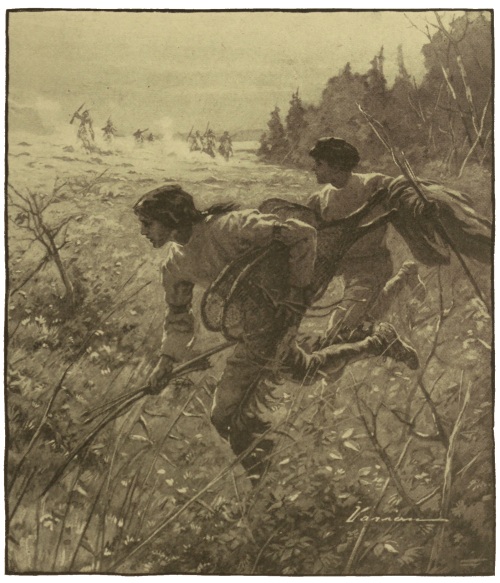
Indians afoot. That hope was shattered a moment later. The buffalo
suddenly circled and came back into the bottom, and I saw that they had
been turned by some Indians at the edge of the hills. Indians were
strung out clear across the flat, were leaping through the sage-brush
toward us, and shouting their dreadful war-cry; they were hemming us in
on the south, and the great river cut off our retreat to the north.
I urged the old horse on, determined to reach Baptiste and die
by his
side, but the Indians who had appeared on the hills were now quite near
him. I saw him raise his rifle and fire at the one in the lead, then
turn and run a few steps and spring from the high cut-bank into the
river. But just before jumping he paused, and raising a hand, motioned
to me to turn back.
To turn back! Accustomed to obeying him, I sawed on the bridle
and the
horse stopped. I looked over my shoulder, and saw that the nearest of
the Indians were not three hundred yards from me. In my distress I
cried, "What shall I do? Oh, what shall I—what can I do to escape?"
Table
of Contents