New original cover art included with the work is granted to the public domain.
WITH THE GERMAN
ARMIES IN THE WEST
BY THE SAME AUTHOR
THROUGH ASIA
CENTRAL ASIA AND TIBET TOWARDS THE HOLY CITY OF LHASSA
TRANS-HIMALAYA
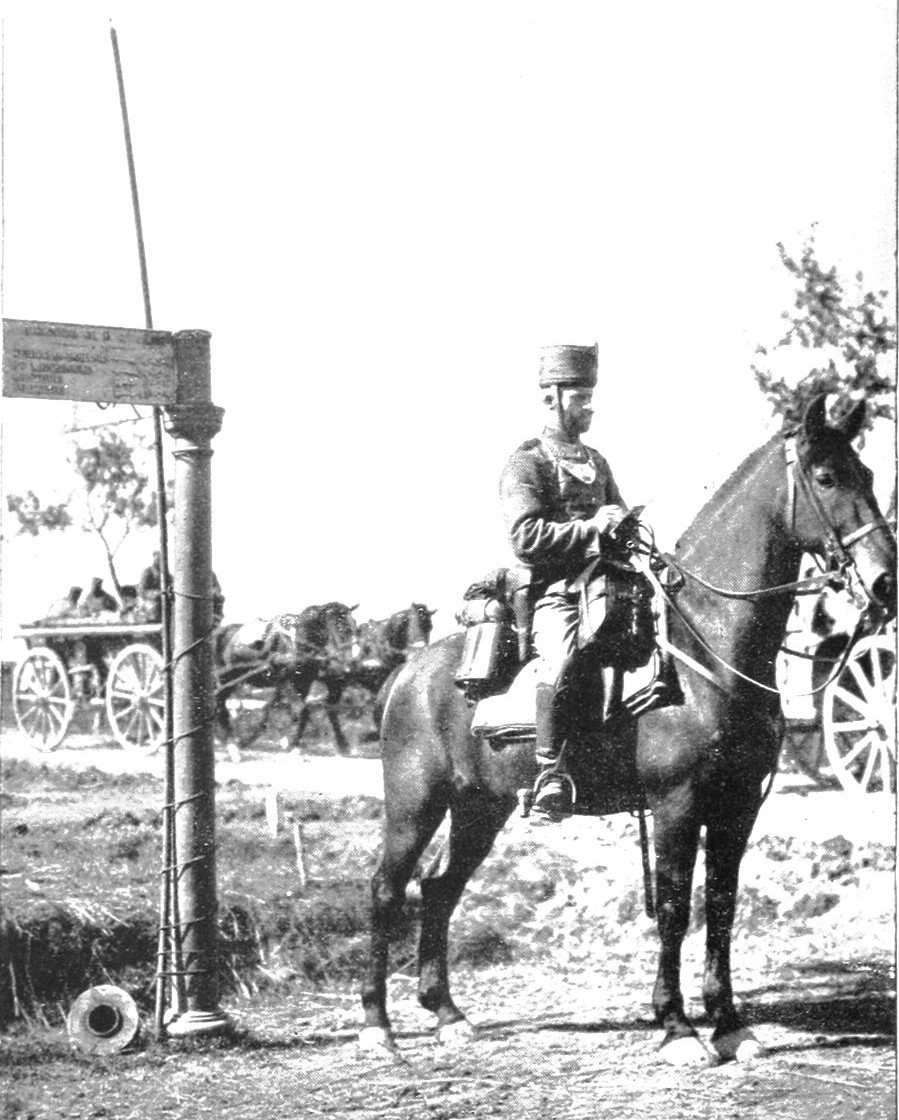
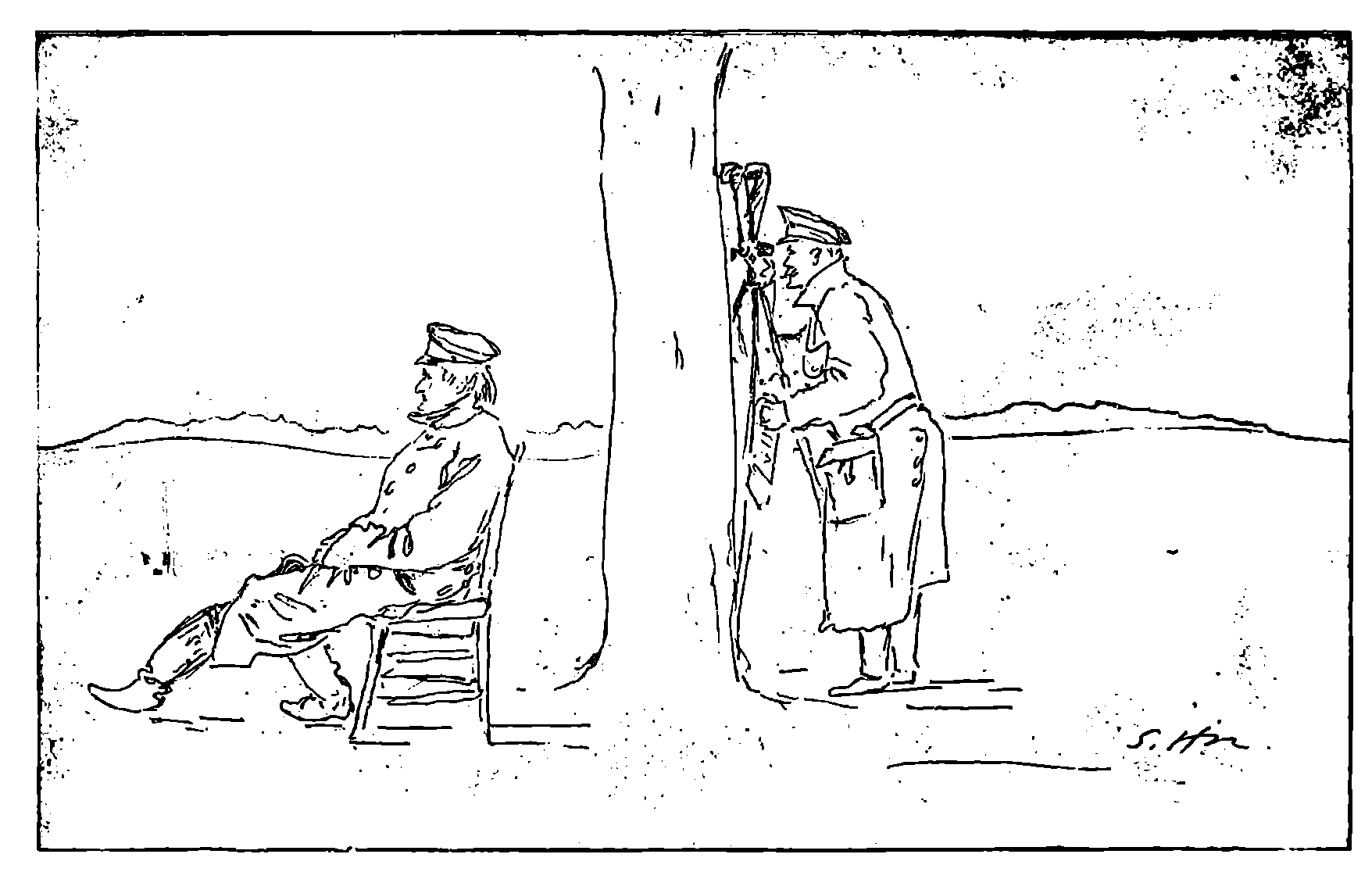
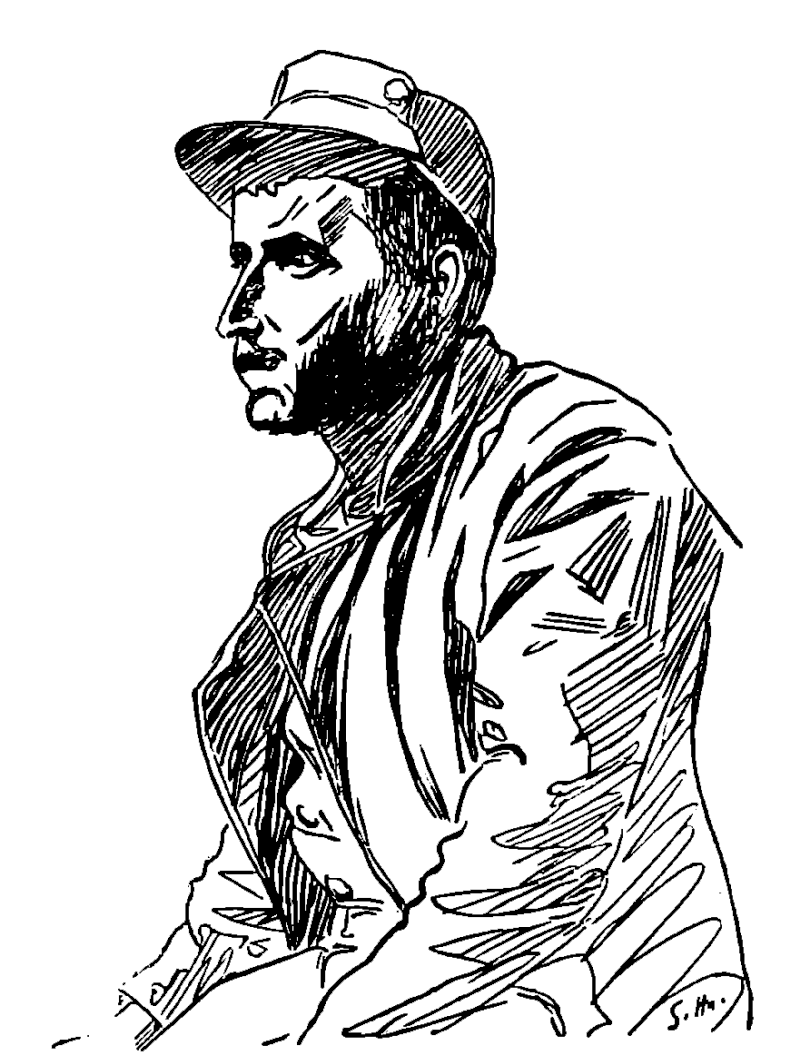
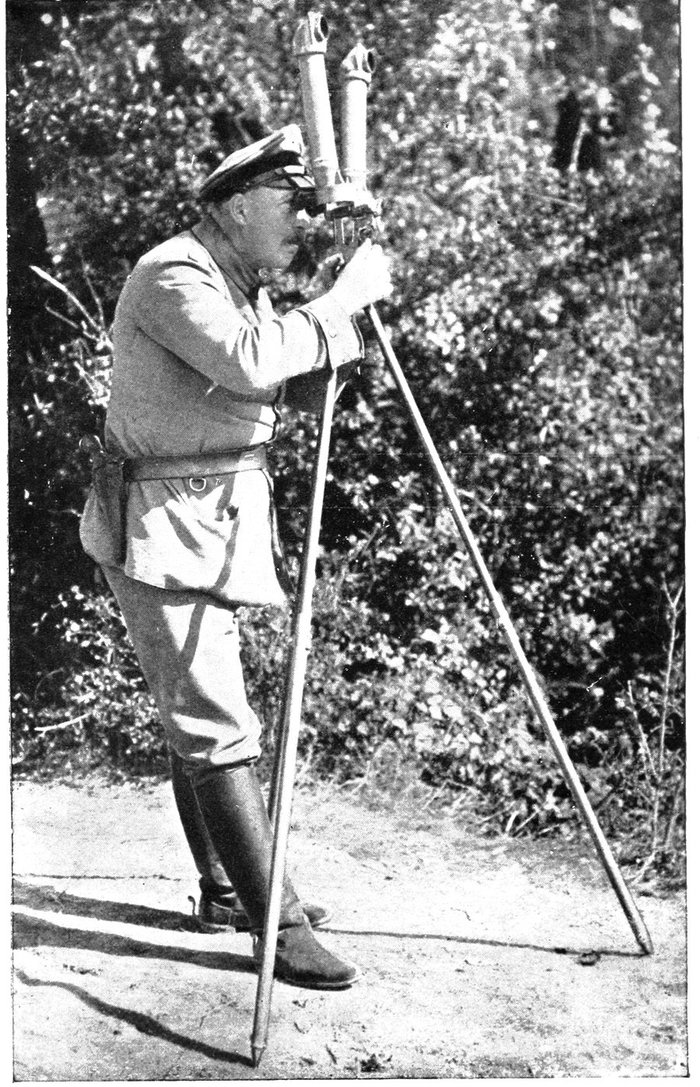
MILITARY POLICEMAN MAKING NOTES
: BY SVEN HEDIN :
AUTHORISED TRANSLATION FROM THE SWEDISH
BY H. G. DE WALTERSTORFF
WITH 119 ILLUSTRATIONS AND 4 MAPS
LONDON: JOHN LANE, THE BODLEY HEAD
NEW YORK: JOHN LANE COMPANY MCMXV
SECOND EDITION
WILLIAM BRENDON AND SON, LTD., PRINTERS, PLYMOUTH, ENGLAND
AUTHOR’S PREFACE TO THE ENGLISH EDITION
LONG before my book dealing with my personal recollections
from the war theatres of France and Belgium had
been translated into English, it was made the subject
of a criticism in the Daily Telegraph of February 15th.
The author, Mr. William Archer, complained that I have
not once introduced into my narrative any harsh and condemnatory
utterances regarding Germany’s conduct of the
war. The fact is that I have had no occasion for such utterances.
My self-imposed task was, as I have repeatedly made
clear, merely to describe what I saw with my own eyes and as
much as possible to refrain from citing the experience of others.
During the two months that I spent on the German western
front, I did not see a single instance of cruelty to prisoners or
wounded, let alone ill-treatment of the civil population and
its goods and chattels. The Germans maintained the same
incorruptibly severe and just discipline that existed, according
to the testimony of history, in the Swedish armies which
Gustavus Adolphus and Charles XII. led to victory during
the epic period of my own country.
But even in peace time not a day passes but that crime is
committed even in the most civilised countries. How, then,
can one expect that it shall disappear in a war? I therefore
by no means deny that there have been isolated instances of
offences and cruelty in an army of several million men. But
I have not seen them and need not therefore embark upon
the subject. I have a shrewd suspicion that criminal statistics
generally will testify in favour of the Germanic peoples—as
compared, for instance, with the Slavs and the Latins.
Mr. William Archer has something to say about my “outspoken
contempt for England.” Here he is mistaken. I have
no feeling of hatred towards England and have never entertained
any feelings of ill-will towards its great and admirable[1]
people. It is only the part which England has played and
plays in this world-wide crisis that I abhor and deplore.
The earth is large enough to hold both England and Germany,
and England would have gained more by keeping neutral in
this war. The hatred of England which pervades Germany
is new—it began on the 4th August, 1914. Prior to that date
it did not exist. Whether England’s policy has gained the
sympathy and approval of the neutral countries is not for me
to judge. One can respect and admire a nation for its splendid
qualities and for its colossal contribution to the advancement
of the world, and yet not admire its policy at a given juncture.
This is the nature of the feelings I now entertain for England,
and I deeply regret that her guiding statesmen were not able
to avert a situation which must inevitably bring misfortune
upon their country. Did the English people itself desire this
war? That question will be answered in the early future.
[1] The more literal translation would be “excellent and admirable,” or “capital
and admirable”; the term is difficult to render to a nicety.—Translator.
Mr. William Archer is surprised that I do not speak about
the Battle of the Marne. Here I will remind him once more
of what I say in the introduction to the book, to wit, that it
was not my intention to write the history of the war. I have
simply described the happenings at which I myself was
present.
In conclusion Mr. William Archer says: “It would be curious
to know whether Dr. Hedin now feels so confident of Germany’s
triumph as he did in the golden prime....” As to that,
after the events which have occurred since “the golden
prime,” especially on the eastern front, my faith in Germany’s
victory is more unshakable than ever.
It is very kind of Mr. William Archer to say that German
culture is not in danger. I really think that he is right. The
Germans have shown that they are men, capable of defending
their culture against I might almost say the whole world,
and I pity those who thought that by their united forces
they would be able to reduce Germany to a second or third
rate power.
SVEN HEDIN
Stockholm
25th February, 1915
For the hospitality, the confidence and the comradeship
which have been shown to me in the German
armies at the Western Front, I tender my most heartfelt
thanks.
As I have been publicly criticized for undertaking the
issue of the English edition of this book, for the most
part by people who have not read it, I am taking
the somewhat unusual course of giving a brief explanation of
my point of view.
In the first place, Dr. Sven Hedin’s book is essentially a
record of facts as he saw them. He is a trained observer, and
there can be no question of his veracity. Hitherto, for facts
with regard to the German Armies and their organisation we
have had to rely on such accounts as the German official
communiqués chose to give us, which nobody believes; or,
as an alternative, on the accounts published in our own press,
which, owing to the strictness of the censorship, were mostly
gathered from accounts furnished by prisoners or our own
soldiers. The prisoners were naturally pessimistic and our
men optimistic. Hence the general impression formed has
been that the German organisation had gone to pieces, that
their troops were short of food and clothes and that their
ammunition was poor.
How far this is from the truth these pages will show, and it is
surely desirable to publish a book that for the first time gives
us a comprehensive idea of the wonderful organisation against
which we are fighting. To my mind it is one of the things
chiefly needed to stimulate both our workers and our
recruiting.
Again, is it not well to let the English nation know, for
instance, that those 600,000 troops which our gallant 120,000
successfully withstood at Ypres were not ill-clad, ill-fed levies,
but magnificently equipped troops with a machine-like
organisation behind them?
There is also the question of Dr. Sven Hedin’s anti-English
opinions, which are quite distinct from his record of facts.
But why should these not appear in this country where those
of Bernhardi, Nietzsche, Treitschke and Cramb have been
universally read and their publication applauded? His reflections
are of course intensely irritating to any British subject,
but they cannot possibly affect the British cause. On the
contrary, their publication will probably do good, for there
is nothing like a little tail-twisting to rouse the British Lion!
They afford only one more example of the truth that Lord
Rosebery enunciated the other day that “foreigners have
never understood Englishmen and Englishmen have never
understood foreigners.”
These opinions, however, though evidently accepted from
official Germany without question or examination, do not
lessen the value of Dr. Sven Hedin’s record of personal experiences.
For he is so obviously honest. Indeed, again and
again he naively records little facts which really tell against
his case.
Dr. Hedin’s personal position is not for me to discuss, but
I give his book intact, omitting only, at his own request, a few
passages dealing with Swedish politics of purely local interest,
and the British public can form its own judgment both of the
author and of his views.
If that judgment is unfavourable I hope it will not prevent
them from taking his facts to heart.
JOHN LANE
CHAPTER I ON THE WAY TO THE FRONT
WITH THE GERMAN
ARMIES IN THE WEST
THE tocsin bell has ceased to ring. Swedish men are
no longer being called to arms. Quiet has once
more descended upon Stockholm, and it is only
occasionally that one encounters a detachment of Landsturm
men marching through the streets to join their units or on
their way home. People go about their business in the old
familiar way. It would be hard to believe that the great
world war was raging outside, did not the newspapers with
their great black headlines and their fateful contents form a
sinister reminder.
But the individual who under these conditions started out
from the Stockholm Central terminus with Berlin as his
immediate objective, was only too well aware that it was not
an ordinary trip on the Continent on which he was embarking.
He travelled from the quiet of the North to the storm in the
South—to the great capital where history was being made,
the heart of the great empire which was at war with seven
states, of which four were great powers. When Stockholm’s
thousand lights faded into the distance, he felt that peace
faded away with them, and that each passing day would
bring him nearer to war. He was committed to a journey
the spell of which would each day grow stronger, and he was
a prey to a tension which was only to give way before the
excitement and the thrill of action.
The train clanged through the pitch-black night, and the
rain wove its delicate tracery on the window-panes. On
Trelleborg quay only a couple of baggage and mail wagons
were brought on board the ferry, which bears King Gustaf’s
name. No Swedish passenger coaches are allowed on the
German system in war time, and similarly Germany does not
permit hers to enter Sweden.
The sun has broken through the clouds, but the mist has
wiped Trelleborg and the Swedish coast from the horizon.
A fresh breeze is blowing from the south-west, the Baltic is
coated with swirling white-capped waves, and the ferry cuts
through the foam on its way to the German coast. There is
not a ship in sight, no cruisers, no destroyers or torpedo-boats,
none of the greyhounds of the sea to track and hold
up doubtful shipping. These are peaceful waters. None of
the hot winds of war are yet blowing over this sea, only the
cool autumnal breezes caress the wave crests. But no doubt
grim times are in store even here, so it is as well to make the
most of the fleeting hour.
At Sassnitz we set foot on German soil which formerly
belonged to us. Everything is as usual, the traveller’s excitement
has been groundless. Nothing—unless it be a solitary
Landsturm soldier with shouldered rifle—to remind one of
war. On landing, our passports are viséd and our hand
luggage is examined at the Custom House. Everything is
done in a quiet and orderly manner. The German railway
and customs officials are most polite, and look very well in
their new ornamental uniforms.
The train swings across Rügen to Altefähr and boards the
ferry for the mainland. Here the time-worn churches rear
their spires over our old possession Stralsund, where we stop
a while at the station. Everything is as it used to be, no
hurry or bustle; people go about their business as in times
of piping peace. But just as the train is about to steam out,
a squad of Landwehr soldiers with their kits under their arms
rush on to the platform and take their seats in the last carriage.
They are not bound for the front as yet, for they alight at
Greifswald. A blurred mass of red-tiled roofs framed in the
luxuriant foliage of late summer, and a number of churches
pointing their spires aloft—that is all we see of the old
university town. But there is nothing unusual to be seen,
everything runs its normal course. “Papers!” “Beer!”
cry the boys on the platform, and, anxious for news, one
buys a paper from one and, to quench one’s thirst, a glass of
good, dark beer of the other. A light meal is provided by a
woman, who at 30 pfg. each sells small bags of waffles, plums
and grapes.
From some belated fields the corn is still being brought in,
and black and brindled cattle, and here and there a flock of
sheep, is seen grazing in the meadows. Summer and prosperity
seem to reign everywhere in Germany, and there is meat and
bread in abundance. Is it possible that it is six weeks since
this country has been involved in the greatest war in history?
Everything betokens peace on earth, even the sky is cloudless
and the sun sheds its golden rays over Pomerania. Among the
trees by the roadside some women are walking with little
children in their arms. They are engaged in earnest conversation
and walk with bowed heads. No doubt their menfolk
are at the war, and perhaps one of them knows already that
she is a widow. A conscientious observer might notice that
there are fewer adult men than usual. But the difference is
so slight that one would not think of it unless one knew that
there was war. Old men, women and children seem a little
more in evidence than in peace time: that is all.
At Anklam station, not far from where the Peene flows into
the Baltic, another body of soldiers board the train. Their
uniforms are dark blue with very bright red collars. They
are Landsturm men in the prime of life, and have probably
been called up for service within Germany; for at the front
hardly anything is seen but field-grey uniforms, a protective
colouring which blends with the appearance of the soil and is
very hard to distinguish.
Prenzlau—so now we are in Brandenburg. Fresh bodies of
Landsturm men clamber into the train, which is to carry them
away from their homes to an unknown fate. They come
running and singing across the platform, as if they long to get
away. Their blue tunics with red collars and shoulder-straps,
and the red cap-bands, form a bright contrast to the dress of
the civilians. They are strong and powerful specimens of
the Teutonic type, but too stout for perfect symmetry. One
does not see amongst them any ideal specimens bearing the
distinguishing characteristics of the Caucasian race, no broad-shouldered,
deep-chested, strapping fellows such as one meets
with in the mountains of Georgia; but they are a blonde,
sound, calm and yet cheery set of men, all animated by one
single thought—to conquer or to die. Their women, children
and other relations have followed them to the train to say
good-bye. All are cheerful, they chat and laugh. There is
no weeping and complaining, it is the great day of joy, when
every able-bodied man goes to do his duty for the welfare of
his country.
My carriage is filled with officers. They are engaged in
very animated conversation; they do not care what is going
on around them; they don’t look out of the window and don’t
allow themselves to be disturbed by the bustle and crush in
the corridor. They talk about the affairs of their units and
regiments, about the equipment of the troops and the departure
for foreign parts. They discuss Hindenburg’s victories and
give vent to their admiration for him. The cares and solemnity
of war do not rest heavily on these men; they are animated by
a glad longing and sure feeling of victory, and without knowing
them one realises that they have staked their lives and their
existence on one single goal. About the result they have no
doubt. They must win, otherwise their country is lost.
But the hours speed away, dusk settles down over Brandenburg,
and soon the earth is wrapped in darkness. The carriages
are not lighted—I don’t know why. As we approach Berlin
it is dark within, but outside there are rows of electric lamps
lighting up the interior of the carriage in a fantastic manner.
The train stops at Stettiner Bahnhof. On the platform
there is the same busy hum and bustle as in peace time.
A whole crowd of Gepäckträger hurry to the window to
receive the passengers’ luggage—one notices no lack of men.
A policeman hands out numbered cab-discs, the heavy luggage
is got out in a twinkling, and up one jumps into one of
the numberless taxicabs ranged outside and drives off to
one’s hotel.
I am an old customer at the Kaiserhof, but this time I was
told that I ought to stay in Unter den Linden in order to be
able to study at my leisure from a balcony the endless processions
of patriots, who, especially at night, file down the
road with proud bearing, singing patriotic songs. I therefore
chose the Hotel Bristol. Its name has been removed from
the large illuminated sign facing the street. Bristol—this
name reminded one too much of England’s faithlessness towards
her Teutonic kinsmen! Only the first letter remained,
to be interpreted as one might wish.
The hotel was only half-full. Most of the visitors were
Scandinavians and Americans. It was just as well that there
were not too many, as the staff had also been reduced by half—the
other half was at the front. The quiet which reigned in
the big building was reflected by the atmosphere of the famous
avenue outside. To-day there were no closely packed crowds,
no singing processions. Only those people who had business
to attend to or who wanted to glean the latest news were seen
on the pavements—the others kept indoors. The traffic was,
if anything, less lively than in peace time, and an amazing
calm had descended upon the great city.
I went out in the evening to see the people and listen to
their conversation. The talk was almost entirely about the
war. I walked through Friedrichstrasse, Leipzigerstrasse and
the other familiar streets. Everything is just as usual. Berlin
is wrapped in absolute peace. Innumerable shop windows
still shed their light upon the pavements. In some of them
large maps are shown, small flags indicating the positions of
the armies. On one such map the flags were waving and
fluttering, as if a storm were ravaging the plains of Europe.
Outside, in the street, little groups formed to talk about the
war and to express the hope that the German flags would soon
be shifted further into the steppes in the east and towards the
sea in the west.
“Why are the streets so silent?” I ask somebody. “I
understood that Berlin was in such high spirits.”
“It is so long since we heard of any great victories,” is the
answer.
“Patience,” I retort, “you must not expect a Tannenberg
every week.”
Here comes a woman hurrying along with a bundle of
newspapers. It is the latest edition with fresh telegrams
from the front. She is hustling as much as possible in order
to impress on the public that they must look sharp and get
the news as fresh as possible. On the opposite pavement runs
a boy with the same newspaper, calling out his ware in a loud
voice. At a street corner stands an old man with his bundle
of papers. He is too tired to run, and his cracked voice cannot
even be heard above the subdued hubbub of street-life and
the quick flow of talk of the people. It is all the same news,
and it deals chiefly with the gigantic battle of Lemberg.
The restaurants are well filled, in fact they are all overcrowded
with customers. Through the big windows one
can see the honest bourgeois seated at his little table,
where sausage and wienerschnitzel, dunkles or helles may
be had in abundance. I entered and sat down at a table,
overhearing scraps of talk from all sides—all about the war,
about brothers and sons who are fighting, one hardly knows
where, as the field post has brought no news for a long time.
But perhaps the next day will bring a greeting from the front.
Maybe a son who has been reported in the papers as missing,
has turned up again. But nevertheless the personal sorrow
and anxiety is thrust into the background. Every sacrifice
must be gladly made, and the loved ones may lie dead on the
field of battle so long as Germany wins her fight against almost
the whole of Europe.
On the 13th September the lingering summer came to an
end, and autumn suddenly asserted itself. It poured with
rain, it was dark, windy, cold and raw. Shallow puddles
covered the asphalt in Unter den Linden, which resembled
an enormous river-bed still drenched with the flow, and from
which the tide had just ebbed. The great avenue now looks
desolate with a vengeance. From my balcony I can only see
a few solitary individuals sheltered under more or less elegant
umbrellas. Berlin’s inhabitants prefer to keep in their comfortable
homes, and not even the longing for war news can
tempt them out in such weather.
The rain falls thick and heavy and patters down on the
dripping limes outside my balcony. Berlin is dull and miserable
in the autumn when the rain sweeps its long, monotonously
straight streets with their heavy, dark houses. Not even the
trooping of the colours and the march-past at midday raise
the drooping spirits, and only a few pedestrians with open
umbrellas join the band and march in step with the soldiers.
The motor-cars buzz past over the asphalt, flinging up a spray
of water as they rush along. They are plainly far less numerous
than usual. No calls are made, no visits paid, for the whole
of the aristocracy is in mourning for lost relatives and everybody’s
thoughts are centred on the war. Nobody feels inclined
for the futile pleasures of ordinary times when the newspapers
speak of a father who has lost four sons at the front, or of a
mother whose three sons have each died a hero’s death for
Emperor and country. But no complaints are heard, no tears
seen. In the streets one seldom sees signs of mourning.
There is perhaps a tacit convention not to express in black and
white the sorrow which is felt at the bottom of the heart, but
to make the grief subservient to the proud consciousness that
the beloved one has fallen for his country, never to return!
Already in Berlin I was greatly impressed by the world-wide
influence of German thought. Here is a nation which for
long years back has known how to read the inexorable message
of time, which has not rested on the laurels gained in its last
war, which has needed no warnings, and whose watchmen
never closed their eyes and never dallied with an inevitable
fate. Here is a nation which during the decades of peace has
armed itself to the teeth and which now, when the hour has
struck, stands ready to meet four great powers in fierce combat
and to contend with one of them for the mastery of the seas.
It is true that the German people have been divided into
parties, as the democratic spirit of our age demands, but the
political factions have nevertheless realised the necessity of
a strong defence of their common country. And now that the
war is raging in all directions, the parties have disappeared
completely. Germany at the present time is inhabited by a
people which is at one with itself. Here we have but one party—that
of the soldiers. Here everyone has but one goal, and
there is no one who does not realise that this is a fight of life
and death for Germany; all have the same thoughts, all hold
the same hopes and offer up the same prayers, from the
Emperor who stands first and foremost in war as in peace, to
the street urchin who flattens his nose against the shop window
and studies the positions of the tiny flags.
But the rain keeps on falling and beats against the window-panes.
I hurry downstairs, jump into a taxi and in a few
minutes I am sitting in an elegant drawing-room at the dainty
new residence of the Swedish Minister, at the corner of Friedrich
Wilhelmstrasse and Tiergartenstrasse, chatting with old
friends—needless to say, about the war. When I last met
Count Taube in Berlin, I had just returned from a long
journey in the Far East. Now I stood on the threshold of a
new journey, which might be infinitely longer than the last!
Later in the day I visited another nobleman, Prince von Wedel,
whom I had met in Vienna when he was ambassador there,
and in Strassburg when he was Governor. We had much to
talk about, but what is there to discuss in these days but the
great and bloody drama which occupies everyone’s thoughts—the
War!
My most important visit in Berlin was to the Foreign Office.
But before narrating what took place there I must say a few
words about the reasons which led up to my journey. It was
desirable that no one in a responsible position in Sweden
should have an inkling of my journey to the front. Our
country belonged to the neutral states, and thus no authority
must entertain the slightest shadow of a suspicion that I was
travelling on any sort of secret mission. No,—the reason was
a very simple one. Only a few days’ journey away the greatest
war of all time was being waged. It was clear that the outcome
of this struggle would decide the political development
for the next fifty or hundred years, or perhaps longer. In any
case its shadows must envelop the remainder of the lives of
the present generation.
The war of 1870–71 became the starting-point of a new era
in Germany’s development. Now Germany is once again at
war, and the new political problems which may be expected
to come up for discussion in the immediate future will doubtless
be rooted in the great Germanic war. If the two contending
groups of powers were to come out of the struggle
only with depleted forces, the war of 1914 would, in its dying
embers, carry the seed of a new world conflagration, even more
devastating perhaps than the last. But if Germany were to
win at all points, the map of the world would undergo sweeping
changes, and Germany would then, in the great triumph of
her power, discountenance and forbid fresh wars. If Russia
were to win, the fate of Sweden and Norway would be sealed.
Whatever happens, great and memorable events will arise
out of this struggle. How instructive would it be, then, to
study the War on the very scene of the momentous conflict, and
to visit the ravaged regions where the German soldiers carried
the fate of Germany and of the whole Germanic world on the
point of their bayonets! No one who has not seen with his
own eyes how the Germans fight, can fully and clearly grasp
what the struggle means to Germany. But his presence there
will enable him to comprehend more plainly what the future
holds in store for us, and the happenings which in due course
will be unfolded before our vision.
Thus I look upon my journey to the front first and foremost
as a political study.
But there were also other reasons and other thoughts that
made me long to get out to the theatre of war. I wanted to
see with my own eyes and become familiar with war as it
really is, and I wanted to gain the personal experience which
would enable me to describe to others the dark as well as the
bright sides of war. Its dark sides are the hate, the desire for
vengeance, the destruction, the gutted homesteads, the ruined
crops, the wounded, the maimed, the graves, the grief and
privation, but war is bright when it is fought by a united
nation, determined to live and to retain its independence.
The unity, self-sacrifice and confidence in victory of the
German nation is one of the bright sides of this war, which
otherwise reveals an abyss of human misery. I thought it
would be instructive to see for myself how far civilisation,
Christianity and pacificism had advanced nineteen hundred
and fourteen years after the birth of Christ.
During the first phase of the war the British press accused
the Germans of barbaric cruelty to their prisoners and to
wounded opponents. Not for one moment did I believe these
reports, but for the sake of the Teutonic race I wanted to
uproot this calumny and to bring to light the truth. If one
cannot ask anything else of a people which stands on the
pinnacle of culture, one may at least expect it not to accuse its
opponents of crimes which were never committed. German
protests against the accusations of foreign newspapers were
of course of no avail. Perhaps I shall be believed if I protest
before God that I will not write a single line which is not true
and will describe nothing but what I have seen with my own
eyes.
Finally, it was my wish to study the psychology of war,
I mean the Geist and the fighting spirit with which armies
went into battle, the mood in which they returned therefrom,
the thoughts and feelings of the wounded, the spirit with which
the soldiers entered the fray for the second time after having
been slightly wounded, tended and healed. In the last phase
of the Manchurian campaign there was a noticeable weakening
of purpose which led to slackened efforts on both sides and
caused the war to die, so to speak, of inanition. Was a
like form of mental fatigue, an exhaustion of soul and body
under the stupendous hardships in the field to leave its mark
on the Germans too? Or would their conviction, that the
war meant to them the life or death of Germany, endow them
with a buoyancy and tenacity enabling them to fight through
to victory? It might be of interest to us, Teutons of the
north, to gain some insight into this problem. Such knowledge
might be useful, should we at some future time be confronted
with a situation comparable with that of Germany at the
present moment. The outcome of a campaign does not
merely depend upon preparations, war material and training.
The fighting spirit and general mental attitude of the soldier
also plays a most important part. The soldier must know
why he is fighting and what he is fighting for. The psychological
factor is therefore of the utmost importance. The officer
leading his men to the front and into the firing line has neither
the attitude of mind nor the time for such studies. His
whole attention is and must be concentrated on the fighting
itself; he only thinks of utilising the striking power of his
men with the utmost effect at the right moment and in the
right place. He is therefore—and quite rightly—blind to
everything else. A layman on the other hand, whose attention
is not distracted by considerations of conduct of war, has better
opportunities of studying the psychology of the soldiers.
Once this war is over, whole libraries of books will be written
about it. I do not think it an exaggeration to say that on
the western front alone upwards of a million and a half diaries
are being kept at the present moment. In all directions, in
all fighting units down to the company, the platoon and the
battery, official war journals are being kept and accounts of
the fighting are being prepared from the bedrock furnished
on the one hand by the draft of outgoing reports and on the
other by incoming papers, orders, reports and communications.
The soldiers record their own personal experiences, the officers
their military observations. Many a note-book has no doubt
protected a heart or checked the death-dealing bullet. Thus
the sections of the German General Staff, whose task it will
be in due course to prepare the materials, will be occupied for
many years to come with this monumental labour.
When I went out to the front, it was clearly established in
my mind that my narrative would be quite different from the
military accounts. I was not going to devote any attention to
matters of purely military science, which could only be dealt
with by experts. Even Sweden has from the very beginning
had its military attaché, Major Adlercreutz, of the Scanian
Dragoons, and later on Lieut.-Col. Bouveng received permission
to accompany the German forces. Strategical and tactical
observations would thus be absent from my narrative. It
would no doubt have been interesting and instructive to
familiarise myself in some measure with these subjects.
But it was evident to me from the beginning that I should
always have to observe the utmost tact and discretion, and
even avoid obtaining knowledge of military matters which
ought to remain secret until the end of the campaign. This
veto comprised the distribution of German forces, army corps,
divisions, regiments and other units, as well as any regrouping
of forces which might be effected during my presence at the
front. I was destined often to hear of such details, but made
up my mind to take no notes in that connection.
Neither did I propose to embody in my narrative any
account of the events that led up to the war or of the Notes
despatched hither and thither across Europe during the days
preceding its outbreak. All this had been fully dealt with
before. My book was only to constitute a conscientious
account of what I myself had seen and experienced whilst I
was the guest of the German Army in the field. Towards
this army and towards the German people I thus incurred a
certain responsibility—my sketch, in order to possess any
value, must therefore be a true and faithful one. Towards
Germany’s enemies I also had a duty, not to be unfair to them.
I further felt a certain responsibility towards Swedish officers
as a body, for although it might have been my wish that my
observations should be of use to them, it was more than
doubtful whether I should succeed in my object. As regards
the public, whatever I might witness, I had to guard against
the temptation to satisfy its craving after sensation. Besides,
it was evident to me that in a modern war there was very
little to be left to the imagination, and that the reality would
in most cases render it unnecessary to strive after effect. I
wanted to describe life and death on the battlefield, that
was all.
Such were my thoughts and plans at the beginning of
September. They had arisen and matured in my own mind
without the shadow of any incentive from German or Swedish
quarters. When I had made up my mind, all that remained
for me to do was to obtain permission to go to the front and
to spend some time with the German Army. With this object
I applied to the German Minister in Stockholm, His Excellency
von Reichenau, who with the greatest kindness undertook to
transmit my request to the competent authority in Germany.
After waiting a week I received a very courteous reply saying
that I was very welcome to visit the front. The following
day, September 11th, I set out on my fateful journey, and at
the present moment—when I broke the thread of my narrative—I
am standing on the doorstep and ringing the bell at the
Foreign Office at 76 Wilhelmstrasse, Berlin.
The Under Secretary of State, Herr von Zimmermann, who
is acting Foreign Minister in Berlin whilst His Excellency von
Jagow is at the Main Headquarters, received me with open
arms and said that all he knew was that I was to proceed
straightway to the said Headquarters.
“But where are the Main Headquarters?” I asked.
“That is a secret,” Herr von Zimmermann answered, with a
smile.
“Good, but how am I to get there?”
“Oh, the Chief of the Great General Staff, Colonel-General
von Moltke, has given instructions that a car is to be kept
at your disposal. You may decide yourself when you would
like to start. An officer and an orderly will accompany you,
and if you like you can travel to the Main Headquarters day
and night without stopping, or you can choose your own road
and time. In fact, you are at liberty to do as you like.”
“And afterwards?”
“After that your fate will rest in the hands of His Excellency
von Moltke. No doubt he will map out a plan for your journey.
The only thing you have to think about now is to get to him.”
“And where shall I find the car?”
“This paper will tell you.”
Herr von Zimmermann handed me a permit from the Great
General Staff which read as follows: “The bearer of this
permit is entitled to use the relays of the Imperial Volunteer
Automobile Corps to the Main Headquarters. Everything
that can in any way expedite his journey is to be placed at his
disposal.”
In conclusion I was told that the offices of the Volunteer
Automobile Corps were at 243 Friedrichstrasse, and that the
Acting Chief was a Dr. Arnoldi.
After heartily thanking Herr von Zimmermann and receiving
his good wishes for the impending journey, I went off to look
for Arnoldi and his office. I found him in a large room full of
maps, piles of papers, telegrams, officers and orderlies, and
my reception was as usual most cordial—in future I shall not
have to repeat this pleasing fact, for everyone has been equally
courteous and friendly. To begin with, I was shown a map
of the great relay road, but for obvious reasons I must not
tell anything about it.
Then came the question:
“Do you wish to travel independently of all regulations
or by relays, that is to say, 700 kilometres in 16 hours—44
kilometres an hour on end?”
I thought a moment, then chose to be independent, for if
I had done the journey in sixteen hours, I should have been
obliged to travel over the most interesting part of the road
by night when there is nothing to be seen, and, after all,
I had come to see as much as possible. The trip from Berlin
to Headquarters ought to mean a continuous crescendo. I
ought to know what it felt like to leave peace behind and
gradually to approach the scorching firing lines. I thought
in my innocence that the roads in Western Germany would
be more or less encumbered with soldiers and vehicles. Not
a bit of it! It was a long time before we had to drive slowly
on account of the congestion, for within Germany all transports
were effected by rail.
“Who is going to be my chauffeur?”
“An officer, accompanied by an orderly. Both are on duty
with the Volunteer Automobile Corps.”
“Who appoints the officer?”
“I do; and I am just thinking that Rittmeister von Krum,
of Württemberg, will be the right man.”
Dr. Arnoldi touched a button. An orderly entered and was
asked whether Captain von Krum was at hand.
“Yes, the Rittmeister is here.” “Ask him to come in.”
And an officer in field-grey uniform, of the most attractive
appearance and charming manners, enters the room. Dr.
Arnoldi tells him what his duties are, namely, to take me to the
mysterious region in the west, and I wonder in my own mind
whether it will bore him to jog along with me on the road
through more than half of Germany. I even ask him how
he feels about it, and he replies that it will be a great pleasure
to him to take me, of all people, to the theatre of war. I assure
Captain von Krum that it pleases me greatly to have him,
of all people, as my travelling companion, chauffeur and guide.
My Rittmeister had retired from active service, but on the
outbreak of war he had rallied to the colours and placed his
car at the disposal of the Crown in accordance with the mobilisation
decree. He drives it himself in the service of the
Army and the orderly who is to accompany us is, in peace
time, his own chauffeur. I was told that the Volunteer Automobile
Corps now mustered 350 cars. The owner of a car
reports himself and is paid for his vehicle, and he may at the
end of the war buy back his car from the Crown. It is reckoned
that the serviceable life of a car is five years. If the owner
paid ten thousand marks for his car and has used it for four
years, he only gets paid at the last year’s valuation, i.e. two
thousand marks, whilst if the car is quite new he receives the
full amount.
Three hundred and fifty cars—it doesn’t sound much, but
these cars merely form the Volunteer Corps, and I suppose
you will feel more at ease when I tell you that at the western
front alone there are altogether fifty thousand cars in use,
whilst forty thousand are left in Germany. That means fifty
thousand chauffeurs. When one considers that each car
usually has a crew of two, it will be seen that the equivalent
of over two army corps are attached to the Automobile
Service. There are plenty of men in Germany, plenty for
every purpose. On the eastern front I was told that cars
are useless outside the German boundaries, owing to the
shocking state of Russian and Polish roads. There one has
to ride or requisition ordinary vehicles. But in the west the
cars play a part the importance of which had only remotely
been guessed at, as may be gathered from the course of this
narrative.
Finally, von Krum was told to collect all maps (scale
1 : 100,000) that we should require from Berlin to Main Headquarters.
I myself received the pleasing news that I need only
give ten minutes’ notice before starting, as car, Rittmeister
and orderly were always ready, likewise Dr. Arnoldi’s wolf-skin
coat, which he advised me to take with me.
I had thus every reason to be satisfied with my day’s work.
The trip to Main Headquarters was evidently only the first
step. What was to follow? Probably a trip along the line
of German lines of communication to the fighting zone, and
possibly to the firing line itself. Perhaps it would be my good
fortune to catch at least a glimpse of a modern fight. After
such a beginning the rest was sure to go well. My excitement
on starting had now changed to longing, and I felt that I was
about to be carried with lightning speed along magnificent roads
towards a spectacle which I would never forget: the German
Army in all its overpowering strength drawn up for the greatest
contest in the world’s history. The German Army! These
words convey nowadays far more than formerly, and the
same may be said of the French Army. In these days it is
not armies of mercenaries that meet one another in the field,
it is entire nations that range up for battle. The difference
is only that the German Army is one homogeneous whole and
pure in race, whilst the French Army is reinforced with
Englishmen and a whole colour-scheme of imported heathens.
The next day I was out with my friend the Rittmeister and
got fitted out from head to foot with motor cap, boots and
puttees, a sporting suit of suitable warmth, leather coat and
vest, rain-coat, a warm muffler and a pair of motor goggles,
which I never used.
I ended my day at a reception at the house of the Countess
Wilamovitz, née Fock, whose husband, Captain of one of the
Reserve Regiments of the Uhlans of the Guard, is fighting at
the front. The sole topic of conversation among the guests
was the War and the final victory.
The 15th of September we started out. I turned up in good
time at the offices of the Imperial Volunteer Automobile
Corps, where the car was waiting. But as usual it takes a
long time to get away; von Krum has several papers to sign
and maps to arrange and Dr. Arnoldi conveys to me very
hearty greetings from Lieut.-Colonel Gross, the great
airship expert and inventor, who is commanding the Field
Telegraph Battalion. Before I left he insisted on my going
out to inspect his magnificent establishment. So we drove
out to see him and were received at the gate by the Colonel
himself, an energetic, virile, distinguished little man surrounded
by several officers. The establishment is truly
imposing, a whole row of barracks, workshops, depots, stores
and stables surrounding an enormous yard, where masts for
wireless telegraphy tower aloft. The station is thus in
communication with the whole of Germany, and the aerial
news operator was just engaged in reading out for the general
edification some atrocity stories received that moment from
English sources. The telegraph battalion with equipment,
men and horses, is, of course, in the field with its Army Corps.
But, nevertheless, depots, barracks and stables are replete
with a completely new set of everything. In the stables
every stall was occupied by recently requisitioned farm
horses, fat and sleek and contented in their new unaccustomed
surroundings. As regards the men, they were all volunteers,
who had offered themselves in far greater numbers than were
needed. Just as we were walking across the yard a detachment
drove in at full speed with its loads of masts and wire.
It had been out practising, and the precision and resolution
which distinguished the work of the men was astonishing,
seeing that they had only had four weeks’ training. One of
them, by the scars on his cheeks, showed himself to be an
old University student, and was now headmaster in a school.
When addressed by the Colonel he came to attention and
saluted with a smartness which made us suspect that he
preferred the driver’s seat on a field telegraph lorry to the
schoolmaster’s desk. We also visited the immense sheds
containing the wagons with their substantial provision for
batteries, telegraph and telephone apparatus, insulators,
tools, wires and the innumerable objects required for field
telegraph lines. The wagons, which are motor-driven,
resemble enormous but well-built and graceful boxes. They
are of immense weight and can only be used on paved or
macadamised roads. On the Polish roads, soaked by the
autumn rains, they would not get far. But on the western
front it is sufficient if they keep to the main roads, where they
are stationed at suitable points as depots from which supplies
are conveyed in lighter vehicles to the spot where they are
wanted. One store shed contained perfect mountains of
gigantic wire coils. The wire seemed to me somewhat thin,
but I was told that it fully answers its purpose. The Colonel
showed me the lances by means of which experienced and
expert riders throw up the telegraph and telephone wires
among the branches of an avenue of trees. When I saw all
these heavy lumbering vehicles and appliances and all these
thousands of miles of wire, the idea crossed my mind that it
was all very well when it was all ranged up before one as at
an exhibition in Berlin, but how would it all work out in war?
Was it possible that everything would turn out as calculated?
Would the wagons arrive in time and would there not be
endless bother with all these wires in trees and on the ground?
I was soon to learn how wonderfully everything panned out
and with what meticulous care every detail was superintended
by trained soldiers.
But time flies, we rush back to Berlin, cross Unter den
Linden and pass out through the Brandenburger Tor. The
war cars always create a good deal of interest. The Rittmeister
sits at the wheel himself and steers his car with wonderful
assurance. He threads his way with the most daring
turns and twists in between and past other cars and carriages
in the Tiergartenstrasse, and by pressing a little bulb on the
wheel he produces a piercing, twittering noise which during
the day caused an officer to shout after us: “That’s a nice
little canary you’ve got hold of!”
By the side of von Krum sits the chauffeur, the excellent
Deffner, also from Württemberg, an enormous chap. His
rifle is lashed to the front of the car. I myself occupy the back
seat, where I have the map of the General Staff at hand,
making hasty notes now and again. At the bottom of the
car is my luggage, two bags no larger than can be carried by
myself if necessary. In the field one should not carry more
baggage than one can cope with personally. Our first halt
is at Potsdam, 28.9 kilometres. We fly along at a rattling
pace on the magnificent road lined by avenues of trees, parks
and long rows of large new houses. Here we have the Wannsee
with its innumerable sailing boats at anchor, its leafy nooks,
its villas and inns. There are very few people about and we
seldom meet another vehicle. But when we sight one down
the road, the shrill sound of the canary rends the atmosphere,
and Deffner conjures forth a melodious note out of his hooter.
We are not far from Beelitz when a report is heard under
the car—it is not a shell, merely a burst tyre which compels
us to stop and change it. A horseshoe nail has worked its
way through the cover, but Deffner is a handy man and it is
put right in no time. There is a fresh breeze blowing, and it
murmurs through the pines by the roadside—it is the last
breath of summer complaining that autumn is so near. One
finds it rather windy travelling in an open car at sixty kilometres
an hour with a head wind, but it is delightful and
exhilarating to travel fast, to fly along the road regardless
of everything and to approach the scene of events which are
now daily filling the pages of the world’s history. All unpleasant
thoughts are blown away, all fuss and pettiness
which one otherwise has to endure are left behind, one simply
runs away from it all and is filled with a feeling of buoyant
joy and freedom as one rushes past the fields, the homely
villages, the farms, the copses, the endless, straight avenues
of ash, oak, maple and elm—everything flits past and disappears,
whilst the hand of the indicator marks seventy
kilometres an hour. There is nothing to indicate that Germany
is in the throes of her greatest war. Huge cartloads of scented
hay are being brought in from the meadows—not all Germany’s
horses are busy pulling guns and ammunition. The sails
of the windmills travel round busily with several reefs taken
in, grinding the corn which is to be made into bread for
millions of soldiers and their families at home. At Treuenbrietzen
we encounter groups of merry school children who
shout and wave, and in the fields outside women, young
and old, are busy gathering potatoes and beet. They greet
us with a flutter of aprons and handkerchiefs. Why on earth
are they waving to us, I say to myself, but the answer is
obvious—the uniforms and the streamer denote a war car,
and they realise that we are on the way to the front; whether
they know us or not does not matter, but perhaps they think
we shall meet their own dear ones who are fighting out there
for hearth and home!
Now the country opens up more and stretches out in undulating
vistas before us. Presently we reach the top of a
rise and see the tower and roof of Wittenberg church in a
hollow before us—the Elbe valley. Here is the Schlosskirche,
and I see in my mind’s eye the wonder-struck crowds gathering
before the portals where the monk Luther nailed up his
ninety-five theses. But disturb not the peace which reigns
within the church, where the great reformer rests before the
pulpit! Outside in the street a body of volunteers are
marching; they look cheerful, they march well with a rhythmical
firm step and sing a lively and inspiriting war song. At
the next street corner we meet another detachment on the
way to or from its drill ground. They are strapping young
fellows of martial bearing, and one can see how they are longing
to get out to fight. They do not sing, they whistle a pleasing
tune which sounds quaint among the venerable houses of
Wittenberg. They are Teutons, they were not born to be
conquered by Slavs and Latins. Their forefathers were
described by Tacitus, and they fought and conquered in the
Teutoburger Wald. Now it is the descendants of the old
Teutons who are gathered under the German eagles to struggle
for freedom between the Rhine and the Vistula, and far
beyond the valleys of the great rivers. It is a dangerous
game to trifle with the eagle, for he may leave his nest and
spread his wings for flight. But Germany’s fateful hour has
now struck, and the moment has come for the Teutons to
assert themselves and to lay the foundation for an assured
future. Listen to the echo of their ringing stride in the streets
of Wittenberg—the same echo is heard in all German cities
where the volunteers rally round the flag! It is a migration
the like of which the world has never seen, and the country
is filled with the spirit of resolution and enthusiasm which
does not know what fear is or doubt, an understanding which
asks no questions. They march off to unknown fates, glorious
and horrible alike. Very soon they will say their evening
prayers to the accompaniment of the thunder of guns and the
shrieking of shells. It is not for German liberty alone that
they are fighting, it is for the independent existence of the
other Germanic nations as well that they fearlessly face death
on the battlefield. So no wonder that my eye follows them
until they disappear round the next street corner—the sound
of their music still ringing in my soul.
Zum König von Preussen, Zum Goldenen Anker—they
show wonderful fertility of mind in hitting upon attractive
names to lure the customers into their inns! Many a
Bierkneipe in these parts has venerable associations, and inns
are still to be found where it is known that Luther sat and
quaffed his good old beer.
But Wittenberg also has Swedish memories. Many a
Swedish soldier has marched over the Elbe bridge since the
memorable 3rd September, 1631, when Gustavus Adolphus
came over for the first time to rescue Protestantism and the
liberty of thought on earth—up to the October day, 1813,
when our old regiments for the last time trod the road to
Leipzig to take part in the struggle against Napoleon. How
different was the conduct of war on these two occasions, but
how alike were the will and spirit of the people!
It was with a mixture of pride and melancholy that I sat
thinking of those good old times, as we skimmed the surface
with lightning speed.
With the car as a pair of compasses we measure out the
distances on the full-scale map of Germany itself. The Elbe
valley has disappeared behind us, and we now pick up and
leave one village after the other. Sometimes the village
streets are paved with cobbles, and our speed slackens considerably.
In other places rattling carts drawn by powerful
dogs in complete harness come jogging along at a brisk pace.
It is a pleasure to look at them. Truly they are examples of
faithfulness and conscientiousness. With panting mouths and
dripping tongues, and with all muscles and sinews of their
bodies strained to the utmost, they tug so fiercely that their
paws and chests might be expected to be a mass of sores.
The man at the cart does not urge them and has no whip in
his hand. He seems, on the contrary, to wish to hold them
back when they struggle along too fast. If anyone seems to
approach too close to their master’s barrow, they set up a
ferocious bark. They long to be in harness as soon as the sun
gets up, just like Jack London’s pals in Alaska. It is touching
to see their sense of duty and honour. And yet they are but
dogs. I felt I would like to follow them on the road and study
them. But the car goes on inexorably, and in a twinkling
they are far, far behind.
Gräfenhainischen—what a delightful little monosyllable!
One must never be in a hurry when one lives at Gräfenhainischen.
As long, nay, longer than the name is the narrow street
that leads through the village and finally loses itself in the flat
country beyond.
Mulde with its bridge and Bitterfeld, where the market is
in full swing, are the next landmarks in our journey. The
stalls with the busy market life around them look very
picturesque. Full of colour, but at the same time so old-fashioned
and tranquil—nobody could imagine here that
Germany is at war. On the road outside the town we see
plenty of women driving or walking back to their rustic farmsteads
after their marketing.
At the lignite mines outside Bitterfeld the little baskets on
the cable-ways are busy carrying the coal to the factories,
where it is made into briquettes.
Next we roll into Halle and are now on the most classic
ground of our national history, for it was at Halle that Gustavus
Adolphus rested from the 10th to the 17th September, 1631,
with the army which had conquered at Breitenfeld on the
7th of the same month. In passing over the bridges we cross
a seemingly inextricable maze of railway lines. The bridge-heads
here, as everywhere in the German Empire, are guarded
by Landsturm sentries with loaded rifles. All railways and
high roads, all arteries of communication on land and water,
in fact everything that can pass by the name of road is of the
utmost importance in war time, as they are the means of
carrying the troops to the parts where the fighting is going on.
But most important of all are the bridges, especially those
spanning the great rivers. Any accident to one of these bridges
means the severing of an artery for some time ahead. It may
mean the loss of a battle. Everything must run as if it were
greased, in war there must be no miscalculations, no sundering
of the points which join the front with the interior. The
cutting of his lines of communication is a distinct reverse to
the enemy. The profession of the spy and plotter carries
with it little honour and much danger. But had the allies
been able to do so, they would certainly with the aid of enterprising
emissaries have attempted to destroy the bridges, say
across the Rhine, and thus stop or delay the German advance.
Hence every important bridge throughout Germany has been
guarded with sentries since the beginning of the war, and no
bridge and viaduct is ever without one or two Landsturm men
of middle-age, wearing dark-blue uniforms, and in the evenings
and at night grey overcoats; they pace faithfully up and down
at their posts on the bridges or under arches with arms crossed
and the rifle held vertically inside the left arm, until they are
relieved by their comrades. As the car dashes past with its
fluttering war streamer, they come briskly to attention with
the rifle to the order.
Well, we are now at my dear old Halle on the Saale, where
I once studied geography with the charming and humorous,
one-eyed but yet keenly wide-awake Professor Kirchhoff.
Halle is exactly as it used to be. In its main street there are
plenty of people about, mainly children and young people,
for this is the great highway to Merseburg and to the fighting
West, and many military cars dashed past during the hour
we halted in the town. Here also large war maps are exhibited
in the booksellers’ windows, and outside them interested
groups of Halle folk are gathered, mostly schoolboys, who
talk importantly in loud voices of the silent, significant evidence
of the little flags. At Halle another horseshoe nail or maybe a
bit of glass caused tyre Number 2 to burst, and as the accident
happened exactly opposite Schultheiss’s door, von Krum and
I saw in this a direct hint from fate that we wanted a glass of
beer. There we sat and chatted at the table with its many-coloured
cloth and round discs of felt under the beer mugs,
and wondered how far we should get before nightfall. But
as we sat and talked, dusk quietly descended upon Halle and
when we got outside the street lamps were being lit. Further
away in the west on the horizon the sky was a flaming red—a
symbol of the bloody battlefield.
After lighting our lamps, off we went from Halle southward
past Merseburg on the way to Naumburg, still hugging the
Saale valley. We are still on classic Swedish soil. November
memories of 1632—Pappenheim’s cuirassiers, Isolani’s Croatians,
holding sway at Halle and Merseburg whilst Gustavus
Adolphus is lying at Naumburg. Two hours before daybreak
the King left this very town for Lützen. One can almost hear
the Swedish cavalry bugle-calls. It was at this same Merseburg
that the proud dragoons of the bodyguard under Field-Marshal
Count Rehnsköld were installed in 1706–7.
The bright light from our lamps shows up the road for some
distance ahead. We have now slackened to 40 kilometres
an hour. The leafy trees by the roadside are lit up from
beneath, and we seem to travel through an endless fantastic
tunnel of foliage. Far away on both sides of the road are
strings of glistening lights—the windows of farms and villages
where fathers and mothers, brothers and sisters, maids and
children are sitting round the lamp to read for the twentieth
time the letters and cards received from their soldiers at the
French and Belgian front. What do these letters say? I
have read several. There are millions of them. The soldier
tells his people how he likes his billet, what food tastes like
after the heat and stress of the day, what it feels like when the
shells burst close by and comrades fall at one’s side. They
tell also that the enemy is done for, that he will be thrown
back as soon as the commander deems fit to order them to
charge. They speak with good-nature of the Frenchmen as
courteous and honest soldiers, but of the English with glowing
hatred. And, as often as not, the soldier finishes up by saying
that there can be no question of any return to the village until
he is wounded or useless—which God forbid—and until
victory has been gained over Germany’s enemies. For the
soldiers know, from the oldest veteran to the youngest drummer
boy, that Germany was armed to the teeth to be ready for the
war, but that Germany’s Emperor and statesmen did all in
their power to avert a disaster which would surely affect the
whole world and cause rivers of blood and tears to flow, bring
nameless misery to ravaged homes and ruined countrysides,
untold nights of anguish and expectation and long years of
inconsolable grief and sorrow.
But the evening is wearing on. We have left Naumburg
behind us. The good people in the town have gone to bed,
for the lights are mostly out and the windows dark. Tucked
into their snug beds they listen to the whir of the motor-cars
and the warning tooting of horns, and their thoughts no doubt
run on to the fateful west whither the cars are speeding. But
they will soon get left behind, the buzz dies away in the
distance, and sleep carries them into the peaceful realm of
dreams. I too begin to get a little sleepy. My eyelids begin
to droop and my head feels heavy; it sinks down and recovers
with a jerk as the car quickly takes a corner. The excellent
Rittmeister seems to suspect something, for he slackens speed
and says it is only a few minutes to Kösen; he asks what I
think of this little watering-place as a spot for putting up for
the night. Yes, I think Kösen is an ideal spot and quite
agree that we ought to stop there. So we drive quietly into
the little town, the two halves of which are separated from
one another by the Saale, but reunited by a stone bridge. We
stop at the hotel Zum mutigen Ritter and are soon wide-awake
again in its parlour, with a warming cup of steaming
tea before us. The host keeps us company and tells us that all
the visitors disappeared like magic when the war broke out,
and that his own hotel business has dwindled to nothing at
all. “But what does that matter as long as we win,” he
adds.
The 16th September was heralded by a cloudy sky and
heavy, sleepy raindrops, which, however, soon stopped falling
after obligingly laying the dust. From Kösen there was a
steady rise across and along the heights which line the Saale
and Ilm valleys in the north. Pretty vistas open up at the
sides, where the valleys sink between the hills and where the
forest, dark and heavy, silently mounts guard over its secrets.
A little further on the country becomes more broken and the
road winds along in big curves. On the left we leave the
Apolda and its valley. On a commanding height we catch
sight of a so-called Bismarck tower of granite, with the great
chancellor’s name hewn into the stone at the top and his
portrait medallion at the bottom. These towers are often to
be met with in Germany, and on certain days of national
rejoicing huge bonfires are lit on their summits.
We cannot drive through Weimar without visiting the house
where Goethe lived for forty years, and which stands in the
square now bearing his great name. It is with a feeling of
reverence that one sets foot on the steps and thresholds
and in apartments where Germany’s, perhaps the world’s,
greatest poet and thinker lived his life. As far as possible the
furniture has been reinstated and restored to its former state.
One admires Goethe’s discrimination as a collector and the
quick intelligence he brought to bear on all departments of
the natural sciences. These traits are evidenced by his large
and magnificent geological and mineralogical collections, his
zoological and botanical finds, and his physical laboratory.
I stop, however, longest before the cabinets containing in large
portfolios his pen-and-ink and water-colour sketches. I am
touched as I look at them. Every stroke of the brush in these
landscapes, portraits and groups has been made by his own
hand. Their execution is masterly, and the perspective and
general effect superb. Yet this was but a trifling detail in his
wonderful endowment. Equally fascinating almost are the
busts which render his glorious head and the oil paintings
for which he sat. What wonderful eyes, full of life and energy
and geniality! They reveal an intellect to which everything
is as clear as crystal. With a feeling of awe and without daring
to speak to the courteous Dr. Hans Kroeber, who showed
us over one of the greatest national treasures of Germany,
we entered Goethe’s study on the ground floor with its windows
looking out on to the little garden. How simple and modest
everything is; it occurs to one that one of the lighter rooms
upstairs would have been a good deal pleasanter to work in.
Behind the study we see his little bedroom, rigidly simple,
where, with the words “More light,” he ended the saga of his
wonderful life.
When the mind has tarried for a little while in this world
of great and precious memories, and is suddenly confronted
on issuing into the square with a detachment of Landsturm
soldiers marching off to their shooting range, when one leaves
Goethe’s home behind and is once more surrounded by the
modern world and thinks of Germany’s gigantic struggle
against half the world—then, indeed, one has to rub one’s
eyes and steady oneself mentally so as not to lose one’s balance.
And this people, which has produced Goethe, and which now
with honour and splendid courage fights on half a dozen
fronts, has by the press of many countries and in fact entire
nations been called a people of barbarians!
But let us continue our trip along the great highway;
it is now lined for a long distance with plum trees where women
and girls on ladders are seen picking the great violet fruit
and collecting it in baskets drawn on small barrows by dogs.
On the whole we do not see many people, apart from the
handful of peasants driving hay home in their carts drawn by
cows, and a few women mowing the grass on banks and
meadows.
Next we come to Erfurt, a town which like so many others in
these parts is memorable to us Swedes. At “The Tall Lily”
Gustavus Adolphus spent one night of his great life. It was
the night between the 28th and 29th October, 1632, after the
assembling of the Swedish Army which a few days later was
to fight and conquer at Lützen. At Erfurt one also thrills
with pride at the memory of Field-Marshal Johan Banér.
Here, as everywhere, the Landsturm soldiers sing as they
march along. We lose ourselves in the labyrinth of old-world
streets, and not even my experienced guide von Krum
is able to find his way. “Which way to Gotha?” we cry at
every street corner, and the answer comes quickly, rechts,
links or gerade aus. At last we work our way out of
the tangle and fly along towards Gotha, the city of Justus
Perthes and the Almanach de Gotha. Here it is easy to find
the way, and before we know where we are we find ourselves
once again dashing along through avenues of tall, graceful
poplars towards Eisenach.
On our left the ground rises towards the rain-shrouded,
misty ridges of the Thüringer Wald, but the road itself runs
through smiling villages with their picturesque houses of the
timber framework type, where cackling geese and clucking
turkeys sometimes do their best to get run over or at all events
to hamper our progress. At every bridge we come to, we
receive a smart military salute from the sentries. We spin
along at a lightning pace to Eisenach, and are as quickly out of
it. The road now turns sharp to the south-west and by a series
of gentle curves ascends the heights of the Thüringer Wald. On
both sides of the road is a fine wood of lofty pines. I could
almost fancy that I had been transplanted to certain parts of
my own land where the eye is accustomed to dwell on these
dark green, solemn firs standing like sentinels by the roadside.
It is a beautiful piece of country. The smell of damp
earth and juicy pine-needles rises in the air and reminds one
vividly of the country on the road from Rawalpindi to Kashmir.
From the top of the hills a vast perspective opens up towards
the south-west. Once again the road runs in serpentine
curves down from the Thüringer Wald. The forest here consists
largely of foliaged trees rather than conifers. Marksuhl is
situated in a broken piece of country, where the higher-lying
parts are occupied by clusters of trees whilst the rest of the land
is cultivated. At Vacha we cross the important River Werra.
From this point we progress again at lightning pace. Villages,
fields, meadows, farms, gardens and leafy coppices, everything
seems to fly past us.
Here we have Hünfeld in Hesse. Let us stop a moment and
drink a cup of tea. There is a cosy dining-room in the restaurant.
At a table sits a nurse with the Red Cross badge on
her arm talking to two gentlemen, evidently doctors, for they
speak of the care of the wounded soldiers. A few sportsmen
enter with their bags full of partridges and hares. They are
dressed in brown and green, with sporting-looking felt hats
with plumes, and carry their guns on the shoulder.
We jump into the car once more and proceed to the old
bishopric of Fulda, which does not long engage our attention,
then across bridges and streams through a series of villages,
one of which with its sinuous main street is called Schlüchtern.
We continue to be delayed by poultry, geese and dogs, but
the children seem to have learnt to leave the roadway clear.
The boys give us a military salute and shoulder their little
wooden guns, whilst the little children play on steps and
benches, the mothers waving to us almost affectionately as if
to say, “Give him my love and God bless him and you and
the whole of our country!”
Via Gelnhausen we travel on to Hanau, in which neighbourhood
we come across swarms of civilian cyclists. “Who
on earth are these people, are they recruits on the way to join
the army?” I ask. “Bless you, no; they are workmen from
the factories and workshops at Hanau returning to their
villages at the end of their day.” Big and majestic the Main
sends its muddy waters towards the sea. It is raining a little,
the roads are soaked but just as good. We can see that we
are approaching a big town, the traffic on the road increases,
people live closer together, and the telegraph wires combine
into mighty clusters—those silent wires which yet talk and
know far more than we. When I come to the Valley of the
Main I seem once more to hear the good old Swedish music
and to see Stålhandske’s cavalry before me, and into the
moaning of the tree-tops I seem to read the words of Adler
Salvius: “Our Finnish lads who are getting used to those
wine-lands are not likely to come back to Savolaks in a hurry.
In the Livland wars they often had to put up with water and
coarse mouldy bread with their beer-broth; now the Finn
quaffs his wine out of his helmet.” Such wealth and such
abundance our poor old horsemen and their retainers had never
even dreamt of.
Before us through the mist and gloaming twinkled the
thousand lights and electric lamps of Frankfurt. When Gustavus
Adolphus first came to Frankfurt the good burghers did
not want to let him in, but made excuses and put the blame
on the Elector of Mayence. But the King answered that he
knew of no Elector of Mayence but himself. “I do not want
to be delayed. If you refuse to open the gates, I dare say I
can find some keys as I have done before in places which have
fallen into my hands.” The city surrendered at once. During
the winter of 1631–32, when Sweden’s King held his court at
Frankfurt, this city was the centre of Europe. It was from
here that Gustavus Adolphus said to the French who asked
him not to direct his armies against Alsace, which country
they pretended to have claimed ever since the death of the
remote Dagobert: “I have come not as a traitor to Germany,
but as its protector. I will restore it, not rend it asunder.”
We drive on and on. The clusters of houses in the outskirts
and suburbs close up into the streets of a large town. The
traffic grows, the tram bells ring, the motors hoot, vast crowds
of people walk about busily under umbrellas, and after a short
while we stop before the entrance of the Hotel which before
the war was called Englischer Hof, but which has now been
re-baptised the Hessischer Hof, owing to the feelings of the
Germans towards their Germanic kinsmen of the island
kingdom.
It is wonderful how attached one gets to one’s car on a long
journey! It is with a feeling of boredom that one stops at
the hotel where the night is to be spent, and with a sensation
of delight that one rises from the breakfast table the next
morning to enter the car once more. This is how we felt on
the 17th of September, a fine and pleasant day, though heavy
clouds raced across the sky. But we could not start at once,
we had first to go to a garage to get petrol and then to an
Immobiles Kraftwagen Depot, where absolutely everything
that may be wanted for repairing war cars is to be had. Here
we took five spare tyres, which we lashed to the right side
and to the back of our car. Of course, we do not pay a
single pfennig—for we are travelling on Government service.
At last we are off again and follow the long streets of Frankfurt,
leaving the city by the western outskirts with their large
working-class population. Perhaps it might be thought that
these workmen are opposed to the war which Germany is now
conducting for the sake of her future? It certainly does not look
like it. The social democratic workmen have equipped their little
sons with helmets and wooden swords to fight out real battles
in the backyards, and you hear them call each other Kluck
and Hindenburg.
Once more we get out into the open country, and follow the
great road which runs in a direct line to Wiesbaden. The
avenue skirting it consists chiefly of apple and pear trees,
weighed down with fruit. Farther on we meet with poplars,
standing like sentries along the roadside. We do not stop at
all in the graceful and elegant Wiesbaden, but fly past its
parks and gardens, which are quieter and emptier than usual.
Soon we begin to ascend the Taunus heights via the Eiserne
Hand. The rise is gradual and the curves numerous. A trim
and straight-stemmed pine wood skirts the road on both sides.
One seldom meets a vehicle or a pedestrian. From an eminence
a vast panorama is suddenly spread out before us, but the
weather has got foggy again and one cannot see far. At
Langen Schwalbach the elegant hotels form a striking contrast
to the solemn Red Cross flags and the wounded soldiers, now
convalescent, who are sitting on balconies and in gardens,
taking the air. The road now winds upwards once more, and
we breathe a crisper atmosphere, but the view across to
smiling dells and wooded hills is limited through fog. Up we
go and down again over the gentle undulations of the country,
where the ploughed fields merge together in a colour scheme
of green, yellow and brown.
Next the road descends steeply to Nassau on the River
Lahn. The country is gloriously pretty, its roads magnificent,
its forests regal in their dark, silent splendour. On the brow
of a hill stands an old ruined castle. The people in Nassau
are friendly and greet and wave to us, and a stylish-looking
young girl throws a red rose into our car—not for us, forsooth,
but as a greeting to her lover, who no doubt is fighting in the
war.
A moment later we skim the pretty riverside road to Ems
along the Lahn, line up the car in a side street and walk back
to the pavement to greet with bared head and a salute a
funeral procession which is going through. The dead man was a
major who had succumbed to his wounds. First comes a band
playing a slow and melancholy march, then two banners
which precede the black-craped coffin on its carriage, and
behind it the Kampfgenossen, members of the Ems Kriegerverein,
all in tall hats, frock-coats and black ties; the procession
is closed by a number of wounded convalescent soldiers
housed in the Kursaal. The solemn cortège moves slowly up
the street to the railway station, for the dead major’s body
is to be sent to his own home. After a while the band returns
accompanied by the convalescent soldiers. But now it plays
a spirited and lively march. I was told that this was customary
after military funerals—first the grief and the sorrow at the
parting, the duty towards the honoured dead, then the joy
of the survivors returning to the things of life.
The Kurhaus, a fine and roomy building, now contains
eighty patients, and more are expected. Most of the badly
wounded are in bed, but those who can get up are sitting
about on balconies and enjoying the fresh air, and from what
they said to me they all long to be back at the front.
I was told here that a young French lieutenant who had
been badly wounded in the war had found an asylum in the
Kurhaus, and recollecting the reports of the horrible cruelty
with which the Germans, according to the English press,
treat their French prisoners, I could not resist the temptation
to enquire what the French lieutenant had to say about it.
His room, which he occupied alone, was certainly not a matter
for complaint; it was immediately above one of the six small
rooms in which King William I. spent a short time each year
from 1867 to 1887, and the view over Ems and the Lahn
valley was the same as the King had enjoyed all those years.
The wounded man was tended by a German doctor, who
entertained good hopes of his recovery, and by two sisters of
mercy, one of whom spoke French. But I hasten to add that
Lieutenant Verrier, on my asking whether he was satisfied
with the treatment he received in Germany, at once answered
“yes” with warmth and conviction, and I suppose that
wherever his fate will direct his steps he will always remember
with gratitude the time he spent over William I.’s apartments
in Ems, where the doctor did all in his power to save his leg
and the sisters all they could to alleviate his suffering and dispel
in a measure his loneliness and homesickness. I am sure that
he will be the first to acknowledge that I am right.
I went up to his room and was at once admitted. He lay
in a large bed with clean white sheets. His face was little less
pale than these, but he looked very handsome with his hair
brushed from his forehead, his finely shaped nose and well-kept
moustache over a firm mouth, and his black French eyes
bespoke a joie de vivre and a bright intelligence. He told me
that he had come home from New Guinea in June and that he
was just about to be married when the war came and took him
away from his bride and parents. He received his wound in
the scrap at Rossignol in Belgium. It was a terrible day,
spent in the midst of bursting shells and fire from rifles and
machine guns. His bullet had struck him obliquely through
the knee and calf. He fell and remained lying all night on the
field of battle. The following morning he was picked up and
taken to a German Field Hospital and subsequently by easy
stages to Ems. At the end of August Emperor William
visited the town and when he heard that there was a wounded
Frenchman there he went to see him. Lieutenant Verrier
told me that the Emperor had enquired in excellent French
about his adventures in the war and how he felt. I said that
I should in all probability soon be meeting the Emperor,
and would then tell his Majesty of the impression the gracious
visit had made on the invalid. When later I carried out my
self-imposed task, the Emperor remembered the French
lieutenant very well and was gratified to hear of the hopes
entertained for his recovery.
In conclusion I asked Lieutenant Verrier whether there was
anything I could do for him within the limits permitted by
the German regulations. He seemed almost to have longed
for this question, for he had the answer quite ready. Day and
night he had been tormented by one single thought: “How are
my parents and my fiancée to learn that I am still alive and
doing well? I am now in enemy country and have no means
of writing.” I asked him for his address, and he wrote in my
diary, “Monsieur Verrier-Cachet, Horticulteur, 52, rue du
Quinconce, Angers, Marne et Loire.” A minute later I was
seated at a desk and wrote on postcards in German the adventures
of the young Frenchman and sent them to my family
in Stockholm, who, with the assistance of the French Minister,
would forward the news to the above address. I know that
it reached its destination and caused great joy, for later on I
received very hearty greetings and thanks from Verrier’s
home.
I have often since wandered with a heavy and lingering
step through the “field” and war hospitals, especially the wards
containing wounded Frenchmen, British and Belgians who
lay there counting the slowly passing hours. How easy would
it not have been for me, who had both liberty and health, to
send off a postcard here and there which would have reached
distant homes with a message of release from the wearing
anguish of anxiety! There is nothing so trying and so difficult
to bear as the uncertainty of the fate of those we love. When
the name of a son, a brother, or a husband appears in the list
of missing after a battle, the sickening anguish is almost
greater to those at home than if they knew that he had fallen.
Their mental vision pictures him as wounded, bleeding to
death, alone and abandoned to the horrors of darkness, cold
and thirst. But I had really no grounds for such qualms of
conscience, for in the first place I had no business to interfere
with the regulations of the German military authorities regarding
the communication between wounded prisoners and their
homes, and in the second place there were far too many of
them, and by the evening I realised that the task of acting
as a good Samaritan was an altogether hopeless one.[2]
[2] After the beginning of October all prisoners, even wounded Frenchmen in
German hospitals, had permission to correspond with their homes. This was given
after the French Government had granted the same privilege to German prisoners
and wounded.
Meanwhile I took a hearty farewell of Verrier and wished
him a speedy recovery and a happy reunion with his people at
home at Angers.
Before leaving, we looked at the memorial stone commemorating
the fateful and firm reply given “on the 13th of
July, 1870, at 9.30 a.m.” by King William to the French
Ambassador Benedetti, which gave the signal for the Franco-German
war. And now, after a lapse of forty-four years, we
were back again at the same point. Now it seemed that the
thought of revenge for Alsace-Lorraine had ripened into action—unless
it be indeed that other evil powers had exploited
France’s longing for revenge, or revived it when, as some say, it
was dead, to benefit themselves thereby and stop the advance
of German prosperity. The near future will be the judge.
After dinner we mounted our car once more and the canary
began to sing so that the good people of Ems might get out of
our way. We proceeded along the right bank of the Lahn,
following its bends in noble curves. The country round here is
exceedingly pretty. It is almost a pity that we have to travel
so fast; one hardly has time to visualise the beauty of a
perspective before the picture disappears and is replaced by
another, if possible even finer. Suddenly, beyond a steep spur
jutting from the mountain on our right, the majestic Rhine is
revealed to our vision, whilst on the crest of a hill on our left
towers a romantic old castle. We dash under another railway
bridge faithfully guarded by the worthy Landsturm men.
Suddenly we enter a street so narrow that its entire width is
taken up by a Red Cross flag of more than ample dimensions.
Following this street as far as it goes, we suddenly come to
the bank of the enormous river whose German waters silently
flow between its prosperous and well-populated banks to
deliver their burden through neutral Holland into the mighty
bosom of the sea.
Once more the river is hidden by narrow streets, but soon
it greets us again in all its wonderful splendour as we cross its
dancing wavelets by a long pontoon bridge guarded more
zealously than any we have yet passed. Next we are in
Coblenz, where, at the point where the Moselle empties itself
into the Rhine, stands a gigantic statue of old Emperor
William on a charger. The plinth of this monument bears
the following memorable inscription: Nimmer wird das Reich
zerstöret wenn Ihr einig seid und treu.[3] The truth of these
significant words is now indeed brought home to Germany
and to the world.
[3] “Never shall the Empire be destroyed if ye united are and faithful.”
The road next takes us up along the right bank of the
Moselle, where a stone bridge with beautiful arches takes us
across and past a couple of Moselle steamers which are lying
moored, carrying the Red Cross flag. The narrow, winding
streets are filled with tramcars, cabs, vans, men and women,
and last but not least soldiers in German army uniforms.
We breathe more freely as we come out again on to the open
road and speed along the bank of the great Rhine tributary.
There is plenty for the eye to feast on. Now and again we
catch sight of a little steamer or tug gliding on the river; on
the steep left bank stone buttresses support the vineyards.
The landscape itself is indescribably beautiful round these
endless bends, as one village after another comes into view,
the grey houses with their black slate roofs and the beautiful
churches showing up strikingly against the luxuriant background
of foliage. Still bowling along at lightning speed, we
soon reach Treis, where a curious-looking ferry, reminding me
of those of the Siberian rivers, is ready to take us and our car
across to the left bank. We drive down on to the other end of
its deck so that another car which has just arrived can be taken
on board. The principle upon which the ferry is worked
is as follows: A stout cable is stretched across the river and
made fast on the left bank to the rock and on the right bank
to a securely imbedded pile. From a ring on this cable
runs a line, the other end of which is made fast to the bows
of the punt-shaped ferry. A long steering-oar projects into
the water astern. The rest is done by the current. By
reversing the action and the steering-oar, the ferry runs back
to the opposite bank.
On the left bank we continue our swift, winding journey.
Here and there we pass a military convoy or meet an ambulance
train, the first two carriages of which contain wounded Frenchmen,
the others Germans. The Frenchmen are no better or
worse off than the Germans; all lie on straw and are covered
with blankets. The sliding doors of these goods wagons,
fitted up specially for the transport of wounded, stood open
in order to admit fresh air to the wounded.
At the village of Eller we stop for a moment at an inn, where
the host, Herr Meinze, entertains us with what he knows about
the war. His young daughter runs off to fetch a letter just
received from the son of the family, twenty-two years old,
an Uhlan of the Guard from Potsdam. The letter bears the
somewhat vague postal address of La Ferté, and the writer
complains that he has not had a word from home for a month.
He mentions that he was present on an occasion when a French
airman dropped a bomb over a gun team, killing three men
and wounding twenty. Of his British opponents he speaks
very disrespectfully. But he forgets that the English mercenaries,
whatever their faults, show great personal courage
and fight with bravery and contempt of death. He ends his
letter with the hope that Germany will soon have made mincemeat
of all her enemies. The chief trait which pervades all
these field postcards is the bright and cheery spirit of the
soldiers and their blind faith in the unconquerable might of
the German Army and final victory. That I may fall is of no
account. That I may not be one of the triumphant army
which will march in through the Brandenburger Tor cannot be
helped, but Germany must win, if not before, then after the
spring flowers have begun to sprout and blossom round my
grave.
At Alf, where a white paddle-steamer flying the Red Cross
flag lies at her moorings, we leave the Moselle and follow the
laconic advice of a signpost pointing up towards the hills
which mark the nearest way to Treves. It pours with rain.
We put up the awning and the rain patters loudly on the taut
canvas. Owing to the great speed we get one drenching after
another. The water in the puddles spurts up around the wheels
as before the bows of a swift steamer. The road is only half
as wide as the great main road eastward. But on the other
hand the traffic is insignificant. “Way to Wittlich?”
von Krum asks in a village, when uncertain of the road.
“To Paris!” comes the retort of a couple of joyous maidens
who point in the direction we are to go. In due course we get
to Wittlich and struggle through its horribly narrow streets,
which, to make matters worse, are encumbered with all sorts
of vehicles. The houses both of villages and towns in this
part of the country are almost entirely of stone, and the
streets are very narrow—sometimes one almost gets the
impression that they were originally built with a view to
protection against foreign invasion.
Off we go again down to the banks of the Moselle and to its
beautifully situated villages, and when at length we stop at
the Trierischer Hof at Treves, it is pitch-dark and raining pitilessly.
We were drenched to the skin, and had intended to
proceed to Luxemburg after a moment’s rest to dry our clothes.
But as the deluge grew worse instead of better, and as we were
told that there were no rooms to be had at Luxemburg for
love or money, we decided to stop where we were. Soon we
were sitting in the restaurant at our belated dinner. The
place teemed with officers, and in the streets the soldiers
splashed about in the wet in their grey overcoats. We asked
everybody where the Main Headquarters were, but nobody
knew anything about it. Some said that the General Staff
was at Luxemburg, others that it had moved to Belgium.
“Well, we shall get there in time,” we said to ourselves.
The Trierischer Hof actually had a couple of modest rooms,
where we made ourselves at home. My excellent friend
von Krum told me that officers were entitled in war time to
billet where they liked. Room with breakfast must always
be placed at their disposal free of charge. Dinner and other
meals they have to pay for. The officer has only to fill in a
printed receipt which he hands to the host on leaving in place
of currency. On producing this receipt before the competent
military authority, the host receives his money, but not at
the same rate as in peace time, for values are set at a lower
figure than under normal conditions. The same applies to
horses, carts, motor-cars and much else that is needed in war.
Everything is valued by special committees and then paid
for with a receipt. At Treves it was impossible to get a car or
even a horse-cab, as there were no horses left. When therefore
our host received a telegram saying that his son, who had
probably been slightly wounded at the front, was expected
at 3 a.m., there was no means whatever of getting a conveyance
to meet him and take him home in. He asked if he might
borrow our car, but unfortunately we were not allowed
to leave it in civilian hands. In the end he managed to
borrow a doctor’s car and found his son in pretty good
condition.
Luckily the trams were running, and in the evening we
took one to the Horn Barracks, usually occupied by Infantry
Regiment No. 29 von Horn (3rd Rhenish). But now the
entire regiment is in the field and the barracks have been
turned into a hospital. They hold in peace time three battalions,
but at the present time only 500 wounded, as the latter
need more room with special accommodation for doctors and
nursing staff. Premises have, in addition, been requisitioned
for operating theatres, bath-rooms, store-rooms, etc. Just now
there is plenty of room, as only 220 beds are occupied, of
which 150 by Frenchmen. Six doctors and one head surgeon,
assisted by a great number of Red Cross sisters, were in charge
of the wounded soldiers. In due course we arrived at the
barracks, were passed by the sentry at the gate, entered a
corridor and knocked at a door which was duly opened, and
a moment later we had become the bosom friends of a couple
of young doctors sitting at supper before a steaming bowl of
soup which had just been brought in. I asked them, whatever
they did, not to interrupt their meal, as we could sit and chat
with them in the meantime. But no, that would not do at all,
the soup could wait, and guided by a little oil lamp we marched
out through the long corridor and began at once by inspecting
a couple of the operating theatres, which had been rigged up
hurriedly on the outbreak of war and equipped as far as
possible on thoroughly modern lines. The operating tables
were in the middle of the room. Water-pipes, vessels, appliances
and a number of surgical instruments—everything
was in superb condition. The walls and floor of these rooms
had been painted over in oil and an average of fifteen operations
took place in them daily. Several other barracks at
Treves have been fitted up as hospitals in a like manner.
Thereupon we went into a large ward filled with wounded
German soldiers, and chatted with several of them. All were
very satisfied and cheerful, they all felt thoroughly at home
and could not conceive it possible to receive better and kindlier
treatment than they got at the hospital. Nevertheless time
hung heavily on their hands, and they could not help thinking
of their comrades in the field. They longed to be back at the
war and hoped soon to be about again—that is to say, those
who knew that they would not be crippled for life.
We left them with a “Gute Nacht, gute Besserung,” and
proceeded to a ward higher up, where French soldiers were
being tended. Here we also spoke with some of the patients.
They were all polite and communicative, but lacked the cheery
disposition of the Germans, which was really not to be wondered
at, as they were in enemy country and cut off from all communication
with their own people. One of them had been
wounded at Rossignol like Lieutenant Verrier, but did not
know him. He had been shot through the left hand and the
left leg, which the surgeon had been obliged to amputate.
When he got his bullet wounds, he had strength and presence
of mind enough to creep into a ditch for protection against
the weather and the firing. He had torn off strips of cloth
from his greatcoat and wound them round his wounds. Next
day the German ambulance men had found him, applied a
proper “first field dressing” and carried him to the nearest
field hospital, from which not long ago he had been conveyed
by rail to Treves.
Another soldier had been left lying on the field for two
nights and had suffered maddening torture from thirst. The
thirst had if possible caused him greater suffering than his
wounds. Twice the Germans had in passing given him water
and chocolate. Finally the ambulance people had found him
and taken him to a field hospital. Like his comrade, he
expressed his gratitude for the treatment he had met with
here at Treves, and several assenting voices were heard from
the neighbouring beds. The two German doctors who took
us round told us that the French wounded usually did not
want to leave the hospital, as they knew that as soon as they
recovered they would be treated as ordinary prisoners. This
view of the matter is quite natural and is most certainly
shared by all wounded, no matter to what nation they belong.
For it is pleasanter to lie in one’s comfortable bed and be
coddled in every way, than to live in a barracks or a concentration
camp with crowds of other prisoners, including
Senegalese negroes, Moroccans and Indians.
Finally our guide took us to the door of a room containing
three French officers. One of them, who had been shot
through the lung, slept well and did not permit himself to be
disturbed by our talk. Another had a more dangerous lung
wound and was continually troubled by a nasty cough which,
whenever it attacked him, threw his head backwards and
forwards with great violence. His condition was considered
very critical, and even if one had known the address of his
people it would have been no relief to them to learn his condition.
The third, a big and somewhat stout Captain, had served
for several years in southernmost Morocco and was accustomed
to little scraps with the Tuaregs in the Sahara. But this was
something very different. It was terrible, terrible! He had
been called home from his African station to take part in
this horrible struggle. His right foot had been smashed in a
fight in Belgium by a rifle bullet, whilst another had carried
away a couple of his fingers. He said he had a sort of recollection
of having the wound dressed on the battlefield by
German Red Cross men or doctors who had done all they
could to check the flow of blood. Afterwards he had been
taken to a dressing station, where his wounds had received
further treatment. As he was classed amongst the comparatively
slightly wounded, he had been taken to Luxemburg
and now at length to Treves. He was probably aware that
when discharged as convalescent he would remain a prisoner
with all the privileges to which his rank entitled him, receiving,
besides, half the pay he had been getting at home. There he
lay, the poor Captain, with his jovial face, aquiline nose and
heavy beard. He was cheerful and good-tempered, and assured
us that he had absolutely nothing to grumble about—apart
from the fate which denied him the honour to continue fighting
for his country. But it was evident that he was a bit of a
philosopher and he bore his unkind fate like a man. He lay
there with a smile on his lips and was grateful for anything
that was done for him and for the interest taken in him by
the unknown visitors. During the long lonely hours of the
night he often heard his comrades struggling and wrestling
with death, whilst his own thoughts wandered to the palm
trees on the desert fringe, and he seemed to hear the dromedaries’
swishing steps over the sand and the desert winds
calling “come home, come home!”
The young doctors who accompanied us told us that the
German soldiers always and without exception longed to be
back at the front, unless their condition was such that they
had not strength enough to desire anything. Among the
French the feeling was different: “Whatever you like, anything
but the fire at the front.” But this is, on psychological
grounds, quite natural and cannot well be otherwise. There
is nothing that depresses and demoralises the soldier as much
as being a prisoner. He feels that he is playing the part of
the weaker, that he is entirely at the mercy of others, that
his strength is gone, his initiative taken from him and his
fighting spirit rendered unavailing. In such a situation, to
gain personal advantages and to make the best of a bad job,
he will say much that he would never have dreamt of uttering
on his own side of the fighting line. It is therefore unfair to
judge the fighting value of an army by the remarks of prisoners
detached from it.
Herein we have perhaps the explanation of the fact observed
at the Treves hospitals, or, at all events, at the Horn barracks,
that the mortality amongst the Frenchmen was incomparably
greater than amongst the Germans. It would be futile to
try to explain it by the suggestion that the doctors and nurses
involuntarily felt greater compassion for their own countrymen,
for when it is considered that 35,000 wounded have been
transported through Treves Westbahnhof—latterly 1500 a day—it
will be realised that the doctors available must be so overwhelmed
with work as to have no time for sentiment. To
them the case is everything, and it is a point of honour with
them to save as many as possible. The whole care of the
wounded becomes a professional, almost mechanical, matter,
and one cannot wonder at it when one sees the stream of
wounded passing through. I was told that the wounds
of the Germans heal better and quicker than those of the
Frenchmen, whatever the reason may be. But plainly
the psychological factor has something to do with this
also.
To this must be added another point of view—the wounds
of the Frenchmen are usually more malignant than those of
the Germans. Whilst the former are all too frequently hit in
the lungs, stomach or abdomen, the Germans in the great
majority of cases are wounded in the shoulders, arms and legs.
It becomes obvious that the Germans must keep closer to the
ground and are more skilled in using cover. It would be interesting
to know exactly in what measure this point is affected
by the French army uniform, the dark-blue tunic and the
bright red trousers, exactly the same as worn in 1870–71.
This dress obviously presents a most excellent target, whilst
the Germans with their grey field uniforms and grey headgear
merge into their environment.
We were talking in this strain as we were leaving the hospital,
and the young doctors were inexhaustible in their stories
of what they had experienced during their work at Treves. It
was not only the barracks that had been converted into
hospitals—churches and schools had also been requisitioned.
“But how do the children get on with their schooling if the
schools are turned into hospitals?” “Well, it is this way.
Since the younger professors and masters were called to the
war, older teachers, both men and women, have turned up from
almost everywhere and carry on the work to the best of their
ability. Thus they earn a little money which they badly
need in these hard war times.”
We also spoke, of course, about the unceasing stream of
wounded who are being brought into Germany. The seriously
wounded and those not expected to recover are kept near the
front, as they cannot stand being moved. But the lightly
wounded, or at all events those who can stand the journey, are
sent home. Soldiers who have had a bullet through the hand
or a flesh wound in the arm, may, if they wish it, go straight
home to their people. In such cases, on leaving the army, they
are provided with the receipt which entitles them to free medical
care at home. They must then attend daily at a certain
hour at the doctor’s for examination; when fully recovered
they return to their own regiment. Soon I suppose there will
not be a single village in Germany without its war hero and its
Iron Cross. One can imagine the pride and joy with which
a son is received on returning home after his deeds of valour,
and the heartfelt good wishes which accompany him when
for the second time he leaves for the front!
I was told that a fresh train-load of wounded was expected
at Treves at half-past twelve the same night. The doctors were
holding themselves in readiness to receive another avalanche
of exhausted and maimed heroes. Our doctors told us that
when the train stopped they used to go through all the carriages
to examine the patients. Those who were too bad to go any
further were carried on hammock-stretchers to the hospitals.
The others were allowed to go on after having their wounds redressed.
This is another phase of the struggle between life and
death—the doctor on the side of life struggling to snatch back
those whom death has vainly sought to capture on the battlefield.
To wind up our visit, we had a peep into a store-room, the
floor of which was encumbered with entire bales of cotton,
gauze dressings, oil cloth, sticking-plaster and bandages of
all kinds. Entire railway trains full of dressings and bandages,
surgical instruments and drugs, are constantly running east
and west from the heart of Germany. Our hospital at Treves
was also permeated with a strong scent of carbolic, ether and
chloroform. When one sees the pale faces and red scars of the
wounded and the mountains of dressings, and when one inhales
this penetrating hospital odour, one almost seems to hear
the ping of the rifle bullets and the fierce shrieking of the shells.
At such moments the deep and horrible solemnity of war seems
to draw closer, and one realises indeed its sinister reality.
Late in the evening, as we wandered back in the wet to the
Trierischer Hof, I felt that we were, indeed, not far away from
those parts of Europe where entire nations are grappling in a
life-and-death struggle.
CHAPTER II THE EMPEROR WILLIAM
STILL as ignorant regarding the whereabouts of the
Main Headquarters as when we left Berlin, we set
out from Treves in the morning of the 18th September,
recrossed the Moselle, and cast a glance up at the heights from
which on August 4th Frenchmen in mufti were heliographing
to the airships, who wanted to know how the German mobilisation
was getting on. At the flying station we stopped a
moment to have a look at the Taubes in their canvas sheds.
The gentle undulations of the country give it a picturesque
aspect. At Igel stands the sandstone tower, 2000 years old
and twenty-three metres in height, called the Igeler Säule, and
considered to be the finest relic left by the Romans north of
the Alps. To this very day an inscription can be seen, testifying
that this monument was raised by Secundinius Aventinus
and Secundinius Securus in memory of their parents and
kinsmen. How different from the frail wooden crosses we
were to see by the roadside, and which will disappear when
the spring sun draws the frost out of the ground and the plough
cuts fresh furrows in the soil!
But we must now take leave of the Moselle. On the left
we have already behind us the roads to Metz and Saarbrücken,
and not far to the south is the boundary of Lorraine. Along
a road passing through an orchard we reach Wasserbillig,
cross the Sauer stream and enter the Grand Duchy of Luxemburg,
the entire population of which does not nearly approach
that of Stockholm. On the way to Grevenmacher we passed
by numberless nurseries and gardens given up to the cultivation
of roses. But there are also woods in Luxemburg, and
our road takes us by frequent copses of larch and beech, and
further on of pine and beech.
At a railway crossing we are stopped by an empty train of
enormous length, going to Germany to bring out fresh soldiers.
The natives of Luxemburg regard us with indifference. The
greetings and friendly wavings of handkerchiefs are a thing
of the past, here no one greets and no one betrays his thoughts,
which is as well perhaps, as they cannot be particularly
friendly. The apple trees are succeeded by an avenue of
chestnut, ash and plane trees. The bedrock consists of the
same variety of limestone of which the houses in the villages
are usually built.
At length our road winds down into a pleasant valley, and
at its bottom lies a part of the pretty and trim little town of
Luxemburg, where the equally pretty and trim Grand Duchess
has her residence. But the more fashionable part of the town
lies on the height above the valley, reached by a very steep
street presenting somewhat peculiar views, as, for instance,
when one suddenly finds oneself on a level with a church spire.
Now we begin to look about. Yes, it is obvious that the
Main Headquarters are still at Luxemburg. Sentries at the
entrances to all hotels, soldiers everywhere, officers rushing
past in motor-cars. In a market-place large tents have been
put up for horses, and round them walk the sentries smoking
their pipes; in another open space there are rows of motor-cars
laden with petrol and oil in cylinders.
We must observe becoming military precision in our search
and consequently make at once for the house where the great
General Staff has taken up its quarters, and which in ordinary
times is a Luxemburg school. Von Krum gets down and
soon returns with the intimation that we must report ourselves
to a Lieutenant-Colonel Hahnke. He sent us off to the
Chief of the General Staff, His Excellency von Moltke, who
with his charming Swedish Countess has just sat down to
dinner at the Kölnischer Hof, where they reside. The Countess
was on a short visit to Luxemburg in the service of the Red
Cross. Here I felt almost as if I were at home, for I had many
times been a guest in their hospitable home in Berlin. As
calm as if he had been on manœuvres, the Chief lit his cigar
and made detailed enquiries about my plans and wishes.
I said I wanted to go to the front and see as much as I might
be allowed to, mentioning that it was my intention subsequently
to describe what I had seen of the war with my own
eyes. If possible I wanted to get an impression of a modern
battle, and hoped also to get an opportunity of visiting the
occupied parts of Belgium.
The Chief thought for a moment. Permission to visit the
front had already been granted to me by the Emperor, and
it only remained to decide which would be the best place for
me to begin my observations. The army of the German
Crown Prince was the nearest, only a couple of hours away.
The Chief would arrange everything for my journey, and I
was shortly to receive details of the programme. “Of course,
there can be no question of safety in the fighting zone,” he
said, “it is not far away. If you listen you can hear the
thunder of guns from Verdun.”
Later in the day I was the possessor of a so-called Ausweis
or permit signed by the Chief of the General Staff, and intimating
that I had “permission to witness the course of events
at the different sections of the army” and requesting “all
authorities in command to meet my wishes as far as they
possibly could,” and to assist me with word and deed. This
document was to me an “open sesame.” It gave me almost
unlimited liberty of movement. Once I had begun I could
go practically where I liked. But it did not take me long to
realise that I had been wrong in thinking that a couple of
weeks would suffice for a layman to get an insight into the
complicated apparatus of a field army; a couple of months
would be nearer the mark. I hasten to add that the time I
spent at the front was far from sufficient. For every step one
takes, for every hour that passes, one is overwhelmed with
fresh impressions which there is no time to assimilate, and
when the first month is gone one retains but a very superficial
conception of this enormously complicated piece of machinery,
which nevertheless under the firm hand of the master runs as
smoothly and noiselessly as clockwork.
Then we spoke of other things. I learnt that a troop train
passes through Luxemburg station every half-hour, and that
the only pause is at midday to prevent congestion. It is the
pulse which beats in the arteries of the German railway
system. One wave of human energy after another thus sweeps
out towards the battlefields and flings itself against the
enemy’s fire; the spirit of gaiety resounds from the overfilled
wagons, accompanied by the glorious songs of Deutschland,
Deutschland über Alles and Die Wacht am Rhein.
There is no trace of fear, not a sign of despondency anywhere.
All are willing and cheerful. What would life be worth as long
as the dear fatherland was not free and great and powerful!
One wonders if these soldiers have any conception of the
dangers and struggles that await them. Of course they read
about it daily in the newspapers, but the more difficult it
looks the more eager they become. The Bavarians are the
most warlike. They are in their element with bayonets
lowered for the charge. Superhuman power is required to
withstand them, once they have decided to “go ahead.”
Here at Headquarters everyone also speaks with the greatest
respect of the Frenchmen as opponents, and no one denies
the bravery of the British soldiers. “They go straight into
perdition without flinching and fall, but do not yield, before
the fire of machine guns.” Of the prisoners, it was said that
there was a great difference between the British and the French.
The former would stand with their hands in their pockets and
a pipe in their mouth when spoken to by an officer, and a
salute was only elicited by a reprimand. The Frenchmen, on
the other hand, always salute the German officers without
being told, and this is probably due to their inherited military
spirit and to the trait of inborn courtesy which pervades the
whole nation.
When speaking of the troop trains, the Countess Moltke
suggested a visit to the railway station, and we accordingly
proceeded there, accompanied by von Krum. We were just
in time to see an ambulance train—that is to say, not a
properly equipped hospital train—roll into the station.
Immediately some doctors began their round of the carriages,
where the wounded lay on a thick layer of straw and were
covered with blankets. A goods wagon in a troop train holds
forty men or eight horses, but only thirty-six wounded at the
most. The seriously wounded are sorted out and carried out
on stretchers to large ambulance motor-cars, which take them
to the hospitals in the town. The remainder, who are to be
taken into Germany, receive new dressings if necessary. All
are fed whilst the train is standing in the station with soup,
sausages, bread and coffee in ample quantities. The Red Cross
sisters have installed a kitchen at the station, in which cooking
is in full swing day and night. Temporary nurses and servants
do the waiting and go from carriage to carriage with large
buckets filled with steaming and fragrant soup or coffee. A
kindly old gentleman accompanied by a porter slowly goes
the round of the carriages and distributes newspapers and
entire armfuls of cigars. Two carriages were occupied by
Frenchmen only. They were treated otherwise in exactly
the same way as the Germans, but the old gentleman devoted
himself only to his countrymen. The latter, who were clearly
on the road to recovery, were singing cheery soldiers’ ditties
and delighted in recounting their experiences to anyone who
would listen. One of them had had three horses shot under
him on a critical occasion, but at last got hold of a mule which
enabled him to carry on his duties. “You need not believe
him if you don’t want to,” said one of his comrades laughingly,
but he went on nevertheless with his tales and declared that
he slept like a child whilst the shells were falling thick around
him.
From the railway we drove to a private hospital, of which there
are several, supported by private contributions. This small
house had over sixty beds, of which fifty-three were now occupied
by soldiers. Forty Catholic sisters tended them. A sister of
refined and distinguished appearance took us round from bed
to bed, and Countess Moltke spoke in a friendly and interested
manner with all the wounded. Here lay men with bullets
through arms and legs, through a foot or a hand, or through
the lung. One had lost his right hand. Another felt his lung
wound only at the point where the bullet had passed out
through the back. A couple of French officers were lodged in
a separate room. All, and not least the Frenchmen, were very
satisfied with the treatment they received. Most of them had
been wounded at the battles of Vitry and Longwy.
It would take too long to describe all the interesting
acquaintances I made in Luxemburg and to introduce to the
reader all the eminent men with whom I spoke during the two
days I spent in this little town. Suffice it to mention the
Imperial Chancellor von Bethmann Hollweg, the Foreign
Minister von Jagow, the War Minister Lieutenant-General
von Falkenhayn, and the Chief of the Imperial Volunteer
Automobile Corps the young Prince Waldemar, son of Prince
Henry.
The Main Headquarters are the head or rather the brain
of the army in the field, where all plans are made and from
which all orders are issued. It is an incredibly complicated
apparatus with an organisation of which every detail has been
prepared in advance. When an apparatus of this kind is
installed in a small town like Luxemburg, all hotels, schools,
barracks, Government offices, as well as a number of private
houses, have to be requisitioned for billets. The invaded
country has no alternative but to resign itself to its fate.
But nothing is taken promiscuously, everything will be made
good after the war. The War Ministry is housed in an hotel,
the General Staff—as already mentioned—in a school, the
offices of the Automobile Corps in a private house, and so on.
The Commander-in-Chief, von Moltke, resided at the Kölnischer
Hof, the Imperial Chancellor and the Foreign Minister in an
exceptionally elegant private house, whilst the Emperor’s
personal staff and suite were stopping at the Hotel Staar,
where a room was also placed at my disposal.
But although for several obvious reasons I could not remain
long at the Main Headquarters, I must nevertheless say a few
words about a man whom I met there and whom I regard as
one of the most remarkable figures of the world’s history, the
most powerful and most impressive ruler of our time, and,
moreover, one of the most genial and most fascinating men
one could wish to meet.
When in June, 1913, William II. celebrated his twenty-five
years’ jubilee as German Emperor, I wrote about him in the
Magdeburgische Zeitung the following words, which in a
large measure have already been borne out by events: “By
his strong and powerful personality William II. stamps his
impress on the era to which he belongs. Hitherto this has only
been in the sphere of peace. What the future carries with it
no one knows. But this much we know, that no foreign State
will unchastised dare to challenge Germany’s honour and
security. Even if an unkind fate should sometime draw
letters of blood across his firmament, the Emperor, with the
same energy and impulsive force which distinguished him in
times of peace, will lead his legions into the fire, and the golden
eagle on his helmet will point the way to fresh victories.”
History will bear out as an indisputable fact that Emperor
William throughout a quarter of a century has done all in his
power to keep the thunders of war from the confines of the
German Empire and from Europe. On more than one occasion
peace hung by a hair. All who know the facts agree that it
has been the Emperor’s personal intervention which averted
a catastrophe. Once, not long ago, the war was nearer than
people thought, and here again it was the Emperor’s love of
peace that became the deciding factor. Many blamed him for
this, and called his attitude irresolute and yielding. But here
also the judgment of history will be in his favour. In the
meantime Germany armed herself for the sanguinary conflict
as to the coming of which no far-sighted man could doubt.
In the end the struggle for the maintenance of peace became
hopeless. This was realised by no one better than by the
Emperor himself, and for this reason he has throughout his
reign striven to strengthen the Empire’s fighting resources on
land and water. At the present moment the fleet is riding
on the seas like a gigantic monument to the wise and clear-eyed
foresight of its creator. For it is the Emperor himself
who, in co-operation with his peerless Grand Admiral von
Tirpitz, created the floating fortresses without which
Germany’s position would have been precarious when England
came along with her declaration of war.
When the spark of war was kindled, Emperor William was
spending his usual summer vacation off the coast of Norway.
He went home at once—with the same haste that brought
President Poincaré from Stockholm, where he was spending a
day after his doubtless very important visit to Petrograd.
Since then events have succeeded one another rapidly. The
little spark at Serajevo has become a conflagration which has
spread over the entire earth like a devastating prairie fire.
It was a fortunate thing for Germany and her Germanic
neighbours that she was armed to the teeth and possessed a
ruler who knew what he wanted, who wanted what was right
and beneficial to his country, and who fully realised the grave
responsibility which rested on his shoulders.
But let us return to the Great Headquarters.
Directly I arrived in Luxemburg, I was honoured with an
invitation to dine with the Emperor William the following day
at one o’clock. Most of the guests were stopping at the Hotel
Staar, and the cars were to leave there in good time. I went
with Adjutant-General, Lieutenant-General von Gontard,
Acting General à la suite. The street close to the Imperial
residence was railed off, the barriers being withdrawn by the
soldiers to let our car pass. The Emperor lived in the house of
the German Minister and had his private apartments on the
first floor. On the ground floor was the chancellerie, where
enormous maps of the theatres of war were mounted on easels,
and next to it was the dining-room, quite a small apartment.
The guests, all in field uniform, without any display, forgathered
in the chancellerie. I myself was dressed in the most
flagrant everyday clothes—in the field nothing is carried for
show. Among the Emperor’s suite I recognised a couple of
old acquaintances, the Headquarters Commandant, Adjutant-General,
Colonel-General von Plessen, and the President of
the Navy Council, Admiral von Müller, of Swedish descent,
who spoke Swedish as fluently as German. The others were
his Excellency von Treutler and Lieutenant-General Baron
Marschall, Colonel von Mutius, acting aide-de-camp, the
Princes Pless and Arnim and the Emperor’s body-physician,
Dr. Ilberg. We were thus ten all told.
At the stroke of one the door from the vestibule was opened
and Emperor William entered with a firm, quiet step. All
glances were fixed on the strongly built, well-knit figure.
The room became as quiet as the grave. One realised that one
was in the presence of a great personality. The little room,
otherwise so humble, now had a deeper significance. Here
was the axis, the pivot round which the world’s happenings
turned. Here was the centre from which the war was directed.
Germany is to be crushed, so say its enemies. “Magst ruhig
sein,”[4] says the German army to its Fatherland. And here
in our midst stands its supreme war-lord, a picture of manliness,
resolution and honourable frankness. Around him flit the
thoughts and passions of the whole world. He is the object of
love, blind confidence and admiration, but also of fear, hate
and calumny. Round him, who loves peace, rages the greatest
war of all times, and his name is ringed with strife. A man
who, in a nation sprung from the same race, can arouse such
fierce hatred and call forth such outrageous indictments, must
indeed possess a very remarkable personality. For otherwise
his detractors would leave him in peace and empty the vials
of their wrath on someone else, more formidable still. But
all that calumny, meanness and craven fear can inspire has
been poured on his head. His intentions are distorted, his
words are misconstrued and his actions are turned into crimes.
But in the whole of Germany, throughout the German army,
his praises are sung. In the field services, in all the churches
of Germany, everywhere fervent prayers for his safety are
offered up. “Magst ruhig sein,” the soldiers may well say
to their Emperor, and they on their part know that he will
never fail in his duty and that he will never withdraw a single
soldier from the fighting line until Germany’s future is
assured.
[4] From the line “Lieb Vaterland magst ruhig sein” (“Be undismayed, dear
Fatherland”), in Die Wacht am Rhein.
It is not a Charlemagne or an Imperator who enters the
chancellerie. It is merely an officer in the simplest uniform
imaginable, a greyish-blue tunic with a double row of buttons,
dark-coloured breeches and brown top-boots. Not even the
little black and white ribbon of the Iron Cross adorns his
breast. But it is nevertheless a fascinating and compelling
personality, an urbane and courteous man of the world, that
we see entering the room. It is a man whose quick intuition
and superb powers of description reveal the observer and the
artist, whose wise speech betrays the statesman, whose kindly
manner betokens humility and sympathy and whose military,
commanding voice indicates the master, accustomed to be
obeyed. Happy is the people which especially in troubled
times possesses such a leader, a chieftain round whom all
gather in confidence and whose ability no one doubts.
But it is also his eyes that possess a singular magnetic
power, and which fascinate all when the Emperor enters.
It is as if the whole room suddenly became lighter, when one
meets the glance of the Emperor’s calm, blue eyes. They
are wonderfully expressive. They bespeak first and foremost
an iron will and unconquerable energy. They betray a certain
melancholy at the thought that all may not understand that
he is actuated absolutely by the will to do what is pleasing
unto God and beneficial to his people. They also betray a
sparkling wit, an intellect to which nothing human is foreign
and a spirit of humour which is irresistible. They betoken
honour, love of truth and a steadfast sincerity, firm and
indomitable, the spirit of which penetrates to one’s very
marrow as one meets his glance.
Any feeling of timidity one may have had whilst waiting
for the most powerful and most remarkable man in the world
vanished completely once the Emperor, after a more than
hearty handshake and a cheery welcome, began to speak.
His voice is manly and military, he speaks extraordinarily
plainly without slurring over a single syllable, he is never at a
loss for a word, but always strikes the nail on the head—often
in exceedingly forceful terms. He punctuates his sentences
with quick and expressive gestures. His speech flows smoothly,
is always terse and interesting and is often suddenly interrupted
by questions delivered with lightning precision, which
one must endeavour to answer equally quickly and clearly.
A good answer never fails to elicit the Emperor’s approval.
He is exceedingly impulsive and his conversation is a mixture
of earnest and jest. A ready repartee or an amusing tale causes
him to laugh so heartily that his shoulders shake with it.
At the Emperor’s bidding we passed into the dining-room.
Admiral von Müller sat on the left, I on the right of our august
host, and opposite him was Adjutant-General von Gontard.
The table was simply laid. The only luxury that could be
discovered was a bell of gold placed in front of the Emperor’s
cover, and which he rang when a new course was to be brought
in. The dinner was equally plain, consisting of soup, meat
with vegetables, a sweet dish and fruit with claret. I have
seldom been as hungry as when I rose from this table: not on
account of the dishes, but because there had not been a
moment’s silence up to the time when the bell rang for the
last time and bade the uniformed servants withdraw our
chairs as we rose. The Emperor talked to me all the time.
He began by reminding me of my last lecture in Berlin, at
which he was present, and he conjectured that Tibet, where
I had passed through such stirring times, would probably
soon be the only country in the world where peace reigned.
Then we spoke of the political position and of the storms that
are sweeping over Europe. It pleased me especially to hear
with what respect and sympathy the Emperor referred to
France. He regretted the necessity which, contrary to his
wish, compelled him to lead his army against the French, and
he hoped that the time would come when Germans and Frenchmen
might live on amicable and neighbourly terms with one
another. For this goal he had striven for twenty-five years
and he hoped that quite a new order of things would arise out
of the present war. An understanding between Germany and
France would of necessity lay the solid foundation for future
peace. But first there must be victory over the innumerable
legions which four great powers had hurled against Germany’s
frontiers and the German possessions in other continents, then
an honourable and assured peace in all directions, and finally
the great and abiding world-peace. First and foremost the
Emperor placed his faith in God, but he also relied implicitly
on the German people, on this great and noble army which
had now for six weeks asserted itself so gloriously, and on his
powerful fleet, longing to fight out its battle on the waves of
the Atlantic. He relied on his soldiers’ superb bravery and
contempt of death and on the officers who led them on land
and water.
If the French had any idea of the Emperor’s real feelings
towards them, they would judge him very differently. Surely
no one thinks that I would take the responsibility of attributing
to the Emperor opinions other than those which had
fallen from his lips and which I myself had heard! It would
be an ill reward for the hospitality I met with in the German
Army.
The conversation turned besides on many other topics. The
Emperor said many strong and manly things. He spoke like
Gustavus Adolphus, when he first landed in Germany with his
Swedish Army to bring succour to the Protestant princes and
to fight for the liberty of thought and religion on this earth.
When the German Emperor talks thus—then I have truly no
time to eat beef and vegetables—then I prefer to listen and
to order sandwiches afterwards, when back in my room at the
hotel.
On a table in the chancellerie were cigars and cigarettes
round a lighted candle. Here the conversation was continued
with zest and vigour, and jest and earnest, horrors of war and
funny stories were all jumbled together; finally the Emperor
took his leave, wishing me a successful and instructive trip,
and went up to his apartments, where no doubt piles of papers
and letters, reports and telegrams awaited him.
The talk of the Emperor having aged during the war, and
of the war with all its labours and anxieties having sapped his
strength and health, is all nonsense. His hair is no more pronouncedly
iron grey than before the war, his face has colour,
and far from being worn and thin, he is plump and strong,
bursting with energy and rude health. A man of Emperor
William’s stamp is in his element when, through the force
of circumstances, he is compelled to stake all he possesses and
above all himself for the good and glory of his country. But
his greatest quality is that he is a human being and that with
all his fulminant force he is humble before God.
CHAPTER III ON THE WAY TO THE FIFTH ARMY
I HAD hardly returned to the hotel when my excellent
friend and travelling companion Captain von Krum
came and knocked at my door to give me the bad news
that he had received orders from the office of the Imperial
Volunteer Automobile Corps to proceed to the twelfth Army
Corps on a special mission. He comforted me with the
assurance that I should get another car and another officer
for the trip to the German Crown Prince’s Army, probably
one whose duties took him in that direction. There was
nothing to be done in the matter—we took a hearty farewell
of one another and arranged to meet again, if not before, then
after the end of the war.
When I had lost von Krum, the cold, rainy, windy
weather seemed worse than ever. It needed an hour in the
friendly and delightful company of His Excellency and
Countess von Moltke to dissipate the gloom. We talked
about the German soldiers, their good-nature, their humane
conduct and kindly camaraderie towards prisoners and
wounded opponents. It is probably to lessen neutral countries’
sympathy towards Germany and to egg on their own troops
that the newspapers of the Entente Powers have on repeated
occasions accused the German soldiers of inhuman cruelty.
Such tales are entirely without foundation and are in themselves
highly improbable, for it is not and never has been
part of the Teutonic character to show cruelty to vanquished,
defenceless enemies. In this respect the Latins and the
Slavs have much to learn from the Teutons. The wave of
vandalism which passed over a part of Louvain was let loose
by the inhabitants themselves. The anger felt by the German
soldiers at the treachery of the civil population is justified.
The treacherous firing of franctireurs from behind bushes and
windows, in the dusk and dark, is bound in the end to bring
about reprisals, for the soldier reasons something like this:
“The war must be conducted between soldiers, and when
either party is defeated and the conqueror marches into the
vanquished town, the civilians must not fire from windows
on the troops entering. And if the nuisance cannot be checked
in any other way, then the town must be punished.” Such
was the case with Louvain, which is an unfortified town and
where not a single window-pane would have been broken,
had not the franctireurs themselves brought about the destruction.
Things actually went to such lengths that German
soldiers who tried to extinguish the fire in the burning houses
next to the Townhall, in order to save this valuable building,
were shot down during their work by franctireurs. The
German conduct of the war is severe, but it is not cruel.
During the first stage of the war, when the troops had
entered a town and burnt or demolished those houses from
which civilians had been shooting, solitary houses were often
to be seen which remained untouched in the midst of the
desolation. The doors of such remaining houses often bore,
written in chalk and in a soldier’s hand, some such inscription
as: “Here lives an aged couple,” or: “Here lives an invalid
who must be spared,” or: “There has been no firing from this
house”; or again: “The inhabitants of this house are
friendly people.” Such houses are then spared by the troops
who come after. In the course of my narrative I shall have
frequent occasion to mention traits of kindliness on the part
of the German soldiers towards the local population. On
the other hand, I have never either seen or heard of a single
act of cruelty.
After one more visit to the railway station and taking a
look at troops from Lunéville on the way to Belgium, likewise
several infantry trains from Metz, I returned to the Hotel
Staar just in time to meet the young lieutenant who had been
instructed by General Moltke to take me to the Headquarters
of the Crown Prince’s Army. His name was Hans von Gwinner
and he is the son of the great banker and Bagdad Railway
magnate in Berlin. He was a wide-awake and capable young
fellow and drove his car himself. I sat down beside him,
whilst the orderly accompanying us took his seat inside.
It poured with rain as we left the town. The road was
slippery, but we had studded tyres and the lieutenant drove
at terrific speed. We had started off rather late and we wanted
to get in before dark. It is better thus, otherwise one is not
entirely safe from the attentions of franctireurs. A whole
lot of them had recently been caught by the Fifth Army and
shot without hesitation.
Our road took us westward. In the south we left behind
an area of rich ore deposits, and at Rodingen we passed the
frontier of French Lorraine. “Load carbine!” came quickly
from the lieutenant to the orderly, and I looked round involuntarily,
but without noticing anything out of the common.
It was just a precaution apparently, but the order sounded
strange when heard for the first time. Longlaville is the first
place we come to in France. Here we find numerous traces
of German shells, but the factories and their lofty chimneys
have been spared. In the middle of the road and at its sides
are numerous pits where shells have burst, and here and there
a tree has been cut clean off by a “bull’s-eye.” Of some
houses there is hardly anything left but the walls, whilst
others have only had the roof carried away, evidently by
projectiles striking them at a tangent. The tramway laid
at the edge of the road has been roughly dealt with. Here
and there its rails have been twisted as if made of wire. High
up in the church towers one notices that the slates have been
removed to make room for machine guns and to provide posts
of observation for the officers watching the German artillery
positions and the effect of the French fire.
“Où est la route pour Longwy?” enquires von Gwinner,
and the answer comes, “Tout droit, monsieur.” The people
always answer politely, whatever they may feel at heart.
We leave one of Longwy’s two detached forts on the right
and presently we enter the busy little manufacturing town,
which is situated in a hollow, surrounded on all sides by hills.
On one of them stands Longwy fortress, which was easily
taken by the Germans right at the beginning of the war after
an exceedingly violent bombardment. A couple of thousand
prisoners then fell into the hands of the conquerors. In the
previous war—January, 1871—Longwy also capitulated.
We had no time to visit the fortress on this occasion, and drove
straight through the town. It certainly looks anything but
cheerful. But what can one expect of a town which has quite
recently been ravaged by war and has been cut off from
its country, its Government and administration? Nor did
the rain and mud help to lessen the gloom. Nevertheless, the
town looked by no means dead and deserted, for a large
proportion of its inhabitants had returned after the heavy
hand of war had moved further westward, and life had begun
to settle down again in its old groove.
Outside the town stand the naked walls of a house ravaged
by fire. The German troops had been fired upon from its
windows and in accordance with the custom of war it had been
set fire to. We are travelling a little too fast to gather more
than a hasty impression, but wherever I look I see the devastating
effects of battle. I think to myself as we go along that the
sooner I get accustomed to such sights the better. On both
sides of the roads, in fields and ditches, French knapsacks
and tattered fragments of uniforms are lying about. An
upturned motor-car lies by the roadside, evidently flung
aside so as not to be in the way of the traffic, and a little
further on is a motor-lorry in the same position. Here we
see broken bits of rifles and ammunition wagons, or the
crescent-shaped shield of a field-gun. A grave with a wooden
cross strikes the eye, then another and yet another, a whole
row of graves—here is the resting-place of soldiers who have
fallen in the fighting. In the middle of the road are a couple
of shell holes filled with rain-water—these are dangerous, for
one is apt in the hurry to take them for shallow puddles. But
von Gwinner has travelled this way several times and knows
the road.
To the right and left of the road are deep, narrow trenches
with shallow parapets; but the soldiers have gone away
by now and the plain is silent—silent where not a month
ago 300,000 soldiers were fighting for their lives. In many
fields the harvest has been brought in by German troops to
supply their own needs. By the side of ditches, in woods and
copses, small, low huts are still standing, built of branches
and boughs, in which the French soldiers had sought protection
from rain and cold. The German infantry, on the
other hand, is equipped with shelter-tents. Each man carries
with his equipment a part of the brown tarpaulin, which,
joined together, forms a temporary shelter for a certain
number of soldiers.
We now pass through a stretch of wooded country. The
French are very clever in maintaining their positions on wooded
ground. They often succeed in contriving concealed positions
for machine guns in the leafy tops of trees. Ravines with
streams at the bottom or woods are considered by the Germans
to present greater obstacles to attack than the more
open ground met with in central and southern France.
Our road takes us through Longuyon and follows its main
street. It has a desolate appearance. Over a long stretch
there is not a single house standing. Everything is in ruins,
the road is lined with piles of wreckage, swept aside so as not
to impede the traffic, and naked walls with yawning window
gaps meet the eye. The bridges are guarded by German
sentries; otherwise no human beings are to be seen. How
miserable the inhabitants must feel when they return and
vainly look for their homes and belongings!
We emerge into the open country where armies have been
marching through. Small blackened holes in the earth are
all that is left of the bivouac fires and cooking-pits. Here the
transport columns have rested for the night. The village of
Noërs is burned and its church steeple has been shot away,
the music of a maxim gun having been traced to the spot
from which at other times the church bells call to evensong.
No dead bodies are seen, no fallen soldiers, no carcases of
horses. All remains of men and horses have for sanitary
reasons been interred by the Germans. They would otherwise
poison the air and give rise to epidemics. Still there is
quite enough left to recall the ravages of war. Here we have
a row of straw shelters backed on to a hedge, there some upturned
carts with which the French had endeavoured to bar
the way. This is the most magnificent high road imaginable,
lined everywhere with avenues of trees. Along the roadside
runs a telegraph line, which had been destroyed by the
defenders but repaired by the German Telegraph Corps, not
by the field telegraph troops, whose sphere of activity is nearer
the front.
We have now reached Marville, and the road becomes
livelier. At one side a supply column has turned off into a
field and lined up its wagons, which with their canvas awnings
give the impression of an open-air barrack-yard. The column
is resting, and the men have commenced cooking. Round
the encampment sentries are posted. Precautions must be
taken. Yesterday in this very neighbourhood nineteen French
civilians, who had fired on an ammunition column, were
arrested. They were to be tried by court-martial and shot if
the offence could be brought home to them. A little further
on another supply column, consisting of more primitive
wagons, had halted by the roadside, for it is the rule that a
transport column must not pause for any length of time on
the road itself, which for the sake of the traffic must always
be kept as clear as possible. It is, moreover, considered easier
to supervise, and, if necessary, protect a column of wagons
drawn up several deep and thus shortened in length.
We now drive past a motor-lorry with field post for the 5th
Army. It makes a terrific noise as it rattles past on the hard
road surface. Presently the road is encumbered by another
supply column, but unlike the others, this one is on the move.
We must drive more slowly in order that the horses of the
mounted escort may not take fright and come into collision with
the car. In passing I catch sight of the words, “Reserve Park
Kolonn 15” on one of these wagons, each of which is marked
with a number.
We next drive through Montmédy, whose little fort surrendered
without bombardment. But before the garrison
withdrew, they blew up the railway tunnel through the mountain.
Thereupon the Germans immediately began building
a new railway round the rock on which the fort was built;
as we drove past, French prisoners were still engaged on this
work. It was a curious sight to see these toiling soldiers in
blue and red uniforms supervised by grey-clad German
privates with shouldered rifles. Chauvency is a little place
on the River La Chiers, whose bridge had been destroyed by
the French. One of the arches had been blown up. German
engineers had forthwith built a wooden bridge below the
old one.
The weather cleared up towards evening, and the sun went
down like a big red ball. Its last rays fell upon a convoy
of French prisoners, who, under German escort, bent and
footsore, made their way to Montmédy. The Frenchmen
had nothing to carry, but the Germans had their rifles with
fixed bayonets. In front of us lies the valley of the Meuse and
the little town of Stenay. The faint outlines of heights and hills
disappear in the dim blue distance. On the left bank of the
river the French had at this point occupied a fortified position,
which, however, was taken by storm at the beginning of the
campaign. So this is the Meuse, or in German Maas, on which
are situated so many towns rendered famous by this and
previous wars, such as Sedan, Givet, Dinant, Namur, and
Liège! To the left is the great main road which on the right
river bank runs via Dun to Verdun.
A SERVICE WAGON AT STENAY
We descend gradually until the Meuse is reached, meeting
fresh ammunition and food columns on the way. In the
latter I notice huge motor-lorries loaded with flour, bread
and other foodstuffs. Now and again we come across horsemen,
always in pairs. They are mounted police and are out
to maintain order on the roads.
We stop outside the house in which the General in Command
of the 5th Army has taken up his quarters. I was able to
speak there without difficulty to one of my friends from the
Main Headquarters, Landrat Baron von Maltzahn, Member
of the Reichstag and a personal friend of the Crown Prince.
He was able to give me the welcome news that I was expected
and that I must hurry in order to be in time for supper, which
was served at eight o’clock. So we drove at once up
to the little French château, where His I. & R. Highness had
elected to stay. Here I said good-bye to my excellent friend
Lieutenant von Gwinner and thanked him for his companionship.
Thus he, too, disappears from my horizon, and I stand
before a new association of acquaintances and friendships.
Footmen in military uniforms at once took charge of my
baggage and conducted me to my room on the first floor,
next door to the Crown Prince’s private apartments. A few
minutes before eight the acting Lord-in-Waiting, Court-Marshal
von Behr, knocked at my door. He was a pleasant
young man of distinguished and attractive appearance, and
he had come to bring me in to supper. We went out through
the upper vestibule and down the stairs, from the landing of
which we were fortunate enough to witness a pleasing ceremony.
In the lower hall stood a number of officers in line,
and opposite them some twenty soldiers formed up in the
same way. Then came the Crown Prince William, tall, slim
and royally straight, dressed in a dazzling white tunic and
wearing the Iron Cross of the first and second class; he walked
with a firm step between the lines of soldiers. An adjutant
followed him, carrying in a casket a number of Iron Crosses.
The Crown Prince took one and handed it to the nearest
officer, whom he thanked for the services which he had rendered
to his Emperor and country, and then with a hearty
handshake he congratulated the hero whom he had thus
honoured.
When all the officers had received their decorations, the
reward for their bravery, the turn came of the soldiers, the
ceremony being precisely the same as with the officers; but
I found it hard to distinguish what the soldiers said in their
loud, rough and nervous voices. At last I distinguished the
words: Danke untertänigst Kaiserliche Hoheit (I humbly
thank your Imperial Highness).
When the knights of the Iron Cross had taken their departure,
we went down into the hall, where the Crown Prince
stepped up to me and bade me heartily welcome to his Headquarters
and to the seat of war. The meal, which might as
well have been called dinner as supper, was attended by
the following gentlemen: Lieutenant-General Schmidt von
Knobelsdorff, Chief of Staff of the 5th Army, Court-Marshal von
Behr, Chief of the Medical Corps, Body-Physician Professor
Widenmann, Majors von der Planitz, von Müller, personal
Adjutant to H.I. & R.H., and Heymann, Lieutenant von
Zobeltitz and a few members of the Staff, who arrived later
after the day’s work in the field and took their seats at the
lower end of the table.
Would you like to know what the German Crown Prince, the
Crown Prince of Prussia, eats for supper? Here is the menu:
cabbage soup, boiled beef with horse-radish and potatoes,
wild duck with salad, fruit, wine, and coffee with cigars. And
what would you say the conversation was about? It is hard
to say exactly, but we travelled over almost the whole world
with the ease bred by familiarity. The Crown Prince, like
the Emperor, began with Tibet, and from there it was but
a step across the Himalayas to the palms of the Hugli Delta,
the pagodas of Benares, the silver moonlight over Taj Mahal,
the tigers of the jungle and the music of the crystal waves of
India beating against the rocks of Malabar point. We also
spoke of old unforgettable memories and of common friends
who now love us no longer—of the brave and famous Kitchener,
the conqueror of Omdurman and South Africa, of the Mararajahs
and their fairy-like splendour at Bikanir, Kutch Behar,
Gwalior, Kashmir and Idar.
We also talked about the war and its horrors, and the
terrible sacrifices it demands. “But it cannot be helped,”
said the Crown Prince, “our Fatherland asks us to give all
we have, and we will, we must win, even if the whole world
takes up arms against us.”
“Is not the calm here wonderful! We seem to be living to-night
in the most absolute peace, and yet it is but a couple of
hours’ drive to the firing line,” observes my Imperial host
after listening to a short, concise and satisfactory report
made in a ringing voice by an officer who has just entered.
“Yes, your Imperial Highness, I had imagined the Staff
Headquarters of an army to resemble a buzzing beehive, but
now that I have the reality before me, I find no trace of anxiety
or nervousness, nothing but calm and assurance everywhere.
But what I should like to see most of all would be a battle,
for I suspect that in common with most other civilians I have
formed an erroneous opinion on this subject.”
The Crown Prince smiles and answers: “Yes, battle painters
like Neuville and Détaille would have little use for their art
in these days. Of the fighting men one sees practically nothing,
for they are concealed by the ground and in the trenches, and it
is rather dangerous to get too close to a bayonet charge—unless
one’s duty takes one there. Generally speaking, the distance
between the fighting forces increases with the improvement in
fire-arms. Those who have the best artillery have the best
prospects of winning. To us the field-grey uniform is a great
advantage, as we merge into the colouring of the ground, whilst
the brilliant uniforms of the French are visible from afar.
To see a battle is practically impossible—not even the Commander
directing it sees much of it, his direction is effected by
telephone and is dependent on information and reports
received, which in turn are carefully sifted and weighed. For
a spectator to post himself on a height in the neighbourhood
is not advisable, for then he may be sure of being taken for
an observer directing the artillery fire, and becomes at once
the target of the enemy’s shells. You shall, however, during
your visit here be allowed to witness all that it is possible to see.”
What life and spirit at the Crown Prince’s Headquarters!
Everything was gay with the freshness of youth, and devoid of
restraint. No trace of the stiffness of court ceremonial. Even
General Schmidt, who usually maintained the strictest discipline,
was infected by the prevailing spirit of camaraderie.
But owing to the terrible burden of work which rested on the
shoulders of the Chief of Staff, it was not unusual for him to
come in for his meals after the others. The supper, or rather
the talk after it, went on till about eleven—these were the
only hours when one could meet in quiet, for during the day
everyone was busy with his duties, and the Crown Prince then
occupied his post as commanding officer at suitable points at
the front.
The château where we were staying belonged to an aristocratic
French lady—if I remember rightly her name was du
Vernier. When the war broke out she moved to Bordeaux.
On her return after the contest she will find her château, her
estates and the beautiful park in the same condition as when
she went away. There was a certain aristocratic grandeur
about the château, though signs of decay were already making
themselves apparent. On the mantelpiece in my room stood a
pendulum clock of gilt bronze of an antique mythological
design, and on each side stood a couple of gorgeous candelabra.
The walls were decorated with a few unassuming pictures,
amongst them a portrait of an old French warrior.
I open my window, it is pitch-dark outside, and the rain
falls close and heavy upon the trees and lawns outside. Tired
after a somewhat ambitious day’s work, I hurry to bed, the
more so as I suspect the next day’s programme to be no less
exacting.
September 21st. I was called early to be ready for breakfast
at seven, when all his entourage gathers round the Crown Prince.
After breakfast H.I. & R.H. asked me to accompany him to
the Staff quarters, where a “plan of campaign” for my day
was to be drawn up. General Schmidt quickly made up his
mind. He thought it might be of interest to me to begin by
watching the artillery fire at Septsarges, and instructed three
officers to take charge of me. Major Matthiasz was the leader
of the party, and a soldier came as chauffeur. The two other
officers were Liebrecht of a battalion of Chasseurs, and
Schmidt of the Volunteer Automobile Corps.
Whilst the car was got ready I was being coached on a large
map in the grouping of the 5th Army and of the artillery
positions which we were to visit. The General Staff of the
Chief Command of the Army was housed in an École de
Garçons, which still contained relics of its former state, such
as natural history pictures and maps, and a couple of school
benches with the master’s desk, above which could still be
seen in black and white the golden rules: Ne vous vantez
pas, and Liberté, Égalité, Fraternité. How hollow and
foolish did they not seem before the brutal reality now presiding
over the world!
The car is ready. We step in. I am dressed in furs and
have a mackintosh. I also bring a pair of field-glasses and a
sketch-book. It is no longer raining, but the sky is overcast
and the weather chilly and autumnal after all the suffocating
heat which the soldiers had to endure during the first phase
of the campaign. We drive southward at break-neck speed.
I cannot deny that I had to struggle against the feeling of
growing excitement. It was not mere manœuvres; it was war
itself, a part of the greatest struggle that had ever been fought
on earth. It was, moreover, the struggle on the western front,
the fight against the French, rightly considered to be the
sturdiest and best soldiers among Germany’s opponents.
When one approaches such a spot, and when for the first time
in one’s life one enters the zone of fire, it is difficult not to feel,
whether one admits it or not, a certain tension, even if one has
been through some wild adventures in Asia. Every minute
we get nearer the firing line, and as the car slows down at the
corners we hear the cannonade more plainly. The booming
of the guns sounds dull and heavy, the ground quivers.
But events move all too fast. Observations and impressions
follow so quickly upon one another that it is difficult to
assimilate them all. I make my notes as usual, even when
the car is racing along at its fastest, and my writing is far
from copper-plate. We still have 32 kilometres to Septsarges,
a village 21 kilometres north-west of Verdun. How often did
I not wish to stop—to impress more strongly on my mind
some vivid and warlike picture, but as I am stopping for two
days with the 5th Army, I shall, no doubt, have an opportunity
of revisiting this section. The whole road is full of supply
columns moving southward, and we meet innumerable empty
transport lorries on the way north, to be reloaded at some
railway station. Here we also see fresh young troops, all
strapping fellows, who have come direct from Germany to go
straight to victory or death. All are jolly and eager; truly,
they look as if the whole affair were to them but an autumn
manœuvre, and as if they felt no trace of excitement. They
march along with easy bearing and sing merry soldiers’ ditties
under the leaden skies now darkening this unhappy bleeding
France. They light their pipes and their eternal cigarettes,
laugh and chat—as if they were going to a picnic in the
country. In reality they are going out to fill the gaps made
by the French fire in the ranks of their comrades. They are
Ersatztruppen, i.e. reinforcements, but I do not see a single
face which betrays the slightest feeling that death is near.
They hear the thunder of the guns better than we do, for the
humming of the car drowns all other sounds. But they seem
to delight in the dull music, and yet their place is far in
advance of the artillery positions. Ersatztruppen! it means
that their duty is to replace the fallen, and that the same fate
awaits themselves. Yet they are gay and happy. “Dulce et
decorum est pro patria mori.”
The soldiers’ helmets are provided with covers of the same
shade of grey as the uniforms. On their backs they carry
knapsacks containing their most indispensable kit, their share
of the tent, and a couple of bowls with spoon, knife and fork.
At the side they carry the bayonet and the “portable tool,”
spade or axe. To the waist-belt are fastened the filled cartridge
pouches, the whole outfit weighing about 56 English lbs.
It is a fairly substantial weight and, although figuratively
speaking the soldiers march into battle with a light step, their
steps are in reality pretty heavy, especially on country roads
softened by rain. Anyhow, their marching capacity is nothing
short of wonderful—I for my part should not get far with such
a load. Practice makes perfect, as the whole German nation
knows. That is why the Germans do not refuse to spend
enormous sums on their defence. And that is why they
conquer, even though attacked by four great powers whose
soldiers have not received the same thorough scientific training
in times of peace.
We fly through Dun. One can hardly speak of more than
one street in this prettily situated little village on the banks
of the Meuse. Yet this street has indeed been hardly dealt
with. It is a melancholy comfort to know that its comely
houses have been destroyed by the French Army’s own
artillery, so as to make the stay at Dun as disagreeable as
possible for the Germans. It is now a “line of communication”
base depot with Depot Kommandantur, a “line of
communication” hospital and store depot, and also has large
supplies of arms and ammunition. The railway, now under
Prussian management, is being worked up to this point, where
the transfer takes place from the supply trains to the great
columns of the Army Service Corps.
The population, which fled on the approach of the Germans,
has already begun to return. The two bridges over the Meuse
have been blown up, but one of them, the one of stone, over
which the main road passes, has been repaired by the Engineers.
The little village of Liny, on our right, has been more fortunate.
Here the pretty little white houses with their red-tiled roofs
are almost untouched.
We now begin to notice that we are approaching the firing
line. The whole road is encumbered with troops. Here comes
a detachment of wounded on foot, with bandages round heads
and hands, or with the arm in a sling. We meet an empty
ammunition column, an endless string of rattling wagons.
We always keep to the right of course. Woe to him who
breaks this rule and causes a stoppage on the road.[5] If it is
not broad enough, it becomes rather awkward at times to get
along. And how often does it not happen that two transport
columns meet on the same bit of road, one empty going northward
and the other fully laden travelling south! Suddenly
we find ourselves in the narrow passage between two such
moving walls. If into the bargain another car with field post
comes along—every corps has its own post—a temporary
congestion is not infrequently the result, but thanks to the
smartness of the drivers and chauffeurs the trouble is soon
overcome.
[5] In Sweden (as in England) one always keeps to the left.
The artillery ammunition column which we are just now
passing is an impressive sight. The noise of these vehicles,
dull and heavy, is quite different from that of the empty
wagons on our left, but then they are loaded to the top with
heavy ammunition, shells for 21-cm. mortars at Septsarges
and neighbouring villages. Every ammunition wagon—consisting
of limber and wagon body—with its team of six
horses requires the services of six men. Three of them—drivers—ride
on the off-side[6] horses, two are seated on the
limber, and one facing the rear on the wagon body. They are
armed with Mauser pistols fastened on the left side of the belt,
but the swords of the drivers are securely strapped on to the
left side of the saddle.
[6] i.e. the left-hand horse. As Germans drive to the right this is their
“off” side.
The horses are fat and sleek, and pull without exerting
themselves unduly. They move at a walking pace—anything
else would be impossible on this road. It is a far finer sight to
see one of these columns trundling along at full speed with
the horses moving at a sharp trot or gallop. Even at the pace
at which they are now travelling these endless columns are an
impressive and attractive sight. What does it matter if the
helmets, in order not to glitter and attract attention, are
concealed by a cover which even hides the spike surmounting
them; what does it matter if the men’s uniforms are of the
same dirty grey as the clay and mud of the soil? The whole
team looks picturesque enough with its massive, solid wagon,
its pole, its leather fittings and its harness.
Tramp, tramp go the horses’ hoofs, and behind them comes
the rattling of the heavy wagons. One rider sings, another
whistles and a third is shouting at a refractory horse. Behind
sit a couple of men rolling cigarettes, which by the way is
more difficult than it sounds when a wagon is jolting up and
down. This column also has a mounted escort. The train is
wound up by a field kitchen with a couple of store wagons on
which a few bundles of firewood are also lying. Without
ceasing, this eternal tramp, tramp, keeps dinning into our
ears as the columns slowly travel southward, a never-ending
stream of warriors, horses, ammunition and provisions.
“Germany must have inexhaustible supplies of everything,”
I remark to Major Matthiasz.
He smiles and replies: “Here on the western front we must
have quite fifty roads such as this, all equally crowded with
men, horses and materials.”
“It must cost a tidy bit of money.”
“Yes, it is best not to think of it, but then it means everything
to us.”
We have now reached the front of the great column. At
its head ride a couple of officers, the commander and his
adjutant. They salute us. We have hardly left them behind
before we drive past the tail-end of an infantry ammunition
column, the wagons of which are manned by three men and
drawn by four horses with only one driver, mounted on the
off leader.
By the side of the road are numberless great pits where
shells have struck. Here the fire has been heavy with a
vengeance. This fact is brought home to us still more as we
redescend to the Meuse at the point where the village of
Vilosnes received such a pounding, and where a permanent
bridge was blown up, only to be replaced in a twinkling by a
temporary structure by the German Engineers. The ground
round the village reminds one almost of a cake of Swedish rye-bread
pitted all over with holes. The blankness of desolation
is most curiously contrasted by the busy military life around.
Almost every inch of ground is occupied by the transport
columns with their endless streams of wagons, drafts of
reinforcements who had elected to halt here—the men resting
on the wet ground round their piled rifles—military police
in their green uniforms and crescent-shaped metal badges,
and countless horses to replace those which have fallen, for
Vilosnes has now been made into a horse depot.
The thunder of the guns has now become louder and we
have not far to go to reach the German batteries. As yet
there is no danger. The countless shell-pits have not been
formed in the present fighting. Since these shells fell, the
Germans have made an advance. But we are, nevertheless,
immediately behind the firing line, and that is why all these
supplies are required to feed men, horses, guns and rifles.
A little way from the village an ammunition column has halted;
its wheels look awful, coated with thick layers of mud and
clay up to the axles. The men are like moving clay statues.
In the midst of the mire, in fields and meadows, are ammunition
parks and field hospitals, although it would be
impossible to find a single dry patch on which to rest one’s
tired body for the night. Presumably the men sleep in the
wagons as far as space allows. They are hardy and brave,
these men, always singing, never complaining.
We come a step nearer the fire when we drive up to the
village of Dannevoux, which is crowded with Ersatztruppen.
Here we can study the reinforcement organisation more
closely still. Here fresh soldiers stand ready to move up into
the firing line to replace the killed and wounded, whilst the
work of provisioning and bringing up fresh ammunition is in
full swing, so that no fatal break need occur in the firing.
Dannevoux church has been turned into a field hospital,
where Germans and Frenchmen are tended without discrimination.
In a modest little house in Dannevoux a Divisional Commander
has taken up his quarters, and here we pay a short
visit to General von Gossler, who is in the act of examining
some fifty French prisoners drawn up in two files, who had
just been captured. They reply calmly and politely to all
questions and say that their regiment has been almost wiped
out. They are from the south of France, most of them from
Marseilles—that is to say they belong to the 15th Army Corps.
Here we also meet Colonel von Rath, whose acquaintance I
had made in Breslau.
Dannevoux had been horribly knocked about by shells,
and was still far from safe. The next day we heard that
General von Gossler had miraculously escaped being hit by
a shell which had dropped hardly twenty metres from the
spot where he was standing.
We mount the car once more to travel the six kilometres
which separate us from the little village of Septsarges, in a
south-westerly direction. On our left, hardly a kilometre
distant, was a little coppice which had been bombarded that
very morning. The day before yesterday the French had
learnt from spies amongst the civil population or through
one of their aviators that this was an important Beobachtungsstand,
or observation station, and yesterday a thousand
shells were rained upon it, but by that time the observers
had already withdrawn and only left a picket behind, who
found the necessary shelter in a bomb-proof cave.
The road we take is within the range of the French batteries,
and now and again a shell drops by the roadside. The ground
is pitted with the marks of shell fire, but we manage to steer
clear. We are as yet concealed by a slight rise in the ground
south of the road. It was lucky that a little accident that
happened to the car compelled us to stop just at this point. A
little further on we should have been in sight of the French
observation posts, and should no doubt have drawn their
fire. The French artillery is exceedingly vigilant and considers
it can afford to waste ammunition even on single individuals.
I am worried by an inquisitive wasp buzzing round me and
contrast it vaguely in my mind with the somewhat larger
winged creatures issuing from the muzzles of the guns. Once
more the car is ready to start. “Drive quickly over the high
ground,” orders Major Matthiasz, but it is easier said than
done; this by-road is narrow and has been converted into a
perfect quagmire with enormous ruts by all the heavy traffic
it has had to bear. We have to be content with such speed
as we can manage, and trust that the French observers will
not notice us or that their directions will not be obeyed
until we are over the hill. On the left, towards the south,
are two French captive balloons. It is a little unpleasant to
know that they are in telephonic communication with the
batteries beneath. Neither is it very encouraging to see a
row of wooden crosses surmounting fresh graves by the roadside.
In the ditch lies a dead horse which had not been able
to struggle on any further. The shell craters are now so frequent
that we do not pay them the slightest attention.
Here by the roadside stands a transport convoy which has
brought oats for the horses of a mortar section. We have not
far to go to the first batteries, each consisting of four of these
gigantic “growlers.” We drive up between two battery
positions whilst they are firing. “Load!” calls the head of
the battery, a Captain. “Fertig zum Feuer!”[7]—and directly
after, “Feuer!”[8] and all four guns are discharged simultaneously.
Immediately a spout of fire issues from the
gun-muzzle, accompanied by a report which rends the air and
causes the ground to shake for some distance around. Then
is heard that peculiar, horrible whistle through the air, as
the projectile sweeps the space which separates us from the
French positions. Each mortar has a shield, and by the side
of the guns the gunners have dug a trench for “Deckung”
or protection in case the French fire should press the battery
too hard.
Presently we reach Septsarges, where all alleys, yards and
open spaces are filled with soldiers. The village is situated
in a shallow hollow, and the men here are fairly safe from the
French fire. But a flat-topped rise in the ground immediately
south of the village is struck now and again by a shell.
21 CM. MORTARS FIRING AT SEPTSARGES
Septsarges also accommodates a few field kitchens, which
stand ready with their smoking chimneys. The food is prepared
during the day, and as dusk sets in the vehicles are
driven up in proximity to the infantry positions, hugging the
dips in the ground as much as possible and sheltering behind
any cover there may be. The men in the trenches know where
the canteen is set up, and betake themselves thither under the
shelter of the darkness to get their tin bowls filled with boiling
hot broth.
We did not remain in the village longer than was necessary
to get information from a couple of officers. Thereupon we
continued on our way, leaving the car at a point beyond the
range of artillery. Then we went up the hill towards the
south, with the nearest mortar battery on the left and a field
artillery position on the right. Even the field artillery gunners
had dug trenches by the side of the guns, covered over with
boughs, straw and leaves, thus carefully masking themselves
from the French aviators.
From the car, which we left in line with the artillery positions,
we walked some 800 metres in the direction of the
French fire. One has to imagine the infantry positions in
two approximately parallel lines, only a few hundred metres
distant from one another. Behind them come the artillery
positions, also generally speaking in parallel lines. Thus we
were now moving within the space situated between the
German artillery positions and the German infantry lines,
that is to say, the zone bombarded by the French artillery.
The risk was, therefore, fairly great, and we took such precautions
as the ground allowed. Our objective was an observation
post located on the crest of the rise, where a couple of
non-commissioned artillery officers stood immovable as if
nailed to the ground, by the side of their telescope mounted
on a tripod. They were observing the fire of the mortar
batteries and telephoned where the shells had struck and
the position of the hit in relation to the object aimed at.
It is from the reports of aviators and of advanced observation
posts and patrols of officers that the range is obtained and
the fire is directed.
On the lowest part of the slope we were fairly safe, as at
this point we were not visible from the French side. “Look
out for telephone wires,” warned Matthiasz, who was leading
the way, as we passed the lines resting on the grass. When
we had reached the middle of the slope, where we were exposed
to view from several points on the French line, we
descended into a long communication trench, which led to
the vicinity of the post of observation. The trench was hardly
more than a metre deep and we had to walk almost double
in order not to be seen over its edge. The bottom was very
unpleasant. Owing to the sloping ground nearly all the water
had been drained off, but there was still enough to convert
the trench into a greyish-blue bath of slime and mire, through
which we laboriously made our way with our boots sticking
in the mess, and now and again sinking down to the calves,
and this was not made pleasanter by some delightful relics
which the soldiers had left behind.
Dressed in their greatcoats, the observation officers stand
on the crest of the hill, with a very low, short parapet in front
of them. As a rule one is anything but welcome when successful
in sneaking up to one of these points, for one may easily
attract the enemy’s attention and thus place the observers
in great danger. No wonder, therefore, that they saluted
us rather curtly and continued, immovable as statues, to
observe the French fire. We walked the last bit of the way
in single file, so as to make it appear to the opposite batteries
as if there were only one man, and not, by open order, to create
more movement than necessary on the hill crest. Sitting on
our heels, we observed the country southward in the direction
of Malancourt, and took our bearings as best we could. The
Major was just explaining what heights, copses, villages and
roads were occupied by the Germans and where the French
positions began, when a shrapnel shell exploded close by us,
a little to our left. “Deckung!” cried Matthiasz, and threw
himself down at full length behind the parapet. We had
hardly time to follow his example when three other of these
infernal machines spat out their contents, a little further
away, however, than the first. It was now obvious that we
had been seen by the French observers, and that the fire from
a battery had been concentrated on us. We, therefore,
thought it wise to move on to a safer place—when one has been
discovered there is nothing else to do if one wishes to get away
with a whole skin. To begin with we moved down to the
nearest mortar battery, where we passed a few moments.
Whilst they were loading for the next salvo I drew the accompanying
very rough sketch. But one can hardly be expected
to show the requisite presence of mind and coolness to accomplish
a detailed drawing, when at any moment one may be
smothered in shell fragments. In the picture the mortar
barrel is lowered for loading; on the right is a projectile
on a Trage, or little iron barrow.
By a more westerly road, and still passing endless transport
columns, we next proceed northward, and ascend a height
which seems to be outside the firing line, and from which
with greater tranquillity we can observe the martial spectacle
southward. There is really little to be seen. The only thing
that we see and hear is the German batteries, and, if the
weather is clear, the impact and bursting of the shells. The
French batteries are, of course, equally well hidden behind
mounds and masked by bushes and young trees, and one sees
and hears nothing of their fire but the impact of their shells
and the report. The French fire on this particular day consisted
mainly of shrapnel, and it made itself known chiefly by
a shrill whistling sound and by the little puffs of white smoke
which denoted the bursting of the shells overhead.
The streets of the village of Cunel are full of Württemberg
Landwehr and their steaming field kitchens and long trains
of supply columns. The roads are swarming with infantry
and Uhlans. Here also are large bodies of Ersatztruppen
or reinforcements, ready to move up and fill the gaps. We
have brought with us a whole bundle of fresh newspapers to
distribute amongst the men. Nothing gives them greater
pleasure than this kind of news from home. Out here the
soldiers get, of course, no particulars of the war but what
they can see with their own eyes. Of course, they can draw
certain conclusions from the orders given out day by day.
But about the general situation on the various fronts they
know nothing. Their hunger and thirst are stilled at field kitchens,
which are run so smartly and so thoroughly that
the question of hunger or thirst really never arises. Cigars
and cigarettes are also heartily welcome, and are sent to the
front as Liebesgaben (love gifts) in entire wagon-loads,
perhaps mainly to the 5th Army, thanks to the Crown Prince’s
spirited appeals to the generosity of the public. But on the
whole the longing for news is the greatest, and I think that
the soldiers would often gladly go hungry and thirsty for a
while and forfeit their beloved smokes, if they could only learn
how Germany’s great war was going on and how their people
were at home. Lieb Vaterland, magst ruhig sein they sing
with tremendous gusto, when the news of fresh victories
reaches them.
In the village of Romagne we were on the territory of a new
Army Corps. The house at which we stopped is owned by
a French Major who has retired from the Army and lives
there with his wife in the midst of the confusion. As a consequence
his house and he are quite unmolested. He is on the
billet register, and sees to it that his German guests are
properly looked after. At Romagne there is also a field
hospital, occupying several houses. Every Army Corps has
twelve such hospitals, each of which has six wagons, all flying
the Red Cross flag.
The next village we pass is Bantheville, from which the
population fired on the Germans from the windows when they
entered. The guilty persons were seized and hanged, and a
couple of houses which were fired from were burnt down.
Now the village was full of troops and transport columns.
Horrible-looking water-filled holes in the road and by the roadside
betokened the effect of the German guns during the
advance. In a field stands a whole row of wagons filled with
sacks of oats. Near by is a flying station and a field-bakery
detachment with its engines, which look like baking ovens,
and its big yellow tents where the dough is kneaded and
moulded in gigantic troughs.
At length we drive back to Dun, where the traffic is if
possible still livelier than in the morning. It took some time
to make our way between the trains of vehicles on the bridges
and in the narrow village street. Proviant Kolonn 1 Wagen
23 with its team of four and drivers seemed to wish to bar
our way, but the officer in charge got a terrific scolding from
the Major. The noise—the shouting, the creaking of wagons,
the cracking of whips, the jolting and the neighing—in this
village road is indescribable. The 5th Army seems to be in
need of nothing, least of all of soldiers. As we pass through,
fresh regiments come marching along, singing and smoking.
When at last we get clear of the village we find no diminution
of traffic, but we are at least no longer helplessly blocked in
the narrow streets.
A sharp shower patters down once more on the arched
canvas roofs of the service wagons, and this poor land, so
saturated with blood and water, receives another drenching.
We ourselves come to no harm, but we cannot help thinking
of the soldiers lying frozen in the firing line. The trenches are
not a pleasant place to live in during these autumn rains. A
German officer once told me that the water was a foot deep in
many trenches, and that the men had no alternative but to
stand up in it. Sometimes they were able to dig “dug-outs”
above the water level so as at least to have somewhere to sit
or lie, but any attempt at drying is futile. Even if it were
possible to make up a fire, this is strictly forbidden, as the
enemy’s gun-fire would be guided by the light.
Here comes a string of vehicles with long, rough tree trunks
for some bridge construction, there lies an upturned motor-car
which has come to grief. If a little stretch of road is
moderately clear or only encumbered by a single file of wagons,
the chauffeur immediately puts on a terrific speed to gain
ground.
It was still daylight when we returned to our domicile,
where the Crown Prince, just back from his day’s work, was
resting in the doorway. A moment later I went out for a
walk in the town. At the bridges over the Meuse I was stopped
by the sentries, who in authoritative but invariably polite
tones asked to see my Ausweis. That they found me
suspicious-looking, ambling along as I did with a sketch-book
under my arm, was not to be wondered at. Only one of them,
an honest Landwehr man, declared categorically that my pass
was not sufficient. “Oh,” I said. “The name of the Chief
of the General Staff of the Field Army, General Moltke, does
not impress you?” “No, the permit must be viséd by the
5th Army,” he replied. A couple of his comrades saved the
situation after reading the permit, and declared that General
Moltke was good enough for them.
After a short visit to a field base hospital, accommodated
in a French artillery barracks, I turned my steps homeward
and stopped, in an inquisitive mood, at the entrance to a shop
which was open and where soldier customers came and went.
As I overheard a couple of privates doing their level best to
make themselves understood by the women in the shop, I
stepped up to offer my services as interpreter. It turned out
to be a modest sort of place for women’s clothing, linen, stays,
lace, handkerchiefs, stockings, scent and soap and other
useful toilet articles. The proprietress, Madame Desserrey,
had been a widow for three years and now lived there with
her three daughters and a sister and subsisted on the profits
of her little business. The soldiers who were engaged in discussion
inside, wanted to buy shirts and pants, and Mme.
Desserrey was trying to explain that if they would come back
with the material, she would sew the garments they wanted.
With this information they seemed satisfied, bought a couple
of boxes of soap and went away.
I asked Mme. Desserrey if she had not been ruined by the
war, but she replied that she had not suffered any want so
far. She hoped that she would get through the autumn and
winter, and that the war would soon be at an end.
“Well, and what do you think of the German soldiers?”
I asked.
“They haven’t done me or my family the slightest harm;
they are always polite and take no liberties. They have
bought everything in my shop that they can make use of and
paid for it like men, and if I could only get fresh goods from
Luxemburg I should do excellent business. I and three others
are the only ones who keep our shops open. All the others
closed and fled when the Germans came.”
In the shop were two knitting machines at which the
eighteen-year-old Blanche Desserrey and her sister of fourteen
were sitting; they were knitting socks for the Germans, whilst
their brother, eleven years old, was sitting on the steps outside
watching the soldiers. Mademoiselle Blanche was a sweet
and pretty girl, but she did not seem very strong; she had a
look of melancholy in her dark eyes and wore an anchor of
hope in her brooch. I asked if she had many relations at the
war. She answered yes, and she longed for her friends who
had fled from the town. “How horrible this war is,” she cried,
“how awful for everybody.” Then she enquired whether they
had been fighting hard at the front that day—she had heard
the booming of the guns in the early morning. Yes, I said,
they were fighting hard. It was the Germans and the French
who were fighting against one another, and many a brave
and promising youth had died for his country. Mademoiselle
Blanche, I soon found, was not merely a seamstress for the
soldiers, she was also a dreamer of beautiful dreams, sensitive
and high-minded, and her heart was pure and without guile.
She was cheerful, amiable, and could even raise a laugh in
the midst of the billeting bothers and the knitting, but it was
clear that she considered gaiety one of the transient things
of this earth. The German officers and soldiers who entered
eyed her with interest and treated her with respect. She
assured me that she had never yet had occasion to complain of
their conduct. She did not quite understand how she managed
to disarm even the strongest by a look from her eyes. Soyez
comme l’oiseau, penché pour un instant sur les rameaux trop
frêles. Il sent plier la branche mais il chante pourtant, sachant
qu’il a des ailes. Blanche Desserrey would have made an
ideal heroine of a touching romance.
But I for my part had no time for romances just then.
When I came out into the street the clock in a church tower
struck six in the solemn French way, and I hastened to my
room to make a few notes. Then there was a knock at the
door. “Herein” I called with the voice of a corporal. In steps
the Crown Prince with a large volume under his arm. I ask
my august guest to be seated on the sofa. There we sat and
talked until it was time to prepare for the evening meal.
The book which the Crown Prince had brought with him,
and which he asked me to accept as a memento of him, was
entitled Deutschland in Waffen (Germany under Arms), and
contained, apart from reading matter by various authors,
a series of excellently executed coloured plates of different
German armies in being, in manœuvres and sham fights, as
well as of German warships at sea. The work, produced by
the Crown Prince with the assistance of eminent experts, was
dedicated to his father the Emperor. The copy, which I
treasure in memory of the giver, contained a dedication
curiously historical in tone. The motto chosen by the editor
of the book was the following: “The world does not rest
more securely on Atlas’ shoulders than does Germany upon
her army and navy.” The introduction is written by the
Crown Prince himself and ends with the following impressive
and prophetic words:
“Doubtless diplomatic skill can and will, for some time to
come, defer conflicts and even dissolve them. Those called
upon in the solemn hour of decision must and will surely be
fully conscious of their terrible responsibility. They will feel
it their duty to make it clear to themselves that once the
match has been applied to the gigantic conflagration, it will
be no easy and no speedy task to quench it. But, as the
lightning equalises the tension between two air strata of
different charge, so will the sword, until the world comes to
an end, be and remain the deciding factor. And therefore
everyone who loves his country and who believes in the great
future of our people must gladly and readily do all in his power
to guard the old soldierly spirit of our ancestors from decadence
and from the sickly taint of thought. The sword itself is not
enough, it needs the practised steel-clad arm to wield it.
Every man amongst us must keep fit for service in our army
and navy and must in heart and soul be ready for the great
and solemn hour when our Emperor calls us to the colours, for
the moment when we no longer belong to ourselves but to the
country only with the whole of our bodily and spiritual
strength—the time when all these qualities must be strained
to the uttermost to attain the ‘will to conquer’ which in all
history has never been known to fail. If thus the entire
German people is resolved gladly to adventure its life blood
and all that it holds dear, it matters little if the world is
‘filled with the legions of darkness’ armed against us, for we
shall know how to stand up against it, however great be the
distress of the moment. Thus we shall indeed obey the
exhortation contained in the comforting verses of Emanuel
Geibel, the herald of the new German Empire:
The last line is a play on the German proverb, “Not bricht Eisen”:
Necessity will (teach us to) break down (obstacles strong as) iron; and if
it will not, our “iron” (sword) shall break the necessity itself.
The world conflagration which Crown Prince William foretold
is now raging before our very eyes. Will he be justified
in his steadfast faith in the people over which he is destined
one day to reign? The writing on the wall from Ypres to the
Wartha, from Tsingtau to the Cameroons, is telling its tale.
Here is a nation which cannot go under and which never will
be conquered.
CHAPTER IV A DAY AT ECLISFONTAINE
SEPTEMBER 22nd. Last night the Crown Prince
distributed more Iron Crosses among the heroes of
the day. At the end of the meal he suggested that I
should spend my morning with Major Matthiasz, whose duties
with the Chief Command of the 5th Army called him to
Eclisfontaine, from which point an attack was to be delivered
against Varennes and neighbouring villages which the Germans
had once occupied, but from which for strategical reasons
they had been obliged to retire.
At half-past three I was called, lit my candle, opened the
window and looked out into the night. It was pitch-dark
but for a star here and there which peered out through the
crowns of the trees. It was very still, and nothing could be
heard but the slow, measured tread of the sentry crunching
the garden gravel.
At four I was seated alone at breakfast. A soldier accompanied
me with a lantern to Major Matthiasz’s residence,
where a young lieutenant with an orderly stood waiting. We
took our seats, wrapped in comfortable furs, and drove out of
the town, our powerful headlights showing the way. At this
early hour they were not of much use, however. A very
dense fog lay over the ground and it was dangerous to drive
fast. We accordingly made our way cautiously, the more so
as the road was as usual crowded with soldiers on foot and
supply columns. There is no rest on the lines of communication,
even at night. It is wonderful to think that this
ceaseless stream of life is never for one moment interrupted!
Will there ever be an end to this incessant rattle and tramping
of feet? Truly Germany seems inexhaustible in vital and
material force.
The trees loomed up through the fog like ghostly sentinels.
Yet more eerie are the transport columns in this unaccustomed
and picturesque half-light. The grey-clad riders, with their
cloaks thrown over their shoulders, sit and dream on patient,
snorting horses and seem to spring up from nowhere out of
the fog as they come within the circle of our headlights. A
horse takes fright at the light and the buzz, his rider starts
and wakes up out of his reverie; he pulls himself together
and settles down again in the saddle. The column goes on,
but new riders loom up one after the other. We hear the
tramping of innumerable hoofs against the road surface, and
the wagon wheels make a smacking and gurgling sound as
they move onward through the mire, which clings to them some
little way and then drops back in shapeless clods.
By the side of the road is a reddish light which, as we
approach, gains in strength and colour; it is the camp fire
of a bivouac, against which the figures of the soldiers are
sharply silhouetted. They appear to be preparing something
over the fire, coffee no doubt, or tea. Here and there one of
them has already lit his early-morning pipe. As dark and as
mist-enshrouded as the night which still enfolds the earth,
is the fate that awaits them with the coming day. There
seems to be something fateful in the air. A new fight no doubt
is impending. To the soldiers there is nothing remarkable,
nothing unusual or exciting in this. To them it is all in the
day’s work—there is fighting at the front and their fate beckons
to them under the French fire. Maybe it is their turn to-day
to fall and add to the number of graves and wooden crosses
by the roadside. Maybe this dismal night has been the last
in their lives. But if so they have slept well for the last time,
and the flames of the bivouac fire give out a friendly and
agreeable warmth.
The gleam of fresh fires shows through the mist; now clear,
now pale and dim, at some distance from the road. Everywhere
are groups of soldiers, soldiers, soldiers. Once we stop a
moment, to allow a frightened horse to pass. The hushed voices
of the night then seem louder, and the creaking of wagons,
rattling of arms, tramping of the horses’ hoofs or the curt
orders of the officers strike our ears. The troops are moving
to the front. We are on one of the arteries of a fighting army.
Once more we pass through Dun, whose naked walls and
ruins present a desolate sight as they are lit up by our lamps.
We drive through Romagne, which lies wrapped in fog. At
the other end of the village a vast body of horsemen blocks
the way; they are what we call in Sweden, Divisional Cavalry,
in contrast to cavalry acting independently. The standard
is furled. Sabres rattle against stirrups and harness. The
horse of one of the troopers, as nervous and thoughtless as
many others of the genus equus caballus, frightened by the
lights, begins a wild dance in front of our vehicle. Instead
of leaving the road free, the horse rears up on his hind legs in
front of the car, which cannot stop abruptly. This ended in
a tumble, which sent horse and rider spinning. The former
now seemed to realise in his troubled mind that discretion is
the better part of valour, took a jump across the ditch and
cantered off across fields and meadows. Angry at his adventure,
the unseated rider entered upon the pursuit and soon
disappeared in the mist.
It is evidently quite impossible to drive fast. We wriggle
along kilometre after kilometre and constantly fresh swarms
of soldiers seem to rise up out of the fog. It is clearly the
reserves of an army who are on the march. Now the sky
seems to grow lighter in the east, and the grey coats of the
soldiers appear to assume a queer, ashen-grey, colourless
tone. Here is another ammunition column and a string of
motor-wagons belonging to some hospital establishment; they
look like gigantic boxes with an enormous red cross on a
white background on their sides. There is an infantry battalion
which has bivouacked for the night and is now ready to break
up and take up its prearranged position in the column of
march. A little further on we are stopped by an artillery
detachment, accompanied by its train. Even if the road is
clear of vehicles for a hundred metres or so, we pass isolated
companies of soldiers on foot, orderlies on cycles, despatch
riders and police.
It grows a little lighter and the fog lifts somewhat, but the
columns grow ever denser. An ammunition column has
halted owing to some congestion ahead. The riders have
dismounted and the men on the wagons likewise. They
stand in groups, talking and smoking, with their half-frozen
hands in their breeches’ pockets. All the time the road is
packed with soldiers and we cannot drive faster than they
march.
At last, at half-past six, we arrive at Eclisfontaine, a junction
where several roads unite and where by-roads and paths
debouch on to the main road. Cavalry, riding past at a sharp
trot, with their horses’ bellies caked with mire and the mud
spurting up round their hoofs, is travelling in the same direction.
We see at these cross-roads a few dismounted cavalry scouts.
They stand there in order to show the way to oncoming
detachments of the unit to which they belong or to which
they have been attached. Orderlies, usually in couples, fly
past at a gallop. They ask the way to Romagne and ride on
directly they have received the required information. They
belong to the artillery, and it seems to be their allotted duty
to conduct ammunition columns to certain points where
fresh ammunition has been ordered.
Daylight makes further inroads. We hear the thud of the
columns which we have just passed, they come nearer and
move off in different directions. The artillery fire seems less
brisk than yesterday. The fog prevents accurate fire, but now
and again a salvo is heard. On a by-road in the village stands
a row of motor-cars, evidently belonging to superior Staff
officers. We drive up and range our car behind the others.
Whilst my travelling companions go off to investigate
the situation, I remain behind a moment to observe the busy
life around me. I am now outside a house in which a
Divisional Staff has evidently taken up its quarters; it is
distinguished by a little black, white and red flag. Opposite,
in a meadow, stands a group of orderlies and the escort of
the Staff. The horses stand in a long row with the lances
thrust into the ground; the men are standing round in little
groups chatting, prepared to ride wherever they may be wanted
with orders and reports. Now and again one hears the hum
of a car rushing past on some errand.
A party of eight stretcher bearers hurries past towards the
fighting line. The stretchers, drenched in blood, bear witness
to the recent removal of seriously wounded cases to a dressing
station. The Red Cross is, or should be, avoided by the fire,
and its staff, therefore, carry arms for self-defence only.
A couple of French women come walking along with water
in buckets. They have been to a well outside the village,
where the water in these times cannot be any too good. It
is wonderful how calm they look, considering that the fighting
is raging round their very homes, but they are pale and have
a serious look on their faces.
The remnants of the fog hang about in wisps and patches,
now lighter, now denser, and do their best to challenge the
rising sun. It is an important day for the Germans. They
are, as I have said, to attack the enemy at and around
Varennes. It is nearly eight o’clock. The infantry is said to
be engaged already. The artillery is waiting to move forward
to fresh positions, but in the meantime is doing its best to
support the advance of the infantry from the points which
it is occupying. The sound of firing increases in all directions.
Close to the village stands a heavy battery, howitzers and
mortars of heavy calibre. The duller and more distant reports
come from the French lines. Sometimes we hear four
or six reports almost simultaneously, followed by a pause
before the next salvo is discharged.
The country round Eclisfontaine and Varennes.
Accompanied by an officer, I follow the main road through
the village and peep into a little house, where all the wires
of the field telephone seem to unite. Half a dozen officers
are seated at a long table with receivers close to their ears and
maps in front of them. All reports of the progress of the
fighting at different points are brought in here, likewise any
information about changes in the German and French positions
and any fresh requirements and wishes entailed thereby. An
officer of the General Staff seems to classify and summarise
the purport of all these communications. He traces “the new
position” on a map already filled with indications of the
position of troops. No doubt this map is later to be submitted
to the Chief of Staff. I can fancy the upshot of all this to be
a telephonic order to some reserves—perhaps some of the
infantry we passed at daybreak—to hurry forward to some
point behind the firing line. I can almost see the impulsive
thrill which passes through the ranks as the will of the High
Command is made known to them. I can see in my mind’s
eye the column leaving the road and making its way to its
post in little separate detachments. Many a queer thought
occurs to the untutored layman as he looks into the smithy
where the military will is forged. No superfluous words are
uttered, everything is concentrated and concise. It cannot
well be otherwise. When I walk away I feel that I have a
clearer conception of the vital part which the telephone plays
in the direction of a fight.
In the company of my friend Matthiasz I walk a little
further south-westward, following the main road to the
point from which the fighting proper is conducted. The
ground rises gently towards this point, which has a commanding
position and from which one gets an excellent view of the
entire area in which the fight is raging. Here I see the General
in Command, von Mudra. Here also is the almost octogenarian
Field-marshal General Count von Haeseler, who, although
he has no command, has not been able to resist his longing to
be near his old corps, as it fights for Germany’s honour and
rights. All day long the two generals stand in the middle of
the road, surrounded by several officers. On the fringe of
the road a powerful telescope has been mounted on its
tripod. A Captain is posted behind it and is closely observing
the position, and reporting when the telescope reveals any
changes in the situation. Now and again the Commander of
the Army Corps himself walks up to the telescope.
FIELD-MARSHAL GENERAL VON HAESELER AND GENERAL VON MUDRA AT ECLISFONTAINE
After I had been duly introduced to the Generals and had
chatted with them for a little while, I made the acquaintance
of the other officers, and had the situation and the object of
attack explained to me. The spot at which we were standing
was not entirely without danger. A soldier standing on the
road close to the telephone house was hit by a rifle bullet, but,
curiously enough, without being wounded. He was knocked
down by the impact or perhaps by the sudden surprise. The
bullet, which had come from a great distance, had obviously
spent itself. Another man was slightly wounded, likewise
by a rifle bullet. Three shrapnel shells exploded fairly close
to us, too high up to do any damage.
The day is long, and I find time to make numerous interesting
observations. The village of Eclisfontaine and the observation
station of the Generals are the terminal points of a line of about
a couple of hundred metres in length along which the officers
and I are moving. Here I had an opportunity of talking, now
to one, now to another, whilst at off moments I sat down in
the grass to make notes and observe the line of fire. From a
point near the village we had an excellent view towards
south-south-west in the direction of Varennes. On a stool
in the middle of the road sat the Chief of Division, Lieutenant-General
Count von Pfeil, fat and jolly looking. When the
last traces of the fog had disappeared, the dim, blue outlines
of the Argonne became discernible. Three kilometres away
in the direction of Varennes the ground rises to an extremely
bare ridge, behind which, out of sight of the French, a couple
of German field-gun batteries are posted. We can see them
with the naked eye. Immediately to the left of this artillery
position a body of German infantry is advancing to the
attack. With the aid of the field-glasses we can see the soldiers
go forward bent almost double in order as long as possible to
retain the shelter of the height which screens the guns. It
seems likely, however, that the French have noticed the
move, as shrapnel is constantly seen bursting over these lines—one
little tuft of smoke after the other, and out of their
midst a streak of lightning. Once we could count as many as
eight such cloudlets soaring simultaneously over the German
infantry, and doing their best to pour a hail of bullets over it.
It must thus be at least two batteries that are concentrating
their fire on this point. Besides the shrapnel, common shells
also keep falling in the vicinity of the attacking lines. These
shells are easily distinguishable by the dark grey columns of
earth, clay and smoke thrown up on impact with the ground.
Immediately to the south of the hill in the south-west and
concealed by it, a strong German infantry force lies entrenched.
Here also the artillery is in position. On the near side of the
batteries I notice two crescent-shaped, dark outlines on the
ground, which turn out on scrutiny through my field-glasses
to be bodies of infantry apparently at rest. This is the artillery
cover. On their front the guns are well masked, embedded in
the ground and protected by shallow parapets which resemble
as closely as possible the appearance of the contiguous ground.
It is only from where we are, that is to say from behind, that
the guns are visible. So far no French infantry or cavalry
has been observed this morning; on the enemy’s side the
fight is only being conducted with artillery. The French
artillery fire was said by the German officers to be directed
very well indeed, but the projectiles often failed to burst and
were therefore comparatively harmless, unless one had the
bad luck to stand right in their path.
The booming of cannon is now audible all round us, even
from behind, a battery of four 21-cm. mortars having been
brought up from the village and unlimbered only a hundred
metres away from us. They make a terrible noise and the
whole ground trembles when they are discharged. I had a
peculiar feeling when standing in front of these winged
messengers of death, a consciousness of security mingled with
respect, for are they not fighting against the enemy’s positions,
the duty of whose guns is to take our lives? The four reports
come so close together that there is only a second or two in
between. Then, for half a minute or longer, one hears a
whining, singing, hissing whistle overhead, and one looks up
involuntarily. The projectile is, however, only discernible if
one stands right behind the mortar as nearly as possible in the
extension of the line of fire. The four shells accompany one
another through the air and sing the same whining song in
the same high pitch. The sound arises through the air rushing
to fill the vacuum behind the advancing body, and through
the friction. Sometimes it seems to die away, but is heard
again presently quite plainly, this being no doubt due to air
currents.
Time after time the four “growlers” emptied their heavy
shells over the French positions opposite, and each one was
meant to cause the death of heaven knows how many human
beings. Their main task was to drive the defenders out of
Varennes, which is situated six kilometres south-south-west of
Eclisfontaine.
After the artillery had been pounding away all day, I asked
an officer what the cost had been. He made a rapid calculation
for thirty-two batteries of different types and estimated
the average cost of each round at fifty marks and the number
of rounds at twelve thousand, which would make an expense
of six hundred thousand marks for a single day, and yet this
was only for a short portion of the long German western front.
Others, however, considered the estimate too high both as
regards average cost and number of shots fired. In any case
the artillery swallows up incredible sums in a war such as
this, in which it plays a greater and more powerful part than
ever before.
A little troop of soldiers without rifles come walking slowly
across the fields and reach the main road between the observation
station of the General in Command and the telephone
house, and they must therefore march past us. It turns out
to be a convoy of slightly wounded. This first lot is succeeded
throughout the day by others. As a rule it is the left forearm
and especially the hand that has been pierced by a bullet, the
arm being carried in a sling. Here and there a man had an
unimportant flesh wound in the shoulders, or his head had
been grazed by a bullet. Two or three of the men looked pale,
but they were all in good spirits. Their first field dressing
had been applied on the field of battle. They were now on the
way to a principal dressing station to be sorted out. Thence
they were to proceed to a field hospital or to a collecting
station for wounded, from which they would be sent to a
clearing hospital and finally home.
Badly wounded soldiers are carried past us on hammock-stretchers.
Others are placed in ambulance wagons brought
up to a halting-place in some sheltered position. Every
infantry battalion has its surgeon and dressing wagon—containing
medicines and dressing requisites—and staff of
stretcher bearers. We saw several of these dressing wagons
drive up on side-roads towards the batteries in the south-west
in order to establish a Truppenverbandsplatz or regimental
dressing station.
The “first field dressing,” which is applied in the firing line
by the wounded man himself or by some ambulance man, is
merely temporary and intended to prevent exhaustion from
loss of blood until removal can in some way or other be
effected to a safer place where doctors are available. Many
of these emergency dressings are saturated with blood, and
by the evening the road was stained with little red spots of
blood which had dripped from them. No wonder, then, that
now and again I saw a pale face among the wounded.
We were busy scanning the heights opposite with our field-glasses,
when the news came that the Commanding Officer of
one of the battalions deployed in front of us, Lieutenant-Colonel
Machenhauer, had been badly wounded and that a
car was wanted at once to take him to a field hospital. Orders
were immediately given that the nearest car, no matter to
whom it belonged, should immediately proceed to the spot at
full speed and fetch the wounded officer. It was not long
before it returned with the Colonel propped up in the car
between two ambulance men.
Presently Captain Bernhard of the infantry came walking
along without assistance. His whole head was bandaged, but
the bandages were red and the blood was dripping down his
tunic and on to the road. Just as he had turned to give an
order to his men, who were advancing to charge, a bullet had
pierced his cheek obliquely from behind and passed out
through the mouth, taking several teeth with it. It was hoped
that the lower jaw and tongue had not been seriously injured,
but for the moment he was disinclined to talk more than
necessary. He was a plucky fellow and in excellent spirits in
spite of his misfortune. The only thing that annoyed him
was that the flow of blood had soiled his beautiful tunic. But
one soon gets accustomed to the wounded and their injuries
and ends by paying little attention to them.
It is no misfortune to bleed for one’s country and one’s
liberty. As human beings must needs fire on one another, it
is a blessing after all that so many of the wounded can be
saved, even though they remain cripples for the rest of their
days. But unhappiest are those who are deprived of their
liberty and taken from the ranks of the defenders of their
country to meet the dismal fate which awaits the prisoner of
war. However kindly the treatment, a prisoner’s life is after
all the hardest trial that can await a soldier.
Here are some French infantrymen marching to Eclisfontaine,
deprived of their arms and accoutrements but here
and there carrying a knapsack. They are twenty-three in
number and are escorted by two German soldiers with loaded
rifles and fixed bayonets. Many, perhaps the majority, wear
an indifferent expression which betrays but one thought:
everything is now lost, everything is going wrong for us.
Others look very distressed and one can see that they have
been crying—France has been deprived of their strong right
arm just as she needed them the most.
I was just talking to the Brigade Commander, Major-General
Bernhard, when the Frenchmen came marching along in their
tattered blue tunics and baggy red trousers narrowing towards
the tops of their “jack” or high-laced boots. The uniforms
were torn and soiled, which is not to be wondered at after
many days’ and nights’ exposure in the trenches. One cannot
well expect them to be neat and trim after such an experience.
General Bernhard stepped on to the road and ordered the
convoy to halt. He then had the Frenchmen formed up
before him in a semicircle and began to chat with some of
them. One had been called out from Auxerre[10] and had on the
eleventh day of mobilisation been moved via Bar-le-Duc to
the neighbourhood of Varennes, where his regiment had since
been stationed. Every man is carefully cross-examined. All
statements are entered in the “Protocol.” Valuable information
about the enemy is thus gained. The uniforms alone
tell one what troops one has to deal with. Nor do the German
commanders in this siege warfare seem to have any difficulty
in forming a pretty good idea of the grouping of the forces
on the French side. General Bernhard asked how the
prisoners had been fed before they were captured. The
answers varied considerably. Most of them were satisfied,
but a couple of soldiers said that they had only had hot food
twice during the last week, which was probably due to the
fact that they were posted at a point where it was impossible
to bring them soup. Such inaccessible posts are by no means
rare. They are also considered the most dangerous.
[10] Auxerre is the station of the 4th Infantry Regiment, 17th Infantry
Brigade, 9th Infantry Division, 5th Army Corps.
Finally the prisoners were asked if they had any diaries.
Eight or nine men answered yes. The books were handed
over to the General, who retained them. In this way one
frequently gets much important information about the
movement of troops on the other side, often from apparently
very trivial notes, which can only be interpreted by an expert.
General Bernhard afterwards read out to us an extract from
one of these diaries. It was the last entry made by the
prisoner on the previous day. It was as follows: “The
Prussians are bombarding Varennes. They seem to aim pretty
straight, for last night one of their shells hit General X⸺[11]
just as he had gone to bed.” At this General Pfeil exclaimed:
“Good gracious, is he dead! I met him once.” General
Bernhard told me that the French prisoners always were
polite and attentive, and replied carefully and truthfully to
all questions. In most cases they called him Mon Général,
showing that they knew the German insignia of rank even
on the plain field-service uniform. As regards the General
himself, I noticed that he spoke to the prisoners without the
slightest trace of military stiffness and without that air of
superiority which rank and power might otherwise tend to
instil. Whilst the examination was proceeding, a French
N.C.O. with a fair beard turned to me and asked: “What
are they going to do with us, sir?” To which I replied:
“They are going to offer you soup and bread, and if you have
any wounded they are going to hand them over to the doctors.”
The man looked puzzled and surprised and wondered whether
what I said was really true. He showed me one of his comrades
whose neck had been grazed by a bullet, and whom a
German lieutenant immediately placed in the hands of an
ambulance man.
[11] I never noted his name and have forgotten it.
Thus I received close to the field of battle an immediate
confirmation of what I had previously noticed at the hospitals,
namely that the French prisoners in German hands are treated
in a kindly and humane manner, and for the sake of truth I
wish solemnly to protest before God that the allegations of
certain foreign newspapers to the contrary are a mean lie
and a shameless calumny. Once peace is restored and the
French prisoners are allowed to return home, they will themselves
be able to testify to the treatment they have received.
Some of them will perhaps even remember Eclisfontaine.
Presently we see fresh groups of Frenchmen, taken prisoners
in a German bayonet charge. One man told us that he was
called home from Constantinople on the 5th August, another
that he was a reservist and that they began to be hard up
for men. They were also examined by the Field-marshal and
his excellent Adjutant Rechberg, who spoke most admirable
French.
One group of disarmed Frenchmen comprised a Captain. He
had received a bullet through the thigh, limped badly and was
supported by two soldiers. He had a frank and noble face
and one could tell that he was a thorough gentleman. When
his little band was to be examined, a chair was brought out
for him, for he looked pale and weak.
“Is your wound causing you much pain, Captain?” a
German officer asked.
“None at all, it is a mere trifle,” he replied.
“Have you suffered heavy losses during the fighting?”
“Not particularly; we fill up all gaps.”
“You look tired and worn, I am sure you must have had a
rough time of it lately?”
“No, not by any means; I have been doing very well.”
“Does it distress you to be amongst the prisoners?”
“Yes,” he answered, in a low voice, without raising his
head.
He was not among those who are demoralised by capture,
and he was certain to retain his pride in captivity. When the
examination was over he rose, saluted, and vanished round
the bend of the road together with his men in blue and red.
The hours quickly pass. A kindly soul gives us some ration
bread and claret. My portion was so ample that it was no
charity on my part to give half of it to a French soldier, who
at once proceeded to share it with three or four of his nearest
neighbours.
By degrees even one uninitiated was able to notice certain
changes in the situation. We see the limbers being driven
forward to the two batteries in the south-south-west with
the Argonne forest as a background. The guns have been
silent for a while; now they are getting ready to begin again.
Gunners and drivers are hurrying to their posts and into the
saddle, and the batteries roll away at a gallop in an elegant
semicircle and soon disappear behind the hill. They are to
accompany the infantry attack. West of the old artillery
positions fresh lines are advancing in a south-south-westerly
direction. We hear vividly the crackling, quivering sound
of the machine guns advancing with the infantry. The
attackers have gained ground and are now entrenching themselves
in new positions taken from the enemy.
I return to the observation station of the officer in command.
The old Field-marshal, he who fought in 1870–1, and who
ought to have been fairly tired, had actually been induced
to sit down on the cane chair which had been brought for him.
There the old soldier sits reviving his faded memories and
cannot take his eyes off the battle-scene and the little puffs
of smoke showing up where the shells have burst. His expression
is solemn and severe, his face is furrowed by deep folds
and wrinkles, his grey hairs hang round him like a mane.
He seems to prefer to be left alone with his thoughts, but if
anyone walks up to speak to him, he is full of life and vivacity.
General von Mudra, a man of fine military bearing and
distinguished aristocratic features, is standing at his tripod-stand
telescope observing the fighting. The red collar of his
light-blue coat has been turned up, in his hand he holds an
ordnance map of the surrounding country, and at his left
side he carries a wallet for maps, note-books, pencils, compasses,
etc.
A third battery of German field artillery has now advanced,
and is seeking a fresh position, whilst a third wave of infantry
follows the first two in the direction of Varennes. These
reserves are also moving in open order so as not to offer a
compact target for the enemy’s fire. The men are advancing
at the double, rifle in hand. They soon disappear behind the
nearest rise. The rifle fire keeps rattling away in the valley,
accompanied by the crackling of the maxim guns. Presently
the sound of tremendous cheering reaches our ears. It is
evident that yet another position has been taken.
This little action, which is but a link in the great chain, is
causing considerable liveliness in Eclisfontaine. First the
ambulance wagons of the field hospitals dash forward at full
speed to the point where the fight has taken place. Then
comes another body of infantry reinforcements, evidently
to form a nucleus round which the units scattered by the
fighting may be able to assemble. Small Uhlan patrols with
vertical lances seem to be riding at a gallop along the roads
and paths leading to Varennes. At last come the steaming
and fragrant kitchen wagons with their pleased and grinning
cooks perched high aloft on the top of their paraphernalia.
But on the slopes south of us appear little groups of eight
to ten men with stretchers, accompanied by collies whose
duty it is to track the wounded lying lost and abandoned in
ditches and ravines. When the dog discovers a wounded
soldier, he stays with him and barks until the ambulance
men come up with their stretchers.
The French artillery fire has now slackened, owing to their
having been compelled to move further to the rear in proportion
as the Germans have advanced.
Varennes, the little town where on June the 22nd, 1791,
Louis XVI. was recognised, captured and taken back to Paris,
is now in flames, and a brownish yellow column of smoke
from its burning houses ascends into the sky. Near it Cheppy
and further on Boureuilles are also burning. Cheppy church
defiantly rears its spire aloft through the wreaths of smoke
and sparks.
To the west of us is the broad valley of the River Aire, a
tributary of the Aisne. Varennes is situated on the Aire, the
eastern bank of which is lined by the famous Argonne forest.
In the south, through the valley, Württemberg troops are
advancing on Varennes, and a portion of their right flank is
busy on the fringe of the Argonne. Their advance is plainly
discernible through the tripod telescope, which now and
again I was allowed to look through. But I needed no
glasses to see the little white murderous wreaths of smoke
which arose when the shrapnel exploded right over the heads
of the Württembergers. They were answered by German spurts
of fire, visible a little further away and more to the left.
An infantry ammunition column, which had found shelter
behind the slight rise south of us, is now ordered to move
forward. The nearest way would be to follow in a south-westerly
direction the main road on which we had spent our
day. But it would be too dangerous to take this route. The
dusky outlines of the column would be visible from the new
French positions and offer an excellent target, besides drawing
the fire on to the German General Staff. The column had
just begun to move down the road, when its commander
was ordered to change its direction and drive behind the town
where the great mortar guns were still posted. Only when
dark has set in is it possible to advance right up to the troops—for
the present it sufficed to go as far as the shelter afforded
by the ground allowed. From the points thus reached the
ammunition has to be carried up to the firing lines in daylight
if a shortage becomes imminent. Such shortage of ammunition
is however very rare, as an increased number of cartridges is
always served out before a fight, in addition to which the
cartridge belts of the dead and wounded are also carefully
emptied by the men still on their legs.
A battery of light howitzers now appears north of the main
road. It follows the southward course taken by the infantry.
In the west-south-west we notice the bursting of six shells a
couple of kilometres away, evidently intended for the advancing
Württembergers. But the centre of activity is now beginning
to move away from my point of vantage, and I see but an
occasional ambulance man who has been left behind.
In the afternoon I made a hasty panoramic sketch of the
battlefield. A young Captain provided with a map explained
everything within our range of vision. In the east-south-east
a battalion of reserves lay concealed in a hollow, in the south-east
the French shrapnel kept on bursting, and immediately
to the right of the puffs of smoke was the little wood called
Bois de Cheppy. In the south-south-east the smoke from the
burning village of Very rose into the sky—it had been taken
in the course of the day. Immediately to the right, but further
away, lay the prettily situated village of Vauquois, resembling
a castle on a hill and still in the possession of the French.
Immediately to the south was the burning village of Cheppy,
and in the south-south-west Boureuilles and Varennes, both
in flames. Yet a little further to the right, but at a greater
distance, the little white cloudlets formed by the German
shrapnel were sharply silhouetted against the sky. In the
south-west the church tower and roofs of Montblainville,
which had just been taken by the Württembergers, showed up
above the outlines of the country with the Argonne forest as
background. Above the village, numerous shells kept bursting,
as evidenced by the little puffs of smoke—they were intended
to make the conquerors’ stay in the village as unpleasant as
possible. At 6 o’clock I counted eight burning villages, of
which however one, west of the Argonne forest, lies within
the fighting zone of the 4th Army. How many gutted homes,
what appalling destruction of private property! It is pretty
certain that the inhabitants have removed themselves and
their portable valuables to a place of safety. But what will
it look like in the thousands of homes when they return! Is
it to be wondered at that one feels the deepest pity and compassion
for the innocent people who are the greatest sufferers
of the war? Surely it is not an unkindly thought towards
France to strongly condemn the policy which has brought
such nameless misfortune over the north-eastern portions of
the republic. When one has seen with one’s own eyes all the
misery and grief, all the destruction and the ruin following
in the wake of war, surely one cannot with self-respect refrain
from loudly condemning the policy which alone is the cause
of it all!
“But why does not the General Staff move forward, seeing
that the troops have occupied positions six or seven kilometres
in advance of the old ones?” I ask.
“Well,” is the answer, “it is because it is impossible to
extend immediately the telegraph and telephone lines and to
reorganise the entire system of communications to meet the
new situation.”
The following day Varennes was taken, and the whole
machinery was accordingly advanced a step further to the
south-west.
Daylight now began to fail and the sun was sinking towards
the tree-tops of the Argonne forest. It had been an instructive
day. I had been allowed to get a glimpse of the inner working
of one of the German armies. I was deeply impressed with
the sangfroid and the relentless certainty with which everything
was carried out. The whole thing seemed like a game, which,
subject to certain premises, it was impossible to lose. Not a
single soul had the slightest doubt of the result. Whence this
terrible assurance of ultimate triumph?—I need not refer
to the perfected military measures which make it certain that
it is beyond the power of Germany’s present enemies to defeat
the Empire in the field. Neither need I touch upon all that
has been done to prepare for Germany’s fateful hour and
vital needs, or her readiness on land and sea to take up the
gauntlet when it is thrown down. But there is one thing
which above all needs emphasising, and that is the inexorable
will of the German nation. It cannot be broken, it lives with
increasing purpose. It grows stronger every day. It does
not find expression in blind and unpremeditated action, it is
conscious and disciplined. Its voice has penetrated deep down
into the bosom of every son and daughter of the German
Empire. To the onlooker it finds expression in the deep and
silent fixity of purpose underlying every action, but also in
the dauntless courage which once animated our own Charles
XII. and his men. With unshakable confidence in its leaders,
this disciplined people fights with God for Empire and country.
It knows that all that can be done is done, for all are animated
with the immutable will to strain their resources to the uttermost,
in order to attain the goal fixed by those who can discern
the situation and have prepared the line of action. Trained
strength has overcome the weakness of man. A reverse means
nothing when met with such resolution. The skill and bravery
of the opponent may sometimes thwart or delay the execution
of a plan. Such things must occur. They are reckoned as
part of the game. But the inherent superiority of German
leadership, the superb strength of the German Army, the
mutual confidence which inspires those who lead and those
who execute⸺
We rely on one another, we on him and he on us—we march
inflexibly to victory.
I witnessed that whole day in the history at Varennes, and
was present at the successes won. I marvelled over the coolness
with which everything was done, but on reflection I came
to the conclusion that it would have been unnatural for these
men, in whose midst I was, to break into expressions of
triumph. What had occurred was to them merely what
should and must occur. But there was another element.
War is not play. Those who know it, speak of it with restraint.
One does not boast when face to face with its realities. On
the contrary, it inspires a feeling of humility.
Everybody still remained at the observation station or
wandered up and down along the main road. Nachrichtenoffiziere,
or intelligence officers, were still riding backwards
and forwards, and orderlies were keeping up constant
communication between us and the fighting line. At times
the road became almost congested. On such occasions, an
officer gave out the order that as many as possible should
stand under the shade of the trees so as not to draw the
French fire and thus disturb the direction of the fight. A car
arriving from the village had been instructed to move down
the hill, horsemen had been told to dismount, and a detachment
of cyclists were instructed to disperse, all in order not to
give the enemy any inkling of the whereabouts of the General
Staff by conspicuous massing of individuals.
General von Mudra still kept to his post and old von
Haeseler seemed determined to wait until the night sky was
tinted red by the burning villages. At a quarter past six I
took my leave. As Major Matthiasz seemed very busy, I
arranged to have the company of Captain Suhlmann, who
was going the same way.
Thirty kilometres and a wide, straight high road—we ought
to have done it in no time. We began well at a good speed,
but had not proceeded far before the car was stopped. It was
four wounded soldiers who had to go to Stenay and asked for
a lift. One of them was badly injured and very exhausted.
He was stowed away as comfortable as possible. Then we
met a string of steaming kitchen wagons carrying the conqueror’s
reward, his dinner, and later on several endless
ammunition columns. We progressed by fits and starts. The
drivers of the ammunition train, who shrewdly suspected
that their dinners might be deferred, were cutting into their
loaves, but turned round to gaze attentively at our wounded
with their white or blood-drenched bandages. Further on
the crowd becomes even denser. Fresh streams of men and
wagons—a new cavalry force is moving forward. The same
thing is going on throughout the immense front. Now we
come to a dead stop: we must shift to the edge of the road
and try to be patient. An aviator is passing overhead. We
hear the buzz of an aeroplane at a considerable height. The
undersides of its planes are illumined by the setting sun, but
it is travelling at too high an altitude to see whether it bears
the mark of the Iron Cross or of the Tricolor. If the airman is
a Frenchman it is unpleasant to have him right overhead,
for he is certain to drop bombs. But he is probably a German,
and soon he has vanished altogether.
A batch of French prisoners adds to the congestion. I speak
to the one who is nearest. He says that out of his company
only twenty-six men were in a position to use their arms when
he was taken prisoner, that so many officers had been killed
that there was hardly anybody left to command.
As we are halting by the side of our ditch, we have an
opportunity of witnessing the distribution of forage by a
supply column. A large fatigue party come dragging huge
trusses of hay. Here is another troop of slightly wounded
who are proceeding in charge of a medical service N.C.O.
from a Leichtverwundeten-Sammelplatz, or collecting station
for slightly wounded, to the nearest base. We are asked if we
have room for two more men. “Yes, if you can stand
on the foot-board.” Yes, they were quite agreeable, and at
last we get under way with our new burden. Here and there
a horse has fallen during the day and lies cold and stiff by the
roadside. A mortar ammunition column is proceeding in our
direction. It is empty. The division stationed at Eclisfontaine
has its supply for to-morrow’s fighting already on
the spot.
Now we are at Romagne and here we get badly stuck.
There is a frightful crush in the village street. It is no use
trying to force our way. We stop just in front of an emergency
field hospital. The head surgeon is standing in the street
and issuing his orders for the treatment and distribution of
the newly arrived wounded. I am introduced to him and he
declines to let me go until I have seen his organisation at work.
To come to the front to study the war and not to see the field
hospital at Romagne! “No, thank you, my dear Doctor,
that will never do! You have spent the day watching the
wounded come back from the fighting line after their first
temporary field dressing. You have seen the principal dressing
station at Eclisfontaine. Now you must absolutely stop for
a look at the third hospital establishment, our field hospital,
where all the wounded have to pass.”
Thus speaking the Herr Stabsarzt conducts me into the
beautiful and ancient little Catholic church. I seem to step
into the Middle Ages as I enter this temple, where a hundred
years ago Napoleon’s victories had been proclaimed to rejoicing
congregations. The sun is setting and twilight is
descending over France. It is dusk inside, but still light
enough to distinguish the precious stained-glass windows.
At the altar a single lantern is burning, which seems to accentuate
the darkness. The church has been turned into a hospital.
It was now occupied by eighty wounded Germans. The short
pews were arranged in pairs facing one another, forming
with backs and seats roomy beds filled with straw. Each bed
thus improvised contained a badly wounded soldier. The
benches did not quite go round, and many of the wounded
were lying along the walls on straw, laid out on the stone
floor. Each one had been provided with a blanket, and the
space between the beds was sufficient for doctors and nurses
to move backwards and forwards without inconvenience. As
soon as their condition permitted, the patients were sent on
into Germany to make room for fresh convoys. Only the very
seriously wounded, who could not stand the transport, were
allowed to remain to die in peace or to recover as lifelong
cripples.
Up by the altar, by the light of a lantern, several young
doctors were busy round a patient who had just arrived and
who was to undergo an operation. More light was brought.
The head surgeon conducted me from bed to bed and was
indefatigable in his information about the various cases.
Quiet reigned inside the church, as its doors were kept closed,
but outside the rattle of wagons and tramping of horses’ hoofs
continued. A wonderful, almost eerie silence reigned inside,
one almost felt the struggle proceeding between life and death.
One might have been in some subterranean crypt with its
cold and musty atmosphere. We could hear the deep breathing
of the patients, but there was no complaining. Now and
again a soldier sighed, that was all. To complain would have
been to show inferiority to the others and to disturb their
rest. Most of them were asleep, dead-tired after the trials of
the day.
We pass from one to the other and speak in whispers so as
not to wake those who are asleep or disturb the solemn spirit
which had descended over these eighty heroes who had this
day gladly given their blood for their country. Now they are
dreaming their last dreams under their Iron Crosses. Soon
many of them will go to their eternal rest under the little
wooden crosses in the churchyard at Romagne. Their hearts,
now beating at fever-rate, will soon rest ice-cold under the
soil of France.
Here lies a man who has received a bullet right through the
most delicate region of the abdomen. He is as pale as his
tanned and weather-beaten skin permits and his pulse is
terribly weak. But his eyes are wide open and his glance
roams in unknown regions far beyond this earth. It is certainly
not the trench life, which he has just left, that is reflected in
his vacant gaze. What a wonderful contrast! From the
turmoil out there in the fighting line he is already on the way
to eternal rest. It is difficult to give a name to the heartfelt
sorrow which gripped the wanderer from the north before
the quiet death struggle of the nameless soldier. In the midst
of all his comrades he seemed so alone and abandoned. One
could not help thinking of his people at home, still full of hope
but who would soon weep bitter tears. “He won’t live till
sunrise, I suppose?” I asked the doctor.
“No, he is growing cold already”—but the memory of the
brave does not grow cold, does not die.
A school-house close to the church had also been
requisitioned by the field hospital, and its rooms, usually
filled with French children learning their Liberté, Égalité,
Fraternité, are now occupied by wounded Germans. Here,
too, is an atmosphere of deathly torpor and fatigue. One of
the school-rooms has been turned into an operating theatre.
In the field one has to do what one can to make the best of
the resources at hand. A couple of young surgeons, dressed
in white from top to toe, were standing by the side of the leaf
of a table rigged up on high trestles, on which a handsome and
fresh-looking young soldier lay stretched out. He had had
both feet shot through, but was in good spirits nevertheless.
“Please don’t slash me about,” he ordered, with some conviction.
A sister of mercy, the only one so near the front—for
usually the organisation in the fighting zone is purely military—now
undid the emergency dressings, which, clotted with
the blood, had become a shapeless mass. It hurt a bit
when the clotted blood was cleaned away and the wound
laid bare, but the soldier bit his lips and made no sound. The
left leg was crushed above the ankle and even the uninitiated
could see that it was a very nasty wound. For the moment
there was nothing to be done. His feet were put in splints
and a fresh bandage applied, and he thanked the doctors
very heartily for having been so kind. Soon after he was
carried by two attendants to an empty bed and seemed
determined to go to sleep and forget all about it. “Will he
keep his feet?” I asked. “Yes, as regards the one there is
no danger, but the other, the one that has just been bandaged—well,
we shall see in two or three days; of course, I shall
do my best, but ...” and he shook his head. A number of
captured wounded Frenchmen had been accommodated
temporarily on beds of straw in a store-room. Here they
were to receive their first attention. At the moment they were
busy eating bread and a nourishing hot soup of rice and
vegetables. They had a fine appetite and seemed to be in
good spirits; a couple of them went as far as joking and
laughing at each other’s remarks. To my question how they
were, one replied: “Monsieur, had we always been as well off
as during the last fortnight, we should never have had much
cause to grumble.”
Outside in the street stood a whole row of wounded, both
French and German, who were anxious to get in and receive a
little attention. Fighting was still proceeding and fresh lots
were expected during the hours of the night. There was no rest
for the doctors. The Frenchmen stood in a batch by themselves.
I went up to one of them. He had his entire head enveloped
in a bandage so that I could hardly see anything but
eyes and nose. In reply to my question where his bullet had
hit him, he pointed with his left hand to the left side of his
cranium and then to the underside of his lower jaw. I asked
my friend the head surgeon if it was really possible for a
man to stand and walk about and see and hear with a vertical
shot right through his head. He answered that the man had
not yet been examined, but that all sorts of remarkable wounds
occurred. The bullets take the queerest paths through the
wretched human body, which is often proof against the most
appalling injuries.
My experienced doctor friend said of the Frenchmen that
they were wonderfully patient. They would stand for any
length of time waiting for care and attention without betraying
by word or gesture the slightest impatience. It may almost
be said to be the rule that when a doctor goes up to one of the
Frenchmen to take charge of him, the wounded man remarks:
“There are other men amongst my comrades who are in
greater need of help than I am. I can wait.” Or: “Sir, be
good enough to attend first to that man over there—he is
the father of a family and his wife is in poor circumstances.”
I have heard the same from other German doctors. Here is
another reason why the German Medical Corps treat the
French wounded with so much sympathy. I do not know how
many thousands of French soldiers are lying wounded at
German hospitals, but those who survive the complications
of their wounds and, when peace comes, return to their homes,
will be as many witnesses in the service of truth.
Thus charity, in the guise of medical science, follows in the
track of cruel and relentless war. What are all these doctors,
assistants, sick attendants, sisters of mercy, these endless
medical trains, but guardian angels wrestling with the angel
of death for the lives of the wounded? What are the ambulance
wagons, the stretchers and the faithful and intrepid
collies, but friends and allies of the poor wounded, bringing
in their harvest on the bloody battlefields? Here is the atonement
which follows war hand in hand, just as the emblem
of the Red Cross combines the colour of blood with the symbol
of Christian love.
“Doesn’t the soldier get nervous and terrified at the sight
of all these dead? I should have thought that he would realise
that the danger which he runs is just as great as that of those
who have already fallen?”
“No, he hardly notices the dead bodies. ‘You are dead,
you poor devils, but I am still alive and do not mean to die.’
That is how he reflects. It is as if the sight of the fallen had
steeled him in the face of the danger. And yet he may sometimes
come across the bodies of friends so swollen that the
buttons burst from the uniforms, and with blackened, grinning
features staring up into the sun and rain.”
“But surely the bodies are not left above ground?”
“No, as soon as the firing has died away on the battlefield,
the civil population, or, if it has fled, our own soldiers,
must inter the dead pell-mell in common pits, often without
any attempt at a burial service. This can follow afterwards.
The chief thing is that the dead disappear so as not to give
rise to sickness and epidemics by putrefaction.”
The time was now approaching when I ought to be back at
Stenay. I said good-bye to the head surgeon of the Romagne
field hospital and hurried with Captain Suhlmann into the
car, where our seven invalids had been waiting. Our headlights
had now been lit and once more we penetrated into the
maze of the never-ending transport columns. Does night then
bring no rest at all?
At the edge of a ditch we saw two wounded soldiers sitting.
They shouted and gesticulated to us to stop. We asked them
what they wanted. It turned out as usual that they wanted
a lift, they had not the strength to go any further. We pointed
out, as they could see for themselves, that we had no room.
Oh, that did not matter. They could sit on the knees of a
couple of others. And they squeezed into the car. We now
had a complement of twelve persons in a car made for six.
One of the new arrivals was quite a character. He began by
telling us that the Crown Prince had shaken hands with him
that very day at Romagne and had asked him how he felt.
Later on he told us that he had been in the storming party
at St. André. He had even overheard his Colonel, as the day
of St. André broke, say to the General in Command: “This
will be a bloody day’s work.” And the Chief had answered:
“Are you afraid?” But the Colonel was not afraid. When
the time came he led the way and was immediately shot.
The young soldier, on the other hand, had come through
without a scratch. To-day he had been relieved of a couple
of toes, a loss which did not seem to affect his good spirits
in the least. He chatted away almost unconsciously, but he
had quite forgotten how many of his foes had come into
contact with his bayonet. The part he had not liked was
when the French shot from trees. It was like shooting game.
At last we arrived home and the sentries at Madame du
Vernier’s iron gates looked surprised at the curious company
I had brought with me. In the hall I asked a footman to let
me see Herr von Behr—for I had arrived an hour late, but
that could not be helped. The Crown Prince and his suite
had finished supper, but remained at table to keep me company
whilst between the mouthfuls I recounted my impressions
of this eventful day.
CHAPTER V A DAY AT DUN
SEPTEMBER 23rd. I had intended leaving the 5th
Army that day, but at our meeting on the previous
evening Crown Prince William had been kind enough
to ask if I could not stay one day longer. This hospitality
was the more acceptable, as I wanted to inspect the pretty,
but unfortunately badly damaged little town of Dun on the
Meuse.
WRECKED HOUSES AT DUN ON THE BANK OF THE MEUSE
When, therefore, the Crown Prince, called away by duty,
motored that morning to Romagne, I accompanied Chamberlain
von Behr in one of the Staff cars, and after an early
and rapid run to Dun was ceremoniously handed over to the
Commandant of the base there, Lieutenant-Colonel Betz.
The latter was only just up when we entered his quarters at
the Villa Saint Claude, belonging to a M. Thiébaut of Nancy.
But he appeared, big, strong and pleasant, and assured me
that I should be well looked after at Dun. To begin with I
kept him company while he breakfasted, and he gave me
an account of how Dun was taken by the Germans and how
by far the greater part of the serious damage to the houses
in the main street was done by French shells. But this belongs
to the general history of the war, and I have pledged myself
to speak of nothing but what I have seen with my own eyes.
A civilian who wanders about a recently conquered town,
in which the invader’s troops are quartered, looking at everything
and sketching this, that and the other, is rightly regarded
by sentries and patrols as a highly suspicious character. He
is rigorously watched and tracked; he will notice that someone
is following him like a shadow; finally he will be arrested
and directed with cold military precision to accompany his
captor to the proper examining authority. Little adventures
of this kind might be quite amusing and exciting to me,
knowing that they would always have a happy ending; but
I had no time for them, and was grateful when Lieutenant-Colonel
Betz told off a non-commissioned officer to escort me
on my rambles through Dun.
First we crossed to the east side of the Meuse, where the
high road between Montmédy and Verdun runs through a
fine avenue. This road joins on to the main street of Dun,
in the northern half of which the backs of the houses, wrecked
by shell fire, are reflected in the river as ruins and heaps of
débris. In the southern part of the same street the hospital
service has requisitioned those buildings that have been
spared by the shells. Here, too, we find a little garden, enclosed
by a fence, which is used as a mortuary, and to which
soldiers who have died in hospital are brought. Four dead
men were now lying on a grass plot in the shade of the trees.
They were dressed in their uniforms and had their caps on.
Wrapped in blankets and with a white cloth over the face,
they lay there waiting until there were enough of them to
be lowered in a batch into the big grave that was kept ready
in the churchyard. I went up to them and raised the cloths.
The features were cold and stiff, yet infinitely calm, and bore
no trace of the hard fate and severe suffering the dead had
undergone. I stopped in particular before a soldier who
“seemed to be resting from a game.
His aspect as undaunted as before,
But paler far.”
He was a fine-looking fellow and his face seemed carved in
marble. He lay as in a deep and heavy sleep, with eyes and
lips closed, oblivious alike of the cannon’s roar and of ether
fumes, of fatherland and songs of victory. The soil of France
was receiving him in its embrace, and his relatives would
never bring wreaths to his grave.
Nevertheless, as we know, the fallen do not vanish without
a trace, since every soldier wears round his neck a little disc,
giving his regiment and his number. All that remains to be
done is to turn up the roll of his unit to find the dead man’s
name and home. In clearing the battlefield the discs are
collected, and with their help the lists of killed are drawn up.
A steep and narrow road leads up to the crest of the hills
that form the eastern boundary of the Meuse valley. On the
very edge of the slope stands the handsome and noble church
of Notre Dame de Bonne Garde, which dates from the time
of the Emperor Charles V. It is characteristic of this part
of France that the churches, even of quite insignificant places,
are veritable pearls from an architectural and artistic point
of view.
The porch is decorated with a little silvered statuette of
Joan of Arc. On entering the nave we find on the left, behind
an iron railing, a group of painted figures, three feet high,
representing John the Baptist baptising Christ. Immediately
opposite is a Pieta, on the altar of which helmets, knapsacks
and bayonets form a sharp contrast with the ecclesiastical
objects. But the floor between the railing and the altar is
strewn with straw, and there soldiers have their simple beds.
Notre Dame de Bonne Garde! Under her protection German
sentries are now finding safe quarters.
Inside the rail under the chancel arch which separates the
choir from the nave, the high altar is surrounded by camp
mattresses of straw. Some wooden chairs stand about a
table and on the floor arms and equipment are heaped pell-mell.
Where French priests formerly said mass, foreign
soldiers now sit writing field postcards to their homes. On
the arms of a silver candelabra stockings are hung to dry, and
from niches and altarpieces saints and apostles look down
with disconsolate eyes upon rifles and carbines, bayonets, belts
and ammunition pouches, which lie scattered over the seats
in the nave. Even the sacristy has been transformed into a
bedroom. The priestly vestments of red velvet and gold
brocade hang untouched in their cupboard, and on the arms
of the chairs outside it hangs the soldier’s modest equipment
of small and well-worn objects, together with a cloak or two,
tattered and worn from the life of the trenches and sooty
from the flames of camp-fires. The sacred vessels are touched
by nobody. In the German Army it is strictly forbidden to
commit depredations on the property of the Church, the
State or private persons; and so it was here at Dun.
The havoc of shells, on the other hand, is one of the privileges
of war. Into the lower part of a buttress facing west a shell
has penetrated the brickwork to about a third of its length.
It is a Blindgänger, that is, one which has failed to burst on
contact. It seems inadvisable to move a thing of this kind,
and it will probably be allowed to stay where it is as a souvenir
of the war. The shell is a French one, and its object, like that
of the others that destroyed Dun, was to drive the Germans
out of the place again or at least to make the first hours of
their occupation as warm as possible. A projectile has badly
damaged another buttress and several grave-crosses in its
neighbourhood. Large blocks of masonry have crushed in
their fall a flat gravestone lying close against the wall of the
church. Many shrapnel holes may be seen round the clock-face
on the tower, and a small house beside the church has
been destroyed by two shells.
We went out into the churchyard and turned our steps first
to the railing at the edge of the slope. From here a magnificent
view is displayed. Right under us lies Dun like a little map,
and we can clearly see all the houses that have been ravaged
by the French shells. We also have a bird’s-eye view of the
valley of the Meuse, with the almost deserted road to Verdun
on the south, and on the south-west the road to Romagne and
Varennes, filled as usual with whole strings of transport
columns, cavalry and hooting motor-cars.
The graveyard itself offers an affecting sight. A shell has
fallen in the midst of the tombstones, forming a fresh grave,
which however did not expose any of the dead. But now
peace reigns among these French crosses, which are often
decorated with wreaths of coloured beads, expressing sorrow
and loss in simple but eloquent words: Nos Parents, Regrets,
Souvenir.
To us all these names are unknown. They are modest
townsmen of Dun and peasants from the neighbourhood who
are taking their long rest in the churchyard. But the gravestones
are always costly and handsome, and one can see that
even the poor gladly part with their savings in order to honour
the memory of their dear ones in the city of the dead.
How simple, in contrast, are the memorials raised to soldiers
who have died in the hospitals of Dun! Two strips of wood
nailed together in the form of a cross, that is all. There one
may read such epitaphs as the following: Ein unbekannter
Soldat.—Ein Landwehrmann, Kanonier.—1. Comp. I. R. 22.[12]Ein deutscher Krieger✠16/9 1914.—Zwei Französische
Krieger 21/9. Curiously enough, deutsch is spelt with a
small d, but Französisch with a big F; why, I don’t know—perhaps
from some kind of unconscious politeness towards
foreigners. The cross signifying “dead” is carved in the
glorious shape of the Iron Cross. Here, too, is the big grave
prepared for those who are slumbering in the garden down
below. By one of the new graves a dog howls plaintively.
Perhaps he is lamenting his master—it is a very common
thing for the German soldiers to adopt for the sake of company
French dogs without a master, who take to them and follow
them faithfully.
[12] No. 1 Company of the 22nd Regiment of Infantry. [Infanterie-Regiment
Keith (1. Oberschlesisches) No. 22, quartered at Gleiwitz in peace time.]
In a special little chapel at the side of the churchyard are
buried the priests, natives of Dun, who have died there.
We descend by another way, a steep lane between ruined
houses. One of them has been exposed by the fall of the
outer wall, and one can see the interior of a room, the bed
standing in its place with blankets and pillows, while a mirror
has fallen down and been smashed to pieces. Through the
dark, gaping holes in the heap of débris surrounding the house
one can see into the kitchen in the basement.
One or two saw-mills and workshops driven by water-wheels
had stood by the side of the river, but now nothing
was to be seen but the most terrible devastation where formerly
they had been. Machinery, belts and wheels lay twisted
together into rubbish among charred beams. Close by were
to be seen the remains of a bridge, which crossed the river
in two spans, and which was blown up by the French when
they had to evacuate the place. They also blew up the western
span of the three-arched stone bridge over the Meuse, which
carries the high road and the main street. With great skill
and rapidity the German engineers have replaced the wrecked
arch by a wooden bridge.
The railway to Dun has been repaired by the Germans, and
the station showed a scene of animation and traffic which
the little town can scarcely have witnessed before. All the
storehouses and baggage-rooms were literally packed with
mountains of provisions, ready-baked loaves, tinned foods,
meat, sacks of flour and oats, and even with wine. These
warehouses had a smell like a grocer’s shop. The supply
columns are loaded at new and old platforms and then go
forward to the troops. I sketched here one of these columns,
consisting of requisitioned farmers’ carts, drawn by horses
also requisitioned at the seat of war, only two to each cart.
The long lines of vehicles are brought up to their loading
stations by special roads marked out by placards. Everything
is done rapidly, but in silence and with unfailing accuracy.
When a column is ready, you hear a shout to the horses, a
crack of the whip, and the procession moves forward with
creaking wheels on its way to Romagne. I noticed that—in
addition to finger-posts—pickets have been posted to guide
the traffic and prevent dangerous congestion at cross-roads.
This is quite necessary, as column after column is constantly
passing along the main road. Here was one, for instance,
the wagons of which were marked “Fs. A..., III. Btl. (Mrs.)
I. MK”—that is, Foot Artillery Regiment, 3rd (Mortar)
Battalion, 1st ammunition column, and then the number of
the wagon in the column. The stores at Dun supplied amongst
others the army corps whose guest I had been the day before.
In a field quite close to the station was a base slaughterhouse
and cattle depot. Here all the cattle collected from
the neighbourhood were assembled in a space enclosed with
posts and barbed wire. A fenced-off portion was drenched
with blood from the slaughter, and here lay immense piles of
ox-hides. One felt certain that these would be turned to
good account. An enclosure for pigs was equally well filled.
There was thus beef and pork in plenty; the troops would
not go hungry. The day’s requirements for 1000 men amount
to 2 oxen or 6 pigs or 19 sheep, of an average weight respectively
of 500, 90 and 40 kilogrammes. The depot is replenished by
degrees. In most cases the troops do their own slaughtering;
the animals being taken to the front by the provision columns.[13]
At Dun there was also a field-bakery detachment with its
attendant wagons, ovens and tents, and surrounded by a
fragrant odour of new-baked bread. Each of these detachments
is capable of supplying 23,000 rations of bread in twenty-four
hours, working uninterruptedly.
[13] During more mobile operations the troops requisition their own cattle, so far as
the local resources allow.
We also visited the courtyard of a private house, where
food was served out to a thousand French prisoners three
times a day in separate batches. A kitchen on a grand scale
with gigantic caldrons has been installed in a shed in the
yard. When the hour strikes, the prisoners, drawn up in
single file, have to step up and hold out their bowls to a cook,
who fills each bowl with a single dip of his ladle. He is incredibly
expert and rapid in his movements, and never spills
a drop. Probably the condition of the French prisoners will
one day disclose the fact that they have not been subjected
to a starvation diet.
FRENCH PRISONERS AT VOUZIERS WAITING FOR THEIR DINNER
Here again I sketched a few types: a gilder, an official
and a workman, all from Paris, as well as one of their German
guards, a strapping Landwehr man. I remember I had
half finished the portrait of a young French soldier—of the
113th Infantry Regiment,[14] of aristocratic, melancholy appearance,
when the word of command was given that the batch
that had been served was to be taken to its quarters and the
next lot brought up. At my request, however, my model was
allowed to stay behind. He was a bank clerk from Blois,
of a highly sympathique and amiable nature. Perhaps some
day he will remember that sitting at Dun; I shall not forget
him.
[14] The 113th regiment of infantry of the line belongs to the 5th Army Corps,
and is garrisoned at Blois. Parisians as a rule belong to the 4th Army Corps.
BANK CLERK FROM BLOIS. PRISONER AT DUN
While I was sketching the soldiers from Paris, I had a dense
crowd of onlookers round me, and I threw out to them the
following impertinent question:
“What are you really fighting for?”
“We have absolutely nothing to fight for,” replied one
fellow with a defiant air, and he was seconded with much
animation by another man opposite.
“You have your country to fight for, I suppose?” I went on.
“We have no country,” answered the two malcontents.
I asked a sensible fellow who was standing behind me what
sort of persons they were, and was told: “They are notorious
anarchists.”
One may be tolerably certain that they would never have
dared to answer like that on the other side of the firing lines.
And if they had done so, they would have been torn to pieces
by their comrades, who, even if they did not know how and
why war had broken out just now, nevertheless understood
that the future of France was at stake, nay, perhaps her
existence as a first-class Power. On the other hand, they
were all agreed in regretting the war, and expressions such as
these constantly recurred: “Cette malheureuse guerre—Cette
guerre inutile—C’est terrible—C’est très, très malheureux pour
tout le monde.” But even to this criticism of the war a reservation
must be added. For not a spark of the enthusiasm with
which the French soldiers went into the fire is left after they
have been taken prisoners. Their hope has then vanished
and nothing is left but the regret that they can no longer be
of use to their country.
But it was now one o’clock, and I was engaged to dine with
Colonel Betz at the officers’ mess, where a party of a dozen
assembled at a big round table. The mess was installed in a
private house, very plain but well preserved, although a few
shots or splinters of shell had made their way through its
walls. Even the piano had been pierced by a bullet, but its
tone was still irreproachable. At this table, again, the German
officers spoke with unmixed respect of the French soldiers
and their commanders. They are equal and worthy opponents,
they are real, fully trained soldiers, not mercenaries who fight
for money. They fight for their lives with skill and with the
courage of despair.
After dinner I continued my ramble and visited amongst
other places a hospital, where trained Red Cross sisters were
at work. Finally I halted in the main street and sketched it
and the bridge. A sheet was stretched right across the street,
and on it was written, in enormous letters that nobody could
help seeing, a notice that all empty vehicles returning from
the front must be reported at the headquarters of the officer
in command, where they would find out whether there were
any wounded to be transported home. One constantly sees
all kinds of directions, on calico, paper, planks and on whitewashed
walls, to drive carefully, to keep to the right, as well
as information of the distances in kilometres, the names of
villages, where different roads lead, the position of the headquarters
and other local offices, especially that of the hospital,
and many things besides. Here, as in everything else, an
exemplary orderliness prevails. Nobody needs to ask, he
has only to follow the painted directions. As regards finger-posts
and milestones, however, the French had done a good
deal in advance; the notices which had to be added concerned
the German lines of communication.
The day was drawing to a close as I walked along the
principal street of Dun with Colonels Betz and Fretzdorff.
Fresh bands of French prisoners—“Red trousers,” as the
German soldiers call them—had come in during the day and
were now standing with their guards outside headquarters,
waiting for orders as to their further destination. The
prisoners were patient and calm as usual. Some sat on a
bench chatting, others on the kerbstone; but the majority
stood with their hands in their trouser-pockets, looking at
the movement of the Prussians around them. They had never
seen the German Army and its inner life at so close quarters.
While fighting, the combatants see very little of each other;
and now these Frenchmen had the strange sensation of standing
quite close to their enemies without a shot being fired and
without there being any question of slaughter. A couple of
squadrons of Uhlans, armed with lances, sabres and carbines,
were just riding past in close column. Their horses’
hoofs clattered on the stone pavement and the rattle of their
arms and stirrups echoed in the narrow space between the
houses. The prisoners watched the hostile cavalry attentively
but calmly: “They are still in the game; we are out of it,”
they appeared to be thinking, and one would have to have a
heart of stone not to feel great pity for them.
Colonel Betz told me how desperate things became sometimes,
just at this spot, when columns of different kinds met
in the street at night, troops marching through and motor-ambulances
with severely wounded men anxious to get on.
It would be all right if there were any possibility of keeping
the street lighted, but the garrison was short of everything
in the shape of illuminants, and a street could not very well
be lighted with beacons. It was paraffin lamps that were
wanted at suitable intervals, and presumably such lamps are
now burning at night in the street of Dun, so that the
supply columns no longer need get blocked and delay each
other.
A FOOD COLUMN COMPOSED OF COMMANDEERED FARMERS’ CARTS
It had been arranged that at about half-past six I should
look out for the Crown Prince and his staff as they passed
through Dun on their way back from Romagne. The time
was approaching, and we were on the watch. The traffic had
not decreased at all, rather the reverse. For a moment it
looked like a block, and it would have been a nice thing if
the Crown Prince had arrived just then. We crossed the
bridge and were outside the town, when the aristocratic-looking
cars, bearing the mark, General Ober Kommando
V. Armee, came tearing along at full speed. Beside the
chauffeur of the first one sat the Crown Prince himself in a
cloak with a high collar. He made a sign to me to get in and
I took my seat behind him. Then he talked for a while to
the officers of the lines of communications, and after that we
started. But now the pace was slow, as we happened to meet
an infantry regiment. The men took hold of their helmets
by the spike, raised them aloft and gave a rousing cheer, as
if they were charging a French position. But this time the
cheer was meant for the Commander of the 5th Army and
the heir to the throne, and we drove through a roaring sea of
loud hurrahs. Gradually the ranks thinned out and finally
came the stragglers—for there are footsore men even in the
best marching army of all—in small groups of two or three,
but they cheered as wildly as the rest. Last of all a solitary
man stood by the side of the road. He, too, joined in with all
the strength of his lungs. When the Crown Prince had reassumed
his motor goggles and turned up the collar of his
cloak he was not easily recognised, especially by the men of
the transport columns we met, who had their horses to look
after. But his Imperial and Royal Highness turned half
round to me and said unassumingly that nothing pleased him
more than to find that he was supported and understood by
the soldiers. He considered it the first duty of a prince to
show himself worthy of the confidence of his whole people,
and for his own part he could not imagine a greater happiness
than to occupy such a position in the minds of the German
people.
We reached home in due course and sat down to table. The
spirits of the company were as cheerful and unconstrained as
usual, though one would have expected high-sounding speeches,
toasts and cheering. For Varennes had been taken and news
had come of Weddigen’s exploit at sea.[15] But no speeches
were made and there was no cheering at all. The Crown
Prince received the news with the same dignified calm as the
others; he was glad, but not a muscle of his face moved,
only his eyes shone with a moister brightness. The conversation
then turned for a while on the question whether the
effect of the submarines on the floating forts would be as great
as that of the 42-cm. howitzers against the land fortresses.
For that matter, subjects of conversation were never wanting
at this table, where the spirit of comradeship was always
held sacred. The imperturbable calmness of the Germans,
especially of the higher ranks, in the face of success aroused
my wonder and admiration, as it had done the day before
and as it has often done since. And again the thought rose
within me of the immense moral strength of the German
military power and the conscious will of the German people
in its fight for life.
[15] This refers to the sinking of the Cressy, Aboukir and Hogue
by torpedoes.—Tr.
Immediately outside Dun, on the north side of the road
to Romagne, lies a solitary grave, covered with wreaths round
its cross. In it reposes a captain, who held out with his little
band in the thick of the fire when the French were shelling
their own town, and who fell at last at his post. His memory
lives among the German soldiers at Dun, fresh as the flowers
which are constantly renewed on his grave. And he is only
one among millions. Life is the least they can give to the
fatherland. The virtue of bravery is not a rare one; history
has often borne witness to its existence; but the inflexible
fulfilment of duty, which distinguishes the Germans in their
hour of destiny, has few parallels. Such a nation cannot be
conquered.
Dinner had been going on for some time when Professor
Widenmann, the body-physician, came in and took his place.
He had been at a hospital, looking after our friend, Baron von
Maltzahn, who had been the victim of a motor accident in
the course of the day. The car, while going at a terrific pace,
had skidded at a corner of the wet road and turned over.
Von Maltzahn lay underneath and had the whole weight of
the car on his chest. He had a couple of ribs broken, a broken
leg, concussion of the brain and general shock. His condition
was rather alarming, but the professor had good hopes of his
recovery.
That professor is a man one would never forget. We took
to each other, more especially as he had travelled all over the
world. He had seen a great deal of Africa, and had been very
near the summit of Kilima Njaro when he was forced to turn
back by wind and weather. We had mutual friends far and
near, and long after the others had gone to their rooms we
sat up chatting—on that evening, which was my last with
the German Crown Prince, the Crown Prince of Prussia.
On the following day, September 24, we made a very early
breakfast, after which the cars of the Chief Command of the
Army again drove up to the château. I thanked his Imperial
and Royal Highness the Crown Prince with all my heart for
the great hospitality which had been shown me and for all
the memorable things I had had the opportunity of seeing
while with his proud army. After a vigorous shake of the
hand and a friendly Auf Wiedersehen! the energetic young
Imperial Prince got into his car and went off to his duty.
ROAD ACROSS BRIDGE AT DUN
LANDWEHR SOLDIER, GAOLER AT DUN
As for myself, I was not to leave till twelve o’clock, as there
was no convenient car going direct to Main Headquarters
before then. Sitting by myself in Madame du Vernier’s
château was far too slow, and I preferred a walk to the great
base hospital, where the chief staff surgeon, Professor Sick
of Leipzig, showed and explained everything to me in the
most obliging way. We went from ward to ward and spoke to
many of the patients, both German and French. The largest
ward had room for forty beds. Over the head of each was
a paper giving the wounded man’s number, name and regiment.
On a folding table by the side of the bed stood a number
of medicines and a glass of water, and in many cases a
little Bible, some field postcards and portraits of relations at
home. There was also a chart showing the wounded man’s
temperature from day to day. Wards, beds and everything
were excellent, which was not to be wondered at, since the
building was a hospital in peace time. My visit concerned in
particular my friend Baron von Maltzahn, who lay wrapped
and bandaged in an officers’ ward. His condition was better
to-day, and I was able to sit chatting with him for a good
while. He agreed with me that it was a stupid thing to choose
a motor accident, when there were so many other ways of
getting killed in war. Not till several weeks later was von
Maltzahn sufficiently recovered to be able to stand the journey
to his home; but as late as the middle of November, when
I saw him again in Berlin, he was still limping and had to
use a stick.
I then said good-bye to Madame Desserrey and her charming
daughter, and made a hasty portrait of Mademoiselle Blanche,
which, however, by no means did her justice. After the conclusion
of peace I was to write and remind her of the hours we
had spent together during the war.
To conclude with a trifling anecdote: I was standing in
the road in front of the château, making a hurried sketch of
it. Then up came a sentry and addressed me in a rough
tone:
“It is forbidden to draw the Crown Prince’s quarters!”
“O-oh?”
“Give me your sketch-book.”
“Here you are.”
“If you have no permit I shall turn you away.”
“You can’t turn away the Crown Prince’s guests.”
“Anybody can say that. Where is your identification?”
I then handed him my Ausweis, signed “von Moltke,”
Chief of the General Staff. He took the paper, read it and gave
it back, stood to attention, saluted and begged my pardon.
Whereupon I assured him that he had only done his duty,
which was always refreshing and pleasant to see.
THE CROWN PRINCE’S HEADQUARTERS AT STENAY
CHAPTER VI BACK AT MAIN HEADQUARTERS
IT is twelve o’clock and in the yard stands a covered car
with chauffeur and N.C.O., fat and jolly looking. It
comes from Cologne and has been to take out Liebesgaben
to the soldiers at the front. In token hereof it carries on its
dash-board the green and white flag of the Rhine Province
and the red and white flag of the City of Cologne. I take leave
of the château personnel and drive away from Stenay just as
two German airmen ascend in humming spirals into the
brilliant bright blue sky to reconnoitre the French positions.
The little city gate with its arched tunnel disappears behind
us and once more we are spinning along the road, which has
now recovered from the rain to such an extent that we actually
leave a trail of dust behind us.
Now begin the old familiar scenes, these incredible masses
of marching troops, supply columns—here made up chiefly
of requisitioned vehicles on the way to the intermediate base
or the fighting line—and motor-driven ambulance trains with
the badly wounded, travelling in our direction soon to return to
fetch fresh patients for the hospitals on the lines of communication.
Presently we catch up to and pass a convoy of several
hundred French prisoners marching three abreast with a
German soldier for every twentieth or thirtieth man. The
prisoners include a captain, who marches dejectedly with
bent head after the heavy blow which fate has dealt him and
his men.
Here is the village of Chauvency, and we pass under the
arch of its railway bridge, where the sentry orders us to halt.
A supply column of tremendous length is just on the point
of crossing by the temporary bridge over La Chiers, resting
on the almost dry river-bed close to the permanent bridge
which had been blown up by the French. Between the trees
on the other bank we catch sight now and again of fresh
strings of wagons with their hooped canvas awnings, the white
and yellow showing up vividly against the verdant background.
Presently they come out on to the bridge, swing up under the
archway and pursue their creaking progress westward. On
one of the vehicles I catch sight of the lettering “V. A. C.
Etappe Fuhrp. Col. 4 Wagen 48” (5th Army Corps, 4th Transport
column, Wagon No. 48)—but this was by no means the
last wagon of the column. It took them a long while to get
across, the more so as the notice Ganz langsam fahren (Proceed
very slowly) was posted in large letters at each end of the
bridge. At length the bridge was clear, but we had to look
sharp so as to get well on to it before the next column, the
creaking of which was already audible from among the trees,
had time to arrive. Once we were out on the bridge we could
safely obey the notice to drive very slowly, for whilst we were
on it no one else had the right to use it.
Soon after we pass a column which has decided to bivouac
in a meadow, and presently we see a railway train loaded with
Guards troops. At a curve in the line a body of railway
engineers are at work. We pause a moment whilst my friend
the N.C.O. distributes two boxes of cigars and fifty tins of
preserves, the last that he had left of his “love gifts” from
Cologne. As we moved away, blue rings were already rising
in the air from the happy smokers. Nearly all the houses
in the little town of Montmédy have been turned into hospitals,
but on a naked piece of wall, all that is left of a wrecked house,
some waggish soldier has chalked up the words “first-class
waiting-room.” Another house had had the misfortune to stand
in the way of the new railway built by the Germans, who had
adopted the simple expedient of passing right through it.
A train-load of Bavarian troops has just passed by and is
followed by another full of Saxon Landwehr and engineers
belonging to different regiments. It is not enough for the
roads to convey gigantic columns to the front—the railways,
too, are continually pouring fresh floods of human beings into
the fighting zone.
In the market-place of Montmédy we pause a while to fill
our petrol tanks. Here we find long strings of cars, most
of them Red Cross ambulance wagons, loaded to the roof with
medical stores and dressing requisites. Some Catholic sisters
are seen to cross the square, attired in dark brown with girdles
round their waists, black and white head-dress and wearing
crosses suspended by chains round their necks. I take them
to belong to the Franciscan Order. The wind sighs sadly in
the tops of the leafy chestnut trees. Now and again a police
patrol comes riding by.
Once more we drive through Marville, the pretty village
with its curious amphitheatrical aspect and red-tiled houses,
and its church which rears its tower above them. The fields
round about are peopled with bivouacking troops and transport
trains. The harvesting machines stand abandoned in the
fields, where the German soldiers have brought in the autumn
crops. Here and there, however, the corn has been left out
to dry after the recent rains.
Although Longuyon has suffered far more from the war,
there seem to be more inhabitants left than at Stenay, where
only a couple of houses have been damaged by fire. I stood
for a moment in the main street to sketch the devastation,
the naked walls with their crazy chimneys, the crumpled
gutters and broken telephone wires, and the piles of wrecked
masonry.
STREET IN LONGUYON
By the roadside are a few soldiers’ graves with crosses of
untrimmed branches cut from the nearest tree. Next we
come to Tellancourt, a terribly battered village in which
only a few inhabitants remain, most of them women and
children—and cats. Yet a priest comes walking along in
his round hat and long black cassock, and behind him some
twenty boys—possibly a reorganised school.
A little further on I make a hasty sketch of the remains
of a piece of ordnance from St. Étienne, which has been shot
to pieces. Several unused shells are still lying in the
ammunition box by the side of the gun, and a cross shows
that one of the gunners has fallen at his post. Wreckage of
the war is everywhere to be seen. Broken rifles, torn knapsacks,
scraps of uniforms and helmets—a whole open-air
museum. Near by, some French peasants are ploughing
their field with two ploughs and four horses.
On the way out I had not had time to visit Longwy, the
upper portion of which, within the Vauban fort, has suffered
dreadfully through the war, whilst the manufacturing
portion of the town down in the valley of the La Chiers has
remained undamaged. This time we drove over the two
moats up to the picturesquely ornamented gate with its
Vauban memorial, over which the German flag was flying.
I showed my pass to the sentry at the gate. The galleries
are also guarded by sentries. The guard has settled down in
a casemate in the counterscarp. Large placards still remained
posted on the walls here and there, such as: Armée de Terre
et Armée de Mer. Or again under two crossed tricolors:
Ordre de Mobilisation Générale, with all particulars, and finally
a notice that Sunday, the 2nd August, 1914, was the first
day of mobilisation. It is really horrible to read this order,
which was destined to cause rivers of France’s noblest blood
to flow, to ruin all her northern provinces, and reduce the
little town inside the fortifications to a mass of wreckage.
From the gates the main street runs through the town of
Longwy. In the part we first come to, a number of French
workmen are busy emptying the powder out of French hand
grenades to render them harmless. No earthquake could
have destroyed this street throughout its length more completely
than the shells have done. There is not a single house
left standing. When the attacking artillery began to bombard
Longwy, the inhabitants were ordered to leave the place,
and most of them went away. Some, however, preferred to
remain, and of them some sixty were buried under the ruins,
among them several women. I stopped at the church and
walked in. The scene there is one of indescribable devastation.
The arches over the aisles had fallen in completely, and elsewhere
the shells had made tremendous gaps, the hail of
splinters having struck the pillars and cut great scars into
them. The force of the explosions had broken practically
all the stained-glass windows. All that remained here and
there was the lead setting. The pulpit, from which the truths
of Christianity had so often been expounded, had curiously
enough been spared, and had the priest stood there and read
the Mass during the bombardment—as did the Greek patriarch
when the Turks stormed into the Hagia Sofia—not a hair of
his head would have been touched, and a miracle would
doubtless have been proclaimed. The sanctity of the altar,
however, had not been proof against the shells, for the floor
of the choir was strewn with fragments and débris, covered
in turn with a thick layer of limestone dust. The centre
aisle was impassable, for the organ with its flattened pipes
and the galleries with their benches and rails had been shot
down and formed an incredible confusion of débris and rubbish.
Heaps of plaster and fragments of ornaments, prie-dieux and
other church furniture were piled on the floor, all mutilated
beyond recognition.
The lower part of the massive temple walls had more or
less been spared, together with their oblong panels, in high-relief,
illustrating the passion of our Lord. I stood in front of
one which is quite undamaged, and under which I read the
words: Jésus tombe pour la deuxième fois. The face of the
Redeemer expresses infinite anguish as He totters under the
weight of the cross and the sins of man.
Oh, vanity of vanities! Everything seems vain and futile.
On a stone tablet I read the following well-preserved inscription:
Hanc ecclesiam Ludovici XIV jussu et pecunia
procurante Vauban erectam primar. benedixit lapidem 22 martii
1683 ... etc. Now the organ notes are silenced and no words
of spiritual comfort fall from the pulpit. The wind sighs
through the bared arches and seems plaintively to echo the
frailty of human purpose.
Outside the church the scene is one of equal desolation.
There lies the skeleton of what was once a motor-car and
the remnants of a bicycle amid the wreckage of accoutrements
and uniforms, buckled soup-plates of tin, sword sheaths,
rifle stocks and barrels, children’s toys, colour boxes and Noah’s
Arks, water pipes, balcony rails and grilles, chairs and tables
all entangled in an inextricable confusion of stone, brick and
dust. Pompeii could not have been so utterly destroyed
as this town, and my old Lou-lan in the heart of the desert,
where the angel of destruction has reaped his harvest for so
many centuries, looked less forlorn and desolate than the
fortified town of Longwy after a few days’ bombardment.
I walk along through the alleys and look round. The silence
is ghostlike, except for occasional creaking in walls and joints
and the sound of chips of stone falling to the ground. The
wind is moaning among the roofless houses, and the gutter
pipes, detached from their fastenings, hang nodding into
space. Here and there the name of the street is still
discernible at the corner, such as Rue des Écoles, or Rue
Stanislas. Postcards, frayed and worn away by sun and
rain, are lying about amongst the rubbish. I take one up and
read the address: Monsieur Crombez, Subsistant au 164 de
Ligne,[16] Longwy-haut. The text is as follows: “Le Mans,
22nd August. Dear Comrade, I have arrived safely at Mans,
and have sent my certificate direct to the chief. I hope I
shall soon have the pleasure of seeing you again. H....”
Has this Crombez, I wonder, ever received the greeting of
his comrade and been able to enjoy the pretty picture of the
landscape where the tranquil waters of the Huisne and Sarthe
flow together? Or has his name gone to make up the list of
dead or of those who are missing, never to be found?
[16] A battalion of the 164th regiment of infantry was garrisoned at Longwy in peace
time.
The little square in front of the church is planted with trees.
Many of them have been cut down and lie piled into logs for
fuel, and the leaves are yellow and shrivelled. In a line with
the church and looking on to this open space, stands the
riddled and shapeless frontage of a house over whose portals
I fancy I can read the words Hôtel de Ville, and the year 1731.
Its entrance hall, leading to the Bureau de Police, is one
big rubbish heap of rags, broken furniture and paper.
The archives of the police station lie scattered about. Here
we find the whole edition of a little pamphlet: Traité pour
l’Éclairage au Gaz de la Ville de Longwy du 9 Janvier 1912 au
23 Décembre 1961, that is to say, covering a period of fifty
years. They little thought in printing it that the gas would
go out in 1914. I hear a rustling sound among the scraps of
paper as the wind passes through the bleak ruins.
The lower part of the town, at the other end, reveals no
other signs of war than the none too numerous German
uniforms. The German soldiers wander calmly through the
streets of the conquered town, in the central parts of which
the civil population is quite well represented.
A moment later we are driving over the frontier into Luxemburg,
and as the sun sets gorgeously we reach the little Grand-Ducal
capital, where once more I take up my quarters at the
Hotel Staar. That very evening I had the good fortune to
meet Prince Waldemar of Prussia, Admiral von Müller and
Major Nicolai of the General Staff. The Chief of the General
Staff, von Moltke, was absent from the town.
As regards my immediate plans, I decided to proceed on
the following morning, the 26th September, at 9 a.m. by a
Landsturm train to Sedan, partly in order to see what sort
of accommodation the troops had on the railways. The rest
of the day was taken up by various tasks. My purse needed
replenishing and accordingly I withdrew a thousand marks on
the strength of my Swedish letter of credit. The payment was
made less ½ per cent, which after all was not to be wondered
at in war time. I was glad enough to get any money at all.
The great hall of the Banque Internationale looked empty
and deserted.
I had not brought a camera from Stockholm, as I had
assumed that I should never be allowed to use it. But at
the 5th Army I was told that it was not so very serious a
matter—provided I kept within certain bounds and tolerated
a certain amount of supervision. I was now fortunate enough
to obtain at Luxemburg from a German photographer a perfectly
new and excellent Eastman Kodak, thanks to which I
have been able to adorn this book with pictures of my own
selection.
Through Chamberlain Baron von Reischach I was once
more honoured with an invitation to dine at the Emperor’s
table at one o’clock. Those present, apart from the Chamberlain,
included Herren von Plessen, von Gontard and von
Busch, the latter being the German Minister at Luxemburg,
also the Emperor’s Field Chaplain and a couple of adjutants.
In the forenoon news had been received of the illness of Prince
Oskar. He had contracted some sort of heart complaint
through over-exertion. I expected therefore to find the
Emperor a bit depressed, but there was no sign of it. He
walked in with youthful and military bearing, honoured me
once more with a hearty handshake and bade me welcome
back from the 5th Army. Thereupon he took a letter out of
his pocket and asked me to read it through carefully. Whilst
His Majesty was talking to his suite, I read the letter. It
was addressed to the Emperor personally and was written by
a sergeant who had been at Prince Joachim’s side when he
was wounded. Now the sergeant wanted to tell his august
master how gallantly the Prince had borne himself and what
an example he had been to the soldiers. The letter was simply
and ingenuously written and showed how deep and strong is
the loyalty which binds the German Army to its supreme
Chief and Emperor. The loyalty and unity between Emperor
and people, between Commander and Army, form the firm
and immovable rock on which the German Empire has been
built up. When the Emperor turned to me again and asked
what I thought of the letter, I merely answered: “It must
be a pleasure to your Majesty to receive such messages from
the rank and file.”
“Yes,” he replied. “There is nothing that gives me so
much pleasure as these proofs of the faithful loyalty of my
people and the close bonds which bind me to my entire army.
Such a letter as this I treasure amongst my most valued
possessions.”
Then we talked about Prince Oskar’s illness, and whilst on
this topic the Emperor said: “So you see, now Hohenzollern
blood, too, has flowed. I have six sons and a nephew with me
in the war and among the many German Princes who are
fighting at the front several have already given their lives for
Germany’s sake.”
The rest of the conversation was about my experiences with
the 5th Army and the wonderful incidents of war.
In the afternoon the great flag of the Red Cross tempted
me to visit the Convent of St. Zita, where the sisters are
Carmelite nuns of the second and third degrees. Amongst
them are some of the very strictest order.
The day was brought to an end with supper at the quarters
of the Imperial Chancellor, von Bethmann Hollweg, to which
several charming and eminent gentlemen of his entourage
had also been invited.
CHAPTER VII TO SEDAN
SEPTEMBER 26th. I had been told that if I were at
the railway station just before 9 a.m. I could go by
the train which was to carry the Weimar Landsturm
Battalion to Charleville. I arrived in time, but only to be
informed that an alteration had been made in the train time-table
and that this battalion would not leave until later, but
that an ammunition train for Sedan, of about twenty-two
“N” wagons, covered in with tarpaulins, was on the point of
starting; if I liked to go by that, a first-class compartment
would be placed at my disposal. A few passenger coaches
were attached to the train, and I seated myself in one of these.
My future travelling companions were the ten or twelve
Ersatz Reservists, belonging to an Ammunition Park Depot
established in Mayence, who were in charge of the train. The
latter had been on the road for eight days and the men had
slept eight nights on the train. Our carriage had strayed here
from the north-eastern regions of Germany, as appeared from
its mark: “Prussian-Hessian State Railways, North-East.”
On the wall of my compartment there was a little map of the
railway line from Berlin to Memel.
I had been advised by a friendly soul at the Hotel Staar
to take with me a supply of provisions, as it was more than
doubtful whether any eatables could be found on the way.
Four substantial cheese and ham sandwiches, three eggs and
two bottles of mineral water had therefore been stowed away
amongst my luggage in the compartment.
And so we started. We glided smoothly out of Luxemburg
Station, and passed a train shunted into a siding and crowded
with soldiers who sat and talked and laughed and seemed to
be in the best of spirits. The town disappears behind us.
We are out in the open country. We pass by flourishing
villages, farms and woods, meadows and pasture lands with
grazing cattle, fields with ploughs at work, country roads and
metalled high roads lined by two long rows of trees vanishing
in the distance. In the Grand Duchy of Luxemburg one sees
no houses wrecked by shells, no people rendered homeless. It
is true that the billeting of German troops has caused some
inconvenience, but the inhabitants have received full compensation
for all that has been taken.
On the roads one sees no marching troops, no toiling
columns. And why—so near to the front? It is because, as
far as the railways are worked in conjunction with the German
railway system, they carry out almost the whole of the transport.
It is only when railway traffic comes to a stop that
recourse must be had to lines of communication by road.
Hence the country on both sides of the railway looks quite
flourishing, often idyllic. The only thing that reminds us of
war are the sights which meet us at the railway stations, and
the guards posted along the line. These guards are frequently
stationed at such short intervals as to be actually in sight of
each other. German railway corps troops are responsible for
the traffic. The Landsturm attends to the guarding of the
line. There you may see men of over forty, clothed in the
dark-blue tunic with red collar and light-blue shoulder-straps,
black trousers with a narrow red stripe, and peakless
blue caps with red band. All are armed with rifles. It is
especially at bridges and other important points of the line
that one is sure to see these loyal trusty fellows, pacing to
and fro,—just as they are doing in every other part of the
German Empire. They are always there, always vigilant.
Lieb Vaterland, magst ruhig sein....
Our route takes us via Mamer and Kapellen. The country
is rather flat; gently undulating, sunlit fields extend in every
direction. Between two stations the train pulls up—we
wonder why. At last we see a long train of empty carriages,
nothing but goods-trucks, running up by our side on the up
line. There does not seem to be a soul in it and one can hear
how empty it is by its hollow ring as it rumbles by. It has
carried a body of fresh troops as a reinforcement for one of
the armies, and is now hurrying back through Luxemburg to
fetch another. When the train has passed by, we run on to
Kleinbettingen, where not a single civilian is to be seen, only
some twenty of the usual trusty blue Landsturm men.
Sterpenich! So we are now on Belgian soil. There is no
change in the landscape. Here, too, German soldiers are on
guard, and here and there, as in Luxemburg, a field is being
ploughed. But one is not reminded by customs officers that
one is entering another country as in peace time; war breaks
down all barriers.
We stop for a while in Arlon. We feel tempted to take a
stroll through the town, but as I did not consider my ammunition
train dependable, I contented myself with having a peep
at the church with its grey tower and louvre-turret, and looking
at the handsome station building. To the south-west, the dull
but distinct thunder of guns was audible, but my fellow-travellers
could not say whether it came from Verdun or from
the Argonne. The distance would be some sixty kilometres
or over.
Meanwhile the train moves on at normal speed, but soon
repents this effort and runs dead slow as if the murderous load
which it is carrying, in the shape of heavy projectiles, will not
bear shaking. We are now running on a high embankment
and cross a country road by an arched stone bridge. At its
foot a solitary sentry, alone with his rifle, looks up at us as
we pass.
Here is a village wrecked by shells and burnt. All that is
left standing is some bare walls staring at us from between the
trees. Part of an avenue has been cut down, as also the trees
on the fringe of woods near the railway. At first I thought
this had been done to facilitate watching the line and preventing
attempts at wrecking it. But further on we found
the felled trees stacked in piles, and a goods train on a siding,
loaded with hewn timber, suggested that the wood was to be
used for sleepers. Large notice-boards Langsam fahren!
(slacken speed) mark the spots where the straight line
changes into sharp curves and where the German engine-drivers
have not yet become familiar with the ground. Traffic
is not particularly brisk, and one does not pass many trains
on this line, though it is a double track.
Lavaux, Cousteumont and Hamipré are small stations.
The soldiers of the guard-pickets are sitting peacefully on the
platforms smoking and reading the latest newspapers that
have come through. Longlier and Neufchâteau are larger
stations, where some wrecked houses are to be seen from the
carriage window. This is a memento of the fights of a month
ago, when the Army of Duke Albrecht of Württemberg beat
back the opposing forces. We run into Libramont station
alongside a huge troop train which, like ours, is bound for
Sedan. All carriages are decorated with green branches, as if
on the way to a midsummer fête. Sentences chalked on the
sides of the carriages testify to the high spirits of the passengers:—“To
dinner in Paris,—now waiting”; “Every shot a
Russian,—every thrust a Frenchman,—the Serbs must die,”—and
such like jokes. Amidst the jovial song and merry talk
of the soldiers the train then rolls away to an unknown fate.
After an hour’s halt it is our turn to follow in its track. We
run through fields in which fragrant stacks of oats are standing
in rows like soldiers. A road-bridge of stonework crossing
the line has been blown up by the enemy before they
retired, clearly in order to block the railway line passing
beneath. The Engineers are now busy repairing it. Otherwise
there are not many traces of warfare to be seen from the
railway in Belgian Luxemburg.
From Libramont our course lies to the south-west. At a
small station we stop once more immediately abreast of a
troop train, and glide slowly past it. It consists of third-class
carriages, the interiors of which are exposed to our view, one
by one, through the open doors. On every imaginable projection
the soldiers have suspended their knapsacks, rifles,
tunics and cartridge belts, all in picturesque and almost impressive
disorder. Some are lying stretched full length on the
seats, with their noses in the air, fast asleep; others sit with
crossed legs, smoking, chatting or looking out on the scene
outside. Officers and non-commissioned officers occupy the
first and second class compartments. They are cavalry.
The train also comprises “H.Gr.” carriages filled with horses.
There are eight in each carriage, four on each side, with their
heads turned towards each other and they are separated from
the central doorway, with sliding doors, by bars suspended
on short chains. The halters are fastened to the bars. Between
the bars—that is in the middle of the carriage—is a table on
trestles, and two benches. On these some men are seated at
their midday meal—cold coffee and savoury sausage sandwiches.
Bertrix! Another stop of one hour. Through the window
one overhears involuntarily a few scraps of the soldiers’
conversation. “Have you heard that the Belgians are said to
have a secret wireless station near Arlon, which it is impossible
to lay hands on?”—“That was a neat piece of work of
Weddigen’s.”[17]—“But the losses on land are far greater than
at sea—a submarine means twenty men, but a bayonet charge
on land ten or a hundred times as many.”—“Is it true that
Rheims has been taken?”—“It is said that the right wing
has fallen back a good way.”—What rumours one hears in the
rear of the fighting line!
The station-master of Bertrix comes up to my compartment
and engages me in conversation. He tells me that the stone
bridge which we have just passed was destroyed by the
Belgians on the 19th of August during the fierce engagements
which were fought in this region. “But we railwaymen,” he
confessed, “had to sit tight and listen to the guns in the
distance. We cannot go into the firing line and fight with the
rest.”—“Yes, but your work is just as important, after all!
How would the fighting troops fare, as to supplies and reserves,
if the railway traffic were not kept going?”—“That is true,
but at any rate it is terribly trying to one’s patience.”
He further told me that from Bertrix, for thirty-six kilometres
onwards, the railway had been continued by German
railway troops to establish connection with the French railway
system. All blasting work, cuttings and embankments had
been almost finished when the war broke out, but the line in
question was not to open for traffic until 1916, as probably a
war before then, in these regions, had not been thought of.
The new line is a single track and is of the type of a “field-railway.”
Its section is narrow and will not bear too heavy a
load. Its traffic capacity would therefore necessarily be very
small. This was the reason for our long stop at Bertrix.
At last the train which had been holding up the line arrives
and we can go on. To the south-east a boundless view opens
towards far-off regions wreathed in a dim blue haze, where,
beyond the boundaries of Belgian Luxemburg, Montmédy and
Longuyon are situated. One feels glad to see the oat stacks in
the fields; many mouths will need feeding here during the
coming winter. And for the same reason I was glad to observe
the well-fed cattle, of which I caught a glimpse in copses and
pastures.
“Have you any recent newspapers?” This from the
Landsturm sentries and railway workers as our train slowly
rolls by. “I have already given away those I had,” I answer.
But as I lift up a coat I discover yet another copy of the
Treves Gazette, and next time I see a group of soldiers I
throw it out and observe how eagerly they devour the news—one
of them reading aloud and the others listening.
Here stands a curious-looking train, belonging to some
fatigue party or railway corps. Some of the carriages have
been fitted up as repair workshops, with carpenter’s benches
and grindstones, and saws, chisels, axes and hammers are
lying about. Other carriages are crammed with bicycles,
wheelbarrows, spades, crow-bars, hatchets, pickaxes and
other tools—entrenching tools, such as used by the sappers.
As we issue from a long tunnel, a beautiful landscape
presents itself to our view—more hilly than before. Below
us several high roads meet, in a vale clad with verdant trees.
Towards the nearest road the embankment slopes down
steeply. Near by is a guard-hut, with a small detachment of
Landsturm men close by, resting from their labours and
waiting for their comrades to come out on the line to relieve
them. A number of grey-clothed workers with spades on
their backs come up to the railway line. “Any newspapers
left?” asks one. “All gone,” I reply. “That is very unfortunate,”
he answers, without looking up. Had I only
anticipated such avidity for news, I should have bought up the
whole edition of the Luxemburg German newspaper. At a small
halting-place we see some forty blue and grey soldiers near their
piled rifles. Is there no end of all these men in arms? To
think of the numbers which the railways alone absorb!
The sun is setting; it is nearly six. After we have passed
another tunnel, the panorama of the meandering water-course
of the Semois unfolds itself in the valley beneath us. More
groups of railway workers returning to their billets. “You
have twenty kilometres to the French frontier,” one of them
informs me, and another points to a wrecked village on the
slope of a hill. We are told that whole piles of corpses lie
buried there.
The sun has now set, but there is still sufficient light to
enable us to see, from a high bridge across the Semois, the
main road, deep down below to the right of us, crossing the
river on a handsome stone bridge with three spans. The
banks are thickly covered with foliage, and we pass through
a dusky belt of trees.
The twilight deepens and the shades of night begin to fall.
It is a pity to be robbed of the view over this beautiful country.
The line winds in manifold curves, now rising, now descending.
WOODED HEIGHT BETWEEN SEDAN AND DONCHERY
On we travel, desperately slow; the train groans and the
timbers of the carriages creak under the burden of their load.
Ahead of us appears another tunnel. At its entrance a little
hut has been erected, where a patrol of Landsturm soldiers
are just engaged in preparing their supper. We are travelling
very slowly and are able to exchange a few words with the blue-clad
men. Slowly and steadily we glide into the dark mouth
of the tunnel. The engine pants and snorts, the tunnel is
filled with smoke, and we quickly close the windows. We
advance more slowly still, and the steam makes a horrible
roar in front. Now the engine breaks down, and we come to
a standstill! One of my fellow-travellers comes into the pitch-dark
compartment, carrying a little lamp, which makes us
feel more cheerful. The smoke becomes thicker and fills the
compartment—if this goes on much longer we shall be
asphyxiated. I open the window for a moment and peep out—nothing
but darkness and smoke! But through the cloud
one can see the sparks flying from the engine, which seems to
be gathering strength. This train is loaded with powder and
shot, and if it should explode just here in the tunnel—well,
the railway corps will have their work cut out!
The engine gives another snort, making the walls of the
tunnel re-echo. We begin to move again. A light appears
ahead—probably the mouth of the tunnel. But no, it is only
a lantern dimmed by the smoke. A little later it is the reflection
of the engine-fire that looks like the dawning of daylight.
Will this eternal tunnel never end? We have been
in it for more than half an hour, when at last it gets clearer
and we can breathe fresh air again. But there is now little
daylight left; the dusk obliterates the outlines of the landscape
and the moon, yellow and mocking, floats over the
troubled earth.
By about eight the satellite has whitened, and is perched
in the tree-tops. It is clear and cold. How easy it would be
for snipers to send their bullets from some lurking-place in the
woods through the faintly lighted windows of the train!
But no shots echo through the night; all is hushed and silent
outside. There is nothing to remind one of war—one travels
as in times of profoundest peace.
We have left behind to the west of us Bouillon, once the
dukedom of Godfrey the Crusader, and are now at Messempré-Messincourt,
the first station on the French side. One of my
fellow-travellers has met an acquaintance from Darmstadt,
and gives him messages for his home just as the train moves
out into the darkness. A sheaf of flame issues from the funnel
of the engine, tinging the steam red. Probably the fire and
the powder on board are used to each other by now, after
having kept company for a whole week. Over the flat French
meadows floats a film like the whitest hoar-frost, but it is
only a very thin stratum of mist, lit up by the moon....
About midnight I fell asleep for the rest of the journey,
and at 3 o’clock on Sunday morning, the 27th of September,
I was awakened by one of my fellow-passengers who told
me that we were in Sedan. We had been travelling for eighteen
hours. The Commandant of the station, Major von Plato, is
already up at this early hour, cheerful and sprightly; he
receives me with a hearty welcome and places a room in the
station building at my disposal. But before I take possession
of my new quarters I must have a cup of tea with the Major
and a few other officers, as wide-awake and lively as he. Our
early breakfast is served in a strange-looking dining-room
belonging to the commissariat station established here, where
sixteen lady volunteers provide for up to four thousand
wounded daily. In their kitchen huge caldrons are always
boiling, filled with nourishing soup. Immediately after the
occupation of Sedan, a wooden shed was erected in two days
in the station yard, where troops and wounded passing through
are now fed at long tables. This morning, too, several seats
were occupied, whilst outside a detachment of Landwehr
were waiting for their morning coffee and roll. Each man
was also to receive dry rations for the day—bread and ham—to
take with him on his journey to the front. All were merry
and cheerful, no one would guess that these men would shortly
stand in the fighting line, to conquer or to die. It was said
that, on an average, five thousand men a day had been passing
through Sedan, on their way south, during the last five weeks.
Meat and vegetables for the maintenance of these troops are
supplied by the Sedan “Line of Communication Depot
Commandant’s District,”—a French district the boundaries
of which have been defined within the sphere of the Chief
Command of one of the German Armies. The provisions are
supplied, on requisition, by the French local civil authorities,—such
is the custom in war time. The invader lives on the
invaded. It will be readily seen how advantageous it is to
be able to carry on warfare beyond one’s own frontiers. Woe
to the vanquished! The invaded country must feed, not
only its own army, but also that of the invader. As long as
grain was to be had, it was simply requisitioned, but now,
towards the end of September, flour had been procured from
Germany to supply the requirements of the troops. In the
coffee kitchen a dozen large caldrons were bubbling away,
and an old Frenchwoman, garrulous but cheerful, was busying
herself among them.
The room which was now to be mine had been set apart for
Major von Plato and his Adjutant. They were to use it in
turn to rest in, but they had never had occasion to do so, as
they were working day and night and only snatched a short
rest, often without undressing, in the refreshment-room of the
station, which did duty as Station Commandant’s Office.
The detachment told off for guarding the railway station had
its quarters in the third-class dining-room. The men were
lying on the floor, and were just about to get ready for the
morning roll-call.
Our round also brought us to the waiting-rooms and store-room,
where the Base Hospital wards had been established.
In one of them none but badly wounded French soldiers were
lying, nursed by the Red Cross staff. One ward contained
Germans awaiting the day when they could bear being conveyed
eastward. I was once more impressed with the importance
of being able, even in an intermediate base, to clear
the hospital wards immediately. A notice had just been
received that a train with wounded was on its way to Sedan,
and that five hundred ambulance carriages had been requisitioned
by the Commander of the Army—which suggested
fierce fighting and bloody engagements. When the train
arrived, there was much bustle on the platforms. The sisters
of mercy and volunteer civilian workers hurried from carriage
to carriage with pails and cans of steaming coffee and large
round baskets filled with bread. Bearers stood ready with their
stretchers to carry those of the wounded whose condition was
critical out to the motor-ambulances which were to take them
to the hospital in the town. All goes like clockwork—everybody
works with zeal and zest in this labour of charity.
However many may come, there is always sufficient food for
all, stretchers and bedding are never lacking, and the helping
hands never tire. The wounded Frenchmen are treated with
the same kindness as their own wounded, perhaps even better,
as nearly all have a feeling of compassion for those who have
fallen into an enemy’s hands and who, apart from their wounds,
must suffer at the thought that their native country is bleeding
under the hostile invasion. Sedan station is like a swarming
beehive. Ambulance trains are not the only ones to be seen;
frequent trains loaded with fresh troops also run into the
station. There is also a considerable number of prisoners.
Most frequent of all are the supply and ammunition trains
from the north, and trains with captured or worn-out war
material from the south. Now night is hovering, cold and
starry, over Sedan, rich in memories of the past. But to those
who are working here for the sake of tending the wounded and
providing food, there is no difference between night and day.
It is a puzzle to me how the officers, doctors, nurses and
working staff can stand it. The force which impels them and
prevents their breaking down with fatigue, is the love of their
fatherland, which is now fighting its greatest and most fateful
war.
During our hurried round the Major narrates some episodes
of the locality. The bridge across the Meuse was blown up by
the French, and after the street-fighting some civilians fired
from the windows. A fine of two hundred thousand francs was
therefore levied on the town. A few days later, shots were fired
again from houses in the town, and the war contribution was
increased by half a million francs, to be paid within forty-eight
hours. The Maire was given the somewhat unpleasant task
of raising this sum. It was paid after fruitless representations
as to the difficulties. If we try, in an entirely objective manner,
to enter into the psychological currents which in such cases
stir the minds of the French and of the Germans, we come to
the following result: The Germans consider that, when a town
has been conquered by them in honest and open fight, they are
its masters, and the fight is therefore ended. The French
citizens who are armed and have seen that their own troops
are unable to defend the town, nevertheless nourish a mad
hope that they can check the invasion and prevent the enemy
from taking up his quarters there. They fire in frenzy and
hatred, forgetting that a few fatal shots signify nothing in the
serried ranks of disciplined soldiers. Nor do they realise that
they are doing an evil service to their fellow-citizens, and that
the war levy will become much heavier. An open honest
fight is one thing, but shots by civilians, after a decisive issue
of the fight, are looked upon as murder, and must be punished,
according to usage of war, by shooting or hanging, bombardment
or imposition of a war contribution. No rules of civilised
warfare recognise sparing the lives of sniping franctireurs or
civilians firing from an ambush.
The sufferings which war brings in its train for the populace
visited by it are severe enough without being intensified by
cowardice and stupidity. It is best, while there is yet time,
to create for oneself an efficient army—that will always command
respect. Characteristically enough, such attempts as
described here are defended and approved by individuals who,
in times of peace, oppose the regular military training of their
people. When the day of retribution comes they shout
themselves hoarse at “right being trampled under foot.” But
it is futile to disguise the betrayal of one’s own country. It is
then too late. Jurisprudential sophistries are silenced when
the guns talk in their voice of thunder.
When Major von Plato came to Sedan, in the early part of
September, the railway station looked more than wretched.
Dead horses were lying about everywhere at and on the line.
The fallen soldiers had been buried in very shallow graves,
contributing to some extent to the unbearable stench which
filled the air. The Maire was requested to call out French
labourers, whose task was to scour the whole neighbourhood
and bury the bodies properly. Now the ground around the
station looked well and properly kept.
In the afternoon I went with Major Heyn and a couple of
other officers—one of whom was ordinarily a judge at Frankfurt-on-Main,
and had now become Kriegsgerichtsrat or “Court-Martial
Councillor”—for a motor drive to the historically famous spots
outside Sedan, the very name of which evokes, in the breast of
every Frenchman, memories of grief and sorrow.
We drive through the town. The citizens who have remained
or returned are not few in number, but the well-to-do
have gone away and taken up their abode elsewhere. Some
shops are open, and those in which articles of food, preserves,
or tobacco are sold, are emptied of stock, the owners having
done a brisk business. But the tradesmen on whose shop-signs
one reads Teinturerie (dyer), Imprimerie (printer),
Bijouterie (jeweller), and the like, might just as well have put
up their shutters. A school has been converted into an
intermediate base hospital, and the Place d’Alsace is the
“motor-vehicle hospital,” or open-air workshop. This may
not be photographed, as the sentry informs me when I
approach with my camera. On one of the “patients” undergoing
treatment here, the inscription “Mannheim Brewery
No. 6” indicates its avocation in peace time. Even such
motor-lorries, then, are mobilised for service in war time!
All is arranged and regulated beforehand with the utmost
forethought and exactitude. But, for this very reason, everything
goes like clockwork when the hour has come. The
honest brewer in Mannheim had no need to enquire what he
had to do when the mobilisation order was issued. He knew
it, and sent his motor-lorries to the prearranged spot.
Impavidus numero victus 1870 is the inscription engraved
on a memorial near a street still showing traces of the fighting,
to which indeed the marks of bullets on its houses bear witness.
Two bridges across the Meuse, one of stone, the other of iron,
have been blown up by the French and replaced by the
Germans.
We are now out in the open country and pass over the
scene of the hotly contested sanguinary fights of the 25th
and 26th of August. The entrenchments have not been filled
in, and the parapets and trenches are still in the same state,
though they have crumbled here and there. I was told that
many of them had been thrown up by the local population,
whose assistance thus gave the defenders an advantage over
the attack.
Near the village of Frénois we run up to the little château
of Bellevue, where after the great battle of the 1st of September,
1870, the capitulation of the French Army was signed
on the morning of September 2nd, and where King William I.
of Prussia had his historic meeting with the Emperor of the
French, Napoleon III. The two monarchs met on the small
glass veranda on the ground floor, which forms a porch or
vestibule to the château.
The furniture which was there at the time has all disappeared
and there is no relic of those days remaining. Yet
there is one! The aristocratic and venerable lady—who owns
Bellevue, is still there, bowed with age and grief, and is now
witnessing for the second time all the phases of a Franco-German
war. Her hair was snow-white and she was bent with
age, but it seemed nevertheless that she held her head high, and
her carriage was proud and commanded respect. We asked
whether we might see the interior of the château, but she
asked us to excuse her—a wish which, of course, we respected.
It is not to be wondered at that the soldiers, whose way
lies past Bellevue, like to look at the famous veranda. But
the old lady asked that these visits should cease; she wished
to be left in peace, alone with her sorrow. “C’est bien
malheureux; c’est très, très triste!” she repeated again and
again, and she, like her words, evoked the deepest sympathy.
Bellevue with its round tower stands like a rock lashed by the
tempestuous waves of the two greatest wars of modern
history.
Our next objective is Donchery, the little town which now
inspires, in a twofold measure, such mournful impressions.
It was here that General von Moltke, Chief of the German
General Staff, and General Wimpffen, the French Commander-in-Chief,
discussed the terms of the capitulation late at night
on the 1st of September, 1870. Count Bismarck, the Prussian
Prime Minister, was also present, as well as several officers of
both sides. The house where the negotiations took place has
been destroyed in the present war. But Werner’s picture
remains. This has a most stirring effect on the beholder. To
the right, the Germanic iron strength and resolution, which
will admit of no compromise; to the left the beaten Frenchmen
in their dire misfortune. Moltke especially attracts our
eyes, as he stands there with his hand thrust upon the table,
categorically demanding the surrender of the whole French
army, and we may well look with emotion on the picture of
the “Iron Chancellor,” sitting with his hand on his sword-hilt;—these
two men, the great strategist and the great
statesman, are just about to lay the foundations of the
mightiest empire of modern times;—but the central figure
of the painting is Wimpffen, for he stands there as the impersonation
of the deepest tragedy and the most terrible
misfortune that could befall man. He has just been struck
by the blow which the terms of capitulation involve for him
and all France. He can bear no more—he has risen to go;
but he totters, and has to support himself on the table and a
chair. The light of the lamp falls upon his face, which betrays
the deepest anguish and grief. His name will now be coupled
for ever with this calamitous day! A picture of the Corsican
hangs on the wall, and the great Emperor seems to cast a
reproving look on the unfortunate general. The countenances
of his companions express sorrow and dejection for which
language has no words. No less grave is the expression of the
Prussians standing on the other side. Their features betray
admiration for the heroism of the French army and its dauntless
courage, which should have deserved a better fate. The
artist has created a scene which suggests to us that all those
present were conscious of the fact that this day would live
in memory as one of the greatest in Prussia’s history and one
of the most tragic in that of France.
Some parts of Donchery have been destroyed by the shells
of the present war, but the Church of St. Onesimus still
remains standing amid the desolation and has not suffered
any damage to speak of. The chancel with the high altar dates
from the twelfth century, the nave from the fifteenth. In
front of the altarpiece stands a crucifix of ivory, and filtering
in through the beautiful stained-glass windows, a multi-coloured
light plays upon the pillars. The priest who accompanies
us, assures us that not a single shot has been fired from
the windows of Donchery and that the punishment which was
inflicted on the town was therefore unmerited. But the
German documents tell a different tale. A careful investigation
in France and in Belgium will reveal, in due course, where
the root and origin of the participation of the civilian population
in the warfare is to be found. Until the result of this
investigation lies before us, it will be wise to abstain from
pronouncing judgment.
HOUSES WRECKED BY SHELLS AT DONCHERY
On the return journey to Sedan we also stopped for a while
at the little house by the roadside where Napoleon and
Bismarck had an interview on the morning of the 2nd of
September. Accompanied by his suite of a few horsemen, the
Emperor drove over from Sedan in a landau. He had alighted
and stood, broken and prematurely aged, leaning on his stick,
when Bismarck came up alone on horseback. This incident,
too, has been immortalised by Werner in one of his pictures.
The victor and the vanquished then entered the house together,
ascended the steep and narrow stairs and seated themselves
in the inner of the two larger rooms. The host, the weaver
Fournaise, withdrew; his wife, twenty-seven years of age,
stayed in the outer room. And Madame Fournaise is still
alive—a worthy and kindly woman, with a cheerful and
philosophical view of life, in spite of the harrowing scenes
which she has witnessed around her abode. The only thing
that annoyed her was that two rifle bullets had gone through
her windows and lodged in the ceiling. But she gave us a
regular lecture on that momentous day, forty-four years ago,
and recalled each detail. The Emperor had been friendly and
condescending, Bismarck cheerful and jocular, when they had
talked to her. And when the interview was over, and both of
them went their way, the Emperor had given her four 20-franc
pieces, which she still kept, set in a frame under glass,
with the following inscription: Donné par sa Majesté l’Empereur
Napoléon III à Mme. Fournaise le 2 Septembre, 1870.
As a memento of our visit we shall keep the stamp which
she imprinted on our note-books: Maison de la Ire entrevue,
Donchery. And the house itself is known as Maison du
Tisserand, or “The weaver’s house.”
At last we return by another road to Sedan, in order to
cast a brief glance over the site of the forts which have been
razed since 1870, and to enjoy the fine view over the unfortunate
town from the surrounding heights. One cannot
feel cheerful in Sedan; one feels as if one’s breast were oppressed
by a leaden weight. Here is a people, generous and
yet thrifty, which has suffered and is now suffering—which,
in the leading strings of the republican democracy, has been
led to an abyss of misfortunes—a people which has deserved
a better fate than to bleed to death for the sake of its allies—a
people whose children vainly repeat those high-sounding,
but in reality empty and hollow words: Liberté, Égalité,
Fraternité. What brotherhood is it that never thinks of anything
but revenge; what equality is it that for political aims
sacrifices the fruits of the people’s thrift; what liberty is it
that drives these same people into the arms of the world’s
most despotically governed power?
And yet one cannot but love the French, above all on account
of their fascinating and attractive qualities, their unbounded
patriotism, their brilliant bravery, their ever youthful enthusiasm,
their bright wit and their high level of art. And
one deplores the desolation which is spreading over their
glorious country and which might so easily have been avoided.
Late in the day we drive back into the town, past Place
Turenne, where a statue, nearly one hundred years old, has
been erected in memory of the great victorious marshal, himself
a native of Sedan. In the market-place is the office
of the Sedan Intermediate Base Commandant, located in a
better-class café, in which busy clerks have taken the places
formerly occupied by the habitués of the place. Here we
happened to come across a most unusual sight,—a couple of
civilians from Germany, who have come to see about the
body of a killed relative. The dead man had been traced,
and if they could identify his body they would have a zinc
coffin made and take him home.
From there I proceeded to the Hôtel Croix d’Or to call on
General Baron von Seckendorff, who is Inspector of the Lines
of Communication of the Fourth Army. The “Inspectorate”
comprises, besides its Staff—the Chief of which is Colonel von
Kemnitz—a variety of administrative branches, with subordinate
organisations and establishments. One may truly
say that whole armies and endless processions of transport
columns of various kinds pass through General von Seckendorff’s
hands. The task of the lines of communication organisation
in general is, on the one hand, to arrange for bringing up
to the army reserve troops and matériel of all kinds, and,
on the other hand, to relieve the fighting troops of the wounded,
prisoners, booty of war, and all worn-out material. As already
hinted, each class of requirements has its own representative
in the Line of Communication Inspectorate. There are
supervisors for the provisioning and for the hospitals, for
ammunition supply and store maintenance, for the railway
traffic, for the telegraph, post-office, and road and hydraulic
construction departments, for administration of justice and
maintenance of law and order, and for civil administration.
It is an immense burden of labour that rests on the shoulders
of an inspector of the line of communication. There must
be no hitch anywhere. The troop trains must not come too
late; the ammunition and commissariat supply trains must
arrive at stated times and places. Nothing must go wrong.
The inspector must know how to find ways and means in all
emergencies, must think of and foresee everything,—else
incalculable calamities may arise.
It might not be out of place here to give a short outline of
the manner in which the lines of communication between the
fighting troops and the home base are arranged.
I reproduce a diagram showing the arrangement of the
lines of communication of a German Army. The reader will
see how the railway lines coming from the home bases of
the respective army corps are made to converge towards
the main line of transport which leads to the district of the
lines of communication of an army—in a hostile country
to a principal line of communication depot or “intermediate
base,” and how, from this point, a new system of lines of
communication of all kinds—railways, field railways, roads,
waterways—diverges towards the operating units at the
front. The whole reminds one vividly of a tree with its roots
and branches. As far as possible, the functions in connection
herewith must be planned in peace time. Of course, instructions
and regulations are drawn up, not only for the transport
system as a whole, but also for each and every detail thereof,
as one can never elucidate with sufficient clearness the various
administrative branches of war: the commissariat, the medical
service, the veterinary department, the field post-office, the
field telegraph department, the field-railway service, the war
matériel and the army pay departments, etc.
The supreme direction of the organisations of the lines of
communication is exercised by an Inspector-General, who is
subordinated to the Chief of the General Staff. The various
armies each have their “Lines of Communication Inspectorate”
subordinated to the Chief Command of the army, organised
internally as indicated above. It controls the respective
principal Lines of Communication Depot or “Intermediate
Base,” and has under it the “Lines of Communication Depot
Commandants” who in their turn are in charge of one or
several Lines of Communication Depots with their surrounding
districts.
Now what principles are followed, in their work, by these
different controlling authorities of the lines of communication?
Well, they have, in continual collaboration with the commanders
of the troops, to supply to these the requisite information as
regards depot, hospital, and other arrangements on the lines
of communication,—such as store depots of different kinds of
war matériel—and to give timely notice of the arrival of men,
horses, matériel and requisites.
Generally speaking, it is the duty of the Lines of Communication
Depot Commandant to look after all the requirements of
the system of the lines of communication itself, and to provide
for the detachments of troops, and transport of remounts and
animals intended for food, which may happen to be stationed
in, or pass through their district of the lines of communication,
while the “Inspectorate of the Lines of Communication,”
through organisations and establishments directly subordinated
to it, requisitions what is needed for the fighting troops from
within the whole of its district of the lines of communication,
or from the home bases. In order that the organisation of the
lines of communication may work quickly in the event of
urgent requirements—more especially in case of a battle—it
establishes, as we have seen, store depots of matériel and
requisites. Books are kept as to all that is stored within the
respective district. The “Inspectorate” always enters into
close relations with the civil administration, and in a hostile
country may often—if the safety of the army requires this—take
over this administration into its own hands. Both the
“Inspectorate of the Lines of Communication” and the
“Intermediate Depot Commandant’s Office” frequently requisition,
for instance, from the Maire, labour for certain purposes.
Some ten labourers or other civilians may for instance be
required to bury dead horses or to clear a road. The soldiers
of the invading army do not do this themselves.
Frequently, the working of hospital departments attracts,
more especially, the attention of the layman; at least such
was the case with me. One marvels at the enormous sphere of
duties that fall solely to the share of the intermediate base
surgeons, subordinated to the “Inspectorate.” The Chief
Surgeon-General at the “Inspectorate of the Lines of Communication
zone of the 4th Army” had under him hospitals at
twenty-eight different intermediate depots, apart from the
transports of sick and wounded passing through this zone of
the lines of communication.
The reader will form some idea of the amount of work
which devolves on the officers in charge on the lines of communication,
when I mention that the Lines of Communication
Depot Commandant’s Office in Vouziers alone, usually received
every day six hundred requisitions and enquiries which all
had to be attended to immediately. This needed men of
ready and well-trained skill and energy, who could accomplish
the task of ensuring that the fighting troops always had what
they needed at the right time and in the right place. Dawdling
routine work will never do in war!
Example of Lines of Communications of an Army
If we had before us a large-scale map, faithfully representing
the army and its connection with the home base, the lines
of communication would appear to form a veritable cobweb,
or network, the knots of which would be formed by the intermediate
base depots. But the aspect shown by this network
would only hold good for a certain period, perhaps only for
one day. For, especially in the extreme ramifications of this
network, changes are of course incessantly occurring, owing
to the advance of the positions, or transfers of troops. The
whole is like a system of blood-vessels in the body of the army
or of the nation. The transport columns going west are the
fresh blood of the arteries, maintaining combustion and life
in the organism of the army; the trains returning east, empty,
or loaded with wounded, represent the spent blood flowing
back to the heart and lungs to be renovated. You cannot
form any clear idea of this complicated apparatus until you
have seen and felt, on the lines of communication, the throbbing
of the pulses of the army.
The army thus rests on the home country, and draws its
food and sustenance from every nook and corner of the whole
German empire—just as the roots of a tree, with their ramifications
of fibres, suck up from the earth the nutritious juices.
Every town and village, every farmstead in Germany feels
that it contributes, in its measure, to the vitality of the army.
The whole nation takes part in the war, and the soldier out
at the front, in the trenches, cannot fight with any prospect
of success, unless the peasant at home does his duty. But the
German peasants and the whole German nation are doing their
duty, not as if it were a hard necessity, but gladly and with
pride and devotion.
GERMAN INFANTRY
And now let us return to the “Inspectorate of the Lines of
Communication zone of the Fourth Army!”
General von Seckendorff has,—to use a common expression—plenty
to do, and he works like a galley slave, I must say!
He maintains faultless discipline on his lines and inspects them
daily in person. During the campaign he has already covered
twelve thousand kilometres in his elegant covered car. On
the roads he rules with an iron hand and can, if necessary,
roar like a lion at men and officers. But towards me he was
kind, and gentle as a zephyr.
He received me with open arms and invited me to stay to
supper in the large restaurant of the hotel. Here, some forty
of the three hundred officers now in Sedan were assembled—among
them a Prince Hohenlohe who had something to do
with the Red Cross. At the moment when we entered, the
gentlemen were already standing by their seats around the
long table and the small side-tables, and the General introduced
me, once for all, with a few forceful yet kindly words.
The food served was the same as for the rank and file—boiled
rice, mutton with beans and potatoes, and pancakes with jam,
the last being a luxury in honour of the Sunday.
After a pleasant evening, in the course of which the General
invited me to accompany him next day to Vouziers, I walked at
midnight through the silent and empty streets of Sedan.
The way from Place Turenne to the railway station, where I
was staying, was rather long, and it was made no shorter by
the six sentries who in turn stepped out from the gloom and
challenged me—a suspicious-looking night-bird, perhaps out
on some unlawful errand. Each of them read the “pass”
issued to me by General von Moltke, and then left me to my
fate—and to the next sentry. All were quiet and civil, and
they were doing their duty. When I came to the last, quite
close to the railway station, I stepped up to him and asked
whether he had any objection to reading my Ausweis. He
replied with a smile: “I suppose it has already been read
often enough; and besides, I have seen you in the company
of the Chief of the Kommandantur.”
But this Chief had gone to sleep when I came “home.”
He certainly needed rest after all the trains he had cleared
through the course of the day. And as for myself, I will not
deny that I was half-asleep before I lay down on my bed.
CHAPTER VIII IN THE REAR OF THE FOURTH ARMY
EARLY on September 28th I proceeded to the Hôtel
Croix d’Or and a moment later I was once more on
the way towards the front with General von Seckendorff
and his Adjutant. Our way lay in a south-south-westerly
direction and followed roughly the Ardenne Canal, which we
crossed two or three times. Our first goal was the town of
Vouziers. Railway communication exists up to this point,
but numerous transport columns, nevertheless, make use of
the paved high road. A road on the lines of communication
is always animated. The roads in the rear of the 4th
Army resemble in all respects those I had seen before in the
rear of the 5th. In fact, it was only the setting of the picture
that seemed different. We passed a number of inviting-looking
bivouacs, in some of which smoke was still curling from
the cooking trench, by the fire of which the men of the transport
columns were preparing their breakfast. In the avenue
of chestnut and maple trees lining the road, which were
already turning yellow, marching troops and transport
columns of all kinds, supply and ammunition wagons, motor-ambulances
and long rows of old-fashioned yellow mail-vans,
filled with field-post mails intended for Germany, via Treves—where
the first sorting takes place—succeed each other in
motley procession. The indispensable “Field Gendarmes”
(Military Police Patrols) in their green uniforms, with helmets
and bright badges, ride backwards and forwards on their road
sections to see that all is in order. There lies a horse which
has broken down, worn out! A merciful bullet has just put an
end to his suffering, and he is being dragged aside; a stream
of blood is trickling from his nostrils, staining the road-dust
red.
It is a very pretty landscape that unrolls its undulating
outlines on either side of the colonnade of ancient trees.
Fields and meadows, pastures, groves and orchards—all
slashed in different directions by the dark shaded lines of the
roads. Now and then one sees cattle browsing peacefully—sheep
among the goats. And the peasants who have
returned to their land are busying themselves in their yards
and fields. We pass through several villages, among others
Tannay and Le Chesne on the Ardenne Canal. This country
is full of memories. One can without much effort imagine
oneself back in the last days of August, 1870, when Marshal
MacMahon’s army marched in long columns along these very
roads—towards Beaumont and Sedan. There, close by, in the
wood to the south-west, and south of Le Chesne, the first
German cavalry pickets were peering out, on August 29th,
on the road to the north. These were horsemen, no doubt,
who less than a fortnight previously had gained glory on the
blood-drenched fields of Vionville and Mars-la-Tour.—Hark!
The bugles are sounding at the head of von Bredow’s brigade!—The
stranger from the land of Charles XII. feels a twinge in
his heart, as his fancy calls up kindred memories of past ages.
From remote regions far, far away, other sounds, yet strangely
similar, seem to ring in his ears—an echo from the days of long
ago, when his people were fighting for the Germanic cause in
the east.—Around him is seething the vital energy of the
German army, of the German people. He feels something he
has felt before. He now comprehends the true significance of
the words in which the poor Swedish petty officer Wessling
replied to the Generals of Tsar Peter, who asked him how the
Swedes could fight so valiantly, two against a hundred:
“We were bound to do so for the sake of our most gracious
king and the oath we have sworn.” This spirit shines from
the eyes of every German soldier.—At length we arrive in
Vouziers on the western bank of the Aisne.
We do not stop long. The General only remains long enough
to hear the reports of a couple of officers of the Intermediate
Base Command there, as to what has occurred since yesterday.
When he has gathered that all is in the best order he gives the
word to drive on, and we soon continue southward on the
high road to Séchault and Cernay—the road taken by the
11th Army Corps to Sedan in 1870. At Cernay we are twenty
kilometres west of Varennes. But between these two localities
lies the Argonne, where obstinate fighting is still proceeding.
From Cernay issues, to the west, the great highway to Rheims.
On the first sixteen kilometres of this road, or right up to the
village of Somme Py, I was afforded the opportunity of
visiting some highly interesting spots. At the end of September
this was the most advanced road to the south then held by
the Germans in this region.
The country round Somme Py and Rouvroy.
The first village west of Cernay is Rouvroy. We did not
intend to drive any further this day. We made a short stop
to take our plain, soldier-like early meal—long narrow slices
of army bread with butter and ham, and a glass of claret.
INFANTRY RESERVISTS ON THE FRINGE OF A WOOD AT ROUVROY
A DRESSING WAGON HAD HALTED BEHIND A FEW DARK PINES
The General had with him an extra car, filled with bottles
of wine, which he distributed among the soldiers. There was
no need to be sparing with wine in these regions, where even
the peasants have their cellars well stocked. But nothing
is taken away off-hand. All will be made good to the owners
after the war. The terms of peace will contain a provision to
the effect that the defeated side shall pay the amount of
every receipt or voucher (bon) representing the value of the
things requisitioned during the military occupation. The
individual is not to suffer direct, but only as a participant in
the misfortune which falls on the country as a whole. It is
the duty of the State to make good the people’s personal
losses when the State is incapable of protecting the property
of the individual against the enemy. And if the invading
power is defeated in the war, its just punishment is that it must
make good the losses of the sufferers.
Perhaps someone may object that it is improper to let the
soldiers drink wine—seeing that, in the east, the Russians
have made the experiment of introducing total prohibition,
and are satisfied with the result. No doubt this demonstration
of moral strength, per se, deserves admiration, though it
does not appear to have been fully carried through at home.
Nevertheless I think that a draught of red or white wine, now
and then, cannot but be beneficial to the soldier if it is distributed
at the right time and in the right place, after strenuous
exertions. To preach total abstinence is easy enough for
those who are not called upon to lie freezing all night in
cold, wet trenches where it is not permitted to light the smallest
fire.
At Rouvroy we left our cars and proceeded on foot up gently
ascending ground, along fields and ditches, through hedges and
brushwood. Here the ground was much pitted by shell fire and
no one could tell when the rain of shells might recommence.
Numerous projectiles were lying scattered about and I took
with me a so-called Ausbläser, i.e. a shell “burnt out” without
bursting.
Higher up the slope we came across some reserves waiting
to be called upon to relieve their comrades in the trenches.
They lay concealed in a wood, with small bodies advanced
to the very edge of the wood, which was protected by all sorts
of entrenchments, with semi-subterranean “dug-outs” at the
back—excavations covered with branches, twigs and green
boughs, and serving not only as shelters for the men but also
to screen them from aviators. As is natural, these bodies of
reserves always locate themselves on the northern side of the
points of vantage which they occupy. They must be concealed
out of sight of the French lines. But in this war
reconnoitring by aviators has also to be reckoned with. They
are therefore compelled, even when on the far side of such
cover, such as villages, woodlands and groves, to “dig themselves
in” or at least hide as best they can from the buzzing
war-hawks which every now and then come spying from the
clouds for prey. Hence the most important thing of all is
good screening or masking of the position. Exceedingly great
care is bestowed on this point. Not the smallest detail is overlooked.
The admissibility of lighting fires in these caves
depends on the completeness of this masking.
At a spot near the fringe of the wood, a field ambulance was
stationed, well screened by some dark pines. It was accompanied
by a spare horse, which might be useful in case the
pair of horses forming the ordinary team should be shot down.
Another vehicle belonging to the medical service corps was
fitted with a greyish-yellow folding hood. Grey loin-cloths
had been thrown over the horses to approximate their colour
as nearly as possible to that of the ground—all as precaution
against observation by aviators.
A DRESSING WAGON WITH HOOD
In a small shelter-hut near by, four surgeons who were in
charge of the two medical wagons had taken up their quarters.
They had just finished their luncheon, which had been fetched
from the nearest kitchen wagon; I also took the liberty of
sampling the food, which seemed as nutritious as it was
palatable.
FOUR DOCTORS BREAKFASTING UNDER COVER OF A SHELTER TENT
Up on the hill, which afforded a view of the French positions,
we found several officers. Close by, under cover of an enormous
haystack, was a group of men of various units—presumably
orderlies and despatch riders who had followed their respective
superior officers so as to be at hand whenever wanted. All
these men seemed to enjoy the opportunity of getting to know
more than their comrades. They did not pay heed to the
greater danger of their position. Reminders of death were
not far to seek. Near by, two soldiers had been buried in the
shade of a small copse. Fresh wreaths were hanging on the
arms of the cross, suggesting that the brave men resting
beneath had but recently fallen victims to the French fire.
The solitary, insignificant little mounds were adorned with
the helmets of the fallen men.
SOLDIERS UNDER COVER OF A HAYSTACK AT ROUVROY
On our return trip, for which we chose a more easterly route,
via the villages of Condé, Autry and Grandpré, we passed
four companies of Landsturm, headed by a spirited band.
It is an unusual thing to hear band music so near the front,
where all has to be as silent as possible and where usually the
only music is that of guns and rifles. The general drove past
the whole detachment and stopped ahead of it by the side of
the road. He then alighted, and we followed his example.
The whole detachment now marched past. When the first
company came up, he called out: “Good morning, first
company,” greeting the others in the same way and receiving
their salute. It was a fine and impressive sight to behold these
sturdy men, among whom more than one was nearing the age
of fifty.
OFFICERS’ CAR AT GRANDPRÉ
And what a march-past! It moved me strangely. It vividly
recalled to my recollection a troop of old Swedish territorials,
whom I saw many, many years ago. They were of a similar
stock, faithful in life, faithful in death—without reproach.
Their dark-blue uniforms stood out in vivid contrast to the
rusty foliage of the trees. There was nothing lacking in the
equipment of this Landsturm battalion. It was a fine sight,
too, to see the General, with his look of determination blended
with kindness, his white moustache and his steel-grey hair.
Erect and tall he stood, in his grey cloak, with his hands
behind his back. There had been no need for him to alight
and salute them, but it pleased his martial soul to look at these
men, who had left hearth and home, wife and children, to
bleed and die, but determined also to fight and conquer for
their country. “We are comrades,” he thought, no doubt, as
the last man filed past, and the sound of the music died away
in the distance. And so we ran past the Landsturm battalion
a second time, and listened once more to the inspiriting strains
of the parade march.
On our return to Vouziers the General handed me over to
the care of Cavalry Captain von Behr, a brother of the
Chamberlain. He was a merry and lively gentleman, and
when the General asked him to show me every attention, he
promised that I should want for nothing. And he kept his
word, for during the period of fully a week which I spent with
him and his comrades, I had occasion to see and learn much,
and to make the acquaintance of many notable and estimable
men. Von Behr had retired from the army long ago, but on
the outbreak of the war he had re-entered the service in a
cuirassier regiment and was now in command of a reserve
squadron. His troop was now quartered in the barracks of
the 3rd French Cuirassier Regiment. As the day was not yet
spent he immediately proposed—like a true cavalryman—a
visit to a riding-school which had been fitted up as stables
and barracks. There we found the horses well-groomed and
well-shod, in their stalls along the walls, while the men had
arranged their beds on a litter of unthreshed wheat. The oat
sacks were lying piled in large stacks. The bridles, saddles,
arms and accoutrements were suspended on brackets and
pillars. The interior of this stable, and of another immediately
adjoining it, presented an aspect of military order, discipline
and precision, which ensured that in case of need the squadron
could be in the saddle, fully equipped, in a few minutes.
A third building in the same grounds had been assigned to
the French prisoners and their German guard. Thus the
strangers were neither better nor worse provided for than the
cuirassiers. They had arranged their beds in the best possible
way along one of the walls. Armed with sketch-book and pen,
I paid several visits to them during the following days.
Lastly we also looked in at the barracks, now fitted up as
a clearing hospital. We had the best imaginable cicerone, the
head surgeon himself, Dr. Zinsser of Cologne. He was famous
as a physician and surgeon. As a man he was charming and
fascinating. It was always a great pleasure to me to meet
him and hear him talk of the experience he had already gained
during the war, and which had induced him to introduce many
alterations and improvements in the hospital arrangements.
FRENCH PRISONERS CARRIED WOUNDED GERMANS TO THE RAILWAY STATION
We made a hurried round through some of the hospital
wards, where nurses and Catholic friars were passing softly
from bed to bed, silent as ghosts. Not all the beds were
occupied, but five hundred wounded were expected at night,
of whom, however, many would be moved on next day. Here
we saw some French prisoners carrying wounded Germans on
stretchers to the railway station for further transport—a
strange sight! Among the German patients I noticed the
same spirit that animates, with infectious ardour, the whole
of this wonderful and firmly knit army—no homesickness,
only an irresistible desire to get back to the front. If one ever
came across a soldier who said that he wished himself back
home, it was sure to be one of the badly wounded, prostrate
on a sick-bed and at best doomed to be a cripple for life. We
saw an instance of this in the operating theatre of the hospital.
A man had his leg so badly shattered by a shell, that he had
to undergo amputation. The bandages were skilfully and
quickly put round the stump of the leg, and the man came to.
But he had forgotten where he was, and it appeared from his
confused talk that he was still imagining himself to be lying
in the trenches.
A CHEF DE MUSIQUE OF THE 11TH INFANTRY REGIMENT, 17TH ARMY CORPS, TAKEN PRISONER ON SEPT. 26TH, SOUTH OF VOUZIERS. SLIGHTLY WOUNDED IN THE HEAD
One ward contained patients who had recently undergone
operations; another was occupied by men who had been
wounded in the head. In the case of one, the bullet still
remained lodged in the skull. It was horrible to see him lying
there staring intently at one spot, and making restless but
futile efforts to raise himself. One of those next to him had
been rendered blind by a shot, and a third had lost his memory;
he readily answered questions relating to the present, but was
quite oblivious of all concerning the past.
CHAMBON, 30 YEARS OLD, FRENCH SOLDIER FROM PERIGUEUX IN DORDOGNE (17TH ARMY CORPS). SLIGHTLY WOUNDED SOUTH OF VOUZIERS
The wounded officers had a ward to themselves, and seemed
pleased to have an opportunity to chat awhile. “What news
from the front—any fresh victories?” was the invariable
question. The most singular case here was that of a Captain
who had been shot right through the neck, the bullet having
entered on the right and issued on the left side, without
causing serious injury to the arteries, trachea, pharynx, or
cervical vertebræ. The Captain sat up in his bed, his whole
head swathed in bandages. He followed our conversation
attentively, but did not, and could not, utter a word himself.
Professor Zinsser said that it would certainly take him half
an hour if he tried to pass a probe in the same way through a
human neck without inflicting injury. But this bullet had
found its way through in the minutest fraction of a second.
Some distance apart from the rest lay the patients suffering
from tetanus. It is only in rare cases that their lives can be
saved. One-half of those who died in hospital had succumbed
to tetanus. It is a terrible affliction. A surgeon who had
been at the front in Alsace and whom I met on a subsequent
occasion, thought he had noticed that this disease first appeared
when they had crossed the French frontier. It is generated
by the so-called tetanus bacillus, a bacillar microbe to be
found in the soil, chiefly mould. If such infected earth comes
into contact with a wound, say through a ricochet bullet, the
latter may carry the bacilli with it and by their poisonous
secretions induce this form of muscular catalepsy. We saw
a few tetanus patients, and the professor talked to them.
A young German had tetanus in the muscles of the mouth,
and his face became distorted as he attempted almost inaudibly
to speak. I was told that his life might possibly be
saved.
About the middle of September Professor Zinsser and his
colleagues had had a trying time at the hospital. It was at
the time when, for strategical reasons, the army retired from
the Marne to the Aisne. The badly wounded men who could
not bear hasty removal involving discomfort, had to be left
in the care of surgeons, who thus voluntarily went into
captivity—surely one of the greatest sacrifices that could be
made in war.
The rest, who could bear being removed, were conveyed in
large numbers to these barracks, the floors of which had been
covered with straw. Professor Zinsser arrived there late one
night, in darkness and pouring rain, and at once proceeded to
the improvised hospital. No lights were to be had. But
wagon after wagon brought fresh wounded—would the stream
never end? They were crammed in anywhere, anyhow, in
terrible confusion. Some died during the night. Others grew
worse. All were soaked with rain, their bandages were torn
to shreds and undone. There they lay, fifteen hundred, light
and grave cases, pell-mell. Here and there, among the living,
lay a body growing cold in death. A terrible smell pervaded
the atmosphere. Of course, none of the patients were able
to go outside. Their strength was utterly gone. It was a
pitch-dark night—the rain was pelting down! But the
professor was powerless to relieve their distress; he had no
alternative but to wait till the morning.
In the morning five doctors and twenty men of the Army
Medical Corps arrived. A dreadful sight met their eyes in
these overcrowded rooms, foul with the stench of purulent
wounds and excrements. But they set to work at once and
soon received assistance from a field hospital. They were
then thirty all told. They worked day and night. But new
hosts of wounded kept on arriving. It seemed utterly hopeless!
The wounded stretched out their hands to the surgeon
as soon as they caught sight of him and cried: “Help us!
Help us!” Extra motor-cars were procured to carry away
those who could bear removal. Many of the wounded even
crept down to the bottom of the steps to find a place in some
ambulance wagon—to get away from this inferno. But in the
end, the superhuman energy of the medical staff triumphed.
A kitchen was fitted up, cattle were slaughtered and meat-broth
was made. Soldiers who had been starving for days
could at last stay their hunger. All dressings were changed—those
of the graver cases first, the others afterwards. In a few
days the medical staff were masters of the situation. But if
such is the state of things on the lines of communication of an
army which has only fallen back momentarily for some
distance, what must happen after a crushing defeat? Of
one thing I am certain, none but an army permeated with
boundless confidence in its leaders and its chief command,
can stand the strain of such phases of war without going
to pieces.
In the foregoing I have often stopped to speak of the
wounded and shall do so again. It might therefore be opportune
to give a brief outline of the system and the organisation
which prevails in the hospital service in the field. All is
arranged beforehand so as to be ready when war breaks out.
Of course the hospital service assumes a different aspect
according to the distance from the actual fighting line. At
the front they have Medical Service Corps and establishments
to meet the first needs of the wounded. There we find surgeons
with military training. But all these dressing stations and
field hospitals are cleared as speedily as possible to make room
for fresh wounded. They pass their patients on, step by step,
along the lines of communication, on which their further care,
or transport to the home base, is provided for. Here most of
the medical staff are not on the normal war establishment, but
civilian medical men liable to military service or who have
volunteered—though appointed already in peace time for
certain duties.
Each field force has its medical service staff whose task is
to look after its well-being, to supervise its hygiene, to watch
over the daily food supplies, to analyse the drinking water,
etc. It is therefore the first duty of the Army Medical Staff
to regulate the general hygienic care so as to prevent such
epidemics as might otherwise easily spread. Men who have
fallen sick among the troops are cared for in “local sick-rooms”
until they can be handed over to the care of the Army
Medical Service.
FEEDING THE WOUNDED (THE SECOND FROM THE LEFT IS MAJOR VON PLATO)
At the fighting line the army surgeons establish regimental
dressing stations. Some surgeons accompany the bearer
patrols on to the battlefield, but without, save in exceptional
cases, entering the actual fire zone.
Each infantry division has at least one medical service
company. The latter establishes, in a suitable spot at the
rear of the troops, one or more principal dressing stations,
sending its ambulance wagons to an advanced halting-place,
so as to get the dangerously wounded as quickly as possible
back to the rear. Each medical service company comprises
nine surgeons and a large number of bearers, sick attendants,
apothecaries, etc. The company, further, has eight two-horsed
ambulance wagons, two medical-store wagons, equipped
with medicaments, stretchers and dressing materials, two
baggage wagons and one food-supply wagon.
For each Army Corps there are twelve field hospitals.
These are established in suitable towns, villages and mansions,
behind the front. They have to be located in sheltered
situations where they may remain even if the fighting line
advances. The field hospitals receive the patients from the
auxiliary and principal dressing stations, with the exception
of such as are sent to a “collecting station for slightly
wounded,” to proceed thence direct to the nearest line of
communication depot.
The field hospital has its own regulation medical wagons
and carries with it a complete hospital equipment, such as
mattresses, or empty covers to be filled with straw, pillows,
blankets and sheets, shirts and other necessary clothing for
the patients, china vessels for the convenience of the wounded,
and many other things. The first surgical operations are
carried out in the field hospital building unless, in quite
exceptional cases, these have to be performed at once in the
open, for instance, to staunch the flow of blood from gaping
wounds. The field hospital staff is military throughout. No
nursing sisters, nor, generally speaking, any volunteer nurses
are to be found here.
The head of the medical service organisation of the Army
Corps is the “Chief Medical Officer” of the Army Corps.
He is assisted by a consulting surgeon who in civil life is
generally a University professor or lecturer and who also
inspects the field hospitals.
THE UHLANS PROCEED ON THEIR WAY
A SERIOUSLY WOUNDED MAN CARRIED FROM THE TRAIN TO THE HOSPITAL AT SEDAN
We will now proceed to the zone of the lines of communication.
The field hospital is replaced after a time—as soon as
possible when the field operations advance—by a clearing
hospital section. This consists solely of a staff—medical men,
military nursing attendants and volunteer assistants. Each
Army Corps has one such section of nineteen surgeons and a
corresponding number of subordinates.
The field hospital is thus converted, on the advance of the
troops, into a clearing hospital, or, in other words, when the
field hospital with its matériel thus set free or replaced, follows
the troops forward, its place is taken by the clearing hospital,
which retains all that its predecessor has left behind. When,
as at the time of my visit, the advance is slow, no change takes
place and the clearing hospital staff has comparatively little to do.
Clearing hospitals are found wherever the fighting has
given occasion for the establishment of a field hospital, and
therefore also at considerable distances from the main lines of
communication. In the event of hard fighting, clearing
hospital sections with temporary equipment establish their
hospitals side by side with the field hospital. The task of these
hospitals is ultimately to remove by degrees their patients to the
Line of Communication (stationary) hospitals, and to places,
such as Sedan in the case of the 4th Army, from which a
regular railway connection exists with the home country.
The transport of the wounded is effected not only on foot and
in empty transport wagons, but also by the motor-ambulance
vehicles, of the Sick and Wounded Transport Department,
among which one sees ordinary omnibuses from Berlin and
other towns and motor-lorries bearing the names of well-known
factories and business concerns. These may carry up to
seven or ten beds. If slightly wounded are in question, one
single large motor-vehicle can take up to fifty men, but then
they will sit tightly packed and even on the roof. Thus the
wounded are conveyed to the principal intermediate base on
the lines of communication, from which they proceed by rail
or by canal or river to the home base. I have previously
discussed the organisation of the hospital service within the
zone of the lines of communication. I will only remark here
that just as the Principal Medical Officer of the Army Corps
has a Consulting Surgeon, so the Principal Medical Officer at
the Lines of Communication Hospital has a Consulting Sanitary
Officer who is likewise, in peace time, a University professor.
The latter has to examine all suspicious cases of infection and
to prescribe all necessary measures of precaution to prevent
any outbreak of infectious diseases. The Sanitary Officer is
provided with a bacteriological laboratory and is expected to
investigate carefully every individual case of typhoid fever,
dysentery and similar diseases, to ascertain whence the patient
has come, to isolate him and to try to eradicate the cause and
source of infection. In certain cases he may find that by way
of precaution, the establishment of an infectious diseases
hospital in the zone of the lines of communication is advisable.
Such a hospital has been established, for instance, in Attigny
near Vouziers.
Within the zone of the lines of communication to which
the clearing hospitals—which are in charge of a “Director”—form
the link of transition, there is first of all a Lines of
Communication Hospital Supply Depot which replenishes the
stores of the hospital units and organisations, both at the front
and on the lines of communication, the Lines of Communication
Hospital, with which we have already become acquainted, the
sections for non-dangerous cases of disease, and for convalescents—from
which the patients can frequently be sent
back to the front after so short a time that their transport to
the home country would be needless—the infectious diseases
hospital, the ambulance trains—hospitals on wheels—and
any incidental trains for the transport of wounded. I have
already acquainted the reader with such hospital organisations
at intermediate base stations, where we have seen
doctors, nurses and medical service men go from carriage to
carriage of the ambulance train to examine the patients and
pick out those who cannot bear further transport.
In the home country the arriving wounded are sent to
home base hospitals—either ordinary hospitals or private
houses which have been fitted up as hospitals during the war.
Many, too, are sent direct to their homes. The main governing
principle all the way from the front to the home country is:
make room, make room, make room! Therefore every
effort is made to get rid of the wounded as speedily as possible
to make room for new arrivals.
Every first-aid medical wagon is carefully divided into
compartments and boxes so that each requisite has its proper
place and can be found in an instant. The hospital trains
are organised and equipped with equally exemplary care and
forethought, everything being planned beforehand in peace
time. The iron framework supporting the berth for the
wounded is always kept ready, all that is required is to remove
from third-class carriages the seats and racks, and screw
fast in their place the framework for the berths. It is known
beforehand how many mattresses, pillows and blankets are
required for each carriage. In the medical and apothecaries’
store wagons all is arranged with such precision as to enable
the doctor to find, blindfolded, the tincture of iodine or quinine
he requires, or a piece of sticking-plaster, or a safety pin.
Everything is arranged on a uniformly fixed system; if a new-comer
cannot at once find his way he need only refer to the
printed key which applies for all German ambulance trains.
The punctilious thoroughness of the Germans has been
ridiculed and called pedantry. But it now appears why this
pedantry was useful. All goes like clockwork and no one has
any need to search or enquire. And the same order, regulated
by strict rules laid down in peace time, reigns everywhere;
therefore the Germans do not behave like half-dazed dreamers
startled out of their slumber, when they are faced with war
in earnest. They are well prepared and trained in everything,
whether the duties assigned to them are on the lines of communication
or at the operating table.
I have been told in German quarters that the French Army
surgeons are better equipped than the German, that is to say
that in the French Army there are on hand larger supplies
of pharmaceutical and surgical stores. It is said that the
French field hospitals are more numerous than the German
and are not replaced subsequently by the clearing hospital.
This last mentioned circumstance is, of course, quite natural
and arises from the situation of the war itself. The Germans
have been advancing on French soil; their lines of communication
have lengthened. The field hospitals had to be shifted
forward step by step. They had to be hurriedly replaced by
the clearing hospitals. This is the result of the spirit favouring
the offensive, which is peculiar to the German Army. Hitherto
the French have not more than once had any need of corresponding
arrangements. They were compelled from the first
to keep on the defensive. Although it is a misfortune for them
to have hostile armies on their soil, they have at least the
advantage that the railways everywhere reach up to their
front, whereby all transport of troops, wounded, supplies
and ammunition is simplified and shortened. But this advantage
is infinitesimal as compared with the misfortune of
not being masters throughout their territory. And it also
vanishes as soon as the operations assume such an overwhelming
character as was the case in the latter part of
August. In the present period of stagnation of the war the
conditions are naturally different.
The German soldiers have a perfect horror of falling into
the hands of French doctors—they would rather die. When
prisoners and wounded are exchanged some day after the
close of the war, impartial critics in the medical world will
be able to judge on what side the wounded prisoners have been
treated most tenderly and humanely. In more than one
respect this war has demonstrated the impotence and futility
of all conferences and conventions of Geneva, The Hague, and
other places, bearing names which now have an empty and
illusory sound.
But we cannot detain any longer the excellent Captain von
Behr who has been waiting with angelic patience while we
strayed into the subject of hospital organisation. He now takes
me by the arm and we enter the little town.
We enter the house in which von Behr, together with
Count von Eichstedt, Baron von Tschammer, and a few other
officers have taken up their quarters. Soon the supper bell
rang, and we afterwards assembled for coffee in the drawing-room
on the ground floor. The scene which met my eyes here
and which I afterwards saw repeatedly, reminded me vividly
of one of Anton von Werner’s war paintings, showing a brightly
lighted room and an officer seated at the piano accompanying
a singing comrade while the others listen.
A SQUADRON OF UHLANS HALT OUTSIDE CAPT. VON BEHR’S HOUSE TO AWAIT THEIR BAGGAGE TRAIN
Forty-four years have since elapsed, but the picture represented
by soldiers billeted in France is still the same.
Von Behr sang Schumann, Wagner, and Richard Strauss to
von Eichstedt’s accompaniment, and the rest of us sat silent
like statues and listened. And while the soft sounds of the
music were lulling my senses, my thoughts began to wander
and I wondered what kind of man it was who, only a month
ago, lived in this house and had so lovingly adorned the
walls of his drawing-room with portraits of his wife and
children. Then came a day when he had to leave his home
in haste, to join the army himself and to carry his family
into safety. And now his house has become the home of others.
It is usually considered bad taste to examine too closely
another man’s furniture. But the war sweeps away all
conventions, and I cannot take my eyes off the objects surrounding
me, not on their own account, but because one has a
feeling as if the owner and his family were haunting the room
and as if one heard their voices in the sharp tick of the clock
on the mantelpiece. Their eyes have fallen daily on the
expensive bureau between the windows, their feet have trod
the carpet, and they have sat at that very writing-table and
entrusted their fears and hopes to note-paper and envelope,
whilst the chandelier had shed its light upon them until the
last night before they departed in hurried flight. Why did this
unfortunate war come to disturb their peaceful life? Was it
necessary for the welfare of France?
Above the writing-table hangs a war painting by Détaille,
and from its shelf stares, gloomy and dark, a bronze bust of
Bonaparte—not the Emperor, but the victorious General
of the Italian war of 1796. A legendary glamour hovers around
this image, whose look seems to be strangely penetrating
into every corner of the room. However attentively I listened
to the song and music and whatever else might attract my
attention, my eyes always travelled back to the bronze figure
on the writing-table. If it were alive and could talk! What
would the Emperor say to the French? “The Prussians
hated me; they had a right to do so as my hand had been
heavy upon them. But England was my enemy as she was
that of France. And Russia assisted her with forces the
strength of which I did not realise until it was too late.”
Who is host and who is guest in this house? I feel that
I am the guest of my German friends as far as we are not all
guests—I in a double measure—in the Frenchman’s house.
For I presume it is, after all, the owner who is the host. Yet,
no, war upsets all values. In war everything is settled by
force of arms. By right of war, which is the highest instance
of appeal, the Germans are at present owners of north-eastern
France. And who will insist that Tsingtau is still German,
only momentarily occupied by Japanese? No one knows how
it will be after the war. But what we do know at present is
that in those parts of France which are occupied by the
Germans, they are also masters and hosts. Ask the civil
population in our little town; they consist, it is true, solely
of old people, women and children. They are treated with
the greatest consideration and kindness, yet they know who is
master here. To have invading troops quartered in one’s
place is a terrible thing. And yet they are gentle here;
inhabitants as well as property are spared as far as possible,
and one sees everywhere, in streets and market-places, German
soldiers in friendly intercourse with the natives.
CHAPTER IX WITH THE FOURTH ARMY
ON the 29th September I made a trip in the company
of Count von Eichstedt to the little village of Séchault,
chiefly with the object of quietly taking a few photographs
of the daily life of the soldiers, such as I found it on a
comparatively peaceful day immediately behind the front.
We proceeded along a familiar road past marching columns of
all kinds, and villages and woods. Our road took us past many
fields where there was nobody to bring in the over-ripe corn,
whilst in others the sugar-beet was simply rotting away. On
reaching the above village we put up the car in a yard and
went off to look for some tempting subjects.
AMMUNITION COLUMN HALTING BESIDE A BARN
Of these there was no dearth and I will simply say a few words
by way of explanation. In a field of white beet we came
across the encampment of an infantry ammunition column, the
men having already put up their shelter-tents. The foreground
was littered with beet pulled up and thrown aside.
By the side of the road an artillery ammunition column was
resting, and its magnificent team of six horses was being
regaled with hay, whilst to complete the picture a Fussart.-Mun.
Kol. Abteilung (s. F.H.)[18] comes creaking past. From
a side-road there suddenly issues a Fuhrparkkolonne, or food
column made up of farmers’ carts. A mounted military
policeman presides over the crossing. He is making notes on
the column which is marching past. A little further on
another ammunition column has halted by the side of a barn
which looks very picturesque with its decrepit patched-up
walls eaten and worn away by wind and weather. We also
catch a glimpse of one of those blessed institutions, a dressing
wagon, which I have already spoken of. It is probably not
the only one. It looks as if we had chanced upon a spot where
what we call in Sweden the first échelon of the great train
belonging to the army corps in front was about to assemble.
[18] Foot artillery ammunition column detachment for heavy field howitzers.
PROTRACTED HALT OF AN INFANTRY AMMUNITION COLUMN. SHELTER-TENTS HAVE BEEN PITCHED
CAMP SCENE ON A FARM AT SÉCHAULT
In all yards and alleys in the village we see groups of these
strong and cheerful German soldiers, always happy and contented,
busy extricating their gear from the baggage wagons
or cooking their dinners or patching their clothes. The infantrymen—of
whom there are many in the village—are concentrating
their attention on their kitchen wagons, which
stand steaming and appetising as usual, ranged up at sheltered
spots. The others, who had no such luxuries, did their cooking
in cooking-trenches in the old familiar way. Around the large
awnings stretched over and in front of the wagons, the crews
of the transport columns often form really idyllic little picnic
groups.
Out in the field a bridging train has halted. Its vehicles,
drawn by four horses, have been dispersed. Why? It is
because yesterday a French airman flew over the column and
dropped a bomb which mauled several horses horribly and
seriously injured four men. One of the pontoons was pierced
by several shell splinters, but was quickly and most effectively
repaired. It is best to be careful—one does at least what
one can to minimise the effects of these little visitations.
Presently a few infantry soldiers come along, driving a flock
of about a dozen sheep before them; we presume they have
come across them wandering about in the open. Next day
there will probably be Irish stew for at least a couple of companies.
Before a barn stands a steam-engine, busy driving a threshing
machine. Soldiers have brought in the wheat, and soldiers
are driving the engine. So it seems at any rate that a part of
the crop is being gathered. In the copse close by a company
of Landwehr have halted by the side of their piled arms.
What they are doing I cannot tell, but they seem ready for
anything that may turn up.
In the village we come across the 38th reserve field hospital.
Accommodation is scanty, and the primitive farmhouses have
had to be requisitioned. The wounded are lying on straw
on the bare floor. I cannot resist the temptation of looking
in, and step into a little hovel which has once been a kitchen.
It is now occupied by six men. They are lying comfortably
and softly on their backs and are all fast asleep. They must
be terribly tired since they are sleeping so soundly, although
it is eleven o’clock. I try to step as lightly as possible on the
creaking floor boards so as not to wake them. “Up, ye
warriors, arise and hie ye to the fight!” Had I exhorted
them thus, they would have lain there just the same, sound
asleep with peaceful placid faces and a smile playing about
their lips. Why is their sleep so deep, I wonder? They are
all shot through the head, and in most of them the bullet is
still there.
Here is a reservist. What a tremendous figure of a man.
What can Latins, Slavs, Celts, Japs, Negroes, Hindoos, Ghurkas,
Turcos, and whatever they are called, do against such
strapping giants of the true Germanic type? His features are
superbly noble, and he seems pleased with his day’s work.
He does not regret that he has offered his life for Germany’s
just cause. I cannot leave him, he holds me back, and I ask
for a chair to make if but an imperfect sketch of the dying
hero and his neighbours. But yesterday he had sung himself
hoarse with the proud refrain: “Lieb Vaterland magst ruhig
sein!” But yesterday he lay in the cold, narrow trench, and
when he and his comrades dashed forward to charge, he was
struck in the head by a bullet which lodged in the lower part
of the temple. From the first collecting-place he was now on
his way to the field hospital.
The doctor comes in accompanied by two assistants. They
support and lift him into a sitting posture, whilst the doctor
carefully undoes the bandage and lays bare his skull. A large
lump of cerebral matter has been squeezed out of the wound
and still lies exposed. The doctor does not remove it, merely
dries the edges after the hair round the wound has been cut
away. The edges of the lump are painted with tincture of
iodine, and a fresh, spotlessly white bandage is wound round
his head. “But why don’t you remove the exposed cerebral
substance?” I ask the doctor. “Because one wants to disturb
his poor head as little as possible, and cerebral inflammation
must be avoided.”
“Can his life be saved?”
“There is little or no hope for any of those lying in this
room.”
The wounded man half opens his eyes. The doctor taps
him gently on the shoulder and asks: “What regiment do
you belong to?” He mumbles a few unintelligible words
which we take to mean “Reserve Regiment 87.” The brain-centre
controlling his organs of speech has been injured.
He lapses once more into unconsciousness, his thoughts no
longer wander. Shortly they will cease altogether and the
soldier will rest, as now beside his comrades, in the little
churchyard in the village.
The doctor passes on to the next man and rearranges his
bandages. “What regiment?” he asks once more. “Ninety-nine,”
is the reply. “Where are you from?” “Ninety-nine.”
“Are you married?” “Ninety-nine.” He gave the
same answer to all the questions put to him. “Anyhow, I
suppose he really belongs to the ninety-ninth regiment of
reserves?” “No, his regiment has quite a different
number.”
But why this persistent answer to everything? Had there
been ninety-nine men in his trench or had he estimated his
opponents at this number? Had his battalion or company
at some time or other lost ninety-nine men? Or had he
thought that he would reach the French trenches with his
bayonet before counting to one hundred and had just got to
ninety-nine when struck by a bullet in the forehead? Why
had this figure, or its counterpart in the mechanism of his
brain, imprinted itself on his mind like the image on the
photographic plate? Who knows? The dying soldier was
about to sink into his last sleep, in which there would be no
counting to one hundred to disturb him. And when his
immortal soul awakens beyond the churchyard, other sights
than bayonets and trenches will meet his gaze.
Right opposite the doorway lay some ten seriously wounded
soldiers in a living-room. Near the door lay a man who had
had one leg torn away from the hip joint by a shell. A few
ragged muscle fibres were all that held it to his body. His
face was whiter than the bolster, his big eyes were wide open;
I noticed vaguely that he had a good nose and a dark beard.
No doubt he had already been drained of blood. But as we
stood opposite him, he turned his head and asked for a glass
of water. It was brought at once, he drank eagerly and
thanked us. We made a hasty round amongst the others
and in five minutes we were back at the soldier by the door.
He was now dead and his vacant eyes were gazing into the
unknown. The doctor stooped down and firmly closed his
eyelids. He patted him affectionately on the forehead and
said in a tender voice, “Sleep well, my poor boy.” Later
on, the hero, dressed in his uniform and greatcoat, was carried
out to the little churchyard outside the village.
“A HERO’S DEATH”
Of course it was a depressing and melancholy experience
to stand beside so many death-beds. Every day numberless
men in the hey-day of youth were thus being gathered to
the eternal rest, in hospitals and trenches. But one gets
accustomed to such sights, as do the soldiers themselves, for it
does not seem to depress or frighten them in the least to see
their comrades die.
When a soldier sees his nearest neighbours fall, he does not
think: Next time it is my turn. On the contrary his train of
reflection seems to be like this: Yes, there they are, poor
chaps, but I am still on my feet and the gaps will soon be
filled. No need to lament over men who are dying for their
country and for the liberty and honour of their people.
Before we left the hospital, we had a look at some of the
identification discs carried by the German soldiers round the
neck, by the French round the wrist. One of the former
read: “Res. 1. R. 17. 6. K. No. 220,” and one of the latter:
“Seine, 6, Bau (Bureau) 601.” A third bore the somewhat
incomplete inscription: “Leclerc, Alfred, 1902.”
The party at dinner, which was served in the open air,
included the Commander of the Army, Duke Albrecht of
Württemberg, his three sons and his staff, and a young Lieutenant
von Hindenburg, son of the famous Field-marshal.
A COMPANY READY TO START OUT, RECEIVING ITS MARCHING INSTRUCTIONS
BIVOUACKING FOOD COLUMN WITH HORSES AND COVERED WAGONS
On the return via Cernay, Condé and Challerange I had a
further opportunity of adding to my collection of photographs.
In the first-named village I took a couple of pictures of an
ammunition column, a few soldiers cooking their dinner in a
yard, and a company on the point of starting out and receiving
their marching instructions. In the next village we
came across a fine-looking body of Landsturm, likewise formed
up to receive instructions regarding the work in hand, and a
parked food column with covered wagons and horses. The
most amusing sight was an ammunition column, the wagons
of which had been pulled right under the overhanging trees
on the fringe of the wood and were in addition covered over
with leafy branches, all to conceal them from observation
by French aviators. A field hospital had, if possible, masked
its vehicles still more skilfully, and had likewise established
itself under the trees by the roadside. The horses were not
to be seen anywhere. They had disappeared amongst the
hazel shrub. A little further on a dressing station had been
rigged up in the middle of the wood. The white flags with
the red cross could just be seen through the foliage. Similar
precautions had been taken for the protection of a number
of kitchen wagons.
AN AMMUNITION COLUMN AT CERNAY
A FIELD HOSPITAL AT CONDÉ EFFECTIVELY SCREENED FROM OBSERVATION
KITCHEN WAGONS “AT WORK” NEAR CONDÉ
The French aviators were out daily between 5 and 6 p.m.
They—like the corresponding German air scouts—have a
double mission, consisting partly in damaging in a military
sense, by means of bombs, the more delicate parts of the
opposing mechanism, and partly in observing the transfer and
grouping of troops, but especially of artillery positions, on
the part of the enemy. The bridge across La Dormoise at
Autry had been the victim of a bomb attack a couple of days
previously, resulting in injuries to a couple of men, but leaving
the bridge undamaged. At another point in our vicinity a
soldier was struck by one of those horrible steel arrows which
the airmen let fall from a height of 2500 metres and which
pass right through a horse or bury themselves in the ground
after having struck a man on the head. They travel at the
speed of a rifle bullet, but weigh more. At Grandpré, a captain
was killed a few days ago by one of these arrows, and twenty-seven
men were injured by a bomb from the same aeroplane.
The previous week the Germans were just in the act of putting
the last touches to a repaired railway line running through
a little town in the neighbourhood, which was to become the
railhead. The French were at once informed through their
aviators of what was going on. Three bombs were thrown,
which burst close to the station building, but no damage
was done. The airman was immediately fired on from an
anti-aircraft gun, also without effect. The incident showed
however how well prepared one must be for everything. At
some points in Germany there is a constant watch for enemy
aviators. If one comes soaring along over a fortified town at
night-time, several searchlights are concentrated on him, he
is blinded by the light and loses his bearings altogether, whilst
from the nearest church tower he is pelted by the fire from
machine guns, which pour a rain of bullets on him.
The aviator uses various methods of keeping in touch
with his own side. This presumably is partly effected by direct
signals, such as flags or electric torches, the light from which
can be discerned from the ground through field-glasses. If an
airman has seen, or thinks he has reason to suspect the presence
of troops or transport trains on the fringe of a coppice or wood,
he describes by the direction of his flight the outline of the
area in question, and this is promptly followed by a rain of
shells. One of the chief duties of the aviator is thus to guide
the direction of the artillery fire. If one or several French
batteries make it their business to bombard, and if possible
to destroy, a German battery the approximate position of
which is known by the airman, the latter ascends in the
neighbourhood of the target and makes his observations,
which are immediately conveyed to the artillery commander
concerned. In case of “minus” hits—that is to say if the
shells fall short of the object—the airman describes a circle
of small diameter. In case of “plus” hits—if the shells burst
beyond the object—the airman describes a circle of large
diameter. If the shells fall to the left of the object, he makes
an abrupt turn to the right, and if they fall subsequently to
the right of the object he swings to the left. In this way the
airman by his movements in the air brings the fire gradually
closer to the target. It goes without saying that all these
tricks are countered by the Germans with equal skill. If a
German battery notices aerial observations on the part of
the enemy, and that the enemy shells are coming nearer, it
ceases fire and the battery is moved during the night. One
advantage which the French possess, owing to the otherwise
unfortunate circumstance that their own country is the theatre
of war, is that they can gather much valuable information
from the civil population. Amongst the latter it is of course
easy here and there to conceal someone who by certain signs
or by light signals at night is able to give information about
the movements of the Germans. If the chief command of an
army corps or other staff has taken up its quarters in a certain
village, the French observers are informed thereof by prearranged
signals, and it is soon revealed by the artillery fire
whether they have been correctly interpreted. Signals can
also be given in day-time, for instance, through a peasant
driving his cattle to a certain spot when an airman is aloft
and can see him.
Constant shifting of ground is the most effective means of
overcoming the effects of spying and of direct observation.
These changes are made at night. In daylight care is taken to
remain quiet and concealed under such cover as the ground
affords. The Germans are past-masters in the art of moving
troops. The great mobility of the German Army, the rapidity
with which its various units can be thrown backwards and
forwards, according to requirements, the scientifically developed
marching powers of the infantry—there we have a
few of the reasons which contribute to make this army the
finest in the world.
On our way eastward we just skim the zone which may at
any moment be reached by the French fire. But we get past
safely and all that we see is a column of yellow smoke ascending
from the burning village of Sevron, set alight by German
shells. Thenceforward we are on familiar ground and are
soon home again after a thoroughly successful trip.
At half-past seven I was invited to supper with the Commander
of the 4th Army, Duke Albrecht of Württemberg.
The guests included the Minister of War, Lieutenant-General
von Falkenhayn, the Chief of Staff, General Ilse and the Duke’s
three sons, all fine-looking and talented young men, the eldest
twenty-one, the second eighteen and the third seventeen years
old. They performed their duties with their units like any
other officer and had already on numerous occasions shown
commendable ability and courage. We Swedes remember
what the Württemberg Princes are like from the time of
Charles XII., when Prince Max, not yet fourteen, arrived in
the King’s camp at Okuniev east of Warsaw and subsequently
shared our hard and scanty bread as well as the plentiful
fare of more prosperous days, until he died at twenty as Colonel
and Chief of the Scanian regiment of Dragoons.
At the end of the meal the son of seventeen rose to go.
His duties took him to another part of the front and he had
to return. He now walked round the table and said good-bye
to all, and last of all to his father. The Duke took his head
between both hands and kissed him, but said nothing. No
scenes, no tears, no exhortations not to expose himself needlessly
to the fire and other dangers. It was like an ordinary,
“Good night, I shall see you to-morrow.” And yet, how
many officers and soldiers are there not in this war for whom
there is no such thing as “to-morrow”? How many families
on parting from their dear ones do not see them for the last
time? How many bonds have not been severed for ever?
One of the Red Cross nurses had twenty-four relations in the
war, and I was told about a father who had eight sons in the
field and a ninth of sixteen who longed to follow their example.
The whole German nation has during the past months displayed
a fortitude and greatness the like of which has not
been seen in our or any other time.
On my return “home” my friends Behr, Eichstedt and
Tschammer were still sitting up talking. I settled down beside
them. We were just discussing the events and news of the day,
when a cavalry captain entered and told us that the inhabitants
of two villages about twelve kilometres away had fired
on the soldiers, although the village had been in German hands
for six weeks. The order had therefore been given that all
the men of one village and all men, women and children of
the other should be arrested and taken to Vouziers. The
distinction made was probably due to the shots in the first
village having been aimed at aviators and in the second at
troops. Half a company of Landsturm infantry, accompanied
by a squadron, likewise of Landsturm, were therefore at
1 a.m. to proceed to the spot. The latter were to occupy all
street exits and prevent any attempt at flight. Meanwhile
every house was to be searched by the infantry and all inhabitants
arrested. On arrival in the town they were to be
court-martialled and the guilty ones shot. Such is the severe
rule of war. There is no quarter, no salvation. Of course
pity is felt for the wretched people, for what could they gain
by firing a few paltry shots against a whole army? Is it
possible that they believed in the mad rumours that the
bridges of the German engineers had been built to assure the
German retreat, and that the fortune of war had lately turned
completely round? Whence could such news come? Obviously
only from the civil population itself. Those who
spread such rumours incur a heavy responsibility towards
their countrymen for the lives they have risked, and gain
nothing in return.
I wondered what would happen to the wretched creatures.
The very next day I had an opportunity of seeing them in
the dock. They were all old people, peasants and their women
folk. The latter wept and looked surprised, the men showed
an indifferent demeanour. The war had already taken from
them everything, life had no longer any charms. During the
few days that the trial lasted they wanted for nothing—once
I saw the prisoners sitting round large tables in a yard, eating
their dinner. My heart urged me to intercede for them and to
appeal to charity and pity, but my reason told me that one
cannot and must not interfere in the decisions of military
authorities, who are guided by law. I could but harden my
heart and let it grow as cold as ice. It may be asked what
happened to them in the end, whether they were tied to trees
and shot. I lost trace of them for the moment. But a couple
of days later I asked one of my friends about their fate.
“They were all released through lack of evidence,” he said.
“Those who had fired from the villages had clearly fled when
our Landsturm arrived. The suspects have all returned to
their homes.”
PEROT JULIEN, A 54 YEAR OLD PEASANT CHARGED WITH PLOTTING BUT RELEASED THROUGH INSUFFICIENT EVIDENCE
It must not be thought that the German court-martials
treat such cases lightly or hastily, as if human life in a conquered
country had no value. No, the court is utterly incorruptible
and carries out its task with the most scrupulous
thoroughness. Just as mitigating circumstances are when
possible adduced in favour of a German soldier who—which
is very rare—has assaulted a woman and therefore been condemned
to death, it is sought in the same way to save the
country’s own children when they are accused of crime. The
court-martials of the German “barbarians” are in the highest
degree conscientious and humane.
The last day in September was set aside for rest, that is to
say, for short walks and excursions. One of the latter was
made to the churchyard, where eighteen German soldiers had
been buried the previous day in a common grave, which was
still open. Dressed in uniforms, greatcoats and caps, the dead
are laid in rows alongside one another, with thin layers of
earth in between. The reason why this grave has not been
filled in is probably that there is still room for more dead.
The German warriors who have been resting since 1871
amongst the French crosses have now indeed got company
from their own land. On a new grave I read the inscription:
“Hier ruht in Gott Ltnt. Hans Greiner, Inf. Reg. 29. Schlaf
wohl, tapfrer Kamerad.” (Here rests in God Lieut. Hans
Greiner, Inf. Reg. 29. Sleep in peace, brave comrade.)
And on another: “Hier ruht in Gott Hauptmann Parsohen,
Res. Feld Art. 16. Er starb für König und Vaterland.” (Here
rests in God Capt. Parsohen, Res. Field Art. 16. He died for
King and Country.) A third grave bore underneath the name
and regiment the words, “Auf Wiedersehen!” To one of the
German graves a French rosary had found its way and hung
on the cross over the dead soldier’s helmet and two bunches
of flowers. An obelisk bore the inscription, “A la mémoire des
soldats morts pour la Patrie. Armée Française 1870–71,” together
with a string of names.
Next von Behr and I drove to the flying station at ⸺,
where six Gotha Tauben with Mércèdes motors were housed
in large yellow tents. One of the “doves” had a wing perforated
with bullets. The holes had been covered over with
little patches. These patches are regarded almost as
medals for valour in the field. The more scars an airman
has on his machine, the more exposed he has been and the
greater has been his daring when above the enemy positions.
I do not know which is the more unpleasant feeling, to know
that one has an enemy aviator right above one’s head or to
know that an anti-aircraft gun is planted right underneath
and taking aim!
Whilst we were at the station, two “doves” spread their
wings for flight. It is beautiful to watch their graceful, easy
movements. Before one can quite realise it, the slender
wheels have left the ground and the machine is slowly rising
from the field and describes a little circle over the tree-tops
round about. It gradually rises in a circling motion higher
and higher and the two enormous iron crosses under its wings
gradually dwindle in size. It reminds one of the carrier
pigeon which first rises to a certain height to get a view of the
surrounding country and then darts off as straight as a die
towards its goal. For when our first Gotha “dove” had
reached a sufficient height, she went off at a tangent from her
last spiral and flew straight south to the French positions
and to the rear of them. Once there, it was the duty of the
“observer,” who sits in front with map, note-book and glasses,
to make his observations and then to come back and report
them—that is assuming that he does not happen to be shot
down on his journey. When over the enemy lines, it is necessary
to ascend to a height of 2000–2500 metres so as to be
moderately safe from the shrapnel fire from below. But even
at 1600 metres the airman and his companion begin to have a
feeling of security. After a short while, the second Taube
ascended and followed the invisible track of its predecessor
through space.
FRENCH PRISONERS AT VOUZIERS
On my return I looked in to see the French prisoners. Five
of them, from Bordeaux and Narbonne,[19] were seated round
a tub peeling potatoes for their own dinner. Whilst I was
sketching them, we had a chat on general topics. They were
surprised at the kindly treatment they received in German
captivity. They had expected something quite different.
“One can’t expect more than a roof over one’s head, straw
to lie on and sufficient food to eat, and all that we get here.
We are on friendly terms with our German guards. They often
offer us cigars or chocolate. We should quite well be able to
live on good neighbourly terms with the Germans.” The
Frenchmen further told me that they all had wives and
children at home who of course were anxious about their fate.
They wondered whether the war would last long, whether
they would be taken to the interior of Germany, and whether
they would be allowed to associate with their own countrymen
in captivity so as not to feel too lonely. I was able to
give them comforting answers to their questions. One of them
said that he had seen quite fifty of his comrades being killed
at the spot where he was taken prisoner. Another had lost
an old school-fellow by his side, after they had long been
together in the trenches. The five prisoners from southern
France were calm, self-possessed and sensible men, whose
views on the war had sobered down considerably since the
day they first heard the reveille in Bordeaux and Narbonne.
The glamour and the gloss had disappeared, and the triumphant
chant of the victory which they had dreamt of, had died
down to be succeeded by the naked, bleak reality. Now
they saw the tricolor but dimly, as through a haze, and the
music of the Marseillaise no longer sounded in their ears.
[19] From the 18th and 16th Army Corps or their reserves.
FIVE RESERVISTS FROM BORDEAUX AND NARBONNE WHO FOUGHT IN ALSACE AND CHAMPAGNE AND WERE CAPTURED THE
26TH AND 27TH SEPTEMBER SOUTH OF VOUZIERS. THEY ARE BUSY PEELING POTATOES. AT VOUZIERS THE FRENCH
PRISONERS WERE ALLOWED TO COOK THEIR SOUP THEMSELVES IN ORDER TO GET THE PROPORTION OF MEAT AND VEGETABLES
THAT THEY LIKED BEST
SAISAC OF TOULOUSE, 11TH INFANTRY REGIMENT (33RD INF.
DIV. 17TH ARMY CORPS). PRISONER AT VOUZIERS
We spent the evening in the mess together with about
thirty officers. The discussion was of course about the events
of the day and the hopes of the morrow, and about the news
brought by the latest newspapers from all parts of the front.
One of those present told us that 270 military trains a day
had passed through Kirn (between Kreuznach and Birkenfeld)
during the first days of mobilisation, whilst another
mentioned that when a regiment at Eiffel was told by its
colonel that Britain had declared war, they broke into frenzied
cheering. These war pictures were accompanied by the
peaceful tones of a gramophone—which not long ago must
have had very different listeners! The mess was housed at
the residence of a French officer, and I had a look at the
pleasing and attractive family portraits in an album, with
groups of cavalry officers, amongst them a couple of Swedes,
Counts Lewenhaupt and Cronstedt, lieutenants respectively
of the Dragoons and Hussars of the Regiment of Life Guards.
OLIVE, 30 YEARS OLD. INFANTERIE COLONIALE, 24ÈME
(2ND COLONIAL INF. DIV.). NATIVE OF PERPIGNAN,
EASTERN PYRENEES. PRISONER AT VOUZIERS
On the 1st of October we made an excursion to the troops,
and had the company of the delightful and plucky chief of
the flying corps, stationed just then at Vouziers, Captain
H. von Chamier-Glisczinski. He called for us in his car and
we drove at a wild pace through the avenue south-westward
to Somme Py. Before however getting so far, we stopped a
moment at the flying station, where the Captain had some
business to attend to. Whilst we halted a Taube came swooping
down in a glorious vol-plane. It descended at what appeared
a terrific speed, with its light graceful wings sharply
silhouetted against the glorious blue sky. It came to the
ground quite close to us and I thought I should have to step
aside a bit not to be struck by one of the planes. When near
the ground, the machine made a slight movement as if intending
to rise again. But it was merely to lessen the shock on
landing. Then it rolled along a little way on its wheels and
came quietly to a standstill.
GERMAN AIRMEN: CAPTAIN CHAMIER, LIEUTENANTS COUNT RAMBALDI AND BÜRGER, AND A FOURTH.
THE IRON CROSS CAN BE SEEN ON THE UNDERSIDE OF THE LEFT PLANE
The airman and his companion accompanied us a little
distance on our way. Once more the many phases of the
active life in the rear of the fighting troops unfolded themselves
before our eyes. It was not so difficult to advance as
I expected, for nowadays it is the custom to keep still and
under cover during daylight. Here and there little fires were
burning in the shadow of trees. Cooking was going on, and
the soldiers were contentedly drinking their coffee, smoking
their pipes or taking sun-baths on overthrown wheat-sheaves.
The food wagons with their white and yellow arched awnings
were as usual covered with leafy branches in order not to
attract more than necessary the attention of the French
airmen.
Somme Py was not much of a place to stop for, nearly the
whole village is burnt and destroyed, leaving nothing but
naked walls with sides blackened by the soot of flames. We
proceeded on our way. Now and again we catch a glimpse
of an ambulance section with doctors and stretcher bearers
and vehicles, or of the fighting train of some infantry regiment.
We recognise our old friends the foliage-shrouded
kitchen wagons, the yellow ambulance wagons, surrounded
by stretcher bearers with their white bands round the arm,
and rows of grey ammunition wagons, all harnessed up with
a team of two horses.
At length we reach a point in the road where four light
field howitzers are posted in a strong position by the wayside.
Captain Chamier tells the chauffeur to stop and to hide the
car well in the shadow of a tree. It is not considered advisable
to proceed further, as the car may attract the attention of
the French observers. We therefore alight and take a little
turn round the battery, which happens to be at work. A
salvo has just been fired, and the reloading is proceeding. I
seize the opportunity of taking a couple of pictures. The
guns, like the ammunition wagons, were well masked and were
either dug in or surrounded by a rampart consisting of stone
and sandbags covered over with earth. The target for the
day was the village of Souain, 4050 metres distant. I was
told it was practically in ruins and that what remained was
in flames. The firing of the battery was directed from the
Beobachtungsstand or observation post which we visited later
on, and from which the effect of the shells could be discerned
through good field-glasses.
A BATTERY OF LIGHT FIELD HOWITZERS IN POSITION
When a shell strikes a house or other object, a dark column
of smoke composed of gases, dust and earth, rises from the
spot, and flames mingling with the smoke soon reveal the fact
that combustible substances have been ignited. When unaccustomed
to these weapons, one cannot but regard them with
a certain amount of awe. This awe is no doubt still further
increased with experience. The officers themselves appear
perfectly unmoved, but I think this is mostly due to the
exercise of self-control. A commander must not betray
emotion before his men. He must be perfectly calm. But it
must nevertheless tell upon the strongest nerves to remain
for long under fire. This battery had occupied the same spot
for eighteen days without being discovered by the French
aviators.
A SALVO HAS JUST BEEN FIRED. THE GUNS ARE NOW BEING RELOADED
From the battery we proceeded on foot in open order
through an avenue of trees, taking care to keep in the shade.
Of course our security was not absolute, for here and there
the trees had been cut in two by the French fire. We walked
some five hundred metres southward to the observation post
referred to, from which the fire was directed by telephone,
and from which the foremost French positions could be kept
under observation. The first thing that attracted our attention
on approaching this very interesting point was something
resembling a tree, rising above the young growth of the wood.
On further inspection we found it to be a mast of the thickness
and height of a telegraph pole, provided with a ladder,
a little platform and a seat for an observer. A pair of glasses
were left there permanently, and the observer was masked by
leafy branches.
On reaching the spot we were received by not less than
three colonels, of whom, however, two were accidental guests,
and by a couple of other officers. Colonel Fischer, Brigade
Commander of the Field Artillery, a most genial and amusing
man, was full of talk about Asia and more especially India,
where he had travelled very extensively. We had thus many
memories and friends in common, and I am afraid that on
this occasion Asia took precedence over the Franco-German
war.
COLONEL FISCHER AT HIS TRIPOD TELESCOPE
However, I could not go away without seeing the underground
abode of these officers, for they live there day and
night, and as the spot is exposed to the French fire, they
have to take certain precautions. A stairway, the steps of
which had been cut out of the soil, leads to a cave dwelling
of two rooms, small and dark, faintly lighted by a paraffin
lamp and heated by a little tin stove, now burning brightly.
A table, let into the wall, made of half a plank, is laden with
toilet articles, glasses, maps, instruments and pistols in delightful
confusion. In the sleeping apartment the beds are
laid on the floor close together. I could not suppress a pious
wish that the inmates would be preserved from death by
asphyxiation in this subterranean cavern. One must not
suffer from a horror of confined spaces if one is to sleep
comfortably in these holes. But nevertheless it must be a
great comfort to have this haven of refuge if and when the
spot is bombarded. I was told that the cave was not quite
proof against common shells, but that there was no danger
from shrapnel. The officers’ meals are usually taken in the
cave, so that they may at least eat in peace.
A few steps further on we visited a telephone station installed
in the masonried cellar of a wrecked house. This cellar
was thus a subterranean chamber, to the walls of which a
number of telephone appliances had been fastened. Below
them several officers and privates were seated on benches let
into the walls. Whilst I was there several telephones kept
ringing simultaneously. Constant attention was therefore
indispensable. Besides being in permanent communication
with its own division, this station was in touch with the
whole of the 4th Army through its Chief Command, and with
Main Headquarters. There was, in fact, nothing to prevent
its occupants from ringing up Germany, except of course that
private conversations are forbidden. Two airmen, Lieutenants
Count Rambaldi and Bürger, had just arrived at the observation
post after a reconnaissance over the French positions. It
was wonderful to hear how clearly and concisely they reported
what they had seen. Rambaldi stood for a long while with
the telephone receiver in one hand and in the other the map
on which he had traced his observations. He was speaking to
some member of the General Staff of his Army, with the same
map before him and doubtless also with a pencil and note-book.
The Lieutenant would, for instance, report something like
this: 550 metres north-west of the village of X I observed
artillery in position, but probably only 2 guns. On the road
leading from the west to the village Y I saw a stationary
column of eight vehicles. I could not make out whether it
was an ammunition or food train. The battery which yesterday
was posted in the hollow south of the village Z has to-day
been removed, but it is impossible to tell at present where it
has gone.
Information thus gained—especially if it is of the kind
indicated in the above example—assists in the first place the
direction of the artillery fire. But that is not all. The air
scouting—as I have made clear above—is primarily at the
disposal of the Chief Command in order to discover in time
the grouping and shifting of the opposing forces. Movements
of troops, in order to avoid observation from above, therefore
now take place during the night. This is why between four
and five in the morning one always encounters troops of every
description on the march, whilst in daylight they are seldom
to be seen—at least not the infantry—barring an occasional
body of Landwehr or Landsturm.
From this observation post it was about two kilometres to
the foremost German infantry positions, which in turn were
from three hundred to five hundred metres from the French
trenches. Sometimes, when the country is very open and
affords no cover whatever, it may not be possible to get closer
to the enemy than one thousand metres. In these advanced
positions there is never any relaxation of tension. A moment
of quiet can never be relied upon. Of course the occupants
of a trench need not all be on the alert at the same time. If
this were so, exhaustion would soon set in. But in every unit
a certain number of men are always told off to watch the enemy
whilst the others are “resting.” Glasses are always in use as
long as daylight lasts. When it is dark, patrols are pushed
forward to signal immediately in some way or other if there
is any sign of approach on the part of the enemy. It is a dog’s
life. If one pokes one’s nose over the edge, one becomes immediately
the target of unwelcome attentions, and bullets
start whizzing round one’s ears. The previous morning at
ten o’clock it had been discovered that the French were proceeding
to an attack on a part of the German position in front
of us (north of Souain). One could see how, from a little wood
at ⸺, they tried to creep forward under cover of the folds
and creases of the ground. Two volleys of shrapnel were at
once poured over them, 150 men fell and the others retired.
But the French pay back in the same coin whenever they have
an opportunity, and they fire with great skill from their
excellent field artillery. Their ammunition, on the other hand,
is said to be less good. Yesterday, for instance, only seven
shells had burst out of thirty-six.
The German soldiers retain their good humour in the face
of great danger. Sometimes, for the fun of the thing, they
place a helmet which has lost its owner on a stick and move
it with a nodding motion along the edge of the trench. In a
trice the French bullets begin to rain around it and the soldiers
bet as to the number of hits.
I am told there is no exaggerated cleanliness in these trenches,
although one does what one can to remove anything that
does not belong there. In these parts, I am told, the opposing
troops have come to a mutual understanding, according to
which, on certain solemn occasions, they are allowed to climb
out of their trenches and walk one at a time and unarmed
in the direction of the enemy. A soldier leaving some project
of that kind need only raise his spade over the parapet and
swing it three times backwards and forwards. After the signal
he may confidently proceed on his errand and when completed
return to his trench.
On one occasion two grazing cows happened to find their
way to the space between two infantry positions facing one
another at a short distance. How it came about it is difficult
to tell, but by the mysterious code of soldierly freemasonry it
was agreed that a French soldier should milk one cow and a
German soldier the other. When the job was done, they
returned quite placidly to their trenches. All this shows that
the French soldiers also are not wanting in humour and high
spirits, even though day and night death is like the breath in
their nostrils.
The different infantry forces, large and small, are also in
telephone communication with our observation post. One
of my hosts asked if I would like to hear how the battalion in
the most advanced position of all was getting on. Why of
course I should, I said. I was handed one receiver and was at
once ceremoniously introduced to the commanding officer
of the battalion, who himself answered the call.
“How are things going, Major?”
“Thank you, very well.”
“Have you anything special to report?”
“Yes, there was some firing in the night, but no losses.”
“In what sort of spirits are the men?”
“Excellent, as usual.”
“Have you received the eight machine guns that were to
be sent you last night?”
“Yes, they have arrived and are already in position, but
one of them has no shield. However, we will manage with an
earth parapet for the present.”
“Have you any other wishes?”
“No, thanks, everything else is all right.”
The Major’s voice sounded calm and confident, but I could
detect an undercurrent of solemnity in his answers.
That part of the observation post which lay above ground
had been transformed into a pleasant little arbour or enclosure
among the young trees, visited now and again by cycle and
other orderlies. A telescope, well protected and concealed,
stood ready on its tripod. Another had been mounted in the
road outside the arbour. With these glasses one can see almost
everything, right away to the horizon. Thanks to the vertical
position of the tubes, the observer’s head can be protected
altogether by an armoured shield or a wall. From our commanding
position we had an excellent view of the nearest
infantry positions. Colonel Fischer explained everything to
me. He focussed the horizontal cross line on a German trench.
I saw it very clearly, it appeared like a somewhat uneven
dark line. I could even see a man getting up out of the trench,
probably after having waved his spade backwards and forwards
the regulation number of times.
Thereupon the telescope was focussed on one of the French
infantry lines. This was not quite plainly discernible, but yet
fairly clear.
Still further to the south, about 3550 metres from the point
where we were standing, we saw the burning village of Souain
and a few clumps of trees, behind which we had reason to
suspect the presence of cleverly masked artillery positions.
In the east-south-east, between Souain and Perthes, we
could clearly see a French battery of four field guns and a
little nearer towards us a few abandoned gun ramparts.
Suddenly the Colonel shouts, “Deckung!” A French
aeroplane, a Blériot, is approaching. We hurry under the
trees so as not to attract its attention. A few orderly mounts,
tethered in a hollow, are likewise moved to a place offering
better concealment. The airman comes nearer. We hear
faintly but distinctly the drone of his motor. He is sailing
along right over our heads. Is he going to drop bombs or
smother us in a shower of arrows? It would be a useful day’s
work for him to destroy an observation post from which the
fire is directed and where the telephone wires of the neighbourhood
run together. Some civilian spy may have conveyed
a signal. But the alarm seems needless, the aviator
flies past and there are no explosions. With a feeling of
satisfaction we see the great bird disappear. He is seeking
some other target for his bombs.
Although it was combined with a certain risk, we walked a
couple of hundred metres closer to the infantry positions. The
ground sloped slightly downward in this direction. We follow
the road in open order, keeping to the shadow of the trees, and
where there are shrubs we keep close to them. If we are caught
sight of from some French observation post, the enemy guns
will immediately be trained upon us. However, we safely
reach an infantry reserve unit. In this war, where one lies
for weeks and months at practically the same spot, the former
open fighting has gradually given place to a sort of siege war,
with its attendant methods and customs. I here found that
every infantry unit was divided into a number of shifts. The
“changing of the guard” usually took place at about six every
morning. A battalion which for twenty-four hours has
occupied the area entrusted to the defence of its regiment,
may then return to the rear after a fresh battalion has moved
up into the position in question.
But even at the point where the reserves are posted it is
necessary to dig oneself in, and above all to be well screened
from observation. These shelters usually take the form of
niches or “dug-outs” in the soil. The openings are covered
over with a slender roof of sticks, twigs and hay. We looked
into one or two of these “caves” and saw the soldiers fast
asleep and apparently not lacking anything. I noticed that
all the men were wrapped up in their canvas tent sections.
In this case we had happened to come across a detachment
which had arrived from the firing line in the morning and was
now to sleep till midday. Afterwards there was to be exercise—drill.
As darkness comes on, the kitchen wagons are brought
up with their comforting hot food. Such was the life in the
German reserve positions on the north side of the wooded
country north of Souain. Nobody cared to advise us to
continue from this point, as in that case we should certainly
have been visible from the French observation posts and should
have been exposed to a murderous fire. Even a kitchen wagon,
which does not travel far except under cover of darkness, was
hit the other day by a shell and had four men killed. Some
light or other had probably been seen by the enemy, and as he
had the range to a nicety, he fired a volley. But now it was
day-time and we had open ground before us. I was told on
this occasion—in connection with the advice not to proceed
further—a story of an attack made from the German side a
few days previously in order to capture an advanced French
position in the neighbourhood of Souain. The attack was
launched at dusk, but failed. Several Germans remained on
the ground. The lightly wounded were taken prisoners by
the French, but three men had been so badly hurt that they
were not considered worth taking, and were left on the ground.
The nearest French soldiers took pity on them and went out
each night in the dark to take them food and water, and even
cigarettes. One fine day a plucky German doctor with a few
stretcher bearers came forward from the German line. They
had brought a Red Cross flag, carried high on its pole. At first
a few shots were heard from the French lines, but as soon as
the Frenchmen realised what was up, they ceased fire, as
nobody wanted to interfere with the rescue work. Thus the
doctor was able to carry his charges into safety.
OBSERVER MASKED BY TWIGS AND BRANCHES
SCENE ON THE ROAD IN FRONT OF THE OBSERVATION POST
At another reserve position we chatted awhile with the
grey-coats, who had recently lost a Lieutenant Johannes.
The mound which covered his remains was surrounded by a
perfect battery of shells, standing like a set of nine-pins with
the cross for its centre. Young pines had also been planted
as sentries round his grave.
After a couple of hours with these friendly, merry, brave
and manly fellows, we started out on the return journey to
the flying station, where the guard delivered his report to
Captain Chamier, adding: “It was lucky you did not arrive
a quarter of an hour ago, for just then an aviator passed over
the station and dropped a bomb which burst close by here
but without doing any damage.” As a memento I was given
a splinter of the bomb, which it was pleasanter to have in one’s
pocket than in one’s body.
From Somme Py we proceeded south-east to Tahure and
passed on the way an ammunition column perched on the
fringe of the wood by the side of its little cooking-pits. Inside
the wood we caught sight of numberless items making up a
transport train, such as infantry ammunition wagons, ambulance
wagons, kitchen wagons and spare horses.
In the yards and alleys of the little village there was an
incessant bustle, and it took us some time to thread our way
through. A little way beyond Tahure we left the car once more
and proceeded on foot to another observation post, a little
less important than the previous one, but otherwise on the
same lines. We had hardly got there before shrapnel began
to burst around and over us. An officer advised us to seek
cover in a little trench, which, however, had no roof. For my
part I was quite willing to follow his suggestion, and was glad
to stop in the hole until the fire had died away. A few moments
later another of those winged monsters of the air, known by
the name of war aeroplanes, passed over us, without however
showing signs of wanting to harm us.
CHAPTER X QUIET DAYS
ON October 2nd I made an excursion to Sedan to
replenish a few items of my equipment. I was
offered a seat in Lieutenant Kollmann’s covered car,
which made this journey daily, and we tore along northward
through the thin veil of mist which floated over fields and
meadows.
As we reached the bridge at Le Chesne, a Landsturm man
stepped into the road, swinging a white flag. We stopped,
and an officer stepped forward, saluted courteously and asked
to see our pass. This is curious, I thought, this car ought to
be pretty well known, and is manned besides by an officer
and two chauffeurs, all in uniform. However, when our
papers had been examined, he explained that the watch had
been made stricter, as it had been found that there were so
many spies about, who were even bold enough to dress up in
German uniforms, so that one could not be too careful.
The railway to Vouziers was clearly not yet equipped with
sufficient rolling-stock to meet the demands made upon it, for
the great road on the lines of communication to the 4th
Army were still encumbered with endless transport trains.
“What do the letters E.K.K. mean, that I see on all these
cars?” I asked my travelling companion.
“Etappen Kraftwagen Kolonne” (Mechanical transport
trains for lines of communication), he replied. “They carry
food and ammunition like all the others.”
Thereupon we chatted awhile about this wonderful life
which goes on behind the front, about all these threads by
which an army hangs in an occupied country, and about
the many types of armed wayfarers on foot, on horseback,
and in wagons. We talked about the villages, crops, herds of
cattle, and the wretched humans wandering about like strangers
and prisoners in their own land. They are utterly cut off from
the outside world, for there are no paths so secret and so subtle
that news from France can reach them. How the war is progressing,
they have no idea. They have not had a newspaper,
not a letter, for close on two months. All they hear is an
occasional rumour spread by some free-lance and intended to
make them put difficulties in the way of the invading army.
“But what on earth do they live on?” “Oh, there are
plenty of potatoes and poultry, besides the corn still ungathered
in the fields. And there are still plenty of cattle, for
you can see them yourself grazing by the roadside. Sheep and
pigs are equally plentiful, but the one thing there is not much
left of is wine. For when the French Army passed through it
did not stint itself, and then we came and took the rest. But
we pay for everything and nobody will be the loser by what
we take. Matches and paraffin disappeared long ago, and so
there is nothing left for the inhabitants but to go to bed, like
the chickens, with the sun.”
Presently we arrived, drove across Place Turenne, attended
to our business and met again at the Croix d’Or for lunch.
Here every room was still taken up and the restaurant was
well filled as usual. The proprietor was very contented and
admitted that he was doing a roaring trade, provided that his
“bons” were redeemed after the war. The town now wears a
Prussian air, uniforms, soldiers and patrols wherever one looks.
We were glad to sit for a while by the window and look out
upon the square. Officers are busily walking hither and thither
on the business of the lines of communication of the 4th Army,
from the Base Commander’s Office to the Palais de Justice,
where the Base Inspectorate is located, and from the Palais
de Justice to some other public building where some German
authority has taken up its quarters. As they pass the grey-clad
sentries with their gleaming bayonets, they are always
greeted with a smart military salute.
I cannot take my eyes from this window, the warlike,
active scene outside fascinates me, and yet everything is done
quietly and deliberately, and the greatest order reigns everywhere.
Here is a row of cars ranged up in single file with
carbines fastened to the screen in front of the driver’s seat,
ready for use when wanted. Several of the cars are provided
with a sort of superstructure of two iron hoops carrying a
sharp narrow iron rod which starts from the front of the car
and slopes upward over the heads of the occupants, coming to
an end just in front of the hood. One might think it was the
framework of a tent in case it became necessary to spend the
night in the car. But this was not the case. The object of the
contrivance is to cut or at least deflect telephone wires which
might have been maliciously stretched across the road to injure
travelling officers. When driving at high speed in the dark
and coming up against one of these wires, one has every
prospect of being decapitated.
But the most interesting part of it all was to watch the
civil population, the natives of Sedan. Here come two bareheaded
girls accompanied by a boy in a cap and cloak. Walking
backwards and forwards between the hospitals are nurses in
white or black head-dress, but always with the Red Cross band
round the arm. A couple of them are following a stretcher
carried by ambulance men, on which lies a seriously wounded
soldier taken from a train. On the other side of the square a
couple of elderly women come plodding along with enormous
bundles—doubtless washing for officers, who pay them well
to look after their wants. I always feel the deepest compassion
for these poor creatures. They have lost their country
and their liberty, and the war has deprived them of their
husbands and sons and ruined their homes. It is the poor
who suffer most, the rich and well-to-do have fled in time and
taken their valuables with them, leaving nothing but their
empty and deserted houses. Yet here and there a wealthy
citizen has elected to stop, or perhaps left his servants to
guard his house and home. Such families will find their
possessions absolutely untouched. In the house where officers
have lived, not a pin will be out of place. But during the repeated
advances of an army, after the officers have departed
from their quarters and left them absolutely intact, it no
doubt happens now and again that soldiers subsequently
billeted there may not treat the effects with the same respect.
Here come a couple of ladies of the higher bourgeoisie,
perhaps mother and daughter, dressed in black and with long
black veils. Are they in mourning for fallen relatives, or
perhaps for the fate of France? As a matter of fact, the more
well-to-do women always wear black. They cannot but mourn.
They understand better than the common people the position
of unhappy France and how unfortunate the policy has been
which brought them into this great, sanguinary war. If one
lives for a few days at the same spot and passes the same houses
several times, and maybe greets the old women standing alone
or with their children in the doorways, one of them may
occasionally nod pleasantly and answer “Bon jour, monsieur,”
but the next one hardly takes any notice. The first
may be well off and hope to see her menfolk once more, the
other is probably brooding over her grief and sorrow, for she
knows nothing, has nothing, and has lost all hope. Those
who cook, bake, wash, mangle and “do” for the Germans
are always contented, at least on the surface. The storm has
already travelled past them. Whatever they do, they cannot
change their fate and must make the best of what is left.
One would have to be of stone, were one not to feel pity also
for the old men. Here come a couple slowly walking across the
square. Look at their wrinkled faces, their careworn features,
their sharp profiles, black eyes and great grey moustaches. They
are very plainly dressed and wear felt hats on their heads.
They walk bent after their day’s work, if they have had any.
Look at the corners of their eyes in profile, with all their lines
showing, and watch the moist glance and forlorn expression of
the eye. These eyes have ceased to cry and see no light ahead.
But ask for once the old people if they wanted the war and if
they think it is for France’s good. No, they, the old men
and the women of all ages, bear no blame for the nameless
misery that is now spreading over France.
I cannot tear myself away from the window. The bizarre
life outside is running its even course. In the centre of the
square, inside the lamp-posts and the iron railing stands the
great Turenne on his stone plinth, scarred and green with
age. He stands there like a ghost and an anachronism, and
looks down with imperturbable calm on those dim distant ages
whose blood-drenched waves are lapping round his feet.
Everything that has been destroyed by the French in order
to render the German advance more difficult, and everything
that has been laid waste by the ravages of war itself has long
since been mended by the German Army and its organisation.
The railways are running, new bridges replace the wrecked
ones, telegraph and telephone lines have been laid down, water-systems
have been repaired and the electric light is now burning
as brightly as ever in times of peace. Times of peace!
It seems as if an eternity had flown since those days. The
clocks in the houses have stopped, there are no French hands
to set them going. The great clocks in the church towers alone
denote the flight of time. It is German time that they show,
and it is important that they should be working, not so that
the priests may know their hours of duty, for they need no
clocks, but in order that the transport trains, the soldiers, the
sentries and the green-clad military police posted round
Turenne’s statue and at other points may know when they
shall relieve or be relieved—and last, but not least, in order
that the civil population may know how long it is to nightfall.
Anyone found loitering in the dark is shot if his papers are
not in perfect order and if he cannot show that he is out on a
lawful and proper errand.
But the clock-tower strikes its five deliberate strokes and
it is time for us to return to Vouziers, if we mean to arrive
before it is quite dark. I cast a final glance at the houses
opposite, where some windows are open and give me little
snapshots into the interior—not of domestic French life, but
of German billeting scenes; other windows are closed and
further protected by green and white shutters. I have reached
this stage in my reflections, when a tall gentleman comes up
to me and introduces himself as Baron Bleichröder of Dresden.
He is wearing a uniform which I cannot quite place within
the somewhat narrow limits of my military knowledge, and I
therefore hit upon the simple question, “What are you doing
here, Baron?” “I have brought with me twenty-nine motor-lorries
of Liebesgaben for the troops,” he answers. “The
lorries are filled to the roof with little parcels of cigars, cigarettes,
pipe-tobacco, underclothing, socks, handkerchiefs, newspapers,
chocolate and other things the soldiers like.”
At last we took our leave and proceeded in a south-westerly
direction, with the rapidly setting sun before us on our right.
There was something remarkable about the sunsets at this
time. To-night it was a glowing, burning red, and the sky
around was tinted in the same gorgeous colouring. But it
made me think of the long, bloody trail now stretching from
Belfort to the sea in the north-west, a distance of about four
hundred miles. Here the soldiers lie in an unbroken row of
trenches, so closely together that a word of command or a
piece of news can be repeated from ear to ear from Middelkerke
to Altkirch; allowing only one man for every metre, this makes
a total of six hundred thousand men. But the density is in
reality far greater, and one is almost stunned at the thought
that Germany, which in the east, too, has an enormous front
to protect and stands in arms at many other points, is yet
always able to fill the gaps with fresh, perfectly trained men.
It is true that, numerically, the Allies are three times stronger
than Germany and Austria-Hungary and that they—the self-conscious
British, and the French, so rightly proud of their
cultured refinement—have instituted a regular import of black
and brown human material from distant continents. But in
real soldiers the Germans are superior. Practically speaking
their country is clear of enemies—with the exception of six
hundred thousand prisoners—and they are fighting out their
fight on enemy territory.
Saturday, the 3rd of October, passed very quietly.
It is pleasant to be able to rest now and again, when otherwise
one is always on the move. I dined at one o’clock with
Professor Zinsser and the doctors under him. The table
was laid in the garden. Over our heads we heard the buzz of
German biplanes and Gotha Tauben. A cheery and willing
Franciscan friar waited at table and joined animatedly in the
conversation. After dinner the distinguished old pater Müller
came to call. Now and again a batch of French prisoners
marched past. A couple of them were carrying a sick German
to the railway station, whilst others were carting coal to the
hospitals in barrows. I photographed a band of eighteen men
on their way to dinner. One can see even in the picture that
they are in the best of spirits, well cared for and sheltered
against cold and rain. Some scenes I witnessed between
prisoners and their guards were inordinately comical. On
one such occasion I saw a German gaoler pat his French
prisoner on the shoulder and say in a fatherly, patronising
voice, “Hier hast du eine Cigarrette, mein Bursch” (Here is a
cigarette for you, my lad), whereupon the Frenchman gave a
friendly nod, accepted the cigarette with a smile and a merci,
and lit it from the German’s pipe. Among the soldiers one
sees no signs of national hatred. But in the French press it
glows like a consuming fire. Not to speak of the venom of
the English newspapers!
PATER MÜLLER, PROFESSOR ZINSSER AND A FRANCISCAN FRIAR
In the evening I spent a few moments with some Jesuits
employed in the service of the Red Cross. They had some
sanguinary tales to tell of places they had recently visited,
particularly Rossignol. I might fill whole books with these
horrible stories about streets drenched in blood, fallen soldiers
and hand-to-hand fighting in towns and villages, where every
house has to be stormed whilst death is being rained upon the
attackers from the windows. But this is not part of my task,
and I have made it my duty to speak in the main only of what
I myself have seen and experienced.
In the Argonne forest much blood has flowed, as I myself
have seen in its northern part, both from the east and west,
when with the 5th and the 4th Army respectively. Although the
whole of the front has developed more or less into a siege war
with trenches, communicating trenches, barbed-wire entanglements
and trous-de-loup, this applies even in a larger measure
to this forest region. Here the engineer troops have had
much work to do, and it is the generals of the Engineers who
lead the advance. To progress quickly is impossible. The
forest, so badly kept that it would horrify a northern sylviculturist,
is very difficult to advance in. In certain places
one has to cut one’s way step by step through shrub and
undergrowth. This sort of country is easy to defend, and the
French understand their business well. At night or in a fog,
the Germans push forward a thin line of infantry about fifteen
paces distant from one another. After having advanced as
far as the conditions allow, the men dig themselves in. This
gives rise to a chain of pits which afterwards, by continued
digging longitudinally, are united into a continuous trench.
When the men have made themselves at home in this new
position and extended it, a further area in front of the one
occupied is cleared by fire, whereupon the fresh advance is
made. In this way the forest is swept clean. It must be
taken step by step, tree by tree, for—as I have already pointed
out—the defenders have organised even the tree-tops for
defence, and have mounted machine guns there. In the gloom
of the undergrowth it is not always easy to distinguish friend
from foe. On the occasion of my visit it was not advisable
for anyone to come too close to the Argonne forest unless his
duties called him there. In certain cases the risk seemed even
greater for those behind the firing lines than for those in the
advanced positions, for the French usually fired too high.
Their shots mostly passed over the heads of their nearest
opponents, who, by the way, were remarkably well concealed.
This is not to be wondered at, for when the enemy is almost
upon one, accurate shooting becomes difficult. The parts of
the forest which have already been taken by the Germans
look very strange. The ground is streaked with trenches and
communicating trenches joining the former together, and the
trees are often charred and stripped by the fire.
The French are cleverer at artillery than infantry shooting.
One of the doctors here told me that of the 2500 patients he
had had to attend to, not quite ten per cent had been hit by
rifle bullets; a few had been wounded by sword cuts or
bayonet thrusts, but all the rest had been struck by shell
splinters and shrapnel bullets. If the ammunition were
better, the effect of the French artillery fire would be
appalling.
On Sunday morning, the 4th of October, at 5 o’clock, the
kindly Franciscan friar came to call me. I dressed hurriedly,
and accompanied by a Catholic soldier on orderly duty in
von Behr’s house I wandered off to the “Home for the Aged,”
in the chapel of which the birthday of St. Francis was to be
celebrated with mass and song. No daylight, no moonlight;
the heavy hand of night still grips the earth. A damp mist
floats over Vouziers and the stone paving is wet. Here and
there an electric lamp is engaged in an unequal struggle
against the darkness. Now and then a few hurried steps are
heard—monks on the way to mass. In front of a house used
for some military purpose tramps a sentry—otherwise the
street is still and silent.
On reaching our goal we step into a tiny garden, and are
presently in the chapel. It is already filled with worshippers.
Here sit the Elizabeth sisters from Essen in their white veils,
and the St. Vincent sisters from Hildesheim in black veils;
the Franciscan friars have already taken their places. Several
Catholic soldiers occupy the galleries, where presently I join
them.
At the altar the statues of saints are illumined by tall
candles, just being lit, but the two candelabras are not yet
brought into use. It is still so dark outside that the stained-glass
windows shut out all light and are illumined only from
the inside. The features and dress of the Virgin Mary and
St. Helena in their leaden setting are scarcely discernible.
A friar in a vestment embroidered in white and gold, surrounded
by four other friars equally gorgeously attired, steps
up to the altar. Suspended from long, fine chains they carry
censers with glowing charcoal, on which one of them sprinkles
an aromatic powder. Light blue clouds of smoke ascend to me
in the gallery and instantly recall to my memory similar
scenes from the Uspenskij Sobor in Moscow and Taschi-lunpo
in desolate Tibet.
Now begins the Latin altar service. One of the priests
chants, and the congregation responds with the constantly
recurring refrain: “Per omnia secula seculorum. Amen.”
“Oremus” comes from the altar, and again “Per omnia
secula seculorum. Amen” from the congregation.
Next comes the sermon. The preacher chooses for the
subject of his discourse the life of St. Francis. Prayers coupled
with his name are this day being offered up throughout the
world. The congregation cannot better celebrate his memory
than by fulfilling their duties on behalf of human love and
charitableness, and by doing their part towards the relief of
the sufferings of wounded soldiers.
The stained-glass windows begin to brighten. Day is
breaking outside. The congregation sings a German song
in honour of St. Francis. A friar once more steps up to the
altar and rings a little bell. I cannot take my eyes off these
friars and sisters, who have come straight from the battlefields
and hospitals, and whose thoughts are now so peacefully
centred round the name of the great patriarch. How moved
they seem, how eagerly they make the sign of the cross to
betoken their piety! In a picture opposite the choir the
crucified Christ looks down from the height of His agony on to
the kneeling figures. “Per omnia secula seculorum, Dominus
vobiscum. Gratias agimus Domino Deo nostro. Unus est Deus,
unus est Dominus.” The bell rings once more, the censers are
swung on their chains, and it almost seems as if the Virgin
Mary and Saint Helena had stepped out of the gloom around
the altar and had approached us.
The attendant friars greet one another by placing their
hands on one another’s shoulders and head. Holy Communion
is administered to the congregation, and once more the eternal
refrain is chanted: “Per omnia secula seculorum.” It makes
one think of all the brave ones dying out in the trenches and
of the flower of the male youth of two noble nations which
is being sacrificed on the altar of shell fire. Maybe the thoughts
of the nuns and monks, too, are more taken up with the strife
now shaking the world to its foundations, than with the peace
surrounding the name of the Holy Francis. Perhaps the
thought of all the soldiers who have died before their eyes is
clouding their mental vision. It cannot be easy to die when
one is young and strong, and has all one’s life before one.
But the honour of the country demands that its men be
sacrificed. Their memory shall live “per omnia secula seculorum.”
Coronas decoris meruerunt.
The candelabra on the communion table are now lighted.
But they are no longer needed, daylight once more reigns
outside and Saint Helena’s features now look down clearly
on all beholders. Round her lips plays a smile full of gentleness
and goodness. She, the friend of the helpless and suffering,
seems to rejoice to see so many brethren and sisters devoting
their best energies to the relief and care of wounded and dying
soldiers.
But now the devotions are over and my Franciscan friar
leads me to the colonnade, where the sisters give us coffee
with beautiful white wheaten bread and marmalade. Here
we spend an agreeable hour together before parting.
The Protestant field service was held at half-past nine.
The worship took place at a quiet street corner under the
open sky, a safer place than the fields outside the town, where
a large gathering of people would make a welcome target for
a French airman’s bombs. A few hundred soldiers and some
fifty officers forgathered here. An octette from the regimental
band began playing a psalm—we Swedes know it well—it
has been sung before the blue and yellow standards of
Gustavus Adolphus, before the Carolins at Narva, on the
banks of Vabitj, on the plains of Ukraine, and has brought
solace and comfort to the poor forgotten prisoners in Siberian
thraldom: Ein feste Burg ist Unser Gott. The soldiers joined
in with their strong clear voices. Perhaps one ought to have
seen and heard this sort of thing to realise what Swedes and
Germans have in common. At one time we gave each other
the noblest and the best that we possessed. The Lutheran
faith preserved by the sword of Gustavus Adolphus was the
seed and life germ which has given birth to that Germanic
culture which to-day is fighting for its existence. None of us
can escape the responsibility for the inviolable preservation
of the common heritage. Our German brethren are now
shedding their hearts’ blood in a cause which in equal measure
concerns ourselves, and for which Sweden’s greatest Kings
gave their all and their lives.
Pastor Marguth of Hessen conducted the service from some
stone steps. He was attired in a black gown and, like all other
chaplains of the Field Army, he wore round the arm a white
and violet band. Taking the Epistle to the Romans as his
subject, he spoke on the strength which the Gospel gives.
From that he passed to the stirring world conflict which now
filled everyone’s thoughts. He spoke of the irresistible power
sometimes imparted to a people with the knowledge that it
has a ruler who likewise is a real leader. The Emperor had
done all within human power to avert the war, he said. The
Emperor wanted peace, but when he was forced into the war
he knew what his position was and understood what the people
asked of him, and trusting in his people he did not hesitate
to strike a blow for Germany’s existence and future.
He spoke of the nation’s sense of duty, which is the first
prerequisite of victory. The people know what they must do
when duty calls. “We must thank God for His infinite grace
in thus making us united and strong in our time of trial, in
our direst but also our greatest hour.” Then he touched upon
the spirit of the soldiers and their firm resolve to fight to the
last drop of blood and not to give way until the last man and
the last horse has fallen. He spoke with simple eloquence,
no flowers and no phrases. He spoke manfully with cheerful
confidence and an unshakable faith in victory, and the
German words roused a ringing echo from the old French
houses opposite. “Vater unser, der du bist im Himmel....
Der Herr segne Euch und behüte Euch.” In conclusion another
psalm was intoned. It was sung in swelling, rousing tones,
as if they were on the eve of the triumphal entry through the
Brandenburger Tor in Berlin. Here they stood, these broad-shouldered,
sturdy Teutons, in the hey-day of youth and
strength, with eyes flashing beneath their helmets—eyes
whose vision would perhaps be dimmed for ever to-morrow
in the trenches. I thrilled with emotion as I heard the ringing
song, and thought: These men may know the art of dying,
but their nation can never die. And this thought led to the
reflection: I am sorry for the Powers who have combined to
destroy it; what rivers of blood will flow before they learn
to understand that their aim, the destruction of Germany, is
unattainable!
(Congregational Hymn Book version, slightly modified.)
Army chaplains almost form a race of their own. They
are always cheerful, always wide-awake, self-sacrificing and
dauntless. They are the soldiers’ priests, they preach for the
living and comfort and console the dying. Creed no longer
plays a part, the Protestant and Catholic chaplains are like
brothers together. There is no rivalry between them, they
have all one God and one aim, the welfare of their country.
One often sees chaplains hurrying along on horseback, a cross
round their neck, the black felt hat on their heads and the
white and violet band round the left arm of the field tunic.
They not infrequently wear the Iron Cross. This no doubt
means that they have stood up in the midst of the shell fire
and spoken of the Resurrection and the Life, or that with
immovable calm they have remained at their post and addressed
the congregation when enemy aviators were flying
overhead. Or maybe that they have this very night in cold
and rain crept between shrubs and bushes to reach the trenches
and celebrate High Mass on Sunday for their occupants.
Once more my thoughts fly away to our own immortal
times of greatness. Pictures of solemn Carolin chaplains in
boots and spurs seem to rise up before me, men who in strength
and fortitude of soul were an example to the soldiers to be
resolute and loyal unto death. I seemed to see as through a
mist the regimental chalice placed upon the altar built up of
silver tymbals, round which kneeling men and haughty
officers throng to listen humbly to the Lutheran confession of
faith, and to vow in ringing tones that in life and death alike
they believe in the forgiveness of sins, the resurrection of the
body and life everlasting. The battlefields are a sterile soil
for atheism. Man is then too near his Maker and to the
threshold of eternity.
Our service ended quietly; no airmen came to disturb us,
even the guns seemed to respect the day of rest. We took
a walk round the town. The Town Hall, which looks on to
an open space, has been turned into quarters for the Landsturm
Guard, which is changed at midday. Officers also come
in and out to receive their orders. Close by the Chief Command
has been accommodated in the Palais de Justice, whilst another
house has been chosen for the headquarters for the Commandant
of the Lines of Communication. One sees no new or
handsome houses. The streets look dull, with their monotonous,
old-fashioned frontages, not old enough to bear the
picturesque impress of antiquity. The only really attractive
structure is the Church of Saint Morille; it looks old enough,
in fact I was told by a native that it dates from the thirteenth
century. Its façade is richly ornamented, but also bears the
marks of bullets from 1792, so I was told. The interior of the
church is gloomy and typically Catholic with its mighty
pillars, its figures of the Virgin, its altar ornaments, memorial
tablets and votive tablets to the Virgin.
Facing the church is a statue of Taine on a pedestal, the
front of which illustrates his genius reclining against a pile of
bronze folios. Over the doorway of a house close by I read
the words: “Hippolyte Adolphe Taine de l’ Académie Française
est né dans cette maison le 21 avril 1828.”
By the side of Taine’s statue stood three elderly citizens,
busily chatting together. What they were talking of I do not
know, but perhaps it was not hard to guess. I greeted them
and they returned my greeting. I asked for some information
about the church and about Taine, and from this we passed on
to more practical subjects. It seemed that in common with
many others they had decided to stop at Vouziers. Those
who had left the town, about three thousand, had in their
opinion acted unwisely, for they would find their houses and
furniture ruined, whilst those who remained behind were able
to safeguard their interests and property. Of the coming
winter they hardly dared to think. It would be terrible, and
would bring famine and destitution in its wake. “But the
Prussians will have to provide us with our daily bread.”
Their political views practically amounted to this: France
cannot gain anything by this war, but can lose much; but
France will fight nevertheless as long as there is a soldier left.
To my question whether they ever received any news, they
replied: “Non, monsieur, nous sommes des zéros.” One feels
the deepest compassion for these unhappy people whom God
and the world seem to have deserted.
On October 5th I had an opportunity of witnessing the
sitting of a court-martial of the Chief Command of the Army.
It had to deal with five cases of offences. This is not much for
a whole army, when one knows that the slightest theft from
a house is punished with the utmost severity. A more refreshing
intermezzo is furnished by pay-day, which occurs
three times a month. Both officers and men receive in war
time nearly double their peace pay. Pay-day happened to
come on one of the days I spent at Vouziers. The money is
paid in notes, but also in coin. The day after, the field post
had plenty to do, as from this single place alone the soldiers
sent 250,000 marks by registered letter to their homes. A
very large percentage of the enormous sums swallowed up by
the army thus returns to Germany.
CHAPTER XI TO BELGIUM
I HAD now camped long enough among the splendid
officers of Duke Albrecht’s army, and began to long
for fresh adventures. General von Seckendorff passed
through Vouziers daily, and had courteously asked me just
to tell him when I wanted to accompany him back to Sedan.
But he always travelled northward at a late hour, and it so
happened that one fine morning I suddenly felt inclined to
start off. I went round and took a few groups at the railway
station, such as French prisoners at work, a few doctors and
nurses, an artillery transport train and a company of railway
reserves. The station commander, Lieut.-Col. Böhlau, accompanied
me. At first I thought I should like to take a military
train to Sedan, but abandoned this plan on discovering that
the next train would not start for several hours. The Colonel
then made another suggestion. Since no officer’s car was
leaving during the day I might accompany one of the large
motor-wagons which carry the field post to the postal station
at Sedan. An excellent idea! It was sure to be interesting
to see how the field post was managed. The mail was not
starting for a little while, and I even had time to lunch with
my old set: von Behr, von Eichstedt and von Tschammer.
I thanked these gentlemen, took leave with the customary
auf Wiedersehen and hurried away. Two young artillery
lieutenants, Müller and Fuchs, had also been allowed to make
use of the mail car. They had been so long under incessant
fire that they needed a rest. One of them had been in many
hard fights and wore his Iron Cross. They were both jolly and
pleasant, and we were all three seated, with none too much
room to spare, behind the mail-bags, which otherwise filled
the entire vehicle up to the roof. We thus had a view to the
rear over and on each side of an orderly standing on the platform.
What was happening on the road ahead of us we could
not see, but I had by now become familiar with its varied life.
So off we went, rattling and jolting, towards Sedan.
FRENCH PRISONERS WORKING AT THE RAILWAY STATION AT VOUZIERS
ARMS AND KNAPSACKS OF DEAD AND WOUNDED—VOUZIERS
These wondrous bags, what tales did they not have to tell
of the life at the front! One almost seemed to hear the old
refrain: “Lieb Vaterland, magst ruhig sein!” How often
had I not seen the soldiers sitting over their letters home—at
the Cuirassier barracks in Vouziers at tables rigged up with
planks and trestles, in streets and yards, using the mudguards
of the cars or baggage-wagon cases as desks, or in
subterranean caves behind the trenches, where they lay on
their stomachs and wrote with their note-books as backing for
the paper. If one were to take out a mail-bag haphazard and
make it into a big, thick volume, and then read this volume
from cover to cover, one could not fail to be impressed with
the merry and cheerful outlook of the German soldiers, their
faith in victory and their national vigour. One would look in
vain for a single word, a single suggestion of complaint over
long marches, excessive burdens, intolerable discipline, unnecessary
drill at odd moments in between the fighting, insufficient
or bad food. One would find that those who talk of
marches, say that had they been double as long they would
yet have managed them. As to weight of equipment, it is
simply not mentioned. Discipline! If anybody mentioned
it, he would say something like this: “Thank goodness we
have officers who know what they want and take out of us
what we can give, who punish if there is anything to be
punished and who dare maintain that absolute discipline
amongst the troops without which no army can win.” “These
qualities,” they would add, “are possessed by our officers, and
that is why we obey them, love them, trust them blindly, and
gladly follow them into the fire.” Germans understand that
silk gloves are out of place in a military education. They
demand from their officers that inflexible, iron severity which
is necessary for the proper moulding of an army into a whole,
into an ever-ready instrument, and they do not permit anti-military
agitation to foment that passive resistance against
the leaders which is often discernible elsewhere. The German
knows his power. He knows that it is the military discipline
which pervades every fibre of the country’s body that has
given them their strength. But they are not slaves, they are
masters primarily of their own will and of their own actions.
Does anyone think that this imaginary volume would
contain a single word of fussy and squeamish complaints about
food? No, one would read nothing but humorous and almost
affectionate jests about the Erbsenkanone (“pea-shooter”), the
field kitchen, which is always there at the right moment when
the soldier’s belly is empty. Doubtless there are many who
have not touched food for forty-eight hours, if they have
been lying under heavy fire in a trench. But to complain
would never occur to them. They would only say what a
wonderful sensation it was to get the hot pea-soup with its
lumps of fat into their stomachs. Besides, they would probably
have forgotten all about their misfortune by the time they
wrote.
A FIELD-KITCHEN OR “ERBSENKANONE” (“PEA-SHOOTER”)
This is the way they talk in their letters. And probably
they write about the shell fire and the bayonet charges as if
they were part of the routine of daily life. Every letter in the
big book would contain affectionate but never sentimental
greetings to father and mother, to wife and children, to sweethearts
and sisters. So we were in excellent company, Müller,
Fuchs and I, as we sat there and shook and jolted among the
mail-bags on the twenty-eight mile journey to Sedan. That
mail wagon carried a few days’ war history, disintegrated into
atoms. I could not help time and again casting a glance at the
bags and wondering what they had to say. I thought of the
many farewell greetings they contained from soldiers for
whom the fatal bullet had been cast and who would write no
more field postcards, of the greetings from the wounded who
would soon lose consciousness for ever, to be carried out to the
great common grave in the local churchyard.
My companions had much to tell about these things. But
everything moved so swiftly and the wagon rattled so noisily
that I forgot the greater part as fresh impressions came
crowding into my mind. One of my new friends, after some
fight was over, had gone up to a French soldier who lay on the
ground with a nasty wound in the abdomen. He had stopped
to see if he could help the wounded man before the ambulance
arrived. The Frenchman wept bitterly and pulled out of his
breast pocket the portrait of his sweetheart, which he showed
the German officer. After he had looked at it eagerly for
a couple of minutes, it slipped out of his benumbed hand and
he sank back and died. Frenchmen also know how to die,
and there are no words to express their bravery and heroic
contempt of death.
For three weeks Müller and Fuchs had shared the rough
and the smooth together in their entrenched artillery position.
At first they had suffered great hardships from rain and wet,
but once they and their men had had time to dig themselves
in properly, like moles under the earth, all had been well—especially
when they had found some small stoves in neighbouring
villages and installed them in their burrows. They
soon became so accustomed to the shell fire that they slept
like logs even when the air was filled with thunder and the
impact caused the ground to tremble around them—that is,
of course, if it was their turn to sleep! On Sunday, the 4th
October, the day we heard Pastor Marguth preach, divine
service had been held in the church at Cernay. Müller and
Fuchs were there, and they told me that it was one of the most
moving scenes they had ever witnessed. Too much light was
not allowed, and on the altar alone a couple of candles were
burning. But it was full moon and clear weather. The moonlight
streamed in through the windows and illumined the aisle
and pillars and the weather-beaten faces of the soldiers who
had come in from their trenches or transport wagons. Meanwhile
French shells were falling in the village, and there was
a horrible rending and roaring from the explosions and the
collapsing houses. But the chaplain did not permit himself
to be disturbed. He seemed not to notice the pandemonium
outside. He spoke without a quiver in his voice of the peace
in God and the duty to one’s country. The soldiers listened
immovable, and when the strains of the last hymn had died
away and the lights had been put out they dispersed down the
little streets and alleys, weirdly illumined by the moonlight
and the fire from the burning houses.
Thus the journey to Sedan was greatly shortened, and for
my part I should have liked it to be double as long. But the
mail van pulled up at the railway station, and there I had to
say good-bye to my two interesting companions. On the
platform stood Major von Plato at his post, jolly and cheerful
as usual.
“Tell me, my dear Major, is there any decent means of
getting to Namur without having to encumber an officer’s
car?”
“There are no direct trains to Namur, but in twenty minutes
there will be an ambulance train which can take you some
distance into Belgium, and once you get so far, no doubt
you can get along some other way. Of course, you must first
have permission from the surgeon in charge of the train.”
Whilst I was waiting for the doctor I went to have a look
at a troop train—an infantry battalion, or something like it,
crowded into third-class carriages. These travellers had come
from Königsberg, and had swept East Prussia clear of the
enemy, so they said, and now they were on the way to Verdun.
Every compartment, with normally six seats, now also carried
six men. But instead of sitting they were lying down, two on
the floor, two on the seats, and two in the luggage racks.
They were in the most exuberant spirits, and the din was
fearful.
Presently a messenger came to tell me that my surgeon
had arrived and I went to see him. Judge of my surprise
when I found it was Chief Staff Surgeon Dr. Fröhlich, whom
I had met at Sedan and Vouziers!
“May I come by your train?” I asked.
“Why, of course, to Breslau, if you like.”
“But, of course, you are going through Belgium?”
“Yes, as far as Libramont, then we turn eastward and in
four days we are at Breslau.”
Dr. Fröhlich had now been travelling for some time between
that city and Vouziers with wounded officers and men. Now
he had upwards of three hundred patients on board, whom
he was to drop here and there on the way until only a few
remained to the journey’s end, where they would be taken
charge of at some home hospital. That done, he would return
as rapidly as possible with an empty hospital train to fetch
a fresh batch of wounded. He is therefore constantly on the
move with his staff of doctors and assistants, and he was
very pleased to have company for a while.
Time is up and the train starts with military punctuality,
after we have taken a hearty farewell of the cheery Major
von Plato. Presently we settled down in Dr. Fröhlich’s compartment,
which almost resembled a little study. One wall
was taken up by a sofa, the other by a couple of chairs, and
a writing-table decorated with flowers in empty cartridge
cases and still fresh, having been sent from the doctor’s
home. Other tokens of his domestic ties were portraits of his
wife and children and of a son and nephew fighting at Rheims.
Here also lay an open diary, in which the doctor notes the
incidents of his good work and enters such observations and
discoveries as he may make in the course of his practice, together
with various suggestions for improvements in hygienic
arrangements in the field, which may be found of use in
future wars—if any!
We speed past a wrecked road bridge and a railway bridge
which has been treated in the same way, and watch an airman
ascending from earth in elegant circles, his wings tinted
red by the evening sky. Here is another troop train—there is
seemingly no end to all these soldiers. Wherever one goes
and whatever time it is, everywhere one finds myriads of
soldiers as in a gigantic ant-heap. By degrees twilight descends
upon us, and the pretty scenery through which we pass
evades my gaze.
It is now dark. We sit still and chat whilst the train speeds
on and the hours pass. The hours are short in Dr. Fröhlich’s
company, but the train is interminably long—it consists of
forty-two coaches. At Carignan, where the line swings round
towards the Belgian frontier, and where the ground begins to
rise, the train is divided into two sections, each drawn by two
locomotives. We felt a tremendous pulling and tugging in
our half. We are now on the “war road,” whose acquaintance
I had made on the journey to Sedan. The wounded, dreaming
about battlefields, bombs, and shells, must think that they
have suddenly been overtaken by an earthquake, to put a
finishing touch to their adventures. The cartridge cases with
their flowers came hopping down from the table and we ourselves
get a terrible shaking. But we are just as cheerful,
and there are no pauses in our talk except when Dr. Fröhlich
goes his round among the wounded.
After a plain but excellent supper we retired to rest. At
Bertrix the two halves of the train were put together once
more, and the poor wounded soldiers are brought a stage
nearer to the homeland.
It was four o’clock when Dr. Fröhlich came in to call me,
and a moment later we stopped at Libramont. Here our
ways parted. But before saying good-bye we paid a visit
to the kindly, cheerful sisters, who had steaming coffee ready
at the station for the many travellers. Then we asked the
station commander whether he could help me to get to Namur.
“No, not the whole way, but as far as Jemelle. Once you get
there, you will have no difficulty in finding somebody to take
you the rest of the distance.”
“Good; when does the train start?”
“Now, immediately. But it isn’t exactly a train, only
four coupled locomotives ordered from Jemelle.”
I have indulged in many modes of locomotion, from the
camels of Takla-makan to the rickshaws of Kioto, but it is
a solemn fact that I had never yet travelled on a locomotive,
and I therefore accepted the offer with the greatest alacrity.
So I took farewell of the excellent Dr. Fröhlich, and was
conducted with my baggage by a lantern-bearing Landsturm
man across a few railway tracks to the four locomotives.
The leading engine, which I climbed on to, had the tender
in front. I thus had a clear view of the line and of the landscape
which by degrees unfolded itself before me. But it was a
cold and draughty journey. A thin coating of hoar-frost lay
over the ground and its whiteness was emphasised by the
moon, which cold and solemn floated above the tormented
earth.
The driver and fireman were sturdily built fellows, deliberate
and imperturbable. Their sooty faces betrayed no
emotion, no anxiety, but they kept their eyes glued on to
the line ahead, ready to stop the engine on the slightest suspicion.
They were not exactly overworked, for lately their
duties had been reduced considerably; but a little while
previously they assured me that they had had to work forty-eight
hours without a break. The firing of franctireurs along
the line had ceased. They could now travel with a certain
sense of security, but had nevertheless to be careful.
The night is calm and still. We meet long military trains,
looking weird and fantastic in the unaccustomed perspective,
and the stations, at Hatrival, at Merwart, are encumbered
with endless goods trains, now empty. Day gradually begins
to dawn. Gardens and woods begin to take shape, and the
leafy crowns of trees become more plainly outlined against
the sky and the white ground. We pass over a wrecked bridge
which has been repaired by German pioniers. Here comes
Grupont with its arched bridge. It grows lighter and lighter.
I begin to long for the sun and its warmth. The landscape is
exceedingly pretty, with its wavy undulations and its little
coppices and meadows dotted about. The driver offers me
a little three-legged stool, and as the fireman opens the furnace
door to throw in a few shovelfuls of coal, he smiles at me when
I take the opportunity of warming my hands a moment.
Forrières! Now the sun rises like a glittering golden ball, and
gives colour to trees, fields and pastures, houses, gardens, and
Landsturm men, now able once more to turn down their
coat-collars.
We arrive at Jemelle and step down. I thank my friends
for their excellent company, but a tip is not accepted. On the
platform comes a N.C.O. and asks what my business is. I
show him my Ausweis, and he asks me to wait in the station
commandant’s office until his arrival—it is now only 6.30 a.m.
Inside a friendly stove is burning, in front of which I settle
in an arm-chair and soon fall asleep.
After a while Captain Haaf, the commandant, comes
marching in and rouses me, mildly surprised at finding a total
stranger in possession of his own office. But we are soon friends.
“When is there a train to Namur?” I ask.
“At 11.30 we have a supply train going through, and if
you like to travel by that I shall be pleased to put on a passenger
coach.”
“Good, that will suit me excellently.” The Captain then
took me to a Belgian restaurant close by, where a couple of
breezy and talkative women soon served up a first-class
breakfast. The Captain told me that they did not yet feel
quite safe from the attentions of franctireurs. A few days
previously a rifle bullet had been aimed at the station-house
in Jemelle. The culprit was seized and court-martialled, but
his fate had not yet been settled. In the neighbourhood of
Houyet a band of Frenchmen had recently attacked some
Germans, and a punitive expedition of 130 men had been sent
out after them.
Time is now up and the train steams away through the hilly
country, its little villages and its cattle grazing in the pastures.
As yet there is nothing to remind one of war but the Landsturm
men on guard along the line, the railway troops at work here
and there, and the troop trains halting at the stations. At
Marloie one was standing in the station and we pulled up
alongside of it. One of the carriages was taken up by Red
Cross nurses, and as chance would have it, my window stopped
right opposite one of theirs. A couple of the nurses were
propped up against each other fast asleep, another couple
were reading, the rest were knitting. One of them looked out
through the open window. She looked very sweet in her light
dress and the Red Cross on the arm.
“Where have you come from and where are you off to?”
I asked.
“We come from Berlin and are going to Sedan,” she answered.
“But surely there are hardly any wounded left in Sedan
now; most of them have been taken into Germany.”
“Yes, we have heard that is so, but no doubt plenty more
will be coming down from the front. Where have you come
from yourself?”
“From the country south of Sedan.”
“Are you a German?”
“No, I am a Swede.” In the end I could not help introducing
myself to the young lady and her companions. Conversation
was soon in full swing and we had just got to know
each other nicely when my train slowly glided out of the
station. I just had time to wish them success in their charitable
work, and in reply was greeted with friendly wavings from
their window—and so that little idyll came to an end.
On the way between Aye and Hogne some men belonging
to a fatigue party made signs that they wanted to come on
board. The train slowed down so that they could jump on
to the step and get a free ride with their picks, spades, and
rifles.
To the left the country falls away in enormous flat wooded
waves which die away on the horizon in a haze of dark green,
light green, greenish blue, and bluish grey. Our train takes
us through little woods and shrubs, coppices, clumps of fir
and oak, and tunnels blasted through the solid rock. Now
and then we come across a crowd of Belgian workmen at work
on the embankment. The little signal-boxes along the line
are guarded by Landsturm soldiers in pickets of ten to twelve
men.
The little town of Ciney boasts an unusually handsome station
building, round which things seem livelier than elsewhere.
Sometimes we meet colossal empty trains with straw in the
goods-trucks and benches piled up topsy-turvy. One wonders
whether they have been to carry reinforcements to the besieging
army outside Antwerp. Often one sees attractive and well-kept
kitchen gardens at the stations or between the fine-looking
stone houses in the villages. At some distance from
the railway we sight at length the fort of Naninnes, flying the
German flag. Soon after we cross the Meuse by a Kriegs-Eisenbahnbrücke
(war railway bridge), where we get a view of
the remains of the old permanent bridges which were blown
up during the first days of the war, and presently we enter
the delightful and prettily situated little town of Namur.
In order to get the information I needed, I applied to a
Captain, a tall man with snow-white hair and beard, no less
a person than professor emeritus Doctor B. Lepsius, who in
spite of his age has gone out to the war. He is a great friend
of Professor Svante Arrhenius, and looked after me like a
father during my short stay in Namur.
A DOCTOR, PROF. CAPT. LEPSIUS AND A FEW SŒURS DE LA PROVIDENCE IN THE CONVENT GROUNDS
After my baggage had been stowed away at an hotel by the
railway station, we paid a short visit to the Governor, General
von Hirschberg, who had no objection to letting me see one
of the forts of the fortress. As companion I had, besides
Professor Lepsius, Major Hans Friederich, of the General Staff.
We drove to the northern fortifications and soon arrived
at Fort Marchovelette, now called fort No. 1. Namur is, or
rather was, surrounded by nine forts. In the Belgian days
they were known by definite names, now they are merely
numbered. The first impression that one gets of No. 1 is that
the destruction has been less complete than in the Port Arthur
fort where General Kondratenko was killed during the
Japanese siege in 1904. I had an opportunity to visit that
“eagle’s nest” exactly six years ago. It looked like a huge
pile of broken stones and rubbish. But on closer examination
of No. 1, one is astounded at the appalling effect of the fire
from the German heavy artillery. The fort is triangular with
one apex towards the north-east. Its glacis is covered with
barbed wire-netting stretched out to a height of one metre
between the iron posts driven vertically into the clay-bound
soil. The netting is close, and covers a belt of thirty or forty
metres. Inside is the moat, commanded by the fire from
galleries in the counterscarp. At length we reach the heart
of the fort with casemates for the garrison, armoured turrets
for artillery, searchlights and fire control, and an infantry
rampart like a belt round the grey cupolas on the summit.
Ten to fifteen metres away, outside the barbed-wire zone,
I noticed in the ground the crater of a 42-cm. shell, 30 metres
in circumference and about 8 metres deep. On the almost
vertical concrete walls of the scarp and counterscarp I saw
the marks of shells of more normal dimensions—streaky scars
radiating from the point of impact. Splinters of shells of
various dimensions were still lying about. One queer-looking
fragment of a 42-cm. shell was so heavy that I had to exert
myself to as much as shift it. But then one of these “coal-boxes”
weighs when whole hundreds of kilos. A little splinter
which I took away with me showed that the metal had been
expanded to about one-fourth of its original thickness.
Everything regarding the giant mortars is kept secret.
But this much I was told, that their range is enormous. The
vertex of the trajectory is several kilometres above ground.
The ranging is done with great precision, but of course one
must be prepared for not hitting the target with the first shot
or two. “Misses” are, however, very rare. The most exhaustive
calculations and observations are made before the
shots are fired. Observers are posted at suitable points as
near the objective as possible; they are in communication
with the gunners and report the point of impact. When a
42-cm. shell comes pounding down from a height of several
kilometres, there is nothing built by human hands which can
resist it.
In fort No. 1 we saw a good instance of the effect of these
gigantic projectiles. One shot had struck the annular armour
round the cupola of the largest armoured turret, had passed
through the half-metre of metal as if it had been butter and
had then continued through a bed of concrete five metres
thick. This shell was also provided with a Zünder mit Verzögerung.[21]
If the fuse is set for retarded ignition the explosion
only takes place a couple of seconds after the impact. If one
cannot make sure that the projectile has first penetrated the
material to be destroyed, its effect, at least on armoured
concrete, would not be very disastrous.
The engineers from Krupp’s were now busy repairing the
forts both at Namur and Liège, and a large number of men
were engaged in this work. By repairing the occupied fortresses
the Germans are strengthening their strategical position
and can release considerable forces for the actual fighting line.
The effect of the heavy artillery on the defending garrison
will be realised when it is stated that at one fort seventy per
cent of the complement were killed, whilst the remaining
thirty per cent were severely injured. As we all know, the
brave Commander of Liège, General Leman, was wounded in
this way. In another fort were found forty bodies, which
showed no trace of injury. It was evident that these men had
succumbed to the gases of the projectiles or had been choked
by the concrete dust which is said to whirl up in the most
appalling manner and to penetrate everywhere. The air
pressure had also flung many soldiers against the walls of the
casemates, and they were subsequently found with broken
skulls.
One of the lessons which may be said to have been learnt
in the present war is that even the most modern fortifications
equipped with the most superb armoured turrets are useless
when opposed by artillery of the calibre of the great German
mortars. The circumstance that the projectile does not burst
until it has penetrated into or even through the concrete bed
gives rise to a havoc which challenges all attempt at description.
Everything within the “bomb-proof arch” thus struck is rent
asunder and destroyed without leaving a trace. The projectile
first operates from above downward, and then from
below upward through the explosion.
The 42-cm. mortars are brought up to their emplacements
on rails laid down especially for their conveyance.
From fort No. 1 we returned to the town, which is at its
prettiest at the point where the Sambre falls into the Meuse.
South of the Sambre an exceedingly picturesque road winds
its way up to the crest of the Citadelle height, on the slope of
which the Stadion is also situated. Of the magnificent Grand
Hotel Namur-Citadelle, which looked down from the top of
the hill, there is nothing left but a skeleton of iron girders and
brick walls. The proprietor was a German, and the Belgians
suspected that on the approach of the Germans from the north-east
he signalled to his countrymen. The building was therefore
burnt down. But the view is left, and it is nothing short
of superb, especially up the Meuse valley with its innumerable
villas and châteaux lining the banks in the direction of Dinant,
which are, or rather were, inhabited by wealthy Belgians, for
most of them have gone away on account of the German
occupation.
The town of Namur itself has only suffered slightly from
the ravages of war. The Hôtel de Ville has become a ruin,
like many houses in its neighbourhood. But it is estimated
that only about twenty houses in all have been wrecked by
shell fire. The Germans have been blamed for the destruction
they have wrought among human habitations, churches,
public buildings and objects of artistic and historic value.
Such losses are, of course, exceedingly regrettable. But
neither attacker nor defender can pay any attention to such
considerations when the fate of his country is at stake. If it
is noticed by an armed force advancing to seize a place serving
as a point d’appui to the enemy, that the church tower is being
used as an observation post, the church tower is shot down.
When the Belgians suspected that Marche-les-Dames, the
château of the Duchess of Ahrenberg, near Namur, famous
for its priceless art treasures, was used for signalling purposes,
they burnt it down. When it is a question of rendering the
position of an invading army more difficult or of delaying its
advance or cutting its lines of communication, the defender
seems to shun no material sacrifices, even though he himself
is the principal sufferer. Of the numberless bridges blown
up by the Belgians in their own country, all in order to delay
their enemy, there must be many which were of no importance
whatever to the Germans. By so doing, the defenders brought
upon themselves a treble loss, namely, the loss of the bridge
itself, the cost of removal of débris, and the building of a new
bridge after the end of the war—all this caused by a single
blasting charge. But the defending army, which is always
inferior, is nevertheless compelled, in a far greater measure
than the attacking army, to effect wholesale destruction,
more especially of buildings of architectural or historic value,
whilst as often as not it lies in the interest of the attacker to
preserve them. The blowing up of bridges is in itself a vandalism,
but is fully justified if it is thought that strategic
advantages can be obtained thereby. The destruction wrought
by the Germans in their advance has partly been involuntary,
and has partly had its cause in the conduct of the civilian
population. But the Germans have never destroyed simply
for the love of destruction. Assertions to the contrary are
intended to create false notions, and it may be assumed with
tolerable certainty that if the enemy armies had the opportunity
of penetrating into Germany, they would, to say the
least, bring about as much destruction as has been wrought in
the countries now occupied by German armies.
During the first period after the capture of Namur all
windows facing the street had to be kept alight after dark,
whilst the streets themselves were not lighted. The consequence
was that people out of doors were not clearly discernible,
but that if anyone were to fire from a window, he would be
discovered immediately. At first all doors facing the street
had to be left unlocked. But after a time the inhabitants,
out of fear of the soldiers, asked to be allowed to close their
doors, and this request was granted. At the time of my visit,
that is to say on October 8th, Namur wore a very animated
aspect. As late as half-past seven in the evening most shops
were still open and the streets were well filled. Even the
young ladies, who at first did not dare to go out, began to
show themselves on the pavements. But the prohibition
against being out of doors after 9 p.m. without special permit
was still in force. On account of the many uniforms, military
motor-cars and transport trains Namur looked more like a
German garrison town than anything else. And yet this
appearance was belied by the many white flags floating from
the windows, especially in the principal streets, which indicated
that the inhabitants of those particular houses had agreed to
accept the new order of things. When one travels through
Belgium one must harden one’s heart, for at every step one is
reminded of the misfortune of having lost one’s liberty in
one’s own country. And one thinks with horror of how it
would feel to be placed in the same situation. A moral judgment
is now being passed over Europe. Woe to the people
which has not in time put its house in order, or which relies
on paper treaties and declarations when force sits in the judgment
seat and when none but the strong and wakeful inspire
respect in all directions.
In the evening there was some sort of festivity at the
officers’ mess of the 87th Landwehr Regiment. It was attended
by the officers of the Higher Command who happened to be
in the town. I also had the honour to be present, and spent
a couple of very agreeable hours between Generals von Hirschberg
and Rathgen.
On the 9th October I made an excursion by motor-car to
the magnificent and wealthy convent of Champion, founded
in 1834 and now the home of 180 Sœurs de la Providence.
Its great hall was gorgeously decorated in white and gold, and
had stained-glass windows. Many wounded warriors had
been housed here, and we paused more especially before two
Belgian soldiers from fort No. 1, who had been badly burnt
on face and hands, but were now on the road to recovery.
After some considerable hesitation I was at last allowed to
photograph a few of the charming and hospitable nuns in the
convent garden.
We thereupon looked in for a while at the really magnificent
Hôpital Militaire with its one hundred and fifty wards and
rooms, its seven hundred wounded, its twenty-three doctors
and one hundred and forty male and female ‘sick’ attendants.
Right from the beginning there have only been eighteen cases
of tetanus, most of them attended with fatal results. All
possible nationalities were represented amongst the patients.
But from England there was only one patient, a handsome
youth, badly wounded by several bullets. He seemed to be
in a deep sleep and his face was pale and drawn with suffering.
A couple of days before he had lost a chum, and one of the
nurses told us that he had felt dreadfully lonely after his
friend’s bed had stood empty. He seemed indeed terribly
alone amongst all these strangers. I could not take my eyes
off him, and it was touching to see how he lay there waiting—for
what, I wonder? He seemed to lie there as the innocent
incarnation of a policy which is doomed to die, and for which
he himself had laid down his life.
A band was beating an old Hessian tattoo in the square
between the cathedral and the Government building when at
half-past two, after dining with the Governor, I stepped into
the car which he had kindly placed at my disposal. I was
going to Brussels via Waterloo, and was to arrive before dusk.
Of Major Friederich I obtained an excellent map of Belgium,
and after saying good-bye to the venerable but still youthful
Professor Lepsius and my other new friends, I soon left the
town behind me. I had with me a chauffeur and an orderly,
both armed with carbines. The car was a little grey monster
with flag and streamer. As regards speed, there seemed to
be no limits to its powers. We drove, nay, we flew, at over
fifty English miles an hour when travelling at our fastest.
I wondered whether the object was to make the aim of franctireurs
more difficult by presenting them with a more swiftly
moving target.
Villages, gardens and fields tore past, and the pace was too
great for careful observations and notes. But it is a delightful
and exhilarating sensation; one becomes intoxicated with the
sensation of speed, and any feeling of danger vanishes with
the desire to drive on faster, and still faster!
On the left we first pass fort No. 4, the repairs to which have
now been practically completed. The high road is in excellent
condition, and there is a little traffic in the shady avenues.
Life seems slowly to be returning to its old grooves. In front
of farms and houses by the roadside we notice German soldiers
engaged in more or less laborious but always friendly and often
jocular conversation with Belgian women, or playing with
their children after the fashion of uncles. The country is flat,
with hardly noticeable undulations. In the fields, which make
a pleasing picture with the farm hands busily at work, the
crop has been piled up in enormous cylindrical stacks crowned
with shallow conical hoods intended to keep the water off the
corn. At Gembloux—with its memories of 1815—a Red Cross
flag almost fills the entire street, with the armed Landsturm
men keeping watch below in their shining helmets.
The stone houses in the villages look very substantial, but
are far less picturesque and pretty than our own red cottages
with the dark pine forest as background. At Wawre a house
has been wrecked here and there. By the roadside is the lonely
grave of a dead soldier. In front of it, on the road, an old
woman is driving a barrow drawn by a dog. And so one
impression succeeds the other.
After Overyssche the road turns off sharp to the left and
runs through La Hulpe and a number of other villages, until
at last we reach the famous battlefield of Belle Alliance.[22]
This spot is one of the sights for those who visit Brussels.
In peace time there are on an average 450 visitors a day to
the great hall erected outside Waterloo, in which a gigantic
panorama, measuring 110 metres in circumference, gives an
excellent idea of one of the most dramatic moments of the
battle. Attention is especially directed to the group representing
Marshal Ney’s furious onslaught with the French
Guards against Wellington’s artillery and infantry positions
south-west of Mont St. Jean. The foreground is strewn with
soldiers and horses lying dead amongst the grass and lumber,
and the whole has been carried out in natural size, with detached
life-size figures gradually merging with bewilderingly
telling effect into the painted canvas and its excellent perspective.
Some way off one sees Napoleon on his white
charger, attended by his Staff, and in the far distance the old
Hussar General Blücher with his Prussians, who on that day
saved England from perdition. One sees the burning villages
around, the roads with their avenues of trees and the shady
groves at Ohain and Château de Goumont.
[22] The German name for the battle of Waterloo (Translator).
But reality itself is after all more interesting. I walk up
to the crest of the hill, some sixty metres high, on which
stands a lion of colossal dimensions, unveiled ten years after
the battle by the Netherlands Government. The lion is cast
from captured French guns, and its base merely bears the
inscription: XVIII June MDCCCXV. It is not the conquered
Titan who is symbolised by this pompous lion, but the
united powers who made an end of his career. The wounded
bronze eagle on his piece of rock, recently put up by the
French in memory of the battle, illustrates in a dignified
manner the glorious but unhappy struggle of Napoleon and
the French arms. But the lion remains at his post and looks
out defiantly upon the historic landscape.
Around us we now see the actual panorama with its shaded
roads, its villages and church towers, its gardens and fields.
Some of these are green—where clover or sugar-beet is grown;
others blend in brown and grey—where the crops have been
brought in and the plough has furrowed the soil afresh, and
harvesters, ploughmen, grazing cattle, and other rural scenes
form a picture which seems to speak only of peace and tranquillity.
Dusk is descending over the tormented, blood-drenched
earth and the wind sweeps dismally over fields and hills where
the echo of the ancient guns and the rattle of harness and
stirrups, crossed lances, and doughty sword-thrusts died away
just on a hundred years ago. A feeling akin to reverence steals
over the wanderer on this battlefield, still marked with the
monuments put up by those who wished to honour their dead.
Everything recalls his name, that great name still living as
vivid and as fresh as ever, and undimmed by the dark nights
which for wellnigh a hundred years have clothed in their
shadows the country between Mont St. Jean and Planchenois.
Now German soldiers are on guard at the battlefield of
Waterloo and its historic monuments. Once more the Prussians
have taken charge of the spot where the bravery and
loyalty of their ancestors under the iron will of Blücher
broke Napoleon’s strength and gave the British general a
victory which he alone would never have been able to achieve.
Wellington’s country followed the policy which had been its
lodestar ever since the time of William of Orange. All that
can jeopardise England’s supremacy on the high seas must
be crushed—if possible by foreign arms. When the powers
of the Continent have weakened one another with war, England
has stepped in and reaped the harvest. Her position in the
world has been gained more through felicitous combinations
of circumstances than through any efforts and sacrifices of
her own. It is only when Belgium has seemed near to falling
into the hands of some strong continental power that England
has felt obliged to put her hand to the plough, for her own skin
has then been threatened. But the intervention has then been
effected under the cloak of the plea of defending the minor
states against the enemy’s violation of the rights of nations.
At the beginning of the nineteenth century France was too
great and powerful for England. Its Emperor must therefore
be crushed for all time. Hence the vanquished monarch was
placed in a cage on a crag in the ocean, and his gaoler obeyed
but too promptly the orders he received from London. Now
the centenary is to be celebrated with the crushing of Germany.
But the success of a hundred years ago is not being repeated.
Hush, is not that the thunder of the guns of Antwerp?
We listen. No, all is still. My chauffeurs, still with the poor
captive lion, cannot understand what has happened. Daily
for the past two weeks they assure me they have heard the
guns, and now all is suddenly still. We do not even see the
glare of burning houses northward. Perhaps it is the wind
and fog. My companions have been told that during the
previous night 1500 shells had been flung into the unhappy
city, where the destruction must have been appalling. However,
I say to myself, even the German artillery will need
some time to take a place like Antwerp, which, according to
English and French sources, is the world’s strongest fortress
and absolutely impregnable.
We jumped into the car once more and quickly covered
the remaining eleven English miles to Brussels. The road
is paved with stone, and seems one long street lined with
continuous rows of houses. The electric tramways are running
and entire trains pass us filled with Germans and Belgians.
Villages and suburbs here follow one another in endless succession,
and the traffic becomes livelier. Grey-clad sentries with
fixed bayonets are everywhere to be seen, but all is quiet and
peaceful. Yet we almost feel the covert hatred in the glances
directed on our military car and its German flag. We meet
proud women with heads held high and faces set, old ladies
in mourning and frowning elderly men with fists clenched in
their pockets.
The shadows of night were falling when we reached the
capital of the German Governor-General of Belgium. But
the streets were well lighted, as were the windows of shops and
restaurants. There were plenty of people about, but we saw
no vehicles which were not occupied by German officers and
men.
We drive up to the corner of rue de la Loi, where we are
stopped by a double sentry. I show my paper, they step
aside, and we drive up to the Palace of Ministers. “Where
does the Governor-General live?” I ask my chauffeur, and
he answers that we shall be there in a minute. He stops outside
the Ministère des Sciences et des Arts. In the gateway
stands a strong guard. I am taken across a courtyard and
into a long corridor with German name-plates on the doors.
On one I see the name of Lieutenant Massebus, and it is him
I want to see, for he is one of the adjutants. He told me that
the Governor-General had spent the day outside the beleaguered
city of Antwerp, but that he was certain to return
by nine, if I would renew my visit then.
I accordingly proceeded to the Palace Hotel, the 400 rooms
of which were nearly all occupied by German officers. At the
appointed time I was back in the vestibule leading to the
reception rooms of the Governor-General. Several officers
were waiting there. Amongst them I made the acquaintance
of a man whose name I had already heard, namely, Captain
Dreger, engineer at Krupp’s and joint designer of the 42-cm.
mortars. This subject was, of course, taboo, but instead,
Captain Dreger told me that he had arrived in Bombay in
October, 1908, a week after I had left that city, and that he
had literally pursued me via Colombo, Penang, Singapore,
Hongkong, and Shanghai—with hardly a week’s interval.
“Who is in there just now?” I asked.
“It is Frau Martha Koch, of Aleppo,” an adjutant
tells me; “she and her husband and children have lived
there for thirty years. The Governor-General is an old friend
of the family from the time he lived in Turkey. Now she has
come to offer her services for the Red Cross.”
An officer who had spent the day with the Governor-General
shook his head as he said: “It’s a wonder that we
still have him with us. Every day he exposes himself to the
most appalling risks. The other day a shell came sweeping
along a few metres over his head, but he only smiled.” “Yes,”
declared another officer, “he seems to delight in danger.
He always picks out the most dangerous spots—one is almost
tempted to think that he wants to be shot. It would be a
nice ending to a brilliant career. But whilst the bullets
avoid him, they are not so kind to those in his vicinity. He
even goes as far as to walk up to the firing line, where he lies
down and jokes with the soldiers. Of course, his presence
is in the highest degree encouraging to them. One day,
accompanied by a soldier, he walked up to one of the enemy’s
trenches, and although it had been quiet for some time there
was no knowing whether it was empty. Fortunately it proved
to be so. When his Excellency returned, we reproached him
for his daring. ‘But there was no one there,’ he answered
innocently. ‘No, but it might quite well have been occupied
by enemy soldiers.’ ‘True, but in that case I should probably
not have gone.’” Just as we were standing there and talking
about him, who should come out into the vestibule but his
Excellency himself, who kindly asked me to walk in. I knew
him from the Deutsch-asiatische Gesellschaft in Berlin, where
under his chairmanship I had lectured about my last journey.
He, too, greeted me as an old friend, and wanted me to begin
with to meet Frau Koch.
The Governor-General of Belgium, Field-marshal General
Baron Colmar von der Goltz, formerly in Turkish service,
and now once more sent by the Emperor to the Sultan’s side,
is a man of seventy-one years of age, but he retains his vigour
and energy undiminished. He was now thoroughly in his
element. He is a powerfully built man, thick-set, and rather
below the medium height; he looks out from under his
spectacles in a friendly and jovial way and seems to me more
like a professor than a general. As a matter of fact he is a
very learned man, who has published many books on military
history which are ranked very high, especially about the
Franco-German war of 1870–71, in which he took part.
When we were alone, he told me the great news of the fall
of Antwerp on the same day and of the entry of the German
troops at three o’clock in the afternoon. So it was not to be
wondered at that we had heard no sound of cannonading from
Waterloo. I seized the opportunity of asking at once whether
I should be permitted to visit Antwerp, the sooner the better,
as it might be interesting as well as instructive to know what
a large city which had just capitulated looked like. Why, of
course I might! I should be allowed to see practically all I
wanted, and if I liked I could return the next morning directly
after seven o’clock and would then be told whether I could
proceed at once without undue risk.
After we had discussed the situation a few minutes longer
I went home. It was then ten o’clock, German time, which,
by the way, had been made the standard time after the occupation
and was an hour ahead of Belgian time. At nine
o’clock all shops and restaurants were closed and the streets
were silent and still. Across the square outside the Palace
Hotel and Gare du Nord I was not allowed to go, in fact
anyone attempting to do so was politely stopped by a Belgian
policeman or even Belgian civilians. The reason was probably
that the square must be kept free for military cars, of which
there were always a great number lined up outside those
buildings.
The tramways cease running at ten o’clock. After that the
city is empty and deserted, its population having gone to bed.
CHAPTER XII ANTWERP THE DAY AFTER ITS FALL
FOR manifold and obvious reasons I will refrain from
any attempt to describe the progress of the German
army’s advance on Antwerp and of the operations
which culminated in the conquest of the city on the 9th of
October. Still less does it become me to pronounce judgment
on the manner in which the Belgians and the English defended
this city which the allies thought impregnable, especially
since certain parts of the country south of Antwerp had been
placed under water. All this will, in due course, be described
in the minutest detail by the German General Staff, and also
in a more popular form by Germans who took part. For me
it is sufficient to say a few words by way of preface to what I
saw myself.
To a layman it would appear a hopeless proposition to capture
an “impregnable” fortress whose environs have been
inundated and whose forts and interior area are defended by
considerably over one hundred thousand men, but when that
layman learns that the Germans not only achieved the conquest
but completed it in thirteen days with almost insignificant
losses, he is constrained to admit that the German army evidently
possesses qualities which make it greatly superior to
the allied armies and which mark it as the most consummate
instrument of war of our time. German generals of fortifications
themselves admit that Antwerp, if not the strongest of
the world’s fortresses, may nevertheless be said to be one of
the three strongest, the other two being Metz and Paris.
But before the new heavy artillery even this bulwark of
Belgium’s and Britain’s hope was doomed. Nevertheless,
after the officers of the German General Staff, Artillery and
Engineers had thoroughly examined the equipment and resources
for defence, they were emphatic in asserting that had
it been their task to defend Antwerp, the city would not have
capitulated in thirteen days.
On its two lines of defence, the outer and the inner, Antwerp
possessed forty-nine forts and redoubts, all equipped with
the latest appliances and devices of modern technological
science. The outer line had a circumference of ninety kilometres,
and for complete investment would have compelled
the attacking army to operate on a front of 120 kilometres.
But for a regular siege, carried out according to the accepted
rules and canons of warfare, the Germans had no time—they
had better use for their troops in other quarters. It is always
endeavoured to shorten the attack as much as possible. From
the artillery positions in a line with the village Heyst op den
Berg the Germans proceeded to bombard the great southern
forts—with what effect I will show later. Their resistance
was entirely broken. But in order to reach the inner girdle
of defence as well as the city itself, it was necessary to force
the passage of the Nethe and silence the British artillery on
the northern bank of the river. The new line was marked by
the towns of Malines, Duffel and Lierre. The Nethe was
crossed by soldiers swimming through the ice-cold water with
ropes between their teeth in order subsequently to be able to
haul the pontoons across. When once this was achieved,
Antwerp’s fate was sealed. At eleven in the evening of the
7th of October the bombardment of the city itself began. By
an express order of the Emperor all buildings of great historic
and art value, such as the cathedral, the other churches, the
town hall, museums, etc., were to be spared. The zoological
gardens were also on the list of items which were not to be
bombarded.
The bombardment continued the whole of the 8th of October
and fire broke out at several points. In the evening and in the
night these vast conflagrations were visible from a great
distance and threw their ruddy light against the vapours
rising from the sea and the whirling smoke clouds. During
the night preceding the 9th October the bombardment increased
in violence and continued until the forenoon. Then
suddenly, at eleven o’clock, the firing ceased. At three the
victorious German troops entered the city with bands playing
and colours flying. There was no fighting in the streets and
no shooting from windows by civilians. Antwerp suffered no
damage beyond that sustained by the bombardment.
This, as I have said, happened at three o’clock on the 9th
of October. It was now seven in the morning of the 10th,
and I was on the way to the Palais of the Governor-General
in the Rue de la Loi, opposite the Park. At the entrance I
was met by three cheerful young officers, who greeted me as
if we had been boys together. They had been instructed by
the Field-marshal to accompany me to Antwerp. “If it
pleases you, we will start at once, the car is ready.” “Excellent.”
The chauffeur immediately started the engine and
took his place at the wheel. At his side sat a soldier and inside
the open car were the three officers and myself. All the
Germans carried revolvers. We had also three carbines conveniently
at hand. It was plain that the road was considered unsafe,
and that the visit to the conquered city was not altogether
without danger. As yet we had received no information to
show the mood of the inhabitants of the captured city during
the night and early morning. “To me it is quite the same
whether I am shot now or later, one has to die in any case,”
said Lieut. Classen, who was a great philosopher and full of
comical fancies and stories. My other two travelling companions
were Lieut. Dr. Hütten of Stettin and Lieut. Dr. Walter
Kes of Steglitz. The latter was on the active list even in
peace time, and yet a doctor of philosophy, a combination
which I am told is very rare.
The moment we were ready we started off. The pace from
the first was terrific. The journey was exciting and remarkable
in every way. It must not be wondered at that my notes
were few and scanty—the blame must be put on the speed at
which we were travelling. We sat in a state of tense excitement.
To my travelling companions the northern portion, at
all events, of this road was unknown, as was the city itself,
and a road over which an army has just passed is obviously
full of tracks and ruts. Merely to take in what one sees under
such circumstances is no bad achievement, and demands,
from a layman at least, a certain quickness of perception.
Before one had heard the end of the explanation of one phenomenon,
something fresh has to be noted, which in a trice cuts
off the previous train of thought. The whole becomes a chaos
of fragments which leave a confused and dazed general impression.
But to follow certain threads from their inception
to their logical conclusion is impossible. I will, therefore, give
the fragments as they were impressed on my mind, leaving
it to the description of subsequent visits to Antwerp to dwell
more fully on the most interesting points.
Before we knew where we were, the great city of Brussels,
whose streets at this early hour were silent and empty, had
been left behind and we were out in the open country; here
and there a house or a village, a clump of trees or a haystack,
would peep out of the fog still struggling against the morning
sunlight. Through a glorious old gateway between two round
turrets we tear at the same reckless pace into Malines, or, in
German, Mecheln, the seat of the Archbishop and famous for
its magnificent cathedral, which traces its history to the latter
part of the thirteenth century and whose mighty towers,
dating from 1452, had been intended originally to surpass in
height all other cathedral towers of Christendom. Yet the
height of ninety-seven metres, at which the builders stopped,
suffices to impress the beholder. On misty days such as this
the cathedral is not visible until one is upon it, but when the
air is clear it becomes a landmark for miles around. The tower
clock, with its face measuring thirteen and a half metres in
diameter, has ceased to mark the fleeting hour. The Germans
had found that this point of vantage had been used for observing
their artillery positions and the effect of the defenders’
fire, hence the tower was bombarded, an adventure which did
not suit the sober habits of the clock.
MALINES CATHEDRAL, SOUTH ASPECT
Presently we come to the south portal beneath the giant
windows, through the lower part of which a shell has made its
way into the church. A couple of projectiles have struck
between the window and the pillars of the south aisle. From
the north the cathedral has also been fired upon, but this
damage was done by the retreating Belgian troops, who were
anxious to prevent the Germans from reaping the desired
benefits of the capture of the city.
From the outside the damage does not seem to be extensive,
as my photograph shows. It can easily be repaired. But we
have now no time to give to the interior of the cathedral, we
merely cast a hasty glance at the destruction which the shells
have wrought. Blocks and chips of fallen stone lie everywhere.
A layer of limestone dust covers the archiepiscopal tombs.
But the statues of the Apostles, which adorn the columns
between the aisles, are untouched, and the precious pictures of
van Dyck, Verhaghen and other masters had been saved before
the bombardment began. Wondrous silvery tones descend to
us from above, caressing the mighty arches. No doubt a bell-ringer
or watchman is testing the carillon—a welcome music—perhaps
a thank-offering that the cathedral has not been more
severely visited by the havoc of war.
The little town lies still and empty, and its streets are lifeless
except for the troops and transport trains marching
through, and the number of stray dogs, half wild, who are
sniffing for their lost masters among the ruins. The main
street leading to the cathedral recalls in a horrible manner the
ravages of war, the relentless destroyer of peaceful homes. On
the left we pass a house the interior of which has been laid
completely bare by a shell, reminding one of the geological
section of a piece of rock blasted for railway work. The
ground floor is a pile of wreckage and lumber. From the first
floor a tangle of draperies, curtains or mats is dangling down
towards the street, like shreds of red flags, and the joists and
girders between the first and second floors have collapsed,
creating a perfect scrap-heap of wrecked furniture. On the
second floor, however, a part of a room has been left intact,
revealing a cupboard, a child’s cot, and, strange to say, a
looking-glass which still hangs perfectly uninjured on its hook.
A HOUSE OF MALINES “LAID OPEN” BY SHELL FIRE
Leaving on our right the Grand’ Place with the town hall
and other old-world buildings, and the pretty statue of
Margaret of Austria, we cross another canal and debouch on
the main road to Antwerp. Here we proceed between the
important forts of Waelhem and St. Catherine, surrounded by
their evil-looking belts of barbed-wire entanglements and
trous-de-loup, and tack cautiously between the immense
craters formed in the middle of the road by shell explosions.
Some of these shells had dealt very roughly with the electric
tramway lines running into Antwerp from this point. One
projectile, which had struck close to the track, had merely
succeeded in twisting the rails slightly upward, leaving them
suspended over the pit by their sleepers. There was room for
Dr. Hütten to stand upright under them, an experiment which
we made later on when we could better afford the time.
Onwards we fly through this country, levelled by the
alluvial mud of rivers almost to the flatness of the sea outside.
It is fertile soil and every inch almost is cultivated, and we
were almost startled to see a puny little clump of pines standing
lost and forlorn by the roadside. Otherwise there is nothing
but parks and ploughed fields, kitchen gardens and nurseries.
But many of the farms, châteaux and villas dotted about the
country have been wrecked by German shells, whilst others
have been levelled to the ground by the defenders themselves
in order to clear the line of fire. On both sides of the road we
observed some excellent field fortifications, which the Belgians
had thrown up on retiring northward, and we noticed that
bowl-shaped recesses have been excavated at the sides of the
ditches for protection against the rain of shrapnel bullets. On
the left, great tracts of country are still under water. Rafts
made of barrels, used by the Germans to cross certain waterways,
are still floating about.
The population seems to have vanished into space. It is
but rarely that one sees a forlorn-looking peasant or other
mortal who had chosen to face the hurricane of battle. Yet
the life on this great highway almost beggars description and
the traffic increases the further north we get. It is the same
familiar transport trains in the same endless columns, looking
exactly as they did on the southern roads and travelling in the
same exemplary order. Again we see the same old Landwehr
troops, halting beside roads and trees, with rifles piled and
coats, life-belts and cartridge pouches slung over the bayonet.
And here we have entire regiments of Landsturm, with men
well into the forties in the ranks, plodding on their way
towards Ghent. There is no lack of cheery humour and everyone
is in good spirits; the men march along with the light-hearted
step of young soldiers and sing as if they were going to
a harvest festival, with flowers tied to the rifle barrel and more
flowers in wreaths round their necks. After five days’ uninterrupted
railway journey they are now marching the last
forty-five kilometres to reach their post, where they are to
guard the German lines of communication in western Belgium,
an important and hazardous task, for even here the Fatherland
may claim the sacrifice of their lives. That is why they
sing so gaily. Yet wives and children have been left behind.
It is for their liberty and happiness that they fight and fall at
their post. They know what is at stake. The greater the
progeny they have given their country, the more they have
to defend and the more important it is for them that Germany’s
liberty and future greatness shall be assured.
BELGIAN PRISONERS AT MALINES
At some of the aristocratic villas and châteaux lining the
road we take the liberty of paying a visit. A few of them are
guarded by some faithful old retainer, others are empty and
deserted. In none of them the owner seems to have remained
behind, which perhaps is not to be wondered at. The houses
which we visited were quite untouched and bore no trace of
burglary or despoilment. We were among the very first to
proceed along this road after the occupation, and may therefore
be accepted as trustworthy witnesses. As I have already
had occasion to mention, the soldiers are punished very
severely for theft or wanton destruction. But as such crimes
are exceedingly rare, there are but few occasions for such
punishment. No doubt an army of a million men must comprise
a few undesirable characters. However strict the discipline,
a commander cannot be held answerable for all that
his men may do when he is not personally present, especially
so when both he and his troops are worn out from violent
exertions. It must also be remembered that a seaport town
like Antwerp, one of the centres of international trade, must
contain a certain proportion of cosmopolitan riff-raff who at
such times are let loose upon society and steal and pilfer where
they can. It is therefore not to be wondered at if private
property is found to have been pillaged at the end of the war.
But up to now, as far as I could see, no such excesses had
been committed. The wealthy homes which we visited were,
as I have said, in the state in which their owners had left
them. One house had, judging from a military cap which had
been left behind, been occupied by a Belgian colonel. Outside
the library on the first floor was a balcony looking on to a
well-kept park, where the trees were now turning yellow. In
another house we found a bedroom which had not long since
been occupied by its master and mistress, but now they had
abandoned their house and home and fled. Over the beds
hung pictures of Christ, the Virgin Mary and Pope Pius X.
I was touched on catching sight of the portrait of a beautiful
boy in his coffin, with a wreath on his brow. Evidently many
tears had been shed and much sorrow had dwelt in this still,
deserted home.
As we drive on we pass more ruins and naked, jagged walls.
We cross the Nethe by a temporary wooden bridge guarded
by an ordinary Landsturm patrol, the permanent bridge having
been blown up by the Belgians. In a village, I don’t remember
which, the church had been badly battered by the bombardment,
and in the square fronting it stood a statue of St. Kilian—headless.
Along the edge of a tomato field a venerable
couple toiled along with their pitiful odds and ends on a wheelbarrow
and two goats on a lead. They had clearly, to escape
the fighting armies, retired to some quiet spot in the neighbourhood
and were now returning to see whether there was
anything left of their cottage. The population here is Flemish,
as are most of the inhabitants of Antwerp.
The trenches now become more numerous and have been
constructed with admirable care. The underground passages
have in many cases been enlarged into rooms, with walls of
match-boarding. At one point in the town we found traces of
barricades across the road. They had been built in the form
of stone walls, but seemed harmless enough and easy both to
destroy and to outflank. Here and there we come across dead
horses lying on the road and in the ditches.
Presently we pass a troop of Uhlans, fine men of superb
bearing on big horses and looking splendid in their complete
and yet handy and smart field kit, with their long slender
lances surmounted by streamers. Near the inner girdle of
forts with their belts of wire entanglements we meet a couple
of heavy mortar batteries, now no longer needed here. They
are evidently on their way to Ghent and to western Flanders.
On the other hand a bridging detachment with upturned pontoons
resting on long, narrow carriages is travelling in our
direction, evidently for use on the Scheldt.
ON THE WAY TO GHENT AND THE CHANNEL
The town itself is encircled by a wall broken by several
gates and by a moat crossed by bridges. German flags are
now flying over the gateways. Through the Porte de Malines
we enter the Berchem quarter and then follow the Chaussée
de Malines north-westward. The whole street is crowded with
transport trains and resting troops. They are evidently on
the point of starting off for fresh adventures. Now and again
we pass a house which has been struck by shells, and in some
places the stone paving has been torn up by the same agency.
The broad and aristocratic Avenue des Arts here and there has
had a tree trunk severed by fragments of shell. The Place de
Meir, a large and handsome street in the very centre of the
town, is likewise crowded with ammunition columns and
troops, looking bright and cheerful in the sunlight, but with
a bearing and an air as if it were the simplest thing in the
world to contribute to the conquest of Antwerp.
There are no women and children about, and the men out
looking at the troops might be counted on the fingers of both
hands. Most of the population has fled to Holland, the wealthy
to England or the Riviera. All shops are closed. The banks
are guarded by German soldiers. Yet the town, conquered
but a few hours ago by the iron force of arms, is decorated as
for a triumphal march. The whole of Antwerp is beflagged—and
the flags are Belgian! How is it possible that they can
have been allowed to remain? The reason is evident, the town
fell yesterday and it was for the Belgian army and the British
auxiliaries that the bunting had been hung out. But during
the next few days the black, yellow and red emblems gradually
disappeared.
Over the houses at the western end of the Place de Meir we
notice brownish-black pillars of smoke whirling upward towards
the sky. On arrival at the Marché aux Souliers we find
that a whole block is burning brightly, but now the fire spreads
no weird glare around it, for the city is bathed in sunlight.
The tongues of fire issue from the windows like as many
yellow flags agitated by the breeze, and we can see from the
street the furnace within. Several houses have been levelled
to the ground. From the timber and the lumber of the ruins
the smoke rises in dense, dark clouds. There are no curious
crowds thronging to watch the terrible spectacle. One fire
more or less means little in a time so filled with fearful happenings.
German soldiers are on guard at the entrances to the
street in the Place Verte and Place de Meir, but there are few
people to keep in order in a city all but emptied of its entire
population. “Why is nothing done to quench the fire?” we
ask. “The waterworks at Waelhem have been destroyed,”
we are told, “and all that can be done is to watch the fire
and to see that it does not spread. If necessary the adjoining
houses must be pulled down, but it looks as if the fire had
worn itself out.”
MARCHÉ AUX SOULIERS A FEW DAYS AFTER ANTWERP’S FALL.
No part of the interior of Antwerp has been so gutted as the
Marché aux Souliers—and yet only the houses on the north
side of the street have been touched. Without a doubt the
damage was originally done by only a shell or two. The shells
usually ignite on bursting, and the flames had then no doubt
spread to the adjoining houses. But the block in question is
surrounded by open spaces and trees, and thus it has been
possible to limit the spread of the fire. Yet the streets are very
narrow. In the Marché aux Souliers a protracted squabble
had been going on between the private individuals who owned
the houses, the commune which owned the pavement and the
city which owned the street, and the fight had been about
the widening of the latter, for it was too narrow for this busy
neighbourhood. But nobody would give way. In the end no
doubt the house-owners would have lost the fight. But then
came the German heavy artillery and solved the difficulty,
as King Solomon might have done, at one mighty stroke.
Now the street is broad enough for anybody.
We fly through the Avenue du Sud, yellowed by the falling
leaves, but here we hardly see any trace of the bombardment,
barring possibly a very occasional shell hole. At the south
harbour we pass the interminable rows of sheds, warehouses
and offices, whose brass plates bear the familiar inscriptions:
Hamburg-Amerika-Linie, Norddeutscher Lloyd, Compagnie
Maritime Belge du Congo, Nippon Yusen Kaisha, Red Star
Line, Peninsular and Oriental and others. But now the
harbour, usually so teeming with life and filled with a roar
and bustle unequalled by almost any other seaport town, lies
still and silent. Huge sheds were filled with railway wagons,
with or without valuable loads. A whole trainful of petrol
in tanks was a find which particularly gratified the German
officers. Another train had brought in colossal piles of compressed
hay, covered over with tarpaulins. A warehouse
had been found to contain considerable stocks of colonial
produce, oats, flour, coffee and other supplies, which in due
course would be examined and made use of. Some sheds were
filled with about a thousand motor vehicles of all kinds,
mostly lorries and taxicabs. We made a tour of inspection
and soon found that they had all without exception been
destroyed with axes, hammers and other implements, and
were now perfectly useless. They must have represented a
value of about £450,000.
As yet there had been no time to post sentries. The entire
harbour lay absolutely at the mercy of robbers, yet there
were none to be seen. The silence among the deserted warehouses
was almost uncanny. A couple of steamship offices
and the offices at the South Railway Station had been left in
excellent condition. Everything of value had been removed,
nothing but receipts and accounts were left. The coats of
clerks and officials were still hanging on their hooks as if the
owners had just gone out to lunch.
What attracted more than anything the attention of the
visitor to the harbour was the colossal petroleum tanks, which
now formed a perfect sea of fire and smoke. The Anglo-Belgian
army had not forgotten to set fire to these supplies
before retiring. If the enemy cannot be prevented from
entering, then the next best thing to do is to deprive him as
far as possible of the fruits of his conquest. That was why the
motor vehicles had been destroyed and the petroleum supplies
had been given over to the flames. They were a wonderful
sight, these jet-black, weltering, rolling clouds with their
rims of grey and brown, writhing and whirling up into the
sky. We could hear the hissing and seething inside, and
now and again the blood-red flames succeeded in forcing their
way through the smoke. Occasionally there was an explosion.
It was clearly not advisable to go too near this
inferno. At one or two points, wreathed in smoke, we caught
sight of the American flag still flying on its pole, soon to be
reached and devoured by the flames. The only signs of life
seemed to be ownerless cows and dogs roaming about in a
dazed, bewildered way.
On the river, opposite the Fort de la Tête de Flandre, a
couple of large lighters were burning briskly. They were
clearly anchored and had served as pontoons for an emergency
bridge used by the allied armies when retiring across the
Scheldt and continuing their retreat to Ghent. Certain
defensive preparations at the harbour on the way to this
bridge showed that the Anglo-Belgian army had intended to
defend itself to the utmost. In some places barricades of
thick iron-plate had been constructed beneath the gigantic
sheds, and by the side of one of these stood three guns with
shields, the fire from which was intended to cover the more
open portion of the harbour. Here and there barbed wire had
been put up. Judging from their arrangement, it seemed that
it had been intended to electrify the wires, but this scheme had
never matured.
In the course of a walk round the town we came upon the
Rue Karel Ooms. Within an iron railing lay a large villa, and
in the grounds we found an old lady walking about, supported
on the arm of a younger woman. As it was unusual to see
any of the wealthier inhabitants who had decided to remain
in the town during the past fateful weeks, we walked in and
greeted the old lady, who told us in simple and dignified words
that she could not bring herself to leave Antwerp in its hour
of trial, and that at her age—she was now seventy—she had
not cared to venture upon the vicissitudes of a journey. Her
garden had been struck by five shells, but the house had been
left untouched. Yet, as may be imagined, she had lived in
mortal terror. Now she was out for the first time to take the
air after the anxiety and strain of the last few days. Her
nearest neighbours had been less fortunate, for of their houses
nothing but the naked walls was left. No doubt they were
away, but she believed that they had left servants behind, for
she thought that she had heard cries of anguish from that
direction when the shells were falling. Before parting, we
learnt that the venerable lady was no less a person than the
widow of the celebrated Belgian historical painter, Karel
Ooms, and that she had lived in the villa since her husband’s
death in 1900. The street had, in fact, been named after him.
After a plain luncheon we paid a visit to the northern parts
of the harbour, and had a hasty look at the steamers still
lying in basins and docks. We went on board one of them.
It was a German steamer, the Celadon, and the fore-part
of the deck showed signs of an explosion having taken place.
We learnt later that the boilers of all the vessels in the
harbour had been destroyed, so as to make the ships useless
to the Germans.
In the afternoon we came across the long bridging train
which we had passed on the way to the city; it was now
marching past the cathedral on its way to the nearest part of
the harbour quay used for crossing over to Tête de Flandre.
No doubt a bridge was to be thrown across in place of the one
which had been blown up.
It was interesting to notice that the inhabitants were
already showing signs of returning to their city. There were
not many of them, but here and there we saw men and women
with bundles on their backs opening the doors from the street.
One man was pulling two old women along on a barrow which,
besides, was crowded with packages and odds and ends. A
couple of cafés and hotels were likewise on the point of opening,
and a few shops, especially provision shops, soon followed
their example.
It was now time to break up and we turned back towards
Brussels. We had not got very far before we met three reserve
battalions with colours flying and headed by a band
playing cheerful military music. In accordance with their
pleasant custom, the soldiers had adorned their rifles with
little sprays of flowers, and their faces shone as usual with
cheerful determination and high spirits.
Once more we looked in at a château by the roadside. I
shall never forget the impressions which thronged into my
mind as I wandered through its dim, desolate rooms. In the
bedrooms and guest-rooms on the first floor the beds were
still in the state in which the masters of the house and their
guests had left them. Quilts and sheets had been pulled
aside, towels carelessly slung across the backs of chairs and
basins were still half-full of dirty water with the pieces of soap
beside them, stuck to their dishes. On the ground floor was
the large, lordly-looking dining-room. The table was laid.
A large dish still contained the remnants of the course last
served, an omelette. Some ten persons evidently had partaken
of the meal. Some plates were empty, others still contained
scraps of omelette. Knives and forks lay pell-mell
among the bits of bread by the side of the covers. A couple of
empty champagne bottles stood on the table, whilst a third
still contained a few drops of the joyous wine, which had now
lost its sparkling freshness. A few serviettes lay crumpled on
the table, others on the chairs and a couple had dropped on
to the floor. Everything testified to a hasty and panic-stricken
departure. Perhaps the thunderous music of the guns had
come unpleasantly near, or maybe a shell had dropped close
by? Or perhaps a messenger had dashed in to report that the
Germans had punctured the outer girdle of forts and were
now rushing in through the opening? Who were the guests,
I wondered, whose meal had been so unceremoniously disturbed?
Was it the people of the house themselves, who had
waited until the last moment, or was it officers spending the
night there on their retreat?
The château was dead and deserted. One heard no sounds
but the hollow echo of one’s steps and now and then the
creaking of the furniture. Yet in the hall, on the ground
floor, we found a living being—a white dove—it sat alone and
frozen on a table. The white dove is the symbol of innocence
and purity, of divine sanctity, but here it seemed curiously
out of place. Yet the open window did not tempt it to seek
the liberty of the château grounds.
At another villa the grounds had been occupied by a column
of open ammunition carts containing Belgian shells with the
fuse screwed off. The projectiles had not been used, and had
been allowed to fall into German hands in this mutilated state.
It now became impossible to drive quickly. The road was
filled to overflowing with transport columns and Uhlans. They
were on their way to Antwerp and were later bound for Ghent.
In the west we heard the roar of cannon in the distance. The
Germans were giving themselves no peace. Impregnable
Antwerp had fallen in the course of a few days, yet the conquerors
were swiftly hurrying westward, ever onward towards
the sea. England had wanted war, and England was to have
her fill and was to get more than she had bargained for since
the days of Wellington. Entire companies of marines came
marching on, magnificent specimens, all of the true Germanic
type. Here and there they halted in villages, where they
dragged out chairs and placed them along the house walls
to get a good and convenient view of the ever-changing,
never-ceasing life on the open road. At a corner in the badly
ravaged village of Waelhem stood a clownish figure, beating
a cracked drum. He wore a crazy-looking top-hat on his
head and had drawn sooty lines on his face to represent
moustache, imperial and eyebrows. He sang a Flemish song,
twisted his body into extraordinary shapes and looked indescribably
comical and jovial. The soldiers were beside
themselves with laughter, and we could not help sharing their
merriment as the performer broke off his song for a moment
to greet us with a whimsical salute.
As we again swung round the cathedral at Malines, where
we stayed in the morning, Kes dropped the remark that it
seemed to him as if several days had since elapsed. And he
was right, for we had indeed seen and experienced much on
this remarkable journey. We had come armed as if for battle,
but everything had passed off peacefully, and a rumour that
what was left of the Belgian army intended to attack the
western bank of the Scheldt, had not yet been borne out by
events. We had seen none but German soldiers amid the
quaint old-fashioned and lavish architecture of the streets and
market-places surrounding Antwerp’s venerable cathedral.
The few people remaining out of Antwerp’s civil population
were very peaceable citizens and seemed resolved to accept
their fate. But in Brussels, whither we returned in the gloaming,
we found nobody who would believe in Antwerp’s fall,
for had not the allied leaders nourished the belief that this
city could never be taken? So when the Germans posted
up proclamations in French and Flemish announcing the fall
of the city and how it had come to pass, people gathered in
little knots in front of them and read them, but all were fully
convinced that the whole story was an invention.[23]
[23] In his recent book, War and Culture—a work which I warmly
recommend to all and sundry who wish to sound the depths of the socio-psychological
labyrinths of the world war—Professor Gustaf F. Steffen
gives the following quotation from the Swedish newspaper Göteborgs
Handels- och Sjöfartstidning of the 9th October, the day on which Antwerp
fell:—
“In its first leading article in the number published the 1st inst., The
Times states that it seems as if the noise made by the German batteries
outside Antwerp were not commensurate with the importance of the operations.
The Times goes on to say that they appear, in fact, not to be doing
very much damage and it is very unlikely that the German Landwehr troops
still in Belgium can achieve anything against the outer fortifications, seeing
that the Belgian field army is so strong. Even if all the forts were destroyed,
it was still doubtful whether the Germans would be able to take Antwerp,
for the important factor in the defence of the city was not so much the forts
as the field entrenchments.
“The Belgians were said to hold one of the strongest fortresses in Europe,
they had at least 120,000 troops at their disposal and an open harbour,
whilst opposed to them were only second line troops; their outer works
were the newest and most formidable of all, and they knew that the French
and British armies in the north of France were on the verge of victory and
must come to their rescue.
“‘We do not therefore think that there is any need to worry about Antwerp,’
writes the paper in question (The Times). ‘Doubtless the graceful
spires of the Antwerp churches will make the mouths of the Huns water;
the city presents incomparable opportunities for the destructive side of
German “Culture.” We can imagine the pretexts which will be gleefully
invented for pumping petrol into the “Plantain” Museum. Every German
regiment in Belgium seems to possess a special machine for squirting petrol
into buildings and to include a squad of methodical incendiaries trained in
the specific arts of the higher civilisation, as taught at the University of
Berlin. Apparently, too, every German column has attached to it a number
of mobilised cinematograph actors, who upon suitable occasions impersonate
civilians firing on the soldiers.’”
This is a sample of British culture and of the “specific arts of the
higher civilisation.” This is the sort of fare put before the neutral countries,
especially America, by the English newspapers.
In the evening, at nine o’clock, some thirty officers were
assembled round the Field-marshal’s table. Here I met once
more Prince Waldemar and Captain Dreger, and made the
acquaintance of the Governor-General’s Chief of Staff, Lieutenant-Colonel
Scheerenberg, and Surgeon-General Doctor
Stecho, who spoke Swedish and who has many friends in
Sweden. Afterwards we had a Bierabend[24] in the upper apartments,
which was honoured with the presence of the Minister
of War, Lieutenant-General von Falkenhayn. The talkative
old Field-marshal von der Goltz saw to it that there was no
lack of animation and favoured us with many interesting items
about the fall of Antwerp and its past history, besides being
inexhaustible in anecdotes and tales of the incidents of the
last few days.
[24] “Beer evening,” that is to say, a social evening enlivened by the consumption
of beer (Trslr.).
CHAPTER XIII MORE DAYS IN ANTWERP
IT might be thought that the war had dealt Antwerp
and its commerce their death blow. But the city is
merely asleep and there is no one who can tell how long
its torpor will last. Just as the fall of the city was an event in
the world’s history which brought German power within
striking distance of Great Britain, so the city itself will in
coming times of peace acquire a status of world-wide importance
and become perhaps still greater than ever before.
Both from a strategical and commercial point of view Antwerp
is bound always to remain one of the nerve-centres of Europe.
It was therefore interesting to have seen this great mercantile
metropolis at the inception of its fateful crisis, and it is obvious
that I could not have been content with my first short reconnaissance.
Hence I obtained permission from the Governor-General’s
office to return, and, if I wished to do so, to remain
in the city for several days.
I accordingly planned another trip with Lieut. Dr.
Hütten, to take place on the 11th of October. Just as I was
starting out from my hotel, I met an old friend, Professor
Georg Wegener, one of my chums from the time I was cramming
with Richthofen at the University of Berlin. We had
not many minutes to spare, but exchanged nevertheless a few
impressions of the war.
Hütten drove the car himself and I sat at his side. It had
been my intention to take a few photographs of the military
life on the road and in the town, for the sights which were
now to unfold themselves to our vision would soon vanish
and make room for more tranquil scenes. The further we
travelled northward, the slower we had to go, for the road
was encumbered by an unceasing stream of marching troops
and transport columns, Uhlans and Hussars, guns and ammunition
wagons. Little contingents of marines were interspersed
here and there amongst the other troops. They had
their own amusing little train, consisting of a barrow drawn
by a donkey and laden with an odd-looking contrivance of
sheet-iron which might simply have been a stove with its
pipes. “What are you going to do with that thing there?”
we asked. “It’s going to be a field kitchen,” replied a stout,
jovial fellow who was driving a couple of calves behind the
donkey-barrow.
MARINES WITH A “FIELD-KITCHEN” AND A COUPLE OF CALVES
Farther on we passed a bivouac with its shelter-tents still
up and the breakfast boiling in its caldrons. Another war
picture, or perhaps I should call it a picture from the boundary
line of peace and war, was furnished by an entire caravan of
carts piled high with trunks, bags, bundles, bedclothes and
what not, accompanied by a group of men, women and children.
They were fugitives returning to Malines. But if it
was their misfortune to live just south of the cathedral, they
were doomed never to see their homes again.
A GROUP OF FUGITIVES
FUGITIVES RETURNING TO MALINES FROM THE SOUTH
Near Eppeghem we saw on an unpretentious wooden cross
by the roadside the following inscription: “Hier ruht ein tapferer
Belgier von seinen deutschen Kameraden begraben.” (Here
lies a brave Belgian buried by his German comrades.) The
fallen hero has stuck to his post up to the last, and by his
courage had evoked the admiration of his opponents.[25] Now
we drive once more through the ruined street in Malines and
stop outside the cathedral. Here are a couple of hundred
Belgian prisoners guarded by a few marines. They wear
little black caps with a red stripe and tassel, short tunics or
greatcoats; some of them have water-bottles, bundles or
bags carried on the shoulder by a strap. A herd of cattle
is just being driven past by some German soldiers. “Quick
march!” orders a German N.C.O., and the prisoners quickly
disappear down one of the narrow alleys.
[25] Dr. Fr. Klefberg, when in the same neighbourhood, had come across
the following inscription: “A brave Belgian soldier buried by German
comrades. 4th Company, 26th Regiment of Field Artillery.”
We continue northward past the outer fortifications, with
the German naval ensign floating on the crest, and meet
fresh groups of returning fugitives, fresh marching columns,
amongst them a field telegraph detachment, and fresh swarms
of horsemen. And so at length we come once more to the long
Chaussée de Malines, which in a car takes but a couple of
minutes from end to end.
IN FRONT OF THE TOWN HALL AT ANTWERP
INFANTRY HALTING IN FRONT OF ANTWERP TOWN HALL
But it was chiefly to take photographs that I had planned
this day’s excursion to Antwerp, and what could after all be
more attractive for the camera than the Grand’ Place, the
noble little square by the Townhall with its quaint gable
façades? In the middle of the square stands a piece of sculpture
not long since erected, illustrating the legend about the
boy who throws the giant’s hand: “Hand werfen, Antwerpen.”
A house close by is the birthplace of one of the greatest painters
of all time, as is shown by a plate over the door, “Geboortehuis
von Antoon van Dyck, Kunstschilder 1599–1641.” Van Dyck’s
models and their progeny have disappeared, and the setting
of the Grand’ Place now consists of German troops. It is
marines we see marching in with their knapsacks on their
backs, rifles on the shoulder, cartridge pouches on the bandolier
and bayonet and water-bottle by the side. A dog faithfully
plods along beside a private in the ranks—one constantly sees
German soldiers who have adopted ownerless dogs. Next
come a few batteries of 6-cm. naval guns, pulled by their
respective crews. One wonders whether horse teams have
not been procured for marine artillery used on shore. In front
of the Townhall itself a company has piled arms and is resting.
Some soldiers are content to take a nap on the stone
paving and use their knapsacks for pillows. Here we see food
columns with canvas awnings over the carts and wisps of hay
in front of the horses. Marine cyclists are moving about everywhere
on their silent wheels. By the side of a car stands the
great engineer, Captain Dreger, looking at a map of the road
to Ghent, which Lieut. Dr. Hütten has just shown him.
But the scene is kaleidoscopic in its variety and there is a
coming and going, a rushing to and fro of animal and motor
traffic, a tramping of horses’ hoofs and a rattle of artillery
wagons which baffles all description. We had some singing,
too, for as the marine troops crossed the square they broke
into the swelling tones of Die Wacht am Rhein.
FOOD COLUMN CROSSING THE GRAND’ PLACE
We drive on and reach the land of ferries below the
cathedral. Here the scene is still more changing, and there
is a literal crush. The car is left in charge of our orderly and
we thread our way between horses, carts and closely packed
columns of troops. The street leading down to the harbour
is thronged with double marching columns. They mark time,
move on and mark time again. Belgian (Flemish-speaking)
policemen in black coats with silver buttons and black helmets
help to keep order in the thoroughfare. “Where are all these
troops and vehicles off to?” I asked. “They are going to
be ferried across the Scheldt to Tête de Flandre; that is,
where the road to Ghent begins. They are off to the coast to
throw a glance across to England.”
A BELGIAN GUN IN THE HARBOUR
It is difficult to get along. Everything seems in such a
jumble. I am just on the point of snapping some kitchen
wagons when a Uhlan perched on a baggage wagon shouts
to me: “Neighbour, it is forbidden to photograph the field
kitchen!” “Good,” I answer. “I have no need to, I have
pictures of them already.” The salutation “neighbour” was,
I thought, an excellent touch.
At the quay and bridges, built to allow for the considerable
differences in level between high and low water, the ferries are
in full swing. The bridging train we saw yesterday has not
yet had time to throw a bridge across. Instead it has devoted
its energies to building a species of ferry, consisting of a platform
mounted on three pontoons. A tug took two of these
contrivances in tow and three river steamers were busy conveying
a double ferry of this kind across with troops, ammunition,
ambulance and food wagons, field kitchens, field telegraph
equipment and horses. Among the troops I noticed
an Austrian artillery train belonging to the 30.5-cm. mortar
batteries now stationed in Belgium.
FOOD COLUMN ON THE WAY TO THE FERRY, WITH THE CATHEDRAL
TOWER IN THE BACKGROUND, FLYING THE GERMAN FLAG OVER THE
CROSS
“Drive up,” orders an officer. Immediately a column of
vehicles moves forward and halts on the brink of the quay.
The horses are taken out and the vehicles are pushed on to the
ferry by the marines. Then the horses are led across the gangway.
They stamp, snort and rear, for evidently they dislike
the look of this queer-looking craft. But all to no purpose,
on board they have to go. When two ferries are full, the
steamer casts off and tows them in a twinkling across the
Scheldt to Tête de Flandre. Here another gangway is thrown
out, the vehicles are pulled on to the quay by hand, the
horses are put to and the column proceeds on its way to
Ghent.
HORSES AND VEHICLES BEING BROUGHT ON BOARD ONE OF THE PONTOON FERRIES. THE VESSELS ANCHORED IN THE
FAIRWAY WERE USED AS PONTOONS FOR THE BRIDGE WHICH THE ANGLO-BELGIAN ARMY THREW ACROSS FOR ITS RETREAT.
WHEN THE LAST MAN HAD CROSSED THE BRIDGE WAS BLOWN UP
THE TRANSPORT ACROSS THE SCHELDT
As soon as the first load had left the east bank, another river
steamer with its two ferries came alongside and took another
contingent on board. So it went on all day and so it was to
continue throughout the night by the light of electric lamps.
The same programme would be repeated the next day, and so
on as long as there were any troops, horses or vehicles left to
ferry across the Scheldt; everything is done with the rapidity,
efficiency, order and discipline which distinguish the doings
of the German army down to the minutest detail.
A GERMAN MARINE ON THE PONTOON FERRY AT ANTWERP
The ferries do not return empty from Tête de Flandre, for
enormous groups of returning fugitives, men, women and
children with their carts, bicycles and barrows, bundles and
packages are now gathering on the opposite bank. They form
a picturesque and motley crowd, such as one is accustomed
to see by the side of emigrant ships on the way to America.
Most of them are Flemings. A remarkable order seems to
reign amongst them. They do not squabble, do not shout,
and do not push to get past one another on to the ferries, but
wait quietly and obediently until the soldiers show them the
way. The military and civilians seem to be on the best of
terms. We saw the former, to the accompaniment of jest and
laughter, exert themselves to the utmost to make themselves
understood, and the result was a bewildering medley of German,
French and Flemish.
When the Germans entered Antwerp, they found on the
eastern quay in question enormous piles of Belgian uniforms,
caps, helmets and knapsacks. None of these had yet been
touched. Presumably all this kit had been intended for recruits
recently called out.
In the course of our wanderings we also visited the northern
parts of the harbour. Here one almost loses oneself in a
gigantic maze of docks, piers, quays, basins, warehouses and
sheds, and enormous stacks of timber and stores of ironware
and colonial produce. Here is a profusion of customs sheds,
office buildings, loading gear, cranes, railway wagons, wheel-less
motor-cars, packing cases and sacks containing I don’t
know what. “Verboten te rooken” (Smoking prohibited) is
posted up everywhere in gigantic letters. As I saw it I could
not help thinking that “Verboten te bombardeeren” would have
been, if anything, a more fitting injunction. Without a guide
it would have been impossible to find one’s way, and we were
glad to get hold of a queer-looking fish sniffing round amongst
the merchandise, who subsequently took us in hand. To-day
there were a few more people about, amongst them Germans
who were making the round of the harbour precincts to note
the names of all the vessels lying there. I asked them if they
had seen any Swedish boats, but the answer was in the negative.
Barges, lighters and fishing boats were lying closely
packed together in certain parts of the harbour. Here also
we came across barricades of iron girders and barbed-wire
entanglements, and behind a parapet close by stood a Belgian
gun with the breech-block missing.
Comte de Smets de Naeyer was the name of a fine-looking
Belgian training-ship with light grey hull, white masts and
spick-and-span rigging, but there was nothing on board to
arouse our interest. We also paid a little visit to the great
Australian liner, Tasmania. In the officers’ cabins all drawers
had been pulled out and everything of value taken away.
Nothing but books, papers and a quantity of accounts and
other objects of no value remained. But on a writing-table in
the captain’s own cabin stood a portrait of a woman and a
photograph of a group of bonny children. In the dining
saloon a table stood laid with a silver coffee-pot, half-full, cups
and a box of cigars which had more or less been ransacked of
its contents. All the passenger staterooms were empty and
deserted. As we wandered through the endless corridors our
steps gave off a hollow and eerie echo, and we actually stopped
once or twice to discover whether it was really the echo of our
own steps we heard, or whether someone was following us.
One might believe almost anything in such times as these.
Fugitives might for instance have hidden themselves on board.
We shouted, but the sound of our voices died away in the
abandoned ship and there was no answer. We looked into the
forecastle, but nobody now slept in these bunks, so often
rocked by the ocean swell. The same grave-like silence everywhere.
It was quite uncanny to walk about this ghost-ship,
this “flying Dutchman” with its crew of invisible spirits
who seemed to eye us from every nook and cranny.
At half-past six we returned to the capital and it was pitch-dark
before we arrived ninety minutes later. At first the
road was fairly clear, but later on we drove past incessant
columns marching on their way to Ghent. As so many times
before, a kaleidoscope of horses, riders and wagons were
brought into successive relief by the light of our lamps. The
men, otherwise singing and joking, were now still and sat as
if moulded in the saddle. Once again we heard this eternal
clatter of iron-shod hoofs against the stone paving, this endless
tramp, tramp, tramp which is the music of the marching
columns. The rattle of the wagons, the creaking of the iron-tyred
wheels, the jingling of the chains, the chafing of the
leather and the tramping of the horses’ hoofs, these sounds
seem still to haunt my ears as I write. Like a slow and irresistible
tidal wave, like an implacable necessity, this train is
rolling towards its goal. It is Germany’s train of victory. On
hundreds of other roads similar streams are flowing to and from
the greatest battle lines maintained by a single country ever
since Noah left the ark to people the earth with human
beings, for, as everyone knows, the continuous fighting line
from Nieuport on the North Sea via Rheims and round Verdun
to the Vosges is an accomplished fact.
We see eyes gleaming at us through the darkness. It is
the light from cars we meet, but what can their business be
on the road to Antwerp at this late hour? From under the
shadow of the trees fresh packs of horsemen, square-set,
sturdy men on well-fed powerful mounts constantly emerge
into the circle of light from our lamps. Later on comes a
gun team, no longer needed here, on its way to other places
where the guns will resume their music for the benefit of the
entente legions, and here and there among the trees the figures
of soldiers preparing their evening meal are silhouetted against
the ruddy glow of the bivouac fires. Their pipes are glowing
in the darkness and one can see the gleam of their teeth as
they break into a peal of laughter at some comical remark.
At the Banque de Paris and a couple of other banks they
shook their heads over my Swedish letter of credit: “Toutes
les lettres de crédit sont annulées.” I should certainly have had
no difficulty in getting money by appealing to the Governor-General,
but when I explained my unsound economic position
at the Swedish Legation, Herr Pousette, who was chargé
d’affaires, said that he would be very glad to lend me a thousand
francs against the despatch of a telegram to Skandinaviska
Kreditaktiebolaget. When this difficulty had been overcome,
I took a trip to Löwen, which is German for Louvain. My
friend, Lieut. Dr. Hütten, still acted as my guide. We had
under our charge the energetic and charming Frau Koch,
henceforth to be named Sister Martha, clad in cap and spotless
white dress with a red cross on the left arm. The 12th of
October turned out a brilliantly fine day. We passed out of
the city under the triumphal arch between mirror-like ponds
and yellowing trees. The Chaussée de Louvain soon developed
into a stone-paved road lined with a close beech wood, where
hardly a ray of the sun penetrated to the ground and where
cool shadows reigned over a bed of fallen leaves. We saw
no German soldiers in this direction, nothing but the hand of
autumn over this unhappy land which had lost its independence.
There were no transport columns to be seen. The only
vehicles on the road were civilian carts. The aristocratic
carriages of the grand monde had disappeared without a
trace, after their owners had removed to other climes.
We have eighteen kilometres to go. Ruins do not meet the
eye until we have travelled some distance into the precincts
of Louvain. The whole city is not wrecked by shells as one
had been led to believe. Hardly a fifth has been destroyed.
But that fifth contained many precious and irreplaceable
buildings, and the loss of the library with its collection of
manuscripts, unless by some happy chance some remnants are
still intact under the ruins, is regrettable in the extreme.
But in the midst of the desolation, like a lonely crag in mid-ocean,
stands the Townhall, that proud monument from the
middle of the fifteenth century with its six slender fretwork
turrets. I walked round the whole building, and with the
best will in the world I was unable to detect a single scratch
in its gorgeously decorated walls. There may, of course, be
an occasional scar from a shell, but if so it escaped my attention.
The German artillery had given a magnificent proof of
its unerring accuracy of aim. It had hit everything round this
building but without injuring as much as a cornice of any of
the six turrets.
LOUVAIN TOWN HALL
The reason of the German bombardment of Louvain is
well known. On entering the town the German troops were
fired on from windows by the civil population, and as there
was no other means of checking this outrageous proceeding,
a few houses were set fire to. When afterwards the German
soldiers used every means in their power to extinguish the
fire in the buildings nearest the Townhall, the franctireurs lay
once more in wait from their ambush. Then things grew
serious. Any other army in the world would have acted in
the same way, and the Germans themselves greatly regretted
that they were compelled against their will to adopt such
measures. From Louvain we proceeded to Malines, a lengthy
trip along the canal joining the two cities, where we were
startled to see the masts of fishing-smacks bob up amongst the
trees of parks and alleys. We arrived just in time to witness
the burial of a marine who had fallen at his post. The body
of the dead man was carried to the grave on a Belgian hearse
with a silver cross on the roof and drawn by one horse. Behind
the hearse followed some hundred soldiers from the army and
navy. After the funeral three rifle volleys were fired over the
grave, which was then filled in. There were several German
graves in the little churchyard, decorated with wreaths and
helmets, and also two common graves containing the men who
had fallen in some fight.
SOME HOUSES ONLY HAVE THE WALL LEFT STANDING
On a country road near by a battery of Austrian 30.5-cm.
mortars stood posted. A single one of these batteries of two
guns requires a train of forty-two vehicles. The barrel requires
a lorry to itself, likewise the gun carriage. Then there
are wagons for the men, the ammunition, accessories, tools,
provisions, kitchen gear, etc.
In conclusion, we paid a visit to the great military hospital
at Malines, where the surgeon-in-chief and another staff surgeon
showed us round everywhere. The operating theatres
more especially of this Belgian hospital seemed to meet all
aseptic requirements. At the present moment there were
only 140 wounded on the premises. Over every bed hung a
metal frame to which an arm could be bandaged when it
needed stretching, and other contrivances with weights and
pulleys had been installed for stretching injured legs. Several
interesting cases were explained to us. A soldier had received
a bullet through the back of the neck, but the spinal
medulla was uninjured and the patient could walk about
although it was only six days since he was wounded. Another
had been struck on the left side of the lower jaw, which had
been crushed, the bullet having found its way out on the right
side. By an ingenious arrangement of gilt brass wire fastened
to the teeth, the doctors had succeeded in giving the necessary
support to the lacerated jawbone. The patient could even
move his lower jaw and speak. A third man had been struck
by a bullet in the head and had lost the power of speech, but
understood what was said to him and nodded yes and no. A
Belgian soldier had received a nasty wound in the head. He
seemed unbalanced, was delirious and spoke of his wife and
children. If anyone asked whether he had heard from them
or knew where they were, he merely answered: “Look there
on the right,” and turned his head in that direction. In his
delirium he described confusedly the fierce struggle at the
Nethe, where he was wounded. Later we stood beside the
bed of a little Belgian boy of twelve, who had happened to
get too close to the firing lines and whose left arm had been cut
off by a shell. Yet he was in good spirits and was looking at
a book with coloured plates; he smiled pleasantly when the
German doctor patted him on the head. They had succeeded
in tracing his mother and she was to visit him daily for a little
while.
The corridors were lined with solid-looking iron-hooped
wooden cases inscribed: Nicht stürzen (Not to be upset).
They contained photographic apparatus and plates. There
were separate rooms for X-ray photography and some photos
shown to us clearly revealed where the projectile had lodged
and what damage it had done on its passage. As a rule
wounds from rifle bullets are far less malignant than those
occasioned by shrapnel or shell splinters.
Soon we were on our way back again along the familiar
road to Brussels and we were just in time to get ready for the
Field-marshal’s supper-table. There were several interesting
guests present. Grand Admiral von Tirpitz, regally tall and
straight, was there. It is he who, after the Emperor, has
worked hardest for the creation of the German Navy. Lofty
forehead, frank and merry eyes, fair beard, resolute and
manly bearing, in fact a real Teuton. It was like a draught of
sparkling wine to speak to him. To such men nothing is
impossible, and with them there is no trace of anxiety about
the final issue of the war.
I also met here Herr K. F. von Siemens, head of the firm
of Siemens and Halske, also a very robust-looking man of the
Teutonic type and of a temperament in which humour and
gravity are agreeably blended. Talking about the German
losses, he estimated them at 250,000, of which, however, the
great majority were slightly wounded and had already returned
or would soon return to the front, and would then possess the
advantage over the new-comers that they had already been
under fire and had personal experience behind them. We discovered
that we possessed a common friend in the charming
Sir Walter Lawrence, one-time private secretary to Lord
Curzon when he was Viceroy of India. Probably he was now
lost to us as a friend, as this war has proved capable of sundering
the closest bonds of friendship.
Another guest was Privy Councillor Kreidel, head of the
commissariat department of the Governor-General of Belgium,
and seventy-five years old. He had recently been subject
to attacks of dizziness through overwork and was now
on the point of returning to Germany to get strong again.
The new Governor of Antwerp, Infantry-General Baron
von Hoiningen, whom I had met in Karlsruhe, was also
present. General of Fortifications Bailer, gentle and charming
lecturer on æsthetics, was one of my special friends. He was
in very good spirits to-day because he had seen his son of
whom he had not heard for a long time and who served with
one of the armies in France. Lieutenant Bailer had made the
long journey through the air and was just on the point of
returning in his aeroplane. We also talked about Ghent,
which had fallen the same day after severe fighting in the
open country. The General was now proceeding thither to
study the Belgian field fortifications; the town itself is not
fortified. From Ghent the German army was to continue to
Bruges and Ostend. Finally we talked about the 300,000
volunteers who had just arrived at the front, where the youthful
undergraduates with their merry pranks had greatly enlivened
the older Landsturm men, who in turn had taught
them their very best drill.
The next two days I rested, wrote, visited the Swedish
Legation and spent my evenings with the Governor-General.
The weather was by no means suitable for excursions. The
rain poured down and heavy clouds from the Atlantic floated
over the town. As a lady whom I overheard in a shop rightly
observed, life was quite dark and sad enough without the
heavens adding their share. But to the soldiers there is no
difference between fine and foul weather, and the troops
and transport trains passing through the city seem no fewer
than usual. But for the German uniforms and military cars,
one would scarcely have known what was going on. Apart
from these phenomena, a stranger arriving in Brussels would
have noticed nothing, unless it be the absence of Belgian
motor-cars and the rarity of horse-drawn vehicles; for both
cars and horses had been requisitioned by the Belgian army.
He might perhaps also have wondered where all the beau
monde and all the rich and well-to-do citizens had got to, for
those who could afford it had preferred to betake themselves
elsewhere, rather than to remain under the foreign yoke. It
is only the poor and the less well-to-do bourgeoisie who have
to remain.
As regards the town itself, it is true that the stranger would
notice that the theatres were closed and that a German
sentry was posted outside the Palais de Justice and other
public buildings. But he would have seen no signs of destruction,
no smoking ruins, no naked walls black with soot and
smoke. The population of Brussels remained perfectly quiet
when the Germans entered. There were no ambushes and there
was no firing from windows. Therefore all the houses remain
untouched and the town has been spared the fate which overtook
Louvain and Dinant. And the population acted wisely.
They would never have been able to inflict an appreciable
check on the Germans, but would, on the contrary, have
suffered enormous economic losses. The war requisition of
fifty million francs imposed upon the town would in case of
resistance have been multiplied over and over again.
I could not refrain from making another inspection of
Antwerp, more thorough than the preceding ones.
Antwerp! The city of the dead! Lou-lan, the desert city,
given over to destruction and oblivion when the sea of Lopnor
wandered southward, was not harder hit than Antwerp.
For have not the oceans retired and left high and dry this
great hub of commerce which not many days ago was in close
contact with all the earth’s continents and islands! These
gigantic harbour installations now lay dead and idle, and there
was not even an apprentice to be found in all the twenty-two
ships which lay forgotten by the quayside when the blow fell.
The whole city was paralysed. One of the things I wanted to
see was whether in the course of the next few days there
would be any signs of an awakening from this torpor. Of
course, one realised that life in the harbour would remain
dead as long as the sea outside was full of mines, and would
not perhaps reawaken until the end of the war. But I thought
it possible nevertheless that the city itself might rouse itself
and that many of the unhappy fugitives who had fled across
the Dutch frontier would return.
So on the 15th October I started out for the third time for
Antwerp. I had been invited to join in an excursion, and we
drove out in five cars. I was with my friend General Bailer
and a couple of other officers. The participants included no
less a person than the Imperial Chancellor, Herr von Bethmann Hollweg,
as well as His Excellency von Treutler. We
quickly reached Malines and stopped as usual outside the
cathedral. In view of the Chancellor’s visit the interior had
been cleaned up. All blocks of stone, dust and lumber had
been removed. St. Rombaut’s fane now looked quite neat and
tidy, and it was evident that it would not cost much, either
in time or money, to restore it to its former condition. A
tombstone, crushed by blocks of stone which had fallen from
an arch between the middle and the north side-aisle, will,
however, be difficult to replace. The effect of the shell fire
was demonstrated by artillery officers, and it was made clear
that the Belgian fire directed from the north had only consisted
of shrapnel intended to drive the German observers
away from the tower.
THE INTERIOR OF MALINES CATHEDRAL BEFORE THE REMOVAL OF THE DÉBRIS
From Malines we proceeded north-east to Fort St. Catherine,
one of Antwerp’s strongest forts, constructed, like the others,
by the great Engineer-General Brialmont and equipped with
nine modern armoured turrets. Most of these had been
horribly knocked about by the heaviest German artillery,
die dicke Bertha und die schwarze Marie (“fat Bertha” and
“black Maria”) as the 42-cm. mortars have been playfully
dubbed by the soldiers. One of the turrets had been struck
plumb by a shell which had flung its 40-ton cupola some ten
metres to one side, where the gigantic structure had alighted
on its side and eaten itself into the earth. The cupola having
been removed in this somewhat energetic manner, we were
able to get an idea of the interior construction of the turret.
Another turret had merely been struck at a tangent by a
smaller projectile and yet the effect was such that the metal
of the cupola had been rent as the soil is torn by the ploughshare.
Another shell had penetrated through a bed of concrete
several metres thick and upon detonation it wrought the
most appalling havoc.
DESTRUCTION WROUGHT BY “FAT BERTHA” IN FORT ST. CATHERINE
At Antwerp the Chancellor was received by Admiral von
Schröder, whom I shall have occasion to mention later on.
He was a powerfully built man, with white head and beard,
a thorough sea-dog. He also was renowned for his astounding
energy.
In the afternoon I drove with General Bailer, Colonel
Müller and Major Elert round the grass-clad slopes of the
fortifications round the town, the innumerable gates of which
were now guarded by German soldiers. It was really an
initial tour of inspection that these officers were engaged upon.
Among the discoveries made were several searchlights and old
guns and a couple of excellently constructed barricades of
cobble-stones and sheet-iron. The garrison seemed to have
been prepared for street-fighting in the town itself, but things
had never got thus far. Huts built of boards, tarpaulins and
other materials had been put up for the defenders of the
barricades.
We had taken rooms at the Terminus Hotel, close by the
Central Railway Station. The German officers paid with bons
which are redeemed after the war, I in ready cash. The
dining-room was filled with officers, naval surgeons and
civilian German engineers who had come to repair the waterworks,
gas-works, telegraphs and telephones. The shortage
of water had made itself felt very disagreeably, but at least
one could now get tea and soup, which had been an unobtainable
luxury during the first two days, when we had to remain
satisfied with wine and beer. No doubt it was distilled Scheldt
water, or perhaps well-water which now figured in our soup
tureens and water-jugs.
The streets with gas-lighting were pitch-dark at night,
whilst the electrically lighted main streets were bathed in
their usual brightness. Many shop windows were now also
brilliantly lit, especially the tobacconist establishments, which
attracted crowds of German customers. In the restaurants
we saw the soldiers seated round the tables with their girl-friends,
drinking beer or coffee. In the large avenues the
traffic was almost animated. As long as daylight lasted we
saw little knots of fugitives returning from the Dutch side.
Their unkempt appearance, unwashed hands and faces and
uncombed hair showed that they had been lying out of doors
in the rain and cold and suffered great privations. Now they
were returning with their bundles, their children, basket
carriages, gramophones and other peculiar furniture, carried
on the back or in little barrows drawn by dogs or donkeys.
All looked calm and resigned. What else, indeed, could they
do? In Holland they had been treated with great kindness
and hospitality. In Antwerp they were to find that paralysis
had seized upon all industries that gave them their livelihood.
Doubtless they have a hard winter before them, but the
Germans will, I subsequently heard, do all in their power to
lessen the distress, and a special commission has, in fact, been
nominated with this object. It may also surely be taken for
granted that England, who says that she began the war to save
neutral Belgium, and who can now afford to sacrifice
£350,000,000 to encompass the destruction of Germany, will
be able to offer a thousandth part of this sum to save the
destitute in Belgium from that very fate.
CHAPTER XIV STILL IN ANTWERP
THE 16th of October—an anniversary! Nine years
ago I left Stockholm for Tibet. How quiet and
peaceful the world seemed then, how different from
the thunders now re-echoing from pole to pole. The Russo-Japanese
war had just ended. Now the Russians and Japanese
are friends. Then Count Benckendorff had frowned on Lord
Curzon’s Tibetan policy. But when the storm was preparing
against Germany, and when it broke loose, Russia and England
suddenly became friends—like Pilate and Herod in their
day!
The 16th of October broke with a leaden sky, and the
German flag hung limp and motionless from the spire of the
cathedral, 123 metres above the ground—where it had now
been fluttering for a whole week. At the entrance facing the
Place Verte stood a middle-aged janitor, with an unspeakably
sour mien. He scarcely deigned to glance at me when, in my
most courteous accents, I asked him whether the cathedral
was open. “The cathedral is open,” he replied, “but only
to German soldiers.” “All right, my boy,” I thought, and
drew forth my open sesame, General von Moltke’s pass.
The janitor read the paper and his face grew longer at every
line. When he had finished he removed his cap and said:
“Is that really true? If so I may tell you, Doctor, that I am
a Swede, a native of Visby, resident in Antwerp for thirty
years, and my name is Dahlgren.”
Thereupon, the cathedral was open even to me, and honest
Dahlgren took me round and explained everything. “Baedeker”
does not know one-tenth of what he knew. But I will
pass all this over, for this book deals only with the war. All
that I will mention is that only one shell, or more likely perhaps
a fragment of a shell, had struck the wall near the lower
part of the great window above the entrance in Place Verte.
The damage done is insignificant, and can be repaired in a
day. If the shell had been maliciously inclined, and if Rubens’s
famous pictures, “The Crucifixion” and the “Descent from
the Cross,” had been in their usual places in the transept
facing towards Place Verte, where the shell struck, they would
have been in a perilous position. But they were removed
before the bombardment and stored in a place of safety, like all
other valuable pictures and art treasures in Antwerp. The
only trace which the shell has left in the interior of the church
is a scratch in one of the pillars.
From the chancel one has a splendid view over the seven
aisles and the majestic vaulted roof which was lost from view
in the deep gloom above. It is a forest of mighty pillars presenting
an ever-varying perspective—the nearest columns
faintly illuminated from the windows, the more distant ones
gradually merging into the sombre tint of the waning twilight.
It is dark enough at the best of times in St. Joseph’s Chapel
and St. Anthony’s Chapel, where windows four hundred years
old represent the Father, Virgin, and Holy Child, side by side
with St. George and the Dragon. “In hoc signo vinces” is
inscribed on a reliquary, in which a splinter of the Holy
Cross is kept.
In the centre of the northern side-aisle, on a portable
framework, stands an image of the Holy Virgin, richly arrayed
in a long robe, with a golden crown on her head. Each year
on the Sunday following the 15th of August she is carried in
procession round the town. But this year, when her aid was
so badly needed, she was not carried through the streets of
Antwerp. This year they contented themselves with lighting
tall votive candles before the Queen of Heaven. Yet she
seemingly remained deaf to all prayers! But a stained-glass
picture in the third window from the left on the northern
side shows a portrait of Emperor Charles V., who severed his
Netherlands from their connection with the Germanic Holy
Roman Empire, leaving the keys of Antwerp in the charge of
this very image of the Virgin. The keys of Antwerp! It was
“Black Maria”—and not her white namesake—who had the
handling of them!
The pulpit was carved by van der Voort in solid oak. It is
exactly 200 years old, but perhaps the oaks were 500 years old
already when their wood was dedicated to the preaching of
the Word of God. One likes to pause before this handsome
work of art. The pulpit steps, with their carved crowns of
trees and birds, leave us unmoved, but the four female figures
which support the pulpit itself are noteworthy. They represent
the four continents—Australia being then almost unknown.
Three of the figures are light enough, but the one with the thick
lips and the flat nose—Dark Africa, the negro continent—is
wrapped in deep shadows. Four continents uphold the platform
from which the gospel of God’s eternal love to mankind is
preached throughout the earth—a pretty conception of van
der Voort! “Go ye therefore and teach all nations.” The
artist, no doubt, believed that the world would make progress
during the centuries to come after his days. But now there
are five continents—supporting the gospel of war and hatred.
The two Western powers of the entente bear the responsibility
for having caused the Dance of Death to involve the whole
globe, for they are bringing into the fight masses of men raked
together from all parts of the world: Canadians come in their
ships from America, Turcos and Senegalese negroes from
Africa, and poor Hindus and Ghurkas, bronzed by the sun of
India, lie freezing in the trenches—these are the representatives
of Asia—and lastly, Australia and New Zealand are
sending their contingents, over land and sea, from the Antipodes.
And what is the purpose of which the attainment is
thought worth such a world-wide levy of warriors? Why,
Germanic culture is to be uprooted from the earth. And it is
the bearers of this culture, the people of Luther, Goethe,
Beethoven, Helmholtz and Röntgen, that are called barbarians
and Huns—a danger to the future and civilisation of
the white race! It is therefore fit that Ghurkas and Senegalese
should come and save us from relapse into the dark
ages. The artist who hereafter may be bold enough to immortalise
the “levy of all races” of 1914, should not forget
that he will find a promising idea for his leading motive in
van der Voort’s woman—with the thick lips and the flat nose.
On Place Verte outside stands a bronze statue of Rubens,
bareheaded, with a cloak over his shoulders. Its background
is formed by the cathedral which he himself has adorned with
some of his choicest masterpieces. There he stands, with extended
hands, freely offering to the world the gifts his genius
has created! The night before the town fell he stood there
illumined by the glare of burning buildings—the Hôtel d’Europe
and Taverne Royale. The picturesque groups of warriors which
were seen there five days ago, have disappeared for ever from
the Grand’ Place. Now, only a long queue of civilians stands
outside the Townhall, desiring to obtain, from the German
military authorities, passports and permits for some purpose
or other.
As I sauntered through the old town, I looked at the people
returning from their flight—in most cases merely a trip to the
Dutch frontier—and who were now opening their doors and rearranging
their shop windows. In a side street a group of
marines had assembled round a half-starved cat whom they
were treating to milk and meat; “the cat will be as fat as
a porpoise in a week,” they assured me. Then my ears caught
the sound of cheerful strains of music floating through the
misty streets, and I followed the direction of the alluring
sound. It turned out to be the band of one of the marine
battalions playing in front of the Townhall—surrounded by
a large crowd. At four o’clock every afternoon a band played
here, at the Central Railway Station and outside Hotel Weber.
Order was maintained by Belgian police constables. I addressed
one of them and he told me various things of interest.
FUGITIVES RETURNING TO ANTWERP FROM HOLLAND
He knew for certain, he said, that five British marines were
taken prisoners yesterday in the town. Then he suddenly
passed on to other topics. In the night of August 25th, a
Zeppelin had flown over Antwerp, and dropped some bombs,
one of which had hit three policemen; two were killed, one
was still alive and likely to recover. The police force of Antwerp
numbered 800 before the war. Of these, 260 had been
called out for active service, 140 had fled when the bombardment
commenced, the others had remained and were still
doing duty. On account of their small number, even the
higher police officers had to do street duty. He computed the
strength of the Anglo-Belgian army which had been in Antwerp
at 120,000 men, and he expressed himself in very drastic
terms as to its mode of defending the town. He did not know
where the army had gone to; at any rate it disappeared just
when it was most needed. According to his computation,
one-tenth, or at most one-eighth, of the population had
remained during the bombardment. They had taken refuge in
cellars, and stopped up the apertures with sandbags. Of course,
men of his service were obliged to stay out of doors. Thus
he had seen a cyclist struck by a shell and literally vanish on the
spot. On returning home he found that his wife, like all others,
had fled and taken their child with her. She had not yet returned,
nor had he had any news of her. Further, he had seen
the ferries in Antwerp cast loose and allowed to drift down-stream
towards Flushing, to prevent their falling into the
hands of the Germans. He believed that, in a month’s time,
most of the inhabitants of the town would be back. The young
men only hesitated to return for fear of being compelled by
the Germans to serve in their army against Russia. And
according to rumours which had been spread, the Russians
were standing near Berlin with immense armies.
Clearly, the defenders of Antwerp had feared that an attack
would also be made from the west, from the region of Termonde,
for one day General Bailer and his officers observed
entrenchments, several kilometres in length, thrown up at
the cost of at least a couple of weeks’ hard toil, and with
much skill. The material was earth and timber, which had
been dragged there by the civilian population from the surrounding
districts. But even this labour was in vain, and
they did not even make an attempt to defend these entrenchments.
On October 17th we commenced with a visit to the Zoological
Garden, one of the foremost of its kind in the world. Dr.
Hütten, in his capacity as a German officer, was admitted
free; I paid the usual admission. The Indian elephants,
hippopotami, rhinoceroses and giraffes were just as unconcerned
as the chimpanzees and the other simians, about the
radical change which had recently taken place in their immediate
surroundings. One of the elephants was gravely
shaking his head, but otherwise the bombardment did not
seem to have made the least impression on the animals;
no doubt they mistook the roar of the guns for an approaching
thunderstorm.
But the most remarkable circumstance was that all beasts
of prey had vanished. This is the only way in which the
Zoological Garden has been affected by the war. The splendid
large summer cages were empty, and so were the indoor
winter quarters of the animals. An old keeper, who, grave
and bent, was raking the paths in the park, explained the
cause—shaking his head all the while just like the Indian
elephant.
“All beasts of prey were shot,” he said. “Four splendid
lions, five fine tigers, all the leopards and panthers, all land
bears and polar bears were killed. They were driven out into
the summer cages and shot—the muzzles of the rifles were
thrust through the bars.” He sighed, and no doubt he thought
that this was the most grievous loss the war had caused, for
both he and the other keepers of the wild beasts had become
attached to their protégés.
“But why, in the name of common-sense, were the poor
beasts shot? Surely they were not suspected of espionage?”
asked Lieut. Hütten.
“Indeed not,” the keeper replied, “it was simply done by
order of a general. They feared lest the cages might be struck
by shells, when the beasts might have escaped and created
a panic in the streets. That’s why they were shot. But now
the bombardment is over, and the cages stand empty. Not
even a splinter has fallen in the Zoological Garden.”
It would be interesting to know what kind of shell it could
be that would break a lion’s cage without killing the lion!
Lastly I took a snapshot of the combined Asiatic and
African landscape, in which my old friends, the Bactrian
camels and the Tibetan yaks, were associated with dromedaries
from Egypt. One might have imagined oneself far
away from the turmoil of the war of nations when standing
on the borders of their peaceful retreat!
But before reverting to the war, I will interpolate here a few
details gleaned in Antwerp as to what occurred in the town
just before and during the bombardment. Most of these I
obtained from a gentleman who on my return from the Zoological
Garden was awaiting me at the entrance to the Hôtel
Terminus, and introduced himself as Harald Petri, Swedish
Consul in Antwerp. He was an uncommonly amiable, courteous
and hospitable man, and as he had stayed in the town
during those critical days, he could give me a great deal of
perfectly reliable information.
On Wednesday, the 7th of October, the Commanding
General had published through the press a proclamation
warning the inhabitants that the town might be bombarded
at any moment. In consequence of this warning one-half of
the population took flight. The warning had come none too
soon, for the very same night at 11 p.m. the shells began to
burst. During the night and on Thursday morning further
crowds fled in a continuous stream. They went on foot, as no
cars and no horses were to be had. They took with them their
valuables and a good many domestic animals—I dare say also
provisions. There were weeping women, screaming children
and excited men. Many of them, perhaps, had seen shells
falling near them. The number of these fugitives might be
computed at over 150,000. They made for the Dutch frontier
village of Putten, and thence for Bergen-op-Zoom, but many
got as far as Esschem and Rosendaal by other roads.
By 10 a.m. on Thursday the town was almost deserted,
10,000 having perhaps remained out of nearly 400,000 inhabitants.
Nearly all of these sought refuge in the cellars
under the houses which, with very few exceptions, stood
empty. Among those remaining were nearly all the Swedes,
Norwegians and Danes residing in Antwerp; in fact, many of
the Scandinavians who had already taken out their passports,
nevertheless remained behind.
The bombardment continued all Thursday, and the town
was set on fire by shells in several places. It was a terrific
din, what with the roar of the guns and the crash of falling
walls. The bombardment increased in intensity during
Thursday night, and the fire spread. But at 11 a.m. on Friday,
the 9th of October—the day before my visit—all became quiet.
Consul Petri had disdained to seek shelter. In common
with other officials, he had been invited to take refuge in the
Townhall, but he preferred to stay at home. From time to
time he went out into the streets to see the effect of the bombardment.
As soon as it had ceased, he went to the Townhall,
and then for a long stroll. The streets were deserted and
silent; there was scarcely a soul to be seen. But suddenly,
he saw a host of people. This was the German vanguard
marching in from Berchem, to be followed later in the day by
the main body of the besieging army. The public buildings
were taken possession of, the artillery drove up to the quay,
and the St. Anne’s quarter of the town was bombarded for
two hours. Then all was quiet.
Another informant in Antwerp told me that certain prominent
persons would have left the town on October 3rd, if the
Belgian Government had not ordered them to remain. This
was done at the request of the British Government, who had
promised to send troops to relieve the town. On the same
day, at 2 p.m., Mr. W. Churchill arrived in a motor-car and
had a consultation with the civic and military authorities of
the city, in the course of which he promised to send 30,000
men to relieve the town, a force which, in conjunction with
the Belgian army, should be sufficient for the defence of the
city. As a matter of fact, only 15,000 men arrived, of whom
2500 were bluejackets. They had heavy artillery with them
and are said to have fought bravely. On October 6th, late at
night, Churchill left the town and drove off in a motor-car
to the west, no doubt to Ostend.
As the inhabitants during the nights heard, and in day-time
saw, troops marching through the streets, they could not
but believe that a vigorous resistance would be offered. They
were therefore greatly surprised when the town surrendered
without a fight and the defenders, at 6 a.m. on October 9th,
withdrew over the pontoon bridge, built six weeks before,
across the Scheldt, and then blew the bridge up. The British
are said to have been the last to cross it.
On October 17th, eight days after the fall of Antwerp,
the number of inhabitants was estimated at fifty to sixty
thousand. Probably even the young men fit for military
service would soon return when they learnt that the Germans
were paying well for work done and did not compel them to
join their own ranks. Besides, the Governor had issued an
order to the effect that all private property should be respected
and that no private house should be entered by the soldiers.
The three neutral Consuls—of Sweden, Holland and America—had
also conferred with the Governor on the measures to be
taken to restore normal life. In consequence, the Dutch
Consul had advised his countrymen resident in Antwerp,
numbering up to 20,000, to return. The German colony was
estimated at 18,000, including many wealthy merchants.
These also had commenced to return. The neutral Consuls
most positively denied that any atrocities had been committed
against Germans at the outbreak of the war.
The material damage caused to the town itself by the bombardment
is very small. Consul Petri calculates that there are
40,000 houses in Antwerp. Out of these, about 300 have been
damaged by shells, and 100 burnt down—hence no more than
1 per cent. He valued the buildings that had been burnt
down at something like £500,000, and those damaged by shells
at about £150,000.
Consul Petri’s chauffeur had fled, and when we made a tour
through the town the Consul drove the car himself. He was
familiar with all the spots in the southern parts of Antwerp
where shells had struck. The northern part had escaped
damage altogether. We saw several yawning rents at the street
level, where shells had laid open the cellars, leaving large
gaping chasms. The Argentine Consul, who, like most other
people, had taken refuge in a cellar, had been killed by one of
these shells.
In other places the shells had struck the roof, carrying
away the whole garret floor, and leaving here and there
nothing but the tattered shreds of girders rattling in the
breeze. Frequently a shell had struck in the middle of a house-front
without causing any damage visible from the street,
beyond tearing a huge hole in the wall and shattering all the
panes and window frames. Black streaks on the walls showed
that fire had broken out. On closer examination we found,
as a rule, that the principal havoc had been wrought on the
side away from the street.
We also saw how the shells had struck the roadway and
burst, ripping up the stone pavement and throwing large
mounds and fragments against adjacent houses, where cavities
biting into the brickwork gaped red out of the white plastering.
In one place we could see how a shell had carried away a
roof and some ten yards of coping, and had then crashed into
the opposite house on the other side of the street.
All rubbish and brickwork which had tumbled into the
streets and on the pavements had already been piled up in
heaps, but had not yet been carted away for want of horses
and vehicles. Among the heaps of ruins at the Marché aux
Souliers the gas was escaping from burst pipes and burning
with blue wavering flames, presenting a weird spectacle at
night.
Our run also brought us to St. Jacques, a magnificent
church, rich in works of art representing subjects from sacred
history. The candles burning in front of some images of saints
were inadequate to dispel the gloom. The features of the
Saviour on a Crucifix revealed abysmal depths of pain and
sorrow; it seemed as if darkness had descended for ever on
the earth and overpowered him. The worshippers were easily
counted. Among them I noticed a few young women confessing
their sins in the confessional chairs, giving the listening
priests an insight into some of the most secret recesses of
human life.
St. Paul’s can boast if anything a still greater ecclesiastical
splendour. The interior was brightly illumined with electric
light, but the church itself is jealously hidden in the midst
of a dense cluster of houses.
As it was still daylight, we decided to cross over to St. Anne’s
on the western bank of the Scheldt. The ferries were still
plodding steadily to and fro, but were now only bringing
refugees back to Antwerp. One of the ferries was just lying to,
and a broad gangway was thrown out to bridge the interval
of one yard between the ferry and the quay. A restive grey
horse shied at the gangway, reared, backed and fell into the
river. “He is lost,” cried the marines, “he will find no
place where he can get ashore.” The horse swam out into the
Scheldt, but soon turned back. Meanwhile it was caught in the
swirling current and disappeared. A boat went out to its aid,
and towed it to a steep stairway. The horse was now spent
and no longer attempted to swim. Ropes and lines were
passed round its body and with united strength they pulled
it up to the pavement. Here the horse lay as if dead. They
rubbed it with straw. Presumably it revived, for when we
returned from the other bank it was gone. It was only a
horse! And yet it had caused men’s hearts to beat faster for
a good half-hour!
Yet, strangely enough, all the dead cavalry and transport
horses whose swollen bodies lie on the road between Brussels
and Antwerp, failed to move us deeply—not to speak of the
graves with the small white crosses which we pass so heedlessly
on our road.
A last gleam of daylight was still lingering when we drove
up to the imposing Hôpital Militaire, where I wished to call
on Sister Martha for the last time. She was the only German
among a number of Belgian Sisters. The medical staff consists
partly of German naval surgeons, partly of Belgians.
The surgeon-in-chief, whom I had met in Kobe, had been
in Stockholm in July, just before the war broke out. The hospital
had 700 beds, most of which were now occupied by Belgian
soldiers, a few Germans and seventeen Englishmen. I talked
to six of the latter in one of the pavilions. When I asked what
they thought of the war they all replied: “Sir, we had got
our orders, all we had to do was to obey and do our duty!”
One of them admitted: “I suppose we could not well look on
idly when the Germans were capturing the world’s trade.”
Another thought it was absurd that men should go out and
kill each other, and he declaimed about “this horrible, this
terrible war.” All were longing for home, and asking whether
we thought they would get there by Christmas. I was unable
to reassure them on this point. “If at least our relatives knew
that we are alive!” they said. They were all serene and
dignified, and greatly appreciated the kind and solicitous care
they received. What a pity that they should be lying there,
counting the lingering hours! Nevertheless one feels greater
pity still for the Belgians who have been left in the lurch by
their great tempters and “protectors,” and who have lost
their country and their independence. After all it is best to
stand on one’s own legs and to follow the watchword of the
boy scout: “Be prepared.”
We had no time to visit Rubens’s house, standing in the
street bearing his name. It has been on fire repeatedly since
his time, and is entirely changed. But we entered Mrs.
Osterith’s house. The Governor had taken up his quarters
there. He is a refined and humane man, who is doing all he
can to infuse new life into the dead town, and wishes to see its
industry and prosperity flourishing afresh under the new forms
which the inexorable necessities of war have brought forth.
Mrs. Osterith herself was an old acquaintance of mine. In
1903 I had been to a great reception at this magnificent house,
which might almost be called a palace. The noble lady is
seventy-four, and full of humour. She had remained in Antwerp
during the bombardment, and together with fifty-eight
persons, members of the household and acquaintances, taken
refuge in the vast cellars under the house. Her bed had stood
between bins of old wine, and she slept there while shells
crashed over the burning town. Once the Spanish Minister
paid her a visit, and she received him in her “bombardment
dress,” a peignoir. At last came the hour of release, and she
returned with her household from her subterranean captivity
to the realms of daylight.
Finally, we made for the Hôtel Terminus, where we supped in
the company of General Bailer, Colonel Müller, Major Elert,
Captain Lamprecht, and a couple of other officers. Our company
was also joined by Lieutenant-Colonel Schaubode, who
had commanded the siege artillery and had been rewarded
for his merits with the Iron Cross of the first class. He was so
used to fire that he slept soundly while shells were whizzing
around him. He told us various instances of the strange
freaks of fate which occur in this connection. During an engagement,
a General and a Major stood talking on the high road.
A shell fell near them. The Major was sent away on some
errand, and had scarcely moved away when there came
another shell, which struck the General so effectually that he
literally vanished from sight.
On another occasion two officers were living in the same
quarters in a town which was being shelled. When the house
was struck by a shell, which, however, did no damage to speak
of, one of the officers thought that they might consider themselves
safe, as surely the same house was not likely to be hit
more than once. The other, however, sought new quarters
and induced his friend to follow him. As soon as they had
left, the house was totally destroyed. It turned out that it
was a public office, where the enemy took it for granted that
the German commanders would take up their quarters.
Thus, chance often seems to play a great part. To live in a
bombarded town is like a game of chance, as no one can tell
where the shells will strike. The wisest course is to discard
all calculations and to trust one’s life to God’s hands. We
have already seen how the Swedish Consul in Antwerp, who
exposed himself to danger, came off scot-free, while his Argentine
colleague, who took refuge in an apparently safe cellar,
was killed.
During my stay in Antwerp I had an opportunity—though
only once—of meeting the Rev. Börjeson, Seamen’s Missionary,
a son of the great sculptor. Börjeson told me various
things about the refugees, and the hardships they suffered.
They had camped out in woods and pasture lands, but in
Holland they had been well received, and the Dutch had
helped them all they could. In this connection I expressed
a wish to see one of the high roads leading north, and Consul
Petri, with his usual hospitality, placed his car at my disposal;
accordingly, on the 18th of October, we started on the road
leading to Bergen-op-Zoom.
On our drive through the town we observed, to our pleasant
surprise, that some of the railways were already working—a
new sign of reawakening life, even if of no great significance.
At the bridge across the town moat our papers were carefully
examined, whereupon we proceeded through the suburb of
Merxem. West of this is the fort of the same name. This
had been surrendered without a fight, though surrounded on
all sides by barbed-wire entanglements; a number of trees
had been felled to clear the range, and houses had been pulled
down, all—so it seemed now—needlessly!
The road was stone-paved and shaded by fine oaks and
beeches; it passed through the villages of Donck, Eckeren,
and Cappellen. Quite close to the frontier we passed between
a couple of the extreme fortifications on the northern front.
These, too, were surrounded by barbed-wire entanglements
and an area of demolition, which had not been caused by the
attackers but by the defenders. In one place a barricade had
been erected right across the road—all to no purpose.
Dryhoek is the name of one of the northernmost works,
where we made a brief inspection, accompanied by a young
German lieutenant and a Belgian merchant, a friend of Consul
Petri. Dryhoek has been totally demolished, but the destruction
was not wrought by German artillery. When the Commander
recognised that the fortifications would fall into the
hands of the Germans, he decided at least not to leave them
to the enemy in undamaged condition, and ordered the garrison
of about two hundred men to march off, whereupon he set
fire to the powder magazine and blew himself up together with
his fort. The great concrete blocks now lying scattered on the
site form a monument over his grave. Even if nothing is
won by such an act one cannot but recognise that it requires
rare fortitude and resolution.
OUTWORKS AT DRYHOEK, BLOWN UP BY THEIR COMMANDANT
The German lieutenant told me that several minor after-explosions
had taken place on the site. Yesterday he had
found among the ruins the arm of a man, evidently the Commander’s,
unless one of the men had remained to die with his
chief.
The fort was crescent-shaped, with four turrets for 12- and
15-cm. guns, having a range of 8–10 kilometres, and one
turret for 7.5-cm. guns, intended for short-range fighting.
This turret faced north, and was the only one which remained
intact besides the breastwork of sandbags for the defending
infantry.
All along the road we passed returning fugitives. At the
village of Putten the frontier post is in the middle of the
street, where the Dutch and the German flags float side by
side, and where Dutch soldiers guard the frontier. All passports
are scrutinised here. As for ourselves, we had no difficulty
in being passed through, and we proceeded some distance
to the north through a rather sparsely cultivated tract, where
young pines were growing on both sides of the road. Scattered
paper, rags, empty bottles and other vestiges marked the
spots where the fugitives had camped. They had fared very
ill in the chilly autumn nights. Some had got separated
from their dear ones and were searching for them. They had
sped on by night as well as by day on this via dolorosa, and it
was not surprising that they lost each other in the darkness.
The Dutch mounted police patrols could not help them, they
could only maintain order. Many a woman gave birth to a
child prematurely by the roadside. Indescribable scenes were
enacted in this fleeing caravan, distracted with fear and
anxiety. But even they, perhaps, could not forbear a smile
when for instance they saw a big stout matron laboriously
dragging an easy chair on which she sat down to rest at every
fiftieth step! And grateful, indeed, they must have felt, when
the Dutch regaled them with bread, soup, and other food!
THE DUTCH FRONTIER STATION AT PUTTEN ON THE WAY TO BERGEN-OP-ZOOM
But now they were returning in endless procession, which
however, was far more sparse than it had been a few days ago.
They came on foot, on bicycles or guiding dog-drawn carts and
pushing wheelbarrows. Many were riding in solid vehicles
with or without springs. I had scarcely expected to see that
so many Belgian horses had got over whole-skinned to Holland.
Now they were returning to their old stables.
As one tarries by the roadside awhile to watch this procession
of poor half-starved and frozen people deprived of livelihood,
home and country, one cannot but ask: “Whose is the
fault?”
I have on various occasions witnessed scenes of Belgian
misery and distress, which nearly broke my heart. I felt glad
that there are charitable souls in the world who are collecting
means to alleviate this distress.
Jesus said to his disciples: “Take heed that no man deceive
you.... Ye shall hear of wars and rumours of wars: see
that ye be not troubled; for all these things must come to pass,
but the end is not yet. For nation shall rise against nation,
and kingdom against kingdom: and there shall be famine
and earthquakes in divers places. But all these are only the
beginning of sorrows. Then shall they deliver you up to be
afflicted, and shall kill you: and ye shall be hated of all
nations for My name’s sake. And then shall many be offended
and shall betray one another, and shall hate one another.
And many false prophets shall rise, and shall deceive many.
And because iniquity shall abound, the love of many shall
wax cold. But he that shall endure unto the end, the same
shall be saved.... When ye therefore shall see the abomination
of desolation, spoken of by Daniel the prophet, stand in
the holy place (whoso readeth, let him understand): then
let them which be in Judæa flee into the mountains: let him
which is on the housetop come not down to take anything out
of his house: neither let him which is in the field return back
to take his clothes. And woe unto them that are with child,
and to them that give suck in those days! But pray ye that
your flight be not in winter, neither on the sabbath day:
for then shall be great tribulation, such as was not since
the beginning of the world to this time, no, nor ever shall
be....
“Watch therefore: for ye know not what hour your Lord
doth come. But know this, that if the good man of the house
had known in what watch the thief would come, he would
have watched, and would not have suffered his house to be
broken up. Therefore be ye also ready: for in such an hour
as ye think not the Son of man cometh.... Heaven and
earth shall pass away, but My words shall not pass away.”
CHAPTER XV VIA GHENT AND BRUGES TO OSTEND
DURING the time I stayed at Antwerp news kept
reaching us almost daily of the rapidity with which
the Germans were approaching the sea. “Ghent
is taken,” “Bruges is taken,” and finally, “To-day our troops
have entered Ostend.” On my return to Brussels it looked as
if the Allies were going to do their utmost to drive the Germans
out of Ostend, and a rumour was in circulation that the
British had bombarded the town.
Accompanied by the ever-charming and delightful Consul
Petri and his Belgian friend, who took charge of the steering
wheel, I proceeded on October 20th to Ostend, equipped with
a special pass from the Governor-General. The weather was
dull and rainy and dark curtains of heavy clouds hung over
the bleak landscape. We drove through avenues of elms along
a road paved with Swedish granite, so it might be said that we
were travelling on Swedish, Belgian and German ground.
Every inch of the country is cultivated or built upon, nothing
but houses and farms, hop-fields, corn-fields and kitchen
gardens. The draught dogs are very busy, since the war has
taken all the horses. One sees remarkably few German uniforms,
but a good many natives walking along under their
umbrellas. As in Malines, the people wear wooden shoes,
and we still come across great numbers of returning fugitives.
At Alost we cross the Dendre by a bridge. Here we find
numerous marks of shell fire. At Quaterecht many houses
have been destroyed. From Melle the road is lined with an
uninterrupted string of nurseries and flower gardens. Horticulture
has here reached a high pitch of perfection and potted
plants are exported to the United States to the tune of millions.
In Ghent nothing has been destroyed. The town retains its
customary appearance. The tramcars are running, all shops
are open and there are crowds of people about in spite of the
weather. Yet the many German uniforms tell their tale. We
stopped to have a look at the magnificent cathedral. We
found here an image of the Virgin Mary surrounded by burning
candles and by it was a notice that anyone offering up prayers
before the image would receive fifty days’ absolution. What
the many people kneeling on the praying stools were praying
for, we could readily guess.
In the palace of the Counts of Flanders we wandered
through subterranean crypts and along crenelated walls.
From a commanding crest we had a remarkable view over the
red-brick roofs and grey church towers of the town, all dripping
with rain.
I had been invited for supper by the charming and friendly
war historian, Major-General Friederich, where I met several
officers belonging to his staff. The General was now in mourning.
His only son had fallen on the field of honour for his
country. But the General had other sons, to wit: his Landwehr
soldiers, sturdy, strong, willing and lusty fellows. The
rank and file was composed of workmen, privy councillors,
cobblers’ apprentices, barristers, brewers’ draymen, high court
judges, blacksmiths and mayors. Differences in rank, party
contentions and class distinctions all disappear in the field
without leaving a trace behind them. War levels everything.
There is but one rank: that of the warrior who fights for the
honour of his country and the freedom of his people.
At nine in the morning of the 21st October we continued our
journey. The rain clouds still hung heavy over the narrow
streets and the weather did not brighten until we had left the
town behind us. At Eclo a company of German cyclists were
resting. Bridges span the canals here and there and the latter
in turn intersect the country in all directions to carry the many
lighters to and fro. There is not much traffic now. Now and
again we see large wagons which serve as homes for itinerant
families moving from place to place to buy up the tresses of
peasant girls, to sharpen knives, to do tinkering and so forth.
Bruges is one of the most celebrated cities of Europe on
account of its old-world air, its picturesque houses, its trees
and bridges over the canals and its mighty city gates with
rounded turrets. I felt I should like to remain to enjoy the
repose which seemed to dwell over the many waterways. But
now there is no time. We go on through a beech forest and
over open fields and reach the village of Ghistelles; a few
kilometres further on towards the south-west and we come
to a crossing, where we are stopped by an infantry picket. As
we halt we hear a violent cannonade within a short distance.
Our papers are examined, and we are told that an artillery
duel is going on at Middelkerke and that the German positions
are on the near side of the long canal connecting Ostend with
Nieuport and Dunkerque. A squadron of British warships
is said to be lying off the coast and bombarding the German
positions, which are also attacked from the land side by
Belgian and French troops. But the road to Ostend, which
runs first to the north-west and later to the north-north-east,
was said to be free. The soldiers thought that we were practically,
if not entirely, safe from shells on that road. The most
dangerous point was the bend on the other side of the canal,
where the road changes its direction. We met coming from
Ostend several ammunition columns on the way to the troops
at Middelkerke, where numbers of wounded soldiers were returning
to the rear.
The Belgian Coast between Blankenberghe and Nieuport.
We got safely past the dangerous corner and arrived safe
and sound in the handsome and aristocratic town by the sea,
to which Baedeker has given the following testimonial:
“Ostend is perhaps at present Europe’s most elegant watering-place.”
We drove on to the avenue along the front with its
rows of big hotels facing the sea. Most of them are only
open during the season, which ends on the 15th September,
and during which some 45,000 visitors reside in the town.
But Ostend is also the terminus of one of the passenger routes
between England and the Continent and this traffic goes on
all the year round. Travellers held up by gales or by fatigue
can find hotels of a less pretentious kind, but they are situated
in the interior of the town.
A PETTY OFFICER WITH A FEW MARINES AT A STREET-CORNER IN OSTEND
It was two o’clock when we arrived. I had never been
to Ostend and knew none of the German officers, but I had my
pass and felt I ought to report myself to the commandant,
who was said to be stopping at the Hôtel Littoral facing the sea,
so we proceeded there and lunched immediately in the restaurant,
for Consul Petri’s time was nearly up and he had
to be back in Antwerp before nightfall. I accompanied him
and his Belgian friend to the door, thanked them for their
companionship and saw them drive off with a little Swedish
flag in front cracking in the breeze.
It looked strange, this grey and dreary sea, as one cast one’s
glance westward. One seemed to feel the hot breath of war
blowing in over the land. The rain had ceased, the weather
was clearing, but the sky was still overcast. In the west, at
a distance of nine or ten kilometres, we saw plainly and clearly
the outlines of thirteen British warships, of which a couple were
cruisers and the others large destroyers of the older type.
They were firing against the German positions on the Belgian
coast and were themselves under fire. One could see them
constantly on the move so as to render the German aim and
fire more difficult. Yet on the whole they retained their
positions and their black hulls were sharply silhouetted against
the light horizon. Huge black clouds of smoke rose from their
funnels and were blown across the horizon, giving the sky
a peculiar streaky appearance.
The swell rolled in, dull and sleepy, over the fine smooth
sands of the plage. The road facing the sea was open to traffic,
but the spacious promenade outside, separated from the sea
and plage by an iron rail, was reserved for the German troops.
At high tide the sea ascends to the foot of the stone wall of the
promenade, whilst at low water it recedes some distance,
leaving a wide belt of sand high and dry. This was now
occupied by German horsemen who rode out into the water to
refresh and harden their tired mounts.
I called upon the commandant at Ostend, Kapitän zur See
(naval captain) Tägert. He was staying on the first floor of
the Hôtel Littoral, and from his balcony we once again observed
the British warships. He told me that he and his
brother naval officers had arrived at Ostend early the same
day, the 21st October. They had gone first to the Majestic
Hotel, which was supposed to be the best in the town. The
proprietor declared that he had no rooms available, which
was not true, as the season was long since over. Possibly
the name of the hotel explained why there was no room—for
German officers. Instead of availing themselves of their
right to insist on accommodation, the Germans, anxious to
avoid a fuss, went to the Hôtel Littoral, which was placed
at their disposal from top to bottom. They subsequently
found that they had no cause to repent the change. The army
officers and doctors, on the other hand, were less amenable
and settled down without further ado at the Majestic Hotel,
where kitchen service and attendance were quickly working
at full pressure.
MILITARY POLICEMEN INSPECTING THE DAMAGE OUTSIDE THE “MAJESTIC” HOTEL
Captain Tägert, a refined and conscientious man, immediately
ordered that a room (by the way, the last available
at the Littoral) be placed at my disposal forthwith. I took
possession at once. The corridor on the second floor led
straight into the apartments overlooking the sea, the inner
doors being already furnished with the name-plates of the
German naval officers occupying them. The outer glass doors
led to balconies with comfortable basket chairs. From these
balconies we had an uninterrupted view of the sea and could
watch the British squadron and its movements.
From my splendid point of vantage I could enjoy at leisure
the varying phases of a wonderful sunset. In the west the
great ball was shining with a curious pink glow now and then
running into yellow. The fleecy clouds near by were fringed
with gold reflected in the glittering sea. The rest of the sky
was overcast and a thin drizzle fell fitfully, whilst the windows
on the front gleamed as if the houses were on fire. The British
ships lay in the centre of the patch of sea turned golden by
the rays of the setting sun. They had been bombarding the
German positions all day and I could see the flashes from the
guns, followed a long while after by the roar of the report.
Now, at 5.20 p.m., German time, the thunder from the guns
was so loud and insistent that the windows of the Kursaal
shook and rattled. Half an hour later the firing ceased. We
assumed that the squadron had gone north to replenish its
ammunition. By this time the beam of light had shrunk and
the golden tint had faded from the water. Twilight descended
upon the sea and the blinking of a couple of gas-buoys began
to assert itself. They are there to guide the shipping, but now
the fairway was empty and deserted.
During the day I had seen many civilians about, but
towards evening they gradually disappeared. Nobody was
allowed out after 9 p.m. or before 5 a.m. The streets themselves
were not lighted, but several shops were kept with their
lights burning until the former hour. On the promenade at
the front there was not a single lamp alight—here one wandered
in darkness among the German soldiers. Light issued, however,
from many windows facing the sea. This was not
thought risky, as the enemy vessels well knew their bearings
in any case. It was not thought that the British ships would
bombard Ostend, as the killing of a hundred or two of Germans
and the evacuation of the place would not make up for the
loss of the considerable British capital supposed to be invested
in the town.
I had been invited to regard myself as a member of the
German naval officers’ mess for dinner and supper at the Hôtel
Littoral. When therefore we assembled at eight o’clock in the
restaurant for the first time, I made the acquaintance of them
all. Among my special friends, apart from the chief, were
Captain-Lieutenant Bess, Lieutenant Haak, Staff-Surgeon
Schönfelder and Doctor Kübler. We kept together during the
next few days and went through many experiences which we
shall never forget.
Whilst we were sitting at table a report was handed in that
light signals had been made from a church tower, clearly
addressed to the British warships. The instructions issued to
deal with this matter ordered a very thorough investigation of
the circumstances. The day’s bombardment from the British
ships had done no damage beyond killing a few horses. Apart
from this the shells had found an “empty billet.”
We sat up late talking, and Captain Bess told us about
the sinking of the old “tin box” Ariadne, a cruiser of 3000
tons, by the British on August 28th. Bess was navigating
officer on board and he assured me that it takes some time
before one’s nerves recover their equilibrium after the shock
of such an experience. The Ariadne had been doing patrol
duty in Jade Bight when in the morning of August 28th she
was ordered to scour the sea north-west of Heligoland. The
weather was misty and it was impossible to see far ahead.
Suddenly a huge grey hulk loomed up through the fog. It was
a British “Dreadnought,” and her heavy guns at once began
to play. The first “coal box” flew right over the Ariadne, so
close that several of the crew were flung against the deck by
the air pressure. After that the shells kept raining over the
doomed little cruiser, which immediately headed for the Jade
Bight, her guns returning the fire as best she could. One shot
after the other struck the Ariadne. After a while her stern
was on fire and there was no possibility of bringing the powder
magazine under water so as to avert a catastrophe. The fore-part
of the ship also caught fire, but not in the bows, where
the wounded had been taken and where it was still possible to
make one’s way. Next the steering apparatus was hit and the
ship seemed to want to make for the British vessel, but somehow
or other it was put right again. Words cannot describe
the appalling noise which denoted each hit. A deafening
crash resounded through the entire hull when the projectile
struck its sides. The fire soon spread. Presently it became
impossible to serve the guns. In the end the flames reached
the parts of the ship where the ammunition was stored. Now
began a terrible crackling and hissing as one projectile after
the other exploded and shells and splinters poured out in every
direction. Another “Dreadnought” dived through the fog,
but did not take part in the fight, uneven enough already.
The Ariadne’s commander and Bess were on the bridge, the
plating of which was perforated from beneath by the exploding
ammunition. The heat was unbearable, everything was
wreathed in smoke, the deafening detonations followed closer
and closer and the final catastrophe was clearly approaching.
When the crew saw that the end might come at any moment
they broke into a rousing cheer for the Emperor and another
for the Ariadne’s commander. Then they sang the
But salvation was near at hand. The two cruisers Danzig
and Stralsund showed up through the mist. The crew
jumped overboard from the red-hot, burning ship. The
British disappeared. The commander and Bess would have
been roasted had they remained longer at their post, and they
too dived into the sea. As regards the latter, he did not
recover consciousness until he found himself in a comfortable
berth on board one of the rescue ships. The Ariadne had
lost close on seventy men out of her full complement of three
hundred.
Thus ended the first day which I spent with the German
naval officers at Ostend, that glorious watering-place, at other
times the rendezvous of la haute volée and “the upper ten,”
that pleasure-ground of innumerable good-for-nothings, where
dissipated diplomats bathe their jaded bodies in the pure salt
sea, where namby-pamby dandies flirt with idle, fascinating
women. Now German imperial power stood like an impenetrable
iron wall on the brink of the sea, with its spear
pointed at the heart of England. The first goal had been
reached, England—fearful of her world supremacy on the sea
and jealous of the rapid commercial and economic rise of
Germany—had made up her mind to join in the fight and had
declared war on Germany. Now, if ever, was the opportunity
to get at a hated rival—without too great a sacrifice of her
own resources. But already German forces had reached the
ocean shore. Antwerp had fallen, the city which Mr. Winston
Churchill, like the Duke of Wellington of old, had wished to
convert into a British base for operations on the Continent, a
point from which the Belgians could be put to rights should
they perchance become less patient and show less interest in the
sacred cause. Yes, Antwerp—the city which was to be saved
for Great Britain even if the rest of Belgium went under—had
fallen, in spite of Britain’s protest and in spite of the showers
of abuse which the proud British had poured over their
honourable enemy. The greatest drama of the world’s history
was in full swing. Were the Teutons to go under and the
culture of the German “barbarians” to be wiped out? No,
never! Such a purpose would require other means for its
fulfilment than those hitherto tried by the Allies. The military
position of Germany is too strong, and all attempts to crush
her people are and must be hopeless. But woe to those who
bear the blame for the agony of the vanquished!
It was with a queer feeling that I went to bed in a room
where I could look upon a sea from which British warships
had only a moment ago been bombarding the coast a few
miles away. The fire might easily have been directed on
Ostend itself. But this did not come to pass. At least I heard
nothing, for I slept like a log. When I awoke war had resumed
its thunders in the west.
22nd October. The British bombardment of the coastal zone
south of Ostend continued throughout the morning and was
still more severe than on the previous day. The window-panes
in the hotel restaurant shook in their frames. We wondered
whether the deeper sounds emanated from newly arrived
German heavy artillery or from British naval guns.
Two German infantry detachments were occupying a line
running from north-west to south-east of the north-eastern
side of the Yser Canal. On the south-west side of the canal
the Belgians and British had entrenched themselves firmly;
they also held Nieuport. The immediate German object was
to command the crossings of the canal, which in itself formed
a very valuable defensive work in the hands of the Allies. The
villages of Leffinghe and Slype and the road between them,
running south-east of Middelkerke, had been bombarded by
the enemy. Leffinghe was only six, Slype nine kilometres from
Ostend. The positions of the Germans were enormously
strong. They clearly did not intend to let go the advantage
they had gained, although encircled by fire from the north,
north-west, west, south-west and south, both from the sea
and from the land side. The Allies on the other hand realised
that every German advance west-south-westward, that is to
say towards Nieuport, Dunkerque and Calais, was, to say the
least, fatal to themselves. Hence the remnants of the Anglo-Belgian
Army, which had thought fit to leave Antwerp before
it was too late, had halted in its retreat after receiving considerable
reinforcements both from France and England, and
had offered a desperate resistance in fortified positions in the
western sector of Belgian Flanders, intersected by canals
and waterways. It will readily be understood what important
British interests were at stake. As soon as England herself
was in danger, the famous phlegm was transformed into unbridled
hysteria.
Captain Tägert now suggested an excursion to Middelkerke,
situated on the coast, eight kilometres from Ostend.
Captain-Lieutenant Bess and his adjutant were to accompany
me. We drove in the covered car of the former, following the
inner sea-road parallel with the shore, but separated from it
by intermittent rows of houses. Towards Middelkerke the
life and traffic increased. Long food and ammunition columns
were being brought up to the rear of the troops. In a street
in the little town the men were busy hiding the light canvas
awnings of the provision wagons with twigs and branches,
and the vehicles looked like so many leafy bowers. Yet I was
unpleasantly impressed by the sight of this kind of leafy bower,
for in my mind it was too closely associated with impending
danger. As I have said before, this sort of disguise is necessitated
by the enemy’s air scouting.
We asked a picket where the General-in-Command von
Werder had his quarters, and were directed to a modest little
house. The General was busy at the moment receiving details
of the situation in this part of the theatre of war. A report
on the subject had to be sent to Main Headquarters. As soon
as this matter was disposed of, we were shown in. The General
received us with the greatest kindness. He was in brilliant
spirits and possesses in a high degree that immovable equanimity
required in difficult situations. Lieutenant-Colonel
Wittisch was told to lend us an officer familiar with the field
of battle, who would take us to a point of vantage from which
we could obtain a view of the situation without too much
exposing ourselves to the enemy’s fire. The Colonel asked
whether he might not undertake this job himself, and so we
promptly seated ourselves in his open car and continued on
our way along the sea-front under cover of the only row of
houses separating us from the sea. These houses are, however,
intersected by several narrow streets like the openings in a
gallery, through which we caught sight of the sea and two
destroyers which had detached themselves from the British
squadron and were now two kilometres away. They were
clearly out to observe what was passing on shore, but did not
fire, at least not at the moment.
On reaching the last of the stone houses at the western
end of Middelkerke we alighted from the car and proceeded
on foot some distance south to the crest of the highest dune in
the neighbourhood. At this point we were only a little over
seven kilometres from Nieuport, which was in the hands of
the Allies. We had with us a map of the neighbourhood and
commanded a wide radius of the blood-drenched country.
Below the crest of the dune, to the south-west, stood the
nearest German batteries. They were just on the point of
hurling their messengers of death into the allied positions.
At every shot we heard that peculiar whining, whistling
sound of the projectile, and presently a puff of smoke indicated
the point of impact at the other end. All life in the vicinity
of this target is destroyed. A hit can kill twenty men and
wound as many or more. Yesterday British shells had been
raining down from Nieuport and they had reached the
spot where we now stood. It is difficult to avoid a feeling
of excitement, and one’s attention is strained to the utmost
when witnessing an artillery duel over a large area and hearing
the incessant heavy dull booming of cannon.
With the map in his hand and with really impressive calm
Colonel Wittisch explained everything that was passing in
front of us; now and again we stole a glance at the destroyers
outside, wondering whether they would soon begin to shoot.
In the south-west we noticed the little white puffs of smoke
which denote the bursting of shrapnel shells.
When everything had been fully explained to me, the Colonel
thought that it was not advisable to remain any longer. There
were four of us, and we were within range of all commanding
points in the vicinity. If we were noticed from the south side,
it would be assumed that we were directing the German
artillery and the enemy’s guns would be trained on us. It
is a peculiar sensation to know that one may at any moment
become a target.
So we walked down from the dunes and back to the car.
From the mouth of one of the little streets running down to
the sea we observed the two incredibly impudent destroyers,
which we were told had been stealing along the coast for the
last three days. They had gradually come nearer and nearer,
since they noticed no evil intentions from the coast at Middelkerke.
Through our glasses we could see the officers on the
bridge and the crew moving about on deck. They on their
part could see us with equal clearness, but I suppose they did
not think us worth powder and shot from a revolving gun.
After a while they seemed to make a large sweep, one to the
south-west, west, north-west and north-north-west, and the
other to the north-east, north and north-north-west, gradually
approaching the remainder of the squadron, no doubt to report
what they had seen. Of the squadron itself only five
ships were discernible through the mist.
Now we could proceed without any risk on our return
journey along La Digue, the broad, hard road skirting the
shore, with its excellent view of the sea. Here all civilian
traffic was forbidden and no lights were allowed in the windows.
In the evenings and at night the darkness was complete.
After supper, at ten o’clock, I was sitting once more on my
balcony, the two gas-buoys were burning and the swell was
breaking drowsily upon the shore, drowning the steps of the
sentries in the street. But I could see the soldiers by the
light from the windows. They moved mostly in pairs, whilst
other soldiers stood chatting in little groups, leaning against
the iron railing of the promenade and watching the sheaves
of fire from the British guns. In the course of ten minutes I
counted 141 shots; probably there were more, as several
might have coincided. In ten hours this meant 8500 shots, an
expensive business.
So I went to bed at Ostend for the second time. I left the
balcony doors open—it was too tempting to lie awake awhile
to watch the clear sky and listen to the harmonies of the
ocean swell and the booming guns. Gradually I drifted into
a deep and refreshing sleep.
CHAPTER XVI OSTEND BOMBARDED
ON Friday the 23rd October I was called by Dr. Kübler,
who suggested a walk to the lighthouse and to the
old fortifications. So we wandered off to the new
outer harbour, where a sailor rowed us across the canal, whereupon
we continued to the flying station, where we arrived just
in time to watch the elegant ascent of a Taube, which circled
up to a considerable height and then disappeared towards the
south-west.
The lighthouse rears its white minaret fifty-eight metres
above the ground. Tempting as it was, we refrained from
climbing up to the light to have a look at Nieuport, Furnes
and Dunkerque, which can be seen from the top.
Instead we traced our steps to the ancient fort and its moat,
its earth-clad slopes and its five guns dating from 1862. We
returned by the electric tramway. The car was filled with
soldiers and civilians. The former included an old Landsturm
man, who told us that he had three sons in the war, but where
they were and whether they were still alive, he had not the
faintest notion. “I don’t grudge their dying,” he said, “one
must sacrifice all for the Fatherland.”
On returning to the promenade, we settled down on a bench
by the Kursaal and examined the British squadron through
our glasses. The sky was exceptionally clear, the weather
radiant; even the sun came out to have a peep at us.
Just before half-past twelve Captain-Lieutenant Bess came
to fetch me. He had just returned from Middelkerke, where
he had been with Admiral von Schröder. He told me that the
road in which yesterday we had seen the foliage-enshrouded
wagons was now anything but safe, and that in fact a couple
of shells had been dropped there. Even the soldiers were forbidden
to show themselves on the front. Bess dissuaded me,
therefore, from attempting a second visit to Middelkerke.
He had another suggestion, combined with less risk, namely
to visit a couple of his companies of marines and inspect their
quarters. A company and a half had been billeted in the
theatre, which was only a few steps away. Outside stood a
couple of 6-cm. so-called Bootskanonen (boat guns), neat-looking
little guns of the same grey colour as the armoured
ships. Their ammunition wagons were lined up along the
pavement.
We stepped into the large, handsome foyer. The men had
rigged up their beds along the walls—mattresses and pillows
had been requisitioned from the Mayor of Ostend. Their arms
and clothes were hanging on chairs and coat-hangers and the
tables were littered with their cups and crockery.
The first-tier boxes had also been converted into sleeping
berths or armouries. The whole of the corridor was filled
with beds. We had a look into one or two boxes where the
marines were sitting cleaning their rifles, patching their clothes
or polishing their accoutrements. In front of us we had the
handsomely decorated well of the theatre. Only three months
ago this had been the scene of every conceivable extravagance
from Paris, Brussels and London. From the box where we
were standing we would have been gazing down on row upon
row of elegant ladies intent on displaying their charms and
jewellery. Not long ago coquettish, languishing glances had
been exchanged across the stalls which now stood bare and
empty. Then life was a whirl of dissipation and excitement.
The days had been spent in bathing and in lounging in the
high-backed basket chairs or basking on the sun-baked sands.
Excursions, dinners and festivities had followed close upon one
another and the evenings had been spent in the theatre in
careless idleness. Then suddenly the curtain was rung down
for the last time, and the war broke out.
We could not resist the temptation to pay a visit to the
theatre kitchen. Here stood the fat, jovial, naval cooks in
their long white coats and caps and sleeves tucked up. The
caldrons were on the boil and appetising fumes filled the
atmosphere. Needless to say I was made to taste the dishes,
and a gigantic portion of goulash in a soup plate was put in
front of me—stewed meat, potatoes, vegetables and broth.
“Excellent! This is even better than the food we get at the
hotel,” I thought to myself. I ate my dish with great gusto.
No wonder that German soldiers are so strong, fresh and
contented-looking when they are fed like this. If I were to be
put on field diet for a long while and could choose between
officers’ and men’s fare, I would unhesitatingly take the latter.
It is wholesome, nourishing, and tasty food, and does not
encumber the soldiers’ stomachs with unnecessary ballast. That
the state of health in the German Army is as good as it is, is to a
great extent due to the excellent and ample hot food.
But it is now five minutes to one and we must not be late
for dinner at the officers’ mess, for which I, for my part, had
thoroughly spoilt my appetite. We walked up the Rue du
Cerf. At the corner of this street and the Digue de Mer, the
road fronting the sea, stands the Hôtel Littoral. The former
street lies a few metres lower than the Digue de Mer, which is
perched on the dune skirting the sea. The streets are paved
with granite slabs. The last bit of the Rue du Cerf forms a
slight rise. Up at the corner of the Hôtel Littoral a group of
officers were standing in animated conversation, pointing to
the west and busily using their glasses. We went up to them
wondering what was up. The British squadron lay in its
accustomed place to westward and west-south-westward,
perhaps a little closer in than usual—about seven or eight
kilometres away.
A destroyer had just detached itself from the rest and was
making at full speed for Ostend, parallel with the coast, as
close as possible to the shore. Presently another destroyer
appeared, following in the wake of the first. What could they
want, these ruffians? Strong language was heard—it was a
piece of consummate impudence to come steaming right under
our noses like this. Evidently they were reconnoitring—but
what insolence, they must have known that we had occupied
Ostend! Aha! they suspect that there are submarines and
destroyers in the inner harbour, and want to see whether they
can detect anything from outside!
Well, whatever their intentions are, we may as well go
upstairs and get ready for dinner. I stepped on to my balcony,
feeling convinced that by this time the destroyers would have
turned back or gone out to sea again. But no! They kept
on the same tack as before, and at a speed which made the
foam break over their bows. My neighbours, Bess, Haak and
Kübler, were also out on their balconies with their glasses.
“Astounding insolence,” I heard them mutter. There will be
something doing presently, I thought to myself, and went in
to stow away my diaries, sketches and photographs in a handbag.
Once more I cast a glance at the bold destroyers outside.
Beneath my balcony I heard an officer shouting out orders in
a stentorian voice to the effect that the street was to be cleared
and that not a man must show himself on the front, except the
sentry at the Littoral, but a moment later, he, too, was called in
for Deckung.
My friends had disappeared; I looked into their rooms, they
were empty. Then I took my glasses and hurried downstairs.
Bess had warned his colleagues against remaining on the
balconies, and he thought that I had gone down already.
In the elegant, carpeted vestibule of the hotel, where sofas,
tables and chairs stood in little groups between the huge
green plants, officers hurried to and fro, and it was plain that
something unusual was pending. “Are they going to shoot?”
I asked Bess. “Oh yes, they are going to shoot all right,” he
answered with stoical calm. Through the glass doors of the
vestibule I could see clearly what was going on at the end of
the Rue du Cerf. Admiral von Schröder was in command and
I caught sight of Captain Tägert and his men of the naval
brigade, hurrying to bring up the two 6-cm. naval guns and
their ammunition carts which we had seen a moment ago at
the theatre—there was no other artillery available in the town
for the moment. The street had been cleared of civilians,
and there were no military visible save those required for
serving and directing the little battery. I was not allowed outside,
of course, but I had time nevertheless to admire the
astounding swiftness and precision with which the two guns
were unlimbered, loaded and the range found: “Load!
Ready! Fire!”
The first shot rang out. The report re-echoed down the
street and the window-panes in the hotel rattled in their
frames. I went into the restaurant, whence I had an uninterrupted
view of the sea and the leading destroyer. A
moment later came the second shot. The first shell struck the
water right in front of the destroyer, but it was impossible to
tell whether it did any damage. The second shell also struck
quite close to the target.
There were several officers in the restaurant. I was standing
with Dr. Algermissen of Colmar, Lieutenant in the First
Naval Reserve. The room was very large, with eight windows
looking on to the sea and two others on to the Rue du Cerf.
At the former little tables stood laid, and on the east side of
the room stood the large table where we used to take our meals.
Along the centre line the restaurant was supported by four
solid pillars. Algermissen and I were standing at the second
window from the west.
Directly the German shots had been fired, the two destroyers
swung round to port and at the same moment opened fire.
Their guns seemed to flash out straight at us. Deckung!
shouted Algermissen, and we retired immediately behind our
pillar, forgetting that it would have been blown away like
paper if a shell had struck it. Some of those in the room followed
our example, but others contemptuously disdained even this
measure of precaution, which perhaps they considered insufficient.
The leading destroyer was now about 1400 metres
away. Its first shell fell short and dropped into the sea just
in front of the Littoral. Tall columns of white spray showed
where it had struck. Immediately we turned our glasses
on to the enemy vessel. There is another flash. Once more
we take cover, but only for the body, not for the head, for one
simply cannot take one’s eyes off such a spectacle, whatever
the cost! But it would be vain to attempt to describe the
excitement which we felt between the spurt of flame from
the gun and the impact of the shell. We felt, indeed we were
conscious that we were the target of the sinister monster
speeding towards us through the air. It was not fear, for if
anyone had offered to take me to a perfectly safe spot in the
centre of the town, I should not have stirred. It was a mixture
of breathless excitement, intense interest and a fixed
determination not to miss the smallest detail of what was
passing. That was why we kept our glasses fixed, now on the
boat, now on the point of impact. One projectile ricochetted
from the surface of the water, sprang aloft and struck the
roof coping, fifty-eight paces away from us, as I subsequently
measured. Another described a most peculiar path—how it did
it I cannot imagine—but in the end it landed on the stone
promenade nearest the sea and buried itself beside the iron
railing without bursting. There it lay for a couple of days,
and the guard saw to it that nobody went up to interfere with
the fearsome object. Twice we saw and heard the shells
strike the water, dancing like flat stones over the surface,
and finally crashing into the quay wall. First we saw the flash
from the British gun, then the impact on striking the water—then
came the report. A second or so later a horrible crash
struck our ears, announcing that some house frontage had
been hit, and followed by the clatter of bricks and stones
smashing on to the pavement.
The second destroyer, which I could not see from my point
of vantage, was blazing away as cheerfully as the first. As we
could not even see when she fired, the protection of our pillar
was still more illusory. The two German guns fired five
or six shots each. Whether they did any damage, I do not
know. As the street sloped upward towards the front, the
recoil was very severe, and the guns had to be pulled up afresh
for each round. The laying of them was combined with considerable
difficulty. The whole affair was over in twelve
minutes. The destroyers turned almost completely round and
steamed with all speed back towards the west, firing continuously.
According to the German officers they fired about
thirty rounds. They also used machine guns. But the
distance grew, and after a while the firing ceased altogether.
One can hardly be in a more dangerous situation than the
one we had been exposed to. We had been right in the middle
of the shell fire, and yet got away unscathed. The shells had
struck, some in front of us, some to the east of us, and the
machine guns seemed to be trained on the lower floor of the
house adjoining the Littoral on the left. Several shots had
made their way through its windows. We afterwards discussed
this remarkable whim of fate.
“How is it that not a single shot hit our hotel?” I asked.
“The British ought to have seen that the German fire was
directed from our street corner, and the men serving the guns
were the only human beings in sight on the whole front.”
“Well, it might seem so, but with the rapid movement of
the ships it must be difficult to tell where the fire comes from.
Possibly they may have had their attention fixed on the
harbour, in the belief that we had torpedo-boats lying there.
Several shots went in that direction.”
“I hear,” said another, “that the Majestic Hotel was
struck several times, and that one or two officers there were
killed. The Majestic is a large white monumental building,
and the British no doubt thought that they were making a
good haul.”
“It is very significant,” added a third, “that they honoured
us with their attention just at one o’clock when they knew that
all the officers would be at dinner. Probably they thought
that they would get past unimpeded after carrying out their
reconnaissance before we were ready.”
What can have been the intention of the British? It may
perhaps have been—apart from the general reconnaissance to
discover what the Germans had in the harbour—to tempt the
German artillery out of its hiding-place. Their persistent fire,
although the German reply was so slight, would hardly have
any other explanation. They gained nothing by the affair,
and did themselves and their Belgian Allies a certain amount
of material damage.
When all was quiet again we settled down to our meal, after
which Bess, Kübler and I went over to the Majestic Hotel.
On the way we passed the house where a shell had lodged in
the coping. Some men and women were just issuing from its
gates with a lusty-looking child in a perambulator. The elders
looked frightened and perturbed. “Where are you off to?”
we asked.
“Surely you can’t expect us to remain in a house which has
been shot at,” said one of the men, and added with a touch
of sardonic humour, “these are strong pills for little children—we
are going to move away.”
In the 1910 edition of “Baedeker” the Majestic Hotel appears
under the name of Grand Hotel des Bains. Since then it has
changed its name and probably its proprietor. Its handsome
white frontage had been badly knocked about by the six
shells which we had counted, and which had torn great gaping
holes in the walls. On the pavement outside lay huge piles
of stone, bricks and masonry, and we noticed the fragments
of one of the ornamental plaster angels with wings lifted for
flight, but which nevertheless, by the irony of fate, had
ended its days in millions of fragments on the stone pavement.
We went into the lobby, where cupboards, tables and chairs
lay in picturesque disorder. An hour ago the restaurant had
been one of the most elegant in Europe. Its floor was laid
with rich red Brussels carpets, the walls were decorated in
white and gold and mirrors, with magnificent chandeliers
hanging from the ceiling. Now the whole room was a picture
of the most ghastly devastation. Two shells had entered just
by the lower part of the long row of windows. Their splinters
had torn gaping holes in walls and ceilings. The plaster
ornaments had fallen down and now lay shivered into fragments,
and the carpets had almost disappeared beneath the
thick white dust. The windows had been smashed to atoms.
Mirrors had cracked into all sorts of curious starry shapes
which threatened to collapse altogether if touched. All the
furniture lay about in little bits. The tablecloths had been
torn to shreds. Yet in the corners of the room, more particularly
the western corner, the tables were still standing, but
glasses and crockery had, of course, been smashed. I noticed
the bases of claret and champagne glasses still standing, whilst
the bowls had been shivered to pieces, leaving an edge like an
irregular saw blade.
When the bombardment began some fifty officers had assembled
together for dinner in this room, and some of them had
already begun to eat. Most of them had been seated in the
western end of the room, and had thus miraculously escaped
death. But at a window in the eastern corner of the room a
surgeon, Dr. Lippe, had sat down with an Adjutant of the
Naval Brigade, and they had already begun their meal when
the bombardment commenced. A shell had burst its way
through the lower half of this very window. Probably the
hotel had already been struck by a couple of shells, and as
the two gentlemen had perhaps felt that they were rather too
exposed where they were, it seems that Dr. Lippe had got up
to go away, but he got no further than the other end of the
table when he was literally torn to shreds by the shell, which
struck him right in the back. What was left of his body
lay flung forward on the floor, the head resting on the arms
in a pool of blood. All that was left of the uniform was a
few ragged tatters. A piece of one of his legs was found under
a table at the other end of the room, and all the rest of him,
in the form of blood-stains, organs and bowels and their contents,
were spattered about the white walls and ceiling and
the tablecloths. Dr. Schönfelder, who had hurried to the spot,
could do nothing but order the remains of his colleague to be
gathered together in a tablecloth and carried to a mortuary.
The Adjutant, who was badly wounded in the head, was taken
to the nearest hospital. A fine-looking Landsturm soldier,
who was in the restaurant together with his son, told me that
all the other diners had got out of it alive, but most of them
had been hurled to the ground by the air pressure, and some
had been cut and bruised by flying splinters. They were
dazed for the moment, but soon recovered.
THE WESTERN END OF DINING-ROOM AT THE “MAJESTIC” SEEN FROM
THE STREET. ONE SHELL HAD CRASHED THROUGH THE UPPER PART
OF THE WINDOW
Fate is indeed inscrutable. Why should he, who saw the
danger and was on the point of seeking a safer place, be overtaken
by death, whilst we, who stopped to observe the spectacle
from another room, were spared? I was told afterwards that
our post had been far from safe. In a confined space the risk
is always far greater than out in the open. Strictly speaking
the gunners at the street corners were far safer than we. So it
came to pass that the visitors at the Littoral had no reason to
complain of the inhospitable treatment they received at the
Majestic. If the German naval officers had been well received
there, some of us might well have shared Dr. Lippe’s fate.
A “DIRECT HIT” ON A HOUSE NEAR THE HOTEL LITTORAL
A great change suddenly came over Ostend with the altered
situation. Counsels were divided as to what to do. Most
people seemed to think that the town would be exposed to
renewed firing, but others thought it unlikely that the night
would bring a fresh bombardment. Orders were issued that
nobody, not even the soldiers, was to be allowed on the front
without special permission. All of the frontage looking on to
the sea was to be cleared of people, excepting the guards at
the street corners. In the evening and at night there must
be no light whatever in the windows looking on to the sea.
My friends at the Littoral therefore decided to move over to
the Hôtel de la Couronne opposite the railway station, where
a room was also prepared for me. Our luggage was thereupon
transferred to our new abode in two baggage carts.
We ourselves remained, however, at the Littoral until the
evening, and some of us sat in the dark to keep Lieut. Haak
company, as he had been ordered to take a battery to the zone
beyond Middelkerke. He ate his supper, smoked his cigarette,
bade us good-bye and started off with his sailors, horses and
guns. The rest of us took our supper at the usual time in the
dimly lit lobby, whereupon we said good-bye to the amiable
proprietor and servants, and brought our memorable visit in
the house to an end. From the corner of the Rue du Cerf we
cast a glance westward, where the sky was lit up by the fire
from the British guns. Then we marched off to La Couronne
through the dim and silent streets in a darkness unbroken
but for the light from an occasional lamp invisible from the
sea.
CHAPTER XVII TWO MORE DAYS ON THE CHANNEL COAST
THE night was calm and still, and when in the morning
of the 24th October I was called by Dr. Schönfelder’s
Bursche (servant), he assured me that no shells had
fallen on Ostend whilst I had been asleep. But the roar of
the artillery duel over at Nieuport was nevertheless the first
sound that greeted my ears—an incessant hammering at the
last remaining little corner of the Kingdom of Belgium. At
midday it was reported that a couple of British ships had been
hit, whereupon the entire squadron vanished in the fog.
The day was spent in visiting the troops and transports
bound for the Yser Canal front, the wounded in hospitals and
the Belgian prisoners in the Kursaal. The latter were but a
small contingent of some ten men. They, too, had been told
that the Russians were only a hundred kilometres from Berlin.
What they said en passant about the British policy in Belgium
and its result, I simply cannot repeat.
The proprietor of the Littoral, where I looked in for a moment
in passing, gave the following details of recent happenings.
When the Germans were pushing forward against
Antwerp, numberless bands of fugitives kept swarming into
Ostend. The hotels were crammed and there was a life and
bustle in the town such as had never been equalled even in
the season. One ship after the other carried the fleeing
inhabitants to England and France. The great majority went
to Folkestone, the better-off to Eastbourne, Brighton and
Bournemouth. But at Dunkerque no one was allowed to
land. The vessels arriving there had to continue to Havre.
Any sort of craft was good enough, even sailing boats, launches
and row-boats. The first person who fled to England was a
gentleman from Brussels who had already withdrawn to
Ostend with his family. When a German Taube on September
24th dropped a couple of bombs over that town, he interpreted
this as a message and a warning that the Germans were on
the way. And so he fled precipitately across to London with
his family.
From about that time the number of fugitives increased
daily. They came in ever-increasing throngs from Antwerp,
Ghent, Bruges, Termonde and elsewhere. On October 12th
the last shipload of fugitives left the town, and after swarming
with life like a beehive, it now became empty and deserted.
A few members of the Belgian Cabinet remained, but on the
13th they, too, left by a Government steamer, the Aventi.
They had been staying at the Majestic and Littoral—the latter
had also been the residence of His Excellency Vandervelde.
By the 14th and 15th of October there were no steamers left
at Ostend for the fresh bands of fugitives who kept on arriving,
and anything in the nature of fishing-smacks was eagerly
snapped up. The reports of the advance of the German legions
became louder and more insistent, and the civil population
which remained was in a state of the tensest excitement,
expecting to see them march in at any moment. Two hours
before the first Germans appeared the last Belgian lancer,
without helmet or sword, flung himself on his horse and
galloped down the stone-paved road towards Middelkerke.
The German “advance guard” was not formidable—it consisted
of two cyclists and a horseman. It was then half-past
ten in the morning, Belgian time. The last fishing-smack with
sixty passengers had just cast off its moorings, but was compelled
to return. The next few days saw the arrival of increasing
bands of German troops, and then came the occurrences
which I have just described.
Now, on the 24th of October, the situation at Ostend was,
to say the least, interesting. Everybody expected with imperturbable
calm that something remarkable would happen.
The possibility of an attempted landing was not overlooked.
The Germans were prepared for it, at any rate. Anyone who
had attempted such a step would have met with a warm
reception, for large quantities of troops had been massed
along the coast. At our hotel they realised, it seems, fairly
plainly what was on foot. The stairs were thronged at all
hours of the day with officers and men, and outside my door
I heard late at night hurried conversations about dressings
and bandages, ambulances and stretchers, and fresh batches
of wounded who had been brought into the town and lodged in
deserted empty houses.
On Sunday the 25th of October the weather was brilliantly
fine and as warm as a summer’s day, but a thin film of vapour
lay over the sea like a delicate veil.
Captain Bess suggested a motor trip to Haak’s battery
among the dunes beyond Mariakerke. So we started off down
the Rue de Tourout, dodged about awhile in the open country
and finally found our friend Haak amongst his guns. His
battery, consisting of four French 7.5-cm. guns, looked a very
motley lot. The guns themselves had been taken at Maubeuge,
the horses were Belgian, and the harness and saddlery English.
A MAUBEUGE GUN DOING DUTY AT MIDDELKERKE
In order, without being seen from the sea, to reach the
position—well concealed behind the crest of the dune—it had
been necessary to pass through a communicating trench which
led up to it. We were thus fairly safe and did not have to
expose ourselves to any objectionable missiles which might be
thrown ashore from the English destroyers. The guns with
their grey-coloured shields were also practically invisible from
outside, as there was nothing but a small embrasure in the
dune wall to indicate where they stood.
GROUP BESIDE ONE OF THE GUNS OF LIEUT. HAAK’s BATTERY. (FURTHEST TO THE LEFT ARE CAPT.-LIEUT. BESS AND
LIEUT. HAAK)
Officers and men had dug out caves for themselves, some
covered with boards, some, for the lack of something better,
with sticks and twigs. It looked quite homelike in their
abodes. The sand of the dunes was soft to lie upon, albeit a
little damp on account of the advanced autumn.
In the ridge of the dune they had contrived a little niche
with boarded floor, where an exceptionally powerful battery
telescope had been adjusted on its stand in such a way that
only the lenses showed above the crest. With the aid of this
telescope we were able to scan the mist-enshrouded sea and
the sandy, sunlit coast.
We had just settled down on the edge of the communicating
trench, where we sat as close together as in a crowded tramcar,
when suddenly an officer up at the battery shouted, “Deckung,
Flieger!” (“Cover, aviator!”) We looked up, and right
above us soared an aeroplane at a very great height. “An
English biplane,” somebody said. “No, I think I can see the
Iron Cross under the wings,” answered another. But a third,
lying on his back, with glasses focussed right on the thing, said
quietly: “I can see the red English streamer.” We were then
told to keep absolutely still. Everyone had to remain where
he stood and no one was allowed to move. Otherwise the airman
might have noticed the movement and bombs might be dropped
over the guns. Now and again he disappeared among the little
white clouds; the rascal was evidently following the coast to
see what the Germans were up to in the neighbourhood of
Ostend. When he was at his nearest, we could hear the droning
of his engine. As usual, it was with a certain feeling of satisfaction
that I saw him diminish in size and gradually vanish.
Once more we took our seat on the edge of the trench and
were just being threatened with coffee when Haak, sweeping
the misty horizon with his telescope, reported that a destroyer
was in sight. We went up to have a look. Quite right; the
outline of the boat was quite distinct, though faint. The
distance was gauged at three kilometres. Things suddenly
became livelier. One could not tell exactly what might happen.
The coast batteries had fired on British ships earlier in the day
and it was thought that two of them had been hit, seeing that
the squadron withdrew. Perhaps it was now returning at full
strength. We had reason to think that the ships were receiving
heliographic signals from the coast. Yesterday a couple of
spies had been caught, who could not give a satisfactory
account of themselves and who, if convicted, would land in
the churchyard.
So the order rang out to man the guns. The men scuttled
off to their posts like as many rats. “Ready to fire!” The
first shot rang out, and the other three followed at short
intervals. We could see where the shells struck from the
cascade of spray that formed on striking the water, but could
not tell whether any hits had been scored. In any case, the
destroyer remained where she was. She seemed to take it
very quietly but could not tell where the fire came from, and
her crew had long been inured to the rough music.
GUN CREW GETTING READY TO FIRE ON A BRITISH DESTROYER
On the way back we stopped a moment at Mariakerke and
peered out from behind the cover of a house. A battery
further west had also begun to fire and the little waterspouts
were clearly discernible. But the destroyer’s guns had not
seemed anxious to join in the tune and the boat soon disappeared
in the mist.
This had, however, given me an opportunity of seeing how a
coast battery is worked and what sort of a time the officers
and men have of it. Constant watchfulness day and night!
“Ever ready!” That is their motto. The discipline is of the
very strictest and the officers expect the most absolute and immediate
obedience to their orders. The result is that the understanding
between officers and men is always the very best.
Such things as sour faces, grudging steps or disinclination to
obey an order are absolutely unknown. Anyone showing
symptoms of this kind would be regarded with contempt by
everybody, and his life would be made unbearable by his own
comrades. The German language has a special word, Drückeberger,
for individuals of that type, but the type itself is
extraordinarily rare. It is no secret how disciplinary shortcomings
are punished in war time. But it is not in order to
avoid punishment that the German forces on land and sea do
their duty. It is because they all have a common end in view,
Germany’s salvation in this terrible crisis, Germany’s victory
over her enemies in every part of the world, Germany’s future
and honour.
On the way home we met an ammunition column clattering
along at full speed. The drivers were riding at full “manœuvre
trot” and the horses of some wagons had even broken into
a gallop. The wagons with their murderous load rattled
heavily and noisily over the stone-paved road. It was easy to
tell that the men well knew there was no time to lose and that
some coast battery was in urgent need of fresh ammunition.
These columns, when really and seriously on the move, are a
joy and a feast to the eye.
A little further on we passed a contingent of fifty French
prisoners who were being taken into safe custody under a
German guard. The fighting had shorn their red and blue
uniforms of their lustre, and the men themselves looked pale
and tired. What a contrast to the marines and gunners we
had just seen! But then joyous faces are not to be expected
from prisoners of war.
In the afternoon, accompanied by Bess and Schönfelder, I
made another excursion along the ideal automobile road
which skirts the coast north-eastward, just inside the long line
of dunes.
HALF OF CAPT.-LIEUT. BESS AND THE WHOLE OF THE AUTHOR ON THE WAY TO BLANKENBERGHE
In the magnificent pavilion of the Royal (Knocke) Golf Club
we inspected a platoon of marine infantry, who seemed to be
having the time of their lives. Via Venduyne we went on to
Blankenberghe, where the sea promenade resembled that of
Ostend, except that the population had remained and in
addition had been reinforced by numberless refugees from
Brussels and elsewhere. The hotels had been taken possession
of by well-to-do people, and the beach was filled with a motley
crowd of men, women and young girls; they all seemed more
or less to be enjoying themselves. We met a couple of naval
officers, among them a cheery and amusing corvette commander
named Mönch. He told us that no British warships
had been seen in this direction. The sea had probably been
mined in this part. Not far north-east of Blankenberghe lies
Zeebrugge, the port of Bruges. The two towns are connected
by a canal, which might have been laid out with a ruler.
DR. SCHÖNFELDER AND THE AUTHOR ON THE DUNES AT OSTEND
In the gloaming we drove past the great Belgian hospital
on the eastern outskirts of Ostend. A funeral was taking
place in its little cemetery. Several officers and a number of
men were standing round the grave. The naval chaplain had
just finished speaking and the band was playing a funeral
march. The funeral was that of Chief-Surgeon Dr. Lippe,
whose career had been ended yesterday by the shell from the
British destroyer.
In due course we got back once more to La Couronne and
assembled as usual for supper at eight o’clock. The restaurant
is neither as large nor as fine as at the Littoral, and we missed
above all the drowsy music of the swell breaking on the beach.
Our former large company has now been split up into several
little groups. Bess, Schönfelder, Kübler and I stick together
as before. The clock strikes ten, we dawdle over our coffee
and cigars discussing the war, reciting Kipling and exchanging
anecdotes. We laugh till our sides ache over Schönfelder’s
desperate efforts to repeat quickly the words: “Didon dîna,
dit-on, du dos d’un dodu dindon.” But he got his revenge by
confronting me with the following awkward problem: What
does the following sentence sound like when spelt backward:
“Ein Neger mit Gazelle zagt im Regen nie”?[27]
Such was the mood at our table, and such is the mood of
the fighting men all along the front. Anxiety as to the result,
nervousness, overwork, fear, are terms of which they do not
know the meaning. Nothing made a deeper impression on
me than this wonderful calm, this absolute certainty of
victory everywhere, this incredible superabundance of physical
energy and of matériel in men, horses and iron. It seemed
to me that the German armies on the western front had not
yet realised the irresistible strength which they had at their
disposal. The apparent pause was a link in a strategic chain.
When the moment for the great decision arrived, the army
would still be in possession of its full collective strength. As
yet everything was running smoothly and easily, as if it had
been merely a matter of some well-prepared, gigantic autumn
manœuvre.
As we were sitting there chatting, a petty officer from the
Naval Brigade entered and announced to Dr. Schönfelder
that fresh transports of wounded had just arrived from the
vicinity of the Yser Canal. They had been accommodated
temporarily in restaurants and public-houses and any other
vacant houses that were available. The two doctors at once
rose and said good night. To my question whether I might
join them they said “by all means.” So we threw our rain-coats
over us, for it was pouring in torrents, and marched out
into the pitch-black night accompanied by the petty officer.
At first he took us to a moderately lighted low-class eating
house. The doctors threw off their tunics and put on their
white operating coats. A couple of assistants from the naval
hospital section were there to help them and had brought
dressings, instruments and drugs in bags and cases. A table
was brought out into the middle of the floor under the lights
with a cushion covered with a towel for a pillow. “Bring in
the first man,” ordered Dr. Schönfelder. A little, fair-haired,
sturdily built man was carried in and placed on the table.
“Name?”—“Korte.” “Regiment?”—“Eighth company
of 35th Infantry Reserve.” “Where is your wound?”—“In
the left calf.” His breeches, fitting tight over his leg, were
slit open. The first dressing, saturated with pus and clotted
blood and stiffened into a solid lump, was removed with
scissors and knife. The wound looked very unpleasant, the
flesh hung in shreds, the skin had been torn away and a nasty
smell issued from the open sore. “Please look away,” said
the Doctor as the soldier tried to look at his wound, and I
did my best to attract his attention. Powder of iodoform was
sprinkled upon the wound, a few little plugs of gauze were
pressed in with pincers in order to keep the wound open for
the escape of the pus and to induce the growth of fresh skin.
Shreds of dead tissue were removed and a fresh dressing was
applied. The man had been wounded four days previously at
a new bridge over the Yser Canal. It was a splinter from a
shrapnel shell that had hit him.
“Next man!” He came in limping, supported by two
ambulance men. His bullet had caught him in the head, his
skull was cracked, but the brain was evidently uninjured. He
was a wonderfully plucky chap. According to himself it was
nothing to speak of, and he deferentially asked the doctor
to be so kind as to see that he was put right as soon as possible
as he wanted to get out again. He seemed a little peculiar,
however, and seemed to have had a terrible shock. The hair
was cut and shaved away, the wound was washed with sublimate
and benzine. Tincture of iodine was painted on with
a brush and a piece of gauze with iodoform applied. Thereupon
he was bandaged so thoroughly that only mouth, nose
and eyes were free.
“Next man!” He was a Fleming in Belgian uniform.
He had been shot through the seat, and was treated with the
same care as the German soldiers. An ashen paleness lay over
his features and he looked tired and done-up, but seemed very
grateful for the attention given him as he was carried away
from the table.
And so it went on. Every time that “next man” was
called, another wounded soldier was brought in for treatment,
I had thought of making a note of the cases, but they were
too many and were dealt with in double shifts by the two
doctors.
When the whole lot had been seen to, we went out guided
by a lantern. The rain had formed great puddles in the street.
“Wer da?” cried a sentry, but let us pass when he saw we
were doctors. We were now taken to a house of three stories
where every room was occupied. The few beds there were,
had been requisitioned, and when they were all gone the
wounded men were laid on the floor. Most of them were in
a deep and heavy sleep, dead-tired after all they had gone
through. Some snored in different keys, it was rest, rest,
rest that they wanted above everything. Now and then we
heard a deep sigh, but no groaning, no complaining. The
French and Belgians are as submissive and as patient as the
Germans.
They are too many to be taken down to the emergency
operating theatre. The doctors go from bed to bed, and now
and then a light is projected to display the wound, which is
treated in most cases in the way I have described. The
broken victims of war show no fear of the doctor or of his intentions.
On the contrary, they are glad that he is willing to
help them. Clenched teeth and grimaces alone show what
they are going through. Never a sound of complaint, never
a word about the pain, never an entreaty to be left in peace.
In the eye of some of the badly wounded who will be cripples
for life I sometimes seem to read the reflection: shall I ever
see father and mother and brothers and sisters again, shall
I ever settle down again in our quiet home as of yore, shall
I ever go back to the workshop, to the mine, to the dock, to
the tram, to the field, or whatever may have been his former
occupation. The torn, dirty, soiled and sooty grey uniforms
bore eloquent witness to the hardships they had gone through.
We pass from house to house among the victims of war’s
harvest. We were told it was the Belgians who had been
attacking—a hopeless struggle for the last little strip which
still remains to them of their country.
Finally we came into a room containing among other
wounded a soldier who had been shot through the left hand.
“How do you feel?” asks the doctor. “Oh, pretty well,
though it hurts a bit.”—“Come with me down into the bar;
it is lighter there and we shall see what can be done.” A chair
is brought for the soldier, the dressing is taken off, his hand
is blue and swollen. “Will he keep his hand?” I whisper
into the doctor’s ear. “I hope so, it is not a very serious
wound.” The bullet has struck him as he was lying down
in his trench and only had the left hand exposed. Whilst the
wound is being examined, I ask the soldier: “Where are you
from?”—“I am a Hamburg man, but live in Berlin.” “What
is your occupation?”—“Actor,” he answers with pathetic
humour. “It is a long way from the stage to the trench,” I
remark, and he nods as he smiles his approval. By the light
of the lamp I discerned a handsome, refined, clean-shaven
face with Roman nose and solemn blue eyes. One could see
that he was thinking of life’s great tragedy. Probably he had
never played a better part than that which he had just performed
out on the battlefield with the lurid glare of the shells
for footlights. “Gute Besserung!” we said and patted him
on the shoulder. “Danke vielmals,” he replied, and went up
to his bed again.
Now the round was over and we went out into the night.
The rain was pelting down, but the sound of it was drowned
by the thunder of the cannonade which after an hour’s cessation
had now since 10 o’clock become more violent than ever.
No human beings were to be seen, only here and there a sentry
with the rain pouring off his greatcoat. As we passed St.
Peter’s and St. Paul’s the clocks struck twelve slowly and deliberately.
It was a terrible night for the soldiers in the open
trenches, which must by now have been half-full of water.
I could not take my thoughts off them as I entered the light
and cosy warmth of La Couronne. But ask them if they would
like to change with you, and the gruffness of the answer will
surprise you: “No, thanks, warm beds there will be enough
of at home when the fighting is over. Just now we are out on
the country’s business, and in the trenches we stop even if
we are up to the neck in water and if it rains brimstone from
the heavens!” Such things as sentimentality and fuss are
utterly unknown to the German soldiers. They know what
they are doing and they want to do nothing but their duty.
October 26th was my last day in Ostend. As nothing
startling seemed about to happen in the immediate future, I
thought I might as well return to Brussels, but now Bess came
with the suggestion that we should take a little trip to the
stores and depots in the inner harbour, to which I readily
assented—Brussels, after all, was only a couple of hours away
and could wait. The stores contained all sorts of spare parts
for ships and their engines, plates, propellers, screws, cables,
compasses, a surfeit of useful things which might be wanted
at any moment. We likewise inspected a training-ship now
used for accommodating troops.
Just as we were busy over our inspection, we heard four
sharp reports from the sea. It was not the usual firing in the
west, the sound came from the north and the source of it could
not be far distant. Is it the English torpedo-boats? we wondered
as we hurried into our car and drove down towards the
beach past the lighthouse. On the way we met a naval officer
who told us that the reports came from mines, which had
detonated on their own account. Some ten such explosions
had been heard during the night, and the waterspouts thrown
up by the four we heard had been visible from the coast. If
we cared and had patience enough to sit and wait among the
dunes, the lieutenant had no doubt that we should see some
more.
So we went down to the belt of dunes north-west of the
lighthouse, where some men of the naval brigade were busy
digging in a battery of guns mounted on a temporary plank
emplacement. They were also digging trenches in the dunes
for themselves and their ammunition boxes. Bess showed
the soldiers how to mask the guns in the best possible way
with grass and plants.
We had not been there very long before a dark column of
water flung itself into the air on the horizon. We estimated
its height at thirty metres and the distance, calculated from
the interval between sight and sound, at 5.6 kilometres. The
column was almost black, as if the water had been mixed with
slime from the bottom and resembled a naphtha fountain in
the Balakhani. We at once sent a man to fetch chart and
compasses. I myself had my kodak ready, but was too late
to snap this first explosion.
However, it was not many minutes before the next water
column spurted up from the surface of the sea in the same north-north-westerly
direction as the other and accompanied by the
same deafening report. This time I was just quick enough to
get a picture. A moment later two other mines exploded,
this time to the north-north-east and only about 3.3 kilometres
away. We waited for two more explosions at 3 and
4.3 kilometres respectively, and had then had enough.
A SELF-IGNITING MINE EXPLODES
The bearings of the six mines were pricked on the chart and
in this way the officers obtained the necessary data for determining
the position of the mine-field. Possibly it extended
right across the Channel. The mines we had noticed exploded,
curiously enough, in couples. They had clearly been laid in
double or multiple lines and had been equipped with time
fuses. What the time was, we could not tell, perhaps a week,
perhaps longer. Mines of this type are employed for the
temporary blockade of a harbour, which it is intended to
attack on a more suitable occasion. But now, as it happened,
the only creatures incommoded were the fishes in the sea.
The Germans, on the other hand, were very glad to know
where the mine-field lay and that the fairway was now
clear.
After dinner I learnt that a motor-car had arrived from
Ghent with one of Krupp’s engineers, and was to return immediately
to that city. Captain Jakobson, one of my friends,
arranged for me to avail myself of this opportunity, so I made
ready to depart. Good-bye to Tägert, Bess, Jakobson and
Kübler and greetings to all the others—these splendid and
capable fellows who had been my companions during these
never-to-be-forgotten days and with whom I shared the
memory of dangers happily survived. Then off I went at the
usual break-neck speed.
At Ghistelles I stopped for three-quarters of an hour to
see Colonel-General von Beseler, one of my old friends from
the Gesellschaft für Erdkunde (Geographical Society) in Berlin.
We had much to talk about, and he related many episodes
from the last few days’ fighting on the Yser Canal. Of the
result he had as little doubt as anyone else and reiterated
time after time: “We must win!” Von Beseler is one of
the finest generals of the German army. It was he who took
Antwerp and he was now commanding the extreme right flank
nearest the sea. As a man he is congenial and fascinating.
I continue my journey. A convoy of French prisoners is
being taken into the interior—marine infantry, my chauffeur
tells me. The road hereabouts abounds in inns and public-houses,
I wonder how many. It would have given me something
to do to count the inn signs by the roadside. At Bruges
we did not stop; at Ghent we drove up to the Base Commandant’s
office, in a narrow street, flying the German flag.
A couple of obliging officers immediately offered to assist me,
but for the moment all I wanted was to get to Brussels; if
possible, I added, I should be very grateful for the loan of a
car to the capital. Yes, there would be no difficulty about that,
they assured me. General Jung would be sure to arrange it
for me. So my name was taken in to the General and a minute
later he came dashing out and greeted me with the utmost
warmth, for he remembered me well from a fête in Posen
where I had lectured in February, 1910.
“But there cannot be any question of your starting off just
yet,” said the General. “You must first sup with us at seven
and a car will be ready for you at nine.”
I did not need much pressing and spent a couple of delightful
hours with these officers. At nine to the minute the car
stood ready. It was a covered car, which was thought safer
at night, and had a couple of exceptionally powerful head-lamps.
And, best of all, I had a delightful Austrian lieutenant
to keep me company—one of those in charge of the Austrian
30.5-cm. mortars in use on the western front. It was surpassingly
interesting to listen to all that he had gone through.
The ninety minutes which separated us from Brussels were all
too quickly over.
CHAPTER XVIII TO BAPAUME
MY notes do not contain much concerning the 27th of
October. In the first place I had a good long sleep
and the rest of the day was mostly taken up by
“attending to private business,” completing my sketches and
plans and writing letters. While I was sitting in the hotel
over my late breakfast, a fine-looking officer came straight up
to my table. He smiled humorously, wondering whether I
would recognise him. Certainly I did! In fact I called out
his name before he had time to utter a word: “Duke Adolf
Friedrich of Mecklenburg!”
The Duke had been a friend of mine for several years. In
the geographical world he bears a great and famous name,
thanks to his travels in Africa, which had been conscientiously
planned, most skilfully carried out and ably and entertainingly
described. He was now Governor of Togoland, but happened
to be in Germany on leave when the war broke out.
Under these circumstances, in Germany’s great hour of
destiny, he simply could not return to Africa, and since, in
his capacity as governor of a colony, he held no military
command in the home country, he volunteered for service as
intelligence officer, and was appointed to his old army corps.
The Duke seemed glad to see me, and we sat and talked
until it was time for him to return to his duties. The upshot
was that I faithfully promised to accept his kind offer to come
to Bapaume and spend a few days with him. He said I should
not want for anything; he himself lived in a small house,
but he would find accommodation for me near by. We were
to take trips in various directions, as just now he had plenty
of spare time; no large operations seemed to be in prospect.
I might come whenever it suited me; I should always be
welcome. And so we parted for the present.
I had supper with Field-marshal General von der Goltz.
The guests included on this occasion Duke Ernst Günther of
Schleswig-Holstein, brother of the German Empress, and
Duke Georg of Meiningen, who had lost his father and his
brother in the war. The Field-marshal proposed that I should
accompany him on the 29th of October to the front in the
region of Dixmude. As, moreover, General Bailer asked me
whether I was disposed to go with him and Councillor von
Lumm on a trip to the outer forts of Antwerp on the 28th, my
programme was well filled for the next few days.
October 28th broke with a clouded sky, and a thick mist
was lying over town and country in the morning. The two
gentlemen and the young lieutenant, who sat at the wheel
beside the chauffeur, came to fetch me in the morning, and
we started out on the familiar road to Malines.
As already mentioned, our purpose was to inspect as many
as we could of Antwerp’s southern forts and redoubts. I shall
not give any actual description of these fortifications. The
few words I will say concerning them are merely added in
order that the two or three photos which are reproduced here
may not be beside the context.
First of all we drove to Fort Waelhem, where a “42-cm.”
had gone right through the bed of concrete, here, as elsewhere,
five or six metres thick, and where an observation tower,
resembling a gigantic church-bell, had been thrown over on
to its side by the air pressure. One of the turrets is supposed
to have been blown up by the Belgians themselves when they
evacuated the fort. A few Belgian 12-cm. guns inside and
outside the fort had been deprived of their breech-blocks.
Lying near a barrack-wall were heaps of cartridge cases, tin
boxes and baskets for carrying the shells. These latter were
as finely and slenderly woven as if they had been intended
for carrying grapes.
PRIVY COUNCILLOR VON LUMM BESIDE THE HOLE MADE BY A 42 CM. SHELL
We drove on to the east and north-east, and our next
stopping-place was Fort Chemin de Fer, which had been
rather severely peppered with smaller shells, while its shattered
turret had been blown up from the inside by the defenders
themselves. Fort St. Catherine I have already mentioned,
and we will therefore pass on, via the village of Wavre,
with its wrecked church, to the Dorpfeld fortifications. An
object of particular interest was the infantry breastwork
surrounding this entrenchment. Sandbags, and sometimes
gabions, had been plentifully applied here. There were
numerous traverses, intended for protection against enfilading
or slanting fire, and generally consisting of sandbags in
timber-lined trenches. The gabions, I thought, looked like
defensive works similar to those used in the seventeenth
century. But they were as useful now as then.
A TRAVERSE AT DORPFELD
We did not stop at the Boersbaek fortification, but went
straight on to Fort Koningshoyckt, which had received some
nasty hits and where a number of captured 12-cm. guns, all
without their breech-blocks, had been ranged up in a row.
Fort Talaert tempted me to take one or two photos, which
need no comment. In one of them the reader will observe a
huge gaping hole in the concrete. Another will give him an
idea of what disarranged wire entanglements look like.
HOLE MADE BY A 42 CM. SHELL IN FORT TALAERT
AT THE ENTRANCE TO FORT TALAERT
Fort Lierre, in Dutch Lier, is the largest of all the fortifications
in the outer girdle of Antwerp. Here several 42-cm.
shells had wrought terrible havoc. One had struck through
the lower part of the concrete bed of a turret and penetrated
into the interior regions, smashing all that was in its path.
In the interior of the fort we found extensive quartering
accommodation for the garrison. Belgian uniforms left
behind were still lying about. Generally speaking the Germans
found the barrack-rooms in the fort in great disorder. All
scraps and lumber had now been removed and formed regular
rubbish heaps outside.
THE INTERIOR OF FORT LIERRE
The small town of Lierre has fared terribly ill, but the
church stands almost untouched among the ruins. The
village of Duffel has also suffered considerably. In its labyrinth
of narrow lanes people were busy removing the rubbish.
On our way back we found the market-place of Malines
crowded with carts and carriages full of visitors who had come
from Brussels to see the scenes of destruction. On the road
to the capital, too, we passed quite a procession of sorrowful
pilgrims.
At night I saw the Field-marshal for a minute. He said he
should be unable to travel the next day, as the King of Saxony
was then expected in Antwerp. Remembering that a bird in
the hand was worth two in the bush, I thereupon decided to
go on to Bapaume. A car was to be placed at my disposal
whenever I wanted it.
I accordingly proceeded on the morning of October 29th
to the office of the Governor-General, where I was informed
that the Field-marshal had instructed von Siemens to take
me to Bapaume. I said good-bye to my friends Majors Nethe
and von Weller, stowed my luggage away in the car and was
ready for starting. I cannot abstain from remarking that I
never had a more distinguished chauffeur than on this occasion,
as it was the head of the firm of Siemens and Halske himself
who had donned the motor goggles and thick driving-gloves,
and with strong skilled hands grasped the wheel. I sat down
by his side and was thus conveniently at his elbow. A soldier
was seated in the car, armed with rifle and revolver. The
weather was fine, but the air was damp, as usual at this
season.
It was 10.45 when, with piercing shrieks of the hooter and
the warning trills of the pipe-horn, we bowled along the Boulevard
du Midi and Rue des Belges and came out on the Chaussée
de Mons—a hybrid between a country road and a paved street
and with a canal running by its left side. A whirl of fallen
brown leaves rose in the wake of the car as it dashed on to
Hal at the rate of seventy-four kilometres an hour. Narrow
winding streets lead up to the market square of the little
place, where the market was in full swing and where pigs and
vegetables were being sold from peasants’ carts and stalls.
Perfectly peaceful, rustic scenes, bustling life and motion—nothing
to remind one of the war.
In Tubize the bells of the village church were tolling, as if
for a funeral. The country further on is somewhat hilly.
Beyond Braine le Comte the splendid high road was without
stone paving. The autumn wind moaned in the yellow
crowns of the trees, and the leaves were falling around us
like snow-flakes.
We reached Soignies in a couple of minutes. Our speed
was up to eighty-two or eighty-four kilometres per hour,
falling off on slight curves to sixty. At all cross-roads, bridges
and villages German Landsturm men in spick-and-span helmets
and dark-blue uniforms stood posted, trusty and alert as ever.
The road to Mons is straight and was in excellent condition,
but the traffic was very inconsiderable. About noon a tyre
burst, but was replaced in thirteen minutes—one could see
that a great engineer was handling the nuts and tools.
In the Mons region we passed through the great coal-mining
district. All useless mineral taken out of the pits had to be
cleared away so as not to take up any space which might be
utilised to better advantage. By means of special tipping
arrangements the refuse had thus been piled up into veritable
pyramids, or rather huge cones, whose strange-looking summits
towered high on either side of the road. To the right we saw
a whole row of tall smoking chimneys—one is always glad to
observe any signs of resumed activity and reawaking life.
The smoke hung like a dark pall over the neighbourhood. It
was no longer a country road, it was an unbroken street as
far as Boussu—which therefore seemed to be an integral part
of Mons. “Sehr starke Industriegegend” (“very ‘pronounced’
industrial region this”) shouted von Siemens in my ear; he
had been here on business just before the war.
Just on the other side of Quiévrain we crossed the French
frontier. Poplars, stately and solemn like cypresses, rose up
on both sides of the high road, now once more provided with
stone paving. Here, too, we observed the absence of men in
the prime of life. Only old men and boys are to be seen, and
now and then a cripple. Women are greatly in the majority—widows
and sorrowing sisters and brides who for three months
have not heard a word from their menfolk.
Valenciennes, an Intermediate Base Commandant’s post—numerous
motor-cars and innumerable troops! The country
opens up more and becomes flatter. We leave Demain and
Bouchain to the right of our road, which runs via Douchy.
The mist lies over the landscape like a heavy veil, through
which we dimly discern the outlines of thickets and orchards.
Many of the crops were still standing in the fields, waiting for
hands to bring them in. But these are not forthcoming! Only
in one little field did we see some old people and children busy
gathering beets into baskets. Of horses not a sign. The carts
that were at work were drawn by oxen. Lonely women, ever
and anon, looked after us with sad, wondering eyes. One
could guess their thoughts, but their demeanour was always
calm and demure; now and then one saw, not without pity,
a white-bearded old man, with his staff in one hand leading
a waif by the other.
At Cambrai von Siemens drew up at the Base Commandant’s
office to obtain some information. Numbers of cars were
passing there, or waiting in the market-place. I noticed here
once more the first indications of our proximity to the front.
Cambrai is a railhead, and at the station troops were busy
transferring the material from the railway wagons to the
lines of communication transport column, or direct to the Army
Service Corps detachments of the troops ahead. Fresh bodies
of troops were also detraining to march west.
We next proceed through a landscape characterised by
extensive shallow undulations. The road is perfectly straight,
stone-paved and lined with autumn-tinted or leaf-bared trees.
We meet several cyclist orderlies and pass a supply column
with its wagons covered with green branches.
When finally we reached Bapaume we had been three and a
half hours on the road, whereof three-quarters of an hour had
been taken up by stops on the way. One could scarcely cover
a distance of about one hundred English miles in a shorter
time—allowing for the slowing down in passing through towns
and villages.
We drove direct to the quarters of Captain Trutz, who had
charge of all matters concerning cars, petrol, quartering and
the like, and began by taking lunch with him—consisting of
bread and butter and ham, hard-boiled eggs and claret.
Then my excellent friend von Siemens took leave and sped
back to Brussels. Duke Adolf Friedrich was out, but was
expected back about five. I was advised in the meantime to
take up my quarters in some house near the Duke’s. A non-commissioned
officer was ordered to conduct me to the Maire
and I received from the latter a quartering ticket entitling me
to occupy a room just opposite the Duke’s quarters. The
French Maire was sitting in his office up to his eyes in work
and surrounded by big piles of papers. But he was very polite
and obliging, and no doubt consoled himself with the trite
reflection that “necessity knows no law.”
I also had to report myself at the Base Commandant’s office,
where I was received, as always, with the greatest kindness.
But then came the Chief himself, an old Bavarian Colonel who
had retired from the service, but on the outbreak of the war
had rejoined. And now he began to storm. “Who the
thunder is this civilian?” he roared—“what business have
you here?—where do you come from?—are you a pressman?
I shall want to know what you are here for, and whether you
have permission to stay here in Bapaume!” I tried to conciliate
the irate Colonel by every imaginable means, but he
went on raging like a model drill-sergeant. A few days later
I met him again, and he then said: “Can you ever forgive
me for being so rude the other day?” “Yes, dear Colonel,
I assure you that it was a priceless pleasure to me to see a
Bavarian warrior in the full flower of his vigour and forcefulness;
I might have been a spy, and you had your orders to
obey.” Of course we became friends for life, and it would
give me pleasure to meet him again some day.
I was then conducted by my non-commissioned officer to
the house where I was to stay. A name-board bearing the
inscription Notaire was over the door. We rang the bell and
an elderly servant came and opened it—followed, close at
her heels, by an old gentleman of distinguished appearance,
tall and with lofty forehead, kindly dark eyes below bushy
brows, snow-white hair and white moustache and whiskers.
This was the Notaire, Maître Emile Cossart, who had not been
scared away from house and home by the war, but had quietly
remained behind to face the turmoil. He asked me kindly
to put up with the only visitors’ room he had to offer me, and
which was duly shown me by one of his three nieces, Mademoiselle
Lengagne, and the servant. The room was plain but
neat and cheerful, and its two windows looked out on to a
little garden.
As regards terms, I told Monsieur Cossart that I would pay
rent for the room for the days I should occupy it. But he
would not hear of this. Without going into lengthy details
I pleaded my capacity as citizen of a neutral country—a
circumstance which forbade me taking quarters without
paying for them. But it was all no use. To all my arguments
he had but one reply: “C’est impossible!”—uttered in an inimitable
manner. In the end I had no alternative but to
thank him for his great hospitality.
M. Cossart was a typical elderly rentier in a French country
town—and a most attractive and estimable specimen. Notwithstanding
the storm which had burst over his country, his
province and his home, he still retained an unquenchable
good humour. In the war of 1870–71 he had served in the
army and had been taken prisoner in Peronne and interned
in Jüterbog, where he remained two and a half months. He
had been well treated while a prisoner in German hands, and
had never had cause to complain, and I was able to assure him
that at the present moment the French prisoners were treated
most kindly. We talked together with the greatest frankness.
M. Cossart did not believe that the Germans would win. In
the former war it was different, but now they had England,
too, and great and powerful Russia against them. The fact
that Germany, by her astounding offensive power, had been
able to swamp Belgium and part of north-eastern France, did
not signify so very much after all. The fortune of war would
soon turn, and change in favour of France. “We shall see!
We shall see!” he said over and over again.
I tried to explain to him the position in the eastern theatre
of war and told him of Hindenburg’s victories, of the great
calmness which reigned in Germany, and of the Russians’
“march to Berlin,” which General Rennenkampf had promised
but of which nothing had been seen so far. It had not been
beneficial for France, I said, to invest thousands upon thousands
of millions of francs in a country whose aid failed just
at the moment when it was most needed. If I did not admire
France and love her intelligent, industrious, thrifty and
patriotic people I might have rejoiced at a diplomacy which
had brought about such calamities as the present; as it was,
I was grieved at a policy from which no good could ever come.
“Nous verrons—nous verrons,” M. Cossart replied, nodding
his head and smiling. But then it occurred to him that perhaps
he had said too much, and wondered whether the German
officers would take offence and cause him trouble if they got
to hear of it.
Certainly not, I assured him, he need not be afraid of that.
He might tell the German officers without fear that he blindly
trusted in the victory of the French arms and the eventual
retreat of the German hosts, without causing a single forehead
to frown in anger. Any German officer would honour such
speech and show his respect for a man who had fought for
his country in his younger days, and who still, in the autumn
of life, was cherishing great and glorious ideas concerning his
nation. “For you may say what you like of the Germans,
and look upon them, if you like, as your sworn enemies, yet
it is a fact that the Germans admire in others the qualities
which they cherish in their own people. Therefore the German
soldiers feel nothing but esteem for their French opponents;
as regards General Joffre, the whole German army is unanimous
in thinking him a great and talented general.” Among the
Germanic race, I told him, there is not a vestige of national
hatred of the French, nothing but good-will and sympathy.
And when I told him how sorry I was that the whole of his
people should suffer in consequence of a mistake which had
been made by a few responsible professional politicians, he
could but shrug his shoulders and raise his eyebrows and
reply: “But please always think and speak well of France!”
We had many a discussion on this topic as I went in or out
through his hall. And when I had time to spare before joining
the German officers at dinner, I would knock at the door of
the French drawing-room—for was I not a neutral?—and
was always met with a cheery “entrez.” There sat M. Cossart
in his rocking-chair, and his three amiable nieces were busy
with their needlework round the table beneath the lamp, and
then we could argue on politics to and fro without either party
yielding one jot. Not because he was of the Latin and I of
the Germanic race, but because our political views were as
irreconcilable as fire and water. If Germany was crushed, I
maintained, Russia would push forward to the Atlantic, and
this could only be done over Swedish soil—across the Scandinavian
peninsula, up there in the north. Therefore, for the
sake of my country, I could not but wish for Germany’s victory—a
complete victory. But to M. Cossart Germany’s victory
meant fearful calamities for his own native land. Hence it
was, and could not but be impossible for us to agree.
Yet we always spoke with dignity and calm. The old
lawyer never forgot himself, and I entertained the warmest
and sincerest regard for him. I was always glad to have a
chat with him, and regretted that, as a rule, time was so short.
How different he was from those hot-heads I met elsewhere,
who when confronted with an opinion at variance with their
own, are so far from being able to master an opponent that
they cannot even master themselves! Or how unlike a newspaper
press which—Heaven knows by what means—may be
induced to be silent on questions which concern the very life
and existence of a nation, but loses all restraint and dignity
in the face of a frankly and openly expressed opinion.
M. Cossart was a man of quite another kind. There was no
room in his soul for malice or cowardice. He was a gentleman
to his finger-tips. His name, his avocation, his address are
all stated above, and he is easily found. I have no fear lest
my openness of speech might cause him any harm. He runs
no risk as far as the Germans are concerned. I would, moreover,
entreat my German friends in Bapaume—if this book
should ever meet their eyes—to show him if but a fraction of
the kindness they have shown to me. And as regards the
French, they may—when peace once more reigns on earth—ask
M. Cossart whether my statement is true. Nor should they
forget to thank him that, in the face of the overwhelming
might of the invasion, he always fearlessly stood up for France,
with unruffled brow, unflinching eyes and manly speech—speech
which made one bow in fancy before the laurel-wreathed
tricolor over his head.
CHAPTER XIX AN EXCURSION TO THE FRONT AT LILLE
THERE came a knock at my door. “Entrez!” I cried as
neutrally as possible, and in stepped Duke Adolf
Friedrich of Mecklenburg, young and gay and manly.
He held out both hands to me and bade me heartily welcome
to Bapaume. He hoped that I would be pleased with the few
days I was to spend there. “But this room is too small!”—“Oh
no, it is quite big enough.”—“Right. We will take all
meals together, for I am now free for several days and shall be
able to take you round and show you the sights.”
Thereupon we sat and chatted until it was time to get ready
for supper in the officers’ mess. When we entered, they were
all assembled. The large table was presided over by Infantry-General
von Plettenberg, Chief of the Garde-Corps, Adjutant-General
to H.M. the Emperor and an old friend of our own
Chief of Staff General Bildt. He was a tall man, thin and fair,
a real soldier and a brave and plucky man who was never more
at home than when the bullets were whizzing round him.
Like Field-marshals von Haeseler and von der Goltz, he had
the incurable habit of always turning up at odd moments
where danger loomed largest. He had a way of walking out
to the foremost trenches in the middle of the night and drawing
the French rifle fire at a range of two hundred metres, and this
merely to see how the soldiers were getting on and to make
sure that everything was in the best order. A magnificent
trait, in my opinion, for a plucky leader braces the soldiers’
courage. We Swedes have always demanded this quality
from our leaders. General von Plettenberg was a man of
quick and impulsive temperament, but he was serious nevertheless,
partly perhaps because he had recently lost a son in
the war. At table he would sit wrapped in thought for a
long while, then suddenly his eyes would fill with humour and
he would break into a jest, as when he said that it was bad for
the health to go out to the war, for they shoot so thoughtlessly
and lay the guns so carelessly that at times shells will actually
drop at the very spot where one is standing.
When the General had retired early to go about his night’s
work, the Duke asked a dozen merry and entertaining officers
to join him at his house. There we gathered in the drawing-room,
cigars were lighted and the frothing nectar was poured
out. They were all in brilliant spirits. No gloomy faces
among these men, many of whom looked death in the face
every day from trenches and aircraft and on daring scouting
duty.
They represented among them many of Germany’s most
illustrious families. The talk was loud and frank and gay,
but when an officer of the General Staff came in straight from
the Chief Command and read out the latest news from the
eastern battlefields or from far-away tropical seas, perfect
stillness and silence suddenly came upon the room and everybody
listened intently. After that a more serious mood came
over the assembly and they began to discuss the solemn
business of war.
The guests included the young Hereditary Prince Friedrich
of Hohenzollern, a beardless Apollo, related to three royal
houses. He is a nephew of the King of Roumania. In some
way or other, I forget how, he is a kinsman of the unhappy
King of Belgium, and the brother-in-law of no less a person
than—ex-King Manuel of Portugal. The Prince was an
exceedingly pleasant young fellow, brimming over with good
spirits and full of jests and pranks, but I never saw him
laugh.
HEREDITARY PRINCE FRIEDRICH OF HOHENZOLLERN AND DUKE ADOLPH
FRIEDRICH OF MECKLENBURG
Another guest was the amiable Herr Schoelvinck, a director
of Benz and Company. He was now serving in the army with
the rank of Captain and was one of the four parlementaires
who were despatched to Rheims to discuss the terms of capitulation.
They were taken prisoners and regarded as spies, and
would probably have shared their usual fate had not the
Emperor appealed to the American Ambassador in Paris,
who managed to secure their release. I should say that in
time to come they will have something to tell about the
reception accorded them in France.
Another of the four parlementaires was also present at
this evening’s sitting, in the person of volunteer Cleving of
the Royal Theatre of Berlin, a perfectly fascinating man,
full of humour, anecdote and song. An actor with the Iron
Cross is probably something out of the ordinary, but what
is there that is not striking on this endless German front of
warriors! Perhaps Cleving’s greatest charm is his genius for
accompanying himself on the guitar after the fashion of our
own Sven Scholander. The two troubadours were to have
started out on a singing tour together this autumn. But
Cleving was destined to listen to a very different kind of
music—that of the shrapnel shells, and it was a very different
kind of theatre that he was about to perform in. He did not
grumble at the change. Before he had scattered joy and
merriment around him with his acting and his song, now he
also bore the glory which surrounds a warrior who has fought
with honour and bravery for his country.
Yet the war had not quite been able to part him from his
guitar. He had brought it with him and presently he settled
down on a chair in our little circle and all became silent.
French chansons, German soldier ditties of long ago, winter
songs from 1530 and “Die Goldene Kugel” with music by
himself, all succeeded one another but too rapidly. To me he
seemed to keep the best to the end, when he surprised me with
a selection from our own Swedish lyrical poet Bellman.
But Cleving could sing of Mandalay, too, choosing a far
prettier and more inspiriting tune than the English one, and
with other words than Kipling’s. “But I must have a piano
accompaniment for this,” he declared. The Duke pressed a
button and an orderly entered. “Bring in a piano,” he said,
“Ja wohl, Hoheit.” In a quarter of an hour the doors were
thrown open and four gigantic soldiers strode in, carrying a
piano. “Where have they found that, I wonder?” I asked.
“Oh, I suppose they’ve conjured it forth from some house in
the neighbourhood,” the Duke answered. And so we got the
song about Mandalay, and indescribably wistful and dreamy
it sounded with its alluring refrain of “Bei den alten Tempeltoren”
(“By the old temple gate”).
And so our evening passed away. Time crept by imperceptibly,
the hour of midnight chimed from the clock-tower
and it was nearly two when for the last time we intoned the
thundering refrain “Trarallalalala” from one of Cleving’s
Swedish adaptations.
What did they think of it, I wonder, those wretched people
tossing restlessly on their beds, though doubtless they had
learnt by now the woes of billeting? Nobody could possibly
think that the Germans were on the point of preparing for a
retreat, a rumour which had spread mysteriously among the
population. No drooping spirits or depression, the precursors
of a pending catastrophe, could be discerned among the
troops billeted in Bapaume. No, their mood was such as it
always is and such as it must be in an army marching with
an irresistible iron will to victory and thinking of nothing,
speaking of nothing, believing in nothing but victory all along
the line—victory even if the whole world were to be ransacked
for fresh legions to bring against it on this front where the
enemy is either shot down or taken prisoner and carried off
to Döberitz or other internment camps in Germany.
It is this will to win which permeates the entire German
army and makes such a deep impression on the stranger.
Enviable, admirable, happy is the people which united marches
on under its country’s standards when its hour of fate has
struck. The dead would cry out from their lonely graves by
the roadsides did not the living carry the fight to a glorious
conclusion; but their sleep is untroubled, for they sank into
it with the firm knowledge that those coming after would give
their lives and all that they held dear with the same steadfast
determination for the sake of home and country and future.
No era has ever witnessed such national greatness as that
attained by the German nation at the present day. It is an
uplifting experience to have seen the Germans in their sublime
struggle, and one which can never be forgotten by those who
have been with them in this time.
The mood and spirit of the German army finds expression
in song. The officers sing in their messes, the soldiers on their
marches, on their baggage wagons, in their bivouacs. In the
trenches alone there must be silence. Perhaps the French
soldiers, too, sing, but as to the Russians, their wistful airs have
doubtless died away in the soldiers’ throats during the long
weary marches backwards and forwards across the Polish
plains.
After breakfast in the mess on October 30th we entered the
Duke’s car to proceed to the field of battle between Lille and
Armentières. We were four all told, the Duke’s chauffeur at
the wheel, the Hereditary Prince of Hohenzollern by his side,
looking after the hooter, the Duke and I. It had been raining
and the by-roads were in a horrible state, whilst the great main
roads were slippery and unreliable and a great wet blanket of
fog darkened the whole of north-eastern France.
At first we took the great main road to Arras, which we
kept to as long as we possibly could without exposing ourselves
to shell fire. At Boiry, almost levelled to the ground
by fire and shell, we turned off to the right, but lost our way
in the tangle of by-roads, until at Croisilles we once more got
on to the right track. Here the Red Cross flag was hanging
from many houses, and we saw the wounded being carried
into the hospitals. A column of light field howitzers rolled
away towards Arras. In a field some soldiers were placidly
digging potatoes, and near by old men, women and children
were gathering in the sugar-beet, which is an important item
of cultivation in these parts.
At last we come out on the great main road between Cambrai
and Douai. The streets of the latter town are filled with
civilians and military. After crossing the Pont-à-Marcq we
reach the outer girdle of forts at Lille, and in a few minutes
we drive in through the Porte Douai. The part of the town
nearest this gate is in ruins. The Germans, who at this point
were advancing seven or eight battalions strong with artillery,
wanted to spare the town and tried to induce its authorities
to capitulate. The French resisted. Thereupon the Germans
unlimbered a battery inside the gate and shelled the nearest
houses and streets. The Mairie and railway station were
also brought under fire, the latter in order to stop all transport
facilities. The town fell without having suffered any appreciable
damage. The quarters exposed to the bombardment
and which I had an opportunity of visiting, have, however,
been reduced to ruins and the part round the Porte Douai
presents a sad picture of desolation. The worst damage had
been done by shells which burst after they had penetrated
into the lower part of a house. The effect of the detonation
spreads to all the storeys and everything collapses utterly.
In many cases nothing but skeletons and iron girders remain.
Otherwise Lille is quite untouched. One can pass through
one street after the other from beginning to end without
noticing any trace of shell fire. In the central parts of the town
the traffic is almost animated and there are plenty of people
about. Young women of not even doubtful virtue and dressed
in almost the latest fashion flit about like butterflies on the
pavements. Many shops and hotels are open, and seem to be
carrying on as if nothing has happened. The only reminder
of war, apart from the wrecked quarters of the town, are the
German infantry, cavalry, guns and transport trains.
STREETS AT THE PORT DOUAI WHICH HAVE SUFFERED THROUGH THE BOMBARDMENT
OF SOME HOUSES THERE IS ONLY THE SKELETON LEFT
Meanwhile we drive through Lille and in passing I throw
a glance at the statue of the noble Pasteur, who spent three
years of his life in the scientific faculty of the town, and of
the brave Joan of Arc, clad in armour and with her standard
in her hand, sitting tall and straight and glorious on her gilded
steed. Our road now runs along the canals, crammed with
lighters, and after swinging off to the west through deserted
suburbs we emerge into the smiling countryside slashed in
all directions with meandering paths and by-ways. We have
now left the village of Lomme behind us and proceed in the
direction of Armentières. Little groves and coppices, parks
and gardens, farms and villages dot the road on both sides.
The road we are travelling by is narrow and badly cut up
through the rain. We drive past a skilfully masked battery,
working at full pressure. From the enemy’s side the booming
of cannon comes nearer and nearer, but is still outvoiced by
the eternal whirring hum of the car. It is only when we
slacken down or stop that the thunder sounds alarmingly
near. By a farm—or perhaps it is a modest château—we come
to a clump of trees as yet unshorn of their leaves by the
autumn winds. We drive at full speed past this spot, which
can only be about one hundred metres north of the road.
Fortunately we espy in time a young lieutenant with his
two or three men in the shadow of the trees, making the most
frantic signs to us and shouting “halt” as loudly as their
lungs permit.
We pull up as sharply as the tearing pace allows and drive
over a marshy meadow up to the lieutenant, who is standing
at a table littered with maps, compasses, pens, field-glasses
and other paraphernalia. He explained that it was a matter
of life and death to proceed a step further in that direction.
I felt almost inclined to believe him, for it sounded to my
ears as if we were surrounded by fire on all sides. The nearest
German infantry positions were ahead of us along a line
running from north-north-east to south-south-west, and we
had German artillery in front of us, beside us and behind us.
The battery which we had just driven past was firing salvo
after salvo, and we heard the shells whining over the tree-tops.
In front of us the French batteries were pounding away
in the north, west and south-west. I felt as if I were enclosed
in a ring of fiery throats all spitting out amiable pleasantries
at one another.
Near the coppice from which the young lieutenant was
making his observations stood a 15-cm. howitzer battery.
It was extremely interesting to note the skilful manner in
which the guns had been concealed among the trees and
bushes. They could not even be seen at a very short distance,
and I had to come right up to them to realise where and how
they were hidden among the boughs and branches. As an
extra safeguard they were partly covered over with leaves
so as not to be seen from above. The ammunition stores,
huts for the gun crews and provisions were as effectively
hidden. For protection against the enemy’s fire the gunners
had dug the customary underground dwellings. At the present
moment they were very busy attending to their guns. “Why
don’t they shoot?” I asked. In answer the lieutenant
pointed to the south-west. “Over there, above those trees,
you notice a French airman, and it is probably his business
to try to locate this battery. We have been shooting from
here and have probably done some damage on the French
side. Now they are on the prowl to find us, but so far without
success. The enemy shells are bursting just now at only
500 metres to the south-west of us. Up to now they have not
reached us, but they are getting nearer and may hit our
battery at any moment. If we were to fire now whilst the
aviator is in the air, their fire would be on us in no time.”
A 15 CM. HOWITZER BATTERY
As he spoke the airman described circle after circle above
the covert. As long as we remained at the observation post
he kept circling over the same spot. It was clear that he was
seeking the answer to some question. Perhaps he thought
that the projection of his line of flight on the earth’s surface
would give the confines of a spot which might profitably be
shelled by the enemy. Our friends fancied they had seen him
signal with flags and with white and red lights. The batteries
which the Germans had opposed to them at this part of the
front were all said to be British.
The lieutenant and his men at the observation post and
battery followed the aviator’s movements with the closest
attention, and special pickets were posted under the trees to
stop anyone from moving in the vicinity when the aviator had
his machine turned in such a way that he had a free outlook
in our direction. But when he swung slowly round and turned
his back on us, we were able for the moment to move more
freely. However, the circles he described were small, and it
was all that we could do to hurry from the battery to the observation
post and vice versa before he swung round again and
we ran the risk of detection.
The gun crew were therefore taking it easy. Beside one of
the guns the men were eating their breakfast, beside another
a man was reading aloud from a newspaper. I took a couple
of pictures of them to their great delight.
We then took the opportunity, when the airman’s back
was turned, to hurry back across the meadow to our car under
the shelter of the trees. It was still too early to go home, and
we thought we might make another trip in the direction of
the firing line to the north-westward; accordingly we turned
back to the outskirts of Lille and took the road to St. André,
Verlinghem and Quesnoy. At St. André, where a local command
was quartered, we halted awhile, the Duke asking the
General how far we might proceed in that direction. He
thought Quesnoy and a little way beyond it might be quite
safe. With a little luck, we might even see the Austrian
30.5-cm. mortars in action.
We drove off in the direction indicated and passed several
large supply columns proceeding to the front to provide the
troops with fresh food and ammunition. Patrols showed us
the way to one of the Austrian batteries. The road was very
mediocre; its centre was stone-paved and at each side was a
belt about three metres wide without any sign of paving and
now converted into a sea of mud. The traffic was lively, and
it was impossible to drive fast. Presently we reached the ammunition
column of the mortar battery. The fighting battery
with its two pieces of ordnance was ahead of the column,
which had halted, occupying the right half of the road, so
we left the car and proceeded on foot.
The road lay a good metre higher than the ground to the
right. From the left, or south-west, the enemy shells kept
dropping quite close to us. Constantly fresh little white tufts
of cloud kept forming in the sky and out of them flashed a
spurt of flame. This was a signal that the zone of fire was
spreading towards us, and we bent down instinctively to take
such cover as the road and battery-lorries afforded. We were
right under fire and might be hit at any moment. The Deckung
we had was altogether insufficient, for the wagons stood at
several metres from one another. The further we advanced
the denser the little tufts of wool in the sky seemed to be.
Then we met an officer who told us that the Austrian battery
was not yet working and that it would be more than risky to
continue in the direction we had taken. Probably the whereabouts
of the ammunition column had been discovered through
aviators. Although the enemy could not see it, they had
trained the fire from several batteries on the sector where it
was bound to be. The uncanny whistling sounds kept piercing
the air; and so we thought it wisest to leave this dangerous spot.
Just as we were getting near our car and had reached the
road, we were honoured with a salvo from an English battery.
The four shots followed at short intervals, and all of them
seemed to be seeking our car. The first shrapnel shell burst
some ten metres above ground just in front of us and the car,
and I had a very distinct sensation of being within its zone
of dispersion and wondered that I did not feel a sudden twinge
in some part of my body. The other two shells burst a little
to the side of the first. Then came the fourth—a devilishly
impudent fellow! He came straight at us and the death-whistle
rang in my ears. He arrived from the south-west. The
air seemed to hiss and splutter and burn where he tore along.
The whistling sound came nearer, passed just over our heads
and died away behind us. We all three bent down so to bring
our heads a metre nearer to the ground. This movement is
entirely instinctive, and even officers who have been many
times under fire resort to this device. But in time one gets
rid of the habit, realising how little it avails. I have subsequently
heard artillery officers say that when the whining
sound seems closest and one thinks that the projectile is upon
one, it has in reality passed by. We wondered at what height
above us this shell had passed. The Duke estimated the
distance at eight or ten metres, the Prince at fifteen at the
most. To me it seemed so near that I almost expected to see
my fur cap singed by the fire. But the most remarkable
thing about this amiable greeting from the British was that
whilst the three first shells burst, this fourth one never exploded
at all. Had it done so we should in all probability
have been flung to the ground. The projectile passed by
us whole and entered the soft, wet earth some distance
behind us.
WELL-MASKED GUNS
GUNNERS STUDYING THE NEWS
As a rule there is a moment of quiet after a salvo. With a
car, or at the worst with a horse handy, one has time to
seek a safer spot, provided that the enemy artillery is aiming
at the same point as before or one is so hardened after one’s
previous baptisms of fire as to take no notice at all. We might
now reasonably take it for granted that we should be allowed
a respite, and thought it safer to take this chance of withdrawing
some distance. The Duke, who struck me as an
exceptionally calm and fearless man, remarked that he did
not want to have my life and limbs on his conscience, especially
as I happened to be his guest.
So we jumped in and drove off to Lille again. To the right
of us the shells kept singing in the tree-tops, and one of them
gave a wonderful pyrotechnic display as it burst. Presently
we met an ammunition column which forced us off the track
into the mire. As long as we could drive straight on, things
were all right, but when the column had passed and we tried
to climb on to the stone paving again, the wheels skidded
and the car got thoroughly stuck in the soup of mud. It
almost looked as if we were to have more compliments paid
us by the British. In the end there was no alternative but
to get out of the car, which thus lightened was able to climb
once more on to the firm surface. Thereupon we got to Lille
without any further mishap.
After dining we drove back to Bapaume in pelting rain,
arriving soon after dark. The Duke had a party in the evening,
and the incomparable Cleving was there with his guitar,
accompanied by Herr Kummer, one of the four parlementaires
of Rheims.
The country round Lille and Ypres.
CHAPTER XX TRENCH LIFE
SATURDAY the 31st of October was spent quietly and
peacefully. Duke Adolf Friedrich conducted me in
the morning to the château of Vélu east of Bapaume.
We followed the great main road to Cambrai a few kilometres
and then struck off on to a by-road leading to this handsome
château, built in 1719 and taken over in 1883 by a gentleman
named Goër. It is still tenanted by a Madame Goër. The
magnificent apartments were still haunted by an old French
butler, and in the dining-room the table had just been laid for
the officers who had been lucky enough to have found this
comfortable billet. The house is surrounded by a large park,
and we wandered up and down its neglected alleys on the
softest of carpets of decaying leaves. Here we strolled and
chatted about our travels in Africa and Asia, and about
the new colouring that the world’s map would certainly be
given at the end of this war—when we were disturbed by
the rattling of heavy rifle fire in the neighbourhood. We at
once made for an open space in the direction of the firing, and
espied a French airman who was being hotly attacked by the
German infantry, but seemed entirely unperturbed by the
interest he was arousing.
On our return to Bapaume we dined at the mess with
General von Plettenberg and his usual set. Among the company
was the famous surgeon, Professor Hildebrand of
Göttingen, a sociable, learned and altogether charming gentleman,
and an old friend of the family of the late Professor
Gyldén of Stockholm. Professor Hildebrand told me among
many other interesting things that the cardinal principle of
modern surgery in the field is not to amputate except in cases
of the utmost urgency. Formerly arms and legs were amputated
in a far larger measure than at present; now the surgeons
attempt to save all that there is a possible chance of saving.
Hildebrand was one of the inner circle which often foregathered
at the Duke’s house of an evening.
The excellent light of the early afternoons just at this time
tempted me to take several photographs, one or two of which
I am reproducing here. All through the day heavy ammunition
and supply columns of all kinds kept marching through
the town, and the civilian element was almost drowned by
the military. In the course of my walks through the town I
witnessed many fascinating scenes of soldiers’ life.[28] Here
are a few Landsturm soldiers sitting in a circle peeling potatoes
which are afterwards to be cooked in a bucket over a coal
fire. Others have rigged up a temporary awning over benches
and tables, where they are writing their Feldpostkarten home
to parents and sweethearts. Another little coterie is sipping
coffee beside a kitchen wagon. In a meadow stands a threshing
machine which had just finished work for the day; the grain
is being loaded into one cart and the straw into another.
Close by an open-air barber has rigged up his shop by the side
of a train wagon. An orderly comes leading a couple of
officers’ horses, and in a field four Bavarian Landsturm men
are lazily blowing clouds of smoke out of their enormous
pipes.
[28] One photograph shows a street in which the only civilians are two
young ladies.
TWO YOUNG LADIES ARE THE ONLY CIVILIANS TO BE SEEN
Presently we come to the little square adorned by Faidherbe’s
statue, and further honoured by the presence of the
Townhall with its handsome façade, supported by a Gothic
arcade. Here a notice board has been posted up so that the
latest war news may be studied, for a newspaper is now
being published at Bapaume composed and printed at the
Town imprimerie, and called B(apaumer) Z(eitung) am Mittag.
Herr Cleving is its editor. Its circulation is six hundred
copies. The paper is not large, only one page, in large type
on thin yellow paper. I reproduce below a text of the number
of October 27th, which I have selected because it also refers
to the bombardment of Ostend, although with a wrong date:
(1) “The fighting on the Yser–Ypres Canal front is exceedingly
violent. In the north we have succeeded in crossing
the canal with a strong force. East of Ypres and south-west
of Lille our troops have advanced slowly after severe fighting.
Ostend was yesterday bombarded by the English ships.
(2) “In the Argonne our troops have likewise made progress.
Several machine guns have been captured. We have
taken a number of prisoners and two French aeroplanes have
been brought down.
(3) “East and north-east of Arras the enemy has received
reinforcements. Nevertheless our troops have succeeded in
making progress at several points. About five hundred
British, including a Colonel and twenty-eight other officers
have been taken prisoners.
(4) “West of Augustovo the Russians have renewed their
attacks which have all been repulsed.
(5) “At Ivangorod 1800 Russians have been taken
prisoners. South-east of Przemysl the Austrians have scored
several successes,” and finally: “Copies for distribution
among the various units may be obtained from the Commandant
of the lines of communication.”
That is all. There is nothing else to read in the number of
October 27th, 1914. Short and concise sentences, written
with military precision, and above all—no lies. The
Bapaumer Zeitung am Mittag follows the same honourable
principles as the rest of the German Press. This Press knows
its enormous responsibility towards the nation and towards
the fighting armies. For the soldiers, whose duty it is to bear
the sweat and labour of the day, and to spill their blood for
the Fatherland, nothing but the truth, the pure honest truth,
is good enough. In the Entente countries the Press has an
extra and exceedingly important duty, which the German
Press is spared, namely to fire the soldiers’ courage, and to
keep burning the flame of hope among the population. As
gladdening news is rare just now, its counterfeit is manufactured
in the editorial sanctum of the newspapers. The
German Press has no need to fire the nation’s courage, for it
burns with a pure and clear flame. The German people insist
that their Press shall tell them the whole truth, whether
gladdening or not. Good news is not exaggerated, bad news
is not minimised. The whole nation insists on being fully
enlightened on the progress of events on all fronts, for it will
not build its hopes for the future on a tissue of falsehoods
which in the end cannot but collapse. If anything goes
wrong, it is best to know the full bearing of the disaster, so
as to make good the loss and prevent it from occurring again.
In Germany the people rely implicitly on the truthfulness of
the Press and its sense of responsibility. There hundreds of
thousands of volunteers hurry to the colours without artificial
and false inducement. They come, driven by the Germanic
spirit, by national pride, by sense of duty and ambition.
There is not a single man able to carry arms who hesitates
to go out and die, for it is clear to all that if it is God’s wish
that Germany shall go under, the last German shall have fallen
in the last trench before the waves close once for all over the
wreck. For these reasons the Press of the Central Powers
has in this war a far easier task to fulfil than the Press of the
enemy countries, for it has but to register the trend of events
and to announce the news from east and west and from far-away
tropical seas, but it has no need to resort to the dishonourable
makeshift of deceiving its readers and inventing
tales of victory so as to drive fresh throngs to the recruiting
offices.
SOLDIERS READING THE LATEST NUMBER OF THE “BAPAUMER ZEITUNG AM MITTAG”
To return once more to the Townhall of Bapaume, every
day, at the hour that the local newspaper was published,
brought fresh groups of eager soldiers to the notice board. It
was quite refreshing to stop awhile and observe them. There
they stand with their cigarettes or pipes and hands in trouser-pockets
reading through the news attentively and slowly.
Up to the present they have had little news that is not good,
but all news is taken with the same calm. At most one notices
a passing smile or a momentary gleam in the eye. The same
spirit is shown if a piece of bad news is posted, such as the
loss of a warship.
Sometimes the soldiers are not content with reading, they
must copy the whole of the paper into their diary. And
why? Probably because they are on the way to the foremost
trenches, where they will impart the contents to their isolated
comrades.
Duke Adolf Friedrich and I were invited to supper with
Lieut.-General von Winckler, the Grenadier par excellence, the
Chief of all the Grenadiers of the Guard. At seven o’clock we
started out on the great main road to Arras, but long before
we reached half-way we turned off to the left along a by-road
leading via Hamelincourt to Boiry. The evening was still,
the air was clear, and the moon was brilliantly radiant. We
could hear no cannonading, and yet there could be no doubt
that we were approaching the line traced in iron, blood and
fire across the face of France. At every village we were stopped
by pickets who stepped out on to the road and cried “Halt!”
If you do not stop, you get a bullet through your back. “Armeeoberkommando”
(“Chief Army Command”) calls the Duke, and
we continue on our way. The strictest control has to be
exercised, especially at night. Not even the German uniforms
are a guarantee against spies. I feel that I am once more on
the brink of glorious and wild adventure—on the way to the
field of battle now lighted by the moon, and where every bush
and tree trunk may hide a lurking spy. But the silence is
unbroken except for the rhythmic thud of the engine.
At length we stopped at the gate of a farm, where several
officers of the General Staff came out to meet us and conducted
us into an unpretentious little house. Here we were
warmly greeted by General von Winckler himself, a soldierly
figure with a fine head, distinguished, weather-beaten, kindly
features, steel-grey hair and a dark well-groomed moustache.
We sat down to table almost at once. It would have been
wrong to call the mood of the company solemn or heavy.
From the first moment lively and interesting conversation
was afoot. More cheerful officers it would be hard to find—and
yet these men had been at work since daybreak, and might
well feel tired, but they showed no traces of fatigue. The
company included the Surgeon-General of the Forces, Dr.
Reichard, who had much to tell about his experience among
the wounded, also a young lieutenant who that night was to
have his first experience of trench duty, that strange phenomenon
of modern warfare. One might perhaps have expected
this youth to sit quiet and thoughtful, but he joked and
laughed and chatted with the rest of them. He was delighted
that his turn had come at last to be in the forefront of battle.
He ate his supper, drank his wine and smoked his cigarettes
without giving a thought to the cold and hardships which
awaited him later in the night, for an advanced infantry
position in close touch with the enemy is in very truth a living
grave.
At nightfall the occupants of some trenches immediately
west of the village of Monchy-au-Bois, about seven kilometres
from Boiry, were to be relieved. At this point it was done
every forty-eight hours. Those who had been on duty for
this length of time were then allowed to withdraw to the rear
to rest, sleep and get some hot food. I had of course passed
numberless empty trenches in Belgium, but thought it would
be far more interesting to see them with the soldiers in possession.
But when I happened to drop a hint to this effect,
the General dissuaded me very strongly from visiting his
fighting line. It would after all have been a great responsibility
for him to let me go there. At Monchy the foremost
German trenches were only eighty metres away from the
French, with the distance widening to the north and south.
The men can only be relieved after dark when the night is at
its blackest. But to-night the moon shone brightly and
hardly a sound was to be heard. It was eleven o’clock, and
there was probably no intention to relieve the men in the
trenches for another four or five hours. Even if the Germans
had crept along the ground like leopards through the grass,
the French would have seen their outlines and shadows.
The slightest rustle would reach their ears if they held their
breath and listened carefully; for the French do most emphatically
listen at night. They are exceedingly vigilant and
wakeful. If one is discovered before having time to reach
one’s trench and gain its welcome shelter, the bullets come
whizzing round in extra quick time. The greatest danger lies,
however, in the French fighting and scouting patrols, who are
thoroughly familiar with the ground and begin to prowl about
at nightfall.
To-night, the last night of this fateful month of October,
it was deemed impossible to relieve in the usual way. Only
one or two men were allowed to creep forward at a time.
When there is no moonlight or when the countryside is wrapped
in fog they can advance close together without danger. But
on a night such as this the risk was almost as great as in daylight
and the very greatest caution had to be observed. It
needs long and systematic training to move troops on moonlight
nights.
Even a man with uncommon grit and courage must feel a
certain amount of excitement as he crawls through the grass
on toes and elbows, particularly as he has his rifle to think
about as well. Now and again he has to pause, either because
this mode of locomotion is too tiring or because he has to
take his bearings and listen. Then he proceeds a little further,
holds his breath and listens and peers round like a tiger on
the prowl. Everything is still, but at any moment he may
hear the rattle of rifle fire and the ping of bullets. At last he
sees the trench before him like a long dark line. Will he get
there without being discovered by the French? That is the
question. He hugs the earth still closer and moves still more
slowly and cautiously. Now he only has twenty metres left,
now ten. The parapet is clearly defined in the moonlight, it
is but a step or two that separates him from his goal, and yet
this step seems like a mile, for just here the danger is at its
greatest, and it is on this point that the French sharpshooters
and pickets have their attention riveted. He knows that
the furrow in the ground beneath him is two metres deep and
one metre wide and full of alert, wakeful men, but not a
sound is heard, no sign of life is seen, not even the faintest
flicker from a puny fire. Not even the scent of a cigarette
strikes his nostrils, though perhaps there may be other odours
that reveal the nearness of human beings. Now he has but
a metre left, there is no sign of life from the French, and he
slips noiselessly and softly like a cat over the edge and is
safe. Thereupon one of his comrades down below rises from
his shelter and creeps back with the same caution to the
ramparts behind the trenches, where he gets hot soup and
sinks into a deep and well-merited sleep.
The new-comer has forty-eight solid hours before him. At
night or in a fog he and his comrades must keep wide-awake,
for then the danger of assault is greatest. Here and there a
man may be allowed to doze off for a moment, but if a man
sleeps when on duty his life is not worth much. In day-time
most of the men are allowed to rest in their “dug-outs” under
the parapet, but even then special look-outs are always posted
along the trench. They all have their own little section of
the battlefield to answer for. Within that section no life must
stir but that they are aware of it. It is chiefly movement
along the ground or the outline of some figure silhouetted
against an indistinct background that reveals to the look-out
the presence of the enemy. Clumsiness in real war is tantamount
to a death warrant. The Germans disappear like field-mice
in the inequalities of the ground. But the French, in
return, are gifted with keen eyesight.
In the trench wall nearest to the enemy bowl-shaped niches
or dug-outs are excavated in the soil, providing effective protection
against overhead bursts and not infrequently against
direct hits. But it is not impossible for a shell to pitch in the
wall, and in that case even the occupants of the dug-outs are
doomed. To provide against this the men often dig out a
cavern, and these caves are often so elaborate and luxurious
that it is thought fit to put up curtains at the entrance. Along
the walls of these caves straw is laid out for sleeping berths
and the little tent section included in each soldier’s packing
is often used as a blanket. When the distance between the
opposing lines of trenches, as in the case I am describing, is
only eighty metres, no light must be lit even in these subterranean
caves, still less a fire, and the air in them is therefore
cold, damp and raw. But if the nearest enemy is three or
four hundred metres away, these rigid rules are sometimes
dispensed with. But even then no fire must be lit and no
naked light is allowed in the trench proper.
The soldiers bring with them dry rations intended to last
for the whole of their shift, but they are sometimes cut off
through heavy and incessant fire from all communication and
are then obliged to starve for a day or two. But even that
misfortune is accepted good-humouredly.
The dangers of trench life may be realised when I say that
before Monchy-au-Bois alone the dead and wounded numbered
sixty to eighty daily. Neither dead nor wounded can
be removed. If you put up as much as a little finger above
the edge of the trench the bullets come whizzing round immediately.
The dead bodies must therefore be allowed to
remain in the trench, that is to say the dead man is got rid
of by digging a grave for him in the floor of the trench. A
few days ago it happened in the trench which I am describing
that a soldier was so badly hit by a shell that he was cut in
two, one half remaining locked by a trench prop. He could
not be removed without risk to the survivors and was therefore
allowed to remain. But presently he began to give rise
to a horrible stench and whatever they did the men could not
get away from the mutilated, blackened features. Sometimes
arms and legs torn away from the body are allowed to lie
about at the bottom of the trench until somebody finds time
to dig them down. One gets hardened in time. When it is
for the sake of the country one does not mind occasional
horrors.
In rainy weather the trenches become almost unbearable.
I saw for myself in Belgium what they looked like. The rain-water
collects in them and they look exactly like the ditches
by the side of a field, half-filled with grey and yellow water
with a scum of mire and filth. General von Winckler told me
that his men had stood in water up to the knees for twenty-four
hours without complaining and without anyone collapsing
from the effects. When the soldiers got back to the rear they
told their comrades with much droll humour of their adventures.
One would have thought that it would sour the temper
to lie steeped in mud for twenty-four hours on end. I am
speaking now of the Grenadiers of the Guard, of whom one
expects that they will go through anything. But the same
applies to all German troops. You never see any gloomy faces
amongst the German soldiers, nothing but good spirits and
laughter. To fight against the inundations, the General
ordered drainage trenches to be dug, through which the rain-water
escaped into cisterns, likewise hollowed out in the soil.
In places communication between the trenches is made
easier by real saps which lead in zigzag to the front line from
some suitable declivity in the ground. In this way the work
of relieving and replacing the returning units is greatly
facilitated.
The trenches do not run in straight lines, unless, as in the
country south of Antwerp, the ground is absolutely flat.
Usually their length and outline depend on the formation of
the ground. As a rule they are situated so as to offer an uninterrupted
view of the enemy positions opposite and so as
to avoid dead angles. A free field of fire is the most important
consideration. A trench thus often receives a very irregular
shape, resembling a curve with numerous bends and salients.
As I have already had occasion to mention, the trenches
are often interrupted by traverses. If the trench runs in a
wavy line it is not always possible to prevent parts of it from
being flanked and enfiladed by the enemy’s artillery fire.
The traverses not only prevent such enfilading from becoming
effective beyond a certain distance but also limit the effectiveness
of an explosive shell. As a rule the distance between the
traverses is only ten paces, provided always that there has
been time to improve and extend the position occupied.
Behind the various sections one often finds—as I have mentioned
more than once—deep caverns which afford more or
less complete protection against direct hits. These spaces
are used as refuges if the artillery fire becomes too unpleasant,
but the trench must immediately be manned if the enemy’s
infantry shows signs of advancing to the charge.
When, as at Monchy-au-Bois, both sides have been stationary
for some length of time—in this case since the 6th October—the
art of field entrenchment usually reaches a very high
pitch of perfection. It must not be thought that these advanced
firing lines are always connected and continuous. The
formations of the various units are adapted to the conformation
of the ground according to its appearance and the possibilities
which it affords. Yet there are no unprotected or
unguarded places. The intervals between the trenches are
always protected by wire entanglements or other obstacles
effectively flanked by machine guns or rifle fire. In front of
the German lines at Monchy there are numerous wide belts of
wire entanglements, alternating with deep trous-de-loup with
stakes at the bottom. These obstacles, interrupted at certain
points by open passages, can only be contrived under cover of
darkness or fog, and even under favourable conditions the
work is highly dangerous, not least on account of the enemy’s
pickets who utilise the darkness of night to find out what the
enemy is up to.
These pickets are the eyes and feelers of their unit. The
men to whom these scouting and guard duties are entrusted
need the utmost vigilance, sense of duty and intelligence for
the performance of their task; for the risks which they run
are enormous and they could not possibly cope with the strain
if they had not been trained in peace time to realise that boldness
and alertness combined will overcome all obstacles.
There are many kinds of patrols, but in a war such as this the
outpost pickets have by far the most important task to perform.
When the distance between the fighting units is small,
they work at night only. The manner in which they discharge
their duties is often the deciding factor in the execution of
important plans. They are despatched to a certain limited
area, with a definite task to perform. If possible, they are to
avoid collision with the enemy. Other patrols are sent out to
prevent similar scouting duty by the enemy. In the part of
the front of which I am speaking, these tasks were often
facilitated on moonlit nights by the number of corpses, chiefly
French, remaining on the field from earlier outpost skirmishes
between the two fighting lines. It is often difficult to tell a
living from a dead man. In the dark it happens not infrequently
that German and French patrols run against one
another, which always gives rise to hand-to-hand fighting and
losses. The boldest picket leaders, who in the midst of the
most appalling danger think of nothing but the duty they are
entrusted to perform, and who are determined that this trust
shall be carried out, take advantage even of misfortune.
Whilst the others are engaged in a struggle of life and death
they continue towards the enemy position, find out what they
can, and return to their line—and to the Iron Cross. Their
comrades are either dead or wounded. The latter crawl back
as best they can. If the night is sufficiently dark they get help.
The former remain to contribute to the foul stench of the
atmosphere. At Monchy-au-Bois such incidents were of
nightly occurrence.
From Monchy I also heard told that on one occasion Frenchmen
and Germans had installed themselves in one and the
same trench. A French scouting unit had lost its way one
dark night and had taken refuge in a part of a German trench
for the moment unoccupied. When the Frenchmen realised
the situation they threw up parapets in both directions in the
trench itself, and from behind these walls the opposing soldiers
fired at one another at a distance of a few paces. I do not
know what happened in the end to the Frenchmen, but they
were clearly doomed. Their position was absolutely untenable
and their only way out of it was to surrender when their
provisions failed them.
Of course the conditions vary greatly according to the situation.
When the enemy is relatively far away the communication
with the rear is rendered easier and in such circumstances
life becomes more bearable in the front line, if only because
hygienic measures are in some measure possible. But at
Monchy-au-Bois I was told that the state of things in these
underground caverns literally baffled description. This cannot
but increase the admiration one feels on witnessing the cheerful
spirit amongst the men, their absolute readiness for any
sacrifice. Any man complaining of the cold or of the food
below ground would be chaffed to distraction or worse by his
fellow-soldiers—but I never heard of a single case of this
kind.
In a village in the neighbourhood where we were now
stopping, Prince Eitel Friedrich had his quarters. I heard it
said of him that he lived in a farm-house more or less shot to
pieces by shell fire, and that he slept on the bare ground.
Everybody praised his courage and endurance and his great
qualities as man and soldier.
As I have already had occasion to remark, the fighting on
the western front with its interminable lines of trenches is
assuming more and more the character of a siege war. The
opposing sides have dug themselves into the ground all along
the front behind wire entanglements and trous-de-loup. These
field entrenchments become more formidable as time goes on.
They can really only be destroyed by heavy artillery. Hence
this arm is of cardinal importance. The infantry can only sap
ahead and stick to what it has gained. Every position must
be treated by attackers as if it were a fortress in itself. Every
metre of open country, every tree in the Argonne must be
captured by what might almost be described as a separate
engagement. The French are defending themselves with the
most brilliant courage, and even General von Winckler
characterised them as worthy opponents to the world’s finest
soldiers.
In some places ordinary wire entanglements on level ground
are not deemed to be sufficient, and they are placed in holes
or declivities, the bottom of which is covered by fire.
In conclusion I should like to say a few words about the
intelligence service in the field. The French are past-masters
in the art of using civilian spies. The wounded in a field hospital
are safe as long as they have a couple of Frenchmen
amongst them, but as soon as they have been removed for
transport eastward, even this sanctuary comes under the
enemy’s fire. How is it that the enemy knows that these particular
wounded have been removed? In a village a soldier
had made the acquaintance of a woman. One fine day she
told him that she was going away. Why? he asked. Because
to-morrow this village was going to be bombarded. The
soldier did not pay much attention to the prophecy, but the
woman was right. How did she know it? Of course because
she had been warned by a spy. Once a peasant came strolling
along from the French side into the German lines, where he
was immediately seized. He declared with the most innocent
face in the world that he had come to look after his cattle,
which unfortunately had been left behind on the German
side. Let the poor fellow look after his cows, they thought,
and so he was allowed to pass. Of course there could be no
question of letting him return to the French lines, for he might
be a spy sent out to gather information. An hour later he was
seen driving a little herd of cattle before him, but nobody took
any notice. This was a daily occurrence. However it so
happened that he drove his beasts right up to a German
battery which had been so well masked that the French had
been unable to detect it. There he left the cattle grazing and
vanished completely. Presently a murderous fire descended
upon the battery, which had to be moved in the night to another
position. The peasant was in the employ of his countrymen,
and his movements had been noted by an aviator, who had
signalled to the French artillery positions.
The German regulations governing the liberties of the civil
population have naturally to be made much more stringent
on account of such incidents, and that is why even officers are
sometimes stopped at night when travelling within the fighting
zone. But even the most vigilant are sometimes outwitted
by the French spies. Complete telephone systems have in
several instances been discovered below ground, clearly laid
down in anticipation of the French retreat. The main cables
no doubt existed already in peace time, but on the outbreak
of war an additional system of temporary lines had been added,
and during the retreat telephone stations were rigged up in
all sorts of unsuspected places. It was often palpable that the
French fire had been directed with the aid of telephone communication.
But where is the underground cable and where
is the operator? Usually it is chance that leads to the latter’s
discovery. It had been noticed several times that within a
certain area the French fire had searched and struck the most
susceptible points on the German side with such rapidity and
accuracy that the direction of the fire could only be explained
by the existence of equally rapid and accurate information.
It had also been noticed that no airmen had haunted this particular
point and the conclusion was not far to seek that
telephone communication alone could lie at the root of the
skilful operations of the enemy artillery. All houses and
cellars in the neighbourhood had been searched with the
utmost thoroughness, perhaps with useful results, perhaps
not. There might be subterranean vaults anywhere under
meadows, gardens or fields; or strange as it may sound there
may be telephone stations above ground, which are very
difficult to detect.
Anyone travelling through north-west France in the autumn
cannot but be struck by the enormous straw stacks dotted
here and there about the fields, often reaching a height of six
to eight metres, cylindrical in form and capped by a flat cone.
In the interior of such stacks the Germans have often discovered
telephone operators. When I drove past one of these
stacks for the first time I saw that it had been pulled to pieces,
with the straw scattered in the greatest confusion. I asked
my companion for the reason of this “eccentric treatment”
and was told in reply: “It was thought that a man with a
telephone apparatus might have concealed himself inside and
they wanted to make quite sure.” I have since often seen
similar stacks in the fields and wondered what it must feel
like to sit shut up in one month after month. I had a shrewd
suspicion that he must get his information from the civil inhabitants
of the neighbourhood. Spies in the guise of vagrant
peasants or shepherds no doubt steal up to the stack in the
dead of night and creep in through some hidden passage to
tell the operator what they have seen.
The following episode was told me by a German officer.
The Germans had billeted themselves on a French village and
had requisitioned against bons what they needed for their
reasonable wants. Thereupon an elderly curé turned up at
the commandant’s office and pleaded in the most beseeching
tones to be allowed to keep the modest little stock of wine
in his cellar which he said he needed for the sake of his failing
health. His request was readily granted and orders were
issued that the priest and his wine-cellar should be excluded
from all requisitions. After a time the Germans noticed with
amazement that the French fire in these parts was directed
with almost uncanny precision. A thorough search was instituted,
houses, cellars and straw stacks were ransacked, but
without success. Nobody thought of the curé, who was old
and broken in health, and who with the most innocent air in
the world was seen daily tottering along laboriously to and
from his little church. But at last things grew so suspicious
that even the curé’s house had to be searched. There in the
wine-cellar stood a large cask and inside it was a telephone
apparatus, the wires from which passed through the cellar
floor into the earth. It was the old curé himself who at night
gave all the information which had proved so fatal to the
Germans in the neighbourhood. On the following night the
telephone was once more in operation. This time, however,
it was a German officer, speaking French without the slightest
trace of an accent, who took his seat in the wine cask. And
what he had to report may be left to the imagination. In any
case there were no more direct hits after that night.
When a village within the German sphere of operations
continues to be inhabited by the French civil population it is
not bombarded by the French, but if the population for any
reason leaves the village, the fire is immediately directed against
its farms and houses. Information in these respects can only
be given through the underground telephone lines or through
light signals at night. The latter method is, however, extremely
dangerous, for when the Germans notice any suspicious lights
their patrols bear down like hawks upon the point from which
the light was seen.
The village of Boiry where we now were has in peace time
a population of nine hundred, but at present there are only
a hundred and fifty left. After a while the population seemed
to grow without any migration into the village being noticed.
It was then found that the apparent new-comers had simply
been hidden in the cellars, where they had tables, chairs, beds
and all sorts of supplies. Thus they had lived for weeks, until
they realised that the Germans were not such “barbarians”
as they had been made out to be. But, nevertheless, the fact
that Boiry was inhabited by French people made the German
troops quartered there fairly safe from aviators’ bombs, whilst
they were out of range of the artillery.
On the other hand the French airmen evidently had their
eye on a German flying station in the neighbourhood. That
very day a Taube had been damaged by a bomb, which had,
moreover, wounded three men and killed twenty horses belonging
to the flying section. But the Germans had revenged
themselves amply, for the following day 155 Frenchmen had
been captured in the same neighbourhood.
I was told that it costs France tens of thousands of millions
of francs to have the German armies in occupation of a part
of their country, and this disadvantage is but slightly compensated
for by certain benefits which I have briefly touched
upon above and which include the greater facility of organising
the intelligence service. But it must not be thought that the
Germans are entirely deprived of the information they need.
They have inexhaustible supplies of ordnance maps of the
entire country, together with appertaining military and
topographical data; they have, moreover, their incredibly
skilful and bold flying corps and other scouts and, besides, the
information vouchsafed by prisoners. Opposite Monchy-au-Bois
they had the 69th Regiment of the 20th French Army
Corps. In the same way it was known to a nicety how the
various enemy units were located along this front of six hundred
kilometres. Any movements of troops, and what such
movements might portend, were also known immediately.
But it is getting late. We take leave of the most charming
General and his Staff and drive home through the moonlit
silent night. And I for my part could not help thinking of
the young lieutenant about to embark on his first experience
of trench life.
CHAPTER XXI SUNDAY THE FIRST OF NOVEMBER
FOR over a thousand years the Catholic Church has
kept, on the 2nd or 3rd of November, the solemn
festival of “All Souls” in remembrance of the dead
and as an admonition to the living to send up prayers
to the throne of God for the souls suffering in purgatory.
A Mass for the departed is held in the churches, and the
graves in the cemeteries are adorned with wreaths and
flowers.
In the parish church of Bapaume a German “All Souls”
celebration was held on Sunday the 1st of November in
remembrance of the fallen soldiers. Duke Adolf Friedrich
and I arrived in good time for the service but found the
church filled to overcrowding with four thousand soldiers.
We succeeded however in getting up to the chancel, where
two chairs were placed for us among a group of officers.
The old church makes a truly imposing and magnificent
impression. The first thing I felt constrained to do, after
taking my seat, was to cast my eye over the fane, with its
lofty Gothic arches and handsome windows. On either side
of the mighty nave are small side-aisles supported by massive
pillars. The transept walls are adorned with large memorial
tablets, which however are of doubtful artistic value. The
sunlight filters in through the stained-glass windows and falls
in all the hues of the rainbow upon the white pillars. One
wonders why a town of little more than 3,000 inhabitants
should need a church capable of holding 4,000 persons, but
at the great festivals this place of worship attracts people
from the whole surrounding country.
All pews are overcrowded, soldiers are standing closely
packed all down the aisles, with their helmets slung over their
arms. There are Catholic Sisters in their black dresses, white
coifs and Red Cross armlets. Both officers and men are unarmed.
No rattling of sabres is heard. No one is commanded
to Divine Service. The soldiers are at liberty to spend the
hour of High Mass as they please. Yet the church is crowded
from end to end. These hardened warriors feel the need of
approaching God and hearing His word before they go forth
to face death.
A Divine Service in the field under the open sky is more
impressive in its way. But I cannot imagine anything more
beautiful than this High Mass in Bapaume Parish Church.
Perhaps they preferred to celebrate All Souls’ Day under these
lofty arches so as not to be disturbed by airmen. War is
inexorable and does not hesitate to kill the children of man,
even while performing their devotions. A Field Chaplain
told me that on Sunday the 18th of October he was preaching
on a hill-slope outside Douchy when a hostile aviator dropped
a couple of bombs, intending to interrupt the service in this
catastrophic manner. They exploded close to the listening
troops. No one stirred, and the preacher calmly continued
his sermon.
It is a strangely fascinating sight that meets my eye as it
travels over the nave from the raised floor of the chancel,
and I feel that my heart beats in unison with those of the
four thousand South Germans. Weather-beaten and sunburnt
they stand—a picture of manhood, imbued with iron will and
humble trust in God. Their field-grey uniforms have assumed
a tint now truly at one with the colour of the fields through
constant contact with the soil in trenches and “dug-outs.”
But here and there I also observed the dark-blue
tunics of Bavarian Landsturm men, sturdy and steadfast
like the solid rock from which the pillars of the church were
hewn.
I hear that the credit of decorating the church so festively
for All Souls’ Day was due to these Landsturm men. The
chancel had been transformed into a solid bank of foliage,
and all the pillars were hung with large green wreaths, in
remembrance of the fallen. But the most remarkable thing
of all was the reverence which the good Bavarians had shown
to a small statue of Joan d’Arc standing on the left of the
choir just within the triumphal arch. There was nothing in
the least remarkable about this plaster image of the seventeen-year-old
Maid of Orleans. She was just as one sees her in
many other places. She stood, majestically erect, in her
shining armour, holding in her hand the white standard
adorned with fleurs-de-lys. And yet I could not keep my eyes
off her. She seemed to scrutinise the German warriors in
the nave, and an ironical smile seemed to hover about her
lips.
But how did she get here? It is true that just twenty
years ago she was declared blessed by Pope Leo XIII.—perhaps
she has meanwhile been actually received into the Canon of
Saints.[29] At any rate she is the object of almost divine veneration
in this part of France. One could see that her image
was not a regular part of the decorations of the church,
because it had been placed on an upturned packing-case
scantily draped with some cloth. When the war was hanging
over France like a dark thunder-cloud she had been carried
into the church, and the believers had fallen on their knees
before her, imploring her to bestow her spirit and her victorious
aid on the French. To propitiate the noble virgin,
the citizens of Bapaume had offered her numerous candles
which were arranged on a stand in front of the image. And
now comes the strangest part, the good Bavarians had glorified
her with a background of tall plants and had lit all the candles,
those candles whose flames were burning prayers for victory
over—the Germans!
[29] She was canonised by Pope Pius X. in May, 1909.—Translator.
The blessed virgin had yet another and greater cause to
smile at human folly. In her time, more than half of France
was overrun by the English and their allies. It was against
them that she had fought—them that she had vanquished—and
when, overpowered at last, she fell into the hands of her
country’s enemies she was delivered by them into the hands
of the inquisition. She was derided, locked up with rough
soldiers and finally burnt at the stake—all this by those very
Englishmen whom she was now invoked, by burning prayers
and candles, to assist against the Germans. One may pardon
the young lady for making a wry face and feeling somewhat
perplexed! The Bavarians might well light the candles
without misgivings—she did not heed them, and her helmet
prevented her from hearing the presumptuous prayers.
The peals of the organ now rise loud and clear towards the
roof, and lusty voices from four thousand young warriors’
throats sing Bernard de Clairvaux’s eight-hundred-year-old
Latin hymn Salve caput cruentatum in its German version
composed in 1659 by Paul Gerhard:
[30] “Ancient and Modern Hymns,” version slightly modified.—Translator.
When the last note of Cleving’s sonorous voice—which,
though I could not see the singer from where I sat, could easily
be distinguished and rang with the fervour of devotion—had
died away, Franz Xaver Münch, Divisional Chaplain of Düsseldorf,
ascended the pulpit. He was a tall and powerfully built
man. With authoritative dignity he stood and looked down
upon his congregation of all grades and all arms, of horny-handed
soldiers and Sisters of Mercy, of Protestants and
Catholics. The service was a joint service for all creeds. The
priest himself was a Catholic. But now, in the German
nation’s greatest hour, all barriers of creed were broken; there
was no longer any distinction between Protestants, Catholics
or Jews—there were only Germans. “We have now all become
as one man, and we all have one God.”
But the priest stood in the pulpit and delivered the following
sermon:
“Dearly beloved friends and comrades!
“‘O Sacred Head surrounded!’ This is how the German
master Grünewald, the placid, great mystic, saw Him when
he pictured that Divine ‘Man of Sorrow,’ His pain and His
wounds, and His bruised and pierced body! This is how
Bach beheld Him when in his ‘Passion according to St.
Matthew’ he prayed and lamented over the dying Son of
God: ‘Help, ye daughters ... help me lament!’
“In this sacred hour, when we mourn our dead heroes, we
realise more powerfully than ever before the passion of Our
Lord. For are not we Germans ourselves undergoing our
Passion, and is not our Empire itself transformed to a suffering
Christ? We too have passed through our hour of trial on
Mount Olivet when, with our Emperor, we prayed that ‘this
cup of suffering might pass away’ from us, and obeying the
unfathomable Divine Will, we began to drain it. We too felt
the war weighing upon us like a cross, and we are bearing its
burden, trusting in the same aid which comforted our Heavenly
Master. We too have been forsaken by those to whom we
had only shown what is good and right, and around us too
has roared the cry, full of hatred and envy: ‘Crucify him!’
And like the Master, we too, in this our German Passion, are
bearing wounds, among which the noblest and most bloody
are our dear dead Germans!
“Standing by the common graves in which we have buried
our dead, we lament deeply and sorrowfully. For we Germans
too can weep and lament! And with our lamentations mingle
the sobs and wailings of the poor German widows and orphans,
whose husbands and fathers rest in foreign soil.
“And yet we do not sorrow like the heathen who have
nothing to hope for. Even the dead live, and urge us on to
the task incumbent on the living. I fancy I can hear, from
those trench graves, the imploring, earnestly beseeching cry:
‘See to it that our sufferings may not have been in vain!’ The
task which the dead lay upon us is, untiringly, and with the
utmost exertion of all our powers of mind and body, to accomplish
the work of liberation of our threatened empire. From
the earliest times it has been a prominent characteristic of
German effort in every domain to go about the task in hand
thoroughly and perseveringly and to accomplish it accurately
in every detail. This purely German talent we shall also employ,
with all the energy mercifully bestowed on us, in this
fateful hour. Just as in times of peace we were a nation who
created new resources, beneficent even to others, so we will
not now rest till we have forced upon our enemies a peace
which shall not only bring a new spring of prosperity to our
land but shall also be a guarantee for the tranquillity and
security of all Europe.
“Yet another cry I seem to hear from those trench graves:
‘Do not forget our sufferings and our wounds!’ My dear
comrades! Those among our people who still retain their
moral earnestness will never forget the wounds and the sufferings
which this war has brought with it. The price of our
liberation and of our victories is the most precious and most
noble that a people can pay—the blood of our young manhood!
Come and see how we are burying the young! We
cannot even give them a plain coffin! We cannot, as the
ancient Teutons did, raise them on our shields and carry them
over hill and dale to their German home. But, dear brethren,
I know of a sarcophagus which is more precious than a coffin—fashioned
by the hand of a greater Master—I mean the sarcophagus
of the German heart. Deeply enshrined there, let us
lay our dear dead to rest and carry them home with us, some
day, to the German native land. And if, some day—which
God our Protector in our German fight forbid—a time should
come when a generation of young men and young women does
not know what the peace and the new prosperity of the empire
has cost us, when people in laxity and luxury only live to
enjoy the fruits, when people abandon themselves to the strange
gods of demoralising and pernicious habits—then, my dear
brethren, the time will have come for us, who have been standing
to-day in sorrow around these tombs, to open the sarcophagus
of our hearts and exhibit to a slothful generation our
dead, their wounds and their dying moments! Then the
spirits of the fallen shall fight another and a harder fight
against those of our own people who no longer preserve the
memory of the gaping wounds of war in the innermost recesses
of their soul!
“Thus this day on which we commemorate our dead is in
reality a day of surging life, of new hopes and of urgent tasks.
These graves are a gigantic reproach to our enemies, but to
us they will be a sacred memorial in the time to come. Those
who have sown the storms shall reap the whirlwind! And
this whirlwind is now raging over their land! Led astray by
petty motives and by small groups of selfish partisans, ‘they
have sown in the flesh and they shall reap destruction.’ We
venture to swear before God that we have sown in the spirit
of righteousness and peace. To us the war is a momentously
spiritual matter, which touches the innermost heart of a
nation which has risen in unity, which has been hurt in its
most sacred sentiments, and has been forced to defend itself.
And through the Spirit of Righteousness and Peace our
people shall reap eternal life. Amen.”
“O God, who by Thy holy Apostles hast commanded us
to love the Ruler Thou hast given us, pour the richest blessings
on our Emperor and all his house! And above all we pray
Thee, in these the great days of fateful warlike complications,
to bestow Thy grace on our Imperial Lord! In holy trust
and deep humility he has committed his people to Thy protection!
For the sake of all of us, preserve his health and
strength! Enlighten him in his counsels! Comfort him,
while with a father’s heart he grieves over the wounds of his
empire! Reward him with victory for his army, and with an
honourable peace! This grant him, God, the Righteous, for
the sake of the atoning death of our Divine Lord and Saviour!
Amen.”
“O Lord of Hosts! Uphold our brave German Army!
Thou knowest what a righteous cause it is fighting for, and
how it is pressed by enemies on every hand! Grant its leaders
wisdom and skill,—grant its soldiers the spirit of constant
self-sacrificing courage and ready obedience! Let them all
find shelter under the wings of Thy mercy, Thy divinity and
Thy grace! Grant us this through Thy son our Heavenly
Lord and Saviour! Amen.”
“O Lord and Saviour Jesus Christ, who Thyself didst live,
with Thy holy parents, a holy family life, have mercy on our
families at home! Protect our fair and fertile land, our villages
and towns, our fields and vineyards, our trade and handicraft!
Protect above all our German youth—Thou the divine friend
of children! Let the young be deeply imbued with the import
of the times and with love of their native land, in this
fateful hour! But especially comfort each wife whose husband
is resting in foreign soil, for Thy Father is the God of the
widows and the fatherless! Thou Thyself hadst a mother
whose heart bled with pain and grief! Console the mothers,
give comfort to the children! Have mercy on brothers,
sisters and betrothed who are mourning their beloved dead—Thou
who livest and reignest from eternity to eternity!
Amen.”
The bands play a hymn whose magnificently solemn notes
re-echo through the church. A quartette strikes up the Ave
verum corpus natum and finally the congregation sings the
doxology:
“Mighty God, we worship Thee,
Lord, we praise Thy glorious name!
Heaven and earth bow down to Thee
And Thy wondrous works proclaim!
As from all eternity,
Thou for evermore shalt be!”
The High Mass was over and the soldiers filed out, past the
little maid who, thanks to Schiller’s magnificent romantic
tragedy, was no stranger to them. The candles might well be
lit in front of her—had she not vanquished the English?
The French Maid, as she stands there, brings to our minds
those proud words which the German bard put into her mouth
when, a prisoner in the hands of the English, he makes her
boldly exclaim to the ferocious and insolent Queen Isabeau:
“France never shall the Briton’s fetters bear,
No, never! For, ere that, it shall become
One vast engulphing tomb for all your hosts!
The flower of your army’s gone—betimes
Think of a safe retreat—already now,
Your glory’s faded and your might is broken!”
Perhaps there were also some in Bapaume Church who
thought of those grand words, in which Schiller makes her
predict the ultimate triumph over truth:
“Without the Will of God no single hair
Falls from man’s head!—See yonder sun
Descending to the horizon—Yea, as surely
As in the morn he’ll rise anew in splendour,
As surely comes the day when truth prevails!”—
Then the lights were quickly extinguished and the Maid of
Orleans remained alone, pensive and still.
Pastor Münch remarked to me how profoundly impressive
it was to witness the soldiers’ and officers’ spiritual cravings
during the war. At divine service the churches were always
crowded, and hundreds of soldiers were attending the weekday
Vespers. The sermons were printed in tens and hundreds
of thousands of copies for distribution in the trenches. War
was carried on, not only with rifles, bayonets and artillery,
but also with the weapons of the fear of God and prayer!
For his own part he thought that Catholics and Protestants,
however strictly they each adhered to their own particular
tenets, yet well understood each other. The German Catholics
had most fervently taken to heart the situation of their common
fatherland in the face of the war, and their sentiments were as
genuine, sincere and true as those of the Protestants. Perhaps
one of the results of the war would be that the two creeds
would have learnt to esteem each other and to abstain in
future from dwelling on those points in which they were most
strongly at variance. Already it had been realised in German
evangelical circles that, although the Roman Catholic Church
comprises all nations, yet the German Catholics were fighting
with unshakable consistency and conviction for German
national interests.
A sanguinary reminiscence of the Franco-German war is
connected with Bapaume. On January 3rd, 1871, impelled
by the precarious situation of Paris, General Faidherbe
attacked, with the French Northern Army,—the 22nd and
23rd Army Corps—General Goeben’s forces, collected in and
about Bapaume, whose nucleus was the 15th Division of the
8th Army Corps. The Germans held their main position
though outnumbered by more than two to one, but at the
end of the day were totally exhausted, and moreover short
of ammunition. General Faidherbe, on the other hand, saw
his best troops badly spent and the Gardes Mobiles demoralised
by the fatigues undergone. He would not venture another
blow, and fell back on Arras and Douai. The deficient military
training and discipline of the French militia rendered it impossible
for the General to take advantage of the otherwise
favourable situation.
Forty-four years have now passed since then, and Bapaume
is once more in German hands. The French have erected, in
the centre of the market-place, a statue of Faidherbe—a
worthy memorial to a brilliant career. Time after time this
brave man had been entrusted with the solution of important
tasks at home, in Guadeloupe, in Algiers, Senegal and Kabylia,
until in the end he was appointed by Gambetta, in November,
1870, to the command of the Northern Army. He was by no
means lacking in courage, confidence, initiative, patriotism
and fervent zeal, but with his militia troops he was like a
general without an army, in the face of the thoroughly and
carefully trained Germans.
BAND PLAYING BESIDE FAIDHERBE’S STATUE
GERMAN SOLDIERS BESIDE THE FRENCH GENERAL’S MEMORIAL
Faidherbe survived his failure for a good many years. He
died in Paris in 1889 after eighteen years’ grief at his generalship
being wasted uselessly in consequence of the blindness
and ignorance of those who represented the nation and who
brought that nation to the deepest abyss of national misfortune
ever witnessed in our times.
There he stands, in bronze, on his white pedestal—one of the
victims of his nation’s baneful mistake. And around him
stand sons of the people who vanquished him, now following
victoriously in the footsteps of their fathers. There he stands,
defiant and resolute, with crossed arms, his right hand clasping
the hilt of his sword. His whole bearing seems to evince an
unflinching resolution not to recede one step but only to push
forward! His greatcoat seems to flutter in the wind, and his
cap is jauntily cocked to one side. He bears his head high and
proudly, his eyes are turned towards the German troops—now
as in the days of the past. For now, as then, he has
closely serried ranks of German soldiers before him. Many
of those who had attended the church service have now
assembled in the market-place. The German military band
forms a semicircle in front of Faidherbe’s statue. Baton in
hand, the bandmaster steps forth, and now the “Watch on
the Rhine” rings out. Grand, sonorous and stirring, its notes
swirl round the hero up there on the pedestal. He seems more
defiant than ever, with his bared sword, and an air of deep
tragedy seems to hover about his features!
But the German musicians and their comrades stand calm
and undismayed; a sentiment of confident expectation of
victory pervades all these warriors. Cleving begins to sing
and others join in, until a mighty wave of song sweeps over
the market-place:[31]
“The tocsin rings like thunder peal,
Like roar of waves and clash of steel:—
To th’ Rhine—the Rhine,—the German Rhine!
Who will keep guard upon the Rhine?
Chorus:
Be undismayed, dear country mine:
Firm stands and true the watch,—the watch on th’ Rhine!
(Rep.)
Through hundred thousands thrills the call
And boldly flash the eyes of all:
The German, loyal, staunch and true,
Protects that sacred landmark blue!
(Chorus.)
He gazes upwards to the sky,
Where valiant fathers dwell on high,
And proudly vows: For evermore
Shall German stay the Rhine’s fair shore!
(Chorus.)
While yet a drop of blood we hoard,
Have yet an arm to wield the sword—
To pull the trigger yet one hand—
No foeman’s foot shall tread this land!
(Chorus.)
The vow rings o’er the wave-swept vale—
Proud banners flutter in the gale—
On th’ Rhine,—the Rhine, the German Rhine—
We’ll all keep guard upon the Rhine!”
(Chorus.)
[31] “Die Wacht am Rhein.” Having failed, in this and in other instances
in this book, to discover an “authorised” version, the translator has been
compelled to make literal translations himself.
Before we left the market square we looked in at the Base
Commander’s office, to see the old Bavarian Colonel who had
been so ungracious on my arrival in Bapaume. But now, as I
have mentioned, we were firm friends.
The brilliant assembly of guests round the Duke’s hospitable
board included on this occasion the Chief of the Staff, Count
von der Schulenburg, a lively and pleasant gentleman, who
evoked great merriment by his happy wit.
When the guests had departed, we mounted the Duke’s car
and drove to Hamelincourt, whither we had been invited for
tea by Rittmeister von Hollen. When we passed through the
village before, night had fallen; now we inspected more
closely the slightly damaged church and a few wrecked houses.
Even this little place was swarming with troops and officers;
we also met a stout and jovial Catholic priest who had been
out that day to the foremost fighting line to preach. He had
passed through the most remarkable adventures with his
lively little grey cob, and he recounted some of them while we
were seated at von Hollen’s hospitable table.
On the notice board of the Townhall we had seen the
announcement: “This afternoon at 5 p.m. a short service
will be held in Bapaume Cemetery in commemoration of our
fallen comrades.” When we left Hamelincourt, we therefore
made straight for the cemetery. Crowds of officers and men
were filtering along the paths between a forest of crosses and
tombstones. There was here a common grave, in which
Frenchmen and Germans have been resting side by side since
1871, also some fresh graves dating from the present war.
A surgeon lay buried here, whose fox-terrier, for three days and
nights, could not be induced to leave his master’s grave.
A group of nursing sisters come bearing large wreaths
wherewith to adorn the graves of the dead soldiers. The band
strikes up a slow and solemn funeral march; a preacher
delivers an address in remembrance of the dead, and a choir
of Bavarian Landsturm men ascend a little mound and pay
homage to their fallen comrades in beautiful song. They are
good-natured fellows, these powerful and strong Bavarians,
but in war they are awkward customers to tackle. Then they
no longer think of “Eine ganz frische Blume”[32] and can even
dispense with their beloved Hofbräu beer. Their younger
comrades in the trenches are notorious for their eagerness to
fight and for their undaunted courage. They never give way.
If the word is given to charge with the bayonet, nothing can
hold them back. A Bavarian “Hurrah” is something terrifying.
But when the enemy throws up his hands and yields
himself up as prisoner, these warriors become their old gentle
selves. If the situation permits it may happen, however, that
they rummage in their opponents’ pockets and knapsacks for
cigarettes. When, in the former war, the Germans reproached
the French with having pressed half-savage and heathen
races into their ranks, they are said to have replied: “Eh
bien, vous avez vos Bavarois!”
On the extreme fringe of the audience stood sixty Landsturm
men, who had been ordered to the cemetery to open
fire in case a hostile airman should show himself. Aviators
are mostly out between five and six, and the air was calm and
clear this evening. Just imagine what havoc might be wrought
if a bomb or two were dropped among these closely packed
crowds! While the priest is speaking, the warning whir is
heard overhead. But not a muscle moves on the faces of his
audience; the preacher’s voice never falters nor does he lose
the thread of his discourse for an instant. One little sister
alone raises her blue eyes to the sky, but seems quite unconcerned.
“It is a German airman,” the Duke whispers into
my ear, and he told me afterwards that one soon learnt to
distinguish French from German aeroplanes—by their sound.
The German machines have a duller note.
On returning home I called in as usual to see M. Cossart
and Mdlles. Lengagne, and sat and chatted with them for
half an hour. They had been greatly upset on hearing that
large numbers of the male population of Bapaume had been
carried away into captivity in Germany, but on enquiring into
the matter I was able to assure them that at most only a
hundred were in question, who were considered of military
age and had therefore been taken away to be interned; they
would return after the war in unimpaired health and strength.
Then I told them about the incidents of the day, the High
Mass and the music in the market-place. They themselves
had not been out of doors; they would not go out—they
would not hear the Prussian music in Bapaume! What could
I say to console them? How can one console people who see
their countryside occupied by hostile armies? It could not
cheer them to hear the latest news from the theatres of war—about
Hindenburg’s fresh advances in Poland, and the doings
of the Turkish fleet in the Black Sea! And if I did say anything
of the kind they simply would not believe it. I felt very
sorry for them—just as I did for Faidherbe, out there in the
market-place!
But it was now nearly seven o’clock, so I crossed the street
to call for the Duke. We were to drive to Douai, where we
were invited to take supper at 8 p.m. with the Chief of the
6th Army, Colonel-General Rupprecht, Crown Prince of
Bavaria. The distance is nearly thirty-four kilometres and
can easily be covered in three-quarters of an hour, but the
numerous posts stationed on the road took up much of our
time. It was five minutes to eight when we arrived. An
adjutant conducted us to a drawing-room, and we had not
waited half a minute when the Crown Prince entered.
He is one of those rare men whom all love and admire—all
except the English, for I think that even the French cannot
help paying him a meed of respect. In the German army he
is looked upon as a very eminent general—a born strategist
and a thoroughly schooled soldier. As regards appearance,
manner and speech, he is fascinating and congenial in the
highest degree, neither regal nor humble, but without artifice
and modest like an ordinary mortal. When one knows that
he has recently experienced the greatest private sorrow which
could befall him, one fancies, perhaps, that one detects a trace
thereof in his features—an air of sadness—but otherwise he
does not betray, by a look or a sigh, how deeply he grieves
over the death of the little prince of thirteen, the darling of
all Bavaria. When the country and the empire are in danger,
all private sorrows must be put aside! The Crown Prince has
no time to grieve or to think of the void and bereavement
which he will feel on his victorious return to Munich. He lives
for and with his army, and is like a father to each and all of
his soldiers. He devotes all his power of mind, all his physical
strength, all his time, to the one great object which dominates
all else in the minds of the whole German army.
Crown Prince Rupprecht walks in with brisk and easy stride,
stretches out his hands towards us and gives us a truly cordial
welcome. And then he adds half-humorously: “I expect
some other distinguished guests at my table to-night.”
“Who can that be?” asks the Duke.
“The Emperor!” replies the Crown Prince, and claps his
hands together.
“The Emperor?” we cry, for we had no idea that His
Majesty was in this part of the country.
“Yes, the Emperor has visited several units in this neighbourhood
to-day, and has promised.... Hush, I hear his
car!” and with that the Crown Prince hurried out.
Meanwhile the Officers of the General Staff of the Army
came to greet us, and presently the Emperor’s suite, among
whom I knew several, also entered. Before I had time to
wonder where the supreme War-Lord himself had gone, we
were asked to step into the dining-room. The Emperor was
already seated at the table. We all stepped up to our chairs,
but no one seated himself. The Emperor sat with bowed
head, looking very grave. But suddenly his blue eyes flashed
up, and he nodded kindly in all directions. When he caught
sight of me, he extended his hand across the table and cried
gaily: “Guten Tag, mein lieber Sven Hedin; es scheint Ihnen
gut zu gefallen in meiner Armee,”[33] a sentiment which I confirmed
with the greatest alacrity.
[33] “How do you do, my dear Sven Hedin; you seem rather to like being
with my Army.”
Perhaps it might amuse the reader to hear who were the
ten people seated round Crown Prince Rupprecht’s table.
Duke Adolf Friedrich of Mecklenburg sat at the Emperor’s
right, and Prince Löwenstein at his left. Right opposite the
Emperor sat the Crown Prince—the host—with Colonel-General
von Plessen, Adjutant-General, at his right and myself
at his left. Next to me on the other side was Lieut.-General
von Marschall, with Colonel Tappen, of the Crown
Prince’s staff, on his left. To the left of Prince Löwenstein
sat General Falkenhayn, Minister of War, and between him
and General von Plessen the chief of the Crown Prince’s staff,
General Krafft von Dellmensingen. At another table of about
the same size, covers had been laid for the other gentlemen of
the Emperor’s and Crown Prince’s staff and suite.
The Emperor was in brilliant spirits. I really do not know
whether he can be otherwise, for whenever I have had the
honour to meet him, he has always been merry, amiable and
witty. He can certainly express at times in words of thunder
his displeasure at some contemptible act on the part of the
enemy, but he is soon sunshine again and bursts into irresistible
laughter at some whimsical idea. He has a wonderful gift of
instilling life into a party and keeping the conversation at
high pitch—as he did here for over two and a half hours.
He told us a great deal of most interesting news, things which
had happened in different parts of the field during the last
few days and which, at least to me and to the Duke, were
news indeed. If one asks the Emperor any question about the
conditions in more or less remote countries, as to which sparse
or contradictory information has come to one’s ears, he will,
off-hand, and with a masterly marshalling of facts, deliver a
veritable lecture on its internal and external policy, its public
sentiments, its resources, and its military strength. I think
I have never met a man who can rival Emperor William in
this respect.
He also possesses the faculty of grasping with lightning
quickness and judging the opinions expressed by others. He
listened with the liveliest interest to Crown Prince Rupprecht
as the latter gave him various details about his army, and to
me when I described the bombardment of Ostend.
It was past half-past ten when the Emperor laid down his
cigar and rose to say good-bye with that vigorous handshake
which leaves its mark on one’s knuckles. The Crown Prince
alone accompanied him out into the hall, which immediately
adjoined the dining-room and from which a few steps led out
into the road. A soldier stood ready holding the Emperor’s
light greyish-blue cloak, with dark fur collar; another handed
him the plain Prussian officer’s field-cap. After the host and
his guest had exchanged a few more words they went out to
the car, which drove off rapidly into the night, whereupon the
Crown Prince rejoined us.
We then arranged plans for the morrow—another trip
northward. Captain Lübke was ordered to accompany us.
He was to watch for us when we returned to Douai about
ten o’clock.
So we said good-bye to the Crown Prince of Bavaria, Chief
of the 6th Army, and left his quarters where we had spent a
memorable evening. Our return journey was most tediously
delayed by the zeal of the guards posted along the road.
Every moment we were stopped, and if we gave the slightest
sign of disregarding the challenge, the sentries at once prepared
to fire. Any attempt at running away might have cost
us our lives. We therefore stopped discreetly. The commander
of the picket came forward and turned his lantern upon us.
The Duke asked why the guarding of the road was so much
stricter now than it was three hours ago. “Well, we have
received information that a couple of spies in German uniform
accompanied by a woman, are out driving in a car somewhere
in this neighbourhood. We have orders to let no one pass,
no matter whom, without the closest scrutiny.”
“Well, that is right; watch well, lads! Good night!” the
Duke exclaims as we drive on—until the next lantern once
more compels us to stop.
CHAPTER XXII ENGLISH PRISONERS FROM YPRES
UP betimes for early Mass and away across Artois’
desolate plains to Douai! At the headquarters of the
Chief Command we were met by Captain Lübke with
his car, and he introduced us to two other participants in the
day’s excursion, Councillor Göppert and the Austrian battle-scene
painter, Professor Hans von Hayek. Thereupon we
jumped in and tore away past Pasteur and Joan of Arc, before
whom we had no further occasion to stop. We were through
the town in a twinkling, and drove out under the Porte de
Roubaix, following in a north-easterly direction the long
unbroken street connecting Lille with Roubaix.
At the latter place we came across 250 English soldiers who
had recently been captured, together with a number of officers,
all of whom were to be conveyed to Germany in the afternoon.
The men were lodged in a large hall, probably a dismantled
restaurant. There was no furniture, but large beds of straw
had been spread out on the floor, especially along the walls.
Here the men could fix themselves up for the night. They
certainly had nothing to complain of. One “Tommy,” who
had a slight wound in the head, was just being treated by an
English doctor, who was also a prisoner. An adjoining room
with a glass roof contained long rows of tables and chairs,
where the prisoners took their meals. Here I photographed
a couple of groups, and the reader will be able to see for himself
that the English soldiers in German captivity look neither
downcast nor ill. In one picture they even have a rather
cheeky and lively Frenchwoman, inclined to stoutness, sitting
between them, and I must admit to their honour as serious
soldiers, that it was she who begged and prayed to be allowed
to be photographed with her allies and customers—for the
noble lady was no less a person than the chief waitress, and it
was she who saw to it that the prisoners were amply and well
fed.
TOMMY ATKINS AT ROUBAIX
In the restaurant kitchen the prisoners’ fare was being cooked
in large caldrons, and here, too, the kitchen staff was predominantly
French. Anyone accusing the Germans of stinting
the prisoners’ food allowance should take a peep at the restaurant
in Roubaix. Everything was most ample and excellent.
It is true that they got no oysters, truffles, lobster or plum
pudding. But they got sound, solid food, and these mercenaries,
who perhaps were natives of the east end of London,
had probably not for a long time been so well looked after as
at Roubaix. Moreover, the French waitress was not a little
in love with “Tommy Atkins,” and watched over him as the
mother eagle watches over her brood, to see that he always
had plenty to eat.
THE FRENCH WAITRESS AND HER ENGLISH CUSTOMERS
A few days previously the catering, both in food and other
things, had threatened to assume more liberal proportions
than the German authorities thought desirable. The fact was
that the citizens of Roubaix had decided to make a collection
of Liebesgaben for the English prisoners. But then the Germans
thought that things were going a little too far, and stepped in
and prohibited the intended feast.
In the great hall I found other members of the genus “Tommy
Atkins” resting on the straw. They looked well and cheerful,
and many had attractive, manly and kindly features. When
I stopped in front of a group to talk to them, they made no
sign of rising, but answered very politely and with the ineffable
calm which distinguishes their race. They said straight out
that they were satisfied with the treatment they received and
with the food given them. One of them thought that one
could not very well expect in war better treatment than they
received here. The only thing that worried them was that
they were not allowed to smoke in the hall. But the German
officer standing by explained that the hall was built of inflammable
material, not to speak of the dry straw, and that
the Germans had no wish to see their English prisoners burnt.
A large and pleasant room on the first floor accommodated
three English officers, a captain and two lieutenants, and a
French captain. Each of them had his own bed, clean and
neat-looking, and the room also contained tables and chairs
and other useful and necessary furniture. The Frenchman
was in mufti, and explained, when I asked how this was, that
he lived in Roubaix, and had received permission to fetch
fresh clothes from his home. Like the others, he had nothing
to complain of, but he was deeply distressed over the misfortunes
which had come over France. He wept as he spoke
of it, but comforted himself with the thought that the pendulum
would soon swing the other way. Germany could not in the
long run keep her end up against the combined armies and
navies of France, Britain, Russia and Japan, no, not even
with the assistance she got from Austria-Hungary, but I could
tell that his hopes were not very deeply rooted, for tears welled
up in his eyes as he spoke. Poor French captain! Think how
he must feel, first to be taken prisoner on the field of battle,
and then to sit as a prisoner in his own native town, with
his wife and family close by. But he admitted that the
Germans had treated him kindly.
It is really horrible and distressing to see two of the world’s
leading cultured nations endeavouring with every conceivable
bait to lure the Japanese into sending their armies to the
European battlefields to destroy Germanic culture. What
would the result have been had this plot against the white
race been successful? The whole thing is unthinkable. One
obvious effect would have been the weakening of the white
races in favour of the yellow. What would the future have
had to say to a diplomacy which thus administered its charge?
Happily the Land of the Rising Sun has wiser and more far-sighted
statesmen than the Western powers. The Japanese
realise that if the Europeans continue to destroy one another,
those areas in the Far East which mean so much to them, will
drop like ripe fruit into their hands without a single Japanese
soldier having to spill his blood in the land of the white races.
And, besides, has not Japan herself immense problems to solve
on the coasts of the Pacific Ocean and among its islands?
Is it not in Japan’s interest that the war should leave Germany’s
enemies as weak as possible? The more feeble they
are after the war, the greater are Japan’s prospects of figuring
as their heir and successor in the Far East. But even for the
solution of these problems, which belong to the near future,
Japan requires a considerable display of force. In her own
obvious interests she must conserve her forces during this
world struggle, and patiently bide her time. Then, far beyond
the European battlefields, she has another political problem
looming up on the horizon—America.
Whilst I was talking politics with the French captain the
Duke stood chatting with the English soldiers. I saw him
point to me, and heard them exclaim: “No, really, that
fellow?” A moment later I had my revenge and told them
who the German officer was that they had been talking to,
and this surprised them even more. Perhaps they themselves
will tell of our visit when the hour of peace has struck.
One of the lieutenants was a well-bred and pleasant young
fellow, the son of a prominent merchant in London. His
father did business with Germany, and he himself had stayed
there—I believe in Hamburg—to learn the language. He said
that the war had turned all his plans completely upside down,
“but we had no option but to come into the war,” he thought.
We took a friendly farewell of the four officers, and drove
back to Lille to pay a visit to the citadel, where a body of
Indian prisoners were said to be interned. The French citadel
is now a German barracks. German soldiers and military cars
and a number of captured guns were ranged up in the yard,
but there were no Indian prisoners, I am sorry to say. They
had been moved east the same morning—for it is necessary
to clear as quickly as possible all available space to make room
for the fresh batches which pour in from the front in a continuous
stream. However, I could do without the Indians. I had
seen them before, in their own country, under India’s burning
sun. There they are in their element. That is where they
ought to be now. But I cannot deny that it would after all
have been very interesting to meet them here again, and to
find out what they thought of life in the foggy autumn of
Artois and Flanders. I myself knew what it was like to try
to acclimatise Indians in a colder climate. On my last journey
in Tibet I had with me two Rajputs from Kashmir. When we
got up amongst the mountains, they nearly froze to death,
and my caravan leader, Mohammed Isa, declared that they
were of no more use than the puppies we had with us. So they
were discharged, and sent back to their tepid valleys. The
same thing happened with my Hindoo cook from Madras.
I realised that I had been guilty of a piece of stupidity in thinking
that they could be used outside India. In Tibet one lives
on meat, in India on vegetables. How could they possibly
stand a sudden change both of climate and diet?
And now I had read in the newspapers that the British had
organised a complete importation of Indians into Europe.
I had found it very difficult to believe these reports, but at
the front I found that they were really true. “How do you
treat these Indian soldiers?” I once asked some German
officers.
“We arrest them,” one answered, and another added:
“It’s not necessary, they soon freeze to death in the
trenches.”
When I admit that I myself had been guilty of stupidity in
thinking that the Indians could be employed in Tibet, I think
I am entitled to say that Lord Curzon, who really is a man
of character, made a mistake seven times greater when he
expressed the hope “that he would see the Indian Lancers
clear the Berlin streets, and the little brown Ghurkas make
themselves at home in the park at Sans Souci.”[34] But as
regards the actual performance of carrying this importation
into effect, I consider it more than an act of stupidity—I
consider it a crime.
[34] Quotation taken from Professor Steffen’s book on “War and Culture.”
Great Britain has for nearly 150 years superbly acquitted
herself of the task of acting as India’s guardian, and I doubt
whether any other nation would have succeeded in so gigantic
an undertaking. Indian troops have fought with honour
against many neighbouring peoples, and have helped to
maintain order among the three hundred millions. But never
before—until the present Liberal Government tried it—had
it occurred to a British Government to employ coloured
heathens against Christian Europeans. Such an act is a crime
against culture, civilisation and Christendom, and if the English
missionaries approve it, they are Pharisees and dishonest
propagators of the Gospel—what the German missionaries in
India think does not now matter, for they are under arrest.
India’s British masters rightly despise all matrimonial bonds
between the White Man and the Hindoo, and children of such
marriages are indeed to be pitied. They are regarded as, and
often called, mules; they are neither horse nor donkey, they
are “half-castes.” In Calcutta they have their own quarters,
and must not live in any other part of the town. But when
the question arises of crushing the German barbarians, co-operation
with the bronze-coloured peoples of India becomes
good enough even for the Englishman.
Is it perhaps thought a fitting act of culture and civilisation,
worthy of the twentieth century, to convey the unsuspecting
Indians thousands of miles over land and sea to throw them
into the struggle against the German army on European battlefields?
If this question is answered in the affirmative, I for
one, with the memories I have of Asia and Europe, nevertheless
retain the unshaken conviction that such conduct is the height
of cruelty. I do not mean cruelty to the German soldiers, for
I know what they think of their Indian opponents—a blend
of contempt and compassion. Besides, I do not think that
the sweeping clear of the Berlin streets will come to anything,
nor do I think that the trees of Sans Souci will ever spread
their shadows over the warriors from the Himalayan slopes, for
Ghurkas may be ever so useful in a campaign against Tibetans
and other frontier tribes, but in Europe they are no good.
Therefore I contend it is an act of cruelty to them to force
them over to the white man’s country—to die all to no
purpose.
What opinion will these Indian troops harbour of their
white masters? The future will show, and the survivors—if
there are any—will return to India and tell what they have
gone through. He who has seen something of the land of the
Arabian nights—who has ridden across the crests of Himalaya—who
has listened to the sighing of the wind through
the deodars of Simla—who has dreamed under the moon of
Tadj Mahal—who has seen the Holy Ganges slowly glide in
ashen ringlets past Benares quays—who has been spellbound
by the stately procession of elephants under the mango trees
of Dekkan—he, in short, who loves his India and admires the
order and security which British rule has brought into this
vast country, needs no imagination to understand the thoughts
with which the Indian soldiers will return, and the feelings
with which their families and countrymen will listen to their
recitals round the fireside of the humble little cottages in
Himalayan valleys. I think of it all with a feeling akin to
horror, for I cannot rid myself of the conviction that here, in
the name of civilisation, a crime is being committed against
humanity and Christendom.
Kipling has described (in “Mandalay”) in glowing, unforgettable
lines the longing—one might almost call it the
homesickness—which the English soldier feels who has served
his time in India or Burmah.
If the English soldiers long so, with what feelings must not
the Indians themselves dream of their homeland’s sunshine, its
palms and tinkly temple bells! But their longing is vain.
They have been taken to Flanders’ bloody battle-front and
trenches to die instead to the music of German shell fire.
One cannot help asking: “Are these Indian contingents
really necessary?” Do not Great Britain’s, Canada’s and
Australia’s white millions suffice, not to speak of Frenchmen,
Belgians, Russians, Serbians, Montenegrins, Portuguese,
Turcos and Senegalese negroes? No, it almost looks like it.
In The Times of September 5th I read in the biggest and
fattest type the following heading: “The need for more men.”
So already at that time more men were needed to eradicate
the “culture” of the German “barbarians.” In the article
following this heading I read the following words: “The
educational campaign undertaken by the Prime Minister as
to the origin and purpose of the war had a splendid opening
in the Guildhall yesterday.”[35] So there was to be an educational
campaign! So the British nation must by special means be
educated up to understand the cause and the object of the
war! Otherwise the Englishman will stop at home and play
football and cricket. No doubt the education is to be coupled
with a lesson in the course of which one learns what use the
Hindoos are going to be—in an emergency. The situation
should really be judged against the background of G. B. Shaw’s
very sensible words to the following effect: “What we must
bear in mind is that if our side wins, the consequences will be
a shifting of the balance of power in favour of Russia, a
situation which will be much more dangerous to all the other
contending parties than would be the triumph of Germany,
a result which we are now by war endeavouring to prevent.”[36]
In other words, a Russian victory will be much more dangerous
to the warring states than a German victory. For an all-powerful
Russia would threaten the whole of Europe, including
England and her mastery in India, but a victorious Germany
would entail no menace to Europe. One must forgive the
British if they need a specially organised education to understand
such a complicated problem!
[35] Steffen, page 115 et seq. are well worth reading.
And what is this new popular education going to turn out
like? The answer to this question is given in the English
press every day. It consists in a systematic suppression of
the truth. The fatal and momentous reality which is slowly
bringing England to the brink of a catastrophe must be
concealed under an exceedingly severe press and telegraph
censorship. Of Hindenburg’s victories the English people
have not the remotest idea. The realisation of the German
operations in Poland is distorted into futile attempts to stop
the victorious Russian march towards Berlin. The most
shameful lies and malevolent calumnies are disseminated
concerning the German Emperor. The Teutons are barbarians
who must be crushed, and this laudable enterprise must be
shared by the cultured peoples of Serbia, Senegambia, Montenegro
and Portugal. The whole war is conducted on the English
side on a foundation of distorted information and conscious
untruths. The truth is as rare in the English press as lies are
in the German. But do the people really believe all that is said
in the English papers? They do, blindly and absolutely. Of
this I have been convinced by letters received from England.
When one asks English prisoners why they joined in the
war they answer more or less logically: “We must obey
orders, you know.” If one goes further and tries to find out
the reasons for England’s participation, the answers become
less certain: “We must keep abreast of German competition;
we must defend Belgium, whose neutrality we have guaranteed;
England was bound by treaties and must keep her word.”
In the press one finds yet further reasons, such as the necessity
for destroying German militarism! An appeal which was
sent to me and which is signed by many learned men, including
several Nobel prize winners, concludes with the words:
“We deeply regret that under the unfortunate influence of a
military system and its lawless dreams of conquest, the state
which we have once honoured now stands unmasked as
Europe’s common enemy and as the enemy of all peoples
who respect the law of nations. We must carry to an end the
war to which we have committed ourselves. To us, as to
Belgium, it is a war of self-defence, fought out for liberty and
peace.”
At the same time as one feels grateful for the information
that it was for the sake of liberty and peace that England
declared war on Germany on the 4th of August, one cannot
help feeling a little surprised that the learned gentlemen who
have put their sonorous names to this paper could believe that
the neutral Germanic nation of the North could ever be
induced to see in the Germanic nation of the South its own and
Europe’s most dangerous enemy.
The talk of German militarism recalls the old parable about
the mote and the beam. Is not Britain’s supremacy of the
sea built up on a military system? Can one imagine a more
widespread militarism than that which spreads its recruiting
nets over five continents, which reaches gratefully after the
straw held out by Republican Portugal, and which advertises
in every newspaper and at every street corner “the need for
more men”?
The warning words of Kipling written after the Boer war
now ring with a deeper and more earnest meaning than ever
before.
If English culture and English learning accuse German
militarism of indulging in dreams of lawless conquest, I ask:
How about the Boer war? Is it perhaps an expression of the
same humane solicitude for the small States that now induces
England to break a lance for the sake of Belgium’s independence?
It would be a wasted effort to attempt to elucidate
now, when it is too late, how the great war would have developed
had England kept out of it. But one thing is certain,
namely, that had she done so, Belgium would not have lost
her independence for longer than the duration of the war.
The war would not then have assumed the dimensions of a
world war such as it is now—the greatest and most tragical
catastrophe that has ever visited the human race. No nation
has had a greater and more world-wide responsibility to bear
than England.
Before this spectacle and generally before the situation in
which Great Britain now finds herself every sincere friend of
England must shudder at the meaning of it all as he reads and
re-reads Kipling’s “Recessional” written for the Sixty Years
Jubilee in 1897. The whole British Empire was then in transports
of exultation over the history of past years and over the
fabulous power and glory of the immense Empire. Kipling
alone stood like the guardian of the nation’s conscience and
his voice was lifted up in words which will re-echo as long as
there is a Briton left in the world.
Now that I have unburdened my heart to the English, let
us continue our trip after the pause in the Citadel.
We drove out through the Porte de Gand, where there is
quite a crush of fresh troops marching to the fighting line,
wounded soldiers on the way to hospital, motor-lorries, ammunition
columns and all that we are accustomed to see on
the great war roads. On the left, we leave the Fort de Bondues—one
of its towers is visible from the road. In the same direction,
but far away, we see a captive balloon at a height of
150 metres. In its car sits an officer with a telephone through
which he speaks incessantly. He cannot be reached by the
enemy fire, and yet his life is in danger all the time. A little
while ago one of these balloons was hit by a bomb dropped
from a great height by a French aviator.
At Linselles we stopped a moment in the market-place
whilst Captain Lübke entered a house to find out how far we
could travel in the direction of Ypres. Whilst we were waiting,
Crown Prince Rupprecht came walking along. It happened
to be his dinner-hour. We chatted a couple of minutes,
pausing a moment whilst an officer handed in an important
report. The Crown Prince was visibly pleased with the news
and hurried up to his dinner to return immediately to the fighting
line. We met about twenty officers during this short
pause. It was impossible to catch and note all the names in
the course of the brief introduction. But one thing I do remember,
and that is that they were all cheerful, friendly and full
of youthful vivacity: “Nun wie gefällt’s Ihnen, Herr Doktor?—Was
denken Sie von unseren deutschen Soldaten, famose
Kerls, nicht wahr?—Draussen in den Gefechtslinien ist’s etwas
heiss, aber doch grossartig.”[37] And so on, always in the same
light-hearted and jovial tone, as if it were a question of
manœuvres; no difficulties, no unpleasantness, simply “quick-march
and keep your eyes open!”—Forward, that is the main
thing. Officers whose duty compels them to remain behind
the firing line always long to be where the danger is, but as
they always march at the head, the casualties amongst them
are proportionately greater than among the men.
[37] “Well, Doctor, and how do you like it? What do you think of our
German soldiers? Fine fellows, eh?—A trifle hot out in the firing line, but
otherwise first-rate.”
We drove on northward to Wervicq and across the La Lys
Canal, which forms the frontier between France and Belgium.
A large part of the population has remained and makes a
curious picture in these quaint old streets where German
kitchen wagons stand steaming and smoking at quiet street
corners. We advance but slowly. The whole road is encumbered
with infantry, horsemen and vehicles. Here comes a
party of 150 men armed with spades. “Where have you
been?” we ask. “We have been to bury the dead,” they
answer as if they were saying the most commonplace thing in
the world. They looked more like conquering heroes than
grave-diggers. They were not singing to-day, but they found
it quite natural that when all Germany’s men are fighting for
their country, not all can hope to return home, some must
remain behind in the foreign soil, and the sacrifice is one which
all are willing to make when it means Germany’s salvation.
KITCHEN WAGONS
Here lies a wrecked windmill with broken sails and near it
a motor-car which has come to grief. The transport trains
which we pass are as usual wreathed in foliage to mislead
aviators. The smell of burning strikes our nostrils—it is not
to be wondered at, for just to the left of us a whole village is
in flames. I became a victim of the same excitement that I
had felt each time before as I had approached the danger zone.
Presently we come to a village bearing eloquent testimony
to the cruel realities of war. It boasts the peculiar name of
America. At the last house in the main street we stop to
make sure once more how far we may drive. Colonel von
Oldershausen steps out. He is a magnificent type, a thorough
soldier, straight as a poker, stiff and gracious at the same time.
“Listen,” he said in answer to our question, “drive first to
Kruiseik, two kilometres from here. From there you may
continue one kilometre on foot until you come to the crossing
between this road and the Ypres–Menin main road. If you
wish to go further in the direction of Ypres I should advise
you not to take the main road as the whole avenue is covered
by the English artillery fire. But if you keep a little way
outside the ditches,” he went on, “it is not at all unlikely
that you will come back with a certain amount of life left in
your bodies.”
Leaning against the car, the Colonel stood gesticulating
with great animation and tried to describe the situation which
would have greeted us, had we continued on the main road.
He fully meant what he said and assured us that he had tried
several times the prescription he now recommended to us—without
once being killed! The day before yesterday he had
made an attack at the head of his regiment in which a third
of his men had fallen; of the others, 150 got the Iron Cross.
The object was realised. The enemy’s position was taken and
several prisoners fell into the hands of the regiment. An
English officer with whom the Colonel had been conversing
had made the following remark: “We don’t mind your shells,
and don’t care a rap about your shrapnel. Your rifle fire
doesn’t frighten us, and we can put up with your bayonet
charges. But when your men commence their infernal noisy
hurrahs, it is all up with us. There is nothing in the world so
trying to the nerves. One feels entirely paralysed before these
confounded jerky hurrahs.”
So we took leave of the excellent Colonel and drove on in
accordance with his directions. On our left, to the westward,
we saw the familiar little puffs of smoke caused by the shrapnel
bursting. A little further on a French airman was having a
trying time with the German fire. Just as we drove into
Kruiseik a shell came whizzing right over us. A large force of
infantry reserves was quartered here, and the streets were
crowded with officers and men. We pulled up by the side of
a house and waited awhile. We were strongly dissuaded from
continuing. On the previous day Kruiseik had been exposed
to severe shell fire, and at the entrance to the village the road
had been destroyed by some nasty holes, which were just being
filled in by the engineers. Any moment we might expect a
further pounding, as the enemy artillery had not changed its
position since yesterday. I was much struck with the immovable
calm with which officers and men stand here waiting
for the fire and a very good chance of being killed. The same
calm and light-hearted indifference also characterised the troops
which we met further on towards Ypres. Take for instance
that little hussar patrol riding towards the road swept by the
English shells.
HUSSAR PATROL RIDING THROUGH KRUISEIK
THE LAST HOUSES OF KRUISEIK
“Deckung gegen Flieger!” (“Take cover against aviator!”)
roars an officer, and immediately everybody flattens himself
against the house walls so as to present as small as possible a
target from above. I suspect, however, that the aviator who
was just that moment soaring over Kruiseik had something
else to think about, for the anti-aircraft guns must have given
him a lively time. Anyhow, he dropped no bombs on us.
We had thought of returning to Bapaume, when someone
came up to us with the news that if we liked to wait a minute
we should see a batch of British who had just been captured
at Ypres, which was only nine and a half kilometres from
Kruiseik. They were 390 men all told and were expected to
arrive any moment.
A SHELL CRATER IN THE ROAD IS BEING FILLED IN BY ENGINEERS
True enough, it was not long before the street was black
with human beings. There they came, Albion’s proud scions.
If you examine closely the five photographs which I took of
them whilst they were marching past the outskirts of Kruiseik,
you will get a very good idea of what a brand-new convoy of
prisoners from the front looks like.
FIRST CAME A GERMAN SOLDIER WITH AN ENGLISH COLONEL ON HIS LEFT
First came a German soldier with an English officer on his
left side, a tall man of distinguished appearance. He carried
his hands behind him, under his greatcoat; he did not seem
to notice us at all, and appeared quite unmoved by the harrowing
events which he had doubtless witnessed that very day,
and his glance was fixed with an expression of utter indifference
on the horizon straight ahead of him.
THEN CAME THE CONVOY
THE CONVOY HALTED JUST OUTSIDE THE VILLAGE
Then came the convoy, three abreast, the most diverse
types one could imagine, dark and fair, handsome and ugly,
well set up and slouching, cheerful and downcast. As I lifted
my camera at them, a facetious Tommy cried out, “May I
have a copy, sir?” The German guards did not love their
charges. That, after all, is easy to understand, but I saw no
expressions of hatred. Rank after rank drew past. They
were dressed in practical and neat uniforms, a little browner
in colour than the German. Most of them had nothing to
carry, but some wore coats slung over the arm or over the
shoulder. Some were smoking. Here and there was a slightly
wounded man. When they came inside the village, they were
all ordered to halt and here the prisoners were allowed to rest
awhile, although they looked by no means tired. A young
German lieutenant who was present when they were captured
and who now headed the convoy, assured me that this particular
English unit had surrendered five minutes after the
attack began. But up to then they had obstinately defended
their position. All the Germans I spoke to were of the same
opinion respecting the individual bravery of the English—it
was above all praise. The rear of the convoy was brought
up by a row of carts and wagons containing seriously wounded
English soldiers. One of them, I think he was a Colonel, lay
comfortably on a stretcher which had been placed right across
a cart, as shown in the accompanying picture. He was pale,
but did not complain and lay with eyes closed without noticing
the noise and bustle around him. Perhaps his light was going
out, perhaps his heart had already stopped beating. Slowly
the cart disappeared from view in the long procession of
wounded Britons.
THEY WERE CLOTHED IN NEAT AND PRACTICAL FIELD UNIFORMS
HERE AND THERE WAS A SLIGHTLY WOUNDED SOLDIER
AN ENGLISH OFFICER ON A STRETCHER PLACED ACROSS A CART
A moment later we, too, were travelling southward and
once more drove past the melancholy cortège. “My poor old
Tommy,” I thought to myself, “you have plenty of time
before you to ponder over the problem why you, of all men,
have been fighting against the German ‘barbarians’ and
whether your pay was worthy of your doughty deeds between
Ypres and Kruiseik! If anyone confronts you with this poser
you will always answer: ‘I don’t know I’m sure, I had to
obey orders, I suppose.’ But it will never occur to you to reply:
‘I had to go over for a while and crush the German militarism,
you know,’ for such an absurd idea would remind you too
forcibly of the parallel argument of putting down the drink
by consumption!”
The life at and behind the front is rich in contrast. A few
hours after we had seen Tommy’s tragic convoy disappear in
the distance, we were listening once more to Cleving’s inimitable
jest and song.
CHAPTER XXIII FAREWELL TO BAPAUME
THE day of Hubertus falls on November 3rd, and is
celebrated throughout Germany with the diligent
pursuit of game, for Hubertus is the patron saint
of all huntsmen. Nor even at Bapaume was the day allowed
to pass by unnoticed. A field of fifty-five officers of all ranks
forgathered early in the day at the village of Miraumont,
situated nine kilometres west of Bapaume, immediately in the
rear of the fighting line. With Captain Schlüter of the cavalry
as guide, I drove out with Duke Adolf Friedrich to Miraumont
to be present at the day’s sport. We took up our posts
on a hill by the side of the road, and had an excellent view
over the broken country with its natural and artificial obstacles.
GROUP OF OFFICERS AT BAPAUME: THE DUKE, THE PRINCE, THE CHIEF OF MILITARY POLICE, CLEVING, BARON FLEMING
AND OTHERS
We had not been there long before a couple of horsemen
hove in sight, and immediately on their heels came the entire
field in scattered groups. They took the fences and ditches
in fine style and then disappeared up a steep hill like a whirlwind.
There was nothing remarkable in this, nor perhaps in
the fact that amongst them were many riders who would
never see sixty again. But the remarkable thing about this
ride was that all the horses were recently requisitioned farm
animals, which had not even been trained. The Germans
spare their horses no less than their men. When the horses
of cavalry and train begin to tire and need rest and care, they
are replaced from the farms of Germany and of the conquered
countries.
After the sport all the members assembled in a field, where
in the shadow of the willows a table stood laid with sandwiches,
kaltes Aufgeschnittenes[38] and hot punch. Here I made
the acquaintance of many of the horsemen, among others
Infantry-General von Soden and Lieut.-Gen. von Pawel,
who had been in command in Kamerun. The crisp, clear
autumn weather seemed to create the highest of spirits.
Nobody could have imagined that we were almost in contact
with troops engaged in severe fighting, had not the booming
of cannon reminded us of it. Indeed it would have been
difficult to gather an impression of anxiety, nervousness,
hurry or want of officers as one listened to the animated
conversation and contagious laughter of the grey-clad warriors
of Miraumont. One would have thought, on the contrary,
that war was the simplest thing in the world and that the
Germans for the moment at least were not exerting themselves
in the slightest. What they gained, they clearly gained
without difficulty, albeit that for the time being they are
content with merely holding their positions.
Suddenly we got something else to think of, and the familiar
cry, “Deckung!” rang out across the field. An airman flying
the tricolor was seen to be approaching. The main thing
was to bring the horses as quickly as possible under the shadow
of the willows, but the officers, too, together with their civilian
guest, thought it wisest to withdraw to the nearest avenue of
trees, for had the airman suspected for a moment that he
could have killed fifty precious birds with one stone, he would
certainly have sacrificed all the bombs in his armoury.
Gradually he came nearer, glided past immediately above us,
but could not have noticed anything, for not a single bomb
burst in our vicinity, and soon the hostile aeroplane disappeared
in an east-north-easterly direction. It could almost
be taken for granted that his goal was a certain flying station,
which had recently been favoured with several bombs.
Presently we saw the characteristic little “tufts of wool”
forming round the airman. They came from nowhere, grew,
and were followed by a flash and a report. They have a
peculiar knack of remaining for a long while at the spot where
they are formed. Hence, as the Frenchman progressed on
his journey and the guns kept firing at him, a little string of
white cloudlets gradually formed in his wake, sharply defined
against the blue background of the sky and pricking out his
track through the air. One of the officers thought that the
firing was almost as dangerous as the bombs, seeing that the
shrapnel bullets must obviously come down sooner or later,
and that when they do, they strike with the velocity and deadly
effect of a rifle bullet.
When this little excitement was over, the party of officers
grouped themselves with the Duke and the two Generals in
the centre, and I took a few groups which would have been
the finest and most distinguished in my collection had not
this particular roll of films turned out a complete failure
on development.
The next item on the programme was Frenchman number
two, who came sailing serenely along over our heads and gave
rise to the same precautions as before, but he likewise failed
to realise the fine catch he might have made.
A German airman told me one or two details from his own
experience. He usually required three-quarters of an hour
to rise to a height of two thousand metres, and did not proceed
towards the French lines until he had reached this altitude.
The view is glorious. He has the landscape in which the
fighting is raging right underneath him. In fine, clear weather
he can see plainly the marching troops, the ammunition
columns and their transport trains, even when they are
covered with foliage. He spots the artillery positions, unless
they are too thoroughly concealed by hedges and bushes.
He can even see isolated horsemen and pedestrians on the
roads.
But there are many other things that meet his eye in the
course of his aerial adventures. He sees the fire and smoke
from the German and French guns, and he sees the impacts
and the explosions. Beneath him rages a constant turmoil of
thunder and lightning. He admits willingly that he is a prey
to intense excitement. He has never yet been wounded, but
his machine has had its wings perforated by bullets more than
once, and the holes are mended with little patches. He hears
the rattle of the machine guns and the rifle fire, and knows
that all this noise is for his benefit and that he is being observed
through field-glasses from every conceivable hiding-place.
When he hears this eternal din and knows that at any moment
he may be hit and brought to earth, he must indeed summon
all his self-control to retain his presence of mind, for a situation
such as this may overstrain the strongest nerves.
He is out to do his duty, he must not fail. He cannot entirely
eliminate the nervous tension, for he is but human, but he
never turns back until he has carried out his orders and finds
out what he must know. His attention is strained to the
highest pitch, he sees everything, hears everything, nothing
escapes him. He sights far away a French aeroplane steering
straight towards him, but he does not change his course.
They come nearer and nearer to one another. Neither makes
the slightest sign of giving way. The spectator from below
cannot but think that they are sailing to an inevitable catastrophe,
that they are lost already. But they seem to change
their minds before it is too late, for a collision would bring
them both to earth and kill them, and this is considered by
both parties to be a useless and unpractical sacrifice. Hence
one of them gives way before it is too late. The Frenchman
is often armed with a machine gun for the benefit of his
German colleague. In that case the German by a skilful
manœuvre suddenly dips under his opponent or passes over
him. If he passes under, the machine gun becomes useless,
as it cannot fire downward. If he passes over, he benefits
by the protection of the lightly armoured bottom of the
aeroplane. The main thing to avoid is to remain on the same
plane with the other machine. Again it may happen that
the Frenchman likewise rises, and that a sort of skyward
race begins between the two opponents, each trying to get
above the other. In such cases the breathless spectator sees
the machines circle round each other like a couple of playful
may-flies, approach, separate, pursue, fire, but always
avoiding collision. It is a tension which simply cannot be
described, and whilst this goes on in the air the guns thunder
angrily below and the soldiers lie in wait for one another in the
trenches.
When everything goes normally, the airman may be up for
three hours. When he has completed his task he returns to
the German lines, stops the motor and glides to earth in four
minutes, although the time seems infinitely longer. He vol-planes
down and may under certain circumstances alight
without restarting the motor. He admits that it is not without
some feeling of relief that he sets foot on the ground once
more. Yet he is never entirely safe, for the flying stations are
always singled out for special attention from the enemy bomb-throwers.
French airmen often go up without an observation officer,
but his weight is taken up instead by an extra bomb supply.
When the machine is burdened by the weight of two men only
three bombs can be taken, otherwise six or more are carried.
The accuracy of aim depends on the amount of practice.
Most bombs do no harm at all. Curiously enough, it seems to
be the horses who suffer most. A few days ago an airman
passed over a bivouac in the neighbourhood of Bapaume.
Five men thought it advisable to seek protection underneath
a heavily laden baggage wagon. But as luck would have it
the wagon was hit, and nothing but the lacerated remains of
the men remained when help arrived.
I have already spoken of the immensely important rôle
which aeroplanes are playing in this war, and how during
the few months the war has lasted they have been manœuvred
with continuously increasing skill. My informant thought he
was justified in saying that the side possessing the best flying
machines and the best pilots would come out the winners in a
war of entrenched positions, a literal siege war, such as is now
proceeding on the western front. For it depends in a very large
measure on aerial observation whether the artillery fire can
find its target and score with decisive effect.
On our return to Bapaume we went to call on Divisional
Pastor Münch, at whose house we were regaled with coffee,
together with quite a crowd of doctors. All the war hospitals
of the town together now contained barely five hundred
wounded, and the city was therefore more than amply provided
for with its 130 nurses.
We looked in at the chief hospital, in the chapel of which
some French wounded were being tended. One of them had
received a bullet through the base of the nose which had
lodged in the brain, where it still remained. He cried all day,
“de l’eau, de l’eau,” and if one gave him water he drank, but
went on calling, “de l’eau, de l’eau.” Another, who also had
a bullet stuck in his head, wandered about with quick, jerky
steps, and had to be watched so that he did not tumble on
to the beds. Two others had had a leg amputated, and were
now out of all danger. The Frenchmen spoke well of the
German nurses and doctors, and said they could not have
received kindlier treatment in their own country. One soldier
complained because he was separated from his people, but
added: “Nous sommes très bien ici; nos blessures sont très
bien soignées.” We also made a hasty round of the German
wards and spoke to the wounded warriors. They were all,
as usual, in cheerful spirits, and hoped soon to be put right
so that they could go back and fight again.
On the way home Pastor Münch told us of a little episode
which is rather illuminating. As I have mentioned before,
it is strictly forbidden throughout the German army to take
anything, whatever it may be, in a house or church in the
occupied territory, and any breach of this rule is very severely
punished. Now it so happened that a gentleman who served
in the army had discovered amongst the vestments of a village
church in the neighbourhood a piece of embroidery which he
intended to take home as war booty. When his offence came
to the knowledge of his superiors, he was discharged and sent
home. Had not extenuating circumstances existed, he would
have been still more severely punished. To carry away “war
souvenirs” is considered in the German army to be equivalent
to theft. To be dismissed for such an offence is a terrible
disgrace at a time when no one can conceive a greater happiness
than to be allowed to serve his country in the field.[39]
[39] This relentless severity, as actually practised, should be compared with
what the champions of truth in The Times and Standard have to say about
the German “Huns,” “incendiaries” and “burglars.” Steffen, pp. 132–33.
After sitting chatting for the last time in the dim lamp-light
with Monsieur Cossart and the demoiselles Lengagne, I proceeded
with my most gracious friend, Duke Adolf Friedrich,
to the officers’ mess, where the rest of the day and a good part
of the night was passed in a most agreeable atmosphere of
gravity blended with humour. Among the guests I met
Colonel von Alers, late of the Second Artillery Regiment of
the Prussian Guards; he is related to our Swedish Counts
Wachtmeister. He had fought in the wars of 1866 and 1870–71,
and was no chicken. But he meant to fight for his country
once more, and so he turned out as volunteer. Nothing but
real men wherever you go in Germany! Age is nothing,
whether you are young or old it is all the same, and no one is
too old to remember that he is still a man.
In the morning of November 4th the Duke and I were seated
at our usual breakfast tête-à-tête. We were quite ready to
start off, my luggage had already been stowed away in the
car, and I had taken a hearty farewell of my German friends
who happened to be about and Monsieur Cossart. Now I was
off to Metz, a distance of about two hundred English miles.
Duke Adolf Friedrich himself took charge of the steering wheel,
and I sat beside him, map in hand. A soldier was seated inside
the car.
At 9.20 a.m. we started. It was the fastest journey I have
ever experienced, a record in speed. The Duke drove and
managed the car with amazing coolness and presence of mind.
Where the great main road was straight and clear he spurted
up to between ninety and one hundred kilometres an hour. I
felt sometimes as if I could hardly breathe, but it was a glorious
sensation to fly over the country at this mad, tearing pace.
At 9.52 a.m. we entered Cambrai where the Red Cross flag
over the school-house was still wrapped in a thin veil of fog.
To the right of the road was a large common grave, richly
ornamented with flowers, and in the fields close by French
peasants were gathering in the sugar-beet. A whole column
of heavy carts loaded with beet drove up into a village we
passed, but in this case the drivers were French peasants.
At 10.25—Le Cateau. From this point we turned off on to
some by-roads without stone paving in the direction of
Bergues and Le Nouvion. The civil population here is fairly
numerous, and whatever else there may be a shortage of,
there is certainly no lack of poultry. Le Nouvion has been
hardly dealt with. In the main street there are only a few
houses left, all the others are in ruins. At the far end of the
village a road runs through a wood where barricades have been
thrown up. German troops are only met with in the large
places, such as Hirson, where a fort meets the eye to the
right of the road.
After a long pause necessitated by a burst tyre we arrived
at Mézières at 12.52 and crossed the Meuse. Half an hour
later we drove into the market square at Sedan, where Turenne
was still looking down on the disquietude of distant generations.
Here we sacrificed an hour for dinner, and were soon off again
in the direction of Carignan and Montmédy, where we found
life was as busy as ever.
The next place we come to is the grey and solid-looking
Marville. Afterwards the country becomes more broken, until
we reach the utterly ruined village of Noërs. At one point
the road rises, curving slightly. We are tearing forward at a
furious pace when just on the crest of the hill we meet another
car as much in a hurry as ourselves. We had the narrowest
possible escape from colliding at an aggregate speed of about
120 English miles an hour. There could not have been room
for a sheet of paper between the two cars and we had the
Duke’s perfect coolness to thank for having escaped with our
lives from that little adventure.
Next we drive into our old friend Longuyon and follow a
long straight street which has suffered less than other parts
of the town. Outside the wall of a house stands a group of
workmen who have finished their day’s toil, and on the other
side some children are playing in the gutter. Opposite, on the
left-hand side of the street, stands a curly-headed little chap
of three or four in a blue smock, watching the other children.
We come along at full tilt and are some twenty metres away
from him when the little fellow takes it into his head to cross
the street. I felt how I froze stiff and went quite white in the
face. I leant forward to try to get hold of his head to throw him
backward from the car. Surely this wretched people had
suffered enough as it was! We were now into the bargain to
run over its children, its one hope for the future after the war
had wrecked and ruined its homes! It would have been my
fault, for why had I decided to travel to Metz of all places,
through this country where the population drops from year
to year even in peace time and where every child is so precious!
I can see him now in front of me. He was in the attitude so
characteristic of running children, his body leaning slightly
forward, head down, arms bent and raised, hands levelled
with the ears, slightly curved and with the palm facing forward.
He did not see the car, never noticed us and did not
realise the danger, simply staring on the pavement and intent
on reaching the others. The car came nearer. I seemed to
feel the slight jolt as the wheels passed over him and crushed
his ribs. It would have been quite impossible to stop. Instead
the Duke put on a spurt and in a second we were past. How
could we have comforted the wretched sorrowing parents,
when there was no comfort to give? We should of course
have had to stop in any case. I could see in my mind’s eye
the pitiable little funeral procession to Longuyon cemetery,
and seemed to hear the bells ringing among the ruins. At the
same instant as we passed the little group of workmen and
playing children, I almost flung myself upright in the car and
turned round. There stood the little chap in the middle of
the street with hands clasped and looking after us in mild
surprise. Not a hair of his head had been touched.
Presently we come to Xivry. The light begins to fail. By
the roadside stands a row of pathetic little wooden crosses;
some of the graves are adorned with helmets, but when the
spring comes doubtless the helmets and crosses will disappear
and the little mounds will be levelled by the plough. Darkness
descends over the earth. We pass through Briey and
cross the German frontier. Seized with a feeling of ease at
being once more in Germany, we drive past the memorable
St. Privat and through a bewildering chaos of main roads,
by-roads, suburbs, tramway lines, bridges and vehicles all lit
up in turn by our headlights and vanishing behind us. But
by degrees the confusion disappears and we debouch slowly
and majestically upon a brilliantly lighted street in Metz.
There are enormous crowds of people afoot. They line the
pavements in serried ranks. Officers and soldiers everywhere.
The police keeps order. At a street corner we come to a halt
and have to wait a minute. The Duke asks a policeman what
is up. “It is the Emperor, he is due here in a moment; the
Empress is here already.” We decided to preserve our incognito
as much as possible. The whole town was filled with
officers. The hotels had not an inch of room to spare, we enquired
at six different hotels and at last, at a third-class place,
we found a moderately decent room and “cupboard” on the
third floor. The Duke would not allow me for a moment to
sleep in the latter, his splendid gifts of hospitality would not
desert him even here; but I declared that I would sooner lie
in the street than in the big room, whilst he lay in the cupboard.
Of course we were both equally obstinate—without that quality
we should not have got through Africa and Asia. At last we
agreed to draw lots and I drew the cupboard and slept excellently
when once I got to bed and had finished thinking of the
curly-headed little boy.
But it is still far from late. It is only nine o’clock and the
Duke’s hospitality will not be denied. So we went to the
Europäischer Hof, where the Duke ordered a sumptuous champagne
supper. There we stayed for several hours talking of
the wonderful things we had seen together during the last few
days, commonplace enough for him who is a soldier, but the
more exciting and unforgettable to me.
The witching hour of midnight had already struck when
we quite suddenly caught sight of the Deputy-Governor of
Metz, General von Pelkmann of the Artillery, a little man with
a grey moustache, very eccentric, with very decided views on
life, on the universe, and on the whole creation generally. In
his company was Baron von Tauchnitz. That the latter was
“Kommandeur der Kraftfahrtruppen des Armeeoberkommando
Falkenhausen”[40] was not to be wondered at, for he was no
less a person than the nephew of the head of the great publishing
firm known throughout the Continent by its “Collection
of British Authors, Tauchnitz Edition.” This chance acquaintance,
in itself very agreeable, had the result that I could not
resist the temptation to accompany Baron Tauchnitz on the
following morning to Blamont, where a fight was to take place
and where a French position was to be stormed.
[40] Commander of the Mechanical Transport of the Falkenhausen Army
Headquarters.
It was nearly three o’clock in the morning when the Duke
and I returned to our humble establishment. I had arranged
to call at 6.30 in the morning for Tauchnitz and the officers
whom he was to drive to Blamont. The Duke, on the other
hand, was due to return to Bapaume at about nine. Thus we
were not to meet again for the present, so I said good-bye and
thanked him as heartily as my restricted powers of eloquence
allowed. For he had not only given me his time, his hospitality
and friendship, he had given me opportunities of visiting
some of the most remarkable points in the fighting line and
of gathering deep and abiding impressions of this great world
war. But the recollection I cherish most of all from that
memorable week is that of his own personality, for he is a
fine and noble man, a man whose outlook is not dimmed by
his exalted birth and the glamour of fame, but who remains
ever modest before men and humble before God. We felt
quite sure that we should meet once more at some future time.
Then we would empty the store of our memories and would
recall the shrapnel shells at Quesnoy, which whizzed so close
over our heads but forgot to burst and part us for ever from
each other.
And now, to conclude, one more hearty handshake and
“Auf Wiedersehen!”
CHAPTER XXIV A FINAL DAY ON THE WESTERN FRONT
NEEDLESS to say the human alarums at the hotel forgot
to call me in the morning, but happily I awoke
without their aid and dressed quietly as a mouse so as
not to disturb Duke Adolf Friedrich. Thereupon I wandered
off in the pitch-dark night with no other weapons than my
Zeiss glasses and my camera to the Europäischer Hof, where
the others were already assembled. I was asked to join the
party in the car driven by Tauchnitz, and already occupied
by Captain Kriebel and Lieut. Baron von Peihmann, both
attached to the General Command of the Falkenhausen army.
Our road took us south-eastward via Château-Salins in German
Lorraine. We crossed into France further south at
Rixingen.
It was 7 o’clock when we started off. Day was just beginning
to break, but the sky looked threatening, the weather was
most unpleasant, and a thin layer of clayey mud lay over the
hard surface, making the road as slippery as soap. My two
companions inside were as agreeable and as light-hearted as
all other German officers whom I had met. As we were skimming
along, the pretty and interesting country we were passing
through was being explained to me on the map. We were only
a few kilometres from Rixingen when one of the pipes of the
engine broke, and the car absolutely refused to move another
inch. However, providence has presented us with legs, and
so after walking a short distance we came upon a motor-driven
hospital wagon, on the roof of which we made ourselves comfortable.
We were soon to find that this motor conveyance
was not without its dangers, for the wagon skidded about
terribly on the slippery road and threatened any moment to
dive into the ditch. However we held ourselves ready for any
emergency so as at least to fall feet foremost when the catastrophe
came. In the end we managed to get to Rixingen and
reached the commandant’s office just as the wagon began
skidding so hopelessly that the back wheels took command
and the whole bag-of-tricks was on the point of overturning.
Our somewhat eccentric entry into Rixingen aroused violent
mirth from all who happened to be about. Here, however,
we secured a third car and drove on gaily to Blamont.
On leaving the village to the southward, the road turned up
a hill to a slight eminence, the right-hand side of which was
wooded. In a field immediately to the north of the little
wood and evidently concealed by its trees, stood a battery,
which was thundering away for all it was worth. It was really
a very impressive sight to watch the guns firing their salvos.
The officer in charge gave his orders in a loud voice according
to the information received from the observing station. Then
followed the usual brief, brisk words of command: “Load!
Ready!! Fire!!!” The target for the moment was the village
of Ancerviller, situated about 5600 metres south of Blamont.
As the gun is discharged a sheaf of fire issues from the muzzle
and a white smoke cloud forms several metres in front.
In order not to attract the attention of the enemy, instructions
have been given that the battery must only be approached
on foot. On the crest of the hill stood the local commanding
officer, Lieut.-Gen. von Tettenborn, acting Adjutant-General
to the King of Saxony, surrounded by his staff, some
twenty officers. He was a powerfully built little man with
steel-grey hair and moustache. Hung over his shoulders he
carried a light brownish-grey cape with red collar and on his
head he wore a helmet with a grey cloth cover. Reports kept
pouring in regarding the progress of the action. Now it was
a horseman, now a motor-cyclist, now a car that came tearing
along at full speed with information, whilst orders were sent
out with equal rapidity to the various fighting units.
General von Tettenborn received me with the greatest
kindness and we stood chatting awhile on the hill as if there
had been no war within a hundred miles. I was also introduced
to all the other officers and in two minutes I felt
thoroughly at home. The general atmosphere here was exactly
the same as I have had occasion to record and admire all
along the front, calm, reliant and cheerful in the consciousness
of the monstrous strength of the German army.
Two kilometres south of Blamont and about half that distance
from the point where we were standing, lies the little
village of Barbas in a picturesque hollow, its church tower
dominating in a lordly manner the pretty little red-roofed
stone houses beneath. One and a half kilometres south of
Barbas, sharply outlined against the light rising background,
were two little dark clumps of trees. On the north side of
these coppices two German batteries were actively shelling
the enemy positions. On the western border of the wooded
belt to the right infantry fighting was in actual progress. At
the moment the Germans were proceeding to the attack of the
French positions. Both sides had concealed themselves
gingerly behind trees and bushes, but the rattling fire from
rifles and machine guns was deafening. One moment the
shots would succeed one another in a continuous din, the
next minute one heard but isolated reports. Of the actual
fighting itself we saw nothing, but it became evident in the
course of the day that the centre of activity was shifting south-westward,
which meant that the German attack was progressing.
Behind us the battery at which we had just stopped kept
pounding away, and once more we heard the horrible, sinister
whistle of shells pass overhead. The German artillery was
very active, but the French did not reply to the fire. Towards
the afternoon the German fire also ceased, the attempted goal
having been reached. It was assumed that the French batteries,
which had but lately occupied this point, had now been
removed to some other place where they would come in more
useful. I for my part was quite content to do without their
fire, and it was a pleasant and restful experience not to have
to be in constant dread of a shell coming on the top of me.
The day before the French had sent a couple of shells into
Blamont, but without doing any appreciable damage. Neither
did we see any aviators on this occasion. I was told that they
were less numerous in these parts.
After a short visit to Blamont cemetery and a walk through
the pretty village, where we dined, I returned with a couple
of officers to the hill, but found it deserted. The General and
his Staff had, it appeared, advanced a couple of kilometres
to Barbas, where we found all the officers assembled in an
open space, a cross between a street and a market-place. This
had now become the point from which the operations on the
whole front of the division were directed, and horsemen and
cycle-orderlies kept dashing backwards and forwards as before
on the hill.
I remained at Barbas for another four hours and took the
last photographs destined to appear in this book. Wherever
I turned, I found picturesque and warlike subjects for my
camera. In the open space referred to, officers with maps in
hand stood gathered in little groups. Outside a house, several
horses stood ready for the orderlies. In the next street, which
was part of the great main road, an ammunition column had
halted. It extended from one end of the village to the other
and a bit beyond as well. The wagons were crowded with
artillerymen, full of life and in good spirits as usual, and they
usually asked for a photograph when I came along with my
camera. On the fore-carriage of a gun sat a man fast asleep.
In the outskirts of the village two companies of reserves had
halted and were evidently waiting to take their place in the
firing line.
AN ENORMOUS AMMUNITION COLUMN HAD COME TO A STOP AT BARBAS
ON THE FORE-CARRIAGE OF A GUN SITS A SOLDIER FAST ASLEEP
“How are you, boys?” I asked.
“Oh, first-rate, but it’s a nuisance to have to lie and wait
like this.”
“What are you waiting for?”
“Why to go ahead and fight, of course.”
Here I found a chaplain, a strikingly humorous and amusing
man, who knew thoroughly how to get on with the soldiers;
but then he had been in war before, in Pekin and German
South-West Africa. As we stood chatting on the road, we
were gradually surrounded by a narrowing circle of grey
jackets, who listened intently to what we had to say. In the
end they must have numbered fully 150, and there, in the
centre, stood the pastor throwing out jests and calling them
his grey field-mice, and they all laughed gaily at his whimsical
ideas.
“What do they do for a living in peace time, I wonder, all
these soldiers?” I asked.
“Oh,” said the pastor, “there are all sorts, loafers and
county councillors, blacksmiths and professors, all jumbled
together.
“What is your occupation, my lad?” he asked of one who
stood near, as he seized him by the collar.
“Lecturer,” he answered.
“What subject?”
“Comparative philology of modern European languages.”
“Excellent! There you see, doctor, what use the philology
of modern European languages can be put to!”
“And what are you?”
“Metal worker at Siemens and Halske’s.”
“And you?”
“Village schoolmaster.”
“And you?”
“Navvy.”
“And you?”
“Professor of zoology.”
“There you see the levelling effects of war. No trace of
class distinction. They all lie side by side in the trenches,
eat the same food and are comrades through thick and thin,
and the professor is no better treated than the navvy.”
“How many of you are keeping diaries of your war experience?”
I asked.
“I don’t write a line,” said one, standing with his hands in
his pockets in front of the circle.
“Why not?”
“There are plenty of them who do as it is.”
“Nonsense, you are a lazy beggar,” says the pastor.
“All who keep diaries, put up their hands,” said I, and a
perfect forest of hands rose into the air.
“Perhaps it will be simpler if those who don’t keep diaries
put up their hands.”
They did so, and there were ten out of fully 150. What a
monument of memories and impressions, of wild adventures
and heroic deeds told in simple and honest words must they
not represent, these diaries, written from day to day between
the fights, in the trenches and by the light of the bivouac fires!
To conclude, I asked in a loud voice—although it was a
stupid thing to do and I ought to have known better—infandum
jubes renovare dolorem: “How many of you are social
democrats?”
At this there was a shout of laughter, almost of derision,
and I suddenly felt exceedingly awkward and wished I were
back at Metz again. Even the pastor laughed and shook his
head. At last a burly-looking soldier answered for himself and
the others:
“There are no social democrats any more. There are
nothing but German soldiers.”
I made a desperate attempt to cover my retreat by saying:
“Of course, of course, I know; but are there any among you
who have been social democrats?”
Some shouted no, others shrugged their shoulders and one
replied: “Even if there have been social democrats among us,
all that rot has been washed away by now. It is real and serious
business we are dealing with now, and none of that kids’
game!”
Presently the men were ordered to form up and the circle
melted away, leaving me alone with the divisional pastor and
three young officers with whom I chatted for a few moments.
A GROUP OF SOLDIERS WITH THE DIVISIONAL PASTOR IN THE CENTRE
Then I went back to my friends and travelling companions
from Metz. The day’s work was over. The result of the
achievements of the day had been reported to the General in
Command, but they had to wait at Barbas until fresh orders
arrived, which might not be until midnight. For my part I
could return to Metz whenever I wanted to.
The sun had long since set when Captain Kaufmann came
up and offered me a seat in his car. He was a fine fellow and
had moreover many memorable and interesting things to tell
me from his experiences in the war. So I said good-bye to
my charming host for the day, General von Tettenborn, and
the other officers, jumped up beside Kaufmann and a lieutenant
and in a second we were on the way, eating up the
ninety kilometres separating us from our destination in the
north-west. We had our head-lamps lighted. At least twenty
times we were stopped by the patrols guarding the road, who
swung their lanterns across the road and shouted “halt!”
I consider we were very fortunate to get through with a whole
skin, for if one overlooks a single sentry, it is all up and one
gets a bullet through the back. There were numerous cavalry
patrols about, evidently on their way home after their scouting
in the gloaming. They, too, were stopped by the pickets, for
otherwise French patrols in German uniforms might easily
infest the roads and villages held by the Germans. We were
also stopped on entering and leaving every village.
However, at last we got safely back to Metz, and thus ended
my last day at the front.
THE LAST PICTURE FROM THE WESTERN FRONT
CHAPTER XXV HOME TO TRELLEBORG
IN the morning of the memorable 6th of November I left
Metz by the train for Saarbrücken, the town where the
first shots were fired in the last Franco-German war.
I had some time to spare, and settled down at a table in the
restaurant of the Terminus Hotel to read some really recent
newspapers. Life seemed to go on here just as usual, and one
noticed nothing of the war. The regular customers came in
for their Frühschoppen (early mug of beer) as they always do,
and here and there an officer or a civilian was breakfasting.
At Ludwigshafen a conductor came along and shouted into
every compartment of the train that the windows were to be
kept shut, and that nobody must lean out whilst passing over
the Rhine bridge. It was pleasant to see the alacrity with
which his order was obeyed—after all one had plenty of time
to contemplate the great and mighty river between that town
and Mannheim. Just as the train was starting, this same
conductor jumped into my compartment. Aha, I thought,
he thinks my shabby field clothes look suspicious in a first-class
compartment, and he sees that I am busy with map,
note-book and pencil. However, I met him half-way in my
frankest manner, and asked whether the window-closing order
was a precaution against bomb attacks on the bridge. He
smiled and answered that the orders were that the windows
were to be shut. Then I asked what the consequence would
be if one disobeyed the order, opened the window and looked
out. “In that case,” he said, “there are sentries outside who
would note the compartment and the window, and the end
would be that the guilty party would land in a place where
he would find no windows at all.”
At Mannheim nothing happened. But at Heidelberg I had
hardly stepped on to the platform before two officers came
up to me. One said in firm but very polite tones that I must
accompany him to the District Commandant’s office. “Of
course,” I said, “I shall be delighted, but I hope you will be
kind enough to let me bring my hand luggage.” “Why
certainly,” was the answer. On the way to the office, which
happened to be close to the platform, the officer remarked:
“Your passport must be examined by the military authorities.”
“Why can’t you look at it at once?” I asked, and handed
him my pass, now soiled and frayed at the edges. “Well,
perhaps I might do so,” he answered, and we stopped. He
read the paper with General von Moltke’s name, turned to his
companion and whispered my name in his ear, whereupon
both saluted and held out their hands, which I pressed almost
as heartily as I laughed at the little adventure.
“Aber Herr Doktor, sie müssen uns doch entschuldigen,
wir ...” (“Really, doctor, you must excuse us, we ...”)
“Bitte, bitte, das ist ja reizend.” (“But please don’t mention
it, I am delighted.”) Thereupon my German eagles also broke
into hearty laughter over their prey.
“Your train does not leave for an hour. In place of the
examination at the office, won’t you come and drink a glass
of beer with us at the buffet?”
“Why, of course, I shall be most happy!” And so the
time passed all too quickly, and we got a lot of fun out of the
little adventure—an adventure which I might have repeated
at every station, had I liked to do so. But it would not do,
war is too serious a matter for jest. My new friends told me
that the conductor had found me very suspicious-looking,
especially on account of my maps and note-book, and had
telephoned from Mannheim. At Heidelberg he had conducted
the officers to my compartment. I assured them that I could
find no words to express the admiration which I felt for the
alertness and vigilance which pervaded the whole of Germany
from frontier to frontier—it seemed like clockwork where every
cog drops into its place with automatic precision, and where
the hours strike their solemn strokes to the fraction of a second.
When it was time to part they saw me into my carriage, and
as the train moved out they gave me a final friendly salute
and bade me God-speed.[41]
[41] This little episode, which seemed as harmless as it was amusing to us
three “conspirators” whilst we discussed it over our mugs of beer, found
its way into the German press, and was received with much mirth. In the
French press it appeared under a different guise. Thus, for instance, the
Journal des Débats, in a telegram from Bordeaux, dated November 22nd,
publishes the following:—
“Un télégramme de Bâle dit qu’en quittant l’Allemagne, Sven Hedin l’explorateur
suédois bien connu, a été arrêté et retenu quelque temps à Heidelberg
comme suspect d’espionnage.”
The “Figaro” has quite a little article under the heading of “Vieil
Heidelberg.” Other headings are as follows:—
“Le germanophile arrêté pour espionnage.—Ils arrêtent leur meilleur ami!—Arrestation
de M. Sven Hedin.—Arrêté comme espion.—Les allemands soupçonnent
leurs meilleurs amis,” and so on ad infinitum. An English newspaper,
the Newcastle Chronicle, of November 24th, managed to improve on
these versions: “The adventure at Heidelberg of Sven Hedin, the Swedish
explorer now in the pay of the German Official Press Bureau, appears to
have been amusing. He delivered a lecture in public at the ancient cradle
of German culture, and knowing him to be a foreigner, the Heidelberg police
regarded his intense enthusiasm for the greatness of Germany as suspicious.
He was accordingly arrested, and detained for several days until his employers
of the Press Bureau could be communicated with and establish that he was
not a spy. Perhaps this little experience may cool Sven Hedin’s ardour.
In any case, why was he lecturing in Heidelberg? His services in Holland
or Italy, the United States, or any other neutral country requiring enlightenment
would seem natural and appropriate, but surely Heidelberg needs no
lessons in pan-germanism.”
The surprising thing about the English description is not its wealth of
detail given with the same readiness as when it is a question of great and
serious matters, such as, for instance, Hindenburg’s continuous defeats,
the uninterrupted German retreat from Flanders, the funeral of the German
Crown Prince, which takes place on an average of about once a month, etc.
No, the really surprising thing in this article is that the newspaper would find
it natural and suitable if I were to plead Germany’s cause in neutral countries,
such as Holland, Italy or the United States. A bon entendeur, salut!
At Karlsruhe, on the following day, I waited on the noble
and high-minded mother of our Queen, the Dowager Grand
Duchess Luise, as well as on the Grand Duke and his Consort.
I was only due to leave for Berlin by the night train, and was
therefore very glad to be able to accept the Grand Duchess
Luise’s most gracious proposal that I should inspect the gigantic
and ideally equipped hospital in the Gewerbeschule under
her Royal Highness’s own august guidance. I met there two
distinguished head nurses, the wife of General von Oetinger
and Frau Sautier, also Fru Linder from Stockholm who was
here to study hospital arrangements in the field and who had
met with the greatest hospitality in Karlsruhe.
It was most touching to see the Grand Duchess, in spite of
her seventy-six years, walk from bed to bed, from ward to
ward, encouraging soldiers and speaking to them in a way
that went straight to the heart. In her black dress and her
black lace veil over her head, she looked like a pious abbess
giving comfort and solace to the wounded warriors, and indeed
she made a most welcome break in their long weary hours of
suffering. Behind our Queen’s mother came several nurses
carrying armfuls of flowers and little packets of portraits of
the Grand-Ducal pair. Before leaving, this guardian angel of
the wounded graciously handed a packet and a picture to each
soldier as a souvenir of her visit.
The most delightful part of my visit was the witnessing of
the homage paid by the convalescent soldiers to the venerable
and beloved lady, as they stood assembled in the great hall
of the hospital. When the Grand Duchess came out, they
spontaneously broke into the stirring and moving tones of
the great German National Hymn here given in translation:—
(Tune: “Praise the Lord, ye heavens adore Him.”)
Germany, be thou exalted
Over every other land,
If but in the hour of peril,
True thy sons together stand
From the Meuse unto the Niemen,
From Adige to Baltic strand,
Germany, be thou exalted
Over every other land!
German women, German faith, and
German wine and German song
Shall their ancient fame and glory
Still retain through ages long,
And to noble deeds inspire us
All our path through life along—
German women, German faith, and
German wine and German song!
Unity and right and freedom
For our German fatherland—
This let us together strive for,
Brothers all, with heart and hand!—
Unity and right and freedom—
Pledges of a blessed land—
In the glory of such blessing
Flourish, German Fatherland!
“Thank you, thank you, God bless you all,” said the Grand
Duchess, and disappeared as unpretentiously as she had come.
In Berlin I looked up several old friends and also had the
honour and pleasure to be invited to supper with the pretty,
charming and altogether delightful Crown Princess. In the
evening we sat round an open, flaming hearth, and I recounted
my recollections from the front and from the desert, whilst
my illustrious hostess and her ladies-in-waiting were listening
and knitting socks for the brave soldiers in the trenches.
The Crown Princess had another guest whom it was a great
pleasure to me to meet again—Baron von Maltzahn, who now,
after his unlucky motor drive, had recovered sufficiently to
hop about on crutches.
The streets of Berlin looked the same as they had done two
months previously. Men and women, motor-cars and ’buses
moved about as busily as they had done before, and the streets
were flooded with electric light all night just as in piping times
of peace. At the appointed hour the Palace Guard came
marching along Unter den Linden as it has always done, with
its alluring, rapturous military music calling to fresh deeds of
valour. Had one not known it, one could not possibly have
guessed, but for the shouting of the newsboys, that the country
was involved in the most gigantic war of all time. Neither did
I notice any thinning of the numbers of able-bodied men in
the streets, and yet had I not seen through the carriage window
from Metz armies of recruits, reservists and volunteers all drilling
in barrack squares and fields along the line?
It has been stated in certain newspapers that the Germans
treated their prisoners of war in a cruel and inhuman manner.
That this was untrue like everything else which forms part of
the educational campaign, I readily understood, but all the
same I thought it would be interesting to find out for myself
the facts of the case. Accordingly I paid a visit to the acting
General Staff. Not only did they give me the usual prompt
permission to go out to the prisoners’ camp at Döberitz, but I
was given as guide a most capable and learned major.
At the entrance to the camp we were received by a colonel
and several other officers, who took us round and explained
everything. Here were four thousand Russians, four thousand
British and a few hundred French, Belgians and Turcos—I am
sorry to say there were no other specimens from the ethnological
colour-box at Döberitz. The prisoners live in gigantic
tents where they have their beds close together on the ground
in four enormous rows. I went into one of the tents and found
a group of Russians with caps on the back of their heads and
coats or blankets over their shoulders, and asked if they were
satisfied with the treatment they received. “Oh yes, nitchevo,”
was the answer. But one of them shouted, “It is too
cold to lie on the ground in late autumn.” “Yes,” I
answered, “of course it was warmer in the firing lines in
Poland. How would you like to go back and warm yourselves
a bit?” “No, Heaven preserve us!” came as a
chorus on every side.
My old friend Tommy Atkins was strolling about inside the
barbed-wire fence and looked and felt very bored. But he was
not ill-treated, on the contrary, he was very well looked after.
I saw him at dinner with his ally Ivan Ivanovitch. The
8500 prisoners were fed in three-quarters of an hour, and the
whole thing was despatched with the utmost smoothness. In
front of the kitchen building, in which gigantic caldrons were
steaming, railings had been put up, permitting the men to
advance in files of eight to the window opening, through which
the mess cooks with the adroitness, touch and quickness of a
virtuoso filled to the brim the bowls held out to them with
wholesome, nourishing, steaming soup. When their bowls
had been filled, the men went back another way so as to avoid
congestion. The system is the same as at the booking offices
at busy railway stations.
The British soldier is, under normal conditions, a sinewy and
well-knit man, who has hardened and trained his body with
football, tennis, cricket and other salutary exercises. But in
Germany he merely vegetates and swells in bulk and by no
means over-exerts himself over the work offered him in confinement,
by which he can earn a couple of pfennigs a day for
tobacco. If therefore on his return home Tommy tries to
make out that he has been living “below starvation mark”
in Germany, his comfortably rounded form and his eloquencia
corporis will give him the lie!
It is surprising and peculiar to see Tommy Atkins and Ivan
Ivanovitch arm-in-arm—figuratively speaking, of course!
For in the concentration camps they hate one another heartily.
Tommy regards Ivan as a lousy savage and Ivan looks on
Tommy as an impudent upstart whom the modest patron of
the samovar ought not to associate with. And yet, for all
practical purposes, they march arm-in-arm and use all the
most hellish infernal machines of modern militarism to destroy
the German militarism and free the earth from the Germanic
barbarians. Great Britain and Russia! It really staggers the
imagination when one thinks that these two countries have
neither in Europe nor in Asia, in heaven nor on earth, a single
positive interest in common.
We need only think of India, the most precious jewel in
Great Britain’s crown. Of the possibility of a Russian invasion
of India Lord Curzon, the greatest and most clear-sighted
Viceroy India has ever had, has given utterance to
the following: “It would involve the most terrible and lingering
war that the world has ever seen; and it could only be
effected by a loss, most unlikely to occur, and more serious in
its effects upon the human race than that of India itself,
namely, the loss of the fibre of the British people.” Elsewhere,
when saying that India’s safety is Great Britain’s foremost
duty, he speaks as follows of a Russian attack on that country:
“It can only be prosecuted in the teeth of international
morality, in defiance of civilised opinion and with the ultimate
certainty of a war with this country that would ring from
pole to pole.”
The Novoye Vremya writes at about the same time (1st
December, 1888): “Our attention has been focussed on the
necessity of bringing Khorasan under Russia’s exclusive
influence, the more so as through Khorasan runs a convenient
road in the direction of Herat and in case of military operations
against India, Khorasan would therefore serve as a base of
supply for our further operations.” Then we have Skobeleff’s
and Kuropatkin’s very detailed and minute plans for an invasion
of India.[42]
[42] Curzon: “Russia in Central Asia,” 1889, and “Persia and the Persian
Question,” 1892, Vol. II.
Many years have elapsed since Lord Curzon thoroughly
and exhaustively, as usual, dealt with this question. But is
there anyone who believes that the danger is less serious now
that the Russians have been checked in the Far East by the
Japanese and in the Far West by Germany and Austria-Hungary?
It is true that there is one other outlet in the west—a
truth which the Swedes should bear in mind. But nevertheless
the danger to India is far greater now than it was twenty-five
years ago.
It is therefore not a little peculiar to see Tommy Atkins
helping Ivan Ivanovitch with blood and iron, on land and
sea, to gain that power and strength which he needs for carrying
out an invasion of India. For England this world war is
a national calamity, however it may end. “We have forty
million reasons for failure but not a single excuse.”
We also visited the hospital at Döberitz, where the prisoners
receive all the care that human charity can give to the sick.
It is not charity alone that demands the greatest sacrifices in
this respect, for a concentration camp where thousands of
men live huddled together on one spot may become a source
of contagion, if ill-managed. Hence skilled doctors, sick attendants
and nurses are engaged, and the slightest symptom is
immediately followed by isolation to prevent the possibility
of an epidemic.
In one of the paths I came across a Tommy walking up and
down. He looked very pale, but was convalescent.
“How are you getting on?” said I, but received no
reply.
“I hope you will soon become a little bit of all right by and
by,” I tried once more in my very best colloquial English.
Tommy only smiled and looked at me.
“Is he deaf or is he mad?” I asked the doctor who accompanied us.
“No, he is Russian,” answered the doctor, laughing. But
how this Russian had got into Tommy’s uniform remains an
unsolved riddle.
It is a rather significant fact that whilst the good-natured
Russians need only four per cent of guards, the self-conscious
English require ten per cent; in other words, four German
soldiers look after a hundred Russians, whilst a hundred English
need ten guardians. The reason may possibly be found in the
inborn servility traceable to generations of serfdom, but the
principal reason of the difficulty in handling the English
prisoners is probably that they have no national service and
have not accustomed themselves to discipline. The cases of
insubordination in the prisoners’ camps are almost entirely
confined to the British prisoners. The punishment for the
first offence consisted in letting the culprit stand a couple of
hours to guard the guns on a little flat eminence near the camp,
where the wind usually blew cold and strong. After a graver
offence the delinquent was usually tied to a tree for an hour
or two, but this latter punishment had only been resorted to
in isolated cases.
My impression of the treatment of prisoners at Döberitz
confirmed all that I had witnessed in this connection at the
seat of war. But the world will be deceived and is deceived.
Hence the educators of the British nation spread broadcast
the meanest calumnies concerning the “Huns’ barbarity” to
their unhappy prisoners.
The magnificent drawing-room inside the hall of the Hotel
Kaiserhof usually formed the rendezvous of a little Swedish
colony in the evening. Here I met Cavalry Captain Count
Gilbert Hamilton, who had become a German subject and
officer in order to strike a blow in the Germanic fight for
existence. He was just on his way to his regiment and was
looking forward to a very different reveille from that he was
accustomed to at our own sleepy horse-guards barracks at
home in Stockholm. Here also I met once more my old friend
Colonel Gustaf Bouveng, who had spent two and a half months
at the front and who, among innumerable other impressions,
was also taking home with him the conviction that in a military
sense Germany simply cannot be defeated by her present
opponents. Instead of tiring and becoming decimated, the
German army grows in strength and numbers from month
to month.
On the 12th of November I took my departure from the
Stettiner Bahnhof and set out on my journey home to Sweden.
As I reached Sassnitz, dusk was descending over the Baltic.
The passports and effects of the passengers were subjected to
a most careful scrutiny. The same calm, the same sure self-possession,
the same discipline and order as I had noticed
everywhere in Germany and in the firing lines, made themselves
felt here, too, on the outermost planks of the harbour
pier. At Sassnitz fourteen torpedo-boats lay ready for
immediate action, and in the roads a gigantic hospital
ship was riding at anchor, ready to receive wounded from
the sea.
The ferry cast off her moorings. Little by little in the gathering
gloom we lose sight of land, that land whose seconds are
as long as years, whose people is now writing its epos in runes
of blood on the pages of the world’s history—a united people,
a virile people, a people which stood ready in its hour of trial,
armed for the defence of its honour, its liberty and its future
when the ravenous monster of strife rose up upon its frontiers,
a people which has the will to win and which therefore in the
time to come will march at the head of the ruling race upon
our earth.
But the belt of sea between the ferry and the German
coast grows wider. The song “Lieb Vaterland, magst ruhig
sein” has long since died away. The twilight, the transition
between day and night, is over. And in the north bides
the deep impenetrable darkness.
The following changes have been made to the text as printed.
1. Illustrations and end-of-page footnotes (marked with an asterisk)
have been located in appropriate paragraph breaks.
2. Obvious errors in spelling and punctuation have been silently corrected.
3. Where a word is used repeatedly in the same way, spelling and
hyphenation have been made consistent, preferring the form most
often used in the printed work, or failing that the more usual form
in general use at the time of publication. No typographical change
has been made within direct quotes from other works.
4. The spelling of the following names has been changed to agree
with normal usage at the time of the original publication:
Page 135: "ordinarily a judge at Frankfort-on-Main" to "... Frankfurt-on-Main"
Page 188: "In the Argonne forest much blood has flown" to "... has flowed"