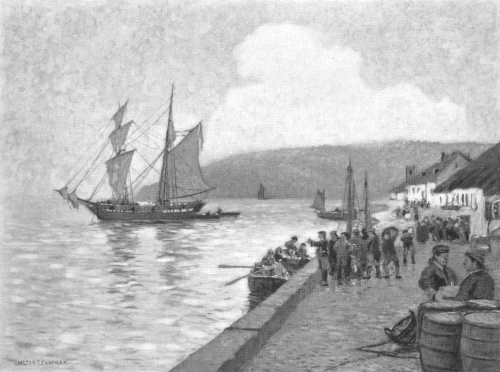
Made fast to the end of the long wharf was a rakish-looking
vessel, and all about her was a scene of continuous
activity. From small boats and slings men were
painting her topsides, and at the same time, running to
and fro from the wharf, others busy as ants were carrying
bales and boxes on board; windlasses were lifting and
swinging the heavier goods over the bulwarks. On the
string-piece stood an active, wiry figure, recognizable at
a glance, and near by was the portly form of our friend
Hodge. Conyngham was a free man again. Mysterious
orders had come from Paris, and to the surprise of everybody
he had appeared one day walking the streets of
Dunkirk smilingly greeting the inhabitants, who remembered
well his giving the stores of the other vessels to
the populace on the day of his arrest.
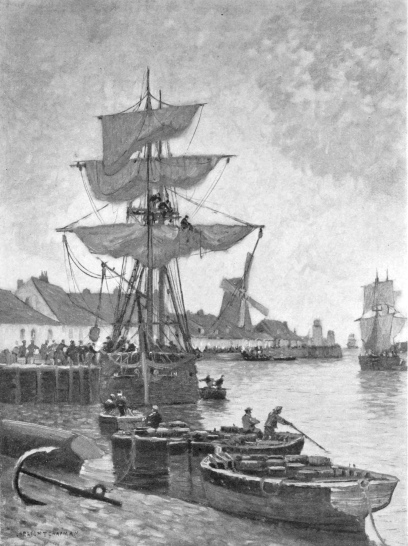
At the end of the wharf was a rakish-looking vessel.
It was the beginning of the second week of July, 1777,
and for over a fortnight the outfitting, loading, and
changing had been going on and the nameless vessel that
was going on the nameless mission was almost ready to
set sail. To tell the truth, although at first there was
some mystery made about her ownership, her destination,
and her probable calling, there was very little of the mystery
left at the time at which this chapter opens. The
English spies and sympathizers in Dunkirk were almost
at their wits’ end. They had informed their Government
of their opinions, and now began to write to the English
press in order to stir the Government to action.
A copy of the London Times almost a week old had
come to the hands of Conyngham. As he glanced through
the pages, all at once his own name attracted his attention.
This had happened as he was walking down to
the wharf, and he had smiled broadly as he perused the
remarkable effusion. He had slipped the paper into his
pocket, where, in the interest of watching the vessel’s loading,
although he took no active part in its direction, he
had forgotten it.
“Everything seems to be going finely, Captain Gustavus,”
said Mr. Hodge. “No one apparently suspects
the ownership of the vessel, and I do not think the French
authorities will interfere with her sailing.”
Conyngham smiled. That no one seemed to object
struck him as having a humorous meaning. Perhaps he
had not observed the twinkle in Mr. Hodge’s eye, as he
advanced this statement. He was about to refer to the
article in the Times when something attracted his attention.
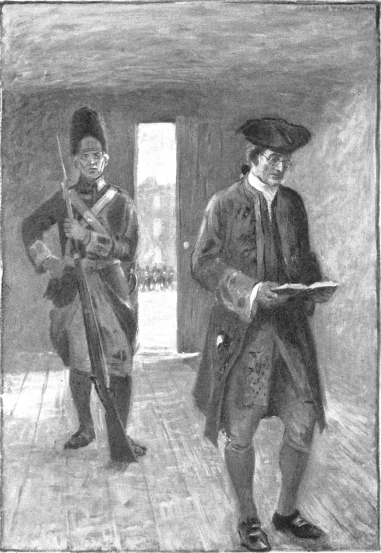
Two men, one dressed as a sailor and the other as
something of a court dandy, came walking together down
the wharf. The sailorman to all appearances had been
drinking and was asking the gentleman with the long
satin waistcoat for something more with which to quench
his thirst. At last the latter, as if he could no longer
resist the man’s importuning, reached into his pocket and,
producing a purse, took out a small silver piece. At the
same time he addressed some words to the sailor, as if
bidding him begone.
“I know this fop in satin and lace,” said Hodge. “I
have seen him in Paris, but I can not recollect where.
He’s not a Frenchman, but a German or a Pole.”
“Methinks I know him too,” returned Conyngham.
“He’s talking English to that beggar. Well, well—by
the great gun!—it comes to me.”
Conyngham lowered his voice almost to a whisper
and spoke without turning his head or scarcely moving
his lips.
“I know both of them now,” he said. “The fop is
our friend the English spy, and the other is one of the
stool-pigeons. What do you suppose he said just then?
Hush! here he comes in our direction. It is his intention
to get near to us and listen to our conversation.”
“Let us move then,” suggested Mr. Hodge, “for
there is a good deal about me that I would not wish to
have known; besides,” he added, “I think you are mistaken,
for I now remember where I have seen this coxcomb,
and at the house of no one less than good Dr.
Bancroft, the geographer and scientist, the friend of
Franklin, and one who had kept us well informed of the
British plans.”
“Then keep an eye on Dr. Bancroft, is my advice,”
rejoined Conyngham. “Hush! let me speak to this fellow.”
The drunken sailor lurched up and leant with both
elbows against a big pine-wood box, but apparently he
paid no attention to the proximity of the others, for he
began emptying his pockets of their contents, which included
the silver piece which had just been given him,
and searching for some bits of tobacco he jammed them
into the bowl of his black heavy pipe.
“What you say about the moon may be true,” observed
the captain as if carrying on some deep subject,
“but still the influence of the orb upon the tides has been
acknowledged for centuries.”
The sailor by this time had found a bit of flint and
steel and was trying to ignite a bit of pocket tinder.
All at once Conyngham turned toward him, and at
the same time taking the copy of the Times out of his
pocket, he spread it out on the top of the box and began
to read aloud.
“Listen to this nonsense,” he said in beginning. “The
English must be in a ferment of terror to believe such
stuff as this,” and forthwith he read:
“I saw Conyngham yesterday. He had engaged a
crew of desperate characters to man a vessel of one hundred
and thirty tons. She has now Frenchmen on board
to deceive our minister here. A fine fast-sailing vessel,
handsomely painted blue and yellow, is now at Dunkirk,
having powder, small arms, and ammunition for her. Conyngham
proved the cannon himself, and told the bystanders
he would play the d——l with the British trade
at Havre. It is supposed when the vessel is ready the
Frenchmen will yield command to Conyngham and his
crew. The vessel is to mount twenty carriage-guns and
to have a complement of sixty men. She is the fastest
sailer now known—no vessel can catch her once out on
the ocean.
“I send you timely notice that you may be enabled
to take active measures to stay this daring character, who
fears not man or government, but sets all at defiance.
“He had the impudence to say if he wanted provisions
or repairs, he would put into an Irish harbor and obtain
them.
“It is vain here to say Conyngham is a pirate. They
will tell you he is one brave American; he is ‘a bold Boston.’
“You can not be too soon on the alert to stop the
cruise of this daring pirate.
“James Clements.”
There was also a letter that Conyngham read in even
a louder tone:
“Paris, July 28, 1777.
“Sir: You have no doubt been informed by your ministry
that Lord Stormont had been successful, and that
the Court of Versailles had declared their ports shut
against American privateers. Let your blind politicians
sleep, the guns of the American privateers will waken them
to their sorrows. The General Mifflin privateer arrived,
and Monsieur de Chauffault, the admiral, returned the
salute in form, as to a vessel from a sovereign and independent
state.
“Your papers tell us that Conyngham is in chains in
Dunkirk, and is expected shortly in London, to be tried
and hung. I tell you that Conyngham is on the ocean,
like a lion searching for prey. Woe be to those vessels
who come within his grasp. No force intimidates him.
God and America is his motto. Our country is duped
by French artifice.”
As he finished it was noticeable to both men that the
drunken sailor was paying strict attention.
“What’s your opinion of that?” asked Conyngham.
The man looked up slowly and found the captain’s
eyes fastened upon his own. “I say, what is your opinion
of that?” he reiterated, this time leaning forward and
grasping the man by the collar of his open jacket.
So surprised was the latter that the pipe fell from his
lips, and before he could control himself an oath followed
the pipe—an oath in good round English.
Conyngham affected to laugh.
“Why, he has understood everything we’ve been saying,”
he said, turning to Mr. Hodge again.
The sailor, who had wrenched himself free, started to
walk away. His efforts in that direction were accelerated
by a well-placed kick, administered by the toe of Conyngham’s
boot. But he apparently did not resent it, and
still affecting to be under the influence of liquor stumbled
up the wharf.
“That will puzzle our friend with the high-heeled
boots,” said the captain, “but to tell the truth I think
there is very little use in any more secrecy. They seem
to know as much of the situation as we do.”
This was nothing more than the truth, and before
two days had passed Conyngham had openly acknowledged
it by superintending the placing of the cannon on
board of the Revenge, and the French Government had
agreed to allow her to depart from the port of Dunkirk,
upon Mr. Hodge, who had all through the transaction
appeared as her owner, signing a bond that she would
do no cruising off the coast of France.
The time of sailing drew on quickly. The vessel was
laden, the ammunition was all on board—there was no
secrecy about that now—the crew had been picked and
divided into watches; some attempt had even been made
to drill them at the guns. The citizens of Dunkirk knew
almost to a man that the tidy little cruiser would soon be
on the sea.
Once more the four “conspirators” were grouped
about the table at the tavern.
“Three days from now, captain, and you will be off
the headlands,” observed Mr. Hodge, “and we shall be
here waiting to see which way the cat will jump.”
“If you mean Lord Stormont by ‘the cat,’” answered
Conyngham, “I think he is all ready for jumping now.”
“I wish,” rejoined the elder Ross, “that we were certain
of the French minister’s temper. Dr. Franklin must
have had a strong cudgel in his hands to bring him
to terms at all. I wonder what it was? You could tell us,
Captain Conyngham, if you wished, of that I’m sure.”
Conyngham looked at the others intently. He waited
for Hodge to speak, thinking that of course the good
doctor had told him of the commission that undoubtedly
had been the cudgel that had brought the Count de Vergennes
to terms. But seeing that Hodge apparently did
not wish to refer to it, he also held his peace and changed
the subject.
“You say that Dr. Franklin’s secretary will be down
from Paris to-morrow?” he asked Mr. Hodge. “I suppose
with final instructions.”
The younger Ross laughed. “I don’t think there will
be many instructions that we could not guess,” he said.
“It seems to me that the case is clear enough—to capture
as many of the enemy’s vessels as possible and not to
get caught at it, is an easy thing to remember.”
“There will be more than that, my son,” returned
Hodge, “much more than that, I hope, for you must remember
that I am responsible to the French Government
for the proper behavior of the gallant captain so long
as he remains on the coast of France.”
“And you have no longing for the Bastile, eh?”
“Not much, my son. But Mr. Carmichael will tell us
to what length we can go in interpreting the cautions of
the ministry.”
After some more desultory talk the meeting broke up,
another parting toast being drunk to the success of the
Revenge.
Mr. Hodge and Conyngham walked down the street
toward the pier where the captain’s gig was waiting, for
he was now living openly on board the Revenge and
making no secret of his connection with her.
“Tell me, my good friend,” asked the captain, “did
Dr. Franklin say nothing to you about the contents of
that packet that you brought to Paris with you? It
would seem rather unusual if he did not.”
“Nothing beyond the fact that he was glad to receive
it,” was the reply. “What did it contain? You
were asked that question before. If you do not care to
tell—why, consider it unasked.”
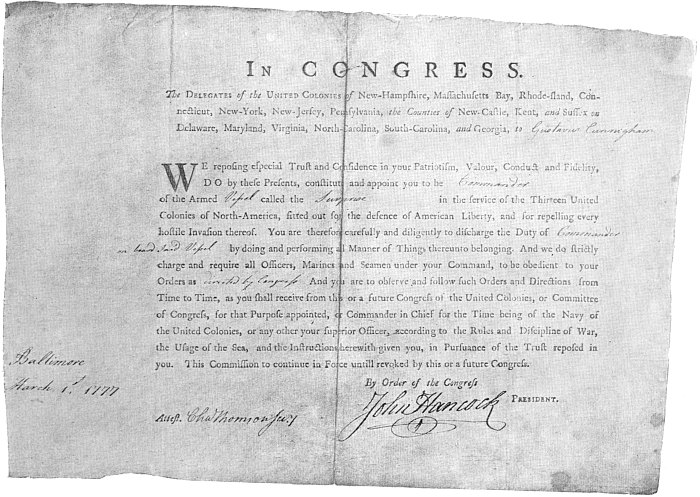
“It contained enough to save my life,” was the reply:
“my commission—that was all.”
“You have not received it back?”
“I have not seen or heard of it from that day to this.”
Hodge gave vent to a prolonged whistle.
“This is a serious matter,” he said. “But perhaps
Carmichael will fetch it down with him.”
“I hope and trust so,” was the reply. “Sure, I don’t
care any more for the yard-arm than you do for the Bastile.”
Conyngham was worried and slept little that night,
still he reasoned that it was more than probable that the
commission would be forthcoming in the morning, and
also that he would be relieved, from all secrecy as to its
possession. He saw that it had worked wonders, and
that slowly but surely France and England were verging
toward war; that before many months should pass America
would have a powerful ally. Of course, in view of these
circumstances, France could not have given the mortal
offense of surrendering a regularly commissioned officer
into the hands of what soon was to be a common enemy.
The next day Carmichael arrived. He was a tall,
spare man, with a hawked nose; a broad, good-natured grin
was usually on his lips, but he was keen as a whip-lash.
It was the morning of the 15th of July, and in the
cabin of the Revenge Mr. Carmichael sat opposite Captain
Conyngham, who watched him with a smile of dry
amusement as he wrote. Carmichael was smiling also.
He had a trick of apparently spelling the letters he was
writing with his tongue wriggling at the corner of his
mouth. As soon as he had finished he turned, and waving
the paper in the air to dry it, chuckled.
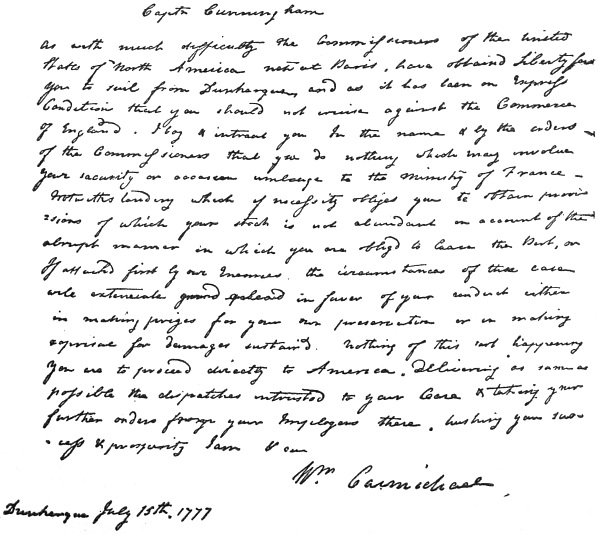
“There, Captain Conyngham, are your sailing orders.
Of course, to a man of your intelligence, there is no use
of being more than explicit. Somehow I am reminded
of a story of one of your fellow countrymen who was
accused of killing a sheep, and in explanation made the
plea that he would kill any sheep that attacked and bit
him on the open highway. So all you’ve got to do is
to be sure that the sheep bites first.”
“There is another little adage about a wolf in sheep’s
clothing,” replied Conyngham laughing, “and sure, there
are plenty of them in both channels, and in that case——”
“Be sure to kill the wolf before he bites you at all.
But seriously—once away from the French coast, you
ought to have a free foot. Do not send any prizes into
French ports. Here is a list of the agents of Lazzonere
and Company, Spanish merchants, and here is a draft of
a thousand livre upon them at Corunna. Should you desire
more, accounting will be kept with Hortalez and Company
that will be audited by the commissioners and by
Grand, the banker, of Paris. You will receive the usual
percentage accruing to the captain of a vessel making such
captures, and will keep a separate account of your expenditures
and moneys received and the value of prizes.”
He handed Captain Conyngham the remarkable instructions,
which now for the first time are shown to the
public in their original form.
Conyngham read the paper through. “But there is
something else,” he said. “Did not Dr. Franklin send
some other paper to me?”
“Yes, there is a packet here which I received from the
secretary of the Cabinet Minister, M. Maurepas, who told
me that he had been instructed to give them to me by
the Count de Vergennes. They contain some matter in
relation to our project.”
He opened his portfolio, and breaking the seal displayed
some pages of closely written matter that was
undated and unsigned. It merely stated that Mr. Hodge,
merchant, had given his guarantee and bond, together
with Messrs. Ross and Allan, that the American vessel
about to depart from Dunkirk should respect all English
commerce and should make the best of her way to
the United States. Conyngham’s name was not even
mentioned. As soon as he had read it, the captain exclaimed
aloud:
“We are trapped again! By the Powers, there’s a
large rat somewhere. Where is my commission? I can
not sail without one, and I refuse to put myself and my
crew in such jeopardy.”
“Dr. Franklin spoke to me of the paper that he had
given you, and that he had sent to the Count de Vergennes.
He understood from the latter that it had been
returned to either Mr. Arthur Lee or Mr. Silas Deane,
who had sent it to you at this place.”
“I have never received it.”
“Well,” said Mr. Carmichael, “this must be attended
to before sailing. We will meet ashore this afternoon
with Hodge, Allan, and the rest, and hold a council of
war. Perhaps I had better see them first, and I will
ask you to send me off in one of your boats immediately.”
The secretary and the captain repaired on deck. Conyngham
felt no little pride in his vessel, and indeed she
was one to make the heart of any captain glad. Everything
about her was as neat as a pin. Her crew of nearly
one hundred men, forty-four of whom were Americans,
had picked up wonderfully in their work. On her decks
were fourteen six-pounders and twenty small two-pounder
swivels capable of making great havoc at short range
when loaded with grape or ball. He pointed out the good
points of his vessel to Mr. Carmichael, who appeared in
a great hurry to get away, and was soon sent off in the
captain’s gig, intending to look up Mr. Hodge as soon
as possible.
After drilling the crew all one afternoon, Conyngham
early in the evening went ashore, and repaired at once
to the usual rendezvous. There he found the others
awaiting him. All seemed to be in good humor.
“Ho, Captain Glumface,” cried Hodge, “sit down
with us. I have some news that will give thee comfort.”
“Has it arrived?” asked Conyngham eagerly.
“Hear the man!” replied Hodge. “Look!”
He handed Conyngham a paper.
“It is one that just by luck I found in my possession.
A blank commission, and I have dated it to cover your
last cruise.”
“But this is a privateersman’s commission,” Conyngham
said, looking up from his perusal of the paper. “I
do not consider myself in that light.”
“I went on your bond,” replied Hodge.
“Yes, but it was not your money that paid for the
outfitting; it was money belonging to the United Colonies
of America, or borrowed on their account, and I am an
officer in the regular navy, and that vessel sails under
the flag.”
It looked dangerously like a quarrel. Hodge relapsed
into silence and the elder Ross looked furtively from Mr.
Carmichael to the captain, as if expecting the former to
come to the rescue.
“What you have there,” said the secretary at last, “is
authority enough, and is the same under which many of
our cruisers are now sailing. It is a letter of marque respected
by the British Admiralty.”
“Mayhap so,” replied Conyngham, “but the date is
made out wrong. I sailed in the Surprise on the 1st of
May, and this is made out on the 2d.”
“Tut, tut! that is too bad,” muttered Mr. Hodge,
“and the last one I’ve got, and in fact the only one I
had. What now are we to do?”
“My brother comes down from Paris to-morrow,” put
in Ross, “and he may bring news proving that we have
time to wait, or perhaps he may have seen Dr. Franklin
and have the very paper the captain desires.”
Hardly had he spoken than a sound of hurrying feet
came down the hallway outside. The door burst open,
and in rushed the younger Ross. Evidently the position
of the candles on the table prevented him from seeing
that Conyngham was present, for in his first words he
asked for him, and upon the latter rising, he came quickly
to his side.
“We must think and act quickly,” he cried. “But
two hours behind me in the road is a messenger from
de Vergennes instructing the authorities to seize the vessel
and not to allow her to depart. I have this on the
very best authority. I saw Dr. Franklin but an hour or
so before I received the news. He expected me to wait
until to-morrow, when he should have been granted an
audience with the Foreign Minister, but upon ascertaining
the importance of immediate action (I was told by
the very messenger to whom I had once been presented
by Dr. Bancroft) I sought out the doctor. Search high
or low, I could not find him, but by good fortune I met
Silas Deane in company with our misanthropic friend,
Mr. Lee. They ordered me to post it here at once and
tell you to get under way at the earliest possible moment.”
“Where was Dr. Franklin, do you suppose?” asked
Allan.
“Dining with some fair countess or duchess at Versailles,”
replied Hodge, who leaned perhaps a little
toward the Lee faction.
The secretary shrugged his shoulders and said nothing,
but Conyngham spoke quickly.
“Gentlemen,” he said, “there is but one thing to do.
Commission or no commission, I sail from Dunkirk on
the early morning tide. We have but a few hours before
us. May the Powers grant the messenger does not
arrive before then. Stormont must have played his
trump card and won.”
Quickly the party broke up and accompanied Conyngham
to the water’s edge. Early in the morning, while
still the mist hung over the harbor and shrouded the
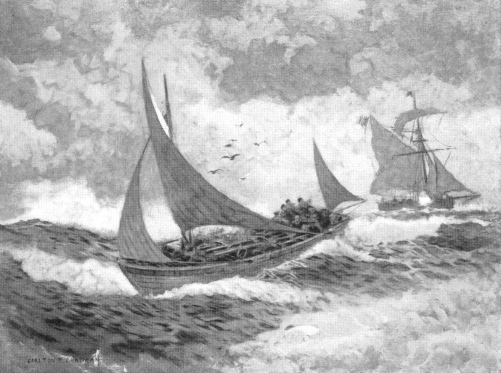
houses and shipping, a ghostlike vessel appeared in mid-channel,
fanned by the damp shore breeze. It was the
Revenge. On the fast ebb tide she slid swiftly out to sea.