The triage had been set up just outside of a small
church which placed its buttressed side alongside the
market place of the village. It was a busy place. And
just because you may not know what triage really is any
better than I did when I first heard the term, let me
hasten to explain that it is an emergency station set up
by the Army Medical Corps just back of the actual firing
line—that and something more; for the triage generally
means a great center of Red Cross activities as well. And
this particular one, in the little village of Noviant, close
behind the salient of Saint Mihiel—to which reference
was made in the preceding chapter—was the initiation
point of a Red Cross captain; his name is John A. Kimball
and he comes from Boston.
Captain Kimball told it to me one day in Paris, and
I shall try to give much of it to you in his own words.
He was just a plain, regular business fellow who, well
outside of the immediate possibilities of army service,
had closed his desk in Boston and had offered himself to
the Red Cross. And to work for the Red Cross at the
front was to face death as an actuality.
"The wounded already were coming in, in good numbers,
on that unforgetable morning of the twelfth of September,
when they brought him in—the first dead man
that I had faced in the war," said he. "We had had our
experiences with handling iodine and antitoxin and dressings,
but this artillery captain was in need of none of these....
His feet stuck out underneath the blanket that was
thrown over the stretcher and hid his body, his head, his
arms, and his hands. I saw that his boots were new and
that they had been recently polished, too. Of course they
were muddy, but I remember beneath the caking of the
clay that they were of new leather. One does remember
details at such a time.
"I buried him. It was a new experience, and not a
pleasant one. But war is no holiday; it is not filled with
pleasant experiences. And sooner or later it brings to a
man a test, which, if disagreeable, is all but supreme.
This was my test. I rose to it. I had to. I buried the
man, ran hastily through his papers first and then sealed
them into a packet to send to those who held him dearer
than life itself."
Because the Boston captain's experience was so typical
of so many other Red Cross men who risked their all in
the service at the front lines of battle, let us take time
to consider it a little in detail. He came to France at
the end of June, 1918. He stayed in Paris and chafed
at the delay in being held back from the fighting front.
In four weeks he received his reward. Having asked to
be made a searcher among killed, wounded, and missing
men, he was assigned to the Second Division at Nancy,
which had just come out of the hard fighting at Soissons
and was resting for a brief week before going into action
again.
The Second Division is one of the notable Divisions of
our fighting forces that entered France. Because one
wishes to avoid invidious comparisons and because, after
all, it is so really hard to decide whether this Division,
this regiment, or that is entitled to go down into history
ahead of its fellows, I should very much hesitate to say
that the Second or the First or the Third or the Twenty-sixth
or the Seventy-seventh or any other one Division was
the ranking Division of our Regular Army. But I shall
not hesitate to write that the Second stood in the front rank.
Out of some 2,800 Distinguished Service medals that had
been awarded in France up to the first of March, 1919,
some 800 had gone to this Division. And yet it was but
one of eighty Divisions involved in the conflict over there.
In the Second Division were comprised two of the most
historic Regular Army regiments of other days—the
Ninth and the Twenty-third. The records of each of these
commands in Cuba and in the Philippines are among the
most enthralling of any in our military history. And the
Ninth was the regiment chosen to enter Peking at the close
of the Japanese-Chinese War and there to represent the
United States Government. These regiments before being
sent to the Great War in Europe were recruited up to the
new fighting strength—very largely of boys from the
central and western portions of New York State. In addition
to these two regiments of the former Regular Army,
the Second Division held several of marines, which leaves
neither room nor excuse for comment. The marines too
long ago made their fighting reputation to need any more
whatsoever added by this book.
The Second Division in the earlier days of the fighting
of the American Army as a unit had already made a distinguished
reputation at both Château-Thierry and at
Soissons. It was at the first point that Major General
Bundy, who then commanded it, was reputed to have replied
to a suggestion from a French commanding officer
that he had better retire his men from an exceptionally
heavy boche fire that they were then facing, that he knew
no way of making his men turn back; literally they did not
know the command to retreat. Our amazing army was a
machine of many speeds forward, but apparently quite
without a reverse gear.
When Kimball of Boston joined the Second as a Red
Cross worker, General Bundy was just retiring from its
command, and was being succeeded by Brigadier General
John A. LeJeune, who took charge on the second of August,
at Nancy; for the Division was spending a whole week
catching its breath before plunging into active fighting
once again. On the ninth its opportunity began to show
itself. It moved to the Toul front in the vicinity of the
Moselle River, and was put into a position just behind the
Saint Mihiel sector—that funny little kink on the battle
front that the Germans had so long succeeded in keeping
a kink.
For a long time—in exact figures just a month, which
to restless fighting men is a near eternity—the sector was
quiet. There were practically no casualties; and this of
itself was almost a record for the Second, which in four
months of real fighting replaced itself with new men to
a number exceeding its original strength. In that month
the Division prepared itself for the strenuous service on the
fighting front. It went into camp for eleven days at
Colombes-les-Belles, within hiking distance of the actual
front, and there practiced hand-grenade work while it made
its final replacements. The work just ahead of it would
require full strength and full skill.
On the twenty-seventh of August it began slowly moving
into the front firing line. From the first day of September
until the eighth it worked its way through the great
Bois de Sebastopol (Sebastopol Forest), marching by night
all the while, and covering from eight to nine miles a night.
And upon the night of the eleventh—the eve of one of
the most brilliant battles in American history—took over
a section of the trenches north of the little town of Limey.
"Your objective is Triacourt," the officers told the men
that evening as they were preparing for going over the top
at dawn, "and the Second is given two days in which to
take it."
Triacourt fell in six hours.
Count that, if you will, for an American fighting
Division.
The headquarters of the Second were at Mananville to
the south of the fighting lines. And halfway between
Limey of the trenches (they ran right through the streets
of the little town) and Mananville was Noviant where, as
you already know, the triage was established beside the
walls of the church and the Red Cross functioned at the
front. Remember that the triage was nothing more nor
less than a sorting station, where wounded men, being sent
back in a steady stream from the front—three to six
miles distant—were divided between four field hospitals
of the Regular Army service; one handling gassed cases,
another badly wounded, and the other two the strictly surgical
cases. Each of these divisions consisted roughly of
from ten to fifteen doctors and about one hundred enlisted
men—no women workers were ever permitted so near
the front—and was equipped with from five to eight army
trucks of the largest size.
There has been sometimes an erroneous impression that
the Red Cross was prepared to assume the entire hospital
functions of the United States Army; I have even heard
it stated by apparently well-informed persons that such a
thing was fact. It is fact, however, that if the enormous
task had been thrust upon the shoulders of our Red Cross
it would have accepted it. It has never yet refused a work
from the government—no matter how onerous or how
disagreeable. As a matter of fact, the army, for many
very good and very sufficient reasons of its own, preferred
to retain direct charge of its own hospitals, both in the field
and back of the lines, and even took over the hospitals
which the Red Cross first established in France before the
final policy of the Surgeon General's office was definitely
settled, which hardly meant a lifting of responsibility from
the shoulders of the American Red Cross. Its task, as we
shall see in the chapters which immediately follow this, was
almost a superhuman one. It needed all its energies and
its great resources to follow the direct line of its traditional
activity—the furnishing of comfort to the sick, the
wounded, and the oppressed.
A wise man, one with canny understanding, if you will,
who found himself at the Saint Mihiel sector would have
understood that a battle was brewing. There was a terrific
traffic on each of the roads leading up toward the
trenches from the railhead and supply depot at the rear—big
camions and little camionettes, two-man whippet tanks,
French seventy-fives (as what is apparently the best field
cannon yet devised will be known for a long time into the
future), motor cars with important-looking officers, ambulances,
more big camions, more little camionettes—all a
seemingly unending procession. Fifth Avenue, New
York, or Michigan Avenue, Chicago, on a busy Saturday
afternoon could not have been more crowded, or the traffic
handled in a more orderly fashion.
The barrage which immediately preceded the actual
battle began at one o'clock on the morning of the twelfth.
It lasted for nearly four hours and not only was noisily incessant
but so terrific and so brilliant that one could
actually have read a newspaper from its continuous
flashes if that had been an hour for newspaper reading.
"It was like boiling water," says Kimball, "with each
bubble a death-dealing explosion."
At five o'clock in the morning the men went over the top,
and our Red Cross man shook himself out of a short,
hard sleep of three hours in a damp shed near the triage
beside the church at Noviant, for it had been raining
steadily throughout the entire night, and went across to
that roughly improvised dressing station. His big day's
work was beginning. By six it was already in full swing.
The first wounded men were coming back from the fighting
lines up at Limey and were being sorted into the ambulances
before they were started for the three big evacuation
hospitals in the rear—each of them containing from three
hundred to five hundred beds. The Boston man saw each
wounded soldier as he was placed in the ambulance. Into
the hands of those men who asked for them or who were
able to smoke he gave cigarettes. And to those who were
far too weak for the exercise or strain that smoking
brought, gave a word of encouragement or perhaps a shake
of the hand. And all in the name of the Red Cross.
He could have put in a busy day doing nothing else
whatsoever; but felt that there were other sections of the
battle front that needed the immediate presence of the
American Red Cross. So at about half after seven he
climbed in beside the driver of a khaki-colored army
camionette and headed straight for Limey, and the heart of
the trouble. There was another old and badly battered
church in the town square there, and there a new triage
already was being established; for the Yanks were driving
forward—with fearful impetus and at a terrific rate. So
the hospital went on, the sorting stages, with their indescribable
scenes of human suffering—more stretchers and
still more in the hands of boche prisoners coming in with
their ghastly freight. Captain Kimball again passed out
his cigarettes and started forward. Now he was on the
scene of actual warfare. Dawn had broken. It had ceased
to rain and the sky was bright and blue with white, fluffy,
sun-touched clouds drifting lazily across it—just as the
Boston boy had seen them drift across the sky in peaceful
days on Cape Cod when he had had nothing to do but lie on
his back and gaze serenely up at them.
"I plunged forward over the broken field," he told me,
"and there I came across my artillery captain. I called
an aid and we took him back—he of the bright new boots
that had so recently been polished.... I got back into
the game. All the time our boys shot ahead and the
racket was incessant. Once, when I bumped my way
across the German trenches, I paused long enough to
stick my nose down into one of their dugouts. It was
easy to see that the enemy had not anticipated the attack.
For in that dugout—it was wonderfully neat and nice,
with its concrete walls and floors and ceiling and its electric
lights—was the breakfast still upon the table; the bread,
the sausages, and the beer. I could have stayed there an
hour and enjoyed it pretty well myself. But there were
other things to be done. I got out into the shell-plowed
fields once again. Across that rough sea of mud an engineer
regiment was already building a road, which meant
that we could get a Red Cross ambulance right to the very
front. I walked back to Limey—or rather I stumbled
over the rough fields—and there found one which had
come through from Toul that morning, loaded to its very
roof with bandages and chocolates and cigarettes. And I
found that Triacourt had fallen. It still lacked some
minutes of noon. The job for which our Division had
been given two days had been accomplished in six hours—but
such hours.
"We drove without delay into Triacourt—a fearfully
slow business every foot of it, with every inch of the hastily
constructed road crowded with traffic. But we got
through and in the early afternoon were in the main street
of the little town which the French had watched hungrily
for four years and seemingly had been unable to capture.
The women and children of the place came out into the
sun-lighted street and rubbed their eyes. Was it all a
dream; these men in tin helmets and uniforms of khaki
and of olive drab? No, it could not be a dream. These
were real men, fighting men. These were the Americans,
the Americans of whom rumors had even run back of the
enemy lines. They found their voices, these women, for
the Germans had taken the men of Triacourt as prisoners.
"'Bons Américains!' they shrieked, almost in a single
cry. And we saluted gravely."
Over the heads of the two Red Cross men—the captain
and the driver of the little camionette—an aftermath of
the battle in the form of an air fight between boche planes
and American was in progress; young Dave Putnam, one
of the most brilliant of our aces, was making the supreme
sacrifice for his country. To the north the Germans were
dragging up a battery and preparing to shell the little
town that they had just lost; but not for long. Batteries
of American .155's were appearing from the other direction
and were working effectively. And at dusk a report came
into Division Headquarters that a company of one of the
old Regular Army regiments had captured an entire German
hospital—patients, nurses, doctors, and even two
German Red Cross ambulances; while the tingling radio
and the omnipresent telephone began to bring into Division
Headquarters the story of one of the most remarkable
American victories of the entire war. And our Red Cross
began the first of a four days' stay in a damp dugout in
the lee of a badly smashed barn.
Kimball's story is quite typical of many others. But
before I begin upon them—what the motion-picture
director would call the "close-ups" of what is perhaps
the most picturesque form of all the many, many picturesque
features of our Red Cross in action, consider for
a moment how it first got into action upon the field of
battle. I have referred several times already to the excessive
strain which the great German offensives which
began in March, 1918, placed upon its facilities, while
they still were in a stage of development. When we read
of the work of the Transportation Department and of the
Bureau of Supplies, we saw how both of these great functions
had suddenly been confronted with a task that demanded
the brains and brawn of supermen and how
gloriously and brave-heartedly they had arisen to the
task. The field service of our Red Cross—its first contact
with the men of our army in actual conflict—was
second to neither of these.
Remember, if you will, that it was but a mere nine
months after the American Red Cross Commission to
Europe landed in France that its organization was put to
its greatest test. The news of the long-expected and well-advertised
German offensive reached Paris on the very
evening of the day on which it started, March 21, 1918.
Paris caught the news with a choking heart. The coup,
which even her own military experts had frankly predicted
as the turning point of the entire war, actually had come
to pass. No wonder that the once gay capital of the
French fairly held its breath in that unforgetable hour—that
every other community of France, big or little, did
the same—and fairly fought for news of the day's operations.
Yet news gave little comfort. It was bad news,
all of it; fearfully and unmistakably bad. Each succeeding
courier seemed to bring enlarged statements of the
enemy's immensity and seemingly irresistible force. It
was indeed a real crisis.
In that hour of alarm and even of some real panic, our
American Red Cross showed neither. It kept its cool
and thinking head. Major James H. Perkins, then ranking
as Red Cross Commissioner to Europe and a man whom
you have met in earlier pages of this book, called a conference
of his department heads on that very evening of
the twenty-first of March. He told them quietly that they
were to make known every resource at their command and
to have each and every one of their workers—men or
women—ready for call to any kind of service, night or
day.
"Let every worker feel that on him or her individually
may rest the fate of the allied cause," was the keynote of
the simple orders that issued from this conference.
It was in the days that immediately followed that the
flexibility and the emergency values of the American Red
Cross organization—qualities that it had diligently set
forth to attain within itself—came to their fullest test.
The discipline and willingness of practically every worker
was also under test, while for the very first time in all its
history overseas it was given large opportunity to carry
to the men of the allied lines a great material message.
How well was that material message carried?
Before I answer that point-blank question, let me carry
you back a little time before that night of the spring
equinox. Let me ask you to remember, if you will, that
the super-structure of Red Cross effort in that critical
hour had been laid many weeks before; in fact very soon
after its original unit of eighteen men under command of
Major Murphy had first arrived in France. It had experimented
with the French, in definite and successful efforts
to relieve the hard-pressed civilian population of that distressed
country. It had worked, and worked hard, in the
broad valleys of the Somme and the Oise, which had been
devastated by the boche when he made his famous "strategic"
retreat to the Hindenburg Line in March, 1917—just
one year before.
The Germans had left behind them an especial misery
in the form of a vast region of burned and blown-up homes,
broken vehicles and farm machinery, defiled wells, hacked
and broken orchards, and ruined soil. I have stood in
both of these valleys myself after German retreats and
so can bespeak as personal evidence the desolation which
they left behind. I, myself, have seen whole orchards of
young fruit trees wantonly ruined by cutting their trunks
a foot or more above the level of the ground. And this
was but a single form of their devilment.
Yet as the Germans retreated "strategically" there in
the spring weeks of 1917, there followed on their very
heels the heavy-hearted but indomitable refugees who in
yesteryear had known these hectares as their very own.
Returning, they found but little by which they might recognize
their former habitats. Devastation ruled, life was
practically extinct. The farm animals, even the barnyard
fowls and the tiny rabbits—the joy of a French peasant's
heart—had been killed or carried away. Not even the
bobbins of the cast-out sewing machines or the cart wheels
were left behind by an enemy who prided himself on his
efficiency, but who had few other virtues for any decent
pride.
Seemingly stouter-hearted folk than the French might
have quailed at such wholesale destruction; but the refugees
did not complain. Instead, they set patiently to work—many
of them still within the range of the enemy's
guns—to rehabilitate themselves. Their burdens and
their problems were staggeringly great; their resources
pitifully small. Thus our Red Cross found them, and
to give them effective aid—not only in the valleys of the
Somme and the Oise, but in the other devastated areas
of France—formed the Bureau of Reconstruction and
Relief under Edward Eyre Hunt. Of Mr. Hunt's work,
the record will be made at another time. In order, however,
that you may gain the proper perspective on the beginnings
of the field service of our Red Cross with our
army in action, permit me to call attention in a few brief
sentences to some salient features of the Bureau of Reconstruction
and Relief.
It located warehouses at convenient places—Ham,
Noyon, Arras, and Soissons—all of them within gunshot
of the Hindenburg Line. These were stocked with
food, clothing, furniture, kitchen utensils, building materials,
seed, farm implements, even with rabbits, chickens,
goats, and other domesticated animals. A personnel of
several field workers was sent into the district to supervise
the distribution of these commodities, which was done
partly through authorized French committees and municipal
officers in the devastated towns. These coöperated
with devoted groups of British, French and American
workers, who established themselves in small groups and
who worked to inspire the liberated areas with faith and
courage and hope. Looming large among all these coördinated
agencies were the Smith College Unit—composed
of graduates of the Northampton institution—and
the group of workers from the Society of Friends—both
of whom, in the fall of 1917, became integral parts
of the Red Cross.
These two coördinated agencies, together with the
Secours d'Urgence, the Village Reconstitue, the Civil
Section of the American Fund for the French Wounded,
the Philadelphia Unit, and the Comité Américaine pour
les Régiones Dévastées, had their various operations well
under way by the early summer of 1917. When it entered
the field, our American Red Cross offered assistance in
every way to these organizations, thereby giving a new impetus
to their work. Agricultural societies were organized
for the common rehabilitation of the areas, American
tractors and plows were furnished by the French Government,
while the Red Cross workers helped with and encouraged
the planting, furnishing large quantities of seeds as
they did so, while small herds of live stock, also given by
the Red Cross, appeared here and there upon the French
landscape.
The workers did even more. They turned to and helped
patch up buildings that, with a minimum amount of labor,
could again be made habitable, erected small barracks in
some places, and assisted generally in renewing life and the
first bare evidences of civilization in the towns of the desolated
sections.
In March, 1918, these desecrated lands were just springing
to life once again. God's sun was breaking through
the clouds of winter and gently coaxing the wheat up out
of the rough, brown lands, gardens again dotted the landscape—the
Smith College Unit itself had supervised and
with its own hands helped in the planting of more than
four hundred and fifty of these—the little villages and the
bigger towns were showing increasing signs of life and
activity; then came the blow. The clouds gathered
together once again. And in the misty morning of the
twenty-first of March began a week of horror and devastation—a
single seven days in which all the patient,
loving labor of nearly a twelvemonth past was erased
completely. The Germans swept across the plains of
Picardy once again—the French and British armies and
the terror-stricken civilians along with the American war
workers were swept before them as flotsam and jetsam,
all in a mad onrush. Yet all was not lost. One field
worker, a stout-hearted little woman in uniform, sat in the
seat of a swaying motor truck and as the thing rolled
and tossed over a road of unspeakable roughness wrote in
her red-bound diary, this:
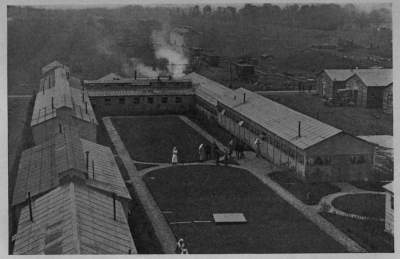
AS SEEN FROM ALOFT
The aëroplane man gets the most definite impression at the A. R. C. Hospital at Issordun, which
was typical at these field institutions
"The best of all remains—the influence of neighborliness,
friendship, kindness, and sympathy—these are
made of the stuff which no chemistry of war can crush.
We face more than half a year's work torn to pieces.
But I do believe that the fact of this sacrifice will deepen
its effect."
Such was the spirit of our Red Cross workers overseas.
They now had full need for such spirit. The monotony
of working from daylight to dusk in lonely farms and
villages, where patience was the virtue uppermost, was
now to be replaced by a whirl of events which succeeded
one another with kaleidoscopic rapidity, demanding service
both night and day of a character as varied as the
past had been colorless.
The headquarters of the American Red Cross for the
Somme district on the morning of the twenty-first of
March, 1918, were at Ham—the little village once made
famous by the imprisonment and escape of Louis Philippe.
They were in charge of Captain William B. Jackson, who
afterwards became major in entire charge of the Army
and Navy Field Service. Here at Ham was also the
largest Red Cross warehouse in the entire district. Another
warehouse stood at Nelse, a few miles distant, to
the rear. To the north was Arras, with still another
American Red Cross storehouse, while to the south was the
Soissons warehouse.
On that same morning—one cannot easily efface it
from any picture of any continued activity of the Great
War—the Smith College Unit workers had gone from
their headquarters at Grecourt, both on foot and in their
four Ford cars, to their various tasks in the seventeen
small villages in the immediate vicinity. Two or three of
these young women journeyed to Pommiers, a little town in
the area, whose school had been reopened by them, and
which also served the children of several surrounding villages.
And because so many of the children had to walk
so far to their lessons the Red Cross served them each day
with a substantial school lunch—of vermicelli, chocolate,
and milk. A few others of the college graduates went a
little farther afield—to supervise planting operations in
near by towns—yet not one of these girls was one whit
above turning to and working on the task with her own
hands, while some helped the Red Cross workmen's gangs
roofing houses and stables, repairing shops and fitting outbuildings,
in some crude form, for human habitation.
Into the very heart of those varied activities that March
morning marched the red-faced British Town Major of
Ham with the blunt and crisp announcement to the Red
Cross man that the town must be evacuated without delay;
the retreat already was well under way, the vast hegira
fairly begun.... The Red Cross force there at Ham did
not hesitate. It first sent word to all the workers in the
villages roundabout; then, having quickly mobilized in
the town square its entire transportation outfit—three
trucks, a camionette, and a small battered touring car—gave
quiet, prompt attention to its own immediate problem
of evacuation work.
It functioned fast and it functioned extremely well.
Back and forth across the River Somme—over the rough
bridges hurriedly builded by Americans for the British
Army—it transported hundreds and hundreds of children
and infirm refugees. All that day, all that night, and
well into the next morning it worked, driving again and
again into the bombarded towns in the region to bring out
the last remaining families. The Germans were already
on the edge of the town when one Red Cross driver made
his last trip into Ham—on three flat tires and a broken
spring! Yet despite these physical disabilities succeeded
in carrying six wounded British soldiers out to safety.
To our Red Cross the Smith College girls reported, with
great promptitude. And throughout the entire succeeding
week—a deadly and fearfully depressing seven days of
continued retirement before the advancing Germans—showed
admirable courage and initiative; the sort of thing
that the military expert of to-day classes as morale of the
highest sort. These women worked night and day setting
up, whenever the retreat halted even for a few hours, temporary
canteens and dispensaries and evacuating civilians
and carrying wounded soldiers through to safe points behind
the lines. And because many of these last were
American soldiers they formed the first point of field contact
between our Red Cross and our army and so are fairly
entitled to a post of high honor in the pages of this book.
"Send me another sixty of those Smith College girls,"
shouted an American brigadier general from his field
headquarters in the fight at Château-Thierry. "This
forty isn't half enough. I want a hundred."
The college graduate in charge of the temporary canteen
there who received this request laughed.
"Tell him," she said, "that there have been no more
than sixteen at any one time."
But sixteen human units of individual efficiency can
move mountains.
Take the Smith girl who drove a Red Cross car through
the tangle of war traffic at a crossroads near Roye, while
the fighting waged thick around about that little town.
She found her Fordette stalled and tangled in several different
lines of communication; between ammunition
trucks, supply camions, loads of soldiers, batteries—all,
like herself, stopped and standing idle and impotent.
The girl sensed the situation in an instant. She must
have been a New Yorker and have remembered the jams
of traffic that she had seen on Forty-second Street; at
Broadway and again at Fifth Avenue. At any rate she
acted upon the instant. She descended from the seat of
her little car, and, standing there at the crossing of the
roads with an American flag in her fingers, directed
traffic with the precision and good sense of the skilled
city traffic cop. She held up staff cars, directed whole
regiments of artillery, shouted orders to convoys, and for
several hours kept the important corner from becoming
another hopeless tangle of traffic. Her orders were not
disputed, either by private or general. All ranks smiled
at her, but all ranks saluted and obeyed her orders.
It was in situations such as this that the rare combination
of military discipline, the flexibility to permit of
human initiative that the Red Cross sought to attain in
its inner self, showed itself. The plan of withdrawal
which had been carefully mapped out at headquarters was
implicitly followed—almost to its last details. Yet the
personnel of the organization was both permitted and encouraged
to work at its highest efficiency both in evacuating
human beings and salvaging the precious supplies. For
instance, after that first day of the great retreat, when all
the Red Cross workers in the area had reported to their
chiefs at Nelse and at Roye—both well to the rear of
Ham—they were dispatched to work up and down
the entire constantly changing front. Geographically,
Soissons was the hub of the wheel on which these emergency
Red Cross activities turned so rapidly. They all
swung back in good order, each unit, by motor-courier
service, keeping in communication with its fellows. Roye
was the center of the secondary line of the Red Cross
front which for the moment stretched from Amiens in
the northwest to Soissons in the southeast. When it was
driven from this line the entire Red Cross force in the
vicinity retired, still in good order, to a brand-new one,
stretching across Amiens, Montdidier, and Noyon. From
the small American Red Cross warehouse at this last town,
a stock of valuable supplies was quickly evacuated to Lassigny,
a short distance still farther to the rear. Noyon
quickly became a center of feverish activity and the focus
of Red Cross efforts on the third day of the battle. From
it Red Cross cars worked, both day and night, evacuating
men and women and goods.
The line held across Montdidier, Noyon, and even
Lassigny for a bare twenty-four hours more; for on the
fourth day of the retreat all three had to be abandoned,
and new quarters established on a line closer to Paris
than any of the others; it passed through both Beauvais
and Compiègne, where emergency Red Cross headquarters
were once again established; but for the last time. This
line was destined to be a permanent one. The retreat was
slowing down, slowly but very surely halting. And our
Red Cross with our Yanks and their Allies were "digging
in."
The impressions which the great German drive made
upon the minds of our workers who fell back before it
will remain with them as long as thought and memory
cling—the vast conglomeration of men, tired, dirty, unshaven;
men and animals and inanimate things, moving
quickly, slowly, intermittently, moving not at all, but
choking and halting all progress—with the deadly perversity
of inanimate things; men not merely tired, dirty
and unshaven, but sick and wounded almost unto death,
moaning and sobbing under the fearful onslaughts of pain
unbearable, sometimes death itself, a blessed relief, and
marked by a stop by the roadside, a hurriedly dug grave,
prayers, the closing earth, one other soul gone from the
millions in order that hundreds of millions of other souls
may live in peace and safety. Such traffic, such turmoil,
such variety, such blinding, choking dust. Army supply
trains, motor trucks, guns, soldiers, civilians, on foot and
mounted, of vehicles of every variety conceivable and
many unconceivable; motor cars upon which the genius
of a Renault or a Ford had been expended; wheelbarrows,
baby carriages, sledges, more motor cars, ranging in age
from two weeks to fourteen years, dog carts, wagons
creaking and groaning behind badly scared mules and
worse scared negroes who wondered why they had ever
left the corn brake—for this. Such traffic, such life.
And then—again and again death, more graves, more
prayers, more men's souls poured into the vague unknown.
And in the midst of death, life. Here in this wagon
is a haggard-looking woman. The babe which she clasps
to her breast is but four hours old; but the woman is a
hundred—seemingly. She stretches her long, bare arms
out from the flapping curtains at the rear of the Red Cross
camionette. A group of poilus, in extremely dirty uniforms,
catches her eyes. She shrieks to them in her native
French.
"My poilus," she cries, "you shall return. God wills
it. You shall return—you and my little son," and falls,
sobbing incoherently, into the bottom of the bumping
ambulance.
An old woman with her one precious possession saved—a
bewhiskered goat—hears her, and crosses herself.
A three-ton motor truck falls into a deep ditch and is
abandoned, with all of its contents. This is no hour for
salvage. The dust from all the traffic grows thicker and
thicker. Yet it is naught with the blinding white dust
which arises from this shell—which almost struck into the
heart of one of the main lines of traffic. The racket is
terrific; yet above it one catches the shrieking cry of the
young mother in the camionette. Her reason hangs in
the balance. And as the noise subsides a detachment of
poilus falls out beside the roadside and begins opening
more graves. The boche's aim was quite as good as he
might have hoped.
In and out of these streams—this fearful turmoil of
traffic, if you please, our Red Cross warped and woofed
its fabric of human godlike love and sympathy. With its
headquarters established with a fair degree of permanency
both at Compiègne and Beauvais, it increased its attention
to the soldiery. It set up a line of canteens and soup kitchens
along the roadside all the way from Beauvais,
and these served as many as 30,000 men a day with hot
drinks, cigarettes, and food of a large variety, and showed
a democratic spirit of service in that they gave, without
question or without hesitation, to Frenchmen, to Britons,
to Italians, and to Americans alike. The men and the
girls in the canteens were blind to things, but their ears
were ever alert, and they heard only the voices of the
tired and the distressed asking for food and drink.
At Compiègne the Red Cross took over the largest hotel,
which, like the rest of the town, had been evacuated so
hurriedly that parts of a well-cooked meal still remained
upon the tables of the great salle-à-manger. Instantly it
rubbed its magic lamp and transformed the hostelry into
a giant warehouse, infirmary, and, for its own workers, a
mess hall and barracks. And as the endless convoys rolled
by its doors and down into the narrow, twisting, stone-paved
streets of Compiègne, these workers stood at the
curb opening up case after case of canned foodstuffs and
tossed or thrust the cans into the waiting fingers of the
half-starved drivers of the trucks and camions.
Individual initiative—that precious asset of every
American—had its fullest opportunity those days at
Compiègne. It mattered not what a man had been or
what he might become; it was what he made of himself
that very hour that counted. A minister who had come
over from America to do chaplain service for the army
bruised his poor unskilled fingers time and time again as
he struggled, with the help of a clerk from the Paris offices,
with the stout packing cases. Departmental and bureau
lines everywhere within the Red Cross had been abolished
in order to meet the supreme emergency. Rank melted
quickly away before the demand for manual labor. The
Red Cross showed the flexibility of its organization, and
Compiègne was, in itself, a superb test.
It was down at the railroad station in that same fascinating,
mediæval city of old France that a portable
kitchen, hauled out on the great north road up from
Paris, with three American business men fresh from their
desks in New York, hanging perilously on to its side like
volunteer fire laddies of long ago going on old "Rough
and Ready" to a regular whale of a blaze, was set up
on the exact spot where one Jeanne d'Arc once had been
taken prisoner. Its mission of salvation was far more
prosaic; yet, in its own humble way, it too functioned, and
functioned extremely well. It served food and hot drinks
to more than ten thousand soldiers each day.
The variety of opportunity, of service to be rendered,
was hardly less than stupendous. For instance, when word
came to Compiègne from Ressons that the French would
finally be compelled to evacuate their hospital there and
lacked the proper transportation facilities, our Red Cross
stepped promptly into the breach and moved out the precious
supplies. It did not ask whether or not there were
American boys there in the wards of the French hospital—there
probably were, the two armies being brigaded together
pretty closely at that time; it sought no fine distinctions—in
that time, in that emergency, the French were
us, we were the French—and so sent its trucks hurrying
up to Ressons, equipped with a full complement of workers.
And these worked until the retreating Allies had
established a third line in the rear of them and the advancing
Germans were but two hours away.
All this while the transformed hotel at Compiègne remained
a huge center for these multifold forms of Red
Cross relief. It, too, formed a clearing house for assistance.
Its ears were alert to the vast necessities of the
moment. They listened for opportunities of service.
There were many such. A refugee brought word that an
old couple in a farmhouse full ten miles distant had no
way of retreating before the onrushing Germans. Without
a minute's delay a camionette was dispatched to the
spot and it brought the weeping, grateful pair and most of
their personal belongings to safety; while other cars were
sent in various directions to seek out the opportunities of
performing similar services.... As this situation eased
itself, this transportation equipment was turned toward
the carrying of supplies and tobacco to the weary men of
isolated batteries and units along the ever changing battle
front. It was an almost unceasing task, and the few
short hours that the Red Cross workers forced themselves
into an all-necessary sleep were all spent in the caves and
abris of Compiègne; for the boche aviators had an unpleasant
habit of making frequent nocturnal visits to it.
At Beauvais, simultaneous with the establishment of
the headquarters at Compiègne, the American Red Cross
opened both military and civilian hospitals, together with
a rest station of some three hundred beds for slightly
wounded soldiers and for casuals; as men detached from
their units are generally known. Over a bonfire in a
small hut the workers cooked food and served it hot to
the soldiers and the refugees. In fact this town had been
made a clearing station for these last. Each incoming
train brought more and more of these pitiful folk into
the town, where they were halted for a time before being
sent on other trains to the districts of France quite remote
from any immediate possibility of invasion. In the few
hours which refugees spent in Beauvais our Red Cross
made some definite provision for their comfort. It secured
a huge building, obtained several tons of hay, and
after establishing a rough form of bus service with its
motor cars, transported them from the station to its hastily
transformed barracks for a night's rest, and then, on the
following morning, back to the railway station and the outgoing
trains to the south and west. And with the barracks
and the hay cots went blankets and food, of course.
It was crude comfort; but it was infinitely better than
spending the night on the stone floor of a damp and unheated
railroad station.
At Niort, where a small store of Red Cross supplies had
been sent to a designated delegate, the delegate on an
hour's notice fed four hundred refugees, while at Clermont
the American Red Cross supplied food to a nunnery that
had opened its doors to refugees. So it went. The variety
of services was indeed all but infinite; while through the
entire nightmare of activity, the workers were thrust upon
their own initiative—that precious American birthright,—time
and time again. Their only orders were short
ones; they were to help any one and every one in need
of assistance.
How the French viewed this aid and how they came to
rely upon it, is best illustrated, perhaps, by the testimony
of a hardware merchant of Soissons whose house had been
shelled. Without hesitation he came direct to the Red
Cross headquarters for help, saying:
"I come to you first because it has become natural for
us to go to the Americans first when we are in need."
And from a refugee station near Péronne, a Red Cross
worker reported:
"They are all looking to me, as a representative of the
American Red Cross, to act as a proper godfather."
As the days passed, the work in this vital area was
greatly expanded and increased. The refugees gradually
were evacuated through to Paris and beyond, while the
service in the valleys of the Somme and the Oise became
more strictly military in character. It became better organized,
too. But I feel that this last is not the point.
We Americans are rather apt to place too great a stress
upon organization. And the fact remains that the Red
Cross in its first military emergency, with very little organization,
indeed, attained a proficiency in service far
greater than even its most optimistic adherents had ever
dreamed it might attain.
I have turned the course of my book for a time away
from the direct service of our Red Cross to our own army
because I wanted you to see how and where that direct-service
field was founded. From that beginning, at the
start of the German drive, it grew rapidly and steadily
and, as I have just said, with certain very definite benefits
of organization. The drive halted, became a thing of
memory, was supplanted by another drive—of a different
sort and in the opposite direction—a drive that did not
cease and hardly halted until the eleventh day of November,
1918. That was the drive so brilliantly marked with
those epoch-making tablets of the superb romance of our
American adventure overseas—Château-Thierry, Veaux,
Saint Mihiel, the Argonne—many other conflicts, too.
In all of these the American Red Cross played its part,
and seeks no greater testimony than that so generously volunteered
by the very men who received its benefits—the
doughboys at the front. They know, and have not been
hesitant to tell. My own sources of information are for
the most part a bit official—the records made by the Red
Cross workers in the field. These tell more eloquently
than I can of the work that was done there and so I shall
quote quite freely from them.
"My billet has stout cement walls, a mighty husky
ceiling and a dirt floor," writes Lieutenant J. H. Gibson
of Caldwell, Idaho, who was attached to the Thirty-third
Division. "The furniture consists of my cot and sundry
goods boxes, camouflaged with blankets to make seats, and
I have frequent callers. Generally they are casuals—men
who have lost their organizations and don't know
where to go or what to do. I had three of them the first
day, footsore, weary, and homesick. I rustled them a
place to get mess, loaded them into my car, and drove them
to the nearest railroad railhead, where I found a truck
belonging to their Division, stopped it, and got them
aboard."
Under date of October 13, 1918, Lieutenant Gibson further
wrote:
"This has been another of those days spent most in
quarters, busy with paper work. I find a thundering lot
of letter writing necessary in connection with my Red
Cross duties. I am the Home Communication and Home
Service Representative for the Division in addition to being
division 'scrounger.' When any of the folks back home
want information about their soldier boys I am supposed
to furnish it and, vice versa, when any of the soldier boys
have home problems I am expected to help them. While I
am resting I act as Division shopper, for fighting men need
things just the same as ordinary mortals, and I take their
orders, have the goods bought through the Red Cross in
Paris, and distribute them, collecting the money. When
the Division is in action I administer comfort to the
wounded in addition to gathering data as to the deaths.
Between times I scout roads, carry dispatches, and help the
sanitary train generally. If the devil has work only for
idle hands he can pass me by.
"At dressing stations we endeavor to do two things; to
re-dress the wounds and to administer some nourishment.
The men wounded have received first aid treatment on the
field or at the battalion-aid post and they walk or are carried
on litters to the dressing station. There we put them
into ambulances or trucks and they go out to the evacuation
hospitals. My part of the job was the nourishment end,
and so I got a detail of men, improvised a fire, stole a water
bucket from another Division which had more than it
needed, opened up some rations, and soon was serving hot
coffee, bread, and jam to the wounded, endeavoring the
while to kid a grin into the face of each. The last was the
easiest job for our fellows were sure gritty. I think I
batted a thousand per cent on the smile end of the game."
Under date of October 24, 1918:
"Back from Paris. I rolled out fairly early and got
my boxes opened. The boys certainly appreciate the Red
Cross shopping service and fairly swarmed in after the
articles we had procured for them. There was everything
imaginable in the lot—watches, boots, cigars, cigarettes,
and candy being the prime favorites. One buddy had a
mandolin and another some French grammars. I was
overwhelmed and had to get an assistant detailed, for in
addition to making deliveries I had to take orders.
Every one wanted to order something. About sixty-five
additional orders were placed to-day and I didn't even have
time to open my mail."
A week later:
"I spent the day at my billet, busy with the correspondence
which my position with the Red Cross necessitates and
which, by the way, is a little difficult to handle in view of
the fact that I am minus every convenience. Letter files,
index cards, guides, and cabinets are about as scarce as
hen's teeth. It is wonderful, however, just what a man
can do without. A small goods box will make a very passable
letter file, and a cigar box, the kind that fifty come in,
can be made into a reasonably useful card-index tray. I
was wise enough to bring a small typewriter from the
states and it has proven absolutely indispensable....
The men are in rest billets and the delouser and shower
baths are busy cleaning them up. The men come in
squads to the building which houses the equipment, strip
off their clothing which goes to the delouser, where they
are dry-baked at a temperature sufficiently high to kill the
nits. While this is being done they are thoroughly scrubbing
themselves, and when they are through with the bath,
their clothes are finished and ready to be put on. The Red
Cross never did a better thing than when it furnished this
equipment to my division."
Permit me to interrupt Lieutenant Gibson's narrative to
explain in somewhat greater detail the operation of these
Red Cross portable cleansing plants which added so greatly
to the comfort of the doughboys, not only in the field, but,
in many cases, in rest billets or camps far back from it.
It so happened that many times the men in the front lines
would go weeks and even a full month without the opportunity
of a decent bath. Such is war. It is a known fact
that the boys of the Third Division once spent a full five
weeks in the trenches without even changing their clothes,
after which they were sent behind to a Red Cross cleansing
station and bathed and refitted with clean clothing before
being sent back again—with what joy and refreshment
can easily be imagined.
The type of portable shower used in many cases was
generally known as the "eight-headshower" or field
douche. It consisted of a simply designed water tank
with fire box, in which might be burned coal or wood, a
pipe line with eight sprays, and flooring under the sprays.
The thing was easily adjusted. In a building with water
supply it was a simple matter indeed to connect the tank
with the water supply; while in the open field, where
there might be neither water pressure nor water connection,
the precious fluid could be poured into the tank with
buckets. The apparatus was durable and reasonably
"fool-proof."
During the Château-Thierry drive nine of these portable
showers were set up by our Red Cross, and in one
week, seven thousand men were brought back from the
firing line, bathed, given clean clothes, and sent back refreshed
mentally and morally as well as physically. Sixty
men an hour could easily be bathed in one of these plants,
and two gallons of water were allowed to each man.
The delouser, as the army quickly came to know the
sterilizing plant, almost always accompanied the portable
shower upon its travels. It, too, was a simple contraption;
a great cylinder, into which the dirty clothing was tightly
crammed until it could hold not one ounce more, and live
steam poured in, under a pressure of from sixty to one
hundred and fifteen pounds to the square inch. This was
sufficient to kill all the vermin; and, in some cases, the bacteria
as well, although this last was not guaranteed. The
delouser, with a capacity of fifty suits a day, could almost
keep pace with one of the shower baths, and both could be
set up or taken down in ten minutes.
A shower bath mounted on a Ford was one of the best
friends of the Eighty-first Division as it played its big part
in the defeat of the Hun. It made its first appearance in
September, when the Division was stationed in the Vosges,
with headquarters at St. Dié. After a few hard days in
the trenches the men would return to their headquarters,
well to the rear of the lines, and beg for some sort of bathing
facilities—and these, apparently, were not to be found.
Captain Richard A. Bullock was our Red Cross man
with the Eighty-first. It bothered him that the men of
his Division could not have so simple a comfort when they
asked for it and needed it so much. He determined to try
and solve the problem, and so found his way down to the big
American Red Cross warehouse and there acquired one of
the portable field equipments such as I have just described.
It was a comparatively easy trick to mount the device on a
Ford, after which Bullock paraded the entire outfit up and
down the lines of the Eighty-first and as close to the front-line
trenches as fires were ever permitted. In a mighty
short time he could get the bath in order and showering
merrily, and when all the men who wanted to bathe had
been accommodated the contraption would move on.
For the camps where larger numbers of men must be
bathed, the Red Cross, through its Mechanical Equipment
Service of its Army and Navy Department, provided even
larger facilities, although still of standardized size and
pattern. This was known as the pavilion bath and disinfecting
plant and could easily take care of 150 an hour.
Where the sterilization of their clothing was not necessary
this number was very greatly increased. In fact at one
time a record was made in one of the large field camps of
bathing 608 men in two hours through a single one of these
plants. In another, which was in operation at the Third
Aviation Center, 3,626 men bathed in one week in a total
of twenty-eight operating hours and some 4,200 men in the
second week. It was estimated that the plants could, if
necessary, be operated a full twenty-four hours a day; but
even on the part-time basis it was an economical comfort.
It required the services of a sergeant and three privates—whose
time cost nothing whatsoever—to operate it, and,
based on fuel costs, each man bathed at an expense, to the
Red Cross, of less than one cent.
They were handled with military simplicity and expedition.
The men, told off into details, entered the first room—the
entire outfit was housed in a standardized Red
Cross tent of khaki—where they removed their clothes
and placed them within the sterilizer, then went direct into
the bath. While they bathed their garments were cleansed,
sterilized, and dried, and the two functions were so synchronized
that the clothes were ready as quickly as the men—and
the entire process completed within the half hour.
Return, if you will, for a final minute with Gibson of
the Red Cross, up with the Thirty-third Division at the
front. I find a final entry in his diary record of his
activities nearly three weeks after the signing of the armistice;
to be exact, on November 29. It runs after this
fashion:
"A couple of days before Thanksgiving I accompanied
the Division Graves Registration Officer to the woods north
of Verdun where our Division had been heavily engaged
during the month of October and where we had quite a
list of missing. The fighting had been intense through
these woods, portions of them changing hands five or six
times in the course of three weeks, and naturally it was
impossible to keep careful track of all the brave fellows
who fell. Delving into the earth, uncovering rotten
corpses, and searching for proper marks of identity is as
gruesome and as horrible a job as could be imagined and I
must confess my nerve was a bit shattered at the close of
the second day...."
Yet not all the work of the Division men of the Red Cross
was gruesome and horrible. The war had its humors as
well as tragedies, major and minor. For instance, how
about the job of the Red Cross man with the Seventy-seventh
Division, when he found himself asked to become
stage manager for a troupe of seventeen girls—real girls,
mind you, none of them the make-believe thing with bass
voices and flat feet. He, like many of his fellows, found
that the hardest part of his job came after the signing of
the armistice, when time hung heavy indeed upon the
hands of the doughboys and to keep them occupied was a
task worthy of the best thoughts of men—and angels.
The mere job of serving coffee and chocolate from the canteens,
establishing reading rooms, and distributing cigarettes,
magazines, and newspapers ceased to be sufficient.
The boys were fairly "fed up" with these things. And
with the continued rain and mud and damp of Manonville
getting upon the nerves of the Seventh, they demanded
something new and mighty good in the way of amusement.
Captain Biernatzki was the Red Cross man with the
Division. He quickly sensed the situation, and, taking his
little motor car, drove to Toul not far distant, and, as you
already know, a Red Cross center of no small importance.
He began at once signing up dramatic talent among the
American Red Cross girls there in the canteens and the hospitals,
and after securing motor transportation for the entire
troupe, bore it north to his own Division. The officers of
the Seventh were in on the plan and heartily supported it,
and as an earnest of their support had the visiting ladies of
the Red Cross Road Company No. 1 lunch at a special and
wonderful mess on the occasion of their Thespian début.
"One of the girls was a wonderful singer," said Biernatzki
afterward in describing the incident. "Another
proved a marvel in handling the men, making them sing
and keeping them laughing, and there were one or two
others, too, who did their bit in a most creditable manner.
One of our troupe had brought a clothes basket full of fudge
which was thrown out to a forest of waving palms, while
the remaining members of the party were sufficiently decorative
and charming to put the finishing touches to the affair
by their mere presence."
It seems a far cry from the Red Cross extending succor
to a man wounded on the field of battle toward staging a
show in a big rest camp, yet I am not sure that the last,
in its way, did not do its part toward the winning of the
war quite as much as the first.
Of course our American Red Cross was not primarily
represented in canteen work in the actual zones of fighting;
this function, by the ruling of the United States Army and
the War Department, you will perhaps remember, was
given almost entirely to the Young Men's Christian Association
and to the Salvation Army. There were, however,
a few exceptions to this general rule. For instance, at
Colombes-les-Belles, an important aviation station, ten or
twelve miles south of Toul, I saw a very complete Red
Cross equipment at a field camp which at no time was far
removed from the front-line fighting. It consisted of a
canteen, which served as high as from two thousand to three
thousand men a day, and even as late as March, 1919, was
still serving from seven to eight hundred; an officers' club,
to which was attached an officers' mess, feeding some seventy
men a day, and a billeting barracks for the nine Red
Cross women stationed at the place. There also was a
huge hangar which, with a good floor and appropriate
decorations, had been transformed into a corking amusement
center. This last was not under the direct charge of
the American Red Cross, yet our Red Cross girls were the
chief factors in making it go. They danced there night
after night with our boys. In fact, in order to have sufficient
partners, it was necessary to scour the country for
twenty miles roundabout with motor cars and bring in all
the Red Cross and Y. M. C. A. girls that were available.
It seems that it really is part of a Red Cross girl's job to be
on her feet eight hours a day and then to dance full ten
miles each night.
This Colombes-les-Belles canteen originally had been
established in the very heart of the grimy little village, but
when the Twenty-eighth (Pennsylvania) Division came to
the place on the thirteenth of January, 1919, it took the
old canteen structure for division headquarters, but squared
the account by building the Red Cross a newer and bigger
canteen group in the open field.
"I can't give too much praise to the Red Cross personnel
that have been assigned to this particularly isolated spot,"
the colonel in charge of the flying field told me on the occasion
of my visit to it. "I know that the women must have
been fearfully lonely out here; but they have never complained.
On the contrary, they have given generously and
unstintingly of their own time and energies in order that
time should not hang heavily upon the hands of the men.
The problem of amusement for the aviator is a peculiarly
difficult one. He has actually only two or three hours of
service each day, and the rest of his waking hours he must
be kept ready and fit, mentally as well as physically, for his
job, which requires all that a man may possess of nerve and
judgment and quick wit. The Red Cross women quickly
came to sense this portion of our problem and in helping in
its assistance they have been of infinite assistance."
Yet, while service in a field camp such as this at Colombes-les-Belles
represents a high degree of fidelity and
persistence and, in many, many cases, real courage as well,
the real test of high courage for the Red Cross man, as well
as for the soldier, came in the trenches or the open fighting,
which, in the case of our Yanks, was brought in the final
weeks and months of the war to supplant the intrenched
lines of the earlier months. Here was a man, a canteen
worker for the American Red Cross, who suddenly found it
his job to hold the hand of a boy private of a Pennsylvania
regiment while the surgeon amputated his arm at the shoulder.
War is indeed a grim business. The Red Cross
workers in the field saw it in its grimmest phases; but
spared themselves many of its worst horrors by virtue of
forgetting themselves and their nerves in the one possible
way—in hard and unrelenting work, night and day. They
found unlimited possibilities for service—now as canteen
workers and now as ambulance drivers, again as stretcher
bearers, as assistants to the overburdened field surgeons, as
couriers or even as staff officers, and fulfilled these possibilities
with a quickness, a skill, and a desire that excited the
outspoken admiration of the army men who watched them.
I said a good deal at the beginning of this chapter about
the Second Division and the work of young Captain Kimball,
of Boston, with it. The Second—which was very
well known to the home nation across the seas—had an
earnest rival in the First, made up almost entirely of
seasoned troopers of the Regular Army. And Captain
George S. Karr, who was attached to the First, had some
real opportunities of seeing the work of the Red Cross in
the field, himself.
"It was when our Division was on the Montdidier front
and preparations were being made for the American offensive
against Cantigny," says Captain Karr. "One of the
commanding officers called at the outpost station where I
made my headquarters and asked if I could get him three
thousand packages of cigarettes, the same number of sticks
of chocolate, lemons, and tartaric acid for the wounded who
would be coming in within the next few hours. It was
necessary to deliver these in Chrepoix, where the outpost
was located, within twenty-four hours.
"Lieutenant Bero of the outpost station and I went to
the Red Cross headquarters at Beauvais, but found that we
would have to get the things from Paris and that that would
be practically impossible within the time limit. However,
we decided to make a try for it, and so left Beauvais in a
small camion at 10:30 o'clock in the evening. At a railroad
station on the way we had a collision that did for our
camion completely. Fortunately there were no serious injuries.
We left the disabled car by the roadside about
halfway to Paris and begged a ride on a French truck that
happened along. We reached Paris at 4:30 Sunday morning.
Red Cross officers had to be aroused and tradesmen
routed out—no easy task on a Sunday morning—but
we had to have the supplies, and so did it. By 9:30 we
had a new camion, already loaded with cigars and cigarettes
from the Red Cross warehouse, and lemons and
tartaric-acid tablets from the shops of Paris.
"About a quarter of the way back we had trouble with
the new camion and had to call for help again. This unpleasant
and delaying experience was twice repeated; so
that, in fact, the entire load was thrice transferred before
it was finally delivered. But—please notice this—the
entire camion load of supplies was delivered at Chrepoix—two
hours later than the allotted time, to be sure, but
still in plenty of time to serve the purpose. Several days
later I found two boys in one of the hospitals who told me
of their experiences in the Cantigny attack. They spoke
of the lemonade and said that they had never before known
that lemons and tartaric acid could taste so good to a
thirsty man.... I think that our trip was worth while."
In July of that same year, 1918, while serving hot
drinks, cigarettes, and sandwiches to the American
wounded in the field hospital at Montfontain, Captain Karr
was severely wounded in the hip by the explosion of an
aërial bomb.
In the space of a single chapter—even of enlarged
length such as this—it would be quite impossible to trace
serially or chronologically the development of the vast field
service of our Red Cross. In fact I doubt whether that
could be done well within the confines of a book of any
ordinary length. So I have contented myself with showing
you the beginnings of this work, back there in the districts
of the Somme and the Oise at the beginning of the great
German drive and have let the men who knew of that service
the best—the men who, themselves, participated in it—tell
you of it, largely in their very own words. And
so shall close the long chapter with the war-time story of a
man who, like Kimball of Boston, is fairly typical of our
Red Cross workers in the field.
The name of this valedictorian is Robert B. Kellogg, and
he arrived in France—at Bordeaux, like so many of his
fellow workers—on the sixteenth day of July, 1918, reporting
at Paris upon the following evening. He came at
a critical moment. The name of Château-Thierry was
again being flashed by cable all around the world; only this
time and for the first time there was coupled with it the
almost synonymous phrases of "American Army" and
"victorious army." Kellogg—he soon after attained the
Red Cross rank of captain—was told of the great need of
additional help in handling the wounded which already
were coming into Paris in increasing numbers from both
Château-Thierry and Veaux, and asked if he could get to
work at once. There was but one answer to such a request.
That very night he went on duty at Dr. Blake's hospital,
out in the suburban district of Neuilly, which had been
taken over by the American Red Cross some months before,
but which now was being used as an emergency evacuation
hospital. For be it remembered that those very July days
were the crux of the German drive. In those bitter hours
it was not known whether Paris, itself, would be spared.
The men and women in the French capital hoped for the
best, but always feared and anticipated the worst.
For four fearful nights Captain Kellogg worked there
in the Neuilly hospital, carrying stretchers, undressing the
wounded, taking their histories, and at times even aiding
in dressing their wounds. It was a job without much
poetry to it. In fact it held many intensely disagreeable
phases. But it was, at that, a fairly typical Red Cross
job, filled with perplexities and anxieties and long, long
hours of hard and peculiarly distasteful labor. Yet of
such tasks is the real spirit of Red Cross service born.
Four to the ambulance came the wounded into that
haven of Neuilly. Many of them were terribly wounded
indeed; and practically none of them had had more attention
than hurriedly applied first-aid dressing. But the
appalling factor was not alone the seriousness of the
wounds, but the mere numbers of the wounded. They
came in such numbers that at times during those four
eventful July evenings the floors of all the rooms of the
hospital—even the hallways and the garage—literally
were covered with stretchers. No wonder that the regular
personnel of the place, even though steadily increased for
some months past, was unable to cope with the crisis.
Without the help of Kellogg and eight or nine other emergency
helpers from other ranks of the American Red Cross
it is quite possible that it would have collapsed entirely.
Captain Kellogg's emergency task at Neuilly ended early
in the morning of the twenty-second; but there was no rest
or respite in sight for him. That very day a Red Cross
captain stopped him at headquarters and asked him if he
was free.
"I guess so," grinned Kellogg.
"Then come out to Crépy and help us out," said the
other American Red Cross man. "We're in a good deal of
a mess there."
"All right," was the reply. "I'm ready whenever you
are."
He grinned again. He realized his own predicament.
He had not yet been assigned to any definite department;
in fact, although he had given up his precious American
passport, he had not yet received the equally precious "Red
Cross Worker's Card," which was issued to all the war
workers in France and which was of infinite value to them
in getting about that sentry-infested land. He had no more
identification papers than a rabbit and realized that he
might easily find himself in a deal of trouble. Yet within
the half hour he had packed his small musette and grabbing
up two blankets was on his way in an automobile toward the
front. He reached Crépy at about six o'clock that evening
and reported to Major Brown, of the Red Cross.
"He was called major," says Kellogg, as he describes the
incident, "but he wore nothing to indicate his rank and I
never did find out just what he was. He left for Paris
the following day to get supplies, but he never returned,
nor did I hear from him again. There was nothing for us
to do that night and absolutely no provision for us. We
obtained coffee from a French Army kitchen and slept in a
wheat field in the rain, with our sole shelter a bit of canvas
tied to the rear of our car."
There may be folk who imagine that war is all organization—certain
historians seemingly have done their best
to create such an illusion. But the men who have been
upon the trench lines and in the fields of open battle know
better. They know that even well-organized armies, to say
nothing of the Red Cross and other equally well-organized
and disciplined auxiliaries, cannot function at the fullness
of their mechanical processes in the super-emergency of
battle. There it is that individual effort regains its ancient
prestige and men are men, rather than the mere human
units of a colossal organization. Yet brilliant as individual
effort becomes, all organization is rarely lost. And
so Kellogg, in the deadening rain of that July night, found
the situation at Crépy about as follows: Two American
evacuation hospitals—Numbers Five and Thirteen—and
a French one, located in the thick woods some four
miles distant from the town, which in turn was used as an
evacuating point for all of them—this meant that the
patients were brought in ambulances from these outlying
hospitals to Crépy and there placed on hospital trains,
bound for Paris and other base-hospital centers. The
theory of such operation is both obvious and good. But in
the super-emergency of the third week of July, 1918, theory
broke down under practice. The evacuation hospitals in
the woods received newly wounded men in such numbers
that they were obliged to clear those who had received their
first aid dressings with an unprecedented rapidity. And
this rapidity was quite too fast for the limited facilities of
the hospital trains; which meant congestion and much trouble
at the Crépy railhead—which was the precise place
where Captain Kellogg of our American Red Cross found
himself early in the morning of the twenty-third day of
July.
"There was I," continues Kellogg, as he relates the narrative
of his personal experiences, "with Brown gone to
Paris and no instructions whatsoever left for me. But I
didn't need any instructions—not after that first bunch
of wounded fellows came up there to the railhead—at just
a little before noon. There were perhaps three hundred
of them, and while they were waiting for the hospital trains
they lay there in the open—and it was raining—their
stretchers in long rows, resting on the cinders alongside
the railroad tracks. I had secured a supply of cigarettes,
sweet chocolate, cookies, and bouillon cubes from a stock
left by Brown. I made a soup for the men and, with the
help of some of the litter bearers, distributed it and did
what else I could for their comfort. When the train came
in and it was time to move the wounded upon it, we found
that we did not have nearly enough stretcher bearers. So
I went into the town and recruited a number of volunteers
among the soldiers—including several officers. That
night I left my supplies in the office of the French Railway
Transport officer in the station and, with a stretcher for a
bed, found a place to sleep in what had been left of a
bombed house."
Let Captain Kellogg continue to tell his own story. He
is doing pretty well with it:
"The next day, Field Hospital No. 120 arrived and
set up part of its tents—sufficient to give protection for
all patients thereafter who had to wait for the trains.
Medical and orderly attention was amply provided after
that, but the food supply, even for the officers and personnel
of the hospital company, was very limited and the soup
that I was able to make from the bouillon cubes proved a
blessing.
"For several days the wounded passed through this point
at the rate of several hundred a day, and every man received
what he wanted from the Red Cross stock available.
Hospital trains from other points sometimes stopped at
Crépy. When this happened I always boarded them and,
with the help of two enlisted men, distributed cigarettes
and cookies. On about my fifth day there the number of
wounded being evacuated through that railhead and the
officers and personnel of its field hospital company were
ordered to one of the neighboring evacuation hospitals.
Because of the greatly reduced number of workers, our
tasks were therefore rendered much harder, even though
the number of wounded had been somewhat decreased.
Our own comfort was not particularly increased. We
moved into a small tent which was fairly habitable, although
it was both cold and rainy nearly every day. I remember
one night when it rained with such violence that
the tent floor became flooded. I awoke to find the stretcher
on which I was sleeping an island and myself lying in a
pool of water. On two occasions we were bombed at
night."
All these days Kellogg was trying to get Red Cross headquarters
at Paris on the long-distance telephone. But all
France was particularly demoralized those last days of
July; and the telephone service, never too good under any
circumstances, was gloriously bad. So after several attempts
to talk with headquarters and get some sort of instructions
and help, he decided that he would have to go
there; which was easier said than done. For remember
that this Red Cross man had no credentials; in fact, no
identification papers of any sort whatsoever. While travel
in France in those days, and for many, many days and
months thereafter, was rendered particularly difficult and
almost impossible by strict regulations which compelled not
only the constant display of identification papers but a
separate and definite military travel order for each trip
upon a railroad train. Which in turn meant that it would
be fairly suicidal for Kellogg to attempt to go into Paris
by the only logical way open to him—by train. It was
more than doubtful if he would have been able to even
board one of them. For at every railroad station in
France stood blue-coated and unreasoning poilus whose
definite authority was backed by the constant display of a
grim looking rifle in perfect working condition.
So Kellogg walked to Paris, not every step of the way,
for there were times when friendly drivers of camions gave
him the bumping pleasure of a short lift. But even these
were not frequent. Travel from Crépy to Paris at that
particular time happened to be light. Still, after a night
at Senlis, in which he slept stretched across a table in a
café, he did manage to clamber aboard a truck filled with
French soldiers and bound straight for their capital.
One might reasonably have expected an ordinary sort
of man to have been discouraged by such an experience,
but a good many of our Red Cross men over there were
quite far removed from being ordinary men. And so
Kellogg, after a few days of routine office work at headquarters,
insisted upon his being given an outpost job once
again. And soon after was dispatched to the little town
of La Ferte upon the Marne, not many miles distant from
Château-Thierry. This time he had his working papers;
to say nothing of the neat document which told "all men
by these presents" that he was a regular second lieutenant
of the American Red Cross. His upward progress had
begun.
He waited several days at the American Red Cross warehouse
at La Ferte, during which time he had the opportunity
of studying boche aërial bombardments—at extremely
short range. Then he was forwarded to the outpost
at Cohan, conducted by Lieutenants Powell and Leighton
as partners. I may be pardoned if I interrupt Kellogg's
narrative long enough to insert a sentence or two about
Powell. In some ways he was the most remarkable of Red
Cross men. Handicapped by a deformity, he stood less
than four feet and a half high, yet he was absolutely without
fear. Hard test showed that. The officers and men of the
Twenty-eighth Division with whom he had stood during the
acid-test days on the drive at Château-Thierry called him,
pertinently and affectionately, "General Suicide."
Cohan stood about five miles back from the front-line
trenches and so was under frequent artillery fire. The
Red Cross outpost there was in a partly demolished structure,
one of the rooms of which had been used as a stall
and contained the body of a dead horse which could not be
gotten out through the door. It served that same Twenty-eighth
Division with whom Powell made so enviable a
reputation.
The confusion that had prevailed at Crépy was, happily,
missing at Cohan. Powell and Leighton not only had an
excellent stock of Red Cross supplies, which were replenished
twice a week from the La Ferte warehouse, and a
camionette in good order, but they had a systematic and
orderly method of distribution. As Kellogg worked with
them he studied their methods—it was a schooling of the
very best sort for him. And he, seemingly, was an apt
scholar. On the twenty-first of August a Red Cross man
named Fuller, with supplies bound for the neighboring outposts
of Dravigny and Chéry, stopped at Cohan and asked
Kellogg to ride on with him. The course of study of "the
game" was about completed. Kellogg had been in actual
Red Cross service for a full month—which in those days
made him a regular veteran. Fuller held a note from his
commanding officer which stated that if a driver could be
assured the camionette upon which he rode would be assigned
to Chéry and Dravigny.
Thus was Red Cross Kellogg's next job set out for him.
He had never driven a Ford. But other folks have mastered
such a handicap and Kellogg had driven many real
automobiles, and so went easily to the new job, with such
rapidity and skill that before the next night he was in
sole charge of the little camionette and driving it with professional
speed over the steel-torn battlefields and roads of
the entire Château-Thierry district.
Dravigny and Chéry shocked and fascinated him. At
the first of these two towns our Red Cross men in charge
were quite comfortably situated. They occupied a house
in very fair preservation which was situated in a lovely
garden and had large and bright rooms for living and for
working. But Kellogg remembers Chéry Chartreuve as a
"hell hole."
"I can think of no better words with which to describe
it," he says. "Not a building with all four walls and a
roof remained in all the town. The débris of fallen walls
and discarded military equipment clogged the streets.
Refuse and filth were everywhere. The sanitary arrangements—well,
there hadn't been any. The odor of dead
horses filled the air. Flies? There are no words to describe
the awfulness of the flies. Our own artillery—.75's
and .155's—surrounded the town in addition to occupying
positions at each end of it and in its center. The
roar of these guns was continuous, the concussion tremendously
nerve-racking, while the presence of this artillery
made the village a target for the enemy guns. It was
shelled day and night. And during the nights the boche
seemed to take an especial delight in filling the town with
gas.
"Sleep was almost impossible. We had in one night
five gas alarms, in each case the concentration being sufficiently
strong to necessitate the gas masks. The dressing
station was next to our sleeping quarters. It was covered
with gassed and exhausted doughboys who had crept in
there in search of shelter. At frequent intervals the ambulances
would arrive with fresh loads of wounded. The
whistle and explosion of shells was constant. A battery of
.155's in our back yard nearly lifted us from our cots each
time it was fired. Once I got a dose of gas sufficient to
cause the almost complete loss of my voice and a throat
trouble that lasted for weeks."
Yet under conditions such as these, if not even worse,
Kellogg and his fellows worked—all day and usually until
ten or eleven o'clock at night. Their supplies went to the
boys in the lines. This was not only ordinarily true, but
at Chéry, particularly so. The Seventy-seventh Division
had moved in close to the town, and on the twenty-ninth of
August, while the Red Cross workers were pausing for a
few minutes to catch up a snack of lunch, a shell landed
plumb in front of their outpost building. Its fragments
entered the doors and windows and perforated several of
their food containers. Sugar, coffee, cocoa—all spilled
upon the floor.
The room was filled with men—soldiers as well as Red
Cross—at the moment. None was hurt. With little
interval a second shell came. This time two men who had
taken refuge in a shed that formed a portion of the building
were killed. There was seemingly better shelter across the
street. To it the doughboys began running. Before they
were well across the narrow way, the third boche visitor
descended. It was a deadly thing indeed. Thirty-eight
American lives were its toll. Eleven lay dead where they
dropped. The others died before they could reach the
hospital, while the escape of the Red Cross men was little
short of providential.
The station had to be abandoned at once. The Red
Cross moved back to Dravigny in good order, and what
was left of miserable Chéry Chartreuve was speedily obliterated
by the Germans.
The record of Captain Kellogg's experiences with our
Red Cross in France reads like a modern Pilgrim's
Progress. Our Christian who found himself in khaki was
quickly moved across the great checkerboard of war. On
one day he was reëstablishing the Chéry outpost at the
little town of Mareuil, from which point the Seventy-seventh
could still be served, but with far less danger; on
the next he was far away from the Seventy-seventh and at
the little French town of Breny, at the service, if you
please, of the Thirty-second Division, United States Army.
The Seventy-seventh had been chiefly composed of New
York State boys; they wore the Statue of Liberty as an
army insignia upon their uniforms. The Thirty-second
came from the Middle West—from Wisconsin and Michigan
chiefly. It had been in the lines northwest of Soissons—the
only American Division in the sector—and there
had coöperated most efficiently with the French. Its regiments
were being used there as shock troops to capture the
town of Juvigny and territory beyond which seemingly the
tired French Army was quite unable to take. They were
accomplishing their huge task with typical American brilliancy,
but also in the American war fashion of a heavy
loss of precious life. Because of the isolation of the
Thirty-second from the usual American bases of supply it
became peculiarly dependent upon our Red Cross for its
tobacco and other creature comforts, responsibility which
our Red Cross regarded as real opportunity. In addition
to the ordinary comforts it ordered some four thousand
newspapers each day from Paris, which were enthusiastically
received by the doughboys. And you may be assured
that these were not French newspapers. They were those
typically Parisian sheets in the English language, the New
York Herald, the Chicago Tribune, and the London Mail.
Thereafter and until long weeks after the signing of the
armistice Kellogg remained with the Thirty-second, but did
not cease his Pilgrim's Progress. For the Division moved;
here and there and everywhere. For several weeks it was
at Vic-sur-Aisne, while Red Cross Kellogg—who by this
time was a real Ford expert—was making hot chocolate
in a huge cave that once had been an American division
headquarters. Then it moved to a new sector, not far from
Bar-le-Duc, and Kellogg moved with it. In the meantime
he had performed temporary work at Neufchâteau—always
an important division headquarters of the American
Red Cross—at Bar-le-Duc and at Rosnes; but these jobs
were merely stop-gaps—the real task was forever at the
front lines. And when, on the twenty-fourth of September,
Kellogg came up with his Division at Wally, he was ready
for hard fighting once again. So was the Thirty-second.
It was moving forward a little each day and in fact was
already considered "in reserve" on September 26—the
day of the beginning of the great Argonne offensive. Two
days later, with a borrowed army truck and an American
Red Cross camionette—both filled with supplies to their
limit—Kellogg and two of his Red Cross associates moved
forward nine miles to the Avecourt Wood and there joined
the Sixty-fourth Brigade of the Division. The brigade
commander furnished them with an old dugout—which
for nearly four years past had formed a part of the French
trench system. After their supplies had been dumped into
the place there was just room left for the bedding rolls of
the Red Cross men, and even these overlapped one another.
It rained steadily for several days and the mud upon the
floor of the dugout became entirely liquefied. At night
water came in through the doorway and trickled in innumerable
sprays down from the roof. The men lived in mud
knee-deep. Oh, it was some fun being a Red Cross man at
the front in those days of actual fighting! But the fun
was some distance removed from those popular reports of
"the Battle of Paris" which used to come trickling back
to America for the edification and joy of the folk who
stayed behind. It was prunes and preserves being a Red
Cross worker in France in those autumn days of 1918.
Only the trouble was that no one ever could find the prunes
or the preserves.
On the thirtieth day of September, the Thirty-second
moved from the Avecourt Woods to those of Montfaucon
and assumed a military position of "support."
"The intervening country had been No Man's Land for
four years and the condition of the roads can only be
imagined," says Captain Kellogg. "We followed the
troops, who left at about eleven o'clock that morning, but
were soon caught in that tremendous congestion that existed
on all the roads during the first days of the drive. By
dark we were still on the road, having progressed less than
two miles. We finally became hopelessly stuck, being
stalled, and were obliged to remain stuck throughout the
night. During the day we had given out many packages
of cookies to the tired and hungry men along the road.
Many times since the soldiers have spoken to me in appreciation
of those cookies. That night was one of the most
uncomfortable experiences that I had in France. It was
so cold that we could not keep warm. This, coupled with
the occasional whine of incoming shells, prevented sleep,
although frequently we threw down our bedding rolls at the
side of the road and attempted it.
"In the morning we found a number of ambulances
among the other stalled vehicles. For more than forty-eight
hours they had been on the road with their wounded
and neither drivers nor patients had been able to obtain
much of anything to eat or drink. We supplied them with
cookies and gave them what water we had in our canteens.
Two of the wounded had died during the night. Two
others were unconscious and another was delirious. The
congestion ahead of us on the road that morning seemed as
bad as ever. Finally we managed to get out of that road
entirely, making a fresh start by a longer but less crowded
way. At dusk that first day of October found us still quite
a distance from our Division. We spent that night with
some Signal Corps men in the cellar of a shell-shocked
building in Varennes. The following morning we succeeded
in reaching our destination and located ourselves
with several enlisted men of the Forty-third Balloon Company
in a dugout which until a few days before had been
occupied by German officers.
"This place was interesting. Reached by a steep flight
of steps, it was sunk fully fifty feet below the surface. It
consisted of three rooms and a kitchen, the walls of each
nicely boarded and the whole comfortably, if roughly,
finished.
"The combat regiments and battalions of our army were
all around us in the woods. We continued serving them.
On the morning of the third I drove back to Froidos for
fresh supplies. Upon my return I found that the troops
of our Sixty-fourth Brigade were already on the road, moving
toward the town of Véry. We knew what this meant—that
in the morning they were going into the front lines
and probably over the top. We quickly unloaded cookies
and cigarettes from the car and, standing by the roadside
in the dark, handed a supply of each to every soldier who
passed by.
"The troops went into the lines at Epinonville before
daybreak on the morning of the fourth of October. Lieutenant
McGinnis of the Red Cross and I arrived there
about noon. Never shall I forget it. The battle lines lay
just a little way ahead of us. Machine guns still occupied
the town which then was under violent bombardment. In
fact during the entire three weeks that we made our headquarters
at Epinonville there was not a single day or night
that the town was not subjected to shell fire.
"Our boys had made a first attack early in the morning
of the fourth. All that morning the wounded had been
returning—in large numbers. Some of them were
brought to regimental dressing stations of the 128th Infantry,
but the majority were handled at that of the 127th.
It was here that we did most of our work during the next
few days. The station was in a sort of dugout, made of
boards and builded into a sidehill. In the ditch beside it
a sizable salvage pile had materialized already, clothing and
bandages—both blood-soaked, rifles, shoes, helmets, mess
kits, here and there a hand or a foot. On the ground,
lying on stretchers, were a number of wounded men waiting
for the ambulances that would take them to the field hospitals.
All about were soldiers; slightly wounded, gassed,
shell-shocked, or just plain sick or exhausted. Down the
road could be seen a bunch of prisoners just captured that
morning. On its opposite side lay the bodies of several of
our fellows who had just died, while across the fields beyond
stretched slow-moving, irregular processions of litter bearers,
bringing in their burdens of wounded men.
"Such were the scenes and conditions that greeted us in
Epinonville. There was work a-plenty awaiting us, and
we lost no time in taking possession of a shack for our outpost
of the American Red Cross. We quickly unpacked
our supplies and moved into it. McGinnis had a rather
formidable job of making some twenty gallons of cocoa,
while I, equipped with cookies, cigarettes, and canteens
filled with water, did what I could for the wounded in and
around the dressing station.
"Late in the afternoon it became necessary for me to
return to our dugout in the woods for supplies which we
had been unable to bring in on the first trip. So, leaving
McGinnis to take care of the dressing stations, I started
back, taking with me a load of wounded men for whom no
ambulance was available. Our route took us over a dilapidated
plank road through the narrow valley between Epinonville
and Véry. We had covered perhaps half of this
road when Fritz began a bombardment of the valley which
lasted fully fifteen minutes. A French artillery outfit was
moving ahead of us at a snail's pace and we could not pass
it because of the narrowness of the road. Some of the
shells were breaking close at hand, showering the car with
shrapnel and fragments, but there was no way I could remove
the wounded to a place of safety. There was nothing
to do but pray for luck and keep going as fast as the slow-moving
artillery ahead would permit. Several men within
our sight were hit during those fifteen minutes, but fortune
favored us. Not one of our men was even scratched and
I delivered my load safely at the triage at Véry.
"Arriving at Epinonville late that evening I worked at
the dressing station most of the night, serving hot cocoa,
cookies, and cigarettes to the wounded and the men who
were working for their comfort. During these first days
there was hardly any food, and the doctors worked continuously
day and night with only such sleep as they could
snatch for a few minutes at a time.
"During the sixteen days that the Division was in the
front line after we went into Epinonville, our first attention
was given to the dressing stations and the wounded.
As fast as new stations were opened at farther advanced
points, we reached them with our cocoa and cookies. The
ordinarily simple task of making cocoa became, under the
conditions which we faced, a huge job. We usually made
enough at a time to fill our four five-gallon thermos containers
and almost always we had to do the work ourselves.
Water was always scarce and to get enough of it was a
problem. Wood had to be cut and fires made and handled
with the utmost caution so that no smoke would show.
"Other conditions aside from the danger that constantly
threatened were equally difficult. The weather was awful—cold
and rainy, with deep mud everywhere. Eating
was an uncertain and precarious proposition. The shack
that we called home was—well, you would hesitate to put
a dog in it in normal times.
"Our most interesting work generally was done under
the cover of darkness. For instance, there came a night
when we particularly wanted to reach Company K of our
128th Infantry. One of its cooks offered to go with us as
guide, and so, with our car loaded with hot cocoa, cookies,
cigarettes, sweet chocolate, and chewing tobacco, we left
Epinonville shortly after dusk. A mile or so out we
diverged from the road, our route then taking us across the
shell-torn fields, with only a faint footpath to follow. Of
course no light was possible and a blacker night there never
was. Tommy—the company cook—and McGinnis
walked immediately in front of the car indicating the
course I should take. We continued thus until we had
penetrated beyond some of our machine-gun positions.
Ahead of us and back of us and all around us shells were
bursting. The sing of machine-gun bullets was in the air.
Our mission seemed hopeless, but we knew that those boys
of Company K had been lying in the shell holes and the
shallow dugouts for two long days with little to eat, drink,
or smoke. We determined to reach them. Star shells
were lighting the fields ahead of us, and finally we dared
not proceed farther with the car for fear it would be seen
and draw fire. Figuring that we could get a detail of boys
to come back for the cans of cocoa and other things, we left
the car in the lee of a hill and went ahead on foot, taking
with us what we could carry in our pockets and sacks. K
Company had shifted its position, however, and we could
not locate it. We distributed the stuff we had with us to
the soldiers we passed and then returned to the car. Here
we sought out the officers of the outfits lying nearest us and
gained their permission to let the men—a few at a time—come
to the car, where we served them until our stock was
exhausted. Most of these men were from the 127th.
Some were from a machine-gun battalion. These boys for
several days had been dependent upon their 'iron rations.'
Mere words cannot express their appreciation of our hot
cocoa and other things. I recall that our chewing tobacco
made a great hit with them. They could not smoke after
dark and welcomed something that would take the place
of smoking."
Enough of the incidental detail of the Red Cross worker.
I think that you have now gained a fair idea of what his
job really was; of not alone the danger that it held for him
at all times, but the manifold discomforts, the exposure,
the almost unending hours of hard, hard work. Multiply
Red Cross Kellogg by Red Cross Jones and Smith and
Brown and Robinson—to the extent of several hundreds—and
you will begin to have only a faint impression of
the magnitude of concerted work done by the men of our
American Red Cross in the battlefields of France in those
fall and summer months of 1918. A good deal has been
written about the Red Cross woman—before you are done
with this book I shall have some more things to say about
them, myself. A word of praise at least is the due of the
Red Cross man. They are not the shirkers or the slackers
that some thoughtless folk imagined them—decidedly not.
They were men—generally well above the army age of
acceptance, even as volunteers—who found that they
could not keep out of the immortal fight for the freeing of
the liberty of the world.
Take the case of Lieutenant Kellogg's right-hand man—now
Captain McGinnis. He was a Coloradian and nearly
fifty years of age when the United States entered the World
War. He is not a particularly robust man, and yet when
we finally did slip into the great conflict, it was this Red
Cross McGinnis who recruited an entire company of infantry
for the Colorado National Guard and was commissioned
a first lieutenant in it. When the National Guard
was made a part of the Federal Army, McGinnis was discharged.
He was too old, they said.
The man was nearly broken-hearted; but his determination
never wavered. He was bound to get into the big
fight. If the army would not have him there might perhaps
be some other militant organization that would.
There was. It was the Red Cross—our own American
Red Cross if you please. And what McGinnis, of
Colorado, meant to our Red Cross you already have
seen.
Multiply the McGinnises as well as the Kelloggs and you
begin once again to get the great spirit and power of the
Red Cross man. Danger, personal danger? What mattered
that to these? They consecrated soul and spirit, and
faced danger with a smile or a jest, and forever with the
sublime optimism of a youth that will not die, even though
hair becomes gray and thin lines seam the countenance.
And now and then and again they, too, made the supreme
sacrifice. The American Red Cross has its own high-set
honor roll.
After the signing of the armistice, Kellogg's beloved
Thirty-second Division was one of those chosen for the
advance into the Rhineland countries. It had fairly
earned this honor. For in those not-to-be-forgotten twenty
days of October that it had held a front-line sector, it had
gained every objective set for it. Therefore it was relieved
from active duty on the twentieth and sent back to
the Véry Woods in reserve. But Kellogg and his fellows
were not placed "in reserve"—not at that moment, at any
rate.
They found "their boys" tired and miserable, living
in the mud in "pup tents" and greatly in need of Red
Cross attention and assistance. Finally, on the twenty-eighth
and under the insistence of their commanding officers,
Kellogg and McGinnis went back to Bar-le-Duc for
five days of rest. They needed it. There was a Red Cross
bathing outfit at Bar-le-Duc, and the two men needed that
also. It had been more than six weeks since they had
even had an opportunity to bathe.
Armistice Day found the Thirty-second in actual fighting
once again and Kellogg and McGinnis with it—by
this time one might almost say "of course." It was
located in and about Ecurey and kept up the fighting until
the fateful eleven o'clock in the morning set for the cessation
of hostilities. The Division remained at Ecurey for
just a week after the signing of the armistice. Then it
began its long hike toward the east, passing through Luxembourg
and down to the Moselle at the little village of Wasserbillig,
where it arrived on the twenty-ninth day of November.
Kellogg, McGinnis, and some other of our Red
Cross men—to say nothing of a big Red Cross truck—kept
with it. While it had been assumed by the Paris
headquarters of the American Red Cross that it would be
impossible to serve the boys on their long march into the
occupied area and so no provision was made for the forwarding
of comfort supplies, as a matter of actual fact
there was a good deal that could be done—and was
done.
In such a situation was Red Cross opportunity, time and
time and time again. And if Paris for a little was neglectful
of the fullness of all of it, our Red Cross men who
were at the Rhine were not—not for one single moment.
They were on the job, and, with the limited facilities at
hand, more than made good with it. One single final incident
will show:
On the morning that the Thirty-second swung down into
Wasserbillig from the pleasant, war-spared Luxembourg
country and first entered Prussian Germany, the Red Cross
men with it found that two of their fellows—Lieutenants
R. S. Gillespie and Robert Wildes—were already
handling the situation. These men had previously been
engaged in similar work at Longwy, and had been sent forward
with a five-ton truck, loaded with foodstuffs, for such
returning prisoners—and there were many of them—as
the Thirty-second might encounter on its eastward march.
Under Lieutenant Gillespie's direction a canteen already
was in operation at the railroad station there in Wasserbillig.
Equipped with a small supply of tin cups, plates,
and the like—to say nothing of several stoves—it was
serving soup, bread, jam, beans, bacon, corned beef, and
coffee. The prisoners (soldiers and civilians—men,
women, and children, and many of them in a pitiable condition)
came through from Germany on the trains up the
valley of the Moselle. They had a long wait, generally
overnight, in Wasserbillig. And there the American Red
Cross fed them by the hundreds, and in every possible way
ministered to their comfort.
It saw opportunity, and reached to it. It saw a chance
of service, and welcomed it. The record of its welcome is
written in the hearts and minds and memories of the boys
who marched down the valley of the Moselle, through
Treves and Cochem, to Coblenz. From those hearts and
minds and memories they cannot easily be erased.
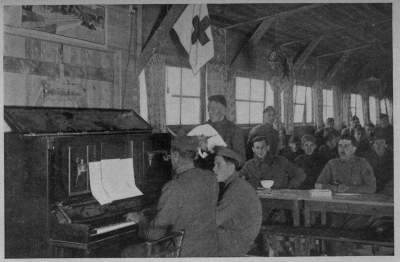
TICKLING THE OLD IVORIES
Many an ancient piano did herculean service in the A. R. C. recreation huts throughout France