Gracious and Artistic and Inspired by Cordial Friendship—Sailors
in the Bullring—Work of the Matadors Considered From a Nautical
Point of View—Interchange of Good Wishes by Admiral
Thomas and President Pardo—Charms of a City That Survives
From the Middle Ages—Trip 15,000 Feet Up the Andes—Remains
of Pizarro—Journalistic Compliments and Official Entertainments.
On Board U.S.S. Louisiana, U. S. Battle Fleet,
Off Callao Harbor, Feb. 29.
PERU remembered!
Almost as trite as the saying that corporations have
no souls, or that politics makes strange bed fellows,
is another that in international affairs the friends of yesterday
may be the foes of to-day, and that nations, as
nations, have no memories. If it is true, Peru is the rule
proving exception. Her gracious welcome to the American
fleet, from the first acclaim of greeting to the last farewell,
was marked by a sincerity that was peculiar in the
exchange of international courtesies.
There was reason for this. Of all South American
countries none is more devotedly the friend of the United
States than Peru. In the time of Peru's direct distress, when
the hell horrors of war left her plundered, sacked, pillaged,
as no nation in modern times has been despoiled; when she
was bereft of nearly her entire population of early manhood;
when dynamite and the torch were employed in a
heartless exhibition of brutality to mark as permanently
as possible the pathway of a mocking conquerer; when the
vandalism of victory even destroyed the trees of botanical
gardens, robbed altars of decorations, cut paintings from
frames to make bonfires, pillaged the savings of children,
destroyed civic utilities for the sake of wanton destruction;
when the conqueror struck the most terrible blow that
a conqueror can strike, the violation of the sanctity of
homes—and be it remembered that the women of Peru
are declared by all authority to be the most beautiful,
proud and high spirited in the world—when all this was
done, the first nation to comfort, to advise, to shield was
the United States.
True, once or twice the United States seemed to falter
and Peru almost cried out with bitterness because of it, but
there was another handclasp with sincere words of real
friendship back of it and Peru emerged from her trial
grateful and steadfast. That was a quarter of a century
ago and Peru said she would remember. Her hospitality to
the great American fleet proved that she did. She is no
longer poverty stricken. She is fairly well-to-do and
things are looking better all the time. She lives in comfort.
She even wears colors occasionally. She has young
men again and their energy is making for prosperity and
advancement all around. To the American fleet Peru said
as plainly as could be:
"I am truly glad to see you. We can't do as much for
you in the way of entertainment as our hearts could wish.
We can't lavish wealth upon you, but such as we have is
yours, all yours. We have remembered."
And so it was that Peru's entertainment of the fleet was
not extravagant or burdensome. It was delicate rather
than effusive. It was the welcome and hospitality of high
breeding. From the first gun of the cruiser Bolognesi,
sent 250 miles out to sea to escort the fleet in to Callao, to
the last "Eep! Eep! Eep! Oorah!" on the tug that followed
us furthest to sea as we left this morning every act
of hospitality was in perfect taste and in a spirit utterly
foreign to vulgar display.
Yes, Peru remembered, and its effect upon the American
visitors was well expressed officially by Rear Admiral
Thomas on board the Connecticut on February 27 at a
dinner given in honor of President Pardo when he said:
"Nothing has been left undone that would add to our
convenience, comfort or happiness, and, permit me to say,
as military men, with the instinct of organization, we have
been impressed with the perfection of every detail and the
artistic taste displayed at every entertainment from the
time the fleet dropped anchor in Callao Bay to the occasion
of the brilliant garden party at the exposition grounds.
But most important of all, and that which has touched our
hearts deeply, is the warmth and sincerity of the welcome
that has been accorded to us, so patent to all.
"In our fleet there are nearly six hundred officers and
fourteen thousand men, and when we reach home waters
and in the course of time these officers and men are dispersed
throughout the forty-five States of the Union, visiting
their respective homes, each and every one of them will
be a missionary to carry a message throughout our broad
land from the Atlantic to the Pacific, from the Canadian
border to the Gulf of Mexico, telling of this welcome, the
result of which must of necessity tend to the drawing
closer and closer the ties of union between the two republics.
It will be a tradition to be handed down not only to our
children, but to our children's children."
The Admiral's speech was the fleet's answer to the formal
welcome of President Pardo at a dinner the republic gave
to the Americans on the night of Washington's Birthday.
This translation of the President's words was placed in
front of each of the guests the instant President Pardo
finished.
Admiral: The arrival at our shores of American warships has
always been looked forward to with the greatest pleasure by the Government
of Peru and her citizens, as it gives us an opportunity for
showing the true friendship which exists between this country and the
United States and for my countrymen to extend a cordial welcome
to the American Navy.
Were it possible our welcome would be augmented by the glorious
spectacle which you present us in Callao of the starry banner waving
from the masts of the most powerful fleet that has ever navigated the
Pacific Ocean, as well as by your most successful accomplishment of
this difficult voyage, which demonstrates the power and discipline of
the American Navy, to-day universally acknowledged by the entire
world.
With the sincere welcome of the Government and the people of Peru
we wish to express our admiration of the justice which has inspired
President Roosevelt's policy in the relations of the United States
with the Latin-American countries and their relations between themselves,
a policy which has met with the utmost success in the recent
conference at Washington and assures a permanent peace in Central
America.
A welcome to you, Admirals and officers of the American fleet.
Peru receives you with hearty friendship and reminds you that you
are on friendly strands.
On this day, when your country honors the memory of George
Washington, the founder of its glorious independence and of its admirable
form of government, I ask you to join me in the toast I propose.
The prosperity of the United States, the health of its eminent
President, Mr. Roosevelt, and that good luck may always accompany
the fleet under your command.
So much for the official welcome. The unofficial welcome
was everywhere. It began as soon as the ships entered
Callao Bay. There are no headlands or hills surrounding
the harbor, which is practically an open roadstead.
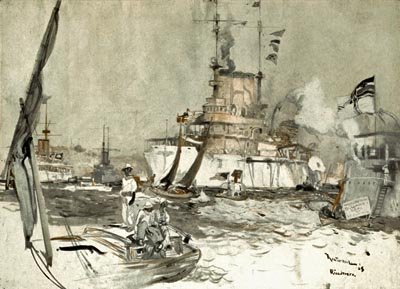
The fleet had to anchor two miles out. The harbor
was crowded with all sorts of little craft laden to the
danger point. Every tug, every launch, all the sailboats
that could be found, rowing barges, dories, two large
ocean-going steamers, came out to say howdy and bearing
cheering people by the thousand. Some of the little craft
fired national salutes with toy cannon. Those that had
whistles tied down the cords. One tug was crowded with
young men who insisted on giving the Cornell yell every
time a ship passed by.
As soon as anchors were cast a look shoreward revealed
that tens of thousands had come to the waterfront. Later
when one went ashore he learned that the Government had
declared a holiday in honor of the arrival of the fleet and
that all of Callao and Lima, seven miles distant, had come
down to see the ships. The stores and shops were closed
as if it were Sunday. Business was at a standstill. Official
visits were begun at once, but those who could get
away made haste to go to Lima on the modern trolley
system which in addition to two railroads accommodates the
traffic between the two cities.
The visitor noted that Callao was an ill smelling place of
garish colored houses and narrow streets—a mere port of
40,000 inhabitants—and that it had many of the characteristics
of some of the cities on the southern shore of the
Mediterranean. Once out in the flat country, the visitor
was reminded somewhat of the country between Brooklyn
and Coney Island. Truck farms were frequent. What
looked to be American corn was growing profusely side
by side with banana trees and sugarcane fields. Patches
of good old fashioned vegetables—onions, cabbages, radishes,
lettuce—were also under cultivation. Large herds
of fine cattle grazed on some of the fields, and in others
were herded splendid flocks of sheep. It looked almost
like home. The fences alone were strange. They were
made of thick blocks of dried mud. The entire cultivation
was dependent upon irrigation from the Rimac River,
the splendid mountain stream that dashes down from the
Andes in a torrent clear to the sea.
Then one came to Lima itself, situated on a plain girdled
by the foothills of the Andes, with its low lying houses,
all made of mud plastered upon bamboo reeds, with not a
roof in the city that would shed water, for in Lima it never
rains; to Lima, the one city in the Western Hemisphere
which has preserved a large amount of the architecture of
the Middle Ages and is rich in traditions of the past.
There in this city of 150,000 people with its well paved
streets, its bustling activities, its fine climate (the temperature
never goes above 80 degrees, although the city is only
12 degrees from the equator) and attractive people the
Americans found plastered on every building in town a
paper reproduction of the American flag with the words
printed on it:
"Welcome to the American fleet!"
Peru's flag was posted by its side frequently. The
Government had done it. You see every person in town
couldn't come up to you and tell you that he or she was
glad to see you. He or she was; but it had to be told in
some other way, and so these placards voiced the feeling
of the people. If anything else were needed to complete
the greeting it was supplied when the Diario, the leading
newspaper of Lima, came out with halftone reproductions
of ships, officers and the Annapolis Academy, a page of
news in English from the United States and a formal welcome
to the fleet. This welcome was unique. It is worth
reproducing at length. This is what it said:
Every social class in our country, all the elements which make up
the life of Peru, have attended with sincere exhilaration to contemplate
the gallant representatives of the power and greatness of the
United States.
These ships come after a trial of resistance which has proved the
discipline, the self-denial, the moral energy, the patriotic pride of
race, all those eminent faculties which beautify the spirit and elevate
the personality of the great republic of the north.
Peru has the glory and good fortune among the nations of America
to offer its hospitable strand to serve as a shelter during the short stay
which their itinerary imposes on our guests.
Peru receives them with the affection of brothers, with the traditional
and courteous nobleness of our race, with the sympathetic and
respectful admiration which the example of the great and lofty North
American virtues awaken in our mind.
A people which has itself worked up in its own laboratory such a
colossal fermentation of greatness, a people which owes everything to
the efforts, to the activity, to the work, to the initiative of its men,
a people which has not forsworn the splendid incentives of its ideals,
and which carries within itself as a secret impulse to irradiate its
spirit beyond its natural boundaries, is a people which raises in all
others the warm and ample admiration which the Americans have experienced
in the entire course of their voyage.
The powerful fleet which to-day reaches our shores, the most formidable
and splendid which has stemmed the waters of this continent,
does not come on a war footing or as a menace. A high sense of
political prevision, the most eminent virtue of a statesman, induced
President Roosevelt to order the movement of the Atlantic fleet to the
Pacific coast. The illustrious governor who carries on his shoulders
the enormous responsibility of directing this great people has proved
himself worthy of his post, contemplating with serenity and firmness
all future eventualities, and consistent with his pacific intentions,
which do not exclude designs of warlike prudence, has prepared himself
by this spirited parade of force to prevent a war.
No technical authority, either military or diplomatic, believes in
the probability or imminence of a great war. The United States
have many efficacious resources for dissolving or removing indefinitely
the threatening and apocalyptic spectre of a universal conflagration
such as would take place in the world, given the present aggrupations
of factors.
Their economic strength, their marvellous industrial richness, their
bullion reserves, their growing population, their formidable means of
attack and defence which we contemplate to-day, all these are so
many conservative encouragements which will help to check audacity
and outside ambition.
This welcome is presented to show how Lima and the
editors of the Diario really tried to make the Americans
feel at ease. Of course the printed English translation
failed to do full credit to the excellent Castilian of the
original, but there could be no mistaking the genuineness
of the welcome.
It was sincere all right, and no doubt there was a proud
man in Lima as he contemplated the mass of fine words he
had piled up. As soon as the paper came out and the
Americans had passed the word along that it was great
there was a rush to get it. The visitors stopped one
another on the street corners to read it aloud and the general
comment was:
"Fine! It makes us feel as if we were right back in
Brooklyn. No such language as that can be read in a
newspaper in any other place in the world except Brooklyn.
Of course we are used to such expressions as 'colossal fermentation
of greatness,' 'threatening and apocalyptic
spectre,' 'aggrupations of factors' and the like of that
in Brooklyn, but who would have imagined that we'd meet
'em so far from home?"
And as if that wasn't enough to make it plain to the
Americans that the freedom of the place was theirs they
were met at the terminal of the trolley line from Callao
with men who distributed a pamphlet of information got
out by a firm with American names, makers and purveyors
of a popular libation. The title page bore this inscription:
"Here's happy days to the men of the American squadron!"
The inside of the pamphlet told salient facts and gave
statistics about Callao and Lima, informed you how to get
about, where to go and what to see among the "points of
interest." The way it put the matter was this: "Over
and above a hearty welcome, here's what's worth while."
It advised the visitors to give the sexton of the Cathedral
a tip for showing them Pizarro's bones, but said:
"Don't tip him too much or you'll spoil the market,
'cause this isn't New York."
Then the pamphlet said, sundry items of advertising
being eliminated:
SPECIAL NOTES.—Drinks and their Prices.—"Swear Words"
and How to say them in spanish, etc.
Cocktail 25 to 30 cts. peruvian equal to 15 cts. American. Whiskey,
Gin, Sherry ("hair ace") Port (Oporto) etc. all cost the same.
The Cocktails known here are, American, Martini, Whiskey, and
Fresas (strawberry).
| No! |
is No! just as we say it, and the harder you pronounce it the better it is understood. |
| Yes! |
si, pronounced "see." |
| Vaya |
go on, pronounced as spelt (Roseveltian, excuse this). |
| Sigue no mas! |
(seegay no mas) Drive on! |
| Corida de Toros |
Bull-Fight |
| Plaza de Toros |
Bull Ring |
| Toro |
Bull |
| Torero |
Bull Fighter |
| Matador |
The Killer, this is the man who finally does the trick. |
| Fuera Toro!!! |
pronounced fuera toro, "put the Bull out. he's no good! Give us a Bull that Fights:" |
........!!........!!!........!!!!..........!!!!!.
(Blank spaces for american expressions if your spanish runs short
or thick.)
While it isn't as fast as Coney Island, Luna Park, Steeplechase,
nor the Hippodrome, you'll move quite as "fast" if you get down
into the Ring.
Wishing you each and all a most pleasant sojourn in this "City
of the Kings" and a bon voyage on your journey Northward.
Then began the exploration of Lima. Standing on one
side of the beautiful Plaza de Armas is the great Cathedral,
which was started in 1540 and which cost $9,000,000,
despite the fact that its walls are of mud and, as one writer
has said, could be run through with a fence rail in almost
any place. It was the inside decoration that cost so much,
for it has rare wood carvings, and once was fairly plastered
with gold and silver stolen by Pizarro, "the pious old cutthroat,"
from the Incas. You see, Pizarro founded Lima
in 1535, and although he was known as the "Indian
butcher," he began right by establishing a Cathedral, and
there his bones in a mummified condition rest. They are
kept in a glass case and are in a crypt. An attendant
takes you to the coffin, lights a candle for you to read the
inscription on the case and to peer in and you get a first
rate look at a mummy.
Pizarro undoubtedly knew his business well. He gathered
in the millions upon millions that the Incas had saved
up for a rainy day. It was explained that Pizarro had
found out that it never rained where he intended to set up
in Lima and therefore he told the Incas they really had no
use for all that gold and he would take it, establish a city
and give them real religion and be a missionary and all that
for them.
"All of which," as a bluejacket who had been reading
up the history of the place said, "he done good and
proper."
Pizarro attracted the attention of thousands of the
visitors. Not all were irreverent or flippant. Many of
them paused a long time before the mortal remains of one
the greatest men in history. You felt as if you were really
at a shrine.
Then the explorers visited other churches which took
one back to the Middle Ages. There was the Franciscan
convent and church. There was the church where the remains
of Santa Rosa, the only American woman saint, rest.
Then there were numerous other edifices with old doors
and heavy bolts and locks, and inside some of them were
decorated with what seemed to be solid sheets of gold about
their pillars; churches where there were beautiful old paintings
of religious subjects, churches where the tiling was
brought from Europe and is now almost priceless in value,
churches where there were historic parchments.
The visitors then went to see the Senate Chamber, with
its carved ceiling, one of the wonders of the world in that
line; brought from Europe and paid for with Inca treasure
in 1560. That room was used in the days of the Inquisition,
which lasted longer in Peru than in Spain and was almost
as terrible. In fact in this viceregal city, the second
founded in the Americas by the Spanish, one could see religious
emblems at every turn. Just outside the city on a
hill overlooking the bullring is an enormous cross, probably
fifty feet high. Every year the society that had it erected
makes a pilgrimage up that hill after a parade in the city
and holds services, wherein vows to uphold the faith and
lead lives of purity and honor are retaken. On a dozen
other hills crosses and shrines may be seen.
It is evident that Peru as a nation is still devout, but if
one could have seen the crowd at the San Pedro Church
on Sunday morning when the doors were opened and the
beauty and high blood of Lima came out from their devotions
he would have been convinced that Peru is really
no exception to other Latin American countries, and indeed
most other countries, in that the women are the mainstay of
the church. That beauty parade is one of the sights of
Lima, and the Americans, officers and men, were there, side
by side with the men of the city to see the show.
As the visitors went about, one change, national in character,
impressed itself upon them immediately. Every
writer on Peru has commented on the fact that the headdress
of the women, worn universally, is the black manta.
It is said that it is a relic that has come down from the
Incas when they put on mourning for their great chief
Atahualpa. Rich and poor have worn that headdress on
the street for centuries. It was an established institution.
Well, it is going. About one-half of the women, some
of them in good circumstances evidently, wore mantas on
the streets, but as for the rest—well, a man has no business
to write about women's hats. All that this man can
say is that he never saw more dazzling specimens of flower
gardens than those bobbing around over the graceful
drapery with which the Peruvian women adorn themselves.
Thus does fashion war successfully upon established custom.
The Peruvian woman loves a beautiful hat just as
much as any other woman on earth. Moreover, what is
said about her surpassing beauty is true. Given great
beauty and the love of a hat on the part of a woman—what
chance has a black manta got? The manta has got
to go and is going. Truly this is a world of change and
there are those who will say it is one of decay, but let no
one breathe that in a fashionable millinery shop in Lima.
Then came more sightseeing. All the clubs of the city
were thrown open. All the postal card shops had extra
supplies.
"English Spoken Here" was posted on the windows and
doors of scores of shops. One sign that was amusing to
the Americans read:
American Spoken Here.
Buy a Sewing Machine.
The first formal entertainment came on the night of
Washington's Birthday, when the officers of the fleet were
the guests of the republic and the President at dinner.
The banquet was given at the exposition grounds, a park
where sundry exhibits of great worth from the standpoint
of history, natural history, commerce, education and the
like, are preserved. The dinner was in the grand hall of
the main building. The decorations were almost exclusively
of the colors of Peru, red and white. On the stage
an immense orchestra was massed and the American colors
were used there for decorations. That band played as
only a trained South American band can play.
It was the opinion of naval officers who have dined the
world over, with kings and emperors, with great welcoming
committees and the like, with Government guests of our
own in Washington and New York, that they had never
attended a better managed affair than that dinner in Lima.
Not only was the dinner perfect from an epicurean standpoint
but the service matched it. Every appointment was
in the best taste. Not the slightest detail was lacking.
The American officers grew enthusiastic and when President
Pardo finished his address of welcome there was tremendous
enthusiasm. The President, after Admiral Thomas
had made his reply, arose and walked into a beautiful illuminated
garden and there the diners met him socially and
found this young man, who represents what Peru has
needed most for years, a commercial and not a military government,
delightful and unassuming, with a grasp upon
matters of statesmanship which showed that not only was
he practical in his management of the country but a good
deal of a scholar. Pardo believes in education rather than
the sword, in the development of commerce rather than in
personal aggrandizement and the display of military force.
Then there was a garden party at Minister Coomb's
home, a beautiful place; the garden party of the municipality
at the exposition grounds, pronounced by all the
naval officers as the finest thing of the kind they ever attended;
the delightful ball at the National Club and the
excursion to the famous Inca ruins of Pachacamac. The
officers had the eminent archæologist, Dr. Unhe, to explain
the wonders of the Temple of the Sun, the other buildings
and the hundreds of specimens of pottery, metal and other
things recovered from the ruins at Pachacamac.
But with all these functions there were two others offered
by the Government as the chief things in the way of entertainment,
a bull fight and a trip up the wonderful Oroya
railroad to the top of the Andes Mountains, the highest
place in the world reached by a railroad.
Now, as to that bull fight. Let it be said at once that
in the main it was like all other bull fights, described thousands
upon thousands of times. All the trappings and fittings
were there. Of course, the bulls had no show. They
had to die, six of them. It was just as brutal as Americans
are wont to call such exhibitions, with the exception that
no horses were allowed to be disembowelled and killed.
Peru up to two years ago had always fought bulls with the
horse killing feature eliminated. For that reason many
persons regarded her bull fighting as the best in the world.
Two years ago the people demanded a change and horses
were gored in the style of Spain's best brutality. Out of
respect for the Americans, and by order of the President,
the horse-goring feature was omitted this time.
There was plenty of excitement. All three of the matadors
were injured. One was tossed by the first bull three
minutes after the animal had entered the ring. That
settled the famous Bonarillo. He went out of business.
Another matador, Padilla, was gored in the throat by the
fifth bull and for a time it was thought that he was injured
mortally. The third matador was scraped up the side by
the last bull as the death thrust was delivered, and Largartijillo
chico, the young Largartijillo, just as we say
Young Corbett, came near going to dwell with his fathers
eternally.
Oh, yes, there was lots of excitement and agility and skill
and all that, but why describe a bullfight as a bullfight?
No story is older. What was peculiar about this fight was
the presence of 3,000 American sailors. That's a different
story. You want to know how Jack saw it and what he
said and thought and did. You can see bullfights any
time you want to pay for them; you can't see American
bluejackets at such a spectacle as the chief guests of a
Government, and that's what made this fight tremendously
interesting.
Well, this one was held in the famous ring almost as old
as Lima. Six bulls from the famous stock of Rinconada
de Mala, the property of Dr. Don Jesus de Asin, had been
provided. They were the fightiest bulls in all Peru; and to
make sure that they would do their best they had been
teased privately beforehand. The fight, as the handbills
announced, was a "grand gala," one given "in honor of
the North American squadron to celebrate its happy arrival
at the port of Callao."
Well, the hospitality of the Government went further,
for it named the bulls in honor of the fleet. The first bull
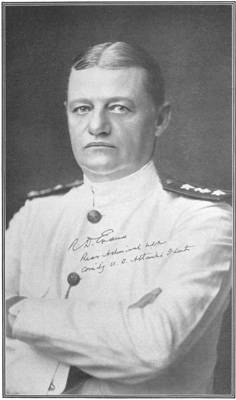
was "the gallant Alfred, in honor of Admiral Evans";
the second, "the heroic Ranger, in honor of Admiral
Thomas"; the third, "the Brave Teddy, in honor of Admiral
Emory"; the fourth, "the Shufly, in honor of Admiral
Sperry"; the fifth, "Banjo, in honor of the officers
of the navy"; the sixth, "Yankee Doodle, in honor of the
sailors." Could hospitality go further than that?
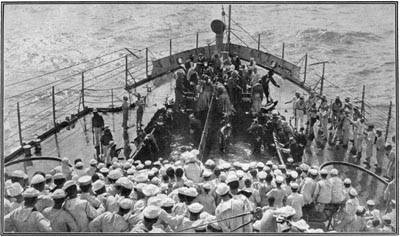
About 175 men from each ship and all the officers of the
fleet were invited. The sailors filled two-thirds of the arena
and the officers and the high society of Lima filled the boxes.
All had assembled on time, and then came the President to
sit in the box directly opposite that of the officers of the
municipality, with chairs of red plush for the box and a
dais for the President, who was in evening dress. The
American Admirals and Captains were in that grand box.
The Peruvian band played "The Star Spangled Banner"
and the bluejackets stood at attention and then all hands
cheered. When the President came and the Peruvian
national hymn was played, the bluejackets gave three rousing
cheers for Pardo and Peru. Then all was ready for
business. The key was tossed into the ring for the parade
of the fighters, capeadores, banderilleros, matadors, the rig
to pull the dead bulls out, and all that.
The Americans were all intense. The fighters took their
stations, the Mayor gave the word, a bugle blew, a door
was opened and a great brown and black bull with horns,
as one of the local newspapers described them, "like the
spires of a steeple," bounded into the ring, took one look
around and dashed madly after an aged horseman riding
a beautiful iron gray pony and flaunting a red cape over
his mount's flanks. There were two of these horsemen and
the exhibition they gave of fine riding would have put the
best cowboy or rough rider to shame. The man the bull
put after was more than eighty years old and the way he
twisted his pony here and there and just escaped the lunges
of that bull, turning sharp angles, pulling up short, making
his horse fairly leap out of the way, dodging this way
and that until the bull was astonished elicited roars of applause
from the bluejackets. They liked that part. Then
a younger man took up the same work. He was even
more skilful. Bullfighting was fine so far.
But let Bill Watkins, bos'n's mate, be heard from.
Bill, you see, had been to these things before in his gyrations
round the world, now having five stripes on his sleeve.
Bill gathered a group of youngsters about him and invited
the Sun man to come along to have a bullfight "explained
proper."
"You see," said Bill, "these Spiggoties (a sailor term
applied to Latin Americans because they say 'Me no spiggoty
English') think they know all about bullfights.
They doesn't, to use good grammar. You want to look
at 'em from the standp'int o' seamanship an' gunn'ry.
There's where you get the real benefit. Why, many a
middy c'n learn more 'bout seamanship an' gunn'ry here
than he kin from two years on a bridge. I tell ye these
bullfights oughter be in the kricklum, or whatever they call
it, at Annapolis."
Just then a bugle blew telling the mounted cape men to
give way to those on foot. Bonarillo, the matador, advanced
with a purple lined cape "to feel the bull out."
He waved the garment gracefully from side to side. The
bull dashed at him. Bonarillo's foot caught in the corner
of the cape, the bull gathered him on his horns and agilely
tossed him over one shoulder and then dashed away after
another capeador. Bonarillo tried to get up, but couldn't.
Soon he was carried out of the ring. Glory was not to
be his that day. Bill took it all in and explained:
"There ye go! Ye see, that matador ought ter remembered
that he was in shoal water. He thought he
c'd navigate 'thout takin' soundin's or gettin' bearin's.
That bull had his range all right, but his deflection was
poor. When the bull got 'im under the leg with his horn
that shot sure counted. The bull hoisted 'im all right,
but the man who was tendin' the fall let 'im go by the run
when it came to lowerin' away. There, the wreckin' tugs
have got 'im! Now they're carryin' 'm 'behind the breakwater.
It's the drydock for cocky Bonarillo, all right.
Mighty poor seamanship and just ordinary gunn'ry fer
the bull! You see, 'twas only a pot shot."
Then the cape men began to wave their emblems at the
bull. Now and then the bull would catch one of the capes
in his horns and toss it to the ground and trample on it.
The men had to run for the shelters often. The bull was
fresh. Bill explained:
"Ye mustn't take too many chances in a fresh breeze.
There, ye see, that fellow's let his lower stu'nsail get carried
away. He didn't shorten sail soon enough. The man
at the wheel let 'er luff too soon, and come to against the
helm. Don't never belay no sheet!"
Then came the signal for the banderilleros to sink their
darts in the shoulders of the bull. One of them would
catch the bull's attention and they would rush toward
each other. The banderillero would change his course
after the bull got under way and by just grazing his horns
would plant the darts in his shoulders. The first man got
rousing cheers. From his darts two flags unfurled. One
was that of Peru and the other that of the United States.
It was supposed to be a pretty compliment to the Americans.
Bill explained how the banderillero did it:
"Say, did y' see that feller? He stands close hauled
right up to the weather mark, then he bears up and passes
to leeward, with his lee rail awash. He's been whaling
all right—we was eighteen months in the Mozambique
once, when I was whaling out of New Bedford, and our
iron man always took his fish like him. Ye see, ye stands
yer course right up to the animal, then give a rank sheer,
heave, and let him go by!"
The bull was now very tired. Padillo, the second
matador, came out, bowed to the authorities and asked the
President's permission to kill the bull. He got it and it
was up to him to do it. He waved his bright red cape,
sheltering his sword, repeatedly in front of the bull, stepping
aside just in time to escape the horns. The bull was
dazed. Then Padillo stood about ten feet away, poised
his sword to take aim and rushed on the bull. The sword
did not hit the fatal spot. The thrust was a failure.
Bill said:
"Ah—he's a bum pointer! A guy what's been in
training as long as he has and ain't got no better sense
than to fire before he's steady on don't deserve to hold the
rate. Mighty poor gunn'ry that!"
Again the matador failed. The sword went in deep.
Muscular contraction, which had forced the first sword out,
failed to move this one and a capeador threw his cloak
over the weapon deftly and drew it out. Again there
was a failure to kill, but the bull was almost exhausted.
He sank to his knees, got up and made one more lunge at
Padillo, who then sank the sword to the hilt in the proper
place and all was over. There were cheers, but Padillo
hadn't done well. Bill said:
"Say's he's a bum reefer and a yardarm furler. I'll
bet that guy's a trimmer. Ye can tell by the cut of his
jib that he's in everybody's mess and nobody's watch.
He's jack outside the lift when the liberty party's called
away, but sick bay for him when the coal comes alongside."
The second bull, Ranger, gave the horsemen plenty to
do. He soon had the aged horseman in difficulty. Time
and again the horseman, looking over his shoulder,
flaunted his cape this way and that; but it was evident
that the bull could not be escaped easily. All the fighters
became nervous. At last the bull made a thrust that
caught the beautiful iron gray pony in the flank with a
deep wound. The cape men interfered at once and the
horseman rode away to safety. Bill had this to say:
"There, that rider went wrong! The bull was after
him under full sail and was yawin' 'round three or four
p'ints each side o' the course and rollin' and pitchin' somethin'
awful. That man on the horse, the picalilly, or
whatever ye call 'im, tried to give the bull the right o' way,
although, bein' close hauled, he should a-held his weather
helm on 'im. However, not obeyin' the rules o' the road,
he starts to give way, but at the critical moment the bull
makes a yaw to port, rams the horse in the starboard quarter.
The picalilly man tops his boom, stands to the eastward
and tries to put his collision mat over. He should
a-put his helm over the other way. Poor work, poor
work!"
So the fight went on. Padillo killed another bull, but
he had three failures at thrusts before the beast sank down
and died. There were hisses for him, and some of the
bluejackets shouted:
"Take him out and put him in a minor league!"
Lagartijillo chico killed the third bull and did no better
work. There was a diversion in this fight. A banderillero
sat on a chair and made the bull charge at him. The
banderillero rose just as the bull reached him, planted his
darts in the animal's shoulders and leaped to one side. It
was a beautiful piece of work, and the bluejackets roared
their applause. Bill approved the seamanship and said:
"That man on the chair apparently didn't have no
more chance than an ice skatin' rink in Zanzibar, not to
mention a hotter place, usin' a shorter and uglier word.
He shifted his moorin's jest in time. It was too late to
repel boarders, but he got away. Fine seamanship for
the man! Poor work by the bull! He ran down the
moorin' buoy, that was all, and splintered it all t'ell and
gone. Ye see the man got the right to choose position
and fire at will. That's a great thing. Jest remember
that lesson."
In the same fight one of the men took a long pole, ran
straight at the bull, planted the pole directly in front of
the animal and vaulted clear over him, coming down just
as the bull hit the pole. In his descent the man seized
the bull's tail and gave it a twist. Bill was delighted.
"Lay aft to the braces! Weather main and lee crojic
braces! Hard down there! Lay yer maintops'l to the
mast. No! by—! Hard down! He's going to wear
sharp 'round and bring up to windward of him! Say, that
feller's a sailor all right—every hair a rope yarn, every
finger a fishhook and every drop of blood a drop of tar."
Padillo killed the fourth bull and made his usual number
of failures. The fifth bull, Banjo, aroused the sympathy
of the crowd. He fought magnificently. He
would not be tired out. It came time to kill him. Padillo
went after him with his cape and the bull deftly caught
him, lifted him in the air, and he fell beside Banjo and
rolled under the animal. Down went the horns to gore
him. The cape men fluttered all around. Padillo curled
himself up in a ball. The bull stepped this way and that
and then charged off after a cape man, leaving Padillo
unharmed but his nerve gone. He went after the bull
again. He was deathly pale about the mouth. One of
his legs trembled violently. Deathlike stillness was over
the ring.
Soon the bull began to tear his cape from his hands, a
disgrace. Once, twice, three times the bull did this. The
Peruvians were enraged. They cried "Shame!" Padillo's
father, who was in the ring, tried to explain that it
was a bad bull and invited the critics to come and try it
themselves. Almost beside himself, Padillo made three
rushes at the bull without taking proper aim, in the hope
of catching the animal unawares and giving him a death
thrust. The fourth time he gave the thrust.
The bull saw him coming, did not lower his head, and
just as Padillo placed his sword in the neck the bull raised
his head, caught Padillo on his horns, one of them penetrating
under the chin and entering the mouth cavity. A
cry of horror went up. Padillo fell but got up quickly,
and with a look of mighty disgust saw the bull reel away.
Then, catching himself by the throat and staggering forward
Padillo ran to the enclosure from which the bull had
entered, a distance of about twenty feet, the blood streaming
from his wound. He dropped just inside the enclosure
and word was passed around that bull and man
had each given the other the death thrust. Tragedy could
not have been more complete had it been true, but Padillo
went to a hospital and didn't die. There were thousands
of Americans who said they really did feel a little sorry
for the bull. Bill Watkins explained the poor gunn'ry
of Padillo.
"Up in the air! Up in the air! Come down out of
the balloon! Say, he's like a landsman at a 13-inch gun
with a misfire—don't know what to do with it himself
and can't give it away. Take him out of the hood! Give
him an air gun! Let him blow soap bubbles! Don't fire
until the gun's loaded, sonny! There, the operating lever
caught him in the mush! Yer better keep out of the line
of fire next time!"
The last bull was killed by Lagartijillo. It was the
same story, except that just as the matador gave the
deathblow the bull hooked him along his right side and
tore his clothes. He had a narrow escape. His wounds
were only bruises. As the bull sank down dying fully 200
bluejackets jumped into the ring to follow the example of
two who earlier in the fight had leaped in and secured
the darts in an animal's neck for momentoes. They
swarmed at Yankee Doodle. He saw them coming and as
they seized the darts rose to his feet and tried to lunge at
some of them. It was too much and he fell as the men
began to scatter and died at once. Bill said:
"Fine work! He tried to repel boarders, and he done
it, too! If yer ship's sinkin' and it's yer last gasp don't
never fergit to repel boarders. Ye kin go to glory satisfied
then. They ought ter named that bull Cumberland."
Bill explained the day's events:
"Ye see, the bull ain't got no chance after his ammunition
is gone. He was firin' his last 3-inch guns when he
got that Padillo feller. It's a case o' destroyers and gunboats
fightin' an unarmored cruiser with a short supply o'
ammunition. When that gives out the cruiser is bound to
go. Some o' the destroyers gets put out, as Bonarillo
and Padillo did, but there's no use in goin' t' sea unless
ye got full magazines and ain't cut off from your supplies.
Oh, yes, there's lots o' things to learn from these
bullfights!"
Then Bill shifted his quid and joined the crowd going
out. The bluejackets didn't care much for the sport.
Some of them left after the third fight and there was a
steady stream from the ring afterward. Those who remained
had this one comment:
"One feller got it in the neck—got the hook, all
right!"
The writer holds no brief for the defence of bull fighting,
but he wishes to say that the exhibition, with the
goring of horses left out, was no more disgusting than a
prize fight between two bruisers. Any contest that has
the letting of blood as its chief feature may be called
sport if its devotees so choose. This fight was no more
brutal than shooting at bears from a safe distance and
was not half so cruel as wounding a deer and allowing it
to drag itself away and die in suffering. The bulls were
in pain from the darts and showed it from time to time,
but in their rage forgot the pain after an instant or two.
Giving them a thrust in the heart was no more cruel in the
way of killing than it is to hang up a turkey or a chicken,
cut its throat and let it bleed to death.
Death came almost in an instant to the bulls. The
fighters risked their lives dozens of times. The bull had
a fair show at them. Their quick movements, hairbreadth
escapes, showed that nerve and rare skill were required.
Compared with prize fighting where two sluggers cover
themselves with blood, and when one is staggering about
from exhaustion the other gives him a blow that makes
him unconscious—well, the writer says unhesitatingly that
he prefers the Peruvian bull fight. It all depends, you
see, upon the point of view.
Only a limited party could be the guests of the Government
on the Oroya Railroad trip. It was known as the
official party. An unofficial party with an engine and a
passenger car followed. This Oroya Railroad was started
by Henry Meiggs, the defaulting partner of Ralston in
California who fled to Chile, got rich and paid up his
debts. In 1869 he went to Peru and started this railroad.
Peru had money to spend then. Meiggs finished the
road up the mountains as far as Chicla in 1876, and then
the money gave out. More than $26,000,000 had been
spent going eighty-eight miles. Later the Peruvian
Corporation finished the road to Oroya, on the other side
of the Andes, and connections have been made with the
road to the famous Cerro de Pasco mines, owned by Mr.
Haggin and other American millionaires. Two other
branches have been built and ultimately it is planned to
extend the road to the headwaters of the Amazon in Peru,
so as to give the country on the east of the Andes an
outlet to the Atlantic Ocean for its products.
The highest place on the line is Galera tunnel, under
Mount Meiggs. It is 15,665 feet high. The distance is
106 miles from Callao. There is not an inch of down
grade in the climb. There are no less than fifty-seven
tunnels. Bridges over chasms and foaming cascades and
the River Rimac, whose course the road follows, are numbered
by the score. For forty-seven miles it is a steady
climb beside the Rimac torrent in a desolate country, with
the mountains red and bare. There is no rainfall in that
district.
Then you come to where the river is hemmed in by
mountain gorges, and you have to climb by means of
switchbacks. Up you go, tilting this way and that, beyond
two layers of clouds. The sides of the mountains
become green. You are now in the land of the ancient
Incas. Abandoned terraces that lose themselves in the
clouds flank scores of mountain sides. The Incas raised
their products there by some system of irrigation.
Fine specimens of trees appear, fruit orchards with
chirimoyas, palta, nispero and pacay, and willow and pepper
trees in abundance. The flowers begin to greet you,
the heliotrope, solanaceas, spurge and cacti all around.
Back and forth you seesaw with massive, towering mountains
above you and several lines of tracks far below you.
Now and then you come upon a little town thousands of
feet in the air.
Then you reach a place where a smelter sends its blasts
up in the skies, and you begin to see what supports this
road. A footpath or trail climbs the ravines, and you see
scores of llamas bearing their burdens and driven by the
native Indians. A hundred cascades, some of them with
the beauty of Yosemite's Bridal Veil leap with their spray
down the sheer cliffs. The lights and shadows paint the
bare rocks delicate hues, such as you cannot see even in a
sunset glow.
You come to the famous Verrugas bridge, 575 feet long
and 225 feet high, in its day the greatest feat of railroad
engineering ever known. You are now in a belt twelve
miles long where no tourist can live, for there the Verrugas
fever rages. It is one of those strange local diseases
found occasionally in the world peculiar to a small zone
and baffling to medical science.
You see crucifixes all along the route. Still you climb
and climb and you see ragged edges of mountains above
you which you know you will surmount. You come to a
dead stop against the face of a mountain thousands of feet
high. You back away up its side, and little by little, twisting
and turning you lift yourself above another cloud
layer.
The air gets cold, a dash of rain comes as you pass
through the clouds. At 10,000 feet high a sharp pain
runs through your ears. You take several long gasps of
breath and it passes away. A slight headache comes at
12,000 feet. It passes away and finally you reach the
tunnel and emerge on the other side of the Andes with
the snow all about you and you throw a few snowballs and
start back. Your head begins to feel strange. At 13,000
feet it aches violently. The ache is as near like the morning-after
headache as can be. In the official party not
one person escaped it. Half a dozen strong men became
sick at the stomach and had violent attacks of vomiting.
The mountain sickness was on. Other men were laid out
in the cars prostrate.
At this stage came a complication. Heavy rains had
been falling below and word was telegraphed that there
were four washouts and the party would have to stay in
the mountains all night. The faces of the railroad officials
became grave. To keep that party at the height of
13,000 feet all night might prove almost fatal to some.
It was this trip which brought on the illness that ultimately
killed the late Dr. Nicholas Senn.
Word was sent that by care the train might descend as
far as 10,000 feet. A handcar was sent on as a pilot and
in the darkness and snow that train was piloted down those
mountain declivities, where the least slip of the earth would
have sent it hurtling down cliffs thousands of feet. The
pace was only five miles an hour.
The sickness did not diminish until at 11 o'clock at
night Tamboraque was reached, where the unofficial party
of officers which had not gone up the full height was
stalled. There was one inn with four beds and ninety
men to occupy them. The unofficial party was in full
possession. They had organized the Society of the Llama,
Landslide Chapter. They had a merry night. The official
party, sick, worn out, turned in to sleep in car seats.
The next morning by walking around landslides and meeting
trains in the gaps the party was got down to Callao.
Several did not get over the mountain illness for three
days. It was a magnificent trip in the grandest scenery
in the world, but mountain sickness, all concurred, was
worse than seasickness.
By way of return entertainment by the fleet a dinner
was given to President Pardo on the Connecticut, and then
a fleet reception was held on the same ship the day before
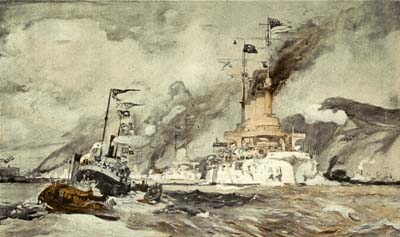
sailing. This morning President Pardo boarded the Peruvian
cruiser Almirante Grau and the fleet thundered out
twenty-one guns on each ship in unison. The Grau
passed out to sea and orders were signalled from the flagship
to get under way. Then the fleet passed by President
Pardo in the best of style, each ship firing a salute as it
went by. It made a fine spectacle. The honors were
the same as paid to President Roosevelt in Hampton
Roads, President Penna at Rio and President Montt at Valparaiso.
President Pardo sent his thanks by wireless and got a
fine reply of appreciation from Admiral Evans, and it was
good-by to Peru, with the sounds of cheers coming over
the water and the sight of fluttering handkerchiefs from
thousands; the last salute.
True it was Peru had remembered, and those who had
called on Dr. Polo, the Minister of Foreign Affairs, began
to realize the significance of the fact that in his office there
hangs just one picture. It is the portrait of an American
statesman—James G. Blaine.