Captain Lamont was disturbed by the rumors he heard at Kansas City of
the dangerous condition of navigation below that point; but he was a
brave and determined man, and would not be swerved from his purpose of
reaching St. Louis, now that he had gotten so far on the way and
overcome so many difficulties. The next morning the barge started out as
usual, and as there was deeper water the farther down river she went,
her progress became more rapid. Four days after leaving Kansas City she
tied up for the night opposite Brunswick, Missouri, a town about
twenty-five miles, by the channel, above Glasgow. Though it was said
guerillas had been in Brunswick the day before, none had yet interrupted
the journey of the barge, nor had any even been seen; and Captain Lamont
and his men had begun to think that the alarming rumors circulating
through the country were largely without foundation.
The following morning, a short time after the boat got under way,
Captain Lamont found that the deck hand, Jim, was missing, and then he
made the additional discovery that his own wallet was also gone. Though
a guard had been maintained on the boat all night, as usual, Jim had
contrived in some way to slip ashore and escape with the money. The
circumstances made Captain Lamont somewhat uneasy.
"I don't care about the money," said he. "There were only a few hundred
dollars in the pocket-book. But I should like to know what that fellow
wanted to get away for when we are so near St. Louis. He could have
robbed me just as easily there, and then he would have been in a country
where he could get a job when the money was spent. But he certainly
can't expect to get one around here."
"I'll tell you, Captain," said Al, "I believe he's gone to try and find
some rebs or guerillas to make an attack on our boat. You know he's a
rebel at heart. He probably figures he can get me into trouble that
way, and you, too; for he doesn't like you any too well."
"That's a long guess," replied the Captain, after studying Al's theory
for a moment, "but it may be correct. Anyway, I wish I knew what he's up
to."
The boat drifted lazily on for a couple of hours and at length came into
the head of a long, gradual bend having, on its north side, a low, open
shore of sandbars, with meadows and farm lands farther back, and on the
south an extensive belt of timber growing between the water's edge and
the bluffs. The channel ran close in along the timbered shore, and the
place was such a favorable one for an armed party to attack passing
river craft, and had so often been utilized for that purpose during the
war, that it had come to be known as Bushwhacker Bend,—"bushwhacker"
and "guerilla" being terms used interchangeably for describing the
irregular partisans along the border.
As the boat came to the head of the timber, the pilot crowded her over
as far as possible toward the north bank. But she had gone only a short
distance when a crowd of apparently about fifty men, wearing all manner
of ragged and dirty garments, suddenly arose among the trees and fired a
rattling volley of musketry point-blank at the barge. The bullets
plunged into her wooden sides and tore through her tarpaulin covers,
though, almost miraculously, no one was hit. Then a man wearing a sabre
and dressed in gray clothes somewhat resembling a Confederate uniform,
stepped forward and, waving his sabre toward the boat, shouted, with an
oath,
"Bring that boat in here or I'll kill every man on board!"
Seeing nothing but guns pointing toward him and knowing well that the
guerilla chief could make good his threat, Captain Lamont shouted back,
"All right. We'll come over. Don't fire again."
The pilot swung the barge over toward the south shore, the bushwhackers
following her down the bank until she touched the land. Then the chief,
accompanied by about half of his villainous-looking followers, sprang
aboard.
"I'm Captain John C. Calhoun Yeager, u' the Confederate States army,"
said he, pompously, throwing out his chest as he confronted Captain
Lamont.
"Heaven pity the Confederate States army, then!" muttered the mate, who
was standing behind him.
"What's that?" demanded Yeager, turning sharply.
"I said, sir, that the Confederate States Army is honored," replied the
mate, meekly.
"Oh!" said the guerilla chief, mollified. "You bet."
He smoothed down his coat with a satisfied air, then resumed to Captain
Lamont,
"I'm gonta search this yere boat fer Yankee soldiers, an' if anybody
peeps he'll git plugged full o' holes."
Wallace, who was standing beside Al, turned pale, for he knew not what
this might mean for him. He was in uniform and there was no escape, as
Yeager immediately pointed to him and continued,
"There's one of 'em. Jerk him up, boys."
Half a dozen of his men sprang upon Wallace like cats upon a mouse,
pulling his arms roughly behind him. Wallace uttered a cry of pain as
his wounded arm was twisted.
"Oh, please don't!" he begged. "My left arm is wounded."
"The devil it is!" sneered one of the guerillas, giving it an extra
twist as he jerked a piece of cord around Wallace's wrists. "Then it
needs exercise to limber it up."
Al's face turned pale with cold fury. He stepped forward and, before any
one could think what he intended doing, his fist shot out into the
guerilla's right eye with terrific force, sending him to the deck like a
stone.
"You dirty cur!" he growled. "I'll give you some exercise, too."
"Don't, Al, don't!" pleaded Wallace, now more frightened for his
friend's safety than for his own.
Yeager, paying no attention whatever to the fall of his retainer, fixed
his cold eyes on Al as he heard Wallace call him by name.
"I've got it straight," said he, "that there's another blue belly on
here, not in soldier clothes. His name's Al Briscoe an' he's a friend
o' this yere kid,"—indicating Wallace. "I reckon you're the ticket," he
went on, addressing Al. "Take him in tow, boys."
"He's not a soldier," exclaimed Wallace. "He's never enlisted."
"This is Jim's work," whispered the mate to Captain Lamont. "Nobody else
would know about Al."
Captain Lamont repeated Wallace's remonstrance.
"This boy is not a soldier, Captain Yeager," he declared. "I know that
to be a fact."
"Well, I got it straight that he is," persisted Yeager, insolently, "so
you may as well shut up. Take 'em ashore," he went on, to the men who
held Al and Wallace by the arms. Then he added, to the others, "Search
the boat."
"Oh, I'm dreadfully sorry, Al," moaned Wallace, as they were pushed and
kicked out on the bank. "It's my fault you were taken."
"No, they'd have found me out, anyway," Al answered, smiling bravely at
his friend. "I'd a good deal rather stay with you, old man, than to
have you face this alone."
The boys were held on the bank while the guerillas went through the
barge, taking what they pleased in the way of food and the clothing of
the men. They seized no more prisoners and finally came ashore, when
Yeager, brandishing a pistol, shouted to Captain Lamont,
"Now, then, cast off an' git out an' don't stop ner monkey around fer
two hours, anyhow, er I'll sink yer rotten old tub an' you with it!"
There was nothing to do but obey, and with many glances of profound
regret and apprehension at Al and Wallace, standing guarded by a dozen
brawny ruffians on the bank, Captain Lamont and his men shoved the barge
off and drifted on down the river. As the boys watched the boat recede
in the distance, it seemed to them that they had looked their last upon
friendly faces, and that the portals of death were closing upon them as
the barge finally disappeared.
When the boat was gone, Yeager turned his attention to his prisoners.
Seating himself under a tree, he regarded them genially and remarked,
"P'utty sporty clothes you got on. I reckon some o' my boys needs them
worse 'n you do."
"Yes, I reckon," said one of the guerillas, slouching up and leering
into Al's face. It was the fellow whom Al had knocked down and he could
leer with only one eye for the other was closed and the flesh around it
had already turned blue-black in color. He glanced down at Al's shoes,
which had been purchased in Kansas City.
"Those look about my size," said he, comparing them with his own
broken-down cowhide boots. "I'll take them before I shoot you."
He knelt down and began to unlace one of the shoes. Al's anger and
contempt were so great that he had lost all sense of discretion. But he
showed his feelings in unusual ways.
"Certainly; help yourself," said he, in a smooth tone of mocking
politeness, thrusting his foot a little way forward. "I always like to
have a nigger take care of my shoes for me."
The crowd laughed uproariously and the ruffian sprang to his feet and
slapped Al across the mouth.
"Take 'em off yerself an' hand 'em to me!" he shouted.
Al looked around at the other men.
"If you will untie my hands and leave me free to use them," said he, "I
will hand you my shoes,—and something more." He glanced significantly
at the guerilla's still uninjured eye.
Again the crowd laughed, and approvingly. It was evident that Al's
fearless behaviour pleased them, and his tormentor became
correspondingly enraged. Again he struck his defenceless antagonist
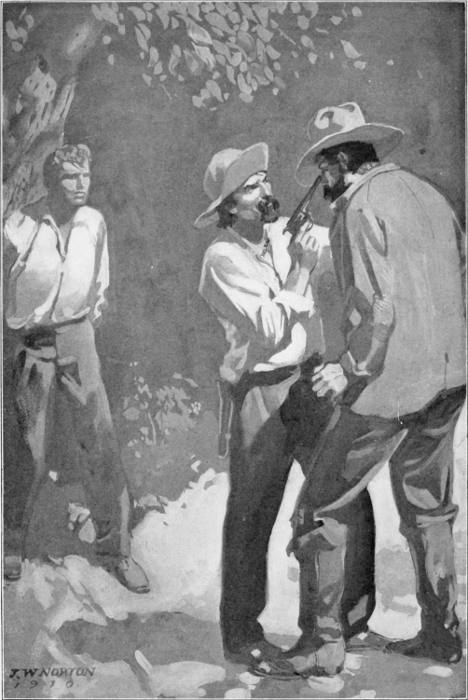
across the mouth. But at this moment a short, broad-shouldered little
man stepped out from among the onlookers and sauntered over to the
cowardly ruffian. One of his hands was thrust into his pants' pocket and
in the other he carried a huge revolver which looked almost as long as
himself. This terrifying weapon he raised and brushed its muzzle
deliberately back and forth across the tip of the other man's nose,
which was nearly a foot above the top of his own head.
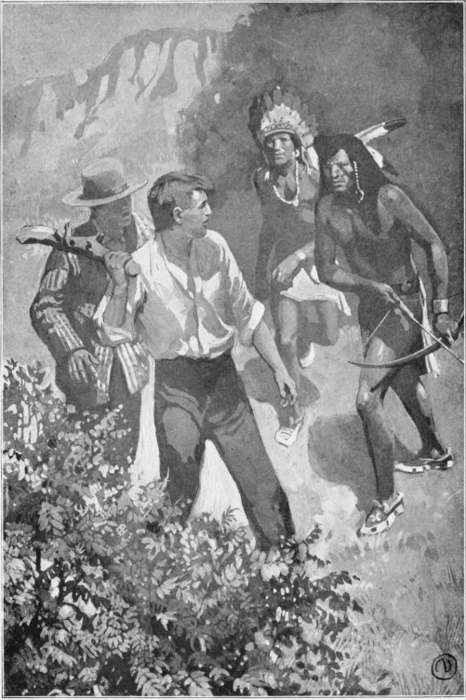
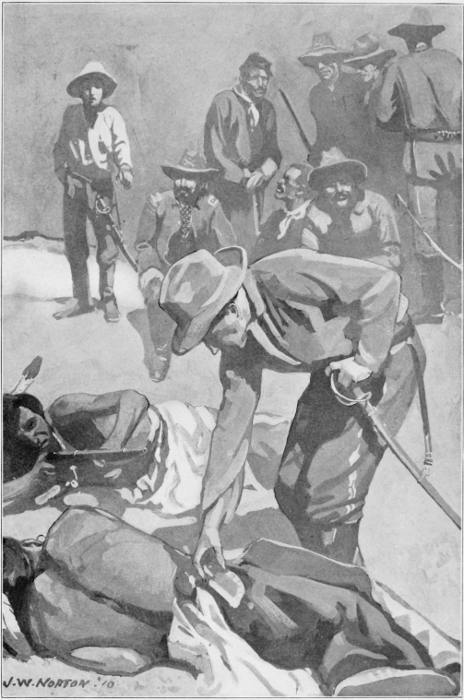
Bill Cotton protects Al from the guerilla
"Now, look here, Daddy Longlegs," said he, in a persuasive tone, "you
let this kid alone or I'll blow you into the river. These boys are game;
an', by jinks, I'm goin' to see that they're treated decent from now on.
Everybody take notice."
He swept a calm, authoritative glance around over the crowd, spat upon
the ground, stuck his revolver back into its holster and, with both
hands now in his pockets, strolled back to the tree whence he had come,
and sat down.
Yeager laughed nervously, seeming to fear the effect of this exhibition
of authority on the part of some one beside himself.
"I was just goin' to say that," he remarked.
The little man looked at him and his lip curled slightly.
"Yes, you were!" said he, derisively, and Yeager made no further
comment, while Al's persecutor sneaked away sheepishly, muttering to
himself.
There was a moment of embarrassed silence, and while it lasted there
emerged from the woods behind the motley company a figure which hurried
toward the guerilla captain officiously. As soon as they saw it, the
boys smiled in unison.
"Here's Jim!" exclaimed Wallace. "Now we'll catch it!"
The deck hand glanced toward them, then, with a look of relief, said to
Yeager,
"Well, you got 'em, I see, Captain."
"Yes, yes, I got 'em," replied Yeager, starting from thought and eying
Jim uneasily. "Much obliged to you fer puttin' me on."
"Oh, sure; that's all right," exclaimed Jim, beaming on him. "I hate a
Yank worse 'n pizen."
He turned and, walking over, faced Al and Wallace.
"Nice day, ain't it?" he inquired, with a sneer. "How do you kids like
it? You ain't doin' no fancy boxin' to-day, Al Briscoe, are yeh?"
"Well, well; my dear old friend, James!" exclaimed Al, in affected
surprise. "Aren't you the proud boy, though, over this great victory?"
"None o' yer freshness, now," cried Jim, doubling up his fists,
threateningly, "er I'll mash yeh one."
"Here, here!" cried Yeager, loudly. "Don't abuse the prisoners!"
Jim looked at him in surprise.
"Why not?" he asked, as if abusing prisoners were the most natural
pastime in the world.
"Because I said so," returned Yeager, bluntly. "That's why."
The deck hand appeared to meditate this unusual ruling for a moment.
Then he inquired,
"When yeh goin' to shoot these Yanks, Captain?"
"Well," said the guerilla chief, hesitatingly, and stopped. Then he shot
a furtive glance at the short, broad-shouldered man. The latter was
sitting in a lounging attitude with his arms clasped around his knees,
but his eyes were fixed steadily on Yeager.
"Well," began the Captain, again. "I ain't a-goin' to shoot 'em. I'm
a-goin' to take 'em down an' turn 'em over to General Price."
He looked again at the short man, who was now gazing calmly out over the
river. The boys breathed sighs of relief and thanksgiving, for it seemed
they were to be saved for the moment, at least, from their most
imminent peril of being murdered in the woods.
"What?" cried Jim, angrily. "Yeh told me yeh'd shoot 'em if I got 'em
fer yeh."
"I find they ain't deservin' uh death," returned Yeager, with dignity.
"Leastways, not unless ordered by a reg'lar military court."
"Oh, thunder!" exclaimed Jim. He frowned in disappointed hatred at Al,
then turned and walked away.
"Well, I must be goin'," said he. "I got business up to Lexington."
"Hold on!" cried Yeager. "What's yer hurry? We're just startin' fer
Arrer Rock to take these prisoners to General Price. I want you fer a
witness ag'in 'em."
"Aw, no, I can't do no good," returned Jim, hastily, continuing to back
away. "I've told yeh all I know about 'em. I got to go."
Then he felt a nudge on his arm and looked at the short man, who had
risen and, with his hand on his big holster, was gazing up into Jim's
face.
"Pshaw, you'd better come with us," said he, in a soft voice.
Jim's eyes wavered, then shot a desperate, hunted look around over the
crowd. But by a great effort he controlled himself.
"Oh, very well. Yes," he replied, with as much carelessness as he could
assume. "I'll go."
The horses of the guerilla gang were tied a few yards back in the
timber. The boys were led to them and mounted, each one riding between
two guards; and then the party, forming in a rough column of fours,
started out. They soon emerged from the woods, passed up through a
ravine and so out upon the bluffs, where presently they turned into a
faintly marked country road running to the southeast, toward Arrow Rock.
For hours they travelled, alternately at a trot and a walk, through the
pretty, rolling country of Saline County, now passing among stretches of
forest, gay with the foliage of Autumn, and again moving across reaches
of open land, dotted here and there with little farms, most of them
deserted and falling to decay. But always they avoided the main roads
and often they travelled across the fields, through ravines and along
the lower edge of ridges, making it evident that these men possessed a
knowledge of the country as intimate as that of the Sioux in the
Northwest.
The boys were held near the centre of the column, and several files
ahead of them was Jim, who rode along easily, slouching in the saddle
and yielding to the motions of his horse as if accustomed to it through
long practice. It was noticeable to the boys that the short man held a
place in column immediately behind Jim; for this guerilla company
appeared to have no regular formation, and the men fell in wherever they
chose, sometimes even changing their places on the march.
Toward evening the gang approached Arrow Rock and were halted by a
picket in the edge of the little town. The officer of the guard, a young
man in the full uniform of a Confederate lieutenant, came out to meet
Yeager, who had ridden to the front.
"Is General Price's army here?" asked Yeager.
"Yes," answered the Lieutenant. "Who are you?"
"Captain Yeager and command, with Yankee prisoners."
"Captain Yeager? Of whose regiment?"
"Nobody's," replied the chief, boastfully. "We go it alone."
"Oh, I see," said the other, a slight inflection of contempt in his
voice. "Er—ah—partisan rangers?"
"What?"
"Bushwhackers?—Guerillas?"
"That's what," replied Yeager. "I want to see General Price."
"General Price is not here," stated the Lieutenant. "This is General
Clark's brigade of Marmaduke's division. You can see General Clark if
you wish."
"All right," said Yeager. "Show us in."
The officer of the guard instructed one of his men to conduct the
guerilla band to the house occupied by General Clark as headquarters,
near the centre of the town. The streets were swarming with Confederate
soldiers, and long lines of cavalry horses were hitched along the
sidewalks or tied to their picket lines in the middle of the streets.
Some of the soldiers were little better clothed than the guerillas, in
civilian garments of various hues and cuts, while others wore threadbare
suits of butternut jeans, and others still, many of them, were attired
in new uniforms of Federal blue, doubtless recently captured.
As they approached General Clark's headquarters, Jim suddenly left his
place and, spurring up beside Yeager, exclaimed, earnestly,
"Say, Cap, honest, I've got to be goin'. It's almighty important fer me
to get to Lexington."
"It's almighty important fer you to stay with me till you've saw General
Clark," replied Yeager, gruffly. "Now, don't be foolish or you'll git
hurt."
Jim was pale to the lips but, looking around, he saw the short man
following close after him and he continued riding beside Yeager. Arrived
at headquarters, the column halted, and the Captain dismounted and
entered. In a few moments a Confederate corporal with two men came out
and, walking over to Al and Wallace, ordered them to dismount. Then the
corporal noticed that their hands were tied behind them. He jerked out a
jack knife and cut the cords on their wrists, which were swollen and
bleeding.
"How long have you been tied that way?" he demanded.
"Since before noon, when we were captured," replied Wallace.
The corporal glanced at the guerillas about him.
"That's a fine way to treat helpless prisoners," he exclaimed, angrily.
"It 'ud take a gang like you-all, who dassent fight in the open, to
torture a kitten,—if yeh ever had nerve enough to catch one."
Some of the guerillas looked ugly, but they dared do no more in the
midst of a Confederate camp, and in great indignation the corporal
marched his squad and prisoners through the doorway and into the
presence of General Clark, who was seated at a table, with Yeager
standing before him.
"These are the prisoners, General," said Yeager, importantly.
"Yes, I see," replied General Clark, dryly, as he measured the evident
youth of the captives. Then he continued, addressing Wallace,
"Where have you boys come from?"
"From Dakota, where we have been fighting Indians," returned Wallace.
The General looked disappointed.
"Oh, is that it?" he asked. "You don't know much about matters around
here, then?"
"No, sir," Wallace answered. "We don't know anything about them. We were
coming down the Missouri on a barge, straight from Dakota, when we were
taken."
"Well, Captain," remarked the General, leaning back in his chair and
glancing at Yeager. "I don't see that your prisoners are of much value."
"Mebbe not," replied Yeager, somewhat crest-fallen. "But you'd better
see the feller that told me about 'em. Mebbe he knows somethin' more."
General Clark sent out the corporal and in a moment the latter returned,
leading Jim forcibly by the arm. The short, broad-shouldered guerilla
followed them. The deck hand was trembling visibly and his eyes were
wild but he was evidently striving to maintain his composure.
"What do you know about these prisoners?" demanded General Clark.
"I don't know nothin', General," answered Jim, his voice shaking. "Only
they're Yanks, an' I thought they ought to be turned over. I didn't
expect,—" he stopped short.
"Didn't expect what?"
"I—I didn't expect they'd be examined none, ner that I'd be dragged
into it. I thought they'd—they'd be shot."
"In the regular Confederate service we do not shoot prisoners of war,"
replied the General, turning a coldly significant glance upon Yeager.
"And why," he continued, addressing Jim, "didn't you want to be dragged
into it, as you say?"
The deck hand's eyes wavered and he made no reply.
"What are you so alarmed about?" persisted the General, leaning forward
and watching him suspiciously.
Al cleared his throat.
"Pardon me, General Clark," said he, "but I believe you will find on
inquiry that this man is a deserter from your service."
Jim started as if he had been shot.
"It ain't so!" he cried, wildly. "I ain't never been in the Confederate
army." He made an involuntary step toward the door, but his guard pulled
him back firmly.
"Why do you think that?" asked General Clark of Al.
"He was a deck hand on the boat I ascended the Missouri on," replied Al,
"and I had trouble with him. That's doubtless why he hoped to have me
shot. I judge that he was in the Confederate service only by threats and
boasts that he made to me, and he was probably in an Arkansas regiment."
"An Arkansas regiment?" the General asked. "We have a whole division of
Arkansas troops with us,—Fagan's."
A curious, gurgling gasp came from Jim's throat. His face was chalky.
"I never heerd o' Fagan," he sputtered. "Ner I ain't been in Arkansaw in
all my life."
"You are not convicted," General Clark said, calmly. "But the matter is
worth investigating."
He called the sergeant of the headquarters guard and directed him to
have Jim placed in close custody, and the deck hand was led away,
reeling and apparently almost fainting. Al never saw him again; and
though by chance he heard long afterward that Jim had, in fact, been in
an Arkansas regiment, he could never ascertain whether the young fellow
paid the penalty of death for his violation of his oath of enlistment.
When Jim had been led away, the General turned to Al and asked,
"You wear no uniform. Why not?"
"I am not enlisted in the army, sir. I am too young."
"Ah! You would not be in our service," the General returned, with a
smile. "But you are a Union sympathizer?"
"Yes, sir, I am," replied Al, firmly.
"Well, you appear to be a pretty bright boy," the General observed,
shrewdly. "I think it will be as well not to have you at large for a few
days. Corporal, lock these young men in that brick storehouse a block
below here, on the left side of the street. Mount a guard, give them
supper, and keep them securely till further orders."
As they were being marched out, they passed the short guerilla who had
championed them in the morning. He was lounging by the doorstep. Al
motioned to him and he caught step with them.
"We are very grateful to you for taking our part down there where we
were captured," said he. "We'd have been killed if it hadn't been for
you."
"Maybe," said the other, somewhat embarrassed. "But I didn't like the
way you were taken."
"How do you mean?"
"Oh, havin' that dough-faced shipmate o' yours come in to give yeh
up,—pervidin' we'd shoot yeh!"
"It was a low-down trick," said Wallace.
"I should say it was! I'm glad you tipped off the General to the kind of
a pup he is."
"Why are you so set against him?" asked Al.
"Aw, I just don't like his looks," returned the bushwhacker. "Yeh kin
see he's yellow, an' I sized him up fer a deserter when he got in such a
sweat to pull out."
"What's your name?" asked Al, as the man stopped, evidently not
intending to go as far as their prison with them.
The bushwhacker looked at him suspiciously.
"You needn't be afraid of me," Al insisted. "Perhaps we can do you a
good turn sometime."
For a moment longer the other hesitated, then answered,
"My name's Bill Cotton," and, turning, he walked away.
The boys were soon securely locked in their prison with a sentry before
the door. It was a small brick building near the river bank, and all its
windows were boarded up with heavy planks except a small square one
facing the river, the sill of which was about six feet above the floor.
They had been confined but a few moments when the corporal returned,
bringing a quantity of hardtack, a chunk of bacon, a pail of drinking
water, two blankets and a small box of ointment.
"There," said he, as he handed the various articles to the boys, "fill
yerselves up an' rub some o' this yere grease stuff on yer wrists. It
ain't the best; lard an' marigold juice is the best, but I ain't got
none, so I jest bought this in a store. I reckon it'll help some."
The boys thanked him warmly.
"That's all right," he replied. "I hate to see prisoners abused. I found
out how it felt myself, once. This is a kind of a nasty hole to put you
in but you'll likely be let out o' here an' paroled in the mornin', when
we start fer Glasgow."
"Are you going to Glasgow?" asked Al, suddenly interested.
"You bet we are," confided the corporal, sociably, "an' some o' Joe
Shelby's boys with us; got orders this evenin'. There's quite a bunch o'
your Yank friends up there, an' a big grist o' muskets, too, an' we want
the whole lot." He smiled genially at the boys in anticipation.
Al became alert and, therefore, cautious.
"I've understood Glasgow is a pretty strong position," said he,
carelessly. "You'll have to have a large force to take it."
The Corporal laughed. "Oh, we've got plenty," he rattled on. "There's
our whole brigade,—Clark's,—an' five hundred men from Jackman's
brigade, of Shelby; an' then old General Joe himself is goin' up this
side the river, so I've heard, to bang the town in front with artillery
while we bust in the back door."
"Well, I'll bet there are enough of our fellows there to hold it,
anyhow," declared Al, stoutly.
"No, there ain't; there ain't above a thousand Yanks there," answered
the corporal, with conviction. "An' we'll have four thousand. Besides
that, they don't know we're comin', an' we'll gobble 'em before they
wake up."
"That does seem like pretty big odds," admitted Al. "Still, I think
they'll hold you."
"No, they won't," repeated the corporal, as he stepped through the
doorway, key in hand. "Well, I got to be goin'. Bye-bye, Yanks. Sleep
tight."
The key turned in the lock and he was gone, leaving the boys to
themselves.