FOREWORD — CONTENTS — ILLUSTRATIONS
Sam Houston should justly be regarded as a great
American. He laid his course and steered by it utterly
regardless of the opposition. Strong characters are
known as much by the enemies that they make as by the
friends that they retain. When they launch into a course
that they deem is right, they do not depend upon fair
winds. They go ahead, if they have real faith. Threats,
ridicule and dangers do not daunt them. Sometimes they
may pause, to renew their courage; but they proceed again
on the same line.
Such a character was Sam Houston. To his friends
he was loyal; to his enemies he was unyielding; his ideals
were high; and he loved his country.
Whatever he undertook, he undertook with his whole
might, in spite of censure and discouragements. This book
deals with him chiefly as the six-months’ general who, out
of seeming defeat, achieved the triumph of Texas arms,
and at one stroke established Texas independence. But
we ought to admire him as a patriot statesman, rather than
as a military commander.
Some other commander could have won the victory for
Texas. Freedom, well or poorly led, cannot be conquered
by oppression. Justice cannot be combatted, forever, by
injustice. But few other men have had Sam Houston’s
rugged courage.
We see him opposed by virtually all the people whom
he was seeking to benefit, while he played the humble waiting
game, and gave the foe false advantages until in his
own good time he struck and roundly defeated them. He
endured being called a coward—although he well knew
that he, with an arrow wound and two bullet wounds in his
body, was no coward. We see him generous in victory,
and always looking beyond the present. We also see him,
as president and as governor of Texas, stanchly insisting
upon the right as he viewed it, and which time has proved
to be the right. And as United States senator he continued
to fight for his principles of honor and wisdom.
That he was unpopular among his people, and was marked
for punishment, made no difference to Sam Houston. The
welfare of Texas, and of the American Republic with
which it united, was more to him than his own welfare.
It is a wonderful thing to know that one is right, and
then to stick to the compass.
Sam Houston had his weaknesses. All men have
weaknesses. The greatest men rise above them. The
strength of Sam Houston was his faith in himself; his
weakness was his pride in himself. When his pride was
injured, by accusations and by home troubles, he went to
the other extreme, apparently tried to see how low he could
sink, and as if in revenge set out to throw away his career.
This was no revenge. It never is. It benefits mainly one’s
enemies, and harms mainly oneself and one’s friends.
Weak natures do not accept that verdict, or they take
more pleasure in pitying themselves than in aiding themselves.
Sam Houston sank; the world, disappointed, said
that he was a failure, after all—he could not hold his
course, and had abandoned the helm. But he could, and he
did. He rose, he grasped the wheel again, he retrimmed
his sails, and he forged on, with faith and will, to fulfil
the capabilities with which he had been entrusted.
Of the boys in this book, James Monroe Hill, Leo
Roark, and Sion Bostick appear in Texas history under
these very names. Without doubt they had a friend and
comrade like Ernest Merrill; many boys marched and
fought beside the men in the Texas struggle for independence
from Mexico. Names amount to very little,
anyway; they simply are convenient. It is deeds that
count.
Edwin L. Sabin
California, June 1, 1916
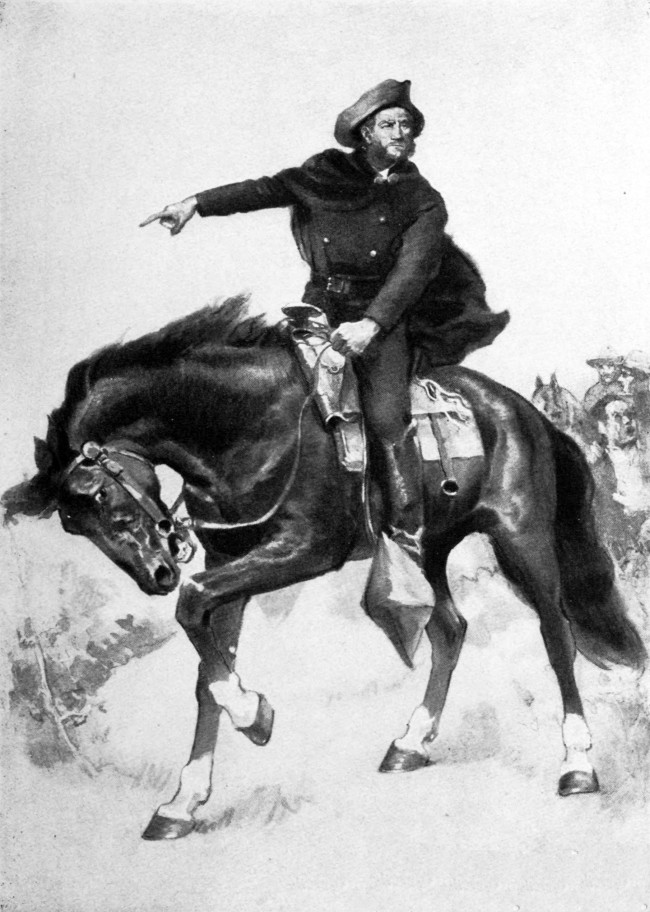
Courtesy Harper & Bros.
GENERAL SAM HOUSTON AT THE BATTLE OF SAN JACINTO
From a painting by the Texan artist S. Seymour, exhibited at the Paris Salon in 1898
THE RISE OF TEXAS
1513–1519—The Gulf of Mexico explored by the Spanish.
1521—Following upon the conquest of Mexico by Captain Hernando
Cortes, Texas forms a part of that indefinite New Spain.
1528–1536—Texas first entered by white men when the shipwrecked
Spaniards, Cabeza de Vaca, Alonzo del Castillo Maldonado,
and Andres Dorantes, with the negro Estavanico
(Stephen), cross the interior. They assume it to be a part of
Florida.
1540–1684—Penetrated by Coronado, de Soto, and other Spanish
officials.
1685—Robert Cavalier, Sieur de la Salle, in the name of France
takes possession of Matagorda Bay, deeming it one of the
mouths of the Mississippi River. Erects inland Fort St. Louis,
the first white settlement.
1689—Captain Alonzo de Leon and Father Manzanet, dispatched
from Mexico to expel the French, find Fort St. Louis abandoned.
1690—The Spanish from Mexico establish the Mission San Francisco
among the Tejas Indians, in East Texas, southwest of
present Nacogdoches. The country begins to be called the
Land of the Tejas; or “Tejas” (Texas).
1691—Don Domingo Teran de los Rios appointed first Spanish
governor of the provinces of Coahuila and Texas.
1714—Captain Louis Juchereau de Saint-Denis is sent from the
French post at Mobile into Texas, to report upon colonizing it.
1716—The Spanish captain, Domingo Ramon, and party of sixty-four
men and women, are sent to locate missions and colonies
in East Texas and oppose the French, who have advanced to the
Red River.
1718—The Spanish presidio of San Antonio de Bejar (Bexar),
the site of the storied town, is founded. Here arises also the
mission San Antonio de Valero, predecessor to the famous
Alamo.
1720–1722—Other missions and forts are established, along the
Sabine River, the Spanish frontier in Texas.
1721—The French claim to the Sabine River, from the east. Captain
Bernard de la Harpe is ordered to reoccupy Fort St. Louis
at Matagorda Bay. The landing party are driven off by Indians.
1722–1762—The French out-posts along the Red River and the
Spanish out-posts along the Sabine River are separated by only
some twenty miles; but the Spanish hold Texas.
1744—The mission later known as the Alamo is rebuilt at San
Antonio.
1762—France cedes to Spain all the Province of Louisiana as
presumed to be the country from the Mississippi River to the
Rio Grande River and the Rocky Mountains. Under Spanish
and Mexican rule for virtually seventy-five years, Texas progresses
little except through the efforts of American settlers.
1782—By the Revolutionary War the United States succeeds
England in North America east of the Mississippi, and becomes
the neighbor of Texas.
1797—Philip Nolan, an Irish-American at New Orleans, enters
Texas with a party to capture wild horses and to report on the
country.
1800—Nolan and a party again enter Texas, in defiance of Spanish
protests. Nolan is killed by the Spanish troops and the others
are imprisoned.
1800—Spain cedes the Louisiana province back to France.
1803—France sells Louisiana province to the United States. Spain
claims that France was under contract not to deliver the province
to any other power, and protests the transfer.
1804—The United States claims that the province extends west to
the Rio Grande River; Spain denies the right of the United
States to any territory west of New Orleans. War is threatened.
1806—United States troops encamp on the east bank of the Sabine
River, in Louisiana; the Spanish troops encamp on the west
bank, in Texas. By a truce the United States forces retire to
the Red River in Louisiana, and pending a settlement of the
Texas boundaries dispute, the strip thirty miles wide between
the Red River and the Sabine River is made a Neutral Ground.
1806–1819—The Neutral Ground is the resort of desperadoes,
who much annoy the Spanish authorities of Texas.
1811–1812—Lieutenant Augustus Magee, a young American army
officer, joins with a Mexican revolutionist, Colonel Gutierrez de
Lara, in an attempt to seize Texas from Spain. The project
fails.
1817–1821—The freebooter, Captain Jean Lafitte, Frenchman,
occupies the Island of Galveston; reigns there under the title
“Lord of Galveston.”
1818—Generals Lallemand and Rigault, French officers under
Napoleon, establish a French colony, entitled the Champ d’Asile
(Field of Refuge), twelve miles up the Trinity River. They
are soon driven out by the Spanish troops.
1819–1821—Dr. James Long, an American merchant of Natchez
(Mississippi), with a company of seventy-five adventurers, invades
Texas, declares it an independent republic, but finally
is defeated and shot.
1820—Moses Austin, from Missouri, petitions Mexico to be permitted
to bring into Texas 300 colonists from the United
States, but he dies before he can complete his project.
1821—Mexico separates from Spain, and Texas is now Mexican
territory.
1821—Stephen Fuller Austin, son of Moses Austin, and to be
known as the “Father of Texas,” brings in from New Orleans
the first of the American colonists, who settle on the lower
Brazos River.
1823—Mexico issues a general colonization law, encouraging the
settlement of Texas by foreigners, upon tracts granted by the
government.
1823—The town of San Felipe de Austin in the Austin colony
on the Brazos is founded—the first American town in Texas.
1825—The State of Coahuila and Texas (as the two Mexican
provinces were known) passes a more liberal colonization law,
and settlement by Americans proceeds rapidly.
1827—The United States, still wishing to acquire Texas, offers
Mexico $1,000,000 for the province to the Rio Grande River,
or $500,000 to the Colorado River, about half-way. Mexico
rejects the offers.
1828—The United States accepts Mexico’s contention that the
Sabine River shall be the boundary in the south between the
two nations.
1829–1830—Alarmed by the increase of settlers from the United
States, Mexico passes several laws much restricting immigration
and the rights of colonists.
1832—The American colonists support General Antonio Lopez de
Santa Anna, who aspires to supplant the unfair Anastasio
Bustamante in the presidency of Mexico. They rise against
the Mexican commandants at Nacogdoches, and at Anahuac
and Velasco on the Gulf, and expel them.
1832—October 1 the “people of Texas” meet in first general
convention at San Felipe, and ask for a state government
separate from Coahuila.
1833—Santa Anna becomes president of Mexico.
1833—Hoping now for aid from Santa Anna, on April 1 the
Texans meet in another convention, and draw up a plan for
separate state government. Stephen Austin bears the petition
to Mexico. He is arrested.
1834—Coahuila, with which Texas is still linked, is torn by quarrels
between its Mexican factions, in which Texas is little concerned
except as an outsider. Santa Anna grants an audience
to Stephen Austin, the prisoner, but decides that Texas cannot
be separated from Coahuila, and that 4000 Mexican troops
should be sent in, to preserve order.
1835—The local revolution in Coahuila continues, and Santa Anna
appoints a governor of his own making, for Coahuila and
Texas. The Americans in Texas are much incensed at such
dictatorship, and Mexican officials, driven out by Santa Anna’s
policies, join with the colonists.
1835—June 30 Captain William B. Travis, of the Anglo-Texans,
leads a party against the port of Anahuac, where import duties
were being collected. The Mexican officers there are expelled.
1835—August 31 Stephen Austin is landed at the mouth of the
Brazos, after a year and a half imprisonment by the Mexican
government. At a banquet at Brazoria he advises a general
consultation to insist upon the rights of Texas to be governed
under the liberal Mexican constitution of 1824, which granted
that the Mexican states should be administered by elected officials,
like the states of the United States. The consultation is
called for October 15.
1835—At the close of September the town of Gonzales refuses to
deliver over a six-pounder cannon, demanded by the Mexican
officials at San Antonio de Bejar. On October 2 the Texas
volunteers drive off the Mexican troops sent to take the cannon.
This Battle of Gonzales is styled the Lexington of Texas. The
colonists continue to gather; advance is made against San
Antonio; the Mexicans are defeated, October 28, at the battle
of the Horseshoe, near Concepcion Mission; on December 11
San Antonio is captured. In the south Goliad and Victoria
have been taken. As the result of the campaign, not a Mexican
soldier remains in arms in Texas.
1835—November 1 the general consultation meets at San Felipe.
It declares for the rights of state government under the
Constitution of 1824, draws up a plan for temporary state
administration, elects state officers, appoints Sam Houston commander-in-chief
of the Texan army to be raised, and delegates
commissioners to get aid from the United States.
1836—Santa Anna organizes an army to subjugate Texas. Volunteers
from the United States continue to arrive, to help the
Texan cause, but a quarrel arises between Governor Smith and
the council, over the conduct of the war.
1836—February 22–23 General Santa Anna appears before San
Antonio; the few Texas troops there, under Colonel William B.
Travis and Colonel James Bowie retire to the Alamo Mission,
adjacent, and are closely besieged.
1836—March 2 the Texas delegates in convention at Washington
on the Brazos declare for Independence from Mexico. The
Republic of Texas is organized.
1836—March 6 the Alamo is taken by storm, by the Santa Anna
columns. Of the garrison of 180 or more only three women,
a baby, a little girl and a negro boy are spared.
1836—March 11 General Sam Houston arrives at the army camp
at Gonzales, and in the night of the 13th, following the news
from the Alamo, a retreat is ordered.
1836—March 20 Colonel James Fannin, attempting to retire from
Goliad with 400 men, is surrounded, and surrenders, on promise
of good treatment.
1836—Palm Sunday, March 27, Colonel Fannin and 320 of his men
are massacred, while prisoners, by order of Santa Anna.
1836—April 16 the Mexican column under Santa Anna, having
marched clear across Texas, burns Harrisburg, the temporary
capital, near Galveston Bay.
1836—April 20 the Texan army under Houston front Santa Anna
at the San Jacinto River and Buffalo Bayou, northeast of
Harrisburg, and cut him off.
1836—In the afternoon of April 21, by the battle of San Jacinto
the Texan army overwhelm the Mexican force and on the next
day capture Santa Anna, president of Mexico.
1836—May 14 President Santa Anna signs the treaty by which he
recognizes the independence of the Republic of Texas, with
boundaries extending on the west to the Rio Grande River.
1836—In September General Houston is enthusiastically elected
president of the Republic of Texas. Annexation to the United
States is also endorsed by a large majority.
1837—In March the United States recognizes the independence of
Texas. Mexico declines to accept the treaty as signed by
Santa Anna. Hostilities threaten to be actively renewed.
1839—France acknowledges the Republic of Texas.
1840—Holland and Belgium acknowledge the Republic of Texas.
1840–1843—Texas and Mexico invade each other’s territory, in a
fresh series of hostilities. Several forces of Texans are captured
and severely treated.
1842—Great Britain acknowledges the Republic of Texas.
1843—Texas and Mexico agree to a truce until commissioners can
discuss terms of peace between the two republics.
1843—Mexico announces that the annexation of Texas by the
United States would be viewed as a declaration of war.
1844—In April a treaty drawn by President Tyler and the Texas
government, providing for annexation, is defeated in the United
States senate.
1844—The negotiations for peace between Texas and Mexico
having failed, Santa Anna, again president of Mexico, announces
that war to recover the “rebellious province” is
resumed.
1845—February 28 the Congress of the United States adopts a
joint resolution inviting Texas into the Union. President Tyler
signs, March 1.
1845—In March the Texas secretary of state has submitted to
Mexico a treaty by which Mexico shall recognize the independence
of the Texas Republic, on the agreement that there
shall be no annexation to the United States. Mexico signs the
treaty in May.
1845—June 4 Mexico declares its intention to fight for possession
of Texas.
1845—June 18 the Texas Congress, convened in special session to
consider the offer of the United States, unanimously rejects
the treaty with Mexico and votes for annexation. October 13
the Texas people, in general election, enthusiastically endorse
the action of their congress.
1845—July, the American Army of Occupation, under General
Zachary Taylor, is ordered to enter Texas and advance to the
Rio Grande River.
1846—Hostilities by force of arms open: by the United States
to establish the claims of Texas to the Rio Grande River
boundary; by Mexico, to retain possession eastward to the
Nueces River.
1848—By the treaty of Guadalupe Hidalgo, signed February 2,
closing the war, Mexico definitely loses Texas to the United
States.
1850—By protest from the people of New Mexico, following the
close of the war, the state of Texas, whose southwest and west
boundary was assumed to the Rio Grande River from its mouth
to its source, is rebounded and confined to practically its present
generous limits.
Released from Mexican misrule, free to turn its arms against
the marauding Indians, and by the payment of $10,000,000 by the
United States soon made financially independent, the great State
of Texas, 800 miles long, 750 miles wide, has prospered abundantly.
The spirit of the Lone Star Republic still lives in the words,
always proudly spoken: “I am a Texan.”
SAM HOUSTON THE BUILDER OF TEXAS
March 2, 1793, born at Timber Ridge Church, near Lexington,
Rockbridge County, Virginia, of Scotch-Irish ancestry.
Father: Major Samuel Houston, soldier of the Revolution
and Assistant Inspector-General of the frontier troops.
Mother: Elizabeth Paxton Houston, a large woman of fine
physique and strong character.
At eight years of age young Sam attends country school in
the “Field School,” which occupied the old building out of which
Washington University had removed to Lexington.
In 1807 his father dies, and his brave-spirited mother, now
left with six sons and three daughters, crosses the Allegheny
Mountains and resettles eight miles east of the Tennessee River
in Blount County, Tennessee, here to build a cabin and clear the
land.
Sam hunts, traps, works on the farm, is fascinated by the
battles and adventures in the Iliad as translated by Alexander
Pope, and intermittently attends the Maryville Academy, where
his especial pleasure is to drill his mates in military tactics.
Apprenticed to a blacksmith, and later hired out as a clerk
in a general store, he runs away and joins the Cherokee Indians,
across the Tennessee River.
Is adopted by the sub-chief Oolootekah or John Jolly. Refuses
to return when found by his brothers, and spends his time
living as an Indian. Is now almost six feet tall, and of large
frame.
In 1811, when aged eighteen, returns to white civilization.
Wearing a calico hunting-shirt, and his hair in a pigtail, he
teaches country school, in Eastern Tennessee, to pay off debts
contracted while he played Indian.
In 1813 enlists at Maryville, with the approval of his mother,
as a private soldier in the war against Great Britain. He is promoted
to sergeant, in the 39th Regiment, Tennessee Volunteers,
serves as drill-master in Tennessee and Alabama, and soon is
appointed to ensign, by President Madison.
March 27, 1814, under General Andrew Jackson and General
John Coffee, engages in the desperate battle with the Creek Indians
at To-ho-pe-ka, or Horseshoe Bend, at the Tallapoosa
River, in Alabama; is badly wounded by an arrow while leading
his men over the breastworks, and again by two bullets.
Slowly recovers from his wounds, and, December 31, 1813,
is promoted and commissioned third lieutenant.
May 20, 1814, commissioned second lieutenant.
May 17, 1815, transferred to the First Infantry of the regular
army.
May 1, 1817, commissioned first lieutenant.
Serves in the adjutant-general’s office at Nashville, Tennessee.
November, 1817, being still incapacitated by his wounds, is
appointed sub-agent for the Cherokee Indians, whose language
he speaks. Conducts for them the negotiations by which they sell
to the government their lands in Eastern Tennessee.
In Washington is rebuked by John C. Calhoun, secretary of
war, for appearing in Cherokee Indian costume; is acquitted of
misconduct in office.
March 1, 1818, resigns from the army.
June, 1818, studies law in the office of the Honorable James
Trimble, at Nashville. Admitted to the bar in six months.
Practises law for about three years at Lebanon and Nashville,
Tennessee. Gains a reputation for his high-sounding phrases,
his self-esteem, and his honesty.
In 1819 appointed, through the influence of his patron,
General Jackson, adjutant-general of Tennessee, and is elected
prosecuting attorney with office at Nashville. Resigns this office
because of insufficient income from it, and resumes general
practice.
In 1821 elected major-general of the Tennessee militia.
In 1823 elected as representative in Congress from the ninth
district of Tennessee. Serves here four years, and is thrown in
contact with Henry Clay, John C. Calhoun, Daniel Webster, John
Randolph, Nathaniel Macon, and other distinguished American
statesmen.
September 23, 1826, severely wounds General William White
in a duel fought in Simpson County, Kentucky, just across the
Tennessee line. Thereafter declines to engage in duels, although
many times challenged.
August, 1827, elected governor of Tennessee; appears at the
polls mounted on a fine dapple-gray horse, and wearing a tall
black beaver hat, high patent-leather stock, ruffled white shirt,
black silk trousers with legs cut straight and full, embroidered
silk stockings, pumps with silver buckles, and a long Indian
hunting-shirt of red figured calico belted about with a beaded red
sash.
In January, 1829, marries Miss Eliza Allen, of Sumner County,
Tennessee; after three months separates from her, for cause
unknown to the world; resigns his governorship, and joins the
Cherokee Indians again on their new reservation in Arkansas,
near Fort Gibson of the Indian Territory.
Is welcomed as a son, by Chief Oolootekah, resumes his
Indian life and receives the title of Col-lon-neh, or the Raven.
By his dissolute habits earns also the name “Drunken Sam,” from
the whites, and “Big Drunk,” from the Cherokees.
During 1830–1831, while attempting to protect the Cherokees
against frauds from traders and contractors, is falsely accused of
the same improper practices, himself.
April 13, 1832, while in Washington assaults and beats with a
cane Representative William Stanberry, of Ohio, as retaliation
for an insulting public speech. Is arraigned before the House of
Representatives, and employs as counsel Francis Scott Key,
author of the “Star Spangled Banner”; is reprimanded by the
House, but is commended by President Jackson, who remits his
fine.
In the Indian nation he has taken to wife the stately Tyania
Rodgers, a half-breed woman of unusual qualities; he establishes
a small farm and trading-post on the west bank of the Grand
River, opposite Fort Gibson, and spends much of his time hunting,
trading and drinking.
In December, 1832, proceeds alone to Texas, under commission
from President Jackson to conclude a treaty of peace with
the Comanche Indians, for the protection of the United States
borders; and under instructions, also, to investigate the feasibility
of the annexation of Texas to the United States.
April, 1833, is a delegate from Nacogdoches, Texas, to the
Texas convention held for the purpose of demanding a separation
from the province of Coahuila.
Through 1833, 1834 and 1835, while residing at Nacogdoches,
San Augustine and Washington, of East Texas, he takes prominent
part in meetings which discuss freedom for Texas under
the Mexican constitution of 1824.
October, 1835, is elected at Nacogdoches commander-in-chief
of the army of Eastern Texas.
November, 1835, by the convention which meets at San Felipe
to form a temporary state government is elected, with only one
opposing vote, commander-in-chief of the armies of Texas.
At the close of January, 1836, by reason of a quarrel between
Governor Henry Smith and the council, finding himself without
the means of enforcing his authority among the Texas troops,
Houston virtually retires from his office of major-general.
February, 1836, as one of three commissioners from Texas
to the Cherokees and other Indians, he so reassures the uneasy
tribes that they remain quiet throughout the war of Texas and
Mexico.
March, 1836, is a delegate from Refugio of Southern Texas
to the Texas general convention which at Washington on the
Brazos declares for a Texas independent republic; by practically
a unanimous vote is re-elected commander-in-chief.
March and April, 1836, conducts his little army in a long
retreat eastward across Texas. Handicapped by the rains, and
by soldiers and settlers accused of cowardice and of leaving
the country needlessly exposed to the Mexican forces, he labors
hard amidst tremendous discouragements.
April 20, 1836, suddenly cuts off President Santa Anna’s
column of Mexican troops, at the head of San Jacinto Bay, on
the coast of East Texas.
April 21, 1836, with his 743 Texans, mainly rough and ready
volunteers, from his camp on Buffalo Bayou, near its juncture
with the San Jacinto River, charges the breastworks of the Santa
Anna 1350 regulars, and in fifteen minutes of fighting wins the
battle of San Jacinto. Eight Texans were killed, twenty-three
wounded; Houston’s ankle was shattered while he was leading
his men. Of the Mexicans 630 were killed, 730 wounded and
captured, or both. Santa Anna was made prisoner on the next
day.
The independence of the Republic of Texas having thus been
achieved at one stroke, in May Houston leaves for New Orleans
to have his wound treated.
July, 1836, Houston returns to Texas, and protests against the
proposed trial and execution of Santa Anna, who had been promised
his liberty.
September, 1836, Sam Houston elected by a vast majority;
first permanent president of the new Republic of Texas.
October 22, 1836, he is inaugurated president, at Columbia.
November, 1836, he vetoes the resolution passed by the Texas
senate to retain Santa Anna as prisoner, and dispatches him to
Washington of the United States, for an audience with President
Jackson, in the interests of recognition by Mexico of Texas
independence.
December, 1836, removes to the town of Houston, on the
battle-field of San Jacinto—the new capital.
December, 1838, Houston ends his first term as president; he
has conducted the affairs of the new republic with great firmness
and wisdom; and living in a two-room log cabin has attired himself
in bizarre costume and been a curious mixture of statesman
and backwoodsman.
In the summer of 1839 he protests vehemently against violations,
by Texas, of the treaty with the Cherokees; he is threatened
with assassination, for “inciting” the Indians against the
whites, but he makes his speech, just the same.
May 9, 1840, he marries, at Marion, Alabama, Miss Margaret
Moffette Lea. She is a girl of twenty-one, he a man of forty-seven,
and her gentle influence over him is his guiding star until
his death; he soon ceases drinking and swearing, and now allows
his better nature to have full sway.
1840–1841, Houston is representative from Nacogdoches, in
the Texas congress.
1841, elected, for the second time, president of the Texas
Republic; inaugurated, December 16, at the new capital of Austin.
Serves as president until December, 1844. Does not like
Austin, and removes the seat of government to Houston, and
thence to Washington on the Brazos; but the indignant citizens
of Austin retain, by force, the government archives. As president,
Houston opposes invasion of Mexico by Texas, vetoes other
war measures, and again is threatened with assassination, but
treats the threats with contempt.
By correspondence with General Jackson, President Tyler,
and other statesmen, and by his public addresses, he successfully
engineers the annexation of Texas to the United States, although
the act was not consummated while he was at the head of the
Texas government.
In the fall of 1845 he is elected United States senator from
the state of Texas. Arrives at Washington to take his seat,
March, 1846. While in Congress wears his well-known broad-brimmed
white wool hat, and Mexican blanket, whittles industriously
at cedar shingles while listening to the debates, and
bears prominent part in national affairs. He opposes the extension
of slavery in new territories, and is denounced, by the South,
as a traitor. He remains a firm advocate of the rights of the
Indians.
January, 1853, re-elected to congress, from Texas.
Attends the Baptist church regularly, in Washington. In
1854 is received into the Baptist faith, at Independence, Texas.
March 3, 1854, delivers a great speech against Senator
Stephen A. Douglas’s Kansas-Nebraska bill, which repealed the
Missouri Compromise bill, prohibiting slavery north of latitude
36° 30´, and opened Kansas and Nebraska territories to the
extension of slavery into the North.
In 1856 is candidate for the Presidency, but at the nominating
convention of the “American” party receives only three votes,
his opposition to the repeal of the Missouri Compromise bill
having aroused bitter enmity toward him.
In 1857 defeated for the United States senate.
In the fall of 1857 defeated for the governorship of Texas.
February, 1859, concludes his term in the United States senate
and returns to Texas.
Fall of 1859 triumphantly elected, for a third time, governor
of Texas. Is inaugurated on December 21.
In the troublous days of 1860 he stands stoutly for the preservation
of the Union, and is threatened by the Southern sympathizers
by whom he is surrounded. He advises appeal to the
constitution rather than to arms.
March 14, 1861, Texas having seceded, he refuses to take the
oath of allegiance to the Confederacy; is deposed from the
governorship, and retires to Huntsville, his home.
Although opposing secession, he firmly advocates the defense
of the South against invasion by the Federal troops, and says
that he is willing to enter the Texas ranks. In his San Jacinto
suit he reviews, at Galveston, the Texas regiment in which his
son, Sam Houston, Jr., has enlisted, and is cheered.
Lives at Cedar Point, Texas; becomes very feeble, from his
old wounds and other disabilities, and walks with the aid of a
crutch and a cane.
January, 1863, congratulates Texas for having driven the
Northern forces from her soil.
March 18, 1863, makes his last public speech, at Houston,
Texas, and bids Texas keep up its courage and its hopes of success
of the Southern cause.
July 26, 1863, Sam Houston dies in his bed at the family
home, in Huntsville, Texas, aged 70 years. His last words are:
“Texas! Texas!” and “Margaret,” the name of his wife. He
died beloved and respected by state and country. To his eldest
son, Lieutenant Sam Houston, Jr., he bequeathed the “sword of
San Jacinto.”
I “I AM SAM HOUSTON”
WITH SAM HOUSTON
IN TEXAS
The toiling little steamboat “Arkansas” was stuck
harder than ever, as seemed, on a mud-bar far up the
shallow Arkansas River, in the old “Indian Country,”
which is present Oklahoma.
“Back her! Back her!” were bawling a half-dozen
voices, from her passengers.
“Go ahead! Give her steam! Push her over!” were
bawling a half-dozen others.
“No! Swing her!”
The paddle-wheel astern threshed vainly; the red-shirted
pilot in the pilot-house continually jangled the
engine-bell; from the upper deck the captain yelled himself
hoarse; on the lower deck the mate stumped around
in cowhide boots and swore horridly; the negro roustabouts,
ranged along the flat open bows and the guard-rails,
to shove with poles, grunted and panted, and now
and then one fell overboard when his pole slipped; the
passengers advised and criticized; the many dogs barked;
and young Ernest Merrill, scampering upstairs and down,
so as to be certain to see everything that happened, could
not feel that the boat budged forward or backward an
inch.
“We’re rooted fast, this time,” spoke a pleasant voice
in his ear, as from the forward rail of the upper deck he
was sighting on the shore, to see whether they really did
move. “There’s scarcely water enough under her here to
float a peanut shell.”
It was his friend Lieutenant Neal, in charge of the
army recruits bound, like Ernest, for Fort Gibson of the
Indian Country. A fine young man was Lieutenant Neal;
not much more than a boy himself. Ever since he and
Ernest had got acquainted, on the first day up the
Arkansas from where it emptied into the Mississippi, he
had rather taken Ernest under his wing. He and his
recruits were from New Orleans; and Ernest was from
Cincinnati, in the other direction.
“She is stuck, isn’t she!” agreed Ernest. “But they’ll
get her off, won’t they? They always have.”
For the “Arkansas” to be aground was nothing new.
Through almost two weeks she had been threshing and
thumping and snorting on her noisy crooked way, stemming
the tricky current and dodging (when she could) the
numerous bars and snags half-exposed by the falling
water. But every now and again she struck.
Such was steamboat travel on the Arkansas River in
this early fall of 1832.
That was a long trip, anyway, 640 miles by steamboat
up to Fort Gibson amidst the Cherokees in the Indian
Country. The Arkansas River had proved to be a lonely
stream, winding amidst cane brakes and bayous and timber
and wide flowery prairies, peopled chiefly by bear and
deer and horses and wild fowl. At Little Rock, the first
town of any consequence, and the capital of Arkansas
Territory, about half the passengers left, and a dozen
others came aboard. At Fort Smith, 300 miles further,
on the line between Arkansas Territory and the Indian
Country, a half of the remaining passengers (including
some Texas emigrants and the most of the army recruits)
filed ashore.
When Fort Smith was left behind, the passengers on
board were, with the exception of Lieutenant Neal and
Ernest, a rather tough set: reckless hunters and adventurers,
each accompanied by several black-and-tan or
yellow hounds, and all apparently bound as far as they
could go into the Indian Country.
But it did not look as though they were to get much
farther, by steamboat!
“By gracious!” fidgeted the lieutenant, mopping his
brow under his stiff-visored forage-cap. “This is bad,
to be held up so, when we’re almost there. I could better
have gone overland from Smith. How far is it to Gibson
now, captain?”
The captain was tired and hot and cross.
“Less’n fifty miles by land, if you know the trail.
Those who are in a tearing hurry can get out and walk.
I’d no business trying this end of the river. I told all you
fellows I probably couldn’t make it. Little Rock is as
high as a boat should go, after July; and here we are,
300 miles beyond. Pretty soon we’ll be navigating in
dew.” And the captain stalked indignantly away.
Not a breath of air was stirring. The sun shone hotly
down from the clear sky, and was reflected, almost as
hotly, from the glassy surface of the smoothly flowing
river. On the right hand, up stream, a gently rolling
prairie of high grass, dotted with clumps of trees, sloped to
the water’s edge; on the left hand, which was the nearer
of the two shores, yellow banks had been cut and rose ten
feet and more until crowned by brush and trees. Both
shores looked deserted, although it was said that the Choctaw
and Cherokee Indians, who had been removed from
east of the Mississippi, inhabited the country.
The “Arkansas” had ceased her efforts, which had
only swung her around on the pivot of her hull. The
paddle-wheel hung idle. The negro roustabouts were leaning
on their long poles, puffing and resting. The booted
mate sat in some shade in the bows and mopped his crimson
face. The pilot in the pilot-house left his bell-rope,
perched himself on the window-ledge, and lighted his pipe.
The passengers subsided. Some cast lines over and began
to fish. Others sat at cards. Some went to sleep, with
their dogs.
Taken altogether, the scene was not very hopeful; and
the lieutenant, gazing around, gnawed his moustache.
“Pshaw, Ernest!” he said. “What next?”
“Yaas,” drawled a lean, sallow backwoodsman, who
with his pack of hounds and flint-lock rifle had come
aboard at Fort Smith. “Sometimes these boats air hung
fast this-away for a week, when the water’s right low.
An’ if the cap’n cain’t work ’em loose he jus’ natterly waits
for a rain to riz the river under him.”
“But I can’t wait for a rain,” protested the lieutenant.
“I’ve orders to put my men into Gibson.”
“Let’s walk,” urged Ernest, for the land looked inviting
and maybe they’d find deer on their route.
Then——
“Hello!” spoke the lieutenant, eying the shore.
“Here comes a boat. Well, it’s good to see a sign of life
somewhere.”
A small boat had put out from the high left-hand
banks. It was making for the steamer. One man, paddling,
seemed to be the only person in it.
Speedily the word of the approaching visitor spread
throughout the deck, and the passengers dropped every
other amusement, to watch and hazard guesses. As the
boat drew nearer, it was seen to be a dug-out, hollowed
from a single large log. The paddler was bearded and
evidently was a white man. He wore a broad-brimmed
black felt hat and a buckskin shirt; and a long-barrelled
rifle leaned against the gunwale beside him.
He scarcely looked up until his dug-out grazed the
gunwale of the steamboat. Then he tossed a plaited hemp
painter or tie-rope aboard, a couple of roustabouts held
the dug-out steady, and grasping his rifle he followed the
tie-rope with himself, clambering easily over the bow.
He strode for the stairs. In addition to hat and shirt, he
wore buckskin pantaloons and moccasins; a powder-horn
and bullet-pouch, and bowie-knife in hide scabbard.
Thus he appeared on the upper deck.
“Howdy?” he greeted cordially, surveying the passengers.
“Going or coming?”
He was a spare, tall, sinewy, bronzed man, with thick
black beard, eagle eye, and hooked nose.
“Haw haw!” they laughed. “Wall, stranger, now
you’re guessin’.”
“Whar might you be from?” demanded a spokesman.
“Texas—best country on earth; where all you fellows
ought to be.”
Texas! Magic word! Before he had left Cincinnati,
and all the way down the Ohio and the Mississippi, and up
the Arkansas, Ernest had been hearing of “Texas, Texas,
Texas”—a country which, although a part of Mexico,
seemed to be a regular goal for Americans, who journeyed
there, to tracts of land which had been assigned to American
colonies; and there they were given acres and acres
for a mere song. And here was a real Texan, was he?
“What might yore name be, stranger?” pursued the
spokesman.
“Dick Carroll, gentlemen; from Gonzales in the
DeWitt colony.”
“Fresh from Texas, be ye? Wall, what’s the chance
down thar now? I hear tell you’ve been havin’ some right
smart fightin’ with those thar Mexicans.”
“Yes; give us the latest news, sir,” requested the
lieutenant.
The Texan eyed him, and thumped his rifle butt emphatically
on the hot deck.
“I will, and gladly. News? Full of it. Fighting?
Well, I reckon you-all know what’s been the trouble. By
the Mexican constitution of 1824 all the states of the
Mexican Republic were guaranteed rights and privileges,
same as the states of the United States, and we Texans
looked forward to having our own legislature and governor.
Then that Don Anastasio Bustamante rose for the
presidency of Mexico, overrode the constitution, made a
sort of one-hoss monarchy of all Mexico, and followed out
the plan they’d tried before of putting soldiers—the wust
kind, being mostly thieves and murderers from the
prisons—over us in Texas, oppressing Americans with
taxes, selling our lands, saying that no more American
settlers should come in, and such like.”
“I know,” nodded the lieutenant.
“Of course, that business doesn’t work with a people
like us who’ve brought in their families, and settled according
to agreement with the government, and improved the
land and built houses, and done more in ten years than the
Mexicans did in a hundred. So last spring while Don
Santa Anna was heading a revolution in Mexico across the
Rio Grande, to restore the rights of the constitution of
1824, we Texans did a little house-cleaning on our own
account, and drove every monarchist and Bustamantist
across the border. When I left, things had calmed down
and the country was feeling hopeful again.”
“Then it’s a good place for Americans, is it?” asked
the lieutenant.
“Yes, sir. It’s been a good country, and now it’ll be
a better one. Where else in this world can a man with a
family get three squar’ miles of the best soil, best grass,
best water, in the best climate and among the best people
on earth, for thirty dollars down, and the rest pay as he
goes? We’ve all declared in favor of Santa Anna, the
Mexican troops have gone to help him lick Bustamante;
as soon as he’s made president he’ll give us what we want
under the constitution of ’24. So come along, everybody.
There’s land a-plenty and room for all.”
“Wall, stranger, you make a good talk,” spoke a passenger.
“But what mought you be doin’ now, if it’s any
of our business? You’ve said whar you’re from, but whar
you goin’, out of such a fine country?”
“I’m on my way to Fort Gibson. Saw this boat p’inting
down stream, so I borrowed a Choctaw dug-out and
came to learn the news from above. What’s doing, up
’round Gibson?”
“Haw haw!” they laughed. “Cain’t tell nary thing
by the looks of this boat, stranger. Fust we’re p’intin’
one way an’ next we’re p’intin’ ’nother, like a bob-tailed
hoss in a millpond. We’re calkilatin’ on Gibson, ourselves.
An’ what mought be yore business at Gibson?”
It was a great crowd for asking questions.
“I’m looking for Sam Houston.”
Sam Houston! This was another name, almost as
familiar as Texas. Sam Houston! Why, he was the man
who as a young officer had fought so bravely in the battle
of Horseshoe Bend, in March, 1814, when General Andrew
Jackson had saved Alabama and her sister states from the
ravages of the fierce Creek Indians. He was the same
man who when a boy had been adopted by the Cherokee
Indians, in Georgia, and had lived with them; and he had
been lieutenant in the regular army, and United States
congressman from Tennessee, and had risen to be governor
of Tennessee, and only a couple of years ago had quit
everything and run away, back to the Cherokees again, in
the Indian Country. And ’twas said that when now and
then he reappeared in Washington he wore Indian costume!
He certainly seemed to be a queer character.
“And what mought you be wishin’ with Sam
Houston?”
The Texan was very patient under these queries. He
rested on his long rifle, and spoke deliberately, surveying
his audience.
“We want him in Texas, gentlemen. They held a
meeting at Nacogdoches of Eastern Texas, the other day,
and passed resolution to invite him to come down and
help make Texas. He can have anything he asks for.”
“Who? Sam Houston?” laughed the steamboat captain—still
in a bad humor. “Why, he’s turned squaw
man; married to a half-breed Cherokee woman, up in the
Cherokee nation. Went down to Washington on a scheme
to get a government contract for selling supplies to the
Cherokees, beat a senator there half to death, who dared
criticize him, and raised an awful muss. Senate had him
arrested, and if it wasn’t for Andrew Jackson I reckon
they’d have put him in jail. Texas must be hard up, to
send for him.”
The Texan whirled on him indignantly.
“Don’t talk against Sam Houston to me, sir. I knew
him in Tennessee, and you can’t tell us Tennesseeans anything
about Sam Houston. He’s one of the noblest characters
Providence ever created, sir. He’s got not a drop
of mean or cowardly blood in his big body. I well know
that after he parted from his wife (and the secret of his
trouble has never passed his lips) he resigned governorship
and all and fled to his friends the Injuns till he could
straighten out again. But Old Hickory (and Ernest knew
that meant General Andrew Jackson, the President) has
stood by him, and anybody that Old Hickory sticks to
through thick and thin must be pretty much of a man.
You’ll see Sam Houston recover yet from whatever it is
that floored him, and he’ll be honored in the history of this
country long after you and I are forgotten. Where is he?
Up at Gibson?”
“Yes,” sullenly responded the captain. “He passed
through Little Rock, they say, some time ago, after being
in that muss at Washington, so I reckon he’s running his
trading store opposite the fort, again, and drinking whisky.
They call him ‘Drunken Sam.’ You’ve a right to your
opinion, but mine is that Houston’s fallen mighty low, for
a senator and a governor.”
“Low as he is, he’s Sam Houston, and he’ll rise again,”
sternly declared the Texan. “He’ll speak for himself,
like he’s done before.”
“How’s the feeling on annexation to the United
States, sir?” queried the lieutenant. “There’s a report
at New Orleans that President Jackson has asked Houston
to investigate with that in view.”
The Texan laughed easily.
“We’ve 20,000 Americans in Texas, sir, but we’re
not aiming now to cut loose from Mexico. We’ve
pledged ourselves to Santa Anna and the constitution of
1824. What we want is our state rights in the Mexican
republic, and Sam Houston to lead us.”
“How about Austin?”
“Steve Austin?” And the Texan’s eyes kindled.
“I’m from the DeWitt colony, myself, but the Austin
colony was the first, and it’s the keystone of the state.
Moses Austin (he died in 1821) we call the grand-daddy
of Texas, and Steve his son’s our daddy. If it wasn’t for
the way he can talk sense with the government we’d all
have been booted out. But he’s worked hard for the
people through ten years, and he ought to tend to his own
interests for a spell. We need Houston. He’s six feet
four and weighs according, and he can hold Texas steady
when she begins to rock. Well,” continued the Texan, as
if done, “I’m for Fort Gibson. Who’s coming along?”
“How?” demanded the lieutenant.
“There’s a skiff, and there’s the shore. This steamboat’s
too plaguey slow for anybody from Texas.”
“Do you know the way to Gibson from here?”
“Yes, sir. It’s nigh seventy miles by river but only
some fifty by land, mostly open country. We’ll likely meet
up with Injuns who’ll keep us straight.”
“Good! I’d rather be on dry land ashore than on mud
in the middle of the river,” said the lieutenant, briskly.
“If you’re bound for Gibson afoot, so are we. Want to
come, Ernest?”
Ernest nodded.
“That your boy?” queried the Texan.
“Not exactly. But he’s looking for somebody at
Gibson, too, and he’s in a hurry.”
“So?” mused the Texan, surveying Ernest kindly.
“He ’pears like good Texas timber. If I can enlist him
and Sam Houston both for that country, we’ll make a big
state of it, sure. That’s the talk. All right. How many
in your party?” he asked.
“Six, and the boy.”
“Anybody else for Fort Gibson?” invited the Texan,
casting a glance about.
But the crowd only laughed good-naturedly.
“Fishin’s too good hyar, stranger,” they asserted, in
lazy manner.
The lieutenant hustled away. Presently he returned.
“Ready,” he announced. “Our baggage will go by
the steamer.”
So they descended to the lower deck, where the little
squad of soldier recruits were waiting at the gunwale, with
their muskets and haversacks.
“I’ve got enough for you, boy,” informed the lieutenant,
to Ernest. “Your trunk will stay with the rest
of the stuff.” And while a couple of roustabouts steadied
the dug-out they all clambered cautiously in. A recruit
seized one paddle, the Texan seized another that was lying
in the bottom, and they shoved off without ceremony.
The crowd above gawked after them.
“Better let me take the bows,” quoth the Texan.
“Then I can see. We have to go a little careful. This
river’s powerful full of snags.”
And it was fairly bristling with the jagged roots and
branches of tree-trunks, some projecting well above the
swirling current, some barely breaking the surface. Moreover,
the dug-out, deep and narrow, and smooth of hull,
was decidedly cranky. The soldier in the stern seemed
not to be an expert paddler, and several times, in veering
sharply, the boat canted with alarming readiness.
“Steady, steady,” warned the Texan, when the men
violently gripped the gunwales. “I’ll do the steering.
You lad in the stern, hold her.”
They were making for the high banks, and the current
was carrying them swiftly down, for this was the rapid
side of the river. The laden dug-out was hard to control.
Now the steamboat was some distance above them, and
receding. On a sudden the Texan exclaimed with—
“Look out! Back her! Back her, I say!”
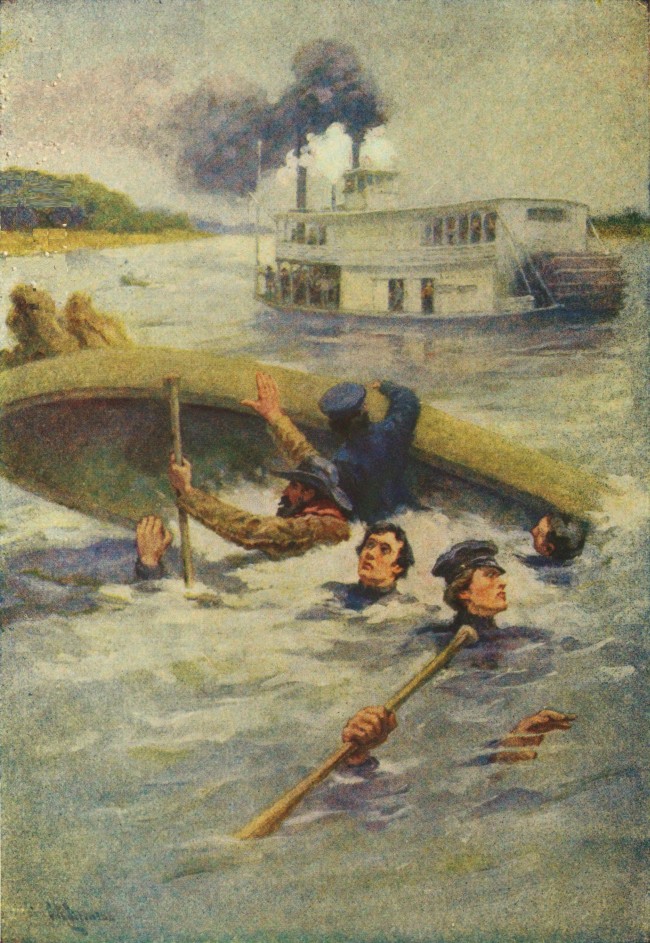
Even as he spoke the dug-out struck with a shock,
hung, swerved, tilted—a hidden snag underneath rose and
fell and clung vengefully—water began to flow in over
the gunwale on the up-stream side—several of the recruits
sprang half to their feet, leaning. “Steady! Steady!”
bade the lieutenant—and amidst a general cry, over she
went. His heart in his mouth, Ernest pitched backward,
and with a splash the water closed above him. He shut
his lips tight just in time.
As soon as he could right himself he kicked and
paddled vigorously to reach the surface. Up he blindly
came, working hard; his head burst the surface, and hit
with a thump. Ouch! Clawing, he opened his eyes, but
for a minute he could not see. Everything was bleared
and dark. He panted, and paddling and kicking he wildly
stared. Something hard was close above him and surrounding
him, like an umbrella. He stretched up a hand,
and explored. Wood! His knees hit a sharp edge, below
water. His fingers encountered a projection, near his
head, and he hung on.
Now he knew. He was under the boat! He certainly
was. The covering was the bottom, inside, his knees had
hit the gunwale and his fingers had found the bow (or
stern) where the gunwales came together in a point. Yes,
he was underneath the up-side-down dug-out, and he was
floating along with the current; at any rate, there was
nothing but water under him when he extended his feet
as far as he dared.
The space was not pitchy dark, for some light filtered
through the water; soon he could dimly make things out.
A bobbing object bumped against him; it was a canvas
haversack.
For the present he had plenty of room and plenty of
air; and by kicking occasionally, and hanging on with his
fingers, he easily kept afloat. But, jiminy, what a fix!
He shouted, and his voice rang hollowly in his ears, almost
deafening him. Maybe he could dive from under. He
took a long breath and sank and kicked, doubling his
neck—and bumped his head again, on one gunwale, and
his shins on the other. Huh! That didn’t work, so in a
panicky fear he came up inside to breathe. Shucks!
Now his feet dragged momentarily on a bar, but lost
it. Once more he tried to dive. He must get out from
under. He sank, turned in a ball, kicked and paddled and
groped, pushed luckily with the soles of his feet against
the opposite gunwale—and away he slid, scraping his back.
He held his breath as long as he could; then out he popped,
into sunshine and freedom!
Paddling, and drinking the open air, he blinked, dazzled,
until he could gaze about. What good fortune that
he had learned to swim! However, he saw nothing but
the surface of the water, and the two shores, and the dug-out,
bottom-side up and looking like a big narrow turtle.
Above him the river curved widely, and around the curve
was the steamboat, probably; but he was alone. Nobody
had floated down with him.
He was nearer to the low shore than to the high, so he
must have been carried diagonally by a cross current.
His feet touched bottom again, and he started to wade,
on tiptoe—when he suddenly bethought himself. He
struck out for the boat, held to it with one hand and
groped under it with the other, and hauled out the haversack.
There might be something in it to wear or eat, if
the water had not spoiled all the stuff. He felt somewhat
like Robinson Crusoe; and pushing the heavy haversack
he headed for the nearer shore.
The water shoaled rapidly, until waist-high and knee-deep
in the mud he forged along, lugging the haversack
(which weighed about a ton!), until he emerged at what he
had supposed was a low meadow. It had looked like level
grass; but he discovered that it wasn’t land, after all. It
was a regular swamp; with coarse cane and grass higher
than his head, and underfoot a squashy bog in which he
sank to his knees again. And the mosquitoes! And the
damp heat! Shucks, and twice shucks! But there were
no two ways, now. He toiled manfully on, lugging the
precious haversack, shoving through the jungle, plumping
in the soft boggy turf, not able to see a thing except the
cane and grasses, and the mosquitoes that ate him, with the
sun boiling him and his feet like lead.
It seemed to be a tremendously wide swamp. He kept
a sharp lookout for snakes, and tried his best to make a
bee-line by sighting on some tree-tops that, from occasional
open spots, he could glimpse far before. His breath came
in gasps, his heart thumped, the mosquitoes and the heat
were awful, and the perspiration simply poured down his
face. He was leaving the river behind, but when he got
out of the swamp, then where would he be?
Hurrah! He guessed that he was reaching the edge,
at last. The bogginess was not so deep, and the jungle not
so high. His head began to stick above the rushes; his
shoulders followed, and he could see about him.
The trees were plain: a large timber-patch, across a
short stretch of level prairie. Out of the swamp and
upon the hard prairie Ernest staggered; and down he sank,
in the hot sun, gasping. A sorry sight he was, too: a
bare-headed boy (he had lost his hat, of course), in blue
flannel shirt and gray jeans trousers and coarse cowhide
shoes, soaked to the skin and muddy to the waist. He was
glad to drop the haversack and wipe his face with his wet
bandanna handkerchief. Then he took off his shoes and
socks, wrung his socks as free as he could of mud and
water, emptied his shoes, put socks and shoes on again;
and after a breathing space decided to try for the shade
of the trees.
With a grunt he picked up the haversack (which he
would investigate later), and plodded on. It was another
long pull to the trees, for he was pretty weak in the knees.
But he made it, without a stop; and as he crossed the
border, from sun to shade, how good the coolness felt!
The timber patch was quiet, except for the twitter of
birds. Once, as he wandered curiously forward, seeking
the best seat so as to rest and examine the haversack, he
heard a quick rustle and a series of thumps, as if he had
disturbed a deer; but he did not see the deer. Apparently
he had the timber all to himself. This was rather fun,
exploring—especially if the haversack contained something
to eat. But the undergrowth was thick, and there
were still some mosquitoes; and the proper place in which
to sit down would be an open space warmed by the sun.
The shade was almost too cool. After he had rested
and dried off, and perhaps had a bite to eat, he would
start out and look for the steamboat, up the river. Or
maybe he could find the lieutenant, who might be looking
for him.
An open space appeared ahead. Ernest made for it,
broke through into it—and abruptly stopped short, staring
and hugging his haversack. The first thing that his quick
eyes saw was a big Indian, directly opposite.
The Indian was sitting down, cross-legged. He was
a frightfully big Indian—quite the biggest Indian imaginable.
He wore dark whiskers, covering his chin, but he
was an Indian, sure; for he had on a gaily figured, dirty
calico hunting-shirt, open at the throat so that his hairy
chest showed, and buckskin trousers, and embroidered
moccasins, and around his large head was wound a strip
of red cloth, in several folds, turban fashion. His hair
appeared to hang in a pig-tail, or braided queue, down his
back. A quiver of feathered arrows lay beside him, and
a short strung bow was across his knees.
He sat without a movement, scarcely winking his eyes,
which, bold and steady and very blue, surveyed Ernest,
while Ernest surveyed him. Ernest had the feeling that
this Indian had seen him first; and there, half in sun and
half in shade under the tree at the clearing’s edge, had
waited for him to approach.
“Who are you, boy?” The Indian had spoken, in a
deep, resonant voice—and he had spoken good English.
“My name is Ernest Merrill,” stammered Ernest,
standing stock still.
“Where are you from?”
“From Cincinnati, Ohio.”
“How came you here?”
“I was travelling on a steamboat up the Arkansas
River, and the steamboat stuck on a mud-bar, so I got off
to walk the rest of the way.”
“Where are you going?”
“Fort Gibson.”
“What do you want at Fort Gibson?”
“My uncle. He sent for me.”
“Who is your uncle?”
“He’s Sergeant John Andrews, in the United States
army.”
“Who is with you?”
“N-nobody,” faltered Ernest, determined to be honest.
“There were Lieutenant Neal and some soldiers and a
Texan, but the dug-out capsized with us and I got under
it and lost ’em. They must be around somewhere,
though,” he added, as a warning.
“Have you no parents?”
“Yes, sir; I’ve my mother, but she’s sick and my uncle
was to take me till she’s well. He’s going to be discharged
pretty soon.”
Ernest could no longer keep himself from trembling.
His knees were so wobbly, and his stomach so empty, and
the haversack so heavy; and he was alone, and the Indian
was very big. The Indian seemed to notice the symptoms.
He smiled—a beautiful but sad smile—and beckoned with
a great fore-finger.
“Come here, my boy,” he bade, in his fine resonant
voice. “Fear nothing. You are as safe with me as in
your mother’s lap.” And he added, with a dignified
gesture of his open hand: “I am Sam Houston.”
II ON THE ROAD TO TEXAS
Ernest went forward, across the little park. Now he
was not a particle afraid. Something in the man’s big
finger and steady voice put him at his ease. Besides, this
was no Indian; it was Sam Houston in Indian clothes.
Truly, an astonishing meeting, but a happy one. So
Ernest went forward.
“What have you there, my boy?” asked Sam Houston,
referring to the haversack.
“It’s a knapsack,” replied Ernest. “I found it under
the boat.”
“Whom does it belong to?”
“One of the soldiers. He lost it when the boat capsized;
so I took it with me.”
“Where are the soldiers?”
“I don’t know. I guess they swam ashore while I
was floating down.”
“Let me see.”
Ernest passed the haversack to him, and squatted down
while Sam Houston unbuckled the flap. After all, there
wasn’t much of any use in the haversack: only two pairs
of socks, and a suit of underclothing, and a razor and
strop, and a “housewife” or little case containing needles
and thread, and several newspapers, and a tin plate and
steel knife and fork and pewter spoon, and some soggy
crackers or hardtack, and a cotton night-cap. None of
the clothing would fit Ernest. The haversack had weighed
so much because it was water-soaked.
Sam Houston stowed everything carefully back again,
and buckled the flap.
“We will restore this to the Government when we get
to Fort Gibson,” he said. “It is not yours or mine. Can
you travel? Come.” And he stood. “I have provision.
You can eat as you go. Your uncle is no longer at the
cantonment, but never mind. Sam Houston will watch
over you.”
His uncle “no longer at the cantonment!” Why?
And where, then? Ernest’s heart sank.
“He has been transferred,” quoth Sam Houston,
briefly, as he strode, carrying the haversack, Ernest trotting
in the wake of his great strides.
Ernest asked no further. He felt that he was in good
hands, and that Sam Houston knew what was to be done.
In a few minutes they arrived at the edge of the timber,
where a small, bob-tailed pony was tethered to a tree. The
pony nickered at their approach. From the tree Sam
Houston took down the carcass of a deer, hanging there.
He laid it over the horse’s haunches and tied it fast. He
slung his quiver at his thigh, and the haversack from the
saddle, against the horse’s side. The pony did indeed
seem very small; but after handing Ernest a strip of dried
meat, extracted from the bosom of his shirt, and saying,
“Chew on this, my boy,” Sam Houston untied the animal,
lifted Ernest astride the deer carcass behind the rude saddle,
and confidently mounted, himself.
Thus they rode away, at an easy amble, Ernest perched
high and hanging tight, his legs and the legs of the deer
dangling.
Up hill and down, through a rolling prairie land of rich
grass and occasional brush and trees, they rode; they saw
deer and wild turkeys, and crossed several trails; and at
sunset they halted, by a creek, to spend the night. They
chewed more of the dried meat, Sam Houston cut some
dried grass, spread it, and from the saddle untied a blanket,
and laid it out.
“There is our bed, yours and mine,” he said. “Some
day you will remember that you shared the couch of Sam
Houston.”
Ernest snuggled beside him, and slept soundly until
daybreak. After a scanty breakfast they rode on.
It probably was about ten o’clock when, as they topped
a little rise, Ernest’s friend pointed ahead.
“Yonder is our destination,” he said, solemnly—and
using the high-sounding language of which he evidently
was fond. “There lies the cantonment of Fort Gibson;
and across the stream from it waits the humble habitation
of Sam Houston.”
Slightly to the south of west showed a river, marked
by its line of trees. That was the Arkansas. From the
north another river joined it; and on the hither shore of
this river, a few miles above its mouth, was a group of
buildings, occupying a lovely placid site in the sunny open.
Across the wide grassy prairie that stretched to the river
ambled the pony, with its double burden—Ernest holding
fast and peering.
Soon he could make out the Stars and Stripes floating
on the breeze, from its tall flag-staff. Several Indians—real
Indians—were met, on their ponies. They were
dressed much like Sam Houston; some carried bows, some
muskets. With them Sam Houston exchanged a dignified
word of greeting. And presently the fort itself was
reached—but it did not appear to be much of a fort; just
a small collection of low, shabby wooden buildings around
a parade-ground.
Ernest was disappointed. However, he did not waste
many moments by criticizing his port. As the pony entered
the parade-ground, apparently being directed straight
for the quarters of the commanding officer himself, almost
the first white persons that Ernest saw were young Lieutenant
Neal, and the tall Texan, crossing the parade-ground
together. And they had seen him.
With a little shout of joy, off from the deer carcass
tumbled Ernest, and ran forward. The lieutenant and
Mr. Carroll met him half way, and there was a great
shaking of hands.
“Are you all here?” demanded Ernest, breathless.
“I am. Sam Houston brought me.”
“Great Cæsar! Is that Sam Houston?” exclaimed the
Texan. “With that Cherokee dress and those whiskers
on his chin I didn’t know him. Bless my heart, but I’m
glad to see you! Where did you go to? You disappeared
completely. We——”
“I was under the boat,” explained Ernest.
“Is that so! We saw the boat but we didn’t sight you.
We swam and waded to the high bank——”
“I landed on the other side; the low side,” explained
Ernest. “Quite a way down, though. I couldn’t get out
from under the boat, at first.”
“Lucky you did get out,” said the lieutenant, soberly.
“We never thought of that. Well, we searched along the
bank, the best we could; then we told some Indians to keep
a watch-out for you, and borrowed some horses from them
and rode on to the fort. Got here about midnight.”
“My uncle isn’t here any more, Mr. Houston says,”
faltered Ernest, his spirits dropping.
“No, he isn’t, Ernest,” admitted the lieutenant. “He’s
been gone about two weeks. But never mind. You’ll be
cared for. Now let’s speak with General Houston a
minute.”
General Houston, as the lieutenant had entitled him,
was sitting with dignified patience on his bob-tailed pony,
as if waiting for recognition. Followed by Ernest, the
lieutenant and the Texan stepped over to him.
“I am Lieutenant Neal, sir,” addressed the lieutenant.
“If I mistake not, I have the honor of addressing General
Houston.”
“The same, sir,” bowed the general.
“Allow me to present Mr. Carroll, recently from
Texas. You have done a great service, sir, in restoring
to his friends this boy, with whom I travelled from the
Mississippi River, and who I feared had been lost by an
untimely accident.”
“It is one of the few pleasures of my life, sir,” responded
the general. “I have informed him that Sergeant
John Andrews, his uncle, is no longer stationed at Fort
Gibson. Does the further disposal of the boy rest with
you or with me?”
“I will take charge of him, and thank you,” answered
the lieutenant.
“Then I will consign to you this haversack, also, which
is the property of the Government,” continued the general.
“Good-by, sirs. Good-by, my boy. Shall you ever need
a friend, you will find him in Sam Houston.” He gravely
eyed the Texan. “From Texas, eh? I will speak with
you anon, sir.” He touched his pony with his heel, and
turning aside ambled away.
“A ruined man,” mused the lieutenant, gazing after.
“Think of him, as once a congressman, and governor of a
state! I fear his violent habits have weighted him down
beyond recall.”
“A great character struggling to free itself again,” corrected
the Texan. “There is nothing half-way about
Sam Houston. Just now he’s like a wounded b’ar, that
bites its own flesh and crawls about seeking healing yarbs.
But wait till he’s recovered. Why,” added the Texan, “in
his Injun clothes, on a bob-tail hoss, he rides as if he were
in broadcloth on a thoroughbred!”
And Ernest decided that the Texan was right.
The next thing on the program, for Ernest, was of
course a change of clothes. In the lieutenant’s room he
was fitted out, after a fashion; and although the clothes
were rather large, they were clean. The steamboat with
his trunk had not arrived yet. As like as not she was still
stuck on the bar.
So Ernest, while awaiting word of his uncle the sergeant,
who had been sent out with a scouting detail across
country clear to Cantonment Leavenworth in what is
to-day Kansas, stayed at Fort Gibson. It was likely,
according to the lieutenant, that the sergeant would get his
discharge at Leavenworth. Well, what then? Would he
come back? Scarcely. Would he send for Ernest to
meet him? Nobody seemed to know. Therefore Ernest
wrote a letter—a long, long letter—to his mother, and
settled down to do the best that he could. He was such
a handy lad that he felt he could earn his way; and as he
was willing to do anything, he kept very busy performing
little jobs for Lieutenant Neal and the other officers.
Fort Gibson, or Cantonment Gibson (a cantonment being
deemed not so permanent as a fort), located here on
the east bank of the Grand River a few miles above the
Arkansas, in the southwest corner of the United States
possessions, was only a small post established among the
Cherokee, Creek and Choctaw Indians of the Indian Country.
Of these, the Cherokees were the most numerous
around the post. They had their principal village, named
Tah-lon-tees-kee, down the Arkansas about thirty miles;
they lived in quite a civilized fashion, with their rulers
and councils, and comfortable houses, and well-cultivated
farms. White people had married into the tribe, and
they even kept slaves.
Sam Houston was a Cherokee; he had been adopted
by the old head chief John Jolly—whose Indian name
was Oo-loo-te-kah; and took part in the councils that
made the laws, and was given the name Col-lon-neh, which
meant The Raven. He was one of the few white men
who could speak the Cherokee language.
But lately Sam Houston had left the Cherokee town
of Tah-lon-tees-kee; he had married a half-Cherokee
woman named Tyania Rodgers, and with her had settled
across the Grand River opposite Fort Gibson, where he
had taken up land, built a log house, and was farming
and trading.
Ernest saw him frequently, at the post and also across
the river. There was something mysterious about Sam
Houston. Nobody appeared to understand what had got
into him, except that he had been disappointed in his marriage
back in Tennessee, and had separated from his wife
there, resigned his governorship of Tennessee, and had
fled as far as he could from all his white acquaintances.
He never breathed a syllable about the cause of his trouble;
people respected him for that. He never permitted a
word to be uttered blaming his first wife; and people respected
him for that. He “took his medicine,” as the
saying was. But no one could respect his habits, especially
his drunkenness.
He wore Cherokee Indian costume constantly—usually
a slovenly costume, as when Ernest had first seen him, but
again a “full dress” of beautiful white doeskin hunting-shirt,
yellow buckskin leggins, beaded moccasins, a
brilliant red blanket as a cloak, and a kind of crown of
wild-turkey feathers. Thus he stalked about.
He hunted much, alone, with bow-and-arrow and with
gun. He had spells when he would answer nobody except
in Cherokee. And he had other spells when he lay on the
ground drunk, even at the fort itself. Then his wife
Tyania, who was as large and as stately as himself, would
seek him and take him home to the log house across the
Grand River. He was known as “Drunken Sam”; and
even his Indian brothers called him “Big Drunk” instead
of Col-lon-neh, The Raven.
It was a sad step downward for any man to take; and
for a man who had been as great as Sam Houston——!
Yet, sober or drunk, he still had about him a dignity that
bespoke his better days in the past, and perhaps promised
better days to come. He almost always greeted Ernest
very kindly, and Ernest could not help but like him.
The tall Texan, Dick Carroll, soon left for the down-river
and the Mississippi. Whether he had persuaded
General Houston to help Texas, nobody knew; but at any
rate, he promised to keep an eye out for Ernest’s uncle, in
case that the sergeant had returned to the Arkansas as
far as Fort Smith, say. As for the trunk, Ernest never
saw it again, or the steamboat either!
The fall, crisp and bright, with occasional flurries of
snow, merged into winter, and December opened brave
and sunny, with bracing days and sharp starry nights.
Then, ere a week had passed, through the post circulated
the news that Sam Houston had gone. On his bob-tailed
pony he had ridden away, as if for Texas at last. Only
his wife Tyania remained in the log cabin across the Grand.
Of course there were many reports. One rumor declared
that he had gone to Texas by request of President
Jackson, to make treaties with the Comanches and the
other Texas Indians, for the United States. This rumor
afterwards proved true. Another rumor said that he had
been asked by the President to investigate the people and
affairs in Texas, and to see what the likelihood was that
it would separate from Mexico. This rumor also afterwards
seemed to be proved true. But John Henry, another
trader at Fort Gibson, stated:
“Sam Houston has gone to Texas to stay. He’s been
intending that a long time. And not six months ago he
said to me, on the bank of the Grand River: ‘Henry, let’s
go to Texas. I’m tired of this country and sick of this
life. It’s no place or occupation for me. Anyway, I’m
going, and in that new land I will make a man of myself
again.’ He also said he’d make a fortune for both of us,
if I’d go with him.”
“If he’ll make the man of himself, that’s enough; better
than fortune,” quoth Lieutenant Neal, standing near.
“And I believe he will. I’d feared his ambition was dead;
but it isn’t, and anybody with ambition to be something
higher is by no means hopeless. I’m glad he’s gone. The
Cherokees and other Indians will miss him, though; he
was their best friend.”
Ernest missed him, too; missed him already—and
rather wanted to go to Texas, himself. However, on the
very next day who should come riding into the post but
Mr. Carroll the Texan, back from his trip down-river, and
eager indeed over the tidings with which he was greeted.
“Sam Houston’s gone, they tell me! Gone to Texas!
Pshaw! He must have crossed my trail, then, on his way
down to Nacogdoches. But it’s good news. Hello, boy,”
he cried, sighting Ernest. “I had word of your uncle.
He was at Fort Smith, but he left for Texas before I could
catch him. I reckon he didn’t know you were up here.
If you’d like to follow him now’s your chance, for I’m
off to Texas myself in the morning.”
“All right,” said Ernest. “I’ll go if I can get a horse.”
“A hoss!” laughed Mr. Carroll. “No boy who’s
plucky enough to take the long trail into Texas shall lack
a hoss. Not much!”
“Besides, he’s earned one,” declared the lieutenant,
hearing. “He’s worked hard at whatever he was told to
do, and my yellow pony that he’s been riding is his to keep;
yes, and saddle and bridle, too.”
So Ernest, outfitted, by the friends whom he had made,
not only with the yellow pony, and saddle and bridle, but
also with clothes, provisions, and a buck-handled hunting-knife,
found himself the next morning prepared to ride
southward with Dick Carroll the Texan.
He was shaking hands and exchanging good-byes,
when into the midst strode a young Cherokee, the nephew
of Tyania, Sam Houston’s wife.
He bore a beautiful light little rifle, beaded hide bullet-pouch,
and powder-flask of black buffalo horn scraped
smooth and thin. Straight he marched to Ernest’s stirrup.
“Tyania send these,” he said, extending them. “You
go to Texas. When you see Sam Houston you tell Sam
Houston Tyania love him, she wait here for him, but she
never go there.”
And he had hastened away before Ernest had had time
even to thank him.
“By jiminy!” exclaimed the Texan, as Ernest, much
flustrated and delighted, slung the bullet-pouch and
powder-horn upon his shoulders and balanced the little
rifle. “Now you’re sure fixed out, and that Mexican
government had better mind how it behaves or Texas will
be free.”
They left Fort Gibson behind them, and crossed the
Arkansas River by means of an Indian flatboat ferry—to
which the horses did not object at all. Almost due south
they rode; straight for Texas, by a narrow trail that led
through the timber and the prairies clear to Nacogdoches,
which was the first town of any importance on the Texas
northeastern frontier. Mr. Carroll was not certain that he
wished to go to Nacogdoches; but he hoped to overtake
General Houston, or at least to learn his whereabouts.
All day they rode; at night they camped. They passed
through a portion of the Creek Indian nation (the Creeks
looked much like the Cherokees); and after that they saw
scarcely anybody except Choctaws (another half-civilized
Indian people), until before they reached the Red River
they sighted, at noon, ahead, three men sitting their horses
in the trail, and grouped as if chatting.
“Sam Houston!” ejaculated Mr. Carroll. “Now
we’ll know what’s what.” And he added, as they drew
near: “Elias Rector, too. He’s United States marshal for
Arkansas Territory. T’other one’s name is Harris, I
think. Met him down at Little Rock. Major Arnold
Harris.”
Sure enough, General Houston it was, his head thrust
through a Mexican blanket, draped over his shoulders, and
a large-brimmed whitey-gray wool hat on his crown. He
looked larger than ever, but it was no wonder that Ernest
had not recognized him, for he had been clean shaven.
However, Mr. Carroll had sharp eyes.
The spot proved to be the focus of several trails; and
as Mr. Carroll and Ernest arrived, the general was heavily
dismounting from his bob-tailed pony.
“This bob-tailed pony is a disgrace,” declared the
general. “He is continually fighting the flies, and has no
means of protecting himself; and his kicks and contortions
render his rider ridiculous. I shall be the laughter of all
Mexico. I require a steed with his natural weapon, a
flowing tail, that he may defend himself against his enemies
as his master has done. Harris, good-bye; but first
you must trade with me. What are your terms?”
“Very well, Sam, I will,” agreed Major Harris.
“But we’ll each keep our own saddle and bridle.”
“So be it,” answered the general. “Now, Jack,” he
said to his bob-tailed pony, as he stripped him, “you and
I must part. You have been a good and faithful servant
to me, but, Jack, there comes a time in the life of every
man when he and his friends must separate. You are a
faithful pony. You are a hardy pony. You are a sure-footed
pony. But cruel man has made you defenseless
against the common enemy of your kind, the pesky fly.
Where I am going they are very thick. The Almighty in
His wisdom gave you a defense, but man has taken it
from you, and without a tail you are helpless. I must
therefore with pain and anguish part with you.”
So saying, he changed the saddle and bridle to the
larger horse, which had a fine long tail.
“Houston,” spoke the third man, the United States
marshal, “I’d like to give you some little keepsake before
we separate, but I have nothing except my razor. Will
you take it? I never saw a better one.” And he extracted
it from his saddle-bag and extended it.
“Major Rector,” proclaimed the general, much as if
he were making a public speech, “I accept it. This is
apparently a gift of little value, but it is an inestimable
testimony of the friendship which has lasted many years,
and proved steadfast under the blasts of calumny and
injustice. Good-bye. God bless you. When next you
see this razor it shall be shaving the President of a
Republic.”
“How are you fixed for money, Sam?” inquired
Major Harris. “You may need some where you’re going.”
“Money?” answered the general, solemnly. “Unfortunately,
I am always in need of money.”
“Then let me divide with you. I’ve more with me
than I can use, and you can repay me at your leisure.”
“Thank you,” acknowledged the general, pocketing
what was proffered. “Remember my words, Harris, I
shall yet be the president of a great republic. I shall bring
that nation to the United States, and if they don’t watch
me closely I shall be the President of the White House
some day. Good-by.” And reining his horse around, he
rode down one of the trails.
He apparently had not noticed Mr. Carroll and Ernest.
But the two other men, taking another trail, saluted civilly
as they passed.
“Well,” remarked the Texan, to Ernest, and gazing
after the rapidly receding form of the general, “I reckon
Sam Houston’s bound for Texas, all right. Didn’t I tell
that steamboat captain and the rest of you that Houston
would rise again? He’s made up his mind and nothing
can stop him.”
Thus speaking, the Texan touched his horse, and with
Ernest rode onward into the south.
That evening they half waded, half swam their horses,
across a ford of a rapid river. On the farther bank Mr.
Carroll raised his hat as if in a salute, and turned to Ernest
with a smile.
“Now you’re in Texas, lad,” he said. “That was the
Red River.”
They made camp, and lay down together in their wet
clothes, feet to the fire, while a flock of turkeys (minus one
which had supplied a supper) querulously piped in the
trees beside the water before they, also, settled for the
night.
Texas! Was ever a land elsewhere so vast and yet so
beautiful as this, thought Ernest, as throughout the next
day he and the Texan steadily rode onward, threading
deeply-grassed prairies, circuiting patches of rich timber,
crossing streams and swamps, and seeing scarce a sign
of human life, but horses and deer and turkeys in abundance.
Where were the Texas settlers?
Mr. Carroll laughed.
“Down yonder we’ll find ’em,” he said. “But the
country’s not crowded. Every man has plenty room.
This is principally Comanche range—and those fellows we
don’t want to see!”
After such long travel that Ernest completely lost
track of the days, they came to the first real token of
civilization: a straight, well-travelled road, with marks not
only of horses’ hoofs but of wheels.
“The Royal Road,” explained Mr. Carroll, pausing.
“Laid out by the Spanish before the Texas settlers entered.
Runs clean across the middle of Texas between
Nacogdoches of the east and San Antonio of the west.
But we don’t follow it. We strike down by the San Felipe
trace, for Gonzales. If we followed the San Antonio
road we’d pass too far north.”
Presently he turned off, to the left, upon a much lesser
road—another of those Texas trails or “traces.” Evidently
this was the San Felipe trace. Now they met a few
people, mainly hunters on horseback; and that night they
stopped with a settler family at whose ranch-house, a rude
log cabin, glassless and floorless, they were made more
than welcome to a supper of corn-bread, venison and
honey, and to a husk bunk.
The next afternoon Mr. Carroll pointed ahead.
“San Felipe on the Brazos,” he announced. “First
American town founded in Texas, headquarters of Steve
Austin’s colony, and sort of capital for the whole outfit
of us. We’ll stop there to-night, and at Burnam’s on the
Colorado to-morrow night, and day after we’ll push on
through to Gonzales.”
San Felipe was a straggling little town, with scattered
houses of logs and of thick, rough-sawed siding like clapboards,
and dusty but wide streets, centering about two
public squares or plazas. There was a tavern, run by a
settler named Whitesides, and a double log house where
lived Stephen Austin himself, the “Father of Texas.” He
was away from town, just now, on business. Mr. Carroll
thought that at least 1500 people formed the population of
the San Felipe neighborhood. The farms were said to
be the most prosperous in Texas.
This night’s lodging was at the house of another friend—Mr.
R. M. Williamson, one of whose legs was bent at
the knee, so that he moved by help of a crutch. He had
been alcalde, or mayor, of San Felipe, and was called
“Three-legged Willie.” He seemed to be a fine man, of
quick, decisive action.
What he and Mr. Carroll talked upon, late into the
night, Ernest did not know—he did not stay awake to hear.
“Thirty miles to-day,” quoth the Texan, as in the
morning he and Ernest ambled out of San Felipe. “Fifty
to-morrow, and then we’re there.”
The trace continued into the west. And again it was
a rather lonesome trail, save for the very few ranches, and
an occasional traveller by horse—now and then an American
in buckskins or coarse cloth, and now and then a
swarthy Mexican enveloped in a blanket. If there were
20,000 Americans settled in Texas, they must be settled at
great intervals; and this Ernest soon learned was true.
“Yon’s the Colorado,” informed Mr. Carroll, toward
evening, as they jogged slowly, saving their horses for the
longer ride to-morrow. “The Burnams live across on the
west bank. Hope the captain’s at home. Want you to
meet him. He’s four-square. One of the original Austin
settlers, he is. Came out hereabouts from East Texas
along in ’22. Took sick in the War of 1812, and he
was the porest man in Texas, I reckon. Born pore, in
fact—and when he married, in Tennessee, his wife had to
sell her stockings to get plates to eat off of. But he’s
getting ahead, now, and he’s a powerful Injun fighter.
That’s the kind of stuff we have in Texas, to make a state;
and it’s the right stuff, too.”
Burnam’s Crossing was a ford at the Colorado River,
but a ferry was operated here, also, in high water. From
the east bank, where another settler lived, the Burnam
ranch could be seen, opposite: a log house built like a
block-house, and several out-structures. Ernest and his
guide plashed through the water.
Yes, Captain Burnam was at home, for when they drew
up before the hitching rail in front of the ranch yard a
bearded man hastened from the corral to greet them.
“Howdy? Light and come in,” he called, cheerily.
“Oh, boys! Put up these gentlemen’s hosses.”
A young man issued from the corral and with a word
to Mr. Carroll led the two horses away. Ernest was introduced
to Captain Burnam; and in the house to the rest
of the family. At supper there was another boy, of dark
eyes and hair, whose name was James Hill—or James
Monroe, they called him, by his middle name, when they
didn’t call him plain Jim.
He was older than Ernest, being fourteen, but he was a
boy, just the same; and although there were boys in the
Burnam family, Ernest was glad to meet as many boys as
possible. It would have been pretty stupid, in Texas,
without boys.
“I live out just a small piece,” explained James Monroe.
“You going to Gonzales, I reckon?”
“I guess so,” responded Ernest.
“Mr. Carroll some of your kin?”
“No. I’m looking for my uncle.”
“Who’s he?”
“Sergeant John Andrews, of the United States Army.
But he’s been discharged, and he’s somewhere in Texas.”
“Wasn’t that an army sergeant named Andrews who
was killed by the Karankawas down on the Trinity, couple
of months ago, dad?” blurted one of the Burnam boys.
“Sh!” warned his mother; but it was too late.
“That so?” queried Mr. Carroll of Captain Burnam.
“Hadn’t heard. What about it?” And Ernest waited,
breathless.
“So’s the tell,” acknowledged Captain Burnam, slowly.
“There was a party of traders massacred by the Karankawas,
and a man by name of John Andrews, from the
United States Army, was among ’em. He was a newcomer.
They all were newcomers or they wouldn’t have
been so careless.”
Silence fell.
“That’s sure too bad,” volunteered Jim Hill, to Ernest.
“Maybe ’twasn’t your uncle. Did you know him well?”
“No, I never saw him; but he was to take care of me,”
faltered Ernest.
“Well,” said Mr. Carroll, quickly, “don’t you mind,
boy. You’re no worse off. I’d sort of adopted you, anyway.
So you come along to Gonzales, and I’ll see you
don’t suffer, you bet.”
“Of course. Never mind. You stay with Dick
Carroll and he’ll make a Texan of you,” spoke Mrs.
Burnam. “Just forget your uncle and those Injuns.”
Ernest gulped.
“I guess I will,” he said. They all were trying to be
so kind to him that he could not say anything else. And
he did like Dick Carroll.
James Monroe Hill left, after supper, to ride over to
his home. He told Ernest he’d see him again; and he did.
The start for the fifty-mile ride to Gonzales was made
at daybreak, with the hospitable Burnam family waving
good-by from the block-house. The winding trace led
across numerous streams, and past several isolated
ranches; and near sunset Dick Carroll again pointed
before.
“Gonzales—little old Gonzales,” he informed. “She’s
the last of the white settlements, but she’s home, and it’s
good to see her again.”
They entered another straggling town, smaller than
San Felipe. Dick exchanged greetings with the people
whom he passed; he turned his horse and Ernest’s into
the public corral, for the night, and led the way, through
the dusk, for supper and bed in his own cabin, which was
to be Ernest’s also.
III SANTA ANNA PROVES FALSE
Ernest awakened in the morning full of curiosity.
While Dick Carroll was attending to some business matters,
after breakfast, he himself had time to explore his
new home. Gonzales was not much of a town, as yet, being
smaller than San Felipe. However, it was lavishly
laid out, six miles square, in blocks divided off by broad
straight streets, which ran out into the open country,
the majority indicated only by surveyor’s stakes and some
indicated not at all. There were a Market Square, and a
Military Plaza, and other public parks (as required by
Mexican law); a hotel called Turner’s Inn; a sort of a
fort, in case of Indian attacks; a store or two; and about
twenty houses of logs and clapboards, and well scattered.
On many of the squares there was only a single house;
and on others none at all. The main residence section
was the southwest corner of the tract, called the “inner”
town. To north and east extended the “outer” town,
sparsely occupied by ranches.
This Gonzales was located on a timbered prairie, from
which trees had been cut for house building. The Guadalupe
River flowed in a curve on the west edge of town,
and a few families had settled across on the west side of
the river. In the north of the “outer” town was a heavy
timber patch, which Smith’s Creek separated from a green
prairie to the south; and through the town wended Kerr’s
Creek, along which the first cabins had been erected, in
1825, when Colonel Green DeWitt (who owned all the
vast colony tract) and Major James Kerr, of the Missouri
senate, brought in the first settlers.
In honor of Don Rafael Gonzales, governor of Coahuila
and Texas, was the settlement named; in 1826 it
had been destroyed by the Indians and was rebuilt in 1827.
Even yet it was in constant danger from the Indians,
particularly the Tawakanas; and it had been loaned a six-pounder
brass cannon by the presidio of San Antonio, for
protection. The cannon was not mounted, but it was kept
in readiness.
Gonzales was the westernmost of the American settlements
in Texas. Further west there was only old San
Antonio de Bexar or Bejar—usually styled by the last
word, pronounced “Behar.” It was seventy-five miles by
road, and was strictly a Mexican town, although Americans
lived there. Years before it had been established as
a Roman Catholic mission, where were stationed priests
and soldiers to educate and control the Indians. The mission
part was abandoned, but as a presidio or garrison of
Mexican soldiery, and as the principal Mexican military
post in Texas, old Bejar was considered of much importance.
The road to it was lonely and unsettled.
East of Gonzales, about eighty miles, was San Felipe—Stephen
Austin’s town; south sixty miles was Goliad or
Goliath, formerly the Mexican military post of La Bahia,
on the lower San Antonio River; and down the Guadalupe,
below Gonzales, about the same distance, was Victoria.
But the country between, surrounding Gonzales, was all
wild and unoccupied, and Gonzales was a real frontier
settlement.
Dick Carroll “bached” it in his little log cabin; here
he and Ernest slept and cooked their meals. Ernest on
his first day was set at work herding horses on the prairie
north of the houses; and thinking hard while sitting his
yellow pony, and listening to Dick Carroll and the other
men, in his hours off duty, he soon got a pretty clear idea
of the situation in Texas.
“It’s this way,” explained Mr. Carroll. “Texas
wants to be a free and self-governing Mexican state, with
all the privileges of the constitution of 1824. But instead
of that, the blamed Mexican government has joined us
to the other province of Coahuila, that lies next to us, just
across the Rio Grande, so we’re only a part of the state of
Coahuila and Texas. Now, that doesn’t go. Coahuila
province and Texas province are different peoples altogether.
Across the Rio Grande everything is Mexican and
can be run ’cording to Mexican ideas. But Texas is
settled up by Americans, used to different laws and different
habits, and perfectly capable of governing themselves
if only given the chance. Now when we’re tacked onto
Coahuila, and the state officers are mainly located in
Coahuila, and they’re most of ’em Mexicans, to boot, a
small show does Texas stand of putting through the kind
of laws that Americans can live and do business under.
Santa Anna, though, will help us as soon as he’s president,
now that the revolution ag’in Bustamante has won out.
And this spring Texas is going to hold a regular state
convention by itself, draw up a state constitution, and ask
the government to approve it. I reckon Sam Houston’ll
be one of the delegates from Nacogdoches; and if so, the
constitution’ll be dog-proof and hog-tight. He ought to
be down this way right quick. He was over at San Felipe,
to meet Austin, last week, I hear tell, and he’s going on
through to Bejar, they say.”
Mr. Carroll had spoken correctly, for within a day or
two the general (he had been general of the Tennessee
militia) did appear in Gonzales. Ernest found him there,
at supper time, talking in the midst of a group of citizens.
He wore the same big, broad-brimmed whitish hat, and
Mexican blanket, and buckskin pantaloons, and looked as
large as any two other men.
Ernest stood on the outskirts of the little circle of
curious spectators, and gazed like the rest of them. He
knew Sam Houston; certainly he did; but although Dick
Carroll was there, taking part in the conversation, he felt
as if it would be rather nervy of him to elbow in. Still,
he hoped that the general would notice him, in some way.
However, Mr. Carroll chanced to see him, and
beckoned him forward.
“Here’s another friend of yourn, general,” announced
Dick, holding Ernest by the arm. “And he’s a Texan,
too. We catch ’em young, in this country. You remember
him, I reckon?”
The general smiled his wonderful, kindly smile, and
stretched out his great hand, which entirely swallowed
Ernest’s.
“I remember him well, and I congratulate him. The
hope of Texas is in the youth who shall be reared within
its borders.”
Ernest blushed. This was embarrassing, but a warm
glow filled his heart, and he determined to deserve those
encouraging words. He did not know whether he was
doing right, yet now was his opportunity to deliver his
message; so he spoke it.
“Tyania gave me a rifle, when I started,” he stammered.
“And she said to tell you, when I saw you in
Texas, that she would wait for you up there but she didn’t
think she’d come down here.”
“Tyania?” mused the general, in his resonant voice.
He repeated the name, dwelling tenderly on the syllables,
“Tyania? A noble woman, who succored me in the
darkest hours of my adversity. She belongs to my past
life. I shall send for her, I shall send for her; and my
only fear is that she will not come.” He swept a fierce,
eagle glance around him. “Let no man ever utter a word
derogatory to Tyania Rodgers.”
And in due time Sam Houston did send for Tyania to
share his new life; but she refused to leave her Indian
people. There, shortly afterwards, she died.
Dick Carroll broke the brief silence that followed the
general’s emphatic speech.
“I want this lad to meet Jim Bowie, too,” he said.
“Shake hands with Ernest Merrill, colonel. He’s thrown
in with Texas, and is going to be one of us as fast as he
can. His uncle was wiped out by the Injuns on the
Trinity; named John Andrews.”
“I am pleased to meet the nephew,” responded Mr.
Bowie, politely, extending a slim, bronzed hand. “I
have heard of the unfortunate fate of Sergeant Andrews.”
Ernest bravely shook hands with a tall, straight man,
of powerful frame, light, fine skin, and smooth complexion
set with small stern mouth and a pair of coldly fierce blue
eyes. But he had a gentle manner, and Ernest decided to
like him.
“Well, gentlemen, let us to what business there may
be,” prompted General Houston.
The group dissolved. The general and Colonel Bowie
and several other men walked away; Dick Carroll and
Ernest proceeded to their supper.
“Sam Houston’s surely going to stay in Texas,” remarked
Mr. Carroll. “You heard what he said about
Tyania and his past life. He’s already sort of taken up residence
at Nacogdoches, and agreed to be a delegate to the
convention, if he’s elected. He and Jim Bowie are bound
for Bejar, where Houston talks to the Comanche Indians,
to get ’em to attend a treaty council at Fort Gibson and
promise to be friendly to the United States. Colonel
Bowie——” he added. “Don’t forget that you’ve met
James Bowie. He was born in Georgia, but he was raised
in Louisiana. You’ve heard of the bowie-knife? Jim
and his brother Rezin invented it—mostly Rezin, they say.
Jim’s a terrible fighter when he’s called on to fight. They
claim he’s the only man who ever roped and rode an alligator,
alone, for fun. Rezin and he have been in some
powerful Indian tussles, since they came to Texas. He’s
married now to the daughter of Juan Veramendi, the vice-governor
of state of Coahuila and Texas, at Bejar, and has
the license for a big cotton and wool factory, over beyond
the Rio Grande. But I doubt if he’s the kind of a man
to settle down to that.”
The year had changed from 1832 to 1833, and the
people of Gonzales and of all Texas, as far as Ernest could
hear, expected great prosperity. Sam Houston had been
to San Antonio de Bexar (or Bejar), and had returned
eastward by the great highway, the Royal Road, north of
Gonzales.
The convention was to meet in April to formulate a
constitution and other measures for presentation to Santa
Anna as soon as he should be installed as head of the
Mexican Republic. Once permitted to elect its state
officers and make its own laws, Texas would jump ahead.
The convention assembled at San Felipe on April 1,
this 1833. Ernest did not ride over, but Dick Carroll, and
other Gonzales citizens, did, to be on hand, so Gonzales
was well informed as to what was done.
The constitution was drawn under the direction of
Sam Houston, the chairman of the committee to prepare
it. Another committee wrote a memorial or address to the
Mexican government, explaining what Texas desired. It
said that Texas was at a standstill, because of the attacks
by the Indians, the lack of sufficient laws, and the restrictions
placed upon immigration from the United States;
and it asked that the government decree of 1830, which
ordered that no more Americans should enter Texas, be
officially repealed.
Three delegates were appointed to carry the wishes
of Texas to the City of Mexico; but only one made the
trip. He was Stephen F. Austin himself, the “Father of
Texas.” And when he passed through Gonzales, Ernest
saw him for the first time.
It was not difficult to understand why the people of
Texas loved Austin so, but he looked more like a student
than a pioneer who had brought the first settlers into
Texas, a dozen years ago, and had lived here ever since.
He was slender and graceful and of only medium height,
and wore a fringed suit of soft seal-brown buckskin—although
it was said that he had a suit of broadcloth with
him, to wear in the City of Mexico. His hair was brown
and curly, his smooth face long and fair, and his gray-blue
eyes were large and thoughtful. He appeared tired
and perplexed, and not very strong. It was claimed that
he was a college graduate, and that since coming to Texas
he had studied the Spanish language until he could speak
it thoroughly, and that nobody was better acquainted with
the Mexican laws than he. He and Sam Houston had
been born in the same year, in Virginia; but no two men
were more different. Sam Houston was massive and
majestic; whereas Stephen Austin was slight and modest.
Austin proceeded on for the City of Mexico, where
General Santa Anna had been inaugurated as president.
Gonzales wished him good luck; he was paying his own
expenses, and he was going all alone, and much depended
again upon him.
“He’ll fetch back the bacon, if anybody can,” remarked
Dick Carroll, rather dubiously. “But sometimes
I don’t trust even Santa Anna. You never can tell what
is about to happen, down there in Mexico; and Santa Anna
may want to be the whole thing, just like the others.”
It was a long journey to the City of Mexico, and
weeks would pass before Texas could hear from its petition
for a separate statehood. Meanwhile, affairs continued
to be not satisfactory at all. For instance, the
legislature of Coahuila and Texas, which was more for
Coahuila than for Texas, had assembled and among other
measures adopted one that declared that petitions to the
government “excited disorder,” and therefore no more
than three persons should join in any petition. This was
not the way Texas felt. Other resolutions also were
adopted which seemed to be aimed against the Texas half
of the state. And soon afterward Coahuila became even
divided against itself, when the legislature attempted to
change the capital from the town of Saltillo to the town
of Monclova. A little revolution ensued, down there
across the Rio Grande. It was evident that Texas could
expect small help from Coahuila, and must stand on its
own feet. The Mexican way of government was not the
Texas-American way.
Other disquieting news arrived. Santa Anna had been
president only a few months, when up rose a party of
the Mexican people and proclaimed him dictator, an
absolute ruler responsible to nobody, much less to the
republic’s constitution of 1824. It seemed to be the opinion
that Santa Anna had hatched this movement, himself;
and although he accompanied an army under General
Arista, to subdue the revolutionists, he was accused of
making only a pretense at resistance. Then, when General
Arista turned revolutionist, and actually seized Santa
Anna and insisted that he be dictator, the whole matter
looked more suspicious than ever.
But Don Gomez Farias, the vice-president, proved to
be honest and faithful. He promptly squelched the movement,
and President Santa Anna, finding that the revolution
was not going to succeed and that he could not be
made dictator yet, pretended to escape, and returned to the
capital. He did not like Don Gomez any the better for
his honesty; and saying that he needed rest he retired
to his great ranch, there to scheme while he waited another
opportunity.
Meanwhile, again, Stephen Austin was due in the City
of Mexico, bearing the petition from Texas for the
national congress to act upon; but with so much confusion
and plotting, it would appear that he would arrive
at not a very favorable time.
In Gonzales, even, not all the people were agreed.
Dick Carroll and some others were strong for securing
Texas rights at no matter what cost; but the majority
seemed to be in favor of keeping things as they were, if
they could not be bettered peaceably. Gonzales was so
cut off from the rest of the American settlements, and was
so exposed to attack by Indians as well as the Mexican
soldiery at Bejar, and so much depended upon raising
crops and other supplies, that the town dreaded a general
up-setting until it was more firmly established. Indeed, a
letter had been dispatched from the town to the Mexican
“political chief,” as he was entitled, of the district, at
San Antonio, explaining that Gonzales did not wish to
take any part in the differences between Bustamante and
Santa Anna, and preferred to remain neutral and attend
to its own business. It also had declined to take sides
in the dispute with the Mexican officials in East Texas.
But when the convention was held at San Felipe, to
prepare a constitution and to ask for statehood, then
Gonzales sent delegates. On the question of statehood it
stood up for Texas. Dick Carroll had plenty of company.
As the weeks sped, Ernest met a number of Texans
who were as prominent as Colonel James Bowie. There
was Colonel Ben Milam, a Kentuckian who had fought in
the War of 1812; had been an Indian trader in Texas before
the American settlements; and a leader in Mexico
when the people first tried to obtain a republican form of
government; and a prisoner there, and afterwards had
been rewarded by a large tract of land, and now had
another tract, for a colony, but was unable to settle it because
of the Indians. A dark, handsome man was Colonel
Benjamin R. Milam, who spent much of his time over in
Coahuila province.
There was Captain William Barret Travis, from
North Carolina, who last summer, at Anahuac on the Gulf
coast of East Texas, had been thrown into a dungeon by
a tyrannical Mexican official, for resisting some brutal
soldiery. Only twenty-two was William Travis. His
home was down on Galveston Bay, near Anahuac, but
Ernest once saw him while on a trip to San Felipe—a lithe,
boyish six-footer, with round freckled face, reddish hair,
and steel blue eyes. People said that he was all nerve;
nothing could daunt him.
There was “Deaf” Smith, whose real name was
Erasmus Smith, but who was hard of hearing. Texas
was a great place for nicknames. A small, spare, leathery-faced
and wrinkled-faced man was “Deaf” Smith, of
New York, who kept very much to himself and rarely
had anything to say to anybody. He had come to Texas
in 1817, and in 1825 had been one of the first settlers at
Gonzales. He had married a Mexican woman and now
lived at San Antonio. He was a famous hunter and
Indian scout.
And in Gonzales itself there was Colonel Green
DeWitt, the founder of the colony and of the town: a
rather heavy-set, full-faced, smooth-shaven gentleman,
with wavy hair well brushed down, a pleasant smile, and
courtly manners. His family were with him.
There was Major James Kerr, the other founder of the
town. But he had lost his wife and two children. A little
girl was in the care of friends at San Felipe.
There was Captain Matthew Caldwell, an Indian
fighter. He was one of the early settlers, and was called
“Old Paint” Caldwell because his ruddy complexion was
blotched with white.
There was Almeron Dickinson, not far turned twenty,
who had settled away out here, found a pretty wife, and
was one of the most popular citizens, and altogether a
splendid young man.
And there was Ezekiel Williams, the first officially-elected
alcalde or mayor, who had come out in 1829, and
now lived in the “outer” town, seven miles up the river.
And James B. Patrick, the new alcalde; and Almond
Cottle, the new sindico or town attorney; and Byrd Lockhart,
the surveyor; and Winslow Turner, of Turner’s two-story
hotel; and Eli Mitchell, who had a large house; and
Dr. Thomas R. Miller, at whose house the council sometimes
met; and the McCoys (seven of them), some of whom
were original settlers; and the two McClures (Abe and
Bart); and the Fulshears (Ben, Churchill and Graves);
and the Jacob Darst family, where there was a boy about
Ernest’s age; and Andrew Ponton, the smart Frenchman;
and bold John Castleman, who contemplated moving
on west; and the Fuquas, and Tumlinsons, and Zumwalts,
and a lot more, of the “inner” town and the “outer”
town—all forming a large family in which scarcely anybody
was over fifty, and the majority were under forty.
These and others Ernest met or heard of while Texas
awaited word from Stephen Austin at the City of Mexico.
He wrote about them and about his fun and work in letters
to his mother; he had already told her of the death of
Sergeant John Andrews at the hands of the Indians. He
did not know when his letters would get to her, and he
never knew when to expect replies; for the only way by
which mail went and came was by accommodating travellers.
A regular mail service was one thing that Texas
was demanding from Mexico. Ernest hoped that his
mother was not worrying. She said she wasn’t—but
mothers sometimes say this anyway.
The summer of 1833 waxed and waned. At Gonzales
a flat-boat ferry was built and placed on the river, for
crossing back and forth. Report from the east claimed
that great numbers of fresh settlers had entered Texas;
which was good. But from the southwest, reports out of
old Mexico stated that Santa Anna was still scheming on
his ranch, that cholera had broken out and that 10,000
persons had died in the City of Mexico alone, and that
congress was unable to hold regular sessions. Over in
Coahuila the Mexican people were still quarrelling about
the location of the state capital, the governorship, and
other matters; and nothing that the legislature did, meeting
at Monclova, pleased the people of Saltillo, the former
capital.
All the Mexican part of Mexico seemed to be in disorder.
It was high time that Texas, which knew what it
wanted, be granted statehood, so that it could cut loose
from Coahuila and pursue prosperity in the American
way while the rest of Mexico, south of the Rio Grande,
fussed and fought in the Mexican way.
Word was received that Stephen Austin had arrived in
the City of Mexico in July, and that he had immediately
presented the Texas petition. But the year aged, and
little further was heard in Gonzales.
“Why doesn’t President Santa Anna help?” once
asked Ernest, of Mr. Carroll. “I thought he was in
favor of Texas. Texas helped him in his revolution,
didn’t it?”
Dick Carroll banged the supper table with his fist.
“Santa Anna!” he snorted. “He’s going to be dictator,
I tell you. He’s staying there on his rancho, so as
to let Farias the vice-president introduce republican laws
that will make the other parties mad; and when the other
parties get strong enough he’ll come out and say that the
‘wish of the people’ must be obeyed. Just now he comes
out only long enough to stir the broth with his finger,
occasionally. I’ll bet my hat he fools Steve Austin.
Austin’s a good man, and a smart man, but some of us
rather fear he’s a little too mild. Of course, it’s better to
win a p’int by peace than by war, and Austin is a man of
peace, as long as peace stands any show. He hopes that
if we prove to Mexico we’re honest, Mexico will be honest
with us. Besides, we’ve all we can do to fight off the
Injuns. But I for one don’t trust Don Presidente Antonio
Lopez de Santa Anna as far as you can throw a bull by
the tail.”
“Did you ever see Santa Anna?” asked Ernest,
curiously.
“No, I never did. But Ben Milam and several other
men I know have seen him. Milam fought along with the
patriots in 1821, when Mexico freed herself from Spain
and became a republic. Santa Anna was a colonel then,
on the patriot side, although he was born in Spain and was
in the Spanish regular army. When the new president,
named General Iturbide, turned about and proclaimed himself
emperor, Milam and a lot more who opposed him were
put in jail; but Santa Anna headed another revolution that
deposed Iturbide, restored the republican government, and
of course freed Milam and the rest. Santa Anna has
always been ag’in a monarchy or a despotism—look what
he did in 1832 when Bustamante tried to seize the reins—and
we all have thought he would be just the man to
understand the Texas ideas. But he’s surely acting suspicious
now. He’s a brainy man, and not big to look at.
About five feet five, I hear, small-boned, dark complexioned,
Spanish type, with good head and smart face, and
fine manners. Aged about forty-five. And he’s quite a
soldier, too. He’s always been successful in his fighting,
to date.”
The year 1834 opened with a terrific “norther” or
cold, sleety storm, sweeping struggling Texas almost from
border to border. The people of Gonzales were only beginning
to thaw out in the welcome sunshine, when from
Stephen Austin arrived bad news at last. He had had the
cholera. The petition was unanswered, and congress kept
postponing any action on it. He finally had told Vice-president
Farias that unless something was done for Texas
very soon, the settlers would be likely to take matters into
their own hands. Also, he had written a long letter to
the mayor and people of San Antonio, saying that he did
not believe he could accomplish anything and that San
Antonio and the other Texas towns had better meet and
form a state government, anyway, as permitted by the
Constitution of 1824 whenever Texas could prove that she
was ready for statehood.
Then, before this advice had been spread far enough
to be acted upon, a man on lathering horse rode post-haste
from the west into Gonzales. He was Ben Milam. As he
drew rein in Market Square excited voices hailed him.
“What’s the matter, Ben?”
“Austin’s been arrested!”
IV “WE MUST DEFEND OUR RIGHTS”
“Austin’s been arrested!”
The terse sentence seemed to carry instantly through
all inner Gonzales, as attracted by the galloping horse men
came running.
“Steve Austin arrested? When? Where?”
“On January 3rd, at Saltillo, by orders from the capital.
He’d got this far, on his way home; now they’re
taking him back again, to the City of Mexico.”
“How do you know?”
“Because I was there and saw it.”
“What did they arrest him for?”
“Mostly on account of that letter he wrote to San
Antonio, advising Texas to get together and form its state
government. The mayor sent the letter to the capital,
saying he disapproved——”
“The scoundrel!”
“And Farias [the vice-president], who didn’t like some
things that Austin had said, anyway, dispatched orders
post-haste to have him arrested and turned back. So he
was stopped down at Saltillo, and charged with treason to
Mexico; and back he’s gone.”
“Did you talk with him, Ben?”
“I did. He was coming home because he thought that
everything was all right. Matters had quieted around the
capital, and in November Santa Anna called a meeting of
his council to hear what Texas had to say. So Austin
said it—told why he had brought the petition, and why
Texas objected to being joined with Coahuila. Everything
went off nicely. The council didn’t think that Texas
was ready, quite yet, to be an independent state; but they
agreed with Santa Anna that the law against colonization
by Americans should be repealed, and they promised a
lot of other reforms. That of course was after Austin
had written the letter to San Antonio. He claims that he
wrote it for fear Texas would take to arms instead of
organizing civilly, and would lose all chances. Now that
the petition had been acted on at last, in a friendly manner,
in December he started home; got as far as Saltillo, and
was arrested. He lays it to Farias, rather than to Santa
Anna, who’d gone back to his rancho and left Farias in
charge.”
“Then as soon as Santa Anna knows, he’ll release him.”
“He’s friendly to Texas, is Santa Anna. We helped
him, and he’ll help us.”
“He likes Austin, too. He’ll not see Texas and Steve
Austin mistreated.”
Many were such expressions of hope, in Gonzales, that
Santa Anna the president would countermand the orders
of Farias the vice-president, that Stephen Austin would be
released at once, and that all would come out well for
Texas. As onward through Texas rushed the tidings of
the arrest, other people were hopeful, too. But the hope
rode on a great wave of angry protest.
Austin arrested? The honest, honorable, fair-spoken
Austin, who always had advised peaceful methods, and
had been faithful to Mexico as well as to Texas, and in
order to obtain simple justice had borne his own expenses
as a delegate from Texas to the Santa Anna government,
and after waiting there six months had only frankly and
bravely told Don Gomez Farias that if Texas was not
helped she would have to help herself. As for his letter
to the Mexican mayor of San Antonio de Bejar—that had
contained nothing treasonable. The petition from Texas
had not been refused, yet, and he had merely advised that
Texas wait no longer but go ahead and form the state
government.
Who was Don Gomez Farias? Nobody but the vice-president!
Santa Anna was the boss. Wait till Santa
Anna the president heard.
So Gonzales and the rest of Texas did wait, and fume;
and a public meeting held at San Felipe de Austin sent
to the City of Mexico another petition, requesting that
Stephen Austin be released. But it was unanswered.
However, to his town of San Felipe came from Austin
a letter written on his way as a prisoner back to the City
of Mexico. He said that matters had gone very well for
Texas, and that the people there would do wisely to be
grateful and to obey the Mexican regulations until the
better ones were made. This sounded encouraging—but
it was the last word from him for several months. News
out of the City of Mexico stated that he had been placed
in a dungeon, to await trial. He was allowed to communicate
with nobody and nobody was allowed to communicate
with him.
“Just like those Mexicans,” avowed Dick Carroll.
“You see Santa Anna hasn’t released him? No, sir! Mark
my words: Santa Anna is lying low, till all his schemes are
ripe for him to be dictator. He’s letting Don Gomez
[who was Farias the vice-president] have full swing and
make republican laws that the monarchists don’t like;
and when the monarchists are strong enough he’ll come
out in the open, be their champion, pretending it’s the will
of the people—fire Farias—who’s a more honest man than
he is—and sit the saddle himself. Meantime he’s holding
Austin, as a hostage for the good behavior of Texas. We
don’t dare to r’ar ’round much now, for fear of harm
to Steve.”
And Dick Carroll was proved to be a shrewd prophet.
Texas continued in a great confusion. There was a
hot-headed war party, which urged separation from
Coahuila and establishment as a state under the constitution
of 1824, at any price, whether of blood and arms or
not; and there was a stronger peace party, which urged
the people to wait, to abide by the advice of Stephen
Austin, and to go slow and better their condition gradually,
rather than risk all on a doubtful war.
Over across the Rio Grande, in Coahuila province,
which was the other half of the state of Coahuila and
Texas, the confusion was worse. The people of Saltillo
opposed whatever the people at Monclova, the capital, did;
but the state legislature, meeting, passed a number of acts
which gave Texas several measures that it wanted. Then
the Saltillo party declared all these acts, and others, illegal;
set up their own governor, and spoke of war.
This left Texas without any settled state government;
and to Dick Carroll and many others, including Ernest
(who listened and thought as hard as he could), it looked
as if indeed Texas must take matters into its own hands,
or it would go to ruin.
Just as Dick had predicted, in April Santa Anna
emerged from his ranch, Magna de Clavo, displaced the
honest Don Gomez and the Farias cabinet, disbanded a
number of state legislatures, deposed some governors
whom he didn’t like, dissolved the congress, and ordered
a new congress and a new constitution to suit himself!
Coahuila was in such a condition, with three governors,
and no legislature at all, that Santa Anna ordered a new
election for governor. Don Augustin Viesca was chosen,
and the capital was placed at Monclova—which did not
please Saltillo.
However, Texas took heart again. A letter was received
at San Felipe from Stephen Austin. He had been
released from prison by Santa Anna, was being well
treated, and Santa Anna seemed friendly to Texas.
Austin again counselled that his people “go slow,” and
that the petition would be acted upon favorably, he was
sure. In October he was called to a meeting with the
president, and made a long talk, explaining what Texas
desired, and why the Texas half and the Coahuila half
never could agree. They were different races and had
different countries and different ideas—and look at the
confusion in Coahuila!
Santa Anna replied very nicely. He said that he would
agree to letting American colonists come in; he would send
troops to protect the settlers against Indians and smugglers;
but he did not think that Texas was enough populated
yet to be a state by itself—he really did not see how
he was authorized to make it a state; but it could be a
territory!
Texas did not wish to be a territory, for then it would
have no independence at all, and all its officers would be
supplied by the government and they might not be good
officers. And it was suspicious of so many troops, who
might not pay so much attention to the Indians as to the
American settlers.
Many people thought that Austin was being hood-winked
by Santa Anna. The president was too smooth-spoken,
and Austin was gullible. He had not been permitted
to return yet, had he? No.
Then another difficulty arose. The Coahuila legislature,
supposed to represent Texas, too, began to sell off
vast tracts of Texas land, for as low as two cents an acre;
and instead of giving the money to Texas, divided it among
speculators, while pretending to apply it on a fund to
maintain a militia for defense against the Indians. Evidently
Coahuila was making what it could out of Texas,
before a separation occurred.
Still, the Texas Grand Central Committee, appointed
by that convention of 1833, which had sent Stephen Austin
to the City of Mexico, opposed war. It appointed subcommittees
throughout the province, who should keep
track of matters and spread any news that came to them;
but while Austin was a prisoner it advocated peace, as long
as possible.
This may read dull, but life in Texas in those days
was by no means dull; not even for Ernest. The Indians
themselves shared the unrest, and kept things lively.
Attacks and massacres were reported, in the country districts
and along the Royal Road itself, from Nacogdoches
to Bejar. The Comanches, the Wacos, the Cooshatties,
the Tawakanas, were very, very bad; and after almost
every full moon (which was the favorite time for raids)
Gonzales heard of Indian forays, in which women and
children as well as men were killed and scalped.
The six-pounder brass cannon, which had been sent
to Gonzales, from the presidio at Bejar, for protection,
was kept ready. Gonzales thought highly of that brass
cannon. And while on herd with his horses Ernest carried
his little rifle, and watched sharply.
The year 1834 passed; Stephen Austin had not returned,
although he might be expected any week, for Santa
Anna was “meditating” upon the reforms that he had
promised to Texas. Mr. Austin, writing in March, declared
that the national congress was considering statehood
instead of a territory, and in his opinion the president
was about to report “decidedly in favor” of it. Good
news, this, for Texas!
But the same month the legislature down in Coahuila
sold 400 square leagues of Texas land for $30,000—about
a cent and a half an acre.
However, Santa Anna did not like this; the government
wanted to use those lands. He declared the sale illegal.
Bad news soon followed, to upset the good. Santa
Anna had determined to draw a new constitution; Coahuila,
like Texas, stood firm for the republic’s constitution
of 1824, which granted so much liberty. Santa Anna sent
troops into Coahuila, under his brother-in-law, General
Martin Perfecto de Cos, who from Saltillo ordered the
militia at Monclova, where the legislature met, to disband.
Governor Viesca opposed this, and with the state papers,
the militia and Ben Milam and Dr. John Cameron and
several other Texans, tried to change the capital to San
Antonio de Bejar. He was captured—he and his party;
and was sent as prisoner to old Mexico, and Ben Milam
and John Cameron with him.
The word that Ben Milam had been taken created much
excitement in Gonzales.
What stirred Texas the deepest, aside from the matter
of a new constitution, was the order from Santa Anna to
reduce the militia. Only one militia-man for each 500
inhabitants was permitted, and all the other militia must
surrender their arms to the government! Many Americans
had been enrolled in the militia, and their arms were their
own.
“Never!” cried Dick Carroll, when he heard of the
order. “What! Give up our rifles, and let the Injuns
murder us all? A Texan can’t live, in these days, and
protect his family, without guns.”
Anybody could understand this. Why, that very
spring of 1835 had not Mr. Castleman, who had moved
onward fifteen miles west from Gonzales, come riding
furiously, with word that the Comanches had attacked and
murdered a party of traders right on his place (just as
they had tried to murder him a year and a half before,
as Ernest well remembered), and that help was needed at
once. A bold spirit was John Castleman, whose ranch
house was a sort of fortress for travellers on the trail.
From his house he and his wife had seen the massacre—and
a horrid sight it was. So a posse immediately rode
out from Gonzales—“Old Paint” Matthew Caldwell, Dan
McCoy, Almeron Dickinson, Zeke Williams, Jacob Darst,
Tom Malone, and twenty others, including, of course,
Dick, with Bart McClure as captain. Ernest would have
joined, but they would not accept him. They caught the
Comanches and threshed them well. But supposing no
guns had been allowed! Santa Anna, as said Dick Carroll,
could go “plumb to thunder.”
Before 1835 was half over with, things in Texas began
to look very serious indeed.
“There are those three things, boys,” spoke old Captain
John Moore, a famous Indian fighter, who had ridden in
from his Moore’s Retreat on the Colorado. “We won’t
stand for a new constitution drawn by Santa Anna to
suit his tyrannical notions; we won’t be disarmed—no,
sir! And we don’t want any 4000 Mexican regular soldiers
quartered over us, to spy on us and enforce Santa Anna’s
laws. We want to be a free state, with our own laws
and our own officers, as allowed by the constitution of
1824. We didn’t come here to form part of a one-man
monarchy. Bustamante tried that on us, and failed; and
Santa Anna would better not try it. That soldier business
looks too much like the way the British acted, before
1776, in Boston. If Mexico doesn’t take care, there’ll
be another battle of Lexington, here in Texas, and a
Bunker Hill, and a Yorktown to follow.”
In Coahuila, Santa Anna had dissolved the state legislature,
and had appointed a governor of his own. Texas
had had nothing to say about it, and now stood alone.
In June arrived by courier more bad news; and yet,
according to the war party men, not such bad news, either.
Captain William B. Travis and a little company had
attacked Captain Tonorio, the Mexican officer who was
trying to collect revenue taxes at the port of Anahuac,
had captured him, and had sent him inland to San Felipe.
Many persons did not approve of this—although everybody
liked William Travis. He was a daring young man,
and never had been afraid to act. It reminded Ernest
of the Boston “tea party,” when the colonists had opposed
the collection of the tea tax, and had seized the vessel in
Boston harbor, in 1773.
Now both Texas and Mexico were aroused thoroughly.
General Cos, who commanded the department of Eastern
Mexico, which included Texas, dispatched a message to
the Mexican officers at Anahuac, saying that a strong force
was being sent there, to restore authority; at the same time
he informed the Texas leaders that he would meet their
commissioners and talk matters over; but his dispatches
were taken from the messenger, and opened.
At San Felipe a public meeting was held, by the Texas
war party; and in a speech R. M. Williamson (he who
was called “Three-legged Willie”) declared: “Our country,
our liberty, and our lives are all involved in the present
contest between the State and the military.” A printing
press at San Felipe published the speech and proceedings
in a circular, and spread it broadcast.
General Cos issued another proclamation, warning
Texas that it would be counted as rebellious. From San
Antonio de Bejar the courtly Colonel Ugartechea, who
commanded 500 soldiers there, issued his own address,
assuring his friends the Texans that the proposed revolution
would be a great mistake, and that the soldiers were
being stationed in Texas solely as a protection to the
settlers. And Colonel Dominic Ugartechea was known to
Dick Carroll, and “Three-legged” Williamson, and even
to Will Travis, as a brave, honorable, conscientious man.
But Ex-Governor Viesca, captured by the Santa Anna
forces in Coahuila, had sent word: “Citizens of Texas,
arouse yourselves, or sleep forever. Your dearest interests,
your liberty, your property—nay, your very existence—depend
upon the fickle will of your direst enemies.
Your destruction is resolved upon, and nothing but that
firmness and energy peculiar to true republicans can save
you.”
Alarming words, these.
Then in July arrived in Texas Don Lorenzo de Zavala,
who had been the governor of the State of Mexico, at the
City of Mexico, and was now fleeing from Santa Anna
by reason of having opposed the dictatorship and the new
constitution. Don Lorenzo also told the Texas people
to be wary.
Orders were sent from the City of Mexico for his
arrest; and Colonel Ugartechea, commandant at Bejar,
issued an order to Texas for the surrender of not only him,
but William Travis, “Three-legged” Williamson, and
other American settlers who had been outspoken. They
were not surrendered. It would have been dangerous for
any Mexican official to attempt to take them.
More trouble occurred at Anahuac. And in the midst
of all this turmoil who should arrive but Stephen Austin,
landing on the last day of August from a schooner at the
mouth of the Brazos River on the Gulf coast. He had
not been tried at all, but had been passed from court to court
until released and told to go home by Santa Anna himself.
He was worn out, the San Felipe reports said, by his
long imprisonment—nearly two years; and upon landing
he had walked the beach all night, troubled to know what
to do. He went to the home of his sister, near Brazoria
town, on the Brazos, about fifty miles below San Felipe.
At Brazoria, on September 8, the people gave a great
dinner for him. Over 1000 citizens and settlers gathered
there, to welcome him and listen to an address. General
Houston came in, and many another notable. It was the
first large public banquet in Texas.
Stephen Austin said that he had left for Mexico City
with hopes of peace, but that after persecution and imprisonment
he had returned to find only unrest and threat
of war. Texas was entitled to be separate from Coahuila;
of this there was no doubt. The only way by which the
Texas farmers could prosper was through getting this
matter settled, so that Texas could feel free to go to work.
Santa Anna had promised him that the new constitution
should consider the special needs of the people of Texas,
and had been told that if armed troops were sent into
Texas they would be resisted. Now, the thing for Texas
to do was to cease these outbreaks and disputes, and to
call a general convention, for the purpose of officially
drawing up resolutions to Santa Anna, protesting against
the armed troops, and saying just what Texas desired,
in the new Mexican constitution. This would show that
Texas was united.
And he gave as a toast: “The constitutional rights and
security and peace of Texas—they ought to be maintained;
and jeopardized as they now are, they demand
a general consultation of the people.”
But scarcely had the report of the banquet and the
speech been spread around, when came the news that
General Cos was on his way with troops to land at
Matagorda Bay, march inland clear across Texas to Bejar
and place the country under military rule! This must
not be permitted. Once let the Mexican soldiery establish
themselves in Texas, and Texas was lost.
There was no time in which to assemble the consultation
advised by Stephen Austin. But at San Felipe immediately
met the Central Committee of Safety, of which he
was chairman. On September 19, of this 1835, issued a
proclamation, signed by him, and printed by the public
press at San Felipe—a press that the government hated.
The proclamation, as received at Gonzales, called upon
Texans to insist upon their rights under the constitution
of 1824; to send delegates for a general consultation and
authorized to act as might be necessary; to raise militia
and volunteers; not to depend upon the promises of
General Cos or other Mexican officers. And it added:
“War is our only resource. There is no other remedy.
We must defend our rights, ourselves, and our country
by force of arms.”
Colonel Ugartechea had personally assured the
Gonzales council that no soldiers were to be brought in
and distributed; but they were coming! On this, Texas
was resolved: that General Cos should not march across.
In Gonzales a company of riflemen were enrolled at once;
everybody glowed at white heat; and herding his horses
on the prairie, Ernest burned to take part. He was a
boy, but he could fight for liberty.
Suddenly, on September 25, there appeared on the west
side of the river, at the ferry crossing, opposite town,
a Mexican corporal and five soldiers and an ox-cart. The
corporal sent word across that he was Casimiro de Leon,
of the garrison at Bejar; and that he had a letter from the
political chief at Bejar to the alcalde of Gonzales, ordering
that the brass cannon be delivered over for loading upon
the ox-cart!
V ERNEST CARRIES THE ALARM
From where he was herding on the prairie Ernest
knew that something was happening in the town; and
when he came in he learned the whys and wherefores of
all the excitement and riding to and fro. Andrew Ponton,
the mayor, was conveniently absent, but the letter had
been received and opened by Joseph Clements, the first
regidor or councilman. He had returned word to the
corporal to wait on the west bank until the alcalde should
return.
But give up the brass cannon? Never! Bejar had
plenty of cannon; it had eighteen pieces unmounted and
not being used at all. Then why should Angel Navarro,
the political chief, and Colonel Ugartechea demand this
one, unless to make Gonzales helpless!
A public meeting was being called to consider what
should be done. Only three persons voted to deliver the
six-pounder. Everybody else voted to keep it. But what
would happen next? Colonel Ugartechea certainly would
send a much larger force, to attack the town and seize
the cannon.
All that evening and most of the night Gonzales was
in a state of high excitement. The families who lived
across on the west side of the river hastened to move over
to the east side, where they might be more protected.
The men in town who feared to have their families exposed
to a bombardment prepared to hustle their wives and children
away—for the Colorado, east, or north into the
timber. Ox-carts were piled with household goods and
provisions.
Ernest went out on herd, the next morning, with an
anxious heart. He was told to be sharp and ready, in
case that Mexican soldiery should appear or that he should
be summoned to hurry in, horses and all. On this day
Alcalde Ponton was to reply to the corporal (who waited
on the west bank) and inform him that he must go back
without the cannon.
About noon Dick Carroll came galloping across the
prairie, from town. Ernest’s heart thumped, and he stiffened,
alert to gather his herd at the first word of warning.
But no—not yet. Dick drew up short.
“How’s your pony, Ernest? Fresh?”
“Yes, sir.”
“All right. We need you. Leave everything and
ride; ride to Burnam’s and tell them to spread word up
and down the river to rally for Gonzales. Ponton’s
already sent word to Navarro and Ugartechea that we
are going to hold the cannon. Captain Caldwell is riding
to Mina [which was a new settlement on the Colorado
above Burnam’s Crossing] to alarm ’em there. You
strike for Burnam’s. Tell ’em we have only eighteen men,
but we’ll stand our ground till reinforcements get here.
Send the word down to Beason’s and on to Felipe. Tell
’em never mind Cos, he can be tended to later; but to
come, with their guns. The fight begins here, now. Ride,
boy; don’t spare your horse. We depend on you.”
Ernest whirled and was away, enlisted in the Texas
cause.
Yes, ride, Ernest; ride! But push not your yellow
pony too hard, for Burnam’s is fifty miles, and desperate
as is the need, the race is to the skillful and not wholly
to the swift. Sit light on the saddle, bear evenly on the
reins, and talk to your faithful little steed.
He had cut across the prairie; threaded a timber patch,
midway of which he dashed through Kerr’s Creek; and
emerging from the trees struck down the San Felipe road.
His pony’s hoofs hammered steadily on the hard clay.
His rifle danced in its scabbard under his left knee, his
hat-brim flared back in the breeze, and under him the
narrow trail flowed like a ribbon unrolled by the hoof-beats.
With dark mane (for the pony was a true buckskin)
rising and falling to every lunge, ears pointed now backward
to catch his master’s words, now forward to anticipate
any alarm, and nostrils flaring wide to drink deeply
of the air, the little horse pulled strongly on the bit. But
Ernest, sitting square, and bearing firmly on the ox-bow
wooden stirrups, only let him stretch his nose, and there
held him to a gallop.
“Steady, boy; steady.” He patted the glossy neck,
already wet; and in about five miles pulled him down to
a walk and let him puff and grunt.
The pony himself broke into an ambling trot, which
was his easiest gait, and which carried him faster than
might be imagined. This was the pace that he could
maintain all day; and this was the pace that an Indian
would have ridden him, mile after mile. An Indian pony
he was, of Texas mustang stock; wiry and tough and
stanch, asking little and giving all.
Ernest let him walk and amble; then with a word
and pressure of the knees sent him into a gallop again.
They had passed the Berry ranch, four miles from
town; but nobody seemed at home. Doubtless the family
already knew of the trouble. At Peach Creek, ten miles,
was the McClure ranch. Ernest barely drew rein, to
shout, at a figure in the doorway:
“Gonzales attacked! They need men!”
And he was away again. Looking back, he could see
men and women running. Like a Paul Revere he felt,
who bore the word to the minute-men that the British
were on the march.
A lonely road, as ever, was this road to San Felipe, via
Burnam’s Crossing. Only at long intervals did he have
the opportunity to cry, flashing past traveller ahorse or
with ox team:
“Gonzales attacked! They need men!”
The Lavaca was the next stream; after that the
Navidad; and after that, but far, the Colorado. The
yellow pony was streaked with sweat-soaked dust; from
his lips and neck and flanks the soapy lather drifted in
shreds of foam. But he was breathing without effort,
he was strong on his legs, his stride faltered not; and as
long as he sweat freely and did not stumble, he was good
for many a mile yet.
Occasionally Ernest pulled him down to fast walk
and amble, so that he might blow and rest his muscles.
Once they halted at a ford, and the pony drank a few
swallows, but only a few, to clear his mouth and throat
of dust. Then they trotted on, and presently resumed
the steady gallop.
The sun set; the golden glow faded from the west and
the stars appeared. Through the gloam they sped, pounding
away, with Burnam’s ever nearer. Go it, little horse!
Prick your ears, hopefully; and go it!
Those last ten miles were the hardest of all. Not of
late had Ernest rasped forth his message, with dry tongue
and dusty throat. He had met nobody, he had passed no
more ranches. His face burned with the breeze and the
flying grit, he was blistered from the wet saddle, the rifle
scabbard had chafed the inside of his thigh raw, and the
stirrups had gouged his insteps to the bone, he thought.
And he was hungry, being dinnerless and supperless.
Low to the horizon had dropped the Great Dipper,
and he imagined that folks must be long abed, when he
sensed the approach to the Colorado. The mist of the
bottom-lands and of the river smote him coolly. Before,
he could see the line of cottonwoods and other trees,
marking the river course. The pony pricked his ears
afresh, as if he, too, knew that the goal of the eager race
was close at hand.
Ernest rose in his stirrups, and straightened, to make
a gallant finish.
“Duke!” he cried; and the nervy little pony leaped
with all his reserve strength. Dimly loomed beside the
road the ranch outbuildings, and at sound of the thudding
hoofs the Burnam hounds burst into fierce challenge.
Before the block-house Ernest pulled his pony to its
haunches, and while his mount panted under him he
whooped loudly amidst the angry clamor of the dogs.
Dark was the Burnam place, for Texas settlers went early
to bed.
“Hello! Captain! Oh, captain!” shouted Ernest, his
efforts tearing his throat.
Now at last a voice hailed him from a window.
“Who is it? What’s wanted?” And, to the dogs:
“Buster! Bravo! Be quiet!”
’Twas Mrs. Burnam.
“It’s Ernest Merrill, from Gonzales,” he called back.
“The Mexicans want our cannon. We need help.”
“For goodness’ sake!” he heard Mrs. Burnam ejaculate.
“Wait a minute,” she bade.
Now there was a stir within the house; a candle glimmered
through the shutter cracks; presently the door was
unbarred and Mrs. Burnam herself came out, and hastened
to him.
“Down, Buster!” she ordered. “You Bravo, down!
Go back!” She was bare-headed, bare-footed, with a
blanket thrown over her night garments. She peered at
Ernest, to recognize him.
“Want your cannon, you say? You aren’t going to
give it to them!”
“No, ma’am!” declared Ernest. “And we’ve told
’em so. But if they try to take it we’ve only eighteen men.
Captain Caldwell’s gone up to Mina with the word; and
they sent me to alarm you folks and the other Colorado
people, and San Felipe. Everybody’s to come as quick
as they can. Never mind Cos.”
“For goodness’ sake!” again ejaculated Mrs. Burnam.
“Captain Burnam’s over at San Felipe, joining the militia
against Cos. But light, light, and come in. We’ll put
up your horse.”
“No, I mustn’t,” opposed Ernest. “If you’ll alarm
Beason’s and the up-river, I’ll go on to San Felipe.”
“You can’t do it, boy. Your pony’s beat out, and so
are you. Come right in. Willie’ll go on to San Felipe,
and we’ll tend to the river folks soon as it’s light enough
to travel the trails. You come in. You’ve done your
stint. When did you leave?”
“This noon.”
“Well, your pony acts it,” said Mrs. Burnam. “He’s
surely tuckered.”
Ernest stiffly swung from his drooping horse. Mrs.
Burnam already was running for the house; and with
a grateful slap on Duke’s steaming neck he followed. The
family was awake. By the candle light Will, the oldest
boy, met his mother and stared at Ernest. From their
beds in the loft the other children called excitedly.
“Will!” exclaimed Mrs. Burnam. “This boy’s from
Gonzales. The Mexicans want their cannon and are going
to try and take it. Saddle Dandy as quick as ever you
can and ride on to San Felipe. Tell ’em to send all the
men they’ve got. We’ll tend to up-river and down-river.
Captain Caldwell’s gone to Mina, the boy says, and I
reckon word’ll travel on to San Felipe, but maybe you
can get there first.”
This was a frontier household and accustomed to act
quickly without question. For his boots and trousers
rushed Will, and dashed out of the door. Within a
minute, it seemed, the clatter of his horse’s hoofs echoed
as he raced away for the ford. The babble of voices from
the children in the loft sounded still more excitedly.
“Sit, sit,” bade Mrs. Burnam, to Ernest. “I’ll put
up your horse and then get you a snack.”
“No, I’ll put him up, thank you,” answered Ernest.
“He ought to be rubbed down.”
“You’re right,” she approved. “You’ll find an empty
stall in the shed. I’ll show you the way and keep the dogs
off.” Together they led the wearily stumbling Duke to
the shed; the dogs, now more friendly, sniffing at Ernest’s
heels. “After you’ve rubbed him down a bit you can
throw him an armful of hay from the stack yonder.
Wouldn’t give him much water till he’s breathed a while.
I’ll be getting your snack.” And Mrs. Burnam bustled
back to the house.
Ernest rubbed Duke well with a bunch of straw; and
when he came in, a snack of milk and cold corn-bread
was waiting for him by the candle light. The other
Burnam children had turned out of bed, to cluster around
the table and gaze and listen while he answered the good
Mrs. Burnam’s numerous questions.
“Well, I declare!” she uttered. “Likely to attack
Gonzales, are they? We-all thought you-all at Gonzales
were friendly with Bejar. ’Pears like you didn’t want to
take part in any of these other uprisings. Goodness
mercy! This means war, and hard times in Texas, but
we’ve got to defend our rights. Now, you go straight
to bed, and don’t you bother. There’s a shake-down in
the corner, where you won’t be disturbed. First thing
in the morning, soon as it’s light, I’ll send word to Hill’s
and Moore’s and down to Beason’s. You rest yourself
and your pony. I reckon you’ll be wanting to start back
with the first crowd. You couldn’t follow those trails
to-night, anyhow.”
This sounded sensible, and Ernest rather gladly went
to bed on his shake-down. At any rate, the word was
being carried to San Felipe. And in the gray of the
morning he was drowsily conscious that two of the other
children had galloped out of the yard. Bareback, with
rope bridles, they had been dispatched, one south twelve
miles to Beason’s Crossing (a place similar to Burnam’s),
the other to the Hill place, and Moore’s Retreat further
north. This left not a horse, except his yellow pony; for
the Burnams were by no means wealthy, yet, in horses.
However, the children returned triumphant in the
middle morning; but already had the first of the alarmed
settlers arrived, from across the river. Will, on his way
to San Felipe, had informed them. Then, hour by hour,
more reinforcements came in, by twos and threes; from
Beason’s (still known as such, although Mr. Beason
himself had been killed by the Indians several years before)
and vicinity, down the river, and from the ranches
up the river. Young James Monroe Hill was among the
earliest, and him Ernest was much pleased to see. They
shook hands.
“Pap’s coming, too, when he can,” announced Jim.
“But he may cut through direct. What are we going to
do? Fight?”
“I guess we are,” assured Ernest.
“Who’s in command there now?” demanded Jim.
“Captain Albert Martin, I reckon,” answered Ernest.
“Well, I bet no Mexicans will take any cannon away
from Captain Martin,” asserted Jim. “Not if there are
any Americans in Texas! Shucks! Why don’t we go,
I wonder. We’ve got enough here now to lick the whole
Mexican army.”
That scarcely was true. However, the number was
slowly swelling, as settlers continued to arrive—all
with their muskets, shot-guns, and long Kentucky and
Mississippi rifles, their powder-horns and bullet-pouches;
many ahorse, but some afoot, for in Texas even, where
horses were cheap, not every man possessed one.
They figured that they ought to start in number sufficient
to break through into Gonzales in case that the
Mexicans surrounded it; and anyway, it would take two
or three days for the troops from Bejar to get there.
By late evening (as afternoon is called, in Texas) some
twenty settlers had gathered at Burnam’s; they camped
in the yard that night, and at daybreak they started, Ernest
and Jim riding side-by-side.
Duke was a bit hobbly, but he had had a good rest and
plenty of feed and water, and he was an Indian pony.
Gradually he limbered, for the horsemen rode at amble
and easy lope, to keep their mounts fresh. The footmen
toiled far behind. Broad-hatted or fur-capped, sinewy
and bronzed, was the cavalcade—some bearded, some
smooth-faced, all armed with gun and knife, and a few
had pistols also. Old Captain John H. Moore, from
Moore’s Retreat, led.
“That’s a good little hoss of yours,” appraised Jim,
to Ernest. “Same one you’ve always had, isn’t he?”
“He sure is,” declared Ernest.
“Good little rifle, too, I reckon,” further appraised
Jim. “But I got one to match it.” So he had—a rifle
almost the same size.
“Sam Houston’s wife gave it to me, up in the Cherokee
nation,” informed Ernest.
“Dad gave me mine,” said Jim. “And I’ve promised
no Mexican’ll ever get it. I’ll break it, first. Do you
know Sam Houston?”
“Yes, I do,” responded Ernest. “I know him and
his wife, too. Knew ’em up at Fort Gibson, before I
came into Texas.”
“Sho’; is that so?” commented Jim, with some interest.
“He’s a master-hand with Injuns, they say.”
“Yes, and he’s a fine man,” asserted Ernest, loyally.
“He’s a General Jackson man and a regular soldier.
Expect we’ll need him if we have war with Mexico.”
“Well, he’s a master-hand with Injuns, anyway,”
repeated Jim, not committing himself further. “I hear
tell he’s been sent out from San Augustine to talk with
the East Texas Injuns and get ’em to keep quiet during
the fuss. It sure would be bad if we had to fight the
Injuns and the Mexicans both at once.”
“It surely would,” agreed Ernest. “But Sam
Houston can talk to ’em if anybody can. They all trust
him. And that helps Texas.”
“Reckon so,” admitted Jim. “Wonder, now, if Sion
Bostick isn’t going to join this fracas. He ought to be
coming along. Sort of looked for him at Burnam’s, but
maybe he has to stay home and tend school.”
“Who’s Sion Bostick?” demanded Ernest. “Does
he live down toward Beason’s?”
“Yep. Smart lad, too. His father died year before
last, and that leaves the family short-handed. They came
to Texas in ’28; they used to live over at San Felipe.
There’s an Irishman teaches school at their house. Expect,
though, if this war keep up the school’ll have to quit;
and then we’ll see Sion—if his mother’ll let him come,
and I rather guess she will, when he’s needed.”
Thudity-thud, thudity-thud, up the Gonzales road they
all pushed, steadily rising and falling in their saddles,
every eye grimly set before. They crossed the Navidad,
and the Lavaca, and shortly after noon they crossed Peach
Creek. With Gonzales only ten miles ahead, they strained
their ears for cannon-shots. But they heard nothing.
The landscape dozed undisturbed and peaceful.
“Gonzales isn’t taken yet,” vouchsafed Jim.
Ten miles to Gonzales—eight—five—three; and, hurrah,
there clustered the little town, apparently just as when
Ernest had left—so long ago, as seemed to him.
“No Mexicans in sight, boys,” cried voices in the
column. “We’re in time.”
And now at thundering gallop they all forged on, into
Gonzales, answering cheer with cheer.
VI GONZALES KEEPS ITS SIX-POUNDER
Yes, Gonzales was still all right. No more Mexican
soldiers had appeared, and this afternoon Almeron
Dickinson and a party of the settlers had crossed the
river and taken the corporal’s party prisoners. These
were now held under guard in the Gonzales jail. The
cannon had been buried in George Davis’s peach orchard,
and the ground plowed over it. But it was to be dug up
again, for the corporal had forwarded Alcalde Ponton’s
answer, to Bejar, and also one of the soldiers had escaped;
probably troops already were on their way from Bejar,
which was only two days’ travel distant. So the cannon
would be needed.
However, the original eighteen defenders had been
increased by a dozen or more, before Ernest’s return with
Jim and the other recruits; the ferry had been hidden in
the slough, and every dug-out had been tied up on the east
bank of the river; and this afternoon and all night more
settlers flocked in—from Mina (which is now Bastrop)
on the Colorado above Moore’s, and from Rutersville,
beyond Hill’s place, and from Beason’s, below Burnam’s,
and from San Felipe; so that in the morning of the 29th
a hundred had gathered. More were coming.
John H. Moore was elected colonel, to command operations;
Mr. J. W. E. Wallace was elected lieutenant-colonel.
Ernest sought out Jim Hill, the first thing after breakfast,
and he and Jim stayed together most of the day.
Along toward noon a Mexican soldier appeared on the
west bank of the river, and signalled that he bore dispatches.
Colonel Moore answered that if he had anything
to communicate he might leave his horse and swim
and wade across, and so he did, not in very good humor.
He had three dispatches. One was from Colonel
Ugartechea, at Bejar, saying he had sent Lieutenant
Castañeda and one hundred dragoons for the cannon;
and if it was not surrendered, the alcalde and all other
citizens who resisted were to be brought as prisoners to
Bejar. Another was from the political chief, Angel
Navarro, ordering the alcalde to obey him and not to
delay for further instructions. The third was from Lieutenant
Castañeda himself, saying that he was within
a few hours’ march, and wished an interview with the
alcalde.
Colonel Moore replied that Alcalde Ponton was again
absent, but might return within three hours, when an
answer would be made.
“Whoopee!” laughed Jim. “It’s just a little waiting
game, while we get reinforcements.”
That afternoon the cannon was dug up out of George
Davis’s peach orchard and was mounted on the two front
wheels of one of Captain Martin’s cotton wagons; John
Sowell and Dick Chisholm, who were blacksmiths, said
they would make some cannon-balls for it.
That night Jesse McCoy, Joe Kent, Graves Fulshear,
and Will Arrington kept watch at the ford to see that no
Mexicans crossed. In the morning they reported that
several dragoons had come down to the river to water
horses, and could have been easily potted, but weren’t.
In the morning the whole Mexican troop were in sight,
camped across the river. Lieutenant Castañeda rode
forward to the ford and called over that he would receive
the reply from the alcalde, as promised. First Regidor
(or councilman) Joseph Clements called back that the
alcalde was still absent, but he had been sent for and would
reply about four o’clock. So Lieutenant Castañeda retired,
because he dared not try to force the ford, in the face
of the Texas rifles.
This was the 30th. Now there were some 200 volunteers,
all told, in Gonzales. Mr. Chisholm and Mr. Sowell
were working hard, cutting ox chains into short pieces, for
the cannon, and welding iron scraps into balls. The cannon
itself was mounted and ready.
Accordingly, at four that afternoon, Regidor Clements
reported to Lieutenant Castañeda. He stood on the
Gonzales side of the river, and yelled across to the lieutenant
on the other side. Gonzales was not very hospitable;
but Mr. Clements had too much sense to trust
himself on the dragoons’ side.
Everybody present could hear the message.
“The alcalde is still absent,” shouted Mr. Clements, in
very good Spanish. “And in his absence it has fallen
to my lot to reply to the communication sent to him asking
a second time for the cannon. The right of consulting
with our own political chief of the department of the
Brazos seems to be denied us. Therefore my reply reduces
itself to this: I cannot, nor do I desire to, deliver
up the cannon; it was given to us for our defense; and
this is the sentiment of all the members of the council
now here present. The cannon is in the town, and only
through force will we yield. We are weak and few in
number, nevertheless we are contending for what we
believe to be just principles.”
When Regidor Clements finished reading aloud the
paper that he had drawn up, the lieutenant replied. He
said that the cannon had only been loaned, and had not
been a gift; and that by making prisoners of the corporal
and party the town had committed a crime against the
dignity of the Mexican republic.
Regidor Clements stood firm, and said that the answer
was what he had just read; but if Lieutenant Castañeda
really desired the cannon, he might come over and get it.
At that the lieutenant shrugged his shoulders, and rather
comically replied:
“Many thanks, señor. I suppose I need not come if
I don’t want to.” Then he saluted and retired to his
troop. Ernest and Jim and all the other Texans cheered.
Thus the matter rested.
“Cracky!” blurted Jim. “Wish they would try to
cross. Wouldn’t we pepper ’em!”
“There comes the ferry,” informed Ernest “Maybe
we’ll cross, ourselves.”
And sure enough, the ferry was being poled down
from the mouth of the slough and was tied on the Gonzales
side, ready for business.
But Lieutenant Castañeda did not try to cross. He
camped his troop back from the river a short distance, on
DeWitt’s Mound, as it was called. ’Twas rumored that
he had dispatched couriers to Bejar, for help.
To-day the Gonzales volunteers were drilled in companies
under the direction of Colonel Moore, and the cannon
was loaded with the pieces of ox chains. Young
Almeron Dickinson, who had been appointed a lieutenant,
was placed in charge of it.
Everything seemed to be ready. Two hundred volunteers
were present; the cannon was pointed at the ford.
The next noon the Mexican dragoons were observed to
ride away, up the river. The scouts who spied upon them
reported that they had camped again, this time on Zeke
Williams’s farm, seven miles above, but still west of the
river, and were eating all the water-melons! Mr. Williams
did not like this.
“What are we going to do now, I wonder?” ventured
Ernest, to Jim. “Maybe they’re going back to Bejar
without the cannon, and there won’t be any fight.”
“Shucks!” derided Jim, who was older and was supposed
to know. “Don’t you believe there won’t be any
fight. They’ll just wait for reinforcements. If we’re
going to lick ’em we’d better lick ’em right away. You
can count on old Colonel Moore to fix ’em plenty.
Castañeda’s a republican, though, and against Santa Anna
despotism, and like as not he doesn’t want to fight us other
republicans. But if he’s under orders to take the cannon
he’s got to do his best or else join with Texas.”
“Somebody says Ugartechea told him if we were too
strong he’d better retreat and not wait to be licked, for
if he was licked, that would hurt Mexico and help the
Texan cause,” vouchsafed Ernest.
“Reckon that’s so,” responded Jim. “But he’d better
get out of here mighty quick. We mean business.
Zeke Williams will go after him for stealing those water-melons!
That crop means money.”
“Bill Smithers is with ’em. Did you know that?”
demanding Ernest. “He’s a Gonzales man, and they’ve
caught him and are holding him.”
“So I hear tell,” answered Jim. “That won’t cut
much figure. We’ve still got their corporal and several
other soldiers.”
The opinion in town was, that the lieutenant had
camped either to await reinforcements from his colonel,
or to cross the river by the ford above the Williams place,
and come down on Gonzales from the north through the
timber and the prairie strip. This of course would
never do.
“You boys both ready?” queried Dick Carroll, strolling
by Jim and Ernest, late in the afternoon. “There’ll
be something stirring before dark, so I thought I’d warn
you. Looks like we’d get over on the lieutenant’s side,
an’ pay him a call.”
“We’re ready,” they assured. And——
“Ginger! Wish I had more powder,” remarked Jim,
to Ernest. “How many loads you got?”
“Ten,” replied Ernest, dubiously. “Hope that’ll be
enough. I’ll give you one if you run short.”
“Your bullets don’t fit my gun, though,” reminded
Jim. “Maybe I can double patch ’em. But I guess powder
alone will fill the bill. It’ll make a noise. Just to
hear a gun go off scares those hombres [men] into fits.”
Evidently Jim did not think much of the Mexican
soldiery. Neither did most of the other volunteers. Still,
the camp of Lieutenant Castañeda, on Zeke Williams’s
farm, was known to be a strong position, well chosen; and
the dragoons were regulars of the Mexican army, thoroughly
equipped with muskets and pistols.
As Dick Carroll had predicted, that night at seven
o’clock orders were given to move from Eli Mitchell’s
cornfield, where the little army was camped, and to cross
the river with the cannon. The cannon was trundled by
oxen upon the flatboat ferry; the footmen were ferried
over also, by the flatboat and by dug-outs; the horses
forded; and Colonel Moore summoned the officers to a
council of war. They all could be dimly seen, squatting in
a circle. Presently the circle broke up.
“Wonder if we’re going to fight,” queried Ernest, of
Jim, as they sat their horses, waiting with the other
horsemen.
“Dunno. Quien sabe?” responded Jim—which meant,
in Spanish, “Who knows?” And he suddenly added:
“Reckon we are, though. There comes the parson, to
tell us how.”
For the Reverend W. P. Smith, the Methodist preacher
who had accompanied the Rutersville volunteers, had
mounted his horse and ridden forward from the council,
to halt and hold up his hand in signal. He was easily
identified by his black, broad-brimmed flat hat, and his long
black coat.
“Listen to the parson,” rose the cry; and the ranks
were formed to hear him.
The Reverend Mr. Smith made a stirring speech: he
told the volunteers that they were about to move against
the enemy who were invading their rights, and that the
time had come when Texas should strike another blow
for human liberties. This was to be a second Battle of
Lexington; and everyone should remember the glorious
example set by the American minute-men of ’76. Freedom
was at stake, and tyranny should not prevail. Wives
and children were waiting in Gonzales and elsewhere, for
victory; and all Texas also was waiting.
He removed his hat, and while every head was bared
likewise, he offered a short prayer for success for the
right, in this struggle now begun.
“Bully for the fighting parson,” murmured Jim, when
the prayer was concluded; and a hearty cheer went up.
Orders to advance were immediately given. Colonel
John Moore and his aides rode ahead; the army followed,
cannon in the centre, and scouts out on either flank.
The night was damp and dark. Scarcely anybody had
much to say. Even Jim was unusually silent. The words
of Preacher Smith had made a deep impression. The
war for liberty had actually started—and it was no joking
matter.
After a march of about five miles, halt was ordered.
Pickets were posted, and the men were told to sleep. It
was a free and easy sort of a camp, with no tents and
everybody rolled in blankets. Ernest and Jim lay side
by side—and they lay side by side through many a night
thereafter.
Jim went to sleep first. Ernest felt too excited to
sleep, but sleep he did, nevertheless, although he slept
cold; and the first thing that he heard, when awakened
by a general stir around him, was Jim’s disgusted exclamation:
“Jiminy Christmas, what a fog! Can’t see a thing!
Couldn’t hit the side of a barn if my feet were touching
it!”
That might be so. At any rate, since they had camped
a regular Texas fog had settled down; and now in the
gray of very early morning (four o’clock was the hour)
the whole landscape was a blank. Soaked were the
blankets, and dripping were the grass and shrubs and
exposed noses.
“Glad I put my rifle in under with me,” remarked
Ernest. “Did you put yours in?”
“Sure,” said Jim, as they dressed by pulling on their
boots. “Hope the cannon doesn’t miss fire on us. Touch-hole
ought to’ve been covered.”
However, Lieutenant Dickinson could be depended
upon to attend to that.
“Anyway,” observed Jim, “if we can’t see the Mexicans
they can’t see us, and we can get right close up to
’em. We know the country better than they do.”
Without delay for coffee, the ranks were formed again
by the impatient Colonel Moore. The horsemen cinched
their wet, hunched horses, and climbed aboard; and once
more the army moved forward, toward Ezekiel Williams’s
place, in regular line of battle.
Lieutenant Dickinson and his cannon and cannoneers
were in the centre. The cavalry, fifty in number, were
placed at front, to cover the cannon—Ernest and Jim
sticking together, touching knees in the fog. On either
side of the cannon were the infantry, in two columns;
and skirmishers mounted and unmounted extended on the
flanks to right and left. The Reverend Mr. Smith rode
before, with Colonel Moore and staff.
“Looks like we were going to surprise ’em,” whispered
Jim, as the march proceeded almost in silence, for
even the cannon wheels were muffled by the damp ground.
“Must be getting near to Williams’s melon patch,”
whispered back Ernest.
“Bang!”
That was a musket, sounding dully in the dense white
mist. Some of the skirmishers had run into a Mexican
picket.
“Pop! Pop-pop!” cracked rifles.
Not far ahead lilted the high notes of a trumpet. The
Mexican camp! Back from Colonel Moore raced an aide,
shouting orders; and the company officers galloped to
carry them out.
“Column, by the right flank! March!” bawled
Ernest’s commander.
“Hooray!” cheered Jim, as bending in their saddles
they all swerved and raced across the front. “Get out
of the way of that cannon, you!”
They were formed again on the extreme end of the line
at the right of a company of the infantry. The cannon
properly stayed in the centre, where it belonged; and the
other company of infantry were on the left of line. Here
at the right, in company front, the cavalry and infantry,
advancing together, made quite a sight—as far as they
could be seen.
The muskets of the Mexican pickets and the rifles
and shot-guns of the Texas skirmishers were still answering
one another; but it was all a waste of powder, and
soon the firing ceased.
Colonel Moore had ordered a halt, until the fog lifted.
Duke stood with ears pricked, as if he wondered what all
this commotion was about.
“Shake up your priming, boy,” cautioned Jim, to
Ernest, as they sat carefully covering their rifle pans with
their coats. “She’s thinning.”
And so “she”—the fog—was: slowly drifting away,
and more and more revealing the country around. Ernest
nervously wiped his flint with his damp fingers, and clapped
his hand against the lock plate to shake the priming in case
that it was caked.
Now could be made out the ghostly forms of trees,
and other objects; and a low order was issued “to move
forward at a walk.” The whole line moved. The Mexican
pickets began to fire, again; and on the left some of
the volunteers in the ranks shot back at them.
The pickets could be seen bolting away for their camp—with
mounted skirmishers dashing in pursuit for better
shots.
“Shucks!” complained Jim. “We aren’t in on this
at all. Why don’t we charge?”
“What’ll we charge at?” retorted Ernest.
More ghostly objects were disclosed—and see, there
were the Mexicans, at last: a crowd of spectre horsemen
grouped on a little rise.
“Give it to ’em, boys!” rose the shout. And, “Give
’em the cannon!” Rifles uselessly cracked; Jim lifted
his—but another cry sped hither-thither: “No! No!
Wait!”
For from the Mexicans a man came running, with
hand lifted.
He was William Smithers, of Gonzales and Bejar both;
and he shouted: “Don’t shoot, boys! Don’t shoot! I’ve
got a message!”
Now the sun abruptly shattered the fog, driving it
asunder. Behind Bill Smithers rode out Lieutenant
Castañeda. Colonel Moore advanced to meet him.
Lieutenant Castañeda asked Colonel Moore why the
Mexican soldiers were being attacked in this manner.
Colonel Moore replied that the Texans had been
ordered by the lieutenant to surrender the cannon which
had been loaned them for their own defense and had been
told that if they didn’t surrender it, the soldiers were coming
to take it; the order had been issued by direction of
the Santa Anna government, which was the enemy of
the constitution and therefore was the enemy of Texas;
so Texas was determined to fight instead of yielding.
“No, señor,” replied the lieutenant—who was a very
polite young man. “You are mistaken when you class
us with enemies of the constitution. I am a republican,
and so are two-thirds of the people of Mexico. But we
are good Mexicans, all, and I am an officer of the government.
To be sure, the government has been changed,
with the approval of the majority of the Mexican states,
and the hope is that Texas also will accept the change. I
have no intention to oppose the brave Anglo-Mexicans,
with arms. My instructions are simply to demand the
cannon; and if it is not delivered to me, to wait for further
orders.”
“Well, you can’t wait here,” bluntly answered Colonel
Moore. “If you don’t want to fight, you can either surrender
with your troops, or else join us as a republican
and patriot, retaining your full rank and pay in the cause
of liberty. Otherwise, we’ll attack you immediately.”
“Impossible, señor,” gravely answered the lieutenant.
“I must obey orders.”
With that he saluted, and galloped back. Colonel
Moore saluted, and he galloped back.
“It’s a fight!” joyously exclaimed Jim; and Ernest’s
throat tightened.
To the right, out of range of volleys from his own
men, scurried Colonel Moore and the aides. The Mexican
dragoons were hastily reforming, but in confusion; and
down the Texan line horse and foot cheered and prepared
their pieces and implored orders to charge.
“Drive the Mexicans out of Texas,” chorused the
shouts.
“Hurrah for liberty!”
“No Mexican soldiers in Texas!”
“Boom!” It was the brass six-pounder, and made
Ernest jump. He heard the scraps of ox chain whine
through the air, and spatter on the sod and brush. The
people who were waiting in Gonzales, seven miles away,
asserted that they, too, had heard the report and the
whines, and that it was the most fearsome noise imaginable!
“That’s right!”
“Now we’re talkin’!”
“Hurrah for Texas and liberty!”
Again the cannon boomed. A cloud of smoke spread,
as bad as the fog, and Ernest, taken by surprise, tried in
vain to aim, as they advanced. He heard Jim muttering
and fuming. Forward dashed the cavalry (he and Jim
with it), in a charge; the infantry broke into a run,
following.
But the Mexican dragoons did not wait. The cannon
had been enough. As soon as Ernest and his troop
emerged from the smoke they saw every Mexican spurring
off, pell mell; and when they reached the little rise they
found only blood on the grass and brush, several wounded
horses, and a lot of baggage, including sacks of Ezekiel
Williams’s water-melons.
“Let ’em go,” welled the cry; and the dragoons sped
unpursued.
“We got some of ’em,” panted Jim, wildly exultant.
“There were several horses carrying double. Looked like
one fellow was killed. Did you shoot?” he demanded, of
Ernest.
“Naw,” confessed Ernest. “I couldn’t see to shoot,
in all that smoke. Did you?”
“Shucks, no!” deplored Jim. “I had good aim, all
right, but the blamed gun missed on me.”
After collecting the abandoned equipment, and taking
the horses and mules that did not have to be put out of
their misery, but leaving Ezekiel Williams his water-melons,
with their cannon the volunteers rode back in
triumph to Gonzales.
Texas’s battle of Lexington had been won.
VII THE MUSTERING OF THE TROOPS
So Gonzales kept its cannon, Texas had gained the
first battle in defense of liberty, and there was great excitement
in the town and in Eli Mitchell’s cornfield. The
men cheered and sang and gamboled, celebrating their easy
victory. Expresses were immediately sent galloping to
the eastward, bearing the news, and urging the colonists
to rally.
As soon as the first express reached San Felipe, the
Central Committee of Defense, there, of which Stephen
Austin was chairman, issued a stirring appeal. A copy
of it was read among the volunteers at Gonzales. “Now
every man in Texas must decide for himself [it said]
whether he would submit to the destruction of his rights
and liberties by the Mexican government. If he will not
submit, let him give his answer by the mouth of his rifle.
The citizens of Gonzales have been attacked, the war has
begun. Every citizen should march to help his countrymen
in the field!”
Hurrah!
More volunteers did march in. They were assigned
to companies, until the cornfield was alive with armed
men. Ernest was the youngest soldier on the ground, and
he was immensely pleased to find himself really enrolled
and assigned to the company of cavalry commanded by
Lieutenant, now Captain, Almeron Dickinson. That was
great! Thereupon Jim loyally asked to be assigned to
the same company.
“Put the two boys together,” gruffly directed Colonel
Moore; and when Jim came back with the news, he and
Ernest rapturously hugged one another. They were
“bunkies,” and continued to spread their blankets side
by side. Tents were lacking, but a Texan minded not at
all sleeping out in the open.
It was quite a reunion of Texas people, some of whom
had been neighbors back in the United States but of late
had been widely separated; while others never had met
or else had heard each other’s names only in stories of
Indian fights.
Ernest knew a few, who had been through Gonzales;
but Jim knew many more, for he had lived longer there
near the crossing of the Colorado River. And on a morning
soon after the cannon fight he uttered a glad shout.
“Here’s Leo Roark! Bully!” And leaving Ernest,
he rushed off.
Another body of recruits, dusty with travel, had just
come in amidst cheers; and running forward, Jim reached
up and warmly shook hands with a rider on a little black
horse: a boy, as Ernest could see, about Jim’s age. They
chatted for a few minutes—the boy sitting his pony easily,
a shot-gun lying across his saddle. Then the detachment
moved away, to make camp; and with wave of hand, and
a word, and a flash of white teeth from under his broad
gray hat, the boy followed.
Jim strolled back.
“That’s Leo Roark,” he said. “From Oyster Creek
down at the lower Brazos, near the coast. Ever hear of
him?”
“Why, sure,” answered Ernest. “He was in that
camp that was cleaned out by Indians, wasn’t he? West
of town, about five years ago? The time old man Roark
and two or three other men were killed?”
“That’s the fellow,” nodded Jim. “He was on guard,
but he was right small. He savvied by the way the mules
acted that Injuns were ’round; and before he could get
the camp on its feet the Injuns had killed his father and
the other man. He’d dropped his gun to cut a mule rope,
but he had to drop his knife, too, and dive into the mesquite.
He travelled clear to Bejar alone, chewing mesquite
berries for water; and didn’t get back home for three
months. That was Christmas Eve, 1829, when he was
about ten years old.”
“He’s come to enlist, has he?” asked Ernest.
“He’s already enlisted. That whole bunch is from the
lower Brazos, in the Bay country. More are on the way,
too. I’ll admire to make you acquainted with him. He’s
lived in Texas most all his life—since 1824, anyhow. His
folks are from North Carolina.”
Pretty soon Leo sauntered over from his part of the
field, and Ernest was introduced. A manly, sturdy, good-humored
boy was Leo; rather quiet, though, as might be
expected in a boy who had seen his father murdered by
Indians, and had had to turn to, after that, and help support
the family. He wore a blue flannel shirt, red tie and
belted trousers thrust into boots; and was armed, like
Ernest, with his knife and gun.
“We came as fast as we could,” he informed. “That’s
a right smart ride—two hundred miles. My father and
I used to take a couple of weeks to it, when we were
trading into Bejar. How long have you lived out here?”
“Three years,” proudly answered Ernest.
“Then I was in Gonzales before ever you saw it,”
announced Leo. “I came through with pap the first time
when I couldn’t reach the stirrups. Legs just stuck out
this way——” and he spread his thumb and finger. “I
sure wish I’d got here now in time for that fight,” he
added. “But there’ll be another, won’t there?”
“You bet,” assured Jim. “We’re going to take
Bejar.”
“When?”
“Soon as the consultation at San Felipe is over, and
we get Austin to lead us.”
“Who’s your leader now?”
“Colonel John H. Moore.”
“Well, what’s the matter with him, then? He’s some
fighter, I reckon. And there must be upward of two
hundred fifty men right on this spot, just pinin’ for a
scrimmage.”
“That’s what I say,” vaunted Ernest. “We can lick
those Mexicans to a finish. They can’t fight. They run.”
“I don’t know,” dubiously said Jim. “Ugartechea
has four hundred regulars in Bejar, and if Cos joins him
with those five hundred more we might have to do a lot
of chewing before we could swallow.”
“Shucks!” grunted Leo. “Down our way we calculate
one Anglo-Texan settler can lick ten Mexicanos.
Look at what we did in ’32 when we drove out the Bustamantists.
Anyhow, seems like the whole country is arming
now. We passed a lot of people on the road. Fannin’s
‘Brazos Company’ is somewhere behind us.”
“Who are they?” asked Ernest.
“A company of Brazos people who organized at San
Felipe, I hear tell. Jim Fannin is their captain. He’s
from Georgia and he’s been in Texas only a year; but he’s
all man.”
“Doesn’t take long to make a Texan,” asserted Jim,
much to Ernest’s satisfaction.
The “Brazos Company,” under Captain James W.
Fannin, Jr., arrived. Speedily, indeed, the camp and
town were full of notables. There was boyish William
Travis, who so hated Mexican tyranny; and Colonel Pat
Jack, who with Travis had been cast into a Mexican
dungeon, at Anahuac in 1831; and Henry Karnes, a trapper
from Arkansas, whose hair was so red that the Apache
Indians thought it was his “medicine” charm, and let him
go after they had captured him; and Colonel Edward
Burleson, who had served under General Andrew Jackson,
along with Sam Houston, against the Creek Indians, in
Alabama; and Dr. James Grant, a Scotchman who owned
a great estate in Coahuila; and Captain Jesse Burnam, of
Burnam’s Crossing; and Colonel Branch T. Archer, who
had been an Aaron Burr conspirator and had fled from
Virginia on account of a duel; and Rezin Bowie, Jim
Bowie’s brother—the real inventor of the Bowie knife
and as good a man as Colonel Jim. Colonel Jim was in
Bejar, ’twas said, with his wife; but he could be counted
on.
“I reckon Ben Milam wishes he was here, too, instead
of in prison at Monterey,” quoth Ernest; and his companions
gravely nodded.
Meanwhile scouts were out and sentries were posted,
for Colonel Ugartechea, in command of the Mexican post
at San Antonio, would not long be idle after the defeated
Lieutenant Castañeda reported to him; and General Cos
was marching westward from the coast to reinforce him.
The camp was full of rumors and alarms.
At midnight Ernest, turning over in his blanket,
drowsily heard the beat of galloping hoofs, out of Gonzales
and down the road to San Felipe. He thought
nothing especial of it, but in the morning the camp soon
was astir with renewed excitement, and Jim and Leo
brought the word.
“Did you hear that express, last night? Ugartechea’s
coming!”
“How do you know? When?”
“Reckon he’s started already,” declared Leo. “They
got a message from him late last evening at headquarters,
addressed to Austin. Dated the fourth. He said he was
marching the next day, which was day before yesterday,
for Gonzales, with a complete force; and if we met him
and delivered the cannon he’d take it and go back; but if
we didn’t be so accommodating then the nation of Mexico
would consider itself insulted and at war with the Texas
colonists.”
“We aren’t going to do it, are we?” demanded Ernest.
Jim and Leo laughed.
“Hardly, my lad,” said Jim, grandly. “What do you
think we’re made of? Colonel Moore sent the message
on to San Felipe, with a right smart note to Colonel
Austin, asking him to hurry along with more men, and
while we waited we’d entertain Ugartechea and Cos, too,
if he came. We’d hold ’em off some way.”
“If Cos and Ugartechea don’t come to us we’ll go to
them,” added Leo. “We Brazos people enlisted to take
Bejar and drive the Mexicans across the Rio Grande,
where they belong. We won’t sit ’round here very much
doing nothing. We want to finish this war and go home.”
The day proved to be a disturbing one. More scouts
were ordered out, westward, to spy on the enemy’s advance;
rifles and pistols were cleaned, the six-pounder
brass cannon was placed in a better position (“so
Ugartechea and Cos can find it easy!” laughed the men),
and a general council of war was convened, at the Colonel
Moore headquarters, to discuss matters. Colonel Moore
was elected commander of the whole camp, until a commander-in-chief
of the Texas army was chosen.
Expresses continued to arrive, with dispatches and
tidings from the east.
“Suppose you’ve heard the latest about Sam Houston,
boy?” hailed Dick Carroll, passing where Ernest was
sharpening his knife on his boot-leg.
“Is he coming? Where is he?”
“Oh, he’ll come, when he’s needed. But just now
he’s still down at San Augustine and Nacogdoches. He’s
been elected commander-in-chief of all Eastern Texas, and
the Redlanders [these, as Ernest knew, were the settlers
in the Red River country, on the Texas northeastern border]
are flocking to him by hundreds.”
“Good for the Redlanders!” cried Ernest. This news
from Sam Houston certainly sounded like business.
“What’ll we do? March to Bejar and clean the Mexicans
out of Texas?”
“Go slow,” cautioned Dick. “You’re just like all
these other fellows; spoiling for a fracas. Want to eat
the Mexicans at a bite and go back home to their folks
and crops. We’ve less’n three hundred men, and Bejar
isn’t the only post we’ve got to tackle. There’s Victoria,
and Goliad, south, on our flank—and I understand a hundred
men are to be sent off against those places. As I
calkilate, we gain by waiting a bit, and like as not some of
those Mexicans who can’t stomach any dictator business
will help us. De Zavala’s come in to San Felipe already,
and offered himself to Austin.”
“Who! Lorenzo de Zavala, Dick?”
“That’s right. He’s thrown in with Texas, for liberty
and the constitution of ’24; and he was governor of
the State of Mexico, too—until Santa Anna chased him
out and put a price on his head. That means we’ll probably
get a lot of Mexican patriots, as soon as they understand
we’re fighting for state freedom. But this camp’s
so cocky, doesn’t seem like it’ll wait for Austin or Houston
or reinforcements or anything.”
“What man do you want for commander-in-chief,
Dick?” queried Ernest.
“Houston,” promptly answered Dick. “Sam
Houston. Didn’t I go clear up north to find him, for
Texas? But I don’t reckon he’ll be elected. They’re most
all West Texas men hyar, yet, and he’s of East Texas.
How about it, Henry?” and he hailed Henry Karnes, the
red-headed Arkansas trapper and Apache “big medicine,”
who on moccasined feet was striding by. “Do you
figger we can elect Sam Houston?”
Henry Karnes scratched his fiery thatch.
“Wall,” he drawled, “if he was on the spot he might
be elected. Or if we-all were thar he might be elected.
But he’s away out yonder, recruitin’ the Redlanders. I
think a heap of Houston, myself, but I reckon Austin
stands a better show. Everybody knows Austin. He’s
got some folks, though, that hold he’s too sort of mild,
for a fightin’ man. Fact is, I don’t see how anybody
can be elected; this hyar camp’s so split up, with every
company shoutin’ for its own separate candidate.”
And that was true. The election had been ordered for
to-morrow, and the camp and the town were in a perfect
buzz of electioneering. Texas was so large, and the settlements
were so widely divided off, that each locality formed
a clan, eager to have a man from among themselves as the
leader.
On this day 110 volunteers under Captain Allen and
Captain Benjamin Fort Smith were detached to march
south and seize Victoria and Goliad, so as to cut off the
Mexicans’ line of communication with the Gulf. Now
there were not enough men left at Gonzales to capture
San Antonio, and if Colonel Ugartechea and his Mexican
regulars arrived, for that cannon, before reinforcements
came in, Colonel Moore’s riflemen certainly would have
their hands full.
However, amidst the wild rumors, scouts brought word
that Ugartechea had not yet marched out of the Alamo
mission of Bejar, but that General Cos was nearing Bejar
with his 500 soldiers. Something therefore must be done
soon.
Ernest was a strong Sam Houston “man.” But when
he tried a little electioneering, himself, for his candidate,
he found, as Trapper Karnes had said, that the camp was
all “split up.” He could not swing even Leo and Jim.
“Aw, who’s Sam Houston?” opposed Leo. “He
may be a right smart of a man, but we’ve got a lot as
good one’s who’ve been in Texas longer than he has. We
Lower Brazos fellows aren’t going to vote for anybody
we don’t know. We’ve got a man of our own.”
“Didn’t you ever see Sam Houston?” asked Ernest.
“Naw, I never did. I hear tell he’s a politician who’s
come into East Texas hoping to get something. Did you
ever see him?”
“I should say I did!” defended Ernest, hotly. “I
saw him up at Fort Gibson before ever he came into Texas,
and I’ve seen him at Gonzales, too. He’s the finest, kindest
man anybody ever met. He’s a friend of President
Jackson’s, and a friend of Texas—and didn’t Texas send
for him, and hasn’t he been at the head of things around
Nacogdoches, and taken part in the conventions, and
haven’t they elected him their commander-in-chief
already?”
“Shucks!” scoffed Leo. “We don’t care what
they’re doing up ’round Nacogdoches. We’ve got a
leader picked out that we know and can depend on. He’s
from down our way.”
“But Houston’s been in the United States army, and
he’s lived with the Indians, and he’s not afraid of anything,”
argued Ernest. “He can fight the way the white
men fight and he can fight the way the Indians fight; and
if he was commander then maybe all the Cherokees and
Comanches would join us.”
But Leo was unconvinced. So was Jim; and moreover,
Jim didn’t seem even to favor Austin, especially,
although he knew Stephen Austin well.
“Austin would do toler’bly, I reckon,” agreed Jim.
“But we settlers on the Colorado have a Colorado man
we want. What’s the use in looking to the Brazos or
clear to East Texas for a commander, when right here in
camp we’ve one of the best fighters in Texas, who’s lived
on the Colorado, and knows the whole country and all the
men, from the Colorado to the Rio Grande?”
“But if everybody wants a different man, how’s anybody
to be elected?” demanded Ernest. And suddenly,
interrupting himself, he sprang to his feet, pointing.
“Look!” he cried. “Here’s a big bunch of more volunteers
coming; a regular company! Hooray!”
“Hooray!” cheered Jim and Leo; and from Gonzales
and from the cornfield resounded other cheers, as men
flourished their hats and rifles, welcoming the new arrivals.
“They’ve got a flag! See it?”
“A new tri-color—red, white and blue, with a star
on it!”
“It’s the Lone Star, boys! The Star of Texas and
Liberty! Three cheers!”
In real military order, horse and foot, the company
of reinforcements marched up the road. Three riders
led; and the rider at the left bore, on a lance at his saddle-bow,
a square pennant divided into three sections—blue,
white and red. The blue was a broad band running up
and down, next to the pole; the white and the red made
two bands extending the other way, from the blue to the
end. In the middle of the blue band was a single large
white star, five-pointed.
It was a gay and beautiful flag; and the company
under it marched proudly on, to report. Speedily the word
spread that this was a company clear from Harrisburg
on Buffalo Bayou of the Galveston Bay section. Andrew
Robinson was captain; A. B. Dodson was first lieutenant;
Jim Ferguson was second lieutenant. The flag had been
made by Lieutenant Dodson’s bride, who had been Miss
Sarah Rudolph Bradley (Leo said that he knew her), out
of calico, and had been presented by her to the company.
Lieutenant Ferguson was the man carrying it. He and
the others explained that the three colors combined the
tri-color idea of Mexico (whose flag was red, white and
green) with the American red, white and blue; and that
the star was Texas, rising for liberty in Mexico.
The company brought copies of several circulars that
had been distributed throughout East and Southeast
Texas, urging the settlers to arm and hasten to Gonzales;
every circular had the right ring to it: “Take Bejar and
drive the Mexican soldiery out of Texas,” was the slogan.
They brought word also that Sam Houston was being
depended upon to raise volunteers in the United States,
to help Texas; and that a general consultation of defense
was still in session at San Felipe, and that Stephen Austin
was anxious to get away from there and likely enough was
already on the road.
The flag was much admired; but by the next morning
it was forgotten. The election of commander-in-chief of
the Texan army was ordered for four o’clock this afternoon
of October 11, and there were as many candidates
as companies! Matters seemed all mixed up, until, fortunately,
at noon Austin came riding in.
This settled the quarrels and disputes. The sight of
Stephen Austin, here at last, and the recollection of how
he had toiled for Texas, won everybody. His name was
proposed to company after company and received with
cheers; and although he said that he did not want the position—he
did not feel strong enough, after his imprisonment
in Mexico—he accepted, as his duty, if the army
would be satisfied with no one else.
Accordingly, after the election at four o’clock, Peter
Grayson, the president of the board of war, informed him
that he had been unanimously elected commander-in-chief
of the Texan army.
“Don’t you think he’ll be a good one, Dick?” anxiously
queried Ernest, seeking his trusty oracle.
“Well,” replied Dick, as if weighing the pros and
cons, “we all love Austin—just natur’ly love him. But
he’s not a military man, and to me he looks powerful pale
and weak. When we really get ag’in a hard campaign
with the Mexican regulars, my opinion is that Austin
would do better organizing finances and supplies and keeping
things moving at that end, which is more his training,
while an Old Hickory sort of a man like Sam Houston
takes the field. We Texans are a hard people to manage,
anyhow. We’re so tarnation independent.”
Dick’s words were encouraging, nevertheless. And so
were Leo’s.
“Yes, I voted for Austin,” he said. “We’ll follow
Austin. But if he hadn’t accepted, and if we-all didn’t
get our own man in, some of our fellows would have gone
home.”
“Would you have gone back home?” demanded
Ernest.
Leo opened his eyes wide.
“Who? Me? I should say not! I’m here to stick
till we take Bejar.”
“So am I,” asserted Jim, quietly. “I want to see this
fracas through.”
Whereupon they three agreed to “stick,” together,
and “see the fracas through,” for the sake of the cause and
not the sake of any particular leader. Still, Ernest did
not give up the hope that he, at least, might some day
follow Sam Houston.
As he was turning in under his blanket, for sleep, he
was set almost wide awake by a joyous shout from Jim,
who had been “visiting.”
“Shake up your priming and stow away your corn-bread,
boy,” jubilated Jim. “We bust camp to-morrow
and march straight for Bejar.”
“Who said so?”
“General Austin. I got it from a man who got it
from another man who got it at headquarters. The consultation
at San Felipe’s going to quit until November 1,
so all the delegates can join the army; Austin’s promised
that if they do he’ll take Bejar in three days; and he’s
sent another express to Sam Houston and the Redlanders
to hurry along, pronto [fast], ’cause they’ll be needed in
the fight.”
VIII THE MARCH ON SAN ANTONIO
Ernest awakened with the sensation that this was to
be a day of action. When once the army moved forward,
no one could tell what might not happen. All the men
were astir early, preparing for the march: viewing their
horses, freshening the priming of their guns, and putting
last repairs on footgear and saddles and bridles.
But after breakfast, the first thing done was the election
of field officers. This passed off without any trouble
whatever. When the army was paraded, to hear the
announcement that Colonel John Moore had been re-elected
colonel, Edward Burleson (another sturdy fighter)
lieutenant-colonel, and Alexander Somervell major,
General Austin made a short speech. Sitting his horse,
slim and erect in close-fitting suit of plain brown buckskin,
he spoke bare-headed.
He did indeed look weak and pale, but his voice carried
well, and what he said was received with cheers.
“It is the cause of the Constitution and of freedom
[he declared], the cause of each man individually and of
Texas collectively. Our prospects and happiness will depend
in a great measure on the issue of this campaign;
everyone feels its importance, and it is unnecessary to
appeal to the patriotism of the army, but the commander-in-chief
deems it his duty to remind each citizen-soldier
that patriotism and firmness will avail but little without
discipline and a strict obedience to orders. The first
duty of a soldier is obedience.”
“Oh, we’ll sure be obedient,” quoth Jim Hill, to
Ernest. “If he’ll tell us where to go, we’ll go.”
The parade was dismissed; but scarcely had the companies
been marched to their quarters, and the horses
of the cavalry been tethered along the picket ropes, to
wait, saddled and bridled, when another wave of excitement
flowed through the camp.
“Goliad’s been captured! We’ve taken Goliad!”
“How do you know?”
“An express just came in, from there.”
“Who took it? Smith and Allen?”
“No; they didn’t get there in time. George Collingsworth
and about forty of the Caney and Matagorda men,
from the Gulf coast, attacked it on the night of the ninth,
broke into the commandant’s quarters with axes, seized
him and the other officers, killed one Mexican and wounded
three others, corralled all the supplies, captured twenty-five
of the garrison, and had only one man wounded,
themselves! And whom do you think they picked up, on
the way? Ben Milam!”
“What! Old Ben? Thought he was in prison at
Monterey?”
“So he was, but he didn’t stay. Bribed his jailor,
got hold of a horse, and lit out. Travelled by night and
by day, for six hundred miles, into Southeast Texas, aiming
for the Gulf. On their way to Goliad the boys found
him in the brush, and he went along in with ’em. Now
he’s on his way here to join the army. Fetching some
prisoners, too.”
All this was good news. Everybody liked and respected
Colonel Ben Milam, and rejoiced that he would be on
hand to help. The taking of Goliad had cut the route by
which Mexico might wish to march more troops inland
from the coast. And the supplies and arms taken were
much needed.
“Hurray for old Ben Milam! And hurray for Collingsworth!
Did they get many supplies and guns, I
wonder?”
“You bet. A brass six-pounder, about three hundred
muskets, and a lot of ammunition and stuff.”
“Those are what we need.”
“Yes, sir! And we need Goliad as bad. That stops
Mexico from sending any more troops to Bejar from the
east. We’ve a line of Texans across that trail.”
Expresses were immediately hastened, with the news—one
also with orders to Captain Collingsworth to hold
Goliad, and to Captains Allen and Benjamin Fort Smith
to return from there at once, bringing all the extra arms
and supplies.
About noon Colonel Ben Milam rode gallantly into
camp, at the head of a little squad conducting the three
Mexican officers captured at Goliad—a lieutenant-colonel,
a captain and an ensign. Having reported to headquarters,
Colonel Milam was given a great welcome when
he appeared on the field. But he brought little news from
Mexico itself.
“You know a fellow in a Mexican prison doesn’t get
much chance to learn what’s going on, boys,” he said.
“And since I’ve been out I’ve hurried too fast to pick up
any news especial.”
“Where was Santa Anna?”
“Yonder, at the capital, I reckon. I didn’t stay to
bid him good-by. Fact is, I didn’t pass his way.”
“How do they feel about him, in Mexico, do you
think?”
“He’s in the saddle; that’s generally recognized. But
everything he does, he does through the vice-president
that he’s appointed—Don Miguel Barrigan, a sort of president
pro tem., or acting president. Santa Anna pulls the
strings.”
“Anything left of the Constitution of 1824, and State
rights?”
“I told you, boys, that I was in too much of a hurry
to talk politics. But I reckon you’ve heard of the Decree
of October Third, which Barrigan issued for Santa Anna?
I learned about it from a paisano [country-man] just as
I was crossing into Texas. All the state legislatures are
dissolved, and all state officers must be approved by the
Supreme General Government. There’ll be no more elections
by the people. We don’t have any voice in the
management of affairs, and the famous Constitution of ’24
looks to me as if it were wadded up in a ball and tossed
aside.”
“Won’t there be a revolution, yonder, to help in this
fight Texas is making?”
Colonel Milam shrugged his shoulders.
“Quien sabe? [Who knows?]” he said. “But in my
humble opinion Santa Anna has all those Mexican states
snubbed fast—they’re afraid of him; and Texas’ll have
to depend on the United States for help. Of course,
boys,” he added, apologetically, “I’ve been at large too
short a time to sabe much, myself; but it seems to me our
own blood in the United States won’t stand by and see us
lose either our liberties or our lands. These natives are
used to that sort of thing; but we Anglo-Saxons aren’t.”
“Well,” spoke somebody, “there’s Sam Houston.
Maybe when it comes down to a regular war, he’ll get
President Andy Jackson to send United States troops
across the Red River and take us under his wing. We’d
be a heap better off under the American flag than under
the Mexican.”
The three captured Mexican officers were started for
San Felipe—where they later were released upon promising
not to take up arms again in opposition to the privileges
of the Constitution of ’24. And this afternoon the little
army moved by ford and ferry to the west side of the
Guadalupe. Here they camped.
“Aw, ginger!” complained Jim, to Ernest, at the
orders to unsaddle. “Why don’t we go ahead to San
Anton’? These nights are getting right chill, and my
blanket’s toler’ble thin and wearing thinner. ’Most of us
fellows came in a hurry, to fight and get back again.
We didn’t fetch any saddle-bags, expecting to camp!”
“We couldn’t take Bejar with only two hundred men,
could we?” reminded Ernest.
“We could keep warm trying, anyhow,” grumbled Jim.
The discontent over the delay did not last long. Anybody
could understand that to meet the trained Mexican
soldiers in a place of their own choosing was not like a
skirmish or a surprise; and that it was better to be slow
than be sorry. Even Leo, who was more stubborn than
Jim, finally admitted that perhaps they couldn’t fight
Mexican soldiers as they’d fight Indians.
General Austin emphasized this in an address that he
made, at inspection on the second day after the Guadalupe
was crossed. He told the troops that he had drawn up
a set of regulations for the Texas army; and so much
depended upon this campaign against Bejar that it would
be necessary that these regulations be closely obeyed, for
the sake of good order and discipline. Otherwise, with
every man acting as he pleased, there would be only disorder
and confusion.
After the address the troops passed in review, the
flag brought by the Harrisburg company floating gaily.
Already the camp duties and guard-mountings under arms
had had a good effect, for the different companies, both
cavalry and infantry, marched in lines like veterans.
The regulations, posted in front of each company headquarters,
covered every phase of army life so well that now
anybody could see how badly needed they were.
The next day camp was broken. Colonel Milam and
a company of scouts were sent ahead to spy upon the
movements around San Antonio; and the army followed
in military formation at last, with front and rear guards,
and skirmishers out on the flanks.
“We sure aren’t pretty, but we’re awful tough to
chew,” commented Jim, glancing back from where, beside
Ernest, he rode in the Dickinson column of cavalry.
And, indeed, this first Texan army did not pretend
to be pretty. The men were in their plain citizen-settler
clothes—flannel shirts and calico shirts and buckskin
shirts; trousers of buckskin and of homespun cloth; footgear
of moccasins, boots and ragged shoes; headgear of
caps from coonskins, foxskins and other pelts, and of
broad-brimmed hats, black, gray, and beaver brown.
Long-barrelled muzzle-loading rifles, muskets, shot-guns,
and Mississippi yagers (that kicked tremendously),
dragoon pistols and hunting-knives were the arms; and
some of the men were not armed at all. The brass six-pounder
from Gonzales was hauled by a yoke of oxen; a
few provisions were packed on mules. General Austin,
accompanied by Colonel Moore, Adjutant Warren Hall,
Judge-Advocate William Wharton, and others of his staff,
led.
At Cibolo Creek, where camp was made until Captains
Allen and Benjamin Fort Smith should arrive with their
men from Goliad and Victoria, who should appear but
Don Placido Benavides, the alcalde of Victoria, with thirty
Mexican ranchers. They had come to join with their
fellow Texans in the fight for liberty. This pleased
General Austin and all the army. Don Placido declared
that he received circulars inviting him and the other
Mexicans to enlist with Texas, and approved of them;
and he believed that a great many other native people also
would rise for the constitution and state rights.
Colonel Milam’s spy company sighted 1000 Mexican
cavalry only ten miles from the camp, and sent in word
to the general to be prepared for an attack. Leo, who
with two other men had been out on a scout under
Lieutenant Bull, returned in high feather and Jim and
Ernest were fairly envious at his tale.
“We made ’em leg it—you ought to’ve seen ’em leg
it!” jubilated Leo. “Ten of ’em, only three miles from
this camp. The lieutenant ’lowed ’em to think they
were chasing us back, till they were in about five rods of
us, and then we turned to let ’em have it, and you ought
to’ve seen ’em leg it. They legged it so smart they didn’t
take time to aim, and shot by pointing their guns over their
shoulders. We chased ’em two miles and then we quit.”
“If four Texans can lick ten Mexican regulars that
easy,” quoth Jim, scornfully, “I rather guess we won’t
have much trouble cleaning out Bejar.”
“Maybe we won’t have to clean it out,” proposed Jim.
“Did you know we’ve sent a message by a paisano to Cos,
asking whether he’ll respect a flag of truce for a parley?”
“Who wants to parley?” demanded Leo, hotly.
“What about?”
“There was a council of war at headquarters, anyway,”
pursued Jim. “I got that straight. And the council
decided we ought to try to make it clear to Cos just why
Texas is fighting. When he understands that all we’re
after is our rights under the republic he might agree to
quit with us till we could treat with Santa Anna. I reckon
General Austin’d rather save Texas by peace than by war,
of course. It’d mean a lot of lives.”
“Suppose so,” admitted Leo. “The men here in this
very camp are the best crop in Texas, so far. All right;
let ’em parley, if they can. We’ll be getting reinforcements
all the time, anyway. Ugartechea might agree to a
talk—he’s white, for a Mexican—but Cos never will.
You’ll see.”
And General Cos didn’t. He sent back word that he
would respect no flag of truce from “rebels.” This reply
was worth a hundred men, it made the little army so
indignant and determined.
Captains Allen and Benjamin Fort Smith marched into
camp with their detachment from Victoria and Goliad
way, and with the supplies and munitions captured by
Captain Collingsworth at Goliad. Among other things,
they brought along the six-pounder brass cannon, so
that now the army had a battery of two.
The muskets were distributed to the men who needed
them; and late that afternoon advance was resumed in
earnest, for the Salado Creek, which was only five miles
from Bejar.
When they went into camp, after the first stretch,
Colonel Jim Bowie rode in! He had got out of San
Antonio just in time. Glad indeed were the army to see
Jim Bowie. He reported that the Mexican troops were
fortifying the town—had built walls across the streets
leading into the two plazas or squares, so that these were
now enclosed entirely; had mounted cannon behind these
walls and on the flat tops of the stone houses; and were
making ready to repel all attacks. The old mission of
the Alamo, surrounded by a high, thick wall, across the
San Antonio River, just outside of the town, also was
well garrisoned. And reinforcements had been received,
and Colonel Ugartechea was about to be sent after more
reinforcements.
Altogether, Colonel Bowie thought that General Cos
had decided to fight from his fortifications rather than in
the open, after having learned how the Texans were rallying;
and he advised General Austin to push on as rapidly
as possible.
On the night of the 19th a forced march was made.
The Salado was reached at daybreak. From the advance,
rifle-shots drifted back through the mist, and the alarm
spread; but the shots proved to be only those of a skirmish
with a Mexican spy company, who promptly retreated
before Ben Milam’s men and left the crossing clear.
So, on the morning of October 20, the army camped
on the west bank of the Salado Creek, within sight of
Bejar, beyond the stretch of gently rolling prairie.
Now another recruit arrived. He was the celebrated
Deaf Smith himself—and he proved to be thoroughly
angered. Amidst a curious crowd of Gonzales men (he
had lived at Gonzales before he moved to San Antonio) he
told his story in the fewest possible words; his hand behind
his ear to catch any comments, and a flush on his dark,
leathery face.
“Was goin’ home to Bejar after a leetle hunt [he said].
Hadn’t heard ’special about this scrimmage. Know everybody
in Bejar, anyhow. Met up with a Mexican camp.
They signed me friendly to come in. So I rides on unsuspectin’.
When I got right near they all begun shootin’ at
me. Never teched me. Dirty trick. Wuss’n Injuns.
Made me mad. So hyar I be. Ready to sarve. Fam’ly
in Bejar yet, though. Got to get ’em out.”
“Bully for you! That’s the spirit!” they praised.
No recruit could be of greater value, for “Deaf” Smith,
the lone hunter, was as brave as a bulldog and as cunning
as a fox. He could “out-Injun” the Indians themselves.
And he knew every foot of the country and every inch
of Bejar.
General Austin immediately made him chief independent
scout.
On the morning after Deaf Smith’s arrival in such
a huff Ernest heard himself hailed as he was returning
from washing his one extra pair of socks in the creek.
The voice was that of Sergeant Brown, who held a piece
of paper in his hand.
“The lieutenant’s got you down on a detail this
mawnin’,” drawled the sergeant. “You get youah hawss
an’ gun, an’ report to Majuh Somervell, over yonduh.”
“What is it? A scout?” queried Ernest, joyed.
“No. Deaf Smith’s heard from his fam’ly, an’ I
reckon you’re goin’ out to escort ’em in.”
Camp life had been rather dull, save for the scouting
parties constantly trotting out and trotting in; Jim and
Leo both had been off on details for outpost duties—Leo
even had met the enemy—and Ernest felt that it was high
time he was given a chance. He grabbed his little rifle,
saddled and bridled in a jiffy, and on his yellow pony
loped hastily across the camp-ground to where Major
Somervell was sitting his horse amidst a small group of
other horsemen. Deaf Smith also was there. And Dick
Carroll.
“I am ordered to report to you for duty, sir,” said
Ernest, saluting and trying not to grin.
The major surveyed him quizzically and scratched his
nose.
“Well,” he remarked, “if Dickinson can spare you.
They must grow soldiers young, in that company of his.”
“Oh, he’s a Texan, all right,” spoke somebody—Dick
Carroll. “He’s the boy who carried that message from
Gonzales to Burnam’s.”
“Yes, and he can shoot as hard as General Jackson, I
bet you,” added somebody else.
“I wasn’t hinting to the contrary,” laughed Major
Somervell. “I was just looking twice to be sure I saw
him. Let’s start and rescue Smith’s old woman and kids
before he plumb bursts.”
The major pricked his horse; and Deaf Smith, who
had not heard a word but who had been alertly waiting,
at the first move leaped his horse to the fore. They were
a free and jaunty little squad, as they rode away, the
major and Deaf Smith leading, and the rest following
two by two, Ernest beside Dick.
“Do you think we’ll have a fight, Dick?” asked Ernest,
hopefully, as they trotted along.
“No, I don’t look for any,” answered Dick. “We’re
only ordered to the Espada mission below Bejar, to get
Smith’s family. They sent word they’d be waiting there,
and the old man’s uneasy about ’em. Bowie and Fannin
have been in that region, commandeering supplies from
the rancheros. They say it’s all peaceful.”
At any rate, whether to a fight or not, the trot and lope
across the green prairie, in the fresh air, was a delight—especially
when one was a Texan soldier, among other
Texan soldiers, and the enemy was likely to be watching.
But nothing happened. You would not have supposed
that war was being waged. Without a single word Deaf
Smith guided straight across the prairie, into the southwest,
and after about an hour’s steady riding he jerked
his thumb and head, swerved toward a lone tree beside
the trail before, and upon reaching a small group there,
halted.
They were his wife and eight or nine children, with a
burro piled high with household stuff. The wife being a
Mexican, and Deaf Smith being dark himself, the children
all looked like Mexicans.
Deaf Smith merely grunted; the wife smiled pleasantly;
the children stared. Deaf Smith beckoned to the
smallest child, and lifted her before him on the saddle;
his wife clambered behind him. Major Somervell took
another child; Dick Carroll took another; presently all the
family were accommodated. Deaf Smith led out again;
and driving the burro the expedition turned back for the
camp.
“Huh!” commented Dick Carroll. “Hyar we come,
capturing half the Mexican nation, and never a shot fired.”
“Guess there aren’t many words wasted in this family,
boys,” called Major Somervell.
And to laughter and good humor they approached the
camp on the Salado.
“By cracky!” uttered Dick, when the camp was at
hand, near before. “A parade, isn’t it? And if that
isn’t Sam Houston himself addressing it, I’ll eat my hat,
and his, too!”
Right! The army, cavalry and infantry had been
drawn up, by companies, in close formation, two ranks
deep; the general officers were sitting their horses, in
front, facing the line; and midway between them and
the army a large man, in familiar Mexican blanket and
big gray hat, from his saddle was making to the men a
speech accompanied by vigorous gestures. Sam Houston,
sure enough!
Just as the scouting party arrived, to Ernest’s disappointment
the general ceased and retired; but a hearty
cheer applauded him. The parade was dismissed, and
Ernest hastily unsaddled and sought out Jim and Leo—who
as usual were confabbing together.
“Aw, is that all you got?” they scoffed, greeting him.
“We saw you come in.”
“Did the best we could,” defended Ernest. “Deaf
Smith had to have his family, and so we captured half
the Mexican nation for him.”
“Where’d you go?”
“Almost to the Espada Mission, on the San Antonio
River, six or eight miles below Bejar.”
“Sight anything?”
“Nope.”
“You missed it here, then,” proclaimed Jim. “We
had a big parade and review again, and some corking
speeches. And Leo’s hawss r’ared and nigh threw him
off.”
“Didn’t, either,” stoutly denied Leo. “A fly must
have bit him, is all. These pesky horse-flies are getting
fierce, this cold weather.”
“What’d they all say?” invited Ernest, stretching
himself out comfortably. “When did Sam Houston turn
up? What’d he say?”
“He rode in, a short bit ago, with a bunch of men
from the Red Lands. We hear tell that when he got the
last message from Austin to hurry up he gave his last
five dollars to an express to rustle volunteers in his section,
straddled his hawss and lit out for the army. He
sure can make a talk. You ought to’ve heard him.”
“He’s certainly some man,” approved Leo.
“What’d he say?” demanded Ernest, again.
“Well,” resumed Jim, “he opines, as a soldier, that
we need more drill and more supplies, before we mix up
with those Mexican regulars and try to take Bejar. Thinks
we’d better ‘rendeves’ [gather] t’other side the Guadalupe,
’stead of here in the open, away from our base, and
wait for artillery and ammunition and men. Maybe he
doesn’t know Texans, but he seems to know what he’s
talking about.”
“Knows how to say it, all right,” commented Leo.
“I could just sit and listen to that man all day. He’s
got a voice, hasn’t he! Some man, some man.”
“Austin and General Jack speechified considerable,
too,” continued Jim. “Oh, we’ve got things all planned
out, now. The council of war’s heard that the people
are rising beyond the Rio Grande in favor of the republic
under the constitution of ’24, and General Santa Anna’s
kept too busy to fool with Bejar; so we’re going to march
on it pronto and cut it off and besiege it. General Austin’s
made arrangements with the paisanos and rancheros
[ranchers] ’round here to sell us plenty corn and stuff,
and we’ll have bread and horse-feed. He’s pledged his
own money to pay for it with. Don Antonio Padilla, a
big ranchero, and Colonel Juan Seguin of the Mexican
army have joined us, with some Mexicans; and Seguin’s
been made a captain in the Texas army and’ll raise a
company of native volunteers. All the Redlanders and
other East Texans are on the way and liable to arrive
any minute, and Dr. Asa Hoxey’s sending on some twelve-pounders
from San Felipe. The general consultation’s
going to meet at San Felipe, where it left off when its
members came to the army, and fix up a temporary
government, to provide for laws and the army and look out
after the rights of the settlers; and it’ll issue an official
appeal to the United States to help us, too. And already
there’s a couple of companies of Texas Volunteers being
enlisted in New Orleans—isn’t that so, Leo?—to march
out here and throw in with the Texas cause.”
“That’s what we hear,” agreed Leo. “But the best
thing that’s happened is bread! Think of that! Real
bread, made out of corn flour! I’m so blamed sick of
jerked meat and bacon slivers that I can’t hardly swallow.
But bread! Wait till I set my teeth in a slab of bread!”
“I don’t know,” mused Jim. “Bread’ll be mighty
good, but what I liked to hear was about the cannon and
reinforcements. I reckon we’ll need ’em, at Bejar, if
Cos has fortified it the way Jim Bowie says he has. There
are eight hundred men at Bejar and we’ve got less’n five
hundred.”
“Do we have to wait till those New Orleans companies
get here?” asked Ernest.
“Nobody’s said so,” answered Jim. “But we may
wait for the Redlanders. Those East Texas folks want
a chance, don’t they. And Austin’s looking powerful
sick. We hear tell he offered the job of commander-in-chief
to Houston, but Houston wouldn’t take it without
being regularly elected. Anyway, I reckon Houston and
a lot others’ll have to go in to San Felipe to that consultation.
It meets on the first.”
“I don’t reckon we’ll retreat east of the Guadalupe,
just the same,” asserted Leo, doggedly. “We ought to
clean up Bejar, so we all can go home for Christmas.
Sabe that?”
IX WITH JIM BOWIE AT THE HORSESHOE
At any rate, the order came to move forward to the
old mission Espada, where Colonel Bowie had reconnoitered
and obtained the promise of provisions. The
full name of the mission was San Francisco de la Espada—Saint
Francis of the Sword. It had been located here
in 1731, or more than one hundred years ago, but now
was abandoned; the priests and the Indians their pupils
had gone, and only a few Mexican paisanos and rancheros
remained. By the empty mission building flowed the
San Antonio River; and less than eight miles northwest
up the river was Bejar.
In fact, here along the crystal San Antonio River there
were a number of these old missions, forming a group.
The Mission de la Espada, thence up the river the Mission
La Purisima Concepcion de Acuna, the Mission San Juan
Capistrano; just across the river from Bejar (or Bexar)
itself, the Mission San Antonio de Valero which was now
known as the Alamo, some said because of the alamos or
cottonwood trees, and others because of the Mexican
troops who were from the town Alamo of Parras; and
in Bejar itself, the Mission San Xavier de Naxera. The
presidio or fort, San Antonio de Bejar, had been supposed
to guard all these missions.
The old mission la Espada proved a very pleasant
camping place, and the Mexican country people were
friendly. But, of course, as Jim Hill said, one never could
tell who were spying and who were not. The chances
were that everything the army did was reported at once
to General Cos in Bejar. But it also was reported, to
General Austin, that the troops in Bejar were much
alarmed by the rapid way in which the Texan army grew,
and that General Cos had decided he would do better to
fight from behind walls.
On the afternoon of arrival at Espada, Leo gleefully
sought out Ernest and Jim.
“Well, I’m off again,” he informed. “What are you
fellows going to do? Sit here?”
“Why? Where you off to?” they demanded.
“Scouting, of course. Captain Bill Travis and eighty
more of us.”
“I’d like to know!” protested Jim. “You’ve had one
scrimmage.”
“Sure, and I want another,” airily replied Leo. “The
general ordered Captain Travis to pick eighty mounted
men for scouting duty, and good old Bill told me he
reckoned I’d do for one. I’ve been with him before,
see? Down on the coast, when we drove Tenorio out of
Anahuac, last spring.”
“Aw, shucks, Leo,” deplored Ernest. “Why can’t
you get us in on that?”
“With your little pea-shooters?” retorted Leo. “No,
boys, I’m afraid not. [‘Boys,’ he said!] Every man in
our bunch is armed with double-barrels, or else yagers,
and pistols. Those are the general’s orders. Adios. Tell
you all about it later.”
“When do you start, Leo?” asked Ernest, enviously.
“I don’t know. Any time the captain says so,” replied
Leo, hastening importantly away.
“Scatter-guns and blunder-busses!” scoffed Jim, after
him. “You-all’ll be a hefty crowd, if you meet up with
those Mexican regulars.” But he added, to Ernest:
“That Bill Travis is a fighter, though. I’d certainly
admire to be going along.”
“So would I,” admitted Ernest.
It indeed seemed slow work, sitting around, waiting;
and that night they missed the spunky Leo, for the Captain
Travis troop of scouts had ridden out, reconnoitering.
However, in the morning another event occurred.
Jim, as usual, brought the word, excitedly hailing Ernest.
“Hurry up!” he cried. “Get your hawss and
shooting-irons if you want to go.”
“Where? All right. I’m coming,” rejoiced Ernest.
“Up-river, on a scout with Jim Bowie and Captain
Fannin. But they won’t wait long.” And with Ernest,
Jim hustled breathlessly for the ponies.
“How’d you know?”
“Met Henry Karnes, and he told me they’d been
ordered out to go with about a hundred men and find a
new camping-place up-river. So I went straight to
Colonel Bowie and asked him to take us, and he said he
would if Captain Dickinson had no objection, and the
captain said ‘All right,’ so I guess it is.”
“I should rather think it was!” rejoiced Ernest.
“Leo’ll find he hasn’t any edge on us, won’t he!”
“He sure will,” agreed Jim, as they saddled up like
lightning. “Huh! I’d as soon be under Bowie and
Fannin as under Travis. That Jim Bowie doesn’t take
back-water from anybody!”
“Who else is going?”
“I dunno. Karnes, and Dave Macomb the assistant
adjutant, and a lot more.”
“Maybe we’ll ride clear into Bejar, then,” proposed
Ernest, as they trotted to report.
“Bowie certainly knows the way,” agreed Jim.
“See you later, Dick,” called Ernest, as they passed
Dick Carroll. “Off on a scout.”
“Good luck to you,” responded Dick, who evidently
had missed this opportunity. And now, riding away thus
on his own hook, Ernest felt grown and independent.
To be exact, there were ninety-two of them, who,
under Colonel James Bowie the Louisianan, and Captain
James Fannin the Georgian, but Texans both, cantered
two by two, this morning of October 27, out of the Texan
camp at the Espada mission on the San Antonio River,
and headed into the north. Ernest and Jim of course
rode side by side. Suddenly Jim pointed before.
“There come the Travis scouts back again,” he uttered.
“Now it’s our turn to shake our tails. See Leo?”
With wave of hand in greeting they all trotted obliquely
across the flank of the Travis column.
“Where you going?” called Leo, sighting his two
partners.
“Oh, just on a little scout. Tell you all about it when
we get back,” shouted Jim, derisively.
“What’d you find?” added Ernest.
“Mucho pocito [Much very little],” responded somebody,
to a general laugh.
“Knew they didn’t do anything,” remarked Jim, satisfied.
“They aren’t sassy enough.”
The trip was an all-day trip, up along the crooked,
limpid San Antonio River—said to be the most beautiful
river and the best water in Texas. The old Mission San
Juan Capistrano was first examined, but it was too exposed
for good defense. In leisurely manner Colonel
Bowie and Captain Fannin led on to the Mission San Jose
de Aguayo, nearer to San Antonio and within sight of
the Alamo. The march was slow and cautious, for the
country on either flank and before had to be examined.
San Jose was better, in situation, than San Juan, but
Colonel Bowie decided to make a short cut over to the
Mission Concepcion. Here the column arrived in mid-afternoon.
“There’s a place right yonder,” declared Henry
Karnes, “that’s the tightest leetle campin’ spot you ever
saw, colonel. I reckon you know it as well as I. They
call it the Horseshoe.”
“So I was thinking,” responded Colonel Bowie.
“We’ll look at it.”
The Horseshoe struck everybody as being ideal. The
river made a horseshoe curve, about 100 yards wide. In
the curve was a stretch of bottom-land, flat and brushy,
fifty to 100 yards deep. From the points of the horseshoe,
on either side to the river, was a strip of timber,
and between the points of the horseshoe and extending
well into the timber was a natural parapet, about six feet
high, caused by the bottom-land lying below the surrounding
prairie. From the top of the parapet the grassy,
flowery prairie stretched level and open, like a parade-ground.
From the prairie one could descry, only a mile
and a half in the north, the Alamo, and the dun roof-tops
of Bejar itself, and sharp eyes could see the Mexican
flags lazily floating in the light of the setting sun.
“Whoopee!” quoth Jim, as all sat their saddles while
Colonel Bowie and his officers rode about, on the bottoms,
inspecting and conferring. “Now we’ve found it. Wood,
water and cover; and the whole Mexican army couldn’t
smoke us out.”
“’Tisn’t big enough for the Texan army, though,”
prompted Ernest.
“Well, it’s a right snug little place for this army,”
proclaimed Jim.
“But we’re supposed to go back to Espada and report,
before night, aren’t we?”
“Aw, fiddle!” scoffed Jim. “It’s too good a place
to leave in a hurry. Jim Bowie’s itching for a fight, same
as the rest of us; and we’d be better off fighting in here
than out on the prairie somewhere. Who wants to ride
back this time of evening and maybe get surrounded on
the way? The army can do without us till we’re ready
to go in. Camp? Of course we’re going to camp! We’ll
see whether those Mexicans have any spunk in ’em.”
Sure enough, the order was given to off-saddle and
make camp in the bottoms. And away galloped David
Macomb, the assistant adjutant-general, bearing the word
to Espada.
Captain Fannin’s command, whose company of fifty
men from East Texas formed one detachment, were
posted along the lower bend of the river; the Colonel
Bowie detachment were posted opposite, along the upper
bend. The horses were picketed, fires for coffee were
lighted, sentries were stationed at the river in the rear
and on the edge of the prairie in the front. Robert Calder
and six others were sent into the cupola of the mission
building, 500 yards distant, whence they could spy over
the country.
Mexican women from the mission brought in tortillas
(which were large thin plasters of baked flour paste) and
other food, for sale. It was a very comfortable camp,
but——
“Yes, and those blamed women will go straight from
here to Bejar and report every man of us,” complained
some of the men. “I could see ’em tallyin’ us off.”
And this was exactly what the women did.
Not all the men favored this camp for the night.
Several thought that Colonel Bowie was taking grave
risks, to disobey orders and camp here with less than 100
volunteers, right in sight from Bejar with its thousand
regulars, and on a spot from which there could be no
retreat. The orders of General Austin had instructed
them to return at dark and report upon the country, for
he was anxious to advance, himself, to a better camping-ground.
However, as Jim Hill had said, “they were
itching for a fight.” It was rather good fun, thus to dare
General Cos to come out.
Night fell, starry but damp. Voices spoke low, the
horses snorted, the river rippled musically, and lying
snugly beside Jim, Ernest heard him saying:
“Bet you can see the lights of Bejar, if you’d stand up.
Hee-yaw,” and Jim yawned noisily. “If Cos wants us
he can come and take us. Got your gun in under the
blanket with you? It’s a toler’ble wet night, down in this
bottom.”
“Yes; I’ve got it,” murmured Ernest, already
drowsing.
Jim droned something about a fog, and about General
Cos being afraid to come out, anyhow; but Ernest did not
wait to hear just what.
The next thing that he knew, Jim was nudging him in
the back. He opened his eyes upon dense grayness;
whereat Jim whispered:
“You awake? Wake up!”
“What’s the matter?” And Ernest turned over
crossly. “Who said to wake up?”
“I did. Listen, now! Hear anything?”
At this hour, early dawn, not even the horses were
awake, and the ripple of the river sounded low and fitful
as if the old San Antonio were talking in its sleep. Ernest
strained his ears and his eyes. He could not see a thing,
for a thick, saturated fog had settled down, enfolding the
bottom and all the world around. And his ears seemed
of no more use than his eyes.
“No, I don’t hear anything. Why?”
“Sh! Listen, I tell you,” bade Jim, impatiently.
“Hear that?”
“That,” as far as Ernest could guess, was a faint,
whiny little sound, scarcely to be distinguished above the
murmur of the water. In fact, he wasn’t certain that he
heard it at all.
“What?” he demanded. “That? Horse drinking—or
maybe a coyote tuning up. Go to sleep. We’ve got
plenty sentries.” And he irritably pulled his wet, heavy
blanket higher, over his chin, for the dense fog was thrusting
its clammy fingers down his neck.
“Sounds to me like one of those Mexican carts squeaking,”
asserted Jim. “Don’t hear it now, but I’ve been
hearing it, I tell you. If it wasn’t for those sentries I’d
say that Cos was crossing a cannon through the river.”
“Well, Henry Karnes is out on guard, and he’ll hear
things if anybody can,” retorted Ernest. “So will those
fellows in the cupola.” And as fast as possible he took
another cat-nap.
Next he was awakened for keeps. In his ears echoed
a shrill Texas “Whoo-ee!”—as from a distance. Up
and down the lines of prone figures word was being passed
for all to tumble out.
“Somebody yelled from the cupola!” babbled Jim,
likewise awake, as he and Ernest struggled to sit up and
pull on their damp boots. Ghostly figures on either side
were doing the same. “That’s an alarm. I heard what
I heard and they heard what I heard and I heard what they
heard, I reckon.”
The fog upon the camp was astir, but all movements
and voices were hushed by the heavy mist. The appointed
mess cooks had been busy for some time, evidently; camp-fire
smoke and the fragrance of coffee wafted pleasingly
through the heavy air.
“Aren’t attacked yet, are we?” stammered Ernest.
“No. The fog out yonder’s full of Mexicans, though,
I ’low. Hope it holds till we get our coffee. Come on.”
Exchanging brief comments, and listening tensely, the
men hastily drank their coffee, and munched their bread
and beef. If the Mexicans were surrounding them, it
was being done very quietly. However, more than one
in the camp had thought he had heard suspicious sounds.
And that cry from the cupola!
“There goes the change of guard,” remarked Jim, as
he and Ernest finished breakfast, still in the fog. “We-all
don’t move till the fog raises.”
Scarcely had he spoken, when from the front, where
in the mist the prairie abruptly fell to the bottom-land,
broke a quick muffled spatter of shots—followed at once
by the single, smarter report of a rifle.
“Ball’s opened!” shouted someone in the little mess;
and every member grabbed his gun and scrambled to his
feet.
“Muskets, first, that was; then a rifle.”
“Bang!” Another single shot.
“Pistol, this time, boys. Out Henry Karnes’s way.
Alerte, everybody!”
Ernest stood aquiver, peering. Peered all.
“I done told you, I done told you,” reiterated Jim.
The mist was so thick that each man barely could see
his neighbor; but from the near distance an officer called:
“Steady, boys. They can’t see any better than we
can.”
Colonel Bowie hustled through the fog.
“Where were those shots fired?” he queried right and
left.
“Straight yonder, colonel,” they directed, as he passed.
“Fall in, all of you,” he ordered; and the word sped.
But the colonel did not go far. Another figure, coming
running, met him. By the voice it was Henry Karnes,
breathless.
“Mexicans out thar, colonel,” he reported. “Don’t
know how many, but a hull platoon charged me jest as I
was relieved, an’ I gin ’em a mornin’ pill from ol’ Sal;
they skedaddled, an’ another tried same trick, so I gin ’em
a dose from my pistol, an’ they skedaddled, too.”
“Bet one didn’t skedaddle,” said Jim, to Ernest.
“That Henry can hit a nail-head with his eyes shut.”
“Silence in the ranks,” ordered an officer; and the
men easily laughed. They were not a whit afraid.
The line of this division had been formed along the
natural parapet where bottom-land met prairie on the
left; and across at the right the other division under
Captain Fannin had probably likewise been formed.
“Steady,” passed the word. “Wait till the fog lifts,
boys.”
“Gee, wish I could see,” complained Ernest, beside
Jim, trying to stand on tiptoe so as to peek over the edge
of the little bluff.
“I opine that fog out there’s plumb full of Mexican
soldiers,” predicted Jim again.
“Move across to the other side, boys,” was the next
order. “The colonel wants us to join lines with Fannin,
so we won’t be shooting into each other. Then if those
Mexicans charge in here we can everlastingly wallop
’em.”
So in spectral procession they changed to the Captain
Fannin side, and the double ranks now extended around
the inside of the horseshoe, from the parapet front to the
river.
“Clear away the brush, boys, under foot and on top,
so we can move and see to shoot; and where the bank’s
too high to look over, dig toe-holds for yourselves.”
From in front muskets were hammering away, as the
Mexicans proceeded to shoot blindly into the fog.
“They must think they’re going to scare us out by
noise,” asserted Jim, while he and Ernest and their comrades
tore and slashed and dug. “They’ve got cannon,
too, all right enough. Those were the wheels I heard
squeaking.”
Ernest listened anxiously for the “Boom!” of the cannon.
He didn’t mind so much the muskets, but those
cannon balls would plough through everything.
Now the brush had been cleared, and footholds had
been cut, and there seemed nothing to do but to wait again.
See? The fog was reddening, as it thinned and the
sun’s beams struck through—for the sun must have been
up and shining three hours.
“Steady, boys,” repeated the officers—and here, at a
run, into the bottom-land entered the seven outpost guards
from the mission cupola.
“Did you hear me whoop?” panted Robert Calder.
“Nigh all Mexico is out yon. We glimpsed ’em through
a break in the fog.”
“Wall, you’re in time for the dance,” remarked Henry
Karnes.
The fog was lifting, rolling up like a great curtain.
Along the lines under the low bluff sounded the click of
gun locks, as hammers were cocked.
“Steady! Steady! Pick your marks, boys, and fire
at command.”
“See their feet?” whispered Jim, tensely, to Ernest.
Ernest nodded, for his heart was thumping in his
throat and he did not dare try to speak. This was going
to be a bigger fight than the one at Gonzales.
And a curious sight that was: out on the prairie before
them, about 300 yards distant, an array of men’s legs, in
dankly hanging cotton trousers; and an amazing array of
slimmer horses’ legs! Some of the legs were moving,
hither-thither, as if marching about by themselves, for the
fog cut sharply and they appeared to have no bodies.
“Lucky for them they fetched their legs,” commented
one of Ernest’s neighbors. “They’ll need ’em to run
away on.”
“I like something better’n legs to shoot at,” added
somebody else.
The fog had lifted from the parapet, and the Texan
lines were revealed—and the long-barrelled muskets and
rifles levelled and resting upon the sod, and the lean
bronzed faces laid expectantly against each stock. Ernest,
aiming steadily, blinked and stared.
Swiftly uprolled the fog—above the waists, and the
horses’ bellies, and ever higher; and suddenly the sun
blazed down and the whole prairie leaped into brilliant
life.
The Mexicans! See them! Fully 400: infantry, in
blue cotton uniforms and high-peaked caps; half a dozen
companies of cavalry; and a brass cannon drawn by
mules! They had forded the river and here they were,
opposite the points of the horseshoe!
“There’s Ugartechea, with the cavalry!” exclaimed
Jim. “Who’s the infantry officer?”
“Colonel Cos. He’s brother to the general, lad,” was
an answer.
The infantry were marching, with arms trailed, to the
right, so as to front the Texan lines; the cavalry stayed
mainly in the centre, but extended also to right and left,
as if preparing for a sweeping charge; and between them
and the infantry was the brass cannon, pointed, its gunner
whirling his match to keep it aglow.
“Why don’t we shoot?” demanded Ernest, fretfully.
“I can’t hold this bead forever!”
“Steady, boys,” warned the officers.
“Aim for the whites of their eyes,” cheered Henry
Karnes.
The infantry had formed not more than 200 yards
away, and were raising their pieces; a trumpet pealed
briskly, in a signal—and now, somewhere far down the
Texan line, rang a rifle. The gunner with the lighted
match threw up his free arm and plunged headlong.
“Give it to ’em, boys!” echoed the rapid order.
“Never mind the infantry. Watch the cavalry and that
gun.”
“Crackity-crack-crack!” spoke the rifles.
“Bang! Bang-bang-bang!” mingled the muskets, of
heavier voice.
Ernest hastily pressed trigger; whether he hit anybody
or not he could not tell, for all the Mexican lines were
thrown into confusion. Down lurched the horsemen;
down staggered the artillerymen, and the infantry line
was strewn with fallen figures. He did not even hear the
report of his own gun; the Mexican infantry were answering
with belching volleys that rolled thunderously across
the prairie, and on either side of him his comrades were
blazing away.
“Those Mexican soldiers can’t shoot,” panted Jim,
working hard to aim, fire, load and aim again.
And that seemed true; of all the volleys, not a bullet
struck anywhere near.
“Gimme a chance hyar,” snarled a voice in Ernest’s
ear, and a hand jerked him backward. He had forgotten;
the plan was, that each man should fire and step back to
load while the man behind him took a turn. So he stepped
back.
A wild cheer arose. The Mexican infantry were
scurrying, disorganized; they had not stood at all—no, not
before those deadly balls from the Texan sharpshooters,
everyone of whom, including Ernest, could stop a running
deer with a single shot. And the cavalry had broken
also; the horses were wheeling, riders were spurring, and
with the flat of their swords striving to rally their men,
the officers were following.
“Never mind their backs, boys!” rose the voice of
Colonel Bowie. “Wait and give it to them in their faces.”
The crackle of rifles and bang of muskets slackened,
but only for an instant. The brass cannon was coming;
lashing their mules the cannoneers who had replaced the
fallen were forging to the front, and the cavalry had
formed in support. Into new position, dangerously near
on the right flank, whirled the bounding cannon—the
cavalry trumpet pealed again, for a charge, and the horsemen,
bending low, launched in an oblique column to storm
the horseshoe further to the left of the Texan line.
“Once more! Stop that cannon and those horsemen,
boys!”
The brass field-piece belched a white cloud, but before
the grape-shot rattled and swished over-head and spattered
among the trees every man, it seemed, within the
smoke had fallen dead. Others rushed up to lend a hand.
They, too, fell. Ernest glanced with the corner of his
eye at the cavalry—and he saw only a confused mass of
horses, many riderless, their stirrups flapping, galloping
out of danger.
“Take the cannon, boys! The cannon and victory!”
shouted Colonel Bowie.
The cry was repeated down the lines. The men, and
Ernest, and Jim, began to edge along the breastwork,
firing as they went, and ever shortening the distance to the
field-piece.
Almost as fast as they arrived to help discharge it, the
Mexican soldiers, both infantry and cavalry, were shot
down. The cavalry tried another charge—officers urging
with the flat of their swords; and again they broke and
fled.
Five times the cannon belched, while the infantry, in
the rear, delivered useless volleys, and the cavalry dashed
and recoiled.
“The cannon and victory!” welled more determinedly
the hoarse clamor.
Now the last detachment of impromptu cannoneers
were cut to a last man. The mules, tortured and panic-stricken,
had broken from their traces and had stampeded
straight through the infantry. At the piece only one man
was left; he sprang forward from the caisson with a
hammer and spike, to drive the nail into the touch-hole
and spike the gun. Sam Whiting, on Ernest’s right,
hastily threw up his rifle and shot. Down sank the last
cannoneer; and none came to replace him.
“Wall,” drawled Henry Karnes, his hat gone, his red
hair tousled with energy and wet with the perspiration,
“I reckon that’s our gun. Nobody else claims it.”
Jim turned to Ernest. His face was aflame.
“Hooray!” he croaked. “We’ve won. Ninety-two
of us licked four hundred.”
Ernest tried to hurrah, but his voice stuck fast in his
powder-dried throat. So he agreed by shaking hands
hard. Suddenly he felt very tired.
X AN APPEAL TO THE UNITED STATES
Now all firing from the Mexican forces had ceased;
behind their brushy breastwork encircling the front of
the bottom-land the Bowie and Fannin men might take
breath, congratulate one another, and peer keenly through
the smoke wreaths wafting away on the morning breeze.
The brush was blackened and burned by powder; beyond,
the green prairie was strewn with Mexican soldiers and
horses, the majority killed outright—and the brass cannon
stood alone hub-deep in bodies; further beyond, out of
range of the deadly rifles and muskets, the Mexican
cavalry and infantry were streaming in groups for the
town of Bejar. Already some were refording the river.
“Get that cannon, boys,” ordered Colonel Bowie; and
with wild cheers a score of the men scrambled to the
prairie and raced for the abandoned field-piece. After
them flocked the others—Ernest and Jim cheering as
lustily as any.
“Give ’em a taste of their own medicine,” rose the cry.
Around was nimbly whirled the cannon, and pointed at
the fleeing enemy; but the caisson was almost empty of
ammunition and Colonel Bowie bade that the few powder
cartridges be saved.
Then arose another cry.
“More cavalry, boys! Watch out! Back to camp!”
And, instantly: “No! They’re our own men. Hooray!
It’s Travis! Travis!”
For, across and below, up the river course were galloping
hard in broad column a troop of horsemen, by their
rough-and-ready garb and the way they rode, Texans!
Captain Travis led. Evidently they were bent upon cutting
the Mexicans off; but they were too late. The Mexican
cavalry and infantry hastened faster—occasionally
faced and threatened—there were shots from both sides—and
after pressing close on the rear and flanks the Travis
men turned back and the harassed Cos and Ugartechea
soldiers, cavalry last, hustled into the Alamo and Bejar.
The dun walls swallowed them from sight.
“Get your horses, boys!”
“No! Wait. Here comes the main army!”
And coming it was, in battle array: the infantry at
quick step, the horses at an amble, the Lone Star flag of the
Harrisburg company in the front; skirmishers out before
and on either flank, and General Austin and his staff
leading.
“Let’s find Leo,” proposed Jim. “Let’s meet ’em.
There’s nothing more to do here. Some of the other men
are going—see?”
For Colonel Bowie had left, and Henry Karnes, and
several more, as if to report and to exchange news. Nothing
loth was Ernest to follow their example. It was not
pleasant, on this bloody prairie where so many bodies
were lying. Why, around the cannon itself were sixteen.
He and Jim ran to seize their ponies, saddled and waiting
in the protection of the timber skirting the bottom-land;
and away they loped, to where the Travis troop and
the main army had come together.
“We must follow them right into town,” was exclaiming
General Austin. “Take them before they’ve
recovered.”
“No!” protested Colonel Bowie. “That would be
madness, general. Don’t try it. They’ve cannon enough
mounted on the walls of the town and the Alamo to cut
us to pieces on that open prairie. I’ve seen the cannon,
and I know.”
“From what Bowie tells of the fortifications and the
number of men manning them I agree with him, general,”
added Captain Fannin, arriving.
Ernest looked in vain for General Houston, but he did
not see the big form and the big hat anywhere.
“Where’s Leo Roark?” demanded Jim, as he and
Ernest mingled with some of the Travis men. For Leo
was nowhere in sight.
“Roark? He’s down toward San Felipe somewhere,
by this time.”
“How’s that?”
“The delegates to the consultation left last night, and
a lot of East Texas fellows went with ’em to guard ’em to
San Felipe. So Leo joined with some of his own crowd,
and mebbe he’ll go clear home to see how his folks are
getting on. There wasn’t enough excitement hyar-abouts.”
“Aw, thunder! He said he’d stick,” complained Jim.
“He’ll be back. You can depend on that. You can’t
keep any such lad away from a scrimmage long.”
“Where’s Sam Houston?” asked Ernest.
“Gone, with the other delegates, to tend the consultation,
same as the rest of ’em. Somebody’s got to provide
for this army, or there won’t be any army.”
“Jim Hill! Oh, Jim Hill!” shouted a shrill voice.
Jim turned quickly in his saddle. The voice had issued
from the ranks of a company of infantry standing at ease,
about seventy-five yards distant; a figure toward the end
of the line waved his hat.
“Sion Bostick, sure as shooting!” exclaimed Jim.
Away he galloped, pulled short, in front of the company
ranks, sprang from his horse and shook hands vigorously
with Sion.
Presently he came loping back.
“That’s Sion, all right, from down near Beason’s.
Walked all the way, till his feet are plumb blistered. Had
to leave his horse at home for the ploughing. You’ll meet
him at camp.”
General Austin evidently had decided to heed the
advice of Colonel Bowie, for orders were being given to
camp here at Concepcion. A council of war was held at
once. It also voted to postpone the attack upon Bejar
and the Alamo; for the Alamo alone, according to Colonel
Bowie, possessed thirty pieces of artillery, which commanded
all the approaches, and against which the two six-pounders,
from Gonzales and from Goliad, could do little.
As for the captured Mexican four-pounder, it had no
ammunition.
As soon as camp was made, and the companies dismissed,
Sion looked Jim up, and Ernest was introduced
to him. He was a sturdy, tanned and freckled boy of
sixteen (same age as Jim) armed with a long, heavy-barrelled
Kentucky rifle, as tall as he was. It had been
his father’s, he said; but his father had died almost two
years ago, so now it was his.
“I joined as soon as my mother’d let me,” he explained.
“She finally ’lowed I could come along with Cap’n
Splann’s company. I don’t know what this war’s all
about, but here I am. The school’s busted up, anyhow.
Nigh everybody down our way’s enlisted, and the kids
that aren’t big enough to take the war-path have got to
work at home. You fellows must have had a toler’bly
smart little fight.”
“Well, I should say,” asserted Jim. “That prairie
yonder looks like it.”
“The whole army’d have got here before sun-up,”
declared Sion, “only that those East Texans went along
with the delegates to guard ’em, and when Macomb came
in reporting where you fellows all were, two more companies
were sent back after the first company, to fetch
’em in, and we had to wait. The two companies came in
without the first company, but then it was after sun-up
already. If it hadn’t have been for that, we’d have got
here in time for the fight, and the whole outfit of those
Mexicans would have been captured. Then General Cos
in Bejar would have listened to us, I reckon. I tell you
what, Steve Austin was right vexed when he heard Bowie
was going to stay here instead of obeying orders and
turning back. It might have meant the loss of all of you,
and that’d have left the army in a pretty pickle, with
near a hundred men wiped out.”
“Aw,” answered Jim, bravely, “we stayed and did a
good job. Ninety of us walloped four hundred, and
we’re ready to do it again.”
“We sure are,” supported Ernest.
It was found that only one Texan—poor Dick Andrews—had
been killed, and that no one else had even been
wounded; but sixty of the Mexicans were counted, lying
on the field, and others, mainly officers, had been carried
into Bejar. Some forty Mexicans had been wounded and
borne away.
About noon, while the army were eating dinner, a
priest in a black robe approached from Bejar, with some
helpers and carts, and was granted permission to remove
the slain. First he laid the bodies in a long row on the
ground, and prayed over them; then he had them loaded
into the carts, tied fast with rawhide ropes, and hauled
into town by the oxen.
Three hundred reinforcements from East Texas were
reported as being on the way to join the army; and while
waiting for them at Concepcion General Austin issued
some stringent orders, to “hold the men down,” as Dick
Carroll expressed it. There must be no more chances
taken such as that at the Horseshoe.
The army is now in presence of the enemy [read the
orders]; prompt obedience to orders and strict discipline
will soon effect the great object of the campaign, but without
them nothing but disgrace and ruin will be the result.
It is therefore expressly ordered that any officer who
disobeys orders shall be immediately arrested and suspended
from his command until a court-martial decides
his case.
Strong out-posts were stationed—one squad being
placed in the upper story of the mission, to keep watch
over the country about, and detachments of cavalry were
detailed to ride in a wide circle around the town and
prevent provisions and information from entering.
Another Texas flag appeared at this encampment. It
had been in the knapsack of James McGahey of the
Lynchburg company of volunteers, and now for the first
time Ernest saw it being shown by him. It was of blue
silk, with a big white star painted in the centre, over the
word: “Independence”; but because of this word it was
not being used, although it had been in the McGahey
knapsack for a number of weeks. Texas was fighting
for her rights as a state and not for independence, and
the Texas leaders wanted this plainly understood.
“I suppose if the Mexican people once think we’re
trying to leave ’em they’ll all turn against us,” reasoned
Jim, as he and Sion and Ernest discussed the flag. “That’s
a mighty pretty flag, anyhow; about as pretty as the
Harrisburg flag that Mrs. Dodson made. I’d as lief carry
it, and tell Mexico to go to grass.”
“If we don’t get state rights maybe we’ll declare for
independence, and be a republic with Sam Houston for
president,” offered Ernest, recalling what Sam Houston
had prophesied when he accepted Major Rector’s razor.
“I’d like to be at the consultation and hear him speak.”
“Maybe so,” agreed Jim. “But I’d like to be here,
too, and help take Bejar while they’re talking.”
However, the taking of Bejar did not progress very
rapidly. To be sure, on the next day, which was November
29, the expected reinforcements arrived—200 from
East Texas, so that now the army numbered 600, rank and
file. General Austin stayed at Concepcion, with one-half
the army, and sent the other division, under Colonel
Edward Burleson, the Jackson soldier, up the river about
half a mile, so that now two sides of Bejar were guarded;
the cavalry rode around and around, covering all sides;
and not a Mexican soldier ventured out of the fortifications,
except to cross the river between Bejar and the
Alamo.
Sion had gone with the Burleson division; and with
Leo still absent in the east, this left Jim and Ernest to
depend on one another again.
It was said that General Austin was delaying for more
cannon, and a body of volunteers from the United States.
An express from San Felipe brought word that the consultation
had gathered, and that two companies of the United
States volunteers were sailing from New Orleans to join
the Texans. He brought also copies of a proclamation
that had been issued by the Central Committee of Defense
(now changed to a General Council) at San Felipe, to
the citizens of the United States.
Dick Carroll got hold of one copy, and read it aloud
to a little group which included Jim and Ernest.
San Felipe de Austin,
October 26, 1835.
To the Citizens of the United States of the North:
The general council of all Texas have determined to
address you in behalf of suffering Texas, and to invoke
your assistance.
Our citizens were invited to settle Texas by a government
having for its model that of the United States of the
North. Under that invitation thousands emigrated here,
and have subdued a vast and extended wilderness to the
purposes of agriculture. In place of the solitary region
inhabited hitherto only by the savage and the beast, they
now present a country prosperous in the highest degree,
and having inscribed on its face a universal assurance
of its future greatness and prosperity.
“That’s right,” they encouraged. “And we’ve sure
paid for all we’ve got. If ’twasn’t for us there wouldn’t
be a sod turned in all Texas.”
And now [continued Dick], when we had accomplished
all this, when we had just fairly established ourselves
in peace and plenty, just brought around us our
families and friends, the form of government under which
we had been born and educated, and the only one to which
we would have sworn allegiance, is destroyed by the
usurper, Santa Anna, and a military, central government
is about to be established in its stead. To this new form
of government the people of Texas have refused to
submit.
“Not by a jugful will we submit,” they chorused.
“We’re going to see this thing through.”
What number of mercenary soldiers will invade our
country we know not [continued Dick, reading], but this
much we do know, that the whole force of the nation that
can possibly be spared will be sent to Texas, and we
believe that we will have to fight superior numbers. But
we believe victory in the end will be ours. Only one
sentiment animates every bosom, and every one is determined
on ‘victory or death.’
“My sentiments exactly, boys,” remarked somebody.
“Expressed just like this:
For this we are determined, to die or to be free,
And Texas triumphant our watchword shall be!
Better to die freemen than to live as slaves.”
“Listen here,” bade Dick. “We’re coming now to
a powerful piece of language. It’s the kernel.” And he
read with rising tone and kindling cheek.
Citizens of the United States of the North—we are
but one people! Our fathers, side by side, fought the
battles of the Revolution. We, side by side, fought the
battles of 1812 and 1815. We were born under the same
government, taught the same political creed, and we have
wandered where danger and tyranny threaten us. You
are united to us by all the sacred ties that can bind one
people to another. You are, many of you, our fathers and
brothers—among you dwell our sisters and mothers—we
are alien to you only in country. Our principles, both
moral and political, are the same; our interest is one, and
we require and ask your aid, appealing to your patriotism
and generosity.
We invite you to our country. We have land in
abundance, and it shall be liberally bestowed on you.
We have the finest country on the face of the globe.
We invite you to enjoy it with us and we pledge to you
that every volunteer in our cause shall be not only justly
but generously rewarded.
The cause of Texas is plainly marked out. She will
drive every Mexican soldier beyond her limits, or the
people of Texas will leave before San Antonio the bones
of their bodies. We will secure on a firm and solid basis
our constitutional rights and privileges, or we will leave
Texas a howling wilderness. We know that right is on
our side, and we are now marching to the field of battle,
reiterating our fathers’ motto, ‘to live free or to die.’
R. R. Royall, President.
A. Huston, Secretary.
Dick concluded and glanced around. Ernest had felt
his own cheek kindling, and his eyes brightening, and he
marked the same symptoms in all the group.
“Boys,” said Dick, “I call that a mighty fine document.
If there aren’t people in the United States who’ll think
enough of the cause of human liberty, ’specially where
their own kin’s concerned, to grab their guns and light out
to help us other Americans, red blood up yonder is terrible
scarce.”
“Why doesn’t the United States send an army down?”
blurted Jim, hotly. “She doesn’t like Mexico, anyhow,
and now’s her chance. They almost had a war over the
eastern boundary, and the United States is always trying
to buy Texas to the Rio Grande. Let her come and take
us.”
“Oh, sho’, now!” rebuked Dick. “The United States
army has no call to come down in here. We aren’t fighting
for independence—yet—and that would be invading part
of Mexico and seizing one of her states, and there’d be
a pretty how-de-do. Nations can’t do that sort of thing
without other nations objecting. Fact is, for volunteers
to arm themselves in the United States and then cross over
is ag’in law, and for the government up north to allow
that is consider’ble of a friendly act, and Mexico’ll feel
right sore about it.”
“Who’s this Huston who signs as secretary? Not
Sam Houston?”
“No, sir. Nor any relative, far as I know. Spells
his name different. We’ll hear from Sam, later.”
On the next day or two, General Austin ordered
Colonel Bowie to march the division up around back of
the Alamo, and join the other division. They all crossed
the river north of the Alamo, to an old mill on the west
side of the stream; so that now the whole army were
almost within cannon-shot of the Alamo to the south,
east of the river, and within half a mile of the town to
the southwest on the west side. It was reported that
General Cos was ready to surrender; but when a messenger
was sent forward under flag of truce, with summons
to surrender, the general ordered the flag to retire at once
or he would fire upon it.
General Austin lingered hereabouts for a short time,
hoping that the Mexicans would sally out to drive him
away; but they did not, so he made camp at the mill.
This had brought Sion Bostick and Ernest and Jim
together again. Sion and some men of his company
secured permission to try the little Gonzales six-pounder
on the Alamo. A squad of them under Captain Poe
dragged it on by ropes within 400 yards of the Alamo;
and while the army eagerly watched they fired several
rounds. The solid balls knocked great puffs of dust from
the Alamo walls, and the Alamo cannon replied. No
harm was done, by either side, and presently, after a waste
of ammunition, the cannon quit.
“We dusted their coats for ’em, anyway,” proclaimed
Sion, returning in high glee to Ernest. “And we collected
about a dozen of their cannon-balls. Traded more
than even.”
So near was the camp to the Alamo that on still nights
the Mexican sentinels could be heard crying, shrilly, one to
another: “Sentinela alerte! Sentinela alerte! [Sentinel
on the watch! Sentinel on the watch!]” This was the
custom in the Mexican army. And there was a brass
band, whose music, especially at morning and evening,
floated across the space into the Texan camp.
Deserters from the town stated that General Cos had
sent Colonel Ugartechea south to Laredo, on the Rio
Grande River, for reinforcement. General Austin kept
cavalry patrols constantly on the move beyond Bejar, in
the hope that the reinforcements could be cut off. On
November 8, William House of Captain William Austin’s
company, on a scout in search of the reinforcements, was
chased by Mexican lancers, and fell from his horse and
broke his neck. Jim Hill went out with a party of fifty
men to bring in the body, and had a story to tell Ernest
and Sion of a fight with 250 Mexicans, in which the 250
were well threshed.
Captain Travis’s company of scouts captured thirty
horses that General Cos had turned out of Bejar because
there was no forage for them.
Sion Bostick’s crowd were given permission again
to try the cannon. They put it in an irrigating ditch only
300 yards from the Alamo, and fired away. This appeared
to enrage the Mexicans in the Alamo, who replied
hotly, and even shot at the camp. Several Mexicans on
the walls of the Alamo were killed by Texan sharpshooters;
but the cannon on both sides being small, did
no more damage than before. Sion and his comrade
cannoneers could be seen picking up the Mexican round-shot
and loading those that fitted into the cannon in the
ditch, and sending them back again.
But all these scoutings and bombardments were not
enough for the Texas volunteers. They wanted to take
Bejar and be done, and go home to their families and
crops. Even Jim grew dissatisfied, although he had
agreed with Ernest and Leo to “stick.”
“We didn’t enlist for camp duty and fooling ’round,”
he said. “We weren’t even sworn in. We just gathered
together and came to drive the Mexican soldiers out of
Texas, so we could go home again for Christmas and have
a little peace. We aren’t bound to stay here this way
waiting. We’ve got enough men to wade right through
Bejar. Fannin says that two hundred and fifty men of
the proper sort could do the business.”
“Yes, but he said if they were properly drilled. We
aren’t drilled much,” answered Ernest. “The men are
always making General Austin mad by shooting at marks
around camp and by going off home without permission.
He says he’s worn out trying to regulate ’em. And Travis
says we’re patriotic, all right, but we aren’t much more
than a mob.”
“Well, you fellows may know what we’re fighting
about, but I don’t, and I don’t care,” asserted Sion. “All
I know is, we enlisted to fight, and this cannon-ball business
doesn’t amount to shucks. I’ll bet there are enough
men right from the Colorado to drive those Mexicans out
of Bejar like a flock of turkeys. They’ll shoot cannon,
but they can’t stand rifles.”
Thus a spirit of great discontent was evident in the
army. Reinforcements in little squads were constantly
arriving, breathless and eager; but other squads were constantly
leaving, in independent fashion, for the east, with
the promise that they’d be back when they’d “found things
all right at home and there was any real fighting.” General
Austin looked more worried and feeble, as if indeed worn
out. And still the Mexican military band played defiantly,
and above the walls of the Alamo and of San
Antonio de Bejar floated over Texas soil the green, white
and red tri-color of Mexico. And in the interior of
Mexico General Santa Anna, according to reports, had
put down all opposition to his military government; no
help could be expected from the Mexican patriots there,
and he was assembling an army, not only to rescue General
Cos in San Antonio, but to conquer the Texas “rebels.”
So affairs looked rather black, and Ernest, for one, did
not see exactly how they were going to turn out, until,
suddenly, into the camp at the old mill rode Leo Roark
and others, fresh from San Felipe, and the consultation,
and full of enthusiasm.
“Meeting’s adjourned. Now where’s Cos?” they
shouted.
“Did you see your folks? Did you have any fun?
Where’ve you been, all this time?” demanded Jim and
Ernest, rushing to greet Leo.
“Yes, I saw ’em. They’re doing fine. Had some
fun. Heard most of the consultation, anyhow.”
“What’d they do?” queried Jim.
“Drew up a regular declaration of rights, elected
Henry Smith state governor, Austin’s going to the United
States to get money, Sam Houston’s commander-in-chief
to raise an army—and,” concluded Leo, “there are near
two hundred United States volunteers right behind us,
now, on the way to help take Bejar. We passed ’em
yesterday. Wait a minute and I’ll tell you all about it.”
“I’ll get Sion,” proposed Ernest. “You know Sion
Bostick?”
“From down on the Colorado? Yes, I’ve met up
with him.”
XI SAM HOUSTON COMMANDER-IN-CHIEF
“Let’s see,” spoke Leo, after he had put up his horse,
and reported, and returned wiping his forehead with a
bandanna handkerchief, to greet Sion, and to sit down,
surrounded by his expectant cronies, Dick Carroll and
several others. “You don’t care anything about my visit
home. I was at the consultation most of the time, anyway,
and slept outside, nights, in my blanket. So did the
other fellows, except those that lived in the town.”
“Did you meet up with any of my folks?” asked Sion.
“I sure did, and Jim’s, too. They all sent their love.
Well, the consultation met on the third, in that little old
one-story convention hall that hasn’t any ceiling. There
were fifty-five delegates, which didn’t leave much room
for the rest of us. But all the big men were there, except
Austin: J. A. Wharton, and Williamson (Three-legged
Willie, you know), and de Zavala, the patriot, and Captain
Fisher, of Gonzales, and Captain Burnam, and Dave
Macomb, and A. Huston, of San Augustine, and Branch
T. Archer, of Brazoria, and Sam Houston——.”
“What’d Sam Houston wear?” inquired Dick Carroll,
pointedly.
“Buckskins and Mexican blanket, of course.”
“Looked like the best-dressed man, too; didn’t he?”
“That man certainly carries his clothes regardless,”
admitted Leo. “You really don’t notice what he has on
when he gets in action. Well, first thing they elected
Branch Archer president of the meeting, and then they
appointed Wharton and Houston and ten others to draw
up a declaration that would tell the people in Mexico and
the United States what we were fighting about.”
“I’d like to know that, myself,” invited Sion. “Haven’t
got it through my head yet!”
“I brought a copy with me,” continued Leo. “There
were a thousand printed. Here ’tis.”
“Let Dick read it,” proposed somebody. “He’s a
boss reader; never shies at a word.”
So Dick Carroll took the handbill, and read:
Declaration of the People of Texas in General Convention
Assembled
Whereas, General Antonio Lopez de Santa Anna, and
other military chieftains, have, by force of arms, overthrown
the federal institutions of Mexico, and dissolved
the social compact which existed between Texas and the
other members of the Mexican confederacy; now the
good people of Texas, availing themselves of their natural
rights,
Solemnly Declare
1st. That they have taken up arms in defense of their
rights and liberties, which were threatened by the encroachments
of military despots, and in defense of the
republican principles of the federal constitution of
Mexico, of eighteen hundred and twenty-four.
2nd. That Texas is no longer morally or civilly bound
by the compact of union; yet, stimulated by the generosity
and sympathy common to a free people, they offer
their support and assistance to such of the members of the
Mexican confederacy as will take up arms against military
despotism.
“That sounds kind of patronizing,” commented Dick,
interrupting himself. “Some Mexicans mayn’t like it—coming
from Texas.”
“’Tisn’t a declaration of independence, after all, is
it!” remarked Sion. “Why don’t we fight for independence?”
“Well, some of them did talk independence,” answered
Leo. “But Sam Houston was against it and so
were others, and it was voted down, in favor of the constitution
of 1824—thirty-three to fourteen. Houston put
the motion, himself.”
“Go on, Dick,” they bade. And Dick proceeded.
3d. That they do not consider that the present
authorities of the nominal Mexican republic have the right
to govern within the limits of Texas.
4th. That they will not cease to carry on war against
the said authorities whilst their troops are within the
limits of Texas.
5th. That they hold it to be their right during the
disorganization of the federal system, and the reign of
despotism, to withdraw from the union, to establish an
independent government, or to adopt such measures as
they may deem best calculated to protect their rights and
liberties, but that they will continue faithful to the
Mexican government so long as that nation is governed
by the constitution and laws that were formed for the
government of the political association.
“Comes near independence, doesn’t it!” quoth somebody.
“Just says if they won’t play with us we won’t
play with them!”
“Merely being polite about it, is all,” agreed Dick.
And he resumed.
6th. That Texas is responsible for the expenses of
her armies now in the field.
“Glad to hear that,” was the interruption. “I’ve been
pinin’ to know who was goin’ to pay me for my crops
I’ve lost.”
7th. That the public faith of Texas is pledged for the
payment of any debts contracted by her agents.
“Pay in faith, huh? Wall, thar’s nothin’ else in the
treasury, that’s sartin.”
8th. That she will reward, by donations in lands, all
who volunteer their services in her present struggle,
and receive them as citizens.
“Thar’s sense to that. We got land a-plenty, anyhow.”
These declarations we solemnly avow to the world,
and call God to witness their truth and sincerity, and
invoke defeat and disgrace upon our heads, should we
prove guilty of duplicity.
Dick passed the handbill around.
“Who wrote that?” he asked, of Leo. “Sounds a
little like Sam Houston, and then ag’in it doesn’t seem to
be quite high and mighty enough. Sam’s fond of big
words.”
“Don’t know who did write it,” answered Leo. “They
say there were four or five propositions. Austin sent one
in, favoring the Mexican constitution of ’24 and separation
from Coahuila. It was the mildest. Daniel Parker,
of Nacogdoches, and D. C. Barrett, of Mina, had a couple
of others. Three-legged Willie had another ready. That
was the hottest, and they say the most of the one adopted
is his, toned down some.”
“Were there any good speeches?”
“Well, I should rather reckon there were. I heard
’em through a window. Most of us outsiders had to listen
through the door and windows. Dr. Branch Archer made
a bully speech, as president. He said we weren’t fighting
for ourselves alone; we were ‘laying the corner-stone of
liberty in the great Mexican republic.’ Mr. Royall read
a letter from Austin, telling what he thought the consultation
ought to do—and they pretty nearly did it.
Martin Palmer argufied for independence and J. D.
Clements, of Gonzales, argufied for the constitution. Then
J. A. Wharton argufied for independence; and General
Houston made the bulliest speech of all, asking us all to
go slow and work together. He and J. A. Wharton almost
had a fuss over whether we should declare for independence
or the constitution, but Houston won out, when
the question was put, more than two to one for the
constitution.”
“They had as much trouble as the first Continental
Congress did, ’long back there in 1774, when we all were
separating from Great Britain,” quoth Dick. “Fact is,
the colonies were in about the same fix Texas is. What
else did they do?”
“Well, they drew up a sort of a constitution to govern
Texas until things are settled. They elected Henry
Smith, of Columbia, governor; he got thirty-one votes and
Austin got twenty-two. J. W. Robinson, of Nacogdoches,
is lieutenant governor. Mr. Archer and W. H. Wharton
and Austin were appointed commissioners to the United
States to get a loan of a million. The capital is moved to
Brazoria. And Sam Houston was made commander-in-chief
of the armies of Texas, with rank of major-general,
and told to raise a regular army of ’leven hundred and
twenty men, like the regular army of the United States.
Then some thought of making Austin commander-in-chief,
but it looked like he could do better work in the
United States. Anyhow, only one vote was cast against
Houston, so I reckon he’s all right.”
“Right!” exclaimed Dick, amidst a general hum of
approval. “He’s a soldier; he’s been trained in soldiering.
And he’s as big inside as he is outside. Austin’s
got the pluck, but he hasn’t got the strength. He’s the
man for visiting the United States; but Houston’s the man
this kind of an army needs in the field. What was said
about the volunteers?”
“Well, there was a committee report on us volunteers.
It said no laws had been passed to support us, but we
ought to be treated so we’d stay out till enough regulars
had been raised to take our places.”
“Is Houston coming on, did you hear?”
“No; don’t reckon he is. He’s got to hustle ’round
and raise that new army. But we don’t need him, or the
regulars either, do we? Jiminy, you ought to see those
New Orleans Grays, from the United States. Two companies
of fifty men each, all uniformed in gray and armed
with muskets given ’em by Texas. When one company
passed through Nacogdoches a lot of Chief Bowles’s
Cherokees were there. The Injuns’ eyes stuck out and old
Bowles wanted to know if these were ‘Jackson men’ and
if any more were coming. ‘Sure they are!’ said Mr.
Sterne, who was the Texas man that enlisted ’em in New
Orleans. ‘How many more?’ asked old Bowles. ‘Count
the hairs on your head,’ said Sterne. Every Injun lit
out of town as fast as he could go, and I reckon we won’t
have any trouble with those Cherokees!”
“Houston’ll hold ’em down, anyhow,” declared Dick.
“How close are those Grays?”
“Be here to-morrow,” answered Leo. “And I heard
tell at San Felipe that more volunteers are being enlisted
in Georgia, Alabama, Mississippi, Kentucky, and Ohio,
and everywhere. There’s a Mississippi company right
behind the Grays, and also a company from East Texas.”
It certainly seemed good to have Leo in camp again.
The next day the Grays arrived—two companies, in natty
gray uniforms, marching like soldiers, and commanded
by Captain Breese and Captain Robert Morris. They
were welcomed by rounds of cheers, and were assigned
to a camping spot. Following close arrived the Mississippi
company, Captain Peacock; and the East Texas company,
Captain English; and a twelve-pounder cannon.
Things were looking more lively. To be sure, counting
the reinforcements, there were only 800 men; but every
one appeared ready to oust those Mexican soldiers from
Bejar immediately. General Austin, too, had taken heart;
and from his headquarters, where he was obliged to stay
much of the time, ill and miserable, on this night of
November 21 he issued the orders that Bejar was to be
stormed at three o’clock in the morning of the 23rd.
So speedily the news spread through the camp that
Ernest and Jim heard it before they went to sleep; Leo
heard it, and so did Sion; practically everybody heard it,
from their officers and other comrades. San Antonio was
to be captured at dawn, on the day after to-morrow!
“All right,” said Jim, sleepily. “I guess we can do it.”
Good old Jim! But Ernest had rather a hard time
drowsing off. He kept seeing the cannon and the soldiers
shooting from the walls and roof-tops of the Alamo and
of Bejar; and hearing Jim Bowie describe again how
strong the fortifications were. However, these were no
thoughts for a Texas Volunteer. Maybe the job would
not be so difficult as was imagined. Those Mexicans
didn’t aim very straight. Anyway—heigh-yum. Orders
were orders.
The next day opened with excitement and determination.
One after another the scouting patrols came riding
in. They had been sent for to join in the attack. Arms
and other equipment were prepared; and in little groups
the men talked; some laughed and joked, others were
grave, but all seemed enthusiastic.
Then, along in the afternoon, a shadow seemed to
pass over the busy camp. Ernest sensed it; so did Jim;
so did Sion and Leo. The men were still determined,
but the word was passed about that William Wharton,
the judge-advocate, and several other officers questioned
whether it was wise to storm the fortifications, quite yet—and
that Sam Houston, the new commander-in-chief, had
written a letter advising against it.
“He says it’ll take two thousand men,” was the report.
“He ought to know—he’s a military man. Austin isn’t
commander-in-chief any longer.”
“Maybe we ought to wait for him.”
“Maybe we ought to wait for more reinforcements.”
“If we’re going to wait, we needn’t wait in this place.
I don’t want to camp out in many more northers. I near
plumb froze.”
“Those fellows make me tired,” complained Jim.
“They’ve been itching to fight and be done, and now
they’re kicking. What do we care about Houston
and Wharton and the rest? We’ve got enough men to
take Bejar. Houston isn’t there and we are.”
Late that afternoon it was rumored that John W.
Smith, an American surveyor of Bejar, had smuggled
out to General Austin a complete plan of the fortifications
in the town, and that Dr. James Grant, another engineer,
had pronounced them excellent as a guide.
In spite of the grumblings, the two divisions of the
army were paraded under arms and inspected, at sun-down;
General Austin made a speech of encouragement;
and upon dismissal the company commanders were ordered
to turn their commands out before dawn and assemble
them at the old mill at three o’clock.
After the dismissal of the parade, another strange
thing occurred. Sion trudged over from his mess, in the
dark, against orders, to debate the matter with his two
cronies. In fact, the whole camp was uneasy, and sleeping
not at all.
“Hello,” greeted Sion. “Say, did you fellows get
asked by any officer whether you’d attack Bejar or not?”
“We sure did,” responded Jim. “And we said ‘yes.’
But a lot of ’em crawfished. I reckon we’re going, just
the same.”
“I dunno,” opposed Sion, gloomily. “A lot of our
fellows are on the fence, too. They think maybe we’re
in a little too much hurry—had better wait a bit and make
certain with more troops and cannon that Houston’s collecting.
If we got wiped out in this one scrimmage that’d
hold Texas for a while. Santa Anna’d simply smother
what was left of us, and we’d never have another chance.
Well, I can’t stay. I’m supposed to be where I belong,
ready for three o’clock. See you in the morning.” And
he trudged away.
“Shucks!” muttered Jim. “Looks as if we were
going to back water, after all. Isn’t this the funniest
army you ever were in?”
“I should say,” agreed Ernest—which was very true.
“Wonder if they’re the same in Leo’s company?”
“It would be pretty hard on Texas families to have
their men folks killed and nothing gained,” mused Jim.
“I guess I don’t blame some of the troops for having
two minds, now when it comes to the scratch and the odds
are so big against us. If we didn’t take Bejar—whew!
For we’d all fight till we were dead, that’s sure.”
Shortly after midnight Ernest was aroused from an
uneasy sleep by a fresh stir among the prone lines. This
is what had happened: Lieutenant-Colonel Philip Sublett,
who now commanded their division, the second (for
Colonel Bowie was already under orders to take dispatches
to Goliad), had awakened General Austin, at headquarters,
and had told him that the majority of the second division
were in favor of postponing the attack. General Austin
had sent for Colonel Ed. Burleson, of the First Division,
and inquired of him; and Colonel Burleson had made a
similar report.
Now Mr. Frank W. Johnson, the adjutant-general, was
investigating for the general, to make certain; he was
inquiring among the company officers. As the result, at
three o’clock the companies, instead of being paraded for
the attack, were ordered to stay as they were. There
would be no attack. Colonel Burleson had offered to lead
his division, anyway—that is, as many as would follow
him; and the New Orleans Grays and the other United
States volunteers were ready; but the Texan volunteers—shucks,
as said Jim.
Leo and Sion and Jim and Ernest gathered after
breakfast and talked the matter over. The whole camp
was talking and arguing.
“You fellows in your division aren’t worth sour
apples!” accused Leo, hotly, of Sion. “First you wanted
to fight, and now you don’t.”
“We aren’t any worse than you are in your division,”
retorted Sion. “Your colonel reported first. Burleson
said he’d lead us—as many as would go.”
“According to the tell,” spoke Jim, “there aren’t more
than a hundred of the Texan volunteers who would go.”
“Well, I’d go,” asserted Leo. “But there are a lot
of us fellows who have our families to think of. We
didn’t come here to be killed if we could do just as much
without being killed. We thought there’d be a bigger
army. I tell you, this is a serious proposition, to send
only eight hundred men, just volunteers, against a fort
with plenty cannon and upward of a thousand trained
regulars.”
“This army’s figuring too close,” blurted Sion.
“We’ve hung ’round here so long that we’ve talked ourselves
tired, and some of our best men have gone home.”
“It’s pretty tough on General Austin,” proposed
Ernest. “He’s about sick over it—and he was sick
anyway.”
“That’s so,” agreed they all. “First we were sore
because he wouldn’t let us attack Bejar, and now we won’t
attack it when he tells us to!”
“He’ll have to leave us, anyway, and go to the United
States,” remarked Leo. “Expect he’d like to have finished
this job first, though.”
This day a council of war was held, and was reported
to have about decided that if Bejar did not surrender before
winter set in, the army ought to be moved into winter
quarters at Goliad, where there were provisions and shelter.
The next day, which was the 24th, a general parade
was ordered, at which General Austin made a farewell
address. He said that he was required by the Texas
government to leave at once, and visit the United States,
to raise money for the Texan cause. But he requested
that his going should make no difference in the plans
against Bejar; he hoped that the army would stay right
there, and press the siege hard, until General Cos either
surrendered or else was so weakened that a short attack
would end matters in a hurry.
He complained or scolded not by a word or gesture,
did General Austin, and the troops showed their love for
him by volleys of cheers.
When he had finished, Adjutant-General Johnson called
for all those men who would pledge themselves to stay
before Bejar until it was taken to step forward. Forward
stepped, at once, more than half the army: Jim and
Ernest, side by side, and Dick Carroll and almost all the
Gonzales and Colorado men; the Brazos companies; and
over in the First Division Sion, too (as Ernest wagered
with himself), among the others.
Colonel Burleson was immediately elected commander
to succeed General Austin. On the morning after the
parade and the farewell address General Austin left for
his home in San Felipe; thence to report to Governor
Smith and proceed with the two other commissioners to
the United States.
Everybody had confidence in General Burleson, and
he had been unanimously elected. But now the army
did not seem to know what they would like. Things were
at sixes and sevens. Some of the men still wanted to
storm Bejar; others wanted to wait; others wanted to go
home until the regulars were organized. Even the volunteers
from the United States were dissatisfied, and claimed
that Texas had called them in under false pretences—they
had been promised fighting and glory, and they were
getting nothing of the kind.
To be sure, on the next day, November 26th, there
was a smart little battle, by accident. About two o’clock
in the afternoon Deaf Smith came at a gallop into camp,
with the alarm that he had spied Ugartechea, at last,
approaching Bejar from the other side, with a mule train
of money for the Mexican soldiers.
Now the camp woke up in a hurry; orders to “Fall
in! Fall in!” echoed right and left; there was a great
scramble for guns and horses, and everybody yelled
“Ugartechea! All out to capture Ugartechea!” Away
sped Colonel Bowie with a troop—Deaf Smith guiding;
and as fast as they could the main army followed after, the
New Orleans Grays and the Mississippians under Captain
Peacock being especially eager to show what they
could do.
When Ernest and Jim, in the Captain Dickinson company
with the main army, arrived near the place told of
by Deaf Smith, the firing had begun. Colonel Bowie’s
troop already had charged, and the Mexicans were fighting
back from an arroyo, or dry stream-bed. A detachment
of other Mexicans were hastening out from Bejar, which
was only a mile away; and Colonel Bowie had been forced
to turn and try to stop them.
It looked like quite a “scrimmage,” as Jim expressed.
“Forward, boys! Don’t let Bowie do it all,” urged
young Captain Dickinson.
The horses broke into a gallop; the infantry into a
run; and with wild cheers forward raced the Texan army.
But the Mexicans in the arroyo had united with the rescuing
party, and both were retreating for the town.
“They’ve left their pack-mules and panniers, anyhow,”
panted Jim. “We’ll get the treasure. Hooray!”
“Hooray! Hooray!” cheered all, riding, running, and
firing.
The Mexicans were dropping; some of the fallen were
picked up and carried on; others were left; the retreat
became a rout, and helter-skelter the survivors gained,
just in nick of time, the shelter of the town. It was estimated
that they had lost fifty killed, and as many wounded.
No one was killed, on the Texan side, and only two
wounded.
“Who says we can’t take Bejar if we want to?”
bragged Leo, as his company joined with Jim’s and
Ernest’s, and the horses puffed together.
“Toler’ble easy, toler’ble easy,” grinned Jim. “Reckon
you and I and Ernest and Sion could take it ourselves,
some day when we were feeling right pert.”
“But I didn’t see Ugartechea; did you?” demanded
Ernest.
“No, Well see what’s in those mule panniers, though,
I’d surely admire to get a few pesos to spend. Need it
more than those Mexican soldados.”
Hopes ran high, for the mule panniers (pairs of wicker
baskets) looked bulky. But when they were felt, by the
officers, they felt suspiciously soft; and when they were
“hefted,” they felt suspiciously light. And when one
was opened, on the spot, it contained only freshly cut
grass.
At camp was it found that they all contained nothing
but grass—forage for the Cos horses. So the “Grass
Fight” was this “scrimmage” dubbed, and many were
the jokes levelled at Deaf Smith.
“Shows that Cos is getting mighty hard up for fodder,
anyhow,” commented Leo, when the boys met in camp.
“First he tried to get rid of thirty horses, to save feed,
and now he’s having to send out and cut grass.”
Despite such proof of the straits of the garrison in
Bejar, the Texan army continued rather disgruntled. The
excitement over the Grass Fight soon passed. Dr. James
Grant headed a scheme to march down to Matamoros in
Mexico across the Rio Grande, and capture it, and continue
on. Over 200 of the men agreed to enlist under
him; they said that 150 others were coming from the
United States to join them on the way, and that several
thousand Mexican patriots were waiting to help. Jim
and Ernest talked the matter over, and decided that they’d
“stick,” just the same. Sion and Leo said they’d stick,
too. But the Grant plan looked very inviting.
Then, on December 3rd, from Bejar arrived three
more Americans. They were Sam Maverick, and Mr.
Holmes and John W. Smith, who, having been prisoners
all this time, had run the sentries and escaped. They
asserted that Bejar was ready to fall; the troops there
were pinched for supplies, and were so frightened that
they couldn’t half fight—didn’t want to fight, either. The
way the Texans charged had scared them half to death.
Great news was this; and when that night another
council of war was held at General Burleson’s tent, an
assault seemed certainly being planned, and daybreak of
the next morning was rumored as the probable time.
Again the camp was stirred, and little sleep was
possible.
“We’re going to attack at daylight!”
“Captain Dickinson says we’re going to attack at
daybreak!”
“How do you know?”
“Well, that’s the tell.”
“Haven’t had any orders, have we?”
“Don’t need ’em. We’ll just r’ar up and fight and then
eat breakfast.”
“Eat grass, you mean.”
They were going to fight. They weren’t going to fight.
Until Jim growled to Ernest:
“Aw, blame it all! Let’s sleep first and then fight.”
The report passed around that volunteers were to be
led in three columns, guided by Deaf Smith, John W.
Smith (the engineer), and Henry Arnold. Nearly all
night the light burned in the headquarters tent, where
sat the council of war. But with dawn, when the orders
to advance should have been given, instead there came the
announcement that the attack had been postponed once
more! Henry Arnold, the guide, had disappeared, and
probably had deserted, to warn the garrison!
“Take Bejar anyway, and hang Arnold!” spread the
angry cry.
“Traitor! The first Texas traitor!”
“Bejar! Bejar!”
“Boys!” called a Texan, striding rapidly through the
Captain Dickinson company’s camp, “it’s all off. We’re
to quit and go into winter quarters at Goliad. Get our
orders this afternoon. I’ve just learned that straight,
and I know.”
Ernest and Jim stared at one another.
“Oh, thunder!” gasped Jim. “Quit, and squat some
more? If it hadn’t have been for that Arnold——! Let’s
find Leo and Sion.”
They found Leo and Sion, who had heard the same
news.
“I’ll go to Matamoros, then,” vowed Leo. “Or else
I’ll stay home. But you can bet that I don’t sit in that
Goliad all winter.”
They agreed on Matamoros; and many were the other
protests, on every side. But sure enough, at two o’clock
in the afternoon the orders were issued for the camp to
break up and march on the back trail at seven o’clock that
evening. The siege of Bejar was to be raised.
Sullenly and regretfully the men went about their
tasks of preparing to leave—when suddenly, toward sun-down,
Leo came running and excited to where Ernest
and Jim sat rebelliously putting last patches on their boots,
for the prospective journey.
“Hurry up!” bade Leo. “To headquarters, quick!
Arnold’s back, and a Mexican deserter, and there’s something
going on. If you don’t get there you’ll be too late.”
Away they dashed, following the generous Leo. Before
the tent of General Burleson a considerable crowd
had gathered. Sion was there, of course; and Dick
Carroll, and Henry Karnes, and Captain Dickinson, and
Captain Travis, and many others. Colonel Milam could
be glimpsed, inside the tent, where voices were arguing.
“Arnold’s all right,” informed Sion. “He was just
scouting ’round, preliminary, and met up with that Mexican
lieutenant deserting to us, and fetched him along in.
The lieutenant says Bejar is our meat—busted wide open,
and Cos can’t hardly hold his men together. And they
don’t suspect any attack.”
At that moment Colonel Milam abruptly stepped out,
through the tent flaps. He faced the crowd, and snatching
off his wide-brimmed hat swung it high.
“Who will go with old Ben Milam into San Antonio?”
he shouted.
XII HOUSE TO HOUSE IN OLD BEJAR
“Who will go with old Ben Milam into San Antonio?”
A murmur welling to an eager cry answered him.
“Form in line, volunteers,” was the order.
The crowd jostled into place. Other men came running.
Ernest found himself in line beside Jim; and somewhere,
down the line, were, he felt certain, Leo and Sion.
Colonel Milam, and Frank Johnson, the acting
adjutant-general, passed along, counting off the men.
There were talking and laughing and enthusiasm. General
Burleson stood in the tent flaps, looking out, surveying.
“San Antonio for winter quarters! Not Goliad!”
called several voices to him. He smiled; evidently they
all had his permission.
“Whom’ll you have for commander, boys?” asked
Colonel Milam.
“You! You! Milam for commander! Ben Milam!”
And rose the shouts, widely repeated: “Milam!
Milam!”
Captain Dickinson sprang to the front.
“All in favor of Ben Milam as commander to storm
San Antonio step one pace forward!”
Forward stepped officers and men.
“Reckon that’s unanimous,” laughed Captain Dickinson,
saluting Colonel Ben.
“The volunteers who wish to form the force for an
immediate entrance into Bejar will meet this evening at
dark at the mill, where arrangements will be completed,”
announced Colonel Milam. “You are now dismissed.
The officers will please remain.”
With a hearty cheer the ranks broke, and the men
hastened to their company quarters to spread the word
and to make their preparations.
“We’re sure going to take Bejar this time,” exulted
Jim, as he and Ernest hurried back, amidst other figures
likewise hurrying.
“We are if we can,” agreed Ernest, but not quite so
dead certain.
“Aw, they can’t keep us out, if once we get in,”
declared Jim. They overtook Sion and Leo.
“You fellows in on this?”
“Well, I should say!” asserted Leo.
“Wouldn’t miss it for all Texas,” added Sion.
“That’s what it means—all Texas,” answered Jim.
“So long. See you later.” And they separated.
Already it was dusk; the time for the rendezvous at
the old mill was near. Jim and Ernest rapidly overhauled
their guns and ammunition, and stuffed some beef and
bread into their pockets. Other volunteers were doing
likewise. The camp was in a fever of anticipation. Now
nobody hung back. The rank and file had been inspired
by Ben Milam’s ringing challenge. This sudden action
had been just the thing needed.
“Come on. Let’s go,” urged Ernest, as he noted men,
by twos and threes, trudging away, well armed, for the mill.
“All right. I’m with you,” assented Jim. “No
horses, I reckon. This is a foot job.”
Equipped for service, they joined the crowd at the old
mill, around which camp had been established. Here they
found Sion, with his long Kentucky rifle.
“Where’s Leo?” asked Ernest. “Thought he was
with you.”
“Naw,” said Sion. “They’ve taken him with that
Alamo bunch. He’s sore, too, but he had to go.”
“What bunch is that?” demanded Jim, alert.
“A battalion under Colonel Neill. They’ll make a
feint on the Alamo while we’re marching on the town.
But they may have to do some fighting, just the same.
Leo’d a heap rather be with us, though.”
That was too bad. Still, a soldier must obey orders.
Men continued to gather, until there were 301, from
half a dozen of the Texas companies, and from the New
Orleans Grays and Captain Peacock’s Mississippians.
They were told off into two columns, one under Colonel
Milam and the other under Adjutant-General Frank
Johnson. Colonel Franks, of the artillery, and Major
Morris, who had been captain of the Grays, were appointed
aides to Colonel Milam; the General Johnson aides were
Colonel James Grant, the doctor and land owner of
Coahuila, and Colonel William T. Austin, who was a
distant kin of Stephen Austin.
The Captain Dickinson men were assigned to the first
column—and right glad was Ernest to follow Ben Milam,
although Frank Johnson was a good fighter, too. After
having been detailed off, the volunteers were dismissed,
with instructions to fall in again an hour before daylight,
without horses.
“Which column you fellows with?” queried Sion, as
on the way back to their beds he joined his two chums.
“We’re under Milam,” informed Ernest.
“Shucks!” deplored Sion. “I’m under Johnson but he’s
all right. We’ve got the Grays, and those Mississippians.”
“We’ve got English’s East Texans, and Henry Karnes,
and the Gonzales company,” retorted Jim. “Who are
your guides?”
“Deaf Smith and John W. Smith,” answered Sion.
“Ours are Sam Maverick and Hendrick Arnold and
John Cooke.”
“Guess they know the town,” said Sion. “But I’d
rather have Deaf Smith than anyone.”
“He’s no better than Karnes,” argued Jim.
“They’re both some scouts,” admitted Sion. “Well,
I’m going to bed. We’ll meet up in the morning, maybe.
Or else in town.”
“So long,” bade Jim and Ernest.
At this stage of army life Ernest could go to sleep at
almost any time. He and Jim speedily rolled themselves
in their blankets, and without much ado caught at least
forty winks; and forty winks only did it seem to Ernest,
when in the darkness and the chill of the hour preceding
dawn he was awakened by the word passed along the
lines. He and Jim quickly drew on their boots, donned
coats and hats, belts and ammunition, seized their rifles
and were ready.
Coffee was served from the mess pots, and at the old
mill the two columns were formed by low orders. A
number of crowbars were handed around.
It was reported that the Colonel Neill battalion, to make
the pretense of attacking the Alamo, had gone. General
Burleson had agreed to hold the reserve of the army in
camp, in case that they might be needed in the fight, or
in case that the Mexicans might attempt a counter-attack
to cut the camp off, and seize it and the supplies.
The order to advance was given; and side by side, in
silence, except for the shuffle of feet on the moist turf,
the two columns moved forward through the misty murk,
Colonel Milam and General Johnson, with their aides,
leading; and the guides ahead, aiming for the easiest and
surest approaches. Behind followed the Gonzales six-pounder
and the twelve-pounder cannon drawn by the
artillerymen. The other six-pounder had been taken by
Colonel Neill.
On the right the Alamo slumbered in darkness. Presently,
before, loomed through the gloom the low walls of
San Antonio. “Sentinela alerte!” sang the sentinels.
“They’ll sing a different tune in a minute,” whispered
Jim to Ernest.
“Shut up, there!” ordered a corporal. Jim chuckled.
The columns diverged, one from the other. The first
column wended a little to the right, the second column kept
on to the left, and Sion was gone with it.
A number of little Mexican huts were passed; the occupants
did not awake, and neither did their dogs. How
quiet everything was! But the east was graying, the gloom
was thinning, and the day of December 5 was about to
dawn. Ernest shivered with the suspense. Then——
“Boom!” rolled a cannon shot, far on the left. And—“Boom!”
again. The heavy air jarred with the shock.
Colonel Neill was attacking the Alamo! Distant bugles
pealed, calling the Alamo to arms; muskets, of the sentries,
began to speak; the uproar rapidly increased. Lights
began to appear in San Antonio.
“Hurry up, boys!” passed the word; and the column
quickened its pace.
Now they were in a street, a straight, wide street
bordered by the low stone-and-plaster houses. Acequia
Street, it was, according to report. Sam Maverick and
the other guides knew it well; it conducted through to the
main plaza. The General Johnson column had taken the
next street on the left—Soledad Street.
Ernest’s heart beat high. Were the Mexicans going
to let them all march right through? No! The town was
thoroughly awake. Lights flickered before; dogs barked
furiously; voices of women and children called shrilly;
and “Whang!” spoke the musket of a sentry, in the
direction of the other column. “Crack!” answered at
once a rifle. Deaf Smith, they heard later, had shot the
sentry dead. But bugles were sounding. The town was
alarmed at last.
Up came the cannon, hauled by the panting cannoneers;
and back ran an aide—Major Morris.
“Sappers to the front!” he shouted, tensely, waving
his sword. “Break into this house. Hurry up!”
To the house on the left side of the street hustled Henry
Karnes and the crowbar squad. The house stood on a
corner, and occupied the block. It was a large house.
“Get behind it, boys! Watch out for the cannon,”
sped the cry; for Deaf Smith and others who had been in
the town had described how the cannon in the main plaza
and the military plaza were pointed down the principal
streets.
Into the cross-street scampered the column, deploying
to cover the plaza streets on either side, and keeping close
in the shelter of the house walls. There was a heavy
report, and another, and through the two streets swept a
deluge of grape from the Mexican artillery; but it swept
without harm. Now all the town was aroused; the fight
was on; and in the distance sounded the attack on the
Alamo.
Henry Karnes and his squad were fiercely plying their
crowbars. The stone walls were thick and tough, but the
mortar flew in a shower of dust and chunks. This was the
rear of the house—Don Antonio de la Garza’s house, said
somebody. There was a stout wooden door here, but no
windows. The house was built in “U” shape, enclosing
a court which was shut from the street by a wall, of
course, Mexican fashion. The main entrance was on
another side.
However, rear or front, who cared? With a warning
cheer a second squad came running, bearing a log battering-ram.
It crashed against the wooden door. Inside the
house, women and children were shrieking. From across
Soledad Street, to the left, sounded the dull thuds of
crowbar and battering ram wielded by the Johnson column,
who were breaking into another house.
The de la Garza wall was crumbling; the door was
trembling to the crashing blows of the log.
“Listen to ’em, inside!” shouted Jim, in Ernest’s ear;
and Ernest nodded. That family were well frightened,
and no wonder, with all this clamor of bugles and shouting
and cheering and bellowing cannon and blows from crowbar
and battering-ram.
Inward spun the door, wrenched from bar, lock and
hinge; and a jagged hole had appeared in the stone wall.
“In with you!” were the orders; and through doorway
and hole dived, pell-mell, the column. Breathless, but
with not a man harmed, they swarmed through the rooms.
The house was empty, but the couches were still warm
from recent bodies, and articles of wearing apparel were
scattered here and there. The family evidently had fled
in their night garments.
“We certainly smoked ’em out,” remarked Jim, as he
and Ernest were borne onward by the rush of the men
seeking positions.
It did not take long to occupy the house. Some doors
had been locked as the family fled, but these were battered
down in short order. Window shutters were pierced and
loopholes hacked in the mortar, and squads stationed at
these, and on the roof. By the crackling, increasing fire
at the left, was it known that the Johnson column had
broken into the big house opposite, across Soledad Street;
the house of Don Juan Veramendi, former vice-governor
of Coahuila and Texas, whose daughter Jim Bowie had
married!
Now gray daylight had arrived, and rifles were cracking
ever more briskly, as the Texans from their roofs and
loopholes sought to pick off the Mexican gunners at the
street ends, and replied to the Mexican musketeers on the
other roof-tops. The reports from the direction of the
Alamo had lessened, as if Colonel Neill had withdrawn,
after his feint to distract attention from the attack on
Bejar. The two cannon brought into town also were
silent. The twelve-pounder had been fired once or twice
and then had been knocked off its carriage by the Mexican
cannon; and the six-pounder could not be served without
some sort of a barricade to protect its gunners.
“Well, we’re in, anyhow,” asserted Jim, as with Ernest
he peered through their loophole, trying to find a mark.
“We’ll just keep burrowing along.”
“How far to the plazas?” asked Ernest.
“Not far. Only about a block, where that church
tower is. Jiminy! See the flag on it? Red flag! That
means no quarter. But we don’t care.”
The low-ceilinged room was hazy with choking
powder-smoke, and Ernest’s eyes and throat smarted.
The loophole did not seem very well located for shooting,
although in other rooms the men were busy.
“Let’s go up on top a minute,” he proposed.
“Go if you want to,” consented Dick Carroll, who
with a partner completed the squad here. “See as much
as you can, while you have a chance. But you’d better
do some tall crawling and keep your heads down.”
Away they scurried. A hole had been hacked in the
ceiling, and furniture piled under; and boosted by this they
wormed up through to the roof.
The roof was of flattened clay, and surrounded by a
cement rim about three feet high, like a parapet. Men
were lying on their stomachs behind the parapet, resting
their guns on it, aiming, firing and lowering their pieces
to reload. Henry Karnes was here—cautiously raising
his red head to sight along his rifle barrel, and at the smart
recoil of his piece ducking down and hastily reloading.
“You’d best get down out of hyar,” he snarled, to the
boys, as they squirmed beside him. “It’s hotter’n a brass
kettle at a dog feast!”
And that was true. Bullets from Mexican soldiery
were droning close above, like a swarm of angry bees.
They were thudding upon the stones, and knocking chips
from the top of the parapet.
“I’m up here to see something,” blurted Jim, obstinately,
wriggling so as to get a view. He carefully lifted
his head, until he could peep over a low place. Not to be
outdone, Ernest found another place, where a bullet had
scored a furrow.
The air was blue with the fumes of cannon and musket
and rifle discharge. Immediately before the parapet was
a narrow street, separating the de la Garza house from
another smaller house. But that roof had been cleared of
Mexicans, had any occupied it. Further, was the church
tower, rising beyond the row of buildings facing the
plazas; the sun burst through the mists, and shone full
on the red flag of “No quarter.” Across the street to the
left were the Johnson sharpshooters, poking their rifle
barrels over the parapet of the Veramendi roof. The
Veramendi house was a short distance nearer to the main
plaza than was the de la Garza house. From the roofs
of the houses right and left and before, on toward the
plaza, belched the smoke from the volleys of the Mexicans.
Crawling on their stomachs, over the legs of the men
so as to keep under the parapet, the boys made a half
circuit of the roof. At one spot they looked down into the
court, where amidst flowers and fruits a fountain played
and where birds were twittering and fluttering, while along
the wall that completed the enclosure the riflemen were at
work, shooting at Mexican gunners.
“When this war’s over and Texas is free, and I grow
up and get a wife, and crops are good,” mused Jim, “I
reckon I’ll have a patio just like this to sit in, nights and
Sundays.”
“I’ll have one, too, and put my mother in it, I guess,”
hazarded Ernest.
“She’d certainly admire to be put,” encouraged Jim.
“But first——” and suddenly he ducked, with a howl.
“Are you hit, Jim?”
“No,” he grumbled, rubbing his eyes. “Some hombre
yonder pitched a lot of dust into my face.” For a bullet
had scraped along the parapet, right under his nose.
“Come on. Let’s go down. It’s too crowded up here.
Every good place has somebody lying on it.”
Back they went, through the hole, into the smoke.
The day passed, with the Milam column holding the
de la Garza house and the Johnson column holding the
Veramendi house. Nobody could cross Soledad Street,
from house to house, because the Mexican cannon raked
it. Several men on the roof and at the loopholes were
wounded, and were sent to camp. From camp General
Burleson forwarded supplies of food and ammunition.
Finally dusk settled, and the constant fire slackened.
Henry Karnes and a force with the crowbars and with
picks and spades that had been found were set to work,
after dark, at digging a trench across the street; and made
one deep enough so that men could dodge through, out of
sight, by stooping. Word was received that the Johnson
division was all right; had only one killed. The Milam
division had nobody killed, as yet. But Deaf Smith had
been wounded, on the Veramendi roof, and the firing had
been so severe there that nobody had been able to stay
up long. Dr. Grant had been wounded, too.
Yes, Sion was alright. He sent word through the trench.
The digging of the trench had made the Mexicans very
angry, and throughout the night they hurled grape and
canister at it. In the morning the roof-tops fairly bristled
with their musketeers; they had cut many more loopholes,
during the night, in the parapets, and had transferred
their artillery to better positions. The Alamo, also,
was hammering away with solid shot, bombarding the
Texan end of the town and the trail between town and
camp.
Something must be done; unless the main plaza was
won and the Mexicans driven from this central stronghold,
the Texans would soon be trapped in crumbling walls. The
main streets and the cross-streets were being raked by the
cannon; the only way to advance was through the houses.
Lieutenant Bill McDonald volunteered to lead a squad
and break into a small house, just across a narrow little
street and kitty-corner to the right. This he did, and
lost not a man. Colonel Milam promptly sent reinforcements
to him, and thus the column was a step nearer to
the plazas.
The trench to the Veramendi house was dug deeper
and longer; and the six-pounder and twelve-pounder were
mounted behind barricades and used. So the day passed.
The next day, in a lull at noon, Henry Karnes did a
brave act. Straight beyond the de la Garza house, and
flanked on the right by the house which Lieutenant
McDonald had captured, was another small house that
ought to be taken. Henry Karnes the red-head dashed
out, from the door in the middle of the Garza house, into
the yard of the small house, drove the door from its hinges
with his crowbar, and Captain John York’s company of
East Texans thronged in after him. The house was
exposed in a large yard; but now only a block, occupied
by the great Priest’s House, as it was called, lay between
the column and main plaza. The red flag flapping in the
heavy, murky air, from the tower of San Fernando church,
was closer.
So far, so good; and hot work had it been, for the
Mexican soldiers shot shrewdly, battering every loophole
in wall and parapet with their musket balls and thundering
away with their cannon. This day, December 7, had
been cold and rainy; dusk settled early. The trench, connecting
the de la Garza house and the Veramendi house,
was to the rear; directly across Soledad Street, from the
small house, was a large green door, of planks, into the
court of the Veramendi house. Chancing to peep out of
the window where he was stationed, Ernest saw a figure
spring boldly from the trench, and lay hand upon the
door to push it back and enter. ’Twas Colonel Milam,
himself, going over to confer with General Johnson. But
even as his hand touched the planks, there was a volley of
musket shots, and down plunged Ben Milam, in a crumpled,
motionless heap. The door swung in, but too late,
and other hands quickly dragged the colonel inside.
“Milam’s killed!” gasped Jim, at Ernest’s side.
“They got him!”
“Did you see it?” stammered Ernest. “Is he killed?
Do you think he is, Jim?”
“He’s gone! What’d he try that for, anyway?” wailed
Jim. And he added, furiously: “We’ll make those
hombres suffer for that!”
“They’ve been watching that door. They knew that
was our way in,” reasoned Ernest.
Milam killed! Ben Milam killed! Gallant Ben
Milam! The word spread amidst angry murmurs and
threats. Soon, by the trench, arrived word that dead he
was—slain instantly by a musket ball through the head.
He was buried in the courtyard of the Veramendi house;
and a council of officers chose Adjutant-General Johnson
to succeed him as the commander.
“Angel Navarro’s house! Now for Navarro the
political chief’s house! Let’s avenge Milam!” rose the cry.
The house of Jose Angel Navarro was across Acequia
Street, on the right, and so far toward the plaza that one
corner, the southwest, gave a view of the northeast corner
of the military plaza itself. Volunteers were picked from
the companies of Captains York, Crane, English and
Llewyllen; into the darkness they bolted, crossed the
street, and broke through the house walls of Angel
Navarro, the political chief who had demanded the
Gonzales six-pounder last September.
The Navarro house joined, behind, at the right, a row
of single rooms that fronted on the street running into the
plaza. Zambrano Row, was it styled, divided from the
Navarro home by a solid partition. Zambrano Row was
full of Mexican soldiers; from the roof they crept to the
Navarro roof, and digging holes through shot down upon
the Texans in the Navarro rooms underneath. But this
did not work well, for the replies from the Texas guns
were so sharp, that the soldiers scurried back.
“Clean out Zambrano Row, next. Then the Priest’s
House,” remarked Dick Carroll, grimly.
The first column had been doing most of the advancing,
for the second column, in the Veramendi House, were
as far forward as they could get. However, in the drizzle
of the morning the New Orleans Grays filed through
the trench, eager to help, and joined with the Navarro
garrison, to take Zambrano Row.
What a tumult of shouts and cheers and groans and
shots pealed through doors and windows, as from within
the Navarro house Henry Karnes and his sappers plied
their crowbars on the dividing wall, and made their
breaches into the rooms where awaited the Mexicans.
Covered by the rifles behind them, the Texans burst
through the breaches, with their knives and pistols drove
the Mexicans out headlong; and clearing one room, proceeded,
by crowbar and battering-ram, into the next.
Nothing could stand before them. Right speedily
Zambrano Row had fallen.
From the small house which had been taken by Henry
Karnes alone, Ernest and Jim and their comrades had
listened with beating hearts. Suddenly there ensued a
lull, of only spattering shots—and rang a Texas cheer.
“One more step,” commented Jim, turning powder-grimed
face upon Ernest. “I don’t reckon there’s much
furniture left over yonder, though.”
Fresh reinforcements were rushed across from the
Veramendi House. Sion was among them at last. At
sight of him, peering about in the dimness, the two boys
rushed upon him, and shook hands vigorously.
“How are you? All right?”
“Up and coming, but my shoulder’s plumb sore from
dad’s rifle,” panted Sion. “This is toler’ble fighting, isn’t
it! Four days! That was too bad about Milam, though.
Where’s Leo? Seen him?”
“No.”
“He’s here. Followed right behind us, with some
reinforcements from Burleson.”
“There he is!” cried Ernest. “Oh, Leo! Whoopee!”
They shook hands with Leo. He was more excited
than they, although he had the only clean face among them.
“What you-all been doing?” he demanded, eagerly.
“You look like wrecks. Where we going next? Am I
too late for the fun? I came as quick as I could. The
general sent three more companies and I got in on one of
them—Captain Cheshire’s.”
“You’re just in time, boy,” vaunted Sion. “We’re
going to take the Priest’s House. Ugartechea’s slipped
through you fellows scouts with six hundred more
soldiers, from down on the Rio Grande, and we’ve got
to finish up quick. Once we take the Priest’s House,
we’ll be right on the main plaza—and then watch those
Mexican cannoneers hop!”
The Priest’s House occupied the block which, bounded
on the right by the Navarro House and Zambrano Row, on
the left by part of the Veramendi House and some smaller
buildings, and behind by the Henry Karnes house and
yard and an intersecting street, fronted along the middle
of the main plaza.
“I’m in on that, then,” announced Leo. “If they call
for volunteers you’ll see me jump.”
“Same here,” proclaimed they all.
The great Priest’s House, the last stepping stone, was
to be stormed at ten o’clock this night, December 8. One
hundred volunteers were asked for by General Johnson.
There were a few smiles and jokes when the four boys
boldly crowded forward—but, as Jim said, they hadn’t
had a single good chance yet in any of the special assaults,
and they could “wiggle through awful small holes.”
“Let ’em come,” spoke somebody; and they went.
Out from the Navarro house into the wet night they
all plunged, across the slippery stone pavement, and hurled
themselves at the windows, door and walls of the Priest’s
House. This was the biggest fight of all. The muskets
of the Mexican soldiers belched a storm of fire and lead
from roof top and from windows; and the plaza cannon
thundered fiercely.
Shoulder to shoulder the four pressed against the wall—fairly
held there by the streams of lead hissing past—while
the crowbars and picks and logs hammered at every
fissure. Ernest felt a sudden shock, followed by a sharp
sting in his left arm; he staggered for an instant—but
Jim’s arm gripped his waist, and Sion and Leo yelled,
above the tumult:
“Ernest’s hit. Cover him. Don’t let him drop, Jim.”
“Never mind me. I can stand. Go ahead,” pleaded
Ernest. The blood was oozing through his coat, and running
down his skin, inside.
“Here we go!” called Jim. “Hoist him in, quick!”
The wooden shutter in front of them had been splintered
and torn open; and following the heels of the first men,
they scrambled through, half lifting, half dragging Ernest.
In through door and windows and embrasures where
the stones had been unseated, piled all—all the 100. The
Mexicans fled again, and at the hearty cheers of victory
reinforcements were immediately sent from the Navarro
House.
“Let’s see that arm,” bade Jim, of Ernest, as they
paused, panting, while shutters and door were being
secured, and loopholes made.
“Huh! Only a flesh wound,” commented Sion, in tone
of great relief. “Who’s got a handkerchief?”
The Mexican ball had cut through the muscles, on the
outside where the arm joined the shoulder. It really
did not leave much damage, but the place hurt like sixty.
Anyway, a wound it was, received in battle; and while the
boys were tying it up, with Jim’s handkerchief, over Leo’s
handkerchief as a pad, Ernest viewed it with considerable
pride. Now he was a veteran indeed.
“You can hold that little gun of yours with your right
arm and pull trigger,” advised Sion. “But if you had
my old pea-shooter or Leo’s scatter-gun, you’d be out of
action. You’re lucky.”
However, for an hour or two yet the Mexican cannon
boomed and the muskets banged; but the noise gradually
died away. When morning dawned, and the Texan rifles
attempted to search the exposed plaza, it was empty save
for the dead and the wounded. General Cos had retired
all his troops to the Alamo; only the red flag still flapped
defiance.
About half-past six there was a great cheering; a
Mexican officer had come in with a white flag, to ask for
terms. He said that the soldiers, and the refugees from
the town, in the Alamo, had mutinied; there were not
enough provisions; and 500 of the reinforcements under
General Ugartechea were convicts, chained together so
that they would not run away! In fact, he was rather
disgusted.
“Haul down that no-quarter flag, then!” swelled the
cry. Out into the street fronting the two plazas darted
volunteers, mounted into the tower of San Fernando
church, which stood between the plazas, tore the red flag
from its staff, and floated the Dodson “Lone Star” flag of
the Harrisburg company.
Word of the surrender was sent back to General
Burleson. Now everybody might lounge at ease, while
keeping a careful watch upon any movement in the Alamo.
General Burleson and his staff and an escort of cavalry
rode into town; and by two o’clock in the morning of the
next day, December 10, the articles of surrender were
completed and signed.
General Cos and his officers gave their parole or word
of honor not to engage again in any struggle to oppose the
constitution of 1824, and they were permitted to retain
their arms and personal belongings. The convicts of
General Ugartechea were to be removed beyond the Rio
Grande River. All the army, except the wounded and
such soldiers as wished to remain as private citizens, in
Texas, were to be marched away within six days.
In the fighting the two Texas columns had suffered
only two killed and twenty-six (including Ernest)
wounded. General Cos was said to have lost 100, 200,
perhaps 300 men, by bullets, and others by desertion. At
any rate, out of the 1400 soldiers gathered in the Alamo,
only 1105 left with him. And he surrendered twenty-one
cannon, 500 muskets, and much ammunition.
“Whew!” sighed Sion. “That certainly was a beautiful
time! How’s your arm, Ernest?”
“All right,” declared Ernest, proudly.
XIII GENERAL HOUSTON DESPAIRS
So on December 14 General Cos and Colonel
Ugartechea, with their 1105 soldiers including the 500
convicts, took the one four-pounder that was allowed them
and marched south, for Laredo across the Rio Grande,
there to send their reports to Santa Anna.
Now there was not a Mexican soldier left in Texas, and
things looked pretty good. All the settler volunteers were
anxious to go home, to spend Christmas with their families
and friends, and to attend to their business. Santa Anna,
the reports said, was still down in the interior of Mexico,
at San Luis Potosi, a thousand miles away, preparing for
a campaign in person; but he could not arrive for several
weeks, at the least, and the news of how General Cos had
been wiped out ought to make him yet more cautious.
All the south border and the west border of Texas were
held against him. Consequently, this was the time for
taking a rest at home and for winter ploughing.
To a few of the citizen soldiers the proposed breaking
up of the army did not seem wise. Dick Carroll opposed
it; Captain Dickinson also was a little dubious—although
he much wished to get back to his wife, and a baby that
had arrived. Captain Travis, too, thought that the troops
should remain under arms, and the enlistments should be
pushed, to be ready to oppose the next Mexican force.
But on December 15, the day after Cos marched out.
General Burleson himself left for his home in East Texas,
and took with him a crowd of other East Texans.
“I’m going,” proclaimed Leo, to his chums. “Aren’t
you?”
“Sure, I’m going,” answered Sion. “Got to put in
some corn, and help celebrate Christmas.”
“Same here,” announced Leo.
“Guess I will, too. Most the Gonzales men are,” said
Ernest. “But if Santa Anna doesn’t wait for us, what’ll
we do then? We’ll have to hustle.”
“Shucks!” scoffed Leo. “Santa Anna’ll think twice,
now, when he hears how just a few of us licked Cos’s
regulars out of Bejar. I reckon after I get home I’ll
join that Matamoros expedition. When we’re invading
Mexico Santa Anna’ll have all he can do there, without
trying to come in here again.”
“Most those United States volunteers are going to stay
on the border, anyway,” reasoned Sion. “That’ll give us
other fellows a chance to catch up at home.”
“Besides, Sam Houston’s raising a regular army.
That’s why he was elected commander-in-chief,” added
Jim. “There’ll be five thousand Texan regulars ready for
Santa Anna. Somebody’s got to plant corn to feed ’em.”
Immediately after General Burleson left, the army
broke up. By companies and by squads the settlers rode
and marched for their homes. The New Orleans Grays
and the Mississippians and all the other volunteers from
the United States, about 400, remained at Bejar; and so
did sixty Texans. Acting Adjutant-General Johnson was
in command; Colonel Neill was his second.
The home-going of the rest was a free and easy trip.
The four boys cantered together (for Sion had picked
up a horse, at last); and Ernest, his arm in a sling, felt
like a veteran returning from the wars. He not only had
fought, but had bled for Texas and liberty.
At Gonzales Ernest stopped; he was home. But the
three others would not stop a minute; that is, no longer
than to eat, and freshen their horses. So, after dinner,
they all shook hands with him.
“If you get down my way, light and come in,” bade
Leo, as he swung on his horse. He had the furthest to go.
“I reckon we’ll meet up in the spring, anyhow, if those
Mexicans get runctious.”
“Oh, well see you before that,” asserted Jim and
Sion, in turn, to Ernest. “You’ll be over to the river
[by which they meant the Colorado] or we’ll be in here.”
“Next time we’ll all be fighting under Sam Houston,
maybe,” hazarded Ernest.
“I certainly’d admire to pitch in and help him lick
Santa Anna,” admitted Leo—who of late had appeared to
think considerable of the general. “There’d be tall
doings. When Houston takes the warpath you’ll know
where to find me. So long.”
“Same here,” added Jim and Sion. “So long, amigo
[friend]. Good luck. See you later.”
“So long, boys,” replied Ernest. “See you later,
sure.” And away they galloped, with a whoop of joy.
They waved their hats at him, from the trail, and presently
they were out of sight. What fine fellows they were!
For an instant there rose a little lump in his throat, and
he felt lonesome.
However, it was no time to be lonesome. A merry
Christmas, of double celebration, was near; crops were to
be put in; and here at Gonzales, after the excitement of
the campaign, much news was to be gathered, of the
progress in forming the state government and the army.
As for the arm, it soon healed, leaving a splendid scar
for record.
General Houston himself had spread the word for all
the returned volunteers to plough their fields and plant
their corn, so that there might be an abundant crop for the
next year. Texas was liable to need every ounce of food;
and to have this food in readiness was a part of the coming
campaign. After Christmas Dick Carroll and Ernest
cleared and ploughed forty acres, and so did most of the
other Gonzales people; “forty acres in corn” was the
new war cry.
There arrived in Gonzales a proclamation signed by
Sam Houston, major-general of the army of Texas. It
was issued, date of December 12, from his headquarters
at Washington on the Brazos, fifty miles above San Felipe,
and called for the immediate formation of a regular army
of 1200 men, and for a larger volunteer army.
To all who will enlist [it said, speaking of the regular
army] for two years or during the war, a bounty of
twenty-four dollars and eight hundred acres of land will
be given. Provision has also been made for raising an
auxiliary volunteer corps to constitute part of the army
of Texas, which will be placed under the command and
subject to the orders of the commander-in-chief. The
field for promotion will be open. The terms of service
will be various. To those who tender their services for
or during the war will be given a bounty of six hundred
and forty acres of land; an equal bounty will be given
to those who volunteer their services for two years; if
for one year a bounty of three hundred and twenty acres.
It promised the rights of citizens to all persons, from
the United States and from Mexico, who would “unite
with the people in defending the republican principles of
the Constitution of 1824”; and it concluded:
The services of five thousand volunteers will be
accepted. The 1st of March next, we must meet the
enemy with an army worthy of our cause, and which will
reflect honor upon freemen. Our habitations must be
defended; the sanctity of our hearths and homes must be
preserved from pollution. Liberal Mexicans will unite
with us. Our countrymen in the field have presented
an example worthy of imitation. Generous and brave
hearts from a land of freedom have joined our standard
before Bexar. They have by their heroism and valor
called forth the admiration of their companions in arms,
and reflected honor on the land of their birth. Let the
brave rally to our standard.
“Sounds just like Houston,” remarked Dick Carroll.
“Now if anybody in Texas thinks we’re through with
Santa Anna, let him read this hyar proclamation. He
says in it that ’cording to dispatches that have been captured,
Santa Anna’s assembling ten thousand troops ag’in
us. March first? We’re likely to be waked up before
March first. And as for that Matamoros expedition, I
don’t believe it will work. You can’t depend on the
Mexican people helping any invasion. Look what happened
down at Tampico.”
For when, this December, one General Jose Antonio
Mexia, a Mexican officer opposed to Santa Anna’s rule,
had disembarked a company from New Orleans at Tampico,
on the Gulf Coast of Mexico, the citizens, instead of
helping him, had cried “Hurrah for Santa Anna! Death
to the strangers!” and twenty-eight of the party had been
imprisoned and shot.
Ernest was very ready to enlist in the army called for
by General Houston. Of course, he was only a boy; but
he had been a soldier volunteer, and now if they thought
he was too young to carry a gun in the regular army, he
could at least be a drummer-boy—or something. However,
the Gonzales people generally appeared not at all
concerned. The men were busy and were enjoying their
homes; they had threshed the Mexicans several times and
had driven them all out of the country, and upheld the
constitution of 1824, and this was enough for the present.
So let those fellows who liked army discipline and who
were not needed at home, go ahead and enlist; and let
the other fellows with crops and families depending on
them take things easy until the real call came. In fact,
everybody expected somebody else to do the joining.
Nevertheless, at his headquarters in Washington on the
Brazos, General Houston was doing the best that he could,
to hurry matters along. James W. Fannin, the Georgian,
had been appointed by the General Council colonel of the
regular artillery. He also was appointed by General
Houston inspector-general of the army. Colonel James
Neill, and David Macomb, who had been the assistant
adjutant-general, were the lieutenant colonels. Captain
William Travis was appointed a major. Colonel Philip
Sublett, who had commanded one of the divisions at the
old mill camp before Bejar, was appointed the colonel of
the regular infantry.
Captain Travis preferred not to serve in the artillery,
and was made the lieutenant colonel of the cavalry, and
Colonel Frank W. Johnson, who had commanded the
columns in Bejar after the death of Ben Milam, was
put in his place in the artillery. Colonel Sublett resigned,
and was succeeded by General Edward Burleson, whom
everybody knew.
The regular army was to consist of 1120 men, divided
into a regiment of infantry and a regiment of artillery:
composed part of actual regulars enlisted for two years,
and part of “permanent volunteers” enlisted to serve until
the end of the war. All were to be under the regulations
and pay adopted by the army of the United States.
There was to be a corps of 168 Rangers, attached to the
regular army, but to enlist for one year and to serve only
when called upon; a kind of scouts. They were to receive
pay, when on duty, of $1.25 a day; to furnish their own
horses and arms and supplies, and to be “always ready
armed and supplied with one hundred rounds of powder
and ball.” Three-legged Williamson was elected
major, commanding. This Ranger service looked rather
attractive to Ernest.
But there also was the volunteer cavalry, under the
gallant Captain, now Lieutenant-Colonel, Travis. Whoever
followed William Barret Travis would certainly have
excitement. The cavalry were to number 384 men, were
to be armed with broad-swords and pistols, and double-barrelled
shot-guns and smooth-bore yagers, half and half;
and were to be “subject to regular discipline and the
rules and articles of war.” For, said Lieutenant-Colonel
Travis, “a mob can do wonders in a sudden burst of
patriotism or passion, but cannot be depended on as
soldiers for a campaign.” The pay was to be the United
States cavalry pay, and there was to be a uniform of
cadet-gray blouses and trousers, with yellow bullet buttons;
fur caps, high black collars, and cowhide boots!
This cavalry seemed the best of all.
And there was a corps of 5000 “auxiliary volunteers,”
to enlist for three months or more, and be under the army
regulations. An “Army of Reserve for the Protection
of the Liberties of Texas” also was being talked of, to be
recruited in the United States by the patriotic Judge T. J.
Chambers, of Texas. Governor Smith advised a corps of
engineers. Everybody between the ages of sixteen and
fifty was invited to help form companies of home militia.
Colonel Fannin was stationed at Velasco, on the Gulf
in Leo’s country, to open a recruiting station and to receive
volunteers from the United States. Lieutenant-Colonel
Travis was stationed on recruiting service at San Felipe.
Colonel Jim Bowie was at Goliad. But out of all these
plans very little resulted. General Houston’s proclamation
even seemed to have scarcely any effect. The volunteers
from the United States—from Kentucky, Alabama,
Georgia and Tennessee—continued to arrive; but they said
that they had not come to serve in any regular army.
They had come to fight and to be subject to their own
officers, and the majority opposed enlisting in the Texas
army for even three months. By the middle of January,
1836, the regular army numbered scarcely fifty men; and
taking volunteers and all, the great majority were from
the United States.
Truly, General Houston was having a discouraging
time with these independent Texas settlers.
To make matters worse, Colonel Fannin, at Velasco,
and Dr. Grant, at Bejar, were determined upon the invasion
of Mexico by way of Matamoros. General
Houston did not favor this; there were not troops enough,
and the Mexican people could not be relied upon, and
Texas would do better to protect itself, rather than send all
its soldiers into the enemy’s country. But the General
Council supported the scheme, the volunteers were eager to
be doing something, Dr. Grant promised them much booty,
among the Mexican towns and ranches, and Colonel
Fannin was authorized by the council to collect men, raise
funds, elect officers, and march on Matamoros.
Dr. Grant took all the United States volunteers, including
the New Orleans Grays, from Bejar, and most of
the supplies, and set out to join Colonel Fannin. This
left only sixty men in Bejar—and General Santa Anna,
with thousands of Mexican cavalry and artillerymen, was
already at Saltillo, and General Cos was awaiting him
at the Rio Grande River itself!
General Houston had ordered Colonel Bowie, at
Goliad, to lead the expedition against Matamoros, if he
thought the scheme was likely to succeed; he felt that he
could depend upon Jim Bowie, who knew that country.
But the council, by appointing Colonel Fannin, had overruled
these orders. Colonel Fannin claimed that the council
and not the general of the army was his commander
now. So he went ahead with his preparations, and all
the impatient volunteers from the United States gathered
to his summons. Colonel Frank Johnson, too, was
directed by the council to join the expedition and help
form it. From Bejar he proceeded through Gonzales to
San Felipe; and now Lieutenant-Colonel Neill was left
on the frontier with only sixty men and no supplies.
Thus defied by the council and by his own inspector-general
and the commander of the artillery, General
Houston was in a sad fix. This would never do, in any
army. Lieutenant-Colonel Neill wrote a letter protesting
alarmedly at the condition in Bejar. And referring the
letter to Governor Smith, General Houston likewise
protested.
He said that the army was in confusion; the soldiers
who had been wounded in the battles were being neglected,
while without the authority of the commanding officer supplies
were being diverted from them and sent elsewhere.
As for himself, he was ready to obey orders, if only
Texas might be saved.
Within thirty hours [he said] I shall set out for the
army, and repair there with all possible dispatch. I pray
that a confidential dispatch may meet me at Goliad, and,
if I have left, that it may pursue me wherever I may be.
No language can express my anguish of soul. Oh,
save our poor country!—Send supplies to the wounded,
the naked, the sick, and the hungry, for God’s sake!
What will the world think of the authorities of Texas?
Prompt, decided, and honest independence is all that can
save them and redeem the country. I do not fear,—I
will do my duty.
I have the honor, etc.,
Sam Houston.
Governor Smith was angry, too. He ordered General
Houston to take command, to locate his headquarters at
Bejar or some other post on the western frontier, and to
begin a campaign. That would occupy the troops and
defend Texas. He wrote a letter to the council also,
hotly reproving them for interfering with the commander-in-chief,
and for encouraging officers to disobey his
instructions.
When General Houston arrived at Goliad, he found
that almost the whole of the army, being mainly the volunteers
from the United States, were assembled down here
on the Gulf Coast, ready for the Matamoros march.
Colonel Fannin had been elected their colonel, and Major
William Ward, of the Georgia volunteers, their lieutenant
colonel. Lieutenant-Colonel Frank Johnson claimed that
by the appointment of the council he was the rightful commander.
Dr. Grant, another commander, had passed on,
after stripping the Goliad post of its horses. But General
Houston, in a speech at Goliad and at Refugio nearby,
assured the volunteers that by the direction of the governor
he himself was here to be the leader in whatever was
done—although he was sure that any invasion of Mexico,
now, would result in only defeat and death to all concerned.
Listening to the advice of Sam Houston, many of the
volunteers decided not to go to Matamoros unless he
favored it. Lieutenant-Colonel Johnson’s force for the
march overland dropped to only sixty, and he did not go.
Colonel Fannin was not able to sail from Velasco, and
instead garrisoned Goliad. Dr. Grant remained out on the
prairies to the westward, collecting more horses. The
soldiers were very discontented, being without money and
supplies.
After having done the best that he could, General
Houston learned that the council had suspended Governor
Smith, on account of the letter that he had written to
them, and had appointed Lieutenant-Governor Robinson
to serve in his place until the next convention met, on
March 1. So back north to Washington on the Brazos
hastened Sam Houston, now well discouraged. The army
were presumed to make their winter quarters at Refugio,
near Goliad in the south.
In the United States Stephen Austin, Dr. Branch T.
Archer, and Mr. William H. Wharton, the Texas commissioners
appointed by the convention of last November,
were busily obtaining loans of money for the Texas government,
with which supplies were being bought. This
was one bright spot.
Such was the news as received in Gonzales, by the
columns of the San Felipe weekly Telegraph, and by letters
and word of mouth. Indeed, what with the disputes
among the army officers, the quarrel between the governor
and the council, and the opposition to General Houston
himself, as commander-in-chief, things, to Ernest (trying
his best to understand), looked black for Texas. He was
glad that the Matamoros expedition was given up, for Leo
probably would have joined and have been killed. But
here was Texas at helpless sixes and sevens—and General
Santa Anna, according to reports, was at Saltillo, preparing
to march with a great army against the “rebels.”
Bejar surely would be among the first places attacked.
Lieutenant-Colonel Neill was there, with scarcely 100 men
to man it and the Alamo and to support the twenty-four
cannon. He had sent for help. Near the close of the
third week of January, this 1836, had ridden into Gonzales,
from Goliad sixty miles south, Colonel James Bowie, and
Colonel Bonham, the South Carolinan, with a handful of
recruits.
“Where you going, Jim?”
“To Bexar. Neill’s asked again for help. He tells
headquarters that a thousand Mexicans are coming to
attack him. The general’s sent us with orders for him
to blow up the place and to pull out with all his artillery.
We can’t raise troops enough to defend it. Captain Dimitt
has orders to follow us from Goliad with one hundred men
if he can get them, but I don’t believe he can. It’s a
shame, gentlemen; a shame on Texas.”
And away rode the courtly James Bowie and the gallant
James Bonham. Ernest and Gonzales never saw them
again.
By courier through Gonzales, Lieutenant-Colonel Neill
replied to General Houston that as he had no oxen or
mules with which to drag his cannon, he could not obey
the orders, and would hold his post, in hopes of reinforcements.
“He’ll stay; so will Bowie and Bonham!” groaned
Dick Carroll, who was ill in bed, to Ernest. “And they’ll
fight to the death. They’ll never surrender. After winning
Bejar, we’ll lose it. If I was only on my feet——!
Meanwhile, ’stead of sending reinforcements, Texas is
fighting amongst itself, and at the same time depending
on Sam Houston. But what can Houston do—a general
without an army to obey him, or a government to help
him. Travis and Bowie and Bonham and a few others
are about all the friends he seems to have, aside from the
governor, who’s a governor no longer.”
Ten days passed, marked by more rumors, and by another
courier bearing through Gonzales an appeal from
Lieutenant-Colonel Neill to the government for help.
Then, at the last of January, appeared in Gonzales William
Barret Travis, for Bejar with thirty horsemen.
“Who’s for Bexar?” he challenged, hotly. “What’s
the matter with you Texans? Are you Gonzales people
just as cold-blooded as the rest of the state?”
“Where’s your regular army, colonel?” retorted
somebody.
Lieutenant-Colonel Travis threw up his hand with a
gesture of despair.
“The regular army!” he cried. “I’ve been on recruiting
service for weeks. So has Fannin; so has Rusk.
The whole regular army doesn’t number a hundred men.
Since I received orders to march to the relief of Bexar
I’ve worked day and night to get regulars, volunteers,
anybody; and at San Felipe and at Burnam’s on the
Colorado I’ve raised only thirty men—twenty-six of ’em
regulars, and four of ’em volunteers. I had more, but
they deserted, with their horses and outfit. Boys, I’m
discouraged. The country seems exhausted, or else won’t
fight. We’ve a few patriots, but they’re about worn out.
They can’t do everything. I haven’t slept, and I’ve
pledged my own money. The governor’s been deposed,
and nobody will follow Sam Houston—the best man who’s
yet thrown in with Texas. Looks to me as if we were
counting on the United States to fight our battles for us.
But I’m going to Bexar if I have to go alone. It’s the
key to Texas, and I, personally, shall never surrender it.”
He took Captain Dickinson and Captain Albert Martin
and two or three other Gonzales men with him among his
volunteers, and rode on. He never came back; and came
not back Captain Dickinson. Ernest would gladly have
gone with his captain, but he could not leave Dick.
January merged into February. General Houston was
reported to have been forced out of his commandership,
and to have gone on a mission to make a treaty with the
Cherokee Indians in Texas. The regular army was a
failure; and the majority of the volunteers, about 400
(most of them from the United States) were with Colonel
Fannin at Goliad. Lieutenant-Colonel Travis, Colonel
Bowie, Colonel Bonham, and Captain Dickinson (who had
been reappointed as lieutenant in the regular service)
were still at Bejar. Captain Dickinson had sent for his
wife and baby to join him and visit relatives there.
Lieutenant-Colonel Neill passed through Gonzales on his
way home, sick. He had left Travis in command of about
150 men—far, far too few.
For the Mexican soldiery were marching north. Reports
from Lieutenant-Colonel Travis said that he was in
command of the regulars and cavalry, and Colonel Bowie
of the volunteers. But General Sesma, of the Mexican
army, he reported, certainly had arrived at the Rio Grande
River and joined General Cos, with 2000 men.
We are illy prepared for their reception [ran his
appeal to the helpless Governor Smith], as we have not
more than one hundred and fifty men here, and they are
in a very disorganized state. Yet, we are determined to
sustain it as long as there is a man left, because we
consider death preferable to disgrace, which would be the
result of giving up a post which has been so dearly won,
and thus opening the door for the invaders to enter the
sacred territory of the colonies. We hope our countrymen
will open their eyes to the present danger, and wake
from their false security. I hope all party dissensions
will subside, and that our citizens will unite in the common
cause and fly to the aid of the frontier.
I fear it is useless to waste arguments upon them.
The thunder of the enemy’s cannon—the cries of their
famished children and the smoke of their burning dwellings
will only arouse them.
For God’s sake, and for the sake of our country
[implored the brave Lieutenant-Colonel Travis], send us
reinforcements. And he added:
With two hundred men I believe this place can be
maintained, and I hope they will be sent as soon as possible.
Yet, should we receive no reinforcements, I am
determined; and should Bexar fall, your friend will be
found beneath its ruins.
Colonel Bowie had written, too; and Lieutenant-Colonel
Neill had brought word in person. What could
150, or 200 men, do against 2000? But scarcely had the
appeals from Bejar been published in the San Felipe
Telegraph, when on the night of February 26 a dispatch
rider again galloped, horse afoam, into Gonzales. He
bore a message from Bejar to the alcalde or anybody else
in authority.
Commandancy of Bexar,
Feb. 23, 3 o’clock P.M., 1836.
To Andrew Ponton, Judge, and the Citizens of Gonzales:
The enemy in large force is in sight. We want men
and provisions. Send them to us. We have 150 men and
are determined to defend the Alamo to the last. Give us
assistance.
W. B. Travis, Lieut.-Col., Commanding.
P. S.—Send an express to San Felipe with the news,
night and day.
Travis.
XIV INDEPENDENCE IS DECLARED
Aroused by the clatter of hoofs in the street, while
he and Dick were getting ready for bed, Ernest had rushed
out, curious, for now every hurrying horseman carried
a fresh alarm.
Having delivered the message, the dispatch-bearer was
sitting his horse in the gloom-enshrouded main plaza, and
repeating his story to an ever-increasing group of citizens
around him. Captain John W. Smith, the civil engineer
of Bejar, who had guided Sion’s column to the attack, and
now had taken up residence at Gonzales, was there; and
Jacob Darst and others.
“They came on us all of a sudden [was saying the
courier]; first their advance guard, of nigh a thousand, on
the twenty-second, driving in before them a couple of our
scouts. We’d just time to evacuate for the Alamo, taking
along what cattle we could pick up on the way, and some
of the women and children. Dickinson managed to grab
his wife and baby from the doorway of a house where they
were staying and carry them on his saddle. We worked
all night arranging things in the Alamo, for we hadn’t
men enough to hold both places; and on the next day the
whole Mexican army appeared—two thousand more infantry
and cavalry, with Santa Anna himself. Travis sent me
out with word to Gonzales, and Colonel Bonham’s gone on
south for Fannin at Goliad.”
“Will Travis stay?”
“You’re right he will! He can’t be budged—the
bravest, pluckiest man in Texas. And Bowie’s there, and
Davy Crockett.”
“What! Davy Crockett the Tennessee hunter?”
“Yes, sir; the same. Davy and his rifle Betsy. He got
in about two weeks ago, from Nacogdoches, with a dozen
other Tennesseeans, all hankering to help Texas fight for
liberty. But there’ll have to be other reinforcements.
Fannin may try. Whether he’ll get through I don’t know.
The trail in from the east is still open. Who’ll go—and
who’ll carry the news on to the government?”
“I will,” spoke a voice. Twas that of Dick Carroll,
who, buttoning his clothes, had followed Ernest. “I’m
too weak to fight, boys—I’ve been sick, you know; but I
can ride. If I don’t get through, Ernest will. Come on,
lad; saddle up.”
Without waiting for any answer, he hurried off to the
corral. Ernest at his heels.
They quickly buckled the bridles and slapped on the
saddles, speaking scarcely a word.
“Finish, and bring the horses,” bade Dick. “Get
our fixin’s from the house. I want to see Ponton and
that message. Meet me in the square.”
He hastened away through the darkness. Ernest
cinched the saddles, ran to the house and got the rifles
and ammunition, coats and blankets; and on Duke, leading
Dick’s horse, trotted to the square.
Throughout the town lights were glimmering in windows,
men and women were stirring, and in the plaza the
crowd was larger. The heavy air was full of fear and
excitement. But Dick was waiting; he seized the bridle
of his horse, as Ernest came up, and vaulted into the
saddle.
“Ready?” he uttered, tersely. “We’re off, then.”
And with touch of spur he broke his horse into a trot.
Ernest drew beside him.
“We’ll make through to Burnam’s,” he said.
“Change horses; make San Felipe, and I reckon one of
us’ll have to go on up to Washington and find Houston.”
“I’ll do it, Dick,” promised Ernest. “You’ve been
sick.”
“I know you will. If I wasn’t so all-fired weak, I’d
be for the Alamo. Smith is collecting volunteers.
They’ll leave in the morning.” He groaned. “Oh,
what’s this country coming to? The state without a
governor—or with two of ’em, rather. The council and
the people divided. Sam Houston without a command—a
regular army of sixty or seventy, they say, and no officers
or supplies; rest of ’em mainly volunteers from the
States—four hundred with Fannin at Goliad, a hundred
and thirty with Johnson and Grant at San Patricio, and
only a hundred and fifty regulars and volunteers thrown
together at Bejar. Houston sent to treat with the Injuns,
when he ought to be right on the spot. And the convention,
to set things right, not due till March first, and three
thousand Mexicans already across the border, to sweep the
state. If those fellows would only get out of the Alamo
while they have a chance. They could take to the timber
and fetch off some of their artillery, too.”
“Don’t you think they will, Dick?”
“Travis? And Bowie, and Bonham, and Dickinson
and Crockett? No! They don’t know the meaning
of retreat. They’ll wait for Fannin. Maybe he’ll cut
through, if he can move his baggage; but I doubt it. He’ll
have a hundred miles to cover and Santa Anna’ll be
watching for him. Same with Grant and Johnson. If
the boys can hold out, they’ll get reinforcements from
the east. The Gonzales batch will likely make it—but
they’ll be only a few. Most of the settlers are scattered
at their homes. They’ll wake, and they’ll wake too late.
Darn ’em! Darn us all!”
“But Sam Houston’ll go,” proffered Ernest, hopefully.
“What can he do alone? The council’s ag’in him and
the governor, and the people don’t know which to trust.
All sorts of stories are afloat. The convention’s got to
settle matters. You’ll see, though, how quick they’ll all
turn to Sam Houston, with Santa Anna at their doors.
Once let the convention give him authority again, and he’ll
act, he’ll act. Just now he’s only a delegate from Refugio,
waiting orders. But if he gets ’em, and the Texas people
will obey him, he’ll save Texas yet.”
Occasionally hoping and despairing, all night they
rode, and at dawn reached Burnam’s on the Colorado.
While from here the alarm was carried north and south
along the river, they drank, ate, rested a couple of hours,
and on fresh horses rode for San Felipe, although other
messengers had volunteered.
“No. Go to Gonzales, every one of you,” urged Dick.
They arrived at San Felipe with Dick fagged and
barely able to sit the saddle. Ernest, tough and young
and well, staggered as he dismounted and helped his
partner off. It had been a hard ride—the last stretch
the hardest of all.
They found San Felipe well-nigh emptied of its able-bodied
men; those not out in the fields had gone up to
Washington, where the convention of March first already
was gathering. The quarrel between the governor and
the council was to be settled; and it was rumored that
a declaration of independence from Mexico was to be
passed. Governor Smith had gone. General Houston
would be back from his trip to the Cherokees.
So they found San Felipe quiet, save for its anxiety
to ask: “What about Travis at Bejar?” And when
with their message they answered the questions, speedily
San Felipe was aroused as Gonzales had been. Expresses
were sent scouring to summon the Brazos settlers, and
within an hour the Travis call to the government was
on its way again, by new and stronger hands, to the
gathering at Washington, fifty miles up-river.
“I’m all in,” admitted Dick, drooping. “We’ve done
our best, the boy and I. We’ve got to rest a night.
Hurry on, hurry on. Maybe we’ll go up in the morning;
one of us, anyway.”
Ernest it was who went. In the morning he felt keen
and able once more. Dick was still laid up, but urged
him to leave.
“If there’s a declaration of independence, I want you
to hear it,” he said. “There’ll have to be one. Houston
says that’s the only way, now; and so does Austin. We
can’t get the help we need from the United States unless
we stand on our own bottom. Then the word of Texas
will mean something. Now Santa Anna’ll never let us
be a state even. We must fight for independence and
not for the constitution. And you’ll see Houston. Make
yourself known to him. He’ll remember you. Tell him
of the doings at Gonzales. Tell him you’ve just come
from there, and that the people all along the route need
him.”
That evening of February 28, Ernest rode, weary and
dusty again, into the town of Washington on the Brazos.
It was filling up with people: there were a few volunteers
attached to the regular army, and encamped, and many
settlers attracted by the convention. The visitors had
tethered their horses and had spread their blankets in the
open. The Alamo already seemed to be on every tongue,
but nobody was preparing to leave. All were waiting.
Ernest sought a good spot; then he sought Sam
Houston. He quickly sighted him seated on the porch of
the tavern, surrounded by a group of men. No one
could fail to pick Sam Houston out of any crowd.
Ernest elbowed in to him.
“Well, my boy?” queried the general, as Ernest stood
before him, eyed by the little crowd. “Do you wish
to speak to me? Excuse me, gentlemen.”
“Yes, sir,” replied Ernest, saluting. “I’m Ernest
Merrill, from Gonzales. I knew you at Fort Gibson,
too.”
“I remember, I remember,” nodded the general,
speaking with his firm resonant voice. “From Gonzales.
When did you arrive? You don’t bring more bad news,
I trust.”
“I left Gonzales night before last,” answered Ernest.
“Dick Carroll (he’s my father) left, I mean, to carry
Colonel Travis’s dispatch to San Felipe, and I rode with
him because he was sick. Then at San Felipe we had to
rest, but we sent the message on up here.”
“Yes,” soberly nodded the general. “We have the
message. It made quick time—remarkably quick. But
what of Gonzales? Are the people rallying? Did you
spread the word along the road? How did you come?”
“By Burnam’s, sir,” replied Ernest. “The settlers
are going to Gonzales as fast as they can get ready. Captain
John Smith was getting a company together at
Gonzales when we left and I expect they’ve started for
the Alamo, but they won’t be very many. Colonel
Travis’s messenger said that Colonel Bonham had been
sent to Goliad, too, for help from Colonel Fannin.”
The general excitedly rose and stamped back and
forth. He talked as he strode.
“Slowly, slowly,” he declared. “We must take time.
It will be madness for small bodies to attempt the Alamo
now. They will go to destruction. Fannin himself is
liable to be cut off, and Goliad will fall. We must
organize. We must have discipline, and a commander-in-chief.
The convention must act. This tragedy would
have been averted if Colonel Neill had obeyed orders and
evacuated. Bexar is too remote on the frontier to be
properly defended with the forces at our disposal yet.
Now what are we to do, what are we to do? First, we
must have harmony, and a concerted plan of action. As
for Sam Houston, he is willing to do anything—to lead or
to follow, if that will save Texas. Boy,” he continued,
pausing, to Ernest, “you may tell your people at Gonzales
that Sam Houston is at the service of Texas, whether
as a general or a private soldier. The enemy shall be
met and defeated.”
“I thought I’d stay for the convention,” hazarded
Ernest. “Dick Carroll asked me to.”
“You look tired,” mused the general, surveying him.
“You’ve had a hard ride and have done well. Do so,
then; stay, and you will see history made. And, by
Heaven, when we march against the enemy you will see
more history made.”
This was Sunday evening. The convention was called
for Tuesday, for February of 1836 had twenty-nine days.
To-night, and Monday, Ernest saw a number of delegates
that he knew. Matthew Caldwell, of Gonzales, was
here—“Old Paint” the Indian fighter; and so was Sam
Maverick, of Bejar; and both were near crazed with
anxiety over the fate of their families and their homes.
But the convention must act, and order be restored, or all
would indeed be lost. Lorenzo de Zavala, the ex-president
of the State of Mexico, was here; and Antonio
Navarro, formerly of Bejar, a brother of Angel Navarro
the political chief, whose house had been shattered in the
taking of Bejar, but a friend of Texas; and Francisco
Ruiz, another patriot; and Colonel Thomas Rusk, who
had commanded cavalry at the siege of Bejar; and others—not
omitting Sam Houston.
Who should blow in, Monday morning, but Dick
Carroll, after a night’s ride. Ernest, for one, welcomed
him gladly.
“They’re fighting at the Alamo,” announced Dick, to
his listeners. “I’ve brought another dispatch from
Travis, date of twenty-fourth. Delivered it to Governor
Smith. Expect we-all’ll hear it read at the convention.
It’s a humdinger. Travis is holding out, and he says
he’s going to hold out. Boys, there’s some man! You’ll
be proud when you hear his words. Captain Martin
fetched it out of the Alamo to Gonzales; Smither brought
it on to San Felipe; and I carried it up here. Wanted
to come anyway. Cos, they say, is out there; he’s broken
his parole. And Sesma, and Santa Anna, and General
Vincente Filisola, the Italian: the best officers in the
Mexican army. But Travis and Bowie will keep them
busy. At least,” he added, “they’ll try to. Martin says
the Gonzales company is going straight in. That will
help—a little. Haven’t heard from Fannin, have you?”
All day Monday the crisis at the Alamo lay heavy
upon the hearts of those Texas citizens gathered in Washington
on the Brazos. There was no word from Colonel
Fannin, and no further word from Colonel Travis. Still,
among the near 200 men collected in Washington, nobody
seemed disposed to leave and join the rendezvous at
Gonzales. Hanging around the convention hall and the
tavern and the army headquarters, they were waiting for
the reorganization of Texas—for some declaration to
be made, a government to be re-established, a commander
to be appointed, and an army provided for.
They somewhat reminded Ernest of the crowd that
he had read waited around the old State House in Philadelphia,
in July of 1776, when the Independence of the
United States was being declared; but they also appeared
all at sea to know what to do, as if they were stunned.
Meanwhile boyish Colonel Travis, and the brave Jim
Bowie, and probably Colonel Bonham, and young Captain
Dickinson with his wife and baby, and Davy Crockett,
and the other 145, were defending the Alamo against
2000, maybe 3000, of the best troops of Mexico, led by
their best generals!
The members took their seats on this Tuesday morning.
There were about sixty delegates, and they occupied
all the benches. The rear of the room was packed with
spectators and listeners, standing, and the throng pressed
against the windows and door. Ernest, being a boy,
might have lost out, had not Captain Matt Caldwell, who
was a delegate, taken him forward and placed him in the
front rank where he could both see and hear. Dick
Carroll could be depended upon to care for himself.
The first thing done was the election of officers. Mr.
Richard Ellis, of Pecan Point, the Red River district, was
chosen president of the convention; and Mr. H. S.
Kimball, secretary. President Ellis made a short address;
and then he announced that while the committees were
at work, he would read a document that had been handed
to him—“of the most important character ever received
by any assembly of men”! It was the dispatch brought
by Dick Carroll.
Commandancy of the Alamo,
Bejar, Feb’y 24th, 1836.
To the People of Texas &
all Americans in the World.
Fellow-citizens & compatriots:
I am besieged, by a thousand or more of the Mexicans
under Santa Anna. I have sustained a continual Bombardment
& cannonade for 24 hours & have not lost a man.
The enemy has demanded a surrender at discretion,
otherwise the garrison are to be put to the sword, if the
fort is taken. I have answered the demand with a
cannon shot, & our flag still waves proudly from the
walls. I shall never surrender or retreat. Then, I call
on you in the name of Liberty, of Patriotism, & of everything
dear to the American character, to come to our
aid, with all dispatch. The enemy is receiving reinforcements
daily & will no doubt increase to three or four
thousand in four or five days. If this call is neglected,
I am determined to sustain myself as long as possible
& die like a soldier who never forgets what is due to his
own honor & that of his country. Victory or death.
William Barret Travis,
Lt.-Col., com’d’t.
P. S.—The Lord is on our side. When the enemy
appeared in sight we had not three bushels of corn. We
have since found in deserted houses 80 or 90 bushels &
got into the walls 20 or 30 head of Beeves.
Travis.
“What flag is that he mentioned?” asked somebody
behind Ernest. “The Lone Star flag or the Independence
flag you fellows had at the siege?”
“I reckon maybe,” answered the voice of Dick
Carroll, who also had elbowed to the front. “They’re
out there somewhere, like as not. But Smither said
Captain Martin said they’d raised the regular Mexican
green, white and red tri-color, with ‘1824’ on the middle
of it, signifying the constitution.”
However, Chairman Ellis was about to read again.
“I will now read the endorsements from the express
carriers, on the back,” he said. “The first:
“Since the above was written I heard a very heavy
cannonade during the whole day. Think there must have
been an attack on the Alamo. We were short of ammunition
when I left. Hurry all the men you can forth.
When I left there were but 150 men determined to do or
die. To-morrow I leave for Bexar with what men I
can. Almonte is there. The troops are commanded by
General Sesma.
‘Albert Martin.’”
Captain Martin was this, of Gonzales. And he was
going back!
“Now the second endorsement,” continued Richard
Ellis. “As follows:
“I hope every one will Rendeves [gather] at Gonzales
as soon as Possible as the Brave soldiers are suffering;
do not forget the powder is very scarce and should
not be delad one moment.
‘L. Smither.’”
Chairman Ellis refolded the dispatch and passed it
aside to the secretary. Later it was read again by many
present.
A hush, thrilled with the murmur and stir of admiration,
rage, and helplessness followed upon the reading.
Several men attempted excitedly to speak; but the chairman
motioned them down.
“You have heard the dispatch,” he said, huskily.
“You know what is before us. The delegates will now
proceed to the business of the consultation.”
Committees were appointed; and the convention
adjourned, for the day.
It was a grim evening and night in Washington. The
name of the heroic Travis was on every lip and in every
heart was the fear lest a great Mexican army already
had overwhelmed the Alamo and were sweeping across
for the settlements eastward. And Gonzales, Ernest realized,
would be the first to fall victim.
“Houston! Why doesn’t Houston go?”
“He can’t. He’s a delegate.”
“But he’s commander-in-chief.”
“No, he isn’t. He had to quit when the governor
was ousted. The council was ag’in ’em both.”
“Who’s our head, then? Why doesn’t the convention
reappoint him? We’ve got to have somebody,
quick.”
“I reckon it will. But maybe he won’t accept.
Wouldn’t blame him any. He’s been treated right
shabbily.”
“He’ll take it,” assured Dick Carroll. “There’s
nothing small or picayune about Sam Houston. And
fighting for independence, under Houston, we’ll lick Santa
Anna out of his boots.”
Nevertheless, upon the forms sitting enveloped in
their blankets, or lying to try to sleep, rested a gloom
not of the night alone. In the headquarters of General
Houston a light burned until almost morning.
After breakfast the reassembling of the convention
was eagerly awaited. No more news from Colonel Travis
had arrived; but report stated that during the night the
delegates had drawn up a declaration of independence,
and that it was about ready for adoption. The report
proved true. Soon after the convention was called to
order, President Ellis arose, a mass of foolscap paper in
his hand, and stated that he would have the secretary read
the report of the committee upon an announcement of the
Republic of Texas.
“The Unanimous Declaration of Independence made by the
Delegates of the People of Texas in General Convention at the
Town of Washington, on the 2nd day of March, 1836,” read
Secretary Kimball.
“When a government has ceased to protect the lives, liberty
and property of the people, from whom its legitimate powers are
derived, and for the advancement of whose happiness it was
instituted, and so far from being a guarantee for the enjoyment
of those inestimable and inalienable rights, becomes an instrument
in the hands of evil rulers for their oppression: When the
Federal Republican Constitution of their country, which they
have sworn to support, no longer has a substantial existence, and
the whole nature of their government has been forcibly changed,
without their consent, from a restricted federative republic,
composed of sovereign states, to a consolidated, central,
military despotism....” continued Secretary Kimball, in a
long introduction; then “self-preservation” and “a right towards
themselves and a sacred obligation to their posterity” warrant a
people “to abolish such government” and to create another safer
and happier.
“Nations, as well as individuals, are amenable for their acts
to the public opinion of mankind [proceeded the declaration].
A statement of a part of our grievances is, therefore, submitted
to an impartial world, in justification of the hazardous but unavoidable
step now taken of severing our political connection
with the Mexican people, and assuming an independent attitude
among the nations of the earth.
“The Mexican government had pledged the colonists liberty of
action under a republic and a constitution, and now had submitted
it to a military despotism under General Antonio Lopez de
Santa Anna. It had refused to grant an appeal, according to the
constitution, for statehood separate from unfriendly Coahuila.
It had imprisoned Stephen Austin. It had refused to provide
trial by jury. It had provided no schools or other means of public
education. It had allowed the soldiers to oppress the citizens.
It had forced the state congress of Texas and Coahuila to dissolve.
It had demanded the surrender of citizens, for an imprisonment
without a trial. It had seized trading vessels. It had interfered
with religious liberty. It had demanded the delivery of private
arms. It was invading Texas with an army, to drive the people
from their homes. It was inciting the Indians to attack the
colonists. It was, and ever had been, a “weak, corrupt, and
tyrannical government.”
“These, and other grievances, were patiently borne by the
people of Texas [continued Mr. Kimball, reading] until they
reached that point at which forbearance ceases to be a virtue.
We then took up arms in defence of the national constitution.
We appealed to our Mexican brethren for assistance. Our appeal
has been made in vain. Though months have elapsed, no sympathetic
response has yet been heard from the Interior. We are,
therefore, forced to the melancholy conclusion that the Mexican
people have acquiesced in the destruction of their liberty, and the
substitution therefor of a Military Government—that they are
unfit to be free and incapable of self-government.
“The necessity of self-preservation, therefore, now decrees
our eternal political separation.
“We, therefore [and the reader’s voice rose firmly], the
delegates, with plenary powers, of the people of Texas, in solemn
convention assembled, appealing to a candid world for the necessities
of our condition, do hereby resolve and declare that our
political connection with the Mexican nation has forever ended,
and that the people of Texas do now constitute a free sovereign
and independent republic, and are fully invested with all the
rights and attributes which properly belong to independent
nations; and, conscious of the rectitude of our intentions, we
fearlessly and confidently commit the issue to the decision of
the Supreme Arbiter of the destinies of Nations.”
The secretary evidently had finished the reading of the
declaration. He turned and resumed his seat at his little
table on the platform. There was an instant of dead
silence, while the people present tried to realize that
Texas was no longer to be attached to Mexico.
“You have heard the report of the committee,”
addressed President Ellis, his voice clear. “Are there
any objections?”
A shuffle of impatient feet had begun; and——
“No! No!” swelled the shout, in a great volley, from
delegates and visitors alike.
“The chair hears no objections. All in favor of
adopting the report as it stands will signify by saying
‘Aye.’”
“Aye! Aye!”
“The report, declaring Texas a free and independent
republic, is adopted,” announced President Ellis. “The
delegates will please step forward and sign the declaration.”
One by one, in a constant file, the delegates advanced
to the secretary’s table upon the platform, and attached
their signatures to the paper. The president first; and
in due order Antonio Navarro, and Captain Caldwell,
and de Zavala, and Colonel Rusk, and the towering form
of Sam Houston, and all—fifty-eight in number.
Now indeed had the silence been broken, and well
broken. From the crowd in the rear of the hall and
pressing outside pealed cheer upon cheer, echoed from
beyond as fast sped the news. Hats were swung, guns
spoke. Ernest, on tiptoe, swung his hat and added his
shrill voice to the clamor. Near him somebody was
singing, and the chant spread.
For this we are determined, that Texas shall be free;
And Texas Triumphant our watchword shall be!
And 200 miles to the west, young William Travis and
his little band were fighting desperately for this new
Republic of which they were destined never to be told;
while Colonel Fannin’s wagons had broken down and he
had been forced back into Goliad again.
XV THE SIGNAL GUNS OF THE ALAMO
Little more was done this day. It was reported that
the committees were busy preparing a constitution for the
new Republic of Texas and revising plans for an army
and navy. Most of the delegates remained in the convention
hall, where the committees were meeting; and
the visitors waited outside, under the trees. The office
of governor and council had now passed out of existence,
so the quarrel between the two parties need not be
considered.
General Houston was closeted with a committee, the
main part of the day, discussing the military measures.
But in the afternoon there was read a short address from
him to the people of Texas.
Convention Hall, March 2, 1836.
War is raging on the frontiers. Bexar is besieged
by two thousand of the enemy under command of General
Sesma. Reinforcements are on the march to unite with
the besieging army. By the last report our force at Bexar
was only one hundred and fifty men. The citizens of
Texas must rally to the aid of our army or it will perish.
Let the citizens of the East march to the combat. The
enemy must be driven from our soil or desolation will
accompany their march upon us. Independence is declared.
It must be maintained. Immediate action, united
with valor, can alone achieve our great work. The services
of all are forthwith required in the field.
Sam Houston,
Commander-in-Chief of the Army.
P. S.—It is rumored that the enemy are on their march
to Gonzales, and that they have entered the colonies. The
fate of Bexar is unknown. The country must and shall
be defended. The patriots of Texas are appealed to in
behalf of their bleeding country.
The postscript sounded bad, and Ernest turned with
whitened face to Dick.
“Do you think they have attacked Gonzales, Dick?”
“No, I don’t. They wouldn’t attack Gonzales until
they’ve taken Bejar. We can’t believe all the rumors we
hear. The whole country’s panicky. If Fannin marches
through and gets in with his men, he and Travis will hold
the Alamo ag’in all Mexico. Reckon, too, by this time
the Brazos and Colorado people are rallying into Gonzales,
and Captain Martin has led a bunch to help Travis. And
there are a hundred and more able-bodied men right here
who ought to organize and go.”
“Why don’t they go, then, Dick? Why don’t we all
go?”
“Chiefly because we’re sorter at sea, yet. Most of
the men have families at home. Who’d protect them?
And where are our leaders? Fannin and Johnson are
like as not cut off, down at Goliad. Travis and Bowie
are yonder in the Alamo. And here’s Sam Houston,
waiting instructions.”
“But he signs himself commander-in-chief, Dick.”
“Yes, a commander-in-chief without an army. Besides,
he was commander-in-chief under the old makeshift
government, formed to tide us along. Now we’ve
got a new one, a republic, and all officers’ll have to be
sworn in over again. He’ll be appointed, though, as soon
as plans for the army are drawn. You know what day
this is, don’t you?”
“Yes. March second.”
“And Sam Houston’s birthday! Declaration of Independence
was adopted on Sam Houston’s birthday, and
that’s a good sign.”
The next day dragged, filled with wild rumors, while
the convention still prepared for defense and the operation
of the new government. It seemed to be the great
hope of everybody at Washington that Sam Houston
would be reappointed to the head of the army at once;
about all the men appeared to think that he would save
Texas from Santa Anna, if anyone could.
A large crowd were already gathered about the hall
when on the next morning, of Friday, March 4, Ernest
hastened to learn what was up. But the program seemed
to be devoted mainly to the report of the military committee.
It recommended a strong militia, and granted
1280 acres of land to every volunteer who served throughout
the war; and there was to be a major-general in
command of the whole army—regulars, volunteers and
militia—when in the field.
This was rather dull reading. General Houston was
not present, but having wormed his way out for a breath
of air Ernest saw him on the tavern porch. A letter had
just been handed to him by a horseman, and, watched by
a group of by-standers who had collected, he was
reading it.
“Gentlemen, a letter from Colonel Fannin, to a friend,
and forwarded, in a copy, for my perusal,” he announced,
as Ernest sidled near. “It is the last news from Goliad,
date of February twenty-eight. I hope that the news
from the Alamo will be no worse. I will read an extract
from it, which indicates the spirit of a brave man. A
Mexican force has already advanced upon him, and it is
unlikely that he can effect a juncture with Travis. However,
he says:
“‘I have about four hundred and twenty men here,
and if I can get provisions in to-morrow or next day, can
maintain myself against any force. I will never give up
the ship while there is a pea in the ditch. If I am whipped
it will be well done, and you may never expect to see me.
I hope to see all Texans in arms soon. If not, we shall
lose our homes, and must go east of the Trinity for
awhile.’”
“Signed,” continued the general, ‘J. W. Fannin, Jr.’”
“Fannin makes only the one error in that letter,” spoke
Colonel George Hockley, who was the general’s aide.
“A man who will ‘never give up the ship’ can be killed
but he can’t be whipped.”
“If the Alamo can hold out until we relieve it, there
will be no danger to Fannin,” mused the general. “And
if he will obey the orders of his superiors, whoever they
may be,——”
But a sudden shout from the convention hall interrupted
him. The cries swelled, spreading to the crowd
outside the door.
“Houston! Houston! Speech! Speech!”
A man came running.
“You’re wanted inside the hall, general,” he said.
“You’ve been elected commander-in-chief, on first ballot;
fifty-five votes for you, only one against.”
“I accept,” remarked the general, solemnly. “I will
be there directly, but this is a time for acting, not for
talking.”
He strode for the convention hall, and most of the
group with him. Ernest squirmed in. The general
appeared on the rude platform, and spoke briefly, thanking
the convention and the people of Texas for the honor
paid to him. Scarcely had he concluded when a delegate
arose.
“I move that it be the sense of this convention that
Major-General Sam Houston immediately depart for the
army, or resign.”
A storm of cheers and hisses followed. The general
waited. He levelled his finger at the delegate, and
answered for himself.
“I trust that the gentleman will withdraw his motion.
In that belief I will state that my purpose is to start for
the army on the morrow morning, and I will be glad to
have the gentleman’s company!”
What a round of cheers and laughter now resounded!
“I withdraw my motion,” stammered the delegate,
much confused by the unexpected challenge and the
uproar, and sat down.
However, the general did not leave on the next day.
The convention had adjourned over Saturday and Sunday,
to enable the committees to prepare further reports.
There was much important work yet to be done, ere the
Republic of Texas was organized; a constitution must be
adopted, and the republic’s officers elected. General
Houston had his duties to perform as a delegate; and,
besides, he was waiting for instructions.
The delay was exasperating; but it seemed necessary.
If the Alamo would only hold out! Surely the volunteers
at Gonzales were marching to help it!
Sunday morning, which was March 6, Ernest had
taken a walk about, exploring (for it was rather trying,
just to lie ’round), when a commotion in town caught his
ear and eye. Men were hurrying to gather in a crowd on
the street, as if surrounding some speaker. So back into
the excitement sped Ernest. News from the Alamo,
perhaps! Another messenger! Or had Colonel Fannin
been attacked, too! Or Gonzales taken! Or perhaps
Colonel Travis had driven off the Mexicans!
A weary, drooping horse, dust streaked and sweat
stained, stood loosely tethered to the hitching rail in front
of the tavern: the horse of a dispatch-bearer, surely!
Beyond, were the group of men, encircling close another
man, who was answering questions. Ernest lost no time
in worming his way where he could peer and listen.
The man was Captain John W. Smith, of Gonzales.
Yes—Captain Smith, himself, who, when Ernest and
Dick Carroll had left ten days ago on their ride to San
Felipe, was collecting a company for the help of Colonel
Travis. Now his beard and all his face were covered
with dust and grime, his eyes were weary, and his boots
and clothes likewise showed long, hard travel.
“I left the Alamo before daybreak of the third,” he
was answering to eager questions. “Thirty of us from
Gonzales got in there at three o’clock on the morning of
the first. Travis sent me out with this dispatch, and I
came through, night and day, by the shortest trail; crossed
the Colorado at Moore’s Retreat, north of Burnam’s,
and then through the prairie to Washington. Travis was
all right when I left; still holding out. He had about
one hundred eighty men. Bonham managed to break
back from Fannin, and arrived just as I left. He could
have stayed away, but he didn’t. He said he’d bring word
from Fannin or die. He’s a great friend of Travis and
Bowie, you know. There were about a hundred and
fifty volunteers at Gonzales when I passed through.”
“Isn’t Fannin going?”
“He sent word by Bonham that he’d try, but we think
the Mexicans have cut him off. He’ll certainly come if
he can. There’s no braver man alive than Jim Fannin.”
“Why don’t the men at Gonzales march?”
“Why don’t you men march? It isn’t a question of
a hundred or two, now. The Mexican lines are drawn
too close. I doubt if even another dispatch will get out;
the country around Bejar is thick with Mexican patrols.
Santa Anna’s there, remember; and so is Cos, who broke
his parole just to get a revenge for the licking we gave
him.”
“How’s the Alamo? Shot up much? Many killed?
What does Travis say now?”
“Nobody’s been hurt, except Mexicans. We were
short of ammunition, though. Bowie’s sick in bed. The
men are fighting night and day, and they’ll never surrender.
I fetched two dispatches: one for the convention,
and the other a letter to a friend of Travis. Travis says:
‘Take care of my little boy. If the country should be
saved, I may make him a splendid fortune; but if the
country should be lost, and I should perish, he will have
nothing but the proud recollection that he is the son of
a man who died for his country.’ Travis told me to say
to the people that as long as he held out he’d fire a signal
gun every morning at sunrise.”
“Everybody to the convention hall!” was the sudden
hail. “Delegates and everybody to the convention hall.
Special meeting.”
Men were already pushing in through the doorway;
the group about Captain Smith dissolved quickly. He
staggered stiffly in the rear of the hurrying procession;
Ernest nimbly darted ahead, and squeezed in with the
crowd.
Most of the delegates were in their seats. President
Richard Ellis and Secretary Kimball were in their places,
waiting. Mr. Ellis held a piece of soiled paper in his
hand. He arose, and amidst a tense silence looked over
the assemblage. His face was pale and haggard, and
Ernest could barely hear his words.
“I have just received by special courier, who has
ridden the one hundred and eighty miles in less than
four days, another message from Colonel Travis in the
Alamo, addressed to this convention,” he said. “It is
of such importance that I feel it should be communicated
at once. The date is March 3—or only last Thursday.”
He proceeded to read; but amidst the confusion of
shuffling feet and twisting bodies, as the listeners strained
to hear, and amidst the interruptions by cheers and other
exclamations, Ernest missed a sentence now and then.
But he heard enough.
I am still here in fine spirits and well-to-do [wrote
the gallant Colonel Travis]. With one hundred and
forty-five men, I have held the place against a force
variously estimated from between fifteen hundred to six
thousand, and I shall continue to hold it until I get relief
from my countrymen, or I will perish in its defense.
We have had a shower of bombs and cannon balls continually
falling among us the whole time; yet none of us
have fallen. We have been miraculously preserved.
[“Hurrah!” cheered voices, drowning the voice of Mr.
Ellis.] Again, I feel confident that the determined spirit
and desperate courage heretofore exhibited by my men
will not fail them in the last struggle; and although they
may be sacrificed to the vengeance of a Gothic enemy,
the victory will cost the enemy so dear that it will be
worse than a defeat. [“Hurrah!”] A blood-red flag
waves from the church of Bexar and in the camp above us,
in token that the war is one of vengeance against rebels.
[“Texas and liberty! Down with tyranny! Hurrah!”]
These threats have had no influence upon my men but to
make all fight with desperation and with that high-souled
courage which characterize the patriot who is willing to
die in defense of his country; liberty and his own honor;
God and Texas; victory or death!
William Barret Travis,
Lt.-Col. Commanding.
President Ellis had finished, and all the hall was in an
uproar. This last despairing but noble appeal from
Colonel Travis in the hard-fighting Alamo, had stirred
every heart and rocked every form. Men were shouting,
crying, gesticulating. A score of the delegates were on
their feet. Delegate Robert Potter made himself heard.
“I now move that this convention do immediately
adjourn, arm, and march to the relief of the Alamo,” he
excitedly proposed.
“To the Alamo! To the Alamo!” And the crowd
began to surge.
“No! No! Wait!” It was the deep, ringing voice
of General Houston. He had risen, his hand extended
commandingly; and at the summons of his powerful tones
and his massive figure every eye was turned and every
tongue was stilled. “Hear me,” he bade. “I have
gathered that there is a sentiment we do immediately
adjourn and proceed, armed, to the Alamo. I have heard
the gentleman’s motion, and know that it springs from
a natural impulse, common to brave men, to succor one’s
fellow patriots beleaguered by a ruthless enemy. No
one would be more prompt to obey that impulse than I.
But I must oppose the motion. Such an adjournment of
this body would be a madness worse than treason to the
people. We are met here to form a government. We
must have a government, in organic form; for without an
organized government Mexico would be entitled to regard
us as outlaws, and to the world outside we would be only
rebels, and we would fail to obtain the sympathy and the
respect of mankind. What can fifty, or one hundred
men do against six thousand? The delegates to this convention
were elected by the people of Texas to establish
a firm and stable government. We have declared our independence,
but the work must not stop there. The
declaration will be nothing without measures of law that
will give it due weight among the other nations of the
world. The perils of the republic cannot be averted by
arms alone—and never has Texas faced a greater crisis
than she faces now. I entreat the convention to be both
wise and patriotic. Let it sit calmly, even amidst war,
and with firmness pursue its deliberations. Feel no
alarm, gentlemen. We have already a small but brave
force at Gonzales. I will proceed there at once, interpose
a barrier of patriotic citizens between the enemy
and this hall, and while the convention chooses to sit in
session no foreign foe shall approach except over my dead
body. Meanwhile, if mortal power can avail, our brave
countrymen in the Alamo shall be relieved.”
More General Houston said, speaking vehemently.
The hall listened eager and convinced. Never had such
an inspiring address been there delivered, and none to
equal it ever followed. Truly, the general was a great
orator.
At the conclusion he bowed, and strode rapidly out.
The delegates remained, and so did most of the crowd;
but Dick Carroll clapped Ernest on the shoulder. Ernest
had not known that Dick was so near.
“Come,” said Dick. And Ernest dived through, after
him, to the outside. “Get your horse and fixin’s,” bade
Dick. “And meet me yonder as quick as you can.”
“Where are we going, Dick?”
“We’re going with the general,” and Dick nodded
toward the large figure in the whitish hat, rapidly making
his way toward his headquarters. “When he starts we
start—and I reckon ’twon’t be long, either.”
“To Gonzales, Dick?” queried Ernest, over his
shoulder as he turned.
“Yes. To Gonzales, and wherever else we’re needed.
When Sam Houston leaves it’s time for us to leave. We
aren’t delegates.”
Ernest hastened for his horse and gun and blanket,
his heart beating gladly. Nothing loth was he to go, not
even if General Houston led into the Alamo itself. He
could help at Gonzales, anyway. Perhaps Jim and Sion
were there, with the volunteers. And Leo was liable to
turn up, too.
When he had bridled and saddled, and rode back,
Dick was ready and waiting; and several saddled horses
had been tethered in front of the general’s headquarters.
Presently the general issued; with him Colonel Hockley,
his chief of staff. They were armed with pistols, and
the general wore a heavy sword, in its scabbard, belted
around his buckskin hunting coat. They stuffed some
things into their saddle-bags, and tied their blanket rolls
behind their saddles a little tighter.
Dick pricked his horse, and followed by Ernest rode
forward. By this time two other men had joined, and
were sitting their horses near.
“All ready, general?” queried Dick, saluting.
The general glanced up.
“All ready, sir.” He gazed inquiringly about. His
eyes rested a moment upon Ernest (who tried to sit as
manlike as he could), and his face softened into the glimmer
of a smile. “This, then, is the force that proposes
to accompany a general to his army?”
“I reckon it is,” answered one of the first two men.
The general climbed into his saddle and gathered the
lines; Colonel Hockley did the same.
“Very well,” spoke the general. “Gentlemen, I
thank you and shall be glad of your society. A dispatch
will go to Goliad, directing Colonel Fannin to march at
all speed and unite his troops with ours on the Cibolo
beyond Gonzales. We may yet rescue Travis. The result
is in the hands of an all-wise God, and I rely confidently
upon His Providence. Texas shall be free.”
He touched his horse with the spur, and rode off at a
smart canter. Colonel Hockley fell in beside him. The
two other men followed, and Dick and Ernest closed the
rear. Less than an hour had passed since the great speech
in the convention hall. But no cheers sent them off.
Scarcely anybody paid attention. It seemed to Ernest
rather a forlorn start.
All day they steadily rode on the trail that conducted
westward across a wide fertile prairie of high grass and
flowers broken by tree islands and by bottom-lands where
grew the wild rye and the cane. Sixty-five miles was it
from Washington on the Brazos to the Colorado at
Moore’s Retreat, or Moore’s Ferry, as it was also called.
From Moore’s to Gonzales was forty-five miles. From
Gonzales to Bejar was seventy or seventy-five.
They passed a number of ranches. Most of the men
were at Washington or at Gonzales; and those who were
left at home, and the women-folk, appeared terror-stricken
by the rumors that they had heard. At dusk
the general halted for camp, amidst the luxuriant grasses,
by a little stream; the horses were turned out on their
picket ropes to graze, a cold supper was eaten, and
blankets were spread. Only a few words were spoken.
The general seemed depressed and anxious; heavy care
had settled on him.
In the morning Ernest was aroused before sunrise.
Dick and the other men were astir, and were standing
watching the general. He had walked aside, to a clear
spot, and was stooping, with his ear against the ground.
“Listening, Injun fashion, for the signal guns of the
Alamo,” spoke Dick, in a low voice. “Sound travels far
along the earth—you can feel the shaking there when you
can’t feel a thing, upright. Smith said he heard the
guns when he was a hundred miles away; but we’re too
far, too far—a hundred and fifty, at least.”
The sun rose, suddenly flooding the green prairie with
golden beams, and illuminating the slight fog which hung
in patches over the bottoms. Everybody held himself
tense, watching the general. It was the moment for the
signal guns. For five minutes—yes, for ten minutes, a
long, long space—there was utter silence broken only by
the twitter of birds. The general abruptly straightened,
shook his head, replaced his big whitish hat, and returned
to the camp.
“No go,” remarked Dick. “But,” he hopefully
added, “we’re too far, yet, general.”
General Houston did not reply. They snatched a
hasty breakfast, saddled, and rode. This day they
approached the Colorado. The next day they crossed it
at Moore’s Ferry, but the Moore house was deserted.
Jim Hill lived a short distance below, and Ernest thought
of him—wondered where he was. Good old Jim! And
Sion, too, twenty-five miles further down.
Nobody had joined them on the road. All the settlers
and their families appeared to be in great alarm, but
reported that 300 volunteers were waiting at Gonzales.
Each morning at sunrise the general had listened for the
signal guns; they all had listened; and they had felt not a
tremor, heard not a boom. The horses proved to be of
poor average. The general plainly was vexed at the slow
progress necessary.
Here between the Colorado and the Guadalupe settlers
were already on the move, taking their households out of
threatened danger. Wagons and carts were met, loaded
with furniture and supplies and women and children,
travelling eastward. But no news of the Alamo was
obtained.
Now on the morning of the sixth day out of Washington,
Gonzales was only twenty miles westward, and the
Alamo was but ninety—less than that, in a straight line.
For the last time, they listened again at sunrise. The
general stood, his head bare.
“Gentlemen,” he solemnly said, “the Alamo has fallen.
We would hear the cannon, at this point—unless, of
course, Colonel Travis is short of ammunition. Possibly,
as we ride on, the sound of the bombardment will reach us.
Let us hope so.”
They had struck into the main road between Gonzales
and the Colorado, from which other trails forked: the
road on which Ernest had twice ridden as courier—but
that seemed to him very long ago. At the McClure ranch
on Peach Creek, ten miles from town, the general reined
in to inquire, of Mrs. McClure, who looked out upon
them:
“What news from the Alamo, lady?” He always
addressed a woman as “lady.”
She, too, was packed up, as for flight. She recognized
Dick and Ernest, but did not smile.
“Not a thing for several days. Even the guns have
stopped. We used to hear them in still weather. We
haven’t heard them since Sunday morning early. Do
you think there’s danger, sir? Ought we to move out?”
“My advice is for the settlers to be prepared to move
east of the Colorado on a moment’s notice, lady,” responded
the general. “With the small army at its disposal
Texas may not be able to hold the enemy back, and
this section will be overrun. Let all supplies that cannot
be taken be destroyed.” And he rode on with head bowed.
At the Berry ranch, six miles further, the same conversation
resulted. And at four o’clock in the afternoon
of this March 11 they entered Gonzales.
XVI MESSENGERS OF DISTRESS
Gonzales appeared to be safe, and alive with people.
As the travel-stained little squad rode up broad East
Avenue which led into the centre of the town, they saw,
along the river bank below town, the smoke of camp fires
and the glimmer of several tents; and on before, toward
the main plaza and Market Square, many persons were
standing or moving about.
The first house seemed to be abandoned in confusion.
In the window of the next was a woman who evidently
had been crying. From other houses women with white
strained faces looked upon them silently, and even the
men made no sign. Household goods cluttered the yards.
In the principal part of town, at Market Square, and the
plaza, were many men—mostly strangers, bearing shot-guns
and rifles and yagers, and clad in settler clothing,
but with here and there a figure in a blue uniform of short
blouse and straight trousers. These all were volunteers.
There were frightened-faced women, too. Some of
them Ernest knew well; but he searched almost in vain
for a familiar countenance among the men.
It seemed as though the little party were to dismount
without having been greeted; the women said not a word,
and the strange volunteers likewise only glanced aside,
either carelessly or curiously. But as the general reined
his horse in, at the plaza, now a scattered cry rose, of
“Houston! Sam Houston! Here’s the general, boys,”
and as Ernest was sitting, halted, waiting for the general
or Dick to say what next was to be done, he heard his own
name shouted.
“Hurrah! Ernest Merrill! Hello, there, pardner!”
Jim Hill was running across the plaza, making for
him, and waving his hat.
Off tumbled Ernest, and he and Jim shook hands and
grinned at one another.
“Where’ve you been, anyhow?” demanded Jim—who
carried his little rifle, and looked just about as when
Ernest had last seen him, after the capture of San Antonio.
“At the convention at Washington.”
“All this time? Pshaw! I’ve been here nigh a week.
Aren’t you going to enlist?”
“I sure am,” asserted Ernest.
“Whom did you come over with? Houston? We
need him, or somebody as good.”
“Why, Jim? How’s the Alamo? Anybody heard?
Is Travis still there? Where are the Mexicans?”
Jim sobered.
“I don’t know. Nobody knows. We haven’t heard
a shot since early Sunday morning. I got in here
with the Bastrop company (went up there from home
and enlisted) on the fifth. The morning of the fifth,
at sunrise, on the march over, we heard Travis’s
signal guns; and all that day there was a little cannon
shooting yonder in the west. The people here
at Gonzales said they’d been hearing the cannonading
for more than a week, especially when the wind was right.
But before sun-up of Sunday morning, the sixth, there
was a tremendous lot of firing—you could almost hear the
Mexican muskets in big volleys; sounded like an awful
battle, and lasted till long after breakfast. Then, about
an hour by the sun, it died down, and suddenly it quit,
and we haven’t heard a single shot since.”
“That was the day we left Washington, right after
Captain Smith brought the message,” said Ernest. “This
is Friday, isn’t it! Things look bad.”
“Yes, they do,” agreed Jim, thoughtfully. “I tell
you, this town is mighty blue. Thirty of your Gonzales
folks went out with Smith and Captain Martin and broke
through to Travis before daylight of the first; and Captain
Dickinson and several others are there, too. Of course,
maybe Travis and Bowie are holding out, and the Mexicans
are just sitting round. But we can’t get a word; the
scouts we’ve sent out don’t dare go near. Say,” he added,
“your pony’s here. Some of the crowd fetched him
and Dick Carroll’s horse back from Burnam’s.”
“Good,” exclaimed Ernest. He would be glad to
have Duke again. “Where’s Sion?”
“I saw Sion about a month ago, at San Felipe. He’d
been putting in his crops down home. But we’ll meet up
with him, all right, before this war’s much older. He’s
game. Haven’t heard from Leo at all. He may be with
Fannin or Johnson in the south. Hope not. They’re
liable to be cut off, if Houston doesn’t hurry. He’s been
re-elected general, hasn’t he?”
“Yes; fifty-five votes to one.”
“That’s good; but I’d rather have had Ben Milam.
Houston will do, though. We need a military man, right
bad. Most of the volunteers in this camp haven’t ever
drilled; we’ve got only a few of the old bunch. Most of
the veterans seem to have stayed at home to move their
families. Everybody’s getting ready to light out for the
east. But Burleson’s here, and Neill, and Karnes and
Deaf Smith, and there’s one company of United States
volunteers—the Newport Volunteers, from Kentucky—those
fellows you see in uniform. Sidney Sherman’s their
captain—that’s he, the slim man in a blue round-about
trimmed with silver lace, with a sword on, talking to
General Houston. He’s fine. We haven’t guns enough,
and only two or three wagons, and three cannon. But
we’ve got a flag—a new one. Sort of a cross between
the American flag and the British flag, with the red and
white stripes at the end, and the upper quarter next to
the pole the British Union Jack and the lower quarter the
Lone Star on a green ground; green instead of blue, for
Mexico. Shows we’re Texans of Mexico from the United
States, of English descent! Huh! Some flag, that! The
motto says: ‘Our Country’s Rights or Death’! It belongs
to Captain Moseley Baker’s company of militia from
San Felipe. The Newport Volunteers brought a flag,
too. It’s of heavy white silk, with the Goddess of Liberty
in the middle and a gold fringe round the edge. The
Newport ladies made it and Captain Sherman’s bride
presented it. She gave him her glove, and told the company
to carry it as a battle charm, and they’ve got it
fastened to the top of the staff.”
Here Jim paused for lack of breath.
“Where are you camped, Jim?”
“Across the river, on outpost duty. Only two companies
of us—the Bastrop company and the Newport
Volunteers. The main crowd are camped on this side,
half a mile below the ferry. Captain Baker’s in command
till Houston or some other high officer takes things
over. Colonel Neill and General Burleson are helping
him. Well, I’ll see you later. Expect you want to get
washed up and fed. Come over to camp this evening.”
He turned away, but hesitated. “You did good work,
carrying that Travis dispatch,” he praised, generously.
“But you weren’t the only lad riding courier. When you
went on up to Washington there was a copy sent down
river to Columbia, and a fifteen-year-old by name of Guy
Bryan rode with it on to Brazoria and clear to Velasco
at the mouth of the Brazos. Used up one horse and had
to find another.”
“Bully for him,” answered Ernest. “I didn’t do anything
special.”
“You did your work, just the same,” asserted Jim.
“Well, so long. See you later.”
“See you later, sure,” agreed Ernest. But he did not
see Jim again that evening or night.
Jim strode away. By this time Dick had exchanged
greetings with a number of friends. Everybody was
rather solemn. A little crowd had collected around the
general. He was talking and listening. There was Deaf
Smith, and Henry Karnes, and General Ed. Burleson in
blue homespun citizen clothes with a pair of pistols in his
belt, and Captain Sidney Sherman (a nice-looking, smooth-faced
young man) in close-buttoned, short blue jacket
trimmed with silver lace, at his side a handsome sword.
Conferring with them, General Houston occasionally
nodded his large head.
“Let’s go and eat, Ernest,” bade Dick. “We’ll pick
up our own horses on the way and turn these other critters
into the corral for the public use. They’ll be needed.”
This was done. Duke appeared to be as glad to see
Ernest as Ernest was to see him. During the hasty supper
of pork and corn-bread and coffee in the house, Dick
ventured his opinion.
“Colonel Neill says there are three hundred and
seventy-four men here, part militia and part just volunteers
unattached, and most of ’em plumb ignorant how to
act. Houston’ll have to whip ’em into some sort of
military shape. We’ve got plenty food in Gonzales, but
it won’t last long, and we need guns and ammunition and
wagons and clothing and all that. The people living here
are panicky; some have left already for the east and the
rest are packing up. Nobody knows what’s happening
at the Alamo. Karnes and Deaf Smith think Travis has
been wiped out; Burleson thinks not. What we can do
with this mob ag’in a big Mexican army is a problem.
Fannin’s got a force of four hundred down at Goliad;
mainly United States men and well outfitted. If he can
join us on the Cibolo, maybe we can go through. But——.”
“Listen, Dick!” interrupted Ernest.
Dusk had fallen, and through it suddenly sounded
hurrying feet, shouts, and the shrill cries of women and
children.
“News from the west!” uttered Dick. “Bad news,
too. The Mexicans must be coming!” He sprang up;
his stool went spinning. He seized gun and pistols and
followed by Ernest bolted out.
The clamor had swelled. In the dimness men and
women were running; doors slammed; voices called
wildly.
“The Alamo’s gone—every man massacred, and Santa
Anna’s on his way!” was the quick, panting reply to
Dick’s query of a figure passing in headlong haste.
In the plaza a crowd of citizens and soldiers had collected.
Two Mexicans of Bejar had arrived, was the
story on many lips: Anselmo Bogarro and a companion,
they were. They had said that the Alamo had been captured
last Sunday morning, and not a man in it had been
left alive! Two thousand soldiers were on their way to
attack the settlements.
The two Mexicans were being examined by General
Houston, at his quarters. Reports continued. Perhaps
the two Mexicans had lied. They had now been arrested
as spies. The general issued a proclamation stating that
he believed the story to be false; and the people gradually
dispersed. But all night the town was awake, while
families packed their goods, and the women and children
wept as they worked. The troops were kept under arms,
and out-posts were stationed a mile to the west.
Through the uneasy, fear-smitten night Ernest managed
to catch a little sleep, in his own bed once more.
The morning dawned amidst confusion. General Houston
(who, rumor declared, had not slept at all) ordered the
troops across the river to be changed to the east side;
and there was a parade of all the troops and an election
of regimental officers. General Ed. Burleson was elected
colonel, Captain Sidney Sherman was elected lieutenant
colonel, and Alex. Somervell was elected major. The
general made a stirring address, assuring the army that
if they would keep cool there would be no danger. The
camp was moved up-river a short distance, to a better
spot on the prairie, and was reformed in two long lines
of tents and bed rolls, surmounted by the flag of the San
Felipe militia and of the Newport Volunteers. Most of
the men preferred the Kentucky flag and Mrs. Sherman’s
glove. The other flag was too complicated—had too
much in it; and what was the use in mixing the British
Union Jack with the American stripes?
Evidently General Houston was not so certain that
the two Mexicans’ report was false, for he had sent off
a dispatch to Colonel Fannin to destroy the fortifications
at Goliad, to bring off the settlers, and to retire northeast
to Victoria on the Guadalupe instead of marching toward
Bejar. The dispatch, it was thought, would reach Colonel
Fannin within thirty hours at the most, and catch him
before he had gone far.
The day passed uneventfully, except for the fears of
the Gonzales people. As for Ernest, he and Dick enlisted
in Robert Calder’s company, which was composed partly
of men from along the Guadalupe. Dick’s horse was in
poor shape, so he joined afoot. The regiment were
almost all infantry, anyway. But Ernest clung to Duke.
He and Jim agreed that they’d hold out for a cavalry
assignment.
The two Mexicans were closely guarded, and no one
was permitted to speak with them. Nothing more was
heard from the Alamo. That was queer. After breakfast
the next morning, which was March 13, it was
rumored that the general had ordered Henry Karnes,
Deaf Smith and Richard Handy, another scout, to ride
toward Bejar and find exactly how things stood. They
were to be back with their news within three days.
A few additional volunteers arrived, the majority
afoot, until by night the 374 had increased to 400. Now
all were waiting for the report of the scouts.
That same night, about half-past eight o’clock, Henry
Karnes returned alone. The camp had finished supper,
and the men were sitting around visiting, when he rode
rapidly in. As he loped past where Jim and Ernest were
confabbing together, somebody called to him, sharply:
“What’s the news, Henry?”
“The wust,” answered Henry, without stopping.
“All gone under; wiped out complete.” And he continued
straight for General Houston’s headquarters tent.
He had been riding hard.
Ernest and Jim stared at one another.
“That was true, then,” faltered Jim.
Ernest nodded. He could not speak. The picture
was too horrible. Think of it—a hundred and eighty
men, brave men, half of whom he knew, and had fought
beside, killed—probably slaughtered!
“Come on,” bade Jim. “We’ll go where we can
hear.”
Weak in his knees, his feet leaden, Ernest kept up
with him. So swiftly had spread the tidings that almost
instantly the camp was in a buzz; some of the men
remained sitting, as if stunned; others sprang to their
feet, and made, like Jim and Ernest, for headquarters,
to stand before the tent flaps, murmurous and waiting.
Henry Karnes was talking inside. Colonel Burleson
hastily entered. Colonel Hockley, the chief of staff, was
there. Presently Henry Karnes emerged, pale through
his freckled tan. Now it was no use to conceal matters,
and he spoke freely, his voice shaking.
He and Deaf Smith and Richard Handy had ridden
only twenty miles out of Gonzales (cautiously, on the
watch for danger) when they had sighted a little party
coming toward them on the road—a woman on a horse
and two men afoot. It was Mrs. Dickinson, carrying
her baby, and accompanied by Colonel Travis’s negro
boy, Sam, and Ben, another negro who had escaped from
Colonel Almonte of the Mexican army.
Mrs. Dickinson said that she and her baby, and Sam,
and a Mexican sister-in-law of Colonel Bowie with her
little sister, and another Mexican woman, were the only
persons left alive who had been in the Alamo. General
Santa Anna had sent her with a proclamation from him
to tell Texas that the Alamo had fallen, and that now
if Texas would submit and lay down its arms he would
pardon its rebels. If not——! But imagine a pardon
from Santa Anna!
The last attack on the Alamo had begun before daylight
on last Sunday morning—just as had been suspected
by Jim and the others who had listened from Gonzales.
Two thousand five hundred soldiers had attacked on four
sides at once, with cannon and scaling ladders. The
Mexican bands had played the tune of Cut-Throat—no
quarter! The attacks on three of the sides failed; and
the attack on the fourth side, by all the soldiers together,
had been driven back three times! But the soldiers were
so many that the Alamo men could not shoot fast enough
to keep them down. They had planted their ladders and
had simply poured over the wall. Then there was terrible
hand-to-hand fighting, through the buildings.
Knives, pistols, and butts of guns! Captain Dickinson
(who had been a lieutenant in charge of a cannon) had
rushed into Mrs. Dickinson’s room in the Alamo church,
and saying: “All is lost. If they spare you, save my
child,” had rushed out, and she never saw him again. But
he was killed. Colonel Travis was killed. Colonel
Bowie was shot in his bed—the Mexican soldiers had
been afraid to bayonet him. Davy Crockett had used his
rifle as a club until he, too, fell. Colonel Bonham was
dead. A man by the name of Walters had been driven
right into Mrs. Dickinson’s room and there before her
eyes had been tossed on bayonets by half a dozen Mexicans
at once. Only five of the men survived the fight—and
they had immediately been shot by orders of Santa Anna
himself. After that General Santa Anna had all the
Texan bodies collected in a pile and heaped with brush
and burned. Now General Sesma was on his way with
2000 soldiers to seize Gonzales; and the remainder of the
army would follow.
Henry Karnes explained that he had galloped ahead,
and had left Mrs. Dickinson’s party to come on with the
help of Deaf Smith and Richard Handy.
Look! Listen! To Gonzales town also the dreadful
word had travelled. Lights were gleaming in the houses
and on the streets; shrieks and screams and hoarse shouts
cut through the damp night air: cries of fear and rage
and grief—grief for nearly 200 Texans pent up and
slaughtered, and especially for the thirty-one of the
thirty-two Gonzales citizens who two weeks before had
ridden away to help Travis in the Alamo, and would
never return. Bluff Captain Albert Martin, who had
gone back with his comrades; middle-aged Jacob Darst,
Claib Wright, George Cottle, George Tumlinson, Jesse
McCoy, Galb Fuqua, and the rest; and young Captain
Dickinson—gone, leaving wives and children and
brothers and sisters. Travis, Jim Bowie, James Bonham—Davy
Crockett!
What a loss Texas had suffered!
The camp was in an uproar of excitement and uncertainty.
The Mexicans under General Sesma were
rumored to be already at the Cibolo, halfway for Gonzales!
Horses thudded away into the darkness, bearing volunteers
on the home trail to protect their families. But
from his headquarters General Houston was acting—and
no time was to be lost. Officers who had been summoned
ran hither-thither, shouting orders.
“Companies fall in! This way, men!”
Ernest and Jim separated, to tend to business. Every
man was to pack for a march, taking only what he could
carry. Don’t delay for stray horses. Hook up those
teams! Burn the extra baggage and supplies.
Great bonfires began to crackle and leap, as down came
the tents, and armful after armful of canvas and clothing
and bacon and flour and coffee were dumped upon the
blaze. Figures half in ruddy light and half in gloom
bustled to and fro. The wailing in the town never
ceased. General Houston’s tent still stood, as a centre,
and from it rang his voice, imperative, through all the
tumult.
“No, sir! Wait! Don’t be in haste. Wait till all
are ready, and let us retreat in good order.”
“Somebody’s getting in too big a hurry and the
general’s calling him down,” remarked a man near Ernest.
So retreat it was to be! But nobody objected. Four
hundred undrilled men, no matter how brave, could not
hold the frontier, here in the open, against an army of
several thousand regulars with cannon and cavalry.
About eleven o’clock the companies all were packed
and in line. The general had sent word advising the
Gonzales people to move out, and had given them two
army wagons. A number of the horses at the camp had
not been caught yet. But Ernest had made certain of
Duke, and he rather guessed that Jim was in the saddle,
too. Trust Jim for that!
The general’s tent had vanished. How the bonfires
flamed! “Forward, march!” sounded the orders; and
in a weaving column four abreast the little army headed
from the blaze-lighted camp. There were six companies
of infantry, with fifty or sixty men in a company, forming
the centre; the sixty horsemen rode on either flank; the
three cannon—one iron nine-pounder and two four-pounders—had
been thrown into the river, for they could
not be taken. One baggage-wagon, hauled by four oxen,
brought up the rear.
The general and his staff—Colonel Hockley, Colonel
Burleson, Lieutenant-Colonel Sherman and Major
Somervell—led, on their horses. A detachment under
Captain Handy and Captain John Sharp formed a rear
guard. The march to the main road for the east passed
through Gonzales. The houses all were lighted, and
inside and in the yards the men and women were toiling
desperately, packing their valuables and bedding, for
flight. The two wagons, piled high, and with women
and children atop the loads, joined the march for protection;
so did a number of other outfits—on horses, oxen,
or afoot, mothers carrying the smallest children, fathers,
who had left the ranks, carrying others—whole families
trudging and sobbing, but the men grim. Mrs. Dickinson
was said to be somewhere in the procession.
General Houston’s voice could be heard, exhorting.
“None must be left behind,” he was saying. “Go to
the interior. Keep ahead of the army. That’s the only
safe way.”
“Before morning there won’t be a soul in Gonzales,”
spoke a rider near Ernest. “This is war, all right.”
Ernest could not see the speaker; the march had proceeded
into darkness, and Gonzales and its lights, shining
for the last time from those homely casements, were
behind.
“Yes,” responded another voice. “And by the time
those fellows who’ve skipped out have spread the news,
all West Texas will be on the move.”
“When we join Fannin, I reckon we’ll do something.”
“We’ll try hard.”
The enshrouded road became sandy, making bad going
for the people afoot. Children whimpered, women
panted, and even the volunteers trudged more and more
slowly. The air was warm and lifeless.
On a sudden, after the march had continued for two
hours, along the straggling column welled a cry, passing
on lip to lip from rear to front. Ernest quickly turned
his head. He had been half asleep. The western horizon
was redly aglow.
“Gonzales! It’s a fire!”
“They’re burning the town!”
“Who’s doing that?”
“Did the rear guard have those orders?”
“There goes the only bit of property I have in the
world.”
“Well, let the Mexicans come now. They’ll find
nothing.”
Ernest gazed dumbly. Higher mounted the glow, as
fiercer waxed the flames. There went his and Dick’s
little home, then; all the buildings were of thin oak siding—they’d
burn furiously. Ho-hum! That was pretty
tough. What were the people to do, if they ever went
back?
False dawn, which precedes real dawn by an hour,
was in the air, and sleepy birds were twittering, when
the exhausted column struggled across Peach Creek, at
the abandoned McClure ranch, and welcome orders were
given for the soldiers to rest on their arms. But many
of the refugees from Gonzales pressed right on.
No fires were made. Some of the footmen simply
fell upon their knapsacks and lay there. Ernest loosened
Duke’s cinches and tethered him out; and was spreading
his blanket when Jim found him.
“I’ve been looking for you,” said Jim. “There
doesn’t seem to be much order, anyhow. I reckon we’ll
just spread our blankets together after this till the cavalry’s
formed. I’ll ride with you to-morrow.”
“Good,” replied Ernest, briefly.
In silence they rolled up, side by side, in their blankets.
Jim spoke:
“Pretty tough, isn’t it!”
“That’s right,” agreed Ernest.
The fire was brighter, and the refugees continued to
pass.
XVII RETREAT, AND EVER RETREAT
It seemed to Ernest that he scarcely had closed his
eyes, at last, when he was forced to unclose them. Men
were passing among the prone figures, waking them.
Dawn had broken grayly, under a clouded sky. Fires
were being kindled; and the wearied refugees scattered
through the oak grove were arousing—the women to get
the breakfasts. In the west hung the smoke from the
burning town.
“Well,” yawned Jim, pulling on his boots, “here we
are, with all Texas before us.”
“Wonder where we go to-day,” invited Ernest.
“Keep right on till we reach the Colorado, I reckon,”
answered Jim. “That’s the tell. We’ll join with
Fannin somewhere on the Colorado and hold the Mexicans
there till we lick ’em.”
Coffee was being made—and it tasted very good,
although there was no sugar for it. From the direction of
Gonzales sounded several heavy explosions, rumbling
through the damp air. Mexican cannon? If so, then
Henry Karnes and Deaf Smith and the other scouts would
best light out of there in a hurry. No—as like as not the
explosions were from some powder that had been forgotten,
or from barrels of brandy. Rumor said that the
brandy had been poisoned, for the Mexicans, and that
General Houston was angry, when he heard.
Now General Houston was walking among the
refugees (who had been alarmed by the explosions) and
telling them, in a loud, confident voice, that to poison the
liquor had been the act of savages, and that it had now
been safely disposed of.
Orders were issued to fall in. The footmen stiffly
obeyed; most of them were not used to walking, but the
general (so ’twas said) thought that he could hold the
army together better if they were afoot. Ernest saw
Dick limping to his place. He and Jim, however, saddled
up and in partnership rode with the flanking cavalry.
After the first halt, to rest a moment, the general came
slowly ambling back along the column. He wore an old,
thread-bare, closely buttoned black coat, similar to a
Prince Albert of to-day—a dress-coat, as it was called.
Probably he had given his buckskin coat to some refugee.
He appeared to be counting the men with his finger. He
looked tired out, and constantly sniffed at a little bottle of
ammonia salts, to ward off malaria. He made rather an
odd figure, in his big hat, and long black coat, with his
bottle and his pointing finger.
“We are the rise of eight hundred strong,” he announced,
as if to himself, but in a loud voice so that all
might hear; “and with a good position we can whip ten
to one of the enemy.” And he returned.
“Shucks!” remarked Jim. “That’s tall talk. We
aren’t more than four hundred and fifty. He’s saying
that to encourage us.”
“Every little helps,” asserted Ernest.
“He’s got a load to carry, that man,” vouchsafed Jim.
“We Texans aren’t used to retreating, and look at us!”
Truly, the sight was not inspiring: the toiling, perspiring
column, and the distressed, panicky citizens, all fleeing
from the advancing host of the Mexican army flushed
with victory.
That evening camp was made at the Lavaca River, near
the ranch of Captain Daniels. The ranch was deserted,
like the rest of the country. The general had no tent and
all his baggage was a blanket and a pair of saddle-bags
containing his papers. To-night his headquarters were
an out-building of the ranch; and at dusk he could be
seen through the open door, seated on a three-legged stool,
and whittling splinters with which to feed a little fire in
the fire-place, for light, while he dictated some orders to
Colonel Hockley, his chief aide. Soon after supper Major
William T. Austin rode away—with dispatches to the
lower Brazos, southeast, it was said. The general had
sent word to Colonel John A. Wharton to hurry up cannon,
mules and ammunition.
In the morning word was passed that Colonel Fannin
was still at Goliad, and might not be able to retire. General
Houston was heard to say to Colonel Hockley:
“Hockley, here is the last hope of Texas. We shall
never see Fannin or his men. With these soldiers we
must achieve our independence, or perish in the attempt.”
Nevertheless, about ten o’clock the whole column was
suddenly halted, and a large squad of horsemen went
galloping on the back trail.
“Where you going, boys?”
“To get a blind widow and seven children, bedad!”
yelled one of the riders—Irish, by his accent. “The
gin’ral won’t be happy till he has ’em.”
So the march was delayed until the squad returned
with the family, who lived off the road and had not been
told of the retreat. The “Deaf Smith Spies,” as the
Henry Karnes scouts were termed, came in also, from
Gonzales. They reported that when they had left, no
Mexican army was yet in sight.
About four o’clock in the afternoon of March 17, which
was the fourth day out of Gonzales, camp was made, in the
rain, at Burnam’s Crossing on the Colorado. During the
march from Gonzales the general had been energy itself.
Nothing escaped his attention. He was everywhere at
once, from front to rear, encouraging the refugees, and
scolding the volunteers when they lagged. His strong
point was discipline. John Rhodes had been found asleep
on sentry duty, and General Houston put him under arrest
and vowed he should be shot.
The next day, on the march, while crossing a creek,
John stopped, knee-deep, to get a drink. All the column
behind him also stopped, obligingly, to wait for him.
Back galloped the general, like a whirlwind.
“What are you doing here? Why are you halting?”
“John Rhodes wants a drink, general.”
“Knock him down!” bawled the general, pretending
a terrible rage. “Knock him down! Standing there and
impeding the march of a whole army! Knock him down,
I say!” And he almost rode right over Rhodes, who
was so frightened that he did not take another swallow.
However, that evening the general called John, and
told him that he would not be shot, after all. And when
the widow and her family were to be rescued, he had
halted the march himself and delayed it two hours!
From Burnam’s the general sent a dispatch to the
government Military Committee, at Washington on the
Brazos. He dictated, from his quarters, in such a loud
voice, as if he were making a speech, that anybody near at
hand could hear.
It pains me to the heart [he said] that such consternation
should be spread by a few deserters from the camp,
but we are here, and if only three hundred men remain
on this side of the Brazos, I will die with them or conquer
our enemies. Our own people, if they would act,
are enough to expel every Mexican from Texas. Do
let it be known that, on close examination, and upon
reflection, the force of Santa Anna has been greatly overrated.
If you can, by any means, soothe the people, and
get them to remain, they shall have notice, if I deem it
necessary. Let them entertain no fears for the present.
We can raise three thousand men in Texas, and fifteen
hundred can defeat all that Santa Anna can send to the
Colorado.
Send agents to the United States [he said]. Appeal
to them in the holy names of Liberty and Humanity.
Let the men from the east of the Trinity rush to us.
Let all the disposable force of Texas fly to arms.
“The general’s certainly working hard,” quoth Jim,
as he and Ernest held a little council of war of their own.
“But those fellows who skipped out ahead of the army
when they heard about the Alamo are making him a heap
of trouble. They’ve spread all kinds of stories. Shucks,
we’re not getting any at all from east Texas. Not more’n
a hundred and fifty men have met us since we left
Gonzales—and part of them vamoosed” (by which Jim
meant “skipped”) “again.”
“Those last settlers we took up say it’s reported Santa
Anna’s bringing a lot of women along with his soldiers,
and they’re to marry and settle on the American ranches,
and all Americans are to be driven out,” said Ernest.
“If Fannin only gets away, we can hold the Mexicans
at the Colorado,” spoke Jim, confidently. “We lost one
gun to-day. Did you hear?”
“No. What?”
“Musket. A sentry busted it over the head of a
fellow by name of Garner, who was bound to cross the
line, whether or no. He didn’t cross. Reckon the
general’ll give that sentry a medal. This army needs considerable
disciplining.”
“Well, it’s got some discipline,” argued Ernest. “The
general tried to cross the sentry line himself, and the
sentinel made him sit on a stump and wait for a written
order from the officer of the day.”
“That tickled the general, I bet,” chuckled Jim.
“What’s sauce for the goose is sauce for the gander.”
Two days were spent in the mud, crossing the Colorado.
All the refugees were ferried over first, so as to be ahead
of the column. One woman was found by the general
sitting on a log, refusing to move. She was hopeless and
crying. Her husband had been killed with Travis in the
Alamo, and her things had been burned in Gonzales. The
general gave her fifty dollars out of his $200, and told
her that she need never pay him back.
Wet and mudded, down the east bank of the Colorado
the little army marched until opposite Beason’s place,
twelve miles below. This was Beason’s Crossing. Sion
lived here, across the river, near the new town of Columbus.
And that very evening he appeared in camp, with
some recruits.
Jim saw him first, and let out a wild whoop of joy.
“What do you think you’re going to do?” he demanded
of Sion—he and Ernest pumping Sion’s hand.
“Still got that old pea-shooter, haven’t you!” For Sion
was equipped for war.
“Going to do? Fight, of course!” retorted Sion, as
pugnacious as ever. “What are you fellows going to
do? Keep on running away?”
“No. As soon as we meet up with Fannin or get
those cannon from the mouth of the Brazos we’ll capture
Santa Anna and go back to ploughing. We’re here to
stick. We’re stuck already, in the mud!”
“Have you enlisted, Sion?” queried Ernest.
“Sure. I’ve just been waiting till you came down.
I’m in Captain Moseley Baker’s San Felipe company, and
I’m here to stick, too. He’s a fighter. We fellows reckon
Sam Houston’s gone about far enough.”
“Any news from Leo?”
“No.”
“Any news from Fannin?”
“No. But the convention’s quit. Elected David
Burnet president of the Republic of Texas and Lorenzo de
Zavala [that was the Mexican patriot] vice-president;
and on the seventeenth, as soon as they heard about the
Alamo, they all moved out, down to Harrisburg, near
Buffalo Bayou, in the Galveston Bay country of the coast.
Wasn’t that awful, about the Alamo, though?”
“It certainly was,” agreed Jim and Ernest, sobering.
“All Texas acts scared out of its boots,” complained
Sion. “The government’s as bad as the rest—retreating
like that. If half the men who are tending to their families
would join the army their families would be a great
deal safer. We’ve got to do something pretty quick. The
Mexicans are close.”
“How do you know?”
“Because some of their patrols are right west of here.
People saw ’em yesterday. Old Sesma’s behind ’em with
six hundred men.”
That was true. The scouts under Henry Karnes, who
had been stationed across the river, above, brought in a
Mexican soldier and three horses, and Scout Secrest
showed the sword and pistols of another soldier whom he
had killed. Three more prisoners were captured, by a
detachment under Lieutenant-Colonel Sherman. They
said that General Sesma and General Woll were now on
the west bank of the Colorado, only three miles above
Beason’s. The Deaf Smith Spies, on falling back from
Burnam’s, had set fire to the ranch buildings and to the
Dewees place, below.
General Houston posted strong guards up along the
river; and according to reports there would be a battle.
If Generals Sesma and Woll had only 600 men, the Texan
army ought to be able to thresh them. Sherman, it was
said, would have ambushed them—only that one of his
men disobeyed orders and fired too soon, and spoiled the
whole plan. If the artillery only would come from the
mouth of the Brazos! The little army were in great
excitement—although some of the men managed to leave,
in spite of the sentries. They reasoned that if there was
a fight and the army was whipped by the Mexican artillery
and cavalry, they ought to be at home with their families.
General Houston looked ill. He was carrying a great
load. The news that the government had fled also, as if it
did not trust him or the army, worried him. He said to
one of the officers: “That removal from Washington to
Harrisburg has done more to increase the panic than anything
else that has occurred in Texas, except the fall of
the Alamo, sir.” And from Beason’s he wrote to Colonel
Rusk, the secretary of war:
You know I am not easily depressed, but since we
parted at the convention I have found the darkest hours
of my past life! My excitement has been so great that
for forty-eight hours I have not eaten an ounce, nor have
I slept. I was in a constant apprehension of a rout;
a constant panic existed in the lines, yet I managed so
well, or such was my good luck, that not a gun was fired
in or near the camp, or on the march (except to kill
beef) from the Guadalupe to the Colorado.
It was a poor compliment to me [he said] to suppose
that I would not advise the convention of any necessity
which might arise for their removal.
I had to advise troops and persons of my falling back,
and had to send one guard thirty miles for a poor blind
widow (and six children) whose husband had been killed
in the Alamo. The families now are all on this side of
the Guadalupe. These things pained me infinitely, and
with the responsibility of my command, weighed upon me
to an agonizing extent.
In a few days [he added] my force will be highly
respectable. I am writing in the open air. I have no
tent, and am not looking out for the luxuries of life.
Do devise some plan to send back the rascals who have
gone from the army and service of the country with
guns. Oh, why did the cabinet leave Washington? We
must act now, and with great promptness. The country
must be saved. This morning I hear of men from the
mouth of the river—they are on the march—you will
hear from us.
The general wrote most of his dispatches at night,
when he sat and whittled a stick (he was a great whittler)
while dictating, or while thinking what to write.
But reinforcements were on the way; and word came
that Colonel Rusk, the secretary of war, had stationed a
guard over the ferry across the Brazos at Washington,
with orders to stop all men going eastward with arms.
General Houston was not saying much, but the belief
was that a battle would be fought on the 27th: for by
this time Fannin or the reinforcements would have arrived—particularly
the cannon for which Major Austin had
been sent. He had promised to report in twelve days,
sure. Fight! That was what the army wanted to do:
fight! By the way Sion stormed about, one would have
thought that he would do all the fighting alone.
Then, in the evening of March 25, a new commotion
swept the camp. Jim, and Ernest, and Sion, sitting together,
heard the shouts and saw the running; and together
they scampered for the centre of the disturbance. A man
had been brought in, by the corporal of the guard, and
had been immediately assailed by questions.
“Fannin! Fannin’s been whipped!” were the cries.
“He and all his men killed or captured! Refugio taken,
too. All the lower Guadalupe wiped out—a lot of the
prisoners tied to oak trees and shot!”
By the time that the three boys breathlessly arrived, the
messenger, who was a Mexican countryman named Peter
Kerr, was being hustled along by the corporal. But he
had answered enough questions so that his story was clear.
Colonel Fannin had waited for the little garrisons at
San Patricio to collect the women and children and join
him. But the advance of the Mexican soldiers sent by
Santa Anna into the south had been too rapid, and the
Texan troops had been cut off. Then on the morning
of March 19 he had begun his retreat to Victoria, with 350
men and ten cannon. But that same day, on a grassy
prairie, he had been surrounded by General Urrea and 900
cavalry and infantry, with cannon and about 100 Indians.
Colonel Fannin formed a hollow square, and beat them
off all day long. Early the next morning 400 more Mexicans
arrived, with more cannon, and with 100 pack mules
bearing new supplies. Sixty Texans had been wounded,
and there was no water, and very little food, and the ammunition
was almost gone. So before noon Colonel Fannin
had agreed to surrender. He and his men were to be
treated as prisoners of war. The outside volunteers were
to be sent back to New Orleans and the few Texas citizens
were to go home, on parole, not to fight again in the war.
But this was bad news indeed. Jim indignantly hurled
his hat on the ground.
“Think of it!” he exclaimed. “Gee whiz! Think
of it! Right at this time when we needed that crowd!
The Mexican says if Fannin had marched only three miles
further ’stead of camping in the open he’d have been in
the timber and all Mexico couldn’t have cut him off!”
“We can fight without him, anyhow,” blurted Sion.
“We’ve got enough to lick Sesma and Woll. And I
reckon we’ll do it, about day after to-morrow.”
“Don’t know whether we will or not,” retorted Jim.
“And supposing we do. They’re just an advance guard.
There’s Urrea, now, down south, with twelve or fifteen
hundred regulars, and nobody to hold him; and there’s
Santa Anna coming, with a few thousand more. And
who’s helping us? Half of us are down with the measles,
anyway. Where are those East Texas militia we’ve been
hearing about? Where are those reinforcements and
those cannon from the mouth of the Brazos? And look
what we’ve lost! All those companies from the United
States, except the Newport Volunteers that are in this
camp. The New Orleans Grays, the Mobile Grays, the
Kentucky Mustangs, the Alabama Red Rovers, the Georgia
and Tennessee companies, and all the rest—the best armed
troops we had; and one of the best officers—Jim Fannin.”
“Well,” said Ernest, determined to make the best of
it, “they weren’t all shot. They just surrendered. Only
half a dozen were killed and they wiped out about three
hundred Mexicans.”
“They all are paroled, though; they can’t fight any
more. They won’t break their parole; they’re not like
Cos,” insisted Jim. “And remember the Alamo. Every
man massacred whether he’d surrendered or not. And
remember how those other men were tied to oak trees and
shot. We’re liable to hear the same kind of news from
Fannin yet.”
“Can’t help it,” declared Sion, doggedly. “I’m here
to fight, and so are the other men.”
“You talk as if you were as tall as that gun you’re
lugging round,” scoffed Jim. “Sounds as if you were
going to account for the whole Mexican army.”
“This gun shoots just as hard as if I was as big as
General Houston,” stoutly answered Sion. “That Mexican
said there was a boy named Harry Ripley with Fannin;
from Louisiana. He got wounded, and asked a woman
named Mrs. Cash, from Goliad, to prop him up so he
could shoot. He popped four more Mexicans before a
bullet broke his steadying arm; and then with a broken
arm and a broken thigh he had to quit. Said he’d made
the Mexicans pay double for what they gave him. I
reckon I can do as well as any boy from the United States.”
“I reckon you can, Sion,” agreed Jim.
General Houston ordered the Mexican, Peter Kerr,
under close arrest; would not even talk with him, and
claimed that he was only a miserable spy, and should be
shot, the first thing in the morning. But nobody believed
that this would be done; they all knew the general too
well—and Peter evidently had spoken the truth. Late
that evening the general was seen talking to him, and
examining him. The next day there was no execution;
instead, when the army was paraded, they listened to the
adjutant, Colonel Ben Fort Smith, read a general order:
Fellow-Soldiers: The only army in Texas is now
present. Travis has fallen with his men at the Alamo;
Fannin’s troops have been massacred at La Bahia [which
was Goliad]. There are none to aid us. There is here
but a small force, and yet it is all that Texas has. We
might cross the river and attack the enemy. We might
be victorious—but we might be overcome. There are
but few of us, and if we fall the fate of Texas is sealed.
For this reason, and until I feel able to meet the enemy
in battle, I shall retreat.
Sam Houston,
Major-General Commanding.
Not a cheer greeted the order. Instead, from angry
men welled sullen murmurs.
XVIII TO FACE THE ENEMY AT LAST
The camp was divided in opinion. Sion ruffled like
an angry turkey-cock, and the majority of the men were
almost as indignant. Some even called General Houston
a coward—afraid to stand and fight. Only a few took a
calmer view and stood up for him, pointing out that Sesma
and Woll were being reinforced and that General Urrea
was likely to come up at any moment, from below, with a
new attack.
“As for Sam Houston being a coward,” spoke Dick
Carroll, “you gentlemen misjudge him. No man who
fought like he did under General Jackson, and had that
arrow jerked out from him, flesh and all, is a coward. He
charged those Creek breastworks away in front of his
men. If he retreats now, he’s simply playing for time.”
Ernest glowed to hear such words. He knew that
Sam Houston could be no coward.
“Well, boys,” spoke another in the group, “I’ve
women and children between the Colorado and the Brazos,
and I’m going to them this very evening and move ’em
eastward, orders or no orders.”
A number of men did leave, to move their families.
The general gave furloughs for this purpose to all who
asked.
Camp was struck a little before dusk, and the march
eastward toward the Brazos was begun. Passing back
along the column, and eying it, the general turned and
rode a short distance with Captain Robert Calder, near
Ernest and Jim.
“I should be glad to have your views on this retirement,
sir,” invited the general.
“I am willing to obey the orders of the commander-in-chief,
general,” replied Captain Calder. “We could
have whipped the enemy there at the Colorado. Our men
all agree to that. But I suppose your idea is to draw the
Mexicans further into the country, until you can do the job
slick and clean.”
“This retirement is a necessity of war,” declared the
general. “Yes, sir; we could have whipped the enemy,
back at the Colorado; but we can’t fight battles without
having men killed and wounded. We haven’t the means of
conveying ammunition and baggage, not to speak of the
wounded. A battle would handicap us fatally. Besides,
a defeat of the enemy at the Colorado would inevitably
have united all the Mexican columns against us. We will
choose some good position on the Brazos near San Felipe,
where by means of boats we can drop down or up, and
give the enemy battle to our own advantage. I will do
the best I can; but be assured, the fame of Jackson can
never repay me for my anxiety and pain.”
The timber skirting the Colorado had been left behind
when through the column spread an alarm. A body of
troops were sighted, approaching across the prairie, from
the south. Mexicans! A Mexican patrol—General
Urrea’s advance guard? No! Scouts galloped out, to
investigate, and scurrying back reported. Texans! More
Texans! Reinforcements from the mouth of the Brazos!
The column was halted, to wait.
“Listen to the drum!” exclaimed Jim, as he and
Ernest sat their saddles, watching. “They’ve got a
drum!—and a fife!”
To brave beat of drum and piping of fife, amidst welcoming
cheers the new troops arrived. Three companies
they proved to be—numbering only 130 men in all—under
command of Major John Forbes: Captain Amasa
Turner’s company of regular infantry, and two companies
of volunteers. They brought no cannon, and few
horses; but, of great importance to Jim and Ernest, and
Sion, they brought Leo Roark! From the wearied ranks
he gaily waved response to his cavalry friends, and Sion
also called his attention with a series of loud whoops.
The three companies fell into the place assigned to
them by General Houston, and marched on, the drum rattling
merrily and the fife tooting lustily. Music for the
army!
That night at camp the four veterans of San Antonio
had a reunion.
“What’s the meaning of this march, anyhow?” demanded
Leo. “You-all are heading the wrong way.”
“We’re going to retreat till we can lick the Mexicans
one bunch at a time,” answered Ernest.
“One man at a time, he ought to say,” growled Sion.
“Where are all your men, from your part of the
country?” accused Jim of Leo. “We counted on five
hundred of you. You’d better have left your drum and
fife at home and brought cannon and mules.”
“Fetched in what men we could,” retorted Leo. “If
you keep on retreating you won’t get anybody! The
people want their homes protected. They aren’t going to
fall back and leave their families. First they heard of
the Alamo massacre, and now they’re hearing about
Fannin’s defeat. When I left home my mother and the
family were all packed up, ready to light out.”
“My folks have gone—took only the little they could
carry,” said Jim, soberly.
“So have mine,” said Sion.
Ernest, hearing, was glad, for once, that his mother
was in Cincinnati.
Leo had enrolled in the company from Velasco, near
where he lived. He’d traded his shot-gun for a musket,
but otherwise he was the same manly Leo of the campaign
against Bejar.
On the next day, which was Palm Sunday, March 27,
the timber along the Brazos River was reached. And
when the march crossed the San Felipe road, from the
Colorado to the Brazos, rain had begun to fall, so that all
the bottom-lands were heavy with black mud.
Scores of settler families were pressing through the
mud, for safety in the east. Carts filled with the feeble
and the children and household goods were stuck fast
in boggy places, and people, young and old, mainly women
and children, were trudging ankle deep—many with no
shoes, all wet and miserable.
“That’s sure a runaway scrape,” remarked Jim. And
as the Runaway Scrape is the frenzied flight still known.
“An awful pity, too. Expect my mother is out in the rain
and mud, just like the rest. And Sion’s and Leo’s.”
Morning dawned damply upon a muddy camp. When
orders to march were given, Captain Moseley Baker’s
company refused to retreat any further; and the wagon
oxen of the Captain Wiley Martin company could not be
found. These two companies stayed behind; but the general,
to avoid any quarrel, ordered Captain Baker to remain
at San Felipe and guard the river crossing against
the Mexicans, and for Captain Martin to guard the Fort
Bend crossing below. So for a little time Jim and Leo and
Ernest did without the pugnacious Sion.
In torrents of rain, Monday, the retreat continued,
plastered with mud and drenched with water. Creeks
were forded. The wheels of the baggage wagons that
had been collected bogged to their axles, and several times
General Houston clambered off his horse and impatiently
put his shoulders to the tires, helping the men and oxen.
His thin black coat was soaked through and through.
“The general of the army has no blanket,” Ernest
and Jim heard him proclaim loudly, as he rode along with
two or three of the officers. “I had a very good one;
it might shelter me from this pitiless storm, but some
scoundrel stole it. I am told,” he added, “that evilly
disposed persons have reported that I am going to march
you clear to the Redlands border of Texas. This is false.
I am going to march you up into the Brazos bottoms to a
position where you can whip the enemy ten to one, and
where we can get an abundant supply of corn.”
It rained hard all that night—and a miserable night it
was. Several beeves were driven in and killed for food.
The army huddled around huge fires, cooking slices of
beef and trying to dry their feet. The ground was too
wet to lie on. General Houston sat on his saddle, his feet
on a block of wood, and a borrowed blanket over his
shoulders. Somebody at one of the messes started a song,
in a pleasant tenor voice.
Will you come to the bow’r I have shaded for you?
Your bed shall be roses bespangled with dew.
Will you, will you, will you, will you,
Come to the bow’r?
That was the way it began. The words drifted from
fire to fire, in a plaintive melody. Jim, squatted beside
Ernest—both of them soaked—grunted.
“That’s surely a fine song,” he said. “Talk about a
bed of roses!”
“I’ll take a good hard plank for mine,” quoth Ernest.
“Without dew. Am wet enough already!”
He nodded off, into a dose, but was awakened by Jim
nudging him.
“Look at the fire,” bade Jim, in low tones. “San
Felipe’s burning!”
The sky in the south was red, and growing redder.
The rain had ceased, and upon the overcast sky the lurid
glow mounted high and higher. All the camp was awake,
watching, in a state of fresh alarm.
General Houston had arisen from his saddle seat, and
was stalking from mess to mess.
“I gave no orders for this,” he repeated. “The citizens
have done it. It is a military measure, to anticipate
the enemy. But there is no battle. We hear no guns.
The enemy shall not cross the Brazos. It is well defended.
Should they reach the west bank at San Felipe they will
find no shelter and supplies.”
However, the burning of the town—the first American
town in Texas, located by Stephen Austin—put the
army in the dumps again, and the song of “Will You
Come to the Bower” was not renewed when the men
prepared for another dismal march. Three taps of the
drum, by the general himself, as the reveille, fell flatly
on the heavy atmosphere. Some of the men had left families
on the Brazos near San Felipe—some owned houses
in San Felipe itself; and they hated to move further on,
while behind them the smoke pall hung. Where were the
Mexicans? Henry Karnes and the “Deaf Smith Spy
Company” were constantly out, on the scout, but they
brought in no definite news.
On March 31, which was Thursday, camp was made
in the bottom-lands near Groce’s Ferry, of the Brazos
between San Felipe and Washington. It looked as though
this was to be a camp for several days, at least, for the
general set everybody at work clearing away the brush on
the margin of a large pond back from the river.
What next? Nobody seemed to know. The army
had retreated over 200 miles from Gonzales, and now had
dwindled down from the 1300 men at the Colorado to only
a little more than 500 men. But the general was energy
itself. He never quit for a minute. The steamboat
Yellowstone, commanded by Captain Ross, was found at
Groce’s Ferry loading with cotton for the Gulf. The
general ordered this seized and held, to be used should
the army cross to the east bank.
He formed the little army into regiments. General
Burleson commanded the first, and Lieutenant-Colonel
Sidney Sherman of the Kentucky volunteers (the company
with the beautiful flag) was promoted to command the
second. The cavalry were attached to this regiment, and
now for the first time Jim and Ernest were under a settled
officer. Leo remained in the infantry, under Colonel
Burleson, and Sion was still down opposite the ruins of
San Felipe, with the Captain Baker company.
The camp was aroused each morning by the three taps
of the drum at the general’s quarters, and there were daily
drills. There also was rain—rain, rain, rain, until the
camp was a mud island, for the river Brazos overflowed
and surrounded it. Rain, mud, and measles, and bad
water; half the men ill with one disease or another, and
the general laid up, part of the time, in a tent that he
had procured.
Then, on the second of April, came bad news. It permeated
the discontented camp like wild-fire. Colonel
Fannin and his men had not been paroled, but had been
killed: shot down, or bayoneted, on Palm Sunday, March
27, at Goliad, by the Mexican companies! Three hundred
and twenty—think of it—320 of the rank and file, marched
out upon the prairie, and slain by the Mexican soldiers!
Santa Anna himself had sent the orders.
The New Orleans Grays, the Red Rovers of Alabama,
the Mustangs of Kentucky, and all—all except twenty-six
or twenty-seven who had dodged the bullets and had
escaped in the brush. Colonel Fannin and Colonel Ward
of the Georgians had been shot separately. It was worse
than even the Alamo.
Now news was received, at last, from the Mexican
army. The Deaf Smith Spy Company, who had been out
on a long scout, returned with the word. The army
were coming in three separate columns. Santa Anna was
leading the centre column, from Gonzales straight eastward
for Beason’s on the Colorado and thence to San
Felipe. A southern column under General Urrea was
marching from Goliad northeast for the coast. A northern
column under General Gaona was marching by way
of Bastrop (or Mina), on the Colorado above Moore’s
Retreat for Nacogdoches in the far east. Six thousand
soldiers in all was given, by the spies, as the number—and
they were sweeping Texas with orders to shoot every
Texan caught bearing arms. All the country was in full
flight; the roads from the Brazos east were crowded with
panic-stricken settlers.
Lorenzo de Zavala, the vice-president, joined the camp,
with a company of eighty men from the Red Lands. He
reported that Thomas J. Rusk, the secretary of war, was
on his way to help in the fighting; and that two cannon
from Cincinnati had been landed at the coast and were
being hurried forward.
The general sent the Redlanders down river to reinforce
Captain Baker’s company opposite San Felipe at
the San Felipe crossing, and gave strict orders that no
man was to leave the camp without permission. Secretary
Rusk arrived on April 4; but even he could not calm the
discontent. Were the army to stay here while the republic
was being ravaged by Santa Anna? What was the matter
with that Sam Houston, anyhow? Leo raged, Jim was
sarcastic, and even Ernest felt his courage ebbing.
On April 7 the general issued an army order:
The moment for which we have waited with anxiety
and interest is fast approaching [he said]. The victims
of the Alamo and the spirits of those who were murdered
at Goliad call for cool, deliberate vengeance. Strict discipline,
order, and subordination will ensure us the victory.
The army will be in readiness for action at a moment’s
warning. The field officers have the immediate execution
of this order in charge for their respective commands.
“Big words,” fumed Jim. “But what do they mean?
Here we are, squatting in the mud and growing web feet.
Couldn’t get off this island if the Mexicans were right
opposite. Oh, yes; we’re safe; but what of the rest of
Texas? What of our folks? Next thing, we’ll hear of
some more massacres, down the river. I’m sick; I’ve had
the measles and now I’ve got a cold. What we need is
another general.”
That day cannon shots were heard, from down the
river. A battle! The Mexicans were trying to cross at
San Felipe. Now the camp was in a fever, indeed. Would
Captain Baker and the Redlanders hold the crossing?
The three boys listened with anxious hearts, for Sion was
there in the fight.
The firing continued for two days, on and off. Then
it ceased. Colonel Alex. Somervell came in with the
report that the Mexican advance guard had retired without
crossing. But there was considerable talk about
making Colonel Sidney Sherman the commander-in-chief.
However, in the morning notices, signed by General
Houston, were stuck up with wooden pegs on the trees,
saying that any man who attempted to organize volunteers
from the army would be “court-martialed and shot.”
This stopped much of the talk.
More recruits joined from East Texas. Among them
was one especially nice-looking man, with the high-sounding
name of Mirabeau Buonaparte Lamar. He was
from a famous Georgia family; had been a newspaper
editor, and could write poetry. He had walked almost all
the way up from Velasco to join the Texan army as a
private. The men agreed that he would not remain a
private long.
Colonel Rusk, the secretary of war, was reported to
have been sent by the government on purpose to urge
General Houston to fight. And a tart dispatch was
received from the president.
To Gen. Sam Houston.
Sir: The enemy are laughing you to scorn. You
must fight them. You must retreat no further. The
country expects you to fight. The salvation of the country
depends on your doing so.
David G. Burnet.
The general appeared to pay no attention to this interference,
as if he were bent upon pursuing his own plans.
But it was rumored that one column of the Mexican army
had crossed the Brazos, at last, and was heading eastward.
This might be so, for on the morning of April 12 orders
were issued to break camp and prepare to leave. All
that day and half of the next day the steamboat Yellowstone
and a ferry flat-boat were busy carrying the 523
men, the wagons and the horses and oxen, from the west
bank to the east bank.
Affairs looked brighter. At Groce’s, on the east bank,
the two cannon from Cincinnati were found waiting.
They were iron six-pounders and had been presented by
the citizens of Cincinnati to the Republic of Texas. It
seemed good to Ernest to see something that had been in
Cincinnati. He rather believed that his mother had looked
upon these cannon. He wondered if she had guessed that
they were coming straight to him—and why she had not
thought to put a note in them!
No cannon shot accompanied them; all had been lost
on the long way. But blacksmiths were set at work cutting
up horseshoes and chains and other iron, to be tied
in cotton bags, as canister. Colonel Hockley was placed
in charge of the cannon.
Yes, one column of the Mexican army had crossed the
Brazos. A dispatch from Captain Wiley Martin told this.
A portion of the column had threatened him at Fort
Bend, while the rest of the column had gone below and
seized a ferry kept by an old negro. They had yelled
to the negro in English, and he had thought that they
were some Texans wanting the ferry.
The general promptly issued a proclamation, to reassure
the people of Eastern Texas. He said:
You have suffered panic to seize you, and idle rumors
to guide you. You will now be told that the enemy have
crossed the Brazos, and that Texas is conquered. Reflect,
reason with yourselves, and you cannot believe a
part of it. The enemy have crossed the Brazos, but they
are treading the soil on which they are to be conquered.
If you wish your country saved [he continued], join
her standard! protect your wives, your children and
your homes, by repairing to the field where alone, by
discipline and concert of action, you can be effective.
But the Mexicans were marching on!
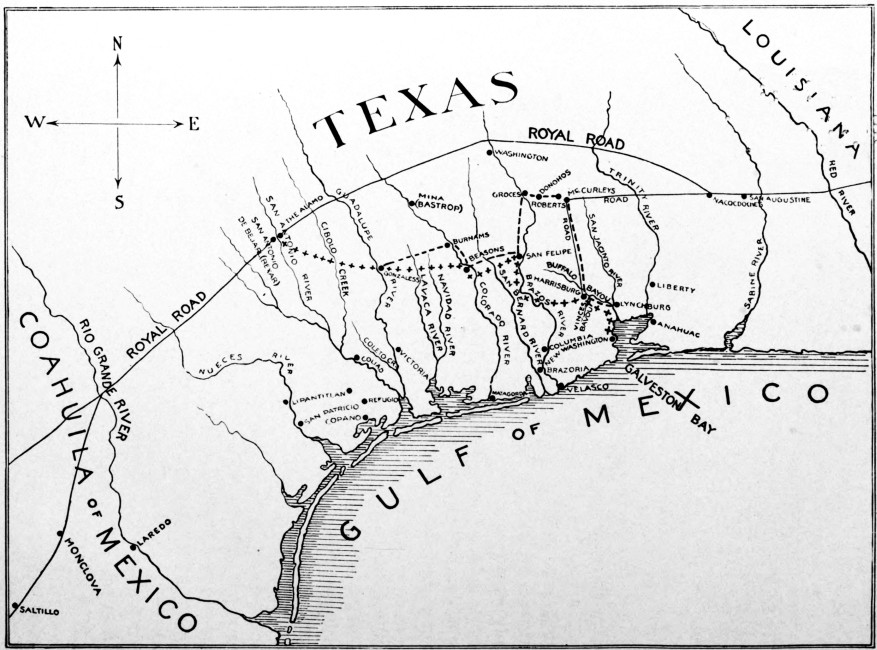
TEXAS IN 1835–1836 AND MARCH OF THE TWO ARMIES EASTWARD TO SAN JACINTO
Route of Texan Army under Houston: ― ― ― ― ―
Route of Mexican Column under Santa Anna: + + + +
That night, tired of the nagging from Jim and Leo,
who sided with the men who thought that they knew more
than the general did, about a campaign, Ernest sought
out Dick Carroll for comfort. He and Dick, at least,
would stand by the general. There were others, too.
“Don’t you worry about the general, boy,” assured
Dick. “He’ll hoe his row, in spite of the stones. And
some day this army, and all Texas, will thank him. It
takes a big man to manage a retreat. Anybody can fight,
but few have the nerve to hold off till the proper time to
fight. A lot of these complainers aren’t reasonable. Hyar
we are, porely armed, porely drilled, porely provisioned,
pulling all ways—some of us skipping off home without
staying to fight—and we’re expected to stop right in their
tracks an army ten times our size, veteran soldiers, the
best in Mexico, and commanded by a general who’s never
known defeat. We’ve got to oppose strategy to force.
This one army is up ag’in really three armies, all bigger;
and we can’t fight and run away to fight in another place,
on account of the floods. Besides, we’ve got the Injuns
to look out for. These East Texas settlements are open
to attack from the prairies, and that northern column of
Gaona is liable to fetch along Injuns. The Comanches
and Cherokees are ready for the warpath, I hear tell.”
“But the general’s letting the centre column get ahead
of us,” hazarded Ernest.
“No, he isn’t. He’s letting it get in front of us, and
that means we’re behind it. It’s got to look two ways,
now. And it’s marching further and further, and separating
more and more from the other columns. Sam Houston
wants it to run on the rope a bit longer; then he’ll lick
it, and have time to tend to the others. That’s my notion
of what Sam Houston is up to.”
“Where do you think they’re going, Dick?”
“Who? The centre column that crossed the Brazos?
To Harrisburg, I reckon, and try to capture the government
cabinet.”
“Is Santa Anna with them?”
“Don’t know. Nobody seems to know yet. But
we’ll find out. About twenty miles beyond here the road
forks: one fork continues on east to the Trinity and
Nacogdoches, the other fork bends south for Harrisburg.
And if we don’t take the south fork I miss my guess.”
It was generally known that all the companies down
the Brazos had been ordered to meet the main body at
Donoho’s Ranch, five miles east. This looked like business.
To-night the camp was more cheerful. The fife
played the tune “Will You Come to the Bower,” some of
the men sang, and even Jim and Leo sought their blankets
less disgruntled.
The next noon, of April 14, camp was made at
Donoho’s, to await the companies that had been ordered
up from below. This camp was rather hard on the
Donoho place, for most of the fence rails were torn down
to feed the camp fires. A number of refugee families
were collected here on their flight to the Trinity River and
eastward still. Jim looked in vain for his “folks.” The
wearied outfits with their carts and oxen hastened onward,
fearful lest the army pass them and leave them exposed to
the enemy.
Captain Baker arrived to report that his company were
on hand, camped by the road about three miles further on.
Captain Martin also came in. He said, very distinctly:
“General, I have brought but my sword. On hearing
that you are retreating to Nacogdoches my company refuse
to remain with you, and declare that they must protect
their families.”
“Are you and your men willing to retreat beyond
the Trinity to Nacogdoches, captain?” asked one of the
men, of Captain Baker.
“Never, never!” answered the captain, determinedly.
“If General Houston will not take us to meet the enemy,
we will elect a commander who will!”
The general was standing talking with Captain Martin
only a few feet away, and heard. But he replied not a
single word.
An old negro also arrived from below. He said that
he had been the ferry-man near Fort Bend, whom the
Mexicans had bamboozled. They had held him several
days.
“Dey gwine straight on to Harrisburg to ketch the
gubberment,” he proclaimed. “Santa Anna wif ’um.
Yessuh, he wif ’um. I done saw him. He say: ‘You tell
Sam Houston I know he up dere in de bushes, an’ when I
get done wif dese land-robbers down hyar I’se comin’ up
to smoke him out,’ Yessuh; dat’s what he say.”
Camp was made the next evening at Mr. McCurley’s
ranch, thirteen miles east. More refugees were here.
The Martin company had been ordered by the general to
proceed on and to protect the settlers crossing the Trinity
from the Indians. That suited the company better. But
the Baker company were picked up, and Sion joined his
three comrades again. He was gleeful, but also critical.
“We drove those Mexicans back from the river, all
right,” he asserted. “We got fooled, though, once.
Thought we saw a thundering big lot of cavalry coming
full tilt, and after we’d set fire to the town, against ’em,
we found out they were only a bunch of cattle. Anyway,
here we all are, now. And if Sam Houston doesn’t let us
take the Harrisburg road to-morrow, to meet up with
Santa Anna, we’re going to elect a general who will.”
“Colonel Rusk says we’re going to Harrisburg,” spoke
Ernest, hopefully.
“He does, does he?” responded Sion. “Huh! Maybe
he’s the boss and maybe he isn’t. We’ll mighty soon find
out, to-morrow.”
The march was resumed in a driving rain. The men
trudged heavily, and even the horses seemed to share in
the rebellious feeling. But General Houston had given
no indication of what he had decided, and rather a
pathetic figure he made, as he rode along in the pelting
storm. He still wore his thin old black coat; his whitish
hat flopped on his head, his legs were clad in baggy snuff-colored
trousers and cowhide boots; and his sword was
tied around his waist by buckskin thongs. A month’s
beard covered his face.
The fife and drum had played a tune at the beginning;
but when the Roberts ranch, where the road forked, was
reached, the music stopped, and the rear of the column
crowded up against the hesitating van. General Houston
had spurred ahead. Mr. Roberts the rancher was standing
at his gate, talking with several officers, as the general
arrived. With the cavalry, in the advance, Ernest heard
the words plainly.
“Is that the road to Harrisburg?” demanded the
officers.
“Yes, sir,” answered Mr. Roberts; and he pointed.
“This right-hand road will carry you down to Harrisburg
as straight as a compass.”
“To the right, boys! To the right!” shouted the
officers, galloping away.
As the word passed, a great cheer arose. The head
of the column promptly turned into the south, on the
right-hand trail. The music struck up blithely. The
general sat his horse, watching, with a little smile on his
haggard face.
And down the Harrisburg road briskly marched the
column, to find Santa Anna, now fifty miles in the lead.
XIX FINDING SANTA ANNA
Harrisburg was only about twenty miles inland from
Galveston Bay of the coast. So Santa Anna had marched
clear across Texas, with General Houston at first before
him, and now behind him. On the bay shore east of
Harrisburg was the town of New Washington; and a
few miles north of New Washington was Lynch’s Ferry
and Lynchburg, of the San Jacinto River—just above
where the river, flowing southward, widens into San
Jacinto Bay in the upper part of Galveston Bay.
From the west, Buffalo Bayou (near whose mouth is
to-day located the city of Houston) joined the San Jacinto
River at Lynch’s Ferry. Somewhere to the south of the
angle formed by the Bayou, and the San Jacinto River and
bay, were the Santa Anna army. They could not go much
further east, that was certain. They would go north, for
East Texas. Urrea was taking care of the south.
To-day’s march from McCurley’s ranch was a hard
one. The prairie road was soft with bogs and with mud
from the rain, and everybody was in a hurry. The “Twin
Sisters,” as the Cincinnati cannon had been christened,
were dragged with long ropes—a score of volunteers lending
their hands. The cannon wheels and the wheels of
the wagons sank deeply into the mushy sod. The general
frequently dismounted and helped push and pull. There
were so many sloughs and creeks, also, that it took until
dark to go twelve miles, and even then camp was made
on wet ground at the edge of a sluggish creek.
Buffalo Bayou, curving into the south as it reached
back from the San Jacinto, sent out many branches; and
Jim and Ernest and all were well fagged out when, before
noon of April 18, the third day from McCurley’s and
the forking of the trails, the toiling army at last reached
the main channel of the bayou, almost opposite Harrisburg.
Not a Mexican soldier had been sighted; but now,
slightly to the southeast, across the bayou, lay Harrisburg.
It had been burned, for a veil of smoke from its smouldering
rafters hung low over the bayou timber, marking the
site.
So there, between the bayou and the coast, a short
stretch of timber-dotted prairie and swamp country, was
Santa Anna with his army.
However, the other army were almost too tired to talk.
During the forced march of fifty-five miles from
McCurley’s, in two and a half days of rain and mud, Jim
and Ernest had scarcely seen Leo and Sion. As soon as
the camps had been located, and supper eaten, everybody
had gone to sleep. Now the word was passed that a half
day’s rest would be given, to freshen the army up for a
battle.
Deaf Smith and Henry Karnes, the chief scouts, took
two or three of the Deaf Smith Spies, and swimming their
horses, crossed the rapid bayou on a raft, to reconnoitre.
Otherwise it was a lazy afternoon. But about dusk Deaf
Smith returned, driving two prisoners before them. He
made them row the raft, and followed them in to camp,
a pair of leather saddle-bags in his hand, his rifle in the
other. There was no use yelling questions. But——
“I know that one fellow, and so do you!” exclaimed
Ernest, to Jim. “That little fellow. Remember him?
He’s a paisano from Bejar. He was in Captain Seguin’s
Mexican company, too, before San Antonio.”
“Well, you never know which way those paisanos are
going to jump,” quoth Jim.
The two prisoners were conducted to headquarters by
Deaf Smith. The “little fellow” proved to be a guide
for Santa Anna; and the other prisoner was a captain in
the Mexican army, who had been carrying dispatches
from General Filisola the Italian to Santa Anna. Deaf
Smith had caught both of the men on the main road for
Harrisburg.
The guide told General Houston that the Santa Anna
army numbered 500 infantry and 100 cavalry. As for the
dispatches in the leather bags——
“Jiminy!” cried Sion, who with Leo sought out the
other boys, after having skirmished for the true news.
“Deaf Smith says those dispatches were so fresh that the
ink on ’em was hardly dry yet. Those were Travis’s
deerhide saddle-bags—had his name on ’em. The dispatches
told us just what we want to know. Santa Anna’s
ahead, all alone, with only six hundred men. Urrea’s
clear down at Matagorda. Gaona’s away back up north,
toward Bastrop. He got lost. Filisola and Sesma are
at the Brazos, near Fort Bend below San Felipe; and the
only thing that’s liable to interfere is Cos the parole-breaker.
Filisola’s hurrying him forward with five
hundred men.”
“Yes,” put in Leo, “and Deaf Smith says Harrisburg
was burned on the fifteenth, and the Mexicans got to the
bay just in time to see President Burnet setting out in a
skiff for Galveston Island. Only three printers were left
in the town. Then Santa Anna started on for New
Washington and Lynch’s Ferry, to cut us off if we retreated
east. But when he finds we’re here to fight him,
and have cut him off, in a pocket, he’ll have to get out
either over the bayou again, or else by Lynch’s Ferry.
He doesn’t know we’re here—he thinks we’re retreating
to the Trinity and Nacogdoches. That’s what all the
settlers have told him. And if we hurry we can beat him
to the San Jacinto, and he’s our meat!”
“He sure is!” exulted Jim. “This army can lick
any six hundred Mexicans that ever were born.”
“I reckon Sam Houston knew his business, after all,”
admitted Sion.
That night the camp was impatient for the dawn.
Deaf Smith estimated that the Mexican army were less
than a day’s march away. If they weren’t overhauled
before they crossed the juncture of Buffalo Bayou and
the San Jacinto River they’d have a clear lead again, and
could go on up to Nacogdoches, and summon the Indians
of the northern prairies, and perhaps unite with the
Gaona column.
General Houston and Colonel Rusk, the secretary of
war, had had a conference.
“We don’t need to talk,” the general was reported
to have said. “You think we ought to fight, and so do I.”
There still were some men who feared that the general
might wait. Colonel Sherman promised his regiment
that if the general would not fight, they could follow him
and he’d soon give them enough. But an aide summoned
him and Colonel Burleson to headquarters and when
Colonel Sherman returned, everything was all right.
The general had asked him and Colonel Burleson if
they had beef on hand for three days.
“Yes, sir,” they replied.
“Very well,” had said General Houston. “You will
see then that each man is supplied with cooked rations
for three days, and hold the camp in readiness to march.
We will see if we can find Santa Anna. Good evening,
gentlemen.”
The morning dawned for a day of energy. The army
ate a hasty breakfast of beef strips wound around green
sticks and held in the blaze, and orders were given to
fall in. General Houston rode in front of the lines, and
from his horse made a speech. It was a short speech, but
it was enough.
“The army will cross, and we will meet the enemy,”
he declared. “Some of us may be killed, and must be
killed. But, soldiers, remember the Alamo, the Alamo,
the Alamo!”
“By thunder, after that speech there’ll be mighty few
prisoners taken; I know that!” exclaimed Major
Somervell.
Colonel Rusk began an address. He had proceeded
only a few words, when he stopped, amidst the cheering,
and bowed, and said, simply: “I am done.” He evidently
saw that no more words were necessary.
First, the bayou was to be crossed. It was fifty yards
wide, and running swiftly. The old ferryboat—a scow—had
been found, but it was leaky, and the general fumed
angrily when he saw that it had not been repaired according
to orders. There was no time to repair it now. If
Cos or Santa Anna should come while the army were
crossing—whew!
The boat had no oars, even. General Houston flung
off his black coat, grabbed an ax, and began to hew an
oar from a piece of fence rail. He delivered orders right
and left, while he hewed. A second oar was needed.
Men were set at work tying rawhide ropes and horsehair
cabrestas or picket lines together. Only the saddle-horses,
the “Twin Sisters” teams, and one baggage
wagon were to be taken. The rest of the baggage and
animals, and the sick men, were to be left here on the west
bank.
Thirty pioneers or trail-makers were sent over first,
while four men bailed. They carried an end of the rope,
and made it fast to a tree; and the rope, thus stretched
from bank to bank, formed a guide for the boat. When
the boat was returned, rowed and paddled, the general
himself leaped aboard, afoot, with the next detachment.
His horse whinnied, and sprang into the water and swam
after. Colonel Rusk stayed on the west bank. Running
between them, guided by the rope, the boat made passage
after passage. To help out, the raft which had served
Deaf Smith was called into service.
The infantry and cannon and wagon were transferred
before the cavalry moved. The boat soon was leaking
much worse, and threatened to sink or capsize. The four
men bailing furiously could scarcely keep it afloat.
Noon passed, and still the cavalry waited, and still
the infantry were being ferried by scow and raft, urged
from either bank by the shouts of the general and Colonel
Rusk.
Somebody in Ernest and Jim’s company had picked up,
on the ground where the general’s quarters had been
located, a piece of paper which he had thrown aside. It
was the first part of a note, written in lead pencil to
Mr. Henry Raguet, of the Committee of Safety in
Nacogdoches. The fragment said:
Camp at Harrisburg, April 19, 1836.
Sir: This morning we are in preparation to meet
Santa Anna. It is the only chance of saving Texas.
From time to time I have looked for reinforcements in
vain. The convention adjourning to Harrisburg struck
panic throughout the country. Texas could have started
at least four thousand men. We will only have about
seven hundred to march with, besides the camp guard.
We go to conquer. It is wisdom, growing out of necessity,
to meet the enemy now; every consideration enforces
it. No previous occasion would justify it....
“Sounds like business,” approved one of the men,
as the note was circulated.
Toward sunset only one boatload of the infantry
remained to be ferried. Sion and Leo had gone—they
had waved to Jim and Ernest; and balancing, Sion had
grinned with glee at the adventure.
“Cavalry’s turn, now, gentlemen,” called Colonel
Rusk. “Swim your horses well below the ferry, and
don’t crowd.”
“Come on, boys,” bade Colonel Sherman. “Tie up
your bridles.”
The bridle lines were tied loosely about the horses’
necks, so that the animals would not entangle their feet,
and by companies the horses were led to the water’s edge.
Then the men fell back, forming a half circle, to shout
and wave their arms and hats, and crowd the horses forward.
In plunged the gallant Colonel Sherman, to head
his own horse across, and slipping from the saddle, to
swim alongside, holding by the mane.
On the bank the front rank of horses were pressed forward
by their comrades behind, jostling and snorting to
the shouting and waving of the men. Presently in
splashed one horse, and another, and another, to launch
in the wake of the Colonel Sherman horse. Some disappeared
entirely as they took the plunge into the deep
water. In went Jim’s horse; in went Duke—practically
heels over head; and Ernest watched anxiously for him
to break the surface again, for it was well known that if
a horse got water in his ears, while swimming, he would
drown. But up bobbed Duke’s yellow head; he blew the
water from his nostrils, and bravely stuck out along with
the procession.
Every horse of the sixty reached the opposite bank
without mishap; scrambling out, shook himself violently,
and joined his fellows, herded together by the first of the
cavalrymen ferried across.
The baggage wagon and the Twin Sisters had been
rafted over. Twilight was gathering when the last boatload
of men was landed. Colonel Rusk accompanied it.
He stepped ashore, and he and General Houston gripped
each other’s hands. The camp guard left at the other
side cheered.
“Thank God,” uttered the general. And, to the
colonels commanding: “Form the ranks.”
Now across Buffalo Bayou, on the Harrisburg and
Santa Anna side toiled the little army, at best pace. In
the darkness they clattered over a bridge which crossed
a branch bayou running north into Buffalo Bayou.
Vince’s Bayou, was this, by report along the column,
and Vince’s Bridge of the road from Harrisburg: the road
taken by the Mexican army. But presently the column
left the main road and diverged to the left, following closer
the timber down Buffalo Bayou.
“Great Cæsar!” murmured Jim, dimly seen as he rode
at Ernest’s right hand. “If this keeps up all night we’ll
reach the mouth at the San Jacinto, and Lynch’s. Can’t
go any further then without more ferrying.”
By midnight the infantry were staggering and stumbling,
and even the horses moved on leaden feet. But
nobody complained. Seven hundred fighting Texans were
hot on the hunt for 600 hateful invading Mexicans, and
the two trails would meet somewhere close ahead.
At one o’clock by the stars (for the sky had cleared
at last) the order to rest for two hours was given. The
infantry dropped in their tracks, Ernest and Jim and the
other horsemen simply tumbled from their saddles. And
here concealed in the fragrant evergreens the little army
panted and shivered and dozed.
“After this war’s over,” mused Jim, drowsily, huddling
under his wet blanket beside Ernest, “I’m going to
change my clothes. A fellow likes a clean shirt and dry
socks once in a while! Maybe to-morrow I’ll capture an
officer and take his. Those Mexican officers dress fine.”
“Guess Sion and Leo are getting all the action they
want, this time,” stammered Ernest, with teeth chattering.
“But we’re lucky that none of us had to stay with that
camp guard, back at the bayou crossing.”
“Those fellows certainly did hate to stay,” agreed
Jim. “They’re liable to have to fight the whole Mexican
army, though, if there’s a retreat. Or Cos may attack
’em on his way in.”
Ernest dropped into an uneasy sleep. He dreamed
that he was home and that his mother was trying to tuck
him in bed with covers which were too short!
The easternmost stars were just paling when the camp
was aroused by orders to fall in again. Stiffly all obeyed.
Ernest had faint recollection of the usual three taps of the
drum, from the general’s quarters, as first signal—but
he had found it very hard to obey them. However, now
the officers were urging—the general’s voice was echoing
through the grayness—somebody said that he had slept
with the coil of cannon rope for a pillow—and into the cold
saddles on the hunched horses must the cavalry climb.
“Hee-yaw!” yawned Jim. “We’re riding, anyhow.
Only the cavalry and the high-up officers have horses.
That’s tough on some of the officers who’ve been a-straddle
all the way from the Colorado.”
“Wonder if we ever eat again,” responded Ernest,
who had a woefully hollow feeling.
“Sure thing,” asserted Jim. “The general, he’ll just
take us in sight of those Mexicans cooking breakfast—so
we can smell the coffee, you know; then he won’t have to
give a single order, but you’ll see us charge a-whooping,
for the kettles!”
Camp had been made without supper. The march
was made without breakfast. Nobody could accuse the
general, now, of dilly-dallying!
Away galloped the Deaf Smith Spy Company, commanded
by Henry Karnes the red-head, to scout in
advance. The army could always depend upon the Deaf
Smith Spies. At slower pace the column followed, plodding
wearily and hungrily through the damp timber and
the tall prairie grass, cloaked in the chillness of early dawn.
After a march of seven miles, halt was ordered for
breakfast at last, in the sunrise. Rations had given out,
but several cattle were sighted near, and were driven in
and killed. Speedily the soldiers, horse and foot, were
grouped about fires, toasting the fresh meat on sticks,
regular buccaneer fashion. The cannon horses were unfastened
from the traces, and they and the mounts of the
cavalry and the field officers industriously grazed. It
was a wild and picturesque sight: 700 ragged, bedraggled,
whiskered men (not to speak of the boys) squatting
around fires, their guns in their laps, and all intently toasting
bloody meat. The sun, which had risen above the
timber of the crooked Buffalo Bayou, shone peacefully
upon them, through the magnolias and live-oaks, and upon
the prairie beyond.
This process of breakfast-getting was very slow; and
Ernest, with eyes smarting and mouth watering, was
manipulating his meat on his stick, trying to hurry it, when
an exclamation from Jim interrupted him.
“Aw, shucks! Here come those scouts, lickity-split,
as if they had some sort of a big tell! Why can’t they wait
till a fellow’s eaten?”
Along the timber edge from the east a squad of the
scouts, led by Deaf Smith, were racing back to the army.
“What’s the matter now?” hailed voices, impatiently.
“Saw the enemy. They’re on ahead a short piece.
You-all’ll have to hurry.”
Up sprang the camp. The cannoneers leaped for their
team, the cavalry for their saddles. Having listened
shortly to the report of Deaf Smith, the general roared
his orders—repeated briskly by Colonel Burleson and
Colonel Sherman, and by the company captains.
“Fall in, men! Fall in!”
“By gravy, I don’t leave my meat, you can bet,”
scolded Jim, running, with his laden, smoking stick, for his
horse. Ernest followed his example. Men were doing
the same. The army “chawed” as they went.
The scouts reported that a few miles before they had
encountered an advance guard of the Mexican army—had
been chased but had escaped. Nobody killed. By all
appearances the Mexican army were marching from New
Washington north to cross the San Jacinto and the mouth
of the bayou at Lynch’s Ferry. Washington had been
burned.
Throughout the ranks, afoot and mounted, rifles began
to crack. Jim promptly shot into the air, and swiftly
reloaded.
“Go ahead. Clean out your gun,” he bade, to Ernest;
and Ernest likewise pulled harmless trigger. His little
rifle spoke smartly.
The general came riding furiously down the column.
“Stop that firing!” he fairly bellowed.
“No, we won’t, general,” replied somebody, good-naturedly.
“Our guns have been loaded over two weeks
and we don’t intend to meet the enemy with our powder
wet.”
The general drew his sword.
“I’ll run the next man through who fires without
orders,” he declared.
“Bang!”
“It won’t do for you to try that game, now, general,”
warned the shooter. The ranks laughed. General
Houston glared around him for an instant, and with a
shrug of his great shoulders clapped his sword back and
rode to the front again.
The column lunged forward at best speed. Now indeed
it was a race to see which army would be the first
to reach the crossing. Colonel John A. Wharton, of the
staff, took thirty of the cavalry and dashed away, to
reconnoitre the crossing and keep the enemy in play until
the army could arrive. Jim and Ernest regretfully
watched the advance disappear in the margin of the timber.
Only men had been picked, mainly from one
company.
“I always knew I ought to have joined that company,
in the first place,” deplored Jim. “Now they’ll find Santa
Anna and get all the best clothes!”
But no sounds of a battle were heard—ah, yes, there
echoed a rifle shot! And another. The shooting
ceased. And when, breathless, dripping, men and horses
alike, with perspiration, the army rounded a shoulder of
timber, they saw, before, an expanse of flat, marshy
ground, inhabited by myriads of piping, screaming wild
fowl; eastward still was flashing San Jacinto Bay, with the
juncture of the Buffalo Bayou and the San Jacinto River
above its upper end—the few scattered houses at Lynch’s
Ferry, and the waiting horsemen of Colonel Wharton’s
command. Not a Mexican soldier was in sight.
The Colonel Wharton detachment were found at the
ferry landing in possession of a fine new flatboat equipped
with a sail and loaded with foodstuffs. They said that
Captain Hancock and Lieutenant Crain and four others
had arrived before the rest, and that a guard of twenty
Mexican soldiers had fled south without firing a shot.
Had left the flatboat, of course—for which, much obliged
to them! Santa Anna had shipped the boat up the bay
from New Washington, to be ready for him. Now he
could come and get it.
“We won. Hurrah!” cheered Ernest, excitedly.
“We beat Santa Anna to the crossing.”
“Yes, sir; and we corralled a flatboat full of breakfast,
too,” reminded Jim. “Do you see that big house yonder,
across the San Jacinto? That’s Lorenzo de Zavala’s
house. He lives here. He and Colonel Lynch and the
rest of the bay fellows are right at home.”
General Houston immediately ordered the boat taken
up the bayou about three-quarters of a mile, and the army
to follow along the bank, out of the flat to the timber.
Camp was made on high ground in the shade of great
live-oaks, whose branches were festooned with the drooping
Spanish moss. It was a beautiful spot. The bayou,
wide, and sluggishly flowing in a curve between green
banks, was behind. On the left the San Jacinto River
rippled past the bayou’s mouth, and widened into San
Jacinto Bay, bordered by salty marshes. On the right,
distant about six miles, Vince’s Bayou extended down to
Vince’s Bridge in the southwest, at the Harrisburg road.
Before, a rolling prairie stretched two miles to the swamps
of the inward curving bay. A timbered rise jutted out
before the camp; and several hundred yards out on the
prairie, were two timber “islands,” or motts; one in front
of the camp, the other to the left.
The general lost no time in getting ready for Santa
Anna, who could not be more than a couple of miles distant.
He planted the Twin Sisters in the edge of the
trees on the little rise. Colonel John Neill commanded
the battery. Two hundred infantry, including Leo’s
company, armed with muskets and commanded by Lieutenant-Colonel
Millard of the Texas Regulars, were stationed
behind the cannon. Sion and the other riflemen
of the First Volunteers under Colonel Edward Burleson
were placed on the right wing, the Second Volunteers
under Colonel Sidney Sherman on the left wing. The
cavalry were back of the Millard musketeers or regulars.
The gold and white flag, surmounted by the glove of
Colonel Sherman’s bride, floated over the centre.
Now it was noon.
“I reckon if nobody’s coming we might as well eat,”
quoth Jim, while for a brief space the army waited, and
peered across the prairie beyond the timber. “What do
we call it, anyway? Last night’s supper? We’ve got
three meals due us. De Zavala ought to invite us all over
to his house for a snack.”
De Zavala the patriot did not quite do this; but, as the
prairie remained apparently peaceful, presently orders
were issued for the men to go ahead with their three
meals in one. Fires were lighted, beef was toasted once
more—when on a sudden back through the high grass
along the timber came galloping once more the Deaf
Smith Spies. They had sighted the Mexican army advancing.
The camp left its beef and seized its arms.
“Seems as if we didn’t get time for anything any
more,” complained Ernest, as he and Jim ran for their
saddles. “It’s just up and down, up and down.”
“That’s right,” concurred Jim. “We’ve been wanting
to fight, and now we have to fight even to eat!”
XX “WILL YOU COME TO THE BOWER?”
Almost an hour passed, with the Texan army waiting
and ready, and the gold-fringed flag lazily flapping in the
sea breeze.
“There they come,” announced a man sitting his horse
at Ernest’s left. “If we don’t lick ’em Peggy McCormick
will. She lives yonder on the bay and owns a square
league of this prairie. They’re treading down her grass.”
It was two o’clock. The Mexican army were in sight
at last, advancing from the left, along the marsh of the
bay. Their colors flew, bayonets and scabbards occasionally
glistened, the officers’ trappings sparkled. Infantry
and cavalry they were—yes, and artillery, for there was a
cannon drawn by mules.
On they marched, steadily—and their drums were
heard beating in cadence. They made a compact mass,
as if they did not intend to stop but to proceed right ahead
to the ferry crossing.
Ernest’s heart thumped rapidly. No orders issued
from the general, who was composedly standing with
Colonel Hockley and Colonel Rusk and others of his staff,
between the Twin Sisters battery and the Colonel Burleson
regiment, and watching the Mexican advance.
“By cracky, they’ll have to fight or swim—or do
both!” exclaimed Jim. “What are we here for, anyway,
do they think?”
At this moment a bugle call shrilled gaily from the
Mexican ranks. Out galloped the artillery mules, dragging
the one cannon to the furthest of the timber islands,
opposite the Millard infantry. It was a challenge! From
the trees puffed a cloud of smoke, and accompanying
the heavy report, in among the live-oak branches along
the bayou rattled a storm of grape-shot.
But the Twin Sisters were answering. How Colonel
Neill and his artillerymen hustled!
“Lie down, men! Lie down!” shouted the regular and
riflemen officers. The cavalry, well back in the shelter
of the festooned live-oaks, were safe. General Houston
still stood erect. The Twin Sisters and the Mexican
piece were booming back and forth.
Again sounded the bugle, and again. The Mexican
infantry deployed a long line, and ran forward through
the grass, firing—halting, firing, loading and running
again, making for Colonel Burleson’s regiment. The
Twin Sisters were turned on them—the regiment began
to fire, “Crack! Crackity crack! Crack-crack-crack!”—and
the Mexican soldiers scurried back.
“Neill’s hit! Look at him!” cried Jim. “Thunder!”
Colonel Neill was staggering; down he sank. A
grape-shot had struck him in the thigh. But the Mexican
troops were charging. They swept out gallantly, along
the front of Colonel Sherman’s regiment, and entered
some timber curving to the right.
The Mexican skirmish line had retired, though. How
the Burleson men yelled!
Colonel Sherman spurred to the general. He talked
a few moments, and back he galloped to the cavalry.
“Forward, cavalry!” he shouted. “Follow me.
Let’s drive those vaqueros [cowherds] out of that timber.”
Around to the right he dashed, and glad of the chance
the cavalry pressed after him—Ernest bending low on
Duke’s neck, to avoid the moss and branches, and Jim
keeping with him, stride for stride. But the Mexican
troops were scarcely sighted. Mexican sharpshooters
were there, though, among the trees, and without any
fight the cavalry must return again before being cut off.
Nobody was hurt.
The army were cheering. All the Mexicans had
retired; all but the artillery and cavalry were marching
back, toward the mouth of the San Jacinto; the field-piece
had been withdrawn further into the timber island. The
Twin Sisters were peppering the island, and the rear of
the Mexican army, but it was rather blind shooting.
Having arrived at the marshy timber stretch southward
against the San Jacinto bay, the Mexican army
halted, and appeared to be making camp there, three-quarters
of a mile away, on other rising ground.
“Our turn now!” shouted a score of voices, along
the Texan lines. “Let’s smoke ’em out.”
Everybody, except the general, was eager to charge,
and finish the battle then and there. Some of the officers
approached the general and asked him either to lead out or
else appoint a leader. The men were wild to avenge the
Alamo and Goliad. They did not mind being hungry,
and worn with the forced marches by day and by night.
“Santa Anna first, then Cos!” was the cry.
But the general turned a deaf ear. To the officers he
shook his head under its big whitish hat.
“No, gentlemen; not yet,” he opposed. “This is
not the moment. The loss would be too heavy. I intend
to conquer, slay and put to flight the entire Mexican
army, and it shall not cost me a dozen of my brave men.”
“That’s right,” sung out a private. “Make it an
easy-going fight, general.”
The cannon piece was still in the timber island; and
Colonel Sherman begged for permission to go out and
take it, with cavalry. The general finally consented that
the cavalry should reconnoitre the timber, but not fight.
However, the fiery Colonel Sherman led straight to
the island in the prairie. Suddenly the Mexican dragoons
issued into the prairie, and out came the Mexican sharpshooters,
too.
“Charge those dragoons, boys!” ordered Colonel
Sherman. “Empty their saddles for them!”
“It’s a fight!” yelped Jim, gleefully, as the column
half wheeled and in company front charged for the
dragoons.
Chief Scout Handy was here, spurring on well to the
front. So was Mr. Lamar. He had borrowed a horse
and joined for the fun of the thing. A number of other
riflemen had borrowed horses and volunteered. The
dragoons stood their ground. Captain Handy fired; Jim
fired; Ernest fired. All the men fired, and dragoons fell.
The dragoons charged. The Texas rifles were empty and
the long Kentucky rifles of the volunteer horsemen were
hard to reload, on horseback. The Mexican infantry
were double-quicking forward, and shooting. Alwyn
Trask was knocked from his saddle with a broken thigh;
Woodliffe was wounded; Walter Lane was cut off and
almost surrounded—he was gone—no—see Lamar—see
Lamar! He has sped for Lane, shoots a Mexican foot-soldier
dead, rides right over a second, reaches Lane’s
side, wrests the gun from the hand of another Mexican,
and with Lane unharmed gallops back to the troop!
Hurrah! But there are too many Mexican soldiers.
Isn’t the general sending reinforcements? No.
“Back to the camp, boys,” shouted Colonel Sherman;
and just in nick of time they skirted the timber island
and cleared the fast approaching Mexicans.
General Houston was furious. He asserted that
Colonel Sherman had tried to bring on a fight, against
orders. Colonel Sherman was angry, also. He claimed
that the general had left him out there in danger of being
cut off.
“That Lamar sure can ride, though, can’t he!” declared
Jim. “He’s afraid of nothing, that man!”
“We lost two good men, just the same,” replied Ernest.
“Trask will die, the doctor says; and Woodliffe can’t
fight any more.”
This night the camp fires of the two armies twinkled
at each other in the low mist across the dip of prairie.
General Houston posted double pickets, beyond the timber
of the bayou, to guard against any surprise.
After a good supper—the first square meal in thirty-six
hours—there was a short interval of liberty. Sion
and Leo strolled over to the cavalry. The four comrades
had not met for several days.
“Hello,” greeted Sion. “Say—why didn’t we fight
to a finish to-day? Those Mexicans are fortifying. From
our end of the line you can see breastworks going up.”
“Yes; and to-morrow Cos is liable to get here,” added
Leo. “To-day we’re about even match.”
He and Sion were thin and ragged, but still game.
“I don’t know,” retorted Ernest, rather irritated, for
men were putting the same question, one to another, and
again the army were indignant with General Houston.
“I suppose he wants to rest us up.”
“Shucks! I’m never too tired out to fight a Santa
Anna Mexican,” proclaimed Sion. “That was a toler’bly
smart march he put us through, anyway. And you fellows
had a nice little scrimmage, while it lasted.”
“It’d have lasted longer if some of you other fellows
had come out and backed us up,” accused Jim. “Then
we could have gone on and taken Santa Anna and his
whole bunch—just like Sherman intended.”
“How could we go out and back you up, when we
didn’t have orders?” answered Leo. “One thing’s sure,
though: we don’t retreat any more. If Houston wants
to retreat, he’ll go alone. We’ve got Santa Anna pocketed
and we’re going to put our hands on him while we can.”
But Ernest knew that General Houston had no notion
of retreating.
“Young de Zavala’s come into camp,” remarked Leo,
as if to end the discussion. “The colonel’s boy. Have
you seen him?”
“No,” said Jim. “What’s his kind?”
“He’s all right,” assured Sion. “Smart little lad.
He says he could see the battle from the house, but he
wants to get a little closer. Brought his gun and fixin’s,
and thinks maybe he’ll shoot Santa Anna—if Sam
Houston lets us get close enough!”
“You wait till to-morrow. We’ll all be close enough,”
prophesied Ernest.
“Listen to that flute,” bade Jim. “Same old tune.”
The flute was piping, and some of the men joined with
tenor voices.
Will you come to the bow’r I have shaded for you?
Your bed shall be roses bespangled with dew.
Will you, will you, will you, will you,
Come to the bow’r?
The song drifted sweetly through the great oaks and
their drooping mosses.
“Special invitation to General Antonio Lopez de Santa
Anna,” quoth Leo. “Well, think I’ll go to bed. We
musketeers have orders to turn in early. I’ll see you
to-morrow, after we-all finish our easy-going fight.”
“Good-night.”
Sion and Leo left. The flute ceased, and the song
ceased, and everybody went to bed. The companies slept
in ranks, on their arms, ready for any sudden call. As
Ernest, rolled in his blanket, was about to close his eyes,
a large figure, blanket-draped, moved past, in the gloom
of the trees. He recognized it at once. It was the
general, alone, exploring around as if to see that his army
were safely tucked in bed. Current opinion had it that
the general himself never went to bed until about four
in the morning—when he went to bed at all; and between
drum-taps and breakfast usually slept about an hour while
the men were being prepared for the day’s duties. So
now here he was, inspecting his weary, resting soldiers,
and perhaps thinking upon to-morrow’s battle. Big and
silent and broody, he was rather a comforting sight.
Strangely enough, almost everybody slept late, this
morning of April 21; that proved how tired the army really
were. General Houston did not appear until after the
sun had risen. He had again used the coil of cannon
rope for a pillow. He looked happy and confident for the
first time in a long while. The report came from his staff
that on opening his eyes to the sunshine he had sprung
up alertly with the words:
“The sun of Austerlitz has risen again!”
“Now, what did he mean by that?” demanded Jim.
“I don’t know,” confessed Ernest.
“Austerlitz was a big battle won by Napoleon, in
Europe,” said Mr. Lamar, overhearing. “Napoleon
thought that the sunshine brought him good luck for the
day.”
All eyes were searching the Mexican camp. Santa
Anna had completed his fortifications, by extending a low
breastwork, broken in the middle, from the timber on his
right into the prairie on his left, along the crest of a gentle
slope. Spy-glasses showed the field-piece in the break.
No order to advance to the attack was given, and,
waiting, the men began to growl and murmur again.
Little indignation meetings were held. Rumor claimed
that a floating bridge was to be built, over the bayou, to
be used in a retreat. Then there was the report that the
general had discussed tearing down the de Zavala house,
for bridge timber, and had decided against it.
About nine o’clock the Deaf Smith Spies, who were
out reconnoitring, returned in haste. Deaf Smith said,
in passing, from his saddle: “The enemy is increasing.”
Presently a file of pack mules, escorted by soldiers,
were seen crossing the prairie to the south, as if they had
come from Vince’s bridge. They disappeared around a
swell in the middle of the prairie.
“There’s Cos!” exclaimed Jim. “He’s joining Santa
Anna!”
“We ought to have cut down Vince’s bridge,” spoke
Ernest, aghast, wondering why the general hadn’t ordered
so.
But the general now rode along the front, saying,
loudly:
“Those are not additional troops. It is a ruse, men.
Santa Anna is simply marching a detachment around the
hill, to deceive us.”
However, Deaf Smith and a small party went galloping
away, again, to the west, as if to investigate; and from
the Mexican army sounded a tremendous cheering and
rolling of drums.
While Deaf Smith was gone, Colonel Wharton walked
among the lines. He clapped his hands briskly, saying,
from group to group:
“Boys, there is no other word to-day but fight, fight!
Now is the time!”
That was encouraging. Still the morning wore away
without orders. It was hard waiting. Some of the men
formed a parade, inviting the general to act. That did
no good.
About eleven o’clock a council of war was held.
General Houston sat on the ground under a live-oak, and
his field officers gathered around him. After the council
was over Mr. Lamar talked with Lieutenant-Colonel
Bennet, and returning to the cavalry reported that the
Deaf Smith Spies had reconnoitred the last camp of the
mule and soldier column which had been seen, and had
found “sign” of 500 men—Mexicans. So the Cos reinforcements
they were. Then General Houston had called
the council of war, and put the question to vote: “Shall
we attack the enemy in his position, or await an attack
from him in ours?”
Colonels Burleson and Sherman, and Lieutenant-Colonels
Millard and Alex. Somervell, and Secretary
Rusk voted to wait an attack. Colonel Rusk declared:
“To attack veteran troops with raw militia is a thing
unheard of; to charge the enemy without bayonets, in an
open prairie, has never been known. Our situation is
strong; in it we can whip all Mexico.”
Only the two juniors, Lieutenant-Colonel Bennet and
Major Wells, had voted to go forward.
“I didn’t think that of Burleson and Sherman and
Rusk and Somervell,” exclaimed Jim. “Did you?
They’ve been wanting to fight, all the time.”
“Look at the general,” bade Ernest. “What’s up?”
For Deaf Smith and Moses Lapham, another scout,
were sitting their saddles, each with an ax in hand, and
listening to the general. Deaf Smith held his palm behind
his ear, the better to catch the words. He nodded,
understandingly, and wheeled his horse.
“Fly back like eagles,” directed the general, “or that
beautiful prairie grass will be crimsoned before your
return.”
Deaf Smiths leathery face broke into a wrinkled smile.
“Looks a good deal like a fight, general,” he called,
over his shoulder.
Out he and Moses Lapham galloped, for the west,
followed by four other scouts.
“I know!” blurted Jim. “They’re going to cut down
Vince’s Bridge and pocket Santa Anna and Cos complete!”
“And stop any more reinforcements,” added Ernest.
“Santa Anna’s got near twelve hundred men, already,”
answered Jim. “But now we’ll all be in here together.
It’ll be a fight to a finish. Here comes the general.”
General Houston, in his whitish hat, his ragged stained
black coat and snuff-colored trousers, cowhide boots and
sword dangling in its rusted scabbard from his thong
belt, was striding from cook fire to cook fire, among the
messes.
“Do you want to fight, men?” he was inquiring, right
and left. “Shall we fight, or wait? I know the opinion
of the officers; but what do you say?”
Shrill cheers and hoarse shouts volleyed at him. Impulsive
hands slapped him on the shoulder.
“Fight! Fight!”
“Hurrah!”
“Lead us out, general!”
Jim and Ernest joined in the uproar. The general
was now smiling grimly.
“All right,” he announced, repeatedly. “Very well.
Get your dinners and I will lead you into the fight, and if
you whip them every one of you shall be a captain.”
“Golly!” grinned Jim. “I can hear Sion yell clear
here. See those fellows yonder cutting capers, though!”
“Mr. Lamar’s been promoted colonel!” said Ernest,
hearing a chance remark. “For what he did yesterday!
He’s to lead us!”
“He’s some Napoleon himself, for this Austerlitz,”
babbled Jim, joyously. “His middle name’s Bonaparte.”
Now all was elation and excitement, but dinner was
eaten with a good appetite. The general seemed to be in
no hurry. After dinner, time was given for the men to
inspect their rifles and muskets.
“How many men have we, anyhow?” queried a soldier
in Ernest’s squad.
“Seven hundred eighty-three, by last count.”
“That makes less than two to one against us.”
“No odds at all.”
The army were ready. Word passed that the general
was thinking of postponing the attack until daybreak
to-morrow. The men were on edge.
“Wonder what we are waiting for?” asked Jim.
“For Deaf Smith maybe,” hazarded Ernest.
“Why doesn’t he come, then? He had to go only
eight miles.”
All talk was nervous and disjointed. The Mexican
camp seemed very quiet; not a movement could be described
in the portion visible around the timber island on
the left. The sun had long crossed the zenith, and was
declining toward the west. It was after two o’clock.
The general had been in consultation with his field
officers. They separated—Secretary Rusk nodding as if
in approval. Orders came for the men to form ranks.
Colonel Lamar vaulted into his saddle, and there was a
rush for horses. The Twin Sisters, at the edge of the timber
on the high tongue, were being attached to their teams.
The lines were straightened under covert of the oaks:
the cavalry, westernmost, first on the right; next Colonel
Millard’s regular infantry with their muskets—and Leo,
next the Twin Sisters, a little in advance; next Colonel
Burleson’s First Regiment of riflemen, with Sion in it;
next, on the extreme left end of the line, Colonel
Sherman’s Second Regiment of riflemen. All this took
considerable time, and three o’clock had passed.
General Houston rode in the rear of the line saying:
“Hold your fire, men! Hold your fire, for close
quarters!”
An aide galloped to Colonel Lamar. Colonel Lamar
drew his sword and turned:
“Forward, march!” he shouted. He led off, to the
right, at an amble, to circuit between the two timber
islands. The flute, in the Colonel Burleson regiment, was
playing “Will You Come to the Bower?” and the drum
was softly keeping time.
“We’re coming, all right,” remarked Jim, to Ernest.
Ernest glanced back. The whole Texas line, two deep,
was advancing, the cannon tugged lustily by the straining
teams, Colonel Hockley urging with his sword. General
Houston was pressing behind, his head bare. The fifer
was tooting, the drummer drumming. Before, on the
left or southeast, the Mexican camp seemed all unsuspecting,
and the breastworks of branches and baggage
basked in the warm sunshine.
“Trot!” shouted Colonel Lamar. The little squadron
of sixty riders rushed on, through the prairie, the grass
brushing their stirrups. Now there were tokens of excitement
in the Santa Anna camp. Officers and men were
running and gesturing. In the distance their faces looked
white with alarm, where the sun shone full upon them.
“We’re surprising ’em!” gasped Jim.
As the cavalry, beginning to loosen bridle reins for
swifter pace, preparing to charge, Ernest glimpsed, with
the corner of his eye, a speck on the prairie to the westward.
A horseman.
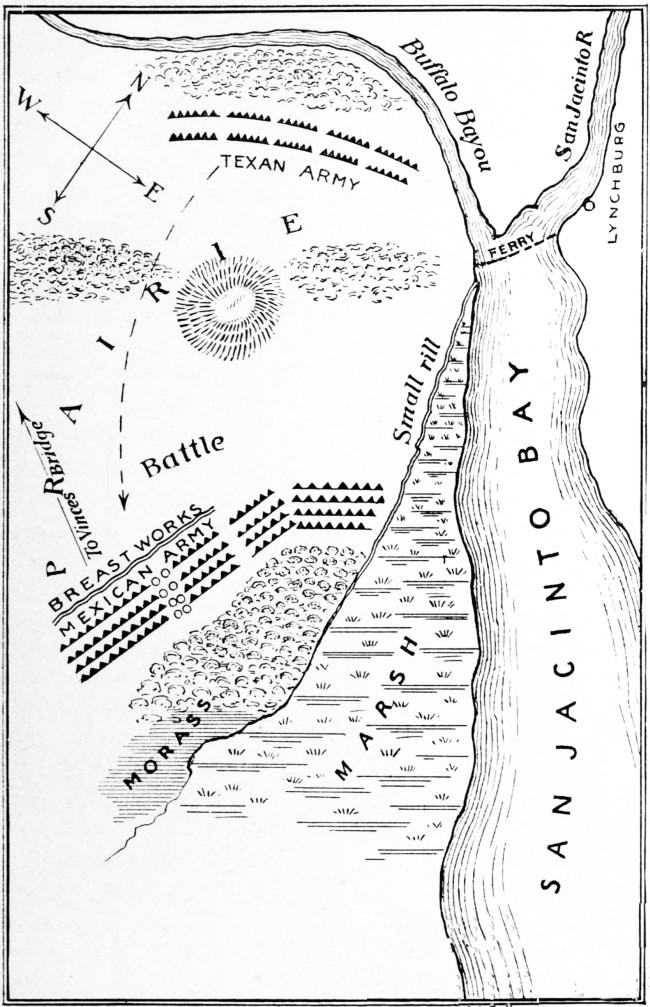
BATTLE GROUND OF SAN JACINTO
Texan Charge: ― ― ― ― ―>
“Gallop!” shouted Colonel Lamar, raising his sword-blade.
The horses leaped to the spur—and at that instant
Duke, good little yellow Duke, plunged head-first, his leg
in a hole amidst the grass. Over his nose dived Ernest—lighting
sprawled and helpless. His rifle flew from his
grasp, and his head was full of stars.
For a moment or two he lay, half stunned. Then he
struggled to his feet, and gazed about him dizzily. The
squadron had galloped on and were before. Of course
they would not stop. Duke had attempted to follow, and
now was standing, uneasily, head up, snorting. The rifle
was buried somewhere in the grasses. Ernest took hasty
but wavering steps to look for it. He must have that rifle,
by all means. His head still swam with his fall.
But see—here was the Texan line, almost parallel with
him. How rapidly it had come. The men were beginning
to double-quick, through the prairie dip, with guns trailed.
Their faces stared before, hard-set and eager under their
flaring hat-brims. They had deployed, to wider intervals,
so that the men of the rear rank should have space through
which to aim. The Twin Sisters were in the advance—no,
they had halted, were whirling around—the gunners
applied match—Boom! Boom!—and the canister hissed
for the Mexican breastworks.
General Houston was still behind the centre—he was
waving his old whitish hat and shouting, as if still bidding
the infantry to hold their fire.
“Hold your fire, confound you! Hold your fire!”
he roared.
The fluter was playing. “Will You Come to the
Bower?” piped the notes, as waist high in the grass the
long line swept on, with never a shout, and with the gold-fringed,
glove-capped flag of the Newport Volunteers
streaming in the breeze. The Twin Sisters spoke again,
and advanced, their horses at a gallop.
There was a thud of hoofs close by Ernest. The horseman
from the west had arrived. He was Deaf Smith.
His horse was lathered with sweat, his swarthy face was
dripping, he was blackened and muddy. Past Ernest he
sped, struck the right of the line, flourishing his ax.
“Vince’s Bridge is down!” he screamed. “Fight
for your lives, and remember the Alamo!”
Along the line he raced, reiterating his message.
General Houston had spurred through the gap left by the
artillery and was to the front, himself.
“Vince’s Bridge is down!” he repeated louder than
Deaf Smith. “Charge! Charge! Remember the Alamo!”
A blare of voices which seemed to rock the prairie
answered him.
“Remember the Alamo! Remember Goliad!”
The piping of the flute and the booms of the Twin
Sisters alike were drowned by that tremendous yell. The
line broke into a run. It was now not 100 yards from the
Mexican breastworks—General Houston leading the centre.
The Twin Sisters could not fire again, for the gap
had closed before them, as the Millard musketeers and the
Burleson riflemen joined flanks.
Bugles had sounded from the Mexican camp—all
appeared in turmoil there; but suddenly a bloom of white
smoke enveloped the front of the breastworks, and a
volley of musketry and cannon shot crashed through the
soft air. Bullets whined by, overhead. Ernest’s eyes
leaped to the Texan line again. It had not fallen—it was
surging on—the general sat upright—but his horse staggered—no,
kept its feet. Was it hit? Why didn’t the
army shoot? Ah—the line had abruptly halted, with the
Mexican breastworks only sixty yards away; the rifles
and muskets were levelled, and veiled in smoke. Back to
the breastworks reeled the first Mexican soldiery. It
looked as if every bullet had found a mark. See! The
line did not wait even to reload. It raced on, shouting,
“Remember the Alamo! Remember Travis! Remember
Fannin!” What a medley of savage cheers! The men
had drawn their pistols; they had reversed their rifles, to
club with them. General Houston’s horse was swallowed
up—maybe it was down—as right against the breastworks
burst the line—burst, breaker-like, into a high spray of
pistol and musket shots, lunging knives and bayonets, rifle
butts rising and falling, horses leaping—and poured over!
Back from the breastworks, into the swamp at the
rear, streamed rivulets of fleeing men—the Mexican
soldiers. But the Texans were after them. There went
Deaf Smith, on foot, alone—he had lost his horse, but no
matter. He was shooting with a gun—shooting at the
Mexicans. Some of the Mexicans were in the swamp
to their knees. The officers’ horses had bogged. From
the timber at the east end of the breastworks scampered
the Mexicans posted there, with Colonel Sherman’s riflemen
pursuing furiously. A Mexican officer remained
standing on the ammunition boxes behind the field piece.
He shouted in vain to his artillerymen. He folded his
arms defiantly; then he got down and slowly walked away,
as if challenging the Texan rifles. He was a brave man,
but it was no use. He fell, crumpled.
But a battalion of the Mexicans did rally. They
levelled their bayonets and charged, behind the breastworks;
charged so violently that the Texans before them
wavered and recoiled. Here came General Houston—on
his horse, waving his hat. The Texans there stiffened, the
guns spoke all together—and away melted the Mexicans,
into dead, wounded and fleeing.
Somewhere in that hurly-burly were Sion and Leo.
There did not seem to be many Texans killed yet. But
where was the cavalry? There it was, chasing the Mexican
horse and foot, cutting off their retreat to the west,
turning them back toward the swamp and bay, shooting
them, driving them. The reports of guns had died to
irregular spatters; the fighting appeared to be a constant
series of hand-to-hand combats—and not even that. Many
of the Mexican soldiers were kneeling, holding up their
arms for mercy. Henry Karnes was spurring hard in
pursuit of a Mexican officer on a big black horse. The
officer was fleeing westward, across the prairie. Would
Henry catch him and kill him? Were all the Mexicans
to be killed?
Ernest sickened and tried to turn away from the sights.
At that moment he heard a heavy panting, and a rustling
in the long grass. Down he instantly sank; his eyes fell
at last on his little rifle, and reaching out he grabbed it.
The rustling and the panting rapidly came nearer—and
a black head and swarthy face appeared, over the grass
tops; a running figure in a blue cotton uniform was
breaking a way. It was a Mexican soldier, his bared hair
dank with perspiration and dark face staring, affrighted.
Ernest silently crouched low, waiting; and as the
figure was about to pass, up he sprang, and over his
levelled rifle bade, as sternly as he could: “Halt!”
The soldier stopped in his tracks—saw the rifle muzzle,
his mouth, open with exhaustion, quivering convulsively—and
down he dropped on his knees.
“Me no Alamo! Me no Alamo!” he chattered, holding
out his empty hands with piteous entreaty.
He was perspiring so with his agony of fear, he was
such a cheaply clad, miserable refugee, that Ernest was
almost ashamed to threaten him. Still, he must not be let
go, to fight again, maybe, against Texas independence.
“I won’t hurt you,” said Ernest gruffly. “Get up.”
And he repeated, in Spanish: “Get up. Turn around.”
With shaking knees and heaving chest the soldier
slowly obeyed, his hands still over his head. Now what
was to be done with him? March him to the camp? But
Duke was yet to be caught, and as like as not the prairie
grass was full of these fugitives, some with their guns.
Then, while the soldier stood, trembling and babbling,
to his relief Ernest saw Jim coming at a gallop.
XXI THE NAPOLEON OF THE WEST SURRENDERS
“Why didn’t you catch your horse and come on?”
demanded Jim, hot and jubilant. “What you got there?
Another hombre [man]? Are you hurt? Seen any more
Mexicans in the grass? Gosh, didn’t we-all whip ’em?
That wasn’t a battle; it was a massacre. Wait a minute.
Keep your bead on that fellow till I catch your pony.”
“But they were killing them! Our soldiers were killing
them!” cried Ernest, half in a sob, his cheek still
against his rifle stock, the rifle bead wavering against the
miserable Mexican’s twitching shoulders.
Jim sobered as he rode for Duke.
“I know. It was awful. The general or anybody
couldn’t hold the men in at all. They were crazy mad.
They remembered Travis and Fannin. So did the Mexicans.
That yelling scared ’em worse than the guns did.
When our men tore into ’em they fell down on their knees
and said ‘Me no Alamo! Me no Goliad!’ but that didn’t
make much difference, at first. Our men didn’t wait to
argue. There was too much to do. But they’ve about
quit, now. That swamp’s just choked with Mexicans
and horses, where they tried to cross. Here’s your pony,”
and having easily caught Duke he led him back. “Take
your rope and put it on your hombre, while I cover him,
and we’ll take him in between us. We can’t stay out here.
They’re done fighting, and you’ve struck one blow for
liberty, anyhow, even if you missed the big scrimmage.”
That was so. And Ernest felt satisfied to have captured
an enemy soldier instead of having tried to kill one.
He unfastened the hair picket-rope from Duke’s saddle,
and approached his prisoner.
“Put down your arms,” he ordered, gruffly. “I am
going to tie you.”
The man obeyed; he started nervously as the noose
slipped over his arms and around his cold wet waist.
Ernest drew the noose tight and keeping the rope taut,
mounted Duke. “March!” he commanded.
With the soldier trotting at the fore, between them,
the two boys jogged for the battle-field.
Yes, the fighting was about over with. Riders on
their own or on Mexican horses were ranging the prairie,
heading off fugitives and turning them back. In the timber
and at the swamp a few rifles were occasionally cracking.
On a timber island in the swamp, a considerable
body of Mexican infantry, some 300 or 400, had rallied
together, and were cowering, under their officers, as if not
knowing exactly what to do. Behind the breastworks
General Houston could be seen riding slowly about, gesticulating
and bidding the Texans to cease shooting, and
indicating where prisoners should be taken. A guard was
stationed over the late camp, and the baggage piled there.
“The whole Mexican army were having their siesta
[mid-day rest] after dinner,” explained Jim. “Officers
were asleep, cavalry horses were being watered bareback,
muskets were stacked, and all the soldiers were
either lying down or playing cards. They never knew we
were coming till we were clear out on the prairie, and the
Sherman men were flanking ’em in that timber, on their
right. We didn’t do at all what they expected us to do.
I reckon General Houston knew what he was about, even
when he let Cos come in. He says he waited to make one
bite of the cherry! We licked ’em in fifteen minutes!
They didn’t have time to reload after that first volley!”
“Did the cavalry do much, Jim?”
“Naw, except to chase around. We were sent out
to make a feint and draw attention while the infantry
came on. But their dragoons didn’t stand. I popped
once or twice, but don’t think I hit anything. I’m no good
shooting at a man’s back. So I corralled a few ‘Me no
Alamo’s and turned ’em in. All Texans looked alike
to those Mexicans. Then I came out after you. I sure
would admire to have captured Santa Anna, though.”
“Isn’t he there?”
“Uh, uh; not, the last time I heard. He and Cos are
gone—vamoosed—skadoodled. The fellows are looking
for ’em, over toward Vince’s Bayou.”
When they arrived (Ernest with his soldier prisoner
in leash), the field behind the breastworks was a scene
of wild confusion; of huddling Mexican soldiers and of
cheering, grimy Texans almost beside themselves with
joy. The breastworks, of baggage and branches, were
battered and crimson, and the ground far and near, and
the swamp, were not pleasing to look upon. The general
had fallen from his horse—no, his horse had sunk under
him, lifeless from several bullets received in the charge;
and he himself was being supported by Colonel Hockley,
his boot bloody. He was wounded in the ankle—ankle
shattered, they said—by the volley from the breastworks.
Colonel Wharton and other officers were hurrying
about, restoring order among the elated Texans. The
prisoners were rapidly being herded together where the
Mexican camp had been, near the timber. Sion and Leo
were swaggering around, wearing Mexican sabers and
grenadier shakoes or tall caps. They seemed to be as
crazed as the others. But their sabers and shakoes were
wrested from them, and they were put at work helping
collect the plunder and pile it up. Jim and Ernest, having
delivered the prisoner, were added to the guard over the
camp, a more agreeable task than searching the battle-field.
The principal body of Mexicans had now surrendered
to Colonel Rusk. The sun set. General Houston was on
another horse, and shouting the order for the men to fall
in. But they were still shaking hands and capering and
cheering. Three times he shouted, as he rode among
them; nobody paid attention, though companies did begin
to form. So he gave up, starting out, with Colonel Hockley
and another aide or two, for the camp at Buffalo Bayou.
“Men, I can gain victories with you, but confound
your manners!” he rumbled, as he rode away.
However, this set the pace, and the men prepared to
follow him. Colonel Rusk was conducting his captives
slowly across the prairie. Through the twilight most of
the horsemen who had pursued the Mexican remnants
clear to Vince’s Bayou had come in again, some with
prisoners. Henry Karnes reported that the officer whom
he had chased, on the black horse, had leaped, horse and
all, into the bayou at Vince’s Bridge, and had escaped.
He might have been Santa Anna, and he might not. At
any rate, Santa Anna and General Cos both were gone.
It had been a great victory. As General Houston had
promised, less than a dozen “of my brave men” was the
price; for only eight Texans were killed, and twenty-three
wounded. But 630 Mexican dead were counted, on the
ground, and more may have been lost in the grass and
timber, and swallowed by the swamp. There were 208
wounded, and several hundred prisoners; a large quantity
of muskets and pistols and sabers, 300 mules, 100 horses,
tents, bedding, ammunition, food, clothing, the twelve-pound
cannon, General Santa Anna’s silver-mounted saddle,
his military chest containing $12,000; and other money
besides. Leo picked up a belt, full of dollars, that had
dropped from a soldier, and he added it to the common
fund, for nobody was yet permitted to keep anything.
The Mexican officer who had stood by the cannon so
long, and then had walked away so defiantly, was General
Castrillon, a brave man. Not a Texan but was sorry that
he was counted among the 630.
Now the Texan army, save for a guard left at the
Mexican camp, took their prisoners and set out for their
own camp in the live-oaks of Buffalo Bayou. The general
had ridden weakly, with shattered ankle dangling, and the
advance overtook him. There was no order about this return,
and men, passing the general, slapped him on well leg
or wounded leg, it didn’t matter to them which, asking:
“Do you like our work to-day, general?”
The general needs must wince at the slaps, but he
answered good-naturedly:
“Boys, you have covered yourselves with glory, and
I decree to you the spoils of victory. I wish none of them.
Valor shall be rewarded. I only claim a share in the
honors of your triumph.”
Then on reaching camp he fainted. Colonel Hockley
caught him from his horse just in time, and laid him under
the big live-oak that had been his headquarters before.
His boot was cut from his swollen foot, and Dr. N. B.
Labadie, the surgeon, dressed the wound, which looked
to be a pretty bad one. A heavy musket ball had passed
clear through, just above the ankle joint.
This was a night of celebration. The Mexican troops
who had surrendered in a body were brought in by Colonel
Rusk. There were 400 of them, in command of General
Juan N. Almonte. This made over 700 prisoners! Now
very few of the Santa Anna column were unaccounted
for. By the close of the next day only forty, of the 1300,
were known to have escaped.
General Almonte was familiar, by name or person, to
many in the Texan army. He had once taken a census
of Texas, for the Mexican government. Ernest had seen
him at Gonzales. He seemed to be light-hearted, for a
prisoner, talked in good English with officers and men,
and accepted his fortune of war.
“Nobody but Americans would have thought of attacking
in the afternoon, during the siesta period,” he
declared, laughing. “Especially after we received reinforcements.
Had you come yesterday, or in the morning,
we would have been ready for you.”
After supper the camp fires were heaped high with
wood and by their flames the army held a regular carnival.
The whiskered men donned the captured pistols and
knives and uniforms, and put gold epaulets on the very
mules; they danced and pranced, shouted “Independence!”
sang “Will You Come to the Bower?” and
“Texas Shall be Free,” and pestered the Mexican officers
by capering up to them and demanding, in their faces:
“Santa Anna? Santa Anna? You Santa Anna?” until
the officers grew so tired of it that they tore off their
shoulder-straps, to avoid the tormentors.
Several hundred candles from the Mexican supplies
were distributed and lighted; torch-light processions were
formed, and parades given, while the whoops and songs
shook the mosses hanging from the oaks.
Even Dick Carroll (who was unharmed, Ernest soon
had learned) cut up as roundly as the others.
“We told ’em about the general, didn’t we!” he hailed,
as arm in arm with a squad of cronies he pranced by.
“We sure did,” responded Ernest, who, with Jim and
Leo and Sion, was waving his candle and prancing also.
“Biggest general that ever lived,” voiced Jim.
“And some smart man,” added Sion. “The top of
the heap. It took nerve to manage this army but he had it.”
“Reckon we’ll make him president, now,” quoth Leo.
“President of the Republic of Texas. He wouldn’t let
the men shoot those ravens; did you hear? The ravens
were flying over the battle-field, and he said not to hurt
’em. They were his bird and their heads were pointing
westward. Maybe he’ll be president of Mexico, too, if
we go on and take it.”
“The Raven’s his Indian name,” reminded Ernest,
staunchly. “Of course he wouldn’t want one killed.”
“Well, General Sam Houston, hero of San Jacinto, is
good enough name for me,” proclaimed Sion. “And any
man who wears that name can take me through the mud
wherever he pleases, after this.”
Yes, in the frolicking camp among the illuminated live-oaks
the men were cheering for Sam Houston as much as
they were for “Texas” and “Independence.” They
seemed to forget they had complained of him and nagged
him and called him a coward and threatened to leave him.
They remembered only that he had struck at the right
moment and had led them to a glorious victory.
There was not much sleep for anybody in camp this
night—and particularly for the general, who tossed on
his blanket, suffering from his wounded ankle.
But Santa Anna was one of the first thoughts in the
morning. To make the victory complete he must be
seized, at all hazards. Squads were dispatched to search
the grass and timber for him—and for General Cos, also.
And even before announcing his victory to the government,
the general sent out couriers to gladden the refugees
with the great news.
With several men of the Captain Moseley Baker company
Sion rode gaily forth on a captured Mexican horse.
“General Sam says if we find a Mexican hombre on all
fours in the grass, dressed worse than a private, to be
sure and fetch him in,” he called, as he passed.
“That boy certainly has luck. He’s liable to capture
Santa Anna all by himself,” complained Jim. He and
Ernest were ordered on guard detail over prisoners, Leo
having been sent to help bury the bodies on the battle-field.
The morning wore away. By noon most of the searching
squads had returned. A few more prisoners were
brought in, but none was General Santa Anna.
Then about three o’clock, while the camp was taking
its siesta, and Ernest and Jim, off duty with Leo, were
idly watching him plait a rope from white and black horsehair
that he had collected, Leo suddenly pointed.
“There come Sion and the Baker squad. With another
prisoner—isn’t it? One horse is carrying double.”
“Or else somebody’s been hurt, or lost his mount,”
added Jim.
“I know Sion’s long pea-shooter, anyhow,” said Leo.
Yes, Sion it was; and Jim Sylvester and Joel Robinson,
also of the Captain Baker command. Jim had a man
behind his saddle. Sion was guarding on one side, and
Joel at the rear on the other.
A prisoner that was, then: a little man, with black side-whiskers,
in private’s uniform of enamel leather flat cap,
blue striped cotton blouse, dirty white cotton pants, and
heavy coarse socks. He looked well frightened.
“Shucks! No Santa Anna, again,” deplored Leo.
“Sion’ll have some big story,” chuckled Ernest.
But as the three horsemen reached the guard line
before the camp, a stir sounded from amidst those 700
prisoners herded by the picket ropes stretched among the
oaks, and an awed murmur and clapping of hands spread.
“El general! (the general!)”
“El presidente! (the president!)”
“Santa Anna!”
“That’s he!” the men exclaimed, springing to their feet.
The captors heard the explosive words. Jim Sylvester,
halted by the officer of the day, Colonel Forbes, waved his
hand triumphantly; the little man with the side-whiskers
and the shabby clothes visibly paled and shrank. Sion
spurred eagerly to his chums.
“That’s he!” asserted Sion, excited. “Hear what
those other hombres say? Watch them salute him! We
didn’t know, but we suspected something. He’s got on
pointed shoes, high-class, and under his coat’s a mighty
fine white shirt with gold studs in it!”
“Where’d you find him, Sion?”
“Off yonder about ten miles, across Vince’s Bayou.
Jim and Joel and I were scouting along, and Jim started
to stalk a deer in a bunch; but something scared ’em all
off, and when we rode over to see the why, this Señor
Whiskers was lying there in the brush, trying to hide
under a blanket. He said he was only a private soldier,
and we began to walk him to camp, but he petered out,
so Joel took him up for a piece, and then Jim took him.
The rest of the fellows are still looking for Santa Anna.”
“The general told you you’d find him on all fours,
dressed common.”
“Come on. He’s going to talk with General Houston.
Let’s hear,” urged Leo. Off from his horse tumbled
Sion, and away they trudged.
Colonel Forbes was conducting the captive to General
Houston’s oak tree headquarters. Already a curious,
vengeful crowd were gathering there, and through the
camp was swelling an angry cry of “Shoot him!” “Hang
him!” “Remember the Alamo!” No wonder that the
little man’s knees trembled as he walked. How could he,
who had hoisted the red no-quarter flag, and had ordered
more than 400 Texas soldiers shot down when defenseless,
expect anything but speedy death?
General Houston evidently had been asleep, at last, but
was awakened by Colonel Hockley. He turned, raising
himself on one elbow, as General Santa Anna arrived with
Colonel Forbes. He surveyed Santa Anna silently.
Halted, at the general’s couch in the centre of a rapidly
increasing throng, General Santa Anna bowed, with his
right hand on his heart (Mexican fashion), and said, in
quavering Spanish:
“I am General Antonio Lopez de Santa Anna, president
of the Mexican republic, and I claim to be your
prisoner of war.”
“Sit down, sir,” answered General Houston, motioning
to an ammunition box. “Summon General Almonte,”
he bade, to Colonel Hockley. “I need an interpreter.”
Santa Anna started to seat himself, with an appealing
glance around the scowling circle—but instead took an
impulsive step aside, and smiled invitingly. Colonel Rusk
had just pressed through, with young de Zavala, son of
Don Lorenzo de Zavala, the Texas vice-president.
“Ah, amigo mio, amigo mio! [my friend, my friend!]”
exclaimed Santa Anna. “The son of my early friend!”
And put his arms about young de Zavala’s shoulders.
But that did not work; for young de Zavala released
himself, and looked the general in the face without a smile.
“It has been so, señor,” he replied, clearly.
General Santa Anna sat down on the box, as if much
disappointed. He held his hands against his sides, and
groaned for sympathy. But he did not get much.
“A little late, wasn’t he!” whispered Leo, to Ernest.
“After he’d put a price on de Zavala’s head and driven
him and his family out of Mexico!”
Colonel Hockley returned with General Almonte. The
crowd parted for their passage through. General Almonte
saluted, and he and General Santa Anna embraced one
another, by the shoulders. The presence of a friend
appeared to encourage Santa Anna. He braced up,
smiled upon General Houston, and began to talk.
“That man may consider himself born to no common
destiny, who has conquered the Napoleon of the West,”
he complimented—General Almonte translating into
English. “And it now remains for him to be generous
to the vanquished.”
“Will you listen to that!” gasped Sion. “‘Napoleon
of the West’! Now he asks us to be ‘generous’ to
him, because he’s only murdered a few hundred of us!”
“You should have remembered that at the Alamo,
sir,” was responding General Houston.
“I was justified there by the customs of war, general,”
answered Santa Anna. “Those men had refused to surrender,
and when the place was taken by storm the customs
of war authorized that they be killed.”
“So you killed ’em!” rose the indignant growl from
the crowd. “Bah! You’re wuss’n a savage Injun!”
“That is not the custom among civilized nations,
sir,” accused General Houston. “It is not the custom of
humanity.”
“I was acting under the orders of my government,”
retorted Santa Anna. “I have orders in my possession
commanding me so to act.”
“Why,” roared the general, beginning to grow angry,
himself, “you are the government, yourself. You are
dictator, and a dictator has no superior officers!”
That was a corker, and a hum of approval permeated
the spectators and listeners. Santa Anna heard, and paled.
“But I have orders, general,” he argued, “commanding
me to exterminate every man found in arms in the
province of Texas; to treat them as pirates. They have
no government and no recognized flag.”
This was almost an insult. The crowd uttered a
furious shout, and lifting himself further on his elbow
General Houston shook his finger at the cowering Santa
Anna. He looked like a lion. His eyes glaring, his brow
wet with sudden perspiration, he tried to control himself.
“Sir, the Texans flatter themselves that they have a
government, and they probably will be able to support a
flag. Now if you feel excused for your conduct at San
Antonio, what do you say about your massacre of Colonel
Fannin’s command, at Goliad? They had surrendered, on
terms offered by your general. And then they were shot,
unarmed! Helpless!”
“Remember the Alamo! Remember Goliad!” shouted
the crowd, surging and threatening.
Santa Anna fairly quailed. He laid his hand on his
heart, again, and declared that General Urrea had not told
him that the Fannin men had surrendered. He said that
General Urrea should be punished. And all that. He
seemed about to faint, and asked for medicine.
General Almonte here struck in, on his own account.
“By the way, why did you delay so, in your attack on
us yesterday?” he queried. “You knew that we would be
reinforced. We expected your attack before the reinforcements
came, and we were all ready for you.”
“I knew that, sir,” replied General Houston. “That
was just the reason I did not fight! And besides, I wished
to settle the matter for all time. There was no use in
making two bites at one cherry.”
“You were a long time getting at it. Only good luck
saved you,” asserted General Almonte, rather uncivilly.
This made the general angry again.
“As for you, sir,” he returned, “you came far to give
us a great deal of trouble, and caused the sacrifice of the
lives of a great many brave men.”
General Almonte only laughed.
“What of six or eight hundred men!” he answered.
“You lost only half a dozen, yourself.”
“Sir,” rebuked General Houston, “we evidently estimate
the lives of men somewhat higher than you do.” He
struggled to sit up. “You talk about reinforcements! It
matters not how many reinforcements you might have,
sir; you never can conquer freemen.” With that he painfully
extracted from his trousers pocket an old half-gnawed
ear of dried corn. “There, sir! Do you ever
expect to conquer men who fight for freedom, when their
general himself marches four days with one ear of corn
for his rations?”
That capped the climax. From the crowd around rang
a tremendous cheer, and a score of hands were extended.
“That’s right, general! Give us that ear, and we’ll
divide it up and plant it. Houston corn! Houston corn!
Hurrah! We’ll call it ‘Houston corn’!”
This pleased the general. A tender smile overspread
his haggard face. He passed forward the ear.
“Very well,” he said. “Take it, if you want it, and
divide it up kernel by kernel, and every man plant his
kernel at home. You have won independence; now see
if you can’t be as good farmers as you were soldiers. But
don’t call it ‘Houston corn’; call it ‘San Jacinto corn,’
so that it will remind you of your own bravery.”
This appeared to impress General Santa Anna, who
had recovered when Dr. Labadie had given him some
medicine. He remarked afterward to General Almonte
that now he understood American spirit; he saw by the
ear of corn that Americans never could be conquered.
They could fight too well on too little!
XXII PRESIDENT HOUSTON RESIGNS HIS SWORD
General Santa Anna presently spoke again. He
said that he was ready to discuss upon what terms he
should be released. General Houston replied that only the
government of the Republic of Texas could decide these
matters.
“Where is the government, general?” inquired Santa
Anna.
“The members, sir, will be sent for, by the messenger
who will announce to them the triumph of the Texas
arms,” reproved General Houston. “Meantime I require
of you that you immediately dispatch an order to your
second in command, General Filisola, that he and General
Gaona shall upon receipt of it retire with all their troops
to Bexar. General Urrea also shall retire with his command
to Guadalupe Victoria, and prisoners are to be
released.”
This was delivered in such a tone that Santa Anna
accepted the pen proffered to him, and on a pad of paper
inscribed the orders. Deaf Smith and Henry Karnes
were sent with them to General Filisola, back on the
Brazos. Santa Anna appeared anxious to do anything to
save his own life.
Pretty well exhausted by the interview, General
Houston directed that Santa Anna be placed in the tent
which belonged to him, and closely guarded. Scarcely
was he being led away, followed by black looks while the
crowd slowly dispersed, when another scene occurred.
A loud voice, rising above the shouts and the laughter
of the camp guard, echoed among the trees; and a large
red-haired woman, in flapping sun-bonnet, with bare feet
striding under the torn hem of her calico dress, came
pushing and shoving her way, straight for the general’s
oak.
“I want Gin’ral Houston!” she proclaimed. “Where’s
the gin’ral? Show him to me, wance.”
“That ees the Señora Peggy McCormick,” whispered
young de Zavala, who had joined the four boys. “She
leeve here on Peggy Bay.”
Ernest leaped in front of her.
“You can’t see the general,” he informed. “He’s
been wounded.”
“Aw, out of the way wid ye,” ordered Peggy McCormick;
and Ernest received a vigorous push that sent him
whirling. “I’ve no time for boys. ’Tis the gin’ral I want.”
The men were whooping and laughing. They must
have pointed out to her the general’s tree, for she quickly
arrived there.
“Be you the gin’ral?” she demanded.
“Madam, I am General Sam Houston,” he answered,
very gallantly. “You will pardon my not rising. What
can I do for you?”
“Take your men off me league,” stormed the red-haired
woman.
“Are you the owner of this land hereabouts, lady?”
queried the general.
“I am. I own it all—three square miles. Take your
men off me league, or I’ll have the law on yez. Yez had no
permission of mine to fight your battle on my league.”
“But, lady——” attempted the polite general.
Peggy would not listen.
“Take your men off me league immejiately, I say.”
“But, lady,” persisted the general, “to remove my
army at this moment is impossible. We will try to do
your property no damage.”
“Yez have already fought wan battle here and
trampled down my grass and broke my trees,” stormed
Peggy. “Take your men off me league.”
“Madam,” assured the general, with never a smile,
“your wishes will be obeyed at the earliest possible
moment. Colonel Forbes,” he directed, “will you see
that this lady is furnished a proper escort to her
habitation.”
Muttering indignantly, and still insisting that the Texas
army be “taken off her league,” Peggy was conducted
away by a file of soldiers.
“She came out with a broomstick, during the battle,”
giggled Sion, “and she started in to whale both armies,
for ‘fighting on me league’!”
The laughter at the courageous Peggy McCormick soon
died. General Santa Anna had not been forgotten. Most
of the army were hot with the determination that he should
be executed. There were men who threatened that if
General Houston did not order him shot, they themselves
would shoot him at their first chance. He was kept under
close guard, at his large tent near the general’s headquarters
tree.
“The Texas government will make the biggest kind of
a mistake if it decides to execute Santa Anna,” asserted
Dick Carroll. “And General Houston knows it. Not
but what Santa Anna ought to pay with his life, if that’s
ever proper punishment; but as long as we hold him, the
Mexican people will agree to ’most anything we ask. If
we kill him, that’s the end. There’ll be another dictator,
and more war, for Mexico’ll have nothing to lose and
everything to gain. Besides, then they’ll go ahead with
more massacres. Now we have our chance to keep the
balance of power; and we can show to the world that we
can take prisoners, and not murder ’em the way the
Mexicans do.”
A number of the other cooler heads agreed with Dick.
To Ernest his words sounded very sensible.
Captain Robert Calder and a small party were sent by
the general to bear the news of the victory and the capture
of Santa Anna to President Burnet and cabinet, at Galveston
Island. They left by skiff, to descend the bayou and
the bay.
Jim laughed.
“I know why the captain’s so willing to row a boat,”
he said. “He’s got a girl down on the island, and he’s
honing to see her.”
Leo also set out on a borrowed horse. The refugees
who had fled east were already returning; they could be
seen collecting at Lynchburg and crossing the San Jacinto
by Lynch’s ferry. Leo had learned that his mother and
family were among them; so no wonder that away he
went, in haste.
The army stayed in camp on the bayou. At night the
wolves could be heard howling on the battle-field. More
prisoners were brought in by the ranging scouts, who
smoked them out by setting fire to the prairie. On April
24, the second day after the capture of Santa Anna, General
Cos was found wandering in the bottoms along the Brazos
River. When he was turned over to the guard at the
camp, he sank down, paralyzed with fear, and covered
himself head and all with a blanket—which trembled so,
that, as Sion declared, “the leaves of the trees rustled”!
The refugees visited the battle-field and the camp, and
there were cheers renewed and many reunions. Leo
brought his sister in to see Santa Anna. He introduced
the three boys to her. All the refugees of the Runaway
Scrape were on their way home again, and the ferry at
Lynchburg was busy day and night.
Although General Houston was unable to move, he took
good care that nobody harmed Santa Anna—or General
Cos, either, who had broken his word of honor, given at
Bejar last December, that he would not again oppose the
cause of liberty in Texas.
May 1 President Burnet and some of the cabinet
arrived at camp, on the steamboat Yellowstone. The
Yellowstone showed that she, too, had been in the war.
Her single smokestack was riddled with bullet-holes,
and her wood-work was gashed and splintered. After she
had ferried the army across the Brazos at Groce’s, she
had taken a load of refugees down the Brazos to the gulf.
The Mexicans had bombarded her from the banks, and
had tried to catch her by casting reatas [ropes] at her;
but she got through, and here she was, again.
The first thing done was to distribute the spoils of
battle so that the soldiers might be paid a little money.
The captured property was sold, here and there, for
$18,184.87. Three thousand dollars of this was voted to
the Texas navy. The handsome saddle of Santa Anna
was presented to General Houston by unanimous voice.
So was General Almonte’s superb black horse—the prize of
Henry Karnes. The general at first refused to accept the
horse, and insisted that it be sold along with the other
property; but the army sent it back to him.
From the fund raised, every soldier received $7.50.
“Shucks!” exclaimed Jim to Ernest. “Did we lie out
in the mud a month and a half for this?”
“Well, we helped make Texas free,” reminded Ernest.
“That’s right,” Jim agreed. “I reckon I’d do the
same over again, for no money at all.”
The cabinet discussed a long time with General
Houston what should be done with Santa Anna. The
general still insisted that his life be spared; most of the
army and the majority of the cabinet insisted that he be
executed. However, finally the general won, and the
cabinet decided to spare his life and compel him to sign
a treaty guaranteeing to recognize the independent Republic
of Texas. Colonel Rusk, the secretary of war,
already had drawn up an outline of the proposed treaty,
in accordance with the general’s suggestions.
The cabinet made ready to return to Galveston Island,
taking Santa Anna and other captured officers with them;
and the wound of General Houston was so serious, by this
time, that he was ordered by the surgeons to go also.
So on May 5 the army were paraded for him. He could
not be present, but the adjutant read his farewell orders.
Head Quarters, San Jacinto, May 5th, 1836.
Comrades: Circumstances connected with the battle
of the 21st [of April] render our separation for the present
unavoidable. I need not express to you the many
painful sensations which that necessity inflicts upon me.
I am solaced, however, by the hope that we shall soon be
reunited in the great cause of Liberty. Brigadier-General
Rusk is appointed to command the army for the present.
I confide in his valor, his patriotism, his wisdom. His
conduct in the battle of San Jacinto was sufficient to
ensure your confidence and regard.
The enemy, though retreating, are still within the
limits of Texas; their situation being known to you, you
cannot be taken by surprise. Discipline and subordination
will render you invincible. Your valor and heroism have
proved you unrivalled. Let not contempt for the enemy
throw you off your guard. Vigilance is the first duty of
a soldier, and glory the proudest reward of his toils.
You have patiently endured privations, hardships, and
difficulties, unappalled; you have encountered odds of two
to one of the enemy against you, and borne yourselves,
in the onset and conflict of battle, in a manner unknown
in the annals of modern warfare. While an enemy to
your independence remains in Texas, the work is incomplete;
but when liberty is firmly established by your
patience and your valor, it will be fame enough to say,
“I was a member of the army of San Jacinto.”
In taking leave of my brave comrades in arms, I
cannot suppress the expression of that pride which I so
justly feel in having had the honor to command them in
person, nor will I withhold the tribute of my warmest
admiration and gratitude for the promptness with which
my orders were executed, and union maintained through
the army. At parting, my heart embraces you with
gratitude and affection.
Sam Houston, Commander-in-Chief.
The order was read amidst perfect silence, while the
army leaned on their muskets and rifles, at parade rest,
and the cavalry sat their horses at ease. When the adjutant
concluded, the timber and prairie rang with cheers for
Sam Houston. Through all their impatience on the march
and in camp, the army had learned to love him, and his
noble praise struck to their hearts. Ernest found himself
rather weepy; but when he saw that Jim and some of the
men were wet eyed, he was not ashamed.
The general was immediately transferred by steamboat,
with the cabinet and the Mexican officers, to Galveston
Island; a great crowd of soldiers and other people gathered
at the landing to see them off.
From Galveston Island the general was taken on a
steamboat to New Orleans, for surgical treatment. His
ankle had not improved, and he was in poor shape. The
treaty as he had suggested was signed by Santa Anna,
May 14, at Velasco on the gulf coast.
As president of Mexico, Santa Anna promised not to
oppose the independence of Texas; hostilities were to
cease; all Mexican troops were to be removed from Texas
soil; any supplies taken were to be paid for, and property
already taken or destroyed was to be paid for, also; prisoners
were to be exchanged, man for man; and Santa Anna
himself was to be sent to Vera Cruz, of Mexico, at the
proper time.
It was rumored that there was another, and secret
treaty, by which Santa Anna agreed to have the independence
of Texas acknowledged, formally, by the Mexican
cabinet, and the limits of the Republic of Texas
recognized as extending to the Rio Grande River.
Colonel Rusk had been appointed as temporary commander-in-chief,
while General Houston was laid up because
of his wound, and Colonel Mirabeau Buonaparte
Lamar, the cavalry commander, was appointed the secretary
of war. The army left San Jacinto and the oak
timber, and marched westward to follow on the heels of
General Filisola and see that the Mexican troops really
retired from Texas.
It proved to be a troubled summer. Many of the
volunteers went home, on discharge or on furlough. Leo
and Sion and Jim dropped out; and with Dick, Ernest
finally rode into Gonzales again, where the people already
were rebuilding their houses.
A large number of volunteers from the United States
joined the army. The news of the victory of San Jacinto
had aroused much new enthusiasm. The main portion
of the army stayed at Victoria, about sixty miles south
of Gonzales, on the Guadalupe. The army kept increasing,
by enlistments and by reinforcements from the United
States; for it was reported that Mexico was to attempt
a fresh invasion, from Matamoros on the east coast. This,
however, fell through.
Meanwhile, General Rusk was having hard work to
control his men. He seemed not to have the influence that
Sam Houston had had—although he was a brave and
popular leader. The government attempted to send Santa
Anna to Vera Cruz, and some United States volunteers at
Velasco insisted that he be landed again, and tried for his
life. President Burnet was powerless, for fear that he
would lose his whole army, and Santa Anna was again
confined on shore.
But General Houston, though still weak from his
wound, had returned slowly to San Augustine near
Nacogdoches. He heard of the threats regarding Santa
Anna, and sent a message to General Rusk, protesting the
proposed trial.
He said that to deliver Santa Anna over for trial and
execution would be the act of savages; it would also
endanger the lives of all Americans in Mexico, and would
blacken Texas in the eyes of the United States, for Texas
would stand convicted of having broken the terms of the
treaty.
There was then much talk of annexation to the United
States. Delegates had been sent to Washington, to ask
the United States to intercede between Texas and Mexico
in behalf of a settlement of all disputes. The delegates
were to ask, also, that Texas be admitted into the Union.
The enraged army listened to the appeal of their
general, and instead of being tried for his life, Santa
Anna, who had been dreadfully frightened again, was
removed inland to Columbia, the new capital, down on
the lower Brazos.
However, President Burnet was so disliked by the
army, because of the failure to pay them, and because of
his endeavor to uphold the treaty and release Santa Anna,
that he was directed by petition to call an election for
permanent president of the Republic of Texas. Therefore
he set the date of September 1.
All these matters came to the ears of Dick and Ernest,
who were at home in Gonzales, cultivating their corn.
Ernest had planted his kernel of “San Jacinto” corn, and
it had sprouted. He spent more time on this than he did
on the whole forty acres!
It did seem as though General Houston ought to be
made president; but Stephen Austin, the Father of Texas,
was being mentioned. He, too, certainly deserved honors.
At any rate, the Texas soldiers were strong for their
general. They would accept no other leader; not they!
While the general was still invalided, the Texas government
decided that by his absence he had forfeited his command,
and Colonel Mirabeau Lamar, the brilliant cavalryman,
now secretary of war, was appointed new commander-in-chief.
When he arrived at the army headquarters,
to assume the command, the army protested.
At the parade there were a few cries of “Lamar!”
and “Rusk!” (who wished to retire), and a thunderous
shout of “Houston! Sam Houston!” So the matter was
put to vote. It resulted: Sam Houston, over 1500;
Mirabeau Lamar, only 179! There could be no mistake
as to how the soldiers felt.
For the election of president of the Republic of Texas
two candidates entered, at first: dear Stephen Austin, and
Ex-Governor Henry Smith of the dispute with the council
in the preceding winter. Word came that General
Houston declined to run; but great mass-meetings at
Nacogdoches, and San Augustine, and Columbia, and other
towns, insisted that he run.
He received 4374 votes; Henry Smith, 745; and
Stephen Austin, 587. Colonel Lamar, now a general, was
elected vice-president. The Texas people also voted
almost unanimously for annexation to the United States.
The United States congress had decided to recognize
Texan independence. And things looked bright.
When he heard the news, Dick Carroll swung his hat.
“I was sure of it!” he cried, to Ernest. “Four years
ago didn’t Sam Houston say, on setting out for Texas:
‘I shall yet be president of a great republic’? And he
said, too: ‘I shall bring that nation to the United States’!
That will come. He’s trying for it—he and Andy
Jackson; and ’cording to the votes, the people are with
him. We’ll go down to Columbia and see him inaugurated,
if we have to walk!”
President Burnet and Vice-president Lorenzo de
Zavala decided to resign. Therefore the inauguration was
unexpectedly set for an early date—October 22, a year
from that October of 1835 when the first victory of the war
was won, under Jim Bowie and Colonel Fannin, at Concepcion
on the way to Bejar. Poor Bowie and Fannin
were gone, and so was many another brave Texan soldier;
but Texas was free and Sam Houston was president.
The Texas Congress was in session at Columbia.
An enormous crowd hastily gathered for the inauguration.
All the notables were there: Stephen Austin, and Ex-Governor
Smith, and Dr. Branch T. Archer, and the two
Whartons, and Captain Moseley Baker, and Colonel
Sidney Sherman, and Henry Karnes, and Deaf Smith—in
fact, every San Jacinto soldier, especially, who could possibly
get there. Yes, Jim, and Sion, and Leo, to form
with Ernest a squad of cheering, happy veterans.
“Have you seen the general, yet?” demanded Sion.
“No. Where is he?” answered Ernest.
“He’s been ’round here a couple of weeks and more.
About the first thing he did was to drop down and call
on Santa Anna, at the Phelps ranch, below. They say
Santa Anna simply fell on his neck and bawled; and the
general patted him on the back and said: ‘There, there!’
and promised to do what he could for him.”
“I don’t know,” spoke Jim, thoughtfully, “but seems
to me we might as well let Santa Anna go. We’ve held
him prisoner all these months, and part of the time he’s
been in irons and afraid of assassination besides.”
“Well, Mexico kept Stephen Austin shut up for near
two years,” retorted Sion. “About killed him, too.”
“That ought not to be the American and Texas way,
though,” voiced Leo, agreeing with Jim. “Nobody hates
Santa Anna worse than I do; but we made a treaty,
promising to release him, and we’ve never done it. The
general says that after the battle of San Jacinto we started
in to be merciful; and now it’s got down to the question
of whether we’ll be just. Santa Anna’s nothing to us;
he’s only one man; the United States is siding with us
and we can take care of ourselves. President Andy
Jackson himself is watching, and he and Sam Houston
stand right together on what is what. Didn’t Jackson
write to Santa Anna, telling him to depend on Houston
to see him through safely according to the treaty, and
saying: ‘Let those who clamor for blood, clamor on. The
world will take care of Houston’s fame!’”
“That Santa Anna’s a murderer, just the same,”
argued Sion, the stubborn. “He murdered our men at the
Alamo and at Goliad. And his word’s no good. The
Mexican government claims that whatever he signs as a
prisoner doesn’t count.”
“Stephen Austin and General Jackson and Sam
Houston say he ought to be released, though. Texas
promised that,” insisted Leo.
“All right, release him, then,” consented Sion. “I
think he ought to be taken over to Goliad and killed on the
spot where Fannin’s men were killed; but let him go.
He won’t amount to much in Mexico, anyway, and he’ll
stir up trouble enough there to keep ’em all busy at home.”
“How’s the general looking?” invited Ernest, changing
the subject.
“Powerful thin and peaked,” responded Leo. “I
reckon he near died. They took twenty pieces of bone
out of his ankle, down at New Orleans, before they could
start the wound to healing.”
General Houston was sworn into office at four o’clock
that afternoon of October 22, and immediately delivered
his inauguration address. The senators and representatives
of the Republic of Texas sat before him. On the
platform were the cabinet officers and the Speaker of the
House, and several distinguished guests. The crowd of
other citizens and soldiers reached into the street.
When he arose and advanced with a slight limp, a
rousing round of cheers and yells and hand-clapping hailed
him. He wore a suit of black broadcloth, with his sword
belted about his waist. He was indeed thin, his face was
seamed by suffering, but his great blue eyes flashed, and
his voice pealed strong and vibrant as of yore.
The address was rendered without notes, for he had
been given only a few hours’ notice of when it would be
expected. Meantime he had been kept busy greeting
friends and comrades. Nevertheless, a wonderful address
it was. How the words rang through the hall! He spoke
of the position now occupied by Texas before the eyes
of the world; of the fight for liberty, and of the necessity
of being still vigilant against Mexico. He said that the
Indians should be treated justly, and their friendship
gained. And he thanked the people of the United States
for the aid they had sent, in men and money and guns,
and hoped that Texas would soon be welcomed into the
Union of American freemen.
A thousand considerations press upon me; each claims
my attention [he said]. But the shortness of the notice
of this emergency [by which he meant his address] will
not enable me to do justice to those subjects, and will
necessarily induce their postponement for the present.
Here the general hesitated.
“Pshaw! He’s taking off his sword!” whispered
Sion. And so he was. He was fumbling at the buckle of
the belt, in front, until he had unclasped it.
It now, sir [he continued to the Speaker of the
House], becomes my painful duty to make a presentation
of this sword—this emblem of my past office.
The general choked. His voice failed. He held the
scabbard in one hand and drew the sword from it, with the
other. He gazed upon the blade, and his eyes filled.
Throughout the hall sounded a deep sigh of suspense and
sympathy. Suddenly the general slipped the sword back
into the scabbard, and with both hands extended the hilt
to the Speaker.
Here, sir. I have worn it with some humble pretensions
in defense of my country—and should the danger
of my country again call for my services, I expect to
resume it, and respond to that call, if needful, with my
blood and my life.
He turned away and limped to his seat. The air rocked
with the shouts for President Sam Houston, the Hero of
San Jacinto. The four boys looked upon one another
with glistening eyes.
“Jiminy! Wasn’t that great!” stammered Ernest.
The others nodded. They were too full for utterance.
Thus Sam Houston was installed, by the wish of his
people, to guide Texas through its first years of independence.
He at once appointed Stephen Austin his
Secretary of State, and Henry Smith his Secretary of the
Treasury. Then, against the wish of the Senate, he
released Santa Anna and sent him to confer with President
Jackson of the United States regarding methods by which
Mexico could be induced to recognize the Texas Republic.
From Washington Santa Anna went home to Mexico, to
scheme again—but not for Texas. His scheming was for
himself.
This fall died Lorenzo de Zavala the Mexican, loyal
Texas patriot. This winter died Stephen Austin. Thus
was President Houston deprived of two good councillors.
On Buffalo Bayou and the prairie battle-field of San
Jacinto rose the new town of Houston, and thither the
capital of Texas was removed. Thither, also, removed
Sam Houston.
He served Texas three times as president, and again
as Senator to Washington; and every hour of his Texas
life he served as guide and adviser, his face always set
firmly for a future and not merely for the present.
Whether the people liked what he did, he cared not, as long
as he thought that he was right.
Each time, under Houston rule, the Republic of Texas
prospered; but until formally annexed by the United States
in 1845 it had a hard road to travel. Mexico constantly
threatened it; and the two attempts that it made to invade
Mexico resulted in horrid failures. Jim Hill’s youngest
brother, John, enlisted in one of these, and was captured.
As for Ernest, he was granted land as a soldier of
San Jacinto, and the day came at last when he could send
for his mother. He built her a house with a court, too,
like the court into which he and Jim had peeped, from the
roof of the de la Garza house in Bejar. Here she grandly
sat, among the flowers—and occasionally fed sugar, as a
special treat, to lazy Duke, the graying old war-horse,
while he and Ernest, and Jim and Leo and Sion, and Dick,
on their visits, exchanged stories of the stirring days of
’35 and ’36; of the heroic Travis, Fannin, Jim Bowie,
Bonham, Captain Dickinson, and all; and of “the general”—always
their general—patient, energetic, far-seeing
General Sam Houston.
Transcriber’s Notes:
Except for the frontispiece, illustrations have been moved to
follow the text that they illustrate, so the page number of the
illustration may not match the page number in the Illustrations.
Punctuation and spelling inaccuracies were silently corrected.
Archaic and variable spelling has been preserved.
Variations in hyphenation and compound words have been preserved.