At Easter 1912 I was with seven thousand Russian peasants at the Holy
Sepulchre in Jerusalem. On Easter Day 1913 I arrived with Russian
emigrants at New York, and so accomplished in two consecutive years two
very different kinds of pilgrimage, following up two very significant
life-movements in the history of the world of to-day. One of these
belongs to the old life of Europe, showing the Middle Ages as it still
survives under the conservative regime of the Tsars; the other is
fraught with all the possibilities of the future in the making of the
New America.
It was in March that I decided to follow up the movements of the people
out of the depths of Europe into America, and with that purpose sought
out I—— K——, a well-known immigration agent in the East End of
London. He transhipped Russians coming via Libau and London, and
could tell me just when he expected the next large detachment of them.
"Have you a letter of introduction?" asked the agent.
"I shouldn't have thought any was necessary," I answered. "A Russian
friend advised me to go to you. You don't stand to lose anything by
telling me what I want to know."
He would do nothing for me without an introduction, without knowing
exactly with whom he had to deal. I might be a political spy. The hand
of the Tsar was long, and could ruin men's lives even in America. At
least so he thought.
I mentioned the name of a revolutionary anarchist, a militant
suffragette. He said a letter from her would suffice. I went to
Hampstead and explained my predicament to the lady. She wrote me a note
to a mysterious revolutionary who was living above Israel's shop, and
this missive, when presented, was promptly taken as a full credential.
The mysterious revolutionary was on the point of death, and could not
see me, but Israel read the letter, and at once agreed that he was
ready to be of any service to me he could. There was a large party of
Russians coming soon, not Russian Jews, but real Russian peasants,
and he would let me know as soon as he could just when they might be
expected. I returned to my ordinary avocations, and every now and then
rang up "I. K." on the telephone, and asked, "Had the Russians come?"
"When were they coming?" At last the intelligence came, "They are just
arriving. Hurry down to Hayes wharf at once."
The news took me in the midst of other things, but I dropped all and
rushed to London Bridge. There, at Tooley Street, I witnessed one of
the happenings you'd never think was going on in London.
A long procession of Russian peasants was just filing out from the
miserable steamship Perm. They were in black, white, and brown
sheepskins and in astrakhan hats, some in blue blouses and peak-hats,
some in brightly embroidered linen shirts; none wore collars, but some
had new shiny bowlers, on which the litter and dust of the port was
continually falling,—bowlers which they had evidently purchased from
German hawkers who had come on board at some point in the journey. The
women wore sheepskins also, many of them, and their heads were covered
with shawls; they had their babies sewn up in little red quilts. Beside
them there were pretty town girls and Jewesses dressed in cottons and
serges and cheap hats. There were few old people and many young ones,
and they carried under their arms clumsy, red-painted wooden boxes
and baskets from which kettles and saucepans dangled. On their backs
they had sacks, and in their hands several of them had crusts of bread
picked up in their hurry as they were hustled from their berths and
through the mess-room. Some of the sacks on their backs, as I afterward
saw, contained nothing but crusts of white and black bread, on which,
perhaps, they trusted to live during the first weeks in America!
They were all rather bewildered for the moment, and a trifle anxious
about the Customs officers.
"What is this town?" they asked.
"For what are the Customs men looking?"
"Where is our agent—the man they said would be here?"
I entered into conversation with them, and over and over again answered
the question, "What is this town?" I told them it was London.
"Is it a beautiful town?" they asked.
"Is it a large town?"
"Do we have to go in a train?"
"How far is it?"
"Look at my ticket; what does it say?"
They made a miscellaneous crowd on the quay-side, and I talked to them
freely, answered their questions, and in turn put questions of my own.
They came from all parts of Russia, even from remote parts, and were
going to just as diverse places in America: to villages in Minnesota,
in Michigan, in Iowa; to Brooklyn, to Boston, to Chicago. I realised
the meaning of the phrase, "the magic word Chicago." I told them how
many people there were in London, how much dock labourers get a week,
pointed out the Tower Bridge, and calmed them about the non-appearance
of their agent. I knew him, and if he didn't turn up I would lead them
to him. They might be calm; he knew Russian, he would arrange all for
them.
At last a representative of my East End friend appeared—David the Jew.
He was known to all the dockers as David, but he had a gilt I. K. on
the collar of his coat, wore a collar, had his hair brushed, and was a
person of tremendous importance to the eager and humble emigrants. Not
a Jew, no! No Jew has authority in Russia. No Jew looked like David,
and so the patient Christians thought him an important official when
he rated them, and shouted to them, and cursed them like a herdsman
driving home a contrary lot of cows and sheep and pigs.
Another Jew appeared, in a green hat and fancy waistcoat, and he
produced a sheaf of papers having the names, ages, and destinations of
the emigrants all tabulated. He began a roll-call in one of the empty
warehouses of the dock. Each peasant as his name was called was ticked
off, and was allowed to gather up his belongings and bolt through the
warehouse as if to catch a train. I ran to the other side and found
a series of vans and brakes, such as take the East-enders to Happy
Hampstead on a Bank Holiday. Into these the emigrants were guided,
and they took their seats with great satisfaction. They clambered in
from all sides, showing a preference for getting up by the wheels, and
nearly pulling away the sides of the frail vehicles.
The vanmen jested after their knowledge of jests, and put their arms
round the pretty girls' waists. David rushed to and fro, fretting and
scolding. Loafers and clerks collected to look at the girls.
"Why does that old man look at us so? he ought to be ashamed of
himself," said a pretty Moscow girl to me. "He is dressed like twenty
or twenty-five, but he is quite old. How quizzically he looks at us."
"He is forty," said I.
"Sixty!"
"That's a pretty one," said a young man whose firm imported Koslof eggs.
"What does he say?"
"He says that you are pretty."
"Tell him I thank him for the compliment; but he is not interesting—he
has not a moustache."
All the vans filled, and there was a noise and a smell of Russia in the
grim and dreary dockyard, and such a chatter of young men and women,
all very excited. At last David got them all in order. I stepped up
myself, and one by one we went off through the East End of the city.
We went to St. Pancras station. On the way one of the peasants stepped
down from his brake and, entering a Jewish hat-shop, bought himself a
soft green felt and put his astrakhan hat away in his sack. He was the
subject of some mirth, and also of some envy in the crowd that sat down
to coffee and bread and butter at the Great Midland terminus. Under the
terms of their tickets the emigrants were fed all the way from Libau
to New York without extra charge.
They were all going from Liverpool, some by the Allan Line, some by the
White Star, and others by the Cunard. As by far the greatest number
were going on the Cunard boat, I went to I. K. and booked a passage on
that line. There was much to arrange and write, my sack to pack, and
many good-byes to utter—all in the briefest space of time.
At midnight I returned to the station and took my seat in the last
train for Liverpool. Till the moment before departure I had a
compartment to myself; but away down at the back of the train were
coach after coach of Russians, all stretched on their sheepskins on
the narrow seats and on the floor, with their children in the string
cradles of the parcel-racks. They were crowded with bundles and baskets
and kettles and saucepans, and yet they had disposed themselves to
sleep. As I walked along the corridor I heard the chorus of heavy
breathing and snoring. In one of the end carriages a woman was on her
knees praying—prostrating and crossing herself. As we moved out of St.
Pancras I felt as I did when upon the pilgrim boat going to Jerusalem,
and I said to myself with a thrill, "We have mysterious passengers on
board." The sleeping Russians gave an atmosphere to the English train.
It was like the peculiar feeling that comes to the other people in a
house when news is given downstairs that a new baby has arrived.
A man stepped into my compartment just as the train was moving—a
jovial Briton who asked me to have a cigar, and said, when I refused,
that he was glad, for he really wanted to give it to the guard. He
wanted the guard to stop the express for him at Wellingborough, and
reckoned that the cigar would put him on friendly terms. He inquired
whether I was a Mason, and when I said I was not, proceeded to reveal
Masonic secrets, unbuttoning his waistcoat to show me a little golden
sphere which opened to make a cross.
At St. Albans he gave the guard the cigar, and the charm worked, for he
was enabled to alight at Wellingborough. And I was left alone with my
dreams.
In a thunderstorm, with a high gale and showers of blinding hail
and snow, with occasional flashing forth of amazing sunshine, to be
followed by deepest gloom of threatening cloud, we collected on the
quay at Liverpool—English, Russians, Jews, Germans, Swedes, Finns—all
staring at one another curiously, and trying to understand languages
we had never heard before. Three hundred yards out in the harbour
stood the red-funnelled Cunarder which was to bear us to America; and
we waited impatiently for the boat which should take us alongside.
We carried baskets and portmanteaus in our strained hands; most of
us were wearing heavy cloaks, and some had sacks upon their backs,
so we were all very ready to rush aboard the ferry-boat and dump our
burdens on its damp decks. What a stampede there was—people pushing
into portmanteaus, baskets pushing into people! At last we had all
crossed the little gangway, and all that remained on shore were
the few relatives and friends who had come to see the English off.
This pathetic little crowd sang ragtime songs, waved their hats and
handkerchiefs, and shouted. There was a bandying of farewells:
"Ta-ta, ta-ta-ta!"
"Wish you luck!"
"Ta-ta-a, ole Lloyd George! No more stamp-licking!"
"Good luck, old boy!"
"The last of old England!"
The foreign people looked on and smiled non-comprehendingly; the
English and Americans huzzaed and grinned. Then away we went over the
water, and thoughts of England passed rapidly away in the interest
of coming nearer to civilisation's toy, the great liner. We felt the
romance of ocean travel, and also the tremulous fear which the ocean
inspires. Then as we lay in the lee of the vast, steep, blood- and
soot-coloured liner, each one of us thought of the Titanic and the
third-class passengers who went down beneath her into the abyss.
The vastness of the liner made our ferry-boat look like a matchbox.
A door opened in the great red wall and a little gangway came out of
it like a tongue coming out of a mouth. We all picked up our bags and
baggage and pushed and squirmed along this narrow footway that led
into the mouth of the steamer and away down into its vast, cavernous,
hungry stomach: English, Russians, Jews, Germans, Poles, Swedes,
Finns, Flemings, Spaniards, Italians, Canadians, passed along and
disappeared—among them all, I myself.
There were fifteen hundred of us; each man and woman, still carrying
handbags and baskets, filed past a doctor and two assistants, and was
cursorily examined for diseases of the eye or skin.
"Hats and gloves off!" was our first greeting on the liner. We marched
slowly up to the medical trio, and each one as he passed had his eyelid
seized by the doctor and turned inside out with a little instrument.
It was a strange liberty to take with one's person; but doctors are
getting their own way nowadays, and they were looking for trachoma.
For the rest the passing of hands through our hair and examination of
our skin for signs of scabies was not so rough, and the cleaner-looking
people were not molested.
Still carrying our things we took our medical-inspection cards and
had them stamped by a young man on duty for that purpose. Then we were
shown our berths.
There was a spring bed for each person, a towel, a bar of soap, and
a life-preserver. The berths were arranged, two, four, and six in a
cabin. Married couples could have a room to themselves, but for the
rest men and women were kept in different sets of cabins. British were
put together, Scandinavians together, Russians and Jews together. It
was so arranged that the people in the cabins understood one another's
language. Notices on the walls warned that all emigrants would be
vaccinated on deck, whether they had been vaccinated before or not;
that all couples making love too warmly would be married compulsorily
at New York if the authorities deemed it fit, or should be fined or
imprisoned; that in case of fire or smoke being seen anywhere we were
to report to chief steward, but not to our fellow-passengers; that
smoking was not allowed except on the upper deck, and so on. The cabins
were a glittering, shining white; they were small and box-like; they
possessed wash-basins and water for the first day of the voyage, but
not to be replenished on succeeding days. There were general lavatories
where you might wash in hot or cold water, and there were bathrooms
which were locked and never used. Each cabin had a little mirror.
The cabins were steam-heated, and when the passengers were dirty
the air was foul. Fresh air was to be found on the fore and after
decks, except in time of storm, when we were barred down. In time of
storm the smell below was necessarily worse—atrocious, for most of
the people were very sick. We had, however, a great quantity of dark
space to ourselves, and could prowl into the most lonesome parts of
the vessel. The dark recesses were always occupied by spooning couples
who looked as if they had embarked on this journey only to make love
to one another. There were parts of the ship wholly given over to
dancing, other parts to horse-play and feats of strength. There was an
immense dining-room with ante-chambers and there, to the sound of the
jangling dinner-bell echoing and wandering far or near over the ship,
we assembled to meals.
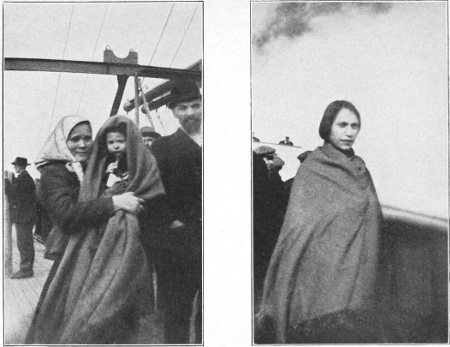
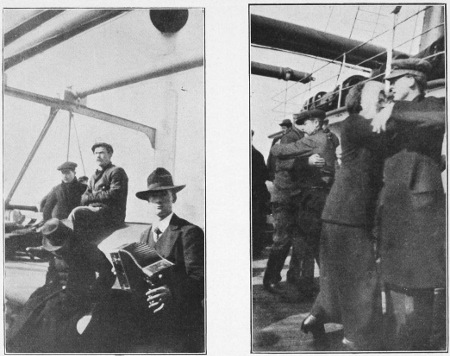
RUSSIAN WOMEN ON BOARD.
The peasant woman. The intellectual and revolutionary type.
The emigrants flocked into the mess-room from the four doors to twenty
immense tables spread with knives and forks and toppling platters of
bread. Nearly all the men came in in their hats,—in black glistening
ringlety sheepskin hats, in fur caps, in bowlers, in sombreros, in
felt hats with high crowns, in Austrian cloth hats, in caps so green
that the wearer could only be Irish. Most of the young men were
curious to see what girls there were on board, and looked eagerly to
the daintily clad Swedish women, blonde and auburn-haired beauties
in tight-fitting, speckless jerseys. The British girls came in in
their poor cotton dresses, or old silk ones, things that had once
looked grand for Sunday wear but now bore miserable crippled hooks
and eyes, threadbare seams, gaping fastenings—cheerful daughters of
John Bull trapesing along in the shabbiest of floppy old boots. Then
there were the dark and somewhat forward Jewesses, talking animatedly
with little Jew men in queer-shaped trousers and skimpy coats; there
were slatternly looking Italian women with their children, intent on
being at home in whatever circumstances. There was a party of shapely
and attractive Austrian girls that attracted attention from the others
and a regular scramble to try to sit next to them or near them. No one
ever saw a greater miscellaneity and promiscuity of peoples brought
together by accident. I sat between a sheepskin-wrapped peasant wife
from the depths of Russia and a neat Danish engineer, who looked no
different from British or American. Opposite me were two cowboys going
back to the Far West, a dandified Spanish Jew sat next them on one hand
and two Norwegians in voluminous knitted jackets on the other. At the
next table was a row of boisterous Flemings, with huge caps and gaudy
scarfs. There were Americans, spruce and smart and polite; there were
Italians, swarthy and dirty, having their black felt hats on their
heads all through the meal and resting their elbows on the table as
if they'd just come into a public-house in their native land. There
were gentle youths in shirts which womenfolk had embroidered in Little
Russia; there were black-bearded Jewish patriarchs in their gaberdines,
tall and gaunt.
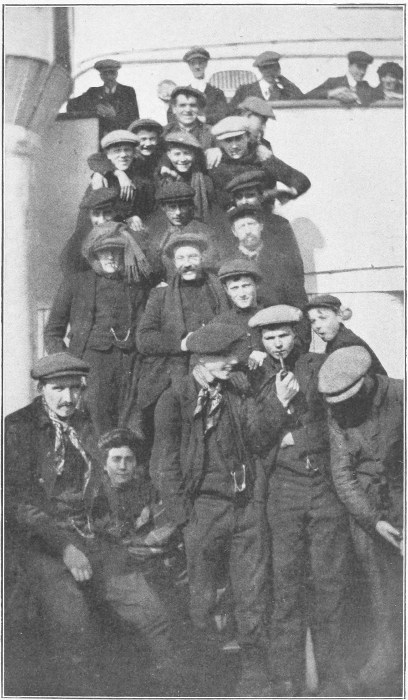
THE BOISTEROUS FLEMINGS.
A strange gathering of seekers, despairers, wanderers, pioneers,
criminals, scapegoats. I thought of all the reasons that had brought
these various folk together to make a community, that had brought
them all together to form a Little America. From Great Britain it is
so often the drunkard who is sent. Some young fellow turns out to be
wilder than the rest of his family; he won't settle down to the sober,
righteous, and godly life that has been the destiny of the others; he
is likely to disgrace respectability, so parents or friends give him
his passage-money and a little capital and send him away across the
sea. Henceforth his name is mentioned at home with a 'ssh, or with a
tear—till the day that he makes his fortune. With the drunkard go
the young forger or embezzler whose shame has been covered up and
hidden, but who can get no "character" from his last employer. Then
there are the unemployed, and those discontented with their jobs, the
out-of-works, the men who have seen no prospect in the old land and
felt no freedom. There are the wanderers, the rovers, the wastrels, so
called, who have never been able to settle down; there are also the
prudent and thoughtful men who have read of better conditions and go
simply to take advantage of them. There are those who are there almost
against their will, persuaded by the agents of the shipping companies
and the various people interested to keep up the flow of people into
America. There are the women who are going out to their sweethearts to
be married, and the wives who are going to the husbands who have "made
good"; there are the girls who have got into trouble at home and have
slid away to America to hide their shame; there are girls going to be
domestic servants, and girls doomed to walk the streets,—all sitting
down together, equals, at a table where no grace is said but the
whisper of hope which rises from each heart.
But it is not only just these people whom I have so materially and
separately indicated. The cheerful lad who is beginning to flirt with
his first girl acquaintance on the boat has only a few hours since
dried the tears off his cheeks; they are nearly all young people on
the boat, and they mostly have loving mothers and fathers in the
background, and friends and sweethearts, some of them. And there are
some lonely ones who have none who care for them in all the world.
There are young men who are following a lucky star, and who will never
be so poor again in their lives, boys who have guardian angels who
will never let them injure their foot on the ground, boys who have in
their favour good fairies, boys and girls who have old folk praying
for them. And there is the prodigal son, as well as the too-prodigal
daughter. There are youngest brothers in plenty, going to win the
princess in a way their elder brothers never thought of; young Hans is
there, Aladdin, Norwegian Ashepattle, Ivan Durak—the Angel of Life is
there; there is also the Angel of Death.
We sat down together to our first meal,—the whole company of the
emigrant passengers broke bread together and became thereby one
body,—a little American nation in ourselves. I am sure that had the
rest of the world's people been lost we could have run a civilization
by ourselves. We had peasants to till the soil, colliers to give us
fuel, weavers and spinners to make cloth, tailors to sew it into
garments, comely girls of all nations to be our wives; we had clerks
and shop-keepers and Jews with which to make cities; musicians and
music-hall artists to divert us, and an author to write about it all.
Mugs half-full of celery soup were whisked along the tables; not a
chunk of bread on the platters was less than an inch thick; the hash of
gristly beef and warm potato was what would not have been tolerated in
the poorest restaurant, but we set ourselves to eat it, knowing that
trials in plenty awaited us and that the time might come when we should
have worse things than these to bear. The Swedes and the British were
finicky; the Russians and the Jews ate voraciously as if they'd never
seen anything so good in their lives.
The peasant woman next to me crossed herself before and after the meal;
her Russian compatriots removed their hats and some of them said grace
in a whisper to themselves. But most ate even with their hats on, and
most with their hands dirty. You would not say we ate as if in the
presence of God and with the memories, in the mind, of prayers for the
future and heart-break at parting with home; yet this meal was for the
seeing eye a wonderful religious ceremony, a very real first communion
service. The rough food so roughly dispensed was the bread and wine,
making them all of one body and of one spirit in America. Henceforth
all these people will come nearer and nearer to one another, and drift
farther and farther from the old nations to which they belonged. They
will marry one another, British and Jewish, Swedish and Irish, Russian
and German; they will be always eating at America's board; they will
be speaking the one language, their children will learn America's
ideals in America's school. Even from the most aboriginal, illiterate
peasant on board, there must come one day a little child, his grandson
or great-grandson, who will have forgotten the old country and the old
customs, whose heart will thrill to America's idea as if he had himself
begotten it.
On Sunday morning when we came upstairs from our stuffy little cabin
we were gliding past the green coast of Ireland, and shortly after
breakfast-time we entered the beautiful harbour of Queenstown,
blue-green, gleaming, and perfect under a bright spring sun. Hawkers
came aboard with apples, knotted sticks, and green favours—the day
following would be St. Patrick's. And we shipped a score of Irish
passengers.
Outside Queenstown a different weather raged over the Atlantic, and
as we steamed out of the lagoon it came forward to meet us. The
clouds came drifting toward us, and the wind rattled in the masts.
The ocean was full of glorious life and wash of wave and sea. A crowd
of emigrants stood in the aft and watched the surf thundering away
behind us; the great hillsides of green water rose into being and
then fell out of being in grand prodigality. Gulls hung over us as we
rushed forward and poised themselves with gentle feet outstretched,
or flew about us, skirling and crying, or went forward and overtook
us. Meanwhile Ireland and Britain passed out of view, and we were left
alone with the wide ocean. We knew that for a week we should not see
land again, and when we did see land that land would be America.
THE DREAMY NORWEGIAN WITH THE CONCERTINA. THE ENDLESS DANCING.
Then we all began to know one another, to talk, to dance, to sing, to
play together. All the cabins were a-buzz with chatter, and along
the decks young couples began to find one another out and to walk
arm and arm. Two dreamy Norwegians produced concertinas, and without
persuasion sat down in dark corners and played dance music for hours,
for days. Rough men danced with one another, and the more fortunate
danced with the girls, dance after dance, endlessly. The buffets were
crowded with navvies clamouring for beer; the smoking-rooms were full
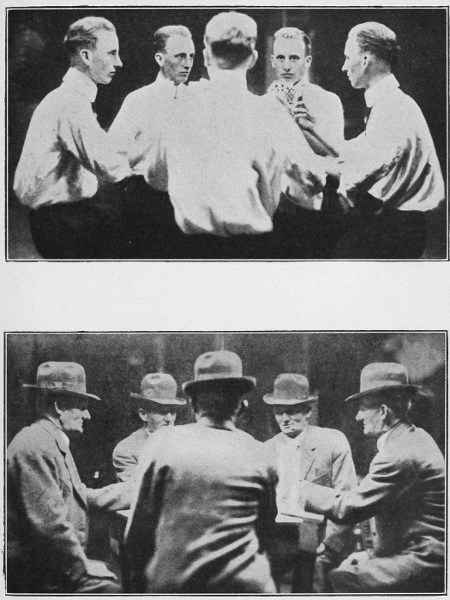
of excited gamblers thumbing filthy cards. The first deck was wholly
in electric light, you mounted to the second and it was all in shadow,
you went higher still and you came to daylight. You could spend your
waking hours on any of these levels, but the lower you went the warmer
it was. On the electric-light deck were to be found the cleaner and
more respectable passengers; they sat and talked in the mess-room,
played the piano, sang songs. Up above them all the hooligans rushed
about, and there also, in the shadow, in the many recesses and dark
empty corners young men and women were making love, looking moonily at
one another, kissing furtively and giving by suggestion an unwonted
atmosphere to the ship. It was also on this deck that the wild couples
danced and the card-players shuffled and dealt. Up on the open deck
were the sad people, and those who loved to pace to and fro to the
march music of the racing steamer and the breaking waves.
I wandered from deck to deck, everywhere; opened many doors, peered
into many faces, sat at the card-table, crushed my way into the bar,
entered into the mob of dancers, found a Russian girl and talked to
her. But I was soon much sought for. When the Russian-speaking people
found out I had their language they followed me everywhere, asking
elementary questions about life and work and wages in America. Even
after I had gone to bed and was fast asleep my cabin door would open
and some woolly-faced Little Russian would cry out, "Gospodin Graham,
forgive me, please, I have a little prayer to make you; write me also a
letter to a farmer."
I had written for several of them notes which they might present at
their journey's end.
All day long I was in converse with Russians, Poles, Jews, Georgians,
Lithuanians, Finns.
"Look at these Russian fatheads (duraki)," said a young Jew. "Why
do they go to America? Why do they leave their native land to go to a
country where they will be exploited by every one?"
"Why do you leave it, then?" asked a Russian.
"Because I have no rights there," replied the Jew.
"Have we rights?" the Russian retorted.
"If I had your rights in Russia I'd never leave that country. I'd find
something to do that would make me richer than I could ever be in
America."
There were three or four peasants around, and another rejoined. "But
you could have our rights if you wished."
Whereupon I broke in:
"But only by renouncing the Jewish faith."
"That is exactly the truth," said the Jew.
"Yes," said a Russian called Alexy Mitrophanovitch, "he can have all
our rights if he renounces his faith."
"If I am baptized to get your rights what use is that to you? Why do
Christians ask for such an empty thing?"
"All the same," said another Russian, "in going to America you will
break your faith, and so will we. I have heard how it happens. They
don't keep the Saints' days there."
Alexy Mitrophanovitch was a fine, tall, healthy-looking peasant workman
in a black sheepskin. With him, and as an inseparable, walked a
broad-faced Gorky-like tramp in a dusty peak-hat. The latter was called
Yoosha.
"You see, all I've got," said Alexy to me, "is just what I stand up in.
Not a copeck of my own in my pocket, and not a basket of clothes. My
friend Yoosha is lending me eighty roubles so as to pass the officials
at New York, but of course I give it back to him when we pass the
barrier. We worked together at Astrakhan."
"Have you a bride in Russia?"
No, he was alone. He did not think to marry; but he had a father and a
mother. At Astrakhan he had been three thousand versts away from his
village home, so he wouldn't be so much farther away in America.
He was going to a village in Wisconsin. A mate of his had written that
work was good there, and he and Yoosha had decided to go. They would
seek the same farmer, a German, Mr. Joseph Stamb—would I perhaps write
a letter in English to Mr. Stamb?...
Both he and Yoosha took communion before leaving Astrakhan. I asked
Alexy whether he thought he was going to break his faith as the other
Russians had said to the Jew. How was he going to live without his Tsar
and his Church?
He struck his breast and said, "There, that is where my Church is!
However far away I go I am no farther from God!"
Would he go back to Russia?
He would like to go back to die there.
"Tell me," said he, "do they burn dead bodies in America? I would not
like my body to be burned. It was made of earth, and should return to
the earth."
The man who slept parallel with me in my cabin was an English collier
from the North Country. He had been a bad boy in the old country, and
his father had helped him off to America. Whenever he had a chance to
talk to me, it was of whippet-racing and ledgers and prizes and his pet
dog.
"As soon as a get tha monny a'll enter that dawg aht Sheffield. A took
er to Durby; they wawn't look at 'er there. There is no dawg's can
stan' agin her. At Durby they run the rabbits in the dusk, an' the
little dawg as 'ad the start could see 'em, but ourn moight a been at
Bradford fur all she could see. A'll bet yer that dawg's either dead
or run away. She fair lived fer me. Every night she slep in my bed.
Ef ah locked 'er aht, she kick up such a ra. Then I open the door an'
she'd come straight an' jump into bed an' snuggle 'erself up an' fall
asleep...."
The dirtiest cabins in the ship were allotted to the Russians and the
Jews, and down there at nine at night the Slavs were saying their
prayers whilst just above them we British were singing comic songs or
listening to them. Most of us, I reckon, also said our prayers later
on, quietly, under our sheets; for we were, below the surface, very
solitary, very apprehensive, very child-like, very much in need of the
comfort of an all-seeing Father.
The weather was stormy, and the boat lost thirty-six hours on the way
over. The skies were mostly grey, the wind swept the vessel, and the
sea deluged her. The storm on the third night considerably reduced the
gaiety of the ship; all night long we rolled to and fro, listening to
the crash of the waves and the chorus of the spring-mattresses creaking
in all the cabins. My boy who had left the "dawg" behind him got badly
"queered up." He said it was "mackerel as done it," a certain warm,
evil-looking mackerel that had been served him for tea on the Tuesday
evening. Indeed the food served us was not of a sort calculated to
prepare us for an Atlantic storm—roast corned beef, sausage and mash,
dubious eggs, tea that tasted strongly of soda, promiscuously poked
melting butter, ice cream. On tumultuous Tuesday the last thing we ate
was ice cream! We all felt pretty abject on Wednesday morning.
Our sickness was the stewards' opportunity. They interviewed us, sold
us bovril and hawked plates of decent ham and eggs, obtained from the
second-class table or their own mess. The British found the journey
hard to bear, though they didn't suffer so much as the Poles and the
Austrians and the Russians. I found the whole journey comparatively
comfortable, stormy weather having no effect on me, and this being
neither my first nor worst voyage. Any one who has travelled with
the Russian pilgrims from Constantinople to Jaffa in bad weather has
nothing to fear from any shipboard horror on a Cunarder on the Atlantic.
Only two of the Russians went through the storm happily, Alexy and
Yoosha. They had worked for nights and months on the Caspian Sea in a
little boat, almost capsizing each moment as they strained at their
draughts of salmon and sturgeon; one moment deep down among the seas,
the next plunging upward, shooting over the waves, stopping short,
slithering round—as they graphically described it to me.
When the storm subsided the pale and convalescent emigrants came
upstairs to get sea air and save themselves from further illness.
Corpse-like women lay on the park seats, on the coiled rope, on the
stairs, uttering not a word, scarcely interested to exist. Other women
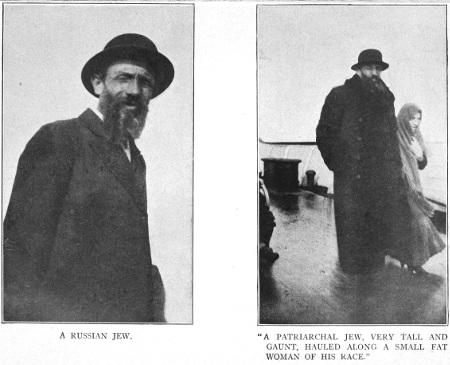
were being walked up and down by their young men. A patriarchal Jew,
very tall and gaunt, hauled along a small, fat woman of his race, and
made her walk up and down with him for her health—a funny pair they
looked. On Wednesday afternoon, about the time the sun came out, one of
the boisterous Flemings tied a long string to a tape that was hanging
under a pretty French girl's skirts, and he pulled a little and watched
her face, pulled a little more and watched the trouble, pulled a little
more and was found out. Then several of the corpse-like ones smiled,
and interest in life was seen to be reviving.
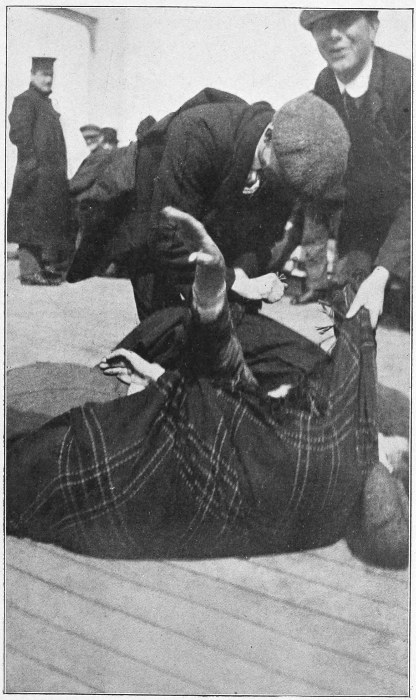
Next morning when I was up forward with my kodak, one of the young
ladies who had been so ill was being tossed in a blanket with a young
Irish lad of whom she was fond, struggling and scratching and rolling
with a young fellow who was kissing her, whilst four companions were
dangerously hoisting them shoulder high, laughing and bandying Irish
remarks. Life only hides itself when these folk are ill; they will
survive more than sea-sickness.
The white dawn is haggard behind us over the black waves, and our great
strong boat goes thundering away ahead of the sun. It is mid-Atlantic,
and we stare into the same great circle of hungry emptiness, as did
Columbus and his mariners. Our gaze yearns for land, but finds none;
it rests sadly on the solitary places of the ocean, on the forlorn
waves lifting themselves far away, falling into nothingness, and then
wandering to rebirth.
Nothing is happening in the wide ocean. The minutes add themselves and
become hours. We know ourselves far from home, and we cannot say how
far from the goal, but still very far, and there is no turning back.
"Would there were," says the foolish heart. "Would I had never come
away from the warm home, the mother's love, the friends who care for
me, the woman who loves me, the girl who has such a lot of empty time
on her hands now that I have gone away, her lover." How lonely it is
on the steerage deck in the crowd of a thousand strangers, hearing a
score of unknown tongues about your ears, hearing your own language so
pronounced you scarce recognise it!
The mirth of others is almost unpardonable, the romping of Flemish
boys, pushing people right and left in a breakneck game of touch; the
excitement of a group of Russians doing feats of strength; the sweet
happiness of dainty Swedish girls dancing with their rough partners
to the strains of an accordion. How good to escape from it all and
trespass on the steward's promenade at the very extremity of the
after-deck, where the emigrants may not go, and where they are out of
sight and out of hearing.
The ocean is retreating behind us with storm-scud and smoke of foam
threshed out from our riven road. Vast theatres of waves are falling
away behind us and slipping out of our ken backward into the homeward
horizon. Above us the sky is grey, and the sea also is grey, waving now
and then a miserable flag of green.
What an empty ocean! There is nothing happening in it but our ship.
And for me, that ship is just part of my own purpose: there is nothing
happening but what I willed. The slanting red funnels are full of
purpose, and the volumes of smoke that fly backward are like our sighs,
regrets, hopes, despairs, the outward sign of the fire that is driving
us on.
Up on the steward's promenade on Thursday morning I fell into
conversation with a young Englishman, and he poured out his heart to
me. He was very homesick, and had spoken to no one up till then. He was
in a long cloak, with the collar turned up, and a large cloth cap was
stuck tightly on his head to keep it from the wind. His face was red
with health, but his forehead was puckered, and his eyes seemed ready
to shed tears.
"Never been so far away from the old country before?" I hazarded.
"No."
"Would you like to go back?"
"No."
"Are you going to friends in America?"
He shook his head.
"I'm going on my own."
"You are the sort that America wants," I ventured. He did not reply,
and I was about to walk away, snubbed, when another thought occurred to
me.
"I once left the old country to seek my fortune elsewhere," said I. "I
felt as you do, I expect. But it was to go to Russia."
He looked up at me with an inquisitive grimace. I suggested that I
knew what it was to part with a girl I loved, and a mother and friends
and comforts, and to go to a strange country where I knew no one, and
thought I had no friends. At the mention of parting with the girl he
seemed to freeze, but curiosity tempted him and he let me tell him some
of my story.
"I reckon that England's pretty well played out," said he.
"Not whilst it sends its sons out into the world—you to America, and
me to Russia," said I with a smile. "It will only be played out when we
haven't the courage to go."
"Well," said he, "I reckon I had to go, there wasn't anything else
for me to do. It wasn't courage on my part. I didn't want to go. I
reckon there ought to be room in England for the likes of me. It isn't
as if I had no guts. I'm as fit as they make them, only no good at
figures. I think I had the right to a place in England and a decent
screw, and England might be proud of me. I should always have been
ready to fight against the Germans for her. I joined the Territorials,
I learned to shoot, I can ride a horse."
"Why didn't you go into the army?"
"That's not the place for a decent fellow. Besides, my people wouldn't
allow it, and my girl's folks would be cut up. And I reckon there's
something better to do than be drilled and wait for a war. My people
wanted me to be something respectable, to go into the Civil Service,
or a bank, or an insurance office, or even into the wholesale fruit
business. I was put into Jacob's, the fruit firm, but I couldn't work
their rate. I've been hunting for work the last five months. That takes
it out of you, don't it? How mean I felt! Everybody looked at me in
such a way—you know, as much as to say 'You loafer, you lout, you
good-for-nothing,' so that I jolly well began to feel I was that, too,
especially when my clothes got shabby and I had nothing decent to put
on to see people."
As my acquaintance talked he rapidly became simpler, more child-like,
confiding, and tears stole down his cheek. The reserved and surly lad
became a boy. "What a life," said he, "to search work all day, beg a
shilling or so from my mother in the evening, meet my girl, tell her
all that's happened, then at night to finish the day lying in bed
trying to imagine what I'd do if I had a thousand a year!
"I reckon I could have earned a living with my hands, but my people
were too proud; yes, and I was too proud also, and my girl might not
have liked it. Still, I'd have done anything to earn a sovereign and
take her to the theatre, or go out with her to the country for a day,
or make her a nice present and prove I wasn't mean. I used to be
generous. When I had a job I gave plenty of presents; but you can't
give things away when you have to borrow each day. You even walk
instead of taking a car, and you are mean, mean, mean—mean all day.
Then in the evening you talk of marrying a girl, of having a little
home, and you dare to kiss her as much as you can or she will let, and
all the while you have in the wide world only a few coppers—and a mother."
"ONE OF THE YOUNG LADIES WAS BEING TOSSED UP IN A
BLANKET WITH A YOUNG IRISH LAD."
We went and leaned over the ship and stared down at the sea.
Tears! I suppose millions had come there before and made that great
salt ocean of them.
The boy now lisped his confidence to me hurriedly, happily, tenderly.
"But I reckon I've got a good mother, eh? She loved me more than I
dreamed. How she cried on Friday! how she cried! It was wild. Sometimes
I used to say I hated her. I used to shout out angrily at her that I'd
run away and never come back. That was when she said hasty things to
me, or when she wouldn't give me money. I used to think I'd go and be
a tramp, and pick up a living here and there in the country, and live
on fruit and birds' eggs, sleeping anywhere. It would be better than
feeling so mean at home. But then, my girl—every night I had to see
her. I felt I could not go away like that, never to come home with a
fortune—never, never to be able to marry her. Every night she put her
arms round my neck and kissed me, and called me her old soldier, her
dear one—all sorts of sweet things. I reckon we didn't miss one night
all this last year.
"Her father's all right. I had thought he would be different. I was a
bit afraid of what he'd say if he got to hear. But she told him on her
own, and one night she took me home. They had fixed it up themselves
without asking me, and he was very kind. I told him I wanted a job, and
I thought p'raps he was going to get me one. But no; he was a queer
sort, rather. 'I'm going to wipe out that story of yours,' he says.
Then he goes to his bureau and writes a note and puts it in an envelope
and addresses it to me. 'Here you are, young man,' says he. I opened
the envelope and read one word on a slip of paper—America.
'Millions have told your story before,' says he, 'and have had that
word given them in answer. You get ready to go to America; I'll find
you your passage-money and something to start you off in the new
country. You'll do well; you'll make good, my boy,' and he slapped me
on the back.
"You bet I felt excited. He saw my mother and told her his plan. She
said she couldn't stand in my way. I got the Government Handbook on
the United States, and the emigration circular. I read up America at
the public library. I wonder I hadn't thought of it before. America is
a great country, eh? They look at you differently, I bet, and a strong
young man's worth something there. My word, when I come back....
"I wonder if I shall come back or if she'll come out to me. I wonder if
her father would let her. I guess he would....
"She loves me. My word, how she loves me! I didn't dream of it before.
I used to think the harder you kissed, the more it meant; but she
kissed me in a new way, so softly, so differently. She said I was hers,
that I would be safe wherever I went in the wide world, and I was
never to feel afraid. I've got to do without her now. I reckon no other
girl is going to mean much to me."
He looked rather scornfully at a troop of pretty Swedes who had invaded
our sanctuary.
"It is queer how sure I feel of good luck because of her and what she
did. I feel as if everything must turn my way. Downstairs yesterday
they challenged me to play a game of cards, and I won fifty cents; but
I felt it was wrong to spend my luck that way. The chap wouldn't play
any more; he said I was in a lucky vein. He was quite right. Whatever I
turn my hand to, I'm bound to have unexpected good luck. I feel so sure
I'm going to get a job, and a real good one, too. I shan't play any
more cards this journey."
The sun had come out, and the bright light blazed through our smoke,
and I felt that the boy's faith was blazing just that way through his
regrets.
The sun crept on and overtook us on his own path, and then at last went
down in front of us, far away in the waste of waters.
My acquaintance and I went away to the last meal of the day, to the
strangely mixed crowd of prospective Americans at the table, where men
sat and ate with their hats on, and where no grace was said. "What
matter that they throw the food at us?" I asked. "We are men with
stout hearts in our bosoms; we are going to a great country, where a
great people will look at us with creative eyes, making the beautiful
out of the ugly, the big and generous out of the little and mean, the
headstone out of the rock that the builders rejected."
After supper I left my friend and went upstairs alone. The weather had
changed, and the electric lights of the ship were blazing through the
rain, the decks were wet and windswept, and the black smoke our funnels
were belching forth went hurrying back into the murky evening sky. The
vessel, however, went on.
Downstairs some were dancing, some singing, some writing home
laboriously, others gossiping, others lying down to sleep in the little
white cabins. There was a satisfaction in hearing the throbbing of the
engines and feeling the pulse of the ship. We were idle, we passed the
time, but we knew that the ship went on.
Going above once more at nine, I found the rain had passed, the sky was
clear and the night full of stars. In the sea rested dim reflections of
the stars, like the sad faces we see reflected in our memory several
days after we have gone from home. I stood at the vessel's edge and
looked far over the glimmering waves to the horizon where the stars
were walking on the sea. "What will it be like in America?" whispered
the foolish heart. "What will it be like for him?" Then sadness
came—the long, long thoughts of a boy. I whispered the Russian verse:
"There is a road to happiness,
But the way is afar."
And yet, next morning, I saw the Englishman dancing for hours with a
pretty Russian girl from a village near Kiev—Phrosia, the sister of
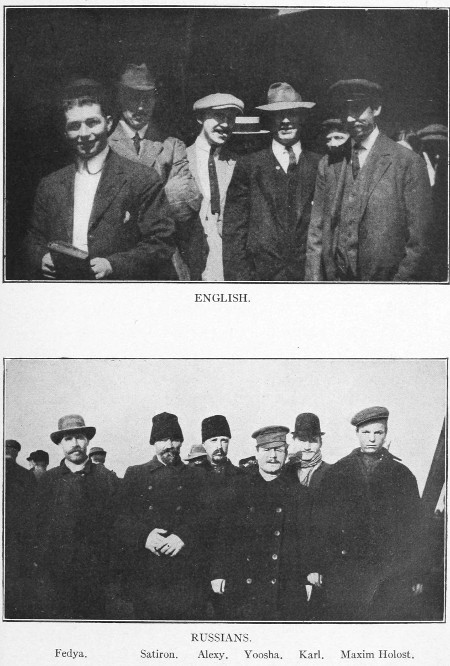
Maxim Holost, a fine boy of eighteen going out to North Dakota. I had
noticed the Englishman looking on at the dancing, and then suddenly, to
my surprise, at a break in the tinkling of the accordion, he offered
his arm to the Russian and took her down the middle as the music
resumed....
I was much in demand among the Russians on Friday and Saturday, for
they wanted to take the English language by storm at the week-end. I
taught Alexy by writing out words for him, and six or seven peasants
had copied from him and were busy conning "man," "woman," "farm,"
"work," "give me," "please," "bread," "meat," "is," "Mister," "show,"
"and," "how much," "like," "more," "half," "good," "bad," the numbers,
and so on. They pronounced these words with willing gusto, and made
phrases for themselves, calling out to me:
"Show me worrk, pleez."
"Wer is Meester Stamb?"
"Khao match eez bread?"
"Give mee haaf."
Alexy tried his English on one of the waiters at dinner time.
"Littel meet, littel, give mee more meet."
The steward grinned appreciatively, and told him to lie down and be
quiet.
Maxim and his sister were accompanied by a grizzled peasant of sixty or
so, wearing a high sugar-loaf hat sloping back from an aged, wrinkled
brow. This was Satiron Federovitch, the only old man on deck. His black
cloak, deep lined with wadding, was buttoned up to his throat, and the
simplicity of his attire and the elemental lines of his face gave him
a look of imperturbable calm. Asked why he was going to America, he
said that almost every one else in the village had gone before him. A
Russian village had as it were vanished from the Russian countryside
and from the Russian map and had transplanted itself to Dakota. Poor
old greybeard, he didn't want to go at all, but all his friends and
relatives had gone, and he felt he must follow.
Holost told every one how at Libau the officials doubted the
genuineness of his passport, and he had to telegraph to his village
police, at his own expense, to verify his age and appearance. The
authorities didn't relish the idea of such a fine young man being
lost by any chance to the army. If only they had as much care for the
villages as they have for their legions!
I was up betimes on Saturday morning and watched the vessel glide
out of the darkness of night into the dusk of the dawn. The electric
light up in the mainmast, the eye of the mast, squinted lividly in
the half-light, and the great phantom-like ship seemed as if cut out
of shiny-white and blood-red cardboard as it moved forward toward
the west. The smoke from the funnels lay in two long streamers to
the horizon, and the rising sun made a sooty shadow under it on the
gleaming waves. As the night-cloud vanished a great wind sprang up,
blowing off America. Old Satiron was coming laboriously upstairs, and
he slipped out on to the deck incautiously.
"Gee whizz!" The mocking American wind caught his astrakhan hat and
gave it to the sea. Poor old Satiron, he'll turn up in Dakota with a
derby on, perhaps.
Saturday was a day of preparation. We packed our things, we wrote
letters to catch the mail, we were medically inspected—some of us
were vaccinated. All the girls had to take off their blouses and the
young men their coats, and we filed past a doctor and two assistants.
One man washed each bare arm with a brush and some acid. The doctor
looked and examined. The other assistant stood with lymph and lancet
and rapidly jabbed us. The operation was performed at an amazing pace,
and was only an unpleasant formality. Many of those who were thus
vaccinated got their neighbours to suck out the vaccine directly they
returned to their cabins. This was what the boy who had left the dog
behind him did. He didn't want blood-poisoning, he said. Nearly all the
Russians had been vaccinated five or six times already. In Russia there
is much disease and much faith in medicine. In England good drainage,
many people not vaccinated, little smallpox; in Russia, no drains, much
vaccination, and much of the dread disease.
On Saturday night there was a concert, at which all the steerage
were present, and in which any one who liked took part. But English
music-hall songs had all the platform—no foreign musicians
participated.
Sunday was Easter Day, and I was up in the dark hours of the morning
and saw the dawn. Sunrise showed the clouds in the east, but in north
and south and west the other clouds still lay asleep. Up on the
after-deck of the great tireless steamer little groups of cloaked and
muffled emigrants stood gazing over the now familiar ocean. We knew it
was our last day on the ship, and that before the dawn on the morrow we
should be at the American shore. How fittingly was it Easter, first day
of resurrection, festive day of spring, day of promise and hope, the
anniversary of happy days, of first communions!
In the wan east the shadowy wings of gulls were flickering. The
blood-red sun was just coming into view, streaked and segmented with
blackest cloud. He was striving with night, fighting, and at last
gaining the victory. High above the east and the wide circle of glory
stood hundreds of attendant cloudlets, arrayed by the sun in robes of
lovely tinting, and they fled before him with messages for us. Then,
astonishing thing, the sun disappeared entirely into shadow. Night
seemed to have gotten the victory. But we knew night could not win.
The sun reappeared almost at once, in resplendent silver, now a rim, in
a moment a perfect shield. The shield had for a sign a maiden, and from
her bosom a lovely light flooded forth upon the world. We felt that we
ourselves, looking at it, were growing in stature in the morning. The
light enveloped us—it was divine.
But the victory still waited. All the wavelets of the eastern sea were
living in the morning, dancing and mingling, bewildering, baffling,
delighting, but the west lay all unconquered, a great black ocean of
waves, each edged with signs of foam, as if docketed and numbered.
All seemed fixed and rigid in death. The sun disappeared again and
reappeared anew, and this time he threw into the world ochre and fire.
The wide half-circle of the east steamed an ochreous radiance to the
zenith. The sun was pallid against the beauty he had shed; the lenses
of the eye fainted upon the unearthly whiteness. It was hard to look
upon the splendid one, but only at that moment might he be seen with
the traces of his mystery upon him. Now he was in his grave-clothes,
all glistening white, but at noon he would be sitting on the right hand
of God.
Easter!
"Will there be any service in the steerage to-day?"
"No, there will only be service for first and second-class passengers."
"Is that because they need it more than we?"
There was no answer to that impolite remark. Still it was rather
amusing to find that the Church's office was part of the luxury of the
first and second class.
The third class played cards and danced and sang and flirted much as
usual. They had need of blessing.
So at night a Baptist preacher organised a prayer-meeting on his own
account, and the English-speaking people sang "Onward, Christian
soldiers," in a rather half-hearted way at eight o'clock, and "Jesus,
lover of my soul, let me to Thy Bosom fly," at nine; and there was a
prayer and a sermon.
A few hours after I had lain down to sleep Maxim Holost put his head in
at my cabin and cried out:
"America! Come up and see the lights of America."
And without waiting for me to follow, he rushed away to say the same
thing to others, "America! America!"