Footnotes have been collected at the end of each chapter, and are
linked for ease of reference.
Minor errors, attributable to the printer, have been corrected. Please
see the transcriber’s note at the end of this text
for details regarding the handling of any textual issues encountered
during its preparation. The corrected text appears with a thin
gray underline. The original text will
appear as a pop-up note when the cursor is placed atop the phrase.
Minor errors, attributable to the printer, have been corrected. Please
see the transcriber’s note at the end of this text
for details regarding the handling of any textual issues encountered
during its preparation. The corrected text appears as a link to
the table of errata at the end of the text.
The cover image has been created, based on title page information, and
is added to the public domain.
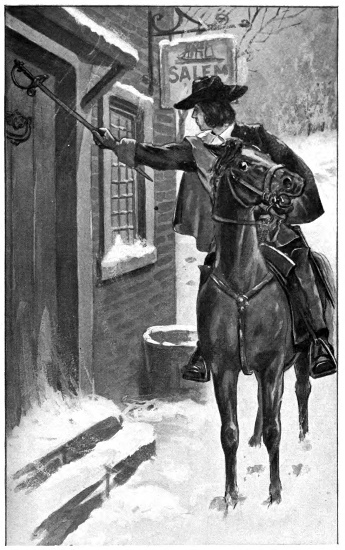
“I DREW MY SWORD, AND WITH THE HILT GAVE SEVERAL BLOWS ON THE DOOR.”
WITH FORCE AND ARMS
A TALE OF LOVE AND
SALEM WITCHCRAFT.
BY
HOWARD R. GARIS.
New York:
J.S. OGILVIE PUBLISHING COMPANY,
57 Rose Street,
11 Paternoster Building, London.
Copyright, 1908, by J.S. Ogilvie Publishing Company.
All Rights Reserved.
Copyrighted in Great Britain.
PREFACE.
The showman, crying his attractions, lifted up his voice
at the flap of his tent. So, at this, the entrance to that
which is within, those who stop to read may gain a hint
of what is beyond. Only a little, though, to whet your
appetite and make you wish for more, it is to be hoped.
So, then, this is a tale of love, of witchcraft, and of fighting.
A tale of a brave man, and as brave a maid. Herein
may be found the doings of witch-finders, Puritans and
Indians. Also there is set down the struggle of two men
for the love of a woman, and it may be learned who won.
You may read of the lifting of the great rock, of the
killing of the serpent, of the battle at the fort, of the trial
of death, and the bursting of the mighty press. This much
and more, until the tale is at an end.
The author hopes you, reader, and the many of you who
make up the public, will like the story. He has tried to
make it interesting. If it serves to help you pass a pleasant
hour or two, the writer will have accomplished his
purpose.
So, then, having had patience thus far, you may enter,
and read.
H. R. G.
CONTENTS. — WITH FORCE AND ARMS. — CHAPTER I. THE GOVERNOR’S COMMISSION.
As I left the presence of His Excellency I encountered,
in the doorway, a man who was entering with every appearance
of haste. We came against each other full tilt.
For the moment the shock threw us apart.
“Zounds! But you are a clumsy fellow!” he exclaimed,
limping toward me, the expression of pain on his face
showing that I must have hurt him. “Could you not look
whither you were going? You stepped on my foot like
a very horse,” and the words came testily.
He scowled as he prepared to pass by me.
My hand was on my sword, for he was most insulting.
“Sir!” I exclaimed, “for the pain I have caused you
I am regretful. As for ‘clumsy fellows,’ look to yourself,
sir!”
My weapon was out on the instant. He was not a second
behind me. The steel blades crossed with a clash.
“What is this, sirs?” cried Sir William Phips, Massachusetts’s
10Governor, whose room I had just left. He
hastened toward us.
“What mean you two, with your swords out in the
Council Chamber, like a pair of swashbucklers over a card
game? Put them up at once, you Captain Amherst; and
you, also, Sir George. You are both at fault. This must
go no further; do you hear? If it does, you may reckon
with me on the quarter deck.”
My opponent and I were startled. Somewhat abashed,
he whom the Governor called Sir George, sheathed his
weapon, I following his action.
I looked at the man. He was tall and well built. His
clothing was of good quality, with fine lace and ruffles;
his sword a trusty blade, set in a hilt, studded with red
stones. On his face there was a haughty look, yet withal,
a trace of sadness. He gazed sharply at me, seeming about
to put a question, but the Governor was beckoning him,
and he passed me without a word, scowling darkly, into
the chamber of His Excellency. Then I went out.
There came a time, afterward, when I wished with all
my heart, that our swords had come into use, that day;
a time when I would have given much to have seen him
dead before me. But there was another way.
I felt within my jacket to see if my papers were safe,
for on them, now, depended my good fortune. I had come
to Boston town without friends, and almost on a forlorn
hope, for England was no longer a safe place for me,
11with a relentless enemy following close on my heels at every
step. My mission had succeeded better than I had dared
to hope, and I was leaving now, carrying with me a captain’s
commission, duly signed and sealed by His Excellency.
I also had a letter of introduction to one,
Samuel Willis, a tavern keeper at Salem.
Of the things which had come to pass before I found
myself in Boston town, in the year of grace 1692, I will
relate none for the present. At any rate here I was, Captain
Edward Amherst, in age not yet a score and a half,
in stature say a bit over six feet; in weight--but there, you
will doubtless have more than enough of me ere I have
finished.
Sufficient to say that I was a soldier by trade, and one
of fortune, by necessity, and that I sought service in their
Majesties’ American Colonies. I had left London eight
weeks ago, bearing letters to Governor Phips, from old
comrades in arms, some of whom had sailed the seas with
him. Arriving in Boston I had put up at the inn, and
had sought an audience with His Excellency, which interview
was just over, with the ending I have described.
When I was ushered into the presence of Sir William I
explained in few words why I came, and what I wanted.
He extended his hand for my letters, and, when he had
them, he gave me no more heed for a time, but read the
missives. I watched his face as he scanned the pages, the
while he kept up a running fire of comments.
12“Ha! Tyler Anderson,” he said, “I know him well. He
has a steady hand, and can use a cutlass famously. Sir
Arthur Kent, too; a sly rascal with the women. Bob
Frenchard; he never could get enough of fighting. John
Powell; little Nat Edwards, also. Why, man, you might
have all Boston as far as I am concerned, with these letters.
You are very welcome, Captain. Now what can I
do for you?”
“Much,” I answered, surprised and pleased at his welcome;
and then I told him what I desired; a soldier’s
chance to mend his fortunes.
“How would a Captain’s commission, on this side of the
water, suit you?” he asked, when I had finished. “You tell
me that was your rank before.”
“I would desire nothing better,” I said warmly.
“It is yours, then,” was the reply, and he drew out
a parchment, partially covered with writing.
“You probably have heard of the activity of the French
and Indian enemy on our borders,” said the Governor,
while he prepared a quill. “We are about to proceed against
them. You have come at a time when certain currents
are like to drift you just where you want to go; into the
thick of the fight.” Then he opened his ink horn.
I listened for a while to the scratching of his quill. It
was some time before he had finished, and, looking up he
handed a folded parchment across the table to me.
“There is your commission, Captain,” he said, rising.
13“As for your instructions, they are, in brief, these. You
are to ride to Salem town, and enlist a company of one
hundred men. Drill them well, against the time when we
shall unite, and smite the French Philistine and his Indian
allies, with fire and with sword. We will rake them fore
and aft. An expedition against Canada is timed for this
season next year. I hope it will be more successful than
the one I led two years ago, for indeed that was a grievous
failure, though, of a truth, it was against heavy odds.”
I had heard of the manner in which Frontenac had
scattered Phips and the English fleet sent against him, but
I held my peace; for failure is no happy subject with any
man. Sir William told me in few words that Admiral Sir
Francis Wheeler was expected to arrive in March, with his
fleet from the Caribbee Islands. Governor Phips had undertaken
to raise small companies of men throughout the
Colony, to act with the Admiral on his arrival. This much
he told me, then, bidding me a pleasant farewell, and
wishing me success, he took up his quill again, to indicate
that the audience was at an end.
My encounter with the man in the doorway passed from
my mind, as I descended the steps of the Town Hall, and
trudged along the street, to where I had stabled my mare
Kit. With busy thoughts of what might be before me
I led Kit out of the door, leaped into the saddle, and was
off at a round trot, in the direction a lad pointed out as
leading to Salem.
14Of a truth, I was away now to seek my fortune in this
new land, and, I hoped, with the promise of as many
adventures as ever befell a knight of old. So, over hill and
across dale I rode, soon leaving behind the pleasant town
and the outlying farm lands. I had not gone many miles ere
the snow, which had been threatening since morning, began
to fall from the dull, leaden sky, piling up on the white
covering of previous storms. The flakes sifted down, lazily
at first, but soon began to gather more thickly as the wind
rose, so I urged the mare on by spur and voice, determined
to reach Salem by night, if I could. Now the snow came
down ever quicker and faster. It swirled and swished, and
blew in drifts, until I was fain to stop, look about me and
see where I was. I pulled the mare up as I reached the
top of a little hill, and peered through the clouds of cutting
flakes for some sight of the road, which, it was evident, I
had lost some time ago. Kit would have turned tail to the
wind, but I pressed my knees against her sides, and held
her to the blast. There was little hope in going back, perhaps
less in proceeding.
But I decided to continue in the hope of coming to some
shelter, and I patted the mare on the neck to set her going
again. She lurched forward into a drift so deep that it
well nigh covered my knees as I sat in the saddle, and
my boots were filled with snow through their wide, gaping
tops.
“Steady, girl!” I shouted, for, indeed, less voice could
15scarce have been heard. We were fairly lost now, and
for the last hour had been wandering back and forth
across country, I knew not how far from the road. I
did not see a single landmark in the stretch of whiteness,
my only hope having been that I might keep the right
way. Kit began to back, seeking to rid herself of the
cutting wind, and I had hard work to force her to stand.
Should I turn to the left, to the right, or keep straight
on? The wind seemed to blow less fiercely from the
south, so I swung Kit about in that direction, pulled
her to the left, and urged her on.
She responded nobly, and reared, rather than stepped
out of the snow bank. Her fore feet struck solid ground,
and then, feeling the hard road beneath her hoofs, she
pulled herself forward. We had struck the right path
at last, and, after hours of fierce weather-beating, like
a ship at sea, lost in a storm, we were fairly homeward
bound, on the way to Salem town.
I rode on more quickly now, settling my hat firmer
on my head, and pressing the leather lining against my
benumbed ears. My collar scarce kept the snow and wind
from my neck, and every half mile or so I was obliged
to drop the reins and, after feeling that my sword had
not dropped off in some snow drift, knock my hands
together to bring their fingers some little warmth.
Verily, I thought that the road would never lead me
to the friendly tavern of Master Samuel Willis, who,
16as I had heard in Boston, provided refreshment for
man and beast. And surely no two stood more in need
of it than Kit and myself that cold February day.
A fiercer squall and gust of wind than any that had
proceeded, fairly brought the mare to a stand. I lifted
my hat a bit, held my interlocked fingers before my eyes,
and peered ahead. Dimly, like a speck of black on a
white sheet, that a dame might spread on the grass
to bleach, I saw in front a house.
“May that be the tavern,” I quoth, and, with a heart
that smote me a trifle, for she had traveled far and
well that day, I dug the spurs into Kit’s flanks. She
leaped through the drifts, and, at length, when she could
make no more progress, I found myself before the snow-heaped
steps of Salem Inn.
The wind, shunted off by a corner of the building,
beat less fiercely at this point, and the roar was somewhat
subdued. I drew my sword, for I could not reach
the door knocker from where I sat on Kit’s back, and
with the hilt gave several blows on the oak.
“Who’s without?” came a woman’s voice from within.
“A friend; Captain Edward Amherst,” I cried. “Open
in the King’s name, if for no other reason.”
Now ere I had ceased speaking the heavy door swung
inward, revealing such a warmth and such a snug, homelike
appearance, and, withal, letting out such savory
odors, that poor Kit whinnied in anticipation of what
17might be her share of the feed. As for myself, I threw
one leg over the saddle, leaped to the ground, strode to
the door, and went inside. I shouted to a stout serving
man, snugly ensconced in the chimney corner, to look
after the mare, and then I approached the blazing fire.
“The Lord defend us! Goliath and the Philistines are
upon us!” cried out Mistress Willis, for she it was who
had opened the door.
I turned toward her. Now, of a truth, I am not overly
large. But, with a stout leather jacket on, my sword
by my side, and heavy boots on my legs, I did look big
to the good dame’s eyes. Yet I stood not so much over
six feet, when in my woolen hose, and, in girth, full many
a comrade, of times past, whose body rests beneath the
bogs of Sedgemoor, in Somersetshire, was larger. Yet,
in all modesty do I say it, there were none who were of
greater strength in shoulders or arms, and that, with a
wiry and supple wrist, stood me in good stead at sword
play.
“Neither Goliath nor a Philistine am I,” was my answer,
while I let the genial warmth get nearer to my bones
as I cast hat and jacket into a corner, “but an Essex man
by birth and breed. But, mark you, Mistress,” I went
on, “if I do not get a mug of ale, and a bit of roast beef
soon, I will be nothing at all, for I lost my road early this
morn, and no bite nor sup has passed my lips since. Thus
I am half starved. So bustle about----”
18“Aye, ‘bustle about’ it is,” answered she, repeating my
words, though in no great anger. “Bustle about is all
I’ve done since sunrise. What with Willis away all
day, attending on Dr. Clarke; with the snow, and only
one serving man, I have scarce time to----”
“Peace,” said I, for I never loved a woman’s tongue
when it ran in that strain, “peace, and bring the ale and
beef. You may talk afterward if you like. I can listen
better then.”
Mistress Willis looked at me a minute, as if she would
reply, but she came to another conclusion, ceased her
clatter, and bustled about to such good advantage that
she soon had on the table a plate of smoking hot beef, and
some cakes of yellow corn meal, with pats of golden butter.
There was also a stone mug of good ale. I gulped down
a big drink of it, and, when the flavor of it had mellowed
me, and the warmth gone clear down to my toes,
I did drink again, this time to the health of Mistress
Willis. For, though I like not a woman’s tongue when
they talk over much, I know the value of being in their
good graces. And so I ate and drank, and ate again,
until I felt the cold leave me, and the memory of the
biting wind and driving snow of an hour before was
forgotten. I leaned back in my chair, and looked all about
me, while the fire in the big chimney place flickered and
spluttered; the hickory logs smelling like sweet nuts, and
19cracking with the heat, as a teamster snaps his whip on
a frosty morning.
I let my eyes take in the room, with the oak beams
overhead, blackened by smoke, the heavy tables and chairs,
and the clean sanded floor. It was getting on toward
night now, and the wind had died out. I was alone in
the room, but I could hear Mistress Willis walking about
in the apartment overhead, and giving some orders to
the servant. I rose from my chair somewhat wearied,
wishing that the inn keeper would return, so that I might
meet him, and seek my bed. I walked to the window,
noting that the moon had risen, and that the snow had
ceased. As I looked through the casement I started, and
doubted whether my eyes beheld aright, for I saw a sight
of more than passing strangeness, and one that, for a
time, struck terror to my heart.
The snow, which had been as white as a fleecy cloud,
was now as red as blood beneath the silver moon!
At the same time I saw, coming toward the inn, at
top speed, three men who ran on, never once halting to
glance behind them.
CHAPTER II. OF THE SCARLET SNOW.
20
There was a clatter on the stairs as Mistress Willis
came down, her face white as the snow had been. She
saw the red mantle from an upper window, and came to
stand beside me, with fright in her eyes.
Together we watched the three figures, her breath coming
like that of one who had run far, her heart thumping
against her ribs. For myself, the first start over, I recalled
that once before I had seen snow like that. Learned
men said small Arctic plants in floating clouds, or tiny
insects, had dyed the white flakes crimson. Yet in the
town of Salem, that night, that a red shadow of doom
portended, was the dread in every heart.
Nearer and nearer came the three men. Their boots
cast up the snow, blood red on top and white beneath, so
that their path was marked like a pale streak of dawn
athwart a morning sky. They reached the inn door, and
burst into the room scarce stopping to raise the latch.
The shorter of the three, whom I took to be Master
Willis, by reason of his good-natured face, from which
even fear had not chased all the jollity, cried out:
21“Oh, Lord, deliver us! ’Tis the snow of blood, and
the witches of the air have sent it upon us. Of a truth
they be demons of darkness; those who will be on trial
to-morrow,” and he fell to murmuring a psalm tune in
a high pitched, quavering voice, crowding the while into
the chimney corner, where he could not see the red snow.
Now I was sore puzzled by all that had happened,
although I set but small store by the crimson flakes. The
talk of demons of darkness, and witches of the air, came
with an odd sound to my ears. The more so as I had
heard that these New Englanders were a plain, practical
people, much given to prayers and pious works. To hear
Master Willis prate of mysterious beings, then, made me
wonder what had come to pass. The three men, and the
wife of Willis, were huddled together now, one of them
occasionally glancing with awestruck eyes out of the window.
“There is one comfort, though,” muttered the inn
keeper, “the witches will be no more after to-morrow,
as their trial is set for then, and there will be a short
shrift, when once the honorable judges have passed sentence.”
“’Tis none too soon,” put in Mistress Willis. “Had
the doers of witchcraft been hung or burned to-day, this
evil would not have fallen upon us. Who knows what
else may follow. These are troubled times,” and she
glanced uneasily out of the window again.
22I had been forgotten in the sudden terror, and I stood
in the far corner of the room, waiting until I might have
some attention. Seeing that I was like to stay there some
time without notice, so firmly had the fear laid hold of
the company, I stepped from my place, and, as I saw
the inn keeper’s eyes turn toward me, I spoke:
“Master Willis,” I began, but I had scarce uttered the
words than the mistress screamed, and the three men
turned, as if to flee from the room. Verily, I believe they
took me for a witch. Had not the logs in the fireplace
blazed up then, showing who I was, there is no telling
what might have happened.
Mistress Willis gave a sigh of relief while the tavern
owner and his companions stared at me.
“Lackaday! I had clear forgotten you,” said the
matron. “’Tis some one to see you, Samuel Willis.”
“Me?” repeated her husband.
“Captain Edward Amherst, at your service,” said I,
bowing slightly. “I bear a commission from His Excellency
Sir William Phips, and I was bidden to seek this
inn, and to make it my headquarters for a time. I also
have a letter from Sir William for you, Master Willis.”
“Ha! ’Tis a strange time to get a letter,” ejaculated
mine host, taking the missive I held out. “And I can
scarce break the seal from the trembling of my hand over
this visitation of wrath that has come upon us.”
However, he managed, after several attempts, to crack
23the wax. Then, candles having been brought, he read what
Sir William had addressed to him.
“You are very welcome, Captain,” said Willis, “though
you come, indeed, at a grievous time. Sin, woe and
misery are abroad in the land. We are threatened by the
French and the Indians from without, and by horrid
witchcraft within. ’Tis enough to make an honest man
believe the end of the world is nigh. But, of a truth, you
are welcome. We have been expecting that some military
authority would be sent to Salem, to make ready for an
aggressive movement.
“Rumor has already been busy,” he went on, “talking
of the blow we are to strike at the enemies of the Crown
in the American Colonies. How we are to swoop down,
by land and by sea, on the French in Canada. I see by
this that you are authorized to raise an hundred good men
at arms in Salem town.”
“If it be possible,” I said.
“I believe it will be no hard task to get them,” responded
Willis. “What think you, Dr. Clarke, or you, Master
Hobbs? Though you are more versed in physic, doctor,
and you in wheelwright lore, Master Hobbs, than in feats
of arms. As for me, I can point a fowling piece, or a
rifle, with no trembling hand, and at sword play I used
not to count myself the worst of our militia,” and the inn
keeper drew himself up proudly, and made one or two
passes at an imaginary foe.
24“Now that you know my errand, enough is spoken of
it for the time,” I said. “Tell me, what bodes this talk
of evils abroad in the land; of spirits and witchcraft?
The red snow I count not for much, having seen the same
happening in the north of France once on a time. ’Tis
but passing; a mist of tiny Arctic plants, a flight of
forest insects, even a glint of red sun through a hidden
cloud may cause it.”
“Nay,” came in deep tones from Dr. Clarke. “Talk
not lightly, young man, of that which you wot little.
Know you, that this day I have been called in to minister
to Elizabeth Parris, and Abigaile Williams, the daughter
and niece, respectively, of our good Dominie, Samuel
Parris. Verily the children be possessed by witches of
the air, for their actions were most strange. They bore
no marks, yet they continually cried out that witches ever
thrust pins in their flesh. And Mistress Parris told me
how pins were cast up from the children’s throats, though
I saw not the instruments of torture, they having been
removed before my arrival. Sometimes the children were
at peace, and, on a sudden they would cry out that the
witches were at them again though at no time were the
spirits visible to me.”
“How did you then learn who the witches were?” I
asked in some curiosity.
“’Twas easily done,” replied the physician, “for in
their fits the children cried out the names of those who
25were tormenting them. They spoke of Tituba, an Indian
servant in the same house with them, and of one, Marie
de Guilfort, a maid, living not far off. These two, they
said, had appeared to them, and thrust pins and needles
into their bodies.”
“And what was done with the two thus accused?” said I.
“What would you have?” interposed Willis. “The law
of our Colony prescribes death for all who, whether male
or female, practice witchcraft.”
“Even so,” went on Dr. Clarke. “These two, having
been named as witches, and Mistress Parris, affirming on
oath, for the children, the witches were seized by the constables,
and now lie in Salem gaol. To-morrow is the
trial day in the Oyer and Terminer Court. And, if further
proof was needed that the two were witches, this
scarlet snow is more than enough.”
“That will pass,” I said, yet I wondered, with a strange
feeling in my heart, what evils might portend. Little
did I guess what perilous times were ahead; when no
man’s nor no woman’s life was safe. When the false fear
of witchcraft stalked abroad in the land like a horrid
spectre, slaying, burning, hanging and crushing.
“See!” cried Hobbs, the wheelwright, pointing to the
window.
The red glow outside was fading away, and the moon
shone peacefully on the fast whitening snow. Slowly the
26angry red died out, seeming to sink down into the earth,
and with it went some of the fears of those in the room.
“’Tis wonderful! Never before did my eyes behold
such a feat of witchcraft,” said the inn keeper.
Then, as we watched, the scarlet covering disappeared
entirely, leaving the scene as peaceful as the day had been
stormy. It was close on to nine o’clock now, and Dr.
Clarke and the wheelwright began to make plans for
going home.
“I suppose, Hobbs, that you do not mind going around
by the mill with me?” suggested the physician. “’Tis
at best a lonesome place, and, though I have no fears,
still one man may be no proof against witches. What
say you, Hobbs?”
“If I go by the mill with you,” protested the wheelwright,
“I will have to pass alone over the bridge whereon,
only to-day, Tituba was taken. Nay, Dr. Clarke, I’ll go
by the back road to my home, if it please you.”
“But, Hobbs,” urged the man of physic, “the road over
the bridge is bathed in moonlight, besides----”
“Enough, I’ll not go,” replied the other. “Was it not
near the mill that the other witch was observed to be
plucking flowers last summer? Who knows but she has
cast a spell over the place?”
Verily the two would never have screwed up courage
to go home, had not Willis urged that he was about to
close his tavern. So they were forced to make a start.
27I peered out of the window to see which ways they took.
Dr. Clarke continued in his endeavor to convince Hobbs
that the road by the mill was the best, but the wheelwright
was stubborn. Suddenly he turned and ran across
the snow toward his home. Left there alone in the night,
the physician faced about also, and, glancing behind him,
as if he feared to see the Devil, he sped on toward the
mill.
I was tired and sleepy after my ride, so, with a word to
Willis I lost no time seeking my chamber; one of the few
that the tavern boasted of. My head was filled with plans
for leading men once more to battle. For I loved the
strife of war, the clash of steel on steel, the smell of powder,
and the shouts of foes and comrades. Well, I was soon
to have my fill of it, though I dreamed not that I would
have to fight with such foes as presently beset me.
The sun was shining when I arose in the morning,
to dash cold water on my face and hands from an ice-ribbed
basin in the corner, for the night had been cold,
and there was no heat in the room. Yet when I emerged
I found the sunlit air warm, and it seemed as if Nature
had forgotten her fierce, boisterous mood of yesterday.
Willis greeted me as I came from the stable, whither I
had gone to see that Kit had had her full measure of
corn.
“’Tis little you can do to-day,” he said, “for this cursed
witchcraft has so laid hold of men that talk of war and
28fighting will scarce interest them now, even though the
battle be against their mortal foes, the French and
Indians.
“A magistrate and a jury will try the two witches to-day
at the court house. Since you have nothing better
to do come there with me. ’Twill be a sight, I warrant,
you have never seen before. Nor have I, though stories
of how, in days gone by, witches were tried in Boston have
come down to me from my father.”
“Who are the two called witches?” I asked, when
breakfast, for which I had a great relish, was finished.
While I fastened on my sword, preparing to follow the
inn keeper, he answered me.
“One, the elder woman,” he said, “is Tituba, an Indian
slave, and there is little doubt that she is a witch. I
make no bones but she is familiar with Satan, for I dare
not look her in the eyes, yet I count myself afraid of little
on this earth. The other, were she not a witch, I could
well be sorry for, as she is beautiful to look upon; a girl
almost. Yet it but proves how the evil one can use even
beauty to gain his ends. Marie de Guilfort is the name
of the young witch. She is a French Huguenot, who,
with her cousin, Lucille de Guilfort, and the latter’s
father, M. Louis de Guilfort, came to Salem some five
years back. The old man died, not being able to withstand
the rigors of our winters, and the two girls have
since lived alone, with an old servant to see after their
29wants. Both of them are more than passing fair to look
upon. Is it not a pity that in such a body, in one so
young and lovely, there should be a soul sold to Satan?”
“You saw the purchase made, then?” I asked with some
spirit, for I did not like the positive tone of Willis.
“What purchase?”
“Of the soul of the one you call Marie de Guilfort?”
“No man did,” he answered, half angrily. “Yet it cannot
be doubted. For did not the child say that Marie
tormented her with pins? And how could these be thrust,
Marie not being present, unless the Devil helped her?”
I shrugged my shoulders, for I thought it was little
use to argue with a mind that laid stress on such points.
“Will the child’s testimony, and that of the mother,
be enough to convict the girl of witchcraft?” I went on,
rather curious to know how they managed such affairs in
New England.
“There will be other witnesses,” said Willis, “and
enough to bring the matter to a close.” We were at the
court house steps now, and I ceased my talk to observe
what was going on.
The crowd was there before us. They pushed and
swayed about the narrow doorway, moving first this way
and then that. It was a strange assemblage. None in
it was laughing. There was no jesting, no calling from
one to another. Instead there was a calm quietness about
it, a set, serious look on the faces that partook of a sense
30of a duty to be performed--one that could not be shirked.
Into the room, with its high ceiling and dark oaken beams
overhead, the people swarmed, making but little confusion.
After some crowding and quiet jostling, Master Willis
and I managed to obtain seats near the door. We had
scarcely gotten into them before the tavern keeper, peering
up, whispered:
“There goes Stephen Sewall, the clerk. Note how
proudly he bears his ink horn and quills. He seems to
know not any one now, though only yesterday he begged
me to trust him for a glass of ale, and I did so. There
come the jurors,” added Willis, “and, see! The prisoners!
The witches!”
“I see them not,” I said looking all about. There were
a few women present, but none of these seemed to be in
custody.
“Farther to the left,” said Willis, “mark where Constable
George Locker, and his companion, Jonathan Putnam
sit?”
“Aye, I see.”
“Note the two women next to them?”
“Yes.”
“They be the witches. Lord prevent that they cast
their eyes this way!”way!” and back the inn keeper shrank into
his seat.
One of the prisoners was a young girl, as fair as one
could wish. The other was an Indian woman, as dark as
31the brown bark of a pine tree. The maid sat with downcast
eyes, and deadly terror written in every line of her
shrinking form. The eyes of the Indian roved about,
looking boldly at the people, as if she bid defiance to her
enemies.
I noted that across from me a woman, or rather a
maiden, sat with her head bowed on the rough bench in
front of her. A cloak concealed most of her figure, and
the hood of the garment was drawn up over her head.
From this covering a dark ringlet of hair had escaped,
and rested lightly on her white cheek. Her little hand,
with the pink nails showing against the white flesh, grasped
the edge of the seat tightly.
I nudged Master Willis, and asked in a low tone who
she was. He did not hear me, for just then the court
criers entered, calling loudly for silence. There was a
pause, and then, slowly, and with becoming dignity, the
dark gowned judges made their appearance.
“Their Honors, Judges John Hathorne and Jonathan
Corwin,” said Willis. “The trial will begin directly
now.”
CHAPTER III. THE TRIAL.
32
The cries of “Silence” by the constables were some time
in being of effect, so anxious were the people without to
get in. The efforts of those inside to secure places of
vantage was also the cause of some confusion and noise,
but, at length, order was obtained. The learned looking
judges, with their wigs and gowns, whispered to each
other, and then to the clerk. There was some passing of
papers back and forth among them, and then Clark Sewall,
clearing his voice importantly, read from a parchment
he held:
“Indictment of Tituba, the Indian, and of Marie de
Guilfort. The jurors for our Sovereign Lord and Lady,
King William and Queen Mary, do present that you,
Tituba, the Indian, and Marie de Guilfort, in the county
of Essex, upon the 26th day of February, in the fourth
year of the reign of our Sovereign Lieges, rulers, by the
grace of God, over England, Ireland, Scotland and France,
King and Queen, defenders of the faith; divers other days
and times, as well as before and after, certain detestable
arts called witchcraft and sorceries, wickedly and feloniously,
33hath used, preached, exercised, at and within the
township of Salem aforesaid, in and upon and against
Elizabeth Parris and Abigaile Williams. By which said
wicked arts the said children are hurt and tortured,
afflicted, pined, consumed, wasted and tormented. And
also for sundry acts of witchcraft, by the said Tituba and
Marie committed and done before and since that time,
against the peace of our Sovereign Lord and Lady, their
Crown and dignity, and against the forms of statutes in
that case made and provided.”
All this the clerk read, scarce pausing for breath, and,
when he had finished, a sound like a great sigh went up
from the people.
“Terrible! Oh, most terrible!” whispered Willis.
“Out upon you,” I exclaimed. “’Tis naught but a
lot of high sounding law terms. Master Sewall has a
pretty trick of rolling them off his tongue.”
I glanced at the prisoners, who had been led to chairs
on the high platform near the judges’ desks. She, who
was called Marie, looked straight over the heads of the
crowd, right down to where I sat. Her eyes roved on
past me to the shrinking form of the maiden at my right.
The latter raised her head, her eyes dim with tears.
While I watched her lips moved, as if in prayer, and
she stretched out her arms to the beautiful girl on the
stand.
“Who is the maid at our right?” I asked of Willis.
34“’Tis Lucille, the cousin of Marie,” he answered.
Just then Lucille turned her head, and her eyes met
mine. Full half a minute we gazed at each other, and
though I know not the import of the message that came
from her eyes, it was like one that would make me do her
bidding, even though death stood in the way.
The indictment having been read the witnesses against
the accused were called. The mother of Elizabeth
mounted the stand, and began giving her testimony in a
dull, monotonous tone.
She told how the two children were of a sudden stricken
into fits one day, which illness Dr. Clarke was not able
to allay. Then the children cried out that some one was
thrusting pins in them. Dr. Jacobs related how he had
been called in, and, finding no evident cause for the ailments,
had concluded, with Dr. Clarke, that the girls
were possessed by witches. How the learned men arrived
at this conclusion they said not.
Then came strange testimony. Dr. Jacobs told how
he had cautioned Mistress Parris to hang the children’s
blankets near the fireplace at night, burning whatever
fell therefrom. A great toad dropped out, the woman
said, and a boy caught the reptile up with the tongs, and
threw it in the fire. It exploded with a noise like gun
powder, and the next day Tituba was found to be burned
on the left cheek, which made it plain that she had
changed herself into a toad for the purpose of tormenting
35the children. What further proof was wanting? If there
was it would seem to have been furnished by the girls
themselves.
They were brought into court, trembling and shrinking
back. And then, suddenly, with mine own eyes, I saw
them fall down in strange fits, the like of which I had
never seen before. They cried that pins and knives were
being stuck into them by Marie and Tituba. Though
how that could be I fathomed not, for the hapless women
never moved from their seats. But a murmer went
around, and the judges, nodding their heads, looked
grave.
Next Farmer John Sloan related how he was removing
his hay from the meadow, using three carts.
“And, your Honors,” he said, “when I passed Tituba’s
house one of the wheels touched her gate post, and she
muttered an evil spell against me. After that the cart
was overturned, though the road was without ruts. Coming
from the field on the next trip the cart did somehow
fasten itself between two gate posts, so that they had to be
cut away ere the cart could be drawn through. Yet
neither the wheels nor the sides nor any part of the cart
did touch the posts.”
“’Tis enough,” broke in Judge Corwin. “Do you question
the prisoners, Judge Hathorne. Let not the day of
judgment be stayed. A great evil is upon the land, and
must be purged away.”
36Judge Hathorne asked Tituba what evil spirit she had
familiarity with, and whether she had ever seen the
Devil.
Then of a sudden she rose in her chair. She let her
eyes rove over the room, while the whole assemblage,
judges, jurors, and all save myself, cowered in their seats.
“Aye,” she shrieked, “aye, I have seen him. He came
to me in his chariot of fire, and bade me serve him. I
dared not say him nay. Also have I seen two rats, a red
one and a white one. And they did command that I
pinch the children. Aye, the rats did carry me to them
like a spirit of the air, and I pinched them and thrust
sharp pins in them. Aye, the Devil! the Devil! the
Devil!”
And then the creature ceased, and shrank back in her
chair, crooning away in her own tongue. The judges on
their benches shuddered, and many near me whispered:
“She is a witch, indeed.”
Next their honors turned toward Marie, and a sound
like a great deep cry came from the maiden near me. I
half started from my seat, and had a mind to draw my
sword, to do what I could to rescue the beautiful girl who
seemed to me to be as innocent as the flowers. But even
as I rose, scowling looks met me at every side. Some of the
constables hastened in my direction, and Master Willis,
with a quick motion, drew me back into my seat. Clearly
the town folks were witch-mad, and would brook no interference
37with their doings. I listened to what the judge
was saying.
“Are you a witch?” he asked of Marie. But she did
not reply.
“Answer,” commanded the clerk. “Tell his Honor if
you be a witch.”
Then in a voice that, though it was weak from fear,
yet which seemed like the tinkle of a silver bell, sad and
sweet, came the reply:
“I am no witch indeed. You who have known me since
I have lived among you know me for but a harmless
maid.”
“True enough; she was kind to me when my child was
sick unto death,” said a woman near me. But the terror
of the scarlet snow of the night before had seized on the
minds of all, so that they could not see the truth.
“Confess, and ye die not,” said Judge Hathorne. He
leaned over toward Marie, a trace of pity on his face.
But Marie only looked down at her cousin, whose lips
were moving in silent prayer. “Will ye not confess, and
save your soul?” persisted the judge, in some anger at
the manner in which the fair prisoner ignored him.
“I can speak in the presence of God, safely, as I may
look to give account another day,” said Marie, “that I
am as innocent of witchcraft as the babe unborn.”
There was a murmur in the crowd, but it was quickly
hushed. The Indian woman was swaying back and forth
38in her chair, mumbling away, and now and then breaking
out into a wild melody. Some near me said she was singing
her death song as is the custom of that race.
The judges motioned the jury to retire, and, while they
were out I sat looking at Lucille. Her body was shaking
with sobs. Marie, on the contrary, did nothing but sit
and stare away into vacancy, with wide, unseeing eyes,
like a beautiful statue.
It seemed but a short time ere the jury was back again.
Once more the constables proclaimed silence. The jurors
took their seats. There were the usual questions and answers,
and then the leader said:
“We find Tituba, the Indian, and Marie de Guilfort
guilty of witchcraft.”
“And the sentence of this court is that you both be
taken hence and hanged by the necks until ye both are
dead, and may God have mercy on your souls,” came from
the judge.
The fatal words scarce were uttered when Lucille rose
from her seat. Her face was the color of the white snow
outside. She reeled, and would have fallen, had I not
sprang toward her, catching her in my arms, and carrying
her to the fresh air without. I held her, hardly knowing
what to do with the lovely burden, until some women,
who had hastened from the court room came up and relieved
me. Then like one in a dream I made my way to
the tavern. I was aware of a multitude following the
39prisoners to the gaol, crowding about the unfortunates,
as if rejoicing at their distress. Then I left the assemblage
behind, and went into the inn, where I drank deep
of the ale to try and drive from my mind the memory
of what I had observed.
’Twas but a few hours since I had reached Salem, yet
I had seen strange sights. I had been near to death, I
had been witness to the scarlet snow, and I had heard the
words of doom pronounced. Truly events moved with no
little speed in this new land.
The day passed, and I did not leave the inn. The
darkness fell. There came a confused murmer from the
centre of the town. Some men passed the tavern, running
in the direction of the little hill, whence I had first
found the right path, in my journey of the night before.
They were hastening to the place of execution. I went to
bed with a heavy heart. And I dreamed strange dreams
of horrid witches.
I rose as soon as it was light, but, early as I was, the
inn keeper was before me. He told me the two prisoners
had been hung that night, and, though I desired greatly
to question him concerning Lucille de Guilfort, I forebore.
However, he spoke of her soon, telling me that
she had been with her cousin to the last. The gaolers
had to drag them apart, when they led Marie to the scaffold.
After the execution Lucille had gone to her home
in great distress, attended by some women folks, who
40vainly tried to console her. It made my blood boil to
think of the matter, and, when my hand fell to my
sword hilt, I felt that I would ask no better work than to
lay about among some of these witch-finders.
But there was other work ahead of me. I must soon
begin to plan for the raising of my men, as desired by
Sir William.
CHAPTER IV. HOW I CAST THE KNIFE.
41
I soon began to take up the threads of the life in
Salem, since it was like that I would be there for some
time to come. Now that I look back over it I am constrained
to say that in no place had I ever found men
and women who made of life so serious a business. Yet,
with all, there was much to admire in them. The witch
craze appeared to have passed, though it left scars behind,
and sad remembrances for some.
I made the acquaintance of many who came to the inn,
and learned much of the new land and its people. I
resolved, as soon as the weather should grow milder, to
look about and see what sort of soldier material I might
expect among the recruits. I must also learn something
of the country roundabout, as well as of the red men of
the forest who inhabited it. Every day I sallied from
the inn, and took long walks. The weather was growing
mild now, and the snow was melting from off the hills
and meadows.
There was some hunting to be had, and I often went
out with a fowling piece, and came back with a brace
42of partridge or squirrels, that made dainty dishes, when
Mistress Willis had broiled them over a blazing wood
fire, or fried them in sweet butter to a delicate brown
crisp.
Sometimes as I walked, or hunted or fished, there would
come to me a memory of Lucille de Guilfort, as I had
seen her that day in the court room. I had caught but few
glimpses of her since, and then she had passed me by
with a bow, and a little smile, albeit a sad one. Though
to me she seemed the most lovely maid I had ever seen,
I was to her, apparently, no more than any one else of
the Colony. She bowed to Willis, as she did to me.
At times I would sit idly on a woodland bank, my gun
across my knees, the squirrels playing, unharmed, and not
afraid, in the trees above me. I pictured to myself Lucille.
Her eyes were brown; her hair a deep blue-black,
as a fine steel rifle barrel might be shaded. Her face was
like--but what it was like, ’tis beyond me to describe.
There was love in it, and her lips seemed made to kiss.
Her voice was low and clear, like a bell, and made one
long, when he had once heard her speak to hear her
again.
But it was little use to dwell on such thoughts, I concluded,
for, though I would have liked to see her every
day, there was but one in seven when I might do so of a
certainty. That was on Sunday, when she, with all the
other colonists went up to the little meeting house, on the
43hill. There good Dominie Parris held forth, at no uncertain
length on the trials and troubles of this world,
and on the necessity of saving the soul from the Devil
and the wrath to come. To my shame be it, perhaps,
but I am afraid I paid but little heed to the minister, for,
from my bench I could catch a glimpse of Lucille, and,
sometimes, see her face when she turned about. Full
many a Sunday I sat thus, greatly cramped in my body,
for my legs ill fitted the small benches, though I felt
repaid if she but turned her head once.
The dominie would read page after page of the scriptures,
and then expound them at length, while, beneath
the pulpit sat the clerk, turning the hour glass, when
the sands had run from the top to the bottom. And,
most often, it was two full turnings ere the sermon was
finished. Another time it might be three, while, on one
weary day (I was preciously sleepy too) I recall that the
clerk turned the glass four times before the lastly was
reached. Yet I sat through it all without a murmur,
for such things a man will do sometimes, when he is not
quite himself, because of a maid.
Once Cotton Mather, a great preacher from Boston,
came to Salem, and his text was witchcraft. He warned
his hearers to be on their guard against witches, who,
he said, were abroad in the land. He referred to the scarlet
snow, and to the two executions that had taken place
in our Salem Colony. He also related such facts about
44witches, as had come to his knowledge, he said. He spoke
so strongly of the powers of the witches, that the whole
congregation almost was in great terror. Some timid
folks double barred their doors that night, lest the witches
should get in. This must have been a precaution of little
use, for, if I had heard aright the witches did not stop
at solid stone walls, to say nothing of oak doors. Oh,
how foolish it all was, though it did not seem so then to
many.
So the days went on. I had learned much of the
Colony affairs, and made the acquaintance of the principal
men. I had seen enough to know that a goodly company
could be raised in Salem, and I dispatched a messenger to
Sir William with that information.
But as to the throwing of the knife and what followed.
I was idly strolling through the forest one day when I
came to a place where two paths diverged. The left led
on down past the common and to the grist mill, while
the other went deeper into the woods. With scarce a
thought I turned to the right, and walked on into the
forest.
The last vestige of snow had gone save from the hill
tops, and the air was warm with sunlight. The birds
were beginning to fly northward, and, as I walked, a
flock of crows passed over head, cawing to each other.
There was but little of winter left, and that was fast disappearing.
45On and on I traveled, paying small heed to my steps
until I found myself in a sort of glen, the sides of which
rose steeply on either side, while the trees, locking their
branches above, made it twilight at noonday. I came to
a halt and looked about me.
Glancing along one side of the ravine I observed naught
save the dull brown of the shrubs and trees, some of which
showed a little green as a forerunner of spring. Then
my eyes took in the other side of the glen. I started in
sudden fright, for what I saw made me weak-kneed, it
was so horrible.
There stood Lucille, with her back against a tree, her
soft gray dress contrasting with the deep brown of the
bark. She was not looking at me, and I saw that her
gaze was directed to a spot on the ground in front of her.
Following her glance I saw with terror that the spot was
of mottled yellow, brown and white. And then I knew it
was not a spot, but a great snake, coiled, and ready to
spring.
Its head waved sideways, with a slow, sinuous motion,
and the forked tongue ever darted in and out, like a
weaver’s shuttle. Lucille, I saw, dared not move. One
hand was pressed to her heart, while the other clasped some
flowers she had been to the woods to gather; and the blossoms
were slowly falling from her nerveless fingers to the
ground.
At first I did not know what to do. Move farther I
46dared not, lest I should startle the reptile, and cause it
to strike the fatal blow, that, for some reason, it was
delaying.
Had I a musket I might have shot the snake from
where I stood, and I thought with regret of the fowling
piece I had left at the inn. I had my sword, but it was
folly to think of stealing upon the reptile, and trying to
kill it with that. Nor was there much chance that any
one would pass that way with a gun in time to be of
service; for it was getting late, and the glen was seldom
visited.
Perhaps it was a few seconds that I stood watching
Lucille and the snake, but it seemed an hour. I could
see her slender figure beginning to sway, under the baneful
influence of the serpent, and I knew that I must act
quickly. I half drew my sword in desperation, and then
I put it back. For I knew that ere I could cross half
the space between Lucille and myself, the snake would
strike.
Now, among the Indians that frequently visited Salem,
it was one of their feats to throw or cast the knife. They
would poise a dagger or scalping blade on the palm of
the hand, holding it in place with the thumb. Then they
would raise the hand, palm upward. With a sudden movement,
strong and swift, they would hurl the weapon from
them, casting it unerringly each time. I have seen them
bury it to the hilt in a buttonball tree, and in the body
47of a man, granting that it touched a vital spot, the knife
would let life quickly out.
I had practiced this trick until, while not as good at it
as the Indians, I had some skill. So, when I put my
sword back, I thought of the knife, and I resolved to
chance on throwing it at the snake. It was but a chance,
for I knew that if the reptile was startled it would strike
quickly, and I recognized the species as one whose bite was
quick death. But I gripped the knife, and drew it from
the sheath.
Slowly I raised the blade above my head. The spotted
brown body was drawn back, now, and, as Lucille saw
that the serpent was about to spring, a convulsive tremor
shook her body. It must be now or never, I thought,
and I breathed a prayer that the knife might be speeded
on its way.
Then straight and swift I threw, the keen weapon
leaving my hand like a shaft of light. On, on it flew,
whirling about in the air, but making no sound. As an
arrow from the bow it struck the reptile behind its ugly
head, and, such was the force of the flying knife, that the
steel edge cut through the snake’s neck, and pinned it to
the earth, while the spotted body threshed about like a
flail among the dried leaves.
Lucille sank down at the foot of the tree as I bounded
forward, certain now that my cast had been successful.
It was the work of but an instant to lift her out of the
48way of the flying body of the snake, for I feared that it
might, even yet, strike out blindly, but none the less
fatally. Lucille rested in my arms, her senses having
left her for the moment, and I carried her to a spring
near by, where I revived her with the cold water. She
opened her eyes a little.
“You are safe now,” I said. She smiled faintly, then
shuddered, and closed her eyes again. Presently she gazed
up at me, and whispered:
“Oh, it was horrible! I shall never forget it!”
I calmed her as well as I could, and she soon recovered
her composure. She declared that she was well enough
to walk home, but I protested, and begged that she would
allow me to get a cart from a near-by farmer.
“Oh, no,” she answered, “I could not stay another minute
in these woods now. Let me go with you. I can
walk, indeed I can; see,” and she stepped out bravely
enough, but was forced to stop from trembling and weakness.
Then I insisted that she lean on my arm, which, after
some hesitation, she consented to do.
“I was after some arbutus,” she said as we walked
along, “and it only grows in the glen. I had plucked
some when, just as I reached for a beautiful cluster, I
saw the snake coiled before me. And then it seemed as
if I could not move. My eyes grew heavy, and there was
no life in me. It began to get dark, and then, and then--all
49at once I saw a flash of light, I heard the hiss of the
reptile, and it grew all black, and I fell. The next I knew
you were bending over me.”
“I thank God,” I said, “that I chanced by here to-day.”
“Aye, ’twas a most fortunate chance,” she answered.
“Mayhap it was more than chance--my fate,” I said
softly, and she did not reply.
When I had seen her safely to her gateway I bade her
good night. She held out her hand to me.
“I cannot thank you enough just yet,” she said. “’Tis
the second time that you have been by when I have needed
a friend.”
“I would it were ever so, madame,” I made answer, bowing.
She stood idly plucking at the arbutus.
“Come some day and see me,” she said, which I might
take as an answer to my words. “That is, when you can
find time from your military duties, which, I fear, must
be exacting to you.”
“If they were a thousand times more so, yet would I
come,” I responded. She looked down at the flowers
which she still held in her hand. Then, on the impulse
of the moment she gave me a spray. I have it yet, faded
and brown. For forty years it has been ever near me, and
I would not part with it and its memories of the past for
all that life holds.
“I shall be glad to see you,” spoke Lucille, after a
50pause, “though, perhaps, ’tis a slight welcome I can give
in return for the service you have rendered me. Yet it
will be from my heart.”
“None could be better,” I said. “I will come.” I could
make no other answer. I wanted to be by myself and
think of it all. For most strangely had this maid come
into my life, and she had awakened strange feelings within
me. Something much like love had found me off
guard, for a surety.
CHAPTER V. OF THE STONE BY THE BROOK.
51
I sat up late in the tavern that night, and to calm my
thoughts I drew up some notices that I intended to post
throughout the town, inviting recruits to join my little
army. I judged that this would be a good time, since it
could not be said when we would make the first venture
against Canada, without waiting for the fleet. The
weather was growing more and more mild every day now,
and flowers and shrubs were beginning to show blossoms.
The trees were in full leaf, when, one pleasant day, having
after much labor written on several papers what I
wanted to say I left the inn to put them up in conspicuous
places.
They called upon all good men and true, who so might
desire, to enlist under Captain Edward Amherst, to fight
the French and the Indians. It was also noted that some
skirmishes might take place before the arrival of Sir
Francis with his men. The notices, which were posted
on the door of the church among other places, also set
forth that applicants would be examined at Salem inn.
52Never had a day seemed so pleasant. Birds were singing
away trilling the first few notes of mating songs. The
trees waved their branches in the wind as it sighed through
them. I felt in my veins the blood beginning to tingle,
as the sap in the trees swells out the buds.
I finished my task, the while breathing in deep of the
balmy air. I wanted something, I knew not what. To
be acting, fighting, leading my men on. I wanted to walk,
to run, to leap, to--in short, I suppose, to give way to that
energy which health brings to every man.
I went on with little thought of where I was going until
turning near where the old elm stands, down near the
dead oak, I found myself in front of the house where
Lucille dwelt. It was the first time I had been so near it
since the night I brought her home from the glen. I was
about to pass on, though I wanted to stop, but scarce dared
to. As I dawdled past the gate, in two minds whether
or no I should make bold and knock, I saw her in the
garden.
It was too late to draw back now, had I wished to, for
she had heard my step, and, looking up, she smiled.
“Good day, Captain,” she said.
“Good day to you, Mistress Lucille,” I made reply,
and then there was silence between us, while I stood there
as awkwardly as a school boy, though she was as cool as
only a maid can be who knows that it is for the man to
make the next advance. Not that she was altogether at
53her ease, for, by looking closely, I saw a faint tinge of red
mounting upward in her cheeks.
“You see,” I began, “I come--I hardly expected your
words the other day--I----” and, then, in desperation,
lest I might turn and run in the very face of the enemy,
I straightened up, drew my good sword and saluted her
as I would my gracious Queen.
“You have commanded me and I am here,” I said.
Lucille raised her eyes.
“And it needed a command then, Captain?” she questioned.
“Not so, not so,” I hastened to exclaim, seeing that I
had made an error. “A word, a wish, a look, from you,
madame, were enough,” I replied in some confusion, almost
wishing that I was back in Salem inn.
Once more silence crept between us, while, hardly knowing
what I did, I opened the gate and walked in to stand
beside her. I judge we must have been thus for near a
minute ere she burst out laughing, and I, perforce, joined
her mirth. That was an end to solemn silence then.
“Here,” she cried gaily, “if you will not talk you must
work,” and she thrust a spade into my hand.
Then, at her bidding, I fell to with a will and dug
where she pointed out. My sword clinked against the
garden tool, and I hoped that none of my future soldiers
would pass by to see in what manner of warfare I was engaged.
54When she thought I had dug enough she permitted
me to stop, and right glad I was to do so.
“Now sit on the bench beneath the apple tree, while I
plant these tulips,” was her second command.
I did as she bade me.
“Now talk,” she ordered.
“What shall I say?” I asked.
“Oh, anything, everything. The buds, the flowers, the
sun, the Indians, the battles you have fought, the war we
are to engage in. Why,” merrily, “there is no end.”
Then indeed I talked. Of what, I know not, save that
ever I saw her sweet face before me, and her eyes looking
to mine, until I would fain have stayed there in that
garden forever.
’Twas strange how all my bashfulness had vanished,
not that usually I am such a fool with the women. So we
conversed of many things until of a sudden I noted that
the sun was going down behind the hills. I jumped up
from the bench where we had been sitting.
“I quite forgot it,” I exclaimed.
“What?” asked Lucille.
“My dinner,” I answered, aware of a gone and lonesome
feeling below my belt. “I was to go back to the
tavern for it, but, I--I--came this way, and----”
“You missed your dinner talking to me,” finished Lucille
solemnly. “Welladay, Captain, I am indeed flattered.
But there, you shall not say that I am a hard
55commander. Come in and sup with me. ’Tis true, I
cannot make amends for the companionship to be found
at the inn, nor can I boast of such cookery as can Mistress
Willis. Yet if you will but deign to grace my humble
board ’twill be of my best store that I will set before you,”
and she dropped a bow to me that had much of sauciness
in it, and stood waiting for my answer.
I protested that I could not trouble her, that I had no
appetite, that I must be at Salem inn to meet any recruits
that might come this first day.
“Very well then, Captain,” she said, with a stately
bend of her head. “Since you prefer the inn to my
poor roof so be it.”
’Twas then that I hastened to make a different meaning
to my words, and I pleaded that I might even have a
crust in her dooryard. That she would but suffer me to
sit on the threshold, and see her eat. (My, but how the
hunger gripped me then). Verily I was afraid she would
take me at my last words. But at length with a merry
laugh, she bade me enter the house, and, while I sat and
watched the lengthening shadows, Lucille and the woman
servant set the meal.
I forget what it was that I ate. Certain I am that I
talked and looked at Lucile, more than I used my knife
and fork, for I remember that when I reached the inn
later I had to rout up WillisWillis, and dine again on cold meat.
But, though the memory of the meal passes, I can see
56Lucille yet, as she sat opposite me then. And of the
topics we conversed on, though they be in the dim, shadowy
past, yet the sound of her voice is in my ears still.
That night when I went on my way to the tavern, I
found myself humming a love song I had heard in England
years ago.
The next day several men and youths appeared at the
inn to enlist. I put their names down, and arranged for
them to get arms, which would be sent from Boston.
While the recruits were not much to boast of in looks
they lacked not in spirit, which, after all, is the need of a
soldier. Like some comrades with whom I have fought
they seemed to go at fighting as they did at their religion,
so that psalm tunes, rather than drinking songs and jests
were heard among my men.
It was not long before enough had enrolled themselves
at the inn, and then I began to drill them. I appointed
as my lieutenants Giles Cory, a very muscular, though
small man, and Richard Nicols, who had some notions of
warfare. We marched the men back and forth on the
common in front of the tavern, putting them through the
exercise of arms. Soon they began to have quite a martial
air and bearing, handling their muskets, matches and
flints with skill.
Messages came from Sir William now and then, bidding
me hasten my preparations. I had a goodly store
of powder and ball. Flints, matches and guns we had
57enough of, and, also, two small cannon, with the necessary
ordnance stores, which had been sent from Boston.
After dint of much practice I had my men in what I
considered fair shape, and I took considerable pride in
them. Sturdy fellows they were, most of them, stern
of face, yet energetic, with a few daring spirits among
them.
’Twas on a May day, when the air was exceedingly pleasant,
that I strolled over the meadows, toward the little
brook that flowed through the fields. Then, coming to
the top of a little hill I saw, on the green slope, a squad
of my soldiers. They were playing at games of strength,
and, seeing me, stopped.
“Better this than idling at the tavern,” I said. “Keep
at it, men, and let us see who has the strongest arms.”
“’Twas Lieutenant Cory, Captain,” spoke up Nicols.
“He has put us all to shame so far. Look you,” and
Nicols pointed to a heavy musket. “Giles did but grasp
the end of the six-foot barrel in his hand, and yet he
raised the gun out straight, and held it there at arm’s
length without a tremor.”
I reached for the gun, and did the feat with little
effort. It was an old trick, and one I had often done
before while loitering about camp. But the crowd gaped,
and, as for Cory, he seemed little pleased that a stranger
in the town should have equalled his test of strength.
“What else?” I asked, smiling.
58Nicols pointed to a barrel of cider that was on the
grass.
“A trader brought it in his canoe a while ago,” he said,
“and called on two of us to help him lift it from the
boat. But Cory, with no other aid, raised it by the edges,
and, holding it close against his breast, walked up the
hill with it. Never have I seen a man do such a thing
before.”
Now I was glad to see that my company was to be of
men of this stamp, not slow to use their strength. For,
when by the closeness of the fight, sword and musket are
of little use, a strong arm is very needful, and stands one
in good stead, as I well knew.
As a lad I had been fond of feats of muscle. But I had
had no time to devote to it since coming to Salem. For
with the gathering of my company, the writing of letters
to Sir William, and the reading of his in reply, most of
my hours had been taken up. Now, it seemed, here was
a time when I might, without seeming to boast, show my
men that their Captain was no weakling. So I glanced
about that I might propose some new test; for to lift the
barrel of cider, or the gun, I did not count as sufficient.
It chanced that on top of the hill that gently led down
to the brook there rested a boulder. It was of good size,
and, in weight perhaps 400 pounds, and it was bedded in
the earth. To raise it, and cast it from one might be no
little task, even for one who boasted of strong arms.
59Therefore, seeing no other test that would answer, I
pointed out the rock to Cory.
“Can you lift and heave it?” I asked. “You are of
goodly girth, and the stone is not of such great weight.”
Saying nothing Cory walked slowly up the hill, and I
saw that he had cast aside his jacket and shirt, and stood
naked to the waist. I marvelled as I looked at his arms
and chest. The muscles were in bunches, and stood out
like hanks of wool on a distaff. Then, as he clenched
his hands and opened them, to feel if his sinews were limber,
the muscles played beneath his skin, as ripples do
over the face of a pool, when the wind ruffles its surface.
Still the stone was heavy, and if he lifted it and cast it
he well might be counted a strong man.
Cory reached the rock, and stood over it a minute.
He looked on all sides, seeking a fair hold, and, when he
had perceived two small projections near the ground,
where a man’s fingers might catch, he spread his legs, and
stood astride the rock.
“I make no boast,” he said, looking at me, “and if
mortal man may lift the weight, then I will move this
stone from its bed. Though, doubtless, it has not been
disturbed for a hundred years.”
He shuffled his feet, seeking a firm and level stand, and
then, with an intaking of the breath, he grasped the rock,
and put forth all his strength into a mighty lift. His
sinews and muscles stood out under the skin, and were
60like to burst through, but the stone budged not. Once
again did Cory lift and strain, but no avail. He straightened
up.
“’Tis like that no man can move the rock, Captain,”
he cried. “Perchance it is buried a foot or more in the
earth. Yet, if it is to be lifted from its bed I will do it,”
he added. Once more he took hold.
This time his back fairly arched with the terrible
strain, and the muscles in it made it as rough as a
ploughed field. But, though he tugged, and pulled, until
the water dropped from his brow, he moved not the rock.
“Enough,” I said. “It will surely prove too much for
either of us. I must choose something more easy. Yet I
will have one trial,” I remarked.
Now, then, I placed myself astride of the great stone,
as Cory had done, and I grasped the two projections. I
pulled upward once not with all my strength, for I wanted
to try the weight. Then, of a truth, I feared I had set
myself too great a task, for the rock seemed as immovable
as the earth itself. But once again I lifted upward, and
this time I strained every muscle I could bring into play.
Still the boulder remained in its bed.
I thought toward the end of my last effort, that I felt
the least movement, and this gave me hope that, if I
kept on pulling, I might tear the rock out. Slowly I
pulled upward again, straightening my bent body, as the
stone gave, ever so little, in its ancient bed. It was now
61or never. I pulled and pulled, until, verily, I feared that
my arms would come from the sockets.
There was a buzzing in my ears, and, above it, I heard
the crowd of men, murmuring in astonishment. Up and
up I lifted, until, with a great heave, I had fairly torn
the boulder from the earth. Summoning all my efforts
until I thought my head would burst from the strain I
poised the stone above me. It shadowed me from the
sun, and was like to crush me with its weight. I could
scarce see beyond it, because of the bulk. Then with a
last remaining bit of power, I hurled the stone from me,
down the hill side, toward the brook. I had lifted the
great rock.
As the stone left my hands the murmur of admiration
changed to one of horror. Brushing the mist from my
eyes I saw, at the bottom of the slope, Lucille right in
the path of the bounding stone. She was walking along
the brook, and had not seen me throw the rock. A shout
from the men, for I was too dazed to cry out, caused her
to look up. She came to a sudden halt.
On the great rock went, by leaps and bounds, from
hillock to hillock, and she was in its course, unable, from
very fear, to move out of the way. The stone was now
scarce a fathom’s distance from her. In the next instant
it must strike and crush her, and none of us could do
aught to prevent it.
When we had all turned our heads away, that we might
62not see her killed, and my heart seemed like to burst
through my breast, we heard a great noise. It was a
roar and a rattle.
The flying rock had struck another, deep bedded in
the side of the hill, and the impact of the blow had burst
both into thousands of fragments. With a sound like a
cannon shot, these had scattered all about Lucille, but
not one had struck her. She stood trembling with fright,
in the midst of the broken stone, while, scarce knowing
what I did, I hastened down the hill to her. She was
walking slowly away when I reached her.
“You were near to death,” I said, much unnerved, for,
somehow, her life had grown very dear to me.
“The Lord is good,” she replied. “Now, Captain, take
me home, for I am afraid yet.”
As we left the wondering crowd behind, I heard one
say to another:
“’Twas a mighty lift, and none like it was ever before
seen in the Colony.”
Also I heard Cory remark, though not without respect:
“Our sturdy Captain, who lifts great rocks easily, can
be held by light chains, it seems. Even a maid’s word.”
And I felt that he spoke the truth, for I knew that
I loved Lucille, as I had never loved before.
CHAPTER VI. LUCILLE.
63
I count it not strange, nor to my discredit, that I had,
and so soon and easily perhaps, fallen prisoner to Lucille.
It was small time I had ever had for love, because my past
life had been spent in strife of one kind or another. I
was at great pains, sometimes, to escape death, and my
thoughts, in recent years, had been in the way of how
to strike the hardest blow, and how to take the lightest.
So, it need not be wondered at that, when I had looked
a few times into Lucille’s eyes, I did what any other
soldier, or man, would have done. I came to love her.
It had grown on me, like the buds on the trees, or the
flowers on the vines. Yet I had spoken no words of love
to her.
Our conversation, when we met, was on topics far removed
from the feelings that swayed me. The weather, a
reference to the affairs of the Colony, to the war soon
to begin, of the Indians, of that day in the woods when
I cast the knife, and of that well-nigh fatal heaving of the
rock.
Sometimes she spoke of herself, and of the sunny land
64she left to come to America. That subject was one to
set her cheeks aglow, and make her eyes to sparkle. She
told me of France, where she had been so happy as a
girl, and I told her of some parts of it that I had visited.
Of her reasons for coming to this bleak shore she said
nothing, seeming to hesitate as we touched on that. All
she told me was, that one day her father packed up such
of his belongings as could be transported, sold the rest,
and, with her cousin Marie and herself, had come to
Massachusetts.
There had been many trials, the worst of all being
when M. de Guilfort became ill, because of the rigors of
the winter, and passed away. Once, when I told Lucille
that her tongue found little difficulty with the English
words, she blushed and seemed confused. Then, with
downcast eyes, she said an Englishman had lodged with her
father, in Paris, and had been her instructor. Whereat I
wondered at her confusion, and, though I scented some
mystery, I said nothing, being content to wait until it was
made clear.
But I thought it strange that any man with English
blood in his veins, should teach this French maid to say,
“I love, you love, we love,” and yet let it end there. But,
of a surety, I was glad that he had.
And so it came that I loved Lucille more and more
every day. Sometimes, when I looked into her eyes, I
forgot the errand that brought me to Salem, and I would
65have willingly cast my commission to the winds, for the
privilege of being near her always. So it is when a
man loves, not alone with wisdom. And as time went
by my love grew.
From moody to gay, and back again to deep despair
had my spirit moved, until, at length, I resolved to put
all to the proof, and learn whether I had any cause to
hope. So, one pleasant afternoon I put on what best
garments I had, furbished my sword up, at great labor
of muscle, and walked to Lucille’s house. With a hand that
strangely trembled, yet with which I could, at any other
time, have found the smallest nick in the wall with my
sword point, I lifted the heavy iron knocker on the door
and let it fall. It made a resounding racket, almost like
thunder, I thought. The serving woman let me into the
front room, and I sat in the window recess. I was just
beginning to wish I had put the matter off until another
time, when Lucille entered.
“Hast cast any more rocks, Captain?” she asked, smiling.
“Lackaday, no!” I cried, in sudden terror at the
thought of one throw I had made, not far back.
“I ought to fear you,” she said, “for you are a very
Goliath,” and she took a seat near the fireplace. Though
it was not cold without, a little blaze was going and it
cast queer shadows, which played about the room and
on Lucille’s hair.
66“My strength was like to serve me a sorry trick,” I
ventured. “Had e’en a fragment of the rock struck you
I should have cast myself into the sea.”
“Do not say that,” she responded, “it would have been
no fault of yours. I should not have passed that way. I
saw the men at their games, and might have known that
there was danger for an onlooker.”
I made no answer, for I had none ready. I did but
gaze and gaze at her, until my heart was like to thump its
way through my stout jacket. Of a sudden she looked
up, wondering, perhaps, at the silence, and then, seeing
my eyes fixed on her she dropped her lids while the color
came into her cheeks like the blush of morn on the petals
of a rose. I could bear it no longer. Starting to my
feet, my sword clattered against the casement. Lucille
caught her breath, and seemed to shrink away from me.
“Lucille,” I said.
She did not answer.
“Lucille,” I cried again, and the name went from my
lips huskily, for my throat was parched and dry.
“Lucille,” I spoke for the third time.
“Yes, Captain Amherst,” she made reply.
“Lucille,” I cried, and then, with an effort, such as even
the lifting of the great rock had not cost me, I blurted out,
like a schoolboy:
“I love you, Lucille, better than I have ever loved
before. Better than life itself.”
67It was out now. I crossed the room, and, standing
before her, I held out my hands, pouring out my story
in warm words of love. I cannot recall now, nor could
I a half hour afterward, what I said. Only I know that as
I spoke of my passion, Lucille seemed in a fright, at first.
And her face, that had been flushed, grew pale, and
her fingers plucking at her gown, trembled. Then, when
my rush of words had somewhat subsided, I approached
nearer and nearer to her, until I could hear her breath,
and see her bosom rise and fall. I stretched out my
arms, and, not waiting to see if she said yea or nay, I
clasped her to me, my warm kisses falling on her lips,
her cheeks, her hands.
I could only repeat over and over again that one phrase,
“I love you;” until, fearful that she might weary of that
strain, I paused.
She struggled from my encircling arms, then stood like
a sweet flower, that the wind had tossed about. Yet
never before had she looked so lovely to me.
“Have you no answer for me?” I asked.
She did not reply.
“Can you but love me a little?” I inquired softly,
anxious now, indeed, as a man whose fate hung trembling
in the balance. Then the answer came back, oh, so softly
and sweetly:
“Yes.”
The darkness fell gently, until the ruddy fire shone out
68with casts of grim shadows over the room. I sat beside
Lucille, and my heart was big with thoughts of love.
The darkness was light to me now.
We talked of what the future might hold for us. Of
how, when I had returned with honors, from the Canadian
expedition, we would wed, and make our home in this
new land. For a time we forgot the terrible tragedy that
had brought us together, though it was like a little cloud
in the otherwise bright sky.
The sweetness of her presence was all I thought of
then, as I sat beside Lucille. I had never known before
what it was to love truly. Many fair women had smiled
at me and I had laughed in return, for I knew that it
would end there. But now----
More and more dark it grew. Suddenly came a sound
of galloping hoofs on the road without. Ere we had
time to wonder who it might be, for few rode so furiously
in that time, unless some danger portended, there was a
knock loud and long at the door. Lucille and I had
risen from our seats in alarm. The servant hastened to
the portal with a candle, and we heard, as the oak swung
back, the voice of a man:
“Is Captain Amherst within?” the messenger asked.
“He is,” I answered, walking to the entrance.
“Your pardon for this interruption,” began the man,
“but I came in haste, with a letter for you from His
69Excellency, Sir William Phips,” and the horseman handed
me a sealed missive.
Wonderingly I broke the red wax. In the dim light I
read:
“Captain:--The Indian devils are pressing hard and
close on our borders. Settlers from outlying hamlets have
brought word that they gather in numbers on the North.
It is said that de Vilebon, at St. Johns, is urging the
red men on, furnishing them food and munitions of war.
Could he be driven from his stronghold (mayhap no easy
task) much good would be done the Colony. Proceed
with your company, in all dispatch. Kill, burn and
capture.
“Given under our hand and seal, the seal of His Majesty,
the King.
Sir William Phips.”
Here was likely to be a sudden end to my love making,
I thought. I turned to Lucille, who had followed me to
the door. She had shrunk back into the corner, and
in her eyes I could see a strange look of horror and fright,
such as I had never seen before.
From Lucille I looked to the horseman. He stood at
the very door, one hand holding the bridle. With the
other he stroked his moustache, and his eyes never left
the face of Lucille. By the light of the candle, glowing
out into the darkness, I could see a mocking smile on his
lips.
70“Lucille!” I cried.
The horseman never heeded my exclamation, nor did he
change his gaze.
“Sir!” I remarked, with a step toward him, my hand
on my sword, “who, and what are you, that you dare to
come----”
I might as well have been a thousand miles away, for
all the heed he paid to me.
“I have found you, then,” he said to Lucille, with a
sneer on his face and in his tones. She shrank back farther
and farther into the darkness.
I half drew my sword out, determined to punish his
insolence speedily, but, with never a look at me, making
a low, sweeping bow, that included both of us, he leaped
into the saddle, and was away down the road in the darkness
at a terrific pace.
“Who was he?” I demanded, turning to Lucille. She
put her hands before her eyes, as if to shut out some sight
that was hateful to her.
“He was--he was----” she began, her voice trembling.
“Oh, Edward, mind him not. I thought he was some one
I had left behind me forever. But I must have been
mistaken. The candle light played me tricks.”
“But his words? What of them? What meant he?” I
persisted.
“I heard nothing that he said,” she replied, as if in
surprise, “but what of your message?”
“WHO, AND WHAT ARE YOU, THAT YOU DARE TO COME!”
71Then, though I would have pursued my inquiries
further, I was recalled, by her words, to the missive I
held. Briefly as I could, I told her of its import. It
meant, I said, that I should have to leave Salem very
soon; in a day or two.
“It will be hard to go from you, sweetheart, when I
have only just found you,” I whispered. I kissed her, and
then, after a little, I went away, her caresses warm on
my lips; the echoes of her voice sweet in my ears.
Out under the stars I thought of the horseman. Then,
with a start, I recalled who he was. I had met him
in the room of Governor Phips, in Boston, some months
before. He was the man with the jeweled hilted sword,
with whom I had so nearly fought, in the doorway, where
we came together in no gentle fashion. Clearly there
was some mystery here.
CHAPTER VII. OF THE HORSEMAN ON THE BEACH.
72
There was little sleep for me that night. I had been
expecting a message from the Governor, and so had my
men in fair shape for a quick movement. Two days’ preparations,
now, would put us in readiness for the expedition.
It was nearly morning when, having dispatched several
messengers on horses to call in my company from their
various homes, I lay down to rest. It seemed that I had
been on the bed but a half minute, ere the sun came
shining in through the window, and awakened me.
We had at Salem two sloops that would hold seventy
men each. Of stores and munition of war there was a
plenty. But guns had to be overhauled, and ammunition
safely packed for transportation. My first care was to
see that the boats were laden. Corn meal and flour, salted
meats and fish, provisions of various kinds, and barrels
of cider, were slung aboard by the crews, and stored in
the holds.
In squads of two and three my men began coming in.
73I detailed my lieutenants to look after the muskets, as
they were stacked in the company room at the inn. All
the spare guns that would serve, were put on the sloops.
Rests for the heavier and old-fashioned weapons, that were
fired by means of a slow match, were provided, as well
as spare matches. Bags of extra flints were also taken.
The casks of powder, and pouches of bullets, were placed
out of danger of fire in the magazines of the sloops.
Throughout all Salem, that day, little was done or talked
of save what pertained to the coming fight.
The children stood about the streets, forgetting to go
to school and were not rebuked. With Cory and Nicols,
I hurried here and there. Now, seeing to it that none but
serviceable arms were taken, and again, looking to the
muster rolls, or replying to the many questions that every
one wanted answered.
The air was filled with martial sounds. Two boys,
barely out of their teens, came up to me, as I was trying
the locks of a musket. They saluted gravely.
“Please, Captain,” said the taller one, “put our names
down, and give us each a gun.”
“What! To go to the wars?” I asked.
“Yes, sir,” the younger replied. “The Indians killed
our mother, and we want to kill some of them.”
“Not now,” I said kindly. “When you are a little older
you may both go.”
They turned away, sorely disappointed. Indeed the
74spirit of battle seemed born in the children of this land,
and they nursed it with their mother’s milk. There
was much need of it, though.
About noon, two long teams of oxen were seen winding
along the road from Boston. They drew heavy wagons,
on which were two good sized cannon, in addition to the
small ones we had. There was also a sufficient supply
of ammunition, and I was very glad of this increase to
our power.
Though it cost us no little labor to get these guns
aboard, we finally accomplished it, and they were placed,
one in the bow of each sloop, where they could do the
most good.
When all this had been done, and it was well into the
afternoon, I had a chance to sit down and map out my
plans. Another letter, with more explicit instructions,
had come to me from the Governor by the hands of a
second messenger. In the meantime I had learned somewhat
of the man de Vilebon, with whom I was to engage,
shortly.
Soon after he came to Canada he saw the fierce fighting
qualities of the red men, and, with much cunning, he
made treaties with them, persuading them to become his
allies. He promised them that the hated English would
soon be driven from the land, the homes they had builded
being allowed as plunder for the Indians. It was by such
talk as this, and the manner in which he consorted in the
75daily lives and practices of the savages, that de Vilebon
had won to his side many influential chiefs and their
followings.
One way the French took to incite the Indians was
to pay for the scalps of the English settlers. There was
a scale of prices, so much for a man’s, so much for a
woman’s and less yet for the children’s. There were other
reasons why the Indians preferred to fight with the French
and against the English. The French almost lived with
the savages, adopting their mode of dress, painting their
faces with the brilliant pigments, and wearing the feathered
head pieces.
Then, too, the Indians, contrasting us with the French,
thought of them as brave warriors, who loved swordplay,
and fighting, while we English, ’twas deemed, cared for
nothing but raising the crops, which was, with the red
men the work of their squaws.
So, I found to my sorrow, ere long, that the Indians
loved the French and were glad to battle against us.
Among the settlers, now, there was much fear of a
sudden night attack from the forest. Madockewando,
Moxus and Egeremet, fierce Indian chiefs, whose names
were but other words for carnage, treachery and horrid
massacres, were with de Vilebon, we heard.
To these chiefs and their followers, the French had
furnished not only guns, swords, powder and bullets, but
even food, so that the savages had naught to do save fight,
76which they were ever ready for. De Vilebon had established
himself at St. Johns, in Nova Scotia, where a fort
of no mean strength had been thrown up. Approach by
either land or sea was not easy, I learned from scouts.
Sir William wrote that few men defended the place
now, though troops were expected in the fall. Could we
but be successful against this fort, capturing de Vilebon,
the spirit of the Colonists would be much strengthened,
and a blow would be dealt the French forces that would
teach them and their Indian allies a severe lesson.
My plan for the expedition was to sail to within a few
miles of St. Johns, and land most of my force. Then
the two sloops and their crews could sail boldly up to the
town, and while menacing it from the sea by the boats,
I could lead my men to the rear of the fort. I counted
on the sea attack, if the cannon were rapidly fired, to
create such a diversion as to detract attention from the
rear, and while the enemy was engaged against the sloops,
I could fall upon the fort with my force and storm it.
So my plans were laid, and I called my lieutenants and
made them acquainted with the way matters stood.
Two days, busy ones in truth, were spent in getting
ready. I had seen little of Lucille in that time, though
I much more desired to be near her than at the task with
which I was engaged. But night, as well as day, was
filled with work. At length, when I thought all was in
readiness, and I had looked to my own arms, and had a
77new edge put on my sword, I went out one evening across
the meadows to her.
She was waiting for me.
“You have only come to say good bye, I fear,” she said.
“Only for a time, dear heart,” I answered.
“Oh, Edward, if you should not return,” she whispered,
softly.
“Would you care, then, so much?”
“Does the flower care when the sun goes down? Does
it not droop at the close of day, and does it not smile
when the light comes again? Do you know how I feel?”
“I hope so, dear heart.”
“Then ask not if I care. If you should not come back
to me----”
The rest of the sentence was unfinished, for I had her
in my arms, and her lips could not speak for the kisses
I pressed on them.
Long did we talk of what might be held locked in the
future, and yet the time I was there seemed woefully short.
But I knew that I must go now, for we had prepared for
an early start--Lucille promised to be near when the boat
should sail, and with that I must be content.
“And now God keep you, dear,” she said bravely, though
there were traces of tears in her eyes.
“And God keep you,” I said.
Neither of us knew how soon we would be in need of
His care. I pressed a last good night kiss on her lips, and
78then, with the look of her dear eyes in mine, I went away.
With the rising of the sun all was activity about Salem
inn. Many details remained to be looked after. The
men, few of whom had before been with such a large expedition,
were much excited.
There was a clattering of swords and muskets; good
byes were being called out on every side; and some careful
men were doing up extra pairs of socks that their
good dames had provided.
“What canst thou do with that weapon, friend John
Post?” called one man to another who carried an exceeding
heavy and clumsy musket.
“Shoot an Indian or a Frencher for a surety,” answered
John.
“Then thou’lt have to get a squad to help ye load
and fire it. For if ye don’t the Indians would eat you
up before you could put match to the powder.”
“Never mind, never mind,” responded he with the ancient
weapon. “The gun did damage to the enemies of
His Gracious Majesty, when thou wert hiding behind thy
mother’s skirt. ’Tis a good arm, and will serve now as
well as thou!”
A laugh showed that the would-be jester had not hit the
mark, and John Post marched on, well pleased with his
little skirmish.
There were other wordy tilts between the men. Some,
having nothing better to do for the time, engaged in leaping,
79running and wrestling, so that the inn yard looked
like a fair ground. At length I ordered the drum beat
and the men fell in, after some confusion.
About one hundred in all had responded to the summons,
and I formed them into two commands, giving Cory
one and letting Nicols lead the other. I would have a
general command over both, and had made arrangements
to sail on board the larger of the two sloops. Truly it was
a goodly sight that morning, to see the little Colonial Army
marching out, each man with his musket well cleaned, and
with his bundle of matches, or his pouch of flints and
ammunition slung by a thong on one side. Stout and able-bodied
men they were, too, much given to prayer. Yet
they need be none the less well thought of for that. For
I had heard of their earlier battles against the Indians, and
I knew that a well rounded psalm tune stayed not the sword
arm, nor weakened the trigger finger. And, as they
stepped out to march from the inn yard to the sloops, Master
Willis, who stood on the steps, did lift his voice up in
prayer, and after that the deep tones of men singing was
heard.
Of the God of Israel they sang, pleading that they might
be led on to battle against the enemy, as were their fore-fathers
of old, in the days of King David.
The sloops were soon filled. I walked to one side and
met Lucille. Our parting was brief, for wind and tide
served, and we must shortly lift anchor. The last words
80were spoken, and then, with a final embrace, I left her. I
boarded the vessel and the sails were run up. They filled,
and we began to gather headway. I stood in the stern,
whence I could take a last look at the little town and the
people on the shores. Amid the crowd I saw Lucille. She
was looking earnestly after us, and when I waved my helmet
in a good bye her hand signaled an answer. We were
fairly off to the wars at last.
Suddenly, coming along the road at a furious gallop, I
saw a single horseman. He waved over his head a paper.
Even at the distance I knew him for the same man I had
seen in the Governor’s room the day I received my commission,
and for the messenger who had come from Sir
William a few nights before. But it was too late to turn
back now. The horseman spurred on to the beach and
waved the paper frantically. It might be some message
from Sir William, but, if it was important, a boat could
be sent to overtake us. I snatched up a ship’s glass and
turned it toward the shore.
“In the King’s name!” cried the horseman, leaping violently
from the saddle.
“But I am away in the King’s name,” I called back.
Then, while I was watching through the glass, I saw
the horseman turn about. Lucille had advanced from the
crowd and stood, shading her eyes, to see the last of us.
As the man caught sight of her, I could see a cruel
smile curl the corners of his mouth. Lucille suddenly
81shrank back, as she had that night when she saw the
messenger in the hallway of her home, and she seemed
frozen with fear, like unto the day the snake of the glen
was in her path.
My heart misgave me, and I was half minded to turn
back. Would that I had been of a whole mind! For,
had I been, I would have leaped into the sea and gone
to her. But I knew not, until afterward, who I left
behind me there on the sea sands. Of the deadly enemy
he was; who caused me to strike many a fierce blow for
Lucille and for myself ere I conquered. And the warfare
was not alone that of the sword.
And so I stood, watching the shore fade away, seeing
the crowd grow smaller, while, as long as I could, I held
the glass to my eyes, to catch the last glimpse of Lucille.
Then, with no very cheerful heart, I set to work to get
matters arranged in soldierly fashion.
CHAPTER VIII. THE BATTLE AT THE FORT.
82
Thus we sailed away. Little of account marked our
voyage and, at the end of the tenth day, we sighted the
headland of St. Johns. In the meantime I had made no
change in my plans, which were to make a feigned attack
on the fort by means of the sloops, and, while it was going
on, to bring my main force up and storm the rear.
Now that our journey’s end was at hand, we prepared
for what was before us. The arms were removed from
the chests they had been stored in. Ammunition was
broken out, and all useless stuff put away below decks. In
a short time we anchored in a little bay to the south of
St. Johns, where the sloops might remain a day or two
unobserved. From there I would lead my men for the
detour. It was dusk when we had landed.
We camped that night on the shore. In the morning,
when the sun shone slanting through the branches of the
trees, we pressed on. Our march was through the virgin
forest. Now we had to cut our way through dense underbrush,
83scaring from their nests the woodland fowl. Sometimes
the sneaking figure of a wolf would be seen, protesting
with a howl against the invasion of his home.
Once a great bear, again a startled deer, crashed through
the brush as we approached.
At night we lighted fires, to keep away the wild beasts,
which we heard howling on all sides of us. And thus we
pushed on until the third night when we camped in sight
of the French watch-fires.
Then we ate a cold supper, nor did I permit any talk
or laughter. In deep silence we made all in readiness
for the attack in the morning. Guns that had been wet
in fording streams were looked to, and the caked powder
picked from the pans. Spare flints were placed in pouches,
as were the bullets, while powder horns were freshly filled.
With the mournful hoot of the owls in my ears, I fell
asleep. I awoke with the first streak of dawn. The sentinels
were called in, the last word given, and we were ready
for the attack. If Cory, in charge of the sloops, was
on hand, all would be well. We marched to the edge of
the forest, and just beyond us was the fort. It was with
a heart that throbbed with some little excitement that I
arranged my men in files, and gave the order:
“Forward!”
Out into the open we ran, and I called to the men to
separate, that they might thereby offer a smaller mark
to the enemy.
84Looking toward the stronghold of the French, I saw, in
the gray dawn, the sentinels on the ramparts. They
looked down on us in wonder and then they shouted a warning
and fired their muskets at us. The drum inside the
fort beat the long roll of the call to arms. We were
not to take them all unawares.
As we ran on, stooping to gain what little natural cover
there was, dodging from side to side, I heard the dull
boom and the roar of the sloops’ cannon, which told me
that Cory was on hand.
The fort was now but a few hundred yards away, and
I saw that it was a place of considerable strength. It was
two stories in height, built of solid logs. The upper story
overhung the lower, so that when the enemy came beneath
the projection he could be attacked from above.
Outside of the fort was a stout palisade, made of young
hickory trees bound closely together, after the Indian
fashion. The fort could be seen above the palisade, as
the stronghold stood on a little knoll. I could see that
the mouths of six cannon were thrust toward us, and they
seemed like to speak no gentle message.
We were clearly about to meet more than a match for
our little force, yet I believe that never a one halted or
wished to turn back. If we were to die, we would die
fighting.
On we rushed. Within the fort all was activity now.
The roll of the drum continued, and the flashes and reports
85on the side farthest from us told me that the fire from
our sloops had drawn some answer from the grim fort.
I had hoped that the force at St. Johns was a small
one, and that, by reason of the attack in front, I might
get near enough the rear to carry the works. But a few
minutes sufficed to show how little we had counted on
the French and Indian fighting abilities. For no sooner
had the cannon on our sloops and in the fort begun a
noisy duel than a double score of men poured out from
the lower part of the blockhouse and ran down the little
hill to the stockade.
We were now within good musket range, and I called
to the men to halt. Then I gave the order to fire. Our
band, which had, though advancing at good speed, long
been in readiness for this, let fly, aiming over the top of
the palisade. It was a little too great a distance to do
much damage, yet a few of the bullets that had a trifle
more of powder behind them than others had, found a
mark. I saw two of the French fall and roll down the
hill, while a third was wounded and had to turn back.
An answering volley from the fort did some scath among
us and three men fell, one shot through the leg, and the
others through the body so badly that there was small
hope for them.
Among the men that now swarmed out from the fort
like bees from a hive, I discerned the half-naked and
painted bodies of savage Indians. They whooped horribly,
86and sprang up and down in the air, whirling about.
They brandished their tomahawks around their heads, and
some foolish ones threw them over the stockade, thinking,
I suppose, that the weapons might strike us.
The smoke from the muskets now hid the scene from
view, but when the wind had blown it aside I saw, by the
white cloud that hung over the sea, that the sloops were
doing their best. Yet I knew they could hope to inflict
no damage, and the French were likely to find this out
shortly. That the battle would go against us now seemed
probable, but I knew our only hope was to fight on, even
though the odds were heavy. I urged my men to reload
quickly. Powder horns poured their black contents down
the musket barrels. Then followed the bullet, in its
greased leather covering, and, with a clang of the rammer
on top of all, the load was in. The clicking of the powder
pans as they were sprung open, and hammers raised, mingled
with the hissing, spluttering sound of the slow
matches.
Once more we fired, but this time most of our bullets
rattled harmlessly against the stockade. The volley that
answered us laid low two more of our men. Clearly this
was but a losing fight, and so I resolved that a charge, an
attempt to storm the palisades, must be made. Could we
but gain entrance there, a hand to hand conflict might
carry the day for us. Otherwise we could but stand and
be shot at, doing little harm in return.
87I passed the word to the men, and again they loaded
their weapons. I counted to have them rush as soon as
they had discharged their pieces, as then the smoke would
hang over us and afford a sort of cover.
“Fire!” I cried, and the bullets flew onward.
Yells from within the stockade told that some had
been hit, probably through the loops. Immediately I ordered
all my men to drop flat on their faces. As I expected,
the volley from the fort that replied passed harmlessly
over our heads.
“Now for it!” I cried.
“Forward, in the name of the King, and for the honor
of Salem!” was the answer from the men.
I was leading the advance, and in less than a minute it
seemed to me, we were at the stockade. The men strove
to climb over, but were fiercely beaten back by the French
and Indians. Guns were used as clubs now, for there
had been no time to reload on either side. Man after man
of my little force was hurled backward from the top of
the stockade, some suffering grievously. It was cut and
slash and thrust with me, without stopping to take breath.
I was on top of the hickory fence, supporting myself by
a small foothold on a larger tree than some of the others.
Those below me, inside the stockade, thrust at me, but I
gave back as good as they sent, and my sword turned red.
A big Indian, hideous in paint, leaped to the top and
struck at my head with his keen little axe. I dodged the
88blow, and the weapon buried itself to the middle in a
sapling. Then, while he vainly tried to pull his tomahawk
out, I raised my sword and brought it down on his naked
head, shearing through his scalp lock and nigh cutting him
to the chin. He fell back, ugly enough in his death agony,
and his hand clutched the axe so strongly that it came
out from where the wood clipped it.
Now there was a sudden rally to this part of the stockade.
I had time to see that soldiers were pouring from around
the front, or seaward, side of the fort, before I leaped
back to the ground. This told me more plainly than a
message that the sloops no longer sufficed to hold the
enemy’s attention. The whole force of the fort would
now engage us. I hastily retreated my men, until we had
put ourselves beyond musket shot. Then we halted to
take account of the damage we had received, and to plan
how we might save ourselves from utter annihilation; for
it would not be long ere we should have to battle against
fearful and heavy odds.
Three of our men had been laid low at the first volley
from the fort, and two at the second. Then, in the assault
on the stockade, several had received sword thrusts,
which must eventually cause their deaths. A few suffered
minor hurts, and four were killed outright, so that, in all
we had been deprived of eleven men. I looked toward the
fort. There seemed to be some movement inside, and
presently the great gate swung open. Half a dozen naked
89savages came out uttering their war cry. Then, while my
heart turned faint with horror, I watched the Indians approach
the bodies of our dead that were just without the
palisade. There was a gleam of steel flashing in the sunlight
above their earth-pillowed heads, then the bloody
scalp trophy was snatched from them; from some ere the
breath of life had departed. One poor fellow, Peter Rankin
(he had been next to me when we stormed the stockade),
had received a cut in the breast from one of the
tomahawks. He yet breathed when his hideous tormentors
stooped over him. As we looked on in anguish we saw
Rankin rise to a sitting position. The Indian never
paused. His knife described a quick circle, and the blood
red scalp was torn off. Then the savage, mercifully,
though he did not intend it so, thrust his knife into poor
Rankin’s heart, and a groan went up from my men.
But in the midst of it a rifle cracked. The Indian
threw up his hands, one holding Rankin’s scalp, and, with
a screech, pitched forward, dead. I looked around. Samuel
Hopkins, the best marksman in the Colony, had, with
his gun, crept forward in the grass when he saw the Indians
come out. He it was who had taken swift vengeance on
Rankin’s slayer. The groan of the men was turned into
a wild cheer, and the other Indians fled in confusion to
the protection of the stockade, slamming the gate behind
them.
“There is one devil the less,” said Hopkins as he came
90back among us, and several of his comrades silently pressed
his hand.
But it was high time that we looked to ourselves. The
hill about the fort was black with the French and Indians
now. We were outnumbered four to one, and it would be
useless to continue the fight longer. How to escape was
now the question. I had an idea that they would not advance,
and attack us for a little while yet, as our strength
was not fully known. They would naturally suppose that
we had some reserve, and probably would not charge us
until they saw what this amounted to. If we could get
to the coast, board the sloops and sail away all might yet
be well; save for those we had lost. Bitterly as I hated to
return to the Colony without having accomplished our object,
I knew that it was the best we could attempt. Perchance
we could not even succeed in this.
After a hurried consultation we concluded that our
only hope was in fleeing along the north side of the fort.
On that face it was the least heavily cannoned. Also there
was a little gully, which, if we could enter, might afford
some protection from the fire. Once in this, though we
had to pass a hail of lead, we could gain the shore and
signal the sloops. It was, at best, but a dangerous and
hazardous undertaking, yet we must act on that or some
other quickly if we ever hoped to see Salem again. It was
with anxious spirits then that my men began to load their
guns again for what might be our last struggle. I had
91them leave behind such of their accouterments as could be
dispensed with, to enable them to travel light. With a
rapidly beating heart, though it pulsated not with fear, I
gave the word.
We started off on the run, as if we intended once more
to advance to the assault. Then, when within good musket
fire distance, we suddenly swerved to the left. It was well
that we did so, for there was a shout from the forces in the
fort, and, at the same time a belch of flame and smoke,
followed by the roar of a cannon that had been pointed
so as to cover us, had we kept on our course. The shot
with which the gun was loaded, tore up the earth.
Seeing that this firing did us no harm the men in the
fort ran to the north side to pick us off as we passed.
The rifles began to crack, and the bullets to sing about
our ears like angry hornets, but my men held their fire
for closer quarters. Now we were abreast of the northern
wall of the stockade. It took some little time, however,
for the enemy to get to the loop holes, and, by a
good providence it happened that the cannon on that side
were not loaded. Running at top speed we pressed on.
One man fell behind me, shot through the head; another
stumbled at my right hand, pitched on his face, and, with
a gush of blood from the mouth, was dead. Three or
four were hit but kept on. We had entered the little
glen now, and were somewhat screened from the musket
fire. Just ahead I could discern the sea, and, calling
92encouragingly to my band, I pressed on. Ah, if only
the sloops were at hand.
“Cory! Cory!” I cried. “Bear off to the right of the
fort! Cory to the rescue!”
Whether he heard me at the time I know not, but a
dull boom from one of the sloop’s cannon told me that
some on board were still alive. I reached the shore and
halted to let my command pass me. The fire from the
fort could reach us here, and every minute it was becoming
more deadly. Several men were killed. Little
clouds of dry sand, caused by the striking of the bullets,
rose all around us. I glanced to where the sloops floated.
The sails were set and they forged toward us slowly.
There was a chance that we might yet be saved. Panting
from their run the men drew up on the beach.
Nearer and nearer came the vessels.
“To the rock, Captain! To the rock!” Cory cried.
“We can take you off there!”
Then I saw that on our left hand there was a small
headland of rock, which jutted out into the sea. It went
down straight into the depths of water, and the top part
overhung so that a skillful pilot might sail a small sloop
beneath, and receive his passengers from the rock above,
if they would but drop to the deck.
“To the rock, men!” I called, understanding Cory’s
plan.
They heard me, but now a new danger presented. The
93French and Indians were making ready to unbar the
northern gate, and pour out upon us. Even as I looked
I saw the first of them coming from the stockade. I
called a score of the best marksmen, and had them take
each a spare loaded rifle from their comrades. The other
men hurried on, and reached the rock. Cory directed
his sloop beneath, and I saw that in a short time the men
could drop to the vessel’s deck. Then the rush of the
Indians and the French began. The air resounded with
the yells of the savages.
“Kneel down!” I cried to the score.
They dropped as one man, and the enemy, thinking we
were begging quarter, whooped in derision.
“Fire!” I shouted, and I could see, when the smoke had
cleared, that the enemy had halted in confusion. About
half of them had fired in return, but we had killed eight
of them, while only two of our men died. I looked
around, and saw that but a few men remained on the
rock. Cory’s sloop, receiving its load, had passed from
beneath. The other vessel came up quickly to perform
the same office.
Casting aside the discharged guns the recruits leaped
to their feet, and ran toward the rock. But the enemy
had again rallied, and came on with a rush. Once more
my band knelt down and delivered the last volley at short
range, as they stood on the rock. The sloop was now beneath.
94One by one the men, taking advantage of the confusion
in the enemy’s ranks, dropped to the deck.
“Jump, Captain!” called out several.
“I go last,” I answered, drawing my sword.
There was one huge, and fiercely painted, Indian in the
lead, having outstripped his fellows. Only two of my
men were left on the rock now. The Indian halted when
a few feet away, and fired point blank at me. I felt a
sudden sting as the bullet went through the flesh of my
left arm. Then, uttering his whoop, the savage cast aside
his now useless gun, and, shaking his uplifted tomahawk,
rushed at me.
“Jump, Captain,” called one of my men. “We are all
off now.”
The Indian raised his sharp little weapon, and it glittered
in the air above me. While he hesitated only for
an instant to concentrate all of his force into the blow
with a quick motion I passed my sword through his body
under his upraised arm.
The savage fell forward, dragging the sword from my
grasp. I was in no mind to lose my bit of steel, so, placing
a foot on the Indian’s still quivering breast, I managed,
with some use of force, to draw out the blade. Then
I turned, the bullets singing all about me, and leaped
from the rock, landing square on the sloop’s deck.
There was a shout of disappointed rage behind us, and
95several shots pattered in the water around the sloops.
Then the friendly breeze and tide carried us out of harm’s
way. We had failed to capture St. Johns, and the power
of de Vilebon was unbroken.
CHAPTER IX. HOW THE FRENCH TOOK PEMAQUID.
96
A stiff breeze soon carried us beyond reach of any shots
from the fort. But we were in sorry plight. The men
were weary, some were badly hurt, and all were in low
spirits from the failure of our expedition. A new danger
threatened us now. The sloop I was in had received a
cannon ball near the water line, and, the sea being somewhat
rough the water came in, so that it was necessary
to man the pumps.
I sent some of my men to help the skipper at this task.
The master of the craft told me that if the sea got much
higher we would founder, and it was with anxious eyes
that I watched the weather all that afternoon. But when
the sun went down beneath the waves, in a glory of gold
and crimson, our hearts were lighter, for we heard the
sailors singing, as they trimmed the canvas:
“Red in the mornin’,
Sailors take warnin’.
Red sun at night,
Is sailor’s delight.”
97Then, too, the skipper managed to get a spare sail over
the rail, and, when it was bound with ropes, it somewhat
stopped the gaping hole in the sloop’s side, and the water
came in less freely.
Homeward bound. Of the days which followed we had
little heart to take note, for our defeat was bitter upon
us. On the tenth day after the battle at St. Johns, we
came opposite Pemaquid.
At this place Governor Phips had begun to build a
fort, and he had sent a small garrison there. The commander
signaled to us as we sailed by, and I ordered the
sloops to come to anchor until a boat could put off from
the fort.
I was somewhat surprised to receive from one of the
garrison a letter, addressed to me from Sir William. He
told me that, expecting I would stop at Pemaquid, in the
event of success or failure, he had sent the message there
to intercept me. And the import of it was that I was to
take command of the fort, holding it with the men there,
and with such of my own men as would volunteer for the
service. We might expect to be attacked at any time, Sir
William said.
Now, though I was heart-weary to be back in Salem
it was no part of a soldier’s duty to complain, so I briefly
told my men of the Governor’s letter. Then I proceeded
to find what command I would have.
Of those of my original company only fifty were able
98to be of service. But I might not count on all of them,
for, of the Salem recruits, only those who volunteered
were to stay. So I mustered them in line, and gave the
word for those who wished to fight no more to step aside.
I was not a little pleased when only eight withdrew from
the ranks. With the garrison already at the fort this
gave me a command of one hundred and fifty men.
A few days sufficed to repair the sloops, and they left
for Salem, bearing a letter from me to Sir William.
When the sails were low on the horizon we turned to getting
the fort in shape to withstand an attack. The work
was less laborious than that we had recently been accustomed
to, and we were all glad of the respite. In time we
had the place in as good state as it could be put.
One day, toward evening, as I sat in the gateway of
the fort, I saw, out in the woods, a man approaching.
His steps were not rapid, and, at times, he appeared to
stop to gather strength. His actions were so strange that
I sent one of my men out to see who the stranger was.
The two met, and my man, linking his arm in that of the
other, began to help him toward the fort. When they
came within hailing distance, Roger Toothtaker, whom I
had sent, called:
“Ho, Captain, ’tis none other than our old comrade,
George Burroughs, who was left for dead at St. Johns.”
“Aye, Captain,” said Burroughs, faintly, “that’s who
I am.”
99Surprised as I was to see Burroughs, I had him taken
to my own apartments. He recovered a little when I gave
him some rum, and I left him with some of his townsmen,
while I went to see that the sentinels were properly posted.
Ere I had finished my rounds I was recalled by an urgent
message from him. He was sitting up when I came to
him, and it seemed to me as if he had not long to live.
“Look to your fort, Captain,” his first words were,
“within a week these woods will be filled with the painted
and bedecked imps of Satan, led on by the French, as
cruel as themselves. And the sea beyond will float three
sloops of war bearing the French ensign.”
“How came you to know all this?” I asked, thinking
that the man was perchance delirious.
Then he told. First, how, when he had seemingly been
left for dead before the French fort, he had only been
stunned by a spent ball. How he had escaped the death
meted out to the other wounded he did not know, but it
probably was due to the shot fired by Hopkins. Burroughs
went on:
“When you had gone in the sloops the Indians discovered
me and I was taken prisoner. Kept within the
fort I overheard the plan of the French to march against
Pemaquid and surprise the garrison. Then I resolved
to make my escape, and carry you a warning. Many days
I waited for the chance before it came, but at last, one
100night I managed to elude the guard, and found myself
without the palisade.”
Here Burroughs became faint, and we had to give
some spirits to revive him.
“I struck for the woods,” he continued after a pause,
“keeping as near to the coast as I dared. Oh, but it was
a wearisome journey. After many days of hardship and
starvation I fell in with a band of friendly Indians.
They guided me as near as they went to this place. A
day’s journey back I fell over a cliff in the darkness, and
cut my leg so badly on the sharp rocks that I feared I
could not go on. I well nigh gave up in despair, but I
managed to rig up a crutch made from the limb of a tree,
and pressed forward, hoping to be in time. The distance
which should have taken a day was three times that to me,
for I could only hobble along. When I caught sight of
the fort through the woods I was not able to go farther,
for I had eaten nothing for three days save berries. But
thank God, I have come in time.”
The man ceased speaking, and fell back on the rude
bed so deathly pale that I thought it was all over with
him, brave fellow that he was. After some time we
brought him back to his senses, though he was so weak
that I knew he could not last long. Then I left him, bidding
the men to see to his needs. Away from the room,
with its smoky candles, and its suggestion of death in poor
101Burroughs’ face, out under the stars, I paused to think
over what I had heard.
If we were to be stormed from land and sea at once,
there was little time to prepare for it. We must act
promptly, and, with that end in view, I called the
garrison together by beat of drum and told the men what
I had heard from Burroughs. I said that it must be a
considerable force that could successfully attack the fort,
and, although our position was not of the best from a
soldier’s standpoint, it would not do for us to give up
without a fierce fight. And a fierce battle it was likely
to be, for Burroughs had said that at least two hundred
Indians, led by Baron de St. Castine from Penobscot,
would be accompanied by the French force under Iberville.
The latter would attack us from the sea, while
the Indians would assault the land side.
It showed the spirit of my men, when, after I had told
them all this they gave three hearty English cheers and
dispersed. It made my heart feel much lighter. For a
little while longer I walked up and down in the open.
The scent of the woods came to me, and with it the varied
noises of the beasts and birds therein. I looked up to the
stars and whispered the name of Lucille. When would I
see her again. Perchance never if the French and Indians
overwhelmed us. Then I was likely with my comrades
to find a grave in these same woods, and be forgotten
by all. But I did not let these gloomy thoughts hang
102over me long. I had my sword by my side, the battle
was yet to be fought, and I was too old a soldier to give
up the fight before a blow had been struck. So with this
change in my ideas I sought my bed.
In the morning I was told that poor Burroughs had died
during the night. He had not been in his senses, and
ever murmured of the terrible journey he had taken to
warn us. He died, the men said, shouting:
“Here they come, boys, the Frenchers and the Indians.
Now strike for Salem and the King!”
Burroughs’ death had been looked for, yet it dampened
my spirits a bit. However, I felt better after breakfast.
I reflected that bridges need not to be crossed until they
lie before one, also that to borrow trouble is to have a bad
creditor. So I hurried about, here and there in the fort,
to see wherein our weakness lay.
I made several changes. I had all the inflammable
material stored in a safe place, and strengthened the
magazine by binding logs on the more exposed part.
Then having seen to it that the cannon were all in good
order, with a supply of powder and balls at hand, I began
drilling the men. They practiced at gunnery, for we
had plenty of powder, and it was as well to let any sulking
Indian scout know that we were prepared. One of
the last thing I did was to write a letter, embodying all
my adventures, and address it to Lucille. I arranged
that if I was killed it should be forwarded to her. Then
103there was little to do but wait for the foe. It was not a
long delay.
Scouts who had been sent out came back on the eve of
the sixth day after Burroughs’ death. They reported
that they had seen the fires of the Indians, who evidently
were using but little of their usual cautiousness. It was
some relief to know that action was at hand, for nothing
so saps a man’s courage as to sit in idleness and wait for
the unknown.
We had taken every possible precaution. I doubled
the sentinels, and the cannon were ready loaded. And the
next night, when the watch was changing, the Indians
came. There were a few shots fired aimlessly, and then
followed the war cry. It rose and fell on the night air,
echoing from the hill, and resounding throughout the
silent woods. We might expect the battle in the morning.
I ordered two cannon, loaded with small shot, to
sweep the bushes before the fort. Though we probably
did little damage, yet it told them we were awake.
There was little sleep for any of us that night.
Every one was on the alert, for we knew that early
dawn would set the Indians at us. So we sat in the darkness
and watched the fires which the Indians kindled beyond
rifle shot.
I watched the stars grow dim, and a gray darkness
steal over the blackness of the night. A cold wind sprang
up, and whistled mournfully through the trees. The owls
104hooted, and the wolves howled. Then the gray-black became
lighter. All the stars were blotted out now, and
there in the east was a pale streak, which gradually grew
larger and larger. The dawn was come. With it came
the frightful yells of the savages, and the crack of their
muskets and rifles. They began the attack on all but the
side of the fort toward the sea, but most of their bullets
found marks only in the solid logs of the palisades. My
men replied, yet, likewise, did little execution. I saw de
Castine moving about here and there among his Indians
urging them on, and I called to two of my best
marksmen to try to pick him off. Once a ball chipped a
piece from his sword scabbard, but he only looked toward
the fort and bowed in mockery.
The woods seemed alive with the red men, and several,
with better rifles than their fellows, approached near
enough to fire through the loops. I had three men
wounded this way, one so badly that he died in a short
time. Another was made blind by log splinters knocked
into his eyes by a bullet. Yet we had not been idle. The
cannon were of little use, so scattered was the foe, but
once a knot of them gathered at the left of the fort, about
one of their number who had been hit. It was a chance
that one of our gunners did not miss, and a charge of
small shot from the cannon was sent hissing into their
midst. When the smoke lifted five dark forms stretched
out on the ground showed what execution had been done.
105After this the savages remained quiet for a time. It was
now noon, so I ordered a hasty meal served to the company.
We were interrupted in the eating by a loud cry
from one of the sentinels in the fort.
“A sail!” he shouted. “Hasten, Captain; there are
ships approaching!”
I ran to the lookout, and there, approaching under a
stiff breeze, were to be seen two sloops; and the decks
were crowded with armed men. I could see, also, that on
board were several cannon and mortars. Now, indeed,
was our fight like to be most desperate.
I ordered the cannon facing the sea to be run out of
the ports. Then, bidding Cory to look to defending the
land side, I waited for the sloops to come within range.
Within a half hour they had stood in nearer to shore, and
we let fly at them. A few splinters knocked from the bow
was all the damage we did to one. But the other fared
less well, for one of our shots slivered the main mast near
the deck. A cheer went up from our company. In reply
the sloops fired two broadsides, and badly smashed one
corner of the fort, besides injuring four men, and killing
one. The vessels now drew around a point, and out of
range. We could see them preparing to land the men and
the cannon. I made no doubt that Iberville was there
in charge of the force.
It was not long before two of the mortars were in position
to fire at us, some of the balls falling very near our
106magazine, and I was fearful lest that be set on fire and
explode. The battle now began in earnest. The Indians
seeing that the French had arrived, renewed their attack,
so that we were between two fires. It was rattle and
bang on all sides of us, and above all rose the fierce yells
of the Indians. But our men stuck well to their work.
I had to divide my forces, and this left both sides of
the fort rather poorly defended. Several times we were
most desperately put to prevent the Indians from swarming
over the palisades. They sent several blazing arrows
on top of the fort, but the logs were green and would not
burn readily. All the afternoon we fought, only managing
to hold our own, and when night came, our situation
was most precarious.
The French continued to blaze away at us with the
cannon, and we could see that they were landing more
guns, so that the morrow promised to be full of peril for
my little garrison. I dared not make a sally, for my force
was too small, and yet we were little in shape to withstand
a siege. As the darkness grew deeper, the rattle of the
muskets and the boom of the cannon, and the thud of the
balls on the wooden walls of the fort ceased. Desperate
and weary, the men sought food and rest.
As for me, I was gloomy enough. I saw no hope but
to fight on to the last. Many had been hurt; several
killed. Help might come from Boston, but it would scarce
reach us in time now. I turned over various expedients in
107my mind, and had dismissed them all, when a sentinel
called out:
“A white flag, Captain!”
I looked out through a loop, and saw an Indian on the
clearing in front of the fort. He had a stick, to which
a white rag was tied. Approaching without the least sign
of fear, he knocked at the gate and entered boldly when
I bade a man let him in.
In his hand, besides the flag of truce, the Indian carried
a letter. It was from Castine, addressed to me.
I was told that unless the fort surrendered at break of
day, it would be stormed. We could not hope to hold out,
Castine wrote; and, after a resistance, he feared the Indians
could not be restrained from practicing their cruel
tortures. A speedy capitulation was advised.
I tore the letter into fragments, and scattered them to
the wind.
“Go,” I said to the Indian messenger. “Tell your
leader that I refuse. We will fight to the last.”
“Hu,” muttered the red man, and he went out into
the night that was approaching.
He could no more than have delivered my answer when
a sentinel, from the seaward side of the fort, hastened to
me with the news that there was considerable activity
among our foes, and that several guns were being landed
from the ships, and being brought to bear on the fort.
“Let them do their worst,” I cried, as cheerfully as I
108could to the men who were near me. “We will beat them
yet. Will we not?”
Now, indeed, I expected that a hearty cheer would be
my answer. Instead, there was only silence. I looked
at the men.
“Are you Englishmen?” I asked, scornfully. “Are you
going to give up before the battle is over?”
“Aye, we be Englishmen,” muttered a sailor. “We
be true Englishmen, but of what is the use to fight all of
France, and the Indians, too? We are but ninety men
now, and perchance, if we yield we may get safe conduct
to Boston or Salem town.”
I would have pierced the fellow with my sword had he
not leaped back. Then I looked at him. I knew him
simply as Simon, one of the sailors. Yet, as I gazed at
him more keenly, I recognized him as a man who had
followed my adversary, Sir George, into the Governor’s
room, in Boston, the day I had received my commission.
I recalled, also, that Simon had ever seemed to be near
me; when we voyaged in the sloops, and when we stormed
the fort at St. Johns. He was like a man appointed to
watch over me, for no good purpose. And he had gained
some hold over my men, for, when I looked from him to
them, to see if his words found echo in their hearts, there
was no one who said nay.
“You are all cowards,” I cried, but there was no answer.
Then, when I could command my voice, I asked whether
109it was the wish of the garrison to surrender, and, with almost
one accord, they said it was. It was a bitter cup to
drink of.
I slept not at all that night, and, several times, I was
half minded to rush out, all alone, and fight, single
handed, until I was slain. But life was sweet, and, shameful
as it was, I resolved to give up the fort. I had none
to defend it, and we might be treated as prisoners of war,
to be exchanged, in due season. There was nothing else
to do, so, with sorrow in my heart, I ordered the white
flag run up, as the sun rose. Then came Castine and
Iberville, the leaders, who had been waiting for the signal.
To Iberville I handed my sword. I could not but gaze
with longing eyes on the bit of steel that had served me
so well. Now I was like never to see it nor feel it in my
hand again.
But Iberville, noting my wistful glance, after he had
held the weapon in his hand a moment, poising it as one
who well knew its worth, said:
“’Tis a pretty blade.”
“Aye,” I answered, bitterly. “It has found sheath in
many an English foe, both French and Indian.”
His face, that had held a smile, went dark in a second.
I expected nothing less than he would lunge at me. But
he seemed to recover himself, though with an effort, and
said, graciously:
“Perchance it may again.”
110And he handed me back the sword.
I was too surprised to give him thanks. Soon we were
deep in the details of the surrender. It was arranged
that I was to march out at the head of my men, and we
went on board the French vessels, as prisoners. We were
to sail for Boston, to be exchanged for some French hostages
held captive there.
It was not long before we left Pemaquid in the distance,
a French garrison being in charge. The voyage was without
incident, and, one day in July, I walked ashore at Boston
town, with my command. Sending word to Governor
Phips that I would call on him the next day, I made
a hasty meal, secured a horse, and was soon on the road
to Salem and to Lucille.
I could but contrast that ride with a similar one I had
taken some months back, when the snow was drifted deep
over the path. Much had happened since then. I had
fought and loved, and fought, and still was loving. And
the love was of more strength than all the battles.
I spurred the horse on, while over and over in my heart
I sang but one song, and the name of it was Lucille.
CHAPTER X. THE MAN AT THE INN.
111
At length the friendly tavern of Master Willis came
into view. When I had reached it, weary and travel-stained,
I dismounted, calling for a stable lad to see to
the horse. I would but stop, I thought, to get a change of
raiment, snatch a hasty bite, and hurry on to greet Lucile.
“Have the dead returned?” quoth Willis, joyfully, as I
strode into the big room.
“Nay; ’tis myself in the flesh,” I answered, “as you
may know, when I tell you that I am most woefully
hungry. Some meat and drink, I pray you, for I must
away soon again.”
The tavern keeper bestirred himself to much advantage,
and it was not long ere there was plenty on the round table.
I drew up a chair, and, while I lingered somewhat over
the food, I had time to look about the familiar apartment.
In one corner I noticed a man seated. His legs were
stretched out in lazy comfort, one foot crossed over the
other, while, with a riding whip in his hand, he switched
at his boots. He seemed not to notice me, so that I had a
chance to take a good look at him. Then I knew him for
112the same man who had ridden down to the beach, the day
the sloops sailed; the mysterious messenger of the night,
the man with whom I had nearly come to sword strokes in
the Governor’s room. I own I was startled, for I could
not help feeling that something portended of no happy
omen.
Once he caught me looking at him, but he said nothing
until I had finished. Then he rose, lifted his hat from his
head, and snapped his whip so that it cracked like a pistol
shot.
“Good day to you, Captain Amherst,” he said. “May
I have the honor of a few words?”
As he finished he smiled, and, though I could not tell
why, I hated him for it.
“As many as you wish,” I answered, “but I am pressed
for time now. Will not another occasion do? I----”
“Some other time might serve,” he interrupted, “but I
am on the King’s business, and you know that ever presses
us men of the sword.”
Not very graciously I led the way to my former apartment,
from which I had been absent so long. Wearily I
sat down, pointing to another chair, opposite, for my visitor.
He took it, doubled the riding whip in his hands,
and, with a slight bow to me, said:
“I have been waiting for your return, Captain Amherst,”
and he seemed to hesitate over the name. “I have waited
ever since you sailed against St. Johns.”
113“Then you had a wearisome delay,” I responded, little
heeding my own words, for I was in haste to be away.
“One, I fear, not much to your profit or pleasure.”
“I did not look for profit,” was his reply. Then he
spoke slowly, and with a mocking, sneering tone. “But
it was pleasant enough, tarrying here--with Lucille!”
I sprang to my feet and half drew my sword, for there
was more than insult in his words; there was a threat.
“Lucille!” I cried, leaning forward and peering into
his handsome, sneering face.
“Aye, Lucille,” he answered coolly, and he never glanced
at me, but played with the buckle of his sword belt.
“We had many happy hours together,” he went on; “she
and I, while I was waiting for you.”
“Damn you!” I shouted; “what means this! Know
you that----”
“Aye, I know,” was his response, and then he looked me
full in the face. He seemed to drop his jaunty, careless
air, as, at midnight, a dancer casts aside his mask. “I
know,” he repeated slowly. “I know you, and I know
Lucille.”
My sword was out in an instant, and, with its point, I
menaced his heart. But, with a coolness that I could not
help admiring, he never moved, nor did he seem at all
alarmed.
“Draw, sir!” I cried out. “Draw, in the devil’s name,
or I’ll run you through where you stand! The Governor
114is not here now to stay our hands. Who are you, crossing
my path so often?”
“There is time enough to draw my sword when I have
finished,” he replied, never taking his eyes from my face.
“So if you will but put up your weapon, perchance there
may be no need to take it from the scabbard again, Sir
Francis Dane!”
If he had struck me I could not have been more startled
than at the sound of that name. My knees grew weak
from very fear, and I sank back into my chair, while my
sword which I had held outstretched, clattered to the oak
floor.
That my secret had been laid bare, after so many years,
when I supposed it safely buried across the sea, shook me
as a tempest might a sapling.
“Have I touched you with the point?” asked the
stranger, as he cut the air with the little whip.
“Yes! A thousand times, yes!” I cried, and I leaped at
him, and would have run him through on the instant with
my sword, which I recovered from the floor, had he not
nimbly sprang behind the bed.
There he stood, his face working with emotion, his eyes
glaring, and his hand clasped so tightly on his sword hilt
that his knuckles went white with the strain. I lunged
at him again and again, fiercely, blindly, almost, until, in
very shame at thrusting at one who had no weapon out, I
stopped and stood breathless, like one who had run far.
115“Why do you stand there, silent?” I panted. “Are you
a man, or----?”
“Perchance a witch,” he replied, with an air of easy assurance.
“I hear there be many hereabouts. Indeed, no
later than yesterday three were hanged on the hill yonder.”
I started, in sudden fear, for his words brought back to
my mind the witch trial, some months past.
For a space there was silence in the chamber, and I
could hear our breaths, as we stood gazing at each other.
Then he spoke.
“Well, what is it to be?” he asked. “Peace or war?”
“War!” I cried. “War to the end, now that you know
what you do!”
“Very good, then,” was his answer. “But, perchance
you will hearken to me for a little. Proclaim an armistice,
as it were?”
I nodded, as one in a dream, for I seemed to be asleep,
watching all these things transpire, but taking no part in
them.
“What would you say,” he went on, “if I told you that
I held a warrant from His Most Gracious Majesty, King
William, for the apprehension of one Sir Francis Dane,
or, as he is known now, Captain Edward Amherst? The
charge being high treason.”
“What would I say? Why, that you lied most damnably.”
“Have a care!” he whispered, rather than spoke, and his
116hand fell to his sword hilt with a quick motion. “Have
a care! I have suffered much from you. Do not tempt
me too far.”
“I am no traitor,” I said proudly, “for I have but now
returned from the defense of Pemaquid, which, though it
fell was only given up in the face of heavy odds, and because
the garrison would not stand by me. I am no traitor.
Ask the men who tramped the woods and sailed the
sloops with me.”
“Then this must be in error,” was his sudden exclamation.
He threw a parchment to me across the bed, behind
which he still was, and, while I unrolled it he came
out, and sat in the chair again. I recognized the royal
arms of England.
“Read,” he said. And then he settled back in his chair
most comfortably, as one disposed to listen to some pleasant
tale.
I read. True enough it was a warrant for Sir Francis
Dane, formerly of the army of “that arch-traitor” Duke
Monmouth. All the way through I read the scroll, my
heart growing heavier as I proceeded.
“Does it suffice?” he asked.
“Aye,” I answered, moodily.
I turned toward him.
“It is enough,” I went on, pacing back and forth. “But,
look you, sir, I know not your name. Not that it matters
greatly.”
117“I am Sir George Keith, at your service, and at that of
His Majesty,” he said, smiling and bowing low.
“Well, then, Sir George Keith, what is to prevent me
from destroying this warrant? From casting it into the
fire, thus----?”
With a quick movement I tossed the parchment into
the blazing pile of logs on the hearth, Willis having
kindled them, though there was little need of warmth.
The sheepskin burned in a sudden puff of flame, but
Sir George never turned his head to see what became of it.
“It was but a copy,” he said.
“Then what is to prevent me from killing you?” was
my next question.
“Would one tainted with treason, add to his crimes and
attack the King’s messenger? Or if he dared, that same
bearer of the royal warrant might have somewhat to say
touching on the killing. I am no schoolboy to be frightened
by words!”
I knew he spoke the truth, and I sat down again.
“Perchance,” went on Sir George, “I may weary you
with the tale, but I will relate it, and if I tire you I pray
your pardon.”
Then while the shadows grew long outside, and the darkness
settled deeper and deeper over the earth, I listened as
one not fully awake, who hears a voice afar off.
“There is little need,” said Sir George, “of telling that
which you know better than I do. How you were of the
118personal guard of Monmouth, and how, when the last battle
went against him you fell into the hands of King James’
men, that day on Sedgemoor field. Of your trial before
his Worshipful Honor, Judge Jeffreys, and his merciful
sentence that you be sold as a slave, instead of being
hanged, as you, and all that army of ragamuffins deserved,
I need not speak. You recall how Lord Cordwaine begged
that you might be given to him so he could sell you into
slavery. You managed to escape from prison, none knew
how, before Lord Cordwaine had secured you, and you fled.
“The noble lord reported his loss to His Majesty, and,
being in great favor then, the King granted a royal warrant
for you, that, wherever you could be found, you might be
brought back to England as a traitor, to be dealt with as
Lord Cordwaine might elect. That was seven years ago.
“Of your wanderings in that time I have heard a little.
How, having sold your sword to prince after prince in
Europe, you finally came to America, and offered your
services to His Excellency, Sir William Phips, under the
name of Captain Amherst. I have had a long search for
you.
“Do not think that I followed you over seas all these
years merely to gratify the revenge, or satisfy the whim
of Lord Cordwaine. He might rot in hell for all I cared,”
and Sir George, with a vicious snarl to the words, doubled
his riding whip until it snapped in twain.
119“No,” he proceeded, “I sought you for myself; for my
own ends.”
I looked at him, trying to fathom whither he might be
drifting. He had no more of the careless air, and his
tone had changed to a low, intense and rapid one.
“Can you call to mind,” he asked, “when the last charge
was made at the ditch that proved so disastrous to Monmouth’s
forces?”
“Yes,” I said, my memory going back to the fierce
struggle between farmers and religious fanatics on one
side, and trained soldiers on the other.
“Do you remember how, when a dark haired lad, aye
he was but a boy, opposed you as you urged your horse
on?”
“Yes,” I answered, as one awaking from a sleep.
“Then,” came from Sir George suddenly, “call to mind
also how you cut him down with a single stroke, though
you might have disarmed and spared him, for he could
not have prevailed against you. His life’s blood dyed the
marsh, and he was trampled under foot, a shapeless mass.
Do you recall that?” The words were hurled at me with
every look of hate.
“It was in a fair fight,” I said, somewhat sorry for the
lad. “I had to save myself. It was give and take, no
quarter asked or granted; no time to parry.”
“I saw the blow. I marked who gave it,” went on Sir
George. “Had not my horse fallen under me then you
120would ne’er have dealt another. A sudden surge in the
battle carried me from you, but I knew I could remember
your face, your form; and I vowed----,” a strong emotion
seized the man,--“I vowed your death when once
more we should stand face to face. Now after many years
that time has come. For--for----”
He seemed to choke with the words.
“Was he----?” I began softly.
“He was my only brother,” he replied, “and his death
broke my mother’s heart, and sent my father to an early
grave.”
“’Twas the fortune of war,” I answered, but I had no
heart to mock his grief.
After a pause he went on.
“When the prisoners were taken,” he said, “I sought
among them for you. One day, to my joy, I saw you
penned in with others like the cattle you were. I hastened
to the King to beg one boon: that you might be
given or sold to me. But Lord Cordwaine, curse him,
was before me, and he had chosen you among others that
the King gave him. His Majesty dared not, for reasons
of policy, offend Lord Cordwaine, by making the change.
“I begged and pleaded with the lord that he would
give you to me, but he was short of purse, and had made
a bargain to sell you as a slave. I had not money enough
or I would have been the buyer.
“Then came your sale to the slave dealer, and your escape
121from prison, before Lord Cordwaine had delivered
you to the purchaser. He secured a royal warrant for
your arrest, wherever you might be found, on the charge
of high treason. Fearful that you might escape my vengeance
I besought Lord Cordwaine to let me serve the
document. Glad that he was not to be out of pocket by
the arrangement he consented. Since then I have followed
you from place to place, always arriving just as you
had gone. I lost track of you when you sailed for this
land, but now I can reap my reward.”
I know not what prevented me from springing at him
then and ending it all. I wish I had. Perhaps it was
his devil’s coolness, or his mastery over my feelings that
held me to my chair. He proceeded after a pause, not
heeding that I had risen as he began again.
“When King James fled,” he went on, “I managed to
acquire some influence at the court of William and Mary.
The warrant was renewed, though Lord Cordwaine, to my
joy, died in the meantime, and I knew I could have you
all to myself when I found you. So I continued my
search, and now I have found you--and Lucille.”
“What of Lucille?” I cried. “Would you drive me mad
by harping on her name, as if you had a right to use it?
Speak, man. What are you to her, or what is she to you?
There is some mystery here, of which I have had enough.
Now out with it, or, warrant or no warrant, I’ll run you
through as I would a dog.”
122“What of Lucille?” repeating my words in a sneering
tone. Then changing suddenly: “This of Lucille. That
I love her better than life. Aye, I love her more than I
hate you, and God knows that hate is as wide and as deep
as the sea. I love her; I love her, and she loves me! For
Lucille de Guilfort is my wife!”
CHAPTER XI. A MAN AND HIS WIFE.
123
I was like a man who saw death before him when I
heard his words. Lucille his wife, when but a few short
months ago she had promised to be mine. She had let
me woo and win her, knowing that she had no right--that
I had no right!
“Oh God!” I cried; and then I stopped, for I did not
know what I might pray for; her death, or his or my own.
Yet with it all I loved her; more than ever.
A great grief or a great joy stuns for the moment. So
it was with me. My heart’s dearest idol was shattered;
crumbled into dust, and, instead of pain, there was a
numbness and a feeling that I had never known before.
I raised my hand to my head as if I would brush away
cobwebs from my eyes.
“Lucille,” I began, in so strange a tone that I started
at the word, and the silence seemed broken by my tone as
by a thunder clap.
“Lady Keith,” corrected Sir George, smiling.
124There came to me a faint hope like a star dimly seen
amid a storm sky. Perchance he had forfeited the right
to call her wife. What else could mean her shrinking
from him, her fear when they had met, and I had been
near to see? Oh, if it could but be true! My eyes saw
clearer, and my hand became firmer.
“I have no privilege to ask,” I began, yet I hoped for
an answer, “but I had been led to believe otherwise of--of--Lu--of
Lady Keith.”
“Aye, I suppose so,” was his answer, in a biting tone.
“I am in little mood for the telling, yet I will relate how
it came to pass; for there have been strange goings on
since Mistress Lucille became Lady Keith.”
Then as we two stood there, each with deadly hatred
of the other in his heart, he began:
“I met Lucille and fell in love with her some five years
ago. I first saw her in Paris, where I had gone in quest
of you. There I lingered unable, because of the witchery
of her eyes, to leave. We met often, for I contrived to
prevail on her father to let me give her lessons in English.
And you may guess I lost no opportunity of giving her
lessons in love at the same time. Well, my suit prospered,
and in a year we were wed, both as happy as lovers proverbially
are.
“Then one day, ’twas a small matter, to be sure, but
there was a story that some court lady had been found in
my bed chamber. Only a trifle, for she had been there to
125gain my friendship in a matter concerning some titled
personage, and called rather early, that was all. But
Lucille heard of it, and, as I could not deny that the lady
was there, why, my wife assumed that I had tired of her
charms. She flew into a great passion, and when I had
imagined she would pout a bit, and seem offended, she
was most grievously angered. Hast ever seen her in a
temper?” he asked suddenly.
“No,” I said sharply. “Go on.”
“Oh, but she has one, for all her fair face,” he sneered.
It was all I could do to keep the point of my sword
from his throat.
“Proceed,” I choked out.
“Well, this small matter to me proved a large one for
Lady Keith. And her father, it seems, took it to heart
also. They were of noble blood, the de Guilforts, almost
as good as the Keiths,” and he stroked his moustache with
an air of pride.
“Where was I? Oh, yes. Well, Mistress Keith was
in a great temper. She defied me to my face; told me I
had dishonored her. You know how women are. To be
brief, M. de Guilfort, with my wife and her cousin, suddenly
left Paris, when I had been called to London on a
false report that you had come back. When I returned to
Paris, expecting to find all the affair blown over, and a pair
of loving arms and ruby lips to welcome me, I found a
vacant house; a cold hearth.
126“I did my best to trace them but failed. Then, like a
man without hope, hating yet loving, loving yet hating,
I went to the wars, and finally came to America. And
here, thanks to the fates I have found both my enemy
and my love.”
“Is that all?” I asked, for I wished to hear the end
before I killed him.
“No,” he said bitterly, “not all. When I became attached
to the army of the Massachusetts Colony, the first
act of Governor Phips was to send me with a message to
you here. I little guessed who I should find Captain
Edward Amherst to be, much less did I hope to meet
with Lucille in Salem town.
“When I galloped to her house that night, not finding
you at the inn, I saw, in the dim light, she whom I
had been seeking so long. I had no eyes for you then
beyond a glance. But when I had ridden away, not desiring
to press matters at once, your face came before
me, and I knew I had found one other I had been in
search of. I shouted aloud for joy.
“I hastened to Boston, where I had left the royal warrant,
and I returned with all speed. You had already
sailed with the two sloops, though I tried to hail you
from the shore to which I galloped. However, I thought
that you would return, and, when I looked and saw Lucille,
I hardly cared whether you came back or not.”
“Is that all?” I asked again, softly. For I saw, of a
127truth now, that one of us was like to die; and I did not
think it would be me.
“Not quite all,” he said.
He paused to cast a hasty look at me, then he went on.
“While waiting for you I had time to renew my acquaintance
with my dear wife,” he said mockingly.
“And--and have you persuaded her that you are a true
and loyal husband?” I asked, hesitating bitterly over the
words.
“Nay, curses on it,” he cried. “Why, man, ’twould
be laughable, but that I am more in love with her than
ever. Fancy a man in love with his wife a second time,
yet not allowed to greet her, to call upon her, save in
the presence of a serving maid, not to take her hand, to
kiss----”
I started forward, with what intent I know not, for the
memory of those kisses I had pressed on Lucille’s lips
came back to me. I felt that one of us, for the sake of
the honor of Lucille, must die.
“Then your second suit is not favored, as was the
first?” I inquired.
“Nay,” he replied bitterly. “Why, ’tis town gossip
now that she loves you, for no one is aware that she is
my wife yet. A pretty tale, is it not? How the French
maid fell in love with the Captain that casts great rocks
as though they were butbut pebbles.”
“You lie, damn you!” I cried. “She did love me,
128perhaps. But it was before she knew she had no right.”
“No right?”
“My life upon it, she did not know, Sir George. She
either believed you dead, or knew that she was no more
bound to you than to the veriest beggar.”
Yet, though I spoke the words boldly, there was both
pain and fear in my heart. When a man begins to doubt
a woman there is no middle way. But I could not, with
honor, do less than defend the name of one I had loved--nay,
of one I loved still.
“Oh, a truce to fine words,” was the reply. “All women
are alike; off with the old, on with the new. Since
she has found you she has no use for me. I might as
well talk of my love to the trees or to the rocks as to
Lucille, my own wife, since you have kissed her.”
I started.
“Ha! That was but a chance shot, yet it struck,” he
cried; and he laughed, though it echoed more like a wail
than a sound of merriment.
“But I love her,” he went on. “Oh, God, how I love
her! I love her so much that I will, for the sake of
it, be cheated of my revenge. With you away I could have
hope. But now----”
Outside the wind blew in mournful gusts, for a storm
was brewing.
“Hark you, Sir Francis Dane,” he continued. “I will
not call you by that name, though, for you have forfeited
129it. Listen, Captain Amherst; if you will but consent
to leave the Colony, leave Lucille, and go away, I,
in turn, will forget my brother’s death, my vengeance, and
you. The royal warrant shall be destroyed, and you may
walk the earth a free man, fearing not any one. Only
go. Leave Lucille to me. I can win back her love. See,
I will write now a full and free pardon for you, and will
transmit it to the King. Will you go?”
It was dark by this time, and the flickering flames,
dying amid the ashes, like a hopeless love, faintly illuminated
the apartment, as we stood facing each other.
It was strange, when, for the moment I stopped to think
of it. Here was a man pleading with another for what
was his right. Pleading to be allowed to woo his own
wife. Begging that I would give up my love and go away
so that his suit might be unhampered. Verily I had
never heard of such a thing before, though I knew that
love was a strange master. Sir George was asking of me
with words what I might expect to be required by the
sword. Yet, though I had no right to the love of Lucille,
his wife, he did not draw, even as I moved back, and stood
on guard.
Whereat I marveled, for he was not a man to accept
lightly the dishonor I had put upon him.
CHAPTER XII. THE TIME OF PERIL.
130
Of what use to stay in Salem now, that my love had
come to such a sorry end? Yet I did not like that he
should triumph over me, nor would I purchase my freedom
at the price he offered.
To stay? To go?
“I will remain here,” I said, after a moment’s pause.
He made a gesture that showed his displeasure. “But
mistake me not, Sir George, Mistress Keith shall see no
more of me. I stay, not on her account, but my own.
Now, enough of womenkind. With you it seems I have
a score to settle yet.”
Sir George nodded his head.
“You have made threats,” I went on. “You feel
aggrieved; you consider me your enemy, and I, no less, you
mine. The Danes are not accustomed to shun danger;
to permit old scores to be unsatisfied; to leave an enemy
behind them. Therefore I stay, Sir George.”
He made as if he would go, but I stood before him.
He was looking beyond me with a curious glint in his
131eyes, and, though I was directly in his path, he did not
seem to notice me.
“Draw, sir,” I commanded, gently. “Let us see who of
us shall go or stay; who of us shall die? There have been
enough of threats. Draw, sir; I pray you.”
Still he looked beyond me as if at some vision behind
the oak walls, until stung by his indifference I came so
close up against him that his arm touched mine.
“Will you not fight?” I cried, peering into his eyes
that refused to see me.
He said not a word, but ever continued to gaze away.
“Come,” I sneered, “will you do me the honor to cross
swords?”
“Not with a traitor,” was his sudden answer.
“Nor I with a coward,” I exclaimed. I snatched up
the broken whip and struck him full in the face with it.
The blow raised a red weal from his eye to his chin.
I have seen wild beasts aroused, and raging Indians
mad with the lust of murder, yet I never saw such a look
as came into the face of that man when I struck him.
Verily I shrank back somewhat, and my sword went up
on guard. But with a fierce mastery of the passion that
must have been tearing at his very heart, Sir George
moistened his lips with his tongue, and hoarsely whispered:
“Are you mad? No man ever yet struck me and lived
after it. But the sword of a gentleman and a soldier is
132too good for such as you, traitor that you are. I will
not sully my steel with your blood. Think not, though,
that you will escape me. Die you shall, but in such
manner as no man died before;” and, ere I could stop
him he had rushed from the room, and I was alone.
There was half a thought in my mind to follow him,
but I did not care to engage with him on the open highway,
and I knew I would meet with him again. That
he meditated some evil to me I was sure. What it might
be I could not say.
Well, I would be off now to see Lucille after my long
absence. I stopped with a jolt, as suddenly as does a
trooper whose horse balks at a hedge. Lucille!
“Ha!” I cried, gaily. “Nay, Lucille no more, but
Lady Keith. What a fool I’ve been to let her see that I
loved her. What a fool any man is to love a woman.
What fools men are, anyhow, at all times.
“Bah! Lucille! And she took my kisses.
“What ho! Well, ’tis many a stolen kiss a soldier has,
and mine had been purloined favors, though I knew it
not. Why, then, should I give her up? She loved me,
even her husband admitted that. And why had not I,
whom she loved, a better right, to her than he whom she
loved not? With some there would have been but one
answer to this. A clash of steel, and, right or wrong, he
who loved and won, would have her whom he fought for.
Why not I? What if she was his wife?
133“Should love recognize limitations of earthly honor?
Why not cast honor as men saw it to the winds? With
Sir George out of the way I would have naught to fear
from his warrant, and his wife--bah! the words went
bitter in my mouth--his wife could then be mine. I had
no doubt that in a combat with him I could be the victor.
We had quarreled, I had struck him. If he was a man
he must fight after that. Then a meeting early in the
morning, a clash of swords, a lunge, a feint, a trick I
knew well, having had it from a master of the art, and
that would be the end. The end of all save my happiness
with Lucille.
“No!”
I spoke the word aloud. I had not sunk so low as that.
It would be sad indeed if love gave such license. There
was but one way out of the matter. If I stayed in Salem
I must fight Sir George, and all would say that I had
slain him that I might take his wife.
Love would be sweet, with Lucille to share it with me,
but not love with dishonor. Therefore I must go.
Heigh-ho! This, then, was an end to all my dreams.
Nothing left to battle for save life, and that was scarce
worth the struggle. I tried to banish the memory of
Lucille from me, but I could not. Her whisper that she
loved me sounded in my ears loud above the din of the
fights I had passed through. One right I had still. To
134love her in secret, to know that she loved me, and, knowing
that, to let it be the end.
It was night now. There came a knock on my door,
and Willis entered.
“What, not gone?” he asked. “Why, I thought you
were in haste to be away.”
“So I was,” I answered, with a short laugh, “but I
have changed my mind now. Much haste oft means a
slow journey. I’ll stay here with you. Let us have some
wine up, Master Willis. ’Tis so long since I have tasted
any that my throat has forgot the flavor. Bring plenty,
for when a man has been to the wars there is need of
some cheer on his return, even though he comes conquered
instead of a conqueror.”
He brought the wine, and we drank together, I not so
much that I wanted the drink, but companionship.
“How goes the witchcraft here, Willis?” I asked. “I
heard ’twas broke out again, as I came through Boston.”
“Hush,” he said, glancing around as though he feared
some one would hear me. “Verily it is most horrible.
The townspeople have gone mad, it seems. Scarce a day
goes by that some poor woman or man is not accused of
being in league with the devil, or banded with witches to
work evil spells. The Colony groans under the terrors,
for nearly half a score of people have been put to death
after being convicted of witchcraft.
“Neighbors have denounced and testified against neighbors;
135fathers against sons, and daughters against their
mothers.”
“Why, ’tis worse than I dreamed,” I said.
“Aye, it is bad enough,” responded Willis, glancing behind
his chair, as if he expected to see a witch perched on
the bed post.
“There are strange tales told,” he went on, “of how
witch meetings are held on the common, and those who
have been witness to them say they see the forms of their
acquaintances riding athwart broomsticks or fence rails
in the air.
“Let but a cow be taken sick, and straightway ’tis said
that the animal is bewitched. Then the owner goes before
the judges and swears some poor dame has cast an
evil spell on the beast. The woman is taken and put in
gaol, and little enough as the evidence is sometimes, she
is condemned and hanged. Oh, I promise that you will
see horrors enough if you stay here long.
“Why, no further back than six days one man was accused
because he was so strong that the witch-crazed people
said he must have had help from Satan to lift the
weights he did. He was taken, tried and executed.”
“I am like to suffer then,” I said, laughing. “Do you
recall the big stone by the brook?”
“Heaven forbid,” said Willis. “But do not laugh, Captain.
It is no small matter when half the townsfolk are
crazed, and the other half ready to follow where the first
136lead. Surely you must have noticed how distraught the
people were as you came along.”
“Nay,” I answered, “I was thinking of other matters.
But I remarked that the few friends I passed in the road
seemed not to know me. But what does it signify?”
“Much,” proceeded Willis. “Much in very truth. No
man’s life nor liberty is safe now. It is a perilous time.
Why, Salem gaol to-night holds two score poor wretches,
whose only fault is some one has said they are witches.
“And more. The Governor has sent a special court with
judges and constables and soldiers to attend to the trials.
They are fearsome ordeals, too. It is ordained that if the
accused one will confess that he is a witch that one may
go free, for, it is said, that being a witch, by confession in
the presence of a minister, the spirit of Satan is abashed,
and leaves the body. But many will not confess, maintaining,
even on the scaffold that they are innocent, and all
such have been put to death. So many have been executed
that there is fear in many hearts.
“Some are tried by water. They are thrown into the
mill pond, and if they sink they are free from the accusation
of witchcraft. Little good it does the poor souls
though, for they never live to know that they are innocent.
A true witch will float, ’tis said, and all such are killed.”
“Do you speak the truth?” I asked, for I could scarce
believe what I heard.
“As I live,” answered Willis. “It is a time for every
137man to look to himself, especially if he has an enemy.
Many of the witch trials, I believe, are but vents for the
enmity which cannot be satisfied in other ways. A few
of the accusers, however, seem in earnest, claiming that
their maladies and troubles are spells of their enemies,
and the afflicted ones call out the names in great agony.”
“Bah! Willis,” I said. “You are chicken-hearted from
staying too much at home.”
“Wait and see,” replied the inn keeper. Then he left
me.
I did not want to go to bed yet; there was no sleep in
me; so I resolved to walk out to let some of my busy
thoughts fly away, if they would. The moon was up, a
big round silver disk, larger than the head of a cider barrel.
It cast long shadows across the road and fields.
As I tramped on toward, I knew not where, nor cared,
I found my steps leading, unconsciously, to the home of
the woman I loved.
I half turned back. No. I would go on. Not to see
her. Not to clasp her in my arms, as I had hoped to do.
Never that again. I would but pass by on the other side.
It was to be my farewell.
There was a light burning in the house when I came
up to it. I fancied I could see through the window in
the glare of the candle Lucille. Yes, there she was. Like
a thief in the night I crept nearer until I could discern
her face. Her head was resting on her hands; she seemed
138waiting for some one. I prayed it might be me, yet she
must wait in vain.
Nearer I went. She turned, and gazed out into the
night, straight at me. But I slipped into the shadow of an
oak tree, that by no chance she might see me. She was
more beautiful than ever. Oh, why had she not told me
all that was in the past, before she let me love her.
The wind rustled through the trees, sighing like a lost
soul, a most mournful sound. I stretched up my hands to
the sky; I reached them out to the woman I loved. Both
were beyond me.
Once more I looked at her. She had risen from her
seat. She stooped over the candle, so that the glare showed
me her fair face, the ringlets of her hair, the soft curve
of her throat, all her loveliness.
“Lucille!” I cried, but the word was tossed back to me
by the wind.
“Lucille!” I whispered, but a moonbeam stole her name
away.
“Lucille!” She snuffed the candle, and it went out in
a blur of darkness, so that the night swallowed her up,
and I was left alone.
Then with the bitter heart of a man who has no sweetness
left in life I came away.
As I took the road to the inn I thought that once or
twice along the path, half hidden by the trees, a form followed
139me. I stopped, and looked intently at the black
shadow.
An owl hooted mournfully, a frog croaked in a near-by
pool, and a cricket chirped pleasantly from the grass.
“’Twas the owl,” I said, and I passed on.
Again I heard a dry twig snap as if some heavy animal
or a man had stepped on it. This time, as I halted to
looked about I heard not far off the howl of a lone wolf.
“It was the wolf,” I muttered, “after a stray sheep,”
and I walked on, for the night was chill, and I was not
warmly clad.
I had reached the inn, and hurried to my room. Then
I looked from the window, and I saw passing across the
fields the figure of a man.
“Ho,” I whispered, “it was no wolf then.”
But I looked again and saw that the man was Sir George
Keith.
“Aye, it was a wolf,” I said.
CHAPTER XIII. IN SALEM GAOL.
140
I dreamed that night I was back in Pemaquid, with
the cannon pounding away at the fort, bringing the stout
timbers down about my ears. I fought the fight over
again, and suddenly awoke in the gray dawn of the morning
to hear a thundering summons at my door.
“Hello!” I cried, springing from bed, and seizing my
sword. My eyes were heavy with sleep, and I thought the
Indians were upon us.
The knock came once more, and it did not sound so
loud to me when I had shaken off some of the slumber.
“Who’s there?” I called again.
“’Tis I, John Putnam, constable of Salem town under
His Most Gracious Majesty, the King,” was the reply.
A nameless dread, a chill, seized me, though I knew not
the reason for it. As the constable’s words died away I
detected the sound of moving feet beyond the oak door
that separated us. I thought at once that Sir George had
sent the royal warrant for treason to be executed upon me.
“Wait,” I cried, wishing to gain a little time. Then
141for an instant I reasoned with myself. What should I do?
Give battle now, trusting to break through the ranks of
those the constable had brought with him, and, if successful,
flee? Or tarry and see the affair through? I did not
like to run for it on the first appearance of danger. Perhaps
after all I could find a way of escape. So in the
next instant I had made up my mind to take my arrest
quietly.
I had an idea that the fighting I had done in behalf of
the Colony would stand me in good stead, and serve to gain
me a pardon from the court.
Once more the summons came.
“We’ll not wait much longer,” was the warning from
without.
“Then enter,” I called, flinging open the door. I stood
face to face with a half score of men, all armed, who well
nigh filled the little hall. John Putnam, the constable,
was at their head.
“Your errand?” I inquired, shortly, thinking I knew it
as well as he.
“I have a warrant, a royal warrant, for your body,” began
the constable pompously.
“I know it full well,” was my answer.
I noticed that the bodyguard, accompanying Master
Putnam, looked one at the other at this. A burly red-haired
farmer, who clasped his flint-lock as he would a
club, whispered to the man next him:
142“Mark you that, neighbor Passden? There is Satan’s
work. He hath informed the Captain in advance of our
coming, and of the royal warrant, which our worthy constable
has not even yet removed from his jacket pocket.
Saw you ever the like?”
“Hush! Not so loud,” murmured the one addressed.
“Aye, ’tis fearfully marvelous. But speak not of it, or
he may cast a spell of the evil on us,” and the two shrank
away.
I heard the whispers, but knew not what it all meant.
I looked at the constable, seeking an explanation.
“I hold a warrant,” he went on, “against you, Captain
Edward Amherst, charging you with certain detestable
arts called witchcraft.”
“What!” I cried. “Have you lost your senses, Master
Putnam?”
“Nay, hear me out,” he protested, drawing a parchment
with a red seal dangling therefrom, out of his pocket. The
men closed up around me.
“You are charged,” the constable continued, slanting
the document, so as to catch the light of the rising sun
from an east window full upon it, “charged with practicing
witchcraft, and sorceries, wickedly and feloniously, upon
and against Deliverance Hobbs, Benjamin Proctor and
John Bly. All of whom last night made depositions of the
facts before our gracious and most worthy Honor, Justice
Hathorne. And I hereby arrest you, Captain Amherst,
143on this warrant. You will be arraigned for trial this day
at the court of Oyer and Terminer, to be holden here by
Justices Hathorne and Corwin. You are, therefore, my
prisoner.”
The constable folded the warrant together, and I
noticed, when too late, that he had been gradually edging
himself nearer to me. Suddenly he sprang at me, and
threw his arms around mine, pinning my hands to my sides.
I had been stunned by the quick change from what I had
been expecting to that which I never dreamed of. But
when I felt the hands of the constable upon me, his arms
about my body, my resolve to submit quietly flew to the
wind, and I nerved myself for the coming struggle.
I spread my arms apart, and easily forced off the hold
of the constable. Then I turned quickly and picked Master
Putnam up as if he had been but a small barrel of
cider. I cast him out of the door, so that he fell against
the crowd of men, and some of them were knocked down,
none too gently, I fear, by his flight through the air.
Then I drew my sword from the scabbard, and stood
ready to defend myself, but they were a trifle wary now
about advancing. For perhaps a minute I stood thus, holding
them at bay with the point of my weapon.
But one man unobserved had crawled into the room
behind me. Of a sudden I felt something fall over my
head and slip down about my arms. It was a rope noose,
and it was quickly pulled taut, so that my hands were fastened
144to my sides. I was helpless in an instant, with no
chance to use my sword.
“At him now, neighbors!” cried a big farmer, casting
his flint-lock to the floor. “The Lord of Hosts is on our
side, and He will enable us to prevail, and overcome the
mighty disciple of Satan.”
“Aye, at him now, at him now! Kill the witch!” cried
others.
On came the crowd with a rush, seeing that I was fast
bound and helpless. However, with a kick from each foot
in turn I disabled two of the constable’s guard as they
sought to fall upon me, but the others were too many to
cope with, and they forced me down by sheer weight and
numbers. More ropes were brought and soon I was tied
as neatly as a fowl trussed for roasting.
Without a word they carried me away in that sorry fashion,
Constable Putnam limping along in the rear of the
procession, for it appeared he had been somewhat hurt
when he went out of the door so quickly.
I was taken to Salem gaol, and when it was reached,
the iron studded door swung open, and I was thrust
among two score others, suspected of witchcraft, who were
waiting trial. A groan went up as I was added to their
company. The door banged shut, hiding from view the
pleasant sun, which was just rising, and drowning the songs
of the birds.
My captors placed me on the floor with no gentle hands,
145and went away. Some of the prisoners, however, lifted
me up on a bench, so that I was more comfortable in body,
though not so much so in mind.
It needed but a little thought to tell me how the matters
that had lately transpired had come about. I knew
that Sir George at the present time did not dare to urge
the old charge of treason against me because of my present
loyalty to the King and the Colony. He was afraid to
fight, I believed, and, desiring revenge for my blow, and
at the same time to see me removed from where I might
meet Lucille, he had hit upon this plan to have me killed
as a witch. And his plot was like to work well.
I recalled what Willis had told me of the state of people’s
minds in regard to those suspected of witchcraft. I could
realize what it meant now. Though had I not seen some
of the things I did I would not have believed them.
I saw men and women in that gaol, who had been among
the best liked of the townspeople. Colonists of wealth,
delicate mothers and men of culture were there, herded together
like sheep, and treated like common felons. It
was enough to make me cry out for shame for my countrymen,
who could be so deluded and deceived. I forgot my
own plight to see so many waiting to be sacrificed, for what
afterward proved to be a most terrible error. Aye, it was
many years ere the black memory of Salem witchcraft of
1692 was forgotten.
Among the prisoners was Martha Cory, mother of my
146former Lieutenant. She cried when she saw me, and asked
for tidings of her son. To my sorrow I could not give
them, as Cory had been separated from me when we surrendered
at Pemaquid, and I had not seen him since,
though I told his mother I trusted he was safely exchanged.
George Reed was also a prisoner. He was a brother of
one of my recruits who had fallen at the battle of St.
Johns, and when I told the brother in gaol his sorrows
were added to. Dorcas Goode was there, and Sarah Osborn,
and Mary Warren; women whose sons or brothers
had marched with me to the war. Some did not return,
and if they but knew they might count themselves well off.
Those were dark days, indeed, in Salem town.
Presently I called to the jailer, and, upon my promise
that I would not try to escape, he loosened my bonds so I
could walk and move about with some freedom. Now I
was not minded to be executed as a witch, and I wanted
all my strength, and nimbleness of limb, for whatever
struggle there might be ahead. Greatly did I desire to be
within sword’s length of Sir George Keith for a little
while, and I resolved that I would give him but one chance
to draw his weapon.
I went about among the prisoners, and soon engaged one
of the guards in talk. From him, and from what I could
piece out in my own mind, I learned how my arrest had
been brought about. Sir George, after his meeting with
me, had gone to the home of Justice Hathorne, and had
147sworn to a complaint as to my witch powers. It was easy to
find others as witnesses to whom ordinary events by reason
of the excitement in the Colony, had become much changed
in meaning. So that in simple happenings such as the loss
of a cow or a sheep, the witchcraft of some neighbor was
discernible. Sir George had learned of Benjamin Proctor
and John Bly, who each had lost a cow from some disease.
He had suggested that I might be the witch who had
worked evil spells upon the animals.
The two farmers, worrying over the loss of their cows,
had eagerly seized on the explanation that I was the evil
spirit responsible. Sir George had told how my strength
was as the power of three men, though my body was not
overly large. He had told of the great rock I had lifted
after the mightiest man in the Colony had failed to budge
it, and thus the charges against me had grown out of
nothing.
The two farmers and Deliverance Hobbs, who was an
old woman, scarce knowing what she said, were sure I
was a person in league with the devil. So they had prayed
the judge, through Sir George Keith, that I might be
apprehended and brought to trial.
Sir George had induced the constable to arrest me at
dawn, saying I could be more easily taken if suddenly
aroused from sleep. So, too, he had urged that I might
be given a speedy trial, that the witchcraft in the land
might be crushed out with a heavy hand, and the powers
148of evil made the less. He had talked with much cunning
to the authorities, and he being, as they knew, in favor
with the King and Governor, they had done all he wished.
Thus I was in Salem gaol, with little chance of leaving
it, save at the trial, and then, perchance, it would be but
a short shrift to the gallows.
It was noon. The sun shone overhead and beat down
on the prison, but to us inside, only the reflection of the
golden beams came in through the iron barred window.
Steps were heard coming toward the door, and, as it swung
open the guards thrust some platters of food in to us.
Some cakes of corn meal, with a bit of mutton, was all
there was. Scarce sufficient for half that were there.
When the jailer handed me my portion he muttered beneath
his breath:
“Of what use to feed witches, when, if they so desired,
Satan himself would bring them hell-broth through the
very walls of this gaol.”
“Say you so?” I replied, laughing bitterly. “Say you
so? Then why do we not have Satan bear us hence
through these same walls if so be we are witches. One
is as easy as the other.”
“I had not thought of that,” he said, shrinking back,
“the guard without must be doubled, and Dominie Parris
shall offer fervent prayers that ye all may be safely
held here.”
During the meal I talked with some of my companions
149and learned that they had been cast into prison on the
most flimsy pretexts. One old woman, because she had
passed through a field where sheep were feeding. She
touched some of the lambs with her hand. The next day
some of the sheep were dead, and Elizabeth Paddock was
accused of bewitching them. Another woman was taken
because, when she had baked some dumplings an apple
was found whole inside of them, and it was said that Satan
must have aided her. Still another lad, whose mother
had been hanged as a witch, was in gaol. Grief and terror
had made him out of his mind, and he continually called
out that he had turned into a witch, and saw his mother
riding through the air on a cloud of geese feathers. Salem
gaol was a most fearsome place those days.
After the rude meal, the constable, accompanied by his
former bodyguard, came to bring me to the court house.
It was with no very cheerful heart I made ready to go
with him, for I could nearly guess how the trial would
end with Sir George to urge on the witnesses. Still I
could but take my chance, as I had many times before,
and I trusted to my good fortune to bring me safely
through.
A man can die but once, and I wondered vaguelyvaguely, as I
stepped out, whether Lucille would care if I died.
CHAPTER XIV. A SENTENCE OF DEATH.
150
When, after a walk through the town, during which
our progress was delayed by a curious throng of people
who stared at me as if I had been a wild animal, we came
to the court house, there was another gaping crowd at
the door.
“Make way! Make way!” cried Constable Putnam.
“Make way, good people, for the representative of His
Most Gracious Majesty.”
Another time his pompous air and his words might have
called forth jibes and ridicule from the thoughtless, but
now, such was the time and the occasion, and so deep in
every heart was the fear of witchcraft, that not a soul
smiled.
The assemblage opened up in a living lane, and through
it we passed into the court room. It was filled to overflowing,
as it had been on another occasion, which I well
remembered. I looked about me, noting little change
since I had sat there as a spectator a few months back.
And yet what a change there had been.
151The same judges were on the bench, their Honors, John
Hathorne and Jonathan Corwin, while Master Stephen
Sewall was there to act as clerk; to take down with quill
scratchings, whatever words should fall from my lips.
On the left of the judges sat the jury. All were men
of grave mien, some of whom I knew well. They looked
at me as I was brought in, and some whispered among
themselves.
Then as I glanced hurriedly over the room I saw many
of my old comrades. A few turned their heads away as
if they feared I would cast the blight of the evil eye on
them. Others looked more kindly at me. One man gazed
fixedly into my face, and I was at a loss for a moment to
recall who he was. Then after I had thought a bit I knew
him for my former lieutenant, Giles Cory. He had grown
a beard, and looked travel stained, as if he had just finished
a journey around the world. I longed to ask of
him what his adventures had been since we last saw each
other in Pemaquid, and I wondered if he knew that his old
mother was in gaol as a witch.
As I looked at him some one whispered in his ear. It
was evidently the news of his mother, for I saw Cory’s
face pale, and he hastened from the room. Poor lad, he
little knew then, nor did I, how soon he was to stand where
I stood, and to suffer a terrible death that I came nigh to.
I marked on many faces looks of ill ease and fright,
for no man knew whether he was safe from accusation.
152I looked for Lucille, though I knew no reason why she
should be present. Thinking she might be hidden by some
pillar, or by those in front, I stood up and gazed about me.
At the time I was half minded to jump down among those
who, with drawn swords and ready flint-locks, guarded
me, and make a fight of it then and there. But my slightest
move was watched, and the men closed up around me
so that I saw nothing but death should I make the attempt.
Then I resumed my seat.
A moment later I observed, half hidden by one of the
large upright beams, the devil’s face of my enemy. I
caught but a passing glance, but even in that I saw him
smile in triumph at me. His hand sought his sword hilt
caressingly, and I thought of the day when my weapon
was at his throat cursing the impulse that had halted me
from driving it home.
While I watched Sir George I saw a man come up behind
him and whisper something. I marked the fellow
and noted that he was the sailor who had been in the
Governor’s ante-chamber, the same one who had been the
first to cry out that we must give up Pemaquid. Now,
when he came before me in my hour of trial, I began to
believe him my evil genius. I was sure he was in the
service of Sir George, and had followed me to the war
merely to keep track of me for his master.
Sir George turned so that I could see his face as Simon,
the sailor, spoke to him. And the eyes of my lord grew
153small, like the half closed orbs of a tiger about to spring,
and he started, as if surprised, at the news his henchman
brought him. Then the two hurried from the court room,
leaving me to wonder what game was afoot now. Something
that boded no good, I wagered, and I longed to be
free that I might have a hand.
But I must needs look to myself now, for the judges
were ready to proceed, and the clerk was reading the
charges against me. These were wordy with legal terms,
whereby I was accused of witchcraft by Deliverance Hobbs,
John Bly and Benjamin Proctor. When the reading was
finished Judge Hathorne inquired of me whether I was
ready to confess.
“What, your honor?” I asked. “Confess to this most
foul lie? Not so. Set me before my accusers and I will
answer them.”
Now, had I been wise, I would have admitted that I
was a witch, when, perchance, I would have gotten off
with no more than some stripes, and being driven from
the town. But I stood on my honor, as you shall see with
what results.
“Have your way, then,” replied the judge, shrugging
his shoulders, as though, like Pilate, he washed his hands
of all guilt of my blood.
Then came John Bly to the stand. He was a farmer,
whose son had gone with me to the war.
154“Swear the witness,” said the judge, and Clerk Sewall
did so.
“May it please your worships,” began John, “I did
buy a pig of Master Edward Bishop some two months ago.
As I was leading it to sell yesterday I passed Captain
Amherst in the road nigh to the tavern of Samuel Willis.”
“Did I aught to you?” I asked from where I sat. “Did
I more than bid you a good day and ask after your dame?”
“Aye, that was all you did,” answered Bly, “but I recalled
afterward that you did cast a longing look at my
pig.”
“’Twas because I had not yet eaten that day,” I said,
smiling a bit at the remembrance, “and your porkerporker was a
fine fat one. I wished for a bit of bacon from it.”
“Yea, he looked at the pig,” proceeded the witness, “and
when I got the animal a little farther on it took strange
fits. It leaped into the air, squealing most dreadful, and
knocked its head against the fence. So I was sure it was
bewitched, for never did pig of mine behave so before.”
“What say you to that?” asked Judge Corwin.
“Naught,” I made reply, “save that the animal had
some distemper.”
Then Benjamin Proctor took the stand. He eagerly
related that when I had first come to Salem there had
been the terrifying scarlet snow, which, though two women
witches had doubtless caused it, might have had some
155of my handiwork in also, as I was the only stranger to
arrive in town that night.
Next he related how I had such great strength that I
could do feats no other man could attempt. I had taken
a gun, Proctor said, with a seven-foot barrel, of so great
weight that strong men could not with both hands hold
it out steadily. Yet he had seen me make nothing of taking
the weapon up and, by grasping it near the lock, hold
it out as easily as a man would a pistol, discharging it at
a mark.
Again, he said, he had seen me take a heavy fowling
piece with a five-foot barrel, and lift it in the following
marvelous manner. I thrust my forefinger down the
muzzle and held the piece out at arm’s length. Other
strong men had only been able to hold this gun out in the
usual way, Proctor said, yet I supported the entire weight
on one finger.
Master Proctor told how I had lifted a barrel of
molasses high above my head, something no other man of
those parts could do. Lastly he related, with much detail,
how he and others had seen me cast the stone by the
brook that May day. I had plucked the rock from its
bed as though it was but a gun flint, he said, and had
heaved it from me so that it rolled down the hill, striking
another bowlder. The stone I cast had broken into a
thousand pieces, some narrowly missing a maid of the
Colony, one Lucille de Guilfort. I had been near to causing
156her death, Proctor said, which must have come speedily,
amid the flying rock fragments, had I not been a
witch, and made the stones to fall harmless all about the
maid.
The judges asked me if I had anything to say against
these charges.
“They are true in the main,” I replied. “More than
this. If your honors will but send for the guns I will
repeat the feats that caused so much wonder here before
your eyes. To show you that though they are not easy to
accomplish, yet I can do them with the strength God has
given me. What witchcraft is there in that? As for the
great stone by the brook, so far from lifting it with ease,
it took all my powers, and, had it weighed a pound more
I must have failed. The maid escaped harm, and I thank
God for it, though it was through no power of mine.”
Then came Deliverance Hobbs. Her tale was strange
enough. She had seen, she testified, a man, with my face,
but with a monkey’s body, a dog’s feet and a peacock’s
tail, riding in the air on a fence board, as she gathered
up her wood one night. She said she knew it could not
be me, for she had seen me sail with my company in the
sloops a few days before. A day or so after she had
seen me in the air a grievous sickness had fallen upon
her daughter, she continued, and the child had cried out
that a witch tormented her, thrusting pins and needles
157into her flesh. When they asked her to name the spirit,
the girl had spoken my name.
This ended the testimony. The judges urged me again
to confess that I was in league with Satan and the powers
of darkness. That the devil was my master, and that I
had promised to serve him for worldly gain. If I admitted
this with a penitent heart, I might go free, they
said. For it was a well established fact, according to
Judge Hathorne, that, if a witch confessed, the evil
spirits no longer tormented such a one, nor could he work
harm to others.
But I refused to charge myself with such a crime, even
to save my life. I told them all so, and said there were
no witches, except those of a disordered mind.
It was dark now. Fantastic shadows filled the room,
and a sound, like a great sigh, went up from the lips of
the people. Then, at the orders of the judge, came
tip-staves, with lighted candles, which only served to
dispel the gloom in a few places, making the remainder
more dark.
The jury filed out, and, though it seemed a year, they
were back again, speedily.
“Guilty,” said the foreman. I could hear those of
the assemblage catch their breaths as one man.
Then the judges put on their black caps, while Justice
Hathorne said:
“And the sentence of this court is that you be taken
158hence, and hanged by the neck until you are dead, and
may God have mercy on your soul.”
I had expected it, yet it gave me a cold chill to hear
the solemn words.
They led me away, through the surging crowd, out
of the dim lighted court room, back to the gaol I had left
not long ago. The other prisoners crowded about me,
eager to learn the outcome of the trial, and to ascertain
what chance they stood. I was too heart-sick to talk
much, and merely told them that I had been convicted,
and was sentenced to die.
Then I cast myself into a corner, to wait, for--I scarce
knew what. But I reflected that he who gives up hope
has little left, and, that though I had submitted quietly,
so far, that was no reason why I should do so further.
If they were minded to kill me, I thought, they could
doubtless accomplish their purpose, but I resolved that I
would make some suffer before I died. I would not go
empty handed across to the other shore.
I had strength, beyond the power of most men, and I
would use it when the time came. If I only had some
one beside myself to fight for. If I only had the right
to battle for Lucille, then I felt that I could do wonders.
But my heart was not in it.
I determined, if no better chance offered, that I would
go even to the scaffold, quietly. Then, when I stood
bound, waiting for the drop to fall, I doubted not I could
159burst my bonds, seize a sword from a guard, and leap
among the people. Then I could at least die fighting.
For I resolved I would not be swung off, like a pirate
at the yardarm, if I was able to prevent it.
Several days passed. I partook heartily of the coarse
food provided, for I knew I would need all of my strength
to carry out my design. I endeavored to learn the date
of my execution, but could not. All my questioning of
the guards was turned aside.
It was rumored that the regular gallows was deemed
too frail for a man of my strength, so they had gone to the
work of making another machine. What kind it was I
learned later. Existence in the gaol had come to be such
a hell to me now, that I prayed the day of death might
arrive speedily.
One morning, just a week after my arrest, I awoke with
a start. Some one in the prison was singing, I could not
catch all of the words, but the song was an old psalm
tune, of the Lord, and of Isaac and of Jacob. I sat up
on the narrow bench. Most of those poor wretches about
me were still sleeping; breathing heavily. There was
just the faintest gleam of daylight, as I could see through
the high barred window. As I sat there a moment the
sun rose, and the beams turned the iron bars above my
head, into gleaming yellow gold.
There was the tramp of feet outside. The day of my
death had dawned.
160I stretched my arms upward, and I could feel the muscles
firm and hard. I might have torn the iron bars
loose, but I waited.
“Let them come,” I said softly.
CHAPTER XV. PEINE FORTE ET DURE.
161
The heavy oaken door swung on its rusty iron hinges
with many a squeak. I stood up, half dazzled by the
sudden inrush of light. This time it was the Sheriff
and his constables to greet me, together with a half score
of guards to block the way. Ere I could make a move,
had I desired to, I was overwhelmed by the men who
crowded about me, while two of them quickly passed a
rope around my chest, binding my arms fast to my sides.
As I stood thus, the Sheriff drew from his jacket a document
with its dangling seal. Was I never to have an end
of parchment, I thought.
“Whereas, you, Captain Edward Amherst”--he began.
“Enough,” I interrupted. “It suffices that I must die.
Let it be, if it must, I pray, without having to listen to
more words. I’m not afraid, though it is a mean end for
one who has served his King and his country ever faithfully.
If I could but stand before you--aye, before you
all--with my good sword in hand, I would have a different
answer for you. Nor would I deem the odds too
162great. Such a death, borne down by weight of numbers,
might be counted an honor by a soldier. But a dangling
rope, in the hands of country bumpkins----”
“Ha, a rope,” repeated the Sheriff. “You have not
heard, then?”
“What!” I cried. “Has the Judge allowed me to be
shot?”
“Nay; not that, Master Captain,” answered the Sheriff.
“You will see in good time, though. Meanwhile the law
must take its course, and I am constrained, by it, to read
this death warrant.”
“Have I not had enough of warrants of late?” I asked,
but he paid no heed to me, and proceeded to read the dull
legal terms.
Meanwhile many thoughts filled my mind. If I was
not to be hanged, perhaps the awful torture of being
burned at the stake awaited me. If so, I must make new
plans, and act quickly.
All the while the Sheriff was reading from the parchment.
He stumbled over the law terms, and the Latin
vexed him sorely. Then he came to the decree that I
must die “peine forte et dure,” and, as I had small stock
of Latin, I wondered what I was to meet with.
At length there was an end to the reading. The guards
advanced. I saw, among them, several who had served
under me, yet never a one gave me a glance that was not
tempered with fear or distrust. Some of them began to
163pull the rope tight about my arms, and this act quickened
me to take some steps for escape.
So I pretended that the cords cut into my flesh, and
my sudden start, as if in pain, caused them to cease their
efforts, leaving me a little room to move my muscles,
which was what I wanted. When I had the chance I
strained at the ropes, and I felt them stretch a trifle. I
knew then, that the matter of bursting my bonds was a
thing somewhat within my power.
But that was the smallest part of the problem. I was
a long way from freedom yet.
On that morning it seemed as if the sun had never shone
so brightly, nor had the sky been so blue, nor the birds
so sweetly tuneful. I do not know why I noticed such
things, for it was not usual to me. Perhaps the shadow of
death made the brightness of life seem greater.
They started off at a brisk pace, with me in the centre
of the throng, and one man holding the ropes that passed
about my arms. As we reached the foot of Witch Hill
I looked up the slope, expecting to see the grim gallows
crowning the summit. Then I recalled the Sheriff’s words
that none was to be provided. A murmur swelled upward
from the crowd, and the people pushed this way and
that, trying to get a view of me, as I have seen country
boys do at a London fair.
We came, at last, to the place set for the execution.
The crowd parted, and moved back, at the orders of the
164Sheriff, forming a living circle. Then, for the first time,
I saw the machine of death.
For a time I could not fathom its nature. It was of
wood, the uprights and cross pieces being of heavy oaken
beams. There were four posts, or uprights, and, on these
appeared to slide, like the wooden covering on the hay
ricks in the fields, a flat bed of hewn boards, as large, perhaps,
as the top of the table at the inn. Out of this bed
extended a long pole, threaded round and round with a
screw thread. This screw passed through one of the cross
pieces above. A long handle, extending either way
through the spiral post, out beyond the machine, completed
the instrument.
Like a flash in the pan, the truth came upon me.
I was to be crushed to death!
Tied up like a bundle of faggots, and placed on the bed-plate,
the boards above me, urged down by the screw
turned by the long handle, would force out my life, as is
the breath from a newly fledged bird, in the hand of a
school boy. No wonder the Sheriff held his peace, when
I asked if I was not toto hang. A more horrible death
could scarce be devised, for the torture of the Indians
hardly passed it. Yet an Englishman planned it; an
Englishman was to suffer by it. Well had Sir George said
I would pay for the blow I gave him.
Oh! But I longed for a few minutes, with a sword in
my hand, to spend with my lord.
165It was time for the next move, now that I, the chief
personage in what was about to happen, had arrived.
The tumult, of which there had been much, had grown
less. Partly because the Sheriff had moved most of the
crowd back, and partly because all desired to see and hear
what would come next.
My mind had become dazed. Where now was my plan
of escape? Before I knew what was going on, two stout
men advanced, and, by walking in a circle, they turned
the cross bar, which worked the screw, and so raised the
movable bed-plate. This made a space, so that my body
could be put in the press. The great affair creaked and
groaned, as if in mortal agony, and I could not help shuddering,
as I thought of what little chance I would have beneath
the oak beams.
Then I started. It was but a faint hope that came to
me, yet it was a chance to escape death. It was a desperate
move, but then I was in dire straits.
At a signal from the Sheriff, half a dozen men sprang
forward and seized me. They lifted me clear from the
ground, and carried me like a child to the machine. Then
they stretched out my legs, and thrust them beneath the
bed-plate. Under went my body next, verily, as if I had
been but a bag of apples in the cider press.
I was pushed along over the rough planks, and then
something happened. The Sheriff, to better see that all
was carried out according to his wishes, had come close
166to me. He even placed his hand on my shoulder, to help
thrust me in.
As he did so my boot top caught his sword hilt, half
drawing the steel from the scabbard, as my body went
forward. The keen edge of the weapon was uppermost,
and, as I was pulled and hauled to the centre of the bed,
the rope which bound my arms was drawn over the
sword’s sharp blade. The steel bit deep into the hemp,
but not all the way through by a good way. However, as
I felt the rope being cut, I knew that, by using only my
ordinary strength, I could burst my bonds. I swelled my
muscles only a little, and with that I felt the cords give
a trifle.
All was now in readiness. I might, then, have burst
the rope, slipped from the press, and tried to cut a way
thorough the crowd. But I saw there were many men
armed, and they looked as if anxious to see me die, so I
resolved to try what I could do by another means.
The Sheriff stepped back, all unaware of the good office
his sword had done for me. At a sign from him, two
men, stronger than those who had been at the cross-bar,
emerged from the crowd, and took their places to twist
down on the big screw. They stripped off their upper
garments, and I saw the play of their muscles beneath the
skin, like little waves on a stream.
My eyes could not take in all of the scene, of which I
was the centre, but I caught a glimpse of Sir George moving
167about. Once he looked full at me, twirling his moustache
with one hand, while the other rested on his sword
hilt. Seeing me watching him, he came a little nearer
and called out softly in French:
“What think you now, Monsieur Captain? Wilt wed
Lucille?” And his voice was mocking.
“Come, my lord,” I answered, banteringly, “accept her
love from me. I know you have none for yourself.”
His face turned black, and there came a gleam into his
eyes.
“Give her my truest love, I pray you; when you find
her,” I added, as a sort of afterthought.
“Find her? What mean you?” he asked eagerly.
“Know you whither she----?”
Then he stopped, biting his lips in confusion, for he
feared he had betrayed himself. My heart gave a bound
at that, for, though I knew naught of Lucille, my words
having been spoken by chance, yet it seemed she had gone
away.
If she had, it meant that she cared little for her wifely
duties, and that Sir George had not succeeded in winning
back her affection, if, indeed, he had ever had it.
But even that was like to avail me little now, unless I
could escape.
A great stillness came over the crowd. Scarce a sound
was heard, and even the notes of the birds seemed hushed.
168I waited, breathless, almost. Then, from out of the centre
of silence, came a voice.
“Turn!” cried the Sheriff.
“Turn!” echoed Sir George.
Then the heavy planks above me, forced down by the
movement of the screw, began descending. Slowly, as do
bearers at the bier of death, the men walked around and
around, pushing, with their breasts, against the cross-bar.
Nearer and nearer came the weight that was soon to
crush me. I must act with speed now. I would give them
time to make one more turn, I thought. There. It was
made.
Now the time had come!
I commended my soul to God, as did Samson in the
days of old, when he pulled the great pillars of the temple
from their base. I strained at my rope bonds. The half
cut cords held for a moment, and they bit into my flesh
when I pulled on them, weak as I had deemed them.
Again I put my strength into my muscles, until the blood
seemed like to spurt from my finger tips.
Suddenly the bonds gave, bursting with a sound like a
pistol with a little load in it, and my arms were free.
There was a great shout from the multitude.
“The strength of Goliath is in him!” cried an old man
in the front rank. “Satan is beside him, witch that he is,
giving him the great power.”
“I PRESSED UPWARDS WITH MY ARMS AGAINST THE BOARDS.“
The men at the ends of the bar had not stopped. The
169planks were coming nearer to my chest. I raised my hands
and grasped the edges of the descending platform of wood
above me. I drew up my knees, so that they, also, touched
the planks.
I was now in the position of one lying on his back,
holding up a weight that rested on his uplifted hands
and bended knees. The men turning, noting my movements,
had paused a moment, but, at a word from the Sheriff, they
pushed the harder.
Down came the planks, farther, but more slowly. Then
I did that which I count as the greatest feat of strength
I ever did.
I pressed upward with my arms, and as the wood above
me still came down, I could feel it nip my knees. The
bones in my legs were of solid stuff, and I knew they could
stand much pressure. The course of the descending platform
was now stayed, and the men at the heavy press
tugged and pushed at the cross-bar, without avail, for
nearly a minute.
“Push harder!” cried Sir George, stepping out from the
crowd. “Are you babes, to let him prevail against you?
Have you no strength?”
Thus urged, the sturdy men braced their feet in the
earth, and bore hard against the bar. I summoned what
I thought must be all my energy, and pressed upward with
my arms against the boards. I could hear a small cracking
sound, as when a tree in the forest feels the axes that have
170eaten into its heart, and it begins to sway earthward. The
men at the bar were joined by others, and they pushed
with all their might, but could not stir the screw.
I shut my eyes, breathed the name of Lucille--aye,
though I had no right--and then, with an effort that
brought beads of water to my brow, I pushed upward--upward--upward.
Never before nor since had I known such power as I
possessed then. The veins on my arms were like to burst,
and stood out under the skin as do welts on a lashed horse.
My muscles seemed as if they would tear from their fastenings.
My hands had no feeling; my knees were numb.
Round went my head dizzily, and it was as if the world was
dropping away from beneath me. All about was blackness,
and I could not see the weight that was crushing me.
I heard the shouts of the Sheriff and Sir George, urging
the men at the bar to turn, and the men strove mightily.
The cross piece trembled with their efforts.
I had scarce another bit of strength left, but still I would
not let them get the mastery, and I kept pushing upward.
The darkness left me, in its place a great light seeming
to shine.
“Lord of Hosts,” I prayed, “let me be the victor.”
I felt the solid planks give. They cracked and splintered,
a little at first, as when a wedge first cleaves an entrance.
I could not breathe. But, with fiercely beating
heart, I heard the sound of rending wood, and it mingled
171in my ears with the roar of the blood surging through my
head. My knees seemed crushed. My arms like two stone
pillars.
Then, while all the crowd looked on in wonder, I did
that, which, though I boast not of, no other man in the
Colony could have done and lived after.
I broke the ponderous planks across the middle, as a boy
might splinter a shingle across his knee.
Right through they cracked, where the big wooden screw
was set in, and so heavy was the strain I had put upon
them, the pieces flew high in the air.
A great peace came over me, and I sank back on the
rough wooden bed. I knew naught, save that I heard
a loud shout go up, and many murmurs were heard on all
sides.
Suddenly it was dark again, and my ears were filled with
the noise of the sea dashing on the rocks. But above that
I heard the people cry:
“He has broken the press with his witch strength! Saw
ever man the like?”
CHAPTER XVI. HOW WE BROKE GAOL.
172
When I had come to myself I was back again in gaol
with those I had left, when I went forth, as they thought
to death. Some news of how I had broken the press came
in with me, and there was much wonder.
As for myself I was, for a while, as helpless as a new
born babe, because my strength had all gone from me. It
was days before I recovered, and never since have I been
able to lift as heavy weights as before that supreme test.
I began to think a little of the plight I was in now. I
had supposed, when they saw that I was able to break the
machine with which they hoped to torture me to death, they
would release me. But I had reckoned little with whom
I had to deal. Sir George was not yet satisfied. Now I
might expect to again go up to death, this time with little
chance to escape.
I talked with some of the prisoners on the matter, and
they said there were points of law which might be used in
my behalf. The death sentence, which was not completed,
could no longer hold good, it was said, so that, shortly, I
would go forth a free man. For I had gone through the
173manner of death prescribed, and had lived. Now it was
written, so I was told, that a man might not be put in
jeopardy of his life twice by the law.
I was bitter in heart, those days, I called myself many
times a fool, when I thought how I might have killed Sir
George, when I had the chance, and, by this time, be far
away with Lucille. If I had known that I could trust her.
But the feeling that she would cast me aside, as she seemed
to have done in the case of her husband, halted me. I was
torn between many impulses.
The witch trials went on, for the accusations multiplied.
At length Salem gaol held no less than four-score men and
women, who had either been found guilty of witchcraft or
who waited to be tried on the foul charges. Besides those
in prison, there were double that number under suspicion.
Not only in Salem, but in Andover, Gloucester, Ipswich
and the neighboring towns. The infection had spread until
the whole country was like a vast pesthouse, and the
land was red with the blood of the slain.
Nineteen had been hanged in Salem, and two were
burned at the stake. One man, swung from the gallows,
was an aged clergyman. One day my former lieutenant,
Giles Cory, was arrested as a witch, and cast into gaol
with me. Only a few days before his aged mother had
been hanged, and he was in sore distress. We two condoled
with each other, until one morning, when I missed
him.
174“Where is Cory?” I asked the guard.
“Dead,” was the brief reply.
I learned that he had been crushed to death in the
same machine that I had broken. The witch-finders had
repaired it, making it very stout, for rumors had got
about of Cory’s strength. Remembering my bursting of
the ropes they bound the hapless man so that it would
have taken a score of men, as strong as I, to have broken
the bonds. In that manner my lieutenant met his death.
Not that he did not struggle, beneath the cruel press.
A guard, who watched him die, said Cory tore loose one
muscle from his arm, as the planks came down.
Matters had come to such a pass now, that none of us
was safe from death. So far from abating the witch fever
had laid hold of the townsfolk more violently, so that
they even meditated setting fire to the gaol, to burn us
like rats in a traptrap. When this news, told with brutal
pleasure by the guards, came to us, myself and some of
the bolder ones, resolved to sit tamely by no longer. We
would break gaol.
The prison we were in was not unlike a blockhouse save
that the loops, or windows, were high up, out of reach
of one standing on the floor. There was but one entrance,
and that was closed by a heavy door, hung on
massive iron hinges and studded with big nails. We
knew that only an axe could open a way through that.
Outside of this door was an apartment, two stories in
175height, where the jailer stayed. The guard was also quartered
there.
The gaol room was divided into two parts by a thin
partition, the men being on one side, and the women on
the other, with a door of communication between. There
were always several men on guard in the jailer’s room,
and they were fully armed.
When we had talked over the situation we could but
admit it was no small matter to escape. One plan after
another we considered and, in turn, rejected, for, though
we hungered for liberty, we did not wish to fail in the
attempt and die by the musket or the sword.
We decided that force, without some preparation beforehand,
was not to be thought of, and it was voted strategy
must serve our ends. So we sharpened what little wits
we had left, and, at length, seemed to have hit on a plan
which had its advantages.
It was talked over, laid aside, and, as none better presented,
we all agreed to it. That is, all but the women.
We did not take them into our counsels, though we had in
mind to release them with ourselves.
The fifth night, after the full of the moon, was fixed
on for the breaking of gaol. Anxious were the days and
nights that intervened.
It began to rain on the evening appointed, shortly after
the last meal had been served. It was dismal within and
not less gloomy without, but we welcomed that, for it
176would mean that few persons would be prowling about.
There would also be complete darkness, and we needed
that.
Now, when we had been given our suppers, I put by
some of my bread and a cup of water. When night had
fallen I mixed this into paste, and Elias Jenkins smeared
it over my face, in accordance with our plan. I looked
as though I had on a death’s mask.
When this was done and it was near to midnight, at
which hour the guard was to change, I went into a corner
of the room, farthest removed from the door and huddled
up like a man in great distress of body. Only I left
my face visible, so that the light from the single candle
in the apartment fell upon my dough-covered countenance.
As the guard passed the door, one of the prisoners gave
a knock.
“What now?” inquired the guard, thrusting his face
up against an opening in the door, covered by iron bars.
“It is Captain Amherst,” spoke up John Lowden, feigning
to be in great fright. “He is as pale as death, and
mutters strangely. We fear he is like to expire in our
midst.”
The trick worked. The guard peered over toward where
I was lying, while the candle above me flickered on the
paste on my face. Despite the need of maintaining the
character I had assumed, I felt the dough cracking in a
dozen places, as I tried hard not to laugh. It was solemn
177enough, but, somehow, I wanted to burst out in a roar, as
I thought of how I must look.
My appearance evidently disarmed the suspicion of the
guard, for, with an exclamation of surprise, he threw
open the door, and advanced a little way into the room,
holding his tin-pierced lantern high above his head.
Yet he did not lose all caution, being alone. He kept
hold of the edge of the door, ready to close it at a moment’s
notice. But the few steps he came in served the
purpose. Lowden, who had stepped to one side, silently
and suddenly sprang for the guard, and grasped him by
the throat. The cry the wretch would have given utterance
to, was choked in his teeth, and was only a gurgle.
The next instant I was up, and at his side. He seemed
to lose his courage, when my pale face was near to his.
Lowden gave place to me, and I crooked my fingers about
the guard’s neck. He struggled so I was afraid he would
get loose and make a noise that would have brought them
all about us. So I was forced to grip the man rather
tighter than I meant.
He did not cease his efforts to free himself, and, being
fearful that our plan would miscarry by reason of his
continued struggle, I put forth a little too much muscle.
I bent his head back, with great force,--there was a sudden
ceasing of the guard’s resistance. I heard the bones
and sinews snap. Then I knew I had broken his neck.
He fell in a limp mass at my feet. I was somewhat sorry,
178though he would have served me the same, and it was a
fair war. However, there was no time for regret.
“Quick, now!” I shouted. Lowden had swung the door
open, and the prisoners, men and women, crowded into
the outer room.
The noise of the rush had alarmed the relief squad of
guards on the second floor, and they ran down. Though
most of them were stupid with sleep, some had their flint-locks,
and these, without a moment’s hesitation, fired into
our midst. Three fell dead, one a woman, and several
were sorely hurt.
The next instant the guards were down under our feet
as we rushed onward. Some of the prisoners, who never
hoped to see the outside of the gaol again, save on their
way to the scaffold, were fairly mad with joy, and, in their
hatred of the guards, they stamped on their upturned
faces as they ran over them. Thus, as I learned afterward,
several of those who had watched over us died.
There was yet the outer door between us and liberty.
Several of those in the van tried to burst it open. All
the while the guards were shouting like mad behind us,
while the prisoners, who had lost their heads, cried and
screamed; the shrill voices of the women voicing high
above the others. Again and again half a dozen men
threw themselves against the door, but, in their excitement,
they wasted their energies.
The portal resisted, though it shook under the strain.
179“Ho, Captain!” several called. “Here is where your
strength is like to serve us.”
I pushed my way through the crowd, and tried my
shoulder against the door. It was of considerable thickness,
though not as heavy as the other. Once, twice and
thrice, I hurled my body against the barrier. It held.
Once more I made the attempt, and, this time, when I
thought I would have brought down the very wall, I
cracked the wood down the middle, and the door was there
no more, though I bruised my shoulder greatly by the
effort.
Others of the guard had secured their weapons by this
time, and they fired once more into the helpless crowd.
There were shrieks of mortal hurts from those in the rear,
and curses from those in front.
“The women first,” I cried, blocking the splintered
opening through the door, with my body. “Not a man
passes until all the women are by.”
At that the men opened up a living lane, and the women,
save three who were killed, ran screaming out.
“Now, men!” I cried, and I stood aside, until the last
one was out. Four guards, each swinging his musket as
a club, came at me. I caught up a sword from the jailer’s
table, and disabled the nearest guard. Then I leaped
out through the splintered portal, and was in the midst
of the crowd of those who, only a few minutes before, had
little hope of life.
180On they fled, free, leaving behind, like a bad dream, the
gaol room, with its witch memories. Men and women
cried aloud in their joy. Once more they could look up
and know that the sky was above them, even though from
it came drops of rain, pitiless, yet seeming like tears of a
great rejoicing. They held out their hands, and even
opened their mouths, that the cool rain might refresh them.
I looked about me, long enough to see that all who could
had escaped, and then I turned to my own affairs.
I buckled the belt of the sword I had caught up about
me. Something familiar about the hilt of the weapon
drew my attention. Then, as I examined it as well as I
could in the darkness, I found, with pleasure, that it was
my own good steel, that had been taken from me. Now
I was ready to meet the whole world, but, first of all, I
wanted to stand before one man, and that one was Sir
George Keith.
I washed the paste of bread from my face. I gave a
look toward the gaol, which was now some distance behind.
From the direction came a confused murmur of sounds. I
was free; but whither should I go?
I was like a ship without a compass. Salem was no
longer a safe place for me. Lucille, whom I had hoped
to wed, was the wife of another. My arrest as a witch
was an end to any military preferment in the Colony. My
life seemed to have come to an end, now.
I had hastened on, thus musing, until I found myself
181near to the inn of Master Willis. The rain came down
softly, and the only creature stirring in the neighborhood
seemed to be me. None of the prisoners had come that
way.
Hark! What was that?
The echo of my footsteps died away. Then, from the
stable, back of the inn, came the whinny of a horse.
“Kit!” I exclaimed. I had almost forgotten my faithful
little mare, which Willis had kept for me ever since I
first came to Salem. There was one true friend at least.
Myself, my sword, my horse. What more could a soldier
wish? Love? I had that too, it seemed, though it
was not all mine. Strange, when I was loving Lucille, I
never thought another might love her too. I never
thought she might have loved another. She seemed all
mine. ’Twas a hard nut to crack. If only there had been
no marriage between Lucille and Sir George. But
straightway I had wished that I wished it away; for what
it meant to her.
Kit whinnied again. It was like a message to me. I
must leave Salem, to go I knew nor cared not where.
First of all to get Kit out. I walked around to the stable
door and, with a stone, easily broke the lock. Kit knew
me as soon as I stepped inside. I stroked her glossy neck,
patted her moist nose, and, running my hands down her
legs, knew that she was in good shape, and fit for a hard,
fast ride.
182I found the saddle and bridle, put them on, and led her
out into the road. Then I leaped upon her back, shook
the reins, and we were off.
“Good bye, Lucille,” I whispered, to the rain and darkness.
And then, though I had said good bye to love, I felt a
lighter heart than I had known for many a long day.
Kit’s muscles moved like steel bands, as she went galloping
along the road to Boston, for thither had I guided her
unconsciously. The sweet smell of the newly watered
earth came up to my nostrils, and I breathed long and deep
of the fresh night air. Kit’s hoofs beat a soft slushing
tattoo on the muddy road.
The rain fell gently.
“Good bye, Lucille,” I whispered. A raindrop fell upon
my lips, and it seemed as if she had kissed me in the night.
CHAPTER XVII. THE NEWS NANETTE BROUGHT ME.
183
Through the night I rode, until the darkness began
to pale, and the dawn was heralded. Now and then, when
the labored breathing of Kit told me the pace was too
heavy for her, I pulled up a bit. We passed by silent cottages
scattered over the country, here one alone, there
several near together.
I galloped until morning was fairly upon the land.
Then I drew rein at a white farmhouse, where I dismounted
to get a bite to eat, and feed Kit. The farmer
looked at my mud-soiled clothes, at the mare’s rough coat,
and said:
“You’ve ridden far and hard, the night, neighbor.”
“Aye,” I answered, “there was some need of it.”
“Perchance some one pursued you?” he ventured.
“No one but myself,” I said.
With that he questioned no more, though he looked
curiously at me, but led the way into the house, where his
wife was preparing breakfast. I managed to make a
hearty meal, and then I saw that Kit had her grain, after
184which I rubbed her down. When I would have paid for
the fodder and my victuals the farmer would have none
of my money, but bade me go on in good luck, for which
I thanked him.
I was soon on the road again. It was better going now,
though the roads were still heavy from the rain. Before
another hour had passed I found myself in Boston town.
People turned to stare at me, as I clattered through the
streets, wondering, I suppose, why I was abroad in such
a rig so early. I headed for a modest tavern I knew of.
There, I thought, I would make some plan for my future
conduct. For I had set my mind upon leaving New
England. I had been through enough there, for one time.
I soon found the place I sought, and went in. The
landlord knew me, and gave me a little room by myself,
the while he brought some good ale. I drank a bit, feeling
much refreshed, and then turned my mind to what I had
better do. I had heard of the Virginia colony, and that
it was a place where there was much of life and entertainment.
There I might follow my soldier trade with
honor, fearing no witch trial, nor the warrant held by Sir
George.
In Virginia I could forget, and leave behind, many bitter
memories--and many sweet ones.
There I could forget Lucille.
Forget her?
No!
185Not forget her. I never could do that. I might find
other thoughts to take her place--for a time.
Bah! What a fool I was. A fool twice. A fool for
loving her, a fool for giving her up so easily--giving up
another man’s wife, forsooth, when I knew that she loved
me at that. Of a truth, if Dicky Hall ever heard of this
he would laugh me to scorn.
Well, let them laugh. The honor of the Danes could
stand a little merriment, and it was the honor of the
Danes I was upholding, though I lost my love for the
honor.
“Well, here’s to the death of love, and the honor of my
name,” I said, softly, draining my last glass.
“Now for Virginia!”
As I set the mug down the sound of voices in the main
room came to my ears. One was that of the landlord, the
other a woman’s, and it was strangely familiar. She spoke
part in French, with as much English as she could.
“Now, now,” said the inn keeper, “don’t ye come botherin’
again, mistress. I know nothin’ of Lucy nor Nancy
either, though for that matter every sailor who lands here
has that name on his lips, one way or another.”
“Not Lucy, m’sieur, not Lucy,” spoke the woman’s
voice. “’Tis Lucille I been look for.”
I started at the name.
“Nor Lucille, either,” said the tavern keeper, testily.
186“But,” persisted the woman, “I have been tell zat she
taked a bateau near zis tavern, m’sieur.”
“Well, mayhap she did, lass; lots of folk do, but I have
not seen her,” and the landlord started away.
“You have no seen her, m’sieur? She was so much
beautiful, my mistress, Lucille. Now she been lost to
me,” and there came a trace of tears into the voice.
Where had I heard it before? The name--but then
Lucille was a common enough name. Yet my heart beat
a little more quickly. I went to where I could look in the
room to see the woman. The landlord was on his way
out, and the face of his visitor was toward me.
It was Nanette, Lucille’s servant!
She saw me, and her face lighted up.
“Oh, m’sieur Captain!” she exclaimed, fairly running
toward me, and lapsing into rapid French. “You have
found her then? Oh, I thought she was lost.”
“Who?” I asked, coldly.
“Why, Lucille. Mistress de Guilfort; your--your--surely,
Captain, you----”
“You mean Mistress Keith, the wife of Sir George
Keith,” I interrupted, and was about to go away.
At the name of Sir George, Nanette gave a start.
“Is he here?” she cried, excitedly.
“Aye. Here or somewhere with his wife, I make no
doubt,” I said.
“His wife, m’sieur?”
187“Aye. His wife.”
“Never!”
“What?” I cried.
“Never!” repeated Nanette.
“Oh, the villainvillain,” she went on. “Has he told you that
lie?”
“Then it is not true?” I asked, trembling lest the
answer would shatter newly raised hopes.
“No more than that I am his wife, Captain!” came the
quick reply, and I could have hugged Nanette.
Here was a sudden and joyful change in my plans.
There need be no Virginia now. Yet there was much
to learn, and, it seemed, also, to find Lucille.
The tavern keeper was staring at us curiously, so I
motioned Nanette to come into the room I had, and,
closing the door, I bade her tell me all she knew. First
I repeated, briefly, how I had met Sir George; though
I said nothing of the Royal warrant.
Then Nanette related how she had long been in the
service of the de Guilfort family. Some years before,
while in Paris, Sir George Keith had met Lucille, fallen
in love with her, and they were engaged to wed. Then
came the disclosure of how lightly Sir George held the
honor of his promised wife. He had an affair with a
notorious woman, and it was the talk of the court, in the
circle of which the de Guilforts moved. Stung and
ashamed at the effront, Lucille had quarreled with my lord,
188and, with bitter words, the troth was broken. Then, smarting
under the tongue of gossip, M. de Guilfort, with his
daughter and niece, had set sail for the new land, and
Nanette accompaniedaccompanied them.
“Then Lucille is not his wife?” I asked again, hardly
able to believe the good news.
“Never! Never! Never!” cried Nanette, with such
earnestness that she could scarce cease her “nevers.”
“But does she not love him?” I inquired, tortured by a
new doubt.
“Voila!” burst out Nanette, with a shrug of her shoulders.
“You must know if she loves you, Captain, and that
should be an answer enough for any man.”
“It is,” I said, and I was as happy as I had been sad.
“But where is Mistress de Guilfort, now?” asked Nanette.
“Where?” I exclaimed. “How should I know? I have
not seen her since the day I sailed against St. Johns.
You may have heard how, on the night of my return from
Pemaquid, I was taken for a witch. I met Sir George that
day, and learned from him that my promised wife was
his wedded one.”
“Which was a lie,” broke in Nanette.
“Aye, so it seems.”
“Then you have not seen her in Boston?” went on Nanette.
“In Boston? Here? Why, how should I, having only
just arrived? But what would bring her here?”
189“Listen,” began the woman, speaking rapidly. “She
heard of your arrival in Salem, and thought you would
have come to her at once.”
“So I would, but for what Sir George told me,” I
answered.
“She sat long that night, expecting you,” said Nanette.
I choked back an exclamation. Lucille had been waiting
for me when I looked in on her through the window,
and whispered a good bye.
“The next morning,” Nanette continued, “word came
of your arrest. My mistress, knowing full well, from a
bitter experience, the temper of the witch-crazed people
and that of the courts, wasted no time. She felt, she said,
that reason would not prevail, and that you would be condemned,
and so she resolved to go to Boston, and try to
secure a pardon for you, from His Excellency, Governor
Phips. This would be of more service than all the proofs
of law, in freeing you from the sentence. She found a
farmer who was going from Salem to Boston that day.
“So precious was the time,” proceeded Nanette, “that
my mistress would not even delay to go to the gaol and
see you. She sent a letter, however.”
“Where is it?” I asked, eagerly.
“I left it with the keeper for you.”
“And he never gave it to me. But go on. There is
much mystery. Go on. Talk faster, Nanette.”
“Patience, m’sieur. Well, Mistress de Guilfort, in great
190distress of mind for you, started for Boston. She said
she would return the next day.”
“Did she?”
“Nay. That afternoon you were tried, and the sentence
of death passed. I was in sore heart at home, watching
for the return of my mistress. Toward night a messenger
on horseback rode to the door and inquired for her.
Before I thought I told him she had gone to Boston. As
he turned away I caught a glimpse of the messenger’s face.
It was Sir George Keith. I knew him at once, though I
had not seen him in five years.
“‘So my pretty Lucille has flown from me,’ he said,
and I knew for the first time that he had previously found
her out in Salem, which accounted for her strange terror
at a certain time.”
“Go on!” I almost shouted. “I begin to see the end.”
“That is all,” said Nanette, stopping suddenly.
“All?” I cried, blankly. “Where is Mistress de Guilfort?”
“That is what I am half wild about, Captain. I have
not seen her since that day, three weeks ago, when she
started for this place, after the pardon for you.
“Yesterday I could stand the pain of waiting in idleness
no longer, and I came here.”
“Gone three weeks,” I murmured.
“Aye, and with that crafty villain, Sir George Keith,
on her track,” and Nanette’s eyes filled with tears.
191“You have not found a trace of her, then, Nanette?”
“Not a sign, Captain, since the day she rode off in the
farmer’s cart, waving her hand good bye to me.”
Now I have had many hard knots, in life, to untie. I
had been put to much thought, at times, how to best approach
an enemy, or how to escape from one. But this
was something I could not fathom. I have no mind for
book matters, nor am I handy with the pen. Yet there
were certain points with which I might make a start, as
I have seen learned professors do, when they draw strange
squares and circles.
The first point was that Lucille had left Salem for
Boston. The next point, it would seem, should be to
find if she arrived.
Nanette was watching me. When I had made what I
might call a start to solve the riddle of Lucille’s long
absence, my face cleared a bit. Nanette saw it, and cried:
“Then you can find her, Captain?”
“If any one can, I will,” I replied, and I felt the hope
that comes from making a beginning at a hard matter.
“But now, Nanette, you must go back to Salem,” I said.
“Oh, let me help you find her,” she implored.
“No. There is much to be done. I may have to ride
far, by day and by night. You could do no good. Go
back, and, when I have found her, you may come with us.”
“Then you will find her, Captain?”
“I will,” I said.
CHAPTER XVIII. HOW THE EAGLE SAILED.
192
Now it is an easy matter to say a thing will be done, but
it is hard, sometimes, to carry out. However, I was so
happy, when I felt I had not loved in vain, that I thought
it would be but a little quest to find Lucille. She had,
’twas likely, found friends with whom she was stopping,
and I only had to search them out. First I must see if
she had been to the Governor for a pardon. And, when I
called to mind this act of hers, I was ashamed of the
thoughts I had had concerning my dear one.
So, having arranged to send Nanette back to Salem, I
turned my steps toward the Governor’s, to make inquiries;
for His Excellency had, doubtless, seen Lucille.
I was in little fear of arrest, on the charge of treason,
for which Sir George held the Royal warrant, as I judged
I could prevail on Sir William Phips to let so old a matter
rest.
As I walked up the broad steps, having left Kit in the
roadway, I was met at the door by a very proud-looking
serving man.
193“We want no beggars here,” he said, and I remembered,
with a start, my disordered and mud-stained clothes. I
was not at all nice in appearance; a veritable beggar on
horseback, and wearing a sword at my side; a strange
sight, doubtless.
“I am no beggar,” I said, roughly, for I was in no mood
for trifling. “Stand aside,” I went on, placing my hand
on my sword, “for I must see Sir William.”
“Then you must get wings,” answered the man, smiling,
and becoming more respectful, “for the Governor sailed
for London yesterday.”
Here was something I had not counted on.
“Is there no one here who knows aught of his affairs?”
I asked. “I must make some inquiries concerning a certain
person.”
The servant said I might see the Governor’s private
clerk, and he ushered me into a room where a middle-aged
man sat writing. To him I related how I had come to
Boston seeking a maid, Lucille de Guilfort, who was my
promised wife, and who, I said, I feared had met with
some harm, or was detained, since she had not been heard
of in three weeks. She would have called on the Governor
on a private matter, I remarked, but I did not say what
it was, for even in Boston some folks were witch-crazed.
The Governor’s man listened carefully, and asked me
to describe Lucille to him. When I had done so, he said:
“I recall, now, that about three weeks ago, such a maid
194came here, and was closeted with His Excellency for about
an hour. I remember, because that day, I had upset the
hour glass, and also on that day----”
“Yes, yes,” I interrupted, “tell me of that again, what
of the maid?”
“I was coming to her,” he said, reproachfully. “Well,
as I have said, she was with the Governor for an hour.
There were tear traces on her cheeks when she went in,
but a smile on her lips when she came out. I remember
because I heard a bird----”
“Never mind the bird,” I hastened to say. “She was
smiling----”
“Yes, but why do you break in on me? I was telling
of the smile. She was all happiness, and in her hand she
had a paper, sealed with the great seal of the Colony, and
with the Governor’s own signet. Then, as she was going
down the steps, having thrust the document into her
bodice, she was met by a man.”
“By a man?” I shouted. “What manner of man?”
“Why, he was a man. I remember he was a man because----”
“Aye, aye, because he was a man,” I cried, all on fire.
“Never mind how you recall it, but tell me, quickly, as
if you had but another minute to live, what manner of
man he was.”
“Why, you are in great haste,” said the clerk, “you
leave me no thoughts.”
195“Never mind your thoughts,” I said, “tell me who was
the man?”
“Why, none other than Sir George Keith,” he answered,
gazing with mild wonder at me. “I remember it was because
I knew him well, having often seen him at the
Governor’s house.”
“What then?” I asked, trying to be calm, though I
stormed within.
“Oh, I looked no further, as I had many papers to prepare,”
replied the clerk. “The last I saw was the maid
going up the street with Sir George.”
“Did she go willingly?”
“Aye, I thought so. Though now I call to mind that
Sir George appeared to talk earnestly to her, pointing
this way and that, ere she turned and went with him. Is
there any more I can tell you?”
“No,” I said. “I thank you most kindly. I have heard
too--too much already. Forgive my hasty words, I pray.”
Then I went out to Kit.
She rubbed her nose against my shoulder as I made
ready to leap into the saddle. I wondered if she understood,
and if it was the sympathy she could not speak, for
it seemed she wanted to tell me she was still true.
Here was more than I had bargained for. Lucille was
gone with Sir George, and there could be but one meaning
to that. He had met her, having followed her from Salem,
and had renewed his advances to her. With light words
196he had been sorry for the past, had won her forgiveness,
and had awakened her old love for him.
Surely this was an end to it all now.
Though I had believed her his wife before, I felt I had
her love. Now he had both her love and herself, and I
had naught save bitter memories--and my love.
I cursed that, and tried to separate it from me--to cast
it aside, but I could not. I knew, no matter what she did,
no matter where she was, no matter were she now in his
arms, with his kisses on her lips, that I loved her. For,
when a man loves, he loves not always with wisdom.
I did not think of her as false to me. I believed she
had fled with him after trying to elude his temptation.
For it would appear she started from Salem loving me,
and I hugged that cold comfort to my heart.
Despair, hope, then despair again had been my feelings
that day. Now came a new one, revenge. If I could not
have Lucille I would have her lover, and I laughed aloud
as I thought how pleasant it would be to have him at my
sword point.
I saw him shifting back from my attack. I saw the
terror in his eyes, I saw his futile effort to parry my fierce
thrust, I heard Lucille cry out, and then--and then I felt
my keen weapon sheath itself in his heart.
Down he fell at my feet a shapeless mass, his red, warm
lips, that she had kissed, growing cold and white.
And I laughed aloud.
197A sorry uncanny mirth it must have been, for it made
Kit prick up her ears and break into a trot.
Now I thought I would live but for one end--to kill Sir
George. But to do that I must find him. I have ever
believed that good wine is, in moderation, a safe friend.
Over a glass or two I knew I could better think of what I
might do next, for I had resolved to follow Sir George--and
Lucille.
I went to the tavern I had left a little while before, and,
while sipping my wine, I fell to thinking of a remark
Nanette had made while there, of how she had heard that
her mistress had taken a boat near the tavern. In the
excitement of what she told me after that I had forgotten
to ask the servant what she meant by it, and where she had
heard the rumor.
While thus musing and grumbling at my stupidity I
heard two men talking in the room next to mine. The
voices rose in anger now and then, and seemed to be in
dispute over the division of some money. At length one
of the men cried out:
“The boat was more mine than yours. You were as anxious
to sell to Sir George as was I, and I made the better
trade. For I knew he must have the craft at any price, as
it would not do to let the little lady wet her feet.”
Sir George! A boat! A lady! Had I stumbled on
what I wanted; the trail of my enemy?
I listened with all attention, but I learned no more.
198Shortly after that I heard the men leaving, and I contrived
to go out at the same time, and caught a glimpse of
them.
They appeared to be sailors, both roughly dressed, while
one was taller than the other. I left my mare at the inn,
and followed the men, not letting them see me, though.
They separated after going a little way, and I kept after
the taller one. In my eagerness I came too close to him.
He turned, saw me following, and quickened his pace.
But I went faster also, and, when he was at the edge of the
town, I was close at his heels. He turned suddenly, picked
up a heavy stick and snarled at me:
“Who are you and what do you want, following me?
If it’s to rob----”
“I am not a highwayman,” I said. “I only want a
word or two with you.”
“Suppose I have no words for you?”
“Then I’ll find a way to make you.”
“Bold talk,” he sneered.
“I am a bold man,” I answered.
I saw his eyes shifting, first on one side of me and then
on the other, as he sought a path of escape, but I stood
in the way.
“Go your journey, and let me go mine,” he said, “for
I’m no pleasant person to provoke, mate.”
“Until I have done with you, our journey is together,”
I remarked. “You may go when you have answered some
199of my questions.” Then assuming to know more than I
did, I asked:
“Where did Sir George Keith and the woman sail to in
your boat?”
The sailor started back as if I had struck him, and his
face grew white with fear.
“Damn you!” he cried, raising his club.
I had drawn my sword, and with it I knocked the
clumsy weapon from his hand. Before he could pick up
another I had him by the shoulder, and my steel was at his
throat.
“Unless you would rather lie here dead,” I responded.
“Well, then, here is all I know,” was his answer, given
with no very good grace. “It was this way. Some three
weeks back my mate and I were in our boat at the end of
the wharf. The Eagle was the name of the craft. We
were mending a torn sail, me and my mate, when along
comes a fine gentleman, Sir George Keith, no less, as we
afterward learned. He had his sword dangling at his side,
and was mincing his steps in the mud. He hailed us and
wanted to know what we’d hire out the Eagle for?”
“‘How long?’ I says. ‘A year and a day,’ says he, and
he looked at me, and smiled in a queer sort of a way. By
that I knew he was bound on a voyage he couldn’t see the
end of.of.
200“‘Oh, it’s to buy the boat you want,’ says I, smelling a
bargain, and he nodded his head. Well, I asked him fifty
pounds, and he gave it over with never a word. I asked
him when he wanted the craft, and he says in an hour’s
time. So me and my mate took ashore what baggage we
had and went to the tavern, where we were lately, to drink
to the success of our bargain. A little while after we seen
a sailor with a cock eye come down to the wharf, and he
begun to load provisions into the Eagle.”
I stopped the progress of the tale.
“Was the sailor one with a scar on the left cheek, and a
blur or cock of the right eye?” I asked.
“He was that,” answered the former owner of the Eagle.
“My old acquaintance, Simon the sailor, who urged the
men to force me to surrender Pemaquid,” I whispered to
myself. Verily he was becoming my evil genius.
“Being curious,” resumed the Eagle’s captain, “me and
my mate hid where we could watch the boat. At dusk we
saw Sir George come down to the wharf and he was leading
by the hand a woman or maid, close wrapped in a gray
cloak.”
I could not repress a start.
“Well, what then?” I asked.
“Sir George says, he says, ‘Is all ready, Simon?’ ‘Yes,
my lord,’ says the cock-eyed sailor, and then he hoisted the
jib, while Sir George and the lady went down in the cabin.”
“Together?” I asked.
201“Surely, and why not?” replied the man. “It was
getting dark, and there was a chill wind.”
“Well, what then?”
“Why, the wind freshened and the Eagle stood out down
the bay. That is the last I have seen of her or Sir George
either.”
“But her destination, man,” I cried. “Surely you must
have heard some name mentioned. Some town on the
coast to which they were bound.”
The sailor shook his head. Then, as if something had
suddenly occurred to him, he said:
“I recall now that when Sir George with the maid
joined the cock-eyed sailor, my lord addressed some words
to his man, but all I could catch was ‘Elizabeth.’ I took
it to be the woman’s name, and paid no heed. After the
boat had sailed me and my mate talked the whole matter
over, and we liked its looks so little, we agreed to say nothing
to nobody about it.”
“Elizabeth, Elizabeth,” I murmured, as the sailor, seeing
I had turned aside from him, slunk away. “’Tis a
woman’s name, sure enough, but I have heard it somewhere
in the Colonies, too. I have a small notion there is
a town called that.”
I made a quick pace back to the centre of the town, and
by inquiries along the wharves learned there was a settlement
in New Jersey that went by the name of Elizabeth
202town. It was near to New York, they told me, down on
the Jersey coast, but somewhat inland.
“That is the place,” I said to myself.
How was I to get there? I wanted no companion, and
I could not manage a boat alone. Clearly I must make
the trip on horseback, and a long journey it would be. I
felt there was no time to be lost. It was now growing
dark, and I could not start until morning. I went back
to the tavern, where I had left Kit, engaged a bed for
myself, and then set about making ready for my trip. I
got a flask of brandy and a good blanket. Next I laid
out a good part of what little ready money I had on a
serviceable flint-lock, a horn of powder, a pouch of bullets
and some spare flints.
The blanket I strapped back of my saddle, and the flask
of brandy I put in the bags, together with some dry biscuits
and a piece of bacon. I ate my supper and went to
bed. I had a long journey before me. As the crow flew
it was quite 200 miles, but with the turnings I must make
’twould be a good 300. My plan was to ride along the
coast all the way, for I thought that contrary winds might
compel Sir George to lay to, at least for a time, and I
might come up to him then.
I knew he dared not stand far out from the shore in
so small a craft, because of storms. Likewise he would
be obliged to come in to replenish his stock of fresh water,
for he could not carry a large supply. So I was in hopes
203I could get some trace of the voyagers by picking my way
along the coast.
There would be hard riding by day and by night. Cold
and hunger, doubtless, and wind and rain. Danger of
attacks by Indians and wild animals. Yet I felt that I
could persevere through it all for the sake of a sweet revenge.
Would love, I wondered, serve to urge me on
through such a journey as awaited me.
I awoke with the rising of the sun, made a hurried meal,
and, leading Kit from the stable, vaulted into the saddle.
The orb was well above the horizon, and the air was clear
and cool when I looked back on the town I was leaving,
thought of its bitter and sweet memories, and bade a glad
good bye to Massachusetts and her witches.
CHAPTER XIX. HOW I FOUND LUCILLE.
204
Weary was my journey. There were rivers to ford,
deep forests to traverse, and often only Indian paths to
make my way along. I passed through towns and villages,
eating and sleeping wherever I could. Once in the night
I saw the watch fires of an Indian camp, and I hid deeper
in the woods. The next morning the red men passed, not
a rifle shot from me, yet they did not discover my presence.
Day followed day, and night came after night, and still
I rode on.
In a small town near the coast one day I heard that
the Eagle had tied up at the wharf there, about two weeks
past. This gave me hope that I was on the right path,
and I pushed on anxiously. But to all my inquiries thereafter
I learned nothing further.
Kit began to grow tired those days, for, though I spared
her all I could, the way was hard. Through the wilderness
and along the sea we journeyed, Kit and I, searching,
ever searching for that which might, when found,
only bring bitterness to my heart.
205My eyes grew tired with the sight of so much land and
water, yet I could not give up. My body was weary with
the long way. My heart was sad; aye, sad with love and
hate.
I passed over a river called the Hudson, being ferried
across it, Kit and I. Just below, the ferryman told me,
was the village of New York. When I was on the west
bank of the stream, I could see from the top of the bluff
that the town was one of goodly size, larger than many
villages in England.
I left New York behind, and plunged once more into
the wilderness. Now, I was told, I was but three days’
ride from Elizabeth, as the roads went, and how my heart
beat as I heard that news.
It had been a raw, blustering day, when, as the sun was
beginning to sink down in the west, in a gloomy looking
watery haze, I turned Kit’s head toward the sea that
stretched in a vast expanse off to the left. I would scan
the coast once more, I thought, ere I camped out for the
night.
I had little hope of sighting the Eagle now, for, by this
time, the voyagers must be far ahead of me. Yet I felt
I should let slip by no chance of coming upon them. So
it happened, as the day was slowly dying I drew rein on
top of a little hill, whence I had a good view of the ocean.
I gazed out over the broad extent of water. The heaving
billows looked like small waves from my perch, but
206the dull boom and roar that filled the air told me there
was power in the green water that thundered down on the
sands. Twice I looked along the line of the horizon for
the sight of a sail, and I saw none. From the shore to the
uttermost edge, where the plane of waters seemed to come
to a sudden stop, I gazed and saw not a speck.
Wait, though. What was that out there to the left?
Nothing but a lonely gull, flitting from wave crest to
wave crest. I watched it in idleness, expecting every moment
to see it dart down and arise with a fish. But the
gull seemed content to float on the waves. It rose and fell
with the heaving of the waters, becoming larger as it
approached until I thought verily it must be the king of
all gulls.
Then I rubbed my eyes and looked again. A last glint
of the setting sun fell upon the object. I shaded my
eyes and strained my sight.
Of a sudden I saw it was not a gull. It was a boat!
Was it the Eagle?
The wind freshened, and the little craft crept nearer the
shore. It seemed to make slow progress, and floated
sluggishly in the water.
Now I was able to see more clearly. I noted that the
sail was ragged and torn, also that from the mast head
floated a bit of cloth like a piece torn from a woman’s
dress. A signal of distress!
With anxious, beating heart I waited for the boat to
207draw nearer. It was, perchance, a vain hope, but I could
not help thinking the craft contained those I sought. And
if it should!
I looked to my gun and saw that my sword was loose
in the scabbard, for I would have two to contend with,
Sir George and Simon.
Closer came the boat until I could distinguish three
figures aboard, and one was a woman, as I could see by
her dress. She stood for a moment in front of the companionway
leading to the cabin, and then she vanished
down it. The other figures were those of two men. They
appeared to be much excited about something, moving
here and there on the deck, and I was at a loss to account
for their actions. Now they would be amidships, and
then suddenly run to the side when they would empty a
bucket of water overboard.
As soon as I saw that I knew the boat was leaking, and
that they were baling to keep her afloat. That was why
they had headed in shore, for no other cause would have
made them approach such a dangerous coast.
The craft was now so near that I could plainly see one
man baling while the other ran to the tiller, which was
lashed, and cast off the ropes. Then he headed the boat
up the coast, searching for a favorable place to put in.
He saw none, after holding on that course for a time, and
so came about and sailed down. Long and anxiously did
he scan the shore and the line of breakers. So occupied
208was he that he did not seem to see me, though I was in
bold relief against the western sky.
Twice did the helmsman beat up and down for a quarter
of a mile each way. But all along was heavy surf,
while at some places black and jagged rocks just showed
their ugly heads above the water that washed over them.
The second man had ceased baling now, and came to
the aid of the steersman, who had evidently decided to
make a landing in the best place he could. The man who
had been at the tiller ran to the bow, leaped on the rail,
and peered ahead, while his companion kept her prow to
the waves. I gave one look at the man in the bow. I
trembled lest I should be mistaken. No, it was he.
There, like a carved figurehead on a ship stood my
enemy! Sir George Keith! My journey was ended.
I could have shouted in gladness, was I not fearful that
the sea might snatch him from me ere I had my revenge.
For the time I forgot the danger that encompassed Lucille.
My hate had overwhelmed my love.
I dismounted and led Kit back into some low bushes
that grew on top of the hill. Then I went forward
quickly to watch the progress of the boat.
Sir George was again at the helm. He had made up
his mind where to land. And it was near time. The
little craft was settling low in the water.
On she came, lifting her bow to the waves, and then
dipping deep into the froth of green liquid that hissed on
209either side. Nearer and nearer. They were almost in
now. And then, while I stood there, watching like a
sentinel guarding the land, I saw that which gripped my
heart as if an icy hand had grasped it.
Directly in the course of the Eagle, and so close to her
now that avoidance was impossible, was a pinnacle of
rock. I had not seen it before, nor had Sir George, for
he steered for it as if by card and compass.
“’Ware the rock!” I cried, and he heard me.
He looked up, and by the shout he gave, I knew he
recognized me. He was like one who sees a spirit. He
lost his hold of the helm and ran to the stern. But the
boat did not fall off. Instead she came on like a race
horse straight for the rock. The waves lifted her high up,
water logged though she was, until she showed part of her
keel. Then, and I closed my eyes, the waters dashed the
frail vessel down on that point of stone, as a man is impaled
on a spear. The rock struck right through her
bottom.
The crash that followed found echo in my own heart,
and the wild shouts of Sir George and Simon mingled with
the screams of Lucille coming clear over the thunder of
the surf.
It was no time to stand idle. It was a steep path to
the beach, but I got down somehow. The boat was still
spitted on the rock, but the waters were dashing over it,
210threatening every moment to break it in pieces and toss
the occupants into the sea.
I had kept hold of my flint-lock, but now I laid it down
on the sand, at the same time casting off my sword belt.
As I discarded my jacket and boots, the boat gave a lurch
to one side, and I heard Lucille scream. I took one look,
so I might know in which direction to swim, and I saw
the sailor Simon as he leaped overboard and struck out
for the beach. Then I plunged into the surf.
I waded out as far as I had my depth, and I saw
Simon’s head bobbing up and down. I marked Sir
George tearing away at some of the deck boards, which had
split, and I guessed he was trying to form a raft. Lucille,
for I saw her face clearly now, was clinging to the mast,
her dark hair blowing about her face, while the salt spray
dashed over her until she was drenched.
I had found Lucille, but in what a sorry plight. She
was mine no more. My enemy had won her. All I might
have was revenge on him; a poor exchange.
Sir George gave one glance in my direction, and then
worked with great haste to tear up the planks. Perhaps
he feared my vengeance would strike him in the waters,
though I had other plans. Mayhap he grudged me any
share in the rescue of Lucille, which both of us were striving
for now. Noting all this in one brief glance I found
the water above my head now, so I plunged forward, and
was soon swimming amid the breakers.
211It was hard work, indeed, to buffet those waves, and to
avoid being cast against the rocks which abounded. How
I did it, and came out scathless, I cannot tell. I know I
managed to get near enough to the stern of the boat to
grasp the rudder chains and pull myself aboard.
Slowly, for I was weary, I got over the rail, and found
myself on the sloping deck, that every now and again was
washed by the waves. Before the mast Sir George was
lashing the planks he had torn up into the form of a rude
raft.
“Greeting,” I said to him.
He started, as a man might, who hears a voice from the
grave.
Then I went a little way farther until I stood before
Lucille.
“Edward! Oh, my God! Edward!” she screamed, and
then she fell in a senseless heap at the foot of the mast.
I sprang toward her, as did Sir George, dropping the
planks. We were at her side together.
“Curse you!” he cried. “Have you come back from
death to take her from me again?”
“Even from death,” I said. “Even from death, my
lord. I come, not to claim her, but to kill you. For she
was mine by every right of heaven and earth, and you took
her from me.”
“I loved her first,” he almost shouted the words. “And
212she is mine now by the rights of man; that of possession.
Make the most of that, you witch-traitor.”
“You shall answer for your words later,” I said.
So we stood thus, perchance while a man might have
counted a score slowly. Around us was the waste of
waters. Under our feet the quivering Eagle, that was like
to go to pieces every second. Between us, as pale as death,
was Lucille, the cause of both of us being there. Perhaps
she was dead, and our bitter words were spoken in
vain.
The seas were calm for a little time while thus we stood,
or we must have all been washed into the waves.
Then I saw the hand of Sir George steal to his sword.
I clapped mine to my side only to meet with nothing. He
smiled.
A wave lifted the Eagle, and after it had passed the
craft settled down more deeply in the water. We both
started.
“There is no time for you and I to settle our hate and
quarrel now,” I remarked. “We will need all our strength
if we would save her.”
“Yes, yes,” he assented eagerly.
So together we labored, he and I; as deadly enemies as
ever two men could be, striving in harmony to save the life
of a woman, who, hitherto, had brought us both little more
than hate. And yet we loved her, both of us. I, perforce,
because I could do no less.
213First we placed her where the waves could reach her as
little as possible, for she was still as one dead. I passed
a rope around the mast, and fastened one end about Lucille’s
waist. And my hands trembled strangely as I
touched her cold hand.
Quivers of the boat warned us that she would hold together
but a brief spell now, and we worked with feverish
haste, neither speaking a word.
At length the few boards we could tear loose were bound
together, and on them we must make the attempt to get
Lucille to shore.
I paused to look at her, and the love grew in my heart.
I gazed up and found Sir George at my side. He, too,
looked down on her. Then we two glanced at each other,
and the love in our eyes turned to hate.
“Quick!” I said. “There is no time to wait.”
We had arranged the raft so that one of us could swim
ahead and drag it by a rope, while the other could swim
behind and push. A box lashed to the centre made a
support for Lucille. We placed her on the planks, her
shoulders against the box, so that her head would be above
the waves. Then we made ready for our battle with the
sea.
Sir George unbuckled his sword, and lashed it to the
raft.
“I will go ahead,” said Sir George haughtily.
“No, I,” was my answer.
214“Damn you!” he cried. “You want to steal her from
me and leave me here.”
“Nay,” I said gently, “look you. Whatever may be
our differences we will settle them later, as men should
with the sword. Now, however, there is work to be done.
I know the shore better than do you, having seen it from
above. Therefore I will take the lead. It will not be for
long. Perchance I may be swallowed up in the waters.
Then our quarrel will be ended.”
With that he agreed, though I could see the distrust in
his eyes.
Slowly we shoved the raft with its precious burden off
into the water, avoiding the rock on which the Eagle was
impaled. Then fastening the rope about my shoulders
I struck out for the shore. Sir George leaped in after me
and swam behind, pushing the frail structure. It was a
perilous moment.
For a time it seemed that we would never succeed. But
we strained with every muscle, and, gradually drew near
shore. Then we had to beware of the dreadful undertow,
which was strong at this point. With a few more strokes
I let down my feet, and felt bottom. Then I waded up
the beach, and pulled the raft high up out of reach of the
waves.
Before I could get to Lucille Sir George was at her side,
and with eager hands he began to unloosen the ropes that
bound her.
215“Is she living?” I asked, yet feeling a strange indifference
while I waited for the answer. What mattered
it to me if she did live?
“She breathes,” he said, and I noted a little trembling
of the white lids that veiled her eyes.
“There are some spirits in my flask in the saddle bags,”
I remarked, motioning to where I had tethered Kit.
“Will you get the flask?” he asked, “unless, mayhap,
you fear to leave her alone with me while you go. Though
she was long enough with me in the Eagle.”
The words were not out of his mouth ere I stood beside
him, and my hands were at his throat.
“Recall that last,” I said, “or I will give you no chance
to stand before me with sword in hand. Recall your
words, my lord.”
“I do,” he snarled, and he fell to rubbing his neck when
I let go. As I turned to get the brandy a man came running
down the sands. It was Simon.
“There is no need for either of us to go,” remarked
Sir George. “Simon will get the flask if you tell him
where it is.”
I directed the sailor where to come upon Kit, and then
fell to chafing Lucille’s hands, as did Sir George, and this
we were at when Simon returned, neither of us speaking
a word, though deep in our hearts were many things that
might have found utterance.
CHAPTER XX. A WATCH IN THE NIGHT.
216
I was able to get a little of the brandy between Lucille’s
lips, and she revived somewhat, opening her eyes. She
caught sight of Sir George, and then she seemed to sleep
again. When she awoke a second time and saw me standing
near her, fright struggled with surprise in her look, so
that I could not see whether she realized where she was.
She murmured that she was cold. I called to Simon
and had him get my tinder box from my coat. With the
flint and steel I kindled the burnt linen to a glow, and
soon was blowing to a flame some dry sticks. Then Sir
George, Simon and I set about gathering driftwood, verily
like three school boys at a bonfire, until we had a goodly
pile on the sand, sending out a genial warmth. It was a
welcome heat, for we were chilled by the water, and Lucille
was trembling as one with ague. We carried her to
the blaze, and I wrapped my dry jacket about her, so that
with the comfort of the fire, some color returned to her
cheeks.
217“Where am I?” she asked, passing her hand over her
brow.
“With me,” said Sir George, quickly.
“God forbid,” spoke Lucille in an instant, and those
few words gave me hope.
Sir George motioned to Simon, who ran to the raft,
bringing back with him his master’s sword. Seeing that
the wind lay in that direction, I hastened to where I had
cast my blade. It was gone, as was my gun. I knew then
that Simon must have hidden them when he came ashore.
Lucille was watching us.
She rose from her reclining position, and, seeing Sir
George armed, and me without a sword, she ran between
us.
“Hold!” she cried. “Add not murder to your other
crimes, my lord.”
“Murder,” he exclaimed; “it would not be murder to
slay in fair combat. It is but the execution of justice on
a traitor.”
“Traitor?” spoke Lucille, questioningly, while her head
was lifted proudly in the air, and her voice rang with
scorn. “Who is the traitor, when he stands face to face
with you, my lord, chief of all traitors. For you were
traitor to a defenseless woman. Captain Amherst is no
traitor, but a true and honorable gentleman, and--and--I
love him!”
Then, being a woman, Lucille’s spirit gave way, and she
218wept bitterly. I turned my head aside, for sometimes a
woman’s tears are sorrowful to look upon. However, she
soon regained her composure.
A sudden silence fell upon us all. When Lucille had
said “I love him,” I looked at Sir George, and he at me.
Now such had been the turn of events of late, that I knew
not what to think.
Had Lucille planned to sail with her former lover?
Was she true to me, or a fickle jade, blown this way and
that, like many women? These things I much desired to
hear the truth of. But yet she had said of me, “I love
him.”
“Madame,” I said, and at the formal word Lucille
glanced, half frightened at me, “strange events have come
to pass between us since last we met. You were my promised
wife when I sailed against St. Johns. I returned to
be cast into prison on a foul charge, but not before one had
met me with the words that you were his wife, and that I
had no right to your love, nor you to mine.”
“His wife?” began Lucille, and Sir George smiled at
the trick he had played.
“Oh, of the falsity of that I soon learned,” I went on,
“for I met Nanette in Boston. But no sooner do I learn
you are not wedded to Sir George Keith than I hear that
you have sailed with him. Perchance you have since
thought better of your troth to me, and are, even now, his
wife.”
219“His wife? Never!” cried Lucille.
“No,” said Sir George slowly, “not my wife, but----”
I would have leaped at him, unarmed though I was, and
though he held his sword so that I must have run upon
it, had not Lucille grasped my arm.
“Not--not--oh, my God, not his----” I could not finish
for Lucille’s hand was over my mouth.
The next instant I had my answer. For she placed her
arms about my neck, and before him, before the man I
believed she had cast me aside for, she kissed me full on
the lips, and spoke my name.
“Edward!”
“Lucille!” I cried. “Lucille!” And the love in my
heart surged up as do the waters at flood tide. “Then
God has given you back to me, after all. Speak, love, are
you mine, all mine; or has he any claim on you?” and I
passed my arm about her, and looked at Sir George, as he
stood there, sword in hand.
“Edward,” said Lucille, and she clung to me as a
frightened bird might nestle, “most grievous has been my
plight, and cruelly has Sir George Keith treated a defenseless
maid, yet I will do him this justice. Though
ever did he protest his love in burning words, almost to
insult, yet, as I stand before you both, he gave me no dishonor.
And for this I thank him, that I am restored to
you, my love, true as when he lured me away. So that
220while he remains not entirely guiltless, the great shame is
not upon him.”
“I thank you, madame,” spoke Sir George, bowing low,
his hand on his sword, “most graciously do I thank you,”
and his words became bitter, while his face grew cold and
stern. “My poor love for you, poor in that ’tis all I have,
is but my plea for that which I have done. I pray your
forgiveness, though, perchance, I do not merit it. I would
do again all that I have done, aye, a thousand times, if I
stood but one chance of success, of even winning one loving
word from you, madame.
“But you have spurned my love, as is your right, though
once it was not so.”
Lucille shrank closer to me at that, and the words
pierced me with a jealous anger. He saw his advantage
and went on:
“Once you thought it no great task to smile with me.
My words did not turn you from me then. That was----”
“Oh, my lord, I pray you to cease,” implored Lucille
and Sir George became silent.
“Your pardon, madame,” he continued, after a moment’s
pause, “enough of that, then. But though I have lost your
love, I cannot, as I am a gentleman and a soldier, let the
matter rest there. My enemy shall not thus easily steal
you from me. I have two quarrels with him now from
divers causes. Of the one he knows well. Of the other--well,
221I am ever willing to draw swords for a fair face,” and
he bowed with mock courtesy.
“I would be weak, indeed,” he added, “did I give you up
now after what I have gone through, and say to him,
‘welcome. Take my love from me. Take also your life
which, of right, belongs to the King and to me, and go in
peace!’ Nay, I have blood in my veins, not water.
“Three several times have I stood before you, Sir Francis
Dane,” and he turned to address me. I marked that
Lucille started at the name he gave me. “Three times
you dared me to draw sword. Each time I held my hand,
though my blade was ready. But I waited, for even bitter
as my hate was, I had laid plans that might remove
you from my path without need of open action on my part.
I failed, you best know how and why. But think not that
you will escape me, for the score is too heavy to forget
now.”
Sir George moved toward me, and I thought at first he
meant to attack me, for I had no sword. I put Lucille
behind me, and then he seemed to see I had no weapon.
Simon said something to his master in a low tone.
Sir George turned angrily, and, in another instant the
sailor was running across the sands. Presently he returned,
bearing my sword and gun, which he handed me
without a word of explanation.
“I pray your pardon,” said Sir George, “I saw not that
your sword was gone. Now that you have it, let us to
222work to see who shall kill the other,” and he laughed
such a cold, heartless, mirthless laugh that Lucille shuddered.
“Bah,” he went on, “what does it matter, after all. But
come, ’tis cold standing idle after a bath in the sea, and
I would be gone.”
He laughed again, perchance at the notion of going
anywhere on the watery, sandy waste.
“Ha! Ha! Gone. Yes, I would be away, far away
from here, had not the Eagle proved such a sorry craft.”
He swung his sword about him in a circle so that the
point enscribed a little furrow in the sand.
Lucille looked on with horror in her eyes.
“Have no fear, love,” I said. “It will soon be over.”
“But how?” she asked.
“God knows,” I said.
“On guard!” cried Sir George.
But now a difficulty arose. The sun had gone down,
though we had not observed it, and it rapidly became dusk.
So that when we would have walked off a little way, out
of sight of Lucille, to place ourselves, it was too dark for
sword play. Sir George remarked it.
“Why, it is night,” he said, “and there is need of light
for what we have before us. However, to-morrow will be
another day. There is little likelihood that our quarrel
will cool in the darkness.”
“Not on my side, my lord,” I answered, bowing.
223“Enough, then. We will wait till sunrise. I will go
with Simon to another part of the beach. We will meet
again in the morning, and may the best sword win.”
“Say rather, may the right win,” was my reply, but he
only laughed.
“Well, then,” he went on, “good-night, madame, and you
also, Sir Francis, though ’tis more like to be a bad one for
all of us and for you, madame. I would we had some small
shelter, or some food for you, but the poor Eagle’s wings
are broken.”
We looked to where the boat had been, but it was gone.
“Stay,” I said, remembering my saddle bags. “There is
no need of hunger, at least, if Simon will go and bring
what is on Kit’s back. We had better eat while we have the
chance.”
I told the sailor what to fetch, adding some instructions
about tying the mare more securely.
Presently Simon returned, and we threw more wood on
the fire. Then I gave Sir George and his man some of
the biscuits and bacon, which I had purchased at my last
stopping place. The meat we roasted before the blaze on
sharpened sticks, eating it smoking hot. I prepared some
for Lucille, giving them to her on a clean washed piece of
drift-wood, that served for a platter.
Surely no stranger band ever gathered about a camp
fire on that lonely Atlantic coast. Had any one seen us
eating together he would have said that we were ship-wrecked,
224but, for all that, merry adventurers, so well did
the outward semblance conceal the bitter passions within.
For there was in our hearts love, hate, fear, distrust, anger
and envy, yet none of us betrayed by so much as a word
while we were eating that there was aught but friendliness
among us. Thus had so little a thing as hunger made
us forget strong passions for a time.
The fire crackled, the waves beat upon the sands with
thunderous noise, and we four sat there. How many and
how varied were the thoughts in each of our minds.
For myself I rejoiced that I had found Lucille again,
and found her with my love in her heart. Of the duel
to take place on the morrow I gave little heed. For I
had confidence in my sword and arm, though, as it afterward
proved, I needed all my skill. Then I went back
over my wanderings and my adventures since I had first
ridden to Salem.
Of the others’ thoughts I could but guess. I fancied
Sir George was very bitter of heart, and that he had great
hate for me, though as to the rightful cause for it I differed
from him. Lucille, rather than the death of his
brother, was his reason now for wishing to kill me.
When I recall all that happened to us both, knowing of
the great passion which swayed him, as a blast does a sturdy
tree, I can, in some measure, put myself in his place and
know that he was sorely tempted. For he, too, loved
Lucille.
225And of the thoughts of Lucille. She must have much
hidden away in her heart, but what cared I so long as she
loved me. I looked at her while the fire light played its
shadows over her features. How thin and worn she had
become since I saw her last. What must she have gone
through. I was in impatience to hear from her all that
had to do with her voyage on the Eagle.
As for Simon he seemed to be eating more than he was
thinking.
So we sat thus silent, while the moon came peeping up
from beneath the sea, silvering the dancing waves. Lucille
drew my coat closer about her, for it was chilly, and
she sighed, mayhap at what had gone before, perchance
at what was yet to come; for who knows a woman’s
thoughts?
It was growing late when I rose from my position by
the fire. Sir George and Simon followed my example, and
I helped Lucille to her feet. She was so weak that I put
my arm about her waist to support her. Sir George turned
away as if to view the moon, and I knew it was because it
burned his heart to see me with her. But I was glad that
it was so, for he had caused me much suffering, and this
was some balm for it.
I picked up my flint-lock, and made as if to move off,
Lucille and I up the beach. I had noticed an overhanging
rock a quarter of a mile off, that I thought would serve
as some protection from the night dew. Sir George, followed
226by Simon, walked off in the opposite direction. When
they had gone a little way Sir George halted and retraced
his steps.
“A word, Sir Francis,” he called to me.
I left Lucille and went back.
“There will be need of but little ceremony about our
affair in the morning,” he said coldly. “Yet that no doubt
may linger in your mind I will say that Simon is oath-bound
to me not to raise a hand in the matter, no matter
how it may go. You need fear no treachery, for he will
keep his distance. So, if you kill me, Simon, though he
is ever ready to stand between me and death, will not renew
the quarrel. To this I have sworn him.
“If you should fall in the combat I will see that you
have such burial as the place affords. Which courtesy I
make bold to ask of you on my part. Is it agreed?”
“Yes, my lord,” I replied.
To talk thus of death.
“And that is all, I believe,” said Sir George, turning
away. “I will meet you here at sunrise. And--and perhaps
it would be as well not to awaken her. You understand?”
“Perfectly, my lord.”
“Then good-night, Sir Francis.”
“Good-night, my lord.”
We parted, and thus began the vigil of the night.
CHAPTER XXI. OF THE VOYAGE OF LUCILLE.
227
Beneath the rock I had selected as our shelter for the
night I kindled a fire, and the wind, taking the smoke
away, made the place comfortable. The heat served to
dry our garments and warmed our chilled blood. Lucille
clung to me, trembling with the recollection of all she had
passed through, and I held her in my arms and bade her
be of better cheer, for the worst was now past.
“You had a long voyage,” I said, for I did not know
how to begin so that she might tell me of the cruise of
the Eagle.
“And a terrible one,” she answered, with a shudder.
“Oh, Edward, my love, I thought never to see you again,
and I wished myself dead a hundred times. There was
naught but fear and misery in my heart, but now--now--I
am so very happy. Yet not altogether happy,
Edward.”
“And why?” I asked.
“Because I think of the morrow.”
“So you fear for me, my sweet?”
“Much, Edward, for he is a terrible man.”
228“So am I, when I fight for love,” was my reply.
Then there was silence for a time, and she seemed to
be thinking of something.
“Why did he call you Sir Francis, Edward?” she asked,
presently.
“Because, dear, it is my name,” I said.
“Why, I thought----” she began, but I was not ready
to tell her all yet.
“To-morrow will do for my story,” I interposed. “The
night is short, let me hear about yourself.”
“There may be no to-morrow,” whispered Lucille.
“It is as God wills,” I said, simply, and I kissed her.
Then she told me of the voyage with Sir George.
“When I found that you were in Salem gaol, charged
with witchcraft,” she began, “I recalled how few had
come out of there alive, after such an accusation. I knew,
as you did not, since you had been absent, how fierce was
the hue and cry after witches, or those poor wretches so
called. I knew how perilous was the time in Salem town.
So I made up my mind that I must get you out, as you
could not help yourself. I thought of the Governor, Sir
William Phips, believing that he was my only hope. To
see him, get a full and free pardon for you, was my only
desire.”
I could feel her hand, that I held beneath my coat, press
mine. I answered the pressure, and drew Lucille near
to me. She went on:
229“So, knowing there was little time to lose, I made a
bargain with Master Richard Johnson, who lived on the
road back of me, to take me to Boston in his big cart, as
he was going there that day with some barrels of cider.
Not even stopping to tell you good bye, so full was I of
my project, I put on my best gown--’tis a sad sight now,
though”--and Lucille sighed and looked down at her dress,
all wet and torn--“pinned a ribbon in my hair, and was
off to see His Excellency. We were two days on the road,
because the cart broke.
“Well, I found him at home, and, after some parley with
his servant, who said his master was busy with noble lords
from London, I was admitted to the presence of Sir
William.
“I curtsied as best I knew, and looked about, half
tempted to run out again, for the room was filled with
men. Oh, but they stared so at me; verily, I thought none
of them had scarce before seen a maid in her best gown.”
Well I knew why they looked, I thought, for fairer face
than Lucille’s there was not in Boston, or Salem--aye, in
all of London.
“But,” she continued, “I did manage to stammer out
what I had come for, and when His Excellency had gathered
the import of my words, he became kindly at once
and came near to me, while he left the noble lords, if
such they were, to talk among themselves. I heard one of
them say ‘Zounds! But would she not make some of our
230London beauties stare.’ So I looked him full in the face,
and replied:
“‘There be many others in Salem town, if it please
you, sir,’ whereat they all laughed, save His Excellency,
and he smiled at me. Then, Edward, I pleaded for your
life.”
“What did you say, sweet?” I asked.
“I begged that I might not be sent away without a pardon,”
went on Lucille. “And, to show it was deserved, I
told Sir William of the deeds you had done. How strong
you were to cast the great stone, and how they said you
were a witch because you had done that. Then I reminded
him of St. Johns and Pemaquid, for I had heard somewhat
of what took place there. I urged upon him that
you were a good soldier, and a true one, serving His Gracious
Majesty most faithful.
“Then, when I could think of no more to say, I told
His Excellency that--that I loved you better than any one
else in the whole world, and that he must pardon you for
me,” and Lucille leaned over and hid her face on my
shoulder.
“All that for me,” I whispered. “I was not worth it.”
“Oh, but you are,” said Lucille, looking up quickly, “or
I should never have been brave enough to do all I did.”
“What said His Excellency, when you pleaded so well
for me?” I asked.
“Why,” continued Lucille, “he smiled, and wanted to
231know who it was I had come to save. ‘Captain Edward
Amherst,’ I replied, and then all the men in the room,
who had been talking about the custom-house, burst into
shouts of laughter.
“One of them said: ‘Not the traitor Sir George is after,
is it, Your Excellency?’ ‘The same,’ was the Governor’s
answer.
“That angered me, to hear them call you a traitor,
though I did not realize who Sir George was then,” went
on Lucille. “I stamped my foot, forgetting that I was
in the presence of the Governor, and cried out: ‘Captain
Amherst is no traitor, but a true and honorable gentleman,
and a brave soldier, which is more than can be said of
many.’ The men turned aside at that, and Sir William
led me to another room.
“There he told me he would grant a pardon from the
charge of witchcraftwitchcraft, which he did not believe in, but he
added that there were graver matters hanging over your
head. I was so overjoyed at hearing him say he would
give the pardon that I only heard him murmur something
about fearing it would be of little service. He called his
secretary to bring his quill, ink-horn and sand box. When
he had them he indited a full and free pardon for Captain
Amherst, from the charge of witchcraft, sealing it with his
own hand.
“He bowed me out of the chamber, while all the men
stared so again that my cheeks were burning. But I was
232out of the house at last, and so anxious to get back to you
and have you released from Salem gaol, that I could scarce
walk fast enough. As I was going down the steps I was
startled by seeing a man in front of me. I looked up in
fright, and there was one I least desired to meet--Sir
George Keith.”
Lucille glanced at me.
“I should have told you about him before,” she continued,
“only I wanted to wait----”
“I know,” was my reply; “Nanette told me something
of him, and I know more, of my own experience.”
“He stood before me,” went on Lucille, “and, when I
would have passed by him, never giving heed to him, he
bowed, and said if I would deign to hear him he would
deliver a message from you. I did not know that he was
your enemy, as well as mine, or I would not have listened
to him. But I was so anxious to do all I could for you
that I never stopped to think that Sir George Keith
would scarce do his rival a courtesy. So I bade him say
on quickly, and told him I never would listen to him on
my account.
“Then he told me you had broken gaol early that morning,
and were hiding in the woods to avoid capture. He
said you had besought him, as a comrade in arms, to get
him aid, and particularly to send word to me, so I might
come to you.
“‘There is no cause for Captain Amherst to hide,’ I
said, ‘for I have a pardon for him. He need fear no
233gaol.’ Sir George said it was not the witchcraft that was
hanging over you now, but a charge of treason. That made
me greatly frightened, and I suppose he saw it and knew
he could tell me any lie and have it believed. He said, if
I would consent to let him guide me to you, he could
provide a way of escape for us both.
“I was afraid of him, but he spoke so gently, and was
so courteous, never even referring to the hateful past, that
I consented. Oh, how little I knew what was before me,”
and Lucille shivered, not alone from the night wind. I
knew now why Sir George had left the court room so suddenly
the day of my trial. It was to get trace of Lucille.
“He said,” she continued, after a pause, “that it would
not be safe for us to go directly to your hiding place, as
we might be followed. There was a small boat, down at
the wharf, he added, sailed by an honest man, and, if I
would but trust myself in it, we could move along the
shore until we had picked you up. Such, Sir George said,
was the plan you had devised.
“Though I wavered a bit, being friendless and alone in
Boston town, in the end I yielded, and suffered him to lead
the way to the boat. It was the Eagle, and Simon was the
whole crew. When Sir George came to the end of the
wharf with me, he said to Simon:
“‘This is the lady you are to take to her lover.’
“‘Aye, aye, sir,’ answered Simon, and he touched his
hat, and held the steps steady for me to descend. Ah me,
it was many a day ere I went up those same steps again.
234“At a signal from Sir George Simon cast off, and we
were sailing smoothly down the bay, while I was all impatience
until I should see you, as my heart misgave me.
And I longed to show you the pardon I had, that you
might know why I had not remained near you in Salem.
See, here it is now.”
Lucille took from her bosom a paper, all crumpled and
stained and wet from the sea water. By the dim light of
the fire I saw that it was the pardon she had obtained. I
kissed it, for it was my first love letter from Lucille, verily
a strange one. I would have kept it, but she said she
would hold it until we reached some safe place, as it might
yet be needed.
“We sailed on,” related Lucille, “until it grew dark, and
then, in fright, I called from the cabin to know when we
would land and find you. ‘Presently,’ answered Sir
George, and I waited, with small patience. Simon lighted
a lantern, so that its beams fell upon Sir George, as he
stood at the helm. ‘Is it not true, my lord?’ I called
to him. ‘Presently,’ he said again, and he smiled. In that
smile I saw the trick he had played.
“I stood before him then, and, though I feared him, I
demanded that he instantly set me ashore. At that he
only smiled once more, and called to Simon to make sail.
“‘Put me ashore, my lord, as you are a gentleman and a
soldier,’ I pleaded. ‘I had rather be alone in the woods
than here with you.’ ‘You shall go ashore in good season,’
he said. I begged and pleaded with him, until his smiles
235became frowns. Seeing that it was useless to beg him to
release me, I cried out that I would throw myself into the
sea. I ran to the rail, but Simon sprang after me and
dragged me back. Sir George gave the tiller over to him,
and, standing before me, said:
“‘Lucille, I pray you to forgive me for what I have
done, but I cannot let you go, now that I have found you
again. Captain Amherst has not escaped; he does not wait
for you, hiding in the woods. Ere this ’tis likely that he
is no longer alive. But I am alive, I am here, and, Lucille,
I love you. I have waited and searched for you many
years,’ he went on, ‘and now I will not let you go. As
there is a God above us I mean you no wrong. But I love
you, oh, how I love you!’”
I must have shown the feeling in my heart as Lucille
repeated the words of Sir George.
“Heed not his words, Edward,” she said; “they were
only words to me. He said we would sail far away from
New England, to the New Jersey Colony, where he had
friends. ‘There,’ he said, ‘you will have learned to care
for me. And, if you do not, we will go down into the
depths of the sea together, for, if I cannot have you in
life I will have you in death.’
“Oh, how I was frightened, my love, but I thought of
you, and how brave you were, and that gave me courage.
I told Sir George I would never love him, in life nor
death, and I said I would not even die with him, so much
did I hate him. I said I would appeal for help to the
236first person I met when I reached shore. Whereat he
laughed and said it would be many days ere we touched
land. Then he begged me to enter the cabin, which had
been fitted up with some degree of comfort, saying that he
would not intrude himself upon me. More to escape him
than because I was weary, I went down, and bolted the
door.”
Then Lucille told me of the long voyage that followed.
Sir George was like a madman with one idea in his head.
He never sailed near shore, save when supplies were needed,
and then Simon rowed to the beach in a small boat. The
two men were most gentle to her, and once, when Simon
had grumbled at taking the meals to her in the cabin,
Sir George felled him to the deck with a blow. After that
the sailor had little to say. Sir George and his man
steered the craft by turns, and the master stopped at no
task, however mean, performing all, as did the man. To
such will love or its counterfeit go.
On they sailed, and never once did Lucille, by any
chance, get near enough a passing vessel, or within distance
of shore, so as to make a cry heard.
When it was necessary to approach a town harbor to
anchor from a storm, she was locked in the cabin. Thus
she spent one month, longing night and day to be free,
until the roses faded from her cheeks, and the love light
from her eyes. Ever did Sir George protest his affection
for her, begging that she would but give him a little hope.
But never, even by a turn of the head, did she admit that
237she heard him, for, after the first few days when she
demanded that he set her free, she held her peace and spoke
no words to him.
This was the tale Lucille related to me, as we sat under
the ledge of rock by the waters I had saved her from.
And, as the story grew, I longed for the morrow, that I
might fight for her honor and my own. I put some driftwood
on the fire, and it blazed up.
Of the storm, which blew the craft out to sea until the
voyagers thought it would never return, Lucille told. Then
provisions ran low, and for three days Sir George had nothing
but a small crust of bread, and Simon had as little,
because they put all aside for her. And this she never
knew till after they had reached the vicinity of a town
again, when by the ravenous hunger of Sir George and his
man, she saw they had been near death.
It seemed strange to me that this man could endure so
much for love, could battle so to win it, and yet could not
master himself. Of a truth, he was one who might have
been great, had not his life been turned in the wrong
direction.
The last storm which blew had started the seams of the
Eagle, and this had compelled Sir George to put in shore
sooner than he intended, for he was near to his journey’s
end.
The remainder of the tale I knew, having seen the sinking
of the Eagle.
“And now tell me of yourself, Edward,” commanded
238Lucille. “Tell me how you escaped from Salem gaol, and
how you happened to be here, so far away, just as I was
about to give myself up for lost. You must have had a
wearisome search for me.”
“I forget the weariness of it, now,” I whispered, “for
I have found you,” and I held her close to me.
“Mayhap, only to lose me again,” replied she, with a
touch of sadness in her voice.
“Not if there is still strength in my arm or temper in
my sword,” I answered, cheerfully, for I am not one easily
downcast, when I have a fight before me.
“Oh, the terrible morrow, I wish it would never come,”
Lucille whispered.
“Have no fear,” I assured her. Then I told her of
myself. How I with others had broken from Salem gaol
after I had been near to death in the great press. I told
of my journey, though I did not relate all my feelings
when I knew she had sailed with Sir George, as I thought.
The night wore on. Our fire grew dim, and I bade
Lucille sleep, for I did not want her to be awake when
I must go out to meet my enemy. But she said she could
not slumber, and thus we sat in each other’s arms until
a greater blackness gave warning that the dawn was at
hand.
It was cold and gray and still, save for the noise of the
waves. Then the grayness became lighter in color.
The stars that had been bright grew dim. Slowly the
morning light came, a pale rosy flush in the eastern sky.
239Then the edge of the sun peeped up from beneath the
waves.
I looked at Lucille. She was fast asleep on my arm.
I placed her gently against the rock, my coat for a pillow.
It was time to go now. I wondered if I would return, or
would it be Sir George, who would be there when she
awoke.
I leaned over and kissed her lightly on the half parted
lips. Once, twice, three times.
She stirred, and murmured my name.
“Good bye, Lucille,” I whispered. “Good bye, my dear
love, good bye.”
Then I went out to meet my foe.
CHAPTER XXII. A DUEL ON THE SANDS.
240
My legs and arms were stiff from long sitting, and
with the cold. When I was out on the sands, away from
Lucille, I ran up and down the beach to start my blood.
I beat my arms about my body to limber them, and
rubbed my hands and wrists. Then when I was glowing
from the exercise, I dashed the sea water over my face
and neck until I tingled all over. On I hurried now to
the place of meeting. I could see Sir George walking
slowly along the beach, and I marked that Simon was left
behind, near to where they had kindled their watch-fire
the night before. As I went along I looked out on the
sea, which had turned to a rosy golden color under the
rays of the sun. The waves glistened and sparkled before
they broke in foam and bubbles on the shelving
beach, hissing as they rushed up the incline, and then,
chasing each other back into the ocean again, they dragged
with them bits of sea weed, little stones and tiny pieces
of tinted shells. I walked just on the edge of the wet
sand, for it was easier going there, being firm from the
beating of the waves, and I saw that Sir George coming
toward me did likewise.
241Now I had fought many duels, but never such a deliberately
planned one as this was. Usually it was when
my blood and that of my companion was hot. It was
a blow, a curse, a rush to a secluded spot where we could
indulge in a bit of sword play and not be interrupted,
and in a little while a body with a sword thrust, lying
on the sward. The slayer being hurried off to a wine
house with his friends. At most times, too, there had been
seconds, and a few onlookers, though, when occasion forbade
them, we made shift to do without.
There was the time I had met de Gloise, back of the
chapel that stands on the left of the road, as you leave
the northern road from Paris. We had no attendants
then, but were able to accomplish some pretty sword
strokes. He gave me a thrust in the shoulder, while,
by some chance, my weapon went into his throat, and he
never sang any more of those funny French songs.
And there was Gandes, who was accounted an excellent
blade. He and I had it out, early one morning.
’Twas about whether he or I could drink the most red
wine, if I recall the cause of the quarrel, for I was rather
wild those days.
Neither of us was sober enough to do more than a
slouchy bit of work with the weapons, for we had spent
the night together at the Owl and Peacock, before we
quarreled, as to which was the wiser bird of the twain
painted above the inn door. We went out into the yard,
where only the stable boys were rubbing their sleepy eyes,
242and crossed swords. Poor Gandes. I thrust him through the
body, though, sober, I would not have harmed him so
much, as he was my best friend. He gave me a hasty cut
in the side which made me stiff for many a day.
Then there was the time when I trod on a stranger’s
toes, in Munich, he being, at the time, about to call on a
lady. He called me a clumsy lout, and I replied with
hot words. So we had it out there in the moonlight,
behind a church. He was a most delightful man with
a sword, and it was a real honor to engage him, for he
had several passes that quite puzzled me for a time. But
I managed to reach under his guard, and give him a
wound in the arm pit, which must have prevented him
from holding a blade for some time. On his side, he came
near to catching me unawares, and, the result was a lunge,
that, had it been six inches lower, must have ended my
fighting days. As it was, I bear the scar on my left cheek
yet.
Thus I mused as I walked along to meet Sir George.
I knew this would be no boys’ affair, and I resolved to
attempt none of those niceties of the fence, of which
I am capable. For I was not in the mind to take chances
on my life now, since it had become precious to me
from yester eve, when I found my love again. I would
let slip no chance, though, to kill my foe, as only his death
could wipe out the insult to Lucille.
We had now come so near that we could greet each
other. I saluted with my sword, and Sir George returned
243the compliment gravely. The next instant we were both
looking over the ground, whereon we were to engage.
The place we had selected the night before, was on
a sort of sandy knoll, and the height of it above the
surrounding beach prevented the waves from washing up
on it, save when the tide was full. The ground there
seemed to be dry and rather shifting, offering no secure
foot-hold.
“It is a little better in this direction,” said Sir George,
indicating a shallow hollow place in the sand behind him.
I agreed with him, for there the waters of the tides
had washed up on the sand, packing it firmly down.
This place, however, lay a little farther toward the sea,
and made it necessary for us, if we would fight there, to
stand, at times, with our ankles in the wet. It seemed
to be the nearest place that suited, and was, in truth,
a choice spot for a bit of sword play.
We threw off our upper garments. Our weapons were
out of the scabbards as one, and we advanced until we
stood facing each other. Sir George turned his gaze
for an instant toward the rising sun on his left. Then
he looked me in the eyes.
“Guard,” he said, quickly.
“On guard,” said I.
Our swords crossed a second later, and the battle between
us was on.
For the first time I noticed how pale Sir George was.
There were dark rings under his eyes, and his face bore
244marks of his passion and his recent sufferings, physical
and mental. But it was no time for such observations
as these. His steel clicked viciously on mine, and I knew,
by the pressure and the way he lunged, that he was trying
to make short work of it.
The clash of our blades, both good ones, mingled with
the roar of the surf. It was thrust and parry, parry
and thrust, the keen pointed weapons gliding along their
lengths like serpents. We circled about one another, each
watching, with jealous eyes, for a false move, a misstep.
Three times did he thrust at my heart, thinking to catch
me off guard, but, each time, my blade was there before
his, and the sword slipped off with a hiss as of hot iron.
I tried many a stroke and thrust that I had found of
service heretofore, but ever did I find his wrist ready, and
he turned aside my point once when I could have sworn
that I would have ended it. He laughed at me.
He thrust at my throat, and, when I would have parried
it, he shifted his point, on a sudden, toward my heart.
It was an old trick, and I knew how to meet it. When
I had turned his blade away by a simple shift of my
weapon, I laughed back at him, and responded with so
quick a lunge that I pricked him in the shoulder, thus
getting the honor of first blood. And I laughed again, as
he frowned.
But mortal arms and wrists could not stand the strain
much longer, and we were both panting, while the sweat
245stood in beads on our brows. Through it all our eyes
never for an instant left each other’s gaze.
Again and again I thrust, until I had his wrist weary
turning them aside. Ever I sought to reach one spot, not
that I hoped to wound him there, but I had a trick I
wished to work. His lips opened, that he might breathe
more freely, and I saw his chin quiver, while a drop of
sweat, that had come out on his forehead, rolled down
on his cheek. I knew the tide was on the point of turning
now, and the struggle that had been an even one, was
a jot in my favor. I had forced him to the defensive.
He saw the gleam of triumph in my eye, and, as if to
assure me and himself that he was as fresh as ever, he
smiled and tossed back his head.
We had circled about each other so often, neither giving
a step, that there was a little ridge of sand made by
our feet, enclosing a spot that bore no mark. Slowly, so
slowly that to an onlooker it could not have been said
when it happened, Sir George began to step back. It was
but a slight shifting of the feet, a settling of the body on
the right leg that did it, until, when another minute or
two had passed he was without the ring, and I stood
in the centre.
The one sweat drop had been followed by others, and he
was breathing with an effort. His face became paler, nor
was his sword as quick to respond to the parry. I pressed
him hard, with the result that I touched him in the arm
246twice. I felt, rather than saw, that I had him now
at an advantage.
Ha! Another inch and I would have ended it then.
But I had not given him credit for the knowledge of that
trick. He met my lunge, and turned it off to such account
that he nipped me in the neck; only a slight wound,
however. The sight of my blood seemed to enrage him, for
he came at me fiercely, and I was forced for a moment to
adopt a defense.
Then, slowly but surely, I made him give ground again.
I could see the fear and dread come into his eyes, as I
had seen it in other eyes before.
“How long is it to last?” he muttered, foolishly using
his breath in words. Yet, in his agony, and it was agony
when he saw death in front of him, he smiled. And it
seemed like the same smile I had seen, when he stood
urging on the men, as I was beneath the great press.
I did not answer, but pushed my sword point more
and more near to his heart. Twice I tried to reach over
his guard, but each time he had been too quick for me,
and my thrusts went high in the air. As I recovered my
balance a curious thing happened.
A wave, bigger than any that had come before, broke
upon the beach and rushed toward us in a mass of foam
and water. In an instant we were lunging at one another
knee deep in the sea. As the water flowed down the incline
again it swept the sand from beneath our feet, and
we had hard work to stand upright. But even that did
247not stop him from making a fierce thrust at my throat
so that I had to be on the alert to force his point away.
The next instant came a woman’s scream. We both
turned, forgetting for the time that our very lives depended
on the watch we kept of the other.
Lucille was on the beach, running toward us!
My heart gave a throb, and I half turned myself about.
The next moment I realized my folly, and was facing my
enemy again. But that one moment was almost too long.
I had without thinking lowered the point of my weapon
and given Sir George the very opening he wanted.
Like a snake his steel slipped half its length over mine,
and the point was toward my heart. For the life of me
I could not help the gasp that my breath gave. In my
desperation I tried a parry that de Sceaul had once taught
me. I dared not hope it would be effective, for I was
too late with it.
His sword drew sparks from mine as it rasped along
the length; the point was before my eyes.
With a last fearful lunge toward him I managed to
force his weapon up, with my own pointing heavenward,
and only just in time, for the point tore a furrow through
the skin of my forehead.
And then there was a sudden snap, and a sound of
ringing steel. I saw in the hand of Sir George only the
hilt of his sword. In his eyes was a look of wonder, and
his head was thrown back, in the effort to see what had
become of his blade.
248Next, ere either of us had time to move, the broken
sword, whole from the point to where it joined the hilt,
and which had been tossed high in the air by the force
of my upward parry, and the spring of the broken steel,
came down like an Indian arrow, point first.
And it struck him in the throat, just where there is
the hollow, scooped-out place, in the breast bone. It went
in nigh a foot, and stuck up, a fearful thing to behold,
while, for half the length that protruded the spurting
blood dyed it red.
Sir George stood for an instant without a movement.
Then he began swaying and struggling not to fall, as
does a tree, part cut through. He tried to speak, through
the blood that rushed to his lips. Then he staggered, and
came down on his knees.
He was close to death, and, strange chance, not so much
by my hand as by his own. For a second I stood and looked
at him, while he endeavored to regain his feet, but he
only pitched forward, and lay prone upon the sand, crimson
with his blood.
At the same moment a wave came up, covering him
from sight, and nearly washing me from where I was.
Lucille, with a cry of horror at what she had seen, ran
toward us. As the water receded it undermined the sand
where I stood, so that I was hard put to retain my place.
Then I saw that Sir George was like to be carried out
to sea. He dug his hands frantically into the yielding
249beach, but his nails only tore deep furrows in the earth.
His eyes sought mine.
I would not let a dog thus die. So I leaped out after
him, catching him about the waist, and, after a struggle
against the action of the undertow, that seemed bound to
get us both, I managed to half drag, half carry him up
the slope, out of reach of the water.
Then, as I stooped over, and drew the sword blade from
his throat, to have a rush of blood follow, I looked up, and
there stood Lucille.
“Are you wounded, Edward?” she asked, her voice
trembling.
“Only a scratch,” I replied.
“And--and--Sir George?” she faltered.
“’Tis a grievous hurt,” I said, and with that Sir George,
whose eyes had been closed, since I carried him out of
the water, opened them.
“You have won,” he said, quietly, and he turned so
that he might not look at either Lucille or me.
“Oh, Edward, Edward,” sobbed Lucille. Then I led
her away.
Simon, who had been absent all this time, came racing
up the sandy stretch now. He cast himself down beside
the body of his master, caressing him, and kissing his cold
face.
“Water,” gasped Sir George.
Before Simon could rise I ran to the spring near the
rock and hurried back with my cap full of the liquid. As
250I neared the place where the dying man lay, I saw something
white, like a piece of parchment, in Simon’s hand,
and the sailor hurriedly thrust it into his pocket.
Sir George drank eagerly, and Simon and I bathed
his face.
The sun was fully up now, flooding us all in the golden
light. The tide came farther on the sands, the gulls
flitted out over the waves, and, in the woods back of
us the birds were singing. It hardly seemed as if a few
minutes ago that two men were battling there for each
other’s lives, and that now one was dying.
I walked slowly away, as I thought Sir George might
not like me near him in his last moments. But he raised
his hand, and beckoned to me to approach. When I had
leaned over him, for he could only whisper, I heard him
say, between his gasps:
“Well--I have lost--but the stake--the stake was worth
playing for. Had I my life to live over again, the chance
to--to once more live and love--and--fight, I would not
change one jot. I had deep laid plans, yet they failed.
You were in my path, and, when I thought I had made
an end for you--you came back to torment me, to rob me
of my love.”
“Not to rob you,” I protested. “It was a fair fight,
and she had a right to choose. ’Twas you who sought to
rob me.”
“Well, it is all over now,” he rejoined. “We have been
good foes, and you were a brave man. I honor you for it.”
251“Nay, as for the honor of the sword, ’tis yours as
much as mine,” I said. “Better blade have I never met,
and I have crossed with many.”
He smiled, a little smile of contempt. A man who is
done with this world can afford to laugh at the power of
steel.
“Let it pass,” he continued, speaking with greater ease
now that he was near the end. “Let it pass. And now
seeing that I have not much longer in the land, truly a
most pleasant land, in spite of all that is said against it,
dare I make bold to ask a favor?”
“I will serve you, if I may,” I answered.
“Oh, it is only a small matter,” he rejoined. “’Tis
this. When I am laid--laid away, let Simon accompany
you to Elizabeth town. He has a mission for me there
that I will not be able to accomplish.
“Oh, my God!” he exclaimed suddenly, and his face told
of the suffering he felt.
I started to raise him up, that he might rest more
easily.
“It is nothing,” he said. “Dying is a little harder than
I thought,” and he actually smiled at me.
“Might I speak to--to her?” he asked, as a child would
plead.
I started after Lucille, and found her weeping behind
the knoll where we had appointed to fight.
“Come,” was all I said.
She followed me without a word, and, when we neared
252the place where Sir George was dying, I would have hung
back, letting her go to him alone.
However, he motioned me to approach with her, and
so it was that we stood, Lucille and Simon and I, at his
side.
“Madame,” he said, “will you forgive me for all I have
done? For the trick I played on you?”
“Yes, my lord,” answered Lucille. “Though it was a
grievous wrong, yet, since you are near to death I do
forgive you, freely and fully.”
“I thank you,” he said, simply.
“And you, sir?” looking at me.
“I, too, can afford to forgive and forget,” I replied, as
I took Lucille’s hand.
“It is enough,” were his next words. Then a tremor
seemed to pass over him. I turned Lucille away that she
might not see the end.
“Good bye--Lucille,” whispered, rather than spoke, Sir
George.
“Good bye, my lord,” came falteringly from Lucille’s
lips, and she burst into tears, with her head on my shoulder.
I led her away.
When I turned to look at him I saw that the end was
come. He had turned over on his face, and his head was
resting on his folded arms, while a choking sob shook his
body. He was weeping in death, this man who had dared
so much for love, and lost.
Simon, who had knelt down by his master, leaned over
253him. He appeared to be listening. Then he arose, raised
his hands to heaven and gave a great cry.
Thus died Sir George Keith, a brave man, a bold man,
and--well, he is dead. May he rest in peace.
And we covered him up with the sand, Simon and I;
with the sand whereon he had fought his last fight.
I was anxious, now, to be away from the place, and
to get Lucille to some shelter. We lighted a fire, and
roasted some of the bacon, making a scanty meal, and,
ere the sun was mid-day high, we were ready to start.
“Come,” I said, cheerfully, “our path lies before us,
and if we hasten we may reach Elizabeth town by night.”
“Any place away from this,” sighed Lucille. “I shall
have unpleasant memories of it for many a day.”
We managed to scramble to the top of the cliff, and
found the place where Kit was tethered. The mare was
most glad to see me, and whinnied with delight, as I
rubbed her nose. My saddle made a poor shift for Lucille,
but I padded it with my coat, making the best seat I could.
Then, with a last look at the beach, whereon so much had
passed, I called to Kit, Simon and I stepped out, and we
laid our course to the southwest.
The way was rough and soon we had left the wood and
were traveling over a marsh that required us to be careful
where we stepped. Our progress was slow, but I hoped, if
we could not reach Elizabeth, that we could get to a farm
house, where we might spend the night. Simon walked
254on ahead, while I kept at Lucille’s side. We found much
to talk of, for love furnishes many topics.
The sun went lower in the west, yet we had not come
upon sight of a dwelling. It was lonesome and dreary
enough, and Lucille looked at me once or twice, with fear
in her eyes.
“We will soon be there,” I said, though I did not believe
so, for I feared we had mistaken the road.
As it grew dusk we came to the edge of the marsh and
entered the woods again. Still there was no sign of house
or hut. I gave up then, convinced that we were off
the trail, and must spend another night in the open. It
was not a pleasant prospect, but there was no help for it.
There was a sound in the underbrush, and a trapper
came out. I was right glad to see him. After a little conversation
I asked him the way to Elizabeth town, and he
told me that we had come past it, that it was nearly a day’s
journey to the northwest. I had circled around it in my
wandering, and Sir George had sailed past it. Truly it
was strange that we should have ever met.
“Well,” I said as happily as I could, when the trapper
had crashed away, “we must do the best we can. It is
only one day lost.”
I found a place where four trees grew together almost
in the form of a square. Simon and I cut down cedar
boughs, and made a rude roof between the trunks. Then
we enclosed the sides, spread more branches and leaves
255on the ground, and had a forest bower, full of many cracks
and chinks, but some shelter from the wind and dew.
Simon lighted a fire with my tinder box, and we cooked
almost our last piece of bacon. We finished the meal in
silence. I wrapped Lucille in my coat when she went inside
the shelter we had made. She called a good-night to both
of us.
Then Simon and I sat down beside the glowing embers
for another night watch. We did not speak. The woods
were deeply quiet, save for the hoot of an owl or the howl
of a wolf.
CHAPTER XXIII. SHADOWS IN THE NIGHT.
256
The hours grew as we sat by the fire, and, presently, I
noticed that Simon’s head was fallen forward, and he slept.
I had hard work to fight off the slumber, as I had not
closed my eyes for two nights, and was weary with my
journey. I knew I dared not sleep, for, though I did not
fear Simon, nor hardly an attack from the wolves, while
the fire burned, yet there was a feeling of vague uneasiness
with me, a dread that some nameless thing was abroad in
the forest, and I could not shake it off.
Simon stirred uneasily, and then I heard a faint, far-off
sound, as of some one walking cautiously through the
underbrush. Could it be Indians? Our fire was not
brilliant now, but, fearful that even its faint glow would
betray us, I scooped up a handful of earth, and dashed it
on the embers, extinguishing them.
Nearer and nearer came the sound until it was almost
upon us. I reached over and touched Simon, who awoke
with a start. Then he heard the sound and looked about
in alarm. I took up my flint-lock and gave Simon one of
the two pistols I had, at the same time motioning him to
make no noise.
257“Indians,” he whispered, and I nodded.
The next moment we saw through an opening between
the trees not fifty feet away dim shadows in the night; a
line of figures which we made out to be the red men of the
woods. One behind the other they marched, silent, almost,
as spirits, save for a little rustle of the leaves as they
brushed by them.
Each warrior had a gun, and they wore their war
feathers. I counted six score ere the last one passed and
I knew there would be no peace in the land for a time.
It was the beginning of the Indian uprising of which
I had heard when near New York, and, with that savage
band abroad our lives were scarce worth a flint.
Simon and I cowered in silence until we saw no more
shadows, and then we breathedwe breathed, it seemed for the first time
since the Indians had come into view. The sailor spoke
no word, but he handed the pistol back to me, like a man
who was glad he had had no use for it.
With the savages on the war path it was little chance
that Elizabeth would escape an attack.
Should we then push on there? I tried to think of a
better plan, but there seemed none. We would be as much
exposed to attack in retracing our steps, as in going on.
If we could reach the town the block house might afford us
protection until help came. Once in Elizabeth, too, Simon
and I could aid the settlers in defending the place from the
Indian attack. There was nothing to do but go on as soon
as it was light.
258That it might be a race for life toward the end, seemed
certain, as we could not travel without leaving a trail that
even an Indian boy might follow.
I waited impatiently for the daylight, and it came so
slowly that I was minded to wake Lucille, and start ere
the dawn. But I feared to get on the wrong path, and so
I waited, counting the minutes until the first flush in
the east.
No sooner had it tinged the sky than I roused Simon,
who had fallen asleep again, and bade him get Kit in
readiness. I entered the bower and kissed Lucille, whereat
she awoke with a start.
“Are we home, Edward?” she asked.
“Almost,” I said, cheerfully.
I dared light no fire, for fear of the tale the smoke
would tell, so we ate the remainder of our bacon cold, with
the dry biscuit, washing the poor meal down with water
from a near-by brook. Then observing all the caution we
could we took up our journey again.
There seemed to be a better path now, though it was far
from easy traveling. When we had occasion to speak it
was in whispers. I watched with jealous eyes every bush
and tree, starting at each sound, while Lucille on Kit’s
back was pale with fear.
The morning had turned to noon. Our only meal was
water, drunk from oak leaves, that I fashioned to form a
cup. The spirits I saved, for there was no telling when I
could get more. Most anxiously did we strain our eyes for
259the sight of a house. Yet we went fully two miles after
our halt at noon, ere we found one. It was Simon who
first saw it. He pointed between the trees and said:
“Look.”
“What is it?” asked Lucille.
“A place where some one lives, I hope,” was my reply.
We increased our pace. As we came nearer the house I
thought that it was strangely still and quiet about the spot.
Kit, too, pricked up her ears, and sniffed as if she did not
like the air. It was a time to be cautious and so I led the
mare with Lucille behind a clump of trees. Bidding
Simon take one of the pistols, and stay there on guard, I
went forward. I looked on every side of me.
Though it was a farm house there seemed to be no evidence
of life. There were no cows in the meadow that
stretched out in back, and not even a dog ran out to bark.
The chickens and ducks appeared to have flown away. I
saw that the barn door was open.
It was a strange house with no one on guard at such a
time. I proceeded more slowly until I reached the kitchen
door, which was unlatched. A woman’s dress on the floor
caught my eye. Thinking now that all was right, and that
I would find the family within I crossed the threshold,
giving a knock to announce my coming.
Then such a sight of horror as met my gaze!
On the floor were the dead bodies of a man, a woman
and two little girls. Their heads were away from me, but
when my eyes had become accustomed to the dimness of the
260room, I saw that each one had been scalped. It needed no
writing on the wall to tell that Indians had been there, and
recently. With fear-blanched face I ran back to where I
had left Lucille and Simon. The latter saw the cause of
my return in my manner, but Lucille asked:
“Were the people there, Edward?”
“No,” I said, “they had gone out.”
I knew now that our only hope lay in pushing on with all
speed, and without stopping to explain further I led Kit
out into the road, which was fairly good.
“We must hasten, Simon,” I said, and under my breath
I told him what I had seen.
Kit trotted off, and Simon and I had to run to keep
up with her. Lucille inquired, with fright showing in her
eyes, why we had so suddenly left the vicinity of the farm.
I told her I had learned at the house that by hastening on
we could reach Elizabeth ere dark, and I was anxious to
do so.
Already it was getting dusk. We passed by farm houses
at short distances apart now, so I knew the town must be
near. There was no sign of life in any of the dwellings,
however, and in fancy I saw within them such a scene as I
had first come upon. At other places there were household
articles scattered about, which showed how the families
must have fled at the first alarm of the Indians.
Copper kettles, warming-pans, a spinning wheel, now and
then a chest of linen, strewn along the road, told how the
colonists had packed whatever of their possessions they
261could in a cart and hurried off to the block house, to be
safe from attack. What they did not take with them the
Indians carried off or burned.
I glanced on all sides of us. It was so dark that I could
scarce see, though I made out the village a short distance
ahead. The log block house stood on top of a little hill,
and a fire burned on one corner of the roof, a signal to
refugees.
My eye had no sooner caught sight of this, and I turned
to tell Lucille that our journey was at an end, than Simon
gave a cry. He pointed behind us, terror in his face.
I looked, and there, on the brow of the hill we had just
descended were the figures of a score of Indians!
They were a quarter of a mile behind us, and we were
half a mile from the fort.
I gave Kit a blow across the flank with my sword scabbard.
She sprang forward. At the same time Simon and
I broke into a run. A yell from the savages told us we had
been observed, and that they were in hot pursuit.
They were afoot, and I knew that Lucille was safe from
them, for Kit would carry her to the block.
“Ride on ahead,” I called to her. “Simon and I will
hold them in play until you are safe, Lucille. Ride on
for your life!”
“I will not leave you, Edward,” she called back, and she
tried to pull the mare up.
“On, Kit, on!” I shouted.
The mare heard and started at a sharp gallop.
262Lucille clung to her seat, and waved her hand back at
me.
Though Simon and I had made good speed the Indians
were now within range. They shot a flight of arrows, and
several, who had muskets, discharged them. They did not
hit either of us, and Lucille was now out of danger. Not
so, however, Simon and I. On came the savages, running
with great speed, and uttering their war cries.
There were three fleeter of foot than the others, and they
were in the lead. I saw if we were to gain the block house
we must dispose of these or halt them for a timea time. Bidding
Simon halt we drew up short in the road. I told him to
fire at the one on the left with his pistol, while I took the
one on the right with the flint lock.
Two quick shots rang out in the darkness. Simon only
wounded his man, but I had better luck, and the ball went
through his body, so that he fell doubled up in a heap, and
then was still.
The enraged yells of his companions told us he was dead.
The whole party stopped short and that gave us the chance
we wanted. At top speed we resumed the race to the fort.
Lucille was almost there now, and we could see the gate
cautiously opened to let her in.
“Quick, Simon,” I called, for the Indians were after us
again, and we could not hope with but a single charge in
a pistol to halt them.
Poor Simon was almost done for with the run. His
breath came in gasps. I caught him by the arm, and was
263helping him along. The nearest Indian was not a rod
away. With head down, panting from the exertion and
almost ready to give up I half led, half dragged Simon on.
Then, and it was a welcome sight, the heavy log gate of
the block house swung open. A score of armed men in
close formation emerged. I could see the matches of some
of the muskets burning. The Indians saw them, too.
With a final yell of rage and defiance they abandoned the
chase, turned back, and were soon lost to sight in the darkness,
which had now fallen.
Simon and I reached the gate, the men opening to let
us pass inside. One, who wore a sword, and who seemed
to be in command, said:
“You were only just in time, sir. Had the maid not
ridden up when she did and warned us of your approach
we might not have made the sally, for we were deep in
council, planning how best this uprising of the savages can
be met.”
“I give you thanks,” I said, noting that Lucille had dismounted,
and was with some of the women.
“Few are needed,” rejoined the man who had first
spoken, “seeing that you are two men, one with a goodly
weapon; for we have need of fighters now. As for your
companion I note that he carries a pistol with the powder
pan empty. We will give him a musket that he may do
his share in the defense. The smaller weapons carry only
a little way. I am in command here,” he went on. “Perhaps
you may have heard of me?”
264“I have not the honor,” I said, “having but just arrived
from a distance, and indeed coming here by a mere chance.”
“Well, then,” went on the commander of the little fort,
“I am Captain Philip Carteret, brother to His Excellency,
Sir George Carteret, Governor of the Jersey Province.
“My brother sailed for London a month ago,” went on
the Captain, “leaving me in charge of the Colony. Much
have I found to do, settling the disputes among the people,
and now with this uprising of the savages, there is like to
be more work. But you have a soldierly bearing and, I
doubt not, will be glad of a chance to fire a gun at the red
men.”
“That I will,” was my answer. “You guessed right
when you spoke of my bearing. I am Captain Edward
Amherst, late of Salem town, in Massachusetts, whence I
led a company against St. Johns. This is Simon Rogers,
a sailor who has business of his own here, and is only a
fellow traveler with me, though we have fought together.
The maid who rode up on the mare is my promised wife,
whom I have brought here that we may wed.”
The introductions being over Captain Carteret led the
way into the block, and the door was carefully secured.
Pine torches gave a ruddy, smoky light to the scene, which
was of great confusion.
Men were here and there, some looking to see that their
weapons were loaded, others mending a broken stock or
whetting up rusty sword blades. Women were huddled
in corners, some weeping, some gazing on with frightened
265eyes, and some trying to comfort crying children. All
about were scattered household goods, through the piles of
which soldiers made their way to the various parts of the
block house. I had hardly time to take this all in and see
that Lucille was being cared for by some of the calmer
women, when a messenger bade me to supper with Captain
Carteret. Right glad I was of the invitation, too.
The Captain’s voice told me to enter when I had knocked
at the door the messenger indicated. On the rough table
was a smoking hot meal. Of all the confused assemblage
the cook, it seemed, had kept his head. I did full justice
to the roast deer’s flesh, and the fish with the yellow corn
bread that went with it. When the edge had gone from my
appetite the Captain told me of the situation. A friendly
savage had brought word of the Indian uprising two days
ago. MessengersMessengers were sent to as many of the outlying farm
houses as possible, and the people made all haste to the
fort.
“Can you stand a siege?” I asked, wishing to know for
Lucille’s sake, how matters stood.
“The place is stout enough,” said the Captain, “and we
have men in sufficient numbers, with a goodly supply of
powder and ball. But the provisions are a point of worry
to me. There was not time enough to lay in a full larder,
and, with all the women and children to feed beside the
men at arms, I fear it will go hard if we are cooped up
here for any time. But we will do the best we can.”
“How many men have you?”
266“There are four score fit for fighting,” was the Captain’s
answer.
At the close of the meal I made my excuses and went to
find Lucille. She met me at the entrance of the women’s
apartment, having come out to learn where I was. I told
her how strong the fort was, how we had plenty of men
to defend it with, and enough of ammunition for all the
Indians in Jersey. She had recovered somewhat from her
recent fatigue, and looked more beautiful than ever, with
her hair tossed about, and the roses in her cheeks.
The women, she said, had been most kind to her.
“It is a comfort to speak to some one in petticoats again,”
she said. “Just think, I have been over a month, and could
not even learn if my skirt hung properly.”
“A most woeful lack,” I said mockingly. For there was
no immediate danger now, and we could afford to jest.
“Truly a great deprivation,” said Lucille, laughing.
I left her after a time, kissing her good-night, and bidding
her be of cheer. Then I went back to Captain Carteret,
to consult with him about the defense of the block.
CHAPTER XXIV. HOW SIMON KEPT HIS OATH.
267
Summed up our situation was this. We had a few more
than four score men with which to stand against an attack
of ten times that number of Indians. And, as we would
need to detail some men to put out fires, started by blazing
arrows, it would reduce our fighting force to about eighty
men.
Fortunately we had plenty of arms, powder was in
abundance, and we had lead enough to make all the balls
we could fire. There were a number of women, Captain
Carteret said, who could mould bullets, and some who were
able to load muskets.
The block house was a strong and well built place consisting
of an upper and lower story, well pierced with loops,
and comfortable quarters for men and women. All about
the place was a stout palisade of tough green timber. We
did not fear that the block nor the palisade could be set on
fire from the ground, but, as the roof slabs were dry from
the sun, there was some danger that an arrow, carrying a
flaming bunch of tow, might start a blaze over our heads.
However, there was a little place, like a watch tower,
on the southeast angle of the fort, and we reckoned that if
268we placed two men there they could quench any fire which
started on the roof.
These matters having been talked of, Captain Carteret
tallied the men. He gave me charge of two squads to look
after the north and west sides of the block, while he took
care of the others. Ammunition was dealt out, instructions
given and a watch set, for though we did not expect a
night attack it was as well to be prepared. Then I went
to the room where the men not on duty were to sleep, and
lay down on a rude couch.
It seemed that I had been slumbering but a little while,
during which I thought I was back in Salem gaol, ere there
came a thundering summons at the door, and I leaped up
to find it almost dawn. Once more came the knock, then
the warning:
“The Indians! The Indians! Hurry!”
I needed no second telling. It was the message I had
been waiting for, and it meant there was sharp work ahead.
I drew on my boots, buttoned my coat about me, and,
wondering how Lucille had fared, grabbed up my sword
and gun, to hasten where I might find Captain Carteret.
I met him in the main room, where all was confusion.
Men were getting in each other’s way, some were looking
for their garments, and many for their weapons, so that
little speed in preparation resulted. Had the enemy been
more alert they would have had us at a disadvantage. But
the red men were wary about rushing the palisades when
they knew, as they must, what force was behind them.
269Captain Carteret was busy answering a dozen questions
at once. His lieutenants were issuing guns to those who
had neglected to secure them the night before. Powder
horns were being filled from casks of the black mixture,
bullet moulds were gotten ready, and some women were
melting lead, while a number were dishing up the breakfast.
It was a cold gray dawn, hardly light enough to
see by.
“Hot work,” was the Captain’s greeting to me, as he
waved half a dozen men with inquiries aside, to drain a
mug of ale. “The scouts came in an hour ago with the
news that the skulking devils were moving about in all
their war paint, getting ready for an attack. The most of
them are well armed too, having as good muskets as we
have. Well, ’tis as I often remark, those in authority will
never seem to learn that they are putting weapons into the
hands of devils, when they supply guns and ammunition
to the Indians.”
“How many are there?” I asked.
“About four hundred out there now as near as could be
made out. There are some of the Assumpinks, a few
Roanokes, plenty of Mingoes, a score of Andastakas and
the rest Nashaimes and Shackamaxons. They will not be
here for an hour yet, since an Indian loves not to fight on
an empty stomach, when he can sound his war whoop on
a full one.”
“The devils know they have us cooped up here where
we cannot get away,” I remarked.
270“Aye, that they do, Captain,” agreed the acting Governor.
“And, if we do not stand them off until help arrives
from Newark, it will go hard with us who are alive after
the place is taken.”
Something like order now began to make itself felt.
Breakfasts were hastily eaten, and the men sent to which
ever side of the palisade they were to defend. The muskets
were all loaded, pails of water set handy and boys were
appointed to carry the discharged guns from the men to
the women, bringing back loaded ones in their place. Oh,
how I wished for a cannon or two on top of the block.
Captain Carteret and I were about to leave the main room,
and go to our stations, when there came a knock at the
door. Simon entered as the Captain called out “come in.”
The sailor looked at the commander, but did not appear
to see me. He seemed to be excited about something, and
was fumbling in his jacket pocket.
“I have business with you, Captain Carteret,” he said.
I started to leave.
“It concerns you also, Captain Amherst,” went on the
sailor, so I remained wondering what was to come. Doubtless
a request concerning his position in the block.
But Simon pulled from his inner pocket a folded parchment,
which, by certain stains of sea water on it, I knew
must have been on board the Eagle, probably a document
that Sir George Keith carried, and had desired Simon to
deliver for him, when he found himself unable.
“When I have told what I have to tell,” began Simon,
271“and so fulfilled my oath, I pray that there may be holden
no enmity against me. For I only do what I am bound
to do.”
“Say on,” came from Captain Carteret. “If you are in
no fault none will bear you ill will. Be brief, for time
presses.”
I stood there, wondering how Simon’s oath could have
aught to do with me.
“Well, then,” went on Simon, “I am, or was a servant
to Sir George Keith, who lately died.”
“What, Sir George Keith, of Lincolnshire?” interrupted
Captain Carteret, “was he in these parts?”
“He--he was,” said Simon, with such a hesitation over
the words that the commander cried out:
“Do you mean that he is dead?”
Simon nodded.
“Dead,” the sailor continued, “and lying beneath the
sands, unless, as is no doubt the case, the waves have ere
this washed his body out to sea.”
The Captain looked at Simon curiously and then at me.
“Before my lord died,” resumed Simon, “he called to me,
and with almost his last words swore me that I would do
as he bade me, so that he might be revenged on the man
who had slain him.”
I started at this, for I began to see which way the wind
blew.
“Having given my oath,” went on Simon, “I left my
master, after he had been foully slain----”
272“’Tis a lie!” I cried, white with anger. “Sir George
was killed in a fair combat, and he would have made an
end of me had not his sword broke.”
In great wonder Captain Carteret held up his hand to
end our dispute, and Simon resumed.
“He gave me a message,” he said, like a child who repeats
a lesson well learned, “and it was of this import.
‘Say to Sir George Carteret, or to his representative, that
a traitor walks abroad in the land. I pray you to see to
it that he is taken and sent to England to answer for the
crime against His Majesty. As you are my friend fail not.’
And I took an oath that I would do this, which I have done.
Before he died Sir George Keith gave me a parchment to
give to the Governor, when I should find him, as I have
now, or one who stands for him. Therefore I have kept
my oath.”
“And the document, the parchment,” said Carteret
hastily, “where is it, man? What is it all about, now that
you have done talking?”
“This is the document,” said the sailor, and he gave a
water stained parchment to the commander.
Now there was silence in the apartment, while a man
might have counted a score.
“Warrant, royal warrant,” read the Captain, bringing
his eyes close to the writing, while I listened, my heart almost
ceasing to beat. Had I fought so hard only to lose
all at the end?
“Hum, what is this? ‘Warrant from His Majesty----’”
273The reading was not finished, for it was interrupted by
such a chorus of savage yells sounding hideously from without,
that it seemed the Indians must be at the very door.
At the same time we heard our men shout a defiant reply,
and then began shooting apparently on all sides at once.
“Quick!” cried the Captain, “to your men, Amherst.
The imps have begun the attack. This matter can wait,”
and he thrust the warrant into his pocket. “Join the defense,”
to Simon. “I will see you again. Hurry now.”
Out ran Carteret, while I followed at his heels. There
were many emotions in my heart. As I passed the women’s
quarters I saw Lucille standing in the doorway. I blew a
kiss to her from my finger tips as I had no time to stop.
“Keep up a good spirit,” I shouted.
She waved her hand in reply, and I went to the fight
with a happier mind. A minute later I was among my
men at the palisade, cautioning them not to waste powder
and ball.
That there was need of all our defenders I saw as soon
as I peered through a loop. For though not a foe was in
sight save now and then when one stepped from behind a
tree or stone to deliver a shot, yet the puffs of smoke all
about us told me the scouts had not correctly rated the
strength of the enemy. They numbered nearer to twenty
score than to eight. The war party must have been joined
by another band in the night.
Never had I heard such a din before. It seemed like
274one long endless screech that rose and fell as might a
weird song of death.
The savages would remain concealed while loading their
guns. Then they would peer out unexpectedly from behind
some tree stump or stone, fire, and drop back again
before our men had time to take aim. It was like shooting
at quail.
This kind of firing kept up for some time with little advantage
to our side. We had four men badly hurt by bullets
that came in the loops, or by splinters knocked from
the logs. And, as far as I could see, we had not killed a
single Indian. I ordered my men to cease firing, as it was
but a waste of good powder and ball, and the women were
weary reloading the guns. I noted that Carteret’s men
had likewise held their fire.
“We will try an old trick and see how it works,” I remarked
to my squad. “It may be we can teach these red
men something of the arts of war.”
I told off twenty of the best shots, and stationed them
at the farther ends of the sides of the palisade where I was
in charge, leaving the middle undefended. I gave four
men two long sticks each, and had them place hats and
caps on the ends. These men I bade lie down on the
ground, about the centre of the palisade.
The score with the guns I had stationed at the upper
loops, where they stood on a little ledge of wood, built
there for that purpose. Each man had two loaded guns
with him. The rest of my defenders I grouped near the
275loops where the men with the caps on the sticks were. I
told them, when I gave the word, to fire as quickly as
they could, but not to be particular whether they aimed or
not, as long as they kept up a steady fusillade. All was
now arranged to my satisfaction.
“Ready!” I called.
Up went the long sticks with the hats on the ends, and,
at the same time the guns of the men near them rattled
out with flame and smoke. To the Indians it must have
looked just as I intended it should, as if we were desperate
and were attempting a sally under the protection of
the fire of a few of the men. The sight of the dozen caps
at the top of the palisade must have looked like the heads
of men trying to climb over.
As there was no firing from the two ends of the stockade
where I had stationed the score of men, the Indians
were deceived into believing that part deserted. Those
savages opposite the loops there at once leaped out from
behind their cover to take part in the fight they looked for
in front of the middle of the palisade, as soon as our soldiers
should have climbed over.
They uttered yells and whoops, and half the caps were
riddled with bullets. But half a hundred red skins were
in the open now in front of my marksmen.
“Let them have it all together!” I cried. “In the name
of the King and Elizabeth! Fire!”
There was a burst of fire and a hail of lead into the
half naked ranks, and the screeches that followed told us
276we had done some scath. Ere they had time to recover
from their surprise my men let them have the contents of
the second guns right in their midst.
When the smoke blew away we counted twenty-three
dead bodies, while several more were desperately wounded.
We had struck them a hard blow with no loss to ourselves,
and they retreated to cover again.
“Ha, that was well done; most excellently done,” I heard
a voice behind me say.
I turned about.
“Traitor, or no traitor, that was as prettily planned and
executed as I could do myself,” and Carteret stood beside
me.
“I am no traitor,” I said sternly, but, when I would
have said more he stopped me.
“They have learned a lesson that will serve them for
some time,” the Captain went on. “But, Amherst, grave
matters press on the two sides I command. I have lost
three men killed, and the rest seem afraid to fight, saying
there is some mischief in the air. I think the devils are
massing to rush the place. At least there is something
afoot, for they have not fired a shot for the last five minutes.
That is why I came here.”
I went with the Captain to the south side and looked
from a loop. There was not an Indian in sight, nor were
there any of the wicked puffs of smoke to tell where they
hid. It was puzzling.
“Have you noticed any suspicious movement?” I asked.
277“None,” he said, “save that one of my men remarked
not long since that he never knew before how many stumps
there were in the open space between the block and the
forest.”
“Stumps?” I said, and then I looked out again.
“Aye, stumps,” said Carteret. “For myself I cannot
call to mind when there were so many there, but, perchance
I never noticed it closely.”
I saw what it meant now.
“They are stumps that have put forth green shoots since
morn,” I said. “And, mark you how those same stumps
seem to have legs?”
“Green sprouts? Legs?” repeated the Captain, like a
man sorely puzzled.
“Yes,” I said, “look.” Then I showed him that, though
the body of the stump was black and dead, yet on the
top were bright green little twigs.
Carteret rubbed his eyes to see better.
“Note,” I went on, “that large stump with knobs on
it, which give it the appearance of a man’s face.”
“I see it,” he replied.
“There was a stone beside it three minutes ago,” I proceeded,
“but it is gone now.”
“Did the stone move?” he asked.
“Or the stump,” I suggested, and then he knew what
I meant.
Every stump, and there were three score, hid an Indian.
As the red men slowly wiggled along after the manner
278of snakes, they pushed the dead wood ahead of them to
deceive us and protect themselves. It was a clever ruse,
but we must consider how to beat it. We could not hope
to hit the savages while they were so well protected. I
said so, and the Captain agreed with me. Then I called
to mind his remark about traitors.
“It is perhaps ill for one accused of treason to advise
what to do,” I said stiffly.
“Tut, tut, man, I have not judged you yet,” he spoke
quickly. “Every man is innocent until he is proved
guilty. To me you are what you seem, a brave soldier.
That is enough for us now.”
I liked him better after that, and told him a plan I
had formed. It would need to be put into operation
quickly, as the stumps were approaching nearer.
It was the plan of the Indians to get as near to the
stockade as possible under cover of the stumps, and then
to make a rush. Then the block would be turned to a
shambles, for we could not cope with the overwhelming
numbers that would clamber in, once all our force was
engaged on one side. The only way I saw to defeat the
enemy was to fire as many volleys as we could just as they
charged on us, throwing them into a panic as quickly as
possiblepossible, and breaking up their ranks.
I thought, as did the Captain, that we could safely draw
most of the men to the south side of the stockade, leaving
a few on the other sides to keep up a slow fire, so that
279the Indians would not see that we had discovered their
ruse. Carteret agreed that this was the best to be done.
Accordingly most of the force was summoned quietly
to the south face, and all the available muskets were
collected, so that there was three for each man. The
guns were all loaded, one being held ready to fire when
the word was given, the other two being on the ground
back of each defender. I had the women loaders come
as near to the men as was safe, so that they could be on
hand to charge the first gun as soon as it was fired, and
the second one taken up. They could do the same with
the second gun, and, as they were quick fingered, we would
be able to fire five volleys so rapidly that I did not believe
the line of Indians would be able to travel more than half
way to the palisade from the place where they emerged
from behind the stumps. Then having sent two more
men to the little watch tower to pick off the Indians who
might get to the top of the stockade I reckoned that we
were all prepared.
It was a pity, I thought, that the block was not built
with bastions, so that we could deliver a cross fire. But
I nearly secured this effect by having the men cut the loops
slanting so that the gun barrels could be pointed in to the
left and right from either side.
Closer and closer came the stumps. We could see now
that the twigs of green extended back beyond the logs,
trailing on the ground. Beneath this green bower was
the Indian. On they came slowly, like emerald serpents,
280with huge black heads. Of a sudden I noted that the forward
movement had ceased. There were undulations of
the trailing twigs.
“Make ready!” I shouted. “Here they come!”
And on they came with a rush. Whooping, yelling and
screaming like so many imps of darkness, nigh a hundred
of them, and each one with a gun or tomahawk.
The dead stumps had come to life.
“Fire!” shouted the Captain and I in the same breath.
The volley that answered laid many of the savages low.
Backward each man threw his discharged piece, to have
it snatched up by the waiting women, who braved death
in their own defense. Up were caught the second guns.
“Fire!” I called again.
Once more the muskets spat out death. A score of red
men toppled over on their faces, their dying yells sounding
high above the din. The useless guns were tossed
aside, and the third musket thrust through the loops.
The bullets of the attackers rattled on the logs of the
palisade as hail in winter. Several of our men were killed
because the loops were so large.
The triple rain of lead had cut a wide swath in the
Indians’ ranks, but they never seemed to heed, and came
on as fiercely as at first. They were so near now that
when the men tried to draw back the discharged guns from
the loops some of the enemy seized them by the barrels
and tried to pull them through the slits.
281By this time the women had the first lot of muskets
reloaded. It was almost our last hope.
“Fire!” I called again, drawing my sword, in anticipation
of a rush of savages over the palisade.
The fourth volley pealed out. As the smoke rolled
away I saw a few hideous faces, surrounded with feathers,
thrust over the top of the logs. The men in the tower
fired, and they dropped back.
Four more of our men fell away from the loops; three
dead, the other sorely wounded. The remainder of the
defenders seized the muskets they had fired the second
time, which would have made the fifth round. If it went
out, and did not stay the assault, then it was all over with
us.
But it did.
I peered out and saw the Indians on a dead run for the
forest. They had enough of the white man’s leaden medicine.
And they did not stop to take their dead with them,
in such great haste were they. But they could scarce
have done so, had they desired, for the dead far outnumbered
the living. Our volleys had mowed them down as a
reaper does the ripe grain.
For a time we were safe, but at great cost, for we had
lost ten men, and there was much sorrow in the block.
CHAPTER XXV. IN THE NAME OF THE KING.
282
Captain Carteret and I clasped hands when we saw
that the enemy had been repelled for the time. They
hardly would renew the fight for a few hours, I thought,
and we would have a chance to rest and get something to
eat, for it was now afternoon, and we all knew that breakfast
had been a long way back. So leaving a sentinel on
guard at each face of the palisade, we sent the other men
away. Carteret and I went to his quarters.
As the door opened I saw Simon standing in the centre
of the room.
“Have you been here since the fighting began?” asked
the Captain of him.
“I have,” answered Simon. “My life was not my own
to lose it by a stray bullet. When my oath is fulfilled I
will fight.”
“There was need of every man,” replied Carteret sternly,
“oaths or no oaths. I like not cowards, even though they
come with warrants from the King.”
Simon made no response.
“Now, as concerns this matter,” continued the commander,
“which we had to break off when the battle began.
283Sir George Keith, and a braver man there never
lived, was my boyhood friend, Amherst, and I am much
grieved to learn that he is no more. I would have served
him living, and, if I can I will do so dead. It seems, Amherst,
you are interested in the affair, the nature of which
is not clear to me. Let us see what is in the royal warrant,”
and he drew the parchment from his pocket.
“What is it about, Simon, for I am no hand at the law.”
Thereupon Simon related the tale, as he had it from his
master, I suppose, of how I had fought on the side of
Duke Monmouth, and had been adjudged a traitor, but
had escaped ere I could be sold to slavery. As Simon
progressed I saw the Captain’s face grow grave and stern,
for, it seemed, he was a great friend at court, and all his
people had been against Monmouth. Therefore he had
little liking for a rebel like myself, and one who was accused
of treason.
“What have you to say?” asked Carteret, when Simon
had finished.
“Much,” I replied, and I began to think.
Truly I seemed to be in sore straits. If there was but
some way out of it with honor, most gladly would I have
welcomed it. For I could not let myself be taken now,
and separated from Lucille, just when I had found her
again. If I was sent back to England under arrest as a
traitor (though I never admitted I was one, for I had no
mind to betray my own country) I might count on a long
imprisonment, if not death, and I would never see my
284love more. Then I hoped that a plan of escape might
come to me, and so, after all, foil Simon.
“The matter need not be decided now,” I said as though
I had my case all prepared, but only waited convenience
to try it. “There is no occasion for haste, as I promise I
will not run out among the red devils howling for our
scalps. Let it rest.”
“Suppose you are killed?” suggested Simon. “What
then becomes of the warrant?”
“Why, you may keep it, Simon,” I said. “There is no
law that will reach the dead.”
“But I am under oath to a dead man to see the warrant
properly served on a live man,” expostulated the sailor,
“and you are the person mentioned.”
“’Tis a serious matter,” spoke up the Captain, “and
one, the like of which I never knew before. To be strictly
within the law I must arrest you, though you need not
hand over your sword, nor suffer imprisonment. For we
need your counsel and stout arm in the defense of the
block. The Indians have only tasted blood, and want
more. Our stubborn defense has roused them to a pitch
of fury, and they will soon be swarming about our ears
again.”
“Then I am to consider myself a prisoner,” I said, as
calmly as I could; for I did not like Captain Carteret’s
easy compliance with Simon’s demands.
“A prisoner, if you please,” replied the Captain. “The
other details may wait until the more pressing matter of
285the Indian attack is settled. After that we may have no
need of captors or prisoners, either.”
“’Tis very likely,” I said grimly, “seeing that we have
but seventy fighting men left to stand against more than
seven hundred.”
But I was not as easy as I pretended about the matter
of the royal warrant. I knew it would not dared be
ignored by Carteret, and Simon would see to it that the
Captain did not fail to execute it.
“Yes, it is necessary that you be considered under
arrest,” went on the commander, “though never did a jailer
serve a warrant with less liking for the task. For, mark
you, Amherst, I had a liking for you as soon as you and
the sweet maid came in, and the affection has grown when
I see how well you can fight,” and all the while he was
turning the document over and over in his hand, as if he
had hold of an unpleasant object. He looked on both sides
of the parchment, but made no move to open it and
learn the contents. Simon was watching both of us with
a pleased light in his eyes.
“Since then you are under arrest,” proceeded the Captain,
“I believe it is in accord with the law that I read the
warrant to you. I am not very well versed in legal lore,
but, mayhap, I can make some small shift at this.”
Thereupon Carteret, assuming a dignified air, that was
in strange keeping with his powder-grimed face, and his
286battle-torn clothing, opened the warrant. He read over
the first few lines to himself, and then burst out with:
“Providence preserve us! But this is more than passing
wonderful and strange! Can it be that I read
aright?”
And while Simon watched him eagerly, and I with fear
at what was to come, the Captain read what was written,
skipping half a dozen words, every now and then.
“‘Warrant--hum--for one Captain Edward Amherst--hum--did
on divers occasions--hum--practice the said detestable
arts, wickedly and feloniously and traitorously,
upon and against--hum--the deponents John Bly, Deliverance
Hobbs and Benjamin Proctor.’ What is this?
‘Wherefore, that is to say, the said--in manner following--hum--is
hereby charged with witchcraft.’
“Witchcraft!” he fairly shouted at the end. “Witchcraft?
Has that vile malady come among us?”
“Witchcraft?” faltered Simon, his face white with fear.
“Witchcraft?” I cried out, wondering what would happen
next.
“Witchcraft? Who talks of witchcraft?” asked a sweet
voice behind us, and we turned to behold Lucille, who had
come in unobserved.
“Aye, witchcraft,” replied Captain Carteret, the first to
recover from the surprise. “’Tis little, madame, that you
can have to do with this crime, which makes the bravest
and boldest to shudder in fear. For the evil repute of it
287and the terror it has wrought, has spread to Elizabeth
town, even from Salem.”
“Perchance I may have more to do with it than at first
appears,” said Lucille. Then I happened to remember
something of a certain document she had.
“Let us consider,” went on Carteret, moving a little
away from me, and taking care not to look me in the eye.
“Simon, you had this warrant, and when you gave it to me
I supposed it was for treason against His Most Gracious
Majesty, as you stated. ’Tis so endorsed on the outside.
How came you by it?”
“From Sir George Keith,” answered Simon, “as he lay
dying on the sands, slain----”
“Nay, not slain,” I interrupted sternly, “speak the
truth. Not slain, but killed in a fair fight, though it was
not my sword that dealt the fatal blow.”
“When he lay dying,” went on Simon, correcting himself,
but, otherwise, not heeding me, “he called me, his
bond servant, to him, and made me swear an oath that I
would take the warrant, and following Captain Amherst,
command the first King’s representative I met, to serve
it. This I did, for Sir George obtained permission from
Captain Amherst, that I might accompany him to this
place.”
“Said he what the warrant was for?” asked Carteret.
“Only that it was for treason,” responded Simon. “I
288marked that he pulled two documents from his pocket,
looked at them both, and giving me one, replaced the
other in his breast. Then he died, and we buried him in
the sands.”
I knew then what had occurred. Sir George had made
an error. He possessed the original warrant of treason
against me, and also the one for witchcraft that he had
been at pains to secure in Salem. The two documents
were together, and, knowing that the charge of being a
witch had failed, he sought, even though he knew he would
be dead, to have me apprehended on the other. But he
had given the wrong warrant to Simon. So that now the
only document I feared was buried with the dead. Ere
this the sea had probably washed away all trace of the
grave, and, mayhap, the silent occupant.
I was a free man!
Sir George had overreached himself, and set me at
liberty, when he meant to send me to prison.
“Know you aught of this witchcraft?” asked the Captain
of Simon, never looking at me.
“I heard somewhat of it,” was the sailor’s answer.
“There was talk, when I left Salem, that Captain Amherst
and others had done many grievous wrongs to innocent
persons. I heard something, too, of a warrant for
him, but I was not there at the time, being away on business
for my lord. Doubtless Captain Amherst fled ere
the warrant could be served. But ’tis strange, though,”
went on Simon, “that Sir George should speak of a charge
289of high treason against the King, and give me only a warrant
for witchcraft.”
“His mind may have played him false,” suggested Carteret.
“This often occurs to those about to die.”
“Perchance,” said Simon, gloomily.
But I knew what had happened.
“No matter,” came from Carteret, “the wording of the
warrant is of small consequence. Witchcraft being a
crime, may well be considered treason against His Majesty,
and that is what Sir George meant, I suppose. So, albeit
I am little versed in the manner of apprehending spirits,
yet I must do my duty, for I am the Governor now, and
the representative of the King. ’Tis ill to judge a man
ere he is tried, and you may prove no witch, Captain Amherst,
but an honest gentleman, and a soldier. Therefore
assuming that you are such, yet I want your promise, or,
seeing that it savors of war now, your parole, that you will
not escape.”
“Escape?” I inquired. “Escape? Where to? How?”
for I was not yet ready to tell certain things.
“You must promise that you will not try to get away
by any means such as witches use; the riding of broom
sticks, of fence rails, or on the back of a black cat (though
I do not believe we have one in the place) since I have
heard all these means mentioned as being of service to
witches when they wish to escape through the air.”
“I promise,” I replied, as gravely as I could.
“And also promise that you will work no harm to any
290in the block house by the black art,” went on Carteret.
“Though it might serve, could you practice some devil’s
trick on those red servants of His Majesty of the lower
regions, who howl without. Say, Captain,” he continued,
eagerly, and looking at me for the first time since he had
read the warrant, “would it not be within your province
and power to summon a horde of witches and have them
torment the Indians? That would be fine. The savages
would be filled with fear and trembling and the terror of
death, and leave us alone.
“Could you not work some such black art as that,” he
went on earnestly. “’Twould be a noble use for your
powers, and might even serve to absolve you when it comes
to trial. What say you?”
“Why do you speak like a child?” I answered with some
anger. “Enough of this. I give the promises you want
readily, because there is no need to make them. I have
no more power as a witch than have you or Simon or----”
“The Lord forbid!” exclaimed Carteret, with fervor.
And he shrank back as if to escape contact with me.
“Then you cannot ride a fence rail?” he asked when he
had studied over the matter a while longer.
“Nay,” I said, mockingly, for I was weary of the farce.
“Nor a broom stick?”
“Nay.”
“Nor a black cat?”
“Peace! Peace!” I cried; “this is worse than to fight the
Indians.”
291“And you can work no magic on them, then?” persisted
Carteret.
“Not so much as would cause a papoose to cry out.”
I thought the commander looked disappointed, forgetting
his fear of my witch powers in his desire to see them
worked on the savages.
“Well, you may consider that you are on parole,” he
went on after a pause.
“And you will see, will you not, Captain Carteret, that
he is sent back to Governor Phips?” asked Simon. “For
that was the last wish of Sir George.”
“Tut, tut, Simon,” said Carteret, “the matter is out of
your hands now, though you did your part, and kept your
oath as you should. Captain Amherst is my prisoner on
parole, and I will consider what further to do, when we
have more time, and a greater security in which to discuss
it.”
“But I have somewhat to say now, if it please you, Captain
Carteret,” I broke in, at the same time stepping forward.
Lucille kept near me. “It will not be much.”
“Well?”
“Since it seems that Simon has this warrant against
me,” I began, “I will tell you that in Salem town, whence
I came I was arrested as a witch about a month back.”
Carteret started as though to leave the room.
“Bah!” I cried, “are you afraid of that man? Why,
you would have laughed had you been there to have heard
the tales of witchcraft related as evidence in court.”
292And then I told Carteret all that had happened, save
only about the first warrant Sir George had, which was
for treason, sure enough, though I did not hold it so.
“You seem to have suffered much, you and Mistress Lucille,”
said the commander, when I had finished, “and
your tale savors of the truth. But as I am only acting
as Governor, and the representative of the King in the
absence of my brother, I must move cautiously in the
matter. If I did not serve the royal warrant, even though
it be for witchcraft, which you say does not exist, I may
be held to strict account. So though I am loath to so do
I must hold you as a prisoner under the aforesaid parole.”
Lucille had been listening to all that was said. At the
last words of Carteret she took a step forward, and drew
from the bosom of her dress a sea-stained document, the
import of which I knew. She held it out to Carteret.
“What? More warrants?” he asked, smiling a little.
“Read,” said Lucille.
He unfolded the parchment.
“‘Royal’--hum--there is a blot here,” he read, “‘royal,’
oh yes, ‘pardon,’ that is it. ‘Royal pardon given by His
Excellency, Sir William Phips, Governor of Massachusetts,
to one Captain Edward Amherst, of Salem town, who is
accused of the crime of witchcraft.’ Why--why----”
“Aye, ‘why, why,’” mimicked Lucille. “What now of
prisoners and paroles?”
Carteret stared at the pardon in his hand.
293“Why, this nullifies the warrant,” he said slowly, “if it
be a true pardon.”
“True?” exclaimed Lucille. “You will find it true
enough. I saw it written. Read to the end.”
Captain Carteret read:
“‘Witness our hand and seal, in the name of His
Majesty the King.’”
Then while we stood silent, there arose a terrible cry
outside. It was followed by musket shots, and then we
heard the Indian war whoop.
CHAPTER XXVI. THE LAST FIGHT.
294
“Another attack!” exclaimed Carteret. “Quick, Amherst,
or they’ll be swarming about our ears. Take charge
of your men again. It is our last chance!”
“And my parole?” I asked, coldly.
“Is not required. You are not on parole. You are
free.”
Out dashed Carteret, tossing the pardon to Lucille.
“It will be a battle to the death,” he called back.
Simon, who looked the picture of disappointed rage,
hurried from the room. I had only time to embrace and
kiss Lucille, to tell her to keep up a brave heart, and then
I rushed out to take my place among my men.
The din was terrific. Added to the yells of the savages,
and the gun shots, were the cries of defiance from those
within the stockade who had rallied to the fight, discharging
their muskets as fast as they could load. So quickly
had the attack of the Indians been met, due to the vigilance
of the sentinels, that only a few of the red men
gained the top of the palisades. These had been shot
down, and the van of the storming force had been obliged
295to retreat, but they fired from behind rocks and trees, some
of the bullets wounding our soldiers.
I reached the stockade at a point where there were none
of my men, just as one savage, his scalp lock gay with
feathers, gained the top of the posts, and with reckless
bravery leaped down inside. No sooner had he recovered
his footing than he dashed straight at me. I was so surprised
at the suddenness of his appearance and action, that
I stood still for a moment.
The Indian raised his arm, there was a flash of light,
and his tomahawk grazed my temple, cutting the skin
slightly. Then the fellow sprang at me. But my sword
was out, and ere he reached me I had run him through the
body. So he never threw any more tomahawks.
The attack on the fort was becoming more fierce every
second. I was startled to see that the sun had gone down,
and that it would be dark in a little while. This was
borne upon me when I saw the ruddy reflection of a fire
which the Indians had kindled in front of the block. It
shone on the logs, but cast into shadow the savages who
were behind it. Thus they could see whatever went on in
the place, while we were blinded by the glare, and could
not observe them.
Our only hope lay in keeping up a rapid fire, so that
they might not get near enough to charge.charge. And this hope
was bound to become futile soon. Indeed our position
was most trying. I was encouraging my men all I could,
296firing a musket every time I saw so much as a finger of
the enemy exposed, and all the while trying to devise some
plan to beat off the foe when Captain Carteret sent a messenger
to bid me come to him. Telling the men to be as
sparing of the powder as they could, and to never leave
the loops for an instant, I went to the commander.
I found him loading and firing away at a great rate.
He took me to one side.
“I’ve been noticing some sort of a movement among the
Indians at the rear of the place,” he said. “I fear they
are up to some trick. It looks as if they were carrying
brush and branches of trees about.”
“That means but one thing,” I said.
“What?”
“They are going to smoke and burn us out. Going to
try us by fire as well as by bullets.”
“To the tower,” he rejoined, “we can see what they are
doing from there.”
It was as I had said. Already the savages had piled
up a big heap of brush within a short distance of the north
wall of the palisade.
“Well,” said Carteret grimly, “I guess they mean to get
at us after all.”
“It looks so,” said I.
“Have you any plan?” inquired the Captain.
“Have you?” I asked, but he made no reply.
The sight of one of our men rolling out a keg of powder,
from which to distribute a supply, gave me an idea.
297“How much powder have we?” I asked of Carteret.
“Three kegs,” he answered. “Two of a hundred and
fifty pounds’ weight each, and one smaller.”
“It might serve,” I said, half to myself.
“What?” asked my companion.
Then I told him a plan I had. We went down from the
tower.
“Bring the powder here,” I said, “the two large barrels,”
and it was fetched by four men, two carrying a keg between
them. At my direction they also got some strong
rope. I called Carteret out of hearing of the men.
“What I am going to do has some danger in it,” I said,
“and, seeing that I may not return, I charge you to care
for--for Mistress Lucille, after--well--after I am dead.”
“She shall be to me as my own daughter,” he exclaimed,
grasping my hand heartily.
“This is what I will do,” I said. “The Indians are so
busy carrying brush now that they are giving little heed
to aught else, even to each other. I believe I can go out
among them under cover of the dark, escape detection,
and help them at their work.”
“What serves that?”
“Much, I hope,” was my reply. “I did not tell you all
of the plan before. My brush will be of good barrel staves,
and within those same staves will be powder. I will hide
the two barrels in the brush-heap, which I can easily do in
the confusion, light the slow matches fastened to them,
298come back to the block--if I can--then wait for what
happens.”
“What will happen?”
“If all goes as I hope,” I said, “the Indians will be
gathered about the brush heap setting it on fire. Then
will come my explosion.”
“Good!” exclaimed Carteret. “That ought to serve our
purpose. If it only kills enough of the devils the rest will
be so frightened that they will not remain long in the
neighborhood of Elizabeth. But can you unaided carry
those two barrels over the palisade?”
“I have done heavier things,” I answered, thinking of
the Salem press.
“It is a risk,” remarked the Captain. “Once among
them it will go hard with you if their lynx eyes spy you
out.”
“Which is just what I do not intend them to do,” I
said. “There is a dead Indian within the stockade. I
will put on his feathers, adopt his style of dress, and
play at being a savage.”
“’Tis somewhat foolhardy,” commented Carteret, “but
you are a brave man, and we have need of such now.”
“Any man would be brave, if he fought for what I
do,” was the reply.
“Then go,” responded the commander, “and may the
Lord go with you.”
So I made my preparations.
It was a matter of a few minutes to strip from the
299dead Indian his feathered head-dress with which I managed
to decorate myself so that, in the dark, I might
pass for a red man. I took off my jacket and trousers,
slipping on the breeches of the savage, and, when thus
attired I rubbed the upper part of my body, my face and
hands, with damp powder, so that my white skin might
not betray me.
During this time the firing was not so brisk, either
within or without, for our men were saving their powder,
and the Indians were busy heaping up brush. The
pile was now as large as a house, being within a few feet
of the stockade. It was between us and the foe, so we
had little chance to fire at them on that side of the block.
It was fairly dark now, but we saw the savages snatching
up brands from the fire they had kindled in front
and running with them to the large heap.
Carteret helped me make my last arrangements. I selected
a place to get over the stockade, that seemed to be
somewhat screened from observation. The powder kegs
were tied to a rope. I scaled the logs, got on top, hauled
the barrels up, and let them down on the outside. Then
I scrambled down. For the first time I was a little afraid.
Not so much for what might happen to me, as for those
I had left behind--for Lucille. It was no small risk,
too, this taking of nearly all the powder from the fort.
But it seemed the best we could do.
At the foot of the stockade I fastened the kegs over
my shoulders with the rope, one keg behind and the other
300in front. Up to this time I had been hidden by the
black shadow of the stockade, but now I was to emerge
into the open, when the deception I was practicing might
be evident. The barrels on my back and breast bulged
out like some deformity; no light load, either. I gathered
up some brush, arranged it over the kegs as well
as I could and stepped boldly out.
Before I had gone far, I picked up a large branch that
some Indian had dropped. This served as a screen for me,
as I held it over my shoulder, and stooped as I plodded
on. I must have borne some resemblance to the dusky,
brush-laden figures all about me, for several savages passed
close by me, and gave no sign that I was not one of them.
I nearly dropped my load, when, as I was near the pile,
a tall Indian, who seemed to be a chief, addressed some
words to me. I recalled that there were red men from
several different tribes mingled together, so I merely
grunted in my throat, which sounds, I hoped, he would
take for an answer in his tongue. He appeared to do so,
for he passed on, leaving me alone, though in a cold sweat
from the danger.
I was now in the midst of the Indians. They were
all about me, hurrying to and fro, getting in each others’
way, all the while adding to the size of the pile of brush
and wood. I crouched lower and lower, as I neared the
common centre, seeming to stoop under the weight of
my burden. The middle of the outer circle of the stack
was where I wanted to put the powder, that its force
301might be extended over a large space. As I neared the
spot I noted but one Indian near me. He had a small
tree-top, which he cast on the heap. As he turned away
to get more fuel, I managed to get rid of the kegs of
powder. I rolled them under the edge of the brush, working
quickly and in silence. The fuses, which were made
of a number of slow matches fastened together, I trailed
out on the ground as far as they would go.
A loud call in the Indian tongue was now given. It
was taken up, being repeated from mouth to mouth, with
different inflections. Soon I saw what seemed like fireflies
moving about in the darkness. But they were human insects,
and the lights they bore were brands to ignite the
hugehuge pile of brush, which was so large that it needed to be
set ablaze in many places at once.
I lighted the fuse, the flash of my tinder-box being unnoticed
amid so many lights. There were no less than
two hundred savages in a circle about the heap, many
busy setting it on fire. From the forest all around more
Indians were hastening to be ready for the rush, when the
flames had burned a way for them. I saw the spark of
the fuse spluttering along the ground, eating its way to
the powder. It would burn for two minutes. Then I
ran for the stockade. As I did so I went, full-tilt, into a
half-naked savage.
He held a torch, the light of which must have showed
him I was not of his people. He opened his mouth to
yell an alarm, but I knocked the brand from his hand;
302then, while he stood still in surprise, I struck him in the
face with my fist. He staggered back, but before he could
recover, I was at the foot of the palisade. I heard him
yell, as I grasped the rope I had left dangling, but there
was so much shouting and crying out, that his was unnoticed.
As I went up, hand over hand, I saw that the
pile was on fire in many places.
Down I jumped inside the stockade. Carteret met me.
“What success?” he asked quickly.
“All is well so far,” I said.
“Edward!” exclaimed a voice.
I turned, to see Lucille standing behind the Captain.
I caught her in my arms.
“To the block!” I cried. “The explosion will occur
in half a minute.”
Lucille clung in fright to me.
“Are all the men back away from the north wall?”
I called to Carteret.
“Yes,” he shouted back.
“What is it, Edward?” sobbed Lucille.
“It is life or death,” I answered, as I ran with her
into the block house.
The savages were yelling in chorus, like ten thousand
devils now. The flames were beginning to take hold of
the dry brush, which was crackling and snapping as if
hungry to get at us. Inside the little fort were huddled
all that was left of the defenders, men, women and children.
I set Lucille down, but kept my arm about her.
303The fuses should have burned to the end by this time.
We could hear ourselves breathing while we waited. Carteret
turned to speak to me.
The next instant there was a glare that lighted up the
sky, turning the space between the palisade and the block
from darkness into a noon-day brightness!
Then a crash so loud, so terrifying, so awful, that the
very earth and sky seemed rent asunder as by a hundred
thunderbolts. The solid ground rocked; a very cradle in
the hand of a giant. A great wind blew, howling through
the openings in the logs.
The sound deafened us. The blast swayed us as if a
hurricane had swooped down from the sky. Men caught
their breath. Women screamed. Children wailed as in
fright at some unseen spirit of the night.
We heard the north wall of the stockade give a rending
crack, succeeded by a mighty crash. Then it fell outward,
where the pile of brush had been.
As for the block it pitched and seemed to toss--a frail
ship on the billows of the earth.
To the terrible noise and glare succeeded silence and
darkness as of the tomb. Slowly our sight and hearing
came back.
Carteret and I staggered from the block and looked to
where the north wall had been. It was not there. In its
place was a chasm, so deep that it would have hidden the
fort. Its sides were lined with blazing brands from the
scattered brush-heap. By the light of these, and by the
304glimmer of the stars, we observed scores upon scores of
silent dark forms in the big hole, or near it on the earth.
Toward the edge of the forest we saw crouching forms hurrying
off to bury themselves deeper in the woods, away
from the terror behind them.
We were saved!
The savages not killed had fled away, but of all that
band scarce a quarter lived to tell the tale.
A great cheer went up from the crowd within the block,
when it was seen what had occurred. Men cast their
muskets aside, embraced their wives and kissed their little
ones.
“May the Lord bless you,” said Carteret to me, “it was
you who saved us.”
“Aye! Aye! A cheer for Captain Amherst!” cried
several men. They gave it, crowding about, trying to clasp
me by the hand.
“It was nothing--nothing,” I protested, “any one of you
would have done the same, had you the chance.”
But they would not have it so, and, at length, weary
of the praise, I slipped away, to resume my own civilized
dress.
The women busied themselves getting a late supper,
which was eaten with thankful hearts. After it was over,
Lucille made me tell her all that had taken place.
“And who carriedcarried out the powder?” she asked when
I had finished.
“That was a small matter,” I said. “Having a little
305strength, more, perhaps, than some of the others, I did
it,” was my answer.
“Were you not afraid?” she inquired.
“Only that I might not again look into your dear eyes.”
She hid them from me with her hand. I pulled the little
palm away, kissing her on the lips.
So we sat talking until it was late. The block became
quiet, for it was filled with weary men and sorrowful women,
who needed rest. We bade each other good-night, Lucille
going to the women’s apartment, while I started
for Captain Carteret’s room, where I was to sleep.
As I walked along the passage, I thought I heard a
footstep behind me. I turned quickly. At the far end
of the corridor, where a single candle threw a fitful gleam,
I saw Simon.
He appeared to be gliding along, as if afraid of being
seen. He slipped in an open doorway when he saw me
turn.
Was he following me? What did he want?
Carteret was not yet in. I threw myself down on a
bench, meaning but to rest until the Captain arrived.
But, so weary was I, that, no sooner had my head fallen
back than I was asleep.
CHAPTER XXVII. SIMON.
306
There seemed to be much tumult in the block when I
awoke. Captain Carteret was writing at a small table,
as I sat up, rubbing my eyes.
“Well, have you slept enough?” he asked.
“I could rest longer,” I said, “but it is not my habit
to sleep much after the sun is first up in the morning.”
“Morning,” he laughed. “Why, man, ’tis long past noon
now. I would not let them disturb you, though many were
clamoring for a look at the hero of the occasion.”
“Enough,” I said. “I had much rather have a breakfast
than pose as a hero, which I am not.”
“Breakfast in the afternoon?”
“Are you jesting?”
“Look at the sun,” was his reply.
I glanced from a window. It was half way down in the
west. I had slept nearly eighteen hours.
“We will soon have supper,” went on the Captain.
“Meanwhile I’ll let you know how matters stand.”
Scouts had been sent out, he said, and, for miles around
had found no trace of Indians, save the dead ones. One
wounded savage had been brought in. With what little
307English he had, he told how the war party had fled to
the four winds. They had been given a severe lesson, he
said, and one that would put an end to Indian uprisings
in New Jersey for many years.
Men had been set at work burying the bodies. Others
were rebuilding the stockade, and some were detailed to
lay to rest our dead.
Many families, who lived near by, had gone back to
their homes, to begin life where they had left off when
the Indians came. Wagons laden with household goods
were leaving the fort. Only a few farmhouses had been
burned by the savages.
“I am writing to Governor Phips,” said Carteret, “to
tell him you are here, and send him back the warrant
for witchcraft, which is of no use, since he has pardoned
you. That was a marvelous tale you told, of the days
in Salem.”
“Do not recall them,” I begged. “They were days of
sorrow and peril.”
“Lieutenant Jenkins is about to sail for Boston in a
few days,” went on the Captain, “and he will take this
missive to Sir William Phips. So that matter is ended.”
“What of Simon?”
“I have not seen him since that time we were all in
the room together,” said Carteret, “but he is doubtless
about somewhere. He will probably want to leave this
place now. If you wish I will offer him passage to Boston
with Master Jenkins. He can join his friends there.”
308“I think I should like that,” I replied. “For, somehow,
I am not at ease while he is about, particularly as Mistress
Lucille is here.”
“Then he goes to Boston, friend Amherst.”
The Captain and I fell to talking of the future. Supper
was served ere we had finished, and we continued over the
meal. He asked me if I would not like to settle in Elizabeth.
“Or there is a little town, called Newark, on the Passaic
River,” he added, “not far from here. That is a
pleasant place, I am told. The Indians, I hear, are most
kind and trustworthy, as they were here before this uprising,
trading with the settlers in land and furs, greatly
to the advantage of the town folk. You might like it
there.”
“I will make no plans until I have talked with Mistress
Lucille,” I replied.
“That reminds me,” exclaimed Carteret. “She sent in
three times, while you were asleep, to have me let her
know the instant you were awake. I forgot all about it.”
I did not stay to eat more, when I heard that. I found
Lucille sitting alone in the doorway of the women’s room,
looking at the men repairing the stockade.
“It seemed as if you were never coming,” she said, when
I had greeted her. “Captain Carteret would not let me see
you. But never mind, you are with me now,” and she
blushed at her boldness.
“I wanted to talk to you, Edward, and see if you had
309made any plans for the future,” went on Lucille, after a
pause. “Have you thought that our coming here was an
accident, and that I can scarce go traveling about with you
as if--as if----”
Her face crimsoned again.
“Aye, we are like strangers in a strange land,” I said
bitterly, for now that the strain of battle was over, I saw
the plight in which we were; myself penniless.
“I have the clothes I stand in,” I added.
“Nothing more?” asked Lucille, softly.
“My sword,” I answered, not looking up, for my mind
was busy.
“No more?”
“My horse.”
“No more?”
Her voice went so strange that I looked at her. Her
eyes were dim with tears.
“Forgive, me, sweetheart,” I cried, clasping her close
to me. “I have you, and, with you, more than all the
world.”
“You were near to forgetting your great wealth,” she
said, mockingly, while she struggled to free herself. “Perchance
’tis of little value, after all.”
“Nay, sweet,” I replied. “’Tis so great that I wonder
at myself for possessing it.”
“Yet you thought of your sword first.”
“Forgive me.”
“And then your horse.”
310“Will you not forgive?”
“And of me last,” she persisted, trying to escape from
my arms.
“It was because with them I won you,” I whispered.
“I shall be jealous of your sword.”
“No more,” I cried, drawing it from the scabbard.
“’Tis a pretty piece of steel, but, if it should come between
us, see----”
I raised it high in the air, my hands on either end.
“I’ll snap it in twain.”
I brought the weapon half way down, as though I would
break it across my knee.
“Nay! Nay! Edward!” she exclaimed, catching my arm.
“I did but jest. Put it up. There is need of a sword in
this land.”
I sheathed my blade, sitting down beside Lucille.
“Seriously, now, what is to become of me?” she asked.
“Why,” I answered, as gaily as I could, “since you are
mine, you must follow my poor fortunes, it would seem;
that is, if you are willing to follow one who has but----”
“But his sword,” she broke in, smiling at me.
“Nay, I had not finished. But his love, his sword, his
horse, and the clothes on his back.”
“Except for my love, I am even poorer than that,” confessed
Lucille, “unless I could go back to Salem, and that
I will not. There was some little money that my father
left, but it was nearly spent. I have no sword, no horse,
and only this poor sea-stained dress.”
311“Yet in it I would rather have you than the most richly
robed lady in all the world,” I cried.
“Come,” I went on, “we are betrothed,” and I took her
by the hand. “Let us go to the good dominie here, ask him
to join us in wedlock, then we may seek our fortune as
man and wife.”
“What? Wed in this frock?” Lucille looked at it as
if it was all rags, but indeed it was a pretty dress.
“What matters the gown?” I asked.
“Why, I would be the laughing stock of the Colony if
I plighted my troth in this,” responded Lucille. “We must
wait until I can get some new garments.”
“From where?”
Then we both laughed, for, between us we had not so
much as a shilling, I having spent my last on my journey.
The laugh did us good, and we felt brighter after it.
While we were talking Captain Carteret passed. He
was not going to stop, but I called to him.
“What now?” he asked.
“We were talking of the future, Lucille and I. We are
betrothed, as you know, Carteret, and I have just urged her
to come with me to the dominie’s.”
“Surely,” he exclaimed. “That would be fine. We could
trim up the block house, and have a regular wedding feast.
Mistress Carteret would be glad to help, for there has been
very little merrymaking, of late, and a wedding would be
the very thing to take the gloom away. When can it be?
Next week, or the week after.”
312“Next week!” cried Lucille, with such an accent of
horror in her voice that Carteret and I had to laugh.
“Why, you see, Captain,” I went on, never heeding Lucille’s
sly punches in my ribs, “she says she has no clothes;
a woman’s ever ready excuse. Her gowns were left behind
in Salem town. She will not be wed in the garments
which were drenched by the sea. So, I fear, we must wait
until I can raise a few pounds, and then----”
But Lucille, with a reproachful glance at me, ran away,
leaving the Captain and I alone.
“I marvel at you,” said Carteret.
“Why?”
“Talking of raising a few pounds. There is not a man
in the Colony, myself included, who would not be glad to
give you----”
I stopped him with a look.
“Tut, tut, man, do not go off half-cocked, I was not
going to offer you charity. But if I can put you in the
way to get a position that pays----”
“My everlasting thanks are yours,” I interrupted.
“I am about to resign the command of the forces here,”
Carteret went on, “for my brother, the Governor, has some
plans afoot, and needs my aid elsewhere. I have talked
with the men, and they all agree that, after I left, they
would have no other captain than yourself. The pay is
not large, for the Colony is young yet, but you and Mistress
Lucille could live in such comfort as there is here, on it.
What say you? Will you take it?”
313I could not answer at first. It seemed almost too good
to be true. After all our troubles to find a haven at last,
and one that promised so much.
“Carteret,” I began, brokenly, “I cannot thank you
enough. I----” but there was something in my voice that
would not let me go on.
“Then do not try,” he said, cheerfully. “I know how
you feel. I will carry your answer to the men. They are
waiting for it. The sooner I turn the command of the
Colony over to you, the quicker I can get away. Is it
yes or no?”
“Yes, with all my heart,” I said, giving him my hand,
and there was a lump as big as an egg in my throat.
Carteret turned away, while I hastened to find Lucille
and tell her the good news. She could have her wedding
gown now, I told myself.
She was not in the room with the other women. It was
getting dusk, and I hastened through many apartments
in search of her. Once or twice I called her name, but
there was no answer. I went out of the block. Near the
door I confronted Simon. His face was so pale that I
was startled.
“What is the matter, man? Are you ill?” I asked.
“No,” he answered, huskily. “I am not sick. I was
thinking of Sir George. I am without a master now.”
“I hear you are to leave us, Simon,” I said.
“Yes,” he replied, “Captain Carteret has been kind
314enough to get me passage to Boston. Thence I can sail
for England, to Sir George’s kinfolk.”
“Well, a pleasant voyage,” I called, as I was about to
pass on.
“Wait,” he said, thickly.
I turned around.
“Captain Amherst,” he began, “you have much reason
to hate me.”
“Oh, that is past and gone,” I responded, as heartily
as I could, for I did not like the man, and indeed, though
he only acted for another, he was a bitter foe.
“Perhaps I should not have done what I did,” he went
on, “but Sir George swore me to an oath.”
“’Tis past,” I said. “You only served your master.”
“Then you forgive me?”
“Aye, surely,” I murmured, impatient to be away and
find Lucille.
Simon came toward me, holding out his hand. I marked
that it was his left, but I was too hurried to give it a
thought, so I clasped it firmly.
His fingers closed over mine with the grip of a vise.
He pulled me near him. His right hand shot out from his
jacket, beneath which it was hidden. In it I caught the
glitter of a knife. I saw him raise it above my head.
There was no time for me to draw my sword. I threw
up my left arm to protect my head. Simon’s hand came
down.
There was a pain in my arm, as if a hot iron had seared
315me. Then I felt it, ten times as hot, in my side. My ears
rang with the roar of waters; my eyes saw only blackness.
I felt a warm gush of blood; I heard a confused murmur,
a woman’s shrill scream--Lucille’s voice. Then Simon
leaned over me, as I was falling--falling--falling--down
into some bottomless pit.
“Traitor and murderer!” he cried. “I have kept my
oath!”
It was night.
CHAPTER XXVIII. THE END OF CAPTAIN AMHERST.
316
For weeks and weeks, it seemed to me, I was living over
again the scenes through which I had passed in later years.
Now I was charging at the battle of Sedgemoor, then before
Judge Jeffreys, with my comrades. Next came wanderings,
fightings, travelings. In my delirium I went
through the witch press once more, with many a struggle
to escape. I fought the French and Indians; I swam in
the sea to save Lucille. I went down in great caverns of
the ocean to bring her back to me, and saw her lying amid
rainbow colored shells, tangled weeds weaving their long
green sinuous lengths into her hair.
I fought the duel with Sir George, feeling his steelsteel pierce
my side like a big knife which was turned ’round and
’round. Horrible red Indians, with fierce painted faces
came to torment me, though I fought them off time after
time. I heard over again the explosion of the powder kegs;
felt the mighty wind swoop down; was rocked to and fro
by the blast.
I listened to my voice shouting out, only it did not
sound like me, but as some one else afar off. At intervals
317I went floating through the air, a very bird on wings.
Then I looked back to see a body that looked like mine
lying on a bed. And the features were changed; the
frame that had been robust was like a boy’s.
Then gradually all these things passed away, so that
there was nothing but darkness and daylight; daylight
and darkness. Ever through it all, a dear dim ghost of
one I loved came and went--a woman. When she was
near, whether it was day or night, I was at ease; her cool
hand chilled the fever that burned in my brain. When
she was gone it was dark, though it was day.
Out of all this peace came at length.
One day I opened my eyes seeing aright.
I was in a room which the sun entered to make bright
and cheerful. The beams overhead reflected back the
light, a fire on the hearth threw out a genial warmth, the
kettle on the hob hummed and hissed, a great mother
cat, by the chimney place, purred in contentment.
There was a movement in the room. A woman stood
over me looking down. I seemed to know, rather than
see, that she was the woman of my dreams--Lucille.
I glanced up at her. Her face was alight with love
and tenderness. I tried to speak--to rise--but the
strength, of which I used to boast, had left me. I could
only murmur her name.
“Dear heart,” she whispered. “Thank God, you know
me. Oh, Edward, it was so long--oh! so long--that I
stood by you, only to hear you fighting all your battles
318over again, with never a sign to show that you knew I was
near. Oh, I am so glad!”
Then, woman like, she burst into tears, which she tried
in vain to check.
“My, my! What’s this?” called a cheery voice. “Come,
Mistress Lucille, have you no better caution than to weep
in here. Fie upon you. All hope is not gone yet.”
A woman in a gray dress with a spotless apron over it,
bustled to my bed.
“I am not crying, Madame Carteret,” said Lucille with
indignation in her tone.
“’Tis much like it,” said the other.
“Well, then, if I am, it is for joy. Edward--I mean
Captain Amherst--is sensible again. He tried to speak
my name, for he knew me when I turned his pillow.”
“Is it possible?”
Madame Carteret, wife of the Captain, in whose house
I was, came over to look down on me. I smiled; it was
all I could do, but that was as good to me as a hearty
laugh, since I had come back from the land of terrible
dreams. The Captain’s wife bustled away. Lucille, drying
her eyes, smiling through her tears, came to stand near
me.
“What has happened?” I whispered, but she prevented
any more questions by placing her fingers on my lips. I
kissed the rosy tips, whereat she drew them quickly away.
Then I repeated what I had said.
319“Hush,” she replied. “You are not to talk. The doctor
says you are too weak.”
Indeed I was, as I found when I tried to rise, for I fell
back like a babe. Just then Madame Carteret came back
with some broth in a bowl. It tasted so well that I disposed
of all of it. She laughed as one well pleased.
The last drop gone I sighed from very comfort. Lucille,
taking pity on the anxious look of inquiry I turned
on her, related all that had transpired.
“I was coming through the corridor in the dark,” she
said, “and I saw Simon strike at you. Oh I was so
frightened! I screamed when his knife glittered. He
started, moving his hand just a trifle as he heard me.
Perchance that saved your life, for Doctor Graydon, who
has been in long attendance on you, said that had the point
gone an inch higher it would have touched the heart, and
that would have been an end of Captain Amherst.”
I looked the love and devotion at Lucille I could not
express in actions.
“Even at that,” she went on, “there was a grievous
wound in your arm and one in your side. For six weeks
you have been in that bed, knowing none of us, and at
times so far away from us, that we feared to see you travel
off altogether.”
“But I came back to you,” I said softly.
“Yes, dear; but you must not talk now. I will tell you
the rest.
“After he had stabbed you Simon dropped his knife and
320fled. I ran to you, but you were as one dead. Captain
Carteret and some of the men carried you into the house.
We have nursed you ever since, Madame Carteret and I.”
I looked at Lucille’s face, noting that she had grown
thin and pale, but yet more beautiful. I pressed her hand
to my lips.
“Simon did not escape,” she went on after a pause.
“Not long afterward his body was found in the woods, an
Indian arrow through his heart. So now, dear, horrible
as it all was, our enemies are gone. We have only ourselves
left.”
Then while the shadows began to lengthen, the day to
die, I fell asleep again. Not as before, disturbed by unpleasant
dreams, but as a tired child. When I awoke in
the morning I felt like a new man. The blood of health
flowed through my veins; I felt the strength coming back
to me. Lucille entered; a streak of sunshine. She smiled
at me. I had propped myself up in bed, and that sign
that I was on the mend seemed to give her pleasure.
“We must have Master Graydon in to see the improvement,”
she said. “He will doubtless change the physic,
giving you some herbs that will put you quickly on the way
to recovery.”
“I pray so,” I answered, “for I am full sick of staying
here like a woman.”
“Are you then so ready to leave us?”
“Only that I may make ready to stay with you forever,”
at which Lucille blushed prettily.
321We talked, or rather Lucille did, and I listened, of many
things. She told how she had heard I was to be in command
of the military force of Elizabeth; that I was already
considered the Captain. Every day since I had
been wounded some of the men had called to see how I
was. As for Captain Carteret, he had gone to London
on business, and would not return to the Colony until
spring.
Matters were progressing well in the town. The Indians
had buried the hatchet, having had enough of fighting,
and were at peace with the settlers. The crops, too,
though suffering somewhat from the depredations of the
red men, were plenty, so fertile was the land. The store-houses
and barns were better filled than any year since
the Colony had been in existence, and winter, which was
already at hand, would find the village in good shape.
The repairs to the block house had been finished, the
few houses in the town that had been burned by the Indians
were being rebuilt. A band of settlers had come
from Pennsylvania, so that we now numbered some two
hundred men, and nearly half as many women.
It was late in November, the leaves were all off the
trees, there had been little flurries of snow, the winds were
mournful, and on every side one could see that winter
was fairly come. I had been able to leave my bed. One
afternoon, when the sun was setting behind a bank of
gray clouds that promised a storm Lucille and I stood at
the west window looking out.
322“It is going to snow,” said she, mournfully.
“I love the white flakes,” I said cheerfully.
“They are so cold, so cheerless, so dead, so cruel to the
flowers and birds. Why do you love them?”
“Because they dance down so merrily. Because they
cover up the dull brown earth from us until it blossoms
out again. Because,” and I took her hand, “it was through
a snow storm that I went to find my love.”
“Poor reason, Edward.”
“The best of reasons, sweetheart.”
Days came and went, bringing me back health and
strength. Slowly I walked about the house until I came
to venturing out into the snow when the weather was
fine. I became acquainted with the towns-folk, a thing I
had not had time to do before. To while away the hours,
some of the men who had fought with me in the block
would come in. Then, sitting beside the blazing logs on
the hearth, we would fight the battle all over again.
Lucille was ever near me, her sweet face always in view,
when I looked up, smiling with the love in her eyes.
The winter snows melted. Green grass and shrubs began
to peep up through the warm earth. The buds on the
trees swelled with the sap, bears crawled from hollow logs,
the birds flew northward.
The songsters of early spring flitted about the house as
I sat in front one day watching them gather material for
their nests. It reminded me that I had better see to providing
323a nest for my song bird. Lucille sat near me. I
had not spoken for a space.
“Are you watching the birds?” she asked.
“Aye. Thinking that I might well be about their
trade.”
Lucille did not answer.
“Sweetheart,” I said softly, “’tis little time we have
had for love since I found you the second time, and I
would know whether you are of the same mind that you
were. For I love you now; I will love you always, I love
you more and more every day. Tell me: Do you love
me yet? Has the time brought no change?”
How anxiously did I wait for the answer. Now that I
was broken in strength, with not the prospect of attaining
distinction in arms that I once had, sick, enfeebled in
body, but not in spirit, could I hope that she still loved
me?
“Tell me,” I whispered softly, “has time wrought no
change, Lucille?”
She let the lids fall over her eyes, then with a little
tremor, she looked into my face. Sweetly as the murmur
of a south wind in the trees she said:
“Time has wrought no change.” A pause. “I love you,
with all my heart.”
Then, ere she could answer more, I had her in my arms,
from which she struggled to be free, at first, but, when she
found I held her close, she was quiet. I kissed her on the
mouth.
324“Don’t, Edward,” she cried in sudden terror, “some one
is coming.”
I resumed my seat on the bench.
“I have something to tell you,” I said, after a little.
“You must not call me Edward.”
“Oh, then,” with a mock air of admiration, “Captain
Amherst, Your Excellency, I pray your pardon.”
“Nor yet Captain Amherst,” I went on, smiling.
“What then, may it please you, sir?”
“That is it.”
“What?”
“Sir.”
“Sir who or what?”
“Sir Francis Dane,” I replied, with as grand a manner
as I could assume, having a deep cut in my side.
For a moment Lucille glanced at me, then I saw that
she feared my mind was wandering again.
“Come into the house,” she said, soothingly, “’tis too
chilling out here. Come in, and Master Graydon shall
prescribe for you. Come, Edward.”
“Not Edward.”
“Well, then, Sir Francis Dane,” spoken as one might
to a peevish child. “The strain has been too much for you,
Ed--Sir Francis. Go and lie down, until you are recovered.”
I burst into a laugh, whereat Lucille seemed all the
more frightened. I could not cease from laughing as I
looked at her.
325She took me gently by the arm, and tried to lead me
in, but I stooped over, kissing her.
“Do not be frightened, sweet,” I said. “I am not wandering
in my mind. I have a secret to tell you.”
“Will it frighten me?”
“I hope not.”
Then I told her of the cause for my coming to America,
because I wished to escape those who would imprison me
for having fought on the side of the defeated King Monmouth.
I was Sir Francis Dane, I said, but had taken
the name of Captain Edward Amherst, as a measure of
safety. When I had made an end I smiled down on her.
“Then it is good bye to Captain Amherst,” she remarked.
“Aye, ’tis the end of him,” I said.
“I am not sure but that I liked him better than I will
Sir Francis Dane,” went on Lucille. “For the latter is
much of a stranger to me.”
“Will you have to begin to love over again?” I asked.
“Nay,” was her only reply, in a low voice.
“Sir Francis, Sir Francis,” she continued, after a
moment’s pause. “Hum, ’tis a rather nice name.” Then
she seemed to be thinking.
“Why,” she exclaimed, suddenly, “it is a titled name,
is it not? You must be a person of distinction over in
England.”
“I was,” I replied, dryly. Sedgemoor had taken all the
distinction from me, depriving me of lands and title.
“Hum, Sir Francis Dane. I wonder if he will care
326for plain Lucille de Guilfort,” with a playful air of sadness.
My answer was a kiss.
“I love you, Lucille,” I said fervently, when she had
escaped from me.
“Well,” she remarked, plaintively, “I loved you as plain
Captain Amherst, perforce I must do so, since you are
now Sir Francis Dane, accustomed to being obeyed, I
presume.”
“To the letter,” I answered, sternly.
“Now that is over,” I went on, “when are we to wed?”
“Not too soon. Wait until spring.”
“That will be in March.”
“Oh! ’Tis too early. There is much to be done. Linen
to make up, dresses to fashion and, indeed, if it were not
for the kindness of Madame Carteret I would have no
gown now, but the sorry garment you found me in.”
“That is more precious to me than cloth of gold would
be,” I replied. “The flutter of it, as the Eagle headed
for shore, seemed to tell me you were there. But, since
March is too early, it must be the next month,” I said,
firmly.
“Let it be so,” she responded, with a little sigh. “In
April then; the month of tears and sunshine.”
“Let us hope that ours will all be sunshine,” I suggested.
“We have had enough of tears to make it so,” was her
reply, as she smiled brightly.
327That matter being settled we had much more to talk
of, the day and many succeeding ones, seeming all too
short for us. I was recovering slowly, and was able to
be all about. I took an active charge of the military
matters of the town, for my wound was healing, and I
hoped in a short time that I would be nearly as strong
as I was before. I took up my abode with the innkeeper,
for Lucille said it was not seemly that we should dwell
under the same roof longer. She, however, remained with
Madame Carteret, weaving and spinning in preparation
for the spring.
It was close to the first of April when news came one
day that there was a ship down the bay, and that Captain
Carteret had returned on her. This was a glad message
for me, and I prepared to take a few of the men, marching
down to meet him.
CHAPTER XXIX. AN ORDER FROM THE KING.
328
I was half way on the road to the block house, to see
if I could muster up a guard, with which to go down and
meet the Captain, when I spied him coming along at a
quick pace.
“Well-a-day,” he cried, when he had caught sight of
me. “This is quite a change, since I last saw you. Come,
man, your hand.
“Why,” he exclaimed, when I had gripped his palm, “you
have some of your strength back again, I see--and feel.”
“A little,” I replied, as I grasped his other hand, in
heartiness to have him back once more.
There were tears in my eyes. I did not try to hide
them, for Carteret had been more than a brother to me;
his good wife a very mother to Lucille. I think he felt
my gratitude, for he did not speak, only returning my
hand pressure.
“Well,” he said again, after a little pause, while we
walked on together toward his house, “this is better than
being cooped up in the block, with those devils howling
on the outside. Though,” he added, with a laugh, “we
soon made them change their tune.”
329He asked me how long I had suffered from the attack
of Simon, and what had become of the sailor. I told him
what I had heard.
“I did not like to leave you,” he said, “but the call for
me was urgent. I thought I left you in safe hands, when
Mistress Lucille took charge of the nursing.”
“You did, indeed,” I replied.
“How is she; and how progresses your courtship?”
“Very well, to both questions. Since your kindness in
turning this command over to me I have been assured of a
livelihood; quiet, perhaps, compared to what I hoped for,
but a sure one. ’Tis a place befitting a man who is about
to take unto himself a wife.”
“Then you are soon to wed?”
“Within a fortnight. Lucille is busy now, preparing
what she is pleased to term her linen. As for me I have
little to get. I trust that from my wage here I can fit up
some small house that will do for a time. I had hopes of
taking her to a place befitting her station, to a fine home.
But poverty is a hard taskmaster.”
“Yet he drives light when love holds the reins.”
“True,” I assented. “We shall not fare so badly, I
hope.”
“Then Mistress Lucille is prepared to face poverty with
you?”
“She is,” I said, “and seems happy in the prospect.”
The Captain was laughing now. I looked at him to find
the cause, but was at a loss.
330“You know I have been to London?” he inquired, after
his merriment had spent itself.
“Aye, so I heard.”
“And to Colchester also.”
“Nay; were you?” I asked, suddenly. That had been
the home of the Danes for centuries.
“To Colchester?”
“Aye. And while there I heard somewhat of you.”
“’Twas likely,” I answered, “seeing that my father, Sir
Edward Dane, owned quite an estate there.”
“It is of that same estate I would speak,” went on Carteret.
“I found out more of your story than you had time
to tell me hurriedly ere I sailed. Your offense against the
crown had been nearly forgotten at court. Learning which,
while I was in London, I set certain influences to work.
I am not without friends in the King’s circles, and, between
us we began planning to get back what of your father’s
wealth we could, that you might enjoy it.
“First, and it was a matter of no little difficulty, we had
you granted a full and free pardon for all acts of treason
of whatever nature. To bring this about after the way had
been paved, I sought an audience with His Majesty. I
have a little gift of eloquence, so I described to the King
how you blew the heathen into the air. He listened to me
more kindly after that. Being fond of fighting he made
me tell him the whole circumstance, which I flatter myself
I did with some credit to you. When I had finished
331the King clapped his hand down on his thigh, bursting
out with:
“‘By my sword, Carteret, but I could hardly have
planned or executed it better myself,’ which you may take
as a fine compliment, for His Majesty thinks himself a
great soldier.”
“’Twas as much your credit as mine,” I said to the
Captain.
“Well, never mind that. The King inquired all about
you, also of Sir George Keith, whose acts I in no way
glossed over, though he was my friend. His Majesty cut
me short with: ‘Enough, enough, Carteret.’ Calling for
a quill and ink horn, he had signed a pardon ere I knew
what he was about. There it is,” exclaimed Carteret,
thrusting a legal looking paper, covered with red seals,
into my hand. I took it, hardly able to speak a word.
“Once that was done I breathed easier,” continued the
Captain. “But His Majesty did not stop there. He called
his secretary, who told the King, in answer to a question,
that your father’s lands had been confiscated to the crown.
“‘It is needful that we recompense your bold soldier
somewhat,’ said His Majesty to me, when he had whispered
for a time with his officers. ‘I have signed an order on
my treasurer for ten thousand pounds, which you will convey
to Sir Francis Dane, with my best wishes.’
“I must have shown some surprise when His Majesty
gave you the ‘sir,’ for he said:
“‘I have restored his title to him, Carteret. As for his
332estates, it is not likely that he would come back to claim
them now, so I have given you, for him, what they are
considered by my treasurer to be worth--ten thousand
pounds. If, when you reach America, you find that he
desires more----’
“‘Oh, ’tis enough, Your Majesty,’ I said quickly, lest
he might change his mind.
“Then I bowed myself out, after thanking him most
warmly in my name and your own.
“I lost little time in hastening to the treasury in the
palace where the King’s order was honored. I soon transacted
what business I had in London, set sail again, and,
after a pleasant voyage, here I am. As for the money, it
is safe in my strong box at home. I stopped there ere I
went in search of you. Mistress Lucille told me where
you had started for.
“Now, is not that good news?”
I was beyond speaking, though I tried to thank him.
I could only hold out my hand.
“I’ll not grasp it until you promise to remember that
it is a hand and not a sword hilt,” said the Captain, so
earnestly, that I laughed ere I assured him that I would
not grip him as hard as I did at first.
Joy lent me such speed as we walked to the house, where
I knew I would find Lucille, that Carteret called on me
several times to halt, and to walk more slowly.
“When you get as old as I am,” he said, “you will be
glad to travel less speedily.”
333“Not with such good news as I carry,” was my answer.
“I found him,” cried the Captain, as we entered the
room where Lucille and Madame Carteret were seated.
He went out for a minute. When he returned he had
in each hand a stout sack. It was the money, some of
it in gold, that clinked right merrily. Carteret came over,
holding out the bags to me.
I took one, laid it at Lucille’s feet, saying, as I smiled
at her:
“It is yours,” I said, “according to all the laws of arms.
Take it.”
“Law or no law, I’ll have none of it,” he answered
gruffly, I believe, to hide his feelings. “Begone with it.
Place it with the other beside Mistress Lucille. Why,”
he went on, “I have enough now to do the good wife and
myself as long as we live, and there’s not a soul I care to
leave any wealth to. Put it with the other. You will
find a use for all of it--when you are wed.”
I was forced to obey him, though I felt that he should
have had a half share of what he got for me, but all my
argument was in vain.
Lucille and I were left alone in the room. She looked
down on the sacks of gold, then up at me.
“So you are Sir Francis, after all?” she asked.
“It seems so,” was my reply. “How do you like the
name?”
334“It has a wholesome sound,” she answered, repeating
it over and over again. “But Edward was not so poor
a one. It did much for me.”
“So will Sir Francis, sweetheart,” I said.
“However, since the King has given it back to you, I
suppose you will keep it?”
“I will, indeed. It is a proud name, and many brave
men and fair women have been known by it.”
It was getting late when we ceased talking, though we
had said scarce half of what was in our minds.
A week passed. There were but seven days more ere
we would be wed. The block house had been fixed on as
the place where the brief ceremony might fittingly be held.
We had decided to make it a merry gathering, where all
who would, might come and be happy.
The weather was now that of a mild early spring. The
tender green of the trees and shrubs, made the land a mass
of verdure. Gardens were being made, farms plowed,
sheep let out to pasture, and the colonists all around were
busy. The town was prospering under the hand of Providence.
All that remained to bring to mind the late Indian
uprising were the ruins of a burned dwelling here and
there. Back on the hillside was a sadder recollection;
a few rough stones to mark the graves of those who had
fallen in the great battle. To me there remained the scars
on my arm and side, where Simon’s knife had entered,
and the furrow of a bullet across one cheek.
I would that some other pen could set down what is to
335follow. For, though I can tell poorly enough, perhaps,
concerning battles, sieges and fighting, with which I am
somewhat familiar, it is hard to tell of scenes of baking,
stewing, cooking and sewing, which now seemed to centre
about me. Verily it appeared, that last week, as if I
might as well bid my sword farewell, to take up a bodkin
or a ladle in its place, so little use did I seem to have for
the weapon.
Every time I went to Captain Carteret’s house, to have
a few minutes with Lucille, I found her busy with either
a stew-pan or a needle. From a maid, that had been wont
to pay some small heed to what I said, she had come, almost,
to hold me in as little importance as any man in
the Colony. She would leave me in a moment, no matter
what we were talking of, if Madame Carteret, or one of the
women, called her.
What I did say she either heard not, or forgot as speedily
as I had spoken.
Such bustling about as there was in the kitchen. I
made bold to poke myself in, once, but quickly drew out
again. For in that short space I nearly received a blow,
accidental though it was, with a wooden pestle on one side
of my head, while another woman was within an ace of
dousing me with a jar of molasses she carried.
It seemed that Lucille’s wedding (I dared not call it
mine) was the first one in the Colony in a number of years,
and the women folk were so distracted by the thoughts of
it, that they were at their wits’ end. They made plans by
336the dozens, as they did cakes, only to unmake them ere
night. Indeed, next to myself, whom nobody consulted,
Lucille had as little to say as if she was but to be an onlooker.
I was hard put, at times, when I was ordered
around like a school boy by the women. But Lucille, who
had more of it than I did, took it with good grace, just
as if she had been used to it all her life.
While the women were thus making ready the kitchen
and gown part of the affair, the men, who were pleased
to call me Captain, had taken such command of the block
house, that I was hardly welcome there. The main room
I was by no means allowed to enter. It was the largest in
the place, and the door was kept carefully barred to me.
There was much coming and going, bringing in of evergreen
boughs, foliage, and small branches of trees, covered
with bright red berries.
Several friendly Indians were seen about the town, bearing
bundles, that I could note, by an occasional glimpse,
contained goods of their workmanship. Stag horns polished
until they glistened in the sun, soft tanned skins
of the deer, furry hides of the bear and wild-cat, all these
were carried into the block, and hidden in the room that
was closed to me.
So busy was every one but myself that I wandered about
the settlement, like a man without friends. I had a few
matters to look after, though.
With my wealth, so strangely restored to me, I purchased
a roomy and comfortable house, the best in the town,
337save Carteret’s, which one of the settlers was anxious to
sell. There was a cunning cabinet maker and carpenter
in the village, and I had them alter the dwelling to suit
my ideas. I sent privately to New York for some furnishings,
hired a man and maid servant, and the place began
to look like a home, only lacking a mistress. I laid
out a good-sized garden, had the farm plowed and sowed,
and supplied with horses and cows, so that there was a
promise of plenty to eat and drink. On the day before
the one set for the ceremony, I sat down, tired but happy,
to spend the last few hours of my life as a lone man. I
was glad that the time was so short.
338CHAPTER XXX.
LOVE, HONOR AND OBEY.
It was the 26th day of April. The air smelled of
balmy spring, a warm sun was overhead, a gentle breeze
stirred the leaves amid which the birds sang, and the whole
earth seemed a happy place. I jumped out of bed to look
over the new suit, which I had, after much time and
thought, managed to get together. It was of dark plum-colored
stuff, soft to the touch, and became me as well as
any coat and breeches I ever had. I laid out a new pair
of boots, the pliable leather black and shiny, spread out
my cloak on the bed, and was ready to dress for the wedding.
I strapped my sword on, feeling that I was now
in proper trim for the occasion. The weapon was the
same good one which had stood me in such stead all along.
It had received many a hard knock, the scabbard was not
as free from dents as when I had it from the maker,
it was rather rusty, too, I thought, the blade being stained
here and there.
I sent to the innkeeper for some rags and rotten stone,
that I might polish the steel up. Master Aleworthy appeared
himself with the stuff. When he saw my fine
looks (for I do myself that credit) he would not let me
burnish up the weapon, but insisted on doing it for me.
339A very proper attempt he made of it, too, for, when he
had finished it shone like a new shilling.
“Now for breakfast,” he said.
“Not for me,” I replied, “there will be plenty of fodder
when this affair is over.”
“But, Sir Francis, ’twill be a long time to then.”
“Short enough,” was my answer.
I strode out across the fields to the Captain’s house,
hoping I might get a glimpse of Lucille. But if she had
been hard to see a week ago, she was ten times more so
now. At every door I tried I was bidden to take myself
off, and call again. Finally, being somewhat vexed,
I called to one saucy hussy:
“Know, madame, that I am to wed to-day. That I
am the groom.”
“Aye, I know it,” she responded, as cool as you please.
“You will be sent for when you are wanted.”
With that I had to be content, kicking my heels up and
down the garden path. Noon was the time. It wanted
two hours yet.
It seemed a month that I was in the garden. At last
some one beckoned to me, and I was admitted in to see
Lucille.
I would have gone up, before them all, to kiss her heartily,
but she held me off with her little hands, while a chorus
of protests from all the women told me I must respect
the manner in which she was adorned. Indeed, she made
a handsome appearance. The dress was of soft, gray-white,
340shimmering silk, with pieces of lace as long as
my gun barrel all about it, hung on after the manner of
the clinging vine that twines about a tree. The sleeves
had it in, I think, also, the neck, while there was a plenty
trailing down the front and lower edge. She wore a
crown of glossy green leaves, a single white flower in her
dark hair.
The plan was for the party to go to the block house
in carts, half a score of which, festooned with evergreens,
were in waiting. Instead of letting Lucille and me go
on together, which seemed to me to be the most sensible
way, she rode with James Blithly, a great booby of a chap,
while I had to sit in the cart with Mistress Alice Turner,
a sweet enough maid. She was talkative, and I was not
so, on the way, I had to keep answering “yes” and “no”
to her questions.
It looked as though all the Colony and the folk from
ten miles around had come to the wedding. There were
nearly three hundred people in view when we neared
the place where Dominie Worthington was awaiting us.
There were a number of Indians and their squaws, friendly,
all of them, who had gathered to see how the pale
faces took their brides. They laughed, smiled and greeted
me with “How, Cap’n,” while some held out their pipes,
which, as was their custom, I puffed a few whiffs from,
to show that we were at peace, though indeed, the ceremony
lacked much of the solemnity usually associated
with it.
341The block house at last. The drum beat as Carteret, in
my honor, drew the men up in double file. Lucille and
I, with those who were to attend us, dismounted from the
carts, marching between the lines of soldier-colonists into
the main room. Then I was allowed to move up beside
Lucille, while both of us looked about in wonder.
Never had such a bower for the plighting of love been
constructed before. The rough hewn walls had been covered
with green boughs, red berries gleaming amidst the
foliage. On the floor the boards were hidden from view
by furs in such quantity that they overlapped. The stag
antlers, fastened here and there, served as hooks, whereon
were suspended bows, arrows, swords, guns, powder-horns,
Indian shields, curious stone hatchets, and many of the red-men’s
household implements. Gay colored baskets added
to the color of the scene.
A little wooden altar had been made, but it was almost
hidden from view by trailing, green vines. The men-at-arms
filed in, taking their places on either side of the
chamber. Then came the town-folk, and the friendly
Indians, squaws, and even settlers from Newark, so that
the place was well nigh filled.
Dominie Worthington took his place. Lucille and I
stood together, with Alice Turner and James Blithly on
either side. Then, ere he began to say the words that
would unite us, Master Worthington lifted up his voice in
prayer.
Then came the promises, the pledges--“Love, Honor and
342obey”--“till death do you part”--solemn yet sweet.
“Whom God hath joined together, let not man put asunder.”
We were man and wife.
Then indeed came happy confusion and laughter. We
were overwhelmed, Lucille and I. But Carteret charged
down on us, in the nick of time, to rescue us from the
friendly enemy that swarmed about us. How quick was
the journey back to the Captain’s house, and what a feast
was there spread out for all who wished to come.
So often was the health of Lucille and myself proposed
and drunk, that I lost track of those who did me the honor
to touch glasses. There was gay laughter, songs and talk,
merrymaking among the young people, and over all good-fellowship
and much cheer, with Lucille happiest of the
women, and I of the men. It grew night, but hundreds
of candles chased the gloom away.
So it had come about, after many days, with force
and with arms I had won my bride.
We were to go to the home I had prepared. Lucille
kissed Madame Carteret and others of her women friends,
while I had my own cart and horses brought up to the
door.
There were farewells by the score, laughter and tears
from the women, cheers from the men. The driver spoke
to his team, they leaped forward. Lucille and I had begun
our life’s journey together.
343It was not far to the house. The door was opened on a
blaze of candles.
“Welcome home, sweetheart,” I said, kissing her.
“Oh, Francis,” she exclaimed, looking about. “It is
perfect. How good of you to do all this for me.”
“Do you like it?”
“It is more than I dreamed.”
A little wind, coming in the windows, flickered the
candles. The breeze seemed to sigh in contentment at
our happiness. The servants closed the door. We were
alone--my wife and I.
THE END.
345“More Ex=Tank Tales”
By CLARENCE LOUIS CULLEN.
With Introduction by the Author.
12mo, 250 Pages. Cloth Bound. Price, One Dollar.
Some readers will wonder what is meant by “More Ex-Tank
Tales.” In explanation would say that the stories compiled
in the book under the above title appeared in the New York
Sun from time to time, and they have achieved well-merited
notoriety. They are sketches about men who have indulged
in spirituous liquors to such an extent as to cause their comrades
to term them “tanks.” Having overcome the desire for
intoxicating beverages (reformed in fact), they take great
pleasure, and give the same to the reader, in recounting some
of their adventures. Following is the Table of Contents:
TALE THE FIRST.--Wherein Ex-Tank No. 18 Marvelously Winneth Out
as ye Auctioneer of Antiques.
TALE THE SECOND.--In Which Ex-Tank No. 17 Meeteth Up With ye
Renowned Singer and Yodler, “Fritz” Emmet, and the Consequences.
TALE THE THIRD.--Wherein Ex-Tank No. 11 Ascertaineth the Advantages
of Being Mistaken for ye Wearer of the Senatorial Toga.
TALE THE FOURTH.--Which Sheweth Ex-Tank No. 28 as the Natural
and Successful Enemy of ye Guileful Gold Brick Purveyor.
TALE THE FIFTH--Wherein is Depicted the Woe of Ex-Tank No. 7
Growing Out of His Being Mistaken for ye Doppelgaenger.
TALE THE SIXTH.--Wherein Ex-Tank No. 10 Mournfully Portrayeth
the Difficulties he Encountered in Forsaking ye Golden Pacific Sands.
TALE THE SEVENTH--In Which Ex-Tank No. 23 Sheweth the Possibilities
Lurking in the Involuntary Handling of ye “Ringer.”
TALE THE EIGHTH--Describeth, Through the Lips of Ex-Tank (Ultlander)
No. 37, the Manifold Woes of Him Who First Butteth into
ye Burg of New York.
TALE THE NINTH.--Wherein Ex-Tank (Hoodoo) No. 13 Hath a Good
Word to Say of ye Slumbersome Burg, Philadelphia-by-Schuylkill.
TALE THE TENTH--In Which Ex-Tank No. 22 Narrowly Escapeth the
Dangers of ye Vasty Deep.
TALE THE ELEVENTH.--Wherein Ex-Tank No. 14, by Means of ye
Raffling Stunt, Returneth to His Home Like Santa Claus.
TALE THE TWELFTH.--Wherein Ex-Tank No. 12 Starts on a Journey
from Denver to Manhattan Beach.
Sent by mail, postpaid to any address, upon receipt of price,
$1.90. Address all orders to
J.S. OGILVIE PUBLISHING COMPANY,
57 ROSE STREET, NEW YORK.
346It is possible
That you are tired of hearing and reading about the
Letters of this one and that one, but we desire to call
your attention to the fact that
“THE LETTERS OF MILDRED’S MOTHER TO MILDRED”
are entirely different from any that you have thus far
read. Mildred is a girl in the chorus at one of New
York’s famous theatres, and her mother is a woman
who “travels” with a friend by the name of Blanche.
The book is written by E.D. Price, “The Man Behind
the Scenes,” one well qualified to touch upon the
stage side of life.
The following is the Table of Contents:
Mother at the Races.
Mother at a Chicago Hotel.
Mother Goes Yachting.
Mother Escapes Matrimony.
Mother Meets Nature’s Noblemen.
Mother Joins the Repertoire Company.
Mother in the One Night Stands.
Mother and the Theatrical Angel.
Mother Returns to Mildred.
Read what Blakely Hall says of it:
“I don’t know whether you are aware of it or not, but you
are turning out wonderful, accurate and convincing character
studies in the Mildred’s Mother articles. They are as refreshing
and invigorating as showers on the hottest July day.”
The book is well printed on fine laid paper, handsomely
bound in cloth, with attractive side stamp,
and has already run into its third edition. For sale
everywhere, or it will be sent by mail, postpaid, to
any address upon receipt of price, $1.00. Address
all orders to
J.S. OGILVIE PUBLISHING COMPANY,
57 ROSE STREET, NEW YORK.
347Don’t Fail
To Read
RESURRECTION,
BY
COUNT LEO TOLSTOI,
and considered by critics to be his MASTERPIECE.
Special Limited Edition.
Bound in Paper Covers, Price 50 Cents.
Sent by mail, postpaid, on receipt of price.
FOR SALE EVERYWHERE!
J.S. OGILVIE PUBLISHING COMPANY,
57 ROSE STREET, NEW YORK.
348
THE KNIGHTS OF THE CROSS.
By HENRYK SIENKIEWICZ,
Author of “Quo Vadis,” “With Fire and Sword,” Etc.
Translated Direct from the Polish by BASIL DAHL.
1 vol. 12mo. 400 pages. Price, Bound in Paper
Cover, 50 Cents; Bound in Cloth, $1.00.
A book that holds your almost breathless attention as in a
vise from the very beginning, for in it love and strife, the most
thrilling of all worldly subjects, are described masterfully.--The
Boston Journal.
It seems superior to “Quo Vadis” in strength and realism.--The
Churchman.
Presenting scene after scene of exceptional power and
beauty.--Saturday Evening Post, Philadelphia.
The rushing life of the tale is as resistless as a force of nature.--San
Francisco Call.
We say “great” advisedly, for Mr. Sienkiewicz here equals
in force, variety and tremendous exposition of primitive passions,
his famous Polish trilogy, “With Fire and Sword,” “The
Deluge,” and “Pan Michael.”--The Outlook.
The construction of the story is beyond praise. It is difficult
to conceive of any one who will not pick up the book
with eagerness.--Chicago Evening Post.
Price, bound in paper covers, 50 cents; handsomely
bound in cloth, one dollar. Sent by mail,
postpaid, to any address, on receipt of price. Address
all orders to
J.S. OGILVIE PUBLISHING COMPANY,
P.O. Box 2767. 57 ROSE STREET, NEW YORK
349When Shiloh Came,
BY
Ambrose Lester Jackson.
12mo, 320 Pages. Bound in Extra Cloth, $1.50.
Seven Full-page Illustrations by the Author.
This book is not a religious novel of the style and quality usually
offered to the public. It is rather a prose poem, in which the
splendid decadence of an ancient idolatry is pictured with rare
felicity by a new writer of brilliant promise.
The book will be read with deep interest, because there is a
certain power in its pages that will impress and fascinate the mind.
It contains enough of plot, mystery, adventure, and the like, to hold
the attention, while the underlying thought of dissatisfaction with
the heathen gods, and expectation of something better, lifts it far
above the level of mere sensational fiction. Moreover, its locale is
new. The usual background of stories of the times antecedent, or
subsequent, to the birth of Christ, is either Rome, or Jerusalem;
but the scene of this charming romance is in that far removed
region of the Orient known to the ancients as Magog and Shem,
and to modern geographers as Beloochistan.
The prologue to the story is a masterpiece of poetic imagery;
the story itself is an idyl of surpassing beauty.
We anticipate a very large sale for this work among all denominations
of religious people.
It is handsomely bound in the highest style of the bookmaker’s
art, and is illustrated by seven full-page unique illustrations from
original designs by the Author who is not only an able author, but
also an artist of unequalled ability.
The book is for sale by all bookdealers everywhere, or it will
be sent by mail, postpaid, on receipt of price, $1.50.
☞ Agents Wanted to sell this book in every church and
community, to whom we offer very liberal terms. Address
J.S. OGILVIE PUBLISHING COMPANY,
57 ROSE STREET, NEW YORK
350
When an Author
has finished his work he is sometimes at a loss
to know just how or where to get it published
upon the best terms.
To all such we desire to offer our services
free of charge so far as giving advice, information,
hints and helps to get a publisher who
will publish and put the book on the market.
We are in want of first-class manuscripts,
and if accepted will publish them for authors
upon very favorable terms, will purchase them
outright, or publish them on royalty.
We will examine manuscripts, and make
some definite business proposition for their publication
within two weeks after receiving them.
We have been in the Publishing business
twenty-five years, and authors may depend upon
fair and honorable treatment from us.
Correspondence solicited, and it will be answered
promptly. Address all manuscripts and
communications to
J.S. Ogilvie Publishing Company,
P.O. Box 767. 57 Rose Street, New York.
Transcriber’s Note
On p. 212, the printer transposed the third and fourth lines of the
paragraph beginning: “So we stood thus....”
As printed:
So we stood thus, perchance while a man might have
counted a score slowly. Around us was the waste of
[to go to pieces every second. Between us, as pale as death,][waters. Under our feet the quivering Eagle, that was like]
was Lucille, the cause of both of us being there. Perhaps
she was dead, and our bitter words were spoken in
vain.
Corrected:
So we stood thus, perchance while a man might have
counted a score slowly. Around us was the waste of
[waters. Under our feet the quivering Eagle, that was like][to go to pieces every second. Between us, as pale as death,]
was Lucille, the cause of both of us being there. Perhaps
she was dead, and our bitter words were spoken in
vain.
Errors deemed most likely to be the printer’s have been corrected, and
are noted here. The references are to the page and line in the original.
The following issues should be noted, along with the resolutions.