Dawn on the 13th of May was the
signal for a howitzer bombardment
of the cavalry front which surpassed
in intensity and duration any previous gun-fire
during the whole War.
From four o'clock in the morning until five
o'clock in the afternoon it drifted from one
section to another, without respite. During
the entire forenoon the trench line north and
south of the Zonnebeke Road, viewed from
Potijze, a thousand yards to the rear, was
covered continuously with a heavy pall of
smoke, as if a well-fed conflagration was raging
beneath. The flashes of bursting shells in that
smoke-cloud were so numerous that no human
eye could follow or count them, even in a most
restricted range of vision.
The sound was one grand, incessant roar.
All the thunderstorms of time, crashing in
splendid unison, would not have made a more
magnificent din. The ear could not intelligibly
record so tempestuous a maelstrom of sound-waves,
and the brains of those in the midst of
its wildest fury became numb and indifferent to
the saturnalia of explosion, save for one here
and there which lost its mental balance, perhaps
never to be regained.
Early in the morning General de Lisle sent
me to Potijze with Captain Hardress Lloyd.
General Meakin rode up with us on his first
visit to the Salient since his return from sick
leave.
Ypres was impassable. We took a round-about
course to the north, now dashing down a
muddy lane, now over a turnip field where
constantly passing traffic had worn a sort of
path, over an improvised bridge across the
canal, at last reaching the Ypres-St. Jean Road
that led away to Wieltje and St. Julien. By a
cross road of sorts we found our way to Potijze,
thankful to have arrived safely.
Before we had traversed much of the way
from our headquarters, west of Ypres, we were
in a bad shell-zone. On the narrow road,
ammunition limbers went up at a trot and
returned at full gallop. The route was lined
with red-bandaged wounded struggling rearward
as best they could, and ambulances were
always in evidence. As we turned a corner a
Black Maria exploded with a fearful bang
fifty yards ahead, right beside the roadway.
A small piece of the shell hit General Meakin
in the head, but luckily was so spent it did not
cause a wound.
As we neared the canal blue ruin was spread
everywhere. Battery on battery of our artillery,
firing like mad, barked and roared from the
fields at our sides, while Hun shells fell close
and fast around them.
A car dashed towards us, the chauffeur
holding up his hand to stop us. It was "Babe"
Nicholson's car, empty except for the driver,
whom Nicholson had told to "look out for
himself," while "Babe" was showing the way
trenchwards to a depleted battalion of York
and Durham Territorials sent forward as
reserve. Only 380 of their 1,000 remained
from the fortnight's fighting and sixteen of
their officers had been killed or wounded, but
they trudged up as if arriving fresh from home.
"Stop, sir," said the scared chauffeur. "They
are shelling the road beyond so heavily no one
can get through."
"Did you just come through?" asked
Hardress Lloyd.
"Yes," replied the boy; "but a couple
almost lit on me. One of them blew the car
into the hedge."
"Go ahead, President," said Lloyd grimly.
"We have got to get there somehow."
We got there, somehow.
Once we ran through the ill-smelling shell-cloud
of a coal-box that burst a few yards in
front of us, and twigs from the trees fell over
the car as the shells screamed above, but
we dodged on, past shell-holes and around
barricades, untouched.
Pulling up, I saw Nicholson's car behind us,
the driver grinning.
"I thought if it was good enough for you it
was good enough for me," he said. "But I'm
hanged if I thought anyone could get over that
road and not be hit. It's the first time I've
been up here."
I introduced him to my tiny Potijze dug-out,
which he thought "smelled horrid." He was
inclined to a preference for the open air until a
great howitzer-shell lit fifty feet away, pieces
from it knocking over some of the wall of the
ruined house behind which the dug-out had
been made. As he joined me in the cramped
space below ground another Black Maria burst
across the road from us, making the earth
tremble and showering splinters on the roof of
our shelter.
Fortunately for those whose work took them
over the roads that morning the sky was leaden
and rain fell at intervals, rendering German
aeroplane observation impossible. Had a
Hun airman caught sight of the traffic-filled
road over which we had come the enemy
gunners might have effectually closed it to
traffic.
As we waited at Potijze the shells from the
British guns behind us seemed to fill the air.
Gradually the fire of the German howitzers
concentrated on the trench-line in front of us,
and the Boche gunners burst shrapnel all
about the fields, searching erratically for the
English batteries.
Budworth, of the artillery, was very much
upset that morning by the target selected by
one of the British howitzers.
Our divisional batteries H, I, and the
Warwickshire Territorial Battery, were doing
fine work and splendid execution.
Budworth's observers sent back word that
some of our heavy guns were shelling a farm
that he had instructed should not be shelled
by his batteries.
Instantly he sent to the howitzer commander
and asked him to "Please get off that farm."
"What's wrong with it?" asked the howitzer
man. "It's in German hands, right enough."
"Of course it is," said Budworth. "But
I've figured out that the Hun Artillery
Commander would have his headquarters
about there; very probably in that very farm.
The old chap is peppering my batteries with
shrapnel, which don't bother us, for we just get
in our funk-holes and wait until it's all over,
then run out and bang away. For that matter
we don't even go in for it, if we are busy. If
the old Boche chap who is running their guns
should be killed by one of your big shells, and
another German beggar, who decided to use
high explosives on us, should take his place,
we couldn't stay here long. Whatever you
do, don't bother the old German gunner-chap.
He is quite all right, from our standpoint,
where he is at present."
Budworth's theory was proven sound by the
fact that out of his three batteries of field guns
he only lost eleven men and ten horses in a
fortnight of fighting.
Standing in the Zonnebeke Road and looking
toward Verlorenhoek, the shell-swept front line
was plainly visible, a little more than half a
mile away.
To reconstruct a fight on a two-and-a-half
mile front such as the battle of May 13th, with
official regimental reports to which to refer,
would be sufficiently difficult. To piece it out
while it was actually in progress was increasingly
so.
I ran back and forth from our headquarters
west of Ypres to the town of Potijze many
times that day. By evening, when I left the
Salient for the night, I had met with scores
who had terrible tales to tell. The wounded
made an unending stream westwards, and
numbered many a familiar face.
Officers and men all declared the shell-fire
was the heaviest they had seen. At no point
in the line was the German shelling more fierce
than on either side the Zonnebeke Road, near
Verlorenhoek. The Queen's Bays were to the
north of it, the 5th D.G.'s on their left. On
the south of the road were the 1st Life Guards,
and on their right the 2nd Life Guards, then
the Leicestershire Yeomanry.
The Bays, under Lieutenant-Colonel "Algy"
Lawson, formerly of the Greys, held on like
grim death in spite of the storm of shell that
burst over them at four o'clock in the morning
and continued hour after hour throughout the
day.
The Life Guards were driven back from
their trenches with heavy losses, and the
Leicestershire Yeomanry had to fall back as
well.
This exposed the right flank of the Bays,
but still they stuck to their position.
At about half past ten o'clock the commanding
officer of the 5th D.G.'s ordered the
retirement of his regiment, the men trickling
back in two thin lines, one at either end of
their section of front.
This resulted in the left of the Bays being
uncovered as well as their right, but they put
their teeth in and held on. The 11th Hussars
came up magnificently on the left shortly after,
and shared the glory, with the Bays, of saving
the line.
Twice during the day the Huns formed for
an infantry attack in front of the Bays, and
each time our splendid guns were told of the
concentration, and poured shell into the massing
Germans with terrible execution, scattering
the enemy detachments like chaff before the
wind, and thus nipping the attack in the bud.
A strong enemy detachment came down the
Zonnebeke Road and deployed to the north
of it, immediately in front of the Bays. The
Boches were lying in the open, but were
protected from our rifle and machine-gun fire
by a swell of ground.
A fat German observation officer obtained a
place of vantage in a shattered farmhouse just
south of the road. No amount of sniping could
dislodge him, though the bullets chipped off
bits of brick from the slender stack behind
which he was sheltered. Up came a Naval
Division armoured Rolls-Royce. Opposite the
end of the Bays' trenches it stopped and
opened fire.
The Hun officer in the farm noted the
approach of the car, and fled up the road as
fast as he could run.
"I had to laugh so much at the funny figure
the little fat chap cut, with the tails of his long
grey coat flapping straight out behind him as
he ran," said one of the Bays to me that night.
"I swear it did in any chance I had of hitting
him. He got back to his own lot safe, I
think, but he did made a holy show of himself
doing it."
A large number of the enemy were seen
concentrating in a wood in front of the Bays
toward evening, and again word to our gunners
was followed by a bombardment of the group
of trees that made immediate evacuation of it
the only alternative to sure death.
On the extreme left of the cavalry line, the
18th Hussars suffered more heavily than the
other regiments of the 2nd Brigade, though
the 9th Lancers had many casualties.
The trenches occupied by the 18th Hussars
were blown to bits. Some of the regiment
retired to the left into the adjacent trenches of
the East Lancashire, and some went back over
the open ground in search of the reserve
trenches. Failing to find them, the troopers
advanced to the ruins of their own line and dug
themselves in as best they could, only to be blown
out of some parts of the trenches a second time.
The Hospital Corps men could not reach the
18th wounded, as the Huns had a machine-gun
trained on the only approach to the trenches.
Consequently many men, unable to be moved
to a place of safety, were killed as they lay
wounded in trench or dug-out.
The right of the cavalry line, from the
Ypres-Roulers Railway toward the Menin
Road, was in very soft ground.
The 3rd Dragoon Guards, North Somerset
Yeomanry, and Royals, of General David
Campbell's 6th Brigade, were literally picked
up and thrown back by the howitzer shells,
while the line was simply blotted out of
existence.
The Royals, in reserve, made a charge at
7.30 in the morning that took them to the
place where the original trenches had been, but
all that remained of them, even at that early
hour, were great tumbled piles of earth and
mud without semblance of form.
Cecil Howard, Campbell's Brigade Major,
was the only officer on the 6th Brigade Staff
who was not hit, Campbell himself being
slightly wounded.
The most spectacular manœuvre of the day
fell to the lot of Bulkeley Johnson's 8th Brigade,
who were taken from reserve to counter-attack
at 2.30 p.m. and win back the part of the line
out of which Kennedy's 7th Brigade, the 1st
and 2nd Life Guards, and the Leicestershire
Yeomanry had been shelled.
The area to be won back reached from the
Ypres-Zonnebeke Road to the Ypres-Roulers
Railway. On the left of it the gallant Bays
had stuck to their trenches. On the right of
it, David Campbell's men were holding on,
though frightfully decimated; their left, resting
on the railway, bent back slightly by the retirement
of the 7th Brigade.
The British artillery opened the 2.30 attack
in splendid style. Then up went the 8th Brigade,
Blues, 10th Hussars, and Essex Yeomanry.
It made the pulses beat high to hear the
story of that charge from the Bays, who had
reserved seats for the show.
The lines swept forward with a cheer that
was drowned in the crashing of the shells.
The Blues reached the line of shell-holes that
marked the position of the Life Guards'
trenches. No cover was to be found. So on
they went, a few of them actually penetrating
the German trenches 400 yards beyond, but
soon realizing that their numbers were insufficient
to maintain their position, and slowly
coming back with what was left of their regiment.
The 10th Hussars went up invincibly,
men dropping at every step. One big trooper
was seen advancing some distance ahead of his
comrades, those who had been in line with him
at the start all down. He stalked along coolly,
without waiting for the others. The big trooper
made a gallant showing, standing for a moment
and firing steadily, then tramping on, to stop
and fire again. No one dreamed he would
reach the Hun trenches alive, but he did so,
and was the first of the 10th Hussars to disappear
over the enemy's parapet.
Had the Germans stuck to their trenches
the few of the 10th to reach them might easily
have been wiped out. But the Teuton soldiers
fled before that stern advance.
Like the Blues, the 10th Hussars were too
few to be able to consolidate the small portion
of enemy trench which they had won, so nothing
remained but a retirement.
Back they came, the Hun supports quickly
taking advantage of their withdrawal. Two
armoured cars pushed beyond the Bays' trench,
up the Zonnebeke Road, and poured a heavy
machine-gun fire across the rear of the retreating
10th Hussars' line. Few of that regiment
would have returned had this covering fire not
protected their retirement.
Once a group of troopers took a few dozen
German prisoners, but the captured Huns were
nearly all killed by German shell-fire before
they could be taken to a place of safety. No
trenches existed in that area into which to put
them, and English and German, captors and
prisoners alike, were mowed down by Hun
shrapnel as they crossed the fields towards
Potijze.
Months after that memorable battle, I had
sent to me by a friend, a distinguished officer
in the 11th Hussars, some leaves from his War
diary. His account of the operations of his
regiment that day read as follows:—
"Thursday, May 13th.—At about four a.m.
a terrific bombardment began against our front
line trenches. The fire was most intense, and
heavier even than at Messines. At 7.30 a.m.
Brigade Headquarters received a message from
the 5th D.G.'s, saying that a great deal of
their trenches had been blown in, and that
their position was critical. The troops of C
Squadron, 11th Hussars, under Norrie, were
ordered up to support them. There was no
communication trench to the front line, but by
clever use of the ground they reached the
5th D.G.'s with very few casualties. The
bombardment still increased. The Bays were
holding on as well, but asked for more ammunition.
A party from Renton's troop succeeded
in getting some up, but had several killed in
doing so. About 12 o'clock a regiment of the
3rd Cavalry Division, on the right of the Bays,
were shelled out of their trenches, and the
Germans succeeded in getting a footing in
them. General Briggs ordered a counter-attack,
which was launched at 2.30 p.m.
Renton, who had been twice up to the front
line to get information for the Brigadier,
volunteered to lead the 10th Hussars up to
the Bays' right, where they were to commence
their attack. The whole affair was carried out
like an Aldershot parade movement. The
men screamed at the top of their voices, the
officers making hunting noises, as they all
charged across the open. It was a glorious
sight. The Germans ran as if the devil himself
was after them, our guns pouring shrapnel
into them. The trenches were retaken, but in
the excitement the attackers rushed on another
half a mile.
"The Germans then turned on all their
artillery, killing their own men as well as ours.
Confusion followed, and the attacking line, being
broken up, withdrew about half a mile. It was
a pity they ever went beyond their original
line, as the casualties were heavy.
"To return to our own section of the line.
The 5th D.G.'s reported that they had put
Norrie's troop into their front line, keeping the
other troop (Sergeant Lemon) in a support
trench. Their casualties had been heavy, and
the situation extremely critical. During the
afternoon information came in that the whole
of the 5th D.G.'s had been shelled out of their
trenches, and were retiring. Shortly after this
Lance-Corporal Watts came back from the
front line with a message from Norrie, explaining
the situation. He had held on with his
troop when the 5th D.G.'s retired, and besides
his own men had a troop of the 5th and one of
their machine-guns, and was covering the left
flank of the Bays—a grand piece of work. The
line had to be held at all cost, so the 11th
Hussars were ordered to advance and retake
the lost trenches. Lawson's Squadron (A)
was sent in advance, with instructions to work
up behind the Bays, and push in on their left.
Later, another message came in to say that a
squadron of the 19th Hussars, under Tremayne,
had pushed up to Norrie and had been put on
his left; however, there still existed a considerable
gap of unoccupied trench. Divine
Providence must have come to our aid, as the
shelling practically stopped as the regiment
advanced. Soon after 6 p.m. Brigade Headquarters
heard that Lawson had successfully
got his squadron up to the front line. B
Squadron, Stewart Richardson, followed on,
and by dusk the line was re-established.
"Our casualties for the day were about fifty,
the Bays had the same, and the 5th D.G.'s had
over one hundred, a large number of which,
however, occurred during the retirement. As
the sun was setting the battle died down. It
had been a nerve-straining day, full of gallant
episodes."
Wires cut, messengers killed, and the inevitable
and exaggerated and mistaken reports
of the wounded, made the long day of fighting
an anxious one at de Lisle's headquarters.
The day's casualties in the 1st and 3rd
Cavalry Divisions were thought, until well into
the following day, to exceed fifty per cent. of
the men engaged.
Early in the forenoon came word that
"Hardly any of the 3rd D.G.'s and the North
Somerset Yeomanry are left." At midday
Colonel Burnett and Major Corbett, of the
18th Hussars, were reported killed, but two or
three hours later we learned the news, while
unfortunately true as to Major Corbett, was
incorrect as to Burnett, who was sound and
well.
At 4 p.m. General de Lisle sent me to
Colonel Browne, the Chief Medical Officer of
the 1st Cavalry Division, to ascertain what was
actually known as to officer casualties in the
Division.
Colonel Browne said: "We cannot get the
ambulances up yet to evacuate the wounded,
the shell-fire so covers the roads. Thus far
but eight of our wounded officers have been
brought back."
Among the eight was Major Sewell, of the
4th D.G.'s. The 9th Lancers, Sewell thought,
had suffered from the shell-fire even more
heavily than the 18th Hussars.
As I was about to leave Potijze, at seven
o'clock that night, a staff officer reported that
General Kennedy had just told him but ninety
men were left to him out of his fine 7th Brigade,
and he greatly feared that a large proportion,
if not all, of the missing were killed or
wounded.
General Briggs, at Potijze, received report
after report of heavy losses from the various
3rd Cavalry Division units, as dark drew
on, until it seemed that the Division had
been practically wiped out. But 200 men
were reported to be left to Campbell of the
6th Brigade. Kennedy's 7th Brigade mustered
120 at the close of the day, and Bulkeley
Johnson's 8th Brigade was so shattered that
to obtain an estimate of its numbers was most
difficult.
In spite of the fact that the 6th, 7th, and
8th Brigades had, according to all military
theory, ceased to exist as fighting forces, their
remnants were gathered together as best the
darkness of the night allowed, and put hard at
work "digging themselves in," in preparation
for the fight that the morning light would be
sure to bring them.
The Northumberland Territorial Brigade,
its numbers raised to 1,200, was sent up to
help the tired troopers dig. Their General,
Fielding, an old Aisne acquaintance, lunched
with us that day. He had just taken over
their command, as their former Brigadier had
been killed a fortnight before in the Salient.
The transformation of that lot of Terriers from
raw, untried troops to veterans of shell-warfare
had not taken many days.
Captain Johnson, a French liaison officer
who had been attached to General Briggs' staff
since Mons, and who had won the respect and
deep affection of all with whom he came into
contact, was shot through the head and
instantly killed that night as he was accompanying
General Briggs on a tour of the
trenches in front of Potijze.
Wilson's 4th Division, on the left of the 1st
Cavalry Division, which had also suffered
heavily on the 13th, had sent a message asking
the cavalry to take over some of its line, but
that night it found it possible to occupy a few
hundred yards of the line held by the 18th
Hussars. This proved a most welcome
assistance. The right of the 3rd Cavalry
Division front, from the Ypres-Roulers Railway
to the Menin Road, was given into the hands
of the Irish Fusiliers, of the 27th Division.
The line, thus shortened slightly, was the
scene of feverish work all night long, that the
importance of the small German gain might be
minimised, and a further Hun advance blocked.
The actual ground gained by the Germans
on May 13th was but 300 to 400 yards on a
front of 1,000 yards. Our new line from the
Zonnebeke Road across the Ypres-Roulers
railway was in better terrain than the old
position, and offered superior natural advantages
for defence to the deplorable original
line.
So we were far from disheartened when day
broke on May 14th.
The German heavy guns had seemed at times
during the 13th to number scores on scores.
Though fire came from every direction into
the badly placed and rottenly made British
trenches, blowing our thin line sky-high all
along the front, the net result of advantage to
the enemy was extremely small.
On the morning of the 14th de Lisle said to
me: "Bad as our losses have been, I have the
situation in hand. The men have held the line,
and will continue to do so. Every hour sees
things get better."
The shattered, depleted, almost anihilated
regiments of the day before were found by the
grey light of that cold, rainy May morning to
be fighting forces still, their moral undamaged,
and their spirits undimmed.
By half past six o'clock I was off for Potijze
with de Lisle, a heavy rain during the night
having covered the road with slimy mud and
made it terribly slippery. We found Hun
gunners so docile that I could with impunity
run the general to the G.H.Q. line on the
Potijze road.
As I waited in the roadway two of the Blues
came past. Mud-covered and battle-stained,
they slouched along as if completely tired out.
"Good morning," I called out, cheerily.
"Good morning, sir," they answered,
straightening, instinctively, as they spoke.
Fine chaps they were, and soldierly from head
to foot, in spite of the mantle of dirt in which
they were wrapped.
Nerves and muscles relaxed, almost at the
limit of endurance, steeped in physical fatigue,
like a flash they could pull up, eyes clear,
heads erect, voices firm, the look on their faces
showing that they were just as good fighting
men at that moment as they were thirty-six
hours previously.
Over the smoke of welcome cigarettes we
chatted of the charge of the day before. The
rushing of the German trenches, the capture
of a section of them, and then being overpowered
and turned out by overwhelming numbers of
Huns, was gone over, spiritedly, by the
troopers.
"Only seventy of the Blues are left, though,"
said one of them. "That's the hard part
of it."
"You are sure to find more when things get
straightened out," I replied. "Casualty lists
always grow smaller when the returns are all
in."
They trudged on soberly, "Hoping so."
Splendid men.
I was sent to search the houses in Potijze,
or what was left of them, for a couple of
wounded officers who were reported to be
waiting to be evacuated by an ambulance that
had not yet arrived.
An Essex Yeomanry trooper limped slowly
passed as I started, and I gave him a "lift"
for a few hundred yards. He had badly
sprained his knee during the charge the day
before. By morning it had become so swollen
and painful he could only hobble along with
great difficulty. No thought of coming back
to have it attended to, after the charge, had
entered his mind.
"We were told to hang on till dark," he
explained, "and it took all of us that were left
to hang on. I couldn't have come back very
well, could I?"
Before the day was over some of the official
casualty lists of the brigades were compiled,
and we were greatly cheered to find the losses
were less heavy than had at first been reported.
The 1st Cavalry Division casualties for
May 13th numbered 523. In the 1st Cavalry
Brigade two officers were killed and five
wounded, and 164 troopers killed or wounded.
The 2nd Cavalry Brigade had a casualty list
of 249. Three officers in the brigade were
killed and eleven wounded. Among the killed
was Lieutenant Lunan, a very brave medical
officer attached to the 9th Lancers. The
18th Hussars lost 160, the 9th Lancers 140,
and the 4th D.G.'s thirty-five.
The 3rd Cavalry Division suffered more
heavily. David Campbell's 6th Brigade had
eleven officers killed and twenty-two wounded—thirty-three
out of a total of forty-nine. In the
ranks, the Royals lost 117, the North Somerset
Yeomanry 105, and the 3rd Dragoon Guards
sixty-nine. The total for the brigade was
330 casualties. The 7th Brigade lost over
450 officers and men. Seven Leicestershire
Yeomanry officers were killed and five were
wounded. In the ranks, the Leicestershires
had 180 casualties, making a total of over 190,
all told, out of a strength of 300. The 8th
Brigade's list of over 300 brought the total of
killed and wounded for the 3rd Division to
more than 1,100.
A patrol of 15th Hussars, under Lieutenant
Kenneth Maclane, while the regiment was
holding a part of the line to the north of
Verlorenhoek, went up to the German first
line trenches during the afternoon and found
a section of them deserted, which showed the
Huns were little better satisfied with the
strategical location of their line than we had
been with parts of ours.
Visits to Potijze from time to time meant
coming close to big shell-bursts, but the fury of
the 13th had made the itinerant shell-fire of the
14th so insignificant in contrast that we paid
little attention to even the biggest of the Black
Marias.
That night the 2nd Cavalry Division, General
Kavanaugh commanding, relieved the 1st and
3rd Divisions on a narrowed front, the infantry
closing in on the sides. Before morning of the
15th our tired men were on their way back to
billets for a well-earned rest.
En route from Potijze to our headquarters at
dusk on the 14th, my despatch case fell from
the car. I went over the road carefully at daylight
the following morning, and only desisted
in my futile search when the "morning hate"
made it foolish to tarry longer in the vicinity.
Great was my delight during the afternoon
to learn that a wire had been received at
Divisional headquarters, saying that, "amongst
the débris on the battlefield had been found a
despatch case belonging to Frederic Coleman."
A gunner of H Battery, R.H.A., had spied
it in a roadside ditch in the Salient, and
thoughtfully taken it to Major Skinner, commanding
the battery, who had at once advised
us of its recovery.
On the night of May 15th and morning of
May 16th, General Hubert Gough's 7th
Infantry Division made a splendid "push" to
La Quinque Rue, in front of Festubert, the
report of which made cheery reading.
The men of the 1st Cavalry Division were
housed in "huts" near Vlamertinghe. On
the 16th General de Lisle addressed the contingents,
one after another. He asked me to
verify one or two details that had been
reported, and this work gave me a most
pleasant couple of hours chatting about the
battle of May 13th with men of half a dozen
of the different regiments that took part in it.
The evening of the 17th found the 1st
Cavalry Division, after seventy-two hours' rest,
again marching through Ypres to take a further
turn in the trenches.
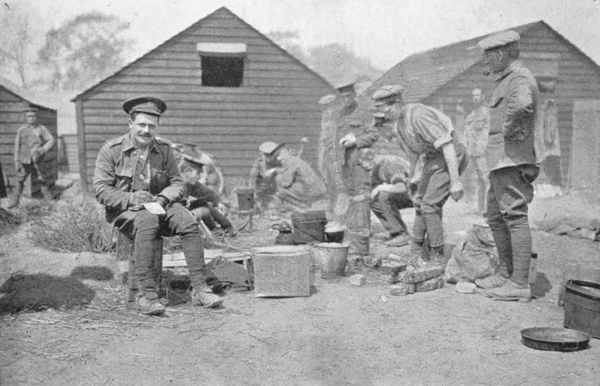
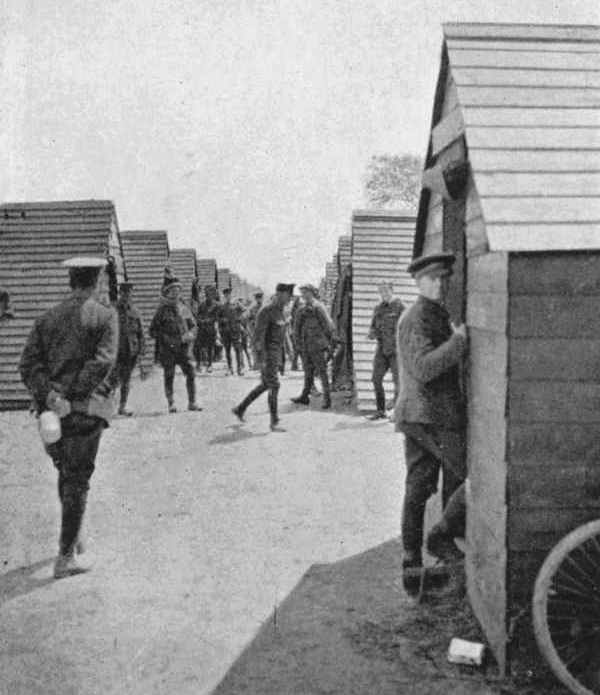
Hussars' cook-house, Vlamertinghe huts, Vlamertinghe
face p. 248
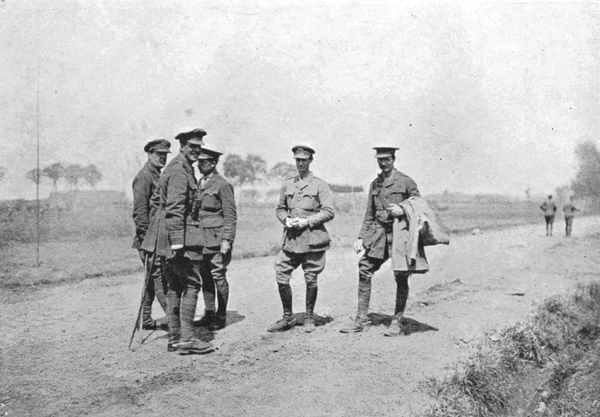
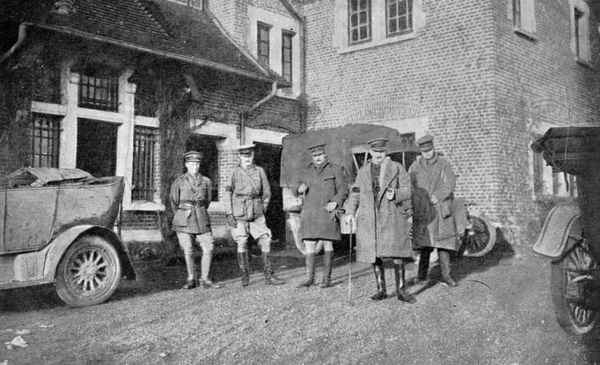
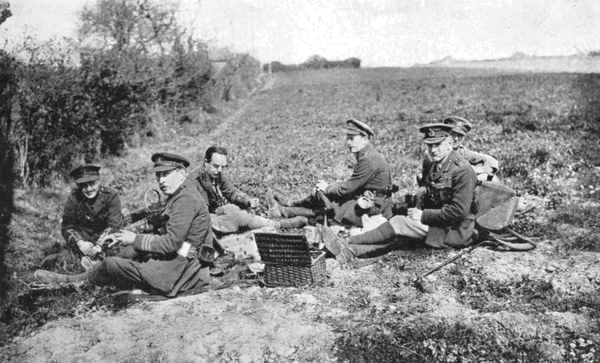
Group of Cavalry officers at the huts at Vlamertinghe
face p. 249
The Salient had been comparatively quiet
since the last German onslaught on the 13th,
but howitzer shells were daily falling over the
lines with tiresome regularity.
I was sent by General de Lisle to a house
near Ypres, where we had planned to have
a "basket dinner" before leaving for night
quarters on the Menin Road. A very young
staff-officer, instructed to guide me, misunderstood
that such duty was required of him, and
went off about some business of his own before
I had been able to learn the location of the
house.
Meeting "Rattle" Barrett, I asked him if
he could give me the desired information.
"I don't know about the dinner part of it,"
said "Rattle"; but your headquarters for the
night are well east of Ypres, on the Menin
Road. Go to the house nearest the château
that stands by the Halte, where the railway
crosses the road, and you can't miss it if you
try.
The General had disappeared on foot, the
juvenile staff-officer was nowhere to be found,
so off I went, in accordance with Barrett's
instructions.
Darkness was coming on. I passed along
lines of 2nd Cavalry Brigade troopers, marching
toward Ypres and through it.
No lights were allowed, though my car was
secure from liability of offence in that particular,
for the electric installation had gone wrong, a
not infrequent occurrence, and no one but
a master electrician could coax a glimmer out
of the headlamps.
Bump! Bump! I jolted from hole to hole
in the smashed roadway. The streets were
crowded with the machinery of the divisional
relief in full swing. Ypres seemed more
smashed, if possible, than when we had last
passed through six days before. From the
Grande Place down the Rue de Menin, to the
bridge and Menin Road beyond, and well out
past the fork, where the roads branched to
Zonnebeke and Menin respectively, the path
was narrow and tortuous. Piled high on either
hand were heaps of débris, alternated with
chasms, some sufficiently deep so that a fall
to the bottom would put a car promptly hors
de combat.
An unpleasant smell of burning flesh came
from the smouldering mounds lining the way.
Star-shells and trench lights from the firing
line made it possible to see the road. Save
for their assistance I could not have made the
journey without accident.
The house where we were to spend the next
few days was easily found. The officers of the
80th Infantry Brigade were busy in it arranging
reliefs when I arrived.
A house of stout brick, badly scarred and
knocked about, covered a cellar, low roofed
and filled with foul air, but reasonably safe
from shell-fire.
In this underground sanctuary the flickering
light of a dozen candles fell on crowded tables
for signallers, around which the men not busy
with 'phone or ticker were asleep, heads
resting on their crossed arms. Officers pored
over maps spread on other tables, or were
engaged in close attention to the receipt or
despatch of innumerable orders. Against one
wall were three or four bedsteads, covered with
mattresses that had borne the wearied forms of
a long succession of British fighting men, from
general officers to privates, and bore ample
evidences of having done so.
A battery of British guns were firing from
a position near by, and German shells were
bursting close enough to cause an interruption
of a conversation by their constant crashes.
No news could I find of General de Lisle
until Captain Webb, of the Signal Corps,
arrived.
"The General?" he said in reply to my
query. "I think the General is in a house on
the right of the road as you leave Ypres on the
west."
I lost no time in getting under way. The
return journey was like a bad dream. Shells
fell in the vicinity of the road, but not so near
as to damage the steadily flowing river of
troops, ammunition and food transport, horse
and mechanical; ambulances, motor-cycles, and
once, another car.
A fatiguing house-to-house search landed me
at the spot where dinner had been. Orders
left for me instructed me to bring various
impedimenta to the Menin Road; so, for the
third time, I ploughed through Ypres and
toward the Halte, where at last I found de Lisle.
Nor was that by any means the last trip over
that route that I was to make that night. But
enough of motoring troubles.
On the 18th it rained with dour persistency.
The 1st Cavalry Division line ran south from
the Ypres-Roulers railway, past the west shore
of the Bellewaarde Lake. It dipped south-east
around the ruins of the Hooge Château and to
the east of where Hooge once stood. Crossing
the Menin Road, the front threaded the
Sanctuary Wood, on the eastern edge of which
the enemy were entrenched.
The position in the Sanctuary Wood was
the extreme easterly promontory of the Ypres
Salient, and not many yards west of the line
which the 1st Cavalry Division held in February
and March.
General de Lisle's cellar headquarters were
less than 2,000 yards from the nearest front-line
trench, and Hooge itself was not much further
distant.
In an adjacent farm, which had been
abandoned for many days, dead cattle and
chickens lay about the yard. The table in the
living room showed the family had decamped
at meal time, evidently hurried by a shell which
shaved a corner off the house. They left
without waiting to gather up any of their simple
belongings.
The lonely cows ambled inquisitively toward
me, and were evidently greatly appreciative of
a thorough milking, though few cared to drink
milk from cows pastured in that poisoned zone,
where every inch of ground was septic.
On a dash through Ypres at daybreak I
again saw the poor hunted collie. Many
mongrels thereabouts were frankly glad of a
kind word and a pat on the head, but the high-bred,
beautiful collie, his splendid coat matted
and bedraggled, was so thoroughly frightened
that all my efforts to get close to him were
fruitless. It was wicked to leave him to death
by a chance shell, and more than one of us
risked carrying away a shell-souvenir in a vain
attempt to save him.
At an early hour de Lisle said: "Find a
shelter of some sort for your car, President.
Don't forget that the Germans turn their shells
down this road a bit at times."
A search resulted in the discovery of a
maltster's, where some push-cyclists attached
to a battalion of King's Royal Rifles cordially
offered to make room for my battered conveyance.
A passing ammunition train the night
before had ripped off a front mud-guard, and a
horse ambulance had crumpled one of the rear
guards, while a transport mule had endeavoured
to climb into the tonneau, to the sad detriment
of my folded cape hood.
I never met a more cheery lot than those
K.R.R. cyclists, who generously insisted on
my sharing a tin of steaming hot tea and
warming myself at their comfortable fire.
They showed me a pump in the ruins
of a house adjoining, enabling me to get
a rare wash, and a still rarer shave, giving
me a quite respectable appearance in comparison
with my comrades of the 1st Cavalry
Division Staff.
During the morning the General sent me to
a riddled château not far distant, where General
Mullens had placed 2nd Cavalry Brigade headquarters.
An attempt to use the remains of
the drawing-room as a more comfortable habitation
than the cellar, was abandoned during
the day, as coal-boxes fell with annoying
regularity in the château yard.
A call at the headquarters of General
Arbuthnot, C.R.A. of the 28th Division, in a
house west of Ypres, found my lost despatch
case had been sent there by Skinner of H
Battery, to whom General Arbuthnot had
kindly wired offering to keep it until I could
call and reclaim it.
At Arbuthnot's headquarters I met a captain
of his staff, who had been a military attaché
in China before the Boxer troubles in 1900,
and who knew many of the acquaintances I
had made when campaigning with General
Gaselee in the war with China.
In the course of conversation, I mentioned
the prevailing belief in many quarters that
unwritten truces existed between British and
German gunners with regard to shelling certain
areas. I instanced Dickebusch, a continual
home of one of our divisional headquarters,
which had been unshelled until our guns
hammered a town in the German lines where
Hun headquarters were thought to have been
located, and thereafter was inundated with a
steady rain of shell-fire for many days.
"Some peculiar things of that sort have
happened," said the Captain. "The Divisional
headquarters to which I was recently
attached, occupied, near the line, a château
which for months had not been visited by a
German shell. I became possessed with the
idea, without any real evidence to which to
attribute it, that so long as our lot did not shell
the Hollebeke Château, our house would be
free from a Hun shelling. The Hollebeke
Château was in the German lines, and while
I did not, of course, know positively, I felt sure
it contained some German brigade or divisional
headquarters. Many a time our batteries fired
at enemy batteries on all sides of the Hollebeke
Château, but not once was it made a target by
our gunners.
"For week after week this condition of
affairs continued, and was often the subject
of comment among us. Naturally, in the
absence of communication of any sort between
the opposing forces, all this may have been
mere coincidence.
"One day, returning from a walk, I entered
the drive to our château just as Hun shells
began to rain upon us. The shrapnel came
thick and fast for several minutes, and the
Divisional Commander and some of his staff
officers had very narrow escapes. One shrapnel
bullet passed through a wall only ten or twelve
inches from the General's head.
"None of our divisional guns had been firing
for some hours, but another battery in the
vicinity had been doing quite a bit of shelling
that morning. Curious, I asked the aeroplane
observer who had been directing the fire of
that battery what target he had given them.
"'I went up to direct their fire on some
German guns reported to be near the Hollebeke
Château,' the observer told me. 'I couldn't
locate the described spot, so directed our
battery to throw a few shells into the château
itself. Our gunners at once registered one
lyddite through the roof and four shells right
through the face of the building. I'll bet we
made it hot for any Boches that were inside.'
"Comparing times," continued the Captain,
"I learned that the Hollebeke Château received
its shelling exactly ten minutes before our headquarters
château was shelled by the Huns.
What made the incident more curious was the
fact that for weeks our batteries did no more
damage to the Hollebeke Château and never
again, at least until I left it, did our château
have a German shell near it."
The rain softened the earth about the dug-outs
in front of Ypres, and soon an epidemic of
caved-in sides and roofs was raging all along
the line, assisted by Black Marias, which shook
the moist ground until dug-out supports fell and
walls collapsed wholesale. A captain of the
18th Hussars was in a dug-out roofed by an
iron bedstead. A small landslide brought down
the beams above and the bedstead fell, so
striking the Hussar officer that his neck was
broken and he was instantly killed.
The 19th, 20th, and 21st of May passed
quickly, the three brigades of the Division
changing from front line to support dug-outs
and back again in relays as the days succeeded
each other.
On the 21st the sun came out, bright and
strong, and justified a few minutes' delay en
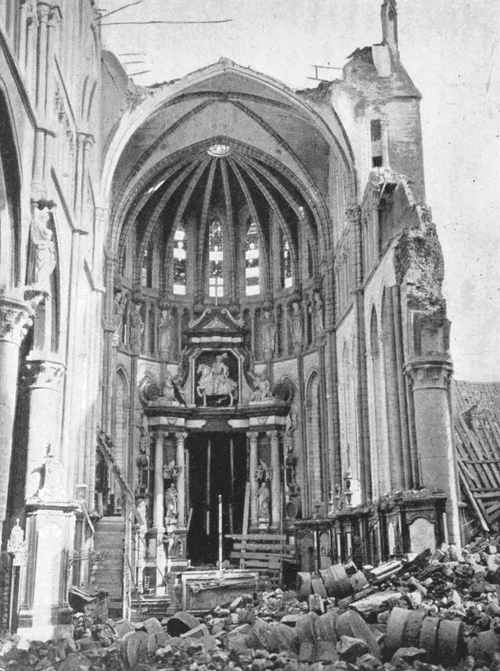
route through Ypres to obtain some photographs.
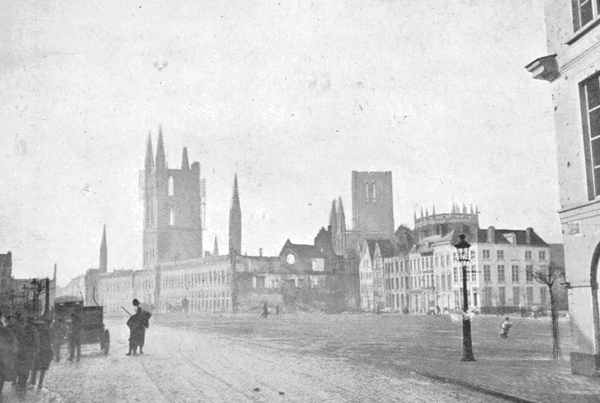
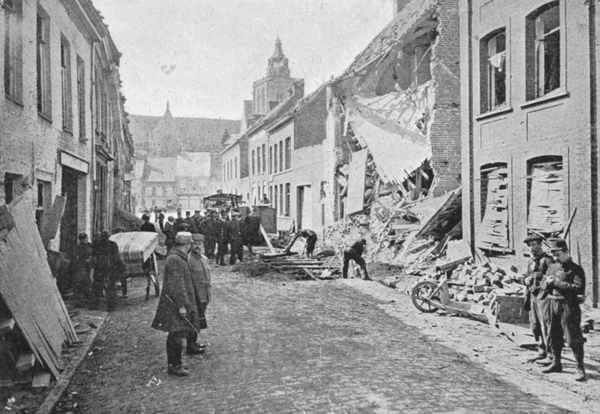
The town was sadly depressing. Earthquake
and conflagration might produce as much ruin,
but could hardly arrange it so fantastically.
In Ypres Madame Caprice came hand
in hand with Devastation and Death. In
diabolical mood she flung the shattered buildings
of the staid old town hither and thither
with an eye to the spectacular. The grotesque
met one's glance on every side. Only a James
Pryde could have done justice on canvas to
such a scene.
After a thunderstorm of almost tropical
intensity on the night of the 21st, the 1st
Cavalry Division troopers were relieved, and
soon after daylight were sleeping soundly in the
huts and the adjacent farms near Vlamertinghe.
The 22nd and 23rd of May they spent in
resting, and on the evening of the 23rd again
went back into the trench line.
General de Lisle returned for his rest to
new quarters at Esquelbecq, in a thirteenth
century château which boasted the honour of
having once been stormed by Marlborough.
The 14th Division of the "K" Army was
billeted near Esquelbecq, and had been placed
in the newly formed 6th Corps. Allenby's
5th Corps then consisted of the 28th Division,
9th Division (the first of the "K" Divisions to
arrive in France), and the Northumberland
Territorial Division. The 6th Corps, containing
the 4th Division, the 27th Division,
and the new 14th Division was placed under
the command of General Keir.
On the evening of May 23rd, while the
troopers of the 1st, 2nd and 9th Cavalry
Brigades tramped through Ypres once more,
and took over part of the sodden trench-line
of the Salient, General de Lisle again took up
headquarters in the big château not far west of
the demolished town.
The Salient front trenches led over the line
that was taken up after the reconstruction
following the hard fighting on May 13th.
Wilson's 4th Division reached from the French
right, near the Ypres-Yser Canal on the north,
to the Canadian Farm, then past the Ypres-Passchendaele
Road to the Ypres-Zonnebeke
Road near Verlorenhoek.
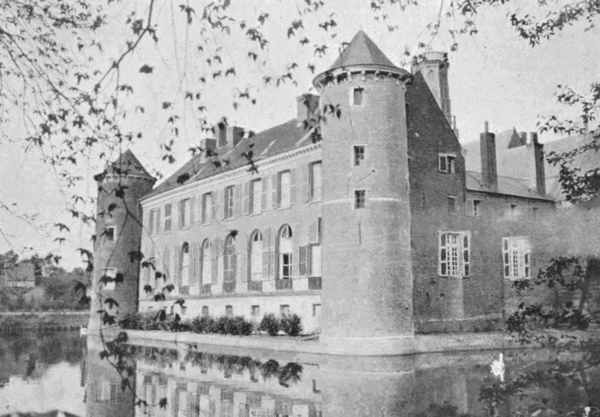
View of the 13th century château at Esquelbecque
face p. 260
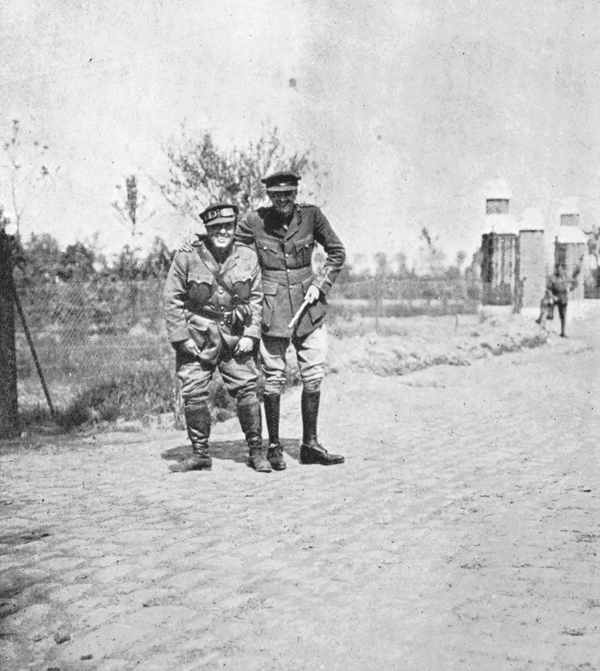
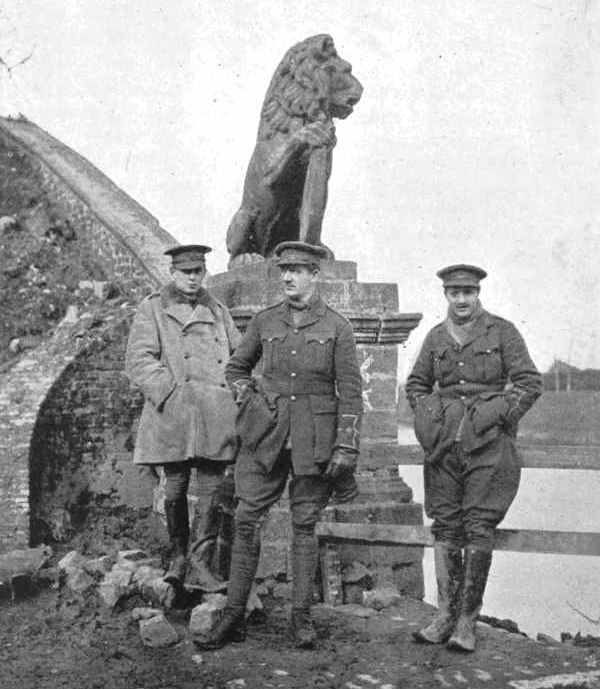
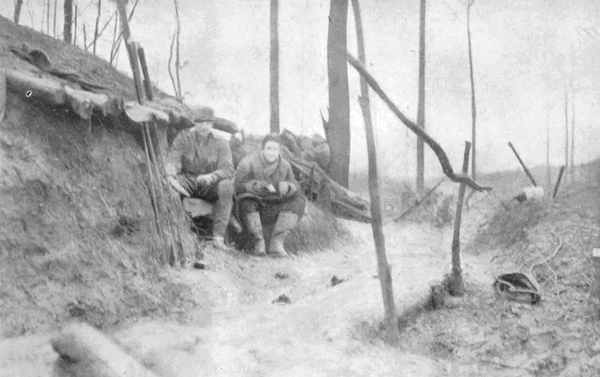
"Jeff" Phipps-Hornby and Frederic Coleman comparing
underpinning outside Ypres, May, 1915; the thinnest and
thickest "supports" in the 1st Cavalry Division
face p. 261
From the Zonnebeke Road south, across the
Ypres-Roulers Railway, as far as the Bellewaarde
Lake, troops of the 28th Division
composed the firing line.
They joined the left flank of the 18th
Hussars, who occupied a position on the south
side of the Bellewaarde Lake and in front of
the Hooge Château, the trenches at that point
being about thirty yards to the east of the
château ruins. The right of the 18th Hussars
rested on the Menin Road, and close behind
them in reserve were three score odd York
and Durham Tommies who had been sent up
to dig.
South of the Menin Road, in the Sanctuary
Wood, came the 9th Lancers, 11th Hussars,
Queen's Bays, and 5th Dragoon Guards,
respectively.
The 4th Dragoon Guards, 15th Hussars,
and 19th Hussars were in reserve in the
G.H.Q. line.
The night was less disturbed by gun-fire
than usual, and even the rifle fire and itinerant
sniping were of less volume than for weeks past.
General de Lisle, noticing the strong westerly
breeze die away, and the wind shift to the east
during the course of the afternoon, sent a
warning to the troops in the trenches to be on
the look out for a German gas attack next
morning.
At earliest light on Whit Monday, the 24th
of May, the Hun gas came.
Before three o'clock in the morning, the
yellow-green haze was drifting slowly on the
light breezes that heralded the coming of the
dawn.
Over the eastern front of the Salient the
smoke-cloud came from near Wieltje to the
Zonnebeke road, and on to the south over the
Menin Road.
The 28th Division troops, from the Ypres-Roulers
railway to the Bellewaarde Lake, were
in the thick of it, and were driven back en
masse.
The trenches of the 18th Hussars and 9th
Lancers were also in the path of the noxious
fumes; but the 1st Cavalry Brigade troops
further south escaped them.
For an hour the gas rolled westward, accompanied
by a cyclone of shell-fire, and followed
by a determined infantry attack.
No part of the cavalry line felt the gas more
than the left of the 18th Hussars, which was
held by a squadron under command of Captain
MacLachlan, who arrived at Vlamertinghe
from England at seven o'clock the night
before. MacLachlan, with some of the half
dozen other officers and 130 men sent out
to replace the casualties suffered by the
18th Hussars on May 13th, was tramping
through Ypres within half an hour after he
joined the regiment. New to Flanders and
the Ypres Salient, his experience of a gas
attack before he had been in the firing line
twelve hours was a trying one.
MacLachlan was impressed by the warning
to be on the watch for gas, and was in his
forward trenches, awake and alert. His
respirator was ready, and he repeatedly told
his troopers to see that theirs were ready
also.
The gas was actually upon the men before
they could distinguish the poison-clouds from
the early morning haze that frequently hung
over the lake.
The first thick mantle of gas scattered the
18th Hussars somewhat, but enough of them
remained in the trenches to hold on until a
German machine-gun opened on them from
their left rear. Seizing the advantage offered
by the retirement of the 28th Division troops,
the Huns came on as swiftly as the dispersing
gas would allow, and soon were well behind
the 18th line.
MacLachlan, later in the day, tried to write
a diary of what happened to him during the
early morning hours, but it contained little
detail. To piece together a coherent story of
such events was difficult.
"3.15 a.m., gassed out. 3.30, in again. 4.30,
some York and Durham Light Infantry officers
showed up. 5.15, twelve men left out of my
sixty-one. 5.30, six men left. 6.30, 15th
Hussars coming up." So ran the diary.
The Germans poured around the Bellewaarde
Lake on either side of it, and drove the few
remaining 18th Hussars out of the trenches by
an outflanking movement with sheer weight of
numbers. The troopers retired across the
Menin Road and trailed over the shell-swept
fields toward Zillebeke, and then on to the
southern edge of Ypres.
While the trenches on the lakeside and around
the Hooge Château were being torn from the
grasp of the 18th Hussars, the 9th Lancers on
the right, across the Menin Road, were fighting
like mad.
The gas so filled their trenches that at some
points the troopers leaped on the parapets into
the clearer air above, in full view of the advancing
Huns, and poured a fire into the German
ranks that dropped dozens of the enemy like
shot rabbits.
Captain Rex Benson, howling like a dervish
to make his instructions audible above the din
of battle, mounted a high bastion and so
directed the stream of fire of his squadron that
the oncoming rush in front of that trench was
stemmed.
A rifle-bullet smashed through Benson's arm
and badly shattered the bone, but he held on in
spite of his wounds until the first fierce Hun
attack was repulsed.
Major Beale-Browne, commanding the 9th
Lancers, at once realised the danger to his left
flank as the German bullets began to pour into
it across the Menin Road. Down the south
bank of the highway ran a communication
trench, which Beale-Browne at once ordered to
be transformed into a defence against a Hun
attack from the position that had been won by
the enemy from the 18th Hussars.
A small infantry counter-attack to recover
the lost ground at Hooge failed, though two
companies of the Buffs got a foothold in some
trenches north of the Menin Road, and not far
from Hooge Château.
Beale-Browne's headquarters were in the
Louave Wood, behind the Sanctuary Wood,
and not far distant from the Menin Road. He
and Captain "Bimbo" Reynolds, the Adjutant
of the 9th, who had been twice wounded that
morning, constituted the bulk of the garrison
of the Louave Wood, when they saw three or
four hundred Germans advancing from the
north towards the Menin Road, preparatory to
attacking the wood, and thus gaining the rear
of the 9th Lancers' trenches.
At that moment some York and Lancaster
Territorials, who had been sent up from reserve
in a wood south of the 9th, arrived. Beale-Browne
at once sent to the Infantry Brigade
for more of them. Lining the northern edge
of the little wood with the Terriers he waited
until the Huns began to stream across the
roadway, then swept them back with volley
after volley at close range.
This move and the gallant stand made by the
9th Lancers in their front line trenches, ably
aided by the York and Lancaster lads, saved
the day. A couple of squadrons of the 15th
Hussars also played a gallant part in saving
our important position south of the Menin
Road.
The cost to the 9th Lancers was heavy,
Captain Francis Grenfell, Captain "Algy"
Court, and Captain Noel Edwards were killed,
the latter dying from the effects of gas poisoning
after he had been taken to the hospital at
Bailleul.
Four other officers of the 9th were wounded,
several men were killed by the gas, and forty-eight
hours later the number of casualties,
including those gassed and missing, was still
over 100.
While the strenuous struggle was proceeding
in the front line trenches, little was known of
the actual results of the German attack. Every
man attached to Beale-Browne's headquarters,
except "Bimbo" Reynolds, was out of commission,
save the telegraphists, who hung on in
the poisoned air of the signals dug-out until all
the wires were swept away by the German
shells, and all communication with the rear
rendered impossible.
General Meakin took over the field command
of the Division, and Colonel "Tommy" Pitman
again took the 1st Cavalry Brigade.
The 4th D.G.'s, 15th Hussars, and 19th
Hussars in reserve in the G.H.Q. line, were as
badly gassed as though they had been in the
front trenches.
In spite of this, they pushed their depleted
ranks forward in support over ground where
shells were bursting in scores and hundreds,
and formed a new line along a road that ran
north from and at right angles to the Menin
Road, about 1,000 yards west of Hooge.
Here they held the enemy from making
further inroads into our territory, fighting
fiercely every hour of the long day.
The 15th Hussars and 19th Hussars suffered
heavy casualties, and the 9th Cavalry Brigade
lost one of its most popular officers in Captain
Griffiths, its Brigade Major, who was killed by
a shell.
The 4th Division front line held well, in
spite of the gas. The only 4th Division
trenches lost were along a front of 800 yards
from the Canadian Farm to the Ypres-Passchendaele
Road. The East Lancashires south
of that road hung on with a bull-dog grip until
help came and counter-attacks could be formed
and launched to retake the ground that had
been lost.
My friend in the 11th Hussars, from whose
diary I quoted a few paragraphs with reference
to the part the gallant 11th played in the battle
of May 13th, kept a most vivid series of notes
as to what happened in front of the 1st Cavalry
Brigade on that memorable 24th of May.
While the 11th Hussars were on the right
of the 9th Lancers, and therefore on the fringe
of the attack, a perusal of the following will
give an idea of what it meant to be in the front
line of the Ypres Salient on a bank holiday
in 1915:—
"3 a.m.—Heavy firing, guns, rifles, Maxims,
on our left; faint smell of gas; just as dawn
breaks.
3.15.—All quiet on our immediate front,
heavy shelling going on all round. Every wire
cut between Brigade headquarters and ourselves,
and with the artillery.
3.45.—Still no touch with Brigade headquarters,
so messenger despatched. The
headquarters of the 11th, Bays, and 5th D.G.'s
are all close together in a wood behind the
trench line. The Bays and 5th Dragoon
Guards each have one squadron in hand; there
are also three companies of the 4th East Yorks
Territorials in brigade reserve in the same
wood.
4.—The Bays send an officers' patrol to
the left.
4.20.—Heavy firing still continues on our
left. Telephone message sent to O.C.
A Squadron: "Try and get information of
situation on your left."
4.35.—Answer received: "Adjutant 9th
Lancers just passed here. Reports their centre
and left gassed. No attack so far."
4.45.—Lieutenant Milne's patrol of the Bays
returned. Report 9th Lancers have been
badly gassed, and retired from their trenches
in places, leaving big gaps. Reinforcements
have gone up, and line has, he thinks, been
re-established.
5.—Captain Osborne, Brigade-Major, arrives
from Brigade headquarters. They have all
suffered severely from gas; the regiments in
G.H.Q. line have caught it very badly. The
shelling has been very heavy, great number of
casualties, men streaming back from all parts of
the line. When he left Brigade headquarters
they were in ignorance of the situation in any
part of the line. The only thing which kept
their hopes up was that not a single man of
the 1st Brigade had returned.
6.30.—Lieutenant Milne reports that he
went to Officer Commanding 9th Lancers, who
told him that his line was complete to fifty yards
north of the Menin Road. He has had many
men gassed, and has used up all his supports to
fill up gaps in the front line. He is pushing
reconnaissance to his left. Heard that the
Officer Commanding York and Lancaster
Regiment had his battalion in a wood about
600 yards east of us, so went over and
saw him. He has 1,000 men, and is reserve
to the section of the line from our right to
Hill 60. Got him to send two companies to
the Officer Commanding 9th Lancers.
7.30.—Lieutenant Hartman, 11th Hussars,
returned with his patrol. He had worked up
to the Menin Road, where he had found
Captain F. O. Grenfell, 9th Lancers, holding
on with a very few men, and asking urgently
for reinforcements of 200 men to strengthen
his line. As Lieutenant Hartman was leaving,
three platoons of infantry arrived.
9.—Heavy attack on Hooge. All our
glasses are fixed on that point. The village
(now only a few ruined houses) is on a piece of
rising ground which commands, at close range,
the rear of our position. Withdrew one of the
11th Hussars' Maxims and laid it on the village.
Can see our troops falling back. If Hooge
goes, we are in the soup. 9th Lancers headquarters
are in Louave Wood. Beale-Browne
is in command. He has still got one company
in hand.
10.—Still holding on at Hooge. Can see
more of our infantry moving up from Louave
Wood.
11.—Patrol reports "enemy have broken
through 18th Hussars' line north of Menin
Road, and are working down on the road in
rear of Hooge." Hear heavy firing in that
direction. Send Osborne to officer commanding
Y. and L. to get him to send three companies
to hold northern edge of Louave Wood, with
machine-gun and detachment at farm west of it.
12 noon.—Message sent by runner to Brigade
Headquarters: "Still holding on to Hooge,
but Germans are astride the Menin Road.
Could you push up counter-attack in that
direction? My line of retreat is covered by
German machine-guns in that direction. Several
orderlies have been wounded going backwards
and forwards."
12 noon.—First messenger returned from
Brigade headquarters. Counter-attack is being
organised. Messenger states that on his way
up he saw about 100 infantry straggling back
from the lines on our right, stating that their
"'ole battalion had been coot oop." If there
is any truth in their statement, we are in a
nasty position, so send off at once an officer's
patrol in that direction to clear up the situation,
and a squadron of the 5th D.G.'s to support the
patrol and form a flank protection in direction
of Maple Copse. No firing has been heard at
all on our right.
12.5 p.m.—Learn that there is a company of
Royal Engineers in the wood near the York
and Lancaster headquarters, so send them
following order: "Proceed with Y. and L. guide
to O.C. 9th Lancers in Louave Wood, and ask
him if he can find work for your fifty men in
consolidating the position on northern edge of
wood."
12.15.—Germans attacking right of 9th
Lancers' line and left of A Squadron, 11th
Hussars, with bombs. They are reported to
have broken the 9th Lancers' line at one point,
but been driven out again.
12.30.—Captain Lawson reports that section
of trench held by Territorials between his left
and 9th Lancers has been captured by Germans.
They are working down his trench with bombs.
The captured section slopes up from the stream,
and looks down on the A Squadron trench.
12.35.—Interview the officer commanding 4th
Yorks, explain the situation, and tell him to
take another company up, and with the one
already in the second line form a barrier behind
the captured portion, getting touch with the 9th
Lancers on his left and the 11th Hussars on his
right.
1.—Message sent to officer commanding
9th Lancers: "Have pushed up a support to
form a barrier behind the captured trench.
Endeavour to get touch with them from the
switch trench. A counter attack is now taking
place from Potitjze towards Hooge."
1.30.—The pressure on the Menin Road
seems to be relieved. The Germans are still
bombing down Lawson's trench, but A Squadron
are putting up a good fight with bombs. Lieut.
Gunter has been killed.
2.25.—Message sent by runner to Brigade
headquarters. "At about 12.15 Germans
captured portion of 9th Lancers' trench close
to 11th Hussars' left. Company of East Yorks
sent up to form barrier behind broken line.
Switch on 9th Lancers' right is now held
instead of advanced trench. Western edge of
Hooge still held by mixed force of men. Send
me information of counter attack, for if Germans
establish themselves on Menin Road during the
night, position of brigade becomes untenable.
If it is proposed to retire from here it would
have to be done at night. Please inform
Officer Commanding 83rd Brigade that I have
had to call on all the York and Lancasters
except 250 men. Following is disposition of
line at present as known to me:—1st Brigade
line as taken over last night. 2nd Brigade—9th
Lancers, weakened by losses, with left on
Menin Road; right broken but being secured.
Remainder of 9th Lancers, with York and
Lancasters, have formed a line right along
north edge of wood facing north. They have
two machine-guns on their outer flank and
patrols to the Menin Road."
2.45.—Message sent to Brigade headquarters:
"Please arrange to send up to-night two
dozen hand grenades per regiment, and
detonators, most important; also two dozen
rifle grenades per regiment and two dozen
extra detonators per regiment, as the bombs
here are without detonators; also as many gas-sprayers
as possible. Ask 1st Cavalry Division
to send up trench mortars with Royal Horse
Artillerymen or Royal Engineers to man them,
as our men don't understand them. They are
urgently required."
3 p.m.—No further developments. Situation
well in hand, but hope that counter-attack is
developing on north side Menin Road. Lawson
is holding on to the line of stream, but position
is untenable unless 2nd Brigade can re-establish
original line on their right. Make dispositions
for holding new line from left of B Squadron
down communication trench to the support
trench; thence along to where it joins up with
front line. The situation on the right down as
far as Hill 60 reported all right. The trenches
near Hill 60 visited by our patrol did not even
know that there was a fight going on. They
thought all the firing was a long way to their left.
4 p.m.—Situation unchanged. Have got
majority of A Squadron back into communicating
trench, moved up squadron of the Bays to
complete the line and join up with 9th Lancers.
Send following message to Lawson, who is still
holding on at the stream:—
"Most of your squadron are now back in
communicating trench. Squadron of the Bays
and infantry are holding the second line. I
cannot send you up any more support; doubt
your doing any good by holding on to present
line. If you cannot get away now, wait until
dark."
4.—Message sent to Officer Commanding
9th Lancers:—"Portion of front line marked
with crosses on accompanying sketch, has gone;
suggest your falling back and holding line
marked with red dots." Operations carried on
without any further alarms till dusk. We saw
the right flank of the counter-attack coming up
towards Hooge. The Y. and L. co-operated in
this movement.
5.—Following received from Officer Commanding
York and Lancasters:—
"Our attack on the Menin Road has been
successful. All the enemy have been driven
back off the road as far as our left flank rests.
The companies have withdrawn to Louave
Wood after leaving a post on Menin Road,
facing north. Patrols have been pushed on to
the north to try and get touch with the counter-attack,
but these patrols will now be withdrawn,
and the Oxford Hussars will be asked to send
similar patrols. Some of the enemy have been
killed. Have collected their papers and identity
discs, and will send them to Brigade headquarters."
Soon after dark we received orders that the
Brigade would be relieved to-night, but it was
not till past midnight that the relieving regiments
arrived. During the hours between
dusk and midnight the enemy attacked
vigorously with bombs both B Squadron and
A Squadron trenches. At midnight the
16th Lancers arrived to take over. It was
obvious that it was going to be a tight fit to
defeat daylight. Not a moment was lost,
but it was nearly two o'clock before the last
squadron was relieved. The squadrons moved
off independently, keeping as far as possible on
the low ground. A violent fusilade commenced
on both flanks of the Salient, and "Spares"
were fairly flying about over our heads. The
Germans were making another gas attack, and
C Squadron, which took a more northerly
route, caught it slightly. Our casualties were
slight during the withdrawal, and it was quite
light by the time we reached Ypres. We raced
on through the town, as shells were falling
about in a most unpleasant manner. We got
back to Vlamertinghe at 4.30 a.m., the men
absolutely dead beat, having walked seven
miles across country at top speed. We dossed
down to sleep, most of the men preferring the
open to the wooden huts. Forty-eight hours
without a check has been a bit more than tiring.
The casualties for the 24th of May were two
officers killed, twelve men killed, twelve
wounded, and four died of wounds. Lieutenant
Poole, who was only slightly wounded on the
way back to Ypres, unfortunately succumbed
to tetanus a few days later at Boulogne.
After sweeping over the firing-line and drifting
past the G.H.Q. reserve line, on that Whit
Monday morning, the gas still moved westward.
H and I Battery men, caught in their dug-outs,
had a liberal share, and still more of the
poisonous fumes gathered in ruined Ypres, or
floated on to our divisional headquarters further
to the west. Some of the gas was carried as
far back as Vlamertinghe, between four and five
miles from the German trenches.
"Willie" Du Cros, running with his ambulance
convoy from Vlamertinghe to a dressing
station well west of Ypres, was sufficiently overcome
by gas to be for some hours dangerously ill.
Hardly a member of the 1st Cavalry Division
Staff, including General de Lisle himself, escaped
the gas fumes. Red and watery eyes, a pale
bluish tinge to the complexion, violent headaches,
and continual coughing were universal
for the greater part of the forenoon.
Gas shells continually burst over Ypres and
the roads near it. More than once I ran through
pockets of gas, apparently caused by these gas
shells. Every one of us wore respirators or
masks when near Ypres, though "Babe"
Nicholson inhaled sufficient gas through his
respirator to render him unconscious for five
minutes after a "dash up front."
General Mullens, of the 2nd Cavalry Brigade,
and Captain Paget, his Brigade Major, were
brought in a dangerous condition to our headquarters.
By night they were able to walk
about, but for a time it seemed quite possible
neither would recover.
That evening I asked General Mullens, who
was looking very ill, if he thought he was free
from the effects of the poisoning. "Somewhat,"
he answered. "No one could imagine
what the experience is like. The helplessness
and mental suffering of it are beyond description."
Ypres came in for another terrific bombardment
that day. The Menin Bridge and the
Menin Road proved such death-traps that they
were "closed to traffic" before the day was over.
Romer Williams, of General Mullens's staff,
came through Ypres with a message just as I
was going up.
"You have a fine bruise on your forehead,"
said I, pointing to a raw bump the size of a
goose-egg. "How did you get it?"
"I haven't an idea," he answered; "unless
a shell bounced off it. Some of 'em have come
close enough, so I thought they might have
done so. As I was coming back down the
Menin Road, an ammunition limber passed me,
the horses at full gallop. I watched them cross
the railway metals at the halt. The limber
jumped up into the air when it hit the crossing
and the horses seemed to be skimming the
ground, they were going at such a pace. Just
as the limber bumped up, a flash came, right
over it, and when the smoke rolled away the
road led clean on eastward, absolutely empty.
Not a sign of horse, man or limber remained.
A big howitzer shell must have hit it squarely
on the outfit, and swept it into the ditch like
the wind would sweep away a leaf. It was a
terrible thing to see."
Colonel Browne of the R.A.M.C. and his
staff worked like Trojans. Browne had not
slept since 7 o'clock on the previous morning,
and had a bad touch of gas, like everyone else
near headquarters.
At break of day the roads were full of
panting, coughing stragglers from the front.
Scores on scores staggered into the big front
gates of the château, and sank exhausted and
suffering on the deep grass that lined the drive-way.
The medical officers hastily gave such
relief as they could and packed the ambulances
full of the wounded and the worst of the gas
cases.
By 9 o'clock in the morning 600 gassed
men and 160 wounded had passed through
Colonel Browne's hands, more than four-fifths
of them members of the 28th or 4th Division
units.
The number of men who were wounded by
shell fire when coming back toward Ypres from
the gas-filled trenches was legion.
Five signal-corps men, attached to the
2nd Cavalry Brigade, were badly poisoned,
but managed to get back as far as the big
square at Ypres. They were in such a sorry
state that a passing officer advised them to lie
down on the broken cobbles of the Grande
Place until an ambulance could be sent for them.
They stretched out in a pathetic row, and had
not lain there long when a Black Maria lit at
their feet, shoving them half a dozen yards over
the stones still in line, every man of the five
dead, killed before he knew of the coming of
the shell.
All day shattered men were brought to the
divisional dressing station near the château
gates. The wounds from the shells were
terrible.
A wounded sergeant of the Cheshires refused
a ride from east of Ypres in an ambulance,
cheerily saying that those who could walk
should do so, and not occupy space required
for those more severely hurt. He carried back
his full kit, tramping sturdily along with a grim
smile on his fine face. At the dressing station
a nasty bullet hole in his shoulder was disclosed,
which would have laid many a man flat on his
back.
"Good man, of the old school. New ones
can't touch 'em," commented a grizzled hospital
orderly, as the Cheshire sergeant passed out of
the room.
A Tommy, with bright eyes peeping from a
purple bit of face all but hidden by a mass of
white bandages, insisted on telling his story to
anyone who would listen.
"He has told his bally yarn half a dozen
times, sir," complained a hospital orderly to the
doctor. "I told him he was not to talk, but he
just can't keep his bloomin' mouth shut, he says."
"Nasty wound, too," remarked the doctor,
as we watched the talkative individual. "Bullet
went clean through his face, in one cheek and
out the other, and carried away every one of
his upper teeth."
But his injury had apparently increased his
volubility. We could hear his tale as he poured
it into the ear of a gunner, wounded in both
legs and unable to escape.
"You see the ol' gas stuff got us bad, some
on us," he explained. "But I got this 'ere
bloomin' smash in the jawr, and that took up
so much o' me bally time I didn't pay no
attention to no gas, you believe me! I warsn't
the only bloke lyin' there. They was a fair lot
o' our chaps near me.
"The snipin' was cruel. Some o' the poor
blokes that was bloomin' well shot already got
'it agin. I was jest thinkin' mine was comin'
when wot oh! 'ere comes three big Prooshuns,
tall as 'ouses. Good-day, Bill, says I to meself.
You next! It'll be the butt for your nut from
these 'ere lobsters.
"But not a bit. They ups with me and carts
me over to a 'ouse. Leastwys it wor a 'ouse,
wonct. An' wot do you think! Them Prooshuns
give me a bloomin' fill o' cold coffee, like
Christians!
"'Bout this time the Buffs was comin' on an'
my Prooshuns had to skin out, rapid. They
didn't do nothin' to me only say, 'Ta-ta!' in
Dutch. The fire got so 'ot I crawled off down
a crick-thing full of the stinkinest stuff that
ever got called water. I rounded around, after
a while, an' come up back o' them Buffs a
little. They saw me and bloomin' near shot
my 'ead off, so I lay still.
"Then I crawled more. I 'ad got in front
of some more o' our chaps by then. Big 'uns
was goin' orf right there, an' 'eads was down,
you bet. I was gettin' closer, when a fat-'ead
sees me an' starts shootin'. I 'ollered, an' the
more I 'ollered the more 'e let off 'is silly
gun. 'E 'it my pore ol' cap, 'e did. Then
some cuss shuts 'im orf, an' they come out and
gets me.
"'Who are you?' says a orficer chap. 'I'm
damned if I know,' says I. 'I've been shot at
by everybody I've seen all mornin', except
three big 'Uns.'
"'Mad,' says a cove, short-like. 'Send
'im in.'
"'An' 'ere I am, with no jawr much left.'
"'Humph,' commented the doctor as he
walked away. 'Guess he could stand the loss
of some more jaw and not kill him. He seems
to have plenty left.'"
A more sinister story was told by a trooper
shot through the thigh. He said the Germans
got into one of our trenches, in which they
found him and nine of his comrades. Five of
the ten had been hit. The Huns told the
wounded to crawl away to as safe a place as
they could find, and they straightway wriggled
off down the trench, as directed.
With a scowl on his face a big German said
to the five unwounded men, "We don't want
you. Go!" He pointed his finger to the
shell-swept field that led toward the British
reserve line. The five started on a run, but
had not gone far when the rat-tat-tat of a
machine-gun behind them commenced. In an
instant the air was full of bullets. Four of the
five men fell dead. The fifth was the man
who told the story. He fell, he said, at the
first sound of the quick-firer, and thus escaped
with a bullet through his leg.
Counter-attack followed counter-attack as the
day wore on. We launched a small one at
2.30 p.m., a larger one an hour later, and a
still larger one was planned for 6 o'clock.
This last was to win back the lost trenches
around the Hooge Château, past the Bellewaarde
Lake, and on to the north.
The British guns cleared the way splendidly
for the 6 o'clock attack. "Mother" shells
fell into a line of ruined houses near Hooge.
The Germans had placed several machine-guns
there, and as the 9·2 projectiles knocked the
bricks about their ears they scampered out like
chickens. A machine-gun not far away in the
9th Lancers' trenches poured a hail of bullets
into the Huns as they left cover, and numbers
were seen to fall.
The Royal Fusiliers were attacking, but when
their line "got up," the advantage was lost,
other enemy machine-guns had been brought
into the German trenches, and the attack
"fizzled out," no real gain having been made.
So night closed in. By 2 o'clock in the
morning of the next day the fresh 2nd Cavalry
Division troopers had relieved the tired men of
the 1st Cavalry Division, who were once more
brought back to the Vlamertinghe huts.
The Cavalry had lost heavily, and was still
to lose before the second battle of Ypres was
finished, though the ground won by the Huns
on the 24th of May marked their furthermost
westerly advance.
The part played by the infantry in the second
Ypres struggle was greater, numerically, than
that of the cavalry, but the work done by the
troopers was of inestimable value. Their resistance
broke the back of the enemy's onslaught
at its most tense moments.
The work of the Queen's Bays on May 13th,
and the 9th Lancers and 15th Hussars on
May 24th, will long live in the annals of the
British Army.
The following officers were awarded the
Distinguished Service Order, the task of selection
for the awards from so great a number of
instances of gallant conduct during these May
days being a most difficult one:—
Major George Harold Abseil Ing, 2nd
Dragoon Guards (Queen's Bays). At Ypres
on May 13th, 1915, when the line was broken
beyond the right flank of his regiment, he came
out of his trench in the front line, stood on the
road in the open under heavy shell-fire, stopped
the retirement of forty men of another unit, and
turned them into his section of the defence.
The good results of his gallant action were
far-reaching.
Major Charles William Henry Crichton, 10th
(Prince of Wales Own Royal) Hussars. Near
Ypres, on May 13th, 1915, showed conspicuous
gallantry and ability in collecting and rallying
men who were retiring under heavy shell-fire
through the 10th Hussars' position. In our
counter-attack he continued to direct operations,
giving great encouragement to his men
whilst he lay in the open under heavy shell-fire
with his leg shattered.
Captain John Grey Porter, 9th (Queen's
Royal) Lancers. On May 10th, 1915, when a
very heavy attack was made on the front line
near Hooge, Captain Porter went up to the
infantry line there and brought back very valuable
information regarding the situation. On
May 13th he rendered the greatest possible
assistance in taking messages under terrific
shell-fire to various parts of the line, and
reporting on various local situations. He set
an example of coolness and total disregard of
danger that was beyond all praise. He has
been twice wounded previously in this campaign.
The following eight cavalry officers were
awarded the Military Cross for their work in
the Salient:—
Captain Stewart Graham Menzies, D.S.O.,
2nd Life Guards. Near Ypres, on May 13th,
1915, after his Commanding Officer had been
wounded, displayed conspicuous ability, coolness
and resource in controlling the action of his
regiment and rallying the men.
Captain Edward Archibald Ruggles-Brise,
Essex Yeomanry, T.F. For conspicuous
gallantry and ability, near Ypres, on May 13th,
1915, when he held a position gained in a
counter-attack, although entirely isolated, until
ordered to withdraw at night. He had only
fifty men under his command.
Captain Guy Franklin Reynolds, 9th (Queen's
Royal) Lancers. For splendid work on May
24th, 1915, near Hooge. When the headquarters
of the 9th Lancers were gassed, he
constantly brought reports from the trenches
under very heavy fire, and helped to reorganise
the defence of the left section. Also when
the enemy attempted to enter Louave Wood,
he was invaluable in helping to reorganise
the defence. He set the finest possible
example of calmness, coolness, and courage
although suffering from gas and twice slightly
wounded.
Captain Charles Joseph Leicester Stanhope,
15th (The King's) Hussars. For gallant and
skillful handling of his squadron, near Hooge,
on May 24th, 1915, with most valuable results.
His squadron, having been badly gassed, he
took forward the remnants, together with
stragglers he collected, and on his own initiative,
under very heavy shell-fire, reinforced the front
line. He remained in action all day, and when
the line on his left gave way he doubled back
his flank with great skill, and continued with
the utmost gallantry to hold the position.
Lieutenant Kenneth Douglas Lorne Maclaine
of Lochbuie, 15th (The King's) Hussars
(S.R.). Near Ypres, for good work in command
of his squadron under trying circumstances,
on May 13th, 1915. For gallant and
skilful leading of a patrol on May 14th, by
which he gained information of great value.
He volunteered to lead this patrol, and pushed
forward by day, a mile in front of our line, and
returned with a good report as to the actual
line then held by the enemy. For coolness,
determination and skill in handling his squadron
under difficult circumstances near Hooge on
May 24th, 1915. He had been ordered up
with his squadron to reinforce the left of
another cavalry regiment, when the line north
of the Menin Road gave way, and the situation
became critical. Lieutenant Maclaine showed
great skill in taking up a new position, facing
north and west to meet the new situation, and
maintained his position under most critical
circumstances until relieved at 2.15 the next
morning. His action contributed greatly towards
maintaining intact the line south of the
road.
Lieutenant William Spurrett Fielding
Johnson, Leicestershire Yeomanry, T.F. For
conspicuous gallantry near Ypres on May 13th,
1915. Was with Major Martin, and continued
the action until the squadron was reduced to
thirteen men. Afterwards displayed great
coolness in withdrawing to a flank and joining
a cavalry brigade.
Lieutenant James Archibald Garton, North
Somerset Yeomanry, T.F. Near Ypres on
May 13th, 1915, showed great coolness and
daring. Held his position throughout the day,
notwithstanding that the trenches had been
blown in, and inspired all ranks by his behaviour.
After all senior officers were killed or wounded,
he assumed command of the regiment, displaying
great judgment and initiative throughout.
Lieutenant Nigel Kennedy Worthington,
3rd Dragoon Guards (S.R.). Near Ypres on
May 12th, 1915, showed great coolness and
daring. He took over a new line of trenches
just before dark, and to get round the line in
daylight, he had to cross several open and fire-swept
zones. On May 13th, at great risk, he
came back several times to report.
From the foregoing list of honours it would
be unfair to omit the Distinguished Service
Order given for magnificent work a week after
the fight on May 24th, to Major Philip Granville
Mason, of the 3rd (Prince of Wales')
Dragoon Guards. "Whilst in command of
Hooge Fort and the adjoining trenches," the
official report read, "he showed conspicuous
gallantry and ability in holding the village and
defence line allotted to him, notwithstanding a
terrific bombardment for several hours every
day from May 30th to June 2nd, 1915, in which
practically all his trenches and dug-outs were
blown in."
On the 25th the regiments took stock of
their losses and began the work of refitting.
I called at the headquarters of Colonel Burnett
of the 18th Hussars, hearing he was in a
dangerous condition from gas poisoning. No
one was allowed to see him, and fears for his
recovery were expressed by those who attended
him. Burnett was soon afterwards sent home,
where he was compelled to spend many long
months of convalescence before he was able to
rejoin his regiment.
Acting Adjutant Hill, of the 18th Hussars,
had not been able to make out any accurate list
of casualties. Two officers of the regiment
were known to have been killed by gas, and
five others were wounded. The killed, wounded
and missing totalled nearly 190 out of less than
300. Many of the missing, it was hoped, would
prove to have been gassed but slightly, and be
able soon to resume their duties.
As the sun went down that evening their
comrades of the 9th Lancers buried the bodies
of Francis Grenfell and "Algy" Court.
Court's face wore a smile, as though he was
quietly sleeping. Grenfell, shot through the
heart at the height of the battle, bore, too, a
look of deep peace, as if at last he had cheerfully
gone to a better country, to join his beloved
brother "Rivy," from the shock of whose death,
on the Aisne, Francis had never recovered.
Staunch friends and fine men, both Grenfell
and Court.
Whatever Peace may bring us, it can never
replace the ones War has taken.
But they have left behind them their example,
and the memory of the clean, young manhood
that England gave, without stint, to fight for
the right. With that memory enshrined in the
hearts of those they have left behind, victory
lies not with the grave, for such lives are
deathless.
At an early hour on the 26th of May, General
de Lisle was apprised of his appointment to the
command of the 29th Division, which had won
splendid laurels under General Hunter Weston
in the Dardanelles.
My long and pleasant association with de
Lisle bade fair to close, much to my regret.
In the course of conversation I told the
General how sorry I was that I was not to
accompany him.
"I much wish that you were," said he. "I
doubt if I can take you to the Dardanelles; but
if you care to come with me to London and the
War Office, I will do what I can to have you
attached to my new Division."
After a morning of racing back and forth
between the front and St. Omer, we sped to
Boulogne, arriving in time to catch the afternoon
boat.
No one could have been kinder than General
Long, the Director of Supplies and Transport
at the War Office. In his office, next morning,
I met General de Lisle; but General Long
could only tell us that "it will very likely be
a long, long time before motor cars will be
required in the Dardanelles; and, as you know,
Americans are not eligible for commissions in
the British Army, even should you apply for
one."
So back I went to General Headquarters in
France, deeply sorry to say "Good-bye" to
General de Lisle and his magnificent 1st
Cavalry Division.
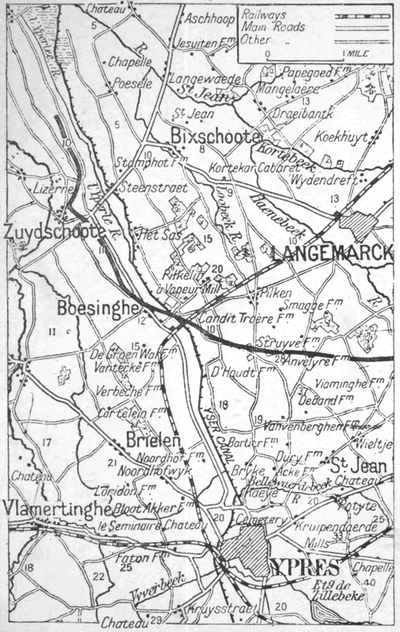
COPYRIGHT "GEOGRAPHIA" LTD. 55 FLEET STREET LONDON E C
INDEX.
Abele, 155, 181
Adeney, Gen., 205
Albert, King of the Belgians, 9, 11-12, 16-17
Alexander of Teck, Major Prince, 12
Algerian Brigade, 171
Allenby, Gen., 3, 185, 197, 219
Amiens, 122
Annesley, Capt. (10th Hussars), 92
Antwerp, 11
Arbuthnot, Gen. (C.R.A.), 255
Armentières, 188
Armstrong, Lieut. "Pat" (10th Hussars), 2
Arras, 186, 201
Auber Ridge, 184, 186, 199
Aubers, 107
Bailleul, 115
Barrett, "Rattle," 133, 249
Beale-Browne, Major (9th Lancers), 133, 265-6-7
Bellewaarde Lake, 188
Bell-Irving, Lieut., 66
Benson, Rex, 133, 178, 265
Bethune, 22
Bixschoote, 121, 137, 139
Black Watch, 83
Boeschoeppe, 18
Boesinghe, 139
Boulogne, 122
Bretherton, Capt. (Staff), 70
Bridges, Col. "Tom" (4th Hussars), 11, 12, 13, 16
Bridges, Mrs., 12
Brielen, 218
Briggs, Gen., 2, 66, 118, 149, 197, 237, 240-1
Broodseinde, 158
Brown, Lieut. (4th D.G.), 149
Browne, Col. (R.A.M.C.), 240, 281-2
Budworth, —, (R.A.), 155, 165, 167, 227-8
Buffs, The, 265
Bulfin, Gen., 91, 198
Burnett, Col. (18th Hussars), 148, 175, 239, 293-4
Byng, Gen. Sir Julian, 197
Calais, 115
Campbell, Gen. David, 233-4, 240
"Canadian Farm," The, 187, 220
Canadians, 50, 128, 140-1, 144, 151, 153, 156-7-8, 184
Cassel, 144
"Cavan's House," 58, 71, 77, 134
Chantilly, 122
Cheshires, 283
Coldstream Guards, 1st Bn., 83
Corbett, Major (18th Hussars), 239
Court, Capt. "Algy," (9th Lancers), 133-4, 136, 267, 294
Court, "Rivy," 294
Crichton, Major C. W. H. (10th Hussars), 289
Cummings, Col. (R.A.M.C.), 136
Davies, Gen., 105-6
De Lisle, Major-Gen. H. de B., 1, 9, 13, 16, 18 et passim
Dickebush, 118, 256
Dixmude, 13
Dorsets, 107
Douai, 187
Dragoons, 1st Royal, 221
Dragoons, Inniskilling, 177
Dragoons, 3rd, 221
Dragoon Guards, 2nd (Queen's Bays), 2, 98, 220, 229, 230, 233-4 et seq., 269 et seq., 288
Dragoon Guards, 3rd, 233, 246
Dragoon Guards, 4th, 2, 35, 149, 220, 261, 267
Dragoon Guards, 5th, 2, 220, 229, 230, 236 et seq., 261, 269 et seq.
Drake, Lieut. (10th Hussars), 92
Dranoutre, 118
Du Cros, "Willie," 279
Dunkirk, 9, 17, 177
East Kents, 161
Ecke, 137
Edwards, Capt. Noel (9th Lancers), 267
Elverdinghe, 143-4, 146
Esquelbecq, 259
Estaires, 106, 115
Fergusson, Gen. Sir Chas., 2
Festubert, 189, 248
Fielding, Gen., 241
Fisher, Major "Bertie" (17th Lancers), 206
Fitzclarence, Gen., 84
Fitzgerald, Major Desmond (11th Hussars), 45, 95, 146, 207
Flying Corps, Royal, 214
Foch, Gen., 50, 122
French, Gen. Sir John, 2, 5, 11, 122, 128
Fresson, Capt., 23, 156
Fromelle-road, 200
Furnes, 10, 11
Fusiliers, Irish, 242
Fusiliers, Royal, 287
Garton, Lieut. J. A. (North Somerset Yeomanry), 292
Gaselee, Gen., 256
Gheluvelt, 83
Givenchy, 5
Godawaersvelde, 137
Gordon-Lennox, Lieut., 91
Gough, Gen. Hubert, 248
Graham, Alex., 133
Gravenstafel, 158
Grenfell, Capt. Francis (9th Lancers), 218, 267, 271, 294
Griffiths, Capt. (Brigade Major), 268
Gunter, Lieut., 274
Haig, General Sir Douglas, 2, 53, 85, 103, 108
Halte, The, 249, 252
Hambro, Major Percy (15th Hussars), 1, 23, 45
Hartman, Lieut. (11th Hussars), 271
Hazebrouck, 115, 142
Henderson, Gen., 3
Het-Sas, 139, 159, 162, 171
Highlanders, Argyll and Sutherland, 213
Hill, Actg. Adjt. (18th Hussars), 294
"Hill 60," 135-6-7, 276
Holdsworth, Capt. (18th Hussars), 148
Hollebeke Château, 256
Home, Col. "Sally" (11th Hussars), 1, 23, 58, 202
Hooge, 61, 75, 83, 95-6, 133, 271-2, 287
Hooge Château, 253, 264, 287
Hornby, "Jeff" (9th Lancers), 85, 133
Howard, Capt. Cecil (16th Lancers), 1, 74, 233
Hussars, 4th, 180
Hussars, 10th, 221, 234-5
Hussars, 11th, 2, 67, 213, 220, 230, 236, 238, 261, 269 et seq.
Hussars, 15th, 129, 246, 261, 266-7-8, 288
Hussars, 18th, 2, 35, 184, 198, 220, 232, 240, 246, 258, 261 et seq.
Hussars, 19th, 238, 261, 267-8
Hussars, Oxford, 277
Indian Cavalry, 128-140
Indian Corps, 128
Ing, Major H. A. (Bays), 288
Jelf, Major Wilfred (R.H.A.), 1
Joffre, Gen., 122
Johnson, Bulkeley, 233, 241
Johnson, Capt., 241
Johnson, Lieut. W. F. (Leicestershire Yeomanry), 292
Kaden, Lieut.-Col. (Hun), 123
Kavanagh, Gen., 247
Keating, Col. Father, 136
Keir, Gen., 260
Kemmel, 118, 122
Kennedy, Gen., 233, 240-1
Kitchener, Lord, 122-3
K.O.S.B.'s, 134
K.R.R. Cyclists, 254
La Bassée, 106-7, 121
Labyrinth, The, 201
La Clytte, 118-9
Lancashires, East, 232, 268
Lancashires, Loyal North, 83
Lancers, 5th, 180
Lancers, 9th, 2, 35, 134, 220, 232, 240, 246, 261-2, 264, 266-7, 269 et seq., 287-8
Lancers, 16th, 50, 278
Lancers, 19th, 129
Lancers, Sind, 177
Langemarck, 137, 139
La Quinque Rue, 248
Laventie, 106
Lawson, Col. "Algy" (Bays), 229
Lawson, Capt. (11th Hussars), 238, 273, 276
Lefebvre, Gen., 57, 97
Le Jeune, Capt. Baron, 119
Lemon, Sergt. (5th D.G.), 238
Lens, 201
Le Touquet, 116
Life Guards, 1st, 221, 229, 230, 233
Life Guards, 2nd, 221, 229, 230, 233
Lille, 107, 184-5
Lillers, 115
Lincolns, 107
Lizerne, 139, 153, 155-6-7, 159, 162, 168, 171
Lloyd, Capt. Hardress (4th D.G.), 1, 9, 10, 13, 16, 91, 189, 192, 194, 207, 224-5-6
Loch, Lord (Staff), 91, 198
Locre, 118, 198
Long, Gen. (W.O.), 296
Loos, 201
Louave Wood, 266, 272
Lowe, Gen., 116
Lumley, Gen., 116
Lumley, Lieut. (11th Hussars), 116
Lumsden, G. F. (A.S.C.), 183
Lunan, Lieut., 246
Lyne-Stephens, 142
Lys, River, 116, 188
Macfarlane, 198
MacLachlan, Capt. (18th Hussars), 263-4
Maclaine, Lieut. Kenneth (15th Hussars), 247, 291-2
Manchesters, The, 172
Mapplebeck, — (R.F.C.), 130-1-2
Martin, Major, 292
Mason, Major P. G. (3rd D.G.), 293
Meakin, Gen., 197, 219, 224, 267
Menin Road and Bridge, The, 55, 58, et passim
Menzies, Capt. S. G. (2nd Life Guards), 290
Merville, 103, 115
Messines, 188
Meteren, 132
Mieville, — (R.C.A.), 129
Milne, Lieut. (Bays), 270
Monro, Gen. C. C., 2
Moore, Major (Canadians), 140
Moore-Brabazon, — (R.F.C.), 130
Moriarty, Capt. (R.A.M.C.), 66
Mullens, Brig.-Gen., 2, 85, 118, 179, 192, 217, 255, 280
Murray, Gen., 36
Neame, Capt. Bertram (18th Hussars), 147-8
Neuve Chapelle, 102, 107-8, et seq., 123, 184
Nicholson, Capt. "Babe" (15th Hussars), 74, 82-3-4-5, 83, et seq., 87, 89, 91-2-3, 149, 150, 225, 280
Nieppe, Forest of, 112
Nieuport-les-Bains, 10, 11, 13
Norrie, Capt. (5th D.G.), 236
Northcliffe, Lord, 18
Noyelles, 23, 24
O'Donnell, Surg.-Gen., 136
Osborne, Capt. (Brigade Major), 270
Paget, Capt. (Brigade Major), 280
Paris, 115
Passchendaele, 187
Pemberton, Max, 18
Peto, Capt. (10th Hussars), 92
Pilkem, 156, 162
Pilkington, Major (15th Hussars), 175
Pitman, Col. "Tommy" (11th Hussars), 66, 197, 219, 220, 267
Ploegsteert, 116, 122
Ploegsteert, Bois de, 117
Plumer, Gen. Sir Herbert, 3, 95, 185
Polygon Wood, 180
Pont Gal Joffre, 15
Poperinghe, 37, 133, 140, 143-4, 150-1, 173
Poole, Lieut., 279
Poona Horse, The, 177
Porter, Capt. J. G. (9th Lancers), 289
Potijze, 57, 189, 191-2, 202, 206, 227
"Princess Pat's," The, 136, 212
Pulteney, Gen., 2
Putz, Gen. (French Commander), 155, 178
Pypegaale, 163
R.A.M.C., 232
Rawlinson, Capt. Father, 136
Rawlinson, Gen. Sir Henry, 3, 200
Renton, — (10th Hussars), 237
Reynolds, Capt. "Bimbo" (9th Lancers), 133, 266-7
Reynolds, Capt. G. F. (9th Lancers), 290
R.H.A. (H and I batteries), 165, 168
Richardson, Stewart, 239
Rifle Brigade, 107, 113, 114, 161
Rimington, Gen., 3
Royal Horse Guards (Blues), 221, 234-5, 244
Royals, 233, 246
Robertson, Gen., 36
Ross, Lady, 16
Rouge Croix, 107
Roulers, 188
Royal Engineers, 273
Ruggles-Brise, Capt. E. (Essex Yeomanry), 290
Sailly, 102
St. Eloi, 113
St. Julien, 141, 157, 172, 179
St. Leger, Major (Irish Guards) 132-3
St. Omer, 115, 122
Sanctuary Wood, 71, 188 et passim
Scots Guards, 4
Sewell, Major (4th D.G.), 240
Sherman, —, 179, 240
Skinner, Major (R.H.A.), 248, 255
Smith-Dorrien, Gen. Sir Horace, 2, 156, 185
Smith, Harold (R.A.C.), 129, 130
Snow, Gen. T. O'D., 18, 197, 199
Staffordshire Brigade, 115
Stanhope, Capt. C. J. L. (15th Hussars), 291
Steele, Major (R.A.M.C.), 119
Steenstraate, 139
Steenvoorde, 54, 144, 153
Territorials, Durham, 161
Territorials, London, 128
Territorials, Midlands, 128
Territorials, Northumberland, 128, 140, 161, 172, 184, 217, 241
Territorials, Warwickshire, 129, 227
Territorials, West Riding, 184
Territorials, East Yorkshire, 269
Territorials, York and Durham, 225
Territorials, York and Lancaster, 142, 266, 271
Territorials, York, 161
Thelus, 201
Thompson, Capt. T. O. (R.A.M.C.), 147
Thresher, Col., 136
Tirailleurs d'Afrique, 13
Tomkinson, Capt. "Mouse" ("Royals"), 1, 91
Tremayne, — (19th Hussars), 238
Verbranden Molen, 135
Verlorenhoek, 188
Vermelles, 21-22, 29, 31, et seq.
Vieux Berquin, 132
Vlamertinghe, 118, 211
Wales, Prince of, 36
Walker, Capt. (Staff), 118
Warren, Col. (A.P.O.), 136
Watts, Lce-Corporal, 238
Webb, Capt. (Signal Corps), 252
West Kents, 134
Weston, Gen. Hunter, 295
West Surreys, 83, 136
Wheeler, Capt. Bennie (15th Hussars), 74
Wieltje, 141
Willcocks, Gen. Sir Jas., 3
Williams, Romer, 133, 179, 213, 281
Wilson, Col. ("Blues"), 91
Wilson, Gen., 211
Wiltshires, 107
Woesten, 143, 146, 150
Wormhoudt, 176-7
Worthington, Lieut. N. K. (3rd D.G.), 293
Yeomanry, Essex, 221, 234, 245
Yeomanry, Leicestershire, 229, 230, 233, 246
Yeomanry, Northamptonshire, 108
Yeomanry, North Somerset, 233, 239, 246
Ypres, 43, 61, 189 et passim
Ypres Salient, 50, 133, 188 et passim
Zillebeke, 50, 69, 92, 134
Zonnebeke, 61
Zouaves, French Colonial, 169
LONDON: PRINTED BY WM. CLOWES AND SONS, LTD., DUKE ST., STAMFORD ST., S.E.
With Generals French, Smith-Dorrien,
and De Lisle in the Firing Line.
"From Mons to Ypres
with French."
By FREDERIC COLEMAN,
A Member of the R.A.C. Contingent at the Front.
50 Illustrations taken there. Sixth Large Printing now selling.
Crown 8vo., cloth, gilt, 6/- net.
Mr. Coleman gives his actual experiences in the thick
of the fighting during the first four months of the War.
A FEW SELECTED PRESS OPINIONS.
The Times:—"There have been many books written about the war, but not one
has told of actual fighting a tithe of what Frederic Coleman tells us in 'From Mons
to Ypres with French.' ... It is a book which will surely live, and ought to be read."
Daily Telegraph (First Notice):—"Mr. Coleman's Book, intensely interesting from
cover to cover, is much more than the vivid diary of a shrewd observer. It is a detailed
history of the military operations which governed the earlier and opening phases of the great
War in the West. The volume might well be the work of a General Headquarters Staff
Officer, permitted by some revolutionised War Office to speak his mind."
Punch:—"Driving as he did a motor-car for the British Headquarters, and in particular
General de Lisle, he saw as much fighting as any man need wish for. Even those who have
overloaded their shelves with books about the war must find a place for 'From Mons to Ypres
with French.'"
The Sphere:—"A most absorbing narrative of war experiences. Again and again
Mr. Coleman pours out his admiration for the British Army and expresses his pride at being
able to serve with them.... The book is a perfectly unpretentious record of the author's
personal services and adventures, and contains much careful description of military events
and at times sound criticism."
Dally Chronicle:—"The book is so full of detail, so careful in explaining military
events, that while it will be read with interest now, it should not be overlooked when the time
comes for writing an authoritative history of the British campaign in Flanders and France."
Morning Post:—"'From Mons to Ypres' is written throughout in language without
literary frills of any kind, and is the liveliest chronicle which has yet been published of our
glorious soldiers.... The book is full of authentic humour and high spirits, and everybody
should read it."
 Write for full Detailed Prospectus.

London: SAMPSON LOW, MARSTON & CO., Ltd.
[P.T.O.
Messrs. Sampson Low, Marston & Co.'s contribution
to Literature on the War includes, amongst others:—
A volume of topical, military and pictorial interest.
A SOLDIER'S SKETCHES UNDER FIRE.
By HAROLD HARVEY, of the Royal Fusiliers. Fully illustrated.
3/6 net.
Revelations of German cruelty that will startle the Country.
SIXTEEN MONTHS IN FOUR GERMAN PRISONS.
By H. C. MAHONEY. Fully illustrated. 6/- net.
By a well-known critic and novelist.
WOMEN IN WAR.
By FRANCIS GRIBBLE. Author of "The Comedy of Catherine
the Great." 7/6 net.
Sanctioned by the Admiralty.
ALL THE WORLD'S FIGHTING SHIPS.
By FRED T. JANE. Published annually. Fully illustrated with
photographs, plans and silhouettes. Detailed Prospectus gratis.
21/- net.
Officially adopted throughout the two Hemispheres.
ALL THE WORLD'S AIRCRAFT.
By FRED T. JANE and C. G. GREY. The only recognised
Aerial Annual published. Issued Annually. Fully illustrated.
Detailed Prospectus gratis. 21/- net.
Every Patriotic Britisher should read this book.
CONTINGENT DITTIES and other Soldier
Songs of the Great War.
By the late FRANK S. BROWN, of Princess Pat's Own. Oblong
cloth, 1/- net. Presentation editions, 2/6 net to 4/6 net. Detailed
Prospectus gratis.
LONDON: 100, SOUTHWARK STREET, S.E.
With Generals French, Smith-Dorrien,
and De Lisle in the Firing Line.
"From Mons to Ypres
with French."
By FREDERIC COLEMAN,
A Member of the R.A.C. Contingent at the Front.
50 Illustrations taken there. Sixth Large Printing in hand.
Crown 8vo., cloth, gilt, 6/- net.
Mr. Coleman gives his actual experiences in the thick
of the fighting during the first four months of the War.
A REVIEW BY LORD CROMER.
Reprinted with permission from "The Spectator," May 20th, 1916.
English politicians and journalists deserve some credit for the manner
in which they have dealt with the attitude assumed by the United
States of America during the present war. The policy pursued by
President Wilson has unquestionably caused some surprise and disappointment
on this side of the Atlantic. But the discussion has always been characterized
by great restraint. Language calculated to wound the national susceptibilities
of Americans has been studiously avoided. By far the most severe of
President Wilson's critics have been his own countrymen. Several causes have
contributed to bring about this result. Of these, the most important has been
the fact that the genuine friendship entertained by most Englishmen for their
Transatlantic kinsmen has made them very reluctant to criticize. Then, again,
incipient criticism has been checked by a feeling that we owe some atonement
for the harsh judgment most unfortunately passed by some sections of English
society on American policy during the great struggle of half-a-century ago;
by a just appreciation of the fact that, whatever we might think, Americans
are not only the sole, but also the best judges of the conduct of their own
Government; and by the reflection that the difficulties which beset President
Wilson cannot be fully realized on this side of the Atlantic. But, in addition
to these causes, there has been another which has largely contributed to prevent
any estrangement between the two great branches of the Anglo-Saxon race.
Englishmen, although they have been somewhat astonished at the equanimity
with which the frequent German outrages against American life and property
have been endured, have never resented the neutral attitude adopted by the
United States Government; but they have felt that President Wilson failed
to rise to the situation, that he did not adequately appreciate the extent to
which the greatest democracy of the world was interested in the struggle
against absolutism, and that, without any departure from an attitude of strict
neutrality, a greater amount of sympathy might have been displayed for
those who are the champions of progress and civilization against retrogression
and an abhorrent State morality. At the same time, they felt that the attitude
of official America did not accurately represent the real feelings and sentiments
of the American public, or at all events of that portion of the public whose
views were most entitled to respect. Hence, it has resulted that the opinions
expressed by individual Americans, who were untrammelled by official
responsibilities, have served as a healthy antidote to the acts and language of
their Government. Amongst this class Mr. Frederic Coleman is entitled to
occupy a distinguished place. In the very spirited and graphic account which
he has written of his personal experiences with the British Expeditionary
Force in France, he speaks with no uncertain voice. "Friends and readers,"
he says, "do not forget that most Americans feel much the same as I feel
about the war. An overwhelming majority of those of my countrymen who
know the truth would do what lies in their power to further the success of the
Allies and their righteous cause." Moreover, he arraigns the criminal
monarch who has been instrumental in bringing about the greatest catastrophe
the world has ever witnessed before the bar of human and Divine justice.
Speaking of the gallant Grenfell twin brothers, both of whom were sacrificed
on the altar of German ambition, he uses words which should find a
responsive echo in many a sorely-stricken French and English home. "Fine
men of noble character, the Grenfells. Surely the monarch responsible for a
war that mows down the flower of the world's manhood in the fulness of its
youth must one day answer for his crime, in this world or the next."
Mr. Coleman was not, as is usually the case with civilians who are
attached to an army in the field, constrained to keep out of the fighting line.
On the contrary, it is clear from his stirring personal narrative that most of
his time was passed within the region in which a hail of "Black Marias,"
shrapnell shells, and Mauser bullets has been asserting Germany's right to
occupy "a place in the sun" by slaughtering the youth of England, by
devastating the fair homesteads of France, and by reducing to ruins the sacred
buildings and historic monuments of which French soil is so prolific. Mr.
Coleman does not profess to write a history of the operations of which he
was a witness. He frequently dwells on a point which is too often forgotten
by those who read the accounts given by the actors in the great struggle. It
is that each individual can only bear testimony to what passes before his own
eyes. Very few are in possession of information which would enable them to
judge of the relative importance of events. "No one," Mr. Coleman says,
"would imagine how little regimental officers, or Brigade commanders for
that matter, know of the broad plan of operations." But Mr. Coleman
provides us with a very vivid picture of what he himself saw, and thus
enables us to realize the general character which the war must have assumed
elsewhere.
Mr. Coleman joined the Expeditionary Force in August, 1914, about the
time when the retirement from Mons and its neighbourhood began. His
account of this operation is deeply interesting. It would be altogether
premature to discuss, and still more to criticize, the strategy of which this
movement was the outcome. Moreover, the British commanders were in no
way responsible for the early strategy of the campaign. They merely had to
make their military dispositions conform to the requirements of the plan
which had been already elaborated and partially executed by the French
General Staff, and that plan necessitated a withdrawal from the advanced position
originally occupied by the British troops in Flanders. A retreat does not
necessarily connote permanent defeat or irretrievable disaster. When the
Duke of Wellington withdrew within the lines of Torres Vedras, he did so
deliberately in order to prepare for the advance which eventually drove the
invaders from Spanish territory. It is greatly to be hoped that the history of
Torres Vedras will be repeated at Salonika. Nevertheless, retreat generally
involves at least a temporary check. It disheartens the rank-and-file of an
army, more especially if it is the sequel of some local success in one portion
of the field of operations. Describing the situation at St. Quentin on August
27th, 1914, Mr. Coleman says: "An orderly, well-disciplined army had
been through a great fight. Its infantry, unbeaten by the infantry that
opposed it, had been ordered to retire. 'Gawd knows why,' hundreds of
Tommies were saying.... Everything tended to discouragement." Retreat,
in the presence of an advancing enemy, flushed with the full confidence
of victory, is one of the most delicate and difficult of military operations,
and one also that affords a crucial test of the discipline and morale of the
retreating force. To such an extent has this been recognized that the
successful retreats recorded in history have shed a very special degree of lustre
on those in command and on the troops whom they conducted. After a lapse
of twenty-three centuries, the account of the retreat of the famous Ten
Thousand after the battle of Cunaxa is still read with undiminished interest and
admiration. The operations of Jovian after the crushing defeat inflicted on
the Emperor Julian in Persia are still cited as an instance of what can be
accomplished by a highly trained and well-disciplined army. Sir John
Moore's retreat to Corunna is another case in point, and the heroic action of
Ney's rearguard during the retreat from Moscow, although it could not avert
disaster, nobly redeemed the honour of the French Army. The retreat of
the British force from Mons should find an honoured place side by side with
these celebrated episodes.
Good leadership was not wanting. Smith-Dorrien, Haig, and others
deserved well of their country. But the honours of the day lay mainly with the
regimental officers and men. "The very air," Mr. Coleman says, "was full
of unostentatious heroism." He was told to "cheer the men up" as they
straggled, ragged, muddy, and footsore, past him. He soon found that
"many of us had been labouring under a great delusion. It was not that
some one was needed to cheer up the Tommy; it was that most of us needed
the Tommies to cheer us up." An Irishman came by with a hole drilled
through the lobe of his ear by a Mauser bullet. "Close that, I'm thinkin',"
said the proud owner of the damaged member, "and I niver knew how close
me ear was to me head till that thing come along." The following story also
illustrates the spirit of the men, and shows what a capable officer with an
innate genius for leadership can do in very difficult circumstances. Major
Bridges, of the 4th Dragoon Guards, found a couple of hundred men of
various detachments seated on the pavement in the square at St. Quentin in a
state of complete exhaustion. They had been for thirty-six hours without food
or sleep. He at once recognized that "no peremptory order, no gentle request,
no clever cajolery would suffice." He therefore went into a toy-shop and bought
a toy drum and a penny whistle. Then he asked the trumpeter whether he could
play "The British Grenadiers." "Sure, Sir," was the reply. So the trumpeter
whistled, and the gallant Major drummed vigorously. "The spark caught!
Some with tears in their eyes, some with a roar of laughter, jumped to their
feet and fell in. The weary feet, sore and bruised, tramped the hard cobbles
unconscious of their pain. Stiffened limbs answered to the call of newly
awakened wills.... 'Go on, Colonel! we'll follow you to hell,' sings out a
brawny Irishman behind, who can just hobble along on his torn feet."
Instances of this sort, showing "the indomitable will and the unconquerable
power of the Anglo-Saxon," abound in Mr. Coleman's pages.
A wounded officer with a shot through his shoulder murmurs "'Only a
scratch,' with an attempt at a smile as he passes on." Major Budworth, of
the Royal Horse Artillery, visits his wounded men. "'Promise, Sir, that
I can come back to H Battery when I am right,' was the one thing they had
to ask, the one desire of their hearts." "The General [Lawford]," a young
officer said, "plugged on ahead of all of us, waving a big white stick over
his head and shouting like a banshee. There was no stopping him. He
fairly walked into the Germans, and we after him on the run.... How
Lawford escaped being hit is more than any one can tell. I can see him now,
his big stick waving in the air, and he shouting and yelling away like mad,
though you couldn't hear a word of what he said above the sinful noise.
My Sam, he did yell at us! Wonder what he said?" Lord Cavan,
Mr. Coleman tells us, "was almost a demi-god in the eyes of his devoted
men." He also speaks of the bravery of young Chance, of the 4th Dragoon
Guards, and adds: "Truly an army containing a multitude of youths of that
mould may well be termed invincible." "Ah!" said one "grizzled
Brigadier," with the tears rolling down his cheeks, "they may be able to kill
such men, but they will never be able to beat them."
Experience has proved that in time of war, to whatever height passions
may be aroused amongst non-combatants, national animosity amongst the
actual combatants is to some extent tempered by the admiration and respect
which all brave men feel for foemen worthy of their steel. Mr. Coleman
quotes a letter written by a German officer to a friend in Zürich, in which he
said: "If we Germans were given to understand formerly that the English
soldiers were not to be feared, then that idea may now be banished from our
minds, for the general opinion of those who have fought against them in these
districts is that one Englishman is more dangerous than any two of the
Allies." On the other hand, an English trooper, speaking to Mr. Coleman
of the fight at Messines, said: "They was plucky beggars, if they was
Germans. I don't want to see no pluckier. They've been killed off like
pigs up there, in that town, and they keep on comin'. They fight stiff, that
lot—they fight damn stiff!"
When the day of peace returns, and we again relapse into the state when
possibly "God will be forgotten and the soldier slighted," let us endeavour
to remember that, if the world is not dominated by the mail-fisted Kaiser,
who has converted the half of Europe into a shambles, the delivery is due to
the French poilus, to the British "Tommies," and to their officers, whose
countless graves studded over the bloodstained fields of Flanders bear ample
testimony to their heroism. And let it also be remembered that the hordes of
poor German peasants and artisans who were driven to the slaughter by the
politicians of Berlin also possessed some virtues. They fought in a bad
cause, which was not that of progressive civilization and which was never
truly explained to them, but they fought "damn stiff."
LONDON
SAMPSON LOW, MARSTON & CO., LIMITED
OVERY HOUSE. 100, SOUTHWARK STREET
TRANSCRIBER'S NOTE
Obvious typographical errors and punctuation errors have been
corrected after careful comparison with other occurrences within
the text and consultation of external sources.
Except for those changes noted below, all misspellings in the text,
and inconsistent or archaic usage, have been retained. For example,
crossroad, cross-road, cross road; battlefield, battle-field;
debouching; enkindled.
Pg 272, 'Beale-Brown is in' replaced by 'Beale-Browne is in'.
Index: 'Menin-road and Bridge' replaced by 'Menin Road and Bridge'.