“Thar’s Fort John,” directed Oliver’s trail comrade,
William New.
This was the fourth day after the meeting with
Jim Beckwith; the march had been steadily northward,
with snowy mountains distant on the left, and with far
bleak ridges showing ever more clear, in the north.
“Thar’s Fort John,” directed William New.
“Those mountains beyond it are the Black Hills, whar
the Sioux an’ Cheyenne cache themselves.”
“Is that the same as Fort Laramie?” asked
Oliver.
“Yep. That beaver has two tails, is all. John war
what the Company (and by this Oliver knew that he
meant the great American Fur Company) named it,
an’ that’s what most o’ us old trappers call it; but
‘Laramie’ is the general name ’mongst traders, an’
some trappers too. You see, it’s on Laramie Fork o’
the North Platte, an’ that peak over it is Laramie
Peak, so ‘Laramie’ ’s a natteral word.”
While still riding northward as if to pass by Fort
Laramie on the other side of Laramie Creek, the squad
encountered a plain trail, almost a road, running east
and west; and into this turned at once Lieutenant Ike
and fellow leader. Therefore turned into it all, as
matter of course.
“Hyar’s yore way to Oregon,” announced William
New, for benefit of Oliver. “But thar’s been a heap o’
people passed along since a year ago. Wagh, thar has!
Sign’s fresh, too—people, wagons an’ cattle!”
“An’ thar’s whar we find Kit, I reckon,” spoke
a horseman of the pair in front, nodding before.
“Yes; an’ Injuns, too,” added his comrade.
“’Drather find ’em thar than on ahead.”
“See those lodges?” directed William New, to
Oliver. “Sioux lodges. Few Cheyenne, but mostly
Sioux—Ogalallah.”
Before, beyond the sparse willows and cottonwood
of the creek, stood forth boldly upon a little knoll the
post of Fort Laramie or Fort John. The walls were
of adobe clay, like the walls of Bent’s Fort, but whitewashed,
after Mexican fashion, like many of the houses
in Taos. The fort had towers, at diagonal corners,
square and peaked; and over the principal gateway was
another tower or sentry-box, floating the Stars and
Stripes. Along the tops of the walls stood, like teeth,
a row of palisades. Close beside the walls and below
the post were a collection of conical white tents—evidently
Indian lodges of tanned buffalo hides.
Many figures were strolling about: figures in buckskins
and wool, as well as figures in blankets and robes.
“Thar’s Kit, or else this chile’s eyes don’t know
fat cow from pore bull!” exclaimed a voice. “An’
thar’s more of ’em camped nigh the river, up above!”
Through the ford, where had crossed the wheels
and hoofs of preceding companies, plashed the squad,
at trot; at gallop mounted the rise which waited; and
with trapper whoop and Indian yelp, and “Whang!”
of sundry rifle, charged for the gate of old Laramie.
The Indians, blanketed to their chins, stoically
stared; from the walls and from the gateway the post
employés witnessed, unperturbed, for they were accustomed
to such arrival; a few other trappers, lounging
about, whooped back, with wave of hand; and a wiry,
sandy, short-legged, broad-shouldered little man, vaulting
upon a horse, dashed out, full speed for the short
distance, hat-brim flaring, hair and fringes streaming,
to meet the incomers.
“Told ’ee it war Kit! Rides like an Injun!”
chuckled the previous speaker.
“Hello, Kit.”
“Hello, boys.” He checked his horse as quickly
as he had started it. “Glad to see ye. Thar’s our
camp, up above.”
“Wall, got yore express, an’ hyar we air,” volunteered
Ike, as all rode on. “What’s the news?”
“Government expedition to the South Pass; maybe
further. Lieutenant Frémont, army man, is boss;
Maxwell’s hunter, I’m guide. The lieutenant’s got
twenty or so fust-class St. Louis Frenchmen hired for
the trip, but seemed to me I’d feel more comfortable
if I had some o’ my own crowd. So I sent those two
Delawares to Touse, with the word.”
As they were about to pass the post another horseman
spurred out, intercepting them. The fact that
this was the “army man,” government “boss” of the
expedition, was impressed upon the cavalcade, and all
eyes turned to scrutinize the rider as he approached.
He rode well and easily—but with somewhat
longer stirrup than the short Indian-hung stirrup
of the Carson men, and sitting rather more erect
than was trapper custom. His costume bore scarce
a trace of army uniform; he wore a short plain
blue blouse, half unbuttoned, over blue flannel shirt
and ordinary jean trousers tucked into high moccasins,
while his head-gear was the broad curly-brimmed
wool hat of the plains and mountains.
He carried no sword. However, athwart his saddle-horn
was lying the inevitable rifle. His figure was
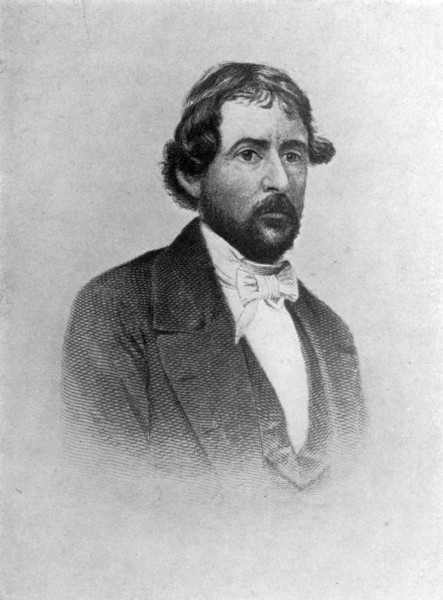
more slender than Kit Carson’s; he was about two
inches taller, and evidently he weighed about the same.
He had a full brown beard, rather compact and wavy,
oval face, white skin now tanned, bold clean-cut nose
jutting like the keel of a boat, and large eyes of
flashing blue. He was not any older than Kit, much
handsomer, altogether a different style of man—more
excitable, more dashing, more like Kit was in an Indian
fight. Yes, here was another type of leader.
“Got your men, I see,” he addressed, reining in,
with a rapid glance along the column.
“Yep,” drawled Kit. “Hyar they are.”
“And one boy, too,” added the lieutenant, with a
smile at Oliver. “That will make my boys envious.”
“Wall,” remarked Kit, “he’s man an’ on the pay-roll.
’Tisn’t size that counts, always.”
The camp was close ahead. It consisted of about
a dozen small cone-shaped tents of dingy canvas; one
tent, slightly larger than the others, and set apart,
probably was Lieutenant Frémont’s tent. The camp
was thronging with whites in frontier costume, with
Indians and dogs; saddles and packs were stacked in
piles; and out from the creek bank, in a grassy place,
were grazing horses and mules.
From the camp now came racing, like young Indians,
upon their ponies, two boys, as if eager to inspect.
One was younger than Oliver, the other was
older. They, also, were dressed in easy but rough
plains costume, and the younger even wore Cheyenne
moccasins. With brief “Hello” they fell in alongside
the leaders of the column, and accompanied it while
covertly eyeing its make-up. Oliver assumed his best
mountain-man pose, and with equal sly curiosity eyed
them back.
“No, my men will mess by themselves,” was saying
Kit Carson, to Lieutenant Frémont. “O’ course,
thar can be a general camp, but they’ll make their own
way. That’ll avoid any trouble.”
“Very well,” answered Lieutenant Frémont.
“That’s understood, then. I don’t feel authorized
to enlist them.”
To the camp rode on the Carson squad; and at the
lifted hand of Kit, as signal, they were off saddle at
once, to unpack and make another camp—an extension
of first. While Oliver was busy, a voice spoke
to him.
“Your name’s Oliver, Kit says.” It was Lieutenant
Frémont, accosting him with another frank
smile; the two boys, bridle-lines upon arms, were with
him. “I want you young gentlemen to get acquainted.
Oliver, this is Henry Brant, and Randolph Benton, of
St. Louis. They came out by the North Platte trail,
with Kit’s party.”
Oliver flushed, as he shook hands.
“Are you going all the way?” asked Randolph,
eagerly. He was the younger boy, with the Cheyenne
moccasins; his age was about twelve.
“I don’t know. We go as far as Kit goes, I
guess.”
“That’s all the way, then. You aren’t afraid of
Indians, are you?”
“Naw,” grunted Oliver, disdainfully.
“We aren’t, either,” declared the older boy, Henry.
He was about nineteen. And he continued, gloomily:
“But we can’t go on. We’ve got to stay here at the
fort, Mr. Frémont says.”
“A Cheyenne boy gave me these moccasins,” informed
Randolph, proudly, sticking out a foot.
“Yes. I knew ’em for Cheyenne moccasins, soon
as I saw ’em,” answered Oliver. “But why don’t you
go on?” he invited—liking both boys. “Isn’t the
party going on?”
“Yes; but we’re too inexperienced, Mr. Frémont
thinks. And he doesn’t want to have the responsibility
of us,” explained Henry; continuing, gloomily
as before: “We’d go, if he’d let us; but if the Indians
are bad I suppose we might be in the way, and I’d
rather stay here than get anybody killed looking after
us.”
“So would I,” agreed Randolph, quickly. He was
the livelier of the two. “We almost had a fight, coming
out, anyhow; only they turned into trappers instead
of Indians.”
“We’ll have some fun, at the fort, I guess,” said
Henry, more hopefully. “But you finish up your
work, Oliver. We’ll watch you.”
“Well,” admitted Oliver. “I’ll be done in a
minute.”
He proceeded; his two friends strolled about, keeping
in touch with him.
The Frémont party were composed all of St. Louis
French—the majority seasoned voyageurs and trappers
who as American Fur Company men had before
met the Carson men on the beaver trail. They wore,
some buckskins, but the greater proportion baggy jean
trousers stuffed into high moccasins or boots, and
belted at the waist, flannel shirts adjusted outside the
trousers, like blanket-coats and trimmed in red, bright
neckerchiefs, and handkerchief turbans or the wool
hats. A cheery, bustling, dark-faced and dark-eyed
crowd they were, laughing much and singing much
and joking much.
“Let’s go down to the fort,” proposed Randolph,
at once, when Oliver turned from his last chore.
But the sun was setting behind great Laramie Peak
of the Black Hills, in the west; throughout the combined
camps fires were blazing; and Oliver, keenly
aware of time and place, must reply:
“No; this chile’s wolfish, and pots are on the fire.
Meat, first. Then I’ll go.”
“You eat with us, at our mess,” invited Henry.
“Yes. You can, can’t you?” urged Randolph.
“Buffalo meat, and coffee!”
“I suppose you’re used to buffalo meat, though,”
hazarded Henry, as they moved on.
“Yes. That’s what we live on, mostly. Don’t
have much coffee. Didn’t bring any, this trip.”
“We lost nearly all of ours—a whole bag full, in
the Kansas River!” chirped Randolph. “Almost as
soon as we’d started. Our rubber boat tipped over
when we were crossing, and Kit Carson and Mr. Maxwell
and everybody had to jump into the river and
rescue things. Some of the men couldn’t swim, either;
but they didn’t care! Kit Carson was sick two days
from his wetting.”
“He’s often been in rivers. Trappers wade to
their waist in ice-water, setting traps or finding ’em,”
explained Oliver.
“Are you a trapper?”
“I’m learning,” answered Oliver, cautiously. And
he added, with pride: “I’m a Kit Carson man,
though.”
“Do those tacks in your rifle mean scalps?”
“Yes.”
“Did you take them?”
“No; but Kit Carson did, before he gave the rifle
to me. It was his rifle.”
“I’d like to be a Kit Carson man,” declared Henry.
“I’d as soon be a Frémont man,” retorted Randolph,
loyally.
“Well, it takes pluck to follow either of them, I
guess,” admitted Henry. “They’re both brave. You
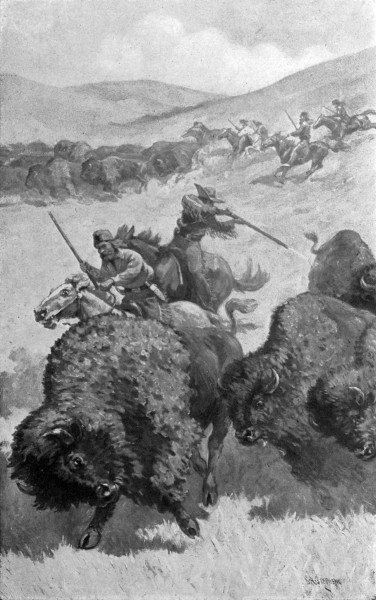
ought to have seen them riding after buffalo! Kit
Carson’s horse put his foot in a hole and threw him
head over heels and ran away with the buffalo till Mr.
Maxwell caught him; and the lieutenant’s horse chased
so hard and got so excited that it regularly foamed at
the mouth! It’s a trained buffalo horse; name is
Proveau.”
They squatted, trapper fashion, guns against knees,
near a fire upon which a pot of stew bubbled and
steamed attractively. At other fires men were toasting
strips of meat held on sticks.
“You came up from Taos, didn’t you?” asked
Henry.
“Yes.”
“We came clear from St. Louis. That’s about as
far,” piped Randolph. “But I came from Washington,
too. We left Missouri—or Mr. Chouteau’s farm
just this side, the tenth of June and we got here July
thirteenth. We’ve been here a week.”
“Did you have any scrimmages, on the trail?”
queried Oliver.
“Naw,” said Henry. “Once we thought we were
going to, but they were just a band of trappers on their
way back to Missouri. We had some fine buffalo hunts,
though. But Lieutenant Frémont almost got into a
big Indian fight. He separated from us, part way;
and he and Mr. Maxwell and a couple of others followed
up the South Branch of the Platte River to the
mountains, while we took the Oregon Trail route,
up the North Branch.”
“Yes; and about three hundred Injuns charged
them, and there’d have been shooting if Mr. Maxwell
hadn’t recognized one of the Injuns and shouted, just
in time: ‘You old fool! Don’t you know me?’ Then
they all shook hands, and went to the Indian village.
They were Arapahoe Indians.”
“What’s this expedition for, anyway?” ventured
Oliver.
“I’ll tell you,” proffered Randolph. “I know
because Lieutenant Frémont married my sister——”
“And his father’s Senator Benton of Missouri,
too,” further explained Henry. “We’re second
cousins. That’s why we were taken along, I guess.”
“Well, I’ve heard the talk, at our house in Washington,
anyway,” resumed Randolph, interrupted.
“It’s claimed to be an army expedition sent out by
the Secretary of War to examine the country between
the Missouri frontiers and the Rocky Mountains, and
to get the latitude and longitude of the South Pass;
but my father and some other men in Congress hope it
will encourage colonists over into Oregon by describing
the way to get there.”
“Have you been to the South Pass?” asked Henry,
of Oliver.
“No, not yet; but most of our men have. That’s
the big pass on the regular trapper and trader trail,
over the Rockies from this side to the other side.
Everybody knows the South Pass.”
“Wish we were going on,” repeated Henry, wistfully.
“But I guess it’s mighty serious when Kit
Carson makes his will.”
“Did he?”
“Yes. You see, our party met a party under Jim
Bridger—you know Jim Bridger, another trapper captain?
(Oliver nodded.) And they all said the country
beyond Laramie isn’t safe, because the Sioux swear
they’ll kill every white man they find there. That
scared our men pretty bad, and Kit Carson got
alarmed, too; and at the fort he made his will, so
that in case he’s killed his little girl he left in St. Louis
at school will be provided for. She’s half Indian.”
“Well, he’ll go on, though, if Frémont goes on,”
asserted Oliver, stoutly.
“Of course. That’s why he made his will. He’s
sensible. It isn’t because he’s afraid.”
When supper was practically over with, and the
men had lighted their pipes for a few minutes preceding
night chores, a figure stepped into the midst of the
lounging groups and lifted his arm, for attention. It
was a slender, quick figure—that of Lieutenant
Frémont.
“Men,” he addressed, clearly, “to-morrow we
break camp, for the outward trail again. We’re well
armed, we know how to take care of ourselves, in a
fight, and Mr. Bissonette, head agent at Fort Platte,
has agreed to go with us, as far as we need him, as
interpreter. He is a friend of the Sioux and Blackfeet,
and can talk with them if we meet them. But as
to these threats by the Indians and these rumors of
danger, you know as well as I do how much they can
be relied upon. You’ve all been in the Indian country
before; you can’t expect to travel in it and not risk a
fight or two. In fact, you knew it before we left
St. Louis. You knew there that the Sioux and Blackfeet
were unsettled, in the Laramie region. I’m going
on, right on, ready for peace or war. I don’t see any
good and sufficient reason why any of you should
break your engagement with the government and me;
but I don’t want anybody in my party who feels afraid
or repents of his bargain. Let him step forward at
once, and I’ll release him with his discharge and his
pay up to date.”
There was an instant of silence, broken by a laugh
as one man arose, and defiantly stood.
“You wish to stay, do you?” demanded Lieutenant
Frémont.
The man nodded.
“Are you sick, perhaps?”
“No.”
“Tired, then.”
“Yes.”
“You did not know that the South Pass was beyond
Fort John, I presume!” pursued the lieutenant,
sarcastically—creating another laugh.
The man maintained sulky silence, hanging his
head.
“Well, my poor fellow, we are very sorry for
you,” continued the officer. “You are welcome to
your pay and discharge, and you can be making garden
at the post so as to have nice vegetables ready for us
when we come back!” Thus having ridiculed him, the
lieutenant asked, generally: “Is there anybody else
who is tired in heart or feet?”
None answered—for which Oliver was glad.
“Humph!” criticised Randolph, as the three boys
trudged off to visit the post. “Wish now they’d take
us instead. But they won’t. I’ve got to stay and wind
the old chronometers every day!”
The next morning Oliver (accompanied by the envious
and disconsolate Henry and Randolph) was paying
another visit to the fort. Lieutenant Frémont,
and Kit Carson and Lucien Maxwell and several of the
French trappers in the Frémont company had entered
the office of Mr. Boudeau, the agent, as if to say
good-by; when through the gate and across the court,
for the office, stalked, with great dignity, half a dozen
Sioux—all chiefs. They were finely built men, several
of them old.
A clerk at the door of the office would wave them
away; but they acted as if they did not see him, and
past him they shouldered, and on in.
“Come on!” whispered Randolph, to his comrades.
“There’s something up. They’re from Fort
Platte, at the Platte River a mile below. I’ve seen
’em there.”
So, the way apparently being open, in after the
Indians sidled the boys.
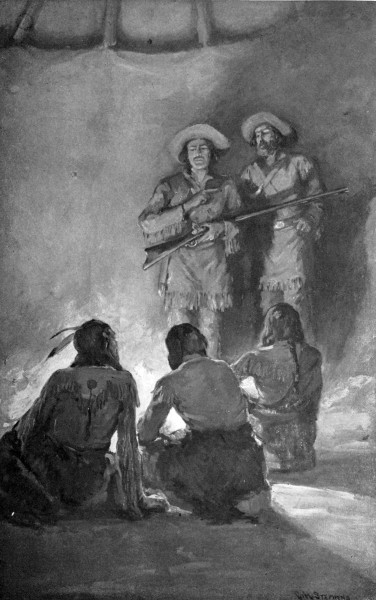
Lieutenant Frémont was just opening a folded
note, evidently brought by the Indians. They had
seated themselves upon the floor, along the wall, and
were waiting for the result. The white men were
eyeing the missive anxiously, and waiting also.
“This is a note from Mr. Bissonette at Fort
Platte,” announced Lieutenant Frémont; “as follows,”
and he read, in French. Then he continued: “In case
some of us may not have understood it all, I’ll translate.”
And again he read—flushing more as he proceeded:
“Fort Platte, July 1, 1842.
“Mr. Frémont: The chiefs in council have just
told me to warn you not to set out before the party of
young men which is out shall have returned. Moreover,
they tell me that they are very certain that they (the
young men) will fire upon you at the first meeting.
They ought to be back in seven to eight days. Pardon
me for thus addressing you, but it seems to me that
I should warn you of the danger. Furthermore, the
chiefs who forbid you to set forth before the return of
the warriors are the bearers of this note.
“I am your obedient servant,
“Joseph Bissonette,
“by L. B. Chartrain.
“The names of some of the chiefs—The Otter
Hat, the Breaker of Arrows, the Black Night, the
Bull’s Tail.”
As the lieutenant finished, one of the seated chiefs
arose, and dropping his blanket, as signal that he was
about to speak, in guttural tone, with now and then
a gesture, delivered a short harangue. Mr. Boudeau,
the American Fur Company agent in charge of the
post, translated sentence by sentence.
“You have come among us at a bad time,” said the
chief. “Some of our people have been killed, and
our young men who have gone to the mountains are
eager to avenge the blood of their relations, which has
been shed by the whites. Our young men are bad, and
if they meet you, they will believe that you are carrying
goods and ammunition to their enemies, and will
fire upon you. You have told us that this will make
war. We know that our great father has many soldiers
and big guns, and we are anxious to keep our
lives. We love the whites, and are desirous of peace.
Thinking all these things, we have decided to keep you
here until our warriors return. We are glad to see
you among us. Our father is rich and we expected
that you would have brought us presents from him—horses
and guns and blankets. But we are glad to see
you, anyway. We look upon your coming as the light
that goes before the sun; for you will tell our great
father that you have seen us, and how we are naked
and poor and have nothing to eat, and he will send us
all these things.”
The chief sat down, and enveloped himself in his
red blanket. Another chief, doffing his blanket (which
was blue trimmed with red), standing also spoke. He
said, like the first, that they loved the whites very much,
and could not bear to have them injured when they
came as friends, and that it was better for them to
stay safely at the post and not go on. Then the great
father at Washington would be grateful and would
give his red children many blankets and horses and
much food and powder and lead!
Other chiefs spoke, in turn—and all blandly expressed
the hope that in reward for their tender care
of the expedition in forbidding it to proceed, the “great
father” at Washington would liberally reward them!
When the half circle of chiefs had said their say,
Lieutenant Frémont replied—Agent Boudeau translating
his sentences into Sioux.
“We thank you for your good words,” replied the
lieutenant, to their up-turned solemn visages. “We
know that you do not wish us to be harmed, and it will
please the great father at Washington to hear about
it. We should like to stay with you a long time, but
the trail is waiting, we have not come to the end of it.
We hope that your young men will not take us as enemies.
That would be a great pity, when we come as
friends. But in case that your young men might not
see plainly, and blood would be shed, and perhaps many
of them killed, we ask that two or three of you go with
us, to signal the young men and tell them that we are
friends. We ask that you go with us, as our guests, to
spread your robes in my lodge and eat at my fire;
and when we return safely I will give presents.”
The chief in the red blanket arose.
“We have heard the speech of the white chief,
and it is good,” he said. “But we are old and poor
and tired, and we cannot travel far on horseback.
We must sit in our lodges and smoke our pipes among
the women, and let our young warriors take the trail.
Besides, we have no power now over the young men,
and it would be bad for us if we tried to interfere on
the war-path.”
He seated himself, and was applauded by a chorus
of grunts from his comrades.
Lieutenant Frémont answered, instantly and energetically—with
a glance at Kit Carson as if to read
approval in his sober face.
“You say that you love the whites; why have you
killed so many already this spring? You say you love
the whites, and you are full of words about friendship;
but you are unwilling to undergo the fatigue of a few
days’ ride to save our lives! We do not believe what
you have said; we will listen to you no more. Whatever
a chief among us tells his soldiers to do, is done.
We obey our chiefs. We are soldiers of the great
chief your father. He has told us to come out here,
and see this country and all the Indians, his children.
Why should we not go on and do it? Before we came,
we heard that you had killed his people and wanted
to be his children no longer; but we came anyway,
holding out our hands in peace. Now we find that
the stories we heard are not lies, and that your young
men are on the war-path and you are no more his
friends and children. But we have thrown away our
bodies, and will not turn back. When you told us
that your young men would kill us, you did not know
that our hearts were strong, and you did not count the
rifles that my young men carry in their hands. We
may be few, and you are many, in numbers, and you
may think to kill us; but if you try there will be much
crying of women in your villages, for many of your
young men will stay behind and forget to return with
the others from the mountains. Do you think that
our great chief will let his soldiers die, and will not
cover their graves? Before the snows melt again his
warriors will have swept away your villages as the
fires in autumn sweep the prairies. Look around.
See! I have pulled down my white lodges and my
people are ready: when the sun is ten paces higher, we
shall be on the march. If you have anything new
to tell us, you should say it soon. I am done.”
With that the lieutenant turned his back, and
strode out; after him strode Kit Carson and Lucien
Maxwell and all, even the agent, with the three boys
forming the rear. Presently, at decent interval, filed
forth the chiefs, blanket shrouded; they crossed the
court and passed through the gate, for the lodges
without.
“That was a good speech, wasn’t it!” praised Randolph.
“And he means what he says, too.”
“Guess you start right away,” said Henry; for
Lieutenant Frémont had immediately mounted his
horse, at the post gate, and was dashing for the camp,
followed by the other men. So, hastily vaulting into
their own saddles, with a whoop the three boys, abreast,
raced after.