We were, I believe, sent up in reserve to the 1st
Brigade. Whether that is correct or not, it is not
for me to state—all I know is that we formed up
well behind the front line, two companies taking the
first line in extended order and two companies the
second line in the same order. Thus we advanced
about a mile over flat open country to the front
line. We went up in short rushes, and a word of
praise is due to the men who took part in it. I
never even on the Barrack Square or drill-ground
saw a better advance: the men went up absolutely
in line, each man keeping his correct distance, and
that under heavy machine-gun and rifle fire. Of
course some men got knocked over; but it made
absolutely no difference. One Officer, a Major
Powell, carried a chair with him the whole of the
way, and, on reaching a hedge, would mount this
chair to get a view of the enemy.
Two hundred yards off the front line, we made
a combined rush into it. There we found the
Camerons, with the usual one-man trench. The
man I lay down behind told me that they had been
out there three days and had had no rations, and
also that they had had many men taken prisoners.
In this front line we had a breather, the German
trenches being roughly three hundred yards away,
and a hedge was also running parallel between the
two lines of trenches, with a big gap facing us.
Through this gap we could see the enemy retiring
one and two at a time from their trenches. They
appeared like so many rabbits running from their
holes, and, as they ran, so we took pot-shots at
them. After we had had our breather, the word
was given to charge; and this we did, going through
in fine style. Just behind the front line of German
trenches was a house from which we took a number
of prisoners. The first man of ours to reach it was
a corporal. He called upon the Germans to surrender
and got a bullet through the brain for his
pains. The Germans then saw us, and were
obliged to surrender, and were given over to men
to take behind. One German Officer remarked:
"We don't mind—we've got Paris, and London is
in flames." One of our Officers turned round and
said: "You know that's not true." Whereon
he remarked: "I know, but the men believe it."
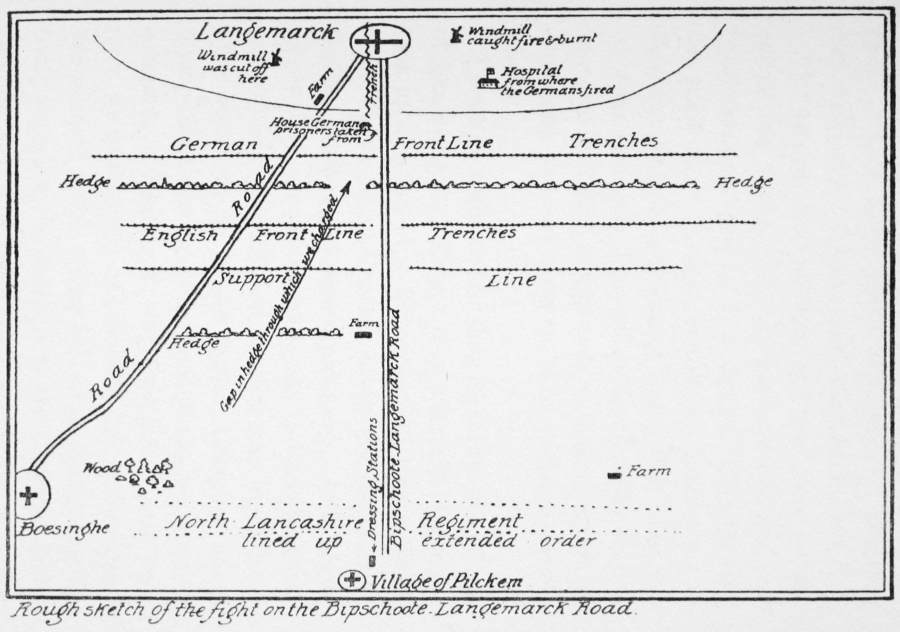
MAP 4.
The troops we were fighting there were on the
whole very young, and they had new clothing and
equipment, and told us that they had left Germany
for what they thought would be manoeuvres in
Belgium, and did not expect seeing the firing line
for some months. I myself really thought the war
was over that day, as Germans surrendered from all
directions and we overran their trenches everywhere.
I went on with the first line, right into the village
of Langemarck. We got to a windmill, where we
took up position—two Officers and thirty-four men,
the Officers being Captain Craig and Lieutenant
Gardiner (afterwards taken prisoner). As it began
to get dark, we set about trying to find the other
part of the Regiment, and another man and myself
were sent out to locate them. Creeping along
quietly for about three hundred yards, we came to
a trench. Thinking it was occupied by our own
men, we walked up, and found it full of Germans!
We were off with a volley behind us, but got safely
back, reporting the incident to the Captain. After
studying the map for some time, he came to the
conclusion that we were cut off, and had better wait
until it was quite dark. This we did, and successfully
found the remainder of the Regiment.
We had done well that day and set to work with
a will during the night on a new line of trenches.
These we held the next day, being relieved again at
night by a French Division, with the exception of
about thirty of us, who were unfortunately left
behind.
It had happened this wise: there was a sharp
bend in the trench, and my platoon was round the
other side of that bend. The French, on coming up
the communication trench in the dark, had gone
straight on, relieved the remainder of the Battalion,
and had left us there. The Battalion, on forming
up in the rear to march off, had found that we were
missing; they had waited for us in a field, naturally
thinking we should join up as soon as we had been
relieved. After waiting for an hour, daybreak
came, and the Germans had commenced to shell
them; so they had made off, leaving us behind.
We in the trenches were rather worried by a
party firing over our heads, apparently from behind,
and the Germans were in front. Towards
daybreak the men on our left commenced firing
heavily, and the Officer in charge of us (Lieutenant
Gardiner) shouted out to know the reason of it.
After shouting several times and getting no answer,
he sent an N.C.O. down to inquire. When that
N.C.O. came back and reported that the trench was
full of French troops, we knew then the Regiment
had gone and had left us—anyhow, Lieutenant
Gardiner went behind and found the men who had
been firing over our heads to be French troops also.
They were in a ditch, evidently in the dark taking
this ditch to be the line of trenches. Of course, on
being told their mistake, they cheerfully came up
and let us fall to the rear.
On the way back we inquired of every one if they
knew the whereabouts of our Regiment, but, as no
one knew, we were stranded. We then marched back
to our old billets in Boesinghe, which we had left a
couple of days before. We found no Regiment
there, so the Officer took us all into an estaminet
(beer-shop), and ordered us coffee and food. We
then heard from a Staff Officer that the Regiment
had gone on to Ypres. It was Sunday morning,
October 25th, 1914, when we arrived at Ypres.
The town was then practically in its normal state,
being full of civilians just returning from Mass,
and no German shell had yet visited the town.
There we found our Corps Headquarters, and the
Officer in charge of us, having reported the episode
of how we got left behind in the trenches and learnt
the whereabouts of the Regiment, was told that the
G.O.C. was highly pleased with our work of the
last two days, and that when he reported to the
C.O. (Major Carter), who had joined us recently
and had led us in the last attack, he was to
tell him that the men who had been left behind
were to be struck off all guards, fatigues, etc., for
the next twenty-four hours and to be given a
thorough rest.
Thus ended the Langemarck engagement so far
as we were concerned. On October 26th, 1914,
General Headquarters issued the report, a copy
of which appeared in the current account of The
Times of November 17th, 1914, as follows:
"THE GALLANT NORTH LANCASHIRES
"SPECIAL 2ND BRIGADE ORDER
"26TH OCTOBER, 1914
"In the action of the 23rd of October, 1914, the
2nd Infantry Brigade (less the 2nd Royal Sussex
Regiment left at Boesinghe) was allotted the task of
reinforcing the 1st Infantry Brigade and retaking
the trenches along the Bipschoote-Langemarck
Road, which had been occupied by the enemy. In
spite of the stubborn resistance offered by the
German troops, the object of the engagement was
accomplished, but not without many casualties in
the Brigade.
"By nightfall the trenches previously captured
by the Germans had been reoccupied, about 500
prisoners captured, and fully 1,500 German dead
were lying out in front of our trenches.
"The Brigadier-General congratulates the 1st
Loyal North Lancashire Regiment, Northampton
Regiment, and the 2nd K.R.R.C. (King's Royal
Rifle Corps), but desires specially to commend the
fine soldier-like spirit of the 1st Loyal North
Lancashire Regiment, which, advancing steadily
under heavy shell and rifle fire, and aided by
machine-guns, was enabled to form up within a
comparatively short distance of the enemy's
trenches. Fixing bayonets, the battalion then
charged, carried the trenches, and occupied them;
and to them must be allotted the majority of the
prisoners captured. The Brigadier-General congratulates
himself on having in his Brigade a
battalion which, after marching the whole of the
previous night without food or rest, was able to
maintain its splendid record in the past by the
determination and self-sacrifice displayed in this
action.
"The Brigadier-General has received special
telegrams of congratulations from both the
G.O.C.-in-Chief, 1st Corps, and the G.O.C., 1st
Division, and he hopes that in the next engagement
in which the Brigade takes part the high reputation
which the Brigade already holds may be further
added to.
"(Signed) B. PAKENHAM, CAPTAIN,
"Brigade Major 2nd Infantry Brigade."
On October 26th, 1914, we left our billets on the
Melin Road, and proceeded further up, halting
about halfway between Ypres and Hooge, called
then by us the "black and white village." There
we were placed in a field, and, once more lining the
hedges, we stopped there the rest of the day. A
regrettable incident took place towards evening:
one of our own aeroplanes was brought down by
our own fire, under the impression that it was an
enemy. It caught fire five hundred yards up, and
burned furiously: both men, pilot and observer,
were killed.
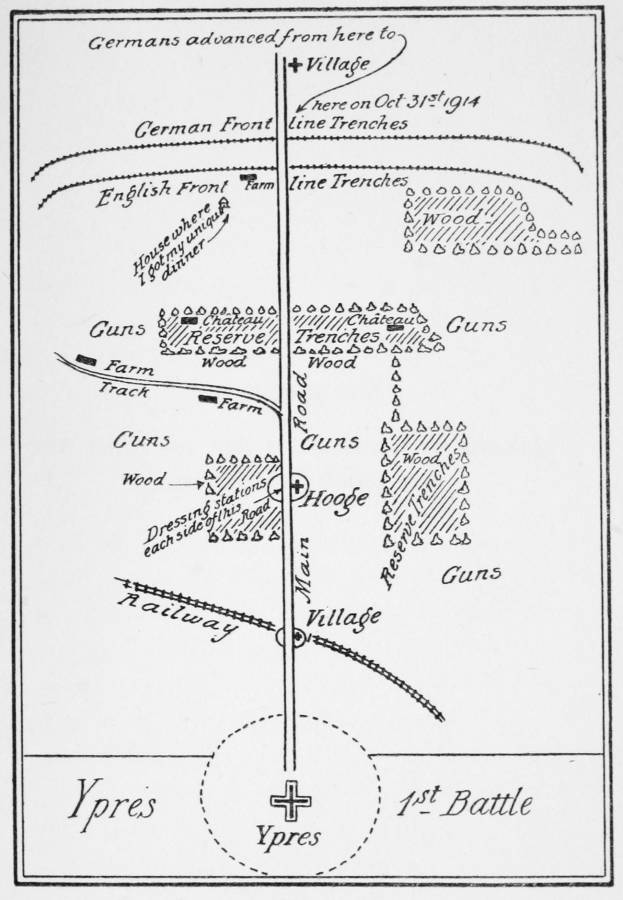
The following morning, October the twenty-seventh,
we filed out of these fields, and, passing
through Hooge, continued up the road as far as a
large wood on the left of the road and about three
miles from Ypres town. At the north end of this
wood were some batteries of artillery behind a
large château, and in this wood we dug lines of
trenches with entrenching tools.
Next day, the twenty-eighth, we were taken
from here to another wood on our left front nearly
half-a-mile from the last. We had a little difficulty
in reaching it, as the whole of the distance was
within view of the enemy. Anyhow, we did the
distance, by platoons, at the double and at a
hundred paces interval.
This wood was larger than the one we had just
left, and we commenced at once to dig in at the rear
end. We had had no casualties on the journey,
although the Germans had shelled us with eighteen-pounders,
all shells, fortunately, bursting at each
side of the road. We stayed in this wood until the
next morning, then retiring to the one we had come
from. We had one or two casualties before we left,
losing one or two men wounded and a horse killed,
the enemy's observation having been attracted to
us by the smoke from a fire.
That afternoon, the twenty-ninth of October, we
proceeded to advance once more. Getting nearly a
mile up the main road, we took the left side, going
out in extended order. Thence we advanced
another half-mile, coming under shell-fire; when
we reached the rise, we lay down. All this time we
had seen nothing of the enemy, though bullets were
flying all around us. It was then dark, but we did
not stay there. Closing in on the right, we came to
a village: here the bullets were very thick, but we
continued to cross the village along the main road
to the right. The name of this village I never
heard; it is now in the enemy's hands. In its centre
was what looked like the ruins of a windmill: we
could see the arms and sails on the ground, but the
remainder appeared to be nothing but a huge pile
of stones.
Crossing the village into some more fields, we
formed up into line, and there commenced to dig
another line of trenches—the King's Royal Rifles
on our left and on our right the 3rd Brigade, consisting
of the Queen's Royal West Kents, Welsh
and South Wales Borderers.
That night we brought in a German sniper, who
had evidently been wounded in the stomach. He
could not give us any information, as he was too
badly wounded.
Later on, while we were digging, the C.O. gave
out to us that there was to be no retirement
from here: we were to hold the position at all
costs. The Rifles on our left were commanding
the top of the hill, and, as our line ran down a
slope, we were ordered to dig our trenches forty feet
long facing the enemy but in step fashion, one
behind the other. This we did, bringing the last
trench on the right of our line just in front of a wood.
We worked all night on these trenches, making them
as strong as possible, knowing that there was to be
no retirement.
Next morning, the thirtieth, we were very
heavily bombarded, and the bombardment increased
in violence towards midday, when we were
ordered out of our trenches and to advance. We
again moved up about a thousand yards, but there
was still no sign of the enemy—shells were abundant.
In front of a farm-house we dug in again, and
then we began to see our troops retiring on the
right. Two or three of the Welsh passing near, we
inquired what was going on, when they replied:
"It's hell. The Queen's are absolutely cut up"—which
was true—what remained of them were
sent down the line for garrison duties. We then
began to expect a little excitement, but it did not
come off that day; and we were once more ordered
to return to the line we had left earlier.
Next morning, the thirty-first, the Germans
bombarded us more violently than ever. This
continued for several hours. The next thing was
that we saw the Germans coming; and they did
come—in their thousands. We kept them off for
an hour or two when the C.O. of the King's Royal
Rifles consulted us, or rather our C.O., about
retiring. I remember the two Officers having a
heated argument over it, as they stood by a farm-house
immediately in rear of the line. I do not,
however, know what their argument was, but
heard afterwards that the King's Royal Rifles had
got short of ammunition. The words I did hear
from our C.O. were: "It's the General's orders
that we hold the position at all costs, and this I'll do
if I lose the whole regiment."
We continued to fire until the Germans were on
our trenches and coming through the line the
King's Royal Rifles had vacated on our left. I was
in the third line of steps near the farm-house, where
I overheard some of the conversation of the two
C.O.'s. Just in front of the King's Royal Rifles'
trenches was a huge German Officer waving with
one hand to the retiring Rifles to surrender and with
the other waving his troops on. It did not seem
of much good for us few men to attempt to fight
that dense mass of Germans, but we did; and out
of the thousand, or thereabouts, that we lined up
with a couple of nights before very few got away, the
enemy taking somewhere about four hundred of my
Regiment prisoners and our casualties being about
the same number.
I had a run for my life that day. A chum of
mine who was with us had a cock-fowl in his valise
that morning from the farm; he had wrung its neck
but he had not quite succeeded in killing him; and,
as we ran, this bird began to crow. As for myself,
I had no equipment; I had run having left it in
the bottom of the trench. It is quite funny as I
come to think of it now—the old cock crowing as we
ran; but it was really terrible at the time. We
were absolutely overwhelmed, not only in our particular
spot but all along the line, and had to
concede nearly one thousand yards to the enemy.
We were also very unfortunate in losing our
Brigadier, General Bulfin, wounded on the cross-roads
by a piece of shell, I believe; also our
Brigade Major, who was killed with another piece
from the same shell. I am sure every man in the
Brigade felt very keenly the loss of the Brigadier;
it was he who took us out from Aldershot, and not
a better General or a braver or cooler soldier under
fire ever stepped on field of battle.
Most of my Regiment being gone and the remainder
mixed up with other Brigades which had
formed another line, two chums and myself went to
a farm-house fifty yards behind this newly made
line. There we had a field battery; and, after
getting a little rest, started out to find the remnants
of the Regiment. The enemy were still shelling,
and the battle was still going on; but by nightfall,
not finding any of them, we came back to the old
house and found the battery gone. We decided to
rest there for the night with some more stray men
of different Regiments. Just in front of us, and in
rear of the line, lay a wounded German. We
decided to bring him in, and did so: he had been
hit in the mouth, half of his tongue having been
taken away. The poor fellow was in agony, every
now and then lying on the ground and kicking.
One of our men volunteered to take him back to
the field ambulance, and did so.
That night we slept on beds in the farm-house, and
next morning, November the first, after a hurried
breakfast of biscuits and beef, we all set out to join
our respective Regiments; but, after wandering
about for an hour and seeing no signs of any of
ours, my two chums—one of them now holds the
V.C.—decided to go back to the farm-house and
make a dinner. There was plenty of vegetables in
the garden and an outhouse full of potatoes; and
we found a spirit-lamp and a pot; so we commenced
to prepare our meal. In a short time it was
all in the pot, when—alas!—the Germans began to
shell our house, sending over incendiary shells.
They let us have it battery fire. The first lot took
off the off fore-leg of a cow, which along with some
others was grazing at the back of the house; the
poor thing hopped around on three legs for a second
or two and then dropped, the other cows running
up to lick the blood from its wound. The next lot
hit the top of the house, one shell taking away the
roof of the scullery, behind which one of my chums
was standing; the other had already run into the
trenches fifty yards away. I was the last to go, the
other two having thought that I had been hit. I
did not leave the place until the house was well
alight; and three hours after, when the enemy's
guns had died down and the fire had burnt out
the house, I went over to see how the dinner had
got on, and found it done to a turn, cooked by the
heat from the burning house. Needless to say, we
did full justice to that dinner—all three of us.
We then went into the trenches with the Scots
Guards and on the left of them were some of the
Gloucesters. On inquiring if they had seen any of
the North Lancashires they replied, "Yes; they
had gone back to the reserve trenches in the wood,
there to reorganize." There we found the Regiment,
or rather the few that were left of it—about one
hundred and thirty.
That night we received from England a draft of
reinforcements one hundred strong. After resting
in those trenches that night, we were taken a little
farther back to a wood in the front of Hooge and on
the right side facing the firing line. There we dug
new trenches and dug-outs, and always came back
to them on after occasions to rest. We were never
once taken into Ypres or any buildings, since the
enemy had during the last few days commenced to
shell the town and some parts were on fire. This
information we got from our transport drivers, who
had gone back some way behind Ypres.
We rested in these trenches for two days, and
were then called out—on the afternoon of the
second of November—in support of the 3rd
Brigade. We went up in the usual skirmishing
order, three other men and myself going on in
front to warn the C.O., when we came into touch
with the Welsh Regiment. We were very heavily
shelled going up, but reached the Welsh with
insignificant losses. Lying in front of the Welsh
and around a farm-house were a party of French
troops. On the word that we had arrived and come
into touch with the Welsh, our Regiment was made
to halt in a wood just behind and lie down. We
were only just off the road a little to the right, and
I estimate the Germans were about seven hundred
to eight hundred yards off. While we were there
a 4.7 gun was brought up on the road, and at the
above-mentioned distance fired point-blank into
the advancing Germans. An hour afterwards, the
Welsh made a charge, and a fairly successful one it
was, meeting, as it did, the enemy in the open.
They returned to their original position, while we
took up a position to their right.
That night we again dug trenches, and next day,
November the third, we had very little to contend
with—only shell-fire; and we continued during
the day to strengthen our trenches. At night we
again moved a little nearer to the enemy, and commenced
another line of trenches. By next morning
we were well dug in, and it was a good job that we
were, as the Germans bombarded us very heavily.
At that period we did not have lines of trenches
where one could walk about; merely the usual one-man
trench. The Germans shelled us from early
morning until darkness set in and our casualty list
was close on fifty, in addition to which we lost our
C.O. and our Adjutant, Major Carter and Captain
Allen, both killed.
I had a fairly decent trench there, as I always
had everywhere, knowing that the harder I worked
on my trench the more chance I had of safety. I
here lost a decent chum, killed on that day, the
fourth of November, by a bullet through his brain,
whilst he was spreading jam on a biscuit. When
it became dark two of my comrades came into my
decent trench, and there we soon dropped off to
sleep, all three of us, the Germans shelling us all
the time. When we awoke, it was nearly nine
o'clock; we were roused from our sleep by some one
throwing, or rather showering, earth in upon us.
Up I jumped and inquired sotto voce: "Who are
you?" Back came the reply: "Who are you?"
On telling him, he replied that he was a Royal
Engineer digging a communication trench; we
were not sorry to hear that he was not one of the
enemy. He then inquired what we were doing
there, remarking that the Lancashires had been
relieved and gone back some time ago. After
wandering about for an hour, we found the Regiment
in the reserve trenches in the wood. Every
one had settled down for the night, rations and rum
had been issued, and we had perforce to make the
best of it. I did not sleep so well as usual, feeling
the loss of my pal. However, next morning,
November the fifth, we were told that, as we had
had such a hard time of it of late, we were to be
put into reserve on some fairly easy trenches on the
left of the road and just in front of the wood we
occupied on our first coming up. All we had to
contend with was cross-fire from the enemy's
guns. It does not sound very dreadful, nor to us
men did it sound hard; most of us thought that
we were going to have a fairly easy time of it; so
into the trenches we went quite happily. But
the shell-fire there was terrible, and the way the
shrapnel whistled through those trees, to say
nothing of the high explosives, fairly made one's
hair stand on end.
I was just in front of the wood, where we had one
company entrenched; fifty yards in front and the
other side of a hedge was another company. These
were the only two companies we had, as we had
become very weak. In this reserve trench my
company lay for twenty-four hours, exchanging
with the company in front of us at the end of that
time for another twenty-four hours; but we were
kept in that line for another four days through an
unfortunate incident. We went into the front line
of the reserve trenches on Saturday, November the
sixth. In front of us were supposed to be the
Zouaves. On our right front fifty yards off was a
small house beside the road, the hedge just behind
us running parallel but gradually getting to a point
at the extremity of the trench, which ended in a
cul-de-sac. Just over the top and in line with the
main trench was a small trench, which we called
the Thirteen Trench, as thirteen men occupied it.
It was situated just off the road and commanded
a view straight up it. Fifty yards along the main
trench was a communication trench reaching to the
hedge, where it stopped, letting us out on the other
side. Sunday morning, November the eighth,
broke with a heavy mist; it was one of those hazy
mornings that denote heat. Every one was taking
things fairly easy, when a man next to me, on
glancing over the top, exclaimed: "Look! here's
the Germans."
We thereupon sent for the Officer, but he could
hardly believe his eyes: we were then supposed to
be in reserve. The enemy was advancing upon us
in close formation fully a thousand strong, and our
full strength could not have been more than a
hundred in that trench and a hundred in the
trenches behind, as I know that the whole Regiment
at that time was not more than two hundred and
thirty (not including Transport).
They were advancing by way of the little house
and on to the Thirteen Trench. We kept up a
brisk fire for a considerable time into the advancing
masses; but we were hopelessly outclassed, and
had to fall back on our other company behind. On
reaching them, we all retired into the wood, drawing
the enemy in behind us. It proved to be a fine
piece of strategy, as we drew them on to unfamiliar
ground and away from the trenches. We then
turned round and made a counter-attack, driving
them well back and leaving heaps of them dead and
wounded behind.
We had almost reached our original line, when a
chum of mine called to me by name. I went over
to him, and found him lying on the ground: he had
been hit and could not help himself, and he asked
me to take him back to the dressing-station. I
could not well refuse; so, dragging him and
carrying as best I could, I made for the road, and
there we nearly both got taken by the Germans,
who were coming down that road in hundreds, and
were only a few yards off. So I had to drag my
man back into the wood, dropping into a ditch with
him at the side of the road, where I was able to
ascertain the extent of his wound. There was not
much to show—only a small bullet-hole through his
hip entering his stomach. In this ditch was a
Zouave; and he gave me some black stuff that
looked like coffee. Getting, a little later, into the
wood, I was able to take him that way to the
dressing-station. I heard a few weeks afterwards
that he had died from his wound.
On arriving back, I found that the Regiment had
again retired a little way behind the trenches we
had before occupied; and I also found that I had
lost another old and valued chum, the one who had
originally enlisted with me and had up till that time
been through the campaign unscathed. I am
thankful to say he was not badly wounded, although
he lost the use of his left hand. There were not
many of us left; our ranks were more depleted than
ever; not more than seventy or eighty all told
remained—nevertheless, they were planning to
retake the trenches. On reaching the communication
trench unmolested, we started to file in,
myself going second man. Of all the trenches I
had been in that was quite the worst: we had to
absolutely walk the whole of the way over dead
bodies—our own men and Germans. It was eight
o'clock at night, and of course dark, which made our
task more unpleasant; but we reached the end of
the communication trench safely, though we had
not got more than three or four yards down the
main trench to the right, where it ended in a cul-de-sac,
before a German patrol of about twelve men
came walking along the top of the trench. We
waited until they were on top of us—then I let
drive. I can hear the yell of the fellow I hit to this
day, as he threw up his hands and dropped. The
man next to me on my left also let go, and I thought
he had blown the top of my head off!—he must
have had the muzzle of his rifle quite close to my
ear, as I was deaf for some time afterwards. He
thought I was hit!
On gaining the end of the trench, I was, with
three others, sent into the communication trench
to clear out the dead. A London Scottish Officer—they
had only been out, or rather in action a
week—came up with his men to relieve us, and
remarked to our Captain, who was the C.O., that
he did not mind seeing dead Germans but he did
object to walking upon them; so we had the job of
clearing them out, which we did in this way: two
men stayed in the trench and two stood on the top
of it, the two in the trench each lifting a leg of the
dead man up to the two men on top, who then
hauled him over. We had been at work for about
an hour at this interesting job, when who should
walk along the top under cover of a hedge but
a German right up to where we were working! He
was fully equipped, but we had discarded our
equipment, on account of it hindering us at our
task. On reaching us, I exclaimed to my pal, who
was bending over in the trench: "Look, chummy,
here's a German!" The two men on top having
just gone further up had not seen him. On hearing
me speak, the German made a motion with his
hands and said, "Hush!" I was never more
surprised in all my life—he evidently took us for
Germans, too. I then said to my pal: "Find
us a rifle": there were plenty at the bottom of
the trench. He handed me one up, and, pointing
it at the German, I was foolish enough to say:
"Hands up!" He again said: "Hush!" I
said to my pal: "Hand me up some ammunition,
quick." He handed me up five rounds, and,
pulling one out of the clip, I placed it in the breech
of my rifle. When the German heard the bolt of
the rifle go home, he turned round and bolted off—but
he was too late: I had him right through
the back. We thought it best, then, to return to
the company; and we did so.
When we had reported this little episode, I
remarked to the Captain that I thought the man
had come from the Thirteen Trench. He replied:
"That's all bosh." While we had been away
there had evidently been a discussion over this
Thirteen Trench, and the Captain had asked a man
who had been in it early the day before we had been
driven out to go over the top—only a matter of
ten yards—and see who was occupying it then.
This man said that he knew a safer way round,
when the Captain said: "Take two more men and
go over." Again this man replied, asking if he
might not go round. Then the Captain, becoming
wild, said: "If three of you won't go, thirteen of
you go. If you prefer to go the other way round, go,
and I'll come and see you do go." I made one of
those thirteen, and we filed down the communication
trench; and, coming out on the other side of
the hedge, we crept along behind it amidst the
cries of several wounded soldiers of both sides until
we came to the gap in the hedge facing this small
Thirteen Trench a few yards away. The Captain
was leading, then another man, and then myself.
We had no sooner reached the top of the trench
than a guttural voice challenged "Halt!" and then
I could see the forms of the Germans: they were
packed in there like sardines. Of course, the next
minute they had opened fire, our Captain and
C.O. being killed on the spot; the remainder of us,
being unprepared, turned and ran. The Zouaves,
who had then taken up a position behind us, thinking
it was the Germans coming, opened fire on us,
too; and there were we running between two
fires! I remember on coming close to the Zouaves'
line that I took a flying leap clean on top of one of
them as he was about to shoot. I knocked him
down, of course; but, on getting up and seeing
who I was, he clasped his arms around me, very
pleased that I was not a German. Then, along
with the remainder of the men, I returned to our
old trench, reporting to the only Officer we had left
the death of our Captain.
As we could not hand over the trenches complete,
the Germans having possession of the Thirteen
Trench, we were not relieved by the London
Scottish, as it is a rule with the Regular Army
that, on being relieved, trenches have to be handed
over precisely as they were taken over, any that
may have been lost having to be retaken. Consequently
we were kept in these trenches another
forty-eight hours, and during that time we were, if
possible, to retake the one we had lost.
As we were so very weak we were reinforced by a
platoon of the 2nd Black Watch and one machine-gun
belonging to them. The gun was fixed in
position at the bottom of the communication
trench close to the hedge, so as to cover any movement
of the enemy from the Thirteen Trench. At
the bottom of the main trench and in that traverse
we had eight men ten yards away, and in line were
the enemy occupying the Thirteen Trench. At
daybreak the next morning each of our eight men
received a bullet in his head from the waiting Germans,
six being killed outright and two wounded.
I was then sent with five other men to fill their
places, and our orders were to lie down in the
bottom of the trench and not show ourselves, as our
machine-gun was trained directly over the top to
the Thirteen Trench beyond us, and on any move
being made by the enemy the gun would instantly
open fire directly over us. My comrades and myself
lay there the whole of the day; the stench from
the dead men who had been killed that morning was
sickening—indeed, the whole of that trench smelt
of blood, warm blood as from a slaughter-house,
which in fact it was. We all got very cramped
towards evening, and a great deal of grumbling was
going on, as in the ordinary course of events we
should have been relieved by that time and back
resting. Some one at length suggested going to the
Officer to ask for relief and beg him to exchange us
with some men higher up the trench, who had more
freedom. I was asked if I would be spokesman.
Replying in the affirmative, I went to the Officer
and explained the case, telling him how cramped
we had become. He asked me where I had come
from. When I told him, he asked me who gave me
permission to leave my post: I replied no one, but
that I was the oldest soldier, whereupon he came
with me to the bottom of the trench, and, addressing
the men, promised them he would relieve them
as soon as possible. He also said: "You have
nothing to fear while I am with you; the Germans
are ten yards off." After further promising to send
the relief, he departed. We then decided, as night
was falling, that three of us should keep watch for
the first hour and the other three for the second
hour, carrying on like that alternately throughout
the night.
The night was very black and the gloom very
thick, and we could not see a movement of the
enemy ten yards away, but could imagine all sorts
of forms and shapes in front of us. I think it was
during our second watch that we discerned what
we thought to be three forms moving behind the
enemy trench and making for the road; so one of
us fired. We heard a yell and concluded we had
got somebody. During the third watch my two
comrades grew very tired, and, getting down with
the other men at the bottom of the trench at my
bidding, were soon fast asleep. I then pulled two
of the dead bodies to the end of the trench and stood
them up against the wall facing the enemy to make
them appear as if there were more of us. I had
no sooner done this than a German got stealthily
out of his trench; and, creeping along behind the
hedge and to the rear of our line, up popped
another, and then another. Whereupon I sent
word of the enemy's movements viâ the next
traverse to the Officer, asking what I should do. In
the meantime I was doing all I could to awaken my
comrades; but they were so sound asleep that,
although I was kicking them, I could not get them
to budge. The word then came back from the
Officer to say we were to do nothing—not even to
fire a shot, as the machine-gun was trained upon the
enemy, waiting for them to come up. I was in a
very awkward position, as I could see the line of
enemy trenches in front, and the one they were
coming out of on our flank, and I had to stand there
and say nothing whilst they crept around the back
of us. I began to get "wind up" (frightened), as
by this time they were six to one against me, and,
being the end man, I had no chance whatsoever.
No doubt I should have accounted for one or two
of them, but I should never have got away myself.
This situation continued for about twenty
minutes. I had at last been able to arouse my
comrades, when an order came down for the North
Lancashires to file out: we were being relieved by
the West Riding Regiment. I may state that I
never heard such welcome words in my life! How
the West Ridings fared after that I do not know,
but I do know that I was well out of it!
That night we returned to our old reserve
trenches for rest at Hooge; and next day a message
from General French was read out to us, praising
us for the work we had done and regretting that he
had had to keep us so long in action without a rest.
We had been either marching or fighting since the
middle of August, and it was then the middle of
November, but he did not think we should have
to go into the trenches again before we had had our
long-deferred and well-earned rest.
That night the 3rd Battalion Scots Guards, just
out from England, came into the wood also, and a
fresh Regiment of Zouaves joined us. We were all
very pleased to think that we were about to be
relieved, and I remember well taking a dozen field
post-cards from different men of the Scots Guards to
post as we went down the line. We marched out
at eight o'clock, every one convinced that we were
going to have our rest, when, on reaching the road,
instead of marching towards Ypres, they took us
towards the trenches. Even then we thought we
were going for our rest, some suggesting that we
were on our way to a meeting-place for the Brigade;
others took it to be another way round—"Yes, viâ
Germany," remarked some one. Well, we did not
get our rest: we went into the trenches again on
two occasions after that, and for forty-eight-hour
stretches. At length we were relieved by the
Guards Brigade, and went back to Hazebruck by
easy stages.
I should like to say a few words about Ypres
before I close the account of my experiences there.
We were during the whole of the first Battle, from
October the twenty-third to the seventeenth of
November, 1914, fighting in the trenches all the
time, with the exception of the first three days. I
was in the Bipschoote-Langemarck-road engagement,
in what is now better known as "the Ypres
salient." From the time when I first went there
until October the thirty-first our front line was fully
six kilometres from Ypres town, but between the
twenty-third and the thirty-first of October the
Germans gained from us quite three to four kilometres.
We did not regard this as a defeat to the
British arms, as at that time the enemy were, without
exaggeration, six to one against us, and they were
also much better equipped with artillery. On the
contrary, I wish to pay my humble tribute to all
ranks who served during that time, short as they
were of men, sometimes even putting the military
police into the trenches, to say nothing of the
cavalry and cyclist corps. It was there that we
finished off the remainder of what was the original
Prussian Guards, as well as the Bavarian Guards;
and to-day the British nation has to thank those
troops who fought so well during that time, and
put a finish to the chance of the Germans ever reaching
Calais, and thence England.
My Regiment entered Ypres not less than one
thousand strong, and while there we had five lots of
reinforcements: we came away with only seventy-five
men and one Officer, a Lieutenant. I do not,
however, in my above remarks refer specially to
my own Regiment any more than to any other
Regiment in my Brigade or Division—all the
Regiments in the 1st Division were splendid:
though some may have been a little better than the
others where all were very good.
We went then to relieve the 7th Division after it
had fought the rearguard action from Antwerp,
and we were only just in the nick of time, for the
Division had suffered very heavily. Altogether
with reinforcements the 1st Division must have
lost thirty thousand men in stopping the great rush
for Calais. When we entered Ypres everything was
normal; but when we came out of it the town was
in ruins and burning furiously in several parts.
At Hazebruck we rested for close on a month.
By "rested" I mean away from the firing line.
Of work we had plenty. Two days before leaving
Ypres we were joined by a draft of six hundred
from home, which had been kept behind with the
Transport until we should come out of the firing
line. Captain Smart, who was with this draft,
took over the Temporary Commanding Officer's
duties during the three-days' march to Hazebruck,
where we arrived in a snowstorm, and were billeted
in private houses at the rear of the railway station
and running along near the line. Whilst there, we
received two further large drafts from England,
and we also had a lot of men sent back medically
unfit on account of defective teeth, etc. Even
there we were not left in peace, doing each day
either route marches or brigade training. To every
man new clothes and underlinen were issued; and
we all had to have a bath!—an amusing affair, that
took place in a rag-shop. A canvas bath had been
rigged up, and each Company took it in turn to
bathe, the water being fetched by the cooks in
dixies. We had about four of these dixies filled
with about twenty quarts of water to each bath,
with some strong disinfectant put in it. About
one hundred men would bathe to each bath, the last
dozen or so revelling in pea-soup. Every one had
to go in—as at that time we all had plenty of live
stock crawling over us—under the eyes of the
Company Officer and two or three N.C.O.'s. Enemy
aircraft was continually flying over us, and one
Sunday morning an airman dropped eight bombs,
which killed several civilians, mostly children, and
caused sixteen casualties amongst men of my
Regiment.
We left Hazebruck on Monday morning by
motor omnibuses on December the twenty-first,
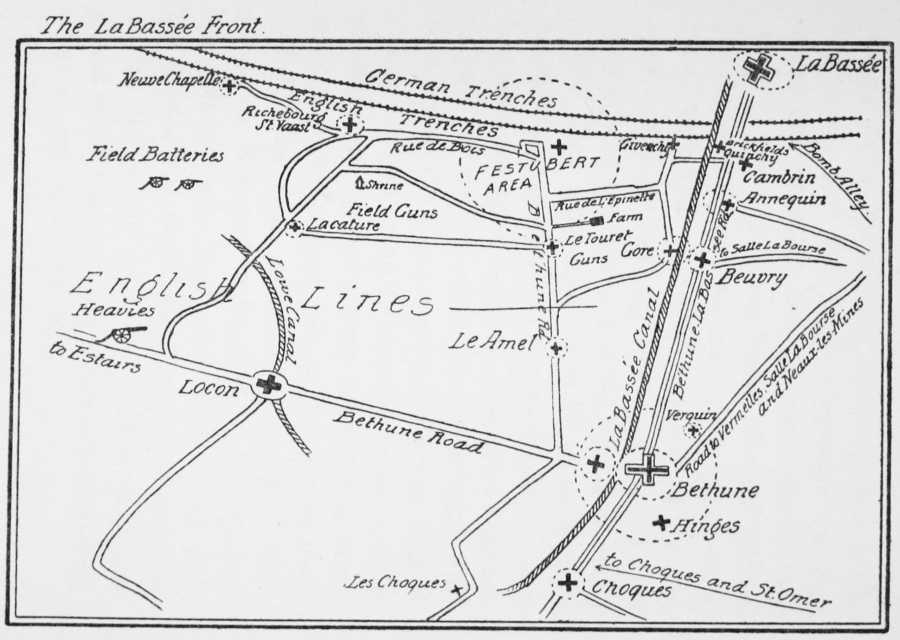
going through Merville to Festubert. Four miles
from Festubert we left the buses, and during the
afternoon, waiting on the roadside for orders, we
for the first time came across our Indian troops.
The Meerut Division and 4th Corps were operating
around that district. On the cross-roads at Le
Touret we waited until dusk, and then moved up
the road about a mile to the Rue-de-L'Epinette,
Festubert, where we were told that each Regiment
in the Brigade had to attack and take at least one
trench. From the Rue-de-L'Epinette we were
taken across several fields for about a mile, when
the Brigade made a charge. It had then become
dark and we were on ground that we had never
been on before; but we succeeded in taking three
lines of trenches—the Regiment on our left taking
one, though that on our right was not successful.
I honestly believe that it was a ruse on the part of
the enemy, as we did not take a single prisoner, and
had only a few casualties ourselves.
That night I was doing duty as an orderly,
bringing up the machine-gun section and also two
mess-waiters with refreshments for the Officers.
A funny incident happened on the way up. A house
just to the left of the farm where Battalion Headquarters
were posted had caught fire, and another
orderly on the way down from there said to me:
"Be careful which way you go, as I think that house
which is burning is in the German lines; so bear
off to the right." This the two waiters and myself
did; and, after tramping along for some time and
crossing several ditches, I gave it up, declaring
that I had lost the way. In front we could see
some yew trees lining a ditch about a hundred
yards off, so we made up our minds to go as far as
that, and reached the trees safely; but as we got
there bullets began to fall with a plop into the
ground at our feet; so we thought we had better go
round the other side. It was, however, just as bad
there, and in front we saw a trench; so we thought
we would investigate a bit. Creeping up quietly
to the parapet, we peeped over: several Germans,
unarmed and burdened with two jugs of coffee and
a basket of provisions, greeted our eyes. We very
soon made off back again, and had not gone more
than a couple of hundred yards before we came to
a garden surrounding a farm-house. It turned
out to be the very house I was seeking, but of course
I could not then recognize it, as it was night-time,
nor was it familiar to me, as it had been night-time
when I first went into it. We were only about
thirty yards off and could hear a babel of sounds,
but very unlike the English language. So I suggested
that the best thing we could do was to lie
down under cover of the hedge, and wait until
some one came along. If he proved to be English,
well and good; if German, we should have to get
out of it the best way we could. We had not long
to wait before three forms loomed in the distance
through the gloom; and then we were all of a
tremble! Fortunately they turned out to be three
of our own Tommies, so we waited till they had
passed, and then we went in. Many a laugh over
the affair have those two waiters and myself had
on after occasions.
Next morning, December the twenty-second, we
were properly let in. The enemy commenced to
shell us, continuing for some hours; then they
came up in force. Unfortunately, by taking those
three lines of trenches the night before, we had got
too far in front; and consequently we were surrounded
before we knew where we were. Anyhow,
with bombs and rifle-fire (our machine-gun
section being behind and not in position by then),
we kept them off as long as we could—then we had
a run for it, as the Company on our left had had
to give in. There were very few of us left that
day; but our machine-gun soon got into action,
and held the position until reinforcements came up,
when the remainder of us formed up in the Rue-de-L'Epinette.
When the roll was called we numbered
one hundred and thirty Officers and men out
of eight hundred and thirty who went into action
seventeen hours before. Our C.O., Major Powell,
was very much upset, remarking that there had
been a grave mistake somewhere, and he would
immediately go to the General for satisfaction:
we, of course, did not hear how he got on.
That night we were taken to Lacature until all
the stragglers had joined up: they made the
Regiment up to about two hundred; and next day
we marched off to Essairs, just the other side of the
canal of Bethune, where we spent a quiet but not
joyous Christmas Day, as we felt greatly the loss
we had sustained two days before.
CHAPTER VIII
LA BASSÉE DISTRICT