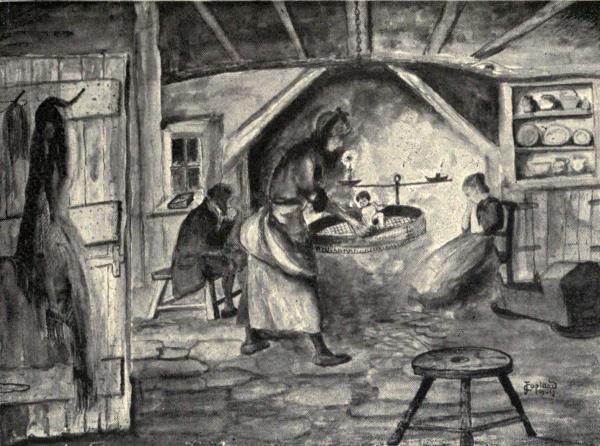
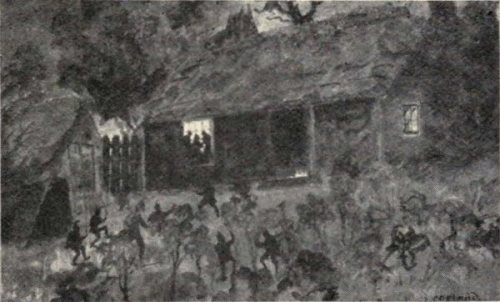
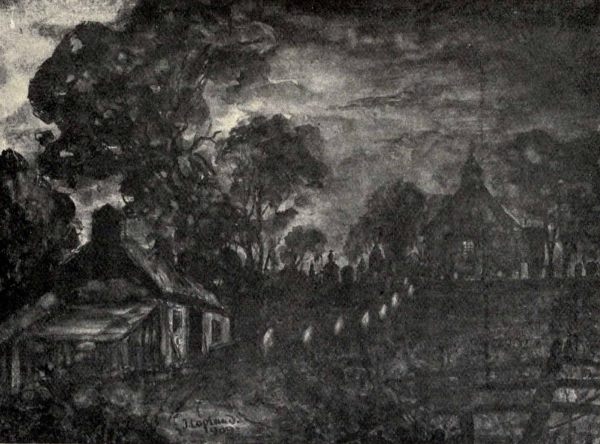
Witchcraft Trials and Persecution.
“Thou shalt not suffer a witch to live.”
—Exodus xxii., 18.
 ittle is heard of witchcraft in Scotland before the latter half of the
16th century, but in the year 1563, in the reign of Mary, Queen of
Scotland, a strenuous Act directed against the practice of witchcraft
became law, and was most rigorously enforced. As this has been described
as the law under which all the subsequent witch trials took place its
significant phraseology may in part be quoted:—
ittle is heard of witchcraft in Scotland before the latter half of the
16th century, but in the year 1563, in the reign of Mary, Queen of
Scotland, a strenuous Act directed against the practice of witchcraft
became law, and was most rigorously enforced. As this has been described
as the law under which all the subsequent witch trials took place its
significant phraseology may in part be quoted:—
“The Estates enact that nae person take upon hand to use ony matter of
witchcrafts, sorcery or necromancy, nor give themselves furth to have ony
sic craft or knowledge thereof; also that nae person seek ony help,
response, or consultation at ony sic users or abusers of witchcraft under
the pain of death.”
Curiously enough the passing of this and similar Acts was attended by
results as unexpected as they were unforeseen. Belief in witchcraft became
the passion of public credulity. Accusations, generally false and often
even ludicrous in their solemn foolishness, were trumped up, and action
followed, that hurried countless helpless human beings to the stake to die
a cruel and shameful death. It was a time of terror, an epoch of
superstitious sacrifice, extending and gathering force as the reign of
Mary merged into the Regency, only finding pause at the removal of James
VI. of Scotland to London, there to preside over the united destinies of
these islands. As is well known, this monarch evinced a more than personal
interest in matters pertaining to the “unseen world,” and that, gathering
up his ideas and conclusions, he embodied them in a singular treatise
entitled Daemonologie.[11] Less
creditable to his memory it is told
that not only did he favour executions for this alleged crime, but
actually took pleasure in witnessing the sacrifice of the condemned.
With the death of James a phase of quiescence in witch quest and sacrifice
is entered upon, a lull which lasted for some fifteen years. It was again,
however, to be broken, this time by the unfortunate intervention and
misdirected zeal of the Church itself. The General Assembly, stimulated by
a desire for Puritanical perfection, awakened the slumbering crudity of
belief, that direct Satanic Power stalked abroad in the land in the form
of witchcraft. Condemnatory Acts were passed in the years 1640-43-44-45
and 49. Again the stake and tar faggot blazed. The Levitical law was
accepted as a too literal injunction, and from this time forward it is the
clergy who particularly figure as the pursuers of witches, keen and
relentless to a degree; and yet with it all, however misguided the efforts
of these Churchmen, however cruel their methods, it is only just to their
memories to believe in their purity of motive, and to give them all credit
for pious and earnest desire to combat and stamp out what to them was in
very truth a great evil.
Different methods were adopted to establish proof and justify the cases
for the accusers, but the one test specially relied upon was to find the
actual presence of what has already been described as the “witch mark”[12]
upon the person of the suspected. When this was found, or supposed to be
found, it was the deliberate practice to pass through it a sharp
needle-like instrument, and if no pain was felt or blood drawn, then guilt
was held to be firmly established.
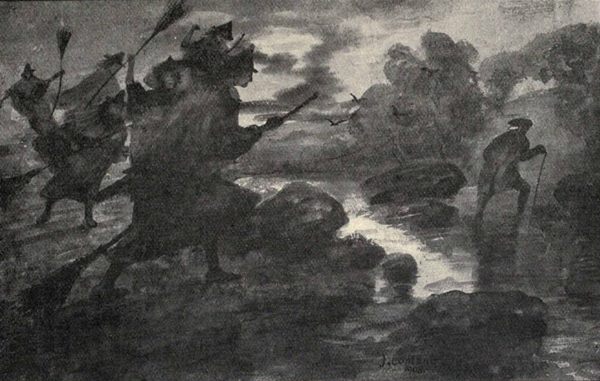
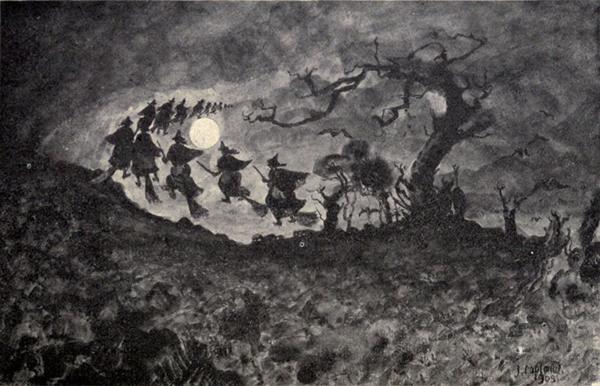
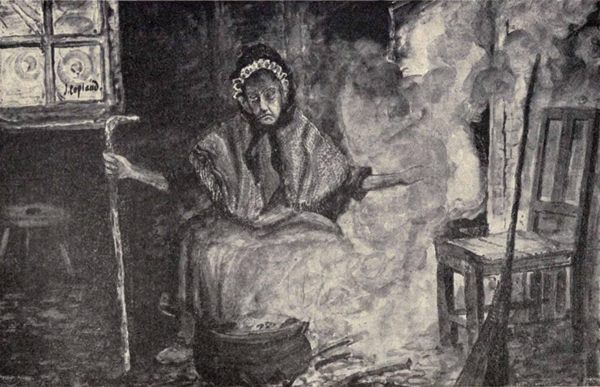
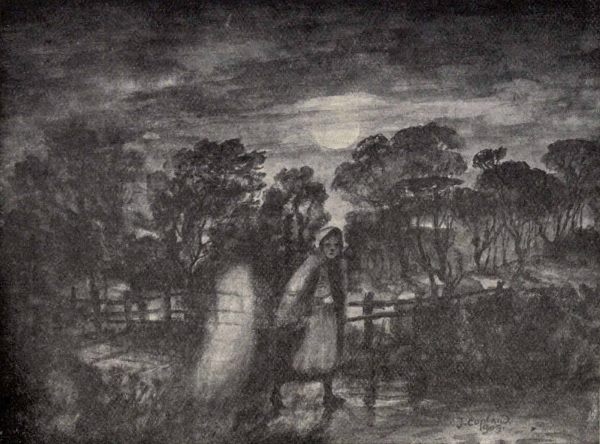
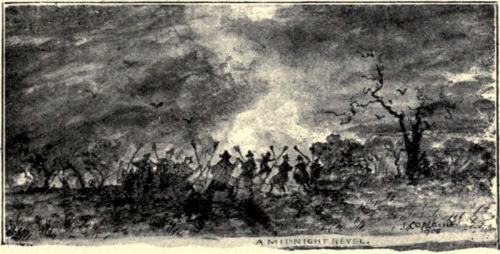
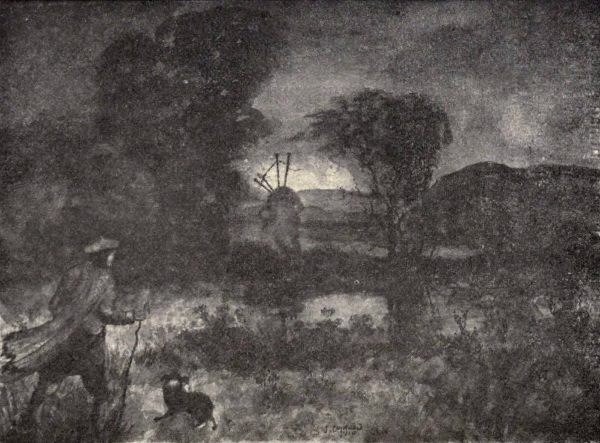
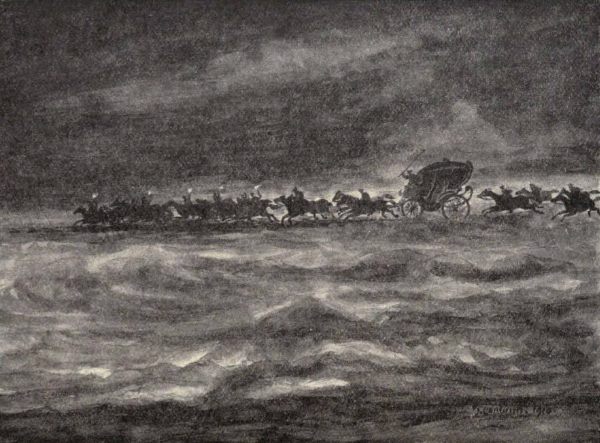
“A Running Stream they dare na cross!”
J. Copland.
So frequent were the accusations that the “pricking of witches” became a
recognised calling: one individual, John Kincaid by name, having such a
reputation for skill in this unhallowed work that he seems to have been
employed in the principal witch trials of this period, such an entry as—
“Item, mair to Jon Kinked for brodding of her VI. lib. Scotts”
being of quite common occurrence in the notes of expenses still on
record.
It is to this second or later period of persecution that the record of
witch charge and punishment in the south-west of Scotland really belongs,
and from 1656 the records of the civil and ecclesiastical courts teem with
accounts of searching enquiry and trial. It must further be remembered
that over and above the regularly constituted enquiries of State and
Church a great number of Commissions were granted by the Privy Council to
gentlemen in every county, and almost in every parish, to try persons
accused of witchcraft, many of whom suffered the extreme penalty,[13] and
of which no particulars can now be gleaned.
It is now our purpose to set forth as completely as possible such relative
matter and extracts from existing documents as will describe the
proceedings as they actually took place in the distinctive localities of
the Dumfries and Galloway district, but it may perhaps be here fittingly
noted, not without a certain sense of gratification, that this
south-western district, though far from blameless, compares more than
favourably with other districts in Scotland, both in fairness of judgment
and rigour of punishment.
Proceedings in Galloway.
Presbytery of Kirkcudbright, April, 1662.—A person, named James Welsh,
confessed himself guilty of the crime of witchcraft before the Presbytery
of Kirkcudbright; but the justices refused to put him upon his trial,
because he was a minor when he acknowledged his guilt, and had retracted
his extra-judicial confession; but on the 17th of April, 1662, they
ordered him to be scourged and put in the correction house, having so
grossly “prevaricated and delated so many honest persons.”
Kirkcudbright, 1671.—At an Assize held in the burgh of Dumfries in 1671
eight or more females were charged with witchcraft; five of them were
eventually sent for trial to Kirkcudbright.
Dalry Kirk-Session, 1696.—Elspeth M‘Ewen, an old woman living alone at
a place called Bogha, near the farm of Cubbox, in Balmaclellan, was
suspected by the country-side of various acts of “witching.” In
particular, she was believed to have at her command a wooden pin that was
movable and that could be withdrawn from the base of the rafters resting
on the walls of the cottage, which particular part of the building was in
these old days called the “kipple foot.”
With this pin Elspeth was supposed to have the supernatural power of
drawing an exhaustive milk supply from her neighbour’s cows merely by
placing it in contact with the udder, and this it was reported she
practised freely. Other cantrips laid to her door included capricious
interference with the laying power of her neighbour’s hens, causing them
sometimes to fail altogether, at others to produce in amazing
plenteousness.
At last complaint was made to the Session, and the beadle, by name
M‘Lambroch, was sent away with the minister’s mare to bring her before the
Session. On the journey there is a tradition that the mare in a panic of
fright sweated great drops of blood at the rising hill near the Manse,
since known as the “Bluidy Brae.”
After being examined she was sent to Kirkcudbright, where she lay in
prison for about two years.
Dalry Kirk-Session, October 15th, 1697.—The following entry evidently
refers to the expense of her maintenance in prison: “Given for alimenting
Elspet M‘Koun, alledged of witchcraft in prison, £01.01.00.”
Kirkcudbright, 1698.—In Kirkcudbright prison Elspeth M‘Ewen was so
inhumanely treated that she frequently implored her tormentors to
terminate a life which had become a grievous burden to her.
In March, 1698, a Commission was appointed by the Privy Council for her
trial, along with another woman, Mary Millar, also accused of witchcraft,
“to meet and conveen at Kirkcudbright.” The following is an extract from
the said Commission:—
Extract from “Commission for Judging of Elspeth M‘Cowen and Mary Millar,
alleadged Guilty of Witchcraft, 1698.”
“The Lords of his Majesties privie Councill, being informed that Elspeth
M‘Cowen and Mary Millar, both within the Stewartry of Kirkcudbright,
presently prisoners within the tolboth of Kirkcudbright, are alleaged
guilty of the horid cryme of witchcraft, and hes committed severall
malifices; and considering it will be a great deall of charges and
expenses to bring the saids Elspeth M‘Cowen and Mary Millar to this place,
in order to a tryall before the Lords commissioners of justiciary:
Besides, that severall inconveniences may aryse by there transportation.
And the saids Lords lykewayes considering that this horid cryme cannot be
tryed and judged by any persons in the countrie without a warrant and
commission from their Lordships for that effect; And the saids Lords being
desyreous to have the said matter brought to a tryall, that the persones
guilty may receive condigne punishment, and others may be deterred from
committing so horid a cryme in time coming; They do hereby give full
power, warrant and commission, to Sir John Maxwell of Pollock,—Maxwell of
Dalswintoune, Hugh M‘Guffock of Rusco, Adam Newall of Barskeoche, Dunbar
of Machrymore, Thomas Alexander, Stewart Depute of Kirkcudbright, Robert
M‘Clellend of Barmagachan, and Mr Alexander Fergussone of Isle, Advocate;
And declare any three of the foresaids persones to be a sufficient quorum,
the said Stewart Depute of Kirkcudbright being one of the three, To take
tryall off, and to judge and do justice upon the saids Elspeth M‘Cowen and
Mary Millar, for the cryme of witchcraft. And in order thereto, To meitt
and conveen at Kirkcudbright, the second ffryday of Apryle next to come,
and there to accept for this present commission, and upon there acceptance
to administrate the oath of fidelity to the person whom the Lord Justice
Clerk or James Montgomery of Langshare, Clerk to the Justice Court, shall
depute and substitute to be clerk to the present Commissione, With power
to the saids Commissioners or their said quorum, to choyse their own Clerk
for whom they shall be answerable, In caise that the saids Lords Justice
Clerk and James Montgomery, shall refuse to nominate a Clerk in this
matter, they being first requyred so to doe, With power lykewayes to the
saids persones hereby commissionat or their said quorum, To create, make,
and constitute Serjants, Dempsters, and other Members of the said court,
And to Issue out and cause raise precepts or lybells of indictment at the
instance of Samuell Cairnmount, writer in Kirkcudbright, as procurator
fiscall for his Majesties interest in the said matter, against the saids
Elspeth M‘Cowen and Mary Millar, accused of Witchcraft, ffor sumonding and
citeing them upon ffyfteen dayes, by delyvering to them a full copie of
the lybell or indictment, with the names and designationes of the Assyzers
and witnesses subjoined; And for citeing there assyzers and witnesses in
the ordinary and under the usual paynes and certificationes, To compear
before the saids Commissioners hereby commissionat, ... With power to the
saids Commissioners or their said quorums, To decern and Adjudge them to
be burned, or otherwise to be execute to death within such space and after
such a manner as they shall think fit, and appoints the saids
commissioners, there said quorum or Clerk, to transmit the haill process
which shall be ledd before them against the said Elspeth M‘Cowen and Mary
Millar, and severall steps thereof and verdict of the inquest to be given
thereupon to the saids Lords of his Majesties privie Councill, betwixt and
the ffyfteenth day of June nixt to come.”(27)
On the 26th of July the committee of Privy Council reported that they had
examined the proceedings of the commissioners in the case of Elspeth
M‘Ewen (the report signed by the Lord Advocate), who had been pronounced
guilty upon her own confession and the evidence of witnesses “of a compact
and correspondence with the devil, and of charms and of accession to
malefices.” It was ordered that the sentence of death against Elspeth
should be executed under care of the Steward of Kirkcudbright and his
deputies.
Found guilty by her own confession, a certain means to end a miserable
life, Elspeth M‘Ewen suffered the extreme penalty of being burned at the
stake, the execution taking place in what is now known as Silver Craigs
Park, on the 24th day of August, 1698.
The following extracts connected with the trial and execution are taken
from some old Kirkcudbright records, which were brought to light by the
late Mr James Nicholson:—
“Ane accompt of my (George Welsh) depursements as Thessr.[14] from
Michaelmas, 1697, to Michaelmas, 1698, as follows—
| Item for Item to Barbara Roddin for ane pound and ane half of candle yt night the Assyse sat on Elspet M‘Keown |
|
000 |
09 |
00 |
| 22 July, 1698. Item to the men that took William Kirk, by Ba. Campble’s order |
|
000 |
04 |
00 |
| Item given to him yt day |
|
000 |
03 |
00 |
| Item for Satterday, Sunday and Monday yrafter |
|
000 |
09 |
00 |
| Item given to William Kirk of earnest by Ba. Campble’s orders in money and in aill with him |
|
00j |
0j |
00 |
| Item to William Kirk for six days at three shills per day |
|
000 |
18 |
00 |
| 4 Aut., 1698. Item to William Kirk for twenty days tyme yt he was in prison at ffour shills per day, is |
|
004 |
00 |
00 |
| 20 Aut., 1698. Item given to the Proveist to give William Kirk to buy drink, and by his orders to buy ane leg mutton |
|
000 |
ij |
00 |
| Item. Sspent by the Proveist wt Howell and Ba. Dunbar, the day of Elspet M‘Keown’s execution, ane gill brandie |
|
000 |
04 |
06 |
| Item be the Proveist’s order, to William Kirk to buy meal wt. |
|
000 |
10 |
00 |
| Item payed in James M‘Colm’s yt the Proveist drank with Ba. Dunbar and oyrs the day of Elspet M‘Keoun’s execution |
|
000 |
06 |
00 |
| Item to Wm. Kirk to buy meill wt. |
|
000 |
07 |
06 |
| Item to Wm. Kirk to buy meill wt. |
|
000 |
07 |
06 |
| Item payed to Barbara Roddin for candles to Elspet M‘Keoun’s guard |
|
000 |
17 |
00 |
| Item to Mart. M‘Keand for ffour Ells and three quarters Red, to William Kirk, at twenty shill Scots per Ell, is |
|
004 |
15 |
00 |
| Item to Helin Martin for plaiding to be hose to him |
|
000 |
08 |
00 |
| Item to thrid whyt and collured |
|
000 |
03 |
00 |
| Item for ane Bonnet to him |
|
000 |
09 |
00 |
| Item for harne to be pockets, and for shoen |
|
000 |
17 |
00 |
| Item for three ells harne to be ane shirt, and for making yrof. |
|
001 |
00 |
00 |
| Item for ane long gravate to him |
|
000 |
12 |
00 |
| 24th Aut., 1698. Item given to the Proveist to give him the day of execution |
|
002 |
16 |
00 |
| Item for peits to burn Elspet wt. |
|
00j |
04 |
00 |
| Item for twa pecks of colls |
|
000 |
16 |
00 |
| Item for towes, small and great |
|
000 |
04 |
00 |
| Item for ane tarr barle to Andrew Aitken |
|
00j |
04 |
00 |
| Item to Hugh Anderson for carrying of the peits and colls |
|
000 |
06 |
00 |
| Item to William Kirk qn she was burning, ane pint of aill |
|
000 |
02 |
00 |
| Item payed to Robert Creighton, conform to precept, viz., eight shill Scots for beating the
drumm at Elspet M‘Queen’s funerall, and to James Carsson, his wife threeteen shillings drunken by Elspet’s executioner, at seall times |
|
00j |
0j |
00 |
It would thus appear that the executioner (William Kirk) had to be kept in
jail in order that he should be forthcoming at the execution. He seems to
have been an old, infirm man, without relations or friends, and on 8th
July, 1699, he addressed the following petition to the Provost and
Magistrates:—
“To the Right Honorable my Lord Provest, Baylies, and Cownsell of the
Royal Burgh of Kirkcut.—Humbly sheweth, That yor Honors patchioner is in
great straits in this dear time and lik to sterv for hwnger, and whan I go
to the cowntrie and foks many of them has it not and others of them that
hes it say they are overburdened with poor folk that they are not able to
stand before them, and they will bid me go hom to the town to maintain me
and cast stanes at me. May it therefore please your honors to look upon my
indigent condition and help me for the Lord sake, and yor honors pettioner
shall ever pray.”
In answer to the above “earnest cry and prayer” there appears the
following entry in the “Thessr’s” account:—
“8th Jully, 1699.
“The sd day the magistrates and Counsell ordains the Thessr. to give the
petitioner the next week six shill Scots forby his weekly allowance.”
Another document, which throws a curious side-light on Elspeth M‘Ewen’s
trial, is the sentence against one Janet Corbie, who advised Elspeth to
plead not guilty. It is as follows:—
“Kirkcudbright, — day of July, 1698.
“The same day, it being most palpably and cleirly evident and made appear
to ye magistrates and Consell yt. Janet Corbie, dauter of Wm. Corbie,
hath been and as yet continues in a most scandlous carrige, abusing of her
neybors by scandlous expressions, whereffor there hath been fformer ffines
put upon her, and that she is a persoun yt leeves by pyckering and
stealing as is most justly suspect yrof, and yt she hath been endevouring
to harden Elspeth M‘Keoun, wha is in ye laigh sellar as ane wich, in
endevouring to dissuad her to confess and that people sinned ther sowl wha
said she was a wich, and ffor her constant practis in abuse of ye Lord’s
Day emploing herselff yrin ofthymes in stealing her neybors guids such as
unyuns and bowcaill and taking them to ye countrie and makin sale yr of,
and sevll oyr thing yt upon just grownds could be mayd appere so yt to
long she hath been suffered to resyde in this place; yrfor, and yt ye
place may be troubled with such a miscrent, and scandlous person nae
langer in tym coming, ye magistrates and consell out of a due sens of yr
dutie and of ye justice of her sentens, ordains the said Janet Corbie to
remain in prison while Munday morning neist att ten o’clock and then to be
taken ffurth of the tolboth by ye officers and wt tuck of drum to be
transported over the ferry bote, to be exported in all tyme coming from ye
sosiety or convercacioune of all guid Christians and indwellers in ye
place, and never to return yrto, prohibiting and discharging all
inhabitants, qur parents, relaciouns, or any oyrs wtin ye toun’s bouns, to
harbor, reset, convers, commune with, or entertane the said Janet or
receve her to their society or company at any place or tyme in all tyme
coming, and yt under ye pain of fforty pounds Scots muney to be peyd by
ilk transgressor, toties quoties to ye toun’s Thessr. atower whatever oyer
punishment the magistrets and consell sall think fit further to impose,
and ordains thir presents to be publish at ye Mercat Cross yt non may
pretend ignorans in tyme coming, and the magistrats ordane to see the
sentence put in execution.”
Extracts from Minute Book of the Kirk-Session of Kirkcudbright.(28)
“Janet M‘Robert in Milnburn is delated to the Session for Witchcraft, the
signs and instances qrof (whereof) are afterwards recorded. The Session
therefor recommends to the Magistrates to apprehend and incarcerate her
till tryall be had of that matter.”
“Feb. 6, 1701.
“As to Janet M‘Robert in Milnburn, it is delated by Elizabeth Lauchlon,
lawfull daughter to John Lauchlon yr., (there) that the sd. (said)
Elizabeth went to Janet’s house, when she was not within, and looking in
at the door saw a wheel going about and spinning without the help of any
person seen by her, and she went in and essayed to lay hold of the said
wheel, but was beat back to the door and her head was hurt, though she saw
nobody. And yt. (that) after she was in the said Janet’s House (being at
school with her) the Devil appeared to her in the likeness of a man, and
did bid her deliver herself over to him, from the crown of her head to the
sole of her foot, which she refused to do, saying she would rather give
herself to God Almighty. After the Devil went away the sd. (said) Janet,
who was present with her, laid bonds on her not to tell. And yr after he
came a second time to her, being in Janet’s house alone, in the likeness
of a gentleman, and desired her to go with him, and yr after disappeared,
seeming not to go out at the door.
“Robert Crichton’s wife farther delates, that when she was winnowing corn
in Bailie Dunbar’s barn, the said Janet came in to her and helped her,
tho’ not desired, till she had done, and desired of her some chaff for her
cow. She gave her a small quantity in her apron, with which she seemed not
to be satisfied, so upon the morrow thereafter, the said Robert Crichton’s
wife’s breast swelled to a great height, which continued for about the
space of five weeks, so that the young child who was then sucking decayed
and vanished away to a shadow, and immediately yr after their cow took
such a distemper that her milk had neither the colour nor taste that it
used to have, so yt no use could be made of it, all which happened about
three years ago.
“It is further delated by Howell, that being one day in John Robertson’s
in the Milnburn, he desired to buy two hens. They said they had none, but
perhaps Janet M‘Robert would do it, and accordingly he asked Janet, who
answered she had none to sell to him. He replied, ‘you have them to eat my
goodmother’s bear when it is sown; but (said he), my rough lad (meaning
his dog) will perhaps bring them to me.’ She answered, ‘your rough lad
will bring none of my hens this two days;’ and before that he went to the
town, the dog went mad to the beholding of many.
“Further, it is delated, that a friend of the said Janet’s living in
Rerwick, whose wife was lying on childbed, did send his daughter to Janet
to borrow some money which she refused to give at the first, yet upon a
second consideration she gave her two fourteens, but still assured the
Lass that she would lose them. ‘What,’ (says the Lass) ‘am I a child yet?’
and for the mare security she took a purse out of her pocket in which
there were no holes, and took out some turmour (turmerick) which she had
in it, and did put in the two fourteens and threw the neck of her purse
(as she used perhaps to do) assuring herself that she should not lose them
now, and went home, and when she came there, she opened the purse to take
out the two fourteens, and she had nothing.
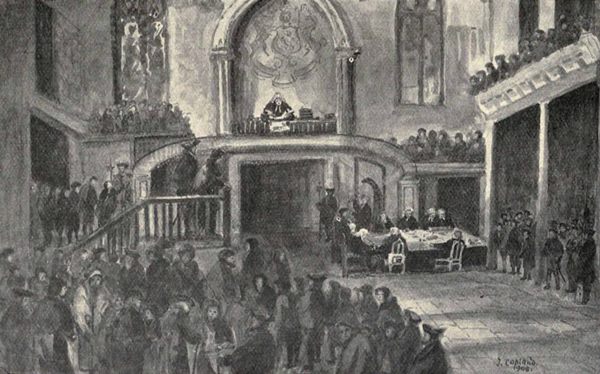
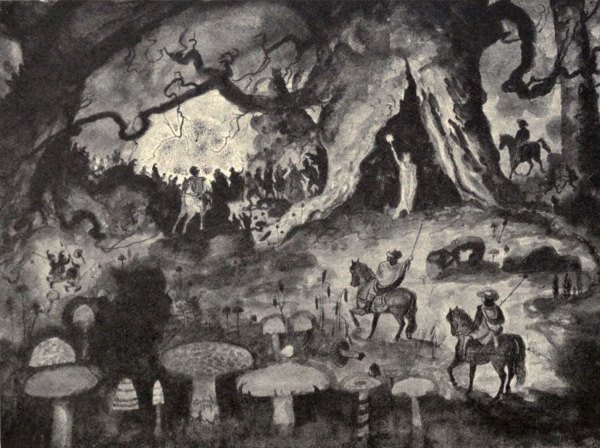
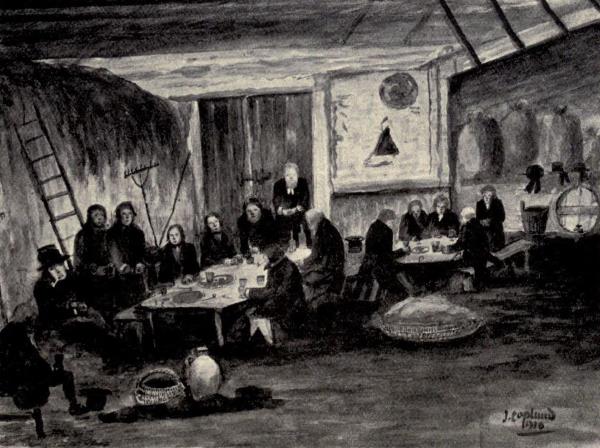
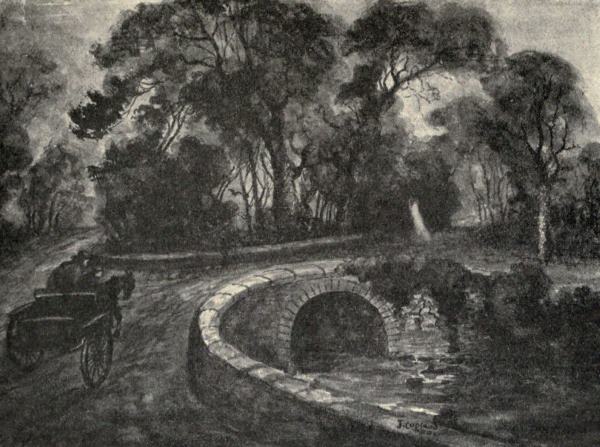
“A Witch Trial.”
J. Copland.
“Further, it is delated by John M‘Gympser’s wife, Agnes Kirk, that the
said Janet came one day there, and desired a hare’s bouk (carcase) which
she refused, and since that time their dog hath neither been able to run
or take ane hare.”
“Feb. 12th, 1701.
“As to Janet M‘Robert, John Bodden in Milnburn delates, that at the laik
wake of his child three years ago, Patrick Linton’s son heard a great
noise about Janet’s house, so yt he was afraid to go out at the door, and
John Bodden himself going to the door heard it also, at which he was
greatly affrighted. Upon the morrow yr after, the said Janet went into
John’s house, and they told her what they heard the night before about her
house. Janet answered, ‘It is nothing but my clocken hen’; but John
declared that ‘all the hens within twenty miles would not have made such a
noise’
.“The sd. John further delates that, upon the Wednesday after Janet was
incarcerated, he did see about cock-crow a candle going through the said
Janet’s house, but saw nothing holding it.”
The Finding—
“April 10th, 1701.
“As to Janet M‘Robert, an extract of the delations against her being sent
to Edinburgh, and a commission written for to pursue her legally it was
denyed in regard they judged the delations not to be sufficient
presumptions of guilt, so as to found a process of that nature.
Notwithstanding thereof the said Janet consented to an act of banishment,
and went hence to Ireland.”
Extracts from Session Book of Twynholm.(29)
“18th April, 1703.
“Jean M‘Murrie in Irelandton, suspect of witchcraft, being aprehended and
incarcerated in the tolbooth of Kirkcudbright upon a warrant from the
civil magistrate, the minr. (minister) is desired to cause cite to the
next Session any whom he can find to have any presumptions of witchcraft
agt the said Jean.”
“25th April, 1703.
“The minister reports that he (as he was desired) has caused cite some
persons anent Jean M‘Murrie’s suspected witchcraft, such as—
“1st. Florence Sprot, who being called and compearing, declares that by
the report of the country Jean M‘Murrie has been under the name of a witch
for many years.
“2d. John M‘Gown in Culcray, in Tongland, declares, that he having a
daughter of Jean M‘Murrie’s with him, the said Jean came one day to his
house before her daughter went from him, and the sd Jean having conceived
some anger because her daughter came to him without the said Jean’s
consent, she staying a little in his house, went away to a neighbour’s
house, and stayed there all night, and the said John going to her
to-morrow, when she saw the said John she inquired how it came to pass
that he took her daughter without her consent; and he desiring her back
again to his house, but she by no entreatie wd (would) go to his house,
and left the said John in a rage, and within about four days his wife took
a dreadful stitch thro’ her, as if she had been stricken with a whinger or
knife, and his wife desiring earnestly that Jean M‘Murrie would come and
see her, but the sd Jean would never come to see her (altho’ bidden by
Janet Dallan in Irlandton), and so the said John’s wife continued in great
pain until she died.
“3d. Issobel M‘Gown in Netherton, who, being called and compearing,
declares that Jean M‘Murrie has been under the name of a witch for many
years by the report of the country.
“4th. Christian Bisset in Glencroft, declares that Jean M‘Murrie has been
under the name of a witch since she came to the parish, which is more than
ten years.”
“2nd May, 1703.
“Janet M‘Haffie in the Mark of Twynhame, declares that, in harvest 1700,
Jean M‘Murrie came one night to the said Mark after they had been at the
Mill, and the said Janet M‘Haffie going to milk the kye, disowned the said
Jean (not knowing that it was she), neither did any other about the Mark
own the said Jean that night, and Jean going away without any alms that
night, upon the morrow their milk was made useless, having a loathsome
smell, likewise the said Janet M‘Haffie fell sick, and was like a daft
body for about eight days, at the end whereof both the sd. Janet and their
milk grew better.”
“2nd May, 1703.
“Margaret Kingan in Inglishtown, declares along with Quintin Furmount,
kirk-officer, that John Neilson in Waltrees said to them, that this last
ware Jean M‘Murrie was selling about a peck of corn to the said John, and
the said John would not give the said Jean what she would have for the
said corn, and so the said Jean went away from him in anger, and the said
John’s horse did sweat until he died.”
“2nd May, 1703.
“Robert Gelly and Sarah M‘Nacht, in Chappell in Tongland, heaving been
hearing sermon in Twynhame this day, were desired by the minister to wait
upon the Session, which was to meet after sermon, which accordingly they
did, and the said Sarah declares before the Session that upon a day about
Midsummer last, Jean M‘Murrie came into the Chappel and sought a piece
bread to a lass that she had with her, and Sarah M‘Nacht said she had no
bread ready. Jean M‘Murrie said, she (viz. the lass that was with her)
would it may be take some of these pottage (Sarah having some pottage
among her hands) but, however, Sarah gave her none, and Jean M‘Murrie
going away muttering, said, either ‘you may have more loss,’ or ‘you shall
have more loss,’ and within about six hours or thereby thereafter, Robert
Gelly lost a horse, and that the said Jean came never to Robert Gelly’s
house since that time, and the said Robert declares that he has still the
thoughts that his horse was killed with divelrie.”
“2nd May, 1703.
“Robert Bryce, Robert M‘Burnie, and William Brown, ruling elders, declared
that Thomas Craig in Barwhinnock said to them that upon a day more than
two years ago Jean M‘Murrie came to his house and sought his horse, and
began to discourse to the sd Thomas and his wife about flesh. Thomas said
they had no flesh. She went away in a rage and said, ‘God send them more
against the next time she should come there,’ and within a week the said
Thomas lost a quey by drowning.”
The finding:—
“9th May, 1703.
“Robert Bryce attended the Presbytery. The minister reports that Jean
M‘Murray, having sought an Act of Banishment to transport herself out of
the Stewartrie of Kirkcudbright within or at the end of ten days, and
never to be found within the same again under the pain of death, is let
out of Prison.”
Members of the Kirk-Session of Twynholm at this time:—William Clark,
Minister; James Robison, Thomas Robison, John Herries, Ninian M‘Nae,
Robert Bryce, James Milrae, William Milrae, William Brown, Thomas Sproat,
James M‘Kenna, Alexander Halliday, Robert M‘Burnie.
Parish of Urr.—The following is an extract from the Presbytery records
of Dumfries, dated 22nd April, 1656:—(30)
“John M‘Quhan in Urr, compeared, confessing that he went to Dundrennan, to
a witch-wife, for medicine for his sick wife, and that he got a salve for
her, and that the wife said to him, ‘If the salve went in his wife would
live, if not she would die.’ Janet Thomson in Urr, compearing, confessed
that she went to the said witch, and got a salve to her mother, and that
the witch bade her take her mother, and lay her furth twenty-four hours;
and said that her mother got her sickness between the mill and her ain
house, and bade her tak her to the place where she took it, and wash her
with (elder) leaves. She also confessed that the deceased Thomas M‘Minn
and his friends sent her at another time to the same witch, whose name is
Janet Miller. They were both rebuked (by the Presbytery), and referred to
their own Session to be rebuked from the pillar in sackcloth, and the
witch Janet Miller was further detained, the parish minister to announce
from the pulpit that all who could were required to give evidence ‘of sic
devilish practices.’”
Kirkpatrick-Durham Kirk-Session.—At Bridge of Urr, Isobel M‘Minn called
Jean Wallace a witch. Jean told the Session. Both women were summoned to
appear. The Session decided there was no witchcraft in the matter.
“The Session, having shown them the evil of such strife and scolding, and
having exhorted them to live in peace and be reconciled to each other,
made them promise each to other that no such strife should be between them
any more.”(31)
Parish of Carsphairn.—An arbitrary incident of witch detection took
place during the ministry of John Semple, a man who, if somewhat
eccentric, was graced with extraordinary piety and natural ability.
Of him it is recorded that “Upon a certain time when a neighbouring
minister was distributing tokens before the Sacrament, and was reaching a
token to a certain woman, Mr Semple (standing by) said ‘Hold your hand,
she hath gotten too many tokens already: she is a witch,’ which, though
none suspected her then, she herself confessed to be true, and was
deservedly put to death for the same.”(32)
John Semple died at Carsphairn about the year 1667.
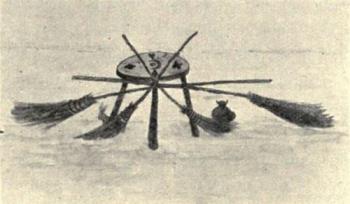
Extract from Minnigaff Kirk-Session Records.—“There being a flagrant
report yt. some persons in this parish in and about the house of Barcly
(Bargaly) have practised that piece of devilrie, commonly called ‘turning
the riddle,’ as also it being reported yt. ye principal person is one
Malley Redmond, an Irish woman, for present nurse in the house of Barcly
to ye young lady Tonderghie, as also yt. Alex. Kelly, Gilbert Kelly his
son, and Marion Murray, formerly servant in Barcly, now in Holme, were
witnesses yrto, the Session appoints ye said Malley and ye said witnesses
to be cited to ye nixt meeting.”
Malley, after some delay, at length appeared, but positively denied having
“practised that piece of devilry turning the riddle,” but acknowledged
that she had seen it done in her father’s house in Ireland by two girls on
the occasion of something having been stolen, “to fear ye guilty person
yt. it might restore yt. was stolen.” Malley was exhorted to be ingenuous,
but she persisted in asserting her innocence. The Session, therefore,
resolved to proceed to proof. The proceedings occupy a number of pages,
and are too long for insertion; but the particulars are comprehended in
the deposition of Marrion Murray:—
“Marrion Murray, aged 18 years, having been sworn, purged of malice and
partial counsel, deponeth yt. she (not having seen any other person doing
it before her), together with ye nurse held the riddle between ym. having
a pair of little schissors fastened into ye rim of the riddle, whereof ye
nurse Malley Redmond held one point and she the other, and that ye nurse
mumbled some words mentioning Peter and Paul, and that when the nurse said
these words the riddle stirred less or more, and after ye nurse had said
ye words she bad ye deponent say them too, and that she accordingly said
the same things back again to the nurse, and that the deponent had said to
ye nurse Malley before ever she meddled with it that if she knew yr. was
anything evil in doing of it she would not meddle with it, and ye nurse
replied yr. was no evil in it, and further that to sift the meddling with
it she offered to take ye child from ye lady’s arms, but ye young lady put
her to it, bidding her go do it. As also yt. further ye said Marion
depones yt. ye same day, a little after, ye young lady bad her go to ye
barn and yr do it over again with ye nurse, which she positively refused,
whereupon ye young lady did it herself with all the circumstances she and
the nurse had done it in the chambers before; moreover, that some days
after, the chamber door being close upon the young lady and her nurse
Malley, ye deponent, looking through a hole in ye door, saw ye nurse and
ye lady standing and ye riddle betwixt ym. as before, but heard nothing.
And further, yt. ye lady and her nurse bad her deny these things, but did
not bid her swear to it.”
For her participation in the affair the young lady Tonderghie, Mrs Janet
Blair, was cited before the Session, and having expressed her penitence
for being ensnared into such sinful practices, she and Marion Murray
subscribed a declaration to be read before the congregation, “abhorring
and renouncing all spelles and charmes usual to wizards; and having been
rebooked and exhorted to greater watchfulness for the future, they were
dismissed.”
The originator of the affair, Malley Redmond, after making her appearance
to be “rebooked” before the congregation, was banished the parish. But the
execution of the sentence was, through influence, delayed “till Tonderghie
younger, his child, should be weaned.”(33)
Parish of New Luce.—The only point of interest in connection with the
parish of New Luce is that the chief witness against Maggie Osborne, who
was burned as a witch at Ayr, was an elder in the Moor Kirk of Luce, to
which reference has already been made.
Parish of Whithorn.—An old woman named Elspeth M‘Keand lived on the
farm of Palmallet, near Whithorn. On one occasion she was arraigned before
the magistrates of Whithorn for some supposed uncannie doings, but the
authorities, not endorsing the general belief, set her at liberty. So
disappointed and enraged were the community at her liberation that they
caught her and inserted a host of new brass pins in her body, and
afterwards dragged her down to the shore at Dinnans, holding her below
water until life was nearly extinct. The old woman never fairly recovered
from this cruel treatment, and when she died her remains were objected to
as not being fit to rest in the Kirkyaird.(34)
Parish of Kirkmaiden.—In the parish of Kirkmaiden we find a zealous
prosecutor of witches in the person of the Rev. Mr Marshall, who was
ordained in 1697. He was assisted in his efforts by a woman brought from
the town of Wigtown, who was credited with possessing an expert faculty of
at once being able to distinguish and pick out witches and warlocks from
amongst ordinary mortals, however similar to them in outward appearance.
All the adults in the parish were summoned to attend at the Parish Church
on a given date and passed through the church from one door to the other.
The minister placed himself in the precentor’s box, with writing materials
at his hand, the witch-finder being seated beside him. When witch or
warlock passed, the woman tramped on the minister’s toes and the name was
at once recorded. A long list was thus made out, and the Kirk-Session
afterwards inquired into the charges brought against the various
individuals, which proceedings were afterwards inserted in the Session
records.
The stigma thus cast upon many families in the district was only removed
by influence being brought to bear to destroy by burning the accusing
pages of the Session records.
Tradition asserts that retribution at the hands of the Kirkmaiden witches
overtook the reverend gentleman, for, taking his accustomed walk from the
manse to the church, a hare running out of the churchyard crossed his
path, and from that time forward he was never again able to open his mouth
in the pulpit of Kirkmaiden Church. He was shortly afterwards translated
to Kirkcolm, and though he often visited Kirkmaiden he could never occupy
the pulpit, even on the day of Sacramental observance.(35)
So late as 1805 a trial took place at Kirkcudbright connected with
witchcraft which aroused considerable excitement in the district, creating
keen interest as well in legal circles.
This was the trial of “Jean Maxwell,” who was accused of “pretending to
exercise witchcraft, sorcery, enchantment, and conjuration, and
undertaking to tell fortunes.”
The point which is of note, and calls for accentuation is, that Jean
Maxwell was arraigned, not for being a witch, but for the imposition of
pretending to possess witch power. This has been commented upon by
Professor John Ferguson of Glasgow in his paper, “Bibliographical Notes on
the Witchcraft Literature of Scotland” (Publications of the Edinburgh
Bibliographical Society, vol. iii., 74 (1899), in which he says: “It will
be noticed that Jean is indicted for PRETENDING to exercise witchcraft,
etc. In fact, the indictment is made under the Act of George II., cap. 5,
which repeals the statutes against witchcraft.... It is an interesting
case, as having occurred under the repealing Act.”
The following is the indictment:—
“Jean Maxwell, present prisoner in the Tolbooth of Kirkcudbright, you are
indicted at the instance of Robert Gordon, writer in Kirkcudbright,
Procurator-Fiscal of the Steward Court of the Stewartry of Kirkcudbright
for his Majesty’s interest; that albeit by the Act of Parliament passed in
the ninth year of the Reign of King George the Second, Cap. 5th, intituled
‘An Act to repeal the Statute made in the first year of the Reign of James
the First, intituled, “An Act against Conjuration, Witchcraft, and dealing
with Evil and Witched Spirits;” except so much thereof as repeals an Act
of the fifth year of the Reign of Queen Elizabeth, against Conjurations,
Inchantments, and Witchcraft.’ And to repeal an Act passed in the
Parliament of Scotland in the Ninth Parliament of Queen Mary, intituled
‘Anentis Witchcraft; and for punishing such persons as pretend to exercise
or use any kind of Witchcraft, Sorcery, Inchantment, or Conjuration.’ It
is enacted ‘That if any person shall from and after the twenty-fourth day
of June next, pretend to exercise or use any kind of Witchcraft, Sorcery,
Inchantment, or Conjuration, or undertake to tell Fortunes or pretend from
his or her skill or knowledge in ocult or crafty science, to discover
where or in what manner any goods or chattels supposed to have been lost,
may be found; every person so offending being therefore lawfully convicted
on Indictment of Information, in that part of Great Britain called
England; or on Indictment or Libel, in that part of Great Britain called
Scotland, shall for every such offence suffer imprisonment for the space
of one whole year without Bail or Mainprize; and once in every quarter of
the said year, in some Market Town of the proper County, upon the Market
Day there, stand openly on the Pillory for the space of one hour; and also
shall (if the Court by which such Judgment shall be given think fit) be
obliged to give surety for his or her good behaviour, in such sum, and for
such time as the said Court shall judge proper, according to the
circumstances of the offence; and in such case shall be further imprisoned
until such sureties be given.’
“Notwithstanding of the said Act of Parliament, you, the said Jean
Maxwell, are Guilty, Actor, Art and Part of pretending to exercise
Witchcraft, Sorcery, Inchantment, and Conjuration; and of undertaking to
tell fortunes, &c., &c. (in the manner particularly mentioned in the
Deposition of Jean Davidson, hereto annexed). In so far as you the said
Jean Maxwell, did, upon Thursday the twenty-seventh, Friday the
twenty-eighth, and Saturday the twenty-ninth days of December last, in the
year one thousand eight hundred and four, and upon Tuesday the first and
Tuesday the eighth days of January last, in the year one thousand eight
hundred and five, or upon some one or other of the days or nights of these
months, or of the month of November immediately preceding, or of the month
of February immediately following, at Little Cocklick, in the Parish of
Urr, and Stewartry of Kirkcudbright, pretend to Tell Fortunes by Tea Cups
and the grounds of Tea; and did tell to Jean Davidson, Servant to Francis
Scott, farmer in Little Cocklick aforesaid, that she would soon bear a
Bastard to a certain young man, Hugh Rafferton; which you said you could
prevent by certain means. And you, the said Jean Maxwell, caused the said
Jean Davidson to rub or anoint her forehead and other parts of her head
with a liquid contained in bottle produced by you, which so much
intoxicated and disordered the said Jean Davidson that she would have done
anything that you the said Jean Maxwell had asked her to do; and you the
said Jean Maxwell, availing yourself of the situation that she the said
Jean Davidson was in, declared to her that the Devil would speedily appear
and tear her in pieces, unless she obeyed you, the said Jean Maxwell, in
every particular. And you, the said Jean Maxwell, caused the said Jean
Davidson take oaths of Secrecy for the purpose of concealing your wicked
and felonious purposes. That on the said twenty-seventh day of December
last you, the said Jean Maxwell, caused the said Jean Davidson produce a
Guinea Note, which you pretended to hold up in a small bit of paper,
putting round it some lint, and stitching in it nine pins, after which you
gave it to the said Jean Davidson and ordered her to cast it into the
fire, which she did accordingly. And you, the said Jean Maxwell, then
ordered the said Jean Davidson to bring one of her shifts and three
shillings with it, which you sewed up in the tail of the shift, and said
that the shift was to be consumed in the fire, as an Offering to the
Devil, who was to appear at the time of the burning of the shift, in the
shape of either a Bull or a Swine; and at the same time you, the said Jean
Maxwell, gave to the said Jean Davidson a powder sewed up in a piece of
fine linen and stuck through with nine pins, which you injoined her to
wear at her breast till the day of her death, and tell no mortal of it.
That on the said twenty-eighth day of December last you, the said Jean
Maxwell, told the said Jean Davidson that the Devil had rejected two
sixpences of the money formerly sent him in the tail of the shift; that he
insisted in lieu of the sixpences to have two shillings with heads on
them; and that he was up and stirring, and must be satisfied; and the said
Jean Davidson, having furnished the shillings, you, the said Jean Maxwell,
after stamping on the ground twice or thrice with your foot, pretended to
hand them to Satan as if he had stood behind you. That on the said
twenty-ninth day of December last you, the said Jean Maxwell, declared to
the said Jean Davidson that the Devil was still up, and that he must have
a man’s shirt of plain linen, and in it a shoulder of mutton; and the said
Jean Davidson, terrified by your threats, gave you a check shirt of the
said Francis Scott’s, her master, together with a Shoulder of Mutton, also
his property, tied up in the shirt; and you the said Jean Maxwell, tied up
these articles in your own Budget; and then, telling the said Jean
Davidson that all this was insufficient to lay the Devil, you asked her
for half-a-crown more; and the said Jean Davidson in confusion and fright
gave you a Dollar, which you said would do as well, and that at any rate
it must not be taken back being once offered; and then you the said Jean
Maxwell, went to the back of the byre at Little Cocklick aforesaid, and
returned and told the said Jean Davidson that you had laid the Devil so
that he could not come nearer her than the back of the byre, but cautioned
her strongly not to travel that way nor farther after it was dark. That on
the said first day of January last, you the said Jean Maxwell returned to
Little Cocklick aforesaid, and told the said Jean Davidson, that Hugh
Rafferton was to be with her on the Thursday ensuing, very lovingly and
ready to marry her, or do whatever she should ask of him: and moreover,
you the said Jean Maxwell declared that, if the said Jean Davidson used
Hugh Rafferton harshly, and refused to marry him, Hugh Rafferton would
lose his reason and go stark mad at the end of eight weeks; that in the
meantime however you must have another Guinea Note for the Devil, with a
faced shilling in it; and the money was furnished by the said Jean
Davidson; when you the said Jean Maxwell clipped or pretended to cut the
note, in small pieces with scissors, pretending that in this manner it was
to be presented to the Devil alongst with the faced shilling. That soon
after this, you the said Jean Maxwell, told the said Jean Davidson that
the first note was not accepted, and that you must have an Old and very
Tattered Note and three Shillings more, which having been furnished by the
said Jean Davidson, you the said Jean Maxwell bound up the Note with paper
and lint, and having stuck it with nine pins gave it to the said Jean
Davidson who threw it into the fire; and you the said Jean Maxwell, after
stamping on the ground, handed the three Shillings behind you so that
Satan might receive them as you pretended he had received the former
presents; that these things being done, you the said Jean Maxwell left the
said Jean Davidson at her father’s house at Killymingan, in the Parish of
Kirkgunzeon, on the said first day of January last, declaring that Hugh
Rafferton should wait on her in deep humility on the Thursday ensuing; and
that all the money offered to Satan should be returned into the said Jean
Davidson’s Chest on the subsequent Friday morning by sun-rising; and that
all should be, and really was, perfectly right. That on the said eighth
day of January last you the said Jean Maxwell again waited on the said
Jean Davidson, at the house of the said Francis Scott, in Little Cocklick
aforesaid, and told that all was gone wrong, that the Devil had proved too
strong for you, the said Jean Maxwell, and had rent a check apron given
you by the said Jean Davidson formerly for a burnt offering; and you the
said Jean Maxwell pretended to show the distinct marks of Satan’s claws,
and the mark of his Thumb on your arm, adding, that he could not be laid
without the aid of John M‘George, commonly called the ‘Devil-Raiser’ of
Urr; and for that end, you the said Jean Maxwell demanded Two Notes more,
and three pieces of flesh meat, one of them to be pork, which you
professed to roll up at great peril in the check apron; and you the said
Jean Maxwell also insisted to have the said Jean Davidson’s duffle cloak,
but the said Jean Davidson, having by this time got into the use of her
reason, got the better of the terror of the oaths of secresy imposed upon
her by the said Jean Maxwell, managed so as to detain you until a
Constable was sent for, who took you into Custody and carried you before
the Reverend Dr James Muirhead of Logan, one of his Majesty’s Justices of
the Peace for the Stewartry of Kirkcudbright, in whose presence you
emitted a Declaration, upon the ninth day of January last, in the year one
thousand eight hundred and five, which Declaration is subscribed by your
mark, and by the said Dr James Muirhead, because you declared that you
could not write; and the said declaration being to be used in evidence
against you the said Jean Maxwell, will in due time be lodged with the
Steward Clerk, that you may have an opportunity of seeing the same.
“At least times and place aforesaid, WITCHCRAFT, SORCERY, INCHANTMENT, and
CONJURATION, were pretended to be exercised and used, and fortunes were
undertaken to be told, all in manner particularly before mentioned; and
you the said Jean Maxwell, are Guilty Actor, Art and Part of the said
crimes; All which, or part thereof, being found proven by the Verdict of
an Assize before the Steward-Depute of the Stewartry of Kirkcudbright, and
his Substitutes, in a Court to be holden by them or either of them within
the Court-House of Kirkcudbright, upon the twenty-first day of June, in
the present year one thousand eight hundred and five; you the said Jean
Maxwell, Ought to be imprisoned in the Tolbooth of Kirkcudbright by the
space of one whole year without Bail or Mainprize; and once in every
quarter of the said year, to stand Openly in the Jugs or Pillory, at the
Market Cross of the Burgh of Kirkcudbright, by the space of one hour; and
to be farther imprisoned in the said Tolbooth, for your good behaviour, in
such sum and for such time as the said court shall judge proper, agreeably
to the provisions and enactments of the said Act of Parliament, to deter
others from committing the like crimes in time coming.”
The Procurator-Fiscal concluded his Proof, and the Steward-Depute remitted
the Cause to the Verdict of the Assize.
The persons that passed upon the Assize of the said Jean Maxwell, returned
their Verdict to the Court; and the tenor thereof is as follows:—
“At Kirkcudbright, the 21st day of June, 1805, the Assize being enclosed,
did make choice of Alexander Melville of Barwhar to be their Chancellor,
and William Mure, Factor for the Earl of Selkirk, to be their Clerk; and
having considered the Indictment raised at the instance of Robert Gordon,
Writer in Kirkcudbright, Procurator-Fiscal of Court for His Majesty’s
interest, against Jean Maxwell, present Prisoner in the Tolbooth of
Kirkcudbright, the Pannel, with the Interlocutor of the Steward-Depute of
the Stewartry of Kirkcudbright thereon, and the whole Proof adduced, they
Unanimously Find the said Jean Maxwell Guilty of the Crimes charged
against her in the said Indictment. In Testimony, whereof, &c.
(Signed) Alexr. Melville, Chancellor.
(" ) Will. Mure, Clerk.”
(Court adjourned for a week.)
“Kirkcudbright, 28th June, 1805.
“The Steward-Depute having considered the Verdict of the Assize, bearing
date the twenty-first day of June current, and returned into Court that
day against Jean Maxwell, the Pannel, whereby she is found guilty of
pretending to exercise WITCHCRAFT, SORCERY,
INCHANTMENT, and CONJURATION,
and of undertaking to tell fortunes, contrary to the Enactments and
Provisions of the Act of Parliament passed in the 5th year of the Reign of
King George the Second, Chapter fifth, in the manner charged against her
in the Indictment, at instance of the Procurator-Fiscal of Court; the
Steward Depute, in respect of the said Verdict, Decerns and Adjudges the
said Jean Maxwell to be carried back from the Bar to the Tolbooth of
Kirkcudbright, and to be Imprisoned therein for the space of One Whole
Year, without Bail or Mainprize; and Once in every Quarter of the said
year to stand openly upon a Market day in the Jugs or Pillory, at the
Market Cross of the Burgh of Kirkcudbright, for the space of One Hour,
&c.—(Signed) Alexr. Gordon.”
It only remains to be added that this sentence was rigorously carried out.
A small, and now scarce volume, containing a full account of the trial,
was published at Kirkcudbright the same year, of which the following is a
copy of the title-page:—
REMARKABLE TRIAL
OF
JEAN MAXWELL
THE
Galloway Sorceress:
Which took place at Kirkcudbright
on the twenty-eighth day of June last,
1805:
For Pretending to Exercise
WITCHCRAFT, SORCERY, INCHANTMENT,
CONJURATION, etc.
“And that distilled by Magic slights
Shall raise such artificial sprights,
As by the strength of their illusion
Shall draw him on to his confusion.”
—Macbeth. |
KIRKCUDBRIGHT:
Printed by Alexander Gordon.
1805.
Proceedings in Dumfriesshire.
Concerning Dumfriesshire there falls to be recorded numerous instances of
accusation and trial, which includes the ever-to-be-regretted consummation
of fanaticism in this district—the burning of nine unhappy women on the
Sands of Dumfries in the year 1659.
Burgh of Dumfries.
Extract from the Dumfries Burgh Treasurer’s Books, May 27th,
1657.—Detailed items of expenditure incurred at the burning of two women
convicted of witchcraft: “For 38 load of peitts to burn the two women, £3
12s (Scots). Mair, given to William Edgar for ane tar barrell, 12s; for
ane herring barrell, 14s. Given to John Shotrick, for carrying the twa
barrells to the pledge (house), 6s. Mair, given to the four officers that
day that the whiches was burnt, at the provest and bayillis command, 24s.
Given to Thomas Anderson for the two stoups and the two steaves (to which
the women were tied), 30s.”(36)
Resolution of Kirk-Session of Dumfries, 1658.—The Kirk-Session of
Dumfries, after solemn deliberation on the subject, required the minister
to announce from the pulpit that all persons having evidence to give
against such as were under suspicion of “the heinous and abominable sin of
witchcraft,” should be ready to furnish the same to the Session without
delay; and at their next meeting the elders wisely qualified the order, by
resolving that anyone who charged another with being guilty of “sic
devilisch practises,” without due reason, should be visited with the
severest discipline of the Kirk.(37)
Official Information regarding the burning of the nine women on the Sands
of Dumfries, 13th April, 1659.
These women were first strangled and then burned. The following
particulars were gleaned from the books of the High Court of Justiciary
kept at the Register House, Edinburgh:—
1659.—The Court was opened at Dumfries on the 2nd of April, in the
above year, by the “Commissioners in Criminal Cases to the people in
Scotland,” Judge Mosley and Judge Lawrence; and that ten women, each
charged with divers acts of witchcraft, were brought before them for
trial. The proceedings appear to have lasted until the 5th. One of the
accused, Helen Tait, had a rather narrow escape—the jury finding by a
plurality of voices that the “dittay” in her case was “not cleirly
proven.” Nevertheless, before being dismissed from the bar, she was
required to find security to the extent of £50 sterling for her good
behaviour, and that she would banish herself from the parish. The nine
other unfortunates were all convicted, as is shown by the subjoined
minute, giving the finding of the jury and the deliverance of the judge,
as pronounced by the official dempster, “F. Goyyen”:—(38)
“Drumfreis, the 5th of Apryle, 1659.—The Commissioners adjudges Agnes
Comenes, Janet M‘Gowane, Jean Tomson, Margt. Clerk, Janet M‘Kendrig, Agnes
Clerk, Janet Corsane, Helen Moorhead, and Janet Callon, as found guilty of
the severall articles of witchcraft mentioned in the dittayes, to be tane
upon Wednesday come eight days to the ordinar place of execution for the
burghe of Drumfreis, and ther, betuing 2 and 4 hours of the afternoon, to
be strangled at staikes till they be dead, and therefter ther bodyes to be
burned to ashes, and all ther moveable goods to be esheite. Further, it is
ordained that Helen Moorhead’s moveables be intromitted with by the
Shereff of Nithsdaile, to seize upon and herrie the samin for the King’s
use.”(39)
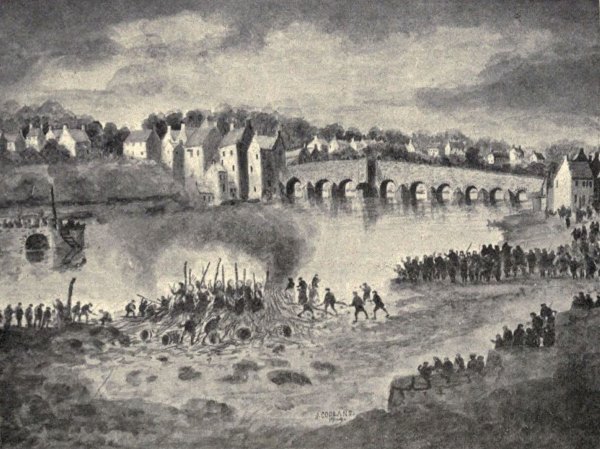
The Burning of the Nine Women on the Sands of Dumfries, April 13th, 1659.
(Sketch by J. Copland, Dundrennan.)
Resolution of the Dumfries Presbytery regarding the attendance of
clergymen before the carrying out of the sentence, and at the actual
“burning” of the women, on the Sands:—
“5th April, 1659.
“The Presbytery have appoynted Mr Hugh Henrison, Mr Wm. M‘Gore, Mr George
Campbell, Mr John Brown, Mr Jo. Welsh, Mr George Johnston, Mr Wm. Hay, and
Mr Gabriel Semple, to attend the nine witches, and that they tak thair own
convenient opportunity to confer with them; also that they be assisting to
the brethren of Dumfries and Galloway the day of the Execution.”(40)
Dumfries, 14th November, 1664.—An edict from the Town Council: “The
Counsall being informed that Janet Burnes, commonly reputed a witche, and
quho hath bein banished out of severall burghis, and put out of this burgh
in the month of August last, for cheating the people upon pretence of
knowledge of all things done by them in tym past, or that may fall out in
tym cuming, with certification to be scurgit if ever she was sein within
the burgh theireafter; and being well informed that she was sein within
the town on Saturday, they have ordaint that intimation be made by touk of
drum, that non of the inhabitants resset or give meit or drink unto the
said Janet Burnes.”(41)
Court of Justiciary, Tolbooth of Dumfries, May 18th, 1671.—Warrant for
the execution of two alleged witches: “Magistrates of Drumfreis, Forasmuch
as in ane Court of Justiciarie, holden be us within the Tolbuthe of
Drumfreis, upon the fyftein day of May instant, Janet Muldritche, and
Elspeth Thomsone, now found guiltie be ane assyze of the severall articles
of witchcraft specified in the verdict given against them thereanent, were
decerned and adjudged be us, The Lords Commissioners of Justiciary, to be
tane upon Thursday next, the eighteen day of May instant, betwixt two and
four houres in the afternoune, to (the) ordinare place of executione, for
the toune of Drumfreis, and there to be worried at ane stake till they be
dead; and theirafter their bodies to be burnt to ashes, and all their
moveable goods and geir to be escheit. You shall thairfoir cause put the
said sentence to due executione, whereanent their presents shall be your
warrand. Given at Drumfreis the sixteen day of May, 1671.”(42)
Court of Justiciary, Dumfries, 1709.—Last trial for witchcraft in
Scotland: The accused was named Elspeth Rule; the indictment against her
being that she was by habit and repute a witch, and had used threatening
expressions towards persons at enmity with her, who, in consequence of
such menace, suffered from the death of friends or the loss of cattle,
while one of them became mad.
The jury by a majority of votes found the charges proven; and the judge
condemned the prisoner to be burned upon the cheek with a hot iron and
banished for life. It is told how, when this brutal act of branding the
cheek was being carried out, smoke was seen issuing from the poor woman’s
mouth.(43)
Dumfries and Major Weir, the notorious Edinburgh warlock—a slight
connecting link with Dumfries.
In his more youthful days Major Weir led an active military life,
serving as an officer in the Puritan Army during the Civil War (1641).
In the Registers of the Estates under March 3rd, 1647, reference is
made to a supplication by Major Thomas Weir, asking “that the
Parliament wald ordain John Acheson, Keeper of the Magazine, to
re-deliver to the supplicant the band given by him to the said John
upon the receipt of are thousand weight of poulder, two thousand
weight of match, and an thousand weight of ball, sent with the
supplicant to Dumfries for furnishing that part of the country.”
Presbytery of Dumfries (Southern District), March, 1692.—Marion Dickson
in Blackshaw, Isobel Dickson in Locherwood, Agnes Dickson (daughter of
Isobel), and Marion Herbertson in Mouswaldbank, had for a long time been
“suspected of the abominable and horrid crime of witchcraft,” and were
believed to have “committed many grievous malefices upon several persons
their neighbours and others.” It was declared to be damnifying “to all
good men and women living in the country thereabouts, who cannot assure
themselves of safety of their lives by such frequent malefices as they
commit.”
Under these circumstances, James Fraid, John Martin, William Nicolson, and
Thomas Jaffrey in Blackshaw, John Dickson in Slop of Locherwoods, John
Dickson in Locherwoods, and John Dickson in Overton of Locherwoods, took
it upon them to apprehend the women, and carried them to be imprisoned at
Dumfries by the sheriff, which, however, the sheriff did not consent to
till after the six men had granted a bond engaging to prosecute. Fortified
with a certificate from the Presbytery of Dumfries, who were “fully
convinced of the guilt (of the women), and of the many malefices committed
by them,” the men applied to the Privy Council for a commission to try the
delinquents.
The Lords ordered the women to be transported to Edinburgh for trial.(44)
Kirk-Session of Caerlaverock.—Charge of alleged divination brought at
their instance, before the Dumfries Presbytery, 22nd March, 1697:
“Compeared John Fergusson in Woodbarns, who acknowledged his scandalous
carriage in charming and turning the key at Bankend conform to the
accusation, but says he knew not there was any evil in it. The Presbytery
appoint him to stand on the pillar in the church of Caerlaverock, and be
sharply rebuked for his scandalous practice and recommends him to the
magistrates to be secured till he give bail to answer and satisfy conform
to this act.”
The actual circumstance connected with this charge of alleged divination
are briefly as follows:—About the middle of January, 1697, two men
returning from Dumfries entered the tavern of William Nairns at Bankend of
Caerlaverock. These were John Fergusson of Woodbarns, Cummertrees, and
William Richardson, Cummertreestown. On leaving the inn Richardson
discovered that a sack of provisions had been taken from the saddle of his
horse which had been tied to a ring at the door. Entering the house, he
made known his loss, declaiming loudly against the thief. In the utmost
sympathy with his friend’s loss, Fergusson declared he could soon find out
who the thief was, and called out that two Bibles should be brought to him
at once, to which the landlord stoutly demurred; but Fergusson threatened
that unless he got his own way he “would make bloody work among them,” and
two Bibles were accordingly brought to the said John Fergusson, “who
brought a key out of his pocket and put the one end of it within one Bible
and the bowl end out, clasping the Bible upon it, and two holding the bowl
of the key upon their fingers. The said John then read three verses of the
50th Psalm out of the second Bible, beginning always at the 18th verse,
always naming a person before he began to read, till they came to William
M‘Kinnell in the same town; and when they named him, and were reading the
said Scripture, the key and the Bible turned about and fell on the table.
This was done three times, as attested by James Tait, mason, who is
quartered in Townhead; James Fergusson, servitor to George Maxwell of
Isle; George Fergusson in Bankend; and William Nairns, in whose house it
was done.”(45)
Extracts from Irongray Kirk-Session Records.
“September 24th, 1691.
“David Muirhead of Drumpark and his wife, being called before the Session
and examined anent ane strife betwixt them and Janet Sinklar, submitted
themselves to the will of the Session. Janet Sinklar also submitted to the
will of the Session for saying that she doubted Drumpark’s wife of murder
and witchcraft, and is appointed to receive publick rebuke before the
congregation.”
“August 30, 1691.
“William Anderson in Hall of Forest, being called before the Session for
bringing his child to a smith to be charmed with ane forge hammer,
confessed his sin and received a rebuke before the Session.”
“November 13, 1692.
“John Charters in Barncleugh, being called before the Session as witness
nominat by James Wright to prove witchcraft against Janet Kirk, denied
that he knew anything of witchcraft in her. Margaret Smyth, wife of John
Jonston, being called before the Session, declared in her hearing that
Janet Kirk, being brought in to Elizabeth Jonston, being grievously
tormented with sickness like to distraction, pronounced these words, that
‘if God had taken the health from her let Him given it again, and if the
devil had taken it from her to give it her again.’ On which she was
rebuked.”
“April 16th, 1693.
“Jean Stot (Ingleston) confessed before the Session that she blessed God
if Jean Grier’s prayings had any pith that they lighted on a kow and not
on a person, and did say that Jean Kirkpatrick did gather root grown
briers on a Saboth day, and nominat Agnes Patton for a witness.”
The Session found “wrath and malice among the inhabitants of Ingleston,”
and the minister was sent as peacemaker. “Jean Stot obeyed the minister
and forgave Jean Grier, and also required forgiveness of her, which she
refused till further advisement.”(46)
Parish of Irongray.—Traditional account of the sacrifice of a reputed
witch by enclosing her in a tar-barrel, setting it alight, and rolling it
into the Water of Cluden:—
“In the reign of James VI. of Scotland, or under the early Government of
his son Charles, tradition tells of a woman that was burnt as a witch in
the Parish of Irongray, about seven miles west from Dumfries. In a little
mud-walled cottage, in the lower end of the Bishop’s Forest, and nigh the
banks of the Water of Cluden, resided a poor widow woman, who earned her
bread by spinning with a pole, and by weaving stockings from a clue of
yarn depending from her bead-strings. She lived alone, and was frequently
seen on a summer’s eve, sitting upon a jagged rock, which overhung the
Routing burn, or gathering sticks, late in a November evening, among the
rowan-tree roots, nigh the dells which signalise the sides of that
romantic stream. She had also, sometimes, lying in her window a
black-letter Bible, whose boards are covered with the skin of a fumart,
and which had two very grotesque clasps of brass to close it with when she
chose. Her lips were sometimes seen to be moving when she went to church,
and she was observed to predict shower or sunshine at certain periods,
which predictions often came to be realised....
“The Bishop of Galloway was repeatedly urged to punish this witch; and
lest it should be reported to the king that he refused to punish witches,
he at last caused her to be brought before him, nigh to the spot. She was
rudely forced from her dwelling, and several neighbours of middle or of
old age were cited to declare all the wicked things she had done.
“She was sentenced to be drowned in the Routing burn, but the crowd
insisted that she should be shut up in a tar-barrel and hurled into the
Cluden. Almost against the Bishop’s consent, this latter death was
consummated. The wretched woman was enclosed in a barrel, fire was set to
it, and it was rolled, in a blaze, into the waters of Cluden.
“Such, says the tradition of no very doubtful date, was the savage end of
one who was reputed a witch. The spot where, ’tis said, the prelate sat,
is yet called Bishop’s Butt. The well from which she drew the water for
her domestic use, and where the young rustic belles washed their faces,
still retains the name of the Witch’s Well; and a pool in the Cluden, nigh
to the well, often bears the name of the Witch’s Pool. Even some rocks
nigh to the Routing Bridge are still pointed out, where she was wont to
sit; and a hollow into which, say some, she used to throw an elfin clue.
That wood yet feathering the hill side west from Drumpark, always bears
the name of the Bishop’s Forest; and the sylvan ravine, furrowed by a
brawling brook, has been, by some now in their graves, named the Warlock’s
Glen.”(47)
Parish of Closeburn.—Janet Fraser, called before the Presbytery of
Dumfries, 1691. Her remarkable revelations:—
“The person is a young woman, unmarried, of the age of about twenty years,
whose name is Jonet Fraser, or, as we in the south used to pronounce it,
Frissel, who then lived, and yet lives, with her father, Thomas Frissell,
a weaver to his trade, a man of unblamed conversation, in the sheriffdome
of Dumfries, in the countrey thereof called Nithisdale, and parochin of
Closeburn, six miles, or thereby, from the town of Dumfriece.
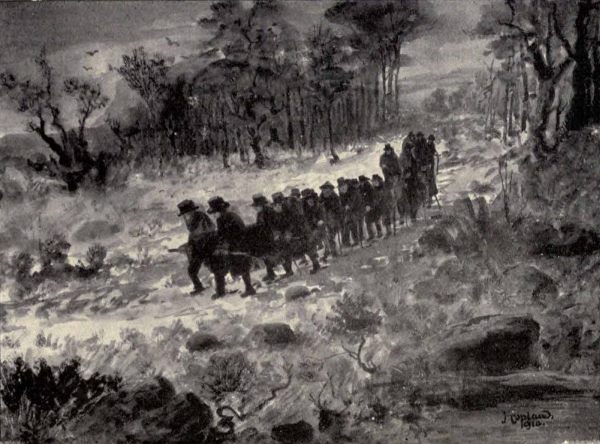
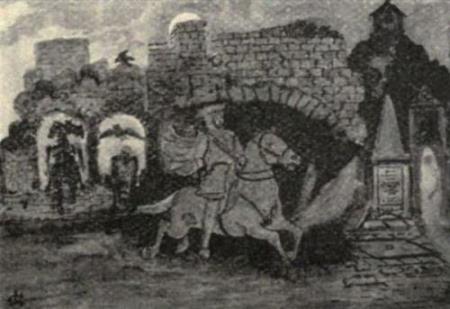
“Penance.”
(Sketch by J. Copland, Dundrennan.)
“She is, and hath been for a long time, a person in the judgment of all
that know her a serious Christian; and was for a good time before this
befell her, more then ordinary exercised in private condition with God, as
the relation after-specified gives the reader a little touch.
“She can read print, but cannot write herself; but whatever she saw in
vision, was at times able to give ane exact account of it, after all was
over; and accordingly did give the relation following to some creditable
gentlemen, and some country people, her acquaintance:—
“The time of my exercise was eight years, and all this time was troubled
with the appearance of a thing like a bee, and other times like a black
man, and that also at severall times, and in severall places.
“Then at the end of the eight year, I being at prayer, the black man did
appear as at other times, he being upon the one side of me, and there
appearing upon the other side a bonny hand and a rod in it, and the rod
was budding; and I said, ‘Is that Thy hand and Thy rod, O Lord?’ And I was
content to embrace the one, and flee the other. Then, upon that night
eight nights, I was coming home near hand unto my dwelling, I grew very
drowsie, and fell asleep, and there was a voice said to me, ‘Awake, why
sleepest thou?’ And there was lightning round about me; and I looking up
to the top of a bush that was at my hand, there was the shape of a dove
that went alongst with me in company to the house.
“Then, about three quarters of a year thereafter, the rod appeared again
to be a double rod, or a rod that was springing and forthcoming, and after
that time I was never troubled with the black man any more.”
Her first revelation was on the 4th of June, 1684, but it is very
difficult to make out what her visions portended:—“On the 5th day of
November, 1684, I being at prayer, there appeared unto me, in a bodily
shape, three persons (as to my sight all in white), and they goe round
about me the way the sun goeth; their coming was still after one manner,
when I was at my duty, only I discern he that spoke first at one time,
spoke first at all times, and so continued to speak by course, with
Scripture notes, naming books, chapter, and verse—sometimes all the
verse, sometimes a part.”
She was greatly concerned about the suffering remnant, and had many
mysterious responses as to that. This intercourse with spirits continued
for some years, and is very circumstantially detailed in the MS., at the
conclusion of which is this additional miracle:—
“Besides what the reader has had formerly, he has likewise this following
account of a passage that befell this holy woman, the 1st May, 1687, which
was Sunday. This Jonet Frazer, and a young lass, a sister daughter of
hers, about 17 or 18 years of age, having gone out into the fields, and
both of them lying down on the grass near the water of Nith, which is but
a bow-draught from her father’s house, and both of them reading their
Bibles, and lying about the distance of four yards the one from the other,
this Jonet Frazer is taken with a great drouth, and goes to the water of
Nith to take a drink, leaving her Bible open at the place where she was
reading, which was the 34th chap. of Esaiah, from verse 5 to 11,
inclusive, which begins—‘For my sword shall be bathed in heaven; behold
it shall come down on the people of Idumea, and upon the people of my
curse, to judgment,’ etc. And when she had returned immediately as shoon
as she could take a drink of water, she sees her Bible is coloured with
bloud, as she thought, though afterwards, upon inspection and tryall it
was not bloud, but red as bloud, and such as no person by the colour could
discern from bloud; upon which she asks the other lass, ‘If any thing had
been near her Bible?’ And she answered, ‘Nothing that she saw.’ She asks,
‘How could it then be that her Bible was covered over with bloud?’ Which
both of them going near, found to be the very same place where Jonet was
reading, viz., from verse 5 to 11, and some farther of the 34th chap., so
as the print was not at all legible. The other lass would have her wipe
off the blood, but she could not, but carried it as it was to her father,
and a brother of hers, a godly young man, who is dead since, and some
others, and did show it to them, who were curious to taste it, and it had
a welsh taste, as if it had been some metear; the hens and birds would not
pick it up.
“The very next Lord’s day, 8th May, this Jonet being in her father’s barn
about ane hour alone, some little time before sunset, she came to the door
of the barn to read, and while she was reading, about the 49th verse of
Jeremiah, the like bloud did cover all that place which she was reading,
viz., from the 46th verse to the 54th, as I remember, so thick as it
marred all the print and made it unintelligible, nor did she ever perceive
it fall down upon the book, or observe it till it did cover and spread
over all that place; and it is to be remarked, she was standing within the
door, the thatch of the barn being over her head and over the book that
she was reading on, and that the bloud covered the print in the very time
wherein she was reading, it spread over that part of it.
“The very next Sabbath thereafter, 15th of May, while she is again in that
same barn, reading the 14th chap. of Revelations, the like bloud fell on
the book, and covered all the chapter from the 9th verse to the end of the
chapter, in the very act of the reading it, and which, she said, that she
perceived it not, but about half ane inches distance from the book before
it fell down upon it.
“The relater heirof is Maister Henry Maxwell, of Dalswinton, who dwells
within two miles of the place where she dwells; saw the Bible, and the
bloud upon all the three places of that Bible, which is still extant.
“It is not bloud, for it is as tough as glew, and will not be scrapped off
by a knife as bloud will; but it is so like bloud as none can discern any
difference by the colour.”
After this course of vision and bloody showers, Mrs Frazer, it would
appear, fell under the suspicion of dealing with evil, in the place of
good, spirits. For in the year 1691 she was called before the Presbytery
and confessed: “That she pretended to prophecying and seeing of visions,
and that she had sinned greatly in being deluded by Satin, causing her
prophecie and see things future. Her book was appointed to be examined by
two of the Presbytery; and on her second appearance she acknowledged that
she was possessed by some evil spirit, and humbly besought the prayer of
the ministers and of all others; upon which the further examination of
herself and the witnesses was delayed. Nothing more is heard of her.”(48)
Records of Penpont Presbytery, 1706.
From January to March in the year 1706 the Presbytery of Penpont was
occupied with the case of the Rev. Peter Rae, minister of Kirkbride. Mr
Rae was slandered by a woman who alleged that he called her a “witch,” and
when sick said to her, “They say you have my health, so give it again if
you have it,” and also called her to come near hand him, and when she came
he presently bled her on the “forrit” (forehead).
It was proved that Mr Rae did call her a witch, and did in his illness
endeavour to draw blood from her brow, for which he was rebuked.
In 1737 Mr Rae was translated from Kirkbride (an extinct parish in
Nithsdale now embraced in the parishes of Durisdeer and Sanquhar) and
became minister of Kirkconnel. He was also clerk to the Presbytery of
Penpont, before whom in earlier years he appeared. He is perhaps better
known as the author of The History of the Late Rebellion[15] (1715). A
man of outstanding ability, his memory is honoured by a mural tablet
placed in the south wall of Kirkconnel church.
Glencairn Kirk-Session Records.
“Apryl nynth, 1694.”—Case of Margret M‘Kinch (not “M‘Onrick,” as given
by Monteith,[16] p. 44). In the evidence it is stated that:
“Robert Muir in Dunregon came in to James Rodgerson’s hous, drew his knyf
and offered to blood her abov ye b——” [paper torn—breath (?)].
“On Apryl nynth, 1694, Margt. M‘Kinch gave in an wrytten list of ye names
who had sclandered her by calling her an witch, earnestly desiring ye
Session to put the same to —— [proof(?)] that she myght be free from ye
scandal.”
[Gap in the records, 1694-1700.]
10th September, 1704.—“Appoints yt it be publickly intimate upon Sabbath
first that no Heritor, tennent, or Householder whatsomever within this
paroch resett our harbour Jaunet Harestanes, sometime in Keir paroch, with
certification.”
24th September, 1704.—“Appointment obeyed in makeing intimation anent
Jaunet Harestanes, reputed to be under the mala-fama of witchcraft.”
14th November, 1707.—Case of Alexander Deuart (not “Douart” as given by
Monteith, p. 44):—
Alex. Deuart, gardener, at Maxwelton, is charged with having “brought back
some stolen goods by charm or enchantment or some other pretended ocult
quality in herbs, along with some mutterings and gestures, as makes him so
commonly reputed a charmer that he is sought unto by persons from divers
corners of the country to the great scandal of religion. The said Alex.
being interrogated primo—Did you bring back those things which was stolen
from Maxwelton—aiz., six pair sheets, ten ——— [undecipherable], three
aprons, at one time; a large silver tumbler at another time; and a book at
a third time?
A. Yes; I was the causer, but had no hand in it myself.
Q. Did you not take money for the bringing of them back?
A. I told them I could do such things if it was not injurious to any,
and told that he took money for the bringing of them back.
Q. How did you bring them back?
A. I cannot tell that, for I promised not to tell where I received my
art.
Q. Did you make use of herbs as it is reported of you in order to the
bringing of them back?
A. I did make use of herbs in part, but not for the bringing of them
back.
Q. How did you make use of the herbs that you might know where they
were?
A. I laid them under my head and dreamed of them.
Q. What are the herbs which had that effect upon your sleep?
A. I will not tell that to any living if they should saw me asunder.
Q. How came the cloaths back?
A. I must cause some brother of trade who dwells near hand them to tell
them who have them that they must be brought back and they should not be
wronged.
Q. Why did you not tell of the people who took away these cloaths,
seeing thieves ought to be discovered for the good of the country?
A. It doth not belong to me to put out any man, otherwise I should be in
eternity this day eight days.
Q. Did any person bring the things back, or how came they back?
A. I brought them not back, but the people who took them away brought
them back.
Q. But how could the silver tumbler be brought back and put in a
fast-locked room?
A. The person who took it flung it in at the window upon one of the
shelves.
(Notandum—Now it was told him that all the windows were fast-snecked,
as the servants who went in to take up the tumbler declared.)
Q. Did you not say when the tumbler was got, ‘I must have the hair that
was in and about it, for it is the hair of a horse which belonged to a man
who is shortly to be hanged for stealing?’
A. Yes.
Q. Did you not say to Sir Walter Laurie, ‘lock me ever so close in a
room and I will cause all the cloaths that were taken away hang down upon
the spouts of the tower upon the morrow morning?’
A. Yes.
Q. Did you not say before me, the Minister, ‘lock the cloaths again in
as fast a room as you can, and I’ll cause them, for a little money, go all
back in the place where they were?’
A. Yes.
Q. Why did you not bring back the silver spoon that was lost?
A. It was in Edinburgh, and the name was scraped out, and I could not
bring it back until I went to Edinburgh.
Q. Why did you not bring back the mattock and other things?
A. It had been on fire.
Q. Why did you not bring back all the aprons, for there is one of them
awanting yet?
A. I could not bring it back because it was burnt, and when a thing is
hid beneath the ground or the like I can’t get wott of that.
Q. Did you not mutter some words when you used these charms?
A. Yes.
Q. What are they?
A. ‘Cloaths, cloaths, cloaths, and other things lost.’
Q. Whether did you use such charms afore Hallow-een as throwing nuts in
the fire, sowing seeds up and down the house, and herbs to every corner,
going backwards from the fire to the door, round the close backwards, up
the stairs backward, and to your bed backward?
A. Yes.
Q. Being told by a Minister that from what he had heard there was either
devolrie in it, or he was the thief himself. To which he replied, ‘I shall
make it out to be no devolrie; or if it be devolrie, it is unknown to me.’
Q. Did you not bring back a book of Mrs Violet’s?
A. Yes.
Q. Did you not say you could cause any woman in London come down to you
if but told her name?
A. I could do it, and I can.
Q. Did you not say in the presence of Sir Walter Laurie, Bailie Corbet
in Dumfries, James Gordoun, Wryter, Yr., and me, that you could cause any
of us dance naked?
A. I did, if you would take what I give you; and also added that he
could cause any woman follow him if she would take what he would give her.
Q. Alexander, where learned you that art?
A. I learned it from the gardener at Arnistoun, now dead, but was at my
brothering.
Q. But are there any alyve that was at your brothering?
A. No.
After all which, the Moderator said unto him: ‘Saunders, did you not say
to me when I was poseing you privately about these things, and telling you
that from all I had heard from you that I was convinced that you were
either a thief or a devol?’ and you replied, ‘Pursue me, sir, before
either Session or Presbytery, and I shall show that I am neither.’ And
now, Saunders, after all these interrogatories are considered, I rather
think you did take these things yourself, and therefore you can get no
testificat (certificate) until your business be further cognosed upon.”
13th July, 21st Sept., and 26th Oct., 1712.—Complaint from Jean Howatson
in Nies that Margaret Nivison in Crichen had called her “a witch and a
resetter of witches.”
Both rebuked for their “scandelous and offensive expressions,” and
“Injoyned to abstain from any such offensive carriage in time comeing,
certifying withall that if they be found quarrolling with one another
unjustly this process shall be revived again upon them.”
Indirect references affecting Durisdeer and Torthorwald.
Parish of Durisdeer.—In 1591 a member of the family of Douglas of
Drumlanrig, “Barbara Naipar, spous to Archibald Douglas,” was accused of
witchcraft and condemned to be burned on the Castle Hill of Edinburgh.
Examination of the indictment shows that the charge was really implication
in the crime by countenancing and seeking help from “users and abusers of
witchcraft,” which, as we have seen, carried with it the extreme penalty.
The following is the extract from Pitcairn’s Criminal Trials:—
“May 8, 1591.—Barbara Naipar, spous to Archibald Douglas, burges of
Edinburgh (brother to the Laird of Carschogill), Dilaitit of sindrie
poyntis of witchcraft, contenit in Dittay gewin in against hir be Mr David
M‘gill of Cranstoun—Rydell, advocat to our soverane lord.
“The Assyse, be the mouth of Robert Cuningham, chancillor, ffand,
pronunceit, and declarit the said Barbara Naipar to be fylit, culpabill
and convict of the seiking of consultation from Annie Sampsoune, ane wich,
for the help of Dame Jeane Lyonne, Lady Angus, to keip hir from vomiting
quhen sche was in breeding of barne. Item, for the consulting with the
said Annie Sampsoune, for causing of the said Dame Jeane Lyonne, Lady
Angus, to love hir, and to gif hir the geir awin hir agayne, and geiving
of ane ring for this purpois to the said Anny, quhill sche had send her
ane courchie (kerchief) of linning and swa for contravening of the Act of
Parliament, in consulting with hir and seiking of hir help, being ane
wich, &c.”
“Dome was pronunceit against Barbara Naipar, the sister-in-law of the
Laird of Coshogle.”[17]
Torthorwald, 1596.—As Saul consulted the Witch of Endor, so in later
days was the powers of witchcraft invoked by the most exalted to find out
what fate or fortune the future held for them.
Of the wife of Captain James Stewart, Earl of Arran, it is told “that she
got a response from the witches that she would be the greatest woman in
Scotland, and that her husband should have the highest head in that
kingdom. Both which fell out; for she died, being all swelled out in an
extraordinary manner; and he, riding to the south, was pursued by the Lord
Torthoral (called Douglas[18]), whose whole family the said Captain James
intended to have extirpated, and was killed, and his head carried on the
point of a spear and placed upon the battlements of Torthorwald
Castle.”(49)