Polo ran
up and
with her
was her brother,
and Mrs.
Roseveldt left
her seat on the
stand, as soon as
the mile run was
decided, and
joined us as we
stood around
Jim. She was a
woman of kindly
impulses in spite of her fondness for fashionable
life.
“You must let me have the boy conveyed to
my house,” she said to Colonel Grey. “His
father and mother are abroad, and you have no
conveniences at the ‘Barracks’ for sickness.”
“Oh, thank you, Mrs. Roseveldt,” Adelaide
murmured, “and will you let me come too and
nurse him?”
“You had better not sacrifice your studies,”
Mrs. Roseveldt replied kindly. “We
will have a trained nurse and you shall
come and sit with him for a time every afternoon.
The hospitalities of my house are
just now taxed by company. I shall have to
give Jim Milly’s old room and put a cot in my
dressing-room for the nurse.”
“But my studies are of no consequence
whatever in comparison with Jim,” Adelaide
pleaded; “and the cot in the dressing-room
will do finely for me. Please let me be the
nurse, Mrs. Roseveldt.”
Mrs. Roseveldt, seeing how much in earnest
Adelaide was, turned to the physician and
asked, “Doctor, do you think that an untrained
girl like Miss Adelaide, with all the good intentions
in the world, is capable of nursing your
patient?”
“Perfectly,” the physician replied. “I am
assured now that the boy will recover. The
artery cut was an unimportant one, but the
gash just missed the tibialis; he has had a very
fortunate escape. All he needs now is rest,
and careful attendance, to recuperate. I have
no doubt that his sister’s society would enliven
and benefit him far more than that of a
stranger.”
“How shall I get him to my home?” Mrs.
Roseveldt asked. “He is hardly able to ride
on the coach.”
“Some one must go to the station and telegraph
for an ambulance,” said the physician.
“I will undertake that service. I have a
good horse here,” volunteered Professor
Waite, who had hurried to the pavilion as
soon as he saw that Adelaide was in trouble.
No one had noticed him up to this time, but
Adelaide now accepted his offer very gratefully.
“Anything that I can do for you, Miss
Armstrong——” Professor Waite replied; but
Adelaide was not listening to him, and he left
his remark unfinished.
“If we can do nothing further here,” said
Mrs. Roseveldt, “I will ask Mr. Van Silver to
take us home at once. I would like to order
some preparations for the reception of my
little guest.”
“If you please, Mrs. Roseveldt,” said
Adelaide. “I would rather wait for the ambulance
and ride down with Jim.”
“I will take charge of Miss Armstrong and
her brother until the arrival of the ambulance,”
said Colonel Grey. And so Adelaide
was left.
Mrs. Roseveldt collected her party and Mr.
Van Silver gathered up the reins; but before
we started Milly noticed that Miss Noakes
was fanning Rosario Ricos, who had only
partially recovered from her fainting fit, and
that the poor woman looked dejected and
puzzled. “Oh, Mr. Van Silver,” said Milly,
“won’t you invite Rosario to take Adelaide’s
place? She doesn’t look able to go back in
the cars.”
“Anything you please, Miss Milly,” Mr.
Van Silver replied; and Milly was down from
her seat in a moment, Miss Noakes accepting
the offer most joyfully.
Stacey came up just as we were leaving.
He made no attempt to speak to Milly, but
asked Mrs. Roseveldt if he might call on Jim
occasionally.
“My house is always open to you, Stacey,”
Mrs. Roseveldt replied kindly, and Stacey
thanked her and assisted Rosario to climb
up beside her.
“Aren’t you going to compete for the high
jump?” asked Mr. Van Silver. Stacey shook
his head.
“That accident took all the starch out of
you, didn’t it?” Mr. Van Silver continued.
“Well, I don’t wonder; a nervous shock like
that makes a fellow as weak as a rag. Never
mind, Stacey, we’ll hear from you next year
at Harvard. I shouldn’t wonder if you got
on the ’Varsity crew.”
On our way home, Mrs. Roseveldt condoled
with Rosario. “I am sorry for your
brother’s disappointment,” she said; “though
we were all interested in Adelaide’s brother.
It is the great pity in these contests that
every one cannot win.”
“It was not him to lose the race what
troubled me,” said Rosario. “It was that he
to hurt little Jim Armstrong, and some so
bad boys near by to me did say he to do it
upon purpose. They called him one ‘chump’
and ‘mucker.’ I know not what these words
to mean, but I think that they are not of
compliment.”
We assured her that we did not believe
it possible that her brother had intentionally
hurt Jim, and she was somewhat comforted.
“Fabrique is one little wild,” she said, “and
his temper is not of the angels, but he could
not be so bad.”
“Who was that old gentleman who came
and spoke to you during the games?” Mr.
Van Silver asked of me.
“He is Madame’s lawyer,” I replied. “We
see him sometimes at the school.”
“Didn’t I hear him mention the Earl of
Cairngorm?”
“Did he? Oh, yes! I remember, he said
that the Earl of Cairngorm brought Polo’s
brother to this country on his yacht.”
“He must mean Terwilliger, the ex-jockey
and cabin-boy, now trainer at the Cadet
School.”
“Exactly. Do you know him?”
“Rather. I got him his present position.
If it had not been for me I don’t think Colonel
Grey would have engaged him.”
“I’m so glad,” I cried, “if you can vouch
for his character. You see——” and then I
hesitated, bound by Madame’s orders not to
mention our trouble.
“What interests you particularly in Terwilliger?”
asked Mr. Van Silver.
“He is Polo’s brother, for one thing.”
“And Polo is the young lady that Miss
Milly was lunching so sumptuously on turtle-soup
and ice-cream the afternoon I saw you
at Sherry’s? I wanted to inquire whether that
large family of starving children were still subsisting
on macaroons.”
“Mr. Van Silver, you are just as mean as
you can be,” Milly pouted.
“Oh, no! you have yet to learn my capabilities
in that direction. I am glad to know
that your protégé is a sister of my favorite, for
I like Terwilliger, and I think he has had a
harder time than he deserves. There is one
portion of his history that I could have testified
to if I had been in the city and possibly
have saved his being sent unjustly to prison,
so I feel that I owe it to him to do him any
kindness that I can.”
“What was it, Mr. Van Silver?” I asked
eagerly.
“Oh! it’s my secret; and as it is too late
to help Terwilliger now, I shan’t confess.”
“Perhaps it is not too late to help him,” I
exclaimed. “Mr. Van Silver, I can’t tell you
now, but Mr. Mudge will explain everything,
and when I send him to you will you please
tell him all you can in Terwilliger’s favor.
Indeed, he never needed your friendship
more.”
“I’m there,” Mr. Van Silver replied; “and
in return what will you do for me?”
“Winnie is writing a composition on the
life of Raphael. I will copy it and send it to
you,” said Milly.
Mr. Van Silver made a wry face; he had
not a very favorable opinion of school-girl
compositions. “I would rather see the young
lady herself,” he replied; “but I don’t believe
there is any Witch Winnie. She is a Will-o’-the-Wisp,
Margery Daw sort of girl.”
“She is thoroughly real, I do assure you.”
“What does she look like? How does she
dress?”
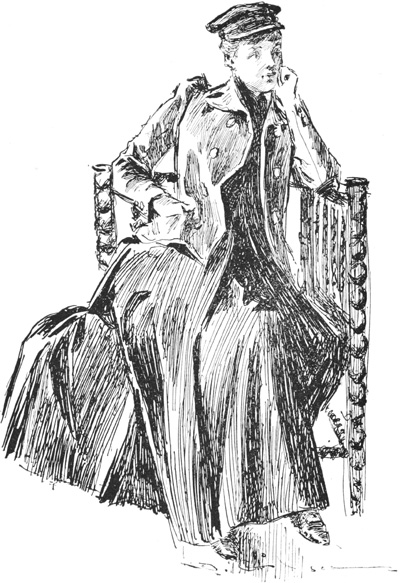
“Well, out of doors she likes to wear a
boy’s jockey cap of white cloth and a jaunty
little jacket, and I regret to say that she is
not unfrequently seen with her hands in its
pockets, and her elbows making aggressive
angles.”
“And, I presume, she also wears stiffly-laundried
shirt waists, with men’s ties, and
divided skirts, and her hair is short and
parted on the side, and she rides a bicycle.
I know the type—the young lady who affects
the masculine in her attire.”
“She has just the loveliest long hair in the
world, and her skirts are not divided, and
she doesn’t ride a bicycle, nor wear shirt
waists, at least not horrid, starched, manny
ones. She likes the soft, washable silk kind;
and she is a great deal more lady-like than you
are, and lovely, and just splendid; so there!”
Mr. Van Silver chuckled; he liked to tease
Milly.
Adelaide remained at Mrs. Roseveldt’s for
two weeks. Jim did not gain as fast as the
physician had expected. The nervous shock
and the great strain of the race after the accident
had been more than the boy’s slight physique
could well endure.
Adelaide read to him, and played endless
games of halma and backgammon, and discussed
plans for the summer, or told him of
the people in her tenement, in whom Jim was
even more interested, if that were possible,
than Adelaide herself. Polo called and
brought a bouquet, for which she had paid
seven cents on Fourteenth Street. Jim was
glad to meet Polo when he knew that she was
Terwilliger’s sister, for the trainer had been
especially proud of Jim, and had given him
many points on bicycling.
One day when Polo was present, Jim suddenly
asked Adelaide, “Say, sister, did the
boys really go to your cat-combing party?”
“I don’t know,” Adelaide replied. “There
were two suspicious characters there, but we
never found out who they were.”
“They was boys,” Polo insisted; “and one
of ’em was fat, and trod on my toe, and one of
’em was little, and smelled of cigarettes.”
“If I was only back at school,” Jim replied,
a little fretfully, “I’d find out for you, fast
enough, whether it was Buttertub and Ricos.
But what can a fellow do penned up here?”
“Never mind, Jim,” Adelaide replied soothingly.
“The truth will all come out at last.”
Polo’s great eyes snapped. “Albert Edward
could find out,” she said. “The boys
tell him lots of things.”
Adelaide did not tell Polo that her brother’s
testimony would count for little, as he was
himself suspected, and the girl went away determined
to assist in unravelling the mystery.
Stacey called frequently and Adelaide could
but admire his patience with the whims of the
sick boy. Jim asked him to try to find out
whether Buttertub and Ricos were the intruders
on our Catacomb party, and this was one
of the very few requests which Jim made that
Stacey refused.
“I don’t want to have anything to do with
those fellows,” he said, “and you know I
never could act the spy.”
“I have been thinking,” Stacey said, after
Adelaide had told him Polo’s history and the
needs of the Home, “that we boys might get
up some sort of an athletic entertainment in
behalf of the Home of the Elder Brother.
The cadets all like Terwilliger, and if they
knew that his little brother and sister were
supported by the Home, they would all chip
in willingly.”
“Terwilliger has such a good salary,” Adelaide
replied, “that Polo tells me they intend,
as soon as their mother is able to leave the
hospital, to take the children from the Home,
rent an apartment in my tenement, and set
up housekeeping for themselves. But, if the
Terwilligers do not need it, you may be sure
there will always be poor children enough who
do. And something might happen, Terwilliger
might lose his place at your gymnasium, and
not be able to support his brother and sister,
after all.”
Adelaide was thinking uneasily as she spoke
of the cloud which shadowed Polo and her
brother. What if it should be proved that
the ex-convict had committed the two robberies
in the Amen Corner with the assistance
of his sister.
“Oh, Terwilliger won’t lose his situation,”
Stacey remarked confidently. “Colonel Grey
likes him, and so do all the fellows. He’s up
on every kind of athletics; knows all the
English ways of doing things, for he has been
a jockey at the Ascot races and a coach to the
Cambridge crew. He’s so good-natured too;
doesn’t mind helping fellows outside of hours.
He goes out rowing with me every Wednesday
night in a two-oared gig on the Harlem.”
“Were you rowing with him on the 10th?”
Adelaide inquired eagerly, for this was the
night of the Catacomb party.
“Yes,” Stacey laughed, “and we were late,
and I got a special blowing up for it, too.
You see, they lock the door at ten, and I had
to ring the janitor up, and he was raving, for
he had already been disturbed to let Ricos and
Buttertub in, and he was in no mood to pass
it over. He reported us all to Colonel Grey,
who gave us order marks for it.”
“Ah!” thought Adelaide, “this is encouraging.
Buttertub and Ricos were out late on
the night of our party, and Stacey can prove
an alibi for Terwilliger. I shall report all this
to Mr. Mudge.”
Jim returned persistently to the idea of the
entertainment for the Home of the Elder
Brother. “I wish you would see to it, Stacey.
What are the boys doing now?”
“Tennis, and base-ball. You ought to see
Woodpecker; he is going to be our tennis
champion; he can make the neatest underhand
cut. He’s simply great.”
“Any better than the club down at the
Pier?” Jim asked.
“What! the Sand-flies? They can’t hold
a candle to us.”
“It would be nice to have the Cadets play
the Sand-flies,” Jim suggested. “Colonel Grey
would give the tennis club a field-day if you
asked him, and the excursion to the Pier by
boat would be lovely. Mrs. Roseveldt says
she’s going to open her cottage earlier than
usual this year, and she will get the Sand-flies
interested. Say, is it a go?”
Stacey lashed his boots lightly with his
riding-whip; for he was on his way to the
Park for a ride.
“We couldn’t make a success of the affair
without Miss Milly’s help,” he said, “and after
the way she treated me at the games I’ll never
ask another favor of her—never.”
Jim was much distressed.
“That tournament scheme was such a good
one,” he said. “The Sand-flies are already
interested in the Home of the Elder Brother,
and we could make a big affair of it and rake
in lots of money for the Home. I mean
to talk with Mrs. Roseveldt about it, any
way.”
“All right,” Stacey replied as he rose to
take his leave; “so long as you don’t talk
with Miss Milly. She would think it a put-up
job between us.”
“Now it was real vexatious in Stacey to
say that,” Jim remarked, after his friend had
left. “I meant to have it out with Miss Milly
the next time I saw her. Won’t you wrestle
with her, Adelaide?”
“I’m afraid it’s of no use,” Adelaide replied,
but Jim would not give up the idea so easily.
He talked it over with Mrs. Roseveldt, who
approved of the tennis tournament. It would
be just the thing with which to open the season.
The Cadet team would be a great attraction.
She would intercede with Colonel
Grey to allow them to remain several days.
“It must take place early in June,” she
said, “just after Milly’s commencement exercises,
and while Adelaide and you are visiting
us, before your father and mother return and
take you away. I will drop a line to Milly
that I want her to come home for my last reception
this season, and I’ll invite Stacey to
talk it over.”
Jim was afraid that Milly might not be inclined
to receive Stacey’s proposal with favor,
and he accordingly wrote her a long and labored
epistle, urging her, for the sake of the
Home of the Elder Brother, to bury the war
hatchet. Jim’s intentions were better than
his spelling, which was even worse than
Milly’s, and his letter amused her very much.
One phrase struck her as especially diverting:
“Stacey says you treated him worse than a
Niger.”
Jim had spelled the word with an economy
of g’s, and a capital letter, which suggested
visions of Darkest Africa. Milly laughed till
she cried.
“Perhaps I have been impolite to him,” she
thought. Milly had a horror of being discourteous,
and she wrote Jim that if Stacey
would not be “soft,” she would be nice to him
for the sake of the Home of the Elder Brother.
Jim considered this quite a triumph, and
showed the letter to Stacey on the occasion of
his next visit.
Stacey did not look as pleased as Jim had
expected.
“Catch me being soft with her,” he muttered.
“I’ll show Miss Milly how much I care
for her airs. By the way, Jim, we are to have
two invitations each to give away for the prize
essays and declamations at the close of school.
I intend to invite Miss Winnie De Witt and
Miss Vaughn. I thought I would mention it,
as it might influence your invitations.”
Jim opened his eyes aghast at what he
heard. “You don’t mean to say that you are
not going to send Miss Milly one of your
tickets?”
“Yes, I do.”
“And you are going to invite that hateful,
horrid Vaughn girl?”
“I heard Buttertub boast that he was going
to invite her, and I thought it would be rather
a pleasant thing for him to receive his ticket
back again with the information that as she
had already accepted mine she had no need
for it.”
Jim could hardly believe his ears. “Well,
of all things,” he said. “You shan’t do it, Stacey;
you shan’t do it! I’ll invite Miss Milly,
with sister, if you don’t want to, but it’s a
downright insult to fill her place with such a
pimply faced, common, loud——”
“I do not see that it is the young lady’s
fault if she has a humorous disposition, and as
for her being loud——”
“You said yourself that you could hear her
hat at the Battery if she was walking in Central
Park. Sister says she toadies fearfully, and
she flirted like a silly at the games, and at the
drill. I think you must be hard up to ask
her.”
Stacey coloured, but was too proud to back
down, and he left Jim in tears. Poor little
fellow, as he expressed it, it seemed as if all
the sticks which he tried to stand up straight
were determined to fall down. He could see
that something was wrong with his hero, for
Stacey’s disappointment at the games had cut
deeply, and the boy was on the verge of falling
into a dangerous state of “don’t care.”
When Jim asked him what subject he intended
to choose for his essay, Stacey said that he
had about decided not to compete. The subject
must be connected with Greek history or
life, and he despised the whole business, and
the honour wasn’t worth the trouble.
Adelaide took Stacey in hand and suggested
a subject, in which he manifested some interest,
but all this worried Jim and kept him from
recovery.
Adelaide watched him anxiously. She had
at first thought it best not to notify her parents
of Jim’s accident, fearing to spoil their
tour; but as she felt certain that he was not
improving she sent a cablegram, and received
an answering one stating that they would sail
for America at once. Adelaide watched
eagerly for their coming. Jim pined for his
mother, and one day, to give her little invalid
something pleasant to look forward to, Adelaide
told him that their parents were on the
way home. The news did him more good
than all the physician’s tonics. He brightened
every day and talked of his mother incessantly.
Once it seemed to occur to him
that his delight was a poor return for Adelaide’s
care, and he asked her anxiously,
“You don’t mind, do you, sister, that I am so
glad mother is coming? You are the very
best sister in all the world, but then you are not
quite mother. You never can know just what
she was to me when we were so very poor.”
“Of course, I am not jealous, dear Jim,”
Adelaide replied. “I can well understand that
you and mother are bound together even more
closely than most mothers and sons, by that
long fight together with poverty. I only wish
that I had been with you to help you bear it.
But then I do not know what father would
have done. He suffered so much while you
were lost to us, that if I had not been there to
live for I think he would have died or have
gone insane.”
“I don’t wonder that father loves you so
much and is so proud of you, sister. I am
very glad you were not with us when we were
so very wretched. You ought not to know
what it is to be poor, Adelaide. You ought
to be a queen.”
“I am a queen now, Jim, and I think I do
know what it is to be poor. When you told
me all your bitter experiences, I felt them as
keenly, it seemed to me, as if I had passed
through them myself. I believe that God
sent us this intimate knowledge of how the
poor suffer in order that we might sympathize
with and help them.” Then Adelaide told
him of the tenement and described each of
the families. Some of them Jim had known
in that other life which has been related in
a former volume, and he inquired eagerly for
the inventor, Stephen Trimble, and for the
Rumples, and others. Adelaide told him, too,
of the two turtle-doves, and of the sad death
of Miss Cohens, and how the Terwilligers
were soon to be established in one of the best
suites. This last information pleased Jim
very much.
“I like Terwilliger,” he said. “He is so
funny; he drops all his h’s, and calls everything
‘bloomin’.’ Buttertub is a ‘bloomin’
fool,’ and Stacey is a ‘bloomin’ swell,’ and
when I got hurt he said it was a ‘bloomin’
shame,’ and Ricos was a ‘bloomin’ cad,’ and
the fellows ought to have made a ‘bloomin’
row’ about it.”
That evening it happened that Mrs. Roseveldt
was to give a musicale, and as Jim was
feeling very bright, Adelaide had consented
to take part. She was a creditable performer
upon the violin, and had decided upon a
romance by Rubenstein. She came to the
school early in the afternoon for her music,
and, to give her more of a visit with us, Mrs.
Roseveldt had suggested that she should
remain until after dinner, promising to send
the carriage for her. Stacey was expected
to call that afternoon and would keep Jim
from being lonely.
We were all delighted to have Adelaide
with us once more, for we had missed her
greatly.
I was painting in the studio, and Professor
Waite had just told me that it was all for the
best that I could not probably go to Europe
in vacation.
“You are not ready for it,” he said. “You
will profit far more by European instruction
after a year of thorough training in the Art
Students’ League. I would advise you to
attend it next winter. Our disappointments
are often blessings in disguise. Providence
keeps the things for which we are not prepared,
saved on an upper shelf for us until we
deserve them.”
As he said this, a joyful hub-bub rang out
in the Amen Corner, led by a wild, Comanche
shriek from Polo, who happened to be in the
corridor: “Miss Adelaide’s come! Glory!
Oh, glory!”
Professor Waite flushed and paled, took
two steps impulsively toward the door, and
then sat down before my easel, and began insanely
to spoil a sky with idiotic dabs of green
paint. I wondered whether Providence was
saving up Adelaide until he deserved her. If
so, the shelf was for the present a very high
one.
To my surprise, Adelaide tapped at the
studio door a moment later. She greeted
Professor Waite cordially. “I am so glad to
find you,” she said, “for I want to impose
upon you for a little help.”
Professor Waite beamed.
“Stacey Fitz Simmons has asked me for a
subject for an essay and I have suggested
‘The Athletic Contests of Ancient Greece,’
as giving a subject in which he is greatly interested—athletic
sports—a classical turn, suitable
for the dignified occasion. At first he
thought he could make nothing original of it,
but would have to crib everything from books
of reference; but it occurred to me that he
might treat it from a rather new standpoint
by taking his information from remains of ancient
sculpture. I told him he had better
study the casts at the Metropolitan Museum,
as that would be the next best thing to attending
the games at Corinth. Can you give him
any additional sources of information?”
Professor Waite threw himself into the idea
with enthusiasm and poured forth at once a
dissertation which would have taken the highest
honours at the competition. Then he made
a memorandum of several works on art, which
Stacey would do well to consult, and rummaged
about in his portfolios for photographs
of ancient statues of athletes and heroes, the
procession from the frieze of the Parthenon,
and the like.
When we finally got Adelaide into the
Amen Corner, we scarcely gave her an opportunity
to dress for the musicale, we had
so many little nothings to talk over with
her.
In the midst of it all Mr. Mudge called,
and we opened fire upon him at once with the
testimony which we had collected in favor of
Polo and her brother. He was not greatly impressed
with Stacey’s avowal that he had
been out rowing with Terwilliger on the night
of the Catacomb party.
“I had already ascertained that he was out
late that night,” he said. “Miss Milly told
me that young Fitz Simmons on the night of
the drill threatened to attend your party.
What assurance have we that he did not
attend it with Terwilliger as his companion?
A lark on the young gentleman’s part, and a
clever opportunity to steal on the part of the
trainer. My assistant has discovered that
Terwilliger has had no dealings with his old
associate Nimble Tim since his release from
prison. Having to discard the idea that Tim
was his companion, I have been looking about
to find another possible one. I thank you
for your assistance.”
Milly was very angry. With true womanly
inconsistency she scouted the idea that Stacey
could have had any part in the proceedings,
although she was the very one who had at
first suggested it.
“And here,” she said, “is something which
ought to be perfectly convincing to any sane
man. Polo told me last night that her brother
heard Ricos and Buttertub boasting that they
had fooled us all so nicely, and had seen our
play. They made fun of Winnie, and said
she had a little squeaky voice for so manly a
part, and that it was ‘nuts’ to see us try to
manage our togas. Oh! I’d just like to choke
them.”
Mr. Mudge smiled. “It is very natural,”
he said, “that Terwilliger should attempt to
throw suspicion on some one else.”
“But you know that Buttertub and Ricos
were out late that night,” I suggested.
“Ricos obtained permission from Colonel
Grey to hear Professor Ware’s lecture on
Architecture, at Columbia College.”
“And did they say they attended it?”
Adelaide asked.
“Ricos so reported at the Barracks.”
“Well, I happen to know that Professor
Ware delivers those lectures on Tuesday
evenings,” Adelaide replied triumphantly;
“and this was Wednesday night.”
“Are you sure of this?”
“I am sure because I attend the lectures,
and neither of those boys were there.”
Mr. Mudge rubbed his brow with his pencil.
“Terwilliger’s previous bad record counts
against him,” he said persistently.
“Mr. Mudge,” I entreated, “will you do me
the favor to call on a friend of ours, Mr. Van
Silver, who knows all about that previous
record of Terwilliger’s.”
“How is that?” Mr. Mudge asked, and I
related my conversation with Mr. Van Silver
on our return from the games.
“I will interview this gentleman,” said Mr.
Mudge, “for though appearances are strongly
against Terwilliger, I do not wish to act on
appearances alone. And meantime, if you
could find some other witness than young
Fitz Simmons who could prove that he and
the trainer were really boating on the Harlem
the night of your party, and some other witness
than Terwilliger to the admission of
Ricos and his friend of the dairy nickname,
the cause of Lawn Tennis and her brother
would be materially strengthened.”
“I agree to produce such witnesses,” said
Winnie rashly. “I have called it my mystery
and I intend to fathom it, if it takes all summer.”
Mr. Mudge bowed and withdrew. His boots
creaked down the hall a little way and then we
heard a knock and the opening of a door.
“Girls, he’s calling on Miss Noakes,” Winnie
cried, in high glee. “Now, what’s to hinder
my running out on the balcony and showing
her that two can play at the game of peek-a-boo.”
“Nothing but the honour of the Amen Corner,”
Adelaide remarked. The words threw a
wet blanket on Winnie’s proposal, but there
was a flickering smile about Adelaide’s lips
which showed that she was bent upon mischief,
a rare thing for Adelaide.
“I will wait until Mr. Mudge is gone,” she
said,—“I would not interrupt two young lovers
for the world,—and then I think I’ll call on
Miss Noakes. I want her to help me translate
the visit of Æneas to Queen Dido.”
“That’s just like Winnie,” Milly exclaimed;
“but you would never do such a thing.”
“Won’t I? You don’t half know me,
Milly, dear,” and Adelaide actually fulfilled her
threat.
“She expected him,” Adelaide exclaimed,
when she returned. “I found her all gotten
up regardless—that low-necked black net of
hers! She did look too absurd for anything,
but happy is no name for it. There was a
blush on her withered old cheeks, and I
actually believe a real tear in her eye. When
I told her what I wanted her to translate, she
glared at me haughtily, but I looked as demure
as I could, and she went through it
without flinching. ‘Men are deceivers ever,
aren’t they, Miss Noakes?’ I said. ‘Just think
of Pious Æneas behaving so cruelly to his dear
Dido.’ ‘How should I know, child?’ she replied
rather curtly.”
While we were laughing, Cerberus knocked
to inform us that Mrs. Roseveldt’s carriage
waited and had sent him to inquire for Miss
Armstrong.
Adelaide found that Stacey had waited for
her return. He woke to animation over the
photographs. “This decides me,” he said.
“I shall try for the prize. I didn’t imagine
there was anything in Greek civilization that I
cared a rap for; but that quoit player is fine.
Just look at his muscles. I always thought
that Discobolus was the fellow’s name. It
never dawned upon me that it meant a quoit
player. And this Mercury hardly needs
wings on his heels, his legs are built for a
runner. And isn’t that Fighting Gladiator
superb? And that Hercules and Vulcan?
Well, now, here is something curious. I do
believe that Baker got his ‘set’ from that statue;
the left arm is extended in the very same way,
and the boys all thought it was original with
him.”
So he ran on, his eyes kindling once more
with enthusiasm. “Well, I must go now and
‘bone’ on my geometry—beastly bore; but
Buttertub has been having very good marks
lately, and I am not going to let him rank
me.”
He had hardly gone before it was time for
Adelaide’s Romance, and after that Mr. Van
Silver came up to express his compliments.
“I was sorry Stacey could not stay to hear
you play,” he said, “but he seems to have a
virtuous fit on, and said he must hurry to the
barracks and spend the evening in study.
Perhaps, however, it was only an excuse for
mischief.”
“Do you think so?” Adelaide asked. “It
has seemed to me of late that Stacey has
had little heart for anything, even for mischief.”
“That’s a fact. I haven’t seen him on the
river since the games, and he used to be very
fond of rowing.”
Adelaide gave a little gesture of despair.
“There,” she said, “I forgot to ask him
whether any one knew of his going out boating,
the night of our party, with Terwilliger,
and Winnie was so particular about it. How
provoked she will be with me.”
“Why is it that you young ladies have developed
an overweening interest in Terwilliger?”
asked Mr. Van Silver. They were sitting
on the staircase apart from the others, and
Adelaide replied:
“It is because he is suspected of a robbery
which has occurred at our school. We have
been cautioned not to mention it, but I think
I may say as much to you, for Mr. Mudge,
the detective who has been engaged to investigate
the affair, told me this afternoon that he
intended to interview you in regard to Terwilliger’s
part in the crime for which he was sent
to prison.”
A cloud passed over Mr. Van Silver’s face.
“I hoped that thing was dead and buried,” he
said. “It only proves that nothing is really
ever settled unless it is settled right. If it will
do Terwilliger any good, I will testify openly,
as I ought to have done in the first place.”
Adelaide looked at Mr. Van Silver wonderingly.
He understood and said quickly, “I
cannot bear to lose your respect, Miss Armstrong;
perhaps I had better tell you just
how it all happened.”
“Not to gratify any curiosity on my part,”
Adelaide replied; “you might be sorry afterward.
And if it is something that the world
has no business to know——”
“The World! Heaven forbid that an account
of the affair should get into the World,
the Herald, or any of our newspapers. I
would rather no one knew anything about it;
but when I have told you the entire story you
will be able to judge how much of it I ought
to confide to your friend Mudge, in order to
aid Terwilliger. You see, young Cairngorm
is a regular cub. His father sent him across
on his yacht to us. He wanted mother to
comb him out, introduce him in New York
circles, and get him married, if she could, to
some American heiress. If you girls only
knew what scamps some of those slips of
nobility are you would not be so crazy for
titles.”
Adelaide’s eyes snapped. “I do not care a
fig for a title,” she said indignantly. “I
think a great deal more of an enterprising,
hard-working, true-hearted American, than of
a mere name. I think that the American
pride of having accomplished some worthy
work in life is much more allowable than the
English pride of belonging to a leisure class.”
“I beg pardon. I did not intend to be personal.
When my mother saw what sort of a
specimen had been confided to her hands, she
made no efforts in the matrimonial direction,
but simply tried to keep the chap out of
harm’s way for a season, using me as her aide-de-camp.
He had a passion for betting and
gaming, and I was at my wits end sometimes
to head him off. Terwilliger came over with
him, you know; but he left the yacht on its
arrival for he wanted to establish himself permanently
in America. Cairngorm liked Terwilliger,
tipped him handsomely on parting,
and asked me to take an interest in him. I
promised to look out for him and immediately
forgot his existence. Terwilliger drifted
about, waiting for something to turn up, and
Satan, who is the only employer who is on
the lookout for poor fellows who are out of
work, appeared to Terwilliger, in the person
of a new acquaintance, Limber Tim. Tim
told him that he was connected with a sort of
club devoted to athletics. It was really a
gambling saloon. Tim knew of Terwilliger’s
acquaintance with Cairngorm, and he promised
Terwilliger a five dollar bill if he would
persuade Cairngorm to patronize his establishment.
‘Tell him,’ he said, ‘that we are to
have a very select game of poker to-night,
only gentlemen present, and get him to come
down.’
“Now, how Terwilliger happened to be such
a lamb, I can’t say; but he had never heard of
poker, and he asked Tim if it was anything
like single stick. This amused Tim and he
did not undeceive Terwilliger, who appeared
at our house in search of Cairngorm, and, not
finding him, left a labored epistle inviting him
to come to No. — Bowery, and see some fun
in the way of a sleight of hand performance
with a ‘poker.’ Cairngorm saw through
it, though Terwilliger did not, and went out
after dinner without explaining where he was
going. He took the note with him for fear
he might forget the number of the house, and
thought that he replaced it in his pocket, after
consulting it under a corner gaslight; but, as
his luck would have it, he dropped the note
there, and a policeman, who had seen him
read it, picked it up. The policeman knew
that the house was a gambling saloon, and
immediately surmised the truth, that this finely
dressed young swell had been decoyed to his
ruin. Terwilliger had begun his letter simply,
‘Nobble Sur,’ and our address was not on the
letter, so that there was no clue to Cairngorm’s
identity; but he had signed his own
name in full, and the astute policeman had
this bit of convincing evidence of Terwilliger’s
complicity in the confidence game.
“We knew nothing of this at the time, but
it was late at night before Cairngorm returned
to our house, and we had all been very anxious
about him. His statements were to the
point, for he had been thoroughly frightened.
He had lost heavily, and in the midst of the
game the police had raided the place, and he
had escaped by springing into a dumb-waiter,
which had landed him in a kitchen, where
he had remained secreted until all was quiet.
“‘It is very fortunate for you,’ my father
said sternly, ‘that the police did not secure
you, for in that case the reporters would have
had a sensation for the morning papers, and
your noble father would have learned of your
lodgment in the Tombs. As it is, you had
better leave New York at once. Your yacht
is at Newport. I advise you to report at
home as soon as possible. It is your own
fault that your American visit has had so sudden
and so disgraceful an ending.’
“I saw Cairngorm off, much relieved to get
him off my hands, for we had very little in
common, and he was so lacking in principle
that my feeling for him was only one of contemptuous
pity. On our way to Newport
Cairngorm told me that Terwilliger was perfectly
innocent of any connivance with the
gamblers, and that as soon as he saw that
they were playing for money had attempted
to induce him to leave the place, using every
persuasion possible, and making the gamblers
very angry with him. They had tried to put
him out of the room, but he had insisted on
remaining, and when the police appeared it
was Terwilliger who had shown Cairngorm into
the dumb-waiter. Immediately after Cairngorm’s
departure to Scotland, I sailed for a
long trip around the world, so that it was over
a year before I returned to New York.
“What was my chagrin to find that Terwilliger
had been arrested and sent to prison
with the gamblers. My father had succeeded
in keeping Cairngorm’s name out of the papers,
but as he believed that Terwilliger had knowingly
acted as a decoy he had made no attempt
to save him. Terwilliger would not
disclose Cairngorm’s name at the trial when
confronted with the letter which he acknowledged
having written. Nor did he write him
asking his assistance, so determined was he
not to implicate his patron in the affair. I
looked up Terwilliger, and finding that he had
only a few weeks more to serve, set myself to
work in earnest to secure him a good position.
I told the entire story to Colonel Grey, who
met him with me, on his release, and feeling
confident that he had not been contaminated
by his prison associations, gave him the position
of trainer at his gymnasium. He has had
a good record there ever since, and I have
been very unhappy that he has suffered so
much on my graceless friend’s account. If I
had known that an innocent person was to be
sent to prison I would never have helped him
away after his scrape, but would have insisted
on his disclosing the entire truth, and braving
the consequences like a man. As it is I am
going to make Cairngorm do something for
Terwilliger this summer. One of my grooms
does not care to go to Europe with me, and
if Terwilliger has nothing better to do while
the cadets are on vacation, I will take him
across. I shall bring him back in the fall in
time for the opening of the school.”
Adelaide was intensely interested in this
story. “You will tell it all to Mr. Mudge,
will you not?” she asked, “and convince him
that Terwilliger was unjustly imprisoned.”
Mr. Van Silver promised to do this, and
soon after took his leave.
Adelaide had not intended to tell Jim anything
of the suspicion which had fallen upon
the trainer, but Jim had left his bedroom and
come out upon the landing to listen to the
music, and had overheard all of Mr. Van
Silver’s account.
When Adelaide went in to kiss Jim goodnight,
she found his cheeks hot and his eyes
quite wild. “You will go to Mr. Mudge right
away, will you not, sister?” he urged. And
he was not at all satisfied when Adelaide assured
him that this was not necessary, as Mr.
Mudge had promised to call on Mr. Van
Silver on the following day.
The next day Mr. and Mrs. Armstrong
arrived, and Jim’s delight threw him into a
fever of excitement. Such alternations of
happiness and worry were bad for the boy,
who needed calm, and Mr. Armstrong wished
to remove him to Old Point Comfort, but Jim
begged that he might not be taken from the
city until the closing exercises of the Cadet
School. “I shall be well enough to attend
them, I know,” he pleaded, “and I want to
see sister graduate, and to know how the
mystery turns out, and whether Terwilliger is
all right.”
To gratify the boy Mr. Armstrong took
furnished apartments fronting on Central
Park, and Mrs. Armstrong devoted herself to
the care of her little invalid, while Adelaide
returned to school.
Commencement was near at hand, and
Adelaide felt that she must work hard to pass
the final examination creditably. Our life at
Madame’s was not all frolic, though I am conscious
that my story would seem to indicate
that such was the case. Naturally, a full report
of the solid lessons which we learned
would make a very stupid story, but the lessons
formed our daily diet, and the scrapes
and good times that I have chronicled occurred
only at intervals.
We had what Milly called a thousand miles
of desert, without even the least little oasis of
fun, between the Inter-scholastic Games and
the examinations. Winnie had taken a fit of
serious study, and when Winnie studied she
did it, as she played, with all her might. Our
only lark for quite a time was a house-warming
which we gave the Terwilligers. Polo told us
how she was fitting up the little flat of three
rooms with the assistance of her brother, and
it certainly seemed as if the cloud which had
shadowed her had drifted away. The largest
room was the kitchen, also used as a dining-room.
Adelaide had provided a range, and
many other things, with the rooms. The
cadets clubbed together and made Terwilliger
a handsome present in money, with which he
purchased a lounge, which served for his own
bed, and an easy chair for his mother; and
our King’s Daughters Ten provided all the
tinware and crockery. Madame sent down a
nice bedstead and some bedding. Professor
Waite contributed a neatly framed portrait of
Polo, and Miss Noakes gave a box of soap.
Polo purchased the table linen, towels, etc.,
with her own earnings, and Miss Billings
hemmed them and the curtains, which were
made of cheese cloth. Mrs. Roseveldt sent
her carriage to take Mrs. Terwilliger from the
hospital to her new home and gave a carpet,
and Mr. Van Silver ordered a barrel of flour
and a half ton of coal. Mrs. Armstrong
selected a lamp as Jim’s present, and took the
two children from the Home to one of the
large stores and provided them well with
clothing for the summer before delivering
them to their mother. It was a very happy
and united family that met together that evening
in Adelaide’s tenement, and Mrs. Terwilliger,
who had not been credited by her
acquaintances as being a religious woman, exclaimed
reverently, “It seems to me we’d
orter be grateful to Providence for all these
mercies;” and her son responded emphatically:
“Grateful to Providence? You bet your
life, I am!”