A few lines of history are desirable here. I do not mean the history
controlled by the fact that William the Conqueror made many important
appointments in A.D. 1066 or that Stephen was particularly busy in
A.D. 1100. I mean the history of wireless, for, although Radio Science
is new, it has a history; all time is relative, and we ourselves are
functions of that phenomenon.
Only a few years ago the efforts of wireless experimenters were
entirely directed to the converting of the extremely delicate wireless
oscillation, still but little understood, into a mechanical movement,
in order that the motion of electrons in a problematical aether (which
may be nothing but a thought projection and which may exist in many
different forms) might be altered into something readable by a man with
a check waistcoat and a stock and share list in his hand.
That particular use, and the information that one army is about to kill
another could be transmitted to headquarters, naturally occurred to
everyone as the first valuable applications of Radio.
The many devices, the electro-magnetic receivers, tape machines,
coherers, syphon recorders and the thousand and one electrical machines
produced at the time for these purposes, have practically all gone.
Even when to-day we want to send messages quickly, we record them upon
a Dictaphone and rely almost entirely upon the sense of hearing.
Sound, the regular oscillation, and noise, the irregular oscillation,
of the air, are really the beginning and end of wireless as it is known
to the public to-day.
I would go further when thinking of the public. They do not want to sit
with a telephone upon their heads, even if their ears may be improved
thereby. They require to walk into a drawing-room, and having stood
for a moment upon the mat, they must be able to cross the room, touch
a button in a fretwork cabinet, and by the movement of a lever be
able to place themselves in touch with any part of the world. Paris,
Hong-Kong, London, all must be one to them if we are to get their money
for our art.
In other words, we are compelled to use what we now designate the “loud
speaker.” We have got to project a sound into the room before we can
sell our instruments, and therein lies one great difficulty.
In the first place we dare not exaggerate the movements of a delicate
telephone very much or we shall spoil it—therefore we construct
something which looks very much like a magnified telephone with a
trumpet upon it. The mechanism is naturally rather heavy as regards the
moving parts. In order to vibrate these heavy parts with the aid of
our aetherial oscillations we have to amplify the available current,
and during this process we naturally spoil the detail, or, in other
words, we magnify it so much that electrical distortions occur through
the whole range of various transformers and other items sold by every
shop in the world—at double their value.
Most people are not content with a gentle sound: they find it necessary
to express their joy at having reached their home by dancing;
consequently they want plenty of sound, and they do not mind if it
turns into noise.
They will tell you boldly that their wireless set with a couple of
dozen foreign-made valves can be heard right across a large street,
a street by the way in which we still permit as much nerve-shattering
noise to occur as is thought necessary. This means that we must
have quite a big movement on a diaphragm of large size, and a large
diaphragm is made to move by the electrical oscillation, itself not
very accurate; naturally, if it is heavy, like a poker or anything
else, it has a will of its own, and therefore it continues to move when
the wireless oscillation has told it to stop. It does not even commence
to move when it is told to do so, as it would were it a thin delicate
telephone diaphragm from which accurate music can be obtained.
This means further distortion, and so bad is it that a great many
people say plainly that they will only listen to wireless concerts
through a telephone and that they will only use crystals to obtain
rectification because of the inaccuracies otherwise unavoidable to-day.
But this is not business, because do not forget we must have our
cabinet with a fern upon it and beautiful music, if we are to be
successful. Business always leads science, as we know.
Now think why it is that we need this big diaphragm moving so hard to
get a big noise; let us neglect electrical details and consider what
produces the noise; or sound, if we are lucky.
Sound is unfortunately purely a mechanical phenomenon as we chiefly
understand it, and is produced by oscillations, alternate compression
and rarefaction of the atmosphere. Unlike the aether, which sometimes
oscillates only too readily, air is a heavy material and has great mass.
You will soon find this out if you put your head out of a railway
carriage window, because the air is so heavy that we have got to really
kick it and hit it hard before we can obtain a reasonable degree of
noise.
When a speaker is standing at one end of a room, irrespective of what
he says, the actual temperature-rise of the air can be measured, a fact
which was used during the war for the inspection of sound.
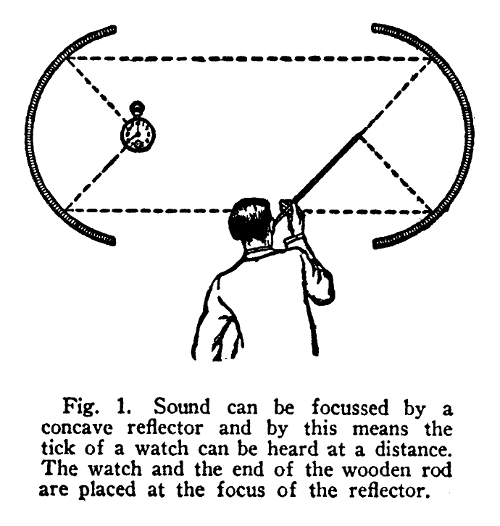
Sound is a very complicated thing. It can be reflected in much the same
way as light, and I suppose most school-boys know that if a concave
mirror is at one end of a room and a similar mirror at the other with
a watch hanging at its focus, the watch cannot be heard by an observer
walking across the room, yet as soon as he places his ear at the focus
of the other mirror he will hear the tick clearly, showing that sound
is easily reflected. Everybody who has heard an echo should know this.
Sound travels also very slowly, and there is plenty of time for wind
and different mechanical scraping effects to spoil the purity and
partially absorb its delicacies.
Remember that if I am addressing a man by wireless who is one hundred
miles away, someone who is listening on a telephone will hear my voice
before I am heard at the end of the big hall where I am speaking,
because the velocity of sound is only 1100 feet per second, and
wireless, like light, travels much faster. Sound can also be actually
refracted. Just as the old-fashioned jeweller used a globe of water to
concentrate the light upon his work, so will a collodion balloon filled
with carbon dioxide, the ordinary gas product of average combustion,
act as a lens for sound, which can be actually focussed by these means.
This exemplifies the complication of our subject, and indicates that
the heavy diaphragm and other details of the loud speaker must produce
serious distortion.
Let us be honest at once. We can only hear such distant places as
America by the grace of heaven. Even Sunlight can tune sweet song into
vague cracklings. Until true tuning can be obtained we are largely at
the mercy of the reproducing instrument, which too often exaggerates
every fault and gives the impression that wireless and music are in no
way related. No loud speaker of to-day really produces voice and song
which sound exactly like voice and song. It all too much resembles a
bad gramophone, but without the advantage of the user having the choice
of the music.
If user and manufacturer would concentrate upon obtaining purity, if
they would try the effects of damping upon loud speakers, which are
easily obtained; if they would realise that the horn of the loud
speaker should be without resonance, that it should be also damped
and pocketed, that its goose-necked shape is not adopted without an
object, and if they would aim at the delivery of true music instead
of noise—then, we should make a great advance. The average loud
speaker can often be greatly improved by padding the horn with some
kind of tape, and as an example of the great difficulties of proper
transmission let it be made quite clear that with most cases of
wireless communication the sending is nearly perfect. Reception is
greatly at fault: it is the reception that mangles the sound and makes
it too often almost unbearable to anybody of reasonably sensitive
hearing.
At some large transmission stations it was at one time quite common to
use three separate microphones for the modulation. One received notes
of high pitch, one of low, and a third attempted to obtain the “S”
sound with the result that, when this “S” microphone was adjusted for a
man who did not say his “S” very loudly and someone appeared who did,
it sounded exactly as if the speaker had dropped his false teeth.
All this is now avoided. The ordinary diaphragm is no longer in use,
but a very small coil of aluminium wire is suspended between the poles
of an electro magnet, allowed to rest against an ordinary pad of
cotton wool, and that is all!
The infinitesimal movements of this aluminium coil will reproduce
speech up to about 40,000 periods per second in oscillatory speed, yet
speech is well recognisable if all frequencies over 4,000 per second
are gridded out.
How difficult it is going to be to make a large, heavy, and rapidly
moving diaphragm reproduce accurately when we have had to take all
these precautions to obtain accuracy of transmission! It is not
impossible; it will come one day.
Now let us see what is the result of our sound troubles.
We are told that before long it will be quite easy to hear birds
singing in trees and the waves beating against the seashore. Quite
right, quite easy to do it now, but if a bird singing in a tree sounds
like a man moving his condenser or walking about with a pair of squeaky
boots, is it progress?
Perhaps it is. The whole point of wireless is that it brings a man into
your room, but it must sound like the man himself if it is to be really
effective; it is this pitiful quality of reproduced sound that has
wrecked the talking cinema.
It is very easy to photograph sounds and to reproduce them
simultaneously with the projection of a picture, but to reproduce
all the sounds of a cowboy scene accurately is, at present, almost
impossible. If a hero says “Good-bye” to a heroine with a kiss like
a creaking board, in the middle of a twenty-reel drama, instead of
improving upon the effect of your imagination, which tells you that it
is real, and which acts the scene for you better than it can be shown
in life or sound, it would be like putting up a blackboard across the
screen with the words written upon it, “this is not real—it is only
a fake.” That is what is wrecking the talking cinema. As a scientific
proposition it is easy, but the results are not good enough at present,
and, if we can improve, let us first consider the loud speaker.
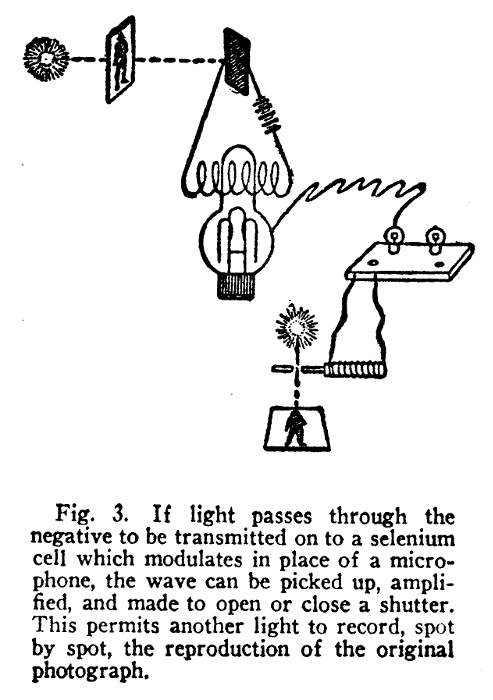
The talking cinema will come as a matter of course. It is so easy to
record sounds upon the film by photography with reproduction by the
selenium cell or the neon tube; it is easy to photograph the wave;
it is easy actually to impress the sound wave upon the film with the
picture, or to use a gramophone; but reproduction is not like a human
voice. Neither as yet is any reproduction ever like the voice itself.
Let that painful fact be remembered.
Unfortunately, from the business point of view, the long distance
reproduction effect is usually satisfactory even when re-broadcasted
upon telephones, and for business purposes it is immaterial whether the
voice that records the profit or loss is harsh or pleasant.
So the greatest effects we shall soon see from wireless and sound
are these: we shall be able to speak to people all over the world by
relaying and a combination of land-line and radio; we shall easily be
able to connect our office with a wireless station on the coast, radio
across the Continent, and then connect by land-line to another office
on the other side of the Atlantic.
All this is so easy that no one can doubt that we shall soon listen in
to native jamborees; no one can doubt that we shall hear the strange
cries of partisans at a baseball match taking place a few miles from
New York; no one can question these things, and when reproduction
becomes so accurate that the very nature of the people is revealed to
us through their speech, surely we might be a little more neighbourly
even with those whom we now pretend to love? Relations are notoriously
quarrelsome.
If you are in a concert hall and the number of people is varied,
it will alter the effect of the sound. You have only to look at a
sound-wave photograph produced from a violin to realise from its dainty
intricacies that the least variation of any of its harmonics or the
very exact shape of its wave beats will reveal all the difference
between a beginner and the finest musician in the world. But these
things are seldom noticed in wireless.
It is quite easy to photograph a sound, by means of a diaphragm beside
which a soap bubble is thick, and to compare wireless sound with the
original; even then we have the great difficulties of resonance, and a
diaphragm cannot reproduce properly. How, therefore, dare we neglect
the dreadful sounds we hear in the name of radio music?
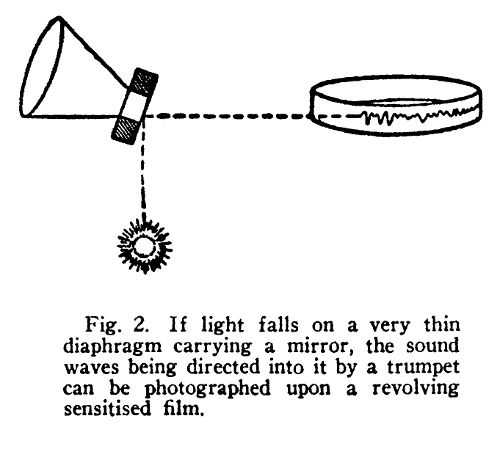
If a piece of silvering, one thirty-secondth of an inch, be scraped
from the back of a mirror and fastened to the outer part of a celluloid
diaphragm (made by water-floating a drop of amyl acetate in which
celluloid has been dissolved), it only requires a horn and a beam of
light to render visible the waves of sound. A diaphragm movement of a
millionth of a millionth of an inch is sometimes audible.
It is the science of wireless that is beautiful; it is the
possibilities that are wonderful; but to talk of pure sound and to
judge of it by the human ear which varies after every meal, is like
measuring the amount of current passing through an electric-light bulb
by feeling its heat with the hand.
It is not generally known that, during the War, experiments were made
with a sound-reflector for listening to different types of aeroplane
and submarine, by means of a microphone placed at the centre of a
concave mirror. The difficulty was that of distortion, which is the
whole source of trouble with sound producers to-day. Distance is
no difficulty and when we can obtain purity and realism as well as
distance, the latter is no difficulty at all; then only will be the
time when we shall have that spontaneous mental realism of vision that
will help radio to alter the world.
In a few years time we shall be able to chat to our friends in an
aeroplane and in the streets with the help of a pocket wireless set,
and be able to do practically everything by the aid of radio that we
now do with our voice.
The only thing that will seem intensely strange will be that these
comforts never existed before!