WINTERING AT MENTONE
Footnotes have been repositioned to follow the paragraph where they are referenced.
The only textual issue of note is the repeated appearance of ‘at any rate’ as ‘at anyrate’.

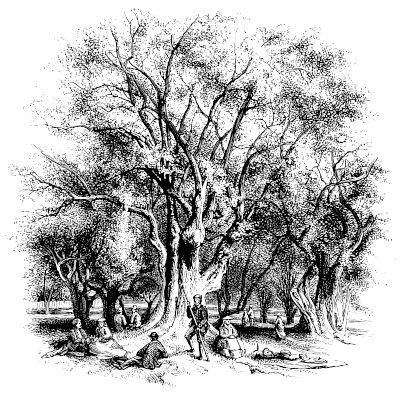
UNDER THE OLIVE TREES
PREFACE.
With health impaired by a strain of three laborious years as Lord Provost of Edinburgh—and more particularly enfeebled by a malarious fever caught in the course of making explorations with a view to sanitary improvements in the older part of the city—I sought a restorative by a visit to Mentone (or Menton, as the French prefer to call it), in the winter of 1868-69. The object of my visit was gained; but having been so indiscreet as to enter on a new term of office, in the hope of helping to carry forward the city improvements, in which I might be excused for taking some special interest, my health again unfortunately suffered, for which and other reasons I resigned my post, and again proceeded to Mentone; this time making a longer sojourn, with corresponding advantage, in the winter of 1869–70. A result of these efforts to secure the benefits of sunshine along with perfect tranquillity on the shores of the Mediterranean, is the present small work, the preparation of which furnished a degree of amusement when far from home and accustomed pursuits. If it aid in directing attention to a subject of importance to many—the hygienic value of passing the winter in the south of France—I shall be satisfied. The book is of course non-medical, and will not supersede the necessity of consulting professional advisers.
Glenormiston, May 1870.
CHAPTER I.

When autumn has drawn to a close, and unmistakable symptoms of winter are making their appearance, the swallows are seen to wing their way from England, and betake themselves to the sunny regions on the shores of the Mediterranean; thence returning to their northern haunts when nature is reviving under the genial influence of spring. The example set by these sagacious birds is not unworthy of being followed when circumstances call for and permit an escape from the cold, the fogs, the rain, and sleety drizzle of a protracted winter.
Without undervaluing the comforts of an English fireside, when frost dims the window-pane with its beautiful efflorescence, I am on the whole disposed to think that health is best secured by a reasonable amount of outdoor exercise in the sunshine; but that enjoyment is unfortunately denied on anything like a salutary scale to those who are enfeebled by pulmonary or bronchial affections or by advancing years, in any part of the 2British Islands. No doubt, much may be done to avert the evil influences of winter, by means of warm and well-ventilated rooms, having windows facing the south, in a sheltered and airy neighbourhood. Various places can be pointed out in the south of England recommendable as winter and spring resorts for invalids—none, perhaps, better and more agreeable than the Undercliff in the Isle of Wight; but there is this to be said of the whole of them—that they less or more participate in the humidity and variableness of our British climate. By no contrivance can we get rid of a certain dampness in the atmosphere. Inside the best constructed and best warmed dwelling, we still breathe the outer air, however much it may be qualified; and as regards persons of delicate constitution, who require a light and dry atmosphere, this may prove a serious objection. Cold, damp weather is, in short, the great enemy to health, and when we recollect that in all our large seats of population the cold and the damp are aggravated by a smokiness in the general atmosphere—to say nothing of sudden changes of temperature and other unsanitary conditions—the malignant influences of winter are greatly intensified.
Invalids who propose wintering abroad will, of course, consult their medical adviser with a view to selecting a locality suited as far as possible to their respective cases. With such counsels I do not interfere. The persons in whom I take a more special interest, or at least to whom I can speak more freely, are those who, advanced in life, stand in need of a remission of ordinary pursuits, along with that salutary re-invigoration of constitution which may be brought about by a change from a cold and moist to a dry and buoyant atmosphere—from a peculiarly variable, to a comparatively steady, climate—from a cloudy to a brilliant sky—from dinginess to sunshine. As to how many are swept away by refraining from taking a step of this kind, let the 3authoritative statistics concerning the mortality of the late severe winter testify.
When any man on the shady side of middle life has the fortitude to look around to note the number of his old and valued friends, he is shocked to find how meagre is the list. One after another has disappeared, from no other perceptible cause than that their physical powers, originally vigorous, had succumbed in the feverish, and we might almost say, insane, battle of life. Too long and too diligently have they stuck to their professional pursuits, or been fascinated by the allurements of society, taking relaxation only by fits and starts, and seemingly under the impression that they have still a long career before them. Having realised a fair competence, they might very well ask themselves why they should continue to toil, to speculate, and to rack their brains, when a life of comparative ease and reflection would in all respects be more becoming. This is exactly the question, however, which they never put. The upshot is well known. Through sundry real or imaginary entanglements, their day of safety is past. A cold, foggy, drizzly November finishes them; and at about two o’clock on a wintry afternoon, they are, in all the pomp of hearse and carriages, decorously conducted to the burying-ground. That is why people advanced in life have so few old acquaintances about them. They had forgot that Death is always busy laying about him with his scythe, and that the art of long living consists pretty much in knowing how to keep out of his way.
A celebrated French writer on hygiene has a theory that dying at anything under a hundred years of age is all a mistake—that it is people’s own blame, or the blame of their progenitors, if they die earlier. Far be it from me to dispute the accuracy of this very cheering though somewhat irreverent theory. I would allow a handsome discount of ten per cent., and take 4ninety as a fair age to attain to. The method of living till ninety, however, is either not understood or very slightly acted on. Lord Brougham was acquainted with it. He saw there was a knack in giving fair-play to the system by means of an annual restorative. Every year he went off at the right time to Cannes; cheating alike the winter and the grave-digger as long as flesh and blood could do so. Other individuals, making the necessary sacrifices, now adopt a similar policy. They leave and return to England with the swallows; by which not unpleasant contrivance they spin out their lives, if not to ninety, still to something considerably beyond what, to all appearance, was to be their allotted span.
In contemplating a residence abroad for four or five months, it is, as just hinted, all important to go to an appropriate place. Besides consulting medical advisers, it might be well to peruse the well-known work on Climate by Sir James Clark, and also the singularly comprehensive and entertaining work of Dr J. Henry Bennet, entitled a Winter and Spring on the Shores of the Mediterranean. In his own person, this ingenious author exemplifies the benefit of stopping in time, and taking a long annual relaxation in a genial climate. He tells us that five-and-twenty years devoted to a laborious profession, and the harassing cares which pursue a hard-worked London physician, broke down his vital powers. In 1859, he became consumptive, and strove in vain to arrest the progress of disease. The choice was either retirement, with the faint hope of restoration to health, or within twelve months Kensal Green Cemetery. He chose wisely to relinquish a large and lucrative practice, and to take the chance of benefiting by a residence in a climate suited to his special condition. His book may be described as an exhaustive research in quest of such southern climates as may be best adapted to the assuagement of certain bodily complaints, 5including general debility. He describes his visits to various parts of France, Italy, and Spain, bordering on the Mediterranean, to Corsica, Sicily, and also to Algeria; his narrative being everywhere interspersed with such a variety of anecdote and adventure, as well as of remarks on the vegetation, natural history, and geography of the countries visited, as gives it an interest to the general reader.
Summing up, he says, the health regions may be divided into three sections. First, the mild and dry, in which are comprehended the Western Riviera, and the east and south-east coasts of Spain; second, the mild and moist, to which belong Corsica, Sicily, and Algeria; and third, the west coast of Italy, which appears to occupy, meteorologically as well as geologically, an intermediate position. It may be safely concluded that no person from Great Britain who seeks merely for an agreeable winter resort, would from choice go to a place reputably moist. We have plenty moisture at home, and do not need to search for it abroad. What we want is, a mild dry atmosphere, with as much sunshine and scope for outdoor exercise, without recourse to greatcoats, as can possibly be procured within a reasonable distance, and which abounds in the attributes of civilisation. As may be learned from Dr Bennet, latitude is not all in all. This original inquirer says very candidly that ‘five degrees of south latitude do not make up in climate-questions for want of protection from north winds.’ It might be added that, besides protection from cold winds, we also need good house accommodation; for without that, the best climate in the world can be of no use to visitors. There is another important circumstance, and that is, the discomfort of a voyage on a sea so capricious in its moods as the Mediterranean; for which reason alone, we may leave Algiers out of present consideration.
The doctor has evidently a high notion of Corsica as a 6health-resort; but there again is the drawback of a sea-voyage. Coming to the mainland, he speaks approvingly of San Remo, which lies about twenty miles to the eastward of Mentone. There, I can say something from experience. On visiting it in January 1869, I found it a dirty, old-fashioned Italian town, which had not even got the length of gas-lighting, though some improvements were going on. Further, it had no public promenade along the beach, and that I hold to be indispensable in any health-resort of the English. Nice has a long and handsome promenade of this description. Cannes has likewise high claims on account of its amenities—so high that it is entitled to be spoken of as by far the most aristocratic and expensive of the continental winter resorts.
From the configuration of the coast, Hyères, Cannes, and Nice lie farther south than Mentone, but that advantage is more than counterbalanced by the superior shelter from cold winds enjoyed by Mentone; for, as has been observed, a full exposure to the south, along with shelter on the north, is worth several degrees of latitude. After all, Mentone can modestly boast of being situated in latitude 43° 45´ N., or upwards of twelve degrees south of Edinburgh. It may be deemed a conclusive proof of Dr Bennet’s appreciation of Mentone, when we know that among all the Mediterranean health-resorts he has chosen it for his habitual winter residence; and that, after ten years, he has to outward appearance overcome the malady which drove him abruptly to this species of exile. My own experiences, poor in comparison, point to Mentone as a place, all things considered, where any one not encumbered with expectations as to social intercourse, and not fastidious on a few points which will be particularised, may advantageously pass the more dreary months of winter. It is, however, not what this or that one says of a place, but the unerring testimony of Nature, as 7demonstrated in the contour and vegetation of the district, which decides its character. So far, as will be shewn, Mentone is highly favoured, and Art, under considerate direction, is alone needed to complete its recommendations. Unfortunately, the journey thither will to many be a serious objection as regards not only distance but expense. The easiest way it can be performed may prove too fatiguing for some invalids, but taken leisurely, there is nothing in it to deter persons who are able to bear railway travelling.
There were times, not long ago, when travelling through France was tedious and painful. Those were the days of diligences and passports, and many other things that were very disagreeable. In the present day, such has been the material and social progress of the country, that travellers will find matters not greatly different from what prevails in England. There are railways in all directions; the hotels are frequently on a scale of great splendour; at very nearly the whole of them on the main routes English is spoken; and everywhere visitors are treated with marked civility. We all know what Paris has latterly become--the finest town in the world, an attraction to strangers from all parts of the earth. So lately as twelve years since, the railway from Paris was not pushed beyond Marseilles. There it long remained, and to those who wanted to get on farther, there was no help for it but to take the diligence, or hire a carriage specially for the purpose. I can remember hiring a voiture with a pair of horses to go on to Nice, and of being nearly three days on the journey, including stoppages of two nights, one of those nights being spent at Frejus, in one of the worst and dearest hotels I ever set foot in. Now all this is changed; there is a railway from Marseilles by way of Toulon, Cannes, Nice, and Monaco to Mentone—the trains going several times night and day to suit the convenience of travellers. There are likewise 8telegraphic wires the whole way, by which messages can be sent in advance to bespeak accommodation at hotels along the line of route.
In making their way southwards, there are many who drive on hurriedly, never stopping night or day, as if under a vow to get to their journey’s end in the least possible time. My plan is to stop a night, or, it may be, two nights and a day, here and there, for which there are several good opportunities—as, for example, at Paris, Dijon, Lyons, Avignon, Marseilles, and Nice. The only drawback on these stoppages is the annoyance experienced at the stations as concerns luggage. After getting your ticket, you have to see your luggage weighed, paying for the same a small sum; and then on arrival at your destination, some time has to be spent in a cold salle until the whole of the luggage has been arranged, and you can claim your own. The way to avoid these wearisome detentions is to get your luggage registered and sent on by the grande vîtesse, or quick goods-train, to your final destination, be it Nice or Mentone, where it can be reclaimed. Sending it by the petite vîtesse is cheaper, but as it may not get to the end of its journey by this slow train for several weeks, the grande vîtesse should by all means be adopted as preferable. Following this plan, a traveller may take along with him into the train a portmanteau or carpet-bag sufficiently small to be accommodated under the seat, also any small bundle to be placed in the rack overhead. The torment of waiting for luggage is, I observe, driving the French into the practice of taking cumbersome articles with them into the trains; and on several occasions I have experienced personal inconvenience from their expedients. Professedly, dogs are not permitted to be taken into the carriages; but the rule on this point is not on all occasions strictly adhered to. Ladies may be seen with favourite lap-dogs, either carrying 9them openly, or in small baskets, without challenge. For such indulgence, much depends on the complaisance of the guard.
The preferable route from London is by Folkestone and Boulogne, and it will save trouble if tickets are taken at Charing-Cross station direct for Paris, getting luggage ticketed accordingly. The steam-boats between Folkestone and Boulogne, though well managed, are certainly poor in comparison to what they might and ought to be; but there is nothing superior in the Channel service, and all we can do in the meantime is to make the best of them. At the railway terminus at Boulogne there is an excellent restaurant, where travellers have a choice of refreshments, tastefully served, and with a composure which pleasantly contrasts with the hurry and confusion which prevail on the English side of the Channel. Any one, going or coming, who has occasion to stop for a night at Boulogne, may be safely recommended to the Hôtel Christol, a comfortable and well-conducted establishment not far from the railway terminus. On each of my recent trips, I spent two nights in Paris at the Grand Hôtel du Louvre; a night at Lyons in the Hôtel de l’Univers (good, and near the station); and two nights at Marseilles in the Grand Hôtel du Louvre et de la Paix. The reason why I remained more than a single night in Marseilles was to note the extraordinary improvements which have taken place within the last few years. If we except Paris, no city in France has been so much changed for the better as Marseilles. Its new streets and boulevards are a sight worth seeing, and so is its new port of Joliette, constructed at a great cost with much engineering skill. The most surprising novelty, however, is the system of water-supply, effected by bringing the waters of the river Durance a distance of sixty miles by means of tunnels and aqueducts, at an expense of fifty-two millions of francs. One of the aqueducts, that of Roquefavour, measures as much as 10four hundred mètres in length by eighty-two in height—a gigantic work, creditable to French engineering, which may compare favourably with some of the grandest of recent undertakings in Great Britain.
Quitting England towards the end of October, and pursuing the journey across France to the shores of the Mediterranean, a visible change of climate usually occurs about half-way between Lyons and Marseilles. We leave the cloudy northern skies, and get gradually into the serene sunshine of the south. The sensation of warmth increases during the day, and at night a lustrous planet shines almost like a moon in the star-spangled heavens. The vegetable world assumes new forms. The mulberry-groves remind us of silk-worms and the tasteful industries of Lyons and St Etienne. Approaching Marseilles, tracts are covered with almond-trees, which, on our return journey in spring, are seen to clothe the country with a mantle of delicate purple blossom. Passing onward, the aloe and prickly pear grow by the wayside, and are planted as hedges; and we observe that in the fields the small tufted plant producing the yellow Immortelles (a species of Helichrysum) is cultivated as a branch of husbandry. The railway from Marseilles, though only a single line, has been a costly and remarkable undertaking, for it is carried through numerous tunnels and along heavy embankments near the sea-shore. No doubt, we lose the picturesque scenery of the Estrelles by this modern method of transit; but yet we are afforded glimpses of many beautiful valleys and rocky mounts, garnished with fig and orange trees, these last coming prominently into notice on crossing the Var and getting into the vicinity of Nice. The olive, first seen as a shrub in Provence, now attains to the dimensions of a tree, which, planted profusely on hill-sides, imparts a greenness to the landscape even in winter.
11Nice, ‘the Queen of the Mediterranean,’ has suddenly risen into beauty and importance. Facing the south, close on the sea-shore, with a fringe of verdant hills on the north, its situation has raised it to a high rank as a winter health-resort, and its reputation in this respect has been augmented by vigorous efforts, public and private, to render it attractive to strangers. Formerly, visiting the town while it belonged to Italy, there appeared to be a general stagnation. Great endeavours had stopped short, and there was obviously much half-done work. In the hands of the French, a new spirit has been infused into the place. Streets just begun have been completed, and handsome quays with boulevards stretch along both sides of the Paillon, over which several new bridges have been thrown. One of these deserves to be styled something more than a bridge. It is so broad as to afford space for a public garden, in the centre of which is erected a statue of Masséna, a native of whom, as of Garibaldi, the Nizzards are justly proud. Nominally, the Paillon is a torrent, but it usually is little else than a bed of dry gravel; the only water in it being a few puddles, in which numbers of women are seen washing clothes in the ordinary continental style. The Paillon offers a fair specimen of one of those numerous torrents in the Riviera that are flooded only on the occasion of snows melting, or heavy rains falling in the mountains, when, rushing impetuously down, the tumultuous waters bear all before them.
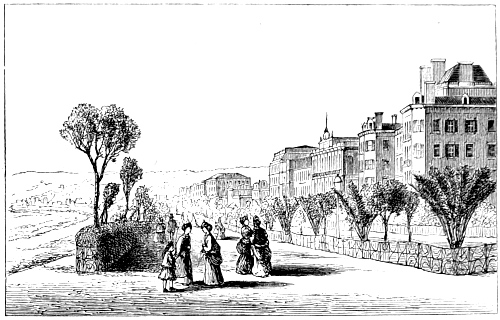
Promenade des Anglais, looking westward; Jardin Public on right.
Looking to its crowds of fashionable loungers, who come to it professedly for health, but seemingly as much for amusement, Nice may be styled the continental Brighton. One thing, as at Brighton, has greatly added to its fascinations. This is the Promenade des Anglais, stretching a mile along the shore, and forming from morning to night the place of concourse for throngs of idlers. The spacious promenade for pedestrians is 12divided by a row of sub-tropical plants, including specimens of the pepper-tree and date-palm, from a broad drive, where ladies in the fantastic dresses of the period, with a taste for fast living and public exhibition, indulge in driving backwards and forwards with a fury not usual with their sex in our more sober-minded country. To do them justice, they leave the lashing of the ponies to the driver, who sits behind them with a long whip, with which he seems to have much pleasure in inflicting pain on the poor animals. This species of cruelty meets with no reprobation from the onlookers; and from the immunity shewn to the practice, I should infer that in France there is no law repressive of cruelty to animals. I regretted to observe that these fast young ladies were generally English. With its promenades, drives, balls, cercle, Jardin Public, musical band, theatres, shops of various kinds where every luxury may be obtained, and abundance of street carriages, Nice offers a choice of attractions, independently of its fine air and sunshine. Besides the cathedral and numerous other Roman Catholic 13churches, the town now possesses an English and a Scotch church, both handsome new buildings. At kiosks on the Quai Masséna, several Paris daily newspapers may be purchased. Letters and papers from England are delivered twice a day, Sunday included. For persons studiously inclined, there is a large public Bibliothèque supported by the commune, where books (of course in French literature) may be freely consulted or read by strangers as well as natives. There are likewise two good circulating libraries with English books—that of Visconti a really excellent collection, associated with a capital reading-room. To accommodate the numerous fashionable visitors, as also the more steady order of winter sojourners, there are now divers hotels of huge dimensions, and every succeeding year seems to increase the number. They are for the greater part situated on the quays overlooking the Paillon, also in the Jardin Public, and in the terrace-like line of street along the Promenade des Anglais. The house which after sundry trials I found preferable was the Hôtel d’Angleterre, in the Jardin Public, kept by M. Steinbrück, who speaks English and is married to an Englishwoman; both are most vigilant in attending to the comfort of their guests. All the hotels have omnibuses which wait the arrival and attend the departure of the trains.
Although Nice is now a French town, the humbler classes remain essentially Italian of the old Savoy type. The dresses of the women are picturesque, and their favourite mode of carrying things is to poise them on the top of the head. The peculiar costumes of the district are well represented in the wooden mosaics which form a remarkable local manufacture. I have never returned home from Nice without purchasing specimens of these beautiful mosaïques en bois, at the shop of the brothers Mignon, in the Rue Paradis. On the last occasion, 14I received an interesting account of how they were prepared. The pictorial effects are, it is said, wholly a result of the varying tints of different kinds of wood grown in the neighbourhood; all being ingeniously shaped and put together without any aid from artificial colouring. As the intrinsic value of the small pieces of wood employed must be insignificant—a pennyworth probably being wrought up in a mosaic which will sell for a couple of napoleons—we have here a striking instance of how national wealth may be increased by exerting artistic ability on materials which are, of themselves, worthless.
Considering its extent, its numerous attractions, its choice of society, and its abundance of hotels, pensions, and villas and floors to be let for hire, Nice, as a place of agreeable resort, has a prodigious advantage over Mentone, which is in a comparatively primitive condition, with much to be done to bring it up to the Nicean finish. To all its recommendable qualities, Nice has further added a supply of pure water led on in pipes from the hilly ground behind; and this is a thing of first importance. If the public authorities would be but a little more liberal in their supply of scavengers to scrape and sweep the streets and by-ways, and to prevent the accumulation of nauseous rubbish on the shore side of the Promenade, they would merit a tribute of thanks from every one who makes a sojourn in the town. Granting all that can be said in admiration of the Queen of the Mediterranean, the question remains as to its availableness in a matter where health is so intimately concerned. In its very imposing size and stylish way of living there is, I fear, something objectionable. Health-seekers ought not as a rule to care for balls, theatrical representations, or the lavish exhibition of finery. What they generally want is the re-invigoration of an enfeebled constitution, through simple and natural agencies. Wherefore, the sea-side, the rural hamlet, or any other place 15where, by abandoning artificialities, Nature has fair-play to strengthen the animal system, is what is sought after. On this account, as well as on its higher claims in point of shelter and climate, there is no room to hesitate. Pleasure-seekers, or those to whom a town-life is indispensable, will stop at Nice; the less sophisticated will go twenty miles farther, and, with all its deficiencies, bask in the very garden of the Riviera.
The time of transit from Nice to Mentone by railway is an hour and six minutes, including stoppages at Villafranca, Monaco, and other places. It is a cheap, easy journey; but the line is carried through a number of dark tunnels, and to those who have sufficient time at command, and do not mind the cost of a carriage and pair of horses, the road forming the first stage in the Corniche will be preferred. On last, as well as previous occasion, selecting this famous highway across the mountains—the Alpes Maritimes, from which is derived the name of the department—I hired a carriage for the journey. The route is the commencement of the famous Corniche, which most tourists endeavour to see at least once in their lives. Until 1806, when it was partially completed, by order of Bonaparte, there was no other road along this part of the coast of Italy than the very insufficient pathway, fit only for mules, which had originally been made by the Romans on subduing the Ligurians. Snatches of this old Roman road are still in use by the country-people. It was only the pressing emergencies of the Revolutionary army under the conqueror of Italy, at the beginning of the present century, that led to the engineering of the Corniche—a name significant of a pathway winding its way along a natural precipitous cornice. On quitting Nice, the road rises along a mountain-side which commands a magnificent prospect over the valley of the Paillon, dotted with villas and orange-gardens. By and by, on attaining a great height, it gets behind 16the hills, and we lose sight of the sea. In this respect, the road was devised under the temporary but awkward necessity of avoiding a cannonade from British ships of war. Now that there are no longer any fears on this score, a new Corniche as far as Monaco is partly constructed, and will be a great improvement on the old one; though it will fail to afford such magnificent views as we now have of mountain scenery, and will prevent travellers passing through and seeing the ancient village of Turbia.
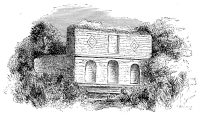
On both occasions on which I have passed this way, the weather happened to be of exceptional brilliance. The season was winter, and the height attained was two thousand feet, yet the air was mild and balmy, and in the open carriage, the only shelter required was an umbrella, to avert the dazzling rays of the sun. On the left were the rugged Alpine peaks stretching far away in the distance, while on the right we looked down the precipitous banks, laid out in terraces for vines and orange-gardens, to the picturesquely peninsulated shores of the Mediterranean. Midway, on our right, we come in sight of the ancient town of Eza, perched most picturesquely on the summit of a conical mount, and which figures in the early history of this singularly irregular line of coast. A more difficult piece of country for military manœuvres can scarcely be imagined, for there hardly appears a level spot in the whole territory; hence we have a pretty good idea of why the Ligurians so long defied their enemies, and also why the district, in its quality of Principality of Monaco, should have for such a length of time maintained an isolated existence. Of the final success of the Roman invaders we have an interesting memorial at the decayed village of Turbia, through which the road passes. It consists of the shattered remains of a colossal monument, erected in honour of Augustus Cæsar. Occupying a prominent rocky knoll, it is 17visible from a great distance at sea. Reaching it by an irregular path through the old village, we find the ruin surrounded by a wall, to prevent further dilapidation. What was the original form of the monument is nowhere mentioned. It was certainly a tall ornamental structure, bearing a gigantic statue of Augustus in white marble, of which fragments have been discovered. In the middle ages, the building was altered and enlarged to form a species of fortress, and thus it remained until it was destroyed by Marshal Villars, during the wars of Louis XIV. (1705). The present name of the village is said to be a corruption of Trophæa (Trophæa Augusti), but this is mere conjecture. A few minutes bestowed in a visit to this noted historical ruin, and in enjoying the outlook seaward, will not be misspent.
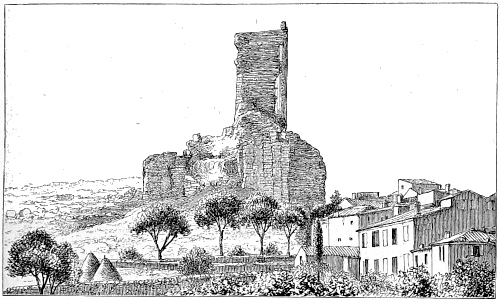
Ruin of Monument at Turbia, viewed from the south.
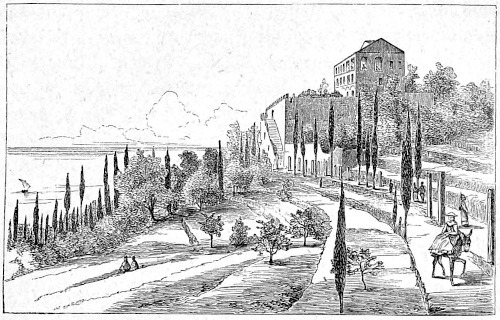
At Turbia, we come full in sight of the town of Monaco, perched on a rocky peninsula jutting into the sea, and still walled all around as it was in the days when it required to hold out against foreign enemies. Divided from it on the east by a small port, rises Monte Carlo, a plateau now noted 18for its gaming establishment, the only authorised resort of the kind in the south of Europe. The only other place on the route calling for a word of observation is Roccabruna, a cluster of antique buildings, the capital of a commune, jumbled up in a strange manner with huge brown rocks, that look as if they had been suddenly arrested on tumbling down the lofty hill behind them. From this we have a continued descent to Mentone. As we advance, the scene opens, and turning a corner of the road, we see the place of our destination stretching along the curve of a beautiful bay, backed by low hills, covered with evergreens, while behind these rises a semicircular range of arid mountains, towering several thousand feet high, and forming the screen from the north, that, constituting Mentone an Undercliff, gives it that peculiar mildness and dryness of climate for which it has attained celebrity. A drive for a mile along an avenue of plane-trees, environed with olive-grounds and villas, brings us to the spot where we are to spend the winter.
CHAPTER II.

The approach downhill from Roccabruna to Mentone offers one of the most pleasing sights in the Riviera. Before us is the town, skirting the sea-shore, backed by hills clothed in evergreens of varying tints. On our right is the wide expanse of the Mediterranean; and in the distance to the east are seen the headlands of Ventimiglia and Bordighera. It is a peaceful, secluded scene, and, lying full in the blaze of sunshine, comes up to our ideas of what is befitting as a resort for those in quest of health, or who wish to reside for a time away from the turmoil of the outer world. It is customary to say of Mentone, that here civilisation ends. We have arrived at the last town in France. Going farther in this direction, we enter Italy, where, generally speaking, matters are in a less advanced condition.
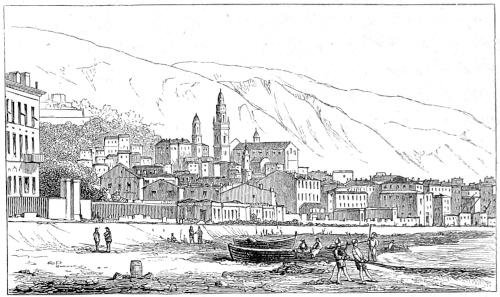
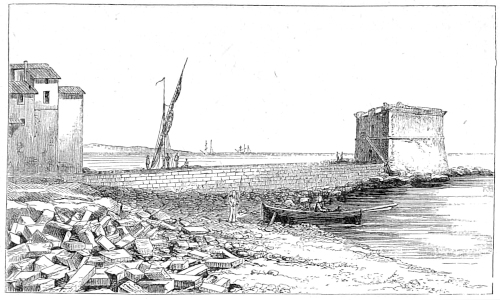
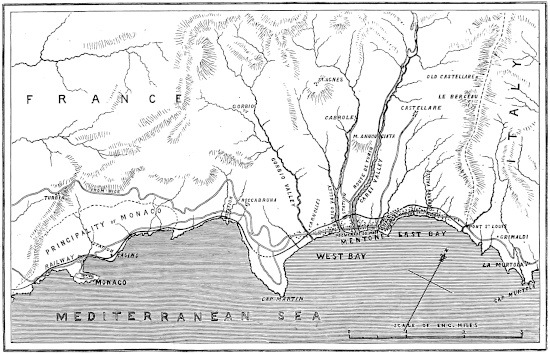
The whole of Mentone is comprehended in the curve of a bay, which, from Cap Martin on the west to Cap Murtola on the east, may measure five to six miles, by following the line of coast; but the curve is divided near the centre by a projecting ledge of rocks, on which stands a conspicuous square bastion or martello tower, forming an outwork of the older part of the town. The sweep of the shore is therefore broken into two bays, the western and eastern, a circumstance which imparts a divided character to the place. As regards the residences of strangers, there may indeed be said to be two towns, distinctly 20cut off from each other; the only channel of communication between them being a confined thoroughfare amidst old buildings.
So closely do the mountains infringe on the shore of the eastern bay, that in this quarter there is space on the level ground for only a single range of hotels, with a roadway in front of them. On the western bay, the level ground is much broader; it allows space for a public promenade along the beach, also a succession of hotels and villas, not very symmetrically arranged, and a long street, in which the chief business of the town is conducted. Besides this degree of accommodation, the western bay offers some scope for building in certain lateral valleys, reaching to the base of the mountains. The valley first crossed is the Gorbio, and then the Borigo and Carei, the two last mentioned being the principal. They take their names from the torrents from the north which empty themselves into the sea—that is to say, when they have any running water in them, which is not very often the case. The valley of the Carei is the most spacious, and has already been built on to a considerable extent on both sides. The thoroughfare on the right bank, overshadowed with plane-trees, is known as the Route de Turin, and conducts to the railway station.
The grand thing in the scenery of Mentone is the picturesque hilly ground behind it. Standing on the bridge which crosses the Borigo at the entrance to the town, we are presented with an amphitheatre of almost matchless beauty. In the foreground is a series of round-topped hills, detached from each other, and mostly laid out as groves of olive, orange, and lemon trees, interspersed with vine terraces, and dotted here and there with the cottages of the peasant proprietors. The height of these hills, or collines as the French call them, is from four hundred to six hundred feet above the sea-level, an altitude that admits of 21our seeing over and immediately beyond them that wonderfully striking range of peaked limestone mountains towering in fantastic masses, and prominently relieved against the clear blue sky. The scene is one which we are never tired looking at, and leaves impressions which no length of time can obliterate. I have often thought with pleasure on that singularly picturesque landscape.
As now seen, Mentone is of comparatively recent date. Its reputation as a resort for health-seekers is only of ten or twelve years’ standing, and the larger part of its extensions has taken place within that period. At the end of last century, the town consisted of little more than a dense cluster of antiquated buildings, covering a conical hill, which rises from the sea-shore; the whole hemmed in by defensible walls, with the remains of a castle crowning the summit (since transformed into a cemetery), and a kind of sea-port claiming protection from the bastion on the projecting reef. While in this antiquated condition, there was no road through it fit for wheeled carriages. The only thoroughfare was the old Roman road, about twelve feet in width, sufficient alone for foot-passengers or mules, which wound its way as it best could along the coast—sometimes creeping up hills, at other times diving into ravines, and when arriving at towns, getting through them by narrow passages, well guarded at each end by gates. Such was the sole means of communication along the shore of the Western Riviera till within the memory of persons still living.
Good reasons for this backward state of things might be found in political distractions, and more specially in the fact, that the whole of this part of the coast was for ages so much beset by predatory bands of Moors or Saracens, that it was advantageous to make every place as inaccessible as possible. Villages were placed far up the mountains, with a good outlook to the sea, 22and were approachable only by scarcely distinguishable tracks. While the towns were walled, the palazzos of the gentry adjoining the ancient route resembled the larger kind of fortified Border keeps, and could be entered only by drawbridges and strongly barred doors, protected by shot-holes. Several specimens of these bastel-houses still survive, though in a decayed condition, and are well worth investigation. The Saracens, however, established themselves on various parts of the coast; one of their strongholds being Eza, a small fortified town, already referred to as being seen on the road from Nice to Mentone. According to tradition, the person chiefly concerned in expelling these intruders was a noble Genoese, named Grimaldi, who, for his bravery and public services, received a gift of the territory of Monaco, in which his descendants afterwards bore rule. As this event is said to have taken place in the year 980, the House of Grimaldi must be reckoned one of the very oldest in Europe.
Except as being involved in the wars of the Guelfs and Ghibellines, little is heard of the Grimaldis for two or three hundred years. They were known as seigneurs or counts, holding some local sway, but always under the protection of superior neighbours, to whom they stood in the relation of vassals. Any one curiously disposed regarding their intermarriages and ongoings, will get full particulars in the recent work of Mr Pemberton (History of Monaco, Past and Present), also in the French work of M. Abel Rendu (Menton et Monaco); but it is not easy to burden the memory with the annals of this noble and not always well-behaved family. But for their instinctively clinging to France, they would long since have disappeared. By Louis XIII., the family were raised to the rank of Princes of Monaco, and they were likewise invested with the Dukedom of Valentenois in the peerage of France. From this time, they fought in the French wars, and were 23occasionally employed in diplomatic missions. At the middle of the seventeenth century, the principality had the honour of supporting the extravagances of Lewis I., a prince who, in his ardent desire to shew off with becoming splendour as an ambassador, accepted a mission to Rome from the court of France. We are told that his prodigal outlays led to a system of taxation of hitherto unexampled severity. The most idiotic of his acts consisted in causing his carriage-horses to be shod with silver, each shoe fastened only by a single nail, in order that it might be easily lost, and ostentatiously replaced. In Anthony, the son of this madcap, the male line of the Grimaldis terminated. With only daughters to succeed, there arose a grand family consultation how Louise Hyppolyte, the eldest of these female heirs, should marry some distinguished personage, sufficiently rich to discharge certain heavy debts and obligations. If we could extract any drollery from the history of the Grimaldis, it would be in the straits to which they were put at this memorable juncture. In a sense, the girl was put up to auction. It was made generally known that the highest bidder, with the longest purse and pedigree, might have her; one thing, however, being stipulated, that he should sink his own identity, and assume the name and arms of Grimaldi. After a good deal of looking about and chaffering, Louise Hyppolyte was assigned to Count de Matignon, whose wealth was pronounced adequate, and his ancestral rank in no respect impeachable. The marriage took place in 1715, and from it sprung the present family.
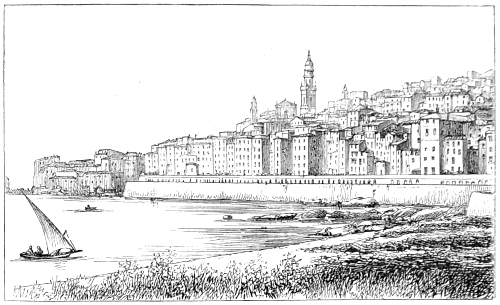
The old town of Mentone with Quai Bonaparte, as seen from Eastern Bay.
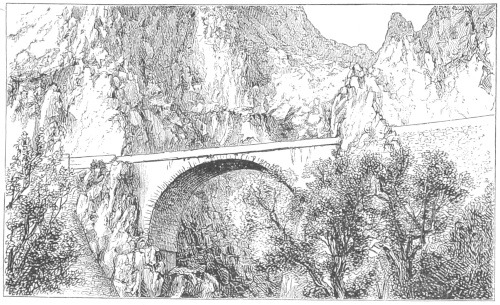
It does not appear that the new branch of the clan Grimaldi was a marked improvement on the old one. When the revolution of 1789 broke out in France, it spread to the principality; and so much was Honore III. disliked for his arbitrary measures, that he had to flee for his life, leaving his patrimony to its fate, which consisted in being absorbed into the French republic. 24Unfortunately, the change of masters produced only some new varieties of oppression. There was, to be sure, a very distinct proclamation of liberty and equality; but it was associated with relentless taxation and conscription, along with an assiduous search for victims for the guillotine. Recesses in the mountains above Mentone are pointed out where suspects took refuge in these terrible times, and to whom food was under great difficulty taken by their families. With the fall of the Convention in 1793, and the rise of Bonaparte, the Mentonians experienced a gratifying relief, although the conscription continued as severe as ever. In the course of Napoleon’s marvellous military feats in Italy, he visited Mentone; and observing the imperfect character of the old road along the coast, gave orders to construct that entirely new carriage-way, the existing Corniche, an engineering exploit which was the making of Mentone. Previously, the old road in proceeding eastwards ascended to a vaulted gateway, and was thence continued in the Rue Longue, 25a curious narrow passage environed by tall antique buildings on each side, the exit being by a gateway at the farther extremity, whence the road descended to the eastern bay. For this inconvenient thoroughfare, the French engineer substituted an artificial terrace-road, raised within the sea-margin, and skirting the backs of the gaunt old houses of the Rue Longue. All who have travelled along the Corniche, will remember this ingeniously constructed part of the route, styled the Quai Bonaparte, and how, after getting clear of the town, it ascends to the Pont St Louis, on the front of the rugged cliffs which overhang the Mediterranean.
After having been connected with France for more than twenty years, the principality of Monaco was assigned, by the treaty of Vienna, to its hereditary claimants, who were to be under the protection of Piedmont. Delivered up to Honore V., as the reigning Grimaldi was designated, the unhappy people, to their dismay, soon felt themselves in the grasp of a rapacious tyrant. Honest, industrious, and confiding, they were willing to render loyal obedience to the old family; but so far from being sympathised with, they were viewed as mere objects of the most uncompromising extortion. What now occurred in the communes of Monaco, Roccabruna, and Mentone—such being the entire territory—would, if minutely told, form a history unexampled for despicable selfishness on the part of the ruling authority. The account given by Pemberton, and also by local French writers, regarding the fiscal abuses of Honore and his successor, raises the deepest emotions of compassion. It is painful even to allude to matters of this kind, and I do so only because a knowledge of what took place enables us to understand why Mentone has been absorbed into the French empire. The story—fit to form the subject of a romance—is also not without interest, as revealing to what lengths a despotic ruler 26may go when unchecked by considerations either of mercy or public policy.
Living at a safe distance in Paris, and governing by deputies, Honore V. maintained a fair face to the world while issuing ordinance after ordinance calculated to reduce his patrimonial territory to utter poverty and ruin. Plausible and refined in manners, his hypocrisy was equalled only by his intense avarice. What he wanted was money, and that he was resolved to wring by every available means from his helpless subjects. He began operations by taking possession of all property belonging to communes, hospitals, and ecclesiastical establishments, all of which were in future to depend on his bounty. Next, he imposed duties on every article entering or going out of the country, or which was consumed as food. The principal produce consisting of olives, oranges, lemons, citrons, figs, and grapes, these were all placed under rigorous surveillance, and subjected to heavy imposts. There had long been manufactures of oils, essences, perfumes, and confections from one or other of these fruits, for purposes of export, and the taxes now levied upon them rendered the trade not worth carrying on. Then were issued ordinances assigning to the prince an entire monopoly in the manufacture and sale of linen, gunpowder, pipes, and tobacco. No one dared to purchase linens for clothing or domestic use, or to be used as sails for boats and shipping, unless they came from the prince’s factories at such prices as he was pleased to impose. Following on these arbitrary measures came the monopoly of selling vermicelli. This was a hard blow on the poor, but nothing in comparison to the next financial device, which was a monopoly in the importation of corn, meal, and flour. As it happened that the territory produced scarcely any cereals, the people depended on imports, and under this new policy they were placed at the mercy of a 27prince who cared not though his subjects should perish of hunger.
To advantageously carry out this last ordinance, Honore procured the assistance of a Frenchman named Chappon, with whom he divided profits. Established as the grand purveyor of corn, Chappon became a terror to the unfortunate community. At the very outset, there was experienced a want of mills to grind the imported corn, nor could mills be erected unless where there was water-power. The valley of the Carei at Mentone offered this convenience, but its water-privileges were all secured by olive-mills, and these necessarily had to be bought up. This was speedily accomplished. The oil-mills were forcibly purchased at certain prices; but as these prices were never paid, the transaction was nothing else than a robbery. Possessed of the mills, the next thing was to make a road to them fit for wheeled carriages. Instead of making the road at his own cost, Honore obliged the proprietors of land on the right bank of the Carei to construct a thoroughfare at their own expense, at the same time mulcting them in sums to keep it up. The road so formed, lined with plane-trees, is that now known as the Route de Turin. The construction of such a road was certainly a great improvement; and the only matter for regret is the injustice of the whole affair. Having set the mills to work, Chappon imported parcels of damaged or inferior corn, which, being ground to flour, was sold at such high prices as he was pleased to impose. This extortion was not enough. It was discovered that a good profit could be made by a monopoly in baking. The prince now became baker in general for the principality, and the baking and selling of bread, except under his authority, were declared to be penal. A cry of despair—the wail of the poor—sounded through the land. Earnest, piteous remonstrances were made to Honore. All were unheeded. 28There was no earthly tribunal to appeal to. The press of Europe did not hear of, or at least said nothing of these atrocities. The people, patient and forbearing, continued to suffer. One can hardly realise the fact, that within the last quarter of a century a person enjoying the rank of a Christian sovereign should have been guilty of iniquities like those here briefly referred to. The bread monopoly proved the worst of all; for, besides the dearth and bad qualities of the article, excessive penalties were incurred for attempting to bring even so much as a morsel into the territory. If a labourer went across the frontier for a day’s work, and brought back at night a portion of the bread he had had for his dinner to succour his wife and children, it was taken from him, and he might think himself well off if he escaped punishment. If a ship, on arriving at any of the small ports, had bread or biscuits on board, the whole had to be thrown into the sea, and a fresh supply procured from the prince’s baker. Driven to extremity, the people ate as little as possible of what they emphatically called the pain de douleur; but this was met by a new expedient. A register was ordered to be kept of all the bread which each family purchased, and if the quantity fell short of a certain standard, they were exposed to a prosecution for consuming too little.
Things were not yet by any means at their worst. The only fuel used was old decayed olive and fruit trees, and here was a fresh means of exaction. An ordinance was issued forbidding any tree to be cut down, or any branch removed, unless by a special license, which had to be paid for, amounting to a tax on the fuel used for warmth or the preparation of victuals. The next form of extortion was to impose a fine on any one leaving his house after ten o’clock without a lantern. A fine of three francs was also imposed on every license for a person going out of the country. Hungered in the article of bread, taxed on 29their oranges, taxed on their fuel, and taxed in their clothing, the people as yet were allowed to eat their own poultry, eggs, and butcher-meat. That was a great overlook, now to be remedied. A universal census was taken of oxen, sheep, goats, pigs, and other animals raised for sale or private consumption, and the amount of stock had to be rigorously accounted for. A register was kept of all births and deaths of these various animals, the sex of each being noted. The object aimed at was a tax payable for every animal slaughtered. If a person wished to kill one of his pigs, he had to intimate the fact to an officer, who attended to lay on the tax, and make the appropriate deduction from the recorded stock on hand. Woe be to any one who ate his own mutton or lamb, without being taxed, even although the animal should have died or been killed by accident. We may conclude the list of extortions, by mentioning that, to support the several monopolies, it was necessary to employ a large staff of custom-house and other officials. The douane at the frontiers was remorseless in severity. If a merchant declared the weight of his goods to be a single pound less than they actually weighed, the whole were confiscated. By all these and sundry other contrivances—one being a right to all the scrapings of the streets, for there was nothing too mean to be appropriated—Honore V. wrung an annual revenue of 320,000 francs from a small population, a large proportion of whom were people in a humble rank of life. There was folly as well as cruelty in the exaction, for more than a third of the whole amount levied went to defray the expenses of collection. Some of his schemes were disappointing. He attempted to increase his civil list by coining and putting in circulation five-franc pieces, containing thirty per cent. of alloy, but as nobody would take his bad money, this proved an unfortunate financial experiment. He was also rather luckless in his projects for taxing education. In 30Mentone, he set up a school to which children should be sent on paying certain fees, and at the same time it was declared to be penal to teach children at home. The result was that the school was deserted, to which melancholy fact is ascribable the general ignorance of letters among the bulk of the humbler classes past middle life.
Honore V. died in 1841, carrying with him to the grave the execrations of all he had misused and misgoverned. Strange to say, the people, from a hereditary sentiment of loyalty, did not embrace the opportunity of repudiating the Grimaldis. The heir of the principality was Florestan I., of whom good hopes were entertained; but he continued the former extortions and monopolies, adding the obligation, that the crushing of all the olives in his territory should take place at his own mills, under excessive penalties. This was little else than a sentence of annihilation to the olive-growers, and general ruin was in prospect. But the time had now come when the odious tyranny could be safely thrown off. The ferment of the revolution in France in 1848 spread to the principality of Monaco, and by a popular outburst of outraged feeling, the authority of the prince was denounced and rejected. Florestan appealed for help to Sardinia, but in vain. He made some overtures at conciliation. They were treated with derision, and he was ordered to quit the territory. It says not a little for the character of the people, that in carrying through their revolution, not a single personal injury was inflicted. Having rid themselves of the Grimaldis, the communes of Monaco, Roccabruna, and Mentone declared their political independence, in which condition, and unmolested, they remained for twelve years. During this period they did much to restore general concord and prosperity, and it was at this time that some improvements were effected in the various towns. Florestan died in 1856, an 31event which provoked no public manifestation in favour of the family. Circumstances had already made it obvious that the communes would need to unite themselves permanently either with Sardinia or France. On this point there were protracted negotiations, judiciously conducted by a patriotic citizen of Mentone, Carlo Trenca, who had been a moving spirit in promoting the revolution and preventing public excesses. Trenca died in the course of these public duties. Matters were at length matured, and in April 1860 the people were left to vote whether they would belong to Sardinia or France. The choice of the majority was wisely for France; for by this means the country was incorporated with a nation which, while advancing its material prosperity, could secure its internal peace, and protect it against aggression. Charles III., the son and heir of Florestan, protested against the union. At last, on the 2d of February 1861, he agreed to a treaty, by which he ceded all his rights and privileges over Roccabruna and Mentone for the sum of four million francs, reserving only his sovereignty over Monaco under French protection.
Since 1861, accordingly, Mentone has in all respects been part and parcel of France, and participated in its national progress. Monaco alone, consisting of a patch of territory extending three and a half miles along the coast, by a width at broadest of one mile, remains a petty dependent sovereignty under Charles III., who lives part of the year at Paris, and at other times in his palace in the town of Monaco. His son and heir-apparent, Charles-Honore, born in 1848, was recently married to a daughter of the late Duke of Hamilton.
Since it was attached to France, Mentone, with some ground in its neighbourhood, has been a commune of the Alpes Maritimes, with a mayor and council for its local administration. So smoothly are its civic affairs conducted, that one hears little 32or nothing of them. There is a Hôtel de Ville, but it is by no means of an obtrusive character. It is comprehended in the upper floor of a building in a lane which ascends from the main street towards the cemetery. Adjoining is the office of the police, an establishment of a very limited nature. The annual municipal revenue is 120,000 francs, derived principally from an octroi, or petty duties on articles of consumption brought into the town; and the expenditure, including outlay on schools and hospitals, is the same amount. The settled population of Mentone is 6000. Besides the few sergents de ville who act as street police, there is a small body of Gendarmerie Impériale, members of which may be seen lounging about in military costume, but ready to mount and be off on any mission appropriate to their functions. Though situated on the frontier, Mentone has no garrison worth mentioning. The only soldiers observable are a single company of one of the regiments of the line, exhilarated in their marching by three drummers and a trumpeter. To the credit of the French army, the soldiers when off duty conduct themselves with great propriety. They may be seen reading on the seats in the public promenades, or taking a walk in groups amidst the rural scenery, circumstances which may be thought to speak well for their character.
CHAPTER III.
The railway from Nice to Mentone, forming part of the line from Paris and Marseilles, terminates at the frontier, where it is to be united to the line from Genoa. The Italian portion, however, is in a very backward condition, and to all appearance years may elapse before it is completed; on which account many travellers for Genoa do not trouble themselves with the railway so far as it is made, but hire carriages and horses at Nice for the whole journey. Vehicles with two, four, or sometimes five horses are seen daily passing southwards through Mentone. The railway does credit to its constructers. Piercing Cap Martin by a tunnel, it crosses the several valleys by bridges, holding close by the hills behind the town. The station, situated on the right bank of the Carei, and reached by the Route de Turin, is about a quarter of a mile northwards from the main street. Omnibuses in connection with several hotels, likewise an omnibus for the general service of the town, and the diligence for Genoa, attend the arrival of the trains. Visitors designing to remain for the season can have no difficulty in getting apartments in any of the hotels having omnibuses, until they look about them and make a choice of a dwelling.
To help them in their selection, a few general observations may be offered. Mentone, as has been shewn, is a town in two divisions, locally known as the East and West Bays. The 34first thing, accordingly, for a stranger to do is to make up his mind in which he prefers to reside. The two bays are very different in character from each other. The East—that which is farthest away on arriving from Nice—is reputedly the warmest, and best adapted for invalids with pulmonary or bronchial affections. Sheltered on the west by the projecting hill on which the old town is built, and on the east by Cap Murtola, and closely overhung on the north by the mountains, it is, I believe, the most sunny warm nook in the whole Riviera. So completely is it enclosed that there is only space in front for the roadway from the Quai Bonaparte. The hilly ground in the rear, clothed in olive, orange, and lemon trees, is intersected by the small and not very accessible valley of Garavan, which imparts its name to the quarter. Far up, on the bare acclivities, are seen gray, sun-dried cottages, though who live in them, or how they are reached, no one can understand. Near at hand, on the lofty cliffs to the east, is the Corniche road, pursuing its way by the Pont St Louis.
Latterly, to meet the demand for accommodation in this choice quarter, a number of houses of various kinds have been erected towards the ravine of St Louis, and it seems likely that every available site will ere long be occupied with dwellings of a class suitable for visitors. Singularly favoured in various respects, the East Bay is not without some drawbacks. If the weather be warm, the locality may be found too close, and the mosquitoes somewhat troublesome. To go into and return from town, pedestrians have to pass through a cold windy gorge at the end of the main street, and the walk by the Quai is not pleasant. The greatest defect is the want of a good public promenade near the sea-margin. No doubt visitors can hire a carriage, or they can take the omnibus which plies to and from the western extremity of the town, and so reach promenades to 35their liking; but all that causes trouble, and one prefers to saunter out at odd times for air and recreation when a pleasant promenade is readily at hand. This deficiency is said to be in course of remedy by the formation of a level stretch along the beach, but when it will be completed is uncertain. With all its drawbacks and limitations, there is much to fascinate in the East Bay, so quiet, so sunny is it; and the mind carries away recollections of the pretty shrubberies in front of one or two of the hotels, where, in mid-winter, you see parties seated under the elegantly drooping foliage of the pepper-tree, as if enjoying a cool shade in the heats of summer. To live at this spot is truly to winter with the swallows, for there, when the season is propitious, they resort, as if aware that in going farther they would find few such haunts, till they reach the neighbourhood of the Pyramids.
The West Bay, if less sheltered, is more spacious and airy. Living in it, you are more in the world—near the shops, cab-stand, railway-station, reading-room and library, new English church, post-office, Promenade du Midi, and all the walks and rides in the lateral valleys. I should say that this quarter is most suitable for mere health-loungers—those who seek for recreation in open air and exercise. With a south-eastern or south-western exposure, it is sunny enough for all ordinary requirements, and is chosen by many invalids for its amenities, as is observable from the number of persons who are drawn along the Promenade in Bath-chairs, courting health from the sea-breezes, tempered by the brilliant sunshine. In the West Bay, beginning at Carnolles, and extending to the centre of the town, there are numerous hotels, some pleasantly situated, so as to overlook the Promenade, and others at the base of the rising grounds. Here, also, are a variety of villas for hire, and a number of houses specially called pensions, the distinction 36between which and hotels is not very clear, so far as concerns the residence of strangers for the season. In all the hotels, possibly with one or two exceptions, there is a practice of receiving guests en pension—that is to say, they give board and lodging at so much per day. Whether designated hotels or pensions, these establishments are for the most part on a scale of considerable magnitude.
At these establishments no introduction is necessary. All are received on an equality, no matter what be the nationality or rank in life. Some houses are resorted to more by German or French visitors than others, while some are preferred by English and Americans. The charge per day for each person is usually from ten to twelve francs. For this sum you have a small bedroom, fit for only one person, breakfast, luncheon, and dinner, with generally the use of a public drawing-room. Candles, firewood, and service are paid for separately. The object seems to be to let as many bedrooms, and as few salons or private sitting-rooms, as possible; at all events, the charge is made so high for a salon, that comparatively few indulge in that luxury. The French way of living is adopted. The meals are served to the guests in the salle à manger; but in the case of breakfast, guests may ordinarily choose their own hour. In fact, the breakfast, petit déjeûner, is a trifle, something to carry you on till noon, and consists only of tea or coffee with bread and butter. Luncheon at twelve is the déjeûner proper, and is styled the déjeûner à la fourchette. It is in reality a dinner with different hot meats and omelettes, but without soup or dessert. Half a bottle of vin ordinaire is allowed to each person. Dinner, the great meal of the day, takes place at six o’clock. This is the well-known table-d’hôte, set out in good style. There is the same allowance of vin ordinaire as at noon, but other wines are supplied to order.
37Under the pension system no tea is given in the evening. After dinner, some go to their bedrooms, others to the drawing-room, for the sake of music or conversation, or to look over a few old newspapers, for want of anything better to do. The drawing-room is usually styled a salon de lecture, because it is presumedly a reading-room. A tattered Galignani, a week old, lying on the table, will constitute the room a salon de lecture. This mode of living in public may be amusing to those who do not object to racket and noisy talk in several languages. My own experiences have not been very successful, particularly as regards the drawing-rooms or sham salons de lecture, where usually some young lady, with long hair hanging down her back, has, by her frantic performances on the piano, banished everything like quietude and comfort. What with one charge or another, the cost of living en pension at Mentone is rarely under a hundred francs, or four pounds, for each person per week. In very many cases it will amount to five pounds. Preferring to occupy a private salon, I submitted to a higher charge. Last season, I procured a salon and two bedrooms on the first floor at a hotel overlooking the Promenade at a charge of 105 francs, and for meals served privately 119 francs, for two persons per week. A charge of 10½ francs was made for service. Wine, fuel, and lights were paid for in addition. The sum-total was usually about 267 francs, or £10, 14s. per week. These charges were lower than I had paid the previous year at another hotel, but I do not scruple to say they were exorbitant, for the logement and nourriture were not worth the money. Like all, however, who capriciously depart from the plan of eating and drinking in a crowd according to the routine of the establishment, I ought not perhaps to complain. The table-d’hôte system is unquestionably the cheapest, and also the best as regards variety of 38dishes, wherefore comparatively few attempt the method of taking meals in their own apartment.
In appearance, the hotels and pensions of Mentone are well built and substantial, with usually a coating of cement or paint of a light colour. All the stairs are stone—in one or two instances marble. The floors are laid with tiles, covered with carpets; the furniture good. The rooms are arranged in rows along each side of the passages, and communicate with each other. In one point of view, this is a convenient arrangement, for it allows any one to occupy two or more apartments en suite; but against it there is the objection that you are separated possibly from noisy neighbours only by a thin and imperfectly constructed door (of two leaves); and it is impossible by any precaution to avert this contingency, for there is a frequent shifting of visitors. A little annoyed by the vivacity of some neighbours who spoke in German at about the pitch of their voice, we tried to deaden the sound by hanging up a railway wrapper over the doorway. For such imperfect arrangements the hotels of Mentone are not singular. The same thing prevails at Nice, where, on one occasion, we had to vacate our rooms in consequence of a lady and gentleman taking lessons in singing in the next apartment—the pair going through the gamut for hours, one in a shrill treble, the other in a deep bass voice, and both of course regardless of the noise they created, or the inconvenience to which they were putting their neighbours. There is another structural imperfection which may be experienced in some of the Mentone hotels. It consists in the fire-places being placed in the outer wall so near the connecting doors, as not to admit of a party sitting around them in the English fashion. Besides being awkwardly placed, the fire-places are not furnished with grates for burning coal. On the occurrence of a stretch of cold weather, the want of coal-grates 39is felt to be a serious defect, for the heat derived from burning wood is very insufficient. The fuel ordinarily supplied consists of billets of old olive and fig trees, two and a half francs being charged for a basket which will last a day. I have known persons who used two baskets in a day, or upwards of four shillings’ worth of wood. As a kind of favour, during the coldest part of the season, we were, for a fair consideration, indulged with some pieces of coal to mix with the wood on the hearth, and in this way contrived to strengthen the blaze a little.
A few words may be offered respecting the situation of the principal hotels, beginning at the western entrance to the town. The Hôtel du Pavilion, on right, at Carnolles; well managed, with a small salon de lecture; back overlooks the sea; rather distant from the town, and the roads dirty in bad weather, but situation otherwise pleasant. Hôtel Splendide, on left after crossing the Borigo; an elegant new house facing the south; has an outlook to the sea, but this may be interrupted if buildings be placed on an open piece of ground which is at present offered for sale. Hôtel de Londres, a smaller house on same side of the road a little farther on, good, but partially overshadowed by buildings on south side of the road. Hôtel de Turin on right, with windows to the south overlooking the Promenade; consists of two houses, one being styled the Annèxe, but there is a connection between the two by a covered passage; no salon de lecture, although one of the French guide-books says there is; only a salle à manger, salons, and bedrooms; clean; good service; convenient by means of a back entrance from Promenade; but the noise of the sea troublesome. Hôtel du Parc, a short way up the Route de Turin; new; overlooks the Carei, but seems much darkened by rows of tall plane trees. Hôtels du Louvre and Beau Séjour, at base of hills, facing the south, 40with orange gardens in front, reached by the road on left bank of the Carei, also by cross-road from main street, and situated near the town; good, and away from noise of the sea; well adapted for invalids; resorted to by Germans and French; the railway, after crossing the Carei, is carried near the back of these houses. Hôtel de la Méditerranée, on left or north side of main street, good, and used by strangers passing through the town; opposite is a short lane conducting to the Promenade; as the situation is central, it would be found convenient to reside in this hotel until permanent quarters were secured. Hôtel d’Orient, new, situated back from north side of main street near the Cercle; a southern exposure, but shut out from view of sea. Grand Hôtel de Victoria, a very large splendid house, frequented by aristocracy, on right or south side of the street; back windows overlook the sea; and a back entrance communicates with the Promenade; this house has a lift for benefit of residents on the higher floors. Hôtel de Paris, same side of the street; best known for its café, billiard-rooms, and restaurant. Hôtel du Midi fronts the Promenade, which alone separates it from the beach; noise of sea troublesome. Hôtel d’Angleterre, formerly called Hôtel de Turin, fronts Place Napoléon, where travelling carriages arrive and are for hire; back windows with a broad balcony overlook the sea. In this hotel, which is at the heart of the town, a lady friend resided during the winter of 1862–63, and greatly enjoyed a seat on the balcony, the fine season completely remedying a throat complaint. Since that period, the environs of the house on the side next the sea appear to have deteriorated, being not only dirty, but noisy, from crowds of boys who frequent the place for outdoor sports.
The foregoing are the principal hotels in the West Bay, and besides them I may instance the pensions Hemmelmann, 41Camous, Miramar, and Bournabat, overlooking the Promenade, and Imberti, prettily situated in a garden on left bank of the Borigo. In the East Bay, the hotels standing in a row near each other, and generally spacious and elegant, are as follow: Hôtel de la Grande Brétagne; Grand Hôtel de la Paix; Hôtel des Anglais, frequented by English and Americans (here reside during the season, Dr J. H. Bennet, and Dr J. Martin, a skilled English dentist); Hôtel des Iles Britannique; Grand Hôtel. All these, and there may be one or two others, also some pensions, are on the level ground, entering from the roadway, and having a southern exposure to the sea. There is a detached hotel, Hôtel d’Italie, with a good outlook, situated on the hill above, reached by a flight of steps and sloping drive; the landlady is English; the only objection to this house is the difficulty of getting up and down.
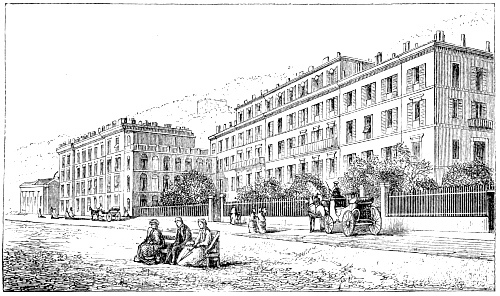
Hotels in the East Bay.
As regards detached villas ready furnished for hire, there is a good choice in the early part of the season, at rents ranging from fifteen hundred to five thousand francs. Those 42occupying them will either have to bring servants with them or hire them on the spot. Some superior residences of this kind are situated at Carnolles. One of them in this quarter, quite palatial in character, is the mansion which belonged to the Prince of Monaco previous to his expulsion from the commune. There are several villas of a respectable class on or near the Promenade; a number equal, if not superior, in appearance are situated in the valley of the Carei; and some of tasteful architecture have just been erected at the farther extremity of the Eastern Bay. In general, the villas are handsome buildings situated in gardens, with gateways for admitting carriages to drive up to the door. The whole are provided with Venetian blinds hung outside the windows, by which means the houses may be effectually shut up at the close of the season. I observed that the windows of some of the villas have frames covered with fine gauze to exclude flies and mosquitoes; when a window is opened for air, the gauze frame takes the place of the glass; a most luxurious piece of furniture this. Some of the villas are provided with stables and coach-house. The common practice, however, is to hire carriages and horses from persons who make a business of lending them. A good carriage, either to open landau-fashion or to shut up, with driver and pair of horses, the whole turn-out in good style, may be hired at about 625 francs per month, for which sum everything is included. In a few instances, a villa comprehends two distinct dwellings, one in the lower and another in the upper floor, and having separate entrances. For the most part prettily furnished in the French style, the villas are not always well provided with water, nor is their system of drainage very perfect. The whole, I believe, like most of the hotels and pensions, depend on pump-wells, and with few exceptions the drainage is into cess-pools. Here we touch on two weak points 43in the character of Mentone. I cannot say that I experienced any inconvenience from either; but things are certainly not what we should expect in a community which depends, to a great extent, on its colony of strangers.
Another class of dwellings for hire are floors ready furnished, reached by common stairs from the public thoroughfares. Houses so laid out in floors for separate families, are styled Maisons—as, for example, Maison Gastaldy, Maison Ribaud; being so called from the names of their respective proprietors. Some floors are divided into two dwellings; each dwelling is designated an Appartement, though consisting of several rooms with kitchen. Many of these floor dwellings are on a respectable scale; the rent for the season being from 800 to 2000 francs. Service is not given, and will require to be procured separately, as in the case of detached residences. An English family of my acquaintance hires a dwelling of this kind by the year, going and returning annually. Every year, at the proper season, the family arrives, bringing an English female domestic, to whom a native servant is added to complete the establishment. At the end of the season, the dwelling being locked up, is left to the care of the proprietor till it is again wanted. No plan of housekeeping can match this for independence and comfort. It is well suited for families who, for some special reason, require habitually to winter abroad.
There is still one other class of houses offered for hire, furnished. These are Châlets, or cottages of moderate dimensions, situated amidst orange and olive groves on the sides of the hills, but to which access is obtained only by winding pathways fit for pedestrians, or for donkeys with panniers to bring all necessary provisions. Persons who have a fancy for ruralising amidst very charming scenery, could find nothing more suitable than a residence in these secluded 44spots. Water, I fear, will prove a difficulty, but that must be looked to.
When several members of a family have to be accommodated, I would recommend a hired dwelling of some sort, be it a villa, a floor, or a châlet, not only for the sake of economy, but for that degree of peace and comfort which is not obtainable even in the best-managed hotel or pension. In the furniture of houses let for hire, napery and plated articles for the table are included, and it may lessen anxiety to know that dinners ready cooked are sent out to order from certain hotels. A confectioner and pâtissier may be applied to for a like purpose. There is a keen competition in the profession of the blanchisseuse. For those residing in hired dwellings, the town is well provided with shops where all things necessary can be procured, which was not the case only a few years ago; and there is also a market daily for eggs, poultry, vegetables, and other articles.
The building and furnishing of houses for hire is evidently a great trade in Mentone. It is a method of employing capital which, being thought safe, appears to commend itself to French notions. Men of considerable wealth, who make little show, embark in it. Propriétaires owning villas of an elegant and costly kind, which from their fortune they would be entitled to reside in, may be heard of as living in an obscure and economic way in the town. Houses for hire of all kinds are for the most part let by commission-agents, who have lists for inspection. Strangers who propose to rent such dwellings, will find it to their advantage to seek the advice and assistance of Mr T. Willoughby, a well-known English grocer and wine-merchant settled in the town, who carries on a business as a house and estate agent, and looks personally after the condition of every dwelling with which he is concerned. To facilitate this species of business, he prints a list of houses and apartments 45for hire, with a plan of the town shewing where each is situated. He gives a copy of this useful pamphlet, which is printed in English, along with all requisite information, gratis. All English-speaking visitors know Willoughby, who may be considered to be a kind of commercial adviser-general, and ready on all occasions to help his countrymen.
The season is said to begin on the 25th October, and terminate on the 25th April, when the heat becomes inconvenient. I observed, however, that strangers have not fully arrived until the middle of December, and many depart at the beginning of March. Those who come first have of course the best choice of accommodation. According to a list published on the 1st of January 1870, there were 215 English, 41 Americans, 116 Germans, 13 Belgians, 12 Danes and Swedes, 98 French, 21 Dutch, 46 Russians and Poles, and 20 of other nations—total, 582. But as a very large number of the entries in the list were of husband and wife, or of families and suite, we cannot estimate the whole at fewer than twelve hundred adults, and it would be a moderate calculation to set down their aggregate expenditure during the season at less than £200,000.
There were few with whom I conversed who did not complain of the charges of the hotel-keepers: one lady was quite excited on the subject, speaking of the exactions for fuel, lights, and service as something shameful. High charges are certainly more the rule than the exception, and may in the fluctuations of fashion help to drive visitors elsewhere. Nice, however, and other resorts in this quarter, are as dear as Mentone. The hotel-keepers are not without a plausible excuse. They pay high rents; they have to maintain an expensive establishment; their harvest of visitors lasts only six months; two or three bad seasons in succession might finish them. There is truth in this apology, but I would counsel them not to rely too greatly upon 46it. They may with advantage take into consideration the possibility of lowering the sum-total of their weekly bills. Rivals have entered the field. The people of San Remo, as if awakening from a trance, are making a push for a share of the visitor traffic; and if they render their town attractive by establishing a good promenade along the sea-margin, and by carrying out sundry other improvements to meet the fancy of visitors, they may seriously affect the hotel-keepers as well as the propriétaires of every French winter-resort. It may be years, as I have said, before the railway is opened beyond Mentone (for Italy is in a sad state of impecuniosity, or, more correctly, is suffering from a bad administrative system, along with a want of credit), but there can be no doubt that the railway will be completed as far as San Remo some time or other; and when this event occurs, Cannes, Nice, and Mentone may look for a degree of competition in their staple dependence which at present they do not experience. They had better begin revising their tariff.
It will be understood from the foregoing explanations, that furnished lodgings, in the English sense of the term, do not exist at Mentone. There are no houses in which you can hire one or two apartments by the week, and be waited on by the servants of the keeper. That plan of living is not according to French usage. The tickets hung out of Appartement Meublé, signify a furnished suite of rooms without service, and where the dwellers are left to their own resources. Those who wish to be free of the trouble of independent housekeeping, go into a pension, which suits the gregariousness of the French character. Many English will feel this deficiency to be an inconvenience. It often passed through my mind, that lodging-houses on the English system would answer, and more particularly if that peculiar species of lodging-house which prevails at Brighton were introduced. There, the lodging-houses called ‘Mansions’—as, 47for example, the Belvidere Mansion—are ready to let apartments and supply food and service at so much a day, each lodger being served in his own apartment, if he pleases; or they will allow lodgers to purchase what they require for themselves. Nowhere, in all my ramblings, have I found any lodging-house system so thoroughly convenient and agreeable as this, and it would be a great recommendation to Mentone if it had something of the kind which we could point to.
I may offer another remark. Propriétaires at Mentone confine their building speculations too exclusively to detached and costly villas, and to tall houses in the main street. Visitors who wish to hire dwellings do not all incline to pay a high rent for a villa, or to live over shops and have windows looking into a dusty street, noisy with traffic. Many would prefer, if it could be got, a house in a connected row, in a sheltered and retired situation, with a southern exposure—such as may be obtained in one of the crescents at Bath, or the famed Lung’ Arno at Pisa. Instead of setting down villas in all sorts of odd spots, some facing this way and some that, and often one overshadowing and interrupting the view of another, how much better would it be for propriétaires to unite, if at all possible, in erecting a score of houses not too high, on the plan of a crescent, in some choice situation, and which houses, while commodious as dwellings, would be hailed as a tranquil and sunny refuge for invalids.