The situation was serious enough for the two boys. It was not a large
fortune, but it was their whole fortune, that straggled along the
slushy road in the shape of five hundred weary, hungry turkeys, which
were looking for a roosting-place.
But there was no place where they could roost, no safe place, as the
boys well knew, for on each side of the old road stretched the forest
trees, a dangerous, and in the weakened condition of the turkeys, an
impossible roost on such a night as was coming.
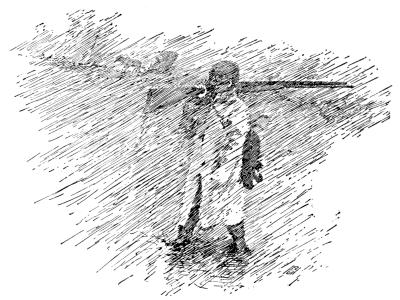
For the warm south wind had again veered to the north; the slush was
beginning to grow crusty, and a fine sifting of snow was slanting
through the open trees. Although it was still early afternoon, the
gloom of the night had already settled over the forest, and the
turkeys, with empty crops, were peevishly searching the bare trees for
a roost.
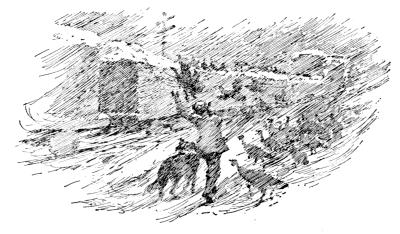
It was a strange, slow procession that they made, here in the New
Brunswick forest—the flock of five hundred turkeys, toled forward by
a boy of eighteen, kept in line by a well-trained shepherd-dog that
raced up and down the straggling column, and urged on in the rear by
a boy of nineteen, who was followed, in his turn, by an old horse and
farm wagon, creeping along behind.
It was growing more difficult all the time to keep the turkeys moving.
But they must not be allowed to stop until darkness should put an end
to the march. And they must not be allowed to take to the trees at
all. Some of them, indeed, were too weak to roost high; but the flock
would never move forward again if exposed in the tall trees on such a
night as this promised to be.
The thing to do was to keep them stirring. Once allow them to halt,
give one of them time to pick out a roosting-limb for himself, and the
march would be over for that afternoon. The boys knew their flock.
This was not their first drive. They knew from experience that once a
turkey gets it into his small head to roost, he is bound to roost.
Nothing will stop him. And in this matter the flock acts as a single
bird.
In the last village, back along the road, through which they had
passed, this very flock took a notion suddenly to go to roost, and to
go to roost on a little chapel as the vesper bells were tolling. The
bells were tolling, the worshipers were gathering, when, with a loud
gobble, one of the turkeys in the flock sailed into the air and
alighted upon the ridge-pole beside the belfry! Instantly the flock
broke ranks, ran wildly round the little building, and with a clamor
that drowned the vesper bell, came down on the chapel in a feathered
congregation that covered every shingle of the roof. Only the humor
and quick wit of the kindly old priest prevented the superstitious of
his people from going into a panic. The service had to wait until the
birds made themselves comfortable for the night—belfry, roof,
window-sills, and porch steps thick with roosting turkeys!
The boys had come to have almost a fear of this mania for roosting,
for they never knew when it might break out or what strange turn it
might take. They knew now, as the snow and the gray dusk began to
thicken in the woods, that the flock must not go to roost. Even the
dog understood the signs,—the peevish quint, quint, quint, the
sudden bolting of some gobbler into the brush, the stretching necks,
the lagging steps,—and redoubled his efforts to keep the line from
halting.
For two days the flock had been without food. Almost a week’s supply
of grain, enough to carry them through to the border, had been loaded
into the wagon before starting in upon this wild, deserted road
through the Black Creek region; but the heavy, day-long snowstorm had
prevented their moving at all for one day, and had made travel so
nearly impossible since then that here they were, facing a blizzard,
with night upon them, five hundred starving turkeys straggling wearily
before them, and a two days’ drive yet to go!
The two brothers had got a short leave from college, and had started
their turkey drive in the more settled regions back from the New
Brunswick border. They had bought up the turkeys from farm to farm,
had herded them in one great flock as they drove them leisurely along,
and had moved all the while toward the state line, whence they planned
to send them through Maine for the New England market. Upon reaching
the railroad, they would rest and feed the birds, and ship them, in a
special freight-car ordered in advance, to a Boston commission house,
sell the horse and rig for what they could get, and, with their dog,
go directly back to college.
More money than they actually possessed had gone into the daring
venture. But the drive had been more than successful until the
beginning of the Black Creek road. The year before they had gone over
the same route, which they had chosen because it was sparsely settled
and because the prices were low. This year the farmers were expecting
them; the turkeys were plentiful; and the traveling had been good
until this early snow had caught them here in the backwoods and held
them; and now, with the sudden shift of the wind again to the north,
it threatened to delay them farther, past all chance of bringing a
single turkey through alive.
But George and Herbert Totman had not worked their way into their
junior year at college to sit down by the roadside while there was
light to travel by. They were not the kind to let their turkeys go to
roost before sundown. It was a slow and solemn procession that moved
through the woods, but it moved—toward a goal that they had set for
that day’s travel.
All day, at long intervals, as they had pushed along the deep forest
road, the muffled rumble of distant trains had come to them through
the silence; and now, although neither of them had mentioned it, they
were determined to get out somewhere near the tracks before the night
and the storm should settle down upon them. Their road, hardly more
here than a wide trail, must cross the railroad tracks, as they
remembered it, not more than two or three miles ahead.
Leaving more and more of the desolate forest behind them with every
step, they plodded doggedly on. But there was so much of the same
desolate forest still before them! Yet yonder, and not far away, was
the narrow path of the iron track through the interminable waste;
something human—the very sight of it enough to warm and cheer them.
They would camp to-night where they could see a train go by.
The leaden sky lowered closer upon them. The storm had not yet got
under full headway, but the fine icy flakes were flying faster,
slanting farther, and the wind was beginning to drone through the
trees.
Without a halt, the flock moved on through the thickening storm. But
the dog was having all that he could do to keep the stragglers in
order; and George, in the rear, saw that they must stir the flock, for
the birds were gradually falling back into a thick bunch before him.
Hurrying back to the wagon, he got two loaves of bread, and ran ahead
with them to Herbert. The famished turkeys seemed to know what he
carried, and broke into a run after him. For half a mile they kept up
the gait, as both boys, trotting along the road, dropped pieces of
bread on the snow.
Then the whole game had to be repeated; for the greater part of the
flock, falling hopelessly behind, soon forgot what they were running
after, and began to cry, “Quint! quint! quint!”—the roosting-cry!
So, starting again in the rear with the bread, George carried the last
of the flock forward for another good run.
“We should win this game,” Herbert panted, “if we only had loaves
enough to make a few more touch-downs.”
“There’s half an hour yet to play,” was George’s answer.
“But what on?”
“Oh, on our nerve now,” the older boy replied grimly.
“That railroad is not far ahead,” said Herbert.
“Half an hour ahead. We’ve got to camp by that track to-night or—”
“Or what?”
But George had turned to help the dog head off some runaways.
Herbert, picking up a lump of frozen leaves and snow, began to break
this in front of the flock to tole them on.
He had hardly started the birds again, when a long-legged gobbler
brushed past him and went swinging down the road, calling, “Quint!
quint! quint!” to the flock behind. The call was taken up and passed
along the now extended line, which, breaking immediately into
double-quick, went streaming after him.
Herbert got out of the way to let them pass, too astonished for a
moment to do more than watch them go. It was the roosting-cry! An old
gobbler had given it; but as it was taking him, for once, in the right
direction, Herbert ordered back the dog that had dashed forward to
head him off, and fell in with George to help on the stragglers in the
rear.
As the laggards were brought up to a slight rise in the road, the
flock was seen a hundred yards ahead, gathered in a dark mass about a
telegraph-pole! It could be nothing else, for through the whirling
snow the big cross-arms stood out, dim but unmistakable.
It was this that the gobbler had spied and started for, this sawed and
squared piece of timber, that had suggested a barnyard to him,—corn
and roost,—as to the boys it meant a human presence in the forest
and something like human companionship.
It was after four o’clock now, and the night was hard upon them. The
wind was strengthening every minute; the snow was coming finer and
swifter. The boys’ worst fears about the storm were beginning to be
realized.
But the sight of the railroad track heartened them. The strong-armed
poles, with their humming wires, reached out hands of hope to them;
and getting among the turkeys, they began to hurry them off the track
and down the steep embankment, which fortunately offered them here
some slight protection from the wind. But as fast as they pushed the
birds off, the one-minded things came back on the track. The whole
flock, meanwhile, was scattering up and down the iron rails and
settling calmly down upon them for the night.
They were going to roost upon the track! The railroad bank shelved
down to the woods on each side, and along its whitened peak lay the
two black rails like ridge-poles along the length of a long roof. In
the thick half-light of the whirling snow, the turkeys seemed suddenly
to find themselves at home: and as close together as they could crowd,
with their breasts all to the storm, they arranged themselves in two
long lines upon the steel rails.
And nothing could move them! As fast as one was tossed down the bank,
up he came. Starting down the lines, the boys pushed and shoved to
clear the track; but the lines re-formed behind them quickly, evenly,
and almost without a sound. As well try to sweep back the waves of the
sea! They worked together to collect a small band of the birds and
drive them into the edge of the woods; but every time the band
dwindled to a single turkey that dodged between their legs toward its
place on the roost. The two boys could have kept two turkeys off the
rails, but not five hundred.
“The game is up, George,” said Herbert, as the sickening thought of a
passing train swept over him.
The words were hardly uttered when there came the tankle, tankle of
the big cow-bell hanging from the collar of the horse, that was just
now coming up to the crossing!
George caught his breath and started over to stop the horse, when,
above the loud hum of the wires and the sound of the wind in the
forest trees, they heard through the storm the muffled whistle of a
locomotive.
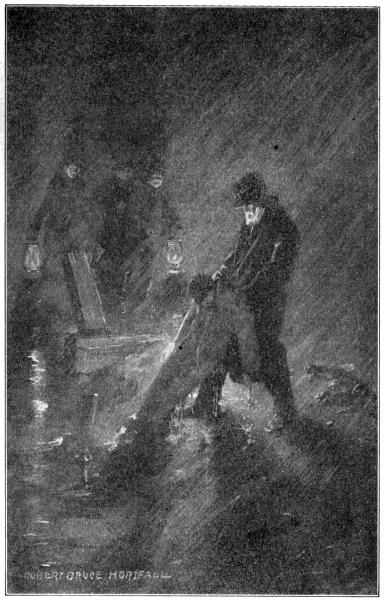
“Quick! The horse, Herbert! Hitch him to a tree and come!” called
George, as he dived into the wagon and pulled out their lantern.
“Those birds could wreck the train!” he shouted, and hurried forward
along the track with his lighted lantern in his hand.
It was not the thought of the turkeys, but the thought of the people
on the flying Montreal express,—if that it was,—that sped him up
the track. In his imagination he saw the wreck of a ditched train
below him; the moans of a hundred mangled beings he heard sounding in
his ears!
On into the teeth of the blinding storm he raced, while he strained
his eyes for a glimpse of the coming train.
The track seemed to lie straightaway in front of him, and he bent his
head for a moment before the wind, when, out of the smother of the
snow, the flaring headlight leaped almost upon him.
He sprang aside, stumbled, and pitched headlong down the bank, as the
engine of a freight, with a roar that dazed him, swept past.
But the engineer had seen him, and there was a screaming of iron
brakes, a crashing of cars together, and a long-drawn shrieking of
wheels, as the heavy train slid along the slippery rails to a stop.
As the engineer swung down from his cab, he was met, to his great
astonishment, by a dozen turkeys clambering up the embankment toward
him. He had plowed his way well among the roosting flock and brushed
them unhurt from the rails as the engine skidded along to its slow
stop.
By this time the conductor and the train-hands had run forward to see
what it all meant, and stood looking at the strange obstruction on the
track, when Herbert came into the glare of the headlight and joined
them. Then George came panting up, and the boys tried to explain the
situation. But their explanation only made a case of sheer negligence
out of what at first had seemed a mystery to the trainmen. Both the
engineer and the conductor were anxious and surly. Their train was
already an hour late; there was a through express behind, and the
track must be cleared at once.
And they fell at once to clearing it—conductor, fireman, brakemen,
and the two boys. Those railroad men had never tried to clear a track
of roosting turkeys before. They cleared it,—a little of it,—but it
would not stay cleared, for the turkeys slipped through their hands,
squeezed between their legs, ducked about their heels, and got back
into place. Finally the conductor, putting two men in line on each
rail, ordered the engineer to follow slowly, close upon their heels,
with the train, as they scattered the birds before them.
The boys had not once thought of themselves. They had had no time to
think of anything but the danger and the delay that they had caused.
They helped with all their might to get the train through, and as they
worked, silently listened to the repeated threats of the conductor.
At last, with a muttered something, the conductor kicked one of the
turkeys into a fluttering heap beneath the engine, and, turning,
commanded his crew to stand aside and let the engineer finish the rest
of the flock.
The men got away from the track. Then, catching Herbert by the arm,
George pointed along the train, and bending, made a tossing motion
toward the top of the cars.
“Quick!” he whispered. “One on every car!” and stepping calmly back in
front of the engine, he went down the opposite side of the long train.
As he passed the tender, he seized a big gobbler, and sent him with a
wild throw up to the top of a low coal-car, just as Herbert, on his
side, sent another fluttering up to the same perch. Both birds landed
with a flap and a gobble that were heard by the other turkeys up and
down the length of the train.
Instantly came a chorus of answering gobbles as every turkey along the
track saw, in the failing light, that real, buildings—farmyard
buildings—were here to roost on! And into the air they went, helped
all along the train by the two boys, who were tossing them into the
cars, or upon the loads of lumber, as fast as they could pass from car
to car.
Luckily, the rails were sleety, and the mighty driving-wheels,
spinning on the ice with their long load, which seemed to freeze
continually to the track, made headway so slowly that the whole flock
had come to roost upon the cars before the train was fairly moving.
Conductor and brakeman, hurrying back to board the caboose, were
midway of the train before they noticed what was happening. How it
was happening they did not see at all, so hidden were the movements of
the two boys in the swirl of the blinding snow.
For just an instant the conductor checked himself. But it was too late
to do anything. The train was moving, and he must keep it moving as
fast as he could to the freight-yards ahead at the junction—the very
yards where, even now, an empty car was waiting for the overdue
turkeys.
As he ran on down the track and swung aboard the caboose, two other
figures closed in behind the train. One of them, seizing the other by
the arm, landed him safe upon the steps, and then shouted at him
through the storm:—
“Certainly you shall! I’m safe enough! I’ll drive on to that old
sawmill to-night. Feed ’em in the morning and wait for me! Good-by,”
and as the wind carried his voice away, George Totman found himself
staring after a ghost-white car that had vanished in the storm.
He was alone; but the thought of the great flock speeding on to the
town ahead was company enough. Besides, he had too much to do, and to
do quickly, to think of himself; for the snow was blocking his road,
and the cold was getting at him. But how the wires overhead sang to
him! How the sounding forest sang to him as he went back to give the
horse a snatch of supper!
He was soon on the road, where the wind at his back and the tall trees
gave him protection. The four-wheeled wagon pulled hard through the
piling snow, but the horse had had an easy day, and George kept him
going until, toward eight o’clock, he drew up behind a lofty pile of
slabs and sawdust at the old mill.
A wilder storm never filled the resounding forests of the North. The
old mill was far from being proof against the fine, icy snow; but when
George rolled himself in his heavy blanket and lay down beside his
dog, it was to go to sleep to the comfortable munching of the horse,
and with the thought that Herbert and the turkeys were safe.
And they were safe. It was late in the afternoon the next day when
George, having left the wagon at the mill, came floundering behind the
horse through the unbroken road into the streets of the junction, to
find Herbert anxiously waiting for him, and the turkeys, with full
crops, trying hard to go to roost inside their double-decked car.