Something has already been said about the swift-growing jungles of
frost-flowers that so speedily cause the lakes in Switzerland to be
utterly useless for all purposes connected with skates. It suddenly
strikes the writer that the inexperienced in these matters will have
concluded that I mean that when once those frost-flowers have formed all
skating is over, and that if they have gone to Switzerland for the
indulgence of this taste, all that is henceforth to be offered them is
the opportunity to admire this frozen vegetation instead of cutting
figures. I therefore hasten to assure them that lake skating in
Switzerland does not count; indeed most winter resorts have no lake at
all; and even if they have, skating there is quite the exception and not
the rule. In nine cases out of ten the snow spoils the ice before it
bears, and the frost-flowers spoil the greater part of it, even if the
snow has held off, almost immediately afterwards. Lake-skating, in fact,
is of the nature of a bonus rather than a dividend: to be enjoyed if it
happens, but by no means to be reckoned on.
But at every Swiss resort there are rinks made, which render the skater
independent of natural surfaces of ice, and those, at all well-conducted
places, are “new every morning,” because every evening they are swept
and sprinkled with water, which by the ensuing day has frozen, and
presents a fresh surface to the zealot. In fact, an artificial
skating-rink is as necessary an equipment in the Swiss winter resort as
is the hotel itself. The construction and renovation of these rinks is
most interesting, and ranks among the fine arts, just as does the
architecture of a fine golf-links or the preparation of good wickets.
These rinks are used for two purposes: skating, including bandy or ice
hockey, and curling. I do not count ice-gymkhanas or ice-carnivals,
because anything is good enough for them. You can play the shovel-game
or crawl through barrels among the jungles of frost-flowers. I do not
imply that such entertainment is not exceedingly amusing; I only mean
that the artist in rink-making paints his masterpieces primarily for the
sake of the skater and the curler, not for the Pierrot with his Chinese
lantern, or those who win three-legged races.
The technique of these ice-pictures is in brief as follows:
In the beginning of the creation (from the skater’s point of view) a
piece of ground is carefully and accurately levelled. This, if it is to
be the foundation of a well-and truly-laid rink in the ensuing winter,
should be done early in the spring, because the ground will have then
had time to settle down, and the inequalities which always occur in this
settling can be made good, before the first frosts of the autumn begin,
and the soil gets fixed and frozen. Also, so I am told, the fact that
the ground will then be covered with a growth of weeds and grasses,
causes the foundation of the rink to be of better quality. This is
easily understandable: the base is matted, and is probably more coherent
in texture and less liable to contain holes through which the water may
drain away. Then, when the whole ground has been doctored, i.e. when
the small inequalities have been corrected and it is as uniformly level
as can be expected of anything in this shifting world, everybody sits
down and smokes (as is the habit of the Swiss peasant) till the first
good snowfall comes, probably in November or early in December. Then the
merry peasant has to put down his pipe and work begins again.
A row of them (I am describing the most up-to-date method) stand close
together with arms interlocked, in as straight a line as may be, and
trample down all this beautiful fresh snow. Up and down they go, in slow
time, stamping heavily with their great feet, and making out of perhaps
a foot of snow some 3 or 4 inches at the most, of really compact and
hard foundation. It will resemble at the best, as regards evenness, a
lane over which flocks of ponderous sheep have passed; but the
groundwork (this is the main point) will be of hardened snow, though
extremely rough of surface. Then they may all sit down and smoke their
pipes again—all, that is, except the headman and those who pull about,
at his bidding, the yards of hose which at one end terminate in a brass
nozzle, at the other in the water-supply, which should run in the main
at high pressure. This water is then turned on to the compacted snow
which gets soaked with it, and, if a few nights of hard frost follow the
original snowfall, becomes gradually converted into a sort of rough but
glazed and solid ice. Then, if nothing untoward happens, in the shape of
thaw or further snowfall, the next step is taken. But if there is during
these few days a thaw, they have to wait for more snow to fall, and do
their trampling over again; while if there is more snow, the poor
wretches have still to trample and get the foundations firm again. But
if all goes well—and the experienced iceman will delay the original
trampling until the barometer or his weather-sense (preferably the
former) promises cold weather to follow—he makes his second operation.
He will have built a small bank of snow perhaps 3 feet high and
well-spaded down, round his rink, and have sprinkled that as well as his
rink surface, so that it is at any rate glazed with ice and water-tight.
Then, waiting for a bright sunny morning, he floods the whole rink with
perhaps 2 inches of water. The sunniness of the day is most important
for this operation: if he put on this flood on a cold day, or at evening
when a frosty night was imminent, all the water he put on, lying on the
cold frozen surface below, and with the frosty air above it would freeze
solid without cohering to the original frozen foundation. But putting it
on while the sun is hot, the top surface of the foundation is percolated
with the flood, and when the frost of the night follows, the flood binds
with it. One night possibly may not consolidate the flood: if it does
not, he waits till another night completes the work. All the time, it
must be remembered, the rink presents the most depressing appearance:
little bits of frozen snow have floated up to the surface, frost-flowers
perhaps have made their ill-starred appearance, and it still somewhat
resembles a sheep-trampled lane. But then things begin to look better:
and another inch of water is put on, and then another inch, and then
another, each being consolidated before the next is applied, and each
being applied not in the evening, but when the sun will slightly melt
the previous surface. With each of these floodings the ice grows more
desirably smooth, and more immaculately clean, till at the end of
perhaps a fortnight there is something like 18 inches of solid ice over
the ground that was levelled in the spring. At least this thickness is
required if the ice is to last properly, for even in mid-winter the most
sickening series of climatic catastrophes may occur, which, unless there
is good thickness of ice originally built up, may spoil the rink
altogether. For on hot sunny days, though the surface of the ice remains
quite dry, very great evaporation occurs, and the dryness of the air
drinks up the melted ice before it visibly or tangibly becomes water. Or
again, even in the most well-conducted winters, at the most approved
resorts, there may be a complete thaw, and “the pools are filled with
water,” which also evaporates. In both these cases, there is a
consequent loss of ice, and the bullion, so to speak, must be able to
stand the drain upon it. Still worse, there may be a snowfall followed
by a thaw, followed by a frost. The thaw has eaten into the ice; the
frost has caused this rodent mixture to get encrusted again. And then,
if there is not good depth of ice, the most excruciating events tread on
each others’ heels. The ground below the thin ice is warmed with the
penetrating sun, and begins to exude bubbles; the bubbles rise, and
horrible water-blisters, skinned over with ice, appear. The skates crash
through them (“and langwedge which I will not pollewt my pen with
describing,” as Miss Fanny Squeers said) and cut into the half-frozen
ground, which thereupon begins to leak. The most awful mess ... there
are no words for it. Therefore it is necessary, as soon as possible, to
get a good thickness of ice.
But this building-up of the rink requires immense patience and
forethought. Night after night when the building is going on, and the
weather is warm and beastly, the head iceman, if he is really competent,
will sit up through the long tale of dark hours, keeping himself awake
with coffee, and watching the thermometer to see when it registers
sufficient degrees of frost to enable him to put more water on to the
ice. He will wait all through a cloudy night, hoping for the sky to
clear, in order to get a half inch more foundation. It is useless and
worse than useless to apply more water unless there are several degrees
of frost, for this only weakens his original trampled foundation of
snow, and leads to the awful trouble of blisters coming up from the
ground. But if even an hour or two before daybreak the temperature
sinks, and there is a chance of gaining a further thickness of ice, he
will rouse his men, and at any rate spray or sprinkle the whole surface
of the rink, in order to get a little more ice, just a little more.
Night and day, like a mother over a sick child (I am not exaggerating),
a man like Rudolf Baumann, and others not so well known to me, will
watch over their rink, to console, to fill up holes, to add another
fibre of underlying muscle.
But even when a couple of feet of solid ice are built up over the
ground, the trouble of the iceman is not over. Again a snowfall may
come, followed by a thaw, and the removal of this reveals sometimes a
terrible sort of chicken-pox on the ice. If the snowfall is followed by
cold weather, not much harm is done, for the snow is removed by shovels
and barrows, and a sprinkle of water over the whole rink—sprinklings
being made at night, since a sprinkle freezes almost as it falls,
opposed to the slower habits of a flood—shows next day that the rink is
no whit the worse. But if a thaw follows a snowfall, the general laws of
nature are suspended, in order to thwart icemen and skaters.
Theoretically, the surface of the ice below the melting snow will thaw
evenly. Practically, it does nothing of the kind. The surface is
unaffected in one spot, and immediately adjoining it has thawed into a
small round hole about 6 inches in circumference. Why this happens I
cannot say, except that it is part of the general malignity of natural
law; but the effect is apparent enough, and when the thawing snow is
removed, the ice is found to be covered by numberless small holes. Each
one of these has to be filled up by hand, with a freezing mixture of
snow and water, or better of pounded ice and water.... There are rinks
in Switzerland 300 yards long—I leave the consideration of these, in
the matter of labour required, to mathematicians who like dealing with
progressions that approach the infinite.
Now the shrinkage of the ice already gained goes on all winter long,
owing to the evaporation of the surface, and owing to the cutting edges
of skates, which cover it with a sawdust of frozen stuff that has to be
swept off every evening. This perpetual loss must be made good, or else
the rink would soon vanish altogether, and it is made good by floodings
or sprinklings. A flood of a couple of inches over the whole surface is
of course the easiest way of doing this, but it is far the least
satisfactory. For, as I have said, the flood must be put on while the
sun is still on the ice, to enable it to bind into the ice already
formed, and thus hours of daylight are lost to the skater. Furthermore,
unless a really severe night follows, it will not be all properly
frozen. So the good ice-maker, instead of turning skaters off the ice,
and getting by one flood sufficient thickness to last for three or four
days more, sprinkles instead. This is a far longer and more troublesome
process, for with his hose-pipe with its small nozzle he has to go over
the ice again and again, six or seven times perhaps, or more, in a
single night, if ice is badly wanted. If it is freezing hard, each
sprinkle will solidify almost as soon as it falls, and sometimes he
sprinkles all night long; while if it is far too warm for a flood to
have a chance of solidifying, he will, unless a real thaw is going on,
still find it possible to sprinkle once or twice before morning, even
though there is but a degree or two of frost. Another immense advantage
that sprinkling has over flooding is, that ice thus made, little by
little, in exceedingly thin layers, lasts, for some reason, far longer
than a greater thickness of ice frozen solid in a single night. Why this
should be so, I do not know; but the fact is incontestable. Certainly
also a flood of a couple of inches frozen solid is far more brittle in
itself than ice built up in thin layers, and an awkward toe-strike with
the tip of the skate will cut a great chunk out of flood-ice, whereas it
makes far less impression on sprinkled ice. The sprinkle should be
thrown far and high (as illustrated in Plate XIII), so that it comes
down on to the ice in fine mist-like rain that freezes quickly and
freezes tightly into the ice already there. Of course all these
difficulties are not encountered in a perfectly cold winter. Given a
hard frost every night, it is easy to keep pace with the daily
evaporation. But even in the loftiest winter resorts in this excellent
republic, mid-winter thaws occur.
Such in brief is the making of these rinks that seem such simple affairs
when made, just a level piece of ice with a smooth surface. But the
knowledge, the care, the watchfulness which are necessary to secure
good ice that will last all winter and reasonably resist any thaws and
snowfalls that may occur, are enormous. And the same care that is
lavished on their making must be expended on their keeping. No one with
soil on his gouties or a cigarette even in his mouth should be allowed
on the sacred surface, for even a feathery ash of tobacco if allowed to
lie on the ice will get warmed by the sun and gradually melt its way
into the ice. The sprinkle that night covers it, and it is embedded in
the ice like a fly in amber. Again the sun shines on it, it melts a
little water round it, and forms the nucleus of what will spread into a
blister in the ice. Any dirt in the same way makes similar holes, and
nothing but the clean skate-blade and the necessary and privileged boots
of the icemen should ever be allowed on the rink. How amazed would be
the pioneers of outdoor artificial rinks if they could see the huge and
perfect surfaces now yearly prepared for the hordes of foreign visitors
who flock to Switzerland. Of those pioneers John Addington Symonds was
one, and in his charming essays he recounts how at Davos he and a few
enthusiastic friends took exercise by incessantly working the handle of
a pump that stood in the middle of a level field, until, I think, the
pump froze. Then greatly daring they proceeded to skate over the amazing
ridges and shelves of ice which must certainly have been the result of
this hardy undertaking. Nowadays a reservoir must be built at a
sufficient height above the rink to secure a good pressure of water for
the sprinkling, and patient laudable men sit up all night watching the
thermometer to see if it is safe to offer water to the
delicately-nurtured crystal. But from these fine-art rinks has fine-art
skating been evolved, and if the pioneers of rink-making wondered at
our reservoir, our cohorts of workmen, our huge glassy surfaces, still
more perhaps would the skaters of those days be astonished to see some
champion of the Continental execute his “back loop change loop eight”
laying the loops on top of the other, or observe four gentlemen of the
English swoop down at top speed and on back edges to their centre, flick
out four creamy rockers and glide away again to their appointed
circumference. So much then for the skater’s material needs; we pass on
to consider the use he puts them to.
Now there are two styles of skating (I do not refer to good skating and
bad skating), known respectively as the English and the Continental or
International. In past days, certain exponents of one or the other
school, with the mistaken idea that to belittle another was to magnify
themselves, fell into the stupid error of comparing the two to the
accompaniment of robust vilifications of that style which happened not
to be so fortunate as to number them among its adherents. But it is no
exaggeration to say that the two styles have nothing whatever to do with
one another. It is true that the performer in each case is on skates,
and that the skates progress over ice; but the very skates are
different; so, too, is the whole mode, manner, style, and effect of
performance, and it would be as reasonable for the Rugby football player
to assert that Association is not real football, as for the English
skater to label the International skater an acrobat or contortionist, or
for the International skater to call his detested English brother an
exponent of the ramrod school. Many flowers of speech bloomed in the
gardens of these controversialists, the more exotic and violently
coloured blossoms springing, I think, from
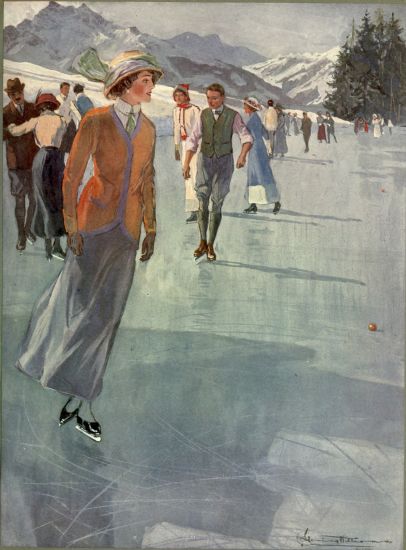
SKATING—ENGLISH STYLE
From the Drawing by Fleming Williams
certain skaters in the International style, who were admirably
industrious at one time in their denunciation of anyone who ventured to
skate in the English style. The present writer, for instance, who, poor
fool, thought he was amusing himself quietly in attempting unambitious
feats in English skating, without interfering with anybody, had an open
letter addressed to him in the Engadine Post, pointing out the
vileness and wickedness of his heretic ways; and a precious little book,
that now lies open before me, which did not attract as much attention as
its unconscious humour seems to warrant, informs us that the theories on
which English skating are based are “diametrically opposed to every
principle of nature, science and art, and at variance with the
unrestrained freedom of action and movement which prevails in every
other branch of athletic sport.” Probably the writer felt better after
that, for we have heard nothing of him since; while with regard to the
above-quoted criticism, the only comment that need be made is, that on
the same silly lines it would be reasonable to call lawn-tennis at
variance with unrestrained freedom of action and movement, because it is
not part of the game to slog the ball wildly out of court.
But of late this controversy has somewhat died down, the fact being that
no one with the smallest knowledge of the difficulties and beauties of
skating at all, in whichever of these two styles, ever joined in it,
since, whether in personal preference he was English or Continental, he
had sufficient acquaintance with skating matters to appreciate and
admire the excellence both of his own school and of that to which he
owed no allegiance. He saw also that the two schools had nothing to do
with each other, and instead of jeering at the other, contentedly
practised at the one he happened to prefer. Naturally, most Swiss
resorts tend to one style or the other; but at Davos, the original
cradle of the modern English style, the two schools flourish side by
side, as also they do at Mürren, one of the newly-opened Swiss centres.
There particularly—at Davos there is a separate English rink, mainly
occupied by English skaters—you may see the votaries of the different
schools of this now obsolete controversy cheek by jowl on the ice, and
lying down together, after a fall, like the lion and the lamb. At St.
Moritz, similarly, both styles are bloodlessly practised, though the
International style is the more popular; while Grindelwald is nowadays
exclusively International, after having been exclusively English. So,
too, is Wengen. On the other hand, at Villars, one of the largest
skating resorts in the country, there is scarcely an Internationalist to
be seen, and Château d’Oex, Montana, and Morgins are similarly almost
entirely English in their leanings. But without more enumeration it is
sufficient to say that both schools flourish exceedingly, and will
undoubtedly continue to do so, and nothing that anybody says will
detract from the prosperity of either.
Now skating, in both these styles, is largely a matter of form, and
herein it differs from nearly every other sport. It does not suffice in
skating, whether you are English or Internationalist, to do certain
things, to cut threes, to execute rocking-turns, or loops or
back-brackets. All these things have to be done in the manner prescribed
by the Vedas, so to speak, of your school. Without doubt there is reason
at the base of these methods, for it is clear that if, in a combined
figure, four English skaters were
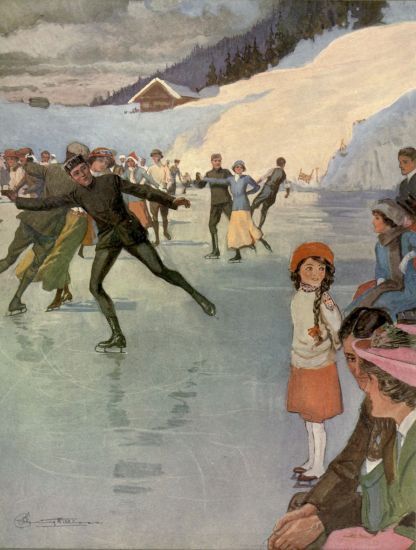
SKATING—CONTINENTAL STYLE
From the Drawing by Fleming Williams
allowed to fly into their centre on a back edge with their unemployed
leg waving, and there execute a rocker, there would immediately be a
heap of mangled bodies on the ice, a result which is not recognised as
being among the objects of combined skating; and similarly, in the
International style, the graceful poses of arm and leg, which ignorant
English skaters look upon as mere display, are designed to assist the
movement. But in all other games (and this is where skating differs from
them all) the point is to achieve a certain object, and the achievement
of that object, however attained, renders the achiever a notable
performer if he consistently attains it. The golfer, for instance, who
consistently drives a long straight ball, puts his mashie shot near the
hole, and generally putts out, is a magnificent golfer, in whatever
manner or style he executes these tyrannously difficult feats. There are
a hundred and a hundred hundred styles and modes of putting, and they
are all good, provided only they enable the putter to hole his ball. At
cricket, similarly, a man may bowl fast or slow with any sort of break,
and with any sort of action (provided his shirt sleeve is not wantonly
flapping), and he is a good bowler if only he gets wickets cheaply. But
at skating the prescribed thing has to be done in the prescribed manner,
and the prescriptions of the English school are, broadly speaking, all
of them diametrically opposed to the principles of the International
school. In the English style the employed leg (i.e. the one which for
the moment is being skated on) must be straight; in the International
style it must be bent. In the English style the unemployed leg must be
close to the other, and hang beside it, loosely and easily; in the
International, wherever the exigencies of the movement demand that it
should be, it must at any rate never be there. In English the arms must
not be spread and swung abroad to assist the movement, but must be
carried inactively by the side, whereas in International, as long as the
skate moves the arms must be engaged on their assigned activity. In both
schools, in fact, every movement must be executed in a given way, but in
no case is there the smallest resemblance between those ways, though
both should result in clean edges and clean turns executed at defined
places.
It is not my intention to give here a manual of English skating,
beginning with instruction to beginners and ending with timorous hints
to experts, but any book on Winter Sports would necessarily be
incomplete unless it babbled to some considerable extent about skating,
which, without doubt, is the sport in pursuit of which the large
majority of English folk visit the High Alps in winter. From whatever
cause, this slippery art exercises a unique spell over the able-bodied
and athletic section of Anglo-Saxon mankind. It may be that this is
partly accounted for by the comparative rarity of the occasions on which
we can skate, owing to our Gulf-Stream-beridden and generally
pestilential climate, and it is sufficient that some puddle-place in a
village green should be half-frozen to cause the majority, not only of
youth but of sedate men and women, to hurry down to the spot, and there
slide about on both feet with staggerings and frequent falls and the
ever-present possibility of occasional immersions. But the rarity of
even half-frozen puddles in England does not wholly account for the
transcendent spell: there is something in the quality of motion which
is started by a stroke of the tense muscles, and then continues of its
own accord, without effort or friction, until the impetus is exhausted,
that appeals to our unwinged race, who must otherwise keep putting foot
before foot to get anywhere. The sensation itself is exquisite, and the
sensation is rendered more precious by the fact that from the days when
the tyro slides cautiously forward on both feet, to the days when,
having become a master in his art, he executes back-counters at the
centre in a combined figure, there is always a slight uncertainty as to
what is going to happen next. The tyro rejoicing in the unaccustomed
method of progress is conscious of a pleasing terror as to whether he
will not fall flat down, and glows with callow raptures all the time
that he does not; while the finest skater who ever lived, will never be
quite sure that he will flick out his back-counter cleanly and
unswervingly. We can all walk pretty perfectly—at least, there is no
pleasing terror that we may be going to fall down—but none of us at our
respective levels as artists in skating can skate pretty perfectly. We
can only skate moderately well, considering how well we can skate. And
the joy of it! The unreasoning, delirious joy of the beginner who for
the first time feels his outside edge bite the ice, and, no less, the
secret elation of the finest performers in the world, when they execute
their back-counter close to the centre, at high speed, and without the
semblance of flatness in the edge! And even if any of us was so
proficient as to perform such a feat with absolute certainty, there is
no doubt whatever that we should find some further feat that would put
us back into the dignified ranks of stragglers again. And the same
holds good with regard to International skating: at least if there is
any among those delightful artists who will execute the Hugel star first
on one foot and then on the other without a pleasing anxiety gnawing at
his heart, I should very much like to know his name and black his boots
for him.
To go more into detail with regard to the manner and style of these
antipodal twins, we will take first the twin known as English skating.
This falls into two broad classes, namely, single skating and that which
is the cream and essence of English skating, combined skating. A further
development of combined skating, namely, combined hand-in-hand skating,
has not long ago been undergoing a successful evolution, under the
auspices chiefly of Miss Cannan, Lord Doneraile and Mr. N. G. Thompson.
Without doubt it holds many charming possibilities, and very likely
there is a great future before it, but owing to right of primogeniture
we will first consider the two elder branches. In both the technique, so
to speak, is the same. The object is to skate fast on large bold edges,
to make turns of all sorts and changes of edge cleanly and without
effort, and to skate all these turns and edges in a particular and
prescribed manner.
The first consideration, therefore, is the manner. The stroke must be
taken, i.e. impetus must be set up, not with a push of our skate-toe
into the ice, but from the inside edge of the skate blade. The reason is
obvious, for if a skater thrusts his sharp skate-toe into the ice he
will make a hole in it, and damage the ice. That is sufficient: I think
there are probably four or five other reasons, which in a general and
unspecialised treatise like this need not be gone into.
The skater having got his impetus by leaning against the inside edge of
one skate, launches himself on the other. Now there are two edges to a
skate, namely, the inside and the outside. There is also the flat base
of the skate. Both theoretically and practically, he never uses the flat
of the skate in his actual progress. When he turns, whether the turn is
a three-turn or a rocker, or a counter or a bracket, he comes up to the
flat for a moment, but instantly leaves it again. He progresses on one
edge, the inside, or on the other edge, the outside. And while he
progresses, he must progress in the prescribed manner. And the
prescription is this:
I. His head must be turned in the direction of his progress, whether he
is progressing forwards or backwards. Again common-sense is at the base
of this rule. For if his head is turned in the direction of his
progress, he is looking, unless unfortunately blind, where he is going.
This avoids trouble to himself, if there are holes in the ice, and
trouble to other people if there are other people on the ice.
II. He must be standing erect with his shoulders and body sideways to
the direction of his curve, not facing square down it. In other words,
he must, among other things, be travelling not further forward than on
the middle of his skate, otherwise he will not be standing erect, but
leaning forward. This attitude is that which is referred to, in the
humorous book I have already quoted, as characteristic of the ramrod
school. But the author, in his blissful ignorance of skating matters, is
not aware that it is impossible to execute a long smooth circumference
of curve if you progress on the forepart of your skate. If you are on
the forepart of the skate, you must be leaning forward, and no one of
known anatomy can lean forward and execute a long smooth edge. The
balance is unsteady, and the edge wobbles. Commonsense, then, again
endorses this rule. In order to be steady on a long edge, your balance
must be of the established order. You must be upright, and travelling
without muscular effort to retain your position. This is only attained
by travelling on the middle or the aft part of the skate. For nobody can
stand still on their toes. But standing on the middle part of the foot
or with the weight on the heel it is perfectly easy to do so. But when
this humorous author (whom I drag out of his obscurity for the last
time) calls this the ramrod school, he proves himself ignorant of the
first principles of English skating, or perhaps has only observed
himself in some mirror at Prince’s Club attempting to assume the correct
attitude himself. As a matter of fact, the proper attitude of the skater
in the English style is exactly that of a man who is well made and
master of his limbs standing still with the weight chiefly on one foot.
While skating, it is true, the weight is entirely on one foot, and the
performer is moving, and not standing still. But the pose necessary to
smooth and swift progression is exactly that. It no more resembles a
ramrod, when decently done, as every good English skater does it, than
it resembles a coal-scuttle or a pince-nez, or what you will.
III. The unemployed leg, i.e. the leg of the foot which is not
skating, must hang close to the employed leg. Again the reason is
obvious. If four persons came into their centre with a waving
unemployed leg, they would hit each other. Also, if the unemployed leg
is put out behind, the skater must lean forward in order to counteract
its weight. He will then tend to skate on the forepart of his skate. In
a series of long edges this attitude is impossible to maintain except by
effort. Nobody could skate for a quarter of an hour in combined skating,
accurately and largely on such a principle.
IV. The arms must hang by the side, and be carried loosely easily,
close to the body. Again the explanation is obvious. There is no need
for their flying abroad, since a long edge is most easily accomplished
with the limbs and body in rest after the stroke, and these long smooth
edges are part and parcel of English skating: it is founded on them.
English skating postulates so perfect a balance, travelling on the
middle of the skates, that it chooses (this is the reason for the rule)
not to let that balance be assisted by the added or subtracted weight of
a correcting arm. It says (this is what it comes to) that you must be so
firm on your travelling root, so to speak, of balance, that you dispense
with all adjustments of weight. The weight has to be practically
perfectly adjusted. There must be no adjustments adventitiously
obtained.
Now these four rules are at the base of English skating. If you happen
to play a game, you conform to the rules, and you do not argue, for
instance, when you are playing cricket, whether you should be given out,
when quite clearly you have been caught at the wicket. If you are at all
sensible, or in any way like cricket, you pocket your duck’s egg and
retire. Superb strokes may be made at cricket, which nevertheless are
fatal to the striker. Superb attitudes, similarly, may be made in the
International style, which are quite completely wrong. They may be
supremely statuesque, but they are not skating. The case is exactly the
same with the English style. Certain canons have been laid down, all of
which seem to be necessary to the attainment of excellence. It is no
doubt possible to skate charming “threes to a centre” doing everything
quite wrong from beginning to end. But if you choose to adopt a style,
you must conform to the rules of that style. Similarly, it is quite
possible to skate the same “threes to a centre” in the International
style, which shall leave the same mark on the ice (though the skating of
them broke every possible rule) as the most finished performer could
leave there. But who would not applaud the International judge who
ruthlessly ploughed such a candidate? He has not kept the rules, which
in contradistinction to other games prescribe not only what the object
in view is, but the manner in which the performance is to take place.
But this manner, we venture to point out, has not been laid down in an
arbitrary way: it is the manner, both in International skating and in
English alike, in which the feats demanded can alone be properly
performed.
Now if the skater will take the trouble to conform to the four rules
given above, he will find that even at the outset of his career there is
great fun in store for him. Should he conform to them completely, when
the complication of turns is added, he will quite certainly find that
there is a championship, if he cares for that, in store for him also.
The rules were not negligently made; indeed they were never made at all,
but are simply the condensed experience of the best skaters, the methods
by which the fittest survived. And the fittest did, and always will do,
that which is recorded in these rules, and the ensuing complications,
even the most complicated of them, are comparatively easy to those who
can maintain the proper travelling position. But nobody who cannot hold
a long firm edge, for which the proper travelling position is essential,
need ever trouble his dreams with the notion of becoming a good skater.
And no one’s edges approach perfection, if he cannot traverse, on
backward and forward edges, outside and inside alike, a distance of at
least a hundred yards, given that the ice is reasonably good, without
stirring from the attitude he has taken up after his stroke. A really
fine skater will traverse much more, and be still as a rock throughout
his travel; but no good skater will be so unsteady that he will not
easily traverse that. In his actual skating he will, probably, never be
called upon to make so lengthy an edge, but its accomplishment should
present no difficulty to him, if he aspires to be a fair performer. Even
as the pianist, when performing, is not called upon to play simple
scales with both hands, so the skater will not be called upon, in his
combined figure, to skate for a hundred yards on one edge. But both
pianist and skater ought to find no difficulty at all in executing these
simple feats.
The beginner is advised to get a fair mastery of all the edges before he
begins to attack the fortress of the turns. He should be able to
progress steadily and smoothly both on the outside edge and the inside
edge forward, and to make some progress also on the back edges, namely,
outside back and inside back. This last is far the most difficult of the
edges, and it will be a long time before he is able to take fast bold
strokes on it. But he should have some acquaintance with it before he
attempts to make the turns that necessitate its employment, and be able
to hold it in the correct position. He can then set about turns and
changes of edge, which all imply correct travelling.
Now there are four groups of turns, common both to the English and
International styles, each group of which contains four turns to be
executed on each foot. Altogether, therefore, there are sixteen turns to
be learned which employ each foot singly. These with the four edges,
executed in the prescribed manner, form the material of the art. These
turns are common both to English and International skating,
I. The first group is known as simple turns, and consists of turns (or
changes of direction, from backwards to forwards or forwards to
backwards) from:
| (i) | Outside forward to inside back. |
| (ii) | Inside forward to outside back. |
| (iii) | Outside back to inside forward. |
| (iv) | Inside back to outside forward. |
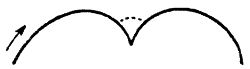
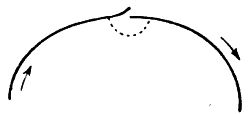
They are all of the same shape with regard to the marks they leave on
the ice, and from their shape are known as “three” turns, or “threes.”
Thus:
The arrow shows the direction of progress: the turn is the cusp in the
middle between the two curves. Thus if the first edge is outside
forward, the second is inside back: if the first is inside forward the
second is outside back: if the first is outside back the second is
inside forward: if the first is inside back the second is outside
forward.
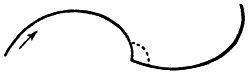
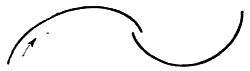
II. The second group of turns is known as rocking turns, or more
generally as “rockers.” Like the “three” turns, they are all of the same
shape, thus:
and are four in number, namely:
| (i) | Outside forward to outside back. |
| (ii) | Inside forward to inside back. |
| (iii) | Outside back to outside forward. |
| (iv) | Inside back to inside forward. |
Now, in both these groups the body revolves or rotates at the moment of
making the turn in the direction indicated by the dotted lines; it
revolves, that is to say, outside the direction of the first curve.
But it is possible for the body to revolve in the opposite direction,
that is to say, inside the direction of its first curve. This makes
possible the third and fourth groups of turns.
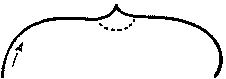
III. This group, which is known as brackets, from the mark left on the
ice, corresponds to Group I, and the edges employed in it are the same,
namely, outside forward to inside back, &c. But in this group the body
revolves on the inside of the direction of the first curve, and the
mark on the ice, consequently, is as follows, the dotted line again
indicating the revolution of the body:
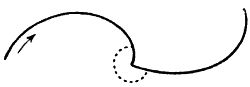
IV. The fourth group is known as counter-rocking turns, or more
generally as counters. It corresponds with Group II, for the marks on
the ice are approximately the same, and the edges employed are outside
forward to outside back, &c. But here again the revolution of the body,
as in the brackets, takes inside the direction of the first curve, thus:
These sixteen turns, or changes of direction while skating on one foot,
comprise all the varieties of so doing that seem theoretically possible,
since they include every forward edge to every back edge and every back
edge to every forward edge, skated with rotation of the body both
outside and inside the direction of the first curve, and until somebody
discovers a third edge to a skate, or a third direction of rotating the
body, it is not possible that they will be added to.
But changes of direction may be made by the employment, not of one but
of both feet, and though these might be more properly described as
strokes rather than turns, there are two groups of them which enter
largely into English skating. These are known as mohawks and choctaws.
I. Mohawks consist of either forward edge combined with the
corresponding back edge taken up by the other foot. Thus if the right
foot starts as an outside forward, the left, to complete the mohawk, is
put down on the outside back edge, thus:
Here the rotation is made, as in the brackets and counters, on the
inside of the direction of the first curve, and the figure is known as
the outside forward mohawk. Similarly, the mohawk can be skated on the
inside edges, i.e. the right foot starts with an inside forward, and
the left completes with an inside back. Here the rotation, as in the
threes and rockers, takes place on the outside of the direction of the
first curve.
II. Choctaws also employ both feet, but the second curve of a choctaw is
on the opposing edge to the first curve. An outside forward choctaw thus
consists of an outside forward on one foot completed by an inside back
on the other, thus:
In this, as in the corresponding mohawk, and the brackets and counters,
the rotation of the body takes place inside the direction of the first
curve. Similarly, the inside forward choctaw consists of an inside
forward on one foot and an outside back on the other. Here, following
the corresponding mohawk, the rotation of the body takes place outside
the first curve.
Theoretically, of course, there are corresponding mohawks and choctaws
starting from the back edges, i.e. outside back to outside forward,
&c., but though these strokes are constantly used, both in single and
combined skating, they are never dignified by this sounding title of
“back mohawk” or “back choctaw,” merely because the manœuvre is so
simple and common a one, that it needs no name at all, and if, for
instance, in combined skating, the caller (who directs what shall be
done) has his skaters on a back edge, and desires that the next stroke,
let us say, shall be an inside forward edge, he calls “inside forward”
merely.
Finally, in giving this catalogue of material out of which all English
skating is built, there remain only the changes of edge, made on one
foot, to enumerate. They, as must naturally be the case, are four in
number:
| (i) | Outside forward to inside forward. |
| (ii) | Inside forward to outside forward. |
| (iii) | Outside back to inside back. |
| (iv) | Inside back to outside back. |
With regard to the cross-mohawks and cross-choctaws—in case the skater
ever “hears tell” of them—he need not worry himself even to remember
their existence, since, most rightly, they have been blotted out of the
book of English skating, owing to their clumsiness and the fact that to
skate any of them violates some canon of the essential form of English
skating. Apart from them, the whole material of English skating has now
been stated, namely, the four edges, the sixteen turns, the two mohawks,
the two choctaws, and the four changes of edge.
But when we consider that the first-class skater must be able to skate
at high speed on any edge, make any turn at a fixed point, and leave
that fixed point (having made his turn and edge in compliance with the
proper form for English skating, without scrape or wavering) still on a
firm and large-circumferenced curve, that he must be able to combine any
mohawk and choctaw with any of the sixteen turns, and any of the sixteen
turns with any change of edge, and that in combined skating he is
frequently called upon to do all these permutations of edge and turn, at
a fixed point, and in time with his partner, while two other partners
are performing the same evolution in time with each other, it begins to
become obvious that there is considerable variety to be obtained out of
these manœuvres. But the consideration of combined skating, which is the
cream and quintessence of English skating, must be considered last; at
present we will see what the single skater may be called upon to do, if
he wishes to attain to acknowledged excellence in his sport.
Now the National Skating Association of Great Britain encourages both
the English and International styles, and for each there have been
instituted certain graduated tests, not competitive but standard, of
three orders. The third or lowest test in the English style is broadly
designed to encourage skaters, the second to discourage them again
(i.e. begin to make them feel the difficulty of the whole affair, just
when they thought by passing their third test they had broken the back
of their difficulties), and the first or highest to give them healthy
occupation for a few winters, and fit them for becoming really
first-class skaters. All of these tests must be passed before at least
two qualified judges, appointed by the N.S.A., and they are as
follows:—
(a) A forward outside three on each foot, the length of each
curve being 15 feet at least. The figure need not be skated to a
centre.
(b) The four edges, outside forward, inside forward, outside
back, inside back, on each foot alternately for as long as the
judges shall require, the length of each curve being 15 feet at
least on the forward edges and 10 feet at on the back edges.
(c) A forward outside 8, the diameter of each circle being 8 feet at least, to
be skated three times without pause.
Here, it will be seen, is the beginning, the ground-work of English
skating. The easiest turn has to be skated, the four edges have to be
skated; also the easiest “8” has to be skated, in order to familiarise
the beginner with the idea of leaving a point on one stroke and
continuing to travel on that stroke (with turns to punctuate it, as he
will see later) until he arrives back at that point again. The point in
question is marked for him on the ice with an orange or a ball. And
whether in single skating or in combined, it is called the centre.
Simple as this third test is, it has to be skated in proper English
form, which the learner should begin to acquire from the first moment he
takes a serious stroke on the ice. For it is vastly easier to acquire
good form at the beginning of his education, than to acquire bad habits
which must subsequently be got rid of.
(a) A set of combined figures skated with another skater, who
will be selected by the judges, introducing the following calls in
such order and with such repetitions as the judges may direct:—
| 1. Forward three meet. |
| 2. Once back—and forward meet. |
| 3. Once back—and forward three meet. |
| 4. Twice back off meet—and forward three meet. |
| 5. Twice back meet—and back—and forward three meet. |
(b) The judges shall call three “unseen” figures of quite simple
character, in order to test the candidate’s knowledge of calls and
power of placing figures upon the ice. These shall be skated alone.
(c) The following edges on each foot alternately for as long as
the judges shall require, namely:—
| 1. Inside back, each curve being 20 ft. at least. |
| 2. Cross outside back, each curve being 12 ft. at least. |
(d) The following figures skated on each foot, namely:—
| 1. | Forward inside three, the length of each curve being 40 ft. at least | {R
{L |
| 2. | Forward outside three “ “ “ 50 ft. “ | {R
{L |
(e) The following figures skated to a centre on alternate feet
without pause, three times on each foot, namely:—
| 1. Forward inside three, |
the length of each curve being |
15 ft. at least. |
| 2. Forward outside three
| “ “ “ | 15 “ |
| 3. Forward inside two threes
| “ “ “ | 10 “ |
| 4. Forward outside two threes
| “ “ “ | 10 “ |
| 5. Back outside two threes
| “ “ “ | 10 “ |
(f) The following figures skated on each foot, namely:—
|
1. Forward inside “Q,” | the length of each curve being | 30 ft. at least | {R
{L |
|
2. Forward outside “Q”
| “ “ “ | 30 ft. “ | {R
{L |
|
3. Back inside “Q”
| “ “ “ | 25 ft “ | {R
{L |
|
4. Back outside “Q”
| “ “ “ | 20 ft. “ | {R
{L |
Here, it will be seen, the test begins with a combined figure. The whole
subject of combined figures will be treated of separately, and for the
present we need only remark that this is a very simple one. Then follow
the inside back edge, which, as I have said, is the most difficult of
the edges, skated larger than before, in curves of 20 feet, and the
cross-stroke on the outside back. This means that the stroke is taken
with the feet crossing, the one that is taking the stroke being crossed
behind the other. As a matter of fact, this stroke, which at one time
played a considerable part in English skating, since in combined figures
all strokes from outside back to outside back were bound to be taken
from the crossing position, is now not obligatory. But it is a pretty
stroke in itself, and necessitates the skate being placed on the ice on
the edge. Then follow the two forward turns, skated rather large, in
order to begin to familiarise the learner with the feeling of turns
taken at a high speed. This necessitates clean skating of the turn
itself, since if a turn is skated fast, and not clean, it is quite
possible that the skater may fall, and he will in any case make a blur
instead of a sharp cut turn. Also these turns teach him to hold his
edges out after the turn, the tendency being to let the body rotate,
whereby the curve curls in, and the skater soon finds himself in a
position that it is impossible to maintain. But if he skates his turn,
and then can hold an edge for 50 feet away from it afterwards, he may
congratulate himself on the fact that he is beginning to skate his edges
big and in the proper style. For these cannot, practically speaking, be
held out, unless the rules for position are being conformed with. Then
follow four simple figures of the class known as 8’s, of which the
simplest is that required in the third-class test, namely, an outside
forward 8. All 8’s, as their name denotes, are of the same general
shape, i.e. the shape implied by their name, but between the edges
that trace the shape of the 8, the skater is now required to put in
certain turns. He starts, for instance, on an outside forward edge, when
half round his circle makes a three turn, and comes back to his centre
on the inside back edge. Or he starts on an inside forward edge as in
the third 8, and has to make two turns before he arrives at his centre
again, which he reaches as an inside forward edge. Or, more searchingly,
he has to start his 8 on an outside back edge, and make two turns and
aim at his centre again on an outside back edge.
The remainder of this test is taken up with the figures known as Q’s. In
these the skater is required to start, at some speed, on any edge
forward or back, and after travelling on it for varying distances, as
laid down, to change his edge (from outside to inside, or inside to
outside) and after holding that edge for the prescribed distance make
the three appropriate to that edge. The Q’s are very largely used in
combined skating, the change of edge being coupled not only to “three”
turns, but to rockers, counters and brackets. Here the name “Q” is
becoming obsolete, and indeed has become so in combined skating, the
figure being called “forward change three” or “inside back change
three,” &c.
Now, as I have said, while the third test is supposed to encourage the
skater, the second is supposed to discourage him. What is meant is that
he has now run up against the really crucial difficulties in English
skating, of which perhaps the greatest of all is to stand still, as the
Irishman might say, while moving rapidly. As will be already seen in
this test, he is required to do this for somewhat extensive travel: in
his outside forward turn, for instance, he has to proceed for at least
fifty feet on his forward edge before making his turn, and the same
distance on his back edge after making his turn. And though this present
disquisition is intended to be a statement of English skating and not a
book of instruction, the writer cannot bear to let this one opportunity
slip of giving just one hint. It is perfectly impossible to travel
steadily for distances like these—and the skater will have to learn to
go much further yet on his edges—if he is travelling on the forepart of
his skate. All forward turns, by the slight check they give to the speed
(I am not now talking of those ideal skaters who actually get speed out
of a turn), tend to put the skater further forward on his skate. He must
therefore approach all forward turns on the back part of his skate, so
that by this tendency to rock forward he will make the turn itself on
about the middle of the skate. Never for a moment, if he can help it,
must he get on the toe of his skate, and if ever he does, he must regain
position again by leaning fearlessly back. And in this second test, he
will find that the difficulty of travelling well back on his skate is at
first appalling. But having learned that, and learned it thoroughly, he
will probably not come across any subsequent requirement which appears
to him so clearly impossible.
This section consists of the combined figures in Parts I and II. The
judges may also give such simple calls as they think fit, to enable the
candidate to recover his position, to alternate the feet, &c.
The figures shall be skated with another skater, to be selected by the
judges, but if there are only two judges, neither of them shall skate.
Each call must be skated at least twice, beginning once with the right
foot and once with the left.
Subject to these conditions the calls shall be skated in such order and
with such repetitions as the judges may, while the set is in progress,
direct.
In calls introducing “twice back” the candidate must recede at least 35
feet from the centre.
To pass this section the candidate must satisfy all the judges in the
manner in which he skates each set considered as a whole, and also in
the manner in which he skates each individual call.
The judges may pass a candidate in Part I, notwithstanding a reasonable
number of errors on his part in the course of the set, provided that he
ultimately skates all the calls to their satisfaction; and in Part II,
notwithstanding errors, provided that the candidate has shown competent
skill in skating unseen calls.
Part I
1. Twice back—and forward three—and forward inside three, off meet.
2. Twice back—and forward three threes—and back meet—and back two
threes—and forward two threes, meet.
3. Twice back—and forward three about, change, meet.
4. Twice back, about—and back off meet.
5. Twice back—and back inside centre three, change—and forward meet.
6. Twice back three, centre three, off meet.
7. Twice back centre change, three, meet.
8. Once back—and forward—and forward inside two threes centre change
meet.
9. Twice back—and forward two threes, pass, meet.
10. Twice back two threes, off pass, meet.
11. Inside twice back—and forward inside two threes, meet.
12. Forward change, three, change, three, circle—and forward three,
change, circle—and forward about change, three, off meet.
Part II
In addition to the above, the judges shall call a further set of not
more than six or less than four “unseen” figures of moderate difficulty,
in order to test the candidate’s knowledge of calls and power of correct
placing. This unseen set must include rockers, counters, and brackets,
and shall be skated by the candidate alone.
No candidate shall be judged in Part II of this Section until he has
passed in Part I.
The judges may allow a candidate any number of attempts at a given
figure which they consider reasonable.
Part I
The turns, mohawks, and choctaws of this part must be placed close to
and on the near side of an orange or other fixed point on the ice. They
must all be skated on each foot to the satisfaction of the judges.
The curve before and after the turn or change of foot must be 40 feet
long at least.
| Threes | { Outside back.
{ Inside back. |
| |
Rockers }
Brackets }
Counters } | { Outside forward.
{ Inside forward.
{ Outside back.
{ Inside back. |
| |
Mohawks }
Choctaws } | { Outside forward.
{ Inside forward. |
Part II
To pass in this part, a candidate may select not more than one figure in
each group, and must score forty-five marks at least. A selection once
made by a candidate must not be altered.
No marks shall be scored in respect of any one-footed figure unless it
is skated on each foot, and the number set against each figure
represents the maximum that can be scored for that figure.
A candidate shall not score for any figure on which he shall not have
obtained at least half marks.
Eights.—In marking these figures, the judges will take into
consideration the general symmetry of the figure, and the approximate
equality of corresponding curves.
In each figure the complete 8 is to be skated three times without pause.
The figures need not be commenced from rest.
In groups D and E the turns and choctaws respectively are to be made on
the near side of the centre.
The following eights are to be skated to a centre on alternate feet:—
| Group A |
| | Max.
Marks |
| Outside back two threes | 4 |
| Inside back two threes | 13 |
| Outside forward bracket | 6 |
| Inside forward bracket | 4 |
| |
| Group B |
| Outside forward two brackets | 6 |
| Inside forward two brackets | 10 |
| Outside forward bracket, three | 9 |
| Inside forward bracket, three | 5 |
| Outside forward three, bracket | 4 |
| Inside forward three, bracket | 12 |
| |
| Group C |
| Outside back two brackets | 14 |
| Inside back two brackets | 11 |
| Outside back bracket, three | 16 |
| Inside back bracket, three | 8 |
| Outside back three, bracket | 5 |
| Inside back three, bracket | 14 |
| |
| Group D |
| Outside forward rocker | 8 |
| Inside forward rocker | 4 |
| Outside forward counter | 8 |
| Inside forward counter | 4 |
Outside forward centre choctaw and inside forward centre
choctaw, beginning on each foot | 4 |
Outside forward mohawk and inside forward mohawk
to a centre, beginning on each foot | 4 |
The turns and changes are to be made on the near side of fixed points
determined by the candidate; the distance between these, and the lengths
of the first and last curves, are to be each not less than 50 feet
beginning on forward edges, 35 feet beginning on back edges.
| Group E |
| | Max.
Marks. |
| Outside forward three, change | 2 |
| Inside forward three, change | 3 |
| Outside forward rocker, change | 3 |
| Inside forward rocker, change | 3 |
| Outside forward bracket, change | 5 |
| Inside forward bracket, change | 4 |
| Outside forward counter, change | 5 |
| Inside forward counter, change | 3 |
| |
| Group F |
| Outside back three, change | 5 |
| Inside back three, change | 8 |
| Outside back rocker, change | 6 |
| Inside back rocker, change | 8 |
| |
| Group G |
| Outside back bracket, change | 16 |
| Inside back bracket, change | 8 |
| Outside back counter, change | 16 |
| Inside back counter, change | 8 |
| |
| Group H |
| Grape Vines |
| Single, each foot leading | 2 |
| Double forward | 3 |
| Double backward | 3 |
| Pennsylvania | 5 |
| Philadelphia | 6 |
Now, again omitting for the moment the subject of combined skating, we
see that in Part II the rest of the groundwork of English skating is
very thoroughly traversed. To pass this final test the skater has to be
able to execute all the threes (the two simple ones are omitted, as they
have already been required in the second test), rockers, brackets,
counters, mohawks, and choctaws at fair speed and on large edges at a
given point on the ice. Having done that to the satisfaction of the
judges, he has then to make his selection from a large number of 8’s,
which include practically most possible 8’s comprising one or two turns,
excepting these simple ones with regard to which he has already
satisfied the judges in his second test. Here he has to score marks,
selecting not more than one 8 of each group, and by the devilish
ingenuity of those who drew up this test, it is impossible for him to
get through unless the majority of the 8’s he selects to skate are
really difficult. He may then add to his marks by executing what are
called reverse Q’s at two given points on the ice. At the first of these
he has to make his turn, whatever it is, and at the second to change his
edge. This requires a considerable degree of accuracy, for in order to
arrive smoothly and still at a fair travelling pace at the second point,
he will find that he has to have a practically perfect control of the
edge, which has not been disturbed by executing a difficult back turn,
let us say, at the first given point. Finally, if he is still in want of
marks, he may earn a few more by a grape-vine. This latter does not
properly belong to English skating, since it is a two-footed figure, and
those responsible for the test might have omitted this group with
advantage.
The Combined Figure.—Probably no branch of sport—except, perhaps,
flying—has undergone such improvement and revolution within the last
fifteen years as this art of combined skating. Not only are there a
vastly multiplied number of competent and even first-rate combined
skaters, but the skill demanded of a first-rate combined skater, and the
variety of the manœuvres he may be called upon to execute, is
immeasurably greater than a decade and a half ago. I do not mean that
there were not in 1897 a certain number of skaters who might have been
able to execute a difficult set as directed by a caller of to-day, but
these were, in golfing parlance, “plus players,” and the ordinary
“scratch” skater—one, that is, who had passed his First Class
N.S.A.—would have had no more chance of getting through such a set
without throwing everybody out, and himself down, than he would have of
flying. Both the speed and the size of these combined figures has
greatly increased, and the whole of the material of English skating is
employed. And the main reason for this improvement and revolution is due
to the greatly augmented number of English skaters who now go to
Switzerland in the winter, and the multiplication there of really large
rinks.
That this immense improvement has taken place in combined skating is
proved, luckily, not only by the fallacious memory of individuals, but
by printed records. I have before me the Badminton volume on skating
(edition 1902), in which, for instance, we find the following figure
(among many others like it).
“Forward two turns. This movement skated to a centre is very difficult,
and is a great test of good skating, and many men make a practice of
devoting five or ten minutes to skating it every day when they come on
the ice, feeling that if they can skate it, making the curves between
the turns of equal length and making the turns clean without any scrape
and yet coming true to the centre, they are in good form and equal to
skate anything that may be required of them.”
Now no doubt two turns to a centre, as required in the second-class
test, is a very good elementary figure, but it no longer has anything
whatever to do with combined skating, whether it is skated with a
partner or with a second pair, or simultaneously with other skaters.
Speed and size and difficulty (as demanded by the scale on which
combined skaters now move) are necessarily absent from it, and from a
hundred others of these calls which then were the last word in combined
skating. A man who had passed his second-class test would be capable of
doing this, which was then considered a criterion of good combined
skating, whereas the same man could not live for two calls in a combined
figure of moderate difficulty to-day. The whole nature of the business
has changed: turns have to be executed at high speed far away from the
centre, and the curliness and smallness of such skating as is here
implied and necessitated has vanished altogether, giving place to a far
more difficult style and speed.
Nor, again, in this respect, is Part I, in the first-class English test,
up-to-date in requirements of size. Here we read that on a “twice back”
the candidate must recede at least 35 feet from the centre. That no
doubt was laid down because on the artificial rinks available in
England, such a distance took the skaters nearly to the bounds of the
space at his disposal. But any candidate who, on the Swiss rinks, where
nowadays almost all first-class tests are passed, receded but 35 feet
from the centre would have, practically speaking, no chance of getting
through. His lawless judges would inevitably tell him to skate larger.
Still less would he be able to take part in any combined figure-skating
for amusement by skaters who had any pretension to be of the
first-class. With these big surfaces of rink, the whole style and method
has become larger and faster, and therefore more difficult.
A third instance, to prove how greatly the art of combined skating has
progressed, has the ring of pathos about it, and, though only oral, is
trustworthy. A friend of mine, who resides at that excellent English
skating centre, Oxford, told me that in old days he could scarcely get a
combined figure, since the most elementary calls were sufficient to
floor his partners. But not so long ago he told me he could scarcely get
a combined figure, since nobody cared to skate such elementary calls as
he was capable of. But he assures me that he skates just as well now as
he did in the days when there was nobody up to his standard. Perhaps in
twenty years more, no first-class skater will care to engage in such
simple stuff as we now think rather advanced. And dearly will such
present-day skaters who are fortunate enough to be alive then, love to
see the newer and more arduous manœuvres! But since it is impossible to
prophesy about the things we cannot imagine, it must be sufficient to
give the outlines of combined skating as practised by fairly expert
gentlemen to-day.
There are two manners of combined skating, called respectively
pair-skating and simultaneous skating. The first of these (which we will
first consider) is the more difficult, and, so to speak, the more
classical. Theoretically it can be skated by two, four, six, or eight
persons: practically it is skated by four persons, grouped, at the
beginning of things, at right angles to their neighbours, and at a few
yards distant from their centre. One of these, who skates in the first
pair, is known as the caller, and he announces (in a loud mellifluous
voice) what he is about to skate, and what the trembling gentleman
opposite, who is his partner, must also skate. They advance to the
centre, from opposite sides, and begin skating whatever is ordered. The
moment after they have left their centre, speeding out to the
circumference of the huge imaginary circle, of which their orange or
india-rubber ball, from which they have started, is the centre, the
second pair (at right angles to them) proceed to do exactly the same.
The size and pace of the figure, as well as its details, depend entirely
on the caller: as he skates, so must his partner skate, putting down his
edges and turns simultaneously and at like speed to him, and as the
first pair skate, so (with certain modifications) must the second pair
skate.
Now, the whole material of skating is at the caller’s command. He can
(and does) order threes, brackets, rockers, counters, mohawks, choctaws
and changes of edge to be skated when and how he wishes them. He can
(and does) couple any pair or any three of these movements, to be skated
on one foot or on both, one after the other. He directs, with a word of
power, from the elaborate vocabulary of combined skating, the length of
an edge, and can command it to be held so long that the direction of
progress is reversed, or to be further continued till a complete circle
is made and the original direction of progress resumed again. Then, with
another word, he brings himself and his partner (followed closely by
the second pair) back to their centre again, on the off side or the near
side of it, and orders that they shall start a fresh figure there, or
that they shall make a turn there, or scud by it like four express
trains which just, and only just, arriving from the four parts of the
compass, do not collide with each other, and scatter again to east and
west and north and south. Sometimes he brings them in simultaneously, so
that they converge till they almost touch, and then spread out again.
And if the figure is going decently well, there is no pause, no foot
without its edge and turn assigned to it. This mystic, swift,
interweaving dance lasts perhaps a quarter of an hour of hard,
enraptured skating.
Simultaneous combined has this advantage, that an uneven number of
skaters can take part in it. The caller’s duties are the same, but there
are no pairs of partners. All leave the centre simultaneously, all (it
is hoped) arrive back at it simultaneously. Since there is no crossing
of pairs at the centre, a far larger number of skaters can take part in
it, as they have not to wait for a prior pair to clear, and if
elementary calls only are ordered, upwards of ten or twelve skaters can
join the dance with effect. No one of them, as in pair skating, crosses
the path of another skater: they leave and arrive at the centre on
converging not crossing lines. Thus it is an easier sport than is
crossing pairs, since in the latter case the edges that leave and
approach the centre intersect each other. Vastly enjoyable as it is, it
lacks to the present writer that classical distinction that
characterises pair-skating.
The final item in English skating is hand-in-hand skating in the
combined figure. Here, instead of single skaters combining to perform
in unison, pairs take the place of units. Necessarily the figures
compassable by a man and woman hand in hand are fewer in number, as at
present worked out, than those which can be skated by single skaters,
and the speed at which such figures are skated is less than in the
combined skating of single skaters. Hand-holds have to be changed, and
partners brought into the new position required by turns, &c., by pulls,
or by what in the nomenclature is called “steps”—i.e. single strokes
and edges. Already this style has taken the place in the annual
championship of English skating, and without doubt it will grow both in
the number of its practitioners, and in the force and speed of their
movements. It is scientifically based, being evolved from the charming
movements that are possible to hand-in-hand skaters when going free on
the ice, and not bound to consider their opposing partner, or to arrive
in a given manner at a given point. But it resembles, at present, in the
opinion of the writer, the performance of a yearling. It requires the
devotion of a dozen first-class skaters of both sexes to determine its
possibilities. His wish is, that it will get them. His fear is that the
necessarily cramping influence of conjoined hands will prove to debar it
from the speed and largeness of other branches of English skating. He
sincerely hopes that his fears are quite unfounded.
It has been already remarked that the two styles, English and
International, have nothing to do with each other, and that the
practitioner of one who is so imbecile as to belittle the other, is no
less crack-brained and idiotic than a Rugby football player who calls
Association a “rotten game.” Personally, I do not skate in the
International style, but to attempt to depreciate the beauties of it
would be to me as unthinkable as it would be to run down polo. To the
spectator, whether of polo or of International skating, the skill and
the splendour of these sports are, unless he is entirely lunatic, beyond
any question at all. But it is as an admirer, pure and simple, that I
venture to embark on a subject with which I have no practical
acquaintance.
Spectacularly there is no doubt that to the ignorant the International
style rightly makes the most powerful appeal. A simple manœuvre, as for
instance a forward three to a centre, looks far more difficult and
hazardous when executed even only moderately well in the International
style than when executed almost perfectly in the English style. In the
one case, to the ignorant, arms and legs are flying: it seems impossible
to maintain a balance, and the attitude itself is charmingly graceful:
whereas in the English style the whole difficulty of the manœuvre, such
as it is, lies in the necessity of making it look easy, and standing
quite still and at rest.
But the difficulty of doing it perfectly in the English style is, as a
matter of fact, far greater than that of doing it properly in the
International style. Of that there is no question whatever. A good
English skater will put down his turns and edges one over the other, in
the accurate fashion so rightly demanded by the International style,
without producing half the effect that a good International skater will
produce. But the English skater has done the more difficult feat. On the
other hand, I do not think that the skater in the English style is ever
called upon to do anything so difficult in his highest test as the
back-loop 8, or perhaps the rocker 8, as required by the first-class
International test. And then I think of a back bracket, executed at good
speed at a certain point, in the correct style. Really I do not know....
Also I do not care. The back-loop 8 of the International skater is
altogether lovely, which is all that matters.
But, as I have said, the two styles have nothing to do with each other,
either as regards tests or as regards the general sport of them. I can
imagine no more glorious athletic feat than that of four first-class
English skaters performing a really difficult combined set properly, a
set that is as far away from the compulsory set of the first-class test
as is the first-class test from the second; nor, on the other hand, can
I imagine a more glorious athletic feat than the free skating of some
champion of the International school. But when Mr. Grenander or Herr
Salchow are so kind as to show me the Hugel star, I no more think of
comparing that with the combined skating of fine performers in the
English style, and others, than I compare it with Mr. Baerlein in the
tennis court or Mr. Jessop slogging his sixes. They have nothing to do
with each other.
As in English skating, I propose to lay before the reader the tests of
the International school, and in contrast to the rule of English form, I
subpend the essential requirements of International excellence, as laid
down by the collective experience of its senators. Proper form is no
less essential in one than in the other, and the same sternness of
requirement is insisted on in both. But the effect is poles apart: in
the International style a fixed freedom of the unemployed limbs is
necessary, in the English a fixed quietness and immobility. Neither is
laid down in an arbitrary manner: it is impossible to perform the
necessary evolutions in first-class skating otherwise than is provided
by the rules. No English skater could, in his prescribed form, execute
the International figures: no International skater in his could do what
is required of his English brother. Here, then, are the essentials of
good form as demanded by the International school:
“Carriage upright but not stiff; the body not bent forwards or
sideways at the waist; all raising or lowering of the body being
effected by bending the knee of the tracing leg with upright back;
the body and limbs generally held sideways to the direction of
progress. The head always upright. Tracing leg flexible with bent
knee. The eyes looking downwards as little as possible. The knee
and toe of the free leg turned outwards as far as possible, the toe
always downwards; the knee only slightly bent. The free leg
swinging freely from the hip and assisting the movement. The arms
held easily, and assisting the movement; the hands neither spread
nor clenched. All action of the body and limbs must be easy and
swinging with the direct object of assisting the movement of the
moment; violent or stiff motions are to be avoided, the figure
should seem to be executed without difficulty.
“The figures must be begun from rest—that is, by a single stroke
with the other foot; and at the intersecting point of two circles.
Every figure must be repeated three times consecutively. No
impetus may be taken from the ice by the foot which is about to
become the tracing foot; and every stroke should be taken from the
edge of the blade, not from the point.”
There are also the following directions for correct tracing, i.e. the
marks left by the skate on the ice.
“The essentials of correct tracing are:
“Maintenance of the long and transverse axes (as the long axis of
the figure a line is to be conceived which divides each circle into
two equal parts; a transverse axis cuts the long axis at right
angles between two circles); approximately equal size of all
circles, and of all curves before and after all turns; symmetrical
grouping of the individual parts of the figure about the axes;
curves without wobbles, skated out—that is, returning nearly to
the starting-point. Threes with the turns lying in the long axis;
changes of edge with an easy transition, the change falling in the
long axis.”
In this form, then, and with this accuracy of tracing, the following
figures must be skated for the third test:—
| Eight | Rfo—Lfo |
| Eight | Rfi—Lfi |
| Eight | Rbo—Lbo |
| Change | {(a) Rfoi—Lfio
{(b) Lfoi—Rfio |
| Threes | RfoTbi—LfoTbi |
| |
R = Right.
L = Left.
T = Three.
|
f = Forwards.
b = Backwards.
o = Outside.
i = Inside.
|
Into the system of marking—candidates have to get a certain proportion
of marks in each figure—we need not go. It will be sufficient to say
that it is necessary to skate each figure passably, and to earn more
than half marks on the whole.
This has to be passed before three judges, and is divided into two
parts—(1) Compulsory Figures; (2) Free Skating. The regulations for
them are as follow:—
(1) Compulsory Figures.—Each figure may be marked up to a maximum of
6 points. The marks given for each figure are multiplied by the factor
of value for that figure. In order to pass, a candidate must obtain a
minimum of 2 marks out of 6 in each figure, and an aggregate of 130 out
of the maximum of 234 marks.
(2) Free Skating.—The candidate will be required to skate a free
programme of three minutes’ duration.
This will be marked:
(a) For the contents of the programme (difficulty and variety) up
to a maximum of 6 marks.
(b) For the manner of performance up to a maximum of 6 marks. In
order to pass, a candidate must obtain 7 marks for (a) and (b)
together.
The marks for compulsory figures and for free skating must be obtained
from each judge. Judges may use half marks and quarter marks.
| | | Marks. | Factor. | Total |
| Eight | Rbi—Lbi | | 2 |
| Change | {(a) Rboi—Lbio | | 2 |
| {(b) Lboi—Rbio | | 2 |
| Three | {(a) RfoTbi—LbiTfo | | 2 |
| {(b) LfoTbi—RbiTfo | | 2 |
| Double Three | RboTfiT—LboTfiT | | 1 |
| Change Three | {(a) RfoiT—LboiT | | 2 |
| {(b) LfoiT—RboiT | | 2 |
| Change Three | {(a) RfioT—LbioT | | 3 |
| {(b) LfioT—RbioT | | 3 |
| Loop | RfoLP—LfoLP | | 2 |
| Loop | RfiLP—LfiLP | | 2 |
| Loop | RboLP—LboLP | | 2 |
| Loop | RbiLP—LbiLP | | 2 |
| Bracket | {(a) RfoB—LbiB | | 3 |
| | {(b) LfoB—RbiB | | 3 |
| One-foot Eight | {(a) Rfoi—Lfio | | 2 |
| | {(b) Lfoi—Rfio | | 2 |
R = Right.
L = Left.
T = Three.
LP = Loop.
B = Bracket. |
f = Forwards.
b = Backwards.
o = Outside.
i = Inside. |
Here is a remarkably varied programme, and one that will obviously give
a good spell of regular work to a candidate who intends to grapple with
it. It contains more of the material for skating than does the
corresponding English second test, in which only the four edges, the
four simple turns, and the four changes of edge are introduced, since
this International second test comprises as well as those, the four
loops, and two out of the four brackets. These loops, which are most
charming and effective figures, have nowadays no place in English
skating, since it is quite impossible to execute any of them, as far as
is at present known, without breaking the rules for English skating,
since the unemployed leg (i.e. the one not tracing the figure) must be
used to get the necessary balance and swing. They belong to a great
class of figures like cross-cuts in all their varieties, beaks,
pigs-ears, &c., in which the skater nearly, or actually, stops still for
a moment, and then, by a swing of the body or leg, resumes or reverses
his movement. By this momentary loss and recovery of balance there is
opened out to the skater whole new fields of intricate and delightful
movements, and the patterns that can be traced on the ice are of endless
variety. And here in this second International test the confines of this
territory are entered on by the four loops, which are the simplest of
the “check and recovery” figures. In the loops (the shape of which is
accurately expressed by their names) the skater does not come absolutely
to a standstill, though very nearly, and the swing of the body and leg
is then thrown forward in front of the skate, and this restores to it
its velocity, and pulls it, so to speak, out of its loop. A further
extension of this check and resumption of speed occurs in cross-cuts,
which do not enter into the International tests, but which figure
largely in the performance of good skaters. Here the forward movement of
the skate (or backward movement, if back cross-cuts are being skated) is
entirely checked, the skater comes to a momentary standstill and moves
backwards for a second. Then the forward swing of the body and
unemployed leg gives him back his checked and reversed movement.
Similarly, the bracket 8 is fresh material in this set of compulsory
figures. The shape and nature of the bracket is the same as that in
English skating.
The candidate for the second International test has also to skate a free
programme of three minutes’ duration. This takes the place, so to speak,
of the section in the English test devoted to combined skating, which is
not practised in the International style. This free skating is spoken of
in its place under the first-class test.
This has to be passed before three judges, and is divided into two
parts—(1) Compulsory Figures; (2) Free Skating. The regulations for
them are as follow:—
(1) Compulsory Figures.—Each figure may be marked up to a maximum of
6 points. The marks given for each figure are multiplied by the factor
of value for that figure. In order to pass, a candidate must obtain a
minimum of 2 marks out of 6 in each figure, and an aggregate of 190 out
of the maximum of 336 marks.
(2) Free Skating.—The candidate will be required to skate a free
programme of three minutes’ duration.
This will be marked:
(a) For the contents of the programme (difficulty and variety) up
to a maximum of 6 marks.
(b) For the manner of performance up to a maximum of 6 marks.
In order to pass, a candidate must obtain 7 marks for (a) and (b)
together.
The marks for the compulsory figures and the free skating are arrived at
by taking the total marks of the three judges and dividing by three.
Judges may use half marks.
This free skating is a charming item in the system of International
skating, and might, with great advantage, be introduced into the English
branch. It is in itself perfectly fascinating to look at, and from the
technical point of view it is quite admirable as a test of knowledge. A
good programme will contain dozens of turns and changes of edge, all
melting into each other without break or pause. None who have seen the
free skating of a fine performer can ever forget or question the
brilliance and variety of this three-minute free skating. As likely as
not, he will make his entry on to the rink in a spiral edge, and before
it has come to rest at the centre, start off on his coruscating
performance. Rockers, brackets, counters, and turns succeed each other
with bewildering rapidity; and all are performed with the utmost ease
and grace. It seems impossible to tell where the motive-power comes
from, so smooth and effortless is the travelling; you would have said
the skater was wafted by some localised wind, or impelled by some
invisible mechanism. But before he arrives at this part of his test, he
has to skate his compulsory figures, the list of which is subjoined.
| | Marks. | Factor. | Total. |
| Rockers | {(a) RfoRK—LboRK | | 3 |
| {(b) LfoRK—RboRK | | 3 |
| {(a) RfiRK—LbiRK | | 4 |
| {(b) LfiRK—RbiRK | | 4 |
| | |
| Counters | {(a) RfoC—LboC | | 2 |
| {(b) LfoC—RboC | | 2 |
| {(a) RfiC—LbiC | | 3 |
| {(b) Lfic—RbiC | | 3 |
| | |
| Three, | {(a) RboTfioT—LbiTfoiT | | 3 |
| Change Three | {(b) LboTfioT—RbiTfoiT | | 3 |
| | |
| Loop, | {(a) RfoLPfoiLP—LfiLPfioLP | | 4 |
| {(b) LfoLPfoiLP—RfiLPfioLP | | 4 |
| | |
| Change Loop | {(a) RboLPboiLP—LbiLPbioLP | | 5 |
| {(b) LboLPboiLP—RbiLPbioLP | | 5 |
| | |
| Bracket, | {(a) RfoBbioB—LfiBboiB | | 4 |
| Change Bracket | {(b) LfoBbioB—RfiBboiB | | 4 |
R = Right.
L = Left.
RK = Rocker.
C = Counter.
LP = Loop. |
B = Bracket.
f = Forwards.
b = Backwards.
o = Outside.
i = Inside. |
Now, here is a list of requirements which, when we think of the accuracy
demanded by the International style in the matter of tracing, will
clearly be too much for any but the very elect. Not only has a figure as
difficult as the back-loop 8 to be skated, but it has to be skated with
accuracy: the loops must lie approximately one on the top of the other,
and the edges that lead into and out of them must be symmetrically laid
down. It is this accuracy which makes the International style so hard of
achievement in its higher branches; to hope to get through this list of
searching figures, it is clear that the balance, the pace, and the power
of the skater must be in perfect control. And all the time the
appearance of insouciant freedom is there, though all the time that
freedom is bound by laws as relentless as those which regulate the
tranquillity of the English style. The feats are so difficult that they
cannot be executed except in a certain way, just as the ball that spins
so carelessly over the tennis net cannot win a short chase off the back
wall unless it has been hit in one way and no other.
A further important branch of International skating is the pair-skating,
which ranges from the simple waltz-step to the most intricate
evolutions. The rhythm and grace of this delightful exhibition is beyond
all words; beyond all words, too, is the training and skill which it
implies. Every bar of the music which accompanies it has its appropriate
movement: it is a perfect song of motion set to the band. But the beauty
and swing of it are things quite indescribable; one might as well hope
to reproduce the dancing of Pavlova in pen and ink as to convey any
sense of it to those who have not seen it. And those who have seen it
would very wisely yawn and pass on if they observed a purple paragraph
on the subject looming ahead. But thistledown is not so light in a warm
west breeze, nor the curves of a swallow’s flight more deliciously
unconjecturable than a well-matched pair in this pastime so perfectly
preconcerted that it looks entirely unrehearsed. On they drift, gliding,
turning, parting to come together again.... Mrs. Gummidge, for the
moment, would cease to think of the old ’un, and inquire the price of
skates—and knee-pads.
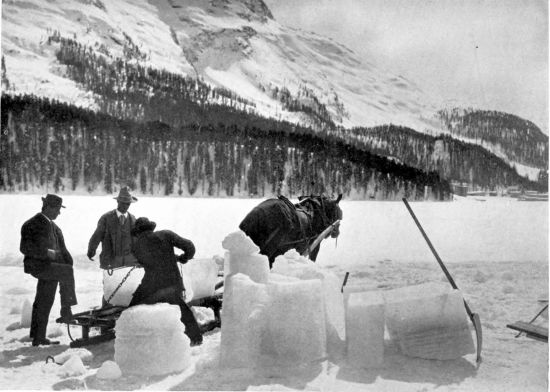
Plate XI
A WINTER HARVEST
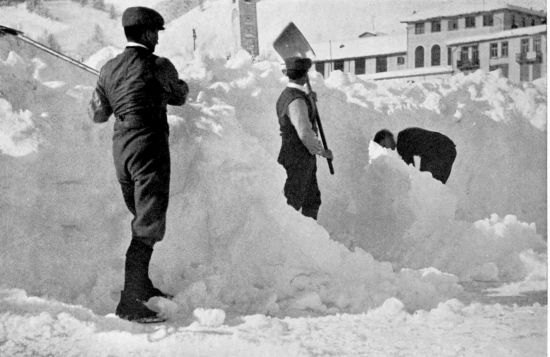
Plate XII
CLEARING THE SNOW FROM THE RINK
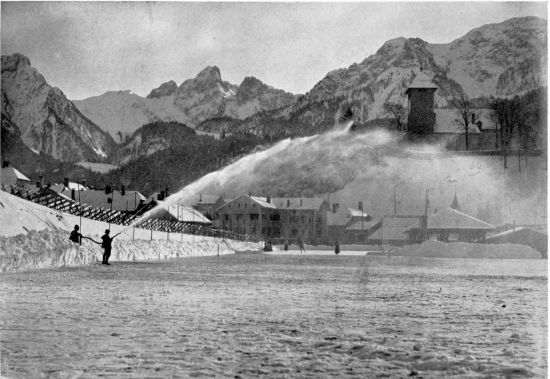
Plate XIII
SPRINKLING THE RINK, CHÂTEAU D’OEX
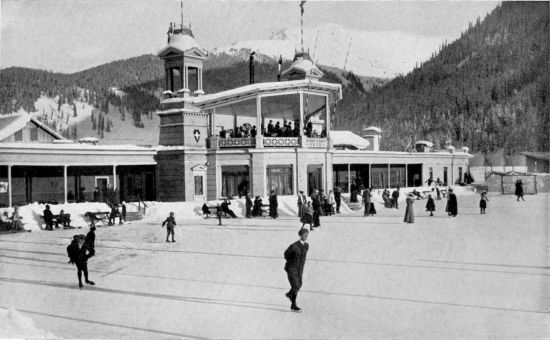
Plate XIV
PUBLIC RINK, DAVOS
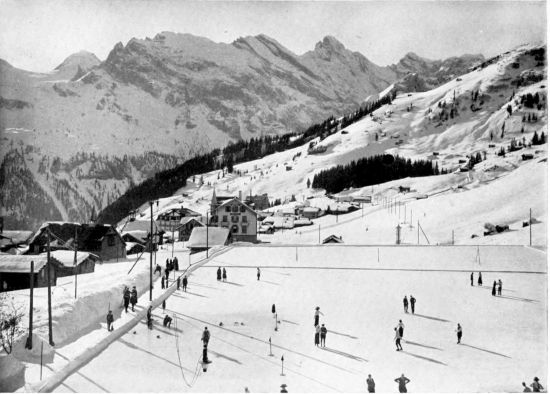
Plate XV
SKATING-RINK AT MÜRREN
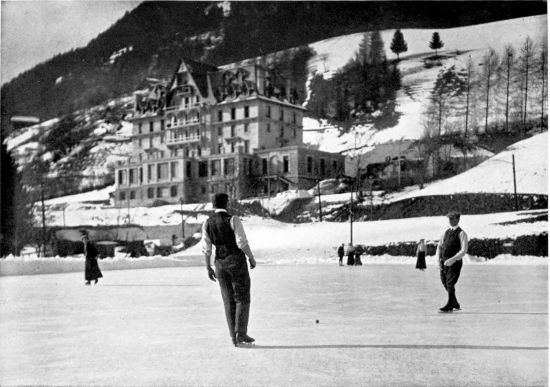
Plate XVI
SKATING-RINK AT CHÂTEAU D’OEX
![[Image of the book's cover unavailable.]](https://openoldbooks.sgp1.digitaloceanspaces.com/books/winter-sports-in-switzerland/images/cover.jpg)