Next day was the “cold gray dawn of the morning
after.” Not that it was particularly cold or gray, but
there was all the unnailing of the float to do, and the
dismantling of the two decorated canoes. The girls
wound the tinsel off carefully for use on future Christmas
trees, and packed away in a box what other decorations
were not perishable, for you never know when
you’re going to need things. Otherwise they sat around
and gloated softly over Camp Karonya’s exceeding
brilliancy in carrying off prizes in large quantities.
Mrs. Bryan would not let Winona divide her money
with the Camp, because they had enough already to see
them through the rest of the time they were to spend
there; and then, too, the second prize that the float had
won was fifteen dollars.
Nothing else memorable happened that day, except
that Nataly Lee left for home. She was thinner and
in better condition than she had been when she came,
but she frankly didn’t like the life. To her, carrying
water, instead of being a lark, was a nuisance. She had
no particular pride in working for beads, and it was
thought she was hungry for paper novels. It worried
her, too, that she was getting burned brown. So she
went back to her mother. The girls saw her off, and
sang her a cheer, and were as good as they could be.
But it is not to be denied that Camp Karonya felt a
little relief at her going.
212
After that nothing happened but regular camp work
for three days. And then Louise proceeded to distinguish
herself. It was to be expected.
Tom and Billy had taken Winona and Louise off
for a day’s fishing in the canoe. As usual, Winona and
Louise provided the lunch, the boys the fishing-tackle
and the canoe, and the fish were to be divided at the end
of the day. They had fished most of the lazy, sunny
morning, and it was noon. They climbed out of the
canoe by a spring, washed their hands, and set out the
lunch; the canoe was too fishy to be used as a dining-hall.
“Do you think that four of us can possibly eat
all that?” inquired Billy, eying the piles of sandwiches,
the veal loaf, the whole cake and the can of pears which
graced the paper napkins on the grass.
“Well,” explained Winona, “the truth is, Louise
and I rather doubled up on this lunch. We were both
afraid there wouldn’t be enough, and each went separately
and brought half a chocolate cake. You see it’s
cut down the middle. I merely joined the twin halves
for the sake of looks. But do you think that’s too many
sandwiches for four people with real appetites?”
“I don’t,” said Tom decidedly. “I’ll attend to
anything that’s left over. A very nice amount of lunch—just
right. Watch me!”
But they did not watch him because they were
otherwise engaged. None of them had small appetites,
and they all did good work. Just the same when they
were through there were a generous piece of cake, a fat
slice of veal loaf, and seven sandwiches left.
213
“I told you so,” said Billy. “Here, Tommy, it is
up to you. Have these seven nice sandwiches.”
“Can’t be done,” said Tom regretfully. “I’ve had
that many. I had three pieces of cake, too.”
“Doesn’t matter!” said Billy. “A gentleman’s
word of honor——”
He prepared to jump on Tom and hold him, while
Louise held a sandwich ready to insert.
“Ow!” said Tom. “Help! This is cruelty to
animals. Pry him off, Winnie!”
“Oh, let up, please!” said Winona. “You know,
he might explode, and mother’d feel badly.”
Billy took one knee off, and Tom wriggled more
vigorously. Louise relented, and the two girls were
trying to pull Billy off Tom. They had almost succeeded,
when a little rustle behind them made Winona,
whose senses were the most alert, let go and turn. The
others followed her eyes. They sat up and looked, and
Tom jumped to his feet and began to dust himself off.
The newcomer, who was a most forlorn and bedraggled
little girl, spoke very welcome words.
“Me’s very hundry!” she said pathetically.
“You poor little thing!” said Louise. “Come
here, dear; there’s lots for you to eat.” The little girl
made straight for her. Louise got out a fresh paper
napkin, and piled sandwiches, loaf, cake and all on it.
“Wait a minute,” said Billy. “Is all that good for so
little a girl—hadn’t you better give her one at a time?”
Louise held the veal loaf poised in air on her fork.
“Will your mother let you eat this?” she asked.
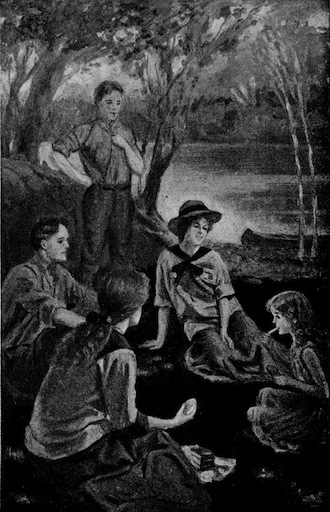 THE CHILD BEGAN TO EAT EVERYTHING AT ONCE
The bedraggled small child sat down on the grass,
as if the words were an invitation. She was a pretty,
dirty child of perhaps five, dressed only in a soiled and
ragged underwaist and petticoat, and with a mane of
very long and heavy hair, all tangles and elf-locks.
Her hair was yellow and her eyes big and blue, and she
would have been pretty had she been cared-for looking.
“Ain’t got any mother,” she said, “just Vicky.
She lets me.”
“Poor little thing!” said Louise again, and handed
her the veal loaf. The child began to eat everything at
once, with an eagerness which made it certain she had
told the truth, at least, about being hungry.
“What’s your name, kiddie? You’ll tell me, won’t
you?” asked Billy, when she seemed to have taken the
edge off her appetite. He bent down to her with a
sympathetic expression which he possessed at times,
and which—or something about him—won the hearts of
most small children he had dealings with.
“Sandy,” she said through large mouthfuls.
“Sandy what?” inquired Louise.
“Sandy Mitchell. Gimme more cake?”
As she had had two large slices, it was thought best
not to give her any more.
“Mercy, no!” said Winona, as Louise was cutting
it, in spite of prudence. “Not another bit. We don’t
want her to die on our hands. You’d better come over
here by the spring, dear, and let me wash your hands.”
Sandy got up immediately, with the placid remark,
“It might-a given me a pain, anyway,” and allowed her
215
hands to be washed, and dried on a fresh paper napkin.
“Poor little cowed thing!” exclaimed Louise at
this instant obedience. “Sandy, dear, won’t your people
be worried about you?”
“Nope,” said Sandy.
“And where do you live?”
“Way, way off,” she said. “We just comed. I’ll
show you to-morrow.”
“Poor little dear thing!” said Louise. “How
pretty she is! Winnie, I’ve a good mind to adopt her.”
“Having only five at home,” murmured Tom.
“From the way she talks her people wouldn’t care,”
said Louise. “Maybe Camp Karonya could take care
of her. We will till we go back, anyway.”
“She must belong to one of those poor families
along the west branch,” said Tom. “Three miles
away, and we can’t possibly get there by canoeing, because
we’d have to paddle back seven miles before we
could paddle over the three. Who’s going to walk
three miles and a half by the thermometer to take the
lady home? Don’t all speak at once.”
“Do you live up there?” Louise asked her. “And
does your father drink?”
“Yep,” said Sandy. “Favver? Course he dwinks.
Evvybody dwinks.”
“Think of being brought up to think things like
that,” said Louise.
“Don’t you think,” suggested Winona, “that we’d
better take her back to camp? I don’t know the way
to the place Tom talks about, and maybe it would be best
216
for Mrs. Bryan to take her anyway, if they do drink.”
“Good idea,” said everybody. Sandy herself
seemed pleased, and attached herself to them as readily
as a stray puppy would have done. They cleared up
leisurely, then got back into the canoe, taking the child
in, too. It was rather a close fit, though it was an
eighteen-foot canoe, but they managed it. She was no
more trouble than Puppums would have been—Puppums,
fortunately, had been left with Florence. They
had a good day with the fishing, and trailed into Camp
Karonya at six with fish for breakfast; and Sandy.
“Good luck!” were Tom’s parting words. “We’ll
come to-morrow and help you take her back, if you
like.”
“You needn’t bother,” said his sister. “We’ll take
the faithful rowboat.”
“We aren’t going to take her back!” insisted
Louise. “I’m going to adopt her. Sandy, wouldn’t
you like to live with me? I’d dress you in nice clothes
and give you a dolly.”
“An’ five cents?” demanded Sandy, “An’ things
to eat?”
“Oh, the poor baby!” said Louise. “She’s had
to think about money and food and grown-up things
like the poor little children you read about in the pamphlets.
Yes, indeed, you shall, Sandy.”
“She looks well-fed,” said Tom. “Well, good
luck. Don’t get a reputation for collecting them—you
mayn’t be able to dispose of orphans as easily as you
can kittens.”
217
They parted, and Louise carried Sandy into camp.
They arrived as supper was about ready. The Blue
Birds carried the fish off to the ice-box (it was literally
a box, a very ingenious arrangement of sawdust and
wood which had meant a bead for Elizabeth) and the
rest clustered about Louise’s treasure-trove.
“Better find out if she really needs adopting,” advised
Marie as they sat around the long table, and Sandy
exercised an appetite as large as her noon one.
“With a drunken father, and no mother, and looking
like that?” fired up Louise. “I’m going to wash
her after supper.”
There seemed no connection between washing her
and adopting her, but there evidently was to Louise.
“Want me to help?” offered Winona. “It ought
to be more fun than washing Puppums.”
“I hope she won’t howl and try to climb over the
side of the tub, the way he does,” said Louise. “Yes,
thank you, I’d love to be helped.”
A warm bath in a foot-tub, following directly on a
large meal of corn fritters, baked potatoes and huckle-berries,
ought nearly to have killed Sandy, but it didn’t.
“I never dreamed you meant to do more than wash
her face and hands,” protested Marie, who, as the
guardian of the Blue Birds, had ideas about such things.
But it was too late. Anyway, there was no visible
effect. Sandy awakened next morning, well, happy, and
still hungry. They had given her Nataly’s bunk with
Mrs. Bryan. Helen bunked with Elizabeth, because
Nataly said the girls tossed, and Mrs. Bryan didn’t.
218
While Sandy slept Louise and Winona were busy.
Louise woke Winona at five, and they heated water,
filled the charcoal-iron, and washed and ironed and
mended Sandy’s underclothes. While Louise darned
Sandy’s socks, Winona ironed the garments dry. Then
they foraged about the store-shed, which was a warm
place at that time of year even in the early morning,
and found a white dress of Florence’s which Winona
thought she had remembered bringing.
When found it proved much too large for Sandy,
but Louise was still enthusiastic, and took it up with
such good will that two of the tucks she put in had to
be ripped out again when they came to dress Sandy in it.
They polished the small strapped shoes the child had
taken off, sewed the button of each on more firmly,
and decided that they looked almost new.
Then Winona went back to awaken her own little
sister. When she returned to Louise’s tent she found
her friend had finished giving Sandy another bath.
She was just dressing her.
“I don’t believe this poor little thing knows what
a thorough bath is,” she greeted Winona over the child’s
head.
“Yes, I do, too,” said Sandy. “But I had one last
night, an’ you’ve been an’ given me anuvver now!”
“I think I’ll box her hair, too,” went on Louise.
“It is getting rather common now, but she has so much,
and it’s so untidy, that it would really be the best thing
even if I didn’t keep her.”
“I wouldn’t do her hair till you’re sure we’re going
219
to keep her,” objected Winona. “Her people mightn’t
like it.”
“A dissipated father and a poor little overworked
elder sister—Vicky is your sister, isn’t she, Sandy?—and
a home where they don’t even wash or feed her?
Poor people haven’t time to take care of hair like this.
Anyway, they haven’t done it, for it was tangled
awfully,” she finished conclusively.
“But it’s so pretty!” protested Winona. “Just
look at it, nearly to her waist, and thick and curly,
and such a lovely gold color!”
“So much the worse for her health,” said Louise
as promptly as Red-Riding-Hood’s wolf. “Sandy,
wouldn’t you like your hair cut nice and short, so it
wouldn’t get tangled any more?”
“An’ twousers?” demanded Sandy hopefully.
“Gee, zat’s gweat!”
“I’ll have to stop her using slang,” said Louise.
“No, dear, not exactly twousers, but—I could get her
some overalls, couldn’t I, Win?”
“I suppose so,” said Winona.
“Then I will,” said Louise.
“You’re gweat, too,” said Sandy, turning around
where she sat on Louise’s lap, and throwing both little
bare arms around her neck and kissing her. Louise
kissed her back warmly.
“Isn’t she a dear?” she said. “Winnie, will you
please hand me the scissors?”
“No,” said Winona, “I won’t. It’s wicked to spoil
pretty hair like that.” And she walked out of the tent.
220
“I’ll det ’em,” said Sandy, slipping down and bringing
them to Louise from the table at the end of the tent.
“Here’s a piece of ribbon to tie it with, if you won’t
cut it off,” said Winona, reappearing with a wide length
of blue taffeta.
“No, thank you,” said Louise, cutting industriously
and very neatly. “It would just be in her eyes all the
time. I’m going to cut it straight across her eyebrows,
like a little boy’s.”
“I did it to all my dolls once,” said Winona. She
sat down, though, and watched Louise till she was done.
Louise had washed the little girl’s hair when she
gave her the second bath, and when it was even and
short enough to suit her she finished dressing the child
in her white frock, and set her on the grass outside, to
dry in the sunshine. She gave her a picture book to look
at to keep her amused. The bobbed locks, thick and
curly, fluffed out charmingly in a yellow bush around
the sweet little face.
“It’s becoming,” admitted Winona. “She looks
like a cherub, or a choir-boy on a Christmas card.
There is the signal for breakfast. You just got her dry
in time.”
“Breakfast?” said Sandy, brightening.
“Poor little darling!” said Louise, catching and
kissing her. “I don’t believe she ever had anything
to eat before she came here!”
They went to breakfast in state, and Sandy’s golden
aureole and clean white frock made quite a sensation
at the table. They piled things up for her to sit on, and
221
she was put where Mrs. Bryan could reach her, and
argue with her easily if she misbehaved. But she acted
very well indeed. Her table-manners were good, considering,
she talked without the least shyness, and managed
to eat a very large breakfast. Louise beamed with
pride over the impression her protegee was making.
When breakfast was over, and Sandy turned loose
again to play with Puppums and Florence, to whom
she had taken a violent fancy, Louise packed a market-basket
with everything a starving family might need.
Then she found her purse, summoned Winona, and
they took the rowboat and went forth, Sandy and
Puppums in the bottom of it.
They rowed along the west branch, a narrow stream
that doubled at right angles from the branch the camps
were on. It was lined with pretty summer cottages for
a part of the way, then after that, at the very end, came
a part that was filled with poor people who had squatted
there. But long before they came to the poorest part
Sandy desired to land.
“Here we is!” she said cheerfully, at a prosperous-looking
dock about a third of the way up.
“Not here, dearie,” said Louise. “It’s probably
some place where the poor child’s been fed,” she added
aside to Winona.
“We may as well get out, though, mayn’t we?”
suggested Winona. “Maybe they can tell us where
she comes from.”
They tied the boat and got out, and walked down a
deep lane for a while. Presently they came to a large
222
white house in the middle of a couple of acres of half-yard,
half-lawn looking land.
The doors and windows were all wide open, but
there was no one to be seen. Sandy walked into the hall
with an assured tread, took a long breath, and called
at the top of her lungs, “Vicky! Vick-ee!”
The girls stood at the door and waited, ready to
apologize for their charge’s rudeness whenever somebody
might appear. In about five minutes, during
which Sandy continued to shout, they heard a light,
slow step along the upper hall. Presently a slim, dark,
rather pretty little girl of about eleven scuffed down the
stairs. She had on a kimono over her nightgown,
though it was quite late in the morning.
“That you, Sand?” she called as she came. “Goodness,
you’re up early!”
“This is Vicky,” Sandy explained to the girls over
her shoulder. “Vicky! I’ve had two baths!”
Louise stood, for once, speechless. She hung
mechanically to the handle of the basketful of provisions,
but she was too surprised to move. It was Winona
who finally took courage to come forward and explain.
“I’m Winona Merriam,” she said, “and this is my
friend, Louise Lane. We are over at Camp Karonya,
the Camp Fire, you know. We found this little girl
yesterday, and we came over to-day to bring her home.
Does she—does she belong here?”
“Why, of course she does,” said Vicky. “Thank
you for bringing her. She’s always trailing off that
way, aren’t you, Sand? How long you been gone?”
223
“Is she your sister?” asked Louise, who had her
breath by this time.
“M’hm,” nodded Vicky. “Why—why, Alexandra
Mitchell, where’s your hair?”
“It got boxed!” exclaimed Sandy gleefully.
“Isn’t it nice?”
“I’m afraid we’ll have to explain about that,” said
Winona bravely. “Your little sister strayed into a
little fishing-trip four of us were having yesterday, very
hungry and rather dirty, and without all her clothes on.
And from the way she talked we thought she was—well,
we washed her and dressed her, and—I’m sorry—shortened
her hair, it was so tangled. I’m ever so
sorry. I think it will grow——”
Vicky stared a minute at Alexandra, very proud
of herself, neat, clean, dressed and bobbed. Then instead
of being angry she sat down on the floor, where
she was, and burst into a fit of laughter.
“You thought—you thought—oh, my goodness!”
“Yes,” said Winona. She sat down, too, and finally
went off herself. “Yes—we did!”
“And you brought food for the hungry family——”
Vicky’s eye fell on the large basket which
Louise still held stiffly before her. “Oh, oh, oh! And
Uncle Will’s pride, Sandy’s hair, that he made a picture
of that sold for ever so much money—oh, my goodness
gracious!”
She and Winona both began to laugh again. Louise
didn’t. She stood against the wall like a wax statue.
“It certainly is funny,” said Vicky at last, mopping
224
her eyes, “but I’m good and glad about Sandy’s hair.
It was an awful nuisance to take care of, and Uncle Will
would keep it that way so he could paint pictures of it.
Won’t you stay and have some breakfast? We have a
cook.”
“No, thank you,” said Louise hurriedly, “we’ve
had our breakfast.”
“What an awful noise, children!” said a voice; and
a rather rumpled man appeared. He had an absent
look, and also gave an impression of not having been
to bed all night. He had a paint-brush in his hand.
Vicky and Sandy sprang for him, hanging to him.
“Oh, Uncle Will, this is two Camp Fire girls,”
said Sandy. “They cutted my hair when I was lost.
Ain’t it cute?”
“Oh!” said Uncle Will, and looked as aghast as
Louise had. “How did this accident happen?”
“It wasn’t an accident,” said Sandy. “Louise
boxed my head, an’ gived me two baths!”
Uncle Will—so far as the girls learned that was all
the name he had—uttered another faint exclamation.
Then he dived back into his room as if he wanted to
bear the shock alone.
“I’m so sorry!” said Winona, who found she had
all the talking to do. “I’m afraid your uncle doesn’t
like it!”
“Oh, he’s only got an artistic temp’rament,” said
Vicky, as if it were a disease uncles could not help.
“I think Sandy’s goin’ to, too. Do stay to breakfast.
We’ll have things out o’ your basket if you will.”
225
“No, thank you,” said Winona. “I think Louise is
in a hurry to go home. Come over and see us. It isn’t
far if you have a boat.”
“We’ll get somebody to bring us,” said Vicky.
“I’d come now if I was dressed.”
“It wouldn’t be a bad plan if you dressed a little
earlier,” said Winona frankly. “Are there just you
two?”
“Nope,” said Vicky, “there’s Lancy, too. He’s
eight. Uncle Will tries to bring us up, but he don’t
know how so very well.”
“Well, when you come down to camp we can tell
you a lot of things if you’d like us to,” said Winona.
“Maybe,” said Vicky indifferently. “But it’s all
right this way. You can try telling us, though.”
“Well, good-bye,” said Louise—it was all she had
contributed to the conversation, but she seemed to
contribute it gladly.
So they went, still carrying the basket.
“Wait!” called Sandy’s voice behind them when
they had gone a little way. “I’m goin’ back wiv you!
You said you’d ’dopted me!”
“But we didn’t know your uncle wasn’t poor then,”
said Louise. “We can’t take you away from him.”
“You ’dopted me,” said Sandy doggedly, “an’ I’m
goin’ wiv you—so there!” And she thrust her wet
little hand into Louise’s and trotted along beside them.
“Louise—wasn’t there cake in the basket?”
“You have cake at home, dear,” said Louise. But
she looked as if she felt a little better. After all, even
226
if an orphan didn’t need adopting, it was a pleasure to
find that she liked it.
“Like you best,” insisted Sandy. “Goin’ to stay
wiv you. They don’t care!”
“Oh, let’s let her, just for to-day, anyhow!” said
Winona. “I don’t believe anybody’ll mind.”
“All right,” said Louise rather as if she wanted
to. They got into the boat again, and rowed to camp.
“Sandy,” asked Louise, “what did you mean by
saying your father drank? You haven’t any father.”
“Well, I did have,” said Sandy. “And of sourse
he did dwink when there was a him. Evvybody does.
Little flowers do. My governess said so.”
“Your governess!” said Louise. “Is your uncle
rich enough for you to have a governess—and you go
trailing round in your underwaist and petticoat!”
“When he draws pictures an’ sells ’em he is. When
he don’t he don’t. Gimme some cake?”
Sandy was evidently quite calm about her way of
living.
“She mayn’t need adopting, but she certainly needs
reforming,” said Louise vigorously.
They were paddling past the Scouts’ camp by now.
Louise was quite willing to go past softly, but Sandy
yelled, for she saw Billy.
“Hello, girls!” he called. “Back already? Got
all the papers signed?”
“No, I haven’t,” said Louise. “And, Billy, if you
ask me any more questions, I’ll jump over and drown!”