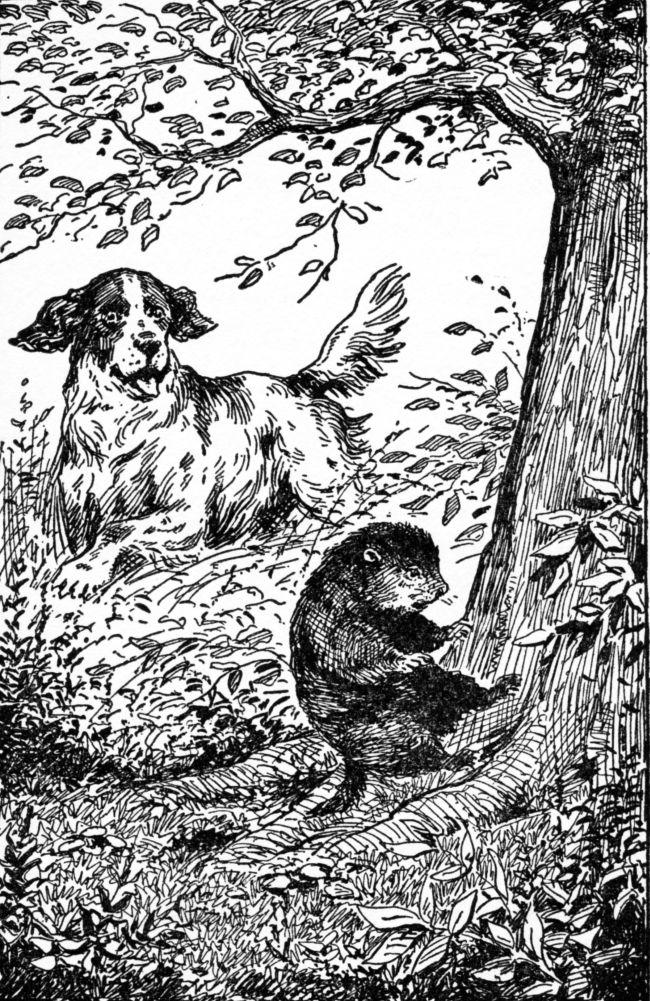
CHAPTER I WINKIE PLAYS TAG
WINKIE, THE WILY
WOODCHUCK
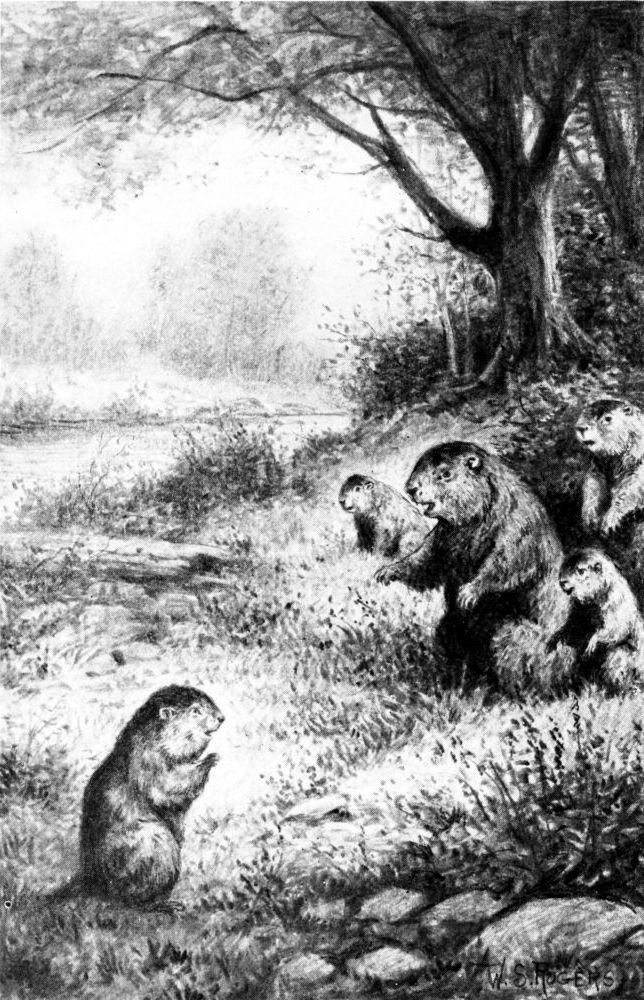
“What shall we do next?” asked Winkie,
the wily woodchuck.
“Isn’t it too hot to do anything?” was
what Blinkie, her sister, wanted to know. “Let’s
just sit here by the front door, where we can
easily pop down into our underground house if
anything happens.”
“Do you think anything is going to happen?”
asked Winkie, who was called wily because she
was so smart and careful, always on the lookout
for traps and danger. “If you think anything
is going to happen,” went on Winkie, speaking
to her sister, “I’m going in now and tell mother.
I’d tell pa, only he isn’t home yet from the woods,
where he went to get something special to eat.”
“Oh, I don’t know that there is any special
danger,” said Blinkie, as she pawed out a bit of
thistle that had become stuck to her fur. “But
it’s too hot to do anything, Winkie.”
“Except to eat clover,” half grunted Blunk,
who was the woodchuck brother of Winkie and
Blinkie. “Let’s go over in the farmer’s big field
and eat a lot more clover,” suggested Blunk.
You know clover is what woodchucks like best
of all.
“Clover!” laughed Winkie, tapping her
brother playfully on his black nose. “If you eat
any more clover, Blunk, it will run out of your
ears, as grandma says.”
“Pooh! I never eat too much clover!” boasted
Blunk. “And I’m going over to the field now
and get some more. Do you girls want to
come?” he asked. “I know where there’s some
clover with red blossoms.”
“Oh, it’s too hot to move, especially with this
thick fur we have to wear,” said Blinkie. “In
the winter it isn’t bad; but now, with summer
coming on, I wish I didn’t have so much fur.”
“Some of it will fall out, so mother said,”
explained Winkie. “She told me that the fur
of all woodchucks and other animals like us
gets thinner in summer.”
“Well, I’m glad of it,” sighed Blinkie, stretching
out her two front paws lazily. “I’m so warm
now I don’t know what to do!”
“Let’s slide down the back-door hole inside
our burrow,” suggested Winkie. “We can have
fun that way, and it’s nice and cool away down
deep underground. Let’s slide down the back-door
hole!”
Woodchucks, you know, have two holes, or
doors, leading into their houses, which are dug
in the earth below the surface. The reason for
this is that if a fox, or other pursuing animal,
chases them down one hole they can run out the
other.
“Oh, I don’t want to slide down any holes!”
complained Blinkie.
“Nor I,” added Blunk. “I’m going over after
clover.”
“Don’t let the farmer catch you eating his
clover, or he may set a trap for you or fire his
gun at you,” warned Blinkie, as her brother
waddled off, his little short legs slowly carrying
his rather fat body.
“I’ll be careful,” promised Blunk.
Winkie stood for a moment near the edge of
the sloping hole that led down into the dark
underground house. This hole was the front
door of the little woodchuck’s home. The back
door was around behind a big rock. The hole
had been used so often by the woodchuck family
when crawling in and out that the bottom of it
was worn smooth. When it rained, and the earth
became wet, the front entrance to the burrow
was very slippery.
But the back door had been dug down through
some earth that had in it many shale-rocks—that
is rocks which were little flat pieces of smooth
stone. On these it was almost as easy for a woodchuck
to slide as it is for a boy or girl to slide
or coast on the ice or snow. Winkie knew she
did not need to wait until it rained to have a slide
on the shale-covered back-door hole, and this she
was now eager to do. Only, she didn’t want to
play alone!
“Please come on and slide with me,” begged
Winkie of Blinkie.
“No, indeed!” answered the other woodchuck
girl. “It’s too warm. I’m going to sleep.”
“Well, I’ll have to go by myself then,” said
Winkie, a bit sadly. “Will you play after you
wake up, Blinkie?”
“Maybe—maybe,” answered Blinkie, sleepily.
“Oh, I never saw such creatures!” murmured
Winkie, as she ran along, giving a look toward
her sister and a glance over into the next field
where Blunk was nibbling clover. “All they
think about is eating and sleeping! I’m going to
do something! I wish I could have some adventures!
That’s what I wish—adventures!
“Flop Ear, the rabbit who used to live here before
he went away, had lots of adventures. He
told me so when he came here on a visit. Oh
dear! I wonder if I’ll ever have any adventures?”
Had she only known it, Winkie was, even then,
about to start some very wonderful adventures,
which I will tell you about.
But just at present all there seemed for the
little girl woodchuck to do was to slide down
the back-door hole of her underground home.
And this she did until she was tired.
She would gather her paws under her, sit
down on the smooth shale-rocks at the top of
the hole, give herself a little push, and down she
would go, landing in the big underground earth-room,
where all the woodchucks of this one family
lived.
“My goodness, Winkie! what are you doing?”
cried her mother, who was having a nap all by
herself.
“Just sliding down the hole,” answered
Winkie. “Blinkie and Blunk won’t play with
me, so I have to slide all alone.”
Mrs. Woodchuck did not answer, for she had
fallen asleep once more. But she awakened
when Winkie came sliding down again, and the
mother of the little animal girl said:
“I wish, Winkie, you’d go somewhere else to
play. I want to sleep, and you wake me up every
time you land.”
“All right, Mother, I’ll see if I can get Blunk
and Blinkie to play tag,” said Winkie, for she
was a good little thing.
Taking just one more slide, while her mother
was still awake, Winkie crawled up the back-door
hole again, and went softly to Blinkie’s
side. Blinkie was still slumbering.
“Tag! You’re it!” suddenly cried Winkie in
her sister’s ear.
“What’s that? You’re going to put me in a
bag? Oh, please, Mr. Farmer, don’t put me
in a bag!” begged Blinkie. “I didn’t take any
of your clover!”
“Ha! Ha!” laughed Winkie, as Blinkie sat
up, rubbing her eyes. “You must have been
dreaming that you were over in the field with
Blunk, taking clover! I’m not a farmer, and
I haven’t any bag. I just cried, ‘Tag! You’re it!’
Come on and play!”
“Oh, it’s you,” said Blinkie, not frightened
now that she saw only her sister. “Yes, I was
dreaming. And when you awakened me so suddenly
I thought you were a farmer trying to
catch me in a bag.”
“Well, come on and have a little tag game and
you’ll feel better,” advised Winkie. “I can’t
slide any more because mother wants to sleep.
Let’s play tag!”
“You go and tag Blunk,” suggested Blinkie.
“I’ll be wider awake after that, and then I’ll
play. Go and tag Blunk.”
“All right,” agreed Winkie, who was very
obliging. “I hope he hasn’t fallen asleep from
eating too much clover,” she added.
But Blunk was wide awake. He was sitting
up on his haunches, as a dog sits up to beg, and
he was slowly nipping off the sweet clover tops
and the tender leaves, chewing them very contentedly.
“Hello, Winkie! So you came over, after all,
to get something to eat, did you?” asked Blunk.
“No, I came to see you,” replied Winkie.
“Tag! You’re it!” she suddenly cried, tapping
her brother with an extended paw, and then
springing away before he could touch her.
“Come on! Chase me!”
Blunk was fonder of games than was his sister
Blinkie, who, to tell the truth, was a bit lazy. So
when Blunk found he was “it,” he made up his
mind not to stay that way any longer than
need be.
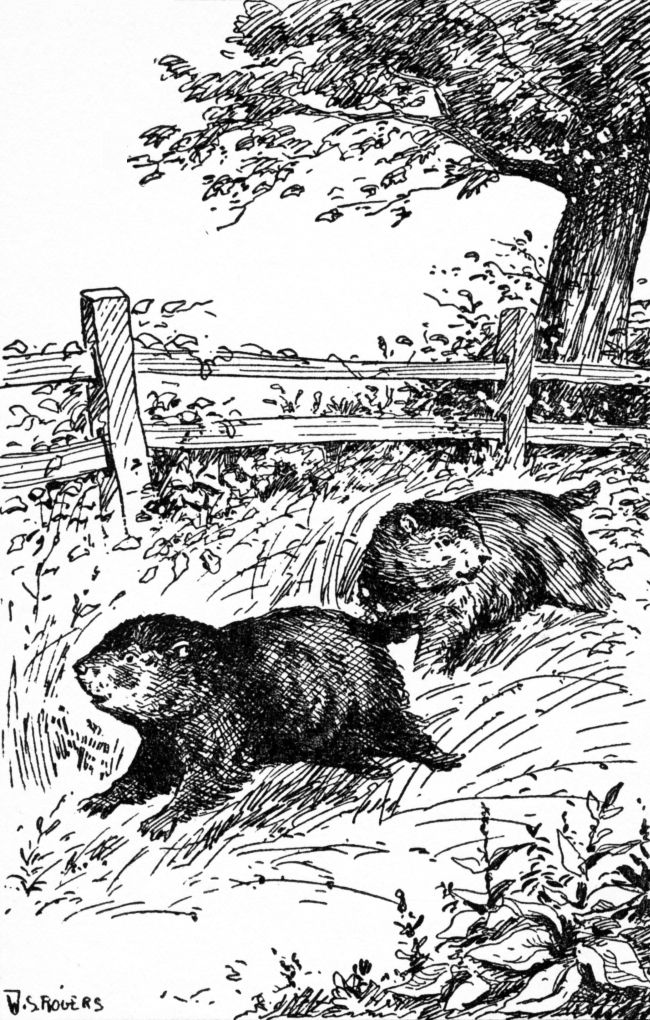
“Oh, I’ll tag you all right!” he cried, racing
after his sister Winkie. “I’ll tag you!”
“If you do, then I’ll tag Blinkie and we can
have a regular game!” merrily laughed Winkie,
as she sprang over a clump of clover. “This is
more fun than sliding down the back-hole door
all alone, or even going to sleep. Come on,
Blunk! Let’s see you tag me!” she cried.
Nearly always when the woodchuck children
played a game of tag, or any other running game,
Blunk would easily catch Winkie or Blinkie.
For, being a boy woodchuck and strong, he could
go faster than the girls. And this time Blunk
thought he would have no trouble in tapping
Winkie with his paw, tagging her and making
her “it.”
But Blunk forgot about all the clover he had
eaten. He had, I am sorry to say, rather stuffed
himself. He had eaten too much, but not
enough to make himself ill, for animals know
better than that. But Blunk had swallowed so
much clover that his little stomach was sticking
out like a toy balloon, and this made him so
heavy that he could not run fast.
Because of this, Winkie could easily keep
ahead of him. On and on ran the wily little
girl woodchuck, laughing and teasing her
brother because he could not catch her to tag
her.
“Come on! Come on!” cried Winkie. “Why
don’t you tag me, Blunk?”
“I will—in a—minute!” panted Blunk. “I—I
haven’t started—running—yet!”
He was getting out of breath, and he was beginning
to wish he had done what Winkie had
asked him to do at first—come and play with
her—instead of eating so much clover.
“But I’ll catch her after a while. I always
do,” thought Blunk to himself, as he raced on
and on, while Winkie, the wily woodchuck,
dashed this way and that, making quick turns,
which was the best way of avoiding her brother.
“I never knew her to keep away from me so
long as this—before. I—I guess I ate too much
clover!” panted Blunk.
“I know you did!” called Winkie, laughing,
for her brother had said this last thought aloud.
“Ha! Ha! You can’t tag me!”
“Yes, I can! There! Now you’re it!” cried
Blunk.
He gave a sudden jump, and so did Winkie,
for she wanted to keep from being tagged as long
as possible. Just as she and Blunk leaped, a
harsh voice cried:
“Ha! There’s them pesky woodchucks in my
clover again! I’ll fix ’em!”
There was a loud bang, like a clap of thunder,
and as Blunk looked back he saw his sister falling
in a crumpled heap.
CHAPTER II WINKIE HEARS A NOISE
Blunk, the boy woodchuck, was so
frightened by what he heard and especially
by what he saw—his sister falling
in a heap amid the clover—that for a little while
he could do nothing. He stopped short, and hid
down under a big bunch of the red blossoms and
green leaves.
“Oh! Oh! What has happened?” thought
poor Blunk.
It was not the noise that he minded, for he
had often heard thunder when rain storms made
the ground wet. Though now there was not a
cloud in the sky, which was bright blue, and the
sun was gaily shining. So it could not have
been thunder.
“There!” cried the man. “I guess I shot one
of them pesky woodchucks that time! I’ll teach
’em to take my clover!”
There was a queer smell in the air—a powder
smell, though Blunk did not know what it was
then. And there was a little cloud of blue smoke
near Farmer Tottle, for it was he who had fired
the gun at Blunk and Winkie.
“Yes, sir!” went on the farmer, lowering his
gun, from the end of which more blue smoke
floated. “I got one of the woodchucks!”
“Ha!” suddenly cried Winkie, jumping up
from the grass and clover where she was hidden
near Blunk. “He didn’t get me!”
“Oh!” cried Blunk, who was less quick-witted
than his wily sister and who was very much surprised
when Winkie leaped up so suddenly.
“Oh, I’m so glad! I thought something had happened
to you, Winkie!”
“Something really did happen,” said the girl
woodchuck. “Keep still, Blunk! Don’t move!
Don’t look up!”
“Why not?”
“Because that man might shoot you! He’s
got a gun! I saw him pointing it, and, just in
time, I stumbled and fell.”
“On purpose?” asked Blunk.
“Yes! Of course! Suppose I wanted to get
shot? Keep still now!”
The two little woodchucks kept close together
and hid themselves down under the clover tops.
They could hear the heavy, tramping feet of
Farmer Tottle, though of course they did not
know his name.
“Keep still now—he’s coming!” whispered
Winkie to Blunk. The little girl woodchuck
really did not need to tell her brother this.
Blunk, though slower witted than the wily Winkie,
was not foolish, and did not need be warned
of his danger.
Of course they talked in woodchuck language,
just as dogs talk in their language and cats in
theirs. Winkie and Blunk could not understand
what the man said, though they understood some
of the things he did. Nor could Farmer Tottle
hear, much less understand, what the woodchucks
said. Animals seem able to talk to one
another, even if they are from different countries
and are quite different one from the other.
Nearer and nearer came the heavy, tramping
feet of the farmer. Winkie and Blunk wanted
to dart away and hide in their underground
house, but they did not dare come out from beneath
the sheltering clover.
“That’s funny!” muttered the farmer to himself.
“I’m sure I shot one of them pesky woodchucks,
but I can’t find it! There were two,
but they’ve got away somewhere. If I only had
Buster, my dog, he’d nose ’em out. Guess that’s
what I’ll do—I’ll go get Buster!”
Winkie and Blunk kept so quiet under the
clover that though the farmer was very close
to them he did not see them. And when he
turned to go back to the barn, to get his dog
Buster, Winkie and Blunk thought this would
be a good time for them to run home.
Of course they did not know the farmer had
gone after his dog, but the woodchuck children
knew they had been in danger; and where there
is danger once for an animal, there may be danger
a second time.
“Come on, Winkie!” said Blunk in a low
voice, as the footsteps of the farmer died away
in the distance. “Let’s run!”
“Do you want to play tag any more?” asked
Winkie, astonished.
“Tag? No, indeed!” exclaimed her brother.
“All I want to do is to get home. And you’d
better come with me. It’s a good thing Blinkie
didn’t come, for if there were three of us that
man might more easily have seen one of us.
Come on now—let’s run!”
And run home is what Winkie and Blunk did.
They ran as fast as when they had been playing
tag. But this was no joyful race; it was a race
full of danger. For there was no telling when
the farmer might shoot his gun again, or when
he might return with his dog.
Though Winkie and Blunk felt pretty safe as
they ran through the deep clover, they also felt
their little hearts beating very fast as they neared
their burrow, or underground house.
“My goodness!” exclaimed Blinkie, in woodchuck
talk, as her brother and sister came leaping
up to the front door. “What’s your hurry on
such a hot day?”
“Hurry?” gasped Blunk. “I guess you’d be
in a hurry if you’d seen and heard what happened
to us! Wouldn’t she, Winkie?”
“Indeed she would!” said Winkie. “Oh, such
a terrible time!”
“What’s the matter?” asked Mother Woodchuck,
coming up into the air after her sleep.
“What’s all the excitement about?”
“We were playing tag,” began Winkie, “when
all at once there was a noise like thunder—”
“But it wasn’t thunder. It was a man with a
gun shooting at us,” interrupted Blunk.
“Oh, my dears! A man with a gun, shooting!”
cried Mrs. Woodchuck. “Oh, my poor
children! What shall we do? I wish your
father was home! Oh, this is dreadful!”
“Don’t worry, Mother!” said Blunk kindly.
“We ran away from the man with the gun, and
I don’t believe he can find us. And neither of
us got shot. Winkie threw herself down in the
clover and hid just in time.” Blunk was proud
of his clever, wily sister.
“Oh, but suppose he comes here!” cried Mrs.
Woodchuck.
“I don’t believe he can find our burrow,” said
Blinkie, a bit proudly. “Daddy and you made
our underground house in a place that isn’t easy
to find.”
“Besides, it has two doors,” said Winkie.
“And you told us that made it much safer,
Mother.”
“I suppose it is as safe as any house can be,”
said the woodchuck lady. “Still, even with two
doors, something may happen. I wish your
father would come home.”
And a little later Mr. Woodchuck came home.
In his paws he carried some yellow carrots and
a white turnip.
“See what I have brought for you!” he cried,
as he scrambled down the front door of the underground
house.
“Oh, how lovely!” cried Blinkie.
“Why, what is the matter?” asked Mr. Woodchuck,
dropping the carrots and the turnip in a
heap on the floor. “Has anything happened?”
he asked, for he could tell by looking at his wife
and children that something was wrong.
“Winkie and Blunk were in great danger to-day,”
said Mrs. Woodchuck. “And I am afraid
we shall have to move out of our lovely home.
Tell your father about the man with the gun,
children!”
Winkie and Blunk related what had happened
in the clover field when they were playing tag.
At the end of the story Mr. Woodchuck looked
as worried as did his wife.
“What are we going to do?” asked the woodchuck
mother, looking anxiously at her husband.
“Shall we have to move?”
“Let me think a minute,” said the father woodchuck.
“Tell me,” he went on, speaking to Winkie
and Blunk. “Did the man follow you all
the way to our burrow?”
“No. He turned around and went back after
he shot at us and didn’t hit either of us,” said
Blunk.
“Well, then,” went on the father woodchuck,
“I think we shall be safe here for another day or
so. Men are stupid creatures. It is only by accident
that he could find this burrow.”
“Maybe his dog could,” suggested Winkie.
“Yes, a dog is smarter than a man when it
comes to that,” said Mr. Woodchuck. “But
don’t worry any more right away. Eat the good
things I brought home, and I will think what
is best to do.”
The three woodchuck children, Winkie, Blinkie,
and Blunk, soon forgot their troubles in eating
the sweet carrots and turnip. Even though
Blunk had eaten so much clover he could hardly
run, he was now ready for the good things his
father had brought home.
“Where did you get them?” asked Blinkie,
nibbling the end of a carrot.
“I found them in a field,” answered Mr.
Woodchuck. “There were so many I don’t believe
the farmer will mind my taking a few.”
“Maybe they were planted by the same man
who fired a gun at Winkie and me,” suggested
Blunk.
“Maybe,” said his father. “Why don’t you
eat some?” he asked his wife, for she had not
even nibbled the outside skin of the turnip.
“I am too worried to eat!” she answered. “I
hate to think of having to move.”
“Perhaps we may not be driven to that,” said
Mr. Woodchuck, who was more cheerful than
his wife. “And if we do, we can easily dig a
new burrow, or find a place to stay. This is
summer, and the ground is soft.
“I’ll tell you what we’ll do,” he went on.
“We’ll be ready to run away at the slightest sign
of danger. If that farmer comes to our front
door we’ll run out the back door; and if he
comes to the back door we’ll skip out the front,
and all will be well.”
“It sounds all right,” said Mother Woodchuck.
“I only hope it happens that way.”
But it did not. Things in the woodchuck
world, just as in your world and mine, very often
do not turn out the way they are expected to.
For several days, however, after the game of tag
and the shooting of the gun, nothing happened
in the woodchuck home. For a time Winkie,
Blinkie, and Blunk hardly poked their noses
outside the back or front door. But as the days
passed and no farmer with his gun and dog
came, the children became bolder.
They played tag and other games and ate the
clover and the other good things their father
and mother brought home. Then, one morning,
just as Mr. Woodchuck was starting out to go
to a distant field, and when the children were
about to go out and play, Winkie held up her
paw and said:
“Listen! I hear a noise!”
CHAPTER III WINKIE FINDS A WAY OUT
Just as soon as Winkie told the other woodchucks
to be quiet and listen, they all remained
as still as though frozen in their
places. Not one made a move. This is what
wild animals always do when they hear or see
anything strange. They stay quiet for just a
moment or two before making up their minds
what is best to do to save themselves from danger.
And that danger was at hand Winkie, the
wily woodchuck, felt sure.
As I have told you, she was the smartest of
all the woodchuck children, and that is why her
mother nicknamed her “Wily,” which means
smart and cunning.
“I don’t hear anything!” whispered Blunk.
“Hark!” cautioned Winkie once more.
This time they all heard it. Silently they listened
in their underground house to the strange
noise. It was up above them—a thudding, rasping,
scraping sound.
“What can it be?” asked Mrs. Woodchuck.
She spoke in a whisper, as, indeed, they all did,
for they knew their little whispering voices could
not be heard outside their burrow.
“I don’t know what it is,” answered Mr.
Woodchuck. “But whatever it is I’m glad
Winkie heard it before I started out; otherwise
I might have run right into danger!”
“Do you suppose it’s that farmer looking for
us?” asked Blinkie.
“Or his dog?” added Blunk.
“If it’s a dog maybe I could fool him in some
way!” said Winkie.
“How can you fool a dog?” Winkie’s mother
asked.
“I can poke my nose out of the back door, and
when he sees me I’ll duck down in here again,”
explained Winkie.
“What good will that do?” asked Daddy
Woodchuck. “You would only be running your
nose into danger!”
“Well, but listen!” exclaimed Winkie, and she
was so eager that she forgot to speak in a whisper
until her mother said:
“Hush! Keep quiet!”
“All right,” hissed Winkie. “But this is what
I could do. I could poke my nose out of our
back door. The dog would see me, and run to
get me. I’d duck down in here, and the dog
would begin digging at the back door to make
it big enough for him to come down.”
“Yes, that’s just what the dog would do,”
sighed Mrs. Woodchuck. “I know dogs, to my
sorrow! Once one bit me on the leg!”
“Yes, but wait!” went on Winkie eagerly.
“While the dog was digging at our back door we
could run out the front.”
“That’s a good idea!” exclaimed Blunk. “But
I think I’m the one to do it, and not Winkie.”
“No! No!” exclaimed Mr. Woodchuck. “I
see your trick, Winkie, and it is very good of you
to think of it and good of Blunk to offer to do it.
But it is too dangerous! The dog might dig his
way in here through the back door before we had
a chance to run out the front. And who knows
but what the farmer with his gun may be waiting
up above for us! No, we will stay right here
safe in our burrow. I don’t believe they will
find us here.”
“But what is that strange noise?” asked Blinkie.
“There it sounds again!”
Indeed there came once more that strange
noise which Winkie had first heard. The rumbling
kept up, and now and then came a pounding
as if heavy feet were tramping on the ground
overhead.
“Oh, that must be the farmer trying to break
his way in here with his heavy boots!” cried
Blinkie.
“Hush! Do you want him to hear you?”
whispered Winkie, and her sister grew quiet.
As the woodchuck family listened, the noise
grew louder, and then, very plainly, they all
heard a man’s voice shouting:
“Whoa!”
Instantly the noise stopped.
“That was the farmer!” exclaimed Blunk. “I
know his voice!”
“What was he saying?” asked Blinkie.
No one could tell her, of course, for the woodchucks
did not understand man talk, any more
than the farmer understood animal language.
But Blinkie made a guess.
“Perhaps that farmer was talking to his dog,”
she said.
“Maybe,” agreed her mother. “I hope neither
of them finds his way down here!”
But the farmer was not talking to his dog.
One doesn’t say “whoa!” to dogs, one says it to
horses. And that is to whom the farmer called
the word which means stop.
“Whoa there now!” cried Farmer Tottle
again. “Stand still, can’t you? Want to drag
this plow over all them rocks? I’ve got to blast
’em out. That’s what I’ve got to do. These
rocks and stumps are in the way, and I’m going
to get some powder and blow ’em to bits. What
with big stones on my farm, and the pesky woodchucks
eating the clover, I won’t have enough
left to buy me a new shirt at the end of the year.
Stand still, can’t you? Not that I blame you
much for not wanting to plow in this field of
rocks,” he went on. “Guess I’ll go and get some
powder and blow ’em up now. I’ll finish plowing
to-morrow.”
It was this noise of the plow rasping and cutting
its way through the earth over their heads,
and the heavy thud of the hoofs of the horses,
that Winkie and the other woodchucks had heard
down in their burrow.
There was silence while Farmer Tottle was
thinking of the best way to blast the rocks from
his field, not far from the clover patch where
Blunk and Winkie had played tag that day.
Then, having made up his mind what he would
do, Mr. Tottle turned his team around and
drove them back to the barn.
“The noise isn’t so loud now,” whispered
Winkie, after a bit.
“No. Maybe nothing is going to happen after
all,” said Blinkie.
But the danger was over only for a little while.
The noise stopped as Farmer Tottle drove away,
and, for a time, the ground-hogs thought everything
was going to be all right. Ground-hog
is another name for the woodchuck.
“I guess I can go out now,” said Mr. Woodchuck,
when an hour or more had passed and
there were no more thumping sounds and no further
cries of “Whoa!”
Mr. Woodchuck went softly to the back-door
of the burrow. He crept up the little incline, or
hill, that led to out-of-doors, and he was just
poking his nose out when, all at once, there
sounded a loud:
Bang!
And that was not the worst! As the loud noise
sounded, louder than any thunder the ground-hogs
had ever heard, Mr. Woodchuck came slipping,
sliding, and half falling back into the
burrow.
“Oh, Nib! what has happened?” cried Mrs.
Woodchuck. “Nib” was a pet name for her
husband. “Are you shot?” she asked. “I’m sure
I heard a gun!”
“It was the biggest gun I ever heard shot off,
if that’s what it was!” said Mr. Woodchuck.
“It fairly stunned me! Why, I fell right over
backward, and a lot of little stones and dirt flew
in my face!”
“Did the farmer see you and shoot at you?”
asked Winkie.
“No. He couldn’t see me, for I hadn’t yet
poked my nose outside,” answered the father.
“I don’t understand what happened!”
Blunk, just like a boy, had run to the back-door
to be near the scene of excitement. Now
he came running back, all out of breath.
“Oh, you ought to see!” he cried. “Our
back-door hole is closed up! It’s full of
dirt and stones, and nobody can get out that
way!”
“You don’t tell me!” cried his father, who was,
by this time, getting over the shock. “I must
take a look!”
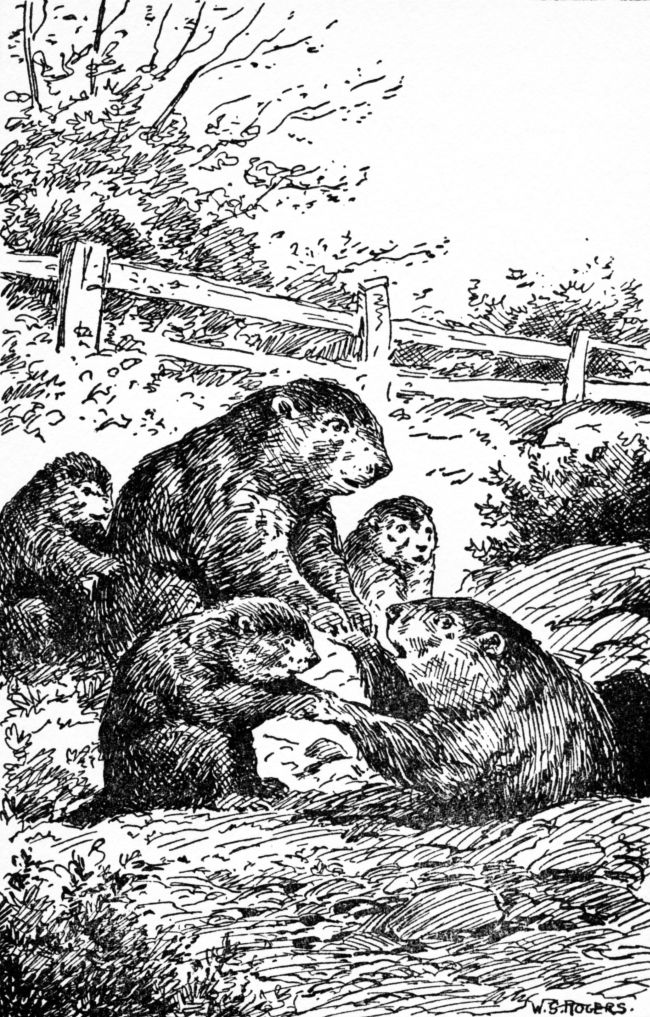
Timidly, all the woodchucks followed him to
the back-door. Just as Blunk had said, a lot of
earth and stones had caved in, completely filling
up the passage way and the door.
“No getting out there,” said Winkie, for she
had been quicker than any of the others to see
what had happened.
“Hurry!” cried her father. “We must try
the front-door hole! I think I know what happened.
The farmer shot off his gun down our
back-door hole and blew it shut!”
But alas for this woodchuck family! As Mr.
Woodchuck was patting and tapping Winkie,
Blinkie, and Blunk with his paws to make them
run faster, and just as they were close to the
front-door hole, there came another loud sound,
and the earth trembled under the paws of the
little animals.
“Oh! Oh, dear!” whined Blinkie.
“Dear me! I hope no one is hurt,” said Mrs.
Woodchuck. “This is dreadful!”
No one was hurt; but they were all covered
with moist earth that had rattled down on them.
But as woodchucks are always burrowing and
digging in the earth, this did not matter.
Daddy Woodchuck scrambled on ahead of the
others until he reached the front door.
“Just as I feared!” he sadly said. “This door
is closed too! We are prisoners here in our
burrow!”
“You don’t mean to tell me the front-door hole
is closed up, like the back door!” cried his wife.
“Yes, that is what happened,” answered her
husband. “The farmer has shot both our doors
shut! We can’t get out!”
This last part was true enough, but not the
first. Farmer Tottle had not exactly shot shut
the two door holes of the Woodchucks’ underground
house. He had blasted some rocks in his
field, using powder to blow up the big stones.
It was the shock of the blastings that had closed
the doors of the burrow. Dirt and rocks had
been shaken into the passages until they were
almost completely filled, and none of the children,
to say nothing of big Mr. and Mrs. Woodchuck,
could squeeze their way past.
“What are we going to do?” cried Mrs. Woodchuck.
“Shall we have to stay here forever?” asked
Blinkie.
“We can’t stay here forever!” exclaimed
Blunk. “There isn’t anything to eat down here,
and we’ll starve!”
“Oh! Don’t talk that way!” faintly screamed
Blinkie.
“Maybe we can find a way out,” suggested
Winkie, who always looked on the bright side.
“That’s so!” exclaimed her father. “This is
no time for sitting down and biting one’s paws.
We must look for a way out! Come, Blunk,
you and I will try the back-door again. And,
Mother, you take Winkie and Blinkie and try
the front-door. Maybe there is a little hole
which we can dig larger, and so get out through
it. Look sharp!”
This was better than sitting still sighing; at
least so Winkie felt. But while her mother and
sister went to the front-door hole, and her father
and brother to the back door, the wily little
woodchuck nosed off by herself. She remembered
that once, when she was playing hide-and-seek
with Blunk and Blinkie she had hidden herself
in a side passage of the burrow. The passage
was larger and longer than she had at first
thought, and she had made up her mind, after
the game, to see where it went. But, somehow
or other, she had never done this.
“But I’m going into that hole now and see if
it leads anywhere,” thought Winkie. “Maybe
it’s a tunnel that will let us out.”
Winkie could see quite well in the dark. She
soon found her old hiding-place, and, going to
the far end, where she had never before been, she
looked upward. To her delight she saw a little
bit of daylight gleaming. Scrambling her way
forward, Winkie began to dig. She had soon
made a larger hole. She put her nose close to
this, and could smell fresh air.
Much excited, Winkie climbed down and ran
to the middle of the burrow, just as her father
and Blunk came from the back door.
“There is no way out there,” said Mr. Woodchuck
sadly.
“Nor at the front!” added Mrs. Woodchuck,
coming back with Blinkie. “But where have
you been, Winkie?”
“I think I have found a way out!” cried the
wily woodchuck. “Yes, I am sure I have.
Come! I’ll show you!”
CHAPTER IV WINKIE IN THE WOODS
The family of woodchucks huddled close
together in the middle of the underground
house of earth in which they had
lived so happily for many months. It was dark
down there, but they did not mind that. It was
home to them, the same as your house is home
to you. And though there were no tables nor
chairs, no pictures on the wall and no piano,
still there were things there that the woodchucks
cared for as much as you care for the things
in your house.
Winkie, Blinkie, and Blunk had brought in
bits of wood and stones with which they played.
Their parents had carried in things to eat, and
bits of these were stored in different places that
Mrs. Woodchuck might call her cupboards.
But the woodchucks were to be driven from
their home. In fact, they were very glad to get
out, for, no matter how fine a house is, one never
wants to be shut up there forever.
If some one closed all the doors and windows
of your house tight, so that no air or sunshine
could get in, I think you would be as glad to
find a way out as Winkie was.
“Do you think you really have found a way
to get out, Winkie?” asked her father anxiously.
“I’m quite sure I have,” she answered. “I
found a hole, near a side burrow where I played
one day. I could stick my nose out and breathe
fresh air. And we can easily make the hole
larger.”
All at once there was another of those loud,
rumbling sounds. It shook the earth, and the
woodchucks, cowering in their burrow, trembled
in fear.
Bang! down came a big clod of dirt from the
roof of their burrow, scattering to pieces in the
middle of the floor.
“Oh my! what’s that?” shrieked Blinkie.
Again there came a rumble, as another blast
was set off. If the woodchucks had been above
ground they would have seen a great rock fly to
pieces as the powder broke it up. But down in
their burrow there was trouble enough. For
a second clod of earth fell, almost hitting
Winkie. If it had hit her there would have been
no story to tell, for that would have been the end
of poor Winkie.
“Come! We must get out of here!” cried her
father, as the second large chunk of dirt and
stones fell from the roof. “Show us the way
out you think you have found, Winkie. For
neither your mother nor I saw any way.”
“Come with me!” called the wily little woodchuck
girl, and she led them toward the side
burrow where she had seen the daylight peeping
through.
It was so narrow that there was room for only
two of the animals to walk side by side. Winkie
went with her father to show him what she had
found.
“See! There is daylight!” cried Winkie at
last. “And you can smell the fresh air!”
“Yes, so you can!” cried Mr. Woodchuck,
taking a long breath. “We are saved, I think!”
Still there was much digging to be done before
the hole could be made large enough for
the woodchucks to get out. They were all rather
plump, for they lived on rich clover. And Mrs.
Woodchuck was really quite fat, though I
shouldn’t like to have her know that I called
her that, for perhaps she wouldn’t like it.
“We must make the hole large enough for
your mother,” said Mr. Woodchuck to Winkie.
“It will take some little time.”
“I’ll help!” offered Blunk, and, as he was a
strong woodchuck boy, his father told Blunk to
come up in place of Winkie and use his paws.
Of course girl woodchucks can dig burrows fully
as well as the woodchuck boys can, but there was
no need as yet for Blinkie, Winkie, and Mrs.
Woodchuck to work at the digging when there
was room for only two to work and there were
two “men” in the burrow. And Blunk was beginning
to think of himself as almost a man
woodchuck.
Now and again, as Blunk and his father dug to
make larger the hole Winkie had discovered,
there came that rumbling sound, like far-off
thunder. Farmer Tottle was still blasting.
But the woodchucks were some distance from
it now, and no more lumps of earth fell on them.
With their paws Mr. Woodchuck and Blunk
dug away, throwing the dirt behind them. By
this time Mrs. Woodchuck and the two girl
Woodchucks had set to work thrusting the dirt
to one side so they would have room to get out
when the time came.
At last the hole was made large enough, and
Mr. Woodchuck could thrust his head out. He
looked all around, sniffed to see if he could smell
danger, listened with both his ears, and then
called down to the others:
“Come on! It’s all right! Thanks to Winkie,
we are now getting out of our stopped-up
burrow, though I thought we never should.”
“Let the children go up first,” said Mrs.
Woodchuck. And Winkie, having found the
way, was the first to follow her father outside the
underground house, through the extra hole that
had been dug.
“Why, it’s black night!” cried Winkie, as she
scrambled out beside Mr. Woodchuck.
“Yes, it’s dark, so much the better for us,” said
Mr. Woodchuck. “That farmer and his dog
won’t see us.”
Night had come while the woodchucks dug to
free themselves from the caved-in burrow.
Up came Blinkie, and then Blunk.
“Now, Mother, it’s your turn!” called Mr.
Woodchuck down the hole.
Up scrambled Mrs. Woodchuck. Large as
Blunk and his father had made the opening, it
was hardly large enough for fat Mrs. Woodchuck,
and she grunted as she pushed her way
through it. Then she came to a sudden stop,
half-way.
“Come on!” cried her husband. “Come,
mother! We must get away from here and find
a new home.”
“I—I can’t!” panted Mrs. Woodchuck. “I
can’t come any farther, Nib!”
“Why not?” he asked.
“Because I’m stuck! I—I didn’t know I was
so—so stout!”
“Here, children!” cried Mr. Woodchuck.
“Catch hold of your mother by her front paws
and give her a pull. We’ll have to help her out
of the hole.”
By pulling and hauling, they managed to get
Mrs. Woodchuck up and out. Then the little
animal family stood together outside the new
hole that had been dug. Down below them was
their burrow, no longer of any use, for the two
door holes had been closed by the fall of rocks
and earth, caused by Mr. Tottle’s blasting.
“Well, we haven’t any home now,” said Mrs.
Woodchuck, giving herself a little shake to get
rid of the dirt that clung to her fur.
“What shall we do?” Blunk asked sadly.
“Make a new home, of course!” answered his
father cheerfully.
“But where can we stay to-night?” Blinkie
wanted to know.
“Oh, we shall do very well!” replied Mrs.
Woodchuck. “This is the warm summer time,
and we really don’t need an underground house
now. We can stay in a hollow log in the woods.”
“What is the woods?” asked Winkie. Though
the woodland trees grew not far from the burrow
house, Winkie had never been in the forest.
“Come with your mother and me and we’ll
show you,” her father answered. “Follow me!”
Though it was dark, the other woodchucks
could see well enough to follow Mr. Woodchuck.
He led them across the field where Mr. Tottle
had been blasting that day. But now the farmer
was asleep in bed, and his dog was asleep also.
There was no one to see the escape of the woodchucks.
Through the clover field they went, stopping
long enough to eat as much as they wanted, for
they were hungry. Then Mr. Woodchuck
ducked under a fence, the others followed, and
soon they found themselves in a darker, silent
place, where the moon did not shine and where
the stars did not glitter.
“What place is this?” asked Winkie, in a whisper.
She was just a bit afraid.
“This is the woods,” her father answered.
“We shall be safe in the dark, silent woods. Now
we’ll curl up in the warm, dry leaves and go to
sleep. In the morning we’ll find a hollow log,
and you can see what the woods are like,
Winkie.”
Though she did not know it then, Winkie was
to have many adventures in these woods and the
country roundabout.
CHAPTER V WINKIE MEETS DON
Tired by their hard work in making their
way out of their burrow, and weary with
the journey to the woods, Winkie,
Blinkie, and Blunk slept rather late the next
morning. Father and Mother Woodchuck
were up and astir early, however, rustling around
among the dried leaves.
“How do you like it here, Mrs. Woodchuck?”
asked her husband in a whisper, for he did not
want to awaken the children.
“Of course,” answered his wife, “it isn’t as
nice as the burrow we had to leave. But it will
do very well for the summer. I think it will
be very pleasant, if you think it will be safe.”
“It will be safe enough,” declared Mr. Woodchuck.
“We can hide in the leaves and hollow
logs if danger comes. And we are not far from
the clover field. Besides, there is plenty of bark
here to gnaw.”
“Yes, there is plenty of bark,” agreed Mrs.
Woodchuck, looking around at the trees,
through which the morning sun was just beginning
to shine. Woodchucks sometimes eat bark,
you know, as well as clover. “Yes, there is plenty
of bark,” said Winkie’s mother again. “And I
had rather eat the bark of a tree than listen to
the bark of a dog,” she added, smiling as she
made this little joke.
Mr. Woodchuck smiled, too—that is, as much
as woodchucks ever smile—and he felt happy.
When his wife made little jokes this way he
knew that she, too, was happy. Really, you
could hardly have blamed the woodchucks for
being unhappy, when they had to get out of
their underground house in the way they did.
“Yes, I think we shall like it here in the
woods,” proceeded the woodchuck lady. “But
of course it would never do for winter.”
“Oh, my, no!” agreed her husband. “When
winter comes we will dig ourselves a new burrow.”
Just then Winkie awakened and cried out in
some fear:
“Oh, where am I?”
“Hush, Winkie! You’re all right!” her
mother called. “We are in our new home—in
the woods. You’ll like it very much!”
“Oh!” murmured the wily woodchuck girl.
“I was dreaming, Mother, that I was playing
tag with Blunk, and he tickled me.”
“Well, these leaves are tickling me!” cried
Brother Blunk, who just then awakened.
They all laughed at this, and at Winkie’s
dream, and after they had washed themselves
they were ready for breakfast. I don’t mean to
say that the woodchucks went to a bathroom and
washed their faces and paws or took a bath as
you do when you get up in the morning. At
least, as you wash your faces and hands or take
a bath.
But I am sure you have all seen a cat wash its
face; and though the woodchucks did not cleanse
themselves in just this way, they made their ruffled
fur smooth and sleek before they ate their
breakfast.
After a few nibbles at the bark of some trees,
which they liked very much, the woodchucks
went over to the edge of the woods near the
clover field. There they ate some green leaves
and red blossoms.
All at once they saw a flash of fire and a puff
of smoke, and they heard that rumbling sound
which had so frightened them before.
“Look out!” cried Mr. Woodchuck.
But there was no danger to the woodchucks
now, even though Farmer Tottle was again blasting
stumps and rocks in his field. The woodchucks,
however, were afraid, and back toward
the woods they ran. And as they did not keep
together, but scattered, it happened that, after
the first frightened rush, Winkie found herself
running along alone.
It was the first time Winkie had ever been
in the woods, and the first time she had ever
been anywhere alone. Always, except perhaps
when very near the burrow, she had been with
her brother or sister, or father or mother. Now,
as she ran along, she looked on either side, she
peered amid the trees and under the bushes and
saw—no one! No Blinkie, no Blunk, no father,
no mother!
“Oh, where are you?” cried Winkie, in woodchuck
language, of course. “Where are you
all?”
But so frightened were the other woodchucks
that they had scurried here and there, one running
this way and the other that way until they
were widely separated. Neither Blinkie nor
Blunk, neither father nor mother was within
sound of Winkie’s voice.
“Oh, what is going to happen to me?” cried
poor Winkie. “What is going to happen?”
If she had been a real little girl, instead of an
animal one, Winkie might have cried, for she
was lost for the first time in her life, and away
from father, mother, brother and sister. I believe
almost any of you little girls, and probably
a good many of the boys, would have cried.
But Winkie was a brave little woodchuck
girl, and she was also wily, which, as I have
told you, means smart and cunning.
“No, I’m not going to cry!” said Winkie to
herself. “If I cry, and make a blubbery noise,
some of the farmer’s dogs may hear me and
chase me. Or maybe a fox will hear me. I’m
going to keep still and see if I can’t find Blinkie
and the others.”
So saying, Winkie came to a stop in the midst
of her mad, frightened rush amid the dried
leaves. She became very quiet, listened and
looked about her. At first she could hear nothing
but the beating of her own little, frightened
heart and the whispering of the wind among the
trees. This last sound came to Winkie’s ears as
rather friendly. She was beginning to like it in
the big woods.
“Perhaps nothing will harm me here,” she
said to herself. “And I may have adventures,
such as my father and mother have told me
about having had when they were younger.”
Thinking thus made Winkie feel better. She
was not so frightened. Though she no longer
ran on as fast as when she had heard the distant
blast set off by Farmer Tottle, she still kept running.
“For,” she said to herself, “I want to find my
father and mother if I can.”
So Winkie’s wanderings were all done toward
the end of finding her family again, and the adventures
came in between, so to speak.
After her run Winkie began to feel a bit
thirsty, as most wild animals do when they journey
fast through the woods or fields. The wily
little woodchuck looked about for some water to
drink. Winkie could smell water as you smell
cookies baking in your mother’s oven, and it did
not take the ground-hog girl long to reach a little
stream. She was thirstily drinking when,
all of a sudden, she heard a noise.
She stopped drinking, and looked across the
little brook. There she saw, sitting on the opposite
bank, a brown animal, not very much different
from herself, except as to the tail. This animal
had a broad, flat tail, marked in scales like
those of a fish, while the tail of Winkie was
round and covered with fur. And, as she looked,
somehow or other Winkie did not feel that this
strange animal would harm her.
“Who are you?” asked Winkie.
“I am Toto,” was the answer.
“You aren’t a woodchuck, I know,” said
Winkie. “Are you a muskrat?”
“No. But I can swim under water,” answered
Toto. “I am the bustling beaver, if you please.
And who are you?”
“Oh, I am Winkie, the wily woodchuck, and
I’m lost!” came the answer. “Why do they call
you a bustling beaver? Have you seen any of
my family?”
“My! You are very fond of asking questions!”
laughed Toto. “But I will do my best to answer
you. I am a beaver, because I was born a beaver,
that’s all I can tell you about that.
“But the reason I am called ‘bustling’ is because
I am such a fast worker. I bustle about,
digging canals, making dams, cutting down
trees, and all such work as that. And I’ll soon
have to run along and help build a new dam we
beavers are putting across the brook.”
“What’s a dam?” asked Winkie.
“There you go again! Asking more questions!”
laughed Toto. “Well, a dam is a lot of
sticks, stones, and grass piled across a stream to
make it stop running away. Then the water
makes a big pond back of the dam, and in that
pond of deep water we beavers build our homes.
With our teeth we gnaw down big trees so they
will fall across the brook to help in making the
dam.”
“My! I should say you were bustling!” exclaimed
Winkie. “But in all your bustling about
have you seen Blinkie, Blunk, or my father or
mother?”
“More questions!” laughed Toto, the beaver.
“No,” he answered, after taking another drink
of water from the brook, “I haven’t seen them,
I am sorry to say. Are they lost?”
Then Winkie told of the blasting, how the
Woodchuck family had been shut up in the burrow,
how she had found a way out and how they
had all separated, much frightened, when the
big noise came again that morning.
“You certainly have had a lot of trouble,”
agreed Toto. “I wish I could help you, but I
must now bustle back to my work—we beavers
are very busy animals. However, if I see any
of your family I’ll tell them where to find you.”
“Please do,” begged Winkie, as Toto hastened
along. The beaver waddled off a little way,
moving in a queer fashion, for beavers are rather
awkward on land, though very swift in swimming.
Then Toto came to a stop. He turned and
looked at Winkie.
“I say,” asked Toto, “were you ever in a book,
Winkie?”
“Book? No, I never was in a book,” answered
Winkie. “What is a book?”
“I’ve been in one,” went on Toto. “I haven’t
time to tell you about it now. Maybe I will
some other day. Good-bye, Winkie. I’m glad
I met you!”
“Good-bye,” echoed the wily woodchuck.
She felt a bit lonesome when Toto was gone.
“I wonder what a book is,” murmured Winkie,
as she walked along after she had lapped up all
the water she wanted. “Toto said book. I wish
I knew what a book is!” And she spoke aloud
this time.
“A book! Ha! I can tell you what a book
is!” suddenly exclaimed another voice. “Come
over here and I’ll tell you all about a book. I
have been put in one!”
Winkie looked through the trees, and what
she saw made her heart beat faster than it ever
had before.
“Oh, it’s a dog!” she gasped. “One of the
farmer’s big dogs! Oh, this is the end of me!
Oh, I must run!”
Away leaped Winkie. The dog ran after her
barking and shouting:
“Don’t run! Don’t be afraid! I’m only
Don! I’m Don, the runaway dog, but I don’t
run away any more, and I won’t hurt you. Wait!
I want to tell you what a book is!”
CHAPTER VI WINKIE IN A STORM
Winkie, the wily woodchuck, was so
frightened at the sight of the dog—even
more frightened than she had been at the
distant blasting explosion—that she ran on and
on through the woods, scarcely looking where
she was going. Racing in this way, not keeping
watch, caused Winkie to bump into a tree full
tilt!
Bang! she slammed against it, so hard that she
was thrown down and lay, for a moment, stunned
amid the leaves.
It was a good thing that Don was a kind dog,
and not a savage one belonging to Farmer Tottle.
And it is also a good thing Don was not a wolf
or a fox. For had he been either of these he
could easily have caught Winkie in his teeth
when she fell back, stunned by her crash into the
tree.
But Don did not do this thing. Instead, he
went gently up to Winkie as she lay amid the
leaves, smelled her fur, and barked in a low tone.
“Oh, please don’t bite me! Please don’t!”
begged Winkie.
“Bite you? Nonsense! I never thought of
such a thing!” cried Don. “Why did you run
away?”
“Because you chased me,” answered Winkie,
her heart not beating so fast now, when she
found that nothing had yet happened to her. She
was so plump and so covered with fur that running
into the tree had not done her any more
harm than to knock her breath from her for a
moment or two.
“How foolish! I didn’t chase you!” declared
Don. “I was just running after you to tell you
what a book is.”
“What is a book?” asked Winkie, and Don
told her as well as he could for a dog who
couldn’t himself read.
“A book,” he barked, “is a sort of long story
of adventures.”
“I know what adventures are,” said Winkie.
“They’re things that happen to you.”
“Yes,” agreed Don. “And you have had an
adventure this morning.”
“You mean all our family getting lost?” asked
Winkie.
“I didn’t hear about that,” said Don. “But
that’s an adventure too. No, I meant running
away from me and bumping into a tree. That
was an adventure.”
“Not a very pleasant one,” remarked Winkie,
smiling.
“Oh, well, there are all sorts of adventures,”
said Don. “I have had very many, and they have
been put into a book about me, just as have those
of Toto, the bustling beaver, about whom I
heard you speaking.”
“Have you had adventures?” asked Winkie.
“I should say I have!” barked Don. “Say,”
he went on, “did you ever meet Squinty, the
comical pig?”
“No, I never did,” answered Winkie. “Who
is he?”
“Oh, a jolly chap. Did you ever meet Slicko,
the jumping squirrel?”
“No, not that I know of. Where is Slicko?”
“Somewhere in these woods, I think. You’ll
probably meet Slicko sooner or later. And then
there is Mappo, and there’s Tum Tum.”
“Who are they?”
“Animals who have had adventures and been
put in books,” answered Don. “Mappo is a
merry monkey, and Tum Tum is a jolly elephant.
I hope you meet them some day.”
“I hope so, too,” said Winkie. “But just now
I should like to meet my father and mother and
Blinkie and Blunk. Have you seen them?”
“No, I am sorry to say I have not,” answered
Don. “But don’t worry, you may find them,
also. And I’m sure you will have lots of adventures.
You are sort of running away, you
know.”
“Yes, I ran away from that big noise,” admitted
Winkie. “But what has that to do with
it?”
“Running away always brings adventures,”
answered Don. “At least it did to me. I was
once a runaway dog. But I was glad to get back
again, and I am very happy now.”
“Are you one of the farmer’s dogs that barked
at my father and mother?” asked Winkie.
“No,” replied Don. “I never bark at woodchucks.
I like them, and so does my master,
who is very kind. But some men don’t like you
ground-hogs, and they are always sending their
dogs after you. They also set traps—those men
do.”
“What are traps?” asked Winkie.
“Ha! There you go again—more questions!”
chuckled the dog. “Well, I can tell you one
thing—traps are very good things to keep out
of. Once I caught my paw in a trap, and I was
lame for a month after it. Keep away from
traps, Winkie!”
“I’ll try!” promised the wily woodchuck. But
she did not know what was soon going to happen
to her.
So much talk seemed to make Winkie hungry,
and, seeing some grass growing under a tree, she
began to nibble the green blades.
“Why don’t you eat something,” she asked
Don. “This grass is very sweet and good.”
“Thank you; but we dogs don’t eat grass,”
Don answered. “That is unless we take it as
medicine when we aren’t feeling well. But I
feel fine now—I don’t need grass, but I would
like a juicy bone. And speaking of bones makes
me hungry. I think I’ll trot to my kennel and
get a bone.”
“What’s a kennel?” asked Winkie.
“My! I never knew any one to ask as many
questions as you, unless it might be Mappo, the
merry monkey,” barked Don. “A kennel is a
house in which I live.”
“We call our house a burrow,” said Winkie.
“Only we haven’t any now.”
“It wouldn’t do for all of us to live in the same
kind of houses,” Don said. “I’d feel rather silly
in a nest, and yet a nest is a home for a bird.
Well, I’m going to trot along, Winkie. I hope
I shall see you soon again.”
“I hope so too,” murmured Winkie, who knew
that she was going to be lonely when Don went
away.
Don started off, wagging his tail in a friendly
farewell to Winkie. She was watching him and
did not notice where she was walking until, all of
a sudden, she felt herself falling into a hole with
a lot of leaves and sticks.
“Oh! Oh!” cried Winkie. “Help me, Don!
I’m in a trap!”
With a bark Don bounded back, and, with his
paws, he helped Winkie up out of the hole.
“That wasn’t a trap,” he said. “You can’t
get out of traps as easily as that. You just fell
into a hole where once there was a stump or
stone. The hole was covered with dried leaves
and you didn’t see it, I guess.
“Some traps are like that, and others are like
a box that shut you up tight. Other traps have
strong, sharp teeth that snap shut on your leg.
That’s the kind of trap I was once in.”
“I hope nothing like that happens to me!”
sighed Winkie, and Don hoped the same.
“Now I must go,” said the dog, when he found
the little woodchuck girl was all right. “See you
later! Good-bye!” And soon he was lost to
sight among the trees.
Poor Winkie felt very lonely now, for, having
talked to Toto, the beaver, and to Don, the dog,
she began to have a very friendly feeling for
these animals.
But she was a brave little thing, as well as
wily and smart, and she began to feel that she
must look after herself now, since it might be
many days before she would find her family in
the big woods.
Sitting down and crying about things never
makes them any better, and Winkie was not going
to do this. Instead she felt that she must
find some place to stay during the night,
which she knew would come when the sun went
down.
“But first I am going to see if I can’t find my
family,” thought Winkie. “There’s no sense in
giving up so soon. I’ll make believe we have
been playing hide-and-seek and I’ve got to find
them so I won’t be it.”
She had often played this game, and it was not
hard to imagine she was doing it again. On
through the woods she wandered, now and then
stopping to listen or to call. She cried the
names of Blinkie and Blunk as loudly as she
could, and also shouted for her father and
mother.
But the only answers she heard were the sighing
of the wind in the trees, the murmur of the
brooks as they flowed over the green, mossy
stones, and the songs of the birds. To the birds
Winkie spoke, for she could talk their language,
and she asked them if they had seen anything of
her father, mother, Blinkie or Blunk.
“You birds fly high above the trees,” said
Winkie, “and you can look down and see many
things I can not see. Please help me look for
my people.”
“We will!” sang the birds. So they flew here
and there, peering down through the tree
branches. But they did not get a glimpse of any
of the woodchucks. For, truth to tell, the other
four ground-hogs had run away at the time
Winkie had, and now they were all scattered.
Blinkie, Blunk and Mr. and Mrs. Woodchuck
were separated one far from the other, and as
much lost as was Winkie herself.
Later on the four woodchucks found each
other and made a new home for themselves, but
Winkie did not know this for a long time, and
not until after she had had many adventures
about which I must tell you.
For several days Winkie wandered through
the woods, all alone except that once or twice
she met Toto, and again, she spied Don. But the
dog was walking with his master and he did not
come near Winkie. For this the woodchuck girl
was glad, for she was afraid of men, even of
one as kind as Don’s master seemed to be.
Look as the fluttering birds did, they found
no trace of Winkie’s relatives, and they told the
woodchuck girl this.
One day, as Winkie was wandering about, she
suddenly heard a noise in the bushes. She was
going to run and hide, thinking it might be a
wolf or a fox, when a jolly voice grunted:
“Don’t be afraid, little ground-hog girl, I
won’t hurt you!”
“Who are you?” asked Winkie.
“Squinty, the comical pig,” was the answer.
“Oh, I have heard Don speak of you,” said
Winkie, as the pig came rooting his way through
the underbrush.
“Yes, Don and I are friends,” Squinty replied.
“But you had better find a good place to
stay to-night, Winkie.”
“Why?” asked the wily woodchuck.
“Because there is going to be a big storm,”
was the pig’s answer. “I am going back to my
pen. I really oughtn’t to have come out, but I
get tired of staying shut up so much, and, once
in a while, I root my way out with my rubbery
nose. But I’m going back now before I am
caught in the storm, and you, also, had better
find a place of shelter.”
“Thank you; I’ll look for one,” said Winkie.
She went on a little farther, after bidding
good-bye to Squinty. All at once, she heard a
sound in a tree over her head.
“Oh,” cried Winkie, “is that one of the birds
come to tell me he has found my family?”
“No, I’m not a bird,” was the answer; “though
I stay in the trees a great deal of the time. I am
Slicko, the jumping squirrel. I know you,
Winkie. Don told me about you. Have you a
good place to stay this night?”
“No, I have no home,” sadly answered
Winkie.
“Then you had better stay in this hollow tree,”
said Slicko kindly, pointing to one near by.
“There is going to be a big storm, and you will
be frightened if you are out in it. I can always
tell when a storm is coming, hours before it gets
here.”
“That’s what Squinty said,” remarked Winkie.
“Oh, do you know that comical pig?” asked
the jumping squirrel. “Isn’t he funny?”
“I don’t know him very well. I just met
him,” answered the wily woodchuck. “But he
seemed very kind. And thank you for telling
me about the hollow tree.”
“Don’t mention it!” chattered the squirrel.
“We animals must be kind to one another. I
hope you’ll rest well. I have my nest higher up
in this same tree.”
“Then we shall be company for each other in
the night,” said Winkie.
She found the hollow tree to which Slicko had
pointed. Inside were some dried leaves, which
would make a soft bed for the woodchuck girl.
When night came Winkie crawled in and went
to bed, and up higher in the tree she could see
Slicko crawling into a hole where the squirrel’s
nest was made.
Winkie slept very well the first part of the
night, even though the wind sighed and moaned
among the trees. Then, all of a sudden, she was
awakened by a great flash of light and a loud
crashing sound.
“Oh! Oh!” cried Winkie. “The farmer and
his dogs are after us again! He’s going to shut
us up in the burrow again!”
“No, this is no farmer!” chattered Slicko.
“This is a big storm, with thunder, lightning and
rain! I’m afraid this tree will blow down!
Look out, Winkie!”
Before Winkie could crawl out of her bed of
leaves in the lower hollow place there was another
blinding flash of light and a great thundering
sound, following by a cracking noise.
“Oh, the tree is struck! The tree is falling!”
cried Slicko. “Save yourself, Winkie!”
A moment later the wily woodchuck found
herself tossed out into the storm.
CHAPTER VII WINKIE IN A TRAP
Slicko, the jumping squirrel, had told the
truth about the storm. The tree, in the upper
part of which the squirrel had a nest
and in a lower hollow part of which Winkie had
been sleeping, was struck by lightning, and
broken down.
But neither of the animals, nor some birds
nesting under the leaves of the tree, was hurt
by the lightning, though all were stunned by
it for a moment. The birds fluttered into other
trees, glad to hide themselves under the leaves
as much out of the rain as they could get. Slicko,
feeling the tree falling, had leaped safely into
another.
And what happened to poor Winkie?
At first the wily woodchuck hardly knew
what was taking place. She had been awakened
so suddenly by the storm, with its lightning,
thunder, wind, and rain, that she was dazed.
But she heard what Slicko said, and she knew
enough to jump when she felt the tree going
over, so she was not caught under it and pinned
down, as sometimes happens to beavers in the
woods.
“Where are you? Where can I get in out of
the rain?” called Winkie to Slicko. But either
she could not make her voice heard above the
storm, or else Slicko was too far away to hear.
I think it was a little of both.
At any rate Winkie stood for a moment beside
the fallen, split tree that had been a sort of
“hotel” for her during the first part of the night.
But the warm leaf-lined nest where she had so
cozily cuddled was no more. And as she felt
the rain falling on her and heard the noise of
the storm, Winkie knew she must get under some
kind of shelter.
Winkie, like most wild animals, could see
pretty well in the dark, so she walked along.
Every now and then a flash of lightning came,
and this showed her still better which way to go.
She did not need to keep on any path. She
could wander where she wished. And, really,
the rain did her little harm, for this was summer.
If it had been winter, with a rain that froze as
fast as it fell, that would have been very sad
indeed. Winkie wore a coat of fur, and though
this was wet through, she knew it would soon
dry in the sun.
She looked about her for a hollow tree, but
could find none. Then she spied a hole under
some rocks, and in another moment she had
crawled into this little den, away from the wind
and the rain. In the hole were dried leaves,
and cuddling up in these Winkie soon began to
feel warm again.
Outside the rain splashed down, the wind
lashed the branches of the trees, breaking some
off and tossing them to the ground, the thunder
roared, and the lightning flashed. But, safe in
the little cave she had found, Winkie, the wily
woodchuck, soon went to sleep again.
So, after all, Winkie came through the storm
with nothing worse than a fright and a wetting.
Of course she missed Slicko, for when morning
came and the warm sun shone once more, there
was no sign of the jumping squirrel.
“Slicko! Slicko! Where are you?” called
Winkie, as she came out of the little cave.
“Slicko has gone away!” chirped a bird. “I
saw Slicko scampering off through the tree tops
long before the sun was up.”
“Well, then I shall have to get a new friend,”
said Winkie. “Have you seen any of my
family?” she asked the bird.
“No, I am sorry to say I have not,” was the
answer. “I have only been in these woods a
short time. I came just before the storm, and I
met Slicko only by chance. I can’t tell you anything
about your family.”
“Then I shall have to travel on and try to
find them,” said Winkie. “But first I must get
something to eat.”
This was easy for the woodchuck girl. She
did not have to go to the store, nor yet wait for a
meal to be cooked or a table set. Eating was
very easy for her.
All she had to do was to look about for some
grass or something green growing, and for
some bark to gnaw. Winkie did not really care
as much about bark as did Toto the beaver, for
ground-hogs live mainly on clover, grass, and
other soft plants. But when a woodchuck is hungry,
as Winkie was, it will eat almost anything in
the vegetable line.
“I’d like to find some turnips, carrots, or cabbage,”
she thought to herself, for woodchucks
are very fond of these, and that is one reason why
farmers do not like woodchucks. “But I don’t
see any around here,” went on Winkie.
Indeed there was no garden near the woods,
and after eating what she could find in the forest
and on the edge of it, Winkie started off to look
for more adventures.
Of course, she really didn’t especially look
for them, nor did she know she was going to
have them, but adventures happened to her, and
some of them were not very pleasant.
The woods were washed clean by the storm,
and now the day was warm and sunny. The
birds sang, many animals scurried here and there
between the trees and under the bushes, and
Winkie was one of them.
Now and then she would hear some large animal
moving in the bushes, and at such times
Winkie would crouch down and hide, for she
feared a wolf, a fox or a dog might be coming
after her.
“I shouldn’t mind meeting Don, or even Tum
Tum, the jolly elephant, he told about,” thought
Winkie. “But I don’t want to meet any strange
dogs.”
Don, however, was far away, as was Tum
Tum. So Winkie had to wander along by herself.
All day she roamed through the woods,
now and then stopping to give a sort of whistle,
which is one way woodchucks have of talking.
Again she would also chatter her teeth with a
rattling sound, as owls clatter their beaks. This
is another way woodchucks have of speaking to
one another.
But to all Winkie’s calls there came no answer
from any of her family. She did not see Blinkie
nor Blunk, and her father and mother might
have been a hundred miles away for all she knew.
Once, indeed, she met another woodchuck, a
fat, lazy old man of a ground-hog, and at first
Winkie thought he might be her grandfather.
But he was not, and this woodchuck knew nothing
of Winkie’s family.
“But I can tell you where to get a good meal
of clover,” said the lazy old ground-hog.
“Where?” eagerly asked Winkie.
“Go straight along the way you are headed,
and on the edge of the woods you will see a field,”
was the answer. “Crawl under the fence and
you’ll find some clover.”
Winkie thanked him, and waddled on. She
found the clover just where she had been told it
would be and ate her fill. She ate so much she
felt sleepy, and about sunset she curled up in a
hollow log and slept all night.
When morning came Winkie started on her
travels again. By this time she was getting
rather used to wandering around alone. Not
that she liked it, but it was the best she could do.
She would have been very glad to have had a
game of tag with Blinkie or Blunk, but this was
not to happen for a long time.
That noon Winkie found a field where a farmer
was raising some carrots, and, as she saw no
man in sight, and no dogs, and did not hear any
dogs barking, Winkie went into the field, dug up
some carrots, and ate them. It was because of
this that, a few days later, something dreadful
happened to Winkie.
For she liked the carrots so much that she
looked for more everywhere she went. One day
Winkie, who was very hungry at the time, saw
another carrot—a large yellow one—in a fence
corner.
“Some one must have left this carrot here
specially for me!” thought Winkie. “How kind
of him!”
Winkie was not quite as wily and smart then
as she ought to have been, for if she had only
known it, this carrot was placed where it was as
a bait. But Winkie did not know this. Up she
went quite boldly, and reached out to take the
carrot.
A moment later she heard a clicking sound,
and something closed with a snap on her left
hind leg. She felt a great pain in it, and tried
to run away.
But Winkie could not run! She was caught
fast in a trap! The carrot had been placed there
just for that—to trap some animal—and Winkie
was caught!
CHAPTER VIII WINKIE’S NEW HOME
Just as soon as Winkie felt the pain in her
leg, a hard pinching and pulling, she knew
what had happened just as well as if her
mother had told her.
“I’m in a trap!” cried the girl woodchuck,
who was not as wily now as she ought to have
been. “I’m in a trap! Oh, dear! What shall I
do?”
She had often heard her father and mother
talk of animals being caught in traps. Some
traps were of one kind and some of another.
Winkie was glad this was not a box trap, shutting
her away from the air and sunlight. She was
glad it was not a bear trap with sharp teeth, like
those of a saw, for they would have cut her leg
and caused it to bleed.
This trap was just a common, spring one, with
smooth jaws, and though it pinched Winkie very
much, and held her so fast that she could not
pull her leg loose, she was not cut.
“I must run away!” thought poor Winkie. “I
must run away and take this trap with me.
Then, maybe, when I am in a safe place, I can
pull my leg out! Oh, how it pinches! I wish I
had never tried to get the carrot!”
The little woodchuck no longer thought of the
yellow carrot which was placed near the trap.
She seemed to have got over her hunger because
of the pain in her leg.
“Yes, I must run away and take this trap with
me!” thought Winkie.
But that was easier said than done. As
Winkie tried to walk away, with the spring trap
still fast to her leg, she was suddenly stopped
with a jerk that gave her another pain. She almost
fell down, and she had to cry “Ouch!” Of
course, in the way woodchucks say it.
Then she looked and found there was a chain
attached to the trap, and the other end of the
chain was fast to a big log. If Winkie should
walk away with the trap, she would also have to
drag the log with her. And this was more than
the little woodchuck girl could do.
“Oh dear! Oh dear!” thought poor Winkie,
lying down on the soft grass near the trap.
“This is dreadful!”
And indeed it was! It was worse than the
blasting in the field which had closed the door
holes of the burrow house. It was worse than
Farmer Tottle and his dog. It was worse than
the big storm when the tree in which Winkie was
sleeping had been struck by lightning.
“Oh, what shall I do?” sighed poor Winkie.
Well, there was little she could do. She again
tried to pull her leg out of the trap, but it would
not move, and the pain each time she tried made
her chatter her teeth and whistle. Then she tried
to pull the trap loose from the log to which it
was chained. But she could not do that, either.
“Oh, I shall have to stay here forever!”
thought poor Winkie. “I never can get loose!
I shall never see Blinkie nor Blunk again, nor my
father and mother! Oh dear!”
Winkie looked at the carrot which was the
cause of all her troubles. Even yet she did not
feel hungry enough to nibble it, though just before
she had stepped into the trap she had been
very anxious for some vegetable.
“I must do something!” thought Winkie. “I
can’t stay here forever.”
She was just going to tug again at the trap and
chain when, all of a sudden, she heard a noise.
It was a whistling sound, almost like that which
woodchucks make. For one happy moment
Winkie thought it might be her father or mother
coming to set her free. But a moment later, as
the whistling became louder, Winkie saw coming
toward her a boy. It was the boy who was
whistling.
On he came, trilling a merry air. Well might
he whistle! He was caught in no trap that
pinched his leg!
Suddenly the boy caught sight of Winkie, the
wily woodchuck.
“Oh, ho!” he cried. “I’ve caught a ground-hog!
I’ve caught a woodchuck in my trap! My,
but I’m lucky!”
Of course Winkie could not understand what
the boy said, but if she thought anything at all
she must have thought that she was very unlucky.
“It’s a nice fat woodchuck, too!” exclaimed
Larry Dawson, which was the boy’s name. “It
isn’t hurt, either. I’m glad it’s a smooth trap and
not one with teeth! I set it to catch a skunk, but
it caught a woodchuck instead. I guess she isn’t
hurt much. A woodchuck’s fur isn’t any good,
like a skunk’s. But I’ll take this ground-hog
home, and maybe I can tame her and teach her
tricks.”
If Winkie could have understood all the boy
said she would not have been so afraid of him,
for Larry was a kind boy and gave no needless
pain to animals. But the woodchuck did not
understand, and when Larry came closer, intending
to loose her from the trap, she crouched
down, showed her sharp, biting teeth, and
squealed and chattered.
“Oh, ho! You’re going to be ugly, are you?”
exclaimed the boy. “Well, I can’t blame you.
It isn’t any fun to be caught in a trap. I wouldn’t
like it myself, and I’ll take you out if you don’t
bite me.” For Larry knew that woodchucks can
bite very severely when they are caught and
when they fear they are in danger.
“I’ll go and get a bag to carry you in,” said
Larry, still speaking aloud, as though Winkie
could understand him. “I’ll get a bag, and then
take you home. My sister Alice will like you.
We’ll teach you tricks after we tame you. Wait
here while I go for a bag!”
There really wasn’t any need of telling Winkie
to “wait there.” She couldn’t get loose. And of
course she remained until Larry came back. He
had gone to his father’s barn and gotten a strong
bag in which feed came for the horses.
Dropping this bag over Winkie, who was now
more frightened than ever, Larry reached in
from the outside, the strong bag keeping Winkie
from biting, though she tried to do this, and soon
the boy had loosened the spring and taken the
trap off the woodchuck’s leg.
“Oh, how good it feels not to be pinched any
more!” thought Winkie. “Oh, how good it
feels!”
And she curled up in the bottom of the bag,
as Larry slung it over his shoulder, and closed
her eyes, for she felt so much better than she
had in the trap.
“I wonder what is going to happen to me?”
thought Winkie.
She was going to have more adventures,
though she did not know it just then.
Across the fields went Larry, carrying the
wily woodchuck in the bag over his shoulder.
Winkie did not mind the bouncing, for the pain
in her leg, where the trap had pinched her, was
growing less now.
“Oh, Larry, what have you got?” cried his
sister Alice, as he reached the house.
“A woodchuck,” the boy answered. “She was
in my skunk trap.”
“Is she dead?” asked Alice.
“No, she’s very much alive,” replied Larry.
“Don’t go near the bag or she may bite you.
We’ll tame her, and she’ll do tricks for us. Get
me a piece of cord, Alice, and I’ll tie this bag
up. Then the woodchuck can’t get out until I
build a pen for her.”
“Oh, are you going to do that?” asked Alice.
“Yes, I’ll make a strong pen, so she can’t get
out. You’ll help me, won’t you? After she’s
been in the pen a while, and we feed her every
day, she’ll get used to us and grow tame. Then
we can teach her some tricks.”
“Oh, that will be fun!” cried Alice.
The cord which Alice brought was tied
around the neck of the bag, so that the woodchuck
could not get out, though she tried to do
this as soon as Larry set the bag down on the
ground.
“Oh, we have you safe!” exclaimed the boy,
as he saw the form of the ground-hog scurrying
about inside the bag. “But we’ll soon give you a
better place than that to live in. Come on, Alice,
we’ll make a woodchuck pen!”
The brother and sister hammered away, nailing
boards together, and soon the pen was finished.
Larry took the bag, loosed the string, and
held the open end of the bag over the pen. Out
toppled Winkie, her eyes blinking on account of
being so suddenly thrust into the bright sunlight
from the darkness of the bag.
The first thing Winkie did, after tumbling
from the bag, was to stand very still, crouching
on the ground. Then she looked about for a
way of escape. In one corner of the pen she
saw a square black hole.
“Maybe that’s a burrow door,” thought
Winkie. “If I can run down that I’ll be safe.”
She waddled over to the square black hole,
and went through it. But she only found herself
inside a small box, with no way out.
“Oh, she went into her bedroom!” laughed
Alice, clapping her hands. “I guess she’s
sleepy!”
“I guess she thought she could get out that
way,” said Larry. “But she can’t. That inside
box is for her to sleep in, but she can’t get out
that way.”
And, to Winkie’s sorrow, she could not. She
was fast in a pen which was to be her new home.
The woodchuck remained inside the inner box
for a little while, seeking some hole through
which she might crawl. But when she saw none
she came out into the open pen again.
The pen Larry and Alice had made, which
was to be Winkie’s new home, was really a large
box set on the ground. It had a bottom to it, and
four sides, but no top. In place of the box cover
Larry had put on some strong chicken wire.
Winkie could not push her way up through this
wire, nor could she bite it, though she had very
strong teeth for gnawing bark and nipping
clover.
In one corner of the larger box Larry and
Alice had set a smaller box, with wooden sides
and a wooden top. There was a square hole for
a door in this smaller box, and this was Winkie’s
bedroom.
“You’re safe here now, little woodchuck!”
said Larry. “I’m going to feed you and then
teach you tricks when you get tame.”
“Maybe she wants a drink of water,” suggested
Alice.
“Yes, I guess she does,” said Larry. “I’ll get
some for her.”
When a basin of water was set down inside
the pen the woodchuck was so thirsty that she
began to drink at once. The boy and girl
laughed to see her drink.
“She’s getting tame already,” said Alice.
“Well, sort of beginning,” agreed Larry.
“Now I’ll get her something to eat. But I guess
I’d better bait that trap with something besides
carrot if I want to catch a skunk. I guess skunks
don’t like carrots, for none has come near the
trap since I set it.”
Larry was right. Skunks are not carrot-eating
animals, though they may take a nibble now and
then if they are very hungry.
The children had started to get something for
Winkie to eat when, all at once, there came a
noise which was a dreadful sound to the ground-hog.
It was the barking of a dog!
CHAPTER IX WINKIE LEARNS TRICKS
Though Winkie had never been very
close to any dog except Don, the wily
woodchuck knew the bark of this dog
meant danger. It is this way with many wild
animals, and even with your cat, perhaps, which
is not so wild as a woodchuck.
Little kittens, if they are brought up with dogs
from their earliest days, may not be afraid of
Rover or Towser, whom they know. But they
may be afraid of a strange dog. However, almost
any cat will arch up its back, hiss and, if
it gets a chance, will run away from almost any
dog. It was the same with Winkie, though she
did not arch her back nor fluff out her tail—woodchucks
don’t do that. But Winkie tried to
run away as soon as she heard the bark of the
dog.
Only she could not get out of the pen. But
she did run and hide in her sleeping box, which
was partly filled with hay.
“Oh, here comes Buster!” exclaimed Alice.
“Don’t let Buster get the woodchuck!”
“No, indeed!” cried Larry. “Uncle Elias’s
dog shan’t get my woodchuck!”
“I thought you said she was part my woodchuck,”
observed Alice.
“Yes, that’s so. You may have half,” agreed
Larry. “Go on back, Buster! Go away!”
shouted Larry, as a big dog came bounding into
the yard, barking and wagging his tail, for he
was glad to see the children, and often played
with them, being a friendly dog except toward
wild things.
All at once Buster stopped barking and
stopped wagging his tail. He stood still, his nose
pointed toward the pen, and he began to sniff.
He had caught the wild smell of the woodchuck,
even though he could not see Winkie, who was
hiding in her sleeping chamber.
Then Buster growled, away down in his
throat, and came nearer the pen. Alice ran to
get in front of the dog, and again Larry cried:
“Go on away, Buster!”
Just then Uncle Elias Tottle, who was a
brother of Larry and Alice’s mother—being, in
fact the children’s uncle—came along. He saw
the boy and girl standing near the pen, and he
heard his dog growling.
“What’s the matter with Buster? What have
you youngsters got there?” asked Uncle Elias, in
rather a harsh voice. He had no children of his
own, and owned the farm next to that of Mr.
Dawson, who was the father of Larry and Alice.
“What have you in that box that makes Buster
growl?” demanded Uncle Elias Tottle.
“I have a woodchuck,” answered Larry. “I
caught her in my skunk trap. But she isn’t hurt.
I’m going to tame her.”
“We’re going to teach her tricks,” added
Alice.
“Huh! Woodchuck!” cried Uncle Elias.
“The pesky creatures! If I had my way they’d
all be shot or trapped. They eat my clover. I
saw some of ’em eating it the other day.”
If he had only known it, Winkie was one of
those very woodchucks! But Uncle Elias didn’t
know.
“Woodchuck!” he exclaimed. “Eating up
everything a poor farmer can raise! I’ll kill
that woodchuck of yours if I catch her out!”
“Well, you won’t catch her, for we aren’t going
to let her out,” said Alice, and she and her
brother felt bad because of the harsh words of
Uncle Elias.
It is true, in some places, that woodchucks do
harm when they are very numerous, and farmers
don’t like them. But Larry and Alice did not
see what harm poor little Winkie could do,
especially if they kept her shut up in a pen.
“Look here!” said Uncle Elias at last. “Will
you sell me that woodchuck for a dollar, Larry?”
“A dollar?” repeated the boy.
“Yes, I’ll give you a dollar for her,” went on
Uncle Elias, putting his hand in his pocket.
Larry shook his head.
“I want my woodchuck,” said the boy.
“And she’s half mine,” broke in Alice. “Even
if Larry would sell his half, I wouldn’t sell my
half! So there, Uncle Elias!”
“Huh!” grunted the farmer, who was a hard
and sometimes a cruel man.
“What do you want of a woodchuck, Uncle
Elias?” asked Larry. “Do you want one to teach
tricks to? If you do I’ll try to catch one for you
in my trap.”
“Nonsense! As if I’d try to teach a woodchuck
tricks!” snorted the old man, while his dog
sniffed and snuffed at the wild smell and Winkie
cowered down in her dark box. “If I had that
ground-hog of yours—which I’m willing to pay
a dollar for”—went on Mr. Tottle, “I’d turn her
loose and set Buster on her! Woodchucks are no
good!”
“Well, you aren’t going to get this one!” said
Larry.
“I guess not!” exclaimed Alice. “I love my
woodchuck!”
“Huh!” snorted Uncle Elias. “Come on, Buster!”
he called to his dog. “This isn’t any place
for us! We don’t like woodchucks!”
Then, to the relief of Larry and Alice, their
cruel-hearted uncle went away, followed by Buster.
The dog, however, did not want to go. He
growled and whined as he sniffed toward the
woodchuck’s pen. Had poor Winkie been outside
and if Buster had chased her there would
not have been much left of her.
“The idea!” exclaimed Alice, when Mr.
Tottle was gone. “To want to kill our woodchuck!”
“I wouldn’t sell her for two dollars—no, not
for five!” cried Larry. “When we teach her
tricks maybe we can put her in a circus!”
“Oh, wouldn’t that be wonderful!” cried
Alice, clapping her hands. “Let’s start teaching
her tricks right away. But what shall we name
our woodchuck?”
“Yes, we must think of a name,” agreed Larry.
Just then Winkie, no longer hearing the barking
of the dog, poked her head out of the square
hole in the smaller box, into which she had gone
to hide. Coming out of the dark, as she did,
made Winkie’s eyes open and shut until they became
used to the glare of the sun. Larry and
his sister, watching their new pet, saw her eyes
winking this way.
“Oh, I know what to call her!” cried Alice.
“What?” asked her brother.
“Winkie!” replied the little girl. “See her
wink!”
“Yes, Winkie will be a good name,” agreed
Larry.
And so Winkie was given by the children the
same name the father and mother of the little
ground-hog had given her when she lived in the
burrow.
“Come here, Winkie! Come here!” called
Alice.
Winkie remained with her head out of the
bedroom, but she did not come to the side of the
larger, outside pen, near which Alice stood.
“I guess Winkie is a little afraid,” said Larry.
“I’ll get her something to eat. That will make
her tame quicker than anything else.”
Out to the barn ran Larry, and soon he came
back with some yellow carrots. He cut off little
pieces of them and tossed them into the pen
through the open meshes of the chicken wire on
top.
At first Winkie was a bit timid about taking
these chunks of carrot. But they smelled so
good, and she was so hungry, that she at last ventured
to nibble one. Then, finding no harm
came to her, she grew bold and took more. She
limped a little on the leg that had been caught
in the trap, but it was quickly getting over its
soreness.
“Oh, isn’t Winkie cute!” cried Alice, as she
watched the woodchuck eat.
“Yes,” agreed Larry. “And I want to teach
her soon to eat out of my hand.”
“We want to be careful that she doesn’t bite
us,” said his sister. “See what sharp teeth she
has.”
Indeed Winkie had very sharp teeth and
Larry knew this.
“I’ll be careful!” he said.
For two or three days Winkie would not take
any food from Larry’s hand or that of Alice.
But she grew bolder when she saw that the boy
and his sister meant to be kind, and one day,
about a week after being caught and put in the
pen, Winkie took a piece of carrot right from
Larry’s fingers.
“Oh, she’s getting tame! She’s getting tame!”
cried the boy. “Now I can teach her some
tricks!”
“Let me feed her!” begged Alice. And the
little girl was delighted when Winkie took some
pieces of carrot from her fingers.
It was several days longer before either Larry
or his sister dared reach in to stroke Winkie’s
fur. The first time this was tried Winkie scurried
back into her sleeping box as though Buster
were after her. But the next time she was not
so timid, and soon the little woodchuck came to
know that the children intended no harm.
“Though why they want to fuss over me and
rub me is more than I can tell,” thought Winkie
to herself. “I wish I had some one to talk animal
talk to—Squinty, the pig, or Slicko, the
squirrel. Or even Tum Tum, the elephant. I
wish he were here!”
Winkie had never seen an elephant like Tum
Tum, and of course she did not know how large
elephants are.
Tum Tum could hardly have gotten more than
one of his big feet in Winkie’s pen!
One day Larry came running into the house
much excited.
“Oh, you ought to see!” he cried. “You ought
to see Winkie!”
“Has she gotten out?” asked Alice.
“No, but I’ve taught her a trick. She’ll sit up
on her hind legs and beg like a dog! Come and
see!”
Alice followed her brother out to the yard
where Winkie’s pen had been built. Larry took
off some of the top wire.
“She’ll get away!” cried Alice.
“No, she won’t,” said Larry. “Winkie is tame
now, and won’t run away. I’ve taught her a
trick! She’ll sit up and beg! Look!”
Taking the woodchuck out of her cage—and
Winkie did not try to bite Larry now—the boy
stood her on the ground. Then, holding a piece
of turnip in front of the ground-hog, the boy exclaimed:
“Sit up, Winkie! Sit up!”
Slowly, because she was now very fat, Winkie
sat up on her hind quarters. This is easy for
woodchucks to do, since they often sit that way
outside their burrows to watch for danger.
“Look! She’s begging!” laughed Larry.
“And here’s your piece of turnip!” he added.
“Isn’t that a good trick, Alice?”
“A lovely one! I wish I could teach Winkie
some tricks!”
“Maybe you can,” said Larry. “Here, see if
she’ll beg for you.” And Winkie, who was
standing with all four feet on the ground, again
stood up as Alice held out a bit of carrot and told
her to “beg!”
“I don’t know why they want me to do that,”
thought Winkie. “But they give me something
to eat each time after it, so I may as well do what
they want.”
Once again Winkie rose up on her haunches,
and she looked very cute when she did that.
Larry and Alice laughed to see her.
“But one trick isn’t enough,” Larry said. “We
must teach her another.”
“What one?” asked Alice.
“We’ll teach her to lie down and roll over,”
said the boy.
It took nearly a week to get Winkie to understand
this trick, which, though no harder than
the other, was quite different. But at last
Winkie got to the point where she would lie on
her back and roll over like a dog whenever Larry
or Alice told her to. And of course each time
the trick was done Winkie was given something
good to eat.
One day, when Larry and Alice came home
from school, they ran out toward the woodchuck
pen, for Larry had said he was going to teach
Winkie a new trick. As brother and sister
neared the pen they heard the loud barking of a
dog, and the frightened whistling and teeth-clattering
of the little ground-hog.
“Oh, Buster is trying to get Winkie!” cried
Larry, dropping his books and rushing toward
the pen.
CHAPTER X WINKIE IS IN DANGER
Alice followed her brother, also dropping
her books on the path that led around the
house. What did a few school books matter
when Winkie, the wily woodchuck, was in
danger?
And that’s just what Winkie was—in great
danger. Buster, the big dog belonging to Uncle
Elias Tottle, had come over, all by himself, and
was trying to tear some boards off the pen so
that he might get in at Winkie.
“Here! Get away from there, Buster!” cried
Larry.
“Go away! Go away, you bad dog!” shrieked
Alice.
Buster had not expected to see the children,
and when they came running around the corner
of the house the dog was evidently surprised.
He stopped barking at once and his tail dropped
between his legs, as always happens with dogs
when they are caught doing something they
ought not to do.
And this is what had happened to Buster.
Finding nothing special to do at the farm of Mr.
Tottle, Buster had wandered over the fields to
the home of Larry and Alice. Buster had not
been over to see the children for some time, and
he may have forgotten all about the woodchuck
in a pen in the back yard.
But Buster had no sooner come close to the
yard than the wind blew to him the wild smell
of Winkie, for, like most animals, Winkie had
a wild smell about her, and a dog’s nose is very
keen for smelling.
“Oh, ho!” thought Buster to himself, in a way
dogs have of thinking. “That woodchuck! I
forgot all about her! Guess I’ll go and tease her,
as I haven’t anything else to do!”
With a loud bark Buster made his way into
the yard. As it happened, Mrs. Dawson was not
home just then, or she would have driven Buster
away. But the children’s mother had gone to call
on a neighbor, and Buster had everything his
own way.
“Now I’ll get you!” cried the dog in animal
language, as he made a dash against Winkie’s
pen.
“Stop! Stop! Go on away! Let me alone!”
begged Winkie, whistling and chattering her
teeth, because she was so frightened.
“Oh, I’m not going to hurt you! I’m just going
to chase you out of that pen and make you
run!” said Buster. “I like to chase rabbits and
other wild animals. I won’t bite you. I just
want to chase you! Come on out!”
“No! No! I’m not coming out!” declared
Winkie. “You aren’t nice like Don!”
“Pooh! I wouldn’t be a dog like Don—afraid
to chase a rabbit or a squirrel!” sneered Buster.
“I’m going to chase you, and if you don’t come
out I’ll make you!”
“No, I’m not coming out!” chattered Winkie,
and she ran into her sleeping box to hide in the
hay.
“I’ll break open your pen and chase you out!”
barked Buster. And the dog was trying to do
this when Larry and Alice came home from
school.
“Make Buster go away, Larry!” half sobbed
Alice. “He won’t go for me! Oh, Buster, go
away!”
“I’ll make him!” cried Larry, and he stooped
over as if to pick up a stone or a stick. I don’t
believe that Larry would really have stoned Buster,
or have struck him with a stick, any more
than I believe Buster would have bitten Winkie.
But the boy knew he had to do something to
make Buster run away, and pretending to pick
up a stone was one of the best ways.
Away ran Buster, with his tail between his
legs, giving a little howl as he ran, as much as to
say:
“Don’t throw anything at me! I was only in
fun!”
But this was the kind of fun Larry didn’t want
Buster to have with the woodchuck, and it was
time the dog learned this.
“Is Winkie all right?” asked Alice, as Larry
looked into the pen.
“Yes, I guess Buster didn’t do any more than
scare her,” the boy answered. And indeed poor
Winkie’s heart was beating very fast, for she was
dreadfully frightened.
But when she saw Larry and Alice, and heard
the kind voices of the children, and smelled the
sweet carrot pieces they brought her, Winkie
was no longer frightened. She came out of her
pen when Larry opened the door, and did her
tricks for the boy and his sister.
“It’s a good thing Buster didn’t open the pen
door,” said Alice, as she stroked Winkie’s head.
“What are we going to do, Larry? If we leave
Winkie in her pen, Buster may come over to-morrow
when we’re at school and bite her.”
“I’m going to get daddy to speak to Uncle
Elias about his dog,” said the boy. “I like
Buster, and he’s a good dog; but we can’t have
him chasing over here and scaring our woodchuck.
I’m going to make him stop.”
That night Mr. Dawson spoke to his brother-in-law
about Buster, telling the farmer how the
dog had nearly caught the woodchuck.
“I wish Buster really had caught that ground-hog!”
exclaimed the uncle. “Woodchucks are
a nuisance. They spoil my clover crop. A lot
of ’em had burrows in my meadow. But I
plowed the place up, and I blasted out a lot of
rocks and stumps and now the pesky creatures
have cleared out.”
“I should think they would,” said Mr. Dawson.
“I hope none of them were killed.”
“I wish they were all killed!” snarled Mr.
Tottle. “And if your children will sell their
woodchuck for two dollars I’ll buy her and let
Buster chase her.”
“I don’t believe Larry and Alice will sell
Winkie,” said Mr. Dawson.
Mr. Tottle came to them the next day and
offered two dollars for Winkie.
“Let me take her,” said Uncle Elias with a
grin, “and you’ll never have to bother to feed
her again.”
“Oh, but we like to feed her,” said Alice.
One day Uncle Elias came over to the Dawson
home very much excited.
“There! What did I tell you!” he cried. “A
lot of my clover’s been spoiled by your woodchuck!”
“It couldn’t be by Winkie,” said Larry, who
was just then making his pet do some of her
tricks. “She hasn’t been out of her pen for a
week, except just in our yard. She couldn’t have
taken any of your clover!”
“Well, some pesky ground-hog did!” stormed
the farmer. “And I’m going to pay ’em back!”
“Oh, what are you going to do?” asked Alice.
“Never you mind!” snapped her uncle. “But
I’ll fix these woodchucks!”
He hurried away, muttering to himself. That
night Winkie was in danger again. After ten
o’clock, when it was quite dark, Elias Tottle
left his home and with a big club in his hand
walked across the field toward the home of his
sister, where Winkie slept in her pen.
“I’ll fix that woodchuck!” muttered Mr.
Tottle to himself. “I’ll fix her!”
CHAPTER XI WINKIE GETS OUT
That night, for some reason or other,
Alice could not sleep. She had played in
the evening with her brother, after they
had put Winkie through some of her tricks.
Then the wily woodchuck had curled up in her
nest of hay in the smaller box, and Alice and
Larry had studied their lessons and gone to bed.
But Alice could not sleep. She tossed restlessly
from one side of the bed to the other, and,
all the while, she could not help thinking of
Winkie.
“I hope Buster doesn’t come over in the night
and break into her pen,” thought Alice. “And I
hope Uncle Elias does nothing to her! Poor
Winkie! I would rather turn her back into the
woods than have anything happen to her!”
Alice tried to keep Winkie out of her mind,
but, try as she did, the little girl kept thinking of
the pet ground-hog.
“If anything should happen to Winkie,” said
Alice over and over again to herself, “I—I’d cry—that’s
what I’d do!”
And, almost before she knew it, some tears
came out of the blue eyes of Alice and wet the
pillow on which her head rested.
“Oh dear! Oh dear!” thought Winkie’s little
mistress. “What am I going to do? I feel so
bad about Winkie! I—I’d almost rather have
her get out than to have Uncle Elias buy her,
even for ten dollars, and sic Buster after her.
“And maybe Buster will come in the night,”
thought Alice again, her ideas chasing one another
around in her poor little tired head as if
playing tag. “Or maybe Uncle Elias might
come over and—and do something to Winkie!”
This was too much for Alice to bear. She sat
up in bed, and a new idea came to her. Carefully
she listened. There was not a sound in the
house, for all the family had gone to bed rather
early. And then, as she listened, Alice thought
she heard, faint and far off, the barking of
Buster.
It may have been some dog barking on a distant
farm, or it may have been Buster. Alice
was sure it was. And then, in her fancy, she
heard Winkie’s whistle.
“And she’s chattering her teeth, too!” said
Alice half aloud.
She really thought she heard this, and perhaps
she did.
“I know what I’m going to do!” said Alice at
last. “I’m going down the back stairs, out into
the yard, and I’m going to let Winkie run out!
I shan’t have Buster chase her or Uncle Elias do
anything to her. I’m going to let Winkie go
back to the woods.”
Alice swung her bare feet over the edge of her
bed. She listened again, but there was not a
sound in the house. Even the distant barking of
the dog had stopped.
“But maybe he stopped because he’s running
over here to get Winkie!” thought Alice. “I
must hurry down!”
The early part of the evening had been dark,
but now the moon had risen, and, shining in the
windows, gave light enough for the little girl to
see her way. Softly in her bare feet, clad only in
her night dress, she pattered down the back
stairs.
It was an easy matter to open the back door
and go down the rear steps. Her bare feet made
scarcely any sound, and the boards of the walk
were warm and dry from the day’s sun.
“Ouch!” Alice could not help exclaiming, as
she stepped off the boards into the grass. It was
cool and damp to her bare feet, but she minded it
but for a moment. Then, stopping a second or
two to get used to the tickling feeling of the
grass, she went on.
Winkie’s pen was plainly seen in the moonlight.
Alice walked over toward it, and if any
one had been looking then they might have
thought the little girl, in her night dress, was
some good fairy floating on a moonbeam to help
Winkie.
And that, really, is what Alice was. She
stooped down and began to fumble with the
catch of the door in the side of the pen. The
children had cut a little door hole and had hung
a board on for a door, swinging it on leather
hinges. They had done this so Winkie could
easily come out to do her tricks.
As soon as Alice touched the pen Winkie was
awake, and, with a little low whistle of greeting,
the wily woodchuck came out of her small sleeping
box to see what was going on.
“Oh, Winkie!” half sobbed Alice, putting in
her hand and patting her pet, “I’m so afraid
something will happen to you that I’m going to
open your door and let you go. I hope you will
be happy. I’d never be happy if Buster caught
you or if Uncle Elias did anything to you. So
I’m going to let you go, Winkie.”
Of course Winkie did not understand this talk,
but the woodchuck knew when any one was kind
to her, and Alice was certainly kind. Alice gave
Winkie a final pat, stroked her fur, and then,
leaving the door open, Alice ran back into the
house, softly pattering in her bare feet over the
grass and boards.
“Good-bye, Winkie, good-bye!” whispered
the little girl, as she closed the back door, went
upstairs, and jumped into bed, nobody having
heard her.
Then, almost as soon as her head touched the
pillow, Alice fell asleep. Her mind was now at
rest about Winkie.
But now let us see what happened to the wily
woodchuck. It did not take Winkie long to
notice the open door. She knew in what part of
her pen it was, for she often went in and out
when doing her tricks. And now, in the moonlight,
the open door plainly showed.
“I guess they want me to go out,” thought
Winkie. “Some more of that funny business, I
suppose, rolling over and sitting up. Well, I
don’t mind, for they give me good things to eat.”
But when Winkie reached the outside of her
pen neither Larry nor Alice was in sight, for
Alice had gone back to bed and Larry had not
gotten up.
“Why—why, it looks as if I could run away!”
was the sudden thought that came into the woodchuck’s
mind. “Yes, I can run away. I can go
back to the woods and maybe find my family!
Oh, how lovely that will be!”
So away ran Winkie in the moonlight. She
was only partly tame, and even animals that have
been in captivity a long time, and have come to
love their masters very much, will run away and
turn wild again if they get the chance.
Winkie’s chance had come.
Perhaps for an instant she felt sad at leaving
the pen that had come to be her home, and she
may have felt sorry at going away from Larry
and Alice, who had fed her and been good to her.
But this thought lasted only a moment, and then
Winkie scudded away.
What new adventures would she have?
CHAPTER XII WINKIE FINDS HER FOLKS
Out of the yard, over the brook, and across
the meadow hurried Winkie, as fast as
her fat little body could waddle. Woodchucks,
especially when they are fat from much
eating, are not very fast travelers, and Winkie
could not go very rapidly. Besides, she was in
no great hurry. She did not think any danger
would come to her in this beautiful, moonlight
night.
But danger was near!
As Winkie waddled along she suddenly heard
a tramping noise. It was the noise of heavy
boots on the ground. Winkie knew footsteps
when she heard them, for she had listened to
those of Larry and Alice running home from
school every day to feed her. But these footfalls
were big and heavy.
“Maybe this is a farmer coming with a dog!”
thought Winkie. “I guess I’d better hide!”
And hide she did, under a bush. It was well
she did so, for, a little later, along came Uncle
Elias with a big club in his hand. Uncle Elias
walked as softly as he could as he neared the
house of his sister, in the yard of which he knew
was Winkie’s pen.
“I’ll fix that woodchuck!” muttered the man.
“It’s all right for children to have pets, but let
’em get a dog or a cat that doesn’t eat clover and
gnaw vegetables. Woodchucks are pesky creatures!
I’ll soon put an end to this one.”
Mr. Tottle came to the fence, paused to look
up at the house, and, seeing it was all in darkness,
he climbed over and walked softly toward
Winkie’s pen. It was a good thing Alice had
been down and gone back again, or she might
have been frightened by the big figure of a man
stalking through the moonlight, with a club in
his hand.
And perhaps if Uncle Elias had seen the
white-robed figure floating over the grass in the
moonlight he might have thought it was a fairy.
But then, he didn’t believe in fairies.
“Now you pesky woodchuck, this is the end of
you!” fiercely exclaimed Uncle Elias, as he
reached the pen and raised his club.
But what a surprise for him! The door of the
pen was open and there was no woodchuck to be
seen!
“Gone!” gasped Mr. Tottle. “That pesky
creature’s gone! I guess she broke out and has
gone over to my clover field. I’ll fix her!”
Away he strode, muttering to himself. Back
over the fence he climbed, and, had he but
known it, he passed close to Winkie’s hiding
place. But the wily woodchuck crouched down
in the grass and neither moved nor made a
sound.
Uncle Elias tramped on his way, muttering
about “pesky creatures” over to his own clover
patch. He thought he might find Winkie, or
some other woodchucks, eating his crops. But
he saw none, and that seemed to make him more
angry, for he had tramped around in the night
for nothing.
“But I’ll get that ground-hog when she comes
back to her cage,” he muttered. “I will, or I’ll
sic Buster on her!”
Uncle Elias angrily tossed his club on the
wood pile and went to bed. Meanwhile Winkie,
waiting until his tramping feet had gone away,
came out of her hiding place.
“Now for something good to eat!” thought the
little woodchuck.
She was always ready to eat, and, somehow or
other, the grass she now nibbled tasted sweeter
than any she had ever chewed in her pen. It was
almost as good as carrots. Perhaps it was because
Winkie was free.
On through the night wandered the little
ground-hog girl. She did not know which way
she was going—she did not care as long as no
dogs, wolves or foxes chased her. She ate some
more, and then, finding a hollow log, she curled
up in it and went to sleep.
Winkie awakened before daylight, and
crawled out. She felt that she must be on her
way again.
“I want to find my folks,” she said wistfully.
She was getting tired of going about by herself,
and even when she had been with Larry and
Alice she had longed for a game of tag with
Blinkie and Blunk.
Wandering on, Winkie came to a farmhouse.
Though she did not know it, this was the place
where Uncle Elias lived. But the cross man was
asleep now, and so was Buster, curled up in the
straw of his kennel.
“I smell something very good!” suddenly
whispered Winkie to herself. “It smells like
carrots and turnips and other good things!”
She sat up on her haunches, as Larry had
taught her to do, a trick she would have learned
by herself, anyhow, and again she sniffed. The
good smell came from a side porch of the farmhouse,
and, going softly up the steps, Winkie saw
and smelled some baskets of vegetables.
“Oh!” thought the little woodchuck. “Some
one must have known I was coming and they left
these here for me! Oh, how good they are!”
She stood up and gnawed the potatoes, cabbages,
turnips and carrots in the basket, eating
her fill. And even a small woodchuck has a
large appetite. Winkie ate so much she could
hardly waddle, and then she went off into the
wood a little distance, lay down in another hollow
log, and went to sleep.
Daylight came. Uncle Elias came downstairs
early, for he was going to take a load of vegetables
to the city. He had packed them in baskets
the night before and set them on the side
porch. As he went to load them into his wagon
he gave an angry cry.
“Look here! Look here!” he shouted. “Some
pesky woodchuck has been here and sampled all
my vegetables! Look here!”
“Oh, a woodchuck would hardly come right
up to the house,” said his wife.
“But this one did!” cried Mr. Tottle. “I
know the mark of a ground-hog’s teeth. And
look, here are paw marks in the dirt! Yes, a
woodchuck has been here. And I know which
one it was!”
“Which one?” asked Mrs. Tottle.
“The pesky creature Larry and Alice keep for
a pet! I was over last night—I mean I’m going
over now,” and Uncle Elias corrected himself
quickly. “I’m going over now and make ’em get
rid of it!”
Over to his sister’s house he hurried.
“Look here!” he stormed. “You’ve got to get
rid of your woodchuck! She chewed up a lot of
my best vegetables. Where is she? I’m going
to get rid of her!”
He went out to the pen, followed by Alice and
Larry. Alice said nothing, but Larry was crying
and saying that if Uncle Elias did anything to
Winkie, Larry would tell his father.
But Winkie was not in her pen! The door
was open as Alice had left it.
“She—she’s gone!” gasped Larry. “Our
Winkie is gone!”
“I knew she got out, because she was over at
my place!” said Uncle Elias. “I was here—I
mean I’m here now to see that she doesn’t get out
again. She came over in the night and ate my
best vegetables. I thought she’d be back here by
now.”
“No, Winkie isn’t here,” said Alice. “And I—I’m
glad of it, Uncle Elias!” she said bravely.
“Oh, you are, are you!” snorted the unkind
man. “Well, when she comes back I’ll fix her.”
“Maybe she’ll never come back,” said Larry
sadly. “I wonder how she got out? I fastened
the door last night.”
Alice knew, and later on she told Larry. She
didn’t want Buster or Uncle Elias to catch the
woodchuck. And the angry farmer or the big
dog never did.
After her fine feast of the vegetables belonging
to Uncle Elias, Winkie slept until nearly noon.
Then she awakened in the hollow tree, stretched
herself and walked out.
There were woods not far away, and Winkie,
feeling thirsty, thought she might find a brook
there.
“But I must be careful to keep out of traps,”
she thought to herself. “The next one I get
caught in may not be as easy on me as the one
Larry set.”
Carefully Winkie made her way through the
woods. As she was drinking she heard a noise
on the other side of the brook. Looking up she
saw Toto, the beaver.
“Hello, Winkie!” called the bustling chap,
who was floating a little log of wood into a canal
he had dug. “Say, where have you been,
Winkie?” Toto asked.
“Oh, lots of places,” answered the woodchuck.
“The last place I was in was a pen, but a little
girl let me out. Why do you ask?”
“Because some new woodchucks, who have
just come to these woods to live, have been asking
for you.”
“Asking for me?” cried Winkie.
“Yes, there was a girl woodchuck named
Blinkie and——”
“That’s my sister!” cried Winkie.
“And a boy woodchuck named Blunk!”
“He’s my brother!” cried Winkie. “Oh,
where are they? And are my father and mother
with Blinkie and Blunk?”
“Well, there are four woodchucks living not
far from our beaver dam,” said Toto. “They
just moved there last week. They said they had
been driven out of their burrow by a big noise,
and then, when they were all walking along together
to find a new home, they heard another
big noise, and they separated. The four of
them came together some time later, but the fifth
one was lost.”
“I am that fifth one!” cried Winkie.
“I’m beginning to think so!” chuckled Toto.
“Come, and I’ll take you to the other woodchucks!”
He led the way. Winkie saw a big pile of
grass, sticks, stones, and mud across a pond of
water. This was the beaver dam. A little distance
off was a smaller pile of dirt near a hole in
the side of a hill.
“That’s where the new woodchuck family
lives,” said Toto, pointing with his flat tail.
Winkie hurried over. She saw a woodchuck
come to the edge of the burrow and look out.
“Oh, Blinkie! Here I am!” shouted Winkie.
“Don’t you know me? I’ve come back. Here I
am!”
The woodchuck at the edge of the burrow
gave a whistle and a chatter. Three other
ground-hogs came rushing out.
“Winkie! It’s my Winkie!” cried Mrs.
Woodchuck.
“Oh, Mother!” sobbed Winkie. “How glad
I am to be home again! Oh, such adventures as
I’ve had! But now I’m home!”
Winkie had found her folks again! And she
lived happily with them until, as a grown-up
woodchuck, she went away to make her own
home in her own burrow.
THE END
Transcriber’s Notes:
Printer’s, punctuation and spelling inaccuracies were silently
corrected.
Archaic and variable spelling has been preserved.
Variations in hyphenation and compound words have been preserved.