CHAPTER I. THE BIG HIVE AND THE LITTLE ONE.
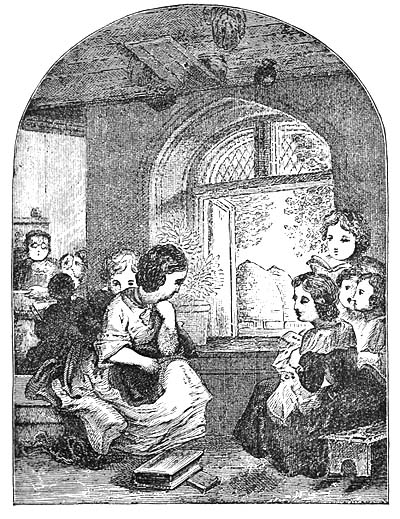
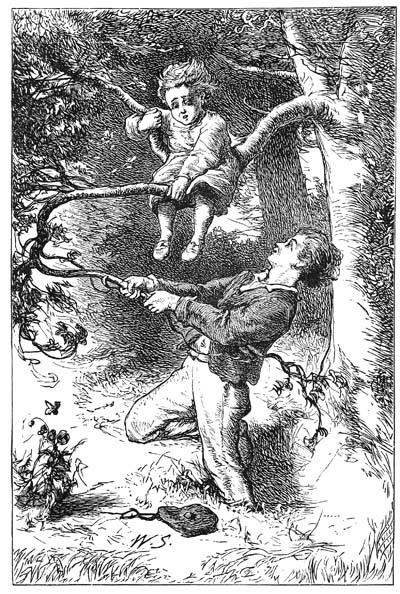
“HAD you not better go on a little
faster with your work, Polly?”
said Minnie Wingfield, glancing
up for a minute from her own,
over which her little fingers had
been busily moving, and from which she
now for the first time raised her eyes.
“I wish that there were no such thing as
work!” exclaimed Polly, from her favourite
seat by the school-room window, through
which she had been watching the bees
thronging in and out of their hive, some
flying away to seek honied treasure, some
returning laden with it to their home.
“I think that work makes one enjoy play
more,” replied Minnie, her soft voice scarcely
heard amidst the confusion of sounds which
filled the school-room; for there was a
spelling-class answering questions at the
moment, and the hum of voices from the
boys’ school-room, which adjoined that of
the girls, added not a little to the noise.
The house might itself be regarded as a
hive, its rosy-cheeked scholars as a little
swarm of bees, and knowledge as the honey
of which they were in search, drawn, not
from flowers, but from the leaves of certain
dog’s-eared books, which had few charms
for the eyes of Polly Bright.
“I never have any play,” said the little
girl peevishly. “As soon as school is over,
and I should like a little fun, there is
Johnny to be looked after, and the baby to
be carried. I hate the care of children—mother
knows that I do—and I think that
baby is always crying on purpose to tease
me.”
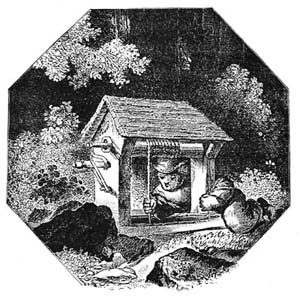
THE BIG HIVE.
“Yet it must be pleasant to think that
you are helping your mother and doing your
duty.”
Polly uttered a little grunting sound,
which did not seem like consent, and ran
her needle two or three times into her seam,
always drawing it back instead of pushing it
through, which every one knows is not the
way to get on with work.
“Why, even these little bees,” Minnie
continued, “have a sort of duty of their
own; and how steadily they set about it!”
“Pretty easy duty,—playing amongst
flowers and feasting upon honey!”
“Oh but—”
“Minnie Wingfield, no talking allowed in
school!” cried the teacher from the top of
the room, turning towards the corner near
the window. “Polly Bright, you are
always the last in your class.”
This time the lazy fingers did draw the
needle through, but a cross, ill-tempered
look was on the face of the little girl; while
her companion, Minnie, colouring at the
reproof, only worked faster than before.
We will leave them seated on their bench,
with their sewing in their hands, and passing
through the little window, as only authors
and their readers can do, cross the narrow
garden, with its small rows of cabbages and
onions, bordered by a line of stunted gooseberry
bushes, and mixing with the busy inhabitants
of the hive, glide through the
tiny opening around which they cluster, and
enter the palace of the bees. Now I have
a suspicion that though my young readers
may be well acquainted with honey-comb
and honey, and have even had hives on a
bench in their own gardens, they never in
their lives have been inside one, and are
totally ignorant of the language of bees.
For your benefit, therefore, I intend to translate
a little of the buzzing chit-chat of the
winged nation; and, begging you to consider
yourself as little as possible, conduct you at
once to the palace of Queen Farina.
A very curious and beautiful palace it is;
the Crystal Palace itself is not more perfect
in its way. Look at the long lines of cells,
framed with the nicest care, row above row,
built of pure white wax, varnished with gum,
and filled with provisions for the winter.
Yonder are the nurseries for the infant bees;
these larger apartments are for the royal
race; that, largest of all, is the state-chamber
of the queen. How strait are
the passages—just wide enough to let two
travellers pass without jostling! And as
for the inhabitants of this singular palace, or
rather, I should say, this populous city,
though for a moment you may think them
all hurrying and bustling about in utter confusion,
I assure you that they are governed
by the strictest order—each knows her own
business, her own proper place. I am afraid
that before you are well acquainted with
your small companions, you may find some
difficulty in knowing one from another, as
each bee looks as much like her neighbour
as a pin does to a pin. I am not speaking,
of course, of her majesty the queen, distinguished,
as she is, from all her subjects by
the dignified length of her figure and the
shortness of her wings; but you certainly
would not discover, unless I told you, that
the little creature hanging from the upper
comb is considered a beauty in Bee-land.
You must at once fancy your eyes powerful
microscopes, till a daisy is enlarged to the
size of a table, and the thread of a spider to
a piece of stout whip-cord; for not till then
can you find out the smallest reason why
Sipsyrup should be vain of her beauty. Yet
why should she not pride herself on her
slender shape or her fine down? Vanity
may seem absurd in a bee, but surely it is
yet more so in any reasonable creature, to
whom sense has been given to know the
trifling worth of mere outside looks; and I
fear that I may have amongst my young
readers some no wiser than little Sipsyrup.
She is not buzzing eagerly about like her
companions, who are now working in various
parties; some raising the white walls of the
cells; some carrying away small cuttings of
wax, not to be thrown away, but used in
some other place, for bees are very careful
and thrifty; some putting a fine brown
polish on the combs, made of a gum
gathered from the buds of the wild poplar;
some bringing in provisions for the little
workmen, who are too busy to go in search
of it themselves. No; Sipsyrup seems in
her hive as little satisfied as Polly in her
school-room, as she hangs quivering her
wings with an impatient movement, very
unworthy of a sensible bee.
“A fine morning this!” buzzed an industrious
young insect, making bee-bread
with all her might. I may here remark
that the subject of the weather is much
studied in hives, and that their inhabitants
show a knowledge of it that might put to
shame some of the learned amongst us. I
am not aware that they ever make use of
barometers, but it is said that they manage
seldom to be caught in a shower, and take
care to keep at home when there is thunder.
“A fine morning, indeed,” replied Sipsyrup.
“Yes; the sunshine looks tempting
enough, to be sure; no doubt the flowers are
all full of honey, and the hills covered with
thyme; but of what use is this to a poor
nurse-bee like me, scarcely allowed to snatch
a hasty sip for myself, but obliged to look
after these wretched little larvæ” (that is
the name given to young baby-bees), “and
carry home tasteless pollen to make bread
for them, when I might be enjoying myself
in the sunshine?”
“We once were larvæ ourselves,” meekly
observed Silverwing.
“Yes, and not very long ago,” replied
Sipsyrup rather pertly, glancing at the
whitish down that showed her own youth;
for it was but three days since she had
quitted her own nursery, which may account
for her being so silly a young bee.
“And but for the kindness of those who
supplied our wants when we were poor helpless
little creatures, we should never have
lived to have wings,” continued her companion.
“Don’t remind me of that time,” buzzed
Sipsyrup, who could not bear to think of
herself as a tiny, feeble worm. “Anything
more weary and tiresome than the life that
I led, shut up all alone in that horrid cell,
spinning my own coverlet from morning till
night, I am sure that I cannot imagine.
Ah, speaking of that spinning, if you had
only seen what I did yesterday.”
“What was that?” inquired Silverwing.
“As I flew past a sunny bank, facing the
south, I noticed a small hole, at the entrance
of which I saw one of our cousins, the poppy-bees.
Her dress, you must know, is different
from ours” (Sipsyrup always thought
something of dress). “It is black, studded
on the head and back with reddish-gray
hairs, and her wings are edged with gray.
Wishing to notice a little more closely her
curious attire, I stopped and wished her
good-day. Very politely she invited me
into her parlour, and I entered the hole in
the bank.”
“A dull, gloomy place to live in, I should
fear.”
“Dull! gloomy!” exclaimed Sipsyrup,
quivering her feelers at the recollection;
“why, the cell of our queen is a dungeon
compared to it. The hole grew wider as we
went further in, till it appeared quite roomy
and large, and all round it was hung with
the most splendid covering, formed of the
leaves of the poppy, of a dazzling scarlet,
delightful to behold. Since I saw it, I have
been scarcely able to bear the look of this
old hive, with its thousands of cells, one
just like another, and all of the same white
hue.”
“Had the poppy-bee a queen?” inquired
Silverwing.
“No; she is queen, and worker, and
everything herself; she has no one to command
her, no one to obey; no waspish companion
like Stickasting there.”
“What’s that? who buzzes about me?”
cried a large thick bee, hurrying towards
them with an angry hum. Stickasting had
been the plague of the hive ever since she
had had wings. She was especially the
torment of the unfortunate drones, who, not
having been gifted with stings like the
workers, had no means of defence to protect
them from their bullying foe. When a
larva, her impatient disposition was not
known. She had spun her silken web like
any peaceable insect, then lain quiet and
asleep as a pupa or nymph. But no sooner
did the young bee awake to life, than, using
her new powers with hearty good-will, she
ate her way through the web at such a
quick rate, that the old bees who looked in
pronounced at once that she was likely to be
a most active worker. Nor were they disappointed,
as far as work was concerned; no
one was ready to fly faster or further, no
one worked harder at building the cells;
but it was soon discovered that her activity
and quickness were not the only qualities
for which she was remarkable. If ever bee
had a bad temper, that bee was Stickasting.
Quarrelling, bullying, attacking, fighting,
she was as bad as a wasp in the hive. No
one would ever have trusted larvæ to her
care. Sipsyrup might neglect or complain
of her charge, but Stickasting would have
been positively cruel. Her companionship
was shunned, as must be expected by all
of her character, whether they be boys or
bees; and she seldom exchanged a hum,
except of defiance, with any creature in the
hive.
Sipsyrup, the moment that she perceived
Stickasting coming towards her, flew off in
alarm, leaving poor Silverwing to bear the
brunt of the attack.
“Who buzzes about me?” repeated
Stickasting fiercely, flying very close up to
the little nurse-bee.
“Indeed, I never named you,” replied
Silverwing timidly, shrinking back as close
as she could to the comb.
“If you were not talking against me yourself,
you were listening to and encouraging
one who did. Who dare say that I am
waspish?” continued Stickasting, quivering
her wings with anger till they were almost
invisible. “It is this gossip and slander
that make the hive too hot to hold us. I
once thought better of you, Silverwing, as a
quiet good-natured sort of a bee, but I now
see that you are just like the rest, and as
silly as you are ugly.”
This was a very provoking speech—it was
intended to be so; but Silverwing was not a
creature ready to take offence; whatever
she felt, she returned no answer—an example
which I would strongly recommend
to all in her position, whether standing on
six feet or on two.
But Stickasting was resolved to pick a
quarrel if possible, especially with one whom
she considered less strong than herself; for
she was not one of those generous beings
who scorn to take advantage of the weakness
of another. Stickasting much resembled
the class of rude, coarse-minded boys,
who find a pleasure in teasing children
and annoying little girls, and like to show
their power over those who dare not oppose
it.
“I owe you a grudge, Silverwing, for your
conduct to me yesterday. When I was toiling
and working at the cells like a slave, not
having time to go out for refreshment, I saw
you fly past me two or three times, and not
a drop of honey did you offer me.”
“I was carrying pollen for my little
larvæ,” gently replied Silverwing. “It is
not my office to supply the builders, though
I am sure that I should do so with pleasure;
but the baby-bees are placed under my
charge, and you know what care they need
till they begin to spin.”
“Yes, idle, hungry, troublesome creatures
that they are! Have they not set about
their spinning yet? I’ll make them stir
themselves,”—and Stickasting made a movement
towards the nursery-cells.
“The larvæ do not like to be disturbed!”
cried Silverwing, anxious for her charges,
and placing herself between them and the
intruder.
“Like! I daresay not,—but who cares
what they like! Get out of the way; I’ll
prick them up a little!”
“You shall not come near them!” hummed
the little nurse, resolutely keeping her
place.
“I say that I shall,—who shall hinder
me? Get out of my way, or I’ll let you
feel my sting.”
Silverwing trembled, but she did not stir,
for she was a faithful little bee. As the hen
is ready to defend her chickens from the
hawk, and even the timid wren will fight for
her brood, so this feeble insect would have
given up her life rather than have forsaken
the little ones confided to her care.
But she was not left alone to struggle
with her assailant. Two of her winged companions
came to the rescue; and Stickasting,
who had no wish to encounter such odds,
and was fonder, perhaps, of bullying than
of fighting, no sooner saw Waxywill and
Honeyball on the wing, than with an angry
hum she hurried out of the hive.
CHAPTER II. SOME ACCOUNT OF A WATERFALL.
I WISH that all little nurses were as
trustworthy as Silverwing, or as
kind and patient with their charges!
While Polly Bright has sat in her
mother’s cottage trimming her bonnet, till it
looks as absurd as pink ribbons can make it,
the poor baby has been crying unheeded in
his cradle, except that now and then, when
vexed more than usual by the noise, with
an almost angry look she pauses for a
moment to rock the cradle with her foot.
She does not notice that little Johnny has
been clambering up by the pail, which her
mother has set aside for her washing, till the
sudden sound of a fall, and a splash, and a
child’s frightened cry, startle her, and she
sees little streams running all over the stone
floor, and Johnny flat on his face in the
middle of a loud roar,—and a pool of water.
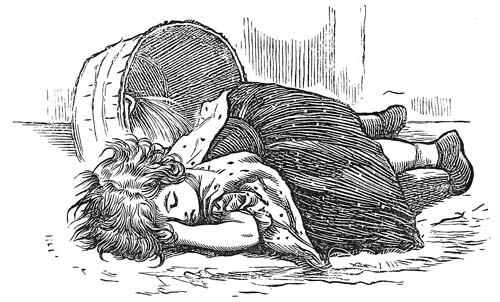
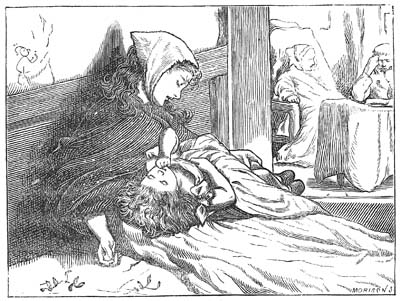
A MISHAP.
Up she jumps, not in the best of tempers.
Poor Johnny is dragged up by one arm,
and receives one or two slaps on the back,
which only makes him cry louder than before;
he stands a picture of childish misery,
with dripping dress and open mouth, the
tears rolling down his rosy cheeks, helpless
and frightened, as his careless sister shakes
and scolds him, and shakes him again, for
what was the effect of her own negligence.
Happily for the little boy, Minnie Wingfield
is a near neighbour, and comes running
at the sound of his distress.
“Why, what is the matter, my dear little
man?” are her first words as she enters
the cottage.
“Look here! did you ever see anything
like it? His dress clean on to-day! I cannot
turn my back for a moment but he must
be at the pail,—naughty, tiresome, mischievous
boy!” and poor Johnny received
another shake. “A pretty state the cottage
is in,—and there—oh, my bonnet! my bonnet!”
exclaimed Polly, as she saw that in
her hurry and anger she had thrown it
down, and that, pink ribbons and all, it lay
on the floor, right across one of the little
streams of water.
“Never mind the bonnet; the poor child
may be hurt, and—oh, take care, the baby
will be wetted!” and without waiting for
Polly’s tardy aid, Minnie pushed the cradle
beyond reach of danger.
While Polly was yet bemoaning her
bonnet, and trying to straighten out its
damaged ribbons, Minnie had found out
something dry for the shivering little boy,
had rubbed him, and comforted him, and
taken him upon her knee; then asking him
to help her to quiet poor baby, had hushed
the sickly infant in her arms. Was there
no pleasure to her kind heart when its wailing
gradually ceased, and the babe fell into
a sweet sleep,—or when Johnny put his
plump arms tight round her neck, and
pressed his little lips to her cheek?
There are some called to do great deeds
for mankind, some who bestow thousands in
charity, some who visit hospitals and prisons,
and live and die the benefactors of their
race. But let not those who have not power
to perform anything great, imagine that
because they can do little, they need therefore
do nothing to increase the sum of happiness
upon earth. There is a terrible
amount of suffering caused by neglect of, or
unkindness to, little children. Their lives—often
how short!—are embittered by harshness,
their tempers spoiled, sometimes their
health injured; and can those to whose care
the helpless little ones were confided, imagine
that there is no sin in the petulant word,
the angry blow, or that many will not have
one day to answer for all the sorrow which
they have caused to their Lord’s feeble
lambs, to those whose spring-time of life
should be happy?
Would my readers like to know a little
more of Minnie Wingfield, whose look was
so kind, whose words were so gentle, that
her presence was like sunshine wherever
she went? She lived in a little white cottage
with a porch, round which twined roses
and honeysuckle. There was a little narrow
seat just under this porch, where Minnie
loved to sit in the summer evenings with
her work, or her book when her work was
done, listening to the blackbird that sang in
the apple-tree, and the humming of the
bees amidst the blossoms. Little Minnie
led a retired life, but by no means a useless
one. If her mother’s cottage was the picture
of neatness, it was Minnie who kept it
so clean. Her brother’s mended stockings,
his nicely-washed shirts, all did credit to
her neat fingers. Yet she could find time
to bestow on the garden, to trim the borders,
to water the plants, to tie up the flowers in
which her sick mother delighted. Nor did
Minnie neglect the daily school. She was
not clever, but patient and ever anxious to
please; her teacher regarded her as one of
her best scholars, and pointed her out as an
example to the rest. But Minnie’s great
enjoyment was in the Sunday-school; there
she learned the lessons which made duty
sweet to her, and helped her on the right
way through the week. The small Bible
which had been given to her by her father,
with all his favourite verses marked, was a
precious companion to Minnie: not studied
as a task-book, or carelessly read as a matter
of custom; but valued as a treasure, and
consulted as a friend, and made the rule and
guide of daily life.
And was not Minnie happy? In one
sense she certainly was so, but still she had
her share of this world’s trials. The kind
father whom she had fondly loved had died
the year before; and besides the loss of so
dear a friend, his death had brought poverty
upon his family. It was a hard struggle to
make up the rent of the little cottage, which
Mrs. Wingfield could not bear to quit, for
did not everything there remind her of her
dear husband,—had he not himself made the
porch and planted the flowers that adorned
it! Often on a cold winter’s day the little
fire would die out for want of fuel, and
Minnie rise, still hungry, from the simple
meal which she had spared that there might
be enough for her parent and her brother.
Mrs. Wingfield’s state of health was
another source of sorrow. She was constantly
ailing, and never felt well, and
though saved every trouble by her attentive
child, and watched as tenderly as a lady
could have been, the sufferings of the poor
woman made her peevish and fretful, and
sometimes even harsh to her gentle daughter.
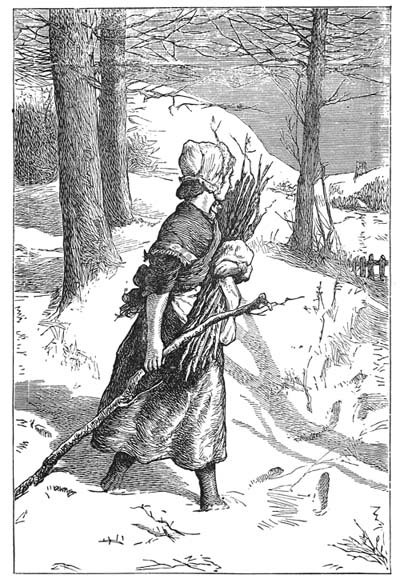
MINNIE WITH THE FIREWOOD.
Tom, her brother, was also no small trial
to Minnie. Unlike her, he had little thought
for anything beyond self; he neither considered
the comfort nor the feelings of
others. If Minnie was like sunshine in the
cottage of her mother, Tom too often resembled
a bleak east wind; and though Mrs.
Wingfield and her daughter never admitted
such a thought, their home was happiest
when Tom was not in it.
But it is time to return to our hive.
CHAPTER III. A FLATTERING INVITATION.
WAXYWILL and Honeyball had
both come to the assistance of
Silverwing, and she buzzed her
thanks in a grateful way to both,
though different motives had
brought them to her aid, for they were very
different bees in their dispositions.
Honeyball was a good-humoured, easy
kind of creature. Very ready to do a kindness
if it cost her little trouble, but lazy as
any drone in the hive. Honeyball would
have liked to live all day in the bell of a
foxglove, with nothing to disturb her in her
idle feast. It was said in the hive that
more than, once she had been known to sip
so much, that at last she had been unable
to rise, and for hours had lain helpless on
the ground. Sipsyrup, who, like other
vain, silly creatures, was very fond of talking
about other people’s concerns, had even
whispered that Honeyball had been seen
busy at one of the provision-cells stored for
the winter’s use, which it is treason in a bee
to touch; but as those who talk much generally
talk a little nonsense, we may hope
that there was no real ground for the story.
Waxywill was one of whom such a report
would never have been believed; there was
not a more honourable or temperate worker
in the hive. Yet Stickasting herself was
scarcely less liked, so peevish and perverse
was the temper of this bee. If desired to
do anything, it was sure to be the very thing
which she did not fancy. Were cells to be
built—she could not bear moping indoors;
if asked to bring honey—she always found
out that her wings were tired. She could
not bear submission to the laws of the hive,
and once actually shook her wings at the
queen! When she flew to help Silverwing,
it was less out of kindness to her than the
love of opposing Stickasting. And yet
Waxywill was not an ungenerous bee; she
had more sense too than insects generally
possess; she would have been respected and
even loved in the hive, had not her stubborn,
wilful temper spoilt all.
We will now follow Sipsyrup in her hasty
flight, as, leaving both her friend and her
charges behind, she made her retreat from
Stickasting. How delightful she found the
fine fresh air, after the heated hive! Now
up, now down, she pursued her varying
course, sometimes humming for a moment
around some fragrant flower, then, even
before she had tasted its contents, deserting
it for one yet more tempting. Deeply she
plunged her long tongue into its cup; her
curious pliable tongue, so carefully guarded
by Nature in a nicely fitting sheath.
“Sheathe your tongue!” was an expression
which the gossipping little bee had heard
more often than she liked, especially from
the mouth of Waxywill. It might be an
expressive proverb in other places than Bee-land,
for there are tongues whose words are
more cutting than swords, that much need
the sheath of discretion.
The movements of the lively insect were
watched with much interest by Spinaway
the spider, from her quiet home in a rosebush.
Sipsyrup, disdaining the narrow garden
of the school, had winged her way over
the wall, and turning into a narrow green
lane that was near, was now sporting with
the blossoms by Mrs. Wingfield’s porch.
Spinaway was a clever, artful spider, somewhat
ambitious too in her way. She had
made her web remarkably firm and strong,
and expected to be rewarded by nobler
game than the little aphis, or bony gnat.
She had once succeeded in capturing a blue-bottle
fly, and this perhaps it was that raised
her hopes so high, that she did not despair
of having a bee in her larder.
“Good-morning,” said Spinaway in a
soft, coaxing tone, as Sipsyrup came fluttering
near her. “You seem to have travelled
some distance, my friend, and if you should
like to rest yourself here, I am sure that you
would be heartily welcome.”
Sipsyrup was a young, inexperienced bee,
but she did not much fancy the looks of the
spider, with her hunchback and long hairy
legs. She politely, therefore, declined the
invitation, and continued her feast in a
flower.
“I am really glad to see a friend in a nice
quiet way,” continued the persevering spider.
“I find it very dull to sit here all day; I
would give anything to have wings like a
bee.”
Sipsyrup, who loved gossip, advanced a
little nearer, taking care to keep clear of
the web.
“I do long to hear a little news of the
world, to know what passes in your wonderful
hive. I am curious to learn about your
queen; your manner and style of dress is
such, that I am sure that you must have
been much about the court.”
Settling upon a leaf, still at a safe distance,
Sipsyrup indulged her taste for chit-chat,
glad to have so attentive a listener.
Spinaway soon heard all the gossip of the
hive,—how the present queen had killed in
single combat the queen of another swarm,
whilst the bees of both nations watched the
fight; and how the hostile band, when they
saw their queen dead, had submitted to the
conqueror at once. How a slug had last
morning crept into the hive and frightened
her out of her wits, but had been put to
death by fierce Stickasting before it had
crawled more than an inch. Sipsyrup then
related—and really for once her conversation
was very amusing—all the difficulties
and perplexity of the people of the hive as
to how to get rid of the body of the intruder.
She herself had been afraid to venture near
the monster, but Silverwing and the rest
had striven with all their might to remove
the dead slug from their hive.
“And did they succeed?” said Spinaway,
much interested.
“Oh, it was quite impossible to drag out
the slug! We were in such distress—such
a thing in the hive—our hive always kept
so neat and clean that not a scrap of wax
is left lying about!”
“What did you do?” said the spider; “it
really was a distressing affair.”
“Waxywill thought of a plan for preventing
annoyance. She proposed that we
should cover the slug all over with wax, so
that it should rather appear like a piece of
the comb than a dead creature left in the
hive.”
“A capital plan!” cried Spinaway. “And
was the thing done?”
“Yes, it was, and before the day was over.”
“So there Mrs. Slug remains in a white
wrapping,” laughed the spider; “a warning
to those who go where they are not wanted.
You were, I daresay, one of the foremost in
the work.”
“Not I; I would not have touched the
ugly creature with one of my feelers!”
“I beg your pardon!” said the spider;
“indeed, I might have judged by your
appearance that nothing but the most refined
and elegant business would ever be
given to you. You look as though you had
never touched anything rougher than a rose.”
This speech put Sipsyrup in high good-humour;
she began to think that she had
judged the spider harshly, and that she
really was an agreeable creature in spite of
her ugly hunch.
“If you speak of delicate work,” observed
the bee very politely, “I never saw anything
so fine as your web.”
“It is tolerably well finished,” said the
spider with a bow; “would you honour me
by a closer inspection?”
“Oh, thank you, I’m not curious in these
matters,” replied Sipsyrup, still feeling a
little doubtful of her new friend.
“You have doubtless remarked,” said
Spinaway, “that each thread is composed
of about five thousand others, all joined
together.”
“No, really, I had no idea of that—how
wonderfully fine they must be!”
“I am surprised that you did not see it;
at least if the powers of your eyes equal
their beauty. I never beheld anything like
them before—their violet colour, their
beautiful shape, cut, as it were, into hundreds
of divisions, like fine honey-comb
cells, and studded all over with most delicate
hair. I would give my eight eyes for
your two!”
“Two!” cried Sipsyrup, mightily pleased;
“I have three more on the back of my head.”
“I would give anything to see them, if
they are but equal to the faceted ones. No
creature in the world could boast of such a
set! Might I beg—would you favour
me?”—
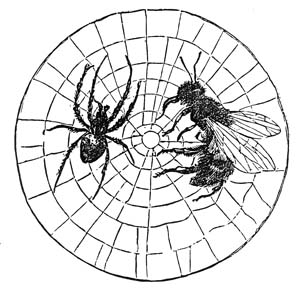
Silly Sipsyrup! foolish bee! not the first,
however, nor, I fear, the last, to be caught
by sugary words. Blinded by vanity, forward
she flew—touched the sticky, clammy
web—entangled her feet—struggled to get
free—in vain, in vain!—quivered her wings
in terrified efforts—shook the web with all
her might—but could not escape. Her artful
foe looked eagerly on, afraid to approach
until the poor bee should have exhausted
herself by her struggles. Ah, better for
Sipsyrup had she kept in her hive, had she
spent all the day in making bee-bread, to
feed the little larvæ in their cells!
CHAPTER IV. HOME LESSONS AND HOME TRIALS.
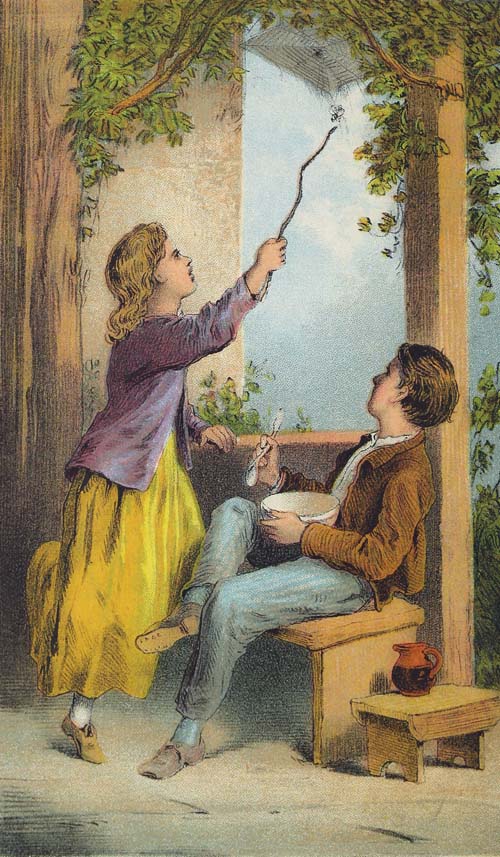
BUZZ, buzz, buzz!—“There’s a bee
in a web!” cried Tom, looking up
from the bowl of porridge which
he was eating in the rose-covered
porch.
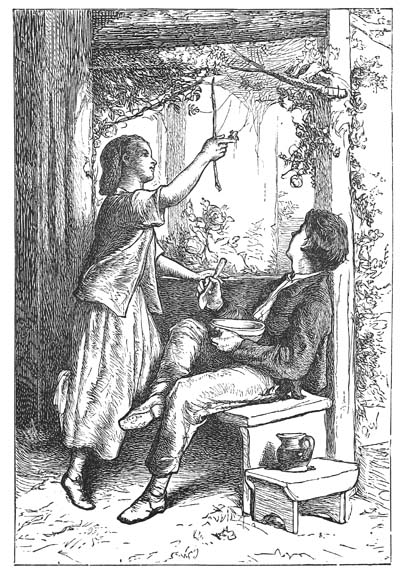
“Poor thing!” said Minnie, rising from
her seat.
“A precious fright it must be in! what a
noise it makes!” cried her brother.
“It is not much entangled—I think that
I could set it free!”—and Minnie ran up to
the web.
“And be stung for your pains. Nonsense—leave
it alone. It is good fun to watch
it in its struggles.”
POOR SIPSYRUP IN A SNARE.
“It never can be good fun to see any
creature in misery,” replied Minnie; and
with the help of a little twig, in a very
short time poor Sipsyrup was released from
the web.
“Poor little bee!” said Minnie, “it has
hurt its wing, and some of the web is still
clinging to its legs. I am afraid that it
cannot fly.”
“I hope that it will sting you!” laughed
Tom. “Are you going to nurse and pet it
here, and get up an hospital for sick bees?”
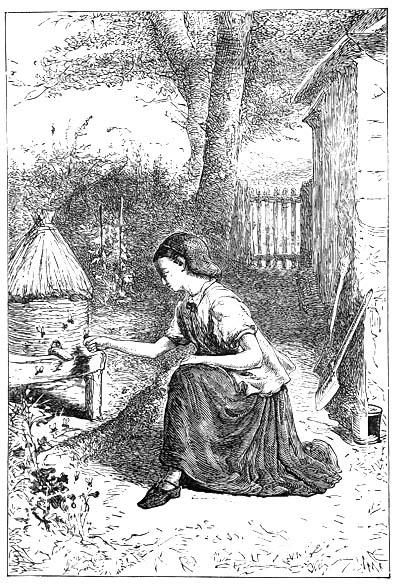
“I think that it must belong to our
school-mistress’s hive. I will carry it there,
and put it by the opening, and let its companions
take care of it.” And notwithstanding
Tom’s scornful laugh, Minnie bore off
the bee on her finger.
“You are the most absurd girl that I
ever knew,” said he on her return. “What
does it matter to you what becomes of one
bee? I should not mind smothering a
whole hive!”
“Ah, Tom,” said his sister, “when there
is so much pain in the world, I do not think
that one would willingly add ever so little
to it. And I have a particular feeling
about animals. You know that they were
placed under man, and given to man, and
they were all so happy until—until man
sinned; now, innocent as they are, they
share his punishment of pain and of death;
and it seems hard that we should make that
punishment more bitter!”
“Then my tender-hearted sister would
never taste mutton, I suppose.”
“No; the sheep are given to us for food;
but I would make them as happy as I could
while they lived. O Tom, we are commanded
in the Bible to be ‘tender-hearted,’
and ‘merciful,’ and surely to be cruel is a
grievous sin!”
MINNIE AND THE BEE.
“I wonder that you did not crush the
spider that would have eaten up your bee.”
“Why should I? She did nothing
wrong. It is Nature that has taught her
to live on such food; I would be merciful
to spiders as well as to bees.”
“You carried off her dinner—she would
not thank you for that.”
“Perhaps I did foolishly,” said Minnie
with a smile; “but I cannot see a creature
suffering and not try to help it.”
“I wish that you saw the green-grocer’s
horse with his bones all starting through his
skin, and the marks of the blows on his head.
What would you say to the master of that
horse?”
“Oh, I wish that he would remember
that one verse from the Bible, ‘Blessed are
the merciful, for they shall obtain mercy.’
Without mercy, what would become of the
best—without mercy, we all should be
ruined for ever. And if only the merciful
can obtain mercy, oh! what will become
of the cruel?”
“Pshaw!” cried Tom, not able to dispute
the truth of Minnie’s words, but not choosing
to listen to them, for he had too many
recollections of bird-nesting, cockchafer-spinning,
and worrying of cats, to make the
subject agreeable. Some find it easier to
silence an opponent with a “pshaw!” than
by reason or strength of argument; and this
was Tom’s usual way. He did not wish to
continue the conversation, and, perhaps
with a view to change its subject, said in a
sudden, abrupt tone, as he stirred his
porridge with his pewter spoon—
“You’ve not put a morsel of sugar in my
bowl.”
“Yes, indeed, I put some,” replied Minnie.
“But you know that I like plenty; I
have told you so a thousand times.”
“But, dear Tom, I have not plenty to
give you—we have nearly come to the end of
our little store. And you know,” continued
she, lowering her voice, “that we cannot
buy more until we are paid for these shirts.”
The little girl did not add that for the
last three days she had not tasted any
sugar herself.
“Nonsense!” cried Tom, starting up from
his seat, and hastily entering the cottage.
He took down from the shelf a large broken
cup, which was used to contain the store of
sugar. Mrs. Wingfield was lying asleep in
the back-room, being laid up with a worse
headache than usual.
Fearing lest her mother should be roused
from her sleep, Minnie followed her brother,
her finger on her lip, a look of anxious
warning on her face. But both look and
gesture were lost upon Tom, who was
thinking of nothing but himself.
“Here’s plenty for to-day,” he said in a
careless tone, emptying half the supply into
his bowl.
“But, Tom—our poor mother—she is ill,
you know—”
“Well, I’ve not taken it all.”
“But we cannot afford—”
“Don’t torment me!” cried Tom angrily,
helping himself to more.
“Oh, dear Tom,” said the little girl, laying
her hand upon his arm.
“I’ll not stand this nonsense!” exclaimed
the boy fiercely; and turning suddenly
round, he flung the rest of the sugar into
the dusty road. “There—that serves you
right; that will teach you another time to
mind your own business and leave me
alone;” and noisily setting down the empty
cup, the boy sauntered out of the cottage.
Something seemed to rise in Minnie’s
throat; her heart was swelling, her cheek
was flushed with mingled sorrow and indignation.
Oh, how much patience and meekness
we require to meet the daily little trials
of life!
Minnie was roused by her mother’s feeble,
fretful voice. “I wish that you and Tom
had a little more feeling for me. You have
awoke me with your noise.”
“I am sorry that you have been disturbed,
dear mother; I’ll try and not let it
happen again. Do you feel better now?”
“No one feels better for awaking with a
start,” returned Mrs. Wingfield peevishly.
“I should not have expected such thoughtlessness
from you.”
Minnie’s eyes were so brimful of tears
that she dared not shut them, lest the drops
should run over on her cheek. She knew
that her mother would not like to see her
cry, so, turning quietly away, she went to
the small fire to make a little tea for the
invalid.
There was nothing that Mrs. Wingfield
enjoyed like a cup of warm tea; and when
Minnie brought one to the side of her bed,
with a nice little piece of dry toast beside it,
even the sick woman’s worn face looked
almost cheerful. As soon, however, as she
had tasted the tea, she set down the cup
with a displeased air.
“You’ve forgotten the sugar, child.”
“Not forgotten, mother, but—but I have
none.”
“More shame to you,” cried Mrs. Wingfield,
her pale face flushing with anger; “I
am sure that a good deal was left this
morning. You might have thought of your
poor sick mother; she has few enough comforts,
I am sure.”
Poor Minnie! she left the room with a
very heavy heart; she felt for some minutes
as if nothing could cheer her. Angry with
her brother, grieved at her mother’s undeserved
reproach, as she again sat down to
work in the little porch, her tears fell fast
over her seam. Presently Conscience, that
inward monitor to whose advice the little
girl was accustomed to listen, began to make
itself heard. “This is foolish, this is wrong,—dry
up your tears, they can but give pain
to your sick mother. You must patiently
bear with the fretfulness of illness, and not
add to its burden by showing that you feel
it. You know that you have not acted selfishly,
you need not regret your own conduct
in the affair,—is not that the greatest of
comforts? But I know very well,” still
Conscience whispered in her heart, “that
you never will feel quite peaceful and happy
till no anger remains towards your brother.
A little sin disturbs peace more than a great
deal of sorrow; ask for aid to put away this
sin.”
Minnie listened to the quiet voice of Conscience,
and gradually her tears stopped and
her flushed cheek became cool. She made
a hundred excuses in her mind for poor Tom.
He had been always much indulged,—he
would be sorry for what he had done,—how
much better he was than other boys that
she knew, who drank, or swore, or stole.
And for herself, what a sin it was to have
felt so miserable! How many blessings
were given her to enjoy! She had health,
and sight, and fingers able to do work; and
neither she nor her mother had difficulty in
procuring it, the ladies around were so kind.
Then there was the church, and the school,
and the Best of Books;—and the world was
so beautiful, with its bright sun and sweet
flowers,—there was so much to enjoy, so
much to be thankful for! And Minnie
raised her eyes to the blue sky above, all
dotted over with rosy clouds; for it was the
hour of sunset, and she thought of the bright
happy place to which her dear father had
gone, and how she might hope to join him
there, and never know sorrow again. What
wonder, with such sweet thoughts for her
companions, if Minnie’s face again grew
bright, and she worked away in her little
porch with a feeling of peace and grateful
love in her breast which a monarch might
have envied.
CHAPTER V. CONVERSATION IN THE HIVE.
POOR Sipsyrup! how sadly she stood
at the entrance of the hive, where
her gentle preserver had left her.
The fine down, of which she had
been so vain, was all rubbed and
injured by her struggles in the web; one of
her elegant wings was torn; she felt that all
her beauty was gone! She had hardly
courage to enter the hive, and was ashamed
to be seen by the busy bees flocking in and
out of the door. I am not sure that insects
can sigh, or I am certain that she must have
sighed very deeply. The first thing that
gave her the least feeling of comfort was the
sound of Silverwing’s friendly hum;—the
poor wounded insect exerted her feeble
strength, and crept timidly into the hive.
“Sipsyrup!—can it be!” cried Honeyball,
rousing herself from a nap as the bee
brushed past her.
“Sipsyrup, looking as though she had been
in the wars!” exclaimed Waxywill, who, in
the pride of her heart, had always looked
with contempt on her vain, silly companion.
“My poor Sipsyrup!” cried Silverwing,
hastening towards her. Their feelers met
(that is the way of embracing in Bee-land),
the kind bee said little, but by every friendly
act in her power showed her pity and anxiety
to give comfort.
What pleased Sipsyrup most was the absence
of Stickasting, who had not returned
to the hive which she had left an hour before
in a passion.
After resting for a little on a half-finished
cell, while Silverwing with her slender
tongue gently smoothed her ruffled down,
and brought a drop of honey to refresh her,
Sipsyrup felt well enough to relate her sad
story, to which a little group of surrounding
bees listened with no small interest. Sipsyrup
left altogether out of her account the
fine compliments paid her by Spinaway, she
could not bear that her vanity should be
known; but she gained little by hiding the
truth, as this only made her folly appear
more unaccountable.
MINNIE AT THE HIVE.
“I cannot understand,” said Waxywill,
“how any bee in her senses could fly into a
web with her eyes open.”
“When there was not even a drop of
honey to be gained by it,” hummed Honeyball.
Sipsyrup hastened to the end of her story,
and related how she had been saved from the
spider by the timely help of a kind little girl.
“May she live upon eglantine all her
life,” exclaimed Silverwing with enthusiasm,
“and have her home quite overflowing with
honey and pollen!”
“This is the strangest part of your adventure,”
said Honey ball; “this is the very
first time in my life that I ever heard of
kindness shown to an insect by a human
being.”
“I thought that bees were sometimes fed
by them in winter,” suggested Silverwing.
“Fed with sugar and water!—fit food for
a bee!” cried Honeyball, roused to indignation
upon the only subject that stirred her
up to anything like excitement. “And
have you never heard how whole swarms
have been barbarously murdered, smothered
in the hive which they had filled with so
much labour, that greedy man might feast
upon their spoils!”
“If you talk of greediness, Honeyball,”
drily observed Waxywill, “I should say,
Keep your tongue in a sheath.”
“I am glad that it is not the custom for
men to eat bees as well as their honey,”
laughed Silverwing.
“Oh, they are barbarous to everything,
whether they eat it or not,” exclaimed
Waxywill, with an angry buzz. “Have I
not seen a poor butterfly, basking in the
sun, glittering in her vest of purple and
gold—ah, Sipsyrup, in your very best day,
you were no better than a blackbeetle compared
to her!”
An hour before, Sipsyrup would have felt
ready to sting Waxywill for such an insolent
speech, but the pride of the poor bee was
humbled; and when Waxywill observed her
silence and noticed her drooping looks, she
felt secretly ashamed of her provoking words.
She continued: “Have I not seen the butterfly,
I say, dancing through the air, as
though life was all sunshine and joy!—I
have seen a boy look on her—not to admire,
not to feel pleasure in beholding her beauty,
but eager to lay that beauty in the dust, and
seize on his little victim. I have watched
him creeping softly, his hat in his hand, as
anxious about his prize, as if to destroy a
poor insect’s happiness was the way to secure
his own. Now the unconscious butterfly
rose, high above the reach of her pursuer,
then sank again to earth, to rest upon a
flower, whose tints were less bright than its
wings. Down came the hat—there was a
shout from the boy—the butterfly was prisoner
at last. If he had caught it to eat it,
as the spider caught Sipsyrup, I could have
forgiven him—for men as well as bees must
have food, and I suspect that they do not
live entirely upon honey; but it made me
wish for a hundred stings when I saw the
wretched insect lying on the ground, fluttering
in the agonies of death. The boy had
barbarously torn off its bright beautiful
wings, and had not even the mercy to put it
out of pain by setting his foot upon it.”
“It had never injured him,” murmured
Silverwing.
“It had never injured any one—it desired
nothing but to be allowed to spend its short
life in peace.”
“How would the boy have liked to have
had his wings torn off,” said Honeyball, “for
the amusement of some creature stronger
than himself?”
“Men and boys are worse than hornets,”
muttered Waxywill.
“But we have found one of human-kind,”
hummed Silverwing cheerfully, “who could
be merciful even to a bee. Perhaps in the
world there may be others like her, too
noble, too generous to use their strength to
torture and destroy what cannot resist
them.”
Waxywill and Honeyball now took their
departure—I fear rather for their own pleasure
than for the benefit of the hive; as
Waxywill was not in a humour to work, and
Honeyball was always in a humour to idle.
As soon as they had flown out of reach of
hearing, poor Sipsyrup said, in a very dull
tone,—
“I wonder what is to become of me now,
poor unhappy insect that I am. I fear that
I shall never be able to fly; and to live on
here in this wretched way is almost worse
than to be eaten by a spider.”
“Oh, you should not say so,” replied
gentle Silverwing; “you can still crawl
about, and you are safe in your own home.”
“Safe!—I am miserable! With what
pleasure I had thought of joining the first
swarm that should fly off. I am tired of the
hive—this noisy, bustling hive—I have lost
everything that I cared for, everything that
made life pleasant—my beauty, my strength,
my power of flying; I have nothing left—”
“But your duties,” added Silverwing;
“make them your pleasures. My dear
friend, if you no more can be pretty, you
may still be useful; if you no more can be
admired, you can still be loved. You may
not be able to go far, or to see much; but
there are better joys to be found in your
own home.”
Before the night closed, both the little
nurse-bees were busy feeding the larvæ.
CHAPTER VI. A STINGING REPROOF.
THE sunset was still casting a red glow
over the earth, throwing the long
shadows of the trees on the ground,
and lighting up the cottage windows,
as Polly Bright stood at the door of her cottage,
watching for her mother’s return.
Mrs. Bright was a hard-working woman,
who, during the absence of her husband, a
soldier in the Crimea, earned many an honest
shilling as charwoman in the house of the
Squire on the hill. She generally managed
to let Polly have the advantage of attending
the school in the morning. Though herself
unable to read, she liked the idea of her
daughter being a scholar; and as plain-work
was also taught in the school, she thought
that what Polly acquired there might make
her not only more learned, but more useful.
But it was only for attendance in the morning
that the charwoman’s child could be
spared from her home. During her mother’s
frequent absence, all the charge of the cottage,
and care of the children, belonged of
course to Polly Bright.
I cannot say that the little parlour could
compare in neatness with that of Mrs. Wingfield.
There was a chest of drawers in one
of the corners, and on it was heaped a strange
medley of things. Tea-pot and broken jug,
old shawl and a baby’s rattle, nutmeg-scraper,
bellows, saucepan and books, were piled in
sad confusion. Nor would I have advised
you to have attempted to open one of the
drawers. They were sometimes too full to
be opened at all, and stuck tight against
every effort, as if aware that they were not
fit to be seen. Polly was too fond of adorning
herself to care for adorning her cottage.
She was not aware how far better it looks to
be simple, neat, and clean, and dressed according
to our station, than to be decked out
with gaudy finery, and try to ape the appearance
of those whom Providence has placed
above us.
You will remember that we visited this
cottage in the third chapter, and there is
little change in the appearance of things
there now. The damp on the floor occasioned
by Johnny’s accident has dried up,
and so have the tears of the little boy,
who, seated upon a stool near his sister’s
feet, is cramming his mouth with bread and
butter, with an air of great content. But
the thin sickly baby is still in his cradle, still
uttering his feeble, unheeded wail, for the
poor little creature is teething hard, and has
no other way of expressing his pain. Polly
never notices his heated lips and swelled
gums; she is more occupied with herself
this evening than usual, for Mrs. Larkins,
the farmer’s wife, has invited her to tea, and
as soon as her mother returns to take her
place, she will be off to amuse herself at
Greenhill. Oh yes; you might be certain
that some gay meeting was expected! Look
at the necklace of false coral round her neck,
the half-soiled lace which she has sewn round
her frock, and her hair all in papers at
this hour of the day; you would laugh were
you to see her, but to me the sight of her
folly is really too sad for laughing. Of what
is she thinking as she quickly untwists the
papers, and curls her long hair round her
fingers? Her thoughts are divided between
impatience at her mother’s delay, fears of
herself being late for the party, and wishes
that the pedlar would only happen to call at
her cottage.
She had heard that day, from one of her
school-fellows, that a man had been going
about the neighbourhood with a pack so full
of beautiful things, that such a collection
had never before been seen in the village.
Polly had been particularly tempted by the
description of some brooches made of false
diamonds, and exactly like real ones, as the
girl, who had never seen a jewel in her life,
very positively affirmed. One of these fine
brooches was to be had for sixpence—how
eager was Polly to be its possessor! She
counted over her little treasure of pence, and
found that she had sufficient for the purchase.
But how was she to find the pedlar?
Had Polly not been tied to the cottage
by what she called “these tiresome children,”
she would long ago have gone in
search of him. She could hardly expect
him to pass down her little lane, but she
was near enough to the high-road to see if
any one passed along it in going through the
village. At one time she had set little
Johnny to watch, and more than once her
hopes had been raised as the little fellow
shouted aloud, “There’s the man!” But
Polly came running first to see a drover
with pigs, then the baker with his little cart
going his rounds;—she had a disappointment,
poor Johnny a slap, and he was sent
crying into the cottage. This was rather
hard upon him, poor little fellow. How
could a child, not three years old, be expected
to know the difference between a
pedlar and a baker?
But all was quiet again in the cottage,
Johnny occupied with his supper, and Polly
with her curl-papers, when in through the
open door who should make her entrance
but Stickasting. She came in, as usual, in
no amiable mood, quite ready to take offence
on the very shortest notice. She first settled
on the little baby’s arm; but the infant lay
perfectly still, half-comforted in his troubles
by sucking his thumb: the most passionate
bee in the world could find no excuse for
being angry with him. Stickasting rested
for a few moments on the thin, tiny arm,
then rose and approached Polly Bright.
Every sensible person knows that when a
bee or a wasp hovers near, the safest way
is to keep quiet and take no notice; but
Polly was not a very sensible person, and
being not very courageous either, was quite
frightened when the insect touched her face.
If Stickasting had mistaken it for a flower,
she would very soon have found out her
blunder, and left the little girl in peace; but,
starting back with a cry, Polly struck the
bee, and Stickasting, roused to fury, quickly
returned the blow. Mad with passion, the
insect struck her sting so deep, that it was
impossible to withdraw it again, and she left
it behind, which occasions certain death to a
bee.
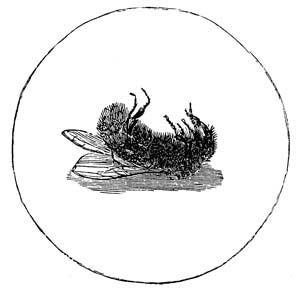
Stickasting felt at once that she had
thrown away her life in a wild desire for
revenge; that her destruction was caused
by her own violent act—she crawled feebly
a few inches from the spot where she fell,
and expired—a victim to her temper.
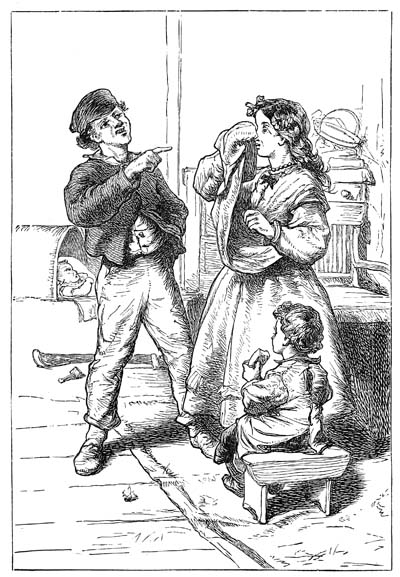
Loud was the scream which Polly Bright
uttered on being stung; so loud that it
brought, from the opposite cottage, both
Minnie Wingfield and her brother. On
finding out the cause of Polly’s distress,
Minnie hastily ran back for the blue-bag, or
a little honey, to relieve the pain of her
school-fellow. But Tom, who had very
little pity in his nature, stood shaking with
laughter at the adventure.
POOR STICKASTING.
“Stung by a bee!—stung on the very tip
of the nose!—what a beauty you will look
at Greenhill to-night!—ha! ha! ha!—if you
could only see how funny you look, your
hair half in curl-papers, and half hanging
down, and your eyes as red with crying as
the coral round your neck! You are for all
the world like silly Sally!”
TOM LAUGHING AT POLLY.
“It does not show much, does it?” said
poor Polly anxiously, as Minnie returned
with the blue-bag.
“It is swelling!” cried Tom—“swelling
higher and higher!—’twill be just like the
turkey-cock’s comb!”
“Then I can’t go to-night!—I will not
go!” exclaimed Polly, sitting down and
bursting into tears.
Tom laughed louder, Minnie in vain tried
to comfort,—all Polly’s happiness was for
the time overthrown by a bee! It rested
but on trifles, and a trifle was enough to
make her wretched for the rest of that day.
CHAPTER VII. A WONDERFUL BORE.
THE sun set, the rooks in the squire’s
park had gone to roost, the bats
flew round the ivy-covered tower of
the village church. The hive was
becoming quiet and still, the bees hanging
in clusters prepared to go to sleep; but
Stickasting had never returned. Silverwing
listened in vain for the well-known
sound of her angry hum, and wondered what
could have delayed her companion. But
never again was the poor bee to fly back to
the hive, never again to labour at the waxen
cells; and, alas! how little was her presence
missed—still less was it regretted.
The next morning was warm, bright, and
sunny, the bees were early on the wing.
The larvæ were beginning to spin their webs,
and therefore no longer required food; so
Silverwing was free to range over the fields,
and gather honey for the hive. So tempting
was the day, that even Honeyball shook
her lazy wings and crept to the door; there
stood for a few moments, jostled by her
more active fellow-servants, and finally flew
off in quest of food.
How delightful was the air!—how fragrant
the breeze! The buttercups spread
their carpet of gold, and the daisies their
mantle of silver over the meadows, all glittering
with the drops of bright dew. Honeyball
soon found a flower to her taste, and
never thought of quitting it till she had exhausted
all its honied store. She had a dim
idea that it was her duty to help to fill the
cells, but poor Honeyball was too apt to
prefer pleasure to duty.
“I should like to have nothing to do,”
she murmured, little thinking that a listener
was near.
“Like to have nothing to do! Is it from
a hive-bee that I hear such words?—from
one whose labour is itself all play?”
Honeyball turned to view the speaker,
and beheld on a sign-post near her the most
beautiful bee that she had ever seen. Her
body was larger than that of a hive-bee, and
her wings were of a lovely violet colour, like
the softest tint of the rainbow.[A]
Honeyball felt a little confused by the
address, and a little ashamed of her own
speech; but as all bees consider each other
as cousins, felt it best to put on a frank,
easy air.
“Why, certainly, flying about upon a
morning like this, and making elegant extracts
from flowers, is pleasant enough for a
time. But may I ask, lady-bee,” continued
Honeyball, “if you think as lightly of working
in wax?”
“Working in wax!” half contemptuously
replied Violetta; “a soft thing which you
can bend and twist any way, and knead into
any shape that you choose. Come and look
at my home here, and then ask yourself if
you have any reason to complain of your
work.”
Honeyball looked forward with her two
honey-combed eyes, and upwards and backwards
with her three others, but not the
shadow of a hive could she perceive anywhere.
“May I venture to ask where you
live?” said she at last.
“This way,” cried Violetta, waving her
feeler, and pointing to a little round hole in
the post, which Honeyball had not noticed
before. It looked gloomy, and dark, and
strange to the bee; but Violetta, who took
some pride in her mansion, requested Honeyball
to step in.
“You cannot doubt my honour,” said she,
observing that the hive-worker hesitated,
“or be suspicious of a cousin?”
Honeyball assured her that she had never
dreamed of such a thing, and entered the
hole in the post.
For about an inch the way sloped gently
downwards, then suddenly became straight
as a well, so dark and so deep, that Honeyball
would have never attempted to reach
the bottom, had she not feared to offend her
new acquaintance. She had some hopes
that this perpendicular passage might only
be a long entrance leading to some cheerful
hive; but after having explored to the very
end, and having found nothing but wood to
reward her search, she crept again up the
steep narrow way, and with joy found herself
once more in the sunshine.
“What do you think of it?” said Violetta,
rather proudly.
“I—I do not think that your hive would
hold many bees. Is it perfectly finished,
may I inquire?”
“No; I have yet to divide it into chambers
for my children, each chamber filled
with a mixture of pollen and honey, and
divided from the next by a ceiling of sawdust.
But the boring was finished to-day.”
“You do not mean to say,” exclaimed
Honeyball in surprise, “that that long
gallery was ever bored by bees!”
“Not by bees,” replied Violetta, with a
dignified bow, “but by one bee. I bored it
all myself.”
The indolent Honeyball could not conceal
her amazement. “Is it possible that you
sawed it all out with your teeth?”
“Every inch of the depth,” Violetta replied.
“And that you can gather honey and
pollen enough to fill it?”
“I must provide for my children, or they
would starve.”
“And you can make ceilings of such a
thing as sawdust to divide your home into
cells?”
“This is perhaps the hardest part of my
task, but nevertheless this must be done.”
“Where will you find sawdust for this
carpenter’s work?”
“See yonder little heap; I have gathered
it together. Those are my cuttings from
my tunnel in the wood.”
“You are without doubt a most wonderful
bee. And you really labour all alone?”
“All alone,” replied Violetta.
Honeyball thought of her own cheerful
hive, with its thousands of workers and
divisions of labour, and waxen cells dropping
with golden honey. She scarcely could
believe her own five eyes when she saw
what one persevering insect could do. Her
surprise and her praise pleased the violet-bee,
who took pride in showing every part
of her work, describing her difficulties, and
explaining her manner of working.
“One thing strikes me,” said Honeyball,
glancing down the tunnel; “I should not
much like to have the place of your eldest
larva, imprisoned down there in the lowest
cell, unable to stir till all her sisters have
eaten their way into daylight.”
Violetta gave what in Bee-land is considered
a smile. “I have thought of that
difficulty, and of a remedy too. I am about
to bore a little hole at the end of my tunnel,
to give the young bee a way of escape from
its prison. And now,” added Violetta, “I
will detain you no longer, so much remains
to be done, and time is so precious. You
probably have something to collect for your
hive. I am too much your friend to wish
you to be idle.”
Honeyball thanked her new acquaintance
and flew away, somewhat the wiser for her
visit, but feeling that not for ten pairs of
purple wings would she change places with
the carpenter-bee.
CHAPTER VIII. A CHASE, AND ITS CONSEQUENCES.
“THERE’S the pedlar! Oh dear! and
just as mother has gone out!” cried
Polly, who on beginning her afternoon
business of nurse to the little
children, saw, or thought that she saw, at
the end of her lane, a man with a pack
travelling along the high-road. “There he
is. Oh, if I could only stop him, or if any
one would look after the baby whilst I am
gone! Minnie Wingfield! Ah, how stupid
I am to forget that she is now at the afternoon
school! I think that baby would
keep very quiet for five minutes; he cannot
roll out of his cradle. But Johnny, he’d be
tumbling down, or setting the cottage on
fire; I cannot leave him for a minute by
himself.—Johnny,” said she suddenly, “I
want to catch the pedlar and see his pretty
things; will you come with me, like a good
little boy?”
Johnny scrambled to his feet in a moment,
to the full as eager as herself. Polly held
his fat little hand tight within her own, and
began running as fast as she could drag him
along. But the poor child’s round heavy
figure and short steps were altogether unsuited
for anything like a race. Polly felt
him as a dead weight hanging to her arm.
In vain she pulled, dragged, and jerked,
now began to encourage, and now to scold;
poor Johnny became tired, frightened, and
out of breath, and at last fairly tumbled
upon his face.
“Get up—I’m in such a hurry!”—no
answer but a roar. “Stupid child! he’ll be
gone!”—Johnny bellowed louder than before.
“There, I’ll leave you on the road, you
great tiresome boy; you have half pulled
out my arm with dragging you on. I’ll
leave you there, and silly Sally may get
you.”
Then, without heeding the poor little
child’s cries and entreaties that she would
stop, as he lay on the ground, half suffocated
with sobs, Polly Bright, thinking only of
the prize which her vanity made her so
much desire, hastened after the pedlar.
POOR SALLY.
Silly Sally, who has been twice mentioned
in my tale, was a poor idiot-woman
who lived with some kind neighbours on a
common about two miles from the village.
She was perfectly harmless, and therefore
allowed to go about with freedom wherever
she chose; but the terrible misfortune, alas!
exposed her to the scorn and sometimes
even persecution of wicked children, who
made the worst use of the senses left them,
by tormenting one already so much afflicted.
Poor Sally used to wander about the lanes,
uttering her unmeaning sound. Perhaps
even she had some pleasure in life, when
the sun shone brightly and the flowers were
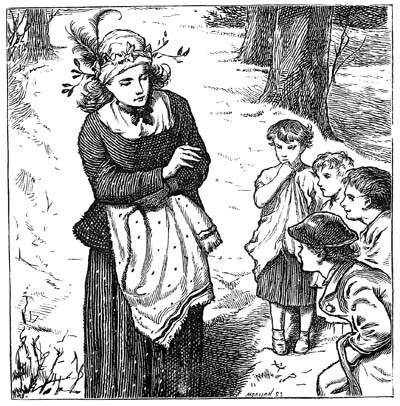
out, for she would gather the wild roses
from the bank, or the scarlet poppies from
the field, and weave them into garlands for
her head. Nothing pleased her more than
when she found a long feather to add to her
gaudy wreath. If the poor witless creature
had delight in making herself gay, Polly at
least had no right to laugh at her.
Timid and easily frightened, the idiot felt
a nervous terror for schoolboys, for which
they had given her but too much cause.
She had been hooted at, even pelted with
mud, pursued with laughter like a hunted
beast. Twice had Minnie to interfere with
her brother, pleading even with tears for one
so helpless and unhappy. If there be anything
more brutal and hateful than cruelty
to a harmless animal, it is heartless barbarity
to a defenceless idiot—to one who bears our
image, is descended from our race, and whose
only crime is the being most unfortunate.
Deal gently, dear children, with the poor
senseless idiot; we trust that there is a place
in heaven even for him. The powers denied
him in this world may be granted in the
next; and in a brighter realm, although
never here below, he may be found at his
Lord’s feet, clothed and in his right mind.
On hastened the little girl, breathless and
panting. At the place where the roads
joined she looked anxiously up the highway,
to see if she had not been mistaken in her
distant view of the traveller. No; there
was the pedlar, pack and all, and no mistake,
but walking more briskly than might
have been expected from his burden and
the warmth of the afternoon. His pack
must have been much lightened since he
first set out with it.
Polly called out; but he either did not
hear, or did not attend. The wind was
blowing the dust in her face, she was tired
with her vain attempts to drag poor Johnny,
her shoes were down at heel and hindered
her running; for it by no means follows
that those who wish to be fine care to be
tidy also. But the brooch of false diamonds—the
coveted brooch—the thought of that
urged her on to still greater efforts; even
the remembrance of her swelled nose was
lost in the hope of possessing such a beautiful
ornament. Polly, as she shuffled hastily
along, saw more than one person meet the
pedlar. If they would but stop him—if
only for one minute—to give her time to get
up with him at last. No one stopped him—how
fast he seemed to walk! Polly’s
face was flushed and heated, her hair hung
about her ears—would that we were as
eager and persevering in the pursuit of what
really is precious, as the girl was in that of
a worthless toy!
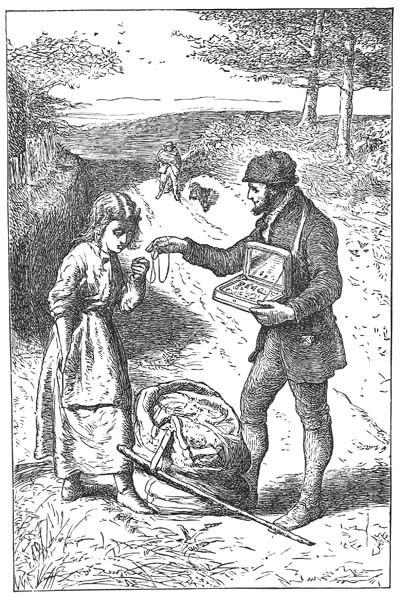
At last her gasped-out “Stop!” reached
the ear of the pedlar. He paused and turned
round, and in a few minutes more his pack
was opened to the admiring eyes of Polly.
Ah, how she coveted this thing and that!
how she wished that her six pennies were
shillings instead! A cherry-coloured neckerchief,
a pink silk lace, a large steel pin, and
a jewelled ring,—how they took her fancy,
and made her feel how difficult it is to
decide when surrounded by many things
alike tempting!
But at last the wonderful brooch of false
diamonds was produced. There was only
one left in the pedlar’s stock. How fortunate
did Polly think it that it also had not
been sold! Neckerchief, lace, pin, or ring
was nothing compared to this. She tried
it on, had some doubts of the strength of the
pin, tried in vain to obtain a lessening of the
price. It ended in the girl’s placing all her
pence in the hand of the pedlar, and carrying
home her prize with delight. She had
had her wish. Her vanity was gratified—the
brooch was her own; but to possess is
not always to enjoy.
POLLY AND THE PEDLAR.
Polly returned to her cottage with much
slower steps; she was heated, and tired, and
perhaps a little conscious that she had not
been faithful to her trust. As she came
near her home she quickened her pace, for
to her surprise she heard voices within, and
voices whose tones told of anxiety and fear.
These were the words which struck her ear,
and made her pause ere she ventured to
enter,—
“What a mercy it is that I returned for
the basket that I had forgotten! If I had
not, what would have become of my poor
babe!” exclaimed Mrs. Bright in much
agitation.
“I can’t understand how it happened,”
replied another voice, which Polly knew to
be that of Mrs. Wingfield.
“You may well say that,” said the
mother. Polly could hear that she was
rocking her chair backwards and forwards,
as she sometimes did when hushing the sick
child to sleep. “I left Polly in charge of
the children: I came back to find her gone,
and my poor, poor baby in a fit.”
Polly turned cold, and trembled so that
she could hardly stand.
“Is there no one who could go for a
doctor?” continued the agitated mother;
“another fit may come on—I would give
the world to see him!”
“I am so feeble,” replied Mrs. Wingfield,
“that I am afraid—”
“Take the baby, then, and I’ll go myself;
not a moment is to be lost.”
“No, no; there’s my boy Tom,” cried Mrs.
Wingfield, as she saw her son run hastily
into her little cottage, which was just opposite
to Mrs. Bright’s.
“Oh, send him, in mercy send him!”
cried the mother; and her neighbour instantly
crossed over to fulfil her wishes,
passing Polly as she did so, and looking at
her with mingled surprise and scorn, though
in too much haste to address her.
“My boy, my own darling!” murmured
the anxious mother, pressing her sick child
to her bosom, “what will your father say
when he hears of this?” Except her low,
sad voice, the cottage was so still that the
very silence was terrible to Polly; it would
have been a relief to have heard the feeble,
fretful wail which had made her feel impatient
so often.
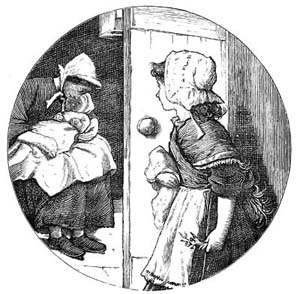
With pale, anxious face and noiseless
step, dreading to meet her mother’s eye, the
unhappy girl stole into the cottage. There
sat Mrs. Bright, her bonnet thrown back
from her head, her hair hanging loose, her
gaze fixed upon the child in her arms;
whilst the poor little babe, with livid
waxen features and half-closed eyes, lay
so quiet, and looked so terribly ill, that
but for his hard breathing his sister would
have feared that his life had indeed passed
away.
Mrs. Bright raised her head as Polly
entered, and regarded her with a look whose
expression of deep grief was even more
terrible than anger. She asked no question;
perhaps the misery in which she saw the
poor girl made her unwilling to add to her
suffering by reproach; or perhaps, and this
was Polly’s own bitter thought, she considered
her unworthy of a word. Whatever
was the cause, no conversation passed between
them, except a few short directions
from the mother about things connected
with the comfort of the baby, as poor Polly,
with an almost bursting heart, tried to do
anything and everything for him.
POLLY IN DISGRACE.
In the meantime Tom had gone for the
doctor, though with an unwillingness and
desire to delay which had made his mother
both surprised and indignant.
“He should go by the fields,” he said,
though he well knew that to be the longest
way; and he would have done so, had not
Mrs. Wingfield roused herself to such anger,
that even her rude and undutiful son did
not dare to disobey her.
The doctor came in about an hour, Tom
having happily found him at home, and,
with an anxiety which those who have attended
beloved ones in the hour of sickness
only can tell, Mrs. Bright and Polly listened
for his opinion of the case. The doctor examined
the child, and asked questions concerning
his illness: “How long had the fit
lasted?” There was a most painful pause.
Mrs. Bright looked at her daughter. Polly
could not utter a word; it was not till the
question was repeated that the distressing
reply, “No one knows,” was given.
“Was the child long ailing?”
“How was he when you left him?” said
Mrs. Bright to the miserable Polly.
“Very well—that’s to say—I don’t exactly—he
was—I think—”
“There has been gross negligence here,”
said the doctor sternly; “gross negligence,” he
repeated, “and it may cost the child his life.”
Polly could only clasp her hands in anguish;
but the mother exclaimed, “Oh, sir, is there
no hope for my boy?”
“While there is life there is hope,” replied
the doctor in a more kindly tone; “he must
be bled at once. Have you a basin here?”
he added, taking a small instrument-case
from his pocket.
Polly was at all times timid and nervous,
and quite unaccustomed to self-command,
and now, when she would have given worlds
to have been useful, her hand shook so
violently, her feelings so overcame her, that
there was no chance of her doing anything
but harm.
“Give the basin to me, dear,” said a gentle
voice behind her; Minnie Wingfield had just
entered the cottage. “You look so ill, you
must not be present. Go up-stairs, Polly;
I will help your mother.”
“Oh, what shall I do?” cried the miserable
girl, wringing her hands.
“Go and pray,” whispered Minnie as she
glided from her side; and Polly, trembling
and weeping, slowly went up the narrow
wooden staircase, and entering her little
chamber, sank down upon her knees.
“Oh, spare him, only spare him, my
darling little brother!” she could at first
utter no other words. She had never loved
the baby as she did now, when she feared
that she might be about to lose him, and
bitterly she lamented her own impatient
temper that had made her weary of the duty
of tending him. Oh, that we would so act
towards our relations, that if death should
remove any one from our home, our grief
should not be embittered by the thought,
“I was no comfort or blessing to him while
he was here, and now the opportunity of
being so is gone for ever!”
But the most terrible thought to Polly
was, that the baby’s danger might be partly
owing to her neglect. Should he die—should
the little darling be taken away—could her
mother ever forgive her? As Polly sobbed
in an agony of grief, something fell from her
bosom upon the floor; she started at the
sight of her forgotten brooch, that which she
had coveted so much, that which had cost
her so dear. Snatching it up, and springing
to her feet, with a sudden impulse she
ran to the window, and flung it far out into
the lane. Then once more falling on her
knees, again she prayed, but more calmly,
and she implored not only that the baby
might live, but that her own weak, vain
heart might be cleansed, that she might
henceforth live not only for herself, but do
her duty as a faithful servant of God. She
rose somewhat comforted, and creeping
down-stairs, listened ere she ventured to
enter the little parlour.
“I hope that he may do well now. I shall
send something for him to-night. Keep him
quiet. I shall call here to-morrow.” These
were the doctor’s parting words, and they
were a great relief to Polly. She came in
softly, and bent down by the baby, now laid
again in his little cradle, and looking white
as the sheet that was over him; she would
have kissed his thin, pale face, but she feared
to disturb the poor child. Her heart was
full of mingled sorrow and love; she felt as
though she could never bear to leave him
again.
“Thank you, Minnie, my girl,” said Mrs.
Bright earnestly; “you have been a real
comfort to me in my time of need. Your
mother is a happy woman to have such a
child.”
“Can I do anything else for you now?”
said Minnie; “if you would allow me to sit
up instead of you to-night?”
“No, no; I could not close an eye. But
I should be glad if you would bring Johnny
home, my dear; it is near his bed-time, and
I do not think that he will disturb the
baby.”
“I will bring him with pleasure; where
is he?” said Minnie.
“Where is he?” repeated Mrs. Bright;
“is he not at your home?”
“No; he has not been there all day.”
Polly started as if she had been stabbed.
“Then where is he?” cried Mrs. Bright,
looking anxiously round. “Is he up-stairs,
Polly?” The miserable girl shook her
head. Her fears for the baby had made
her quite forget her little brother, and it
now flashed across her mind that she had
not passed him in the lane, when she had
retraced her steps to the cottage. Where
could he have gone, where could he be now?
Mrs. Bright had endured much, but her
cup seemed now to overflow. She walked
close up to Polly, laid a heavy grasp upon
her shoulder, and said, in a tone which the
girl remembered to her dying day, “When
was your brother last with you?”
“About two hours ago, just before you
returned home,” faltered Polly.
“And where did you leave him?”
“In the lane, near the high-road.”
“Go and find him,” said the mother, between
her clenched teeth, “or never let me
set eyes on you again!”
Polly rushed out of the cottage, and began
her anxious search up and down the lane, by
the hedge, in the ditch, along the road, asking
every person that she met, and from
every one receiving the same disheartening
answer. No one had seen the boy, no one
could think what had become of him. He
was too young to have wandered far; had he
run towards the road, he must have been
met by Polly—if the other way, he must
have been seen by his mother; he could
not have got over the hedge; there was no
possibility of his having lost his way. Many
neighbours joined in the search; many pitied
the unhappy mother, but she was less to be
pitied than Polly.
CHAPTER IX. PRISONS AND PRISONERS.
WE will now return to our little
friend, Honeyball, whom we left
flying from the curious dwelling
of the carpenter-bee. We will
follow her as she lazily proceeded
along the lane in which were situated the
cottages of Mrs. Wingfield and Mrs. Bright,
the sweet flowers in the garden of the former
rendering it a favourite resort for bees.
This was not long after noon, and therefore
a few hours before all the troubles related
in the last chapter had occurred, while Polly
and her two little charges were yet safe in
their own comfortable cottage.
Honeyball looked at Spinaway busily
mending her net, torn by the adventure of
Sipsyrup, and laughed as she thought of the
folly of her companion. Honeyball was not
vain enough to be enticed by sugared words;
her dangers arose from quite another source—her
greediness and great self-indulgence.
Her eye was now attracted by a little bottle
hung up by the porch, not far from the rosebush;
it had been placed there by Tom to
catch wasps. Perhaps he had hoped to entrap
some others of the winged tribes, for
he had just taken a fancy to make a collection
of insects, and woe unto any small
creature that might fall into his merciless
hands!
Honeyball alighted on the bottle, then
fluttered to the top, allured by the sugary
scent. The brim was sticky; she unsheathed
her long bright tongue, tasted, approved,
and then sipped again. At this moment she
heard a buzz near her, and looking up with her
back eyes, perceived her friend Silverwing.
“Do come from that huge, bright, hard
cell,” cried the bee; “I am sure that it
never was formed by any of our tribe, and
I do not believe that it holds honey.”
“It holds something very good, and in
such abundance too,” replied Honeyball; “a
thousand honeysuckles would not contain so
much!”
“There is danger, I am certain that there
is danger,” cried Silverwing. “What if it
should have been placed there on purpose to
catch us?”
“You think me as foolish as Sipsyrup!”
“No, not foolish, but—”
“Too fond of good living, and too lazy to
like trouble in procuring it. Well, I daresay
that you are right, Silverwing; I believe
that, as you say, there may be danger.”
“Then why not come away?” persisted
the bee.
“Because the taste is so good,” said her
companion, bending over the rim—the next
moment she was struggling in the syrup!
Ah, Honeyball, weak, foolish insect! In
vain do you struggle, in vain do you buzz,
in vain your grieved friend flutters against
the glass,—you have sacrificed yourself for
a little indulgence, like thousands who look
at the tempting glass, know their danger,
yet will not abstain!
As Silverwing on the outside of the bottle
was uttering her hum of pity and regret,
suddenly a handkerchief was thrown over
her, and the loud, rough voice of Tom was
heard.
“Rather a paltry beginning to my collection,
a wretched hive-bee! But I caught it
so cleverly, without its being crushed, or
spoiled by the syrup; and I will keep it till
I get that stuff which Ben told me of, which
kills insects without hurting their beauty!”
Poor unhappy Silverwing! she was indeed
in a terrible position. She had not even
power to use her sting in self-defence, for to
plunge it into the handkerchief would have
been useless indeed; and she felt all that a
bee might be expected to feel, in the power
of its most cruel foe. Tom carried her into
the cottage, and carefully unclosing the
handkerchief, after he had mounted upon a
chair to reach the shelf easily, he shook his
poor prisoner into his own mug, and tied
some paper firmly over the top.
Silverwing flew round and round, buzzing
in terror; she only hurt her wings against
the sides. Then she crawled over the paper
which formed the ceiling of her prison; but
no hole for escape could she find. It was
clear that she was now shut out from all
hope, condemned perhaps to some lingering
death. While her companions were flying
about, busy and happy, she was to pine, a
lonely prisoner, here. At first her feelings
were those of despair; then, quietly, though
sadly, she made up her mind to submit to
her cruel fate. She no longer fluttered
about restlessly, but settling at the bottom
of the mug, in patience awaited the return
of her tormentor.
Hours passed before Tom came back.
There had been other voices in the cottage,
but no one had touched the place of Silverwing’s
imprisonment. Mrs. Wingfield had
been called out hastily by her neighbour
Mrs. Bright, on the discovery of the illness
of the baby; and as Minnie had not then
returned from school, the cottage was left
quite empty. Presently there was a rapid
step, then the sound of some one jumping
up on the chair. Silverwing felt the mug
moved, then the paper raised; she was ready
to make a last effort to escape through the
opening; but her little tyrant took good
care to give no time for that; he only shook
in another victim, and then shut down the
paper quickly, and placed a book on the
top.
Silverwing paid no attention to what was
passing in the cottage round her, though I
may as well remind the reader of what
passed in the last chapter,—how Tom had
scarcely got down from the chair before his
mother came in and ordered him to go off
for the doctor, as Mrs. Bright’s baby was
very ill indeed; how Tom hesitated, and
said that he would go by the fields, and then
was sent off direct by his mother in much
displeasure. To all this, as I said, Silverwing
paid no attention; her little world was
contained in the mug, and all her interest
was aroused by her fellow-prisoner. Poor
Violetta, with her fine purple wings, was
the prey of the collector of insects! He
had not cared to explore her curious home,
to learn her customs and ways, or admire
her instinct; he only wished to have the
dead body of an insect that he thought
curious, and had no scruple about destroying
it to gratify this wish.
Violetta was not so patient as poor Silverwing
had been. She dashed herself against
the mug in passionate distress; she would
listen to no words of comfort! Then she
vainly tried to exercise her wonderful powers
of gnawing. From a wooden box she perhaps
might have worked her way to freedom, but
the hard slippery crockery resisted her
utmost efforts; her poor little teeth could not
even make an impression! Exhausted at
last, she remained quite still, and Silverwing,
forgetful of her own distress, began
to attempt to soothe her companion.
Thus they remained till the evening without
food, almost without hope. Mrs. Wingfield
had gone to attempt to comfort her
neighbour, nearly wild at the loss of her
Johnny; and now Minnie and Tom both
entered the cottage together. Their conversation
had no interest for the bees, in
their mug; but as it is possible that it may
have some for my reader, I shall proceed to
give some account of it in the following
chapter.
CHAPTER X. A CONFESSION.
“OH, Tom,” said Minnie, “is not this a
terrible misfortune that has happened
to poor Mrs. Bright?”
Tom gave a sort of grunt of assent.
“And the baby so ill! Mother doubts
if he will live over the night! I am glad
that you found the doctor so soon. But
what can have become of dear little Johnny?
The Barnes and the Smiths have been all
on the search; they say that if the wind
had not been blowing the dust so much
along the lane, the little fellow might have
been tracked by his footsteps. No one can
imagine where he can have gone,—he is so
very young,—so unable to wander far.
Poor Polly! I am so sorry for her!”
“I wish that you would not be talking
for ever about Johnny!” exclaimed Tom in
a petulant tone.
“How can one think or talk of anything
else?” replied Minnie sadly,—“I did so
love that noble boy!”
“Have done with it!” cried her brother,
more angrily than before.
Minnie looked at him with pain, and then
said in a low tone, “I thought that you had
even joined in the search.”
“I have joined,—I would give anything
to find him!” exclaimed Tom, striking his
hand on the table as he spoke, with such
passionate energy that he almost startled
his sister.
“Did you see nothing of the dear child,”
said Minnie, as a thought suddenly occurred
to her, “when you came to our cottage,—just
before you went for the doctor, you
know?”
“Didn’t I tell you that I wanted to hear
no more about the matter!” cried Tom, his
whole face becoming the colour of crimson.
Minnie’s eyes were fixed upon him,
steadily, earnestly; rude, bold boy as he
was, he shrank from her piercing gaze.
Going nearer to her brother, and speaking
very distinctly, but in a voice hardly above a
whisper, she said, “I believe that you know
more about Johnny than you will tell.”
“Believe what you like, and let me alone.”
“Tom, I implore you, hide nothing from
us. Oh, think of the misery of the poor
broken-hearted mother!” and she laid her
hand upon his arm.
“Speak another word and I’ll strike
you!” cried Tom, roughly shaking her off.
“Strike me if you will, but I must speak.
Where did you see that child last?”
“You can get nothing out of me,” growled
Tom.
“Then I must call those who can,” said
Minnie firmly, turning round as if to quit
the cottage. “This is a matter of life or
death.” She looked pale, but very determined.
“Whom are you going to call?” said
Tom, his manner betraying some fear.
“My mother—if necessary, the clergyman—or—the
magistrate!”
Tom caught her by the arm as he exclaimed,
“Stop, Minnie, oh, stop,—you shall
hear all and judge! I don’t know where
the boy is,—I would give my right hand
that I did. It is true that I saw him last,
and I have searched all the place again and
again. You would not betray me—you
would not, Minnie?—you might ruin me,
but could not help Johnny. Sit down here,
and listen to me quietly, and you shall know
everything that has happened!”
Minnie sat down beside him, her heart
beating fast. He gave her a short but true
account of what had passed, omitting, however,
some little particulars which we shall
relate more at length.
You will remember that we left poor
Johnny crying in the lane, vainly trying to
call back his sister, as she hurried in pursuit
of the pedlar. When the child found his
terrors unheeded, his loud roar gradually
sank into a low broken sob, he scrambled to
his feet, rubbed his plump dusty hand across
his eyes to brush away the tears, and began
to think of trotting back to the cottage.
Just as the little fellow was commencing
his journey, he heard a voice call him from
the other side of the hedge which bordered
the narrow lane. At first, fancying that it
might be silly Sally, with whom he had
been threatened, Johnny was inclined to
run the faster for the call; but he soon
knew Tom, when he saw him clambering
over and holding something in his hand.
“Here’s something for you, my jolly little
man!” cried Tom, who amused himself
sometimes by playing with, but more often
by teasing, his little rosy-cheeked neighbour.
“What got?” asked the child, as Tom
jumped down beside him. Johnny was
always sparing of his words.
A NEST OF LITTLE BIRDS.
“A nest of little birds that was swinging
on a bough. I knocked off the nest, and
down came the birds!”
“All dead!” said Johnny sadly.
“Why, yes; you see they had some way
to fall. The little things broke their necks,
so there was an end of them.”
TOM TEASING JOHNNY
“Poor ’ittle birds! knocked off tree!” said
the pitying child. Tom was provoked at
seeing the pity.
“What a silly little goose you are,
Johnny! It was fine fun to set nest and all
a-flying, and finish the whole family at
once!”
But whatever might be the opinion of
Tom, the plump little cottager kept to his
own, and only more sadly repeated the
words, “Poor ’ittle birds! knocked off
tree!”
“Oh, if you’ve such a fancy for swinging
on a tree, we’ll have you up directly, and
make an ‘’ittle bird of you!’” And laughing
at the struggles and entreaties of the child,
Tom suddenly lifted him over the hedge,
and followed him into the field, flinging the
wretched dead birds into a ditch.
In vain Johnny kicked and pushed and
roared; Tom was a remarkably tall and
strong boy, and catching the poor child up
in his arms, he ran with him across the field.
There was another hedge at the opposite
side, which Tom passed as easily as he had
done the first, and they now found themselves
at the edge of a wood, thickly filled
with trees of various sizes.
It was a delight to Tom to cause terror
and alarm; no feeling of pity with him ever
cut short a joke. In a few moments poor
Johnny was perched upon a branch, clinging
and roaring with all his might.
“There, ‘’ittle bird,’ I hope that you like
your bough. Shall I shake it an ’ittle, just
to give you a nice swing? Hold tight,
mind you don’t fall, or you’ll break your fat
neck as the ’ittle birds did!” Then he began
to sing—
“Hushaby, baby, on the tree-top,
When the wind blows the cradle will rock;
When the bough breaks the cradle will fall,
Down comes poor baby, cradle and all!”
How long Tom might have gone on tormenting
the child no one can tell, if suddenly
he had not been struck by the appearance
of a curious bee, which had alighted for a
moment upon a wild flower near.
“Oh, what a splendid bee!” he cried,
leaving hold of the branch to which Johnny
still clung. “Sit you there till I catch it.
Isn’t it a beauty!—I never saw such fine
purple wings!”
My reader has probably guessed that it
was poor Violetta whose fatal beauty had
attracted his eye. Johnny and his terrors
all were forgotten, while Tom rushed forward
in eager pursuit; the frightened child
stopping his crying to watch the chase,
which ended in Tom’s securing his prize in
his handkerchief.
Impatient to carry it at once to a safe
place, afraid of its either escaping or being
crushed in his hold, Tom, whose cottage was
so near that he could reach it in a few
minutes, sprang over the hedge, and ran fast
across the field. Thus Johnny was left in a
position of some peril. Not knowing how
long the boy’s absence might be, he shouted
as loudly and as vainly after Tom as he
before had done after his sister.
“And did you not return soon?” cried
Minnie, as Tom reached this part of his
story.
“How could I? Mother sent me off
directly for the doctor.”
“Oh, why, why did you not tell her?”
“Very likely, indeed, that I should tell
her that I had left little Johnny sticking in
a tree? I could only hope that he would
stick there until I could get back. I returned
at full speed from the doctor’s, I can
assure you; but when I reached the wood
not a trace of the little fellow could I
find.”
“O Tom,” exclaimed Minnie, with a look
of horror, “such a terrible thought has
struck me!”
“I daresay that it has struck me before,”
gloomily replied her brother.
“Was it, oh! was it far from the well?”
“If he’s there,” said Tom in a hollow
voice, “he’s dead long before now.”
“Did you search there?”
“I looked down, and saw nothing.”
“Looked down! O Tom, this is worse
than mockery! If the waters were above
him—it is so deep—so dark!—”
“What is to be done?” exclaimed the boy.
“Some one must go down in the bucket.
Oh, there is not a moment to be lost!”
Minnie would have rushed from the cottage,
but her brother held her fast.
“There is no use in rousing the village
now!” he cried. “Do you mean to ruin, to
destroy me? Minnie, if you betray me—if
it is found that the child is drowned—people
will say that—that,”—and his look of terror
told a great deal more than his words.
“But you never threw him in—it was
only foolish play.”
“Who can prove that? O Minnie, would
you bring me to a jail, or perhaps to worse?”
“Then let us go ourselves,” exclaimed
the little girl, divided between anxiety for
her brother and fears for the lost child.
“I must either go or send; and if there is
danger to you—”
“We will go—do anything, only in pity
be silent! Minnie, Minnie, you cannot tell
how miserable I am!”
Without pausing another moment, both
ran out of the cottage, only fearful lest they
should be seen and detained. Tom helped
Minnie over the low hedge; but she hardly
needed help, so eager was she to reach the
well. The rose-tint of sunset had now given
place to evening’s gray, the dew was falling,
dark clouds gathered over the sky; but heeding
nothing, pausing for nothing, the Wingfields
pressed on, and were soon standing by
the side of the well.
CHAPTER XI. A SUDDEN FALL
“WHAT has become of these two children
of mine?” said Mrs. Wingfield
fretfully, as on her return
from her neighbour’s she found
the cottage empty. “I’m sure
such a day of bustle as I have had—scarce
out of one trouble before I am into another!
Well, poor Mrs. Bright is still worse off,
that is one thing. I am glad that the baby
has at last dropped asleep.”
It grew darker and darker. Mrs. Wingfield
became uneasy. She stirred the fire,
filled the kettle, then with a long weary sigh
sat down to rest. She missed Minnie and
her quiet attentions.
“I suppose that they are still out, searching
for little Johnny. I fear that there will
be rain. I wish that they were back.”
Mrs. Wingfield fancied that she heard a low
knock at the door.
“Come in,” she said; but no one entered.
Mrs. Wingfield drew her chair nearer to the
fire, leaned her head upon her hand, and
wished that Tom and Minnie would not
stay out so late.
Again the same low knock. She called out
louder, “Come in,” and the faint light which
came through the doorway was darkened by
a figure which seemed to linger, as if in fear,
on the threshold. Then the voice of poor
Polly was heard—“O Mrs. Wingfield, can
you tell me how baby is?”
“What! Polly, is that you? Come in,
my poor child. All cold and wet with the
dew! Why don’t you go home?”
“I dare not,” said Polly, bursting into
tears; “mother forbade me till Johnny is
found. Oh, tell me how baby is. Is he
better? will he live?”—she could hardly
speak through her sobs.
“Yes, he is better; that is to say, he is
asleep.”
“Not dead!” exclaimed Polly, alarmed
at the word.
“Dead! no, child. Why, how you tremble!
Come to the fire; I’ll get you a little tea and
toast.”
“I could not eat, it would choke me!
Oh, that I had never left the children—that
I had done my duty as Minnie would
have done! She—she has been a comfort
in her home—but I—”
“Come, come,” said Mrs. Wingfield in a
soothing tone, “don’t go breaking your
heart in this way; all may come right at
last. Would not you like to see the baby?”
“Oh, if I might only sit up with him all
night! But I may not return without
Johnny.”
“Your mother never meant that. Come,
I’ll take you to her myself. When she sees
how you feel all this, I am sure that she will
forgive you.”
Mrs. Wingfield was a kind-hearted woman,
and taking Polly’s trembling hand within
her own, she crossed over the lane to Mrs.
Bright’s. Polly shrank back as they reached
the door.
“Oh, say, do you bring me news of my
child?” cried the poor anxious woman from
within.
“Not of Johnny, yet still of your child.
There is one here who is afraid to come in.
Poor thing, she has almost cried herself to
death.”
“Polly,” murmured the mother, and
stretched out her arms. In another moment
the poor girl was sobbing upon her
bosom.
Amidst the troubles of our human friends
we must not quite forget those of our little
winged ones. The frightened hungry bees,
confined in their small prison, passed the
long hours in most uncomfortable plight.
“What a bitter thing it is,” cried Violetta,
sinking exhausted after a last effort to gnaw
through the unyielding crockery, “to think
of all the joy and happiness left in the world,
from which we are shut out for ever. To-morrow
the lark will be rising on high, the
butterfly flitting over the daisied meadow,
your comrades feasting in the dewy flowers,
all Nature one hum of life!”
“I am glad that they can enjoy still,
there is some comfort in that,” said Silverwing.
“That is a feeling which I cannot understand,”
observed Violetta. “It is strange
that the very same thought should give
pain to me and pleasure to you!”
Violetta had had no great experience of
life, or she would have known that such is
often the case. Living by herself as a solitary
insect, she had never heard one of the
mottoes of Bee-land: From the blossom of
a comrade’s success one draws the poison of
envy, another the honey of delight.
The village church-clock had struck the
hour of nine; it was seldom that its sound
could be heard in the cottage of Mrs. Wingfield,
but now the place was so still that the
breeze bore it distinctly to her listening ear.
Weary, she lay on her bed, unwilling to
sleep till her children should return. The
rain was beginning to fall without; the
heavy clouds bending towards earth, made
the night much darker than is usual in summer.
Presently a sound was heard at the
door.
“Minnie, is that you?” cried the mother.
“It is Polly,” answered a mournful voice,
as the little girl entered the cottage.
“Is the baby worse?” asked Mrs. Wingfield.
“I hope not; but mother is in such a state
about Johnny. If it were not for baby, she
would be wandering all night in the rain.
I come to ask if you could kindly give her
a little hartshorn—I know that that is what
you take when you are poorly.”
“You are heartily welcome to what I
have,” replied the cottager; “I daresay
that you can find it yourself—I need not
rise. Snuff the long wick of the candle, and
there—don’t put it in the draught—mind
you don’t snuff it out—why, how your poor
fingers tremble!”
How changed was Polly since the morning’s
sun had risen! Her cheeks pale and
haggard, her eyes swollen with weeping, her
dress hanging damp around her chill form;
who would have guessed that she ever could
have been the gayest girl in the village.
“You will find the bottle on the shelf;
you can reach it with a chair,” continued
Mrs. Wingfield, raising herself on one arm
to watch the proceedings of the girl.
“There, do you not see, just behind that
mug! Why, what have you done?” she
cried in a tone of impatience, as something
came crashing upon the floor.
What had she done indeed. She had
thrown down Tom’s mug, and set two little
prisoners free. Yes, they were free, free as
the air which they now joyously beat with
their little wings! Uttering a loud hum of
delight, they flew round the cottage, darted
to the door, then drew back, afraid of the
damp, and at last both settled sociably
under the table, to enjoy together a nice
crumb of sugar that Tom had dropped on
the floor.
AT LIBERTY.
Oh, if liberty be so sweet, so precious to
all, who would deprive even an insect of its
birthright! Let them spread the free wing,
unconfined and happy, and let us find our
pleasure rather in seeing them in the position
for which Providence formed and designed
them, than in keeping them as captives,
the slaves to our will, deprived of their life’s
dearest blessing!
CHAPTER XII. AN UNPLEASANT JOURNEY.
MINNIE and her brother stood at the
brink of the well, and gazed with
straining eyes into its depths.
“Which of us should go down?”
said Minnie.
“You need not have asked such a question;
you know that you are not strong
enough to draw me up; and I doubt,” added
Tom, passing his hand along the rope—“I
doubt if this is strong enough to bear me.”
Minnie drew one step backwards. “If it
should break with me!” she murmured.
“You should have thought of that before,”
was Tom’s only reply.
“Tom, at all risks I must go—I could
not sleep to-night with this horrible doubt
on my mind, and you will not let me call
others to help. I trust that the Almighty
will take care of me, for my only hope is in
Him. Help me to get into the bucket;
and, oh! be very careful, dear Tom—you
do not know how much frightened I am.”
“Hold the rope firmly,” said her brother;
“and here, take this long stick to feel about
in the water when you are down.” Tom
was extremely anxious to have his own
mind relieved, or, heartless as he was, he
could hardly have consented to let his
young sister run this risk. But there was
nothing that the selfish boy dreaded so
much as that his share in Johnny’s wanderings
should be known, if his fearful suspicion
were true, and the poor child had indeed
perished through his folly.
Minnie shook with terror as the bucket
began to descend; every moment she fancied
the rope giving way, and that she should be
plunged into the water below. The strange
damp smell, the dim light, the peculiar
sound of her own voice in that hollow confined
place, all added to her feeling of fear.
DOWN THE WELL.
“Stop, Tom,” she cried, as the bucket
touched the water. Tom looked down, and
could perceive some one below; but, all indistinct
and dim, he could not have recognized
that it was his sister.
“Can you find anything?” he whispered,
kneeling down, after fixing the wheel, and
leaning over with his hands resting on the
brink. He heard a little splashing in the
water, and waited for the answer of Minnie
with great anxiety. “Can you find anything
there?” he repeated.
“No.” Oh, the relief brought by that
one little word!
“Have you searched well?” said Tom;
“have you searched to the bottom?”
“Quite to the bottom; there is nothing
but water—Heaven be praised,” said the
hollow voice from below. “Now draw me
up again; but softly, very softly. Oh, how
thankful I shall be if I ever reach the top!”
There was not another word spoken by
either brother or sister, while Tom, with
painful exertion, turned the handle of the
wheel, and first Minnie’s clinging hands, and
then her frightened face, appeared above the
level of the well.
Tom helped her to the side, which she
could not have reached by herself, and then
falling on her knees, the poor little girl returned
her fervent thanks to Heaven, at
once for Johnny’s deliverance from the well
and her own.
“Now let us return,” said Tom; “there is
no use in remaining here. It is growing
quite dark, and beginning to rain. We can
continue our search in the morning.”
“But if poor little Johnny should be
somewhere in this wood, only think what he
would suffer left out all night. It would kill
him with fright, if not with the weather.
Remember, Tom, that no one else is likely
to have looked for him here; a place which
he could never have reached by himself.”
Tom muttered something between his
teeth, which, perhaps, it was as well that
Minnie did not hear; but he certainly looked
around him more carefully.
Minnie had wandered a few steps from
her brother, and was slowly walking round
the greensward surrounding the well—a
clear space which was almost inclosed by
the wood, only open on the side by which
they had approached it, and from which two
dark narrow paths, scarce wide enough to
permit two persons to pass each other, led
into the depths of the forest. On a sudden
she stopped, stooped down, then eagerly
cried out, “Oh, look what I have here!—he
must be near!—he must be near!” Tom
hastened to the spot, and beheld in Minnie’s
hand a little dusty shoe, with its strap and
round black button, which both felt certain
had belonged to the lost child.
“Well, he could not walk far without his
shoe,” observed Tom. “I daresay that he
is near enough to hear me. Halloo,
Johnny!” he shouted, “halloo!” There
was no reply but the echo.
“He must have gone down one of those
little paths,” said Minnie; “we had better
search one of them at once.”
“Better search both of them, as there are
two of us,” said Tom; “if we took but one,
we should be sure to choose the wrong
one.”
Poor Minnie gave a woful look at the
dark walks; however tempting they might,
have looked when nuts were on the boughs,
and the sunbeams struggled through their
green shade, to the eye of the little girl they
looked anything but tempting now, when
approaching night was wrapping them in
deepest gloom.
“Why, you are not afraid!” cried Tom,
with his rude coarse laugh; for now that he
was relieved from his fear that the child was
actually dead, the thought of what he might
be suffering weighed little upon his mind.
“If it be right for me to go alone, I will
go,” faltered Minnie, “whether I am afraid
or not.”
Tom laughed again, but he had little
cause to laugh at words that expressed more
true courage than all the idle vaunts that
he had ever uttered. He might have remembered
that his sister had just ventured
upon what an older and wiser companion
than himself would never have suffered her
to have attempted. But having no fear of
a night walk in a lonely wood himself, he
now, as was ever the case with him, had no
consideration for the feelings of another.
The brother and sister parted in the darkness
and rain; Minnie, trembling half with
fear and half with cold, went cautiously
along the gloomy way. Every few steps
she paused, and softly called, “Johnny!”
but her listening ear caught no sound but
the pattering of the rain. Many, many
times she stopped, and almost resolved to go
back, when the thought of her little rosy-cheeked
friend, out in the darkness and
rain, frightened, cold, and wet, encouraged
her to pursue her journey. For more than
an hour the young girl wandered on, when
at last the wood came to an end, and she
found herself alone on a dark wide heath,
dotted over here and there by furze-bushes.
“Johnny!” once more she cried, almost
in despair, a sickening feeling of disappointment
coming over her heart. Weary and
sad, she could have sat down and cried.
She saw, a little on her left hand, one lonely
light, which appeared to proceed from some
cottage. Here at least she might beg
for shelter, and towards it she slowly
walked. The light shone steady and bright
from a little window; and before she ventured
to knock at the door, Minnie Wingfield
cautiously peeped in.
An aged man sat with his back to the
window, and a large book open on the table
before him, the very sight of which gave
hope and confidence to Minnie. His wife,
in her arm-chair, was listening opposite—a
mild, calm expression in her venerable face;
and in the corner crouched poor silly Sally,
her brow no longer bound with her chaplet
of wild flowers; she had wreathed it round
the lost Johnny, whom, with a delight which
repaid all her fears, Minnie beheld slumbering
in the arms of the idiot!
FOUND.
It was this poor helpless creature who
had found the little boy clinging in terror to
the bough! There was still a woman’s instinct
left in her breast, an instinct of tenderness
towards a child. Terrified at first
to behold the dreaded Sally, it was only the
necessity of his case that made poor Johnny
suffer her to touch him; but kindness soon
finds its way to the heart—she fondled him,
stroked his curly locks, decked him out with
her favourite flowers, and then carried him
away, through the still greenwood, to her
own little home on the common, pleased as
a child that has found a new toy. Strange
that the life which had been endangered by
the thoughtlessness of a companion, should
be guarded by the tenderness of one bereft
of reason.
Minnie Wingfield soon entered the cottage,
and was received with Christian hospitality.
She was placed by the fire, her
dress dried, and food placed before her; and
her mind was relieved by hearing that a
messenger had been sent to her village to
bear tidings to Mrs. Bright that her Johnny
was safe and under shelter. What a joyful
end to all Minnie’s anxieties; how sweet the
reward of all the painful efforts that she had
made!
CHAPTER XIII. WINGS AND STINGS.
IT is now time that I should draw my
tale to a close; but as my reader
may like to know what became of
the little people, with wings and
without wings, that we have followed
through this story, I shall give a few more
pages to an account of their fate.
The first sunbeam which shone the next
morning upon the hive, glittered on Silverwing,
as with joyous speed she hastened
back to her home. She continued there her
busy and her happy life, finding sweetness
everywhere, honey in each flower, and cheering
the less joyous existence of Sipsyrup,
whose wing never quite recovered its power.
As the injured bee was unable to fly out
with the next swarm, her friend remained
behind to bear her company: they passed
the summer days in active employ and the
winter in plenty and repose.
SILVERWING AND SIPSYRUP.
I have a less pleasing account to give of
Waxywill, who was certainly a most wayward
bee. She chose to go out honey-seeking
one day, when required for work in the
hive; she resolved, contrary to orders, to
visit the dwelling of a humble-bee, and because
she knew that her cousins of that race
live underground, against the warnings of
her companions she entered a little hole in a
bank, and found herself in the midst of a
nest of wasps! Her melancholy fate may
easily be imagined; she died beneath the
stings of her enemies.
But, perhaps, you are more desirous to
hear what befell our heroes and heroines of
the human race.
Let my reader then fancy himself again
beneath the little porch which adorns the
front of Mrs. Wingfield’s cottage. It is now
later in the year, the finest flowers in the
garden have faded, one or two sunflowers
and a few dahlias look gay still; but the
fresh feel of the morning air, the white tinge
on the grass, and the heavy dew which has
strung Spinaway’s web with numberless tiny
beads, show that the autumn is now advanced.
Beneath the porch sits Minnie,
busy as usual with her work, before the
hour for going to school. Tom is near her,
engaged in stringing together little egg-shells,
collected in the spring; pretty enough
in themselves, but won at the expense of
much misery to the poor birds whose nests
he had robbed.
Who approaches from the opposite side of
the lane, bearing a baby carefully wrapped
up in her arms? You will scarcely recognize
poor Polly, once so fond of finery and
folly. How much nicer she looks in her
present quiet dress, with her gentle subdued
look and kindly air.
Then the baby did live? Yes, he did live;
a poor sickly delicate child. But oh, the
tenderness with which he has been watched
by Polly, who now seems to think that she
can never do enough for her brothers! She
appears to have thrown away her vanity
with her diamond-brooch; or rather, she has
thoroughly learned the painful lesson taught
through that terrible evening and night.
The resolutions that she then made she has
not forgotten, the prayers which she then
uttered were from the heart,—and there is
not in the whole village to be found a more
sober, modest, quietly-dressed girl, always
placing her duties before her pleasures, than
the once vain, selfish Polly Bright.
She now drew near, carrying the baby, with
little Johnny trotting after her, his cheeks
just as rosy, and his figure as round, as before
his adventure in the woods. It had left on
his mind a great affection for Minnie, who had
always been a favourite with the child; and
he now ran up to his friend with an apple in
his hand, as round and as rosy as himself.
“Minnie Wings,” said the little boy, holding
it up to her lips, “Minnie Wings, you
take bite.”
Minnie smilingly accepted the proffered
kindness of the child, after stooping down
to kiss his rosy face.
“Come here, you little rogue,” said Tom,
in a tone half surly and half good-humoured;
“tell me why you call her Minnie Wings
instead of Wingfield?”
“’Cause,” said Johnny, with dimpling
cheeks, “she fly to help me.”
“So did I,” observed Tom; “so I suppose
that I am ‘Wings’ too.”
Johnny fixed his round eyes full upon his
neighbour, and slowly retreating backwards,
as if rather afraid, replied, “No; you Tommy
Stings.”
Tommy would have been angry at the
speech, if he could have helped laughing at
it; but the manner and look of the child,
half resolute, half frightened, were so irresistibly
comic, that Tommy Stings put the
best face upon the matter, and appeared
good-humoured for once in his life. He
was certainly in a mood more amiable than
usual, having that morning been engaged to
go as an errand-boy in a neighbouring town,
where, under the eye of a strict master, we
may hope that his conduct may improve,
and that he may cease to deserve the title
bestowed upon him by little Johnny.
“I have come to give you good news,
dear Minnie,” said Polly, after joining in
the laugh which her little brother had occasioned;
“we have had a letter from the
Crimea, and my dear father is well.”
“I am so glad of that!” cried Minnie,
who was ever ready to rejoice with the
rejoicing.
“And you looked so bright when I first
saw you,” said Polly, “that I suspect that
you have some good news of your own to
give me in return.”
“You are quite right; I have famous
news, dear Polly. The squire’s lady was
here late last evening; you know how kind
she is. She wants to place her baby’s
foster-brother in some cottage near her, and,
to my joy, has fixed upon ours!”
“And will she pay well?”
“Oh, more than we could have ventured
to hope. We really shall now be quite
comfortable. My mother is so much
pleased; I do not think that I have seen
her so well or so cheerful ever since our
great troubles last year. How good God
has been to us!” added the little girl, her
eyes glistening with bright tears of gratitude
and pleasure; “He has always raised
up friends for us in our need.”
“Yes, Minnie, and you, who are a friend
to all who require one, are never likely to
be in want of a friend.”
“I shall so enjoy having a dear little
child to look after; I am sure that it will
be a pleasure rather than a trouble.”
“It is easy to guess,” said Polly, with a
good-natured smile, “why the lady chose
your cottage for the home of the baby.”
Johnny, after two or three vain attempts,
had succeeded in clambering up the bench
on which Minnie was seated. She now felt
his little arms pressed round her neck, as he
drew her down towards him to whisper close
in her ear, “Everybody happy with my
Minnie Wings.”
And now, nothing remains but that
A. L. O. E. should bid her young readers
farewell. If they have liked her little book,
let them remember that her story is but as
the comb, which may be pleasant to the eye,
but that its moral is the honey which is
treasured within. However young, however
weak, dear children, you may be, know
that the youngest, the weakest, have some
power here to give either pleasure or pain.
A generous spirit shrinks from inflicting
suffering on the smallest insect or the
feeblest worm; and I trust that no reader
of my little tale will hesitate which part to
take for his own, or leave it doubtful whether
he ought to be classed under the title of
Wings or Stings.
·FINIS·
FOOTNOTES:
TRANSCRIBER’S NOTE:
Obvious typographical errors have been corrected.