PARIS AND HER SO-CALLED REPUBLICAN GOVERNMENT—NECESSITY
FOR AN AUTOMOBILE—THE
RIDE TO CHARTRES—CATHEDRAL NOTRE
DAME—THE AQUEDUCT AT MAINTENON AND
ITS BURDEN OF SORROW—THE CASTLE OF
MAINTENON—MADAME AND LOUIS XIV.—ST.
CYR AND HER DEATH—RETURN TO PARIS.
Paris is en fête for the coming of the little
Spanish King, and as the shadows lengthen,
he passes in state, down the Avenue of the Champs-Élysées,—a
delicate, pale-faced boy, with apparently
no constitution. The French nation may
be on the downward path, but this city of Paris
is gay to-day with no fear of the handwriting on
the wall. One seems to live, here, as in no other
capital in the world; all the others are work-a-day
where, to their credit be it said, business and the
serious side of life are ever foremost; but here, all
is pleasure and for pleasure, while work is shoved
far off into the distant quarters of the city. To a
citizen from a real republic, this of France seems
one in name only. These people so dearly love
the pomp and glitter of fine pageants that the
simplicity of our republican nation could not be
endured. One would judge that there are as
many titles in France at the present time as before
the great Revolution and I doubt the arrival of
the day when they will be things of the past, to-day
at least they are recognised in France and
receive all due respect socially and politically.
I have visited Paris many, many times in the
years gone by and thought I knew the city
thoroughly. So I did and do, the immediate
city within the walls, and many of the points
without them, but that is far from the whole of
Paris. So much lies around it which it is bother-some
to reach and that I never saw or should have
seen but for an auto, that I feel deeply grateful to
the puffing, conceited thing, which, so to speak,
swallows one up and rushes off in any and all directions,
and at a moment's notice; so that day
after day glides by in skimming the country round
about of its rich cream of interest.
To-day we are off for Chartres,—a short run of
fifty-five miles each way. I had asked an acquaintance
to go along and warned him to bring
his heavy wraps. He appeared in low shoes, silk
socks, a light spring overcoat and wearing a
delicate orchid in his buttonhole. Before we
reach Chartres I have to wrap him up in about
everything the car holds save the gasoline, and
I think he is inclined to swallow some of that and
to touch a match to it so hard are the shivers.
However, a bottle of whiskey sets him on his legs
again, but I fancy the next time he is warned he
will take heed.
The day's ride is beautiful and proves one of
utmost interest, one in which the pages of France's
history are unrolled all too rapidly before us. The
air is fresh and life-giving as we race past the Arch,
and so on into the shade of the Bois, which this
morning is so entrancing that we speed through
many of its avenues before starting onward for
the real ride of the day. The machine skims over
these level roadways soundlessly, and so smoothly
that one may write if one were so disposed on such
a morning. Other autos rush past us and we hold
on to our caps and almost to our hair; thousands
of bicycles flash along the by-paths; Paris is out
to enjoy itself as only Paris knows how to do.
Yonder is Bagatelle, to my thinking the most
exquisite portion of the Bois, and one so little
known, to Americans at least. Enter its gateways,
and there, in the very centre of this French
wood, you find a great park intensely English in
its characteristics. One might imagine one's self
in some English estate in the heart of that country,
for, save for the villa, there is nothing to remind
one that this is France. The villa itself is not of
a size to greatly mar the picture, and as it is empty
and closed you will spend your time in the winding
walks and under the shade of the trees.
There are two statements as to the building of
yonder villa, one, that it was done by the Comte
d'Artois on a wager with Marie Antoinette that
he would build a château in a month's time. This
he accomplished. The other statement makes
the wager by that same nobleman with the Prince
of Wales and the time sixty days. Whichever is
true, the villa was built and for many years with
its park belonged to and was the home of Sir
Richard Wallace, who housed his superb collection,
now in London, within its walls.
Bagatelle now belongs to Paris and is part of
the Bois, though still shut off by its walls and
gateways, and you are only permitted to enter on
foot.
It would be pleasant to linger longer here to-day,
but with Chartres in our minds we move off, passing
en route the Café de Madrid, which, to the many
thousands who visit or pass it by, means simply a
place to get something to eat and yet it occupies the
site of the villa built by Francis I. on the model of
his prison in Madrid (hence the name). Here the
gay monarch first caused ladies to become a
necessary part of his Court, insisting that "a
court without women is a year without spring
time and a spring time without roses."
With such power of compliment is it a marvel
that he was a favourite of the fair sex, or that his
taste was so perfect that his son could do no better
than make his father's fair Diane the first lady
of his Court?
"Madrid" was a house of pleasure. After
Francis, Henry II. used it with Diane de Poitiers,
Charles IX. with Mlle. de Rouet. Henry III.
changed it from a menagerie of women to that of
beasts. Here the gay Marguerite divorced by
Henry IV. spent her latter years; how, we can
well imagine. History is silent concerning it
after that, though it was probably used for the
same purpose by the succeeding Louis until Louis
XVI. ordered its demolition. There is not a
vestige of it left to-day, but on its site stands the
pink restaurant with its green benches and shading
trees, its white covered tables and laughing
throngs, but it is too early in the day for them as
yet, and the place is rather silent as we flash by it
towards the murmuring river.
As we pass through Louveciennes, we pause a
moment before the pavilion, all that remains of
the Villa of Madame du Barry. Everything else
has vanished and it is only the exterior of the
pavilion that remains as she beheld it.
What was her real character,—the daughter of
a dressmaker, the mistress of a king, the power
before which all the Court bowed, and whose
influence over the aged monarch was unbounded?
How did she use it? Should we pity her fate, or
turn in disgust from a thing so degraded? Some
authorities state that from the first to last she was
all bad,—the mistress of one Comte du Barry, she
was, by the King's orders, married to another, and
so presented at Court where her power soon
eclipsed that of all others. The Court was at its
lowest stage of depravity during her time. She
cost France thirty-five millions of francs, and died
a coward, showing more fear and terror on the
scaffold than any other woman who mounted its
fatal platform. The only thing in her favour
was her patronage of art and of the men of letters.
The other side of the picture, told by an eye-witness,
Madame Campan, is far different, at least
as regards the standing of the frail du Barry.
Therein we find her treated with indulgence by
Louis XVI. and Marie Antoinette, and we are
told that with the latter she was, during the dark
days of the terror, in constant communication,
giving the queen all the information which she
worked so hard to obtain,—that her grief over the
tragedy of the Queen was intense, and that she
desired to dispose of all she possessed in their
favour, in re-payment for the infinite goodness of
the King and Queen towards herself. Returning
to France to join the man she loved, de Bressac,
she was forced to gaze upon his severed head
carried on a pike past her windows in Versailles.
Betrayed at last by the negro boy Zamore,
whom she had benefited and protected for years,
she was guillotined.
She was evil, doubtless, but was there not
enough good there to admit of the hope of a
greeting in another world such as came to the
woman of Palestine, "Neither do I condemn
thee?"
The figures of history come trooping to us
as we roll onward towards Versailles, to which
we give but a passing glance. Later on,
we glide through the woods where Racine first
learned the language of poetry and so on to Rambouillet,
where Francis I. ended his days murmuring
to his son, "Beware of the Guise." The
château is a gloomy pile of red brick, and it was
in a chamber in its great round tower that the
soul of the merry monarch sailed forth on its long
journey, scarcely faster I think we glide away
from his palace to-day.
To me, properly dressed, this ride is delightful.
I find a lined leather jacket to be of all things the
most comfortable, but poor Narcissus is chattering
with cold and so we leave the Château de Maintenon
for inspection on our return.
There is much rushing water around the château
and its little village, and we come soon upon a
majestic aqueduct spanning the river,—a structure
which might be considered one of the immediate
causes of the French Revolution. Rising
from the placid river and its bright green banks,
the arches are picturesque and beautiful to-day,
and yet, to build them, forty thousand troops were
employed. The spot was so unhealthy that the
mortality was immense,—many thousands,—and
the dead were carried away by night that the
workers might not be discouraged or the pleasure
of the King delayed, for this was to furnish life to
his fountains at Versailles. The King intended
to carry the waters of the river through a new
channel eight leagues in length, and hence this
aqueduct, as it was necessary to connect two
mountains. However, before it was completed,
the work was abandoned for the hydraulics at
Marly. This structure was partly demolished to
build the Château of Crécy for Madame de Pompadour.
Of the forty-seven original arches, fourteen
remain, each eighty-three feet high with a
forty-two foot span. The loss of life caused in
the building of this canal of thirty-three miles
does not appear to have excited much attention
at the time,—such was the power of the King,
but the people remember, and the grandchildren
of these did remember in 1793, when, as usual, the
innocent suffered for the guilty.
Leaving the aqueduct with its burden of sorrow
and the softly murmuring river, we mount the
hills and enter upon La Beauce, the finest corn
land in France. It spreads away from us, a vast
plain, gently sloping off for miles, until far in the
hazy distance of this lovely spring day the twin
towers of the famous Cathedral of Chartres pierce
the sky, and from now on with scarcely any power,
and soundless, the car speeds on and on, ever
faster and faster, until the wings come out on its
hubs once more, and we are flying, fairly flying.
If Sheridan had possessed an automobile that
day at Winchester, T. Buchanan Reid would have
lost the opportunity to make him immortal, but
still "hurrah, hurrah for Sheridan, hurrah, hurrah
for horse and man," and one feels like returning
to boyhood's days and giving utterance to some
wild whoops as this car rushes onward and onward.
The vast plain spreads away, spangled with
daisies. The hedges are all a-blossom, the air is
full of perfume and this old world seems young
once more, until, as we enter the ancient city of
Chartres and pause before her Cathedral, we suddenly
drop back again into the Middle Ages.
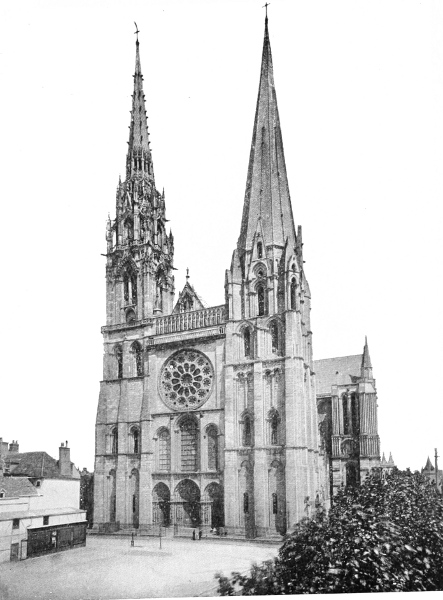
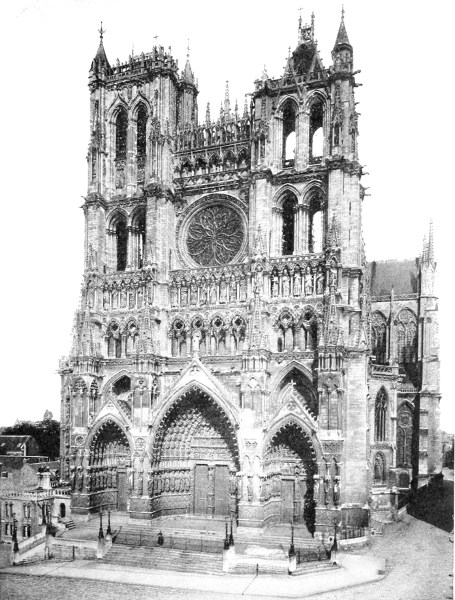
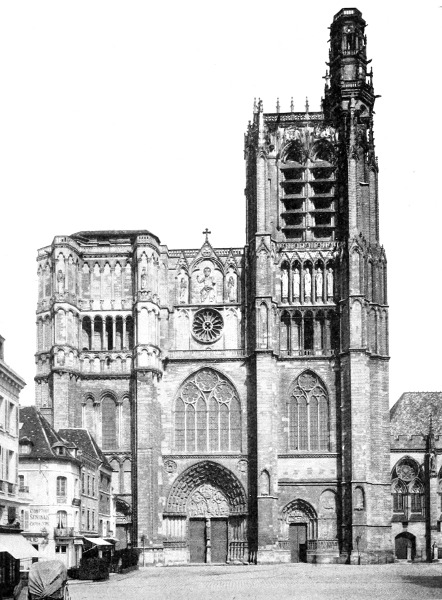
THE CATHEDRAL AT CHARTRES
By permission of Messrs. Neurdein
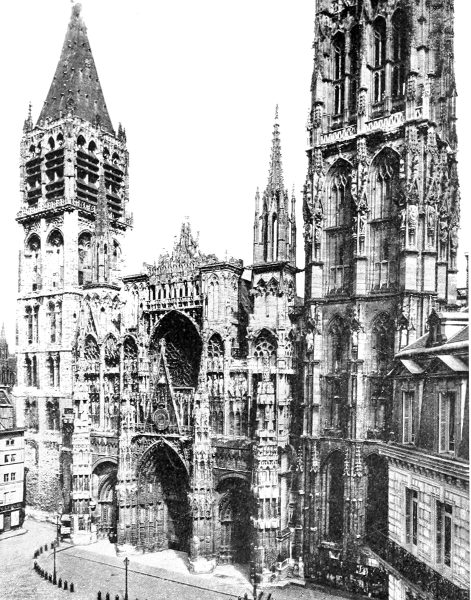
This Cathedral of Notre Dame is considered by
architects to be the most perfect in France. Its
"vast size" is also mentioned. As to the former
opinion, it arises, I think, so far as the exterior
is concerned, from its simplicity of outlines. One
comprehends the whole at a glance, and the eye
is not confused and tired by a vast conglomeration
of styles, as is the case with many churches. If
one were to see this at Chartres first, many of the
other cathedrals would impress one as over-dressed,
so to speak.
As for its size, after the churches of Rouen,
Amiens, and Beauvais, this does not impress me, as
it is on a far smaller scale than any of those edifices.
For instance, the height of the nave is thirty-four
feet less than in the Cathedral of Amiens and forty-seven
less than that of Beauvais. Neither is it
so long or wide as those of Rouen and Amiens.
However, while it is not so vast, it is in its interior
much more impressive than Amiens. Because of
its ancient windows, it holds a "dim religious
light" under its arches soothing to mind and
heart. "Peace, be still," pervades the silence
and follows you as a benediction when you go
hence. But before you go, gaze a while upon the
glory of these windows. Europe holds nothing
like them. They are perfect, and they are eight
hundred years old. Other cathedrals have a few
or a few fragments, here are one hundred and
thirty perfect windows; and from the great rose
circle forty feet in diameter to those surrounding the
aisles, all are full of that beautiful painted glass,
such as we are not able to produce in this latter day.
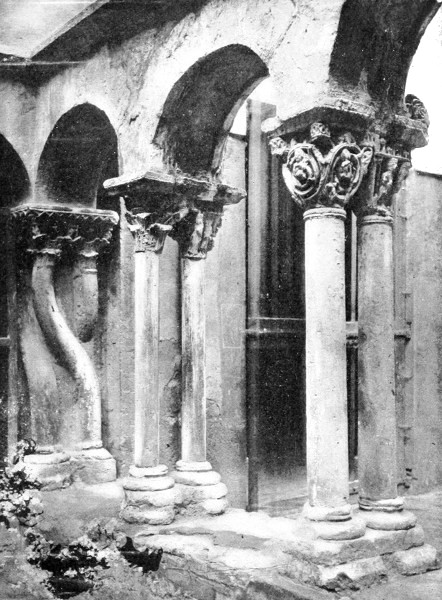
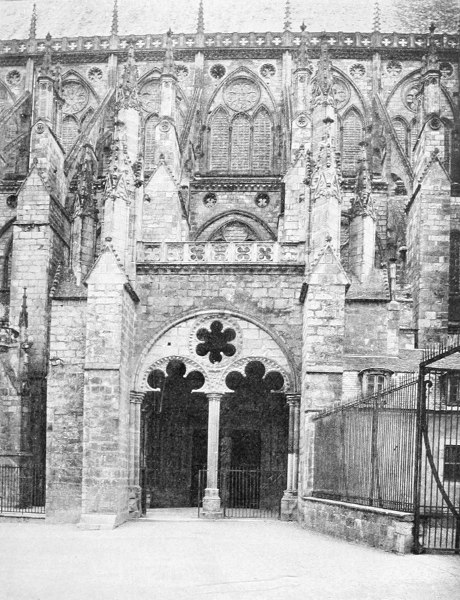
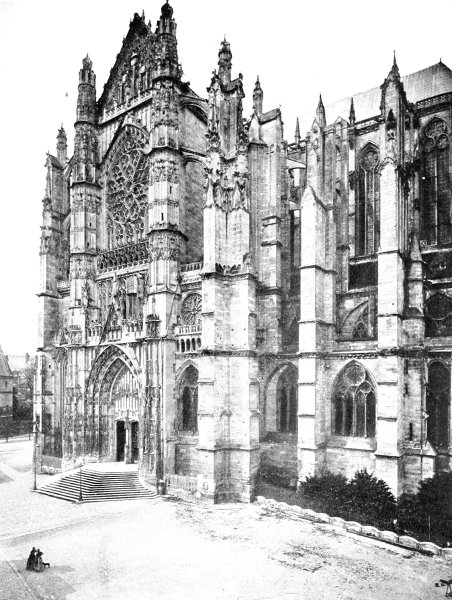
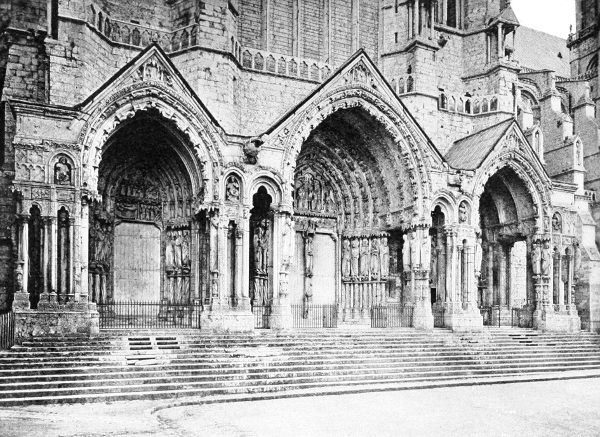
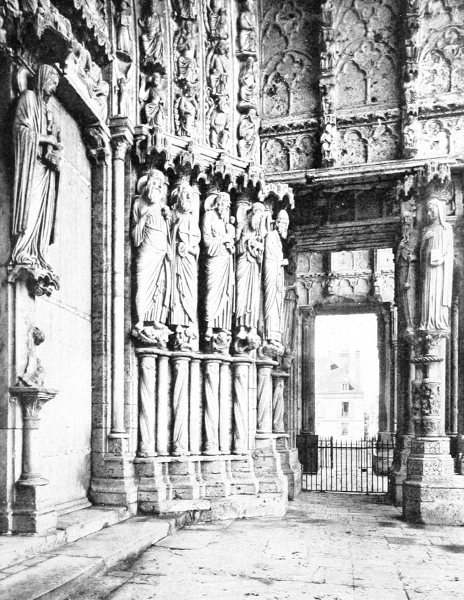
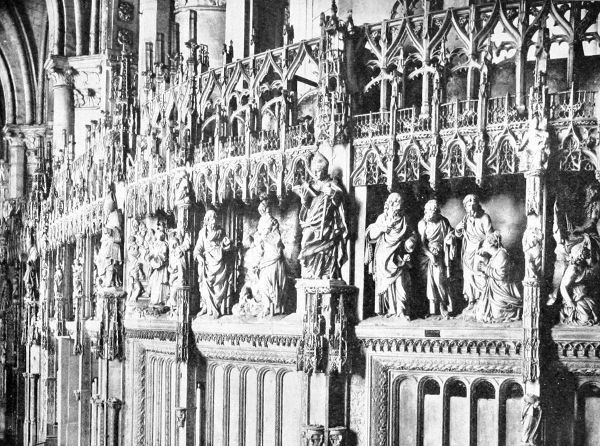
After all, the glory of this Church of our Lady
is in such details as this, and in her exquisite lace-like
carvings in stone, surrounding the outer wall
of the choir. These, together with the Gothic
porticoes on the north and south side, form the
objects of the greatest beauty and interest in
Chartres.
THE NORTH PORTAL OF THE CATHEDRAL AT CHARTRES
By permission of Messrs. Neurdein
THE SOUTH PORTAL OF THE CATHEDRAL AT CHARTRES
By permission of Messrs. Neurdein
STONE CARVINGS SURROUNDING THE CHOIR OF THE CATHEDRAL AT CHARTRES
From a photograph
The cathedral has been the object of vast pilgrimages
because of a sacred image of the Virgin,
which stood in its crypt,—it was destroyed in
1793. Henry IV. was crowned here, and here
one still sees the celebrated black image of the
twelfth century which was crowned with a "bonnet
rouge" during the Terror, but is now restored
to its ancient occupation of receiving the veneration
of the faithful.
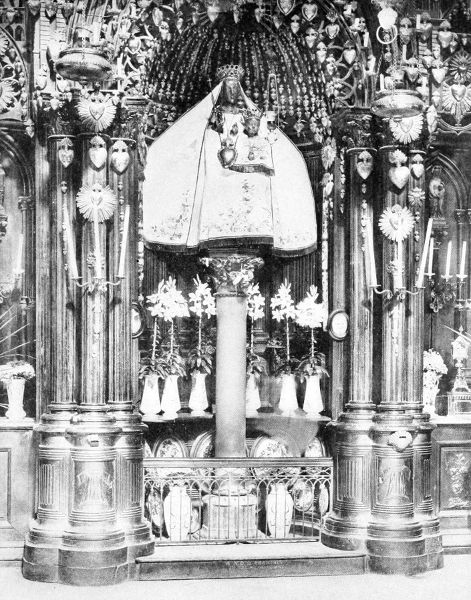
THE VIERGE DU PILIER IN THE CATHEDRAL OF CHARTRES
By permission of Messrs. Neurdein
We were not impressed with the town of Chartres
and so after a good dinner and much whiskey
for the frozen youth of the orchids, we bid it farewell.
While there we met some friends who had
come from Naples in their own car, a new one,
and had spent a thousand dollars for it in tires
alone. It was now on the way to the shops in
Paris, to be "thoroughly overhauled" and it is
not two months old. My red car is not so gorgeous,
but I enter it with every satisfaction, and
my enjoyment of my tour is not rendered any the
less by the knowledge that though I keep it a year
or for ever, I shall have no such items to pay when
it leaves me, nor shall I have an old car on my
hands, and that means much, for the fashions of
these machines change so from year to year that
a "last year's car" is worth little when you try to
sell it. However, as I have stated before, Jean
says that this car is of such sturdy make that
it should last for years with small additional
expense.
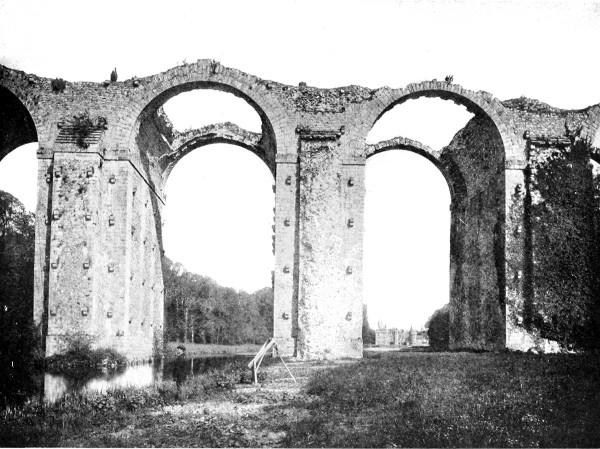
THE VIADUCT OF MAINTENON, NEAR CHARTRES
By permission of Messrs. Neurdein
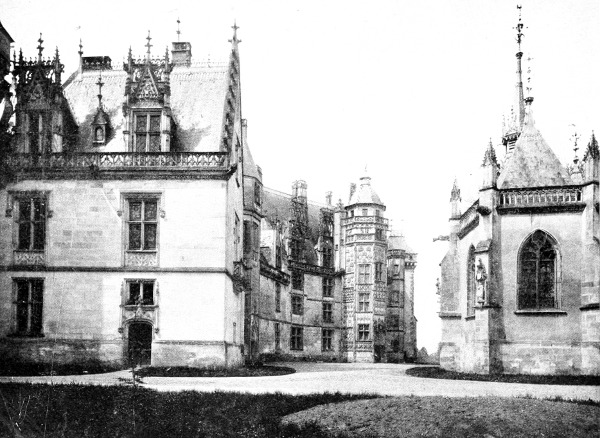
As we near again the aqueduct of Louis XIV.
its arches frame most picturesquely the Château
de Maintenon, which stands some distance beyond
it, on the river's bank. Built by Cocquereau, the
treasurer of Louis XI., the castle was given by
Louis XIV. to de Maintenon, and here in 1685 in
its little chapel, he is supposed to have married
her, though it is generally conceded that that
ceremony occurred at Versailles but that they
came here immediately afterwards. The King
was but forty-seven and she fifty years of age, so
that he lived with her thirty years. She certainly
possessed charms past understanding to have
enchained such a man at that comparatively
youthful age, to have enchained and held him as
she did for thirty years. We picture the widow
Scarron as a pinched-nose, pale-faced woman of
sour expression. She must have been far different
and far more to have held this Louis, who
probably was as nearly natural as it was possible
for him to be, here in these rooms which to-day
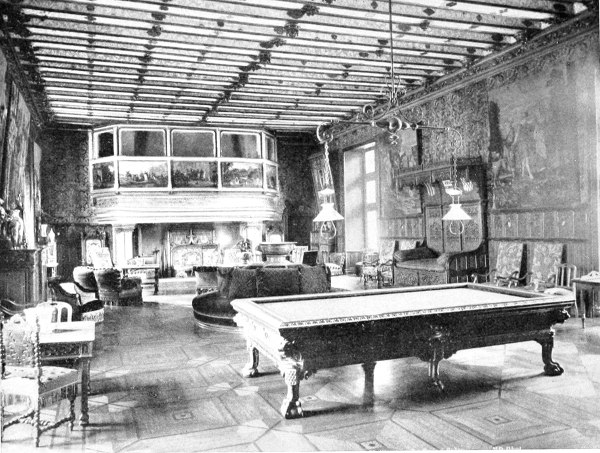
are, so they tell us, as she left them. If so, how
did the Terrorists overlook them? Here is the
sitting-room with its frayed green satin furniture,
and yonder the bedroom and several other apartments.
There was no great state maintained in
Maintenon and I doubt not that the worthy couple
often strolled down the banks of this placid river
to look at the work on yonder aqueduct outlined
against the sky.
The King is described as always majestic, yet
sometimes with gaiety, leaving nothing out of
place or to hazard before the world. Down to
the least gesture, his walk, his bearing, his countenance,
all were measured, decorous, grand and
noble, and always natural, which the unique,
incomparable advantages of his whole appearance
greatly facilitated. In serious affairs, no man
ever was more imposing, and it was necessary to
be accustomed to see him, if, in addressing him
one did not wish to break down. The respect,
which his presence at any place inspired, imposed
silence and even a sort of dread. When the mob
tore him from the tomb at St. Denis they found
a "black mass of spices,"—the man was lost after
death in perfumes, as during life in pride, and his
body was flung, together with all the other royalties
of France, into the great ditch at St. Denis,
and, if the story be true, his heart swallowed by
a canon of Westminster was interred with the
very reverend gentleman in that sacred place.
It probably killed him. Another tale is to the
effect that one Philip Henri Schunck, a royalist
did, in the year 1819 in Paris, make the acquaintance
of an artist named St. Martin, a friend of
one of the officials who superintended the opening
of the royal monuments in the Jesuits' churches.
St. Martin states that he was present on the opening
of several monuments in order to secure the
royal dust to be utilized as "Momie" a valuable
dark brown pigment which was often obtained
from mummy cases and ancient tombs. St.
Martin converted part of the heart of Louis XIV.
to this use but returned the rest together with
the heart of Louis XII., intact to Schunck through
whom they reached St. Denis where they now are.
St. Martin made this surrender during his last
illness—a time when he would scarcely have
perpetrated a practical joke on posterity. At
the opening of the monuments two painters were
present; the other was Droling, and between
them they bought eleven hearts including those
of Anne of Austria, Maria Theresa, Gaston of
Orleans, the regent, and Madame Henrietta and
all were made into "Momie." There is a picture
in the Louvre by Droling—"Intérieur de Cuisine"—whose
rich colours may owe their brilliancy to
these hearts of dead royalties. The heart of Louis
le Grand mashed up by a painter's knife and
spread on canvas—where now is your greatness, O
King? But of all this these murmuring waters
at Maintenon told the anointed of God nothing,
but reflected his image as placidly as they do
ours to-day.
Madame is described as a woman of very stately
elegant figure and bearing. Possessed of infinite
tact she never lost her temper even before de
Montespan had been banished from Court. Nothing
appeared to vex her, and she would smile past
and through all obstacles until she obtained what
she desired. With all, she would appear to have
been an austere woman, caring little for dress or
the pageants of the Court and much for power.
In that, she bore a certain resemblance to Catherine
de Medici. As time wore on, she so influenced
the King that we find the red heels,
diamond buckles, laces and plumes almost all
gone. That she ever loved the man is doubtful,
and she certainly did not forgive his dying reference
to her age, which exceeded his by two
years. Her last words as she deserted him,
which he probably heard—and which she intended
he should hear—were as heartless as only a
woman of that stamp could make them,—"There
lies a man who never loved any one but himself."
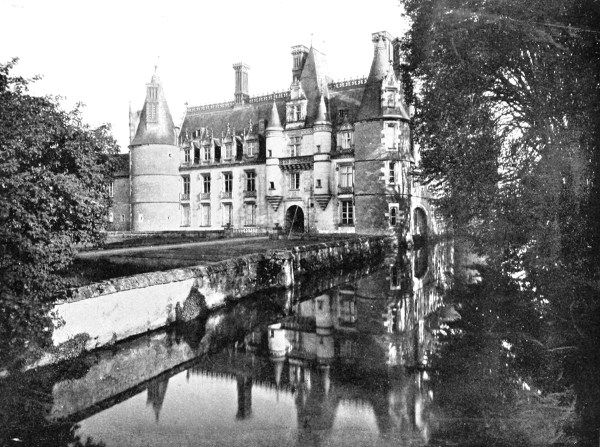
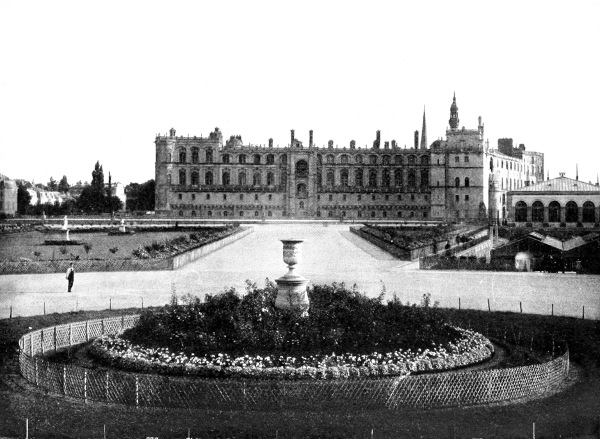
THE CHÂTEAU OF MAINTENON. FROM THE NORTH
By permission of Messrs. Neurdein
To the students of history, Maintenon and its
seclusion would seem a place more to the liking
of its austere mistress than Versailles, and it is
probable that she spent much time in the château.
It may be that here she induced Louis to sign that
revocation of the Edict of Nantes which so affected
the fortunes of our own land, by driving the best
of the population of France down the Rhine valley
and out on to the ocean.
On our return to Paris we pass by St. Cyr, the
immense collection of buildings which Louis built
for Madame as a wedding gift and wherein she
held court at the head of a convent of two hundred
and fifty noble dames.
The place is at present a military school and
we are not permitted to enter, but there is after
all nothing to see save the black marble slab which
covers her tomb. To St. Cyr she came a day before
the king died, leaving him to enter upon the great
hereafter alone. Here she lived the simplest and
most austere of lives and here she ended her days.
A rushing ride through the afternoon brings us
again to Paris, in the twilight and into the
Élysées Palace Hôtel where at least two hundred
of the gayest women of the under world are taking
tea, and I am surprised to find the majority of
them speaking English, many, by their accents,
coming from our own country. It is a strange
sight this; London has some such scenes, but I
know of none in New York, to its credit be it said.[4]
With the auto disappeared also, but into the
subway I think, the youth with the spring suit
and the orchid, both sadly drooping. I believe
he got into a boiling bath and filled up on what
whiskeys and sodas Paris had left, for twenty-four
hours, resting the while at the bottom of a deep,
deep bed.