Larger versions of most illustrations may be seen by right-clicking them
and selecting an option to view them separately, or by double-tapping and/or
stretching them.
The original book did not have a Table of Contents. The one below was
generated automatically during the preparation of this eBook.
Printed in Great Britain by Hazell, Watson & Viney, Ld., London and Aylesbury.
CHAPTER I
It was the mud, I think, that made me take
to flying. I had fully expected that going
into battle would mean for me the saddle of
a galloping charger, instead of the snug little
cock-pit of a modern aeroplane. The mud,
on a certain day in July 1915, changed my
whole career in the war.
We were in England. I had gone over
as an officer of the Missisauga Horse, of
Toronto, a cavalry detachment of the Second
Canadian Division. It had rained for days
in torrents, and there was still a drizzle
coming down as I set out for a tour of the
horse-lines.
Ordinary mud is bad enough, when you
have to make your home in it, but the particular
brand of mud that infests a cavalry
camp has a meanness all its own. Everything
was dank, and slimy, and boggy. I had
succeeded in getting myself mired to the
knees when suddenly, from somewhere out
of the storm, appeared a trim little aeroplane.
It landed hesitatingly in a near-by field
as if scorning to brush its wings against so
sordid a landscape; then away again up
into the clean grey mists.
How long I stood there gazing into the distance
I do not know, but when I turned to
slog my way back through the mud my mind
was made up. I knew there was only one
place to be on such a day—up above the
clouds and in the summer sunshine. I was
going into the battle that way. I was going
to meet the enemy in the air.
I had never given much thought to being
a soldier, even after my parents had sent me
to the Royal Military College at Kingston,
when I was seventeen years of age. I will
say for my parents that they had not thought
much of me as a professional soldier either.
But they did think, for some reason or other,
that a little military discipline at the Royal
Military College would do me a lot of good—and
I suppose it did.
In any event, those three years at the
R.M.C. stood me in good stead when the
rush came in Canada, when everywhere,
everybody was doing his best to get taken
on in some capacity in order to get to the
front quickly.
We Canadians will never forget the thrill
of those first days of the war, and then the
terrible waiting before most of us could get
to the other side. Our great fear was that
the fighting would all be over before we
could give a hand in it. How little we knew
then of the glory that was to be Canada’s
in the story of the Western Front, of the
sacrifices that were to reach to nearly every
fireside in the Dominion!
For many months my bit seemed to consist
of training, more training, delays and
more delays. But at last we got over. We
crossed in an old-time cattle-boat. Oh,
what a trip! Fifteen days to reach England!
We had 700 horses on board, and
700 seasick horses are not the most congenial
steamer company.
We were very proud to be in England.
We felt we were really in the war-zone, and
soon would be in the fighting. But it is a
great mistake to think that when you sail
from America you are going to burst right
up to the front and go over the top at day-break
in the morning. The way to the war
is long. There was more work and more
training for us in England. At first we were
sent to a very sandy camp on the coast, and
from there to a very muddy camp somewhere
else in the British Isles.
It was to this camp that the aeroplane
came that stormy day in July. A week later
my plans were in motion. I met a friend
in the Royal Flying Corps and confided in
him my ambition to fly. He assured me it
would be easy to arrange a transfer, and instructed
me as to what I should do. If I
wanted to get to the front quickly I would
have to go as an observer, meaning that
when I flew over the German lines I would
be the “passenger” in a two-seated plane
and would do just what my title indicated—observe.
If one has a stomach for flying, it doesn’t
take long to become a fairly competent
observer. There are observer schools where
they teach you just what to observe and
what not to observe. This is not a joke.
If an observer lets his gaze wander to too
many non-essentials he cannot do the real
observing that is expected of him.
A few more days of cavalry mud and I
was convinced that to be an observer in the
air was better far than commanding a division
on the ground. So I applied for my
transfer, got it, and went to an observing
school. I loved those first few flights in an
old training “bus.” I don’t think she could
make more than fifty miles an hour; and as
for climbing, she struggled and shook and
gasped like a freight train going up a mountain
grade. But it was thrilling enough for
me in those days, despite the fact that I
soon began to envy the pilot who had all
the fun of running the machine and could
make it do a few lame and decrepit stunts.
After a few months I was graduated as an
observer and was awarded my first insignia
of the Flying Corps—-an O, with one outstretched
wing attached to it, to be worn
on the left breast of the tunic. I was rather
proud of that one wing, but more determined
than ever to win the double wings of a full-fledged
pilot, and some day have a machine
of my own.
In a very short time I was in France and
ready for my first trip over the enemy lines.
As I look back upon it now my life as an
observer seems very tame. The work of
the reconnaissance and artillery machines,
as well as the photography and bombing
planes, is very important. It goes on day
and night, in good weather and bad, but
all the times I was observing I wanted to
be fighting. Whenever I saw one of the
small, swift, single-seater machines, which
were just coming into vogue then for fighting
purposes, my resolves to become a
fighting pilot would grow stronger and
stronger.
But far be it from me to detract one iota
from the work of the observers. They take
enormous risks and seldom get any of the
glory. The men in the Corps recognize and
appreciate the quality of their work, but the
public at large rarely hears of them. The
feats of the fighting planes form the spectacular
and fascinating side of flying, but in
a sense the daily drudgery of the bombers,
the photographers, and the observers is of
even greater value to the fighting men of
the ground.
It is no child’s play to circle above a German
battery observing for half an hour or
more, with your machine tossing about in
air, tortured by exploding shells and black
shrapnel puffballs coming nearer and nearer
to you like the ever-extending finger-tips of
some giant hand of death. But it is just a
part of the never-ceasing war. In the air
service this work is never done. Everywhere
along the line the big guns wait daily for the
wireless touch of aeroplanes to set them
booming at targets carefully selected from
a previous day of observation. Big shells
cannot be wasted. The human effort involved
in creating them and placing them
beside the well-screened guns at the front
is far too great for that.
Every shell must be watched. It is a
startling thing, but true. When we possess
the high ground and the ridges, it is not
always necessary for the aeroplanes or the
balloons to do the observing; the artillery
observing officers can go forward on the
ground and from a convenient tree-top, a
bit of trench, or a sheltering shell-hole see
exactly what his guns are doing.
Every day there are hundreds of photographs
to be taken, so that the British
map-makers can trace each detail of the
German trench positions and can check any
changes in the enemy zone. Information is
to be gained at all times by all manner of
reconnaissances—some of them carrying you
fifty to sixty miles in the enemy country.
Then, there is the fighting patrol work which
goes on all hours. The patrol is not on our
side of the line. It is far over the German
lines to keep the enemy machines from coming
too close even to their own front trenches.
Of course they do slip over occasionally,
but more than often have to pay for their
temerity.
The British infantryman—Mr. Tommy
Atkins—takes it as a personal insult to have
a Hun machine flying over him. It shouldn’t
be done, he says, and he grouses about it for
weeks. How different with the German
infantryman! Our planes are on top of
them most of the time. The Huns used to
write wrathful letters home about it. Sometimes
our infantry has captured these letters
before they were posted, and they used
to amuse us when we got them in the
daily army reports. I remember one particularly
peevish old Boche who wrote last
May:
“The air activity where we are is very
great. The English will soon be taking the
very caps off our heads.”
It is great fun to fly very low along the
German trenches and give them a burst of
machine-gun bullets as a greeting in the
morning, or a good-night salute in the evening.
They don’t like it a bit. But we love
it; we love to see the Kaiser’s proud Prussians
running for cover like so many rats.
Whatever your mission, whether it is
to direct artillery fire, to photograph, to
bomb an ammunition-dump or supply-train,
or just to look old Fritz over and see in a
general way what he is up to, your first
journey into Hunland is a memorable event
in your life. I may say here, in passing,
that in the Flying Corps a German is seldom
anything but a Hun, and the territory back
of his lines is seldom anything but Hunland.
Our general orders tell us to designate a Hun
plane as an “enemy aircraft” in our reports,
or “E. A.” for short, but, nevertheless,
we always think of both the machine and
the pilot as a Hun, and they will ever be.
If it is artillery work you are on, you have
learned to send down signals to your battery
by means of a wireless buzzer, and you are
equipped with intricate zone maps that
enable you to pick out all manner of fixed
objects in the enemy’s domain. You can
locate his dugouts, his dumps, his lines of
communication, his battery positions, his
shelters behind the trees, and, in a general
way, keep tab on his “ways that are dark,
and tricks that are vain.”
The day for your trip over happens to be
one of wondrous sunshine and the clearest
possible visibility. At every aerodrome behind
the long British war-line the aeroplanes
are out of their hangars, and are being tested
with such a babel of noisy explosions that
in moving about with a companion you
have fairly to shout to make yourself heard.
With your pilot you climb into the waiting
two-seater. It has been groomed for the
day and fussed over with as much care as a
mother might bestow upon her only offspring
starting for Sunday school.
“Contact, sir?” questions a mechanic
standing at the propeller.
“Contact,” repeats the pilot.
There is a click of the electric ignition
switch, the propeller is given a sharp swing
over, and the engine starts with a roar. Once
or twice there is a cough, but pretty soon
she is “hitting” just right on every one
of her multiple cylinders. It is all the
mechanics can do to hold her back. Then
the pilot throttles down to a very quiet little
purr and signals to the attendants to draw
away the chocks from under the wheels.
Slowly you move forward under your own
“steam” and “taxi” across the field rather
bumpily, to head her into the wind. This
accomplished, the throttle is opened wide,
you rush forward with increasing speed,
you feel the tail of the machine leave the
ground, and then you go leaping into space.
You climb in great wide circles above the
aerodrome, rig up the wireless, send a few
test signals, get back the correct responses,
and arrange your maps, while the pilot, with
one eye on his instruments and the other
on familiar landmarks, sets sail for the
German lines, gaining height all the while.
On the way to the lines you pass over your
battery and send wireless word that you are
ready to “carry on.” It is to be a day of
“counter-battery” work, which means that
some of our batteries are going to “do in”
some of the Hun batteries. The modern
guns of war are very temperamental and
restless. They get tired of firing at infantry
trenches and roads and things, and more
often go to shooting at each other. In this
you help them all you can.
And now you come to make the acquaintance
of “Archie,” who will pursue you
through all your flying-days at the front.
“Archie” is a presumptuous person and
takes the liberty of speaking first.
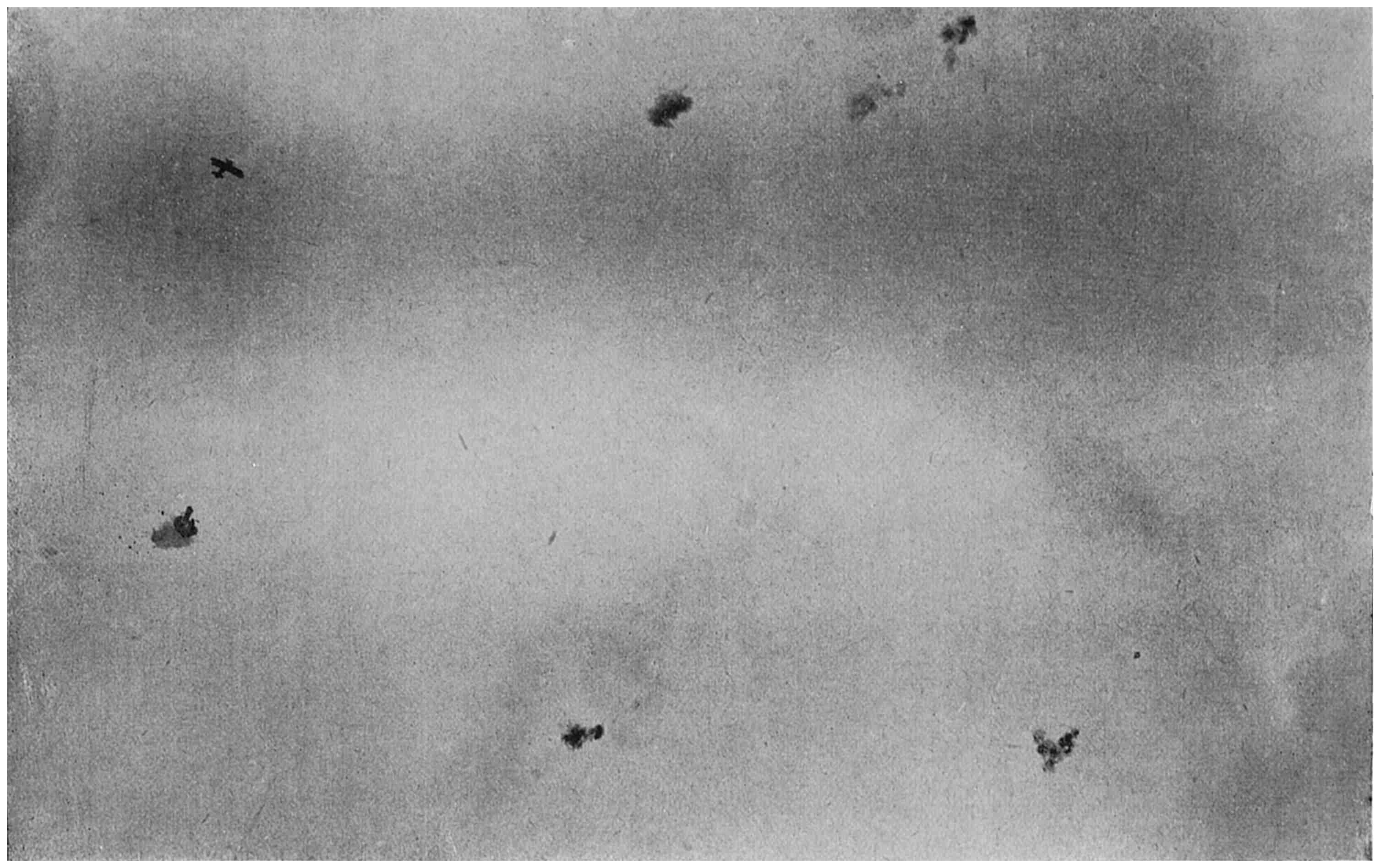
“Woof! Woof!” he barks out. Then—“Hiss-s-s.
Bang! Bang!” Two flashes
of crimson fire, and two swirling patches of
black smoke jump out of the air a hundred
yards or so in front of you.
The experienced pilot swerves a little
neatly and avoids the next volley, which
breaks far to your right. “Archie” keeps
barking at you for quite a while and you
seem to be leaving a perfect trail of the
diffusing black smoke-balls in your wake.
The pilot looks back at you and grins; he
wonders if you have the “wind up”—army
talk for being scared to death. It
isn’t any disgrace to get the “wind up” at
the war, and there are few of us who can
truthfully say we haven’t had a queerish sort
of feeling every now and then.
“Archie,” of course, is an anti-aircraft
cannon. How the airmen first happened to
name him “Archibald” I do not know; it
was when we got to know him better, and
fear him less, that we began to call him
“Archie.” With “Archie” it is the old
story of familiarity breeding contempt, but
of late the German “Archie” family has
multiplied to such an extent as almost to
make it dangerous to go visiting across the
Hun lines. The German shrapnel shells are
nearly always mixed with high-explosive.
They are very noisy, but most of the time
your engine is making such clatter the explosive
efforts to wing you in flight go
entirely unnoticed.
Leaving the border-guarding “Archies”
far behind, you fly on until you pick up the
four mounds that indicate the German battery
position. You fly rather low to get a
good look at it. The Huns generally know
what your coming means and they prepare
to take cover. You return a little way toward
your own lines and signal to your
battery to fire. In a moment you see the
flash of a big gun. Then nothing seems to
happen for an eternity. As a matter of
fact twenty to thirty seconds elapse and
then fifty yards beyond the German battery
you see a spurt of grey-black earth spring
from the ground. You signal a correction
of the range. The next shot goes fifty yards
short. In artillery language you have
“bracketed” your target. You again signal
a correction, giving a range just in between
the first two shots. The next shell that goes
over explodes in a gunpit.
“Good shooting,” you signal to the battery,
“carry on”—particular battery is
silenced for good and all. “Archie” tries
for you again as you return across the lines,
but his range-finding is very bad to-day.
You salute your battery as you sail over,
then land a few minutes later at the aerodrome
well satisfied with your three hours’
work.
You have been to Hunland, and you feel
your career in the air has really begun.
CHAPTER II
Altogether I spent four months in France
as an observer. How I longed during all
that time for a fight in the air! But no real
chances came, and, finally, I quitted my seat
as a passenger without having fired a single
combat shot from the tidy little machine-gun
that was always near me and seemed
to yearn as much as I did to have a go at
the enemy.
I injured my knee after an observing trip
one day, when the pilot crashed the machine
in landing; and while I did not have to go
to hospital with it, it gradually grew worse
until May 1916, when I had to lay up
several months for repairs.
My sick-leave over, I reported for duty
again and got a real surprise—I was told I
could learn to fly! This made me happier
than I can express. I pictured myself in
one of the swift little fighting planes I had
seen in France, and I felt in my heart of
hearts that I would make good. I already
knew what it felt like to fly; I knew the
language of the air, the esprit of the Corps,
and some of the heart-palpitating peculiarities
of our best-balanced engines. But all this
time I had been a sort of innocent bystander.
Now, at last, I was going into the
air “on my own.”
The first step was to go to a school of instruction—a
ground school—where the theory
of flying and the mechanical side of aviation
are expounded to you. I went through
these courses, and by special permission was
allowed to take my examination three weeks
earlier than would have been the case in the
ordinary course of events. I worked like a
Trojan, and passed without much difficulty.
Then was to come the real part of it all, the
part for which I had waited for over a year.
On November 1st, 1916, I was sent to
another school for elementary training in
the air. This consisted, first of all, in going
up in another old machine—a steady type
called the Maurice Farman, and fitted with
a dual set of controls, so that the instructor
could manage one while I tried to manage
the other. Never will I forget those days
of dual control. I tried very hard, but
seemed to me I just could not get the proper
“feel” of the machine. First the instructor
would tell me I was “ham-handed”—that
I gripped the controls too tightly with
every muscle tense. After that I would
get what you might call timid-handed, and
not hold the controls tightly enough. My
instructor and I both suffered tortures.
So when suddenly one day he told me I could
go up alone, I had my doubts as to whether
it was confidence or desperation that dictated
his decision. I didn’t worry long as
to which it was; I was willing to take the
chance.
Then followed my first solo! This is, I
think, the greatest day in a flying man’s
life. Certainly I did not stop talking about
it for the next three weeks at least. I felt
a great and tender pity for all the millions of
people in the world who never have a chance
to do a solo!
An ambulance stood in the aerodrome,
and it seemed to me, as it has to many another
student-pilot, that all the other business
of flying had suddenly ceased so that
everybody could look at me. I noticed with
a shiver that the ambulance had its engine
running. Were the doctors at the hospital
expectantly fondling their knives? Everybody
looked cold-blooded and heartless.
But I had to do it: so into the machine I
crawled, trying to look cheerful, but feeling
awful lonesome. How I got off the ground
I do not know, but once in the air it was not
nearly so bad—not much worse than the
first time you started downhill on an old-fashioned
bicycle.
I wasn’t taking any liberties. I flew as
straight ahead as I could, climbing steadily
all the time. But at last I felt I had to
turn, and I tried a very slow, gradual one,
not wanting to bank either too steeply or
too little. They told me afterwards I did
some remarkable skidding on that turn,
but I was blissfully ignorant of a little detail
like that and went gaily on my way. I
banked a little more on my next turn and
didn’t skid so much.
For a time I felt very much pleased with
myself circling above the aerodrome, but
suddenly an awful thought came to me.
Somehow or other I had to get that machine
down to the earth again. How blissful it
would be if I could just keep on flying! At
last, however, I screwed up all my courage,
reached for the throttle, pushed it back,
and the engine almost stopped. I knew the
next thing to do was to put her nose down.
So down it went at a steep angle. I felt it
was too steep, so I pulled her nose up a bit,
then put it down again, and in a series of
steps I had been told carefully to carry
out, descended toward the ground.
About forty feet from the ground, however,
I did everything I had been told to
do when two feet from the ground. So I
made a perfect landing—only forty feet too
high. Eventually I realised this slight
error, and down went her nose again. We
rapidly got nearer the ground, and then I
repeated my perfect landing—about eight feet
up. This time I just sat and suffered, while
the now thoroughly exasperated old machine,
taking matters into its own hands, dropped
with a “plonk” the intervening distance.
There was no damage, because the training-machines
are built for such work, and can
stand all sorts of hard knocks.
After doing my first solo, I progressed
rather rapidly, and in a few days was passed
on to a higher instruction squadron and
began to fly more warlike machines. I
found that to qualify as a pilot I had to pass
certain tests in night flying. This awed me
to a certain extent, but it also appealed to
me, for just two months before the first
Zeppelins had been brought down at night
on English soil by our airmen. I was very
anxious to get taken on for this work, and
eventually succeeded.
Night-flying is a fearsome thing—but
tremendously interesting. Anyone who has
ever been swimming at night will appreciate
what I mean. All the familiar objects and
landmarks, that seem so friendly by day,
become weird and repellent monsters at
night. It is simple enough to go up in the
dark, and simple enough to sail away. But
it is quite something else to come down
again without taking off a chimney-pot or
“strafing” a big oak tree. The landing
tests are done with the help of flares on the
ground. My first flight at night had most
of the thrills of my first solo. I “taxied”
out to what I thought a good place to takeoff
from. The instructor shouted a few last
words to me above the noise of the motor.
I turned the machine to face down the long
line of lights, opened out the engine, raced
along the ground, then plunged up into utter
blackness.
I held the controls very carefully and kept
my eyes glued on the instruments that
gleamed brightly under little electric bulbs
inside the machine. I could not see a thing
around me; only the stars overhead. Underneath
there was a great black void. After
flying straightway for several minutes I
summoned up courage enough to make a
turn. I carefully and gradually rounded
the corner, and then away off to one side I
could see the flares on the ground. I completed
a big circuit and shut off the engine
preparatory to landing. Suddenly, in the
midst of my descent, I realized I had misjudged
it very badly, so quickly put the
engine on again and proceeded to fly around
a second time. Then I came down, and, to
my intense surprise, made quite a good
landing. This was only the beginning. I
had to repeat the trick several times.
On the final test I had to do a given
height. I left the ground as before, and
just as I did so could see the reflection of
the flares on the tin roofs of our huts. It
made a great impression upon me, as I
climbed away into the darkness. Then my
thoughts went to my engine and I realized
it was as important as my own heart. I
listened to its steady beat with an anxious
ear. Once or twice there was a slight kick
or hitch in its smooth rhythm. No matter
how many cylinders you have whirring in
front of you, the instant one misses your
heart hears it even before your ears do.
Several times my heart seemed to stop.
The tension became very great as I toiled
and struggled up through the night. The
lack of anything upon which I could put my
eyes outside the machine gave me a very
queer feeling.
One other machine was up at the same
time, doing its test, and somehow, although
the space in the air is very wide, I had a
great fear that we might collide, so I gazed
anxiously out into the darkness trying to
see the little navigation lights we carried on
our wings. It is hard to look into jet blackness,
and the strain hurt my eyes, but I was
afraid not to look for all I was worth. I
continued to fly as much as I could in a
dead straight line. Whenever I had to
make a turn I made a very gradual one,
hardly daring to bank, or tilt, my machine
at all. It is funny, this feeling at night
that you must not bank, and a most dangerous
instinct to follow. The feeling that
you are off an even keel upsets you, as you
have no horizon or apparent ground below
you to take your bearings by, and you have
to go by the instruments, or tell from the
“feel” of the machine itself, whether you
are level or not.
However, at the stage of learning I had
reached I knew nothing of the real feel of
a machine and was entirely dependent upon
the instruments. This is not a very reassuring
state of mind, so when the instruments
at last indicated I had attained the required
height, it was with a happy heart that I
throttled back my engine to come down. I
was afraid to shut it completely off for fear
that it would get too cold to pick up when I
put it on again. When you come down
with your engine running it takes a much
longer time to reach the ground. Every
thousand feet or so, as I lost height, I would
carefully try out the engine, and do a complete
circuit. Underneath me I could see
the little twinkling flares, and kept them in
sight as much as possible on the downward
journey to make certain of not losing myself.
Finally, I reached the ground and
made a careful landing.
When I stepped out of the machine I had
at last qualified as a pilot. I was sent to a
home-defence squadron near the mouth of
the Thames. I spent hours practising in the
air both by day and by night. Several times
we had flight manœuvres at night, and that
was ticklish work. We would go up to patrol
a certain area with lights showing on all the
aerodromes in that section of the country,
so that you could steer by them. I don’t
know of many greater tests of a pilot’s skill
than this flying in the dark, with a lot of
machines about you in the air, their little
navigation lights looking for all the world
like so many moving stars. The cold of the
higher altitudes at night is agonizingly intense.
After half an hour or so in the
frigid zone you get sort of numb and then
for a long while the cold doesn’t seem to
affect you any more. The real nasty part is
when you have landed and begin to thaw out.
It is really worse than the original freezing.
In spite of the discomforts and the dangers
of night-flying you could not fail to admire
the great beauty of the scene below you when
the lights were on and sparkling. These
lights would mean nothing to a stranger,
but to us in the air they were friendly
beacons of safety and gave us a feeling of
absolute security. On such nights the skies
would seem full to overflowing with myriad
stars. We finally became so accustomed
to flying in the dark that nothing troubled
us except ground mists or light fogs that
would occasionally slip in from the sea,
obliterate the lights, and make landing a
difficult and perilous task.
My luck as a Zeppelin hunter was very
poor. I used to dream occasionally about
stalking the great monsters in the high thin
air, pouring a drum of blazing bullets into
them and gloating as they flared into flame.
But no real Zeppelins ever came my way.
The cold nights that we stood by on duty
waiting for them were very long, but not
without their compensations. There would
be two of us at a given station. We would
play cards, strum on some sort of instrument,
read for an hour or so, play cards
again, and all the while hoping for an alarm
that would send us aloft in pursuit of a
marauding gasbag from over the sea.
Christmas Day we cooked our own turkey
and the rest of the meal. Then, in a burst
of Yuletide hospitality, we telephoned to
a local hotel and told the manager to send
anybody he wanted to out to the aerodrome
for dinner. Alas for our ten-pound turkey!
The guests from the hotel kept coming
until there were actually twenty of them.
However, in some miraculous way, we managed
to feed the hungry score. Having
partaken of our food, they did not tarry
long. Night shut in early and once more
we took up our wintry vigil.
Toward the end of February word came
through from the War Office one night that
I was to go to France. I had become convinced
that the winter would not offer
much opportunity at Zeppelin hunting, and
had applied several times for duty at the
fighting front. Before I went, however,
there was another course at a special school,
where I learned to fly the smallest of our
single-seater machines. Now, I felt, I had
reached the height of my ambition at last;
actually to fly one of these tiny, wasp-like
fighting machines seemed to me the most
wonderful thing in the world. A few days
later, when I reported for my orders to cross
the Channel it was with a gay heart, and a
determination to reflect as much honour as
I could upon the double wings on my left
breast.
CHAPTER III
With a dozen other flying men I landed at
Boulogne on March 7th, 1917, for my second
go at the war. At the Boulogne quay we
separated, and I wish I could say that
“some flew east and some flew west,” but
as a matter of fact we didn’t fly at all. Instead,
we meandered along over the slow
French railroads for nearly two days before
reaching our destinations.
One other pilot and myself had been
ordered to join a flying squadron on the
southern sector of the British line. The
squadron to which we were assigned had a
great reputation, one of the best in all
France, and we were very proud to become
members of it. Captain Albert Ball, who
was resting in England at the time, but who
came back to France in the late spring and
was killed within a few weeks, had brought
down twenty-nine Hun machines as a
member of “our” squadron. That was
an inspiration in itself.
The first day of my stay with the squadron
there was no flying, and so I wandered about
the field hangars looking at the machines.
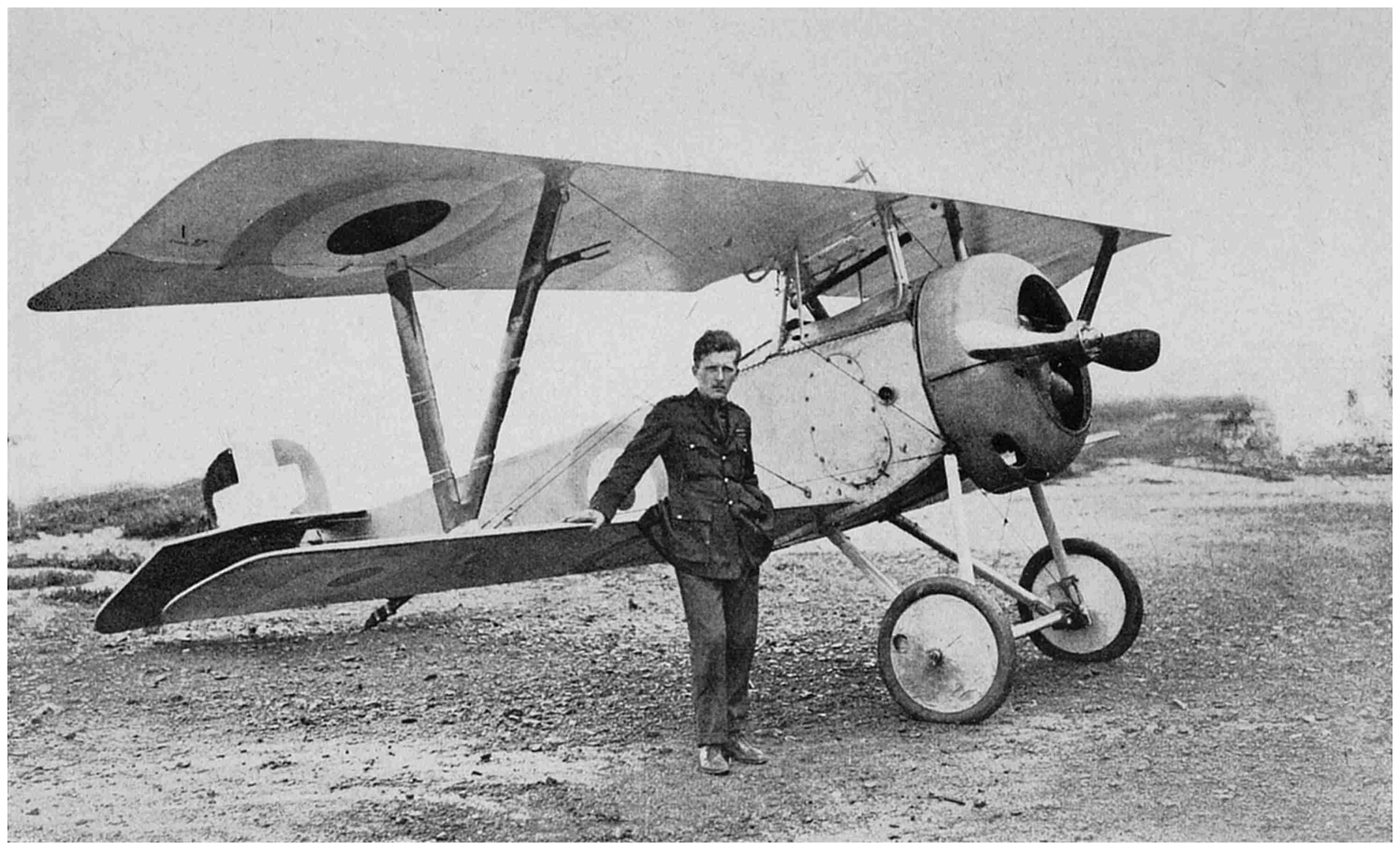
They were all of a type I had never seen
before at close range—Nieuport Scouts,
very small and, of course, with but a single
seat. Being a French model, the Nieuport
Scout is a beautiful creature. The distinctly
British machines—and some of our newer
ones are indeed marvels of the air—are
built strictly for business, with no particular
attention paid to the beauty of
lines. The French, however, never overlook
such things.
The modern fighting scout—and to my
mind the single-seater is the only real aeroplane
for offensive work—may have the
power of 200 horses throbbing in its wonderful
engine. Some of the machines are very
slender of waist and almost transparent of
wing. Aeroplanes do not thrust their warlike
nature upon the casual observer. One
has to look twice before definitely locating
the gun or guns attached so unobtrusively
to the frame-work, and synchronized, where
necessary, to shoot through the whirring
propeller in front. Such guns are connected
to the engine itself by means of cams, and
are so arranged that they can fire only when
the propeller reaches a given position, thus
allowing the bullets to pass safely between
the blades. It seems like a very delicate bit
of timing, but the devices are extremely
simple.
The nacelle, or cock-pit, of the modern
machine, I have heard people say, suggests
to them the pilot-house of a palatial private
yacht in miniature. They generally are
finished in hard wood and there are polished
nickel instruments all about you. They
indicate height, speed, angle, revolutions,
and almost everything an airman ought to
know. There are ingenious sights for the
guns and range-finders for bomb-dropping.
When he is tucked away in the nacelle, a
little well-like compartment, about as big
around as an ordinary barrel, only the pilot’s
head is visible above the freeboard of the
body of the machine—the body being technically
known as the fuselage. Directly in
front of the pilot is a little glass wind-screen,
a sort of half-moon effect.
We newcomers at the squadron—the other
pilot and myself—had to stand by the next
day and watch the patrols leaving to do
their work over the lines. It was thrilling
even to us, accustomed as we were to ordinary
flying, to see the trim little fighters take the
air, one after the other, circle above the
aerodrome, and then, dropping into a fixed
formation, set their courses to the east.
That night we listened with eager ears to
the discussion of a fight in which a whole
patrol had been engaged. We stay-at-homes
had spent the day practice-flying in the new
machines. There were three days more of
this for me, and then, having passed some
standard tests to show my familiarity with
the Nieuport type, I was told the next
morning I was to cross the lines for the first
time as the master of my own machine.
The squadron commander had been killed
the day before I arrived from England, and
the new one arrived the day after. It
rather pleased and in a sense comforted me
to know that the new commander was also
going over in a single-seater for the first time
when I did. He had been flying up to this
time a two-seater machine which calls for
entirely different tactics during a fight. Two-seater
machines, as a rule, have guns that
can be turned about in different positions.
On the fighting scouts they generally are
rigidly fixed. This means that it is necessary
to aim the machine at anything you
wish to fire at.
The night before I was to “go over” I
received my orders. I was to bring up the
rear of a flight of six machines, and I assure
you it was some task bringing up the rear
of that formation. I had my hands full
from the very start. It seemed to me my
machine was slower than the rest, and as I
wasn’t any too well acquainted with it, I
had a great time trying to keep my proper
place, and to keep the others from losing
me. I was so busy at the task of keeping
up that my impressions of outside things
were rather vague. Every time the formation
turned or did anything unexpected, it
took me two or three minutes to get back
in my proper place. But I got back every
time as fast as I could. I felt safe when I
was in the formation and scared when I was
out of it, for I had been warned many times
that it is a fatal mistake to get detached
and become a straggler. And I had heard
of the German “head-hunters,” too. They
are German machines that fly very high
and avoid combat with anything like an
equal number, but are quick to pounce down
upon a straggler, or an Allied machine that
has been damaged and is bravely struggling
to get home. Fine sportsmanship, that!
The way I clung to my companions that
day reminded me of some little child hanging
to its mother’s skirts while crossing a
crowded street. I remember I also felt like
a child does when it is going up a dark pair
of stairs, and is sure something is going to
reach out of somewhere and grab it. I was
so intent on the clinging part that I paid
very little attention to anything else.
We climbed to a height of more than two
miles on our side of the lines, then crossed
them. There were other formations of
machines in the air, patrolling at various
places. I could see them in the distance,
but for the life of me I could not tell whether
they were friendly or hostile. On the chance
that they might be the latter, I clung closer
than ever to my comrades. Then, a long
way off, I was conscious that a fight was
going on between a patrol of our machines
and a Hun formation. I could make little
of it all until finally I saw what seemed like
a dark ball of smoke falling, and learned
afterwards it was one of our own machines
going down in flames, having been shot and
set on fire by the enemy airmen.
A few minutes after this my attention was
attracted elsewhere. Our old friends the
“Archies” were after us. It is no snug
billet, this being in the rear of a formation
when the “Archies” are giving a show.
They always seem to aim at the leading
machine, but come closer to hitting the one
at the end of the procession. The first shot
I heard fired was a terrific “bang” close
to my ears. I felt the tail of my machine
suddenly shoot up into the air, and I fell
about 300 feet before I managed completely
to recover control. That shot, strange to
relate, was the closest I have ever had from
anti-aircraft fire. The smoke from the exploding
shell enveloped me. But close as
it was, only one piece of the flying steel fragments
hit my machine. Even that did no
damage at all.
After recovering control I looked about
hastily for the rest of my formation, and
discovered that by now they were at least
half a mile away, and somewhat higher than
I was. Terrified at being left alone, I put
my engine on full and, by taking a short cut,
managed to catch up with them. Much
relieved, I fell in under the formation, feeling
safe again, and not so alone in the world.
We continued to patrol our beat, and I
was keeping my place so well I began to look
about a bit. After one of these gazing
spells, I was startled to discover that the
three leading machines of our formation were
missing. Apparently they had disappeared
into nothingness. I looked around hastily,
and then discovered them underneath me,
diving rapidly. I didn’t know just what
they were diving at, but I dived, too. Long
before I got down to them, however, they
had been in a short engagement half a mile
below me, and had succeeded in frightening
off an enemy artillery machine which had
been doing wireless observation work. It
was a large white German two-seater, and
I learned after we landed that it was a well-known
machine and was commonly called
“the flying pig.” Our patrol leader had
to put up with a lot of teasing that night
because he had attacked the “pig.” It
seems that it worked every day on this part
of the front, was very old, had a very bad
pilot, and a very poor observer to protect
him.
It was a sort of point of honour in the
squadron that the decrepit old “pig” should
not actually be shot down. It was considered
fair sport, however, to frighten it.
Whenever our machines approached, the
“pig” would begin a series of clumsy turns
and ludicrous manœuvres, and would open
a frightened fire from ridiculously long
ranges. The observer was a very bad shot
and never succeeded in hitting any of our
machines, so attacking this particular German
was always regarded more as a joke
than a serious part of warfare. The idea
was only to frighten the “pig,” but our
patrol leader had made such a determined
dash at him the first day we went over, that
he never appeared again. For months the
patrol leader was chided for playing such
a nasty trick upon a harmless old man.
During my dive after the three forward
machines, I managed to lose them and the
enemy machine as well. So I turned and
went up again, where I found two of my
companions. We flew around looking for
the others, but could not find them, so continued
the patrol until our time was up and
then returned to the aerodrome. The missing
ones arrived about the same time and
reported they had had a great many fights,
but no decisive ones.
About this time the Germans were beginning
in earnest their famous retreat from the
country of the Somme. There had been
days upon days of heavy fogs and flying had
been impossible. A few machines went up
from time to time, but could see nothing.
The wily old Hun had counted upon these
thick days to shield his well-laid plans, and
made the most of them. Finally, there came
a strong breeze from the south-west that
swept the fog away and cleared the ground
of all mist and haze. This was on that wonderfully
clear March day just before the Germans
evacuated Bapaume and left it a mass
of ruins. We were early in the air, and had
no sooner reached our proper height to cross
the lines than we could see something extraordinary
was happening behind the German
trenches. From 15,000 feet we could see for
miles and miles around. The ground was a
beautiful green and brown, and slightly to
the south we could see the shell-pitted battlefields
of the Somme, each shell-hole with
glistening water in it.
A few miles to the east there were long
streaks of white smoke. Soon we realized
that the Germans had set fire to scores of
villages behind their front. From where we
flew we could see between fifty and sixty of
them ablaze. The long smoke-plumes blowing
away to the north-east made one of the
most beautiful ground-pictures I have ever
seen from an aeroplane, but at the same time
I was enraged beyond words. It had affected
every pilot in the patrol the same way. We
flew up and down over this burning country
for two hours hunting, and wishing for German
machines to come up and fight, but
none appeared. We returned at last to the
aerodrome and told what we had seen during
our patrol, but news of the fires had long
since been reported by the airmen whose
duty it is to look out for such things, and
our General Staff at once had surmised the
full import of what was happening.
The next week was full of exciting adventures.
For days the clouds hung at very
low altitudes, seldom being higher than
4,000 feet, and of course it was necessary for
us to fly underneath them. At times during
the famous retreat it was hard to tell just
where the Germans were and where they
were not. It was comparatively easy for
the soldiers on the ground to keep in touch
with the German rearguard by outpost fighting,
but it was for us to keep tabs on the
main bodies of troops. We would fly over
a sector of country from east to west and
mark down on our maps the points from
which we were fired at. It was easy to
know the Germans were at those particular
points. This was very tense and exciting
work, flying along very low and waiting
each second to hear the rattle of machine
guns or the crack of a shell. We were flaunting
ourselves as much as possible over the
German lines in order to draw their fire.
CHAPTER IV
On March 25th came my first real fight in
the air, and, as luck would have it, my first
victory. The German retreat was continuing.
Four of us were detailed to invade the
enemy country, to fly low over the trenches,
and in general to see what the Boche troops
were doing and where they were located.
Those were very queer days. For a time
it seemed that both armies—German and
British alike—had simply dissolved. Skirmishes
were the order of the day on the
ground and in the air. The grim, fixed lines
of battle had vanished for the time being,
and the Germans were falling back to their
famous Hindenburg positions.
The clouds had been hanging low as usual,
but after we had gotten well in advance of
our old lines and into what had been so
recently Hunland, the weather suddenly
cleared. So we began to climb to more
comfortable altitudes and finally reached
about 9,000 feet. We flew about for a long
while without seeing anything, and then
from the corner of my eye I spied what I
believed to be three enemy machines. They
were some distance to the east of us, and
evidently were on patrol duty to prevent
any of our pilots or observers getting too
near the rapidly changing German positions.
The three strange machines approached us,
but our leader continued to fly straight
ahead without altering his course in the
slightest degree. Soon there was no longer
any doubt as to the identity of the three aircraft—they
were Huns, with the big, distinguishing
black iron crosses on their planes.
They evidently were trying to surprise us,
and we allowed them to approach, trying
all the time to appear as if we had not seen
them.
Like nearly all other pilots who come face
to face with a Hun in the air for the first
time, I could hardly realize that these were
real, live, hostile machines. I was fascinated
by them and wanted to circle about
and have a good look at them. The
German Albatross machines are perfect
beauties to look upon. Their swept-back
planes give them more of a birdlike appearance
than any other machines flying on the
western front. Their splendid, graceful
lines lend to them an effect of power and
flying ability far beyond what they really
possess. After your first few experiences
with enemy machines at fairly close quarters
you have very little trouble distinguishing
them in the future. You learn to sense
their presence, and to know their nationality
long before you can make out the crosses
on the planes.
Finally, the three enemy machines got
behind us, and we slowed down so that they
would overtake us all the sooner. When
they had approached to about 400 yards, we
opened out our engines and turned. One
of the other pilots, as well as myself, had
never been in a fight before, and we were
naturally slower to act than the other two.
My first real impression of the engagement
was that one of the enemy machines dived
down, then suddenly came up again and began
to shoot at one of our people from the rear.
I had a quick impulse and followed it. I
flew straight at the attacking machine from
a position where he could not see me and
opened fire. My “tracer” bullets—bullets
that show a spark and a thin little trail of
smoke as they speed through the air—began
at once to hit the enemy machine. A moment
later the Hun turned over on his back and
seemed to fall out of control. This was just
at the time that the Germans were doing
some of their famous falling stunts. Their
machines seemed to be built to stand extraordinary
strains in that respect. They would
go spinning down from great heights, and just
when you thought they were sure to crash,
they would suddenly come under control,
flatten out into correct flying position, and
streak for the rear of their lines with every
ounce of horse-power imprisoned in their
engines.
When my man fell from his upside-down
position into a spinning nose-dive, I dived
after him. Down he went for a full thousand
feet and then regained control. I had
forgotten caution and everything else in my
wild and overwhelming desire to destroy this
thing that for the time being represented all
of Germany to me. I could not have been
more than forty yards behind the Hun when
he flattened out, and again I opened fire. It
made my heart leap to see my smoking bullets
hitting the machine just where the closely
hooded pilot was sitting. Again the Hun
went into a dive and shot away from me
vertically toward the earth.
Suspecting another ruse, and still unmindful
of what might be happening to my companions
in their set-to with the other Huns,
I went into a wild dive after my particular
opponent with my engine full on. With a
machine capable of doing 110 to 120 miles
an hour on the level, I must have attained
180 to 200 miles in that wrathful plunge.
Meteor-like as was my descent, however, the
Hun seemed to be falling faster still and got
farther and farther away from me. When
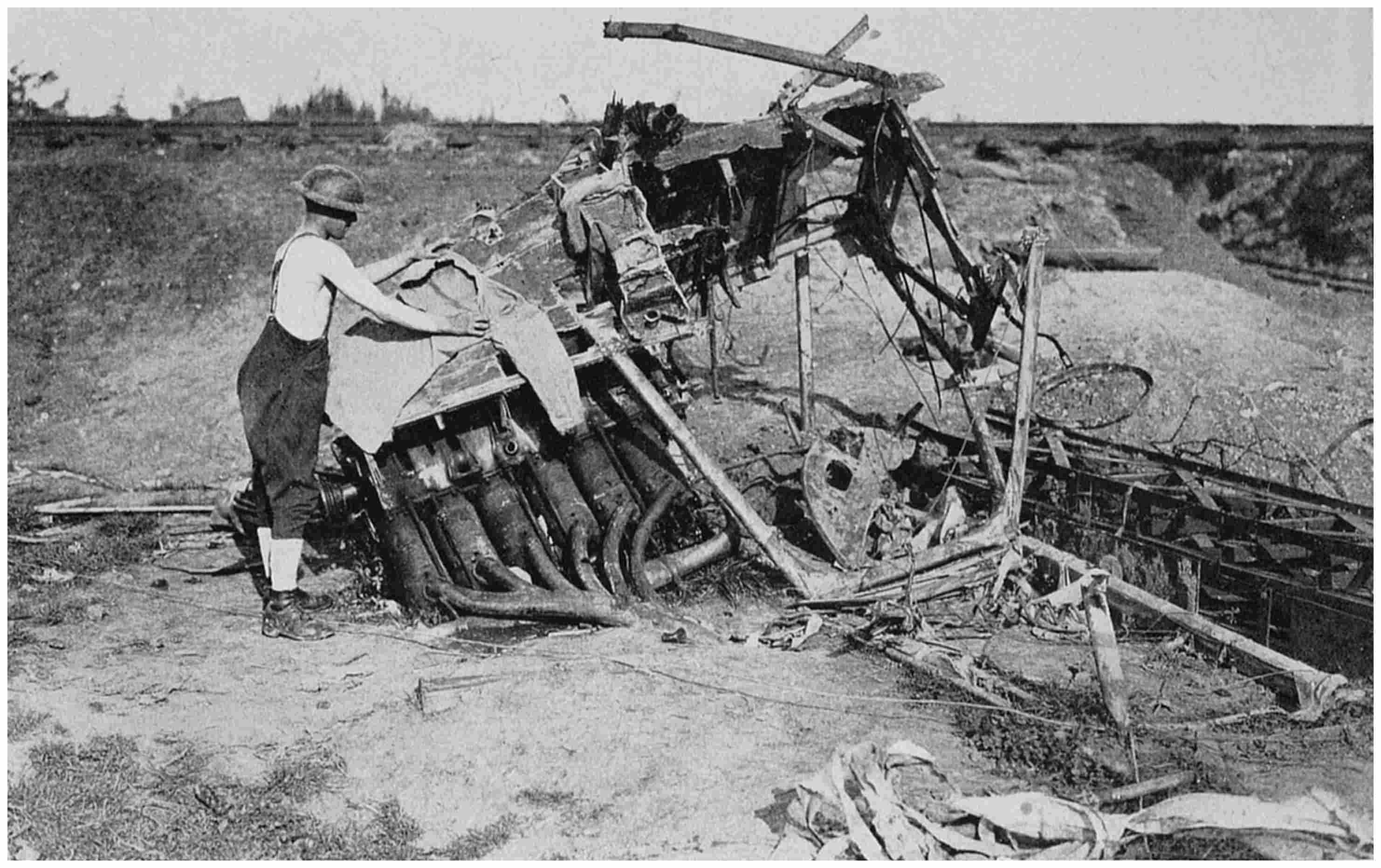
I was still about 1,500 feet up, he crashed
into the ground below me. For a long time
I had heard pilots speaking of “crashing”
enemy machines, but I never fully appreciated
the full significance of “crashed”
until now. There is no other word for it.
I have not to this day fully analysed my
feelings in those moments of my first victory.
I don’t think I fully realized what it all
meant. When I pulled my machine out of
its own somewhat dangerous dive, I suddenly
became conscious of the fact that I had not
the slightest idea in the world where I was.
I had lost all sense of direction and distance;
nothing had mattered to me except the
shooting down of that enemy scout with the
big black crosses that I shall never forget.
Now I began to fear that I was well within
the enemy country and that it was up to me
to find some way of getting home. Then, to
my dismay, I discovered that during our
long dive my engine had filled up with
lubricating oil and had stopped dead still.
I tried every little trick I knew to coax a
fresh start, but it was no use. I had no
choice. I must land in the country directly
beneath me, be it hostile or friendly. I
turned in what seemed to me by instinct to
be the way toward our own lines, and glided
as far as I could without any help from the
engine.
I saw beneath me a destroyed village, and
my heart sank. I must be behind the German
lines. Was my real flying career, just
begun, to be ended so soon? Was I to suffer
the fate the flying man most abhors—the
helpless descent in Hunland and the meek
submission to being taken prisoner? A
hundred thoughts were racing through my
head, but in a moment they were dispersed.
It was that always ghastly rattle of a machine
gun, firing at me from the ground. This
left no doubt but that I was over enemy
territory. I continued to glide, listlessly,
toward the ground, not caring much now
what the machine gun might do. My
plight couldn’t be much worse. I was convinced,
in fact, that it couldn’t possibly be
worse. Mechanically, little realizing just
what I was doing, but all the time following
that first great instinct of self-preservation,
I remember carefully picking out a clear
path in the rough terrain beneath me, and
making a last turn, I glided into it and
landed.
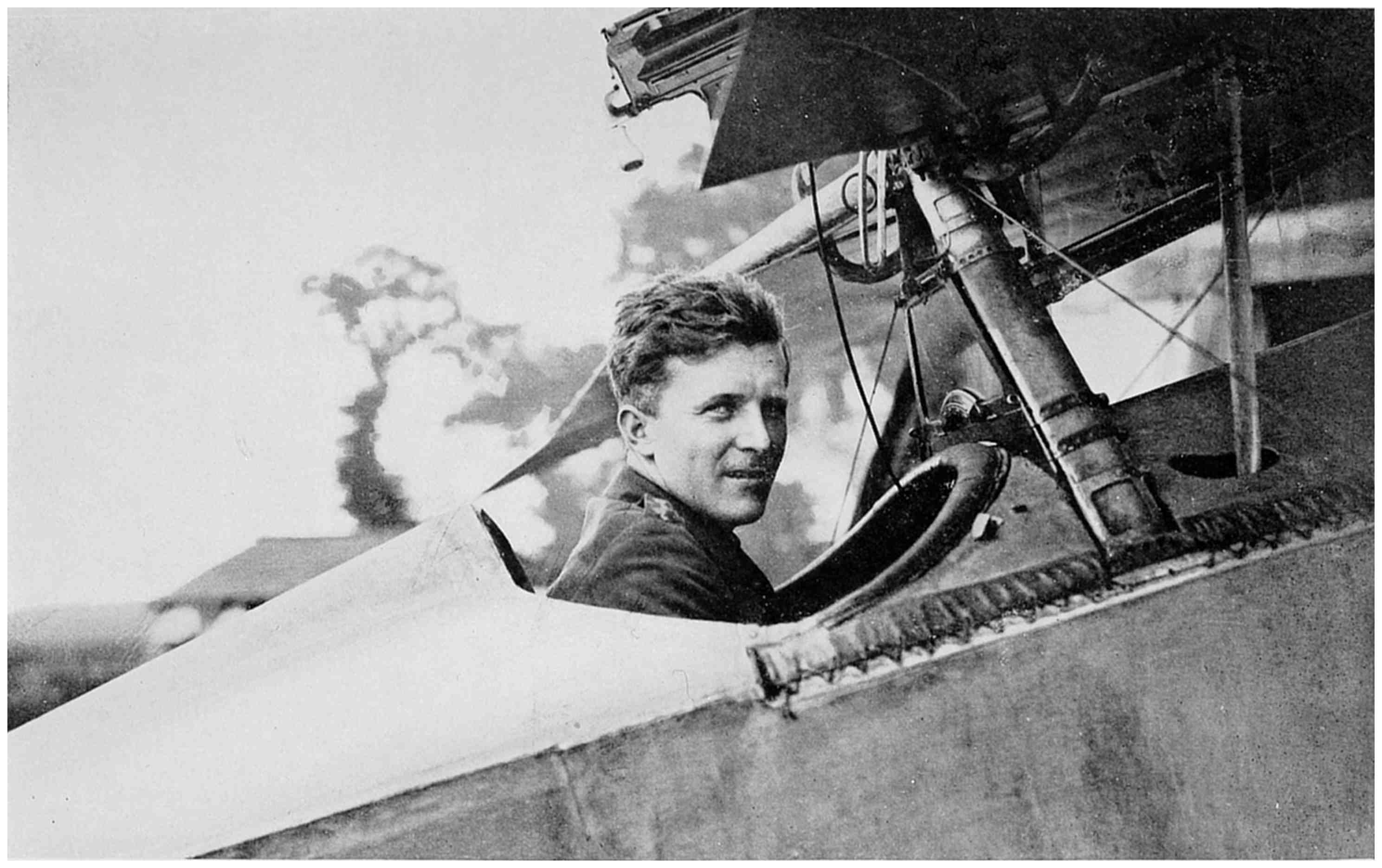
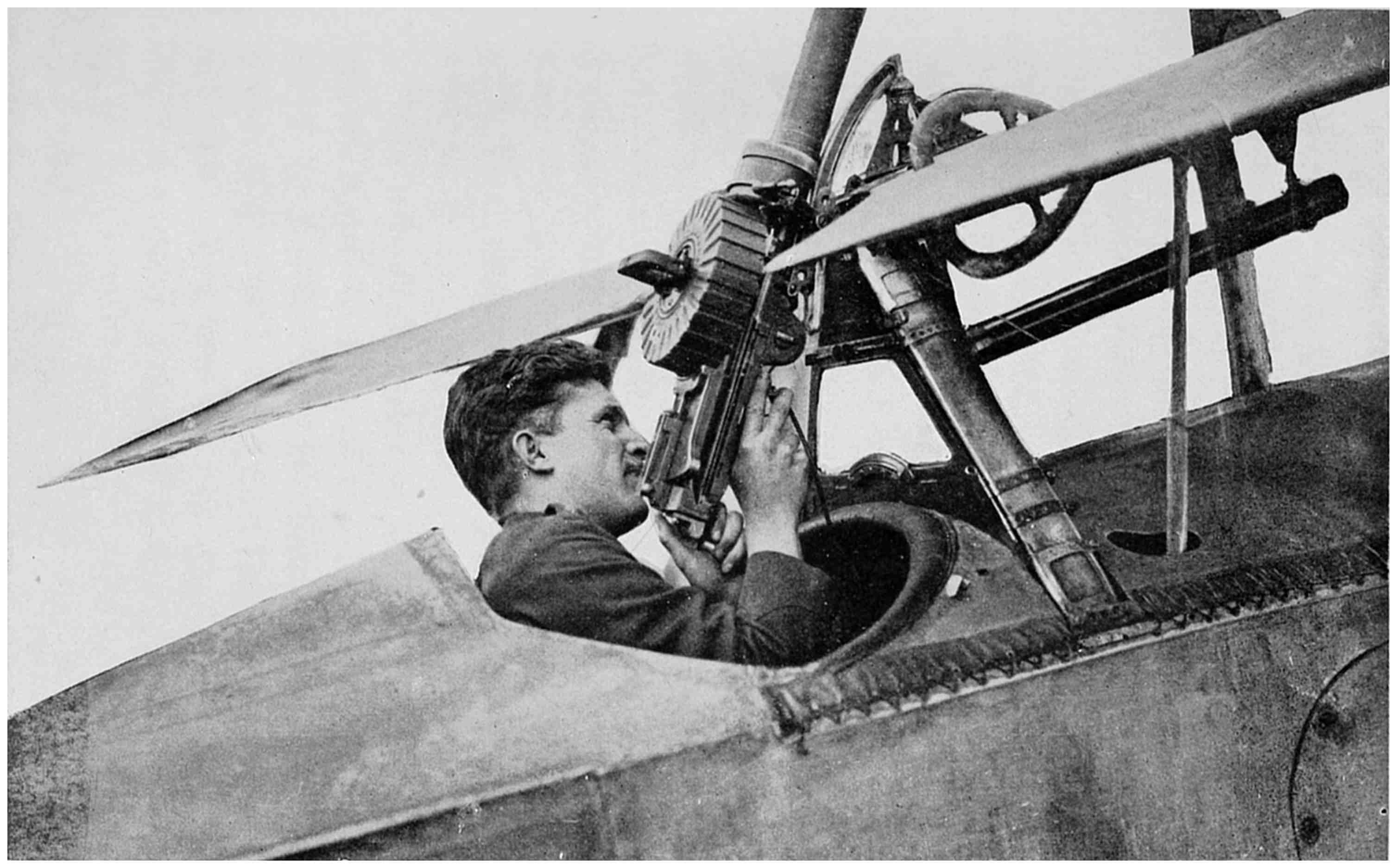
Canadian Official Photograph
Pilot’s Seat of Nieuport Scout.
Some hostile spirit within me made me
seize the rocket pistol we used to fire signals
with in the air—“Very” lights, they are
called. What I expected to do with such
an impotent weapon of offence or defence, I
don’t know, but it gave me a sort of armed
feeling as I jumped out of the machine. I
ran to a near-by ditch, following the irresistible
battlefield impulse to “take cover.”
I lay for some time in the ditch waiting—waiting
for my fate, whatever it was to be.
Then I saw some people crawling toward
me. They were anxious moments, and I
had to rub my eyes two or three times before
finally convincing myself that the oncoming
uniforms were of muddy-brown and homely,
if you will, but to me that day, khaki was
the most wonderful, the most inspiring, the
most soul-satisfying colour scheme ever beheld
by the eyes of man. In an instant my
whole life-outlook changed; literally it
seemed to me that by some miracle I had
come back from the land of the “missing.”
The British “Tommies” had seen me
land and had bravely crawled out to help
me. They told me I had just barely crossed
over into our own country; the last 150
yards of my glide had landed me clear of
the Germans. The soldiers also said we had
better try to move the machine, as the Germans
could see it from the hill opposite and
would be sure to shell it in a very little while.
With the help of several other men from
a field artillery battery we hauled the
machine into a little valley just before the
German shells began to arrive. One dropped
with a noisy bang some 200 yards away
from us, and I fell flat on my stomach. I
hadn’t seen much land fighting up to this
time, but I had been told that that was the
proper thing to do. The Tommies, however,
looked at me with amazement. The idea of
anybody dropping for a shell 200 yards
away! They told me there was nothing to
worry about for the moment, and added,
cheerfully, that in a few minutes the Huns
would be doing a little better shooting.
But I had my own back with the Tommies
sooner than I could ever have hoped for.
This time a shell landed about twenty yards
from us, and down went everybody but me.
I stood up—out of sheer ignorance! I didn’t
know by the sound of the shell how close it
was going to land, but the others did and
acted accordingly. The joke of the whole
thing was that the shell was a “dud.” It
didn’t explode, and I had the laugh on the
wise artillerymen.
Eventually we got the machine behind a
clump of trees where the Germans couldn’t
see it, and they decided to waste no more
ammunition hunting us out. Although it
was already 6 o’clock in the evening, I
started to work on the engine, but after an
hour and a half had not succeeded in getting
a single cough out of any one of the many
cylinders. So I decided to let matters rest
and accept a very cordial invitation to spend
the night with a battery near by.
It would have been a very interesting
night indeed if I could have had some real
place to sleep, or if I had not been wearing
loose, heavy flying-clothes, with fleece-lined
boots up to my hips, or if it had not commenced
to rain about 9 o’clock, or if in the
middle of the night a heavy artillery battle
had not started. But in spite of the discomfort
and the drizzle it was all very interesting
and exciting, and seemed to me a
sort of fitting sequel to my wonderful first
day of combat in the air.
The next day it continued to rain, and as
I received no word from my squadron in
answer to several telegrams, I borrowed
some tools from the gunners and again got
to work on my choked-up engines. Within
a few hours she was running beautifully.
Now the problem was to find a place from
which to fly off. The ground was rough and
very muddy, but I decided to try to “taxi”
over it. We had not bumped very far alone,
however, the machine and I, when a big
piece of mud flew up and split the propeller.
That ended it. There was nothing to do but
wait for help to come from the squadron.
It came the next afternoon, after I had spent
a terrible night trying to get to the squadron,
and rescue parties from the squadron had
spent an equally terrible night trying to get
to me. I had landed at a point which had
been well behind the German lines a few days
ago, where the roads had been mined and
blocked in all manner of ways, and where
the German spirit of wanton destruction had
held high carnival. I had even tried to get
through in a Ford, but it was no use.
It was about 3 o’clock the second afternoon
after I landed that one of the rescue
parties arrived. They had travelled about
90 miles to get to me, although the aerodrome
was only 15 miles away. By the
third afternoon we had succeeded in taking
my machine to pieces, and having safely
loaded it into a motor lorry, began our return
journey about 7 o’clock in the evening. We
arrived at the aerodrome at 6.30 the next
morning. I slept part of the way, but
never was so worn out and tired in all my
life, for many times during the night it was
necessary to get out and help our car out
of the mud. Finally, when about six miles
from the aerodrome, we went into a mud-hole
and stuck. It was absolutely impossible
to move in any direction, so with one
of the men I set out afoot to an aerodrome
about three miles away. There I pulled
some sleepy mechanics out of bed and got
them to drive me to my own aerodrome a
little farther along.
Now for the first time I learned exactly
what had happened in the fight on the 25th.
The patrol leader had also destroyed one of
the enemy machines, while the third Hun
had escaped. All of us were perfectly safe
and none of our machines damaged except
my own, which showed a few tears from shell
fragments.
It seemed to me it had been ages since the
fight. But at last I was back among my
companions—and I had the large total of one
machine to my credit. There were fellows
in the squadron who did not have any,
however, and I was very proud—so proud
and excited over the whole episode that,
despite my intense weariness, I couldn’t go
to sleep until late in the afternoon.
CHAPTER V
The fates had been so kind to me in my first
fight in the air, that the next time I crossed
the lines my squadron commander had designated
me as patrol leader. I knew this
was a difficult job, but it was not until after
we started out that I knew how difficult.
First of all, I seemed to be leading too fast;
then the pace would become too slow. Some
of the machines seemed too close to me,
and some too far away. I wondered why
it was that everyone should be flying so
badly to-day except myself. As a matter
of fact, if I had been leading properly, the
other machines would have found it quite
easy to keep in their assigned places.
However, one learns by experience, so at
the end of two hours I was leading much
better, and had progressed another step in
the school of war-flying. The clouds were
very thick this day and rolled under us at
times in great cumulus masses. We caught
only occasional glimpses of the ground
through rifts in the clouds a mile or more
apart. It was necessary to watch very
closely through these holes and to recognize
familiar places on the ground, otherwise we
were likely to get lost and never see home
again. When our two hours’ tour of duty
aloft was ended, though, we landed safely at
the aerodrome without having seen any
enemy machines.
Two days later my patrol engaged in one
of the bitterest fights I have ever known.
I knew that night the full meaning of that
last line so often seen in the British official
communiqué: “One of our machines did
not return.” A second machine barely
reached our lines, with the pilot so badly
wounded he lived but a little while.
The patrol consisted of a flight of six
machines. I led my companions up to
12,000 feet before heading across the trenches
just south of Arras. Once over the lines, we
turned to the north, not penetrating very
far into Hunland because of the strong wind
that was blowing about fifty miles an hour
from the west. These westerly gales were
one of the worst things we had to contend
with at the front. They made it very easy
for us to dash into enemy territory, but it
was a very different story when we started
for home and had to combat the tempest.
If an airman ever wishes for a favouring wind,
it is when he is streaking for home.
Seeing the modern war-aeroplanes riding
through howling storms reminds one that
it was not so long ago that a ten-mile breeze
would upset all flying-plans for a day at any
aerodrome or exhibition field. Now nothing
short of a hurricane can keep the machines
on the ground. As far as the ability to make
good weather of it is concerned, the airman
of to-day can laugh at a gale and fairly take
a nap sitting on a forty-mile wind.
We had been over the lines twenty minutes,
and were tossing about a bit in the
storm, when I sighted an enemy machine
flying about half a mile below me. He was
scudding gracefully along just over the top
of a layer of filmy white clouds. I signalled
to the remainder of my patrol that I had
sighted an enemy, and in another instant I
was diving after him. As I sped downward
I could see the remainder of the patrol
coming after me. I must have been plunging
fully 150 miles an hour at the German with
the black crosses on his wings, when suddenly
out of the clouds, and seemingly right
under my nose, a second enemy machine
appeared. I realized now that we were in
for serious fighting, that we had run into an
ambuscade, for it was a great trick of the
Germans at this time to lurk behind patches
of clouds to obtain the advantage of a
surprise attack. We soon taught them,
however, that this was a game at which
two could play.
When the second machine loomed so suddenly
from his hiding-place, I naturally transferred
my attention to him. I closed to
within 150 yards and then opened fire from
directly behind. Nothing happened, however,
for all my bullets seemed to be going
far wide of their mark. I was frankly surprised
at this and wondered what had
happened to the marksmanship which had
stood me in such good stead in my first fight.
As a result of these thoughts I neglected to
look behind me to see if the other machines
of the patrol were following, and my first
intimation that anything was wrong was
the sound of machine guns firing from somewhere
in the rear. I was about to turn my
head to see if it was one of the patrol firing,
when some flaming German bullets shot
past between my left-hand planes. Then I
realized that a third enemy machine had
gotten on my tail and had a dead shot at
me. There was but one way to get out of
this, and I tried it. I pulled my machine
right up into the air and turned over backward
in a partial loop. As I did so the
enemy machine flashed by underneath.
It was a narrow escape, but it gave me a
breathing-spell in which to look around for
the remainder of my patrol. They were nowhere
to be seen. Later I learned that when
they were coming down to me, more enemy
machines had popped out of the clouds, and
there had been a sort of general mêlée. The
machine which got on my tail seemed to
have dropped out of the clear sky above.
In all, it turned out, there were about ten of
the enemy to six of us.
It was my luck to be mixed up single-handed
with three of the Huns. Under the
circumstances, wisdom seemed to me the
better part of valour, and I climbed as
speedily as I could, eventually managing to
get clear of their range. Then, looking
around, I saw a fight going on about a mile
farther east. It was a matter of thirty
seconds to fly into this, and there I found two
of my machines in a go at four or five of
the enemy. We fought for fifteen minutes
or more without either side gaining an advantage.
During all this time, however,
we were steadily being driven by the gale
farther and farther into German territory,
and were rapidly losing height as well. We
figured at this time we must be fully fifteen
miles behind the Hun lines.
We had circled and dived and fought our
way down to about 4,000 feet when suddenly
about half a mile away I saw one of
our patrol fighting for his life with two of
the enemy. I broke off the futile engagement
we were in and flew to the lone pilot’s
assistance. The other two of my pilots also
broke away from the Germans and followed
me as I headed over to help him. At the
same moment he succeeded in escaping from
the two attacking Huns, and we joined up
again in a formation of four machines. At
this time we were as low as 2,500 feet, but
by careful flying and using the clouds to
hide in, we managed to evade all the enemy
flyers who came swirling after us.
The moment we headed for home, however,
all the “Archies” in the neighbourhood
opened fire on us. We were flying straight
into the teeth of the fifty-mile gale and were
making very little headway against it. This
slow pace made us an easy mark for the
guns, and meant that we had to do a lot
of dodging. We darted from one cloud
to another, using them as much as possible
for protection. It was again the old
instinct of “taking cover” or “digging
in.”
Reaching the aerodrome, we were very
much crestfallen. The battle had not been
a success, and two of our patrol, two of our
most intimate friends, had not returned.
Later that night, about 11 o’clock, we had
word that one of the missing machines had
landed on our side of the lines with the pilot
badly wounded. Next morning we heard
the particulars of a wonderful piece of work
done by this gallant boy. He was only
eighteen, and had been in France but three
weeks. The British Flying Corps is filled
with boys of that age—with spirits of daring
beyond all compare, and courage so self-effacing
as to be a continual inspiration to
their older brothers in the service.
In the early part of the fight this boy
had been hit by an explosive bullet, which,
entering him from behind, had pierced his
stomach and exploded there. His machine
had been pretty badly shot about, the engine
damaged, and, therefore, a great resulting
loss in efficiency. Mortally wounded as he
was, however, he fought for ten or fifteen
minutes with his opponents and then succeeded
in escaping. Dazed from pain and
loss of blood, he flew vaguely in a westerly
direction. He had no idea where he was,
but when the anti-aircraft guns ceased to
fire, he glided down and landed in a field.
Stepping out of his machine, he attempted
to walk, but had moved scarcely forty steps
when he fell in a faint. He was hurried to
hospital and given the tenderest of care,
but next morning he died, leaving behind
a brave record for his brief career in the
flying service.
The pilot who did not return was reported
missing for about two months, and
then we heard he had been killed outright,
shot dead in the air. Upon looking back
on this fight now, in the light of my later
experience, I wonder that any of us got out
of it alive. Every circumstance was against
us, and the formation we ran into was made
up of the best Hun pilots then in the air.
They fought under as favourable conditions
as they could have wished, and one can
only wonder how they missed completely
wiping us out.
Next day there were only four of us left
in my patrol, but we were assigned to escort
and protect six other machines that were
going over to get photographs of some German
positions about ten miles behind the
front-line trenches. I had my patrol flying
about a thousand feet above the photography
machines when I saw six enemy single-seater
scouts climbing to swoop down upon
our photography machines. At the same
time there were two other enemy machines
coming from above to engage us.
Diving toward the photography machines,
I managed to frighten off two of the Boches;
then, looking back, I saw one of my pilots
being attacked by one of the two higher
Germans who had made for us. This boy,
who is now a prisoner of war, had been a
school-mate of mine before the war. Forgetting
everything else, I turned back to his
assistance. The Hun who was after him did
not see me coming. I did not fire until I
had approached within 100 yards. Then I
let go. The Hun was evidently surprised.
He turned and saw me, but it was too late
now. I was on his tail—just above and a
little behind him—and at fifty yards I fired
a second burst of twenty rounds. This time
I saw the bullets going home. As was the
case with the first machine I brought
down, this one also flopped over on its
back, then got into a spin, and went headlong
to the earth, where it crashed a hopeless
wreck.
I rejoined the photography machines, which
unfortunately in the meantime had lost one
of their number. We brought the five home
safely, and the photographs were a huge
success.
CHAPTER VI
It was a German boast at this time that
their retreat from the Somme had upset
the offensive plans of the British and French
for months to come. How untrue this was
they were soon to know. We Canadians
knew that the first big “push” of the spring
was to come at Vimy Ridge, where the Canadian
Corps had been holding the line grimly
the entire winter through. It had been a
trying ordeal for our men, who were almost
at the foot of the ridge with the Germans
everywhere above them.
During all the long cold months of winter
the old Boche had been looking down on us,
pelting the infantry in the trenches with all
manner of bombs and trench-mortar shells,
and making life generally uncomfortable.
During all this time, however, and in spite
of the fact that the Germans had direct
observation both of our lines and the country
behind them, we had succeeded in massing
a hitherto unheard-of number of guns
and great forces of reserves for the initial
attack of the new fighting season.
About April 1st we heard the first rumours
of the approaching storm. The British artillery
was tuning up all along the line, the
greatest fire being concentrated in the neighbourhood
of Arras and the Vimy Ridge,
running north from that quaint old cathedral
city. It was the beginning of that great
tumult of artillery which eventually was to
practically blow the top off the ridge—and
the Germans with it. Our machines had
been operating with the guns, ranging them
on the German lines and the villages where
the enemy troops were quartered in the rear.
There had been much careful “registering”
also of the German battery positions, so
that when the time came for our troops to
“go over,” the British and Canadian artillery
could pour such a torrent of shells on
the German guns as to keep them safely
silent during the infantry attack.
At last came the orders for our part in
another phase of the “show.” It was up
to us to “clear the air” during the last
days of battle preparation. We did not
want any more prying eyes looking down
upon us from the clouds—it was bad enough
to have to submit to the ground-observation
from the German-held ridges. We were
already accustomed to fighting the enemy
aeroplanes over their own ground and thus
keeping them as far as possible from our
lines, but now we were assigned to a new
job. It was attacking the enemy observation
balloons. They flew in the same places
almost every day—well back of the enemy
lines; but the observers in them, equipped
with splendid telescopes, could leisurely look
far into our lines and note everything that
was going on. We proposed to put out these
enemy eyes.
We called the big, elongated gasbags
“sausages” and the French did likewise—“saucisses.”
They floated in the air at
anywhere from 800 to 3,000 feet above the
ground, and were held captive by cables.
These cables were attached to some special
kind of windlasses which could pull the
balloons down in an incredibly short space
of time. Sometimes they would disappear
as if by witchcraft. Wherever the sausages
flew they were protected from aeroplane
attack by heavy batteries of anti-aircraft
guns, and also by what we came to know as
“flaming onions.” These “flaming onions”
appear to consist of about ten balls of fire,
and are shot from some kind of rocket gun.
You can see them coming all the way from
the ground, and they travel just too fast to
make it possible to dodge them. I have
never had an “onion” nearer than 200 feet
of me, but the effect of these balls of fire
reaching for you is most terrifying, especially
the first time you have the pleasure of
making their acquaintance.
Our instructions were not only to drive
the enemy balloons down, but to set fire to
and destroy them. This is done by diving
on them from above and firing some incendiary
missile at them—not by dropping
bombs on them, as one so often hears in
London.
The British attack at Arras and Vimy
was set for April 9th—Easter Monday. On
April 5th we started after the sausages. The
weather at this time was very changeable,
chilling snow-squalls being intermingled with
flashes of brilliant warm sunshine. It was
cloudy and misty the day our balloon attacks
began, and the sausages were not
visible from our side of the lines. I was
assigned to “do in” a particularly annoying
sausage that used to fly persistently in the
same place day after day. It was one of the
sausages with a queer-shaped head, looking
for all the world like a real flying pig—sans
feet. Any new sort of hunting always appealed
to me strongly, and I was eager for
the chase when I crossed into enemy territory
in search of my particular game. I
flew expectantly in the direction where the
balloon usually inhabited the air, but it was
nowhere to be seen. I circled down close to
the ground to be sure it was not on duty,
and immediately found myself in the midst
of a terrific fire from all manner of guns.
Something told me to hurry away from
there, and I did. The quickest shelter available
was a rather dark and forbidding cloud,
but I made for it with all my might, climbing
as fast as my little single-seater would
take me. What a relief it was to be lost in
that friendly mist. Continuing to climb, I
rose at last into the sunshine and then
headed for home. My balloon had not been
up, but my first experience as a sausage
hunter had not been the pleasantest form
of amusement, and I was inclined not to
like it very much. Later on I met with
some success against the balloons; but the
sport, while exciting, was not to be compared
with another aeroplane.
The weather cleared late in the afternoon
of the 5th, and for the first time in my flying
career I had the privilege of going out alone
in search of a fight. There was not an
enemy machine in the air, however, and I
returned with nothing to report.
Next morning, bright and early, I was
again out “on my own” in search of adventure.
I had been flying over the lines for
over half an hour when suddenly I spied an
enemy machine about a mile over in Hunland,
and some distance above me. In these
days I no longer had any misgivings as to
whether a machine was friend or foe—I had
learned to sense the enemy. Our greatest
difficulty at the time was drawing the Huns
into a close combat. I set out to see what
sort of fighting material this particular pilot
of the Iron Crosses was made of. Keeping
him always within view, I climbed to nearly
15,000 feet, and from that point of vantage
dived upon him. I waited until my plunge
had carried me to within 150 yards of him
before opening fire. I had gotten in a burst
of probably twenty rounds, when my gun
jammed. The Hun saw me and dived away
as fast as he could go. I dived after him,
tinkering with the gun all the time, and,
finally getting it clear, fired another burst at
100 yards. This drove him into a still deeper
dive, but he flattened out again, and this
time I gave him a burst at 50 yards. His
machine evidently was damaged by my fire,
for he now dived vertically toward the
ground, keeping control, however, and landing
safely in a field.
This fight gave me a new resolve—to devote
more time to target practice. I should
have destroyed this Hun, but poor shooting
had enabled him to escape. Going home, I
spent an hour that day practising at a
square target on the ground. Thereafter I
gave as much time as possible to shooting
practice, and to the accuracy I acquired in
this way I feel I owe most of my successes.
Aeroplane target practice is not without its
dangers. The target on the ground is just
about the size of the vital spots you aim at
in fighting. You have to dive steeply at
this, and there is very little margin of safety
when plunging at full speed to within a few
feet of the earth.
April 6th and 7th were memorable days
in the Flying Corps. The public, knowing
nothing of the approaching attack which was
to go down in history as the Battle of Arras,
was distinctly shocked when the British
communiqués for these two days frankly
admitted the loss of twenty-eight of our
machines. We considered this a small price
to pay for the amount of work accomplished
and the number of machines engaged, coupled
with the fact that all of our work was done
within the German lines. In the two days
that we lost twenty-eight machines, we had
accounted for fifteen Germans, who were
actually seen to crash, and thirty-one driven
down damaged, many of which must have
met a similar fate. The British do not
officially announce a hostile machine destroyed
without strict verification. When
you are fighting a formation of twenty or
more Huns in a general mêlée, and one
begins a downward spin, there is seldom
time to disengage yourself and watch the
machine complete its fatal plunge. You
may be morally certain the Hun was entirely
out of control and nothing could save him,
but unless someone saw the crash, credit is
given only for a machine driven down. The
Royal Air Force is absolutely unperturbed
when its losses on any one day exceed those
of the enemy, for we philosophically regard
this as the penalty necessarily entailed by
our acting always on the offensive in the
air.
Technically, the Germans seldom gave a
machine “missing,” for the fighting is practically
always over their territory, and every
one of their machines driven down can
be accounted for, even if it is totally destroyed.
Many of our losses are due wholly
to the fact that we have to “carry on” over
German territory. Any slight accident or
injury that compels a descent in Hunland
naturally means the total loss of the British
machine. But such a loss does not involve
a German victory in combat; it is merely
a misfortune for us. If the machine could
only have reached our side of the lines it
might have been repaired in half an hour.
The public often forgets these things when
reading of British machines that fail to return.
Every class of our machines was now engaged
in the preparations for the big offensive.
The bombing squadrons were out by
day and by night. They would fly over the
lines with only the stars to guide them and
drop tons of high-explosive wherever it was
considered that the resulting damage would
have a crippling effect upon the defensive
power of the German machine. Our photographers
were busy during every hour of
sunlight, and our artillery observing machines
were keeping long hours in company with
the guns, carrying on the preliminary bombardments.
My own experiences on April 7th brought
me my first decoration—the Military Cross.
The thrills were all condensed into a period
of two minutes for me. In that time I was
fortunate enough to shoot down an enemy
machine and destroy the “sausage” I had
started for two days before. This should
have been excitement enough, but I added
to it by coming within 15 feet of being taken
a German prisoner and becoming an unwilling
guest of the Huns for the “duration.”
I was ordered after my particular balloon
and had climbed to about 5,000 feet before
heading for the lines. On my way there I
had to pass over one of our own observation-balloons.
I don’t know what it was that
attracted my attention, but, looking down,
I saw what appeared to be two men descending
in parachutes. A moment later the
balloon below me burst into flames. I saw
the enemy machine which had set it on fire
engaged with some of ours, but as I had
definite orders to proceed straight to the lines
and destroy the hostile balloon which had
been allotted to me, I was unable to join in
the fighting.
Just about this time an amusing incident
was in progress at our aerodrome. A Colonel
of the Corps was telephoning my squadron
commander, informing him that one of our
balloons had just been destroyed.
“Well, if it is any consolation, young
Bishop, of my squadron, has just gone over
to get one of theirs,” replied my commander.
“Good God,” said the Colonel, “I hope
he has not made a mistake in balloon and
set ours on fire!”
At this moment I was serenely sailing over
the enemy trenches, keeping a sharp look-out
for some sign of my own balloon. After
flying five miles over the lines, I discovered
it and circled around as a preliminary to
diving down upon it. But just then I heard
the rattle of machine guns directly behind
me and saw bullet-holes appear as if by
magic in the wings of my machine. I pulled
back as if to loop, sending the nose of my
machine straight up into the air. As I did
so the enemy scout shot by underneath me.
I stood on my tail for a moment or two, then
let the machine drop back, put her nose
down, and dived after the Hun, opening fire
straight behind him at very close range. He
continued to dive away with increasing
speed, and later was reported to have crashed
just under where the combat had taken place.
This victory I put down entirely to luck.
The man flew directly in line with my gun
and it would have been impossible to have
missed him.
I proceeded now to dive for the balloon,
but having had so much warning, it had
been pulled down to the ground. I would
have been justified in going home when I
saw this, for our orders were not to go
under 1,000 feet after the sausages. But I
was just a bit peevish with this particular
balloon, and to a certain extent my blood
was up. So I decided to attack the ungainly
monster in its “bed.” I dived
straight for it and when about 500 feet from
the ground, opened fire. Nothing happened.
So I continued to dive and fire rapid bursts
until I was only 50 feet above the bag. Still
there were no signs of it catching fire. I
then turned my machine gun on the balloon
crew, who were working frantically on the
ground. They scattered and ran all about
the field. Meantime a “flaming onion”
battery was attempting to pelt me with
those unsavoury missiles, so I whirled upon
them with a burst of twenty rounds or more.
One of the onions had flared within a hundred
yards of me.
This was all very exciting, but suddenly,
with a feeling of faintness, I realized that
my engine had failed. I thought that again,
as during my first fight, the engine had
oiled up from the steep diving I had done.
It seemed but a moment before that I was
coming down at a speed that must have been
nearly 200 miles an hour. But I had lost
it all in turning my machine upon the people
on the ground.
There was no doubt in my mind this time
as to just where I was, and there appeared
no alternative but to land and give myself
up. Underneath me was a large open field
with a single tree in it. I glided down, intending
to strike the tree with one wing just
at the moment of landing, thus damaging
the machine so it would be of little use to
the Huns, without injuring myself.
I was within 15 feet of the ground, absolutely
sick at heart with the uselessness of
it all, my thoughts having turned to home
and the worry they would all feel when I
was reported in the list of the missing, when,
without warning, one of my nine cylinders
gave a kick. Then a second one miraculously
came to life, and in another moment the old
engine—the best old engine in all the world—had
picked up with a roar on all the
nine cylinders. Once again the whole world
changed for me. In less time than it takes
to tell it, I was tearing away for home at a
hundred miles an hour. My greatest safety
from attack now lay in keeping close to the
ground, and this I did. The “Archies”
cannot fire when you are so close to earth,
and few pilots would have risked a dive at
me at the altitude which I maintained.
The machine guns on the ground rattled
rather spitefully several times, but worried
me not at all. I had had my narrow squeak
for this day, and nothing could stop me now.
I even had time to glance back over my
shoulder, and there, to my great joy, I saw
a cloud of smoke and flames rising from my
erstwhile bête noir—the sausage. We afterward
learned it was completely destroyed.
It was a strange thing to be skimming
along just above the ground in enemy territory.
From time to time I would come on
groups of Huns who would attempt to fire
on me with rifles and pistols, but I would
dart at them and they would immediately
scatter and run for cover. I flew so low
that when I would come to a clump of trees
I would have to pull my nose straight up
toward the sky and “zoom” over them.
Most of the Germans were so startled to see
me right in their midst, as it were, they
either forgot to fire or fired so badly as to
insure my absolute safety. Crossing the
three lines of German trenches was not so
comfortable, but by zigzagging and quick
dodging I negotiated them safely and climbed
away to our aerodrome. There I found that
no bullets had passed very close to me,
although my wing-tips were fairly perforated.
That evening I was delighted to get congratulations
not only from my Colonel, but
from my Brigadier as well, supplemented
later by a wire from the General Commanding
the Flying Corps. This I proudly
sent home the same evening in a letter.
CHAPTER VII
Easter Sunday was one of the most beautiful
days I have ever seen, and we felt that
at last the gods of the weather were going
to smile on a British offensive. The sky was
a wonderful blue, flecked only here and
there with bits of floating white clouds.
There was a warmth of spring in the sunshine
that filled one with the joy of living.
Hundreds of our machines were aloft to
demonstrate anew the fact that we were
masters of the air. They carried the fighting
wholly into the enemy’s territory, sought
out his aerodromes, his military headquarters,
his ammunition dumps, his concentration
camps, and challenged him in every possible
manner to come up and fight. Some of our
reconnaissance machines flew from sixty to
ninety miles behind the German lines.
It used to amuse and amaze me to think,
on days like this, of the marvels that modern
flying had accomplished. Our machines were
not only called upon to fly faster by far than
the swiftest birds, but to do “stunts” that
no bird ever thought of. Whoever heard of
a bird flying upside-down? Yet there were
plenty of our pilots who rather delighted in
doing this. There are trick flyers just as
there are trick bicyclists and trick riders in
the circus. I belonged to the steady flyers’
class, but some day soon I am really going
to learn to fly, to do aerial acrobatics, and
everything. I remember crossing the lines
one day in the hottest sort of “Archie”
fire and suddenly seeing below me one of the
most remarkable sights of my flying-career.
The shape of the machine looked a little
familiar, and the colour was certainly familiar.
But there was something queer about the
rigging. My curiosity was aroused, and in
spite of the whistling “Archie” shells I
determined to have a nearer look at this
stranger of the air. As I approached I made
out something that looked like wheels stuck
up toward the sky. I was more puzzled than
ever for a moment, then realized it was a
machine upside-down. The wing-tips bore
the red, white, and blue target markings of
the British service, so I flew very close to
see if anything was wrong. When I got
near enough I recognized my squadron commander
at the time. He was out having
an afternoon stroll and had deliberately
sailed over the lines upside-down, just to
show his contempt for the Hun “Archies,”
and also in the hope that he might attract
the attention of a “head-hunter,” and thus
bring on a little excitement.
With the great attack scheduled for dawn
the next morning, we went at our work on
Easter Sunday with an added zest. At 9
o’clock, just after the early-morning mist
had been driven away by the mounting sun,
I was due for an offensive patrol—in other
words, there were six of us going over the
lines in search of trouble. Our squadron
commander was in the flight, and he had
been leading us inside Hunland for about
twenty minutes before anything happened.
Then a two-seated machine, with the enemy
markings on it, appeared underneath us.
Our commander dived at him like a hawk,
and his first burst of fire clearly hit home.
The enemy machine dived toward the ground,
but thinking this might be a trick I dived
after it, firing all the way. I soon saw, however,
that the Huns actually had been hurt
and were doomed. So I pulled my machine
out of the dive and looked around for the
rest of the patrol. They had all disappeared.
A moment or two later I sighted a pair of
our machines engaged in a helter-skelter
fight to the left of me, and had just started
in their direction, when, seemingly out of nowhere
at all, an enemy scout dived at me.
I turned quickly and avoided him. Then
for several minutes we had a running fight,
firing occasionally, but neither one of us
being able to manœuvre into a position of
real advantage. Finally, the enemy flew
away eastward and escaped.
In the excitement of the fighting I had
not noticed it before, but now, looking
downward, I saw a Boche sausage just beneath
me. I plunged at it just as the crew
began to pull it frantically down. I kept
diving and firing at the big bag, but as no
smoke appeared I gathered I had either
missed it all the while, or my bullets had
failed in their duty as “fire-bugs.”
I had dropped to 800 feet in my chase
after the bag and could plainly see German
troops marching toward the support and
reserve lines at the front. Evidently they
were preparing for our assault. The way
our artillery had been going for a week past
left them little room for doubt. I flew
about watching these troops for some time,
despite the tell-tale rattle of the machine
guns on the ground, but at last decided I
had better get out of it. I saw a cloud some
distance above me and decided to climb into
it and lose myself. I had just about reached
the edge of the cloud when another enemy
scout decided to have a go at me. I had
fired about a hundred rounds at him when
my gun jammed. I dodged away to have
time to correct this, and the enemy, immediately
seeing his advantage, dived after
me. He was using explosive bullets, and I
could see them burst near me from time to
time. One hit the machine about 3 feet
from where I was sitting and exploded, but
did no material damage. A little more
dodging from these ungentlemanly missiles,
and a little more work, and my gun was
right again. So I turned upon my pursuer.
We fought round and round each other for
a seemingly interminable time, when at last
I saw my chance, darted behind him and
gave him a short burst of fire. No effect.
A second later I got him within my sights
again, and this time I fired very carefully.
His machine gave a shiver, then began
tumbling toward the earth completely out
of control. I followed to within a few
hundred feet of the ground, and as it
was still plunging helplessly, I turned
away.
The sky around me now seemed entirely
deserted. It gave me time to speculate as
to whether I should climb up to a nice, safe
height of about two miles and then fly
home, or whether I should streak it across
the trenches as I had done the day before.
Recalling some incidents of yesterday’s adventures,
however, I decided to climb! I
proceeded upward in wide sweeping circles,
looking all the time for any trace of my
missing comrades. They were not visible,
even at 10,000 feet, so I flew around a bit
more in the hope of finding them.
My search was rewarded, not by meeting
my friends, but by the sudden appearance
of two Hun machines flying in the direction
of our lines. Drawing a little to one side so
as to have a good look at them, I discovered
they were being escorted and protected by
three other machines flying well back of and
above them. By quick thinking I estimated
I could make a running attack on
the lower two before the upper three could
get into the affair. I closed in and fired a
burst at the nearer of the two, but the second
one got on my tail and, firing very accurately,
gave me some of the most uncomfortable
moments of my fighting-career. One of
his bullets grazed my cap as it passed my
head, then crashed through the little wind-screen
just in front of me. This was too
much, so, leaving my pursuit of the first
machine, I turned and paid attention to
Number 2. Hun No. 1, in the meantime,
evidently decided he had had enough, for
he kept flying away as fast as he could. In
turning on the second machine I chanced
to find myself in an ideal position, and
my first burst of fire sent him spinning in
an uncontrolled nose-dive, which ended a
few seconds later in a “crash” just beneath
me.
I figured that by this time the upper three
were due, and, turning, found all of them
diving for me, firing with all their guns.
There was no time for any choice of tactics
on my part, so I headed for the enemy
machines and flew directly under them,
managing to get in a good burst of fire upward
at the leading two-seater that seemed
particularly anxious for a fight. He wasn’t
so anxious as I had thought, for after the
first exchange of shots he kept diving away
and did not return. The other two, however,
remained on the “field” of battle.
I estimated by this time that I had only
about forty rounds of ammunition left for
my gun; but again there was no real
choice for me. I had either to fight or be
attacked in a very nasty position; so I
fought. My two adversaries had seen the
previous combats, and when I showed fight
toward them they seemed none too anxious
to prolong the fray. I had just finished my
last bullet when the two of them dived away
in opposite directions and left me—“lord
of all I surveyed.”
There was not another machine in the
sky now, and, thankful for that fact, I headed
for home with my throttle pushed wide
open, and landed without any more excitement.
When I turned in my report, especially
the part dealing with the fight with the
formation of five enemy machines, some of
the squadron looked on me as some sort of
wild man or fire-eater just escaped from the
Zoo. The Colonel telephoned up and said
that I had better not fly any more that day,
so I was given the afternoon off.
As we had to be ready to fly with the
dawn next morning, we were early to bed
on Easter night. As we turned in, the
British guns were roaring all along the far-reaching
battle-line. The whole horizon was
lighted with their flashes, like the play of
heat-lightning on a sultry summer evening.
I knew the meaning and the menace in the
booming of the cannon, but I slept the
sound slumber of a little child.
CHAPTER VIII
Dawn was due at 5.30 o’clock on Easter
Monday, and that was the exact hour set
for the beginning of the Battle of Arras.
We were up and had our machines out of the
hangars while it was still night. The beautiful
weather of a few hours before had
vanished. A strong, chill wind was blowing
from the east and dark, menacing clouds
were scudding along low overhead.
We were detailed to fly at a low altitude
over the advancing infantry, firing into the
enemy trenches, and dispersing any groups
of men or working troops we happened to
see in the vicinity of the lines. Some phases
of this work are known as “contact patrols,”
the machines keeping track always of the
infantry advance, watching points where
they may be held up, and returning from
time to time to report just how the battle is
going. Working with the infantry in a big
attack is a most exciting experience. It
means flying close to the ground and constantly
passing through our own shells as well
as those of the enemy.
The shell fire this morning was simply indescribable.
The bombardment which had
been going on all night gradually died down
about 5 o’clock, and the Germans must have
felt that the British had finished their
nightly “strafing,” were tired out and going
to bed. For a time almost complete silence
reigned over the battlefields. All along the
German lines star-shells and rocket-lights
were looping through the darkness. The
old Boche is always suspicious and likes to
have the country around him lighted up as
much as possible so he can see what the
enemy is about.
The wind kept growing stiffer and stiffer
and there was a distinct feel of rain in the
air. Precisely at the moment that all the
British guns roared out their first salvo of
the battle, the skies opened and the rain
fell in torrents. Gunfire may or may not
have anything to do with rainmaking, but
there was a strange coincidence between the
shock of battle and the commencement of
the downpour this morning. It was beastly
luck, and we felt it keenly. But we carried
on.
The storm had delayed the coming of day
by several minutes, but as soon as there
was light enough to make our presence worth
while we were in the air and braving the
untoward elements just as the troops were
below us. Lashed by the gale, the wind
cut the face as we moved against the enemy.
The ground seemed to be one mass of bursting
shells. Farther back, where the guns
were firing, the hot flames flashing from
thousands of muzzles gave the impression
of a long ribbon of incandescent light. The
air seemed shaken and literally full of shells
on their missions of death and destruction.
Over and over again one felt a sudden jerk
under a wing-tip, and the machine would
heave quickly. This meant a shell had
passed within a few feet of you. As the battle
went on the work grew more terrifying, because
reports came in that several of our
machines had been hit by shells in flight and
brought down. There was small wonder of
this. The British barrage fire that morning
was the most intense the war had ever
known. There was a greater concentration
of guns than at any time during the Somme.
In fact, some of the German prisoners said
afterwards that the Somme seemed a Paradise
compared to the bombardments we
carried out at Arras. While the British fire
was at its height the Germans set up a
counter-barrage. This was not so intense,
but every shell added to the shrieking chorus
that filled the stormy air made the lot of
the flying man just so much more difficult.
Yet the risk was one we could not avoid;
we had to endure it with the best spirit
possible.
The waves of attacking infantry as they
came out of their trenches and trudged forward
behind the curtain of shells laid down
by the artillery were an amazing sight.
The men seemed to wander across No Man’s
Land, and into the enemy trenches, as if the
battle was a great bore to them. From the
air it looked as though they did not realize
that they were at war and were taking it all
entirely too quietly. That is the way with
clock-work warfare. These troops had been
drilled to move forward at a given pace.
They had been timed over and over again in
marching a certain distance, and from this
timing the “creeping” or rolling barrage
which moved in front of them had been
mathematically worked out. And the battle,
so calmly entered into, was one of the tensest,
bitterest of the entire world-war.
For days the battle continued, and it was
hard work and no play for everybody concerned.
The weather, instead of getting
better, as spring weather should, gradually
got worse. It was cold, windy, and wet.
Every two or three hours sudden snow-storms
would shut in, and flying in these squalls,
which obliterated the landscape, was very
ticklish business.
On the fourth day of the battle I happened
to be flying about 500 feet above the
trenches an hour after dawn. It had snowed
during the night and the ground was covered
with a new layer of white several inches
thick. No marks of the battle of the day
before were to be seen; the only blemishes
in the snow mantle were the marks of shells
which had fallen during the last hour. No
Man’s Land itself, so often a filthy litter,
was this morning quite clean and white.
Suddenly over the top of our parapets a
thin line of infantry crawled up and commenced
to stroll casually toward the enemy.
To me it seemed that they must soon wake
up and run; that they were altogether too
slow; that they could not realize the great
danger they were in. Here and there a shell
would burst as the line advanced or halted
for a moment. Three or four men near the
burst would topple over like so many tin
soldiers. Two or three other men would
then come running up to the spot from the
rear with a stretcher, pick up the wounded
and the dying, and slowly walk back with
them. I could not get the idea out of my
head that it was just a game they were
playing at; it all seemed so unreal. Nor
could I believe that the little brown figures
moving about below me were really men—men
going to the glory of victory or the
glory of death. I could not make myself
realize the full truth or meaning of it all.
It seemed that I was in an entirely different
world, looking down from another sphere on
this strange, uncanny puppet-show.
Canadian Official Photograph
Nieuport Scout.
Suddenly I heard the deadly rattle of a
nest of machine guns under me, and saw
that the line of our troops at one place was
growing very thin, with many figures sprawling
on the ground. For three or four
minutes I could not make out the concealed
position of the German gunners. Our men
had halted, and were lying on the ground,
evidently as much puzzled as I was. Then
in a corner of a German trench I saw a
group of about five men operating two
machine-guns. They were slightly to the
flank of our line, and evidently had been
doing a great amount of damage. The
sight of these men thoroughly woke me up
to the reality of the whole scene beneath me.
I dived vertically at them with a burst of
rapid fire. The smoking bullets from my
gun flashed into the ground, and it was an
easy matter to get an accurate aim on the
German automatics, one of which turned its
muzzle toward me.
But in a fraction of a second I had reached
a height of only 30 feet above the Huns, so
low I could make out every detail of their
frightened faces. With hate in my heart I
fired every bullet I could into the group as
I swept over it, then turned my machine
away. A few minutes later I had the satisfaction
of seeing our line again advancing,
and before the time had come for me to return
from my patrol, our men had occupied
all the German positions they had set out
to take. It was a wonderful sight and a
wonderful experience. Although it had been
so difficult to realize that men were dying
and being maimed for life beneath me, I
felt that at last I had seen something of
that dogged determination that has carried
British arms so far.
The next ten days were filled with incident.
The enemy fighting machines would
not come close to the lines, and there was
very little doing in the way of aerial combats,
especially as far as I was concerned,
for I was devoting practically all of my
time to flying low and helping the infantry.
All of our pilots and observers were doing
splendid work. Everywhere we were covering
the forward movement of the infantry,
keeping the troops advised of any enemy
movements, and enabling the British artillery
to shell every area where it appeared concentrations
were taking place. Scores of
counter-attacks were broken up before the
Germans had fairly launched them. Our
machines were everywhere back of the
enemy lines. It was easy to tell when the
Germans were massing for a counter-stroke.
First of all our machines would fly low over
the grey-clad troops, pouring machine-gun
bullets into them or dropping high-explosive
bombs in their midst. Then the exact location
of the mobilization point would be
signalled to the artillery, so that the moment
the Germans moved our guns were on them.
In General Orders commending the troops
for their part in the battle, Field-Marshal Sir
Douglas Haig declared that the work of the
Flying Corps, “under the most difficult
conditions,” called for the highest praise.
We were acting, you might say, as air
policemen. Occasionally one of our machines
would be set upon by the German gangsters—they
were “careful” fighters and seldom
attacked unless at odds of four to one—and
naturally we suffered some casualties,
just as the ordinary police force suffers
casualties when it is doing patrol duty in
an outlaw country. The weather was always
favourable to the German methods of
avoiding “open-air” combats. Even the
clearer days were marked by skies filled with
clouds sufficiently large and dense enough
to offer protection and hiding-places to the
high winging Hun machines.
I had several skirmishes, but did not
succeed in bringing down another machine
until April 20th, when I was fortunate
enough to begin another series of extremely
interesting and successful fights. I was promoted
to be a Captain about this time and
thought I was very happy; but the promotion
was followed by another incident which
really made me proud. The sergeants of
my squadron had made me a round “nose”
for my machine. It fitted on the propeller
head and revolved with it. I had it painted
a brilliant blue, and from that time on my
machine was known as “Blue Nose.” It
was given to me, the Sergeant-Major explained,
as a sign that I was an “Ace”—that
I had brought down more than five
machines. I was so pleased with this tribute
from the men that I took old “Blue
Nose” visiting to several other squadrons,
where I exhibited my new mark of distinction
to many of my friends and flying companions.
The machine I got on April 20th was the
first I ever destroyed in flames. It is a thing
that often happens, and while I have no
desire to make myself appear as a bloodthirsty
person, I must say that to see an
enemy going down in flames is a source of
great satisfaction. You know his destruction
is absolutely certain. The moment you
see the fire break out you know that nothing
in the world can save the man, or men, in
the doomed aeroplane. You know there is
no “camouflage” in this, and you have no
fear that the enemy is trying any kind of
flying trick in the hope that he will be left
alone.
I was flying over a layer of white clouds
when I saw a two-seater just above me.
We generally met the enemy in force during
these days, but this German machine was
all alone. Neither the pilot nor observer
saw me. They flew along blissfully ignorant
of my existence, while I carefully kept
directly underneath them, climbing all the
time. I was only ten yards behind the Hun
when I fired directly up at him. It had been
an exciting game getting into position underneath
him, carefully following every move
he made, waiting, hoping, and praying that
he would not see me before I got into the
place I wanted. I was afraid that if he did
see me I would be at a distinct disadvantage
below him. My hand must have been
shaky, or my eye slightly out, because,
although I managed to fire ten rounds, I did
not hit anything vital. Even in this crucial
moment the humour of the situation almost
got the better of me. My machine seemed
so little, carefully flying there under the
big, peaceful Hun, who thought he was
so safe and so far from any danger. Suddenly,
from just underneath him, he heard
the “tat-tat-tat-tatter-tatter” of my
machine gun almost in his ear, the range
was so close. Then he must have seen my
smoking bullets passing all around him.
Anyway, there was consternation in the
camp. He turned quickly, and a regular
battle in the air began between the two of
us. We manœuvred every way possible,
diving, rolling, stalling; he attempting to
get a straight shot at me, while my one
object was to get straight behind him again,
or directly in front of him, so as to have a
direct line of fire right into him.
Twice I dived at him and opened fire
from almost point-blank range, being within
two lengths of him before I touched the
lever which set my gun to spouting. But
there was no success. The third time I
tried a new manœuvre. I dived at him from
the side, firing as I came. My new tactics
gave the German observer a direct shot at
me from his swivel gun, and he was firing
very well too, his bullets passing quite close
for a moment or two. Then, however, they
began to fly well beyond my wing-tips, and
on seeing this I knew that his nerve was
shaken. I could now see my own bullets
hitting the right part of the Hun machine,
and felt confident the battle soon would be
over.
I pulled my machine out of its dive just
in time to pass about 5 feet over the enemy.
I could see the observer evidently had been
hit and had stopped firing. Otherwise the
Hun machine seemed perfectly all right.
But just after I passed I looked back over
my shoulder and saw it burst into flames.
A second later it fell a burning mass, leaving
a long trail of smoke behind as it disappeared
through the clouds. I thought for a
moment of the fate of the wounded observer
and the hooded pilot into whose faces I had
just been looking—but it was fair hunting,
and I flew away with great contentment in
my heart.
This fight seemed to have changed my
luck for the better. Everywhere I went
for the next few weeks enemy machines
were easily found, and I had numerous combats,
many of them successful. Some days
I could have been accused of violating all
the rules of a flying men’s union (if we had
had one). I would fly as much as seven
and a half hours between sunrise and sunset.
Far from affecting my nerves, the more I
flew the more I wanted to fly, the better I
seemed to feel, and each combat became more
and more enjoyable. Ambition was born in
my breast, and, although I still dared not
entertain hope of equalling the record of the
renowned Captain Ball, who by this time
had shot down over thirty-five machines, I
did have vague hopes of running second to
him.
Along with the new ambition there was
born in me as well a distinct dislike for all
two-seated German flying machines! They
always seemed so placid and sort of contented
with themselves. I picked a fight
with the two-seaters wherever I could find
one, and I searched for them high and low.
Many people think of the two-seater as a
superior fighting machine because of its
greater gun-power. But to me they always
seemed fair prey and an easy target. One
afternoon, soon after this new Hun hatred
had become a part of my soul, I met a two-seater
about three miles over the German
lines and dived at him from a very low
height. As bad luck would have it, my gun
had a stoppage, and while I turned away
to right it, the enemy escaped. Much disgusted,
I headed away homeward, when
into my delighted vision there came the
familiar outlines of another Hun with two
men aboard. I flew at this new enemy
with great determination; but after a short
battle he dived away from me, and although
I did my best to catch him up, I could not.
He landed in a field underneath me. To see
him calmly alight there under perfect control
filled me with a towering rage. I saw
red things before my eyes. I vowed an
eternal vendetta against all the Hun two-seaters
in the world, and, the impulse suddenly
seizing me, I dived right down to
within a few feet of the ground, firing a
stream of bullets into the machine where it
was sitting. I had the satisfaction of knowing
that the pilot and observer must have
been hit, or nearly scared to death, for,
although I hovered about for quite a long
time, neither of them stepped from the
silent machine.
Half an hour after this occurrence I saw
one of our machines in difficulties with three
of the enemy. The Huns were so engrossed
with the thought that they had a single
British machine at their mercy, I felt there
was a good chance that I might slip up and
surprise them. My scheme worked beautifully.
I came up to within 15 yards of one
of the Huns, and, aiming my machine at
him with dead accuracy, shot him down with
my first ten bullets. He probably never
knew where the bullets came from, not having
the slightest idea another British machine
was anywhere in that part of the sky. I
turned now to assist with the other two
Huns, but by this time my brother-pilot had
sent one of them spinning out of control,
while the last remaining enemy was making
good his escape as fast as his Mercédès
engine could pull him through the air. It
is surprising sometimes how much dead
resistance there is in the air when you are
in a hurry. Having nothing better to do
under the circumstances, I dived down after
my own victim to get a view of the crash.
I was just in time. He struck the ground
at the corner of a field, and what was one
instant a falling machine was next a twisted
bit of wreckage.
CHAPTER IX
It was apparent to us by this time that the
Germans were bringing their best pilots opposite
the British front to meet the determined
offensive we had been carrying on since
April 1st. Most of the machines we met
were handled in a manner far above the
German average. Each night our pilots
brought in exciting stories of the chase.
Although they were a higher class of fighting
men than we had hitherto flown against,
the Germans still showed a reluctance to
attack unless they outnumbered us by at
least three to one. One lone German was
induced to take a fatal chance against a
British scout formation. By clever manœuvring,
at which the hostile airman was
also quite adept, we managed to entice him
to attack one of our machines from behind.
As he did so, a second British machine dived
at him, and down he went, one of his wings
breaking off as he fell.
I can best illustrate the German tactics of
the time by telling the experience of one
of our faithful old photographic machines,
which, by the way, are not without their
desperate moments and their deeds of heroism.
All of which goes to show that the
fighting scouts should not get all the credit
for the wonders of modern warfare in the
air. The old “photographer” in question
was returning over the lines one day when
it was set upon by no less than eleven
hostile scouts. Nearly all the controls of
the British machine were shot away, and the
observer, seriously wounded, fell half-way
out of the nacelle. Although still manœuvring
his machine so as to escape the direct
fire of the enemies on his tail, the British
pilot grasped the wounded observer, held
him safely in the machine, and made a safe
landing in our lines. A moment later the
riddled aeroplane burst into flames. Under
heavy shell-fire the pilot carried the wounded
observer to safety.
One of the distinguished German flying
squadrons opposite us was under command
of the famous Captain Baron von Richtofen.
One day I had the distinction of engaging
in three fights in half an hour with pilots
from this squadron. Their machines were
painted a brilliant scarlet from nose to tail—immense
red birds, they were, with the
graceful wings of their type, Albatross scouts.
They were all single-seaters, and were flown
by pilots of undeniable skill. There was
quite a little spirit of sportsmanship in this
squadron, too. The red German machines
had two machine guns in fixed positions
firing straight ahead, both being operated
from the same control.
The first of my three fights with these
newcomers in our midst occurred when I
suddenly found myself mixed up with two
of them. Evidently they were not very
anxious for a fight at the moment, for, after
a few minutes of manœuvring, both broke
it off and dived away. Ten minutes later I
encountered one of the red machines flying
alone. I challenged him, but he wouldn’t
stay at all. On the contrary, he made off
as fast as he could go. On my return from
chasing him I met a second pair of red Huns.
I had picked up company with another
British machine, and the two Huns, seeing
us, dived into a cloud to escape. I went in
after them, and on coming out again
found one directly beneath me. On to him
I dived, not pulling the trigger until I was
15 yards away. Once, twice, three times I
pressed the lever, but not a shot from my
gun! I slipped away into another cloud
and examined the faithless weapon, only to
find that I had run completely out of ammunition.
I returned home quite the most
disgusted person in the entire British Army.
During the changeable days of the Arras
offensive we had many exciting adventures
with the weather. On one occasion I had
gone back to the aircraft depot to bring to
the front a new machine. Sunshine and
snow-squalls were chasing each other in a
seemingly endless procession. On the ground
the wind was howling along at about fifty
miles an hour. I arrived at the depot at
9 o’clock in the morning, but waited about
until four in the afternoon before the weather
appeared to be settling down to something
like a safe and sane basis. The sunshine
intervals were growing longer and the snow
periods shorter, so I climbed into my machine
and started off. It was only a fifteen
minutes’ fly to the aerodrome, but in that
time a huge black cloud loomed up and
came racing toward me. I was headed
straight into the gale, and the way was so
rough from the rush of the wind and the
heavy clouds floating by that the little
machine was tossed about like a piece of
paper. Several times I thought I was going
to be blown completely over. Occasionally,
without any warning, I would be lifted a
sheer hundred feet in the air. Then later I
would be dropped that distance, and often
more. I was perspiring freely, although it
was a very cold day. It was a race against
the weather to reach my destination in
time.
One cannot see in a snowstorm, and I felt
that if the fleecy squall struck me before I
sighted the aerodrome I would have to land
in a ploughed field, and to do this in such a
gale would be a very ticklish proposition.
Added to all this, I was flying a machine of
a type I had never handled before, and
naturally it was a bit strange to me. Nearer
and nearer the big cloud came. But I was
racing for home at top speed. About half
a mile from the haven I sought, the storm
struck me. The moment before the snow
deluge came, however, I had recognized the
road that led to the aerodrome, and coming
down to 50 feet, where I could just make
it out, I flew wildly on, praying all the time
that the snow striking my engine would not
cause it to stop. Then the awful thought
came to me that perhaps I was on the wrong
road. Then, even more suddenly than it
had come, the snow stopped—the storm had
swept right over me. There, just ahead of
me, I saw the tents and hangars and the
flying pennant of the aerodrome—home.
This was my first experience in flying
through snow, and I did not care for another.
A few days after my unsuccessful experience
with the red Richtofen scouts, I got
my just revenge and a little more back
from the Huns. My Major had been told
to have some photographs taken of a certain
point behind the German lines, and by
special permission he was given the privilege
of taking them himself. The point to be
photographed was about seven miles in German
territory, and in order to make a success
of the snapshotting it would be necessary
to have a strong escort. The Major
offered to go out and do the photographs
on his own without an escort, but the
Colonel would not hear of it, and so it was
arranged that an offensive patrol would go
out at 9 o’clock in the morning, meet the
Major at a given point, and escort him over
the ground he wished to cover.
My patrol was the one working at the
time, and I was the leader. At 9.30 we were
to meet, just east of Arras, at 6,000 feet.
The rendezvous came off like clockwork. I
brought the patrol to the spot at 9.28, and
two minutes later we spied a single Nieuport
coming toward us. I fired a red signal light
and the Nieuport answered. It was the
Major. I then climbed slightly and led the
patrol along about 1,000 feet above the
Nieuport in order to protect the Major and
at the same time keep high enough to avoid
too much danger from anti-aircraft fire. We
got to the area to be photographed without
any other excitement than a very heavy
greeting from the “Archies.” There were
a number of big white clouds floating around
about 6,000 feet, and these made it difficult
for the guns to shoot at us. But they also
made it difficult for the Major to get his
photographs. We went around and around
in circles for what seemed an eternity.
During one of these sweeping turns I suddenly
saw four enemy scouts climbing between
two clouds and some distance off. I
knew they would see us soon, so it occurred
to me it would be a brilliant idea to let the
enemy think there was only one British
machine on the job. Under these circumstances
I knew they would be sure to attack,
and then the rest of us could swoop down
and surprise them. I had no intention of
letting the Major in for any unnecessary
risks, but it seemed such a rare chance, I
could not resist it.
I led the patrol about 2,000 feet higher
up and there we waited. The enemy scouts
did not see us at all, but they did see the
Major. And they made for him. The first
the Major knew of their approach, however,
was when they were about 200 yards away,
and one of them, somewhat prematurely,
opened fire. His thoughts—he told me
afterward—immediately flew to the patrol,
and he glanced over his shoulder to see where
we were. But we had vanished. He then
wondered how much money he had in his
pockets, as he did not doubt that the four
Huns, surprising him as they had, would
surely get him. Despite these gloomy and
somewhat mercenary thoughts, the Major
was fighting for his life. First he turned
the nose of his machine directly toward the
enemy, poured a burst of bullets toward a
German at his right; then turned to the left,
as the second machine approached in that
direction, and let him have a taste of British
gunfire as well. This frightened the first
two Huns off for a moment, and, in that
time, I arrived down on the scene with the
rest of the patrol.
One of the Huns was firing at the Major’s
machine as I flashed by him, and I fired at
a bare ten yards’ range. Then I passed on
to the second enemy machine, firing all
the while, and eventually passing within
5 feet of one of his wing-tips. Turning my
machine as quickly as I could, I was yet too
late to catch the other two of the formation
of four. They had both dived away and
escaped. I had hit the two that first attacked
the Major, however, and they were
at the moment falling completely out of
control 1,000 or more feet below me, and
finally went through the clouds, floundering
helplessly in the air.
This little interruption ended, we all reassembled
in our former positions and went on
with the photographing. This was finished
in about fifteen minutes, and, under a very
heavy anti-aircraft fire, we returned home.
The episode of the four Huns was perhaps
the most successful bit of trapping I have
ever seen, but it was many weeks before the
squadron got through teasing me for using
our commander as a decoy. I apologized to
the Major, who agreed with me that the
chance was too good a one to miss.
“Don’t mind me,” he said; “carry on.”
CHAPTER X
Just to show there was no ill-feeling, the
Major that afternoon proposed some excitement
of an entirely different sort. There
was no patrol marked down for us, so the
Major took another pilot and myself out on
a sort of Cook’s tour. We called it “seeing
the war.” We all piled into an automobile,
drove through poor old shell-torn Arras,
which was fairly stiff with troops moving up
toward the front and with relieved divisions
that were coming out of the line for hard-earned
rest. Occasionally there was the
screech of a “Whistling Percy” overhead—a
shell from a long-range 16-inch naval
gun some miles beyond the German lines.
It was vastly different from flying, this
motoring through Arras, threading your
way tediously in and out of the marching
troops and the interminable traffic of offensive
warfare.
Finally, we passed the railway-station,
which had long been a favourite target for
the German gunners, but still showed some
semblance of its former utility; turned
“Dead Man’s Corner” into the road for
Cambrai, proceeded over what had once been
our front line, then over the old No Man’s
Land, and finally came to a halt some miles
beyond the city. There we left the car
behind the crest of a hill, and out of direct
observation from the enemy trenches, which
were not very far away. We were very
bold, we three musketeers of the upper air,
as we set out afoot, without a guide, to
make our way toward a German machine
that had been brought down a few days
before just inside our lines.
On the way we had to pass about thirty
batteries of artillery, and as no one said
anything to us we presumed we were all
right in strolling along in front of them.
The guns seemed harmless enough, sitting
there so cold and silent. However, before
we had gone so very far, a man crawled out
of a hole in the ground and told us that if
we were going anywhere in particular we
had better hurry, as a battle was due to
start in just five minutes. We questioned
him about the “show,” and then decided to
walk on as fast as we could and reach the
village of Monchy, which sat a mass of ruins
on a little hill, and was just 200 yards
within our lines.
Monchy-le-Preux, to give the little town
the full dignity of its Artois name, is about
five miles east of Arras, and was the final
fixed objective of the Easter drive. It is the
highest bit of ground between Arras and
the German border. Around it swirled some
of the most desperate fighting of the entire
war. It had been a pretty little place up
to a few days before, but the moment the
Germans had been driven from their defensive
works about the village, many of them
at the point of the bayonet, the German
artillery was turned on Monchy in a perfect
torrent of explosive shells. What had once
been houses quickly disappeared, or were
dissolved into jagged ruins. Our infantry
had found three bed-ridden French civilians
still living in Monchy when we took it, but
fortunately for them they had been passed
back to one of our hospitals before the Boche
started his destructive bombardments.
It was just 3 o’clock when all the guns
behind us opened fire over our heads. I
must admit that I was at least “nervous”
for the next half-hour. Shells were going
over us by the thousand, and pretty soon
the Germans started their retaliatory fire.
Many of the Boche shells landed quite near
to us. We could see them explode and
throw up from the ground great fountains
of earth and débris, but we could not hear
them on account of the roar of our own
artillery.
There we were, the three of us, in the
midst of a battle that we didn’t know a thing
on earth about. My nervousness grew perceptibly
as I looked around and realized
that in the whole of the country there was
not another soul walking about. Everyone
was under cover, or dug in somewhere, except
us three. However, we decided there
was no going back; so we went on.
Our taking refuge in Monchy was surely
a case of ignorance being bliss. We crawled
into the wrecked village, having passed,
without knowing it, another “Dead Man’s
Corner” far deadlier than the one in Arras
itself. This Monchy corner had a speciality
of its own—machine-gun fire. The
Germans used to rake it many times a
day. Evidently they were engaged in
some other nefarious occupation as we
walked blithely by the place, on into the
village, then down the main street, picking
our way carefully in a zigzag course among
the débris. About this time another good
Samaritan hailed us. He came dashing out
of a house and told us to run for cover.
Not knowing any cover of our own, we
followed him to his. He led us into a deep
dugout the Germans had built during their
occupancy of the town. We told our guide
and friend that we wanted to move on very
shortly, but he laughed and said we would
have no choice in the matter for the next
few hours. He knew the habits of the
Huns in that particular locality. Promptly
at 4 o’clock the Germans began their daily
bombardment. Our friend and guide, now
turned philosopher, told us the Germans
had the dugout “registered” very accurately,
and it would be unsafe to move from
it until the firing was over for the day.
We were shut up in this hole for an hour or
more, when we decided to take our chances
and go home.
We were very much worried, in the meantime,
that our car, resting on the high-road,
might have been hit. Everything pointed
to the fact that it was time for us to go.
So, in a temporary lull, we crawled out and
made a dash through the village. We did
not leave by the same way we had come.
We knew too much by this time of “Dead
Man’s Corner.” Once clear of Monchy we
noticed that a large number of shells were
dropping in a sort of barrier about 400 yards
in front of us. We pressed on, nevertheless,
in the hope that there would be a sufficient
lull in the firing to let us slip through the
shell line. No lull appeared imminent, however,
so we turned away to the right to avoid
the particular spots that apparently had
aroused the Germans’ ire. We had not gone
far when a huge shell dropped about 30
yards from us. It knocked two of us clean
off our feet and on our backs in the mud.
It was rude, we thought, to treat three unoffending
airmen out for a holiday like this,
so we were more than ever anxious to get
out of it all. At last we arrived at some
derelict tanks, left over from last week’s
battles, and there we found an ammunition
column passing back from the guns. We
climbed aboard one of the empty limbers,
glad of the lift, and gladder still of the company
of these imperturbable khaki soldiers
who were taking the events of the afternoon
with that strange spirit of boredom one so
often finds up near the firing-lines.
We told the drivers we had left our car
over the hill near a stranded tank, and they
assured us they were going in that very
direction. So we sat peacefully on the
rattling limber for a mile or more. Then,
being quite certain we were going the wrong
way, we inquired of the ammunition-column
men how far it was to their tank. They
said it was just ahead of us. We looked.
There was a tank, quite all right, but it was
not our tank. A little more explaining to
the soldiers that were now quite plentiful
about us, and we were informed that our
tank was at least a mile and a half away.
We had made a stupid mistake, but we paid
for it in the muddy walk we had back.
The car was perfectly safe when we got
to it, and some time later we returned to
the aerodrome right as rain. We had picked
up a lot of souvenirs during our walk into
Monchy and out again, and felt like Cook’s
tourists indeed when Tommies on the way
would look at us with a tolerant smile.
These were wonderfully interesting days
to me. Late the next afternoon I had the
good fortune to be a spectator of the greatest
fight in the air I have ever seen. Thrilling
fights are often witnessed from the ground,
but more of them take place at heights so
misty that ground observers know nothing
of them, unless one or more of the combatants
should come tumbling down in a crash.
More than often fights in the air would go
unobserved if it were not for the “Archie”
shells breaking in the sky. These shells play
about friend and foe alike, but when you
are really intent upon an air duel the
“Archies” make no impression upon you
whatever.
It was my privilege this day to see the
spectacular fight from my machine. I had
been idling along in the afternoon breeze,
flying all alone, when I saw in the distance a
great number of machines, whirling, spinning,
and rolling in a great aerial mêlée. I
made toward them as fast as I could go, and
as I approached watched the fight carefully.
It was very hard to tell for a time which
machines were ours and which were the
Huns’. Coming nearer it was easier, for
then the Huns could be distinguished by the
brilliant colouring of many of their machines.
Hunting the Huns had taken on a new
interest at this time because suddenly their
machines had appeared painted in the most
grotesque fashion. It was as if they had
suddenly got an idea from the old Chinese
custom of painting and adorning warriors
so as to frighten the enemy. We learned
afterward that it was just a case of the
spring fancies of the German airmen running
riot with livid colour-effects. We
wanted to paint our machines, too, but our
budding notions were frowned upon by the
higher officers of the Corps. But every day
our pilots were bringing home fresh stories
of the fantastic German creations they had
encountered in the skies. Some of them
were real harlequins of the air, outrivalling
the gayest feathered birds that had winged
their way north with the spring. The scarlet
machines of Baron von Richtofen’s crack
squadron, sometimes called the “circus,”
heralded the new order of things. Then it
was noticed that some of the enemy craft
were painted with great rings about their
bodies. Later, nothing was too gaudy for
the Huns. There were machines with green
planes and yellow noses; silver planes with
gold noses; khaki-coloured bodies with
greenish grey planes; red bodies with green
wings; light blue bodies and red wings;
every combination the Teutonic brain could
conjure up. One of the most fantastic we
had met had a scarlet body, a brown tail,
reddish brown planes, the enemy markings
being white crosses on a bright green background.
Some people thought the Germans
had taken on these strange hues as a bit of
spring camouflage; but they were just as
visible or even more so in the startling
colours they wore, and we put it down
simply to the individual fancies of the enemy
pilots.
The battle seemed to be at about evens,
when suddenly I saw a German machine,
brightly coloured, fall out of the mêlée, turning
over and over like a dead leaf falling
from a tree late in autumn. I watched it
closely for what seemed an awful length of
time, but finally it crashed a complete wreck.
Turning my eyes to the fight again, I saw
one of our own machines fall out of control.
Half-way between the scrimmage and the
ground I thought it was coming into control
again, but it turned into another dive
and crashed near the fallen Hun. A moment
later a second German machine came tumbling
out of the fight. Eaten up with anxiety
to get into the fight myself, I could not help
having a feeling akin to awe as I watched
the thrilling struggle. A mass of about
twelve machines was moving around and
around in a perfect whirlwind, and as I
approached I could see our smoking bullets
and the flaming missiles of the Huns darting
in all directions.
Just as I reached the scene, the fight, unfortunately
for me, broke up, and my participation
in it was limited to a short chase
and a few shots after the fleeing Germans.
Balloon attacks now came into fashion
again, and for a short time we were told to
attack them every day. In my case most
of these attacks were unsuccessful. One
day I crossed after a balloon only 2,000 feet
up. Although I flew as fast as I could to
reach the “sausage,” it had been hauled
down before I got to it. Despite this, I flew
low and attacked the gasbag, but with no
apparent results. The balloon still sat there
peacefully on the ground. Some enemy
machines were in the distance attacking one
of the men of my squadron who was after
another “sausage,” and I flew to his assistance
and managed to frighten them off. I
then returned to the balloon, had another
go at it—but again no result. It was discouraging
work.
That day, out of three of us who crossed
to attack the balloons, one man was lost.
His experience was rather a bitter one, but
he fought death under such a heavy handicap
and with such bravery that his story is
worthy of relation as one of the traditions
of the Royal Flying Service. It was his
first attack on the balloons, and he crossed
the lines with me. We separated when
about half a mile over. When he dived
after his balloons, two Hun machines got
on his tail, and with their first burst of
fire managed to hit both of his legs, breaking
one. A second afterwards a shot went
through his petrol tank, and the inflammable
liquid poured over his helpless legs. But,
wounded as he was, he fought back at the
Germans and managed to get back over
our lines. The two Germans, realizing he
was badly hit, kept after him, and with another
burst of fire shot away all his controls
and at the same time set fire to the
machine. It dived to the earth a flaming
torch, and crashed. Some brave Tommies
who were near rushed frantically into the
blazing wreckage, and pulled the unfortunate
pilot out. He was taken to a hospital,
where we found him, badly burned, one leg
and one arm broken, and several bullet
wounds in his body.
For two weeks he improved steadily, and
we all had high hopes of his recovery. Then
the doctors found it necessary to amputate
his broken leg, and two days later the poor
lad died. He had been in France but a
few weeks.
“I came half-way round the world from
Australia to fight the Hun,” he told one of
our men in hospital. “I served through
the campaign at Gallipoli as a Tommy, and
at last I got where I longed to be—in the
Flying Corps. It seems hard to have it end
like this so soon.”
* * * * *
There was joy in flying these later day
in April when a tardy spring at last was
beginning to assert itself. The hardness of
the winter was passing and the earth at times
was glorious to see. I remember one afternoon
in particular when the whole world
seemed beautiful. We were doing a patrol
at two miles up about six o’clock. Underneath
us a great battle was raging, and we
could see it all in crisp clearness, several lines
of white smoke telling just where our barrage
shells were bursting. The ground all about
the trenches and the battle-area was dark
brown, where it had been churned up by the
never-ceasing fire of the opposing artillery.
On either side of the battle-zone could be
seen the fields, the setting sun shining on
them with the softest of tinted lights. Still
farther back—on both sides—was the cultivated
land. The little farms stood out in
varying geometric designs, with different
colours of soil and shades of green, according
to what had been sown in them and the
state of the coming crops. There was no
mist at all, and one could see for miles and
miles.
From Arras I could see the Channel, and
it resembled more a river of liquid gold
than a sea. Across the Channel it was possible
to make out England and the Isle of
Wight. The chalk cliffs of Dover formed a
white frame for one side of the splendid
picture. Toward Germany one could see a
tremendous wooded country, a stretch of
watered lowlands beyond the trees, and the
rest indistinct. To the south I could make
out a bit of the River Seine, while to the
north lay the Belgian coast. The marvellous
beauty of it all made the war seem impossible.
We flew peacefully along for miles
in the full enjoyment of it all, and I shall
always be glad we did not have a fight that
evening. It would have brought me back
to stern reality with too sudden a jerk.
A few days later I was away from the
beauties in life and after the grossly hideous
balloons again. Success rewarded one of my
earnest efforts. It happened one morning
when we had been patrolling the air just
above the trenches. It was a very dull
morning, the clouds being under 3,000 feet.
Well across the lines I could make out the
portly form of a German balloon sitting just
under them. The sight of the “sausage”
filled me with one of those hot bursts of rage
I had so often in these days against everything
German in the world. After the finish
of the patrol, I had my machine filled up
with petrol, and, with a good supply of
special ammunition, started out on a voluntary
expedition to bring down that fat and
self-satisfied balloon. Upon nearing the lines
I flew up into the clouds, having taken a
careful compass bearing in the exact direction
of my intended victim. Flying slowly
at a rate of sixty miles an hour, I crept
steadily forward, taking reckonings now and
then from the compass and my other flying-instruments.
I figured the balloon was six
miles over the lines, and as I had climbed
into the clouds about one mile behind our
own lines, I reckoned that seven minutes
should let me down just where I wanted to
be. I popped out of the clouds with every
nerve tense, expecting to find the sausage
just beneath me. Instead, I found nothing,
not even a familiar landmark. I felt pretty
sick at heart when I realized I had lost myself.
My compass must have been slightly
out of bearing, or I had flown very badly.
At the moment I had no idea where I was.
I flew in a small circle, and then spied another
balloon quite near me. The balloon had seen
me first, the “S.O.S.” had gone out, and it
was being hauled down with miraculous
swiftness. I dived for the descending German
as hard as I could go, and managed to
get within 50 yards while it was still 800
feet up. Opening fire, I skimmed just over
the top of the balloon, then turned to attack
again, when, to my great joy, I saw the bag
was smoking. I had seen no one leap from
the observer’s basket hanging underneath,
so I fired a short burst into it just to liven up
anybody who happened to be sitting there.
The sausage was then smoking heavily, so
I flew south in the hope of finding some
landmark that would tell me the way home.
Suddenly another balloon loomed before
me, and at the same time I recognized by
the ground that it was the “sausage” I had
first set out to attack. I fired the remainder
of my ammunition at it at long range, but
had no effect so far as I could see. I then
came down to 15 feet of the ground and
flew along a river-bank that I knew would
lead me home. I had found this low flying
over enemy-land quite exhilarating, and
rather liked the sights I used to see.
During the next week I had three or four
very unsatisfactory combats. My work consisted
mostly of sitting patiently over the
lines, waiting for an enemy to appear. Then,
after it had put in an appearance, I would
carefully watch for an opportunity and
attack, only to have the Hun escape. I was
mostly concerned with my old friends the
enemy two-seaters, especially the ones that
would fly at low altitudes doing artillery
observation work. I would try to get behind
a cloud, or in one, and surprise them
as they went by. I managed to pounce
upon several machines from ambush, but
had no luck at all in the succeeding combats.
On such occasions I would return much disgusted
to the aerodrome and put in more
time at the target.
I began to feel that my list of victims was
not climbing as steadily as I would have
liked. Captain Ball was back from a winter
rest in England and was adding constantly
to his already big score. I felt I had to keep
going if I was to be second to him. So I
was over the enemy lines from six to seven
hours every day, praying for some easy
victims to appear. I had had some pretty
hard fighting. Now I wanted to shoot
a “rabbit” or two. Several times while
sitting over the lines I was caught badly by
anti-aircraft fire, and had to do a lot of
dodging and turning to avoid being badly
hit by the singing shrapnel shells. As it was,
I frequently returned with scars, where bits
of shell had pierced my planes and fuselage.
One day I saw a two-seater flying calmly
along about three miles high. I started to
climb up under him, and it seemed to me
I was hours on the way, for he had seen me
and was climbing as well. Eventually I
reached his level, but we were then nearly
four miles from the earth. The air was so
thin I found it difficult to get my breath.
It was coming in quick gasps and my heart
was racing like mad. It is very difficult to
fly a single-seater at such altitudes, much
more to fight in one. The air is so rare that
the small machines, with their minimum of
plane surface, have very little to rest upon.
The propeller will not “bite” into the thin
atmosphere with very much of a pull. But
despite all this, I decided to have a go at the
big German two-seater, and we did a series
of lazy manœuvres. I realized I was unable
to put much energy into the fighting,
and the only shot I got at the Hun I missed!
At the height we had met, the Hun machine
was faster than mine, so in a few minutes
he broke off the combat and escaped.
I spent half an hour under another enemy
machine, trying to stalk him, but he finally
got away. During the time I was “hiding”
under the two-seater I was quite happy in
the belief that he could not bring a gun to
bear on me. But when I landed I found
several bullet-holes in the machine close to
my body. After that I kept a sharper
look-out on the fellows upstairs.
One day, after climbing slowly to 17,000
feet and still finding no victims, I flew
fifteen miles inside the German lines, hoping
to catch some unwary enemy aloft. At
last, about half a mile beneath me, I saw a
lone scout. I carefully manœuvred to get
between him and the sun, for once there I
knew he could not see me and I would have
all the advantage of a surprise attack. I
was within 20 yards, and going about 130
miles an hour, when I opened fire. Not
more than ten shots had sped from my gun
when the Hun went spinning down in a nose-dive,
seemingly out of control. I dived after
him, firing steadily, and we had dropped
something like 3,000 feet when the enemy
machine burst into flames.
During my dive I had seen a black speck
in the distance which looked as if it might
be a Hun. So I climbed again and made
in the direction of the speck, hoping it would
turn out to be an enemy machine. It did,
and I succeeded in getting in another surprise
attack, but my shots hit no vital spot
and the German slid away in safety.
A few minutes later I saw a third Hun,
and again I manœuvred for the advantage
of the sun position. But the pilot either
saw me before I got into the blinding rays,
or else he saw the other machine diving
away and thought something was wrong,
for he, too, dived steeply before I could get
within effective range.
However, I was very well pleased with
the day’s work, for I had sent my second
machine down in flames. Such an incident
has never failed to put me in a good humour.
It is so certain and such a satisfactory way
of destroying Huns.
CHAPTER XI
April 30th was a red-letter day for me. I
celebrated it by having a record number of
fights in a given space of time. In one hour
and forty-five minutes I had nine separate
scraps. This was during the morning. Before
we had tea that afternoon, the Major
and I had a set-to with four scarlet German
scouts that was the most hair-raising encounter
I have ever been mixed up in.
This very pleasant fighting-day started
when I led my patrol over the lines, and
dived so steeply after an enemy machine
which suddenly appeared beneath me that
I nearly turned over. The remainder of the
patrol lost me completely. I kept putting
the nose of my Nieuport down until I got
beyond the vertical point. I fell forward in
my seat and struck my head against the
little wind-screen. I was going down so
fast I upset my aim completely, and allowed
the Hun, by a quick manœuvre, to escape
me altogether. The patrol had disappeared,
so I climbed up as fast as I could to have a
look around.
Five minutes later I saw two huge Huns
directly over our lines. They were easily
mammoths of the air. I wanted to have a
look at the strangers, so started in their
direction, keeping my own level, which was
a little beneath the big Germans. They
grew rapidly in size as I approached, and I
took them to be some new type of two-seater.
From later experiences and diagrams
I have seen, I think now they must have
been the three-seater Gothas—like the
machines that later flew over London so
often, many of them coming to grief as the
penalty of their daring.
This was probably the first appearance of
the Gothas over our lines. A few days later
I had another glimpse of two of them in the
distance; but that was the last I saw of the
monstrous Germans. This day they seemed
rather keen for a fight, and one of them
came down in a slow spiral to get at me.
I, at the same time, was trying to stay in
the “blind spot” just beneath him, and
hoped eventually to get a steady shot at
some vital point. We must have made a
ludicrous picture, little me under the huge
Hun. I felt like a mosquito chasing a wasp,
but was willing to take a chance.
While manœuvring with the first monster,
the second one dived at me from a slight
angle, and seemed to open fire with a whole
battery of machine guns. I dived to gain
a little more speed, then pulled my nose
straight up into the air and opened fire.
When I had got off about fifteen rounds,
the gun jammed, and I had to dive quickly
away to see what was wrong. I found I
could do nothing with it in the air; but my
aerodrome was only a few miles away, so I
dived down to it, corrected the jam, and
was away again in a few minutes in search
of more excitement.
I was very peevish with myself for having
missed a chance to bring down one of the
big new German machines, and was in a
real fighting temper as I recrossed the lines.
I had not gone far on my way when I
saw three of the enemy about two miles
away, doing artillery work. I dived for the
nearest one and opened fire. Then I had
the somewhat stirring sensation of seeing
flaming bullets coming from all three of
the Huns at once in my direction. The
odds were three to one against me, and
each enemy machine had two guns to my
one, but suddenly they quit firing, turned,
and fled away. I went after them, but
quickly saw the game they were attempting
to play. They were trying to lead me
directly under five scarlet Albatross scouts.
These scarlet machines, as I have explained
before, all belonged to von Richtofen’s
squadron. I saw them just in time to
turn away. I drew off about a mile, then
easily outclimbed my brilliant red rivals.
Having gained the advantage of position, I
decided to have a go at the crack German
flyers. I dived toward them with my gun
rattling, but just before reaching their level
I pulled the machine up and “zoomed”
straight up in the air, ascending for a short
distance with the speed of a rocket. Then
I would turn and dive and open fire again,
repeating the performance several times.
The Huns evidently had expected me to
dive right through them, but my tactics
took them by surprise and they began to
show nervousness. After the third “zoom”
and dive, the formation broke up and
scattered.
Then I turned around to look for the
treacherous two-seaters who had sought to
lead me into a veritable death-trap. I had
searched several minutes before I picked
them out of the sky, and I can still remember
the thrill of joy with which I hailed
them. It had seemed such a rotten trick,
when they were three to one, not even to
show fight, but simply try to trick me. I
felt I must have vengeance, and went after
them with the firm conviction that this
time something was going to happen. I
got into position where they would pass in
front of me, and dived at the second Hun.
His observer was firing at me, and pretty
soon the other two Huns chimed in. Add
to this staccato chorus the healthy rattle
of my own gun, and you may gain some
idea of the din we were making in mid-air.
My first twenty shots silenced the observer
in the machine I was attacking, and as I
passed over it, it suddenly slipped to one
side, then stood on its nose, and fell. I did
not have time to watch this machine down,
but turned to attack the third Hun in the
line. He had seen his comrade’s fate, however,
and, losing heart, had begun to dive
away. I poured fifty rounds after him, then
let him go. The leading machine had now
disappeared, so I was left free to dive down
and see what had happened to the Hun who
had fallen out of the fight. He crashed in
the most satisfactory manner. I turned
and flew south, feeling very much better.
But I was not idle long. The five scarlet
scouts had gotten together again and were
approaching our lines farther south with the
evident intention of attacking isolated British
artillery machines. This particular squadron
had made a habit of sneaking across our
lines during the spring, and its leader had
become known among our infantry as the
“Little Red Devil,” and one still hears him
spoken of by the people who were in the
trenches at that time. We had often tried
to catch him on one of these expeditions,
but he and his scarlet followers always
chose a moment when our fighting patrols
were engaged on another sector of the front.
Then, dashing across the lines, the red
Albatrosses would shoot down one of our
older machines which we were employing
then on observation work.
This morning I had an extra feeling of
bitterness toward the Richtofens for their
mean attempt to trick, and I went after
them again with a feeling of exalted strength.
I was above them as before, and, after one
dive, they turned away east and gave up
their idea of setting upon our artillery
workers. I considered it unwise to go down
and actually mix in the middle of them, as
they were all good men. So I contented
myself with harassing them from above, as
I had done in the previous fight with the
quintet that morning. They were apparently
much annoyed at this, and kept steadily
on their way east. I followed for quite a
distance, and then sat over them as one by
one they all went down and landed.
On the way home I had a skirmish with
two German artillery machines, but we did
not get within very close range of each
other and nothing happened. They were
frightened a bit, none the less, and sped
away. In a little while, however, they
plucked up courage and came back to resume
their work of spotting for the German
guns. This time I tried going at them
from the front, and it proved exciting, to say
the least. I approached the leading Hun
of the pair head on, opening fire when about
200 yards away. He also opened fire about
the same time. We drew nearer and nearer
together, both firing as fast and direct as
we could. I could see the Hun bullets
going about 3 feet to one side of me, passing
between my upper and lower planes.
My own were doing better work, and several
times it seemed certain that some of them
were hitting the front of the enemy machine.
On we came, each doing over a hundred
miles an hour, which would have meant a
colliding impact of more than two hundred
miles an hour. With big engines in front of
us for protection, we were taking the risks
of each other’s bullets. Thirty yards away
we were both holding to our course, and
then, much to my relief, be it confessed, the
Hun dived, and I thought I had hit him. I
turned quickly, but in doing so lost sight of
him completely. Then a second later I
saw him, some distance away, going down
in a slight glide, evidently quite under control,
but I think badly hit. The other
machine followed him down and neither of
them returned. I had very little ammunition
left, but stayed on the lines another
fifteen minutes hoping for one more
fight.
It came when I sighted one of my favourites—an
enemy two-seater—at work. I got
directly above him, then dived vertically,
reserving my fire until I was very close.
The enemy observer had his gun trained up
at me, and the bullets were streaming past
as I came down. I missed him on my dive,
so shot by his tail, then “zoomed” up
underneath and opened fire from the “blind
spot” there.
I don’t know what was the matter with
my shooting this morning, for, with the
exception of the machine I hit from the
side, it seemed to have become a habit with
my enemies to dive away from me and
escape. I did not seem to be able to knock
them out of control. This one, like the
others, dived steeply, and though I followed
and fired all of my remaining bullets after
him, he continued in his long straight dive
and landed safely in the corner of a field
near the city of Lens. Two or three
“Archie” batteries took “bites” at me as
I crossed the lines for luncheon.
Then came my thrilling adventure of
the afternoon. The many experiences of the
morning had put me in good humour for
fighting, and immediately the midday meal
was finished, I was up in the air again, with
my squadron commander, to see if there
were any Huns about looking for a bit of
trouble. We patrolled along the lines for
twenty minutes, but saw nothing in that
time. Then, as I was leading, I headed
further into enemy territory, and presently,
to the south of us, we saw five Albatross
scouts. We went after them, but before we
had come within firing distance, we discovered
four red Albatrosses just to our
right. This latter quartette, I believe, was
made up of Baron von Richtofen and three
of his best men.
However, although we knew who they
were, we had been searching for a fight, and
were feeling rather bored with doing nothing,
so after the four we went. The Major
reached them first and opened fire on the
rear machine from behind. Immediately
the leader of the scouts did a lightning turn
and came back at the Major, firing at him
and passing within two or three feet of his
machine. In my turn I opened fire on the
Baron, and in another half-moment found
myself in the midst of what seemed to be a
stampede of bloodthirsty animals. Everywhere
I turned smoking bullets were jumping
at me, and although I got in two or
three good bursts at the Baron’s “red
devil,” I was rather bewildered for two
or three minutes, as I could not see
what was happening to the Major and was
not at all certain as to what was going to
happen to me.
It was a decided difference from the fighting
of the morning. The Germans seemed
to be out to avenge their losses, and certainly
were in fighting trim. Around we went in
cyclonic circles for several minutes, here a
flash of the Hun machines, then a flash of
silver as my squadron commander would
whizz by. All the time I would be in the
same mix-up myself, every now and then
finding a red machine in front of me and
getting in a round or two of quick shots. I
was glad the Germans were scarlet and we
were silver. There was no need to hesitate
about firing when the right colour flitted
by your nose. It was a lightning fight, and
I have never been in anything just like it.
Firing one moment, you would have to concentrate
all your mind and muscle the next
in doing a quick turn to avoid a collision.
Once my gun jammed, and while manœuvring
to the utmost of my ability to
escape the direct fire of one of the ravenous
Germans, I had to “fuss” with the weapon
until I got it right again. I had just got
going again when von Richtofen flashed by
me and I let him have a short burst. As I
did so, I saw up above me four more machines
coming down to join in the fight. Being far
inside the German lines, I at once decided
they were additional Huns, so I “zoomed”
up out of the fight to be free for a moment
and have a look around. The moment I did
this I saw the approaching machines were
tri-planes, belonging to one of our naval
squadrons, and they were coming for all
they were worth to help us against the
Albatrosses. The latter, however, had had
enough of the fight by now, and at the
moment I “zoomed” they dived and flew
away toward the earth. I did not know
this until I looked down to where the fight
should still have been in progress. There
was nothing to be seen. Everybody had
disappeared, including the Major. It was
a sad moment for me, for I felt I had surely
lost him this time. After circling over the
spot for five minutes or more and exchanging
signals with the tri-planes, I started for
home with a heavy heart.
On the way I saw another machine approaching
me, and got into fighting position
in the event it should prove hostile. As
we drew nearer together I recognized it as
another Nieuport, and then, to my great
joy, I realized it was the Major. He had
flown west at top speed as soon as he saw
the fight was over and I was not to be seen.
He was afraid I had followed the Huns down
to the ground in my excitement, and was
very anxious as to what had happened to
me. Upon recognizing each other we waved
our hands in the air, then came close enough
together to exchange broad grins. We flew
side by side to the aerodrome and landed.
I found my machine had been very badly
shot about, one group of seven bullets having
passed within an inch of me in one place.
It had been a close shave, but a wonderful,
soul-stirring fight.
CHAPTER XII
The first few days in May we spent escorting
machines taking photographs. It was rather
exciting work, for several times we went
very long distances into Hunland and stayed
over there for hours. It was also very nerve-racking
work, as you listen constantly for
the least break in the smooth running of
your motor, knowing that if it fails you
are too far from home ever to get there by
gliding. At such times my thoughts always
reverted to the ignominy one would feel in
helplessly landing among the Germans and
saying “Kamerad!” Far better to die in
a fight, or even yield up the ghost to a
despised “Archie,” than tamely submit to
being taken prisoner. Then, too, all the
time you are loafing about taking snapshots
from the air, the anti-aircraft fire gets very
fierce.
On one occasion we went over to photograph
an aerodrome in the vicinity of Douai,
a city you can see from the top of Vimy
Ridge on any clear day. We had with us
in all about twenty machines, and were a
very formidable party indeed. As luck
would have it, we spied two Germans. With
two or three other of our fighting pilots, I
quickly dodged to one side to try to engage
the Huns before they could see the whole
crowd of us and be frightened away. But,
no luck! They made off the minute we
turned our noses in their direction. We proceeded
over Douai, and in turning around
once or twice, the machine actually taking
the photographs was lost. I mean by lost
that it got mixed up with the rest of us and
it was practically impossible in that number
of machines to pick it out again. The result
was we went around and around in circles
for half an hour trying to find out where it
had gone. It was like an old-fashioned game
of “Button, button, who’s got the button?”
and was so amusing I had to laugh. Around
and around we went. The strain began to
get on the nerves, of course, as every minute
seemed to be an hour, and we all felt we
should be getting away from there as soon
as possible. But when you are in great
danger, the smallest things make a keen
appeal to your sense of humour, and the
idea of the whole twenty of us playing such
a foolish game in such a dangerous spot
could not help having its funny side. Several
of the others, on landing, told me they had
felt the same way about it, and had had
many good laughs.
Needless to say, the anti-aircraft guns
under us were having the time of their unprincipled
lives. They never had had such
a huge bunch of good targets to shoot at,
so they blazed into the midst of us with all
the “hate” they had. But we had the luck,
and hardly a machine was touched. We
were flying at 13,000 feet, and that seemed
lucky in itself. Many shells broke with loud
bangs just under us and over us, but none
at 13,000 feet. We were annoyed but not
worried.
Finally, somebody got fed up with all this
running around in aerial circles, and started
toward home. We had all been waiting for
something like that to happen, and every one
of us streaked off in the leader’s wake. We
got back safely enough, but, to add to the
fiasco of the expedition, it turned out that
the man who was taking the photographs
made some awful error and snapped the
wrong places altogether. For a period of
fully half an hour he had to listen patiently
and quietly while the rest of us tried to
think up a punishment to fit the crime.
Later that afternoon we had to eat all our
words, for while we were lunching and discussing
the morning’s work, the photographer
pilot, all alone and without further orders,
had quietly gone over the lines, taken the
proper pictures, and returned safely with
them. It was a brave thing to do, and we
admired him for it.
The next day was a very successful one
for me. I had several fights, and for one
was later awarded the “Distinguished Service
Order”—my second decoration. We
had been taking photographs again, with
another large escort, as on the day before,
and were returning homeward when an enemy
single-seater approached slightly below us.
I went down and attacked him, and we fought
for quite a while, exchanging shots now and
then, with no result other than the escape of
the enemy. The other machines had continued
on their way and were nowhere to be
seen when I climbed away from my unsuccessful
duel. Being left alone, and of no further
use to the photographers, I felt I might as
well look around a bit. My search for enemy
machines soon was rewarded. I came upon
five of them doing artillery observation work.
They were all two-seaters, and consequently
my legitimate prey. The Huns were nicely
arranged in two parties, one of two and the
other of three. I decided that as the party
of three was nearer, I would tackle it first.
Remembering my former experience in diving
into three enemy artillery machines, I
was wary of a trap, but went after the bunch
with a firm determination I would not
make a “hash” of it. The trio made away
as I approached. Furious at the thought
that they should escape scot-free, I forgot
my caution and went after them pell-mell.
I didn’t care at the time whether there were
any hostile fighting machines above me or
not. I wanted to teach the cowardly two-seaters
a justly deserved lesson. Catching
up to within 200 yards of the rear one, I
saw that all three were firing at me from
their back guns. I was so much faster than
the Huns I could zigzag on my course—wondering
as I did so if I resembled an ocean
greyhound dodging a submarine! Finally,
I closed to within 20 yards of the fleeing
Germans and let go at them. The rear
machine was my easiest target. Soon I
saw my bullets going into the observer’s body
and I feel sure some of them must have
passed on from him to the pilot who was
seated directly in front. The observer’s
face was white as a sheet, and, out of pure
terror, I think, he had ceased to fire at me.
The pilot now was gazing back over his
shoulder and was too frightened to manœuvre
his machine. He had turned into a
sort of human rabbit, and was concerned
only with running for his life. Fifteen
rounds from my gun sufficed for that machine.
Down it tumbled, a stricken and dying thing.
As the other two machines were some
distance off, I did a circle to see the falling
Hun crash. When I did this, the other
two suddenly returned underneath me and
opened fire from a spot where I could not see
them, one coming within a hundred yards.
Almost at the same moment that they attacked,
four enemy scouts came diving out
of the clouds, two of them firing as they
dived at me. I turned on the nearer of the
two-seaters and, firing forty rounds at him
from the side, managed to shoot him down.
I then went straight at the four scouts,
opening fire on one that was coming straight
head-on. He swerved slightly at the last,
and flashed by me. I ducked away into a
cloud to consider the situation for a moment,
but in the mist, in my excitement, I lost
control of my machine and fell in a spinning
nose-dive for quite a distance. When I
flattened out at last, the enemy scouts had
flown away, but there beneath me, still slowly
spinning to his fate, was my second two-seater.
Three of the missing scouts now
appeared some distance above me. I decided
it was not a very healthy spot, and
made away for home, perfectly content
with having added two more Hun scalps to
my score.
Canadian Official Photograph
“Archie” at work.
It was great flying-weather, and next day
I had four fights in forty-five minutes. I
could have had more, but had to return for
want of fuel and ammunition. First of all,
I spotted two of my favourite two-seaters
doing their daily observations, some three
miles on the German side of the lines. I
was very careful now about the way I approached
these people, and went at it in a
more or less scientific manner. Climbing to
just under the top of a cloud, where I was
more or less invisible, I watched them carefully
for five whole minutes as they went
back and forth on their beat, and I carefully
figured out just where I could catch them
when they were nearest our lines. I also
kept a very close eye on some enemy fighting
patrols lurking in the distance. Picking
a moment when they were well away, I flew
over some more sheltering clouds, then came
down and dashed at the two Huns. I
managed to get twenty rounds into the
nearer one, and pretty good shots they were,
too, but nothing seemed to happen. At
least nothing happened to the Hun, but
something went wrong with my engine, and
fearing it would fail me altogether, I broke
off the fight and made for home.
Just after I made our lines, the engine
began running perfectly, so I went back for
my two-seaters. Only one of them remained.
This convinced me that the other machine
had been hit badly enough to make him
descend. The one left behind was very wary,
and I saw I could not get within two miles
of him. So I gave him up as a bad job,
and flew up and down the lines until I discovered
another pair of two-seaters. These
also proved to be shy and I chased them well
back into their own country. It is discouraging
work, and very aggravating, to
chase machines that will not fight. For my
part, I find that I get in a tremendous temper
and am very apt to run unnecessary risks
when I meet another enemy. It is a case
of anything to relieve one’s feelings.
The last twenty minutes of the three-quarters
of an hour were spent first in stalking
an enemy scout, that also escaped; then
the two machines I had previously attacked
in my second fight, some minutes before.
But again I was unable to get within close
range of them, although I finally flew above
and got between them and their own aerodrome.
I dashed at the two head-on, but
finished my ammunition before I had done
any damage.
In the afternoon I had three more fights,
the first one being very unsuccessful from
my point of view, but certainly a very exciting
affair. I was out with my own
patrol, six machines strong, and we had
not been on the lines very long before we met
up with a lone Hun two-seater. From a
distance he looked like one of the shy fellows
I had been chasing most of the morning,
and I led the patrol straight at him, quite
confident in my own mind that he was going
to be an easy victim. I was convinced of
this when at first he appeared inclined to
run away. I opened fire at him at 200
yards, whereupon a marvellous thing happened.
The German pilot turned in a flash
and came head-on into the six of us, opening
fire with two guns. Much to our amazement,
he flew right through the centre of our
formation. The unexpected audacity of the
Hun caught us entirely off our guard. It
was a bad bit of work for us to let him go
right through us, and we were all deeply
disgusted. We turned on the fellow with
all the fury there was in us, but he was
quite ready for us. We seemed to be
fighting very badly, and the honours were
not coming our way. The fight lasted
about three minutes, and during that time
I, for one, was caught badly by the German.
While trying to correct a stoppage in my
gun, he turned on me and got in a very
fierce burst of fire, some of the bullets passing
close to my body. He also got one of
the others a few seconds later trying to do
the same thing, and then, to cap the climax,
he turned away, broke off the combat, and
escaped as free as a bird, with probably only
a few bullet-holes in his machine. He must
have been a very fine pilot and a very
brave man, for he put up a wonderful fight,
and I have not the slightest hesitation in
saying he probably enjoyed it much more
than we did.
A little later I was flying around when I
saw dead beneath me a green-and-black
machine, with huge black crosses painted
on it. It was one of the new type of enemy
scouts, and, as I later discovered, had a
very good man piloting it. I dived at him,
but he did a great turn, climbing at the
same time, and by a clever manœuvre managed
to get directly behind me. I had a
hard time getting rid of him, as he had me
in a very awkward position, and every
second for several minutes I expected that
one of his bullets which were passing close
by me would find its mark.
But even in a perilous time like this my
sense of humour would out, and I thought
of a verse from “The Lobster Quadrille”:
“Won’t you walk a little faster?”
Said a whiting to a snail;
“There’s a porpoise close behind me,
And he’s treading on my tail!”
I did not like that Hun porpoise at all,
and he was treading on my tail like the very
shadow of Death itself. However, he made
a slight mistake on one of our turns, and a
few seconds later I got into a position where
the fight began anew on rather different
terms. For several minutes we flew around
in a circle, both getting in occasional bursts
of fire. Out of the corner of my eye I saw
some scarlet German machines approaching,
so I snatched at an opportunity that suddenly
appeared and escaped.
A few minutes later, on returning to that
spot, I saw that the Hun scouts had found
another one of our machines by itself, and
were all attacking it. So I came down from
above and created a momentary diversion by
opening fire with my last ten rounds, and
thus gave the British machine a chance to
escape. Our pilot slid speedily out of the
fray.
We were up late that night attending a
show given for the squadron by a travelling
troupe of concert people from the Army
Service Corps. It was past midnight when
I got to bed, and I was up again at four,
having an early-morning job on hand. I
will never forget the orderly who used to
wake me in those days. He positively enjoyed
it.
After a cup of hot tea and a biscuit, four
of us left the ground shortly after five. The
sun in the early mornings, shining in such
direct rays from the east, makes it practically
impossible to see in that direction,
so that these dawn adventures were not
much of a pleasure. It meant that danger
from surprise was very great, for the Huns,
coming from the east with the sun at their
back, could see us when we couldn’t see
them. At any rate, one doesn’t feel one’s
best at dawn, especially when one has had
only four hours’ sleep. This was the case
on this bright May morning, and to make
matters worse there was quite a ground mist.
The sun, reflecting on this, made seeing in
any direction very difficult.
We had been doing a patrol up and down
the line for an hour and a quarter, at a very
high altitude where it was cruelly cold, so
I decided to lead the patrol down lower.
There did not seem to be an enemy in the
air, and for a moment I think my vigilance
was relaxed. I had begun to dream a bit,
when suddenly a burst of machine-gun fire
awakened me to the fact that there was a
war on. Not even taking time to look
from whence it all came, I pulled my machine
up and turned it like lightning, looking over
my shoulder during the whirl. This instinctive
manœuvre saved my life. An
enemy machine, painted a beautiful silver,
was coming vertically down at me firing.
He just missed me with his bullets, and,
“zooming” up again, he made a second
dive. This time I pulled my machine back,
and with my nose to the sky, I fired at the
Hun as he came down. I then flew sidewise
and evaded him that way. It had been a
clear case of surprise so far as I was concerned,
and I had a very narrow squeak
from disaster.
Altogether, there were five Huns in the
attacking force, against the four of us. We
were flying in diamond formation, and the
pilot bringing up our rear had seen the Huns
just before the attack, but not in time to
warn us. Counting the five enemy pilots,
he wondered which one of us was going to
be attacked by two Huns instead of one?
The next moment he saw the Germans split
up as they dived at us, and he was the unfortunate
one to draw the two. It was a
lucky thing for the rest of us, taken wholly
by surprise, that we each had but a single
machine to deal with. Our rear-guard was
better prepared, and although we all had
our troubles, we managed to clear away
without injury.
Next day we had rather a dramatic touch.
After the morning’s work we were sitting at
luncheon and the second course had just
been served, when a telephone message came
through that two enemy machines were at
work on the lines. They were directing
artillery fire of several hostile batteries on
some of our important points. The request
came through from the front line to send
somebody out at once and drive the undesirables
away. Talk about Wellington
at the battle of Waterloo! This had that
beaten in every way. We felt like a lot
of firemen, and in a very few minutes after
we got the message another pilot and I
were out over the trenches. Five minutes
later we were engaged in deadly combat
with the two enemy machines. They had
seen us as we approached. We were hungry
and were anxious to get back to our
muttons. So there was no shilly-shallying
about the fight—it was a case of going in
and finishing it in the shortest possible order.
So the two of us waded in side by side, opening
fire on the rear enemy. With our first
burst of fire, it dived on its nose, did a
couple of turns as it fell, and finally crashed
into a field beside the river. We then
turned our attention to Hun No. 2, but he
was a mile away by this time and winging
it for home as fast as ever he could. We
were willing to waste ten minutes more
away from the festive board to have a go at
him, but he showed no sign of returning,
and we streaked home to our interrupted
meal. It had all been very short and
sweet, and most successful.
I had now come to the conclusion that
to be successful in fighting in the air, two
things were required above all others. One
was accuracy in shooting, and the second was
to use one’s head and take no unnecessary
risks. Consequently my plans from about
this time forward were to take a minimum
of risks, and whenever things looked at all
doubtful or bad, immediately to make my
escape and wait patiently for another opportunity.
The patience part in carrying
out this campaign was the hardest, but I
managed to control myself, and found it
much more effective than constantly blundering
into danger like a bull in a china-shop.
For instance, one day I saw a single enemy
scout flying at a tremendous altitude. I
climbed up carefully some distance from
him, and got between him and the sun;
then, waiting until he was heading in exactly
the opposite direction, I came down with
tremendous speed and managed to slip
underneath him without even being seen.
I could make out each mark on the bottom
of his machine as I crept closer and closer.
My gun was all ready, but I withheld its fire
until I came to the range I wanted—inside
of 20 yards. It was rather delicate work
flying so close under the swift Hun, but
he had no idea that I was in existence,
much less sitting right below him. I carefully
picked out the exact spot where I
knew the pilot was sitting, took careful
aim, and fired. Twenty tracer bullets went
into that spot. The machine immediately
lurched to one side and fell.
I had quickly to skid my machine to one
side to avoid being hit by the falling Hun.
After he had passed me a little way, I saw
him smoking. Then he burst into flames.
That pilot never knew what happened to
him. Death came to him from nowhere.
Shortly after this, learning by accident
that a patrol from another squadron was
going across to take photographs, I offered
to accompany them as escort, and was
accepted. The anti-aircraft fire that day
was really terrible. I flew well above the
photographers and was more or less out of
reach of the “Archies,” but the other
machines were getting it hammer and tongs.
All got through the barrage, however, and
we proceeded to get our pictures. Then we
headed straight for home. About this time
I noticed several of the “little red devils”
flying about underneath us, so I watched
them carefully, suspecting they were climbing
to attack some of the photography
machines. I also began to climb so as to be
practically out of sight in the blue sky, and
I managed to fool them altogether. Two of
the devils soon came at one of our machines,
and at the same time I dived into them.
One of the pair turned away, but I managed
to get in a good shot at the second one at
30 yards. He immediately flew out of
control, and I watched him falling for what
seemed to be a long time. I was now down
to the level of the photographers and remained
with them for the rest of the trip.
The “Archies” gave us another hot greeting
as we recrossed the lines. I kept dodging
about as quickly as I could, for the fire
was too close to be pleasant. Shells were
bursting everywhere. There was no use
turning to the right, for you would stick
your nose into two or three exploding shells
in that direction. And there was no use
turning to the left, for three or four would
be bursting there. They seemed to fill
every nook and corner of the air. I was
greatly tempted to put my engine full out
and leave the patrol to get home by itself,
but I did not. I stuck with the heavier
machines, dodging around them like a young
sparrow among a lot of crows.
The photographic machines were badly
hit, and three of them had been so damaged
they could not be used again. My own
machine was hit in several places, and I
never looked back upon that volunteer excursion
as one of the pleasant experiences
in my young life. This was the last fighting
I had for two weeks, as the next day I went
to England on two weeks’ leave.
CHAPTER XIII
When I left for my leave to England, I was
not very keen on going. The excitement of
the chase had a tight hold on my heart-strings,
and I felt that the only thing I
wanted was to stay right at it and fight and
fight and fight in the air. I don’t think I
was ever happier in my life. It seemed that
I had found the one thing I loved above all
others. To me it was not a business or a
profession, but just a wonderful game. To
bring down a machine did not seem to me to
be killing a man; it was more as if I was
just destroying a mechanical target, with
no human being in it. Once or twice the
idea that a live man had been piloting the
machine would occur and recur to me, and
it would worry me a bit. My sleep would
be spoiled perhaps for a night. I did not
relish the idea even of killing Germans, yet,
when in a combat in the air, it seemed more
like any other kind of sport, and to shoot
down a machine was very much the same
as if one were shooting down clay pigeons.
One had the great satisfaction of feeling
that he had hit the target and brought it
down; that one was victorious again.
When I reached England, however, I
found I was in a very nervous condition.
I could not be still. After a week there, in
which I enjoyed myself tremendously, I
found I was getting quieter, and realized
that my leave was probably doing me a
world of good. My last week of leave I
enjoyed without stint, every minute seeming
better than the one before. To make it
still more ideal, I did not have the usual
dread of going back to France—I was looking
forward to it. I realized that this short
rest had quieted my nerves and had left
me in a much better state of health, so that
when the two weeks were up and the day
came for my return I gladly got on the train
leaving Charing Cross, and all day looked
forward to my return to the squadron. By
great luck, I managed to catch an automobile
going in my direction from Boulogne, and
arrived at the aerodrome the same night I
had left London. I felt like a small boy
returning home for his holidays. I was
plied with questions as to what “good old
England” looked like, what I had done
and what was happening in “Blighty”;
and in my turn I was full of questions as
to what had happened in the squadron while
I was away. Many things had: several
people had been killed, and quite a number
of Hun machines had been shot down by
our pilots. A great many exciting and a
great many amusing fights in the air were
related.
It was typical of the attitude of these
comrades of mine that when a man had
been in an exceedingly tight corner and
had managed to squeeze out of it, it was
later related as a very amusing, not as a
very terrible, incident, and as the narrator
would tell his story the others would shriek
with laughter at the tale of how nearly he
had been hit and how “scared” he had
been. It was such a wonderful way to take
life that, upon looking back at it, I feel that
nothing the future can ever hold for me can
excel those wonderful days. Face to face
with death every day, but always with the
best of comrades and the most tried of
friends, it has left a wonderful memory
with me.
The day after rejoining the squadron, I
did my first job at 9 o’clock in the morning.
I must admit I felt very funny in the machine.
I seemed to have lost all “feel” of it and
could not turn or fly it properly at all.
However, that day I had two jobs, and by
the end of the second luckily had run into
no exciting episodes.
Then came the reaction. I felt a wonderful
thrill at being back in the air again,
and handling my beloved Nieuport. It
seemed that nothing was dangerous, and
that to throw this machine about in the air
was just the best sport that had ever been
invented. I remember racing along close
to the ground, seeing how close I could
make my wing-tips come to the sheds and
trees without hitting them. It was all just
a wonderful thrill, and no thought of peril
entered my head. That evening I went up
and spent an hour in flying, just for the pure
pleasure of it. Life was as sweet as it could
be, and I saw the world through rose-coloured
glasses.
That night the romance of our life at the
front was brought home to me again. We
spent the evening after dark standing around
a piano, while one of our number played
popular songs, the remainder singing in
loud and varied keys, going on the principle
that if you cannot sing, at least you can
make a joyful noise.
About 9 o’clock a party of ten others
arrived from a squadron stationed near us,
and we had more music and songs with them.
Everybody was happy; flying and fighting
had been forgotten for the moment, and
war was a thing far, far away. Toward the
end of the party we went to the farmyard
near by, appropriated some small pigs only
a few months old, and placed them in the
room of one of our pilots who was dining
out. Then, about 11 o’clock, when he had
come back, we went into the next room to
listen through the thin partition to his
remarks when he entered his pig-filled
boudoir. In a small space about 10 by 6 over
fifteen of us were jammed anxiously waiting
for the climax of the evening. In the other
room the little pigs were grunting away
merrily, and it was all we could do to keep
from roaring with laughter. It was pitch
black, and with the funny little squeals
coming through the partition there would
occasionally be a bit of a scamper, for although
we at first placed the pigs on the
bed, on looking over the partition I saw
they were moving around the room in
formation, one of their number evidently
having assigned himself the position of
leader of the pork patrol.
Unfortunately, the episode fell through
miserably, as the pigs took up a station near
the door, and when the owner of the room
returned and opened it he walked across
to light his lamp. The pigs, seeing the
opening before he had seen them, made a
dash and managed to get out, with a great
chorus of squealing. They hid under the
huts, and it took the rest of us several hours
to find them and take them back to their
mother.
After going to bed, I was awakened by
one of my dogs scampering out of the hut.
I listened for a minute and heard voices outside,
got up and walked out in my pyjamas.
It was a perfect moonlight night, without
a breath of wind, and bright as could be.
Outside two or three others were standing
in pyjamas, and after asking what was the
matter I was told there was a German
machine overhead. Listening carefully, I
could hear the beat of a Mercédès engine
about a mile away. We could not see the
Hun, but could hear him quite distinctly as
he flew past. Then came the explosions as
a few bombs were dropped, and then more
explosions as the anti-aircraft guns located
the moonlight marauder and began to fire.
We could see little bursts of flame as the
shells exploded high in the air. It was a
beautiful show. The light was too bright
even to see the stars, but these fierce little
bursts of flame dotted the sky first in one
spot, then in another, and gradually travelled
in a line towards the trenches, as the
enemy made in that direction. He got
away safely, however, and we returned to
bed.
In our home in a beautiful green orchard,
our life was full of the most extraordinary
contrasts. One minute we were as far
removed from the war as if we were in
South America, and an hour later we would
be fighting for our lives or carrying on in
some way directly connected with the mad
world-struggle. It all added to the lure
of life and somehow made the real fighting,
when it came, seem less real and tragic.
CHAPTER XIV
The second day after my return I began
another three months of strenuous battles.
The squadron had been assigned a new kind
of work to do, in addition to regular patrol.
This lasted throughout a great part of the
month of June, and gave us some very
strenuous mornings, although the afternoons
were generally easier.
My first fight occurred in the early morning,
about 7 o’clock, when I was leading a
patrol. The clouds were very low, being
about 4,000 feet, the lower part of each
cloud having a thin hanging mist about it.
This made it possible to fly just in the mist,
without being seen at more than 200 yards.
I had been gazing far into enemy territory,
and suddenly saw five enemy scouts
dive out of the clouds, then, after coming
in our direction for a moment or two, dive
back into the mist. I thought they were
trying to surprise us, and crawled up as
close to the clouds as I could, heading in
their direction. Suddenly they loomed up
just in front of us, and evidently were more
surprised than we were. I only managed
to get in a short burst, when my machine
gun jammed hopelessly; but the remainder
of the patrol gave chase to the Huns as they
turned to run and scattered them helter-skelter.
One man appeared to be hit, and
one of my men went after him in a vertical
dive to 1,000 feet from the ground, when
the enemy suddenly regained control, and
darted across his own lines, escaping.
Later in the day I went out by myself,
and, flying over Vimy Ridge and Lens, was
watching a ground battle taking place there,
when suddenly I saw a single scout of the
enemy underneath me. He did not see
me, and I dived at him and managed to fall
into the much-desired position just behind
his tail. I opened fire, and my tracer bullets
could be seen going all around the pilot’s
seat. I had considerable speed from my
dive, and was going much faster than he
was, so whirled past him. Then, to avoid
getting him behind me, I “zoomed” up
and, after reaching 500 feet above, made a
quick turn to see what had happened. To
this day I have not the faintest idea what
happened. My enemy entirely disappeared
from view. I looked all around underneath,
and everywhere else, but could not see him.
Later, I telephoned to the anti-aircraft
batteries and infantry stations near the
front-line trenches, but they could give no
information. That particular Hun must have
dissolved.
Ten minutes later I had another fight.
I had seen, some distance away, two of the
enemy. They were fighting machines, so
I reconnoitred carefully, and a little later
discovered two more Huns were flying 2,000
feet above them. I climbed up, and looked
carefully from a distance at these; then
climbed a little higher, with the idea of
attacking them, when I suddenly saw two
more Huns 3,000 feet above the second
pair. It was a layer formation, and a
favourite trap of the Huns, their idea being
that our machines would come along and
attack the lower pair, in which case the
middle pair would come down on top of
them, leaving the highest pair in reserve.
This had been tried innumerable times, and
had been more or less successful, but, long
since, our people had become wise and
always watched for anything of that sort.
By pure luck, that morning, I saw the top
pair, and, flying away off to one side, climbed
as fast as I could until 2,000 feet above
them; then followed along. I was quite
certain there was no fourth pair, and also
knew that the third pair would be very keen
on watching underneath them to see that
their comrades were not attacked. It was
a case of the trappers trapped; and, successful
on this occasion, I was always on the
look-out for the same sort of thing after
that day, and succeeded in bringing down
some of the top-side people on several other
occasions.
This day I dived down at the top pair,
one of which was flying directly behind the
other. I did not touch my trigger until I
was fifty yards from him; then opened a
stiff fire. This machine, as on the previous
time I had used a similar trick, knew nothing
of what was coming to him at all. He also
probably never knew what hit him, because,
slipping to one side, his machine went into a
spin and fell completely out of control. I
did not wait to attack the other man, as I
was underneath him; and by the time he had
turned to see what was happening, I was a
quarter of a mile away, and going for home
as fast as possible. It was the first machine
to my credit since my return from England,
and I was greatly pleased.
By this time I had become very ambitious,
and was hoping to get a large number of
machines officially credited to me before I
left France. With this object in view, I
planned many little expeditions of my own,
and, with the use of great patience, I was
very successful in one or two.
The next day I was out with my patrol
again in the morning, and met six enemy
scouts. There were six of us as well, but
in the earlier part of the “scrap” which
immediately followed, my gun, which seemed
to be causing me a lot of trouble, again
jammed, and I signalled to the others that
I had to leave the fight. I dived away, and
landed on an aerodrome near by to correct
the jam.
Three-quarters of an hour later I was again
in the air, but could not find the patrol, so
I flew up over Vimy Ridge. There was one
of my old friends, a big, fat two-seater, and
I went after him with joy in my soul. Three
times I managed to get in a burst of fire,
diving once from straight above and once
from either side, but I did not seem to be able
to hit him at all.
Glancing suddenly over my shoulder, I
saw two enemy scouts coming to the rescue
from above. They had been sitting away
up in the blue sky, in order to protect this
machine, and, luckily for me, had not seen
me sooner. I cleared off, and carefully
thought how I was to get my revenge. Nothing
in the world but that fat two-seater
attracted my attention. I was annoyed at
having missed him, after such good chances,
and was determined I was at least going to
have another good go at him before giving
up. The only trouble was the two enemy
scouts above, and I did not know how to
get rid of them. They had seen me,
and probably had their eye on me at the
moment.
I flew away, and came back in five minutes.
Luck was with me; another one of
our machines had flown slightly above the
two enemy scouts, who had turned and fled
from him. He had chased them, and they
had made a detour, evading him. All this
I took in at a glance, and saw that they were
trying to get back to protect their two-seater
comrade, and had no desire to fight,
themselves. Seeing my opportunity, as the
two-seater did not seem to know that the
scouts had temporarily deserted him, I dived
at him again, and this time closed up to
within 50 yards before opening fire. Then,
taking an accurate aim, I pulled the trigger.
I can remember to this day how carefully
I aimed that time. I was dead behind him,
and I picked out the finest point in the
pilot’s body where I wanted my bullets to
hit. The observer in the two-seater ceased
firing at me a moment before I opened, and
began to work frantically at his gun. It
had the jamming habit, too. A few rounds
were enough. The machine put its nose
down, dived vertically a short distance, then
went into an uncontrolled spinning dive,
and I watched it as it fell racing down towards
the ground, with the engine full on.
As is always the case, it seemed to take an
age before it reached the ground. Finally,
it crashed into the centre of a village, striking
between two houses.
Ten minutes later I had climbed up and
was above the two scouts, so decided to
give them at least a scare. I opened fire
at long range, and, for a moment, thought
I had hit one of them. He went into a
spin, but 2,000 feet below flattened out and
flew away. The other one climbed and I
could not catch him, so turned and flew
north.
Another two-seater, who had been flying
along the lines, was now 3,000 feet above
me. I opened fire at him from underneath,
at very long range, but, of course, could not
hit, the range being too long.
Many exciting fights occurred with the
machines doing artillery observation. They
were a very difficult proposition. They knew
for a certainty they would be attacked, and
would fly in threes and fours, or more, going
about on their beat all together, and helping
their own lines, and at a height of 3,000
feet. It made it very difficult for us to
attack, as, the height being low, we would
have to make a dash across the lines at
them, and then back again. Over and over
again one would carefully figure out where
they would be nearest the lines, then, at
that moment, dash across at full speed.
The enemy, immediately upon seeing the
anti-aircraft shells burst around you, would
turn east and fly towards home, going as
fast as they could, and at the same time
losing height. It meant that really to destroy
or damage them, one had to fly ten or
twelve miles in to catch them; then they
would only be at a height of some 500
or 1,000 feet. This was our task. The
anti-aircraft fire was terrific, going in not
as bad as coming back; but the moment we
turned to come home all the guns in the
neighbourhood would open at us, and, if
we were low enough, we would also be
subjected to the most intense machine-gun
fire from the ground.
This did not occur once a week; it was a
thing that happened to each one of us three
and four times, or even more, in the course
of a morning’s work, and was the most
trying job we had to do. Most of the fights
followed the same lines, three or four of us
crossing at full speed, zigzagging slightly
in our course to upset the aim of the
“Archies,” and then following closely the
enemy machines, which were all the time
directing a steady machine-gun fire at us.
Our object was more to frighten them away
than really to bring them down. Then
would come a quick turn, and a dash back
home. This would be very hard to do. One
would turn suddenly to the right or left,
trying to evade the bursting shells, but they
were cracking on all sides. It would seem
that one could not possibly get through
them, and the thought that one little bit
of shell in the engine would put the whole
machine out of business was enough to
give anybody nerves. As it was, we were
nearly always hit by small fragments, but
this was considered nothing, and, of course,
no reason for not liking the job. My previous
experience in escorting the photography
machines had taught me that other people
have to stand anti-aircraft fire as well as
ourselves, and for them, being larger and
slower, it is a thousand times worse.
CHAPTER XV
My record of machines brought down was
now in the vicinity of twenty, and I saw I
had a rare chance of really getting a lot
before going on my next leave—at the end
of my second three months at the front.
With this object in view I planned an
expedition into the enemy country, to attack
an enemy aerodrome. I had carefully
thought it out, and came to the conclusion
that if one could get to an aerodrome when
there were some machines on the ground
and none in the air, it would be an easy
matter to shoot them down the moment
they would attempt to come up. It would
be necessary for them to take off straight
into the wind, if there was a strong wind at
all, so I could not be surprised that way,
and would be able to hit them if I came low
enough, before they would get a chance to
manœuvre or turn out of my way.
I planned this expedition after much
thought, and set it for June 2nd, as that was
to be my day off. Dawn was the hour I
considered advisable, as there would be
very few machines in the air, and I would
have a great chance of evading trouble on
the way to the aerodrome. I spent my
spare moments, the next few days, arranging
the details.
In the meantime I had several more fights.
On May 31st I went out in the morning
about 8 o’clock, and the sky seemed deserted.
However, I crossed over into enemy
territory, and in a few minutes sighted two
machines. They were flying south. I followed,
and suddenly they began to spiral
down. Apparently they had just finished
their time in the air, and were coming down
to land. So I flew as quickly as I could, and
reached the nearest one, whom I attacked,
firing a burst from 50 yards range. I
missed him completely, I think. He turned,
and we had quite a fight, lasting four or
five minutes. Luckily, his companion had
not seen us, and had kept on going down.
My opponent seemed a very good man, and
every time, just as I thought I was going
to get in a burst of fire, he would make some
clever manœuvre and evade me altogether,
with the result that I was having a very
hard time myself, and had to keep my eyes
open so that he would not get a good shot
at me. For a moment or two I was a bit
worried, but suddenly I managed to get
slightly behind him, and at a favourable angle,
only 15 yards away. I pulled the trigger,
and his machine fell out of control. Much
pleased, I waited over the spot to see him
crash—which he did.
The next morning, remembering my bad
shooting in the beginning of this fight, I
spent some extra time on the target at the
aerodrome. During that day I went out
no less than four times, looking for a fight,
but in only one case did I even get near
enough to open fire at an enemy machine;
that time only getting within 150 yards of
it. Two of us went after him, but, as usual,
he decided that it was not healthy, and
putting his engine full on, dived away as
quickly as he could go, to the tune of our
machine guns behind him. However, it
had no result except to frighten him. He
did not return. The remainder of that day
all the German machines seemed very nervous,
and we could not get within range of
any of them.
Now came the day planned for my expedition.
I wrote my name on the blackboard,
the night before, to be called at 3 o’clock,
and sat down for the last time to consider
exactly if the job was worth the risk. However,
as nothing like it had been done before,
I knew that I would strike the Huns by
surprise, and, considering that, I decided the
risk was not nearly so great as it seemed, and
that I might be able to get four or five more
machines to my credit, in one great swoop.
At 3 o’clock I was called and got up. It
was pitch-black. I dressed, and went in to
tell two of my friends that I was off. They
were not entirely in favour of the expedition,
and said so again. Notwithstanding
this, I went on to the aerodrome, and got
away just as the first streaks of dawn were
showing in the upper sky.
I flew straight across the lines, towards
the aerodrome I had planned to attack, and
coming down low, decided to carry out my
plan and stir them up with a burst of
machine-gun fire into their hangar sheds.
But, on reaching the place, I saw there was
nothing on the ground. Everyone must
have been either dead asleep or else the
station was absolutely deserted. Greatly
disappointed, I decided I would try the
same stunt some other day on another
aerodrome, which I would have to select.
In the meantime, for something to do, I
flew along low over the country, in the hope
of coming on some camp or group of troops
so as to scatter them. I felt that the danger
was nil, as most of the crews of the guns
which ordinarily would fire at me would
still be asleep, and I might as well give any
Huns I could find a good fright. I was in
rather a bad temper at having my carefully
laid plan fall through so quickly, and nothing
would have pleased me better than
to have run across a group of fat Huns drilling
in a field, or something of that sort.
However, nothing appeared, and I was just
thinking of turning and going home, or of
climbing up to see if there were some Huns
in the upper sky, when ahead, and slightly
to one side of me, I saw the sheds of another
aerodrome, I at once decided that here
was my chance, although it was not a very
favourable one, as the aerodrome was pretty
far back from the lines. To make good my
escape from this place would not be as easy
as I had hoped. Furthermore, I was not
even certain where I was, and that was my
greatest worry, as I was a bit afraid that if
I had any bad fights I might have trouble
in finding my way back. Scurrying along
close to the ground, zigzagging here and
there, one’s sense of direction becomes
slightly vague.
Another half-minute and I was over the
aerodrome, about 300 feet up. On the
ground were seven German machines, and
in my first glance I saw that some of them
actually had their engines running. Mechanics
were standing about in groups.
Then I saw a thing which surprised me very
much—six of the machines were single-seaters,
and one a two-seater. I was not
very anxious for the two-seater to come up
to attack me, as in taking off he would have
a certain amount of protection from behind,
with his observer, while the single-seater
could have none. However, in this, luck
also favoured me, as the two-seater did not
move at all.
I pointed my nose towards the ground,
and opened fire with my gun, scattering the
bullets all around the machines, and coming
down to 50 feet in doing so. I do not know
how many men I hit, or what damage was
done, except that one man, at least, fell,
and several others ran to pick him up.
Then, clearing off to one side, I watched the
fun. I had forgotten by this time that
they would, of course, have machine guns
on the aerodrome, and as I was laughing
to myself, as they tore around in every
direction on the ground, like people going
mad or rabbits scurrying about, I heard the
old familiar rattle of the quick-firers on me.
I did not dare go too far away, however, as
then I would not be able to catch the
machines as they left the ground, so turning
quickly and twisting about, I did my best
to evade the fire from the ground. Looking
at my planes, I saw that the guns were
doing pretty good shooting. There were
several holes in them already, and this made
me turn and twist all the more. Then one
machine suddenly began to “taxi” off
down the aerodrome. It increased its speed
quickly, and I immediately tore down after
it. I managed to get close on its tail, when
it was just above the ground, and opened
fire from dead behind it. There was no
chance of missing, and I was as cool as
could be. Just fifteen rounds, and it side-slipped
to one side, then crashed on the
aerodrome underneath. I was now keyed
up to the fight, and turning quickly, saw
another machine just off the ground. Taking
careful aim at it, I fired from longer
range than before, as I did not want to
waste the time of going up close. For one
awful moment I saw my bullets missing, and
aimed still more carefully, all the time
striving to get nearer. The Hun saw I was
catching him up, and pushed his nose down;
then, gazing over his shoulder at the moment
I was firing at him, he crashed into some
trees near the aerodrome. I think I hit
him just before he came to the trees, as
my tracers were then going in an accurate
line.
I again turned towards the aerodrome.
This time my heart sank, because two
machines were taking off at the same time,
and in slightly different directions. It was
the one thing I had dreaded. There was
not much wind, and it was possible for them
to do this. I had made up my mind, before,
that if they attempted to do this I would
immediately make good my escape, but I
had counted on being higher. However,
true to my intention, I began to climb. One
of the enemy machines luckily climbed away
at some distance, while the other made up
straight after me. At 1,000 feet, and only
a few hundred yards from the aerodrome, I
saw that he was catching me, so turned on
him and opened fire. We made about two
circuits around each other, neither getting
a very good shot, but in the end I managed
to get in a short burst of fire, and this
machine went crashing to the ground, where
it lay in a field, a few hundred yards from
the aerodrome.
The fourth machine then came up, and I
opened fire on him. I was now greatly
worried as to how I was to get away, as I
was using up all my ammunition, and there
seemed to be no end to the number of
machines coming up. I was afraid that
other machines from other aerodromes would
also come in answer to telephone calls, and
wanted to get away as quickly as I could.
But there was no chance of running from
this man—he had me cold—so I turned at
him savagely, and, in the course of a short
fight, emptied the whole of my last drum
at him. Luckily, at the moment I finished
my ammunition, he also seemed to have had
enough of it, as he turned and flew away. I
seized my opportunity, climbed again, and
started for home.
To my dismay I discovered four enemy
scouts above me. I was terrified that they
would see me, so flew directly underneath
them, for some time—almost a mile, I should
think—going directly south. Then, deciding
that I must do something, I took the
bit in my teeth and slipped away. They
did not attempt to attack me at all, so I am
not sure whether they even saw me or not.
I now headed in the approximate direction
of our lines, and flew in rather a dazed
state toward them. I had not had any
breakfast, and was feeling very queer at my
stomach. The excitement, and the reaction
afterwards, had been a bit too much, as well
as the cold morning air. It seemed, once or
twice, that my head was going around and
around, and that something must happen.
For the only time in my life it entered
my thoughts that I might lose my senses
in a moment, and go insane. It was a
horrible feeling, and I also had the terrible
sensation that I would suffer from nausea any
minute. I was not at all sure where I was,
and furthermore did not care. The thrills
and exultation I had at first felt had all
died away, and nothing seemed to matter
but this awful feeling of dizziness and the
desire to get home and on the ground.
By the time I reached the aerodrome,
however, I felt much better, and flew over
our still sleeping huts, firing off my signal
lights frantically, to show them I had certainly
had some success. I landed, and my
sergeant immediately rushed out and asked
me how many I had bagged. When I told
him three, he was greatly pleased, and
yelled it back to the mechanics who were
waiting by the shed. Then, as I crawled
out of my machine, I heard the remarks of
the mechanics around me. They were looking
it over. Everywhere it was shot about,
bullet-holes being in almost every part of
it, although none, luckily, within 2 feet of
where I sat. Parts of the machine were so
badly damaged as to take a lot of repairing;
but I used the same patched planes in the
machine for some time afterward, and always
felt great affection for it for pulling me
through such a successful enterprise. I personally
congratulated the man who had
charge of my gun, suddenly realizing that if
it had jammed at a critical moment what a
tight corner I would have been in.
Within three or four hours I had received
many congratulations upon this stunt, and
what I had planned as merely a way of
shooting down some more of the Huns I
found the authorities considered a very successful
expedition. It pleased me very
much—and, of course, I have always kept
the telegrams of congratulations which I
received that day. At first I had been disappointed
in the net result, for when I
started out I had rather hoped they would
all take off as the first machine did, and that
I would be able to bag, at the very least,
four. But, on looking back at it, I think I
was over-optimistic, and was very lucky to
have brought down as many as I did.
That afternoon I was still suffering from
the excitement of the morning and, although
tired out, could not sleep, so with one other
man I climbed in my machine and flew
about fifty miles south, to pay a visit to
another of our aerodromes there. We left
to return about 5 o’clock and had more
excitement, as a rain-storm was coming up,
and for the last ten minutes had to plough
through a drizzle. It was pretty dreary
work, and I was very glad to see the aerodrome
again. An hour later I was sound
asleep in my bed, and did not awaken until
the next morning.
Next morning we had a most discouraging
time. For several days there had not
been many German machines on the lines,
and we had been very successful in stopping
them from doing their artillery work. But
on this morning, when, with our usual confidence
of finding only one or two, we
slipped across the lines after them, we suddenly
made out everywhere, groups of four
or five; and, counting them up, I found
there were no less than twenty-three German
machines within three miles of the
front. There were only three of us, so it
was rather puzzling what to do. In some
way we had to stop the machines from doing
artillery work, and it was not a very pleasant
prospect for three to pile into the
middle of over twenty, with the likelihood of
still more coming from other directions.
However, we stayed just on the German
side of the line, and they did not seem very
anxious to attack us. So, whenever two or
three would get separated from the others,
we would pretend to go near them, and they
would shy away towards the rest of their
machines. It was terribly annoying to have
to sit there and see so many fat Huns go
unmolested, and after we landed we agreed
that if it ever happened again, one of us
would go back, get more machines to help,
and then we would engage the lot in a real
battle royal. So many times we could not
find any of them, when we were just dying
for a fight; now they were in such huge
numbers it would be folly to mix up with
them.
We managed to have three short goes at
different artillery machines in the course of
half an hour next day, but they were not
“having any,” however, and turned away
and fled towards home.
Another time, while flying on the lines,
my engine suddenly stopped dead. Nothing
I could do had any effect on it, and I
glided back toward home. At first I was a
bit afraid I would not even clear the shell
area, and it meant crashing into some deep
hole, but there was a slight wind behind me,
and with the help of this I glided on and
on into clear country, where there was an
aerodrome.
In one week I had no less than three engine
failures, although I have hardly ever had
one at any other time. But, as luck would
have it, I was always able to glide down
and just reach the same aerodrome. I got
to know it quite well by the end of the
week.
Canadian Official Photograph
The Lewis Gun on my Nieuport.
On June 8th fortune favoured me. I
had had two indecisive combats, when, to
my great joy, I saw in the distance another
layer formation of six Huns in groups of
two. So I manœuvred again, to attack the
top pair. After creeping up slowly and
carefully behind one of them, I opened fire,
and he went straight away into a spinning
nose-dive, which he could not come out of,
and crashed into the ground. The other
machine of the top layer saw me, but had
no desire to fight, and dived away immediately
toward the rest of his formation.
I pointed my nose down at him
and fired, but he was too far away and
escaped.
This was again my day off, so I had deserted
my own part of the lines and flown
away up north where the battle of Messines
was raging, and I had heard there were more
German machines up in that direction.
It was a good tip, and I was glad I had
come.
A little later I saw the same or another
formation of four, flying about in a group.
I did not feel like going down and getting
into the middle of them, so I stayed above
and tried the old game of diving and coming
up again, just to worry them. It evidently
did, as they only stood for it twice, and then,
losing height, made away as fast as they
could go.
Over a week passed now before I had
another fight at all. Many times I sighted
enemy aircraft, but they were always in the
distance, and after a hot chase I would have
to give it up. Then would come the disagreeable
return journey against the anti-aircraft
fire. By this time I was getting to
hate the German guns, as they often caught
me at low altitude and made the way home
so nasty. One night when a shell burst
near me, I happened to see the flash of the
gun that was firing, and as it was almost
directly beneath me, I threw my machine
out of control, with a sudden inspiration,
and let it fall for several thousand feet.
Then, about two thousand feet from the
ground, I opened fire at the battery on the
ground. I was too high to see just what
effect my fire had, but it evidently silenced
them, and from later results certainly annoyed
them very much, because every time
I crossed the line on “Blue Nose,” this gun
would open fire fiercely, concentrating on
me, no matter how many other machines
were in the air.
About five miles south of this position,
on another day, I was flying at a height of
2,000 feet, and saw another “Archie” firing,
so I dived down to about 500 feet from the
ground and scattered some flaming bullets
around him. This battery also gave “Blue
Nose” special attention from that day on.
It became a favourite habit of ours, about
this time, when there were no enemy
machines up above, to come down low and
attack the enemy trenches, from a height
of from 100 to 500 feet. We would come
down behind them, and, diving at them that
way, open fire. It evidently frightened the
Huns very much, from reports which we
later heard.
In the June evenings the sky was a beautiful
sight at sunset. If there was any wind
blowing at all, the mist would be cleared
away, and one could see almost to the end
of the world. The ground was a riot of
beautiful colours, and the dusty roads
stretched away like long white ribbons.
CHAPTER XVI
All of June was marked by the most perfect
weather. The prevailing strong west winds
stopped and a light breeze blew constantly
from the east. Some days there was hardly
a stir in the air. From dawn until sundown
there was rarely a cloud in the sky,
and although the heat-waves from the effect
of the sun on the earth made flying very
rough when near the ground, the days were
wonderful, and we all felt like kings.
The mornings were very busy, as there
were many calls to chase away hostile aircraft;
but the afternoons we generally had
to ourselves, and although it was necessary
to stay right on the aerodrome, we found
many amusements there.
The mess was situated on the very edge
of the aerodrome and about twenty yards
from a farmhouse, which possessed the
most extraordinary farmyard I have ever
seen. There were pigeons by the hundreds,
and all kinds of fowl possible to imagine. A
small pond in the middle of the farmyard
afforded exercise and amusement for a
flock of ducks. The raising of pigs, however,
seemed to be the farmer’s great specialty,
and to these pigs I owe many amusing
hours.
One afternoon, while looking through the
farmyard, three of us decided to capture a
large hog and trail it back to our quarters
to shoo it into the room of a friend, who was
at the moment sleeping. It was very easy
to get the idea, but for inexperienced people
it was a difficult job to get the porker.
After much mature deliberation we decided
upon our victim—the largest and
dirtiest one in the farmyard. It was lying
half-buried in the mud near the pond, so
with a few small pebbles we woke it up and
frightened it on to dry land. Then began
the chase. Two or three times we managed
to corner it, but with a series of grunts and
squeals it would charge one of us and make
a clean get-away. Finally, seeing no other
course open, we drove it into a small pig-pen
which had only one outlet, an opening with
a door covering it up to about 3 feet high.
Opening the door, we shooed the pig in. It
seemed to have no objection, and after it
went one of my comrades with a rope. I
carefully closed the door and bolted it from
the outside, so that the pig could not force
it open. Then, peering over the top, I
witnessed a remarkable scene. The hog
was now desperate and tearing around in a
circle, squealing for all it was worth. My
companion with the rope was trying to fix
a noose on one of the hind legs. In doing
so the pig kicked him, and turning, nearly
knocked him over as it rushed past. The
next phase was a cry of “Open the door
and let me out.” The airman was as badly
frightened as the hog. Suddenly, with an
extra squeal, our supposed victim made a
leap up the door and, firmly fastening fore
legs on to the top of it, worked up like a
fat gymnast and fell over on the outside.
By this time we were all laughing so hard
we could not interfere, and the pig got away.
Refusing to be beaten, we employed the
services of a small French boy to help us,
and he sneaked up behind another huge pig
and fastened the rope to a hind leg. I
then took hold of it to drive it home, but
the poor beast, upon learning that he was
tied up, had no intention of giving in, and
immediately started away at a furious gallop,
dragging me after it. Once around the farmyard
we went, and half again, before I
tripped on a stone and fell flat, and this pig
also escaped. You see, I was having no
luck with Huns.
Again the French boy came to our rescue
and secured Mr. Pig, showing us how to
drive it properly. This we did, and managed
in the course of the next three-quarters
of an hour to get the pig as far as the
officers’ quarters. To drive him in was a
difficult matter, but with numerous assistants
and much noise and shouting he
finally entered, but, of course, the sleeping
man had been awake long since. However,
we got the pig into his room, where he was
standing in his pyjamas, and to see a brave
man frightened is a rare sight, but the rest
of us had the chance then.
We took the pig into the mess to show
him about, putting him in a little cage
made of the fire-fender. He seemed quite
satisfied here for a moment, then, deciding
that he would like to get away, stuck his
nose under the edge of the fire-fender, heaved
it over his back, and with a disgusted grunt
walked out. Feeling that he had earned
his freedom, we let him go.
Every afternoon after that we found
much fun out of the different animals in
the farmyard. The French people were as
pleased as we were until some of their ducks
stopped laying, when, of course, we made
good the value of the eggs that came not,
and a great many more that would never
have come.
One afternoon we secured three ducks
and a lot of paint. One duck we painted
with circles around it of red, white, and blue,
just like the Allied markings on our machine.
Of the other two we painted one red and one
bright blue. They did not seem to appreciate
it, but they were distinguished-looking
ducks until about two months later, when
they began to moult. Then one would see
wandering through the grass a weird sight
looking like a moth-eaten bird, a dirty
scarlet in some places and a dirty white in
others. It would be a horrible sight close
to, but from a distance quite pretty, resembling
some bird of paradise.
These ducks we tried hard to train, trying
to teach them to walk on the ground in
formations the same as we flew in the air.
They were not very adept pupils, however,
and, instead of walking at correct distances
apart, would keep looking behind at us,
and jostling into the men on the right and
left.
One afternoon we got as many as sixteen
ducks, and after giving them a good luncheon,
by way of celebration for their outing,
we put them on the roof of the mess,
where they all sat in a stately row, quacking
in spasms.
These incidents, though simple to tell
now, at that time afforded us the greatest
amusement, and as we were in no way cruel
to the animals, the French people who
owned them did not seem to mind.
However, perhaps one day we carried it
a little far, as we tried to find the effect of
alcohol upon the ducks. This was most
amusing with two or three, because, although
they did not like the first drop of it, when
they had been forced to swallow that, they
eagerly cried for more. Their return home
was a ludicrous sight, sitting down on the
ground every minute or two, and always
walking in a “beaucoup” zigzag course, as
the French would say. Once we got hold
of the head drake of the flock, and, imagining
him to be able to stand a little more
than the rest, gave him a drop too much,
with the result that he unfortunately died.
It took quite a bit of broken French and
more expressive French notes to reconcile
the owner to his loss, but after a long and
painful conversation of nearly half an hour
he was in a better humour and, incidentally,
a richer man. With that our attention to
the ducks ceased, although by this time
three-quarters of the flock had been painted
various hues.
We now returned to the pigs, and found
much fun with the smaller ones. These also
were painted, and we always referred to
their different parts in aeronautical terms,
such as calling their legs their “under-carriage”
and their bodies their “fuselage.”
One little pig we had was a most successful
picture. His legs and the under-part
of his body were all painted scarlet,
his nose and tail as well. On his back were
huge red, white, and blue circles. The rest
of his body was touched with red, white and
blue, his ears being blue. It was very good
paint, and the result was a beautifully
shining, coloured pig. When he returned
that night to the others they stood off and
gazed at him in amazement, and for days
would not associate with him. It was indeed
a red-letter day in his existence, as
he was certainly THE pig amongst all pigs.
Using the French boy on another occasion,
we again secured a large sow. Upon
her we painted black crosses, a huge black
cross on her nose, a little one on each ear,
and a large one on each side. Then on her
back we painted Baron von Richtofen. So
that the other pigs would recognize that
she was indeed a leader, we tied a leader’s
streamer on her tail. This trailed for some
3 feet behind her as she walked, and was
exactly the same sort of thing that the
leader of a patrol of aeroplanes uses so that
he can be identified.
When the “Baron” returned to the farmyard
everything else there immediately concentrated
its attention upon the weird sight.
Chickens, ducks, pigs, and geese all followed
the big sow as she walked around. It was
certainly a successful circus for our friend
von Richtofen, and every time she moved
around that farmyard she had a good
following of multi-coloured admirers.
Upon the express condition that we would
not paint them, the farmer let us have his
rabbits in the afternoon. He must have
had over 200, and we would go in with a
blanket and get about twenty-five small
ones, then take them out and drop them
in the green grass, where we would sit
around under a tree, and play with them or
watch them eat. They were amusing little
things and passed away many hours for us.
However, dogs were our special favourites,
so far as pets were concerned, and every
stray dog we could find we would pick up
and bring home. Finally we had a huge
collection of them, with a variety of names
ranging from “Kate,” “Rachel,” or
“Horace” to “Black Dog” and “Nigger.”
They were all good dogs, and I remember
well when little Kate, whom we had raised
from a puppy, was lost. We all felt very
badly for days. She was reported in the
squadron books as “missing,” as she had
gone out and had not returned. Poor
Kate! her life had indeed been hard. As a
puppy, her first accident was when she had
“crashed” off the top of a piano, and had
broken one of her fore legs. This was no
sooner mended than somebody walked on
her when she was sitting in front of the
fire, and broke another. A month later
an automobile ran over her on the road,
and broke a third and badly injured her
body, so that she was a little cripple, and
hopped along on three legs, although how
she ever used them nobody knows. Her
body was all twisted, and she had no good
points except a very charming manner, which
made us very fond of her.
“Nigger” was one of my own dogs. One
night, returning after having dined with
some other unit, I found “Nigger” outside
my hut. He was a big dog, looking very
much like an Airedale, only black. It was
pouring rain and very cold, so I took him in
and let him sleep on my bed with me. He
had a most affectionate way about him,
and although quite the smelliest dog I have
ever known, it was a pleasure to have him
about.
The other dogs each had their good
points. Rachel—who was a little deformed
fox-terrier we had picked up on the road
simply because she was the ugliest-looking
thing we had ever seen—turned out to be a
wonderful ratter, frequently taking on rats
twice as long as she was, and, although
getting badly bitten herself, she would invariably
come out of the scrap victorious.
Nobody would claim Rachel, but she got
fed somehow, and also got quite a lot of
attention, so she stayed with us.
By way of sports, we played tennis a
great deal, and did considerable riding, two
good horses having been lent to the squadron
for that purpose. Then, too, as the place
seemed to be infested with rats, we managed
to get together some good ratting parties,
and with the help of some of the dogs had
many successful hunts.
Carefully blocking all the holes in the
ground, with the exception of one or two,
we would send smoke down one of these,
and with a little preliminary squeal three
or four rats would rush out of the other.
One afternoon, inside of half an hour, we
caught eighteen rats.
Another sport, and a very good one, was
to take a 22-calibre rifle and try to shoot
individual pigeons on the wing. It was a
very hard thing to do and required much
practice. Luckily we did not hit too often,
as we paid well for each pigeon we shot down.
I remember one afternoon firing 500 rounds
and only hitting one pigeon, and I considered
myself lucky to hit that one. This
sport was much encouraged, as it was the
very best practice in the world for the eye
of a man whose business it is to fight
mechanical birds in the air.
Every now and again we would be given
a day off. This day would be spent, usually,
in either sleeping all day or roaming about
the orchard in silk pyjamas, or else one
would go and visit some friends who possibly
were stationed near. It was a great
thing, as it always left us keen for work the
next day.
CHAPTER XVII
By this time I had learned nearly all of the
fundamental principles of fighting in the
air and had more or less decided upon
exactly what tactics were best for me to
use. I also realized the exact limit of my
ability in carrying these various tactics out,
and in fighting acted accordingly. I was
more than ever firmly resolved now that,
having got so far in the game and past its
most dangerous stages, I would take no
foolish risks, but continue to wait for the
best opportunities. It was very hard to
restrain oneself at times, but from the
middle of May until I left France in August,
I lost only one man out of my patrol killed,
and he was shot down on an expedition
when I was not with him.
When flying alone, on a day off or something
like that, I took queer chances, it is
true, but flying with the patrol often let
opportunities slip by because they were not
quite good enough; but when the right ones
came, we were quick to seize them and were
nearly always successful.
I had learned that the most important
thing in fighting was the shooting, next the
various tactics in coming into the fight, and
last of all flying ability itself. The shooting,
as I have said before, I practised constantly
and became more and more expert at it,
with the result that finally I had great confidence
in myself, and knew for a certainty
that if I only could get in a shot from one or
two of my favourite positions, I would be
successful in downing my opponent.
To those who have never seen a war
machine I would explain that to control
one, the pilot has to manipulate but a single
lever which we call the “joy-stick.” It is
very much like the lever with which you
shift gears on an automobile, but it moves in
four directions. If you would want your
machine to go down, the instinctive move
would be to lean the body forward. Therefore,
the fighting aeroplane is so rigged that
when the pilot pushes the “joy-stick” forward,
the nose of the machine points down.
In the same way, if he pulls the “joy-stick”
back, the nose goes up and the machine
climbs at any angle he wants it to. In
turning, it is necessary to bank the machine,
otherwise it will skid outwards. It is also
just as necessary that the machine is not
banked too much. This is one of the first
things a pupil is taught when learning to
fly.
The “joy-stick” also controls the banking.
By moving it to either side you can
tilt up whichever wing is desired. At his
feet the pilot has a rudder bar which controls
the horizontal direction of the machine.
If he pushes his left foot forward and banks
slightly, the machine turns slowly to the
left. To go to the right, there is only necessary
a push with the right foot and a slight
bank. The pilot thus has both feet on the
rudder bar, holds the “joy-stick” with his
right hand, and with his left controls the
engine of the machine by holding the throttle
in his hand. He is always able to do anything
he wishes, either with the engine or
the machine itself. When firing the gun,
he simply moves his thumb slightly along
the “joy-stick” and presses the lever which
pulls the trigger.
To be able to fight well, a pilot must be
able to have absolute control over his
machine. He must know by the “feel” of
it exactly how the machine is, what position
it is in, and how it is flying, so that he may
manœuvre rapidly, and at the same time
watch his opponent or opponents. He must
be able to loop, turn his machine over on its
back, and do various other flying “stunts”—not
that these are actually necessary during
a combat, but from the fact that he has
done these things several times he gets absolute
confidence, and when the fight comes
along he is not worrying about how the
machine will act. He can devote all his
time to fighting the other fellow, the flying
part of it coming instinctively. Thus the
flying part, although perhaps the hardest
to train a man for, is the least important
factor in aerial fighting. A man’s flying
ability may be perfect. He may be able to
control the machine and handle it like no one
else on earth, but if he goes into a fight and
risks his life many times to get into the
right position for a good shot, and then
upon arriving there cannot hit the mark, he
is useless. Unable to shoot his opponent
down, he must risk his life still more in order
to get out and away from the enemy, and
that is why I put aerial gunnery down as
the most important factor in fighting in the
air.
Tactics are next important because, by
the proper use of the best tactics, it is so
easy to help eliminate risks and also so easy
to put the enemy at a great disadvantage.
Surprise is always to be aimed for. Naturally
if one can surprise the enemy and get
into a proper position to shoot before he is
aware of your presence, it simplifies matters
tremendously, and there should be no second
part to the fight. But it is a very hard
thing to do, as every fighting man in the air
is constantly on the look-out for enemy
machines. To surprise him requires a tremendous
amount of patience and many
failures before one is ever successful. A
point to know is the fact that it is easier to
surprise a formation of four or six than it is
to surprise one or two. This is probably
because the greater number feel more confident
in their ability to protect themselves,
and also are probably counting upon
each other to do a certain amount of the
looking out.
When flying alone or with just one other,
it is always a case of constantly turning
around in your seat, turning your machine
to right or left, looking above and around
or below you all the time. It is a very tiring
piece of work, so it is but natural that when
you have three or four other men behind
you, you spend more time looking in the
direction where you hope the enemy machines
are, if you want to attack them, and to looking
at any interesting sights which are on
the ground.
In ordinary fight or duel we had tactics,
of course, to suit the occasion. The great
thing is never to let the enemy’s machine
get behind you, or “on your tail.” Once
he reaches there it is very hard to get
him off, as every turn and every move you
make, he makes with you. By the same
token it is exactly the position into which
you wish to get, and once there you must
constantly strive for a shot as well as look
out for attacks from other machines that
may be near. It is well if you are against
odds never to stay long after one machine.
If you concentrate on him for more than a
fraction of a second, some other Hun has a
chance to get a steady shot at you, without
taking any risks himself. To hit a machine
when it is flying at right angles to you across
your nose is very hard. It requires a good
deal of judgment in knowing just how far
ahead of him to aim. It is necessary to hit
the pilot himself and not the machine to be
successful, and also necessary to hit the
pilot in the upper part of the body where it
will be more certain to put him completely
out of action at once. When a machine
goes into flames it is largely a matter of luck,
as it means that several of your bullets have
pierced the petrol tank and ignited the
vapour escaping from it.
In our tactics we used this cross shot, as it
is called, considerably; mainly when, after
a combat has been broken off for some reason,
guns having jammed or the engine running
badly, it becomes necessary to escape. Upon
turning to flee, your opponent is able to
get a direct shot at you from behind. This
is decidedly dangerous; so, watching carefully
over your shoulder and judging the
moment he will open fire, you turn your
machine quickly so as to fly at right angles
to him. His bullets will generally pass behind
you during the manœuvre. The next thing
to do is to turn facing him and open with
your cross fire.
In fighting in company with other machines
of your own squadron one must be very
careful to avoid collisions, and it is also
necessary to watch all of them carefully as
well as the enemy, because it is a code of
honour to help out any comrade who is in
distress, and no matter how serious the consequences
may seem, there is only one thing
to do—dash straight in, and at least lend
moral support to him. In one case I had a
Captain out of my own squadron, a New
Zealander, come eight miles across the lines
after both his guns had choked, and he was
entirely useless as a fighting unit, just to
try to bluff away seven of the enemy
who were attacking me. It was unnecessary
in this case, as I had the upper hand
of the few machines that were really serious
about the fight; but it was a tremendously
brave act on his part, as he ran great risks
of being killed, while absolutely helpless
to defend himself in any way.
All fights vary slightly in the tactics required,
and it is necessary to think quickly
and act instantly. Where a large number
of machines are engaged, one great thing is
always to be the upper man—that is, to be
slightly higher than your particular opponent.
With this extra height it is quite easy to
dive upon him, and it makes manœuvring
much easier. If, as is often the case, you
are the “under dog,” it is a very difficult
position, and requires great care to carry
on the fight with any chance of success.
Every time your opponent attempts to dive
at you or attack you in any way, the best
thing to do is to turn on him, pull the nose
of your machine up, and fire. Often while
fighting it is necessary to attack a machine
head-on until you seem to be just about to
crash in mid-air. Neither machine wants
to give way, and collisions have been known
to occur while doing this. We prided ourselves
that we hardly ever gave way, and the
German was usually the first to swerve.
At the last moment one of you must dodge
up and the other down, and there is great
risk of both of you doing the same thing,
which of course is fatal. It is perhaps one
of the most thrilling moments in fighting
in the air when you are only 100 yards
apart, and coming together at colossal speed,
spouting bullets at each other as fast as
you can.
Once you have passed you must turn instantly
to keep your opponent from getting
a favourable position behind you, and then
carry on the fight in the usual series of
turns and manœuvres. An extraordinary
feature of these fights which occupied any
length of time, and entailed such manœuvring,
was the fact that they were generally undecisive,
one machine or the other finally
deciding that for some reason or other it
must quit and make good its escape. In
nearly all cases where machines have been
downed, it was during a fight which had
been very short, and the successful burst of
fire had occurred within the space of a
minute after the beginning of actual hostilities.
CHAPTER XVIII
A new kind of enemy was meeting us now—a
two-seater machine which mounted a
small cannon, or shell-firing gun. This was
a sort of “pom-pom” gun, discharging about
a one-pound shell, which would either burst
upon percussion or after travelling a certain
distance through the air. Several times,
while attacking machines doing artillery
work, we were surprised to see little white
puffs around us, and realized suddenly that
these were small bursting shells. However,
they did no harm that I know of, and the
Huns did not seem to be able to make even
decent shooting with them. The first two
or three times we met up with them they
rather frightened us, and we kept away
from their field of fire, but after a little bit
of experience we found there was nothing to
worry about. Their shooting was so bad
the shells invariably burst well to one side.
Personally, I much preferred “pom-pom”
to the wicked rattle of a pair of machine
guns pointing at me and their smoking
bullets whining by.
Day after day we chased these machines
away from their work, only to have to go
out an hour later and chase them again.
Sometimes we would force them right down
to the ground, and that would often finish
them for the day, but it was very seldom
that anything decisive occurred.
On June 24th in the early morning, while
leading a patrol, I ran into a German pilot
of exceptional quality. Another fighting
patrol of ours had been attacking him, when
I saw him, and I headed in their direction to
watch the fight, but they evidently had had
enough of it, and left him. We, in our turn,
took him on, and there followed an extremely
hot engagement. He managed to
get into the middle of us, and it was all we
could do to keep from colliding as we attacked
him. Finally, to add to our disgust,
he broke off the combat of his own sweet
will just at the moment he felt he had had
enough, and dived away. As we followed,
diving after him, he would turn under us,
then dive again, and repeat this performance.
It was a most trying thing. I would
dive after him, then the moment I stopped
firing and pulled up to turn and watch
where he went, I would probably just miss
by inches one of our own machines, also
diving at him, with his eyes on nothing
but the enemy. The danger of collision in
such an attack is very great, and requires
a constant look-out.
Later in the morning I went out again,
alone, and saw two enemy scouts. I climbed
up above them, and watched carefully,
deciding that I would take no chances of
losing them. Finally, I discovered that
they were patrolling a given beat, and
by waiting up above, at one end of this
beat, I was able, just at the moment that
they turned to go back along it again, to
dive down, approaching them from behind,
and come up behind the rear one without
him seeing me. I got within 20 yards of
him, and, just slightly underneath and
behind, I pulled the nose of my machine up
and with very careful aim opened fire. A
second later and his machine smoked a bit,
then suddenly burst into flames and fell
toward the ground. The other one had dived
away from me at first, but now climbed
back to attack me. I dived at him twice,
and opened fire both times, but without
result. The second time I think he was hit,
but not seriously, as he dived away and
escaped, going through the clouds.
Not long after that I met three more of
the enemy, and had a funny fight with
them, by worrying them from above. In
the course of a number of short dives I suddenly
ran out of ammunition. They had
seemed, up to this moment, quite keen to
fight, and so was I, but now I decided I
must get away somehow. I was somewhat
surprised when I discovered that at the
same moment I commenced to escape, they
also did. We both noticed at the same
time that the other side was willing to
break it off, and as the Hun turned to attack
me behind, while I was escaping, I
turned to try to bluff him away. It worked
perfectly, and the whole three of them again
turned their noses east and flew away. It
had been some time since I had brought
down an enemy machine, and I hoped the
one in flames this day would change my luck
for the better again. I think it did, for in
the week which followed I brought down
five in all.
Victory flew with me the following day
when I managed to get two more scouts on
my list. While flying alone, I saw three of
them protecting a two-seater. They were
very intent upon watching their charge and
had not noticed me, so I flew away some
distance and climbed well above them, to
make certain they had no machines in layer
formation above. Then I dived on the three
scouts. Again I surprised the rear man,
and after twenty-five rounds, well placed,
he burst into flames and went down. The
other two were at the moment turning towards
me; but upon seeing the fate of their
comrade, one of them dived away and went
down near the two-seater. The other one
turned to engage me. In the short fight
that followed, he got some bullets very close
to me, and I to him, but for three or four
minutes neither of us seemed able to get an
appreciable advantage of the other. Then,
suddenly I managed to get a chance from an
angle I knew very well, and opened fire. He
immediately dropped out of control, and I
dived after him, firing as he fell. Having
finished one drum of ammunition, I had to
come out of the dive to put a new one on.
The other scout and two-seater were still
in the same place, so getting above them I
tried two dives, but without result. The
observer on the two-seater was doing remarkably
good shooting, and I did not like
to get too close, as it seemed a poor way
to end a morning’s work by being shot
down after starting so well. Finishing my
ammunition at fairly long range, I returned
home.
My luck still held the next day when I
found some more scouts, in straggling formation.
The rear one was slightly above the
rest, which was very much to my liking, so
down I went after him. Again the surprise
was successful, and, after a short burst,
out of control he went. I was getting quite
callous in doing this, and was afraid of
myself becoming careless. The only danger
I ran was in the fact that I might become
careless, and if caught while creeping up
behind these people, and they had a chance
to turn on me, it would be a very unhappy
position to be in. However, this time it
was as successful as the rest, and as two
more scouts who were next highest seemed
willing to fight, I went down after them.
As I approached, one of the two lost his
nerve and dived away. The other made a
turn to come at me, but I opened fire, with
rough aim, while still a hundred yards away.
It was a purely lucky shot, and one of my
bullets must have accidentally hit an important
wire in his machine, as suddenly,
while doing an exceedingly quick turn, two
of his planes flew away and his machine fell
in pieces.
I did not have any more luck for several
days, most of my fights being in the usual
job of chasing away artillery machines—taking
all the risks, and never having a
chance to get in a decent shot.
A few days later, while out in the morning,
thick clouds prevented our seeing very
much. Several times, while going around
or under the clouds, I would suddenly catch
sight of an enemy machine, then lose it again
a moment or two later. Once I saw a
scout about 300 yards away, but he immediately
dived toward some clouds, and I could
only open fire from long range in the hope
of frightening him down. Meeting up with
one of my own squadron, who was also
flying alone, a few minutes later, we discovered
a machine directly underneath us.
Down we both went at him, and opened fire,
but he also disappeared into a cloud, and
we flew away. Five minutes later he again
appeared beneath us. Down at him we
went, but again he dug himself into the
clouds.
After each fight it would be necessary to
make certain where you were, as a strong
wind from the west kept blowing the machines
in toward Hunland. I had five fights in the
course of the morning, but none of them
was successful or very exciting.
The next day at noon, however, I had
enough excitement to last me for some time.
While on patrol and flying nearly three
miles up, I saw approaching us from the
direction of Germany a fast Hun two-seater
of the enemy. I guessed at once he thought
to cross our lines, and flew to attack him.
He had seen us, however, and headed in the
other direction immediately. I found I
could not catch up with him, so, in great disgust,
gave up the chase; then, on thinking
it over, decided that if he had orders to
cross the lines he would probably make
another attempt. So I flew well off to one
side and climbed as fast as I could. I could
just see him—a speck in the distance—and
could see that he also was climbing. Finally,
when he reached what he surmised was a
safe height he approached our lines again.
I did not make another attempt to stop
him, hoping that he would get well across,
and then I would come between him and
his own country. He saw me attempt to
do this, and evidently hoped to evade me by
climbing up still higher. A height of eighteen
thousand feet was reached, and we were still
climbing at about the same pace. He went
well into our territory, and I followed at a
great distance, watching carefully; then,
the moment he started for home, went after
him. At 19,500 feet we approached each
other. I opened fire while coming head-on
at him. He swerved slightly, and in doing
so upset my aim. If we had been lower, I
would certainly have hit him, but the great
height and great cold had made my hand
numb and a little unsteady in controlling
the machine. He flew across, in front of
me, and I turned with him to get in another
shot. His observer’s face I could make
out, as he was firing his gun frantically at
me. We passed only about 10 yards apart,
yet I was shooting so badly I did not bring
him down. Then, in holding the nose of
my machine up, to get a last shot at him, I
lost too much speed, and suddenly fell
several thousand feet completely out of
control. By the time I had straightened out
the enemy had escaped, and, in disgust, I
rejoined the rest of the patrol and continued
to fly up and down the lines.
Just as we intended returning, I saw five
of the enemy some distance away, and
underneath us, so flew over and engaged
them from above. The fight was at 7,000
feet, the height I liked the best, so I went
into it vigorously. Suddenly, while diving
on a Hun machine, I heard the rattle of a
pair of machine guns just behind me. I was
certain that I had been trapped and was
being fired at from a few feet behind me,
so turned quickly, just to see one of our
own machines shoot by underneath me. I
continued my dive again, but the opportunity
was lost, so went down after another
one of the machines. For ten minutes this
fight continued. Many times I would dive
down, open fire, and then come up and turn
away, at the same time avoiding others of
our machines which were diving and firing
as they came. At last I was successful. One
of the Germans seemed to be enjoying the
fight and had the impudence to loop directly
under me. I happened to be diving just
as he reached the top of the loop, and as he
was coming out of it I got a direct shot on
to the bottom of his machine, as it was
turned upside-down. He fell out of control
and crashed on the ground underneath
us.
Another machine had now joined the
fight—a machine from one of our naval
squadrons stationed in France—and he also
was doing very well, as I saw a machine
which he fired at fall out of control. Then
suddenly, the remainder of the Germans—they
had been reinforced by others—turned
away and escaped, flying very near the
ground. We returned home, and I waved
to our new acquaintance from the naval
squadron, so he followed me back to the
aerodrome and landed beside me, to tell me
that he had also seen my machine crash. It
turned out that this man was the one who
was leading the naval flyers and was next
to me, at that time, in the number of
machines which had been brought down by
an Englishman then in France. It was his
twenty-fifth machine.
CHAPTER XIX
We were greatly excited now over the fact
that in a few weeks we expected to have a
new type of machine—a much faster and
better one all round. It also had two guns
instead of one, which made a great difference;
so night and day we dreamt and thought
of these new machines and the time we
would have when they arrived.
The next week was a quiet one, only a
few Huns being seen, and the engagements
we had were short ones, at long ranges.
But on the evening of July 10th we had a
most interesting time. The day had been
very cloudy, and there had been no flying.
In the afternoon two of us went off in a
car to pick up some friends and bring them
back to the aerodrome in the evening. This
was the day that Rachel was first found
and brought to be a member of our squadron.
My flight was detailed for a job at 7 o’clock
that evening; but when that time arrived,
the clouds were so low we decided it would
not be worth while going up, so all roamed
down to the tennis-court. The weather
became a bit clearer when we had finished
three or four games of a set. It was part
of a tournament we were playing, and
quite an interesting game was on when
suddenly a messenger came down with the
news that six machines were to leave the
ground. We all ran to our machines. We
were still in our white flannels, and dressed
more for comfort than a fight in the air.
There was no time to change, however, so
into the machines we crawled and started
aloft. The Major, deciding there must be
some excitement in the air, otherwise we
would not have been sent out, decided to
follow us.
Twenty minutes after we had been told
on the tennis-court that a job was on hand,
we sighted some Huns flying slightly above
us. It was now a wonderful evening, everything
clear as crystal, and one could not but
feel that such a thing as a German should
not be allowed in the sky, to spoil the beauty
of the dying day. So, regardless of position
or tactics of any kind, I led straight into
the German formation. They were evidently
a new squadron on that part of the front.
They were flying machines of a bright green—machines
which I had never seen before.
However, they were no more courageous
than most of their comrades, and when they
saw us coming, although they had every
advantage, they turned to go the other
way. We cut them off, and managed to
come in partly underneath them. There
were twelve of them and seven of us, counting
the Major, who had followed us into
the fight, and a merry mix-up began at
once. Several times I became entirely separated
from the rest, and was in a very dangerous
position. Once, after chasing one of
the Huns for a moment, I turned, to find
another one coming down directly at me,
so I pulled up my nose to fire straight
at him. The same moment a third Hun
came diving at me from the side. He had
an excellent shot, and knowing I could not
shoot at him at the moment, on he came.
I felt I was certainly in a very tight corner,
when suddenly, with a flash of silver above
me and the rattle of a machine gun, I saw
my Major’s machine go dead at the German.
It was a wonderful sight. The Hun quickly
turned away, and at the same time the other
man who was attacking me turned also. I
then lost sight of the Major, but continued
in the whirlwind of the fight. Round and
round each other the whole lot of us went,
like a lot of sparrows in a great whirlwind.
Suddenly one of the Germans appeared just
in front of me, and I opened fire dead at
him. Down he went out of control, and I
turned to engage some more, but after a
few minutes they all dived away.
The people at home on the aerodrome
were now having a most exciting time. A
little over half an hour after the patrol had
left the ground they saw a silver Nieuport
come streaking home. It landed, and they
could see by the number that it was the
Major’s machine. They went up to him,
and he quietly crawled out and spoke to the
people around him, saying that there was a
big fight on over the lines, and we were all
in the middle of it. He then turned and
walked to the office, where he telephoned to
report that he had been in a fight. Then,
sending for the medical orderly, informed
him he had a “scratch.”
The medical orderly almost fainted when
he saw blood pouring down the Major’s
sleeve. It turned out that when he had been
diving to save me, a chance bullet from one
of the Huns, who was sitting safely at the
edge of the fight, had struck his machine,
actually hitting the switch, where it exploded,
one fragment of it entering his forearm
and going right up above the elbow.
It made a very nasty wound indeed. The
bullet, as well as smashing the switch and
his arm, had done other damage, destroying
several instruments and breaking an oil-indicator.
The moment he realized that he
had been hit, the Major carefully set about
with his other arm to turn off the oil and
adjust the switch, so that it would work
properly. It was a delicate job, and all the
time he was bleeding freely. Then it was
necessary to get clear of the fight. This, of
course, is a difficult thing to do at the best
of times, but in a case like the Major’s it
would have seemed almost impossible. Luck,
however, favoured him, for at just that
moment a chance came, and he took it. He
slipped away towards our lines and, losing
height, came toward home. The next thing
he feared was the fact that he might faint
in the air from loss of blood, so, terrified of
this, he held his arm over the side in the
cold air, and that partially stopped the
bleeding. He then came down and landed.
As I have said, the people at home were
having a most exciting time. The sudden
leaving of the rest of us for a job over the
lines had been quite a dramatic affair, and
now, as they sat on the ground, first appeared
one of the machines, back in half an hour,
with its pilot wounded, then not a sign of
the rest for what seemed a very long time.
They wondered if we had all been shot down,
or what in the world could have happened.
However, in an hour and a half the rest of
us were back. We had been looking carefully,
in the hope that we would find some
more of the enemy, but had only seen two
of them, which we were unable to catch up
with. We did not know what had happened
to the Major until we landed, by which
time he had gone to the hospital. Four
days later we were all pleased to see him
back on the job again, although, of course,
unable to fly. He had been operated on,
but to lie in bed in a hospital was agony for
him, so, slipping away, he managed to get
back to the aerodrome, where he stayed.
A few weeks later, unfortunately for us, he
was promoted to the rank of colonel, and
left. The squadron felt very badly at his
loss for some time, and only the fact that
the man who took his place was also of
the same calibre ever reconciled us to it
at all.
The Huns seemed now to be concentrating
a lot of flying in the evenings. Every
evening, when we went out, we were certain
of a fight, and usually a long fight, sometimes
lasting as long as half an hour, and on
one occasion lasting for three-quarters of
an hour. These fights were always referred
to as “dog fights,” as it nearly always meant
just dashing in, then out again and in again,
and never really doing any harm, yet always
in a terrible sort of mix-up.
On July 12th I was successful in coming
up behind some Huns and managed to get
another one down—crashed. Then, for
several days, I had no more luck, although
combats were numerous. On one occasion
I was nearly caught in a bad trap, when, on
following a machine, I suddenly saw about
twenty more trying to close in around
me. I left off the chase, and got out just
in time.
Almost every evening we would find
well-laid traps set for us, and it required
careful manœuvring and tactics to avoid
falling into them. Several times, indeed, we
did, and it took a lot of trouble to get out
safely. Four or five Huns would come along,
and we would engage them; then, while
having a “dog fight,” suddenly as many as
fifteen to twenty more would appear from
all angles and join in the fight. This thing
happened every day, and the Huns were
evidently out to get us. They were devoting
every energy to it, and if the men in the
air had been as determined as the people
on the ground who ordered them to go out,
we would have had a more difficult time of it.
One evening, while out, I managed to
surprise a Hun, and got within 15 feet of
his tail plane before I opened fire. Just a
few shots, and he burst into flames, and fell.
His companion did not stay, and managed
to escape from me, diving vertically toward
the ground. I shoved the nose of my
machine down until it was pointing vertically
as well, opening fire on him as the two
of us dived; but his was a heavier machine
than mine, and it fell faster, so he rapidly
increased the distance between us, with the
result that I was left behind. Coming out
of my dive, I headed in a homeward direction.
On the way, I saw a large “dog
fight” going on, as many as twenty-five
machines being engaged in it. I flew over
to the mêlée as fast as I could reach it, afraid
as usual that it would be over before I could
get there; but luck was with me, as I
managed to catch, on the edge of the fight,
an enemy who was trying to attack one of our
machines. He did not see me, and was
flying straight away, so the shot was an easy
one and could not be missed. I opened
fire, and he fell out of control. Then, unable
to watch him down, I went on to the
other combats. Later, some of the other
people reported they had seen him strike
the earth, crash, and burst into flames; so
there was not much doubt as to his fate.
This “dog fight” lasted for twenty minutes
after I had joined it. Several times
the only intimation I had that anyone was
firing on me would be the streaks of smoke
as some bullets had passed near by. Sometimes
the shooting would be so bad it would
be over a hundred yards away; at other
times within ten feet of me. But owing to
the rapid way in which one manœuvres
during such a fight, it was a very difficult
thing to hit a man. The excitement of the
fight, and the fact that it is necessary to
watch all the time to avoid colliding with
your friends, does not give one time to think
of the danger of being hit, and, to tell the
truth, you do not realize that these little
streaks of smoke which go by you are really
deadly bullets.
The next day, while out, I tried to surprise
three of the enemy, but failed, and
found it necessary to engage the top one.
I was slightly under him, and it was a difficult
proposition. However, I managed to
get as close as 50 yards and opened fire.
The other two were now so near me that I
felt it unhealthy to concentrate my attention
altogether on one. For a few minutes,
then, I had it rather warm. Every time
one would begin to fire at me, I would switch
the nose of my machine in his direction and
fire a few bullets at random. This would
make him turn away for a second. Then I
would switch it to another. Suddenly an
opportunity for escape presented itself. I
took it as quickly as it came, and managed
to get clean away. I then flew higher, and
later found two more of the enemy, flying
together. Again I decided to try a surprise,
and this time was successful. Thirty yards
away I got my sights well in line with a
point on the enemy machine which would
mean that I was going to hit the pilot, and
I pulled the trigger. A moment later his
machine side-slipped, turned completely over
on its back, and then went down. Anxious
to make it a double success, I turned to
catch his comrade, but he had decided to
escape, and was 300 yards away. I fired a
few shots at him, just to hurry him up, and
then turned to watch the machine I had
brought down. It was still falling out of
control, and away below me I saw it tumbling
like a piece of paper thrown from a high
window. Eventually it disappeared through
the clouds.
I did not have any feeling of compunction
in cases like this. The idea of killing was,
of course, always against my nature, but for
two reasons I did not mind it: one, and the
greater one, of course, being that it was
another Hun down, and so much more good
done in the war; secondly, it was paying
back some of the debts I owed the Huns
for robbing me of the best friends possible.
Then, too, in the air one did not altogether
feel the human side of it. As I
have said before, it was not like killing a
man so much as just bringing down a bird
in sport.
In going into a fight now, I felt none of
those thrills which I used to feel at first.
I was quite cool and collected, but probably
did not enjoy it as much as I did in the days
when a certain amount of anxiety and fear
was felt just before the fight started. But
the moment my machine gun commenced to
fire, I felt the old feeling of exultation, and
this always remained with me throughout
the whole of every fight I have had.
CHAPTER XX
The new machines were almost ready now
and at any time we were to use them, but
in the meantime I was working hard with
my Nieuport. One day at noon, while out
alone, I came as near being brought down
as it was possible to be. There were very
few machines in the sky, and about a thousand
feet above some clouds I saw three of
the Huns. If I had followed my old tactics,
I would have carefully gone far away and
climbed to high above them, then come
down from that direction; but I suppose
“familiarity breeds contempt,” and I imagine
I was getting a little careless. Anyway, I
had not the patience this time to waste all
of those minutes, so I climbed straight up
at them. It meant that I was going much
slower than I would otherwise have been,
with the dive. They were out of a squadron—I
could tell by their markings—that I had
often before attacked, and probably before
I had seen them they had seen me.
They let me come on up underneath them,
knowing that I would not fire until I was
at very close range. Then, when I was
about 100 yards away and some 100 feet
below, the whole three of them turned on
me. I did not even have time to attempt
an escape; the whole three were diving at
me at once, all firing. It was an awkward
moment, so I pulled my machine back and
fired straight at one of them; then, switching
quickly, I gave a burst to another. By
this time the third was down to my level,
so, turning, I faced him and opened fire. He
“zoomed” up and reached several hundred
feet above me, from where he dived
again. It was a terrible moment, and I
could not think how to escape, as they had
the most favourable positions from which
to attack me, and no danger of anybody
worrying them while they were doing it.
Then suddenly I realized that the clouds
were only a thousand feet below me, and even
less by this time, as I had been losing height,
so with a kick of my rudder I threw my
machine suddenly out of control, and let it
stay out of control until I was enveloped in
a soft, white, fleecy cloud. Here I knew
that it was hopeless to try to regain control,
so I waited. I must have gone through the
clouds for over a thousand feet—it seemed
years and years. I was terrified that it might
be a thick, thick cloud, all the way down to
the ground. However, suddenly I saw things
appearing, and underneath me was the
ground. I was in a spinning nose-dive, but
it was easy to recover control, and I flattened
away and flew straight back to the aerodrome.
It was a lesson to me, and, strange
to say, the last occasion upon which I had
a good opportunity to try that stunt, as a
few days later we went on to the new
machines.
When our first job on the new machines
came, it was a great moment for me. I felt
that at last the time had arrived when I
could really do some good work, so went
after it with my heart altogether on it.
On our first job we were told we must not
cross the lines—only just stay on them, and
chase anything away. You can imagine
how pleased I was, after carefully getting
up to the required height, and feeling this
wonderful, new, high-powered machine under
me, suddenly to see an enemy machine on
our side. I gave chase, but it slipped across
the lines when I was only half a mile away.
I was very much annoyed to be unable to
follow it.
To get on these new machines, after the
old ones, made one feel that all you had to
do was to open fire on any old enemy at all—just
get near enough to him to do that—and
he was bound to be yours. As a matter
of fact it was almost that easy, and the
strenuous days of fighting that I had experienced
on a Nieuport were really gone.
The new job was much less of work and
much more of pleasure.
Then my disgust was great when the
weather became bad, and stayed that way
for three days. However, by this time I
had been able to get my machine into better
order, and was keener for a fight than I had
ever been before.
I went out alone as soon as the weather
was fit, and after patrolling over the enemy
territory for several hours I saw one two-seater
at a tremendous height. I could not
get quite up to him, but when a thousand feet
underneath, I pulled my machine back until
it pointed straight up, and fired that way.
I did this twice, but both times failed to do
any damage. We had then reached so far
into enemy territory that I thought it advisable
to return home, so turned and came
back. The anti-aircraft fire seemed to be
absolutely nothing to worry about, compared
to what it had been in the slower
machine. We were twenty-five miles an
hour faster, and it made a great difference.
The shells seemed all to burst behind me, and
far away. I felt that all the risk had gone,
and that I was now in for a real good time
in France.
On the 28th of the month I went out in
the evening to do a patrol, just on the German
side of the lines. Faithfully I stayed
at this place for over an hour, but then it
became more than I could stand, as there
was not a German machine in sight. I
decided to take a look in Hunland. I flew
about fifteen miles in before I saw a single
German, and then, well off to one side, there
were three of them. I did not care whether
they had seen me or not; all I wanted to
do was to get right into the middle of them
and mix it up, so I came straight at them.
They had seen me, however, and one, detaching
himself from the rest, came in my direction.
He came straight at me, and we
approached head on, both of us with our
engines in front, and both firing two guns.
I could see his bullets streaking by about
5 feet to the left of me, and mine, as I
watched them through my sights, seemed
to be making better shooting. He suddenly
swerved, but I managed to get into
a favourable position behind him in the
course of one or two turns, and again opened
fire. This time I was altogether successful,
as his machine suddenly burst into flames.
The others had kept well away, and were
now escaping as fast as they could. I did
my best to catch one up, and if we had only
been a little higher would have done so, but
I felt I was getting too close to the ground
that distance behind the lines, so opening
fire from long range, I shot away about 100
rounds, then turned and headed toward
home. It was my first Hun shot down in
this new type of machine, and the first in
the squadron.
Late one evening I went out again in a
Nieuport, and got mixed up in a bad “dog
fight.” It lasted for three-quarters of an
hour, and during that whole time I don’t
think fifteen seconds went by that I did
not have to turn my machine sharply in
one direction or another, or do some other
manœuvre.
While engaging a few machines at the
top of the fight, I saw underneath me a
Nieuport, evidently in difficulty in the middle
of a lot of Huns, so with one other of my
squadron I started down to him, fighting
all the way and striving for nothing but to
frighten the Huns off, in order that we could
get there in time to help our man. He
seemed to be fighting very well, as his
machine was turning around to the left,
banking vertically, and turning very quickly.
At 12,000 feet we started this, but by the
time we had reached him he was 500 feet
from the ground. I had long ago wondered
what was the matter, as he was going down
almost as fast as we could come down to
him. I could not understand why he did
not see us, and in some way realize that if
he stayed there a moment we would be
down to help him; but instead his machine
kept turning, doing a left-hand spiral, and
going down rapidly. At 1,000 feet from
him we managed to frighten away the two
Huns, who were both engaging him. Then,
turning to clear the fight, I looked over my
shoulder to see if he was following; but no—he
was still in the spiral. I was afraid,
for the moment, that he thought I was another
Hun, so went off to one side for a bit,
but he continued spiralling, and realizing that
something was very wrong, I flew back
toward him.
Just at that moment his machine spiralled
straight into the ground, a few hundred feet
underneath me. I made two or three turns
over the spot, regardless of the fight above
me, to determine whether or not he had
been badly hurt, but could not see. I expected,
every moment, some people to come
running up and work at the smashed
machine to get him out, but there was no
sign of anybody moving. The other
Nieuport that had come down with me
was lower than I was, and the idea seemed
to come to both of us, as the country appeared
smooth enough, to land and see
what was wrong. We both thought we were
well this side of our own lines, as the trenches
could be seen about three-quarters of a mile
to the east of us. Picking out a smooth
piece of ground just near the smashed
machine, I came down to glide on to it.
Then, hearing the crackle of rifles and
machine guns around, I put my engine on
again and turned away, cursing the people
on the ground for firing at me, thinking all
the time it was our own troops making a
mistake. I had now come down to a height
of several hundred feet, and suddenly saw
German uniforms in a small hollow in the
ground underneath me. It was a narrow
escape, as both of us might have landed
there and quietly been taken prisoners,
without ever having a chance to escape.
A few days later I learned that in this
particular place the people holding the line
were not in trenches, but in outposts, practically
in the open field, and the line of
trenches behind them was the Hindenburg
line, where the Germans evidently intended
retreating, when necessary.
Almost every one of my fights in the new
machine were successful. Three of us went
out early one Sunday morning, when the
sun, shining from the east on a thick ground-mist,
made it very difficult to see. Clouds
were also in the sky, making it impossible
to go above 7,000 feet. Our new type of
machines were evidently greatly feared by
the Germans, as the moment we approached
the lines, two two-seaters of the enemy,
while just specks in the distance, were obviously
signalled to from the ground, for
they immediately dived straight down and
did not return. This happened again fifteen
minutes later, when we sighted another
of the artillery machines. They were
terrified of this type, and would not stay to
fight us.
Then suddenly I saw four enemy scouts,
and at the same moment they saw us. They
approached, obviously with the intention
of attacking us, but when only 300 yards
away recognized the machines we were flying,
and turned away quickly. They had
been looking for easier prey, and were not
very anxious for battle. We went after
them, though, and owing to our superior
speed were able to catch up with them. Into
the middle of them we went, and there
followed a merry scrap. One of our trio, by
some misfortune, got mixed up in a bad
position, as he was not seen again, and must
have been shot down. The other man’s
guns had both jammed at the beginning of
the fight, and he was so furious at this bad
luck that for several minutes he stayed in
the fight, just to bluff the Huns. Then one
of them made it a little nasty for him, and
it was necessary to escape. Back to the
lines he went, making short dashes of 100
yards every now and then, two Huns following
him all the way, and firing at him
as he went, but owing to pure good flying
and clever manœuvring he was able to
avoid even having his machine hit. Then,
on looking back from the lines, he saw the
fight going on some distance over, and realizing
that I was alone in the middle of it
he came back all that way, without either
of his guns in working order. I referred to
this in an earlier part of my book, and I
still think it one of the bravest deeds I have
ever heard of, as he had a hard time getting
back to me, and then also in escaping a
second time. He returned to the aerodrome,
landed, had his guns fixed, and immediately
hastened out again in the hope he would be
able to help me.
Canadian Official Photograph
Remains of a Hun Two-seater, brought down in flames.
I, for my part, was having the time of my
life. The rattle of my two machine guns was
too much for the Huns, altogether. They
did not like it at all. I was above the whole
lot of them, the original four having been
joined by three others now, and they were
trying to separate enough so that one or two
of their number could get to one side, then
climb up and get on top of me. But the
moment one of them would begin to go over
to one side I would begin to climb, until I
would point my nose in his direction, and,
flying at wonderful speed, shoot across there,
opening fire with rough aim, and down he
would dive under the rest. This actually
went on for fifteen minutes, during which
time another of the enemy came along, and
seeing only one British machine in all those
Huns, felt safe in attacking me. I opened
fire on him with my two guns, and the
rattle of them again was sufficient. He did
not even return the fire, but dived down
and got under the other seven.
After this had gone on about ten minutes,
I realized that actually to bring them down
I must do better shooting, so picking out the
one which was higher than the rest, I concentrated
on him and got within 50 yards
of him, when I opened fire. He immediately
turned over on his back, righted himself,
turned over on his back again, and then fell
completely out of control. The others I
was unable to get, but continued in the
fight in the hope that I would be more successful.
Out of the corner of my eye I
could see a heavy thunderstorm coming up
from the direction of the aerodrome. I had
to keep my mind on this, as I realized that it
was a matter of judging just how long I
could keep up the fight before I must make a
break for it. At last I decided I had better
go, so after a final survey of my “docile
children,” who seemed to be just sitting
under my thumb, I picked out the two or
three highest ones and pointed my nose in
their direction, on which they dropped down
obediently. Then, seizing the opportunity,
I dashed away and escaped. They must
have been very furious indeed and it must
have been bad for the morale of the German
infantrymen and gunners on the ground to
look up and see one British machine on top
of all these Huns, holding them absolutely
under his dominion. I reached the aerodrome
ten minutes before the thunderstorm
broke.
Bad weather then held again for over a
week, and it was impossible to fly at all.
The evening that it cleared up I was leading
my patrol—all of us on the new machines—when
I sighted eight of the enemy two miles
the other side of the lines. It was just a
half-hour before dark, and the light was
very bad. I put my engine full on, and
headed in their direction. My machine being
slightly faster than the remainder of my
patrol, I managed to get a bit ahead of them,
and carefully picking out the leader of the
enemy formation, opened on him. After I
had fired about twenty rounds, he turned
completely around and headed under me.
I turned my sights on to another of his
formation, and tried to catch him. Then,
over my shoulder, I suddenly saw the machine
I had first fired at burst into flames in a
most extraordinary way. It happened quite
near two of the rest of my patrol, and incidentally
rather frightened them, as the
machine, which had been smoking slightly,
suddenly burst into the whitest flame and
fell to the ground, like a ball of livid fire.
The man had evidently not been killed, as
the machine was not falling out of control,
but diving almost vertically toward the
ground. Several times, out of the corner of
my eye, I glanced at it as it still fell. Probably
it was the bad light that made the
flames show so white, but the glare was seen
for twenty miles around by people on the
ground.
I then made an acquaintance whom I
grew to know quite well during the next
week or so. It was a silver machine, with
small black crosses on it. The pilot had
carefully painted his machine, as the silver
had been put on to represent the scales of
a fish, and covered his planes as well as the
body of his machine. During this fight he
caused me a lot of worry. Several times I
was just able to concentrate on one or two
others, when this flying fish would butt in,
and force me to a great deal of manœuvring
to escape him. Over and over again, while
under me, he would pull up his nose
and open fire. I would then point my nose
down and open back at him, and he
would turn away. This was his one
weakness—he would not come head on; so
I tried that bluff whenever he began to fire
at me.
It was well that I knew this during the
fights which followed in the next week. In
the middle of this fight both of my guns
suddenly jammed, and I could not get them
to work. I struggled with them, all the
time manœuvring around so that I would not
be hit myself. One of the enemy, besides the
silver man, had noticed that my guns would
not fire, and the two of them came at me
and came right up close on one occasion.
Just as they did this I managed to get my
guns to work, and opened fire, sending the
second man down out of control. Old
“Silversides,” however, had been too wily
even to get near the range of my guns, and
did nothing but cause me a lot of worry.
It was getting dark now, and time to break
off the fight, so I decided to escape. Once
again the silver fellow came butting in.
Every time I would turn toward the lines,
he would come at me and open fire. I would
dart across his sights, giving him a hard
shot, then suddenly turn as if I were going
to fire at him. He would turn the nose of
his machine away immediately, and I would
have a chance again to make a dart for the
front. In this way I managed to reach the
lines, where he left me. I then returned
home, with two more machines to my
credit.
The next machine I got was the fortieth
aeroplane I had brought down, and, counting
my two balloons, my forty-second
victory. I had gone out in the morning,
about half-past eight, and there did not
seem to be many aeroplanes in the sky.
I saw a single-seater some distance in
toward Germany, and went in after him.
He was, however, no picnic. The pilot was
one of the very best. Several times we
almost got shots at each other, but never a
good one. Finally, I opened fire at random,
and was greatly surprised to see him go into
a spinning dive, but it looked suspicious,
and I watched. A little below me he regained
control. I dived vertically after
him, but was diving too fast, so shot right by
him, and he turned away and tried to escape,
diving in the opposite direction. I had a
second dive after him, but he again went
into a spin, even before I had opened fire,
and continued spinning straight into the
clouds, where I lost him. I had the comfort,
however, of knowing that he was not
very happy in that spin, as all the time he
was going down I was rattling away at
him with my guns.
Fifteen minutes later I brought down
that fortieth machine. I had seen a two-seater
at a tremendous height above me,
just a speck in the sky. I was not sure at
the moment whether he was British or German,
and decided, as there was nothing more
interesting, to fly in his direction. He was
about two miles our side of the lines, and
I imagine now that he was busy taking
photographs. When I was about a mile
away he saw me, and headed for home. I
was still 2,000 feet underneath him, and,
owing to climbing, was not approaching very
fast. However, he did the thing I wished
for most of all—he put his nose down to
lose height and gain more speed. I was
much faster than he was, so I flew level. In
a few minutes he had reached my level, and
was still losing height. We were now four
or five miles inside his own lines, and I was
also losing height slightly to gain greater
speed. Finally, I managed to get partly
into the blind spot underneath his tail, and
was rather amused at the observer firing
away merrily all the time at me, even when
he could hardly see me. I decided to stay
there for a minute, in the hope that his gun
would jam, or something of that sort happen.
Then I proposed to dash in and finish him
off at close range. But we travelled on
another two miles without anything happening,
and had now come down to 6,000
feet. It was getting too low for my liking,
and we were too far from home, so opening
my machine full out I shot in to 75 yards
from him, and fired. One burst did the
trick, and he began falling in every conceivable
sort of way. I rather hoped he
would go into flames or fall to pieces, but
nothing of that sort occurred, and finally,
in a spinning nose-dive, he crashed into a
field.
Then I had one of the nastiest times of
my life—the return trip home. At 6,000 feet
I started. Every anti-aircraft gun in the
neighbourhood opened fire at me, and they
did some wonderful shooting that day.
Everywhere I turned there seemed to be
huge shells bursting. Several times I heard
the little “plank” as they hit my machine
in some place, and once quite a large piece
struck a plane. I decided that I would lose
still more height, in order to come home
at a tremendous pace, but in my excitement
had forgotten which way the wind was
blowing, and have later decided that that
was why I was such an easy mark. I was
going straight into the teeth of a forty-mile
gale, and consequently my speed was much
slower than I thought it was. The “Archie”
people seemed to have gone mad, or anxious
to use up all the ammunition they had in
France; anyway, the air was black with
bursting shells, and after I had finally
reached the lines I looked back, and for five
miles could see a path of black smoke from
the shells which had been fired at me. They
must have fired 500 in all, but luckily I was
still intact.
One day, just at this time, I had truly
a wonderful surprise. It had been a very
rainy day, and as there was no flying I went
over to lunch with a cousin of mine, who
was stationed only three miles away. After
luncheon I returned, and upon seeing my
new squadron commander went up to speak
to him. He told me that the General in
command of the Flying Corps had been
trying to get me on the telephone, and said
he wanted to speak to me when I came in.
I could not imagine why so important a
person as the General should want to speak
to little “me,” but rang him up. My cup
of happiness overflowed when he told me
that he wanted to be the first to congratulate
me upon being awarded the Victoria
Cross.
CHAPTER XXI
I could hardly hold myself down after hearing
the great news.
Walking across the aerodrome to the
squadron headquarters, which was stationed
on the other side, I had tea with the men
there and then came back. The next night
we had a big celebration in the way of a
dinner, and managed to collect guests who
came quite big distances to be there. It
was a wonderful success, lasting until after
midnight, and several of our guests remained
all night and returned early the next
morning.
I had a most exciting fight soon after this.
The Germans seemed to know my machine,
which I had had specially marked with red,
white, and blue paint, and in nearly every
fight I found that many attempts were
made to trap me. Several times I had very
narrow escapes in getting away, but always
managed at the last moment to squeeze out
of it.
It was while flying just under the clouds,
I suspected a trap, as the machine with
which I was fighting did not seem particularly
anxious to come to close quarters, so
pulled my machine back and “zoomed”
up through the clouds. The layer was very
thin, and I suddenly emerged in the blue
sky on the upper side, and just as I did so,
I saw the last of a group of German scouts
diving vertically. A little to one side there
was a huge black burst of German high explosive.
The whole thing was obvious to
me at once. The pilot under the clouds
had led me to this particular spot, while the
people above had been signalled when to
dive through to get me.
My revenge was very sweet, because in
the heat of the moment, not minding the
odds, I dived after them. I came out to
find them still diving in front of me, so being
not far from one machine, and directly behind
it, I opened fire with both guns. It
did not need careful shooting; the man
went down, never knowing he was hit, continuing
his dive straight into the ground.
I then pulled up and climbed back into the
clouds, and over them, and got away without
even a bullet-hole in my machine.
That same afternoon I had several more
fights, and ran up against my silver friend
again. He was a most persistent rascal,
although not very brave in actual fight, and
would never leave me alone when I was
trying to quit a combat. Several times he
followed me right back over our own side
of the lines, firing every chance he could get.
But even when he was fairly certain my guns
were not working, he would not come to
close quarters, which, however, was probably
lucky for me. He was not a good
shot from long range, but the next day he
managed to get underneath one of our
machines and shot it about quite badly,
causing it to return at once and land, seriously
damaged.
Several indecisive fights took place about
this time, much on the same lines as many
others I have described; each one as exciting
as the others, but much the same
story, both sides ending by breaking off the
combats and returning. Several times we
lost pilots, and also several times others of
the squadron shot down enemy machines.
The weather was very bad for some time
after this, and although we prayed and
prayed for just a few days to get a chance
to fight, each morning would find us more
restless and worked up because there did not
seem to be a chance to get into the air at all.
I was especially keen at this time to fly
every moment that was possible, because I
had learned a few days before that I would
probably be returned to England shortly,
for a job there of some sort. I was not at
all keen on this, but being a soldier it was
not, of course, my opinion that counted,
and my work was simply to do as I was told,
and to go where I was sent.
One evening I fell into a very nasty trap
indeed, just at dusk. I had suddenly seen
a single machine of the enemy in front of
me, and slightly below. It seemed too good
to be true, and I should have known that
there was something funny about it; however,
down I went on top of him, but somehow
missed with my first burst of fire. He
dived away a bit and I kept on after him, but
by continually diving he kept just out of
my reach. This started at 10,000 feet down,
and I finally found myself at 2,000 feet, and
well in the enemy territory. Then, at last,
I suspected a trap, and looked about to see
what was likely to happen. Sure enough,
from above enemy machines were coming
down after me, so I turned toward my own
lines. There in front of me were twelve
more of the Huns. This left nothing to do
but turn back and fly farther into enemy
territory. This I did, losing height so as to
increase my speed. Along I went, with the
whole swarm behind. It was lucky for me
that my machine was so much faster than
theirs. I had to zigzag in my course until
I was a least 400 yards in the lead of their
first machine, then I flew straight. Dusk
was coming on, and I was late and worried as
to what to do.
However, there was no advantage in giving
in, so I went on as fast as I could tear.
I was terrified that I would meet another
patrol, but after I had gone about twenty
miles straight east, I realized the chance
for that was very slight, and this comforted
me a great deal. But I was still worried
as to how I was to get home, as I knew they
would wait higher up for me if I climbed.
As dusk settled down, I managed to shake
off the pack and get completely out of their
sight. Then I climbed steadily and turned
back toward our own lines. It was light
in the upper sky, but quite dark near the
ground, and I was at least thirty miles over
the German lines. I was never so mad in
my life, the annoying part being that such
a simple little trick had fooled me into getting
into such a nasty position. I had to
fly by compass in the approximate direction
of home, and just as I reached the lines
sighted a lighthouse which I knew, flashing
in the dusk. I was happy then and able
to land in the last five minutes of light. If
I had been just that much later, it would
have meant a bad crash landing, for I would
have had no idea as to the exact spot where
the aerodrome was; but luck was with me
still, and I came down without even straining
a wire of my machine.
I was disgusted with myself, as it was a
bad show, taken all around, and so mad
that I would not hand in a report to tell the
shameful tale on me.
The day that I learned I was likely to
return to England I went out in the evening,
and in a very short space of time crammed
in a lot of excitement. Flying around
beneath the clouds, I had been unable for
a time to find anything to fight. There was
a complete layer of clouds all over the sky,
and this made flying in enemy territory very
difficult. The dark sky was such a good
background the anti-aircraft guns could
pick you out with great accuracy. I
forgot about such troubles quickly when I
saw several of the enemy some five miles
on their side of the lines. Wanting to surprise
them, I climbed up to the clouds and
then through them. At first I went into
what seemed a very sullen cloud, with dark
grey and heavy mist all about me, the view
being limited to a space of 10 feet. As I
climbed higher up, the colour grew lighter
and lighter until at last above me was nothing
but blue sky and sunshine. The top
of the clouds was as flat as a table. It
looked as if one could land on it and sit
there all day.
I kept flying along, carefully watching my
compass to get the correct direction, also
gazing at the beautiful cloud-pictures around
me, when suddenly, just above, I heard the
old wicked rattle of a pair of machine guns.
Pulling up, I looked about and saw coming
down straight on me from in front, three
enemy scouts. The leader, to my great
joy, I recognized as the man who had
trapped me so badly in the fight just told of.
He was well ahead of the other two, who were
trailing behind him, and I knew, if I could
only shoot well, I would have a chance to
get him without being worried by the others,
until they could reach the fight. On we
came, head on, both firing as fast as we
could. I saw his smoking bullets going
streaking by about 4 feet above my head,
and what annoyed me a bit was the fact
that they were passing that spot in a well-concentrated
group, showing that he had
his shooting well in hand and was quite cool.
I have never fired with more care in my life.
I took sight on the engine of his machine,
knowing, if I hit it, some of the bullets would
slide along its edge and get the pilot, who
was just behind. On we came toward each
other, at tremendous speed. I could see
my bullets hitting his machine, and at the
same instant his bullets scattered badly, so
it was obvious he had become nervous and
was not shooting as well as before. Suddenly
he swerved, and tried to pass slightly to my
left. I kept going straight at him, firing
both guns. My bullets were all around
the pilot’s seat by this time and seemed to
be hitting him. The next machine had come
in now, firing at me, and too near for me to
turn after the first one, so I turned toward
the second Hun. My third opponent did
not like the look of the fight, and kept well
off to one side, diving away to escape a
few seconds later. I looked over my shoulder
to see what was happening to the first
man, and was overjoyed to see his machine,
a mass of flames and smoke, just commencing
to fall. The second man I manœuvred
with, doing almost two complete turns before
being able to get in the shot I wanted.
Then there was no trouble at all. With the
first round he also burst into flames, and
fell, following the other through the clouds.
I looked for the third man, who had just
dived away, anxious to wipe out the whole
crowd. I dived after him. Down through
the clouds we plunged, and, emerging, I saw
he was well out of my reach, so I turned to
watch my two victims. They were both
falling within a thousand feet of each other,
two flaming masses, crashing in death to the
earth.
In a few days I was to go on another leave
to England, so I put in every moment that
I could in the air, trying to increase the
number of machines to my credit. In this
way, one evening, I came upon three, and
managed to surprise them in the old way
that I had done so often when I was flying
a Nieuport. I dived on the rear and highest
one, but found I did not have the patience
to crawl up to my usual range. Two guns
hardly made it necessary as before, so I
opened fire at a little over 100 yards. As
in the old days, there was no second stage
to it at all—down he went completely out
of control; and I stayed above, the other
two having escaped, and watched him
falling 8,000 feet.
This was my forty-fifth victory, and the
next day I had my forty-sixth and forty-seventh,
in two fights shortly following one
another.
It was the evening before I was to leave
for England, and, to my great disgust, I had
been unable to catch sight of a single
German. So I flew north to watch a Canadian
attack at Lens. There was a great battle
going on, and for fifteen minutes I watched
it raging. Then, chancing to look up above
me, I saw a two-seater of the enemy coming
toward our lines. It really seemed to be
just a godsend, so I went straight at him
almost head on—that is, coming up slightly
from below, but in front of him. I fired
at him as I came, and as no result appeared,
when I was 100 yards away, I dived and
came up, pointing my nose straight up into
the sky, as he flew across over me. Then
I fired again. Suddenly the planes on one
side of the Hun appeared to break and fall
back, then to sweep away entirely, and the
machine fell in fragments. It was not a
nice sight. I had evidently hit the machine
in a lucky place, which had caused it to
break, but in all probability the occupants
were still alive. However, it was not for
me to pity them at that stage of the game,
and I could not put them out of their misery,
so I remained above and watched them fall.
Two scouts had appeared just before I
attacked this two-seater, but when I went
toward them they had flown away. A
minute later I saw them flying toward me.
They did not want to fight, though, and
turned away, heading in an easterly direction.
The range was too far for me to open
fire, so I chased them a bit, a distance of
about two miles. They managed to keep
300 yards away, and as the wind was blowing
me into Germany at the rate of sixty miles
an hour, besides my own speed, I decided it
was not worth while. Before leaving off
the chase I thought I might as well send
a few shots after them, as it might be my
last chance to fight in France. I took very
careful aim on the rear machine and opened
fire. The Hun suddenly went into a spinning
nose-dive and fell toward earth. I
did not think for a moment I had hit him at
that range, but watched to see just what
game the German was playing. Down he
went all the way from 13,000 feet to the
ground, and crashed—a complete wreck.
A lucky bullet must have hit the pilot and
killed him instantly. It was indeed my
last fight in France, and the next day I
went to England on leave, and also to
attend an investiture at Buckingham Palace,
at which I was to receive the whole three
of my decorations.
CHAPTER XXII — Transcriber’s Notes
When I left the aerodrome to start for
England I had a vague feeling I would not
be back again. I had heard nothing more
about my transfer, but the very fact that
there was a great deal of uncertainty made
me anxious, and I remember, when leaving
the old place, turning around to have a last
look at it. I was lucky to find a car going
all the way to Boulogne that day, and with
four others, one of whom was going back
to England for good, made the trip. On
the way we stopped at a village where there
was a famous farm for French police-dogs.
We spent an interesting hour there, while the
French lady who owned the dogs showed us
all around her beautiful place. The dogs
were of all ages, from two-weeks old puppies
to full French champions. We left there just
in time to reach Boulogne for luncheon—my
last meal in France, as I managed to catch
a boat for England at 2 o’clock.
Eight o’clock that night saw me in London,
and I was certainly glad to get there.
At 9 o’clock I was in the middle of a big
dinner, given by several of my friends, after
which we went to a dance. It seemed years
since I had been near London, and every
sight and every sound was joyful to me.
A few days later, though, I left town and
went to the country.
About this time word came through that
I was not going back to France. I was very
disappointed. I reported for duty, but was
given a few weeks’ more leave in which to
rest up. During this time I went to the
investiture by the King. I had, on the
previous day, received a telegram of instructions,
telling me to report at Buckingham
Palace at 10.30 in the morning dressed
in service uniform. At 10.10 I was there,
not wishing to be behind time on such an
occasion, and realizing I had better find
out before it happened just what was expected
of me. Walking into the Palace I
came to a hat-stand, where everybody was
checking things. I handed in my hat,
gloves, and stick, whereupon I was told to
hang on to the gloves, wearing one on my
left hand and carrying the other. Then, following
a number of other officers, also there
to be decorated, I came to a room in which
a General was standing. I asked him where
I was to go, and he asked me what I was
getting. I began the long rigmarole of
V.C., D.S.O., and M.C., but before I had
finished he told me to go in with the D.S.O.s,
as I was the only V.C. So I slipped away
into a room where there were about 150
other officers. After waiting there for over
half an hour, another General came in, and
gave us explicit instructions as to what to
do in the King’s presence. It was a terrible
moment for all of us.
Finally, the doors opened and we were
headed toward the room in which the King
was standing with his staff. Following some
Generals and Colonels, who were being admitted
to the Order of St. Michael and
St. George, it came my turn to march in.
I knew my instructions well. Ten yards
across to the middle of the room, and then
a turn to the left and bow. Imagine my
consternation, when, at the first of those
ten paces, one of my boots began to squeak.
Somehow or other I managed to get to the
proper place, where I was facing His Majesty.
Here I had to listen to an account of my
own deeds, read by one of the staff, while I
myself stood stiffly at attention. Then, approaching
the King, he hooked three medals
on my breast. These had been handed to him
on a cushion. He congratulated me on winning
them, and said it was the first time he had
been able to give all three to any one person.
After a short, one-sided conversation, in
which my only attempt to speak failed
utterly, although all I was trying to say
was “Yes, sir,” he shook hands with me,
and I bowed and backed away, turning and
walking thirty squeaky paces to a door in
the corner of the room. The moment I
reached the outside of this door I thought
I had been thrown into the arms of a highway
robber. A man suddenly stepped from
one side, and before I could stop him had
snatched the three glittering medals off my
chest, and was fifteen yards ahead of me on
the way down the hall before I realized what
had happened. I took after him, not knowing
what to do, but he picked up three
boxes from a table, put the medals in, and
handed them back to me. Then he returned
to meet the next man coming out,
who incidentally was a great friend of mine
and also in the Flying Corps. The next
thing to be feared was the crowd at the
Palace gates, and the photographers.
Luckily, I had a car waiting in the enclosure,
and thus managed to evade everybody.
A week later I was promoted to the rank
of Major, and also learned that I had been
awarded a bar to my Distinguished Service
Order ribbon. Good news, like bad luck,
never comes singly. A few days after that
I heard I had been granted permission to
go home to Canada for a visit. The notice
was short, but within eighteen hours I had
made all arrangements, and was on a train
to catch the boat sailing from Liverpool
next day. Within two weeks I was home.
THE END
Printed in Great Britain by Hazell, Watson & Viney, Ld.,
London and Aylesbury.
Punctuation, hyphenation, and spelling were made
consistent when a predominant preference was found
in the original book; otherwise they were not changed.
Simple typographical errors were corrected; unbalanced
quotation marks were remedied when the change was
obvious, and otherwise left unbalanced.
Illustrations in this eBook have been positioned
between paragraphs and outside quotations. In versions
of this eBook that support hyperlinks, the page
references in the List of Illustrations lead to the
corresponding illustrations.