"I would like a chance to kick that Winged Arrow, or whatever else
he calls himself," said Colonel Carrington, as he returned Captain
Kendall's salute and saw him mount his horse and lead his forty men
through the gate to escort the teamsters to their post of duty. "He had
no business to give Guy Preston that letter. He has thrown the whole
garrison into a panic. Every man believes that a massacre is coming,
and, to tell the honest truth, I really begin to believe it myself."
"Well," said Colonel Fetterman, as he walked with the commanding
officer to a prominent place on the palisades from which they could
keep watch of the train and its escort, "I don't see but that the
latter has done some good after all. It has returned your best scout
to you when everybody thought he was a doomed man."
"That's so," replied the Colonel, after thinking the matter over.
"Perhaps in that respect it has been of some use after all; and I am
going to try it again."
Colonel Fetterman was somewhat surprised, but said nothing in answer
to this proposition. The commanding officer had things his own way out
there on the prairie, and it was not for him to offer any amendments
until he was asked to give them.
"If the Sioux pitch into us, as I really believe they will, they will
hold a big jubilee in their camp to-night, no matter whether they whip
us or not. That will be the time for me to get a letter through; don't
you think so?"
"Yes, sir, that will be the time, if any," said Colonel Fetterman,
thinking of what Cyrus would have to go through with before he could
get the letter safe into the hands of their superior officer who could
grant the re-enforcements for which they asked. "Are you going to try
the letter on again?"
"I am, and Cyrus is waiting to see how the fight comes out before he
makes the start. Now we must keep that train in sight as long as we
can," said the Colonel, pulling his binoculars from its case. "The
trouble is that we cannot see them after they get into a fight."
"We shall have to depend upon the picket tower after they have
disappeared from our view," said Colonel Fetterman. "My command has
been informed and is all ready to start."
"I hope I shall not have to send you out," said the Colonel honestly.
"They are all good men in that escort, and I think they ought to come
through."
The commanding officer seated himself and awaited the issue of events
with his feelings worked up to the highest point at which they could
go and not drive him wholly frantic. He knew that some of his men were
going to their death, but he had expected that. Not one wagon train
had ever gone out from that Fort after fuel but it had always come
back and reported that the Sioux had fired into them, and that so many
were dead and so many wounded. But there was one thing that he always
thought of with satisfaction: the train always brought their dead and
wounded back with them. They left none of them for the Indians to
maltreat after they had gone. The two officers saw the train when it
reached the signal tower, and the men who had been on watch there for
twenty-four hours were relieved by Lieutenant Preston and his squad.
Five minutes more and the wagons were out of sight.
"There now," said the Colonel. "Half an hour more will tell the story."
"Yes, and I might as well get ready to move when I get your orders,"
said Colonel Fetterman. "You are bound to give them and I know it."
"Let us hope not, Colonel; let us hope not. It seems as though I ought
to have more men than I can muster to send out there. It is like
sending a boy to mill."
The officers relapsed into silence and sat with their glasses to their
eyes watching the signal tower. It came in a good deal less than half
an hour. It seemed to them that the wagon train had scarcely got out of
sight before the white flag, with a star in the middle of it, began to
wave frantically from the top of the picket tower: "About one hundred
Indians going to attack the train."
"All ready with that gun down there?" shouted the Colonel, jumping to
his feet.
"All ready, sir," was the response.
"Fire!" was the next order; and a five-second shell flew over the tower
and away to the further end of the ridge.
"All ready with that other gun? Fire!"
The guns on that side of the Fort were fired in quick succession, and
when the smoke cleared away the flag was seen flying again from the top
of the tower: "You are firing entirely too high. Shoot closer to the
ground."
"Depress those guns a couple of points and fire away," said the
Colonel. "That boy is keeping a close watch of the way the shells are
going. I wish he had a gun up there so that he could try his own hand
at it."
The guns spoke again, and this time the answer that came back was
encouraging. "That is all right. You stand a chance of hitting them
now."
"One would think that boy was a commanding officer," said the Colonel.
"I hope we have the right range of them now."
This is all that was said in regard to Guy Preston's orders which came
all unasked. He saw that the shells were flying all too wild, and did
not hesitate to say so. Guy would have felt a great deal better if he
had known just what was thought of it.
"Shall I go now sir?" asked Colonel Fetterman.
"Yes, I guess you had better," said Colonel Carrington sadly. "A
hundred Indians is most too many for those forty men to handle.
Remember, George, I depend entirely upon you. I will bid you good-by
now. I will see you start from here."
The two officers shook one another by the hand, and that was the last
time they ever met. Colonel Carrington did not want to go down to see
him off. Fetterman was a brave man and an Indian fighter, but somehow
the Colonel did not feel right about letting him go. Fetterman became
all activity at once. He sprang down from the platform upon which he
was standing, shouting: "Fall in, my men!" and disappeared in his room.
When he came out he had his sword and revolver, and mounting his horse,
which was ready for him by this time, he rode up and down in front of
his men, who were rapidly forming in line, and urged them all to make
haste.
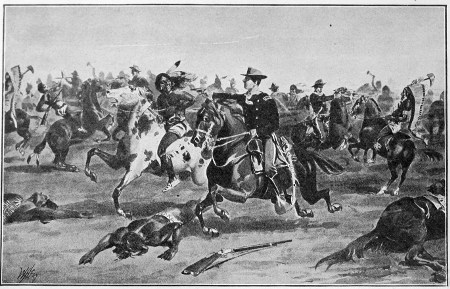
"There are a hundred Indians out there and we are going for them," he
shouted, swinging his sword around his head. "They will stand just long
enough to see us getting ready for a charge, and then they will run.
You are not afraid of a hundred Indians, are you?"
"Not by a great sight, sir," said the Sergeant, who was riding down
the other side of the line pushing the men into their places. "Get in
there, men, and be lively about it. Lead on, sir. We are ready to face
five hundred, if you say so."
"All ready, sir," said Colonel Fetterman, riding up to the palisades
where he had left his commanding officer.
"Go on," was the response. He raised his hand and waved it in the
air, but could say no more. Colonel Fetterman wheeled his horse, gave
the commands, "Fours right. Forward march!" and rode through the gate
and turned toward the picket tower; and Colonel Carrington could only
settle back in his camp chair and wait to see what events were going to
bring forth.
"Something tells me that I will never see those men again," said he,
turning to Major Powell, who at that moment stepped upon the platform
and took a stand beside his Colonel. "I have shaken hands with Colonel
Fetterman for the last time."
"Oh, Colonel, I would not talk in that way," said the Major. "Fetterman
is an old Indian fighter, and it will take more than one hundred Sioux
to clean him out."
"But a hundred warriors are not all they can bring into a fight," said
the Colonel. "If Cyrus tells the truth, there must be a larger village
than we are aware of situated behind those swells."
"Well, suppose there are a thousand of them; Fetterman can easily beat
them off until he can come within range of the Fort. He has taken
Captain Brown, Tony, and Mike, and three or four old Indian fighters
with him, and they are bound to come out with flying colors."
The Colonel said no more, but watched the re-enforcements. He saw
them break into a trot and then into a gallop, and very shortly they
disappeared over the swells.
"I am a little afraid of an ambush down where they are," said the
Colonel, after a few moments pause. "If Fetterman runs into it, we are
gone."
"But Fetterman will not run into it. He has too much at stake for that."
Major Powell's words were intended to be encouraging, and in almost any
other case they would have been so; but this time they did not have any
effect upon the Colonel. He was disheartened before he sent him off to
face that unknown danger, and now that he was out of sight and almost
within sight of it, he felt more distress than ever he did before.
"Why don't they signal to me?" he exclaimed, when he had watched the
top of the tower in vain for a sign of the white flag. "I want to know
what is going on there."
"Probably there has nothing happened yet," said the Major. "If the
Indians are retreating——"
The Major suddenly paused, for at that moment the flag came into view
from the top of the tower. He paused to read the signal it conveyed
and as he spelled it slowly out that there were large bodies of Indians
who were assaulting the re-enforcements, the Colonel jumped to his feet
and seized the flag that lay near him.
"I think you said that Fetterman would not run into an ambush, if there
was one formed for him," said he angrily. "He is in it now."
Then went up the signal from the Fort: "Tell them not to leave the
ridge," but it was a signal that came too late to be of any use.
Colonel Fetterman and all his men were so busy at that time charging
down upon the enemy, that no one thought of looking for signals in
their rear. But Guy saw and understood and did his best to turn the
column to a place of safety, but the waving of his flag was time and
strength wasted. With a yell, which Guy had often helped raise when
the troops were drilling on the parade ground, and which the men now
gave in order to let the Sioux know they were coming to save the wagon
train, they charged down the ridge and into the ambush. It was too
late to do anything then, and Colonel Carrington leaned back in his
camp chair and looked at Powell. Not another word was said by either
of them, and pretty soon there came another signal from the tower:
"Fetterman needs re-enforcements."
"It will take the last hundred men I have, and the Fort with every one
in it will be at their mercy," said the Colonel. "You will have to go
with them. Go down and call the men together——"
"Colonel, with your permission I will protest against sending them
any help," said the Major. "The Colonel may be retreating, but he is
retreating toward the ridge where he knows he will be comparatively
safe. I tell you that man can't be whipped."
"Well, we will wait and see," said the Colonel. "I hope he has men
enough with him to resist them, but I am afraid. I think I should have
sent more."
"And if you had, you would certainly have left the Fort at the mercy of
the thievish Sioux. You have done the best you could. Leave Fetterman
alone. He is going to come out all right."
If Major Powell believed this, he was certainly doomed to be
disappointed. Colonel Fetterman was whipped almost at the start, and
there was no one to lend him a helping hand. In response to the signals
"How goes the battle?" the reply was the same as it had always been,
"He needs re-enforcements," and then Colonel Carrington got up and
paced the platform in agony. The help was repeatedly called for and
several times the Colonel was on the point of exerting his authority as
post commander and sending the re-enforcements that Colonel Fetterman
so much needed; but each time the calm voice of Major Powell was raised
in protest, and the commander thought it best to wait a little longer
and see how the fight was coming out.
"It seems to me that Fetterman has been allowed all the time he wanted
to get back to the ridge and hold the Sioux at bay," he often said.
"Do you not think so, Major?"
It was almost half an hour since the signal had been made that the
Sioux were attacking the re-enforcements, and something should have
been done in that time; but the next signal that was made fairly took
his breath away: "All killed. Field covered with more than a thousand
Sioux."
"Oh, heavens and earth!" groaned Colonel Carrington. "I wish I had died
before I had seen that signal."
Major Powell turned away to hide the tears that streamed from his eyes,
and could not say a word in reply. He had protested against the sending
out of help, and he would do it again under the same circumstances; but
at what cost? Fully a third of the men that composed the garrison had
been sacrificed, and surely that was better than to send out another
hundred to share the same fate. Colonel Carrington buried his face
in his hands, and it did not seem to him that he could ever look up
again; while Major Powell, after subduing the first violence of his
grief, raised his eyes to watch the tower again and saw another signal
waving to them.
"The wagon train is coming, having beaten off its assailants," said he.
"If we can save that much, we will do well."
This aroused the Colonel, who caught up the flag and signaled to them
not to attack, but to make all haste into the Fort.
"If they get back safe it will give me a hundred and ten men to send
out to that battlefield," said he, after thinking a moment. "You will
have to go with them. Don't leave the ridge until you see that you are
sufficiently strong to hold them at bay."
"But you want me to go to the battlefield," said the Major.
"But don't go into that ambush whatever you do. Steer clear of that.
Bring the bodies of all the men you can find with you."
Then the Colonel relapsed into his melancholy mood again, and Major
Powell knew that he had to do everything that was necessary for
getting the relief party under way, and he lost no time in doing it
either. While he was thus engaged, the gate flew open and the wagon
train, well loaded with fuel, came in with a rush. A more frightened
set than the teamsters were it would have been hard to find, and even
the old soldiers, who had passed through more than one Indian fight,
were heard to draw a long breath of relief as they came into line.
"Oh, Major, it was just awful!" said the Lieutenant, who was the first
to salute him.
"Fetterman has gone up," said Captain Kendall; and there were traces
of tears on his face that he was not ashamed of. "I never saw so many
Sioux before. Where's the Colonel?"
"Up there on the platform," said the Major. "Go up and report to him.
And, mind you, don't say anything to him that will make him feel worse
than he does now, for he is completely prostrated."
"But I shall have to tell him the truth, or I might as well stay away
from him," protested the Captain. "It was nothing that he could help,
but we are just a hundred men short."
The Major, who did not want to hear any more about the fight until he
saw the battlefield, waved his hand toward the Colonel, and the Captain
dismounted and went to report the disaster of which the post commander
knew almost as much as he did.
"It is not necessary for you to say anything, Captain," said he. "The
signals from the tower have kept me posted. Are they all gone? Is there
not one left?"
"Not one, Colonel," said Captain Kendall. "From where I stood on the
ridge, I could not see anything but Sioux."
"They were retreating?" said the Colonel.
"Toward the ridge where they would be safe; but they didn't any of them
live to get there. They were wiped out completely."
"You lost some men, I suppose."
"We lost seven, and were glad to get off with that. Shall I break
ranks, sir?"
"Yes; and then come up and talk to me. I feel as though I were going
crazy. I have sent out some men to go to that battlefield. Do you think
they can go there without another fight?"
"Perhaps so, sir. We killed any number of them, and perhaps they have
got all they want of fighting."
The Captain went down and said something to his men before he broke
ranks, and it made them feel a great deal better for what they had
done; but there was one thing that they never could blot from their
minds. There was that battlefield, a mile long and half a mile wide, of
which they had a plain view as they passed along the ridge, covered by
the bodies of men whom they would never shake by the hand again, and
the memory of it would disturb their sleep for many a night afterward.
While this was going on and the Colonel sat listening to his speech,
Amos Billings, the officer who Guy Preston had relieved in command of
the tower, came up to the commander and saluted him.
"What is it, Billings?" said he. "I can't ask you to sit down, for
there is no place."
"I don't want to stop, sir," he replied. "There are our boys alone in
that tower—"
"And you want to go out and inform them that they are not forgotten
by the garrison, do you? Well, go on. Take a cavalryman with you to
hold your horse. Tell Guy that I would have answered his signal for
re-enforcements, but Major Powell told me that I ought not to. Guy did
his duty up to the handle."
This was what Billings wanted to tell Guy, while they were sitting
there on the steps that led to the top of the tower.