Nineteen minutes in the train from Rotterdam,
and you are in Delft—such are the distances
between towns in South Holland.
The population of Delft amounts, numerically, to
some 32,000, but this is an item that is farthest from
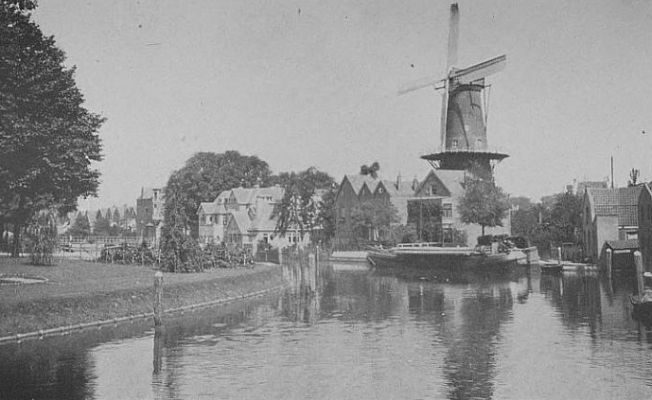
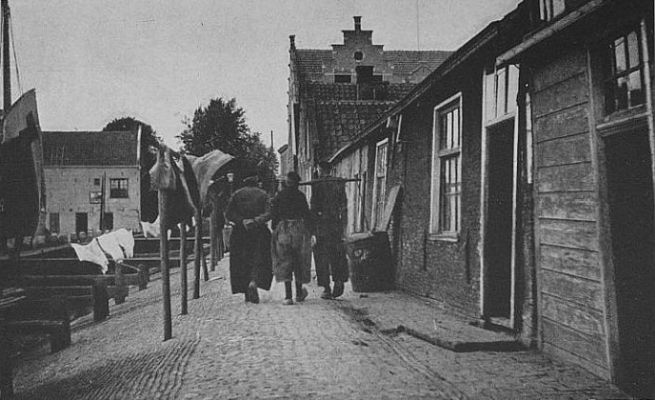
your thoughts. It is one of the quietest, quaintest
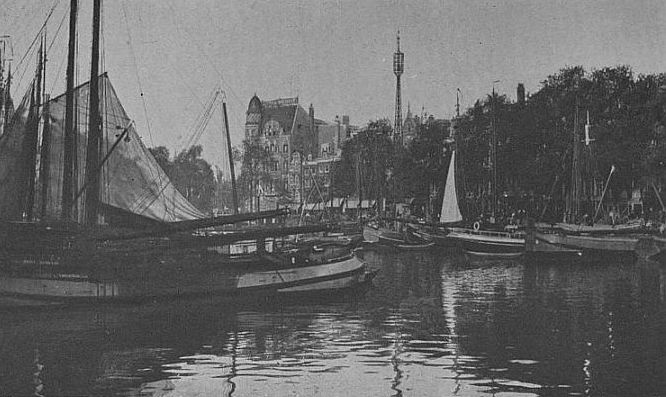
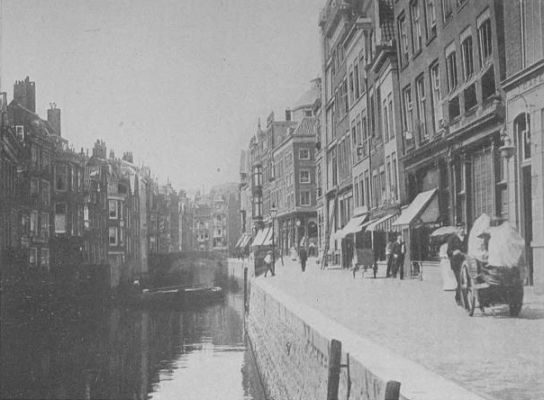
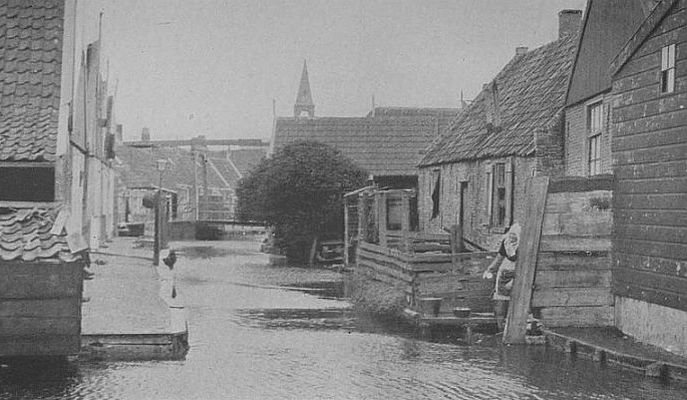
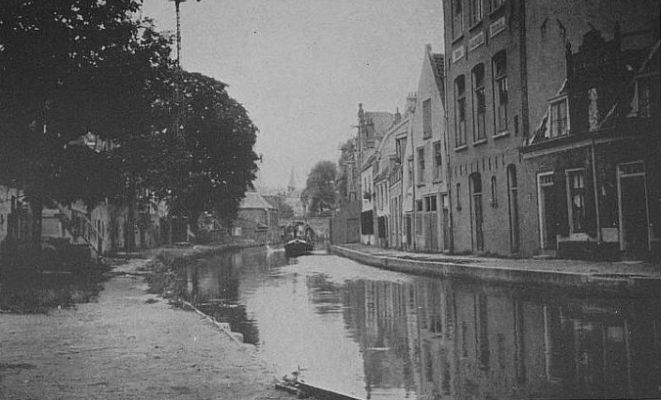
cities in the Netherlands. Up and down its narrow,
lime shaded canals the boatmen of Delft pole their
barges laboriously, yet noiselessly, walking along the
decks from stem to stern against their padded means
of propulsion and literally pushing their craft out
from under them. In the spring these watery highways
are covered with a fragrant layer of fallen
blossoms; in the fall, with leaves of variegated colors.
The houses that stand behind the trees have been
well built and are well preserved, adding to the place
an impression of comfortable solidity.
My first visit to Holland brought me to Delft from
“The Hook” at a very early hour in the morning,
when the housemaids were about to commence the
first concentrated assault of the day upon their
pavements, doorsteps, front doors, and the brass-work
pertaining thereto in the shape of knobs and
knockers. “Scrub” seemed to be the housemaids’
slogan, and they were certainly living up to it.
Pail after pail of water was hoisted from the canals
and splashed over everything in reach, until it flowed
across the streets and pavements, and fell back
whence it came originally. If I had appeared upon
the scene a little later I might have concluded that
a cloud-burst had struck the town. And all this
brackish water, that, in the canals, comes within
an ace of being absolutely stagnant, being poured
so recklessly over the town, gave to it a kind of
antique odor, anything but pleasant to inhale. It
gave every evidence that that same water had been
hoisted, put to its task, and allowed to drip back
into the canals again since medieval times.
This was on a week day. A subsequent visit to
Delft took me there on Sunday.
Now, for some reason, psychological or otherwise,
the housemaids of Delft don’t seem to take the same
interest in the scrupulousness of their doorsteps on
a Sunday that they do on a week day. Sunday is
the day that everybody in Delft dons his or her
best bib and tucker and goes to church, or leans
over the railings of the canal bridges and chats with
a friend, or walks about the town under the shade
of its trees, contemplating, perhaps, upon the exigencies
of life. And a housemaid is but human.
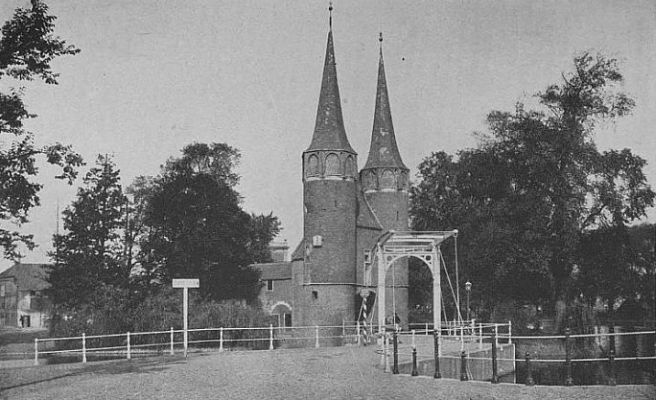
The East Gate of Delft, one of the quaintest and
quietest cities of the Netherlands
To come upon Delft, therefore, during this weekly
interruption in the perennial polishing of the town,
whatever the reason for it, offers the traveler a
different and vastly more agreeable impression. He
will see Delft and her people at their best, the latter
more congenially courteous, the former more serenely
stolid. Instead of the boatmen being continually
in the act of disturbing the bottoms of the canals
with their poles, so that the housemaids can skim
off the most graveolent of it with which to scour
and rinse their pavements, they assume for the day
the rôle of flower sellers. Boats bearing fragrant
burdens of potted plants of every variety, and cut
flowers as well, as if to try to make amends for the
mal-odor of the previous week, will be drawn as close
to the sidewalks as the banks of the canals permit,
in order to tempt the frailty of the Delft housewife—if
an inherent love of flowers may be termed as such—on
her way home from church.
Delft is old and she show’s symptoms of the fact
in spots. Down at the southern end of the city, near
the Rotterdam gate, stands a venerable building,
once one of the numerous warehouses scattered over
the country belonging to the Dutch East India Company—that
most famous and wealthiest of all Dutch
trading concerns, founded in 1602, when the power
and wealth of the Republic had attained their high-water
marks under the stadtholdership of Maurice,
one of the sons of the ill-fated Prince William of
Orange. The place has long since been put to use
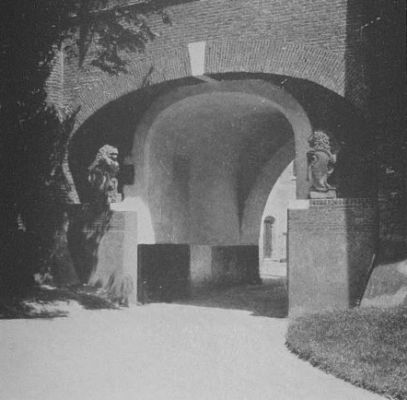
as a military storehouse. Directly opposite is the
ominous-looking city arsenal, bearing above its
arched entrance a massive copy of the arms of the
old Dutch Republic, carved in stone. Another of
the old buildings is the Gemeelandshuis van Delftland,
showing in sandstone a rich Gothic façade of the beginning
of the sixteenth century.
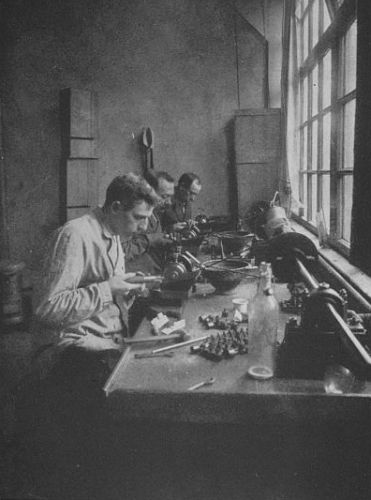
With us, Delft’s principal claim to notoriety lies
in the manufacture of its faience, commonly called
“Delft ware,” in the seventeenth and eighteenth centuries.
Its composition and design at first copied
from the Chinese and Japanese porcelain, this faience
became celebrated throughout the world. Dutch designs
were soon substituted for the Oriental, and the
industry prospered proportionately. Later it lapsed
into decay and the true process has been revived in
Delft only within comparatively recent years. A
large plant for its manufacture now operates on the
Oosteinde, not far from the New Church.
But in the heart of the Hollander, Delft will ever
be revered as the scene of the tragedy that cut short
the life and terminated the praiseworthy deeds of
that eminent founder of Dutch liberty, “William the
Silent,” Prince of Orange, the George Washington
of the Netherlands.
Born of noble German parentage at Dillenburg in
the Duchy of Nassau in 1533, William, curiously
enough, became the favorite of Philip II of Spain,
who appointed him, in 1559, when but twenty-six
years of age, stadtholder or governor of the provinces
of Zeeland, Holland, Friesland, and Utrecht. Two
years later William found himself in bad odor with
Granvella, the Bishop of Arras, whom Philip had
appointed as counselor to his half-sister, Margaret
of Parma, the then regent of the Netherlands. William
finally effected the enforced relinquishment of
this post by the Bishop in 1564.
The subsequent unrest in the Netherlands, provoked
mainly by the atrocities of Spanish soldiery,
led to the sanguinary assignment of Ferdinando Alvarez
de Toledo, Duke of Alva, to command an
army of 10,000 picked men, mustered from Lombardy,
Sardinia, Sicily, and Naples, to quell the
possible insurrection. This move was bitterly resented,
not only by her subjects, but was opposed,
although without success, by Margaret of Parma
herself; for the name of Alva was as odious to her
as it was to them.
A man of brilliant military attainments and the
most experienced general in Europe at the time, but
bubbling over with avarice and revengefulness, cruel
and overbearing, Alva accepted the assignment with
alacrity. “I have tamed people of iron in my day,”
he was reported to have said contemptuously; “shall
I not easily crush these men of butter?”
When Alva, with his army, entered the Netherlands
and took it upon himself, after much intrigue
and conniving, to supersede the half-sister of his
sovereign as governor of the province, the Prince of
Orange retired to Dillenburg. Continued oppressions
by the Spaniards later called him to arms with the
French Huguenots as allies, and he set out betimes
upon an unsuccessful campaign to liberate the southern
provinces from their yoke of Spanish tyranny.
Since that time he was ever an active revolutionist.
In 1571 he championed the “Water Beggars,”
by which name those insurgents who assisted their
compatriots by sea were known, and one year later,
having been invited by the provinces of Zeeland and
Holland to command their troops against the Spaniards,
he captured Middelburg, and later came to the
successful rescue of the besieged town of Leyden.
Soon after the formation of the famous defensive
league known as the “Utrecht Union,” William was
condemned to exile by Philip. The fact that the
States-General defied the sovereign’s authority in this
matter was the percussion cap that exploded the
general uprising and the throwing off of Dutch allegiance
to Spain in 1581.
“Uneasy lies the head that wears”—the helmet
of revolt, and from the time of his first attempt to
achieve the success of his ambitious project, the
life of no medieval ruler was ever more in jeopardy
than was that of William of Orange. Within a
period of two years five separate and distinct attempts
to take his life had been perpetrated, and a
sixth, albeit an abhorrently successful one, was about
to follow—all of which were undoubtedly at the initial
instigation of the Duke of Alva.
Just across the canal from the Old Church at
Delft still stands the house of William the Silent,
now known as the Prinsenhof, where the tragedy took
place. It is a low, two-story building with a red-tiled
roof, formerly a cloister, but fitted up in 1575
as the residence of the Princes of Orange. Here
came William, in the summer of 1584, to join his
fourth wife, Louisa de Coligny, at the christening of
their son, born in Delft the previous winter, who
later became the celebrated governor, Frederic William.
The door marked Gymnasium Publicum,
opposite the tower of the church, leads through a
courtyard to the staircase where the murder was
committed; and in a dark corner of the wall at the
foot of the steps the custodian will show you a hole
made by one of the bullets that killed the Prince.
The dining-room beyond, from which William had
come to his death, is now a museum containing
reminiscences of him.
The Czolgosz of the occasion, the perpetrator of
the dastardly act, was Bathazar Gérard, alias Francis
Guion, the self-alleged son of a martyred Calvinist,
a religious fanatic who had long cherished an insane
desire to murder Orange.
“The organization of Bathazar Gérard,” says
Motley, “would furnish a subject for profound
study, both for the physiologist and the metaphysician.
Neither wholly a fanatic nor entirely a ruffian,
he combined the most dangerous elements of both
characters. In his puny body and mean exterior
were inclosed considerable mental powers and accomplishments,
a daring ambition, and a courage almost
superhuman. Yet those qualities led him only to
form upon the threshold of life a deliberate determination
to achieve greatness by the assassin’s trade.”
After long and exasperating delays, Gérard had
finally succeeded, on account of his ambitions, in
nursing himself into the good graces of Alexander
of Parma, the Spanish governor of the Netherlands
at that time. On the other hand, “Parma had long
been looking for a good man to murder Orange,
feeling—as Philip, Granvelle, and all former governors
of the Netherlands had felt—that this was
the only means of saving the royal authority in any
part of the provinces. Many unsatisfactory assassins
had presented themselves from time to time, and
Alexander had paid money in hand to various individuals—Italians,
Spaniards, Lorrainers, Scotchmen,
Englishmen, who had generally spent the sums received
without attempting the job. Others were supposed
to be still engaged in the enterprise, and at
that moment there were four persons—each unknown
to the others, and of different nations—in the city
of Delft, seeking to compass the death of William
the Silent.”
Upon the death, at this time, of the French Duke
of Anjou, Gérard was recommended to Parma by
various parties as a capable messenger “to carry
this important intelligence to the Prince of Orange.”
Concerning the outcome of this mission, I can do
no better than to quote John Lothrop Motley from
his “The Rise of the Dutch Republic,” as I have
done elsewhere in this chapter:
“The dispatches having been intrusted to him”
(Gérard), “he traveled post-haste to Delft, and to
his astonishment the letters had hardly been delivered
before he was summoned in person to the
chamber of the Prince. Here was an opportunity
such as he had never dared to hope for. The arch-enemy
to the Church and to the human race” (that
is, the Prince, so called), “whose death would confer
upon his destroyer wealth and nobility in this
world, besides a crown of glory in the next, lay
unarmed, alone, in bed, before the man who had
thirsted seven long years for his blood.
“Bathazar could scarcely control his emotions
sufficiently to answer the questions which the Prince
addressed to him concerning the death of Anjou;
but Orange, deeply engaged with the dispatches, and
with the reflections which their deeply important contents
suggested, did not observe the countenance of
the humble Calvinist exile, who had been recently
recommended to his patronage by Villers. Gérard
had, moreover, made no preparation for an interview
so entirely unexpected, had come unarmed, and had
formed no plan for escape. He was obliged to
forego his prey when most within his reach, and
after communicating all the information which the
Prince required, he was dismissed from the chamber.
“It was Sunday morning, and the bells were tolling
for church. Upon leaving the house he loitered about
the courtyard, furtively examining the premises, so
that a sergeant of halberdiers asked him why he
was waiting there. Bathazar meekly replied that he
was desirous of attending divine worship in the church
opposite, but added, pointing to his shabby and
travel-stained attire, that, without at least a pair
of new shoes and stockings, he was unfit to join
the congregation. Insignificant as ever, the small,
pious, dusty stranger excited no suspicion in the mind
of the good-natured sergeant. He forthwith spoke
of the wants of Gérard to an officer, by whom they
were communicated to Orange himself, and the Prince
instantly ordered a sum of money to be given him.
Thus Bathazar obtained from William’s charity what
Parma’s thrift had denied—a fund for carrying out
his purpose!
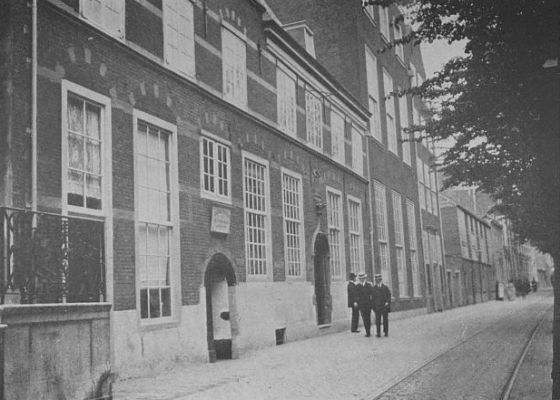
The Prinsenhof in Delft, revered by every Hollander as
the scene where “William the Silent,” the George Washington of the
Netherlands, was murdered
“Next morning, with the money thus procured, he
purchased a pair of pistols or small carabines from
a soldier, chaffering long about the price because
the vender could not supply a particular kind of
chopped bullets or slugs which he desired. Before
the sunset of the following day that soldier had
stabbed himself to the heart, and died despairing,
on hearing for what purpose the pistols had been
bought.
“On Tuesday, the 10th of July, 1584, at about
half-past twelve, the Prince, with his wife on his
arm, and followed by the ladies and gentlemen of
his family, was going to the dining-room. William
the Silent was dressed upon that day, according to
his usual custom, in very plain fashion. He wore
a wide-leaved, loosely-shaped hat of dark felt, with
a silken cord round the crown—such as had been
worn by the Beggars in the early days of the revolt.
A high ruff encircled his neck, from which also depended
one of the Beggars’ medals, with the motto,
‘Fideles au roy jusqu’ a la besace,’ while a loose
surcoat of gray frieze cloth, over a tawny leather
doublet, with wide, slashed underclothes, completed his
costume. Gérard presented himself at the doorway,
and demanded a passport. The Princess, struck with
the pale and agitated countenance of the man,
anxiously questioned her husband concerning the
stranger. The Prince carelessly observed that ‘it
was merely a person who came for a passport,’
ordering, at the same time, a secretary forthwith to
prepare one. The Princess, still not relieved, observed
in an undertone that ‘she had never seen so
villainous a countenance.’ Orange, however, not at
all impressed with the appearance of Gérard, conducted
himself at table with his usual cheerfulness,
conversing much with the burgomaster of Leeuwarden,
the only guest present at the family dinner, concerning
the political and religious aspects of Friesland.
At two o’clock the company rose from table. The
Prince led the way, intending to pass to his private
apartments above. The dining-room, which was on
the ground floor, opened into a little square vestibule,
which communicated, through an arched passageway,
with the main entrance into the courtyard. This
vestibule was also directly at the foot of the wooden
staircase leading to the next floor, and was scarcely
six feet in width. Upon its left side, as one approached
the stairway, was an obscure arch, sunk
deep in the wall, and completely in the shadow of
the door. Behind this arch a portal opened to the
narrow lane at the side of the house. The stairs
themselves were completely lighted by a large window
halfway up the flight. The Prince came from the
dining-room, and began leisurely to ascend. He had
only reached the second stair, when a man emerged
from the sunken arch, and, standing within a foot
or two of him, discharged a pistol full at his heart.
Three balls entered his body, one of which, passing
quite through him, struck with violence against the
wall beyond. The Prince is said to have exclaimed in
French, as he felt the wound, ‘O my God, have mercy
upon my soul! O my God, have mercy upon this poor
people!’
“These were the last words he ever spoke, save
that when his sister, Catherine of Schwartzburg, immediately
afterwards asked him if he commended his
soul to Jesus Christ, he faintly answered, ‘Yes.’
His master of the horse, Jacob van Maldere, had
caught him in his arms as the fatal shot was fired.
The Prince was then placed on the stairs for an
instant, when he immediately began to swoon. He
was afterwards laid upon a couch in the dining-room,
where in a few minutes he breathed his last in the
arms of his wife and sister.
“The murderer succeeded in making his escape
through the side door, and sped swiftly up the
narrow lane. He had almost reached the ramparts,
from which he intended to spring into the moat, when
he stumbled over a heap of rubbish. As he rose he
was seized by several pages and halberdiers, who had
pursued him from the house. He had dropped his
pistols upon the spot where he had committed the
crime, and upon his person were found a couple of
bladders, provided with a piece of pipe, with which
he had intended to assist himself across the moat,
beyond which a horse was waiting for him. He
made no effort to deny his identity, but boldly
avowed himself and his deed. He was brought back
to the house, where he immediately underwent a preliminary
examination before the city magistrates.
He was afterwards subjected to excruciating tortures;
for the fury against the wretch who had
destroyed the father of the country was uncontrollable,
and William the Silent was no longer alive to
intercede—as he had often done before—in behalf
of those who assailed his life.”
The tortures that the man endured prior to his
speedy execution are unmentionable.
“William of Orange,” continues Motley, “at the
period of his death, was aged fifty-one years and sixteen
days. He left twelve children. By his first
wife, Anne of Egmont, he had one son, Philip, and
one daughter, Mary, afterwards married to Count
Hohenlo. By his second wife, Anna of Saxony, he
had one son, the celebrated Maurice of Nassau, and
two daughters, Anna, married afterwards to her
cousin, Count William Louis, and Emilie, who espoused
the pretender of Portugal, Prince Emanuel.
By Charlotte of Bourbon, his third wife, he had six
daughters; and by his fourth, Louisa de Coligny,
one son, Frederic William, afterwards stadtholder
of the Republic in her most palmy days. The
Prince was entombed on the 3rd of August at Delft,
amid the tears of a whole nation. Never was a more
extensive, unaffected, and legitimate sorrow felt at
the death of any human being.”
So passed the greatest man that little Holland
ever did or ever will produce. His ashes lie in a
vault in the Nieuwe Kerk of Delft, together with
those of thirty-five other princes and princesses of
the House of Orange, the last being King William III,
father of the present Queen, who died on November
23rd, 1890. Above the vault stands the handsome
and imposing marble monument to William the Silent,
worked by the de Keysers, begun by the father in
1616 and finished by the son. A translation of the
Latin epitaph of the Prince reads as follows:
In honor of God Almighty and for an eternal memorial
of William of Nassau, Prince of Orange, father of his
fatherland, who valued the welfare of the Netherlands more
than his own interests or those of his family; who twice,
and principally at his own expense, collected powerful armies
and led them into the field under the command of the States;
who averted the tyranny of Spain; called back and restored
the true religion and the ancient laws; who at last left the
nearly regained liberty to be confirmed by his son, Prince
Maurice, heir to the virtues of his father; the truly pious,
prudent and invincible hero, whom Philip II, King of Spain,
that terror of Europe, feared, but could neither subdue nor
intimidate, but killed with gross perfidiousness by the hand
of a hired murderer, the United Provinces have ordered this
to be erected as an eternal memorial of his merits.
Motley’s phraseology with regard to the Prince’s
attributes and ambitions cannot be improved upon.
“His firmness was allied to his piety. His constancy
in bearing the whole weight of a struggle,
as unequal as men have ever undertaken, was the
theme of admiration, even to his enemies. The rock
in the ocean, ‘tranquil amid raging billows,’ was the
favorite emblem by which his friends expressed their
sense of his firmness. From the time when, as a
hostage in France, he first discovered the plan of
Philip to plant the Inquisition in the Netherlands,
up to the last moment of his life, he never faltered
in his determination to resist the iniquitous scheme.
This resistance was the labor of his life. To exclude
the Inquisition, to maintain the ancient liberties of
his country, was the task which he appointed to himself
when a youth of three-and-twenty. Never speaking
a word concerning a heavenly mission, never deluding
himself or others with the usual phraseology
of enthusiasts, he accomplished the task through
danger, amid toils, and with sacrifices such as few
men have ever been able to make on their country’s
altar.”
Truly, Wilhelmina has an illustrious ancestor.