CHAPTER I
WILLIAM—THE OUTLAW
WILLIAM and Ginger and Douglas (known as the
Outlaws) walked slowly down the road to school.
It was a very fine afternoon—one of those afternoons
which, one feels—certainly the Outlaws felt—it is base
ingratitude to spend indoors. The sun was shining and
the birds were singing in a particularly inviting way.
“G’omtry,” said William with scornful emphasis and
repeated bitterly, “G’omtry!”
“Might be worse,” said Douglas, “might be Latin.”
“Might be better,” said Henry, “might be singin’.”
The Outlaws liked singing lessons not because they
were musical, but because it involved no mental effort
and because the master who taught singing was a poor
disciplinarian.
“Might be better still,” said Ginger, “might be
nothin’.”
The Outlaws slackened their already very slack pace
and their eyes wandered wistfully to the tree-covered
hill-tops which lay so invitingly in the distance.
“Afternoon school’s all wrong,” said William suddenly.
“Mornin’s bad enough. But afternoon——!”
That morning certainly had been bad enough. It
had been the sort of morning when everything goes
wrong that can go wrong. The Outlaws had incurred
the wrath of every master with whom they had come
in contact.
“An’ this afternoon!” said Ginger with infinite
disgust. “It’ll be worse even than an ordinary
afternoon with me havin’ to stay in writin’ lines for
old Face.”
“An’ me havin’ to stay in doin’ stuff all over again
for ole Stinks.”
It turned out that each one of the four Outlaws
would have to stay in after afternoon school as the
victim of one or other of the masters whose wrath
they had incurred that morning.
William heaved a deep sigh.
“Makes me feel mad,” he said. “Miners havin’
Trades Unions an’ Strikes an’ things to stop ’em doin’
too much work an’ us havin’ to go on an’ on an’ on till
we’re wore out. You’d think Parliament’d stop it.
People go on writin’ in the papers about people needin’
fresh air an’ then ’stead of lettin’ people have fresh
air they shut ’em up in schools all day, mornin’ an’
afternoon, till—till they’re all wore out.”
“Yes,” said Ginger in hearty agreement. “I think
that there oughter be a law stoppin’ afternoon school.
I think that we’d be much healthier in every way if
someone made a law stoppin’ afternoon school so’s we
could get a bit of fresh air. I think,” with an air of
unctuous virtue, “that it’s our juty to try’n get a bit
of fresh air to keep us healthy so’s to save our parents
havin’ to pay doctor’s bills.”
Ginger ignored the fact that so far no one in all his
healthy young life had ever paid a doctor’s bill for him.
“I’ve a good mind to be a member of Parliament
when I grow up,” threatened Douglas, “jus’ to make
all schools have a holiday in the afternoons.”
“An’ the mornin’,” added Henry dreamily.
But, attractive as this idea was, even the Outlaws
felt it was going rather too far.
“No, we’ll have to keep on mornin’ school,” said
Douglas earnestly, “cause of—cause of exams an’
things. An’ school-masters’d all starve if we didn’t
have any school.”
“Do ’em good,” said Ginger bitterly and added,
darkly, “I’d jolly well make some laws about school-masters
if I was a member of Parliament.”
“What I think’d be a good idea,” said William,
“would be jus’ to have school on wet mornin’s. Not
if it’s fine ’cause of gettin’ a little fresh air jus’ to
keep us healthy.”
This was felt by them all to be an excellent idea.
“The rotten thing about it is,” went on William,
“that by the time we’re in Parliament makin’ the
laws we’ll be makin’ it for other people an’ too late to
do us any good.”
“An’ it seems hardly worth botherin’ to get into
Parliament jus’ to do things for other people,” said
Ginger the egoist.
They were very near the school now and instinctively
had slowed down to a stop. The sun was shining
more brightly than ever. The whole countryside
looked more inviting than ever. There was a short
silence. They gazed from the school building (grim
and dark and uninviting) to the sunny hills and
woods and fields that surrounded it. At last William
spoke.
“Seems ridic’lous to go in,” he said slowly.
And Ginger said still with his air of unctuous virtue,
“Seems sort of wrong to go when we reely don’t believe
that we oughter go. They’re always tellin’ us not to
do things our conscience tells us not to do. Well, my
conscience tells me not to go to school this afternoon.
My conscience tells me that it’s my juty to go out into
the fresh air gettin’ healthy. My conscience——”
Douglas interrupted gloomily: “’S’ all very well
talkin’ like that. You know what’ll happen to us
to-morrow morning.”
The soaring spirits of the Outlaws dropped abruptly
at this reminder. The general feeling was that it was
rather tactless of Douglas to have introduced the
subject. It was difficult after that to restore the
attitude of reckless daring which had existed a few
minutes before. It was William of course who restored
it, swinging well to the other extreme in order to
repair the balance.
“Well, we won’t go to-morrow mornin’ either,” he
said. “I’m jolly well sick of wastin’ my time in a
stuffy old school when I might be outside gettin’ fresh
air. Let’s be Outlaws. Let’s be real Outlaws. Let’s
go right away somewhere to a wood where no one’ll
find us an’ live on blackberries an’ roots an’ things an’
if they come out to fetch us we’ll climb trees an’ hide or
run away or shoot at ’em with bows and arrows. Let’s
go’n’ live all the rest of our lives as Outlaws.”
And so infectious was William’s spirit, so hypnotic
was William’s glorious optimism that the Outlaws
cheered jubilantly and said, “Yes, let’s.... Hurrah!”
“And never go to school no more,” said Douglas
rapturously.
“No, never go to school no more,” chanted the
Outlaws.
They decided not to go home for provisions because
their unexpected presence there would be sure to raise
comment and question.
And as William said, “We don’t want any food but
blackberries an’ mushrooms an’ roots an’ things.
People used to live on roots an’ I bet we’ll soon find
some roots to live on. It’ll be quite easy to find what
sort to eat and what sort not to eat. An’ we’ll kill
rabbits an’ things an’ make fires an’ cook them. That’s
what real Outlaws did, an’ we’re real Outlaws now.
An’ we don’t want any clothes but what we’ve got.
When they fall to pieces we’ll make some more out of
the skins of rabbits we’ve killed to eat. That’s what
real Outlaws did, I bet.”
“Where’ll we go to?” said Douglas. William
considered.
“Well,” he said, “we must be in a wood. Outlaws
are always in woods, ’cause of hiding an’ eating the
roots and things. And we oughter be on a hill ’cause
of seeing people comin’ when they come tryin’ to
catch us——”
“Ringers’ Hill, then,” said Ginger blithely.
Ringers’ Hill was both high and wooded.
The Outlaws cheered again. They were still drunk
with the prospect of freedom, intoxicated by William’s
glorious optimism. They marched down the road
that led away from the school singing lustily. The
Outlaws were very fond of community singing. They
liked to sing different songs simultaneously. William
in sheer lightness of heart was singing—very unsuitably—“Home
Sweet Home,” Ginger was singing “We
won’t go to school no more,” to the tune of “It ain’t
go’n rain no more,” Douglas was singing “Shepherd
of the Hills,” and Henry was singing “Bye-bye,
Blackbird.”
Suddenly two of their class-mates—Brown and
Smith—came round the corner on their way to school.
They looked at the Outlaws in surprise. Brown was
deprived of the power of speech by a twopenny bull’s
eye of giant proportions which he had just purchased
at the village shop, but Smith said, “Hello! You’re
going the wrong way.”
“No, we aren’t,” said William, blithely, “we’re
going the right way.”
Brown made an inarticulate sound through his bull’s
eye, meant to convey interest and interrogation, and
Smith, interpreting it, said, “Where are you going?”
“To Ringers’ Hill,” said William defiantly and
passed on, leaving Brown and Smith gazing after them
amazedly.
“You di’n’ ought to have told them,” said Ginger.
But William was in a mood of joyous defiance.
“I don’t care,” he said, “I don’t care who knows.
I don’t care who comes to fetch us home. We won’t
go. We’ll climb trees an’ shoot at ’em and throw
stones at ’em. I bet no one in the whole world’ll be
able to catch us. I’m an Outlaw, I am,” he chanted.
“I’m an Outlaw.”
Again his spirit infected his followers. They cheered
lustily. “We’re Outlaws, we are,” they chanted,
“we’re Outlaws.”
******
They sat under the largest tree on Ringers’ Hill.
They had been Outlaws now for half an hour and it
somehow wasn’t going as well as they’d thought it
would. Douglas, wishing to test the food-producing
properties of the place at once, had eaten so many
unripe blackberries that he could for the time being
take little interest in anything but his own feelings.
Ginger had from purely altruistic motives begun to
test the roots and was already regretting it.
“Well, I din’ ask you to go about eatin’ roots,” said
William irritably. William had for the whole half
hour been trying to light a fire and was by this time
feeling thoroughly fed up with it. He had just used
the last of a box of matches which he had abstracted
from the lab. that morning.
“I did it for you,” said Ginger indignantly, “I did
it to find the sort of roots that people eat, so you’d
be able to eat ’em. Well, you can jolly well find
your own roots now and I jolly well hope you find the
one I did—the last one. It’s the sort of taste that
goes on for ever. I don’ s’pose if I go on livin’ for
years an’ years, I’ll ever get the taste of it out of my
mouth——”
“Taste!” said Douglas bitterly. “I wun’t mind a
taste ... it’s pain I mind—orful pain—gnawin’ at your
inside.”
“I wish you’d shut up,” said William yet more
irritably, “an’ help me with this fire. All the wood
seems to be damp or somethin’. I can’t get anythin’
to happen.”
“Blow it,” suggested Ginger, taking his mind
temporarily from his taste.
Douglas, tearing himself metaphorically speaking
from his pain, knelt down and blew it.
It went out.
William raised his blackened face.
“That’s a nice thing to do,” he said bitterly.
“Blowin’ it out. All the trouble I’ve had lightin’ it
an’ then you jus’ go an’ blow it out. An’ there isn’t
another match.”
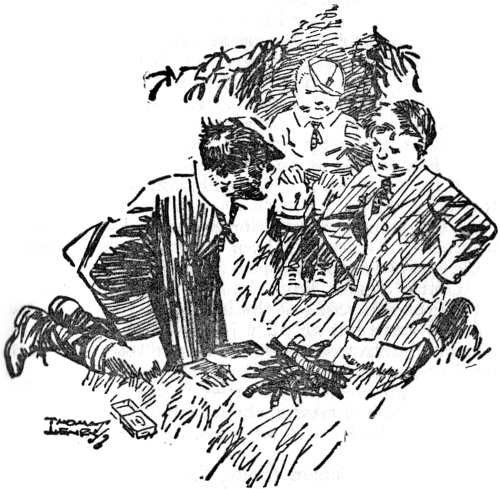
“ALL THE TROUBLE I’VE HAD LIGHTIN’ IT AN’ THEN YOU
JUS’ GO AN’ BLOW IT OUT.”
“Well, it’d’ve gone out if we hadn’t blown it out,”
said Ginger optimistically, “so it doesn’t matter.
Anyway, let’s do somethin’ int’restin’. We’ve not had
much fun so far—eatin’ roots an’ things an’ messin’
about with fire. We don’t want a fire yet. It’s warm
enough without a fire. Let’s leave it till to-night when
we need a fire, to sleep by and to keep the wild animals
off. We’ll light one with,” vaguely, “flint an’ steel
if we c’n find a bit of flint an’ steel lyin’ about anywhere.
But we won’t light another now. We’re all
sick of it and if we go burnin’ up all the firewood in
the wood an——”
“All right,” said William, impressed by the sound
logic of the argument, “I don’t mind. I’m jus’ about
sick of it. I’ve simply wore myself out with it an’
you’ve not been much help, I must say.”
“Well, I like that,” said Douglas, “an’ me nearly
dyin’ of agony from blackberries.”
“An’ me riskin’ my life testin’ roots,” said Ginger.
“I can still taste it—strong as ever. It seems to be
gettin’ stronger ’stead of weaker. It’s a wonder I’m
alive at all. Not many people’d suffer like what I’ve
suffered an’ still go on livin’. If I wasn’t strong I’d
be dead of it now.”
Douglas, stung by Ginger’s self-pity, again rose to
the defence of his own martyrdom.
“A taste,” he said. “I could stand any amount of
tastes. I——”
At this moment a diversion was caused by the return
of Henry. Henry had been out to catch rabbits to
cook over the fire for supper. He looked hot and cross.
“Couldn’t catch any,” he said shortly. “I saw a
lot on the other side of the hill. I hid behind a tree
till they came out an’ then I ran out after them, and
I’m absolutely wore out with runnin’ out after them
an’ I’ve not caught one.”
“Let’s go down to the river,” said Ginger, “I’m
jus’ about sick of messin’ about here. There isn’t anything
to do here, ’cept eat roots, an’ I’ve had enough
of that.”
“No,” said William firmly, “we’ve gotter stay up
here. If we go down an’ they start comin’ out to
fetch us home they’ll overpower us easy. It’s a—a
sort of vantage ground up here. We can see ’em comin’
up here an’ escape or throw things down on ’em.”
“Well, I’m sick of stayin’ up here,” said Ginger.
“Think of ’em,” said William tactfully, “doin’
G’omtry at school.”
At this the Outlaws’ discontent faded and their
spirits rose.
“Hurrah!” said Ginger, who now had completely
forgotten his taste, “and I bet we can easy make up a
game to play here an——”
“Look!” gasped Douglas suddenly, pointing down
into the valley.
The Outlaws looked.
Then they stood motionless as if turned to stone.
There was no doubt about it.
Down in the valley coming along the path that led
up to Ringers’ Hill could be seen the figures of the
Head-master and the second master.
For some moments horror and surprise robbed the
Outlaws of the power of speech.
Then William said:
“Crumbs!” but no words could describe the tone
in which he said it.
“They’re—they’re comin’ after us,” gasped Ginger.
“Smith must have told him where we’d gone,”
gasped Henry.
Ginger, recovering something of his self-possession,
turned to William.
“I said you din’ oughter’ve told him,” he said with
spirit.
“B-but,” gasped William, still paralysed with
amazement, “how’d he know we’re Outlaws an’ never
goin’ back?”
“Prob’ly Smith heard us sayin’ it,” said Ginger.
“Well, it’s a nice set-out, isn’t it? What we goin’ to
do? Fight him?”
Even William’s proud spirit quailed at the thought
of doing that.
“If—if only——” he began.
Then his speech died on his lips. His mouth dropped
open again. His eyes dilated with horror and amazement.
Behind the figure of the head-master and
second master came other figures—the mathematical
master, the gym master, three or four prefects.
“They’re all comin’!” gasped William, “they’re
comin’ to take us by force. They—they’re goin’ to
surround the hill and take us by force.”
“Crumbs!” said Ginger again. “Crumbs!”
“What’ll we do?” gasped Douglas.
They looked at William and into William’s freckled
face came a set look of purpose.
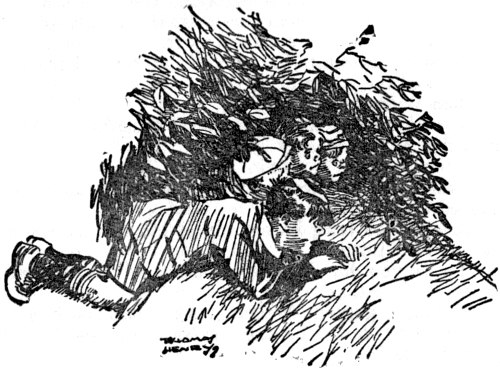
BREATHLESS WITH APPREHENSION THE OUTLAWS CROUCHED
UNDER THE BUSHES AND WATCHED. THEY COULD
SEE THE PROCESSION COME UP THE ROAD—NEARER,
NEARER.
“Well, we’ve gotter do something,” he said. He
scowled ferociously, then a light flashed over his face.
“I know what we’ll do. Smith must jus’ simply have
told ’em ‘Ringers’ Hill.’ That’s what we told him,
‘Ringers’ Hill.’ Well, you remember the sign post
thing at the bottom of the hill with ‘Ringers’ Hill’
on it?”
Yes, they remembered it—a wobbly, decrepit affair
at the bottom of the hill.
William’s face was now fairly gleaming with his idea.
“Well,” he said, “you remember it was all loose in
its hole? I bet if we pushed hard we could push it
right round so’s the ‘Ringers’ Hill’ pointed right on
up the other hill. An’ I bet they don’ know this part
’cause they don’t live here an’ they never come here
so I bet—well, let’s try anyway, an’ we’d better be
jolly quick.”
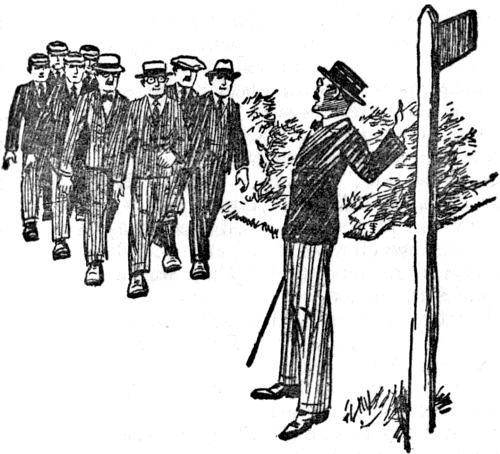
THEN—THE HEAD-MASTER PAUSED UNDER THE SIGN-POST.
“HERE WE ARE,” HE CALLED OUT. “HERE’S THE SIGN-POST—RINGER’S
HILL—UP THERE.”
Behind their leader they scrambled down the hillside
to the sign-post.
“Now push!” directed William.
The Outlaws pushed.
The sign-post rocked in its hole and—joy!—slowly
pivoted round in obedience to the Outlaws’ straining
weight. The solitary arm bearing the legend “Ringers’
Hill” now pointed to the hill in the opposite direction.
The Outlaws’ spirits rose.
They gave a cautious muffled cheer.
“Now quick, back again to the top!” said William
and they scrambled once more to the hill-top.
The procession led by the head-master was
approaching.
“Lie down under the bushes,” hissed William, “so’s
they won’t see you. An’ watch what they do.”
Breathless with apprehension the Outlaws crouched
under the bushes and watched. They could see the
procession come up the road—nearer, nearer. Then—the
head-master paused under the sign-post. The
Outlaws held their breath. Did he know the lie of
the land or would he be deceived? Evidently he
didn’t know the lie of the land.
“Here we are,” he called out. “Here’s the sign-post—Ringers’
Hill—up there.”
Slowly the procession passed on up the other hillside.
The Outlaws climbed from out of their bushes. They
still looked rather pale. “That was a jolly narrow
shave,” said Ginger.
“What we’d better do now,” said William grimly,
“is to look for a proper hidin’ place case they find out
an’ come back.”
******
So intent had they been on looking down at the side
of the hill where the dread procession was wending
its way that they had not noticed an enormous man
with bushy eyebrows and a generally ferocious aspect
who was climbing up the hill from the other side. They
did not in fact notice him until he had come up behind
them and his gruff voice boomed:
“Well, is this all there is of you?”
The Outlaws turned round with a start.
There was a tense silence.
The Outlaws, having, as they thought, narrowly
saved themselves from destruction on one side of the
hill, were quite unprepared for this attack from the
other. It unnerved them. It paralysed them. They
had no reserve of ingenuity and aplomb with which
to meet it.
William gulped and blinked and said, “Yes.”
“All?” boomed the ferocious man, “well, all I can
say is that it’s hardly worth my while to come all this
way for you. I’d understood that it was quite a
different sort of affair altogether. Do you mean to
say that there are only four of you?”
William felt that he had done all that could be
expected of him and nudged Ginger.
“Er-yes,” quaked Ginger.
“Only four of you,” said the ferocious man ferociously,
“and how old?”
Douglas and Henry had slunk behind William and
Ginger. Ginger nudged William to intimate that it
was his turn.
William swallowed and said feebly, “Eleven—eleven
and nearly three-quarters.”
“Pish!” said the man in a tone of fierce disgust.
“Eleven! As I say I’d never have agreed to come if
I’d known it was this sort of an affair. I naturally
imagined—however, now I’m here—and it’s late to
start with——” He looked at them and seemed to
relent somewhat, “I gathered that you know a fair
amount about the subject and you must be keen.
I suppose one should be thankful for four keen students
even though they seem so very—however,” his irritability
seemed to get the better of him again, “let’s
get to business. We’ll start over here ... quickly,
please,” he snapped, “or we’ll never get through this
afternoon——”
Dazedly, as if in a dream, the Outlaws went to where
he pointed. They didn’t know what else to do. The
situation seemed to have got entirely out of hand.
It seemed best to follow the line of least resistance and
to give themselves away as little as possible. They
stood in a dejected group in front of the ferocious man
and the ferocious man began to talk. He talked about
such things as strata and igneous rock and neolithic
and eolithic and paloælithic and stratigraphical and
Pithecanthropus erectus and other things of which
the Outlaws had never heard before and hoped never
to hear again. He asked them questions and got
angry because they didn’t know the answers. He
asked them what he’d said about things and got angry
because they’d forgotten. He strode about the hill-top
pointing out rocks with his stick and talking about
them in a loud, ferocious voice. He made them follow
him wherever he went, and got angry because they
didn’t follow nimbly enough. So terrifying was he
that they daren’t even try to run away. It was like a
nightmare. It was far worse than Geometry. And it
seemed to last for hours and hours and hours. Actually
it lasted an hour. At the end the man became more
angry than ever, said that it was an insult to have
asked him to come over to address four half-witted
gutter-snipes and muttering ferociously stalked off
again down the hillside.
The Outlaws sat down weakly on the ground around
the little heap of black twigs and dead leaves which
marked the scene of William’s failure as a fire-maker
and held their heads.
“Crumbs!” moaned William, and Ginger mournfully
echoed, “Crumbs!”
“Well, anyway, he’s gone,” said Henry trying to
look on the bright side.
But it wasn’t really easy to look on the bright side.
The Outlaws were feeling very hungry and there wasn’t
anything to eat. Ringers’ Hill had lost its charm.
They’d had a rotten time there—not a bit the sort
of time they’d always imagined Outlaws having. And
the sun had suddenly gone behind a cloud. It was
cold and dark. They were hungry and fed up.
“Wonder what time it is,” said Henry casually.
As if in answer the clock of the village church struck
in the valley, One—Two—Three—Four—Five. Five
o’clock. Tea-time. Into each mind flashed a picture
of a cheerful dining-room with a table laid for tea.
“Well,” said William with an unconvincing attempt
at cheerfulness, “we’d better be getting something to
eat. We might have had a rabbit if Henry’d caught
one. Let’s have a go at the blackberries.”
“There aren’t any ripe ones,” said Douglas, “and
the others make you feel awful inside after you’ve
eaten a few.”
Then suddenly to their secret relief Henry rose and
said bluntly, “I want my tea and I’m sick of being an
Outlaw. I’m going home.”
******
On the road they met Brown and Smith. Brown and
Smith were swinging happily along the road carrying
fishing-rods and jars of minnows.
“I say, we’ve had a topping time,” they called.
“Have you? But you were rotters not to have told us.”
“Told you what?” said the Outlaws.
“That there was going to be a half-holiday.”
“What?” said the Outlaws.
“They sent us all away as soon as we got there.
Said they’d forgotten to give it out in the morning.
We were jolly surprised to meet you going away from
school, but when we got there we knew why but we
thought you jolly well might have told us.”
“Why was there a half-holiday?” gasped William.
“Oh, some old josser or other coming to give some
old jaw or other to some old society or other,” said
Smith vaguely, “but we’ve had a topping afternoon,
have you?”
In bitter silence the Outlaws walked on. They
hadn’t had a topping afternoon. At the end of the
road a prefect was putting a letter into a pillar-box.
Another prefect stood by.
“What was it like?” said the one who stood by.
“He never turned up,” said the one who’d just
posted the letter. The Outlaws slowed their pace to
listen.
“We’d arranged to meet him on Ringers’ Hill.
The Head and everyone was there. We’d never been
to Ringers’ Hill before but there was a sign post up
so we couldn’t have gone wrong. We waited three
quarters of an hour and he never turned up. It’s
sickening. I’ve just posted a letter from the Head
telling him that we went there and waited three
quarters of an hour. I suppose he was kept somewhere.
He might have let us know, but some of those professors
are beastly absent-minded. We were looking forward
to it awfully, because it was Professor Fremlin, one of
the greatest geologists in England, you know. Ringers’
Hill’s supposed to be an old volcano crater. It would
have been awfully interesting. He was going to
lecture on its formation and show us the strata and
fossils there. We’d been reading it up for weeks so as
to know something about it. A shame when we’ve
got such a decent Geologist Society for the star turn
show of the year to fall flat. Perhaps he was taken
ill on the way.” He turned to the Outlaws. “Now
then, you kids, what are you hanging about for?
Clear off.”
Blinking dazedly, walking very, very slowly, very
very thoughtfully, the Outlaws cleared off.
CHAPTER II
THE TERRIBLE MAGICIAN
THE advent of Mr. Galileo Simpkins to the village
would in normal times have roused little interest
in William and his friends. But the summer holidays
had already lasted six weeks and though the Outlaws
were not tired of holidays (it was against the laws of
nature for the Outlaws ever to tire of holidays), still
they had run the gamut of almost every conceivable
occupation both lawful and unlawful, and they were
ready for a fresh sensation. They had been Pirates
and Smugglers and Red Indians and Highwaymen ad
nauseam. They had trespassed till every farmer in
the neighbourhood saw red at the mere sight of them.
They had made with much trouble a motor boat and
an aeroplane, both of which had insisted on obeying
the law of gravity rather than fulfilling the functions of
motor boats and aeroplanes. They had made a fire
in Ginger’s backyard and cooked over it a mixture of
water from the stream and blackberries and Worcester
Sauce and Turkish delight and sardines (these being
all the edibles they could jointly produce), had pronounced
the resultant concoction to be excellent and
had spent the next day in bed. They had taken
Jumble (William’s mongrel) “hunting” and had
watched the ignominious spectacle of Jumble’s being
attacked by a cat half his size and pursued in a state
of abject terror all the length of the village with a
bleeding nose. They had discovered a wasps’ nest
and almost simultaneously its inhabitants had discovered
them. They were only just leaving off their
bandages. They had essayed tight-rope walking on
Henry’s mother’s clothes line, but Henry’s mother’s
clothes line had proved unexpectedly brittle and
William still limped slightly. They had tried to
teach tricks to Etheldrida, Douglas’ aunt’s parrot, and
Douglas still bore the marks of her beak in several
places on his face. Altogether they were, as I said,
ripe for any fresh sensation when Mr. Galileo Simpkins
dawned upon their horizon.
Mr. Galileo Simpkins had been thus christened by
his parents in the hope that he would take to science.
And Mr. Galileo Simpkins, being by nature ready to
follow the line of least resistance, had obligingly taken
to science at their suggestion. Moreover, he quite
enjoyed taking to science. He enjoyed pottering about
with test tubes and he disliked being sociable. A
scientist, as everyone knows, is immune from sociability.
A scientist can retire to his lab. as to a fortress
and, if he likes, read detective novels there to his
heart’s content without being disturbed by anyone.
Not that Mr. Galileo Simpkins only read detective
novels. He was genuinely interested in Science as
Science (he put it that way) and though as yet he had
made no startling contribution to Science as Science,
still he enjoyed reading in his text-books of experiments
that other men had made and then doing the experiments
to see if the same thing happened in his case. It
didn’t always.... Fortunately he was not dependent
for his living on his scientific efforts. He had a nice
little income of his own which enabled him to stage
himself as a Scientist to his complete satisfaction. He
took a great interest in the staging of himself as a
Scientist. He liked to have an imposing array of
test tubes and bottles and appliances of every sort—even
those whose use he did not quite understand. He
was very proud too of a skeleton which he had bought
third-hand from a medical student and which he
thought conferred great éclat on his position as a
Scientist from its stronghold in the darkest corner. As
you will gather from all this, Mr. Galileo Simpkins was
a very simple and inoffensive and well-meaning little
man and before he came to the village where William
lived, had not caused a moment’s uneasiness to anyone
since the time when at three years old he had
inadvertently fallen into the rain tub and been fished
out half drowned by his nurse.
He had come to the village because the lease of
the house where he had lived previously had run out
and the original owners were returning to it and he
had seen the house in William’s village advertised in
the paper, and it seemed just what he wanted. He
liked to live in the country because he was rather a
nervous little man and was afraid of traffic.
The first sight of Mr. Galileo Simpkins on his way
from the station had not interested the Outlaws much
except that as a stranger to the village he was naturally
to be kept under observation and his possibilities in
every direction explored at the earliest opportunity.
“He dun’t look very int’restin’,” said Ginger scornfully
as, sitting in a row on a gate, the Outlaws stared
in an unblinking manner quite incompatible with
Good Manners at little Mr. Galileo Simpkins driving
by on his way from the station in the village cab. The
driver of the village cab, who knew the Outlaws well,
kept a wary eye upon them as he passed, and had his
whip ready. The ancient quadruped who drew the
village cab seemed to know them too, and turned his
head to leer at them sardonically from behind his
blinkers. But the attention of the Outlaws was all for
the occupant of the village cab, who alone was quite
unaware of them as the ancient equipage passed on its
way. He was merely thinking what a fine day it was for
his arrival at his new home and hoping that his skeleton
(which he had packed most carefully) had travelled well.
William considered Ginger’s comment for a moment
in silence. Then he said meditatively: “Oh ...
dunno. He looks sort of soft and ’s if he couldn’t run
very fast. We c’n try playin’ in his garden sometime.
I bet he couldn’t catch us.”
They then had a stone-throwing competition which
lasted till one of William’s stones went through General
Moult’s cucumber-frame.
When General Moult had finally given up the chase,
the Outlaws threw themselves breathlessly (for General
Moult, despite his size, was quite a good runner) on to
the grass at the top of the hill and reviewed the further
possibilities of amusement which the world held for
them. They decided after a short discussion not to
teach Etheldrida any more tricks, not so much because
they were tired of teaching Etheldrida tricks as
because Etheldrida seemed to be tired of learning
them.
Douglas stroked his scars thoughtfully and said:
“Not that I’m frightened of her, but—but, well,
let’s try’n think of somethin’ a bit more int’restin’.”
No one had anything very original to suggest (they
seemed to have exhausted the possibilities of the
whole universe in those six weeks of holidays), so they
made new bows and arrows and held a match which
William won in that he made the finest long distance
shot. He shot his arrow into the air and unfortunately
it came to earth by way of Miss Miggs’ scullery window.
Miss Miggs happened to be in the scullery at the time
and again the Outlaws, bitterly meditating on the
over-population of the countryside, had to flee from
the avenging wrath of an outraged householder. In
the shelter of the woods they again drew breath.
“I say,” said Ginger, “wun’t it be nice to live in
the middle of Central Africa or the North Pole or
somewhere where there isn’t any houses for miles an’
miles an’ miles.”
“She runs,” commented Douglas patronisingly,
“faster’n what you’d think to look at her.”
“What’ll we do now?” said Henry.
Dusk was falling, and ahead of them loomed the
evil hour of bedtime which they were ever ready to
postpone.
“I tell you what,” said William, his freckled face
suddenly alight, “let’s go ’n see how he’s gettin’ on—you
know, him what we saw ridin’ up in the cab. We
c’n go an’ watch him through his window. It’s quite
dark.”
******
They watched him in petrified amazement. They
watched him as, dressed in a black dressing-gown and
a black skull-cap, he pottered about, laying out test
tubes and pestles and mortars and crucibles and
curious-looking instruments and bottles of strangely
coloured liquids. Eyes and mouths opened still
further when little Mr. Galileo Simpkins brought in
his skeleton and set it up with tender care and pride
in its corner.
They crept away through the darkness in a stricken
silence and did not speak till they reached the road.
Then: “Crumbs!” said William in a hoarse whisper.
“What is he? What’s he doin’?”
“I think he’s a sort of Bolsh’vist goin’ to blow up
all the world,” said Douglas with a burst of inspiration.
“An’ a dead body an’ all,” said Ginger, deeply awed
by the memory of what they had seen.
“P’raps he’s just doin’ ordinary chemistry,” suggested
Henry mildly.
This suggestion was indignantly scouted by the
Outlaws.
“Course it’s not jus’ ordin’ry chemistry,” said
William, “not with all that set-out.”
“Dead bodies an’ all,” murmured Ginger again in
a sepulchral voice.
“An’ dressed all funny,” said William, “an’ queer
sorts of things all over the place. ’Sides, what’d he
be doin’ ordin’ry chemistry for, anyway? He’s too old
to be goin’ in for exams.”
This was felt to be unanswerable.
“What I think is——” began William, but he never
got as far as what he thought.
A plaintive voice came through the dusk—the voice
of William’s sister Ethel.
“William! Mother says it’s long past your bedtime
and will you come in and she says——”
The Outlaws crept off through the dusk.
******
The next day Joan came back from a visit to an
aunt.
Joan was the only female member of the Outlaws.
Though she did not accompany them on their more
dangerous and manly exploits she was their unfailing
confidante and sympathiser and could be always
counted on to side with them against a hostile and
unsympathetic world. She was small and dark and
very pretty and she considered William the greatest
hero the world has ever known.
She joined them the first morning of their return
and they told her without any undue modesty of their
exploits during her absence—of their heroic flights
from irate farmers, of their miraculous creation of
motor boats and aeroplanes (they omitted any reference
to the over-officious law of gravity), of their glorious
culinary operations (they omitted the sequel), their
Herculean contest with the wasps, their tight-rope
walking performance, their (partial) mastery over the
brute creation as represented by Etheldrida, their
glorious feats of stone throwing and arrow shooting.
“An’ no one what’s run after us has caught us—not
once,” ended William proudly and added: “I
bet we c’n run faster ’n anybody else in the world.”
Joan smiled upon him fondly. She firmly believed
that William could do anything in the world better
than any one else in it.
“And what are you going to do to-day?” she said
with interest.
That, the expressions of the Outlaws gave her to
understand, was the question. The Outlaws had no
idea what they were going to do to-day. They were
obviously ready for any suggestions from the gentleman
who, moralists inform us, specialises in providing
occupation for the unoccupied.
“Let’s make another motor boat,” said Henry
feebly, but this suggestion was treated with well-deserved
contempt. The Outlaws were not in the
habit of repeating their efforts. Moreover, the motor
boat experiment had not been so successful as to
warrant its repetition.
Suddenly Ginger’s face lit up.
“I know!” he said, “let’s show Joan him ...
you know, him what we saw last night—with the dead
body——”
Joan’s eyes grew round with horror.
“It wasn’t a dead body,” said Douglas impatiently,
“it was a skeleton.”
“That’s the same as a dead body,” said Ginger
pugnaciously, “it was a body, wasn’t it? an’ now it’s
dead.”
“Yes, but it’s bones,” protested Douglas.
“Well, a body’s bones, isn’t it?” said Ginger.
But here Joan interrupted. “Oh, what is it, where is
it?” she said, clasping her hands, “it sounds awful.”
Her horror satisfied them completely. With Joan
you could always be so pleasantly sure that your
effects would come off.
“Come on,” said William briskly assuming his air
of Master of the Ceremonies, “we’ll show him you.
We c’n get through the hole in the hedge ’n creep up
to the window through the bushes without him seein’
us at all.”
******
They got through the hole in the hedge and crept
up to the window through the bushes. William, as
Master of the Ceremonies, had an uneasy suspicion
that in the cold morning light both man and room
might look perfectly normal, that the ghostly effect
of the night before might have banished completely.
But the suspicions proved to be groundless. The
room looked, if possible, even more uncanny than it
had done. And Mr. Galileo Simpkins still pottered
about it happily in his black dressing gown and skull
cap (it was a costume in which he rather fancied himself).
Mr. Galileo Simpkins liked his nice large
downstairs lab. and felt very happy in it. As he
stirred an experiment in a little crucible he sang
softly to himself from sheer good spirits. He was
quite unaware of the Outlaws watching his every
movement with eager interest from the bushes outside
the window. It was Ginger who saw and pointed out
to the others the shelf at the back of the room on which
stood a row of bottles containing wizened frogs in
some sort of liquid.
Aghast, they crept away.
“Well, I’m cert’n that’s what he’s goin’ to do,”
said Douglas as soon as they reached the road, “he’s
goin’ to blow up all the world. He’s jus’ mixin’ up
the stuff to do it with.”
“Well, I still think he might be jus’ an ornery sort
of man doin’ ornery chemistry,” said Henry.
“What about the dead body, then?” said Ginger.
“An’ what about frogs an’ things shut up in bottles
an’ things?” said William.
Then Joan spoke.
“He’s a wizard,” she said, “of course he’s a
wizard.”
William treated this suggestion with derision.
“A wizard,” he said contemptuously, “Soppy fairy-tale
stuff! Course he’s not. There aren’t any!”
But Joan was not crushed.
“There are, William,” she said solemnly, “I know
there are.”
“How d’you know there are!” said William incredulously.
“And what about the dead body?” said Ginger
with the air of one bringing forward an unanswerable
objection.
“The skeleton,” corrected Douglas.
“It’s someone he’s turned into a skeleton, of course,”
said Joan firmly.
“Soppy fairy-tale stuff,” commented William again
with scorn. Joan bore his reproof meekly but clung
to her point with feminine pertinacity.
“It’s not, William. It’s true. I know it’s true.”
There was certainly something convincing about her
earnestness though the Outlaws were determined not
to be convinced by it.
“No,” said Douglas very firmly. “He’s a blower
up, that’s what he is. He’s goin’ to blow up all the
world.”
“What about the frogs in bottles?” said Henry.
“They’re people he’s turned into frogs,” said Joan.
The frogs certainly seemed to fit into Joan’s theory
better than they fitted into Douglas’s. Joan pursued
her advantage. “And didn’t you hear him sort of
singing as he mixed the things? He was making spells
over them.”
The Outlaws were, outwardly, at least, still sceptical.
“Soppy fairy-tale stuff,” said William once more
with masculine superiority. “I tell you there aren’t
any.”
But there was a fascination about the sight and
they were loth to go far from it.
“Let’s go back an’ see what he’s doin’ now,” said
Ginger, and eagerly they accepted the proposal. The
hole in the hedge was conveniently large, the bushes
by the window afforded a convenient shelter and
all would have gone well had not Mr. Galileo Simpkins
been engaged on the simple task of washing out
some test tubes in a cupboard just outside the Outlaws’
line of vision. This was more than they could
endure.
“What’s he doin’?” said William in a voice of
agonised suspense.
But none of them could see what he was doing.
“I’ll go out,” said Ginger with a heroic air. “I
bet he won’t see me.”
So Ginger crept out of the shelter of the bushes and
advanced boldly to the window. Too boldly—for
Mr. Galileo Simpkins, turning suddenly, saw, to his
great surprise and indignation, a small boy with an
exceedingly impertinent face standing in his garden
and staring rudely at him through his window. Mr.
Galileo Simpkins hated small boys, especially small
boys with impertinent faces. With unexpected agility
he leapt to the window and threw it open. Ginger
fled in terror to the gate. Mr. Galileo Simpkins shook
his fist after him.
“All right, you wait, my boy, you wait!” he called.
By this time he wanted the boy with the impertinent
face to understand that he was going to find out who
he was and tell his father. He was going to put a
stop to that sort of thing once and for all. He wasn’t
going to have boys with impertinent faces wandering
about his garden and looking through his windows.
He’d frighten them off now—at once. “You wait!”
he shouted again with vague but terrible menace in
his voice.
Then he returned to his lab. well pleased with
himself.
The Outlaws crept back through the hole in the
hedge and met Ginger in the road. They looked at
Ginger as one might look at someone who has returned
from the jaws of death. Ginger, now that the danger
was over, rather enjoyed his position.
“Well,” he said with satisfaction, “did you see him
an’ hear him. I bet he’d’ve killed me if he’d caught
me.”
“Blown you up,” said Douglas.
“Turned you into something,” said Joan.
“Wonder what he meant by saying ‘Wait’ like
that?” said William meditatively.
“He meant that he was goin’ to put a spell on you,”
said Joan composedly.
Ginger went rather pale.
“Soppy fairy-tale stuff,” said William.
“All right,” said Joan, “just you wait and see.”
So they waited and they saw.
It was, of course, a coincidence that that night
Ginger’s mother’s cook had made trifle for supper
and that Ginger ate of this not wisely, but too well,
and was the next morning confined to bed with what
the doctor called “slight gastric trouble.”
The Outlaws called for him the next morning and
were curtly informed by the housemaid (who, like
Mr. Galileo Simpkins, hated all boys on principle) that
Ginger was ill in bed and would not be getting up
that day.
They walked away in silence.
“Well,” said Joan in triumph, “what do you think
about him being a magician now?”
This time William did not say “Soppy fairy-tale
stuff.”
******
Ginger returned to them, somewhat pale and wobbly,
the next day. Like them he preferred to lay the blame
of his enforced retirement on to Mr. Galileo Simpkins
rather than upon the trifle.
“Yes, that’s what he said,” agreed Ginger earnestly.
“He said ‘you wait,’ an’ then jus’ about an hour
after that I began to feel orful pains. An’ I hadn’t
had hardly any of that ole trifle ... well, not much,
anyway; well, not too much ... well, not as much as
I often have of things ... an’ I had most orful pains
an’——”
“He must have made a little image of you in wax,
Ginger,” said Joan with an air of deep wisdom, “and
stuck pins into it. That’s what they do.... I expect
he thinks you’re dead now. That’s why he said ‘You
wait’!”
They did not scoff at her any longer.
“Well, I was nearly dead yesterday all right,” said
Ginger. “I’ve never had such orful pains. Jus’ like
pins running into me.”
“They were pins running into you, Ginger,” said
Joan simply. “We’d better keep right away from him
now or he’ll be turning us into something.”
“Like to turn him into something,” said Ginger
who was still feeling vindictive towards the supposed
author of his gastric trouble.
But Joan shook her head. “No,” said Joan, “we
must keep right out of his way. You don’t know
what they can do—magicians and people like that.”
“I do,” groaned Ginger.
So they went for a walk and held races and played
Red Indians and sailed boats on the pond and climbed
trees—but there was little zest in any of these pursuits.
Their thoughts were with Mr. Galileo Simpkins the
magician as he stirred his concoctions and uttered his
spells and gazed upon his bottle victims and stuck
pins into the waxen images of his foes.
“Let’s jus’ go’n look at him again,” said William,
when they met in the afternoon. “We won’t go near
enough for him to see us but—but let’s jus’ go’n see
what he’s doin’!”
“You can,” said Ginger bitterly. “He’s not stuck
pins into you an’ given you orful pains. Why, I’m still
feelin’ ill with it. We had trifle again for lunch an’
I can’t eat more’n three helpin’s of it.”
“No, we’d better not go near him again,” said Joan
shaking her head, her eyes wide.
But William did not agree with them.
“I only want jus’ to look at him again an’ see
what he’s doin’. I’m goin’, anyway.”
So they all went.
******
They had decided to creep down through the field
behind the Red House to the road and thence through
the hole in the hedge to the sheltering cluster of bushes
that commanded the magician’s room, but they had
not so far to go before they saw him. It was a fine
afternoon and Mr. Galileo Simpkins had taken his
detective novel and gone into the field just behind
his house. And there he was when the Outlaws
stopped at the gate of the field, lying on the bank in
the shade, reading. He was feeling at peace with all
the world. He did not see the five faces that gazed
at him over the gate of the field and then disappeared.
He went on dozing happily over his novel. He’d
had a very happy morning. Though none of his
experiments had come out still he’d much enjoyed
doing them. He’d thought once of that boy with the
impertinent face and felt glad that he’d frightened
him away so successfully. He’d seen no signs of him
since. That was what you had to do with boys—scare
them off, or you got no peace at all.... Very
nice warm sun ... very exciting novel....
Meanwhile the Outlaws crept past the field and
were standing talking excitedly in the road.
“Did you see?” gasped Ginger, “jus’ sittin’ an’
readin’ ornery jus’ as if he hadn’t been stickin’ pins
into me all last night.”
“Let’s go home,” pleaded Joan. “You—you don’t
know what he’ll do.”
“No,” said William, “now he’s all right readin’ in
that field let’s go into his room an’ look at his things.”
There was a murmur of dissent.
“All right,” said William, “you needn’t. I’m jolly
well goin’.”
So they all went.
******
It was certainly thrilling to creep through the
window and stand in the terrible room with the
knowledge that at any minute the Magician might
return, change them into frogs and cork them up in
bottles.
“Wonder if I can find the wax thing of me he was
sticking pins into last night,” said Ginger looking
round the bench.
“Let’s make a wax thing of him ’n stick pins into
it,” suggested Henry.
“No, let’s turn him into something,” said Douglas.
Joan clapped her hands.
“Oh yes,” she said, “let’s! That would be fun!
His spells and things must be all over the place.”
Ginger took up a pestle and mortar.
“This is what he was stirring to-day,” he said,
“Wonder what this changes folks into.”
“Prob’ly depends what sort of a spell you say
when you stir it,” said Joan.
“Well, let’s try it,” said William.
“What’ll we turn him into?” said Ginger.
“A donkey,” suggested William.
“Well, who’ll do it?”
“Let me try,” said Joan who had a certain prestige
as originator of the now generally accepted magician
theory.
Ginger handed her the crucible. “I think,” said
Joan importantly, “that I ought to have a circle of
chalk drawn round me.”
They couldn’t find any chalk so they made a little
circle of test tubes around her and watched her with
interest. Joan shut her eyes, stirred up the mixture
in the crucible and chanted:
“Turn into a donkey,
Turn into a donkey,
Turn into a donkey,
Mr. Magician.”
Then she opened her eyes.
“It may be all wrong,” she admitted, “I’m only
guessing how to do it. But if it’s a very good spell it
may be all right.”
“Well, let’s go and have a look at him,” said William,
“and if he’s still there we’ll come back and try again.”
So they went.
******
And now comes one of those coincidences without
which both life and the art of the novelist would be so
barren. Five minutes after the Outlaws had left Mr.
Galileo Simpkins peacefully reading his novel on a
bank in the shade in the field, a boy crossed the field
carrying a telegram. He came from the post office
and the telegram was for Mr. Galileo Simpkins, so,
on seeing Mr. Galileo Simpkins in the field, the boy
took it up to him. Mr. Simpkins opened it. It
summoned him to the sick bed of a great-aunt from
whom he had expectations. There was a train to
town in ten minutes. Mr. Simpkins had his hat and
coat and plenty of money on him. He decided not
to risk missing the train by going back to the house.
He set off at once for the station, meaning to telegraph
to his housekeeper from town (which he quite forgot
to do). He left his book on the bank where he had
laid it down on taking the telegram from the boy’s hand.
Five minutes after he had gone Farmer Jenks, to
whom the field belonged, brought to it a young donkey
which he had just purchased, and departed. The
young donkey had been christened “Maria” by Mrs.
Jenks. Maria kicked her heels happily in the field
for a few minutes, then realised that it was rather a
hot afternoon. There was only one bit of shade in
the field and that was the bank where but lately Mr.
Galileo Simpkins had reposed and where even now
his book lay. Maria went over to this and lay down
in it just by the book. In fact her attitude suggested
that she was engaged in reading the book.
And so when five minutes later the Outlaws cautiously
and fearfully peeped over the hedge, they saw
what was apparently Mr. Galileo Simpkins metamorphosed
by their spell into a donkey lying where they
had last seen him still reading his book. No words
in the English language could quite describe the Outlaws’
feelings. Not one of them had really expected
Joan’s spell to take effect. And here was the incredible
spectacle before them—Mr. Galileo Simpkins turned
into a donkey before their very eyes by one of his own
spells. They all went rather pale. William blinked.
Ginger’s jaw dropped open. Henry’s eyes seemed on
the point of falling out of his head. Douglas swallowed
and held on to the gate for support and Joan gave a
little scream. At the sound of the scream Maria
turned her head and gave them a reproachful glance.
“Well!” said Joan.
“Crumbs!” said William.
“Gosh!” said Douglas.
“Crikey!” said Henry.
And “Now we’ve done it!” said Ginger.
Maria turned away her head and surveyed the
distant landscape, drowsily. “I wonder if he knows,”
said William awefully, “or if he thinks he’s still a
man.”
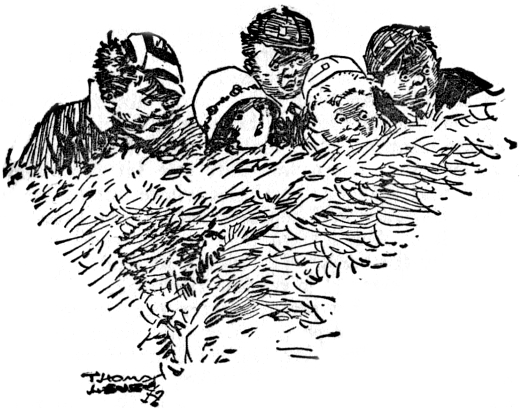
“WELL!” SAID JOAN. “NOW WE’VE DONE IT!” SAID
GINGER.
“He must know,” said Ginger. “He’s got eyes.
He c’n see his legs ’n tail an’ things.”
“An’ he was reading his book when we first came
along,” said Douglas.
“P’raps,” suggested Henry, “he’s forgotten all about
bein’ a man an’ only feels like a donkey now.”
“Well, he won’t try stickin’ pins into me again,
anyway,” said Ginger.
But a new aspect of the affair had come to William.
“This is Farmer Jenks’ field,” he said; “he’ll be
mad findin’ a donkey in it. He won’t know it’s reely
Mr. Simpkins.”
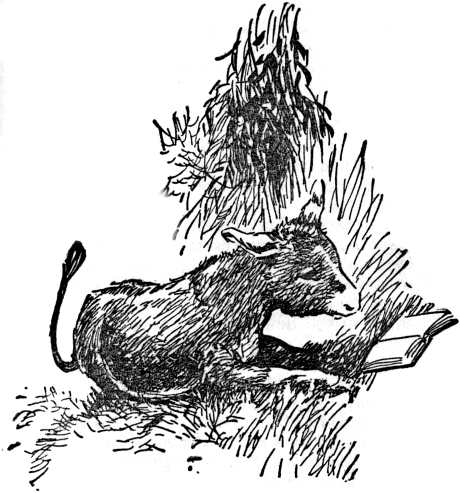
HERE WAS THE INCREDIBLE BEFORE THEM—MR. SIMPKINS,
TURNED INTO A DONKEY BY ONE OF HIS OWN SPELLS!
“Well, it won’t matter,” said Ginger.
“Yes, I bet it will,” said William. “P’raps it can
talk still—the donkey, I mean—p’raps it’ll tell people
about us an’ get us into trouble. I specks there’s a
law against turnin’ people into things like what there
is against murder—an’ he’s got a nasty look in his
eye. Look at him now. I bet he c’n still talk an’
he’ll go tellin’ people an’ we’ll be put in prison or
hanged or somethin’.”
“It’s your fault,” said Ginger, “why did you say
a big thing like a donkey? If you’d said a little thing
like a frog or somethin’ we could’ve put him in a bottle,
same as he did other folks, but what can you do with
a big thing like a donkey?”
“Well, I never thought he’d really turn into one,”
said William with spirit.
“Well, he has done,” said Ginger, “an’ we’ve gotter
do something about it ’fore anyone comes along and
he starts tellin’ them about us.”
At this point Maria uttered a loud “Hee-haw!”
“There, you see,” said Henry relieved, “he can only
talk donkey talk.”
“I don’t believe it,” said William doggedly. “He’s
jus’ pretendin’. He was readin’ his book when we
came along an’ I bet he can talk. He only wants to
wait till someone comes along an’ then get us into
trouble.... Look at him now eatin’ grass....
Well,” virtuously, “he’s got no right eatin’ that grass.
It’s Farmer Jenks’ grass ... an’ what’re we goin’
to do when they find out that the man’s disappeared
an’ there’s only a donkey left an’—they’ll blame us
... they always blame us for everything.”
“Let’s turn him back now,” said Joan, “we’ve
prob’ly taught him a lesson. Now he knows what it
feels like to be turned into something perhaps he’ll
stop turning other people into things.”
“And running pins into ’em,” said Ginger feelingly.
“Well, we’d better get him to his house, anyway,”
said William, “then he can turn himself back with his
own things.”
Maria had arisen from the bank and was now munching
grass a few yards away. Somewhat cautiously they
approached her. William addressed her sternly.
“Now,” he said, “we know that you’re a magician
an’ that you turned people into frogs an’ bones an’
run pins into people so we turned you into a donkey,
but we’re goin’ to let you turn yourself back if you
promise never to be a magician any more?”
Maria opened her mouth to its fullest extent and
emitted a “hee-haw” that took William’s breath
away.
The Outlaws withdrew and held a hasty conclave.
“I think he meant to promise, William,” said Joan.
“Well, I don’t,” said William, “I don’t. I think
he meant he wun’t promise.”
“Well, let’s get him home, anyway,” said Douglas.
“Someone’ll only be comin’ along and findin’ out all
about it if we leave him here.”
Again William approached Maria and fixed her with
a stern eye.
“You can come home an’ turn yourself back now,”
he said magnanimously, “if you want to.”
For answer Maria turned her back on them, kicked
her heels into the air, then leapt skittishly away.
It would take too long to describe in detail the
struggle by which the Outlaws finally brought the
recalcitrant Maria from the field into Mr. Simpkins’
garden and from Mr. Simpkins’ garden through the
French window into Mr. Simpkins’ laboratory. Henry
retired early from the contest after a kick on the shin.
“Now you know what he’s like,” said Ginger bitterly,
still obsessed by memories of his gastric trouble.
It was William who had the bright idea of running
home for a bunch of carrots and by means of this they
led the frisky Maria into the garden of Mr. Simpkins’
home. There Maria for a time ran amok. She broke
a pane of glass in the greenhouse, she pranced about
the well rolled lawn, leaving innumerable hoof holes
to mark her progress. She trampled down a bed of
heliotrope. She completely demolished a bed of roses.
She bit William. She was finally brought through the
French window into the lab. at the cost of all the glass
in the French window. The housekeeper, as it
happened, was lying down and was a very sound
sleeper. A small child belonging to the jobbing
gardener, pressing its nose through the front gate,
was the amazed spectator of these proceedings.
Inside the lab. Maria grew more frisky still. She
broke and ground into the carpet the test tubes that
had formed Joan’s magic circle. She wrecked the
bench and everything upon it. She kicked over an
entire shelf of bottles.
“He’s mad,” said William, “he’s mad at bein’ a
donkey an’ he doesn’t know how to turn himself back.”
“Say somethin’ to him,” urged Ginger.
William said something to him.
“If you can’t turn yourself back,” said William,
“you’ll have to stay like you are. We can’t do anything
more for you.”
In answer to this Maria kicked over a small cupboard
and then put her head through a large glass beaker.
“Let’s go,” said Ginger, “let’s go home. We’ve
brought him back to his own home. We can’t do
anything more. And, anyway, it serves him right,
him and his dead bodies an’ sticking pins into people.”
The Outlaws were just going to take his advice and
return home as unostentatiously as possible, when
they discovered that their line of retreat was cut
off. A small band of women headed by the Vicar’s
wife was coming up the drive towards the front door.
Like five streaks of lightning the Outlaws disappeared
behind a screen which Maria amid the general chaos
had considerately left standing.
The small band of women headed by the Vicar’s
wife were the members of a local Anti-vivisection
Society which had been formed in the village by the
Vicar’s wife a year ago. Up to now there had been
little scope in the village for their activities, though
they had all much enjoyed the monthly meetings at
which they had had tea and cakes and discussed the
various village scandals. But now, as the Vicar’s wife
said, was the Time to Act. They had heard of Mr.
Galileo Simpkins’ skeleton and bottled frogs and they
thought that the Local Anti-vivisection Society should
approach him and demand from him a guarantee
that he would not in his researches touch the hair
of the head of any living animal. Also they wanted
an opportunity of inspecting the mysterious lab. of
which they had heard so much. Things in the village
had been rather dull lately and like the Outlaws they
welcomed any fresh diversion....
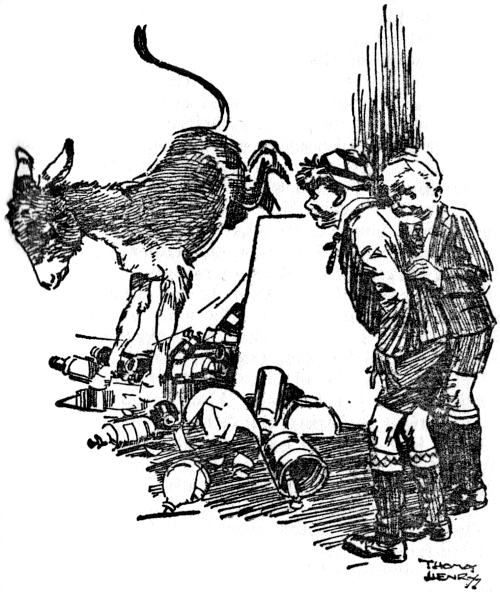
“HE’S MAD AT BEIN’ A DONKEY,” SAID WILLIAM, “AN’ HE
DOESN’T KNOW HOW TO TURN HIMSELF BACK.”
They were approaching the front door, meaning
to ring and ask to see Mr. Simpkins in the normal
fashion of callers. But to reach the front door they
had to pass the window of the lab. and it proved
far too thrilling to be passed. The Outlaws, neatly
hidden behind the screen, were invisible. Maria stood
in the middle of the room, her head drooping in an
utterly deceptive attitude of patient meekness. All
around was wreckage. The visitors stood and gazed at
the scene open-mouthed. Tacitly they abandoned
their intention of knocking at the front door and being
admitted as callers. Led by the Vicar’s wife, they
entered by the French windows.
“A donkey!” said Mrs. Hopkins, Treasurer of the
Anti-vivisection Society (that is to say, she collected
their sixpences and bought the cakes for tea). “I
thought they used monkeys or rabbits.”
“They use different animals for different experiments,”
said the Vicar’s wife with an air of deep
knowledge. “I expect that a donkey is the most
suitable animal for some experiments.”
“How terrible!” said Mrs. Gerald Fitzgerald, covering
her face with her hands. “How truly terrible....
Poor, patient, suffering, dumb beast.”
Maria laid back her ears and rolled her wicked eyes
at them.
Mrs. Hopkins and the Vicar’s wife began to wander
about the room.
They stopped simultaneously before the row of
bottled frogs.
“Poor creatures!” said Mrs. Hopkins unsteadily.
“Poor, patient, suffering creatures—once so beautiful
and lovable and free.”
(It was only the week before that Mrs. Hopkins had
screamed for help on meeting a frog in her larder.)
Mrs. Gerald Fitzgerald had by this time discovered
the skeleton. She adjusted her glasses and looked slowly
and closely up and down it several times. Then she
pronounced in a sepulchral whisper: “Human remains!”
The Outlaws held their breath in their retreat,
but a resonant “Hee-haw!” from Maria drew the
members of the local Anti-vivisection Society from any
further exploring.
“The patient creature,” said the Vicar’s wife
brokenly, “seems to be asking our help.”
Maria assumed again her attitude of deceptive
meekness.
“We certainly must do something,” said Mrs.
Gerald Fitzgerald, “we can’t leave our dear dumb
friend to torture. Look at the signs of struggle all
around us. Look at its air of suffering. The foul
work has evidently already begun. Let’s—let’s take
it away with us.”
“On the other hand,” said the Vicar’s wife slowly,
“there are the laws of private property to be considered.
Mr. Simpkins doubtless purchased this creature and the
law will hold it to belong to him.”
“We can buy it from him then,” said Mrs. Gerald
Fitzgerald brightly. “That would be a noble work
indeed. How much money have we in hand, Mrs.
Hopkins?”
“Only threepence-halfpenny,” said Mrs. Hopkins
gloomily, “we’ve been having iced cakes lately, you
know. They’re more expensive.”
“They cost more than that,” said the Vicar’s wife,
“donkeys, I mean. But,” with a flash of inspiration,
“we can get up a bazaar for it or a concert for it.”
Their spirits rose at the prospect.
“Yes,” said Mrs. Hopkins. “Why, it’s nearly a
month since we had a bazaar. And such a good cause.
Rescuing the poor dumb suffering creature from the
hands of the torturer.... How sad it looks and yet
grateful as though it understood all that we were going
to do for it.”
Maria rolled her eyes again and drooped her head
still further.
“I’m going to take it straight home,” said the
Vicar’s wife, “and give it a good meal and nurse it
back to health and strength. I’ll go to the police
station and tell them that I have taken it and why.
I’ll just fix up something to lead it home by.”
She took down a picture and divested it of its
picture cord, which she then tied round the neck of
the still meekly unprotesting Maria. The others gazed
at her in silent admiration. There was really no one
like the Vicar’s wife in a crisis.
Then, with the air of a general who has now marshalled
her forces, she led out Maria, followed by her
faithful band. The Outlaws, weakly wondering what
was going to happen, crept out of their hiding place
and followed at a distance.
“They don’t know it’s him,” said Joan in a thrilled
whisper.
Maria behaved quite well till they got to the hill.
Then her familiar devil returned to her. She did not
kick or bite. She ran. She ran at top speed up the
steep hill, dragging the panting, gasping Vicar’s wife
after her at the end of the cord. Maria’s neck seemed
to be made of iron. The weight of the Vicar’s wife did
not seem to trouble it at all. The picture cord, too,
must have been pretty strong. The Vicar’s wife did
not let go. With dogged British determination she
clung to her end of the cord. She lost her footing, her
hat came off, she gasped and panted and gurgled and
choked and sputtered. She dropped her bag. But she
did not let go her end of the picture cord. Behind
her—far behind her—ran her little crowd of followers,
clucking in dismayed horror. Mrs. Hopkins picked up
the Vicar’s wife’s hat and Mrs. Gerald Fitzgerald
her bag.
At the top of the hill Maria stopped abruptly and
reassumed her air of weary patience. The Vicar’s
wife sat down in the dust by her side, gasping but still
undaunted, holding on to the end of the cord. The
others arrived and the Vicar’s wife, still sitting in the
road, put on her hat and wiped the dust out of her
eyes.
“What happened?” panted Mrs. Hopkins. “Did
it—bolt or something?”
But the Vicar’s wife was past speech.
“Poor creature!” said Mrs. Gerald Fitzgerald in an
effort to restore the atmosphere, “poor dumb creature.”
She put out her hand to stroke Maria and Maria
very neatly bit her elbow.
The Vicar’s wife arose from the dust and wearily
but determinedly led Maria through the gate on to the
Vicarage lawn. The Outlaws came cautiously up the
hill and watched proceedings through the Vicarage
gate.
The members of the local Anti-vivisection Society
stood round Maria and gazed at her. A close observer
might have noticed that their glances held less affection
and pity than they had held a short time before.
“It doesn’t seem at all—er—cowed,” said Mrs.
Hopkins at last. “It seems quite—er as—fresh....
And it hasn’t any wounds or anything.”
“Sometimes,” said Mrs. Gerald Fitzgerald, “they
just use them for diseases. They just inject disease
germs into them.”
“Do you mean,” said Mrs. Hopkins, turning pale,
“that it may be infected with a deadly disease?”
“Quite possibly,” said Mrs. Gerald Fitzgerald.
They looked at the Vicar’s wife for advice and help.
And again the Vicar’s wife showed her capacities for
dealing with a crisis. Though still dusty and shaken
from her inglorious career up the hill at Maria’s heels
she took command of affairs once more.
“One minute,” she said, and disappeared into the
house.
The members of the Anti-vivisection Society stood
timorously in the porch, eyes fixed apprehensively
upon Maria who stood motionless in the middle of
the lawn looking as if butter would not melt in her
mouth.
And the Outlaws still watched proceedings with
interest through the Vicarage gate.
Then the Vicar’s wife came out staggering beneath
the weight of a large pail.
“Disinfectant,” she explained shortly to her audience.
She approached Maria who was still standing in
maiden meditation fancy free on the lawn, and with a
sudden swift movement threw over her the entire
pail of carbolic solution, soaking her from head to
foot. Then Maria went mad. She leapt, she kicked,
she reared. Dripping with carbolic she dashed round
the lawn. She trampled over the flower beds. She
broke two dozen flower pots and destroyed their
contents. She kicked the greenhouse door in. She
put her back hoof through the Vicar’s study window.
She tried to climb an apple tree. She wrecked the
summer-house....
The members of the local Anti-vivisection Society
withdrew into the Vicarage and bolted all the doors.
Mrs. Gerald Fitzgerald, after explaining that she wasn’t
used to this sort of thing, went into hysterics that
rivalled Maria’s outburst in intensity.
And still the Outlaws watched spellbound through
the gate.
It was the Outlaws who first saw Mr. Simpkins’
housekeeper coming up the hill. She entered the
Vicarage gate without looking at them. To her they
were merely four inoffensive small boys and one
inoffensive small girl looking through a gate. She
little knew that they held the key to a situation that
was becoming more complicated every minute. Mr.
Simpkins’ housekeeper looked upset. She rang at the
Vicarage front door and demanded to see the Vicar.
The Vicar was out, but the Vicar’s wife, looking very
pale and keeping well within the doorway and casting
apprehensive glances round the garden, where Maria,
temporarily breathless and exhausted, was standing
motionless—the picture of mute patience—on the
lawn, interviewed her. From within the house came
the unmelodious strains of Mrs. Gerald Fitzgerald’s
hysterics. Mr. Simpkins’ housekeeper said that Mr.
Simpkins had vanished. He was nowhere to be found.
The book he had been reading had been discovered in
the field near the garden and his lab. was in such a
state as to suggest a violent struggle, and Mr. Simpkins’
housekeeper suspected foul play of which Mr. Simpkins
was the victim.
The Vicar’s wife, who was a woman of one idea,
only pointed sternly to Maria and said:
“What do you know about that, my good woman?”
Her good woman looked, saw a mournful-looking
and very wet donkey and shook her head.
“Nothing ’m,” she said primly. “But what I want
to know is, where is Mr. Simpkins? I thought the
Vicar might advise me what to do, but as he’s not in,
’m, p’raps I’d better go to the police straight.”
The Outlaws, who felt that with the advent of Mr.
Simpkins’ housekeeper the plot was thickening, and who
were consumed with curiosity as to why Mr. Simpkins’
housekeeper had followed the metamorphosed Mr.
Simpkins, crept up to the Vicarage door and listened.
The mention of “police” made them rather uncomfortable.
The Vicar’s wife saw them and frowned.
The Vicar’s wife was a good Christian woman, but
she could never learn to like the Outlaws.
“Go away, little boys,” she said tartly, “how dare
you come up to the door listening to conversation
that is not meant for you? Go away at once. Or,
wait one minute.... Have any of you seen Mr.
Simpkins this afternoon?”
It was Joan who answered. She pointed across
the lawn to Maria who was now placidly nibbling the
Vicar’s hedge and said:
“That’s Mr. Simpkins.”
******
There was a moment’s tense silence. Then the
Vicar’s wife said sternly:
“Do you imagine that to be funny, you impertinent
little girl?”
“No,” said Joan.
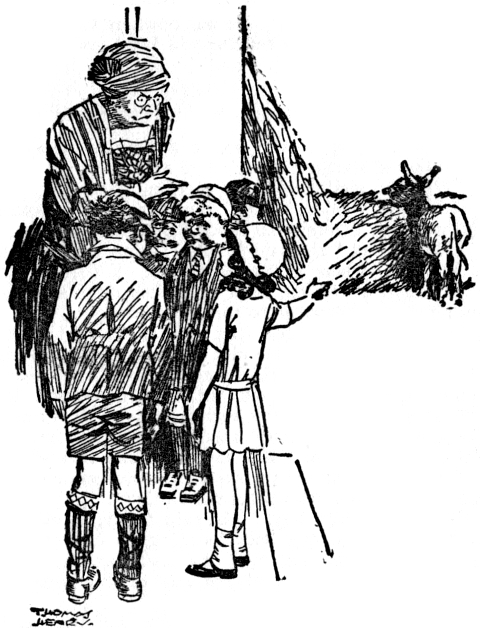
“PERHAPS,” SAID THE VICAR’S WIFE, “YOU ARE SHORT-SIGHTED,
LITTLE GIRL. THAT IS A DONKEY.”
“IT’S MR. SIMPKINS, REALLY,” SAID JOAN EARNESTLY.
There was an innocence in Joan’s face that convinced
even the Vicar’s wife.
“Perhaps,” she said more kindly, “you are short-sighted,
little girl. That,” pointing to Maria, “is a
donkey.”
“It’s Mr. Simpkins really,” said Joan earnestly,
“we turned him into a donkey and we can’t turn him
back.”
The Vicar’s wife gasped, Mr. Simpkins’ housekeeper
gasped, the other members of the Anti-vivisection
Society came out to see what it was all about and all
gasped. Mrs. Gerald Fitzgerald for the time being
abandoned her hysterics to gasp with them.
“What?” said the Vicar’s wife.
“What?” said all the rest of them.
“It’s true,” affirmed William, “we’ve turned him
into a donkey and we can’t turn him back again.”
At that moment there was a sound of great commotion
outside and in at the gate rushed Mr. Simpkins,
followed by Farmer Jenks.
******
Farmer Jenks was not pursuing Mr. Simpkins.
Farmer Jenks and Mr. Simpkins were coming on
independent missions. Farmer Jenks had come to his
field for Maria and found Maria gone. The jobbing
gardener’s youngest child had told him that four boys
and a girl had taken the donkey out of the field. It
took only few words to make Farmer Jenks recognise
his old enemies, the Outlaws, as the invaders of his
domain and thieves of his donkey, and Farmer Jenks
saw red. He had traced the donkey to the Vicarage
garden. He didn’t know how it had got there, but he
knew how it had got out of his field, and he was out
for his donkey and vengeance on the Outlaws....
Mr. Simpkins had reached town, to be met at the
station by a telegram telling him that his great-aunt
was better, so with feelings of deep disgust with life
in general and great-aunts in particular, he had returned
to his rural retreat—to find his housekeeper
vanished and his laboratory wrecked. Again the
jobbing gardener’s youngest child had brightly come
forward with all the information it could produce. It
had seen four boys and a girl turn a donkey into his
lab. through the window and then let the donkey break
things. Then more people had come and then they’d
all gone up to the Vicarage. So Mr. Galileo Simpkins
had gone up to the Vicarage in search of more light
on the situation, and in search of the Outlaws.
******
He and Farmer Jenks caught sight of the Outlaws
simultaneously and neither could resist the temptation
to make the most of the opportunity. Both flung
themselves upon the Outlaws. The Outlaws fled round
the lawn, pursued by Farmer Jenks and Mr. Galileo
Simpkins. Mrs. Gerald Fitzgerald went back to the
drawing-room to have a few more hysterics, the Vicar’s
wife dashed into the hall for the fire extinguisher
and Maria watched proceedings with interest as she
meditatively chewed the Vicar’s hedge.
Farmer Jenks caught hold of William, lost his balance
and fell with him to the ground. Mr. Galileo Simpkins
fell over Farmer Jenks and caught hold of Maria’s
tail as he fell. Maria, annoyed at this familiarity,
went mad again. The Vicar’s wife, with vague ideas
of pouring oil on troubled waters, turned the fire
extinguisher on to them all. Mrs. Hopkins ran into
the road shouting “Murder” and Mr. Simpkins’
housekeeper went to fetch the police.
******
“I’ve got to draw the line somewhere,” said
William’s father to William’s mother the next evening.
“I suppose I’ve got to pay my share for all the damage
the quadruped did in the laboratory, but I don’t see
that I need re-stock the vicar’s garden. As far as
I can make out his own wife took the creature there.
Well, I’ve taken everything I can think of from William
and done everything I can think of to him—it’s
against the law to drown him or I’d do that and be
done with it——”
“Poor William,” murmured his wife, “he means
well—and such a lot of people say he’s like you.”
“He isn’t,” said his father indignantly, “I’m more or
less sane, and he’s a raving lunatic. He can’t possibly
be like me. Do I go about turning donkeys into labs.
and for no reason at all? Do I—Nonsense!”
“Never mind, dear. He goes to school to-morrow,”
said his wife soothingly.
“Thank heaven!” said Mr. Brown quite reverently.
******
Outside in the summer-house sat the Outlaws.
“It’s simply no use explainin’ to them,” William was
saying. “They sort of won’t listen to you. They
go on as if we’d meant to break all of his ole glass
things. Well, how were we to know his aunt was ill?
I said that to them but they wun’t take any notice.
’S almost funny,” he ended bitterly, “the way they
blame us for everything—took my bow an’ arrow an’
airgun an’ money an’ everythin’ off me just as if we
hadn’t been tryin’ to do good all the time. An’ no
one does anythin’ to that old donkey. Oh, no! It was
all its fault but no one does anything to it. Oh, no.”
“An’ we go to school to-morrow,” added Ginger,
gloomily.
“Never mind,” said William with rising spirits,
“we’ve done all the sorts of things you can do in
holidays an’—an’ after all, there’s quite a lot of excitin’
things you can do in school.”
CHAPTER III
GEORGIE AND THE OUTLAWS
IT seemed to the Outlaws that before George Murdoch
came to live at the Laurels they had led comparatively
peaceful lives. They had not at any rate been
subjected to relentless and unceasing persecution as
they were now. It was not Georgie who persecuted
them. It was their own parents. But I will explain
the connection between the advent of Georgie Murdoch
and the persecution of the Outlaws. Before Georgie
came to the Laurels the Outlaws’ parents had realised
that the Outlaws were characterised chiefly by roughness,
untidiness, unpunctuality, lack of cleanliness and
various kindred vices. They mentioned these faults
to their possessors in a manner expressive of a resigned
disgust several times a day. But they always said to
each other, “Well, boys will be boys,” or, “They’re
all as bad as each other,” or, “I’ve never known a boy
who wasn’t like that.” They were in fact consoled by
the reflection that the Perfect Boy did not exist.
And then George Murdoch came to live at the
Laurels and Georgie Murdoch was the Perfect Boy.
The effect upon the Outlaws’ parents was dynamic.
No longer did they view their offspring with resigned
disgust and tell themselves and each other that boys
would be boys, for was not Georgie Murdoch a walking
refutation of the theory. Georgie Murdoch’s whole
existence proved conclusively that boys needn’t be
boys. So with renewed vigour and a perseverance
that was worthy of a better cause the Outlaws’ parents
set to work to uproot those vices of roughness, untidiness,
unpunctuality and lack of cleanliness that hitherto
they had treated, not indeed with encouragement, but
with a certain resignation. Day after day the Outlaws
heard the never-ceasing refrain, “George Murdoch
doesn’t behave like that,” “You never see Georgie
Murdoch looking like that,” “Nonsense, Georgie
Murdoch can make his hair stay tidy and his face stay
clean, so why can’t you?” or, “watch the way Georgie
Murdoch eats.”...
But the time was come to describe George Murdoch
in more detail. Georgie Murdoch was ten years of
age. He was neat and tidy and methodical and clean
and only spoke when he was spoken to and always did
what he was told. He hated messy things like mud
and water and clay and sand and he disliked rough
games. He had very beautiful manners and was much
in request at afternoon teas. He never forgot to say,
“How do you do?” and “Yes, please,” and “No,
thank you,” and “how very kind of you,” and he never
had been known to drop a cup or knock over a cake
stand. In summer he always dressed in white and
could make one suit do for three days. That gives you
a pretty good idea of Georgie Murdoch’s personal habits.
It is hardly necessary to add that he loved his lessons
and thought that the holidays were far too long.
When first the Murdochs came to live in the village,
the Outlaws were prepared to receive Georgie with
friendliness. His fame as the World’s Most Perfect
Boy had not preceded him. All they knew was that
he was about their own age and of their sex and they
were ready to make the best of him.
Mrs. Brown met him first when she went to call on
his mother.
“He’s such a nice little boy, William,” was her
verdict on her return, “I’ve asked him to come to tea
to-morrow because I’d like you to make friends with
him. He’s just about your age, and so well-mannered.”
This description was not encouraging, and whatever
enthusiasm William may previously have felt for the
new-comer waned.
“Can I have some of the others to tea as well,
mother?” he asked with an air of engaging innocence.
But unfortunately William’s mother remembered the
last occasion when “the others” had been asked to
help William entertain a little stranger. William and
“the others,” after a short test of the little stranger’s
capacities which the little stranger had failed to pass
with credit, had gone off for the afternoon on their
own devices, leaving the little stranger to his. After
wandering round the garden once and finding in it
few possibilities of amusement the little stranger had
returned home—just half an hour after he had left it.
Mrs. Brown wasn’t going to have any more contretemps
like that. So she said very firmly, “No, William.”
“All right,” acquiesced William with an air of weary
patience, “I was only thinkin’ of him. I was only
thinkin’ that p’raps he’d sort of enjoy it better if there
was more of us to play with.”
But Mrs. Brown again said, “No, William,”
meaningly, and William, who had a suspicion that she
remembered their entertaining of the last little stranger,
forebore to press the point. So William was the
solitary host when George arrived. The prospect of
being the solitary host had depressed him all morning,
and the sight of Georgie’s trim little figure in its
spotless white sailor suit threw him into a state of
despair that was almost homicidal in its intensity.
He’d had a horrible suspicion all along that Georgie
would be like that. And a whole afternoon with
him ... a whole afternoon!
Mrs. Brown, however, gave Georgie a kindly smile
of welcome as she received him.
“How nice to see you, dear,” she said, “I’m so glad
you could come. This is my little boy, William. He’s
been so much looking forward to your visit. I hope
you’re going to be great friends. How nice you look,
dear. I wish William could only keep as clean and
tidy as that. He gets so untidy.”
Georgie moved so as to get a better view of William.
He looked him up and down and finally said:
“Yes, he does look untidy, doesn’t he?” To which
momentous announcement he added complacently,
“I hardly ever seem to get untidy.”
“Well,” said Mrs. Brown, temporarily taken aback
“will you play with William till tea time, dear?...
nothing rough, mind, William.”
“No,” agreed Georgie, “I don’t like rough games.”
William, who by this time hated Georgie with a
hatred which was the more bitter because Georgie was
robbing him of a whole afternoon which might have
been spent with his beloved Outlaws, led Georgie into
the garden. They walked down to the bottom of the
garden. Then William said distantly:
“What would you like to play at?”
“Don’t mind,” said Georgie.
“Hide an’ Seek?” said William.
This puerile suggestion was intended as a subtle
insult, but Georgie took it seriously. He considered it
in silence and at last said, “No, thank you. Hide
and Seek generally ends in getting so rough.”
For a moment William had not believed his ears,
but Georgie added calmly:
“It generally ends by being a very nasty rough
game.”
William swallowed and gazed at him helplessly.
Then he suggested, more out of curiosity than from
any other reason:
“Like to play Red Indians?”
“Red Indians?” queried that astounding child as
if he had not heard of the game before.
“Yes,” said William, almost speechless with amazement.
“Scoutin’ each other through the bushes an’
makin’ a fire, an’——”
But an expression of horror had overspread Georgie’s
smug countenance.
“Oh, no,” he said firmly, “I don’t want to get my
suit dirty.”
William recovered with an effort.
“Well,” he said at last, “what would you like to do?”
“Let’s go for a nice quiet walk, shall we?” said
Georgie brightly.
So they went for a nice quiet walk—straight along
the road to the village. William at first made an
effort to fulfil his duties as host by pointing out the
objects of interest of the neighbourhood.
“There’s a robin’s nest in that hedge,” he said.
“I know,” said Georgie.
“That’s Bunker’s Hill over there.”
“I know,” said Georgie.
“That was a Clouded Yellow,” as a butterfly flitted
past.
“I know.”
“They’ve got sort of scent bags on their wings.”
“I know.”
“What sort of a bird is that flying over there?”
challenged William.
“Well, what sort is it?”
“A starling.”
“I knew it was.”
William then tired of the conversation and began to
while away the tedium of the journey as best he could
by more active measures. Georgie, however, refused to
take part in them. Georgie refused to jump over the
ditch with William because he said he might fall in.
He refused to walk on the fence with William because
he said that he might fall off. He refused to swing on
the gate with William because he said it might dirty
his suit. He refused to climb a tree for the same
reason. He refused to race William to the end of the
road because, he said, it was rough. William was only
deterred by his position as host and by Georgie’s
protective one year’s minority from forcibly making
Georgie acquainted with the contents of the ditch as
the inner prompting of his heart bade him to. Instead
he leapt to and fro across the ditch (falling in only
twice), swung on the gate, walked on the fence (over-balancing
once) and trailed his toes in the dust in
solitary glory, ignoring his companion entirely.
“What will your mother say?” said his companion
once disapprovingly.
William received the remark with scornful silence.
When they returned to the Brown homestead
Georgie was as immaculate as when he had set out,
while William bore many and visible marks of his
fallings into the ditch and on to the road and swinging
on gates and climbing trees.
“William!” said Mrs. Brown, “you look awful ...
and look at Georgie—how clean and neat he is still.”
“Yes,” said Georgie looking at William with marked
distaste, “I told him not to. I said you wouldn’t like
it, but he wouldn’t take any notice of me.”
******
The next day William met the Outlaws by appointment
and gloomily told them the worst.
“And he’s come to live here,” he ended with passionate
disgust, “him and his white suits.”
“And we shall all have to have him to tea,” said
Ginger.
“And our mothers’ll never stop talkin’ about him,”
said Douglas.
“And he’ll prob’ly get worse the more we know
him,” said Henry.
“Him an’ his white suits!” repeated William morosely.
All these fears proved to be well founded.
As Ginger had predicted, they all had to have him
to tea, and on each occasion Georgie remained clean
and tidy and immaculate in his white suit and said at
the end to his host’s mother, “Yes, I told him not to.
I said you wouldn’t like it.” And when the guest had
departed the host’s mother said to the host:
“How I wish that you were a little more like Georgie
Murdoch.”
Henry’s prediction was also fulfilled. For Georgie
did get worse the more they knew him. In addition to
the vices of personal cleanliness and exquisite manners
he possessed that of tale-bearing. He was a frequent
visitor at the Outlaws’ houses. He would gaze at
William’s mother with a wistful smile and say, “Please,
Mrs. Brown, I’m so sorry to disturb you but I think
I ought to tell you that William is paddling in the
stream after you told him not to,” or, “Please, Mrs.
Flowerdew, I’m so sorry to disturb you, but Ginger ’n’
Henry’s throwing mud at each other down the road an’
getting in such a mess. I thought you ought to know.”
And the Outlaws couldn’t get their own back.
Georgie would never fight because it might dirty his
suit, and any personal attacks upon Georgie (however
mild) were faithfully reported by the attacked in
person to the parent of the attacker.
“Please, Mrs. Brown, William’s just pushed me over
and hurt me.” “Please, Mrs. Flowerdew, Ginger’s
just banged into me and made quite a bruise on my
arm.” Moreover the Outlaws seemed to have a strong
fascination for Georgie. He followed them around,
watching their pursuits from a safe and cleanly distance,
generally eating chocolate creams which he never
offered to the Outlaws, and which never seemed to
leave any traces on his face. Whenever any elders
were in hearing Georgie would raise his voice and say
in a tone of horror, “Oh, you naughty boy! What
will your mother say?” and having attracted the elder’s
attention and interference he would say sorrowfully,
“I told him not to. I knew you wouldn’t like it.”
Yet such was the power of his white suit, his clean
face, his sweet smile, his beautiful manners that
Georgie was always referred to by the grown-ups of
the neighbourhood as “Such a dear little boy.”
The Outlaws bore it as long as they could, and then
they held a meeting to decide what could be done about
it. It was not on the whole a very successful meeting.
William kept muttering, “We’ve gotter do something
... him and his white suits.”
But not one of the Outlaws, usually so prolific in
ideas of every sort, could think of any sort of plan to
meet the case.
“S’no good doin’ anythin’ to him,” said Ginger
bitterly, “’f you just touch him he goes an’ tells your
mother.”
“Oh, you naughty boys!” mimicked Henry shrilly.
“What will your mothers say? I told him not to,
I said you wouldn’t like it.”
As an imitation it was rather good, but the Outlaws
were not in a mood to be entertained by imitations of
Georgie.
“Oh, shut up!” said William. “S’ bad enough
hearin’ him sayin’ it.”
“Well, let’s think of something to do,” said Ginger
again.
“I wish you wun’t keep sayin’ that,” said William
irritably.
“Well I’ll stop when you’ve thought of something,”
said Ginger.
“Think of somethin’ yourself,” snapped William.
As you will gather from this conversation the perfect
little gentleman was having a wearing effect upon the
Outlaws’ nerves. Henry, with a sudden gleam of
inspiration, suggested haunting the Murdoch homestead
by night, robed in a sheet, till the Murdochs should
depart in terror to some other part of England, taking
the perfect little gentleman with them, but it was
decided, after a brief and acrimonious discussion, that
this was not feasible. It was more likely that the
Murdochs would investigate the alleged ghost and
discover the concealed Outlaw, and also it might prove
difficult to gain egress from the parental home and
ingress into the Murdoch home at the rather awkward
hours suitable for “haunting.”
The only other suggestion came from Douglas who
had got full marks for Scripture the week before.
“I think Joseph must have been a bit like Georgie,”
he said. “I—I s’pose we couldn’t take him right away
somewhere and leave him in a pit same as what they did,
an’ take his coat home an’ say a wild animal ate him?”
The Outlaws considered this alluring suggestion, but
feared that it would be impracticable.
“There aren’t any pits or wild animals like that in
England in these days,” said William mournfully.
The Outlaws sighed, thinking—not for the first time—that
the vaunted benefits of civilisation were more
than nullified by its hampering elements.
“Well, we aren’t any nearer doin’ anythin’,” said
Ginger.
“There dun’t seem anythin’ to do,” said William,
whose gloom had been deepened by the thought of the
simplicity of Joseph’s brethren’s problem compared
with theirs.
“An’ he’s gettin’ worse an’ worse,” groaned Douglas.
“They’re havin’ a garden party next week,”
contributed Henry, “an’ we’ll all have to go.”
“An’ watch him in his white suit,” put in William
bitterly.
“Handin’ cakes an’ telling tales,” put in Ginger to
complete the picture.
“What do they want goin’ havin’ garden parties
for?” said William fiercely.
Henry, who was rather “up” in the Murdoch news
owing to the fact that Mrs. Murdoch had been to tea
with his mother the day before, answered him.
“Well, they’ve got a sort of cousin what’s famous
comin’ to stay with them an’ they want to sort of show
him off,” he said, translating freely from the conversation
he had overheard the day before, “so they’re
goin’ to ask everyone to meet him at a garden party.”
“How’d he get famous?” said William with
mournful interest.
“Writin’ plays,” said Henry.
William groaned.
“He’ll be worse than ever,” he said, referring not
to the writer of plays but to the perfect little
gentleman.
The meeting broke up without having arrived at any
satisfactory plan, though Henry still cherished the
haunting idea and Douglas still considered that something
might be done in the pit and wild beast line.
The next day the famous cousin arrived at the
Murdoch’s and was proudly paraded through the
village by Georgie resplendent in a new white suit and
a smile that was more smug and complacent than ever.
Close observers might have noticed that the famous
cousin looked bored.
The next few days, however, were—outside their
homes—days of respite for the Outlaws. For Georgie
was too busy with the famous cousin to be able to
spare any time for the Outlaws, and the Outlaws could
wallow in the mud, climb trees, and turn somersaults
in the road to their heart’s content without hearing
the shrill little refrain, “Oh, you naughty boys! what
will your mothers say ... I told them not to do it ...
I said you wouldn’t like it.”
I said “outside their homes.” For inside their
homes things were if possible worse. For the interest
of the whole village was, thanks to the visit of the
famous cousin, now concentrated upon the Murdochs.
“I met little Georgie Murdoch out with his cousin
to-day. He introduced me so nicely. I only wish
that I thought you’d ever be half so polite,” or, “I met
little Georgie Murdoch in the village this morning.
He’d gone to post a letter for his cousin. He looked so
nice and clean. How I wish you could keep like that.”
As the days of the garden party approached the
gloom of the Outlaws deepened.
But they knew that no excuses would avail them.
They would have to go there and watch Georgie being
“more sick’nin’ than ever,” as Henry put it, parading
his famous cousin, showing off his beautiful manners
and basking in the admiration of all the guests....
And after that he’d be more unbearable even than he
had been before.
Fate seemed to be on the side of the Murdochs.
The day of the garden party was warm and sunny and
cloudless so that the garden party (contrary to its
English custom) really could be a garden party and
little Georgie could wear one of his white suits.
William set off to the festivity with his mother,
engulfed in gloom and his Sunday suit and looking
more as if bound for a funeral than a garden party.
They found a large crowd already assembled and in
the middle of it was Georgie wearing his newest and
whitest suit and smiling his smuggest smile, and with
his golden curls glinting in the sunshine....
“Isn’t he a dear little boy?” heard William on all
sides, and “He’s such a little gentleman,” and then
from his mother the inevitable, “I wish you could
behave like that, William.”
William looked about him and soon picked out
Ginger and Henry and Douglas all in similar plight.
Their mothers too were gazing rapturously at Georgie
and telling their sons how they wished that they could
ever behave like that or ever look like that or ever
speak like that or ever keep as clean and tidy as that.
And the Outlaws (who were quite used to it by this
time) bore it in scornful silence.
Then William noticed the famous cousin. He was
standing in the background watching Georgie, not
with the radiant pleasure with which the mothers
watched him, but with an expression more akin to that
with which the Outlaws watched him. This caused
William a passing interest which however he soon
forgot in his deep passionate loathing of the perfect
little gentleman.
Gradually the Outlaws eluded the maternal escorts
and foregathered on the outskirts of the throng.
“Let’s get out of this,” said Ginger gloomily.
They wandered down a small path that led off from
the lawn and finally reached the rather muddy pond
which the Murdochs dignified by the name of “lake.”
The Outlaws gazed at it gloomily. In ordinary circumstances
it would have suggested a dozen enthralling
games, but the Outlaws, encased in Sunday suits, and
more or less clean and tidy, felt that any straying from
the paths of strict decorum upon this occasion would
be simply playing into the hands of the enemy. They
wandered morosely into a small summer-house that
stood near the banks of the pond, and there they held
a further consultation. Feeling against William was
running high. What after all was the use of a leader
who could not cope with an emergency like this...?
“’Straordinary,” said Ginger aloofly, “’Straordinary
that you can’t think of anythin’ to do.”
William glared at Ginger. He couldn’t for the
moment even fight old Ginger, which would have been
something of a relief to his feelings. So he merely
retorted coldly, “’Straordinary you can’t think of
anythin’ to do yourself.”
And Henry said gloomily, “And he gets sickniner an’
sickniner.”
“He certainly does,” said a strange voice.
The Outlaws looked up to see the famous cousin
lolling negligently against the side of the doorway of
the summer-house.
“You are referring, I presume,” he said, “to our
little host, Georgie the Terrible.”
“Yes, we are,” said William belligerently, “an’——an’
I don’t care if you tellem.”
“Oh, I shan’t tell them,” said the famous cousin
carelessly. “I’ve thought far worse things about
Georgie than you could ever put into words.”
“Uh?” said William, surprised.
“You only see him occasionally. For this week I’ve
seen him every day.”
“Uh?” said William again.
“I’ve suffered,” went on the famous cousin, “more
deeply than you can ever have suffered. Georgie is,
as it were, branded into my very soul. I have often
wondered why—My hands, of course, are tied. I am
the guest of Georgie’s parents. Battery and assault
upon Georgie would therefore ill become me. But
you——” he looked at them scornfully—“that one—two—three—four
boys your size can continue to allow
Georgie to exist as he is passes my comprehension.”
“’S’all very well talkin’ like that,” said William
indignantly, “but he’s such a little sneak! We can’t
do anythin’ to him that he doesn’t go an’ tell our
mothers an’ then we get into trouble an’ he gets more
sickenin’ than ever.”
“Sickniner an’ sickniner,” murmured Henry again
dejectedly.
“I see,” said the stranger judicially, “I fully
appreciate the difficulty.... Er—may I join the
conference?”
He entered the summer-house and sat down next
William.
“Have you,” he said, “discussed any plan of
action?”
“Lots,” said William. “Douglas wanted to put
him in a pit an’ say wild beasts had eaten him.”
“Same as they did Joseph in the Bible,” explained
Douglas.
“Ingenious,” commented the stranger, “but impracticable....
Now we want to approach the matter
in a scientific frame of mind. Before fixing on a plan
of action you should always study the enemy’s weaknesses.
Has the egregious Georgie any weaknesses?”
“Has he?” said William bitterly, “he tells tales
an’ won’t play games an’——”
The famous cousin raised his hand.
“Pardon me,” he said, “those are vices, not weaknesses.
In my sojourn with Georgie I have noticed
two weaknesses. He will never own to ignorance even
on the most abstruse subjects, and he is passionately
fond of chocolate creams. Did you know that?”
“Y—yes. S’pose so,” said William, “but I don’t
see how it will help.”
“Ah ... you must somehow make it help. A good
general always utilises his enemy’s weak points....
I can’t of course suggest or connive at any plan of
action, but I’ll help you. I’ll tell you what I’ll do. I’ll
offer a two pound box of chocolate creams as a prize
for some competition. That brings in one weakness. I
leave it to your ingenuity to make good use of the other.
Georgie would, I believe, do anything for chocolate
creams—I wish you good luck. Good day.”
The famous cousin disappeared leaving the Outlaws
gaping and mystified. But his visit had heartened
them. The knowledge that one grown up at least
saw Georgie the Perfect Little Gentleman as he really
was gave them a fresh confidence in the righteousness
of their cause. Their despondency dropped from them.
“Let’s go back to the others,” said William briskly,
“an’ see what he’s goin’ to say about the chocolate
creams.”
They emerged on the lawn and made their way to
the group around Mrs. Murdoch. Beside Mrs. Murdoch
stood Georgie still immaculately clean and smugly
smiling, with curls that glinted in the sun.
“Isn’t it too kind of my cousin,” Mrs. Murdoch was
saying. “Yes, he loves children. He’s passionately
attached to Georgie. He wants the children to do a
little scene—he’s passionately interested in literature,
of course, being one himself—a little scene from English
history—any part of English history—my cousin’s
passionately fond of English history—and he’s offered
a two pound box of chocolate creams as a prize to the
child who acts the best.... Collect your little friends,
Georgie, darling.” Georgie’s eyes were still gleaming
from the mention of chocolate creams, “and you might
go down to the summer-house to talk things over and
then come back and act your little scene to us here.”
Georgie, the Outlaws and a few odds and ends of
children who do not really come into the story, drifted
down to the summer-house. The Outlaws looked at
Georgie. Georgie’s eyes still gleamed. Then they
looked at William, and with a great relief at their hearts
they read in William’s sphinx-like face that at last he
was justifying his position as leader. He had a plan.
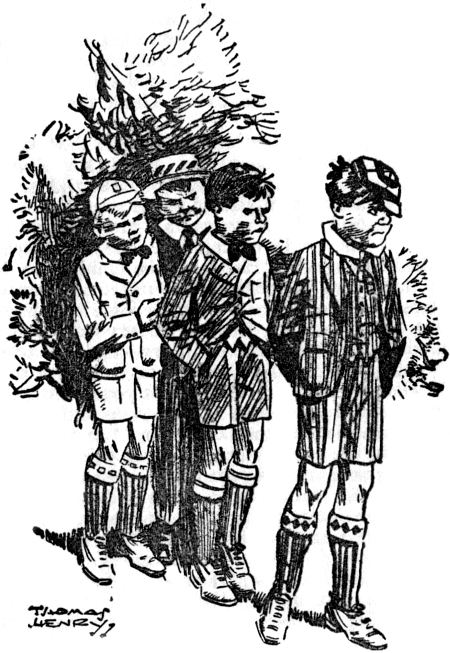
THE OUTLAWS EMERGED ON THE LAWN AND MADE THEIR
WAY DISGUSTEDLY TOWARDS THE GROUP AROUND MRS.
MURDOCH.
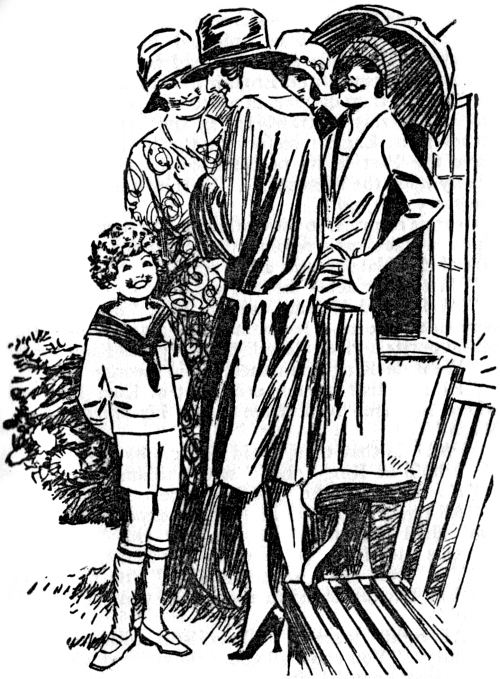
“MY COUSIN’S OFFERED A BOX OF CHOCOLATE CREAMS AS
A PRIZE TO THE ONE WHO ACTS BEST,” MRS. MURDOCH
WAS SAYING. GEORGIE’S EYES GLEAMED.
First of all William kindly but firmly gathered
together the odds and ends and despatched them to
the kitchen garden.
“There’s too many of us for one scene,” he explained,
“so we’ll do one scene and you do another scene.
An’ we’d better get right away from each other so’s
not to disturb each other ... so you just go’n make
up your scene in the kitchen garden where nobody’ll
disturb you an’ we’ll stay an’ make up ours here.
Georgie’ll show you the way to the kitchen garden.”
And while Georgie was showing them the way to the
kitchen garden William unfolded his plan to the
Outlaws. The odds and ends had fully intended to
discuss the scenes from English history in the kitchen
garden, but they discovered a bed of ripe strawberries,
and considering a strawberry in the hand worth two
scenes from English history in the bush, decided to
leave the Past to its peaceful sleep and concentrate
wholly upon the Present.... So they don’t come into
the story any more.
Georgie returned to the Outlaws in the summer-house.
Upon his face was a resolute determination to win that
box of chocolate creams at all costs.
“What’ll we act?” he said eagerly.
“Well,” said William thoughtfully, “he was down
here talkin’ to us a few minutes ago an’ he said that
his favourite period in English history was King John.”
“We’ll do King John then,” said Georgie firmly.
“He said that his favourite part of King John was
where he came back from losing his things in the
Wash.”
“We’ll do that then,” said Georgie hastily.
“Who’ll be King John?” said William.
“I’ll be King John,” said Georgie.
“All right,” said William with unexpected amenity,
“an’ shall Ginger an’ me be your two heralds an’
Douglas and Henry your servants or somethin’?”
“Yes,” said Georgie, and added, “You needn’t do
anythin’ but jus’ stand there—any of you. I’ll do the
actin’.”
“All right,” agreed William, still with disarming
humility. “You know all about the story, don’t you?”
“Yes, of course I do.”
“About how King John went into the Wash tryin’
to find his things——”
“Yes, I know all that.”
“An’ the Wash was a kind of a bog——”
“Yes, I know.”
“An’ he came out all muddy but couldn’t find his
things ’cause they’d sunk in the mud.”
“Yes, I know.”
“An’ he came to his two servants called Dam an’
Blarst——”
“Called——?”
“Fancy you not knowin’ about King John’s servants
bein’ called Dam an’ Blarst!”
“I did know,” said Georgie, “I’ve known it for ever
so long.... What did you say they were called?”
“Dam and Blarst.”
“Dam and Blarst. Of course I knew.”
“Well, let’s get you ready for bein’ King John....
S’no good goin’ on as King John lookin’ like that when
you’re s’posed to’ve just come out of a bog looking for
your things ... no one’d give anyone a prize for
that.”
“I’m not going to get myself all muddy, so there!”
“All right,” said William, “I’ll be King John. I
don’t care.”
“No, I’m going to be King John,” persisted Georgie.
“Well, you can’t be King John,” said William
firmly, “if you don’t get yourself a bit muddy like
what he was when he come back from losin’ his things
in the Wash. It’ll easy come off afterwards. Jus’
take off your shoes an’ stockings an’ paddle about a bit
at the edge of the pond. You needn’t mess up anythin’
but jus’ your feet.”
There was a silence in which Georgie’s love of
chocolate creams fought with his instincts of cleanliness
and put them to flight.
“All right,” he said, “I don’t mind muddying my
feet just a bit.”
He took off his shoes and stockings. William and
Ginger took off theirs too.
“Just to help you Georgie,” they said, “and to
stop you fallin’ in or anythin’.”
They held him firmly on either side, and walked
him down to the pond. “Jus’ because we wun’t like
you to fall an’ mess up your suit,” said William.
“Be careful, Georgie,” said Ginger, “don’ go too far.”
“Be careful, Georgie,” said William, “mind you
don’t fall.”
At last they returned to the bank.
“Nice sort of help you were,” said Georgie indignantly,
“why, you made me go in lots further than I
meant to and, look, you’ve got mud all over my
trousers.”
“Sorry, Georgie,” said William meekly, “that was
where I splashed you by mistake, wasn’t it? Shall I
be King John if you don’t like it?”
“No, I’m goin’ to be King John,” said Georgie.
“Well, shall we go and do it now?”
William looked at him doubtfully. Georgie was
gloriously muddy as far as his lower regions were
concerned but his face and blouse were still spotlessly
clean and his curls still glinted in the sun.
“It’s not quite right yet, Georgie,” he said gently.
“Don’ you remember how in History King John dived
into the Wash after his things?”
“Yes, I know,” said Georgie, “I know all about that.”
“Well, s’no good you goin’ actin’ King John an’ not
lookin’ as if you’d jus’ dived into a bog,” said William.
“I tell you,” said Georgie indignantly, “I’m not
goin’ to put any more nasty mud on me.”
“All right,” said William kindly, “let Ginger be
King John ... he won’t mind.”
“No, I’m goin’ to be King John,” said Georgie.
“We’ll jus’ put a bit of mud on your hair then,”
said William persuasively, “it’ll soon wash off an’ it
would be awfully nice if you got the prize, Georgie.”
“All right,” said Georgie relenting, “but only a
little, mind.”
“Oh, yes, Georgie,” said William, “only a little....”
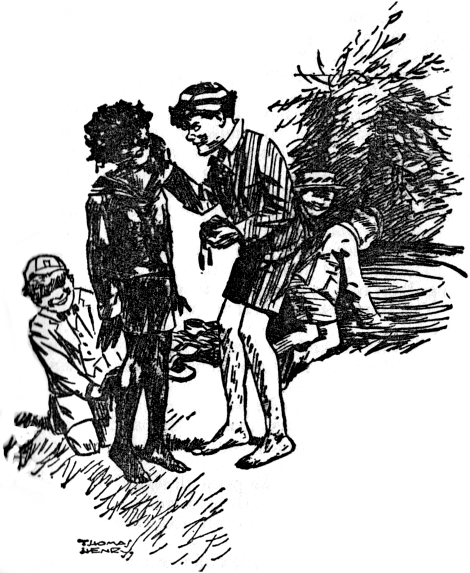
“YOU’RE ONLY PUTTING A LITTLE ON, AREN’T YOU?”
GEORGIE ASKED ANXIOUSLY.
“OH, YES, GEORGIE,” WILLIAM REASSURED HIM—“ONLY
A LITTLE.”
They plastered his head and face with mud from
the pond and dropped a goodly portion of it upon his
blouse. Fortunately Georgie could not see his upper
half very well.
“You’re only putting a little on, aren’t you?” he
asked anxiously.
“Oh, yes, Georgie,” William reassured him, “only
a little. Now you look lovely. You look jus’ like
King John after he’d been tryin’ to find his things in
the Wash—divin’ in for ’em an’ all....”
Certainly the perfect little gentleman was unrecognisable.
His suit was covered with mud, his hair was
caked with mud, his face was streaked with mud. He
had waded in mud. His smile, though still there, was
almost invisible. No longer did his curls glint in the sun.
“Now let’s start, shall we?” said William, his
spirits rising as he gazed at his handiwork. “First of
all I’ll go on with Ginger—we’re your heralds you know—and
we’ll say you’re coming; ‘Make way for King John’
or somethin’ like that. Then you come on with Henry
and Douglas and you speak to ’em. You know what
King John said to ’em in History, don’t you?”
“Yes, of course I do,” said Georgie. “What did he
say?”
“He just looked at ’em an’ said, ‘Oh Dam and
Blarst (their names, you know) I cannot find my
things.’”
“Of course I knew he said that.”
“Well, you jus’ say that to ’em and——shall we
start? I say, Georgie, you do make a fine King
John.”
“Oh, I bet I’ll win the prize all right,” said Georgie
complacently from beneath his mud.
The grown-ups sat in an expectant semicircle,
smiling indulgently.
“I do so love to see little children acting,” said one.
“They’re always so sweet and natural.”
“I wish you’d seen Georgie last Christmas,”
murmured Georgie’s mother, “as Prince Charming in
a little children’s pantomime we got up. I had his
photograph taken. I’ll show it to you afterwards.”
Just then William and Ginger appeared. They had
replaced their stockings and shoes and looked for
William and Ginger unusually neat and tidy.
“Well, dears,” said Mrs. Murdoch smiling, “have
you chosen your little scene yet?”
“No,” said William, “we can’t get on with it with
Georgie messin’ about the pond all the time.”
At that moment Georgie, imagining that William
and Ginger had heralded his approach with all
ceremony, came proudly into view from behind the
bushes, followed by Douglas and Henry. The mud
from the pond was a peculiarly concentrated kind of
mud and Georgie had wallowed in it from head to
foot. One could only guess at his white suit and
glinting curls. But through it shone Georgie’s eyes
in rapturous anticipation of a two pound box of
chocolate creams.
William and Ginger gazed at him in well simulated
horror.
“Oh, Georgie, you naughty boy!” said William.
“What will your mother say?” said Ginger.
Douglas and Henry stepped forward.
“We told him not to,” said Douglas.
“We knew you wouldn’t like it,” said Henry to the
speechless Mrs. Murdoch.
Georgie felt that something had gone wrong somewhere
but he was determined to do his part at any
rate to win those chocolate creams.
He looked at Henry and Douglas. “Oh, Dam and
Blarst——” he began, but the uproar drowned the
rest.
With a scream of horror audible a mile away Mrs.
Murdoch seized the perfect little gentleman by the
arm and hurried him indoors.
******
Georgie explained as best he could. He explained
that he was meant to be King John returning from the
Wash and that Dam and Blarst were his two servants.
But explanations were unavailing. No explanation
could wipe out from the memories of those present
that astounding picture of Georgie Murdoch standing
in the middle of the lawn caked with black mud from
head to foot and saying, “Oh, damn and blast!”
The party broke up after that. No festive atmosphere
could have survived that shock. The Outlaws,
clean and neat and sphinx-like and silent, accompanied
their parents home.
“Well,” said the parents, “I’d never have believed
that of Georgie Murdoch!”
“Caked with mud!”
“And such language!”
“It shows that you never can tell.”
A close observer might have gathered that at heart
the Outlaws’ parents were almost as jubilant over
Georgie’s downfall as were the Outlaws themselves.
The famous cousin, who was by the gate as William
took his leave, managed to press a ten-shilling note
into William’s hand.
“To be divided amongst your accomplices,” he
murmured. “You surpassed my highest expectation.
As artist to artist I tend you my congratulations.”
That, of course, is quite a good place to stop, but,
there remains more to be said.
The next day Georgie appeared once more, cleaner
and neater than ever and clad in a new white suit,
walking decorously down the village street and smiling
complacently. But it was no use. Georgie’s reputation
was gone. It had so to speak vanished in a night.
Georgie might have paraded his clean white-clad figure
and smug smile and golden curls before the eyes of the
village for a hundred years and yet never wiped out
the memory of that mud-caked little horror uttering
horrible oaths before the assembled aristocrats of the
village.
At the end of the month the Murdochs sold their
house and removed. They told their new neighbours
that there hadn’t been a boy in the place fit for Georgie
to associate with.
History does not relate what happened to the
chocolate creams.
Perhaps the famous cousin ate them.
CHAPTER IV
WILLIAM AND THE WHITE ELEPHANTS
WILLIAM,” said Mrs. Brown to her younger
son, “as Robert will be away, I think it
would be rather nice if you helped me at my stall at
the Fête.”
William’s father at the head of the table groaned
aloud.
“Another Fête,” he said.
“My dear, it’s centuries ... weeks since we had one
last,” said his wife, “and this is the Conservative
Fête—and quite different from all the others.”
“What sort ’f a stall you goin’ to have?” said
William, who had received her invitation to help
without enthusiasm.
“A White Elephant stall,” said Mrs. Brown.
William showed signs of animation.
“And where you goin’ to gettem?” he said with
interest.
“Oh, people will give them,” said Mrs. Brown
vaguely.
“Crumbs!” said William, impressed.
“You must be very careful with them, William,”
said his father gravely, “they’re delicate animals
and must be given only the very best buns. Don’t
allow the people to feed them indiscriminately.”
“Oh, no,” said William with a swagger, “I bet
I’ll stop ’em doin’ it that way if I’m lookin’ after
em.”
“And be very careful when you’re in charge of
them. They’re difficult beasts to handle.”
“Oh, I’m not scared of any ole elephant,” boasted
William, then wonderingly after a minute’s deep
thought, “white uns’ did you say?”
“Don’t tease him, dear,” said Mrs. Brown, to her
husband, and to William, “white elephants, dear, are
things you don’t need.”
“I know,” said William, “I know I don’t need ’em
but I s’pose some people do or you wun’t be sellin’ ’em.”
With that he left the room.
******
He joined his friends the Outlaws in the old barn.
“There’s goin’ to be white elephants at the Fête,”
he announced carelessly, “an’ I’m goin’ to be lookin’
after them.”
“White elephants!” said Ginger, impressed, “an’
what they goin’ to do?”
“Oh, walk about an’ give people rides same as
in the Zoo an’ eat buns an’ that sort of thing. I’ve
gotter feed ’em.”
“Never seen white ’uns before,” said Henry.
“Haven’t you,” said William airily, “they’re—they’re
same as black uns’ cept that they’re white.
They come from cold places—same as polar bears.
That’s what turns ’em white—roamin’ about in snow
an’ ice same as polar bears.”
The Outlaws were impressed.
“When are they comin’?” they demanded.
William hesitated. His pride would not allow him
to admit that he did not know.
“Oh ... comin’ by train jus’ a bit before the
Sale of Work begins. I’m goin’ to meet ’em an’ bring
’em to the Sale of Work. They’re s’posed to be savage
but I bet they won’t try on bein’ savage with me,”
he added meaningly. “I bet I c’n manage any ole
elephant.”
They gazed at him with a deep respect.
“You’ll let me help with ’em a bit, won’t you?”
“William, can I help feed ’em?”
“William, can I have a ride free?”
“Well, I’ll see,” promised William largely, and
with odious imitation of grown-up phraseology, “I’ll
see when the time comes.”
The subsequent discovery of the real meaning of the
term White Elephant filled William with such disgust
that he announced that nothing would now induce
him to attend the Fête in any capacity whatsoever.
The unconcern with which this announcement was
received by his family further increased his disgust.
The disappointment of the Outlaws at the disappearance
of that glorious vision of William and
themselves in sole charge of a herd of snowy mammals
caused them to sympathise with William rather
than jeer at him.
“If there isn’t no white elephants,” said William
bitterly, “then why did they say there was goin’ to
be some?”
Ginger kindly attempted to explain.
“You see that’s the point, William—there isn’t
white elephants.”
“Then why did they say there was?” persisted
William. “Fancy callin’ rubbish white elephants. If
you’re going to have a stall of rubbish why don’t they
say they’re goin’ to have a stall of rubbish ’stead of
callin’ it White Elephants? Where’s the sense of it?
White elephants! An’ all the time it’s broken old
pots an’ dull ole books an’ stuff like that. What’s
the sense of it ... callin’ it white elephants!”
Ginger still tried to explain.
“You see there isn’t any white elephants, William,”
he said.
“Well, why do they say there is?” said William
finally. “Well I’m jus’ payin’ ’em out by not helpin’—that’s
all.”
But when the day of the Fête arrived William had
relented. After all there was something thrilling
about serving at a stall. He could pretend that it was
his shop. He could feel gloriously important for the
time being at any rate, taking in money and handing
out change....
“I don’t mind helpin’ you a bit this afternoon,
mother,” he said at breakfast with the air of one who
confers a great favour.
His mother considered.
“I almost think we have enough helpers, thank you,
William,” she said, “we don’t want too many.”
“Oh, do let William feed the white elephants and
take them out for a walk,” pleaded his father.
William glowered at him furiously.
“Of course,” said his mother, “it’s always useful to
have someone to send on messages, so if you’ll just be
there, William, in case I need you ... I daresay
there’ll be a few little odd jobs you could do.”
“I’ll sell the things for you if you like,” said William
graciously.
“Oh no,” said his mother hastily, “I—I don’t think
you need do that, William, thank you.”
William emitted a meaning “Huh!”—a mixture
of contempt and mystery and superiority and sardonic
amusement.
His father rose and folded up his newspaper.
“Take plenty of buns, William, and mind they don’t
bite you,” he said kindly.
******
The White Elephant stall contained the usual medley
of battered household goods, unwanted Christmas
presents, old clothes and derelict sports apparatus.
Mrs. Brown stood, placid and serene, behind it.
William stood at the side of it surveying it scornfully.
The other Outlaws who had no official positions were
watching him from a distance. He had an uncomfortable
suspicion that they were jeering at him, that they
were comparing his insignificant and servile position
as potential errand-goer at the corner of a stall of
uninspiring oddments with his glorious dream of
tending a flock of snow-white elephants. Pretending
not to notice them he moved more to the centre of the
stall, and placing one hand on his hip assumed an
attitude of proprietorship and importance.... They
came nearer. Still pretending not to notice them he
began to make a pretence of arranging the things on
the stall....
His mother turned to him and said, “I won’t be a
second away, William, just keep an eye on things,”
and departed.
That was splendid. Beneath the (he hoped)
admiring gaze of his friends he moved right to the
centre of the stall and seemed almost visibly to swell
to larger proportions.
A woman came up to the stall and examined a black
coat lying across the corner of it.
“You can have that for a shilling,” said William
generously.
He looked at the Outlaws from the corner of his eye
hoping that they noticed him left thus in sole charge,
fixing prices, selling goods and generally directing
affairs. The woman handed him a shilling and
disappeared with the coat into the crowd.
William again struck the attitude of sole proprietor
of the White Elephant stall.
Soon his mother returned and he moved to the side
of the stall shedding something of his air of
importance.
Then the Vicar’s wife came up. She looked about
the stall anxiously, then said to William’s mother:
“IT—IT CAN’T HAVE BEEN
SOLD, CAN IT?” SAID THE
VICAR’S WIFE.
“I thought I’d put my coat down just here for a
few minutes, dear. You haven’t seen it, have you?
I put it just here.”
William’s mother joined in the search.
Over William’s face stole a look of blank horror.
“It——it can’t have been sold, dear, can it?” said
the Vicar’s wife with a nervous laugh.
“Oh no,” said Mrs. Brown, “we’ve sold nothing.
The sale’s not really been opened yet.... What sort
of a coat was it?”
“A black one.”
“Perhaps someone’s just carried it in for you.”
“I’ll go and see,” said the Vicar’s wife.
William very quietly joined Ginger, Henry and
Douglas who had watched the dénouement open-mouthed.
“Well!” said Ginger,
“now you’ve been an’ gone
an’ done it.”
“Sellin’ her coat,” said
Henry in a tone of shocked
horror.
“An’ she’ll probab’ly
wear it to church on Sunday
an’ she’ll see it,” said
Douglas.
“Oh, shut up about it,”
said William who was feeling
uneasy.
“Well I should think you
oughter do something
about it,” said Henry virtuously.
“Well, what c’n I do?”
said William irritably.
“You won’t half catch
it,” contributed Douglas
cheerfully, “they’ll be sure
to find out who did it. You
won’t half catch it.”
“Tell you what,” said
Ginger, “let’s go an’ get
it back.” William brightened.
“How?” he said.
“Oh ... sort of find out
where she’s took it an’
get it back,” said Ginger
vaguely, his spirits rising at the thought of possible
adventure; “ought to be quite easy ... heaps more
fun than hangin’ round here anyway.”
“OH, NO,” SAID MRS. BROWN. “THE SALE’S NOT REALLY
OPENED YET. WHAT SORT OF A COAT WAS IT?”
A cursory examination of the crowd who thronged
the Vicarage garden revealed no black coat to the
anxious Outlaws. William had been so intent upon
asserting his own importance and upon impressing his
watching friends that he had not noticed his customer
at all. She had merely been a woman and he had an
uneasy feeling that he would not recognise her again
even if he were to meet her.
“I bet she’s not here,” said Ginger, “course she’s
not here. She’ll’ve taken her coat home jolly quick I
bet. She’d be afraid of someone comin’ an’ sayin’
it was a mistake. I bet she’ll be clearin’ off home
pretty quick now—coat an’ all.”
The Outlaws went to the gate and looked up and
down the road. The rest of the company were clustered
round the lawn where the member, who was opening
the Fête, had just got to the point where he was
congratulating the stall holders on the beautiful and
artistic appearance of the stalls, and wincing involuntarily
whenever his gaze fell upon the bilious expanse
of green and mauve bunting.
“There she is,” said Ginger suddenly, “there she is—walkin’
down the road in it—cheek!”
The figure of a woman wearing a black coat could
be seen a few hundred yards down the road. The
Outlaws wasted no further time in conversation but
set off in pursuit. It was only when they were practically
upon her that they realised the difficulty of
confronting her and demanding the return of the coat
which she had, after all, acquired by the right of purchase.
They slowed down.
“We—we’d better think out a plan,” said William.
“We can watch where she lives anyway,” said
Ginger.
They followed their quarry more cautiously.
She went in at the gate of a small house.
The Outlaws clustered round the gate gazing at the
front door as it closed behind her.
“Well, we’ve got to get it back some way,” said
William with an air of fierce determination.
“Let’s jus’ try askin’ for it,” said Ginger hopefully.
“All right,” agreed William and added generously,
“you can do it.”
“No,” said Ginger firmly, “I’ve done my part
s’gestin’ it. Someone else’s gotter do it.”
“Henry can do it,” said William, still with his air
of lavish generosity.
“No,” said that young gentleman firmly, even pugnaciously,
“I’m jolly well not goin’ to do it. You went
an’ sold it an’ you can jolly well go an’ ask for it back.”
William considered this in silence. They seemed
quite firm on the point. He foresaw that argument
with them would be useless.
He gave a scornful laugh.
“Huh!” he said, “Afraid! That’s what you are.
Afraid. Huh.... Well, I c’n tell you one person
what’s not afraid of an’ ole woman in an ole black
coat an’ that’s me.”
With that he swaggered up the path to the front
door and rang the bell violently. After that his
courage failed, and but for the critical and admiring
audience clustered round the gate he would certainly
have turned to flee while yet there was time.... A
maid opened the door. William cleared his throat
nervously and tried to express by his back and shoulders
(visible to the Outlaws) a proud and imperious defiance
and by his face (visible to the maid) an ingratiating
humility.
“Scuse me,” he said with a politeness that was
rather over done, “Scuse me ... if it’s not troublin’
you too much——”
“Now, then,” said the girl sharply, “none of your
sauce.”
William in his nervousness redoubled his already
exaggerated courtesy. He bared his teeth in a smile.
“Scuse me,” he said, “but a lady’s jus’ come into
this house wearin’ a white elephant——”
He was outraged to receive a sudden box on the ear
accompanied by a “Get out, you saucy little ’ound,”
and the slamming of the front door in his face.
William rejoined his giggling friends, nursing his
boxed ear. He felt an annoyance which was divided
impartially between the girl who had boxed his ears
and the Outlaws who had giggled at it.
“Oh yes,” he said aggrievedly, “S’easy to laugh,
in’t it. S’nice an’ easy to laugh ... an’ all of you
afraid to go an’ then laughin’ at the only one what’s
brave enough. You’d laugh if it was you, wun’t you?
Oh yes?” He uttered his famous snort of bitter
sarcasm and contempt. “Oh yes ... you’d laugh
then, wun’t you? You’d laugh if it was your ear what
she’d nearly knocked off, wun’t you? Lots of people
’ve died for less than that an’ then I bet you’d get hung
for murderers. Your brain’s in the middle of your
head joined on to your ear, an’ she’s nearly killed me
shakin’ my brain up like what she did.... Oh yes,
s’easy to laugh an’ me nearly dead an’ my brains all
shook up.”
“Did she hurt you awful, William?” said Ginger.
The sympathy in Ginger’s voice mollified William.
“I sh’d jus’ think so,” he said. “Not that I
minded,” he added hastily, “I don’t mind a little pain
like that ... I mean, I c’n stand any amount of pain—pain
what would kill most folks ... but,” he
looked again towards the house and uttered again his
short sarcastic laugh, “p’raps she thinks she’s got rid of
me. Huh! P’raps she thinks they can go on stickin’
to the ole black coat what they’ve stole. Well, they’re
not ... let me kin’ly tell them ... they’re jolly
well not ... I—I bet I’m goin’ right into the house
to get it off them, so there!”
The physical attack perpetrated on William by the
housemaid had stirred his blood and inspired him with
a lust for revenge. He glared ferociously at the closed
front door.
“I’ll go’n have a try, shall I?” said Ginger, who
shared with William a love of danger and a dislike of
any sort of monotony.
“All right,” said William, torn by a desire to see
Ginger also fiercely assailed by the housemaid and a
reluctance to having his glory as martyr shared by
anyone else. “What’ll you say to ’em?”
“Oh, I’ve got an idea,” said Ginger with what
William considered undue optimism and self-assurance,
“well, if she bought it for a shillin’ I bet she’ll be glad
to sell if for more’n a shillin’ won’t she? Stands to
reason, dun’t it?”
Ginger, imitating William’s swagger (for Ginger,
despite almost daily conflicts with him, secretly
admired William immensely), walked up to the front
door and knocked with an imperious bravado, also
copied from William. The haughty housemaid opened
the door.
“G’d afternoon,” said Ginger with a courteous smile,
“Scuse me, but will you kin’ly tell the lady what’s jus’
come in here wearin’ a black coat that I’ll give her
one an’ six for it an’——”
Ginger also received a box on the ear that sent him
rolling half way down the drive, and the door was
slammed in his face. It was opened again immediately
and the red angry face of the housemaid again glared
out.
“Any more of it, you saucy little ’ounds,” she said,
“an’ I’ll send for the police.”
Ginger rejoined the others nursing his ear and making
what William thought was an altogether ridiculous
fuss about it.
“She didn’t hit you half’s hard’s what she hit me,”
said William.
“She did,” said the aggrieved Ginger, “she hit
harder ... a jolly sight harder. She’d nachurally
hit harder the second time. She’d be more in
practice.”
“No, she wun’t,” argued William, “she’d be more
tired the second time. She’d used up all her strength
on me.”
“Well, anyway I saw yours an’ I felt mine an’ could
tell that mine was harder. Well, gettem to look at our
ears. I bet mine’s redder than what yours is.”
“P’raps it is,” said William, “it nachurally would
be because of mine bein’ done first an’ havin’ time to
get wore off. I bet mine’s redder now than what yours
will be when yours had had the same time to get wore
off in as what mine has ... an’ let me kin’ly tell you
I saw yours an’ I felt mine an’ I know that mine was a
jolly sight harder ’n yours.”
After a spirited quarrel which culminated in a scuffle
which culminated in an involuntary descent of both of
them into the ditch, the matter was allowed to rest.
Ginger had in secret been somewhat relieved at the
housemaid’s reception of his offer as he did not possess
one-and-six and would have been at a loss had it been
accepted.
An informal meeting was then held to consider their
next step.
“I votes,” said Douglas who was the one of the
Outlaws least addicted to dangerous exploits, “I votes
that we jus’ go back to the Fête. We’ve done our best,”
he added unctuously, “an’ if the ole coat’s sold, well,
it’s just sold. P’raps she’ll be able to get it back by
goin’ to a lawyer or to Parliament or somethin’ like
that.”
But William, having once formed a purpose, did not
lightly relinquish it.
“You can go back,” he said scornfully. “I’m jolly
well not goin’ back without that ole coat.”
“All right,” said Douglas in a resigned tone of voice,
“I’ll stay an’ help.”
To Douglas’ credit be it said that having uttered
his exhortation to caution he was always content to
follow the other Outlaws on their paths of lawlessness
and hazard.
“Tell you what I’m goin’ to do,” said William
suddenly, “I’ve asked for it polite an’ if they won’t
give it me then it’s their fault, in’t it? Well I’ve asked
for it polite an’ they wun’t give it me so now I’m jolly
well goin’ to take it.”
“I’ll go with you, William,” volunteered Ginger.
“I think,” said William frowning and assuming his
Commander-in-Chief air, “I’d better go on alone. But
you jus’ stay near an’ then if I’m in reel danger—sort
of danger of life or death—I’ll shout an’ you come in
an’ rescue me.”
This was such a situation as the Outlaws loved. They
had by this time quite lost sight of what they were
rescuing and why they were rescuing it. The thrill of
the rescue itself filled their entire horizon....
They went round to the side gate where they
crouched in the bushes watching the redoubtable
William as he crept Indian fashion with elaborate
“registration” of cunning and secrecy across a small
lawn up to a small open window. Breathlessly they
watched him hoist himself up and swing his legs over
the window sill. They saw his freckled face still
wearing its frown of determination as he disappeared
inside the room.
He had meant to make his way through the room to
the hall where he hoped to find the black coat hanging
and to be able to abstract it without interference and
return at once to his waiting comrades. But things
are seldom as simple as we hope they are going to be.
No sooner had he found himself in the room than he
heard voices approaching the door and with admirable
presence of mind dived beneath the round table in the
middle of the room, whose cloth just—but only just—concealed
him from view.
The lady whom the Outlaws had followed down the
road—now divested of the fateful black coat—entered
the room followed by another gayer and more highly-coloured
lady.
“A black coat, did you say?” said the first lady.
William, beneath the table, pricked up his ears.
“Yes, if you can, dear,” said the highly-coloured
lady, “if you’d be so good, dear. I only want it for
to-morrow for the funeral. I think I told you, didn’t
I, dear? A removed cousin whom I hardly knew—a
very removed cousin—but they’ve invited me and one
likes to show oneself appreciative of these little attentions—not
that I think he’ll have left me a penny in
his will and it certainly isn’t worth while buying
black but I have a black dress and if you wouldn’t mind
lending me a black coat.”
“Certainly,” said the first lady. “I can let you
have one with pleasure. It’s in the hall. It’s one
I’ve only just bought....”
William ground his teeth.... So it was in the hall!
If he’d only been a few minutes earlier....
They went into the hall and William gathered that
the black coat was being displayed.
“Quite a bargain, wasn’t it?” he heard the first
lady say.
It was all he could do to repress a bitter and scornful
“Huh!”
They returned—evidently with the coat.
“Thank you so much, dear,” said the highly-coloured
lady, “it’s just what I wanted and so smart. What
was it like at the Fête...?” she was trying on the
coat and examining herself smilingly in the overmantel
mirror. “I must say it does suit me.”
“Oh, very dull,” said the first lady. “I really
came away before it was actually opened. Just got
what I wanted and then came away. It all looked
as if it was going to be most dull.”
The highly-coloured lady sniffed and her complacency
gave way to aggrievement. “I must say
that I was a bit hurt that they didn’t ask me to give
an entertainment. I can’t help feeling that it was a
bit of a slight. People have so often told me that
no function about here is complete without one of my
entertainments and then not to ask me to entertain
at the Conservative fête ... well, I call it pointed,
and it points to one thing and one thing only in my
eyes. It points to jealousy, and intrigue, and spitefulness,
and underhandedness, and cunning, and deceit
on the part of some person or persons unknown—but,
believe me, Mrs. Bute, quite easily guessed
at!”
The highly-coloured lady was evidently in the
state known as “working herself up.” Suddenly
William knew who she was. She must be Miss Poll.
He remembered now hearing his mother say only
yesterday, “That dreadful Poll woman wants to
give an entertainment at the Fête and we’re determined
not to have her. She’s so vulgar. She’d cheapen
the whole thing....”
He peeped at her anxiously from behind his concealing
table-cloth, then hastily withdrew.
“Of course,” said Mrs Bute, who sounded bored
and as if she’d heard it many times before, “of course,
dear, but ... the coat will do, will it ?”
“Very nicely, thank you,” said Miss Poll rather
stiffly because she thought that Mrs. Bute really
ought to have been more sympathetic. “Good
afternoon, dear.”
“I’ll wrap it up for you,” said Mrs. Bute.
There was silence while she wrapped it up, then
Miss Poll said, “Good afternoon, dear,” again and went
into the hall and there followed the sound of the
closing of the front door, then sounds as of the mistress
of the house going upstairs. William retreated
through his open window and rejoined Douglas and
Henry at the gate. Ginger had vanished.
“Quick,” he said, “she’s got it.”
The figure of Miss Poll carrying a large paper parcel
could be seen walking down the road. “We’ve gotter
follow her. She’s got it now.”
At this minute Ginger reappeared.
“She’s got it,” William explained to him.
“Yes, but there’s another,” said Ginger, pointing,
“there’s another black coat hangin’ up in the hall.
I’ve been round an’ looked through a little window
an’ seen it ... it’s there.”
William was for a moment nonplussed. Then he
said: “Well, I bet the one she’s took’s the one,
’cause I heard her say wasn’t it a bargain, an it was
a bargain too. Huh! I’m goin’ after her.”
“Well, I’m not,” said Ginger. “I’m goin’ to stop
here an’ get the other one.”
“All right,” said William, “you an’ Douglas stay
here an’ Henry ’n me’ll go after the other an’ I bet
you ours is the right one.”
So quite amicably the Outlaws divided forces.
Ginger and Douglas remained concealed in the bushes
by the gate of Mrs. Bute’s house, warily eyeing the
windows, while William and Henry set off down the
road after Miss Poll’s rapidly vanishing figure.
******
William and Henry stood at Miss Poll’s gate and
held a hasty consultation. Their previous experience
did not encourage them to go boldly to the front door
and demand the black coat.
“Let’s jus’ go in an’ steal it,” said Henry cheerfully.
“’S not hers really.”
But William seemed averse to this.
“No,” he said, “I bet that it wouldn’t come off. I
bet she’s the sort of woman that’s always poppin’ up
jus’ when you don’ want her. No, I guess we’ve gotter
think out a plan.”
He thought deeply for a few minutes, then his face
cleared and over it broke a light that betokened
inspiration.
“I know what we’ll do. It’s a jolly good idea. I
bet ... well, anyway, you come in with me an’
see.”
Boldly William walked up to the front door and
rang the bell. Apprehensively Henry followed him.
Miss Poll, wearing the black coat (for she had
been trying it on and fancied herself in it so much that
she had not been able to bring herself to take it off to
answer the bell), opened the door.
William, his face devoid of any expression whatever,
repeated monotonously as though it were a
lesson:
“G’afternoon, Miss Poll, please will you come to
the Fête to give an entertainment.”
Miss Poll went rather red and for one terrible
minute William thought that she was going to attack
him as the maid had done—but the moment passed.
Miss Poll was simpering coyly.
“You—you’ve been sent on a message, I suppose,
little boy?” then, relieving William’s conscience of the
difficult task of answering this question, she went on,
“I thought there must be some mistake.... Of
course,” she simpered again, then pouted, “really
I’d be quite within my rights to refuse to go. It’s
most discourteous of them to send for me like this
at such short notice but,” she gave a triumphant
little giggle, “I knew that really they couldn’t get on
without me. They didn’t send a note by you, I
suppose?”
“No,” said William quite truthfully.
She pouted again.
“Well, that I think is rather rude, don’t you? However,”
the pout merged again into the simper, “I
wouldn’t be so cruel as to punish them for that by
staying away. I knew they’d want me in the end.
But these things are always so shamefully organised,
don’t you think so?”
William cleared his throat and said that he did.
Henry, in response to a violent nudge from William,
cleared his throat and said that he did too. Miss
Poll encouraged by their sympathy, warmed to her
subject.
“Instead of writing to engage me months ago they
send a message like this at the last minute.... What
would they have done if I’d been out?”
Again William said he didn’t know and again
Henry, in response to a nudge from William, said he
didn’t know either.
“Well, I mustn’t keep the poor dears waiting,”
said Miss Poll brightly. “I’ll be ready in a second
I’ve only to put my hat on.”
Then Miss Poll underwent a short inward struggle
which William watched breathlessly. Would she
keep on the black coat or would she change it for
another? Wild plans floated through William’s head.
He’d say would she please go in something black
because the Vicar had died quite suddenly that morning
or—or the Member had just been murdered or something
like that.... It was obvious that Miss Poll
was torn between the joy of wearing a coat in which
she considered herself to look “smarter” than in anything
else she possessed and the impropriety of wearing
for a festal occasion a garment borrowed for the
obsequies of the very removed cousin. To William’s
relief the coat won the day and after buttoning up the
collar to give it an even smarter appearance than it
had before and putting on a smart hat with a very
red feather, she joined them at the door.
“Now I’m ready, children,” she said, at which
William scowled ferociously and Henry winced,
“they didn’t say which of my repertoire” (Miss Poll
pronounced it reppertwaw) “I was to bring with me,
did they?”
And again William said “no” with a face devoid
of expression and with perfect truth. And Henry
said “No,” too.
“As it’s such short notice,” she went on, “they
really can’t expect anything in the way of—well, of
make-up or dress, can they?”
William said that they couldn’t and Henry, being
nudged again by William, confirmed the opinion....
“Though I wish you children could see me in my
charwoman skit. I’m an artist in make-up....
Now, can you imagine me looking really old and
ugly?”
Henry quite innocently said “Yes,” and on being
nudged by William, changed it to “yes, please.”
Miss Poll looked at Henry as if she quite definitely
disliked him and turned her attentions to William.
“You know, dear ... I can make myself to look
really old. You’d never believe it, would you? Now
guess how old I am, really?”
Henry, not wishing to be left out of it, said with
perfect good faith, “fifty” and William, with a vague
idea of being tactful, said “forty.” Miss Poll who
looked, as a matter of fact, about forty-five, laughed
shrilly.
“You children will have your joke,” she said, “now
I wonder what I’d better do for them to start with?
You know, what makes me so unique as an entertainer,
children—and if I’d wanted to be I’d be famous now
on the London stage—is that I’m entirely independent
of such artificial aids as mechanical musical instruments
and books of words and such things. I depend
upon the unaided efforts of my voice—and I’ve a
perfect voice for humorous songs, you know, children—and
my facial expression. Of course I’ve a magnetic
personality ... that’s the secret of the whole thing....”
William was tense and stern and scowling. He
wasn’t thinking of Miss Poll’s magnetic personality.
He was thinking of Miss Poll’s coat. The first step
had been to lure Miss Poll to the Fête; the second and,
he began to think, the harder, would be to detach the
coat from Miss Poll’s person.
“It’s—it’s sort of gettin’ hot, i’n’t it?” he said
huskily.
“Yes, isn’t it?” said Miss Poll pleasantly.
William’s heart lightened. “Wun’t you like to
take your coat off?” he said persuasively. “I’ll carry
it for you.”
But Miss Poll who considered, quite erroneously,
that the coat made her look startlingly youthful and
pretty, shook her head and clutched the coat tightly
at her neck.
“No, certainly not,” she said firmly.
William pondered his next line of argument.
“I thought,” he suggested at last meekly, “I
thought p’raps you sing better without your coat.”
Henry, who felt that he was supporting William
rather inadequately, said: “Yes, you sort of look as
if you’d sing better without a coat.”
“What nonsense!” said Miss Poll rather sharply,
“I sing perfectly well in a coat.”
Then William had an idea. He remembered an
incident which had taken place about a month ago
which had completely mystified him at the time, but
which he had stored up for possible future use. Ethel
had come home from a garden party in a state
bordering on hysterics and had passionately destroyed
a perfectly good hat which she had been wearing. The
reason she gave for this extraordinary behaviour
had been that Miss Weston had been wearing a hat
exactly like it at the garden party (“exactly like it ...
I could have killed her and myself,” Ethel had said
hysterically). The reason had seemed to William
wholly inadequate. He met boys every day of his
life wearing headgear which was exactly identical
with his and the sight failed to rouse him to hysterical
fury. It was one of the many mysteries in which
the behaviour of grown-up sisters was shrouded—not
to be understood but possible to be utilised.
Now he looked Miss Poll up and down and said
ruminatingly, “Funny!”
“What’s funny?” said Miss Poll sharply.
“Oh, nothin’,” said William apologetically, knowing
full well that Miss Poll would now know no peace
till she’d discovered the reason for his ejaculation and
steady contemplation of her.
“Nonsense!” she said sharply, “you wouldn’t say
‘funny’ like that unless there was some reason for it, I
suppose. If I’ve got a smut on my nose or my hat’s on
crooked say so and don’t stand there looking at me.”
William’s steady gaze was evidently getting upon
Miss Poll’s nerves.
“Nothin’,” said William again vaguely, “only I’ve
just remembered somethin’.”
“What have you remembered?” snapped Miss Poll.
“Nothin’ much,” said William, “only I’ve jus’
remembered that I saw someone at the Fête jus’
before I came out to you, in a coat exactly like that
one what you’ve got on.”
There was a long silence, and finally Miss Poll said:
“It is a little hot, dear. You were quite right. If you
would be so kind as to carry my coat——”
“I’VE JUS’ REMEMBERED,” SAID WILLIAM, “THAT I SAW
SOMEONE AT THE FÊTE IN A COAT EXACTLY LIKE THAT
ONE WHAT YOU’VE GOT ON.”
She took it off, revealing a dress that was very
short and very diaphanous and very, very pink,
folded up the coat so as to show only the lining and
handed it to William. William, though retaining
his sphinx-like expression, heaved a sigh of relief,
and Henry dropped behind Miss Poll to turn a cart
wheel expressive of triumph in the middle of the road.
They had reached the gate of the Vicarage now. They
were only just in time....
William meant to thrust the coat into the arms of
the Vicar’s wife and escape as quickly as he could,
leaving Miss Poll (for whom he had already conceived
a deep dislike) to her fate.
It had happened that the Member’s agent had with
difficulty and with the help of great persuasive power
and a megaphone, collected the majority of the attendants
at the Fête into a large tent where the Member was
to “say a few words” on the political situation. Many
of those who had had experience of the Member’s
“few words” on other occasions had tried to escape
but the agent was a very determined young man
with an Oxford manner and an eagle eye, and in the
end he had hounded them all in. The Member was
just buying a raffle ticket for a nightdress case and
being particularly nice to the raffle ticket seller partly
because she was pretty and partly because she might have
a vote (one could never tell what age girls were nowadays).
The agent was hovering in the background
ready to tell him that his audience was awaiting him
as soon as he’d finished being nice to the pretty girl,
and at the same time keeping a wary eye on the door
of the tent to see that no one escaped.... And then
the contretemps happened. Miss Poll tripped airily
up to the door of the tent in her pink, pink frock,
peeped in, saw the serried ranks of an audience with
a vacant place in front of them, presumably for the
entertainer, and skipping lightly in with a “So
sorry to have kept you all waiting,” leapt at once into
her first item—an imitation of a tipsy landlady, an
item that Miss Poll herself considered the cream of
her repertoire. The audience (a very heavy and
respectable audience) gaped at her, dismayed and
astounded. And when a few minutes later the Member,
calm and dignified and full to overflowing of eloquence
and statistics, having exchanged the smile he had
assumed while being nice to the pretty raffle ticket
seller for a look of responsibility and capability, and
having exchanged his raffle ticket for a neat little
sheaf of notes (typed and clipped together by the
ubiquitous agent), appeared at the door of the tent
he found Miss Gertie Poll prancing to and fro before
his amazed audience, her pink, pink skirts held very
high, announcing that she was Gilbert the filbert, the
colonel of the nuts. The agent, looking over his
shoulder, grew pale and loose-jawed. The Member
turned to him with dignity and a certain amount of
restraint.
“What’s all this?” he demanded sternly.
The agent mopped his brow with an orange silk
handkerchief.
“I—I—I’ve no idea, sir,” he gasped weakly.
“Please put a stop to it,” said the Member and
added hastily, remembering that the tent was packed
full of votes, “without any unpleasantness, of course.”
I have said that the agent was a capable young
man with an Oxford manner, but it would have taken
more than a dozen capable young men with Oxford
manners to stop Miss Gertie Poll in the full flow of her
repertoire. She went on for over an hour. She
merely smiled bewitchingly at the agent whenever he
tried to stop her without any unpleasantness, and
when the Member himself appeared like a deux ex
machina to take command of the situation, she blew
him a kiss and he hastily retired.
Meanwhile William, triumphantly bearing the black
coat, made his way up to the Vicar’s wife. He met
Ginger and Douglas, also carrying a black coat and on
the same mission.
“Bet you tuppence mine’s the one,” said Ginger.
“Bet you tuppence mine is,” said William; “where’d
you get yours?”
“We got it out of her hall,” said Douglas cheerfully,
“we jus’ walked in an’ got it an’ no one saw us....
I bet ours is the one.”
“Well, come on an’ see,” said William, pushing
his way up to the stall presided over by the Vicar’s
wife.
“Here’s your coat, Mrs. Marks,” he said handing
it to her, “it was sold by mistake off the rubbish stall
but we’ve got it back for you—me an’ Henry.”
Before the Vicar’s wife could answer, a frantic
messenger came up to her.
“What shall we do?” she moaned. “Miss Poll’s
entertaining the tent and the Member can’t speak.”
“Miss Poll!” gasped the Vicar’s wife, “we never
asked her.”
“No, but she’s come and she’s singing all her awful
songs and no one can stop her and the Member can’t
speak.”
The Vicar’s wife, still absently nursing the coat
that William had thrust into her arm, stared in front
of her.
“But—but how awful!” she murmured, “how
awful?”
Then Ginger came up and thrust the second coat
into her protesting arms.
“Your coat, Mrs. Marks,” he said politely, “what
we sold by mistake off the rubbish stall. Me an’
Douglas ’v got it back for you.”
He made a grimace at William which William
returned with interest.
They waited breathlessly to see which coat the
Vicar’s wife should claim as her own.
She looked down at her armful of coats as if she
saw them for the first time.
“B-but,” she said faintly, “I got that coat back.
The woman who bought it thought there must be
some mistake and brought it to me. These aren’t my
coats.... I don’t know anything about these coats.”
Shrill strains of some strident music hall ditty came
from the tent. A second messenger came up.
“She won’t stop,” she sobbed, “and the Member’s
foaming at the mouth.”
“Oh, dear,” said the Vicar’s wife, clutching her
bundle of coats still more tightly to her. “Oh,
dear, oh, dear!”
At that moment a woman pushed her way through
the crowds up to the Vicar’s wife. It was Mrs.
Bute.
“Brought it here, they did,” she panted. “Where
is it? Thieves! Came into my hall bold as brass an’
took it!... There it is!” she glared suspiciously
at the Vicar’s wife, “what’ve you got it for ... my
coat ... I’d like to know. I’d——” She tore it out
of her arms and the other coat too fell to the ground.
“My other coat!” she screamed, “both my coats!
Thieves—that’s what you all are! Thieves!”
“Where are those boys?” said the Vicar’s wife
very faintly. But “those boys” had gone. William,
resisting the strong temptation to go and enjoy the
spectacle of the Member foaming at the mouth, had
hastily withdrawn his little band to a safe distance.
******
They were found, of course, and brought back.
They were forced to give explanations. They were
forced to apologise to all concerned, even to Miss Poll
(who forgave them because she’d had such a perfectly
ripping afternoon and her little show gone off so sweetly
and everyone been so adorable). They were sent home
in disgrace.... William was despatched to bed on
dry bread and water, but being quite tired by the day’s
events and the bread happening to be new and unlimited
in quantity, William’s manly spirit survived
the indignity.
And William’s mother said the next day: “I knew
what would happen.” (William’s mother always said
that she knew it would happen after it had safely—or
dangerously—happened.) “I knew that if I let William
come and help everything would go wrong. It
always does. Selling people’s coats and stealing people’s
coats and getting that awful woman to come that we’d
sworn we’d never have again and stopping the Member
speaking when he’d taken ages over preparing his
speech, and upsetting the whole thing—well, if anyone
had told me beforehand that one boy William’s
size could upset a whole afternoon like that I simply
shouldn’t have believed them.”
And William’s father said: “Well, I warned you,
William. I told you they were difficult beasts to
manage. Of course, if you lose control of a whole
herd of white elephants like that they’re bound to do
some damage.”
And William said disgustedly: “I’m just sick of
white elephants and black coats. I’m going out to
play Red Indians.”
CHAPTER V
THE STOLEN WHISTLE
WILLIAM had been to watch the sheep dog
trials at a neighbouring Agricultural Show and
had been much thrilled by the spectacle. It had
seemed, moreover, perfectly simple. Just a dog and
some sheep and anyone could do it. He had a dog,
of course—Jumble, his beloved mongrel who had
filled many and various rôles since he had joined
William’s ménage. He had been a walking dog and a
dancing dog and a talking dog. He had even on one
occasion represented a crowd in a play organised by
William. It cannot be claimed that Jumble brought
any great brilliance to bear on the fulfilment of these
rôles. He was essentially passive, rather than active,
in his representation of them. He walked and danced
perforce, because William on these occasions held his
front paws and he could do nothing else. His
“talking” was his natural reaction of excitement to
William’s softly whispered “rats!” It did not really
represent that almost superhuman intelligence that
William claimed for it. Jumble himself took no pride
in his accomplishments. When he heard the word
“trick” he slunk off as quickly as he could, but if
escape were impossible he yielded to the inevitable,
and suffered the humiliation of walking or dancing
with an air of supercilious boredom.
After breakfast on the morning after the sheep
trials, William walked slowly and thoughtfully into
the garden. There he was greeted effusively by
Jumble who tried to convey to him by barks and leaps
and whirlwind rushes that it was just the morning
for a walk in the wood, where perhaps—perhaps—with
luck one might meet a rabbit or two. But
William was not in a rabbit mood. He was in a sheep
dog mood. He had definitely decided to train Jumble
to be a sheep dog. It might be objected that with
truth Jumble was not a sheep dog, to which objection
it might with equal truth be replied that Jumble was
as much a sheep dog as he was any other sort of dog.
The sorts of dog in Jumble were so thoroughly mixed
that there was no sort of dog you could definitely
say he wasn’t. William had decided to use a whistle
for giving his signals to Jumble chiefly because his
newest and dearest treasure happened to be a whistle.
It had been sent to him for his last birthday, by an
uncle who, as William’s father bitterly remarked,
ought to have known better. It was not an ordinary
whistle. It was the Platonic ideal of a whistle. It
was very large and very ornate and emitted a sound
rivalled only by a factory siren. William to the relief
and surprise of his family had made little use of this
since his reception of it. He had kept it in a box in
a drawer in his bedroom. His family fondly imagined
that he had forgotten about it and never allowed
the conversation even remotely to approach the
subject of musical instruments in general or whistles
in particular, lest it should remind him of it. They
could not know, of course, that William’s whistle
was his secret pride and joy and dearest treasure and
that he did not use it simply because he considered
it too precious to use till some great and worthy
occasion presented itself. And here the great and
worthy occasion had presented itself—the training of
Jumble to be a sheep dog. With Jumble bounding
about in innocent glee and all unaware of his coming
ordeal, he entered his bedroom and reverently took
the whistle from its bed of cotton wool in the box
in which he had received it. Then he placed it in
his pocket and with Jumble still leaping exuberantly
about him went out into the road. He had now a
dog and a whistle. The only thing that remained
was to find some sheep. He swung down the road,
one hand fingering lovingly the whistle that reposed
in his pocket, his eyes fixed proudly on Jumble.
Jumble, who fondly imagined that his hint about
the walk in a rabbity wood had been taken, leapt
ecstatically into the air at every passing fly or butterfly
and as often as not overbalanced in the process. The
very word “trick” would have sent him slinking
homeward, his tail between his legs, but no one
uttered the fateful word so Jumble leapt and bounded
in light-hearted glee with no thought in his mind but
of scurrying white-tailed rabbits.
William was now walking along without paying much
attention to his pet. His mind was set on other things.
He was looking for sheep. Suddenly he saw them—a
whole fieldful of sheep with no guardian or owner in
sight. He brightened. The training of Jumble as a
sheep dog could begin. With Jumble still at his heels
he entered the field.
“Now, Jumble,” he said sternly, “when I blow one
blow on this whistle you drive ’em to the end of the
field an’ when I blow two you drive ’em back again.”
Jumble gave a short sharp bark, which William,
ever optimistic, took to be one of complete understanding.
William drew in his breath then blew a piercing
blast on his whistle. The nightmare sound rent the
air. A sheep who was cropping grass turned and
gazed at him reproachfully. The others took no
notice. Jumble continued to chase butterflies.
William sighed and repeated his instructions.
“When I blow once on this whistle, Jumble, you
drive ’em over there and when I blow twice you drive
’em back.” Jumble wagged his tail and William
thought he’d really tumbled to it at last.
He blew again—a mighty piercing blast. The
sheep who had looked at him reproachfully turned
and looked at him still more reproachfully. Jumble,
upon whose mind the conviction was slowly forcing
itself that something was being expected of him, sat
up and begged.
William sighed.
“No, Jumble,” he said, “jus’ listen—when I blow
once——”
He stopped. Jumble was off after another butterfly.
It was simply no use talking to Jumble with all those
butterflies about. He must make him understand
by some other means. He pointed to the sheep.
“Hi, Jumble!” he urged, “at ’em! Rats!”
Jumble looked from William to the sheep, head on
one side, ears cocked. His master evidently wanted
him to attack those big white things that inhabited
the field. But why? They were doing no harm
and there was a vein of caution in Jumble that objected
to the unnecessary attacking of things three times his
size. Still, he didn’t mind showing willing and he
needn’t go too near.
With elaborate ostentation of ferocity he began to
bark at the nearest sheep, making little leaps and
rushes as if to attack it—but keeping all the time a
respectful distance.
“Good old Jumble!” encouraged William, “go on
at them. Rats!” Jumble, glad to learn from the
tone of William’s voice that he was doing the right
thing, redoubled his pretence of fury and attack.
The nearest sheep with a scared look on its face rose
and moved farther away. Jumble’s delight knew no
bounds. He had frightened the thing. That big
white animal three times his size was afraid of him.
Some of his caution deserted him. He advanced
again upon the sheep, his sound and fury redoubled.
The sheep began to run. In a state of frenzied intoxication
Jumble flung himself to the pursuit. Panic
broke out among the flock. They rushed hither and
thither bleating wildly, with Jumble, who imagined
himself a Great Dane at least, pursuing them, barking
loudly. William felt gratified. Things were getting
a move on at last. Jumble was turning out a really
fine sheep dog. Then he blew twice on his whistle.
“Now bring ’em back, Jumble,” he ordered.
But Jumble was deaf and blind to everything but
the ecstasy of chasing these large foolish white
creatures who did not seem to realise their size who—joy
of joys, miracle of miracles!—were afraid of him—of
him! The field was a medley of scurrying bleating
sheep and leaping, barking, exulting, pursuing, ecstatic
Jumble.
“Hi, Jumble!” called William again, “stop it—bring
’em back now.”
But the sheep had found a way of escape and were
streaming in a jostling panic-stricken crowd through
the gate inadvertently left open by William on to
the road where some streamed off in one direction,
some in another, still bleating wildly.
Jumble surveyed the empty field. He’d cleared
them out, which was evidently what William meant
him to do. The place belonged to him and William
now. He swaggered up to William and sat down
sideways head in the air, mouth open panting.
He fairly radiated conceit. He couldn’t get over
it—hundreds and hundreds of big white things each
three times as big as himself flying in panic before him—before
him—what a dog! What a dog! He gave
William a glance that said:
“Well, what do you think of me, now?”
William could have told him quite adequately and
eloquently what he thought of him but already sounds
of commotion and shouting came from the direction of
the farm whence the errant sheep had been sighted.
Already men were running down the road to deal with
the crisis. William, not wishing to be dealt with as
part of the crisis, hastily picked up Jumble, scrambled
through the hedge into a further field and thence by
devious routes to the road and back to his home.
His first lesson to Jumble on sheep dogging had not
been altogether successful but William was not a
boy lightly to abandon anything he had undertaken.
Only he thought that perhaps it had been a mistake to
begin on sheep. It would be best probably to work up
to sheep gradually. Sitting on an upturned plant pot
in his back yard, his chin on his hands, he frowningly
considered the situation, while Jumble sat by him,
leaning against the plant pot wearing a complacent
simper, still seeing himself, alone and unaided, putting
to flight vast hordes of large white animals. Yes,
thought William, that had been the mistake—beginning
with sheep instead of working up to them
gradually. If he could begin on something small they
could work up to sheep by degrees. His white mice—the
very thing! He turned and gave Jumble a
long and patient detailed account of what he wanted
him to do.
“When I blow once, Jumble,” he said, “you run
’em over to the end of the lawn and when I blow twice
run ’em back to me again an’ mind you don’t let any
of them escape.”
Jumble looked at him foolishly, obviously not even
trying to understand and taking for granted that
William was singing his praises, telling him that he
could hardly believe his eyes when he saw him
scattering them far and near. William went to fetch
his white mice, leaving Jumble still simpering. He
returned and knelt down with the box.
“Now run ’em gentle, Jumble,” he ordered as he
released the flock.
But Jumble was in no mood for gentleness. Either
he considered it an insult to try to make him a mouse
dog instead of a sheep dog or he wished to show
William that this was mere child’s play after his late
exploit. He’d killed two before William could rescue
them. He listened to William’s remarks with polite
boredom and watched the subsequent obsequies with
alert interest as though marking the spot for future
investigation. He then watched the remnants of the
flock being carried indoors with an air of wistfulness.
He’d have quite liked to have gone on with them.
William was not really disheartened. He was sorry of
course to lose two of his white mice, but his white mice
themselves were capable of filling any gaps in their
numbers with such speed and thoroughness that the
shortage would not be of long duration. And he
was still determined to teach Jumble to be a sheep
dog. He ignored Jumble’s attempts to suggest to
him again the walk in the rabbity wood (Jumble felt
that he’d have simply loved to have a go at rabbits
now—he was just in the mood) and sat down again
on the upturned plant pot to consider the matter.
Perhaps the best thing to do was to train Jumble
to be a sheep dog by himself without anything to
represent the sheep, and then when Jumble was an
expert sheep dog gradually introduce sheep for him
to work upon. He’d teach Jumble to go to the other
end of the lawn when he blew once and return when
he blew twice.
He did this by throwing a stone to the other end of
the lawn for Jumble to fetch and blowing once when
he threw it and twice when Jumble was ready to bring
it back. He hoped that if he did this often enough,
Jumble would begin to associate his departure and
return with the whistle instead of the stone. When
he’d been doing it for about half an hour his father
came out wearing an expression of mingled agony and
fury.
“If I hear one more sound from that beastly
instrument of torture,” he said, “I’ll take it from
you and throw it into the fire. Do you know I’ve
been trying to sleep this last half hour? What the
dickens are you doing sitting there and blowing the
thing like that, to all eternity? Are you trying to
play a tune?”
William did not explain that he was trying to teach
Jumble to be a sheep dog. He withdrew himself and
Jumble and the whistle out of harm’s way as quickly
as possible.
He knew that it would be useless to continue the
training of Jumble within earshot of his father. It
would be safer to withdraw to the other end of the
village where there was no possibility of his father hearing
it. It was particularly annoying because he’d
thought that just before his father came out Jumble
really had begun to understand what he wanted him to
do. He slipped the whistle into his pocket and set
off down the road, Jumble following merrily at his
heels. Jumble evidently thought that the walk
through the rabbity wood was going to come off at last.
Right at the end of the village was a large brown
house with a field behind it. The field was empty
and well hidden from the road. Here William decided
to complete the training of Jumble. Armed
with a little pile of stones and his whistle he patiently
threw stones and whistled his one blast then his two
as Jumble departed and returned. Jumble was
fetching the stones in a perfunctory fashion as one
who does it merely to oblige. His considered opinion
was that as a game it was going on a bit too long. It
was in any case rather a puerile amusement for a dog
who alone and unaided could put to flight great
hordes of large white animals. And he wanted to
have a go at those rabbits.
William really thought that Jumble knew what
was expected of him at last. He decided to try without
the stones. It was a great moment. He blew a
single blast on his whistle and then waited to see if
Jumble would fly at the note of command to the
other end of the field. William never knew whether
Jumble would have flown at the note of command to
the other end of the field; it is a question that must
remain to all eternity unanswered. For no sooner
had William emitted the note of command than a
furious tornado dressed in a mauve suit tore down
upon him, resolving itself as it became calmer into an
elderly gentleman who lived in the brown house.
“You wretched little mongrel,” he said addressing
William not Jumble, “you inhuman young torturer—you—you
infant Nero! Do you know, I ask you,
sir, that I’ve been trying to rest—to rest with this
infernal row going on? What do you mean by it, you
young scoundrel? What do you think you’re doing
with it?—blowing it on and on and on like that. Are
you trying to drive me mad?”
Before William could resist he had snatched the
precious whistle from William and thrust it into
his pocket. “Now I’ve got it, my boy, and I’ll
keep it. And I’ll take any other infernal instrument
of torture you come around here with—and get
out!”
Jumble growled and made ineffective darts toward
the old gentleman but finding that the old gentleman
did not obligingly turn and flee with bleats of terror
like the sheep, he changed his tactics and wagged his
tail propitiatingly. William, aghast and infuriated,
tried to gather breath for a reply but before it came the
old gentleman’s roseate hue deepened to purple and
he roared again:
“Get—OUT!”
William with one glance at the purple face threw
dignity to the winds and got out, closely followed by
the incipient sheep dog. He was ablaze with righteous
indignation. He felt that he’d rather have had anything
stolen from him than the precious whistle, his
glorious insignia as sheep dog trainer. Stolen—yes,
that was it, stolen—his whistle stolen. The man in
the mauve suit ought to be in prison—a robber,
that was what he was—just an ordinary robber. He—he’d
go and tell someone about it so that the man
in the mauve suit could be put in prison.
He told his father first and his father said: “Thank
Heaven!”
Then he told the village policeman and the village
policeman slapped his thigh and uttered a guffaw
that sent Jumble flying down the road in panic.
After much silent cogitation William decided to
approach the robber himself. He waylaid him on the
road later in the day and said unctuously:
“Please, can I have my whistle back?”
The robber uttered a loud “ha!” and then said
very firmly, “No! you cannot have your whistle
back! On no account can you have your whistle
back. You can never have your whistle back. Wild
horses couldn’t make me give your whistle back.
You may look upon that whistle, my boy, as lost to
you for ever and likewise every other fiendish
contrivance you use to drive away my sleep. Ha!”
With that he passed on still snorting.
William stood motionless in the road gazing after
him. Well, he’d tried every lawful means. He’d
appealed to his father who ought to have protected
his own son from these outrages. He’d appealed to
the strong arm of the law who should have taken
drastic steps against such lawless extortion of property,
he’d appealed to the criminal’s own better feelings—all
to no avail.
The only thing that remained was to take matters
into his own hands. For William felt that never could
he hold up his head again while this blot upon his
honour remained unavenged.
******
With no very clear plan of action in his mind, William
progressed furtively up the drive of the big brown
house. He had seen the old gentleman in the mauve
suit drive down towards the station that morning in
a cab with a suit-case, so that bold advance into the
enemy’s country was less heroic than at first it sounds.
For safety’s sake William had left Jumble at home.
Jumble was well meaning but could never understand
the need for secrecy. Idly William thought that he’d
train Jumble to be a police dog when he’d finished
training him to be a sheep dog. He’d train him to
hunt down robbers and bite them hard.
But he couldn’t continue the sheep dog training
till he’d recovered his whistle—his whistle. Had you
offered William then a hundred golden whistles set
with gems in exchange for his whistle, he would have
refused them with scorn. It was his whistle and he
was going to have it or know the reason why. He
wandered round the front of the house with an elaborate
display of secrecy that would have attracted anyone’s
attention from miles away had anyone been there to
see. The front downstairs rooms were all empty
with windows securely locked. The front and side
doors also were locked. William dared not go round
to the kitchen regions. He had a wholesome awe
of inhabitants of kitchen regions. They had such
effective weapons to hand in the way of rolling pins
and saucepans. Even had the doors and windows
been open it would have been difficult to know where
to begin looking for his whistle. There was moreover
a horrible possibility that the man in the mauve suit
might have taken it with him. His voyage of investigation
round the house, though fruitless, gave him a
certain amount of satisfaction by its vague element
of heroism and danger. Having finished it he decided
to go home and think out some more definite plan of
campaign.
He set off still with a melodramatically conspiratorial
air down the drive and suddenly when he’d
almost reached the gates he heard the sound of a motor
car in the road outside. It was coming in. He
looked about wildly for some place of hiding. There
was none. With admirable presence of mind he
stretched himself out by the edge of the drive and lay
there with closed eyes. The car turned in at the gate—passed
him, stopped, backed.
“Good heavens!” said a girl’s voice, “it’s a boy.”
“Is he dead?” said another.
Without opening his eyes William perceived that
four people were getting out of the car. He remained
motionless with closed eyes. He felt that as long as
he remained in that position no one could call upon
him to account for his presence in their private ground.
“See if he’s breathing,” said someone.
A firm hand was laid on his chest. William was
very ticklish and it needed all his self-control not to
wriggle. But he remained stark and motionless.
“Yes, he’s alive,” said the voice with a note of relief
in it, “he’s breathing.”
“Let’s take him into the house,” said someone
else, “and Freddie can see what’s the matter with
him.”
A youth’s voice spoke.
“Well,” it said rather uncertainly, “I’ve only
been doing medicine a month, you know.”
“But, my dear, surely you can diagnose a little
thing like this when you’ve been doing it a whole
month,” said the voice.
“Oh yes,” said Freddie, “I—I daresay I can.
It’s—it’s probably something quite simple.”
William, who was beginning to enjoy the situation,
felt himself lifted up and placed in a car, taken up to
the front door of the brown house, lifted out, carried
in and laid upon a sofa.
“What is it, Freddie?” said a girl’s voice, “what’s
the matter with him? Perhaps he’s been run over.
He’s breathing. See—put your hand over his heart,
you’ll feel its beating.”
But at this point, partly because he could contain
his curiosity no longer and partly because his ticklishness
could not endure the thought of a hand being
placed again upon his chest, William opened his eyes
and sat up. He saw three girls, one with red hair, one
with black hair, one with fair hair and a very young
man. The very young man looked relieved by
William’s return to consciousness.
“Better, dear?” said the girl with red hair.
“Yes, thank you,” said William.
“What do you think it was, Freddie?” said the
girl with dark hair.
“Oh—er—just a slight—er—vertigo,” said Freddie.
“Well, you’d better stay there and rest a little, dear,
hadn’t you?” said the girl, “just till you feel well
enough to go home.”
WILLIAM OPENED HIS EYES AND SAT UP. “BETTER,
DEAR?” SAID THE GIRL WITH RED HAIR.
“Yes,” said William speaking faintly and trying
to assume the expression of one suffering from vertigo,
whatever vertigo might be. He was much interested
by his present position and did not want to abandon
it. Moreover, he was within the building that presumably
held his precious whistle and he hoped that
Fate might yet deliver it into his hands. The girl with
fair hair put a cushion under his head and the girl with
dark hair went to fetch the motor rug and spread it
over him, and Freddie held his wrist and took out his
watch hoping that the action would add to his medical
prestige and that no one would notice that the watch
was not going. The others gazed at him in an awed
silence.
“Is he—all right now?” said one of them.
“Oh yes,” said Freddie putting away his watch,
“he ought to rest a little before he goes out, though.”
“Shut your eyes, dear,” said the girl with the red
hair, “and try to get a little sleep before you go home.
Count sheep going through a gate.” William closed
his eyes obediently, forbearing to remark that he’d
had quite enough of sheep going through gates.
Then they all sat down in the window alcove and
began to talk.
“It’s really quite a jolly place, isn’t it?” said the
girl with the dark hair. “Awfully decent of Uncle
Charles to say we could come out here to picnic whenever
we like.”
“Only while he’s away,” said the girl with fair hair.
“I know. He’s not exactly sociable but we can have
some quite jolly times driving down here from town
while he’s away. I think it would be an awfully good
plan to have the dress rehearsal here on Thursday,
don’t you? All come down in cars and picnic and
then have dinner here. He’s got an angelic cook and
he said we could feed here whenever we like and then
drive back to Town by moonlight.”
“Don’t you think we ought to mention it to him—the
rehearsal, I mean?”
“Well, we might if it were anyone else but you know
what he is. If it were any other play, too, we might,
but a play about the Russian Revolution—well, it’s
like a red rag to a bull to him. He’s scared stiff of a
revolution, you know. It’s a regular bee in his bonnet.”
“He said to me only last week that he never went
away from home without being quite prepared to find
the communists in possession of his home when he
returned. So the poor old thing wouldn’t be able to
sleep o’ nights if he thought we were rehearsing a
play like that in his house. He won’t be back till
the day after so he won’t know. In any case he doesn’t
know any of the people who’re acting except us so it’s
just as well the old boy shouldn’t know anything
about it.”
“Right! And it would be fun to come down here
and make a real excursion of it. This room is a bit too
small, isn’t it? Freddie, go and see whether the library
would be better.”
Freddie departed and they turned to William again.
“Better, dear?” they said again.
“Yes, thank you,” said William.
“What is this vert whatever it is that Freddie
says he’s got?” said the dark-haired girl to the red-haired
girl.
“Something to do with the backbone, I think,” said
the red-haired girl vaguely. “You know they call
things that haven’t any backbone invert something or
other.”
“I suppose,” said the fair-haired girl to William,
“that you were walking down the road and the attack
came on suddenly and you came in here for help and
succumbed before you could get help.”
“Well,” said William with a burst of inspiration,
“I was coming in here for my whistle when this vert
thing came over me sudden and I fell down.”
“For your whistle, dear?” said the fair-haired girl
in a puzzled voice.
“Yes,” said William brazenly, “Mr. what’s his
name? The man what lives here?”
“Oh, Uncle Charles, Mr. Morgan.”
“Yes—well, this Mr. Morgan came out to me the
other day to borrow my whistle an’ he said he’d
give it me back if I called for it to-day. He asked if
I’d just lend it him till to-day and said that it would
be all ready for me to take back to-day if I called for
it.”
“But—why did he want to borrow your whistle?”
said the fair-haired girl, still puzzled.
“Jus’ to blow on. He liked it,” said William casually.
They looked at each other meaningly.
“Poor Uncle Charles,” said the dark-haired girl,
“I’m afraid he’s—well, it sounds as if he were getting
a little childish.”
“An’ please,” said William firmly, “I’d like to take
it home now.”
“But, where is it? Did he say where it would be?”
“No, he didn’t,” said William and added hopefully,
“but I s’peck it’s somewhere about.”
“Well, we’ll try to find it for you,” said the dark-haired
girl doubtfully, “but—don’t lend him anything
else, will you?”
“No,” said William fervently.
Making a complete and rapid recovery from his
recent attack of vertigo, William arose from his
couch and joined in the search. They looked round
drawing-room, dining-room and library without finding
the whistle.
“Well, we’ll remind him the very first time we
see him,” said the red-haired girl obligingly.
“Thanks,” said William without enthusiasm.
“And now you feel well enough to go home, don’t
you? This gentleman who is a doctor—well, almost
a doctor, will drive you home in the car and explain
to your mother exactly what’s wrong with you.”
But William and Freddie seemed equally anxious to
avoid this anti-climax so they finally yielded to William’s
assertion that he felt quite all right now and
would much rather walk home, and to Freddie’s assertion
that probably the family already had a doctor,
and it would be against medical etiquette for him to
go butting into someone else’s patient and it would do
the kid good to walk—get the circulation going again
after the vertigo. So Freddie returned to the library
and the three girls walked down to the gate with
William and watched him depart down the road.
“Poor little child,” said the fair-haired girl with a sigh.
“He doesn’t look as if he had a diseased backbone,”
said the red-haired girl.
“No,” said the dark-haired girl, “but some of
these internal things don’t show.”
William walked jauntily. He hadn’t got his whistle,
but he’d had quite an interesting morning.
******
It was Thursday evening. William crept up the
drive again and walked round to the brown house.
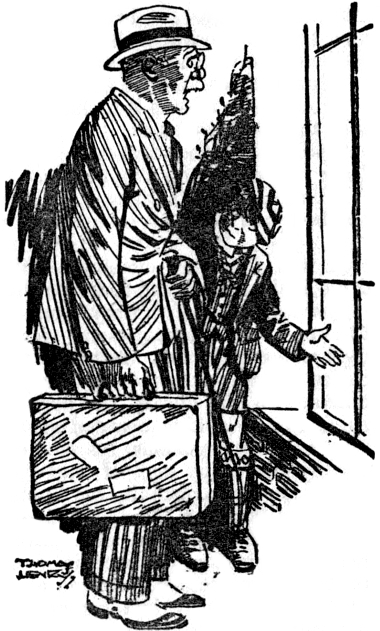
“THERE!” SAID WILLIAM. “LOOK AT
THAT!” MR. MORGAN LOOKED AT IT,
WHILE HIS MOUTH AND EYES SLOWLY
OPENED AND HIS CHEEKS GREW PALE.
The windows of library and drawing-room were
lit up. The drawing-room was apparently being
used as a green room. Actors in various stages sat on
chairs or sofa, or “made up” in front of the Venetian
mirror. In the library the play was just beginning.
An inhuman-looking bearded gentleman of obviously
Communist persuasions, his face deeply—perhaps too
deeply—scored by lines of cruelty and ill-temper, was
sitting on the armchair, his boots on the table. A
large red flag was planted beside him and the table
was covered with a red flag. Brutal-looking soldiers
held a shrinking prisoner in front of him. Other
brutal-looking soldiers lounged about the room. The
play was evidently just beginning. Neither Freddie
nor any of the three girls were in this scene. William
who had only a faint hope of recovering his whistle,
but a very real curiosity as to the dress rehearsal, stood
outside in the darkness, flattening his nose against the
window. The brutal man in the chair was overacting—banging
the table and shaking his fist and snarling and
shouting—but this made it all the more thrilling to
William. Then suddenly he heard the sound of wheels
coming up the drive. Still impelled by curiosity,
he crept round the house to see who it was. Then he
stood amazed. It was the man in the mauve suit.
He was descending from a taxi with his suit-case, and
preparing to
enter his front
door. Then a
glorious inspiration
came to
William. The
taxi drove off
but, before the
owner of the
house could
enter his door,
a small boy
whom he could
not see distinctly
in the darkness
darted forward
and seized
his arm.
“Don’t go
in,” he whispered,
“there’s
danger.”
Mr. Morgan’s
jaw dropped.
“What?” he
gasped.
“I say there’s
danger,” said
the boy again
rather irritably,
“if you go in
that house
you’ll never come out alive.”
“B—but it’s my house,” said Mr. Morgan, “I’ve
often been in and come out alive.”
“Come here and I’ll show you,” whispered William.
“Come round here.”
He led the amazed but unprotesting householder
round to the lighted window of the library.
“There!” he said, “look at that.”
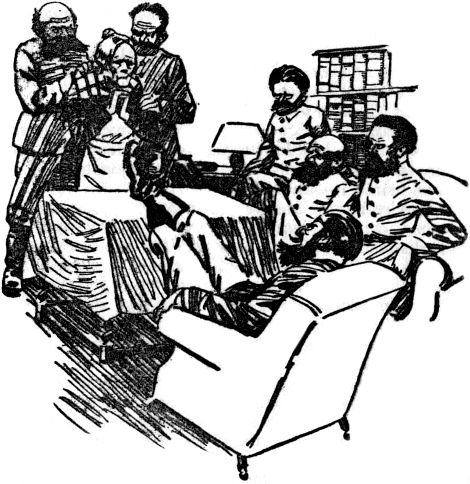
THERE IN MR. MORGAN’S LIBRARY, WITH HIS FEET ON THE
WRITING TABLE, SAT A BRUTAL COMMUNIST COMMANDER,
WITH A PRISONER TREMBLING BEFORE HIM IN THE
HANDS OF BRUTAL COMMUNIST SOLDIERS.
Mr. Morgan looked at it while his mouth and eyes
slowly opened to an almost incredible extent and his
cheeks grew paler and paler. There in his library,
with feet on his writing table, sat a brutal communist
commander beneath the red flag. Brutal communist
soldiers lounged in all his best chairs and some poor
unhappy prisoner stood trembling before the brutal
communist commander.
“W—what is it?” he gasped.
“It’s broke out,” said William succinctly, “the
revolution—it’s broke out.”
“B—but I heard nothing on the way,” gasped the
poor man again, drops of perspiration standing out
on his brow.
“No, it’s been very sudden,” explained William
unabashed, “quite a lot of people don’t know
anything about it yet.”
“What I always said would happen,” groaned
Mr. Morgan. “On us before we know where we are!
The first blaze kindled in this very village and my
home—my own house—taken for headquarters. I’ve
always feared it—always.”
“They’re having the people from the village in one
by one,” said William cheerfully. “They’ve got ’em
all locked in the cellars. They’re killin’ most of them.”
“And—and all my valuables there,” groaned Mr.
Morgan, “all my money and everything. If only I
could collect some of it I could make good my escape.”
He shuddered as the brutal communist commander
within shook his fist with a particularly brutal gesture
in the shrinking prisoner’s face.
“Well,” said William slowly. “When first I
started watchin’ through this window it was open an’
they were alone—it was before they started havin’
in the prisoner—an’ I heard them saying that they
were afraid the reg’lar army’d soon be upon them an’
the signal that the reg’lar army was comin’ upon ’em
was three blows on a whistle from the road so as soon
as they heard three blows on a whistle from the road
it’d mean that the reg’lar army was comin’ upon ’em
an’ they’d have to clear out quick—so if we could give
three blows on a whistle from the road they’d clear
out jolly quick an’ you could nip in an’ get your stuff
before they come back. But—but, I’ve not got a
whistle, have you?”
There was a tense silence during which William held
his breath.
“I have, as it happens,” said the old gentleman
excitedly, “by a curious chance, one came into my
possession the other day—but it’s in my bedroom.
How am I to get at it?”
“Where’s your bedroom?” said William shortly.
“Just above us. The window, I see, is open.”
“Where’s the whistle?” said William trying not
to sound too eager.
“In the right-hand small drawer in my dressing-table.
What are you doing?”
For William with a speed and agility worthy of
one of his remotest forbears was shinning up the tree,
and swinging himself from the tree to the window sill
of the room just above. He disappeared into the room.
Soon he reappeared, swung himself on to the tree and
came back as quickly as he had gone.
In his hand he held his beloved long-lost whistle.
“Brave boy!” said the old gentleman fervently,
“now go down to the road and blow three times.”
William crept away into the darkness with the
whistle. He could not refrain from chuckling as he
reached the road. The old gentleman waited and
waited, but no blast came from the darkness into
which William had disappeared.
William was creeping back. He knew that it was a
dangerous proceeding, but curiosity triumphed over
caution. He wanted to know what had happened to
the old gentleman and the brutal communist
commander and—everyone. Cautiously he approached
the library window. The old gentleman was sitting
in his chair and the brutal communist, the prisoner
and a lot more people were sitting on other chairs and
on the floor drinking lemonade and eating sandwiches.
Some one had opened the window and William could
hear what they were saying. The three girls and
Freddie were there.
“You gave me quite a fright, uncle,” the red-haired
girl was saying, “when I saw you out there in the
dark. Whatever were you doing ?”
“Oh—er—nothing much,” said Mr. Morgan, who had
evidently not given himself away, “just having a look
round,—er—just having a look round at the garden
before I came in.”
“We thought you weren’t coming back till
to-morrow.”
“I hadn’t meant to.”
“You don’t mind us having had the rehearsal here,
do you?”
“Not a bit, my dear. Not a bit.”
“The real reason we didn’t tell you was that we
knew you were just a bit nervous of communists and
things like that. I told the others so that day we
arranged it—the day that boy was here.”
“What boy?” said Mr. Morgan sharply.
“Oh, a poor boy we picked up on the road unconscious
and nearly dead, and Freddie examined him
and found that he was suffering from some terrible
disease of the spine.”
Mr. Morgan’s sniff expressed no great respect for
Freddie’s diagnosis.
“The poor child had come for his whistle.”
“What whistle?” said Mr. Morgan still more sharply.
“He said you’d borrowed a whistle from him
and promised to give it back that day. We looked
all over the place for it, but couldn’t find it so he had
to go away without.... What’s the matter, Uncle?”
Mr. Morgan was staring into space, his complexion
changing from pink to a dull red. He’d thought there
was something familiar about that boy though he
hadn’t been able to see him plainly in the darkness.
There came to him memories of that curious snigger
he’d heard as the boy disappeared in the darkness
with the whistle. The red deepened to an apoplectic
purple.
He gave a sudden furious bellow of rage.
William, chuckling to himself, crept away again
through the night....
CHAPTER VI
WILLIAM FINDS A JOB
PROBABLY if she hadn’t been so pretty the
Outlaws would not have noticed her at all. But
as it was they not only noticed her but noticed also
that she was crying. She was sitting on the doorstep
of a small house and her hair was a mass of auburn
curls, and her eyes were blue and her mouth—well,
the Outlaws were not poetic but they dimly realised
that her mouth was rather nice. They looked at her
and passed on sheepishly, then they hesitated, and,
still more sheepishly, returned. William was the
spokesman.
“What’s the matter?” he said gruffly.
She raised blue, tear-filled eyes.
“Wot?” she said.
“What’s the matter?” repeated William still
more gruffly.
She wiped away a tear with the corner of a pinafore.
“Wot?” she said again.
“Anyone been hurtin’ you?” said William still
gruffly, but with the light of battle in his eye. She
looked up at him.
“No,” she said, and returned to the corner of her
pinafore.
The light of battle died away from William’s eye.
He looked disappointed.
“Lost anythin’?” he then asked, assuming the
expression of one who is willing to search every corner
of the globe for whatever she had lost. She looked up
at him again.
“No,” she said listlessly.
“Well, what’s the matter?” persisted William.
“My daddy’s out of work,” said the little girl.
This nonplussed the Outlaws. They’d have fought
anyone who’d hurt her, they’d have found anything
she’d lost, but this seemed outside their sphere.
“What d’you mean?” said Douglas, “d’you mean
he’s got nothin’ to do?”
“Yes,” said the little girl, “nobody’ll give ’im any
work to do, an’ he’s got to stop at home all day.”
“Coo!” said Ginger feelingly, “I wish I was him.”
“Well,” said William, “don’ you worry, that’s all.
Don’ you worry. We’ll get him some work,” and
added as an afterthought, “What can he do?”
“He can do anythin’,” said the little girl peeping
at him from behind the corner of her pinafore. “Wot
can you do?”
Then someone called her in and the Outlaws found
themselves standing around in a semicircle gazing
with ardent sympathy and admiration at a closed
door. They hastily assumed their normal manly
expressions and went on down the road.
******
“Well,” said Ginger the optimist, “he can do
anythin’, so it ought to be pretty easy to get him a job.”
“Yes,” said William, “we’d better start on it at
once, ’cause we want to go out shootin’ to-morrow.”
“My bow’s broke,” said Henry sadly.
“Lend you my pea-shooter,” said Douglas.
“Let’s think of the things he could be,” said William,
“there’s lots of ’em.”
“A doctor or a lawyer or a clergyman,” said Henry
dreamily. “Let’s make him a clergyman.”
“No, he couldn’t be any of those,” said William
irritably, “those are special sorts of people. They
start turnin’ into those before they leave school. But
he could be a gardener or a butler or—or a motor car
driver——”
“Shuvver,” put in Ginger with an air of superiority.
“Motor car driver,” repeated William firmly,
“or—or a sort of man nurse. I read in a book once
about a man what once had a sort of man nurse—he
sort of went queer in his head—the man, not the man
nurse—an’ the man nurse looked after him—or he
could be a sort of man what looks after people’s
clothes——”
“A valley,” put in Ginger.
“A man what looks after people’s clothes,” repeated
William firmly, “or—or a fireman, or a policeman,
or a postman, or servin’ in a shop. Why,” with
growing cheerfulness, “we’ll be able to find hundreds
an’ hundreds of things for him to do.”
“He only wants one,” said Douglas mildly.
“What’ll we start on?” said Ginger.
William assumed his frown of generalship and
mentally surveyed the field of operation.
“Well,” he said at last, “I’ll try’n get him a job
as a man what drives a motor car, an’ Ginger try’n
get him one as a gardener, an’ Henry try’n get him
as a man what looks after people’s clothes, an’ Douglas
as a man what looks after people what aren’t quite
right in their head, an’ we’ll have a meetin’ in the ole
barn after tea an’ tell how we’ve got on ... an’ if
we’ve all got him work, of course,” he added with
his unfailing optimism, “we’ll let him choose.”
******
William began to make tentative efforts at lunch.
“When are we goin’ to have a car?” he demanded
innocently.
“Not while I’m alive,” answered his father.
William considered this in silence for some minutes,
then asked:
“How soon after you’re dead?”
His father glared at him and William cautiously
withdrew into silence. A few minutes later, however,
he emerged from it.
“Seems sort of funny to me,” he remarked meditatively,
to no one in particular, “that we don’t have
one. Neely everyone else I know’s got a car. They’re
an awful savin’ in bus tickets an’ shoes an’ things.
Seems to me sort of wrong to keep spendin’ money
on bus tickets an’ shoes when we could save it so easy
by buyin’ a car.”
No one was taking any notice of him. They were
discussing an artist who had taken The Limes furnished
for a month. Robert, William’s nineteen-year-old
brother, was saying, “One daughter, I know, I
saw her at the window.” William continued undaunted:
“We’d jus’ want a man to look after it that’s all
an’ I could easy get that for you. I know a man what’s
good at lookin’ after ’em an’ I could get him for you.
An’ they’re cheap enough. Why, someone told me
about someone what knew someone what got one for
jus’ a few pounds—an ole one, of course, but they’re
jus’ as good as new ones—only a bit older, of course.
The ones what were made when first they was invented
must be goin’ quite cheap now an’ one of them’d do
quite all right for us—jus’ to save us ’bus tickets an’
shoes—with a man to look after it. Ginger an’ me’d
paint it up an’ it would be as good as new. Shouldn’t
be surprised,” with rising cheerfulness, “if you could
get an ole one—a really ole one—for jus’ a few shillin’s
an’ Ginger’n me’d paint it for you and this man’d
mend it up for you an’ drive it for you an——”
There was a sudden lull in the general conversation
and his mother said:
“Do get on with your lunch, William. What are
you talking about?”
“About this car,” said William doggedly.
“What car?”
“This car of ours. Well, this man——”
“What man?”
“This man what’s goin’ to drive it for us——”
But this touched Robert on a tender spot.
“Any car belonging to the house will be driven
by me,” he said firmly.
William was nonplussed for a minute. Then he
said gently, “I don’ think Robert ought to tire himself
out drivin’ cars. I think Robert ought to be keepin’
himself fresh for his exams an’ things, not tire himself
out drivin’ cars. This man’d drive it an’ save Robert
the trouble of tirin’ himself out drivin’ cars because
Robert’s got his exams an’ things to keep fresh for.
An’ besides all these girls what Robert likes to take out
with him—he wun’t talk to ’em prop’ly if he had to
be tirin’ himself out drivin’ the car all the time——”
“Shut up,” ordered Robert angrily.
Temporarily William shut up.
“Are you taking Gladys Oldham on the river this
afternoon?” said his mother.
“Gladys Oldham?” said Robert coldly. “Whatever
made you think I’d be taking a girl like Gladys
Oldham anywhere?”
His mother looked bewildered.
“My dear ... only last week you said——”
Robert spoke with dignity and a certain embarrassment.
“Last week?” he said frowning, as if he had a
difficulty in carrying his mind back as far as that ...
“well, I remember I did once think her an entirely
different sort of person to what she turned out to be....
He’s called Groves, isn’t he, mother?”
“Who, dear?” said his mother mildly.
“The artist who’s taken The Limes.”
“I believe so, dear.”
“I’ve seen the daughter—she’s—she’s——”
He stopped confusedly trying to hide his blushes.
“She’s the most beautiful girl you’ve ever seen
in your life,” put in his father sardonically.
“How did you know?” asked Robert. “Have you
seen her?”
“No, I didn’t know.... I guessed,” said his father.
Robert seemed about to launch into a fuller
description of Miss Groves, then stopped, glancing
suspiciously at William. But William was intent
upon his own thoughts. Noticing a slight lull in the
conversation he rose again hopefully to the attack.
“This man,” he said, “you’d find him awful
useful——”
“What man, William?” groaned his mother.
“This man what I keep tellin’ you about,” said
William patiently. “It seems to me sort of silly to
wait till you get a car to get a man to drive it. I think
the best thing is to get this man at once an’ then when
we get the car there he is all ready to drive it for us
at once ’stead of havin’ to waste the car while we
start lookin’ round for a man to drive it and——”
“The lunatic asylums of the country,” remarked
Mr. Brown, “must be full of men who’ve had sons like
William.”
William looked at him hopefully.
“If you do feel like that, father,” he said, “I
know that this man——”
“Oh, shut up,” said Robert again.
“Yes,” said William bitterly, “what I’d like to
know is why you can go on talkin’ an’ talkin’ an’
talkin’ an’ talkin’ about girls an’ the minute I start
talkin’ about this man——”
“What man?”
“This man I’ve been tellin’ you about ever since I
started talkin’ only no one listens to me. What I say
is that this man——”
“William,” said his mother, “if you say one word
more about that man whoever he is——”
“All right,” said William resignedly, and turned
his whole attention to his pudding.
******
He renewed the attack, however, after lunch. The
car prospects didn’t seem very hopeful but it might be
worth while to explore other avenues. He stood at the
drawing-room window looking out at the garden where
Jenkins, the gardener, was weeding the bed on the lawn.
“Poor ole man,” said William compassionately, “I
think he’d do with someone to help him, don’t you,
mother?”
His mother looked up from the sock she was darning.
“I think that’s a very kind thought, dear,” she
said, “and I’m sure he’d appreciate it. Take one of
the kneeling mats out because the grass is rather damp.”
William’s face fell but after a moment’s hesitation
he took a kneeling mat and went out to help weed
the bed. He returned a few minutes later pursued by
an indignant Jenkins after having unwittingly uprooted
all his pet seedlings.
“Finished, dear?” said his mother. “You’ve not
been long.”
“No,” said William, “I kind of worked hard an’
got it finished quick.... Mother, don’t you kind of
think you’d like another gardener ’stead of Jenkins?”
“Why ever?” said his mother in surprise.
“Well, he always seems so sort of disagreeable an’
this man——”
“What man?”
“This man I keep tellin’ you about,” said William
patiently, “he’s an abs’lutely wonderful man. He can
do anythin’. He can drive a car ... he’s the one
what’s goin’ to drive our car ... an’—an’ there’s nothin’
he can’t do, look after clothes an’ people what are queer
in the head an’—an’—she was ever so nice an’ cryin’.”
“William, dear,” said Mrs. Brown, “I really don’t
know what you’re talking about, but before you do
anything else go and wash your hands and brush
your hair.”
William sighed as he went to obey. His family
seemed to have no souls above hands and hair and
that sort of thing.
******
The Outlaws met the next afternoon to report
progress.
“I did all I could,” said William, “I tried to make
’em get a car so’s we could have him to drive it an’
they just wun’t. I tried makin’ ’em have him as a
gardener an’ they wun’t do that either.”
Ginger, looking melancholy, related his experiences.
“I thought we might have him as a gardener, too,”
he said, “an’ so I tied a string across the doorway of
the greenhouse ’cause I thought that if ours fell an’
sprained his ankle I could tell ’em about this new one
an’ then they’d get him. I din’t think it would do
ours any harm to sprain his ankle—jus’ give him a
nice rest for one thing an—an’ he’s a such a crabby ole
thing. It might make him kinder same as what they
say sufferin’ does in books.”
“Did he fall?” said the Outlaws with interest.
“No,” said Ginger sadly, “he saw me doin’ it an’
went an’ told my father.”
“Was he mad?” said the Outlaws with interest.
“Yes,” said Ginger still more sadly, “he was
awful mad. Simply wouldn’t listen to me tellin’
him I’d tied it there to practise skippin’.”
The Outlaws murmured sympathy and then Henry
spoke.
“Well, I tried to get ’em to have him as a man
what looks after clothes——”
“Valley,” murmured Ginger.
“An’ I kep’ tellin’ my father an’ my brother that
their clothes looked to me’s if they wanted brushin’
or cleanin’ or pressin’ or somethin’ an’ I was goin’
to tell ’em about this man what’s come an’ do it for
them but,” mournfully, “they din’t give me a chance
to get’s far as that. Seems to me that it’s very funny
that one can’t try’n help a poor man what’s out of
work without bein’ treated like that about it.”
Again the Outlaws murmured sympathy, then
Douglas spoke up.
“I thought I’d try’n get him as a sort of man nurse
so I acted like I was goin’ queer in my head.”
“What did they do?” said William.
An expression of agony passed over Douglas’ face.
“Gave me Gregory powder,” he said, “an’ I couldn’t
sort of seem to make ’em understand I was actin’
queer in the head. They seemed to think I was actin’
ordin’ry. Anyway when they got reely mad I had
to stop it ’cause I was afraid they’d start on me with
more Gregory powder, an’ it’s a wonder I’m not
poisoned dead with the first lot. It’s more diff’cult
than you’d think,” he ended meditatively, “to make
folks think you’re queer in the head.”
“So nobody’s got nothing,” William summed up
the situation sadly and ungrammatically.
But Ginger was more cheerful.
“Well, there’s lots other houses in the village ’sides
ours,” he said, “an’ there’s lots other fam’lies in the
village ’sides ours. I votes we start on them. Seems
to me that people outside your own fam’ly always
give you more ’f a chance to explain what you mean
than people in your fam’ly. They don’t start bein’
mad at you before you’ve reely got to what you want
to say like people in your own fam’ly do.”
The Outlaws considered the suggestion in silence.
Then William pointed out its obvious disadvantage.
“Yes, but most of the people round here,” he said
simply, “know us, an’ so it wun’t be much use.”
“There’s someone new come to The Limes,” said
Henry, “I heard my mother talkin’ about them.”
“So did I mine,” said Douglas, “he’s an artist.”
“Oh, yes,” said William, “so did I mine. An’
he’s got a daughter what’s the most beautiful girl what
Robert’s ever seen.”
“Well, let’s try him,” said Ginger, “he oughter
want someone to look after his clothes or drive his
car or nurse him when he’s queer in the head or something.
Who’ll try him? I votes William does first.”
“All right,” said William who was always ready
for any fresh adventure. “I’ll go straight off now ’fore
he gets anyone else.”
William entered the garden gate of The Limes and
looked cautiously around him. There was no one in
sight. The building was a long, low one with French
windows opening straight on to the garden.
William was furtively exploring this in order to
see how the land lay before venturing up to the front
door when a voice called out:
“Boy! Hi! Come here!”
A man had suddenly appeared at one of the downstair
windows and was beckoning to him.
Warily William approached. The man had a
pointed beard, and very bushy eyebrows.
“Boy!” he called again.
“Uh-huh?” said William non-committally, coming
up to the window. The room inside was evidently
a studio. Several easels stood about and the table
was littered with tubes of paint and palettes.
“Just what I wanted,” said the man, “a boy—a
real human boy—of the ruffian type, too. Splendid!
My boy, I’ve been longing for you all morning. I’ve
tried to materialise you. You are probably at this
moment nothing but the creature of my brain. I wished
for a boy and a boy appeared. I was just thinking
that I must go out into the highways and byways to
search for one when lo! the boy my thoughts had
conjured up stood before us. I’m a superman, a
magician. I always had a suspicion that I might be.
Come in, boy.”
Distrustfully William entered the studio. The
man gazed at him rapturously.
“Just what I wanted,” he said, “a dirty rapscallion
of a boy with a crooked tie and a grimy collar.”
This insult stung William to retaliation. He gazed
coldly at the artist who had a smear of yellow paint
down one side of his face, and said:
“Bet I’m as clean as you are ... an’ as to ties——”
his gaze wandered down to the artist’s flowing bow and
stayed there meaningly.
“Spirited withal!” commented the artist, “better
and better.... Come in.”
William came in.
“Sit down.”
William sat down.
“Now I’m going to draw you,” went on the artist.
“I’m a genius whose immortal masterpieces are but
inadequately recognised by his generation, therefore
perforce I eke out a modest livelihood illustrating
magazine stories, and some idiot here,” he touched a
manuscript, “has written one about a boy. Fancy
writing a story about a boy. Now where shall I
find a boy? thought I. I wish I had a boy, and lo!
a boy appears.... Keep still, boy. Stand just
so ... look here ... and keep quite still.”
William, his brain working quickly, stood just so,
looked there and kept quite still.
The artist sketched in silence, putting William into
various postures. At the end he passed him the
sketches for his inspection. William gazed at them
coldly.
“Not much like me,” he commented.
“Think not?” said the artist, “probably you have
an idealised conception of your appearance.”
William looked at him suspiciously.
“I’ve not got anythin’ like what you said,” he
remarked, “never even heard of it so I can’t have.
Would you like a man to drive your motor-car?”
“I’ve not got a motor-car,” said the artist, busily
engaged in putting finishing touches into his sketch.
“Well,” said William, “what about someone to
brush your clothes?”
“I prefer my clothes unbrushed,” said the artist;
“dust protects the material.”
William considered this point of view with interest,
storing it up for future use, then returned to the point
at issue.
“Wun’t you like someone to look after you when
you’re queer in the head?”
“No,” said the artist, “it’s more fun not having
anyone to look after you when you’re queer in the
head.”
He put the sketches on to one side and took up a
manuscript from the table.
“Good Lord,” he groaned as he glanced through
it, “Charles I’s time. Why the dickens do they write
stories about Charles I’s time? Where the deuce am
I to get anyone to sit for me in the costume of Charles
I’s time? Tell me that.”
William told him.
“I know a man what’d come to sit to you,” he said,
promptly, “he’d want payin’.”
“Oh, he would, would he?... All right, I’ll pay
him. But the question is, has he got a costume of
Charles I’s time?”
“I don’t——” began William, then stopped. “Oh,
yes, I expect so.... Oh, yes, he’s sure to have.
Oh, yes, we’ll get him one anyway.”
“A protégé?” said the artist.
“Uh-huh?” said William. “No. He’s as nice
as what you are. Nicer.”
“Touché,” said the artist. “Well, bring him along
in his Charles I’s costume and I’ll pay him half a crown
an hour.”
The remuneration seemed princely to William.
“A’ right,” he said, impressed. “A’ right. I’ll bring
him along. An’ if you find out you want any other
sort of man he’ll be that, too. He can do anythin’.”
With that he departed and joined the Outlaws who
were still waiting for him in the road.
“Well, you have been a time,” said Ginger.
“Gottim a job,” swaggered William.
“What as?”
“Bein’ drawed. He’s got to have special clothes.
Any of you gotta Charles I dress? He’s got to have
one.”
“Crumbs, no!” said the Outlaws.
“Well,” said William, “we’ve got to get him one.
I’ve got him the job an’ the rest of you got to get him
the dress.”
“He might have one already,” said Ginger the
optimist. “He might’ve been to a fancy dress
dance in one.”
The other Outlaws looked doubtful.
“No harm goin’ to see anyway,” said William.
So they went to see.
The little girl with blue eyes and auburn curls was
sitting on the doorstep. She looked prettier than
ever. And she was still crying.
“Cheer up,” said William, “we’ve got your father a
job.”
She continued to cry.
“Has he got a Charles the First dress?” asked
William. “If he has he can come to the job straight
away.”
“He can’t come to no job at all,” said the little
girl mopping her blue eyes languidly with the corner of
her pinafore, “he’s ill.”
The Outlaws stared at her.
“Crumbs!” said William appalled.
She stared at the Outlaws.
“Go away,” she said, “I don’t like you.”
The Outlaws went away, but despite her professed
dislike of them it never occurred to them to relax
their efforts on her behalf.
“We’ll jus’ have to get a Charles the First dress an’
do it for her an’ take him the money,” said William.
“How’ll we get a Charles the First dress?” said
Douglas.
“Oh, we will somehow,” said William, cheerfully,
“somehow we will. See if we don’t.”
With this they separated and went to their respective
homes for tea.
William was rather silent at tea. He was silent
because he was thinking about the Charles I costume.
He was rather vague as to what a Charles I costume
was like, but he had a well-founded suspicion that the
only fancy costume he possessed—a much-worn Red
Indian costume—would not pass muster in its stead.
He wondered whether they could transform it in some
way to a Charles I costume by adding an old lace
curtain for instance, or wearing a waste-paper basket
as a headdress instead of the feathered band....
His sister, he knew, had a fairy queen dress. Mentally
he considered the picture of the fairy queen dress
superimposed upon the Red Indian costume. It would
look sort of queer and after all historical dresses had
to look sort of queer—that was the most important
thing about them—so it might do. Robert seemed to
be talking a good deal. William began to listen idly.
“I’ve seen her again,” Robert was saying, “she
was looking out of a window upstairs. I heard him
call to her. She’s called Gloria.... Haven’t you
really seen her, mother?”
“No,” said Mrs. Brown mildly, “I’ve not seen
either of them.”
A glorious blush overspread Robert’s face.
“She’s wonderful,” he said, “marvellous. I simply
can’t describe her. But it seems so strange that one
never sees her in the village. One just catches accidental
glimpses of her as one passes the house by
chance.... It seems so strange that one doesn’t
see her about.... Gloria, that’s her name. I heard
him call her that. I think it’s such a beautiful name,
don’t you?”
“Perhaps,” agreed Mrs. Brown doubtfully; “somehow
it suggests to me the name of a gas cooker or a
furniture polish, but I daresay that it is beautiful
really.”
“She’s beautiful anyway,” said Robert hotly.
William was listening intently. Mrs. Brown, perceiving
this, hastily changed the conversation. She
was aware that William took an active and not always
a kindly interest in his brother’s frequently changing
love affairs.
“You’re going to the fancy dress dance to-night,
aren’t you, dear?” she said to Robert.
“Yes,” said Robert.
“Did you decide on the pierrot’s costume, after
all?”
“Oh, no,” said Robert, “didn’t I tell you? Victor’s
going to lend me his Charles I costume. He’d meant
to go in it but his cold’s so bad that he can’t go at all,
so he’s sending it over to me.”
“How kind,” said Mrs. Brown, “William, dear, do
stop staring at your brother and get on with your tea.”
William obligingly began to demolish a slice of cake
in a way that argued a rhinoceros’ capacity of mouth
and an ostrich’s capacity of digestion. Having
assuaged the pangs of hunger for the time being, he
turned to Robert.
“You got that costume upstairs, Robert?” he said
guilelessly.
“Perhaps I have and perhaps I haven’t,” said
Robert.
Thoughtfully William demolished another piece of
cake.
Then he said, still thoughtfully, and to no one in
particular:
“I’d sort of like to see a Charles the First dress.
I sort of think it might be good for my history. I
think,” with a burst of inspiration, “that I’d sort of
learn the dates of him better if I’d seen his clothes.
It’s history, an’ my report said I din’t take enough
int’rest in history. Well, I’d sort’ve take a better
int’rest in it if I’d seen his clothes. It’d sort of make
it more int’resting. I bet I’d get an ever so much
better hist’ry report next term if I could only see the
Charles the First dress what Robert’s got.”
“Well, you can’t,” said Robert firmly.
“And you’ve had quite enough cake, dear,” said
his mother.
William turned to the buns, picked out the largest
he could see and returned to the attack.
“I’m not doin’ anythin’ particular this evenin’,
Robert,” he said, “I’ll help you dress if you like.”
“Thanks, I don’t,” said Robert.
“And don’t talk with your mouth full, William,”
said his mother.
William finished the bun in silence, then returned
yet again to the attack.
“I bet I could show you how to put it on, Robert.
They’re awful hard to put on are Charles the First
dresses. I don’t s’pose you could do it alone. I’d
be able to show you the way the things went on.
Prob’ly you’ll have ’em all laughin’ at you if you try
to put ’em on alone. I’ll go up now if you like an’ put
them out ready for you the way they ought to go on.”
“Well, I don’t like,” said Robert, “and you can
shut up.”
William took another very large bun for consolation.
Robert looked at him dispassionately.
“To watch him eating,” he remarked, “you’d think
he was something out of the Zoo.”
That remark destroyed any compunction that
William might otherwise have had on Robert’s behalf
in the events that followed.
Robert, fully attired in his Charles the First costume
discreetly covered by an overcoat, came downstairs.
He wore a look of pleasure and triumph.
The pleasure was caused by his appearance which
he imagined to be slightly more romantic than it really
was. The triumph was triumph over William. He
knew that William had been anxious to see the costume,
from what Robert took to be motives of idle
curiosity with a not improbable view to jeering at him
afterwards. Robert, who considered that he owed
William a good deal for one thing and another (notably
for a watch which William had dismembered in the
interests of Science the week before), had determined
to frustrate that object. Directly after tea he had
locked his bedroom door and pocketed the key, and a
few minutes later he had had the satisfaction of seeing
William furtively trying the handle. William, however,
was not about the hall as he descended the stairs.
The costume had proved satisfactorily magnificent,
but the drawback to the whole affair was that SHE
would not be there to see it. At that moment he would
have given almost anything in exchange for the
certainty that SHE could see him in his glory. For
Robert considered that the costume made him look
very handsome indeed. He did not see how any girl
could look at him in it and remain completely heart
whole.... If only SHE were to be there....
He took down his hat, bade farewell to his mother
and set off down the drive. A small boy whom he
could not see, but who, he satisfied himself, was not
William (it was Henry) stepped out of the bushes,
handed him a note and disappeared. He went down
to the end of the drive and, standing beneath the lamp-post
in the road, read it. It was type-written.
“Dear Mr. Brown,” it read,
“I have seen you in the road passing by our
house, and because you look good and kind, I turn to
you for help. Will you please rescue me from my
father? He keeps me a prisoner here. He is mad,
but not mad enough to put in an asylum. He thinks
he’s living in the reign of Charles the First and he
won’t let anyone into the house unless they’re dressed
in Charles the First clothes, so I don’t know how you’ll
get in. If you can get in please humour him and let
him draw you because he thinks that he is an artist,
and when once he’s drawn you he’ll probably let you
do what you like. Then please rescue me and take
me to my aunt in Scotland and she will reward you.
“Gloria Groves.”
The letter was the result of arduous toil on the part
of the Outlaws. Every word had been laboriously
looked up in the dictionary and then laboriously typed
in secret by Henry on his father’s typewriter.
Robert stood reading it, his face paling, his mouth
and eyes opening wide with astonishment. He looked
down at the costume which was visible beneath his coat.
“Charles the First costume,” he gasped. “Well....
By Jove ... of all the coincidences!”
Then, with an air of courage and daring, he set off
towards The Limes.
******
William entered the studio unannounced. The
artist looked up from his easel.
“Hello,” he said, “you back?”
“Yes,” said William, “that man I told you about’s
comin’.”
“Costume and all?” said the man.
“Yes,” said William, “but I’d better explain to
you a bit about him first. He’s queer in the head.”
“In other words you’re bringing me the village idiot.”
“Yes,” said William relieved at having the matter
put so succinctly.
“It’s sort of like that. He’s not dangerous, but he
dresses up in Charles the First costume (that’s why I
thought he’d do for you) an’ he thinks it is Charles
the First time an’ so you’ve got to talk to him as if it
was Charles the First time jus’ to keep him quiet.
He’ll get mad if you don’t. He’ll be drawed all right
’cause he likes bein’ drawed but the minute he sees
any girls he always wants to start to rescuin’ them
an’ takin’ them up to their aunts in Scotland.”
“Why Scotland?” said the artist mildly.
“’Cause that’s part of his madness,” explained
William.
“Well, there’s only one girl on the premises,” said
the artist, “and that’s my daughter ... been in
quarantine for mumps ... just out of it to-day ...
and I don’t suppose he’ll see her ... so that’s all right.”
“You’ll give me the money, won’t you?” said
William. “’Cause—’cause I keep his money for him....
See?”
“We’ll talk about that later,” said the man, “if
he comes and when he comes. Are you his keeper,
by the way?”
“Well,” said William guardedly, “I sort of am and
I’m sort of not.”
But just then he heard the sound of the opening
of the front gate and discreetly retired again through
the open window.
******
Robert walked up the garden path, his face stern
and set with resolve. Robert was a voracious reader
of romantic fiction and had often longed for something
like this to happen to him. It’s only drawback in his
eye was that he hadn’t enough money to take the
heroine of the drama to Scotland, but he could not
imagine the hero of a story being baffled by a little
thing like that. They always seemed to have enough
money to take the heroine anywhere. But the first
thing to do was to rescue her. Then he’d pawn something
or other, pawn his Charles the First costume
perhaps ... but then he’d have nothing to go to
Scotland in ... though in any case one couldn’t
travel to Scotland wearing a Charles the First costume.
It was all very baffling ... but the first thing to do
was to rescue her. She might have some jewels or
heirlooms that they could pawn. Heroines in books
always had jewels and heirlooms....
“Oh, there you are.... Come in.”
The voice came from one of the open French windows.
It was the madman standing at one end of the
room at an easel. He evidently thought he was an
artist just as the girl had warned him. Hastily Robert
flung his overcoat over a garden seat and entered in
all the glory of his Charles the First costume.
“Good evening,” said the artist. “You’ve come to
sit for me?”
Robert assumed the simpering expression of one
who humours a madman.
“Oh, yes,” he said, “I’ve come to sit for you.”
Certainly the effect of the simper superimposed
upon the stern set expression of resolve would have
justified anyone regarding Robert in his bizarre costume
as mentally though not dangerously deranged.
The artist posed him appropriately and then proceeded
to test the sanity or insanity of his sitter.
“Well,” he said, “how’s Charles the First to-day?”
Robert went paler and gathered his forces together.
At all costs he must humour him.
“His Majesty,” he said solemnly, “seems of a truth
well to-day.”
Rather good that, he thought.
The artist looked at him keenly ... but the pallid
earnestness of Robert’s expression beneath the humouring
simper convinced him ... it was true ... he
was potty. Well, he must just humour him ... he
had to get those sketches off to-day ... and he didn’t
look dangerous.
“I’m glad to hear that,” he said, and added with
a burst of inspiration, “gadzooks.”
For a minute or two he worked in silence. Then—he
found the pose he had chosen rather difficult, and
for a few seconds he stood frowning at Robert meditatively.
The artist’s bushy eyebrows made him look
very ferocious when he frowned. Robert began to
tremble. The man might fly at him or something.
He must say something about Charles the First to
soothe him ... at once.... What a pity he knew
so little about Charles the First ... except that he
was executed ... or was he executed?... Better
avoid that part of it perhaps, especially as presumably
he was supposed to be still alive.... He didn’t even
know whom Charles the First had married. He might,
of course, have been a bachelor.... He must say
something quickly.... The man’s stare was growing
positively murderous.... With a ghastly smile he
said:
“King Charles’—er—wife—was looking well this
morning.”
The man’s ferocious stare vanished. Robert heaved
a sigh of relief and furtively wiped his brow.
“Er—yes, wasn’t she?” said the artist, who’d
moved a little to one side and so got a better view of
his sitter, “do you mind turning a little more this
way?” and added as an afterthought, “prithee,
gadzooks!”
Robert obediently turned a little that way and for
a few minutes all was well. The artist sketched in
silence. Robert was beginning to feel a little less
nervous. He gazed round the studio.... Where
was SHE, he wondered?... Perhaps already preparing
to fly with him to her aunt’s in Scotland....
He hoped that she’d remember to bring along a few
heirlooms to pawn, but then he thought with dismay
that he’d never pawned anything in his life and didn’t
know how one set about it. That was awful. He
couldn’t help admitting that he seemed rather inadequate
for the glorious rôle which Fate had thrust upon
him. Then he comforted himself by the thought that
every hero had to start, had to do the thing for the
first time. It would probably be all right. The
artist became suddenly doubtful about the pose again.
He didn’t think it was quite natural. Once more
he gazed frowningly at the sitter and once more the
perspiration stood out on Robert’s brow. He must
say something else about Charles the First at once.
He searched feverishly in his mind for something else
to say about Charles the First. He wished he’d tried
harder with his history when he was at school. It
was awful knowing nothing, nothing about Charles
the First. He couldn’t even remember what he looked
like though he knew that there’d been pictures of all
the kings and queens in his history book. By Jove,
that was an idea.
“King Charles,” he said, “had his picture painted
... the one in the history b——I mean just had his
picture painted. It turned out quite a good likeness,
I believe.”
“Did it?” said the artist, “could you move your
head a bit to the right?” and added, “grammercy.
You a friend of His Majesty’s, I suppose?”
Robert grew yet paler. It was a most awkward
question. If he said he was it might arouse this
madman to frenzy, and if he said that he wasn’t it
might equally rouse this madman to frenzy.... The
whole thing was terrible, being alone with a madman
like this.... He almost wished he’d never come
... not quite, of course ... he still remembered
the vision of beauty he’d seen at the upstairs window.... He
coughed again and said, “Well—er—are
you?”
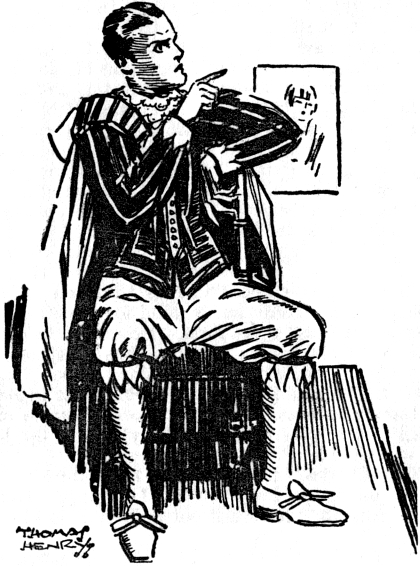
ROBERT BLUSHED AND MADE SIGNS INTENDED TO CONVEY
TO HER THAT HE HAD GOT HER LETTER AND WOULD
RESCUE HER.
“I?” said the artist, “I’m one of his most intimate
friends. We were discussing you only the other day.
Ods bodkin—or is that Elizabethan?—you’ve got a
difficult profile—grammercy.”
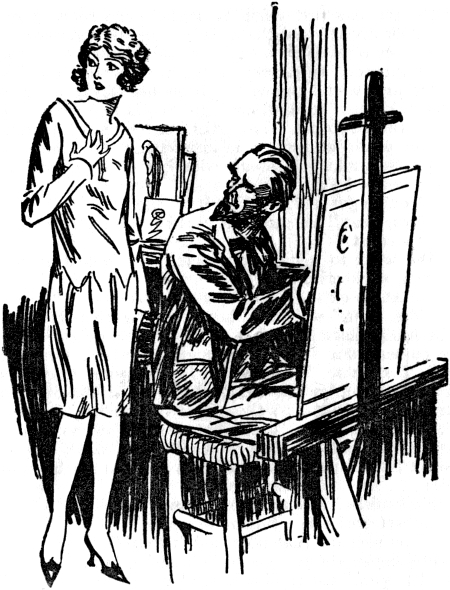
“WHAT AN EXTRAORDINARY PERSON, DADDY,” WHISPERED
THE GIRL.
He seemed harmless enough, poor fellow, thought
the artist—you could see at a glance that the poor
chap was a bit wanting—gaping and staring like that
all the time ... quite young, too ... very sad ...
poor fellow ... and quite harmless.
Robert was just going to make some reply when
the door opened and the artist’s daughter entered.
Robert blushed to a dull beetroot shade and made
signs intended to convey to her that he had got her
letter and would rescue her from her father at once
and take her to her aunt in Scotland. Then the
artist turned round. The artist’s daughter was staring
at her would-be rescuer in amazement. She had to,
of course, thought Robert, with her father watching.
He’d better be a bit more careful, too.
“You’ve got a sitter, Daddy?” she said.
“Yes, dear,” he said, “a gentleman of Charles the
First’s court.”
She went to her father’s easel and looked at the
sketch, whispering:
“What an extraordinary person, Daddy.”
“Yes, dear,” whispered her father, “a bit potty, but
absolutely harmless. I’m a bit vague as to where
he comes from. He was brought here by a boy and
will, I suppose, be fetched. He imagines that he’s
living in Charles the First’s time. That’s why he’s
dressed like that ... they have to humour him ...
but harmless ... quite harmless. I’ve not quite
finished with him, but I want some more paper.
Don’t let him go till I come back, will you ... humour
him ... he’s quite harmless.”
He vanished into the next room.
Robert spoke in a hoarse whisper.
“You sent me that note, didn’t you?”
She began the process of humouring him.
“Er—yes,” she replied fearfully.
“I’ll rescue you,” he hissed, “be ready.... As
soon as he’s finished drawing me.... We’ll be at
your aunt’s in Scotland before morning.”
“One minute,” she said fearfully and joined her
father in the inner room.
“Daddy,” she said, “he’s absolutely mad. He
says that he’s going to rescue me and take me to my
aunt’s in Scotland.”
“Oh, yes, I remember,” said the artist, “that’s one
of his obsessions. They told me that. But he’s
harmless. Humour him. I simply must get that
Charles I costume in four poses.”
She returned to the studio.
“You’re ready to come?” said Robert.
“Er—yes,” she said.
“How shall we escape?”
“Oh—er—quite easily,” she said, watching him
guardedly and backing towards the door.
“You trust me?” said Robert ardently.
“Er—yes,” she said.
The artist returned.
“One more,” he said, “sitting there, please, and
holding out one arm—thus—gadzooks—prithee——”
He opened a door in his bureau and stood stooping
over it, his back to Robert. The opportunity of thus
catching the oppressor of his beloved bending was too
much for Robert. He leapt upon his back calling
out to the girl:
“Get your things on—quick.... I’ll tie him up.”
“Good heavens!” said the artist, “the blighter’s
turned dangerous.”
The artist was stronger than he looked and he soon
had Robert neatly trussed. Then he turned to
Gloria.
“A boy brought him,” he said, “go and see if you
can find him outside.”
But there were no boys outside.
The Outlaws, who had watched events through the
French window till now, were hurrying homewards to
establish alibis.
******
Yet on the way they called at the house of the little
girl with the auburn curls. They had undertaken a
responsibility to her and they meant to see it through.
She was not sitting on the doorstep so, summoning
courage by degrees, they knocked at the door. A
woman opened it. Inside the kitchen sat a man
eating a pork-pie at a table. The little girl was nursing
a doll by the fire.
The Outlaws entered sheepishly. William was
spokesman.
“This your father?” he said to the little girl.
“Yes,” said the little girl.
“Well, we’ve sort of got him work,” said William,
“what I mean to say is that someone went to be
drawed for him in these things an’ we’re goin’ to try
jolly hard to get the money from the man what drawed
it to-morrow, an’—we’ll give it him an——”
The man laid down his knife and fork, swallowed
a large mouthful of pork unmasticated, and said:
“Wot cher mean?”
“Well,” explained William, “she told us ’bout you
bein’ out of work——”
“Me out of work,” said the man indignantly.
“Oh, they are such stupid boys,” burst out the
little girl. “I was havin’ a nice little game all to
myself pretendin’ to be a little girl in a book wiv a
daddy out of work an’ they came interferin’—an’ then
I was pretendin’ to be a little girl in a book wiv a daddy
what was ill an’ they came again interferin’——”
“Weren’t you ill?” stammered William.
“Me?” roared the man, “never been ill in me life.”
“W—weren’t you out of work?” said William.
“Me!” roared the man again, “never been out
of work in my life.”
“They kept interferin’ with my games——” said
the little girl.
“You interfere with ’er games again——” said the
man threateningly, “an’ I’ll——”
Bewildered, the Outlaws crept away.
CHAPTER VII
WILLIAM’S BUSY DAY
WILLIAM and the Outlaws strode along the
road engaged in a lusty but inharmonious
outburst of Community singing. It was the first real
day of Spring. The buds were bursting, the birds
were singing (more harmoniously than the Outlaws)
and there was a fresh invigorating breeze. The Outlaws
were going fishing. They held over their shoulders
their home-made rods and they carried jam-jars with
string handles. They were going to fish the stream
in the valley. The jam-jars were to receive the
minnows and other small water creatures which they
might catch; but the Outlaws, despite all the lessons
of experience, were still hopeful of catching one day
a trout or even a salmon in the stream. They were
quite certain, though they had never seen any, that
mighty water beasts haunted the place.
“Under the big stones,” said William, “why, I bet
there’s all sorts of things. There’s room for great big
fish right under the stones.”
“Well, once we turned ’em over an’ there weren’t
any,” Douglas the literal reminded him.
William’s faith, however, was not to be lightly
shaken.
“Oh, they sort of dart about,” he explained vaguely,
“by the time you’ve turned up one stone to see if
they’re there they’ve darted off to the next an’ when
you turn over the next they’ve darted back to the
first without you seein’ ’em, but they’re there all the
time really. I bet they are. An’ I bet I catch a great
big whopper—a salmon or somethin’—this afternoon.”
“Huh!” said Ginger, “I’ll give you sixpence if
you catch a salmon.”
“A’ right,” said William hopefully, “an’ don’t you
forget. Don’t start pretendin’ you said tuppence
same as you did about me seein’ the water rat.”
This started a heated argument which lasted till
they reached what was known locally as the cave.
The cave lay just outside the village and was
believed by some people to be natural and by others
to be part of old excavations.
The Outlaws believed it to be the present haunt
of smugglers. They believed that smugglers held
nightly meetings there. The fact of its distance from
the sea did not shake their faith in this theory. As
William said, “I bet they have their meetin’s here
’cause folk won’t suspect ’em of bein’ here. Folks
keep on the look out for ’em by the sea an’ they trick
’em by comin’ out here an’ havin’ their meetin’s here
where nobody’s on the look out for ’em.”
For the hundredth time they explored the cave,
hoping to find some proofs of the smugglers’ visits in
the shape of a forgotten bottle of rum or one of the
lurid handkerchiefs which they knew to be the correct
smuggler’s headgear, or even a piece of paper containing
a note of the smugglers’ latest exploit or a map of
the district. For the hundredth time they searched
in vain and ended by gazing up at a small slit in the
rock just above their heads. They had noticed it
before but had not given it serious consideration.
Now William gazed at it frowningly and said, “I bet
I could get through that and I bet that it leads down
a passage an’ that,” his imagination as ever running
away with him, “an’ that at the end of a passage
there’s a big place where they hold their meetin’s an’
I bet they’re there now—all of ’em—holdin’ a meetin’.”
He stood on tiptoe and put his ear to the aperture.
“Yes,” he said, “I b’lieve I can hear ’em talkin’.”
“Oh, come on,” said Douglas, who was not of an
imaginative turn of mind. “I want to catch some
minnows an’ I bet there aren’t any smugglers there,
anyway.”
William was annoyed by this interruption, but
arguing strenuously, proving the presence of smugglers
in the cave to his own entire satisfaction, he led his
band out of the cave and on to the high road again.
The subject of smugglers soon languished. They
were passing a large barrack-like house which had
been in the process of building for the best part of a
year. It was finished at last. Curtains now hung at
the windows and there were signs of habitation—a
line of clothes flapping in the breeze in the back garden
and the fleeting glimpse of a woman at one of the windows.
A very high wall surrounded the garden.
“Wonder what it is,” said Henry speculatively,
“looks to me like a prison.”
“P’raps it’s a lunatic asylum,” said Ginger,
“why’s it got a high wall round it like that if it’s not
a lunatic asylum?”
Discussing the matter animatedly they wandered
on to the stream.
“Now catch your salmon,” challenged Ginger.
“All right. I bet I will,” said William doggedly.
For a short time they fished in silence.
Then William gave a cry of triumph. His hook
had caught something beneath one of the big stones.
“There!” he said, “I’ve got one. I told you so.”
“Bet it’s not a salmon,” said Ginger but with a
certain excitement in his voice.
“I bet it is,” said William, “if it’s not a salmon I—I——”
with a sudden burst of inspiration, “I’ll go
through that hole in the cave—so there!”
He tugged harder.
His “catch” came out.
It was an old boot.
******
They escorted him back to the cave. The hole
looked far too small for one of William’s solid bulk.
They stood below and stared at it speculatively.
“You’ve got to,” said Ginger, “you said you would.”
“Oh, all right,” said William with a swagger which
was far from expressing his real feelings, “I bet I
can easy get through that little hole an’ I bet I’ll
find a big place full of smugglers or smuggled stuff
inside. Give me a shove ... that’s it.... Oo,”
irritably, “don’t shove so hard.... You nearly
pushed my head off my neck.... Go on—go on....
Oo, I say, I’m getting through quite easy ... it’s
all dark ... it’s a sort of passage....” William
had miraculously scraped himself through the small
aperture. Two large boots was all of him which was
now visible to the Outlaws. Those, too, disappeared,
as William began to crawl down the passage. It was
mercifully a little wider after the actual opening.
His voice reached them faintly.
“It’s all dark ... it’s like a little tunnel....
I’m going right to the end to see what’s there ...
well, anyway if that wasn’t a salmon I bet there are
salmons there and I bet I’ll catch one too one of these
days, and——”
His voice died away in the distance. They waited
rather anxiously.... They heard nothing and saw
nothing more. William seemed to have been completely
swallowed up by the rock.
******
William slowly and painfully (for the aperture was
so small that occasionally it grazed his back and
head) travelled along what was little more than a
fissure in the rock. The spirit of adventure was high
in him. He was longing to come upon a cave full of
swarthy men with coloured handkerchiefs tied round
their heads and gold ear-rings, quaffing goblets of
smuggled rum or unloading bales of smuggled silk.
Occasionally he stopped and listened for the sound
of deep-throated oaths or whispers or smugglers’
songs. Once or twice he was almost sure he heard them.
He crawled on and on and on and into a curtain of
undergrowth and out into a field. He stopped and
looked around him. He was in the field behind the
cave. The curtain of undergrowth completely concealed
the little hole from which he had emerged. He
was partly relieved and partly disappointed. It was
rather nice to be out in the open air again (the tunnel
had had a very earthy taste); on the other hand he
had hoped for more adventures than it had afforded.
But he consoled himself by telling himself that they
might still exist. He’d explore that passage more
thoroughly some other time—there might be a passage
opening off it leading to the smugglers’ cave—and
meantime it had given him quite a satisfactory thrill.
He’d never really thought he could get through that
little hole. And it had given him a secret. The knowledge
that that little tunnel led out into the field was
very thrilling. He looked around him again. Within
a few yards from him was the wall surrounding the
house about which they had just been making surmises.
Was it a prison, or an asylum or—possibly—a
Bolshevist headquarters? William looked at it
curiously. He longed to know. He noticed a small
door in the wall standing open. He went up to it and
peeped inside. It gave on to a paved yard which was
empty. The temptation was too strong for William.
Very cautiously he entered. Still he couldn’t see
anyone about. A door—a kitchen door apparently—stood
open. Still very cautiously William approached.
He decided to say that he’d lost his way should anyone
accost him. He was dimly aware that his appearance
after his passage through the bowels of the earth
was not such as to inspire confidence. Yet his curiosity
and the suggestion of adventure which their surmises
had thrown over the house was an irresistible magnet.
Within the open door was a kitchen where a boy,
about William’s size and height and not unlike William,
stood at a table wearing blue overalls and polishing
silver.
They stared at each other. Then William said,
“Hello.”
The boy was evidently ready to be friendly. He
replied “Hello.”
Again they stared at each other in silence. This
time it was the boy who broke the silence.
“What’ve you come for?” he said in a tone of
weary boredom. “You the butcher’s boy or the
baker’s boy or somethin’? Only came in this mornin’
so I don’ know who’s what yet. P’raps you’re the
milk boy?”
“No, I’m not,” said William.
“Beggin’?” said the boy.
“No,” said William.
But the boy’s tone was friendly so William cautiously
entered the kitchen and began to watch him.
The boy was cleaning silver with a paste which he
made by the highly interesting process of spitting
into a powder. William watched, absorbed. He
longed to assist.
“You live here?” he said ingratiatingly to the boy.
“Naw,” said the boy laconically. “House boy.
Only came to-day,” and added dispassionately.
“Rotten place.”
“Is it a prison?” said William with interest.
The boy seemed to resent the question.
“Prison yourself,” he said with spirit.
“A lunatic asylum, then?” said William.
This seemed to sting the boy yet further.
“Garn,” he said pugnaciously, “Oo’re yer callin’
a lunatic asylum?”
“I din’ mean you,” said William pacifically. “P’raps
it’s a place where they make plots.”
The boy relapsed into boredom. “I dunno what
they make,” he said. “Only came this mornin’.
They’ve gorn off to ’is aunt but the other one—she’s
still here, you bet, a-ringin’ an’ a-ringin’ an’ a-ringin’
at her bell, an’ givin’ no one peace nowheres.” He
warmed to his theme. “I wouldn’ve come if I’d
knowed. House-maid went off yesterday wivout
notice. She’d ’ad as much as she wanted an’ only the
ole cook—well I’m, not used to places wiv only a ole
cook ’sides meself an’ her upstairs a-ringin’ an’ a-ringin’
at her bell an’ givin’ no one no peace nowheres an’ the
other two off to their aunt’s. No place fit to call a
place I don’t call it.” He spat viciously into his powder.
“Yus, an’ anyone can have my job.”
“Can I?” said William eagerly.
During the last few minutes a longing to make
paste by spitting into a powder and then to clean
silver with it had grown in William’s soul till it was
a consuming passion.
The boy looked at him in surprise and suspicion,
not sure whether the question was intended as an
insult.
“What you doin’ an’ where you come from?” he
demanded aggressively.
“Been fishin’,” said William, “an’ I jolly nearly
caught a salmon.”
The boy looked out of the window. It was still
the first real day of Spring.
“Crumbs!” he said enviously, “fishin’.” He gazed
with distaste at his work, “an me muckin’ about
with this ’ere.”
“Well,” suggested William simply, “you go out
an’ fish an’ I’ll go on muckin’ about with that.”
The boy stared at him again first in pure amazement
and finally with speculation.
“Yus,” he said at last, “an’ you pinch my screw.
Not much!”
“No, I won’t,” said William with great emphasis.
“I won’t. Honest I won’t. I’ll give it you. I
don’t want it. I only want,” again he gazed enviously
at the boy’s engaging pastime, “I only want to clean
silver same as you’re doin’.”
“Then there’s the car to clean with the ’ose-pipe.”
William’s eyes gleamed.
“I bet I can do that,” he said, “an’ what after
that?”
“Dunno,” said the boy, “that’s all they told me.
The ole cook’ll tell you what to do next. I specks,”
optimistically, “she won’t notice you not bein’ me
with me only comin’ this mornin’ an’ her run off her
feet what with her ringin’ her bell all the time an’
givin’ no one no peace an’ them bein’ away. Anyway,”
he ended defiantly, “I don’t care if she does. It
ain’t the sort of place I’ve bin used to an’ for two pins
I’d tell ’em so.”
He took a length of string from his pocket, a pin
from a pincushion which hung by the fire-place, a jam
jar from a cupboard, then looked uncertainly at William.
“I c’n find a stick down there by the stream,”
he said, “an’ I won’t stay long. I bet I’ll be back
before that ole cook comes down from her an’—well,
you put these here on an’ try’n look like me an’—I
won’t be long.”
He slipped off his overalls and disappeared into the
sunshine. William heard him run across the paved
yard and close the door cautiously behind him. Then
evidently he felt safe. There came the sound of
his whistling as he ran across the field.
William put on the overalls and gave himself up
to his enthralling task. It was every bit as thrilling
as he’d thought it would be. He spat and mixed and
rubbed and spat and mixed and rubbed in blissful
absorption.... He got the powder all over his face
and hair and hands and overalls. Then he heard the
sound of someone coming downstairs. He bent his
head low over his work. Out of the corner of his eye
he saw a large hot-looking woman enter, wearing an
apron and a print dress.
“Gosh!” she exclaimed as though in despair.
“Gosh! of all the places!”
At that minute a bell rang loudly and with a groan
she turned and went from the room again. William
went on with his task of cleaning the silver. The
novelty of the process was wearing off and he was
beginning to feel rather tired of it. He amused himself
by tracing patterns upon the surface of the silver with
the paste he had manufactured. He took a lot of
trouble making a funny face upon the teapot which
fortunately had a plain surface.
Then the large woman came down again. She
entered the kitchen groaning and saying “Oh, lor!”
and she was summoned upstairs again at once by
an imperious peal of the bell. After a few minutes
she came down again, still groaning and saying, “Oh,
lor!... First she wants hot milk an’ then she
wants cold milk an’ then she wants beef tea an’ then
the Lord only knows what she wants ... first one
thing an’ then another.... I’ve fair had enough
of it an’ them goin’ off to their aunt’s an’ that Ellen
’oppin’ it an’ you not much help to a body, are you?”
she asked sarcastically. Then she looked at his face and
screamed. “My Gosh!... What’s ’appened to you?”
“Me?” said William blankly.
“Yes. Your face as gone an’ changed since jus’
a few minutes ago. What’s ’appened to it?”
“Nothin’,” said William.
“Well, it’s my nerves, then,” she said shrilly.
“I’m startin’ seein’ things wrong. An’ no wonder....
Well, I’ve ’ad enough of it, I ’ave an’ I’m goin’ ’ome ...
now ... first that Ellen ’oppin’ it an’ then them
goin’ off an’ then ’er badgerin’ the life out of me. An’
then your face changin’ before me very eyes. Me
nervous system’s wore out, that’s what it is, an’ I’ve
’ad enough of it. When people’s faces start changin’
under me very eyes it shows I needs a change an’ I’m
goin’ to ’ave one. That Ellen ain’t the only one what
can ’op it. ’Er an’ ’er bell-ringing—an’—an’ you an’
your face-changin’! ’Taint no place for a respectable
woman. You can ’ave a taste of waitin’ on ’er an’ you
can tell them I’ve gone an’ why—you an’ your face!”
During this tirade she had divested herself of her
apron and clothed herself in her coat and hat. She
stood now and looked at William for a minute in
scornful silence. Then her glance wandered to his
operations.
“Ugh!” she said in disgust, “you nasty little
messer, you! Call yourself a house boy—changin’
your face every minute. What d’you think you are?
A blinkin’ cornelian? An’ messin’ about like that.
What d’you think you’re doin’? Distemperin’ the
silver or cleanin’ it?”
At this moment came another irascible peal at
the bell.
“Listen!” said the fat woman. “’Ark at ’er!
Well, I’m orf. I’m fair finished, I am. An’ you can
go or stay has you please! Serve ’em right to come
’ome an’ find us hall gone. Serve ’er right if you went
up to ’er an’ did a bit of face changin’ at ’er just to
scare ’er same as you did me. Do ’er good. Drat
’er—an’ all of you.”
She went out of the kitchen and slammed the back
door. Then she went out of the paved yard and
slammed the door. Then she went across the field
and out of the field into the road and slammed the
gate.
William stood and looked about him. A bell
rang again with vicious intensity and he realised with
mingled excitement and apprehension that he and the
mysterious ringer were the only occupants of the house.
The ringing went on and on and on.
William stood beneath the bell-dial and watched
the blue disc waggle with dispassionate interest.
The little blue disc was labelled “Miss Pilliter.” Then
he bethought himself of his next duty. It was cleaning
the car with the hose. His spirits rose at the prospect.
The bell was still ringing wildly, furiously, hysterically,
but its ringing did not trouble William. He
went out into the yard to find the car. It was in the
garage and just near it was a hose pipe.
William, much thrilled by this discovery, began to
experiment with the hose pipe. He found a tap by
which it could be turned off and on, by which it
could be made to play fiercely or languidly. William
experimented with this for some time. It was even
more fascinating than the silver cleaning. There was a
small leak near the nozzle which formed a little fountain.
William cleaned the car by playing on to it
wildly and at random, making enthralling water
snakes and serpents by writhing the pipe to and fro.
He deluged the car for about a quarter of an hour in a
state of pure ecstasy.... The bell could still be
heard ringing in the house, but William heeded it not.
He was engrossed heart and mind and soul in his
manipulation of the hose pipe. At the end of the
quarter of the hour he laid down the pipe and went
to examine the car. He had performed his task
rather too thoroughly. Not only was the car dripping
outside; it was also dripping inside. There were
pools of water on the floor at the back and on the
front. There were pools on all the seats. Too late
William realised that he should have tempered thoroughness
with discretion. Still, he thought optimistically,
it would dry in time. His gaze wandered
round. It might be a good plan to clean the walls
of the garage while he was about it. They looked
pretty dirty.
He turned the hose on to them. That was almost
more fascinating than cleaning the car. The water
bounced back at you from the wall unexpectedly and
delightfully. He could sluice it round and round the
wall in patterns. He could make a mammoth fountain
of it by pointing it straight at the ceiling. After
some minutes of this enthralling occupation he turned
his attention to the tap which regulated the flow and
began to experiment with that. Laying the hose
pipe flat on the floor he turned the tap in one direction
till the flow was a mere trickle, then turned it in the
other till it was a torrent. The torrent was more
thrilling than the trickle but it was also more unmanageable.
So he tried to turn the tap down again
and found that he couldn’t. It had stuck. He
wrestled with it, but in vain. The torrent continued
to discharge itself with unabated violence.
William was slightly dismayed by the discovery.
He looked round for a hammer or some other implement
to apply to the recalcitrant tap, but saw none. He
decided to go back to the kitchen and look for one
there. He dripped his way across to the kitchen and
there looked about him. The bell was still ringing
violently. The blue disc was still wobbling hysterically.
It occurred to William suddenly that as sole
staff of the house it was perhaps his duty to answer the
bell. So he dripped his way upstairs. The blue disc
had been marked 6. Outside the door marked six
he stopped a minute, then opened the door and entered.
A woman wearing an expression of suffering and a
very purple dress lay moaning on the sofa. The
continued ringing of the bell was explained by a large
book which she had propped up against it in such a
way as to keep the button pressed.
She opened her eyes and looked balefully at William.
“I’ve been ringing that bell,” she said viciously,
“for a whole hour without anyone coming to answer it.
I’ve had three separate fits of hysterics. I feel so ill
that I can’t speak. I shall claim damages from Dr.
Morlan. Never, never, NEVER have I been treated
like this before. Here I come—a quivering victim of
nerves, riddled by neurasthenia—come here to be nursed
back to health and strength by Dr. Morlan, and first
of all off he goes to some aunt or other, then off goes
the housemaid. And I shall report that cook to
Dr. Morlan the minute he returns, the minute he returns.
I’ll sue her for damages. I’ll sue the whole
lot of you for damages; I’m going to have hysterics
again.”
She had them, and William watched with calm
interest and enjoyment. It was even more diverting
than the silver cleaning and the hose pipe. When
she’d finished she sat up and wiped her eyes.
“Why don’t you do something?” she said irritably
to William.
“All right—what?” said William obligingly, but
rather sorry that the entertainment had come to an
end.
“Fetch the cook,” snapped the lady, “ask her
how she dare ignore my bell for hours and hours and
HOURS. Tell her I’m going to sue her for damages.
Tell her——”
“She’s gone,” said William.
“Gone!” screamed the lady. “Gone where?”
“Gone off,” said William; “she said she was fair
finished an’ went off.”
“When’s she coming back? I’m in a most critical
state of health. All this neglect and confusion will be.
the death of my nervous system. When’s she coming
back?”
“Never,” said William. “She’s gone off for good.
She said her nervous system was wore out an’ went off—for
good.”
“Her nervous system indeed,” said the lady,
stung by the cook’s presumption in having a nervous
system. “What’s anyone’s nervous system compared
with mine? Who’s in charge of the staff, then?”
“Me,” said William simply. “I’m all there is left
of it.”
He was rewarded by an even finer display of hysterics
than the one before. He sat and watched this one,
too, with critical enjoyment as one might watch a
firework display or an exhibition of conjuring. His
attitude seemed to irate her. She recovered suddenly
and launched into another tirade.
“Here I come,” she said, “as paying guest to be
nursed back to health and strength from a state of
neurasthenic prostration, and find myself left to the
mercies of a common house-boy, a nasty, common, low,
little rapscallion like you—find myself literally murdered
by neglect, but I’ll sue you for damages, the whole
lot of you—the doctor and the housemaid and the
cook and you—you nasty little—monkey ... and
I’ll have you all hung for murder.”
She burst into tears again and William continued
to watch her, not at all stung by her reflections on his
personal appearance and social standing. He was
hoping that the sobbing would lead to another fit of
hysterics. It didn’t, however. She dried her tears
suddenly and sat up.
“It’s more than an hour and a half,” she said
pathetically, “since I had any nourishment at all.
The effect on my nervous system will be serious. My
nerves are in such a condition that I must have nourishment
every hour, every hour at least. Go and get me a
glass of milk at once, boy.”
William obligingly went downstairs and looked
for some milk. He couldn’t find any. At last he
came upon a bowl of some milky-looking liquid. Much
relieved he filled a glass with it and took it upstairs
to the golden-haired lady. She received it with a
suffering expression and closing her eyes took a dainty
sip. Then her suffering expression changed to one of
fury and she flung the glass of liquid at William’s head.
It missed William’s head and emptied itself over a
Venus de Milo by the door, the glass, miraculously
unbroken, encaging the beauty’s head and shoulders.
William watched this phenomenon with delight.
“You little fiend!” screamed the lady, “it’s starch!”
“Starch,” said William. “Fancy! An’ it looked
jus’ like milk. But I say, it’s funny about that glass
stayin’ on the stachoo like that. I bet you couldn’t
have done that if you’d tried!”
The lady had returned to her expression of patient
suffering. She spoke with closed eyes and in a voice
so faint that William could hardly hear it.
“I must have some nourishment at once. I’ve
had nothing—nothing—since my breakfast at nine
and now it’s nearly eleven. And for my breakfast I
only had a few eggs. Go and make me some cocoa at
once ... at once.”
William went downstairs again and looked for
some cocoa. He found a cupboard with various
tins and in one tin he found a brown powder which
might quite well be cocoa, though there was no label
on it. Ever hopeful, he mixed some with water in a
cup and took it up to the lady. Again she assumed
her suffering expression, closed her eyes and sipped it
daintily. Again her suffering expression changed to
one of fury, again she flung the cup at William and
again she missed him. This time the cup hit a bust of
William Shakespeare. Though the impact broke
the cup the bottom of it rested hat-wise at a rakish
angle upon the immortal bard’s head, giving him a
rather debauched appearance while the dark liquid
streamed down his smug countenance.
“It’s knife powder,” screamed the lady hysterically.
“Oh, you murderous little brute. It’s knife powder!
This will be the death of me. I’ll never get over this
as long as I live—never, never, NEVER!”
William stood expectant awaiting the inevitable
attack of hysterics. But it did not come. The
lady’s eyes had wandered to the window and there
they stayed, growing wider and wider and rounder and
rounder and wider, while her mouth slowly opened to
its fullest extent. She pointed with a trembling
hand.
“Look!” she said. “The river’s flooding.”
William looked. The part of the garden which
could be seen from the window was completely under
water. Then—and not till then—did William remember
the hose pipe which he had left playing at full force
in the back yard. He gazed in silent horror.
“I always said so,” panted the lady hysterically,
“I said so. I said so to Dr. Morlan. I said ‘I
couldn’t live in a house in a valley. There’d be floods
and my nerves couldn’t stand them,’ and he said that
the river couldn’t possibly flood this house and it can
and I might have known he was lying and oh my poor
nerves, what shall I do, what shall I do?”
William gazed around the room as if in search of
inspiration. He met the gaze of Venus de Milo soaked
in starch and leering through her enclosing glass; he
met the gaze of William Shakespeare soaked in water
and knife powder and wearing his broken cup jauntily.
Neither afforded him inspiration.
“It rises as I watch it—inch by inch,” shrilled the
lady, “inch by inch! It’s terrible ... we’re marooned....
Oh, it’s horrible. There isn’t even a life belt
in the house.”
William was conscious of a great relief at her explanation
of the spreading sheet of water. It would
for the present at any rate divert guilt from him.
“Yes,” he agreed looking out with her upon the
water-covered garden. “That’s what I bet it is—it’s
the river rising.”
“Why didn’t you tell me?” she screamed, “you
must have known. Why, now I come to think of it, you
were dripping wet when you first came into the room.”
“Well,” said William with a burst of inspiration, “I
din’ want to give you a sudden shock—what I thought
it might give you tellin’ you you was macarooned——”
“Oh, don’t talk,” she said. “Go down at once and
see if you can find any hope of rescue.”
William went downstairs again. He waded out
to the hose pipe and wrestled again with the tap
beneath the gushing water. In vain. He waded into
a neighbouring shed and found three of four panic-stricken
hens. He captured two and took them up
to the lady’s room, flinging them in carelessly.
“Rescued ’em,” he said with quiet pride, and then
went down for the others. The mingled sounds of
the squeaking and terrified flight of hens and the
lady’s screams pursued him down the stairs. He
caught the other two hens and brought them up, too,
carelessly flinging them in to join the chaos. Then
he went down for further investigations. In another
shed he found a puppy who had climbed into a box to
escape the water and there was engaged in trying
to catch a spider on the wall. William rescued the
puppy, and took it upstairs to join the lady’s menagerie.
“Rescued this, too,” he said as he deposited it inside.
It promptly began to chase the hens. There ensued
a scene of wild confusion as the hens, with piercing
squawks, flew over chairs and tables, pursued by the
puppy.
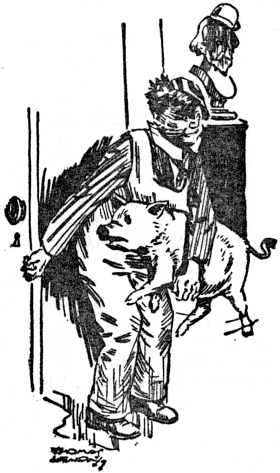
“HERE’S SOMETHIN’ ELSE I’VE
RESCUED,” SAID WILLIAM,
PROUDLY.
Even the lady seemed to feel that hysterics would
have no chance of competing with this uproar, so she
began to chase the puppy. William returned to
the deluge in which he was beginning to find an
irresistible fascination. He had read a story not long
ago in which a flood figured largely and in which the
hero had rescued children and animals from the
passing torrent and had taken them to a place of safety
at the top of a house. In William’s mind the law of
association was a strong one. As he gazed upon the
surging stream he became the rescuer hero of the
story and began to look round for something else
to rescue. There appeared to be no more live stock
to be rescued from the sheds. He waded down to
the road, which also was now partially under water,
and looked up and down. A small pig had wandered
out of a neighbouring farm and was standing contemplating
the flooded road with interest and surprise.
The hero rescuer of William’s story had rescued a
pig. Without a moment’s hesitation William waded
up to the pig, seized it firmly round the middle before
it could escape, and staggered through the deluge
with it and into the house. Though small it showed
more resistance than William had expected. It
wriggled and squeaked and kicked in all directions.
Panting, William staggered upstairs with it. He flung
open the door and deposited the pig on the threshold.
“Here’s somethin’ else I’ve rescued,” he said
proudly.
The lady was showing unexpected capabilities in
dealing with the situation. She had taken the china
out of the china cabinet and had put the hens into it.
They were staring through the glass doors in stupid
amazement and one of them had just complicated
matters by laying an egg.
The lady was just disputing the possession of a
table runner with the spirited puppy who thought she
was having a game with it. The puppy had already
completely dismembered a hassock, a mat and two
cushions. Traces of them lay about the room. Venus
and Shakespeare,
still wearing their
rakish head adornments,
were gazing
at the scene through
runnels of starch and
liquid knife-powder.
Miss Polliter received
the new refugee in a
business-like fashion.
She had evidently
finally decided that
this was no occasion
for the display of
nervous systems.
She seemed, in fact,
exhilarated and
stimulated.
“Put him down
here,” she said.
“That’s quite right,
my boy. Go and
rescue anything else
you can. This is a
noble work, indeed.”
The puppy charged
the pig and the pig
charged the china
cabinet. There came the sound of the breaking of
glass. The egg rolled out and the puppy fell upon
it with wild delight. The hens began to fly about the
room in panic again.
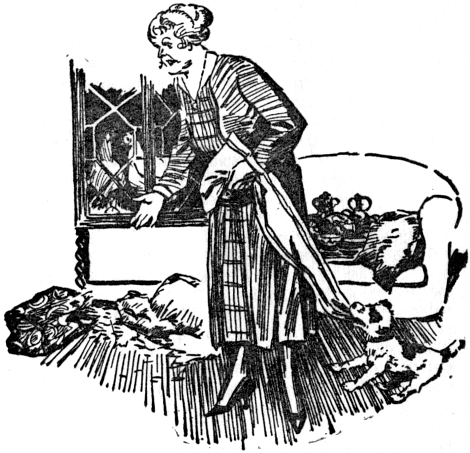
“PUT HIM DOWN HERE,” MISS POLLITER SAID. “THIS IS
A NOBLE WORK, INDEED.”
William hastily shut the door and went downstairs
to continue his work of rescuing. He had by
this time almost persuaded himself that the flood was
of natural origin and that he was performing heroic
deeds of valour in rescuing its victims. Again he
looked up and down the road. He felt that he had
done his duty by the animal creation and he would
have welcomed a rescuable human being. Suddenly
he saw two infants from the Infant School coming hand
in hand down the road. They stared in amazement
at the flood that barred their progress. Then with a
touching faith in their power over the forces of nature
and an innate love of paddling, they walked serenely
into the midst of the stream. When they reached
the middle, however, panic overcame them. The
smaller one sat down and roared and the larger one
stood on tip-toe and screamed. William at once
plunged into the stream and “rescued” them. They
were stalwart infants but he managed to get one
tucked under each arm and carried them roaring
lustily and dripping copiously up to Miss Polliter’s
room. Again Miss Polliter had restored as if by magic
a certain amount of order. She had cooped up the
hens by an ingenious arrangement of the fireguard and
she had put the pig in the coal-scuttle, leaving him an
air-hole through which he was determinedly squeezing
his snout as if in the hope of ultimately squeezing the
rest of him. The puppy had dealt thoroughly with
the table runner while Miss Polliter was engaged on the
hens and pig, and was now seeing whether he could
pull down window curtains or not.
William deposited his dripping, roaring infants.
“Some more I’ve rescued,” he said succinctly.
Miss Polliter turned to him a face which was bright
with interest and enterprise.
“Splendid, dear boy,” she said happily, “splendid....
I’ll soon have them warmed and dried—or wait—is
the flood rising?”
William said it was.
“Well, then, the best thing would be to go to the
very top of the house where we shall be safer than
here!”
Determinedly she picked up the infants, went out
on to the landing and mounted the attic stairs. William
followed holding the puppy who managed during the
journey to tear off and (presumably—as they were
never seen again) swallow his pocket flap and three
buttons from his coat. Then Miss Polliter returned for
the pig and William followed with a hen. The pig
was very recalcitrant and Miss Polliter said “Naughty,”
to him quite sternly once or twice. Then they returned
for the other hens. One hen escaped and in the
intoxication of sudden liberty flew squawking loudly
out of a skylight.
In the attic bedroom where Miss Polliter now
assembled her little company of refugees she lit the
gas fire and started her great task of organisation.
“I’ll dry these dear children first,” she said. “Now
go down, dear boy, and see if there is anyone else
in need of your aid.”
William went downstairs slowly. Something of
his rapture and excitement was leaving him. Cold
reality was placing its icy grip upon his heart. He
began to wonder what would happen to him when they
discovered the nature and cause of his “flood,” and
whether the state to which the refugees were reducing
the house would also be laid to his charge. He waded
out to the hose pipe and had another fruitless struggle
with the tap. Then he looked despondently up and
down the road. The “flood” was spreading visibly,
but there was no one in sight. He returned slowly and
thoughtfully to Miss Polliter. Miss Polliter looked brisk
and happy. She had apparently forgotten both her
nervous system and its need of perpetual nourishment.
She was having a game with the infants who were now
partially dried and crowing with delight. She had
managed to drive the hens into a corner of the room
and had secured them there by a chest of drawers.
She had tied the pig by a piece of string to the washhand-stand
and it was now lying down quite placidly,
engaged in eating the carpet. One hen had escaped
from its “coop” and was running round a table
pursued by or pursuing (it was impossible to say
which) the puppy. Miss Polliter was playing pat-a-cake
with the drying infants and seemed to be enjoying
it as much as the infants. She greeted William gaily.
“Don’t look so sad, dear boy,” she said. “I think
that even though the river continues to rise all night
we shall be safe here—quite safe here—and I daresay
you can find something for these dear children to eat
when they get hungry. I don’t need anything. I’m
quite all right. I can easily go without anything
till morning. Now do one more thing for me, dear
boy. Go down to my room on the lower floor and
see the time. Dr. Morlan said that he would be
home by six.”
Still more slowly, still more thoughtfully, William
descended to her room on the lower floor and saw
the time. It was five minutes to six. Dr. Morlan
might arrive then at any minute. William considered
the situation from every angle. To depart now as
unostentatiously as possible seemed to him a far, far
better thing than to wait and face Dr. Morlan’s wrath.
The hose pipe was damaged, the garden was flooded,
Miss Polliter’s room was like a battlefield after a battle,
strange infants and a pig were disporting themselves
about the house, a destructive puppy had wreaked
its will upon every cushion and curtain and chair
within reach (it had found that it could pull down
window curtains).
William very quietly slipped out of the front door
and crept down the drive. The flood seemed to be
concentrating itself upon the back of the house. The
front was still more or less dry. William crept across
the field to the stile that led to the main road. Here
his progress was barred by a group of three who stood
talking by the stile. There was a tall pompous-looking
man with a beard, a small woman and an elderly man.
“Oh, yes, we’ve quite settled in now,” the tall,
pompous-looking man was saying. “We’ve got a
resident patient with us—a Miss Polliter who is a
chronic nervous case. We are rather uneasy at having
to leave her all to-day with only the cook and house-boy.
Unfortunately our housemaid left us suddenly
yesterday but we trust that things will have gone all
right. An aunt of mine was reported to be seriously
ill and we had to hurry to her to be in time but unfortunately—ahem—I
mean fortunately—we found that
she had taken a turn for the better so we returned as
soon as we could.”
“Of course,” said the woman, “we’d have been back
ever so much earlier if it hadn’t been for that affair
at the cave.”
“Oh, yes,” said the doctor, “very tragic affair,
very tragic indeed. Some poor boy ... there were a
lot of people there trying to recover the body and they
wanted to have a doctor in the unlikely case of the
boy being alive when they got him out. I assured
them that it was very unlikely that he would be alive
and that I had to get back to my own patient ... and
it would only be a matter of a few minutes to send for
me.... The poor mother was distraught.”
“What had happened?” said the other man.
“Some rash child had crawled into an opening in
the rock and had not come out. He must have been
suffocated. His friends waited for over an hour before
they notified the parents and I am afraid that it is
too late now. They have repeatedly called to him but
there is no response. As I told them, there are frequently
poisonous gases in the fissures of the rock and
the poor child must have succumbed to them. So far
all attempts to recover the body have been unsuccessful.
They have just sent for men with pickaxes.”
William’s heart was sinking lower and lower.
Crumbs! He’d quite forgotten the cave part of it.
Crumbs! he’d quite forgotten that he’d left the Outlaws
in the cave waiting for him. The house-boy and the
cook and the silver cleaning and the hose-pipe and the
flood and Miss Polliter and the hens and the pig and
the puppy and the infants had completely driven the
cave and the Outlaws out of his head. Crumbs,
wouldn’t everybody be mad!
For William had learnt by experience that with
a strange perversity parents who had mourned their
children as lost or dead are generally for some reason
best known to themselves intensely irritated to find
that they have been alive and well and near them all
the time. William had little hopes of being received
by his parents with the joy and affection that should
be given to one miraculously restored to them from the
fissures of the rock. And just as he stood pondering
his next step the doctor turned and saw him. He
stared at him for a few minutes, then said, “Do you
want me, my boy? Anything wrong? You’re the
new house-boy, aren’t you?”
William realised that he was still wearing the overalls
which the house-boy had given him. He gaped at the
doctor and blinked nervously, wondering whether it
wouldn’t be wiser to be the new house-boy as the doctor
evidently thought he was. The doctor turned to his
wife.
“Er—it is the new house-boy, dear, isn’t it?” he
said.
“I think so,” said his wife doubtfully. “He only
came this morning, you know, and Cook engaged him,
and I hardly had time to look at him, but I think
he is.... Yes, he’s wearing our overalls. What’s
your name, boy?”
William was on the point of saying “William Brown,”
then stopped himself. He mustn’t be William Brown.
William Brown was presumably lost in the bowels of
the earth. And he didn’t know the house-boy’s name.
So he gaped again and said:
“I don’t know.”
There came a gleam into the doctor’s eye.
“What do you mean, my boy,” he said. “Do you
mean that you’ve lost your memory?”
“Yes,” said William, relieved at the simplicity of the
explanation, and the fact that it relieved him of all
further responsibility. “Yes, I’ve lost my memory.”
“Do you mean you don’t remember anything?”
said the doctor sharply.
“Yes,” said William happily, “I don’ remember
anythin’.”
“Not where you live or anything?”
“No,” said William very firmly, “not where I live
nor anything.”
The other man, feeling evidently that he could
contribute little illumination to the problem, moved
on, leaving the doctor and his wife staring at William.
They held a whispered consultation. Then the doctor
turned to William and said suddenly:
“Frank Simpkins ... does that suggest anything
to you?”
“No,” said William with perfect truth.
“Doesn’t know his own name,” whispered the doctor,
then again sharply:
“Acacia Cottage ... does that convey anything to
you?”
“No,” said William again with perfect truth.
The doctor turned to his wife.
“No memory of his name or home,” he commented.
“I’ve always wanted to study a case of this sort at
close quarters. Now, my good boy, come back home
with me.”
But William didn’t want to go back home with him.
He didn’t want to return to the house which still
bore traces of his recent habitation and where his
“flood” presumably still raged. He was just contemplating
precipitate flight when a woman came
hurrying along the road. The doctor’s wife seemed
to recognise her. She whispered to the doctor. The
doctor turned to William.
“You know this woman, my boy, don’t you?”
“No,” said William, “I’ve never seen her before.”
The doctor looked pleased. “Doesn’t remember
his own mother,” he said to his wife: “quite an
interesting case.”
The woman approached them aggressively. The
doctor stepped in front of William.
“Come after my boy,” she said, “Sayin’ ’is hours
ended at five an’ then keepin’ ’im till now! I’ll ’ave
the lor on you, I will. Where is ’e?”
“Prepare yourself, my good woman,” said the
doctor, “for a slight shock. Your son has temporarily—only
temporarily, we trust—lost his memory.”
She screamed.
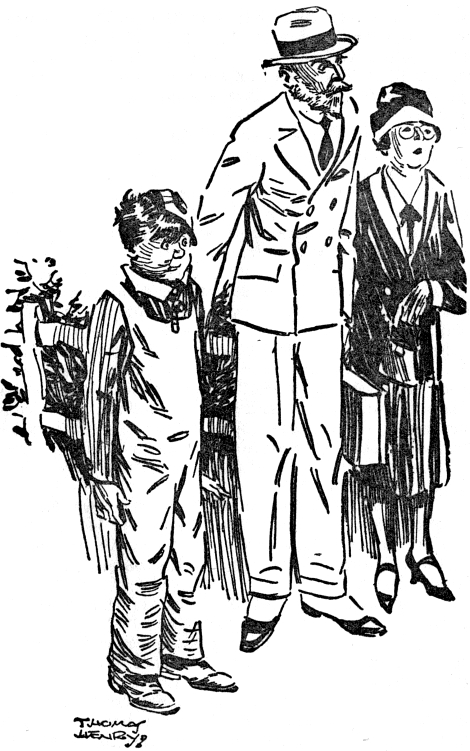
“HERE IS YOUR SON,” SAID THE DOCTOR POMPOUSLY.
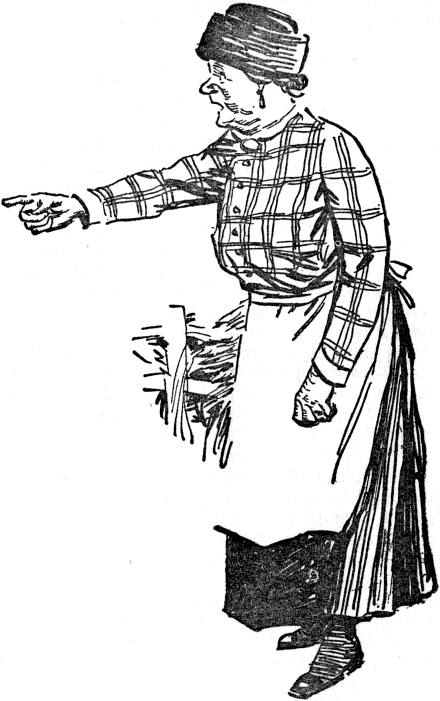
“’IM?” SHRIEKED THE WOMAN. “NEVER SEED ’IM
BEFORE.”
“What’ve you bin doin’ of to ’im?” she said
indignantly, “’e ’adn’t lorst it when ’e left ’ome this
mornin’. Where is ’e, anyway?”
Silently the doctor stepped on to one side, revealing
William.
“Here he is,” he said pompously.
“’Im?” she shrilled. “Never seed ’im before.”
“She’s lost hers too,” said William without flinching.
They stared at each other for some seconds in
silence. Then William saw the real house boy coming
along the road and spoke with the hopelessness of one
who surrenders himself to fate to do its worst with.
“Here he is.”
The real original house boy was stepping blithely
down the road, an extemporised rod over his
shoulders, swinging precariously a jar full of minnows.
He was evidently ignorant of the flight of time. He
saw William first and called out cheerfully:
“I say, I’ve not been long, have I? Is it all right?”
Then he saw the others and the smile dropped from
his face. His mother darted to him protectively.
“Oh, my pore, blessed child,” she said, “what have
they bin a-doin’ to you—keepin’ you hours an’ hours
after your time an’ losin’ your pore memory an’ you
your pore widowed mother’s only child.... Come
home with your mother, then, an’ she’ll take care of
you and we’ll have the lor on them, we will.”
The boy looked from one to another bewildered,
then realising from his mother’s tones that he had been
badly treated he burst into tears and was led away by
his consoling parent.
The doctor and his wife turned to William for an
explanation. Their expressions showed considerably
less friendliness than they had shown before. William
looked about him desperately. Even escape seemed
impossible. He felt that he would have welcomed any
interruption. When, however, he saw Miss Polliter
running towards them down the field he felt that he
would have chosen some other interruption than that.
“Oh, there you are!” panted Miss Polliter. “Such
dreadful things have happened. Oh, there’s the dear
boy. I don’t know what we should have done without
him ... rescuing children and animals at the risk, I’m
sure, of his own dear life. I must give you just a little
present.” She handed him a half crown which
William pocketed gratefully.
“But, my dear Miss Polliter,” said the doctor,
deeply concerned, “you should be resting in your room.
You should never run like that in your state of nervous
exhaustion ... never.”
“Oh, I’m quite well now,” said Miss Polliter.
“Well?” said the doctor amazed and horrified at
the idea.
“Oh, yes,” said Miss Polliter, “I feel ever so well.
The flood’s cured me.”
“The flood?” said the doctor still more amazed
and still more horrified.
“Oh yes. The river’s risen and the whole place
is flooded out,” said Miss Polliter excitedly. “It’s a
most stimulating experience altogether. We’ve saved
a lot of animals and two children.”
The doctor was holding his head.
“Good Heavens!” he said. “Good Heavens!
Good Heavens!”
At that moment two more women descended upon
the group. They were the mothers of the infants.
They had searched through the village for their missing
offspring and at last an eye-witness had described their
deliberate kidnapping and imprisonment in the
doctor’s house. They were demanding the return of
their children. They were threatening legal proceedings.
They were calling the doctor a murderer and a kidnapper,
a vivisectioner, a Hun and a Bolshevist.
The doctor and the doctor’s wife and Miss Polliter
and the two mothers all began to talk at once. William,
seizing his opportunity, crept away. He crept down
the road towards the cave.
At the bend in the road he turned. The doctor and
the doctor’s wife and the two mothers and Miss Polliter,
still all talking excitedly at the same time, began to
make their way slowly up the hill to the doctor’s house.
He looked in the other direction. There was just a
large crowd surrounding the cave; men were just
coming along the road from the other direction with
pickaxes to dig his dead body from the rock.
He went forward very reluctantly and slowly.
He went forward because he had a horrible suspicion
that the doctor would soon have discovered the
extent and the cause of the “flood” and would soon
be pursuing him lusting for vengeance.
He went forward reluctantly and slowly because
he did not foresee an enthusiastic welcome from his
bereaved parents.
Ginger saw him first. Ginger gave a piercing yell and
pointed down the road towards William’s reluctant form.
“There—he is!” he shouted. “He’s not dead.”
They all turned and gaped at him open-mouthed.
William presented a strange figure. He seemed at
first sight chiefly compounded of the two elements,
earth and water.
He turned as if to flee but the figure of the doctor
could be seen running down the road from his house
after him; following the doctor were the doctor’s wife,
the infants’ mothers with the infants and Miss Polliter.
Even at that distance he could see that the doctor’s
face was purple with fury. Miss Polliter still looked
bright and stimulated.
So William advanced slowly towards his gaping
rescuers. “Here I am,” he said. “I—I’ve got out all
right.”
He fingered the half-crown in his pocket as if it were
an amulet against disaster.
He felt that he would soon need an amulet against
disaster.
“Oh, where have you been?” sobbed his mother,
“where have you been?”
“I got in a flood,” said William, “an’ then I lost
my memory.” He looked round at the doctor who was
running towards them and added with a mixture of
fatalistic resignation and bitterness, “Oh, well, he’ll
tell you about it. I bet you’ll b’lieve him sooner than
me an’ I bet he’ll make a different tale of it to what I
would.”
And he did.
******
But Miss Polliter (who left the doctor’s charge,
cured, to his great disgust, the next day) persisted to
her dying day that the river had flooded and that the
hose-pipe had nothing to do with it.
And she sent William a pound note the next week
in an envelope marked “For a brave boy.”
And, as William remarked bitterly, he jolly well
deserved it....
Transcriber’s Notes:
Variations in spelling and hyphenation are retained.
Perceived typographical errors have been changed.