CHAPTER I
THE WEAK SPOT
“YOU see,” said Jameson Jameson, “we’re all
human beings. That’s a very important point.
You must admit that we’re all human beings?”
Jameson Jameson, aged nineteen and three-quarters,
was very eloquent. He paused more for rhetorical
effect than because he really needed confirmation on
the point. His audience, all under nineteen, agreed
hoarsely and unanimously.
They were all human beings. They admitted it.
“Well, then,” Jameson continued, warming to his
subject, “as human beings we’re equal. As being
equal we’ve got equal rights, I suppose. Anyone
deny that?”
Robert Brown, aged seventeen, in whose room the
meeting took place, leaned forward eagerly. He was
thoroughly enjoying the meeting. The only drawback
was the presence of his younger brother, William,
aged eleven. By some mistake someone had admitted
William, and by some still greater mistake no one had
ejected him; and now it was too late. He gave no
excuse for ejection. He was sitting motionless, his
hands on his knees, his eyes, under their untidy shock
of hair, glued on the speaker, his mouth wide open.
There was no doubt at all that he was impressed. But
Robert wished he wasn’t there. He felt that the
presence of a kid was an insult to the mature intelligences
round him, most of whom were in their first
year at college.
But no one seemed to mind, so he contented himself
with sitting so that he could not see William.
“Well,” continued Jameson Jameson, “then why
aren’t we equal? Why are some rich and some poor?
Why do some work and others not? Tell me that.”
There was no answer—only a gasp of wonder and
admiration.
Jameson Jameson (whose parents had perpetrated
on him the supreme practical joke of giving him his
surname for a Christian name, so that people who
addressed him by his full name always seemed to be
indulging in some witticism) brought down his fist
upon the table with a bang.
“Then it’s somebody’s duty to make us equal. It’s
only common justice, isn’t it? You admit that?
Those who haven’t money must be given money, and
those who have too much must have some taken off
them. We want Equality. And no more Tyranny.
The working-class must have Freedom. And who’s
going to do it?”
He thrust his hand into his coat front in a manner
reminiscent of the late Mr. Gladstone and glared at
his audience from under scowling brows.
“Ah, who?” gasped the audience.
“It’s here that the Bolshevists come in!”
“Bolshevists?” said Robert, aghast.
“The Bolshevists are very much misjudged and—er—maligned,”
retorted Jameson Jameson, with emotion.
“Shamefully misjudged and——” he wasn’t sure
whether he’d pronounced it right, so he ended feebly,
“what I said before. I’m not,” he admitted frankly,
“in direct communication with Lenin, but I’ve read
about it in a magazine, and I know a bit about it from
that. The Bolshevists want to share things out so
as we’re equal, and that’s only right, isn’t it? ’Cause
we’re all human beings, and as such are equal, and
as such have equal rights. Well, that’s clear, isn’t
it? Does anyone,” he glared round fiercely, “wish to
contradict me?”
No one did. William, who was sitting in a draught,
sneezed and was annihilated by a glance from Robert.
“Well,” he continued, “I propose to form a Bolshevist
Society, first of all, just to start with. You see,
the Bolshevists have gone to extremes, but we’ll join
the Bolshevist party and—and purge it of all where
it’s wrong now. Now, who’ll join the Society?”
As human beings with equal rights they were all
anxious to join. They were all fired to the soul by
Jameson Jameson’s eloquence. Even William pressed
onward to give in his name, but was sternly ordered
away by Robert.
“But I believe all you do,” he pleaded wistfully,
“’bout want’n other people’s money an’ thinking we
oughtn’t to work.”
“You’ve misunderstood me, my young friend,” said
Jameson Jameson, with a sigh, “but we want numbers.
There’s no reason why——”
“If that kid belongs, I’m not going to,” said Robert
firmly.
“We might have a Junior Branch——” suggested
one of them.
So thus it was finally settled. William became the
Junior Branch of the Society of Reformed Bolshevists.
Alone he was President and Secretary and Committee
and Members. He resented any suggestion of enlarging
the Junior Branch. He preferred to form the Branch
himself. He held meetings of his Branch under the
laurel bushes in the garden, and made eloquent speeches
to an audience consisting of a few depressed daffodil
roots, and sometimes the cat from next door.
“All gotter be equal,” he pronounced fiercely, “all
gotter have lots of money. All ’uman beings. That’s
sense, isn’t it? Is it sense or isn’t it?”
The cat from next door scratched its ear and slowly
winked.
“Well, then,” said William, “someone ought to do
somethin’.”
The Society of Advanced Bolshevists met next
month in Robert’s room. William had left nothing
to chance. He had heard Robert saying that he’d see
no kids got in to this one, so he installed himself under
Robert’s bed before anyone arrived. Robert looked
round the room with a keen and threatening gaze
before he ushered Jameson Jameson into the chair, or,
to be more accurate, on to the bed. The meeting
began.
“Comrades,” began Jameson Jameson, “we have,
I hope, all spent this time in thinking things out and
making ourselves more devoted to the cause. But
now is the time for action. We’ve got to do something.
If we had any money ’cept the mean bit that
our fathers allow us we could make people jolly well
sit up—we could——”
Here William, who had just inhaled a large mouthful
of dust, sneezed loudly, and Robert made a dive
beneath the bed. In the scuffle that ensued William
embedded his teeth deeply into Jameson Jameson’s
ankle, and vengeance was vowed on either side.
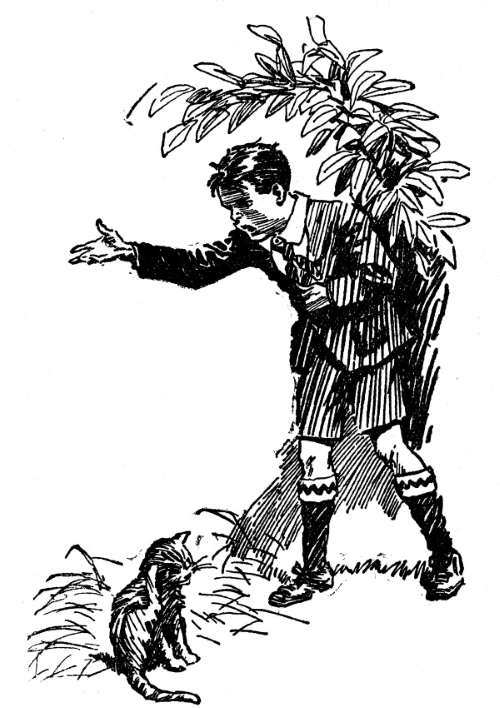
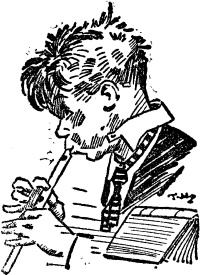
WILLIAM MADE ELOQUENT SPEECHES TO AN AUDIENCE
OF DEPRESSED DAFFODIL ROOTS AND THE CAT FROM
NEXT DOOR.
“Well, why can’t I come? I’m a Bolshevist too
like wot all you are!”
“Well, you’ve got a Branch of your own,” said
Robert fiercely.
Jameson Jameson was still standing on one leg and
holding the other in two hands with an expression of
(fortunately) speechless agony on his face.
“Look!” went on Robert, “you may have maimed
him for life for all you know, and he’s the life and soul
of the Cause, and what can he do with a maimed
foot? You’ll have to keep him all his life if he is
maimed for life, and when the Bolshevists get in power
he’ll have your blood—and I shan’t mind,” he added,
darkly.
Jameson Jameson gave a feeble smile.
“It’s all right, Comrade,” he said, “I harbour no
thoughts of vengeance. I hope I can bear more than
this for the Cause.”
Very ungently William was deposited on the landing
outside.
“You can keep your nasty little Branch to yourself,
and don’t come bothering us,” was Robert’s parting
shot.
It was then that William realised the power of
numbers. He resolved at once to enlarge his Branch.
Rubbing the side on which he had descended on the
landing, and frowning fiercely, he went downstairs and
out into the road. Near the gate was Victor Jameson,
Jameson Jameson’s younger brother, gazing up at
Robert’s bedroom window, which could be seen through
the trees.
“He’s up there talkin’,” he muttered scornfully.
“Doesn’t he talk?”
The tone of contempt was oil on the troubled waters
of William’s feelings.
“I’ve just bit him hard,” he said modestly.
The two linked arms affectionately and set off down
the road. At the corner of the road they fell in with
George Bell. William had left Ronald Bell, George’s
elder brother, leaning against the mantelpiece in
Robert’s room and examining himself in the glass. He
was letting his hair grow long, and he hoped it was
beginning to show.
“What do they do up at your house?” demanded
George with curiosity. “He won’t tell me anything.
He says it’s secret. He says no one’s got to know
now, but all the world will know some day. That’s
what he says.”
“Huh,” said Victor scornfully, “they talk. That’s
all they do. They talk.”
“Let’s find a few more,” said William, “an’ I’ll
tell you all about it.”
It being Saturday afternoon they soon collected the
few more, and the company returned to the summer-house
at the end of William’s garden. The company
consisted chiefly of younger brothers of the members
of the gathering upstairs.
William rose to address them with one hand inside
his coat in an attitude copied faithfully from Jameson
Jameson.
“They’ve gotter ole society,” he said, “an’ they’ve
made me a Branch, so I can make all you Branches.
So, now you’re all Branches. See? Well, they say
how we’re all ’uman bein’s an’ equal. Well, they say
if we’re equal we oughtn’t to have less money an’
things than other folks, and more work to do, an’ all
that. That’s wot I heard ’em say.”
Here the cat from next door, drawn by the familiar
sound of William’s voice, peered into the summer-house,
and was promptly dismissed by a well-aimed
stick. It looked reproachfully at William as it
departed.
“And to-day they said,” went on William, “that
now is the time for Action, an’ how we’d only the mean
bit of money our fathers gave us; and then they found
me an’ I bit his leg, and they threw me out, an’ I
bet I’ve got a big ole bruise on my side, an’ I bet
he’s got a bigger ole bite on his leg.”
He sat down, amid applause, and George, acting with
a generosity born of a sudden feeling of comradeship,
took a stick of rock from his pocket and passed it round
for a suck each. This somewhat disturbed the harmony
of the meeting, as “Ginger,” William’s oldest
friend, was accused of biting a piece off, and the
explanation, that it “came off in his mouth,” was not
accepted by the irate owner, who was already regretting
his generosity. The combatants were parted by
William, and peace was sealed by the passing round of
a bottle of liquorice water belonging to Victor Jameson.
Then William rose for a second speech.
“Well, we’re all Branches, so let’s do same as them.
They’re goin’ to get equal cause they’re ’uman bein’s;
so let’s try and get equal too.”
“Equal with what?” demanded Douglas, whose elder
brother had joined Jameson Jameson’s society, and had
secretly purchased a red tie, which he did not dare
to wear in public, but which he donned behind a tree
on his way to William’s house, and doffed in the same
place on his way from William’s house.
“Equal to them,” said William. “Why, just think
of the things they’ve got. They’ve got lots of money,
haven’t they?—lots more than what we have, an’
they can buy anything they want, an’ they stay up
for dinner always, and go out late at night, an’ eat
what they want with no one sayin’ had they better,
or cert’nly not, or what happened last time, an’ they
smoke an’ don’t go to school, an’ go to the pictures,
an’ they’ve got lots more things ’n we’ve got—bicycles
an’ grammerphones, an’ fountain-pens, an’ watches, an’
things what we’ve not got. Well, an’ we’re ’uman
beings, too, an’ we ought to be equal, an’ why shun’t
we be equal?—an’ now’s the time for Action! They
said so.”
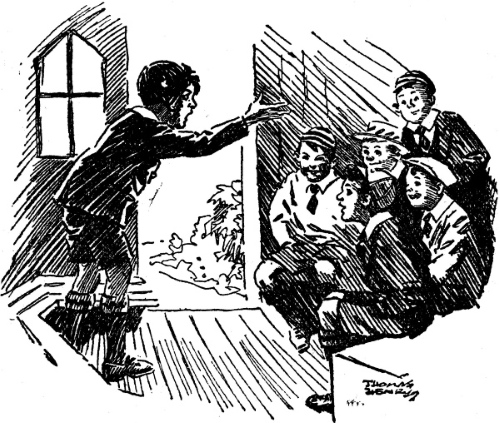
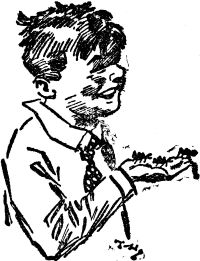
... AN’ WE’RE ’UMAN BEINGS, TOO, AN’ WE OUGHT TO
BE EQUAL, AN’ WHY SHUN’T WE BE EQUAL?...”
There was a silence.
“But——” said Douglas slowly, “we can’t just take
things, can we?”
“Yes,” said William, “we can if we’re Bolshevists.
They said so. An’ we’re all Bolshevist Branches.
They made me, an’ I made you. See? So we can
take anything to make us equal. See? We’ve got
to be equal.”
Here the meeting was stopped by the spectacle of
the Senior Bolshevists issuing from the side door
wearing frowns of stern determination. Douglas’s
brother fingered his red tie ostentatiously; Ronald
pulled down his cap over his eyes with the air of a
conspirator; Jameson Jameson limped slightly and
smiled patiently and forgivingly upon Robert, who was
still apologising for William. The words that were
wafted across to listening ears upon the Spring breeze
were: “Next Tuesday, then.”
Then the Branches turned to a discussion of details.
They were nothing if not practical. After about a
quarter of an hour they departed, each pulling his
cap over his eye and frowning. As they departed
they murmured: “Next Tuesday, then.”
Next Tuesday dawned bright and clear, with no hint
that it was one of those days on which the world’s fate
is decided.
The Senior Bolshevists met in the morning. They
discussed the possibility of getting into touch with
Lenin, but no one knew his exact address, or the rate
of postage to Russia, so no definite step was taken.
During the afternoon Robert followed his father into
the library. His face was set and stern.
“Look here, father,” he said, “we’ve been thinking—some
of us. Things don’t seem fair. We’re all
human beings. It’s time for action. We’ve all agreed
to speak to our fathers to-day and point things out
to them. They’ve been misjudged and maligned, but
we’re going to purge them of all that. You see, we’re
all human beings, and it’s time for action. We’re all
agreed on that. We’ve got equal rights, because we’re
all human beings.”
He paused, inserted a finger between his neck and
collar as if he found its pressure intolerable, then
smoothed back his hair. He was looking almost
apoplectic.
“I don’t know whether I make my meaning clear,”
he began again.
“You don’t, old chap, whatever it may be,” said
his father soothingly. “Perhaps you feel the heat?—or
the Spring? You ought to take something cooling,
and then lie down for a few hours.”
“You don’t understand,” said Robert desperately.
“It’s life or death to civilisation. You see, we’re all
human beings, and all equal, and we’ve got equal
rights, and yet some have all the things, and some
have none. You see, we thought we’d all start at home
and get things made more fair there, and our fathers
to divide up the money more fairly and give us our
real share, and then we could go round teaching other
people to give things up to other people and share
things out more fairly. You see, we must begin at
home, and then we start fair. We’re all human beings
with equal rights.”
“You’re so very modest in your demands,” said
Robert’s father. “Would half be enough for you?
Are you sure you wouldn’t like a little more?”
Robert waved the suggestion aside.
“No,” he said, “you see, you have the others to
keep. But we’ve all decided to ask our fathers to-day,
then we can start fair and have some funds to go on.
A society without funds seems to be so handicapped.
And it would be an example to other fathers all over
the world. You see——”
At this moment Robert’s mother came in.
“What a mess your room’s in, Robert! I hope
William hasn’t been rummaging in it.”
Robert turned pale.
“William!” he gasped, and fled to investigate.
He returned in a few minutes, almost inarticulate
with fury.
“My watch!” he said. “My purse! Both gone!
I’m going after him.”
He seized his hat from the hall, and started to the
door. His father watched him, leaning easily against
the doorpost of the library, and smiling.
From the garden as he passed came a wail.
“My bicycle! Gone too. The shed’s empty!”
In the road he met Jameson Jameson.
“Burglars!” said Jameson Jameson. “All my
money’s been taken. And my camera! The wretches!
I’m going to scour the country for them.”
Various other members of the Bolshevist Society
appeared, filled with wrath and lamenting vanished
treasures.
“It can’t be burglars,” said Robert, “because why
only us?”
“Do you think someone in the Government found
out about us being Bolshevists and is trying to intimidate
us?”
Jameson Jameson thought this very likely, and they
discussed it excitedly in the middle of the road, some
hatless, some hatted, all talking breathlessly. Then at
the other end of the road appeared a group of boys.
They were happy, rollicking boys. They all carried
bags of sweets which they ate lavishly and handed
round to their friends equally lavishly. One held a
camera—or the remains of a camera—whose mechanism
the entire party had just been investigating. One
more had a large wrist-watch upon a small wrist. One
walked (or rather leapt) upon a silver-topped walking-stick.
One, the quietest of the group, was smoking a
cigarette. At the side near the ditch about half a
dozen rode intermittently upon a bicycle. The descent
of the bicycle and its cargo into the ditch was greeted
with roars of laughter. They were very happy boys.
They sang as they walked.
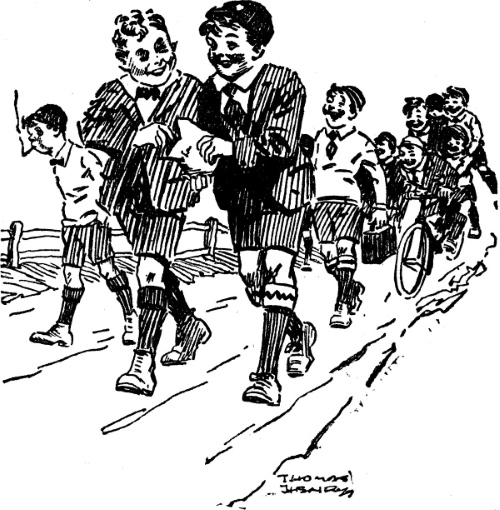
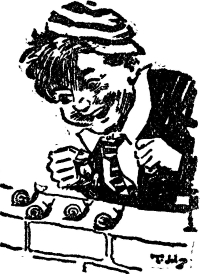
THEN AT THE OTHER END OF THE ROAD APPEARED A GROUP
OF BOYS. THEY WERE HAPPY, ROLLICKING BOYS.
“We’ve been to the pictures.”
“In the best seats.”
“Bought lots of sweets and a mouth-organ.”
“We’ve got a bicycle, an’ a camera, an’ two watches,
an’ a fountain-pen, an’ a razor, an’ a football, an’ lots
of things.”
White with fury, the Senior Bolshevists charged
down upon them. The Junior Bolshevists stood their
ground firmly, with the exception of the one who had
been smoking a cigarette, and he, perforce a coward
for physical rather than moral reasons, crept quietly
home, relinquishing without reluctance his half-smoked
cigarette. In the Homeric battle that followed,
accusations and justifications were hurled to and fro
as the struggle proceeded.
“You beastly little thieves!”
“You said to be equal, an’ why should some people
have all the things!”
“You little wretches!”
“We’re ’uman beings an’ got to take things to make
equal. You said so.”
“Give it back to me!”
“Why should you have it an’ not me? It was time
for Action, you said.”
“You’ve spoilt it.”
“Well, it’s as much mine as yours. We’ve got equal
rights. We’re all ’uman beings.”
But the battle was one-sided, and the Junior Branch,
having surrendered their booty and received punishment,
fled in confusion. The Senior Branch, bending
lovingly and sadly over battered treasures, walked
slowly and silently up the road.
*****
“About your Society——” began Mr. Brown after
dinner.
“No,” said Robert, “it’s all off. We’ve given it
up, after all. We don’t think there’s much in it, after
all. None of us do, now. We feel quite different.”
“But you were so enthusiastic about it this afternoon.
Sharing fairly, and all that sort of thing.”
“Yes,” said Robert. “That’s all very well. It’s all
right when you can get your share of other people’s
things, but when other people try to get their share
of your things, then it’s different.”
“Ah,” said Mr. Brown, “that’s the weak spot.
I’m glad you found it out.”
CHAPTER II
WILLIAM AND PHOTOGRAPHY
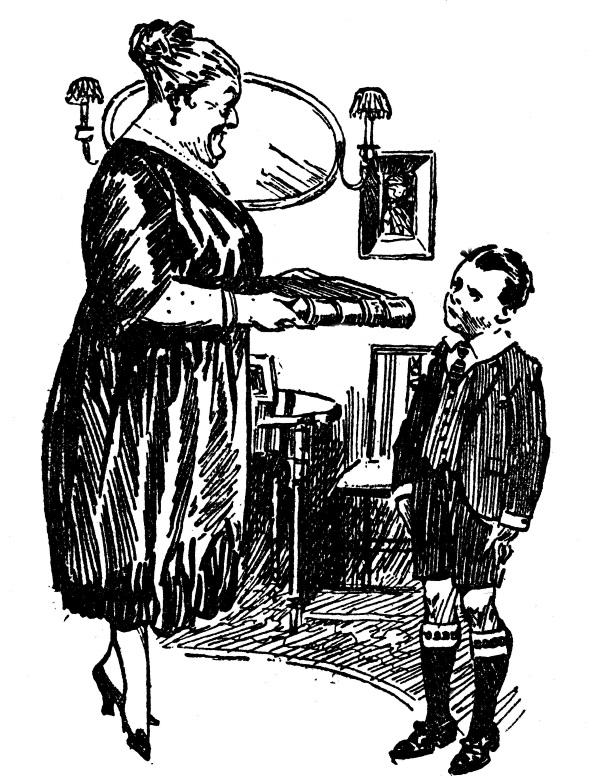
MRS. ADOLPHUS CRANE was William’s
mother’s second cousin and William’s godmother.
Among the many senseless institutions of
grown-up life the institutions of godmothers and godfathers
seemed to William the most senseless of all.
Moreover, Mrs. Adolphus Crane was rich and immensely
respectable—the last person whom Fate should have
selected as his godmother. Fortunately, she lived at
a distance, and so was spared the horrible spectacle
of William’s daily crimes. His meetings with her had
not been fortunate, so far, in spite of his family’s
earnest desire that he should impress her favourably.
There had been that terrible meeting two months
ago. William was running a race with one of his
friends. It was quite a novel race invented by William.
The competitors each had their mouths full of water
and the one who could run the farthest without either
swallowing his load or discharging it, won. William
in the course of the race encountered Mrs. Adolphus
Crane, who was on her way to William’s house to pay
him a surprise visit. She recognised him and addressed
to him a kindly, affectionate remark. Of course, if
he had had time to think over the matter from all
points of view, he might have conceived the idea of
swallowing the water before he answered. But, as he
afterwards explained, he had no time to think. The
worst of it was that the painful incident was witnessed
by almost all William’s family from the drawing-room
window. Mrs. Adolphus Crane’s visit on that occasion
was a very short one. She seemed slightly distant.
It was felt strongly that something must be done
to win back her favour. William disclaimed all
responsibility.
“Well, I can’t help it. I can’t help it. I don’t mind.
Honestly I don’t mind if she doesn’t like me. Well,
I don’t mind if she doesn’t come again, either.”
“But, William, she’s your godmother.”
“Well,” said the goaded William. “I can’t help
that. I didn’t do that.”
When Mrs. Adolphus Crane’s birthday came,
William’s mother attacked him again.
“You ought to give her something, William, you
know, especially after the way you treated her the
last time she came over.”
“I’ve nothin’ to give her,” said William simply.
“She can have that book Uncle George gave me, if
she likes. Yes, she can have that.” He warmed to
the subject. “You know. The one about Ancient
Hist’ry. I don’t mind her having it a bit.”
“But you haven’t read it.”
“I don’t mind not readin’ it,” said William
generously. “I—I’d like her to have it,” he went on.
But it was Mrs. Brown who had the great inspiration.
“We’ll have William’s photograph taken for her.”
It was quite simple to say that, and it was quite
simple to make an appointment at the photographer’s,
but it was another matter to provide an escort for
him. Mrs. Brown happened to have a bad cold; Mr.
Brown was at the office; Robert, William’s grown-up
brother, flatly refused to go with him. So, after a
conversation that lasted almost an hour, William’s
elder sister Ethel was induced, mainly by bribery and
corruption, to go with William to the photographer’s.
But she took a friend with her to act as a buffer state.
William, at the appointed hour, was in a state of
suppressed fury. To William the lowest depth of
humiliation was having his photograph taken. Mrs.
Brown had expended much honest toil upon him.
He had been washed and brushed and combed and
manicured till his spirits had sunk below zero. To
William, complete cleanliness was quite incompatible
with happiness. He had been encased in his “best
suit”—a thing of hard, unbending cloth; with that
horror of horrors, a stiff collar.
“Won’t a jersey do?” he had asked plaintively.
“It’ll probably make me ill—give me a sort throat or
somethin’—this tight thing at my neck, an’ I wouldn’t
like to be ill—’cause of giving you trouble,” he ended
piously.
Mrs. Brown was touched—she was the one being in
the world who never lost faith in William.
“But you wear it every Sunday, dear,” she protested.
“Sundays is different,” he said. “Everyone wears
silly things on Sundays—but, but s’pose I met someone
on my way there.” His horror was pathetic.
“Well, you look very nice, dear. Where are your
gloves.”
“Gloves?” he said indignantly.
“Yes—to keep your hands clean till you get there.”
“Is anyone goin’ to give me anythin’ for doin’ all
this?”
She sighed.
“No, dear. It’s to give pleasure to your godmother.
I know you like to give people pleasure.” William was
silent cogitating over this entirely new aspect of his
character.
He set off down the road with Ethel and her friend
Blanche. Bosom friends of his, with jerseys, with
normal dirty hands and faces, passed him and stared
at him in amazement.
He acknowledged their presence only by a cold
stare. On ordinary days he was a familiar figure on
that road himself, also comfortably jerseyed and
gloriously dirty. He would then have greeted them
with a war-whoop and a friendly punch. But now he
was an outcast, a pariah, a thing apart—a boy in his
best clothes and kid gloves on an ordinary morning.
The photographer was awaiting them. William returned
his smile of welcome with a scowl.
“So this is our little friend?” said the photographer.
“And what is his name?”
William grew purple.
Ethel began to enjoy it.
“Willie,” she said.
Now, there were many insults that William had
learned to endure with outward equanimity, but this
was not one. Ethel knew perfectly well his feeling
with regard to the name “Willie.” It was a deliberate
revenge because she had to waste a whole morning on
him. Moreover, Ethel had various scores to wipe off
against William, and it was not often that she had
him entirely at her mercy.
William growled. That is the only word that
describes the sound emitted.
“Pretty name for a pretty boy,” commented the
photographer in sprightly vein.
Ethel and Blanche gurgled. William, dark and
scowling, looked unspeakable things at them.
“Come forward,” said the photographer invitingly.
“Any preparations? Fancy dress?”
“I think not,” gurgled Ethel.
“I have some nice costumes,” he persisted. “A little
page? Bubbles? But perhaps the hair is hardly
suitable. Cupid? I have some pretty wings and
drapery. But perhaps the little boy’s expression is
hardly—— No, I think not,” hastily, as he encountered
the fixed intensity of William’s scowling
gaze. “Remove the cap and gloves, my little chap.”
He looked up and down William’s shining, immaculate
person. “Ah, very nice.”
He waved Ethel and Blanche to a seat.
“Now, my boy——”
He waved the infuriated William to a rustic woodland
scene at the other end.
“Now, stand just here. That’s right. No, not
quite so stiff—and—no, not quite so hunched up, my
little chap ... the hands resting carelessly ... one on
the hip, I think ... just easy and natural ... that’s
right ... but no, hardly. Relax the brow a little.
And—ah, no ... not a grimace ... it would spoil a
pretty picture ... the feet so ... and the head so
... the hair is slightly deranged ... that’s better.”
Let it stand to William’s eternal credit that he
resisted the temptation to bite the photographer’s hand
as it strayed among his short locks. At last he was
posed and the photographer returned to the camera,
but during his return William moved feet, hands, and
head to an easier position. The photographer sighed.
“Ah, he’s moved. William’s moved. What a pity!
We’ll have to begin all over again.”
He returned to William, and very patiently he
rearranged William’s feet and hands and head.
“The toes turned out—not in, you see, Willie, and
the hands so, and the head slightly on one side ...
so, no, not right down on to the shoulder ... ah,
that’s right ... that’s sweet, a very pretty picture.”
Ethel had retired hysterically behind a screen.
The photographer returned to his camera. William
promptly composed his limbs more comfortably.
“Ah, what a pity! Willie’s moved again. We shall
have to commence afresh.”
He returned to William and again put his unwilling
head on one side, his hand upon his hip, and turned
William’s stout boots at a graceful angle.
He returned. William was clinging doggedly to his
pose. Anything to put an end to this torture.
“Ah, right,” commented the photographer.
“Splendid! Ve-ry pretty. The head just a lee-eetle
more on one side. The expression a lee-eetle less—melancholy.
A smile, please—just a lee-eetle smile.
Ah, no,” hastily, as William savagely bared his teeth,
“perhaps it is better without the smile.” Suppressed
gurgles came from behind the screen where Ethel
clung helplessly to Blanche. “One more, please.
Sitting, I think, this time. The legs crossed—easily
and naturally—so. The elbow resting on the arm of
the chair and the cheek upon the hand—so.” He
retired to a distance and examined the effect, with his
head on one side. “A little spoilt by the expression,
perhaps—but very pretty. The expression a lee-eetle
less—er—fierce, if you will pardon the word.” William
here deigned to speak.
“I can’t look any different to this,” he remarked
coldly.
“Now, think of the things I say,” went on the
photographer, brightly. “Sweeties? Ah!” looking
merrily at William’s unchangingly ferocious expression.
“Do I see a saucy little smile?” As a matter of
fact, he didn’t, because at that moment Ethel, her
eyes streaming, peeped round the screen for another
look at the priceless sight of William in his best suit,
in the familiar attitude of the Bard of Avon. Encountering
the concentrated fury of William’s gaze,
she retired hastily.
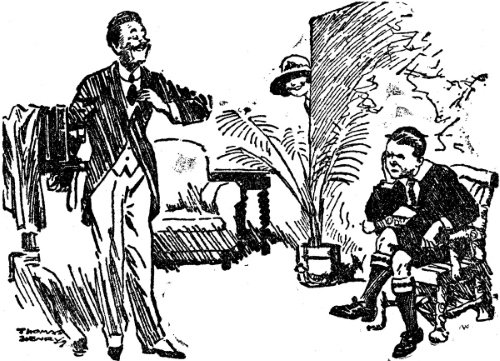
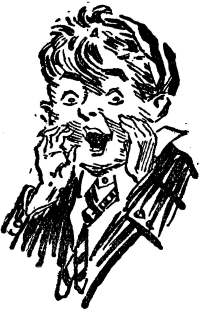
AT THAT MOMENT ETHEL PEEPED ROUND THE SCREEN
FOR ANOTHER LOOK AT THE PRICELESS SIGHT OF
WILLIAM IN THE FAMILIAR ATTITUDE OF THE BARD
OF AVON.
“Seaside with spade and bucket?” went on the
photographer, watching William’s unchanging expression.
“Pantomimes? That nice, soft, furry pussy
cat you’ve got at home?” But seeing William’s expression
change from one of scornful fury to one
of Nebuchadnezzan rage and fury, he hastily pressed
the little ball lest worse should follow.
Ethel’s description of the morning considerably
enlivened the lunch table. Only Mrs. Brown did not
join in the roars of laughter.
“But I think it sounds very nice, dear,” she said,
“very nice. I’m very much looking forward to the
proofs coming.”
“Well, it was priceless,” said Ethel. “It was ever
so much funnier than the pantomime. I wouldn’t
have missed it for anything. For years to come, if
I feel depressed, I shall just think of William this
morning. His face ... oh, his face!”
William defended himself.
“My face is jus’ like anyone else’s face,” he said
indignantly. “I don’t know why you’re all laughing.
There’s nothin’ funny about my face. I’ve never done
anythin’ to it. It’s no different to other people’s.
It doesn’t make me laugh.”
“No, dear,” said Mrs. Brown soothingly, “it’s very,
nice—very nice, indeed. And I’m sure it will be a
beautiful photograph.”
The proofs arrived next week. They were highly
appreciated by William’s family. There were two
positions. In one, William, in an attitude of intellectual
contemplation, glowered at them from an
artistic background; in the other, he stood stiffly with
one hand on his hip, his toes (in spite of all) turned
resolutely in, and glared ferociously and defiantly upon
the world in general. Mrs. Brown was delighted. “I
think it’s awfully nice,” she said, “and he looks so
smart and clean.”
William, mystified by Robert’s and Ethel’s reception
of them, carried them up to his room and studied
them long and earnestly.
“Well, I can’t see wot’s funny about them,” he said
at last, half indignantly and half mystified. “It
doesn’t seem funny to me.”
“You’ll have to write a letter to your godmother,
dear,” said Mrs. Brown, as Mrs. Adolphus Crane’s
birthday drew near.
“Me?” said William bitterly. “I should think I’ve
done enough for her.”
“No,” said Mrs. Brown firmly, “you must write
a letter.”
“I dunno what to say to her.”
“Say whatever comes into your head.”
“I dunno how to spell all the words that come in
my head.”
“I’ll help you, dear.”
Seeing no escape, William sat gloomily down at the
table and was supplied with pen, ink, and paper. He
looked round disapprovingly.
“S’pose I wear out the nib?” he said sadly. Mrs.
Brown obligingly placed a box of nibs at his elbow.
He sighed wearily. Life sometimes is hardly worth
living.
After much patient thought he got as far as “Dear
Godmother.” He occupied the next ten minutes in
seeing how far you could bend apart the two halves
of a nib without breaking them. After breaking six,
he wearied of the occupation and returned to his
letter. With deeply-furrowed brow and protruding
tongue he continued his efforts. “Many happy returns
of your birthday. I hopp you are verry well. I am
very well and so is mother and father and Ethel and
Robbert.” He gazed out of the window and chewed
the end of his penholder into splinters. Some he
swallowed, then choked, and had to retire for a drink
of water. Then he demanded a fresh pen. After
about fifteen minutes he returned to his epistolary
efforts.
“It is not raning to-day,” he wrote, after much
thought. Then, “It did not rane yesterday and we
are hoppin’ it will not rane to-morrow.”
Having exhausted that topic he scratched his head
in despair, wrinkled up his brows, and chewed his
penholder again.
“I have a hole in my stokking,” was his next effort.
Then, “I have had my phottograf took and send it
for a birthday present. Some peeple think it funny
but to me it seems alrite. I hopp you will like it.
Your loving godsun, William.”
Mrs. Adolphus Crane was touched, both by letter and
photograph.
“I must have been wrong,” she said with penitence.
“He looks so good. And there’s something rather sad
about his face.”
She asked William to her birthday tea-party. To
William this was the climax of a long chain of insults.
“But I don’t want to go to tea with her,” he said
in dismay.
“But she wants you, darling,” said Mrs. Brown.
“I expect she liked your photograph.”
“I’m not going,” said William testily, “if they’re all
going to be laughing at my photograph all the time.
I’m jus’ sick of people laughing at my photograph.”
“Of course they won’t, dear,” said Mrs. Brown.
“It’s a very nice photograph. You look a bit—depressed
in it, that’s all.”
“Well, that’s not funny,” he said indignantly.
“Of course not, dear. You’ll behave nicely, won’t
you?”
“I’ll behave ordinary,” he said coldly, “but I don’t
want to go. I don’t want to go ’cause—’cause—’cause——” he
sought silently for a reason that might
appeal to a grown-up mind, then, with a brilliant
inspiration, “’cause I don’t want my best clothes to
get all wore out.”
“I don’t think they will, dear,” she said; “don’t
worry about that.”
William dejectedly promised not to.
The afternoon of Mrs. Adolphus Crane’s birthday
dawned bright and clear, and William, resigned and
martyred, set off. He arrived early and was shown
into Mrs. Adolphus Crane’s magnificent drawing-room.
An air of magisterial magnificence shed gloom over
Mrs. Adolphus Crane’s whole house. Mrs. Adolphus
Crane, as magisterial, and magnificent and depressing
and enormous as her house, entered.
“Good afternoon, William. Now I’ve a pleasant
little surprise for you.” William’s gloomy countenance
brightened. “I’ve put your photograph into my
album. There! What an honour for a little boy!”
William’s countenance relapsed into gloom.
“You can look at the album while I’m getting ready,
and then when the guests come you can show it to
them. Won’t that be nice?” She departed.
William was trapped—trapped in a huge and horrible
drawing-room by a huge and horrible woman, and
he would have to stay there at least two hours. And
Ginger and Henry were bird-nesting! Oh, the horror
of it. Why was he chosen by Fate for this penance?
He felt a sudden fury against the art of photography
in general. William’s sudden furies against anything
demanded some immediate outlet.
So William, with the aid of a pencil, looked at Mrs.
Adolphus Crane’s family album till Mrs. Adolphus
Crane was ready. Then she arrived, and soon after
her the guests, or rather such of them as had not had
the presence of mind to invent excuses for their
absence. For, funeral affairs were Mrs. Adolphus
Crane’s parties. Liveliness and hilarity dropped slain
on the doorstep. The guests came sadly into the
drawing-room, and Mrs. Adolphus Crane dispensed
gloom from the hearthrug. Her voice was low and
deep.
“How do you do ... thank you so much ... I
doubt whether I shall live to see another ... yes, my
nerves! By the way—my little godson——” They
turned to look at William who was sitting in silent
misery in a corner, his hands on his knees. He
returned their interested stares with his best company
frown. On the chair by him was the album. “Have
you seen the family album?” went on Mrs. Adolphus
Crane. “It’s most interesting. Do look at it.” A
group of visitors sadly gathered round it and one of
them opened it. Mrs. Adolphus Crane did not join
them. She knew her album by heart. She took her
knitting, sat down by the fire, and poured forth her
knowledge.
“The first one is great uncle Joshua,” she said, “a
splendid old man. Never touched tobacco or alcoholic
drinks in his life.”
They looked at great uncle Joshua. He sat, grim
and earnest and respectable, with his hand on the
table. But a lately-added pipe, in pencil, adorned his
mouth, and his hand seemed to encircle a tankard.
Quite suddenly animation returned to the group by
the album. They began to believe that they were
going to enjoy it, after all.
“Then comes my poor dear mother.” Poor, dear
mother wore a large eye-glass with a black ribbon and
a wild Indian head-dress. The group by the album
grew large. There seemed to be some magnetic
attraction about it.
“Then comes my paternal uncle James, a very
handsome man.”
Paternal uncle James might have been a very handsome
man before his nose had been elongated for
several inches, and his lips curved into an enormous
smile, showing gigantic teeth. He smoked a large-vulgar-looking
pipe.
“A beautiful character, too,” said Mrs. Adolphus
Crane. She continued the family catalogue, and the
visitors followed the photographs in the album. They
were all embellished. Some had pipes, some had blue
noses, some black eyes, some giant spectacles, some
comic head-dresses. Some had received more attention
than others. Aunt Julia, “a most saintly woman,”
positively leered from her “cabinet,” with a huge nose,
and a black eye, and a cigar in her mouth. The album
was handed from one to another. An unwonted hilarity
and vivacity reigned supreme—and always there were
crowds round the album.
Mrs. Adolphus Crane was surprised, but vaguely
flattered. Her party seemed more successful than
usual. People seemed to be taking quite a lot of
notice of William, too. One young curate, who had
wept tears over the album, pressed half a crown into
William’s hand. By some unerring instinct they
guessed the author of the outrage. As a matter of
fact, Mrs. Adolphus Crane did not happen to look at
her album till several months later, and then it did
not occur to her to connect it with William. But
this afternoon she somehow connected the strange
spirit of cheerfulness that pervaded her drawing-room
with him, and was most gracious to him.
“He’s been so good,” she said to Mrs. Brown when
she arrived to take William home; “quite helped to
make my little party a success.”
Mrs. Brown concealed her amazement as best she
could.
“But what did you do, William?” she said on the
way home as William plodded along beside her, his
hands in his pockets lovingly fingering his half-crown.
“Me?” said William innocently. “Nothin’.”
CHAPTER III
THE FÊTE—AND FORTUNE
WILLIAM took a fancy to Miss Tabitha Croft as
soon as he saw her. She was small and inoffensive-looking.
She didn’t look the sort of person to
write irate letters to William’s parents. William was
a great judge of character. He could tell at a glance
who was likely to object to him, who was likely to
ignore him, and who was likely definitely to encourage
him. The last was a very rare class indeed. Most
people belonged to the first class. But as he sat on
the wall and watched Miss Tabitha Croft timidly and
flutteringly superintending the unloading of her
furniture at her little cottage gate, he came to the
conclusion that she would be very inoffensive indeed.
He also came to the conclusion that he was going to
like her. William generally got on well with timid
people. He was not timid himself. He was small
and freckled and solemn and possessed of great tenacity
of purpose for his eleven years.
Miss Tabitha, happening to look up from the débris
of a small table which one of the removers had carelessly
and gracefully crushed against the wall, saw a
boy perched on her wall, scowling at her. She did not
know that the scowl was William’s ordinary normal
expression. She smiled apologetically.
“Good afternoon,” she said.
“Arternoon,” said William.
There was silence for a time while another of the
removers took the door off its hinges with little or
no effort by means of a small piano which he then
placed firmly upon another remover’s foot. Then the
silence was broken. During the breaking of silence,
William’s scowl disappeared and a rapt smile appeared
on his face.
“Can’t they think of things to say?” he said
delightedly to Miss Tabitha when a partial peace was
restored.
Miss Tabitha raised a face of horror and misery.
“Oh, dear!” she said in a voice that trembled,
“it’s simply dreadful!”
William’s chivalry (that curious quality) was aroused.
He leapt heavily from the wall.
“I’ll help,” he said airily. “Don’t you worry.”
He helped.
He staggered from the van to the house and from
the house to the van. He worked till the perspiration
poured from his freckled brow. He broke two candlesticks,
a fender, a lamp, a statuette, and most of a
breakfast service. After each breakage he said,
“Never mind,” comfortingly to Miss Tabitha and put
the pieces tidily in the dustbin. When he had filled
the dustbin he arranged them in a neat pile by the
side of it. He was completely master of the situation.
Miss Tabitha gave up the struggle and sat on a packing-case
in the kitchen with some sal-volatile and smelling-salts.
One of the removers gave William a drink of
cold tea—another gave him a bit of cold sausage.
William was blissfully, riotously happy. The afternoon
seemed to fly on wings. He tore a large hole in
his knickers and upset a tin of paint, which he found
on a window sill, down his jersey. At last the removers
departed and William proudly surveyed the scene of
his labours and destruction.
“Well,” he said, “I bet things would have been a
lot different if I hadn’t helped.”
“I’m sure they would,” said Miss Tabitha with
perfect truth.
“Seems about tea time, doesn’t it?” went on William
gently.
Miss Tabitha gave a start and put aside the sal-volatile.
“Yes; do stay and have some here.”
“Thanks,” said William simply, “I was thinking
you’d most likely ask me.”
Over the tea (to which he did full justice in spite
of his previous repast of cold tea and sausage) William
waxed very conversational. He told her of his friends
and enemies (chiefly enemies) in the neighbourhood—of
Farmer Jones who made such a fuss over his old
apples, of the Rev. P. Craig who entered into a base
conspiracy with parents to deprive quite well-meaning
boys of their Sunday afternoon freedom. “If Sunday
school’s so nice an’ good for folks as they say it is,”
said William bitterly, “why don’t they go? I wun’t
mind them going.”
He told her of Ginger’s air-gun and his own catapult,
of the dead rat they found in the ditch and the house
they had made of branches in the wood, of the dare-devil
career of robber and outlaw he meant to pursue
as soon as he left school. In short, he admitted her
unreservedly into his friendship.
And while he talked, he consumed large quantities
of bread and jam and butter and cakes and pastry.
At last he rose.
“Well,” he said, “I s’pose I’d better be goin’.”
Miss Tabitha was bewildered but vaguely cheered
by him.
“You must come again....” she said.
“Oh, yes,” said William cheerfully. “I’ll come
again lots ... an’ let me know when you’re movin’
again—I’ll come an’ help again.”
Miss Tabitha shuddered slightly.
“Thank you so much,” she said.
*****
He arrived the next afternoon.
“I’ve just come to see,” he said, “how you’re
gettin’ on.”
Miss Tabitha was seated at a little table—with a
row of playing cards spread out in front of her.
She flushed slightly.
“I’m—I’m just telling my fortune, William,” she
said.
“Oh,” said William. He was impressed.
“It does sometimes come true,” she said eagerly,
“I do it nearly every day. It’s curious—how it grows
on one.”
She began to turn up the covered cards and study
them intently. William sat on a chair opposite her
and watched with interest.
“There was a letter in my cards yesterday,” she said,
“and it came this morning. Sometimes it comes true
like that, but often,” she sighed, “it doesn’t.”
“Wot’s in it to-day?” said William, scowling at the
cards.
“A death,” said Miss Tabitha in a sepulchral whisper,
“and a letter from a dark man and jealousy of a fair
woman and a present from across the sea and legal
business and a legacy—but they’re none of them the
sort of thing that comes true. I don’t know though,”
she went on dreamily, “the Income Tax man might
be dark—I don’t know—and I may hear from him
soon. It’s wonderful really—I mean that any of it
should come out. It’s quite an absorbing pursuit.
Shall I do yours?”
“’Um,” said William graciously.
“You must wish first.”
William wished with his eyes screwed up in silent
concentration.
“I’ve done it,” he said.
Miss Tabitha dealt out the cards. She shook her
head sorrowfully.
“You’ll be treated badly by a fair woman,” she said.
William agreed gloomily.
“That’ll be Ethel—my sister,” he said. “She thinks
that jus’ ’cause she’s grown-up....” He relapsed
into subterranean mutterings.
“And you’ll have your wish,” she said.
William brightened. Then his eye roved round the
room to a photograph on a bureau by the window.
“Who’s he?” he said.
Miss Tabitha flushed again.
“He was once going to marry me,” she said. “And
he went away and he never came back.”
“’Speck he met someone he liked better an’ married
her,” suggested William cheerfully.
“I expect he did,” said Miss Tabitha.
He surveyed her critically.
“Perhaps he didn’t like your hair not being curly,”
he proceeded. “Some don’t. My brother Robert he
says if a girl’s hair doesn’t curl she oughter curl it.
P’raps you didn’t curl it.”
“No, I didn’t.”
“My sister Ethel does, but she gets mad if I tell
folks, an’ she gets mad when I use her old things for
makin’ holes in apples and cardboard an’ things.
She’s an awful fuss,” he ended contemptuously.
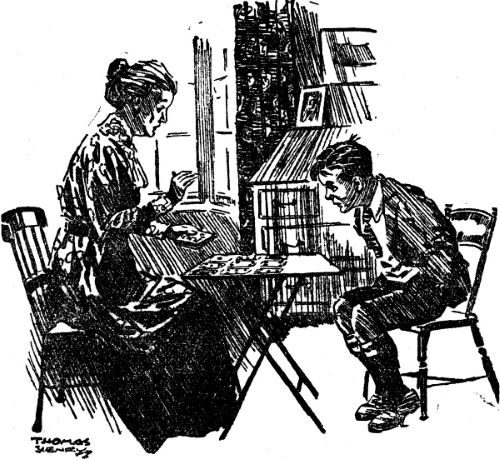
“YOU’LL BE TREATED BADLY BY A FAIR WOMAN,” SHE
SAID. WILLIAM AGREED GLOOMILY. “THAT’LL BE
ETHEL,” HE SAID.
When he got home he stood transfixed on the
dining-room threshold, his mouth open, his eyes wide.
“Crumbs!” he ejaculated.
He had wished that there might be ginger cake
for tea.
And there was.
At tea was the Vicar’s wife. The Vicar’s wife was
afflicted with the Sale of Work mania. It is a disease
to which Vicars’ wives are notoriously susceptible.
She was always thinking out the next but one Sale of
Work before the next one was over. She was always
praised in the local press and she felt herself to be a
very happy woman.
“I’m going to call the next one a Fête,” she said.
“It will seem more of a change.”
“Fake?” said William with interest.
She murmured “Dear boy,” vaguely.
“We’ll advertise it widely. I’m thinking of calling
it the King of Fêtes. Such an arresting title. We’ll
have donkey rides and cocoanut shies, so democratic—and
we ought to have fortune-telling. One doesn’t—h’m—of
course, believe in it—but it’s what people
expect. Some quite harmless fortune-telling—by cards,
for instance——”
William gasped.
“She did mine—wonderful,” he said excitedly, “it
came—just wot I wished. There was it for tea!”
“Who? What?” said the Vicar’s wife.
“The new one—at the cottage—I did all her furniture
for her an’ got paint on my clothes an’ she told me
about him not coming back ’cause of her hair p’raps
an’ I got some of her things broke but not many an’
she gave me tea an’ said to come again.”
Gradually they elicited details.
“I’ll call,” said the Vicar’s wife. “It would be so
nice to have someone one knows to do it—someone
respectable. Fortune-tellers are so often not quite—you
know what I mean, dear,” she cooed to William’s
mother.
“Of course,” murmured William abstractedly “it
mayn’t have been her hair. It may have been jus’
anything....”
*****
William was having a strenuous time. Fate was
making one of her periodic assaults on him. Everything
went wrong. Miss Drew, his form mistress at
school, had taken an altogether misguided and unsympathetic
view of his zeal for nature study. In fact,
when the beetle which William happened to be holding
lovingly in his hand as he did his sums by her desk,
escaped and made its way down her neck, her piercing
scream boded no good to William. The further discovery
of a caterpillar and two woodlice in his pencil-box,
a frog in his satchel, and earwigs in his pocket,
annoyed her still more, and William stayed in school
behind his friends to write out one hundred times,
“I must not bring insects into school.” His addition
“because they friten Miss Drew,” made relations still
more strained. He met with no better luck at home.
His unmelodious and penetrating practices on a mouth-organ
in the early hours of the morning had given rise
to a coldness that changed to actual hostility when it
was discovered that he had used Ethel’s new cape as
the roof of his wigwam in the garden and Robert’s
new expensive brown shoe polish to transform himself
to a Red Indian chief. He was distinctly unpopular
at home. There was some talk of not allowing him
to attend the King of Fêtes, but as the rest of the
family were going and the maids had refused to be
left with William on the premises it was considered
safer to allow him to go.
“But any of your tricks——” said his father darkly,
leaving the sentence unfinished.
The day of the King of Fêtes was fine. The stalls
were bedecked in the usual bright and inharmonious
colours. A few donkeys with their attendants surveyed
the scene contemptuously. Ethel was wearing
the new cape (brushed and cleaned to a running accompaniment
of abuse of William), Mrs. Brown was
presiding at a stall. Robert, wearing a large buttonhole,
with his shoes well browned (with a new tin of
polish purchased with William’s pocket-money) presided
at a miniature rifle range. William, having been
given permission to attend, and money for his entrance,
hung round the gateway glaring at them scornfully.
He always disliked his family intensely upon public
occasions. He had not yet paid his money and was
wondering whether it was worth it after all, and it
would not be wiser to spend it on bulls’ eyes and
gingerbreads, and his afternoon in the fields as a
solitary outlaw and hunter of cats or whatever other
live prey Fate chose to send him. In a tent at the
farther end of the Fête ground was Miss Tabitha Croft,
arrayed in a long and voluminous garment covered
with strange signs. They were supposed to be mystic
Eastern signs, but were in reality the invention of the
Vicar’s wife, suggested by the freehand drawing of
her youngest son, aged three. It completely enveloped
Miss Tabitha from head to foot, leaving only two holes
for her eyes and two holes for her arms. She had
shown it to William the day before.
“I don’t quite like it,” she had confessed. “I hope
there’s nothing—blasphemous about it. But she ought
to know—being a Vicar’s wife she ought to know. I
only hope,” she went on, shaking her head, “that I’m
not tampering with the powers of darkness—even for
the cause of the church organ.”
Outside was a large placard: “Fortune Telling by
the Woman of Mystery, 2s. 6d. each.” Inside the
Woman of Mystery sat trembling with nervousness in
front of a table on which reposed her little well-worn
pack of cards, each with a neat hieroglyphic in the
corner to show whether it meant a death or a wedding
or a legacy or anything else.
William, surveying this scene from the gateway
became aware of a figure coming slowly down the road.
It was a man—a very tall man who stooped slightly as
he walked. As he came to William he became suddenly
aware in his turn of William’s scowling regard. He
lifted his hat.
“Good afternoon,” he said courteously.
“Afternoon,” said William brusquely.
“Do you know,” went on the man, “whether a—Miss
Croft lives in the village?”
He pointed down the hill to the cluster of roofs.
“I think,” said William slowly, “I’ve seen your
photo—only you wasn’t so old when you had it took.”
“Where have you seen my photo?” said the man.
“In her house—wot I helped her to remove to,”
said William proudly.
The man’s kind, rather weak face lit up.
“Could you show me her house? You see,” he went
on simply, “I’m a very unhappy man. I went away,
but I’ve carried her in my heart all the time, but it’s
taken me a long, long time to find her. I’m a very
tired, unhappy man.”
William looked at him with some scorn.
“You was soft,” he said. “P’raps it was ’cause of
her hair not curlin’?”
“Where is she?” said the man.
“In there,” said William pointing to the enclosure
sacred to the King of Fêtes. “I’ll get her if you like.”
“Thank you,” said the man.
William, still grudging his entrance money, walked
round the enclosure till he found a weak spot in the
hedge behind a tent. Through this he scrambled with
great difficulty, leaving his cap en route, blackening and
scratching his face, tearing his knickers in two places,
and his jersey in three. But William, who could not
see himself, fingering tenderly the price of admission in
his pocket, felt that it had been trouble well expended.
He met the Vicar’s wife. She was raffling a tea-cosy
highly decorated with red and yellow and purple
tulips on a green ground. She wore her Sale of Work
smile. William accosted her.
“He wants her. He’s come back. Could you get
her?” he said. “He’s had the right one in his inside
all the time. He said so....”
But she had no use for William. William did not
look as if he was good for a one-and-six raffle ticket
for a tea-cosy.
“Sweet thing!” she murmured vaguely, and effusively
caressed his disordered hair as she passed.
William made his way towards the tent of the Woman
of Mystery. But there was an ice-cream stall on his
way and William could not pass it. Robert and Ethel,
glasses of fashion and moulds of form, passed at the
minute. At the sight of William with torn coat and
jersey, dirty scratched face, no cap and tousled hair,
consuming ice-cream horns among a crowd of his
social inferiors, a shudder passed through both of
them. They felt that William was a heavy handicap
to them in Life’s race.
“Send him home,” said Robert.
“I simply wouldn’t be seen speaking to him,” replied
Ethel.
William, having satisfied his craving for ice-cream
with the greater part of his entrance money, wandered
on towards the tent of the Woman of Mystery. He
entered it by crawling under the canvas at the back.
The Woman of Mystery happened to be having a slack
time. The tent was empty.
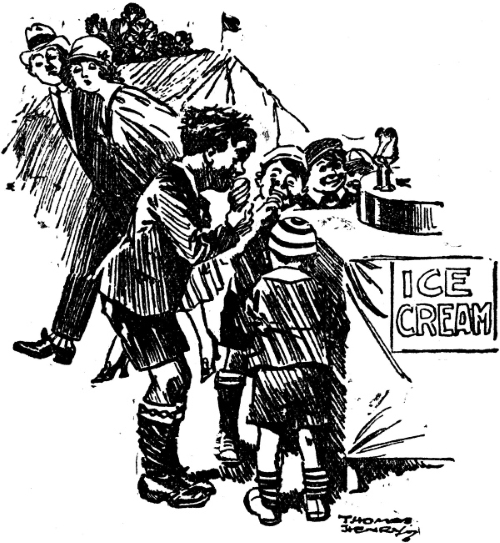
AT THE SIGHT OF WILLIAM A SHUDDER PASSED THROUGH
BOTH OF THEM. THEY FELT THAT WILLIAM WAS A HEAVY
HANDICAP TO THEM IN LIFE’S RACE.
“He’s come,” announced William. “He’s waiting
outside.”
“Who?” said the Woman of Mystery.
“The one wot you’ve got a photo of. You know.
He’s jus’ by the gate.”
“Oh, dear!” gasped the Woman of Mystery. “Does
he want me?”
“’Um,” said William.
“Oh, dear!” fluttered the Woman of Mystery. “I
must go—yet how can I go? People will be coming
for their fortunes.”
William waved aside the objection.
“Oh, I’ll see to that,” he said.
“But—can you tell fortunes, dear?” she asked.
“I dunno,” said William. “I’ve never tried yet.”
The Woman of Mystery drew off her curious gown.
“I must go,” she said.
With that she fled—through the back opening of
the tent.
William slowly and deliberately arrayed himself. He
put on the gown and arranged it so that his eyes came
to the two eye-holes and his hands out of the two arm-holes.
Then he lifted the hassock on which the
Woman of Mystery had disposed her feet, on to the
chair, and took his seat upon it, carefully hiding it
with the gown. At that moment the flap of the tent
opened and a client entered. She put half a crown
on the table, and sat down on the chair opposite
William.
Peering through his eye-holes William recognised
Miss Drew.
He spread out a row of the playing-cards and began
to whisper. William’s whisper was such a little known
quantity that it was not recognised.
“You’ve got a bad temper,” he whispered.
“True!” sighed Miss Drew.
“You’ve got a cat and hens,” went on William.
“True.”
“You’ve been hard on a boy jus’ lately. He—he
may not live very long. You’ve time to make up
to him.”
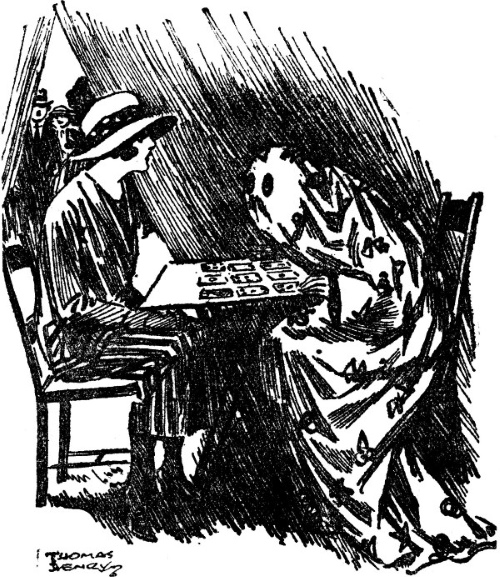
“YOU’VE BEEN HARD ON A BOY JUS’ LATELY. HE—HE
MAY NOT LIVE VERY LONG. YOU’VE TIME TO MAKE UP
TO HIM.”
Miss Drew started.
“That’s all.”
Miss Drew, looking bewildered and troubled, withdrew
from the tent.
William was surprised on peering through his eye-holes
to recognise Ethel in his next visitor. He spread
out the cards and began to whisper again.
“You’ve got two brothers,” he whispered.
Ethel nodded.
“The small one won’t live long prob’ly. You better
be kinder to him while he lives. Give in to him
more. That’s all.”
Ethel withdrew in an awed silence.
Robert entered next. William was beginning to
enjoy himself.
“You’ve gotter brother,” he whispered. “Well, he’s
not strong an’ he may die soon. This is a warning for
you. You’d better make him happy while he’s alive.
That’s all.”
Robert went slowly from the tent. At that moment
the little Woman of Mystery fluttered in from the back.
“Oh, thank you so much, dear. Such a wonderful
thing has happened. But I must return to my post.
He’ll wait till the end, he says.”
Still talking breathlessly, she drew the robe of
mystery from William and put it on herself.
William wandered out again into the Fête ground.
He visited the ice-cream stall again, then wandered
aimlessly around. The first person to accost him was
Miss Drew.
“Hello, William,” she said, gazing at him anxiously.
“I’ve been looking for you. Would you like some
ice-cream?”
William graciously condescended to be fed with
ice-cream.
“Would you like a box of chocolates?” went on
Miss Drew. “Do you feel all right, William, dear?
You’ve been a bit pale lately.”
William accepted from her a large box of chocolates
and three donkey rides. He admitted that perhaps
he hadn’t been feeling very strong lately. When she
departed he found Robert and Ethel looking for him.
They treated him to a large and very satisfying tea and
several more donkey rides. Both used an unusually
tender tone of voice when addressing him. Ethel
bought him a pine-apple and another box of chocolates,
and Robert bought him a bottle of sweets and
apologised for his unreasonable behaviour about the
shoe polish. When they went home William walked
between them and they carried his chocolates and
sweets and pine-apple for him. Feeling that too much
could not be made of the present state of affairs, he
made Robert do his homework before he went to
bed. Up in his room he gave his famous imitation
of a churchyard cough that he had made perfect by
practise and which had proved a great asset to him
on many occasions. Ethel crept softly upstairs. She
held a paper bag in her hand.
“William, darling,” she said, “I’ve brought this
toffee for your throat. It might do it good.”
William added it to his store of presents.
“Thank you,” he said with an air of patient suffering.
“And I’ll give you something to make your wigwam
with to-morrow, dear,” she went on.
“Thank you,” said William.
“And if you want to practise your mouth-organ in
the mornings it doesn’t matter a bit.”
“Thank you,” said William in a small, martyred
voice.
*****
The next evening William walked happily down the
road. It had been a very pleasant day. Miss Drew
had done most of his work for him at school. He had
been treated at lunch by his family with a consideration
that was quite unusual. He had been entreated to
have all that was left of the trifle while the rest of
the family had stewed prunes.
In the garden of the little cottage was Miss Tabitha
Croft and the tall, stooping man.
“Oh, this is William,” said Miss Tabitha. “William
is a great friend of mine!”
“I saw William yesterday,” said the man. “William
must certainly come to the wedding.”
“William,” said Miss Croft, “it was kind of you to
take my place yesterday. Did you manage all right?”
“Yes,” said William, after a moment’s consideration,
“I managed all right, thank you.”
CHAPTER IV
WILLIAM ALL THE TIME
WILLIAM was walking down the road, his hands
in his pockets, his mind wholly occupied with
the Christmas pantomime. He was going to the
Christmas pantomime next week. His thoughts dwelt
on rapturous memories of previous Christmas pantomimes—of
Puss in Boots, of Dick Whittington, of Red
Riding Hood. His mouth curved into a blissful smile
as he thought of the funny man—inimitable funny man
with his red nose and enormous girth. How William
had roared every time he appeared! With what joy
he had listened to his uproarious songs! But it was
not the funny man to whom William had given his
heart. It was to the animals. It was to the cat in
Puss in Boots, the robins in The Babes in the Wood,
and the wolf in Red Riding Hood. He wanted to be
an animal in a pantomime. He was quite willing
to relinquish his beloved future career of pirate in
favour of that of animal in a pantomime. He
wondered....
It was at this point that Fate, who often had a
special eye on William, performed one of her lightning
tricks.
A man in shirt-sleeves stepped out of the wood and
looked anxiously up and down the road. Then he
took out his watch and muttered to himself. William
stood still and stared at him with frank interest. Then
the man began to stare at William, first as if he didn’t
see him, and then as if he saw him.
“Would you like to be a bear for a bit?” he said.
William pinched himself. He seemed to be awake.
“A b-b-bear?” he queried, his eyes almost starting
out of his head.
“Yes,” said the man irritably, “a bear. B.E.A.R.
bear. Animal—Zoo. Never heard of a bear?”
William pinched himself again. He seemed to be
still awake.
“Yes,” he agreed as though unwilling to commit
himself entirely. “I’ve heard of a bear all right.”
“Come on, then,” said the man, looking once more
at his watch, once more up the road, once more down
the road, then turning on his heel and walking quickly
into the wood.
William followed, both mouth and eyes wide open.
The man did not speak as he walked down the path.
Then suddenly down a bend in the path they came
upon a strange sight. There was a hut in a little
clearing, and round the hut was clustered a group of
curious people—a Father Christmas, holding his beard
in one hand and a glass of ale in the other; a rather fat
Goldilocks, in the act of having yellow powder lavishly
applied to her face, several fairies and elves, sucking
large and redolent peppermints; a ferocious, but
depressed-looking giant, rubbing his hands together
and complaining of the cold; and several other strange
and incongruous figures. In front of the hut was a
large species of camera with a handle, and behind
stood a man smoking a pipe.
“Kid turned up?” he said.
William’s guide shook his head.
“No,” he said, “they’ve missed their train or lost
their way, or evaporated, or got kidnapped or something,
but this happened to be passing, and it looked
the same size pretty near. What do you think?”
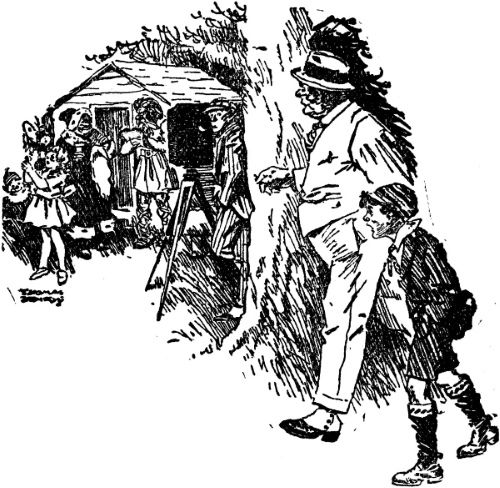
SUDDENLY DOWN A BEND IN THE PATH THEY CAME UPON
A STRANGE SIGHT.
The man took his pipe from his mouth in order the
better to concentrate his whole attention on William.
He looked at William from his muddy boots to his
untidy head. Then he reversed the operation, and
looked from his untidy head to his muddy boots.
Then he scratched his head.
“Seems on the big side for the middle one,” he said.
At this point a hullabaloo arose from behind the
shed, and a small bear appeared, howling loudly.
“He tooken my bit of toffee,” yelled the bear in
a very human voice.
“Aw, shut up!” said the man in his shirt-sleeves.
The small bear was followed by a large bear, protesting
loudly.
“I gave him half’n mine ’n’e promised to give me
half’n his’ ’n’ then he tried to eat it all’n’——”
“Aw, shut up!” repeated the man. Then he turned
to William.
“All you gotter do,” he said, “is to fix on the middle
bear’s suit an’ do exactly what you’re told, an’ I’ll give
you five shillings at the end. See?”
“These roural places are a butiful chinge,” murmured
Goldilocks’ mother, darkening her eyebrows as
she spoke. “So calm and quart.”
“These Christmas shows,” grumbled the giant,
flapping his arms vigorously, “are the very devil.”
Here William found his voice. “Crumbs!” he
ejaculated. Then, feeling the expletive to be altogether
inadequate to the occasion, quickly added: “Gosh!”
“Take the kid round, someone,” said the shirt-sleeve
man wearily, “and fix on his togs, and let’s get
on with the show.”
Here a Fairy Queen appeared from behind the hut.
“I don’t see how I’m possibly to go through with
this here performance,” she said in a voice of plaintive
suffering. “I had toothache all last night——”
“If you think,” said the shirt-sleeve man, “that you
can hold up this blessed show for a twopenny-halfpenny
toothache——”
“If you’re going to be insulting——” said the Fairy
Queen in shrill indignation.
“Aw, shut up!” said the shirt-sleeve man.
Here Father Christmas, who had finished his ale,
led William into the hut. A bear’s suit lay on a
chair.
“The kid wot was to wear this not having turned
up,” he said by way of explanation, “and you by all
accounts bein’ willin’ to oblige for a small consideration,
we shall have to see what can be done. I suppose,”
he added, “you have no objection?”
“Me?” said William, whose eyes and mouth had
grown more and more circular every minute. “Me—objection?
Golly! I should think not.”
The little bear and the big bear surveyed him
critically.
“He’s too big,” said the little bear contemptuously.
“His hair’s too long,” contributed the big bear.
“His face is too dirty.”
“His ears is too long.”
“His nose is too flat.”
“His head’s too big.”
“His——”
William speedily and joyfully put an end to the
duet and Father Christmas wearily disentangled the
struggling mass.
“It may be a bit on the small side,” he conceded as
he deposited the small bear upside down beneath the
table, “but we’ll do what we can.”
Here the shirt-sleeve man appeared at the window.
“That’s right,” he said kindly. “Take all day
about it. Don’t hurry! We all enjoy hanging about
and waiting for you.”
Father Christmas offered to retire from his post in
favour of the shirt-sleeve man, and the shirt-sleeve
man hastily retreated.
Then came the task of fitting William into the
skin. It was not an easy task.
“You’re bigger,” said Father Christmas, “than what
you look in the distance. Considerable.”
William could not stand quite upright in the skin,
but by stooping slightly he could see and speak through
the open mouth of the head. In an ecstasy of joy
he pummelled the big bear, the little bear gladly
joined in the fray and a furry ball of three struggling
bears rolled out of the door of the hut.
The shirt-sleeve man rang a bell.
“After this somewhat lengthy interlude,” he said.
“By the way, may I inquire the name of our new
friend?”
William proudly shouted his name through the
aperture in the bear’s head.
“Well, Billiam,” he said jocularly, “do just what
I tell you and you’ll be all right. Now all clear off
a minute, please. We’ve only a few scenes to do
here.”
“Location,” he read from a paper in his hand, “hut
in wood. Enter fairies with Fairy Queen. Dance.”
“How I am expected to dance,” said the Fairy
Queen bitterly, “tortured by toothache, I can’t
think.”
“You don’t dance with your teeth,” said the shirt-sleeve
man unsympathetically. “Let’s go through it
once before we turn on the machine. You’ve rehearsed
it often enough. Now, come on.”
They danced a dance that made William gape in
surprise and admiration, so dainty and airy was it.
“Enter Father Christmas,” went on the shirt-sleeve
man.
“What I can’t think,” said Father Christmas,
fastening on his beard, “is what a Father Christmas’s
doing in this effect.”
“Nor a giant,” said the giant sadly.
“It’s for a Christmas show,” said the shirt-sleeve
man. “You’ve gotter have a Father Christmas in a
Christmas show, or else how’d people know it’s a
Christmas show? And you’ve gotter have a giant
in a fairy tale whether there is one in it or not.”
Father Christmas joined the dance—gave presents to
all the fairies, then retired behind the hut to his private
store of refreshment.
“Enter Goldilocks,” said the shirt-sleeve man.
“Now where the dickens is that kid?”
Goldilocks, fat, fair and rosy, appeared from behind
a tree where she had been eating bananas.
She peered down the middle bear’s mouth.
“It’s a new one,” she said.
“The other hasn’t turned up,” said the man. “This
is Billiam, who is taking on the middle one for the
small consideration of five shillings.”
“He’s put out his tongue at me,” she screamed in
shrill indignation.
At this the big bear, whose adoration of Goldilocks
was very obvious, closed with William, and Goldilocks’
mother screamed shrilly.
The giant separated the two bears and Goldilocks
came to the hut with an expression of patient suffering
meant to represent intense physical weariness. She
gave a start of joy at the sight of the hut, which
apparently she did not see till she had almost passed
it. She entered. She gave a second start of joy at
the sight of three porridge plates. She tasted the first
two and consumed the third. She wandered into the
other room. She gave a third start of joy at the
sight of three beds. She tried them all and went to
sleep beautifully and realistically on the smallest.
William was lost in admiration.
“Come on, bears,” said the man in shirt-sleeves.
“Billiam, walk between them. Don’t jump. Walk.
In at the door. That’s right. Now, Billiam, look at
your plate, then shake your head at the big bear.”
Trembling with joy William obeyed. The big bear,
in the privacy of the open mouth, put out his tongue
at William with a hostile grimace. William returned it.
“Now to the little one,” said the man in shirt-sleeves.
But William was still absorbed in the big
one. Enraged by a particularly brilliant feat in the
grimacing line which he felt he could not outshine,
he put out a paw and tripped up the big bear’s chair.
The big bear promptly picked up a porridge plate and
broke it on William’s head. The little bear hurled
himself ecstatically into the conflict. Father Christmas
wearily returned to his work of separating them.
“If you aren’t satisfied with your bonus,” said the
shirt-sleeve man to William, “take it out of me,
not the scenery. You’ve just done about five shillings’
worth of damage already. Now let’s get on.”
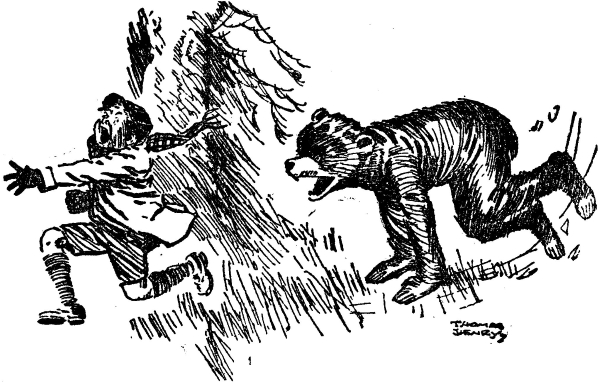
HE MET A BOY WHO FLED FROM HIM WITH YELLS OF TERROR,
AND TO WILLIAM IT SEEMED AS IF HE HAD DRUNK OF
ECSTACY’S VERY FOUNT.
The rest of the scene went off fairly well, but William
was growing bored. It wasn’t half such fun as he
thought it would be. He wasn’t feeling quite sure of
his five shillings after those smashed plates. The only
thing for which he felt a deep and lasting affection,
from which he felt he could never endure to be parted,
was his bear-skin. It was rather small and very hot,
but it gave him a thrill of pleasure unlike anything
he had ever known before. He was a bear. He was
an animal in a pantomime. He began to dislike
immensely the shirt-sleeve man, and the hut, and the
Fairy Queen, and the giant, and all the rest of them,
but he loved his bear suit. It was while the giant
was having a scene by himself that the brilliant idea
came to William. He was standing behind a tree.
No one was looking at him. He moved very quietly
further away. Still no one looked at him. He moved
yet further away and still no one looked at him. In
a few seconds he was leaping and bounding through
the wood alone in the world with the bear-skin. He
was a bear. He was a bear in a wood. He ran. He
jumped. He turned head over heels. He climbed a
tree. He ran after a rabbit. He was riotously, blissfully
happy. He met a boy who fled from him with
echoing yells of terror, and to William it seemed as
if he had drunk of ecstasy’s very fount. He ran on
and on, roaring occasionally, and occasionally rolling
in the leaves. Then something happened. He gave a
particularly violent jump and strained the skin which
was already somewhat tight. The skin did not burst,
but the head came down very far on to William’s head
and wedged itself tightly. He could not see out of
its open mouth now. He could just see out of one
of the eye-holes, but only just. His mouth was
wedged tightly in the head and he found he could
not speak plainly. He put up his paws and pulled
at the head to loosen it, but with no results. It was
very tightly wedged. William’s spirits drooped. It
was all very well being a bear in a wood as long as
one could change oneself to a boy at will. It was
a very different thing being fastened to a bear-skin
for life. He supposed that in time, if he went on
growing to a man, he’d burst the bear-skin. On the
other hand, he couldn’t get to his mouth now, so
he couldn’t eat, and he’d not be able to grow at all.
Starvation stared him in the face. He was hungry
already. He decided to return home and throw himself
on the mercy of his family. Then he remembered
that his family were all out that afternoon. His
mother was at a mother’s meeting at the Vicarage.
He decided to go straight to the Vicarage. Perhaps
the united efforts of the mothers of the village might
succeed in getting his head off. He went out from
the woods on to the road but was discouraged by the
behaviour of a woman who was passing. She gave an
unearthly yell, tore a leg of mutton from her basket,
flung it at William’s head, and ran for dear life down
the road, screaming as she went. William, much
depressed, returned to the woods and reached the
Vicarage by a circuitous route. Feeling too shy to
ring the bell and interview a housemaid in his present
costume, he walked round the house to the French
windows of the dining-room where the meeting was
taking place. He stood pathetically in the doorway
of the window.
“Mother,” he began plaintively in a muffled and
almost inaudible voice, but it would have made little
difference had he spoken in his usual strident tones.
The united scream of the mothers’ meeting would have
drowned it. Never in the whole course of his life had
William seen a room empty so quickly. It was like
magic. Almost before his plaintive and muffled
“Mother” had left his lips, the room was empty. Only
two dozen overturned chairs, an overturned table, and
several broken ornaments marked the line of retreat.
The room was empty.
The entire mothers’ meeting, headed by the vicar’s
wife and the vicarage cook and housemaid, were
dashing down the main road of the village, screaming
as they went. William sadly surveyed the desolate
scene before him and retreated again to the woods.
He leant against a tree and considered the whole
situation.
“Hello, Billiam!”
Turning his head to a curious angle and peering out
of one of the bear’s eye-holes, he recognised Goldilocks.
“Hello!” he returned in a spiritless voice.
“Why did you run away?” she said.
“Dunno,” he said. “I wanted the old skin. Wish
I’d never seed it.”
“You do talk funny,” she said. “I can’t hear what
you say.”
And so far was William’s spirit broken that he only
sighed.
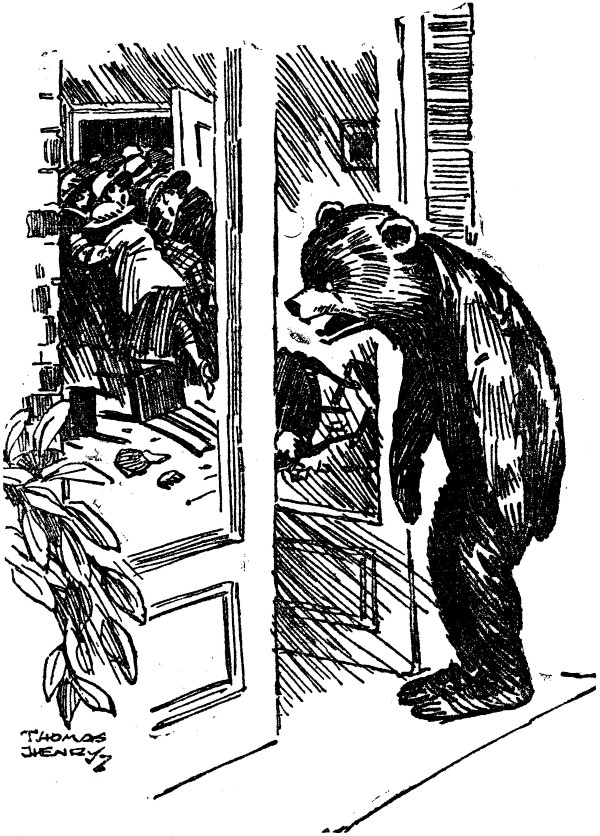
NEVER IN THE WHOLE COURSE OF HIS LIFE HAD WILLIAM
SEEN A ROOM EMPTY SO QUICKLY.
“I saw you going,” she went on, “and I went after
you, but you ran so fast that I lost you. Then I went
round a bit by myself. I say, they won’t be able
to get on with the old thing without us. I heard
them shouting for us. Isn’t it fun? An’ I heard
some people screaming in the road. What was
that?”
William sighed again. Then he shouted: “Try’n
pull my head loose. Hard.”
She complied. She pulled till William yelled again.
“You’ve nearly took my ears off,” he said angrily
in his muffled, sepulchral voice.
But the head was wedged on as tightly as ever.
She went to the edge of the wood and peered across
the road.
“There’s a place there,” she said, “with lots of
men in. Go’n’ ask them.”
William somewhat reluctantly (for his previous
experiences had sadly disillusioned him with human
nature in general) went through the trees to the
roadside.
He looked back at the white-clad form of Goldilocks.
“Wait for me,” he whispered hoarsely.
Anxious to attract as little notice as possible, he
crept on all fours round to the door of the public-house.
He poked in his head nervously.
“Please, can some’n——” he began politely, but in
the clatter that arose the ghostly whisper was lost.
Several glasses and a chair were flung at his head.
Amid shoutings and uproar the innkeeper went for his
gun, but on his return William had departed, and the
innkeeper, who knew the better part of valour, contented
himself with bolting the door and fetching sal-volatile
for his wife. After a decent interval he
unlocked the door and the inmates crept cautiously
home one by one.
“A great, furious brute,” they were heard to say.
“Must have escaped from a circus——”
“If we hadn’t been quick——”
“We ought to get up a party with guns——”
“Let’s go and warn the school, or it’ll get the
kids——”
On reaching their homes most of them found their
wives in hysterics on the kitchen floor after a hasty
return from the mothers’ meeting.
Meanwhile William sat beneath a tree in the wood
in an attitude of utter despondency, his head on
his paws.
“Why didn’t you tell them,” said Goldilocks impatiently.
“I tell everyone,” said William. “Nobody’ll listen
to me. They make a noise and throw things. I’m
go’n’ home.”
He rose and held out a paw. He felt utterly and
miserably cut off from his fellow-men. He clung
pathetically to Goldilock’s presence.
“Come with me,” he said.
Hand in hand, a curious couple, they went through
the woods to the back of William’s house. “If I die,”
he said at once, “afore we get home, you’d better
bury me. There’s a spade in the back garden.”
He took her round to the shed in his back garden.
“You stay here,” he whispered. “An’ I’ll try and
get my head took off an’ then get us somethin’ to
eat.”
Cautiously and apprehensively he crept into the
house. He could hear his mother talking to the cook
in the kitchen.
“It stood right in the window,” she was saying in
a trembling voice. “Not a very big animal but so
ferocious-looking. We got out just in time—it was
just getting ready to spring. It——”
William crept to the open kitchen door and assumed
his most plaintive expression, forgetting for the moment
that his expression could not be seen. Just as he
was opening his mouth to speak cook turned round
and saw him. The scream that cook emitted sent
William scampering up to his room in utter terror.
“It’s gone up—plungin’ into Master William’s room—the
brute! Thank evving the little darlin’s out
playin’. Oh, mum, the cunnin’ brute’s a-shut the
door. Oh, my! It turned me inside out—it did.
Oh, I darsn’t go an’ lock it in, but that’s what ought
to be done——”
“We—we’ll get someone with a gun,” said Mrs.
Brown weakly. “We—oh, here’s the master.”
Mr. Brown entered as she spoke. “I’ve got terrible
news for you,” he said.
Mrs. Brown burst into tears.
“Oh, John, nothing could be worse than—than—John,
it’s upstairs. Do get a gun—in William’s room.
And—oh, my goodness, suppose he’s there—suppose
it’s mangling him—do go——”
Mr. Brown sat calmly in his chair.
“William,” he said, “has eloped with a jeune première
and a bear-skin. An entire Christmas pantomime is
searching the village for him. They’ve spent the afternoon
searching the wood and now they are searching
the village. Father Christmas is drinking ale in a
pub. He discovered that William had paid it a visit.
A Fairy Queen is sitting outside the pub complaining
of toothache, and Goldilocks’ mother is complimenting
the vicar on the rural beauty of his village, in the
intervals of weeping over the loss of her daughter.
I gathered that William had visited the vicarage.
There’s a giant complaining of the cold, and a man
in his shirt-sleeves whose language is turning the air
blue for miles around. I was coming up from the
station and was introduced to them as William’s father.
I had some difficulty in calming them, but I promised
to do what I could to find the missing pair. I’m
rather keen on finding William. I don’t think I can
do better than hand him over to them for a few
minutes. As for the missing damsel——”
Mrs. Brown found her voice.
“Do you mean——?” she gasped feebly, “do you
mean that it was William all the time?”
Mr. Brown rose wearily.
“Of course,” he said. “Isn’t everything always
William all the time?”
CHAPTER V
AUNT JANE’S TREAT
WILLIAM was blest with many relations, though
“blest” is not quite the word he would have
used himself. They seemed to appear and disappear
and reappear in spasmodic succession throughout the
year. He never could keep count of them. Most of
them he despised, some he actually disliked. The latter
class reciprocated his feelings fervently. Great-Aunt
Jane was one he had never seen, and so he suspended
judgment on her. But he rather liked the sound of
her name. He received the news that she was coming
to stay over Christmas with indifference.
“All right,” he said, “I don’t care. She can come
if she wants to.”
She came.
She was tall and angular and precise. She received
William’s scowling greeting with a smile.
“Best wishes of the festive season, William,” she
murmured.
William looked at her scornfully.
“All right,” he murmured.
However, his opinion of her rose the next morning.
“I’d like to give you some treat, William dear,”
she said at breakfast, “to mark the festive season—something
quiet and orderly—as I don’t approve of
merry-making.”
William looked at her kind, weak face, with the
spectacles and scraped-back hair, and sighed. He
thought that Aunt Jane would be enough to dispel the
hilarity of any treat. Great-Aunt Jane’s father had
been a Plymouth Brother, and Great-Aunt Jane had
been brought up to disbelieve in pleasure except as
a potent aid of the devil.
William asked for a day in which to choose the
treat. He discussed it with his friends.
“Well,” advised Ginger, “you jolly well oughter
choose something she can’t muck up like when my
aunt took me to a messy ole museum and showed me
stones and things—no animals nor nuffin’.”
“What about the Zoo?” said Henry.
The Zoo was suggested to Great-Aunt Jane, but
she shuddered slightly. “I don’t think I could,” she
said. “It’s so dangerous, I always feel. Those bars
look so fragile. I should never forgive myself if little
William were mangled by wild beasts when in my care.”
William sighed and called his friends together again.
“She won’t go to the Zoo,” said William. “Somethin’
or other about bars an’ mangles.”
“Well, what about Maskelyne’s and Devant’s?” said
Henry. “My uncle took me once. It’s all magic.”
William, much cheered at the prospect, suggested
Maskelyne’s that evening. Aunt Jane thought it over
for some time, then shook her head.
“No, dear,” she said. “I feel that these illusions
aren’t quite honest. They pretend to do something
they really couldn’t do, and it practically amounts to
falsehood. They deceive the eye, and all deceit is
wrong.”
William groaned and returned to his advisory council.
“She’s awful,” he said gloomily. “She’s cracky, I
think.”
They discussed the matter again. Douglas had seen
a notice of a fair as he came along.
“Try that,” he said. “There’s merry-go-rounds an’
shows an’ cocoanut-shies an’ all sorts. It oughter be
all right.”
That evening William suggested a fair. Aunt Jane
looked frightened. “What exactly happens in a fair?”
she said earnestly.
William had learnt tact.
“Oh,” he said, “you just walk round and look
at things.”
“What sort of things do you look at?” said Aunt
Jane.
“Oh, just stalls of gingerbreads an’ lemonade.”
It sounded harmless. Aunt Jane’s face cleared.
“Very well,” she said. “Of course, I could stand
outside while you walked round....”
But upon investigation it appeared that William’s
parents had not that perfect trust in William that
William seemed to think was his due, and objected
strongly to William’s walking round by himself. So
Aunt Jane steeled herself to dally openly with the
evil power of Pleasure-making.
“We can be quite quick,” she said, “and it doesn’t
sound very bad.”
William reported progress to his council.
“It’s all right,” he said cheerfully. “The ole luny’s
going to the fair.”
Then his cheerfulness departed.
“Though, when you come to think of it,” he said,
“it jolly well won’t be much fun for me.”
“Well,” said Ginger, “s’pose we all try to go there
the same time. We can leave your ole Aunt Jane
somewhere an’ go off, can’t we?”
William brightened.
“That sounds better,” he said. “I guess she’ll be
quite easy to leave.”
*****
Aunt Jane was so nervous that she did not sleep at
all on the night before the day arranged for the treat.
Never before in her blameless life had Aunt Jane
deliberately entered a place of entertainment.
“I do hope,” she murmured on the threshold, holding
William firmly by the hand, “that there’s nothing
really wrong in it.”
She was dressed in a long and voluminous black
skirt, a long and voluminous black coat, and a small
black hat, adorned with black ears of wheat, perched
upon her prim little head.
Inside she stopped, bewildered. The glaring lights,
the noise, the shouting, seemed to be drawing Aunt
Jane’s eyes out of her sockets and through her large,
round spectacles.
“It isn’t a bit what I thought, William,” she said.
“I imagined just stalls—just quiet, plain stalls. Why
are they throwing balls about, William?”
“It’s a cocoanut-shy,” said William.
“Can—can anyone do it?” said Aunt Jane.
“Anyone can try,” said William, “if they pay
twopence.”
“And what happens if they knock it off?”
“They get the cocoanut,” explained William loftily.
“I—I wonder if it’s very difficult,” mused Aunt Jane.
At this moment a well-aimed ball sent a cocoanut
rolling in the sawdust. Aunt Jane gave a little scream.
“Oh, he did it! He did it!” she cried. “I—I’d love
to try. There—there can’t be anything wrong in it.”
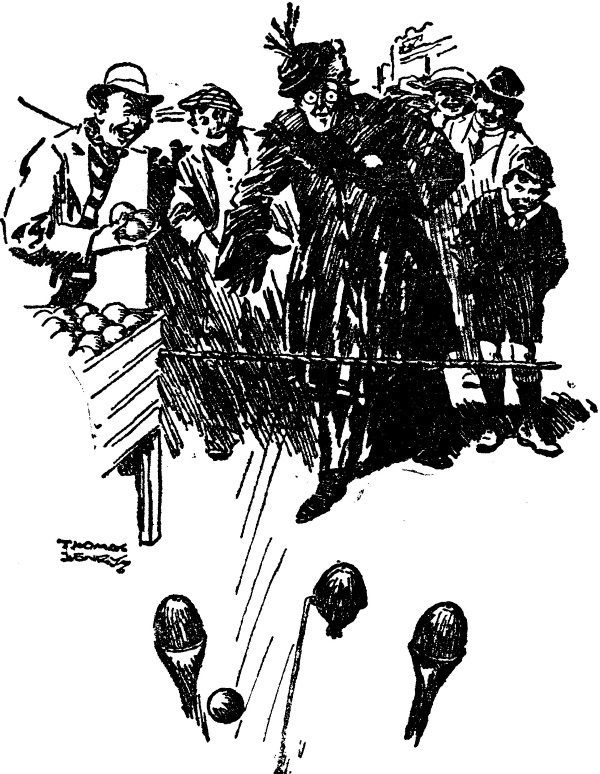
AT THE FIRST THROW AUNT JANE SHOOK HER HAT
CROOKED.... THE BYSTANDERS CHEERED HER
LOUDLY.
With trembling fingers she handed the man twopence
and took the three wooden balls. A sudden
hush of astonishment fell on the crowd when Aunt
Jane’s curious figure came to the fore. At the first
throw she shook her hat crooked, at the second she
shook a tail of hair down, at the third she shook off
her spectacles. The third ball went wider of the
mark than all the others, and hit a young man on
the shoulder. Seeing Aunt Jane, however, he only
smiled. She demanded another two-pennyworth. The
bystanders cheered her loudly. The crowd round the
cocoanut-shy stall grew. People from afar thought it
was an accident, and crowded up to watch. Then
they saw Aunt Jane and stayed.
At last, after her sixth shot, Aunt Jane, flushed and
panting and dishevelled, turned to William.
“It’s much more difficult than it looks, William,”
she said regretfully, as she straightened her hat and
hair. “I would have liked to have knocked one off.”
“What about me?” said William coldly.
“Oh, yes,” she said. “You must try, too.” So she
paid another twopence, and William tried, too. But
the crowd began to melt away at once, and even the
proprietor began to look bored. William realised that
he was an anticlimax and felt dispirited.
“You should use more force, I think, William,” said
Aunt Jane, “and more directness of aim.”
William growled.
“Well, you didn’t do it,” he said aggressively.
“No,” said Aunt Jane, “but I think with practice——”
Here William was cheered by the sight of Henry
and Douglas and Ginger, who had all managed to
evade lawful authority, and come to the help of William.
They had decided to hide from Aunt Jane and then
abscond with William. But Aunt Jane hardly saw
them. She hurried on ahead, her cheeks flushed, her
eyes alight, and her prim little hat awry.
“It has,” she said, “a decidedly inspiriting effect,
the light and music and crowds—decidedly inspiriting.”
She halted before a roundabout.
“I wonder if it’s enjoyable,” she said musingly.
“The circular motion, of course, might be monotonous.”
However, she decided to try it. She paid for William
and Douglas, and Henry, and Ginger, and herself, and
mounted a giant cock. It began. She clung on for
dear life. It went faster and faster. There came a
gleam into her eyes, a smile of rapture to her lips.
Again the crowd gathered to watch her. She looked
at the people as the roundabout slowed down.
“How happy they all look,” she said innocently.
“It’s—it’s quite a pleasant motion, isn’t it? It seems
a pity to get off.”
She stayed on, clinging convulsively to the pole,
with one elastic-sided boot waving wildly. She stayed
on yet again. She seemed to find the circular motion
anything but monotonous. It seemed to give her a
joy that all her blameless life had so far failed to
produce.
William and Ginger had to climb down, pale and
rather unsteady. Henry and Douglas followed their
example the next time it stopped. But still Aunt Jane
stayed on, smiling blissfully, her hat dangling over
one ear. And still the crowd at the roundabout grew.
The rest of the fair ground was comparatively empty.
All the fun of the fair was centred on Aunt Jane.
At last she descended from her mount and joined
the rather depressed-looking group of boys who were
her escort.
“It’s curious,” she said, “how much pleasanter is a
circular motion than a straight one. This is much
more exhilarating than, say, a train journey. And,
of course, the music adds to the pleasantness.”
“Well,” said William, “you jolly well stayed on.”
“It seemed,” she said, “such a pity to get off.”
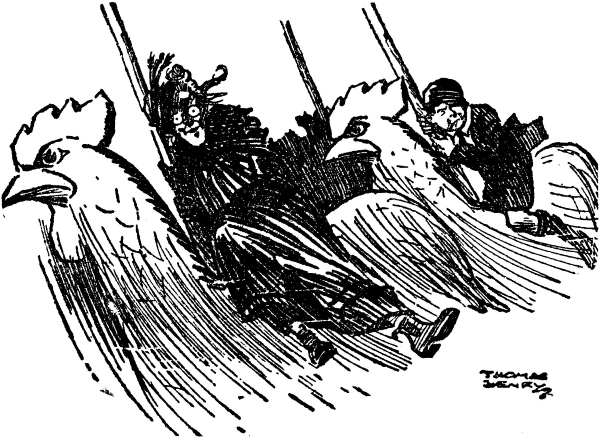
CLINGING CONVULSIVELY TO THE POLE WITH ONE
ELASTIC-SIDED BOOT WAVING WILDLY.
The little party moved from the roundabout followed
by most of the crowd. The crowd liked Aunt Jane.
They wouldn’t have lost sight of her for anything.
Aunt Jane, for the first time in her life, appealed to
the British Public. William and his friends felt themselves
to be in a curious position. They had meant
to leave Aunt Jane to her fate and go off to their
own devices. But it did not seem possible to leave
Aunt Jane, because everything seemed to centre round
Aunt Jane, and they would only have been at the back
of the crowd instead of at the front. But they felt
that their position as escort of Aunt Jane was not a
dignified one. Moreover, their feats drew forth none
of the applause which Aunt Jane’s feats drew forth.
They felt neglected by the world in general.
Aunt Jane was next attracted by the poster of the
Fat Woman outside one of the tents. She fixed her
spectacles sternly, and approached the man who was
crying the charms of the damsel.
“Surely that picture is a gross exaggeration, my
good man?” she said.
“Hexaggeration?” he repeated. “It isn’t ’arf the
truth. That’s wot it isn’t. It isn’t ’arf the truth.
We—we couldn’t get ’er on the picture if we made
’er as big as wot she is. Hexaggeration? Why—she’s
a walkin’ mountain, that’s wot she is. A reg’lar walkin’
mountain. Come in and see ’er. Come in and judge
for yerselves. Jus’ come in and see if wot I’m tellin’
yer isn’t gospel.”
Somehow or other they were swept in. Aunt Jane
sat on the front seat. She gazed intently upon the Fat
Woman, who sat at her ease upon a small platform.
“She seems,” said Aunt Jane, “unnaturally large,
certainly.”
The showman discoursed upon the size of the Fat
Woman, and then invited the audience to draw near.
“Touch ’er if yer want,” he said. “Touch ’er and
see she’s reel. No decepshun.”
Aunt Jane drew near with the rest and accosted
the showman.
“Has she ever tried any of those fat-reducing foods?”
she said.
The man looked at William.
“Is she batty?” he said simply.
“If you’ll give me her address I’ll talk to my doctor
about her. I think something might be done to make
her less abnormal.”
At this the walking mountain rose threateningly
from her gilded couch.
“’Ere,” she said, “’oo yer a-callin’ nimes of? You
tell me that. ’Oo yer a-givin’ of yer sauce to? You
talk ter me strite art if yer wants to an’ I’ll talk ter
yer back—not ’arf. Don’t go a ’urlin’ of yer hinsults
at me through ’im. My young man—’e’ll talk ter
yer, nah, if yer wants.”
“’Er young man, he’s the Strong Man in the next
tent,” explained the man. “They’re fiancies, they are.
An’ ’e’s the divil an’ all to tackle, ’e is. I’d advise yer,
as friend to friend, to clear, afore she calls of ’im.”
But Aunt Jane, the imitation wheat in her hat
trembling with emotion, was already “clearing.”
“They quite misunderstood,” she said, as soon as she
had “cleared.” “The word ‘abnormal’ conveys no
insult, surely. I think I’ll return and explain. I’ll
refer them to the dictionary and the derivation of the
word. It simply means something outside the usual
rule. If——”
She was returning eagerly to the tent to explain,
but found the entrance blocked by a crowd, so she was
persuaded to postpone her explanation. Moreover, she
had caught sight of the Hoop-la, and was anxious to
have the system explained to her. William wearily
explained it.
“Oh, I see,” said Aunt Jane, “a test of dexterity
and accuracy of aim. Shall we—shall we try?”
They tried. They tried till William was tired. She
had determined to “get something” or die. The crowd
was gathering again. They applauded her efforts.
Aunt Jane was too short-sighted to notice the crowd,
but she heard its shouts.
“Isn’t everyone encouraging?” she murmured to
William. “It’s most gratifying. It’s really a very
pleasant place.”
She actually did get something. One of her wildly-flung
hoops fell over a tie-pin of the extremely flashy
variety, which she received with glowing pride and
handed to William. The crowd cheered, but Aunt
Jane was quite oblivious of the crowd.
“Come along,” she said. “Let’s do something
else.”
Ginger disconsolately announced his intention of
going home. Henry and Douglas followed his example,
and William was left alone to escort Aunt Jane through
the mazes of the Land of Pleasure. It was at this point
that things really seemed to go to Aunt Jane’s head.
She went down the Helter Skelter four or five times—sailing
down on her little mat with squeaks of joy.
She forgot now to straighten her hat or her hair.
Her eye gleamed with a strange light, her cheeks were
flushed.
“There’s something quite rejuvenating about it all,
William,” she murmured. She had her fortune told
by a Gipsy Queen, who prophesied an early marriage
with one of her many suitors.
She went again on the Roundabout, she had another
cocoanut-shy, she went on the Switchback, the Fairy
Boat, and the Wild Sea Waves. William trailed along
behind her. He refused to venture on the Wild Sea
Waves, and watched her on them with a certain
grudging admiration.
“Crumbs!” he murmured, “she must have gotter
inside of iron!”
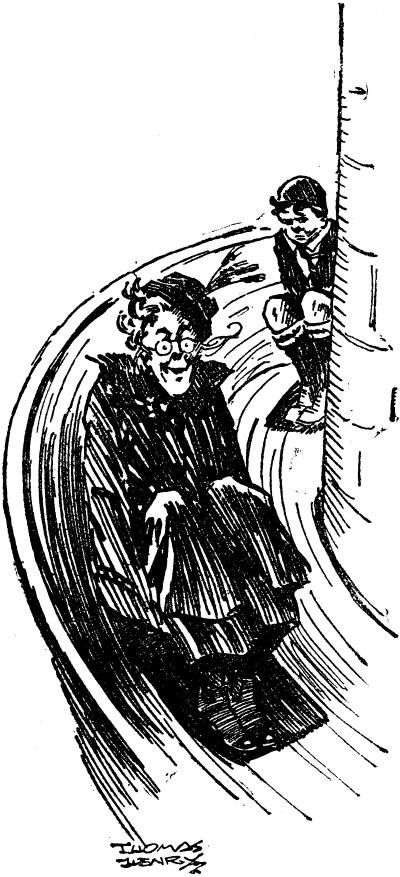
WILLIAM WAS LEFT ALONE TO ESCORT AUNT JANE
THROUGH THE MAZES OF THE LAND OF PLEASURE.
Finally Aunt Jane espied a stall at a distance.
Under a flaring gas-flame a man in a white coat was
pulling out long strings of soft candy. Aunt Jane
approached.
“What an appetising odour!” commented Aunt Jane.
“Do you think he’s selling it?” William thought he
was.
And the glorious climax of that strange night was
the sight of Aunt Jane standing under the flaring
gas-jet devouring soft pull-out candy.
“’Ullo! ’Ere’s the gime old bird,” said a man
passing.
“I don’t see any bird, do you?” said Aunt Jane
to William, peering round with her short-sighted
eyes, “but this is a very palatable confection, is it
not?”
Then a clock struck, and into Aunt Jane’s face came
the look that Cinderella’s face must have worn when
the clock struck twelve.
“William,” she said, “that surely was not ten?”
“Sounded like ten,” said William.
Aunt Jane put down her last stick of pull-out candy
unfinished.
“We—we ought to go,” she said weakly.
*****
“Well,” said William’s mother when they returned.
“I do hope it wasn’t too tiring for you.”
Aunt Jane sat down on a chair and thought. She
thought over the evening. No, she couldn’t really
have done all that—have seen all that. It was impossible—quite
impossible. It must be imagination.
She must have seen someone else doing all those things.
She must have gone quietly round with William and
watched him enjoy himself. Of course that was all
she’d done. It must have been. The other was
unthinkable.
So she smiled, a patient, weary little smile.
“Well, of course,” she said, “I’m a little tired but
I think William enjoyed it.”
CHAPTER VI
“KIDNAPPERS”
THERE was quite a flutter in the village when the
d’Arceys came to the Grange. A branch of the
d’Arcey family, you know. Lord d’Arcey and Lady
d’Arcey and Lady Barbara d’Arcey. Lady Barbara
was seven years of age. She was fair, frilly, fascinating.
Lady d’Arcey engaged a dancing-master to
come down from London once a week to teach her
dancing. They invited several of the children of the
village to join. They invited William. His mother
was delighted, but William—freckled, untidy, and
seldom clean—was horrified to the depth of his soul.
No entreaties or threats could move him. He said he
didn’t care what they did to him; he said they could
kill him if they liked. He said he’d rather be killed
than go to an ole dancing class anyway, with that soft-looking
kid. Well, he didn’t care who her father was.
She was a soft-looking kid, and he wasn’t going to no
dancing class with her. Wildly ignoring the rules that
govern the uses of the negative, he frequently reiterated
that he wasn’t going to no dancing class with her. He
wouldn’t be seen speaking to her, much less dancing
with her.
His mother almost wept.
“You see,” she explained to Ethel, William’s grown-up
sister, “it puts us at a sort of disadvantage. And
Lady d’Arcey is so nice, and it’s so kind of them to ask
William!”
William’s sister, however, took a wholly different
view of the matter.
“It might put them,” she said, “a good deal more
against us if William went!”
William’s mother admitted that there was something
in that.
*****
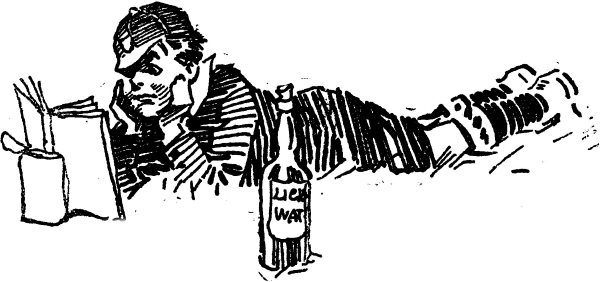
WILLIAM LAY IN THE LOFT—HIS CHIN RESTING ON
HIS HANDS, READING.
William lay in the loft, reclining at length on his
front, his chin resting on his hands. He was engaged
in reading. On one side of him stood a bottle of
liquorice water, which he had made himself; on the
other was a large slab of cake, which he had stolen
from the larder. On his freckled face was the look of
scowling ferocity that it always wore in any mental
effort. The fact that his jaws had ceased to work,
though the cake was yet unfinished, testified to the
enthralling interest of the story he was reading.
“Black-hearted Dick dragged the fair maid by the
wrist to the captain’s cave. A bottle of grog stood at
the captain’s right hand. The captain slipped a mask
over his eyes, and smiled a sinister smile. He twirled
his long black moustachios with one hand.
“‘Unhand the maiden, dog,’ he said.
“Then he swept her a stately bow.
“‘Fair maid,’ he said, ‘unless thy father bring me
sixty thousand crowns to-night, thy doom is sealed.
Thou shalt swing from yon lone pine-tree!’
“The maiden gave a piercing scream. Then she
looked closely at the masked face.
“‘Who—who art thou?’ she faltered.
“Again the captain’s sinister smile flickered beneath
the mask.
“‘Rudolph of the Red Hand,’ he said.
“At these terrible words the maiden swooned into
the arms of Black-hearted Dick.
“‘A-ha,’ said the grim Rudolph, with a sneer.
‘No man lives who does not tremble at those words.’
“And again that smile curved his dread lips, as he
looked at the yet unconscious maiden.
“For well he knew that the sixty thousand crowns
would be his that even.
“‘Let her be treated with all courtesy—till to-night,’
he said as he turned away.”
William heaved a deep sigh and took a long draught
of liquorice water.
It seemed an easy and wholly delightful way of
earning money.
*****
“They’re awfully nice people,” said Ethel the next
day at breakfast, “and it is so kind of them to ask
us to tea.”
“Very,” said Mrs. Brown, “and they say, ‘Bring
the little boy’.”
The little boy looked up, with the sinister smile he
had been practising.
“Me?” he said. “Ha!”
He wished he had a mask, because, though he felt
he could manage the smile quite well, the narrative had
said nothing about the expression of the upper part of
Rudolph of the Red Hand’s face. However, he felt
that his customary scowl would do quite well.
“You’ll come, dear, won’t you?” said Mrs. Brown
sweetly.
“I wouldn’t make him,” said Ethel nervously. “You
know what he’s like sometimes.”
Mrs. Brown knew. William—a mute, scowling
protest—was no ornament to a drawing-room.
“But wouldn’t you like to meet the little girl?”
said Mrs. Brown persuasively.
“Huh!” ejaculated William.
The monosyllable looks weak and meaningless in
print. As William pronounced it, it was pregnant
with scorn and derision and sinister meaning. He
curled imaginary moustachios as he uttered it. He
looked round upon his assembled family. Then he
uttered the monosyllable again with a yet more sinister
smile and scowl. He wondered if Rudolph of the Red
Hand had a mother who tried to make him go out
to tea. He decided that he probably hadn’t. Life
would be much simpler if you hadn’t.
With another short, sharp “Ha!” he left the room.
*****
William sat on an old packing-case in a disused barn.
Before him stood Ginger, who shared the same classroom
in school and pursued much the same occupations
and recreations out of school. They were not a
popular couple in the neighbourhood.
William was wearing a mask. The story had not
stated what sort of a mask Rudolph of the Red Hand
had worn, but William supposed it was an ordinary
sort of mask. He had one that he’d bought last
Fifth of November, and it seemed a pity to waste
it. Moreover, it had the advantage of having moustachios
attached. It covered his nose and cheeks,
leaving holes for his eyes. It represented fat, red,
smiling cheeks, an enormous red nose, and fluffy grey
whiskers. William, on looking at himself in the glass,
had felt a slight misgiving. It had been appropriate
to the festive season of November 5th, but he wondered
whether it was sufficiently sinister to represent Rudolph
of the Red Hand. However, it was a mask, and he
could turn his lips into a sinister smile under it, and
that was the main thing. He had definitely and finally
embraced a career of crime. On the table before him
stood a bottle of liquorice water with an irregularly
printed label: GROG. He looked round at his brave.
“Black-hearted Dick,” he said, “you gotter say,
‘Present.’”
He was rather vague as to how outlaws opened their
meetings, but this seemed the obvious way.
“Present,” said Ginger, “an’ it’s not much fun if
it’s all goin’ to be like school.”
“Well, it’s not,” said William firmly, “an’ you can
have a drink of grog—only one swallow,” he added
anxiously, as he saw Black-hearted Dick throwing his
head well back preparatory to the draught.
“That was a jolly big one,” he said, torn between
admiration at the feat and annoyance at the disappearance
of his liquorice water.
“All right,” said Ginger modestly. “I’ve gotter big
throat. Well, what we goin’ to do first?”
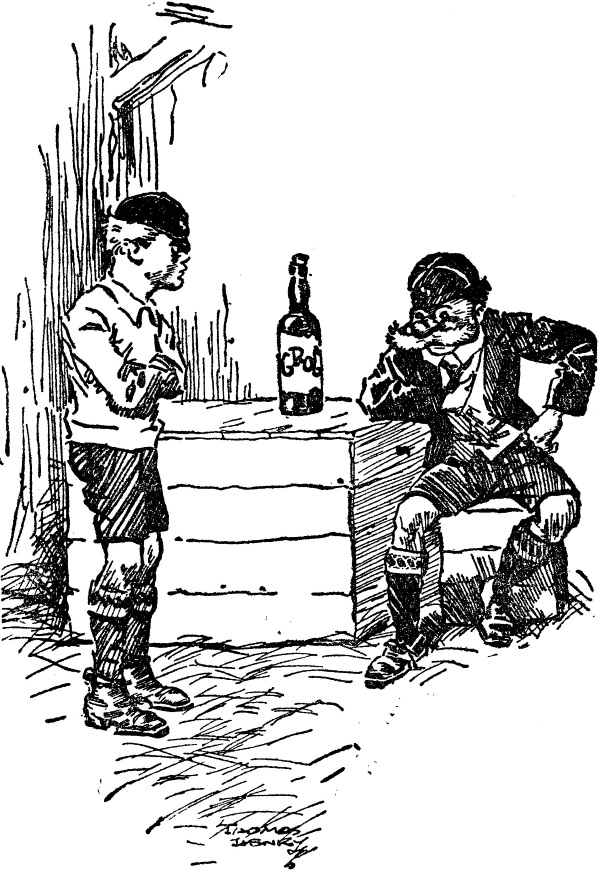
“BLACK-HEARTED DICK,” HE SAID, “YOU’VE GOTTER
SAY ‘PRESENT.’”
William adjusted his mask, which was not a very
good fit, and performed the sinister smile.
“We gotter kidnap someone first,” he said.
“Well, who?” said Ginger.
“Someone who can pay us money for ’em.”
“Well, who?” said Ginger irritably.
William took a deep draught of liquorice water.
“Well, you can think of someone.”
“I like that,” said Ginger, in tones of deep dissatisfaction.
“I like that. You set up to be captain
and wear that thing, and drink up all the liquorice
water——”
“Grog,” William corrected him, wearily.
“Well, grog, an’ then you don’t know who we’ve
gotter kidnap. I like that. Might as well be rat
hunting or catching tadpoles or chasin’ cats, if you
don’t know what we’ve gotter do.”
William snorted and smiled sneeringly beneath his
bilious-looking mask.
“Huh!” he said. “You come with me and I’ll
find someone for you to kidnap right enough.”
Ginger cheered up at this news, and William took
another draught of liquorice water. Then he hung up
his mask behind the barn door and took out of his
pocket a battered penknife.
“We may want arms,” he said; “keep your dagger
handy.”
He pulled his school cap low down over his eyes.
Ginger did the same, then looked at the one broken
blade of his penknife.
“I don’t think mine would kill anyone,” he said.
“Does it matter?”
“You’ll have to knock yours on the head with
something,” said Rudolph of the Red Hand grimly.
“You know we may be imprisoned, or hung, or somethin’,
for this.”
“Rather!” said Ginger, with the true spirit of the
bravado, “an’ I don’t care.”
They tramped across the fields in silence, William
leading. In spite of his occasional exasperation, Ginger
had infinite trust in William’s capacity for attracting
adventure.
They walked down the road and across a stile. The
stile led to a field that bordered the Grange. Suddenly
they stopped. A small white figure was crawling
through a gap in the hedge from the park into the
field. William had come out with no definite aim,
but he began to think that Fortune had placed in his
way a tempting prize. He turned round to his follower
with a resonant “’Sh!”, scowled at him, placed his
finger on his lips, twirled imaginary moustachios, and
pulled his cap low over his eyes. Through the trees
inside the park he could just see the figure of a nurse
on a seat leaning against a tree trunk in an attitude
of repose. Suddenly Lady Barbara looked up and
espied William’s fiercely scowling face.
She put out her tongue.
William’s scowl deepened.
She glanced towards her nurse on the other side of
the hedge. Her nurse still slumbered. Then she
accosted William.
“Hello, funny boy!” she whispered. Rudolph of
the Red Hand froze her with a glance.
“Quick!” he said. “Seize the maiden and run!”
With a dramatic gesture he seized the maiden by
one hand, and Ginger seized the other. The maiden
was not hard to seize. She ran along with little
squeals of joy.
“Oh, what fun! What fun!” she said.
Inside the barn, William closed the door and sat at
his packing-case. He took a deep draught of liquorice
water and then put on his mask. His victim gave a
wild scream of delight and clapped her hands.
“Oh, funny boy!” she said.
William was annoyed.
“It’s not funny,” he said irritably. “It’s jolly well
not funny. You’re kidnapped. That’s what you are.
Unhand the maiden, dog,” he said to Ginger.
Ginger was looking rather sulky. “All right, I’m
not handing her,” he said, “an’ when you’ve quite
finished with the liquorice water——”
“Grog,” corrected William, sternly.
“Well, grog, then, an’ I helped to make it, p’raps
you’ll let me have a drink.”
William handed him the bottle, with a flourish.
“Finish it, dog,” he said, with a short, scornful
laugh.
The vibration of the short, scornful laugh caused his
bacchic mask (never very secure) to fall off on to the
packing-case. Lady Barbara gave another scream of
ecstasy.
“Oh, do it again, boy,” she said.
William glanced at her coldly, and put on the mask
again. Then he swept her a stately bow, holding on
to his mask with one hand.
“Fair maid,” he said, “unless thy father bring me
sixty thousand crowns by to-night, thy doom is sealed.
Thou shalt swing from yon lone pine.”
He pointed dramatically out of the window to a
diminutive hawthorn hedge.
The captive whirled round on one foot, fair curls
flying.
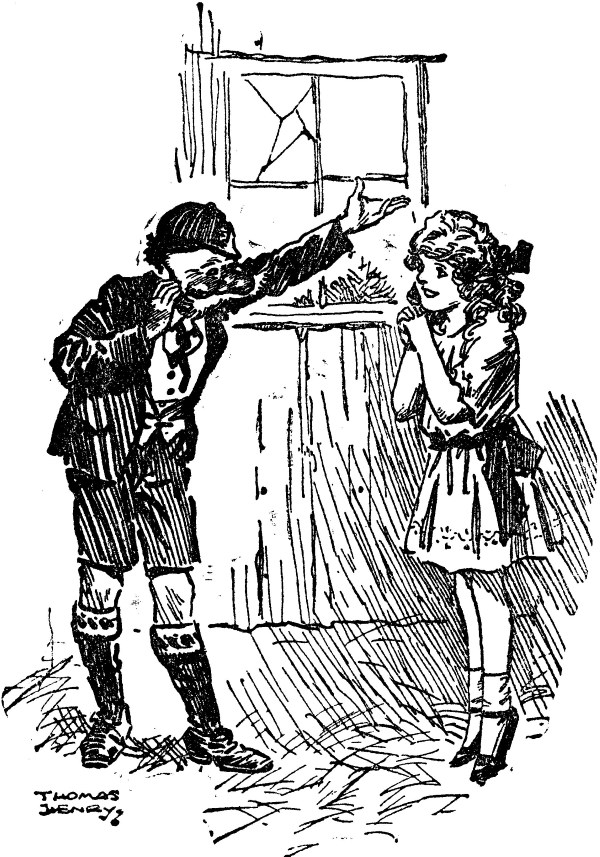
“FAIR MAID,” HE SAID, “UNLESS THY FATHER BRING ME
SIXTY THOUSAND CROWNS, THOU SHALT SWING FROM YON
LONE PINE.”
“Oh, he’s going to make me a swing! Nice boy!”
William rose, majestic and stately, still cautiously
holding his mask. “My name,” he said, “is Rudolph
of the Red Hand.”
“Well, I’ll kiss you, dear Rudolph Hand,” she said,
“if you like.”
William’s look intimated that he did not like.
“Oh, you’re shy!” said Lady Barbara, delightedly.
“Let her be treated,” William said, “with all
courtesy till this even.”
“Well,” said Ginger, “that’s all right, but what we
goin’ to do with her?”
William glanced disapprovingly at the maiden, who
had turned the packing-case upside down and was
sitting in it.
“Well, what we goin’ to do?” said Ginger. “It’s
not much fun so far.”
“Well, we just gotter wait till her people send the
money.”
“Well, how they goin’ to know we got her, and
where she is, an’ how much we want?”
William considered. This aspect of the matter had
not struck him.
“Well,” he said at last. “I s’pose you’d better go
an’ tell them.”
“You can,” said Ginger.
“You’d better go,” said William, “’cause I’m chief.”
“Well, if you’re chief,” said Ginger, “you oughter
go.”
The kidnapped one emitted a shrill scream.
“I’m a train,” she said. “Sh! Sh! Sh!”
“She’s not actin’ right,” said William severely; “she
oughter be faintin’ or somethin’.”
“How much do we want for her?”
“Sixty thousand crowns,” said William.
“All right,” said Ginger. “I’ll stay and see she
don’t get away, an’ you go an’ tell her people, an’ don’t
tell anyone but her father and mother, or they’ll go
gettin’ the money themselves.”
William hung up his mask behind the door and
turned to Ginger, assuming the scowl and attitude of
Rudolph of the Red Hand.
“All right,” he said, “I’ll go into the jaws of death,
and you treat her with all courtesy till even.”
“Who’s goin’ to curtsey?” said Ginger indignantly.
“You don’t understand book talk,” said William,
scornfully.
He bowed low to the maiden, who was still playing
at trains.
“Rudolph of the Red Hand,” he said slowly, with
a sinister smile.
The effect was disappointing. She blew him a kiss.
“Darlin’ Rudolph,” she said.
William stalked majestically across the fields towards
the Grange, with one hand inside his coat, in
the attitude of Napoleon on the deck of the Bellerophon.
He went slowly up the drive and up the broad stone
steps. Then he rang the bell. He rang it with the
mighty force with which Rudolph of the Red Hand
would have rung it. It pealed frantically in distant
regions. An indignant footman opened the door.
“I wish to speak to the master of the house on a
life or death matter,” said William importantly.
He had thought out that phrase on the way up.
The footman looked him up and down. He looked
him up and down as if he didn’t like him.
“Ho! do you!” he said. “And hare you aware as
you’ve nearly broke our front-door bell?”
The echoes of the bell were just beginning to die
away.
Rudolph of the Red Hand folded his arms and
emitted a short, sharp laugh.
“His Lordship,” said the footman, preparing to close
the door, “is hout.”
“His wife would do, then,” said Rudolph. “Jus’
tell her it’s a life an’ death matter.”
“Her Ladyship,” said the footman, “is hengaged,
and hany more of your practical jokes ’ere, my lad, and
you’ll hear of it.” He shut the door in William’s face.
William wandered round the house and looked in
several of the windows; he had a lively encounter with
a gardener, and finally, on peeping into the kitchen
regions with a scornful laugh, was chased off the
premises by the infuriated footman. Saddened, but
not defeated, he returned across the fields to the barn
and flung open the door. Ginger, panting and perspiring,
was dragging the Lady Barbara in the packing-case
round and round the barn by a piece of rope.
He turned a frowning face to William. A life of
crime was proving less exciting than he had expected.
“Well, where’s the money?” he said, wiping his
brow. “She’s jus’ about wore me out. She won’t
let me stop draggin’ this thing about. An’ she keeps
worryin’, sayin’ you promised her a swing.”
“He did!” said the kidnapped one shrilly.
“Well, where’s the money?” repeated Ginger. “I’ve
jus’ about had enough of kidnappin’.”
“I couldn’t get the money,” said William. “I
couldn’t make ’em listen properly. Let’s change, an’
me stay here an’ you go and get the money.”
“All right,” said Ginger. “I wun’t mind changing
to do anything from this. What shall I say to ’em?”
“You’d better say you must speak to ’em on life
or death. I said that, but they kind of didn’t listen.
They’ll p’raps listen to you.”
“Well, I jolly well don’t mind goin’,” said Ginger:
“she’s a wearin’ kid.”
He went out and shut the door.
“Put the funny thing on your face,” ordered Lady
Barbara.
“It’s not funny,” said William coldly, as he adjusted
the mask.
She danced round him, clapping her hands.
“Dear, funny boy! An’ now make me the swing.”
“I’m not goin’ to make you no swing,” said William
firmly.
“If you don’t make me a swing,” she said, “I’ll sit
down an’ I’ll scream an’ scream till I burst.”
She began to grow red in the face.
“There’s no rope,” said William hastily.
She pointed to a coil of old rope in a dark corner
of the barn.
“That’s rope, silly,” she said.
He took it out and began to look round for a suitable
and low enough tree.
“Be quick!” ordered his victim.
At last he had the rope tied up.
“Now lift me in! Now swing me! Go on! More!
More! More! Nice, funny boy!”
She kept him at that for about half an hour. Then
she demanded to be dragged round the barn in the
packing-case.
“Go on!” she said. “Quicker! Quicker!”
The fine, manly spirit of Rudolph of the Red Hand
was almost broken. He began to look weary and
disconsolate.
When Ginger returned, Lady Barbara was wearing
the mask and chasing William.
“Go on!” she said, “’tend to be frightened. ’Tend
to be frightened. Go on!”
William turned to Ginger.
“Well?” he said.
Ginger looked rather dishevelled. His collar was
torn away.
“You might have told me,” he said indignantly.
“What?” said William.
“Go on!” said Lady Barbara.
“That they were like wild beasts up there. They
set on me soon as I said what you told me.”
“Well, did you get any money?” said William.
“Now, how could I?” said Ginger irritably, “when
they set on me like wild beasts soon as I said it.”
“Go on!” said Lady Barbara.
“Well,” said Rudolph of the Red Hand, slowly.
“I’m jus’ about fed up.”
“An’ you cudn’t be fed upper than I am,” replied
his gallant brave.
“Well, let’s chuck it,” said William. “It’s getting
tea-time, an’ we’ve got no money, an’ I’m not goin’
for it again.”
“Nor’m I,” said Ginger fervently.
“An’ I’m fed up with this kid.”
“So’m I,” said Ginger still more fervently.
“Well, let’s chuck it.”
He turned to Lady Barbara. “You can go home,”
he said.
Her face fell.
“I don’t want to go home,” she said; “I’m going
to stay with you always and always.”
“Well, you’re not,” said William shortly, “’cause
we’re going home—so there.”
He set off with Ginger across the fields. The kidnapped
one ran lightly beside them.
“I’m going where you go,” she said. “I like you.”
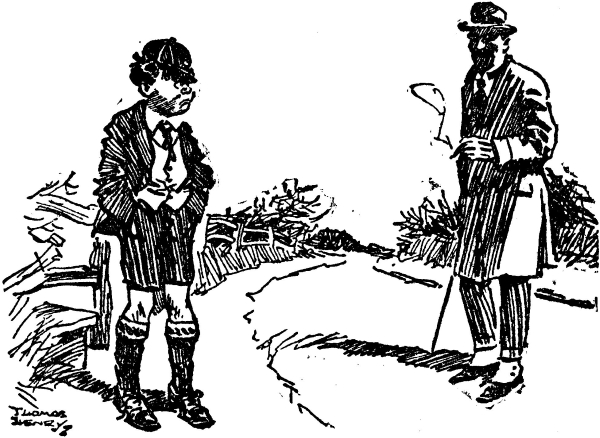
“WE KIDNAPPED A KID,” SAID WILLIAM, DISCONSOLATELY,
“AN’ WE CUDN’T GET ANY MONEY FOR HER, AN’ WE CAN’T
GET RID OF HER.”
They felt that her presence would be difficult to
explain to their parents. Dejectedly, they returned
to the barn.
“I’ll go an’ see if I can see anyone looking for
her,” said William.
“Get down on your hands and knees and let me ride
on your back,” shouted Lady Barbara. Ginger
wearily obeyed.
William went out to the road and looked up it and
down. There was no one there, except a man walking
in the direction of the Grange. He smiled at the
expression on William’s face.
“Hello!” he said, “feeling sick, or lost something?”
“We kidnapped a kid,” said William disconsolately,
“an’ we cudn’t get any money for her, an’ we can’t
get rid of her.”
The man threw back his head and laughed.
“Awkward!” he said, “by Jove—jolly awkward!
I suppose you’ll have to take her home.”
He was no use.
William turned back to the barn. Lady Barbara
was riding round the barn on Ginger’s back.
“Go on!” she said. “Quicker!”
Ginger turned a purple and desperate face to William.
“If you don’t do something soon,” he said, “I shall
probably go mad and kill someone.”
“We’ll have to take her back,” said William grimly.
The kidnappers walked in gloomy silence; the kidnapped
danced along between them, holding a hand
of each.
“I’m going wherever you go,” she said; “I love
you.”
Once Ginger spoke.
“You’re a nice kidnapper,” he said bitterly.
“I cudn’t help it,” said William. “It all went
different in the book.”
Near the steps of the front door a lady was standing.
Ginger turned and fled at the sight of her. Lady
Barbara held William’s hand fast. William hesitated
till flight was impossible.
“Oh, there you are, darling,” the lady said.
“Dear, nice boy,” said Lady Barbara. “He’s been
playing with me all the time. And the other—but the
other’s gone. It’s been lovely. I do love him. May
we keep him?”
“Darling,” said the lady, “I’ve only just heard
you were lost. Nanny’s in a dreadful state. And this
little boy found you and took care of you? Dear
little boy!”
She bent down and kissed the outraged and horrified
William. “How very kind of you to look after my
little girl and bring her back so nicely. Now come
and have some tea.”
She led William, too broken in spirit to resist, up
the steps into the hall, then into a room. Lady
Barbara still held his hand tightly. There was tea in
the room and people. Horror of horrors! It was his
mother and Ethel. There were confused explanations.
“And her nurse went to sleep, and she must have
wandered off and got lost, and your little boy found
her, and played with her, and looked after her, and
brought her back for tea. Dear little man!”
A man entered—the man who had accosted William
on the road. He was evidently the father of the little
girl. The story was repeated to him.
“Great!” he said, looking at William with amusement
and a certain sympathy in his eyes. He seemed
to be enjoying the situation. William glared at him.
“An’ he rode me on his back, and gave me rides in
the box, and made me a swing, and put on a funny
face to make me laugh.”
“Dear little man!” crooned Lady d’Arcey.
They put him gently into a chesterfield, and Barbara
sat beside him leaning against him.
“Nice boy,” she said.
Mrs. Brown and Ethel beamed proudly.
“And he pretends,” said Mrs. Brown, “not to like
little girls. We misjudge children so sometimes.
You’ll go to the dancing class now, won’t you, dear?”
she ended archly.
“Dear little fellow!” said Lady d’Arcey.
It was only the fact that he had no weapon in his
hand and that he had given up the unequal struggle
against the malignancy of Fate that saved William
from murder on a wholesale scale.
Barbara smiled on him fondly. Barbara’s mother
smiled on him tenderly, his mother and sister smiled
on him proudly, and in their midst Rudolph of the
Red Hand, with rage and shame and humiliation in
his heart, savagely ate his sugared cake.
CHAPTER VII
WILLIAM’S EVENING OUT
WILLIAM’S family had come up to London for a
holiday. They had brought William with them
chiefly because it was not safe to leave William behind.
William was not the sort of boy who could be trusted
to live a quiet and blameless life at home in the absence
of his parents. He had many noble qualities, but he
had not that one. So William gloomily and reluctantly
accompanied his family to London.
William’s elder sister and mother lived in a whirl
of shopping and theatres; William’s elder brother went
every day to see a county cricket match, and returned
in a state of frenzied excitement to discuss the play
and players all the evening without the slightest
encouragement from any one; William’s father foregathered
with old cronies at his club or slept in the
hotel smoking-room.
It was open to William to accompany any of the
members of his family. He might shop and attend
matinées with his mother and Ethel, he might go (on
sufferance) to watch cricket matches with Robert, or
he might sleep in the smoking-room with his father.
He was encouraged by each of them to join some
other member of the family, and he occasionally
managed to evade them all and spend the afternoon
sliding down the banisters (till firmly, but politely,
checked by the manager of the hotel), watching for
any temporary absence of the liftman during which
he might try to manipulate the machine itself or contending
with the most impudent-looking page-boy in
a silent and furtive rivalry in grimaces. But, in spite
of this, he was supremely bored. He regarded the
centre of the British Empire with contempt.
“Streets!” he said, with devastating scorn, at the
end of his first day here. “Shops! Huh!”
William’s soul pined for the fields and lanes and
woods of his home; for his band of boon companions,
with whom he was wont to wrestle, and fight, and
trespass, and plot dare-devil schemes, and set the
world at defiance; for the irate farmers who helped to
supply that spice of danger and excitement without
which life to William and his friends was unendurable.
He took his London pleasures sadly.
“Oh—history!” he remarked coldly, when they
escorted him round Westminster Abbey. His only
comment on being shown the Tower was that it seemed
to be takin’ up the whole day, not that there was
much else to do, anyway.
His soul yearned for the society of his own kind.
The son of his mother’s cousin, who lived near, had
come to see him one day. He was a tall, pale boy,
who asked William if he could fox-trot, and if he
didn’t adore Axel Haig’s etchings, and if he didn’t
prefer Paris to London. The conversation was an
unsatisfactory one, and the acquaintance did not ripen.
But, accompanying his family on various short cuts
in the back streets of London, he had glimpsed another
world, a world of street urchins, who fought and
wrestled, and gave vent to piercing whistles, and hung
on to the backs of carts, and paddled in the gutter,
and rang front-door bells and fled from policemen.
He watched it wistfully. Socially, his tastes were not
high. All he demanded from life was danger and
excitement and movement and the society of his own
kind. He liked boys, crowds of boys, boys who shouted
and whistled and ran and courted danger, boys who
had never heard of any silly old etchings.
As he followed his family with his air of patient
martyrdom on all their expeditions, it was the glimpse
of this underworld alone that would lift the shadow
from his furrowed brow and bring a light to his stern,
freckled countenance.... There were times when he
stopped and tried to get into contact with it, but it
was not successful. His mother’s “Come along,
William! Don’t speak to those horrid little boys,”
always recalled him to the blameless and palling
respectability of his own family. Yet even before
that hateful cry interrupted him he knew that it was
useless.
He was an alien being—a clean little boy in a neat
suit, with a fashionable mother and sister. He was
beyond the pale, an outsider, a pariah, a creature to
be mocked and jeered at. The position galled William.
He was, by instinct, on the side of the lawless—the
anti-respectable.
His spirits rose as the time for his return to the
country approached. Yet there was a wistful longing
at his heart for the boy world of London still unexplored,
as well as a fierce contempt for the London
his parents had revealed to him.
*****
William had been invited to a party on his last
evening in London. William’s mother’s cousin lived
in Kensington, and had invited William to a “little
gathering of her children’s friends.” William did not
wish to go to the party. What is more, William did
not intend to go to the party. But a wonderful plan
had come into William’s head.
“It’s very kind of her,” he said meekly. “Yes, I’ll
be very pleased to go.”
This was unlike William’s usual manner of receiving
an invitation to a party. Generally there were
expostulations, indignation, assertion of complete incapacity
to go to anything that particular night.
William’s mother looked at him.
“You—you feel all right, don’t you, dear?” she
said anxiously.
“Oh, yes,” said William, “an’ I feel I’d jus’ like
a party.”
“You can wear your Eton suit,” said Mrs. Brown.
“Oh, yes,” said William. “I’d like that.”
William’s face was quite expressionless as he spoke.
Mrs. Brown pinched herself to make sure that she
was awake.
“I expect they’ll have music and dancing and that
sort of thing,” she said.
She thought, perhaps, that William had misunderstood
the kind of party it would be.
William’s expressionless face did not change.
“Oh, yes,” he said pleasantly, “music an’ dancin’
will be fine.”
When Mr. Brown was told of the invitation he
groaned.
“And I suppose it will take the whole day to make
him go,” he said.
“No,” said Mrs. Brown eagerly. “That’s the strange
part. He seems to want to go. He really does.
And he seems to want to wear his Eton suit, and you
know what a bother that used to be. I suppose he’s
beginning to take a pride in his appearance. I think
London must be civilising him.”
“Well,” said Mr. Brown, dryly, “I suppose you
know best. I suppose miracles do happen.”
When the evening of the party arrived, there was
some difficulty as to the transit of William to his place
of entertainment. The house was so near to the hotel
where the Browns were staying that a taxi seemed
hardly worth while. But there was a general reluctance
to be his escort.
Ethel was going to a theatre, and Robert had been
out all day and thought he deserved a bit of rest in
the evening, instead of carting kids about, Mrs. Brown’s
rheumatism had come on again, and Mr. Brown wanted
to read the evening paper.
William, sleek and smooth, and brushed and encased
in his Eton suit, his freckled face shining with cleanliness
and virtue, broke meekly into the discussion.
“I know the way, mother. Can’t I just go myself?”
Mrs. Brown wavered.
“I don’t see why not,” she said at last.
“If you think that boy can walk three yards by
himself without getting into mischief——” began Mr.
Brown.
William turned innocent, reproachful eyes upon
him.
“Oh, but look at him,” said Mrs. Brown; “and it
isn’t as if he didn’t want to go to the party. You
want to go, don’t you, dear?”
“Yes, mother,” said William, meekly.
His father threw him a keen glance.
“Well, of course,” he said, returning to his paper,
“do as you like. I’m certainly not going with him
myself, but don’t blame me if he blows up the Houses
of Parliament or dams the Thames, or pulls down
Nelson’s Monument.”
William’s sorrowful, wistful glance was turned again
upon his father.
“I won’t do any of those things, I promise, father,”
he said solemnly.
“I don’t see why he shouldn’t go alone,” said Mrs.
Brown. “It’s not far, and he’s sure to be good,
because he’s looking forward to it so; aren’t you,
William?”
“Yes, mother,” said William, with his most inscrutable
expression.
So he went alone.
*****
William set off briskly down the street—a neat figure
in an Eton suit, an overcoat, a well-fitting cap and
patent leather shoes.
His expression had relaxed as soon as the scrutiny
of his family was withdrawn. It became expectant
and determined.
Once out of the sight of possible watchers from the
hotel, he turned off the road that led to his mother’s
cousin’s house, and walked purposefully down a side
street and thence to another side street.
There they were. He knew they would be there.
Boys—boys after William’s own heart—dirty boys,
shouting boys, whistling boys, fighting boys. William
approached. At his own home he would have been
acclaimed at once as leader of any lawless horde. But
here he was not known. His present appearance,
moreover—brushed hair, evening clothes, clean face—was
against him. To them he was a thing taboo.
They turned on him with delightful yells of scorn.
“Yah!”
“Where’s yer mammy?”
“Look at ’is shoes! Boo-oo!”
“Isn’t ’is ’air brushed nice?”
“Yah!”
“Boo!”
“Garn!”
The tallest of them snatched William’s cap from
his head and ran off with it. The snatching of a boy’s
cap from his head is a deadly insult. William, whose
one wistful desire was to be friends with his new
acquaintances, yet had his dignity to maintain. He
flew after the boy and caught him by the back of
his neck. Then they closed.
The rest of the tribe stood round them in a ring,
giving advice and encouragement. Their contempt for
William vanished. For William was a good fighter.
He lost his collar and acquired a black eye; and his
hair, in the exhilaration of the contest, recovered from
its recent severe brushing and returned to its favourite
vertical angle.
The two were fairly well matched, and the fight was
a most satisfactory one till the cry of “Cops” brought
it to an abrupt end, and the crowd of boys, with
William now in the middle, fled precipitately down
another street. When they were at a safe distance
from the blue helmet, they stopped, and the large boy
handed William his cap.
“’Ere you are,” he said, with a certain respect.
William, with a careless gesture, tossed the cap into
the air. “Don’t want it,” he said.
“Wot’s yer nime?”
“William.”
“’E’s called Bill,” said the boy to the others.
William read in their faces a growing interest, not
quite friendship yet, but still not quite contempt.
He glowed with pride. He put his hands into the
pockets of his overcoat and there met—a sixpence—joy!
“Wot’s your name?” he said to his late adversary.
“’Erb,” said the other, still staring at William with
interest.
“Come on, ’Erb,” said William jauntily, “let’s buy
some sweets, eh?”
He entered a small, unsavouring sweetshop, and the
whole tribe crowded in after him. He and ’Erb discussed
the rival merits of bulls’ eyes and cokernut
kisses at length.
“Them larses longer,” said ’Erb, “but these ’ere
tases nicer.”
Finally, William airily tasted one of the cokernut
kisses and the whole tribe followed his example—to
be chased by the indignant shopkeeper all the way
down the street.
“Eatin’ of ’em!” he shouted furiously. “Eatin’ of
’em without payin’ for ’em. I’ll set the cops on ye—ye
young thieves.”
*****
They rushed along the next street shouting, whistling
and pushing each other. William’s whistle was louder
than any, he ran the foremost. The lust of lawlessness
was growing on him. They swarmed in at the next
sweetshop, and William purchased sixpennyworth of
bulls’ eyes and poured them recklessly out of the bag
into the grimy, outstretched palms that surrounded
him.
William had no idea where he was. His hands were
as grimy as the hands of his companions, his face
was streaked with dirt wherever his hands had touched
it, his eye was black, his collar was gone, his hair
was wild, his overcoat had lost its look of tailored
freshness. And he was happy at last.
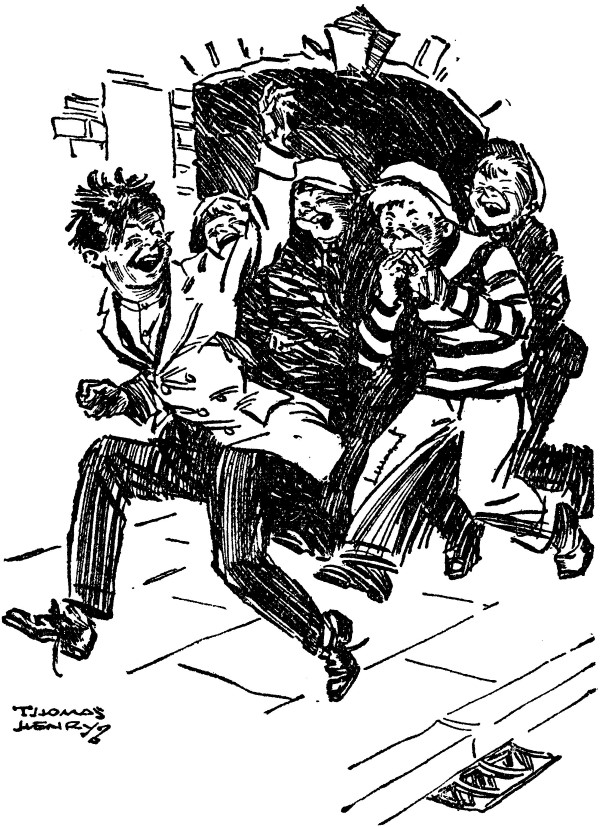
WILLIAM WAS HAPPY AT LAST. HE WAS A BOY AMONG
BOYS—AN OUTLAW AMONG OUTLAWS
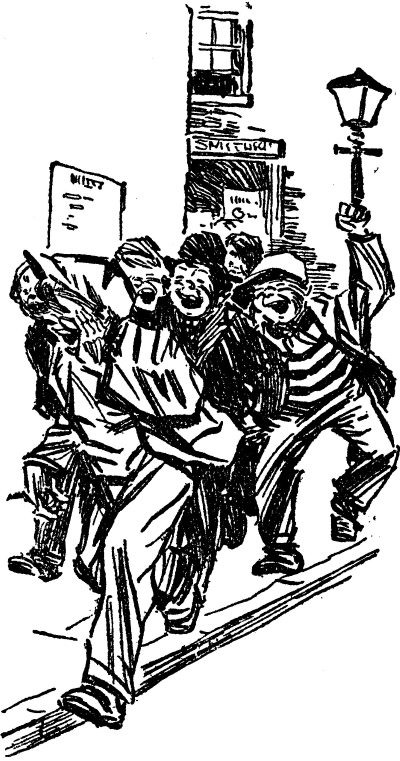
THEY RUSHED ALONG THE NEXT
STREET, SHOUTING AND WHISTLING.
He was no
longer a little
gentleman staying
at a select
hotel with his
family. He was
a boy among
boys—an outlaw
among outlaws
once more.
He was no longer
a pariah. He
had proved his
valour in fighting
and running
and whistling.
He was almost
accepted, not
quite. He was
alight with exhilaration.
In the next
street a watering
cart had just
passed, and there
was a broad
muddy stream
flowing along the
gutter. With a
whoop of joy the
tribe made for it,
’Erb at the head,
closely followed
by William.
William’s patent leather shoes began to lose their
damning smartness. It was William who began to
stamp as he walked, and the rest at once followed
suit—splashing, shouting, whistling, jostling, they
followed the muddy stream through street after street.
At every corner William seemed to shed yet another
portion of the nice equipment of the boy-who-is-going-to-a-party.
No party would have claimed him now—no
hostess greeted him—no housemaid admitted
him—he had completely “burned his boats.” But he
was happy.
All good things come to an end, however, even a
muddy stream in a gutter, and ’Erb, still leader, called
out: “Come on, you chaps! Come on, Bill—bells!”
Along both sides of a street they flew at break-neck
speed, pulling every bell as they passed. Three
enraged householders pursued them. One of them,
fleeter than the other two, caught the smallest and
slowest of the tribe and began to execute corporal
punishment.
It was William who returned, charged from behind,
left the householder winded in the gutter, and dragged
the yelling scapegoat to the shelter of his tribe.
“Good ole Bill,” said ’Erb, and William’s heart
swelled again with pride. Nothing on earth would
now have checked his victorious career.
A motor-van passed with another gang of street-urchins
hanging on merrily behind. With a yell of
battle, William hurled himself upon them, struggled
with them in mid-air, and established himself, cheering
on his own tribe and pushing off the others.
In the fight William lost his overcoat, his Eton coat
was torn from top to bottom, and his waistcoat ripped
open. But his tribe won the day; the rival tribe
dropped off, hurling ineffectual taunts and insults, and
on sailed William and his gang, half-running, half-riding,
with an exhilarating mixture of physical exercise
and joy-riding unknown to the more law-abiding
citizen.
And in the midst was William—William serene and
triumphant, William dirty and ragged, William
acclaimed leader at last. The motor-van put on speed.
There was a ride of pure breathless joy and peril
before, at last exhausted, they dropped off.
*****
Then ’Erb turned to William: “Wot you doin’
to-night, maite?” he said.
“Maite!” William’s heart glowed.
“Nothin’, maite,” answered William carelessly.
“Oi’m goin’ to the picshers,” said ’Erb. “If you
loike ter ’elp my o’d woman with the corfee-stall, she’ll
give yer a tanner.”
A coffee-stall—Oh, joy! Was the magic of this
evening inexhaustible?
“Oi’ll ’elp ’er orl roight, maite,” said William, making
an effort to acquire his new friend’s accent and
intonation.
“Oi’ll taike yer near up to it,” said ’Erb, and to
the gang: “Nah, you run orf ’ome, kids. Me an’
Bill is busy.”
He gave William a piece of chewing-gum, which
William proudly took and chewed and swallowed, and
led him to a street-corner, from where a coffee-stall
could be seen in a glare of flaming oil-jets.
“You just say ‘’Erb sent me,’ an’ you bet you’ll
get a tanner when she shuts up—if she’s not in a
paddy. Go on. Goo’-night.”
He fled, leaving William to approach the stall alone.
A large, untidy woman regarded him with arms
akimbo.
“I’ve come ter ’elp with the stall,” said William,
trying to speak with the purest of Cockney accents.
“’Erb sent me.”
The woman regarded him with a hostile stare, still
with arms akimbo.
“Oh, ’e did, did ’e? ’E’s allus ready ter send someone
else. ’E’s gone ter the picshers, I suppose? ’E’s
a nice son fer a poor woman ter ’ave, isn’t ’e? Larkin’
abaht orl day an’ goin’ ter picshers orl night—an’
where do Oi come in? I asks yer, where do Oi come
in?”
William, feeling that some reply was expected, said
that he didn’t know. She looked him up and down.
Her expression implied that her conclusions were far
from complimentary.
“An’ you—I serpose—one of the young divvils ’e
picks up from ’Evving knows where. Told yer yer’d
git a tanner, I serpose? Well, yer’ll git a tanner if
yer be’aves ter my likin’, an yer’ll git a box on the
ears if yer don’. Oh, come on, do; don’t stand there
orl night. ’Ere’s the hapron—buns is a penny each,
an’ sangwiches a penny each, and cups o’ corfy a
penny each. Git a move on.”
He was actually installed behind the counter. He
was actually covered from neck to foot in a white
apron. His rapture knew no bounds. He served
strong men with sandwiches and cups of coffee. He
dropped their pennies into the wooden till. He gave
change (generally wrong). He turned the handle of
the fascinating urn. He could not resist the handle
of the little urn. When there were no customers he
turned the handle, to see the little brown stream gush
out in little spurts on to the floor or on to the
counter.
His feeling of importance as he handed over buns
and received pennies was indescribable. He felt like a
king—like a god. He had forgotten all about his
family....
Then the stout lady presented him with a bowl of
hot water, a dish-cloth, and a towel, and told him to
wash up. Wash up! He had never washed up before.
He swished the water round the bowl with the dish-cloth
very fast one way, and then quickly changed and
swished it round the other. It was fascinating. He
lifted the dish-cloth high out of the water and swirled
the thin stream to and fro. He soaked his apron and
swamped the floor.
Finally, his patroness, who had been indulging in a
doze, awoke and fixed eyes of horror upon him.
“What yer think yer a-doing of?” she said indignantly.
“Yer think yer at the seaside, don’t yer?
Yer think yer’ve got yer little bucket an’ spade, don’t
yer? Waistin’ of good water—spoilin’ of a good
hapron. Where did ’Erb find yer, I’d like ter know.
Picked yer aht of a lunatic asylum, I should say....
Oh, lumme, ’ere’s toffs comin’. Sharp, now, be ready
wiv the hurn an’ try an’ ’ave a bit of sense, an’ heverythin’
double price fer toffs, now—don’t forget.”
*****
But William, with a sinking heart, had recognised
the toffs. Looking wildly round he saw a large cap
(presumably ’Erb’s) on a lower shelf of the stall. He
seized it, put it on, and dragged it over his eye. The
“toffs” approached—four of them. One of them, the
elder lady, seemed upset.
“Have you seen,” she said to the owner of the stall,
“a little boy anywhere about—a little boy in an
Eton suit?”
“No, mam,” said the proprietress, “I hain’t seen
no one in a heton suit.”
“He was going out to a party,” went on Mrs. Brown
breathlessly, “and he must have got lost on the way.
They rang up to say he hadn’t arrived, and the police
have had no news of him, and we’ve traced him to this
locality. You—you haven’t seen a little boy that
looked as if he were going to a party?”
“No, mam,” said the lady of the coffee-stall. “I
hain’t seen no little boy goin’ to no party this hevening.”
“Oh, mother,” said Ethel; and William, trying to
hide his face between his cap-brim and his apron,
groaned in spirit as he heard her voice. “Do let’s
have some coffee now we’re here.”
“Very well, darling,” said Mrs. Brown. “Four cups
of coffee, please.”
William, still cowering under his cap, poured them
out and handed them over the counter.
“You couldn’t mistake him,” said Mrs. Brown,
tearfully. “He had a nice blue overcoat over his
Eton suit, and a blue cap to match, and patent leather
shoes, and he was so looking forward to the party,
I can’t think——”
“How much?” said William’s father to William.
“Twopence each,” muttered William.
There was a horrible silence.
“I beg your pardon,” said William’s father suavely,
and William’s heart sank.
“Twopence each,” he muttered again.
There was another horrible silence.
“May I trouble you,” went on William’s father—and
from the deadly politeness of his tone, William realised
that all was over—“may I trouble you to remove your
cap a moment? Something about your voice and the
lower portion of your face reminds me of a near relative
of mine——”
But it was Robert who snatched ’Erb’s cap from his
head and stripped his apron from him, and said: “You
young devil!” and Ethel who said: “Goodness, just
look at his clothes,” and Mrs. Brown who said: “Oh,
my darling little William, and I though I’d lost you”;
and the lady of the coffee-stall who said: “Well, yer
can ’ave ’im fer all ’e knows abaht washin’-up.”
And William returned sad but unrepentant to the
bosom of outraged Respectability.
CHAPTER VIII
WILLIAM ADVERTISES
A NEW sweetshop, Mallards by name, had been
opened in the village. It had been the sensation
of the week to William and his friends. For it sold
everything a halfpenny cheaper than Mr. Moss.
It revolutionised the finances of the Outlaws. The
Outlaws was the secret society which comprised William
and his friends Ginger, Henry, and Douglas. Jumble,
William’s disreputable mongrel, was its mascot.
The Outlaws patronised Mallards’ generously on the
first Saturday of its career. William spent his whole
threepence there on separate halfpennyworths. He
insisted on the halfpennyworths. He said firmly that
Mr. Moss always let him have halfpennyworths. In
the end the red-haired young woman behind the counter
yielded to him. She yielded reluctantly and scornfully.
She took no interest in his choice. She asked
him in a voice of bored contempt not to finger the
Edinburgh Rock. She muttered as she did up his
package—“waste of paper and time”—“never heard
such nonsense”—“ha’porths indeed.”
William went out of the shop, placing his five minute
packets in already over-full pockets and keeping out
the sixth for present consumption.
“I’m not sure,” he said darkly to Ginger and Henry,
who accompanied him—Douglas was away from home—“I’m
not sure as I’m ever going there again——
Have a bull’s eye?—I didn’t like the way she looked
at me nor spoke at me—an’ I’ve a jolly good mind
not to go to Mallards next Saturday.”
“But it’s cheap,” said Ginger, taking out his package.
“Have an aniseed ball?—an’ it’s cheap that matters
in a shop, I should think.”
“Well, I don’t know,” said William, with an air of
wisdom. “That’s all I say—I jus’ don’t know—-I jus’
don’t know that cheap’s all that matters.”
“Well, wot else matters? You tell me that,” said
Henry, crunching up a bull’s eye and an aniseed ball
simultaneously, and taking out his package. “Have a
pear drop?—You jus’ tell me wot matters besides
cheap in a shop.”
William, perceiving that the general feeling was
against him, put another bull’s eye in his mouth and
waxed irritable.
“Well, don’t talk about it so much,” he said. “You
keep talkin’ an’ talkin’——” Then an argument
occurred to him, and he brought it out with triumph.
“S’pose anyone was a murderer—well, wot would cheap
have to do with it?—S’pose someone wot had a shop
murdered someone—well, I s’pose if they was cheap
you’d say it was all right! Huh!”
With an expression of intense scorn and amusement
William put the last bull’s eye into his mouth, threw
away the paper, and took out the treacle toffee.
“Well, who’s she murdered?” said Ginger pugnaciously.
“Jus’ ’cause she din’ want to give you
ha’p’orths you go an’ say she’s murdered someone—— Well,
who’s she murdered, that’s all?—you can’t go
callin’ folks murderers an’ not prove who they’ve
murdered. Bring out who she’s murdered—that’s
all.”
William was at the moment deeply engrossed in
his treacle toffee.
The red-haired girl had given it an insufficient
allowance of paper, and in William’s pocket it had
lost even this, and formed a deep attachment to a piece
of putty which a friendly plumber had kindly given
him the day before. The piece of putty was at that
moment the apple of William’s eye. He detached it
gently from the toffee and examined it tenderly to
make sure that it was not harmed. Finally he replaced
it in his pocket and put the toffee in his mouth.
Then he returned to the argument.
“How can I bring out who she’s murdered if she’s
murdered them. That’s a sens’ble thing to say, isn’t
it? If she’s murdered ’em she’s buried ’em. Do you
think folks wot murder folks leaves ’em about for
other folks to bring out to show they’ve murdered
’em? You’ve not got much sense. That’s all I say.
You don’t know much about murderers. Why do you
keep talkin’ about murderers if you don’t know anything
about ’em?”
Ginger was growing slightly bewildered. Arguments
with William often left him bewildered. He was
inclined, on the whole, to think that perhaps William
was right, and she had murdered someone.
At this point Jumble created a diversion. Jumble
loved treacle toffee, and he had caught a whiff of the
divine perfume. He sat up promptly to beg for some,
but the Outlaws’ mascot was seldom lucky himself.
He sat up on the very edge of a ditch, and William
could not resist giving him a push.
Jumble picked himself out of the bottom of the
ditch and shook off the water, grinning and wagging
his tail. Jumble was a sportsman. William had
finished the treacle toffee, but Henry threw Jumble an
aniseed ball, which he licked, rolled with his paw, and
abandoned, and which Henry then carefully put back
with the others in his packet. Then William threw a
stick for him, and the discussion of the red-haired girl’s
morals was definitely abandoned.
*****
At the corner of the road they espied Joan Crewe.
Though fluffy and curled and exquisitely dressed
herself, Joan adored William’s roughness and untidiness.
“Hello!” said Joan.
“Hello!” said the Outlaws.
“Have you been to Mallards’?” said Joan.
“Umph!” said the Outlaws.
“It’s a halfpenny cheaper than Moss’.”
“Yes,” said Ginger, “but William says she’s a
murderer.”
“I di’n’t,” said William irritably. “You can’t
understand English. That’s wot’s wrong with you.
You can’t understand English. Wot I said was——”
Finding that he had entirely forgotten how the
argument arose he hastily changed the subject. “Wot
you’re goin’ to do now?” he said.
“Anything,” said Joan obligingly.
“Have a coco-nut lump?” said William, taking out
his third bag.
“Have an aniseed ball?” said Ginger.
“Have a pear drop?” said Henry.
Joan took one of each and took out a bag from
her pocket.
“Have a liquorice treasure?” she said.
Munching cheerfully they walked along the road,
stopping to throw a stick for Jumble every now and
then. Jumble then performed his “trick.” His
“trick” was to walk between William and Ginger, a
paw in each of their hands. It was a “trick” that
Jumble cordially detested. He generally managed to
avoid it. The word “trick” generally sent him flying
towards the horizon like an arrow from a bow. But
this time he was hoping that William still had some
treacle toffee concealed on his person, and did not take
to his heels in time. He was finally released with a
kiss from Joan on the end of his nose. In joy at his
freedom, he found a stick, worried it, ran after his
tail, and finally darted down the road.
“Have a monkey-nut?” said William.
They partook of his last packet.
“I once heard a boy say,” said Henry solemnly,
“that people who eat monkey-nuts get monkey puzzle
trees growin’ out of their mouths.”
“I don’t s’pose,” said Ginger, as he swallowed his,
“that jus’ a few could do it.”
“Anyway, it would be rather interestin’,” said
William, “going about with a tree comin’ out of your
mouth—you could slash things about with it.”
“But think of the orful pain,” said Henry dejectedly;
“roots growin’ inside your stomach.”
Joan handed her monkey-nut back to William.
“I—I don’t think I’ll have one, thank you, William,”
she said.
“All right,” said William, philosophically cracking
it and putting it into his mouth. “I don’t mind eatin’
’em. Let ’em start growin’ trees out of my stomach
if they can.”
They were nearing a little old-fashioned sweetshop.
A man in check trousers, shirt-sleeves, and a white
apron stood in the doorway. Generally Mr. Moss
radiated cheerfulness. To-day he looked depressed.
They approached him somewhat guiltily.
“Well,” he said. “You coming to spend your
Saturday money?”
“Er—no,” said William.
“We’ve spent it,” said Ginger.
“At Mallard’s,” said Henry.
“It’s—it’s a halfpenny cheaper,” said Joan.
“Well,” said Mr. Moss, “I don’t blame you. Mind,
I don’t blame you. You’re quite right to go where
it’s a halfpenny cheaper. You’d be foolish if you
didn’t go where it’s a halfpenny cheaper. But all I
say is it’s not fair on me. They’re a big company,
they are, and I’m not. They’ve got shops all over the
big towns they have, and I’ve not. They’ve got
capital behind ’em, they have, an’ I’ve not. They can
afford to give things away, an’ I can’t. I’ve always
kept prices as low as I could so as jus’ to be able to
keep myself on ’em, an’ I can’t lower them no further.
That’s where they’ve got me. They can undercut.
They don’t need to make a profit at first. An’ all I
say is it’s not fair on me. They say as this here place
is growin’ an’ there’s room for the two of us. Well,
all I can say is not more’n ten people’s come into this
here shop since they set up, an’ it’s not fair on me.”
His audience of four, clustered around his shop-door,
listened in big-eyed admiration. As he stopped for
breath, William said earnestly:
“Well, we won’t buy no more of their ole stuff,
anyway——”
The Outlaws confirmed this statement eagerly, but
Mr. Moss raised his hand. “No,” he said. “You
oughter go where you get stuff cheapest. I don’t
blame you. You’re quite right.”
They walked alone in silence for a little while. The
memory of Mr. Moss, wistful and bewildered, with his
cheerful hilarity gone, remained with them.
“I won’t go to that old Mallards’ again while I live,”
said William firmly.
“Anyway, she wasn’t nice. I didn’t like her,” said
Joan.
“She didn’t care what you bought,” said William
indignantly. “She didn’t take any interest like wot
Mr. Moss does.”
“Yes, an’ if she murders folks as William says she
does——” began Ginger.
“I wish you’d shut up talking about that,” said
William. “I di’n’t say she’d murdered anyone.”
“You did.”
“I di’n’t.”
“You did.”
“I di’n’t.”
“Do have another liquorice treasure,” said Joan.
Peaceful munchings were resumed.
“Anyway,” said William, returning to the matter
in hand, “I’d like to do something for Mr. Moss.”
“Wot could we do?” said Ginger.
“We could stop folks goin’ to old Mallards’—’Tisn’t
as if she took any int’rest in wot you buy.”
“Well, how could we stop folks goin’ to ole
Mallards’?”
“Make ’em go to Mr. Moss.”
“Well, how—why don’ you say how?”
“Well, we’d have to have a meeting about it—an
Outlaw meeting. Let’s have one now. Let’s go to
our woodshed an’ have one now.”
Joan’s face fell.
“I can’t come, can I? I’m not an Outlaw.”
“You can be an Outlaw ally,” said William kindly.
“We’ll make up a special oath, for you, an’ give you
a special secret sign.”
Joan’s eyes shone.
“Oh, thank you, William darling.”
*****
Joan had taken the special oath. It had consisted
of the words: “I will not betray the secrets of the
Outlaws, an’ I will stick up for the Outlaws till death
do us part.”
The last phrase was an inspiration of Henry’s, who
had been to his cousin’s wedding the week before.
They sat down on logs or stacks of firewood or
packing-cases to consider the question of Mr. Moss.
“First thing is,” said William, with a business-like
frown, “we’ve got to make people go to Mr. Moss.”
“Well, how can we?” objected Ginger. “Jus’ tell
me that? How can we make people go to Moss’
when Mallards’ is halfpenny cheaper?”
“Same way as big shops make people go to them—they
put up notices an’ things—they say their things
is better than other shops’ things, an’ folks believes
’em.”
“Well, why should folks believe ’em?” said Ginger
pugnaciously. Henry was engaged upon his last few
pear drops and had no time for conversation. “Why
should folks b’lieve ’em when they say they’re better
than other shops? An’ how can we stick up notices
an’ where an’ who’ll let us stick up notices? You
don’t talk sense. You’re mad, that’s wot you are.
First you go about calling folks murderers when you
don’t know who they’ve murdered, nor nothin’ about
it, an’ then you talk about stickin’ up notices when
there isn’t anyone who’d let us stick up any notices,
nor anyone who’d take any notice of notices wot we
stuck up nor——”
“If you’d jus’ stop talkin’,” said William, “an’
deafenin’ us all for jus’ a bit. You’ve been talkin’
an’ deafenin’ us all ever since you came out. D’you
think we never want to hear anythin’ all our lives
ever till death, but you talkin’ an’ deafenin’ us all?
There is things that we’d like to hear ’sides you talkin’
an’ deafenin’ us all—there’s music an’ birds singing,
an’—an’ other folks talkin’, but you go on so’s anyone
would think that——”
Here Ginger hurled himself upon William, and the
two of them rolled on to the floor and wrestled among
the faggots. Violent physical encounters were a
regular part of the programme of the Outlaws’ meetings.
Henry watched nonchalantly from his perch, crunching
pear drops, occasionally throwing small twigs at them,
and saying: “Go it!”—“That’s right!”—“Go it!”
Joan watched with anxious horror, and “William, do
be careful,” and: “Oh, Ginger, darling, don’t hurt
him.”
Finally the combatants rose, dusty and dishevelled,
shook hands, and resumed their seats on the stacks
of firewood.
“Now, if you’ll only let me speak——” began
William.
“We will, William, darling,” said Joan. “Ginger
won’t interrupt, will you, Ginger?”
Ginger, who had decidedly had the worst of the
battle, was removing dust and twigs from his mouth.
He gave a non-committal grunt.
“Well, you know the Sale of Work next week?” went
on William. They groaned. It was a ceremony to
which each of the company would be led, brushed and
combed and dressed in gala clothes, in a proud parent’s
wake.
“Well,” went on William. “You jus’ listen carefully.
I got an idea.”
They leant forward eagerly. They had a touching
faith in William’s ideas that no amount of bitter
experiences seemed able to destroy.
*****
The day of the Sale of Work was warm and cloudless.
William’s mother and sister worked there all the
morning. A tent had been erected, and inside the
tent were a few select stalls of flowers and vegetables.
Outside on the grass were the other stalls. The
opening ceremony was to be performed by a real live
duke.
William absented himself for the greater part of the
morning, returning in time for lunch, and meekly
offering himself to be cleaned and dressed afterwards
like the proverbial lamb for the slaughter.
“William,” said Mrs. Brown to her husband, “is
being almost too good to be true. It’s such a
comfort.”
“I’m glad you can take comfort in it,” said Mr.
Brown. “From my knowledge of William, I prefer
him when you know what tricks he’s up to.”
“Oh, I think you misjudge him,” said Mrs. Brown,
whose trust in William was almost pathetic.
“Ethel and I can’t go to the opening, darling,” said
Mrs. Brown at lunch. “I’m rather tired. So I suppose
you’ll wait and go with us later.”
William smiled his painfully sweet smile.
“I might as well go early. I might be able to help
someone,” he said shamelessly.
Half an hour later William set off alone to the Sale
of Work. He wore his super-best clothes. His hair
was brushed to a chastened, sleek smoothness. He
wore kid gloves. His shoes shone like stars.
He walked briskly down to the Sale of Work.
Already a gay throng had assembled there. Joan was
there, looking like a piece of thistledown in fluffy
white, with her mother. Ginger was there, stiff and
immaculate, with his mother.
William, Ginger, and Henry joined forces and stood
talking in low, conspiratorial voices, looking rather
uncomfortable in their excessive cleanness. Joan
looked at them wistfully but was kept close to the
maternal side.
The real live duke arrived. He was tall and stooping,
and looked very bored and aristocratic.
Everything was ready for the opening. It was to
take place on the open space of grass at the back of
the tent. The chairs for the committee and the chair
for the duke were close to the tent. Then a space
was railed off from the crowd—from the ordinary
people.
At the other side of the tent the stalls were deserted.
His Grace stood for a few minutes in the tent by one
of the stalls talking to the vicar’s wife. Then he went
out to open the Sale of Work. A few minutes after his
Grace had departed, William might have been seen to
emerge from beneath the stall, his cap gone, his hair
deranged, his knees dusty, and join Ginger and Henry
in the deserted space behind the tent.
His Grace stood and uttered the few languid words
that declared the Sale of Work open. But the committee
who were a few yards behind him sat in open-mouthed
astonishment. For a large placard adorned
his Grace’s coat behind.
HAVE YOU TRYD
MOSSES
COKERNUT LUMPS?
The committee could think of no course of action
with which to meet this crisis. They could only gasp
with horror, open-eyed and open-mouthed.
The few gracious words were said. The applause
rose. His Grace turned round to converse pleasantly
with the Vicar’s wife, exposing his back to the view
of the crowd. The applause wavered, then redoubled
ecstatically.
“Some kind of an advertising job,” said the organist’s
wife.
But the crowd did not mind what it was. They
held their sides. They clung to each other in helpless
mirth. They followed that tall, slim, elegant figure
with its incongruous placard as it went with the vicar’s
wife round the tent to the stalls. The vicar’s wife
talked nervously, and hysterically. “My dear, I
couldn’t,” she said afterwards. “I didn’t know how
to put it. I couldn’t think of words—and I kept
thinking, suppose he knows and means it to be there.
It somehow seemed better bred to ignore it.”
The committee clustered together in an anxious
group.
“It wasn’t there when he came. Someone must
have put it on.”
“My dear, someone must tell him.”
“Or creep up and take it off when he isn’t looking.”
“My dear—one couldn’t. Suppose he turned round
when one was doing it, and thought one was putting
it on!”
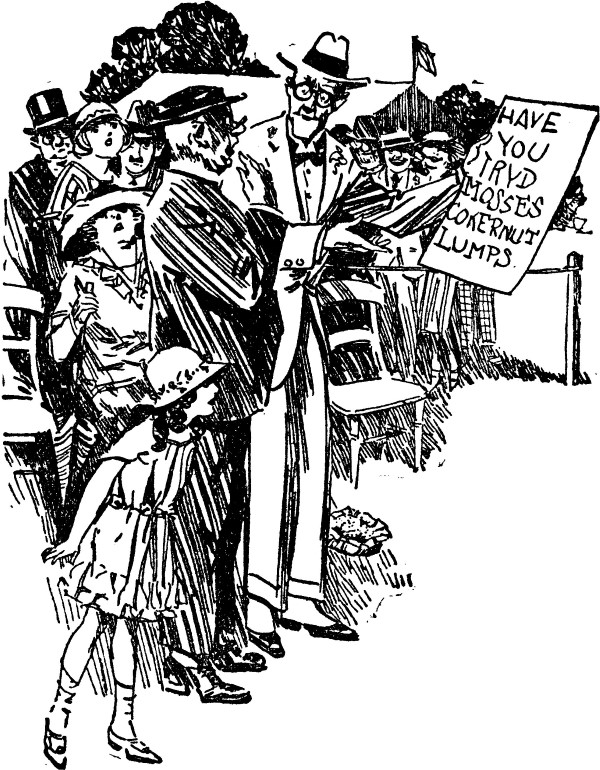
HIS GRACE EXAMINED THE PLACARD, THEN TURNED
TO THE VICAR. “HOW LONG EXACTLY,” HE SAID
SLOWLY, “HAVE I BEEN WEARING THIS?”
“The vicar must tell him—let’s find the vicar. I
think it would come better from a clergyman, don’t
you?”
“Yes, and he might—well, he couldn’t say much
before a clergyman, could he?”
“And a vicar is so practised in consolation. I think
you’re right—— But who did it?”
Flustered, panting, distraught, they hastened off in
search of the
vicar.
*****
Meanwhile, his
Grace talked to
the vicar’s wife.
He was beginning
to think that she
was not quite herself.
Her manner
seemed more than
peculiar. He
glanced round. The
stalls were still deserted.
“They haven’t
begun to buy much
yet, have they?”
he said. “I suppose
I must set the example.”
AT THAT MOMENT, WILLIAM,
GINGER AND HENRY EMERGED FROM
BENEATH ONE OF THE STALLS.
He wandered
over to a stall and
bought a pink
cushion. Then he
looked around
again, his cushion
under his arm, his placard still adorning the back of
his coat. The crowd were engaged only in staring at
him; they were fighting to get a glimpse of him;
they were following him about like dogs——
“I suppose some of these people must know my
name,” he said. “I thought that speech of mine in
the House last week would wake people up——”
“Er—Oh, yes,” said the vicar’s wife. She blinked
and swallowed. “Er—Oh, yes—indeed, yes—indeed,
yes—I quite agree—er—quite!”
Here the vicar rescued her.
The vicar had not quite made up his mind whether
to be jocular or condoling.
“A splendid attendance, isn’t it, your Grace?
There’s a little thing I want to——” The vicar’s wife
tactfully glided away. “Of course, we all understand—you’re
not responsible—and, on our honour, we aren’t—quite
an accident—the guilty party, however, shall
be found. I assure you he shall—er—shall be found.”
“Would you mind,” said his Grace patiently,
“telling me of what you are talking?”
The vicar drew a deep breath, then took the plunge.
“There’s a small placard on your back,” he said.
“Well, not small—that is—allow me——”
His Grace hastily felt behind, secured the placard,
tore it off, put on his tortoise-shell spectacles, and
examined it at arm’s length. Then he turned to the
vicar, who was mopping his brow. The committee
were trembling in the background. One of them—Miss
Spence by name—had already succumbed to a
nervous breakdown and had had to go home. Another
was having hysterics in the tent.
“How long exactly,” asked his Grace slowly, “have
I been wearing this?”
The vicar smiled mirthlessly, and put up a hand
nervously as if to loosen his collar.
“Er—quite a matter of minutes—ahem—of minutes
one might say, your Grace, since—ah—ahem—since
the opening, one might almost put it——”
“Then,” said his Grace, “why the devil didn’t you
tell me before?”
The vicar put up his hand and coughed reproachfully.
At this moment William, Ginger and Henry emerged
from beneath one of the stalls, in whose butter-muslined
shelter they had been preparing themselves, and
awaiting the most dramatic moment to appear.
They all wore “sandwiches” made from sheets of
cardboard and joined over their shoulders by string.
William bore before him— —and behind him
MOSSES TREEKLE TOFFY IS THE BEST GET YOUR BULLS EYES AT MOSSES
Ginger bore before him— —and behind him
YOU WILL LIKE MOSSES MUNKY NUTS MOSSES TAKES AN INTREST
Henry bore before him— —and behind him
GO TO MOSSES FOR FRUTY BITS MOSSES MAKES HAPOTHS
Solemnly, with expressionless faces and eyes fixed
in front of them, they paraded through the crowd.
His Grace, who had taken off his spectacles, put
them on again. His Grace was a good judge of
faces.
“Secure that first boy,” he said.
The vicar, nothing loth, secured William by the
collar and brought him before his Grace. His Grace
held out his placard.
“Did you—er—attach this to my coat?” he asked
sternly.
William shook off the vicar’s hand.
“Yes,” he said, as sternly as his Grace. “You see,
we wanted people to go to Mr. Moss’ shop—’cause,
you see, Mallards’ is a big company, an’ he’s not,
an’ they’ve got—er—capitols behind them and he’s
not—see? And we wanted to make people go to
Moss’, and we thought we’d fix up notices wot’d make
people go to Moss’ like big shops do—an’ we knew
no one’d take any notice of our notices if we jus’ put
’em up anywhere, but we thought if we fixed one on to
someone important wot everyone’d be lookin’ at all
the time—an’ he’s awful kind an’ he takes an’ int’rest
an’ he cares wot you get an’ his cokernut lumps is
better’n anyone’s, an’ he makes ha’p’oths without
makin’ a fuss—an’ he’s awful worried, an’ we wanted
to help him——”
“An’ she’s a murderer,” piped Ginger.
Before his Grace could reply Joan wrenched herself
free from her mother’s restraining hand and flew up
to the group.
“Oh, please don’t do anything to William,” she
pleaded. “It was my fault, too—I’m not a real one,
but I’m an ally—till death do us part, you know.”
His Grace looked from one to the other. He had
been bored almost to tears by the vicar’s wife and
the committee. With a lightening of the heart he
recognised more entertaining company.
“Well,” he said judicially, “come to the refreshment
tent and we’ll talk it over, over an ice.”
*****
The news that his Grace had spent almost the entire
afternoon eating ices with William Brown and those
other children, discussing pirates and Red Indians, and
telling them stories of big game hunting, made the
village gasp.
The further knowledge that he had asked them to
walk down to the station with him, had called at
Moss’, tasted cokernut lumps, pronounced them
delicious, bought a pound for each of them, and
ordered a monthly supply, left the village almost
paralysed. But everyone went to Mr. Moss’ to ask
for details. Mr. Moss was known as the confectioner
who supplied the Duke of Ashbridge with cokernut
lumps. Mallards’ shop was let to a baker’s the next
month, and the red-haired girl said that she wasn’t
sorry—of all the dead-and-alive holes to work in this
place was the deadest.
It was Miss Spence who voiced the prevailing
sentiment about William. She did not say it out of
affection for William. She had no affection for
William.
William chased her cat and her hens, disturbed her
rest with his unearthly songs and whistles, broke her
windows with his cricket ball, and threw stones over
the hedge into her garden pond.
But one day, as she watched William progress along
the ditch—William never walked on the road if he
could walk in the ditch—dragging his toes in the mud,
his hands in his pockets, his head poking forward, his
brows frowning, his freckled face stern and determined,
his mouth pucked up to make his devastating whistle,
his train of boy followers behind him, she said slowly:
“There’s something about that boy——”
CHAPTER IX
WILLIAM AND THE BLACK CAT
BUNKER, the old black cat, had been an inhabitant
of William’s home ever since he could remember.
Bunker officially belonged to Ethel, William’s sister,
but he bestowed his presence impartially on every
family in the neighbourhood. He frequently haunted
the next door garden, where lived another black cat, a
petted darling named Luke, belonging to Miss Amelia
Blake.
William treated all cats with supreme contempt.
Towards his own family’s cat he unbent occasionally
so far as to throw twigs at it or experiment upon it
with pots of coloured paints, but he prided himself
upon despising cats, and considered that their only
use in the world was to give exercise and pleasure to
his beloved mongrel, Jumble.
When William lay in bed and Miss Amelia Blake’s
tender accents rose nightly to his ears from the next
garden, “Luky, Luky, Luky, Luky, Luk-ee-ee-ee!”
he would frown scornfully.
“Huh! All for an ole cat! Fancy knowin’ ’em.”
His boast was that he did not know one cat from
another.
Bunker was very old and very mangy. He employed
habitually an ear-splitting and horrible yell, long drawn
out and increasing in volume as it neared its nightmare
climax—a yell which William loved to imitate.
“Yah-ah-ah-ah-ah-Ah-AH!”
Mr. Brown remarked many times that that cat and
that boy would drive him to drink between them, but
at least that boy slept at nights. It was decided one
morning, when Bunker had spent a whole night in
the garden without once relaxing the efforts of his
vocal chords, that Bunker should leave this unsympathetic
world for some sphere where, one hoped, his
voice could be better appreciated, or, at any rate,
submitted to some tuning process.
“Well, he goes, or I go,” said Mr. Brown. “One or
other of us must be destroyed. The world can’t hold
us both. You can take your choice.”
Thus Bunker’s fate was sealed.
Ethel, who had hardly looked at Bunker for months
without disgust, began, now that his dissolution was
imminent, to dwell upon his engaging kittenhood, to
see him in her mind’s eye as a black ball with a blue
ribbon around his neck, and to experience all the
feelings that one ought to experience when one’s
beloved pet is torn from one by Death. She would
even have fondled him if he hadn’t been so mangy.
When his hideous voice upraised itself she would
murmur, “My darling Bunker.” And only a week
ago she had murmured, “Why we keep that cat, I can’t
think.”
One afternoon when Ethel was at the tennis club,
Mrs. Brown approached William mysteriously.
“William, dear, I think it would be so kind of you
to take Bunker to Gorton’s now while Ethel is out.
I’ve told Mr. Gorton and he’s expecting him, and it
would be much nicer for Ethel just to hear that it
was all over.”
Nothing loth to help in Bunker’s destruction,
William took the covered basket from the pantry and
went into the garden, caught a glimpse of black fur
beyond the summer-house, crept up behind it, grabbed
it with a triumphant “Would you?” and clapped it
into the basket.
*****
Gorton’s was a wonderland to William—dogs in
cages, cats in cages, guinea-pigs in cages, rabbits in
cages, white rats in cages, tortoises in cages, gold-fish
in bowls.
Once William had been thrilled to see a monkey
there. William had stood outside the shop for a whole
morning watching it and making encouraging conciliatory
noises to it which it answered by an occasional
jabber that delighted William’s very soul. William
was glad of an errand that gave him an excuse for
wandering round the fascinations of the shop. He
handed his basket to Mr. Gorton, and began his tour
of inspection. He spent half an hour in front of the
cage of a parrot, who screamed repeatedly, “Go—away,
you ass, go away!”
William would never have tired of the joy of listening
to this, but, discovering that it was almost tea-time,
he reluctantly took up his empty basket and returned.
When he entered the dining-room, Mrs. Brown was
speaking to Ethel.
“Ethel, darling, William very kindly took dear
Bunker to Mr. Gorton’s this afternoon. We wanted
you to be spared the pain of knowing till it was over,
but now it’s over and Bunker didn’t suffer at all,
you know, darling, and——”
At that moment there arose from the garden the
familiar hair-raising, ear-splitting sound. “Yah-ah-ah-ah-AH.”
Ethel burst into tears.
“It’s Bunker’s ghost,” she said, “Oh, it’s his ghost.”
But it wasn’t Bunker’s ghost, for Bunker’s solid,
earthly, mangy form appeared at that very moment
upon the window-sill.
William’s heart stood still. In the sudden silence
that greeted the apparition of the earthly body of
Bunker, his mind grasped the important fact that he
must have taken the wrong cat, and that the less he
said about it the better.
“William,” said Mrs. Brown reproachfully, “you
might have done a little thing like that for your sister.”
“I thought——” said William feebly, “I mean,
I meant——”
“Well, you must do it after tea,” said Mrs. Brown
firmly; “it isn’t kind of you to cause your sister all
this unnecessary suffering just because you’re too
lazy to walk down to Gorton’s.”
His sister, who was finding it difficult to whip up a
loving sorrow for Bunker, while Bunker, mangy and
alive, stared at her through the window, said nothing
and William muttered: “All right—after tea—I’ll go
after tea.”
He went after tea. He handed the basket to Mr.
Gorton with an unblushing: “There was two really to
be done—here’s the other.”
He stood oppressed by the thought of his crime, and
waited the return of his basket. He had even lost
interest in Mr. Gorton’s wonderland. When the parrot
screamed, “Go away, you ass, go away,” he replied
huffily, “Go away yourself.”
As he lay in bed that night, he wondered vaguely
whose cat he had consigned to an untimely death.
He soon knew.
“Luky, Luky, Luky, Luky, Luk-ee-ee-ee. Where
are you, darling? Luky?—Luky? Luky, Luky,
Luky, Luky, Lukee-ee-ee-ee? What’s happened to
you, Luky? Where are you, darling? Luky, Luky,
Luky, Luky, Luk-ee-ee-ee-ee.”
It seemed to William to go on all night.
*****
William’s excursions in the character of robber chief,
outlaw, or Red Indian, took him many miles outside
the radius of his own village. Three days after the
day of his ill-omened mistake he was passing a wayside
cottage (in the character of a famous detective on the
track of crime), when he noticed a large black cat sitting
upon the doorstep washing its face. There was something
familiar about that cat. William stopped. It
wasn’t Bunker, but was it——
“Luky,” said William in a hoarse persuasive whisper.
The large black cat rose purring and came down the
walk to William.
“Luky,” said William again.
The large black cat rubbed itself fondly against
William’s boots.
A woman came out of the cottage smiling.
“You admirin’ my pussy, little boy?”
In ordinary circumstances, William would have
resented most bitterly this mode of address and would
have passed on with a silent glance of contempt. But
from William’s heart the load of murder had been
lifted. He almost smiled.
“Umph!” he said.
“He is a nice pussy, isn’t he?” went on Luky’s new
owner. “I bought him at Gorton’s, three days ago.
He was just what I wanted—a nice full-grown cat.
Kittens are so destructive. He’s called Twinkie.
Twinkie, Twinkie, Twinkie,” she murmured fondly
bending down to stroke him, her voice rising affectionately
in the scale at each repetition of his
name.
Luky rubbed himself purring against her boots.
“There!” she said proudly, “don’t the dear dumb
creature know its new mistress.... There then,
darling. You come in an’ see the beauty lap up its
milk some time, little boy, and I’ll give you a gingerbread.
I like little boys to be fond of animals—especially
cats. Some nasty boys throw sticks and
things at them, but I’m quite sure you wouldn’t,
would you?”
William muttered something inaudible and set off
down the road, his heart torn between relief at knowing
himself guiltless of the crime of murder and indignant
shame at being accused of an affection for cats—cats!
But he was horrified at the duplicity of Mr. Gorton,
and decided to confront him with it at once. He
hastened to the cage-hung shop and, spending only ten
minutes in front of the box of grass snakes, entered the
cool, dark depths where Mr. Gorton, in his shirt sleeves,
was chewing tobacco.
Mr. Gorton was a large, burly man with a fat, good-natured-looking
face, and a gentle manner. But Mr.
Gorton obeyed the Scriptures in combining with his
dove-like gentleness a serpent-like cunning.
“Now look ’ere, young gent,” he said, when William
had laid his accusation before him. “You say I sold
that there hanimal. Now wot you wanted was to be
rid of that hanimal, didn’t you? Well, you’re rid of
it, haren’t you? So wot’ve you got to grumble at?
See? ’As that there hanimal come back to trouble
you? No. I’m as good a judge of a cat’s character,
I am, as hanyone. I knowed that there cat soon’s I
seed ’im. I says, ‘There’s a hanimal as will curl up
anywheres you like ter put ’im an’ so long’s ’e’s got
’is cushion an’ ’is saucer o’ milk regular, ’e won’t ’anker
after nuffin’ else. ’E won’t go no long torchurous road
journeys tryin’ to find old ’omes. Not ’e. ’E’ll rub
’isself against hanyone wot’ll say ‘Puss, puss.’ ’Sides
which it’s agin’ my feelings as a ’umane man to put
to death a young an’ ’ealthy hanimal.”
William stared at him.
“Now the second one you brought, well, ’e was ripe
fer death, all right, an’ it’s a pleasure an’ kindness to
do it in those circs. ’Sides which,” Mr. Gorton went
on as another argument occurred to him, “wot proof
’ave you that this ’ere hanimal of Miss Cliff’s is the
same hanimal wot you brought to me Saturday?
They’re both black cats—no marks on ’em. Well,
there must be ’undreds of black cats same as that—thahsands—millions—just
think of ’em—all hover the
world. Well, jus’ you prove that these two hanimals
is identical.”
William, having for once in his life met his match
in eloquence, moved away despondently.
“All right,” he said, “I only asked.” He went to
the parrot who was still there, and who greeted him
with an ironical laugh and a cry of: “My word—what
a nut! Oh, my word!”
William’s spirits rose.
“How much is the parrot?” he said.
“Five pounds,” said Mr. Gorton.
William’s spirits sank again.
“Snakes one and six—and—and, see here, I’ll give
you a baby tortoise jus’ to stop you worrying about
that hanimal.”
William walked home proudly carrying his baby
tortoise in both hands.
Miss Amelia Blake was in the drawing-room. She
was speaking tearfully to his mother. “And I leave
his saucer of milk out every night and I call him
every night, my poor Luky. I can hardly sleep with
thinking of my darling, perhaps hungry and needing
me.... William, if you see any traces of my Luky
you’ll let me know, won’t you?”
And William, oppressed by the weight of his guilty
secret, muttered something inaudible and went to
watch the effect of his new pet upon Jumble.
That night the plaintive cry arose again to his room.
“Luky, Luky, Luky, Luky, Luk-ee-ee-ee! Luky,
Luky. Where are you, darling? Luky, Luky, Luky,
Luky, Lukee-ee-ee-ee.”
*****
William’s conscience, though absolved of the crime
of murder, felt heavy as Miss Amelia Blake called her
lost pet mournfully night after night.
Now William’s conscience was a curious organ. It
needed a great deal to rouse it. When roused it
demanded immediate action. He took one of his
white rats round to Miss Amelia Blake, and Miss
Amelia Blake screamed and got on to the table. He
even rose to supreme heights of self-denial, and offered
her his baby tortoise, but she refused it.
“No, William dear, it’s very kind of you, but what
I need is something I can stroke—and I don’t want
anything but my Luky—and I—I don’t like its
expression—it looks as if it might bite. I couldn’t
stroke that!”
Greatly relieved, William took it back.
That afternoon, perched on the garden fence, his
elbows on his knees, his chin in his hands, he watched
the antics of Jumble round the baby tortoise. Though
William had had the tortoise for three days now,
Jumble still barked at it with unabated fury, and
William watched the two with unabated interest. But
William’s thoughts were still occupied with the Twinkie-Luky
problem. The ethics of the case were difficult.
It belonged to Miss Blake, but Miss Cliff had paid for
it. Then suddenly the solution occurred to him—a
week each. They should have it a week each—that
would be quite easy to manage. His heart lightened.
He jumped down, put his tortoise into his pocket,
called “Hi, Jumble!”, took a stick, jumped (almost)
over the bed in the middle of the lawn, and went
whistling down the road followed by Jumble.
The covered basket was very old and very shabby,
and it did not need much persuasion on William’s part
to induce Mrs. Brown to give it to him.
“Jus’ to keep my things in an’ carry ’em about in,
mother,” he said plaintively, “so as I won’t be so
untidy. I shan’t be half as untidy if I have a basket
like that to keep my things in an’ carry ’em about
in.”
“All right, dear,” said Mrs. Brown, much pleased.
She was eternally optimistic about William.
William spent an entire Saturday morning stalking
Luky in the neighbourhood of Miss Cliff’s garden (Miss
Cliff went into the town to do her shopping on Saturday
mornings). Finally he caught him, put him in the
basket, and secretly deposited Luky in Miss Amelia
Blake’s garden. Miss Blake was overjoyed.
“He’s come back, Mrs. Brown! Mrs. Brown, he’s
come back. William, he’s come back—Luky’s come
back.”
Miss Cliff was distraught.
“Little boy, you haven’t seen my Twinkie anywhere,
have you? My darling Twinkie, he’s gone. Twinkie!
Twinkie! Twinkie! Twinkie! Twinkie-ee-ee!”
The next four Saturdays he successfully changed
Twinkie-Luky’s place of abode. On arrival at Miss
Cliff’s, Twinkie made immediately for his favourite
cushion and went to sleep. On arrival at Miss Amelia
Blake’s Luky did the same. The owners became
almost accustomed to the week’s mysterious absence.
“He’s gone away again, Mrs. Brown,” Miss Blake
would call over the fence. “I only hope he’ll come
back as he did last time. You haven’t seen him, have
you? Luky, Luky, Luky, Luky, Lukee-ee-ee-ee-ee!”
Then William became bored. At first the glorious
consciousness of duty done and the salving of his sense
of guilt had upheld him, but he began to feel that this
could not go on for ever. When all is said and done,
Saturday is Saturday—a golden holiday in a drab
procession of schooldays. William began to think that
if he had to spend every Saturday of his life stalking
Twinkie-Luky and conveying him secretly from one
end of the village to the other, he might just as well
not have been born——
*****
He had put Twinkie-Luky in the basket and was
setting off with it down the road. It was very hot
and Twinkie-Luky was very heavy and William was
very cross. He had just come to the conclusion that
some other solution must be found to the Twinkie-Luky
problem when he heard the sound of the ’bus
that made its slow and noisy progress from the neighbouring
country town to the village in which William
lived.
A ride in the ’bus would save him a long, hot walk
with the heavy basket, and by some miraculous chance
he had the requisite penny in his pocket. And anyhow,
he was sick of the whole thing. He hailed the ’bus
by swinging the basket round and putting out his
tongue at the driver. The driver put his out in return,
and the ’bus stopped. William, holding the basket,
entered. The ’bus was very full, but there was one
empty seat. William had taken this seat before he
realised with horror that on one side of him sat Miss
Amelia Blake and on the other Miss Cliff.
The ’bus had started again, and it was too late to
get out. He went rather pale, pretended not to see
them, stared in front of him with a set, stern expression
on his face, and clasped the basket containing Twinkie-Luky
tightly to his bosom. Miss Amelia Blake and
Miss Cliff did not “know” each other. But they both
knew William.
“Good morning, little boy,” said Miss Cliff.
“Mornin’,” muttered William, still staring straight
in front of him.
“Good morning, William,” said Miss Blake.
“Mornin’,” muttered William.
“Have you been doing some shopping for your
mother?” said Miss Blake brightly.
“Umph!” said William, his eyes still fixed desperately
on the opposite window, the basket still
clutched tightly to his breast.
“You must call and see my pussy again soon, little
boy,” said Miss Cliff.
A shadow passed over Miss Amelia Blake’s face.
“You haven’t seen Luky, have you, William? He’s
been away all this week.”
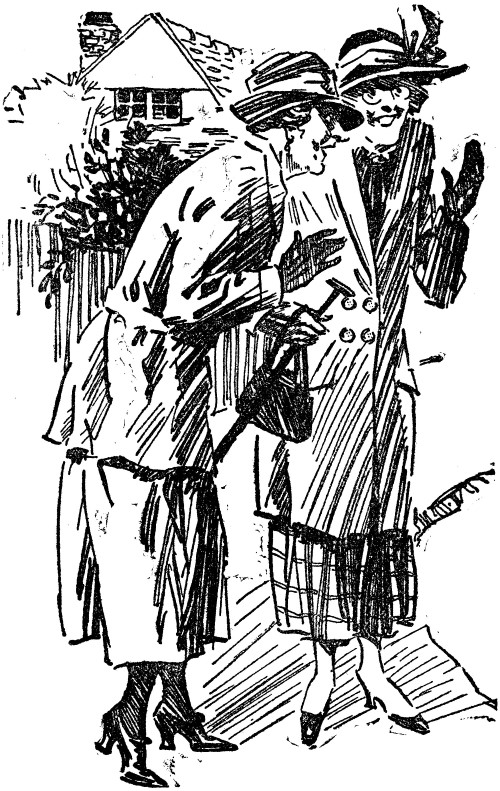
“LUKY!” CRIED MISS BLAKE.
“TWINKIE!” EXCLAIMED MISS CLIFF.
“HE’S MINE!”
“HE ISN’T!”
William felt a spasmodic movement in the basket at
the sound of the name. He moistened his lips and
shook his head.
Miss Amelia Blake was looking with interest at his
basket. It happened that she wanted a new shopping
basket, and had called at the basket-shop about one
that morning.
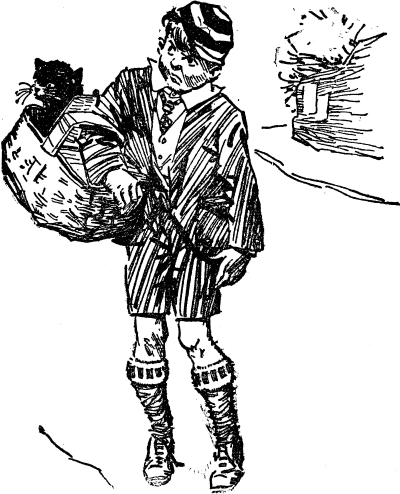
A BLACK HEAD AROSE FROM THE BASKET AND PURRED.
“May I look at your basket, William?” she said
kindly. “I like these covered baskets for shopping.
The things can’t tumble out. On the other hand, of
course, you can’t get so many things in. Are the
fastenings firm?”
Her hand was outstretched innocently towards the
fastenings. A cold perspiration broke out over
William. He put his hands desperately over the
fastenings.
“I wun’t—I wun’t touch ’em,” he said hoarsely.
“It’s—it’s a bit full. I wun’t like all the things to
come tumblin’ out here.”
Miss Amelia Blake smiled agreement and Miss Cliff
beamed on him from the other side. William was
wishing that the earth would open and swallow up Miss
Amelia Blake and Miss Cliff and Twinkie-Luky and
himself.
At last the ’bus stopped at the cross-road and they
all got out. William’s relief was indescribable. That
was over. And it was the last time he’d ever change
their ole cats for ’em. He turned to go down the road,
but Miss Amelia Blake put her hand on his arm.
“I’ll hold it very carefully, William,” she pleaded.
“I won’t let anything tumble out, but I do want to
see if the fastenings of these baskets are secure.”
Miss Cliff stood by smiling with interested curiosity.
William mutely abandoned himself to Fate. Miss
Amelia Blake opened one fastening, the flap turned
back, and a black-whiskered head arose and looked
around with a purr.
“Luky!”
“Twinkie!”
“He’s mine.”
“I bought him at Mr. Gorton’s.”
“How can you say he’s yours?”
“He’s mine,” cried Miss Cliff.
“He isn’t,” retorted Miss Blake.
“He knows me—Twinkie!”
“Luky!”
Both made a grab at Twinkie-Luky, but Twinkie-Luky
escaped both and flew like a dart down the road
in the direction of Mr. Gorton’s. Like all real gentlemen,
Twinkie-Luky preferred death to a scene. William
was no coward, but even a braver man than William
would have fled. William’s fleeing figure was already
half-way down the road in which his home lay.
At the cross-roads Miss Amelia Blake and Miss Cliff
clung to each other hysterically and sent forth shrill,
discordant cries after the fleeing Twinkie-Luky.
“Twinkie, Twinkie, Twinkie, Twinkie, Twink-ee-ee-ee-ee-ee!”
“Luky, Luky, Luky, Luky, Lukee-ee-ee-ee-ee!”
And William ran as if all the cats in the world were
at his heels.
CHAPTER X
WILLIAM THE SHOWMAN
WILLIAM and his friends, known to themselves
as the Outlaws, were in their usual state of
insolvency. All entreaties had failed to melt the heart
of Mr. Beezum, the keeper of the general stores in the
village, who sold marbles, along with such goods as
hams and shoes and vegetables.
William and his friends wanted marbles—simply a
few dozen of ordinary glass marbles which could be
bought for a few pence. But Mr. Beezum refused to
overlook the small matter of the few pence. He
refused to give the Outlaws credit.
“My terms to you, young gents, is cash down, an’
well you know it,” he said firmly.
“If you,” said William generously, “let us have
the marbles now we’ll give you a halfpenny extra
Saturday.”
“You said that once before, young gent, if I
remember right,” said Mr. Beezum, adjusting his
capacious apron and turning up his shirt-sleeves
preparatory to sweeping out his shop.
William was indignant at the suggestion.
“Well,” he said, “well—you talk ’s if that was my
fault—’s if I knew my people was going to decide
sudden not to give me any money that week simply
because one of their cucumber frames got broke by
my ball. An’ I brought back the things wot you’d let
me have. I brought the trumpet back an the
rock——”
“Yes—the trumpet all broke an’ the rock all bit,”
said Mr. Beezum. “No—cash down is my terms, an’
I sticks to ’em—if you please, young gents.”
He began his sweeping operations with great energy,
and the Outlaws found themselves precipitated into
the street by the end of his long broom.
“Mean,” commented William, rising again to the
perpendicular. “Jus’ mean! I’ve a good mind not to
buy ’em there at all.”
“He’s the only shop that sells ’em,” remarked
Ginger.
“An’ we’ve got no money to buy ’em anywhere,
anyway,” said Henry.
“S’pose we couldn’t wait for ’em till Saturday?”
suggested Douglas tentatively.
He was promptly crushed by the Outlaws.
“Wait!” said Ginger. “Wait! Wot’s the use of
waitin’? We may be doing something else on Saturday.
We mayn’t want to play with marbles—all that long
time off.”
“’F only you’d save your money,” said William
severely, “’stead of spendin’ it the day you get it we
shun’t be like this—no marbles, an’ swep’ out of his
shop an’ nothing to play at.”
This was felt to be unfair.
“Well, I like that—I like that,” said Ginger. “And
wot about you—wot about you?”
“Well, if I was the only one, you could have lent
me money an’ we could get marbles with it—if you’d
not spent all your money we could be buyin’ marbles
now ’stead of standin’ swep’ out of his shop.”
Ginger thought over this, aware that there was
usually some fallacy in William’s arguments if only
one could lay one’s hand on it.
Henry turned away.
“Oh, come along,” he said impatiently. “It’s no
good staring in at his ole butter an’ cheese. Let’s
think of something else to do.”
“Anyway, it’s nasty cheese,” said Douglas comfortingly.
“My mother said it was—so p’raps it’s a
good thing we’ve been saved buyin’ his marbles.”
“Something else to do?” said William. “We want
to play marbles, don’t we? Wot’s the good of thinkin’
of other things when we want to play marbles?”
“’S all very well to talk like that,” said Ginger with
sudden inspiration. “An’ we might jus’ as well say that
’f you’d not spent your money you could have lent us
some, an’ that’s just as much sense as you saying if
we——”
“Oh, do shut up talkin’ stuff no one can understand,”
said William, “let’s get some money.”
“How?” said Ginger, who was nettled. “All right.
Get some, an’ we’ll watch you. You goin’ to steal some
or make some. ’F you’re clever enough to steal some
or make some I’ll be very glad to join with it.”
“Yes, well, if I stealed some or made some you just
wouldn’t join with it,” said William crushingly.
“Let’s sell something,” said Henry.
“We’ve got nothing anyone’d buy,” said Ginger.
“Let’s sell Jumble.”
“Jumble’s mine. You can jus’ sell your own dogs,”
said William, sternly.
“We’ve not got any.”
“Well, then, sell ’em.”
“That’s sense, isn’t it?” said Ginger. “Jus’ kindly
tell us how to sell dogs we’ve not got—— Jus’——”
But William was suddenly tired of this type of verbal
warfare.
“Let’s do something—let’s have a show.”
“Wot of?” said Ginger without enthusiasm. “We’ve
got nothing to show, an’ who’ll pay us money to look
at nothing. Jus’ tell us that.”
“We’ll get something to show—I know,” he said
suddenly, “a c’lection of insecks. Anyone’d pay to
see an exhibition of a c’lection of insecks, wun’t they?
I don’t s’pose there are many c’lections of insecks,
anyway. It’d be interestin’. Everyone’s interested in
insecks.”
For a minute the Outlaws wavered.
“Who’d c’lect ’em?” said Henry, dubiously.
“I would,” said William with an air of stern purpose.
*****
The Collection of Insects was almost complete. The
show was to be held that afternoon.
The audience had been ordered to attend and bring
their halfpennies. The audience had agreed, but had
reserved to itself the right not to contribute the halfpennies
if the exhibition was not considered worth it.
“Well,” was William’s bitter comment on hearing
this, “I shouldn’t have thought there was so many
mean people in the world.”
He had taken a great deal of trouble with his collection.
He had that very morning been driven out of
Miss Euphemia Barney’s garden by Miss Euphemia
herself, though he had only entered in pursuit of a
yellow butterfly that he felt was indispensable to the
collection.
Miss Euphemia Barney was the local poetess and the
leader of the intellectual life of the village. Miss
Euphemia Barney was the President of the Society for
the Encouragement of Higher Thought. The members
of the society discussed Higher Thought in all its
branches once every fortnight. At the end of the
discussion Miss Euphemia Barney would read her
poems.
Euphemia Barney’s poems had never been published.
Miss Euphemia said that in these days of worldliness
and money-worship she would set an example of unworldliness
and scorn for money. “I think it best,”
she would say, “that I should not publish.”
As a matter of fact she had the authority of several
publishers for the statement. She disliked William
more than anyone else she had ever known—and she
said that she knew just what sort of a woman Miss
Fairlow was as soon as she heard that Miss Fairlow
had “taken to” William.
Miss Fairlow had only recently come to live at the
village. Miss Fairlow was a real, live, worldly, money-worshipping
author who published a book every year
and made a lot of money out of it. When she came to
live in the village Miss Euphemia Barney was prepared
to patronise her in spite of this fact, and even asked
her to join the Society for the Encouragement of
Higher Thought.
But, to the surprise of Miss Euphemia, Miss Fairlow
refused.
Miss Euphemia pitied her as she would have pitied
anyone who had refused the golden chance of belonging
to the Society for the Encouragement of Higher
Thought under her—Miss Euphemia Barney’s—presidency,
but, as she said to the Society, “her influence
would not have tended to the unworldliness and purity
that distinguishes us from so many other societies and
bodies—it is all for the best.”
To her most intimate friends she said that Miss
Fairlow had refused the offer of membership in order
to mask her complete ignorance of Higher Thought.
“Ignorant, my dear,” she said. “Ignorant—like all
these popular writers.”
So the Society for the Encouragement of Higher
Thought pursued its pure and unworldly path, and
Miss Fairlow only laughed at it from a distance.
*****
Chased ignominiously from Miss Euphemia’s garden,
William went along to Miss Fairlow’s. He could see
her over the hedge mowing the lawn.
“Hello,” he said.
“Hallo, William,” she replied.
“Got any insects there?” said William.
“Heaps. Come in and see.”
William came in with a business-like air—his large
cardboard box under his arm—and began to hunt
among her garden plants.
“Would you call a tortoise an insect?” he said
suddenly.
“If I wanted to,” she replied.
“Well, I’m going to,” said William firmly. “And
I’m going to call a white rat an insect.”
“I don’t see why you shouldn’t—it might belong to
a special branch of the insect world, a very special
branch. You ought to give it a very special name.”
The idea appealed to William.
“All right. What name?”
Miss Fairlow rested against the handle of her lawn
mower in an attitude of profound meditation.
“We must consider that—something nice and
long.”
“Omshafu,” said William suddenly, after a moment’s
thought. “It just came,” he went on modestly, “just
came into my head.”
“It’s a beautiful word,” said Miss Fairlow. “I don’t
think you could have a better one—an insect of the
Omshafu branch.”
“I think I’ll call its name Omshafu, too,” said
William, picking a furry caterpillar off a leaf.
“Yes,” said Miss Fairlow, “it seems a pity not to
use a word like that as much as you can now you’ve
thought of it.”
William put a ladybird in on top of the caterpillar.
“It’s going to be jolly fine,” he said optimistically.
“What?” said Miss Fairlow.
“Oh, jus’ a c’lection of insects I’m doing,” said
William.
Later in the morning, William brought Omshafu
over to visit Miss Fairlow. It escaped, and Miss
Fairlow pursued it up her front stairs and down her
back ones, and finally captured it. Omshafu rewarded
her by biting her finger. William was apologetic.
“I daresay it just didn’t like the look of me,” said
Miss Fairlow sadly.
“Oh, no,” William hastened to reassure her; “it’s
bit heaps of people this year—it bites people it likes.
I don’t see why it shun’t be an insect, anyway, do
you?”
*****
William’s Collection of Insects was ready for the
afternoon’s show. The exhibits were arranged in small
cardboard boxes, covered mostly with paper, and these
were all packed into a large cardboard box.
The only difficulty was that he could not think
where to conceal it from curious or disapproving eyes
till after lunch. The garden, he felt, was not safe—cats
might upset it, and once upset in the garden the
insects would be able to return to their native haunts
too quickly. His mother would not allow him to keep
them indoors. She would find them and expel them
wherever he put them.
Unless—William had a brilliant idea—he hid them
under the drawing-room sofa. The drawing-room sofa
had a cretonne cover with a frill that reached to the
floor, and he had used this place before as a temporary
receptacle for secret treasures. No one would look
under it, or think of his putting anything there. He
put the tortoise into a box with a lid, and tied Omshafu
up firmly with string in his box, and put them in the
large cardboard box with the insects. Then he put the
large cardboard box under the sofa and went into
lunch with a mind freed from anxiety.
The exhibition was not to begin till three, so William
wandered out to find Jumble. He found him in the
ditch, threw sticks for him, brushed him severely with
an old boot brush that he kept in the outhouse for the
rare occasions of Jumble’s toilet, and finally tied round
his neck the old, raggy and almost colourless pink
ribbon that was his gala attire. Then he came to the
drawing-room for the exhibits. There he received his
first shock.
On the drawing-room sofa sat Miss Euphemia
Barney, wearing her very highest thought expression.
She surveyed William from head to foot silently with
a look of slight disgust, then turned away her head
with a shudder. William sought his mother.
“Wot’s she doin’ in our house?” he demanded
sternly.
“I’ve lent the drawing-room for a meeting of the
Higher Thought, darling,” said Mrs. Brown reverently,
“because she has the painters in her own drawing-room.
You mustn’t interrupt.”
Mrs. Brown was not a Higher Thinker, but she
cherished a deep respect for them.
“But——” began William indignantly, then stopped.
He thought, upon deliberation, that it was better
not to betray his hiding-place.
He went back to the drawing-room determined to
walk boldly up to the sofa and drag out the exhibits
from under the very skirts of Miss Euphemia Barney.
But two more Higher Thinkers were now established
upon the sofa, one on each side of the President, and
Higher Thinkers were pouring into the room. William’s
courage failed him. He sat down upon a chair by the
door scowling, his eyes fixed upon Miss Euphemia’s
skirts.
The members looked at him with lofty disapproval.
The gathering was complete. The meeting was about
to begin. Miss Euphemia Barney was to speak on
the Commoner Complexes. But first she turned upon
William, who sat with his eyes fixed forlornly on the
hem of her skirts, a devastating glare.
“Do you want anything, little boy?” she said.
Before William had time to tell her what he wanted
the maid threw open the door and announced Miss
Fairlow. The Higher Thinkers gasped. Miss Fairlow
looked round as Daniel must have looked round at
his lions.
“I came——” she said. “Oh, dear!”
Miss Euphemia waved her to a seat. It occurred to
her that here was a heaven-sent opportunity of impressing
Miss Fairlow with a real respect for Higher
Thought. Miss Fairlow must learn how much higher
they were in thought than she could ever be. It would
be a great triumph to enlist Miss Fairlow as a humble
member and searcher after truth under her—Miss
Euphemia’s—leadership.
“You came to see Mrs. Brown, of course,” she said
kindly, “and the maid showed you in here thinking you
were—ahem—one of us. Mrs. Brown has kindly lent
us her drawing-room for a meeting. Pray don’t
apologise—perhaps you would like to listen to us for
a short time. We were about to discuss the Commoner
Complexes. I will begin by reading a little poem.
I spent most of this morning putting the final touches
to it,” she ended proudly.
“I spent most of this morning on the pursuit of
Omshafu,” said Miss Fairlow gravely.
There was a moment’s tense silence. Omshafu?
The Higher Thinkers sent glances of desperate appeal
to their president. Would she allow them to be
humiliated by this upstart?
“Ah, Omshafu!” said Miss Euphemia slowly. “Of
course it—it is very interesting.”
The Higher Thinkers gave a sigh of relief.
“I could hardly tear myself away this morning,” replied
Miss Fairlow pleasantly. “It was so engrossing.”
Engrossing! Some sort of Eastern philosophy, of
course. Again desperate glances were turned upon the
embodiment of Higher Thought. Again she rose to
the occasion.
“I felt just the same about it when I—er—when I,”
she risked the expression, “took it up.”
She felt that this implied that she had known about
Omshafu long before Miss Fairlow, and this conveyed
a delicate snub.
Miss Fairlow’s glance rested momentarily on her
bandaged finger.
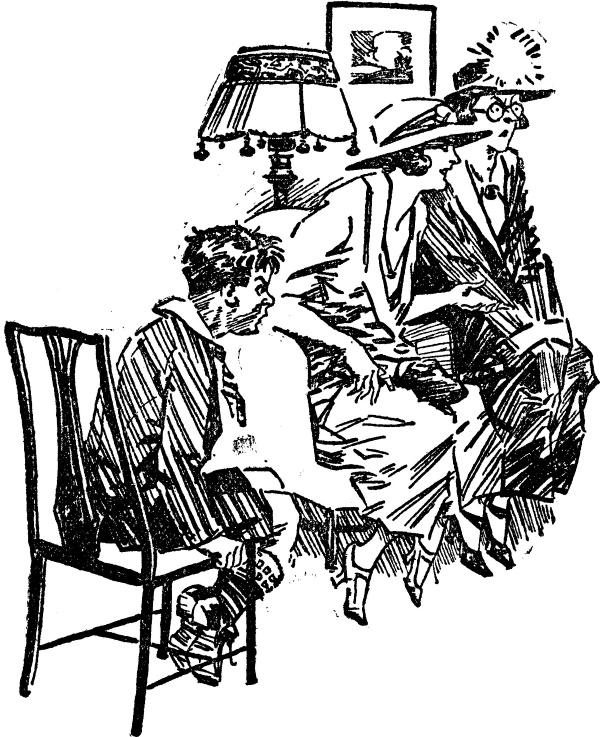
“THERE’S OMSHAFU HIMSELF,” SAID MISS FAIRLOW
IN HER CLEAR VOICE. “I CAN SEE HIS DEAR LITTLE
PINK NOSE PEEPING OUT.”
“It goes very deep,” she murmured.
Miss Barney was gaining confidence.
“There I disagree with you,” she said firmly. “I think
its appeal is entirely superficial.”
William had brightened into attention at the first
mention of Omshafu, but finding the conversation
beyond him, had relapsed into a gloomy stare. Now
his state became suddenly fixed; his mouth opened
with horror.
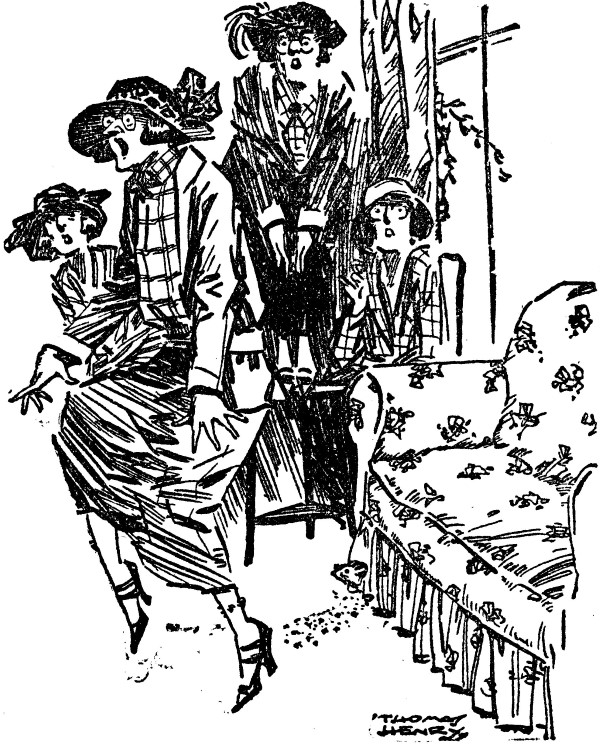
MISS EUPHEMIA JUMPED UP WITH A PIERCING SCREAM.
“SOMETHING STUNG ME!” SHE CRIED. “IT’S BEES
COMING FROM UNDER THE SOFA!”
The exhibits were escaping from beneath the hem
of Miss Euphemia’s gown. A cockroach was making
a slow and stately progress into the middle of the
room, several ants were laboriously climbing up Miss
Euphemia’s dress. So far no one else had noticed.
William gazed in frozen horror.
“I hear that Omshafu has bitten most people this
year,” said Miss Fairlow demurely.
Miss Euphemia pursued her lips disapprovingly. She
was growing reckless with success. “I think there’s
something dangerous in it,” she said.
“You mean its teeth?” said Miss Fairlow brightly.
There was a moment’s tense silence. A horrible
suspicion occurred to Miss Euphemia that she was
being trifled with. The Higher Thinkers looked helplessly
first at her and then at Miss Fairlow. Then Miss
Euphemia rose from the sofa with a piercing scream.
“Something’s stung me! It’s bees—bees coming
from under the sofa!”
Simultaneously the Treasurer jumped upon a small
occasional table.
“Black beetles!” she screamed. “Help!”
Above the babel rose Miss Fairlow’s clear voice.
“And there’s Omshafu himself. I can see his dear
little pink nose peeping out.”
Babel ceased for one second while the Society for
the Encouragement of Higher Thought looked at
Omshafu. Then it arose with redoubled violence.
*****
William departed with his exhibits. He had recaptured
most of them. Omshafu had been taken from
the ample silk sash of the Treasurer in a fold of which
he had taken refuge. William had left his mother
and Miss Fairlow pouring water on the hysterical
Treasurer.
William was late as it was. Behind him trotted
Jumble, the chewed-up remains of his gala attire
hanging from his mouth.
“William.”
Miss Fairlow was just behind, carrying a cardboard
box.
“Oh, William,” she said, “I was really bringing this
to you when they showed me into the wrong room and
I couldn’t resist having a game with them. I found
it this morning after you’d gone—in an old drawer
I was tidying, and I thought you might like it.”
William opened it. It was a case of butterflies—butterflies
of every kind, all neatly labelled.
“I think it used to belong to my brother,” said
Miss Fairlow carelessly. “Would you like it?”
“Oh, crumbs!” gasped William. “Thanks.”
“And I’ve had the loveliest time this afternoon that
I’ve had for ages,” said Miss Fairlow dreamily. “Thank
you so much.”
William hastened to the old barn in which the
Exhibition was to be held. Ginger, Douglas and
Henry and the audience were already there.
“Well, you’re early, aren’t you?” said Douglas
sarcastically.
“D’you think,” said William sternly, “that anyone
wot has had all the hard work I’ve had getting together
this c’lection could be here earlier?”
The half-dozen little boys who formed the audience
grasped their halfpennies firmly and looked at William
suspiciously.
“They won’t give up their halfpennies,” said Henry
in deep disgust.
“No,” said the audience, “not till we’ve seen if it’s
worth a halfpenny.”
William assumed his best showman air.
“This, ladies and gentlemen,” he began, ignoring the
fact that his audience consisted entirely of males, “is
the only tortoise like this in the world.”
“Seen a tortoise.” “Got a tortoise at home,” said
his audience unimpressed.
“Perhaps,” said William crushingly. “But have
you ever seen a tortoise with white stripes like wot
this one has?”
“No, but I could if I got an ole tin of paint and
striped our one.”
William passed on to the next box.
He took out Omshafu.
“This,” he said, “is the only rat inseck of the
speeshees of Omshafu——”
“If you think,” said the audience, “that we’re goin’
to pay a halfpenny to see that ole rat wot we’ve seen
hundreds of times before, and wot’s bit us, too—well,
we’re not.”
Despair began to settle down upon Ginger’s face.
William passed on to the third box.
“Here, ladies and gentlemen,” he said impressively,
“is thirty sep’rate an’ distinct speeshees of insecks.
I only ask you to look at them. I——”
“They’re jus’ the same sort of insecks as crawl about
our garden at home,” said the audience coldly.
“But have you ever seen ’em c’lected together
before?” said William earnestly. “Have you ever
seen ’em c’lected? Think of the trouble an’ time wot
I took c’lecting ’em. Why, the time alone I took’s
worth more’n a halfpenny. I should think that’s worth
a halfpenny. I should think it’s worth more’n a halfpenny.
I should think——”
“Well, we wun’t,” said the audience. “We’d as
soon see ’em crawling about a garden for nothin’ as
crawlin’ about a box for a halfpenny. So there.”
Ginger, Douglas and Henry looked at William
gloomily.
“They aren’t worth getting a c’lection for,” said
Ginger.
“They deserve to have their halfpennies took off
’em!” said Douglas.
But William slowly and majestically brought out his
fourth box and opened it, revealing rows of gorgeous
butterflies, then closed it quickly.
The audience gasped.
“When you’ve given in your halfpennies,” said
William firmly, “then you can see this wonderfu’
an’ unique c’lection of twenty sep’rate an’ distinct
speeshees of butterflies all c’lected together.”
Eagerly the halfpennies were given to William. He
handed them to Douglas, triumphantly. “Go an’ buy
the marbles, quick,” he said in a hoarse whisper, “case
they want ’em back.”
Then he turned to his audience, smoothed back his
hair, and reassumed his showman manner.
*****
In Mrs. Brown’s drawing-room the members of the
Society for the Encouragement of Higher Thought
were recovering from various stages of hysterics.
“We shall have to dissolve the society,” said Miss
Euphemia Barney. “She’ll tell everyone. It’s a
wicked name for a rat, anyway—almost blasphemous—I’m
sure it comes in the Bible. How was one to know?
But people will never forget it.”
“We might form ourselves again a little later under
a different name,” suggested the Secretary.
“People will always remember,” said Miss Euphemia.
“They’re so uncharitable. It’s a most unfortunate
occurrence. And,” setting her lips grimly, “as is the
case with most of the unfortunate occurrences in this
village, the direct cause is that terrible boy, William
Brown.”
At that moment the direct cause of most of the
unfortunate occurrences in the village, with his friends
around him, his precious box of butterflies by his side,
and happiness in his heart, was just beginning the
hard-won, long-deferred game of marbles.
CHAPTER XI
WILLIAM’S EXTRA DAY
“WHAT’S Leap Year?” asked William.
“It’s a year that leaps,” said his elder
brother, Robert.
“It’s Leap Year this year,” said William.
“Who told you?” inquired Robert sarcastically.
“Well, I don’t see much leapin’ about this year so
far,” said William, trying to rise to equal heights of
sarcasm.
“Oh, go and play Leap Frog,” said Robert scathingly.
“I don’t believe you know,” said William. “I don’t
for a minute b’lieve you know why it’s called Leap
Year. You don’t care, either. S’long as you can sit
talkin’ to Miss Flower, you don’t care about anything
else. You’ve not even got any curiosity ’bout Leap
Year nor anything else. I dunno what you find to
talk to her about. I bet she doesn’t know why it’s
Leap Year no more than you do. You don’t talk ’bout
anything sensible—you an’ Miss Flower. You——”
Robert’s youthful countenance had flushed a dull
red. Miss Flower was the latest of Robert’s seemingly
endless and quickly changing succession of grand
passions.
“You don’t even talk most of the time,” went on
William scornfully, “’cause I’ve watched you. You
sit lookin’—jus’ lookin’—at each other like wot you
used to with Miss Crane an’ Miss Blake an’ Miss—what
was she called? An’ it does look soft, let me tell you,
to anyone watchin’ through the window.”
Robert rose with murder in his eye.
“Shut up and get out!” he roared.
William shut up and got out. He sighed as he
wandered into the garden. It was like Robert to get
into a temper just because somebody asked him quite
politely what Leap Year was.
Ethel, William’s grown-up sister, was in the drawing-room.
“Ethel,” said William, “why’s it called Leap Year?”
“Because of February 29th,” said Ethel.
“Well,” said William, with an air of patience tried
beyond endurance, “if you think that’s any answer to
anyone askin’ you why’s it Leap Year—if you think
that’s an answer that means anythin’ to any ornery
person....”
“You see, everything leaps on February 29th,” said
his sister callously; “you wait and see.”
William looked at her in silent scorn for a few
moments, then gave vent to his feelings.
“Anyone ’d think that anyone ’s old as you an’
Robert would know a simple thing like that. Jus’
think of you an’ Robert an’ Miss Flower not knowing
why it’s called Leap Year.”
“How do you know Miss Flower doesn’t know?”
“Well, wun’t she have told Robert if she knew?
She must have told Robert everythin’ she knows by
this time, talkin’ to him an’ talkin’ to him like she does.
F’ that matter I don’t s’pose Mr. Brooke knows. He’d
have told you ’f he did. He’s always——”
Ethel groaned.
“Will you stop talking and go away if I give you
a chocolate?” she said.
William forgot his grievance.
“Three,” he stipulated in a quick business-like voice.
“Gimme three ’n I’ll go right away.”
She gave him three so readily that he regretted not
having asked for six.
He put two in his mouth, pocketed the third, and
went into the morning-room.
His father was there reading a newspaper.
“Father,” said William, “why’s it called Leap
Year?”
“How many times am I to tell you,” said his father,
“to shut the door when you come into a room? There’s
an icy blast piercing down my neck now. Do you
want to murder me?”
“No, father,” said William kindly. He shut the
door.
“Father, why’s it called Leap Year?”
“Ask your mother,” said his father, without looking
up from his paper.
“She mightn’t know.”
“Well, ask someone else then. Ask anyone in
heaven or earth. But don’t ask me anything! And
shut the door when you go out.”
William, though as a rule slow to take a hint, went
out of the room and shut the door.
“He doesn’t know,” he remarked to the hat-rack
in the hall.
He found his mother in the dining-room. She was
engaged in her usual occupation of darning socks.
“Mother,” said William, “why’s it called Leap
Year?”
“I simply can’t think, William,” said Mrs. Brown
feelingly, “how do you get such dreadful holes in
your heels?”
“It’s that hard road on
the way to school, I ’spect,”
said William. “I’ve gotter
walk to school. I ’spect
that’s it. I ’spect ’f I didn’t
go to school an’ kept to the
fields an’ woods I wun’t
gettem like wot I do. But
you an’ father keep sayin’
I’ve gotter go to school. I
wun’t mind not goin’—jus’
to save you trouble. I wun’t
mind growin’ up ign’rant
like wot you say I would if
I didn’t go to school—jus’ to save you trouble—I——”
Mrs. Brown hastily interrupted him.
“What did you want to know, William?”
William returned to his quest.
“Why’s it called Leap Year?”
“Well,” said Mrs. Brown, “it’s because of February
29th. It’s an extra day.”
William thought over this for some time in silence.
“D’you mean,” he said at last, “that it’s an extra
day that doesn’t count in the ornery year?”
“Yes, that’s it,” said Mrs. Brown vaguely. “William
dear, I wish you wouldn’t always stand just in my
light.”
*****
It was February 29th. William was unusually silent
during breakfast. In the relief caused by his silence
his air of excitement was unnoticed.
After breakfast, William went upstairs. He took
two small paper parcels from a drawer and put them
into his overcoat pocket. One contained several small
cakes surreptitiously abstracted from the larder, the
other contained William’s “disguise.” William’s “disguise”
was a false beard which had formed part of
Robert’s hired costume for the Christmas theatricals.
Robert never knew what had happened to the beard.
He had been charged for it as “missing” by the
theatrical costumier.
William had felt that a “disguise” was a necessity
to him. All the heroes of the romances he read found
it necessary in the crises of their adventurous lives to
assume disguises. William felt that you never knew
when a crisis was coming, and that any potential hero
of adventure—such as he knew himself to be—should
never allow himself to be without a “disguise.” So far
he had not had need to assume it. But he had hopes
for to-day. It was an extra day. Surely you could
do just what you liked on an extra day. To-day was
to be a day of adventure.
He went downstairs and put on his cap in the hall.
“You’ll be rather early for school,” said Mrs. Brown.
William’s unsmiling countenance assumed a look
of virtue.
“I don’t mind bein’
early for school,” he said.
Slowly and decorously he
went down the drive and
disappeared from sight.
Mrs. Brown went back
to the dining-room where
her husband was still
reading the paper.
“William’s so good to-day,”
she said.
Her husband groaned.
“Eight-thirty in the morning,” he said, “and she
says he’s good to-day! My dear, he’s not had time
to look round yet!”
William walked down the road with a look of set
purpose on his face. Near the school he met Bertram
Roke. Bertram Roke was the good boy of the school.
“You’re not goin’ to school to-day, are you?” said
William.
“Course,” said Bertram virtuously. “Aren’t you?”
“Me?” said William. “Don’t you know what day
it is? Don’t you know it’s an extra day wot doesn’t
count in the ornery year. Catch me goin’ to school on
an extra day what doesn’t count in the ornery year.”
“What are you goin’ to do, then?” said Bertram,
taken aback.
“I’m goin’ to have adventures.”
“You’ll—you’ll miss geography,” said Bertram.
“Geography!” said the hero of adventures scornfully.
Leaving Bertram gaping over the school wall, his
Latin grammar under one arm and his geography book
under the other, William walked up the hill and into
the wood in search of adventures.
*****
It was most certainly a gipsy encampment. There
was a pot boiling on a camp fire and a crowd of ragged
children playing around. Three caravans stood on the
broad cart track that led through the wood.
William watched the children wistfully from a
distance. More than anything on earth at that moment
William longed to be a gipsy. He approached the
children. All of them fled behind the caravans except
one—a very dirty boy in a ragged green jersey and
ragged knickers and bare legs. He squared his fists
and knocked William down. William jumped up and
knocked the boy down. The boy knocked William
down again, but overbalanced with the effort. They
sat on the ground and looked at each other.
“Wot’s yer nyme?” said the boy.
“William. Wot’s yours?”
“Helbert. Wot yer doin’ ’ere?”
“Lookin’ for adventures,” said William. “It’s an
extra day, you know. I want to-day to be quite
different from an ornery day. I want some adventures;
I’d like to be a gipsy, too,” he ended, wistfully.
Helbert merely stared at him.
“Would they take me?” went on William, nodding
his head in the direction of the caravans. “I’d soon
learn to be a gipsy. I’d do all they told me. I’ve
always wanted to be a gipsy—next to a Red Indian
and a pirate, and there don’t seem to be any Red
Indians or pirates in this country.”
Helbert once more merely stared at him. William’s
hopes sank.
“I’ve not got any gipsy clothes,” he said, “but
p’raps they’d give me some.”
Enviously William looked at Helbert’s ragged jersey
and knickers and bare feet. Enviously Helbert looked
at William’s suit. Suddenly Helbert’s heavy face
lightened. He pointed to William’s suit.
“Swop,” he said, succinctly.
“Don’t you really mind?” said William, humbly and
gratefully.
The exchange was effected behind a bush. William
carefully transferred his packet of provisions and his
disguise from his pocket to the pocket of Helbert’s
ragged knickers. Then, while Helbert was still donning
waistcoat and coat, William swaggered into the open
space round the fire. His heart was full to bursting.
He was a gipsy of the gipsies.
“’Ello,” he called, in swaggering friendly greeting
to the gipsy children. But his friendliness was not
returned.
“’E’s stole Helbert’s clothes.”
“You wait till my Dad ketches yer. ’E’ll wallop
yer.”
“Ma! ’E’s got our Helbert’s jersey on.”
A woman appeared suddenly at the door of the
caravan. She was larger and dirtier and fiercer-looking
than anyone William had ever seen before. She
advanced upon William, and William, forgetting his
dignity as a hero of adventures, fled through the
wood in terror, till he could flee no more.
Then he stopped, and discovering that the fat woman
was not pursuing him, sat down and leant against a
tree to rest. He took out his crumpled packet of
provisions, ate one cake and put the rest back again
into his pocket. He felt that his extra day had
opened propitiously. He was a gipsy. William never
felt happier than when he had completely shed his
own identity.
He did not regret leaving the members of the gipsy
encampment. He had not really liked the look of any
of them. There had been something unfriendly even
about Helbert. He preferred to be a gipsy on his
own. He ran and leapt. He turned cart wheels.
He climbed trees. He was riotously happy. He was
a gipsy.
Suddenly he saw a little old man stretched out at
full length beneath a tree. The little old man was
watching something in the grass through a magnifying
glass. On one side of him lay a notebook, on the other
a large japanned tin case. William, full of curiosity,
crept cautiously towards him through the grass on the
other side of the tree. He peered round the tree-trunk,
and the little old man looking up suddenly
found William’s face within a few inches of his own.
“Sh!” said the little old man. “A rare specimen!
Ah! Gone! My movement, I am afraid. Never
mind. I had it under observation for quite fifteen
minutes. And I have a specimen of it.”
He began to write in his notebook. Then he looked
up again at William.
“Who are you, boy?” he said suddenly.
“I’m a gipsy,” said William proudly.
“What’s your name?”
“Helbert,” said William without hesitation.
“Well, Albert,” said the little old gentleman, “would
you like to earn sixpence by carrying this case to my
house? It’s just at the end of the wood.”
Without a word William took the case and set off
beside the little old gentleman. The little old gentleman
carried the notebook, and William carried the
japanned tin case.
“An interesting life, a gipsy’s, I should think,” said
the old gentleman.
Memories of stories he had read about gipsies
returned to William.
“I wasn’t born a gipsy,” he said. “I was stole by
the gipsies when I was a baby.”
The little old gentleman turned to peer at William
over his spectacles.
“Really?” he said. “That’s interesting—most interesting.
What are your earliest recollections previous
to being stolen?”
William was thoroughly enjoying himself. He was
William no longer. He was not even Helbert. He was
Evelyn de Vere, the hero of “Stolen by Gipsies,” which
he had read a few months ago.
“Oh, I remember a kinder palace an’ a garden with
stachues an’ peacocks an’—er—waterfalls an’—er—flowers
an’ things, an’ a black man what came in the
night an’ took me off, an’ I’ve gotter birthmark somewhere
what’ll identify me,” he ended, with modest
pride.
“Dear me!” squeaked the little old man, greatly impressed.
“How interesting! How very interesting!”
They had reached the little old gentleman’s house.
A very prim old lady opened the door.
“You’re late, Augustus,” she said sternly.
“A most interesting specimen,” murmured Augustus
deprecatingly. “I found it as I was on the point
of returning home and forgot the hour.”
The prim lady was looking up and down William.
“Who is this boy?” she said, still more sternly.
“Ah!” said the old gentleman, as if glad to change
the subject, “he is a little gipsy.”
“Nasty creatures!” put in the lady fiercely.
“But he has told me his story,” said Augustus
eagerly, peering at William again over the top of his
spectacles. “Interesting—most interesting. If you’ll
just come into my study with me a moment.”
The lady pointed to a chair in the hall.
“Sit there, boy,” she said to William.
After a few minutes she and the little old gentleman
came into the hall again. “Where’s this birthmark
you speak of?” said the old lady severely.
Without a moment’s hesitation, William pointed to
a small black mark on his wrist.
The lady looked at it suspiciously.
“My brother will go back with you to the encampment
to verify your strange story,” she said. “If it
is untrue I hope they will be very severe with you.
Don’t be long, Augustus.”
“No, Sophia,” said Augustus meekly, setting off
with William.
William was rather silent. It was strange how
adventures seemed to have a way of getting beyond
control.
“I don’ remember the peacocks very plain,” he
said at last.
“Hush!” said the old man, taking out his magnifying
glass. He crept up to a tree-trunk. He gazed at it
in a rapt silence.
“Most interesting,” he said. “I much regret having
left my notebook at home.”
“An’, of course,” said William, “anyone might dream
about stachues.”
They found that the encampment had gone. There
was no mistake about it. There were the smouldering
remains of the fire and the marks of the wheels of the
caravan. But the encampment had disappeared.
They went to the end of the wood, but there were no
signs of it along any of the three roads that met there.
The little old gentleman was distraught.
“Oh, dear, oh, dear!” he said. “How unfortunate!
Do you know where they were going next?”
“No,” said William, truthfully.
“Oh, dear, oh, dear! What shall we do?”
“Let’s go back to your house,” said William
trustingly. “I should think it’s about dinner time.”
“Well,” said Sophia grimly, “you’ve kidnapped a
child from a gipsy encampment, and I hope you’re
prepared to take the consequences.”
“Oh, dear,” said the old gentleman, almost in tears.
“What a day! And it opened so propitiously. I
watched a perfect example of a scavenger beetle at
work for nearly half an hour and then—this.”
William was watching them with a perfectly expressionless
face.
“Never mind,” he said. “It doesn’t matter what
happens to-day. It’s extra.”
“We must keep the boy,” said Augustus, “till we
have made inquiries.”
“Then he must be washed,” said Sophia firmly,
“and those dreadful clothes must be fumigated.”
William submitted to the humiliating process of
being washed by a buxom servant. He noticed, with
misgiving, that his birthmark disappeared in the
process. He resisted all attempts on the part of the
maid-servant at intimate conversation.
“A deaf moot, that’s wot I calls ’im,” said the maid
indignantly, “an’ me wastin’ my kindness on ’im an’
takin’ a hinterest in ’im an’ ’im treatin’ me with
scornful silence like. A deaf moot ’e is.”
The lady called Sophia had entered, carrying a short,
white, beflounced garment.
“This is the only thing I can find about your size,
boy,” she said. “It’s a fancy dress I had made for a
niece of mine about your size. Although it has a
flimsy appearance, the thing is made on a warm wool
lining. My niece was subject to bronchitis. You will
not find it cold. You can just wear it while you have
dinner, while your clothes are being—er—heated.”
A delicious smell was emanating from a saucepan
on the fire. William decided to endure anything rather
than risk being ejected before that smell materialised.
He meekly submitted to Helbert’s garments being
taken from him. He meekly submitted to being
dressed in the white, beflounced costume. He remembered
to take his two paper bags from the pockets
of Helbert’s knickers and tried, unsuccessfully, to find
pockets in the costume he was wearing, and finally
sat on them. Then, tastefully arrayed as a Fairy
Queen, he sat down at the kitchen table to a large
plateful of stew. It was delicious stew. William felt
amply rewarded for all the indignities to which he was
submitting. The servant sat opposite watching him.
“Is all gipsies deaf moots?” she said sarcastically.
“I’m not an ornery gipsy,” said William, without
raising his eyes from his plate, or ceasing his appreciative
and hearty consumption of Irish stew. “I was
stole by the gipsies, I was. I’ve gotter birthmark
somewhere where you can’t see it what’ll identify me.”
“Lor!” said the maid.
“Yes, an’ I rec’lect peacocks an’ stachues—an’—folks
walkin’ about in crowns.”
“Crikey!” said the maid, filling his plate again with
stew.
“Yes,” said William, attacking it with undiminished
gusto, “an’ the suit I was wearin’ when they stole
me is all embroidered with crowns an’ peacocks an’—an’——”
“An’ stachues, I suppose,” said the servant.
“Yes,” said William absently.
“An’ you was wearin’ silver shoes an’ stockings,
I suppose.”
“Gold,” corrected William, scraping his plate clean
of the last morsel.
“Lor!” said the maid, setting a large plate of
pudding before him. “Now, while you’re a-heatin’ of
that I’ll jus’ pop round to a friend next door an’ bring
of ’er in. I shun’t like ’er to miss ’earin’ you talk—all
dressed up, like what you are, too. It’s a fair treat,
it is.”
She went, closing the door cautiously behind her.
William disposed of the pudding and considered the
situation. He felt that this part of the adventure had
gone quite far enough. He did not wish to wait till
the maid returned. He did not wish to wait till
Augustus or Sophia had “made inquiries.”
He opened the kitchen door. The hall was empty.
Sophia and Augustus were upstairs enjoying their after-dinner
nap. William tiptoed into the hall and put on
one of the coats.
Fortunately, Augustus was a very small man, and
the coat was not much too large for William. William
gave a sigh of relief as he realised that his humiliating
costume was completely hidden. Next he put on one
of Augustus’s hats.
There was no doubt at all that it was slightly too
big. Then he returned to the kitchen, took his two
precious paper packets from the chair, put them into
Augustus’s coat pockets and crept to the front door.
It opened noiselessly. William tiptoed silently and
ungracefully down the path to the road.
All was still. The road was empty.
It seemed a suitable moment to assume the disguise.
With all the joy and pride of the artist, William
donned his precious false beard. Then he began to
walk jauntily up the road.
*****
Suddenly he noticed a figure in front of him. It
was the figure of a very, very old man, toiling laboriously
up the hill, bending over a stick. William, as an
artist, never scorned to learn. He found a stick in
the ditch and began to creep up the hill with little
faltering steps, bending over his stick.
He was thoroughly happy again.
He was not William.
He was not even Helbert.
He was a very old man, with a beard, walking up
a hill.
The old man in front of him turned into the workhouse
gates, which were at the top of the hill. William
followed. The old man sat on a bench in a courtyard.
William sat beside him. The old man was very short-sighted.
“’Ello, Thomas,” he said.
William gave a non-committal grunt. He took out
his battered paper bag and handed a few fragments
of crumbled cake to the old man. The old man ate
them. William, thrilling with joy and pride, gave him
some more. He ate them. A man in uniform came
out of the door of the workhouse.
“Arternoon, George,” he said to the old man.
He looked closely at William as he passed.
Then he came back and looked still more closely at
William. Then he said: “’Ere!” and whipped off
William’s hat. Then he said: “Well, I’m——!” and
whipped off William’s beard. Then he said: “I’ll
be——” and whipped off William’s coat.
William stood revealed as the Fairy Queen in the
middle of the workhouse courtyard.
The short-sighted old man began to chuckle in a
high, quavering voice. “It’s a lady out of a circus,”
he said. “Oh, dear! Oh, dear! It’s a lady out of
a circus!”
The man in uniform staggered back with one hand
to his head.
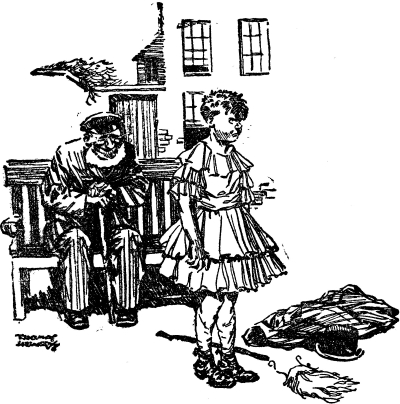
WILLIAM STOOD REVEALED AS THE FAIRY QUEEN IN THE
MIDDLE OF THE COURTYARD. THE SHORT-SIGHTED OLD
MAN BEGAN TO CHUCKLE. “IT’S A LADY OUT OF
A CIRCUS! OH, DEAR! OH, DEAR!”
“Gor’ blimey!” he ejaculated. “’Ave I gone mad,
or am I a-dreamin’ it?”
“It’s a lady out of a circus. He! He!” cackled the
old man.
But William had gathered up his scattered possessions
indignantly and fled, struggling into the coat as he
did so. He ran along the road that skirted the workhouse,
then, finding that he was not pursued, and
that the road was empty,
adjusted his hat and beard
and buttoned his coat.
THE MAN IN UNIFORM
STAGGERED BACK WITH
ONE HAND TO HIS HEAD.
At a bend in the road
there was a wayside seat
already partially occupied
by a young couple.
William, feeling slightly
shaken by the events of
the last hour, sat down
beside them. He sat there
for some minutes, listening
idly to their conversation,
before he realised with
horror who they were. He
decided to get up and
unostentatiously shuffle
away. They did not seem
to have noticed him so
far. But Miss Flower was
demanding a bunch of the
catkin palm that grew a
little farther down the road.
Robert, William’s elder
brother, with the air of a knight setting off upon
a dangerous quest for his ladye, went to get it for her.
Miss Flower turned to William.
“Good afternoon,” she said.
William shaded the side of his face from her with his
hand and uttered a sound, which was suggestive of
violent pain or grief, but whose real and only object
was to disguise his natural voice.
Miss Flower moved nearer to him on the seat.
“Are you in trouble?” she said sweetly.
William, at a loss, repeated the sound.
She tried to peer into his face.
“Could—could I help at all?” she said, in a voice whose
womanly sympathy was entirely wasted on William.
William covered his face with both his hands and
emitted a bellow of rage and desperation.
Robert was returning with the catkins. Miss Flower
went to meet him.
“Robert,” she said, “have you any money? I’ve
left my purse at home. There’s a poor old man here
in dreadful trouble.”
Robert’s sole worldly possessions at that moment
were two and sevenpence halfpenny. He gave her
half a crown. She handed it to William, and William,
keeping his face still covered with one hand pocketed
the half-crown with the other.
“Do speak to him,” whispered Miss Flower. “See
if you can help him at all. He may be ill.”
Robert sat down next to William and cleared his
throat nervously.
“Now, my man——” he began, then stopped
abruptly, staring at all that could be seen of William’s
face.
He tore off the hat and beard.
“You little wretch! And whose coat are you
wearing, you little idiot?”
He tore open the coat. The sight it revealed was
too much for him. He sank back upon the seat with
a groan.
Miss Flower sat on the grass by the roadside and
laughed till the tears ran down her cheeks.
“Oh, William!” she said. “You are priceless. I’d
just love to walk through the village with you like
that. Will you come with us, Robert?”
“No,” said Robert wildly. “At every crisis of my life
that boy turns up and always in something ridiculous.
He’s—he’s more like a nightmare than a boy.”
*****
William faced a family council consisting of his
father and mother, and Robert and Ethel.
William was still attired as a Fairy Queen.
“Well,” said William, in a tone of disgust. “You
said to-day was extra. I thought it didn’t count. I
thought nothin’ anyone did to-day counted. I thought
it was an extra day. An’ there’s Robert takin’ a
half-crown off me an’ no one seems to mind that.
An’ Robert tellin’ Miss Flower, on the seat, how he’d
wanted to live a better life since he met her.”
Robert’s face went scarlet.
“An’ then takin’ a half-crown off me,” William
continued. “I don’ call that livin’ a better life. She
gave it me an’ he took it off me. I don’ call that
being noble like what he said she made him want
to be. I don’——”
“Shut up,” said Robert desperately. “Shut up and
I’ll give you the wretched thing back.”
“All right,” said William, receiving the half-crown.
“What I want to know, William,” said Mrs. Brown
almost tearfully, “is—where are your clothes?”
William looked down at his airy costume.
“Oh, she took ’em off me an’ put this thing on
me. She said she wanted to heat ’em up. I dunno
why. She took off my green jersey an’ my——”
“You weren’t wearing a jersey,” screamed Mrs.
Brown.
William’s jaw dropped.
“Oh, those clothes! Crumbs! I’d forgotten about
those clothes. I—I suppose Helbert’s still gottem.”
Mr. Brown covered his eyes with his hand.
“Take him away,” he groaned. “Take him away!
I can’t bear the sight of him like that any longer!”
Mrs. Brown took him away.
She returned about half an hour later. William,
tired by the events of his extra day, had fallen at
once into an undeservedly peaceful slumber.
“It’ll take us weeks probably to put whatever he’s
done to-day right,” she said hysterically to her husband.
“I do hope you’ll be severe with him.”
But Mr. Brown, freed from the horrible spectacle of
William robed as a Fairy Queen, had given himself up
to undisturbed and peaceful enjoyment of the fire
and his armchair and evening paper.
“To-morrow,” he promised pacifically. “Not to-day.
You forget. To-day doesn’t count.”
“Eavesdropping,” burst out Robert suddenly.
“Simply eavesdropping. I don’t know how he can
reconcile that with his conscience.”
“Let’s all be thankful,” said Mr. Brown, “that
February 29th only happens every four years.”
“Yes, but William doesn’t,” said Robert gloomily.
“William happens all the year round.”
CHAPTER XII
WILLIAM ENTERS POLITICS
WHEN William at the Charity Fair was asked to
join a sixpenny raffle for a picture, and shown
the prize—a dingy oil painting in an oval gilt frame,
his expression registered outrage and disgust.
It was only when his friend Ginger whispered excitedly:
“I say, William, las’ week my aunt read in
the paper about someone what scraped off an ole
picture like that an’ found a real valuable ole master
paintin’ underneath an’ sold it for more’n a thousand
pounds,” that he hesitated. An inscrutable expression
came upon his freckled face as he stared at the vague
head and shoulders of a lightly clad female against a
background of vague trees and elaborate columns.
“All right,” he said, suddenly holding out the sixpence
that represented his sole worldly assets, and
receiving Ticket number 33.
“Don’t forget it was me what suggested it,” said
Ginger.
“Yes, an’ don’t forget it was my sixpence,” said
William sternly.
William was not usually lucky, but on this occasion
the number 33 was drawn, and William, purple with
embarrassment, bore off his gloomy-looking trophy.
Accompanied by Ginger he took it to the old barn.
They scraped off the head and shoulders of the
mournful and inadequately clothed female, and they
scraped off the gloomy trees, and they scraped off the
elaborate columns. To their surprise and indignation
no priceless old master stood revealed. Being thorough
in all they did, they finally scraped away the entire
canvas and the back.
“Well,” said William, raising himself sternly from
the task when nothing scrapable seemed to remain,
“an’ will you kin’ly tell me where this valu’ble ole
master is?”
“Who said definite there was a valu’ble ole master?”
said Ginger in explanation. “’F you kin’ly remember
right p’raps you’ll kin’ly remember that I said that an
aunt of mine said that she saw in the paper that
someone’d scraped away an ole picture an’ found a
valu’ble ole master. I never said——”
William was arranging the empty oval frame round
his neck.
“P’raps now,” he interrupted ironically, “you’d like
to start scratchin’ away the frame, case you find a
valu’ble ole master frame underneath.”
“Will it hoop?” said Ginger with interest, dropping
hostilities for the moment.
They tried to “hoop” it, but found that it was too
oval. William tried to wear it as a shield but it
would not fit his arm. They tried to make a harp
of it by nailing strands of wire across it, but gave up
the attempt when William had cut his finger and
Ginger had hammered his thumb three times.
William carried it about with him, his disappointment
slightly assuaged by the pride of possession, but
its size and shape were hampering to a boy of William’s
active habits, so in the end he carefully hid it behind
the door of the old barn which he and his friends
generally made their headquarters, and then completely
forgot it.
*****
The village was agog with the excitement of the
election. The village did not have a Member of
Parliament all to itself—it joined with the neighbouring
country town—but one of the two candidates, Mr.
Cheytor, the Conservative, lived in the village, so
feeling ran high.
William’s father took no interest in politics, but
William’s uncle did.
William’s uncle supported the Liberal candidate, Mr.
Morrisse. He threw himself whole-heartedly into the
cause. He distributed bills, he harangued complete
strangers, he addressed imaginary audiences as he
walked along the road, he frequently brought one hand
down heavily upon the other with the mystic words:
“Gentlemen, in the sacred cause of Liberalism——”
William was tremendously interested in him. He
listened enraptured to his monologues, quite unabashed
by his uncle’s irritable refusals to explain them to him.
Politically the uncle took no interest in William.
William had no vote.
William’s uncle was busily preparing to hold a
meeting of canvassers for the cause of the great Mr.
Morrisse in his dining-room. Mr. Morrisse, a tall, thin
gentleman, for some obscure reason very proud of his
name, who went through life saying plaintively,
“double S E, please,” was not going to be there.
William’s uncle was going to tell the canvassers the
main features of the programme with which to dazzle
the electors of the neighbourhood.
“I s’pose,” said William carelessly, “you don’t mind
me comin’?”
“You suppose wrong then,” said William’s uncle.
“I most emphatically mind your coming.”
“But why?” said William earnestly. “I’m int’rested.
I’d like to go canvassing too. I know a lot ’bout the
rackshunaries—you know, the ole Conservies—I’d like
to go callin’ ’em names, too. I’d like——”
“You may not attend the Liberal canvassers’
meeting, William,” said William’s uncle firmly.
From that moment William’s sole aim in life was to
attend the Liberal canvassers’ meeting. He and
Ginger discussed ways and means. They made an
honest and determined effort to impart to William an
adult appearance, making a frown with burnt cork,
and adding whiskers of matting which adhered to his
cheeks by means of glue. Optimists though they were,
they were both agreed that the chances of William’s
admittance, thus disguised, into the meeting of the
Liberal canvassers was but a faint one.
So William evolved another plan.
*****
The dining-room in which William’s uncle was to
hold his meeting was an old-fashioned room. A
hatch, never used, opened from it on to an old stone
passage.
The meeting began.
William’s uncle arrived and took his seat at the
head of the table with his back to the hatch. William’s
uncle was rather short-sighted and rather deaf. The
other Liberal canvassers filed in and took their places
round the table.
William’s uncle bent over his papers. The other
Liberal canvassers were gazing with widening eyes at
the wall behind William’s uncle. The hatch slowly
opened. A dirty oval gilt frame appeared, and was by
no means soundlessly attached to the top of the open
hatch. Through the aperture of the frame appeared
a snub-nosed, freckled, rough-haired boy with a dirty
face and a forbidding expression.
William didn’t read sensational fiction for nothing.
In “The Sign of Death,” which he had finished by the
light of a candle at 11.30 the previous evening, Rupert
the Sinister, the international spy, had watched a
meeting of masked secret service agents by the means
of concealing himself in a hidden chamber in the wall,
cutting out the eye of a portrait and applying his own
eye to the hole. William had determined to make the
best of slightly less favourable circumstances.
There was no hidden chamber, but there was a
hatch; there was no portrait, but there was the useless
frame for which William had bartered his precious
sixpence. He still felt bitter at the thought.
William felt, not unreasonably, that the sudden
appearance in the dining-room of a new and mysterious
portrait of a boy might cause his uncle to make closer
investigations, so he waited till his uncle had taken
his seat before he hung himself.
Ever optimistic, he thought that the other Liberal
canvassers would be too busy arranging their places to
notice his gradual and unobtrusive appearance in his
frame. With vivid memories of the illustration in
“The Sign of Death” he was firmly convinced that to
the casual observer he looked like a portrait of a boy
hanging on the wall.
In this he was entirely deceived. He looked merely
what he was—a snub-nosed, freckled, rough-haired boy
hanging up an old empty frame in the hatch and
then crouching on the hatch and glaring morosely
through the frame.
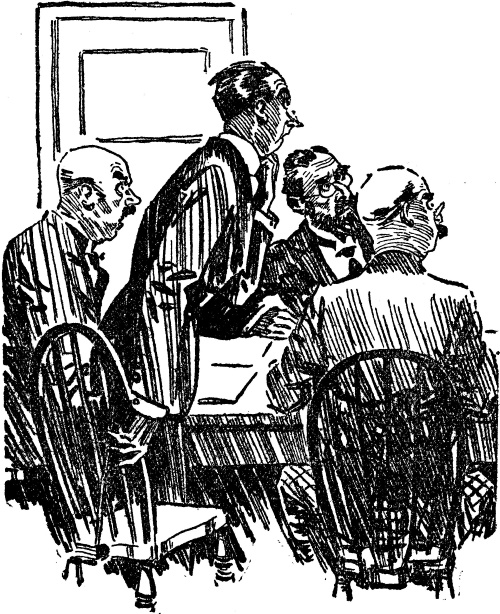
MR. MOFFAT MET WILLIAM’S STONY STARE. THE OTHER
HELPERS WERE STARING BLANKLY AT THE WALL.
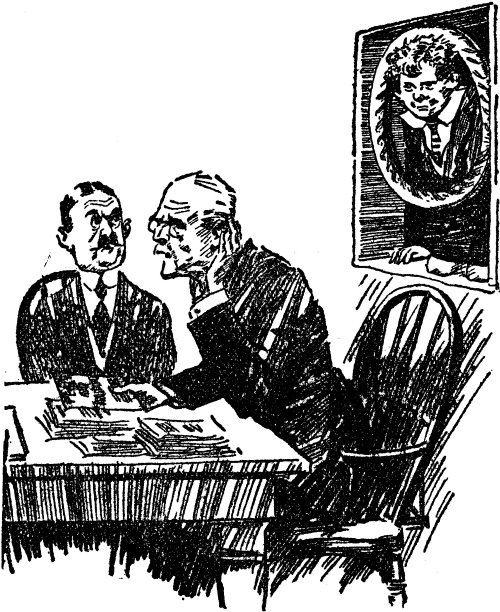
“DON’T YOU THINK THAT POINT IS VERY IMPORTANT!”
ASKED WILLIAM’S UNCLE.
William’s uncle opened the meeting:
“... and we must emphasise the consequent drop
in the price of bread. Don’t you think that point is
very important, Mr. Moffat?”
Mr. Moffat, a thin, pale youth with a large nose
and a naturally startled expression, answered as in
a trance, his mouth open, his strained eyes fixed upon
William.
“Er—very important.”
“Very—we can’t over-emphasise it,” said William’s
uncle.
Mr. Moffat put up a trembling hand as if to loosen
his collar. He wondered if the others saw it too.
“Over-emphasise it,” he repeated, in a trembling
voice.
Then he met William’s stony stare and looked
away hastily, drawing his handkerchief across his
brow.
“I think we can safely say,” said William’s uncle,
“that if the Government we desire is returned the
average loaf will be three-halfpence cheaper.”
He looked round at his helpers. Not one was
taking notes. Not one was making a suggestion. All
were staring blankly at the wall behind him.
Extraordinary what stupid fellows seemed to take
up this work—that chap with the large nose looked
nothing more or less than tipsy!
“Here are some pamphlets that we should take
round with us....”
He spread them out on the table. William was
interested. He could not see them properly from
where he was. He leant forward through his frame.
He could just see the words, “Peace and Prosperity....”
He leant forward further. He leant
forward too far. Accidentally attaching his frame
round his neck on his way he descended heavily from
the hatch. There was only one thing to do to soften
his fall. He did it. He clutched at his uncle’s neck
as he descended. A confused medley consisting of
William, his uncle, the frame and his uncle’s chair
rolled to the floor where they continued to struggle
wildly.
“Oh, my goodness,” squealed the young man with
the large nose hysterically.
Somehow in the mêlée that ensued William managed
to preserve his frame. He arrived home breathless
and dishevelled but still carrying his frame. He was
beginning to experience a feeling almost akin to
affection for this companion in adversity.
“What’s the matter?” said William’s father sternly.
“What have you been doing?”
“Me?” said William in a voice of astonishment.
“Me?”
“Yes, you,” said his father. “You come in here
like a tornado, half dressed, with your hair like a
neglected lawn——”
William hastily smoothed back his halo of stubby
hair and fastened his collar.
“Oh, that,” he said lightly. “I’ve only jus’ been
out—walking an’ things.”
Mrs. Brown looked up from her darning.
“I think you’d better go and brush your hair and
wash your face and put on a clean collar, William,”
she suggested mildly.
“Yes, Mother,” agreed William without enthusiasm.
“Father, did you know that the Libr’als are goin’ to
make bread an’ everything cheaper an’—an’ prosperity
an’ all that?”
“I did not,” said Mr. Brown dryly from behind his
paper.
“I’d give it a good brushing,” said his wife.
“If there weren’t no ole rackshunary Conservy here,”
said William, “I s’pose there wouldn’t be no reason
why the Lib’ral shouldn’t get in?”
“As far as I can disentangle your negatives,” said
Mr. Brown, “your supposition is correct.”
“I simply can’t think why it always stands up so
straight,” said Mrs. Brown plaintively.
“Well, then, why don’t they stop ’em?” said William
indignantly. “Why do they let the ole Conservies
come in an’ spoil things an’ keep bread up—why don’t
they stop ’em—why——”
Mr. Brown uttered a hollow groan.
“William,” said he grimly. “Go—and—brush—your—hair.”
“All right,” he said. “I’m jus’ goin’.”
*****
Mr. Cheytor, the Conservative candidate, had
addressed a crowded meeting and was returning wearily
to his home.
He opened the door with his latchkey and put out
the hall light. The maids had gone to bed. Then he
went upstairs to his bedroom. He opened the door.
From behind the door rushed a small whirlwind. A
rough bullet-like head charged him in the region of
his abdomen. Mr. Cheytor sat down suddenly. A
strange figure dressed in pyjamas, and over those a
dressing-gown, and over that an overcoat, stood
sternly in front of him.
“You’ve gotter stop it,” said an indignant voice.
“You’ve gotter stop it an’ let the Lib’rals get in—you’ve
gotter stop——”
Mr. Cheytor stood up and squared at William.
William, who fancied himself as a boxer, flew to the
attack. The Conservative candidate was evidently a
boxer of no mean ability, but he lowered his form to
suit William’s. He parried William’s wild onsets, he
occasionally got a very gentle one in on William.
They moved rapidly about the room, in a silence
broken only by William’s snortings. Finally Mr.
Cheytor fell over the hearthrug and William fell over
Mr. Cheytor. They sat up on the floor in front of
the fire and looked at each other.
“Now,” said Mr. Cheytor soothingly. “Let’s talk
about it. What’s it all about?”
“They’re goin’ to make bread cheaper—the Lib’rals
are,” panted William, “an’ you’re tryin’ to stoppem
an’ you——”
“Ah,” said Mr. Cheytor, “but we’re going to make
it cheaper, too.”
William gasped.
“You?” he said. “The Rackshunaries? But—if
you’re both tryin’ to make bread cheaper why’re you
fightin’ each other?”
“You know,” said Mr. Cheytor, “I wouldn’t bother
about politics if I were you. They’re very confusing
mentally. Suppose you tell me how you got here.”
“I got out of my window and climbed along our
wall to the road,” said William simply, “and then I
got on to your wall and climbed along it into your
window.”
“Now you’re here,” said Mr. Cheytor, “we may as
well celebrate. Do you like roasted chestnuts?”
“Um-m-m-m-m-m,” said William.
“Well, I’ve got a bag of chestnuts downstairs—we
can roast them at the fire. I’ll get them. By the
way, suppose your people find you’ve gone?”
“My uncle may’ve come to see my father by now,
so I don’t mind not being at home jus’ now.”
Mr. Cheytor accepted this explanation.
“I’ll go down for the chestnuts then,” he said.
*****
Fortune was kind to William. His uncle was very
busy and thought he would put off the laying of his
complaint before William’s father till the next week.
The next week he was still more busy. Encountering
William unexpectedly in the street he was struck by
William’s (hastily assumed) expression of wistful sadness,
and decided that the whole thing may have
been a misunderstanding. So the complaint was never
laid.
Moreover, no one had discovered William’s absence
from his bedroom. William came down to breakfast
the next day with a distinct feeling of fear, but one
glance at his preoccupied family relieved him. He sat
down at his place with that air of meekness which in
him always betrayed an uneasy conscience. His father
looked up.
“Good morning, William,” he said. “Care to see
the paper this morning? I suppose with your new
zeal for politics——”
“Oh, politics!” said William contemptuously. “I’ve
given ’em up. They’re so—so,” frowning he searched
in his memory for the phrase, “They’re so—confusing
ment’ly.”
His father looked at him.
“Your vocabulary is improving,” he said.
“You mean my hair?” said William with a gloomy
smile. “Mother’s been scrubbin’ it back with water
same as what she said.”
William walked along the village street with Ginger.
Their progress was slow. They stopped in front of
each shop window and subjected the contents to a
long and careful scrutiny.
“There’s nothin’ there I’d buy ’f I’d got a thousand
pounds.”
“Oh, isn’t there? Well, I jus’ wonder. How much
’ve you got, anyway?”
“Nothin’. How much have you?”
“Nothin’.”
“Well,” said William, continuing a discussion which
their inspection of the General Stores had interrupted,
“I’d rather be a Pirate than a Red Indian—sailin’ the
seas an’ finding hidden treasure——”
“I don’t quite see,” said Ginger with heavy sarcasm,
“what’s to prevent a Red Indian finding hidden
treasure if there’s any to find.”
“Well,” said William heatedly, “you show me a
single tale where a Red Indian finds a hidden treasure.
That’s all I ask you to do. Jus’ show me a single
tale where a——”
“We’re not talkin’ about tales. There’s things that
happen outside tales. I suppose everything in the
world that can happen isn’t in tales. ’Sides, think of
the war-whoops. A Pirate’s not got a war-whoop.”
“Well, if you think——”
They stopped to examine the contents of the next
shop window. It was a second-hand shop. In the
window was a medley of old iron, old books, broken
photograph frames and dirty china.
“An’ there’s nothin’ there I’d wanter buy if I’d got
a thousand pounds,” said William sternly. “It makes
me almost glad I’ve got no money. It mus’ be
mad’ning to have a lot of money an’ never see anything
in a shop window you’d want to buy.”
Suddenly Ginger pointed excitedly to a small card
propped up in a corner of the window, “Objects purchased
for Cash.”
“William,” gasped Ginger. “The frame!”
A look of set purpose came into William’s freckled
face. “You stay here,” he whispered quickly, “an’
see they don’t take that card out of the window, an’
I’ll fetch the frame.”
Panting, he reappeared with the frame a few minutes
later. Ginger’s presence had evidently prevented the
disappearance of the card. An old man with a bald
head and two pairs of spectacles examined the frame
in silence, and in silence handed William half a crown.
William and Ginger staggered out of the shop.
“Half a crown!” gasped William excitedly.
“Crumbs!”
“I hope,” said Ginger, “you’ll remember who
suggested you buying that frame.”
“An’ I hope,” said William, “that you’ll remember
whose sixpence bought it.”
This verbal fencing was merely a form. It was a
matter of course that William should share his half a
crown with Ginger. The next shop was a pastry-cook’s.
It was the type of pastry-cook’s that William’s mother
would have designated as “common.” On a large
dish in the middle of the window was a pile of sickly-looking
yellow pastries full of sickly-looking yellow
butter cream. William pressed his nose against the
glass and his eyes widened.
“I say,” he said, “only a penny each. Come on in.”
They sat at a small marble-topped table, between
them a heaped plate of the nightmare pastries, and ate
in silent enjoyment. The plate slowly emptied.
William ordered more. As he finished his sixth he
looked up. His uncle was passing the window talking
excitedly to Mr. Morrisse’s agent. Across the street a
man was pasting up a poster, “Vote for Cheytor.”
William regarded both with equal contempt. He took
up his seventh penny horror and bit it rapturously.
“Fancy,” he said scornfully, “fancy people worryin’
about what bread costs.”
CHAPTER XIII
WILLIAM MAKES A NIGHT OF IT
WILLIAM had disliked Mr. Bennison from the
moment he appeared, although Mr. Bennison
treated him with most conscientious kindness. William
disliked the way Mr. Bennison’s hair grew and the
way his teeth grew and the way his ears grew, and
he disliked most of all his agreeable manner to William
himself. He was not used to agreeable manners from
adults, and he distrusted them.
Mr. Bennison was a bachelor and wrote books on the
training of children. He believed that children should
be led, not driven, that their little hearts should be
won by kindness, that their innocent curiosity should
always be promptly satisfied. He believed that
children trailed clouds of glory. He knew very few.
He certainly did not know William.
Mr. Bennison had met Ethel, William’s sister, while
she was staying with an aunt. Ethel possessed blue
eyes and a riot of auburn hair of which William was
ashamed. He considered that red hair was quite inconsistent
with beauty. He found that most young men
who met Ethel did not share that opinion.
Although Mr. Bennison had reached the mature age
of forty without having found any passion to supersede
his passion for educational theories, he experienced a
distinct quickening of his middle-aged heart at the
sight of Ethel with her forget-me-not eyes and copper
locks. William never could understand what men
“saw in” Ethel. William considered her interfering
and bad-tempered and stingy, and everything that an
ideal sister should not be. Yet there was no doubt
that adult males “saw something” in her.
And William had the wisdom to make capital out of
this distorted idea of beauty whenever he could.
William was in that state of bankruptcy which
occurred regularly in the middle of each week. He
was never given enough pocket money to last from
Saturday to Saturday. That was one of his great
grievances against life. And just now there were
some pressing calls on his purse.
It was Ginger, William’s boon companion, who had
seen the tops in the shop window and realised suddenly
that the top season was upon them once more. The
next day, almost the whole school was equipped with
tops.
Only William and Ginger seemed topless. To
William, a born leader, the position was intolerable.
It was Wednesday. The thought of waiting till
Saturday was not for one moment to be entertained.
Money must somehow or other be raised in the
interval.
Tops of a kind could be bought for sixpence, but
the really superior tops—the tops which befitted the
age and dignity of William and Ginger—cost one
shilling, and William and Ginger, never daunted by
difficulties, determined to raise the sum by the next
day.
“We mus’ get a shilling each,” said William, with
his expression of grim and fixed determination, “an’
we’ll buy ’em to-morrow.”
“Well, you know what my folks are like,” said
Ginger despondently.
“You know what it’s
like tryin’ to get money
out of ’em. ‘Save your
pocket money,’ they
say. If they’d give me
enough I’d be able to
save. What’s sixpence?
Could anyone save sixpence?
It’s gone in a
day—sixpence is. An’
they say ‘save,’” he
ended bitterly.
“Well,” said William,
“all I can say is that
no one’s folks can be stingier than mine, and that
if I can get a shilling——”
“Yes, but you’ve not got it yet, have you?” taunted
Ginger.
“No,” said William confidently, “but you wait till
to-morrow!”
*****
William had spoken confidently, but he felt far from
confident. He knew by experience the difficulty of
extorting money from his family. He had tried pathos,
resentment, indignation, pleading, and all had failed
on every occasion. He was generally obliged to have
recourse to finesse. He only hoped that on this occasion
Fate would provide circumstances on which he
could exercise his finesse.
He entered the drawing-room, and it was then that
he first saw Mr. Bennison. It was then that he took
a violent and definite dislike to Mr. Bennison, yet he
had a wild hope that he might be a profitable source
of tips. With a mental vision of the tops before his
eyes he assumed an expression of virtue and innocence.
“So this,” said Mr. Bennison, with a genial smile,
“is the little brother.”
William’s expression of virtue melted into a scowl.
William was eleven years old. He objected to being
called a “little” anything.
“I heard there was a little brother,” went on the
visitor, perpetrating the supreme mistake of laying his
hand upon William’s tousled head. “‘Will’ is the
name, is it not? ‘Willie’ for short, I presume?
Ha! Ha!”
Mrs. Brown, noting fearfully the expression upon
her son’s face, interposed.
“We call him William,” she said rather hastily.
“I call him ‘Willie’—for short,” smiled Mr. Bennison,
patting William’s unruly locks.
Mr. Bennison laboured under the delusion that he
“got on with” children. It was well for his peace of
mind that William’s face was at that moment hidden
from him. It was only the thoughts of the top which
might be the outcome of all that made William endure
the indignity.
“And I have brought a present for Willie-for-short,”
went on Mr. Bennison humorously.
William’s heart rose. It might be a top. It might
be something he could exchange for a top. Best of
all, it might be money.
But Mr. Bennison took a book out of his pocket
and handed it to William.
The book was called “A Child’s Encyclopædia of
Knowledge.”
Mrs. Brown, who could see William’s face, went
rather pale.
“Say ‘Thank you,’ William dear,” she said nervously,
then, hastily covering William’s murmured
thanks, “How very kind of you, Mr. Bennison. How
very kind. He’ll be most interested. I’m sure he will,
won’t you, William, dear? Er—I’m sure he will.”
William freed himself from Mr. Bennison’s hand, and
went towards the door.
“You will remember,” went on Mr. Bennison,
pleasantly, “that in my ‘Early Training of the Young’
I lay down the rule that every present given to a
child should tend to his or her mental development.
I do not believe in giving a child presents of money
before he or she is sixteen. No really wise faculty
of choice is developed before then. I expect you
remember that in my ‘Parents’ Help,’ I said——”
William crept quietly from the room.
*****
He went first of all to Ethel’s bedroom.
She was reading a novel in an arm-chair.
“Go away!” she said to William.
In the midst of his preoccupation William found
time to wonder again what people “saw in” her. Well,
if they only knew her as well as he did.... But the
all-important question was the question of tops.
“Ethel,” he said in a tone of brotherly sweetness
and Christian forgiveness, “have you got any tops
left? You must have had tops when you were young.
I wonder if you’d like to give ’em to me ’f you’ve got
any left, an’ I’ll use ’em up for you.”
“Well, I’ve not,” snapped Ethel, “so go away.”
William turned to the door, then turned back as
if struck by a sudden thought.
“D’you remember, Ethel,” he said, “that I took
a spider out of your hair for you las’ summer? I
wondered ’f you’d care to lend me a shilling jus’ till
my next pocket money——”
“You put it in my hair first,” said Ethel indignantly,
“and I jolly well won’t, and I wish you’d go away.”
William looked at her coldly.
“How people can say you’re ’tractive——” he said.
“Well, all I can say is wait till they know you, an’ that
man downstairs coming jus’ ’cause of you an’ worryin’
folks’ lives out an’ strokin’ their heads an’ givin’ ’em
books—well, you’d think he’d be ashamed, an’ you’d
think you’d be ashamed, too!”
Ethel had flushed.
“You needn’t think I want him,” she said. “I
should think I’m the only person who can grumble
about him being here. I have to stay up here all the
afternoon just because I can’t bear the nonsense he
talks when I’m down.”
“How long’s he staying?” said William.
“Oh, a week,” said Ethel viciously. “He said he
was motoring in the neighbourhood, and mother asked
him to stay a week. She likes him. He’s got three
cars and a lot of money, and he can talk the hind leg
off a donkey, and she likes him. All I can say,”
bitterly, “is that I’m going to have a nice week!”
“What about a shilling?” said William, returning
to the more important subject. “Look here, ’f you
lend me a shilling now I’ll give you a shilling an’ a
penny when I get my pocket money on Saturday.
I’ll not forget. A shilling an’ a penny for a shilling.
I should think you’d call it a bargain.”
“Well, I wouldn’t,” said Ethel, “and I wish you’d
go—away.”
“I don’t call you very gen’rous, Ethel,” said
William loftily.
“No, and I’m not
likely to be generous
or feel generous with
that man in the house,”
said Ethel.
William was silent.
He was silent for quite
a long time. William’s
silences generally meant
something.
“S’pose,” he said at
last, “s’pose he went
to-morrow, would you
feel generous then?”
“I would,” said Ethel
recklessly. “I’d feel it quite up to two shillings in
that case. But he won’t go. Don’t you think it!
And-will-you-go away?”
William went, rather to her surprise, without demur.
He walked very slowly downstairs. His brow was
knit in thought.
Mr. Bennison was still talking to Mrs. Brown in the
drawing-room.
“Oh, yes, that is one of my very firmest tenets.
I have laid stress on that in all my books. The child’s
curiosity must always be appeased. No matter at
what awkward time the child propounds the question,
he or she must be answered courteously and fully.
Curiosity must be appeased the moment it appears.
If a child came to me in the middle of the night for
knowledge,” he laughed uproariously at his joke,
“I trust I should give it to the best of my ability,
fully, and—er—as I said.... Ah, here, is our little
Willie-for-short.”
Still holding his “Child’s Encyclopædia of Knowledge,”
William turned and quickly left the room.
*****
Mr. Bennison had had a good dinner and a pleasant
talk with Ethel before he came to bed.
The talk had been chiefly on his side, but he preferred
it that way. He was thinking how pleasant
would be a life in which he could talk continuously
to Ethel, while he looked at her blue eyes and auburn
hair.
He wrote a chapter of his new book, heading it
“Common Mistakes in the Treatment of Children.”
He insisted in that chapter that children should be
treated with reverence and respect. He laid down his
favourite rule: “A child’s curiosity must be immediately
satisfied when and where it appears, irrespective of
inconvenience to the adult.”
Then he got into bed.
The bed was warm and comfortable and he was
drifting blissfully into a dreamless sleep when the
door opened and William, clad in pyjamas and carrying
the “Child’s Encyclopædia
of Knowledge,” appeared.
“’Scuse me disturbin’
you,” said William politely,
“but it says in this book
what you kindly gave me
somethin’ about Socrates”
(William pronounced it in
two syllables ‘So-crates’)
“an’ I thought p’raps you
wun’t mind explaining to me
what they are. I dunno
what So-crates are.”
Mr. Bennison was on the whole rather pleased. In
all his books he had insisted that if the child came for
knowledge at midnight the child’s curiosity must be
satisfied then and there, and he was glad of an opportunity
of living up to his ideals. He dragged his mind
back from the rosy mists of sleep and endeavoured to
satisfy William’s thirst for knowledge.
He talked long and earnestly about Socrates, his life
and teaching and his place in history. William listened
with an expressionless face.
Whenever the other seemed inclined to draw his
remarks to a close William would gently interpose a
question which would set his eloquence going again at
full flow. But Mr. Bennison’s eyes began to droop and
his eloquence began to languish. He looked at his
watch. It was 12.30.
“I think that’s all, my boy,” he said with quite a
passable attempt at bluff, hearty kindness in his voice.
“You haven’t quite ’splained to me——” began
William.
“I’ve told you all I know,” said Mr. Bennison
irritably.
William, still clasping his book, went quietly from
the room.
Mr. Bennison turned over and began to go to sleep.
It took a little time to get over the interruption, but
soon a delicious drowsiness began to steal over him.
Going—going——
William entered the room again, still carrying his
“Child’s Encyclopædia of Knowledge.”
“It says in this book what you kindly gave me,”
he said earnestly, “all about Compound Interest, but
I don’t quite understand——”
William was very clever at not understanding
Compound Interest. He had an excellent repertoire of
intelligent questions about Compound Interest. At
school he could, for a consideration, “play” the
Mathematics master on Compound Interest for an
entire lesson while his friends amused themselves in
their own way in the desks behind.
Mr. Bennison’s eloquence was somewhat lacking in
lucidity and inspiration this time, but he struggled
gallantly to clear the mists of William’s ignorance.
At times the earnestness of William’s expression
touched him. At times he distrusted it. At no time
did it suggest those clouds of glory that he liked to
associate with children. By 1.30 he had talked about
Compound Interest till he was hoarse.
“I don’t think there’s anything else I can tell you,”
he said with an air of irritation which he vainly
endeavoured to hide. “Er—shut the door after you.
It’s very draughty when you leave it open—er—dear
boy.”
William, with the utmost docility, went out of
the room.
*****
Mr. Bennison turned over and tried to go to sleep.
It did not seem so easy to go to sleep this time. There
is something about explaining Compound Interest to
the young and ignorant that is very stimulating to
the brain.
He tried to count sheep going through a stile and
they persisted in turning into the figures of a Compound
Interest sum. He tried to call back the
picture of domestic happiness with which the sight
of William’s sister had inspired him earlier in the
evening, and always the vision of William’s earnest,
inscrutable countenance rose to spoil it.
Sheep—one—two—three—four—five——
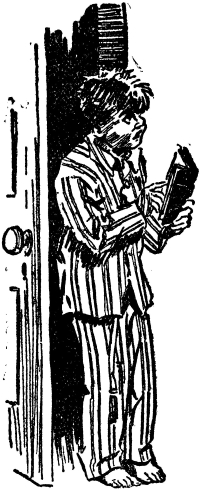
THE DOOR OPENED AND
WILLIAM APPEARED FOR
THE THIRD TIME. “IN
THIS BOOK WHAT YOU
KINDLY GAVE ME,” HE
BEGAN, “IT TELLS ABOUT
THE STARS.”
The door opened, and
William appeared with the
open book once more in
his hand.
“In this book what
you kindly gave me,” he
began, “it tells about the
stars an’ the Lion an’
that, an’ I can’t find the
Lion from the window,
though the stars are out. I
wondered ’f you’d kindly
let me look through
yours.”
Sheep and stile vanished
abruptly. After a short
silence pregnant with unspoken
words, Mr. Bennison
sat up in bed. He looked
very weary as he stared
at William, but he was
doggedly determined to
act up to his ideals.
“I don’t think you can
see the Lion from this
side of the house, my
boy,” he said, in what he
imagined was a kind tone of voice, “it must be right
on the opposite side of the house.”
“Then we could see it from my window,” said
William brightly and guilelessly, “if you’d kin’ly come
an’ help me find it.”
Mr. Bennison said nothing for a few seconds. He
was counting forty to himself. It was a proceeding
to ensure self-control taught him by his mother in
early youth. It had never failed him yet, though it
nearly did on this occasion. Then he followed William
across the landing to his room.
William was not content with the Lion. He insisted
on finding all the other constellations mentioned in the
book. At 2.30 Mr. Bennison staggered back to his
bedroom. He did not go to bed at once. He took
out the chapter he had written early in the evening
and crossed out the words, “A child’s curiosity must
be immediately satisfied when and where it appears,
irrespective of inconvenience to the adult.”
He decided to cut out all similar sentiments in the
next editions of all his books.
Then he got into bed. Sleep at last—blissful,
drowsy, soul-satisfying sleep.
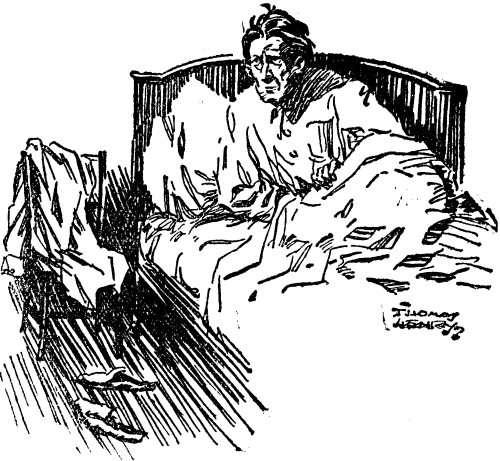
MR. BENNISON SAT UP IN BED. HE LOOKED VERY
WEARY AS HE STARED AT WILLIAM.
“Mr. Bennison—Mr. Bennison—in this book what
you kindly gave me there’s some kind of puzzles—‘’telligence
tests’ it calls ’em, an’ I can’t do ’em.
I wondered if you’d kindly help me——”
“Well, I won’t,” said Mr. Bennison. “Go away.
Go away, I tell you.”
“There’s only a page of ’em,” said William.
“Go away,” roared Mr. Bennison, drawing the clothes
over his head. “I tell you I won’t—I won’t——”
William quietly went away.
Now Mr. Bennison was a conscientious man. Left
alone in the silence of the night all desire for sleep
deserted him. He was horrified at his own depravity.
He had deliberately broken his own rule. He had
been false to his ideals.
He had refused to satisfy the curiosity of the young
when and where it appeared. A child had come to
him for help in the middle of the night and he had
refused him or her. The child, moreover, might repeat
the story. It might get about. People might hold it
up against him.
After wrestling with his conscience for half an hour
he arose and sought William in his room. At four
o’clock he was still trying to solve the intelligence
tests for William. William stood by wearing that
expression that Mr. Bennison was beginning to dislike
intensely.
At 4:15 Mr. Bennison, looking wild and dishevelled,
returned to his room. But he was a broken man.
He struggled no longer against Fate. Five o’clock
found him explaining to William exactly why Charles I
had been put to death.
Six o’clock found him trying to fathom the meaning
of “plunger” and “inductance” and “slider” and
various other words that occurred in the chapter on
Wireless. It fortunately never occurred to him that
they were all terms with which William was perfectly
familiar.
As he held his head and tried to think from what
Greek or Latin words the terms might have been
derived, he missed the flicker that occasionally upset
the perfect repose of William’s features.
At seven o’clock he felt really ill and went downstairs
to try to find a whisky-and-soda. It was not William’s
fault that he fell over the knitting on which Mrs.
Brown had been engaged the evening before, and
which had slipped from her chair on to the floor. His
frenzied efforts to disentangle his feet entangled them
still further.
At last, with teeth bared in rage and wearing the
air of a Samson throwing off his enemies, he tore wildly
at the wool, and scattering bits of this material and
unravelled socks about him, he strode forward to the
sideboard. He could not find a whisky-and-soda.
After upsetting a cruet in the sideboard cupboard he
went guiltily back to his bedroom.
His bed looked tidier than he imagined he had left
it, and very inviting. Perhaps he might get just half
an hour’s sleep before he got up.... He flung himself
on to the bed. His feet met with an unexpected
resistance half-way down the bed, bringing his knees
sharp up to his chin. The bed was wrong. The bed
was all wrong. The bed was all very wrong.
For a few seconds Mr. Bennison forgot the traditions
of self-restraint and moderation of language on which
he had been reared. William, standing in the doorway,
listened with interest.
“I hope you don’t mind me tryin’ ’f I could do it,”
he said. “I dunno why it’s called an apple-pie bed,
do you? It doesn’t say nothing about it in this
book what you kindly gave me.”
Mr. Bennison flung himself upon William with a
roar. William dodged lightly on to the landing. Mr.
Bennison followed and collided heavily with a housemaid
who was carrying a tray of early morning tea.
*****
William came down to breakfast. He entered the
dining-room slowly and cautiously. Only his father
and mother were there. His mother was talking to
his father.
“He wouldn’t even stay for breakfast,” she was
saying. “He said his letter called him back to town
on most urgent business. I didn’t like his manner
at all.”
“Oh?” said her husband from behind his paper,
without much interest.
“No, I thought it rather ungracious, and he looked
queer.”
“Oh?” said her husband, turning to the financial
columns.
“Yes—wild and hollow-eyed and that sort of thing.
I’ve wondered since whether perhaps he takes drugs.
One reads of such things, you know, and he certainly
looked queer. I’m glad he’s gone.”
William went up to Ethel’s bedroom. Ethel was
gloomily putting the finishing touches to her auburn
hair.
“He’s gone, Ethel,” he said in a conspiratorial
whisper, “gone for good.”
Ethel’s countenance brightened.
“Sure?” she said.
“Sure,” he said. “Now what ’bout that two
shillings?”
She looked at him with sudden suspicion.
“Have you——?” she began.
“Me?” broke in William indignantly. “Why, I din’
know he’d gone till I got down to breakfast.”
“All right,” said Ethel carelessly. “If he’s really
and truly gone, I’ll give you half a crown.”
*****
William, on his way to school, met Ginger at the
end of the lane.
“I’ve tried ’em all,” said Ginger despondently, “an’
none of ’em’ll give me a penny.”
William with a flourish brought out his half a crown.
“This’ll do for both of us,” he said with a lordly air.
“Crumbs!” said Ginger, with respect and admiration
in his voice. “Who d’you get that out of?”
“Well, a man came to stay at our house——”
began William.
Ginger’s respect and admiration vanished.
“Oh, a visitor!” he said disparagingly. “’S easy
enough to get money out of a visitor.”
“’F you think this was easy,” began William with
deep feeling, then stopped.
It was a long story and already retreating into the
limbo of the past. He could not sully the golden
present by a lengthy repetition of it. It had been
jolly hard work while it lasted, but now it was over
and done with. It belonged to the past. The present
included a breathless run into the village, leaping backwards
and forwards across the ditches, a race down
the village streets and TOPS—glorious tops—superior
shilling-each tops with sixpence over.
He uttered his shrill, discordant war-whoop.
“Come on,” he shouted, “’fore they’re all sold out.
Race you to the end of the road!”
CHAPTER XIV
A DRESS REHEARSAL
IT was Saturday, but despite that glorious fact,
William, standing at the dining-room window and
surveying the world at large, could not for the moment
think of anything to do.
From the window he saw the figure of his father,
who sat peacefully on the lawn reading a newspaper.
William was not fond of his own society. He liked
company of any sort. He went out to the lawn and
stood by his father’s chair.
“You’ve not got much hair right on the top of your
head, father,” he said pleasantly and conversationally.
There was no answer.
“I said you’d not got much hair on the top of your
head,” repeated William in a louder tone.
“I heard you,” said his father coldly.
“Oh,” said William, sitting down on the ground.
There was silence for a minute, then William said in
friendly tones:
“I only said it again ’cause I thought you didn’t
hear the first time. I thought you’d have said, ‘Oh,’
or ‘Yes,’ or ‘No,’ or something if you’d heard.”
There was no answer, and again after a long silence,
William spoke.
“I didn’t mind you not sayin’ ‘Oh,’ or ‘Yes,’ or
‘No,’” he said, “only that was what made me say it
again, ’cause with you not sayin’ it I thought you’d
not heard.”
Mr. Brown arose and moved his chair several feet
away. William, on whom hints were wasted, followed.
“I was readin’ a tale yesterday,” he said, “about a
man wot’s legs got bit off by sharks——”
Mr. Brown groaned.
“William,” he said politely, “pray don’t let me keep
you from your friends.”
“Oh, no, that’s quite all right,” said William.
“Well—p’raps Ginger is lookin’ for me. Well, I’ll
finish about the man an’ the sharks after tea. You’ll
be here then, won’t you?”
“Please, don’t trouble,” said Mr. Brown with sarcasm
that was entirely lost on his son.
“Oh, it’s not a trouble,” said William as he strolled
off, “I like talkin’ to people.”
*****
Ginger was strolling disconsolately down the road
looking for William. His face brightened when he
saw William in the distance.
“Hello, William.”
“Hello, Ginger.”
In accordance with their usual ceremonial greeting,
they punched each other and wrestled with each other
till they rolled on to the ground. Then they began
to walk along the road together.
“I’ve not got to stop with you long,” said Ginger
gloomily; “my mother’s got an ole Sale of Work in
her garden, an’ she wants me to help.”
“Huh!” said William scornfully, “you helpin’ at a
Sale of Work! You. Huh!”
“She’s goin’ to give me five shillings,” went on
Ginger coldly.
William slightly modified his tone. “Well, I never
said you can’t help, did I?” he said in a more friendly
voice.
“She said I needn’t go for about half an hour.
Wot’ll we do? Dig for hidden treasure?”
Two months ago William and his friends had been
fired with the idea of digging for hidden treasure.
From various books they had read (“Ralph the
Reckless,” “Hunted to Death,” “The Quest of Captain
Terrible,” etc.), they had gathered that the earth is
chockful of buried treasure if only one takes the
trouble to dig deep enough.
They had resolved to dig every inch of their native
village, collect all the treasure they found, and with
it buy a desert island on which they proposed to spend
the rest of their lives unhampered by parents and
schoolmasters.
They had decided to begin with the uncultivated
part of Ginger’s back garden, and to buy further land
for excavation with the treasure they found in the
back garden.
Their schemes were not narrow. They had decided
to purchase and to pull down all the houses in the
village as their treasure grew and more and more
land was required for digging.
But they had dug unsuccessfully for two months in
Ginger’s back garden and were beginning to lose heart.
They had not realised that digging was such hard work,
or that ten feet square of perfectly good land would
yield so little treasure. Conscientiously they carried
on the search, but it had lost its first fine careless
rapture, and they were glad of any excuse for
avoiding it.
“Dig in your back garden with all those Sale of Work
people messin’ about interruptin’ and gettin’ in the
way?” said William sternly. “Not much!”
“All right,” said Ginger relieved. “I only s’gested
it. Well, shall we hunt for smugglers?”
*****
There was a cave in the hillside just beneath the
road, and though the village in which William and
Ginger lived was more than a hundred miles inland,
William and Ginger were ever hopeful of finding a
smuggler or, at any rate, traces of a smuggler, in the
cave. They searched it carefully every day.
As William said, “’S’only likely the reely cunnin’
ones wouldn’t stay sittin’ in their caves by the sea all
the time. They’d know folks’d be on the look out
for ’em there. They’d bring their things here where
no one’d expect ’em. Why, with a fine cave like this
there’s sure to be smugglers.”
When tired of hunting for smugglers, or traces of
smugglers, they adopted the characters of smugglers
themselves, and carried their treasure (consisting of
stones) up the hillside to conceal it in the cave, or fled
for their lives to the cave with imaginary soldiers in
pursuit. From the cover of the cave, Bill, the smuggler,
often covered the entire hillside with the dead bodies
of soldiers. In these frays the gallant smugglers never
received even the slightest scratch.
With ever fresh hope they searched the cave again.
Ginger found a stone that he said had not been there
yesterday, and must have been left as a kind of signal,
but William said that he distinctly recognised it as
having been there yesterday, and the matter dropped.
After a brief and indecisive discussion as to how
they should spend the five shillings that Ginger’s mother
had said she would give him, they occupied themselves
in crawling laboriously on their stomachs in and out
of the cave so as to be unperceived by the soldiers
who were on the watch above and below.
At last, Ginger, moved not so much by his conscience
as by fears of forfeiting his five shillings, set off sadly
homewards, and William set off along the road in the
opposite direction.
He walked slowly, his hands in his pockets, dragging
his shoes in the dust in a manner which his mother
frequently informed him brought the toes through in
no time.
*****
When he came to the school he stopped, attracted
by the noise that came through the open window of
the schoolroom. They were preparing for a dress
rehearsal of the “Pageant of Ancient Britain,” which
was to be performed the next month. William, who
was not in the caste, looked with interest through the
window. Ancient Britons in various stages of skins
and woad and grease paint stood about the room or
leap-frogged over each other’s backs or wrestled with
each other in corners. William espied a particular
enemy at the other end of the room. He put his head
through the window.
“Hello, Monkey Brand,” he called in his strident,
devastating voice.
Miss Carter, mistress of the Second Form, raised
herself wearily from arranging the skin of an infant
Ancient Briton.
“I wish you wouldn’t,” she began testily, then, her
voice sinking into hopelessness, “Oh, it’s William
Brown.”
William, ignoring her, put his fingers to his lips and,
still gazing belligerently at his enemy, emitted a
deafening whistle. Miss Carter put her hands to her
ears.
“William!” she said irritably.
William wiped his mouth with the back of his hand.
“Beg pardon,” he said mechanically and without
feeling, as he withdrew his head and prepared to retire.
“Oh, one minute, William. What are you doing
just now?”
William inserted his untidy head in the window again.
“Me?” he said. “Nothin’. Jus’ nothin’.”
“Well, I wish you’d come and be an Ancient Briton
just for the dress rehearsal—it won’t be long, but so
many of them can’t come this afternoon, and it’s so
difficult to arrange how they’re to stand with only
three-quarters of them there. You needn’t be made
up, but just put this skin on.”
She held up a small skin carelessly in her hand.
William looked round the room with his sternest and
most disapproving scowl.
“Have I gotter come in with all those boys all over
the place an’ change with all those boys botherin’ me
all the time so’s I don’t know wot I’m doin’ an’——”
Miss Carter was in a bad temper. She threw the
skin irritably at William through the window.
“Oh, change where you like,” she snapped, “if
you’ll be back here in five minutes.”
William took the skin eagerly.
“Oh, yes, I will,” he promised.
Then he rolled up the skin and stuffed it under his
arm. It instantly changed into a bale of precious
but vague contraband material.
Glancing sternly round for soldiers, William crept
cautiously and silently down to his cave. There he
drew a sigh of relief, placed his gun in a corner and
changed into the skin. Once clad in the skin, his
ordinary clothes became the precious but vague contraband
material. He crept to the entrance, glanced
furtively around, then wrapped his clothes into a
bundle and looked around for some place of concealment.
On the ground at the further end of the cave
was a large piece of paper in which he and Ginger
had once brought their lunch.
Still with many furtive glances around, he wrapped
up his clothes and concealed the bundle on a shelf
of rock in the corner of the cave. Then he took up
his gun, shot two soldiers who were just creeping towards
the entrance of the cave, walked to the doorway,
shot again at a crowd of soldiers who fled in panic
terror at his approach. Then, resplendent in his skin
and drunk with heroism and triumph, he swaggered
up the hillside and into the school.
*****
As an Ancient Briton, he was not an unqualified
success, and more than once Miss Carter regretted her
casual invitation. William considered the rehearsal as
disappointing as the rehearsal considered him—just
standin’ about an’ singin’ an’ talkin’—no fightin’ nor
shoutin’ nor nothin’. He was glad he wasn’t a
Nanshunt Briton, if that’s all the poor things could
do.
However, at last it was over, and he crept again
furtively down the hillside to his private dressing-room.
Ginger was standing near the cave entrance.
“What’ve you been doing all this time?” he began;
then, as his gaze took in William’s costume, his mouth
opened.
“Crumbs!” he said.
“I’m a Nanshunt Briton,” said William, airily.
“They jus’ wanted me to go an’ be a Nanshunt Briton
up at the school an’——”
“Well,” interrupted Ginger excitedly, “while you’ve
been away I’ve found ’em at last.”
“What?” said William.
“Smugglers!” said Ginger excitedly. “Smugglers’
things.”
“Golly!” said William, equally thrilled. “Where?”
“In the cave—when I came to look for you, an’ I
cun’t find you, an’ I looked round the cave again, an’
I found ’em.”
A sudden fear chilled William’s enthusiasm.
“What were they?”
“Clothes an’ things. I thought I wun’t look at ’em
prop’ly till you came. They was wrapped up in that
ole paper we brought our food in last week.”
The Ancient Briton looked at him sternly and
accusingly.
“Yes—well, they were my clothes wot I’d changed
out of, that’s what they were. You’re jus’ a bit too
clever takin’ people’s clothes for smugglers’ things.
Anyway, I’m jus’ gettin’ cold with only a skin on, so
jus’ please give me those smugglers’ things, so’s I can
put ’em on.”
Ginger’s jaw dropped.
“I—I took ’em home. I didn’t want to leave ’em
about here case someone else found ’em. I hid ’em
behind a tree in our garden.”
The Ancient Briton’s gaze became still more stern.
“Well, p’raps you’d kin’ly gettem for me out of
your garden ’fore I die of cold, dressed in only a skin.
I should think the Anshunt Britons all died of cold
if they felt like wot I feel like. You’re jus’ a bit too
clever with other people’s smugglers’ things; an’ s’pose
Miss Carter comes down for her skin an’ wot d’you
think I’ll look like then, dressed in nothin’?”
“All right,” said Ginger. “I’ll gettem. I won’t be
a minute. If you will leave your clothes all about the
cave lookin’ exactly like smugglers’ things——”
He was gone, and William sat shivering in a corner
of the cave, dressed in his Ancient Briton costume.
The glamour of the cave was gone. William felt that
he definitely disliked smugglers. The only people he
disliked more than he disliked smugglers were Ancient
Britons, for whom he now felt a profound scorn and
loathing.
In about ten minutes’ time Ginger returned. He was
empty handed, and there was a look of consternation
on his face.
“William,” he said meekly, “I’m awfully sorry. It’s
been sold. They thought it was meant for the rummage
stall, an’ they’ve took it an’ sold it.”
William was speechless with indignation.
“Well,” he said at last, “you’ve gone an’ sold all
my clothes—an’ now what do you think’s goin’ to
happen to me? That’s jus’ wot I’d like to know, ’f
you don’ mind tellin’ me. Wot’s goin’ to happen to
me? P’raps as you’ve sold all my clothes, you’ll kin’ly
tell me wot’s goin’ to happen to me, gettin’ colder an’
colder. P’raps you’d like me to freeze to death.
How’m I goin’ to get home, an’ if I don’t get home
how’m I goin’ to get anythin’ to eat, and if I don’t
get anythin’ to eat, how’m I goin’ to live? I’m dyin’
of cold now. Well, I only hope you’ll be sorry then—then,
when prob’ly you’ll be bein’ hung for murderin’
me.” William returned to earth from his flights of
fancy. “Well, now, p’raps you’ll kin’ly get my
clothes back.”
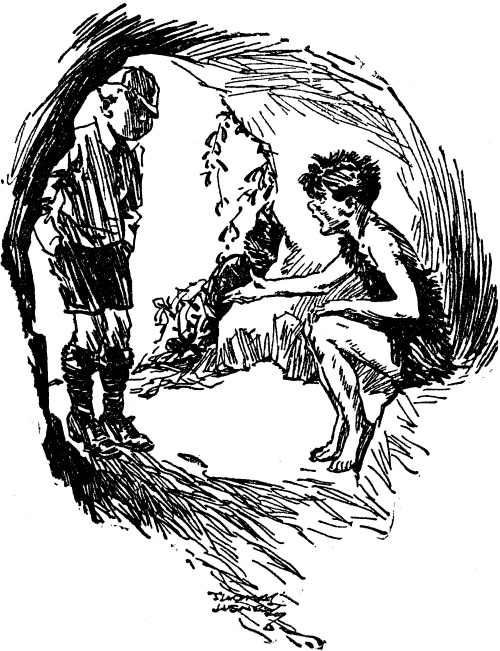
“WELL,” SAID WILLIAM STERNLY, “YOU’VE GONE
AND SOLD ALL MY CLOTHES—AN’ NOW WHAT DO YOU
THINK’S GOING TO HAPPEN TO ME? HOW’M I GOIN’
TO GET HOME?”
“How can I?” said
Ginger, with the air of one
goaded beyond endurance.
“Well, you can go an’
find out who bought ’em, I
suppose—only you needn’t
tell ’em whose they was.”
Again Ginger departed,
and again the Ancient
Briton sat shivering and
gazing sternly and accusingly
around the cave.
After a short interval
Ginger appeared again,
breathless with running.
“Mr. Groves bought it, William, from Wayside
Cottage. I dunno how I’m to get ’em back, though,
William.”
William sighed.
“I’d better come with you,” he said wearily.
“’Sides, I shall prob’ly get froze into a glacier or
something if I stay in here any more.”
The Ancient Briton gazed furtively around from the
cave door, without that bravado and swagger generally
displayed by Bill the Smuggler. The coast was clear.
The two boys crept out.
“When I get to the road, I’ll crawl on my stomach
in the ditch like as if I were a smuggler, then no
one’ll see me.”
Ginger walked dejectedly along the road, while the
Ancient Briton made a slow and very conspicuous
progress in the ditch beside him—ejaculating irascibly
as he went:
“Well, I’ve jus’ done with smugglers an’ with
Anshunt Britons. I’ll never look at another smuggler
or a Nanshunt Briton while I live—’n if you hadn’t
been so jolly clever runnin’ off with other people’s
clothes, an’ sellin’ ’em, I shouldn’t be crawlin’ along
an’ scratchin’ myself, an’ cuttin’ myself, an’ eatin’
mud. Now,” in a voice of pure wonder, “how did
Anshunt Britons get about? I don’t know—all
shiverin’ with cold an’ scratchin’ themselves an’ cuttin’
themselves——”
Wayside Cottage was, fortunately for the Ancient
Briton, on the outskirts of the village. The front door
was conveniently open. There was a small garden in
front, and a longer garden behind, with a little corrugated
iron building at the end.
“Come on,” said William. “Let’s go an’ get ’em
back.”
“Are you goin’ to ask him for ’em?” said Ginger.
“No, I’m not. I don’t want everyone in this village
talking about it,” said William sternly. “I jus’ want
to get ’em back quietly an’ put ’em on an’ no one
know anything about it. I don’t want anyone talkin’
about it.”
No one was about. They gazed at the stairs from
the open doorway. “They’ll be upstairs,” said William
in a hoarse whisper; “clothes are always upstairs.
Now, come very quietly. Creep upstairs.”
Ginger followed him loyally, fearfully, reluctantly,
and they went upstairs. Every time Ginger hit a stair
rod, or made a stair creak, William turned round with
a stern and resonant “Sh!” At last they reached the
landing. William cautiously opened the door and
peeped within. It was a bedroom, and it was empty.
“Come on,” whispered William, with the cheerfulness
of the born optimist. “They’re sure to be here.”
They entered and closed the door.
“Now,” said William, “we’ll look in all the drawers
and then we’ll look in the wardrobe.”
They began to open the drawers one by one.
Suddenly Ginger said “Hush!”
There was the sound of footsteps coming up the
stairs. They drew nearer the door.
“Crumbs!” gasped William. “Under the bed—quick!”
As they disappeared under the bed the door opened
and a little old gentleman came in. He looked round
at the open drawers and frowned.
“How curious!” he said as he shut them; “how very
curious!”
Then he hummed to himself, straightened his collar
at the glass, took a few little dancing steps round the
room, and then stood irresolute, his hand on his chin.
“Now what did I come up for?” he said. “What
did I come up for? Ah! A handkerchief.”
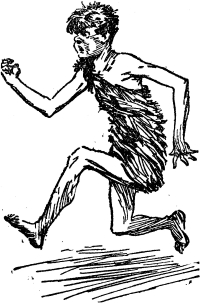
WILLIAM DASHED FOR THE
DOORWAY, UPSETTING THE OLD
GENTLEMAN ON HIS WAY.
All might have been well had not the Ancient Briton
at this moment succumbed to the united effects of cold
and dust, and emitted a resounding sneeze.
“Bless my soul!” said the old gentleman. “Bless
my——”
He dived beneath the bed, and, seizing hold of
William’s bare and muddy foot, he pulled. But
William had firm hold of the further leg of the bed, and
the old gentleman, exerting his utmost strength, only
succeeded in pulling the bed across the room with
William still firmly attached to it. But this treatment
infuriated William.
“’F you’d kin’ly stop draggin’ me about on my
stomach——” he began, then emerged, stern and dusty,
and arranging his skimpy and dishevelled skin.
“You—you—you thief!” said the old man.
“I’m not a thief,” said William, “I’m a Nanshunt——”
But the old man made a dash at him and William
dodged and fled out of the doorway. Ginger was
already half-way downstairs. The old man was delayed,
first by the door, which William banged in his
face, and secondly by the fact that he slipped on the
top stair and rolled down to the bottom.
There he sat up, looked for his spectacles, found
them, adjusted them and gazed round the hall, still
seated on the hall
mat. The two boys
were nowhere to be
seen. Muttering
“Dear! Dear!” and
“Bless my soul!
Let me see, what
was it I wanted?—Ah,
a handkerchief!”
the old man
began to ascend the
stairs.
*****
But William and
Ginger had not
gone out of the
front door. A
group of Ginger’s
mother’s friends
could be plainly
seen passing the
little gateway, and
in panic William
and Ginger had dashed out of the back door into
the little garden, and into the corrugated iron building.
A lady, dressed in an artist’s smock, a paint
brush in her hand, looked up from an easel.
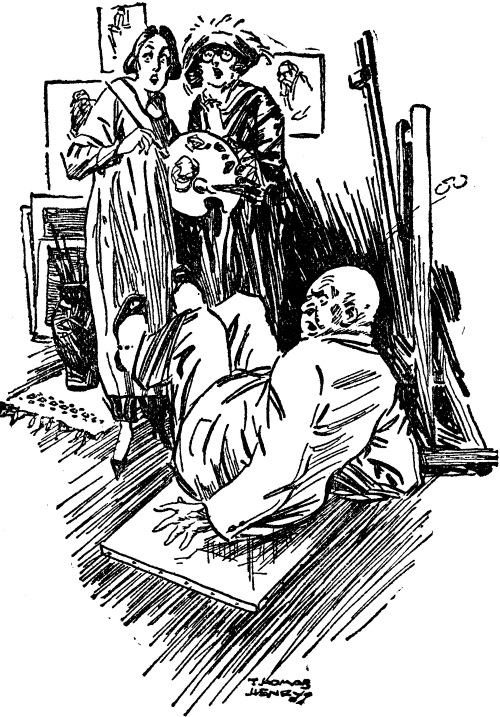
THE OLD GENTLEMAN LANDED ON TOP OF THE CANVAS
AND SAT THERE MURMURING, “OH, DEAR! OH, DEAR!”
“Please don’t come in quite so roughly,” she said
disapprovingly. “I don’t like rough little boys.” She
looked William up and down, and her disapproval
seemed to deepen. “Well,” she said stiffly, “it doesn’t
seem to me quite the costume. I should have thought
the Vicar—— However, you’d better stay now you’ve
come. Is the other little boy your friend? He must
sit down quite quietly and not disturb us. You may
just look at the picture first for a treat.” Bewildered,
but ready to oblige her, William wandered round and
looked at it. It seemed to consist of a chaos of snow
and polar bears.
“It’s to be called The Frozen North,” she said
proudly. “Now you must stand in the attitude of one
drawing a sleigh—so—no, the expression more gentle,
please. I must say I do not care for the costume, but
the Vicar must know——”
“I’m a Nanshunt——” began William, then decided
to take the line of least resistance and be the Frozen
North. The lady painted in silence for some time,
occasionally looking at William’s rather mangy skin,
and saying disapprovingly: “No, I must say—I do
not—but, of course, the Vicar——”
Just as the charm of novelty was disappearing from
the procedure, and he was devising means of escape,
another lady came in.
“Busy, dear?” she said, then she adjusted her
lorgnettes, and she, too, looked disapprovingly at
William.
“My dear!” she said. “Isn’t that rather—— Well,
of course, I know you artists are—well, Bohemian and
all that, but——”
The artist looked worried.
“My dear,” she said, “I showed the Vicar the picture
yesterday, and he said that he had a child’s Esquimo
costume, and he’d find a boy to fit in and send it round
for a model. But—I’d an idea that the esquimos
dressed more—er—more completely than that, hadn’t
you?”
“I’m a Nanshunt——” began William, and stopped
again.
“You remember Mrs. Parks asking for money to
buy clothes for her boy?” went on the artist as she
painted. “Well, I got John to go to that Sale of
Work this afternoon and get a suit from the rummage
stall, and he got quite a good suit, and I’ve just sent
it round to her. Do stand still, little boy—You
know, dear, I wish I felt happier about this—er—costume.
Yet I feel I ought not to criticise and even
in my mind, anything the dear Vicar——”
“Well, I’ll be quite frank,” said the visitor. “I
don’t care for it—and I do think that artists can’t be
too careful—any suggestion of the nude is so—well,
don’t you agree with me? I’m surprised at the Vicar.”
The artist held out half a crown to William.
“You may go,” she said coldly. “Take the costume
back to the Vicar, and I don’t think I shall require
you again.”
At that moment the little old man came in. He
started as his eye fell on William and Ginger.
“The thief!” he said excitedly. “The thief! Catch
him, catch him, catch him!”
William dashed to the doorway, upsetting the old
man and a wet canvas on his way. The old man
landed on top of the canvas and sat there murmuring,
“Oh, dear, oh dear, what a day!” and looking for
his glasses.
The visitor pursued the two of them half-heartedly
to the gate, and then returned to help in the work of
separating the old gentleman from the wet canvas.
*****
William and Ginger sat in a neighbouring ditch and
looked at each other breathlessly.
“Parks,” said Ginger, “that’s the shop at the end
of the village.”
“Yes,” said William, “an’ I’m jus’ about sick of
crawlin’ in ditches, an’ what’s wrong with it I’d like
to know,” he went on, looking down indignantly at
his limp skin, “it’s all right—not as clothes—but as
a kind of dress-up thing it’s all right—as good as that
ole pinnyfore she was wearing, an’ I jolly nearly said
so—an’ ‘thief,’ too. Well, I wun’t go inside that house
again, not if—not if—not if they asked me—Anyway,”
his expression softened, “anyway, I got half a crown,”
his expression grew bitter once more, “half a crown, an’
not even a pocket to put it in. Come on to Parks’.”
William returned to the ditch. They only passed a
little girl and her small brother.
“Look, Algy,” said the little girl, “look at ’im.
’E’s a loony an’ the other’s ’is keeper. ’E thinks ’e’s
a frog, prob’ly, an’ that’s why ’e goes in ditches, an’
doesn’t wear no clothes.”
William straightened himself.
“I’m a Nanshunt——” he began, but at sight of his
red and muddy face, surmounted by its crest of muddy
hair, the little girl fled screaming.
“Come on, Algy, ’e’ll get yer an’ eat yer if yer
don’t——”
Algy’s screams reinforced hers, and William disconsolately
returned to the ditch as the screams, still
lusty, faded into the distance.
“I’m jus’ getting a bit sick of this,” muttered the
Ancient Briton.
*****
They reached Parks’. William lay concealed behind
the hedge, and Ginger wandered round the shop,
reconnoitring.
“Go in!” goaded William, in a hoarse whisper from
the hedge. “Go in an’ gettem. Say you’ll fetch a
policeman—make ’em give ’em you—fight ’em—take
’em—you lettem go—I can’t stand this much longer.
I’m cold an’ I’m wet. I feel as if I’d been a Nanshunt
Briton for years an’ years—hurry up—Are-you-goin’-to-get-me-my-clothes?”
“Oh, shut up!” said Ginger miserably. “I’m doin’
all I can.”
“Doin’ all you can, are you? Well, you’re not
doin’ much but walkin’ round an’ round the shop.
D’you think ’f you go on walkin’ round and round the
shop my clothes’ll come out of themselves—come
walkin’ out to you? ’Cause if you think that——”
“Shut up.”
At this moment a small boy walked out of the shop.
“Hallo!” said Ginger, with a fatuous smile of
friendship.
“Hallo!” said the boy, ungraciously.
Ginger moistened his lips and repeated the fatuous
smile.
“Have you got any new clothes to-day?”
The boy gave a fairly good imitation of the fatuous
smile.
“No,” he said, “have you? Don’t go spoilin’ your
fice for me. It’s bee-utiful, but don’t waste it on
me.”
Then, whistling, he prepared to walk away from
Ginger down the road. Desperately Ginger stopped
him.
“I’ll—I’ll—I’ll give you,” he swallowed, then, with
an effort, made the nobler offer. “I’ll give you five
shillings if——”
“Yus?” said the boy suddenly, “if——?”
“If you’ll give me those clothes the lady wot paints
sent you to-day.”
“Gimme the five shillings then.”
“I won’t give you the money till you give me the
clothes.”
“Oh, won’t you? Well, I won’t give you the clothes
till you give me the money.”
They stared hostilely at each other.
“Get my clothes,” said the irate voice from the
ditch. “Punch him—do anythin’ to him. Get—my—clothes.”
The boy looked round with interest into the ditch.
“Look at ’im!” he shrieked mirthfully. “Look at
’im. Nakid—jus’ dressed in a muff—Oh! look at ’im.”
William arose with murder in his face. Ginger
hastily pressed the five shillings into the boy’s hand.
“Gettem quick,” he said.
The boy retreated to the shop and closed the door
except for a small crack. Through that crack he
shouted, “We din’ want no narsty, mangy, mouldy,
cast-off clothes from no one. We gived ’em to
Johnsons up the village.”
Then he banged the door.
William, in fury, kicked the door, and a crowd of
small boys collected. William, perceiving them, fled
through the hedge and into the field. The small boys
followed, uttering derisive cries.
“Look at ’im—Look at ’im—’e’s a cannibal—he’s
got no clothes—’e’s out of a circus—’e’s balmy—’e’s
wearin’ ’is mother’s fur.”
William turned on them in fury.
“I’m a Nanshunt——” he began, rushing upon
them; and they fled in panic.
William and Ginger sat down behind a haystack.
“Well, you’re very clever at gettin’ back my clothes,
aren’t you?” said William with heavy sarcasm.
“I’m gettin’ jus’ about sick of your clothes,” said
Ginger gloomily.
“Sick of ’em?” echoed William. “I only wish I’d
gottem to be sick of. I’m jus’ about sick of not
havin’ ’em an’ walkin’ about on prickles an’ stones and
scratchin’ myself an’ shiverin’ with cold. That boy’d
jus’ better wait till I get my clothes an’ then——” His
eyes gleamed darkly with visions of future vengeance.
“Well,” he turned to Ginger, “an’ wot we goin’ to
do now?”
“Dunno,” said Ginger despondently.
“Well, where’s Johnsons?”
“Mrs. Johnson’s my aunt’s charwoman,” said Ginger,
wearily. “I know where she lives.”
William rose with a determined air.
“Come on,” he said.
“If we don’t gettem this time,” said Ginger, as they
started on their furtive journey, “I’m going home.”
“Oh, are you,” said William sternly. “Well, then,
you’re goin’ in this Anshunt Briton thing an’ I’m
goin’ in your clothes. You lost my clothes an’ if you
can’t gettem back you can give me yours, that’s fair,
isn’t it?”
“Oh, shut up,” said Ginger, in the tone of one who
has suffered all that it is possible to suffer and can
suffer no more. “It’s that five shillings that I keep
thinkin’ of—five shillin’s—an’ all for nothin’.”
“An’ callin’ my clothes mouldy,” said William, with
equal indignation. “My clothes mouldy.”
“She lives here,” said Ginger.
From the shelter of a hedge they watched the house.
“You’d better go an’ gettem then,” said William
unfeelingly.
“How?” said Ginger.
“Well, you sold ’em.”
“I didn’t sell ’em.”
“Sh! Look!”
The door of the Johnson’s home was opening. A
small boy came out.
“He’s dressed in my clothes,” said William excitedly.
“Gettem—Gettim—my clothes.” His eye brightened,
and into his face came a radiant look as of one beholding
some dear friend after a long absence. “My
clothes.”
Ginger advanced to the small boy and smiled his
anxious, fatuous, mirthless smile.
“Like to come an’ play with me?” he said.
“Yeth, pleath,” said the boy, returning the friendly
smile.
“Well, you can come with me,” said Ginger, ingratiatingly.
He followed Ginger through the stile, and gave a
shout of derision when he saw William crouching
behind the hedge. “Oh! Look at ’im,” he said,
“dressed up funny.”
A masterly plan had come into William’s head. He
led the party to the next field, to the disused barn
which, in their normal happy life that now seemed
to him so far away, served as castle or pirate ship.
“Now,” he said, “we’re goin’ to play at soldiers,
an’ you come an’ say you wanter join the army——”
“But I don’t,” said the small boy solemnly. “That
would be a thtory.”
“Never mind,” said William patiently. “You must
pretend you want to join the army. Then you must
take off your clothes and leave ’em with me, and this
boy will pretend to be the doctor, an’ he’ll tell you
if you’re strong enough, you know; he’ll look at your
lungs and things and then—and then—well, that’s
all. Now I’ll give you the half-crown jus’ for a
present if you play it prop’ly.”
“All right,” said the boy brightly, beginning to
take off his coat.
“You’ve got bad lungs, an’ a bad heart, an’ bad
legs, an’ bad arms, an’ bad ears, an’ a bad head,”
said the doctor, “an’ I’m afraid you can’t be a soldier.”
“All right,” said the boy brightly. “Don’ wanter
be. Now I’ll put on my clothes.”
He came out to the back of the barn, where he had
left his clothes, and burst into a howl.
“Oo—oo—oo—’e’s tooken my clothes—tooken my
clothes—’e’s tooken my clothes. Ma! Ma! Ma!
’E’s tooken my clothes.”
His shirt fluttering in the wind, he went howling
down the road.
Ginger went to the ditch whence William’s gesticulating
arms could be seen.
“Quick! William, quick!” gasped Ginger.
William arose, holding his Ancient Briton costume
in his hand. He was clothed in a tweed suit—a very,
very small tweed suit—the waistcoat would not button
across him and the sleeve came only a little way
below his elbow.
“William!” gasped Ginger. “It’s not yours.”
William’s face was pale with horror.
“It looked like mine,” he said in a sepulchral voice,
“but it’s not mine.”
A babel of voices arose.
“Where are they, lovey?”
“Boo—hoo—they’ve tooken my clothes.”
“Wait till I gettem, that’s all.”
“Never mind, darlin’. Ma’ll learn ’em.”
With grim despair they saw what seemed to them
an army of women running up the hill, and with them
a howling boy in a fluttering shirt. One of the women
carried a broom.
“Run, William!” gasped Ginger.
William flung his skin into the ditch and ran.
Though his suit was so tight that he could only progress
in little leaps and bounds, he progressed with
remarkable speed.
*****
At last, exhausted and breathless, he walked round
to the side entrance of his home and stood in the hall.
He could hear his mother’s voice from the drawing
room.
“Miss Carter’s been ringing up all the afternoon,”
she was saying, “she seems to think that William took
away one of the costumes after the rehearsal. I told
her that I was sure William wouldn’t do such a
thing.”
“My dear,” in his father’s voice, “you do make the
most rash statements.”
William entered slowly. His father and mother and
sister turned and stared at him in silence.
“William!” gasped his mother. “What are you
wearing?”
William made a desperate effort to carry off the
situation.
“You know—everyone says how fast I’m growin’—I
keep growin’ out of my things——”
“Mother!” screamed Ethel, from the window,
“there’s a lot of awful women coming through the
gate and an awful little boy in a shirt!”
*****
William was brushed and combed and dressed in his
best suit. His week-day suit had been, with great
trouble and at great expense, brought back from Mrs.
Johnson, and taken from the person of her eldest son,
and was now being disinfected from any possible germ
which might have infested the person of her eldest son.
Mrs. Johnson and her indignant younger son had
been, with great difficulty and also at great expense,
soothed and appeased.
William had eaten the bread and water considered,
in the circumstances, a suitable meal for the prodigal
son, with that inward fury, but with that outward
appearance of intense enjoyment that he always fondly
imagined made his family feel foolish.
He was not to leave the garden again that day. He
was to go to bed an hour before his usual time, but
that left him now half an hour to dispose of in the
garden. Through the window William could see his
father reclining in a deck-chair and reading the evening
paper. William considered that his father had that
evening shown himself conspicuously lacking in tact
and sympathy and generosity, but William did not
bear malice, and he knew that such qualities are not
to be expected in grown-ups. Moreover, his father
was the only human being within sight, and William
felt disinclined for active pursuits. He went out to
his father and sat down on the grass in front of him.
“Oh, about that man wot had his legs bit off by a
shark, father, wot I promised to tell you about—well, it
begins when he starts out in the Ship of Mystery——”
William’s father tried to continue to read his paper.
Finding it impossible, he folded it up.
“One minute, William, how long is there before you
go to bed?”
“Only about half an hour,” said William reproachfully.
“But I can tell you quite a lot in that time,
an’ I can go on to-morrow if I don’t finish it. You’ll
like it—Ginger’n me liked it awfully. Well, he starts
off in the Ship of Mystery, an’ why it’s called the Ship
of Mystery is because every night there’s ghostly
moanin’s an’ rattlin’s of chains, an’ one day the man
wot the tale’s about went down to get something he’d
forgot in the middle of the night, an’ he saw a norful
figure dressed in a long black cloak, with gleamin’
eyes, and jus’ as he was runnin’ away it put out a
norful skinny hand, an’ said in a norful voice——”
William’s father looked wildly round for escape, and
saw none.
Nemesis had overtaken him. With a groan he gave
himself up for lost, and William, already thrilled to
his very soul by his story, the memories of his exciting
day already dim, pursued his ruthless recital.
THE END
Transcriber’s Notes:
Variations in spelling and hyphenation are retained.
Punctuation has been retained as published.
The cover was created by the transcriber using elements from the original publication and placed in the public domain.